AB 2041: Emergency medical services.
- Session Year: 2025-2026
- House: Assembly
- Latest Version Date: 2026-09-18
Current Status:
Passed
(2026-09-18: Chaptered by Secretary of State - Chapter 285, Statutes of 2026.)
Introduced
In Committee
Awaiting First Chamber Vote
Passed First Chamber
In Committee
Awaiting Second Chamber Vote
Passed Second Chamber
Enacted
Existing law, the Warren-911-Emergency Assistance Act, requires every local public agency to establish within its jurisdiction a basic emergency telephone system that includes, at a minimum, police, firefighting, and emergency medical and ambulance services. Existing law establishes the Office of Emergency Services within the office of the Governor and requires the office to be responsible for the states emergency and disaster response services, as specified. Existing law requires the office, at specified intervals, to consult with, among others, the State Fire Marshal and the State Department of Public Health in order to review and update technical and operational standards for public agency systems.
Existing law requires a public safety agency that provides 911 call processing services for emergency medical response to, by January 1, 2027, provide prearrival medical instructions to 911 callers requiring medical assistance, as specified.
This bill would require a public safety agency described above that was not providing prearrival instructions to the 911 callers described above on or before January 1, 2027, to report to their local emergency medical services agency the status of their compliance with the above-described requirement on or before January 31, 2027.
Existing law, the Warren-911-Emergency Assistance Act, requires every local public agency to establish within its jurisdiction a basic emergency telephone system that includes, at a minimum, police, firefighting, and emergency medical and ambulance services. Existing law establishes the Office of Emergency Services within the office of the Governor and requires the office to be responsible for the states emergency and disaster response services, as specified. Existing law requires the office, at specified intervals, to consult with, among others, the State Fire Marshal and the State Department of Public Health in order to review and update technical and operational standards for public agency systems.
Existing law requires a public safety agency that provides 911 call processing services for emergency medical response to, by January 1, 2027, provide prearrival medical instructions to 911 callers requiring medical assistance, as specified.
This bill would require a public safety agency described above that was not providing prearrival instructions to the 911 callers described above on or before January 1, 2027, to report to their local emergency medical services agency the status of their compliance with the above-described requirement on or before January 31, 2027.
Existing law, the Warren-911-Emergency Assistance Act, requires every local public agency to establish within its jurisdiction a basic emergency telephone system that includes, at a minimum, police, firefighting, and emergency medical and ambulance services. Existing law establishes the Office of Emergency Services within the office of the Governor and requires the office to be responsible for the states emergency and disaster response services, as specified. Existing law requires the office, at specified intervals, to consult with, among others, the State Fire Marshal and the State Department of Public Health in order to review and update technical and operational standards for public agency systems.
Existing law requires a public safety agency that provides 911 call processing services for emergency medical response to, by January 1, 2027, provide prearrival medical instructions to 911 callers requiring medical assistance, as specified.
This bill would require a public safety agency described above that was not providing prearrival instructions to the 911 callers described above on or before January 1, 2026, 2027, to report to their local emergency medical services agency the status of their compliance with the above-described requirement on or before January 31, 2027.
Existing law, the Warren-911-Emergency Assistance Act, requires every local public agency to establish within its jurisdiction a basic emergency telephone system that includes, at a minimum, police, firefighting, and emergency medical and ambulance services. Existing law establishes the Office of Emergency Services within the office of the Governor and requires the office to be responsible for the states emergency and disaster response services, as specified. Existing law requires the office, at specified intervals, to consult with, among others, the State Fire Marshal and the State Department of Public Health in order to review and update technical and operational standards for public agency systems.
Existing law requires a public safety agency that provides 911 call processing services for emergency medical response to, by January 1, 2027, provide prearrival medical instructions to 911 callers requiring medical assistance, as specified.
This bill would require a public safety agency described above that was not providing prearrival instructions to the 911 callers described above on or before January 1, 2026, to report to their local emergency medical services agency the status of their compliance with the above-described requirement on or before January 31, 2027.
This bill would require the office, as part of its review and update of technical and operational standards, to include updates to 911 call processing services that provide prearrival medical instructions.Existing law, the Warren-911-Emergency Assistance Act, requires every local public agency to establish within its jurisdiction a basic emergency telephone system that includes, at a minimum, police, firefighting, and emergency medical and ambulance services. Existing law establishes the Office of Emergency Services within the office of the Governor and requires the office to be responsible for the states emergency and disaster response services, as specified. Existing law requires the office, at specified intervals, to consult with, among others, the State Fire Marshal and the State Department of Public Health in order to review and update technical and operational standards for public agency systems.
Existing law requires a public safety agency that provides 911 call processing services for emergency medical response to, by January 1, 2027, provide prearrival medical instructions to 911 callers requiring medical assistance, as specified.
This bill would require the office, as part of its review and update of technical and operational standards, to include updates to 911 call processing services that provide prearrival medical instructions.
Existing law, the Warren-911-Emergency Assistance Act, requires every local public agency to establish within its jurisdiction a basic emergency telephone system that includes, at a minimum, police, firefighting, and emergency medical and ambulance services. Existing law establishes the Office of Emergency Services within the office of the Governor and requires the office to be responsible for the states emergency and disaster response services, as specified. Existing law requires the office, at specified intervals, to consult with, among others, the State Fire Marshal and the State Department of Public Health in order to review and update technical and operational standards for public agency systems.
Existing law requires a public safety agency that provides 911 call processing services for emergency medical response to, by January 1, 2027, provide prearrival medical instructions to 911 callers requiring medical assistance, as specified.
This bill would require the office, as part of its review and update of technical and operational standards, to include updates to 911 call processing services that provide prearrival medical instructions.
Existing law finds and declares that it is the intent of the Legislature, in enacting the Bergeson-Peace Infrastructure and Economic Development Bank Act, to create a mechanism to finance projects needed to implement economic development and job creation and growth management strategies, and to provide a secure and stable funding source for implementation of the act in order to meet critical economic, social, and environmental concerns.This bill would make a nonsubstantive change to the provisions described above that make findings and declarations relating to the Bergeson-Peace Infrastructure and Economic Development Bank Act.Existing law finds and declares that it is the intent of the Legislature, in enacting the Bergeson-Peace Infrastructure and Economic Development Bank Act, to create a mechanism to finance projects needed to implement economic development and job creation and growth management strategies, and to provide a secure and stable funding source for implementation of the act in order to meet critical economic, social, and environmental concerns.
This bill would make a nonsubstantive change to the provisions described above that make findings and declarations relating to the Bergeson-Peace Infrastructure and Economic Development Bank Act.
(a)By January 1, 2027, a public safety agency that provides 911 call processing services for emergency medical response shall provide prearrival medical instructions to 911 callers requiring medical assistance, including, at a minimum, all of the following:
(1)Airway and choking medical instructions for infants, children, and adults.
(2)Automatic external defibrillator (AED) and CPR instructions for children and adults.
(3)Childbirth.
(4)Bleeding control and hemorrhage.
(5)Administration of epinephrine by auto-injector for suspected anaphylaxis.
(6)Administration of naloxone for suspected narcotics overdoses.
(b)A public safety agency may satisfy the requirements of subdivision (a) by contracting with another public safety agency that provides prearrival medical instructions.
(c)Prearrival medical instructions developed pursuant to subdivision (a) or (b) shall be approved by the local EMS agency medical director pursuant to subdivisions (c) and (d) of Section 1797.223 and implemented consistent with the medical protocols and procedures adopted by the public safety agency.
(d)On or before January 31, 2027, a public safety agency that provides 911 call processing services for emergency medical response that was not providing prearrival instructions to 911 callers requiring medical assistance on or before January 1, 2027, shall report to their local EMS agency the status of their compliance with this section.
(e)This section does not require a public safety agency to update its policies and procedures if the public safety agency already provides prearrival medical instructions through emergency medical dispatch or other means and those instructions have been approved by the local EMS agency medical director.
(f)A public safety agency dispatching peace officers to the scene of an emergency shall not constitute call processing services for emergency medical response for purposes of this section, even though the peace officers may administer first aid and CPR pursuant to Section 1797.183.
(g)This section shall not be construed to alter, modify, abridge, diminish, enlarge, or constrain the authoritys ability to adopt guidelines or regulations for emergency medical dispatch, including dispatcher training, under existing law, including, but not limited to, Sections 1797.103 and 1797.107.
(h)This section does not supersede Section 1797.201, 1797.223, 1798.6, or 1798.8, or Section 53110 of the Government Code.
(a)By January 1, 2027, a public safety agency that provides 911 call processing services for emergency medical response shall provide prearrival medical instructions to 911 callers requiring medical assistance, including, at a minimum, all of the following:
(1)Airway and choking medical instructions for infants, children, and adults.
(2)Automatic external defibrillator (AED) and CPR instructions for children and adults.
(3)Childbirth.
(4)Bleeding control and hemorrhage.
(5)Administration of epinephrine by auto-injector for suspected anaphylaxis.
(6)Administration of naloxone for suspected narcotics overdoses.
(b)A public safety agency may satisfy the requirements of subdivision (a) by contracting with another public safety agency that provides prearrival medical instructions.
(c)Prearrival medical instructions developed pursuant to subdivision (a) or (b) shall be approved by the local EMS agency medical director pursuant to subdivisions (c) and (d) of Section 1797.223 and implemented consistent with the medical protocols and procedures adopted by the public safety agency.
(d)On or before January 31, 2027, a public safety agency that provides 911 call processing services for emergency medical response that was not providing prearrival instructions to 911 callers requiring medical assistance on or before January 1, 2027, shall report to their local EMS agency the status of their compliance with this section.
(e)This section does not require a public safety agency to update its policies and procedures if the public safety agency already provides prearrival medical instructions through emergency medical dispatch or other means and those instructions have been approved by the local EMS agency medical director.
(f)A public safety agency dispatching peace officers to the scene of an emergency shall not constitute call processing services for emergency medical response for purposes of this section, even though the peace officers may administer first aid and CPR pursuant to Section 1797.183.
(g)This section shall not be construed to alter, modify, abridge, diminish, enlarge, or constrain the authoritys ability to adopt guidelines or regulations for emergency medical dispatch, including dispatcher training, under existing law, including, but not limited to, Sections 1797.103 and 1797.107.
(h)This section does not supersede Section 1797.201, 1797.223, 1798.6, or 1798.8, or Section 53110 of the Government Code.
(a)By January 1, 2027, a public safety agency that provides 911 call processing services for emergency medical response shall provide prearrival medical instructions to 911 callers requiring medical assistance, including, at a minimum, all of the following:
(1)Airway and choking medical instructions for infants, children, and adults.
(2)Automatic external defibrillator (AED) and CPR instructions for children and adults.
(3)Childbirth.
(4)Bleeding control and hemorrhage.
(5)Administration of epinephrine by auto-injector for suspected anaphylaxis.
(6)Administration of naloxone for suspected narcotics overdoses.
(b)A public safety agency may satisfy the requirements of subdivision (a) by contracting with another public safety agency that provides prearrival medical instructions.
(c)Prearrival medical instructions developed pursuant to subdivision (a) or (b) shall be approved by the local EMS agency medical director pursuant to subdivisions (c) and (d) of Section 1797.223 and implemented consistent with the medical protocols and procedures adopted by the public safety agency.
(d)On or before January 31, 2027, a public safety agency that provides 911 call processing services for emergency medical response that was not providing prearrival instructions to 911 callers requiring medical assistance on or before January 1, 2026, 2027, shall report to their local EMS agency the status of their compliance with this section.
(e)This section does not require a public safety agency to update its policies and procedures if the public safety agency already provides prearrival medical instructions through emergency medical dispatch or other means and those instructions have been approved by the local EMS agency medical director.
(f)A public safety agency dispatching peace officers to the scene of an emergency shall not constitute call processing services for emergency medical response for purposes of this section, even though the peace officers may administer first aid and CPR pursuant to Section 1797.183.
(g)This section shall not be construed to alter, modify, abridge, diminish, enlarge, or constrain the authoritys ability to adopt guidelines or regulations for emergency medical dispatch, including dispatcher training, under existing law, including, but not limited to, Sections 1797.103 and 1797.107.
(h)This section does not supersede Section 1797.201, 1797.223, 1798.6, or 1798.8, or Section 53110 of the Government Code.
(a)By January 1, 2027, a public safety agency that provides 911 call processing services for emergency medical response shall provide prearrival medical instructions to 911 callers requiring medical assistance, including, at a minimum, all of the following:
(1)Airway and choking medical instructions for infants, children, and adults.
(2)Automatic external defibrillator (AED) and CPR instructions for children and adults.
(3)Childbirth.
(4)Bleeding control and hemorrhage.
(5)Administration of epinephrine by auto-injector for suspected anaphylaxis.
(6)Administration of naloxone for suspected narcotics overdoses.
(b)A public safety agency may satisfy the requirements of subdivision (a) by contracting with another public safety agency that provides prearrival medical instructions.
(c)Prearrival medical instructions developed pursuant to subdivision (a) or (b) shall be approved by the local EMS agency medical director pursuant to subdivisions (c) and (d) of Section 1797.223 and implemented consistent with the medical protocols and procedures adopted by the public safety agency.
(d)On or before January 31, 2027, a public safety agency that provides 911 call processing services for emergency medical response that was not providing prearrival instructions to 911 callers requiring medical assistance on or before January 1, 2026, shall report to their local EMS agency the status of their compliance with this section.
(d)(e)This section does not require a public safety agency to update its policies and procedures if the public safety agency already provides prearrival medical instructions through emergency medical dispatch or other means and those instructions have been approved by the local EMS agency medical director.
(e)(f)A public safety agency dispatching peace officers to the scene of an emergency shall not constitute call processing services for emergency medical response for purposes of this section, even though the peace officers may administer first aid and CPR pursuant to Section 1797.183.
(f)(g)This section shall not be construed to alter, modify, abridge, diminish, enlarge, or constrain the authoritys ability to adopt guidelines or regulations for emergency medical dispatch, including dispatcher training, under existing law, including, but not limited to, Sections 1797.103 and 1797.107.
(g)(h)This section does not supersede Section 1797.201, 1797.223, 1798.6, or 1798.8, or Section 53110 of the Government Code.
SECTION 1.Section 53114.2 of the Government Code is amended to read:53114.2.(a)On or before December 31, 1976, and each even-numbered year thereafter, after consultation with all agencies specified in Section 53114.1, the office shall review and update technical and operational standards for public agency systems.(b)(1)In reviewing and updating technical and operational standards pursuant to subdivision (a), the office shall include updates to 911 call processing services for an emergency medical response as described in subdivision (a) of Section 1797.161 of the Health and Safety Code.(2)This subdivision does not authorize the office to determine for a public safety agency the training standards for, or the content of, the prearrival medical instructions described in subdivision (a) of Section 1797.161 of the Health and Safety Code.(a)On or before December 31, 1976, and each even-numbered year thereafter, after consultation with all agencies specified in Section 53114.1, the office shall review and update technical and operational standards for public agency systems.
(b)(1)In reviewing and updating technical and operational standards pursuant to subdivision (a), the office shall include updates to 911 call processing services for an emergency medical response as described in subdivision (a) of Section 1797.161 of the Health and Safety Code.
(2)This subdivision does not authorize the office to determine for a public safety agency the training standards for, or the content of, the prearrival medical instructions described in subdivision (a) of Section 1797.161 of the Health and Safety Code.
(a)On or before December 31, 1976, and each even-numbered year thereafter, after consultation with all agencies specified in Section 53114.1, the office shall review and update technical and operational standards for public agency systems.
(b)In reviewing and updating technical and operational standards pursuant to subdivision (a), the office shall include updates to 911 call processing services for an emergency medical response as described in subdivision (a) of Section 1797.161 of the Health and Safety Code.
SECTION 1.Section 63000 of the Government Code is amended to read:63000.The Legislature finds and declares the following:(a)Economic revitalization, future development, and a healthy climate for jobs in California will depend upon a well-conceived system of public improvements that are essential to the economic well-being of the citizens of the state and are necessary to maintain, as well as to create, employment within the state for business.(b)It is necessary for public policy to support the efforts of businesses attempting to expand, businesses seeking to locate in California, and local economic development organizations, public agencies, and new entrepreneurs by dedicating public fiscal resources to confront obstacles and barriers that impede economic growth.(c)Existing mechanisms that coordinate federal, state, local, and private financial resources are inadequate to attract and sustain that level of private investment that is essential to a growth economy.(d)In order to secure and enhance the economic well-being of Californians, promote economic development in the state, and provide a healthy climate for the creation of jobs, it is necessary for public policy to support the efforts of expanding businesses, businesses seeking to locate in California, local development organizations, public bodies, and new entrepreneurs to gain access to capital through current and potential operations of financial markets.(e)The high cost and the lack of availability of industrial loans for small- and medium-size businesses is making it difficult for thousands of these enterprises to get established, to maintain their present employment levels, or to expand employment.(f)The problem of access to capital is acute in the high technology industry clusters because companies must often finance large capital expenditures early in their development cycle, and cannot obtain financing sufficient to cover the cost of those expenditures. Consideration should be given to industry clusters that may include the following:(1)Health care technology.(2)Multimedia.(3)Environmental technology.(4)Information technology.(g)The high cost and limited availability of loans and capital has led a number of states to take action to remedy these conditions through concerted public and private investment programs that include efforts to do the following:(1)Use the states access to capital markets more effectively for economic development.(2)Create financing pools to access national capital markets or help government sponsors and public-private economic development organizations obtain credit enhancement on their own.(3)Facilitate credit enhancement for selected specific projects.(4)Provide or arrange for loan insurance.(5)Create and support secondary markets for loan portfolios of urban and rural economic development corporations and others.(6)Improve access to international capital markets.(7)Provide opportunities for public pension funds and other institutional investors to play a larger role in state economic development.(8)Arrange for or provide subordinated debt for selected projects.(9)Increase support for local infrastructure development.(h)Local governments in California bear a primary responsibility for the business of promoting job creation and economic development efforts. Californias continued reliance on autonomous local entities often fails to adequately consider regional impacts of business expansion. Projects of a regional nature need the benefit of a state coordinating function to augment and enhance local economic development and environmental efforts.(i)The State of California has not embarked on a major infrastructure financing effort since the decade of the 1960s, despite persistent unemployment and soaring population growth.(j)Californias ability to compete in a global economy depends upon its capacity to implement policies that take maximum advantage of public and private resources at the local, regional, state, and national levels. These policies should be coordinated with any future legislative plan involving growth management strategies designed to make economic growth compatible with environmental protections. It is the intent of the Legislature in enacting this act to create a mechanism to finance projects needed to implement economic development, job creation, and growth management strategies, and to provide a secure and stable funding source for implementation of this act to meet critical economic, social, and environmental concerns.(k)The State of California needs a financing entity structured with broad authority to issue bonds, provide guarantees, and leverage state and federal funds using techniques that will target public investment to facilitate economic development. The goal is to produce more private sector jobs with less public sector investment.(l)The mechanisms for financing public improvements and private job creation strategies provided for in this act are in the public interest, serve a public purpose, and will promote the health, welfare, and safety of the citizens of the state.(m)The public policies and responsibilities of the state, including all of the above purposes and functions, cannot be fully obtained without the use of financing assistance and can be most effectively furthered by the creation of the California Infrastructure and Economic Development Bank.The Legislature finds and declares the following:
(a)Economic revitalization, future development, and a healthy climate for jobs in California will depend upon a well-conceived system of public improvements that are essential to the economic well-being of the citizens of the state and are necessary to maintain, as well as to create, employment within the state for business.
(b)It is necessary for public policy to support the efforts of businesses attempting to expand, businesses seeking to locate in California, and local economic development organizations, public agencies, and new entrepreneurs by dedicating public fiscal resources to confront obstacles and barriers that impede economic growth.
(c)Existing mechanisms that coordinate federal, state, local, and private financial resources are inadequate to attract and sustain that level of private investment that is essential to a growth economy.
(d)In order to secure and enhance the economic well-being of Californians, promote economic development in the state, and provide a healthy climate for the creation of jobs, it is necessary for public policy to support the efforts of expanding businesses, businesses seeking to locate in California, local development organizations, public bodies, and new entrepreneurs to gain access to capital through current and potential operations of financial markets.
(e)The high cost and the lack of availability of industrial loans for small- and medium-size businesses is making it difficult for thousands of these enterprises to get established, to maintain their present employment levels, or to expand employment.
(f)The problem of access to capital is acute in the high technology industry clusters because companies must often finance large capital expenditures early in their development cycle, and cannot obtain financing sufficient to cover the cost of those expenditures. Consideration should be given to industry clusters that may include the following:
(1)Health care technology.
(2)Multimedia.
(3)Environmental technology.
(4)Information technology.
(g)The high cost and limited availability of loans and capital has led a number of states to take action to remedy these conditions through concerted public and private investment programs that include efforts to do the following:
(1)Use the states access to capital markets more effectively for economic development.
(2)Create financing pools to access national capital markets or help government sponsors and public-private economic development organizations obtain credit enhancement on their own.
(3)Facilitate credit enhancement for selected specific projects.
(4)Provide or arrange for loan insurance.
(5)Create and support secondary markets for loan portfolios of urban and rural economic development corporations and others.
(6)Improve access to international capital markets.
(7)Provide opportunities for public pension funds and other institutional investors to play a larger role in state economic development.
(8)Arrange for or provide subordinated debt for selected projects.
(9)Increase support for local infrastructure development.
(h)Local governments in California bear a primary responsibility for the business of promoting job creation and economic development efforts. Californias continued reliance on autonomous local entities often fails to adequately consider regional impacts of business expansion. Projects of a regional nature need the benefit of a state coordinating function to augment and enhance local economic development and environmental efforts.
(i)The State of California has not embarked on a major infrastructure financing effort since the decade of the 1960s, despite persistent unemployment and soaring population growth.
(j)Californias ability to compete in a global economy depends upon its capacity to implement policies that take maximum advantage of public and private resources at the local, regional, state, and national levels. These policies should be coordinated with any future legislative plan involving growth management strategies designed to make economic growth compatible with environmental protections. It is the intent of the Legislature in enacting this act to create a mechanism to finance projects needed to implement economic development and job creation development, job creation, and growth management strategies, and to provide a secure and stable funding source for implementation of this act in order to meet critical economic, social, and environmental concerns.
(k)The State of California needs a financing entity structured with broad authority to issue bonds, provide guarantees, and leverage state and federal funds using techniques that will target public investment to facilitate economic development. The goal is to produce more private sector jobs with less public sector investment.
(l)The mechanisms for financing public improvements and private job creation strategies provided for in this act are in the public interest, serve a public purpose, and will promote the health, welfare, and safety of the citizens of the state.
(m)The public policies and responsibilities of the state, including all of the above purposes and functions, cannot be fully obtained without the use of financing assistance and can be most effectively furthered by the creation of the California Infrastructure and Economic Development Bank.
|
Date
|
Status
|
|---|---|
| Sep 18, 2026 | Chaptered by Secretary of State - Chapter 285, Statutes of 2026. |
| Sep 18, 2026 | Approved by the Governor. |
| Sep 3, 2026 | Enrolled and presented to the Governor at 4 p.m. |
| Aug 26, 2026 | Senate amendments concurred in. To Engrossing and Enrolling. (Ayes 79. Noes 0. Page 6576.). |
| Aug 26, 2026 | Senate amendments concurred in. To Engrossing and Enrolling. (Ayes 79. Noes 0.). |
| Aug 25, 2026 | In Assembly. Concurrence in Senate amendments pending. |
| Aug 25, 2026 | Read third time. Passed. Ordered to the Assembly. (Ayes 40. Noes 0. Page 5779.). |
| Aug 25, 2026 | Read third time. Passed. Ordered to the Assembly. (Ayes 39. Noes 0.). |
| Aug 24, 2026 | Read second time. Ordered to third reading. |
| Aug 20, 2026 | Read third time and amended. Ordered to second reading. |
| Jun 23, 2026 | Read second time. Ordered to third reading. |
| Jun 22, 2026 | From committee: Be ordered to second reading pursuant to Senate Rule 28.8. |
| Jun 11, 2026 | From committee: Do pass and re-refer to Com. on APPR. (Ayes 10. Noes 0.) (June 10). Re-referred to Com. on APPR. |
| Jun 3, 2026 | Referred to Com. on HEALTH. |
| May 22, 2026 | In Senate. Read first time. To Com. on RLS. for assignment. |
| May 22, 2026 | Read third time. Passed. Ordered to the Senate. (Ayes 70. Noes 1. Page 5249.) |
| May 22, 2026 | Read third time. Passed. Ordered to the Senate. (Ayes 70. Noes 1.) |
| May 18, 2026 | Read third time and amended. Ordered to third reading. (Page 5142.) |
| May 18, 2026 | Read third time and amended. Ordered to third reading. |
| May 14, 2026 | Read second time. Ordered to third reading. |
| May 13, 2026 | From committee: Do pass. (Ayes 12. Noes 0.) (May 13). |
| May 6, 2026 | In committee: Hearing postponed by committee. |
| Apr 23, 2026 | From committee: Do pass and re-refer to Com. on APPR. (Ayes 7. Noes 0.) (April 23). Re-referred to Com. on APPR. |
| Apr 20, 2026 | Re-referred to Com. on E.M. |
| Apr 16, 2026 | From committee chair, with author's amendments: Amend, and re-refer to Com. on E.M. Read second time and amended. |
| Mar 25, 2026 | From committee: Do pass and re-refer to Com. on E.M. (Ayes 8. Noes 0.) (March 25). Re-referred to Com. on E.M. |
| Mar 17, 2026 | Re-referred to Com. on C. & C. |
| Mar 16, 2026 | From committee chair, with author's amendments: Amend, and re-refer to Com. on C. & C. Read second time and amended. |
| Mar 16, 2026 | Referred to Coms. on C. & C. and E.M. |
| Feb 18, 2026 | From printer. May be heard in committee March 20. |
| Feb 17, 2026 | Read first time. To print. |
|
Date
|
Description
|
Location
|
Votes
|
|
|---|---|---|---|---|
| Aug 26, 2026 | AB 2041 Carrillo Concurrence in Senate Amendments | Assembly Floor |
Passed |
|
| Aug 25, 2026 | Assembly 3rd Reading AB2041 Carrillo By Menjivar | Senate Floor |
Passed |
|
| Jun 10, 2026 | Do pass, but first be re-referred to the Committee on [Appropriations] | Senate Standing Committee on Health |
Passed |
|
| May 22, 2026 | AB 2041 Carrillo Assembly Third Reading | Assembly Floor |
Passed |
|
| May 13, 2026 | Do pass. | Assembly Standing Committee on Appropriations |
Passed |
|
| Apr 23, 2026 | Do pass and be re-referred to the Committee on [Appropriations] | Assembly Standing Committee on Emergency Management |
Passed |
|
| Mar 25, 2026 | Do pass and be re-referred to the Committee on [Emergency Management] | Assembly Standing Committee on Communications and Conveyance |
Passed |
This list shows positions taken on this bill by organizations on the date displayed, which is linked to the original source.
Positions by individuals are not included.
|
Organization
|
Position
|
Date
|
|---|---|---|
| American Hearth Association | ** Support | |
| AMWEST Ambulance | ** Support | |
| California Ambulance Association | ** Support | |
| California Chapter National Emergency Number Association (Calnena) | ** Against | |
| California Fire Chiefs Association | ** Against | |
| California Professional Firefighters | ** Against | |
| CALNENA | ** Against | |
| Del Norte Ambulance | ** Support | |
| Emergency Medical Services Administrators' Association of California (EMSAAC) | ** Against | |
| Fire Districts Association Of California | ** Against | |
| League Of California Cities | ** Against | |
| LifeWest Ambulance | ** Support | |
| Medic Ambulance | ** Support | |
| Norcal Ambulance | ** Support | |
| Pro Transport-1 Ambulance | ** Support | |
| Riverside County Sheriff's Office | ** Against | |
| Royal Ambulance INC | ** Support | |
| ROYAL AMBULANCE, INC. | ** Support |
CONCURRENCE IN SENATE AMENDMENTS
CSA1 Bill Id:AB 2041
Author:(Carrillo)
As Amended Ver:August 20, 2026
Majority vote
SUMMARY
Requires, on or before January 31, 2027, a public safety agency that provides "911" call processing services that was not providing prearrival instructions to "911" callers pursuant to existing law to report to their local Emergency Medical Services (EMS) agency the status of their compliance.
Senate Amendments
- Conforms a date in the bill to match the January 1, 2027 implementation date of a related provision of law.
COMMENTS
- Recent Updates to 9-1-1 Technical and Operational Standards. This bill proposes to establish a compliance mechanism, under the administration of California Governor's Office of Emergency Services (CalOES), for recently passed legislation relating to the 911 system. Existing law enacted pursuant to AB 635 Carrillo (Chapter 275, Statutes of 2025) requires that, by January 1, 2027, a public safety agency that provides 911 call processing to provide prearrival medical instructions to 911 callers requiring medical assistance for the following, at minimum: airway and choking instructions, automatic external defibrillator (AED) and CPR instructions, childbirth, bleeding control and hemorrhage, administration of epinephrine for anaphylaxis, and administration of naloxone for narcotics overdoses. The rationale for implementing these prearrival medical instructions was to increase the likelihood of survival of patients. These prearrival medical instructions are to be approved by the local emergency medical services agency (LEMSA) medical director. Under the current version of the bill, a public safety agency that was not in compliance with existing law would be required to report their status to their local EMS agency.
- This bill requires reporting of non-compliance; then what? This bill would require a public safety agency that was not in compliance with existing law related to 911 prearrival instructions to notify the local emergency medical services agency about their status of noncompliance. While such a requirement would provide greater awareness to the LEMSA about noncompliance, the bill does not specify what the LEMSA ought to do with that information. For example, would the LEMSA be required to proactively disclose that information to the public or state regulators? Presumably not. It is possible then that the LEMSA may not report information to the state, and therefore this bill may not lead to greater statewide awareness about compliance with state law.
According to the Author
"In medical emergencies such as cardiac arrest or choking, immediate bystander intervention before first responders arrive can mean the difference between life and death. The American Heart Association reports that prompt CPR can double or even triple a person’s chances of survival following cardiac arrest. By investing in these proven, lifesaving practices, we can better equip everyday Californians with the guidance they need to act in those first critical moments."
Arguments in Support
According to the California Ambulance Association: "Last year, AB 645 addressed [a] challenge by requiring public safety dispatchers to provide life-saving pre-arrival instructions. With this requirement in place, dispatchers can guide callers through critical interventions such as CPR or the Heimlich maneuver, increasing survival rates. While the passage of AB 645 set the framework for critical life-saving measures, AB 2041 is equally as important to ensure that all public safety dispatch agencies comply with these new requirements."
Arguments in Opposition
None on file.
FISCAL COMMENTS
According to the Assembly Appropriations Committee, costs to CalOES should be minor and absorbable.
VOTES:
ASM COMMUNICATIONS AND CONVEYANCE: 8-0-1
YES: Boerner, Hoover, Bonta, Caloza, Krell, Lowenthal, Rogers, Blanca Rubio
ABS, ABST OR NV: Sanchez
ASM EMERGENCY MANAGEMENT: 7-0-0
YES: Ransom, Hadwick, Arambula, Bains, Bennett, Calderon, DeMaio
ASM APPROPRIATIONS: 12-0-3
YES: Wicks, Bauer-Kahan, Calderon, Caloza, Ellis, Fong, Mark González, Krell, Pacheco, Pellerin, Sharp-Collins, Solache
ABS, ABST OR NV: Hoover, Ta, Tangipa
ASSEMBLY FLOOR: 70-1-9
YES: Addis, Aguiar-Curry, Ahrens, Alanis, Alvarez, Ávila Farías, Bains, Bauer-Kahan, Bennett, Berman, Boerner, Bonta, Bryan, Calderon, Caloza, Carrillo, Connolly, DeMaio, Elhawary, Ellis, Flora, Fong, Gallagher, Garcia, Gipson, Jeff Gonzalez, Mark González, Hadwick, Haney, Harabedian, Hart, Hoover, Irwin, Jackson, Johnson, Kalra, Krell, Lackey, Lee, Lowenthal, Macedo, McKinnor, Muratsuchi, Nguyen, Ortega, Pacheco, Papan, Patel, Patterson, Pellerin, Petrie-Norris, Quirk-Silva, Ramos, Ransom, Rogers, Blanca Rubio, Schiavo, Schultz, Sharp-Collins, Solache, Soria, Stefani, Ta, Tangipa, Valencia, Wallis, Ward, Wicks, Wilson, Rivas
NO: Dixon
ABS, ABST OR NV: Arambula, Castillo, Chen, Davies, Gabriel, Celeste Rodriguez, Michelle Rodriguez, Sanchez, Zbur
UPDATED
VERSION: August 20, 2026
CONSULTANT: Emilio Perez / C. & C. / (916) 319-2637 FN: 0004183
SENATE RULES COMMITTEE Office of Senate Floor Analyses (916) 651-4171 | AB 2041 |
THIRD READING
Bill No: AB 2041
Author: Carrillo (D)
Amended: 8/20/26 in Senate
Vote: 21
SENATE HEALTH COMMITTEE: 10-0, 6/10/26
AYES: Weber Pierson, Valladares, Caballero, Durazo, Grove, Menjivar, Padilla, Pérez, Rubio, Smallwood-Cuevas
NO VOTE RECORDED: Gonzalez
SENATE APPROPRIATIONS COMMITTEE: Senate Rule 28.8
ASSEMBLY FLOOR: 70-1, 5/22/26 - See last page for vote
SUBJECT: Emergency medical services
SOURCE: California Ambulance Association
DIGEST:
This bill requires a public safety agency that provides 911 call processing services for emergency medical response, but was not providing prearrival instructions to 911 callers requiring medical assistance before January 1, 2026, to report to their local emergency medical services agency on the status of their compliance with a new requirement to provide prearrival instructions.
Senate Floor Amendments of 8/19/2026 conform a date in the bill to match the January 1, 2027 implementation date of a related provision of law.
ANALYSIS:
Existing law:
- Establishes the Emergency Medical Services System and the Prehospital Emergency Medical Care Personnel Act (EMS Act) to provide for a statewide system for emergency medical services (EMS), and establishes the Emergency Medical Services Authority (EMSA), which is responsible for the coordination and integration of all state activities concerning EMS, including the establishment of minimum standards, policies, and procedures. [Health and Safety Code (HSC) §1797, et seq.]
- Authorizes counties to develop an EMS program and designate a local EMS agency (LEMSA) responsible for planning and implementing an EMS system, which includes day-to-day EMS system operations. [HSC §1797.200, et seq.]
- Establishes the Warren-911-Emergency Assistance Act, which requires every public agency to have in operation a telephone service, which automatically connects a person dialing the digits “911” to an established public safety answering point. Defines “public agency” to include the state, any city or county, or any public district that provides or has authority to provide firefighting, police, ambulance, or other emergency services. Prohibits these provisions of law from prohibiting or discouraging the formation of multijurisdictional or regional systems. [Government Code (GOV) §53100, et seq.]
- Requires every 911 system to include police, firefighting, and emergency medical and ambulance services. Requires every 911 system, in those areas in which a public safety agency provides ambulance emergency services, to include such public safety agencies. Permits 911 systems to incorporate private ambulance services. [GOV §53110(a)]
- Prohibits a public agency from delegating, assigning, or entering into a contract for 911 call processing services for the dispatch of emergency response resources unless it is with another public agency, with the exception of a delegation, assignment, or contract entered into on or before January 1, 2019, subject to certain limitations. [GOV §53110(b) and (c)]
- Requires a public safety agency implementing an emergency medical dispatch program to be subject to the review and approval of the LEMSA, and to perform 911 call processing services and operate the program in accordance with applicable state guidelines and regulations, and the policies adopted by the LEMSA. [HSC §1797.223(c)]
- Prohibits medical control by a LEMSA medical director, or medical direction and management of an EMS system, from being construed to limit, supplant, prohibit, or otherwise alter a public safety agency’s authority to directly receive and process requests for assistance originating with the public safety agency’s territorial jurisdiction through the emergency 911 system, but specifies that this provision does not supersede the LEMSA’s authority to adopt and implement emergency life-saving instructions or emergency medical dispatch pre-arrival instructions. [HSC §1798.8]
- Requires, by January 1, 2027, a public safety agency that provides 911 call processing services for emergency medical response to provide prearrival instructions to 911 callers requiring medical assistance. Permits a public safety agency to satisfy this requirement by contracting with another public safety agency that provides prearrival medical instructions. Requires the prearrival medical instructions to include, at a minimum, all of the following:
- Airway and choking medical instructions for infants, children, and adults;
- AED and CPR instructions for children and adults;
- Childbirth;
- Bleeding control and hemorrhage;
- Administration of epinephrine by auto-injector for suspected anaphylaxis; and,
- Administration of naloxone for suspected narcotics overdoses. [HSC §1797.161(a)]
- Requires the prearrival medical instructions required in 9) above to be approved by the local EMS agency medical director and implemented consistent with medical protocols and procedures adopted by the public safety agency. [HSC §1797.161(c)]
This bill requires a public safety agency that provides 911 call processing services for emergency medical response, but was not providing prearrival instructions to 911 callers requiring medical assistance before January 1, 2027, to report to their LEMSA, by January 31, 2027, on the status of their compliance with the requirement to provide prearrival instructions.
Background
According to the author:
In medical emergencies such as cardiac arrest or choking, immediate bystander intervention before first responders arrive can mean the difference between life and death. The American Heart Association reports that prompt CPR can double or even triple a person’s chances of survival following cardiac arrest. Bystander intervention also significantly increases when individuals receive pre-arrival medical instructions and verbal guidance provided from 9-1-1 dispatchers at a public agency. This bill aims to ensure public safety agencies are training first responders to provide these lifesaving pre-arrival medical instructions by requiring any previously non-complying agency to report their status of compliance to their local EMS agency. By investing in these proven, lifesaving practices, we can equip everyday Californians with the guidance they need to act in those first critical moments of medical need.
Background on EMS and the 911 system. While EMSA is the lead agency and centralized resource to oversee emergency and disaster medical services, day-to-day EMS system management is the responsibility of the local and regional EMS agencies. California has 34 LEMSA systems that provide EMS for California's 58 counties. Regional systems are usually comprised of small, more rural, less-populated counties and single-county systems generally exist in the larger and more urban counties. There are seven regional EMS agencies comprised of 31 counties and 27 single-county LEMSAs. The EMS Act comprehensively regulates emergency medical care in California. Enacted in 1980, the EMS Act provides for the creation of emergency medical procedures and protocols, certification of emergency medical personnel, and coordination of emergency responses by fire departments, ambulance services, hospitals, specialty care centers, and other providers within the local EMS system.
The Warren 911 Act authorizes cities and counties to form contracts regulating the implementation of a 911 system. The basic structure of the 911 system is designed to ensure that when a person dials 911, a law enforcement agency serving as a primary Public Safety Answering Point (PSAP) receives 911 requests from the area where the person is calling. If a 911 caller requests emergency medical assistance, the primary PSAP may retain the caller if it directly provides EMS dispatch, or may transfer the caller to a secondary PSAP for emergency medical response. The medical secondary PSAP can be a public agency, public/private partnership, or private EMS provider designated or recognized by the LEMSA as serving the entire EMS area or portion of the EMS area. However, under SB 438 (Hertzberg, Chapter 389, Statutes of 2019), a public agency is prohibited from delegating, assigning, or entering into a contract for 911 call processing services regarding the dispatch of emergency response resources unless it is with another public agency, with certain exceptions, including contracts entered into before January 1, 2019 if the public safety agencies agree to continue those contracts.
Pre-arrival EMS instructions. This bill is a follow-up to AB 645 (Carillo, Chapter 273, Statutes of 2025), which established the requirement to provide prearrival instructions to 911 callers requesting medical assistance, effective January 1, 2027. According to information provided by the author last year, the rationale for AB 645 was that while most agencies already provide pre-arrival instructions to 911 callers to help them with emergency situations until emergency medical personnel arrive on scene, it is not universal, and there are some areas in the state where 911 callers are not provided with pre-arrival instructions.
“Pre-arrival instruction” refers to specific instructions or guidance provided by 911 dispatchers or public safety answering point call-takers to the individuals making the emergency call. As of 1988, emergency medical dispatch’s use of pre-arrival instructions has been the standard recommendation of the National Association of Emergency Management Service Physicians. A study published in 2000 revealed that 97% of community members surveyed would call 911 in an emergency, and 67% of respondents expected that calling 911 should result in receiving pre-arrival instructions for choking, a person not breathing, bleeding, and childbirth, when appropriate. At the time, however, many answering points were noted not to provide such instructions. The greatest challenge to providing pre-arrival instructions is determining how to apply life-saving and hands-on interventions through the caller without visual aids, all in seconds. Dispatchers can most effectively provide pre-arrival instructions by following scripts and practicing possible scenarios. Scripted instructions are written clearly for any non-medical person to comprehend and perform. While few studies have addressed the provision or efficacy of pre-arrival instructions for bleeding control, choking, respiratory arrest, and childbirth, the most studied emergency for pre-arrival instructions is sudden cardiac arrest. A study in 2008 revealed that even when dispatchers gave 911 callers standard CPR instructions, the majority of calls did not result in cardiac arrest victims receiving proper chest compressions. The recommendations for out-of-hospital bystander resuscitation changed significantly after this study, and shifted to “hands-only CPR” without airway or breathing intervention. In sudden cardiac arrest, pre-arrival instruction for dispatch-assisted CPR is now considered the standard of care, though a 2015 survey of public safety answering points concluded that nearly 50% of systems did not offer dispatcher-assisted instructions for CPR.
In discussions over AB 645 in 2025, stakeholders all agreed that the vast majority of 911 emergency medical response dispatching agencies in California already provide pre-arrival instructions. Regarding this bill, the author stated there are concerns that public safety agencies that are not providing pre-arrival instructions are not working toward this goal, and this bill will help ensure that dispatchers that were not in compliance last year are taking steps to implement AB 645.
EMSA planning on promulgating regulations on emergency medical dispatch. An earlier version of AB 645 would have focused on establishing minimum standards for the training of emergency medical dispatchers, which generated some controversy from a number of stakeholders. In the context of a version that would have potentially established training requirements, EMSA provided some considerations that it believed was important for the Legislature to consider, including that medical care does not begin when field providers arrive, but it begins at the first point of medical contact, which is often the 911 call. EMSA stated that patient outcomes are directly impacted by the accuracy of call triage and the quality of pre-arrival medical instructions provided by dispatchers. As such, oversight of these functions, and of training and oversight, must remain within the clinical and regulatory framework of medical control. EMSA also stated that ensuring an equitable standard in the delivery of quality care from the moment of first medical contact requires consistent statewide standards, and that EMSA is best positioned to define those standards, with LEMSAs implementing and overseeing them within their jurisdictions under medical direction.
According to EMSA, it continues to recognize emergency medical dispatch as an important area for future regulatory consideration, and anticipates addressing it through a future rulemaking effort. AB 645 included a provision prohibiting anything in that bill from being construed to either expand or limit EMSA’s ability, under existing law, to adopt guidelines or regulations for emergency medical dispatch, including dispatcher training.
Related/Prior Legislation
AB 645 (Carrillo, Chapter 273, Statutes of 2025) requires a public safety agency that processes 911 calls for emergency medical response, commencing January 1, 2027, to provide pre-arrival medical instructions to 911 callers requiring medical assistance, including airway and choking instructions, automatic external defibrillator and CPR instructions, childbirth, bleeding control and hemorrhage, administration of epinephrine auto-injectors, and administration of naloxone for suspected overdoses. Requires pre-arrival medical instructions to be approved by the medical director of the LEMSA.
SB 438 (Hertzberg, Chapter 389, Statutes of 2019), among other provisions, prohibits a public agency from delegating, assigning, or entering into a contract for 911 call process services regarding the dispatch of emergency medical response unless it is with another public agency, with certain exceptions, including allowing contracts in existence at the time to be renewed if public agencies do not object.
FISCAL EFFECT: Appropriation: No Fiscal Com.: Yes Local: No
SUPPORT: (Verified 8/20/26)
California Ambulance Association (source)
AmWest Ambulance
Del Norte Ambulance
LifeWest Ambulance
Medic Ambulance
NorCal Ambulance
Pro Transport-1 Ambulance
Royal Ambulance, Inc.
Southern California Ambulance Association
OPPOSITION: (Verified 8/20/26)
None received
ARGUMENTS IN SUPPORT: This bill is sponsored by the California Ambulance Association (CAA), which states that this bill strengthens the effectiveness and level of compliance with last year’s AB 645 by requiring public dispatching agencies who have not yet implemented pre-arrival instructions into their systems to report the status of their implementation.
ASSEMBLY FLOOR: 70-1, 5/22/26
AYES: Addis, Aguiar-Curry, Ahrens, Alanis, Alvarez, Ávila Farías, Bains, Bauer-Kahan, Bennett, Berman, Boerner, Bonta, Bryan, Calderon, Caloza, Carrillo, Connolly, DeMaio, Elhawary, Ellis, Flora, Fong, Gallagher, Garcia, Gipson, Jeff Gonzalez, Mark González, Hadwick, Haney, Harabedian, Hart, Hoover, Irwin, Jackson, Johnson, Kalra, Krell, Lackey, Lee, Lowenthal, Macedo, McKinnor, Muratsuchi, Nguyen, Ortega, Pacheco, Papan, Patel, Patterson, Pellerin, Petrie-Norris, Quirk-Silva, Ramos, Ransom, Rogers, Blanca Rubio, Schiavo, Schultz, Sharp-Collins, Solache, Soria, Stefani, Ta, Tangipa, Valencia, Wallis, Ward, Wicks, Wilson, Rivas
NOES: Dixon
NO VOTE RECORDED: Arambula, Castillo, Chen, Davies, Gabriel, Celeste Rodriguez, Michelle Rodriguez, Sanchez, Zbur
Prepared by: Vincent D. Marchand / HEALTH / (916) 651-4111
8/24/26 13:34:43
**** END ****
SENATE RULES COMMITTEE Office of Senate Floor Analyses (916) 651-4171 | AB 2041 |
THIRD READING
Bill No: AB 2041
Author: Carrillo (D)
Amended: 5/18/26 in Assembly
Vote: 21
SENATE HEALTH COMMITTEE: 10-0, 6/10/26
AYES: Weber Pierson, Valladares, Caballero, Durazo, Grove, Menjivar, Padilla, Pérez, Rubio, Smallwood-Cuevas
NO VOTE RECORDED: Gonzalez
SENATE APPROPRIATIONS COMMITTEE: Senate Rule 28.8
ASSEMBLY FLOOR: 70-1, 5/22/26 - See last page for vote
SUBJECT: Emergency medical services
SOURCE: California Ambulance Association
DIGEST:
This bill requires a public safety agency that provides 911 call processing services for emergency medical response, but was not providing prearrival instructions to 911 callers requiring medical assistance before January 1, 2026, to report to their local emergency medical services agency on the status of their compliance with a new requirement to provide prearrival instructions.
ANALYSIS:
Existing law:
- Establishes the Emergency Medical Services System and the Prehospital Emergency Medical Care Personnel Act (EMS Act) to provide for a statewide system for emergency medical services (EMS), and establishes the Emergency Medical Services Authority (EMSA), which is responsible for the coordination and integration of all state activities concerning EMS, including the establishment of minimum standards, policies, and procedures. [Health and Safety Code (HSC) §1797, et seq.]
- Authorizes counties to develop an EMS program and designate a local EMS agency (LEMSA) responsible for planning and implementing an EMS system, which includes day-to-day EMS system operations. [HSC §1797.200, et seq.]
- Establishes the Warren-911-Emergency Assistance Act, which requires every public agency to have in operation a telephone service, which automatically connects a person dialing the digits “911” to an established public safety answering point. Defines “public agency” to include the state, any city or county, or any public district that provides or has authority to provide firefighting, police, ambulance, or other emergency services. Prohibits these provisions of law from prohibiting or discouraging the formation of multijurisdictional or regional systems. [Government Code (GOV) §53100, et seq.]
- Requires every 911 system to include police, firefighting, and emergency medical and ambulance services. Requires every 911 system, in those areas in which a public safety agency provides ambulance emergency services, to include such public safety agencies. Permits 911 systems to incorporate private ambulance services. [GOV §53110(a)]
- Prohibits a public agency from delegating, assigning, or entering into a contract for 911 call processing services for the dispatch of emergency response resources unless it is with another public agency, with the exception of a delegation, assignment, or contract entered into on or before January 1, 2019, subject to certain limitations. [GOV §53110(b) and (c)]
- Requires a public safety agency implementing an emergency medical dispatch program to be subject to the review and approval of the LEMSA, and to perform 911 call processing services and operate the program in accordance with applicable state guidelines and regulations, and the policies adopted by the LEMSA. [HSC §1797.223(c)]
- Prohibits medical control by a LEMSA medical director, or medical direction and management of an EMS system, from being construed to limit, supplant, prohibit, or otherwise alter a public safety agency’s authority to directly receive and process requests for assistance originating with the public safety agency’s territorial jurisdiction through the emergency 911 system, but specifies that this provision does not supersede the LEMSA’s authority to adopt and implement emergency life-saving instructions or emergency medical dispatch pre-arrival instructions. [HSC §1798.8]
- Requires, by January 1, 2027, a public safety agency that provides 911 call processing services for emergency medical response to provide prearrival instructions to 911 callers requiring medical assistance. Permits a public safety agency to satisfy this requirement by contracting with another public safety agency that provides prearrival medical instructions. Requires the prearrival medical instructions to include, at a minimum, all of the following:
- Airway and choking medical instructions for infants, children, and adults;
- AED and CPR instructions for children and adults;
- Childbirth;
- Bleeding control and hemorrhage;
- Administration of epinephrine by auto-injector for suspected anaphylaxis; and,
- Administration of naloxone for suspected narcotics overdoses. [HSC §1797.161(a)]
- Requires the prearrival medical instructions required in 9) above to be approved by the local EMS agency medical director and implemented consistent with medical protocols and procedures adopted by the public safety agency. [HSC §1797.161(c)]
This bill requires a public safety agency that provides 911 call processing services for emergency medical response, but was not providing prearrival instructions to 911 callers requiring medical assistance before January 1, 2026, to report to their LEMSA, by January 31, 2027, on the status of their compliance with the requirement to provide prearrival instructions.
Comments
According to the author:
In medical emergencies such as cardiac arrest or choking, immediate bystander intervention before first responders arrive can mean the difference between life and death. The American Heart Association reports that prompt CPR can double or even triple a person’s chances of survival following cardiac arrest. Bystander intervention also significantly increases when individuals receive pre-arrival medical instructions and verbal guidance provided from 9-1-1 dispatchers at a public agency. This bill aims to ensure public safety agencies are training first responders to provide these lifesaving pre-arrival medical instructions by requiring any previously non-complying agency to report their status of compliance to their local EMS agency. By investing in these proven, lifesaving practices, we can equip everyday Californians with the guidance they need to act in those first critical moments of medical need.
Background
Background on EMS and the 911 system. While EMSA is the lead agency and centralized resource to oversee emergency and disaster medical services, day-to-day EMS system management is the responsibility of the local and regional EMS agencies. California has 34 LEMSA systems that provide EMS for California's 58 counties. Regional systems are usually comprised of small, more rural, less-populated counties and single-county systems generally exist in the larger and more urban counties. There are seven regional EMS agencies comprised of 31 counties and 27 single-county LEMSAs. The EMS Act comprehensively regulates emergency medical care in California. Enacted in 1980, the EMS Act provides for the creation of emergency medical procedures and protocols, certification of emergency medical personnel, and coordination of emergency responses by fire departments, ambulance services, hospitals, specialty care centers, and other providers within the local EMS system.
The Warren 911 Act authorizes cities and counties to form contracts regulating the implementation of a 911 system. The basic structure of the 911 system is designed to ensure that when a person dials 911, a law enforcement agency serving as a primary Public Safety Answering Point (PSAP) receives 911 requests from the area where the person is calling. If a 911 caller requests emergency medical assistance, the primary PSAP may retain the caller if it directly provides EMS dispatch, or may transfer the caller to a secondary PSAP for emergency medical response. The medical secondary PSAP can be a public agency, public/private partnership, or private EMS provider designated or recognized by the LEMSA as serving the entire EMS area or portion of the EMS area. However, under SB 438 (Hertzberg, Chapter 389, Statutes of 2019), a public agency is prohibited from delegating, assigning, or entering into a contract for 911 call processing services regarding the dispatch of emergency response resources unless it is with another public agency, with certain exceptions, including contracts entered into before January 1, 2019 if the public safety agencies agree to continue those contracts.
Pre-arrival EMS instructions. This bill is a follow-up to AB 645 (Carillo, Chapter 273, Statutes of 2025), which established the requirement to provide prearrival instructions to 911 callers requesting medical assistance, effective January 1, 2027. According to information provided by the author last year, the rationale for AB 645 was that while most agencies already provide pre-arrival instructions to 911 callers to help them with emergency situations until emergency medical personnel arrive on scene, it is not universal, and there are some areas in the state where 911 callers are not provided with pre-arrival instructions.
“Pre-arrival instruction” refers to specific instructions or guidance provided by 911 dispatchers or public safety answering point call-takers to the individuals making the emergency call. As of 1988, emergency medical dispatch’s use of pre-arrival instructions has been the standard recommendation of the National Association of Emergency Management Service Physicians. A study published in 2000 revealed that 97% of community members surveyed would call 911 in an emergency, and 67% of respondents expected that calling 911 should result in receiving pre-arrival instructions for choking, a person not breathing, bleeding, and childbirth, when appropriate. At the time, however, many answering points were noted not to provide such instructions. The greatest challenge to providing pre-arrival instructions is determining how to apply life-saving and hands-on interventions through the caller without visual aids, all in seconds. Dispatchers can most effectively provide pre-arrival instructions by following scripts and practicing possible scenarios. Scripted instructions are written clearly for any non-medical person to comprehend and perform. While few studies have addressed the provision or efficacy of pre-arrival instructions for bleeding control, choking, respiratory arrest, and childbirth, the most studied emergency for pre-arrival instructions is sudden cardiac arrest. A study in 2008 revealed that even when dispatchers gave 911 callers standard CPR instructions, the majority of calls did not result in cardiac arrest victims receiving proper chest compressions. The recommendations for out-of-hospital bystander resuscitation changed significantly after this study, and shifted to “hands-only CPR” without airway or breathing intervention. In sudden cardiac arrest, pre-arrival instruction for dispatch-assisted CPR is now considered the standard of care, though a 2015 survey of public safety answering points concluded that nearly 50% of systems did not offer dispatcher-assisted instructions for CPR.
In discussions over AB 645 in 2025, stakeholders all agreed that the vast majority of 911 emergency medical response dispatching agencies in California already provide pre-arrival instructions. Regarding this bill, the author stated there are concerns that public safety agencies that are not providing pre-arrival instructions are not working toward this goal, and this bill will help ensure that dispatchers that were not in compliance last year are taking steps to implement AB 645.
EMSA planning on promulgating regulations on emergency medical dispatch. An earlier version of AB 645 would have focused on establishing minimum standards for the training of emergency medical dispatchers, which generated some controversy from a number of stakeholders. In the context of a version that would have potentially established training requirements, EMSA provided some considerations that it believed was important for the Legislature to consider, including that medical care does not begin when field providers arrive, but it begins at the first point of medical contact, which is often the 911 call. EMSA stated that patient outcomes are directly impacted by the accuracy of call triage and the quality of pre-arrival medical instructions provided by dispatchers. As such, oversight of these functions, and of training and oversight, must remain within the clinical and regulatory framework of medical control. EMSA also stated that ensuring an equitable standard in the delivery of quality care from the moment of first medical contact requires consistent statewide standards, and that EMSA is best positioned to define those standards, with LEMSAs implementing and overseeing them within their jurisdictions under medical direction.
According to EMSA, it continues to recognize emergency medical dispatch as an important area for future regulatory consideration, and anticipates addressing it through a future rulemaking effort. AB 645 included a provision prohibiting anything in that bill from being construed to either expand or limit EMSA’s ability, under existing law, to adopt guidelines or regulations for emergency medical dispatch, including dispatcher training.
Related/Prior Legislation
AB 645 (Carrillo, Chapter 273, Statutes of 2025) requires a public safety agency that processes 911 calls for emergency medical response, commencing January 1, 2027, to provide pre-arrival medical instructions to 911 callers requiring medical assistance, including airway and choking instructions, automatic external defibrillator and CPR instructions, childbirth, bleeding control and hemorrhage, administration of epinephrine auto-injectors, and administration of naloxone for suspected overdoses. Requires pre-arrival medical instructions to be approved by the medical director of the LEMSA.
SB 438 (Hertzberg, Chapter 389, Statutes of 2019), among other provisions, prohibits a public agency from delegating, assigning, or entering into a contract for 911 call process services regarding the dispatch of emergency medical response unless it is with another public agency, with certain exceptions, including allowing contracts in existence at the time to be renewed if public agencies do not object.
FISCAL EFFECT: Appropriation: No Fiscal Com.: Yes Local: No
SUPPORT: (Verified 6/23/26)
California Ambulance Association (source)
AmWest Ambulance
Del Norte Ambulance
LifeWest Ambulance
Medic Ambulance
NorCal Ambulance
Pro Transport-1 Ambulance
Royal Ambulance, Inc.
Southern California Ambulance Association
OPPOSITION: (Verified 6/23/26)
None received.
ARGUMENTS IN SUPPORT: This bill is sponsored by the California Ambulance Association (CAA), which states that this bill strengthens the effectiveness and level of compliance with last year’s AB 645 by requiring public dispatching agencies who have not yet implemented pre-arrival instructions into their systems to report the status of their implementation.
ASSEMBLY FLOOR: 70-1, 5/22/26
AYES: Addis, Aguiar-Curry, Ahrens, Alanis, Alvarez, Ávila Farías, Bains, Bauer-Kahan, Bennett, Berman, Boerner, Bonta, Bryan, Calderon, Caloza, Carrillo, Connolly, DeMaio, Elhawary, Ellis, Flora, Fong, Gallagher, Garcia, Gipson, Jeff Gonzalez, Mark González, Hadwick, Haney, Harabedian, Hart, Hoover, Irwin, Jackson, Johnson, Kalra, Krell, Lackey, Lee, Lowenthal, Macedo, McKinnor, Muratsuchi, Nguyen, Ortega, Pacheco, Papan, Patel, Patterson, Pellerin, Petrie-Norris, Quirk-Silva, Ramos, Ransom, Rogers, Blanca Rubio, Schiavo, Schultz, Sharp-Collins, Solache, Soria, Stefani, Ta, Tangipa, Valencia, Wallis, Ward, Wicks, Wilson, Rivas
NOES: Dixon
NO VOTE RECORDED: Arambula, Castillo, Chen, Davies, Gabriel, Celeste Rodriguez, Michelle Rodriguez, Sanchez, Zbur
Prepared by: Vincent D. Marchand / HEALTH / (916) 651-4111
6/24/26 16:32:22
**** END ****
SENATE COMMITTEE ON HEALTH
Senator Akilah Weber Pierson, Chair
BILL NO: AB 2041
AUTHOR: | Carrillo | ||
VERSION: | May 18, 2026 | ||
HEARING DATE: | June 10, 2026 | ||
CONSULTANT: | Vincent D. Marchand | ||
SUBJECT: Emergency medical services
SUMMARY:
Requires a public safety agency that provides 911 call processing services for emergency medical response, but was not providing prearrival instructions to 911 callers requiring medical assistance before January 1, 2026, to report to their local emergency medical services agency on the status of their compliance with a new requirement to provide prearrival instructions.
Existing law:
- Establishes the Emergency Medical Services System and the Prehospital Emergency Medical Care Personnel Act (EMS Act) to provide for a statewide system for emergency medical services (EMS), and establishes the Emergency Medical Services Authority (EMSA), which is responsible for the coordination and integration of all state activities concerning EMS, including the establishment of minimum standards, policies, and procedures. [HSC §1797, et seq.]
- Authorizes counties to develop an EMS program and designate a local EMS agency (LEMSA) responsible for planning and implementing an EMS system, which includes day-to-day EMS system operations. [HSC §1797.200, et seq.]
- Requires every LEMSA to have a licensed physician as medical director, to assure medical accountability throughout the planning, implementation, and evaluation of the EMS system. Requires the medical direction and management of an EMS system to be under the medical control of the medical director [HSC §1797.202 and HSC §1798]
- Establishes the Warren-911-Emergency Assistance Act, which requires every public agency to have in operation a telephone service, which automatically connects a person dialing the digits “911” to an established public safety answering point. Defines “public agency” to include the state, any city or county, or any public district that provides or has authority to provide firefighting, police, ambulance, or other emergency services. Prohibits these provisions of law from prohibiting or discouraging the formation of multijurisdictional or regional systems. [GOV §53100, et seq.]
- Requires every 911 system to include police, firefighting, and emergency medical and ambulance services. Requires every 911 system, in those areas in which a public safety agency provides ambulance emergency services, to include such public safety agencies. Permits 911 systems to incorporate private ambulance services. [GOV §53110(a)]
- Prohibits a public agency from delegating, assigning, or entering into a contract for 911 call processing services for the dispatch of emergency response resources unless it is with another public agency, with the exception of a delegation, assignment, or contract entered into on or before January 1, 2019, subject to certain limitations. [GOV §53110(b) and (c)]
- Requires a public safety agency implementing an emergency medical dispatch program to be subject to the review and approval of the LEMSA, and to perform 911 call processing services and operate the program in accordance with applicable state guidelines and regulations, and the policies adopted by the LEMSA. [HSC §1797.223(c)]
- Prohibits medical control by a LEMSA medical director, or medical direction and management of an EMS system, from being construed to limit, supplant, prohibit, or otherwise alter a public safety agency’s authority to directly receive and process requests for assistance originating with the public safety agency’s territorial jurisdiction through the emergency 911 system, but specifies that this provision does not supersede the LEMSA’s authority to adopt and implement emergency life-saving instructions or emergency medical dispatch pre-arrival instructions. [HSC §1798.8]
- Requires, by January 1, 2027, a public safety agency that provides 911 call processing services for emergency medical response to provide prearrival instructions to 911 callers requiring medical assistance. Permits a public safety agency to satisfy this requirement by contracting with another public safety agency that provides prearrival medical instructions. Requires the prearrival medical instructions to include, at a minimum, all of the following:
- Airway and choking medical instructions for infants, children, and adults;
- AED and CPR instructions for children and adults;
- Childbirth;
- Bleeding control and hemorrhage;
- Administration of epinephrine by auto-injector for suspected anaphylaxis; and,
- Administration of naloxone for suspected narcotics overdoses. [HSC §1797.161(a)]
- Requires the prearrival medical instructions required in 9) above to be approved by the local EMS agency medical director and implemented consistent with medical protocols and procedures adopted by the public safety agency. [HSC §1797.161(c)]
This bill: Requires a public safety agency that provides 911 call processing services for emergency medical response, but was not providing prearrival instructions to 911 callers requiring medical assistance before January 1, 2026, to report to their LEMSA, by January 31, 2027, on the status of their compliance with the requirement to provide prearrival instructions.
FISCAL EFFECT:
The current version of this bill has not been analyzed by a fiscal committee.
PRIOR VOTES:
Assembly Floor: | 70 - 1 |
Assembly Appropriations Committee: | 12 - 0 |
Assembly Emergency Management | 7 - 0 |
Assembly Communications and Conveyance Committee: | 8 - 0 |
COMMENTS:
- Author’s statement. According to the author, in medical emergencies such as cardiac arrest or choking, immediate bystander intervention before first responders arrive can mean the difference between life and death. The American Heart Association reports that prompt CPR can double or even triple a person’s chances of survival following cardiac arrest. Bystander intervention also significantly increases when individuals receive pre-arrival medical instructions and verbal guidance provided from 9-1-1 dispatchers at a public agency. This bill aims to ensure public safety agencies are training first responders to provide these lifesaving pre-arrival medical instructions by requiring any previously non-complying agency to report their status of compliance to their local EMS agency. By investing in these proven, lifesaving practices, we can equip everyday Californians with the guidance they need to act in those first critical moments of medical need.
- Background on EMS and the 911 system. While EMSA is the lead agency and centralized resource to oversee emergency and disaster medical services, day-to-day EMS system management is the responsibility of the local and regional EMS agencies. California has 34 LEMSA systems that provide EMS for California's 58 counties. Regional systems are usually comprised of small, more rural, less-populated counties and single-county systems generally exist in the larger and more urban counties. There are seven regional EMS agencies comprised of 31 counties and 27 single-county LEMSAs. The EMS Act comprehensively regulates emergency medical care in California. Enacted in 1980, the EMS Act provides for the creation of emergency medical procedures and protocols, certification of emergency medical personnel, and coordination of emergency responses by fire departments, ambulance services, hospitals, specialty care centers, and other providers within the local EMS system.
The Warren 911 Act authorizes cities and counties to form contracts regulating the implementation of a 911 system. The basic structure of the 911 system is designed to ensure that when a person dials 911, a law enforcement agency serving as a primary Public Safety Answering Point (PSAP) receives 911 requests from the area where the person is calling. If a 911 caller requests emergency medical assistance, the primary PSAP may retain the caller if it directly provides EMS dispatch, or may transfer the caller to a secondary PSAP for emergency medical response. The medical secondary PSAP can be a public agency, public/private partnership, or private EMS provider designated or recognized by the LEMSA as serving the entire EMS area or portion of the EMS area. However, under SB 438 (Hertzberg, Chapter 389, Statutes of 2019), a public agency is prohibited from delegating, assigning, or entering into a contract for 911 call processing services regarding the dispatch of emergency response resources unless it is with another public agency, with certain exceptions, including contracts entered into before January 1, 2019 if the public safety agencies agree to continue those contracts. - Pre-arrival EMS instructions. This bill is a follow-up to AB 645 (Carillo, Chapter 273, Statutes of 2025), which established the requirement to provide prearrival instructions to 911 callers requesting medical assistance, effective January 1, 2027. According to information provided by the author last year, the rationale for AB 645 was that while most agencies already provide pre-arrival instructions to 911 callers to help them with emergency situations until emergency medical personnel arrive on scene, it is not universal, and there are some areas in the state where 911 callers are not provided with pre-arrival instructions.
According to a September 2019 article published in StatPearls, nearly any circumstance resulting in a 911 call involves a stressed or alarmed caller seeking help. The person responsible for answering that call is assigned the crucial task of rapidly identifying the nature of the emergency, its severity, and the necessary resources to deploy, all while keeping the caller calm enough to answer the right questions. When specific life-threatening emergencies are identified, the following actions by the caller and recipient can be the difference between survival and death. “Pre-arrival instruction” refers to specific instructions or guidance provided by 911 dispatchers or public safety answering point call-takers to the individuals making the emergency call. According to this article, the first organized effort to provide pre-arrival instructions was implemented in Phoenix, Arizona in 1974. As of 1988, emergency medical dispatch’s use of pre-arrival instructions has been the standard recommendation of the National Association of Emergency Management Service Physicians. A study published in 2000 revealed that 97% of community members surveyed would call 911 in an emergency, and 67% of respondents expected that calling 911 should result in receiving pre-arrival instructions for choking, a person not breathing, bleeding, and childbirth, when appropriate. At the time, however, many answering points were noted not to provide such instructions. The greatest challenge to providing pre-arrival instructions is determining how to apply life-saving and hands-on interventions through the caller without visual aids, all in seconds. Dispatchers can most effectively provide pre-arrival instructions by following scripts and practicing possible scenarios. Scripted instructions are written clearly for any non-medical person to comprehend and perform. While few studies have addressed the provision or efficacy of pre-arrival instructions for bleeding control, choking, respiratory arrest, and childbirth, the most studied emergency for pre-arrival instructions is sudden cardiac arrest. A study in 2008 revealed that even when dispatchers gave 911 callers standard CPR instructions, the majority of calls did not result in cardiac arrest victims receiving proper chest compressions. The recommendations for out-of-hospital bystander resuscitation changed significantly after this study, and shifted to “hands-only CPR” without airway or breathing intervention. In sudden cardiac arrest, pre-arrival instruction for dispatch-assisted CPR is now considered the standard of care, though a 2015 survey of public safety answering points concluded that nearly 50% of systems did not offer dispatcher-assisted instructions for CPR.
In discussions over AB 645 in 2025, stakeholders all agreed that the vast majority of 911 emergency medical response dispatching agencies in California already provide pre-arrival instructions. Regarding this bill, the author stated that there are concerns that public safety agencies that are not currently providing pre-arrival instructions are not working toward this goal, and that this bill will help ensure that dispatchers that were not in compliance last year are taking steps to implement AB 645. - EMSA planning on promulgating regulations on emergency medical dispatch. An earlier version of AB 645 would have focused on establishing minimum standards for the training of emergency medical dispatchers, which generated some controversy from a number of stakeholders. In the context of a version that would have potentially established training requirements, EMSA provided some considerations that it believed was important for the Legislature to consider, including that medical care does not begin when field providers arrive, but it begins at the first point of medical contact, which is often the 911 call. EMSA stated that patient outcomes are directly impacted by the accuracy of call triage and the quality of pre-arrival medical instructions provided by dispatchers. As such, oversight of these functions, and of training and oversight, must remain within the clinical and regulatory framework of medical control. EMSA also stated that ensuring an equitable standard in the delivery of quality care from the moment of first medical contact requires consistent statewide standards, and that EMSA is best positioned to define those standards, with LEMSAs implementing and overseeing them within their jurisdictions under medical direction.
According to EMSA, it continues to recognize emergency medical dispatch as an important area for future regulatory consideration, and anticipates addressing it through a future rulemaking effort. AB 645 included a provision prohibiting anything in that bill from being construed to either expand or limit EMSA’s ability, under existing law, to adopt guidelines or regulations for emergency medical dispatch, including dispatcher training. - Prior legislation. AB 645 (Carrillo, Chapter 273, Statutes of 2025) requires a public safety agency that processes 911 calls for emergency medical response, commencing January 1, 2027, to provide pre-arrival medical instructions to 911 callers requiring medical assistance, including airway and choking instructions, automatic external defibrillator and CPR instructions, childbirth, bleeding control and hemorrhage, administration of epinephrine auto-injectors, and administration of naloxone for suspected overdoses. Requires pre-arrival medical instructions to be approved by the medical director of the local emergency medical services agency.
SB 438 (Hertzberg, Chapter 389, Statutes of 2019), among other provisions, prohibits a public agency from delegating, assigning, or entering into a contract for 911 call process services regarding the dispatch of emergency medical response resources unless it is with another public agency, with certain exceptions, including allowing contracts in existence at the time to be renewed if public agencies do not object. - Support. This bill is sponsored by the California Ambulance Association (CAA), which states that this bill strengthens the effectiveness and level of compliance with last year’s AB 645 by requiring public dispatching agencies who have not yet implemented pre-arrival instructions into their systems to report the status of their implementation.
SUPPORT AND OPPOSITION:
Support: California Ambulance Association (sponsor)
AmWest Ambulance
Del Norte Ambulance
LifeWest Ambulance
Medic Ambulance
NorCal Ambulance
Pro Transport-1 Ambulance
Royal Ambulance, Inc.
Southern California Ambulance Association
Oppose: None received
-- END --
ASSEMBLY THIRD READING
ATR Bill Id:AB 2041
Author:(Carrillo)
As Amended Ver:May 18, 2026
Majority vote
SUMMARY
Requires, on or before January 31, 2027, a public safety agency that provides "911" call processing services that was not providing prearrival instructions to "911" callers pursuant to existing law to report to their local EMS agency the status of their compliance.
Major Provisions
COMMENTS
- Recent Updates to 9-1-1 Technical and Operational Standards. This bill proposes to establish a compliance mechanism, under the administration of CalOES, for recently passed legislation relating to the 911 system. Existing law enacted pursuant to AB 635 Carrillo (Chapter 275, Statutes of 2025) requires that, by January 1, 2027, a public safety agency that provides 911 call processing to provide prearrival medical instructions to 911 callers requiring medical assistance for the following, at minimum: airway and choking instructions, automatic external defibrillator (AED) and CPR instructions, childbirth, bleeding control and hemorrhage, administration of epinephrine for anaphylaxis, and administration of naloxone for narcotics overdoses. The rationale for implementing these prearrival medical instructions was to increase the likelihood of survival of patients. These prearrival medical instructions are to be approved by the local emergency medical services agency (LEMSA) medical director. Under the current version of the bill, a public safety agency that was not in compliance with existing law would be required to report their status to their local EMS agency.
A prior version of the bill proposed to leverage state funding as a compliance mechanism, but those provisions have been amended out and replaced with the current version.
- This bill requires reporting of non-compliance; then what? This bill would require a public safety agency that was not in compliance with existing law related to 911 prearrival instructions to notify the local emergency medical services agency about their status of noncompliance. While such a requirement would provide greater awareness to the LEMSA about noncompliance, the bill does not specify what the LEMSA ought to do with that information. For example, would the LEMSA be required to proactively disclose that information to the public or state regulators? Presumably not. It is possible then that the LEMSA may not report information to the state, and therefore this bill may not lead to greater statewide awareness about compliance with state law. As the bill moves forward, the author may wish to consider whether there is also value to requiring a LEMSA to also share the information with the public, state regulators, or the Legislature.
According to the Author
"In medical emergencies such as cardiac arrest or choking, immediate bystander intervention before first responders arrive can mean the difference between life and death. The American Heart Association reports that prompt CPR can double or even triple a person’s chances of survival following cardiac arrest. By investing in these proven, lifesaving practices, we can better equip everyday Californians with the guidance they need to act in those first critical moments."
Arguments in Support
According to the California Ambulance Association: "Last year, AB 645 addressed [a] challenge by requiring public safety dispatchers to provide life-saving pre-arrival instructions. With this requirement in place, dispatchers can guide callers through critical interventions such as CPR or the Heimlich maneuver, increasing survival rates. While the passage of AB 645 set the framework for critical life-saving measures, AB 2041 is equally as important to ensure that all public safety dispatch agencies comply with these new requirements."
Arguments in Opposition
No opposition listed for this version of the bill
FISCAL COMMENTS
According to the Assembly Appropriations Committee, costs to CalOES should be minor and absorbable.
VOTES
ASM COMMUNICATIONS AND CONVEYANCE: 8-0-1
YES: Boerner, Hoover, Bonta, Caloza, Krell, Lowenthal, Rogers, Blanca Rubio
ABS, ABST OR NV: Sanchez
ASM EMERGENCY MANAGEMENT: 7-0-0
YES: Ransom, Hadwick, Arambula, Bains, Bennett, Calderon, DeMaio
ASM APPROPRIATIONS: 12-0-3
YES: Wicks, Bauer-Kahan, Calderon, Caloza, Ellis, Fong, Mark González, Krell, Pacheco, Pellerin, Sharp-Collins, Solache
ABS, ABST OR NV: Hoover, Ta, Tangipa
UPDATED
VERSION: May 18, 2026
CONSULTANT: Emilio Perez / C. & C. / (916) 319-2637 FN: 0003046
ASSEMBLY THIRD READING
ATR Bill Id:AB 2041
Author:(Carrillo)
As Amended Ver:April 16, 2026
Majority vote
SUMMARY
This bill requires the Governor's Office of Emergency Services (CalOES), when reviewing and updating technical and operational standards for public agency systems connecting to "9-1-1" public safety answering points, to include updates to 9-1-1 call processing services for an emergency medical response.
Major Provisions
Specifies that this bill does not authorize the office to determine for a public safety agency the training standards for, or the content of, the prearrival medical instructions described in existing law.
COMMENTS
- Recent Updates to 9-1-1 Technical and Operational Standards. This bill proposes to establish a compliance mechanism, under the administration of CalOES, for recently passed legislation relating to the 911 system. Existing law enacted pursuant to AB 635 (Carrillo) Chapter 275, Statutes of 2025 requires that, by January 1, 2027, a public safety agency that provides 911 call processing to provide prearrival medical instructions to 911 callers requiring medical assistance for the following, at minimum: airway and choking instructions, automatic external defibrillator (AED) and Customer Premise Equipment (CPR) instructions, childbirth, bleeding control and hemorrhage, administration of epinephrine for anaphylaxis, and administration of naloxone for narcotics overdoses. The rationale for implementing these prearrival medical instructions was to increase the likelihood of survival of patients. These prearrival medical instructions are to be approved by the local emergency medical services agency (LEMSA) medical director. Under this bill, OES would be required to include updates related to prearrival instructions in their technical and operational standards for public agency systems connecting to 911.
- Leverage the State Emergency Telephone Number Account (SETNA): According to the author's statements, this bill purports to link SETNA funding to compliance with existing law. SETNA was created to fund the planning and implementation (former and current) of a uniform three-digit telephone number (9-1-1) through which emergency services can be obtained. This includes payments to service suppliers or communications equipment companies, for installation and ongoing communications services supplied to local agencies in connection with the "911" emergency phone system and "988" system. The account is funded through surcharges on intrastate telephone communications pursuant to the Emergency Telephone Users Surcharge Act. Under existing law, CalOES may impose a surcharge up to 80 cents per access line. The 911 surcharge rate for calendar year 2026 is 41 cents. SETNA is expected to receive $215 million in surcharge revenue in 2026-27.
Proponents and opponents alike, argue that CalOES would be authorized under the bill to reduce the SETNA reimbursement funding to individual PSAPs that have not complied with providing prearrival instructions or met any new related technical or operational standards set by Cal OES. While Cal OES may have the legal authority to reduce SETNA funding, in practice CalOES does not reduce PSAP funding. CalOES views their role as administrative and not focused on enforcement. SETNA funding levels are dependent on the specific requests made by PSAPs, such as for Customer Premise Equipment (CPE) replacement or training hours, rather than CalOES stepping in to reduce funding based on their review process.
According to the Author
"In medical emergencies such as cardiac arrest or choking, immediate bystander intervention before first responders arrive can mean the difference between life and death. The American Heart Association reports that prompt CPR can double or even triple a person's chances of survival following cardiac arrest. AB 2041 strengthens this critical link by requiring applicants for SETNA funding to demonstrate compliance with existing law requiring public safety agencies to train dispatchers to provide lifesaving pre-arrival instructions. Since CalOES has never reduced SETNA funding and doesn't have a mechanism to do so, AB 2041 will not put public safety funding at risk. Instead, it enables CalOES to assist non-compliant agencies in identifying and implementing a path to compliance. By investing in these proven, lifesaving practices, we can better equip everyday Californians with the guidance they need to act in those first critical moments."
Arguments in Support
According to the California Ambulance Association: "Last year, AB 645 addressed [a] challenge by requiring public safety dispatchers to provide life-saving pre-arrival instructions. With this requirement in place, dispatchers can guide callers through critical interventions such as CPR or the Heimlich maneuver, increasing survival rates. According to the American Hearth Association, immediate CPR can double or triple the chance of survival from an out-of-hospital cardiac arrest. While the passage of AB 645 set the framework for critical life-saving measures, AB 2041 is equally as important to ensure that all public safety dispatch agencies comply with these new requirements."
Arguments in Opposition
According to CALNENA: "The premise of AB 2041 is that Public Safety Answering Points (PSAPs) will not comply with the provisions of AB 645, and therefore the Legislature must enact legislation, barely 6 months after the measure was signed by the Governor, to compel compliance by restricting PSAP's access to [SETNA] funding if they do not comply. It is important to note that AB 645 has a delayed implementation date of January 1, 2027...This means that a legislative conversation about enforcement is premature, and unwarranted. Further, the enforcement mechanism proposed in AB 2041 is overly punitive and would set a troubling precedent by restricting a PSAPs access to SETNA funding."
FISCAL COMMENTS
According to the Assembly Appropriations Committee, costs to CalOES should be minor and absorbable.
VOTES
ASM COMMUNICATIONS AND CONVEYANCE: 8-0-1
YES: Boerner, Hoover, Bonta, Caloza, Krell, Lowenthal, Rogers, Blanca Rubio
ABS, ABST OR NV: Sanchez
ASM EMERGENCY MANAGEMENT: 7-0-0
YES: Ransom, Hadwick, Arambula, Bains, Bennett, Calderon, DeMaio
ASM APPROPRIATIONS: 12-0-3
YES: Wicks, Bauer-Kahan, Calderon, Caloza, Ellis, Fong, Mark González, Krell, Pacheco, Pellerin, Sharp-Collins, Solache
ABS, ABST OR NV: Hoover, Ta, Tangipa
UPDATED
VERSION: April 16, 2026
CONSULTANT: Emilio Perez / C. & C. / (916) 319-2637 FN: 0002542
Date of Hearing: May 13, 2026
ASSEMBLY COMMITTEE ON APPROPRIATIONS
Buffy Wicks, Chair
ABPCA Bill Id:AB 2041
Author:(Carrillo) – As Amended Ver:April 16, 2026
Policy Committee: | Communications and Conveyance | Vote: | 8 - 0 |
Emergency Management | 7 - 0 | ||
|
|
Urgency: No State Mandated Local Program: No Reimbursable: No
SUMMARY:
This bill requires the Governor’s Office of Emergency Services (Cal OES), when reviewing and updating technical and operational standards for public agency systems connecting to “9-1-1” public safety answering points, to include updates to 9-1-1 call processing services for an emergency medical response.
The bill states it does not authorize Cal OES to determine for a public safety agency the training standards for, or the content of, the prearrival medical instructions described in current law.
FISCAL EFFECT:
Costs to Cal OES should be minor and absorbable.
COMMENTS:
State law requires each local public agency to maintain a 9-1-1 system to provide access to emergency services, including, at least, police, firefighting and emergency medical and ambulance services, and may include other emergency services, in the discretion of the affected local public agency. The law also requires Cal OES, every other year, to review and update technical and operational standards for public agency 9-1-1 systems.
In 2025, the Legislature approved AB 635 (Carrillo), Chapter 275, Statutes of 2025, to require a public safety agency that provides 911 call processing for services for emergency medical response to provide, by January 1, 2027, prearrival medical instructions to 9-1-1 callers requiring medical assistance for the following, at minimum: airway and choking instructions, automatic external defibrillator AED and CPR instructions, childbirth, bleeding control and hemorrhage, administration of epinephrine for anaphylaxis, and administration of naloxone for narcotics overdoses. This bill follows up on AB 635 by requiring Cal OES to include updates to 9-1-1 call processing services for an emergency medical response when it reviews and updates technical and operational standards for public agency 9-1-1 systems.
Analysis Prepared by: Jay Dickenson / APPR. / (916) 319-2081
Date of Hearing: April 23, 2026
ASSEMBLY COMMITTEE ON EMERGENCY MANAGEMENT
Rhodesia Ransom, Chair
ABPCA Bill Id:AB 2041 (
Author:Carrillo) – As Amended Ver:April 16, 2026
SUBJECT: Emergency medical services
SUMMARY: This bill requires the California Office of Emergency Services (Cal OES), when reviewing and updating technical and operational standards for public agency systems connecting to 911 public safety answering points, to include updates to “911” call processing services for an emergency medical response providing prearrival medical instructions and prohibits Cal OES from setting the content of, or the training standards for, prearrival instructions.
EXISTING LAW:
- Establishes the Warren-911 Emergency Assistance Act to require local public agencies to maintain an emergency communication system using “911” as the primary, universal emergency response number. (Government Code § 53100 et. seq.)
- Requires, by January 1, 2027, a public safety agency that provides “911” call processing services for emergency medical response to provide prearrival medical instructions to “911” callers requiring medical assistance, as specified. (Health and Safety Code § 1797.161)
- Establishes the Emergency Telephone Users Surcharge Act. (Revenue & Taxation Code § 41001 et. seq.)
- Imposes a 911 surcharge on each telephone access line. (Revenue and Taxation Code § 41020)
- Establishes a methodology for determining the 911 surcharge amount and limits the 911 surcharge to no greater than eighty cents ($0.80) per access line per month. (Revenue & Taxation Code 41030)
- Establishes the State Emergency Telephone Number Account, or SETNA. (Revenue and Taxation Code § 41135)
- Requires Cal OES to review and update technical and operational standards for public agency systems. (Government Code § 53114.2)
FISCAL EFFECT: Unknown. A fiscal committee has not yet analyzed this bill.
COMMENTS:
Authors Statement: “In medical emergencies such as cardiac arrest or choking, immediate bystander intervention before first responders arrive can mean the difference between life and death. The American Heart Association reports that prompt CPR can double or even triple a person’s chances of survival following cardiac arrest. AB 2041 strengthens this critical link by requiring applicants for SETNA funding to demonstrate compliance with existing law requiring public safety agencies to train dispatchers to provide lifesaving pre-arrival instructions. Since CalOES has never reduced SETNA funding and doesn’t have a mechanism to do so, AB 2041 will not put public safety funding at risk. Instead, it enables CalOES to assist non-compliant agencies in identifying and implementing a path to compliance. By investing in these proven, lifesaving practices, we can better equip everyday Californians with the guidance they need to act in those first critical moments.”
Equity Statement: “This bill addresses disparities in emergency response in rural vs urban areas. While this bill is intended to help all jurisdictions, we expect it to have the largest positive impact on rural areas, which are less likely than urban areas to require 911 dispatchers to provider pre-arrival instructions and where it takes longer for emergency responders to arrive to the scene.”
Prearrival Instructions: AB 635 Carrillo (Chapter 275, Statutes of 2025) required that, by January 1, 2027, a public safety agency that provides 911 call processing for services for emergency medical response to provide prearrival medical instructions to 911 callers requiring medical assistance for the following, at minimum: airway and choking instructions, automatic external defibrillator (AED) and CPR instructions, childbirth, bleeding control and hemorrhage, administration of epinephrine for anaphylaxis, and administration of naloxone for narcotics overdoses. These prearrival medical instructions are to be approved by the local emergency medical services agency (LEMSA) medical director.
State Emergency Telephone Number Account (SETNA): SETNA was created to fund the planning and implementation (former and current) of a uniform three-digit telephone number through which emergency services can be obtained. This includes payments to service suppliers or communications equipment companies, for installation and ongoing communications services supplied to local agencies in connection with the "911" emergency phone system and “988” system. The account is funded through surcharges on intrastate telephone communications pursuant to the Emergency Telephone Users Surcharge Act. Under existing law, Cal OES may impose a surcharge up to 80 cents per access line. The 911 surcharge rate for calendar year 2026 is 41 cents. SETNA is expected to receive $215 million in surcharge revenue in 2026‑27.
SETNA Reimbursement Levels Unlikely to Change: Under this bill, proponents and opponents alike, argue that Cal OES would be authorized to reduce the SETNA reimbursement funding to individual PSAPs that have not complied with providing prearrival instructions or met any new related technical or operational standards set by Cal OES. While Cal OES may have the legal authority to reduce SETNA funding (discussed below), Cal OES does not reduce PSAP funding. Cal OES views their role as administrative and not focused on enforcement. SETNA funding levels are dependent on the specific requests made by PSAPs, such as for Customer Premise Equipment (CPE) replacement or training hours, rather than Cal OES stepping in to reduce funding based on their review process (discussed below).
Related CAL OES Authority: Cal OES has the existing authority:
- Revenue and Taxation Code § 41135 et al, Cal OES is given the authority to oversee SETNA funding disbursement;
- Government Code § 53114.2 requires OES to review and update technical and operational standards for public agency systems; and
- Government Code § 53115 requires OES to conduct oversight to ensure PSAP compliance with the standards.
Cal OES created the Fiscal and Operational Review (FOR) process to meet these requirements. Through this process, Cal OES may reimburse PSAPs for approved activities. Given failure to meet prearrival standards would be an unapproved activity, this is where a PSAP’s reimbursement could feasibly be reduced. However, Cal OES states in their FOR Operations Manual that the FOR process is used to identify issues and work with the PSAP to fix them. To reiterate, Cal OES does not currently possess a mechanism to reduce funding based on non-compliance with a Functional Operations Review (FOR)
Existing PSAP Mandatory Standards: In Cal OES’s 9-1-1 Operations Manual (Chapter 1 – Standards), Cal OES outlines the mandatory standards established with the authority, provided by Gov Code, Section 53114.2, to provide the fastest, most reliable, and cost-effective telephone access to emergency services for any 9-1-1 caller in California.
As it applies to PSAPs, the following standards are required:
- Automatic Location Identification (ALI) Format -PSAPs shall accommodate the most current ALI standard for the State of California, currently "Format 04", in any equipment replacement or upgrade.
- Call Answer Time within Fifteen (15) Seconds Ninety (90%) percent of all 9-1-1 calls arriving at the Public Safety Answering Point SHALL be answered within (≤) Fifteen (15) seconds. Ninety-five (95%) of all 9-1-1 calls SHOULD be answered within (≤) twenty (20) seconds. The CA 9-1-1 Branch realizes that unpredictable spikes may occur and will take abnormalities into consideration when reviewing statistics.
- Call Data Reporting (CDR) Connectivity -PSAPs shall accommodate connectivity of 9-1-1 call-taker Customer Premise Equipment (CPE), funded by the CA 9-1-1 Branch, to the CDR system within 30 days of system installation. Any intentional manipulation to the 9-1-1 call data may result in reduction of CA 9-1-1 Branch funding to PSAP.
- Call Transfers -When transferring a 9-1-1 call, procedures will be developed for advising the 9-1-1 caller that the call is being transferred and to remain on the line. Every effort should be made to minimize the number 9-1-1 call transfers.
- Hours of Operation - Each PSAP funded by the CA 9-1-1 Branch shall be staffed with 9-1-1 call-taker(s) and committed to answer 9-1-1 calls 24 hours per day, every day of the year, for a minimum of five (5) years. Exception to this requirement is supported for "grandfathered" PSAPs (agencies that received CA 9-1-1 Branch CPE funding prior to December 2001 with limited hours of operation). However, we encourage all PSAPs funded by the CA 9-1-1 Branch in "grandfathered" status to consider consolidation or extend to full compliance with this standard.
- Network Connections -Each PSAP shall have a minimum of two (2) trunks to a Selective Router (S/R) and trunks will be augmented based upon maintaining a typical P.01 grade of service and call volume. {This requirement exceeds the minimum recommendations by NENA.)
- Non-published Emergency Number(s) -Each PSAP shall have a minimum of one (1) non-published ten digit 9-1-1 number for emergency call transfers.
- Protective Devices -All facilities and equipment associated with 9-1-1 service shall be provided with protective devices to prevent accidental workman contact. Each protected termination shall be clearly identified. Protected 9-1-1 circuits will not be opened, grounded, short-circuited, or manipulated in any way unless the appropriate PSAP has released the circuit.
- Transfer Numbers -PSAPs shall provide their 10-digit emergency numbers to entities requiring a backup number to route to, or other service providers not delivering calls into the 9-1-1 network.
Cal OES notes there is also a comprehensive range of recommended standards offered on the National Emergency Number Association (NENA) website.
Local EMS Agencies (LEMSAs): California's EMS Act authorizes each county to develop an EMS program and to designate a LEMSA that oversees the delivery of EMS within that geographic area. This level of governance allows for local control of emergency medical services that is desirable in a state as large and diverse as California. Essential functions performed by local EMS agencies include, among other things: planning, implementing, evaluating, and continually improving local EMS systems including prehospital services and relevant hospital services such as trauma and pediatrics; collaborating with other health officials to ensure a unified, coordinated approach in the delivery of health care; carrying out regulations relative to EMS systems; certifying, accrediting, and authorizing EMS field personnel; developing medical treatment protocols and policies for local EMS service providers (EMTs, paramedics, dispatchers); and designating trauma centers and other specialty care centers.
According to EMSA, “All 33 LEMSAs (single county or multi county regions) have developed an EMS system and plan, implement, and evaluate their EMS systems in accordance with HSC 1797.204. The LEMSAs submit their EMS plans to the Authority for approval. The LEMSAs, upon request, evaluate cities and fire districts for compliance with HSC 1797.201, and create exclusive operating areas pursuant to HSC 1797.224 where applicable. The procedures and provisions for carrying out the responsibilities noted above have been specified in state guidelines and county policies and procedures, and adhered to voluntarily over the years.
The Warren 911 Act: The Warren 911 Act authorizes cities and counties to form contracts regulating the implementation of a 911 system. The basic structure of the 911 system is designed to ensure that when a person dials 911, a law enforcement agency serving as a primary PSAP receives 911 requests from the area where the person is calling. If a 911 caller requests emergency medical assistance, the primary PSAP may retain the caller if it directly provides EMS dispatch, or may transfer the caller to a secondary PSAP for emergency medical response. The medical secondary PSAP can be a public agency, public/private partnership, or private EMS provider designated or recognized by the LEMSA as serving the entire EMS area or portion of the EMS area.
Dispatchers: There are approximately 6,000 911 dispatchers in California. In more urban areas, 911 dispatcher services are usually divided, with police departments having their own dispatch center, and fire and EMS departments having another. In more rural areas with dispersed populations, emergency dispatch services tend to be unified under a centralized public communication center. The Commission on Peace Officer Standards and Training certifies a Public Safety Dispatchers’ Basic Course, which is the entry-level training requirement for dispatchers employed as law enforcement focused dispatchers.
Policy Considerations: Given that PSAPs are designed to provide emergency telephone support, reducing their reimbursements could feasibly reduce their ability to provide critical public safety and emergency response operations. The Committee may want to consider if reducing SETNA funds available to PSAPs is the best way to ensure they are providing prearrival instructions.
Double referral: This bill passed the Assembly Committee on Conveyance on March 25, 2026 with a vote of 8-0-1.
Arguments in Support: According to the California Ambulance Association, “Last year, AB 645 addressed this challenge by requiring public safety dispatchers to provide life-saving PAIs. With this requirement in place, dispatchers can guide callers through critical interventions such as CPR or the Heimlich maneuver, increasing survival rates. According to the AHA, immediate CPR can double or triple the chance of survival from an out-of-hospital cardiac arrest. While the passage of AB 645 set the framework for critical life-saving measures, AB 2041 is equally as important to ensure that all public safety dispatch agencies comply with these new requirements.”
Arguments in Opposition: According to CALNENA, “The premise of AB 2041 is that Public Safety Answering Points (PSAPs) will not comply with the provisions of AB 645, and therefore the Legislature must enact legislation, barely 6 months after the measure was signed by the Governor, to compel compliance by restricting PSAP’s access to [SETNA] funding if they do not comply. It is important to note that AB 645 has a delayed implementation date of January 1, 2027...This means that a legislative conversation about enforcement is premature, and unwarranted. Further, the enforcement mechanism proposed in AB 2041 is overly punitive and would set a troubling precedent by restricting a PSAPs access to SETNA funding.”
Prior Legislation:
AB 645 (Carrillo, Statutes of 2025) requires, by January 1, 2027, a public safety agency that provides 911 calls processing for emergency medical response to provide pre-arrival medical instructions to 911 callers requiring medical assistance.
REGISTERED SUPPORT / OPPOSITION:
Support
Amwest Ambulance
California Ambulance Association
Del Norte Ambulance
Lifewest Ambulance
Medic Ambulance
Norcal Ambulance
Pro Transport-1 Ambulance
Royal Ambulance INC
Southern California Ambulance Association
Opposition
California Chapter National Emergency Number Association (CALNENA)
California Fire Chiefs Association
California Professional Firefighters
Emergency Medical Services Administrators' Association of California (EMSAAC)
Fire Districts Association of California
League of California Cities
Riverside County Sheriff's Office
Analysis Prepared by: Ryan Fleming / E.M. / (916) 319-3802
Date of Hearing: March 25, 2026
ASSEMBLY COMMITTEE ON COMMUNICATIONS AND CONVEYANCE
Tasha Boerner, Chair
ABPCA Bill Id:AB 2041 (
Author:Carrillo) – As Amended Ver:March 16, 2026
SUBJECT: Emergency medical services
SUMMARY: This bill would require the Office of Emergency Services (OES) to include additional technical and operation standards, as provided, as part of an annual review of standards for public agency systems connecting to 911 public safety answering points. Specifically, this bill:
- Requires OES to include updates to “911” call processing services related to prearrival medical instructions, as described in Section 1797.161 of the Government Code.
EXISTING LAW:
- Establishes the Warren-911 Emergency Assistance Act to require local public agencies to maintain an emergency communication system using “911” as the primary, universal emergency response number. (Government Code § 53100 et. seq.)
- Establishes the Emergency Telephone Users Surcharge Act. (Revenue & Taxation Code § 41001 et. seq.)
- Imposes a 911 surcharge on each telephone access line. (Revenue and Taxation Code § 41020)
- Establishes a methodology for determining the 911 surcharge amount and limits the 911 surcharge to no greater than eighty cents ($0.80) per access line per month. (Revenue & Taxation Code 41030)
- Establishes the State Emergency Telephone Number Account, or SETNA. (Revenue and Taxation Code § 41135)
FISCAL EFFECT: Unknown. This bill is keyed fiscal by the Legislative Counsel.
COMMENTS:
- Double referral and committee jurisdiction. This bill will be referred to the Committee on Emergency Management should it pass this committee. Accordingly, this analysis will primarily focus on issues related to Communications & Conveyance Committee jurisdiction such as surcharges imposed on telephone access lines and associated considerations.
- Author’s Statement. According to the author: “In medical emergencies such as cardiac arrest or choking, immediate bystander intervention before first responders arrive can mean the difference between life and death. The American Heart Association reports that prompt CPR can double or even triple a person’s chances of survival following cardiac arrest. Bystander intervention also significantly increases when individuals receive pre-arrival medical instructions and verbal guidance provided from 9-1-1 dispatchers at a public agency. AB 2041 strengthens this critical link by incentivizing public safety agencies to train dispatchers on how to provide lifesaving pre-arrival medical instructions by adding this action to the list of mandatory standards to qualify for State Emergency Telephone Number Account (SETNA) funding. By investing in these proven, lifesaving practices, we can equip everyday Californians with the guidance they need to act in those first critical moments of medical need.”
- 911 System Background. The Warren 911 Act authorizes cities and counties to form contracts regulating the implementation of a 911 system. The basic structure of the 911 system is designed to ensure that when a person dials 911, a law enforcement agency serving as a primary Public Safety Answering Point (PSAP) receives 911 requests from the area where the person is calling. If a 911 caller requests emergency medical assistance, the primary PSAP may retain the caller if it directly provides emergency medical services (EMS) dispatch or may transfer the caller to a secondary PSAP for emergency medical response. The medical secondary PSAP can be a public agency, public/private partnership, or private EMS provider designated or recognized by the local EMS agency as serving the entire EMS area or portion of the EMS area.
- Impacts on State Emergency Telephone Number Account (SETNA). This SETNA was created to fund the costs of planning and implementing a uniform three-digit telephone number through which emergency services can be obtained. This includes payments to service suppliers or communications equipment companies, for installation and ongoing communications services supplied to local agencies in connection with the "911" emergency phone system. The account is funded through surcharges on intrastate telephone communications pursuant to the Emergency Telephone Users Surcharge Act. Under existing law, the OES may impose a surcharge up to $0.80 cents per access line, the current surcharge is only $0.05 per access line. Given that this bill would impose new requirements on OES and in turn local agencies that utilize the funds, it may result in new reimbursements from the fund and therefore increased end-user surcharges. Notably, the current surcharge rate is only about 6% of the statutorily authorized cap. A fuller fiscal analysis will be provided in the fiscal committee.
- Leveraging SETNA funds as an incentive. Recently enacted legislation (AB 645. Carrillo, Statutes of 2025) requires, by January 1, 2027, a public safety agency that provides 911 calls processing for emergency medical response to provide pre-arrival medical instructions to 911 callers requiring medical assistance. In other words, covered entities are not yet required to have implemented the new requirements. Nonetheless, the premise of this bill is that without clear incentives, or disincentives, local EMS agencies may not fully comply with the law thus creating potential harm to the public safety and welfare.
Accordingly, this bill directs OES to include the recently updated technical and operational standards as part of the requirements for public agency systems. As a potential result, for local agencies that may not comply, their access SETNA funding would be impacted. While this scheme would seem to establish a clear disincentive for local agencies not to comply – which is to risk the loss of funding – it’s contentious to leverage access to critical funding that supports public safety operations and emergency response as a suitable approach. Considering that part of the rationale for this bill is to save lives, it raises the question whether leveraging total or partial loss of funding for SETNA is aligned with that objective.
- Arguments in Support. According to supporters of this bill, including the California Ambulance Association, this bill would strengthen the effectiveness of and compliance with recently enacted legislation related to pre-arrival instructions for 911 callers.
- Arguments in Opposition. According to opposition, which includes the California Chapter of the National Emergency Number Association, the enforcement mechanism proposed in AB 2041 is overly punitive and would set a troubling precedent by restricting a PSAPs access to SETNA funding. The opposition argues this is an extreme and severe hammer that threatens the very existence of a PSAP.
- Similar/related legislation.
- AB 645 (Carrillo, Statutes of 2025) requires, by January 1, 2027, a public safety agency that provides 911 calls processing for emergency medical response to provide pre-arrival medical instructions to 911 callers requiring medical assistance.
REGISTERED SUPPORT / OPPOSITION:
Support
Amwest Ambulance |
California Ambulance Association |
Del Norte Ambulance |
Lifewest Ambulance |
Medic Ambulance |
Norcal Ambulance |
Pro Transport-1 Ambulance |
Royal Ambulance INC |
Southern California Ambulance Association |
Opposition
California Chapter National Emergency Number Association (CALNENA)
Analysis Prepared by: Emilio Perez / C. & C. / (916) 319-2637
Discussed in Hearing
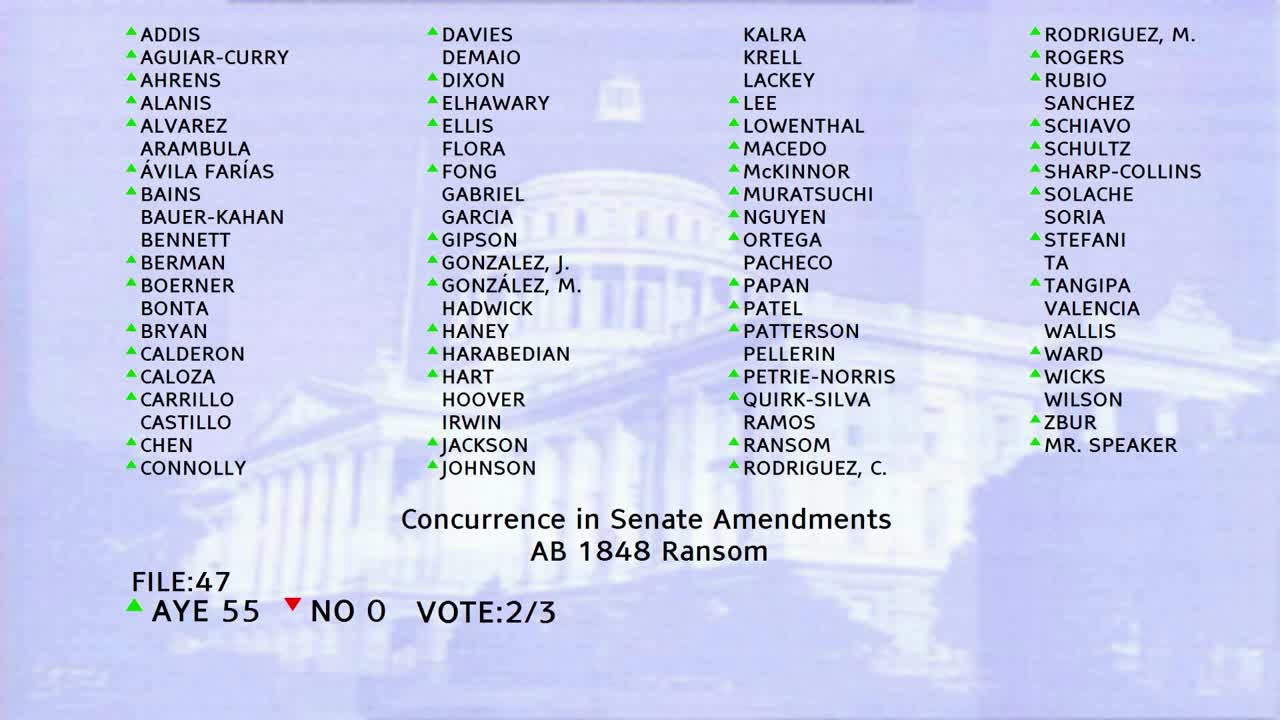 1MIN
Assembly Floor
 2MIN
Senate Floor
 7MIN
Senate Standing Committee on Health
 1MIN
Assembly Floor
 2MIN
Assembly Standing Committee on Appropriations
 8MIN
Assembly Standing Committee on Emergency Management
 17MIN
Assembly Standing Committee on Communications and Conveyance
Bill Author

Bill Co-Author(s):