AB 2045: Habitat Restoration and Enhancement Act.
- Session Year: 2025-2026
- House: Assembly
- Latest Version Date: 2026-09-29
Current Status:
Passed
(2026-09-29: Chaptered by Secretary of State - Chapter 818, Statutes of 2026.)
Introduced
In Committee
Awaiting First Chamber Vote
Passed First Chamber
In Committee
Awaiting Second Chamber Vote
Passed Second Chamber
Enacted
The Habitat Restoration and Enhancement Act authorizes a project proponent to submit a habitat restoration or enhancement project to the Director of Fish and Wildlife for approval. The act requires the Department of Fish and Wildlife to assess an application fee for a project submitted to the department consistent with specified fees adopted by the department, as provided. Under the act, a habitat restoration or enhancement project is defined as a project with the primary purpose of improving fish and wildlife habitat. The act requires the director to approve a habitat restoration or enhancement project if the director determines that specified conditions are met. The act makes moneys in the Habitat Restoration and Enhancement Account available to the department, upon appropriation by the Legislature, for the purposes of administering and implementing the act. Existing law repeals the act on January 1, 2027.
This bill would extend the operation of the act until January 1, 2032, and would require the department to submit a report on the implementation of the act to the Legislature no later than December 31, 2029. The bill would maintain the requirement for the application fee to be consistent with other specified fees adopted by the department until the department establishes, on or before January 1, 2030, an application fee schedule, as specified.
The bill would revise the definition of a habitat restoration or enhancement project, would revise the required contents of an application for a habitat restoration or enhancement project, as provided, and would transfer the responsibilities of the director under the act to the department.
Under the act, the approval of a habitat restoration or enhancement project is in lieu of any other permit, agreement, license, or other approval issued by the Department of Fish and Wildlife.
This bill would provide that the departments approval of a habitat restoration or enhancement project under the act only includes take authorization for the species listed by the project proponent in its application. The bill would require the department to ensure that each approved habitat restoration or enhancement project includes appropriate measures to avoid and minimize its adverse impacts to species protected by state law.
The act establishes separate procedures for the approval of a habitat restoration or enhancement project depending on whether the project has received a specified certification pursuant to an order from the State Water Resources Control Board. As part of the procedures applicable to a project that has received that certification, the act requires the director to publish the receipt of certain information from the project proponent, and the directors determination on whether the application is complete, in the California Regulatory Notice Register.
This bill would eliminate the requirement to publish that information in the California Regulatory Notice Register.
The act requires the director to suspend the implementation of a project under certain circumstances, as specified.
This bill would eliminate those provisions.
The Habitat Restoration and Enhancement Act authorizes a project proponent to submit a habitat restoration or enhancement project to the Director of Fish and Wildlife for approval. The act requires the Department of Fish and Wildlife to assess an application fee for a project submitted to the department consistent with specified fees adopted by the department, as provided. Under the act, a habitat restoration or enhancement project is defined as a project with the primary purpose of improving fish and wildlife habitat. The act requires the director to approve a habitat restoration or enhancement project if the director determines that specified conditions are met. Under the act, the directors approval of a habitat restoration or enhancement project is in lieu of any other permit, agreement, license, or other approval issued by the Department of Fish and Wildlife. The act makes moneys in the Habitat Restoration and Enhancement Account available to the department, upon appropriation by the Legislature, for the purposes of administering and implementing the act. Existing law repeals the act on January 1, 2027.
This bill would extend the operation of the act until January 1, 2032, and would require the department to submit a report on the implementation of the act to the Legislature no later than December 31, 2029. The bill would maintain the requirement for the application fee to be consistent with other specified fees adopted by the department until the department establishes, on or before January 1, 2030, an application fee schedule, as specified.
The bill would revise the definition of a habitat restoration or enhancement project, would revise the required contents of an application for a habitat restoration or enhancement project, as provided, and would transfer the responsibilities of the director under the act to the department.
Under the act, the approval of a habitat restoration or enhancement project is in lieu of any other permit, agreement, license, or other approval issued by the Department of Fish and Wildlife.
This bill would provide that the departments approval of a habitat restoration or enhancement project under the act only includes take authorization for the species listed by the project proponent in its application. The bill would require the department to ensure that each approved habitat restoration or enhancement project includes appropriate measures to avoid and minimize its adverse impacts to species protected by state law.
The act establishes separate procedures for the approval of a habitat restoration or enhancement project depending on whether the project has received a specified certification pursuant to an order from the State Water Resources Control Board. As part of the procedures applicable to a project that has received that certification, the act requires the director to publish the receipt of certain information from the project proponent, and the directors determination on whether the application is complete, in the California Regulatory Notice Register.
This bill would eliminate the requirement to publish that information in the California Regulatory Notice Register.
The act requires the director to suspend the implementation of a project under certain circumstances, as specified.
This bill would eliminate those provisions.
Existing law enumerates fully protected species and prohibits the take of fully protected species, except under limited circumstances.This bill would require that the departments approval of a habitat restoration or enhancement project be in lieu of any other permit, agreement, license, or other approval issued by the department but only for the species listed by the project proponent pursuant to specified provisions.The Habitat Restoration and Enhancement Act authorizes a project proponent to submit a habitat restoration or enhancement project to the Director of Fish and Wildlife for approval. The act requires the Department of Fish and Wildlife to assess an application fee for a project submitted to the department consistent with specified fees adopted by the department, as provided. Under the act, a habitat restoration or enhancement project is a project with the primary purpose of improving fish and wildlife habitat. The act requires the director to approve a habitat restoration or enhancement project if the director determines that specified conditions are met. Under the act, the directors approval of a habitat restoration or enhancement project is in lieu of any other permit, agreement, license, or other approval issued by the Department of Fish and Wildlife. The act makes moneys in the Habitat Restoration and Enhancement Account available to the department, upon appropriation by the Legislature, for the purposes of administering and implementing the act. Existing law repeals the act on January 1, 2027.
This bill would extend the operation of the act until January 1, 2032, and would require the department to submit a report on the implementation of the act to the Legislature no later than December 31, 2029. The bill would eliminate maintain the requirement for the application fee to be consistent with other specified fees adopted by the department and would instead authorize the department to establish a graduated schedule of fees. until the department establishes, on or before January 1, 2030, an application fee schedule, as specified.
The bill would revise the required contents of an application for a habitat restoration or enhancement project, as provided, and would transfer the responsibilities of the director under the act to the department.
The act establishes separate procedures for the approval of a habitat restoration or enhancement project depending on whether the project has received a specified certification pursuant to an order from the State Water Resources Control Board. As part of the procedures applicable to a project that has received that certification, the act requires the director to publish the receipt of certain information from the project proponent, and the directors determination on whether the application is complete, in the California Regulatory Notice Register.
This bill would eliminate the requirement to publish that information in the California Regulatory Notice Register.
The act requires the director to suspend the implementation of a project under certain circumstances, as specified.
This bill would eliminate those provisions.
Existing law enumerates fully protected species and prohibits the take of fully protected species, except under limited circumstances.
This bill would require the departments approval of a habitat restoration or enhancement project under the act to authorize the incidental take of a fully protected species resulting from impacts attributable to or otherwise related to the project. that the departments approval of a habitat restoration or enhancement project be in lieu of any other permit, agreement, license, or other approval issued by the department but only for the species listed by the project proponent pursuant to specified provisions.
The Habitat Restoration and Enhancement Act authorizes a project proponent to submit a habitat restoration or enhancement project to the Director of Fish and Wildlife for approval. The act requires the Department of Fish and Wildlife to assess an application fee for a project submitted to the department consistent with specified fees adopted by the department, as provided. Under the act, a habitat restoration or enhancement project is a project with the primary purpose of improving fish and wildlife habitat. The act requires the director to approve a habitat restoration or enhancement project if the director determines that specified conditions are met. Under the act, the directors approval of a habitat restoration or enhancement project is in lieu of any other permit, agreement, license, or other approval issued by the Department of Fish and Wildlife. The act makes moneys in the Habitat Restoration and Enhancement Account available to the department, upon appropriation by the Legislature, for the purposes of administering and implementing the act. Existing law repeals the act on January 1, 2027.
This bill would extend the operation of the act until January 1, 2032, and would require the department to submit a report on the implementation of the act to the Legislature no later than December 31, 2029. The bill would eliminate the requirement for the application fee to be consistent with other specified fees adopted by the department and would instead authorize the department to establish a graduated schedule of fees.
The bill would revise the required contents of an application for a habitat restoration or enhancement project, as provided, and would transfer the responsibilities of the director under the act to the department.
The act establishes separate procedures for the approval of a habitat restoration or enhancement project depending on whether the project has received a specified certification pursuant to an order from the State Water Resources Control Board. As part of the procedures applicable to a project that has received that certification, the act requires the director to publish the receipt of certain information from the project proponent, and the directors determination on whether the application is complete, in the California Regulatory Notice Register.
This bill would eliminate the requirement to publish that information in the California Regulatory Notice Register.
The act requires the director to suspend the implementation of a project under certain circumstances, as specified.
This bill would eliminate those provisions.
Existing law enumerates fully protected species and prohibits the take of fully protected species, except under limited circumstances.
This bill would require the departments approval of a habitat restoration or enhancement project under the act to authorize the incidental take of a fully protected species resulting from impacts attributable to or otherwise related to the project.
The Habitat Restoration and Enhancement Act authorizes a project proponent to submit a habitat restoration or enhancement project to the Director of Fish and Wildlife for approval. Under the act, a habitat restoration or enhancement project is a project with the primary purpose of improving fish and wildlife habitat. The act requires the director to approve a habitat restoration or enhancement project if the director determines that specified conditions are met. Under the act, the directors approval of a habitat restoration or enhancement project is in lieu of any other permit, agreement, license, or other approval issued by the Department of Fish and Wildlife. The act makes moneys in the Habitat Restoration and Enhancement Account available to the department, upon appropriation by the Legislature, for the purposes of administering and implementing the act. Existing law repeals the act on January 1, 2027.
This bill would extend the operation of the act until January 1, 2032, and would require the department to submit a report on the implementation of the act to the Legislature no later than December 31, 2029.
The bill would revise the required contents of an application for a habitat restoration or enhancement project, as provided, and would transfer the responsibilities of the director under the act to the department.
The act establishes separate procedures for the approval of a habitat restoration or enhancement project depending on whether the project has received a specified certification pursuant to an order from the State Water Resources Control Board. As part of the procedures applicable to a project that has received that certification, the act requires the director to publish the receipt of certain information from the project proponent, and the directors determination on whether the application is complete, in the California Regulatory Notice Register.
This bill would eliminate the requirement to publish that information in the California Regulatory Notice Register.
The act requires the director to suspend the implementation of a project under certain circumstances, as specified.
This bill would eliminate those provisions.
Existing law enumerates fully protected species and prohibits the take of fully protected species, except under limited circumstances.
This bill would require the departments approval of a habitat restoration or enhancement project under the act to authorize the incidental take of a fully protected species resulting from impacts attributable to or otherwise related to the project.
The Habitat Restoration and Enhancement Act authorizes a project proponent to submit a habitat restoration or enhancement project to the Director of Fish and Wildlife for approval. Under the act, a habitat restoration or enhancement project is a project with the primary purpose of improving fish and wildlife habitat. The act requires the director to approve a habitat restoration or enhancement project if the director determines that specified conditions are met. Under the act, the directors approval of a habitat restoration or enhancement project is in lieu of any other permit, agreement, license, or other approval issued by the Department of Fish and Wildlife. The act makes moneys in the Habitat Restoration and Enhancement Account available to the department, upon appropriation by the Legislature, for the purposes of administering and implementing the act. Existing law repeals the act on January 1, 2027.
This bill would extend the operation of the act indefinitely. until January 1, 2032, and would require the department to submit a report on the implementation of the act to the Legislature no later than December 31, 2029.
The Habitat Restoration and Enhancement Act authorizes a project proponent to submit a habitat restoration or enhancement project to the Director of Fish and Wildlife for approval. Under the act, a habitat restoration or enhancement project is a project with the primary purpose of improving fish and wildlife habitat. The act requires the director to approve a habitat restoration or enhancement project if the director determines that specified conditions are met. Under the act, the directors approval of a habitat restoration or enhancement project is in lieu of any other permit, agreement, license, or other approval issued by the Department of Fish and Wildlife. The act makes moneys in the Habitat Restoration and Enhancement Account available to the department, upon appropriation by the Legislature, for the purposes of administering and implementing the act. Existing law repeals the act on January 1, 2027.
This bill would extend the operation of the act indefinitely.
As used in this chapter:
(a)Fish passage guidelines means those guidelines specified in the departments California Salmonid Stream Habitat Restoration Manual and the National Marine Fisheries Service, Southwest Region, Guidelines for Salmonid Passage at Stream Crossings, and subsequent amendments or updates to either document.
(b)Habitat restoration or enhancement project means a project that meets both of the following criteria:
(1)The project has the primary purpose of improving the habitat of native fish, wildlife, or plant species.
(2)The project meets the eligibility requirements for the State Water Resources Control Boards Order for Clean Water Act Section 401 General Water Quality Certification for Small Habitat Restoration Projects, or its current equivalent at the time the project proponent submits a written request pursuant to Section 1652 or 1653. The order or current equivalent may include programmatic waivers or waste discharge requirements for small habitat restoration projects.
(c)Project proponent means a person, public agency, or nonprofit organization seeking to implement a habitat restoration or enhancement project.
(d)Species recovery plan means a guidance document prepared by a government agency that identifies recovery actions, based upon the best scientific and commercial data available, necessary for the protection and recovery of listed species.
SEC. 2.Section 1652 of the Fish and Game Code is amended to read:1652.(a)A project proponent seeking the departments approval of a habitat restoration or enhancement project shall submit a written request for approval of the project to the department pursuant to this section if the project has not received certification pursuant to the State Water Resources Control Boards Order for Clean Water Act Section 401 General Water Quality Certification for Small Habitat Restoration Projects, or its current equivalent at the time the project proponent submits the written request. If the project has received certification pursuant to that order, or its current equivalent, the project proponent may submit a request for approval of the project pursuant to Section 1653.
(b)A written request to approve a habitat restoration or enhancement project pursuant to this section shall contain all of the following:
(1)The name, address, title, organization, telephone number, and email address of the natural person or persons who will be the main point of contact for the project proponent.
(2)A full description of the habitat restoration or enhancement project that includes the designs and techniques to be used for the project, restoration or enhancement methods, an estimate of temporary restoration- or enhancement-related disturbance, project schedule, anticipated activities, and how the project meets the criteria of a habitat restoration or enhancement project listed in subdivision (b) of Section 1651 and is expected to result in a net benefit to any affected habitat and species, consistent with paragraph (3) of subdivision (d).
(3)An assessment of the project area that provides a description of the existing flora and fauna and the potential presence of sensitive species or habitat. The assessment shall include preproject photographs of the project area that include a descriptive title, date taken, the photographic monitoring point, and photographic orientation.
(4)If any biological surveys have been conducted for the project, the results of those surveys.
(5)If the project may result in the take of species protected by state law, a list of those species that may be taken, the type of take, and the mechanisms of take.
(6)A geographic description of the project site including maps, land ownership information, and other relevant location information.
(7)If the project includes a design plan prepared by a professional engineer, a design plan that is at least 65 percent complete.
(8)A description of the environmental protection measures incorporated into the project design, so that no potentially significant adverse effects on the environment, as defined in Section 15382 of Title 14 of the California Code of Regulations, are likely to occur with application of the specified environmental protection measures. Environmental protection measures may include, but are not limited to, appropriate seasonal work limitations, measures to avoid and minimize impacts to water quality and potentially present species protected by state and federal law, and the use of qualified professionals for standard preconstruction surveys where protected species are potentially present.
(9)Substantial evidence to support a conclusion that the project meets the requirements set forth in this section. Substantial evidence shall include references to relevant design criteria and environmental protection measures found in the documents specified in paragraph (3) of subdivision (d).
(10)A certifying statement that the project will comply with the California Environmental Quality Act (Division 13 (commencing with Section 21000) of the Public Resources Code), which may include, but not be limited to, the requirements of Section 15333 of Title 14 of the California Code of Regulations.
(11)The fees required pursuant to Section 1655.
(c)Within 60 days after the department has received a written request pursuant to subdivision (a), the department shall make one of the following determinations:
(1)Approve the request as submitted.
(2)Deny the request and inform the project proponent of the reason or reasons for the denial.
(d)The departments approval or denial of a request pursuant to subdivision (c) shall be based on whether the project meets all of the following criteria:
(1)The request contains all of the information required by subdivision (b).
(2)The project is a habitat restoration or enhancement project as defined in subdivision (b) of Section 1651.
(3)The project is consistent with, or identified in, sources that describe best available restoration and enhancement methodologies, including one or more of the following:
(A)Federal- and state-listed species recovery plans or published protection measures, or previously approved department agreements and permits issued for habitat restoration or enhancement projects.
(B)Department and National Marine Fisheries Service fish screening criteria or fish passage guidelines.
(C)The departments California Salmonid Stream Habitat Restoration Manual.
(D)Guidance documents and practice manuals that describe best available habitat restoration or enhancement methodologies that are used or approved by the department.
(4)The project will not result in cumulative adverse environmental impacts that are significant when viewed in connection with the effects of past, current, or probable future projects.
(e)The project proponent shall submit a notice of completion to the department no later than 30 days after the project approved pursuant to this section is completed. The notice of completion shall demonstrate that the project has been carried out in accordance with the departments approval pursuant to this section. The notice of completion shall include a map of the project location, including the final boundaries of the restoration area or areas and postproject photographs. Each photograph shall include a descriptive title, date taken, photographic monitoring point, and photographic orientation.
(f)(1)The project proponent shall submit a monitoring report describing whether the restoration project is meeting each of the restoration goals stated in the project application. Each report shall include photographs with a descriptive title, date taken, photographic monitoring point, and photographic orientation.
(2)The monitoring reports for Section 401 Water Quality Certification or waste discharge requirements of the State Water Resources Control Board or a regional water quality control board, or for department or federal voluntary habitat restoration programs, including, but not limited to, the Fisheries Restoration Grant Program, may be submitted in lieu of the requirement set forth in paragraph (1).
SEC. 3.Section 1653 of the Fish and Game Code is amended to read:1653.(a)A project proponent seeking the departments approval of a habitat restoration or enhancement project shall submit a written request for approval of the project to the department pursuant to this section if the project has received certification pursuant to the State Water Resources Control Boards Order for Clean Water Act Section 401 General Water Quality Certification for Small Habitat Restoration Projects, or its current equivalent at the time the project proponent submits the written request.
(b)A written request to approve a habitat restoration or enhancement project pursuant to this section shall contain all of the following:
(1)Notice that the project proponent has received a notice of applicability that indicates that the project is authorized pursuant to the State Water Resources Control Boards Order for Clean Water Act Section 401 General Water Quality Certification for Small Habitat Restoration Projects, or its equivalent at the time the project proponent submits the written request.
(2)A copy of the notice of applicability.
(3)A copy of the notice of intent provided to the State Water Resources Control Board or a regional water quality control board.
(4)If any biological surveys have been conducted for the project, the results of those surveys.
(5)If the project may result in the take of species protected by state law, a list of those species that may be taken, the type of take, and the mechanisms of take.
(6)A description of measures incorporated into the project to avoid and minimize impacts to species protected by state law, such as appropriate seasonal work limitations and the use of qualified professionals for standard preconstruction surveys.
(7)If the project includes a design plan prepared by a professional engineer, a design plan that is at least 65 percent complete.
(8)The fees required pursuant to Section 1655.
(c)Within 30 days after the department has received a written request pursuant to subdivision (a), the department shall make one of the following determinations:
(1)Approve the request as submitted.
(2)Deny the request and inform the project proponent of the reason or reasons for the denial.
(d)The departments approval or denial of a request pursuant to subdivision (c) shall be based on whether the project meets both of the following criteria:
(1)The request contains all of the information required by subdivision (b).
(2)The project is a habitat restoration or enhancement project as defined in subdivision (b) of Section 1651.
(e)The project proponent shall submit the monitoring plan, monitoring report, and notice of completion to the department as required by the State Water Resources Control Boards Order for Clean Water Act Section 401 General Water Quality Certification for Small Habitat Restoration Projects, or its current equivalent at the time the project proponent submits the written request. The order or its current equivalent may include programmatic waivers or waste discharge requirements for small-scale restoration projects.
SEC. 4.Section 1654 of the Fish and Game Code is amended to read:1654.(a)(1)Subject to paragraph (2), the departments approval of a habitat restoration or enhancement project pursuant to Section 1652 or 1653 shall be in lieu of any other permit, agreement, license, or other approval issued by the department that may be required for a habitat restoration or enhancement project, including, but not limited to, those issued pursuant to Chapter 6 (commencing with Section 1600), Chapter 6.7 (commencing with Section 1670), and Chapter 10 (commencing with Section 1900) of this division, Chapter 1.5 (commencing with Section 2050) of Division 3, and Sections 3511, 4700, 5050, and 5515.
(2)(A)The departments approval of a habitat restoration or enhancement project only includes take authorization for the species listed by the project proponent pursuant to either paragraph (5) of subdivision (b) of Section 1652 or paragraph (5) of subdivision (b) of Section 1653.
(B)The department shall ensure that every habitat restoration or enhancement project that the department approves includes appropriate measures to avoid and minimize its adverse impacts to species protected by state law.
(b)This chapter shall not be construed as expanding the scope of projects requiring a permit, agreement, license, or other approval issued by the department.
(c)Pursuant to Section 818.4 of the Government Code, the department and any other state agency exercising authority under this section shall not be liable with regard to any determination or authorization made pursuant to this section.
SEC. 5.Section 1655 of the Fish and Game Code is amended to read:1655.(a)The Habitat Restoration and Enhancement Account is hereby created in the Fish and Game Preservation Fund.
(b)The department may enter into an agreement to accept funds from any public agency, person, business entity, or organization to achieve the purposes of this chapter. The department shall deposit any funds so received in the account. The funds received shall supplement existing resources for department administration and permitting of projects and programs included in this chapter.
(c)On or before January 1, 2030, the department shall establish an application fee schedule for requests for department approval submitted pursuant to Section 1652 or 1653. The application fee schedule may use a graduated schedule. The department shall annually adjust the fees pursuant to Section 713 after the application fee schedule is established. The application fee shall not exceed the reasonable administrative and implementation costs of the department related to the projects.
(d)Until the application fee schedule required pursuant to subdivision (c) is established, the department shall assess an application fee for requests for departmental approval submitted pursuant to Section 1652 or 1653 consistent with the fees adopted by the department pursuant to Chapter 6 (commencing with Section 1600). The application fee shall not exceed the reasonable administrative and implementation costs of the department related to the projects.
(e)Moneys in the account shall be available to the department, upon appropriation by the Legislature, for the purposes of administering and implementing this chapter.
SEC. 6.Section 1656 of the Fish and Game Code is amended to read:1656.(a)The department shall submit a report no later than December 31, 2020, an additional report no later than December 31, 2025, and an additional report no later than December 31, 2029, on the implementation of this chapter to the Legislature that shall include, but not be limited to, the number, type, and geographical distribution of approved projects, funding adequacy, and recommendations for changes and improvements in the program.
(b)A report to be submitted pursuant to subdivision (a) shall be submitted in compliance with Section 9795 of the Government Code.
SEC. 7.Section 1657 of the Fish and Game Code is amended to read:1657.This chapter shall remain in effect only until January 1, 2032, and as of that date is repealed.
As used in this chapter:
(a)Fish passage guidelines means those guidelines specified in the departments California Salmonid Stream Habitat Restoration Manual and the National Marine Fisheries Service, Southwest Region, Guidelines for Salmonid Passage at Stream Crossings, and subsequent amendments or updates to either document.
(b)Habitat restoration or enhancement project means a project with that meets both of the following criteria:
(1)The project has the primary purpose of improving fish and wildlife habitat. A habitat restoration or enhancement project shall meet the habitat of native fish, wildlife, or plant species.
(2)The project meets the eligibility requirements for the State Water Resources Control Boards Order for Clean Water Act Section 401 General Water Quality Certification for Small Habitat Restoration Projects, or its current equivalent at the time the project proponent submits a written request pursuant to Section 1652 or 1653. The order or current equivalent may include programmatic waivers or waste discharge requirements for small habitat restoration projects.
(c)Project proponent means a person, public agency, or nonprofit organization seeking to implement a habitat restoration or enhancement project.
(d)Species recovery plan means a guidance document prepared by a government agency that identifies recovery actions, based upon the best scientific and commercial data available, necessary for the protection and recovery of listed species.
SECTION 1.SEC. 2.Section 1652 of the Fish and Game Code is amended to read:1652.(a)A project proponent may seeking the departments approval of a habitat restoration or enhancement project shall submit a written request to approve a habitat restoration or enhancement for approval of the project to the department pursuant to this section if the project has not received certification pursuant to the State Water Resources Control Boards Order for Clean Water Act Section 401 General Water Quality Certification for Small Habitat Restoration Projects, or its current equivalent at the time the project proponent submits the written request. If the project has received certification pursuant to that order, or its current equivalent, the project proponent may submit a request for approval of the project pursuant to Section 1653.
(b)A written request to approve a habitat restoration or enhancement project pursuant to this section shall contain all of the following information: following:
(1)The name, address, title, organization, telephone number, and email address of the natural person or persons who will be the main point of contact for the project proponent.
(2)A full description of the habitat restoration or enhancement project that includes the designs and techniques to be used for the project, restoration or enhancement methods, an estimate of temporary restoration- or enhancement-related disturbance, project schedule, anticipated activities, and how the project meets the criteria of a habitat restoration or enhancement project listed in subdivision (b) of Section 1651 and is expected to result in a net benefit to any affected habitat and species, consistent with paragraph (4) (3) of subdivision (c). (d).
(3)An assessment of the project area that provides a description of the existing flora and fauna and the potential presence of sensitive species or habitat. The assessment shall include preproject photographs of the project area that include a descriptive title, date taken, the photographic monitoring point, and photographic orientation.
(4)The results of any biological survey that has been conducted for the project.(4)If any biological surveys have been conducted for the project, the results of those surveys.
(5)If the project may result in the take of species protected by state law, a list of those species that may be taken, the type of take, and the mechanisms of take.
(5)(6)A geographic description of the project site including maps, land ownership information, and other relevant location information.
(7)If the project includes a design plan prepared by a professional engineer, a design plan that is at least 65 percent complete.
(6)(8)A description of the environmental protection measures incorporated into the project design, so that no potentially significant adverse effects on the environment, as defined in Section 15382 of Title 14 of the California Code of Regulations, are likely to occur with application of the specified environmental protection measures. Environmental protection measures may include, but are not limited to, appropriate seasonal work limitations, measures to avoid and minimize impacts to water quality and potentially present species protected by state and federal law, and the use of qualified professionals for standard preconstruction surveys where protected species are potentially present.
(7)(9)Substantial evidence to support a conclusion that the project meets the requirements set forth in this section. Substantial evidence shall include references to relevant design criteria and environmental protection measures found in the documents specified in paragraph (4) (3) of subdivision (c). (d).
(8)(10)A certifying statement that the project will comply with the California Environmental Quality Act (Division 13 (commencing with Section 21000) of the Public Resources Code), which may include, but not be limited to, the requirements of Section 15333 of Title 14 of the California Code of Regulations.
(11)The fees required pursuant to Section 1655.
(c)Notwithstanding any other law, within Within 60 days after receiving a written request to approve a habitat restoration or enhancement project, the department shall approve the habitat restoration or enhancement project if the department determines that the written request includes all of the required information set forth in subdivision (b), and the project meets all of the following requirements: the department has received a written request pursuant to subdivision (a), the department shall make one of the following determinations:
(1)The project purpose is voluntary habitat restoration and the project is not required as mitigation.(2)The project is not part of a regulatory permit for a nonhabitat restoration or enhancement construction activity, a regulatory settlement, a regulatory enforcement action, or a court order.(3)The project meets the eligibility requirements of the State Water Resources Control Boards Order for Clean Water Act Section 401 General Water Quality Certification for Small Habitat Restoration Projects, or its current equivalent at the time the project proponent submits the written request, but has not received certification pursuant to that order or its equivalent.(1)Approve the request as submitted.
(2)Deny the request and inform the project proponent of the reason or reasons for the denial.
(d)The departments approval or denial of a request pursuant to subdivision (c) shall be based on whether the project meets all of the following criteria:
(1)The request contains all of the information required by subdivision (b).
(2)The project is a habitat restoration or enhancement project as defined in subdivision (b) of Section 1651.
(4)(3)The project is consistent with, or identified in, sources that describe best available restoration and enhancement methodologies, including one or more of the following:
(A)Federal- and state-listed species recovery plans or published protection measures, or previously approved department agreements and permits issued for voluntary habitat restoration or enhancement projects.
(B)Department and National Marine Fisheries Service fish screening criteria or fish passage guidelines.
(C)The departments California Salmonid Stream Habitat Restoration Manual.
(D)Guidance documents and practice manuals that describe best available habitat restoration or enhancement methodologies that are used or approved by the department.
(5)(4)The project will not result in cumulative adverse environmental impacts that are significant when viewed in connection with the effects of past, current, or probable future projects.
(d)If the department determines that the written request does not contain all of the information required by subdivision (b), or fails to meet the requirements set forth in subdivision (c), or both, the department shall deny the written request and inform the project proponent of the reason or reasons for the denial.(e)The project proponent shall submit a notice of completion to the department no later than 30 days after the project approved pursuant to this section is completed. The notice of completion shall demonstrate that the project has been carried out in accordance with the projects description. departments approval pursuant to this section. The notice of completion shall include a map of the project location, including the final boundaries of the restoration area or areas and postproject photographs. Each photograph shall include a descriptive title, date taken, photographic monitoring point, and photographic orientation.
(f)(1)The project proponent shall submit a monitoring report describing whether the restoration project is meeting each of the restoration goals stated in the project application. Each report shall include photographs with a descriptive title, date taken, photographic monitoring point, and photographic orientation. The
(2)The monitoring reports for Section 401 Water Quality Certification or waste discharge requirements of the State Water Resources Control Board or a regional water quality control board, or for department or federal voluntary habitat restoration programs, including, but not limited to, the Fisheries Restoration Grant Program, may be submitted in lieu of this requirement. the requirement set forth in paragraph (1).
SEC. 2.SEC. 3.Section 1653 of the Fish and Game Code is amended to read:1653.(a)A project proponent may seeking the departments approval of a habitat restoration or enhancement project shall submit a written request to approve a habitat restoration or enhancement for approval of the project to the department pursuant to this section if the project has received certification pursuant to the State Water Resources Control Boards Order for Clean Water Act Section 401 General Water Quality Certification for Small Habitat Restoration Projects, or its current equivalent at the time the project proponent submits the written request.
(b)A written request to approve a habitat restoration or enhancement project pursuant to this section shall include contain all of the following information: following:
(1)Notice that the project proponent has received a notice of applicability that indicates that the project is authorized pursuant to the State Water Resources Control Boards Order for Clean Water Act Section 401 General Water Quality Certification for Small Habitat Restoration Projects, or its equivalent at the time the project proponent submits the written request.
(2)A copy of the notice of applicability.
(3)A copy of the notice of intent provided to the State Water Resources Control Board or a regional water quality control board.
(4)The results of any biological survey that has been conducted for the project.(4)If any biological surveys have been conducted for the project, the results of those surveys.
(5)If the project will may result in the take of species protected by state law, a list of those species that may be taken, the type of take, and the mechanisms of take.
(6)A description of measures incorporated into the project, but not already included in the notice of intent, project to avoid and minimize impacts to species protected by state law, such as appropriate seasonal work limitations and the use of qualified professionals for standard preconstruction surveys.
(7)If the project includes a design plan that has been prepared by a professional engineer, a design plan that is at least 65 percent complete.
(8)The fees required pursuant to Section 1655.
(c)Within 30 days after the department has received the notice of applicability described in subdivision (b), the department shall determine whether the written request accompanying the notice of applicability is complete. a written request pursuant to subdivision (a), the department shall make one of the following determinations:
(d)If the department determines within that 30-day period, based upon substantial evidence, that the written request is not complete, then the project may be authorized under Section 1652.(1)Approve the request as submitted.
(2)Deny the request and inform the project proponent of the reason or reasons for the denial.
(d)The departments approval or denial of a request pursuant to subdivision (c) shall be based on whether the project meets both of the following criteria:
(1)The request contains all of the information required by subdivision (b).
(2)The project is a habitat restoration or enhancement project as defined in subdivision (b) of Section 1651.
(e)The project proponent shall submit the monitoring plan, monitoring report, and notice of completion to the department as required by the State Water Resources Control Boards Order for Clean Water Act Section 401 General Water Quality Certification for Small Habitat Restoration Projects, or its current equivalent at the time the project proponent submits the written request. The order or its current equivalent may include programmatic waivers or waste discharge requirements for small-scale restoration projects.
SEC. 3.SEC. 4.Section 1654 of the Fish and Game Code is amended to read:1654.(a)The (1)Subject to paragraph (2), the departments approval of a habitat restoration or enhancement project pursuant to Section 1652 or 1653 shall be in lieu of any other permit, agreement, license, or other approval issued by the department, department that may be required for a habitat restoration or enhancement project, including, but not limited to, those issued pursuant to Chapter 6 (commencing with Section 1600), Chapter 6.7 (commencing with Section 1670), and Chapter 10 (commencing with Section 1900) of this division, Chapter 1.5 (commencing with Section 2050) of Division 3, and Sections 3511, 4700, 5050, and 5515. However, the
(2)(A)The departments approval of a habitat restoration or enhancement project only includes take authorization for the species listed by the project proponent pursuant to either paragraph (5) of subdivision (b) of Section 1652 or paragraph (5) of subdivision (b) of Section 1653.
(B)The department shall ensure that every habitat restoration or enhancement project that the department approves includes appropriate measures to avoid and minimize its adverse impacts to species protected by state law.
(b)This chapter shall not be construed as expanding the scope of projects requiring a permit, agreement, license, or other approval issued by the department.
(c)Pursuant to Section 818.4 of the Government Code, the department and any other state agency exercising authority under this section shall not be liable with regard to any determination or authorization made pursuant to this section.
SEC. 4.SEC. 5.Section 1655 of the Fish and Game Code is amended to read:1655.(a)The Habitat Restoration and Enhancement Account is hereby created in the Fish and Game Preservation Fund.
(b)The department may enter into an agreement to accept funds from any public agency, person, business entity, or organization to achieve the purposes of this chapter. The department shall deposit any funds so received in the account. The funds received shall supplement existing resources for department administration and permitting of projects and programs included in this chapter.
(c)On or before January 1, 2030, the department shall establish an application fee schedule for requests for department approval submitted pursuant to Section 1652 or 1653. The application fee schedule may use a graduated schedule. The department shall annually adjust the fees pursuant to Section 713 after the application fee schedule is established. The application fee shall not exceed the reasonable administrative and implementation costs of the department related to the projects.
(d)Until the application fee schedule required pursuant to subdivision (c) is established, the department shall assess an application fee for requests for departmental approval submitted pursuant to Section 1652 or 1653 consistent with the fees adopted by the department pursuant to Chapter 6 (commencing with Section 1600). The application fee shall not exceed the reasonable administrative and implementation costs of the department related to the projects.
(e)Moneys in the account shall be available to the department, upon appropriation by the Legislature, for the purposes of administering and implementing this chapter.
SEC. 5.SEC. 6.Section 1656 of the Fish and Game Code is amended to read:1656.(a)The department shall submit a report no later than December 31, 2020, an additional report no later than December 31, 2025, and an additional report no later than December 31, 2029, on the implementation of this chapter to the Legislature that shall include, but not be limited to, the number, type, and geographical distribution of approved projects, funding adequacy, and recommendations for changes and improvements in the program.
(b)A report to be submitted pursuant to subdivision (a) shall be submitted in compliance with Section 9795 of the Government Code.
SEC. 6.SEC. 7.Section 1657 of the Fish and Game Code is amended to read:1657.This chapter shall remain in effect only until January 1, 2032, and as of that date is repealed.
(a)A project proponent may submit a written request to approve a habitat restoration or enhancement project to the department pursuant to this section if the project has not received certification pursuant to the State Water Resources Control Boards Order for Clean Water Act Section 401 General Water Quality Certification for Small Habitat Restoration Projects, or its current equivalent at the time the project proponent submits the written request. If the project has received certification pursuant to that order, or its current equivalent, the project proponent may submit a request for approval of the project pursuant to Section 1653.
(b)A written request to approve a habitat restoration or enhancement project pursuant to this section shall contain all of the following information:
(1)The name, address, title, organization, telephone number, and email address of the natural person or persons who will be the main point of contact for the project proponent.
(2)A full description of the habitat restoration or enhancement project that includes the designs and techniques to be used for the project, restoration or enhancement methods, an estimate of temporary restoration- or enhancement-related disturbance, project schedule, anticipated activities, and how the project is expected to result in a net benefit to any affected habitat and species, consistent with paragraph (4) of subdivision (c).
(3)An assessment of the project area that provides a description of the existing flora and fauna and the potential presence of sensitive species or habitat. The assessment shall include preproject photographs of the project area that include a descriptive title, date taken, the photographic monitoring point, and photographic orientation.
(4)The results of any biological survey that has been conducted for the project.
(5)A geographic description of the project site including maps, land ownership information, and other relevant location information.
(6)A description of the environmental protection measures incorporated into the project design, so that no potentially significant adverse effects on the environment, as defined in Section 15382 of Title 14 of the California Code of Regulations, are likely to occur with application of the specified environmental protection measures. Environmental protection measures may include, but are not limited to, appropriate seasonal work limitations, measures to avoid and minimize impacts to water quality and potentially present species protected by state and federal law, and the use of qualified professionals for standard preconstruction surveys where protected species are potentially present.
(7)Substantial evidence to support a conclusion that the project meets the requirements set forth in this section. Substantial evidence shall include references to relevant design criteria and environmental protection measures found in the documents specified in paragraph (4) of subdivision (c).
(8)A certifying statement that the project will comply with the California Environmental Quality Act (Division 13 (commencing with Section 21000) of the Public Resources Code), which may include, but not be limited to, the requirements of Section 15333 of Title 14 of the California Code of Regulations.
(c)Notwithstanding any other law, within 60 days after receiving a written request to approve a habitat restoration or enhancement project, the department shall approve the habitat restoration or enhancement project if the department determines that the written request includes all of the required information set forth in subdivision (b), and the project meets all of the following requirements:
(1)The project purpose is voluntary habitat restoration and the project is not required as mitigation.
(2)The project is not part of a regulatory permit for a nonhabitat restoration or enhancement construction activity, a regulatory settlement, a regulatory enforcement action, or a court order.
(3)The project meets the eligibility requirements of the State Water Resources Control Boards Order for Clean Water Act Section 401 General Water Quality Certification for Small Habitat Restoration Projects, or its current equivalent at the time the project proponent submits the written request, but has not received certification pursuant to that order or its equivalent.
(4)The project is consistent with, or identified in, sources that describe best available restoration and enhancement methodologies, including one or more of the following:
(A)Federal- and state-listed species recovery plans or published protection measures, or previously approved department agreements and permits issued for voluntary habitat restoration or enhancement projects.
(B)Department and National Marine Fisheries Service fish screening criteria or fish passage guidelines.
(C)The departments California Salmonid Stream Habitat Restoration Manual.
(D)Guidance documents and practice manuals that describe best available habitat restoration or enhancement methodologies that are used or approved by the department.
(5)The project will not result in cumulative adverse environmental impacts that are significant when viewed in connection with the effects of past, current, or probable future projects.
(d)If the department determines that the written request does not contain all of the information required by subdivision (b), or fails to meet the requirements set forth in subdivision (c), or both, the department shall deny the written request and inform the project proponent of the reason or reasons for the denial.
(e)The project proponent shall submit a notice of completion to the department no later than 30 days after the project approved pursuant to this section is completed. The notice of completion shall demonstrate that the project has been carried out in accordance with the projects description. The notice of completion shall include a map of the project location, including the final boundaries of the restoration area or areas and postproject photographs. Each photograph shall include a descriptive title, date taken, photographic monitoring point, and photographic orientation.
(f)The project proponent shall submit a monitoring report describing whether the restoration project is meeting each of the restoration goals stated in the project application. Each report shall include photographs with a descriptive title, date taken, photographic monitoring point, and photographic orientation. The monitoring reports for Section 401 Water Quality Certification or waste discharge requirements of the State Water Resources Control Board or a regional water quality control board, or for department or federal voluntary habitat restoration programs, including, but not limited to, the Fisheries Restoration Grant Program, may be submitted in lieu of this requirement.
SEC. 2.Section 1653 of the Fish and Game Code is amended to read:1653.(a)A project proponent may submit a written request to approve a habitat restoration or enhancement project to the department pursuant to this section if the project has received certification pursuant to the State Water Resources Control Boards Order for Clean Water Act Section 401 General Water Quality Certification for Small Habitat Restoration Projects, or its current equivalent at the time the project proponent submits the written request.
(b)A written request to approve a habitat restoration or enhancement project pursuant to this section shall include all of the following information:
(1)Notice that the project proponent has received a notice of applicability that indicates that the project is authorized pursuant to the State Water Resources Control Boards Order for Clean Water Act Section 401 General Water Quality Certification for Small Habitat Restoration Projects, or its equivalent at the time the project proponent submits the written request.
(2)A copy of the notice of applicability.
(3)A copy of the notice of intent provided to the State Water Resources Control Board or a regional water quality control board.
(4)The results of any biological survey that has been conducted for the project.
(5)If the project will result in the take of species protected by state law, a list of those species that may be taken, the type of take, and the mechanisms of take.
(6)A description of measures incorporated into the project, but not already included in the notice of intent, to avoid and minimize impacts to species protected by state law, such as appropriate seasonal work limitations and the use of qualified professionals for standard preconstruction surveys.
(7)If the project includes a design plan that has been prepared by a professional engineer, a design plan that is at least 65 percent complete.
(8)The fees required pursuant to Section 1655.
(c)Within 30 days after the department has received the notice of applicability described in subdivision (b), the department shall determine whether the written request accompanying the notice of applicability is complete.
(d)If the department determines within that 30-day period, based upon substantial evidence, that the written request is not complete, then the project may be authorized under Section 1652.
(e)The project proponent shall submit the monitoring plan, monitoring report, and notice of completion to the department as required by the State Water Resources Control Boards Order for Clean Water Act Section 401 General Water Quality Certification for Small Habitat Restoration Projects, or its current equivalent at the time the project proponent submits the written request. The order or its current equivalent may include programmatic waivers or waste discharge requirements for small scale small-scale restoration projects.
SEC. 3.Section 1654 of the Fish and Game Code is amended to read:1654.(a)(1)The departments approval of a habitat restoration or enhancement project pursuant to Section 1652 or 1653 shall be in lieu of any other permit, agreement, license, or other approval issued by the department, including, but not limited to, those issued pursuant to Chapter 6 (commencing with Section 1600) and Chapter 10 (commencing with Section 1900) of this division and Chapter 1.5 (commencing with Section 2050) of Division 3. Chapter 6 (commencing with Section 1600), Chapter 6.7 (commencing with Section 1670), and Chapter 10 (commencing with Section 1900) of this division, Chapter 1.5 (commencing with Section 2050) of Division 3, and Sections 3511, 4700, 5050, and 5515. However, the departments approval of a habitat restoration or enhancement project only includes take authorization for the species listed by the project proponent pursuant to either paragraph (5) of subdivision (b) of Section 1652 or paragraph (5) of subdivision (b) of Section 1653.
(2)The departments approval of a habitat restoration or enhancement project pursuant to Section 1652 or 1653 shall authorize the incidental take of any species designated as a fully protected species pursuant to Sections 3511, 4700, 5050, or 5515 resulting from impacts attributable to or otherwise related to the habitat restoration or enhancement project.(b)This chapter shall not be construed as expanding the scope of projects requiring a permit, agreement, license, or other approval issued by the department.
(c)Pursuant to Section 818.4 of the Government Code, the department and any other state agency exercising authority under this section shall not be liable with regard to any determination or authorization made pursuant to this section.
SEC. 4.Section 1655 of the Fish and Game Code is amended to read:1655.(a)The Habitat Restoration and Enhancement Account is hereby created in the Fish and Game Preservation Fund.
(b)The department may enter into an agreement to accept funds from any public agency, person, business entity, or organization to achieve the purposes of this chapter. The department shall deposit any funds so received in the account. The funds received shall supplement existing resources for department administration and permitting of projects and programs included in this chapter.
(c)The department shall assess an application fee for a project submitted to the department pursuant to Section 1652 or 1653. The department may establish a graduated schedule of fees and the application fee shall not exceed the reasonable administrative and implementation costs of the department relating to the project.(c)On or before January 1, 2030, the department shall establish an application fee schedule for requests for department approval submitted pursuant to Section 1652 or 1653. The application fee schedule may use a graduated schedule. The department shall annually adjust the fees pursuant to Section 713 after the application fee schedule is established. The application fee shall not exceed the reasonable administrative and implementation costs of the department related to the projects.
(d)Until the application fee schedule required pursuant to subdivision (c) is established, the department shall assess an application fee for requests for departmental approval submitted pursuant to Section 1652 or 1653 consistent with the fees adopted by the department pursuant to Chapter 6 (commencing with Section 1600). The application fee shall not exceed the reasonable administrative and implementation costs of the department related to the projects.
(d)(e)Moneys in the account shall be available to the department, upon appropriation by the Legislature, for the purposes of administering and implementing this chapter.
SEC. 5.Section 1656 of the Fish and Game Code is amended to read:1656.(a)The department shall submit a report no later than December 31, 2020, an additional report no later than December 31, 2025, and an additional report no later than December 31, 2029, on the implementation of this chapter to the Legislature that shall include, but not be limited to, the number, type, and geographical distribution of approved projects, funding adequacy, and recommendations for changes and improvements in the program.
(b)A report to be submitted pursuant to subdivision (a) shall be submitted in compliance with Section 9795 of the Government Code.
SEC. 6.Section 1657 of the Fish and Game Code is amended to read:1657.This chapter shall remain in effect only until January 1, 2032, and as of that date is repealed.
(a)A project proponent may submit a written request to approve a habitat restoration or enhancement project to the department pursuant to this section if the project has not received certification pursuant to the State Water Resources Control Boards Order for Clean Water Act Section 401 General Water Quality Certification for Small Habitat Restoration Projects, or its current equivalent at the time the project proponent submits the written request. If the project has received certification pursuant to that order, or its current equivalent, the project proponent may submit a request for approval of the project pursuant to Section 1653.
(b)A written request to approve a habitat restoration or enhancement project pursuant to this section shall contain all of the following information:
(1)The name, address, title, organization, telephone number, and email address of the natural person or persons who will be the main point of contact for the project proponent.
(2)A full description of the habitat restoration or enhancement project that includes the designs and techniques to be used for the project, restoration or enhancement methods, an estimate of temporary restoration- or enhancement-related disturbance, project schedule, anticipated activities, and how the project is expected to result in a net benefit to any affected habitat and species, consistent with paragraph (4) of subdivision (c).
(3)An assessment of the project area that provides a description of the existing flora and fauna and the potential presence of sensitive species or habitat. The assessment shall include preproject photographs of the project area that include a descriptive title, date taken, the photographic monitoring point, and photographic orientation.
(4)The results of any biological survey that has been conducted for the project.
(5)A geographic description of the project site including maps, land ownership information, and other relevant location information.
(6)A description of the environmental protection measures incorporated into the project design, so that no potentially significant adverse effects on the environment, as defined in Section 15382 of Title 14 of the California Code of Regulations, are likely to occur with application of the specified environmental protection measures. Environmental protection measures may include, but are not limited to, appropriate seasonal work limitations, measures to avoid and minimize impacts to water quality and potentially present species protected by state and federal law, and the use of qualified professionals for standard preconstruction surveys where protected species are potentially present.
(7)Substantial evidence to support a conclusion that the project meets the requirements set forth in this section. Substantial evidence shall include references to relevant design criteria and environmental protection measures found in the documents specified in paragraph (4) of subdivision (c).
(8)A certifying statement that the project will comply with the California Environmental Quality Act (Division 13 (commencing with Section 21000) of the Public Resources Code), which may include, but not be limited to, the requirements of Section 15333 of Title 14 of the California Code of Regulations.
(c)Notwithstanding any other law, within 60 days after receiving a written request to approve a habitat restoration or enhancement project, the department shall approve the habitat restoration or enhancement project if the department determines that the written request includes all of the required information set forth in subdivision (b), and the project meets all of the following requirements:
(1)The project purpose is voluntary habitat restoration and the project is not required as mitigation.
(2)The project is not part of a regulatory permit for a nonhabitat restoration or enhancement construction activity, a regulatory settlement, a regulatory enforcement action, or a court order.
(3)The project meets the eligibility requirements of the State Water Resources Control Boards Order for Clean Water Act Section 401 General Water Quality Certification for Small Habitat Restoration Projects, or its current equivalent at the time the project proponent submits the written request, but has not received certification pursuant to that order or its equivalent.
(4)The project is consistent with, or identified in, sources that describe best available restoration and enhancement methodologies, including one or more of the following:
(A)Federal- and state-listed species recovery plans or published protection measures, or previously approved department agreements and permits issued for voluntary habitat restoration or enhancement projects.
(B)Department and National Marine Fisheries Service fish screening criteria or fish passage guidelines.
(C)The departments California Salmonid Stream Habitat Restoration Manual.
(D)Guidance documents and practice manuals that describe best available habitat restoration or enhancement methodologies that are used or approved by the department.
(5)The project will not result in cumulative adverse environmental impacts that are significant when viewed in connection with the effects of past, current, or probable future projects.
(d)If the department determines that the written request does not contain all of the information required by subdivision (b), or fails to meet the requirements set forth in subdivision (c), or both, the department shall deny the written request and inform the project proponent of the reason or reasons for the denial.
(e)The project proponent shall submit a notice of completion to the department no later than 30 days after the project approved pursuant to this section is completed. The notice of completion shall demonstrate that the project has been carried out in accordance with the projects description. The notice of completion shall include a map of the project location, including the final boundaries of the restoration area or areas and postproject photographs. Each photograph shall include a descriptive title, date taken, photographic monitoring point, and photographic orientation.
(f)The project proponent shall submit a monitoring report describing whether the restoration project is meeting each of the restoration goals stated in the project application. Each report shall include photographs with a descriptive title, date taken, photographic monitoring point, and photographic orientation. The monitoring reports for Section 401 Water Quality Certification or waste discharge requirements of the State Water Resources Control Board or a regional water quality control board, or for department or federal voluntary habitat restoration programs, including, but not limited to, the Fisheries Restoration Grant Program, may be submitted in lieu of this requirement.
SEC. 2.Section 1653 of the Fish and Game Code is amended to read:1653.(a)A project proponent may submit a written request to approve a habitat restoration or enhancement project to the department pursuant to this section if the project has received certification pursuant to the State Water Resources Control Boards Order for Clean Water Act Section 401 General Water Quality Certification for Small Habitat Restoration Projects, or its current equivalent at the time the project proponent submits the written request.
(b)A written request to approve a habitat restoration or enhancement project pursuant to this section shall include all of the following information:
(1)Notice that the project proponent has received a notice of applicability that indicates that the project is authorized pursuant to the State Water Resources Control Boards Order for Clean Water Act Section 401 General Water Quality Certification for Small Habitat Restoration Projects, or its equivalent at the time the project proponent submits the written request.
(2)A copy of the notice of applicability.
(3)A copy of the notice of intent provided to the State Water Resources Control Board or a regional water quality control board.
(4)The results of any biological survey that has been conducted for the project.
(5)If the project will result in the take of species protected by state law, a list of those species that may be taken, the type of take, and the mechanisms of take.
(6)A description of measures incorporated into the project, but not already included in the notice of intent, to avoid and minimize impacts to species protected by state law, such as appropriate seasonal work limitations and the use of qualified professionals for standard preconstruction surveys.
(7)If the project includes a design plan that has been prepared by a professional engineer, a design plan that is at least 65 percent complete.
(8)The fees required pursuant to Section 1655.
(c)Within 30 days after the department has received the notice of applicability described in subdivision (b), the department shall determine whether the written request accompanying the notice of applicability is complete.
(d)If the department determines within that 30-day period, based upon substantial evidence, that the written request is not complete, then the project may be authorized under Section 1652.
(e)The project proponent shall submit the monitoring plan, monitoring report, and notice of completion to the department as required by the State Water Resources Control Boards Order for Clean Water Act Section 401 General Water Quality Certification for Small Habitat Restoration Projects, or its current equivalent at the time the project proponent submits the written request. The order or its current equivalent may include programmatic waivers or waste discharge requirements for small scale restoration projects.
SEC. 3.Section 1654 of the Fish and Game Code is amended to read:1654.(a)(1)The departments approval of a habitat restoration or enhancement project pursuant to Section 1652 or 1653 shall be in lieu of any other permit, agreement, license, or other approval issued by the department, including, but not limited to, those issued pursuant to Chapter 6 (commencing with Section 1600) and Chapter 10 (commencing with Section 1900) of this division and Chapter 1.5 (commencing with Section 2050) of Division 3.
(2)The departments approval of a habitat restoration or enhancement project pursuant to Section 1652 or 1653 shall authorize the incidental take of any species designated as a fully protected species pursuant to Sections 3511, 4700, 5050, or 5515 resulting from impacts attributable to or otherwise related to the habitat restoration or enhancement project.
(b)This chapter shall not be construed as expanding the scope of projects requiring a permit, agreement, license, or other approval issued by the department.
(c)Pursuant to Section 818.4 of the Government Code, the department and any other state agency exercising authority under this section shall not be liable with regard to any determination or authorization made pursuant to this section.
SEC. 4.Section 1655 of the Fish and Game Code is amended to read:1655.(a)The Habitat Restoration and Enhancement Account is hereby created in the Fish and Game Preservation Fund.
(b)The department may enter into an agreement to accept funds from any public agency, person, business entity, or organization to achieve the purposes of this chapter. The department shall deposit any funds so received in the account. The funds received shall supplement existing resources for department administration and permitting of projects and programs included in this chapter.
(c)The department shall assess an application fee for a project submitted to the department pursuant to Section 1652 or 1653 consistent with the fees adopted by the department pursuant to Chapter 6 (commencing with Section 1600), but 1653. The department may establish a graduated schedule of fees and the application fee shall not exceed the reasonable administrative and implementation costs of the department relating to the project.
(d)Moneys in the account shall be available to the department, upon appropriation by the Legislature, for the purposes of administering and implementing this chapter.
SEC. 4.SEC. 5.Section 1656 of the Fish and Game Code is amended to read:1656.(a)The department shall submit a report no later than December 31, 2020, an additional report no later than December 31, 2025, and an additional report no later than December 31, 2029, on the implementation of this chapter to the Legislature that shall include, but not be limited to, the number, type, and geographical distribution of approved projects, funding adequacy, and recommendations for changes and improvements in the program.
(b)A report to be submitted pursuant to subdivision (a) shall be submitted in compliance with Section 9795 of the Government Code.
SEC. 5.SEC. 6.Section 1657 of the Fish and Game Code is amended to read:1657.This chapter shall remain in effect only until January 1, 2032, and as of that date is repealed.
(a)A project proponent may submit a written request to approve a habitat restoration or enhancement project to the director department pursuant to this section if the project has not received certification pursuant to the State Water Resources Control Boards Order for Clean Water Act Section 401 General Water Quality Certification for Small Habitat Restoration Projects, or its current equivalent at the time the project proponent submits the written request. If the project has received certification pursuant to that order, or its current equivalent, the project proponent may submit a request for approval of the project pursuant to Section 1653.
(b)A written request to approve a habitat restoration or enhancement project pursuant to this section shall contain all of the following: following information:
(1)The name, address, title, organization, telephone number, and email address of the natural person or persons who will be the main point of contact for the project proponent.
(2)A full description of the habitat restoration or enhancement project that includes the designs and techniques to be used for the project, restoration or enhancement methods, an estimate of temporary restoration- or enhancement-related disturbance, project schedule, anticipated activities, and how the project is expected to result in a net benefit to any affected habitat and species, consistent with paragraph (4) of subdivision (c).
(3)An assessment of the project area that provides a description of the existing flora and fauna and the potential presence of sensitive species or habitat. The assessment shall include preproject photographs of the project area that include a descriptive title, date taken, the photographic monitoring point, and photographic orientation.
(4)The results of any biological survey that has been conducted for the project.
(4)(5)A geographic description of the project site including maps, land ownership information, and other relevant location information.
(5)(6)A description of the environmental protection measures incorporated into the project design, so that no potentially significant adverse effects on the environment, as defined in Section 15382 of Title 14 of the California Code of Regulations, are likely to occur with application of the specified environmental protection measures. Environmental protection measures may include, but are not limited to, appropriate seasonal work limitations, measures to avoid and minimize impacts to water quality and potentially present species protected by state and federal law, and the use of qualified professionals for standard preconstruction surveys where protected species are potentially present.
(6)(7)Substantial evidence to support a conclusion that the project meets the requirements set forth in this section. Substantial evidence shall include references to relevant design criteria and environmental protection measures found in the documents specified in paragraph (4) of subdivision (c).
(7)(8)A certifying statement that the project will comply with the California Environmental Quality Act (Division 13 (commencing with Section 21000) of the Public Resources Code), which may include, but not be limited to, the requirements of Section 15333 of Title 14 of the California Code of Regulations.
(c)Notwithstanding any other law, within 60 days after receiving a written request to approve a habitat restoration or enhancement project, the director department shall approve a the habitat restoration or enhancement project if the director department determines that the written request includes all of the required information set forth in subdivision (b), and the project meets all of the following requirements:
(1)The project purpose is voluntary habitat restoration and the project is not required as mitigation.
(2)The project is not part of a regulatory permit for a nonhabitat restoration or enhancement construction activity, a regulatory settlement, a regulatory enforcement action, or a court order.
(3)The project meets the eligibility requirements of the State Water Resources Control Boards Order for Clean Water Act Section 401 General Water Quality Certification for Small Habitat Restoration Projects, or its current equivalent at the time the project proponent submits the written request, but has not received certification pursuant to that order or its equivalent.
(4)The project is consistent with, or identified in, sources that describe best available restoration and enhancement methodologies, including one or more of the following:
(A)Federal- and state-listed species recovery plans or published protection measures, or previously approved department agreements and permits issued for voluntary habitat restoration or enhancement projects.
(B)Department and National Marine Fisheries Service fish screening criteria or fish passage guidelines.
(C)The departments California Salmonid Stream Habitat Restoration Manual.
(D)Guidance documents and practice manuals that describe best available habitat restoration or enhancement methodologies that are utilized used or approved by the department.
(5)The project will not result in cumulative adverse environmental impacts that are significant when viewed in connection with the effects of past, current, or probable future projects.
(d)If the director department determines that the written request does not contain all of the information required by subdivision (b), or fails to meet the requirements set forth in subdivision (c), or both, the director department shall deny the written request and inform the project proponent of the reason or reasons for the denial.
(e)The project proponent shall submit a notice of completion to the department no later than 30 days after the project approved pursuant to this section is completed. The notice of completion shall demonstrate that the project has been carried out in accordance with the projects description. The notice of completion shall include a map of the project location, including the final boundaries of the restoration area or areas and postproject photographs. Each photograph shall include a descriptive title, date taken, photographic monitoring point, and photographic orientation.
(f)The project proponent shall submit a monitoring report describing whether the restoration project is meeting each of the restoration goals stated in the project application. Each report shall include photographs with a descriptive title, date taken, photographic monitoring point, and photographic orientation. The monitoring reports for Section 401 Water Quality Certification or waste discharge requirements of the State Water Resources Control Board or a regional water quality control board, or for department or federal voluntary habitat restoration programs, including, but not limited to, the Fisheries Restoration Grant Program, may be submitted in lieu of this requirement.
SEC. 2.Section 1653 of the Fish and Game Code is amended to read:1653.(a)A project proponent may submit a written request to approve a habitat restoration or enhancement project to the director department pursuant to this section if the project has received certification pursuant to the State Water Resources Control Boards Order for Clean Water Act Section 401 General Water Quality Certification for Small Habitat Restoration Projects, or its current equivalent at the time the project proponent submits the written request.
(b)A written request to approve a habitat restoration or enhancement project pursuant to this section shall include all of the following: following information:
(1)Notice that the project proponent has received a notice of applicability that indicates that the project is authorized pursuant to the State Water Resources Control Boards Order for Clean Water Act Section 401 General Water Quality Certification for Small Habitat Restoration Projects, or its equivalent at the time the project proponent submits the written request.
(2)A copy of the notice of applicability.
(3)A copy of the notice of intent provided to the State Water Resources Control Board or a regional water quality control board.
(4)The results of any biological survey that has been conducted for the project.
(5)If the project will result in the take of species protected by state law, a list of those species that may be taken, the type of take, and the mechanisms of take.
(4)(6)A description of species protection measures incorporated into the project design, project, but not already included in the notice of intent, to avoid and minimize impacts to potentially present species protected by state and federal law, such as appropriate seasonal work limitations and the use of qualified professionals for standard preconstruction surveys where protected species are potentially present. surveys.
(7)If the project includes a design plan that has been prepared by a professional engineer, a design plan that is at least 65 percent complete.
(5)(8)The fees required pursuant to Section 1655.
(c)Upon receipt of the notice specified in paragraph (1) of subdivision (b), the director shall immediately have published in the General Public Interest section of the California Regulatory Notice Register the receipt of that notice.(d)(c)Within 30 days after the director department has received the notice of applicability described in subdivision (b), the director department shall determine whether the written request accompanying the notice of applicability is complete.
(e)(d)If the director department determines within that 30-day period, based upon substantial evidence, that the written request is not complete, then the project may be authorized under Section 1652.
(f)The director shall immediately publish the determination pursuant to subdivision (d) in the General Public Interest section of the California Regulatory Notice Register.(g)(e)The project proponent shall submit the monitoring plan, monitoring report, and notice of completion to the department as required by the State Water Resources Control Boards Order for Clean Water Act Section 401 General Water Quality Certification for Small Habitat Restoration Projects, or its current equivalent at the time the project proponent submits the written request. The order or its current equivalent may include programmatic waivers or waste discharge requirements for small scale restoration projects.
SEC. 3.Section 1654 of the Fish and Game Code is amended to read:1654.(a)(1)The directors departments approval of a habitat restoration or enhancement project pursuant to Section 1652 or 1653 shall be in lieu of any other permit, agreement, license, or other approval issued by the department, including, but not limited to, those issued pursuant to Chapter 6 (commencing with Section 1600) and Chapter 10 (commencing with Section 1900) of this division and Chapter 1.5 (commencing with Section 2050) of Division 3.
(2)The departments approval of a habitat restoration or enhancement project pursuant to Section 1652 or 1653 shall authorize the incidental take of any species designated as a fully protected species pursuant to Sections 3511, 4700, 5050, or 5515 resulting from impacts attributable to or otherwise related to the habitat restoration or enhancement project.
(b)This chapter shall not be construed as expanding the scope of projects requiring a permit, agreement, license, or other approval issued by the department.
(c)(1)If the director determines at any time that the project is no longer consistent with subdivision (c) of Section 1652 or subdivision (b) of Section 1653, as applicable, due to a material change between the project as submitted and the project being implemented or a change in the environmental circumstances in the area of implementation, the director shall notify the project proponent in writing and project implementation shall be suspended. Written notice from the director shall be delivered in person, by certified mail, or by electronic communication to the project proponent and shall specify the reasons why approval of the project was suspended. The approval for a project shall not be revoked pursuant to this subdivision unless it has first been suspended pursuant to this subdivision.(2)Within 30 days of receipt of a notice of suspension, the project proponent may file an objection with the director. Any objection shall be in writing and state the reasons why the project proponent objects to the suspension. The project proponent may provide additional environmental protection measures, design modifications, or other evidence that the project is consistent with subdivision (c) of Section 1652 or subdivision (b) of Section 1653, as applicable, and request that the notice of suspension be lifted and approval granted.(3)The director shall revoke approval or lift the suspension of project approval within 30 days after receiving the project proponents objection pursuant to paragraph (2).(d)(c)Pursuant to Section 818.4 of the Government Code, the department and any other state agency exercising authority under this section shall not be liable with regard to any determination or authorization made pursuant to this section.
SECTION 1.SEC. 4.Section 1656 of the Fish and Game Code is amended to read:1656.(a)The department shall submit a report no later than December 31, 2020, an additional report no later than December 31, 2025, and an additional report no later than December 31, 2029, on the implementation of this chapter to the Legislature that shall include, but not be limited to, the number, type, and geographical distribution of approved projects, funding adequacy, and recommendations for changes and improvements in the program.
(b)A report to be submitted pursuant to subdivision (a) shall be submitted in compliance with Section 9795 of the Government Code.
SEC. 2.SEC. 5.Section 1657 of the Fish and Game Code is amended to read:1657.This chapter shall remain in effect only until January 1, 2032, and as of that date is repealed.
(a)The department shall submit a report no later than December 31, 2020, and an additional report no later than December 31, 2025, and an additional report no later than December 31, 2029, on the implementation of this chapter to the Legislature that shall include, but not be limited to, the number, type, and geographical distribution of approved projects, funding adequacy, and recommendations for changes and improvements in the program.
(b)A report to be submitted pursuant to subdivision (a) shall be submitted in compliance with Section 9795 of the Government Code.
SEC. 2.Section 1657 of the Fish and Game Code is amended to read:1657.This chapter shall remain in effect only until January 1, 2027, 2032, and as of that date is repealed.
SECTION 1.Section 1657 of the Fish and Game Code is repealed.|
Date
|
Status
|
|---|---|
| Sep 29, 2026 | Chaptered by Secretary of State - Chapter 818, Statutes of 2026. |
| Sep 29, 2026 | Approved by the Governor. |
| Sep 3, 2026 | Enrolled and presented to the Governor at 4 p.m. |
| Aug 26, 2026 | Senate amendments concurred in. To Engrossing and Enrolling. (Ayes 79. Noes 0. Page 6577.). |
| Aug 26, 2026 | Senate amendments concurred in. To Engrossing and Enrolling. (Ayes 79. Noes 0.). |
| Aug 25, 2026 | In Assembly. Concurrence in Senate amendments pending. |
| Aug 25, 2026 | Read third time. Passed. Ordered to the Assembly. (Ayes 40. Noes 0. Page 5790.). |
| Aug 25, 2026 | Read third time. Passed. Ordered to the Assembly. (Ayes 38. Noes 0.). |
| Aug 24, 2026 | Read second time. Ordered to third reading. |
| Aug 21, 2026 | Read third time and amended. Ordered to second reading. |
| Aug 17, 2026 | Read second time. Ordered to third reading. |
| Aug 13, 2026 | Read second time and amended. Ordered returned to second reading. |
| Aug 13, 2026 | From committee: Amend, and do pass as amended. (Ayes 7. Noes 0.) (August 13). |
| Aug 3, 2026 | In committee: Referred to APPR. suspense file. |
| Jul 6, 2026 | Read second time and amended. Re-referred to Com. on APPR. |
| Jul 6, 2026 | From committee: Amend, and do pass as amended and re-refer to Com. on APPR. with recommendation: To Consent Calendar. (Ayes 7. Noes 0.) (July 1). |
| Jun 23, 2026 | From committee chair, with author's amendments: Amend, and re-refer to committee. Read second time, amended, and re-referred to Com. on N.R. & W. |
| Jun 3, 2026 | Referred to Com. on N.R. & W. |
| May 21, 2026 | In Senate. Read first time. To Com. on RLS. for assignment. |
| May 21, 2026 | Read third time. Passed. Ordered to the Senate. (Ayes 73. Noes 0. Page 5218.) |
| May 21, 2026 | Read third time. Passed. Ordered to the Senate. (Ayes 73. Noes 0.) |
| May 18, 2026 | Read second time. Ordered to third reading. |
| May 14, 2026 | From committee: Do pass. (Ayes 15. Noes 0.) (May 14). |
| May 6, 2026 | In committee: Set, first hearing. Referred to APPR. suspense file. |
| Apr 20, 2026 | Re-referred to Com. on APPR. |
| Apr 16, 2026 | Read second time and amended. |
| Apr 15, 2026 | From committee: Amend, and do pass as amended and re-refer to Com. on APPR. (Ayes 12. Noes 0.) (April 14). |
| Mar 2, 2026 | Referred to Com. on W., P., & W. |
| Feb 18, 2026 | From printer. May be heard in committee March 20. |
| Feb 17, 2026 | Read first time. To print. |
|
Date
|
Description
|
Location
|
Votes
|
|
|---|---|---|---|---|
| Aug 26, 2026 | AB 2045 Connolly Concurrence in Senate Amendments | Assembly Floor |
Passed |
|
| Aug 25, 2026 | Assembly 3rd Reading AB2045 Connolly By Becker | Senate Floor |
Passed |
|
| Aug 13, 2026 | Do pass as amended | Senate Standing Committee on Appropriations |
Passed |
|
| Aug 3, 2026 | Placed on suspense file | Senate Standing Committee on Appropriations |
Passed |
|
| Jul 1, 2026 | Do pass as amended, but first amend, and re-refer to the Committee on [Appropriations] with the recommendation: To Consent Calendar | Senate Standing Committee on Natural Resources and Water |
Passed |
|
| May 21, 2026 | AB 2045 Connolly Assembly Third Reading | Assembly Floor |
Passed |
|
| May 14, 2026 | Do pass. | Assembly Standing Committee on Appropriations |
Passed |
|
| Apr 14, 2026 | Do pass as amended and be re-referred to the Committee on [Appropriations] | Assembly Standing Committee on Water, Parks, and Wildlife |
Passed |
This list shows positions taken on this bill by organizations on the date displayed, which is linked to the original source.
Positions by individuals are not included.
|
Organization
|
Position
|
Date
|
|---|---|---|
| Arroyos & Foothills Conservancy | ** Support | |
| Audubon California | ** Support | |
| California Association Of Local Conservation Corps | ** Support | |
| California Association Of Resource Conservation Districts | ** Support | |
| California Council Of Land Trusts | ** Support | |
| California Democratic Party Rural Caucus | ** Support | |
| California Habitat Conservation Planning Coalition | ** Support | |
| California Invasive Plant Council | ** Support | |
| California Native Plant Society | ** Support | |
| Californians for Western Wilderness | ** Support | |
| California Trout | ** Support | |
| california wildlife foundation | ** Support | |
| Citizens for Los Angeles Wildlife | ** Support | |
| Citizens for Los Angeles Wildlife (CLAW) | ** Support | |
| Coastal Ranches Conservancy | ** Support | |
| Ducks Unlimited | ** Support | |
| East Bay Municipal Utility District | ** Support | |
| Ecosystem Investment Partners | ** Support | |
| Ecosystems Investment Partners | ** Support | |
| Ecosystems Investments Partners | ** Support | |
| Environmental Defense Fund | ** Support | |
| Friends of Harbors, Beaches and Parks | ** Support | |
| grasslands water district | ** Support | |
| Land Trust for Santa Barbara County | ** Support | |
| Los Cerritos Wetland Land Trust | ** Support | |
| Marin Agricultural Land Trust | ** Support | |
| Mid Klamath Watershed Council | ** Support | |
| Midpeninsula Regional Open Space District | ** Support | |
| Northern California Water Association | ** Support | |
| Pasadena Audubon Society | ** Support | |
| Paula Land Action Network | ** Support | |
| Paula Land Action Network (PLAN) | ** Support | |
| Point Blue Conservation Science | ** Support | |
| San Diego Bird Alliance | ** Support | |
| San Diego River Park Foundation | ** Support | |
| Santa Clara County Habitat Agency | ** Support | |
| Santa Clara Valley Open Space Authority | ** Support | |
| Santa Clara Valley Open Space District | ** Support | |
| Save the Redwoods League | ** Support | |
| Scott River Watershed Council | ** Support | |
| Sempervirens Fund | ** Support | |
| Social Compassion In Legislation | ** Support | |
| Solano County Water Agency | ** Support | |
| Sonoma Land Trust | ** Support | |
| Sustainable Conservation | ** Support | |
| Sustainable Conservation (sponsor) | ** Support | |
| The Land Trust for Santa Barbara County | ** Support | |
| The Nature Conservancy | ** Support | |
| Trout Unlimited | ** Support | |
| Wildcoast | ** Support | |
| Wildlands Network | ** Support |
CONCURRENCE IN SENATE AMENDMENTS
CSA1 Bill Id:AB 2045
Author:(Connolly)
As Amended Ver:August 21, 2026
Majority vote
SUMMARY
Extends the sunset of the Habitat Restoration and Enhancement Act (HREA) from January 1, 2027, to January 1, 2032, modifies required information for HREA permit submission, and updates HREA application fees.
Senate Amendments
- Require the submission of the following additional information for proposed projects:
- The results of any biological survey that has been conducted;
- A list of any state-listed species that may be taken, the type of take, and the mechanism of take; and
- A design plan that is at least 65% complete, if the project includes a design plan prepared by a professional engineer.
- Delete a requirement to include species protection measures for federally protected species.
- Delete requirements to publish notices in the California Regulatory Notice Register.
- Specify that permit approval may include take authorization for both listed and fully protected species, but that permits only cover species indicated by the project proponent in the permit application.
- Require CDFW to ensure that every project approved under HREA includes appropriate measures to avoid and minimize adverse impacts to species protected by state law.
- Delete CDFW's authority to suspend or revoke project approval.
- Require CDFW to develop a new application fee schedule by January 1, 2030, and require CDFW to continue to use the current fee schedule until the new schedule is adopted.
- Make numerous technical and conforming changes.
COMMENTS
HREA expedites small, voluntary restoration projects by establishing permitting efficiencies, in line with the Administration's "cutting the green tape" priorities. Cost savings for HREA permit applicants stem from avoided California Endangered Species Act and scientific collection permit fees (as Lake and Streambed Alteration Agreement fees are still paid by HREA applicants). In its 2025 cutting the green tape report, CDFW estimates that each HREA-permitted restoration project saves approximately $32,222 in permit fees and implementation costs. As of January 2026, CDFW has approved 243 projects under HREA.
CDFW has been chronically underfunded, resulting in large service gaps. In a presentation given before the Senate Budget Subcommittee No. 2 on February 26, 2026, CDFW presented service-based budgeting data that showed that in fiscal year (FY) 2024–2025, CDFW was only able to provide 35% of its mission hours on permitting and environmental protection. This amounts to only a slight improvement from 28% in FY 2021–22. HREA is not an exception, and according to CDFW’s 2020 report to the Legislature on HREA implementation, HREA fees did not cover the cost of project review and approval, which does not include CDFW hours reviewing unsuccessful applications, outreach, stakeholder consultation, and program administration.
CDFW's most recent report on HREA, dated December 31, 2025, made several observations and recommendations, including that there is limited discretion within HREA to condition permit approval upon additional measures or conditions and that HREA fees do not cover the cost of implementing the program.
According to the Author
"By [extending] the sunset date of [HREA], we are ensuring the continuation of an efficient permitting pathway for these vital habitat restoration projects. Conservation groups who are on the ground preserving our ecosystems deserve an avenue in which they can operate free of regulatory burdens. Without an expedited pathway, California's progress towards reaching its environmental sustainability goals will slow down. [This bill] will protect California's biodiversity across our coasts and forests by ensuring these projects can continue in a timely manner."
Arguments in Support
Sustainable Conservation writes in support, "Since [HREA] has been in place, over 240 high-quality projects have been approved and gone forward and that number continues to increase. These projects help the State meet its goals outlined in the 30x30 Conservation Initiative, California Salmon Strategy for a Hotter Drier Future, and Nature Based Solutions climate targets, which together make up the state’s approach for conserving and restoring our natural habitats. HREA helps incentivize public-private collaboration for landowners to restore streams and coastal wetlands, reconnect floodplains, remove barriers for native fish passage, reduce sediment and pollutants in urban waterways, plant native vegetation, and support wildlife diversity."
Arguments in Opposition
None on file.
FISCAL COMMENTS
According to the Senate Appropriations Committee, this bill has the following fiscal impact:
Ongoing costs to CDFW in the low- to mid-hundreds of thousands of dollars annually to continue administering HREA until January 1, 2032 (Habitat Restoration and Enhancement Account within the Fish and Game Preservation Fund). These costs would be somewhat offset by HREA application fees, which partially cover CDFW's project review and program development costs.
VOTES:
ASM WATER, PARKS, AND WILDLIFE: 12-0-1
YES: Papan, Jeff Gonzalez, Alanis, Alvarez, Ávila Farías, Bains, Bennett, Boerner, Caloza, Hart, Muratsuchi, Rogers
ABS, ABST OR NV: Gallagher
ASM APPROPRIATIONS: 15-0-0
YES: Wicks, Hoover, Aguiar-Curry, Calderon, Caloza, Dixon, Fong, Mark González, Krell, Pacheco, Pellerin, Sharp-Collins, Solache, Ta, Tangipa
ASSEMBLY FLOOR: 73-0-7
YES: Addis, Aguiar-Curry, Ahrens, Alanis, Alvarez, Ávila Farías, Bains, Bauer-Kahan, Bennett, Berman, Boerner, Bonta, Bryan, Calderon, Caloza, Carrillo, Castillo, Connolly, Davies, DeMaio, Dixon, Elhawary, Ellis, Flora, Fong, Gabriel, Gallagher, Gipson, Jeff Gonzalez, Mark González, Hadwick, Haney, Harabedian, Hart, Irwin, Jackson, Johnson, Kalra, Krell, Lee, Lowenthal, Macedo, McKinnor, Muratsuchi, Nguyen, Ortega, Pacheco, Papan, Patel, Patterson, Pellerin, Petrie-Norris, Quirk-Silva, Ransom, Michelle Rodriguez, Rogers, Blanca Rubio, Sanchez, Schiavo, Schultz, Sharp-Collins, Solache, Soria, Stefani, Ta, Tangipa, Valencia, Wallis, Ward, Wicks, Wilson, Zbur, Rivas
ABS, ABST OR NV: Arambula, Chen, Garcia, Hoover, Lackey, Ramos, Celeste Rodriguez
UPDATED
VERSION: August 21, 2026
CONSULTANT: Sean Clair / W., P., & W. / (916) 319-2096 FN: 0004199
SENATE RULES COMMITTEE Office of Senate Floor Analyses (916) 651-4171 | AB 2045 |
THIRD READING
Bill No: AB 2045
Author: Connolly (D)
Amended: 8/21/26 in Senate
Vote: 21
SENATE NATURAL RES. & WATER COMMITTEE: 7-0, 7/1/26
AYES: Becker, Seyarto, Allen, Cabaldon, Grove, Laird, Stern
SENATE APPROPRIATIONS COMMITTEE: 7-0, 8/13/26
AYES: Cervantes, Seyarto, Cabaldon, Dahle, Grayson, Richardson, Wahab
ASSEMBLY FLOOR: 73-0, 5/21/26 - See last page for vote
SUBJECT: Habitat Restoration and Enhancement Act
SOURCE: Sustainable Conservation
DIGEST:
This bill extends the sunset on and makes additional changes to the Habitat Restoration and Enhancement Act that provides for streamlined permitting for small restoration projects at the California Department of Fish and Wildlife (CDFW), as provided.
Senate floor amendments of 8/21/26 add new statutory elements to the project application package, including the payment of application fees; specify that CDFW can only approve or deny an application using specific criteria; require CDFW to ensure that every approved project includes appropriate measures to minimize or avoid impacts to species; and make numerous minor, technical and conforming changes.
ANALYSIS:
Existing law:
- Establishes CDFW, led by its director (director), in the California Natural Resources Agency. CDFW’s mission is to manage California’s diverse fish, wildlife, and plant resources, and the habitats upon which they depend, for their ecological values and for their use and enjoyment of the public. (Fish and Game Code (FGC) §712.1)
- Establishes the Habitat Restoration and Enhancement Act (HREA). (FGC §§1650 et seq.)
- A habitat restoration or enhancement project means a project with the primary purpose of improving fish and wildlife habitat. A habitat restoration or enhancement project shall meet the eligibility requirements for the State Water Resources Control Board’s (SWRCB’s) Order for Clean Water Act Section 401 General Water Quality Certification for Small Habitat Restoration Projects, or its equivalent, as specified. These are currently limited to 5 acres or 500 linear feet.
- Authorizes, under HREA, a project proponent to submit a habitat restoration or enhancement project to the director for approval.
- The director is required to approve a habitat restoration or enhancement project if the director determines that specified conditions are met.
- HREA provides two different sets of requirements – one for projects that do not have Section 401 certification and one for those that do. The director has 60 days to approve a project without Section 401 certification and 30 days to approve one with it.
- Approved projects by either pathway are required to submit notices of project completion to the director and a monitoring report, as provided.
- The director’s approval of a habitat restoration or enhancement project under the act is in lieu of any other permit, agreement, license, or other approval issued by the department, such as a Lake and Streambed Alteration Agreements (LSAAs).
- The director is required to approve a habitat restoration or enhancement project if the director determines that specified conditions are met.
- Makes moneys in the Habitat Restoration and Enhancement Account available to the CDFW, upon appropriation by the Legislature, for the purposes of administering and implementing HREA.
- Requires CDFW to assess an application fee for a project submitted under HREA consistent with the fees for LSAAs, as provided. (FGC §1655)
- Requires CDFW to submit a report on implementation of the act to the Legislature no later than December 31, 2025 containing information on the approved projects, funding adequacy, and recommendations for changes and improvements in the program. (FGC §1656)
- Provides that HREA remains in effect only until January 1, 2027. (FGC §1657)
This bill:
- Extends the HREA sunset until January 1, 2032, and requires preparation of a legislative report due December 31, 2029.
- Revises the definition of a HREA project to be one that has a primary purpose of improving the habitat of native fish, wildlife, or plant species and that meets certain SWRCB criteria, as provided.
- For a project application, requires the submittal of biological survey results conducted for the project, if any; a list of any protected species that may be taken during the project, as provided; that if a professional engineer has prepared a design plan, that it be 65% complete; and that required fees are paid.
- Modifies the project approval or denial process to require CDFW, not the director, to either approve or deny a project based upon whether the project meets the definition of a HREA project and that all the application materials were provided.
- Requires CDFW’s approval of a project to also authorize the incidental take of any fully-protected species resulting from impacts attributable to or otherwise related to the HREA project.
- Requires CDFW to ensure that every HREA project approved by CDFW includes appropriate measures to avoid and minimize impacts to species protected by state law, as provided.
- On or before January 1, 2030, requires CDFW to assess an application fee for a submitted HREA project that does not exceed the reasonable administrative and implementation costs to CDFW relating to the project. Authorizes CDFW to establish a graduated schedule of fees, and deletes the fee linkage to the LSAA fee structure. Requires indexing of the fees annually, as provided. Requires CDFW to use the existing fee schedule until the new fee regulations are established, as provided.
- Deletes obsolete HREA provisions. Makes numerous minor and clarifying changes.
Background
HREA was established to expedite small, voluntary restoration projects by establishing permitting efficiencies. HREA-eligible projects are projects with the primary purpose of improving fish and wildlife habitat that meet certain SWRCB permitting requirements. According to CDFW, projects approved under HREA must be consistent with widely-recognized restoration practices, must avoid or minimize any incidental impacts, and must result in measurable environmental benefits.
The establishment of HREA pre-dated the Newsom Administration’s “Cutting the Green Tape” initiative, however, according to the 2025 Cutting the Green Tape report, CDFW estimates that each HREA-permitted restoration project saves approximately $32,222 in permit fees and implementation costs.
During the last five-year reporting period for HREA, approximately an average of 29 projects were approved annually and included projects in 38 counties statewide. As of October 1, 2025, CDFW has approved 243 projects under HREA.
[NOTE: For additional information regarding this bill, see the Senate Natural Resources and Water Committee’s analysis.]
FISCAL EFFECT: Appropriation: No Fiscal Com.: Yes Local: No
According to the Senate Appropriations Committee:
- Ongoing costs to CDFW in the low- to mid-hundreds of thousands of dollars annually to continue administering the HREA until January 1, 2032 (Habitat Restoration and Enhancement Account within the Fish and Game Preservation Fund). These costs would be somewhat offset by HREA application fees, which partially cover CDFW’s project review and program development costs.
SUPPORT: (Verified 8/14/26)
Sustainable Conservation (source)
Arroyos & Foothills Conservancy
Audubon California
California Association of Local Conservation Corps
California Association of Resource Conservation Districts
California Council of Land Trusts
California Democratic Party Rural Caucus
California Habitat Conservation Planning Coalition
California Invasive Plant Council
California Native Plant Society
California Trout
California Wildlife Foundation
Californians for Western Wilderness
Citizens for Los Angeles Wildlife
Coastal Ranches Conservancy
Ducks Unlimited
East Bay Municipal Utility District
Ecosystems Investment Partners
Environmental Defense Fund
Friends of Harbors, Beaches and Parks
Grasslands Water District
Los Cerritos Wetland Land Trust
Marin Agricultural Land Trust
Mid Klamath Watershed Council
Midpeninsula Regional Open Space District
Northern California Water Association
Pasadena Audubon Society
Paula Land Action Network
Point Blue Conservation Science
San Diego Bird Alliance
San Diego River Park Foundation
Santa Clara County Habitat Agency
Santa Clara Valley Open Space District
Save the Redwoods League
Scott River Watershed Council
Sempervirens Fund
Social Compassion in Legislation
Solano County Water Agency
Sonoma Land Trust
The Land Trust for Santa Barbara County
The Nature Conservancy
Trout Unlimited
WILDCOAST
Wildlands Network
OPPOSITION: (Verified 8/14/26)
None received
ARGUMENTS IN SUPPORT: According to the author “By eliminating the sunset date of the Habitat Restoration and Enhancement Act, we are ensuring the continuation of an efficient permitting pathway for these vital habitat restoration projects. Conservation groups who are on the ground preserving our ecosystems deserve an avenue in which they can operate free of regulatory burdens. Without an expedited pathway, California’s progress towards reaching its environmental sustainability goals will slow down. AB 2045 will protect California’s biodiversity across our coasts and forests by ensuring these projects can continue in a timely manner.”
ASSEMBLY FLOOR: 73-0, 5/21/26
AYES: Addis, Aguiar-Curry, Ahrens, Alanis, Alvarez, Ávila Farías, Bains, Bauer-Kahan, Bennett, Berman, Boerner, Bonta, Bryan, Calderon, Caloza, Carrillo, Castillo, Connolly, Davies, DeMaio, Dixon, Elhawary, Ellis, Flora, Fong, Gabriel, Gallagher, Gipson, Jeff Gonzalez, Mark González, Hadwick, Haney, Harabedian, Hart, Irwin, Jackson, Johnson, Kalra, Krell, Lee, Lowenthal, Macedo, McKinnor, Muratsuchi, Nguyen, Ortega, Pacheco, Papan, Patel, Patterson, Pellerin, Petrie-Norris, Quirk-Silva, Ransom, Michelle Rodriguez, Rogers, Blanca Rubio, Sanchez, Schiavo, Schultz, Sharp-Collins, Solache, Soria, Stefani, Ta, Tangipa, Valencia, Wallis, Ward, Wicks, Wilson, Zbur, Rivas
NO VOTE RECORDED: Arambula, Chen, Garcia, Hoover, Lackey, Ramos, Celeste Rodriguez
Prepared by: Katharine Moore / N.R. & W. / (916) 651-4116
8/24/26 10:54:37
**** END ****
SENATE RULES COMMITTEE Office of Senate Floor Analyses (916) 651-4171 | AB 2045 |
THIRD READING
Bill No: AB 2045
Author: Connolly (D)
Amended: 8/13/26 in Senate
Vote: 21
SENATE NATURAL RES. & WATER COMMITTEE: 7-0, 7/1/26
AYES: Becker, Seyarto, Allen, Cabaldon, Grove, Laird, Stern
SENATE APPROPRIATIONS COMMITTEE: 7-0, 8/13/26
AYES: Cervantes, Seyarto, Cabaldon, Dahle, Grayson, Richardson, Wahab
ASSEMBLY FLOOR: 73-0, 5/21/26 - See last page for vote
SUBJECT: Habitat Restoration and Enhancement Act
SOURCE: Sustainable Conservation
DIGEST:
This bill extends the sunset on and makes additional changes to the Habitat Restoration and Enhancement Act that provides for streamlined permitting for small voluntary restoration projects at the California Department of Fish and Wildlife, as provided.
ANALYSIS:
Existing law:
- Establishes the California Department of Fish and Wildlife (CDFW), led by its director (director), in the California Natural Resources Agency. CDFW’s mission is to manage California’s diverse fish, wildlife, and plant resources, and the habitats upon which they depend, for their ecological values and for their use and enjoyment of the public. (Fish and Game Code (FGC) §712.1)
- Establishes the Habitat Restoration and Enhancement Act (HREA). (FGC §§1650 et seq.)
- A habitat restoration or enhancement project means a project with the primary purpose of improving fish and wildlife habitat. A habitat restoration or enhancement project shall meet the eligibility requirements for the State Water Resources Control Board’s (SWRCB’s) Order for Clean Water Act Section 401 General Water Quality Certification for Small Habitat Restoration Projects, or its equivalent, as specified. These are currently limited to 5 acres or 500 linear feet.
- Authorizes, under HREA, a project proponent to submit a habitat restoration or enhancement project to the director for approval.
- The director is required to approve a habitat restoration or enhancement project if the director determines that specified conditions are met.
- HREA provides two different sets of requirements – one for projects that do not have Section 401 certification and one for those that do. The director has 60 days to approve a project without Section 401 certification and 30 days to approve one with it.
- Approved projects by either pathway are required to submit notices of project completion to the director and a monitoring report, as provided.
- The director’s approval of a habitat restoration or enhancement project under the act is in lieu of any other permit, agreement, license, or other approval issued by the department, such as a Lake and Streambed Alteration Agreements (LSAAs).
- The director is required to approve a habitat restoration or enhancement project if the director determines that specified conditions are met.
- Makes moneys in the Habitat Restoration and Enhancement Account available to the CDFW, upon appropriation by the Legislature, for the purposes of administering and implementing HREA.
- Requires CDFW to assess an application fee for a project submitted under HREA consistent with the fees for LSAAs, as provided. (FGC §1655)
- Requires CDFW to submit a report on implementation of the act to the Legislature no later than December 31, 2025 containing information on the approved projects, funding adequacy, and recommendations for changes and improvements in the program. (FGC §1656)
- Provides that HREA remains in effect only until January 1, 2027. (FGC §1657)
This bill:
- Extends the HREA sunset until January 1, 2032, and requires preparation of a legislative report due December 31, 2029.
- For a project application, requires the submittal of biological survey results conducted for the project, if any. For projects with a SWRCB permit, additionally requires a list of any protected species that may be taken during the project, as provided, and that, if a professional engineer has prepared a design plan, that it be 65% complete.
- Requires CDFW’s approval of a project to also authorize the incidental take of any fully-protected species resulting from impacts attributable to or otherwise related to the HREA project.
- On or before January 1, 2030, requires CDFW to assess an application fee for a submitted HREA project that does not exceed the reasonable administrative and implementation costs to CDFW relating to the project. Authorizes CDFW to establish a graduated schedule of fees, and deletes the fee linkage to the LSAA fee structure. Requires indexing of the fees annually, as provided. Requires CDFW to use the existing fee schedule until the new fee regulations are established, as provided.
- Deletes obsolete HREA provisions. Makes numerous minor and clarifying changes.
Background
HREA was established to expedite small, voluntary restoration projects by establishing permitting efficiencies. HREA-eligible projects are projects with the primary purpose of improving fish and wildlife habitat that meet certain SWRCB permitting requirements. According to CDFW, projects approved under HREA must be consistent with widely-recognized restoration practices, must avoid or minimize any incidental impacts, and must result in measurable environmental benefits.
The establishment of HREA pre-dated the Newsom Administration’s “Cutting the Green Tape” initiative, however, according to the 2025 Cutting the Green Tape report, CDFW estimates that each HREA-permitted restoration project saves approximately $32,222 in permits fees and implementation costs.
During the last five-year reporting period for HREA, approximately an average of 29 projects were approved annually and included projects in 38 counties statewide.As of October 1, 2025, CDFW has approved 243 projects under HREA.
[NOTE: For additional information regarding this bill, see the Senate Natural Resources and Water Committee’s analysis.]
FISCAL EFFECT: Appropriation: No Fiscal Com.: Yes Local: No
According to the Senate Appropriations Committee:
- Ongoing costs to CDFW in the low- to mid-hundreds of thousands of dollars annually to continue administering the HREA until January 1, 2032 (Habitat Restoration and Enhancement Account within the Fish and Game Preservation Fund). These costs would be somewhat offset by HREA application fees, which partially cover CDFW’s project review and program development costs.
Sustainable Conservation (source)
Arroyos & Foothills Conservancy
Audubon California
California Association of Local Conservation Corps
California Association of Resource Conservation Districts
California Council of Land Trusts
California Democratic Party Rural Caucus
California Habitat Conservation Planning Coalition
California Invasive Plant Council
California Native Plant Society
California Trout
California Wildlife Foundation
Californians for Western Wilderness
Citizens for Los Angeles Wildlife
Coastal Ranches Conservancy
Ducks Unlimited
East Bay Municipal Utility District
Ecosystems Investment Partners
Environmental Defense Fund
Friends of Harbors, Beaches and Parks
Grasslands Water District
Los Cerritos Wetland Land Trust
Marin Agricultural Land Trust
Mid Klamath Watershed Council
Midpeninsula Regional Open Space District
Northern California Water Association
Pasadena Audubon Society
Paula Land Action Network
Point Blue Conservation Science
San Diego Bird Alliance
San Diego River Park Foundation
Santa Clara County Habitat Agency
Santa Clara Valley Open Space District
Save the Redwoods League
Scott River Watershed Council
Sempervirens Fund
Social Compassion in Legislation
Solano County Water Agency
Sonoma Land Trust
The Land Trust for Santa Barbara County
The Nature Conservancy
Trout Unlimited
WILDCOAST
Wildlands Network
OPPOSITION: (Verified 8/14/26)
None received
ARGUMENTS IN SUPPORT: According to the author “By eliminating the sunset date of the Habitat Restoration and Enhancement Act, we are ensuring the continuation of an efficient permitting pathway for these vital habitat restoration projects. Conservation groups who are on the ground preserving our ecosystems deserve an avenue in which they can operate free of regulatory burdens. Without an expedited pathway, California’s progress towards reaching its environmental sustainability goals will slow down. AB 2045 will protect California’s biodiversity across our coasts and forests by ensuring these projects can continue in a timely manner.”
ASSEMBLY FLOOR: 73-0, 5/21/26
AYES: Addis, Aguiar-Curry, Ahrens, Alanis, Alvarez, Ávila Farías, Bains, Bauer-Kahan, Bennett, Berman, Boerner, Bonta, Bryan, Calderon, Caloza, Carrillo, Castillo, Connolly, Davies, DeMaio, Dixon, Elhawary, Ellis, Flora, Fong, Gabriel, Gallagher, Gipson, Jeff Gonzalez, Mark González, Hadwick, Haney, Harabedian, Hart, Irwin, Jackson, Johnson, Kalra, Krell, Lee, Lowenthal, Macedo, McKinnor, Muratsuchi, Nguyen, Ortega, Pacheco, Papan, Patel, Patterson, Pellerin, Petrie-Norris, Quirk-Silva, Ransom, Michelle Rodriguez, Rogers, Blanca Rubio, Sanchez, Schiavo, Schultz, Sharp-Collins, Solache, Soria, Stefani, Ta, Tangipa, Valencia, Wallis, Ward, Wicks, Wilson, Zbur, Rivas
NO VOTE RECORDED: Arambula, Chen, Garcia, Hoover, Lackey, Ramos, Celeste Rodriguez
Prepared by: Katharine Moore / N.R. & W. / (916) 651-4116
8/17/26 10:47:39
**** END ****
SENATE COMMITTEE ON
Senator Sabrina Cervantes, Chair
2025 - 2026 Regular Session
AB 2045 (Connolly) - Habitat Restoration and Enhancement Act
Version: | Policy Vote: |
Urgency: | Mandate: |
Hearing Date: | Consultant: |
Bill Summary:
This bill would extend the sunset on the Habitat Restoration and Enhancement Act (HREA) that provides for streamlined permitting for small voluntary restoration projects at the California Department of Fish and Wildlife (CDFW), as provided.
*********** ANALYSIS ADDENDUM – SUSPENSE FILE ***********
The following information is revised to reflect amendments
adopted by the committee on August 13, 2026
Fiscal Impact:
- Ongoing costs to CDFW in the low- to mid-hundreds of thousands of dollars annually to continue administering the HREA until January 1, 2032 (Habitat Restoration and Enhancement Account within the Fish and Game Preservation Fund). These costs would be somewhat offset by HREA application fees, which partially cover CDFW’s project review and program development costs.
Author Amendments:
Author amendments would require establishment of a fee schedule as provided and clarify that project approval authorizes taking of only the species listed by a project proponent.
Committee Amendments:
Committee amendments would maintain the existing fee requirement and allow CDFW to continue collecting fees in the interim until the fee structure is established.
-- END --
SENATE COMMITTEE ON
Senator Sabrina Cervantes, Chair
2025 - 2026 Regular Session
AB 2045 (Connolly) - Habitat Restoration and Enhancement Act
Version: | Policy Vote: |
Urgency: | Mandate: |
Hearing Date: | Consultant: |
Bill Summary:
This bill would extend the sunset on the Habitat Restoration and Enhancement Act (HREA) that provides for streamlined permitting for small voluntary restoration projects at the California Department of Fish and Wildlife (CDFW), as provided.
Fiscal Impact:
- Ongoing costs to CDFW in the low- to mid-hundreds of thousands of dollars annually to continue administering the HREA until January 1, 2032 (Habitat Restoration and Enhancement Account within the Fish and Game Preservation Fund). These costs are offset by HREA application fees, which partially cover CDFW’s project review and program development costs.
- Potential forgone revenue of an unknown amount, possibly around or slightly over $100,000 annually (HREA account) due to recent amendments that may prevent CDFW from collecting HREA application fees until the department can reestablish the fees through a rulemaking.
Background:
HREA was established to expedite small, voluntary restoration projects by establishing permitting efficiencies. HREA-eligible projects are projects with the primary purpose of improving fish and wildlife habitat that meet certain State Water Resources Control Board (SWRCB) permitting requirements. According to CDFW, projects approved under HREA must be consistent with widely-recognized restoration practices, must avoid or minimize any incidental impacts, and must result in measurable environmental benefits.
The establishment of HREA pre-dated the Newsom Administration’s “Cutting the Green Tape” initiative, however HREA exemplifies that initiative’s goals. Projects that meet certain criteria for HREA can be approved by the CDFW director. According to the 2025 Cutting the Green Tape report, CDFW estimates that each HREA-permitted restoration project saves approximately $32,222 in permits fees and implementation costs. These cost savings stem in part from avoided California Endangered Species Act, Lake and Streambed Alteration Agreement (LSAA), and scientific collection permit fees. As of October 1, 2025, CDFW has approved 243 projects under HREA.
CDFW has been required to publish two legislative reports since HREA’s inception. The most recent report, dated December 31, 2025, included several observations and recommendations including:
- Projects eligible under HREA are not required to provide a net environmental benefit;
- CDFW through one of the two permitting pathways under HREA has to perform work normally conducted by SWRCB personnel and information supplied for that review may not always be available;
- There is limited discretion within HREA to condition approval upon additional measures or conditions;
- It is not possible to extend CDFW review timelines by mutual agreement under HREA; and
- HREA fee revenues do not cover the cost of implementing the program.
Proposed Law:
This bill would:
- Extend the HREA sunset until January 1, 2032 and require preparation of a legislative report due December 31, 2029.
- For a project application, require the submittal of biological survey results conducted for the project, if any. For projects with a SWRCB permit, additionally require a list of any protected species that may be taken during the project, the type of take, and the mechanisms of take, and require that any design plan prepared by a professional engineer be at least 65% complete.
- Require CDFW's approval of a project to authorize the incidental take of any species designated as fully protected pursuant to Fish and Game Code §§3511, 4700, 5050, or 5515 resulting from impacts attributable to or otherwise related to the HREA project.
- Authorize CDFW to establish a graduated schedule of application fees for HREA projects, in place of the existing requirement that those fees be consistent with the fees adopted under the Lake and Streambed Alteration program, and retain the requirement that the fee not exceed the department's reasonable administrative and implementation costs relating to the project.
- Delete obsolete HREA provisions. Make numerous minor and clarifying changes.
Related Legislation:
SB 716 (McGuire, Chapter 735, Statutes of 2021) extended the sunset on the HREA to January 1, 2027, among other provisions.
AB 2193 (Gordon, Chapter 604, Statutes of 2014) established the HREA with a sunset of January 1, 2022.
Staff Comments: Existing law (Section 1655 of the Fish and Game Code) requires CDFW to charge the same application fees used by the LSA Program for HREA approval requests. The fees follow a graduated schedule that is based upon the total cost of a project. For example, the 2025 fee schedule for projects with a term of up to five years ranged from $751.75 for a project that costs less than $5,000, to $6,698.00 for a project that costs $350,000 or more. The fees are adjusted annually for cost of living, using the Federal Implicit Price Deflator Index, per Fish and Game Code section 713.
Section 1655 established the Habitat Restoration and Enhancement Account within the Fish and Game Preservation Fund. CDFW has received $783,000 in HREA fees since the implementation of the program; $307,917 from 2015-2020 and $475,083 from 2021-2025.
Recommended Amendments:
Staff recommends addressing concern raised by CDFW that recent amendments to this bill may prevent the department from collecting HREA application fees for a period of a few years. It is staff’s understanding that this was not the intended effect of recent changes, and the issue could be addressed with technical cleanup language should the bill move forward.
-- END --
SENATE COMMITTEE ON NATURAL RESOURCES AND WATER
Senator Josh Becker, Chair
2025 - 2026 Regular
Bill No: AB Hearing Date: July 1, 2026
Author: | |||
Version: | Amended | ||
Urgency: | Fiscal: | ||
Consultant: | |||
Subject: Habitat Restoration and Enhancement Act
SUMMARY
This bill would extend the sunset on the Habitat Restoration and Enhancement Act that provides for streamlined permitting for small voluntary restoration projects at the California Department of Fish and Wildlife, as provided.
BACKGROUND AND EXISTING LAW
The California Department of Fish and Wildlife (CDFW)
CDFW’s mission statement is “to manage California’s diverse fish, wildlife, and plant resources, and the habitats upon which they depend, for their ecological values and for their use and enjoyment by the public.” In general, CDFW implements and enforces the regulations set by the California Fish and Game Commission (Commission), as well as providing biological data and expertise to inform the Commission’s decision-making process.
The Habitat Restoration and Enhancement Act (HREA)
HREA was established to expedite small, voluntary restoration projects by establishing permitting efficiencies. HREA-eligible projects are projects with the primary purpose of improving fish and wildlife habitat that meet certain State Water Resources Control Board (SWRCB) permitting requirements. According to CDFW, projects approved under HREA must be consistent with widely-recognized restoration practices, must avoid or minimize any incidental impacts, and must result in measurable environmental benefits.
The establishment of HREA pre-dated the Newsom Administration’s “Cutting the Green Tape” initiative, however HREA exemplifies that initiative’s goals. Projects that meet certain criteria for HREA can be approved by the CDFW director. According to the 2025 Cutting the Green Tape report, CDFW estimates that each HREA-permitted restoration project saves approximately $32,222 in permits fees and implementation costs. These cost savings stem in part from avoided California Endangered Species Act, Lake and Streambed Alteration Agreement (LSAA), and scientific collection permit fees. As of October 1, 2025, CDFW has approved 243 projects under HREA.
CDFW has been required to publish two legislative reports since HREA’s inception. The most recent report, dated December 31, 2025, included several observations and recommendations including:
- Projects eligible under HREA are not required to provide a net environmental benefit;
- CDFW through one of the two permitting pathways under HREA has to perform work normally conducted by SWRCB personnel and information supplied for that review may not always be available;
- There is limited discretion within HREA to condition approval upon additional measures or conditions;
- It is not possible to extend CDFW review timelines by mutual agreement under HREA; and
- HREA fee revenues do not cover the cost of implementing the program.
Existing law:
- Establishes CDFW, led by its director (director). CDFW’s mission is to manage California’s diverse fish, wildlife, and plant resources, and the habitats upon which they depend, for their ecological values and for their use and enjoyment of the public. (Fish and Game Code (FGC) §712.1)
- Establishes HREA. (FGC §§1650 et seq.)
- A habitat restoration or enhancement project means a project with the primary purpose of improving fish and wildlife habitat. A habitat restoration or enhancement project shall meet the eligibility requirements for SWRCB’s Order for Clean Water Act Section 401 General Water Quality Certification for Small Habitat Restoration Projects, or its equivalent, as specified. These are currently limited to 5 acres or 500 linear feet.
- Authorizes, under HREA, a project proponent to submit a habitat restoration or enhancement project to the director for approval.
- The director is required to approve a habitat restoration or enhancement project if the director determines that specified conditions are met.
- HREA provides two different sets of requirements – one for projects that do not have Section 401 certification and one for those that do. The director has 60 days to approve a project without Section 401 certification and 30 days to approve one with it.
- Approved projects by either pathway are required to submit notices of project completion to the director and a monitoring report, as provided.
- The director’s approval of a habitat restoration or enhancement project under the act is in lieu of any other permit, agreement, license, or other approval issued by the department, such as an LSAAs.
- The director is required to approve a habitat restoration or enhancement project if the director determines that specified conditions are met.
- Makes moneys in the Habitat Restoration and Enhancement Account available to the CDFW, upon appropriation by the Legislature, for the purposes of administering and implementing HREA.
- Requires CDFW to assess an application fee for a project submitted under HREA consistent with the fees for LSAAs, as provided. (FGC § 1655)
- Requires CDFW to submit a report on implementation of the act to the Legislature no later than December 31, 2025 containing information on the approved projects, funding adequacy, and recommendations for changes and improvements in the program. (FGC § 1656)
- Provides that HREA remains in effect only until January 1, 2027. (FGC § 1657)
PROPOSED LAW
This bill would:
- Extend the HREA sunset until January 1, 2032 and require preparation of a legislative report due December 31, 2029.
- For a project application, require the submittal of biological survey results conducted for the project, if any. For projects with a SWRCB permit, additionally require a list of any protected species that may be taken during the project, as provided, and that, if a professional engineer has prepared a design plan, that it be 65% complete.
- Require CDFW’s approval of a project to authorize the incidental take of any fully-protected species resulting from impacts attributable to or otherwise related to the HREA project.
- Delete obsolete HREA provisions. Make numerous minor and clarifying changes.
ARGUMENTS IN SUPPORT
According to the author “By eliminating the sunset date of the Habitat Restoration and Enhancement Act, we are ensuring the continuation of an efficient permitting pathway for these vital habitat restoration projects. Conservation groups who are on the ground preserving our ecosystems deserve an avenue in which they can operate free of regulatory burdens. Without an expedited pathway, California’s progress towards reaching its environmental sustainability goals will slow down. AB 2045 will protect California’s biodiversity across our coasts and forests by ensuring these projects can continue in a timely manner.”
ARGUMENTS IN OPPOSITION
None received
COMMENTS
HREA is a successful program. During the last five-year reporting period for HREA, approximately an average of 29 projects were approved annually and included projects in 38 counties statewide.
Recently negotiations began between the author, sponsor, stakeholders, Committee staff, and CDFW seeking to incorporate recommendations for HREA improvement in the recent report into the current sunset extension. Negotiations remain underway and some of the recent amendments to the bill reflect those negotiations. As described in detail in the most recent report, and noted in the earlier report, fees collected to process HREA projects are insufficient to meet the costs of the program. Currently fees are tied to those for the LSAA program, although the two programs are different and it is unclear that the staff time needed to process a LSAA permit would necessarily be similar to that needed to process a HREA permit, particularly via the pathway where the project proponent does not have a SWRCB permit. The LSAA fee structure is a graduated scale depending upon the cost of the project (as a proxy for size) and there are certain additional fees for specific activities.
In view of the inadequacy of the existing fee structure, the Committee may wish to amend the language to authorize CDFW to set the fee structure to recover the costs of administration and implementation and authorize the use of a graduated scale for the fee. [Amendment #1]
Underfunded and overmandated. CDFW has longstanding budget concerns which have persisted despite repeated efforts over multiple decades to address them. When the state has significant fiscal concerns – as it does now – ensuring consistent and sustained funding for CDFW is particularly challenging. Recently, at legislative direction, CDFW undertook a “service-based” budgeting effort to identify the personnel needed to perform the services required by its mandates. CDFW’s services were separated into eight general programs for analysis. In 2021, the initial results of this effort were released that revealed that CDFW’s funding was inadequate to meet its “mission” service level. The “Permitting & Environmental Protection” program only had about 28% of the resources for the mission service level. The Newsom Administration proposed, and the Legislature approved, significant one-time General Fund moneys to support the department’s activities in the near-term. Some progress in addressing the gaps in service were subsequently made, although this was offset, at least in part, by new duties, and additional cuts in resources through the budget.
A recent update (for fiscal year 2024/2025) shows that the Permitting and Environmental Protection program resources remain at about 35% overall, with a 5-year average of about the same value. This is at least somewhat better than the initial findings.
Recent related legislation
SB 716 (McGuire, Chapter 735, Statutes of 2021) extended the sunset on the HREA to January 1, 2027, among other provisions.
AB 2193 (Gordon, Chapter 604, Statutes of 2014) established the HREA with a sunset of January 1, 2022.
SUGGESTED AMENDMENTS
AMENDMENT 1
Add and revise FGC 1655(c) to read:
(c) The department shall assess an application fee for a project submitted to the department pursuant to Section 1652 or 1653. consistent with the fees adopted by the department pursuant to Chapter 6 (commencing with Section 1600), The department may establish a graduated schedule of fees, but and the application fee shall not exceed the reasonable administrative and implementation costs of the department relating to the project.
SUPPORT
Sustainable Conservation (sponsor)
Arroyos & Foothills Conservancy
Audubon California
California Association of Local Conservation Corps
California Association of Resource Conservation Districts
California Council of Land Trusts
California Democratic Party Rural Caucus
California Habitat Conservation Planning Coalition
California Invasive Plant Council
California Native Plant Society
California Trout
California Wildlife Foundation
Californians for Western Wilderness
Citizens for Los Angeles Wildlife (CLAW)
Coastal Ranches Conservancy
Ducks Unlimited
East Bay Municipal Utility District
Ecosystems Investments Partners
Environmental Defense Fund
Friends of Harbors, Beaches and Parks
Grasslands Water District
Los Cerritos Wetland Land Trust
Marin Agricultural Land Trust
Mid Klamath Watershed Council
Midpeninsula Regional Open Space District
Northern California Water Association
Pasadena Audubon Society
Paula Land Action Network (PLAN)
Point Blue Conservation Science
San Diego Bird Alliance
San Diego River Park Foundation
Santa Clara County Habitat Agency
Santa Clara Valley Open Space District
Save the Redwoods League
Scott River Watershed Council
Sempervirens Fund
Social Compassion in Legislation
Solano County Water Agency
Sonoma Land Trust
The Land Trust for Santa Barbara County
The Nature Conservancy
Trout Unlimited
WILDCOAST
Wildlands Network
OPPOSITION
None received
-- END --
ASSEMBLY THIRD READING
ATR Bill Id:AB 2045
Author:(Connolly)
As Amended Ver:April 16, 2026
Majority vote
SUMMARY
Extends the sunset provision of the Habitat Restoration and Enhancement Act (HREA) from January 1, 2027 to January 1, 2032, and requires the Department of Fish and Wildlife (CDFW) to submit a report to the Legislature on the implementation of HREA by December 31, 2029.
Major Provisions
COMMENTS
HREA expedites small, voluntary restoration projects by establishing permitting efficiencies, in line with the Administration′s ″cutting the green tape″ priorities. Restoration and enhancement projects approved by CDFW, pursuant to HREA, do not require additional permits from CDFW, such as Lake and Streambed Alteration Agreements (LSAAs) or California Endangered Species Act (CESA) permits. Cost savings for HREA permit applicants stem from avoided CESA and scientific collection permit fees (as LSAA fees are still paid by HREA applicants; see Fiscal Comments, below) and accelerated timelines. In its 2025 cutting the green tape report, CDFW estimates that each HREA-permitted restoration project saves approximately $32,222 in permit fees and implementation costs. As of January 2026, CDFW has approved 243 projects under HREA.
CDFW has been chronically underfunded, resulting in large service gaps. In a presentation given before the Senate Budget Subcommittee No. 2 on February 26, 2026, CDFW presented service-based budgeting data that showed that in fiscal year (FY) 2024–2025, CDFW was only able to provide 35% of its mission hours on permitting and environmental protection. This amounts to only a slight improvement from 28% in FY 2021–22. HREA is not an exception, and according to CDFW′s 2025 report to the Legislature on HREA implementation, HREA fees do not cover the cost of program implementation. The same concern was raised in CDFW′s 2020 report, which noted that CDFW evaluated operational improvements to minimize or avert any potential fee increase, but indicated that fees were still insufficient.
CDFW′s 2025 report to the Legislature on HREA implementation makes several recommendations for legislative changes to the program.
According to the Author
According to the author, ″Conservation groups who are on the ground preserving our ecosystems deserve an avenue in which they can operate free of regulatory burdens. Without an expedited pathway, California′s progress towards reaching its environmental sustainability goals will slow down. [This bill] will protect California′s biodiversity across our coasts and forests by ensuring these projects can continue in a timely manner.″
Arguments in Support
Sustainable Conservation writes in support, ″Since [HREA] has been in place, over 240 high-quality projects have been approved and gone forward and that number continues to increase. These projects help the State meet its goals outlined in the 30x30 Conservation Initiative, California Salmon Strategy for a Hotter Drier Future, and Nature Based Solutions (NBS) climate targets, which together make up the state′s approach for conserving and restoring our natural habitats. HREA helps incentivize public-private collaboration for landowners to restore streams and coastal wetlands, reconnect floodplains, remove barriers for native fish passage, reduce sediment and pollutants in urban waterways, plant native vegetation, and support wildlife diversity.″
Arguments in Opposition
None on file.
FISCAL COMMENTS
According to the Assembly Appropriations Committee, this bill has the following fiscal impact:
Ongoing costs to CDFW in the low- to mid-hundreds of thousands of dollars annually to continue administering the HREA until January 1, 2032 (Habitat Restoration and Enhancement Account within the Fish and Game Preservation Fund). These costs are offset by HREA application fees, which partially cover CDFW′s project review and program development costs. Further, as discussed under ″comments,″ projects authorized under the HREA do not require other permits, agreements, or approvals from CDFW, such as an LSAA or a CESA permit. Therefore, to the extent the HREA creates permitting efficiencies for both project applicants and CDFW, extending the sunset on the program potentially results in indeterminate cost savings to CDFW.
Current law requires CDFW to charge the same application fees used by its Lake and Streambed Alteration program for HREA approval requests. The fees, which are adjusted annually for cost of living, follow a graduated schedule based on the total cost of a project. For example, the 2025 fee schedule for a project with a term of up to five years ranged from $751.75 for a project that costs less than $5,000 to $6,698 for a project that costs $350,000 or more. CDFW estimates its cost for HREA review and approval in 2025 was about $10,400 per project (including salaries, benefits, operating expenses, and equipment for each staff classification per year). In contrast, CESA fees in 2025 ranged from approximately $8,000 to $20,000 for a project that costs up to $500,000.
CDFW has received $783,000 in HREA fees since the program was implemented, and in a 2025 report to the Legislature CDFW notes, ″these fees have not been sufficient to cover the estimated cost of CDFW staff time for processing and reviewing HREA approval requests.″ The annual deficit in the HREA program (that is, total revenue minus total costs to CDFW) was approximately $245,000 in 2023, $153,000 in 2024, and $222,000 in 2025. CDFW relies on General Fund dollars to cover these shortfalls. CDFW attributes this challenge mainly to the fact that LSAA fees were not designed to cover the cost of threatened and endangered species consultations. This consultation aspect adds a more complex workload to evaluate the impacts to threatened or endangered species from restoration project activities, including project-specific considerations.
The Legislative Analyst′s Office recently warned of General Fund structural deficits of around $35 billion per year in the 2027-28 fiscal year and ongoing.
VOTES
ASM WATER, PARKS, AND WILDLIFE: 12-0-1
YES: Papan, Jeff Gonzalez, Alanis, Alvarez, Ávila Farías, Bains, Bennett, Boerner, Caloza, Hart, Muratsuchi, Rogers
ABS, ABST OR NV: Gallagher
ASM APPROPRIATIONS: 15-0-0
YES: Wicks, Hoover, Aguiar-Curry, Calderon, Caloza, Dixon, Fong, Mark González, Krell, Pacheco, Pellerin, Sharp-Collins, Solache, Ta, Tangipa
UPDATED
VERSION: April 16, 2026
CONSULTANT: Sean Clair / W., P., & W. / (916) 319-2096 FN: 0002712
Date of Hearing: May 6, 2026
ASSEMBLY COMMITTEE ON APPROPRIATIONS
Buffy Wicks, Chair
ABPCA Bill Id:AB 2045
Author:(Connolly) – As Amended Ver:April 16, 2026
Policy Committee: | Water, Parks and Wildlife | Vote: | 12 - 0 |
|
| ||
|
|
Urgency: No State Mandated Local Program: No Reimbursable: No
SUMMARY:
This bill extends the sunset date for the Habitat Restoration and Enhancement Act (HREA) from January 1, 2027, to January 1, 2032, and requires the California Department of Fish and Wildlife (CDFW) to submit an additional report to the Legislature on the implementation of the HREA by December 1, 2029.
FISCAL EFFECT:
Ongoing costs to CDFW in the low- to mid-hundreds of thousands of dollars annually to continue administering the HREA until January 1, 2032 (Habitat Restoration and Enhancement Account within the Fish and Game Preservation Fund). These costs are offset by HREA application fees, which partially cover CDFW’s project review and program development costs. Further, as discussed in the background, projects authorized under the HREA do not require other permits, agreements, or approvals from CDFW, such as a Lake and Streambed Alteration Agreement (LSAA) or a California Endangered Species Act (CESA) permit. Therefore, to the extent the HREA creates permitting efficiencies for both project applicants and CDFW, extending the sunset on the program potentially results in indeterminate cost savings to the department.
Current law requires CDFW to charge the same application fees used by its Lake and Streambed Alteration program for HREA approval requests. The fees, which are adjusted annually for cost of living, follow a graduated schedule based on the total cost of a project. For example, the 2025 fee schedule for a project with a term of up to five years ranged from $751.75 for a project that costs less than $5,000 to $6,698 for a project that costs $350,000 or more. CDFW estimates its cost for HREA review and approval in 2025 was about $10,400 per project (including salaries, benefits, operating expenses, and equipment for each staff classification per year). In contrast, CESA fees in 2025 ranged from approximately $8,000 to $20,000 for a project that costs up to $500,000.
CDFW has received $783,000 in HREA fees since the program was implemented, and in a 2025 report to the Legislature, the department notes, “these fees have not been sufficient to cover the estimated cost of CDFW staff time for processing and reviewing HREA approval requests.” The annual deficit in the HREA program (that is, total revenue minus total costs to CDFW) was approximately $245,000 in 2023, $153,000 in 2024, and $222,000 in 2025. CDFW relies on General Fund dollars to cover these shortfalls. The department attributes this challenge mainly to the fact that LSA fees were not designed to cover the cost of threatened and endangered species consultations. This consultation aspect adds a more complex workload to evaluate the impacts to threatened or endangered species from restoration project activities, including project-specific considerations.
The Legislative Analyst’s Office recently warned of General Fund structural deficits of around $35 billion per year in the 2027-28 fiscal year and ongoing.
COMMENTS:
1) Purpose. According to the author:
Conservation groups who are on the ground preserving our ecosystems deserve an avenue in which they can operate free of regulatory burdens. Without an expedited pathway, California’s progress towards reaching its environmental sustainability goals will slow down. [This bill] will protect California’s biodiversity across our coasts and forests by ensuring these projects can continue in a timely manner.
2) Background. The HREA established a permitting process with CDFW for landowners, state and local governments, and conservation organizations seeking to implement small-scale, voluntary habitat restoration projects in the state. Restoration and enhancement projects approved by CDFW, pursuant to HREA, do not require additional permits from CDFW, such as an LSAA or CESA permit. As of October 1, 2025, CDFW had approved a total of 236 HREA projects since the start of the program.
To qualify, HREA projects must (a) meet the eligibility requirements for the State Water Resources Control Board’s “Order for Clean Water Act Section 401 General Water Quality Certification for Small Habitat Restoration Projects,” which includes not exceeding a maximum project size of five acres or a cumulative 500 linear feet; (b) have the primary purpose of improving fish and wildlife habitat; and (c) avoid or minimize any incidental impacts.
CDFW’s 2025 report to the Legislature on HREA implementation makes several recommendations for legislative changes to the program.
Writing in support of this bill, a coalition of organizations notes that projects approved under the HREA “support 30x30 Conservation Initiative goals, implementation of the California Salmon Strategy, recovery of species like fish, birds, and plants, and contribute to climate resilience and healthier watersheds,” and, “if the HREA sunsets at the end of this year, California is at risk of losing an effective pathway to promote expedient implementation of essential restoration projects.”
Analysis Prepared by: Nikita Koraddi / APPR. / (916) 319-2081
Date of Hearing: April 14, 2026
ASSEMBLY COMMITTEE ON WATER, PARKS, AND WILDLIFE
Diane Papan, Chair
ABPCA Bill Id:AB 2045 (
Author:Connolly) – As Introduced Ver:February 17, 2026
SUBJECT: Habitat Restoration and Enhancement Act
SUMMARY: Removes the January 1, 2027 sunset provision from Habitat Restoration and Enhancement Act (HREA).
EXISTING LAW:
- Establishes HREA to provide a pathway for small, voluntary habitat restoration projects to receive a consolidated permit covering all permits issued by the Department of Fish and Wildlife (CDFW), including a Lake and Streambed Alteration Agreement (LSAA) and a California Endangered Species Act (CESA) permit [Fish and Game Code (FGC) § 1650 et seq.].
- Authorizes CDFW to assess an application fee for an HREA permit consistent with the fee for an LSAA, except that the fee shall not exceed the reasonable administrative and implementation costs of CDFW relating to the proposed project (FGC § 1655).
- Requires CDFW to submit a report to the Legislature on the implementation of HREA by December 31, 2025 (FGC § 1656).
- Provides that HREA remains in effect only until January 1, 2027 (FGC § 1657).
FISCAL EFFECT: Unknown. This bill is keyed fiscal.
COMMENTS:
- Purpose of this bill. According to the author, “By eliminating the sunset date of [HREA], we are ensuring the continuation of an efficient permitting pathway for these vital habitat restoration projects. Conservation groups who are on the ground preserving our ecosystems deserve an avenue in which they can operate free of regulatory burdens. Without an expedited pathway, California’s progress towards reaching its environmental sustainability goals will slow down. [This bill] will protect California’s biodiversity across our coasts and forests by ensuring these projects can continue in a timely manner.”
- Background. HREA expedites small, voluntary restoration projects by establishing permitting efficiencies, in line with the Administration’s “cutting the green tape” priorities. Cost savings for HREA permit applicants stem from avoided CESA and scientific collection permit fees (as LSAA fees are still paid by HREA applicants); in its 2025 cutting the green tape report, CDFW estimates that each HREA-permitted restoration project saves approximately $32,222 in permit fees and implementation costs. As of January 2026, CDFW has approved 243 projects under HREA.
CDFW budget challenges. CDFW has been chronically underfunded, resulting in large service gaps. In a presentation given before the Senate Budget Subcommittee No. 2 on February 26, 2026, CDFW presented service-based budgeting data that showed that in fiscal year (FY) 2024–2025, CDFW was only able to provide 35% of its mission hours on permitting and environmental protection. This amounts to only a slight improvement from 28% in FY 2021–22. HREA is not an exception, and according to CDFW’s 2020 report to the Legislature on HREA implementation, HREA fees did not cover the cost of project review and approval, which doesn’t include CDFW hours reviewing unsuccessful applications, outreach, stakeholder consultation, and program administration. In the 2020 report, CDFW recommended that the HREA sunset be extended five years. The report noted that CDFW evaluated operational improvements to minimize or avert any potential fee increase, but indicates that fees are still insufficient.
The required 2025 report on HREA implementation was transmitted to the Legislature on April 7, 2026. The report makes several recommendations for major legislative changes to HREA, and states that fee revenues are still insufficient to cover program costs; however, there is inadequate time to properly consider the report’s recommendations prior to hearing in this Committee.
- Proposed committee amendment. The HREA program provides a valuable pathway for small, voluntary habitat restoration projects. However, given concerns about the ability of CDFW to provide services within its current budget and the lack of timely information regarding HREA implementation during the current sunset term, the Legislature may not have sufficient information to remove the sunset entirely. Should there be an opportunity to fully consider the 2025 report and CDFW’s recommendations, the Legislature may wish to consider further comprehensive amendments that may or may not include removing the sunset date.
Notably, this is the second sunset extension being considered by the Legislature without receiving a timely report on HREA implementation, indicating that the report deadline in statute is not sufficiently far in advance of the sunset date. The Committee may wish to consider the following amendments that extend the HREA sunset by five years to January 1, 2032 and require CDFW to submit a report to the Legislature on program implementation by December 31, 2029.
FGC § 1656. (a) The department shall submit a report no later than December 31, 2020, and an additional report no later than December 31, 2025, and an additional report no later than December 31, 2029, on the implementation of this chapter to the Legislature that shall include, but not be limited to, the number, type, and geographical distribution of approved projects, funding adequacy, and recommendations for changes and improvements in the program.
FGC § 1657. This chapter shall remain in effect only until January 1, 2027 2032, and as of that date is repealed.
- Arguments in support. Social Compassion in Legislation writes, “[HREA] has acted as the lever to reduce permitting barriers for small-scale habitat restoration projects. These types are often carried out by under-resourced organizations and communities, or by private landowners with little financial incentive to do so. Nevertheless, these projects are necessary to meet our climate goals through natural based solutions and to protect biodiversity.” Sustainable Conservation underscores, “To prevent further habitat losses, restore land and species, build climate resilience, and better withstand extreme events, California must immediately accelerate the pace of restoration efforts. HREA makes this possible at a time when urgency could not be greater.”
- Related legislation. SB 716 (McGuire), Chapter 735, Statutes of 2021, extends the HREA sunset from January 1, 2022 to January 1, 2027 and required a report to be submitted to the Legislature on December 31, 2025.
AB 2193 (Gordon), Chapter 604, Statutes of 2014, establishes the HREA with a sunset of January 1, 2022 and required a report to be submitted to the Legislature on December 31, 2020.
REGISTERED SUPPORT / OPPOSITION:
Support
Sustainable Conservation (sponsor)
Audubon California
California Association of Resource Conservation Districts
California Council of Land Trusts
California Habitat Conservation Planning Coalition
California Invasive Plant Council
California Native Plant Society
Ducks Unlimited
Ecosystem Investment Partners
Environmental Defense Fund
Land Trust for Santa Barbara County
Marin Agricultural Land Trust
Mid Klamath Watershed Council
Midpeninsula Regional Open Space District
Northern California Water Association
Point Blue Conservation Science
Santa Clara Valley Open Space Authority
Save the Redwoods League
Scott River Watershed Council
Sempervirens Fund
Social Compassion in Legislation
Sonoma Land Trust
The Nature Conservancy
Opposition
None on file
Analysis Prepared by: Sean Clair / W., P., & W. / (916) 319-2096
Discussed in Hearing
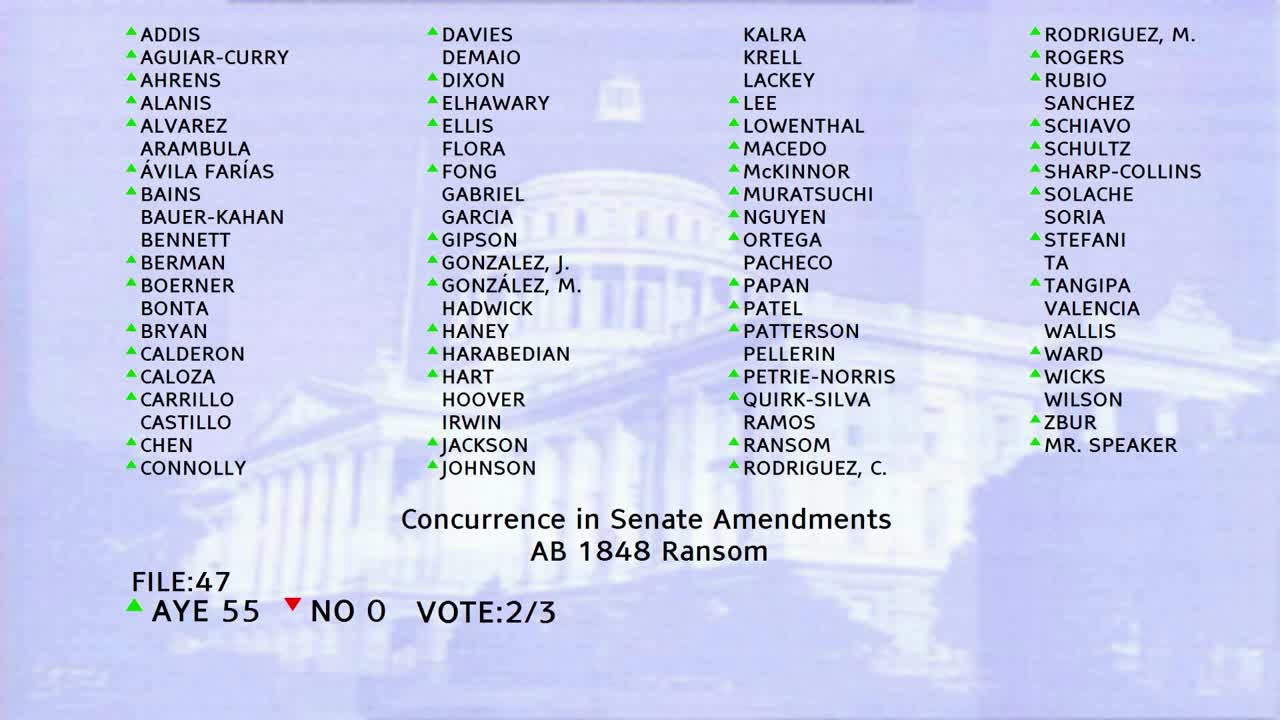 45SEC
Assembly Floor
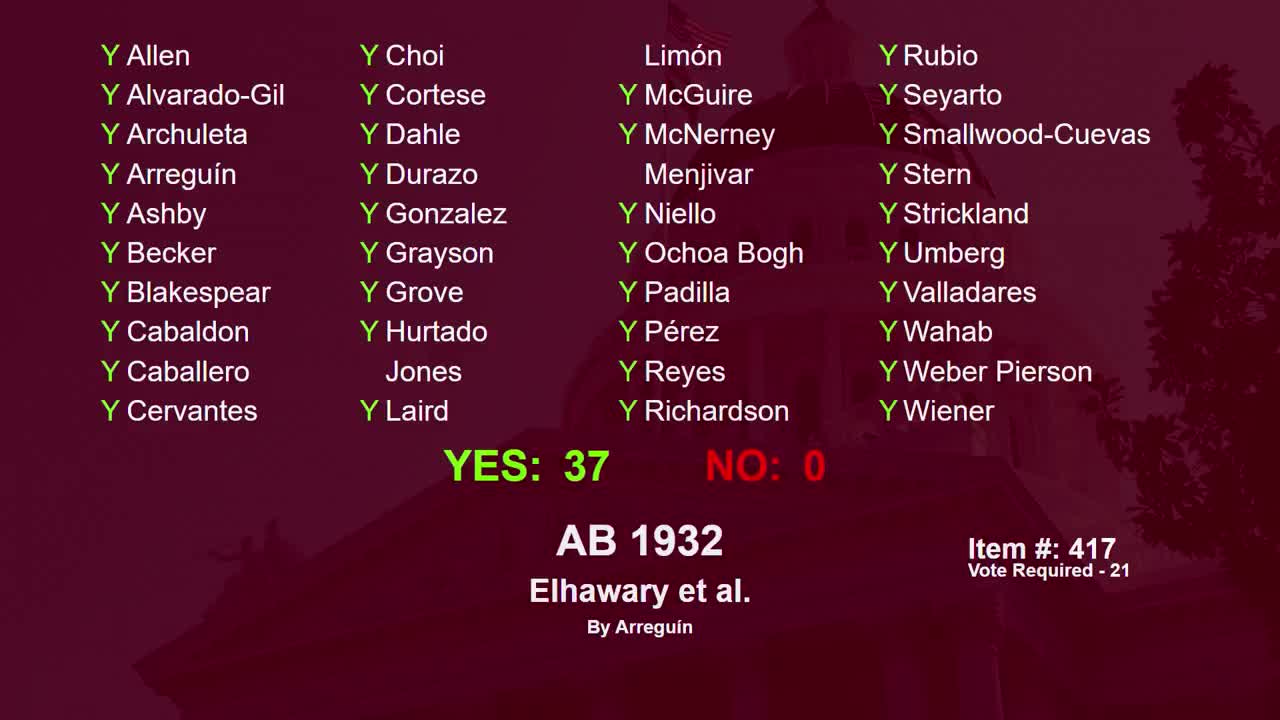 1MIN
Senate Floor
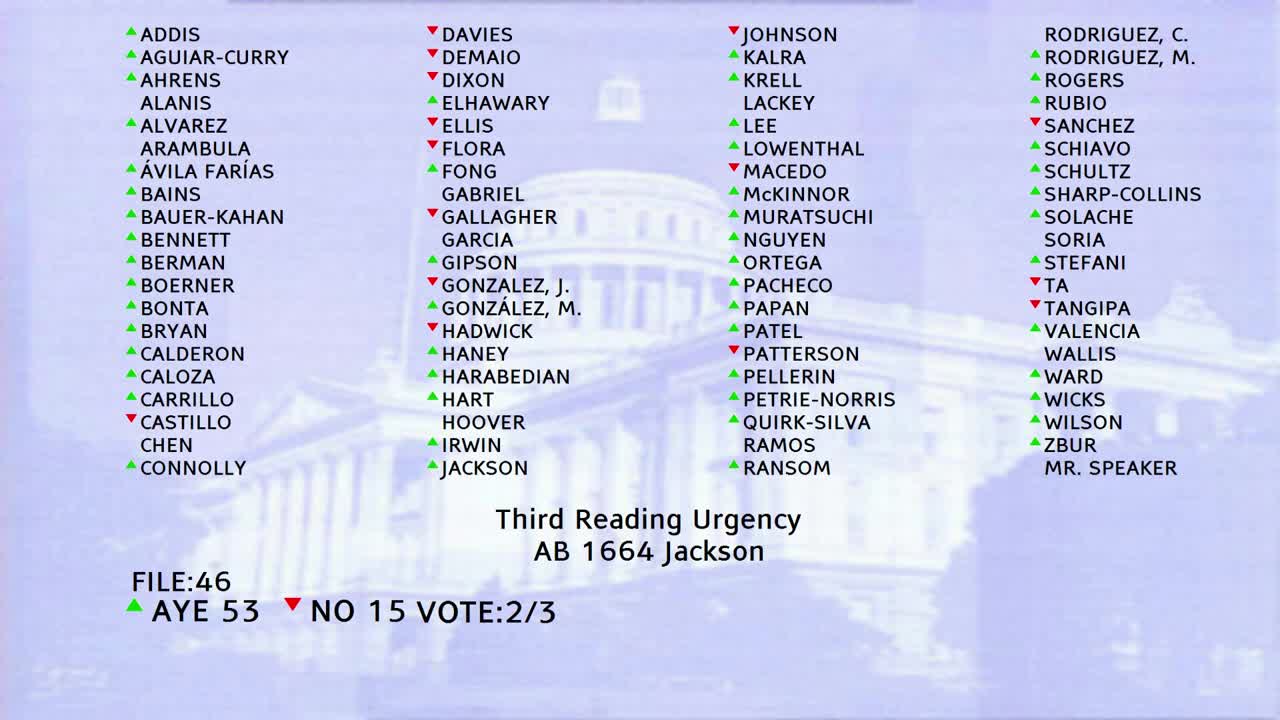 1MIN
Assembly Floor
 7MIN
Assembly Standing Committee on Water, Parks, and Wildlife
Bill Author

Bill Co-Author(s):