AB 2046: Vehicles: pollution control devices.
- Session Year: 2025-2026
- House: Assembly
- Latest Version Date: 2026-02-17
Current Status:
In Progress
(2026-08-13: In committee: Held under submission.)
Introduced
In Committee
Awaiting First Chamber Vote
Passed First Chamber
In Committee
Awaiting Second Chamber Vote
Passed Second Chamber
Enacted
Existing law prohibits a person from operating or leaving standing upon a highway a motor vehicle that is required to be equipped with a motor vehicle pollution control device or any other certified motor vehicle pollution control device, as specified, unless the motor vehicle is equipped with the required motor vehicle pollution control device that is correctly installed and in operating condition, and prohibits a person from disconnecting, modifying, or altering that device. Existing law also prohibits a person from installing, selling, offering for sale, or advertising any device, apparatus, or mechanism intended for use with, or as a part of, a required motor vehicle pollution control device or system that alters or modifies the original design or performance of the motor vehicle pollution control device or system. Existing law exempts from these provisions an alteration, modification, or modifying device, apparatus, or mechanism found by resolution of the State Air Resources Board to not reduce the effectiveness of a required motor vehicle pollution control device or to result in emissions from the modified or altered vehicle that comply with existing state or federal standards, as specified. A violation of these provisions is a crime.
This bill would additionally exempt from the above-described provisions an alternative fuel retrofit system for a light-duty or medium-duty gasoline-fueled vehicle that converts the vehicle to a dual-fueled vehicle that can utilize gasoline or E85 fuel if the alternative fuel retrofit system has been certified by the United States Environmental Protection Agency as a clean alternative fuel conversion system, as specified, and would prohibit the State Air Resources Board from requiring state certification, executive order approval, or any additional testing or demonstration for such an alternative fuel retrofit device.
The Legislature finds and declares all of the following:
(a)Low-carbon transportation fuels are an important element of the state's greenhouse gas emissions reduction policy.
(b)E85 is a low-carbon transportation fuel typically constituted in California of 83 percent ethanol and 17 percent gasoline.
(c)The use of E85 enables the state to utilize more low-carbon fuels and facilitates the fulfillment of state policy objectives, including greenhouse gas emissions reduction, petroleum use reduction, fuel diversification, cost savings to consumers, and a reduction in the carbon intensity of transportation fuels.
(d)Over the past decade, E85 has been consistently less costly per gallon than petroleum gasoline with an average discount of $1.50 to $2.00 per gallon, and has provided substantial cost savings to flexible fuel vehicles (FFV) drivers who use E85 on a cost per mile basis.
(e)FFVs are manufactured to run on conventional gasoline, E85, or any blend of conventional gasoline and ethanol up to a maximum ethanol concentration of 85 percent.
(f)California has supported the use of FFVs as a measure to reduce greenhouse gas emissions and dependence on petroleum.
(g)E85 can also be utilized in gasoline vehicles that have relatively simple and low-cost alternative fuel retrofit systems installed.
(h)Through the Clean Transportation Program (Article 2 (commencing with Section 44272) of Chapter 8.9 of Part 5 of Division 26 of the Health and Safety Code), the state has awarded grant money to develop a robust network of E85 fueling stations that supply E85 to FFVs.
(i)This network of E85 fueling stations has proven economically sustainable, continues to expand, and delivers significant greenhouse gas emissions and petroleum reductions to the state and significant cost savings to consumers.
(j)This network of E85 fueling stations increased sales of E85 over the ten-year period between 2014 and 2024 by a factor of 10 times, while the number of FFVs in the state remained relatively constant, demonstrating that E85 has great potential to deliver additional greenhouse gas emissions and petroleum use reductions while reducing costs to E85 users, particularly when gasoline prices are highest.
(k)This network of E85 fueling stations includes many stations located in disadvantaged communities, where E85 is currently providing greenhouse gas emissions reductions locally at significant cost savings compared to conventional gasoline.
(l)Due to the lack of an integrated E85 and FFV policy, United States automakers are currently phasing down the sale of FFV models in California.
SEC. 2.Section 27156 of the Vehicle Code is amended to read:27156.(a)No A person shall not operate or leave standing upon a highway a motor vehicle that is a gross polluter, as defined in Section 39032.5 of the Health and Safety Code.
(b)No A person shall not operate or leave standing upon a highway a motor vehicle that is required to be equipped with a motor vehicle pollution control device under Part 5 (commencing with Section 43000) of Division 26 of the Health and Safety Code or any other certified motor vehicle pollution control device required by any other state law or any rule or regulation adopted pursuant to that law, or required to be equipped with a motor vehicle pollution control device pursuant to the National Emission Standards Act (42 U.S.C. Secs. 7521 to 7550, inclusive) and the standards and regulations adopted pursuant to that federal act, unless the motor vehicle is equipped with the required motor vehicle pollution control device that is correctly installed and in operating condition. No A person shall not disconnect, modify, or alter any such required device.
(c)No A person shall not install, sell, offer for sale, or advertise any device, apparatus, or mechanism intended for use with, or as a part of, a required motor vehicle pollution control device or system that alters or modifies the original design or performance of the motor vehicle pollution control device or system.
(d)If the court finds that a person has willfully violated this section, the court shall impose the maximum fine that may be imposed in the case, and no part of the fine may be suspended.
(e)Willfully, as used in this section, has the same meaning as the meaning of that word prescribed in Section 7 of the Penal Code.
(f)No A person shall not operate a vehicle after notice by a traffic officer that the vehicle is not equipped with the required certified motor vehicle pollution control device correctly installed in operating condition, except as may be necessary to return the vehicle to the residence or place of business of the owner or driver or to a garage, until the vehicle has been properly equipped with such a device.
(g)The notice to appear issued or complaint filed for a violation of this section shall require that the person to whom the notice to appear is issued, or against whom the complaint is filed, produce proof of correction pursuant to Section 40150 or proof of exemption pursuant to Section 4000.1 or 4000.2.
(h)This section shall not apply to an alteration, modification, or modifying device, apparatus, or mechanism found by resolution of the State Air Resources Board to do either of the following:
(1)Not to reduce the effectiveness of a required motor vehicle pollution control device.
(2)To result in emissions from the modified or altered vehicle that are at levels that comply with existing state or federal standards for that model-year of the vehicle being modified or converted.
(i)(1)This section shall not apply to an alternative fuel retrofit system for a light-duty or medium-duty gasoline-fueled vehicle that converts the vehicle to a dual-fueled vehicle that can utilize gasoline or E85 fuel if the alternative fuel retrofit system has been certified by the United States Environmental Protection Agency as a clean alternative fuel conversion system that complies with the requirements of Section 203 of the federal Clean Air Act (42 U.S.C. Sec. 7522).
(2)Certification by the United States Environmental Protection Agency as an approved clean alternative fuel conversion system shall constitute compliance with this section for purposes of an alternative fuel retrofit device described in this subdivision.
(3)The State Air Resources Board shall not require state certification, executive order approval, or any additional testing or demonstration for an alternative fuel retrofit device described in this subdivision. A person who installs an alternative fuel retrofit device, as described in this subdivision, shall not be deemed to have installed an unlawful emissions-related device solely on the basis that the device has not been approved by the State Air Resources Board.
(4)Notwithstanding any other law, a person or entity that sells, dispenses, transports, or offers for sale E85 fuel shall not be subject to civil, administrative, or criminal liability under this section or any other provision of law solely for supplying E85 fuel to a vehicle equipped with an alternative fuel retrofit device, as described in this subdivision.
(i)(j)Aftermarket and performance parts with valid State Air Resources Board Executive Orders may be sold and installed concurrent with a motorcycles transfer to an ultimate purchaser.
(j)(k)This section applies to motor vehicles of the United States or its agencies, to the extent authorized by federal law.
|
Date
|
Status
|
|---|---|
| Aug 13, 2026 | In committee: Held under submission. |
| Aug 3, 2026 | In committee: Referred to APPR. suspense file. |
| Jul 1, 2026 | From committee: Do pass and re-refer to Com. on APPR. (Ayes 12. Noes 0.) (June 30). Re-referred to Com. on APPR. |
| Jun 17, 2026 | From committee: Do pass and re-refer to Com. on TRANS. (Ayes 7. Noes 0.) (June 17). Re-referred to Com. on TRANS. |
| Jun 3, 2026 | Referred to Coms. on E.Q. and TRANS. |
| May 21, 2026 | In Senate. Read first time. To Com. on RLS. for assignment. |
| May 21, 2026 | Read third time. Passed. Ordered to the Senate. (Ayes 72. Noes 0. Page 5218.) |
| May 21, 2026 | Read third time. Passed. Ordered to the Senate. (Ayes 72. Noes 0.) |
| May 18, 2026 | Read second time. Ordered to third reading. |
| May 14, 2026 | From committee: Do pass. (Ayes 15. Noes 0.) (May 14). |
| Apr 22, 2026 | In committee: Set, first hearing. Referred to APPR. suspense file. |
| Apr 7, 2026 | From committee: Do pass and re-refer to Com. on APPR. (Ayes 16. Noes 0.) (April 6). Re-referred to Com. on APPR. |
| Mar 2, 2026 | Referred to Com. on TRANS. |
| Feb 18, 2026 | From printer. May be heard in committee March 20. |
| Feb 17, 2026 | Read first time. To print. |
|
Date
|
Description
|
Location
|
Votes
|
|
|---|---|---|---|---|
| Aug 3, 2026 | Placed on suspense file | Senate Standing Committee on Appropriations |
Passed |
|
| Jun 30, 2026 | Do pass, but first be re-referred to the Committee on [Appropriations] | Senate Standing Committee on Transportation |
Passed |
|
| Jun 17, 2026 | Do pass, but first be re-referred to the Committee on [Transportation] | Senate Standing Committee on Environmental Quality |
Passed |
|
| May 21, 2026 | AB 2046 Ransom Assembly Third Reading | Assembly Floor |
Passed |
|
| May 14, 2026 | Do pass. | Assembly Standing Committee on Appropriations |
Passed |
|
| Apr 6, 2026 | Do pass and be re-referred to the Committee on [Appropriations] | Assembly Standing Committee on Transportation |
Passed |
This list shows positions taken on this bill by organizations on the date displayed, which is linked to the original source.
Positions by individuals are not included.
|
Organization
|
Position
|
Date
|
|---|---|---|
| Advanced Fuel Dynamics | ** Support | |
| California Chamber Of Commerce | ** Support | |
| California Fuels And Convenience Alliance | ** Support | |
| California Fuels and Convenience Alliance (sponsor) | ** Support | |
| California Lulac State Organization | ** Support | |
| California New Car Dealers Association | ** Support | |
| COBB Tuning | ** Support | |
| Flex Fuel Energy Development | ** Support | |
| Flex Fuel Energy Development (FERD) | ** Support | |
| Flex Fuel Energy Development (FFED) | ** Support | |
| Growth Energy | ** Support | |
| Hondata | ** Support | |
| Hondata Performance Products | ** Support | |
| Pearson Fuels | ** Support | |
| Sacramento Asian Pacific Chamber of Commerce | ** Support | |
| Specialty Equipment Market Association (Sema) | ** Support | |
| Stepone Tech | ** Support | |
| Stepone Tech Ltd. | ** Support |
SENATE COMMITTEE ON
Senator Sabrina Cervantes, Chair
2025 - 2026 Regular Session
AB 2046 (Ransom) - Vehicles: pollution control devices
Version: | Policy Vote: |
Urgency: | Mandate: |
Hearing Date: | Consultant: |
Bill Summary:
This bill would deem fuel retrofit systems for gasoline to E85 for light- or medium-duty gasoline-fueled vehicles certified by the United States Environmental Protection Agency (EPA) as compliant with state requirements, as specified.
Fiscal Impact:
- The California Air Resources Board (CARB) estimates ongoing costs of $828,000 annually (Air Pollution Control Fund [APCF]) to review alternative fuel retrofit system applications to see if they include vehicles that could qualify for exemption under Vehicle Code (VC) Section 27156 (i), verify alternative retrofit system as EPA certified, coordinate with the Bureau of Automotive Repair, conduct and support aftermarket parts and fuels enforcement, and field complaints, among other things.
- To the extent that more E85 conversion kits are made available in the state and a subset of drivers transition from using conventional gasoline to E85 fuel, the state may see a reduction in motor vehicle fuel excise tax revenue (Motor Vehicle Fuel Account (MVFA) in the Transportation Tax Fund). This potential reduction is because the state tax on alcohol fuel containing no more than 15% gasoline (like E85) is nine cents per gallon, whereas the state excise tax on gasoline and diesel suppliers is 61.2 cents per gallon. Funds from the MVFA are primarily used to construct and maintain public roads and mass transit systems.
Background:
According to ARB, E85 is an alternative fuel for automobiles containing 85% ethanol and 15% gasoline. An E85 conversion kit allows a gasoline-powered vehicle to run on fuel containing up to 85% ethanol. There are different categories of kits on the market that require different levels of alteration to the vehicle. The more basic kits include ethanol sensors and utilize the vehicle’s engine control unit, cost approximately $800, and can be installed at home. If the consumer does not have the expertise to install their own kit, they may pay an installer for labor, which may range from $200 to $450.
Burning ethanol emits fewer greenhouse gases than burning gasoline. Additionally, the process of making ethanol does not rely on refining processes and the feedstocks are primarily domestically grown. Therefore, ethanol is not as sensitive to imports and global market volatility.
E85 Conversion Kit Certification. Two government agencies currently certify E85 kits: U.S. EPA and ARB. U.S. EPA updated its rule governing vehicle fuel conversion kits in April 2011. ARB approved revisions to the state’s Alternative Fuel Conversion regulation in September 2013. The ARB revisions provided for streamlining of the conversion approval process for 2004 model year vehicles while the certification procedures for pre-2004 vehicles remained unchanged.
The agencies’ certification processes differ. ARB considered adopting the U.S. EPA process but ultimately rejected it as insufficient. Proponents of this bill argue that ARB’s certification process is overly rigorous. ARB has received only a few applications and there are currently no ARB-approved E85 conversion kits. There are currently only a small number of E85 conversion kits certified by U.S. EPA.
Proposed Law:
This bill would:
- Exempt an alternative fuel retrofit system for a light-duty or medium-duty gasoline-fueled vehicle that converts the vehicle to a dual-fueled vehicle that can utilize gasoline or E85 fuel from various air pollution-related requirements, if the alternative fuel retrofit system has been certified by the EPA.
- Require that CARB not require state certification, executive order approval, or any additional testing or demonstration for an alternative fuel retrofit device as described above.
- State that a person who installs an alternative fuel retrofit device, as described above, would not be deemed to have installed an unlawful emissions-related device solely on the basis that it has not been approved by CARB.
- State that, notwithstanding any other law, a person or entity that sells, dispenses, transports, or offers for sale E85 fuel would not be subject to civil, administrative, or criminal liability for supplying E85 fuel to a vehicle equipped with an alternative fuel retrofit device, as described above.
Related Legislation:
AB 30 (Alvarez, Chapter 247, Statutes of 2025) allows gasoline with up to 15% ethanol by volume (E15) to be sold in California, as specified.
SB 301 (Portantino and Newman, 2023) would have required CARB to establish the Zero-Emission Aftermarket Conversion Project which would have provided a rebate of up to $4,000 per vehicle for qualifying vehicle conversions. The bill was vetoed by the Governor.
SB 660 (Newman, 2017) would have created the Aftermarket Parts Account for the purpose of hiring additional staff to approve aftermarket parts. The bill died in the Assembly Transportation Committee.
AB 558 (Quirk-Silva, 2017) would have allowed the Joint Legislative Committee on Climate Change Policies to recommend that CARB provide education and support to local governments on ensuring the use of E85 flexible fuel vehicles, among other subjects. The bill would also have required CARB to develop a summary on the distribution of E85 and flexible fuel vehicle registrations and develop policy recommendations to maximize the use of E85 in flexible fuel vehicles. The bill was vetoed by the governor.
-- END --
SENATE COMMITTEE ON TRANSPORTATION
Senator Dave Cortese, Chair
2025 - 2026 Regular
Bill No: Hearing Date: 6/30/2026
Author: | Ransom | ||
Version: | 2/17/2026 Introduced | ||
Urgency: | No | Fiscal: | Yes |
Consultant: | Manny Leon | ||
SUBJECT:
DIGEST: This bill deems fuel retrofit systems for gasoline to E85 for light- or medium-duty gasoline-fueled vehicles certified by the United States Environmental Protection Agency (EPA) as compliant with state requirements, as specified.
ANALYSIS:
Existing law:
- Establishes the California Air Resources Board (CARB) as the air pollution control agency in California and requires CARB, among other things, to control emissions from a wide array of mobile sources and implement the Federal Clean Air Act (FCAA).
- Requires CARB to adopt and implement technologically feasible emission standards for new motor vehicles to, among other things, ensure compliance with state air quality laws and FCAA, and prohibit vehicles that do not comply with those emissions standards from being certified for use in the state.
- Requires CARB to adopt motor vehicle fuel specification requirements for the control of air contaminants and air pollution where it is necessary, cost effective, and technologically feasible to do so.
- Prevents CARB from adopting any regulations setting specifications for motor vehicle fuels unless that regulation, and a multimedia evaluation of any significant adverse impacts on public health or the environment, have been reviewed by the CEPC, as specified.
- Prohibits a person from installing, selling, offering for sale, or advertising any device, apparatus, or mechanism intended for use with, or as a part of, a required motor vehicle pollution control device or system that alters or modifies the original design or performance of the motor vehicle pollution control device or system.
- Allows, to a vehicle, an alteration, modification, or modifying device, apparatus, or mechanism if CARB finds by resolution that it does not reduce the effectiveness of a required motor vehicle pollution control device, and further result in emissions from the modified or altered vehicle that are above levels that comply with existing state or federal standards for that model-year of the vehicle being modified or converted.
This bill:
- Exempts an alternative fuel retrofit system for a light-duty or medium-duty gasoline-fueled vehicle that converts the vehicle to a dual-fueled vehicle that can utilize gasoline or E85 fuel if the alternative fuel retrofit system has been certified by the United States Environmental Protection Agency (U.S. EPA) from various air pollution-related requirements.
- Requires that CARB shall not require state certification, executive order approval, or any additional testing or demonstration for an alternative fuel retrofit device as described above.
- States that a person who installs an alternative fuel retrofit device, as described above, shall not be deemed to have installed an unlawful emissions-related device solely on the basis that it has not been approved by CARB.
- States that notwithstanding any other law, a person or entity that sells, dispenses, transports, or offers for sale E85 fuel shall not be subject to civil, administrative, or criminal liability for supplying E85 fuel to a vehicle equipped with an alternative retrofit device, as described above.
COMMENTS:
- Purpose of the bill. According to the author, "Californians consistently pay more at the pump than drivers in other states, and uncertainty about future price spikes is rising due to international conflicts and in-state refinery closures. E85 is a cheaper and cleaner fuel alternative, but not all cars can take this type of fuel. Currently, California remains the only state that prohibits the use of E85 conversion kits, which is a proven technology that allows cars to switch from gas to E85. AB 2046 would allow E85 conversion kits to operate in California, which would give consumers more choices when looking for ways to access more affordable fuel.”
- Ethanol in gasoline in California. Gasoline is a fuel made from crude oil and other petroleum liquids. Gasoline is mainly used in vehicle engines. Petroleum refineries and blending facilities produce finished motor gasoline for retail sale at gasoline fueling stations.
Petroleum refineries mostly produce gasoline blending components called gasoline blendstocks, which require blending with other liquids to make finished motor gasoline. In California, the blendstock used is called California Reformulated Gasoline Blendstock for Oxygenate Blending (CARBOB). Until CARBOB has oxygenates (including but not limited to ethanol) and other components added, it is not finished gasoline which can be used in a vehicle.
Most of the finished motor gasoline now sold in the United States contains about 10% fuel ethanol by volume (E10). Ethanol is added to gasoline mainly to meet the requirements of the Renewable Fuel Standard, which is intended to reduce greenhouse gas emissions and the amount of oil that the United States imports from other countries.
Ethanol has a lower energy density than gasoline, so adding it to CARBOB results in a finished gasoline that can provide slightly less energy to a vehicle (i.e. that vehicle will likely not be able to drive as many miles on a full tank of E15 versus E10). However, ethanol is also less expensive than CARBOB, so adding it can lower the cost of that tank. There are other considerations (such as the impact on other air pollutants from evaporation or combustion, or more system-wide impacts on CARBOB and ethanol supply and demand) that must be made to determine the overall pros and cons of using higher ethanol blends in California.
In the interest of exploring all options available to control the price of gasoline, California recently (AB 30, Alvarez, Chapter 247, Statutes of 2025) authorized the blending of up to 15% ethanol. Prior to the passage of AB 30, California had been the only state in the U.S. that prohibited the use of E15. - What is E85? As opposed to the traditional E10 or the newly-authorized-in-California E15, E85 is a fuel blend of 85 percent ethanol and 15 percent gasoline. E85 has been in the marketplace for three decades and reduces emissions by more than 30 percent over traditional gasoline. Flex fuel vehicles (FFVs) can use any fuel ranging from 0 percent ethanol to 85 percent ethanol (E85). There are more than 22 million FFVs on the road in the U.S., roughly 8 percent of all vehicles.[1] In California, estimates put the number of FFVs are 1.3 million, or roughly 3.6% of all registered vehicles. In California, there are between four and five hundred E85 fueling stations statewide.[2] In 2024, the California Energy Commission estimated that there were 11,084 petroleum transportation fueling stations in California with a total of 15,131 fueling pumps. Only 3% of those pumps dispense E85.
Some vehicles are sold as FFVs, but most traditional engines on the road are not compatible. An E85 conversion kit allows a gasoline-powered vehicle to run on fuel containing up to 85% ethanol. There are different categories of kits currently on the market that require different levels of alteration to the vehicle. The more basic kits include ethanol sensors and utilize the vehicle’s engine control unit, cost approximately $800 and can be installed at home. If the consumer does not have the expertise to install their own kit, they must pay an installer for labor, which may range from $200-$450.
E85 is typically priced lower than gasoline, but is not necessarily always a better deal. This is because FFVs typically get about 20-30% fewer miles per gallon when fueled with E85 compared to gasoline. Therefore, E85 should be priced 20 – 30% less than gasoline to achieve equivalent per mile costs. Otherwise, motorists will see little difference when using E85 versus gasoline.[3] - E85 conversion kits and CARB approval. Although no commercial E85 conversion kits are available in California today, that is because no manufacturer has sought CARB approval of a kit that would meet California’s strict standards. It’s important to note that California has recorded some of the worst air quality in the nation for decades, but has made great strides towards improving it. A number of policies (including the use of CARBOB, the applicability of lower emissions standards, the requirement for smog testing) have been pioneered by California to address its air pollution issues. In that vein, E85 conversion kits—just like any other aftermarket part or conversion—must go through testing and certification by CARB.
This bill attempts to jumpstart the E85 conversion kit market in California by deregulating kit certification. Regardless of whether or not E85 conversion kits get the scrutiny they do now, a number of interrelated requirements still apply to CARB and drivers alike. Retooling the fuel system of a vehicle may have significant impacts on the sensors and other components that are required to pass smog testing; without CARB certification this could be jeopardized in FFV conversions. The U.S. EPA certification process is confidential, meaning CARB would ultimately have less information about the state’s vehicle fleet. This would be expected to complicate efforts to continue cleaning California’s air. However, the scope of this difficulty is proportional to the size of the E85 conversion market. If very few drivers convert their vehicles to take advantage of the lower-cost E85 fuel, the size of blind spot created for CARB will be similarly small. Nevertheless, especially at a time where CARB’s other regulatory authorities have been under extensive attack by the U.S. EPA and Administration, the decision to further cede authority to the federal regulators should not be taken lightly, regardless of the size of the potential fleet. - Double referral. This bill was double referred to the Senate Environmental Quality Committee, where it passed on a vote of 7-0 at their June 17, 2026, hearing.
Related/previous Legislation:
AB 30 (Alvarez, Chapter 247, Statutes of 2025) – Allows gasoline with up to 15% ethanol by volume (E15) to be sold in California, as specified.
SB 301 (Portantino and Newman, 2023) – Would have required CARB to establish the Zero-Emission Aftermarket Conversion Project which would have provided a rebate of up to $4,000 per vehicle for qualifying vehicle conversions. The bill was vetoed by the Governor.
SB 660 (Newman, 2017) – Would have created the Aftermarket Parts Account for the purpose of hiring additional staff to approve aftermarket parts. The bill died in the Assembly Transportation Committee.
AB 558 (Quirk-Silva, 2017) – Would have allowed the Joint Legislative Committee on Climate Change Policies to recommend that CARB provide education and support to local governments on ensuring the use of E85 flexible fuel vehicles, among other subjects. The bill would also have required CARB to develop a summary on the distribution of E85 and flexible fuel vehicle registrations and develop policy recommendations to maximize the use of E85 in flexible fuel vehicles. The bill was vetoed by the governor.
FISCAL EFFECT: Appropriation: Fiscal Com.: Local:
POSITIONS: (Communicated to the committee before noon on Wednesday,
June 24, 2026.)
SUPPORT:
California Fuels and Convenience Alliance (sponsor)
Advanced Fuel Dynamics
California Chamber of Commerce
California Lulac State Organization
California New Car Dealers Association
COBB Tuning
Flex Fuel Energy Development
Growth Energy
Hondata Performance Products
Pearson Fuels
Sacramento Asian Pacific Chamber of Commerce
Specialty Equipment Market Association (SEMA)
Stepone Tech Ltd.
OPPOSITION:
None received
-- END --
E85 flex fuel. Renewable Fuels Association. https://ethanolrfa.org/ethanol-in-your-engine/e85-flex-fuel ↑
E85 and Flexible Fuel Vehicles. CARB. https://ww2.arb.ca.gov/sites/default/files/classic/isd/fuels/altfuels/e85/e85_flex_fuel_vehicles.pdf ↑
SENATE COMMITTEE ON ENVIRONMENTAL QUALITY
Senator Blakespear, Chair
2025 - 2026 Regular
Bill No: AB 2046
Author: | Ransom | ||
Version: | 2/17/2026 | Hearing Date: | 6/17/2026 |
Urgency: | No | Fiscal: | Yes |
Consultant: | Heather Walters | ||
SUBJECT: Vehicles: pollution control devices
DIGEST: This bill deems fuel retrofit systems for gasoline to E85 for light- or medium-duty gasoline-fueled vehicles certified by the United States Environmental Protection Agency as compliant with state requirements, and precludes the California Air Resources Board from imposing any additional requirements.
ANALYSIS:
Existing law:
- Establishes CARB as the air pollution control agency in California and requires CARB, among other things, to control emissions from a wide array of mobile sources and implement the Federal Clean Air Act (FCAA). (Health and Safety Code (HSC) §39500 et seq.)
- Requires CARB to adopt and implement technologically feasible emission standards for new motor vehicles to, among other things, ensure compliance with state air quality laws and the FCAA, and prohibit vehicles that do not comply with those emissions standards from being certified for use in the state. (HSC §43100 et seq.)
- Requires CARB to adopt motor vehicle fuel specification requirements for the control of air contaminants and air pollution where it is necessary, cost effective, and technologically feasible to do so. (HSC §43013).
- Prevents CARB from adopting any regulations setting specifications for motor vehicle fuels unless that regulation, and a multimedia evaluation of any significant adverse impacts on public health or the environment, have been reviewed by the CEPC, as specified. (HSC §43830.8)
- Prohibits a person from installing, selling, offering for sale, or advertising any device, apparatus, or mechanism intended for use with, or as a part of, a required motor vehicle pollution control device or system that alters or modifies the original design or performance of the motor vehicle pollution control device or system. (Vehicle Code (VEH) §27156)
- Allows, to a vehicle, an alteration, modification, or modifying device, apparatus, or mechanism if CARB finds by resolution that it does not (i) reduce the effectiveness of a required motor vehicle pollution control device, and (ii) result in emissions from the modified or altered vehicle that are above levels that comply with existing state or federal standards for that model-year of the vehicle being modified or converted. (VEH §27156)
This bill:
- Exempts an alternative fuel retrofit system for a light-duty or medium-duty gasoline-fueled vehicle that converts the vehicle to a dual-fueled vehicle that can utilize gasoline or E85 fuel if the alternative fuel retrofit system has been certified by the United States Environmental Protection Agency (U.S. EPA) from various air pollution-related requirements.
- Requires that CARB shall not require state certification, executive order approval, or any additional testing or demonstration for an alternative fuel retrofit device as described above.
- States that a person who installs an alternative fuel retrofit device, as described above, shall not be deemed to have installed an unlawful emissions-related device solely on the basis that it has not been approved by CARB.
- States that notwithstanding any other law, a person or entity that sells, dispenses, transports, or offers for sale E85 fuel shall not be subject to civil, administrative, or criminal liability for supplying E85 fuel to a vehicle equipped with an alternative retrofit device, as described above.
Background
- Vehicles and air pollution. Vehicles are one of the primary sources of air pollution nationally. As such, the Federal Clean Air Act authorizes the U.S. EPA to establish and regulate emissions standards for mobile sources.
California, due to its preexisting vehicle-emission standards and severe motor vehicle air pollution problems, has historically been authorized under the FCAA to implement separate mobile emission standards from the federal government. Other states may choose to follow either the national standard or the stricter California standards.
State law assigns CARB with primary responsibility for control of mobile-source air pollution, including adoption of rules for reducing vehicle emissions, the specification of vehicular fuel composition, emissions control devices, and engine standards.
Recent actions by the U.S. EPA have precluded CARB from being able to enforce a number of vehicle emission standards that would be more stringent than required under the FCAA. Regardless, a number of existing regulations previously received U.S. EPA FCAA waivers for CARB to hold certain processes to higher standards. - Ethanol in gasoline in California. Gasoline is a fuel made from crude oil and other petroleum liquids. Gasoline is mainly used in vehicle engines. Petroleum refineries and blending facilities produce finished motor gasoline for retail sale at gasoline fueling stations.
Petroleum refineries mostly produce gasoline blending components called gasoline blendstocks, which require blending with other liquids to make finished motor gasoline. In California, the blendstock used is called California Reformulated Gasoline Blendstock for Oxygenate Blending (CARBOB). Until CARBOB has oxygenates (including but not limited to ethanol) and other components added, it is not finished gasoline which can be used in a vehicle.
Most of the finished motor gasoline now sold in the United States contains about 10% fuel ethanol by volume (E10). Ethanol is added to gasoline mainly to meet the requirements of the Renewable Fuel Standard, which is intended to reduce greenhouse gas emissions and the amount of oil that the United States imports from other countries.
Ethanol has a lower energy density than gasoline, so adding it to CARBOB results in a finished gasoline that can provide slightly less energy to a vehicle (i.e. that vehicle will likely not be able to drive as many miles on a full tank of E15 versus E10). However, ethanol is also less expensive than CARBOB, so adding it can lower the cost of that tank. There are other considerations (such as the impact on other air pollutants from evaporation or combustion, or more system-wide impacts on CARBOB and ethanol supply and demand) that must be made to determine the overall pros and cons of using higher ethanol blends in California.
In the interest of exploring all options available to control the price of gasoline, California recently (AB 30, Alvarez, Chapter 247, Statutes of 2025) authorized the blending of up to 15% ethanol. Prior to the passage of AB 30, California had been the only state in the U.S. that prohibited the use of E15. - Even more ethanol—E85. As opposed to the traditional E10 or the newly-authorized-in-California E15, E85 is a fuel blend of 85 percent ethanol and 15 percent gasoline. E85 has been in the marketplace for three decades and reduces emissions by more than 30 percent over traditional gasoline. Flex fuel vehicles (FFVs) can use any fuel ranging from 0 percent ethanol to 85 percent ethanol (E85). There are more than 22 million FFVs on the road in the U.S., roughly 8 percent of all vehicles.[1] In California, estimates put the number of FFVs are 1.3 million, or roughly 3.6% of all registered vehicles. In California, there are between four and five hundred E85 fueling stations statewide.[2] In 2024, the California Energy Commission estimated that there were 11,084 petroleum transportation fueling stations in California with a total of 15,131 fueling pumps. Only 3% of those pumps dispense E85.
Some vehicles are sold as FFVs, but most traditional engines on the road are not compatible. An E85 conversion kit allows a gasoline-powered vehicle to run on fuel containing up to 85% ethanol. There are different categories of kits currently on the market that require different levels of alteration to the vehicle. The more basic kits include ethanol sensors and utilize the vehicle’s engine control unit, cost approximately $800 and can be installed at home. If the consumer does not have the expertise to install their own kit, they must pay an installer for labor, which may range from $200-$450.
E85 is typically priced lower than gasoline, but is not necessarily always a better deal. This is because FFVs typically get about 20-30% fewer miles per gallon when fueled with E85 compared to gasoline. Therefore, E85 should be priced 20 – 30% less than gasoline to achieve equivalent per mile costs. Otherwise, motorists will see little difference when using E85 versus gasoline.[3]
Comments
- Purpose of Bill. According to the author, “Californians consistently pay more at the pump than drivers in other states, and uncertainty about future price spikes is rising due to international conflicts and in-state refinery closures. E85 is a cheaper and cleaner fuel alternative, but not all cars can take this type of fuel. Currently, California remains the only state that prohibits the use of E85 conversion kits, which is a proven technology that allows cars to switch from gas to E85. AB 2046 would allow E85 conversion kits to operate in California, which would give consumers more choices when looking for ways to access more affordable fuel.”
- E85 conversion kits aren’t banned today, just scrutinized. Although no commercial E85 conversion kits are available in California today, that is because no manufacturer has sought approval of a kit that would meet California’s strict standards. As described in the background section, California has had some of the worst air quality in the nation for decades but has made great strides towards improving it. A number of policies (including the use of CARBOB, the applicability of lower emissions standards, the requirement for smog testing) have been pioneered by California to address its air pollution issues. In that vein, E85 conversion kits—just like any other aftermarket part or conversion—must go through testing and certification by CARB.
This bill attempts to jumpstart the E85 conversion kit market in California by deregulating kit certification. Regardless of whether or not E85 conversion kits get the scrutiny they do now, a number of interrelated requirements still apply to CARB and drivers alike. Retooling the fuel system of a vehicle may have significant impacts on the sensors and other components that are required to pass smog testing; without CARB certification this could be jeopardized in FFV conversions. The U.S. EPA certification process is confidential, meaning CARB would ultimately have less information about the state’s vehicle fleet. This would be expected to complicate efforts to continue cleaning California’s air. However, the scope of this difficulty is proportional to the size of the E85 conversion market. If very few drivers convert their vehicles to take advantage of the lower-cost E85 fuel, the size of blind spot created for CARB will be similarly small. Nevertheless, especially at a time where CARB’s other regulatory authorities have been under extensive attack by the U.S. EPA and Administration, the decision to further cede authority to the federal regulators should not be taken lightly, regardless of the size of the potential fleet. - Ethanol: a low-carbon, high-baggage fuel. Although ethanol itself contains less carbon than comparable fossil fuels, calling it “low-carbon” is not as clearcut a distinction. A growing body of evidence now indicates that corn ethanol may generate emissions comparable to, or even worse than, gasoline once full lifecycle impacts are considered.[4] The Environmental Protection Agency’s own Science Advisory Board concluded in 2023 that recent emissions estimates for corn ethanol exceed those of gasoline.[5]
Producing ethanol requires substantial fossil fuel inputs, including fertilizer, processing energy and transportation. But the larger problem is land use: when crop production is diverted from the food supply into fuel production, forests and grasslands somewhere else get converted into new agricultural land to replace the lost food. That conversion releases massive stores of carbon into the atmosphere. Globally, the emissions from these land-use changes often outweigh the tailpipe emissions reductions ethanol is supposed to achieve.
As described in the background section above, while E85 is typically less expensive per gallon than conventional E10 gasoline in California, the lower energy density means that drivers will need to fill up more often to offset the lower energy density of the fuel. Nevertheless, as of writing, the average price of E10 gasoline in California is $5.85 per gallon, as opposed to $2.39 per gallon for E85. Even accounting for lower energy density, drivers could indeed pay less per mile using E85 than E10 at current prices. Such calculations cannot figure in the full cost of ethanol across its supply chain, just as they cannot for gasoline either.
Whether or not those savings justify the cost of an E85 conversion kit for one’s vehicle is a decision consumers will need to weigh and determine if it makes sense for them. Whether or not ceding regulatory authority to the U.S. EPA by preventing CARB from more stringently certifying E85 conversion kits is a justifiable means to boost the market is the decision faced by the Committee today.
Related/Prior Legislation
SB 301 (Portantino and Newman) of 2023 would have required CARB to establish the Zero-Emission Aftermarket Conversion Project which would have provided a rebate of up to $4,000 per vehicle for qualifying vehicle conversions. The bill was vetoed by the Governor.
SB 660 (Newman) of 2017 would have created the Aftermarket Parts Account for the purpose of hiring additional staff to approve aftermarket parts. The bill died in the Assembly Transportation Committee.
AB 558 (Quirk-Silva) of 2017 would have allowed the Joint Legislative Committee on Climate Change Policies to recommend that CARB provide education and support to local governments on ensuring the use of E85 flexible fuel vehicles, among other subjects. The bill would also have required CARB to develop a summary on the distribution of E85 and flexible fuel vehicle registrations and develop policy recommendations to maximize the use of E85 in flexible fuel vehicles. The bill was vetoed by the governor.
SOURCE:
- California Fuels & Convenience Alliance
SUPPORT:
California Chamber of Commerce
California Fuels and Convenience Alliance
California New Car Dealers Association
Growth Energy
Pearson Fuels
Sacramento Asian Pacific Chamber of Commerce
Specialty Equipment Market Association (SEMA)
OPPOSITION:
None received
-- END --
E85 flex fuel. Renewable Fuels Association. https://ethanolrfa.org/ethanol-in-your-engine/e85-flex-fuel ↑
E85 and Flexible Fuel Vehicles. CARB. https://ww2.arb.ca.gov/sites/default/files/classic/isd/fuels/altfuels/e85/e85_flex_fuel_vehicles.pdf ↑
World Resources Institute, The Global Land Squeeze: Managing the Growing Competition for Land. July 20, 2023. https://www.wri.org/research/global-land-squeeze-managing-growing-competition-land ↑
Letter to Michael Regan. Science Advisory Board. September 29, 2023. https://www.energymarketersofamerica.org/weeklyreview/attachments/epa-science-advisory-board-commentary-on-rfs.pdf ↑
ASSEMBLY THIRD READING
ATR Bill Id:AB 2046
Author:(Ransom)
As Introduced Ver:February 17, 2026
Majority vote
SUMMARY
Deems fuel retrofit systems for gasoline to E85 for light- or medium-duty gasoline-fueled vehicles certified by the United States Environmental Protection Agency (USEPA) as compliant with state requirements.
Major Provisions
- Exempts an alternative fuel retrofit system for a light-duty or medium-duty gasoline-fueled vehicle that converts the vehicle to a dual-fueled vehicle that can utilize gasoline or E85 fuel if the alternative fuel retrofit system has been certified by the USEPA from various air pollution-related requirements.
- Requires that the California Air Resources Board (CARB) shall not require state certification, executive order approval, or any additional testing or demonstration for an alternative fuel retrofit device as described above.
- States that a person who installs an alternative fuel retrofit device, as described above, shall not be deemed to have installed an unlawful emissions-related device solely on the basis that it has not been approved by CARB.
- States that notwithstanding any other law, a person or entity that sells, dispenses, transports, or offers for sale E85 fuel shall not be subject to civil, administrative, or criminal liability for supplying E85 fuel to a vehicle equipped with an alternative retrofit device, as described above.
COMMENTS
Greenhouse gas emissions goals. The Legislature has set several goals to reduce greenhouse gas (GHG) emissions and address climate change. The Global Warming Solutions Act of 2006, AB 32 (Nuñez), Chapter 488, Statutes of 2006 and subsequent companion legislation SB 32 (Pavley), Chapter 249, Statutes of 2016, requires California to reduce statewide GHG emissions to 40% below the 1990 level by 2030. AB 1279 (Muratsuchi), Chapter 337, Statutes of 2022 establishes the policy of the state to achieve carbon neutrality as soon as possible, but no later than 2045. CARB is responsible for developing a Scoping Plan to detail how the state will achieve its GHG emissions reduction targets mandated by law.
Why regulate mobile source emissions? Mobile sources of air pollution are vehicles or equipment that can be moved from place to place and emit pollutants as they operate. These sources include on-road vehicles like cars, trucks, and buses, as well as non-road vehicles such as aircraft, construction equipment, and marine vessels. Mobile sources and the fossil fuels that power them are the largest contributors to the formation of ozone, GHG emissions, fine particulate matter (PM2.5), and toxic diesel particulate matter (DPM). Statewide, more than 21 million out of over 39 million Californians live in areas that exceed the federal ozone standards; within these areas, there are many low-income and disadvantaged communities that are exposed to not only ozone, but also particulate and toxic, pollutant levels significantly higher than the federal standards which have immediate and detrimental health effects.
In California, mobile sources are responsible for approximately 80% of smog-forming nitrogen oxide (NOx) emissions. They also represent about 50% of GHG emissions when including emissions from fuel production, and more than 95% of toxic DPM emissions. The National Ambient Air Quality Standard (NAAQS). The Clean Air Act of 1970 instructs the U.S. Environmental Protection Agency (US EPA) to set primary NAAQS to protect public health, and secondary NAAQS to protect plants, forests, crops and materials from damage due to exposure to six criteria air pollutants. These pollutants include: particulate matter, ozone, nitrogen oxides, sulfur oxides, carbon monoxide, and lead. Federal law (42 United States Code 7409 and 7410) requires that all states attain the NAAQS and develop State Implementation Plans (SIP) for nonattainment areas to attain the NAAQS, and attainment areas to maintain attainment. Failure of a state to reach attainment of the NAAQS by the target date can trigger penalties, including withholding of federal highway funds. State law (HSC 39602), requires CARB to develop SIP emission reduction strategies for cars, trucks, and other mobile sources to meet the requirements in the Clean Air Act. Local air districts are primarily responsible for controlling emissions from stationary sources such as factories and power plants. CARB coordinates closely with local air districts (such as SCAQMD) in the development of attainment plans which are then incorporated into the SIP. California′s authority under the current federal administration. Under the Clean Air Act, California has unique authority to set stricter than federal regulations for mobile source emissions after receiving a waiver from the USEPA. In January 2025, the Biden administration granted waivers to CARB for Advanced Clean Cars II (ACCII), Heavy-Duty Omnibus Low NOx (Heavy-Duty Omnibus), Small Off-Road Engines, and In-Use Off-Road Diesel Fueled Fleets regulations. Additionally, partial waivers were granted for Commercial Harbor Craft, and Transportation Refrigeration Unit regulations. CARB strategically withdrew waiver requests for Advanced Clean Fleets and In-Use Locomotive regulations prior to the Trump administration assuming office.
In April 2025, the House introduced three joint resolutions (H.J. Res.87, H.J.Res.88, H.J.Res.89) to disapprove of numerous previously approved waivers, under the Congressional Review Act. On June 12, 2025, all three joint resolutions were signed into law. California immediately filed a lawsuit against the federal government to challenge the waiver revocations (State of California, et al. v. United States, et al. (United States District Court, Northern District of California, Case No. 4:25-cv-04966)). The lawsuit is ongoing, creating uncertainty around many of California′s clean vehicle regulations.
What is E85? E85 is a nominal blend of 85% ethanol and 15% gasoline alternative fuel for automobiles. E85 is often less expensive than regular; however, it is 20-30% less energy dense than gasoline which means vehicles will get fewer miles per gallon on E85 and need to fill up their tanks more frequently. As a result, choosing E85 may not always reduce the cost to consumers when fueling their vehicle.
E85 conversion kits. An E85 conversion kit allows a gasoline-powered vehicle to run on fuel containing up to 85% ethanol. There are different categories of kits currently on the market that require different levels of alteration to the vehicle. The more basic kits include ethanol sensors and utilize the vehicle′s engine control unit, cost approximately $800 and can be installed at home. If the consumer does not have the expertise to install their own kit, they must pay an installer for labor, which may range from $200-$450.
E85 conversion kit certification. There are currently two government agencies that certify E85 kits: the USEPA and CARB. The USEPA updated its rule governing vehicle fuel conversion kits in April 2011. CARB approved revisions to California′s Alternative Fuel Conversion regulation in September 2013. The CARB revisions provided for streamlining of the conversion approval process for 2004 model year vehicles while the certification procedures for pre-2004 vehicles remained unchanged.
The agencies′ processes differ in the technicalities of their certification process. In CARB′s rulemaking, they considered adopting the USEPA process and ultimately rejected it as insufficient. Proponents of this bill argue that CARB′s certification process is overly rigorous. CARB has only ever received a few applications and there are currently no CARB approved E85 conversion kits. There are currently only a small number of E85 conversion kits certified by the USEPA. E85 availability. This bill would have minimal impact on current drivers. In 2024, the California Energy Commission estimated that there were 11,084 petroleum transportation fueling stations in California with a total of 15,131 fueling pumps. Only 3% of those pumps dispense E85. Combined with the small number of certified E85 conversion kits, there would be limited opportunity for drivers to take advantage of this bill. Certification authority. While this bill would transfer certification authority for E85 conversion kits from CARB to the USEPA, it does not do so for other alternative fuel conversion kits, such as compressed natural gas retrofit systems. This would create an uneven playing field for the different types of fuel conversion kits. This bill transfers authority from CARB to the USEPA for the certification of E85 kits that may be sold in the state of California. At a time when the federal government is removing expert staff and science from regulatory decisions, this committee should consider if the state should cede authority over an inherently scientific process and set a precedent for transferring approval authority to the federal government.
According to the Author
″Californians consistently pay more at the pump than drivers in other states, and uncertainty about future price spikes is rising due to international conflicts and in-state refinery closures. E85 is a cheaper and cleaner fuel alternative, but not all cars can take this type of fuel. Currently, California remains the only state that prohibits the use of E85 conversion kits, which is a proven technology that allows cars to switch from gas to E85. AB 2046 would allow E85 conversion kits to operate in California, which would give consumers more choices when looking for ways to access more affordable fuel.″
Arguments in Support
According to Flex Fuel Energy Development, supporters of this bill, ″We are writing on behalf of Flex Fuel Energy Development (FFED), a leading French company specializing
in bioethanol E85 conversion kits and engine optimization solutions. Since our founding,
we have successfully provided French drivers with safe, reliable E85 conversion kits for over a decade, equipping approximately 150,000 vehicles to date. This has enabled these vehicles to operate on affordable, low-carbon E85 fuel. As pioneers in this field, we spearheaded efforts to legalize and standardize these kits in France, collaborating closely with government authorities to establish the 2017 bylaw that approved E85 conversion systems nationwide. This legislation has facilitated widespread, safe and consumer rights-focused adoption, resulting in reduced fuel costs for end users, significant environmental benefits through decreased reliance on fossil fuels, and a proven track record of emissions compliance and vehicle durability.
″We strongly support Assembly Bill 2046, which would exempt EPA-approved E85 conversion kits from California Air Resources Board (CARB) requirements, finally allowing California drivers access to this technology. California remains the only U.S. state prohibiting these kits, denying residents the opportunity to save close to $3 per gallon on fuel while advancing state climate goals by increasing the use of low-carbon alternatives.″
Arguments in Opposition
None on file.
FISCAL COMMENTS
According to the Assembly Appropriations Committee, ″As more E85 conversion kits are made available in the state and a subset of drivers transition from using conventional gasoline to E85 fuel, the state may see a reduction in motor vehicle fuel excise tax revenue (Motor Vehicle Fuel Account (MVFA) in the Transportation Tax Fund). This potential reduction is because the state tax on alcohol fuel containing no more than 15% gasoline (like E85) is nine cents per gallon, whereas the state excise tax on gasoline and diesel suppliers is 61.2 cents per gallon. Funds from the MVFA are primarily used to construct and maintain public roads and mass transit systems.″
″ARB may incur some ongoing annual costs as a result of this bill, although the scope of its compliance- and enforcement-related workload is not entirely clear to this committee.
For its part, ARB estimates ongoing annual staffing costs of approximately $828,000 (Air Pollution Control Fund) to, among other things, review alternative fuel retrofit system applications to determine if they include vehicles that could qualify for exemption under this bill; verify retrofit systems as EPA-certified; verify that retrofit systems only allow use of gasoline or E85 fuel and not other ethanol blends; coordinate with the Bureau of Automotive Repair on whether a vehicle equipped with a retrofit system that does not have an aftermarket label is exempt under this bill; coordinate with divisions that oversee aftermarket parts and enforcement to determine if E85 fuel suppliers meet the criteria of this bill; respond to external inquiries about whether specific retrofit systems need certification or an executive order from ARB; field complaints about retrofit system sold as EPA-certified devices; coordinate with U.S. EPA on addressing complaints; and other related tasks.″
VOTES
ASM TRANSPORTATION: 16-0-0
YES: Wilson, Davies, Aguiar-Curry, Ahrens, Carrillo, Harabedian, Hart, Hoover, Jackson, Lackey, Macedo, Papan, Ransom, Rogers, Sharp-Collins, Ward
ASM APPROPRIATIONS: 15-0-0
YES: Wicks, Hoover, Aguiar-Curry, Calderon, Caloza, Dixon, Fong, Mark González, Krell, Pacheco, Pellerin, Sharp-Collins, Solache, Ta, Tangipa
UPDATED
VERSION: February 17, 2026
CONSULTANT: Aaron Kurz / TRANS. / (916) 319-2093 FN: 0002686
Date of Hearing: April 22, 2026
ASSEMBLY COMMITTEE ON APPROPRIATIONS
Buffy Wicks, Chair
ABPCA Bill Id:AB 2046
Author:(Ransom) – As Introduced Ver:February 17, 2026
Policy Committee: | Transportation | Vote: | 16 - 0 |
|
| ||
|
|
Urgency: No State Mandated Local Program: No Reimbursable: No
SUMMARY:
This bill exempts from certain pollution control device requirements a fuel retrofit system for a light- or medium-duty gasoline-fueled vehicle that converts the vehicle to a dual-fueled vehicle that can utilize gasoline or E85 fuel, if the system is certified by the United States Environmental Protection Agency (U.S. EPA).
Specifically, this bill:
- Exempts from certain motor vehicle pollution control requirements an alternative fuel retrofit system for a light-duty or medium-duty gasoline-fueled vehicle that converts the vehicle to a dual-fueled vehicle that can utilize gasoline or E85 fuel, if the alternative fuel retrofit system has been certified by U.S EPA as a clean alternative fuel conversation system and provides that certification by U.S. EPA as an approved clean alternative fuel conversion system constitutes compliance with specified pollution control requirements for purposes of an alternative fuel retrofit device.
- Prohibits the Air Resources Board (ARB) from requiring state certification, executive order approval, or any additional testing or demonstration for an alternative fuel retrofit device described above.
- Provides that a person who installs an alternative fuel retrofit device, as described above, shall not be deemed to have installed an unlawful emissions-related device solely on the basis that the device has not been approved by ARB.
- Provides that notwithstanding any other law, a person or entity that sells, dispenses, transports, or offers for sale E85 fuel shall not be subject to civil, administrative, or criminal liability solely for supplying E85 fuel to a vehicle equipped with an alternative retrofit device, as described above.
FISCAL EFFECT:
1) As more E85 conversion kits are made available in the state and a subset of drivers transition from using conventional gasoline to E85 fuel, the state may see a reduction in motor vehicle fuel excise tax revenue (Motor Vehicle Fuel Account (MVFA) in the Transportation Tax Fund). This potential reduction is because the state tax on alcohol fuel containing no more than 15% gasoline (like E85) is nine cents per gallon, whereas the state excise tax on gasoline and diesel suppliers is 61.2 cents per gallon. Funds from the MVFA are primarily used to construct and maintain public roads and mass transit systems.
2) ARB may incur some ongoing annual costs as a result of this bill, although the scope of its compliance- and enforcement-related workload is not entirely clear to this committee.
For its part, ARB estimates ongoing annual staffing costs of approximately $828,000 (Air Pollution Control Fund) to, among other things, review alternative fuel retrofit system applications to determine if they include vehicles that could qualify for exemption under this bill; verify retrofit systems as EPA-certified; verify that retrofit systems only allow use of gasoline or E85 fuel and not other ethanol blends; coordinate with the Bureau of Automotive Repair on whether a vehicle equipped with a retrofit system that does not have an aftermarket label is exempt under this bill; coordinate with divisions that oversee aftermarket parts and enforcement to determine if E85 fuel suppliers meet the criteria of this bill; respond to external inquiries about whether specific retrofit systems need certification or an executive order from ARB; field complaints about retrofit system sold as EPA-certified devices; coordinate with U.S. EPA on addressing complaints; and other related tasks.
COMMENTS:
1) Purpose. According to the author:
Californians consistently pay more at the pump than drivers in other states, and uncertainty about future price spikes is rising due to international conflicts and in-state refinery closures. E85 is a cheaper and cleaner fuel alternative, but not all cars can take this type of fuel. Currently, California remains the only state that prohibits the use of E85 conversion kits, which is a proven technology that allows cars to switch from gas to E85. AB 2046 would allow E85 conversion kits to operate in California, which would give consumers more choices when looking for ways to access more affordable fuel.
2) Background. E85 Conversion Kits. According to ARB, E85 is an alternative fuel for automobiles containing 85% ethanol and 15% gasoline. An E85 conversion kit allows a gasoline-powered vehicle to run on fuel containing up to 85% ethanol. There are different categories of kits on the market that require different levels of alteration to the vehicle. The more basic kits include ethanol sensors and utilize the vehicle’s engine control unit, cost approximately $800, and can be installed at home. If the consumer does not have the expertise to install their own kit, they may pay an installer for labor, which may range from $200 to $450.
E85 Conversion Kit Certification. Two government agencies currently certify E85 kits: U.S. EPA and ARB. U.S. EPA updated its rule governing vehicle fuel conversion kits in April 2011. ARB approved revisions to the state’s Alternative Fuel Conversion regulation in September 2013. The ARB revisions provided for streamlining of the conversion approval process for 2004 model year vehicles while the certification procedures for pre-2004 vehicles remained unchanged.
The agencies’ certification processes differ. ARB considered adopting the U.S. EPA process but ultimately rejected it as insufficient. Proponents of this bill argue that ARB’s certification process is overly rigorous. ARB has received only a few applications and there are currently no ARB-approved E85 conversion kits. There are currently only a small number of E85 conversion kits certified by U.S. EPA.
Other Considerations. Burning ethanol emits fewer greenhouse gases than burning gasoline. Additionally, the process of making ethanol does not rely on refining processes and the feedstocks are primarily domestically grown. Therefore, ethanol is not as sensitive to imports and global market volatility.
While this bill transfers certification authority for E85 conversion kits from ARB to U.S. EPA, it does not do so for other alternative fuel conversion kits, such as compressed natural gas retrofit systems. This potentially creates an uneven playing field for the different types of fuel conversion kits.
Further, as discussed in the Assembly Transportation Committee’s analysis of this bill, at a time when the federal government is removing expert staff and science from regulatory decisions, it is important to consider whether the state should cede authority over an inherently scientific process, rubberstamp EPA-certified products as compliant with California’s anti-tampering laws, and set a precedent for transferring approval authority to the federal government.
Support. Among other groups in support of this bill, Flex Fuel Energy Development (FERD), notes the company has provided French drivers with safe, reliable E85 conversion kits for over a decade, equipping approximately 150,000 vehicles to date. FERD notes it spearheaded efforts to legalize and standardize these kits in France, working closely with the French government to pass the 2017 law that approved E85 conversion systems nationwide. The company argues conversion systems have resulted in “reduced fuel costs for end users, significant environmental benefits through decreased reliance on fossil fuels, and a proven track record of emissions compliance and vehicle durability.”
Analysis Prepared by: Nikita Koraddi / APPR. / (916) 319-2081
Date of Hearing: April 6, 2026
ASSEMBLY COMMITTEE ON TRANSPORTATION
Lori D. Wilson, Chair
ABPCA Bill Id:AB 2046 (
Author:Ransom) – As Introduced Ver:February 17, 2026
SUBJECT: Vehicles: pollution control devices
SUMMARY: Deems fuel retrofit systems for gasoline to E85 for light- or medium-duty gasoline-fueled vehicles certified by the United States Environmental Protection Agency (USEPA) as compliant with state requirements. Specifically, this bill:
- Exempts an alternative fuel retrofit system for a light-duty or medium-duty gasoline-fueled vehicle that converts the vehicle to a dual-fueled vehicle that can utilize gasoline or E85 fuel if the alternative fuel retrofit system has been certified by the USEPA from various air pollution-related requirements.
- Requires that the California Air Resources Board (CARB) shall not require state certification, executive order approval, or any additional testing or demonstration for an alternative fuel retrofit device as described above.
- States that a person who installs an alternative fuel retrofit device, as described above, shall not be deemed to have installed an unlawful emissions-related device solely on the basis that it has not been approved by CARB.
- States that notwithstanding any other law, a person or entity that sells, dispenses, transports, or offers for sale E85 fuel shall not be subject to civil, administrative, or criminal liability for supplying E85 fuel to a vehicle equipped with an alternative retrofit device, as described above.
EXISTING LAW:
Federal Law:
- Authorizes the USEPA to establish regulations that set standards for motor vehicle emissions (42 U.S. Code 7521).
- Prohibits tampering with emissions controls on motor vehicles (42 U.S. Code 7522).
State Law:
- Establishes CARB as the air pollution control agency in California and requires CARB, among other things, to control emissions from a wide array of mobile sources and coordinate with local air districts to control emission from stationary sources in order to implement the Federal Clean Air Act (Health and Safety Code (HSC) 39602; HSC 39602.5).
- Prohibits the operation of a motor vehicle on a highway unless the motor vehicle is equipped with the required motor vehicle pollution control device that is correctly installed and in operating condition (Vehicle Code (VEH) 27156).
- Prohibits a person from disconnecting, modifying, or altering a motor vehicle pollution control device (VEH 27156).
- Prohibits a person from installing, selling, offering for sale, or advertising any device, apparatus, or mechanism that alters or modifies the original design or performance of a motor vehicle pollution control device or system (VEH 27156).
FISCAL EFFECT: Unknown
COMMENTS: Greenhouse gas emissions goals. The Legislature has set several goals to reduce greenhouse gas (GHG) emissions and address climate change. The Global Warming Solutions Act of 2006, AB 32 (Nuñez), Chapter 488, Statutes of 2006 and subsequent companion legislation SB 32 (Pavley), Chapter 249, Statutes of 2016, requires California to reduce statewide GHG emissions to 40% below the 1990 level by 2030. AB 1279 (Muratsuchi), Chapter 337, Statutes of 2022 establishes the policy of the state to achieve carbon neutrality as soon as possible, but no later than 2045. CARB is responsible for developing a Scoping Plan to detail how the state will achieve its GHG emissions reduction targets mandated by law.
Why regulate mobile source emissions? Mobile sources of air pollution are vehicles or equipment that can be moved from place to place and emit pollutants as they operate. These sources include on-road vehicles like cars, trucks, and buses, as well as non-road vehicles such as aircraft, construction equipment, and marine vessels. Mobile sources and the fossil fuels that power them are the largest contributors to the formation of ozone, GHG emissions, fine particulate matter (PM2.5), and toxic diesel particulate matter (DPM). Statewide, more than 21 million out of over 39 million Californians live in areas that exceed the federal ozone standards; within these areas, there are many low-income and disadvantaged communities that are exposed to not only ozone, but also particulate and toxic, pollutant levels significantly higher than the federal standards which have immediate and detrimental health effects.
In California, mobile sources are responsible for approximately 80% of smog-forming nitrogen oxide (NOx) emissions. They also represent about 50% of GHG emissions when including emissions from fuel production, and more than 95% of toxic DPM emissions.
The National Ambient Air Quality Standard (NAAQS). The Clean Air Act of 1970 instructs the U.S. Environmental Protection Agency (US EPA) to set primary NAAQS to protect public health, and secondary NAAQS to protect plants, forests, crops and materials from damage due to exposure to six criteria air pollutants. These pollutants include: particulate matter, ozone, nitrogen oxides, sulfur oxides, carbon monoxide, and lead.
Federal law (42 United States Code 7409 and 7410) requires that all states attain the NAAQS and develop State Implementation Plans (SIP) for nonattainment areas to attain the NAAQS, and attainment areas to maintain attainment. Failure of a state to reach attainment of the NAAQS by the target date can trigger penalties, including withholding of federal highway funds.
State law (HSC 39602), requires CARB to develop SIP emission reduction strategies for cars, trucks, and other mobile sources to meet the requirements in the Clean Air Act. Local air districts are primarily responsible for controlling emissions from stationary sources such as factories and power plants. CARB coordinates closely with local air districts (such as SCAQMD) in the development of attainment plans which are then incorporated into the SIP.
California’s authority under the current federal administration. Under the Clean Air Act, California has unique authority to set stricter than federal regulations for mobile source emissions after receiving a waiver from the USEPA. In January 2025, the Biden administration granted waivers to CARB for Advanced Clean Cars II (ACCII), Heavy-Duty Omnibus Low NOx (Heavy-Duty Omnibus), Small Off-Road Engines, and In-Use Off-Road Diesel Fueled Fleets regulations. Additionally, partial waivers were granted for Commercial Harbor Craft, and Transportation Refrigeration Unit regulations. CARB strategically withdrew waiver requests for Advanced Clean Fleets and In-Use Locomotive regulations prior to the Trump administration assuming office.
In April 2025, the House introduced three joint resolutions (H.J. Res.87, H.J.Res.88, H.J.Res.89) to disapprove of numerous previously approved waivers, under the Congressional Review Act. On June 12, 2025, all three joint resolutions were signed into law. California immediately filed a lawsuit against the federal government to challenge the waiver revocations (State of California, et al. v. United States, et al. (United States District Court, Northern District of California, Case No. 4:25-cv-04966)). The lawsuit is ongoing, creating uncertainty around many of California’s clean vehicle regulations.
What is E85? E85 is a nominal blend of 85% ethanol and 15% gasoline alternative fuel for automobiles. E85 is often less expensive than regular; however, it is 20-30% less energy dense than gasoline which means vehicles will get fewer miles per gallon on E85 and need to fill up their tanks more frequently. As a result, choosing E85 may not always reduce the cost to consumers when fueling their vehicle.
E85 conversion kits. An E85 conversion kit allows a gasoline-powered vehicle to run on fuel containing up to 85% ethanol. There are different categories of kits currently on the market that require different levels of alteration to the vehicle. The more basic kits include ethanol sensors and utilize the vehicle’s engine control unit, cost approximately $800 and can be installed at home. If the consumer does not have the expertise to install their own kit, they must pay an installer for labor, which may range from $200-$450.
E85 conversion kit certification. There are currently two government agencies that certify E85 kits: the USEPA and CARB. The USEPA updated its rule governing vehicle fuel conversion kits in April 2011. CARB approved revisions to California’s Alternative Fuel Conversion regulation in September 2013. The CARB revisions provided for streamlining of the conversion approval process for 2004 model year vehicles while the certification procedures for pre-2004 vehicles remained unchanged.
The agencies’ processes differ in the technicalities of their certification process. In CARB’s rulemaking, they considered adopting the USEPA process and ultimately rejected it as insufficient. Proponents of this bill argue that CARB’s certification process is overly rigorous. CARB has only ever received a few applications and there are currently no CARB approved E85 conversion kits. There are currently only a small number of E85 conversion kits certified by the USEPA.
Committee comments. The proponents of this bill argue that E85 conversion kits will save consumers money at the pump. However, this is unclear. As E85 is less energy dense than gasoline, a vehicle will get fewer miles per gallon from a gallon of E85 and will therefore have to fill up more often than when driving on gasoline. The cost differential between a gallon of gasoline and a gallon of E85 must be great enough to overcome the differential between the energy density of the two fuels. This committee should consider whether this is a calculation an average consumer can be expected to make every time they fill up their tank.
There are clear benefits of E85. Burning ethanol emits less greenhouse gases than burning gasoline. Additionally, the process of making ethanol does not rely on refining processes and the feedstocks are primarily domestically grown. Therefore, ethanol is not as sensitive to imports and global market volatility.
This bill would have minimal impact on current drivers. In 2024, the California Energy Commission estimated that there were 11,084 petroleum transportation fueling stations in California with a total of 15,131 fueling pumps. Only 3% of those pumps dispense E85. Combined with the small number of certified E85 conversion kits, there would be limited opportunity for drivers to take advantage of this bill.
While this bill would transfer certification authority for E85 conversion kits from CARB to the USEPA, it does not do so for other alternative fuel conversion kits, such as compressed natural gas retrofit systems. This would create an uneven playing field for the different types of fuel conversion kits.
This bill transfers authority from CARB to the USEPA for the certification of E85 kits that may be sold in the state of California. At a time when the federal government is removing expert staff and science from regulatory decisions, this committee should consider if the state should cede authority over an inherently scientific process and set a precedent for transferring approval authority to the federal government.
According to the author, “Californians consistently pay more at the pump than drivers in other states, and uncertainty about future price spikes is rising due to international conflicts and in-state refinery closures. E85 is a cheaper and cleaner fuel alternative, but not all cars can take this type of fuel. Currently, California remains the only state that prohibits the use of E85 conversion kits, which is a proven technology that allows cars to switch from gas to E85. AB 2046 would allow E85 conversion kits to operate in California, which would give consumers more choices when looking for ways to access more affordable fuel.”
According to Flex Fuel Energy Development, supporters of this bill, “We are writing on behalf of Flex Fuel Energy Development (FFED), a leading French company specializing
in bioethanol E85 conversion kits and engine optimization solutions. Since our founding,
we have successfully provided French drivers with safe, reliable E85 conversion kits for over a decade, equipping approximately 150,000 vehicles to date. This has enabled these vehicles to operate on affordable, low-carbon E85 fuel. As pioneers in this field, we spearheaded efforts to legalize and standardize these kits in France, collaborating closely with government authorities to establish the 2017 bylaw that approved E85 conversion systems nationwide. This legislation has facilitated widespread, safe and consumer rights-focused adoption, resulting in reduced fuel costs for end users, significant environmental benefits through decreased reliance on fossil fuels, and a proven track record of emissions compliance and vehicle durability.
“We strongly support Assembly Bill 2046, which would exempt EPA-approved E85 conversion kits from California Air Resources Board (CARB) requirements, finally allowing California drivers access to this technology. California remains the only U.S. state prohibiting these kits, denying residents the opportunity to save close to $3 per gallon on fuel while advancing state climate goals by increasing the use of low-carbon alternatives.”
Previous and related legislation. SB 301 (Portantino and Newman) of 2023 would have required CARB to establish the Zero-Emission Aftermarket Conversion Project which would have provided a rebate of up to $4,000 per vehicle for qualifying vehicle conversions. The bill was vetoed by the Governor.
SB 660 (Newman) of 2017 would have created the Aftermarket Parts Account for the purpose of hiring additional staff to approve aftermarket parts. The bill died in the Assembly Transportation Committee.
AB 558 (Quirk-Silva) of 2017 would have allowed the Joint Legislative Committee on Climate Change Policies to recommend that CARB provide education and support to local governments on ensuring the use of E85 flexible fuel vehicles, among other subjects. The bill would also have required CARB to develop a summary on the distribution of E85 and flexible fuel vehicle registrations and develop policy recommendations to maximize the use of E85 in flexible fuel vehicles. The bill was vetoed by the governor.
REGISTERED SUPPORT / OPPOSITION:
Support
California Chamber of Commerce
California Fuels and Convenience Alliance
California Lulac State Organization
California New Car Dealers
Flex Fuel Energy Development
Growth Energy
Hondata
Pearson Fuels
Sacramento Asian Pacific Chamber of Commerce
Specialty Equipment Market Association
Stepone Tech
Opposition
None on file
Analysis Prepared by: Aaron Kurz / TRANS. / (916) 319-2093
Date of Hearing: April 6, 2026
ASSEMBLY COMMITTEE ON TRANSPORTATION
Lori D. Wilson, Chair
ABPCA Bill Id:AB 2046 (
Author:Ransom) – As Introduced Ver:February 17, 2026
SUBJECT: Vehicles: pollution control devices
SUMMARY: Deems fuel retrofit systems for gasoline to E85 for light- or medium-duty gasoline-fueled vehicles certified by the United States Environmental Protection Agency (USEPA) as compliant with state requirements. Specifically, this bill:
- Exempts an alternative fuel retrofit system for a light-duty or medium-duty gasoline-fueled vehicle that converts the vehicle to a dual-fueled vehicle that can utilize gasoline or E85 fuel if the alternative fuel retrofit system has been certified by the USEPA from various air pollution-related requirements.
- Requires that the California Air Resources Board (CARB) shall not require state certification, executive order approval, or any additional testing or demonstration for an alternative fuel retrofit device as described above.
- States that a person who installs an alternative fuel retrofit device, as described above, shall not be deemed to have installed an unlawful emissions-related device solely on the basis that it has not been approved by CARB.
- States that notwithstanding any other law, a person or entity that sells, dispenses, transports, or offers for sale E85 fuel shall not be subject to civil, administrative, or criminal liability for supplying E85 fuel to a vehicle equipped with an alternative retrofit device, as described above.
EXISTING LAW:
Federal Law:
- Authorizes the USEPA to establish regulations that set standards for motor vehicle emissions (42 U.S. Code 7521).
- Prohibits tampering with emissions controls on motor vehicles (42 U.S. Code 7522).
State Law:
- Establishes CARB as the air pollution control agency in California and requires CARB, among other things, to control emissions from a wide array of mobile sources and coordinate with local air districts to control emission from stationary sources in order to implement the Federal Clean Air Act (Health and Safety Code (HSC) 39602; HSC 39602.5).
- Prohibits the operation of a motor vehicle on a highway unless the motor vehicle is equipped with the required motor vehicle pollution control device that is correctly installed and in operating condition (Vehicle Code (VEH) 27156).
- Prohibits a person from disconnecting, modifying, or altering a motor vehicle pollution control device (VEH 27156).
- Prohibits a person from installing, selling, offering for sale, or advertising any device, apparatus, or mechanism that alters or modifies the original design or performance of a motor vehicle pollution control device or system (VEH 27156).
FISCAL EFFECT: Unknown
COMMENTS: Greenhouse gas emissions goals. The Legislature has set several goals to reduce greenhouse gas (GHG) emissions and address climate change. The Global Warming Solutions Act of 2006, AB 32 (Nuñez), Chapter 488, Statutes of 2006 and subsequent companion legislation SB 32 (Pavley), Chapter 249, Statutes of 2016, requires California to reduce statewide GHG emissions to 40% below the 1990 level by 2030. AB 1279 (Muratsuchi), Chapter 337, Statutes of 2022 establishes the policy of the state to achieve carbon neutrality as soon as possible, but no later than 2045. CARB is responsible for developing a Scoping Plan to detail how the state will achieve its GHG emissions reduction targets mandated by law.
Why regulate mobile source emissions? Mobile sources of air pollution are vehicles or equipment that can be moved from place to place and emit pollutants as they operate. These sources include on-road vehicles like cars, trucks, and buses, as well as non-road vehicles such as aircraft, construction equipment, and marine vessels. Mobile sources and the fossil fuels that power them are the largest contributors to the formation of ozone, GHG emissions, fine particulate matter (PM2.5), and toxic diesel particulate matter (DPM). Statewide, more than 21 million out of over 39 million Californians live in areas that exceed the federal ozone standards; within these areas, there are many low-income and disadvantaged communities that are exposed to not only ozone, but also particulate and toxic, pollutant levels significantly higher than the federal standards which have immediate and detrimental health effects.
In California, mobile sources are responsible for approximately 80% of smog-forming nitrogen oxide (NOx) emissions. They also represent about 50% of GHG emissions when including emissions from fuel production, and more than 95% of toxic DPM emissions.
The National Ambient Air Quality Standard (NAAQS). The Clean Air Act of 1970 instructs the U.S. Environmental Protection Agency (US EPA) to set primary NAAQS to protect public health, and secondary NAAQS to protect plants, forests, crops and materials from damage due to exposure to six criteria air pollutants. These pollutants include: particulate matter, ozone, nitrogen oxides, sulfur oxides, carbon monoxide, and lead.
Federal law (42 United States Code 7409 and 7410) requires that all states attain the NAAQS and develop State Implementation Plans (SIP) for nonattainment areas to attain the NAAQS, and attainment areas to maintain attainment. Failure of a state to reach attainment of the NAAQS by the target date can trigger penalties, including withholding of federal highway funds.
State law (HSC 39602), requires CARB to develop SIP emission reduction strategies for cars, trucks, and other mobile sources to meet the requirements in the Clean Air Act. Local air districts are primarily responsible for controlling emissions from stationary sources such as factories and power plants. CARB coordinates closely with local air districts (such as SCAQMD) in the development of attainment plans which are then incorporated into the SIP.
California’s authority under the current federal administration. Under the Clean Air Act, California has unique authority to set stricter than federal regulations for mobile source emissions after receiving a waiver from the USEPA. In January 2025, the Biden administration granted waivers to CARB for Advanced Clean Cars II (ACCII), Heavy-Duty Omnibus Low NOx (Heavy-Duty Omnibus), Small Off-Road Engines, and In-Use Off-Road Diesel Fueled Fleets regulations. Additionally, partial waivers were granted for Commercial Harbor Craft, and Transportation Refrigeration Unit regulations. CARB strategically withdrew waiver requests for Advanced Clean Fleets and In-Use Locomotive regulations prior to the Trump administration assuming office.
In April 2025, the House introduced three joint resolutions (H.J. Res.87, H.J.Res.88, H.J.Res.89) to disapprove of numerous previously approved waivers, under the Congressional Review Act. On June 12, 2025, all three joint resolutions were signed into law. California immediately filed a lawsuit against the federal government to challenge the waiver revocations (State of California, et al. v. United States, et al. (United States District Court, Northern District of California, Case No. 4:25-cv-04966)). The lawsuit is ongoing, creating uncertainty around many of California’s clean vehicle regulations.
What is E85? E85 is a nominal blend of 85% ethanol and 15% gasoline alternative fuel for automobiles. E85 is often less expensive than regular; however, it is 20-30% less energy dense than gasoline which means vehicles will get fewer miles per gallon on E85 and need to fill up their tanks more frequently. As a result, choosing E85 may not always reduce the cost to consumers when fueling their vehicle.
E85 conversion kits. An E85 conversion kit allows a gasoline-powered vehicle to run on fuel containing up to 85% ethanol. There are different categories of kits currently on the market that require different levels of alteration to the vehicle. The more basic kits include ethanol sensors and utilize the vehicle’s engine control unit, cost approximately $800 and can be installed at home. If the consumer does not have the expertise to install their own kit, they must pay an installer for labor, which may range from $200-$450.
E85 conversion kit certification. There are currently two government agencies that certify E85 kits: the USEPA and CARB. The USEPA updated its rule governing vehicle fuel conversion kits in April 2011. CARB approved revisions to California’s Alternative Fuel Conversion regulation in September 2013. The CARB revisions provided for streamlining of the conversion approval process for 2004 model year vehicles while the certification procedures for pre-2004 vehicles remained unchanged.
The agencies’ processes differ in the technicalities of their certification process. In CARB’s rulemaking, they considered adopting the USEPA process and ultimately rejected it as insufficient. Proponents of this bill argue that CARB’s certification process is overly rigorous. CARB has only ever received a few applications and there are currently no CARB approved E85 conversion kits. There are currently only a small number of E85 conversion kits certified by the USEPA.
Committee comments. The proponents of this bill argue that E85 conversion kits will save consumers money at the pump. However, this is unclear. As E85 is less energy dense than gasoline, a vehicle will get fewer miles per gallon from a gallon of E85 and will therefore have to fill up more often than when driving on gasoline. The cost differential between a gallon of gasoline and a gallon of E85 must be great enough to overcome the differential between the energy density of the two fuels. This committee should consider whether this is a calculation an average consumer can be expected to make every time they fill up their tank.
There are clear benefits of E85. Burning ethanol emits less greenhouse gases than burning gasoline. Additionally, the process of making ethanol does not rely on refining processes and the feedstocks are primarily domestically grown. Therefore, ethanol is not as sensitive to imports and global market volatility.
This bill would have minimal impact on current drivers. In 2024, the California Energy Commission estimated that there were 11,084 petroleum transportation fueling stations in California with a total of 15,131 fueling pumps. Only 3% of those pumps dispense E85. Combined with the small number of certified E85 conversion kits, there would be limited opportunity for drivers to take advantage of this bill.
While this bill would transfer certification authority for E85 conversion kits from CARB to the USEPA, it does not do so for other alternative fuel conversion kits, such as compressed natural gas retrofit systems. This would create an uneven playing field for the different types of fuel conversion kits.
This bill transfers authority from CARB to the USEPA for the certification of E85 kits that may be sold in the state of California. At a time when the federal government is removing expert staff and science from regulatory decisions, this committee should consider if the state should cede authority over an inherently scientific process and set a precedent for transferring approval authority to the federal government.
According to the author, “Californians consistently pay more at the pump than drivers in other states, and uncertainty about future price spikes is rising due to international conflicts and in-state refinery closures. E85 is a cheaper and cleaner fuel alternative, but not all cars can take this type of fuel. Currently, California remains the only state that prohibits the use of E85 conversion kits, which is a proven technology that allows cars to switch from gas to E85. AB 2046 would allow E85 conversion kits to operate in California, which would give consumers more choices when looking for ways to access more affordable fuel.”
According to Flex Fuel Energy Development, supporters of this bill, “We are writing on behalf of Flex Fuel Energy Development (FFED), a leading French company specializing
in bioethanol E85 conversion kits and engine optimization solutions. Since our founding,
we have successfully provided French drivers with safe, reliable E85 conversion kits for over a decade, equipping approximately 150,000 vehicles to date. This has enabled these vehicles to operate on affordable, low-carbon E85 fuel. As pioneers in this field, we spearheaded efforts to legalize and standardize these kits in France, collaborating closely with government authorities to establish the 2017 bylaw that approved E85 conversion systems nationwide. This legislation has facilitated widespread, safe and consumer rights-focused adoption, resulting in reduced fuel costs for end users, significant environmental benefits through decreased reliance on fossil fuels, and a proven track record of emissions compliance and vehicle durability.
“We strongly support Assembly Bill 2046, which would exempt EPA-approved E85 conversion kits from California Air Resources Board (CARB) requirements, finally allowing California drivers access to this technology. California remains the only U.S. state prohibiting these kits, denying residents the opportunity to save close to $3 per gallon on fuel while advancing state climate goals by increasing the use of low-carbon alternatives.”
Previous and related legislation. SB 301 (Portantino and Newman) of 2023 would have required CARB to establish the Zero-Emission Aftermarket Conversion Project which would have provided a rebate of up to $4,000 per vehicle for qualifying vehicle conversions. The bill was vetoed by the Governor.
SB 660 (Newman) of 2017 would have created the Aftermarket Parts Account for the purpose of hiring additional staff for approving aftermarket parts. The bill died in the Assembly Transportation Committee.
AB 558 (Quirk-Silva) of 2017 would have allowed the Joint Legislative Committee on Climate Change Policies to recommend that CARB provide education and support to local governments on ensuring the use of E85 flexible fuel vehicles, among other subjects. The bill would also have required CARB to develop a summary on the distribution of E85 and flexible fuel vehicle registrations and develop policy recommendations to maximize the use of E85 in flexible fuel vehicles. The bill was vetoed by the governor.
REGISTERED SUPPORT / OPPOSITION:
Support
California Lulac State Organization
Flex Fuel Energy Development
Hondata
Pearson Fuels
Specialty Equipment Market Association
Stepone Tech
Opposition
None on file
Analysis Prepared by: Aaron Kurz / TRANS. / (916) 319-2093
Discussed in Hearing
 1MIN
Senate Standing Committee on Appropriations
 10MIN
Senate Standing Committee on Transportation
 22MIN
Senate Standing Committee on Environmental Quality
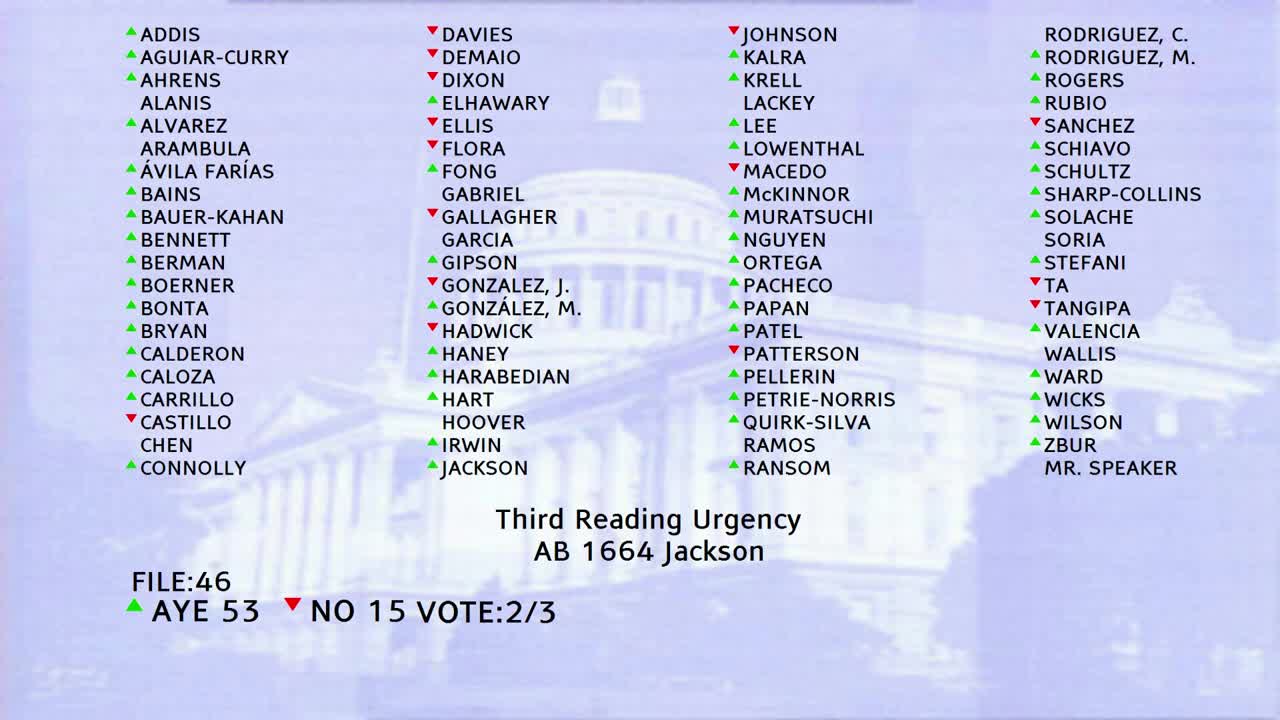 1MIN
Assembly Floor
 32MIN
Assembly Standing Committee on Appropriations
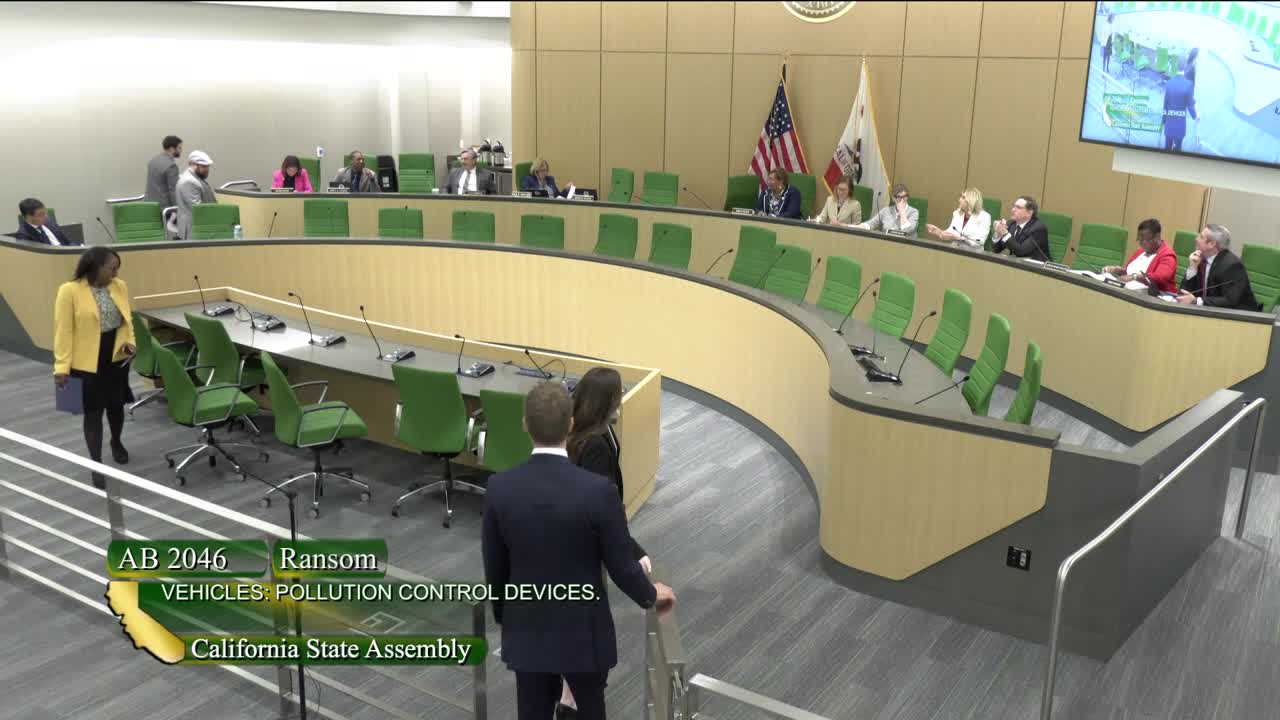 14MIN