AB 2053: Community colleges: baccalaureate degree program: Coast Community College District.
- Session Year: 2025-2026
- House: Assembly
- Latest Version Date: 2026-02-18
Current Status:
In Progress
(2026-04-21: In committee: Set, first hearing. Failed passage. Reconsideration granted.)
Introduced
In Committee
Awaiting First Chamber Vote
Passed First Chamber
In Committee
Awaiting Second Chamber Vote
Passed Second Chamber
Enacted
Existing law establishes the California Community Colleges, under the administration of the Board of Governors of the California Community Colleges, as one of the segments of public postsecondary education in this state. Existing law establishes community college districts throughout the state and authorizes them to provide instruction at the campuses they operate. Existing law authorizes the Board of Governors of the California Community Colleges, in consultation with the California State University and the University of California, to authorize the establishment of community college district baccalaureate degree programs, as provided.
This bill would authorize the Chancellor of the California Community Colleges to authorize the Coast Community College District to offer a workforce-aligned cybersecurity baccalaureate degree program at Coastline College, as provided. The bill would require the Legislative Analysts Office to, on or before July 1, 2030, conduct and present to the Legislature and the Governor an interim evaluation of the baccalaureate degree program that is offered pursuant to that authorization and, on or before July 1, 2034, a final evaluation of that degree program, as provided. The bill would repeal these provisions on January 1, 2035.
This bill would make legislative findings and declarations as to the necessity of a special statute for the Coast Community College District.
For purposes of this article, regional public university means a public university located within the community college districts service area.
78044.2.(a)(1)Notwithstanding Section 66010.4 or Article 3 (commencing with Section 78040), the Chancellor of the California Community Colleges may authorize the Coast Community College District to offer a workforce-aligned cybersecurity baccalaureate degree program at Coastline College.
(2)The chancellor shall ensure that the application and review procedures and requirements described in paragraphs (1), (3), and (4) of subdivision (h) of Section 78042 are met for any program authorized pursuant to this article.
(b)The governing board of the Coast Community College District shall submit a proposal for the baccalaureate degree program to be authorized pursuant to this article to the chancellor. The proposal shall include all of the following:
(1)Data supporting the regional labor-market demand for the proposed degree program.
(2)Data demonstrating the lack of availability of the proposed degree program at the regional public universities or the inability of a degree program offered at a regional public university to meet the demand for the degreed, skilled workforce in the region.
(3)Evidence of collaboration that prioritizes structured partnerships between the Coast Community College District and regional public universities to avoid unnecessary duplication and to expand access to baccalaureate degrees. The structured partnerships may include, but not be limited to, any of the following:
(A)Guaranteed transfer agreements.
(B)2+2 articulation agreements.
(C)Dual enrollment pathways with high school and public university partners such as 1+1+2 models.
(D)Credit for prior learning.
(E)Shared use of facilities to support colocation or cross-location delivery models.
(4)Evidence of program approval through the appropriate accreditation body, if necessary.
(c)Full-time equivalent students enrolled in a baccalaureate program authorized pursuant to this article shall be included in the funding model developed and adopted pursuant to, and the fee provisions described in, subdivision (g) of Section 78042.
78044.4.(a)On or before July 1, 2030, the Legislative Analysts Office shall conduct and present to the Legislature, in compliance with Section 9795 of the Government Code, and to the Governor, an interim evaluation of the baccalaureate degree program offered pursuant to this article that includes all of the following:
(1)Trends in workforce demand in the region that may require additional degree programs to be offered by the Coast Community College District or other regional partners.
(2)Completion rates, if available, for each cohort of students in the degree program.
(3)Information on the impact of the degree program on underserved and underprepared students.
(4)Information regarding other forms of collaboration between the Coast Community College District and public universities to address workforce demand in the region.
(b)On or before July 1, 2034, the Legislative Analysts Office shall conduct and present to the Legislature, in compliance with Section 9795 of the Government Code, and to the Governor, a final evaluation of the baccalaureate degree program offered pursuant to this article that includes all of the following:
(1)Data regarding students participating in the degree program, including the number of applicants, admitted students, enrolled students, and degree recipients.
(2)The extent to which the degree program meets identified workforce needs in the region, including regional supply and demand data that considers the capacity of the California State University, the University of California, and the independent colleges and universities in the region.
(3)Information on the place of employment of students in the degree program and the subsequent job placement of graduates of the degree program.
(4)Time-to-degree rates and completion rates for students in the degree program.
(5)Information regarding other areas of collaboration between the Coast Community College District and regional partners and how those partnerships addressed regional workforce needs.
(6)Information on the impact of the degree program on underserved and underprepared students.
(7)Recommendations on whether and how the degree program can or should be expanded or amended based on the results of the evaluation.
(c)(1)The Coast Community College District shall provide the information necessary to conduct the evaluation, as determined by the Legislative Analysts Office, to the chancellor.
(2)The chancellor shall provide the information received pursuant to paragraph (1) to the Legislative Analysts Office upon request.
78044.5.This article shall remain in effect only until January 1, 2035, and as of that date is repealed.
SEC. 2.The Legislature finds and declares that a special statute is necessary and that a general statute cannot be made applicable within the meaning of Section 16 of Article IV of the California Constitution because there is a need for a workforce skilled in the field of cybersecurity from regional employers.
|
Date
|
Status
|
|---|---|
| Apr 21, 2026 | In committee: Set, first hearing. Failed passage. Reconsideration granted. |
| Mar 2, 2026 | Referred to Com. on HIGHER ED. |
| Feb 19, 2026 | From printer. May be heard in committee March 21. |
| Feb 18, 2026 | Read first time. To print. |
|
Date
|
Description
|
Location
|
Votes
|
|
|---|---|---|---|---|
| Apr 21, 2026 | Reconsideration. | Assembly Standing Committee on Higher Education |
Passed |
|
| Apr 21, 2026 | Do pass and be re-referred to the Committee on [Appropriations] | Assembly Standing Committee on Higher Education |
Failed |
This list shows positions taken on this bill by organizations on the date displayed, which is linked to the original source.
Positions by individuals are not included.
|
Organization
|
Position
|
Date
|
|---|---|---|
| California Faculty Association | ** Against | |
| California State University, Office Of The Chancellor | ** Against | |
| City of Los Alamitos | ** Support | |
| Coast Community College District | ** Support |
Date of Hearing: April 21, 2026
ASSEMBLY COMMITTEE ON HIGHER EDUCATION
Mike Fong, Chair
ABPCA Bill Id:AB 2053 (
Author:Ta) – As Introduced Ver:February 18, 2026
SUBJECT: Community colleges: baccalaureate degree program: Coast Community College District
SUMMARY: Authorizes the Chancellor of the California Community Colleges (CCC) to authorize the Coast Community College District (CCD) to offer a workforce-aligned cybersecurity baccalaureate degree program at Coastline College, as provided. Require the Legislative Analyst’s Office (LAO) to, on or before July 1, 2030, conduct and present to the Legislature and the Governor an interim evaluation of the baccalaureate degree program that is offered pursuant to that authorization and, on or before July 1, 2034, a final evaluation of that degree program, as provided. The bill would repeal these provisions on January 1, 2035. Specifically, this bill:
- Specifies that the Chancellor of the CCC may:
- Authorize Coast CCD to offer a workforce-aligned cybersecurity baccalaureate degree program at Coastline College; and,
- Require the chancellor of the CCC to ensure existing application and review procedures and requirements, as specified, are met for any program authorized pursuant to this article.
- Requires, upon authorization by the Chancellor of the CCC, the governing board of the Coast CCD to submit a proposal for the Workforce-Aligned Cybersecurity Baccalaureate Degree Program to the chancellor of the CCC. The proposal will include all of the following:
- Data supporting the regional labor-market demand for the proposed degree program;
- Data demonstrating the lack of availability of the proposed degree program at the regional public universities or the inability of a degree program offered at a regional public university to meet the demand for the degreed, skilled workforce in the region;
- Evidence of collaboration that prioritizes structured partnerships between the Coast Community College District and regional public universities to avoid unnecessary duplication and to expand access to baccalaureate degrees. The structured partnerships may include, but not be limited to, any of the following:
- Guaranteed transfer agreements;
- 2+2 articulation agreements;
- Dual enrollment pathways with high school and public university partners such as 1+1+2 models;
- Credit for prior learning; and,
- Shared use of facilities to support colocation or cross-location delivery models;
- Evidence of program approval through the appropriate accreditation body, if necessary.
- Requires full-time equivalent students enrolled in a baccalaureate program to be included in the funding model developed and adopted pursuant to existing CCC baccalaureate degree fee provisions, as specified.
- Requires, on or before July 1, 2030, the Legislative Analyst’s Office (LAO) to conduct and present to the Legislature, as specified, and to the Governor, an interim evaluation of the baccalaureate degree program that includes all of the following:
- Trends in workforce demand in the region that may require additional degree programs to be offered by the Coast CCD or other regional partners;
- Completion rates, if available, for each cohort of students in the degree program;
- Information on the impact of the degree program on underserved and underprepared students; and,
- Information regarding other forms of collaboration between the Coast CCD and public universities to address workforce demand in the region.
- Requires. on or before July 1, 2034, the LAO to conduct and present to the Legislature, as specified, and to the Governor, a final evaluation of the baccalaureate degree program offered pursuant to this article that includes all of the following:
- Data regarding students participating in the degree program, including the number of applicants, admitted students, enrolled students, and degree recipients;
- The extent to which the degree program meets identified workforce needs in the region, including regional supply and demand data that considers the capacity of the California State University (CSU), the University of California (UC), and the independent colleges and universities in the region.
- Information on the place of employment of students in the degree program and the subsequent job placement of graduates of the degree program;
- Time-to-degree rates and completion rates for students in the degree program;
- Information regarding other areas of collaboration between the Coast CCD and regional partners and how those partnerships addressed regional workforce needs;
- Information on the impact of the degree program on underserved and underprepared students; and,
- Recommendations on whether and how the degree program can or should be expanded or amended based on the results of the evaluation.
- Requires Coast CCD to provide the information necessary to conduct the evaluation, as determined by the LAO, to the chancellor of the CCC, and requires the CCC chancellor to provide the information, as specified, to LAO upon request.
- Sunsets the provisions on January 1, 2035.
- Defines “regional public university” means a public university located within the community college district’s service area.
- Finds and declares that a special statute is necessary because there is a need for a workforce skilled in the field of cybersecurity from regional employers.
EXISTING LAW:
- Differentiates the missions and functions of public and independent institutions of higher education. Under these provisions:
- The primary mission of the California State University (CSU) is to offer undergraduate and graduate instruction through the master’s degree in the liberal arts and sciences and professional education including teacher education. The CSU is authorized to establish two-year programs only when mutually agreed upon by the Trustees and the CCC Board of Governors (BOG). The CSU is also authorized to jointly award the doctoral degree with the University of California (UC) and with one or more independent institutions of higher education.
- The UC is authorized to provide undergraduate and graduate instruction and has exclusive jurisdiction in public higher education over graduate instruction in the professions of law, medicine, dentistry and veterinary medicine. The UC is also the primary state-supported academic agency for research.
- The independent institutions of higher education are required to provide undergraduate and graduate instruction and research in accordance with their respective missions.
- The mission and function of the CCC is the offering of academic and vocational instruction at the lower division level, and the CCC are authorized to grant the Associate in Arts and the Associate in Science degrees. The community colleges are also required to offer learning supports to close learning gaps, English as a Second Language instruction, and adult noncredit instruction, and support services which help students succeed at the postsecondary level. (Education Code (EDC) Section 66010.4)
- Authorizes the BOG of the CCC to establish permanent district baccalaureate degree programs, and provided that only 15 baccalaureate degree programs are approved during each application period allowing for a total of 30 baccalaureate degree programs per academic year. Additionally, existing law:
- Specifies that CCDs, as part of the baccalaureate degree program, will have the additional mission to provide high-quality undergraduate education at an affordable price for students and the state.
- Requires the Chancellor of the CCC to consult with and seek feedback from the Chancellor of the CSU, the President of the University of California (UC), and the President of the Association of Independent California Colleges and Universities (AICCU) on proposed baccalaureate degree programs, as specified, and establishes a mechanism for the assessment, consultation, and approval of programs where duplication is identified, as specified;
- Requires a CCD to continue to offer an associate degree program in the same academic subject for which baccalaureate degree program has been approved, unless the CCD has received approval from the CCC Chancellor to eliminate the associate degree program, and requires the CCC Chancellor to evaluate both changes to the labor market viability of an associate degree and changes to the minimum education required to maintain program accreditation when making a decision to authorize the elimination of an associate degree program; and,
- Specifies that the total number of baccalaureate degree programs offered by a CCD, at any time, does not exceed 25% of the total number of associate degree programs offered by the CCD, including associate degrees for transfer. (EDC Section 78040, et seq.)
FISCAL EFFECT: Unknown
COMMENTS: Purpose. According to the author, “A thriving technology industry is helping fuel California’s economy. As the technology sector grows and traditional businesses incorporate greater technology into their operations, a common threat across California’s expanding economic sectors is cybersecurity. Increasing reliance on technology, artificial intelligence, and online tools create vulnerabilities and threats that companies must mitigate. AB 2053 would address a critical cybersecurity workforce shortage by authorizing Coastline College to meet regional workforce demand.”
State of cybersecurity. According to CompTIA’s 2025 report State of Cybersecurity, the overall cybersecurity landscape reflects a field under intensifying pressure. CompTIA's 2025 polling data shows growth in both general sentiment and organizational satisfaction — with 81% of respondents rating cybersecurity as a high priority, and 68% rating their organization as highly capable. However, this growing confidence coexists with a rapidly escalating threat environment. McKinsey reports a 1,200% increase in phishing attacks since the rise of generative AI in late 2022, Covewear, a division of the cybersecurity software firm Veeam, found that the average ransomware payout in Q2 2025 doubled from only one quarter before.
Artificial intelligence is reshaping the threat landscape and organizational defenses in significant ways. Attackers are using AI to supercharge existing attacks - including AI-generated deepfakes for social engineering and AI-driven ransomware - while defenders are deploying AI for threat detection and operational automation.
The workforce dimension of cybersecurity remains a critical vulnerability. CompTIA's CyberSeek tool reports over 514,000 cybersecurity-related job postings between May 2024 and April 2025 — up from roughly 470,000 the prior year — and cybersecurity is the field where the fewest companies with hiring plans are targeting early career candidates. The need for skills is the most pressing problem according to executives, business staff, and IT staff alike, and the report notes that companies must give more consideration to building a pipeline of cybersecurity talent through a combination of hiring early career specialists and providing internal training to allow for career growth or reskilling opportunities.
Master Plan for Higher Education. As outlined in the Master Plan for Higher Education and by state statute, the CCCs are designated to have an open admission policy and bear the most extensive responsibility for lower-division undergraduate instruction. Its three primary areas of mission include education leading to associates degrees and university transfer, career technical education, and basic skills. The primary mission of the CSU is undergraduate and graduate instruction through the master’s degree. The UC was granted the sole authority to independently offer doctoral degrees.
Notwithstanding the differentiation of the mission envisioned by the Master Plan, as outlined in statute, the Legislature authorized the CSU to go beyond its original mission to offer six professional doctoral degrees which include the Au.D, Ed.D, D.P.T., DNP, OTD, and Dr.PH. Each program was individually approved through legislation. Fees were capped at the rate charged at the UC, no additional funding was provided by the state, and these programs were to be implemented without diminishing or reducing enrollment in undergraduate programs. Additionally, the CSU programs that offer applied doctorates were not duplicative of degrees offered by UC.
Parallel expansion. SB 850 (Block), Chapter 747, Statutes of 2014, authorized the CCC BOG, in consultation with the CSU and the UC, to establish a baccalaureate degree pilot program. The pilot program allowed up to 15 participating CCDs to offer one baccalaureate degree program each to meet local workforce needs as long as it was not duplicating a baccalaureate degree program already offered by the CSU or the UC. The Legislative Analyst's Office (LAO) conducted interim and final evaluations of the pilot program.
AB 927 (Medina and Choi), Chapter 565, Statutes of 2021 made the original pilot program (SB 850 (Block) Chapter 747, Statutes of 2014) permanent, perpetually approving the original pilot programs and authorizing as many as 30 new baccalaureate degrees per year.
As of publication of this analysis there are a total of 60 approved programs across 45 colleges. Most participating campuses currently offer one program, although some campuses offer as many as three. Consistent with the provisions of SB 850 (Block), AB 927 (Medina and Choi) mandates that none of the CCC baccalaureate degree programs can duplicate programs offered by the CSU or UC.
AB 656 (McCarty), Chapter 663, Statutes of 2023, authorizes the CSU to award professional or applied doctoral degrees statewide that do not duplicate UC doctoral degrees and satisfy certain requirements.
Arguments in support. Coast Community College District wrote in support, stating that “As communities across California continue to rely on secure digital infrastructure to support government services, businesses, and residents, the demand for a highly trained cybersecurity workforce continues to grow. Expanding access to cybersecurity education through local community college systems can help develop the skilled workforce needed to protect critical systems while also creating new educational pathways for students. AB 2053 takes a thoughtful approach by requiring the proposed program to demonstrate regional workforce demand, collaborate with nearby public universities, and avoid unnecessary duplication of existing degree programs. This collaborative framework helps ensure that the program complements California’s broader higher education system while expanding opportunities for students who may benefit from a more accessible pathway to a four-year degree.”
Coast CCD adds that AB 2053 (Ta) “…also includes strong accountability provisions, including interim and final evaluations by the Legislative Analyst’s Office to assess program outcomes, workforce alignment, and student success. These evaluations will help inform policymakers about the effectiveness of the program and whether similar models may be appropriate in the future.”
Arguments in opposition. The CSU Chancellor’s Office wrote in opposition, stating that “State law has authorized—with the passage of Assembly Bill 927 (Medina)—that the California Community Colleges (CCC) may establish up to 30 baccalaureate degree programs per academic year, provided that the program or program curricula is not already offered by the CSU or University of California (UC). AB 927 requires the CCC to consult with and seek feedback from the CSU, UC and the Association of Independent California Colleges and Universities on proposed baccalaureate degree programs to identify and prevent duplication, and to provide documentation of the collaborative approaches these institutions have taken to meet regional workforce needs. Through this process more than 80% of the degree programs submitted through the first six cycles have been approved, leading to the creation of more than 50 baccalaureate degree programs offered at community colleges across the state.”
The CSU Chancellor’s Office continues, noting that “…various cybersecurity baccalaureate and graduate programs at seven of our universities, including a fully-online baccalaureate and master’s program in cybersecurity at California State University San Marcos. Additionally, the CSU has maintained a strong partnership with Coast Community College District, resulting in transfer acceptance rates exceeding 85% from its three community colleges for the Fall 2025 term. However, AB 2053 would undermine the collaboration at the heart of these partnerships. The bill also raises several concerns about the potential impacts on California’s higher education segments. AB 2053, like several measures introduced this session, expands or alters higher education authorities without fully accounting for the operational, financial, and administrative impacts on institutions and the state.”
The California Faculty Association wrote in opposition, adding that this legislation “…will have many unintended consequences, especially for faculty employment and job stability. As the exclusive collective bargaining representative for CSU faculty employees, it is our responsibility to protect faculty jobs. Expanding baccalaureate degrees in the community college level will undoubtedly shift upper-division enrollment away from the CSU, potentially leading to reduced instructional demand. This could have unintended consequences for faculty workforce stability, including fewer course offerings and potential impacts on faculty positions. We fear that over time it will lead to fewer course offerings and jeopardize faculty positions. CFA continues to fight against faculty layoffs, and we fear that these bills will only exacerbate future layoffs.”
Committee comments. The California Community Colleges Baccalaureate Degree Program operates under a structured approval process that evaluates workforce need, program quality, non-duplication of UC and CSU offerings, and institutional capacity - criteria deliberately established by the authorizing legislation to ensure new programs serve genuine workforce gaps without undermining California's broader higher education ecosystem. AB 2053 (Ta) bypasses this process by granting a specific CCD an exemption, raising serious concerns about the integrity of the framework as a whole.
A similar concern was raised in opposition to AB 664 (Alvarez) earlier this session, which sought a comparable exemption for Southwestern Community College District. If district-specific legislation becomes an accepted pathway to program approval, it sets a precedent that effectively makes the established process optional - disadvantaging districts that follow it while rewarding those with greater legislative access. Over time, this dynamic could make the review process meaningless, as individual carve-outs accumulate and the standards the law requires are applied inconsistently across the system. If there are legitimate deficiencies in the current process, the appropriate remedy is reform through careful study, deliberation, and legislation.
Related legislation. AB 664 (Alvarez) authorizes the Chancellor of the California Community College (CCC) to allow the Southwestern Community College District (SWCCD) to offer no more than four workforce- aligned baccalaureate degrees programs, as provided. Requires interim and final reports from the Legislative Analyst′s Office (LAO), and sunsets the provisions on January 1, 2035.AB 664 is currently pending a hearing in the Senate Committee on Education.
AB 2136 (Pacheco) authorizes the BOG of the CCC to authorize the Cerritos CCD to offer up to three applied baccalaureate degree programs in the fields of public safety management, paralegal studies, and automotive technology. AB 2136 (Pacheco) is scheduled to be heard in the Assembly Committee on Higher Education on April 21st, 2026.
AB 2301 (Soria) requires the CCC Chancellor’s Office to develop a Baccalaureate Degree in Nursing (BSN) Pilot Program that authorizes select CCDs to offer a BSN degree. The bill would limit the pilot program to 10 CCDs statewide and would require the CCCCO to identify and select eligible CCDs based on specified criteria. AB 2301 (Soria) is scheduled to be heard in the Assembly Committee on Higher Education on April 21st, 2026.
AB 2694 (Alvarez) changes the standard governing when CCDs may offer baccalaureate degree programs, replacing a hard prohibition on duplicating CSU or UC programs with a more flexible "substantially similar within the geographic region" test that includes exceptions for unmet workforce need and lack of CSU or UC enrollment from that region. The bill also modifies the objection and consultation process, narrowing the required consultation to programs that may be substantially similar to nearby CSU or UC offerings and streamlining the written agreement process when an objection is filed. AB 2694 (Alvarez) is scheduled to be heard in the Assembly Committee on Higher Education on April 21st, 2026.
SB 960 (Cabaldon) limits the prohibition on CCC duplication of CSU baccalaureate degree programs to instances where a CSU’s campus local admission area includes or overlaps with the CCC district’s territory, except when the CSU program has been impacted for at least three consecutive years. SB 960 is currently pending hearing in the Assembly Committee on Appropriations.
Prior legislation. AB 1400 (Soria), of 2025, would have required Chancellor of the CCC to develop a BSN Pilot Program that authorizes select community college districts to offer a BSN degree. AB 1400 was vetoed by the Governor. The veto read, in part:
“Last year, I vetoed a nearly identical bill, citing two primary reasons that continue to persist. First, the 2024 Budget Agreement included $60 million per year, from 2025-26 to 2028-29, for the Rebuilding Nursing Infrastructure Grant Program, which may be used to develop or expand BSN partnerships with UC, CSU, and independent nonprofit higher education institutions. These partnerships have proven successful in expanding BSN access for community college students and increasing the number of BSN degree recipients. All segments of higher education must continue to collaborate on building these programs, and returning this bill will ensure those collaborative efforts are not undermined.”
The Governor continued that, “…in recent years, both the CCC and the CSU have been authorized to offer independent programs outside of their traditional roles, provided they do not duplicate degree offerings of other public segments. I encourage the CCC system to focus on implementing this expanded authority and to ensure that it can continue to make progress on the unique and vital role the CCC plays in serving its students and the state. Given these significant changes, a pause should be maintained to understand their full impact before additional authorities are granted.”
AB 1098 (Fong and Padilla), Chapter 446, Statutes of 2025, establishes the California Education Interagency Council (Council) within the Government Operations Agency (GovOps) to align education and workforce systems, support adult skill development, and address the changing nature of work and the economy. The Council would adopt strategic and workforce plans, issue recommendations to the Governor and Legislature, and create a faculty and employer advisory committee.
SB 155 (Senate Committee on Budget and Fiscal Review), Chapter 71, Statutes of 2024, created Rebuilding Nursing Infrastructure Grant Program to expand nursing programs and partnerships, address nursing shortages, and increase, educate, and maintain the next generation of registered nurses through the community college system. The Budget Act of 2024 supported this program with $60 million Proposition 98 General Fund per year for five years, starting in 2024-25, with CCC Strong Workforce Program funding.
AB 2401 (Soria) of 2024, would have required Chancellor of the CCC to develop a BSN Pilot Program that authorizes select community college districts to offer a BSN degree. AB 2401 (Soria) was vetoed by the Governor.
SB 895 (Roth) of 2024, would have required the CCC Chancellor’s Office to establish a Community College BSN Pilot Program that would authorize 10 community college districts to offer a BSN degree. AB 895 (Roth) was vetoed by the Governor, and the veto message was substantively similar to the veto message of AB 2401 (Soria) detailed on page 9 of this analysis.
AB 656 (McCarty), Chapter 663, Statutes of 2023, authorized the CSU to award professional or applied doctoral degrees statewide that do not duplicate UC doctoral degrees and satisfy certain requirements. Required a CSU campus seeking authorization to offer a professional or applied doctoral degree to submit specified information on the proposed doctoral degree for review by the office of the Chancellor of the CSU, and approval by the CSU Board of Trustees, as provided.
AB 1311 (Soria), Chapter 126, Statutes of 2023, required the LAO to conduct an assessment, on or before January 1, 2025, evaluating the efficacy of existing programs in allied health jointly offered between campuses of the California Community Colleges, the California State University, and the University of California. Required the final assessment to be reported, in writing, to the Legislature and the Governor on or before January 1, 2025, as specified.
SB 684 (Hueso), Chapter 936, Statutes of 2022, authorized CSU to offer the DrPH degree, and specified that DrPH degree programs offered by the CSU will focus on health and scientific knowledge translation and transformative community leadership.
AB 927 (Medina and Choi), Chapter 565, Statutes of 2021, removed the cap on the total number of baccalaureate degree programs allowed within the CCC system and eliminates the January 1, 2027, sunset date of the statewide baccalaureate degree pilot program, thereby permanently authorizing the offering of baccalaureate degree programs at CCCs.
SB 874 (Hill) of 2020, would have extended the operation of the statewide baccalaureate degree pilot program indefinitely. The bill would have removed the requirements that the program consist of a maximum of 15 community college district programs and for a student to commence a program by the end of the 2022–23 academic year. SB 874 was held in the Senate Committee on Education due to bill restrictions from COVID-19.
AB 829 (Bloom), Chapter 183, Statutes of 2019, authorized CSU to offer the OTD degree, and specifies that OTD degree programs offered by the CSU will focus on preparing occupational therapists to provide health care services and to be consistent with the standards for accreditation set forth by the appropriate accrediting body.
SB 577 (Dodd), Chapter 603, Statutes of 2018, established the CCC Teacher Credentialing Partnership Pilot Program, awarding grants to collaboratives of one or more teacher-credentialing higher education institutions partnering with one or more community colleges for the purpose of offering teacher credentialing programs at community colleges.
AB 422 (Arambula), Chapter 702, Statutes of 2017, authorized CSU to offer the DNP degree programs, and specified that the DNP offered by the CSU shall focus on the preparation of nursing faculty to teach in postsecondary nursing education programs and may also train nurses for advanced nursing practice or nurse leadership.
SB 769 (Hill) of 2017, would have extended the operation of the statewide baccalaureate degree pilot program until July 1, 2028. SB 769 was held in the Assembly Committee on Appropriations.
AB 2317 (Mullin), Chapter 267, Statutes of 2016, authorized the CSU to offer the Au.D degree, and specifies that the Au.D degree programs at the CSU shall be focused on preparing audiologists to provide health care services and shall be consistent with the standards for accreditation set forth by the Council on Academic Accreditation in Audiology and Speech-Language Pathology.
SB 850 (Block), Chapter 747, Statutes of 2014, authorized the CCC BOG, in consultation with the CSU and the UC, to establish a baccalaureate degree pilot program. The pilot program allows up to 15 participating community college districts to offer one baccalaureate degree program each to meet local workforce needs as long as it does not duplicate a baccalaureate degree program already offered by the CSU or the UC.
AB 661 (Block) of 2011, authorized Grossmont-Cuyamaca and the San Mateo Community College districts to offer one baccalaureate degree pilot program per campus. AB 661 was heard and passed in the Assembly Higher Education Committee by a vote of 6-0 but was moved to the inactive file on the Assembly Floor.
AB 2400 (Block) of 2010, authorized the San Diego, Grossmont-Cuyamaca and San Mateo Community College districts to establish baccalaureate degree pilot programs. No vote was taken and AB 2400 was held in the Assembly Higher Education Committee.
AB 2382 (Blumenfield), Chapter 425, Statutes of 2010, authorized the CSU to offer the D.P.T. degree, and specified that the D.P.T. degree programs at the CSU shall be focused on preparing physical therapists to provide health care services, and shall be consistent with meeting the requirements of the Commission on Accreditation in Physical Therapy Education.
SB 724 (Scott), Chapter 269, Statutes of 2005, authorized the CSU to independently award the Ed.D degree focused solely on preparing administrative leaders for California public K-14 schools.
REGISTERED SUPPORT / OPPOSITION:
Support
City of Los Alamitos
Coast Community College District
Opposition
California Faculty Association
California State University, Office of the Chancellor
Analysis Prepared by: Kevin J. Powers / HIGHER ED. / (916) 319-3960
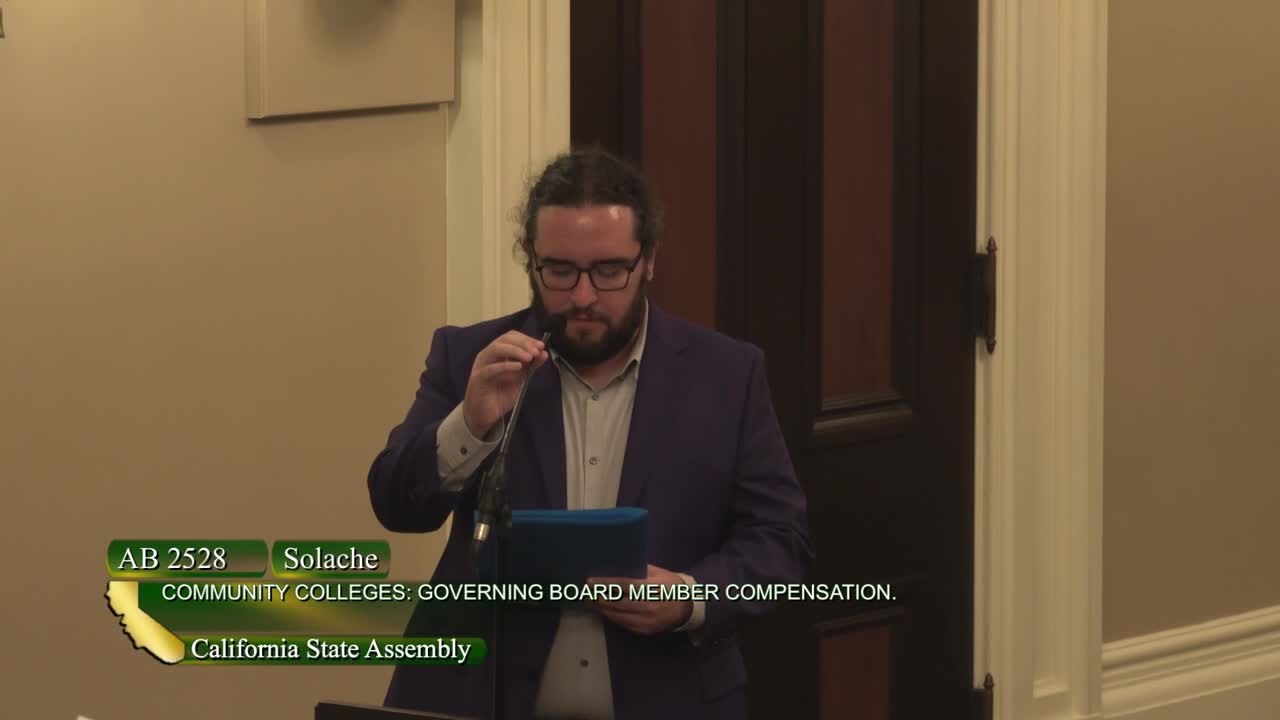
Discussed in Hearing
 25MIN
Assembly Standing Committee on Higher Education
Bill Author
Bill Co-Author(s):