AB 2059: California Environmental Quality Act: transportation impacts: vehicle miles traveled: mitigation.
- Session Year: 2025-2026
- House: Assembly
- Latest Version Date: 2026-09-27
Current Status:
Passed
(2026-09-27: Chaptered by Secretary of State - Chapter 576, Statutes of 2026.)
Introduced
In Committee
Awaiting First Chamber Vote
Passed First Chamber
In Committee
Awaiting Second Chamber Vote
Passed Second Chamber
Enacted
The California Environmental Quality Act (CEQA) requires a lead agency, as defined, to prepare, or cause to be prepared, and certify the completion of an environmental impact report on a project that it proposes to carry out or approve that may have a significant effect on the environment or to adopt a negative declaration if it finds that the project will not have that effect. CEQA also requires a lead agency to prepare a mitigated negative declaration for a project that may have a significant effect on the environment if revisions in the project would avoid or mitigate that effect and there is no substantial evidence that the project, as revised, would have a significant effect on the environment.
CEQA requires the Office of Land Use and Climate Innovation to prepare, develop, and transmit to the Secretary of the Natural Resources Agency for certification and adoption proposed revisions to the CEQA implementation guidelines to establish criteria for determining the significance of transportation impacts of projects within transit priority areas, and requires the criteria to promote the reduction of greenhouse gas emissions, the development of multimodal transportation networks, and a diversity of land uses. CEQA requires the office to recommend potential metrics, including, among other metrics, vehicle miles traveled, to measure these transportation impacts.
This bill would require the Department of Transportation, in consultation with specified entities, to, on or before December 31, 2030, develop guidance on vehicle-miles-travel mitigation measures for transportation projects in nonmetropolitan counties, as provided. The bill would require the department to publish the guidance on its internet website and add the guidance as an addendum to the Transportation Analysis Framework and the Transportation Analysis under CEQA. The bill would specify that a transportation project for which the lead agency has issued a notice of preparation for the projects environmental impact report on or before December 31, 2031 is presumed to have a less than significant transportation impact as determined by the vehicle-miles-traveled metric if at least 70% of the project lies within one or more nonmetropolitan counties. Because the bill would impose additional duties on a lead agency in its analysis of significant transportation impacts, this bill would impose a state-mandated local program.
The California Constitution requires the state to reimburse local agencies and school districts for certain costs mandated by the state. Statutory provisions establish procedures for making that reimbursement.
This bill would provide that no reimbursement is required by this act for a specified reason.
The California Environmental Quality Act (CEQA) requires a lead agency, as defined, to prepare, or cause to be prepared, and certify the completion of an environmental impact report on a project that it proposes to carry out or approve that may have a significant effect on the environment or to adopt a negative declaration if it finds that the project will not have that effect. CEQA also requires a lead agency to prepare a mitigated negative declaration for a project that may have a significant effect on the environment if revisions in the project would avoid or mitigate that effect and there is no substantial evidence that the project, as revised, would have a significant effect on the environment.
CEQA requires the Office of Land Use and Climate Innovation to prepare, develop, and transmit to the Secretary of the Natural Resources Agency for certification and adoption proposed revisions to the CEQA implementation guidelines to establish criteria for determining the significance of transportation impacts of projects within transit priority areas, and requires the criteria to promote the reduction of greenhouse gas emissions, the development of multimodal transportation networks, and a diversity of land uses. CEQA requires the office to recommend potential metrics, including, among other metrics, vehicle miles traveled, to measure these transportation impacts.
This bill would require the Department of Transportation to Transportation, in consultation with specified entities, to, on or before December 31, 2030, develop guidance on vehicle-miles-travel mitigation measures for transportation projects in nonmetropolitan counties, as provided. The bill would require the department to publish the guidance on its internet website and add the guidance as an addendum to the Transportation Analysis Framework and the Transportation Analysis under CEQA. The bill would, until the development and publication of the guidance and except as provided, would specify that a transportation project for which the lead agency has issued a notice of preparation for the projects environmental impact report on or before December 31, 2031 is presumed to have a less than significant transportation impact as determined by the vehicle-miles-traveled metric if at least 80% 70% of the project lies within one or more nonmetropolitan counties. Because the bill would impose additional duties on a lead agency in its analysis of significant transportation impacts, this bill would impose a state-mandated local program.
The California Constitution requires the state to reimburse local agencies and school districts for certain costs mandated by the state. Statutory provisions establish procedures for making that reimbursement.
This bill would provide that no reimbursement is required by this act for a specified reason.
The California Environmental Quality Act (CEQA) requires a lead agency, as defined, to prepare, or cause to be prepared, and certify the completion of an environmental impact report on a project that it proposes to carry out or approve that may have a significant effect on the environment or to adopt a negative declaration if it finds that the project will not have that effect. CEQA also requires a lead agency to prepare a mitigated negative declaration for a project that may have a significant effect on the environment if revisions in the project would avoid or mitigate that effect and there is no substantial evidence that the project, as revised, would have a significant effect on the environment.
CEQA requires the Office of Land Use and Climate Innovation to prepare, develop, and transmit to the Secretary of the Natural Resources Agency for certification and adoption proposed revisions to the CEQA implementation guidelines to establish criteria for determining the significance of transportation impacts of projects within transit priority areas, and requires the criteria to promote the reduction of greenhouse gas emissions, the development of multimodal transportation networks, and a diversity of land uses. CEQA requires the office to recommend potential metrics, including, among other metrics, vehicle miles traveled, to measure these transportation impacts.
This bill would require the Department of Transportation to develop guidance on vehicle-miles-travel mitigation measures for transportation projects in nonmetropolitan counties, as provided. The bill would require the department to publish the guidance on its internet website and add the guidance as an addendum to the Transportation Analysis Framework and the Transportation Analysis under CEQA. The bill would, until the development and publication of the guidance and except as provided, specify that a transportation project is presumed to have a less than significant transportation impact as determined by the vehicle-miles-traveled metric if at least 80% of the project lies within one or more nonmetropolitan counties. Because the bill would impose additional duties on a lead agency in its analysis of significant transportation impacts, this bill would impose a state-mandated local program.
The California Constitution requires the state to reimburse local agencies and school districts for certain costs mandated by the state. Statutory provisions establish procedures for making that reimbursement.
This bill would provide that no reimbursement is required by this act for a specified reason.
The California Environmental Quality Act (CEQA) requires a lead agency, as defined, to prepare, or cause to be prepared, and certify the completion of an environmental impact report on a project that it proposes to carry out or approve that may have a significant effect on the environment or to adopt a negative declaration if it finds that the project will not have that effect. CEQA also requires a lead agency to prepare a mitigated negative declaration for a project that may have a significant effect on the environment if revisions in the project would avoid or mitigate that effect and there is no substantial evidence that the project, as revised, would have a significant effect on the environment.
CEQA requires the Office of Land Use and Climate Innovation to prepare, develop, and transmit to the Secretary of the Natural Resources Agency for certification and adoption proposed revisions to the CEQA implementation guidelines to establish criteria for determining the significance of transportation impacts of projects within transit priority areas, and requires the criteria to promote the reduction of greenhouse gas emissions, the development of multimodal transportation networks, and a diversity of land uses. CEQA requires the office to recommend potential metrics, including, among other metrics, vehicle miles traveled, to measure these transportation impacts.
This bill would, except as provided, specify that the total cost of mitigation measures required to address a significant transportation impact as determined by the vehicle miles traveled metric is not to exceed 5% of the estimated total project costs. The bill would specify that mitigation measures to address a significant transportation impact as determined by the vehicle miles traveled metric that exceed the 5% limit are deemed to be economically infeasible for the purposes of CEQA. a transportation project is presumed to have a less than significant transportation impact as determined by the vehicle-miles-traveled metric if at least 80% of the project lies within one or more nonmetropolitan counties. Because the bill would impose additional duties on a lead agency in its analysis of mitigated measures required to address significant transportation impacts, this bill would impose a state-mandated local program.
The California Constitution requires the state to reimburse local agencies and school districts for certain costs mandated by the state. Statutory provisions establish procedures for making that reimbursement.
This bill would provide that no reimbursement is required by this act for a specified reason.
The California Environmental Quality Act (CEQA) requires a lead agency, as defined, to prepare, or cause to be prepared, and certify the completion of an environmental impact report on a project that it proposes to carry out or approve that may have a significant effect on the environment or to adopt a negative declaration if it finds that the project will not have that effect. CEQA also requires a lead agency to prepare a mitigated negative declaration for a project that may have a significant effect on the environment if revisions in the project would avoid or mitigate that effect and there is no substantial evidence that the project, as revised, would have a significant effect on the environment.
CEQA requires the Office of Land Use and Climate Innovation to prepare, develop, and transmit to the Secretary of the Natural Resources Agency for certification and adoption proposed revisions to the CEQA implementation guidelines to establish criteria for determining the significance of transportation impacts of projects within transit priority areas, and requires the criteria to promote the reduction of greenhouse gas emissions, the development of multimodal transportation networks, and a diversity of land uses. CEQA requires the office to recommend potential metrics, including, among other metrics, vehicle miles traveled, to measure these transportation impacts.
This bill would, except as provided, specify that the total cost of mitigation measures required to address a significant transportation impact as determined by the vehicle miles traveled metric is not to exceed 5% of the estimated total project costs. The bill would specify that mitigation measures to address a significant transportation impact as determined by the vehicle miles traveled metric that exceed the 5% limit are deemed to be economically infeasible for the purposes of CEQA. Because the bill would impose additional duties on a lead agency in its analysis of mitigated measures required to address significant transportation impacts, this bill would impose a state-mandated local program.
The California Constitution requires the state to reimburse local agencies and school districts for certain costs mandated by the state. Statutory provisions establish procedures for making that reimbursement.
This bill would provide that no reimbursement is required by this act for a specified reason.
The Suisun Marsh Preservation Act of 1977 requires the San Francisco Bay Conservation and Development Commission to have primary state responsibility for the implementation of the act, including the issuance of marsh development permits, as specified.This bill would make nonsubstantive changes to the provision of law that names the act.The Suisun Marsh Preservation Act of 1977 requires the San Francisco Bay Conservation and Development Commission to have primary state responsibility for the implementation of the act, including the issuance of marsh development permits, as specified.
This bill would make nonsubstantive changes to the provision of law that names the act.
(a)For purposes of this section, the following definitions apply:
(1)Demonstrated evacuation need means a project that is specifically identified as necessary to provide evacuation capacity for the affected area in an adopted local hazard mitigation plan, general plan safety element, local emergency operations plan, or other local or regional emergency evacuation plan approved by a city, county, or regional planning agency through a public process.
(2)Demonstrated safety need means a project for which the lead agency demonstrates, through documented collision, injury, or fatality data specific to the project location, or through a risk-based or systemic safety analysis consistent with state and federal guidance, that the proposed project includes safety countermeasures that are necessary to reduce the number and severity of injuries or the number of fatalities, including reducing specific risks to vulnerable road users.
(3)Nonmetropolitan county means a nonmetropolitan county designated by the Methodology for Determining Rural Status of Project Site for 2025 Applications issued by the California Tax Credit Allocation Committee on January 1, 2025.
(4)Transportation project means a project undertaken by a public agency that consists of the planning, design, construction, reconstruction, rehabilitation, improvement, expansion, or operation of a highway, road, bridge, transit facility, rail facility, bicycle or pedestrian facility, or other public transportation infrastructure.
(b)(1)The Department of Transportation, in consultation with the Office of Land Use and Climate Innovation and the SB 743 Implementation Working Group Rural VMT Action Subcommittee, shall, on or before December 31, 2030, develop guidance on vehicle-miles-travel mitigation measures for transportation projects in nonmetropolitan counties. The guidance shall include all of the following:
(A)Case studies exemplifying the range of costs of vehicle-miles-travel mitigation measures for transportation projects in nonmetropolitan counties compared to the costs in metropolitan counties.
(B)A review of direct and indirect vehicle-miles-travel mitigation measures and examples of direct and indirect vehicle-miles-travel mitigation measures that have been used for transportation projects in nonmetropolitan counties.
(C)Identification of barriers to implementing vehicle-miles-travel mitigation measures for transportation projects in nonmetropolitan counties.
(D)Recommendations for processes for lead agencies and project developers to identify and implement appropriate vehicle-miles-travel mitigation measures for transportation projects in nonmetropolitan areas, including recommendations for processes of consultation with stakeholders, coordination with local jurisdiction and regional transportation planning organizations, and engaging with the community, as appropriate.
(E)Recommendations for appropriate vehicle-miles-travel significance thresholds for transportation projects in nonmetropolitan areas that do not add general purpose lanes to the state highway system unless there is a demonstrated safety or evacuation need for the project.
(2)The Department of Transportation shall publish the guidance on its internet website. The guidance shall also be added as an addendum to the Transportation Analysis Framework and the Transportation Analysis under CEQA.
(c)(1)A transportation project is presumed to have a less than significant transportation impact as determined by the vehicle-miles-traveled metric developed pursuant to Section 21099 if at least 70 percent of the project lies within one or more nonmetropolitan counties.
(2)Paragraph (1) does not apply to a transportation project that adds one or more general purpose lanes to the state highway system unless there is a demonstrated safety or evacuation need for the project.
(3)The presumption pursuant to paragraph (1) shall only apply to an eligible project for which the lead agency issues a notice of preparation for the projects environmental impact report on or before December 31, 2031.
SEC. 2.No reimbursement is required by this act pursuant to Section 6 of Article XIIIB of the California Constitution because a local agency or school district has the authority to levy service charges, fees, or assessments sufficient to pay for the program or level of service mandated by this act, within the meaning of Section 17556 of the Government Code.
(a)For purposes of this section, the following definitions apply:
(1)Demonstrated evacuation need means a project that is specifically identified as necessary to provide evacuation capacity for the affected area in an adopted local hazard mitigation plan, general plan safety element, local emergency operations plan, or other local or regional emergency evacuation plan approved by a city, county, or regional planning agency through a public process.
(2)Demonstrated safety need means a project for which the lead agency demonstrates, through documented collision, injury, or fatality data specific to the project location, or through a risk-based or systemic safety analysis consistent with state and federal guidance, that the proposed project includes safety countermeasures that are necessary to reduce the number and severity of injuries or the number of fatalities, including reducing specific risks to vulnerable road users.
(3)Nonmetropolitan county means a nonmetropolitan county designated by the Methodology for Determining Rural Status of Project Site for 2025 Applications issued by the California Tax Credit Allocation Committee on January 1, 2025.
(4)Transportation project means a project undertaken by a public agency that consists of the planning, design, construction, reconstruction, rehabilitation, improvement, expansion, or operation of a highway, road, bridge, transit facility, rail facility, bicycle or pedestrian facility, or other public transportation infrastructure.
(b)(1)The Department of Transportation, in consultation with the Office of Land Use and Climate Innovation and the SB 743 Implementation Working Group Rural VMT Action Subcommittee, shall shall, on or before December 31, 2030, develop guidance on vehicle-miles-travel mitigation measures for transportation projects in nonmetropolitan counties. The guidance shall include all of the following:
(A)Case studies exemplifying the range of costs of vehicle-miles-travel mitigation measures for transportation projects in nonmetropolitan counties compared to the costs in metropolitan counties.
(B)A review of direct and indirect vehicle-miles-travel mitigation measures and examples of direct and indirect vehicle-miles-travel mitigation measures that have been used for transportation projects in nonmetropolitan counties.
(C)Identification of barriers to implementing vehicle-miles-travel mitigation measures for transportation projects in nonmetropolitan counties.
(D)Recommendations for processes for lead agencies and project developers to identify and implement appropriate vehicle-miles-travel mitigation measures for transportation projects in nonmetropolitan areas, including recommendations for processes of consultation with stakeholders, coordination with local jurisdiction and regional transportation planning organizations, and engaging with the community, as appropriate.
(E)Recommendations for appropriate vehicle-miles-travel significance thresholds for transportation projects in nonmetropolitan areas that do not add general purpose lanes to the state highway system unless there is a demonstrated safety or evacuation need for the project.
(2)The Department of Transportation shall publish the guidance on its internet website. The guidance shall also be added as an addendum to the Transportation Analysis Framework and the Transportation Analysis under CEQA.
(c)(1)A transportation project is presumed to have a less than significant transportation impact as determined by the vehicle-miles-traveled metric developed pursuant to Section 21099 if at least 80 70 percent of the project lies within one or more nonmetropolitan counties.
(2)Paragraph (1) does not apply to a transportation project that adds one or more general purpose lanes to the state highway system unless there is a demonstrated safety or evacuation need for the project.
(3)This subdivision shall become inoperative upon the development and the publication of the guidance pursuant to subdivision (b).(3)The presumption pursuant to paragraph (1) shall only apply to an eligible project for which the lead agency issues a notice of preparation for the projects environmental impact report on or before December 31, 2031.
SEC. 2.No reimbursement is required by this act pursuant to Section 6 of Article XIIIB of the California Constitution because a local agency or school district has the authority to levy service charges, fees, or assessments sufficient to pay for the program or level of service mandated by this act, within the meaning of Section 17556 of the Government Code.
(a)For purposes of this section, the following definitions apply:
(1)Demonstrated evacuation need means a project that is specifically identified as necessary to provide evacuation capacity for the affected area in an adopted local hazard mitigation plan, general plan safety element, local emergency operations plan, or other local or regional emergency evacuation plan approved by a city, county, or regional planning agency through a public process.
(2)Demonstrated safety need means a project for which the lead agency demonstrates, through documented collision, injury, or fatality data specific to the project location, or through a risk-based or systemic safety analysis consistent with state and federal guidance, that the proposed project includes safety countermeasures that are necessary to reduce the number and severity of injuries or the number of fatalities, including reducing specific risks to vulnerable road users.
(3)Nonmetropolitan county means a nonmetropolitan county designated by the Methodology for Determining Rural Status of Project Site for 2025 Applications issued by the California Tax Credit Allocation Committee on January 1, 2025.
(4)Transportation project means a project undertaken by a public agency that consists of the planning, design, construction, reconstruction, rehabilitation, improvement, expansion, or operation of a highway, road, bridge, transit facility, rail facility, bicycle or pedestrian facility, or other public transportation infrastructure.
(b)(1)The Department of Transportation, in consultation with the Office of Land Use and Climate Innovation and the SB 743 Implementation Working Group Rural VMT Action Subcommittee, shall develop guidance on vehicle-miles-travel mitigation measures for transportation projects in nonmetropolitan counties. The guidance shall include all of the following:
(A)Case studies exemplifying the range of costs of vehicle-miles-travel mitigation measures for transportation projects in nonmetropolitan counties compared to the costs in metropolitan counties.
(B)A review of direct and indirect vehicle-miles-travel mitigation measures and examples of direct and indirect vehicle-miles-travel mitigation measures that have been used for transportation projects in nonmetropolitan counties.
(C)Identification of barriers to implementing vehicle-miles-travel mitigation measures for transportation projects in nonmetropolitan counties.
(D)Recommendations for processes for lead agencies and project developers to identify and implement appropriate vehicle-miles-travel mitigation measures for transportation projects in nonmetropolitan areas, including recommendations for processes of consultation with stakeholders, coordination with local jurisdiction and regional transportation planning organizations, and engaging with the community, as appropriate.
(E)Recommendations for appropriate vehicle-miles-travel significance thresholds for transportation projects in nonmetropolitan areas that do not add general purpose lanes to the state highway system unless there is a demonstrated safety or evacuation need for the project.
(2)The Department of Transportation shall publish the guidance on its internet website. The guidance shall also be added as an addendum to the Transportation Analysis Framework and the Transportation Analysis under CEQA.
(b)(c)(1)A transportation project is presumed to have a less than significant transportation impact as determined by the vehicle-miles-traveled metric developed pursuant to Section 21099 if at least 80 percent of the project lies within one or more nonmetropolitan counties.
(c)Subdivision (b)(2)Paragraph (1) does not apply to a transportation project that adds one or more general purpose lanes to the state highway system unless there is a demonstrated safety or evacuation need for the project.
(3)This subdivision shall become inoperative upon the development and the publication of the guidance pursuant to subdivision (b).
SEC. 2.No reimbursement is required by this act pursuant to Section 6 of Article XIIIB of the California Constitution because a local agency or school district has the authority to levy service charges, fees, or assessments sufficient to pay for the program or level of service mandated by this act, within the meaning of Section 17556 of the Government Code.
(a)For purposes of this section, the following definitions apply:
(1)Demonstrated evacuation need means a project is necessary to increase the capacity and speed of traffic flow during emergency evacuations, to implement physical or operational improvements to reduce fatalities and injuries during a disaster, to provide safe evacuation options for individuals with access or functional needs, to ensure a transportation facility remains functional during disasters, or to provide alternative routes, particularly in rural or high-vulnerability areas. that is specifically identified as necessary to provide evacuation capacity for the affected area in an adopted local hazard mitigation plan, general plan safety element, local emergency operations plan, or other local or regional emergency evacuation plan approved by a city, county, or regional planning agency through a public process.
(2)Demonstrated safety need means a project is for which the lead agency demonstrates, through documented collision, injury, or fatality data specific to the project location, or through a risk-based or systemic safety analysis consistent with state and federal guidance, that the proposed project includes safety countermeasures that are necessary to reduce the number and severity of collisions, to upgrade infrastructure to meet current, safer design standards, or to improve safety for all users, injuries or the number of fatalities, including reducing specific risks to vulnerable road users.
(3)Estimated total project cost means the total capital construction cost of the transportation project, as estimated for purposes of the environmental review document prepared pursuant to this division.(4)Rural county means a county with a population of less than 200,000 persons, as determined by the most recent federal decennial census or the most recent population estimates published by the Department of Finance.(3)Nonmetropolitan county means a nonmetropolitan county designated by the Methodology for Determining Rural Status of Project Site for 2025 Applications issued by the California Tax Credit Allocation Committee on January 1, 2025.
(5)(4)Transportation project means a project undertaken by a public agency that consists of the planning, design, construction, reconstruction, rehabilitation, improvement, expansion, or operation of a highway, road, bridge, transit facility, rail facility, bicycle or pedestrian facility, or other public transportation infrastructure.
(b)(1)Notwithstanding any other law, for a transportation project located within a rural county, the total cost of mitigation measures required to address a significant transportation impact as determined by the vehicle miles traveled metric developed pursuant to Section 21099 shall not exceed 5 percent of the estimated total project cost.(2)Any mitigation measure required to mitigated a significant transportation impact as determined by the vehicle miles traveled metric developed pursuant to Section 21099 that exceeds the limitation established in paragraph (1) shall be deemed economically infeasible for purposes of this division.(b)A transportation project is presumed to have a less than significant transportation impact as determined by the vehicle-miles-traveled metric developed pursuant to Section 21099 if at least 80 percent of the project lies within one or more nonmetropolitan counties.
(c)Subdivision (b) does not apply to a transportation project that adds one or more general purpose lanes to the state highway system unless there is a demonstrated safety or evacuation need for the project.
(d)This section does not prohibit a lead agency from approving a project with significant and unavoidable impacts pursuant to Section 21081, if the agency adopts a statement of overriding considerations pursuant to Section 21081 and subdivision (b) of Section 15093 of Title 14 of the California Code of Regulations.SEC. 2.No reimbursement is required by this act pursuant to Section 6 of Article XIIIB of the California Constitution because a local agency or school district has the authority to levy service charges, fees, or assessments sufficient to pay for the program or level of service mandated by this act, within the meaning of Section 17556 of the Government Code.
(a)For purposes of this section, the following definitions apply:
(1)Demonstrated evacuation need means a project is necessary to increase the capacity and speed of traffic flow during emergency evacuations, to implement physical or operational improvements to reduce fatalities and injuries during a disaster, to provide safe evacuation options for individuals with access or functional needs, to ensure a transportation facility remains functional during disasters, or to provide alternative routes, particularly in rural or high-vulnerability areas.
(2)Demonstrated safety need means a project is necessary to reduce the number and severity of collisions, to upgrade infrastructure to meet current, safer design standards, or to improve safety for all users, including specific risks to vulnerable road users.
(3)Estimated total project cost means the total capital construction cost of the transportation project, as estimated for purposes of the environmental review document prepared pursuant to this division.
(4)Rural county means a county with a population of less than 200,000 persons, as determined by the most recent federal decennial census or the most recent population estimates published by the Department of Finance.
(5)Transportation project means a project undertaken by a public agency that consists of the planning, design, construction, reconstruction, rehabilitation, improvement, expansion, or operation of a highway, road, bridge, transit facility, rail facility, bicycle or pedestrian facility, or other public transportation infrastructure.
(b)(1)Notwithstanding any other law, for a transportation project located within a rural county, the total cost of mitigation measures required to address a significant transportation impact as determined by the vehicle miles traveled metric developed pursuant to Section 21099 shall not exceed 5 percent of the estimated total project cost.
(2)Any mitigation measure required to mitigated a significant transportation impact as determined by the vehicle miles traveled metric developed pursuant to Section 21099 that exceeds the limitation established in paragraph (1) shall be deemed economically infeasible for purposes of this division.
(c)Subdivision (b) does not apply to a transportation project that adds one or more general purpose lanes to the state highway system unless there is a demonstrated safety or evacuation need for the project.
(d)This section does not prohibit a lead agency from approving a project with significant and unavoidable impacts pursuant to Section 21081, if the agency adopts a statement of overriding considerations pursuant to Section 21081 and subdivision (b) of Section 15093 of Title 14 of the California Code of Regulations.
SEC. 2.No reimbursement is required by this act pursuant to Section 6 of Article XIIIB of the California Constitution because a local agency or school district has the authority to levy service charges, fees, or assessments sufficient to pay for the program or level of service mandated by this act, within the meaning of Section 17556 of the Government Code.
SECTION 1.Section 29000 of the Public Resources Code is amended to read:29000.This division shall be known, and may be cited, as the Suisun Marsh Preservation Act of 1977.This division shall be known known, and may be cited cited, as the Suisun Marsh Preservation Act of 1977.
|
Date
|
Status
|
|---|---|
| Sep 27, 2026 | Chaptered by Secretary of State - Chapter 576, Statutes of 2026. |
| Sep 27, 2026 | Approved by the Governor. |
| Sep 15, 2026 | Enrolled and presented to the Governor at 3 p.m. |
| Aug 31, 2026 | Senate amendments concurred in. To Engrossing and Enrolling. (Ayes 76. Noes 0. Page 7005.). |
| Aug 31, 2026 | Senate amendments concurred in. To Engrossing and Enrolling. (Ayes 76. Noes 0.). |
| Aug 31, 2026 | Senate amendments concurred in. To Engrossing and Enrolling. |
| Aug 31, 2026 | In Assembly. Concurrence in Senate amendments pending. |
| Aug 31, 2026 | Read third time. Passed. Ordered to the Assembly. (Ayes 39. Noes 0.). |
| Aug 26, 2026 | Read second time. Ordered to third reading. |
| Aug 25, 2026 | Read third time and amended. Ordered to second reading. |
| Aug 17, 2026 | Read second time. Ordered to third reading. |
| Aug 13, 2026 | Read second time and amended. Ordered returned to second reading. |
| Aug 13, 2026 | From committee: Amend, and do pass as amended. (Ayes 7. Noes 0.) (August 13). |
| Aug 3, 2026 | In committee: Referred to APPR. suspense file. |
| Jul 2, 2026 | From committee: Do pass and re-refer to Com. on APPR. (Ayes 5. Noes 0.) (July 1). Re-referred to Com. on APPR. |
| Jun 22, 2026 | In committee: Hearing postponed by committee. |
| Jun 12, 2026 | In committee: Hearing postponed by committee. |
| May 27, 2026 | Referred to Com. on E.Q. |
| May 18, 2026 | In Senate. Read first time. To Com. on RLS. for assignment. |
| May 18, 2026 | Read third time. Passed. Ordered to the Senate. (Ayes 72. Noes 0. Page 5134.) |
| May 18, 2026 | Read third time. Passed. Ordered to the Senate. (Ayes 72. Noes 0.) |
| May 14, 2026 | Read second time. Ordered to third reading. |
| May 13, 2026 | From committee: Do pass. (Ayes 15. Noes 0.) (May 13). |
| Apr 23, 2026 | Re-referred to Com. on APPR. |
| Apr 22, 2026 | Read second time and amended. |
| Apr 21, 2026 | From committee: Amend, and do pass as amended and re-refer to Com. on APPR. (Ayes 14. Noes 0.) (April 20). |
| Mar 23, 2026 | Re-referred to Com. on NAT. RES. |
| Mar 19, 2026 | Referred to Com. on NAT. RES. |
| Mar 19, 2026 | From committee chair, with author's amendments: Amend, and re-refer to Com. on NAT. RES. Read second time and amended. |
| Feb 19, 2026 | From printer. May be heard in committee March 21. |
| Feb 18, 2026 | Read first time. To print. |
|
Date
|
Description
|
Location
|
Votes
|
|
|---|---|---|---|---|
| Aug 31, 2026 | AB 2059 Wilson Concurrence in Senate Amendments | Assembly Floor |
Passed |
|
| Aug 31, 2026 | Assembly 3rd Reading AB2059 Wilson et al. By Cortese | Senate Floor |
Passed |
|
| Aug 13, 2026 | Do pass as amended | Senate Standing Committee on Appropriations |
Passed |
|
| Aug 3, 2026 | Placed on suspense file | Senate Standing Committee on Appropriations |
Passed |
|
| Jul 1, 2026 | Do pass, but first be re-referred to the Committee on [Appropriations] | Senate Standing Committee on Environmental Quality |
Passed |
|
| May 18, 2026 | AB 2059 Wilson Assembly Third Reading | Assembly Floor |
Passed |
|
| May 13, 2026 | Do pass. | Assembly Standing Committee on Appropriations |
Passed |
|
| Apr 20, 2026 | Do pass as amended and be re-referred to the Committee on [Appropriations] | Assembly Standing Committee on Natural Resources |
Passed |
This list shows positions taken on this bill by organizations on the date displayed, which is linked to the original source.
Positions by individuals are not included.
|
Organization
|
Position
|
Date
|
|---|---|---|
| 350 Bay Area Action | ** Against | |
| Activesgv | ** Against | |
| Bay Area Council | ** Support | |
| California Nevada Cement Association | ** Support | |
| California Trucking Association | ** Support | |
| Center For Biological Diversity | ** Against | |
| ClimatePlan | ** Against | |
| Coalition For Clean Air | ** Against | |
| Leadership Council for Justice and Accountability | ** Against | |
| MoveLA | ** Against | |
| Nevada County Transportation Commission | ** Support | |
| Planning And Conservation League | ** Against | |
| San Diego 350 | ** Against | |
| Sierra Club | ** Against | |
| Streets for All | ** Against | |
| Transform | ** Against | |
| Transportation California | ** Support | |
| TULARE; CITY OF | ** Support |
CONCURRENCE IN SENATE AMENDMENTS
CSA1 Bill Id:AB 2059
Author:(Wilson)
As Amended Ver:August 25, 2026
Majority vote
SUMMARY
Provides, for purposes of the California Environmental Quality Act (CEQA), that a transportation project is presumed to have a less than significant transportation impact as determined by the vehicle-miles-traveled (VMT) metric if at least 70% of the project lies within one or more "nonmetropolitan counties", as defined, with specified exceptions for highway projects that add general purpose lanes, provided the lead agency issues a notice of preparation (NOP) for the project's environmental impact report (EIR) on or before December 31, 2031. Requires the Department of Transportation (Caltrans), on or before December 31, 2030, to develop guidance on VMT mitigation measures for transportation projects in nonmetropolitan counties.
Senate Amendments
- Require Caltrans, in consultation with the Office of Land Use and Climate Innovation (LCI) and the SB 743 Implementation Working Group Rural VMT Action Subcommittee, to develop guidance on VMT mitigation measures for transportation projects in nonmetropolitan counties, as specified.
- Reduce the fraction of the project that must lie with nonmetropolitan counties from 80% to 70% for purposes of eligibility for the presumption of a less than significant VMT impact.
- Provide that this presumption only applies to a project if the lead agency has issued a NOP for the project's EIR on or before December 31, 2031.
COMMENTS
Level of service (LOS) is a measure used by traffic engineers to determine the effectiveness of elements of transportation infrastructure. LOS measures the presence of traffic and how quickly cars can move through a street. LOS was used for decades to analyze transportation impacts under CEQA. However, several years ago LOS became regarded as outdated, based on concerns it neglects transit, pedestrian crossings, and bicycles. Critics contended that an over-reliance on LOS considerations by planners had led to widening intersections and roadways to move automobile traffic faster at the expense of other, less polluting modes of transportation.
In response, SB 743 (Steinberg), Chapter 386, Statutes of 2013, required LCI to update the criteria for analyzing transportation impacts of projects to replace LOS in areas within a one-half mile of a major transit stop known as "transit priority areas" (TPAs). According to SB 743, "(n)ew methodologies under (CEQA) are needed for evaluating transportation impacts that are better able to promote the state's goals of reducing (GHG) emissions and traffic-related air pollution, promoting the development of multimodal transportation system, and providing clean, efficient access to destinations." Under SB 743, the criteria were required to promote the reduction of GHG emissions, the development of multimodal transportation networks, and a diversity of land uses. For areas outside of a TPA, LCI was authorized to adopt guidelines that would establish alternative metrics to LOS. Additionally, LCI could retain LOS as a part of those alternative metrics outside of a TPA, if and where LCI deemed appropriate.
Pursuant to SB 743, LCI proposed changes to the CEQA Guidelines that identify VMT as the most appropriate metric to evaluate a project's transportation impacts and to apply VMT statewide. VMT measures the amount and distance of automobile travel attributable to a project. The Guidelines took effect July 2020 and agencies are now required to analyze the transportation impacts of a project using a VMT metric instead of LOS.
There are legitimate and unique challenges when it comes to mitigating VMT in rural communities, where there may be a lack of practical alternatives to driving. These communities may be isolated from public transit, have little demand for development of multi-family affordable housing, and have weather, topography, and/or commute distances that make active transportation an unrealistic option. While a new statewide VMT mitigation program provides an available and certain VMT mitigation option for any project anywhere, for some rural projects, the benefits of the affordable housing funded may be far removed from the project area. At the same time, it is unlikely there will be many highway expansion projects with significant VMT mitigation obligations in small rural counties, so the problem is likely limited.
According to the Author
AB 2059 is a narrow, practical update to how transportation impacts in rural communities are analyzed under CEQA. In rural communities, travel distances are long, transit options are limited, and land use patterns are dispersed. Driving is not optional, it is a necessity. As a result, the standard VMT mitigation strategies like transit investments, trip reduction programs, mode shift are often infeasible or ineffective. The narrow exemption in AB 2059 will help ensure that important transportation projects move forward in a timely manner.
Arguments in Support
According to the Nevada County Transportation Commission, AB 2059 helps restore balance. It recognizes that rural transportation agencies must be able to advance projects that address safety deficiencies, system preservation needs, and emergency evacuation objectives without being burdened by mitigation requirements that can consume scarce transportation dollars and delay urgently needed improvements. NCTC especially appreciates that the bill acknowledges the importance of demonstrated safety and evacuation need. In Nevada County, wildfire risk and emergency response considerations are not theoretical – they are central to transportation planning. CEQA should not stand in the way of projects needed to protect life and improve the resilience of the transportation network.
Arguments in Opposition
None received.
FISCAL COMMENTS
According to the Senate Appropriations Committee, one-time costs, possibly in the high tens of thousands or low hundreds of thousands of dollars (General Fund), for Caltrans and LCI to develop, publish, and integrate CEQA guidance, as well as to update guidelines and procedures.
VOTES:
ASM NATURAL RESOURCES: 14-0-0
YES: Bryan, Ellis, Alanis, Connolly, Garcia, Haney, Hoover, Kalra, Macedo, Muratsuchi, Pellerin, Schultz, Wicks, Zbur
ASM APPROPRIATIONS: 15-0-0
YES: Wicks, Hoover, Bauer-Kahan, Calderon, Caloza, Ellis, Fong, Mark González, Krell, Pacheco, Pellerin, Sharp-Collins, Solache, Ta, Tangipa
ASSEMBLY FLOOR: 72-0-8
YES: Addis, Aguiar-Curry, Ahrens, Alanis, Alvarez, Arambula, Ávila Farías, Bains, Bauer-Kahan, Bennett, Berman, Boerner, Bonta, Bryan, Caloza, Carrillo, Castillo, Chen, Connolly, Davies, DeMaio, Elhawary, Ellis, Flora, Fong, Gabriel, Garcia, Gipson, Jeff Gonzalez, Mark González, Hadwick, Haney, Harabedian, Hart, Hoover, Irwin, Jackson, Johnson, Kalra, Krell, Lackey, Lowenthal, Macedo, McKinnor, Muratsuchi, Nguyen, Ortega, Pacheco, Papan, Patel, Patterson, Pellerin, Petrie-Norris, Ramos, Ransom, Michelle Rodriguez, Rogers, Blanca Rubio, Sanchez, Schiavo, Schultz, Sharp-Collins, Solache, Soria, Ta, Tangipa, Valencia, Wallis, Ward, Wilson, Zbur, Rivas
ABS, ABST OR NV: Calderon, Dixon, Gallagher, Lee, Quirk-Silva, Celeste Rodriguez, Stefani, Wicks
UPDATED
VERSION: August 25, 2026
CONSULTANT: Lawrence Lingbloom / NAT. RES. / (916)319-2092 FN: 0004509
SENATE RULES COMMITTEE Office of Senate Floor Analyses (916) 651-4171 | AB 2059 |
THIRD READING
Bill No: AB 2059
Author: Wilson (D), et al.
Amended: 8/25/26 in Senate
Vote: 21
SENATE ENVIRONMENTAL QUALITY COMMITTEE: 5-0, 7/1/26
AYES: Blakespear, Valladares, Dahle, Gonzalez, Hurtado
NO VOTE RECORDED: Allen, Menjivar
SENATE APPROPRIATIONS COMMITTEE: 7-0, 8/13/26
AYES: Cervantes, Seyarto, Cabaldon, Dahle, Grayson, Richardson, Wahab
ASSEMBLY FLOOR: 72-0, 5/18/26 - See last page for vote
SUBJECT: California Environmental Quality Act: transportation impacts: vehicle miles traveled: mitigation
SOURCE: Author
DIGEST:
This bill specifies that for purposes of the California Environmental Quality Act (CEQA), a transportation project is presumed to have a less than significant transportation impacts as determined by the Vehicle Miles Traveled (VMT) metric if the project meets certain criteria: this provision will sunset once the California Department of Transportation (Caltrans) publishes guidance on VMT mitigation for transportation projects meeting that same criteria.
ANALYSIS:
Existing law:
- Requires lead agencies with the principal responsibility for carrying out or approving a proposed discretionary project to prepare a negative declaration (ND), mitigated negative declaration (MND), or environmental impact report (EIR) for this action, unless the project is exempt from the California Environmental Quality Act (CEQA). (Public Resources Code § (PRC) 21000 et seq.)
- Requires the Office of Planning and Research (OPR, now known as LCI) to prepare and develop proposed guidelines for the implementation of CEQA by public agencies. Requires the guidelines to include objectives and criteria for the orderly evaluation of projects and the preparation of EIRs and NDs. Also requires the guidelines to include criteria for public agencies to follow in determining whether a proposed project may have a significant effect on the environment. (PRC § 21083)
- Requires LCI to prepare proposed revisions to the CEQA Guidelines establishing criteria for determining the significance of transportation impacts within transit priority areas (TPAs). Requires the criteria to promote the reduction of greenhouse gas (GHG) emissions, the development of multimodal transportation networks, and a diversity of land uses. (PRC § 21099)
- Authorizes LCI to adopt CEQA Guidelines alternative methods of analyzing transportation impacts under CEQA including Vehicle Mile Traveled (VMT). Pursuant to this authority, LCI revised the CEQA Guidelines to identify VMT as the most appropriate metric to evaluate a project’s transportation impacts and to apply VMT statewide. (PRC § 21099)
- Establishes an in-lieu fee mechanism for VMT mitigation – permitting a project, which is under the jurisdiction of a regional transportation planning agency (RTPA) and has a VMT mitigation requirement pursuant to CEQA, to satisfy its VMT mitigation requirement by contributing an unspecified amount per VMT to the transit-oriented development (TOD) fund to provide financing for transit-oriented rental housing developments. (PRC §21080.43 and 21080.44)
This bill:
- Requires Caltrans to develop guidance for non-metropolitan areas on VMT mitigation for transportation projects that do not add lanes to the state highway system, unless there is a demonstrated safety or evacuation need for the project. Specifically, this bill requires Caltrans in their guidance to:
- Provide case studies of the costs associated with VMT mitigation for these projects and provide examples of mitigation measures for these types of projects.
- Identify barriers to implementing VMT mitigation for these projects
- Develop recommendations for processes for lead agencies and developers to identify and implement appropriate VMT mitigation for these types of projects.
- Develop recommendations for appropriate VMT significance thresholds for these transportation projects.
- Specifies that, until December 31, 2031, a transportation project for which a lead agency has issued a notice of preparation, as defined, is presumed to have a less than significant transportation impact as determined by the VMT metric if the project meets the following:
- At least 70% of the project lies within one or more nonmetropolitan counties; and
- The project does not add lanes to the state highway system unless there is a demonstrated safety or evacuation need for the project.
- Adds the following definitions:
- "Demonstrated evacuation need" means a project that is specifically identified as necessary to provide evacuation capacity for the affected area in an adopted local hazard mitigation plan, general plan safety element, local emergency operations plan, or other local or regional emergency evacuation plan approved by a city, county, or regional planning agency through a public process;
- "Demonstrated safety need" means a project for which the lead agency demonstrates, through documented collision, injury, or fatality data specific to the project location, or through a risk-based or systemic safety analysis consistent with state and federal guidance, that the proposed project includes safety countermeasures that are necessary to reduce the number and severity of injuries or the number of fatalities, including reducing specific risks to vulnerable road users;
- "Nonmetropolitan county" means a nonmetropolitan county designated by the Methodology for Determining Rural Status of Project Site for 2025 Applications issued by the California Tax Credit Allocation Committee on January 1, 2025 (including 22 rural counties); and
- "Transportation project" means a project undertaken by a public agency that consists of the planning, design, construction, reconstruction, rehabilitation, improvement, expansion, or operation of a highway, road, bridge, transit facility, rail facility, bicycle or pedestrian facility, or other public transportation infrastructure.
Background
CEQA 101. Under CEQA, projects (unless they have a specific exemption) must undergo environmental analysis. This process starts with an initial study which determines what level of further environmental review is needed for a given project. If a project has no significant effects on the environment, or if those effects can be fully mitigated, the project can move forward with a negative declaration (ND) or mitigated negative declaration (MND). If the initial study finds that the project has potential significant effects on the environment, then a full EIR is conducted. An EIR provides thorough environmental review of a proposed project. The EIR also includes proposed mitigation measures for any significant effects that it identifies and considers alternatives to the proposed project.
What are significant transportation impacts in CEQA. Transportation impacts are one of the key environmental impacts that must be considered under CEQA. In July 2020, the CEQA guidelines directed agencies to use VMT to analyze the transportation impacts of a project under CEQA, replacing an older metric for transportation impacts, Level of Service (LOS). While LOS measures the presence of traffic and how quickly cars can move through a street, VMTs are a metric that simultaneously considers greenhouse gas (GHG) emissions, the development of multimodal transportation networks, and diversity of land uses. VMT measures the amount of travel for all vehicles in a geographic region over a given period (typically one year), and can be calculated for a region or on a per-capita basis.
To help lead agencies use VMTs as a tool to assess whether a project has significant transportation impacts under CEQA, LCI, released a “Technical Advisory on Evaluating Transportation Impacts in CEQA” (Technical Advisory) that includes a recommended threshold VMT level over which additional VMTs would be considered a significant transportation impact. The threshold for “significant transportation impacts” recommended by LCI for residential projects is a VMT level that is least 15% lower than existing VMTs per capita in the project area. In other words, if a project has an associated VMT rate that is only 14% lower than the VMT per capita in the project area, that project would be considered to have significant transportation impacts. For retail projects, any net increase in total VMT is considered a significant transportation impact. The pre-existing VMT per capita in an area used to measure the relative VMT impacts of the project may be measured as regional VMT per capita or as city VMT per capita. Having the option to compare a project’s VMTs to regional or city VMT per capita gives projects some flexibility in achieving the 15% threshold and some variability across projects and regions.
These thresholds for VMT significance are recommendations, not requirements. Local entities can develop their own thresholds or VMT criteria. In fact, OPR writes in the Technical Advisory that “in rural areas… fewer options may be available for reducing VMT, and significance thresholds may be best determined on a case-by-case basis.”
How to mitigate VMTs? If a project has VMT levels above the significance threshold, as determined by the lead agency under CEQA, then those impacts could be mitigated through CEQA. In its ‘Technical Advisory’, LCI provides a long list of actions a local government could take to reduce a project’s VMT. These mitigation measures include, among others:
- Orient the project toward transit, bicycle and pedestrian facilities;
- Improve pedestrian or bicycle networks, or transit service;
- Project design (street grid instead of cul-de-sacs);
- Incorporate affordable housing into the project;
- Incorporate a neighborhood electric vehicle network;
- Provide traffic calming;
- Provide bicycle parking;
- Limit or eliminate the supply of parking;
- Implement or provide access to a commute reduction program;
- Provide car-sharing, bike-sharing, and ride-sharing programs;
- Provide transit passes;
- Shift single occupancy vehicle trips to carpooling or vanpooling; or
- Provide telework options for office projects.
VMT mitigation bank. In 2025, the legislature passed AB 130 (Committee on budget, Chapter 22, Statutes of 2025) which established a VMT mitigation bank. The money that is put into the VMT bank through in in-lieu fees will be invested in affordable housing and related infrastructure projects in the following order of priority locations: (1) location-efficient areas within the same region as the impacting project; (2) other areas within the same region as the impacting project; (3) location-efficient areas within an adjacent region.
AB 130 tasked LCI with developing guidelines to implement the VMT mitigation bank, including defining an appropriate rate for the VMT in lieu fee and identifying a “location-efficient areas” where low-VMT housing funded through the VMT bank can be located, and proximity radius, which will determine how far apart projects funded through the VMT mitigation bank can be from projects that generated the funding through the VMT in lieu fee.
Money paid into the fund will be kept in separate accounts for each region, with prioritization given to projects in the same region as the project that generated the VMT in-lieu mitigation fee. “Regions” are defined as the territory of metropolitan planning organization (MPOs) within which a project is located, or the territory of the RTPA within which a project is located if the project is located outside of the boundaries of an MPO. LCI guidelines further separate Southern California Association of Governments (SCAG) region into sub-regions given that SCAG is significantly larger than the other MPOs.
LCI has published a draft AB 130 statewide VMT mitigation program guidance document which accepted public comment through May 8th, 2026.
Ongoing investigations at Caltrans re: VMT in rural areas. In May 2025, the SB 743 Implementation Working Group Rural VMT Action Subcommittee was formed to develop a response to CAPTI 2.0 Key Action S2.2. This identifies key actions to: Improve VMT analysis and mitigation guidance for rural projects to better account for the low VMT impact of many rural projects in consultation with rural stakeholders. The working group will improve guidance on VMT analysis and mitigation options for projects on the State Highway System (SHS) within rural areas in California. This stakeholder working group is a subcommittee to the ongoing Caltrans-LCI SB 743 Implementation Working Group.
On June 30, 2026, a study by UC Berkeley that had been commissioned by Caltrans was published titled: “Investigating the Ability to Assess VMT Impacts of Rural Capacity-Enhancing Projects” It was commissioned by Caltrans as required by CAPTI 2.0 action item, and concludes:
While California is making progress meeting the goals of VMT reduction from CAPTI investments, much of the significant reductions are tied to mitigation or avoidance of projects in urbanized areas. A one-size-fits all strategy may not be suitable for rural projects. The existing research on induced travel demand and VMT reduction is primarily from studies conducted in urban and metropolitan areas where highway capacity has been added with the goal to relieve congestion. Implementation of these strategies in rural areas require more nuanced guidance given the limited research.
Comments
Purpose of Bill. According to the author, “California’s transition to a Vehicle Miles Traveled (VMT) framework under CEQA, implemented pursuant to SB 743 (Steinberg, 2013), was intended to better align transportation and land use decisions with the state’s climate goals. While that objective remains important, the current, project-level application of VMT mitigation has created unintended consequences that are undermining the delivery of critical transportation infrastructure, particularly in rural communities.
“AB 2059 strikes a balanced path forward by maintaining California’s commitment to reducing greenhouse gas emissions while ensuring that the state’s smallest counties can deliver safe, reliable, and resilient transportation infrastructure. For these reasons, AB 2059 is a necessary and timely reform.”
Is AB 2059 jumping the gun on AB 130? Last year, the Legislature passed AB 130, which established a VMT mitigation bank wherein developers could pay in lieu fees into the VMT bank instead of mitigating VMTs directly. That fund is then intended to subsidize location-efficient housing (e.g. housing in infill areas that have low VMTs). LCI has released draft regulations to implement the VMT bank, but the program has not yet been finalized.
One of the benefits of a VMT bank is to provide developers with another option to mitigate VMTs, particularly when direct VMT mitigation can be very expensive for some projects. By allowing transportation projects in rural areas to presume that their transportation impacts are not significant until 2032, AB 2059 would take projects out of the soon-to-be finalized VMT mitigation bank before it is possible to determine if the VMT mitigation bank is a viable option to reduce costs for such projects.
Related/Prior Legislation
AB 130 (Committee on budget, Chapter 22, Statutes of 2025) establishes, among numerous other provisions, an in-lieu fee mechanism for VMT mitigation – permitting a project, which is under the jurisdiction of a regional transportation planning agency (RTPA) and has a VMT mitigation requirement pursuant to CEQA, to satisfy its VMT mitigation requirement by contributing an unspecified amount per VMT to the transit-oriented development (TOD) fund to provide financing for transit-oriented rental housing developments. (PRC 21080.43 and 21080.44)
FISCAL EFFECT: Appropriation: No Fiscal Com.: Yes Local: Yes
According to the Senate Appropriations Committee:
- One-time costs, possibly in the high tens of thousands or low hundreds of thousands of dollars (General Fund), for the Department of Transportation (Caltrans) and the Office of Land Use and Climate Innovation (LCI) to develop, publish, and integrate CEQA guidance, as well as to update guidelines and procedures.
SUPPORT: (Verified 8/25/26)
California Nevada Cement Association
Transportation California
Tulare; City of
OPPOSITION: (Verified 8/25/26)
None received
ASSEMBLY FLOOR: 72-0, 5/18/26
AYES: Addis, Aguiar-Curry, Ahrens, Alanis, Alvarez, Arambula, Ávila Farías, Bains, Bauer-Kahan, Bennett, Berman, Boerner, Bonta, Bryan, Caloza, Carrillo, Castillo, Chen, Connolly, Davies, DeMaio, Elhawary, Ellis, Flora, Fong, Gabriel, Garcia, Gipson, Jeff Gonzalez, Mark González, Hadwick, Haney, Harabedian, Hart, Hoover, Irwin, Jackson, Johnson, Kalra, Krell, Lackey, Lowenthal, Macedo, McKinnor, Muratsuchi, Nguyen, Ortega, Pacheco, Papan, Patel, Patterson, Pellerin, Petrie-Norris, Ramos, Ransom, Michelle Rodriguez, Rogers, Blanca Rubio, Sanchez, Schiavo, Schultz, Sharp-Collins, Solache, Soria, Ta, Tangipa, Valencia, Wallis, Ward, Wilson, Zbur, Rivas
NO VOTE RECORDED: Calderon, Dixon, Gallagher, Lee, Quirk-Silva, Celeste Rodriguez, Stefani, Wicks
Prepared by: Brynn Cook / E.Q. / (916) 651-4108
8/26/26 9:20:14
**** END ****
SENATE RULES COMMITTEE Office of Senate Floor Analyses (916) 651-4171 | AB 2059 |
THIRD READING
Bill No: AB 2059
Author: Wilson (D), et al.
Amended: 8/13/26 in Senate
Vote: 21
SENATE ENVIRONMENTAL QUALITY COMMITTEE: 5-0, 7/1/26
AYES: Blakespear, Valladares, Dahle, Gonzalez, Hurtado
NO VOTE RECORDED: Allen, Menjivar
SENATE APPROPRIATIONS COMMITTEE: 7-0, 8/13/26
AYES: Cervantes, Seyarto, Cabaldon, Dahle, Grayson, Richardson, Wahab
ASSEMBLY FLOOR: 72-0, 5/18/26 - See last page for vote
SUBJECT: California Environmental Quality Act: transportation impacts: vehicle miles traveled: mitigation
SOURCE: Author
DIGEST: This bill specifies that for purposes of the California Environmental Quality Act (CEQA), a transportation project is presumed to have a less than significant transportation impacts as determined by the Vehicle Miles Traveled (VMT) metric if the project meets certain criteria: this provision will sunset once the California Department of Transportation (Caltrans) publishes guidance on VMT mitigation for transportation projects meeting that same criteria.
ANALYSIS:
Existing law:
- Requires lead agencies with the principal responsibility for carrying out or approving a proposed discretionary project to prepare a negative declaration (ND), mitigated negative declaration (MND), or environmental impact report (EIR) for this action, unless the project is exempt from the California Environmental Quality Act (CEQA). (Public Resources Code § (PRC) 21000 et seq.)
- Requires the Office of Planning and Research (OPR, now known as LCI) to prepare and develop proposed guidelines for the implementation of CEQA by public agencies. Requires the guidelines to include objectives and criteria for the orderly evaluation of projects and the preparation of EIRs and NDs. Also requires the guidelines to include criteria for public agencies to follow in determining whether a proposed project may have a significant effect on the environment. (PRC § 21083)
- Requires LCI to prepare proposed revisions to the CEQA Guidelines establishing criteria for determining the significance of transportation impacts within transit priority areas (TPAs). Requires the criteria to promote the reduction of greenhouse gas (GHG) emissions, the development of multimodal transportation networks, and a diversity of land uses. (PRC § 21099)
- Authorizes LCI to adopt CEQA Guidelines alternative methods of analyzing transportation impacts under CEQA including VMT. Pursuant to this authority, LCI revised the CEQA Guidelines to identify VMT as the most appropriate metric to evaluate a project’s transportation impacts and to apply VMT statewide. (PRC § 21099)
- Establishes an in-lieu fee mechanism for VMT mitigation – permitting a project, which is under the jurisdiction of a regional transportation planning agency (RTPA) and has a VMT mitigation requirement pursuant to CEQA, to satisfy its VMT mitigation requirement by contributing an unspecified amount per VMT to the transit-oriented development (TOD) fund to provide financing for transit-oriented rental housing developments. (PRC 21080.43 and 21080.44)
This bill:
- Requires Caltrans to develop guidance for non-metropolitan areas on VMT mitigation for transportation projects that do not add lanes to the state highway system, unless there is a demonstrated safety or evacuation need for the project. Specifically, the bill requires Caltrans in their guidance to:
- Provide case studies of the costs associated with VMT mitigation for these projects and provide examples of mitigation measures for these types of projects.
- Identify barriers to implementing VMT mitigation for these projects
- Develop recommendations for processes for lead agencies and developers to identify and implement appropriate VMT mitigation for these types of projects.
- Develop recommendations for appropriate VMT significance thresholds for these transportation projects.
- Specifies that, until the guidance described above is finalized and published on Caltrans internet website, for purposes of CEQA, a transportation project is presumed to have a less than significant transportation impact as determined by the VMT metric if the project meets the following:
- At least 80% of the project lies within 1 or more nonmetropolitan counties; and
- The project does not add lanes to the state highway system unless there is a demonstrated safety or evacuation need for the project.
- Adds the following definitions:
- "Demonstrated evacuation need" means a project that is specifically identified as necessary to provide evacuation capacity for the affected area in an adopted local hazard mitigation plan, general plan safety element, local emergency operations plan, or other local or regional emergency evacuation plan approved by a city, county, or regional planning agency through a public process;
- "Demonstrated safety need" means a project for which the lead agency demonstrates, through documented collision, injury, or fatality data specific to the project location, or through a risk-based or systemic safety analysis consistent with state and federal guidance, that the proposed project includes safety countermeasures that are necessary to reduce the number and severity of injuries or the number of fatalities, including reducing specific risks to vulnerable road users;
- "Nonmetropolitan county" means a nonmetropolitan county designated by the Methodology for Determining Rural Status of Project Site for 2025 Applications issued by the California Tax Credit Allocation Committee on January 1, 2025 (including 22 rural counties); and
- "Transportation project" means a project undertaken by a public agency that consists of the planning, design, construction, reconstruction, rehabilitation, improvement, expansion, or operation of a highway, road, bridge, transit facility, rail facility, bicycle or pedestrian facility, or other public transportation infrastructure.
Background
- CEQA 101. Under CEQA, projects (unless they have a specific exemption) must undergo environmental analysis. This process starts with an initial study which determines what level of further environmental review is needed for a given project. If a project has no significant effects on the environment, or if those effects can be fully mitigated, the project can move forward with a ND or MND. If the initial study finds that the project has potential significant effects on the environment, then a full EIR is conducted. An EIR provides thorough environmental review of a proposed project. The EIR also includes proposed mitigation measures for any significant effects that it identifies and considers alternatives to the proposed project.
- What are significant transportation impacts in CEQA. Transportation impacts are one of the key environmental impacts that must be considered under CEQA. In July 2020, the CEQA guidelines directed agencies to use VMT to analyze the transportation impacts of a project under CEQA, replacing an older metric for transportation impacts, Level of Service (LOS). While LOS measures the presence of traffic and how quickly cars can move through a street, VMTs are a metric that simultaneously considers GHG emissions, the development of multimodal transportation networks, and diversity of land uses. VMT measures the amount of travel for all vehicles in a geographic region over a given period (typically 1 year) and can be calculated for a region or on a per-capita basis.
To help lead agencies use VMTs as a tool to assess whether a project has significant transportation impacts under CEQA, LCI, released a “Technical Advisory on Evaluating Transportation Impacts in CEQA” (Technical Advisory) that includes a recommended threshold VMT level over which additional VMTs would be considered a significant transportation impact. The threshold for “significant transportation impacts” recommended by LCI for residential projects is a VMT level that is least 15% lower than existing VMTs per capita in the project area. In other words, if a project has an associated VMT rate that is only 14% lower than the VMT per capita in the project area, that project would be considered to have significant transportation impacts. For retail projects, any net increase in total VMT is considered a significant transportation impact. The pre-existing VMT per capita in an area used to measure the relative VMT impacts of the project may be measured as regional VMT per capita or as city VMT per capita. Having the option to compare a project’s VMTs to regional or city VMT per capita gives projects some flexibility in achieving the 15% threshold and some variability across projects and regions.
These thresholds for VMT significance are recommendations, not requirements. Local entities can develop their own thresholds or VMT criteria. In fact, OPR writes in the Technical Advisory that “in rural areas… fewer options may be available for reducing VMT, and significance thresholds may be best determined on a case-by-case basis.”
- How to mitigate VMTs? If a project has VMT levels above the significance threshold, as determined by the lead agency under CEQA, then those impacts could be mitigated through CEQA. In its ‘Technical Advisory’, LCI provides a long list of actions a local government could take to reduce a project’s VMT. These mitigation measures include, among others:
- Orient the project toward transit, bicycle and pedestrian facilities;
- Improve pedestrian or bicycle networks, or transit service;
- Project design (street grid instead of cul-de-sacs);
- Incorporate affordable housing into the project;
- Incorporate a neighborhood electric vehicle network;
- Provide traffic calming;
- Provide bicycle parking;
- Limit or eliminate the supply of parking;
- Implement or provide access to a commute reduction program;
- Provide car-sharing, bike-sharing, and ride-sharing programs;
- Provide transit passes;
- Shift single occupancy vehicle trips to carpooling or vanpooling; or
- Provide telework options for office projects.
- VMT mitigation bank. In 2025, the legislature passed AB 130 (Committee on budget, Chapter 22, Statutes of 2025) which established a VMT mitigation bank. The money that is put into the VMT bank through in in-lieu fees will be invested in affordable housing and related infrastructure projects in the following order of priority locations: (1) location-efficient areas within the same region as the impacting project; (2) other areas within the same region as the impacting project; (3) location-efficient areas within an adjacent region.
AB 130 tasked LCI with developing guidelines to implement the VMT mitigation bank, including defining an appropriate rate for the VMT in lieu fee and identifying a “location-efficient areas” where low-VMT housing funded through the VMT bank can be located, and proximity radius, which will determine how far apart projects funded through the VMT mitigation bank can be from projects that generated the funding through the VMT in lieu fee.
Money paid into the fund will be kept in separate accounts for each region, with prioritization given to projects in the same region as the project that generated the VMT in-lieu mitigation fee. “Regions” are defined as the territory of metropolitan planning organization (MPOs) within which a project is located, or the territory of the RTPA within which a project is located if the project is located outside of the boundaries of an MPO. LCI guidelines further separate Southern California Association of Governments (SCAG) region into sub-regions given that SCAG is significantly larger than the other MPOs.
LCI has published a draft AB 130 statewide VMT mitigation program guidance document which accepted public comment through May 8th, 2026.
- Ongoing investigations at Caltrans re: VMT in rural areas. In May 2025, the SB 743 Implementation Working Group Rural VMT Action Subcommittee was formed to develop a response to CAPTI 2.0 Key Action S2.2. This identifies key actions to: Improve VMT analysis and mitigation guidance for rural projects to better account for the low VMT impact of many rural projects in consultation with rural stakeholders. The working group will improve guidance on VMT analysis and mitigation options for projects on the State Highway System (SHS) within rural areas in California. This stakeholder working group is a subcommittee to the ongoing Caltrans-LCI SB 743 Implementation Working Group.
On June 30, 2026, a study by UC Berkeley that had been commissioned by Caltrans was published titled: “Investigating the Ability to Assess VMT Impacts of Rural Capacity-Enhancing Projects” It was commissioned by Caltrans as required by CAPTI 2.0 action item, and concludes:
While California is making progress meeting the goals of VMT reduction from CAPTI investments, much of the significant reductions are tied to mitigation or avoidance of projects in urbanized areas. A one-size-fits all strategy may not be suitable for rural projects. The existing research on induced travel demand and VMT reduction is primarily from studies conducted in urban and metropolitan areas where highway capacity has been added with the goal to relieve congestion. Implementation of these strategies in rural areas require more nuanced guidance given the limited research.
Comments
- Purpose of Bill. According to the author, “California’s transition to a Vehicle Miles Traveled (VMT) framework under CEQA, implemented pursuant to SB 743 (Steinberg, 2013), was intended to better align transportation and land use decisions with the state’s climate goals. While that objective remains important, the current, project-level application of VMT mitigation has created unintended consequences that are undermining the delivery of critical transportation infrastructure, particularly in rural communities.
“AB 2059 strikes a balanced path forward by maintaining California’s commitment to reducing greenhouse gas emissions while ensuring that the state’s smallest counties can deliver safe, reliable, and resilient transportation infrastructure. For these reasons, AB 2059 is a necessary and timely reform.”
- Is AB 2059 jumping the gun on AB 130? Last year, the Legislature passed AB 130, which established a VMT mitigation bank wherein developers could pay in lieu fees into the VMT bank instead of mitigating VMTs directly. That fund is then intended to subsidize location-efficient housing (e.g. housing in infill areas that have low VMTs). LCI has released draft regulations to implement the VMT bank, but the program has not yet been finalized.
One of the benefits of a VMT bank is to provide developers with another option to mitigate VMTs, particularly when direct VMT mitigation can be very expensive for some projects. By allowing transportation projects in rural areas to presume that their transportation impacts are not significant, AB 2059 would cut these projects out of the soon-to-be finalized VMT mitigation bank before it is possible to determine if the VMT mitigation bank is a viable option to reduce costs for such projects.
- Evacuation routes: ingress or egress? This bill specifies that new highway lanes would still have to mitigate their VMTs under CEQA… unless those transportation projects are for public safety as determined by data on car accidents, or necessary for a demonstrated evacuation need. Projects are deemed to be necessary for evacuation needs if they are in an adopted local hazard mitigation plan or similar existing local planning document. However, even with these criteria in place, it is possible that new highway lanes, built as egress routes, could also act as ingress routes, leading to more traffic coming into an area. Increasing access to an area by building more freeway lanes could drive more development and migration to that area, increasing the population of the area and ultimately resulting in no net gains in access to evacuation routes.
To ensure that additional freeway lanes that are built without mitigating their VMTs through CEQA are restricted only to essential safety and evacuation routes, rather than freeway lanes that increase access to more remote areas, the author may wish to consider specifying that only highway lanes that are essential evacuation routes and proportional to the existing population of the egress areas are eligible to waive their VMT mitigation requirements under CEQA.
Related/Prior Legislation
AB 130 (Committee on budget, Chapter 22, Statutes of 2025) establishes, among numerous other provisions, an in-lieu fee mechanism for VMT mitigation – permitting a project, which is under the jurisdiction of a regional transportation planning agency (RTPA) and has a VMT mitigation requirement pursuant to CEQA, to satisfy its VMT mitigation requirement by contributing an unspecified amount per VMT to the transit-oriented development (TOD) fund to provide financing for transit-oriented rental housing developments. (PRC sections 21080.43 and 21080.44)
FISCAL EFFECT: Appropriation: No Fiscal Com.: Yes Local: Yes
According to the Senate Appropriations Committee:
- One-time costs, possibly in the high tens of thousands or low hundreds of thousands of dollars (General Fund), for the Department of Transportation (Caltrans) and the Office of Land Use and Climate Innovation (LCI) to develop, publish, and integrate CEQA guidance, as well as to update guidelines and procedures.
SUPPORT: (Verified 8/15/26)
California Nevada Cement Association (CNCA)
Transportation California
Tulare; City of
OPPOSITION: (Verified 8/15/26)
None received
ASSEMBLY FLOOR: 72-0, 5/18/26
AYES: Addis, Aguiar-Curry, Ahrens, Alanis, Alvarez, Arambula, Ávila Farías, Bains, Bauer-Kahan, Bennett, Berman, Boerner, Bonta, Bryan, Caloza, Carrillo, Castillo, Chen, Connolly, Davies, DeMaio, Elhawary, Ellis, Flora, Fong, Gabriel, Garcia, Gipson, Jeff Gonzalez, Mark González, Hadwick, Haney, Harabedian, Hart, Hoover, Irwin, Jackson, Johnson, Kalra, Krell, Lackey, Lowenthal, Macedo, McKinnor, Muratsuchi, Nguyen, Ortega, Pacheco, Papan, Patel, Patterson, Pellerin, Petrie-Norris, Ramos, Ransom, Michelle Rodriguez, Rogers, Blanca Rubio, Sanchez, Schiavo, Schultz, Sharp-Collins, Solache, Soria, Ta, Tangipa, Valencia, Wallis, Ward, Wilson, Zbur, Rivas
NO VOTE RECORDED: Calderon, Dixon, Gallagher, Lee, Quirk-Silva, Celeste Rodriguez, Stefani, Wicks
Prepared by: Brynn Cook / E.Q. / (916) 651-4108
8/17/26 10:47:41
**** END ****
SENATE COMMITTEE ON
Senator Sabrina Cervantes, Chair
2025 - 2026 Regular Session
AB 2059 (Wilson) - California Environmental Quality Act: transportation impacts: vehicle miles traveled: mitigation
Version: | Policy Vote: |
Urgency: | Mandate: |
Hearing Date: | Consultant: |
Bill Summary:
This bill would specify that, for purposes of the California Environmental Quality Act (CEQA), a transportation project would be presumed to have less than significant transportation impacts as determined by the Vehicle Miles Traveled (VMT) metric if the project meets certain criteria.
*********** ANALYSIS ADDENDUM – SUSPENSE FILE ***********
The following information is revised to reflect amendments
adopted by the committee on August 13, 2026
Fiscal Impact:
- One-time costs, possibly in the high tens of thousands or low hundreds of thousands of dollars (General Fund), for the Department of Transportation (Caltrans) and the Office of Land Use and Climate Innovation (LCI) to develop, publish, and integrate CEQA guidance, as well as to update guidelines and procedures.
Committee Amendments:
Committee amendments would make Caltrans the lead agency in developing VMT guidance, and sunset provisions upon publication of that guidance. Specifically, these amendments would require CalTrans to develop guidance on VMT mitigation measures for transportation projects in nonmetropolitan counties, and publish the guidance on its internet website and add the guidance as an addendum to the Transportation Analysis Framework and the Transportation Analysis under CEQA. Committee amendments would sunset the presumption about less than significant transportation impacts upon the development and publication of the CalTrans guidance.
-- END --
SENATE COMMITTEE ON
Senator Sabrina Cervantes, Chair
2025 - 2026 Regular Session
AB 2059 (Wilson) - California Environmental Quality Act: transportation impacts: vehicle miles traveled: mitigation
Version: | Policy Vote: |
Urgency: | Mandate: |
Hearing Date: | Consultant: |
Bill Summary:
This bill would specify that, for purposes of the California Environmental Quality Act (CEQA), a transportation project would be presumed to have less than significant transportation impacts as determined by the Vehicle Miles Traveled (VMT) metric if the project meets certain criteria.
Fiscal Impact:
- The Office of Land Use and Climate Innovation (LCI) estimates one-time costs of approximately $74,500 (General Fund) to update its CEQA Guidelines to account for the changes proposed by this bill.
- The Department of Transportation (Caltrans) anticipates minor and absorbable costs to update its guidelines and procedures. Typically, transportation projects satisfy their VMT mitigation obligations by contributing to, among other things, local or regional active transportation improvements, transit service enhancements, transit-oriented development, and transportation demand management programs. For Caltrans-led projects captured under this bill, Caltrans assumes the less-than-significant transportation impact presumption may result in indeterminate cost savings to the department from having to conduct less or no VMT mitigation for the project. CalTrans notes that this bill may result in minor cost savings for qualifying rural projects, including certain expansion projects with safety or emergency criteria.
Background:
CEQA requires environmental review of projects unless exempt, and transportation impacts are one of the effects agencies must analyze. Since July 2020, the CEQA guidelines direct agencies to measure those impacts using VMT rather than the older Level of Service metric. LCI's Technical Advisory recommends that residential projects be treated as having significant impacts unless their VMT runs at least 15% below existing per capita VMT in the project area, and that any net increase in total VMT be considered significant for retail projects. Agencies may compare against either regional or citywide per capita VMT, and the thresholds are recommendations rather than requirements — local entities may set their own, and OPR notes that rural areas, with fewer VMT-reduction options, may be better served by case-by-case thresholds.
Projects exceeding the threshold must mitigate, either by redesign — transit, bicycle, and pedestrian orientation, affordable housing, reduced parking supply, commute reduction and shared mobility programs, telework — or through in-lieu fees. The Technical Advisory notes that because VMT is largely a regional impact, regional reduction programs can serve as mitigation, and courts have upheld in-lieu fees where there is both a commitment to pay and evidence mitigation will actually occur; such fee programs are particularly useful for cumulative impacts, though the mitigation program itself must undergo CEQA review.
AB 130 (Committee on Budget, Chapter 22, Statutes of 2025) built on this by creating a statewide VMT mitigation bank. In-lieu fees paid into the bank fund affordable housing and related infrastructure, prioritized first in location-efficient areas within the impacting project's region, then elsewhere in that region, then location-efficient areas in an adjacent region. Funds are held in separate regional accounts, with regions defined by MPO territory (or RTPA territory outside MPO boundaries) and the SCAG region further subdivided. LCI must set the in-lieu fee rate, define location-efficient areas, and establish a proximity radius limiting how far funded projects can sit from the projects that generated the fees; its draft statewide guidance took public comment through May 8, 2026.
Fiscally, the practical reach of all this is limited on the transportation side, since most transportation projects are exempt from CEQA. The California Senate Environmental Quality Committee conducted a survey in 2017 that found nearly 90% of Caltrans' 3,259 projects over five years were exempt. Since then, SB 288 (2020), SB 922 (2022), SB 71 (2025), and SB 131 (2025) have expanded exemptions further for transit, active transportation, zero-emission infrastructure, and high-speed rail.
Proposed Law:
This bill would provide that, for purposes of CEQA, a transportation project would be presumed to have a less-than-significant transportation impact as determined by the VMT metric if at least 80% of the project lies within one or more "nonmetropolitan counties."
In addition, this bill would:
- Provide that the above provision would not apply to a transportation project that adds one or more general purpose lanes to the state highway system unless there is a demonstrated safety or evacuation need for the project.
- Define "demonstrated evacuation need," "demonstrated safety need," "nonmetropolitan county," and "transportation project" for purposes of this bill.
Related Legislation:
AB 130 (Committee on budget, Chapter 22, Statutes of 2025) establishes, among numerous other provisions, an in-lieu fee mechanism for VMT mitigation – permitting a project, which is under the jurisdiction of a regional transportation planning agency (RTPA) and has a VMT mitigation requirement pursuant to CEQA, to satisfy its VMT mitigation requirement by contributing an unspecified amount per VMT to the transit-oriented development (TOD) fund to provide financing for transit-oriented rental housing developments. (PRC 21080.43 and 21080.44)
-- END --
SENATE COMMITTEE ON ENVIRONMENTAL QUALITY
Senator Blakespear, Chair
2025 - 2026 Regular
Bill No: AB 2059
Author: | Wilson | ||
Version: | 4/22/2026 | Hearing Date: | 6/24/2026 |
Urgency: | No | Fiscal: | Yes |
Consultant: | Brynn Cook | ||
SUBJECT: California Environmental Quality Act: transportation impacts: vehicle miles traveled: mitigation
DIGEST: This bill specifies that for purposes of the California Environmental Quality Act (CEQA), a transportation project is presumed to have a less than significant transportation impacts as determined by the Vehicle Miles Traveled (VMT) metric if the project meets certain criteria.
ANALYSIS:
Existing law:
- Requires lead agencies with the principal responsibility for carrying out or approving a proposed discretionary project to prepare a negative declaration (ND), mitigated negative declaration (MND), or environmental impact report (EIR) for this action, unless the project is exempt from the California Environmental Quality Act (CEQA). (Public Resources Code § (PRC) 21000 et seq.)
- Requires the Office of Planning and Research (OPR, now known as LCI) to prepare and develop proposed guidelines for the implementation of CEQA by public agencies. Requires the guidelines to include objectives and criteria for the orderly evaluation of projects and the preparation of EIRs and NDs. Also requires the guidelines to include criteria for public agencies to follow in determining whether a proposed project may have a significant effect on the environment. (PRC § 21083)
- Requires LCI to prepare proposed revisions to the CEQA Guidelines establishing criteria for determining the significance of transportation impacts within transit priority areas (TPAs). Requires the criteria to promote the reduction of greenhouse gas (GHG) emissions, the development of multimodal transportation networks, and a diversity of land uses. (PRC § 21099)
- Authorizes LCI to adopt CEQA Guidelines alternative methods of analyzing transportation impacts under CEQA including Vehicle Mile Traveled (VMT) Pursuant to this authority, LCI revised the CEQA Guidelines to identify VMT as the most appropriate metric to evaluate a project’s transportation impacts and to apply VMT statewide. (PRC § 21099)
- Establishes an in-lieu fee mechanism for VMT mitigation – permitting a project, which is under the jurisdiction of a regional transportation planning agency (RTPA) and has a VMT mitigation requirement pursuant to CEQA, to satisfy its VMT mitigation requirement by contributing an unspecified amount per VMT to the transit-oriented development (TOD) fund to provide financing for transit-oriented rental housing developments. (PRC 21080.43 and 21080.44)
This bill:
- Specifies that for purposes of CEQA, a transportation project is presumed to have a less than significant transportation impact as determined by the VMT metric if the project meets the following:
- At least 80 percent of the project lies within one or more nonmetropolitan counties; and
- The project does not add lanes to the state highway system unless there is a demonstrated safety or evacuation need for the project.
- Adds the following definitions:
- "Demonstrated evacuation need" means a project that is specifically identified as necessary to provide evacuation capacity for the affected area in an adopted local hazard mitigation plan, general plan safety element, local emergency operations plan, or other local or regional emergency evacuation plan approved by a city, county, or regional planning agency through a public process;
- "Demonstrated safety need" means a project for which the lead agency demonstrates, through documented collision, injury, or fatality data specific to the project location, or through a risk-based or systemic safety analysis consistent with state and federal guidance, that the proposed project includes safety countermeasures that are necessary to reduce the number and severity of injuries or the number of fatalities, including reducing specific risks to vulnerable road users;
- "Nonmetropolitan county" means a nonmetropolitan county designated by the Methodology for Determining Rural Status of Project Site for 2025 Applications issued by the California Tax Credit Allocation Committee on January 1, 2025 (including 22 rural counties); and
- "Transportation project" means a project undertaken by a public agency that consists of the planning, design, construction, reconstruction, rehabilitation, improvement, expansion, or operation of a highway, road, bridge, transit facility, rail facility, bicycle or pedestrian facility, or other public transportation infrastructure.
Background
- The A, B, C’s of CEQA. CEQA is designed to (a) make government agencies and the public aware of the environmental impacts of a proposed project, (b) ensure the public can take part in the review process, and (c) identify and implement measures to mitigate or eliminate any negative impact the project may have on the environment. CEQA is enforced by civil lawsuits that can challenge any project’s environmental review. Nonprofits, private individuals, public agencies, advocacy groups, and other organizations can all file lawsuits under CEQA.
Under CEQA, projects (unless they have a specific exemption) must undergo environmental analysis. This process starts with an initial study which determines what level of further environmental review is needed for a given project. If a project has no significant effects on the environment, or if those effects can be fully mitigated, the project can move forward with a negative declaration (ND) or mitigated negative declaration (MND). If the initial study finds that the project has potential significant effects on the environment, then a full EIR is conducted. An EIR provides thorough environmental review of a proposed project. The EIR also includes proposed mitigation measures for any significant effects that it identifies and considers alternatives to the proposed project.
- What are significant transportation impacts in CEQA. Transportation impacts are one of the key environmental impacts that must be considered under CEQA. In July 2020, the CEQA guidelines directed agencies to use VMT to analyze the transportation impacts of a project under CEQA, replacing an older metric for transportation impacts, Level of Service (LOS). While LOS measures the presence of traffic and how quickly cars can move through a street, VMTs are a metric that simultaneously considers greenhouse gas (GHG) emissions, the development of multimodal transportation networks, and diversity of land uses. VMT measures the amount of travel for all vehicles in a geographic region over a given period (typically one year), and can be calculated for a region or on a per-capita basis.
To help lead agencies use VMTs as a tool to assess whether a project has significant transportation impacts under CEQA, LCI, released a “Technical Advisory on Evaluating Transportation Impacts in CEQA” (Technical Advisory) that includes a recommended threshold VMT level over which additional VMTs would be considered a significant transportation impact. The threshold for “significant transportation impacts” recommended by LCI for residential projects is a VMT level that is least 15% lower than existing VMTs per capita in the project area. In other words, if a project has an associated VMT rate that is only 14% lower than the VMT per capita in the project area, that project would be considered to have significant transportation impacts. For retail projects, any net increase in total VMT is considered a significant transportation impact. The pre-existing VMT per capita in an area used to measure the relative VMT impacts of the project may be measured as regional VMT per capita or as city VMT per capita. Having the option to compare a project’s VMTs to regional or city VMT per capita gives projects some flexibility in achieving the 15% threshold and some variability across projects and regions.
These thresholds for VMT significance are recommendations, not requirements. Local entities can develop their own thresholds or VMT criteria. In fact, OPR writes in the Technical Advisory that “in rural areas… fewer options may be available for reducing VMT, and significance thresholds may be best determined on a case-by-case basis.”
- How to mitigate VMTs? If a project has VMT levels above the significance threshold, as determined by the lead agency under CEQA, then those impacts could be mitigated through CEQA. In its ‘Technical Advisory’, LCI provides a long list of actions a local government could take to reduce a project’s VMT. These mitigation measures include, among others:
- Orient the project toward transit, bicycle and pedestrian facilities;
- Improve pedestrian or bicycle networks, or transit service;
- Project design (street grid instead of cul-de-sacs);
- Incorporate affordable housing into the project;
- Incorporate a neighborhood electric vehicle network;
- Provide traffic calming;
- Provide bicycle parking;
- Limit or eliminate the supply of parking;
- Implement or provide access to a commute reduction program;
- Provide car-sharing, bike-sharing, and ride-sharing programs;
- Provide transit passes;
- Shift single occupancy vehicle trips to carpooling or vanpooling; or
- Provide telework options for office projects.
In addition to modifying projects to reduce VMTs, the Technical Advisory also discusses the potential of in-lieu fees program to offset VMTs, stating that:
“Notably, because VMT is largely a regional impact, regional VMT-reduction programs may be an appropriate form of mitigation. In lieu fees have been found to be valid mitigation where there is both a commitment to pay fees and evidence that mitigation will actually occur. (Save Our Peninsula Committee v. Monterey County Bd. of Supervisors (2001) 87 Cal.App.4th 99, 140-141; Gentry v. City of Murrieta (1995) 36 Cal.App.4th 1359; Kings County Farm Bureau v. City of Hanford (1990) 221 Cal.App.3d 692, 727– 728.) Fee programs are particularly useful to address cumulative impacts. (CEQA Guidelines, § 15130, subd. (a)(3) [a “project’s incremental contribution is less than cumulatively considerable if the project is required to implement or fund its fair share of a mitigation measure or measures designed to alleviate the cumulative impact”].) The mitigation program must undergo CEQA evaluation, either on the program as a whole, or the in-lieu fees or other mitigation must be evaluated on a project-specific basis. (California Native Plant Society v. County of El Dorado (2009) 170 Cal.App.4th 1026.) That CEQA evaluation could be part of a larger program, such as a regional transportation plan, analyzed in a Program EIR. (CEQA Guidelines, § 15168.)”
- VMT mitigation bank. In 2025, the legislature passed AB 130 (Committee on budget, Chapter 22, Statutes of 2025) which established a VMT mitigation bank. The money that is put into the VMT bank through in in-lieu fees will be invested in affordable housing and related infrastructure projects in the following order of priority locations: (1) location-efficient areas within the same region as the impacting project; (2) other areas within the same region as the impacting project; (3) location-efficient areas within an adjacent region.
AB 130 tasked LCI with developing guidelines to implement the VMT mitigation bank, including defining an appropriate rate for the VMT in lieu fee and identifying a “location-efficient areas” where low-VMT housing funded through the VMT bank can be located, and proximity radius, which will determine how far apart projects funded through the VMT mitigation bank can be from projects that generated the funding through the VMT in lieu fee.
Money paid into the fund will be kept in separate accounts for each region, with prioritization given to projects in the same region as the project that generated the VMT in-lieu mitigation fee. “Regions” are defined as the territory of metropolitan planning organization (MPOs) within which a project is located, or the territory of the RTPA within which a project is located if the project is located outside of the boundaries of an MPO. LCI guidelines further separate Southern California Association of Governments (SCAG) region into sub-regions given that SCAG is significantly larger than the other MPOs.
LCI has published a draft AB 130 statewide VMT mitigation program guidance document which accepted public comment through May 8th , 2026.
- CEQA and transportation projects. The majority of transportation projects are exempt from CEQA. In October 2017, this committee conducted a survey of state agencies regarding CEQA to gain a better understanding of CEQA compliance and litigation. The survey covered a period of five years, Fiscal Years 2011/12 to 2015/16. The Department of Transportation (DOT) reported a total of 3,259 projects during the five-year period, and almost 90% of these projects were exempt from CEQA.
Since this survey was conducted, three Senate bills (SB 288, Wiener Chapter 200, Statutes of 202, and SB 922 Wiener, Chapter 987, Statutes of 2022, and SB71, Wiener, Chapter 742, Statutes of 2025) further expanded CEQA exemptions for certain clean and active transportation projects, including:
- Transit prioritization projects;
- Projects for the designation and conversion of general purpose lanes or highway shoulders to bus-only lanes;
- A public project for the institution or increase of new zero or low emission bus rapid transit (BRT), bus, or light rail service, shuttles, and ferries, including the construction of stations, as specified;
- A public project to construct or increase passenger rail service used for zero-emission or low emission trains; and
- A public project to construct or maintain infrastructure to charge or refuel zero-emission or low emission transit buses, trains, or ferries, as specified.
Further legislation in 2025 created a CEQA exemption for high-speed rail facilities (SB 131, Committee on Budget and Fiscal Review, Chapter 24, Statutes of 2025.
Comments
- Purpose of Bill. According to the author, “California’s transition to a Vehicle Miles Traveled (VMT) framework under CEQA, implemented pursuant to SB 743 (Steinberg, 2013), was intended to better align transportation and land use decisions with the state’s climate goals. While that objective remains important, the current, project-level application of VMT mitigation has created unintended consequences that are undermining the delivery of critical transportation infrastructure, particularly in rural communities.
“AB 2059 strikes a balanced path forward by maintaining California’s commitment to reducing greenhouse gas emissions while ensuring that the state’s smallest counties can deliver safe, reliable, and resilient transportation infrastructure. For these reasons, AB 2059 is a necessary and timely reform.”
- Is AB 2059 jumping the gun on AB 130? Last year, the Legislature passed AB 130, which established a VMT mitigation bank wherein developers could pay in lieu fees into the VMT bank instead of mitigating VMTs directly. That fund is then intended to subsidize location-efficient housing (e.g. housing in infill areas that have low VMTs). LCI has released draft regulations to implement the VMT bank, but the program has not yet been finalized.
One of the benefits of a VMT bank is to provide developers with another option to mitigate VMTs, particularly when direct VMT mitigation can be very expensive for some projects. The VMTs associated with projects in rural areas are higher than those in urban areas, and the relative costs associated with mitigating those VMTs are also higher. The VMT mitigation bank may be especially useful tool to developers in rural areas, where direct mitigation options are more limited and more expensive. By allowing transportation projects in rural areas to presume that their transportation impacts are not significant, AB 2059 would cut these projects out of the soon-to-be finalized VMT mitigation bank before it is possible to determine if the VMT mitigation bank is a viable option to reduce costs for such projects.
Given that the Statewide VMT mitigation bank is still being developed, and may provide more opportunities for mitigation in rural areas in the future, the author and committee may wish to create a pilot program, waiving VMT mitigation for transportation projects, as defined, in some just one rural region, for the next five years, and requiring the project applicants to submit to LCI and the Legislature, reports on the specifics of the project using this VMT mitigation waiver, the number of miles of road built, and the potential waived VMT mitigation costs associated with the pilot project, among other data.
- Evacuation routes: ingress or egress? This bill specifies that new highway lanes would still have to mitigate their VMTs under CEQA… unless those transportation projects are for public safety as determined by data on car accidents, or necessary for a demonstrated evacuation need. Projects are deemed to be necessary for evacuation needs if they are in an adopted local hazard mitigation plan or similar existing local planning document. However, even with these criteria in place, it is possible that new highway lanes, built as egress routes, could also act as ingress routes, leading to more traffic coming into an area. Increasing access to an area by building more freeway lanes could drive more development and migration to that area, increasing the population of the area and ultimately resulting in no net gains in access to evacuation routes.
To ensure that additional freeway lanes that are built without mitigating their VMTs through CEQA are restricted only to essential safety and evacuation routes, rather than freeway lanes that increase access to more remote areas, the author and committee may wish to specify that only highway lanes that are essential evacuation routes and proportional to the existing population of the egress areas are eligible to waive their VMT mitigation requirements under CEQA. - Committee amendments. Staff recommends the committee adopt the bolded amendments contained in comment 2 and 3 above.
Related/Prior Legislation
AB 130 (Committee on budget, Chapter 22, Statutes of 2025) establishes, among numerous other provisions, an in-lieu fee mechanism for VMT mitigation – permitting a project, which is under the jurisdiction of a regional transportation planning agency (RTPA) and has a VMT mitigation requirement pursuant to CEQA, to satisfy its VMT mitigation requirement by contributing an unspecified amount per VMT to the transit-oriented development (TOD) fund to provide financing for transit-oriented rental housing developments. (PRC 21080.43 and 21080.44)
SOURCE:
Transportation California
SUPPORT:
California Nevada Cement Association (CNCA)
Transportation California
OPPOSITION:
None received
-- END --
ASSEMBLY THIRD READING
ATR Bill Id:AB 2059
Author:(Wilson)
As Amended Ver:April 22, 2026
Majority vote
SUMMARY
Provides, for purposes of the California Environmental Quality Act (CEQA), that a transportation project is presumed to have a less than significant transportation impact as determined by the vehicle-miles-traveled (VMT) metric if at least 80 percent of the project lies within one or more "nonmetropolitan counties", as defined, with specified exceptions for highway projects that add general purpose lanes.
Major Provisions
- Provides that a transportation project is presumed to have a less than significant transportation impact as determined by the VMT metric if at least 80 percent of the project lies within one or more nonmetropolitan counties.
- Provides that this presumption does not apply to a transportation project that adds one or more general purpose lanes to the state highway system unless there is a demonstrated safety or evacuation need for the project.
- Defines for purposes of the bill:
- "Demonstrated evacuation need" means a project that is specifically identified as necessary to provide evacuation capacity for the affected area in an adopted local hazard mitigation plan, general plan safety element, local emergency operations plan, or other local or regional emergency evacuation plan approved by a city, county, or regional planning agency through a public process.
- "Demonstrated safety need" means a project for which the lead agency demonstrates, through documented collision, injury, or fatality data specific to the project location, or through a risk-based or systemic safety analysis consistent with state and federal guidance, that the proposed project includes safety countermeasures that are necessary to reduce the number and severity of injuries or the number of fatalities, including reducing specific risks to vulnerable road users.
- "Nonmetropolitan county" means a nonmetropolitan county designated by the Methodology for Determining Rural Status of Project Site for 2025 Applications issued by the California Tax Credit Allocation Committee on January 1, 2025 (including 22 rural counties).
- "Transportation project" means a project undertaken by a public agency that consists of the planning, design, construction, reconstruction, rehabilitation, improvement, expansion, or operation of a highway, road, bridge, transit facility, rail facility, bicycle or pedestrian facility, or other public transportation infrastructure.
COMMENTS
Level of service (LOS) is a measure used by traffic engineers to determine the effectiveness of elements of transportation infrastructure. LOS measures the presence of traffic and how quickly cars can move through a street. LOS was used for decades to analyze transportation impacts under CEQA. However, several years ago LOS became regarded as outdated, based on concerns it neglects transit, pedestrian crossings, and bicycles. Critics contended that an over-reliance on LOS considerations by planners had led to widening intersections and roadways to move automobile traffic faster at the expense of other, less polluting modes of transportation.
In response, SB 743 (Steinberg), Chapter 386, Statutes of 2013, required the Office of Land Use and Climate Innovation (LCI) to update the criteria for analyzing transportation impacts of projects to replace LOS in areas within a one-half mile of a major transit stop known as "transit priority areas" (TPAs). According to SB 743, "(n)ew methodologies under (CEQA) are needed for evaluating transportation impacts that are better able to promote the state’s goals of reducing (GHG) emissions and traffic-related air pollution, promoting the development of multimodal transportation system, and providing clean, efficient access to destinations." Under SB 743, the criteria were required to promote the reduction of GHG emissions, the development of multimodal transportation networks, and a diversity of land uses. For areas outside of a TPA, LCI was authorized to adopt guidelines that would establish alternative metrics to LOS. Additionally, LCI could retain LOS as a part of those alternative metrics outside of a TPA, if and where LCI deemed appropriate.
Pursuant to SB 743, LCI proposed changes to the CEQA Guidelines that identify VMT as the most appropriate metric to evaluate a project's transportation impacts and to apply VMT statewide. VMT measures the amount and distance of automobile travel attributable to a project. The Guidelines took effect July 2020 and agencies are now required to analyze the transportation impacts of a project using a VMT metric instead of LOS.
There are legitimate and unique challenges when it comes to mitigating VMT in rural communities, where there may be a lack of practical alternatives to driving. These communities may be isolated from public transit, have little demand for development of multi-family affordable housing, and have weather, topography, and/or commute distances that make active transportation an unrealistic option. While a new statewide VMT mitigation program provides an available and certain VMT mitigation option for any project anywhere, for some rural projects, the benefits of the affordable housing funded may be far removed from the project area. At the same time, it is unlikely there will be many highway expansion projects with significant VMT mitigation obligations in small rural counties, so the problem is likely limited.
According to the Author
AB 2059 is a narrow, practical update to how transportation impacts in rural communities are analyzed under CEQA. In rural communities, travel distances are long, transit options are limited, and land use patterns are dispersed. Driving is not optional, it is a necessity. As a result, the standard VMT mitigation strategies like transit investments, trip reduction programs, mode shift are often infeasible or ineffective. The narrow exemption in AB 2059 will help ensure that important transportation projects move forward in a timely manner.
Arguments in Support
According to the Nevada County Transportation Commission, AB 2059 helps restore balance. It recognizes that rural transportation agencies must be able to advance projects that address safety deficiencies, system preservation needs, and emergency evacuation objectives without being burdened by mitigation requirements that can consume scarce transportation dollars and delay urgently needed improvements. NCTC especially appreciates that the bill acknowledges the importance of demonstrated safety and evacuation need. In Nevada County, wildfire risk and emergency response considerations are not theoretical – they are central to transportation planning. CEQA should not stand in the way of projects needed to protect life and improve the resilience of the transportation network.
Arguments in Opposition
None received for current (April 22) version.
FISCAL COMMENTS
According to the Assembly Appropriations Committee:
- LCI estimates a one-time General Fund cost of approximately $75,000 to update its CEQA Guidelines to account for the changes proposed by this bill.
- The Department of Transportation (Caltrans) anticipates minor and absorbable costs to update its guidelines and procedures. Typically, transportation projects satisfy their VMT mitigation obligations by contributing to, among other things, local or regional active transportation improvements, transit service enhancements, transit-oriented development, and transportation demand management programs. For Caltrans-led projects captured under this bill, Caltrans assumes the less-than-significant transportation impact presumption may result in indeterminate cost savings to the department from having to conduct less or no VMT mitigation for the project.
VOTES
ASM NATURAL RESOURCES: 14-0-0
YES: Bryan, Ellis, Alanis, Connolly, Garcia, Haney, Hoover, Kalra, Macedo, Muratsuchi, Pellerin, Schultz, Wicks, Zbur
ASM APPROPRIATIONS: 15-0-0
YES: Wicks, Hoover, Bauer-Kahan, Calderon, Caloza, Ellis, Fong, Mark González, Krell, Pacheco, Pellerin, Sharp-Collins, Solache, Ta, Tangipa
UPDATED
VERSION: April 22, 2026
CONSULTANT: Lawrence Lingbloom / NAT. RES. / (916) 319-2092 FN: 0002585
Date of Hearing: May 13, 2026
ASSEMBLY COMMITTEE ON APPROPRIATIONS
Buffy Wicks, Chair
ABPCA Bill Id:AB 2059
Author:(Wilson) – As Amended Ver:April 22, 2026
Policy Committee: | Natural Resources | Vote: | 14 - 0 |
|
| ||
|
|
Urgency: No State Mandated Local Program: Yes Reimbursable: No
SUMMARY:
This bill provides that, for purposes of the California Environmental Quality Act (CEQA), a transportation project is presumed to have a less-than-significant transportation impact as determined by the vehicle-miles-traveled (VMT) metric if at least 80% of the project lies within one or more “nonmetropolitan counties”.
In addition, this bill:
1) Provides that the above provision does not apply to a transportation project that adds one or more general purpose lanes to the state highway system unless there is a demonstrated safety or evacuation need for the project.
2) Defines “demonstrated evacuation need,” “demonstrated safety need,” “nonmetropolitan county,” and “transportation project” for purposes of this bill.
FISCAL EFFECT:
1) The Office of Land Use and Climate Innovation (LCI) estimates a one-time General Fund cost of approximately $75,000 to update its CEQA Guidelines to account for the changes proposed by this bill.
2) The Department of Transportation (Caltrans) anticipates minor and absorbable costs to update its guidelines and procedures. Typically, transportation projects satisfy their VMT mitigation obligations by contributing to, among other things, local or regional active transportation improvements, transit service enhancements, transit-oriented development, and transportation demand management programs. For Caltrans-led projects captured under this bill, Caltrans assumes the less-than-significant transportation impact presumption may result in indeterminate cost savings to the department from having to conduct less or no VMT mitigation for the project.
The Legislative Analyst’s Office recently warned of General Fund structural deficits of around $35 billion per year in the 2027-28 fiscal year and ongoing.
COMMENTS:
1) Purpose. According to the author:
AB 2059 is a narrow, practical update to how transportation impacts in rural communities are analyzed under CEQA. In rural communities, travel distances are long, transit options are limited, and land use patterns are dispersed. Driving is not optional, it is a necessity. As a result, the standard VMT mitigation strategies like transit investments, trip reduction programs, mode shift are often infeasible or ineffective. The narrow exemption in AB 2059 will help ensure that important transportation projects move forward in a timely manner.
2) Background. According to the University of California, Berkeley Center for Law, Energy, and the Environment, under CEQA, government agencies and developers are required to mitigate, where feasible, the environmental impacts of new discretionary projects, including impacts to transportation. Traditionally, transportation impacts were evaluated in terms of level of service (LOS), which focuses on roadway congestion. SB 743 (Steinberg), Chapter 386, Statutes of 2013, called for a new transportation impact measure – VMT – that promotes greenhouse gas emission reduction and multimodal transportation. In 2018, LCI updated the CEQA guidelines to recommend VMT as the preferred impact measurement. VMT focuses on total vehicle trip-miles generated by a new project regardless of where they occur or how much traffic they cause. LCI’s CEQA Guidelines took effect in July 2020, and agencies are now required to analyze the transportation impacts of a project using a VMT metric instead of LOS.
As described in the Assembly Natural Resources Committee’s analysis of this bill, there are legitimate and unique challenges with respect to mitigating VMT in rural communities, where there may be a lack of practical alternatives to driving. These communities may be isolated from public transit, have little demand for development of multi-family affordable housing, and have weather, topography, or commute distances that make active transportation an unrealistic option.
Transportation California and a coalition of organizations in support of this bill argue the transition to VMT has proven difficult to implement in a way that consistently delivers meaningful outcomes. In many cases, the coalition argues, the existing approach is producing mitigation requirements that are infeasible, disproportionately costly, or only loosely connected to measurable VMT and greenhouse gas reductions, and “when mitigation is not feasible, projects are delayed, downsized, or abandoned altogether – outcomes that hurt Californians who want safe, efficient, and affordable transportation options.” The coalition writes that by establishing a presumption of less-than-significant transportation impact under the VMT metric for transportation projects where at least 80% of the project lies within one or more nonmetropolitan counties, this bill ensures that “mitigation remains a meaningful component of project delivery without overwhelming the projects themselves” and “allows agencies to balance mitigation investments with other strategies that reduce emissions, including system preservation, operational improvements, and multimodal enhancements.”
The Bay Area Council, the California Trucking Association, and a coalition of organizations in a support-if-amended position argue that while this bill takes an important step in addressing the disproportionate impacts of VMT mitigation in nonmetropolitan communities, challenges are not limited to those areas. The coalition asserts that agencies across suburban and urban regions “are also experiencing increased project costs, delivery delays, and uncertainty due to mitigation requirements that are often costly, difficult to implement, and do not consistently result in measurable reductions in travel behavior.” These groups request that the bill be amended to “expand the application of VMT reform statewide.”
Analysis Prepared by: Nikita Koraddi / APPR. / (916) 319-2081
Date of Hearing: April 20, 2026
ASSEMBLY COMMITTEE ON NATURAL RESOURCES
Isaac G. Bryan, Chair
ABPCA Bill Id:AB 2059 (
Author:Wilson) – As Amended Ver:March 19, 2026
SUBJECT: California Environmental Quality Act: transportation impacts: vehicle miles traveled: mitigation
SUMMARY: Caps the cost of California Environmental Quality Act (CEQA) mitigation measures for significant transportation impacts of a transportation project located within a county under 200,000 population at 5% of the estimated total project cost.
EXISTING LAW:
- Requires lead agencies with the principal responsibility for carrying out or approving a proposed discretionary project to prepare a negative declaration (ND), mitigated negative declaration (MND), or environmental impact report (EIR) for this action, unless the project is exempt from CEQA. (Public Resources Code (PRC) 21000 et seq.)
- Requires the Office of Land Use and Climate Innovation (LCI) to prepare and develop proposed guidelines for the implementation of CEQA by public agencies. Requires the guidelines to include objectives and criteria for the orderly evaluation of projects and the preparation of EIRs and NDs. Also requires the guidelines to include criteria for public agencies to follow in determining whether a proposed project may have a significant effect on the environment. (PRC 21083)
- Requires LCI to prepare proposed revisions to the CEQA Guidelines establishing criteria for determining the significance of transportation impacts within transit priority areas (TPAs). Requires the criteria to promote the reduction of greenhouse gas (GHG) emissions, the development of multimodal transportation networks, and a diversity of land uses. (PRC 21099)
- Authorizes LCI to adopt CEQA Guidelines establishing alternative metrics to traffic “levels of service” (LOS) for transportation impacts outside of TPAs. Authorizes the alternative metrics to include the retention of LOS, where appropriate and as determined by LCI. Pursuant to this authority, LCI (under its former name, Office of Planning and Research) revised the CEQA Guidelines to identify vehicle miles traveled (VMT) as the most appropriate metric to evaluate a project’s transportation impacts and to apply VMT statewide. (PRC 21099)
- Prohibits a lead agency from approving a project for which an EIR has been certified which identifies one or more significant effects on the environment unless both of the following occur:
- The agency makes one or more of the following findings with respect to each significant effect:
- Changes or alterations have been required in, or incorporated into, the project which mitigate or avoid the significant effects on the environment.
- Those changes or alterations are within the responsibility and jurisdiction of another public agency and have been, or can and should be, adopted by that other agency.
- Specific economic, legal, social, technological, or other considerations, including considerations for the provision of employment opportunities for highly trained workers, make infeasible the mitigation measures or alternatives identified in the EIR, and the agency finds that specific overriding economic, legal, social, technological, or other benefits of the project outweigh the significant effects on the environment.
- The agency makes one or more of the following findings with respect to each significant effect:
(PRC 21081)
- Defines “feasible” as capable of being accomplished in a successful manner within a reasonable period of time, taking into account economic, environmental, social, and technological factors.
THIS BILL:
- Prohibits, notwithstanding any other law, for a transportation project located within a rural county, the total cost of mitigation measures required to address a significant transportation impact as determined by the VMT metric from exceeding 5% of the estimated total project cost.
- Requires any VMT mitigation measure that exceeds the 5% cap to be deemed economically infeasible.
- Provides that the 5% cap does not apply to a transportation project that adds one or more general purpose lanes to the state highway system unless there is a demonstrated safety or evacuation need for the project.
- Declares that the bill does not prohibit a lead agency from approving a project with significant and unavoidable impacts, if the agency adopts a statement of overriding considerations.
- Defines the following terms:
- “Demonstrated evacuation need” means a project is necessary to increase the capacity and speed of traffic flow during emergency evacuations, to implement physical or operational improvements to reduce fatalities and injuries during a disaster, to provide safe evacuation options for individuals with access or functional needs, to ensure a transportation facility remains functional during disasters, or to provide alternative routes, particularly in rural or high-vulnerability areas.
- “Demonstrated safety need” means a project is necessary to reduce the number and severity of collisions, to upgrade infrastructure to meet current, safer design standards, or to improve safety for all users, including specific risks to vulnerable road users.
- “Estimated total project cost” means the total capital construction cost of the transportation project, as estimated for purposes of the environmental review document prepared pursuant to this division.
- “Rural county” means a county with a population of less than 200,000 persons, as determined by the most recent federal decennial census or the most recent population estimates published by the Department of Finance.
- “Transportation project” means a project undertaken by a public agency that consists of the planning, design, construction, reconstruction, rehabilitation, improvement, expansion, or operation of a highway, road, bridge, transit facility, rail facility, bicycle or pedestrian facility, or other public transportation infrastructure.
FISCAL EFFECT: Unknown
COMMENTS:
- From LOS to VMT. Level of service (LOS) is a measure used by traffic engineers to determine the effectiveness of elements of transportation infrastructure. LOS measures the presence of traffic and how quickly cars can move through a street. LOS was used for decades to analyze transportation impacts under CEQA. However, several years ago LOS became regarded as outdated, based on concerns it neglects transit, pedestrian crossings, and bicycles. Critics contended that an over-reliance on LOS considerations by planners had led to widening intersections and roadways to move automobile traffic faster at the expense of other, less polluting modes of transportation.
In response, SB 743 (Steinberg), Chapter 386, Statutes of 2013, required LCI to update the criteria for analyzing transportation impacts of projects to replace LOS in TPAs (areas within a one-half mile of a major transit stop). According to SB 743, “(n)ew methodologies under (CEQA) are needed for evaluating transportation impacts that are better able to promote the state’s goals of reducing (GHG) emissions and traffic-related air pollution, promoting the development of multimodal transportation system, and providing clean, efficient access to destinations.” Under SB 743, the criteria were required to promote the reduction of GHG emissions, the development of multimodal transportation networks, and a diversity of land uses. For areas outside of a TPA, LCI was authorized to adopt guidelines that would establish alternative metrics to LOS. Additionally, LCI could retain LOS as a part of those alternative metrics outside of a TPA, if and where LCI deemed appropriate.
Pursuant to SB 743, LCI proposed changes to the CEQA Guidelines that identify VMT as the most appropriate metric to evaluate a project’s transportation impacts and to apply VMT statewide. VMT measures the amount and distance of automobile travel attributable to a project. The Guidelines took effect July 2020 and agencies are now required to analyze the transportation impacts of a project using a VMT metric instead of LOS.
According to LCI’s Technical Advisory on Evaluating Transportation Impacts in CEQA, published in December 2018:
The transportation sector has three major means of reducing GHG emissions: increasing vehicle efficiency, reducing fuel carbon content, and reducing the amount of vehicle travel. The California Air Resources Board (CARB) has provided a path forward for achieving these emission reductions from the transportation sector in its 2016 Mobile Source Strategy. CARB determined that it will not be possible to achieve the State’s 2030 and post-2030 emission goals without reducing VMT growth. Further, in its 2018 Progress Report on California’s Sustainable Communities and Climate Protection Act, CARB found that despite the State meetings its 2020 climate goals, ‘emissions from statewide passenger vehicle travel per capita (have been) increasing and going in the wrong direction,’ and ‘California cannot meet its (long-term) climate goals without curbing growth in single-occupancy vehicle activity.’ CARB also found that ‘(w)ith emissions from the transportation sector continuing to rise despite increases in fuel efficiency and decreases in the carbon content of fuel, California will not achieve the necessary (GHG) emissions reductions to meet mandates for 2030 and beyond without significant changes to how communities and transportation systems are planned, funded, and built.’
Thus, to achieve the state’s long-term climate goals, California needs to reduce per capita VMT. This can occur under CEQA through VMT mitigation. Half of California’s GHG emissions come from the transportation sector, therefore, reducing VMT is an effective climate strategy, which can also result in co-benefits. Furthermore, without early VMT mitigation, the state may follow a path that meets GHG targets in the early years, but finds itself poorly positioned to meet more stringent targets later.
(https://lci.ca.gov/docs/20190122-743_Technical_Advisory.pdf)
- Author’s statement:
California’s transition to a VMT framework under CEQA, implemented pursuant to SB 743, was intended to better align transportation and land use decisions with the state’s climate goals. While that objective remains important, the current, project-level application of VMT mitigation has created unintended consequences that are undermining the delivery of critical transportation infrastructure, particularly in rural communities.
Under existing practice, transportation projects are frequently required to mitigate increases in VMT even when those projects are designed to improve safety, enhance emergency evacuation routes, or support goods movement. In many cases, these mitigation requirements lack a clear nexus to the project, rely on measures that are infeasible in rural or low-density areas, and are based on methodologies that cannot reliably demonstrate actual reductions in driving behavior. As a result, project sponsors are often left with costly and uncertain mitigation obligations that do not meaningfully advance the state’s environmental goals.
These challenges are especially acute in rural regions, where residents have fewer transportation options and must rely on driving to access jobs, education, and healthcare. In these communities, transportation investments that increase mobility can improve quality of life and economic opportunity, yet they are often penalized under the current framework. Moreover, the high and unpredictable cost of VMT mitigation has delayed or jeopardized projects that are essential for public safety, including those that serve as key evacuation routes during wildfires and other emergencies.
AB 2059 addresses these issues by establishing a reasonable and predictable cap on VMT mitigation costs for transportation projects in rural counties. By limiting mitigation requirements to a defined percentage of total project cost, the bill ensures that environmental considerations remain part of project development while preventing disproportionate burdens that can stall or cancel critical investments.
AB 2059 strikes a balanced path forward – maintaining California’s commitment to reducing greenhouse gas emissions while restoring the state’s ability to deliver safe, reliable, and resilient transportation infrastructure in all communities. For these reasons, AB 2059 is a necessary and timely reform.
- The 5% cap may cut potential funding for local public transit and affordable housing. This bill’s proposed cap based on estimated construction cost undermines the incentive to design projects to avoid VMT, and provides the greatest financial benefit to the highest VMT projects. The cap severs mitigation from impact, contrary to basic CEQA principles. It also creates a perverse incentive to underestimate construction costs, which are seldom accurate for highway projects. Estimated construction costs also bears no direct relationship to long-term costs, as well as revenues, of a highway project over its lifetime. VMT impacts and mitigation occur over the life of the project. Likewise, the cost of VMT mitigation is paid over time, not entirely up front.
For example, the I-5 Managed Lanes project in Orange County, which is forwarded as an example of the excesses of VMT mitigation, has a total VMT mitigation cost of $441 million against a project construction cost of $432 million. The VMT mitigation funds are going to be paid over time, from project toll revenues, to fund affordable housing, increased public transit service, and added bike lanes. Under this bill, the project’s contribution to these local amenities could be reduced by $420 million, to just $21.6 million, while the project will generate hundreds of millions in toll revenues.
- Projects are not required to implement mitigation unless it’s feasible, which considers economics, and projects can override significant effects under well-established and commonly used provisions of CEQA, which also includes economic considerations. Highway projects commonly override significant impacts, including VMT. The Yolo 80 Corridor Improvement, an estimated $800 million project, spent $55 million to mitigate 50% of its VMT impact, and overrode the balance of VMT impacts. According to the UC Institute for Transportation Studies, only six highway expansion projects have undergone CEQA review since Caltrans adopted VMT analysis in 2020. Of the six, just three projects that have a VMT mitigation cost exceeding 5% of project cost: The Orange County and Yolo County projects, along with the I-680 express lane project in Contra Costa County, which has an outsized mitigation price tag primarily because the lead agency approved a plan to implement an expensive hydrogen fuel cell bus service, which is relying on future grant awards to pencil out.
- The rural dilemma. Notwithstanding the above, there are legitimate and unique challenges when it comes to mitigating VMT in rural communities, where there may be a lack of practical alternatives to driving. These communities may be isolated from public transit, have little demand for development of multi-family affordable housing, and have weather, topography, and/or commute distances that make active transportation an unrealistic option. While the new AB 130 VMT mitigation program provides an available and certain VMT mitigation option for any project anywhere, for some rural projects, the benefits of the affordable housing funded may be far removed from the project area. At the same time, it is unlikely there will be many highway expansion projects with significant VMT mitigation obligations in small rural counties, so the problem is likely limited.
- Suggested amendments. The author and the committee may wish to consider amending this bill to revise the definitions of safety and evacuation need and replace the 5% cap with direct relief from VMT mitigation for highway projects in small counties, using the Tax Credit Allocation Committee’s definition of non-metropolitan counties.
REGISTERED SUPPORT / OPPOSITION:
Support
Transportation California
Opposition
350 Bay Area Action
ActiveSGV
Center for Biological Diversity
ClimatePlan
Coalition for Clean Air
Leadership Council for Justice and Accountability
MoveLA
Planning and Conservation League
San Diego 350
Sierra Club
Streets for All
Transform
Analysis Prepared by: Lawrence Lingbloom / NAT. RES. /
Discussed in Hearing
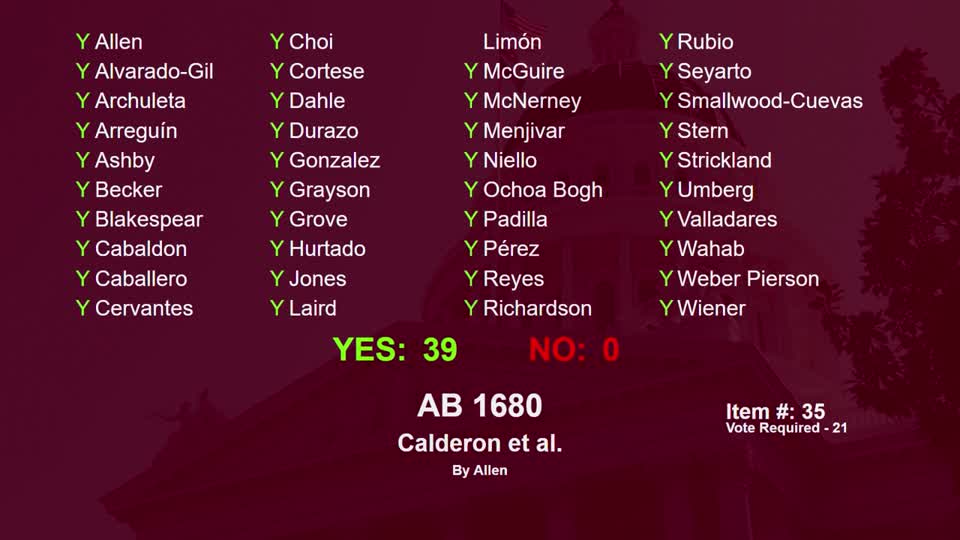 1MIN
Senate Floor
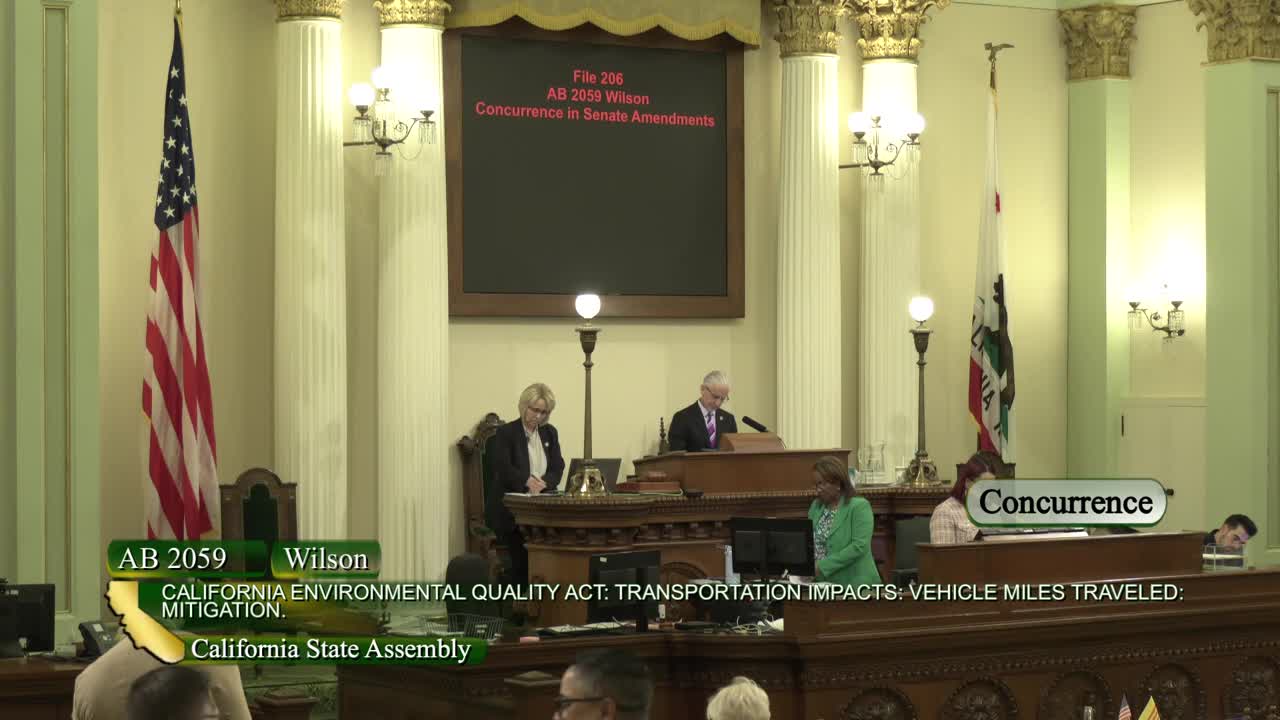 1MIN
Assembly Floor
 1MIN
Senate Standing Committee on Appropriations
 8MIN
Senate Standing Committee on Environmental Quality
 2MIN
Assembly Floor
 12MIN
Assembly Standing Committee on Natural Resources
Bill Author




