AB 2081: Medi-Cal: Home and Community-Based Alternatives Waiver.
- Session Year: 2025-2026
- House: Assembly
- Latest Version Date: 2026-09-02
Current Status:
Failed
(2026-09-18: Vetoed by Governor.)
Introduced
In Committee
Awaiting First Chamber Vote
Passed First Chamber
In Committee
Awaiting Second Chamber Vote
Passed Second Chamber
Enacted
Existing law establishes the Medi-Cal program, which is administered by the State Department of Health Care Services and under which qualified low-income individuals receive health care services. The Medi-Cal program is in part governed by, and funded pursuant to, federal Medicaid program provisions.
Under existing law, home- and community-based services (HCBS) approved by the United States Department of Health and Human Services are covered for eligible individuals to the extent that federal financial participation is available for those services under the state plan or waivers granted in accordance with certain federal provisions. Existing law authorizes the Director of Health Care Services to seek waivers for any or all approvable HCBS.
Existing law sets forth provisions for the implementation of the Nursing Facility/Acute Hospital Transition and Diversion Waiver, which is the predecessor of the Home and Community-Based Alternatives (HCBA) Waiver, for purposes of providing care management services to individuals who are at risk of nursing facility or institutional placement, subject to federal cost neutrality. Existing law authorizes the director to propose that the waiver provide for achievement of annual cost neutrality in the aggregate to allow enrollment and authorization of waiver services based on medical necessity, and to require care management contractors to enroll at least 60% of all total annual enrollments from certain health care settings or populations. Existing law additionally sets forth provisions authorizing the director to expand the number of waiver slots up to 5,000 additional slots.
This bill would recast the above-described waiver provisions to refer to the HCBA Waiver. The bill would authorize the director, beginning January 1, 2027, to semiannually evaluate the populations receiving the priority enrollment described above, and to designate additional populations to receive priority enrollment based on this evaluation, subject to applicable cost-neutrality requirements. The bill would delete the provision relating to the 5,000 slots. The bill would instead require the department, beginning in 2027, and for the HCBA Waiver period, to increase the total number of waiver slots by 5,000, in addition to any planned expansion of waiver slots federally approved as of January 1, 2026, as specified, consistent with the above-described requirements.
Existing law establishes the Medi-Cal program, which is administered by the State Department of Health Care Services and under which qualified low-income individuals receive health care services. The Medi-Cal program is in part governed by, and funded pursuant to, federal Medicaid program provisions.
Under existing law, home- and community-based services (HCBS) approved by the United States Department of Health and Human Services are covered for eligible individuals to the extent that federal financial participation is available for those services under the state plan or waivers granted in accordance with certain federal provisions. Existing law authorizes the Director of Health Care Services to seek waivers for any or all approvable HCBS.
Existing law sets forth provisions for the implementation of the Nursing Facility/Acute Hospital Transition and Diversion Waiver, which is the predecessor of the Home and Community-Based Alternatives (HCBA) Waiver, for purposes of providing care management services to individuals who are at risk of nursing facility or institutional placement, subject to federal cost neutrality. Existing law authorizes the director to propose that the waiver provide for achievement of annual cost neutrality in the aggregate to allow enrollment and authorization of waiver services based on medical necessity, and to require care management contractors to enroll at least 60% of all total annual enrollments from certain health care settings or populations. Existing law additionally sets forth provisions authorizing the director to expand the number of waiver slots up to 5,000 additional slots.
This bill would recast the above-described waiver provisions to refer to the HCBA Waiver and Waiver. The bill would authorize the director, beginning January 1, 2027, to semiannually evaluate the populations receiving the priority enrollment described above, and to designate additional populations to receive priority enrollment based on this evaluation, subject to applicable cost-neutrality requirements. The bill would delete the provision relating to the 5,000 slots. The bill would instead require the department, beginning in 2027, and for the HCBA Waiver period, to increase the total number of waiver slots by 10,000, 5,000, in addition to any planned expansion of waiver slots federally approved as of January 1, 2026, as specified. specified, consistent with the above-described requirements.
The bill would require the department, by March 1, 2027, to seek any necessary amendments to the HCBA Waiver to ensure that there is sufficient capacity to enroll all individuals who are eligible for, and express an interest in, participating in the HCBA Waiver who are currently on a waiting list. The bill would require the department to continue to monitor the capacity of the HCBA Waiver and to expand capacity, as specified.Existing law establishes the Medi-Cal program, which is administered by the State Department of Health Care Services and under which qualified low-income individuals receive health care services. The Medi-Cal program is in part governed by, and funded pursuant to, federal Medicaid program provisions.
Under existing law, home- and community-based services (HCBS) approved by the United States Department of Health and Human Services are covered for eligible individuals to the extent that federal financial participation is available for those services under the state plan or waivers granted in accordance with certain federal provisions. Existing law authorizes the Director of Health Care Services to seek waivers for any or all approvable HCBS.
Existing law sets forth provisions for the implementation of the Nursing Facility/Acute Hospital Transition and Diversion Waiver, which is the predecessor of the Home and Community-Based Alternatives (HCBA) Waiver, for purposes of providing care management services to individuals who are at risk of nursing facility or institutional placement. placement, subject to federal cost neutrality. Existing law sets forth provisions authorizing the director to expand the number of waiver slots up to 5,000 additional slots.
This bill would recast the above-described waiver provisions to refer to the HCBA Waiver and would delete the provision relating to the 5,000 slots. The bill would require the department, beginning in 2027, to ensure that the HCBA Waiver provides for an annual increase of not fewer than 10,000 waiver slots for each waiver year, and for the HCBA Waiver period, to increase the total number of waiver slots by 10,000, in addition to any planned expansion of waiver slots federally approved as of January 1, 2026, as specified.
The bill would require the department to prepare and submit an annual report to the Legislature that provides certain information about waiver slot numbers, waiting list numbers, demographics, and departmental efforts, as specified.The bill would require the department, by March 1, 2027, to seek any necessary amendments to the HCBA Waiver to ensure that there is sufficient capacity to enroll all individuals who are eligible for, and express an interest in, participating in the HCBA Waiver who are currently on a waiting list. The bill would require the department to continue to monitor the capacity of the HCBA Waiver and to expand capacity, as specified.
Existing law requires the department to implement the waiver only to the extent that it can demonstrate federal cost neutrality as required under the terms of the waiver, and only to the extent any necessary federal approvals are obtained and federal financial participation is available.This bill would recast those conditions, removing the federal cost neutrality criterion. The bill would authorize the department to seek amendments to the HCBA Waiver or take other actions as necessary to implement these provisions.Existing law establishes the Medi-Cal program, which is administered by the State Department of Health Care Services and under which qualified low-income individuals receive health care services. The Medi-Cal program is in part governed by, and funded pursuant to, federal Medicaid program provisions.
Under existing law, home- and community-based services (HCBS) approved by the United States Department of Health and Human Services are covered for eligible individuals to the extent that federal financial participation is available for those services under the state plan or waivers granted in accordance with certain federal provisions. Existing law authorizes the Director of Health Care Services to seek waivers for any or all approvable HCBS.
Existing law sets forth provisions for the implementation of the Nursing Facility/Acute Hospital Transition and Diversion Waiver, which is the predecessor of the Home and Community-Based Alternatives (HCBA) Waiver, for purposes of providing care management services to individuals who are at risk of nursing facility or institutional placement. Existing law sets forth provisions authorizing the director to expand the number of waiver slots up to 5,000 additional slots.
This bill would recast the above-described waiver provisions to refer to the HCBA Waiver and would delete the provision relating to the 5,000 slots. The bill would require the department, beginning in 2027, to ensure that the HCBA Waiver provides for an annual increase of not fewer than 10,000 waiver slots for each waiver year, as specified.
The bill would require the department to prepare and submit an annual report to the Legislature that provides certain information about waiver slot numbers, waiting list numbers, demographics, and departmental efforts, as specified.
The bill would require the department, by March 1, 2027, to seek any necessary amendments to the HCBA Waiver to ensure that there is sufficient capacity to enroll all individuals who are eligible for, and express an interest in, participating in the HCBA Waiver who are currently on a waiting list. The bill would require the department to continue to monitor the capacity of the HCBA Waiver and to expand capacity, as specified.
Existing law requires the department to implement the waiver only to the extent that it can demonstrate federal cost neutrality as required under the terms of the waiver, and only to the extent any necessary federal approvals are obtained and federal financial participation is available.
This bill would recast those conditions, removing the federal cost neutrality criterion. The bill would authorize the department to seek amendments to the HCBA Waiver or take other actions as necessary to implement these provisions.
(a)When administering the Home and Community-Based Alternatives (HCBA) Waiver, as authorized by subdivision (t) of Section 14132, the director may take the following actions, among others:
(1)Contract with one or more organizations, referred to as a care management contractor, qualified to provide or arrange for delivery of care management and waiver services, including, but not limited to, personal needs assessments, and arranging for services available through public and private agencies, including services available under the waiver, for the waiver participants and applicants. The contract with the care management contractor, the care management contract, may require the care management contractor or their subcontractor, or both, to do all of the following, among other things:
(A)Provide, arrange for, or subcontract with community-based providers for the provision of, waiver services to waiver participants.
(B)Recognize program and service linkages, coordinate service delivery mechanisms and promote prevention of avoidable institutional placement, emergency room visits or inpatient hospital stays, or both, and coordination between health, social, and long-term services and supports by person-centered care planning.
(C)Provide or arrange for, care management to each waiver participant to stabilize their health care, and provide access to home- and community-based services, including managing and anticipating episodes of medical crisis in which transitional care management is needed.
(D)Carry out the waivers person-centered model of care, pursuant to the requirements set forth in Sections 441.720, 441.725, and 441.540 of Title 42 of the Code of Federal Regulations.
(E)Submit all information and reports required by the department, including, but not limited to, annual financial statements in the timeframe specified by the department.
(F)Pay any providers of waiver services who are not directly employed by or contracted with the care management contractor no less than the rates specified in the waiver or the departments fee schedule, whichever is less, for the provider type.
(G)Bill the department, at the rate established by the state, for all services the care management contractor provides to waiver participants, directly or through a subcontractor or other direct service provider.
(H)Comply with the requirements of the waiver, including any other requirements established by the department regarding waiver operations, including, but not limited to, requirements regarding care coordination. These requirements may be set forth in the care management contract, care management manual, all-county letters, plan letters, plan or provider bulletins or policy letters, or similar instructions.
(2)Propose that the waiver provide for achievement of annual cost neutrality in the aggregate to allow enrollment and authorization of waiver services based on the medical necessity of the waiver services on a case-by-case basis.
(3)Require care management contractors to enroll at least 60 percent of all total annual enrollments from either of the following:
(A)Hospital, nursing facility, or other institutional settings assisting members with transitions back to the home or community, or both, setting.
(B)Individuals who had been continuously receiving in home care services, of the type offered under the waiver, under the Early and Periodic Screening, Diagnosis, and Treatment State Plan benefit, California Children Services or Pediatric Palliative Care programs for children, for at least the prior three months but have at the time of transition exceeded the age limit for that benefit.
(4)If the director determines that the care management contractor is not fiscally solvent, or is in danger of becoming fiscally insolvent, the director has the option to immediately terminate the contract with the care management contractor.
(5)Terminate or refuse to renew, in whole or in part, a care management contract when the director determines that the action is necessary to protect the health of the beneficiaries or funds appropriated to the Medi-Cal program.
(6)Beginning January 1, 2027, semiannually evaluate the populations described in paragraph (3) based on the net impact of enrollment in the HCBA Waiver on health care utilization costs in order to maintain the aggregate cost neutrality described in paragraph (2). Based on this evaluation, the department may designate additional populations under paragraph (3) for whom enrollment in the HCBA Waiver would be cost neutral in order to respond to changes in the needs of the eligible population and available health care services over time.
(b)Beginning in 2027, and for the HCBA Waiver period, the department shall increase the total number of HCBA Waiver slots by 5,000, in addition to any planned expansion of waiver slots federally approved as of January 1, 2026. This subdivision does not require the department to enroll individuals in all waiver slots described in this subdivision if doing so would be inconsistent with achieving the aggregate annual cost neutrality described in paragraph (2) of subdivision (a) or with the most recent evaluation conducted pursuant to paragraph (6) of subdivision (a).
(c)In order to achieve maximum cost savings, the Legislature hereby determines that an expedited contract process for contracts under this section is necessary. Therefore, contracts entered into or amended pursuant to this section shall be exempt from Chapter 6 (commencing with Section 14825) of Part 5.5 of Division 3 of Title 2 of the Government Code, Section 19130 of the Government Code, and Part 2 (commencing with Section 10100) of Division 2 of the Public Contract Code and shall be exempt from the review or approval of any division of the Department of General Services.
(d)(1)The department shall implement this section only to the extent that it can demonstrate federal cost neutrality as required under the terms of the HCBA Waiver, and only to the extent that any necessary federal approvals are obtained and federal financial participation is available.
(2)The department may seek amendments to the HCBA Waiver or take other actions as necessary to implement this section.
(3)Notwithstanding Chapter 3.5 (commencing with Section 11340) of Part 1 of Division 3 of Title 2 of the Government Code, the department may implement, interpret, or make specific this section, in whole or in part, by means of letters or other similar instructions, without taking regulatory action.
(a)When administering the Home and Community-Based Alternatives (HCBA) Waiver, as authorized by subdivision (t) of Section 14132, the director may take the following actions, among others:
(1)Contract with one or more organizations, referred to as a care management contractor, qualified to provide or arrange for delivery of care management and waiver services, including, but not limited to, personal needs assessments, and arranging for services available through public and private agencies, including services available under the waiver, for the waiver participants and applicants. The contract with the care management contractor, the care management contract, may require the care management contractor or their subcontractor, or both, to do all of the following, among other things:
(A)Provide, arrange for, or subcontract with community-based providers for the provision of, waiver services to waiver participants.
(B)Recognize program and service linkages, coordinate service delivery mechanisms and promote prevention of avoidable institutional placement, emergency room visits or inpatient hospital stays, or both, and coordination between health, social, and long-term services and supports by person-centered care planning.
(C)Provide or arrange for, care management to each waiver participant to stabilize their health care, and provide access to home- and community-based services, including managing and anticipating episodes of medical crisis in which transitional care management is needed.
(D)Carry out the waivers person-centered model of care, pursuant to the requirements set forth in Sections 441.720, 441.725, and 441.540 of Title 42 of the Code of Federal Regulations.
(E)Submit all information and reports required by the department, including, but not limited to, annual financial statements in the timeframe specified by the department.
(F)Pay any providers of waiver services who are not directly employed by or contracted with the care management contractor no less than the rates specified in the waiver or the departments fee schedule, whichever is less, for the provider type.
(G)Bill the department, at the rate established by the state, for all services the care management contractor provides to waiver participants, directly or through a subcontractor or other direct service provider.
(H)Comply with the requirements of the waiver, including any other requirements established by the department regarding waiver operations, including, but not limited to, requirements regarding care coordination. These requirements may be set forth in the care management contract, care management manual, all-county letters, plan letters, plan or provider bulletins or policy letters, or similar instructions.
(2)Propose that the waiver provide for achievement of annual cost neutrality in the aggregate to allow enrollment and authorization of waiver services based on the medical necessity of the waiver services on a case-by-case basis.
(3)Require care management contractors to enroll at least 60 percent of all total annual enrollments from either of the following:
(A)Hospital, nursing facility, or other institutional settings assisting members with transitions back to the home or community, or both, setting.
(B)Individuals who had been continuously receiving in home care services, of the type offered under the waiver, under the Early and Periodic Screening, Diagnosis, and Treatment State Plan benefit, California Children Services or Pediatric Palliative Care programs for children, for at least the prior three months but have at the time of transition exceeded the age limit for that benefit.
(4)If the director determines that the care management contractor is not fiscally solvent, or is in danger of becoming fiscally insolvent, the director has the option to immediately terminate the contract with the care management contractor.
(5)Terminate or refuse to renew, in whole or in part, a care management contract when the director determines that the action is necessary to protect the health of the beneficiaries or funds appropriated to the Medi-Cal program.
(6)Beginning January 1, 2027, semiannually evaluate the populations described in paragraph (3) based on the net impact of enrollment in the HCBA Waiver on health care utilization costs in order to maintain the aggregate cost neutrality described in paragraph (2). Based on this evaluation, the department may designate additional populations under paragraph (3) for whom enrollment in the HCBA Waiver would be cost neutral in order to respond to changes in the needs of the eligible population and available health care services over time.
(b)Beginning in 2027, and for the HCBA Waiver period, the department shall increase the total number of HCBA Waiver slots by 10,000, 5,000, in addition to any planned expansion of waiver slots federally approved as of January 1, 2026. Nothing in this subdivision is intended to alter or supersede existing federal requirements applicable to the HCBA Waiver, including requirements related to enrollment priorities for individuals transitioning from institutional settings or similar programs and for individuals under 21 years of age. The addition of new waiver slots pursuant to this subdivision shall be implemented in a manner consistent with those requirements. This subdivision does not require the department to enroll individuals in all waiver slots described in this subdivision if doing so would be inconsistent with achieving the aggregate annual cost neutrality described in paragraph (2) of subdivision (a) or with the most recent evaluation conducted pursuant to paragraph (6) of subdivision (a).
(c)(1)By March 1, 2027, the department shall seek any necessary amendments to the HCBA Waiver to ensure that there is sufficient capacity to enroll all individuals who are eligible for, and express an interest in, participating in the HCBA Waiver who are currently on a waiting list.(2)The department shall continue to monitor the capacity of the HCBA Waiver and shall expand capacity through any necessary HCBA Waiver amendments at least 180 calendar days prior to reaching capacity, based on enrollment trends, to ensure that no individual is placed on a waiting list for the HCBA Waiver.(d)(c)In order to achieve maximum cost savings, the Legislature hereby determines that an expedited contract process for contracts under this section is necessary. Therefore, contracts entered into or amended pursuant to this section shall be exempt from Chapter 6 (commencing with Section 14825) of Part 5.5 of Division 3 of Title 2 of the Government Code, Section 19130 of the Government Code, and Part 2 (commencing with Section 10100) of Division 2 of the Public Contract Code and shall be exempt from the review or approval of any division of the Department of General Services.
(e)(d)(1)The department shall implement this section only to the extent that it can demonstrate federal cost neutrality as required under the terms of the HCBA Waiver, and only to the extent that any necessary federal approvals are obtained and federal financial participation is available.
(2)The department may seek amendments to the HCBA Waiver or take other actions as necessary to implement this section.
(3)Notwithstanding Chapter 3.5 (commencing with Section 11340) of Part 1 of Division 3 of Title 2 of the Government Code, the department may implement, interpret, or make specific this section, in whole or in part, by means of letters or other similar instructions, without taking regulatory action.
(a)When administering the Home and Community-Based Alternatives (HCBA) Waiver, as authorized by subdivision (t) of Section 14132, the director may take the following actions, among others:
(1)Contract with one or more organizations, referred to as a care management contractor, qualified to provide or arrange for delivery of care management and waiver services, including, but not limited to, personal needs assessments, and arranging for services available through public and private agencies, including services available under the waiver, for the waiver participants and applicants. The contract with the care management contractor, the care management contract, may require the care management contractor or their subcontractor, or both, to do all of the following, among other things:
(A)Provide, arrange for, or subcontract with community-based providers for the provision of, waiver services to waiver participants.
(B)Recognize program and service linkages, coordinate service delivery mechanisms and promote prevention of avoidable institutional placement, emergency room visits or inpatient hospital stays, or both, and coordination between health, social, and long-term services and supports by person-centered care planning.
(C)Provide or arrange for, care management to each waiver participant to stabilize their health care, and provide access to home- and community-based services, including managing and anticipating episodes of medical crisis in which transitional care management is needed.
(D)Carry out the waivers person-centered model of care, pursuant to the requirements set forth in Sections 441.720, 441.725, and 441.540 of Title 42 of the Code of Federal Regulations.
(E)Submit all information and reports required by the department, including, but not limited to, annual financial statements in the timeframe specified by the department.
(F)Pay any providers of waiver services who are not directly employed by or contracted with the care management contractor no less than the rates specified in the waiver or the departments fee schedule, whichever is less, for the provider type.
(G)Bill the department, at the rate established by the state, for all services the care management contractor provides to waiver participants, directly or through a subcontractor or other direct service provider.
(H)Comply with the requirements of the waiver, including any other requirements established by the department regarding waiver operations, including, but not limited to, requirements regarding care coordination. These requirements may be set forth in the care management contract, care management manual, all-county letters, plan letters, plan or provider bulletins or policy letters, or similar instructions.
(2)Propose that the waiver provide for achievement of annual cost neutrality in the aggregate to allow enrollment and authorization of waiver services based on the medical necessity of the waiver services on a case-by-case basis.
(3)Require care management contractors to enroll at least 60 percent of all total annual enrollments from either of the following:
(A)Hospital, nursing facility, or other institutional settings assisting members with transitions back to the home or community, or both, setting.
(B)Individuals who had been continuously receiving in home care services, of the type offered under the waiver, under the Early and Periodic Screening, Diagnosis, and Treatment State Plan benefit, California Children Services or Pediatric Palliative Care programs for children, for at least the prior three months but have at the time of transition exceeded the age limit for that benefit.
(4)If the director determines that the care management contractor is not fiscally solvent, or is in danger of becoming fiscally insolvent, the director has the option to immediately terminate the contract with the care management contractor.
(5)Terminate or refuse to renew, in whole or in part, a care management contract when the director determines that the action is necessary to protect the health of the beneficiaries or funds appropriated to the Medi-Cal program.
(b)Beginning in 2027, and for the HCBA Waiver period, the department shall ensure that the HCBA Waiver, including any renewal or successor waiver, provides for an annual increase of not fewer than 10,000 waiver slots for each waiver year. increase the total number of HCBA Waiver slots by 10,000, in addition to any planned expansion of waiver slots federally approved as of January 1, 2026. Nothing in this subdivision is intended to alter or supersede existing federal requirements applicable to the HCBA Waiver, including requirements related to enrollment priorities for individuals transitioning from institutional settings or similar programs and for individuals under 21 years of age. The addition of new waiver slots pursuant to this subdivision shall be implemented in a manner consistent with those requirements.
(c)(1)The department shall prepare and submit an annual report to the Legislature, in accordance with Section 9795 of the Government Code, beginning on January 1, 2027, that provides all of the following information:(A)The total number of waiver slots available and filled for the preceding year.(B)The total number of individuals on the waiting list for waiver services, including a comparison to the preceding years waiting list numbers.(C)A demographic breakdown of individuals enrolled in the waiver during the preceding year, including, but not limited to, age, race, ethnicity, and primary language.(D)A summary of efforts undertaken by the department to reduce the waiting list and ensure that all available waiver slots are filled.(2)The department shall present the findings of this report annually to the appropriate policy and budget committees of the Legislature, beginning in 2027.(d)(c)(1)By March 1, 2027, the department shall seek any necessary amendments to the HCBA Waiver to ensure that there is sufficient capacity to enroll all individuals who are eligible for, and express an interest in, participating in the HCBA Waiver who are currently on a waiting list.
(2)The department shall continue to monitor the capacity of the HCBA Waiver and shall expand capacity through any necessary HCBA Waiver amendments at least 180 calendar days prior to reaching capacity, based on enrollment trends, to ensure that no individual is placed on a waiting list for the HCBA Waiver.
(e)(d)In order to achieve maximum cost savings, the Legislature hereby determines that an expedited contract process for contracts under this section is necessary. Therefore, contracts entered into or amended pursuant to this section shall be exempt from Chapter 6 (commencing with Section 14825) of Part 5.5 of Division 3 of Title 2 of the Government Code, Section 19130 of the Government Code, and Part 2 (commencing with Section 10100) of Division 2 of the Public Contract Code and shall be exempt from the review or approval of any division of the Department of General Services.
(f)(1)This section shall be implemented only to the extent that any necessary federal approvals have been obtained and that federal financial participation is available.(e)(1)The department shall implement this section only to the extent that it can demonstrate federal cost neutrality as required under the terms of the HCBA Waiver, and only to the extent that any necessary federal approvals are obtained and federal financial participation is available.
(2)The department may seek amendments to the HCBA Waiver or take other actions as necessary to implement this section.
(3)Notwithstanding Chapter 3.5 (commencing with Section 11340) of Part 1 of Division 3 of Title 2 of the Government Code, the department may implement, interpret, or make specific this section, in whole or in part, by means of letters or other similar instructions, without taking regulatory action.
REVISIONS: HeadingLine 2.(a)When renewing the Nursing Facility/Acute Hospital Transition and Diversion administering the Home and Community-Based Alternatives (HCBA) Waiver, as authorized by subdivision (t) of Section 14132, the director may take the following actions, among others:
(1)Contract with one or more organizations, referred to as a care management contractor, qualified to provide or arrange for delivery of care management and waiver services, including, but not limited to, personal needs assessments, and arranging for services available through public and private agencies, including services available under the waiver, for the waiver participants and applicants. The contract with the care management contractor, the care management contract, may require the care management contractor or their subcontractor, or both, to do all of the following, among other things:
(A)Provide, arrange for, or subcontract with community-based providers for the provision of, waiver services to waiver participants.
(B)Recognize program and service linkages, coordinate service delivery mechanisms and promote prevention of avoidable institutional placement, emergency room visits or inpatient hospital stays, or both, and coordination between health, social, and long-term services and supports by person-centered care planning.
(C)Provide or arrange for, care management to each waiver participant to stabilize their health care, and provide access to home- and community-based services, including managing and anticipating episodes of medical crisis in which transitional care management is needed.
(D)Carry out the waivers person-centered model of care, pursuant to the requirements set forth in Sections 441.720, 441.725, and 441.540 of Title 42 of the Code of Federal Regulations.
(E)Submit all information and reports required by the department, including, but not limited to, annual financial statements in the timeframe specified by the department.
(F)Pay any providers of waiver services who are not directly employed by or contracted with the care management contractor no less than the rates specified in the waiver or the departments fee schedule, whichever is less, for the provider type.
(G)Bill the department, at the rate established by the state, for all services the care management contractor provides to waiver participants, directly or through a subcontractor or other direct service provider.
(H)Comply with the requirements of the waiver, including any other requirements established by the department regarding waiver operations, including, but not limited to, requirements regarding care coordination. These requirements may be set forth in the care management contract, care management manual, all-county letters, plan letters, plan or provider bulletins or policy letters, or similar instructions.
(2)Propose that the waiver provide for achievement of annual cost neutrality in the aggregate to allow enrollment and authorization of waiver services based on the medical necessity of the waiver services on a case-by-case basis.
(3)Expand the number of waiver slots up to 5,000 additional slots, the director may seek federal approval to amend the waiver to add additional slots or make changes to the waiver model with approval from the Department of Finance.(4)(3)Require care management contractors to enroll at least 60 percent of all total annual enrollments from either of the following:
(A)Hospital, nursing facility, or other institutional settings assisting members with transitions back to the home or community, or both, setting.
(B)Individuals who had been continuously receiving in home care services, of the type offered under the waiver, under the Early and Periodic Screening, Diagnosis, and Treatment State Plan benefit, California Children Services or Pediatric Palliative Care programs for children, for at least the prior three months but have at the time of transition exceeded the age limit for that benefit.
(5)(4)If the director determines that the care management contractor is not fiscally solvent, or is in danger of becoming fiscally insolvent, the director has the option to immediately terminate the contract with the care management contractor.
(6)(5)Terminate or refuse to renew, in whole or in part, a care management contract when the director determines that the action is necessary to protect the health of the beneficiaries or funds appropriated to the Medi-Cal program.
(b)Notwithstanding Chapter 3.5 (commencing with Section 11340) of Part 1 of Division 3 of Title 2 of the Government Code, the department may implement, interpret, or make specific this section, in whole or in part, by means of all-county letters, plan letters, plan or provider bulletins, policy letters, or other similar instructions, without taking regulatory action.(b)Beginning in 2027, the department shall ensure that the HCBA Waiver, including any renewal or successor waiver, provides for an annual increase of not fewer than 10,000 waiver slots for each waiver year. Nothing in this subdivision is intended to alter or supersede existing federal requirements applicable to the HCBA Waiver, including requirements related to enrollment priorities for individuals transitioning from institutional settings or similar programs and for individuals under 21 years of age. The addition of new waiver slots pursuant to this subdivision shall be implemented in a manner consistent with those requirements.
(c)(1)The department shall prepare and submit an annual report to the Legislature, in accordance with Section 9795 of the Government Code, beginning on January 1, 2027, that provides all of the following information:
(A)The total number of waiver slots available and filled for the preceding year.
(B)The total number of individuals on the waiting list for waiver services, including a comparison to the preceding years waiting list numbers.
(C)A demographic breakdown of individuals enrolled in the waiver during the preceding year, including, but not limited to, age, race, ethnicity, and primary language.
(D)A summary of efforts undertaken by the department to reduce the waiting list and ensure that all available waiver slots are filled.
(2)The department shall present the findings of this report annually to the appropriate policy and budget committees of the Legislature, beginning in 2027.
(d)(1)By March 1, 2027, the department shall seek any necessary amendments to the HCBA Waiver to ensure that there is sufficient capacity to enroll all individuals who are eligible for, and express an interest in, participating in the HCBA Waiver who are currently on a waiting list.
(2)The department shall continue to monitor the capacity of the HCBA Waiver and shall expand capacity through any necessary HCBA Waiver amendments at least 180 calendar days prior to reaching capacity, based on enrollment trends, to ensure that no individual is placed on a waiting list for the HCBA Waiver.
(c)(e)In order to achieve maximum cost savings cost savings, the Legislature hereby determines that an expedited contract process for contracts under this section is necessary. Therefore, contracts entered into or amended pursuant to this section shall be exempt from Chapter 6 (commencing with Section 14825) of Part 5.5 of Division 3 of Title 2 of the Government Code, Section 19130 of the Government Code, and Part 2 (commencing with Section 10100) of Division 2 of the Public Contract Code and shall be exempt from the review or approval of any division of the Department of General Services.
(d)The department shall implement this section only to the extent it can demonstrate federal cost neutrality as required under the terms of the waiver, and only to the extent any necessary federal approvals are obtained and federal financial participation is available.(f)(1)This section shall be implemented only to the extent that any necessary federal approvals have been obtained and that federal financial participation is available.
(2)The department may seek amendments to the HCBA Waiver or take other actions as necessary to implement this section.
(3)Notwithstanding Chapter 3.5 (commencing with Section 11340) of Part 1 of Division 3 of Title 2 of the Government Code, the department may implement, interpret, or make specific this section, in whole or in part, by means of letters or other similar instructions, without taking regulatory action.
|
Date
|
Status
|
|---|---|
| Sep 18, 2026 | Vetoed by Governor. |
| Sep 8, 2026 | Enrolled and presented to the Governor at 3:30 p.m. |
| Aug 28, 2026 | Senate amendments concurred in. To Engrossing and Enrolling. (Ayes 77. Noes 0. Page 6805.). |
| Aug 28, 2026 | Senate amendments concurred in. To Engrossing and Enrolling. (Ayes 77. Noes 0.). |
| Aug 27, 2026 | In Assembly. Concurrence in Senate amendments pending. |
| Aug 27, 2026 | Read third time. Passed. Ordered to the Assembly. (Ayes 39. Noes 0. Page 5984.). |
| Aug 27, 2026 | Read third time. Passed. Ordered to the Assembly. (Ayes 39. Noes 0.). |
| Aug 25, 2026 | Ordered to special consent calendar. |
| Aug 17, 2026 | Read second time. Ordered to third reading. |
| Aug 13, 2026 | Read second time and amended. Ordered returned to second reading. |
| Aug 13, 2026 | From committee: Amend, and do pass as amended. (Ayes 7. Noes 0.) (August 13). |
| Jun 29, 2026 | In committee: Referred to APPR. suspense file. |
| Jun 18, 2026 | From committee: Do pass and re-refer to Com. on APPR. with recommendation: To Consent Calendar. (Ayes 11. Noes 0.) (June 17). Re-referred to Com. on APPR. |
| Jun 3, 2026 | Referred to Com. on HEALTH. |
| May 22, 2026 | In Senate. Read first time. To Com. on RLS. for assignment. |
| May 22, 2026 | Read third time. Passed. Ordered to the Senate. (Ayes 73. Noes 0. Page 5263.) |
| May 22, 2026 | Read third time. Passed. Ordered to the Senate. (Ayes 73. Noes 0.) |
| May 18, 2026 | Read second time. Ordered to third reading. |
| May 14, 2026 | Coauthors revised. |
| May 14, 2026 | From committee: Do pass. (Ayes 15. Noes 0.) (May 14). |
| Apr 8, 2026 | In committee: Set, first hearing. Referred to APPR. suspense file. |
| Apr 6, 2026 | Re-referred to Com. on APPR. |
| Mar 26, 2026 | Read second time and amended. |
| Mar 25, 2026 | From committee: Amend, and do pass as amended and re-refer to Com. on APPR. with recommendation: To Consent Calendar. (Ayes 16. Noes 0.) (March 24). |
| Mar 2, 2026 | Referred to Com. on HEALTH. |
| Feb 19, 2026 | From printer. May be heard in committee March 21. |
| Feb 18, 2026 | Read first time. To print. |
|
Date
|
Description
|
Location
|
Votes
|
|
|---|---|---|---|---|
| Aug 28, 2026 | AB 2081 Stefani Concurrence in Senate Amendments | Assembly Floor |
Passed |
|
| Aug 27, 2026 | Special Consent AB2081 Stefani et al. | Senate Floor |
Passed |
|
| Aug 13, 2026 | Do pass as amended | Senate Standing Committee on Appropriations |
Passed |
|
| Jun 29, 2026 | Placed on suspense file | Senate Standing Committee on Appropriations |
Passed |
|
| Jun 17, 2026 | Do pass, but first be re-referred to the Committee on [Appropriations] with the recommendation: To Consent Calendar | Senate Standing Committee on Health |
Passed |
|
| May 22, 2026 | AB 2081 Stefani Assembly Third Reading | Assembly Floor |
Passed |
|
| May 14, 2026 | Do pass. | Assembly Standing Committee on Appropriations |
Passed |
|
| Mar 24, 2026 | Do pass as amended, and be re-referred to the Committee on [Appropriations] with recommendation: To Consent Calendar | Assembly Standing Committee on Health |
Passed |
This list shows positions taken on this bill by organizations on the date displayed, which is linked to the original source.
Positions by individuals are not included.
|
Organization
|
Position
|
Date
|
|---|---|---|
| Abode Services | ** Support | |
| Alameda Alliance For Health | ** Support | |
| Alzheimer's Association | ** Support | |
| alzheimer's greater los angeles | ** Support | |
| alzheimer's orange county | ** Support | |
| Alzheimer'S San Diego | ** Support | |
| California Advocates for Nursing Home Reform | ** Support | |
| California Association For Health Services At Home | ** Support | |
| California Association Of Area Agencies On Aging | ** Support | |
| California Association Of Health Facilities | ** Support | |
| California Association Of Medical Product Suppliers | ** Support | |
| California Children'S Hospital Association | ** Support | |
| California Coalition on Family Caregiving | ** Support | |
| California Collaborative for Long-Term Services and Supports | ** Support | |
| California Commission on Aging | ** Support | |
| California Foundation For Independent Living Centers | ** Support | |
| California Long Term Care Ombudsman Association | ** Support | |
| California PACE Association | ** Support | |
| California State Council on Developmental Disabilities | ** Support | |
| Cardea Health | ** Support | |
| Caring Across Generations | ** Support | |
| Children'S Specialty Care Coalition | ** Support | |
| Choice in Aging | ** Support | |
| City and County of San Francisco | ** Support | |
| Corporation For Supportive Housing | ** Support | |
| County Of Alameda | ** Support | |
| County of San Mateo | ** Support | |
| Disability Rights California | ** Support | |
| East Bay Innovations | ** Support | |
| Episcopal Community Services of San Francisco | ** Support | |
| Fathers and Mothers Who Care | ** Support | |
| Glide | ** Support | |
| Home Health Care Management, Inc. | ** Support | |
| Justice in Aging | ** Support | |
| LeadingAge California | ** Support | |
| Libertana Home Health | ** Support | |
| Nonprofit Alliance of Homelessness and Housing Providers of Alameda County | ** Support | |
| Tenderloin Neighborhood Development Corporation | ** Support | |
| The Arc and United Cerebral Palsy California Collaboration | ** Support | |
| Valon Consulting | ** Support | |
| western center on law & poverty | ** Support |
GOVERNOR'S VETO
GV Bill Id:AB 2081
Author:(Stefani)
As Enrolled Ver:September 2, 2026
2/3 vote
SUMMARY
Requires the Department of Health Care Services (DHCS) to expand capacity in the Medi-Cal Home and Community-Based Alternatives (HCBA) Waiver and seek necessary federal approvals to do so.
Senate Amendments
- Delete provisions requiring DHCS to:
- Seek any necessary amendments to the HCBA waiver to ensure sufficient capacity for all individuals who are eligible for and interested in enrolling in the waiver.
- Monitor the capacity of the HCBA Waiver and expand capacity through any necessary HCBA Waiver amendments at least 180 calendar days prior to reaching capacity, based on enrollment trends, to ensure that no individual is placed on a waiting list for the HCBA Waiver.
- Reduces the number of slots by which DHCS is required to increase the waiver from 10,000 to 5,000.
- Allows DHCS to designate additional populations for whom enrollment in the HCBA Waiver would be cost neutral.
Governor's Veto Message
While I appreciate the author's intent to expand access to home and community-based services for Medi-Cal beneficiaries who are at risk of institutionalization, this bill would significantly and immediately increase program costs by hundreds of millions of dollars. Fortunately, the 2026 Budget Act includes $3 million to enable DHCS to clear the HCBA waiver waitlist and serve all eligible individuals seeking enrollment in the HCBA waiver program. Any additional expansions to this program, given the significant cost, must be considered in the annual state budget process.
In partnership with the Legislature this year, my administration has enacted a balanced budget that recognizes the challenging fiscal landscape our state faces while maintaining our commitment to working families and our most vulnerable communities. With significant fiscal pressures and the federal government's hostile economic policies, it is vital that we remain disciplined when considering bills with significant fiscal implications that are not included in the budget, such as this measure.
COMMENTS
Home and Community-Based Services (HCBS) Medicaid Waivers. Medicaid waivers are waivers of federal law that allow state Medicaid programs (Medi-Cal in California) the flexibility to provide additional services, limit services to specific geographic areas, or expand coverage. HCBS waivers are a subset of Medicaid waivers that help people live in their own homes or in home-like settings in the community, rather than in institutional settings.
HCBA Waiver. The HCBA Waiver is one of the HCBS waivers administered by DHCS. It provides children, adults, and seniors with disabilities who qualify for an institutional level of care to instead receive these services in the community. Specifically, the HCBA Waiver serves Medi-Cal members who would, in the absence of the waiver, otherwise require care in an acute hospital, subacute facility, nursing facility (including a skilled nursing facility (SNF)), or an intermediate care facility.
The HCBA Waiver is the service delivery model in Medi-Cal that allows these high-acuity services to be provided outside of an institution. A renewal of the waiver was most recently approved by the federal Centers for Medicare and Medicaid Services (CMS) on February 16, 2024, effective starting March 1, 2024, for a 5-year term.
Waiver Capacity. One component of this bill would require DHCS to expand the capacity of the waiver to serve the current waiting list and the projected demand.
- Enrollment Caps. The HCBA Waiver is federally approved to serve no more than a specific number of individuals. Although enrollment in the HCBA Waiver saves money and is life-changing for those with complex medical conditions, over 6,000 people are currently on the waitlist to enroll. Some of these people are in institutions when they could be receiving services at home through the HCBA Waiver at lower state cost. Anecdotally, waiver services providers report some individuals on the waitlist never get to enroll even when a slot opens up, because by the time a slot is available the individual has become too frail and sick to receive services at home. The HCBA Waiver waitlist has grown substantially over the last three years. In January 2023, there were 281 individuals on the wait list, compared to 6,091 in December 2025.
Concerns about waiver capacity are reflected in a February 2025 report commissioned by DHCS as part of the California Statewide HCBS Gap Analysis and Multi-year Roadmap According to the report, most of the qualitative interviewees pointed to gaps in accessing the HCBA Waiver because of the limited number of slots and long waiting times. The report notes that despite DHCS regularly increasing the number of slots for the HCBA Waiver since 2017, demand for the service continues to be higher than available slots, and there is a consistent statewide waitlist for waiver enrollment.
Although DHCS has federal approval to increase the number of waiver slots by 1,800 per year through 2028, this expansion of slots has not addressed the significant waitlist.
- Impact of Enrollment Caps. Although the HCBA Waiver serves only a small number of people in the context of the Medi-Cal program, these individuals have highly complex medical conditions and many can only receive the level of services they need in a home-based setting if they are able to enroll in the waiver. However, these same services are covered with no cap on enrollment, if provided in an institution. For instance, an adult who depends on a ventilator to breathe and who needs continuous nursing care could receive these services in a costlier institutional setting like hospital or SNF, but they can only receive similar services at home if they are able to enroll in the HCBA Waiver.
In addition to the impact on individual applicants who face a years-long waiting list for waiver services, waiver agencies have indicated the inability to serve new enrollment poses a threat to financial sustainability for their programs, as they may be unable to enroll new people in their programs as others leave. Limitations on enrollment also pose challenges for potential waiver agencies to open new programs or expand capacity of their existing programs.
Impact of HCBA Waiver Enrollment on Medi-Cal Program Costs. Because individuals who meet medical eligibility criteria for the HCBA Waiver are likely receiving high-acuity medical services regardless of whether they are enrolled in the waiver, and because waiver services are an alternative to facility-based services, increasing enrollment in the HCBA Waiver can be cost-saving to the Medi-Cal program overall.
When DHCS proposed to increase HCBA Waiver slots in 2024-25, DHCS's 2024-25 Budget Highlights estimated $12.9 million in savings in that year associated with the increase in waiver slots. According to DHCS's November 2025 Local Assistance Estimate, enrolling more people into the HCBA Waiver has quantified, multimillion-dollar Budget Year and ongoing cost savings because of reduced costs for institutional care. The Estimate cites an annual cost of $23,980 for waiver services versus over $100,000 annually for SNF services, leading to cost savings for each person transitioning from skilled nursing facility to waiver services.
According to the Author
Medi-Cal's HCBA Waiver helps medically vulnerable Californians receive high quality care in their own homes and communities instead of being forced into institutional settings. It supports people with serious medical needs so they can remain with their families while receiving the care they need, while generating annual cost savings. Yet enrollment caps have limited its impact and left vulnerable Californians stuck on a waiting list without access to these critical services. Expanding the HCBA Waiver program will ensure Medi-Cal recipients, including people with significant health needs who are experiencing homelessness, can access the care they need, live with dignity, and remain in their communities.
Arguments in Support
A number of community-based organizations; consumer, disability, and legal advocates; providers; and individuals write in support of this bill. Supporters note that the HCBA waiver is a lifeline for the most medically vulnerable individuals and that waiver capacity is an equity issue, with underserved communities of color being most impacted by a lack of capacity. Supporters also point out the significant cost savings from serving people at home instead of in institutions. Finally, supporters note the right to services that enable seniors and people with disabilities to lead full lives, on an equal basis with those living without disabilities, is recognized by the Supreme Court's decision, Olmstead v. L.C., 527 U.S. 581 (1999), as well as California law. Cardea Health, a waiver agency and co-sponsor of this bill, has received startup funding from Alameda and San Francisco Counties to partner with housing programs to arrange health care services to medically frail individuals experiencing homelessness and are Medi-Cal enrollees. Without the capacity to enroll additional individuals in the HCBA Waiver, Cardea may not be able to financially sustain the services that allow these individuals to stay safely housed. Cardea's data indicates their innovative approach leads to almost 100% housing retention and an 80% reduction in utilization of some of the most expensive forms of healthcare delivery—emergency department visits, inpatient stays, and skilled nursing facility admissions—saving an average of over $88,000 annually per beneficiary.
Arguments in Opposition
None on file.
FISCAL COMMENTS
According to the Senate Appropriations Committee, unknown ongoing costs, potentially hundreds of thousands, for DHCS for state administration (General Fund and federal funds).
VOTES
ASM HEALTH: 16-0-0
YES: Bonta, Chen, Addis, Aguiar-Curry, Pacheco, Caloza, Carrillo, Mark González, Johnson, Patel, Patterson, Rogers, Sanchez, Schiavo, Sharp-Collins, Stefani
ASM APPROPRIATIONS: 15-0-0
YES: Wicks, Hoover, Aguiar-Curry, Calderon, Caloza, Dixon, Fong, Mark González, Krell, Pacheco, Pellerin, Sharp-Collins, Solache, Ta, Tangipa
ASSEMBLY FLOOR: 73-0-7
YES: Addis, Aguiar-Curry, Ahrens, Alanis, Alvarez, Ávila Farías, Bains, Bennett, Berman, Boerner, Bonta, Bryan, Calderon, Caloza, Carrillo, Castillo, Connolly, Davies, DeMaio, Dixon, Elhawary, Ellis, Flora, Fong, Gallagher, Garcia, Gipson, Jeff Gonzalez, Mark González, Hadwick, Haney, Harabedian, Hart, Hoover, Irwin, Jackson, Johnson, Kalra, Krell, Lackey, Lee, Lowenthal, Macedo, McKinnor, Muratsuchi, Nguyen, Ortega, Pacheco, Papan, Patel, Patterson, Pellerin, Petrie-Norris, Quirk-Silva, Ramos, Ransom, Michelle Rodriguez, Rogers, Blanca Rubio, Sanchez, Schiavo, Schultz, Sharp-Collins, Solache, Soria, Stefani, Tangipa, Valencia, Wallis, Ward, Wilson, Zbur, Rivas
ABS, ABST OR NV: Arambula, Bauer-Kahan, Chen, Gabriel, Celeste Rodriguez, Ta, Wicks
SENATE FLOOR: 40-0-0
YES: Allen, Alvarado-Gil, Archuleta, Arreguín, Ashby, Becker, Blakespear, Cabaldon, Caballero, Cervantes, Choi, Cortese, Dahle, Durazo, Gonzalez, Grayson, Grove, Hurtado, Jones, Laird, Limón, McGuire, McNerney, Menjivar, Niello, Ochoa Bogh, Padilla, Pérez, Reyes, Richardson, Rubio, Seyarto, Smallwood-Cuevas, Stern, Strickland, Umberg, Valladares, Wahab, Weber Pierson, Wiener
ASSEMBLY FLOOR: 77-0-2
YES: Addis, Aguiar-Curry, Ahrens, Alanis, Alvarez, Arambula, Ávila Farías, Bains, Bauer-Kahan, Bennett, Berman, Boerner, Bonta, Bryan, Calderon, Caloza, Carrillo, Castillo, Chen, Connolly, Davies, DeMaio, Dixon, Elhawary, Ellis, Flora, Fong, Gabriel, Garcia, Gipson, Jeff Gonzalez, Mark González, Hadwick, Haney, Harabedian, Hart, Hoover, Irwin, Jackson, Johnson, Kalra, Krell, Lackey, Lee, Lowenthal, Macedo, Muratsuchi, Nguyen, Ortega, Pacheco, Papan, Patel, Patterson, Pellerin, Petrie-Norris, Ramos, Ransom, Celeste Rodriguez, Michelle Rodriguez, Rogers, Blanca Rubio, Sanchez, Schiavo, Schultz, Sharp-Collins, Solache, Soria, Stefani, Ta, Tangipa, Valencia, Wallis, Ward, Wicks, Wilson, Zbur, Rivas
ABS, ABST OR NV: McKinnor, Quirk-Silva
UPDATED
VERSION: September 2, 2026
CONSULTANT: Lisa Murawski / HEALTH / (916) 319-2097 FN: 0004602
CONCURRENCE IN SENATE AMENDMENTS
CSA1 Bill Id:AB 2081
Author:(Stefani)
As Amended Ver:August 13, 2026
Majority vote
SUMMARY
Requires the Department of Health Care Services (DHCS) to expand capacity in the Medi-Cal Home and Community-Based Alternatives (HCBA) Waiver and seek necessary federal approvals to do so.
Senate Amendments
- Delete provisions requiring DHCS to:
- Seek any necessary amendments to the HCBA waiver to ensure sufficient capacity for all individuals who are eligible for and interested in enrolling in the waiver.
- Monitor the capacity of the HCBA Waiver and shall expand capacity through any necessary HCBA Waiver amendments at least 180 calendar days prior to reaching capacity, based on enrollment trends, to ensure that no individual is placed on a waiting list for the HCBA Waiver.
- Reduces the number of slots by which DHCS is required to increase the waiver from 10,000 to 5,000.
- Allows DHCS to designate additional populations for whom enrollment in the HCBA Waiver would be cost neutral.
COMMENTS
Home and Community-Based Services (HCBS) Medicaid Waivers. Medicaid waivers are waivers of federal law that allow state Medicaid programs (Medi-Cal in California) the flexibility to provide additional services, limit services to specific geographic areas, or expand coverage. HCBS waivers are a subset of Medicaid waivers that help people live in their own homes or in home-like settings in the community, rather than in institutional settings.
HCBA Waiver. The HCBA Waiver is one of the HCBS waivers administered by DHCS. It provides children, adults, and seniors with disabilities who qualify for an institutional level of care to instead receive these services in the community. Specifically, the HCBA Waiver serves Medi-Cal members who would, in the absence of the waiver, otherwise require care in an acute hospital, subacute facility, nursing facility (including a skilled nursing facility (SNF)), or an intermediate care facility.
The HCBA Waiver is the service delivery model in Medi-Cal that allows these high-acuity services to be provided outside of an institution. A renewal of the waiver was most recently approved by the federal Centers for Medicare and Medicaid Services (CMS) on February 16, 2024, effective starting March 1, 2024, for a 5-year term.
Waiver Capacity. One component of this bill would require DHCS to expand the capacity of the waiver to serve the current waiting list and the projected demand.
- Enrollment Caps. The HCBA Waiver is federally approved to serve no more than a specific number of individuals. Although enrollment in the HCBA Waiver saves money and is life-changing for those with complex medical conditions, over 6,000 people are currently on the waitlist to enroll. Some of these people are in institutions when they could be receiving services at home through the HCBA Waiver at lower state cost. Anecdotally, waiver services providers report some individuals on the waitlist never get to enroll even when a slot opens up, because by the time a slot is available the individual has become too frail and sick to receive services at home. The HCBA Waiver waitlist has grown substantially over the last three years. In January 2023, there were 281 individuals on the wait list, compared to 6,091 in December 2025.
Concerns about waiver capacity are reflected in a February 2025 report commissioned by DHCS as part of the California Statewide HCBS Gap Analysis and Multi-year Roadmap According to the report, most of the qualitative interviewees pointed to gaps in accessing the HCBA Waiver because of the limited number of slots and long waiting times. The report notes that despite DHCS regularly increasing the number of slots for the HCBA Waiver since 2017, demand for the service continues to be higher than available slots, and there is a consistent statewide waitlist for waiver enrollment.
Although DHCS has federal approval to increase the number of waiver slots by 1,800 per year through 2028, this expansion of slots has not addressed the significant waitlist.
- Impact of Enrollment Caps. Although the HCBA Waiver serves only a small number of people in the context of the Medi-Cal program, these individuals have highly complex medical conditions and many can only receive the level of services they need in a home-based setting if they are able to enroll in the waiver. However, these same services are covered with no cap on enrollment, if provided in an institution. For instance, an adult who depends on a ventilator to breathe and who needs continuous nursing care could receive these services in a costlier institutional setting like hospital or SNF, but they can only receive similar services at home if they are able to enroll in the HCBA Waiver.
In addition to the impact on individual applicants who face a years-long waiting list for waiver services, waiver agencies have indicated the inability to serve new enrollment poses a threat to financial sustainability for their programs, as they may be unable to enroll new people in their programs as others leave. Limitations on enrollment also pose challenges for potential waiver agencies to open new programs or expand capacity of their existing programs.
Impact of HCBA Waiver Enrollment on Medi-Cal Program Costs. Because individuals who meet medical eligibility criteria for the HCBA Waiver are likely receiving high-acuity medical services regardless of whether they are enrolled in the waiver, and because waiver services are an alternative to facility-based services, increasing enrollment in the HCBA Waiver can be cost-saving to the Medi-Cal program overall.
When DHCS proposed to increase HCBA Waiver slots in 2024-25, DHCS's 2024-25 Budget Highlights estimated $12.9 million in savings in that year associated with the increase in waiver slots. According to DHCS's November 2025 Local Assistance Estimate, enrolling more people into the HCBA Waiver has quantified, multimillion-dollar Budget Year and ongoing cost savings because of reduced costs for institutional care. The Estimate cites an annual cost of $23,980 for waiver services versus over $100,000 annually for SNF services, leading to cost savings for each person transitioning from skilled nursing facility to waiver services.
According to the Author
Medi-Cal's HCBA Waiver helps medically vulnerable Californians receive high quality care in their own homes and communities instead of being forced into institutional settings. It supports people with serious medical needs so they can remain with their families while receiving the care they need, while generating annual cost savings. Yet enrollment caps have limited its impact and left vulnerable Californians stuck on a waiting list without access to these critical services. Expanding the HCBA Waiver program will ensure Medi-Cal recipients, including people with significant health needs who are experiencing homelessness, can access the care they need, live with dignity, and remain in their communities.
Arguments in Support
A number of community-based organizations; consumer, disability, and legal advocates; providers; and individuals write in support of this bill. Supporters note that the HCBA waiver is a lifeline for the most medically vulnerable individuals and that waiver capacity is an equity issue, with underserved communities of color being most impacted by a lack of capacity. Supporters also point out the significant cost savings from serving people at home instead of in institutions. Finally, supporters note the right to services that enable seniors and people with disabilities to lead full lives, on an equal basis with those living without disabilities, is recognized by the Supreme Court's decision, Olmstead v. L.C., 527 U.S. 581 (1999), as well as California law. Cardea Health, a waiver agency and co-sponsor of this bill, has received startup funding from Alameda and San Francisco Counties to partner with housing programs to arrange health care services to medically frail individuals experiencing homelessness and are Medi-Cal enrollees. Without the capacity to enroll additional individuals in the HCBA Waiver, Cardea may not be able to financially sustain the services that allow these individuals to stay safely housed. Cardea's data indicates their innovative approach leads to almost 100% housing retention and an 80% reduction in utilization of some of the most expensive forms of healthcare delivery—emergency department visits, inpatient stays, and skilled nursing facility admissions—saving an average of over $88,000 annually per beneficiary.
Arguments in Opposition
None on file.
FISCAL COMMENTS
According to the Senate Appropriations Committee, unknown ongoing costs, potentially hundreds of thousands, for DHCS for state administration (General Fund and federal funds).
VOTES:
ASM HEALTH: 16-0-0
YES: Bonta, Chen, Addis, Aguiar-Curry, Pacheco, Caloza, Carrillo, Mark González, Johnson, Patel, Patterson, Rogers, Sanchez, Schiavo, Sharp-Collins, Stefani
ASM APPROPRIATIONS: 15-0-0
YES: Wicks, Hoover, Aguiar-Curry, Calderon, Caloza, Dixon, Fong, Mark González, Krell, Pacheco, Pellerin, Sharp-Collins, Solache, Ta, Tangipa
ASSEMBLY FLOOR: 73-0-7
YES: Addis, Aguiar-Curry, Ahrens, Alanis, Alvarez, Ávila Farías, Bains, Bennett, Berman, Boerner, Bonta, Bryan, Calderon, Caloza, Carrillo, Castillo, Connolly, Davies, DeMaio, Dixon, Elhawary, Ellis, Flora, Fong, Gallagher, Garcia, Gipson, Jeff Gonzalez, Mark González, Hadwick, Haney, Harabedian, Hart, Hoover, Irwin, Jackson, Johnson, Kalra, Krell, Lackey, Lee, Lowenthal, Macedo, McKinnor, Muratsuchi, Nguyen, Ortega, Pacheco, Papan, Patel, Patterson, Pellerin, Petrie-Norris, Quirk-Silva, Ramos, Ransom, Michelle Rodriguez, Rogers, Blanca Rubio, Sanchez, Schiavo, Schultz, Sharp-Collins, Solache, Soria, Stefani, Tangipa, Valencia, Wallis, Ward, Wilson, Zbur, Rivas
ABS, ABST OR NV: Arambula, Bauer-Kahan, Chen, Gabriel, Celeste Rodriguez, Ta, Wicks
UPDATED
VERSION: August 13, 2026
CONSULTANT: Lisa Murawski / HEALTH / (916) 319-2097 FN: 0004138
SENATE RULES COMMITTEE Office of Senate Floor Analyses (916) 651-4171 | AB 2081 |
THIRD READING
Bill No: AB 2081
Author: Stefani (D), et al.
Amended: 8/13/26 in Senate
Vote: 21
SENATE HEALTH COMMITTEE: 11-0, 6/17/26
AYES: Weber Pierson, Valladares, Caballero, Durazo, Gonzalez, Grove, Menjivar, Padilla, Pérez, Rubio, Smallwood-Cuevas
SENATE APPROPRIATIONS COMMITTEE: 7-0, 8/13/26
AYES: Cervantes, Seyarto, Cabaldon, Dahle, Grayson, Richardson, Wahab
ASSEMBLY FLOOR: 73-0, 5/22/26 - See last page for vote
SUBJECT: Medi-Cal: Home and Community-Based Alternatives Waiver
SOURCE: Cardea Health
DIGEST:
This bill requires the Department of Health Care Services (DHCS) to expand the number of Home and Community-Based Alternative waiver slots by 5,000, subject to federal approval, and authorizes DHCS to evaluate and designate additional populations receiving priority enrollment, subject to federal cost-neutrality requirements.
ANALYSIS:
Existing law:
- Permits, under federal law, a state Medicaid program to pay for part or all of the cost of home and community-based services (HCBS) that are federally approved, and which are provided pursuant to a written plan of care to individuals with respect to whom there has been a determination that but for the provision of such services the individual would require the level of care provided in a hospital, nursing facility, or intermediate care facility for the developmentally disabled, the cost of which could be otherwise be reimbursed by the state’s Medicaid program. [42 USC §1396n]
- Establishes the Medi-Cal program, administered by the DHCS, which provides medical coverage to low income persons. [Welfare and Institutions Code (WIC) §14000, et seq.]
- Establishes a schedule of benefits under the Medi-Cal program, which includes benefits required under federal law and benefits provided at the state’s option, both of which are funded with federal and state dollars. The schedule of benefits includes HCBS approved by the U.S. Department of Health and Human Services to the extent that federal financial participation is available for those services under the state plan or an applicable federal waiver. [WIC §14132]
- Requires DHCS to seek all necessary waivers in order to provide for HCBS services approvable under federal law and limits coverage of HCBS services to the terms, conditions, and duration of the federal waiver. [WIC §14132 and §14137]
- Establishes authority and requirements for the Nursing Facility/Acute Hospital Transition and Diversion waiver (the predecessor to the Home and Community-Based Alternative (HCBA) waiver) to provide care management and access to home- and community-based services, for persons requiring hospital, nursing facility, or other institutional care that would otherwise be covered by Medi-Cal who can be treated safely at home, or for individuals who have been continuously receiving in home care services under the Early and Periodic Screening, Diagnosis, and Treatment State Plan benefit, California Children Services or Pediatric Palliative Care programs for children, for at least the prior three months but have at the time of transition exceeded the age limit for that benefit. [WIC §14132.991]
- Requires DHCS to propose that the waiver program meet federal annual cost neutrality requirements in the aggregate.
This bill:
- Requires DHCS to increase the total number of HCBA waiver slots by 5,000, in addition to any planned expansion of waiver slots federally approved as of January 1, 2026, beginning in 2027.
- Authorizes DHCS to evaluate the populations described in 5) above in order to maintain the aggregate the cost neutrality; and, based on this evaluation, designate additional populations within those described populations for whom enrollment in HCBA would be cost neutral.
- Specifies that the requirement to increase HCBA waiver slots does not require DHCS to enroll individuals in all waiver slots if doing so would be inconsistent with achieving aggregate annual cost neutrality or the most recent evaluation conducted pursuant to 2) above.
- Authorizes DHCS to seek any amendments to the HCBA waiver or other actions as necessary to implement this bill, including issuing guidance in lieu of regulations.
- Updates the name of the Nursing Facility/Acute Hospital Transition and Diversion waiver to the currently used HCBA waiver.
Background
According to the author of this bill:
Medi-Cal’s HCBA program helps medically vulnerable Californians receive high quality care in their own homes and communities instead of being forced into institutional settings. It supports people with serious medical needs, including adults living with disabilities, medically fragile children, seniors with chronic needs, and others with complex health conditions, so they can remain with their families while receiving the care they need. The program improves quality of life and saves the state money, generating about $110 million in annual cost savings. Yet enrollment caps have limited its impact and left more than 5,600 vulnerable Californians stuck on a waiting list without access to these critical services. Expanding the HCBA waiver program will ensure Medi-Cal recipients, including people with significant health needs who are experiencing homelessness, can access the care they need, live with dignity, and remain in their communities. California should not be forcing medically vulnerable people into institutions when safe, cost-effective care at home is within reach.
Medi-Cal HCBS waivers. HCBS waivers allow states that participate in Medicaid to develop alternatives for individuals who would otherwise require care in an institutional setting. The Medi-Cal program has an agreement with the federal government, which allows for waiver services to be offered in either a home or community setting. The services offered under the waiver must cost no more than the alternative institutional level of care. The services available under HCBS waivers include case management, community transition services, private duty nursing, family training, home health aides, life-sustaining utility reimbursement, habilitation services, respite care, and other services required to maintain the health and safety of eligible participants in the community setting of their choice.
HCBA waiver program. The HCBA waiver is one of several HCBS waiver programs in California. It provides care management services to persons of any age who are medically fragile or technologically dependent. The care management services are provided by a multidisciplinary Care Management Team comprised of a nurse and social worker. The Care Management Team coordinates waiver and state plan services (those services available to all Medi-Cal recipients, such as medical, behavioral health, In-Home Supportive Services, etc.), and arranges for other long-term services and supports available in the local community. Care management and waiver services are provided in the participant's community-based residence. This residence can be privately owned, secured through a tenant lease arrangement, or the residence of a participant's family member.
The HCBA waiver program is approved by the federal Centers for Medicare and Medicaid Services (CMS) in five-year increments, and was most recently approved on February 2, 2023 for the 2023-2027 period. There is an enrollment cap, and the program reached maximum capacity. A waiting list was implemented on July 12, 2023. New applicants can apply and secure a placement on a waiting list with the assigned Waiver Agency in their area of residence. When slots are available, applicants will be prioritized based on Reserve Capacity criteria that includes applicants transitioning from other HCBS programs because their needs can no longer be met, applicants under 21, or applicants who have been residing in a health care facility (such as a nursing home) for at least 60 days. Adult applicants currently receiving care at home with institutional-level needs are the lowest priority.
The HCBA waitlist is currently over 6,000 individuals. According to the DHCS May 2026 Medi-Cal Local Assistance Estimate (Medi-Cal estimate), based on historical enrollment and attrition trends, it was determined that the waiver would reach capacity before the end of 2023. DHCS submitted a waiver amendment to begin phasing in new slots on January 1, 2024; CMS approved the waiver amendment on December 11, 2023. According to the waiver amendment, the total number of slots for 2026 was increased from 12,782 to 15,313, while the total number of slots for 2027 was increased from 13,932 to 17,321. However, the Medi-Cal estimate states that updated enrollment data is trending lower than estimated, and is thus estimating only approximately 10,500 members for fiscal year 2026-2027 (despite December 2025 enrollment of 10,760, according to the DHCS enrollment dashboard).
A January 2025 analysis, California Home and Community Based Services Gap Analysis Report, funded by DHCS, noted that the formal HCBS waiver waitlists were only one part of the problem. Lack of providers or staffing shortages at providers also limited participation in these programs. According to a May 4, 2026 fact sheet by Justice in Aging, administrative complexities, including staffing shortages at DHCS, have also caused delays in waiver enrollment. Individuals who are not prioritized, those currently at home or enrolled in another program, face even longer waits.
It should also be noted that the current waitlist consists primarily of individuals moving from the community, rather than those in the priority populations, which includes individuals transitioning from other waivers, children and young adults, and institutionalized individuals, due to how cost neutrality is calculated. In other words, fewer slots are available for individuals transitioning from the community.
Related/Prior Legislation
SB 111 (Laird, Chapter 21, Statutes of 2026), the Budget Act of 2026, includes $1.5 million to support staffing or contract authority to enable DHCS to clear the HCBA waiver waitlist and serve all eligible individuals seeking enrollment in the HCBA waiver program.
FISCAL EFFECT: Appropriation: No Fiscal Com.: Yes Local: No
According to the Senate Appropriations Committee: Unknown ongoing costs, potentially hundreds of thousands, for DHCS for state administration (General Fund and federal funds).
SUPPORT: (Verified 8/13/26)
Cardea Health (source)
Abode Services
Alameda Alliance for Health
Alzheimer's Association
Alzheimer's Greater Los Angeles
Alzheimer's Orange County
Alzheimer's San Diego
California Advocates for Nursing Home Reform
California Association for Health Services At Home
California Association of Area Agencies on Aging
California Association of Health Facilities
California Association of Medical Product Suppliers
California Children's Hospital Association
California Coalition on Family Caregiving
California Collaborative for Long-term Services and Supports
California Commission on Aging
California Foundation for Independent Living Centers
California Long Term Care Ombudsman Association
California PACE Association
California State Council on Developmental Disabilities
Caring Across Generations
Children's Specialty Care Coalition
Choice in Aging
City and County of San Francisco
County of Alameda
County of San Mateo
Corporation for Supportive Housing
Disability Rights California
East Bay Innovations
Episcopal Community Services of San Francisco
Fathers and Mothers Who Care
GLIDE
Home Health Care Management, Inc.
Justice in Aging
LeadingAge California
Libertana Home Health
Nonprofit Alliance of Homelessness and Housing Providers of Alameda County
Tenderloin Neighborhood Development Corporation
The Arc and United Cerebral Palsy California Collaboration
Valon Consulting
Western Center on Law & Poverty
Several individuals
OPPOSITION: (Verified 8/13/26)
None received
ARGUMENTS IN SUPPORT: Source, Cardea Health, a provider that serves individuals with complex medical and behavioral health needs, including those experiencing homelessness, writes that for many individuals, the HCBA waiver is the only pathway to remain safely in the community. They regularly identify individuals who meet HCBA eligibility criteria but cannot access services due to limited waiver capacity. These are individuals with documented medical necessity; who remain unsheltered, hospitalized, or at risk of institutionalization because there are not enough waiver slots available. Disability Rights California writes that when access to HCBA waiver services are delayed, families are forced into impossible decisions: going without adequate care or placing loved ones in institutions, often far from their support networks. In addition to the worse health outcomes, this also undermines the right to receive services in the least restrictive setting. The Children’s Specialty Care Coalition writes that the inability to come home with proper nursing support increases the chance of children staying hospitalized longer or being sent to pediatric subacute facilities. When kids do go home without appropriate care, medically fragile kids are placed at substantial risk of adverse outcomes or even death and families are at risk of undergoing extreme stress in attempting to provide the care themselves.
ASSEMBLY FLOOR: 73-0, 5/22/26
AYES: Addis, Aguiar-Curry, Ahrens, Alanis, Alvarez, Ávila Farías, Bains, Bennett, Berman, Boerner, Bonta, Bryan, Calderon, Caloza, Carrillo, Castillo, Connolly, Davies, DeMaio, Dixon, Elhawary, Ellis, Flora, Fong, Gallagher, Garcia, Gipson, Jeff Gonzalez, Mark González, Hadwick, Haney, Harabedian, Hart, Hoover, Irwin, Jackson, Johnson, Kalra, Krell, Lackey, Lee, Lowenthal, Macedo, McKinnor, Muratsuchi, Nguyen, Ortega, Pacheco, Papan, Patel, Patterson, Pellerin, Petrie-Norris, Quirk-Silva, Ramos, Ransom, Michelle Rodriguez, Rogers, Blanca Rubio, Sanchez, Schiavo, Schultz, Sharp-Collins, Solache, Soria, Stefani, Tangipa, Valencia, Wallis, Ward, Wilson, Zbur, Rivas
NO VOTE RECORDED: Arambula, Bauer-Kahan, Chen, Gabriel, Celeste Rodriguez, Ta, Wicks
Prepared by: Jen Flory / HEALTH / (916) 651-4111
8/17/26 10:47:42
**** END ****
SENATE COMMITTEE ON
Senator Sabrina Cervantes, Chair
2025 - 2026 Regular Session
AB 2081 (Stefani) - Medi-Cal: Home and Community-Based Alternatives Waiver
Version: | Policy Vote: |
Urgency: | Mandate: |
Hearing Date: | Consultant: |
Bill Summary:
AB 2081 would require the Department of Health Care Services (DHCS) to expand the number of Medi-Cal Home and Community-Based Alternative (HCBA) waiver slots, as specified.
*********** ANALYSIS ADDENDUM – SUSPENSE FILE ***********
The following information is revised to reflect amendments
adopted by the committee on August 13, 2026
Fiscal Impact:
Unknown ongoing costs, potentially hundreds of thousands, for DHCS for state administration (General Fund and federal funds).
Author Amendments:
Require DHCS to increase the total number of HCBA waiver slots by 5,000, rather than 10,000; and delete the requirement that DHCS seek amendments to the HCBA waiver.
-- END --
SENATE COMMITTEE ON
Senator Sabrina Cervantes, Chair
2025 - 2026 Regular Session
AB 2081 (Stefani) - Medi-Cal: Home and Community-Based Alternatives Waiver
Version: | Policy Vote: |
Urgency: | Mandate: |
Hearing Date: | Consultant: |
Bill Summary:
AB 2081 would require the Department of Health Care Services (DHCS) to expand the number of Medi-Cal Home and Community-Based Alternative waiver slots, as specified.
Fiscal Impact:
Unknown ongoing costs, potentially hundreds of thousands, for DHCS for state administration (General Fund and federal funds).
Background:
The Home and Community-Based Alternative (HCBA) waiver is one of various federal waivers that allow states that participate in Medicaid to develop alternatives for individuals who would otherwise require care in an institutional setting. The services offered under the waiver must cost no more than the alternative institutional level of care. The HCBA waiver provides care management services to persons of any age who are medically fragile or technologically dependent. The care management services are provided by a multidisciplinary care management team comprised of a nurse and social worker. The care management team coordinates waiver and other services (such as medical, behavioral health, In-Home Supportive Services, etc.), and arranges for other long-term services and supports available in the local community. Care management and waiver services are provided in the participant's community-based residence.
The HCBA waiver has an enrollment cap and the program has reached maximum capacity. New applicants can apply and secure a placement on a waiting list. When slots are available, applicants will be prioritized based on certain criteria that includes applicants transitioning from other home and community-based waiver programs because their needs can no longer be met, applicants under 21, or applicants who have been residing in a health care facility (such as a nursing home) for at least 60 days.
Proposed Law:
Specific provisions of the bill would:
- Require DHCS, beginning in 2027, and for the HCBA waiver period, to increase the total number of HCBA waiver slots by 10,000, in addition to any planned expansion of waiver slots federally approved as of January 1, 2026.
- Require DHCS, by March 1, 2027, to seek any necessary amendments to the HCBA waiver to ensure that there is sufficient capacity to enroll all individuals who are eligible for, and express an interest in, participating in the HCBA waiver who are currently on a waiting list.
- Require DHCS to continue to monitor the capacity of the HCBA waiver and to expand capacity through any necessary HCBA waiver amendments at least 180 calendar days prior to reaching capacity, based on enrollment trends, to ensure that no individual is placed on a waiting list for the HCBA waiver.
-- END --
SENATE COMMITTEE ON HEALTH
Senator Akilah Weber Pierson, Chair
BILL NO: AB 2081
AUTHOR: | Stefani | ||
VERSION: | March 26, 2026 | ||
HEARING DATE: | June 17, 2026 | ||
CONSULTANT: | Jen Flory | ||
SUBJECT: Medi-Cal: Home and Community-Based Alternatives Waiver
SUMMARY:
Requires the Department of Health Care Services to expand the number of Home and Community-Based Alternative waiver slots by 10,000, subject to federal approval.
Existing law:
- Permits, under federal law, a state Medicaid program to pay for part or all of the cost of home and community-based services (HCBS) that are federally approved, and which are provided pursuant to a written plan of care to individuals with respect to whom there has been a determination that but for the provision of such services the individual would require the level of care provided in a hospital, nursing facility, or intermediate care facility for the developmentally disabled, the cost of which could be otherwise be reimbursed by the state’s Medicaid program. [42 USC §1396n]
- Establishes the Medi-Cal program, administered by the Department of Health Care Services (DHCS), which provides medical coverage to low income persons. [WIC §14000, et seq.]
- Establishes a schedule of benefits under the Medi-Cal program, which includes benefits required under federal law and benefits provided at the state’s option, both of which are funded with federal and state dollars. The schedule of benefits includes HCBS approved by the U.S. Department of Health and Human Services to the extent that federal financial participation is available for those services under the state plan or an applicable federal waiver. [WIC §14132]
- Requires DHCS to seek all necessary waivers in order to provide for HCBS services approvable under federal law and limits coverage of HCBS services to the terms, conditions, and duration of the federal waiver. [WIC §14132 and §14137]
- Establishes authority and requirements for the Nursing Facility/Acute Hospital Transition and Diversion waiver (the predecessor to the Home and Community-Based Alternative (HCBA) waiver) to provide care management and access to home- and community-based services, for persons requiring hospital, nursing facility, or other institutional care that would otherwise be covered by Medi-Cal who can be treated safely at home, or for individuals who have been continuously receiving in home care services under the Early and Periodic Screening, Diagnosis, and Treatment State Plan benefit, California Children Services or Pediatric Palliative Care programs for children, for at least the prior three months but have at the time of transition exceeded the age limit for that benefit. [WIC §14132.991]
This bill:
- Requires DHCS to increase the total number of HCBA waiver slots by 10,000, in addition to any planned expansion of waiver slots federally approved as of January 1, 2026, beginning in 2027. Requires DHCS to seek any necessary amendments to the HCBA waiver to ensure that there is sufficient capacity to enroll all individuals who are eligible for, and express an interest in, participating in the HCBA waiver who are currently on a waiting list by March 1, 2027.
- Requires DHCS to continue to monitor the capacity of the HCBA Waiver and to expand capacity through any necessary HCBA waiver amendments at least 180 calendar days prior to reaching capacity, based on enrollment trends, to ensure that no individual is placed on a waiting list for the HCBA waiver.
- Clarifies that this bill does not alter or supersede existing federal requirements applicable to the HCBA waiver, including requirements related to enrollment priorities for individuals transitioning from institutional settings or similar programs and for individuals under 21 years of age. Requires the addition of new waiver slots to be implemented in a manner consistent with those requirements.
- Authorizes DHCS to seek any amendments to the HCBA waiver or other actions as necessary to implement this bill, including issuing guidance in lieu of regulations.
FISCAL EFFECT:
According to the Assembly Appropriations committee, DHCS had not provided its own fiscal estimate when the analysis was prepared. The committee also noted the following:
The author and Assemblymember Bonta have requested a budget appropriation of $3 million ($1.5 million General Fund, $1.5 million federal funds) for state administrative costs incurred by DHCS associated with clearing the HCBA waiver waiting list. However, allowing more Medi-Cal enrollees to participate in the HCBA waiver will result in net cost savings of an unknown amount, potentially in the tens of millions of dollars per year (General Fund, federal funds). According to the November 2025 Medi-Cal Local Assistance estimate, regarding costs for the HCBA waiver, "the State will ultimately save funding with more members receiving services in a community setting instead of in an institution."
PRIOR VOTES:
Assembly Floor: | 73 - 0 |
Assembly Appropriations Committee: | 15 - 0 |
Assembly Health Committee: | 16 - 0 |
COMMENTS:
- Author’s statement. According to the author, Medi-Cal’s HCBA program helps medically vulnerable Californians receive high quality care in their own homes and communities instead of being forced into institutional settings. It supports people with serious medical needs, including adults living with disabilities, medically fragile children, seniors with chronic needs, and others with complex health conditions, so they can remain with their families while receiving the care they need. The program improves quality of life and saves the state money, generating about $110 million in annual cost savings. Yet enrollment caps have limited its impact and left more than 5,600 vulnerable Californians stuck on a waiting list without access to these critical services. Expanding the HCBA waiver program will ensure Medi-Cal recipients, including people with significant health needs who are experiencing homelessness, can access the care they need, live with dignity, and remain in their communities. California should not be forcing medically vulnerable people into institutions when safe, cost-effective care at home is within reach.
- Medi-Cal HCBS waivers. HCBS waivers allow states that participate in Medicaid to develop alternatives for individuals who would otherwise require care in an institutional setting. The Medi-Cal program has an agreement with the federal government, which allows for waiver services to be offered in either a home or community setting. The services offered under the waiver must cost no more than the alternative institutional level of care. The services available under HCBS waivers include case management, community transition services, private duty nursing, family training, home health aides, life-sustaining utility reimbursement, habilitation services, respite care, and other services required to maintain the health and safety of eligible participants in the community setting of their choice.
- HCBA waiver program. The HCBA waiver is one of several HCBS waiver programs in California. It provides care management services to persons of any age who are medically fragile or technologically dependent. The care management services are provided by a multidisciplinary Care Management Team comprised of a nurse and social worker. The Care Management Team coordinates waiver and state plan services (those services available to all Medi-Cal recipients, such as medical, behavioral health, In-Home Supportive Services, etc.), and arranges for other long-term services and supports available in the local community. Care management and waiver services are provided in the participant's community-based residence. This residence can be privately owned, secured through a tenant lease arrangement, or the residence of a participant's family member.
The HCBA waiver program is approved by the federal Centers for Medicare and Medicaid Services (CMS) in five-year increments, and was most recently approved on February 2, 2023 for the 2023-2027 period. There is an enrollment cap, and the program reached maximum capacity. A waiting list was implemented on July 12, 2023. New applicants can apply and secure a placement on a waiting list with the assigned Waiver Agency in their area of residence. When slots are available, applicants will be prioritized based on Reserve Capacity criteria that includes applicants transitioning from other HCBS programs because their needs can no longer be met, applicants under 21, or applicants who have been residing in a health care facility (such as a nursing home) for at least 60 days. Adult applicants currently receiving care at home with institutional-level needs are the lowest priority.
The HCBA waitlist is currently over 6,000 individuals. According to the DHCS May 2026 Medi-Cal Local Assistance Estimate (Medi-Cal estimate), based on historical enrollment and attrition trends, it was determined that the waiver would reach capacity before the end of 2023. DHCS submitted a waiver amendment to begin phasing in new slots on January 1, 2024; CMS approved the waiver amendment on December 11, 2023. According to the waiver amendment, the total number of slots for 2026 was increased from 12,782 to 15,313, while the total number of slots for 2027 was increased from 13,932 to 17,321. However, the Medi-Cal estimate states that updated enrollment data is trending lower than estimated, and is thus estimating only approximately 10,500 members for fiscal year 2026-2027 (despite December 2025 enrollment of 10,760, according to the DHCS enrollment dashboard).
A January 2025 analysis, California Home and Community Based Services Gap Analysis Report, funded by DHCS, noted that the formal HCBS waiver waitlists were only one part of the problem. Lack of providers or staffing shortages at providers also limited participation in these programs. According to a May 4, 2026 fact sheet by Justice in Aging, administrative complexities, including staffing shortages at DHCS, have also caused delays in waiver enrollment. Individuals who are not prioritized, those currently at home or enrolled in another program, face even longer waits.
- Related budget action. As noted in the Assembly Appropriations Committee analysis, this author has a related budget request, which was approved by the Assembly Budget Committee. The Senate also proposed to expand the HCBA waiver program as part of its “Be Home Soon California” proposal, described as an all-government, “whatever-it-takes” approach to transition seniors and people with disabilities from skilled nursing facilities and hospitals back home or to the community with family and caregivers. The total proposal, which would include expansion of other related programs is estimated to achieve a $425 million General Fund savings in 2026-27 and $850 million ongoing. AB 109 (Gabriel), the Budget Act of 2026, as amended on June 11, 2026 as the joint legislative budget proposal, includes $1.5 million to support staffing or contract authority to enable DHCS to clear the HCBA waiver waitlist and serve all eligible individuals seeking enrollment in the HCBA waiver program.
- Prior legislation. AB 315 (Bonta of 2025) would have required DHCS to expand capacity in the HCBA waiver to ensure that no individual was placed on a waiting list and submit a rate study to the Legislature addressing the sustainability, quality, and transparency of rates for the HCBA waiver. AB 315 was held on the Assembly Appropriations Committee suspense file.
- Support. Sponsor Cardea Health, a provider that serves individuals with complex medical and behavioral health needs, including those experiencing homelessness, writes that for many individuals, the HCBA waiver is the only pathway to remain safely in the community. They regularly identify individuals who meet HCBA eligibility criteria but cannot access services due to limited waiver capacity. These are individuals with documented medical necessity; who remain unsheltered, hospitalized, or at risk of institutionalization because there are not enough waiver slots available. Disability Rights California writes that when access to HCBA waiver services are delayed, families are forced into impossible decisions: going without adequate care or placing loved ones in institutions, often far from their support networks. In addition to the worse health outcomes, this also undermines the right to receive services in the least restrictive setting. The Children’s Specialty Care Coalition writes that the inability to come home with proper nursing support increases the chance of children staying hospitalized longer or being sent to pediatric subacute facilities. When kids do go home without appropriate care, medically fragile kids are placed at substantial risk of adverse outcomes or even death and families are at risk of undergoing extreme stress in attempting to provide the care themselves.
SUPPORT AND OPPOSITION:
Support: Cardea Health (sponsor)
Abode Services
Alzheimer's Association
Alzheimer's Greater Los Angeles
Alzheimer's Orange County
Alzheimer's San Diego
California Advocates for Nursing Home Reform
California Association for Health Services At Home
California Association of Area Agencies on Aging
California Association of Health Facilities
California Association of Medical Product Suppliers
California Children's Hospital Association
California Coalition on Family Caregiving
California Collaborative for Long-term Services and Supports
California Foundation for Independent Living Centers
California Long Term Care Ombudsman Association
California PACE Association
California State Council on Developmental Disabilities
Caring Across Generations
Children's Specialty Care Coalition
Choice in Aging
County of Alameda
County of San Mateo
Corporation for Supportive Housing
Disability Rights California
East Bay Innovations
GLIDE
Home Health Care Management, Inc.
LeadingAge California
Nonprofit Alliance of Homelessness and Housing Providers of Alameda County
Tenderloin Neighborhood Development Corporation
The Arc and United Cerebral Palsy California Collaboration
Western Center on Law & Poverty
Ten individuals
Oppose: None received.
-- END --
ASSEMBLY THIRD READING
ATR Bill Id:AB 2081
Author:(Stefani)
As Amended Ver:March 26, 2026
Majority vote
SUMMARY
Requires the Department of Health Care Services (DHCS) to expand capacity in the Medi-Cal Home and Community-Based Alternatives (HCBA) Waiver and seek necessary federal approvals to do so.
Major Provisions
COMMENTS
Home and Community-Based Services (HCBS) Medicaid Waivers. Medicaid waivers are waivers of federal law that allow state Medicaid programs (Medi-Cal in California) the flexibility to provide additional services, limit services to specific geographic areas, or expand coverage. HCBS waivers are a subset of Medicaid waivers that help people live in their own homes or in home-like settings in the community, rather than in institutional settings.
HCBA Waiver. The HCBA Waiver is one of the HCBS waivers administered by DHCS. It provides children, adults, and seniors with disabilities who qualify for an institutional level of care to instead receive these services in the community. Specifically, the HCBA Waiver serves Medi-Cal members who would, in the absence of the waiver, otherwise require care in an acute hospital, subacute facility, nursing facility (including a skilled nursing facility (SNF)), or an intermediate care facility.
The HCBA Waiver is the service delivery model in Medi-Cal that allows these high-acuity services to be provided outside of an institution. A renewal of the waiver was most recently approved by the federal Centers for Medicare and Medicaid Services (CMS) on February 16, 2024, effective starting March 1, 2024, for a 5-year term.
Waiver Capacity. One component of this bill would require DHCS to expand the capacity of the waiver to serve the current waiting list and the projected demand.
- Enrollment Caps. The HCBA Waiver is federally approved to serve no more than a specific number of individuals. Although enrollment in the HCBA Waiver saves money and is life-changing for those with complex medical conditions, over 6,000 people are currently on the waitlist to enroll. Some of these people are in institutions when they could be receiving services at home through the HCBA Waiver at lower state cost. Anecdotally, waiver services providers report some individuals on the waitlist never get to enroll even when a slot opens up, because by the time a slot is available the individual has become too frail and sick to receive services at home. The HCBA Waiver waitlist has grown substantially over the last three years. In January 2023, there were 281 individuals on the wait list, compared to 6,091 in December 2025.
Concerns about waiver capacity are reflected in a February 2025 report commissioned by DHCS as part of the California Statewide HCBS Gap Analysis and Multi-year Roadmap According to the report, most of the qualitative interviewees pointed to gaps in accessing the HCBA Waiver because of the limited number of slots and long waiting times. The report notes that despite DHCS regularly increasing the number of slots for the HCBA Waiver since 2017, demand for the service continues to be higher than available slots, and there is a consistent statewide waitlist for waiver enrollment.
Although DHCS has federal approval to increase the number of waiver slots by 1,800 per year through 2028, this expansion of slots has not addressed the significant waitlist.
- Impact of Enrollment Caps. Although the HCBA Waiver serves only a small number of people in the context of the Medi-Cal program, these individuals have highly complex medical conditions and many can only receive the level of services they need in a home-based setting if they are able to enroll in the waiver. However, these same services are covered with no cap on enrollment, if provided in an institution. For instance, an adult who depends on a ventilator to breathe and who needs continuous nursing care could receive these services in a costlier institutional setting like hospital or SNF, but they can only receive similar services at home if they are able to enroll in the HCBA Waiver.
In addition to the impact on individual applicants who face a years-long waiting list for waiver services, waiver agencies have indicated the inability to serve new enrollment poses a threat to financial sustainability for their programs, as they may be unable to enroll new people in their programs as others leave. Limitations on enrollment also pose challenges for potential waiver agencies to open new programs or expand capacity of their existing programs.
Impact of HCBA Waiver Enrollment on Medi-Cal Program Costs. Because individuals who meet medical eligibility criteria for the HCBA Waiver are likely receiving high-acuity medical services regardless of whether they are enrolled in the waiver, and because waiver services are an alternative to facility-based services, increasing enrollment in the HCBA Waiver can be cost-saving to the Medi-Cal program overall.
When DHCS proposed to increase HCBA Waiver slots in 2024-25, DHCS's 2024-25 Budget Highlights estimated $12.9 million in savings in that year associated with the increase in waiver slots. According to DHCS's November 2025 Local Assistance Estimate, enrolling more people into the HCBA Waiver has quantified, multimillion-dollar Budget Year and ongoing cost savings because of reduced costs for institutional care. The Estimate cites an annual cost of $23,980 for waiver services versus over $100,000 annually for SNF services, leading to cost savings for each person transitioning from skilled nursing facility to waiver services.
According to the Author
Medi-Cal's HCBA Waiver helps medically vulnerable Californians receive high quality care in their own homes and communities instead of being forced into institutional settings. It supports people with serious medical needs so they can remain with their families while receiving the care they need, while generating annual cost savings. Yet enrollment caps have limited its impact and left vulnerable Californians stuck on a waiting list without access to these critical services. Expanding the HCBA Waiver program will ensure Medi-Cal recipients, including people with significant health needs who are experiencing homelessness, can access the care they need, live with dignity, and remain in their communities.
Arguments in Support
A number of community-based organizations; consumer, disability, and legal advocates; providers; and individuals write in support of this bill. Supporters note that the HCBA waiver is a lifeline for the most medically vulnerable individuals and that waiver capacity is an equity issue, with underserved communities of color being most impacted by a lack of capacity. Supporters also point out the significant cost savings from serving people at home instead of in institutions. Finally, supporters note the right to services that enable seniors and people with disabilities to lead full lives, on an equal basis with those living without disabilities, is recognized by the Supreme Court's decision, Olmstead v. L.C., 527 U.S. 581 (1999), as well as California law. Cardea Health, a waiver agency and co-sponsor of this bill, has received startup funding from Alameda and San Francisco Counties to partner with housing programs to arrange health care services to medically frail individuals experiencing homelessness and are Medi-Cal enrollees. Without the capacity to enroll additional individuals in the HCBA Waiver, Cardea may not be able to financially sustain the services that allow these individuals to stay safely housed. Cardea's data indicates their innovative approach leads to almost 100% housing retention and an 80% reduction in utilization of some of the most expensive forms of healthcare delivery—emergency department visits, inpatient stays, and skilled nursing facility admissions—saving an average of over $88,000 annually per beneficiary.
Arguments in Opposition
None on file.
FISCAL COMMENTS
According to the Assembly Committee on Appropriations:
- The author and Assemblymember Bonta have requested a budget appropriation of $3 million ($1.5 million General Fund, $1.5 million federal funds) for state administrative costs incurred by DHCS associated with clearing the HCBA Waiver waiting list. However, allowing more Medi-Cal enrollees to participate in the HCBA Waiver will result in net cost savings of an unknown amount, potentially in the tens of millions of dollars per year (General Fund, federal funds). According to the November 2025 Medi-Cal Local Assistance estimate, regarding costs for the HCBA Waiver, "the State will ultimately save funding with more members receiving services in a community setting instead of in an institution."
- DHCS had not provided its own fiscal estimate when this analysis was prepared.
- The Legislative Analyst's Office recently warned of General Fund structural deficits of around $35 billion per year in the 2027-28 fiscal year and ongoing.
VOTES
ASM HEALTH: 16-0-0
YES: Bonta, Chen, Addis, Aguiar-Curry, Pacheco, Caloza, Carrillo, Mark González, Johnson, Patel, Patterson, Rogers, Sanchez, Schiavo, Sharp-Collins, Stefani
ASM APPROPRIATIONS: 15-0-0
YES: Wicks, Hoover, Aguiar-Curry, Calderon, Caloza, Dixon, Fong, Mark González, Krell, Pacheco, Pellerin, Sharp-Collins, Solache, Ta, Tangipa
UPDATED
VERSION: March 26, 2026
CONSULTANT: Lisa Murawski / HEALTH / (916) 319-2097 FN: 0002934
Date of Hearing: April 8, 2026
ASSEMBLY COMMITTEE ON APPROPRIATIONS
Buffy Wicks, Chair
ABPCA Bill Id:AB 2081
Author:(Stefani) – As Amended Ver:March 26, 2026
Policy Committee: | Health | Vote: | 16 - 0 |
|
| ||
|
|
Urgency: No State Mandated Local Program: No Reimbursable: No
SUMMARY:
This bill requires the Department of Health Care Services (DHCS) to expand capacity in the Medi-Cal Home and Community-Based Alternatives (HCBA) Waiver to enroll every eligible applicant.
Specifically, this bill:
- Requires DHCS to ensure the HCBA Waiver, including any renewal or successor waiver, provides for an annual increase of not fewer than 10,000 waiver slots beginning in 2027.
- Requires, by March 1, 2027, DHCS to seek any necessary amendments to the HCBA Waiver to ensure there is sufficient capacity to enroll all eligible individuals who apply and who are currently on a waiting list for the waiver. Requires DHCS to monitor and expand capacity through any necessary HCBA Waiver amendments at least 180 calendar days prior to reaching capacity, based on enrollment trends, to ensure that no individual is placed on a waiting list for the HCBA Waiver.
- Authorizes DHCS to seek amendments to the HCBA Waiver or take other action as necessary to implement the above changes and authorizes DHCS to implement the provisions of this bill using non-regulatory authority such as letters or bulletins.
FISCAL EFFECT:
The author and Assemblymember Bonta have requested a budget appropriation of $3 million ($1.5 million General Fund, $1.5 million federal funds) for state administrative costs incurred by DHCS associated with clearing the HCBA Waiver waiting list. However, allowing more Medi-Cal enrollees to participate in the HCBA Waiver will result in net cost savings of an unknown amount, potentially in the tens of millions of dollars per year (General Fund, federal funds). According to the November 2025 Medi-Cal Local Assistance estimate, regarding costs for the HCBA Waiver, “the State will ultimately save funding with more members receiving services in a community setting instead of in an institution.”
DHCS had not provided its own fiscal estimate when this analysis was prepared.
The Legislative Analyst’s Office recently warned of General Fund structural deficits of around $35 billion per year in the 2027-28 fiscal year and ongoing.
COMMENTS:
- Purpose. This bill is sponsored by Cardea Health. According to the author:
[HCBA] helps medically vulnerable Californians receive high quality care in their own homes and communities instead of being forced into institutional settings. It supports people with serious medical needs, including adults living with ALS, medically fragile children, seniors with Alzheimer’s…so they can remain with their families while receiving the care they need. The program improves quality of life and saves the state money, generating about $110 million in annual cost savings. Yet enrollment caps have limited its impact and left more than 5,600 vulnerable Californians stuck on a waiting list…Expanding the HCBA Waiver program will ensure Medi-Cal recipients…with significant health needs who are experiencing homelessness, can access the care they need, live with dignity, and remain in their communities.
- Background. HCBA Waiver. The HCBA Waiver is one of the Home and Community Based Services (HCBS) waivers DHCS administers. The HCBA Waiver serves Medi-Cal members who would otherwise require care in an acute care hospital, subacute facility, nursing facility, or an intermediate care facility. DHCS administers the HCBA Waiver program through contracts with waiver agencies, which coordinate Medi-Cal covered services (such as medical care, behavioral health, and In-Home Supportive Services), and authorizes services specifically available through the HCBA Waiver (such as personal care services, assistive technology, and private duty nursing). The federal government most recently approved renewal of the HCBA Waiver in February 2024 for five years.
HCBA Waiver Capacity. According to information provided by the author, as of June 2025, 9,500 individuals were able to access home care through the HCBA Waiver, while over 5,600 vulnerable Californians were on the HCBA waitlist. Despite DHCS regularly increasing the number of slots for the HCBA Waiver since 2017, a statewide waitlist for HCBA enrollment has persisted. DHCS has federal approval to increase the number of waiver slots by 1,800 per year through 2028 to 21,744 in 2028.
Impact of HCBA Waiver Enrollment on Medi-Cal Program Costs. Because individuals who meet medical eligibility criteria for the HCBA Waiver are likely receiving high-acuity medical services regardless of whether they are enrolled in the waiver, and waiver services are an alternative to facility-based services, increasing enrollment in the HCBA Waiver can reduce costs to the Medi-Cal program overall. DHCS’s 2024-25 Budget Highlights showed an estimated $12.9 million in savings associated with the increase in waiver slots in that year.
Serving People Experiencing Homelessness. Cardea Health, a waiver agency and sponsor of this bill, has received startup funding from Alameda and San Francisco Counties to partner with housing programs to arrange health care for Medi-Cal enrollees who are medically frail and experiencing homelessness. Cardea indicates their approach leads to almost 100% housing retention and an 80% reduction in utilization of emergency department visits, inpatient stays, and skilled nursing facility admissions, saving an average of over $88,000 annually per beneficiary.
- Prior Legislation. AB 315 (Bonta), of the current legislative session, was similar to this bill, but also included requirements for a DHCS rate study and reporting. AB 315 (Bonta) was held on suspense in this committee.
Analysis Prepared by: Allegra Kim / APPR. / (916) 319-2081
Date of Hearing: March 24, 2026
ASSEMBLY COMMITTEE ON HEALTH
Mia Bonta, Chair
ABPCA Bill Id:AB 2081
Author:(Stefani) – As Introduced Ver:February 18, 2026
SUBJECT: Medi-Cal: Home and Community-Based Alternatives Waiver.
SUMMARY: Requires the Department of Health Care Services (DHCS) to expand capacity in the Medi-Cal Home and Community-Based Alternatives (HCBA) Waiver. Specifically, this bill:
- Requires DHCS to ensure that the HCBA Waiver, including any renewal or successor waiver, provides for an annual increase of not fewer than 10,000 waiver slots beginning in 2027.
- Requires, by March 1, 2027, DHCS to seek any necessary amendments to the HCBA Waiver to ensure there is sufficient capacity to enroll all eligible individuals who apply and who are currently on a waiting list for the Waiver. Requires DHCS to continue to monitor capacity and to expand capacity through any necessary HCBA Waiver amendments at least 180 calendar days prior to reaching capacity, based on enrollment trends, to ensure that no individual is placed on a waiting list for the HCBA Waiver.
- Requires DHCS to submit a report on the number of waiver slots available and filled, the number of individuals on the waiting list, a demographic breakdown of individuals enrolled, and a summary of efforts undertaken by DHCS to reduce the waiting list and ensure that all available waiver slots are filled.
- Authorizes DHCS to seek amendments to the HCBA Waiver or take other action as necessary to implement the above changes, strikes a requirements that the waiver be cost-neutral federally, and authorizes DHCS to implement using non-regulatory authority such as letters or bulletins.
EXISTING LAW:
- Establishes the Medi-Cal Program, administered by DHCS, to provide comprehensive health benefits to low-income individuals who meet specified eligibility criteria. [Welfare and Institutions Code (WIC) § 14000 et seq.]
- Establishes a schedule of benefits under the Medi-Cal program. [WIC § 14132]
- Covers, under Medi-Cal, home- and community-based services approved by the United States Department of Health and Human Services, covered to the extent that federal financial participation is available for those services under the state plan or waivers granted in accordance with federal law, as specified. Authorizes DHCS to seek waivers for any or all home- and community-based services approvable under specified federal law, and limits coverage for those services to the terms, conditions, and duration of the federal waivers. [WIC § 14132(t)]
- Requires DHCS, following federal approval, to seek all necessary waivers from the United States Department of Health and Human Services in order to provide in-home and community-based care, as provided for under federal law, as specified. [WIC § 14137]
- Establishes specific authority and requirements related to the Nursing Facility/Acute Hospital Transition and Diversion Waiver (predecessor of the HCBA Waiver), for purposes of providing care management services to individuals who are at risk of nursing facility or institutional placement. [WIC § 14132.991]
FISCAL EFFECT: Unknown. This bill has not been analyzed by a fiscal committee.
COMMENTS:
- PURPOSE OF THIS BILL. According to the author, Medi-Cal’s HCBA Waiver helps medically vulnerable Californians receive high quality care in their own homes and communities instead of being forced into institutional settings. It supports people with serious medical needs, including adults living with Amyotrophic Lateral Sclerosis (ALS), medically fragile children, seniors with Alzheimer’s, and others with complex health conditions so they can remain with their families while receiving the care they need. The program improves quality of life and saves the state money, generating about $110 million in annual cost savings. Yet enrollment caps have limited its impact and left more than 5,600 vulnerable Californians stuck on a waiting list without access to these critical services. The author asserts that expanding the HCBA Waiver program will ensure Medi-Cal recipients, including people with significant health needs who are experiencing homelessness, can access the care they need, live with dignity, and remain in their communities. The author concludes that California should not be forcing medically vulnerable people into institutions when safe, cost-effective care at home is within reach.
- BACKGROUND.
- Home and Community-Based Services (HCBS) Medicaid Waivers. Medicaid waivers are waivers of federal law that allow state Medicaid programs (Medi-Cal in California) the flexibility to provide additional services, limit services to specific geographic areas, or expand coverage. Under a waiver, states can change their Medicaid program in ways that are not allowable under traditional Medicaid rules, such as limiting enrollment or providing benefits that are normally not covered. HCBS waivers are a subset of Medicaid waivers that help people live in their own homes or in home-like settings in the community, rather than in institutional settings. According to the federal Centers for Medicare and Medicaid Services (CMS), many individuals at risk of institutionalization can be supported in their homes and communities, thereby preserving their independence and bonds to family and friends, at a cost not higher than that of institutional care.
HCBS waivers are sometimes referred to as 1915(c) waivers, given the program was established under federal law in 1981 and incorporated into the Social Security Act in Section 1915(c). States have flexibility in designing their own unique HCBS waiver programs, but they must seek federal approval through waiver applications to CMS.
- HCBA Waiver. The HCBA Waiver is one of the 1915(c), or HCBS waivers, administered by DHCS. It provides children, adults, and seniors with disabilities who qualify for an institutional level of care to instead receive these services in the community. Specifically, the HCBA Waiver serves Medi-Cal members who would, in the absence of the waiver, otherwise require care in an acute hospital, subacute facility, nursing facility (including a skilled nursing facility (SNF)), or an intermediate care facility.
The HCBA Waiver is the service delivery model in Medi-Cal that allows these high-acuity services to be provided outside of an institution. A renewal of the waiver was most recently approved by CMS on February 16, 2024, effective starting March 1, 2024, for a 5-year term.
DHCS administers the HCBA Waiver program through contracts with waiver agencies. To enroll in the waiver, individuals apply directly to the appropriate HCBA Waiver agency assigned to their county. However, according to the approved HCBA Waiver, the initial “level of care” eligibility determination to ensure the individual qualifies for an institutional level of care is performed by a DHCS-employed licensed nurse or physician, for all HCBA Waiver applicants.
Waiver agencies generally do not provide direct medical and waiver services, but perform assessment, care planning, and service coordination functions on behalf of DHCS. Specifically, waiver agencies coordinate Medi-Cal covered services (such as medical care, behavioral health, and In-Home Supportive Services), as well as authorize services specifically available through the HCBA Waiver (such as waiver personal care services, assistive technology, and private duty nursing).
- Waiver Capacity. One component of this bill would require DHCS to expand the capacity of the waiver to serve the current waiting list and the projected demand.
- Enrollment Caps. The HCBA Waiver is federally approved to serve no more than a specific number of individuals. Although enrollment in the HCBA Waiver saves money and is life-changing for those with complex medical conditions, over 6,000 people are currently on the waitlist to enroll. Some of these people are in institutions when they could be receiving services at home through the HCBA Waiver at lower state cost. Anecdotally, waiver services providers report some individuals on the waitlist never get to enroll even when a slot opens up, because by the time a slot is available the individual has become too frail and sick to receive services at home. The HCBA Waiver waitlist has grown substantially over the last three years. In January 2023, there were 281 individuals on the wait list, compared to 6,091 in December 2025.
- Waiver Capacity. One component of this bill would require DHCS to expand the capacity of the waiver to serve the current waiting list and the projected demand.
Concerns about waiver capacity are reflected in a February 2025 report commissioned by DHCS as part of the California Statewide HCBS Gap Analysis and Multi-year Roadmap (Gap Analysis Report). The Gap Analysis Report included data collection, interviews, and analysis related to various HCBS programs, including the HCBA Waiver. According to the report, most of the qualitative interviewees pointed to gaps in accessing the HCBA Waiver because of the limited number of slots and long waiting times. The report notes that despite DHCS regularly increasing the number of slots for the HCBA Waiver since 2017, demand for the service continues to be higher than available slots, and there is a consistent statewide waitlist for waiver enrollment.
DHCS has federal approval to increase the number of waiver slots by 1,800 per year through 2028. In its application, DHCS indicates it used current enrollment and attrition trends to project the number of waiver slots that would be needed for each year of the waiver. According to DHCS’s November 2024 Local Assistance budget estimate, the number of federally approved HCBA Waiver slots is as follows:
- Waiver Year 1 (2024): 14,544
- Waiver Year 2 (2025): 16,344
- Waiver Year 3 (2026): 18,144
- Waiver Year 4 (2027): 19,944
- Waiver Year 5 (2028): 21,744
- Impact of Enrollment Caps. Although the HCBA Waiver serves only a small number of people in the context of the Medi-Cal program, these individuals have highly complex medical conditions and many can only receive the level of services they need in a home-based setting if they are able to enroll in the waiver. However, these same services are covered with no cap on enrollment, if provided in an institution. For instance, an adult who depends on a ventilator to breathe and who needs continuous nursing care could receive these services in a costlier institutional setting like hospital or SNF, but they can only receive similar services at home if they are able to enroll in the HCBA Waiver.
In addition to the impact on individual applicants who face a years-long waiting list for waiver services, waiver agencies have indicated the inability to serve new enrollment poses a threat to financial sustainability for their programs, as they may be unable to enroll new people in their programs as others leave. Limitations on enrollment also pose challenges for potential waiver agencies to open new programs or expand capacity of their existing programs.
- DHCS Pauses Plan to Integrate HCBS Waivers into Medi-Cal Managed Care. As part of the California Advancing and Innovating Medi-Cal (CalAIM) initiative, DHCS specified a goal to integrate certain HCBS programs, including the HCBA Waiver, into its Medi-Cal managed care delivery system, where services are paid for and coordinated through managed care plans. However, consumer advocates and providers of HCBA Waiver services expressed concerns that current Medi-Cal rates are inadequate to financially sustain these high-acuity waiver services, as well as other concerns about the capacity and readiness for plans to deliver these programs and services effectively. In December 2025, DHCS announced their intent to abandon this approach and leave HCBS programs in their current form. This pivot by DHCS without an alternative proposal naturally leaves questions about how to make alternate improvements to HCBS waiver programs to address challenges faced by providers and potential new waiver participants, such as adequacy of financing, access, and timely ability to enroll in the programs.
- Impact of HCBA Waiver Enrollment on Medi-Cal Program Costs. Because individuals who meet medical eligibility criteria for the HCBA Waiver are likely receiving high-acuity medical services regardless of whether they are enrolled in the waiver, and because waiver services are an alternative to facility-based services, increasing enrollment in the HCBA Waiver can be cost-saving to the Medi-Cal program overall.
When DHCS proposed to increase HCBA Waiver slots in 2024-25, DHCS’s 2024-25 Budget Highlights estimated $12.9 million in savings in that year associated with the increase in waiver slots. According to DHCS’s November 2025 Local Assistance Estimate, enrolling more people into the HCBA Waiver has quantified, multimillion-dollar Budget Year and ongoing cost savings because of reduced costs for institutional care. The Estimate cites an annual cost of $23,980 for waiver services versus over $100,000 annually for SNF services, leading to cost savings for each person transitioning from skilled nursing facility to waiver services.
- SUPPORT. A number of community-based organizations; consumer, disability, and legal advocates; providers; and individuals write in support of this bill. Supporters note that the HCBA waiver is a lifeline for the most medically vulnerable individuals and that waiver capacity is an equity issue, with underserved communities of color being most impacted by a lack of capacity. Supporters also point out the significant cost savings from serving people at home instead of in institutions. Finally, supporters note the right to services that enable seniors and people with disabilities to lead full lives, on an equal basis with those living without disabilities, is recognized by the Supreme Court’s decision, Olmstead v. L.C., 527 U.S. 581 (1999), as well as California law.
Cardea Health, a waiver agency and co-sponsor of this bill, has received startup funding from Alameda and San Francisco Counties to partner with housing programs to arrange health care services to medically frail individuals experiencing homelessness and are Medi-Cal enrollees. Without the capacity to enroll additional individuals in the HCBA Waiver, Cardea may not be able to financially sustain the services that allow these individuals to stay safely housed. Cardea’s data indicates their innovative approach leads to almost 100% housing retention and an 80% reduction in utilization of some of the most expensive forms of healthcare delivery—emergency department visits, inpatient stays, and skilled nursing facility admissions—saving an average of over $88,000 annually per beneficiary.
A large number of individuals, including recipients of HCBA Waiver services with disabilities and severe injuries, parents and grandparents of disabled adults and children who receive HCBA Waiver services, and staff who serve individuals who receive HCBA Waiver services write of the essential nature of the services and in support of expanding the capacity of the waiver.
- PREVIOUS LEGISLATION. AB 315 (Bonta) of 2025 contained some provisions similar to this bill, including a requirement that DHCS increase waiver slots. AB 315 also included provisions that are not in this bill, including a requirement that DHCS conduct a rate study for HCBA Waiver service rates. AB 315 (Bonta) was held on Suspense in the Assembly Appropriations Committee.
- AMENDMENTS. The author and Committee have agreed to clarifying and substantive amendments as follows:
- Remove the reporting requirement to reduce administrative burden and cost for DHCS.
- Clarify that the additional 10,000 slots is a total number of additional slots that must be added on a one-time basis and maintained over time, not a requirement that 10,000 new slots be added each additional year.
- Maintain current-law language that requires federal cost neutrality.
- Add co-authors.
REGISTERED SUPPORT / OPPOSITION:
Support
Abode Services
Alzheimer's Association
California Children's Hospital Association
California Coalition on Family Caregiving
Cardea Health
Children's Specialty Care Coalition
Disability Rights California
East Bay Innovations
LeadingAge California
Libertana Home Health
Western Center on Law & Poverty, Inc.
Numerous individuals
Opposition
None on file
Analysis Prepared by: Lisa Murawski / HEALTH / (916) 319-2097
Discussed in Hearing
 51SEC
Assembly Floor
 30SEC
Senate Standing Committee on Appropriations
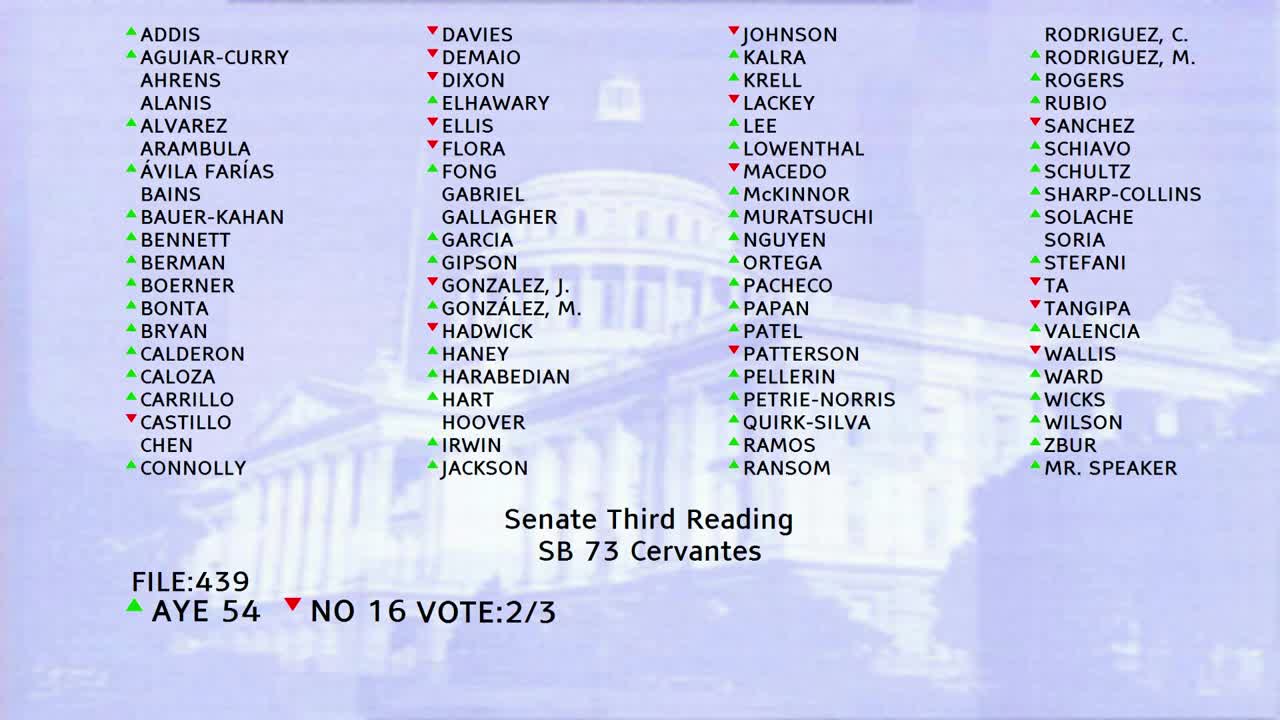 45SEC
Assembly Floor
 32SEC
Assembly Standing Committee on Appropriations
Bill Author
Bill Co-Author(s):