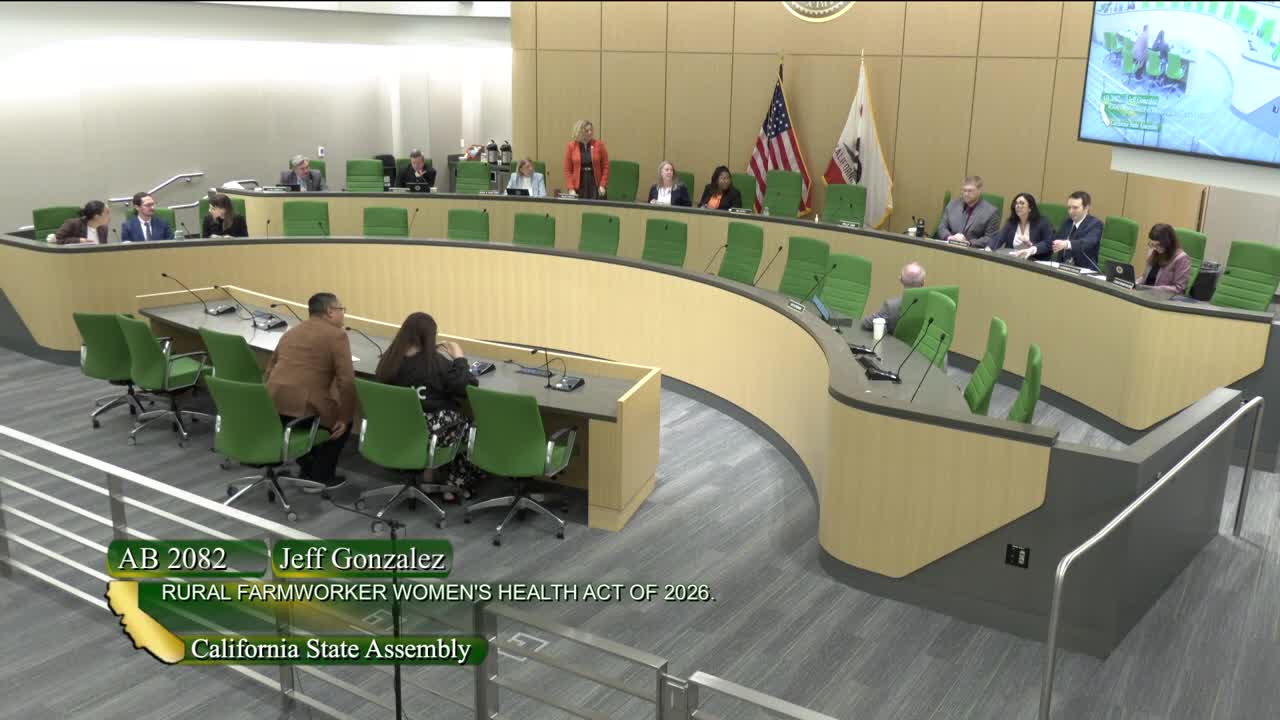
AB 2082: Rural Farmworker Women’s Health Act of 2026.
- Session Year: 2025-2026
- House: Assembly
- Latest Version Date: 2026-04-06
Current Status:
In Progress
(2026-05-14: In committee: Held under submission.)
Introduced
In Committee
Awaiting First Chamber Vote
Passed First Chamber
In Committee
Awaiting Second Chamber Vote
Passed Second Chamber
Enacted
Existing law requires the State Department of Public Health to develop a coordinated state strategy for addressing the health-related needs of women, as specified.
This bill, the Rural Farmworker Womens Health Act of 2026, would require the department to, beginning July 1, 2027, January 1, 2028, and upon appropriation by the Legislature for this purpose, establish a program to work with local nonprofit organizations who have a history of serving farmworker communities to provide free menstrual products in rural or agricultural communities. The bill would require the department to prioritize those communities with the highest rates of poverty.
Existing law requires the State Department of Public Health to develop a coordinated state strategy for addressing the health-related needs of women, as specified.
This bill, the Rural Farmworker Womens Health Act of 2026, would require the department to, beginning July 1, 2027, establish a program to work with local nonprofit organizations who have a history of serving farmworker communities to provide free menstrual products in rural or agricultural communities. The bill would require the department to prioritize those communities with the highest rates of poverty.
This act shall be known, and may be cited, as the Rural Farmworker Womens Health Act of 2026.
SEC. 2.Section 139 is added to the Health and Safety Code, to read:139.(a)For purposes of this section, menstrual products includes tampons, sanitary napkins, panty liners, and menstrual cups.
(b)Beginning July 1, 2027, January 1, 2028, and upon appropriation by the Legislature for this purpose, the State Department of Public Health shall establish a program to work with local nonprofit organizations who have a history of serving farmworker communities to provide free menstrual products in rural or agricultural communities. The department shall prioritize the rural or agricultural communities with the highest rates of poverty.
REVISIONS: HeadingLine 2This act shall be known, and may be cited, as the Rural Farmworker Womens Health Act of 2026.
SEC. 2.Section 139 is added to the Health and Safety Code, to read:139.(a)For purposes of this section, menstrual products includes tampons, sanitary napkins, panty liners, and menstrual cups.
(b)Beginning July 1, 2027, the State Department of Public Health shall establish a program to work with local nonprofit organizations who have a history of serving farmworker communities to provide free menstrual products in rural or agricultural communities. The department shall prioritize the rural or agricultural communities with the highest rates of poverty.
|
Date
|
Status
|
|---|---|
| May 14, 2026 | In committee: Held under submission. |
| Apr 29, 2026 | In committee: Set, first hearing. Referred to APPR. suspense file. |
| Apr 15, 2026 | From committee: Do pass and re-refer to Com. on APPR. (Ayes 16. Noes 0.) (April 14). Re-referred to Com. on APPR. |
| Apr 15, 2026 | Coauthors revised. |
| Apr 7, 2026 | Re-referred to Com. on HEALTH. |
| Apr 6, 2026 | From committee chair, with author's amendments: Amend, and re-refer to Com. on HEALTH. Read second time and amended. |
| Mar 2, 2026 | Referred to Com. on HEALTH. |
| Feb 19, 2026 | From printer. May be heard in committee March 21. |
| Feb 18, 2026 | Read first time. To print. |
|
Date
|
Description
|
Location
|
Votes
|
|
|---|---|---|---|---|
| Apr 14, 2026 | Do pass and be re-referred to the Committee on [Appropriations] | Assembly Standing Committee on Health |
Passed |
This list shows positions taken on this bill by organizations on the date displayed, which is linked to the original source.
Positions by individuals are not included.
|
Organization
|
Position
|
Date
|
|---|---|---|
| AMERICAN COLLEGE OF OBSTETRICIANS & GYNECOLOGISTS - DISTRICT IX | ** Support | |
| CA Commission on the Status of Women and Girls | ** Support | |
| California Life Sciences Association | ** Support | |
| Center Against Racism and Trauma Inc. | ** Support | |
| Inland Congregations United for Change | ** Support | |
| Orange County Congregation Community Organization | ** Support |
Date of Hearing: April 29, 2026
ASSEMBLY COMMITTEE ON APPROPRIATIONS
Buffy Wicks, Chair
ABPCA Bill Id:AB 2082
Author:(Jeff Gonzalez) – As Amended Ver:April 6, 2026
Policy Committee: | Health | Vote: | 16 - 0 |
|
| ||
|
|
Urgency: No State Mandated Local Program: No Reimbursable: No
SUMMARY:
This bill requires the California Department of Public Health (CDPH), upon an appropriation, to establish a program to work with local nonprofit organizations to provide free menstrual products in rural or agricultural communities, with priority given to the communities with the highest poverty rates.
FISCAL EFFECT:
General Fund cost pressures of an unknown amount to CDPH. The author has requested a state budget allocation of $2 million to CDPH for the purposes of this bill.
The Legislative Analyst’s Office recently warned of General Fund structural deficits of around $35 billion per year in the 2027-28 fiscal year and ongoing.
COMMENTS:
- Purpose. This bill is sponsored by Inland Congregations United For Change. According to the author:
The women who sustain California’s agricultural economy too often lack access to basic feminine products due to cost and the isolation of rural worksites. One in four farmworker women reports being unable to afford these essential health items, and many face long workdays in remote areas without reliable access to stores or supplies. This lack of access forces some women to use unsafe alternatives, putting their health, dignity, and well-being at risk. [This bill] addresses this gap by directing [CDPH] to partner with trusted local nonprofits to distribute free feminine hygiene products in rural agricultural communities, prioritizing those with the highest poverty rates. By ensuring reliable, culturally competent distribution of these essential products, this bill will improve health outcomes, protect dignity, and support the women who are vital to California’s food system.
- Background. Menstrual hygiene products, including tampons, pads, reusable menstrual cups, and other products, are important health tools for managing periods. The average person who menstruates has their period for a cumulative seven years of their life and uses thousands of products over the course of their lifetime. Lifetime costs for menstrual products in the U.S. can be in the thousands of dollars. Many Americans are unable to afford or otherwise lack access to these basic necessities. Inadequate or improper use of menstrual hygiene products can have serious medical consequences such as urinary tract infections, vulvar contact dermatitis, yeast infections, bacterial vaginosis, and, in rare cases, toxic shock syndrome. The author’s budget request letter states more than 100,000 women work in California’s agricultural sector, and women working in the fields may not have reliable access to nearby retail locations, on-site distribution, or convenient restocking options during long shifts.
- Related Legislation. SB 498 (Becker) would have required indigent wards or detainees be provided basic hygiene products free of charge, but was amended to address a different issue in the Assembly.
- Prior Legislation. The Legislature, with the governor, has recently enacted several bills to provide access to menstrual products in the following settings:
- State prison or a local detention facility (AB 1810 (Bryan), Chapter 939, Statutes of 2024).
- Public schools maintaining any combination of classes from grades three through 12 (AB 230 (Reyes), Chapter 421, Statutes of 2023).
- Pilot program using vending machines in five campuses of the California State University (CSU) and California Community Colleges (AB 2482 (Calderon), Chapter 933, Statutes of 2022).
- All public schools serving students in grades six through 12, the CSU, each community college district, the University of California, independent institutions of higher education, and private postsecondary educational institutions (AB 367 (C. Garcia), Chapter 667, Statutes of 2021).
Analysis Prepared by: Allegra Kim / APPR. / (916) 319-2081
Date of Hearing: April 14, 2026
ASSEMBLY COMMITTEE ON HEALTH
Mia Bonta, Chair
ABPCA Bill Id:AB 2082
Author:(Jeff Gonzalez) – As Amended Ver:April 6, 2026
SUBJECT: Rural Farmworker Women’s Health Act of 2026.
SUMMARY: Requires the State Department of Public Health (DPH) to establish a program to provide farmworker community members with free menstrual products. Specifically, this bill:
- Requires, beginning January 1, 2028, DPH to establish a program to work with local nonprofit organizations who have a history of serving farmworker communities to provide free menstrual products in rural or agricultural communities.
- Requires DPH to prioritize the rural or agricultural communities with the highest rates of poverty.
- Specifies for purposes of this bill that “menstrual products” include tampons, sanitary napkins, panty liners, and menstrual cups.
- Makes this bill contingent upon appropriation by the Legislature.
EXISTING LAW:
- Requires DPH to develop a coordinated state strategy for addressing the health-related needs of women, including implementation of goals and objectives for women’s health. Requires the approved programmatic costs associated with this strategy to be the responsibility of DPH unless otherwise provided by law. [Health and Safety Code (HSC) § 137]
- Requires the California State University (CSU) and each community college district to stock an adequate supply of menstrual products, available and accessible, free of cost, at no fewer than one designated and accessible central location on each campus. [Education Code (EDC) § 66027.7]
- Requires a public school, including a school operated by a school district, county office of education, or charter school, maintaining any combination of classes from grades 3 to 12, inclusive, to stock the school’s restrooms at all times with an adequate supply of menstrual products, available and accessible, free of cost, in all women’s restrooms and all-gender restrooms, and in at least one men’s restroom. Defines menstrual products to mean menstrual pads and tampons for use in connection with the menstrual cycle. [EDC § 35292.6]
- Requires the CSU and the California Community Colleges (CCC) to establish at five campuses of their segments at least one vending machine that dispenses wellness products, as provided. Makes participation of community colleges under this pilot program voluntary. Requests the University of California (UC) to establish at any number of campuses of their segment at least one vending machine that dispenses wellness products, as provided. [EDC § 66023.8]
- Requires a person incarcerated in state prison who menstruates or experiences uterine or vaginal bleeding to, without needing to request, have ready access to, and be allowed to use, materials necessary for personal hygiene with regard to their menstrual cycle and reproductive system, including, but not limited to, sanitary pads and tampons, at no cost to the person. [Penal Code (PEN) § 3409]
- Requires a person confined in a local detention facility to be allowed to continue to use materials necessary for personal hygiene with regard to their menstrual cycle and reproductive system, including, but not limited to, sanitary pads and tampons, at no cost to the incarcerated person. [PEN § 4023.5]
- Requires a person confined in a state or local juvenile facility to, without needing to request, be allowed to continue to use materials necessary for personal hygiene with regard to the person’s menstrual cycle and reproductive system. [PEN § 221]
FISCAL EFFECT: Unknown. This bill has not been analyzed by a fiscal committee.
COMMENTS:
- PURPOSE OF THIS BILL. According to the author, the women who sustain California’s agricultural economy too often lack access to basic feminine products due to cost and the isolation of rural worksites. The author continues that two in five farmworker women reports being unable to afford these essential health items, and many face long workdays in remote areas without reliable access to stores or supplies. The author states that this lack of access forces some women to use unsafe alternatives, putting their health, dignity, and well-being at risk. The author states that this bill addresses this gap by directing DPH to partner with trusted local nonprofits to distribute free feminine hygiene products in rural agricultural communities, prioritizing those with the highest poverty rates. The author concludes that by ensuring reliable, culturally competent distribution of these essential products, this bill will improve health outcomes, protect dignity, and support the women who are vital to California’s food system.
- BACKGROUND. Farmworkers play an essential role in California’s agriculture and food system. According to the California Department of Food and Agriculture’s website, California’s agricultural abundance includes more than 400 commodities. Nearly half of the country’s vegetables and over three-quarters of the country’s fruits and nuts are grown in California.
According to the National Center for Farmworker Health’s 2022 “Facts About Farmworkers” fact sheet, based on demographic information from the 2019-2020 National Agricultural Workers Survey results, 34% of crop workers are women. The Center for Farmworker Families’ website states that between one-third and one-half of all farmworkers in America reside in California, or roughly 500,000 - 800,000 farmworkers.
- Women farmworkers. According to a 2025 article published in the American Journal of Community Psychology titled, “Experiences of women farmworkers in Michigan: Perspectives from the Michigan Farmworker Project,” agricultural work is one of the most physically demanding and hazardous occupations and farmworkers face complex social vulnerabilities that create greater health risks from occupational exposures. Women farmworkers in the U.S. face distinct working conditions and occupational stressors that are relatively understudied. Prior research indicates that women engaged in farm work often encounter numerous health risks, including chronic illnesses, mental health, and adverse impacts on reproductive health, including barriers to accessing reproductive healthcare services. Participants in the Michigan Farmworker Project, which entailed in-depth interviews with farmworkers, reported hazardous and exploitative conditions including sexual harassment, chemical exposures, and challenges with proper hygiene and sanitation—especially during menstruation—including lack of bathroom access and other problems leading to urinary tract infections. According to the article, several women wished that agricultural worksites would make sanitary pads and other essential products for women's reproductive health available at bathrooms but acknowledged that, in their experience, this has never been the case in agricultural worksites.
- Access to menstrual products. The American College of Physicians highlights that menstrual hygiene products, including tampons, pads, reusable menstrual cups, and other products, are important health tools for managing periods. The average person who menstruates has their period for a cumulative 7 years of their life, uses between 10 to 35 pads or tampons per cycle, and uses up to 16,800 products over the course of their lifetime at a cost of roughly $1,800 in the U.S. However, despite the role of menstrual products in maintaining hygiene and health, many Americans are unable to afford or otherwise lack access to these basic necessities. Inadequate or improper use of menstrual hygiene products can have devastating medical consequences and may possibly result in urinary tract infections, vulvar contact dermatitis, yeast infections, bacterial vaginosis, (and, in rare cases, toxic shock syndrome), and overall low quality of life.
According to a 2025 article published in the Journal of Global Health Economics and Policy titled “Period poverty in the U.S.: A socio-economic policy analysis,” two in five women of menstruating age struggle to afford period supplies because they have numerous financial constraints. A 2025 article by on the United Nations (UN) Women website titled “Period Poverty – why millions of girls and women cannot afford their periods,” in the U.S., 1 in 4 teens and 1 in 3 adults struggle to afford period products, especially teens of color and lower-income households.
This bill requires DPH to conduct targeted outreach to non-profits that serve rural or agricultural communities with the highest rates of poverty to provide access to menstrual products. Funds would be disbursed from DPH. The author indicates that there is a $2 million companion budget request for purposes of implementing this bill.
- SUPPORT. Inland Congregations United for Change (ICUC) is the sponsor of this bill and states in support, that one in four farmworker women report being unable to afford basic menstrual products. ICUC continues that in addition to cost concerns, many face practical access barriers due to the rural and isolated nature of agricultural work. ICUC notes that women working in the fields may not have reliable access to nearby retail locations, on-site distribution, or convenient restocking options during long shifts. ICUC states that as a result, some resort to using rags, paper, or other unsafe alternatives that increase the risk of infection and other health complications. ICUC continues that limited product availability in rural communities and at worksites creates avoidable health risks and undermines the dignity and well-being of women who are essential to California’s agricultural workforce. ICUC states that the absence of a targeted state program leaves thousands of California’s farmworker women without access to essential health supplies. ICUC concludes that if this bill passes it will ensure competent outreach and effective distribution of feminine hygiene products to those in need.
- RELATED LEGISLATION. SB 498 (Becker) of 2025 would require indigent wards or detainees be provided basic hygiene products free of charge and require that those individuals have guaranteed access to hygiene products, upon their request. SB 498 is a two-year pending before the Assembly Public Safety Committee.
- PREVIOUS LEGISLATION.
- AB 1810 (Bryan), Chapter 939, Statutes of 2024 requires a person who is incarcerated in state prison or confined in a local detention facility, or a state or local juvenile facility, and who menstruates or experiences uterine or vaginal bleeding to have ready access to, materials necessary for personal hygiene with regard to their menstrual cycle and reproductive system, including, but not limited to, sanitary pads and tampons without having to request them.
- AB 230 (Reyes), Chapter 421, Statutes of 2023 extends the requirements of AB 367 below commencing on or before the start of the 2024–25 school year, to instead apply to public schools maintaining any combination of classes from grades 3 to 12, inclusive.
- AB 2482 (Calderon), Chapter 933, Statutes of 2022 establishes a pilot program, until July 1, 2029, that requires the CSU and the CCC to establish at five campuses of their segments at least one vending machine that dispenses wellness products, as provided. Participation of community colleges under the pilot program would be voluntary. Requests the UC to establish at any number of campuses of their segment at least one vending machine that dispenses wellness products, as provided.
- AB 367 (C. Garcia), Chapter 667, Statutes of 2021, requires all public schools serving students in grades 6 to 12 to stock specified restrooms with an adequate supply of free menstrual products, commencing in the 2022-23 school year; and requires the California State University and each community college district, and encourages the Regents of the University of California, independent institutions of higher education, and private postsecondary educational institutions, to stock an adequate supply of free menstrual products at no fewer than one designated and accessible central location on each campus.
REGISTERED SUPPORT / OPPOSITION:
Support
Inland Congregations United for Change (sponsor)
American College of Obstetricians & Gynecologists - District IX
CA Commission on the Status of Women and Girls
California Life Sciences Association
Center Against Racism and Trauma Inc.
Orange County Congregation Community Organization
Opposition
None on file
Analysis Prepared by: Eliza Brooks / HEALTH / (916) 319-2097
Bill Author