AB 2089: Property taxation: welfare exemption.
- Session Year: 2025-2026
- House: Assembly
- Latest Version Date: 2026-09-27
Current Status:
Passed
(2026-09-27: Chaptered by Secretary of State - Chapter 577, Statutes of 2026.)
Introduced
In Committee
Awaiting First Chamber Vote
Passed First Chamber
In Committee
Awaiting Second Chamber Vote
Passed Second Chamber
Enacted
Except as provided, the California Constitution requires that all property be taxed in proportion to its full value and assessed at the same percentage of fair market value. The tax imposed pursuant to these provisions is commonly referred to as an ad valorem property tax. Existing property tax law, in accordance with the California Constitution, provides for a welfare exemption for property used exclusively for religious, hospital, scientific, or charitable purposes and that is owned or operated by certain types of nonprofit entities, if any of certain qualifying criteria are met, including that the owner of the property receives low-income housing tax credits pursuant to specified provisions of the Internal Revenue Code. Under existing property tax law, property that meets these requirements that is used exclusively for rental housing and related facilities is entitled to a partial exemption, equal to that percentage of the value of the property that is equal to the percentage that the number of units serving lower income households represents of the total number of residential units, in any year that any of certain criteria apply.
Existing property tax law, for the 201819 fiscal year through the 202728 fiscal year, in the case of an owner of property who is eligible for the federal low-income housing tax credit, requires that a unit continue to be treated as occupied by a lower income household if the occupants were lower income households on the lien date in the fiscal year in which occupancy of the unit commenced and the unit continues to be rent restricted, notwithstanding an increase in the income of the occupants of the unit to 140% of area median income.
This bill would extend the above-described provision through the 202829 fiscal year.
Existing property tax law establishes procedures for claiming the welfare exemption, including requiring the annual filing of a claim for the exemption with the county assessor, as provided.
This bill would authorize the county assessor to accept electronic signatures for materials necessary to claim, maintain, or otherwise receive the welfare exemption. The bill would require the county board of supervisors to, if necessary and in collaboration with the county assessor, adopt any ordinances or resolutions to implement the electronic portal and submission authorization. The bill would require, as provided, every county to release all forms related to the annual recertification of tenant income necessary to receive the welfare exemption by November 15 of each calendar year prior to the due date for the forms.
By imposing additional duties on counties, the bill would impose a state-mandated local program.
This bill would incorporate additional changes to Section 214 of the Revenue and Taxation Code proposed by Assembly Bill 1294 to be operative only if this bill and Assembly Bill 1294 are enacted and this bill is enacted last.
The California Constitution requires the state to reimburse local agencies and school districts for certain costs mandated by the state. Statutory provisions establish procedures for making that reimbursement.
This bill would provide that, if the Commission on State Mandates determines that the bill contains costs mandated by the state, reimbursement for those costs shall be made pursuant to the statutory provisions noted above.
Except as provided, the California Constitution requires that all property be taxed in proportion to its full value and assessed at the same percentage of fair market value. The tax imposed pursuant to these provisions is commonly referred to as an ad valorem property tax. Existing property tax law, in accordance with the California Constitution, provides for a welfare exemption for property used exclusively for religious, hospital, scientific, or charitable purposes and that is owned or operated by certain types of nonprofit entities, if any of certain qualifying criteria are met, including that the owner of the property receives low-income housing tax credits pursuant to specified provisions of the Internal Revenue Code. Under existing property tax law, property that meets these requirements that is used exclusively for rental housing and related facilities is entitled to a partial exemption, equal to that percentage of the value of the property that is equal to the percentage that the number of units serving lower income households represents of the total number of residential units, in any year that any of certain criteria apply.
Existing property tax law, for the 201819 fiscal year through the 202728 fiscal year, in the case of an owner of property who is eligible for the federal low-income housing tax credit, requires that a unit continue to be treated as occupied by a lower income household if the occupants were lower income households on the lien date in the fiscal year in which occupancy of the unit commenced and the unit continues to be rent restricted, notwithstanding an increase in the income of the occupants of the unit to 140% of area median income.
This bill would extend the above-described provision through the 202829 fiscal year.
Existing property tax law establishes procedures for claiming the welfare exemption, including requiring the annual filing of a claim for the exemption with the county assessor, as provided.
This bill would authorize the county assessor to accept electronic signatures for materials necessary to claim, maintain, or otherwise receive the welfare exemption. The bill would require the county board of supervisors to, if necessary and in collaboration with the county assessor, adopt any ordinances or resolutions to implement the electronic portal and submission authorization. The bill would require, as provided, every county to release all forms related to the annual recertification of tenant income necessary to receive the welfare exemption by November 15 of each calendar year prior to the due date for the forms.
By imposing additional duties on counties, the bill would impose a state-mandated local program.
This bill would incorporate additional changes to Section 214 of the Revenue and Taxation Code proposed by Assembly Bill 1294 to be operative only if this bill and Assembly Bill 1294 are enacted and this bill is enacted last.
The California Constitution requires the state to reimburse local agencies and school districts for certain costs mandated by the state. Statutory provisions establish procedures for making that reimbursement.
This bill would provide that, if the Commission on State Mandates determines that the bill contains costs mandated by the state, reimbursement for those costs shall be made pursuant to the statutory provisions noted above.
Except as provided, the California Constitution requires that all property be taxed in proportion to its full value and assessed at the same percentage of fair market value. The tax imposed pursuant to these provisions is commonly referred to as an ad valorem property tax. Existing property tax law, in accordance with the California Constitution, provides for a welfare exemption for property used exclusively for religious, hospital, scientific, or charitable purposes and that is owned or operated by certain types of nonprofit entities, if any of certain qualifying criteria are met, including that the owner of the property receives low-income housing tax credits pursuant to specified provisions of the Internal Revenue Code. Under existing property tax law, property that meets these requirements that is used exclusively for rental housing and related facilities is entitled to a partial exemption, equal to that percentage of the value of the property that is equal to the percentage that the number of units serving lower income households represents of the total number of residential units, in any year that any of certain criteria apply.
Existing property tax law, for the 201819 fiscal year through the 202728 fiscal year, in the case of an owner of property who is eligible for the federal low-income housing tax credit, requires that a unit continue to be treated as occupied by a lower income household if the occupants were lower income households on the lien date in the fiscal year in which occupancy of the unit commenced and the unit continues to be rent restricted, notwithstanding an increase in the income of the occupants of the unit to 140% of area median income.
This bill would extend the above-described provision through the 202829 fiscal year.
Existing property tax law establishes procedures for claiming the welfare exemption, including requiring the annual filing of a claim for the exemption with the county assessor, as provided.
This bill would authorize the county assessor to accept electronic signatures for materials necessary to claim, maintain, or otherwise receive the welfare exemption. The bill would require the county board of supervisors to, if necessary and in collaboration with the county assessor, adopt any ordinances or resolutions to implement the electronic portal and submission authorization. The bill would require, as provided, every county to release all forms related to the annual recertification of tenant income necessary to receive the welfare exemption by November 15 of each calendar year prior to the due date for the forms.
By imposing additional duties on counties, the bill would impose a state-mandated local program.
This bill would incorporate additional changes to Section 214 of the Revenue and Taxation Code proposed by Assembly Bill 1294 to be operative only if this bill and Assembly Bill 1294 are enacted and this bill is enacted last.
The California Constitution requires the state to reimburse local agencies and school districts for certain costs mandated by the state. Statutory provisions establish procedures for making that reimbursement.
This bill would provide that, if the Commission on State Mandates determines that the bill contains costs mandated by the state, reimbursement for those costs shall be made pursuant to the statutory provisions noted above.
Except as provided, the California Constitution requires that all property be taxed in proportion to its full value and assessed at the same percentage of fair market value. The tax imposed pursuant to these provisions is commonly referred to as an ad valorem property tax. Existing property tax law, in accordance with the California Constitution, provides for a welfare exemption for property used exclusively for religious, hospital, scientific, or charitable purposes and that is owned or operated by certain types of nonprofit entities, if any of certain qualifying criteria are met. met, including that the owner of the property receives low-income housing tax credits pursuant to specified provisions of the Internal Revenue Code. Under existing property tax law, property that meets these requirements that is used exclusively for rental housing and related facilities is entitled to a partial exemption, equal to that percentage of the value of the property that is equal to the percentage that the number of units serving lower income households represents of the total number of residential units, in any year that any of certain criteria apply. Existing
Existing property tax law, for the 201819 fiscal year through the 202728 fiscal year, in the case of an owner of property who is eligible for the federal low-income housing tax credit, requires that a unit continue to be treated as occupied by a lower income household if the occupants were lower income households on the lien date in the fiscal year in which occupancy of the unit commenced and the unit continues to be rent restricted, notwithstanding an increase in the income of the occupants of the unit to 140% of area median income.
This bill would extend the above-described provision through the 202829 fiscal year.
Existing property tax law establishes procedures for claiming the welfare exemption, including requiring the annual filing of a claim for the exemption with the county assessor, as provided.
This bill would authorize the county assessor to accept electronic signatures for materials necessary to claim, maintain, or otherwise receive the welfare exemption. The bill would require the county board of supervisors to, if necessary and in collaboration with the county assessor, adopt any ordinances or resolutions to implement the electronic portal and submission authorization. The bill would require, as provided, every county to release all forms related to the annual recertification of tenant income necessary to receive the welfare exemption by November 15 of each calendar year prior to the due date for the forms.
By imposing additional duties on counties, the bill would impose a state-mandated local program.
The California Constitution requires the state to reimburse local agencies and school districts for certain costs mandated by the state. Statutory provisions establish procedures for making that reimbursement.
This bill would provide that, if the Commission on State Mandates determines that the bill contains costs mandated by the state, reimbursement for those costs shall be made pursuant to the statutory provisions noted above.
Except as provided, the California Constitution requires that all property be taxed in proportion to its full value and assessed at the same percentage of fair market value. The tax imposed pursuant to these provisions is commonly referred to as an ad valorem property tax. Existing property tax law, in accordance with the California Constitution, provides for a welfare exemption for property used exclusively for religious, hospital, scientific, or charitable purposes and that is owned or operated by certain types of nonprofit entities, if certain qualifying criteria are met. Under existing property tax law, property that meets these requirements that is used exclusively for rental housing and related facilities is entitled to a partial exemption, equal to that percentage of the value of the property that is equal to the percentage that the number of units serving lower income households represents of the total number of residential units, in any year that any of certain criteria apply. Existing property tax law establishes procedures for claiming the welfare exemption, including requiring the annual filing of a claim for the exemption with the county assessor, as provided.
This bill would require authorize the county assessor to accept electronic signatures for materials necessary to claim, maintain, or otherwise receive the welfare exemption. The bill would require the county board of supervisors to, if necessary and in collaboration with the county assessor, adopt any ordinances or resolutions to implement the electronic portal and submission requirement.
This bill would also require the county assessor to provide on their internet website certain documentation requirements for the above-described partial exemption, as described, and would require that information to be updated within 7 days of any changes.This authorization. The bill would require require, as provided, every county to release all forms related to the annual recertification of tenant income necessary to receive the welfare exemption by November 15 of each calendar year prior to the due date for the forms.
(2)Existing property tax law imposes various penalties and costs for delinquent payment of real property taxes. Existing law provides that a property owner is not liable for interest or penalties, and prohibits the tax collector from taking or continuing any collection action, with respect to ad valorem property taxes levied upon a property if, annually while receiving the benefit, the facilities are in the course of construction, as defined, and the property owner supplies evidence to the tax collector that the property owner has submitted to the county assessor an application for an exemption pursuant to the above-described partial welfare exemption, except as provided, and that the property received a specified reservation of tax credits or award of funds. Existing law makes this benefit applicable to property tax installments that are due and payable from December 10, 2025, to April 10, 2031.This bill would extend the benefit to those properties that provide evidence that the property received a welfare tax exemption but lost the exemption due to a change in control, change in ownership, or removal, resignation, or replacement of a nonprofit managing general partner, as those terms are defined, and that the benefit is necessary to continue maintaining the welfare exemption on the property, in lieu of providing evidence that facilities are in the course of construction. The bill would make this extended benefit applicable to property tax installments that are due and payable from December 10, 2027.(3)By
By imposing additional duties on local tax officials, counties, the bill would impose a state-mandated local program.
The California Constitution requires the state to reimburse local agencies and school districts for certain costs mandated by the state. Statutory provisions establish procedures for making that reimbursement.
This bill would provide that, if the Commission on State Mandates determines that the bill contains costs mandated by the state, reimbursement for those costs shall be made pursuant to the statutory provisions noted above.
(1)Except as provided, the California Constitution requires that all property be taxed in proportion to its full value and assessed at the same percentage of fair market value. The tax imposed pursuant to these provisions is commonly referred to as an ad valorem property tax. Existing property tax law, in accordance with the California Constitution, provides for a welfare exemption for property used exclusively for religious, hospital, scientific, or charitable purposes and that is owned or operated by certain types of nonprofit entities, if certain qualifying criteria are met. Under existing property tax law, property that meets these requirements that is used exclusively for rental housing and related facilities is entitled to a partial exemption, equal to that percentage of the value of the property that is equal to the percentage that the number of units serving lower income households represents of the total number of residential units, in any year that any of certain criteria apply. Existing property tax law establishes procedures for claiming the welfare exemption, including requiring the annual filing of a claim for the exemption with the county assessor, as provided.
This bill would require the county assessor to accept electronic signatures for materials necessary to claim, maintain, or otherwise receive the welfare exemption. The bill would require the county board of supervisors to, if necessary and in collaboration with the county assessor, adopt any ordinances or resolutions to implement the electronic portal and submission requirement.
This bill would also require the county assessor to provide on their internet website certain documentation requirements for the above-described partial exemption, as described, and would require that information to be updated within 7 days of any changes.
This bill would require every county to release all forms related to the annual recertification of tenant income necessary to receive the welfare exemption by November 15 of each calendar year prior to the due date for the forms.
Existing(2)Existing property tax law imposes various penalties and costs for delinquent payment of real property taxes. Existing law provides that a property owner is not liable for interest or penalties, and prohibits the tax collector from taking or continuing any collection action, with respect to ad valorem property taxes levied upon a property if, annually while receiving the benefit, the facilities are in the course of construction, as defined, and the property owner supplies evidence to the tax collector that the property owner has submitted to the county assessor an application for an exemption pursuant to the above-described partial welfare exemption, except as provided, and that the property received a specified reservation of tax credits or award of funds. Existing law makes this benefit applicable to property tax installments that are due and payable from December 10, 2025, to April 10, 2031.
This bill would extend the benefit described above indefinitely. The bill would also extend the benefit to those properties that provide evidence that the property received a welfare tax exemption but lost the exemption due to a change in control, change in ownership, or removal, resignation, or replacement of a nonprofit managing general partner, as those terms are defined, and that the benefit is necessary to continue maintaining the welfare exemption on the property, in lieu of providing evidence that facilities are in the course of construction. The bill would make this extended benefit applicable to property tax installments that are due and payable from December 10, 2027. By
(3)By imposing additional duties on local tax officials, the bill would impose a state-mandated local program.
The California Constitution requires the state to reimburse local agencies and school districts for certain costs mandated by the state. Statutory provisions establish procedures for making that reimbursement.
This bill would provide that, if the Commission on State Mandates determines that the bill contains costs mandated by the state, reimbursement for those costs shall be made pursuant to the statutory provisions noted above.
Except as provided, the California Constitution requires that all property be taxed in proportion to its full value and assessed at the same percentage of fair market value. The tax imposed pursuant to these provisions is commonly referred to as an ad valorem property tax. Existing property tax law, in accordance with the California Constitution, provides for a welfare exemption for property used exclusively for religious, hospital, scientific, or charitable purposes and that is owned or operated by certain types of nonprofit entities, if certain qualifying criteria are met. Under existing property tax law, property that meets these requirements that is used exclusively for rental housing and related facilities is entitled to a partial exemption, equal to that percentage of the value of the property that is equal to the percentage that the number of units serving lower income households represents of the total number of residential units, in any year that any of certain criteria apply.
Existing law imposes various penalties and costs for delinquent payment of real property taxes. Existing law provides that a property owner is not liable for interest or penalties, and prohibits the tax collector from taking or continuing any collection action, with respect to ad valorem property taxes levied upon a property if, annually while receiving the benefit, the facilities are in the course of construction, as defined, and the property owner supplies evidence to the tax collector that the property owner has submitted to the county assessor an application for an exemption pursuant to the above-described partial welfare exemption, except as provided, and that the property received a specified reservation of tax credits or award of funds. Existing law makes this benefit applicable to property tax installments that are due and payable from December 10, 2025, to April 10, 2031.
This bill would extend the benefit described above indefinitely. The bill would also extend the benefit to those properties that provide evidence that the property received a welfare tax exemption but lost the exemption due to a change in control, change in ownership, or removal, resignation, or replacement of a nonprofit managing general partner, as those terms are defined, and that the benefit is necessary to continue maintaining the welfare exemption on the property, in lieu of providing evidence that facilities are in the course of construction. The bill would make this extended benefit applicable to property tax installments that are due and payable from December 10, 2027. By imposing additional duties on local tax officials, the bill would impose a state-mandated local program.
The California Constitution requires the state to reimburse local agencies and school districts for certain costs mandated by the state. Statutory provisions establish procedures for making that reimbursement.
This bill would provide that, if the Commission on State Mandates determines that the bill contains costs mandated by the state, reimbursement for those costs shall be made pursuant to the statutory provisions noted above.
(a)Property used exclusively for religious, hospital, scientific, or charitable purposes owned and operated by community chests, funds, foundations, limited liability companies, or corporations organized and operated for religious, hospital, scientific, or charitable purposes is exempt from taxation, including ad valorem taxes to pay the interest and redemption charges on any indebtedness approved by the voters prior to July 1, 1978, or any bonded indebtedness for the acquisition or improvement of real property approved on or after July 1, 1978, by two-thirds of the votes cast by the voters voting on the proposition, if:
(1)The owner is not organized or operated for profit. However, in the case of hospitals, the organization shall not be deemed to be organized or operated for profit if, during the immediately preceding fiscal year, operating revenues, exclusive of gifts, endowments, and grants-in-aid, did not exceed operating expenses by an amount equivalent to 10 percent of those operating expenses. As used herein, operating expenses include depreciation based on cost of replacement and amortization of, and interest on, indebtedness.
(2)No part of the net earnings of the owner inures to the benefit of any private shareholder or individual.
(3)The property is used for the actual operation of the exempt activity, and does not exceed an amount of property reasonably necessary to the accomplishment of the exempt purpose.
(A)For the purposes of determining whether the property is used for the actual operation of the exempt activity, consideration shall not be given to use of the property for either or both of the following described activities if that use is occasional:
(i)The owner conducts fundraising activities on the property and the proceeds derived from those activities are not unrelated business taxable income, as defined in Section 512 of the Internal Revenue Code, of the owner and are used to further the exempt activity of the owner.
(ii)The owner permits any other organization that meets all of the requirements of this subdivision, other than ownership of the property, to conduct fundraising activities on the property and the proceeds derived from those activities are not unrelated business taxable income, as defined in Section 512 of the Internal Revenue Code, of the organization, are not subject to the tax on unrelated business taxable income that is imposed by Section 511 of the Internal Revenue Code, and are used to further the exempt activity of the organization.
(B)For purposes of subparagraph (A):
(i)Occasional use means use of the property on an irregular or intermittent basis by the qualifying owner or any other qualifying organization described in clause (ii) of subparagraph (A) that is incidental to the primary activities of the owner or the other organization.
(ii)Fundraising activities means both activities involving the direct solicitation of money or other property and the anticipated exchange of goods or services for money between the soliciting organization and the organization or person solicited.
(C)Subparagraph (A) shall have no application in determining whether paragraph (3) has been satisfied unless the owner of the property and any other organization using the property as provided in subparagraph (A) have filed with the assessor a valid organizational clearance certificate issued pursuant to Section 254.6.
(D)For the purposes of determining whether the property is used for the actual operation of the exempt activity, consideration shall not be given to the use of the property for meetings conducted by any other organization if the meetings are incidental to the other organizations primary activities, are not fundraising meetings or activities as defined in subparagraph (B), are held no more than once per week, and the other organization and its use of the property meet all other requirements of paragraphs (1) to (5), inclusive, of this subdivision. The owner or the other organization also shall file with the assessor a copy of a valid, unrevoked letter or ruling from the Internal Revenue Service or the Franchise Tax Board stating that the other organization, or the national organization of which it is a local chapter or affiliate, qualifies as an exempt organization under Section 501(c)(3) or 501(c)(4) of the Internal Revenue Code or Section 23701d, 23701f, or 23701w.
(E)Subparagraph (A), (B), (C), or (D) shall not be construed to either enlarge or restrict the exemption provided for in subdivision (b) of Section 4 and Section 5 of Article XIII of the California Constitution and this section.
(4)The property is not used or operated by the owner or by any other person so as to benefit any officer, trustee, director, shareholder, member, employee, contributor, or bondholder of the owner or operator, or any other person, through the distribution of profits, payment of excessive charges or compensations, or the more advantageous pursuit of their business or profession.
(5)The property is not used by the owner or members thereof for fraternal or lodge purposes, or for social club purposes except where that use is clearly incidental to a primary religious, hospital, scientific, or charitable purpose.
(6)The property is irrevocably dedicated to religious, charitable, scientific, or hospital purposes and, upon the liquidation, dissolution, or abandonment of the owner, will not inure to the benefit of any private person except a fund, foundation, or corporation organized and operated for religious, hospital, scientific, or charitable purposes.
(7)The property, if used exclusively for scientific purposes, is used by a foundation or institution that, in addition to complying with the foregoing requirements for the exemption of charitable organizations in general, has been chartered by the Congress of the United States (except that this requirement shall not apply when the scientific purposes are medical research), and whose objects are the encouragement or conduct of scientific investigation, research, and discovery for the benefit of the community at large.
The exemption provided for herein shall be known as the welfare exemption. This exemption is in addition to any other exemption now provided by law, and the existence of the exemption provision in paragraph (2) of subdivision (a) of Section 202 does not preclude the exemption under this section for museum or library property. Except as provided in subdivision (e), this section shall not be construed to enlarge the college exemption.
(b)Property used exclusively for school purposes of less than collegiate grade and owned and operated by religious, hospital, or charitable funds, foundations, limited liability companies, or corporations, which property and funds, foundations, limited liability companies, or corporations meet all of the requirements of subdivision (a), shall be deemed to be within the exemption provided for in subdivision (b) of Section 4 and Section 5 of Article XIII of the California Constitution and this section.
(c)Property used exclusively for nursery school purposes and owned and operated by religious, hospital, or charitable funds, foundations, limited liability companies, or corporations, which property and funds, foundations, limited liability companies, or corporations meet all the requirements of subdivision (a), shall be deemed to be within the exemption provided for in subdivision (b) of Section 4 and Section 5 of Article XIII of the California Constitution and this section.
(d)Property used exclusively for a noncommercial educational FM broadcast station or an educational television station, and owned and operated by religious, hospital, scientific, or charitable funds, foundations, limited liability companies, or corporations meeting all of the requirements of subdivision (a), shall be deemed to be within the exemption provided for in subdivision (b) of Section 4 and Section 5 of Article XIII of the California Constitution and this section.
(e)Property used exclusively for religious, charitable, scientific, or hospital purposes and owned and operated by religious, hospital, scientific, or charitable funds, foundations, limited liability companies, or corporations or educational institutions of collegiate grade, as defined in Section 203, which property and funds, foundations, limited liability companies, corporations, or educational institutions meet all of the requirements of subdivision (a), shall be deemed to be within the exemption provided for in subdivision (b) of Section 4 and Section 5 of Article XIII of the California Constitution and this section. As to educational institutions of collegiate grade, as defined in Section 203, the requirements of paragraph (6) of subdivision (a) shall be deemed to be met if both of the following are met:
(1)The property of the educational institution is irrevocably dedicated in its articles of incorporation to charitable and educational purposes, to religious and educational purposes, or to educational purposes.
(2)The articles of incorporation of the educational institution provide for distribution of its property upon its liquidation, dissolution, or abandonment to a fund, foundation, or corporation organized and operated for religious, hospital, scientific, charitable, or educational purposes meeting the requirements for exemption provided by Section 203 or this section.
(f)Property used exclusively for housing and related facilities for elderly or handicapped families and financed by, including, but not limited to, the federal government pursuant to Section 202 of Public Law 86-372 (12 U.S.C. Sec. 1701q), as amended, Section 231 of Public Law 73-479 (12 U.S.C. Sec. 1715v), Section 236 of Public Law 90-448 (12 U.S.C. Sec. 1715z), or Section 811 of Public Law 101-625 (42 U.S.C. Sec. 8013), and owned and operated by religious, hospital, scientific, or charitable funds, foundations, limited liability companies, or corporations meeting all of the requirements of this section shall be deemed to be within the exemption provided for in subdivision (b) of Section 4 and Section 5 of Article XIII of the California Constitution and this section.
The amendment of this paragraph made by Chapter 1102 of the Statutes of 1984 does not constitute a change in, but is declaratory of, existing law. However, no refund of property taxes shall be required as a result of this amendment for any fiscal year prior to the fiscal year in which the amendment takes effect.
Property used exclusively for housing and related facilities for elderly or handicapped families at which supplemental care or services designed to meet the special needs of elderly or handicapped residents are not provided, or that is not financed by the federal government pursuant to Section 202 of Public Law 86-372 (12 U.S.C. Sec. 1701q), as amended, Section 231 of Public Law 73-479 (12 U.S.C. Sec. 1715v), Section 236 of Public Law 90-448 (12 U.S.C. Sec. 1715z), or Section 811 of Public Law 101-625 (42 U.S.C. Sec. 8013), shall not be entitled to exemption pursuant to this subdivision unless the property is used for housing and related facilities for low- and moderate-income elderly or handicapped families. Property that would otherwise be exempt pursuant to this subdivision, except that it includes some housing and related facilities for other than low- or moderate-income elderly or handicapped families, shall be entitled to a partial exemption. The partial exemption shall be equal to that percentage of the value of the property that is equal to the percentage that the number of low- and moderate-income elderly and handicapped families represents of the total number of families occupying the property.
As used in this subdivision, low and moderate income has the same meaning as the term persons and families of low or moderate income as defined by Section 50093 of the Health and Safety Code.
(g)(1)Property used exclusively for rental housing and related facilities and owned and operated by religious, hospital, scientific, or charitable funds, foundations, limited liability companies, or corporations, including limited partnerships in which the managing general partner is an eligible nonprofit corporation or eligible limited liability company, meeting all of the requirements of this section, or by veterans organizations, as described in Section 215.1, meeting all the requirements of paragraphs (1) to (7), inclusive, of subdivision (a), shall be deemed to be within the exemption provided for in subdivision (b) of Section 4 and Section 5 of Article XIII of the California Constitution and this section and shall be entitled to a partial exemption equal to that percentage of the value of the property that is equal to the percentage that the number of units serving lower income households represents of the total number of residential units in any year in which any of the following criteria applies:
(A)The acquisition, rehabilitation, development, or operation of the property, or any combination of these factors, is financed with tax-exempt mortgage revenue bonds, qualified 501(c)(3) bonds, as that term is defined in Section 145 of Title 26 of the United States Code, or general obligation bonds, or is financed by local, state, or federal loans or grants and the rents of the occupants who are lower income households do not exceed those prescribed by deed restrictions or regulatory agreements pursuant to the terms of the financing or financial assistance.
(B)The owner of the property is eligible for and receives low-income housing tax credits pursuant to Section 42 of the Internal Revenue Code of 1986, as added by Public Law 99-514.
(C)In the case of a claim, other than a claim with respect to property owned by a limited partnership in which the managing general partner is an eligible nonprofit corporation, that is filed for the 200001 fiscal year or any fiscal year thereafter, 90 percent or more of the occupants of the property are lower income households whose rent does not exceed the rent prescribed by Section 50053 of the Health and Safety Code. The total exemption amount allowed under this subdivision to a taxpayer, with respect to a single property or multiple properties for any fiscal year on the sole basis of the application of this subparagraph, may not exceed twenty million dollars ($20,000,000) in assessed value.
(D)(i)The property was previously purchased and owned by the Department of Transportation pursuant to a consent decree requiring housing mitigation measures relating to the construction of a freeway and is now solely owned by an organization that qualifies as an exempt organization under Section 501(c)(3) of the Internal Revenue Code.
(ii)This subparagraph does not apply to property owned by a limited partnership in which the managing partner is an eligible nonprofit corporation.
(2)In order to be eligible for the exemption provided by this subdivision, the owner of the property shall do both of the following:
(A)(i)For any claim filed for the 200001 fiscal year or any fiscal year thereafter, certify and ensure, subject to the limitation in clause (ii), that there is an enforceable and verifiable agreement with a public agency, a recorded deed restriction, or other legal document that restricts the projects usage and that provides that the units designated for use by lower income households are continuously available to or occupied by lower income households, subject to the exception in clause (iii), at rents that do not exceed those prescribed by Section 50053 of the Health and Safety Code, or, to the extent that the terms of federal, state, or local financing or financial assistance conflicts with Section 50053 of the Health and Safety Code, rents that do not exceed those prescribed by the terms of the financing or financial assistance.
(ii)In the case of a limited partnership in which the managing general partner is an eligible nonprofit corporation, the restriction and provision specified in clause (i) shall be contained in an enforceable and verifiable agreement with a public agency, or in a recorded deed restriction to which the limited partnership certifies.
(iii)(I)(ia)In the case of an owner of property that is eligible for and receives a low-income housing tax credit pursuant to Section 42 of the Internal Revenue Code, relating to low-income housing credit, a unit shall continue to be treated as occupied by a lower income household if the occupants were lower income households on the lien date in the fiscal year in which their occupancy of the unit commenced and the unit continues to be rent restricted, notwithstanding an increase in the income of the occupants of the unit to 140 percent of area median income, adjusted for family size. However, the unit shall cease to be treated as a lower income unit if the income of the occupants of the unit increases above 140 percent of area median income, adjusted for family size.
(ib)This subclause shall only be operative from the 201819 fiscal year through the 202829 fiscal year.
(II)(ia)In the case of an owner of property, other than a property described in subclause (I), that is subject to an enforceable and verifiable agreement with a public agency, a unit shall continue to be treated as occupied by a lower income household if the occupants were lower income households on the lien date in the fiscal year in which their occupancy of the unit commenced and the unit continues to be rent restricted, notwithstanding an increase in the income of the occupants of the unit to 100 percent of area median income, adjusted for family size. However, the unit shall cease to be treated as a lower income unit if the income of the occupants of the unit increases above 100 percent of area median income, adjusted for family size.
(ib)This subclause shall only be operative from the 202425 fiscal year through the 202829 fiscal year.
(iv)(I)In the case of an owner of property that is a community land trust and whose property is leased to a lower income household, a unit shall continue to be treated as occupied by a lower income household if the occupants were lower income households on the lien date in the fiscal year in which their occupancy of the unit commenced and the unit continues to be rent restricted, notwithstanding an increase in the income of the occupants of the unit to 140 percent of area median income, adjusted for family size. However, the unit shall cease to be treated as a lower income unit if the income of the occupants of the unit increases above 140 percent of area median income, adjusted for family size.
(II)This clause shall only be operative from the 202223 fiscal year through the 202728 fiscal year.
(B)Certify that the funds that would have been necessary to pay property taxes are used to maintain the affordability of, or reduce rents otherwise necessary for, the units occupied by lower income households.
(3)As used in this subdivision:
(A)Community land trust has the same meaning as defined in Section 402.1.
(B)Lower income households has the same meaning as the term lower income households as defined by Section 50079.5 of the Health and Safety Code.
(C)Related facilities means any managers units and any and all common area spaces that are included within the physical boundaries of the rental housing development, including, but not limited to, common area space, walkways, balconies, patios, clubhouse space, meeting rooms, laundry facilities, and parking areas, except any portions of the overall development that are nonexempt commercial space.
(D)(i)Units serving lower income households shall mean units that are occupied by lower income households at an affordable rent, as defined in Section 50053 of the Health and Safety Code or, to the extent that the terms of federal, state, or local financing or financial assistance conflicts with Section 50053 of the Health and Safety Code, rents that do not exceed those prescribed by the terms of the financing or financial assistance. Units reserved for lower income households at an affordable rent that are temporarily vacant due to tenant turnover or repairs shall be counted as occupied.
(ii)(I)Units serving lower income households shall also mean units specified in clause (iii) or (iv) of subparagraph (A) of paragraph (2).
(II)This clause shall only be operative from the 201819 fiscal year through the 202728 fiscal year.
(iii)(I)Units serving lower income households shall also mean units specified in clause (iv) of subparagraph (A) of paragraph (2).
(II)This clause shall only be operative from the 202223 fiscal year through the 202728 fiscal year.
(h)Property used exclusively for an emergency or temporary shelter and related facilities for homeless persons and families and owned and operated by religious, hospital, scientific, or charitable funds, foundations, limited liability companies, or corporations meeting all of the requirements of this section shall be deemed to be within the exemption provided for in subdivision (b) of Section 4 and Section 5 of Article XIII of the California Constitution and this section. Property that otherwise would be exempt pursuant to this subdivision, except that it includes housing and related facilities for other than an emergency or temporary shelter, shall be entitled to a partial exemption.
As used in this subdivision, emergency or temporary shelter means a facility that would be eligible for funding pursuant to Chapter 11 (commencing with Section 50800) of Part 2 of Division 31 of the Health and Safety Code.
(i)Property used exclusively for housing and related facilities for employees of religious, charitable, scientific, or hospital organizations that meet all the requirements of subdivision (a) and owned and operated by funds, foundations, limited liability companies, or corporations that meet all the requirements of subdivision (a) shall be deemed to be within the exemption provided for in subdivision (b) of Section 4 and Section 5 of Article XIII of the California Constitution and this section to the extent the residential use of the property is institutionally necessary for the operation of the organization.
(j)For purposes of this section, charitable purposes include educational purposes. For purposes of this subdivision, educational purposes means those educational purposes and activities for the benefit of the community as a whole or an unascertainable and indefinite portion thereof, and do not include those educational purposes and activities that are primarily for the benefit of an organizations shareholders. Educational activities include the study of relevant information, the dissemination of that information to interested members of the general public, and the participation of interested members of the general public.
(k)In the case of property used exclusively for the exempt purposes specified in this section, owned and operated by limited liability companies that are organized and operated for those purposes, the State Board of Equalization shall adopt regulations to specify the ownership, organizational, and operational requirements for those companies to qualify for the exemption provided by this section.
(l)The amendments made by Chapter 354 of the Statutes of 2004 apply with respect to lien dates occurring on and after January 1, 2005.
(m)The amendments made by Chapter 836 of the Statutes of 2016 apply with respect to lien dates occurring on and after January 1, 2017.
(n)The amendments made by Chapter 694 of the Statutes of 2018 apply with respect to lien dates occurring on and after January 1, 2019.
(o)Notwithstanding Section 20 or any other law, the State Board of Equalization is responsible for administering the welfare exemption provided by this section, except where the law places responsibility for administering that exemption with the county assessor.
SEC. 1.5.Section 214 of the Revenue and Taxation Code is amended to read:214.(a)Property used exclusively for religious, hospital, scientific, or charitable purposes owned and operated by community chests, funds, foundations, limited liability companies, or corporations organized and operated for religious, hospital, scientific, or charitable purposes is exempt from taxation, including ad valorem taxes to pay the interest and redemption charges on any indebtedness approved by the voters prior to July 1, 1978, or any bonded indebtedness for the acquisition or improvement of real property approved on or after July 1, 1978, by two-thirds of the votes cast by the voters voting on the proposition, if:
(1)The owner is not organized or operated for profit. However, in the case of hospitals, the organization shall not be deemed to be organized or operated for profit if, during the immediately preceding fiscal year, operating revenues, exclusive of gifts, endowments, and grants-in-aid, did not exceed operating expenses by an amount equivalent to 10 percent of those operating expenses. As used herein, operating expenses include depreciation based on cost of replacement and amortization of, and interest on, indebtedness.
(2)No part of the net earnings of the owner inures to the benefit of any private shareholder or individual.
(3)The property is used for the actual operation of the exempt activity, and does not exceed an amount of property reasonably necessary to the accomplishment of the exempt purpose.
(A)For the purposes of determining whether the property is used for the actual operation of the exempt activity, consideration shall not be given to use of the property for either or both of the following described activities if that use is occasional:
(i)The owner conducts fundraising activities on the property and the proceeds derived from those activities are not unrelated business taxable income, as defined in Section 512 of the Internal Revenue Code, of the owner and are used to further the exempt activity of the owner.
(ii)The owner permits any other organization that meets all of the requirements of this subdivision, other than ownership of the property, to conduct fundraising activities on the property and the proceeds derived from those activities are not unrelated business taxable income, as defined in Section 512 of the Internal Revenue Code, of the organization, are not subject to the tax on unrelated business taxable income that is imposed by Section 511 of the Internal Revenue Code, and are used to further the exempt activity of the organization.
(B)For purposes of subparagraph (A):
(i)Occasional use means use of the property on an irregular or intermittent basis by the qualifying owner or any other qualifying organization described in clause (ii) of subparagraph (A) that is incidental to the primary activities of the owner or the other organization.
(ii)Fundraising activities means both activities involving the direct solicitation of money or other property and the anticipated exchange of goods or services for money between the soliciting organization and the organization or person solicited.
(C)Subparagraph (A) shall have no application in determining whether paragraph (3) has been satisfied unless the owner of the property and any other organization using the property as provided in subparagraph (A) have filed with the assessor a valid organizational clearance certificate issued pursuant to Section 254.6.
(D)For the purposes of determining whether the property is used for the actual operation of the exempt activity, consideration shall not be given to the use of the property for meetings conducted by any other organization if the meetings are incidental to the other organizations primary activities, are not fundraising meetings or activities as defined in subparagraph (B), are held no more than once per week, and the other organization and its use of the property meet all other requirements of paragraphs (1) to (5), inclusive, of this subdivision. The owner or the other organization also shall file with the assessor a copy of a valid, unrevoked letter or ruling from the Internal Revenue Service or the Franchise Tax Board stating that the other organization, or the national organization of which it is a local chapter or affiliate, qualifies as an exempt organization under Section 501(c)(3) or 501(c)(4) of the Internal Revenue Code or Section 23701d, 23701f, or 23701w.
(E)Subparagraph (A), (B), (C), or (D) shall not be construed to either enlarge or restrict the exemption provided for in subdivision (b) of Section 4 and Section 5 of Article XIII of the California Constitution and this section.
(4)The property is not used or operated by the owner or by any other person so as to benefit any officer, trustee, director, shareholder, member, employee, contributor, or bondholder of the owner or operator, or any other person, through the distribution of profits, payment of excessive charges or compensations, or the more advantageous pursuit of their business or profession.
(5)The property is not used by the owner or members thereof for fraternal or lodge purposes, or for social club purposes except where that use is clearly incidental to a primary religious, hospital, scientific, or charitable purpose.
(6)The property is irrevocably dedicated to religious, charitable, scientific, or hospital purposes and, upon the liquidation, dissolution, or abandonment of the owner, will not inure to the benefit of any private person except a fund, foundation, or corporation organized and operated for religious, hospital, scientific, or charitable purposes.
(7)The property, if used exclusively for scientific purposes, is used by a foundation or institution that, in addition to complying with the foregoing requirements for the exemption of charitable organizations in general, has been chartered by the Congress of the United States (except that this requirement shall not apply when the scientific purposes are medical research), and whose objects are the encouragement or conduct of scientific investigation, research, and discovery for the benefit of the community at large.
The exemption provided for herein shall be known as the welfare exemption. This exemption is in addition to any other exemption now provided by law, and the existence of the exemption provision in paragraph (2) of subdivision (a) of Section 202 does not preclude the exemption under this section for museum or library property. Except as provided in subdivision (e), this section shall not be construed to enlarge the college exemption.
(b)Property used exclusively for school purposes of less than collegiate grade and owned and operated by religious, hospital, or charitable funds, foundations, limited liability companies, or corporations, which property and funds, foundations, limited liability companies, or corporations meet all of the requirements of subdivision (a), shall be deemed to be within the exemption provided for in subdivision (b) of Section 4 and Section 5 of Article XIII of the California Constitution and this section.
(c)Property used exclusively for nursery school purposes and owned and operated by religious, hospital, or charitable funds, foundations, limited liability companies, or corporations, which property and funds, foundations, limited liability companies, or corporations meet all the requirements of subdivision (a), shall be deemed to be within the exemption provided for in subdivision (b) of Section 4 and Section 5 of Article XIII of the California Constitution and this section.
(d)Property used exclusively for a noncommercial educational FM broadcast station or an educational television station, and owned and operated by religious, hospital, scientific, or charitable funds, foundations, limited liability companies, or corporations meeting all of the requirements of subdivision (a), shall be deemed to be within the exemption provided for in subdivision (b) of Section 4 and Section 5 of Article XIII of the California Constitution and this section.
(e)Property used exclusively for religious, charitable, scientific, or hospital purposes and owned and operated by religious, hospital, scientific, or charitable funds, foundations, limited liability companies, or corporations or educational institutions of collegiate grade, as defined in Section 203, which property and funds, foundations, limited liability companies, corporations, or educational institutions meet all of the requirements of subdivision (a), shall be deemed to be within the exemption provided for in subdivision (b) of Section 4 and Section 5 of Article XIII of the California Constitution and this section. As to educational institutions of collegiate grade, as defined in Section 203, the requirements of paragraph (6) of subdivision (a) shall be deemed to be met if both of the following are met:
(1)The property of the educational institution is irrevocably dedicated in its articles of incorporation to charitable and educational purposes, to religious and educational purposes, or to educational purposes.
(2)The articles of incorporation of the educational institution provide for distribution of its property upon its liquidation, dissolution, or abandonment to a fund, foundation, or corporation organized and operated for religious, hospital, scientific, charitable, or educational purposes meeting the requirements for exemption provided by Section 203 or this section.
(f)Property used exclusively for housing and related facilities for elderly or handicapped families and financed by, including, but not limited to, the federal government pursuant to Section 202 of Public Law 86-372 (12 U.S.C. Sec. 1701q), as amended, Section 231 of Public Law 73-479 (12 U.S.C. Sec. 1715v), Section 236 of Public Law 90-448 (12 U.S.C. Sec. 1715z), or Section 811 of Public Law 101-625 (42 U.S.C. Sec. 8013), and owned and operated by religious, hospital, scientific, or charitable funds, foundations, limited liability companies, or corporations meeting all of the requirements of this section shall be deemed to be within the exemption provided for in subdivision (b) of Section 4 and Section 5 of Article XIII of the California Constitution and this section.
The amendment of this paragraph made by Chapter 1102 of the Statutes of 1984 does not constitute a change in, but is declaratory of, existing law. However, no refund of property taxes shall be required as a result of this amendment for any fiscal year prior to the fiscal year in which the amendment takes effect.
Property used exclusively for housing and related facilities for elderly or handicapped families at which supplemental care or services designed to meet the special needs of elderly or handicapped residents are not provided, or that is not financed by the federal government pursuant to Section 202 of Public Law 86-372 (12 U.S.C. Sec. 1701q), as amended, Section 231 of Public Law 73-479 (12 U.S.C. Sec. 1715v), Section 236 of Public Law 90-448 (12 U.S.C. Sec. 1715z), or Section 811 of Public Law 101-625 (42 U.S.C. Sec. 8013), shall not be entitled to exemption pursuant to this subdivision unless the property is used for housing and related facilities for low- and moderate-income elderly or handicapped families. Property that would otherwise be exempt pursuant to this subdivision, except that it includes some housing and related facilities for other than low- or moderate-income elderly or handicapped families, shall be entitled to a partial exemption. The partial exemption shall be equal to that percentage of the value of the property that is equal to the percentage that the number of low- and moderate-income elderly and handicapped families represents of the total number of families occupying the property.
As used in this subdivision, low and moderate income has the same meaning as the term persons and families of low or moderate income as defined by Section 50093 of the Health and Safety Code.
(g)(1)Property used exclusively for rental housing and related facilities and owned and operated by religious, hospital, scientific, or charitable funds, foundations, limited liability companies, or corporations, including limited partnerships in which the managing general partner is an eligible nonprofit corporation or eligible limited liability company, meeting all of the requirements of this section, or by veterans organizations, as described in Section 215.1, meeting all the requirements of paragraphs (1) to (7), inclusive, of subdivision (a), shall be deemed to be within the exemption provided for in subdivision (b) of Section 4 and Section 5 of Article XIII of the California Constitution and this section and shall be entitled to a partial exemption equal to that percentage of the value of the property that is equal to the percentage that the number of units serving lower income households represents of the total number of residential units in any year in which any of the following criteria applies:
(A)The acquisition, rehabilitation, development, or operation of the property, or any combination of these factors, is financed with tax-exempt mortgage revenue bonds, qualified 501(c)(3) bonds, as that term is defined in Section 145 of Title 26 of the United States Code, or general obligation bonds, or is financed by local, state, or federal loans or grants and the rents of the occupants who are lower income households do not exceed those prescribed by deed restrictions or regulatory agreements pursuant to the terms of the financing or financial assistance.
(B)The owner of the property is eligible for and receives low-income housing tax credits pursuant to Section 42 of the Internal Revenue Code of 1986, as added by Public Law 99-514.
(C)In the case of a claim, other than a claim with respect to property owned by a limited partnership in which the managing general partner is an eligible nonprofit corporation, that is filed for the 200001 fiscal year or any fiscal year thereafter, 90 percent or more of the occupants of the property are lower income households whose rent does not exceed the rent prescribed by Section 50053 of the Health and Safety Code. The total exemption amount allowed under this subdivision to a taxpayer, with respect to a single property or multiple properties for any fiscal year on the sole basis of the application of this subparagraph, may not exceed twenty million dollars ($20,000,000) in assessed value.
(D)(i)The property was previously purchased and owned by the Department of Transportation pursuant to a consent decree requiring housing mitigation measures relating to the construction of a freeway and is now solely owned by an organization that qualifies as an exempt organization under Section 501(c)(3) of the Internal Revenue Code.
(ii)This subparagraph does not apply to property owned by a limited partnership in which the managing partner is an eligible nonprofit corporation.
(2)In order to be eligible for the exemption provided by this subdivision, the owner of the property shall do both of the following:
(A)(i)For any claim filed for the 200001 fiscal year or any fiscal year thereafter, certify and ensure, subject to the limitation in clause (ii), that there is an enforceable and verifiable agreement with a public agency, a recorded deed restriction, or other legal document that restricts the projects usage and that provides that the units designated for use by lower income households are continuously available to or occupied by lower income households, subject to the exception in clause (iii), at rents that do not exceed those prescribed by Section 50053 of the Health and Safety Code, or, to the extent that the terms of federal, state, or local financing or financial assistance conflicts with Section 50053 of the Health and Safety Code, rents that do not exceed those prescribed by the terms of the financing or financial assistance.
(ii)In the case of a limited partnership in which the managing general partner is an eligible nonprofit corporation, the restriction and provision specified in clause (i) shall be contained in an enforceable and verifiable agreement with a public agency, or in a recorded deed restriction to which the limited partnership certifies.
(iii)(I)(ia)In the case of an owner of property that is eligible for and receives a low-income housing tax credit pursuant to Section 42 of the Internal Revenue Code, relating to low-income housing credit, a unit shall continue to be treated as occupied by a lower income household if the occupants were lower income households on the lien date in the fiscal year in which their occupancy of the unit commenced and the unit continues to be rent restricted, notwithstanding an increase in the income of the occupants of the unit to 140 percent of area median income, adjusted for family size. However, the unit shall cease to be treated as a lower income unit if the income of the occupants of the unit increases above 140 percent of area median income, adjusted for family size.
(ib)This subclause shall only be operative from the 201819 fiscal year through the 202829 fiscal year.
(II)(ia)In the case of an owner of property, other than a property described in subclause (I), that is subject to an enforceable and verifiable agreement with a public agency, a unit shall continue to be treated as occupied by a lower income household if the occupants were lower income households on the lien date in the fiscal year in which their occupancy of the unit commenced and the unit continues to be rent restricted, notwithstanding an increase in the income of the occupants of the unit to 100 percent of area median income, adjusted for family size. However, the unit shall cease to be treated as a lower income unit if the income of the occupants of the unit increases above 100 percent of area median income, adjusted for family size.
(ib)This subclause shall only be operative from the 202425 fiscal year through the 202829 fiscal year.
(iv)(I)In the case of an owner of property that is a community land trust and whose property is leased to a lower income household, a unit shall continue to be treated as occupied by a lower income household if the occupants were lower income households on the lien date in the fiscal year in which their occupancy of the unit commenced and the unit continues to be rent restricted, notwithstanding an increase in the income of the occupants of the unit to 140 percent of area median income, adjusted for family size. However, the unit shall cease to be treated as a lower income unit if the income of the occupants of the unit increases above 140 percent of area median income, adjusted for family size.
(II)This clause shall only be operative from the 202223 fiscal year through the 202728 fiscal year.
(B)Certify that the funds that would have been necessary to pay property taxes are used to maintain the affordability of, or reduce rents otherwise necessary for, the units occupied by lower income households.
(3)As used in this subdivision:
(A)Community land trust has the same meaning as defined in Section 402.1.
(B)Lower income households has the same meaning as the term lower income households as defined by Section 50079.5 of the Health and Safety Code.
(C)Related facilities means any managers units and any and all common area spaces that are included within the physical boundaries of the rental housing development, including, but not limited to, common area space, walkways, balconies, patios, clubhouse space, meeting rooms, laundry facilities, and parking areas, except any portions of the overall development that are nonexempt commercial space.
(D)(i)Units serving lower income households shall mean units that are occupied by lower income households at an affordable rent, as defined in Section 50053 of the Health and Safety Code or, to the extent that the terms of federal, state, or local financing or financial assistance conflicts with Section 50053 of the Health and Safety Code, rents that do not exceed those prescribed by the terms of the financing or financial assistance. Units reserved for lower income households at an affordable rent that are temporarily vacant due to tenant turnover or repairs shall be counted as occupied.
(ii)(I)Units serving lower income households shall also mean units specified in clause (iii) or (iv) of subparagraph (A) of paragraph (2).
(II)This clause shall only be operative from the 201819 fiscal year through the 202728 fiscal year.
(iii)(I)Units serving lower income households shall also mean units specified in clause (iv) of subparagraph (A) of paragraph (2).
(II)This clause shall only be operative from the 202223 fiscal year through the 202728 fiscal year.
(h)(1)Property used exclusively for rental housing and related facilities and owned and operated by religious, hospital, scientific, or charitable funds, foundations, limited liability companies, or corporations, including limited partnerships in which the managing partner is an eligible nonprofit corporation or eligible limited liability company, meeting all of the requirements of this section, or by veterans organizations, as described in Section 215.1, meeting all of the requirements of paragraphs (1) to (7), inclusive, of subdivision (a), shall be deemed to be within the exemption provided for in Sections 4 and 5 of Article XIII of the California Constitution and this section and shall be entitled to a partial exemption equal to the value of the units serving low- and moderate-income households in any year in which all of the following conditions are met:
(A)The use of the property would meet the requirements described in paragraph (1) of subdivision (g) if the units serving low- and moderate-income households were instead serving lower income households, as that term is used in subdivision (g).
(B)The owner of the property certifies and ensures all of the following:
(i)That there is an enforceable and verifiable agreement with a public agency, a recorded deed restriction, or other legal document that restricts the applicable projects usage and that provides that the units designated for use by low- and moderate-income households are continuously available to, or occupied by, low- and moderate-income households for a period of not less than 55 years.
(I)A unit shall continue to be treated as occupied by a low- or moderate-income household if the occupants were a low- or moderate-income household on the lien date in the fiscal year in which their occupancy of the unit commenced and the unit continues to be rent restricted, notwithstanding an increase in the income of the occupants of the unit to 140 percent of area median income, adjusted for family size. However, the unit shall cease to be treated as a unit serving low- and moderate-income households if the income of the occupants of the unit increases above 140 percent of area median income, adjusted for family size.
(II)In the case of a limited partnership in which the managing general partner is an eligible nonprofit corporation, the restriction and provision specified in this clause shall be contained in an enforceable and verifiable agreement with a public agency or in a recorded deed restriction to which the limited partnership certifies.
(ii)That the initial rent charged upon occupancy for each unit designated for low- and moderate-income housing pursuant to clause (i) is below the fair market rent for the unit type in comparable properties within the geographic submarket in which the property is located, as determined by the United States Department of Housing and Urban Developments Small Area Fair Market Rent for the applicable ZIP Code.
(I)While the same low- or moderate-income household remains in occupancy of the unit, the rent charged shall not be increased by more than the percent by which the Area Median Income for the County in which the property is located, as published in the State Income Limits adopted by the Department of Housing and Community Development, was increased between the two most recent publications.
(II)If the fair market rent determined pursuant to this clause is less than or equal to the rent deemed affordable to moderate-income households, the initial rent charged upon occupancy for each unit designated for low- or moderate-income housing pursuant to clause (i) shall be at least 10 percent below the small area fair market rent.
(iii)That the funds that would have been necessary to pay property taxes are used to maintain the affordability of, or reduce rents otherwise necessary for, the units occupied by low- and moderate-income households.
(C)This subdivision shall apply only with respect to properties for which both of the following are true:
(i)Residential units were newly constructed, or existing commercial uses were converted into new residential units, on the property on or after January 1, 2027, and before January 1, 2030.
(ii)The property is located in the County of Alameda, the County of Sacramento, or the City and County of San Francisco.
(2)For purposes of this subdivision, the following definitions apply:
(A)Low- and moderate-income households shall have the same meaning as persons and families of low or moderate income as defined by Section 50093 of the Health and Safety Code.
(B)Related facilities means any managers units and all common area spaces that are included within the physical boundaries of the rental housing development, including, but not limited to, common area space, walkways, balconies, patios, clubhouse space, meeting rooms, laundry facilities, and parking areas, except any portions of the overall development that are nonexempt commercial spaces.
(C)Units serving low- and moderate-income households means units that are occupied by low- and moderate-income households at an affordable rent, as defined in Section 50053 of the Health and Safety Code or, to the extent that the terms of federal, state, or local financing or financial assistance conflict with Section 50053 of the Health and Safety Code, rents that do not exceed those prescribed by the terms of the financing or financial assistance. Units reserved for low- and moderate-income households at an affordable rent that are temporarily vacant due to tenant turnover or repairs shall be considered occupied.
(3)An exemption allowed under this subdivision shall apply only for 15 consecutive lien dates commencing with a lien date occurring on or after January 1, 2027, and before January 1, 2030.
(4)The provisions of this subdivision are severable. If any provision of this subdivision or its application is held invalid, that invalidity shall not affect other provisions or applications that can be given effect without the invalid provision or application.
(i)Property used exclusively for an emergency or temporary shelter and related facilities for homeless persons and families and owned and operated by religious, hospital, scientific, or charitable funds, foundations, limited liability companies, or corporations meeting all of the requirements of this section shall be deemed to be within the exemption provided for in subdivision (b) of Section 4 and Section 5 of Article XIII of the California Constitution and this section. Property that otherwise would be exempt pursuant to this subdivision, except that it includes housing and related facilities for other than an emergency or temporary shelter, shall be entitled to a partial exemption.
As used in this subdivision, emergency or temporary shelter means a facility that would be eligible for funding pursuant to Chapter 11 (commencing with Section 50800) of Part 2 of Division 31 of the Health and Safety Code.
(j)Property used exclusively for housing and related facilities for employees of religious, charitable, scientific, or hospital organizations that meet all the requirements of subdivision (a) and owned and operated by funds, foundations, limited liability companies, or corporations that meet all the requirements of subdivision (a) shall be deemed to be within the exemption provided for in subdivision (b) of Section 4 and Section 5 of Article XIII of the California Constitution and this section to the extent the residential use of the property is institutionally necessary for the operation of the organization.
(k)For purposes of this section, charitable purposes include educational purposes. For purposes of this subdivision, educational purposes means those educational purposes and activities for the benefit of the community as a whole or an unascertainable and indefinite portion thereof, and do not include those educational purposes and activities that are primarily for the benefit of an organizations shareholders. Educational activities include the study of relevant information, the dissemination of that information to interested members of the general public, and the participation of interested members of the general public.
(l)In the case of property used exclusively for the exempt purposes specified in this section, owned and operated by limited liability companies that are organized and operated for those purposes, the State Board of Equalization shall adopt regulations to specify the ownership, organizational, and operational requirements for those companies to qualify for the exemption provided by this section.
(m)The amendments made by Chapter 354 of the Statutes of 2004 apply with respect to lien dates occurring on and after January 1, 2005.
(n)The amendments made by Chapter 836 of the Statutes of 2016 apply with respect to lien dates occurring on and after January 1, 2017.
(o)The amendments made by Chapter 694 of the Statutes of 2018 apply with respect to lien dates occurring on and after January 1, 2019.
(p)Notwithstanding Section 20 or any other law, the State Board of Equalization is responsible for administering the welfare exemption provided by this section, except where the law places responsibility for administering that exemption with the county assessor.
SEC. 2.Section 254.4 is added to the Revenue and Taxation Code, to read:254.4.(a)The county assessor may accept electronic signatures for materials necessary to claim, maintain, or otherwise receive the welfare exemption, including, but not limited to, annual income verification.
(b)The county board of supervisors shall, if necessary and in collaboration with the county assessor, adopt any ordinances or resolutions to implement subdivision (a).
SEC. 3.Section 259.17 is added to the Revenue and Taxation Code, to read:259.17.Every county shall release all forms related to the annual recertification of tenant income necessary to receive the exemption under Section 214 by November 15 of each calendar year prior to the due date for the forms. A county shall be held harmless from any liability resulting from a failure to release any form under this section if that failure is caused by a delay by the State Board of Equalization or other state entity in publishing relevant forms.
SEC. 4.Section 1.5 of this bill incorporates amendments to Section 214 of the Revenue and Taxation Code proposed by both this bill and AB 1294. That section of this bill shall only become operative if (1) both bills are enacted and become effective on or before January 1, 2027, (2) each bill amends Section 214 of the Revenue and Taxation Code, and (3) this bill is enacted after AB 1294, in which case Section 1 of this bill shall not become operative.
SEC. 5.If the Commission on State Mandates determines that this act contains costs mandated by the state, reimbursement to local agencies and school districts for those costs shall be made pursuant to Part 7 (commencing with Section 17500) of Division 4 of Title 2 of the Government Code.
(a)Property used exclusively for religious, hospital, scientific, or charitable purposes owned and operated by community chests, funds, foundations, limited liability companies, or corporations organized and operated for religious, hospital, scientific, or charitable purposes is exempt from taxation, including ad valorem taxes to pay the interest and redemption charges on any indebtedness approved by the voters prior to July 1, 1978, or any bonded indebtedness for the acquisition or improvement of real property approved on or after July 1, 1978, by two-thirds of the votes cast by the voters voting on the proposition, if:
(1)The owner is not organized or operated for profit. However, in the case of hospitals, the organization shall not be deemed to be organized or operated for profit if, during the immediately preceding fiscal year, operating revenues, exclusive of gifts, endowments, and grants-in-aid, did not exceed operating expenses by an amount equivalent to 10 percent of those operating expenses. As used herein, operating expenses include depreciation based on cost of replacement and amortization of, and interest on, indebtedness.
(2)No part of the net earnings of the owner inures to the benefit of any private shareholder or individual.
(3)The property is used for the actual operation of the exempt activity, and does not exceed an amount of property reasonably necessary to the accomplishment of the exempt purpose.
(A)For the purposes of determining whether the property is used for the actual operation of the exempt activity, consideration shall not be given to use of the property for either or both of the following described activities if that use is occasional:
(i)The owner conducts fundraising activities on the property and the proceeds derived from those activities are not unrelated business taxable income, as defined in Section 512 of the Internal Revenue Code, of the owner and are used to further the exempt activity of the owner.
(ii)The owner permits any other organization that meets all of the requirements of this subdivision, other than ownership of the property, to conduct fundraising activities on the property and the proceeds derived from those activities are not unrelated business taxable income, as defined in Section 512 of the Internal Revenue Code, of the organization, are not subject to the tax on unrelated business taxable income that is imposed by Section 511 of the Internal Revenue Code, and are used to further the exempt activity of the organization.
(B)For purposes of subparagraph (A):
(i)Occasional use means use of the property on an irregular or intermittent basis by the qualifying owner or any other qualifying organization described in clause (ii) of subparagraph (A) that is incidental to the primary activities of the owner or the other organization.
(ii)Fundraising activities means both activities involving the direct solicitation of money or other property and the anticipated exchange of goods or services for money between the soliciting organization and the organization or person solicited.
(C)Subparagraph (A) shall have no application in determining whether paragraph (3) has been satisfied unless the owner of the property and any other organization using the property as provided in subparagraph (A) have filed with the assessor a valid organizational clearance certificate issued pursuant to Section 254.6.
(D)For the purposes of determining whether the property is used for the actual operation of the exempt activity, consideration shall not be given to the use of the property for meetings conducted by any other organization if the meetings are incidental to the other organizations primary activities, are not fundraising meetings or activities as defined in subparagraph (B), are held no more than once per week, and the other organization and its use of the property meet all other requirements of paragraphs (1) to (5), inclusive, of this subdivision. The owner or the other organization also shall file with the assessor a copy of a valid, unrevoked letter or ruling from the Internal Revenue Service or the Franchise Tax Board stating that the other organization, or the national organization of which it is a local chapter or affiliate, qualifies as an exempt organization under Section 501(c)(3) or 501(c)(4) of the Internal Revenue Code or Section 23701d, 23701f, or 23701w.
(E)Subparagraph (A), (B), (C), or (D) shall not be construed to either enlarge or restrict the exemption provided for in subdivision (b) of Section 4 and Section 5 of Article XIII of the California Constitution and this section.
(4)The property is not used or operated by the owner or by any other person so as to benefit any officer, trustee, director, shareholder, member, employee, contributor, or bondholder of the owner or operator, or any other person, through the distribution of profits, payment of excessive charges or compensations, or the more advantageous pursuit of their business or profession.
(5)The property is not used by the owner or members thereof for fraternal or lodge purposes, or for social club purposes except where that use is clearly incidental to a primary religious, hospital, scientific, or charitable purpose.
(6)The property is irrevocably dedicated to religious, charitable, scientific, or hospital purposes and, upon the liquidation, dissolution, or abandonment of the owner, will not inure to the benefit of any private person except a fund, foundation, or corporation organized and operated for religious, hospital, scientific, or charitable purposes.
(7)The property, if used exclusively for scientific purposes, is used by a foundation or institution that, in addition to complying with the foregoing requirements for the exemption of charitable organizations in general, has been chartered by the Congress of the United States (except that this requirement shall not apply when the scientific purposes are medical research), and whose objects are the encouragement or conduct of scientific investigation, research, and discovery for the benefit of the community at large.
The exemption provided for herein shall be known as the welfare exemption. This exemption is in addition to any other exemption now provided by law, and the existence of the exemption provision in paragraph (2) of subdivision (a) of Section 202 does not preclude the exemption under this section for museum or library property. Except as provided in subdivision (e), this section shall not be construed to enlarge the college exemption.
(b)Property used exclusively for school purposes of less than collegiate grade and owned and operated by religious, hospital, or charitable funds, foundations, limited liability companies, or corporations, which property and funds, foundations, limited liability companies, or corporations meet all of the requirements of subdivision (a), shall be deemed to be within the exemption provided for in subdivision (b) of Section 4 and Section 5 of Article XIII of the California Constitution and this section.
(c)Property used exclusively for nursery school purposes and owned and operated by religious, hospital, or charitable funds, foundations, limited liability companies, or corporations, which property and funds, foundations, limited liability companies, or corporations meet all the requirements of subdivision (a), shall be deemed to be within the exemption provided for in subdivision (b) of Section 4 and Section 5 of Article XIII of the California Constitution and this section.
(d)Property used exclusively for a noncommercial educational FM broadcast station or an educational television station, and owned and operated by religious, hospital, scientific, or charitable funds, foundations, limited liability companies, or corporations meeting all of the requirements of subdivision (a), shall be deemed to be within the exemption provided for in subdivision (b) of Section 4 and Section 5 of Article XIII of the California Constitution and this section.
(e)Property used exclusively for religious, charitable, scientific, or hospital purposes and owned and operated by religious, hospital, scientific, or charitable funds, foundations, limited liability companies, or corporations or educational institutions of collegiate grade, as defined in Section 203, which property and funds, foundations, limited liability companies, corporations, or educational institutions meet all of the requirements of subdivision (a), shall be deemed to be within the exemption provided for in subdivision (b) of Section 4 and Section 5 of Article XIII of the California Constitution and this section. As to educational institutions of collegiate grade, as defined in Section 203, the requirements of paragraph (6) of subdivision (a) shall be deemed to be met if both of the following are met:
(1)The property of the educational institution is irrevocably dedicated in its articles of incorporation to charitable and educational purposes, to religious and educational purposes, or to educational purposes.
(2)The articles of incorporation of the educational institution provide for distribution of its property upon its liquidation, dissolution, or abandonment to a fund, foundation, or corporation organized and operated for religious, hospital, scientific, charitable, or educational purposes meeting the requirements for exemption provided by Section 203 or this section.
(f)Property used exclusively for housing and related facilities for elderly or handicapped families and financed by, including, but not limited to, the federal government pursuant to Section 202 of Public Law 86-372 (12 U.S.C. Sec. 1701q), as amended, Section 231 of Public Law 73-479 (12 U.S.C. Sec. 1715v), Section 236 of Public Law 90-448 (12 U.S.C. Sec. 1715z), or Section 811 of Public Law 101-625 (42 U.S.C. Sec. 8013), and owned and operated by religious, hospital, scientific, or charitable funds, foundations, limited liability companies, or corporations meeting all of the requirements of this section shall be deemed to be within the exemption provided for in subdivision (b) of Section 4 and Section 5 of Article XIII of the California Constitution and this section.
The amendment of this paragraph made by Chapter 1102 of the Statutes of 1984 does not constitute a change in, but is declaratory of, existing law. However, no refund of property taxes shall be required as a result of this amendment for any fiscal year prior to the fiscal year in which the amendment takes effect.
Property used exclusively for housing and related facilities for elderly or handicapped families at which supplemental care or services designed to meet the special needs of elderly or handicapped residents are not provided, or that is not financed by the federal government pursuant to Section 202 of Public Law 86-372 (12 U.S.C. Sec. 1701q), as amended, Section 231 of Public Law 73-479 (12 U.S.C. Sec. 1715v), Section 236 of Public Law 90-448 (12 U.S.C. Sec. 1715z), or Section 811 of Public Law 101-625 (42 U.S.C. Sec. 8013), shall not be entitled to exemption pursuant to this subdivision unless the property is used for housing and related facilities for low- and moderate-income elderly or handicapped families. Property that would otherwise be exempt pursuant to this subdivision, except that it includes some housing and related facilities for other than low- or moderate-income elderly or handicapped families, shall be entitled to a partial exemption. The partial exemption shall be equal to that percentage of the value of the property that is equal to the percentage that the number of low- and moderate-income elderly and handicapped families represents of the total number of families occupying the property.
As used in this subdivision, low and moderate income has the same meaning as the term persons and families of low or moderate income as defined by Section 50093 of the Health and Safety Code.
(g)(1)Property used exclusively for rental housing and related facilities and owned and operated by religious, hospital, scientific, or charitable funds, foundations, limited liability companies, or corporations, including limited partnerships in which the managing general partner is an eligible nonprofit corporation or eligible limited liability company, meeting all of the requirements of this section, or by veterans organizations, as described in Section 215.1, meeting all the requirements of paragraphs (1) to (7), inclusive, of subdivision (a), shall be deemed to be within the exemption provided for in subdivision (b) of Section 4 and Section 5 of Article XIII of the California Constitution and this section and shall be entitled to a partial exemption equal to that percentage of the value of the property that is equal to the percentage that the number of units serving lower income households represents of the total number of residential units in any year in which any of the following criteria applies:
(A)The acquisition, rehabilitation, development, or operation of the property, or any combination of these factors, is financed with tax-exempt mortgage revenue bonds, qualified 501(c)(3) bonds, as that term is defined in Section 145 of Title 26 of the United States Code, or general obligation bonds, or is financed by local, state, or federal loans or grants and the rents of the occupants who are lower income households do not exceed those prescribed by deed restrictions or regulatory agreements pursuant to the terms of the financing or financial assistance.
(B)The owner of the property is eligible for and receives low-income housing tax credits pursuant to Section 42 of the Internal Revenue Code of 1986, as added by Public Law 99-514.
(C)In the case of a claim, other than a claim with respect to property owned by a limited partnership in which the managing general partner is an eligible nonprofit corporation, that is filed for the 200001 fiscal year or any fiscal year thereafter, 90 percent or more of the occupants of the property are lower income households whose rent does not exceed the rent prescribed by Section 50053 of the Health and Safety Code. The total exemption amount allowed under this subdivision to a taxpayer, with respect to a single property or multiple properties for any fiscal year on the sole basis of the application of this subparagraph, may not exceed twenty million dollars ($20,000,000) in assessed value.
(D)(i)The property was previously purchased and owned by the Department of Transportation pursuant to a consent decree requiring housing mitigation measures relating to the construction of a freeway and is now solely owned by an organization that qualifies as an exempt organization under Section 501(c)(3) of the Internal Revenue Code.
(ii)This subparagraph does not apply to property owned by a limited partnership in which the managing partner is an eligible nonprofit corporation.
(2)In order to be eligible for the exemption provided by this subdivision, the owner of the property shall do both of the following:
(A)(i)For any claim filed for the 200001 fiscal year or any fiscal year thereafter, certify and ensure, subject to the limitation in clause (ii), that there is an enforceable and verifiable agreement with a public agency, a recorded deed restriction, or other legal document that restricts the projects usage and that provides that the units designated for use by lower income households are continuously available to or occupied by lower income households, subject to the exception in clause (iii), at rents that do not exceed those prescribed by Section 50053 of the Health and Safety Code, or, to the extent that the terms of federal, state, or local financing or financial assistance conflicts with Section 50053 of the Health and Safety Code, rents that do not exceed those prescribed by the terms of the financing or financial assistance.
(ii)In the case of a limited partnership in which the managing general partner is an eligible nonprofit corporation, the restriction and provision specified in clause (i) shall be contained in an enforceable and verifiable agreement with a public agency, or in a recorded deed restriction to which the limited partnership certifies.
(iii)(I)(ia)In the case of an owner of property that is eligible for and receives a low-income housing tax credit pursuant to Section 42 of the Internal Revenue Code, relating to low-income housing credit, a unit shall continue to be treated as occupied by a lower income household if the occupants were lower income households on the lien date in the fiscal year in which their occupancy of the unit commenced and the unit continues to be rent restricted, notwithstanding an increase in the income of the occupants of the unit to 140 percent of area median income, adjusted for family size. However, the unit shall cease to be treated as a lower income unit if the income of the occupants of the unit increases above 140 percent of area median income, adjusted for family size.
(ib)This subclause shall only be operative from the 201819 fiscal year through the 202829 fiscal year.
(II)(ia)In the case of an owner of property, other than a property described in subclause (I), that is subject to an enforceable and verifiable agreement with a public agency, a unit shall continue to be treated as occupied by a lower income household if the occupants were lower income households on the lien date in the fiscal year in which their occupancy of the unit commenced and the unit continues to be rent restricted, notwithstanding an increase in the income of the occupants of the unit to 100 percent of area median income, adjusted for family size. However, the unit shall cease to be treated as a lower income unit if the income of the occupants of the unit increases above 100 percent of area median income, adjusted for family size.
(ib)This subclause shall only be operative from the 202425 fiscal year through the 202829 fiscal year.
(iv)(I)In the case of an owner of property that is a community land trust and whose property is leased to a lower income household, a unit shall continue to be treated as occupied by a lower income household if the occupants were lower income households on the lien date in the fiscal year in which their occupancy of the unit commenced and the unit continues to be rent restricted, notwithstanding an increase in the income of the occupants of the unit to 140 percent of area median income, adjusted for family size. However, the unit shall cease to be treated as a lower income unit if the income of the occupants of the unit increases above 140 percent of area median income, adjusted for family size.
(II)This clause shall only be operative from the 202223 fiscal year through the 202728 fiscal year.
(B)Certify that the funds that would have been necessary to pay property taxes are used to maintain the affordability of, or reduce rents otherwise necessary for, the units occupied by lower income households.
(3)As used in this subdivision:
(A)Community land trust has the same meaning as defined in Section 402.1.
(B)Lower income households has the same meaning as the term lower income households as defined by Section 50079.5 of the Health and Safety Code.
(C)Related facilities means any managers units and any and all common area spaces that are included within the physical boundaries of the rental housing development, including, but not limited to, common area space, walkways, balconies, patios, clubhouse space, meeting rooms, laundry facilities, and parking areas, except any portions of the overall development that are nonexempt commercial space.
(D)(i)Units serving lower income households shall mean units that are occupied by lower income households at an affordable rent, as defined in Section 50053 of the Health and Safety Code or, to the extent that the terms of federal, state, or local financing or financial assistance conflicts with Section 50053 of the Health and Safety Code, rents that do not exceed those prescribed by the terms of the financing or financial assistance. Units reserved for lower income households at an affordable rent that are temporarily vacant due to tenant turnover or repairs shall be counted as occupied.
(ii)(I)Units serving lower income households shall also mean units specified in clause (iii) or (iv) of subparagraph (A) of paragraph (2).
(II)This clause shall only be operative from the 201819 fiscal year through the 202728 fiscal year.
(iii)(I)Units serving lower income households shall also mean units specified in clause (iv) of subparagraph (A) of paragraph (2).
(II)This clause shall only be operative from the 202223 fiscal year through the 202728 fiscal year.
(h)Property used exclusively for an emergency or temporary shelter and related facilities for homeless persons and families and owned and operated by religious, hospital, scientific, or charitable funds, foundations, limited liability companies, or corporations meeting all of the requirements of this section shall be deemed to be within the exemption provided for in subdivision (b) of Section 4 and Section 5 of Article XIII of the California Constitution and this section. Property that otherwise would be exempt pursuant to this subdivision, except that it includes housing and related facilities for other than an emergency or temporary shelter, shall be entitled to a partial exemption.
As used in this subdivision, emergency or temporary shelter means a facility that would be eligible for funding pursuant to Chapter 11 (commencing with Section 50800) of Part 2 of Division 31 of the Health and Safety Code.
(i)Property used exclusively for housing and related facilities for employees of religious, charitable, scientific, or hospital organizations that meet all the requirements of subdivision (a) and owned and operated by funds, foundations, limited liability companies, or corporations that meet all the requirements of subdivision (a) shall be deemed to be within the exemption provided for in subdivision (b) of Section 4 and Section 5 of Article XIII of the California Constitution and this section to the extent the residential use of the property is institutionally necessary for the operation of the organization.
(j)For purposes of this section, charitable purposes include educational purposes. For purposes of this subdivision, educational purposes means those educational purposes and activities for the benefit of the community as a whole or an unascertainable and indefinite portion thereof, and do not include those educational purposes and activities that are primarily for the benefit of an organizations shareholders. Educational activities include the study of relevant information, the dissemination of that information to interested members of the general public, and the participation of interested members of the general public.
(k)In the case of property used exclusively for the exempt purposes specified in this section, owned and operated by limited liability companies that are organized and operated for those purposes, the State Board of Equalization shall adopt regulations to specify the ownership, organizational, and operational requirements for those companies to qualify for the exemption provided by this section.
(l)The amendments made by Chapter 354 of the Statutes of 2004 apply with respect to lien dates occurring on and after January 1, 2005.
(m)The amendments made by Chapter 836 of the Statutes of 2016 apply with respect to lien dates occurring on and after January 1, 2017.
(n)The amendments made by Chapter 694 of the Statutes of 2018 apply with respect to lien dates occurring on and after January 1, 2019.
(o)Notwithstanding Section 20 or any other law, the State Board of Equalization is responsible for administering the welfare exemption provided by this section, except where the law places responsibility for administering that exemption with the county assessor.
SEC. 1.5.Section 214 of the Revenue and Taxation Code is amended to read:214.(a)Property used exclusively for religious, hospital, scientific, or charitable purposes owned and operated by community chests, funds, foundations, limited liability companies, or corporations organized and operated for religious, hospital, scientific, or charitable purposes is exempt from taxation, including ad valorem taxes to pay the interest and redemption charges on any indebtedness approved by the voters prior to July 1, 1978, or any bonded indebtedness for the acquisition or improvement of real property approved on or after July 1, 1978, by two-thirds of the votes cast by the voters voting on the proposition, if:
(1)The owner is not organized or operated for profit. However, in the case of hospitals, the organization shall not be deemed to be organized or operated for profit if, during the immediately preceding fiscal year, operating revenues, exclusive of gifts, endowments, and grants-in-aid, did not exceed operating expenses by an amount equivalent to 10 percent of those operating expenses. As used herein, operating expenses include depreciation based on cost of replacement and amortization of, and interest on, indebtedness.
(2)No part of the net earnings of the owner inures to the benefit of any private shareholder or individual.
(3)The property is used for the actual operation of the exempt activity, and does not exceed an amount of property reasonably necessary to the accomplishment of the exempt purpose.
(A)For the purposes of determining whether the property is used for the actual operation of the exempt activity, consideration shall not be given to use of the property for either or both of the following described activities if that use is occasional:
(i)The owner conducts fundraising activities on the property and the proceeds derived from those activities are not unrelated business taxable income, as defined in Section 512 of the Internal Revenue Code, of the owner and are used to further the exempt activity of the owner.
(ii)The owner permits any other organization that meets all of the requirements of this subdivision, other than ownership of the property, to conduct fundraising activities on the property and the proceeds derived from those activities are not unrelated business taxable income, as defined in Section 512 of the Internal Revenue Code, of the organization, are not subject to the tax on unrelated business taxable income that is imposed by Section 511 of the Internal Revenue Code, and are used to further the exempt activity of the organization.
(B)For purposes of subparagraph (A):
(i)Occasional use means use of the property on an irregular or intermittent basis by the qualifying owner or any other qualifying organization described in clause (ii) of subparagraph (A) that is incidental to the primary activities of the owner or the other organization.
(ii)Fundraising activities means both activities involving the direct solicitation of money or other property and the anticipated exchange of goods or services for money between the soliciting organization and the organization or person solicited.
(C)Subparagraph (A) shall have no application in determining whether paragraph (3) has been satisfied unless the owner of the property and any other organization using the property as provided in subparagraph (A) have filed with the assessor a valid organizational clearance certificate issued pursuant to Section 254.6.
(D)For the purposes of determining whether the property is used for the actual operation of the exempt activity, consideration shall not be given to the use of the property for meetings conducted by any other organization if the meetings are incidental to the other organizations primary activities, are not fundraising meetings or activities as defined in subparagraph (B), are held no more than once per week, and the other organization and its use of the property meet all other requirements of paragraphs (1) to (5), inclusive, of this subdivision. The owner or the other organization also shall file with the assessor a copy of a valid, unrevoked letter or ruling from the Internal Revenue Service or the Franchise Tax Board stating that the other organization, or the national organization of which it is a local chapter or affiliate, qualifies as an exempt organization under Section 501(c)(3) or 501(c)(4) of the Internal Revenue Code or Section 23701d, 23701f, or 23701w.
(E)Subparagraph (A), (B), (C), or (D) shall not be construed to either enlarge or restrict the exemption provided for in subdivision (b) of Section 4 and Section 5 of Article XIII of the California Constitution and this section.
(4)The property is not used or operated by the owner or by any other person so as to benefit any officer, trustee, director, shareholder, member, employee, contributor, or bondholder of the owner or operator, or any other person, through the distribution of profits, payment of excessive charges or compensations, or the more advantageous pursuit of their business or profession.
(5)The property is not used by the owner or members thereof for fraternal or lodge purposes, or for social club purposes except where that use is clearly incidental to a primary religious, hospital, scientific, or charitable purpose.
(6)The property is irrevocably dedicated to religious, charitable, scientific, or hospital purposes and, upon the liquidation, dissolution, or abandonment of the owner, will not inure to the benefit of any private person except a fund, foundation, or corporation organized and operated for religious, hospital, scientific, or charitable purposes.
(7)The property, if used exclusively for scientific purposes, is used by a foundation or institution that, in addition to complying with the foregoing requirements for the exemption of charitable organizations in general, has been chartered by the Congress of the United States (except that this requirement shall not apply when the scientific purposes are medical research), and whose objects are the encouragement or conduct of scientific investigation, research, and discovery for the benefit of the community at large.
The exemption provided for herein shall be known as the welfare exemption. This exemption is in addition to any other exemption now provided by law, and the existence of the exemption provision in paragraph (2) of subdivision (a) of Section 202 does not preclude the exemption under this section for museum or library property. Except as provided in subdivision (e), this section shall not be construed to enlarge the college exemption.
(b)Property used exclusively for school purposes of less than collegiate grade and owned and operated by religious, hospital, or charitable funds, foundations, limited liability companies, or corporations, which property and funds, foundations, limited liability companies, or corporations meet all of the requirements of subdivision (a), shall be deemed to be within the exemption provided for in subdivision (b) of Section 4 and Section 5 of Article XIII of the California Constitution and this section.
(c)Property used exclusively for nursery school purposes and owned and operated by religious, hospital, or charitable funds, foundations, limited liability companies, or corporations, which property and funds, foundations, limited liability companies, or corporations meet all the requirements of subdivision (a), shall be deemed to be within the exemption provided for in subdivision (b) of Section 4 and Section 5 of Article XIII of the California Constitution and this section.
(d)Property used exclusively for a noncommercial educational FM broadcast station or an educational television station, and owned and operated by religious, hospital, scientific, or charitable funds, foundations, limited liability companies, or corporations meeting all of the requirements of subdivision (a), shall be deemed to be within the exemption provided for in subdivision (b) of Section 4 and Section 5 of Article XIII of the California Constitution and this section.
(e)Property used exclusively for religious, charitable, scientific, or hospital purposes and owned and operated by religious, hospital, scientific, or charitable funds, foundations, limited liability companies, or corporations or educational institutions of collegiate grade, as defined in Section 203, which property and funds, foundations, limited liability companies, corporations, or educational institutions meet all of the requirements of subdivision (a), shall be deemed to be within the exemption provided for in subdivision (b) of Section 4 and Section 5 of Article XIII of the California Constitution and this section. As to educational institutions of collegiate grade, as defined in Section 203, the requirements of paragraph (6) of subdivision (a) shall be deemed to be met if both of the following are met:
(1)The property of the educational institution is irrevocably dedicated in its articles of incorporation to charitable and educational purposes, to religious and educational purposes, or to educational purposes.
(2)The articles of incorporation of the educational institution provide for distribution of its property upon its liquidation, dissolution, or abandonment to a fund, foundation, or corporation organized and operated for religious, hospital, scientific, charitable, or educational purposes meeting the requirements for exemption provided by Section 203 or this section.
(f)Property used exclusively for housing and related facilities for elderly or handicapped families and financed by, including, but not limited to, the federal government pursuant to Section 202 of Public Law 86-372 (12 U.S.C. Sec. 1701q), as amended, Section 231 of Public Law 73-479 (12 U.S.C. Sec. 1715v), Section 236 of Public Law 90-448 (12 U.S.C. Sec. 1715z), or Section 811 of Public Law 101-625 (42 U.S.C. Sec. 8013), and owned and operated by religious, hospital, scientific, or charitable funds, foundations, limited liability companies, or corporations meeting all of the requirements of this section shall be deemed to be within the exemption provided for in subdivision (b) of Section 4 and Section 5 of Article XIII of the California Constitution and this section.
The amendment of this paragraph made by Chapter 1102 of the Statutes of 1984 does not constitute a change in, but is declaratory of, existing law. However, no refund of property taxes shall be required as a result of this amendment for any fiscal year prior to the fiscal year in which the amendment takes effect.
Property used exclusively for housing and related facilities for elderly or handicapped families at which supplemental care or services designed to meet the special needs of elderly or handicapped residents are not provided, or that is not financed by the federal government pursuant to Section 202 of Public Law 86-372 (12 U.S.C. Sec. 1701q), as amended, Section 231 of Public Law 73-479 (12 U.S.C. Sec. 1715v), Section 236 of Public Law 90-448 (12 U.S.C. Sec. 1715z), or Section 811 of Public Law 101-625 (42 U.S.C. Sec. 8013), shall not be entitled to exemption pursuant to this subdivision unless the property is used for housing and related facilities for low- and moderate-income elderly or handicapped families. Property that would otherwise be exempt pursuant to this subdivision, except that it includes some housing and related facilities for other than low- or moderate-income elderly or handicapped families, shall be entitled to a partial exemption. The partial exemption shall be equal to that percentage of the value of the property that is equal to the percentage that the number of low- and moderate-income elderly and handicapped families represents of the total number of families occupying the property.
As used in this subdivision, low and moderate income has the same meaning as the term persons and families of low or moderate income as defined by Section 50093 of the Health and Safety Code.
(g)(1)Property used exclusively for rental housing and related facilities and owned and operated by religious, hospital, scientific, or charitable funds, foundations, limited liability companies, or corporations, including limited partnerships in which the managing general partner is an eligible nonprofit corporation or eligible limited liability company, meeting all of the requirements of this section, or by veterans organizations, as described in Section 215.1, meeting all the requirements of paragraphs (1) to (7), inclusive, of subdivision (a), shall be deemed to be within the exemption provided for in subdivision (b) of Section 4 and Section 5 of Article XIII of the California Constitution and this section and shall be entitled to a partial exemption equal to that percentage of the value of the property that is equal to the percentage that the number of units serving lower income households represents of the total number of residential units in any year in which any of the following criteria applies:
(A)The acquisition, rehabilitation, development, or operation of the property, or any combination of these factors, is financed with tax-exempt mortgage revenue bonds, qualified 501(c)(3) bonds, as that term is defined in Section 145 of Title 26 of the United States Code, or general obligation bonds, or is financed by local, state, or federal loans or grants and the rents of the occupants who are lower income households do not exceed those prescribed by deed restrictions or regulatory agreements pursuant to the terms of the financing or financial assistance.
(B)The owner of the property is eligible for and receives low-income housing tax credits pursuant to Section 42 of the Internal Revenue Code of 1986, as added by Public Law 99-514.
(C)In the case of a claim, other than a claim with respect to property owned by a limited partnership in which the managing general partner is an eligible nonprofit corporation, that is filed for the 200001 fiscal year or any fiscal year thereafter, 90 percent or more of the occupants of the property are lower income households whose rent does not exceed the rent prescribed by Section 50053 of the Health and Safety Code. The total exemption amount allowed under this subdivision to a taxpayer, with respect to a single property or multiple properties for any fiscal year on the sole basis of the application of this subparagraph, may not exceed twenty million dollars ($20,000,000) in assessed value.
(D)(i)The property was previously purchased and owned by the Department of Transportation pursuant to a consent decree requiring housing mitigation measures relating to the construction of a freeway and is now solely owned by an organization that qualifies as an exempt organization under Section 501(c)(3) of the Internal Revenue Code.
(ii)This subparagraph does not apply to property owned by a limited partnership in which the managing partner is an eligible nonprofit corporation.
(2)In order to be eligible for the exemption provided by this subdivision, the owner of the property shall do both of the following:
(A)(i)For any claim filed for the 200001 fiscal year or any fiscal year thereafter, certify and ensure, subject to the limitation in clause (ii), that there is an enforceable and verifiable agreement with a public agency, a recorded deed restriction, or other legal document that restricts the projects usage and that provides that the units designated for use by lower income households are continuously available to or occupied by lower income households, subject to the exception in clause (iii), at rents that do not exceed those prescribed by Section 50053 of the Health and Safety Code, or, to the extent that the terms of federal, state, or local financing or financial assistance conflicts with Section 50053 of the Health and Safety Code, rents that do not exceed those prescribed by the terms of the financing or financial assistance.
(ii)In the case of a limited partnership in which the managing general partner is an eligible nonprofit corporation, the restriction and provision specified in clause (i) shall be contained in an enforceable and verifiable agreement with a public agency, or in a recorded deed restriction to which the limited partnership certifies.
(iii)(I)(ia)In the case of an owner of property that is eligible for and receives a low-income housing tax credit pursuant to Section 42 of the Internal Revenue Code, relating to low-income housing credit, a unit shall continue to be treated as occupied by a lower income household if the occupants were lower income households on the lien date in the fiscal year in which their occupancy of the unit commenced and the unit continues to be rent restricted, notwithstanding an increase in the income of the occupants of the unit to 140 percent of area median income, adjusted for family size. However, the unit shall cease to be treated as a lower income unit if the income of the occupants of the unit increases above 140 percent of area median income, adjusted for family size.
(ib)This subclause shall only be operative from the 201819 fiscal year through the 202829 fiscal year.
(II)(ia)In the case of an owner of property, other than a property described in subclause (I), that is subject to an enforceable and verifiable agreement with a public agency, a unit shall continue to be treated as occupied by a lower income household if the occupants were lower income households on the lien date in the fiscal year in which their occupancy of the unit commenced and the unit continues to be rent restricted, notwithstanding an increase in the income of the occupants of the unit to 100 percent of area median income, adjusted for family size. However, the unit shall cease to be treated as a lower income unit if the income of the occupants of the unit increases above 100 percent of area median income, adjusted for family size.
(ib)This subclause shall only be operative from the 202425 fiscal year through the 202829 fiscal year.
(iv)(I)In the case of an owner of property that is a community land trust and whose property is leased to a lower income household, a unit shall continue to be treated as occupied by a lower income household if the occupants were lower income households on the lien date in the fiscal year in which their occupancy of the unit commenced and the unit continues to be rent restricted, notwithstanding an increase in the income of the occupants of the unit to 140 percent of area median income, adjusted for family size. However, the unit shall cease to be treated as a lower income unit if the income of the occupants of the unit increases above 140 percent of area median income, adjusted for family size.
(II)This clause shall only be operative from the 202223 fiscal year through the 202728 fiscal year.
(B)Certify that the funds that would have been necessary to pay property taxes are used to maintain the affordability of, or reduce rents otherwise necessary for, the units occupied by lower income households.
(3)As used in this subdivision:
(A)Community land trust has the same meaning as defined in Section 402.1.
(B)Lower income households has the same meaning as the term lower income households as defined by Section 50079.5 of the Health and Safety Code.
(C)Related facilities means any managers units and any and all common area spaces that are included within the physical boundaries of the rental housing development, including, but not limited to, common area space, walkways, balconies, patios, clubhouse space, meeting rooms, laundry facilities, and parking areas, except any portions of the overall development that are nonexempt commercial space.
(D)(i)Units serving lower income households shall mean units that are occupied by lower income households at an affordable rent, as defined in Section 50053 of the Health and Safety Code or, to the extent that the terms of federal, state, or local financing or financial assistance conflicts with Section 50053 of the Health and Safety Code, rents that do not exceed those prescribed by the terms of the financing or financial assistance. Units reserved for lower income households at an affordable rent that are temporarily vacant due to tenant turnover or repairs shall be counted as occupied.
(ii)(I)Units serving lower income households shall also mean units specified in clause (iii) or (iv) of subparagraph (A) of paragraph (2).
(II)This clause shall only be operative from the 201819 fiscal year through the 202728 fiscal year.
(iii)(I)Units serving lower income households shall also mean units specified in clause (iv) of subparagraph (A) of paragraph (2).
(II)This clause shall only be operative from the 202223 fiscal year through the 202728 fiscal year.
(h)(1)Property used exclusively for rental housing and related facilities and owned and operated by religious, hospital, scientific, or charitable funds, foundations, limited liability companies, or corporations, including limited partnerships in which the managing partner is an eligible nonprofit corporation or eligible limited liability company, meeting all of the requirements of this section, or by veterans organizations, as described in Section 215.1, meeting all of the requirements of paragraphs (1) to (7), inclusive, of subdivision (a), shall be deemed to be within the exemption provided for in Sections 4 and 5 of Article XIII of the California Constitution and this section and shall be entitled to a partial exemption equal to the value of the units serving low- and moderate-income households in any year in which all of the following conditions are met:
(A)The use of the property would meet the requirements described in paragraph (1) of subdivision (g) if the units serving low- and moderate-income households were instead serving lower income households, as that term is used in subdivision (g).
(B)The owner of the property certifies and ensures all of the following:
(i)That there is an enforceable and verifiable agreement with a public agency, a recorded deed restriction, or other legal document that restricts the applicable projects usage and that provides that the units designated for use by low- and moderate-income households are continuously available to, or occupied by, low- and moderate-income households for a period of not less than 55 years.
(I)A unit shall continue to be treated as occupied by a low- or moderate-income household if the occupants were a low- or moderate-income household on the lien date in the fiscal year in which their occupancy of the unit commenced and the unit continues to be rent restricted, notwithstanding an increase in the income of the occupants of the unit to 140 percent of area median income, adjusted for family size. However, the unit shall cease to be treated as a unit serving low- and moderate-income households if the income of the occupants of the unit increases above 140 percent of area median income, adjusted for family size.
(II)In the case of a limited partnership in which the managing general partner is an eligible nonprofit corporation, the restriction and provision specified in this clause shall be contained in an enforceable and verifiable agreement with a public agency or in a recorded deed restriction to which the limited partnership certifies.
(ii)That the initial rent charged upon occupancy for each unit designated for low- and moderate-income housing pursuant to clause (i) is below the fair market rent for the unit type in comparable properties within the geographic submarket in which the property is located, as determined by the United States Department of Housing and Urban Developments Small Area Fair Market Rent for the applicable ZIP Code.
(I)While the same low- or moderate-income household remains in occupancy of the unit, the rent charged shall not be increased by more than the percent by which the Area Median Income for the County in which the property is located, as published in the State Income Limits adopted by the Department of Housing and Community Development, was increased between the two most recent publications.
(II)If the fair market rent determined pursuant to this clause is less than or equal to the rent deemed affordable to moderate-income households, the initial rent charged upon occupancy for each unit designated for low- or moderate-income housing pursuant to clause (i) shall be at least 10 percent below the small area fair market rent.
(iii)That the funds that would have been necessary to pay property taxes are used to maintain the affordability of, or reduce rents otherwise necessary for, the units occupied by low- and moderate-income households.
(C)This subdivision shall apply only with respect to properties for which both of the following are true:
(i)Residential units were newly constructed, or existing commercial uses were converted into new residential units, on the property on or after January 1, 2027, and before January 1, 2030.
(ii)The property is located in the County of Alameda, the County of Sacramento, or the City and County of San Francisco.
(2)For purposes of this subdivision, the following definitions apply:
(A)Low- and moderate-income households shall have the same meaning as persons and families of low or moderate income as defined by Section 50093 of the Health and Safety Code.
(B)Related facilities means any managers units and all common area spaces that are included within the physical boundaries of the rental housing development, including, but not limited to, common area space, walkways, balconies, patios, clubhouse space, meeting rooms, laundry facilities, and parking areas, except any portions of the overall development that are nonexempt commercial spaces.
(C)Units serving low- and moderate-income households means units that are occupied by low- and moderate-income households at an affordable rent, as defined in Section 50053 of the Health and Safety Code or, to the extent that the terms of federal, state, or local financing or financial assistance conflict with Section 50053 of the Health and Safety Code, rents that do not exceed those prescribed by the terms of the financing or financial assistance. Units reserved for low- and moderate-income households at an affordable rent that are temporarily vacant due to tenant turnover or repairs shall be considered occupied.
(3)An exemption allowed under this subdivision shall apply only for 15 consecutive lien dates commencing with a lien date occurring on or after January 1, 2027, and before January 1, 2030.
(4)The provisions of this subdivision are severable. If any provision of this subdivision or its application is held invalid, that invalidity shall not affect other provisions or applications that can be given effect without the invalid provision or application.
(i)Property used exclusively for an emergency or temporary shelter and related facilities for homeless persons and families and owned and operated by religious, hospital, scientific, or charitable funds, foundations, limited liability companies, or corporations meeting all of the requirements of this section shall be deemed to be within the exemption provided for in subdivision (b) of Section 4 and Section 5 of Article XIII of the California Constitution and this section. Property that otherwise would be exempt pursuant to this subdivision, except that it includes housing and related facilities for other than an emergency or temporary shelter, shall be entitled to a partial exemption.
As used in this subdivision, emergency or temporary shelter means a facility that would be eligible for funding pursuant to Chapter 11 (commencing with Section 50800) of Part 2 of Division 31 of the Health and Safety Code.
(j)Property used exclusively for housing and related facilities for employees of religious, charitable, scientific, or hospital organizations that meet all the requirements of subdivision (a) and owned and operated by funds, foundations, limited liability companies, or corporations that meet all the requirements of subdivision (a) shall be deemed to be within the exemption provided for in subdivision (b) of Section 4 and Section 5 of Article XIII of the California Constitution and this section to the extent the residential use of the property is institutionally necessary for the operation of the organization.
(k)For purposes of this section, charitable purposes include educational purposes. For purposes of this subdivision, educational purposes means those educational purposes and activities for the benefit of the community as a whole or an unascertainable and indefinite portion thereof, and do not include those educational purposes and activities that are primarily for the benefit of an organizations shareholders. Educational activities include the study of relevant information, the dissemination of that information to interested members of the general public, and the participation of interested members of the general public.
(l)In the case of property used exclusively for the exempt purposes specified in this section, owned and operated by limited liability companies that are organized and operated for those purposes, the State Board of Equalization shall adopt regulations to specify the ownership, organizational, and operational requirements for those companies to qualify for the exemption provided by this section.
(m)The amendments made by Chapter 354 of the Statutes of 2004 apply with respect to lien dates occurring on and after January 1, 2005.
(n)The amendments made by Chapter 836 of the Statutes of 2016 apply with respect to lien dates occurring on and after January 1, 2017.
(o)The amendments made by Chapter 694 of the Statutes of 2018 apply with respect to lien dates occurring on and after January 1, 2019.
(p)Notwithstanding Section 20 or any other law, the State Board of Equalization is responsible for administering the welfare exemption provided by this section, except where the law places responsibility for administering that exemption with the county assessor.
SEC. 2.Section 254.4 is added to the Revenue and Taxation Code, to read:254.4.(a)The county assessor may accept electronic signatures for materials necessary to claim, maintain, or otherwise receive the welfare exemption, including, but not limited to, annual income verification.
(b)The county board of supervisors shall, if necessary and in collaboration with the county assessor, adopt any ordinances or resolutions to implement subdivision (a).
SEC. 3.Section 259.17 is added to the Revenue and Taxation Code, to read:259.17.Every county shall release all forms related to the annual recertification of tenant income necessary to receive the exemption under Section 214 by November 15 of each calendar year prior to the due date for the forms. A county shall be held harmless from any liability resulting from a failure to release any form under this section if that failure is caused by a delay by the State Board of Equalization or other state entity in publishing relevant forms.
SEC. 4.Section 1.5 of this bill incorporates amendments to Section 214 of the Revenue and Taxation Code proposed by both this bill and AB 1294. That section of this bill shall only become operative if (1) both bills are enacted and become effective on or before January 1, 2027, (2) each bill amends Section 214 of the Revenue and Taxation Code, and (3) this bill is enacted after AB 1294, in which case Section 1 of this bill shall not become operative.
SEC. 5.If the Commission on State Mandates determines that this act contains costs mandated by the state, reimbursement to local agencies and school districts for those costs shall be made pursuant to Part 7 (commencing with Section 17500) of Division 4 of Title 2 of the Government Code.
(a)Property used exclusively for religious, hospital, scientific, or charitable purposes owned and operated by community chests, funds, foundations, limited liability companies, or corporations organized and operated for religious, hospital, scientific, or charitable purposes is exempt from taxation, including ad valorem taxes to pay the interest and redemption charges on any indebtedness approved by the voters prior to July 1, 1978, or any bonded indebtedness for the acquisition or improvement of real property approved on or after July 1, 1978, by two-thirds of the votes cast by the voters voting on the proposition, if:
(1)The owner is not organized or operated for profit. However, in the case of hospitals, the organization shall not be deemed to be organized or operated for profit if, during the immediately preceding fiscal year, operating revenues, exclusive of gifts, endowments, and grants-in-aid, did not exceed operating expenses by an amount equivalent to 10 percent of those operating expenses. As used herein, operating expenses include depreciation based on cost of replacement and amortization of, and interest on, indebtedness.
(2)No part of the net earnings of the owner inures to the benefit of any private shareholder or individual.
(3)The property is used for the actual operation of the exempt activity, and does not exceed an amount of property reasonably necessary to the accomplishment of the exempt purpose.
(A)For the purposes of determining whether the property is used for the actual operation of the exempt activity, consideration shall not be given to use of the property for either or both of the following described activities if that use is occasional:
(i)The owner conducts fundraising activities on the property and the proceeds derived from those activities are not unrelated business taxable income, as defined in Section 512 of the Internal Revenue Code, of the owner and are used to further the exempt activity of the owner.
(ii)The owner permits any other organization that meets all of the requirements of this subdivision, other than ownership of the property, to conduct fundraising activities on the property and the proceeds derived from those activities are not unrelated business taxable income, as defined in Section 512 of the Internal Revenue Code, of the organization, are not subject to the tax on unrelated business taxable income that is imposed by Section 511 of the Internal Revenue Code, and are used to further the exempt activity of the organization.
(B)For purposes of subparagraph (A):
(i)Occasional use means use of the property on an irregular or intermittent basis by the qualifying owner or any other qualifying organization described in clause (ii) of subparagraph (A) that is incidental to the primary activities of the owner or the other organization.
(ii)Fundraising activities means both activities involving the direct solicitation of money or other property and the anticipated exchange of goods or services for money between the soliciting organization and the organization or person solicited.
(C)Subparagraph (A) shall have no application in determining whether paragraph (3) has been satisfied unless the owner of the property and any other organization using the property as provided in subparagraph (A) have filed with the assessor a valid organizational clearance certificate issued pursuant to Section 254.6.
(D)For the purposes of determining whether the property is used for the actual operation of the exempt activity, consideration shall not be given to the use of the property for meetings conducted by any other organization if the meetings are incidental to the other organizations primary activities, are not fundraising meetings or activities as defined in subparagraph (B), are held no more than once per week, and the other organization and its use of the property meet all other requirements of paragraphs (1) to (5), inclusive, of this subdivision. The owner or the other organization also shall file with the assessor a copy of a valid, unrevoked letter or ruling from the Internal Revenue Service or the Franchise Tax Board stating that the other organization, or the national organization of which it is a local chapter or affiliate, qualifies as an exempt organization under Section 501(c)(3) or 501(c)(4) of the Internal Revenue Code or Section 23701d, 23701f, or 23701w.
(E)Subparagraph (A), (B), (C), or (D) shall not be construed to either enlarge or restrict the exemption provided for in subdivision (b) of Section 4 and Section 5 of Article XIII of the California Constitution and this section.
(4)The property is not used or operated by the owner or by any other person so as to benefit any officer, trustee, director, shareholder, member, employee, contributor, or bondholder of the owner or operator, or any other person, through the distribution of profits, payment of excessive charges or compensations, or the more advantageous pursuit of their business or profession.
(5)The property is not used by the owner or members thereof for fraternal or lodge purposes, or for social club purposes except where that use is clearly incidental to a primary religious, hospital, scientific, or charitable purpose.
(6)The property is irrevocably dedicated to religious, charitable, scientific, or hospital purposes and, upon the liquidation, dissolution, or abandonment of the owner, will not inure to the benefit of any private person except a fund, foundation, or corporation organized and operated for religious, hospital, scientific, or charitable purposes.
(7)The property, if used exclusively for scientific purposes, is used by a foundation or institution that, in addition to complying with the foregoing requirements for the exemption of charitable organizations in general, has been chartered by the Congress of the United States (except that this requirement shall not apply when the scientific purposes are medical research), and whose objects are the encouragement or conduct of scientific investigation, research, and discovery for the benefit of the community at large.
The exemption provided for herein shall be known as the welfare exemption. This exemption is in addition to any other exemption now provided by law, and the existence of the exemption provision in paragraph (2) of subdivision (a) of Section 202 does not preclude the exemption under this section for museum or library property. Except as provided in subdivision (e), this section shall not be construed to enlarge the college exemption.
(b)Property used exclusively for school purposes of less than collegiate grade and owned and operated by religious, hospital, or charitable funds, foundations, limited liability companies, or corporations, which property and funds, foundations, limited liability companies, or corporations meet all of the requirements of subdivision (a), shall be deemed to be within the exemption provided for in subdivision (b) of Section 4 and Section 5 of Article XIII of the California Constitution and this section.
(c)Property used exclusively for nursery school purposes and owned and operated by religious, hospital, or charitable funds, foundations, limited liability companies, or corporations, which property and funds, foundations, limited liability companies, or corporations meet all the requirements of subdivision (a), shall be deemed to be within the exemption provided for in subdivision (b) of Section 4 and Section 5 of Article XIII of the California Constitution and this section.
(d)Property used exclusively for a noncommercial educational FM broadcast station or an educational television station, and owned and operated by religious, hospital, scientific, or charitable funds, foundations, limited liability companies, or corporations meeting all of the requirements of subdivision (a), shall be deemed to be within the exemption provided for in subdivision (b) of Section 4 and Section 5 of Article XIII of the California Constitution and this section.
(e)Property used exclusively for religious, charitable, scientific, or hospital purposes and owned and operated by religious, hospital, scientific, or charitable funds, foundations, limited liability companies, or corporations or educational institutions of collegiate grade, as defined in Section 203, which property and funds, foundations, limited liability companies, corporations, or educational institutions meet all of the requirements of subdivision (a), shall be deemed to be within the exemption provided for in subdivision (b) of Section 4 and Section 5 of Article XIII of the California Constitution and this section. As to educational institutions of collegiate grade, as defined in Section 203, the requirements of paragraph (6) of subdivision (a) shall be deemed to be met if both of the following are met:
(1)The property of the educational institution is irrevocably dedicated in its articles of incorporation to charitable and educational purposes, to religious and educational purposes, or to educational purposes.
(2)The articles of incorporation of the educational institution provide for distribution of its property upon its liquidation, dissolution, or abandonment to a fund, foundation, or corporation organized and operated for religious, hospital, scientific, charitable, or educational purposes meeting the requirements for exemption provided by Section 203 or this section.
(f)Property used exclusively for housing and related facilities for elderly or handicapped families and financed by, including, but not limited to, the federal government pursuant to Section 202 of Public Law 86-372 (12 U.S.C. Sec. 1701q), as amended, Section 231 of Public Law 73-479 (12 U.S.C. Sec. 1715v), Section 236 of Public Law 90-448 (12 U.S.C. Sec. 1715z), or Section 811 of Public Law 101-625 (42 U.S.C. Sec. 8013), and owned and operated by religious, hospital, scientific, or charitable funds, foundations, limited liability companies, or corporations meeting all of the requirements of this section shall be deemed to be within the exemption provided for in subdivision (b) of Section 4 and Section 5 of Article XIII of the California Constitution and this section.
The amendment of this paragraph made by Chapter 1102 of the Statutes of 1984 does not constitute a change in, but is declaratory of, existing law. However, no refund of property taxes shall be required as a result of this amendment for any fiscal year prior to the fiscal year in which the amendment takes effect.
Property used exclusively for housing and related facilities for elderly or handicapped families at which supplemental care or services designed to meet the special needs of elderly or handicapped residents are not provided, or that is not financed by the federal government pursuant to Section 202 of Public Law 86-372 (12 U.S.C. Sec. 1701q), as amended, Section 231 of Public Law 73-479 (12 U.S.C. Sec. 1715v), Section 236 of Public Law 90-448 (12 U.S.C. Sec. 1715z), or Section 811 of Public Law 101-625 (42 U.S.C. Sec. 8013), shall not be entitled to exemption pursuant to this subdivision unless the property is used for housing and related facilities for low- and moderate-income elderly or handicapped families. Property that would otherwise be exempt pursuant to this subdivision, except that it includes some housing and related facilities for other than low- or moderate-income elderly or handicapped families, shall be entitled to a partial exemption. The partial exemption shall be equal to that percentage of the value of the property that is equal to the percentage that the number of low- and moderate-income elderly and handicapped families represents of the total number of families occupying the property.
As used in this subdivision, low and moderate income has the same meaning as the term persons and families of low or moderate income as defined by Section 50093 of the Health and Safety Code.
(g)(1)Property used exclusively for rental housing and related facilities and owned and operated by religious, hospital, scientific, or charitable funds, foundations, limited liability companies, or corporations, including limited partnerships in which the managing general partner is an eligible nonprofit corporation or eligible limited liability company, meeting all of the requirements of this section, or by veterans organizations, as described in Section 215.1, meeting all the requirements of paragraphs (1) to (7), inclusive, of subdivision (a), shall be deemed to be within the exemption provided for in subdivision (b) of Section 4 and Section 5 of Article XIII of the California Constitution and this section and shall be entitled to a partial exemption equal to that percentage of the value of the property that is equal to the percentage that the number of units serving lower income households represents of the total number of residential units in any year in which any of the following criteria applies:
(A)The acquisition, rehabilitation, development, or operation of the property, or any combination of these factors, is financed with tax-exempt mortgage revenue bonds, qualified 501(c)(3) bonds, as that term is defined in Section 145 of Title 26 of the United States Code, or general obligation bonds, or is financed by local, state, or federal loans or grants and the rents of the occupants who are lower income households do not exceed those prescribed by deed restrictions or regulatory agreements pursuant to the terms of the financing or financial assistance.
(B)The owner of the property is eligible for and receives low-income housing tax credits pursuant to Section 42 of the Internal Revenue Code of 1986, as added by Public Law 99-514.
(C)In the case of a claim, other than a claim with respect to property owned by a limited partnership in which the managing general partner is an eligible nonprofit corporation, that is filed for the 200001 fiscal year or any fiscal year thereafter, 90 percent or more of the occupants of the property are lower income households whose rent does not exceed the rent prescribed by Section 50053 of the Health and Safety Code. The total exemption amount allowed under this subdivision to a taxpayer, with respect to a single property or multiple properties for any fiscal year on the sole basis of the application of this subparagraph, may not exceed twenty million dollars ($20,000,000) in assessed value.
(D)(i)The property was previously purchased and owned by the Department of Transportation pursuant to a consent decree requiring housing mitigation measures relating to the construction of a freeway and is now solely owned by an organization that qualifies as an exempt organization under Section 501(c)(3) of the Internal Revenue Code.
(ii)This subparagraph does not apply to property owned by a limited partnership in which the managing partner is an eligible nonprofit corporation.
(2)In order to be eligible for the exemption provided by this subdivision, the owner of the property shall do both of the following:
(A)(i)For any claim filed for the 200001 fiscal year or any fiscal year thereafter, certify and ensure, subject to the limitation in clause (ii), that there is an enforceable and verifiable agreement with a public agency, a recorded deed restriction, or other legal document that restricts the projects usage and that provides that the units designated for use by lower income households are continuously available to or occupied by lower income households, subject to the exception in clause (iii), at rents that do not exceed those prescribed by Section 50053 of the Health and Safety Code, or, to the extent that the terms of federal, state, or local financing or financial assistance conflicts with Section 50053 of the Health and Safety Code, rents that do not exceed those prescribed by the terms of the financing or financial assistance.
(ii)In the case of a limited partnership in which the managing general partner is an eligible nonprofit corporation, the restriction and provision specified in clause (i) shall be contained in an enforceable and verifiable agreement with a public agency, or in a recorded deed restriction to which the limited partnership certifies.
(iii)(I)(ia)In the case of an owner of property that is eligible for and receives a low-income housing tax credit pursuant to Section 42 of the Internal Revenue Code, relating to low-income housing credit, a unit shall continue to be treated as occupied by a lower income household if the occupants were lower income households on the lien date in the fiscal year in which their occupancy of the unit commenced and the unit continues to be rent restricted, notwithstanding an increase in the income of the occupants of the unit to 140 percent of area median income, adjusted for family size. However, the unit shall cease to be treated as a lower income unit if the income of the occupants of the unit increases above 140 percent of area median income, adjusted for family size.
(ib)This subclause shall only be operative from the 201819 fiscal year through the 202829 fiscal year.
(II)(ia)In the case of an owner of property, other than a property described in subclause (I), that is subject to an enforceable and verifiable agreement with a public agency, a unit shall continue to be treated as occupied by a lower income household if the occupants were lower income households on the lien date in the fiscal year in which their occupancy of the unit commenced and the unit continues to be rent restricted, notwithstanding an increase in the income of the occupants of the unit to 100 percent of area median income, adjusted for family size. However, the unit shall cease to be treated as a lower income unit if the income of the occupants of the unit increases above 100 percent of area median income, adjusted for family size.
(ib)This subclause shall only be operative from the 202425 fiscal year through the 202829 fiscal year.
(iv)(I)In the case of an owner of property that is a community land trust and whose property is leased to a lower income household, a unit shall continue to be treated as occupied by a lower income household if the occupants were lower income households on the lien date in the fiscal year in which their occupancy of the unit commenced and the unit continues to be rent restricted, notwithstanding an increase in the income of the occupants of the unit to 140 percent of area median income, adjusted for family size. However, the unit shall cease to be treated as a lower income unit if the income of the occupants of the unit increases above 140 percent of area median income, adjusted for family size.
(II)This clause shall only be operative from the 202223 fiscal year through the 202728 fiscal year.
(B)Certify that the funds that would have been necessary to pay property taxes are used to maintain the affordability of, or reduce rents otherwise necessary for, the units occupied by lower income households.
(3)As used in this subdivision:
(A)Community land trust has the same meaning as defined in Section 402.1.
(B)Lower income households has the same meaning as the term lower income households as defined by Section 50079.5 of the Health and Safety Code.
(C)Related facilities means any managers units and any and all common area spaces that are included within the physical boundaries of the rental housing development, including, but not limited to, common area space, walkways, balconies, patios, clubhouse space, meeting rooms, laundry facilities, and parking areas, except any portions of the overall development that are nonexempt commercial space.
(D)(i)Units serving lower income households shall mean units that are occupied by lower income households at an affordable rent, as defined in Section 50053 of the Health and Safety Code or, to the extent that the terms of federal, state, or local financing or financial assistance conflicts with Section 50053 of the Health and Safety Code, rents that do not exceed those prescribed by the terms of the financing or financial assistance. Units reserved for lower income households at an affordable rent that are temporarily vacant due to tenant turnover or repairs shall be counted as occupied.
(ii)(I)Units serving lower income households shall also mean units specified in clause (iii) or (iv) of subparagraph (A) of paragraph (2).
(II)This clause shall only be operative from the 201819 fiscal year through the 202728 fiscal year.
(iii)(I)Units serving lower income households shall also mean units specified in clause (iv) of subparagraph (A) of paragraph (2).
(II)This clause shall only be operative from the 202223 fiscal year through the 202728 fiscal year.
(h)Property used exclusively for an emergency or temporary shelter and related facilities for homeless persons and families and owned and operated by religious, hospital, scientific, or charitable funds, foundations, limited liability companies, or corporations meeting all of the requirements of this section shall be deemed to be within the exemption provided for in subdivision (b) of Section 4 and Section 5 of Article XIII of the California Constitution and this section. Property that otherwise would be exempt pursuant to this subdivision, except that it includes housing and related facilities for other than an emergency or temporary shelter, shall be entitled to a partial exemption.
As used in this subdivision, emergency or temporary shelter means a facility that would be eligible for funding pursuant to Chapter 11 (commencing with Section 50800) of Part 2 of Division 31 of the Health and Safety Code.
(i)Property used exclusively for housing and related facilities for employees of religious, charitable, scientific, or hospital organizations that meet all the requirements of subdivision (a) and owned and operated by funds, foundations, limited liability companies, or corporations that meet all the requirements of subdivision (a) shall be deemed to be within the exemption provided for in subdivision (b) of Section 4 and Section 5 of Article XIII of the California Constitution and this section to the extent the residential use of the property is institutionally necessary for the operation of the organization.
(j)For purposes of this section, charitable purposes include educational purposes. For purposes of this subdivision, educational purposes means those educational purposes and activities for the benefit of the community as a whole or an unascertainable and indefinite portion thereof, and do not include those educational purposes and activities that are primarily for the benefit of an organizations shareholders. Educational activities include the study of relevant information, the dissemination of that information to interested members of the general public, and the participation of interested members of the general public.
(k)In the case of property used exclusively for the exempt purposes specified in this section, owned and operated by limited liability companies that are organized and operated for those purposes, the State Board of Equalization shall adopt regulations to specify the ownership, organizational, and operational requirements for those companies to qualify for the exemption provided by this section.
(l)The amendments made by Chapter 354 of the Statutes of 2004 apply with respect to lien dates occurring on and after January 1, 2005.
(m)The amendments made by Chapter 836 of the Statutes of 2016 apply with respect to lien dates occurring on and after January 1, 2017.
(n)The amendments made by Chapter 694 of the Statutes of 2018 apply with respect to lien dates occurring on and after January 1, 2019.
(o)Notwithstanding Section 20 or any other law, the State Board of Equalization is responsible for administering the welfare exemption provided by this section, except where the law places responsibility for administering that exemption with the county assessor.
SEC. 1.5.Section 214 of the Revenue and Taxation Code is amended to read:214.(a)Property used exclusively for religious, hospital, scientific, or charitable purposes owned and operated by community chests, funds, foundations, limited liability companies, or corporations organized and operated for religious, hospital, scientific, or charitable purposes is exempt from taxation, including ad valorem taxes to pay the interest and redemption charges on any indebtedness approved by the voters prior to July 1, 1978, or any bonded indebtedness for the acquisition or improvement of real property approved on or after July 1, 1978, by two-thirds of the votes cast by the voters voting on the proposition, if:
(1)The owner is not organized or operated for profit. However, in the case of hospitals, the organization shall not be deemed to be organized or operated for profit if, during the immediately preceding fiscal year, operating revenues, exclusive of gifts, endowments, and grants-in-aid, did not exceed operating expenses by an amount equivalent to 10 percent of those operating expenses. As used herein, operating expenses include depreciation based on cost of replacement and amortization of, and interest on, indebtedness.
(2)No part of the net earnings of the owner inures to the benefit of any private shareholder or individual.
(3)The property is used for the actual operation of the exempt activity, and does not exceed an amount of property reasonably necessary to the accomplishment of the exempt purpose.
(A)For the purposes of determining whether the property is used for the actual operation of the exempt activity, consideration shall not be given to use of the property for either or both of the following described activities if that use is occasional:
(i)The owner conducts fundraising activities on the property and the proceeds derived from those activities are not unrelated business taxable income, as defined in Section 512 of the Internal Revenue Code, of the owner and are used to further the exempt activity of the owner.
(ii)The owner permits any other organization that meets all of the requirements of this subdivision, other than ownership of the property, to conduct fundraising activities on the property and the proceeds derived from those activities are not unrelated business taxable income, as defined in Section 512 of the Internal Revenue Code, of the organization, are not subject to the tax on unrelated business taxable income that is imposed by Section 511 of the Internal Revenue Code, and are used to further the exempt activity of the organization.
(B)For purposes of subparagraph (A):
(i)Occasional use means use of the property on an irregular or intermittent basis by the qualifying owner or any other qualifying organization described in clause (ii) of subparagraph (A) that is incidental to the primary activities of the owner or the other organization.
(ii)Fundraising activities means both activities involving the direct solicitation of money or other property and the anticipated exchange of goods or services for money between the soliciting organization and the organization or person solicited.
(C)Subparagraph (A) shall have no application in determining whether paragraph (3) has been satisfied unless the owner of the property and any other organization using the property as provided in subparagraph (A) have filed with the assessor a valid organizational clearance certificate issued pursuant to Section 254.6.
(D)For the purposes of determining whether the property is used for the actual operation of the exempt activity, consideration shall not be given to the use of the property for meetings conducted by any other organization if the meetings are incidental to the other organizations primary activities, are not fundraising meetings or activities as defined in subparagraph (B), are held no more than once per week, and the other organization and its use of the property meet all other requirements of paragraphs (1) to (5), inclusive, of this subdivision. The owner or the other organization also shall file with the assessor a copy of a valid, unrevoked letter or ruling from the Internal Revenue Service or the Franchise Tax Board stating that the other organization, or the national organization of which it is a local chapter or affiliate, qualifies as an exempt organization under Section 501(c)(3) or 501(c)(4) of the Internal Revenue Code or Section 23701d, 23701f, or 23701w.
(E)Subparagraph (A), (B), (C), or (D) shall not be construed to either enlarge or restrict the exemption provided for in subdivision (b) of Section 4 and Section 5 of Article XIII of the California Constitution and this section.
(4)The property is not used or operated by the owner or by any other person so as to benefit any officer, trustee, director, shareholder, member, employee, contributor, or bondholder of the owner or operator, or any other person, through the distribution of profits, payment of excessive charges or compensations, or the more advantageous pursuit of their business or profession.
(5)The property is not used by the owner or members thereof for fraternal or lodge purposes, or for social club purposes except where that use is clearly incidental to a primary religious, hospital, scientific, or charitable purpose.
(6)The property is irrevocably dedicated to religious, charitable, scientific, or hospital purposes and, upon the liquidation, dissolution, or abandonment of the owner, will not inure to the benefit of any private person except a fund, foundation, or corporation organized and operated for religious, hospital, scientific, or charitable purposes.
(7)The property, if used exclusively for scientific purposes, is used by a foundation or institution that, in addition to complying with the foregoing requirements for the exemption of charitable organizations in general, has been chartered by the Congress of the United States (except that this requirement shall not apply when the scientific purposes are medical research), and whose objects are the encouragement or conduct of scientific investigation, research, and discovery for the benefit of the community at large.
The exemption provided for herein shall be known as the welfare exemption. This exemption is in addition to any other exemption now provided by law, and the existence of the exemption provision in paragraph (2) of subdivision (a) of Section 202 does not preclude the exemption under this section for museum or library property. Except as provided in subdivision (e), this section shall not be construed to enlarge the college exemption.
(b)Property used exclusively for school purposes of less than collegiate grade and owned and operated by religious, hospital, or charitable funds, foundations, limited liability companies, or corporations, which property and funds, foundations, limited liability companies, or corporations meet all of the requirements of subdivision (a), shall be deemed to be within the exemption provided for in subdivision (b) of Section 4 and Section 5 of Article XIII of the California Constitution and this section.
(c)Property used exclusively for nursery school purposes and owned and operated by religious, hospital, or charitable funds, foundations, limited liability companies, or corporations, which property and funds, foundations, limited liability companies, or corporations meet all the requirements of subdivision (a), shall be deemed to be within the exemption provided for in subdivision (b) of Section 4 and Section 5 of Article XIII of the California Constitution and this section.
(d)Property used exclusively for a noncommercial educational FM broadcast station or an educational television station, and owned and operated by religious, hospital, scientific, or charitable funds, foundations, limited liability companies, or corporations meeting all of the requirements of subdivision (a), shall be deemed to be within the exemption provided for in subdivision (b) of Section 4 and Section 5 of Article XIII of the California Constitution and this section.
(e)Property used exclusively for religious, charitable, scientific, or hospital purposes and owned and operated by religious, hospital, scientific, or charitable funds, foundations, limited liability companies, or corporations or educational institutions of collegiate grade, as defined in Section 203, which property and funds, foundations, limited liability companies, corporations, or educational institutions meet all of the requirements of subdivision (a), shall be deemed to be within the exemption provided for in subdivision (b) of Section 4 and Section 5 of Article XIII of the California Constitution and this section. As to educational institutions of collegiate grade, as defined in Section 203, the requirements of paragraph (6) of subdivision (a) shall be deemed to be met if both of the following are met:
(1)The property of the educational institution is irrevocably dedicated in its articles of incorporation to charitable and educational purposes, to religious and educational purposes, or to educational purposes.
(2)The articles of incorporation of the educational institution provide for distribution of its property upon its liquidation, dissolution, or abandonment to a fund, foundation, or corporation organized and operated for religious, hospital, scientific, charitable, or educational purposes meeting the requirements for exemption provided by Section 203 or this section.
(f)Property used exclusively for housing and related facilities for elderly or handicapped families and financed by, including, but not limited to, the federal government pursuant to Section 202 of Public Law 86-372 (12 U.S.C. Sec. 1701q), as amended, Section 231 of Public Law 73-479 (12 U.S.C. Sec. 1715v), Section 236 of Public Law 90-448 (12 U.S.C. Sec. 1715z), or Section 811 of Public Law 101-625 (42 U.S.C. Sec. 8013), and owned and operated by religious, hospital, scientific, or charitable funds, foundations, limited liability companies, or corporations meeting all of the requirements of this section shall be deemed to be within the exemption provided for in subdivision (b) of Section 4 and Section 5 of Article XIII of the California Constitution and this section.
The amendment of this paragraph made by Chapter 1102 of the Statutes of 1984 does not constitute a change in, but is declaratory of, existing law. However, no refund of property taxes shall be required as a result of this amendment for any fiscal year prior to the fiscal year in which the amendment takes effect.
Property used exclusively for housing and related facilities for elderly or handicapped families at which supplemental care or services designed to meet the special needs of elderly or handicapped residents are not provided, or that is not financed by the federal government pursuant to Section 202 of Public Law 86-372 (12 U.S.C. Sec. 1701q), as amended, Section 231 of Public Law 73-479 (12 U.S.C. Sec. 1715v), Section 236 of Public Law 90-448 (12 U.S.C. Sec. 1715z), or Section 811 of Public Law 101-625 (42 U.S.C. Sec. 8013), shall not be entitled to exemption pursuant to this subdivision unless the property is used for housing and related facilities for low- and moderate-income elderly or handicapped families. Property that would otherwise be exempt pursuant to this subdivision, except that it includes some housing and related facilities for other than low- or moderate-income elderly or handicapped families, shall be entitled to a partial exemption. The partial exemption shall be equal to that percentage of the value of the property that is equal to the percentage that the number of low- and moderate-income elderly and handicapped families represents of the total number of families occupying the property.
As used in this subdivision, low and moderate income has the same meaning as the term persons and families of low or moderate income as defined by Section 50093 of the Health and Safety Code.
(g)(1)Property used exclusively for rental housing and related facilities and owned and operated by religious, hospital, scientific, or charitable funds, foundations, limited liability companies, or corporations, including limited partnerships in which the managing general partner is an eligible nonprofit corporation or eligible limited liability company, meeting all of the requirements of this section, or by veterans organizations, as described in Section 215.1, meeting all the requirements of paragraphs (1) to (7), inclusive, of subdivision (a), shall be deemed to be within the exemption provided for in subdivision (b) of Section 4 and Section 5 of Article XIII of the California Constitution and this section and shall be entitled to a partial exemption equal to that percentage of the value of the property that is equal to the percentage that the number of units serving lower income households represents of the total number of residential units in any year in which any of the following criteria applies:
(A)The acquisition, rehabilitation, development, or operation of the property, or any combination of these factors, is financed with tax-exempt mortgage revenue bonds, qualified 501(c)(3) bonds, as that term is defined in Section 145 of Title 26 of the United States Code, or general obligation bonds, or is financed by local, state, or federal loans or grants and the rents of the occupants who are lower income households do not exceed those prescribed by deed restrictions or regulatory agreements pursuant to the terms of the financing or financial assistance.
(B)The owner of the property is eligible for and receives low-income housing tax credits pursuant to Section 42 of the Internal Revenue Code of 1986, as added by Public Law 99-514.
(C)In the case of a claim, other than a claim with respect to property owned by a limited partnership in which the managing general partner is an eligible nonprofit corporation, that is filed for the 200001 fiscal year or any fiscal year thereafter, 90 percent or more of the occupants of the property are lower income households whose rent does not exceed the rent prescribed by Section 50053 of the Health and Safety Code. The total exemption amount allowed under this subdivision to a taxpayer, with respect to a single property or multiple properties for any fiscal year on the sole basis of the application of this subparagraph, may not exceed twenty million dollars ($20,000,000) in assessed value.
(D)(i)The property was previously purchased and owned by the Department of Transportation pursuant to a consent decree requiring housing mitigation measures relating to the construction of a freeway and is now solely owned by an organization that qualifies as an exempt organization under Section 501(c)(3) of the Internal Revenue Code.
(ii)This subparagraph does not apply to property owned by a limited partnership in which the managing partner is an eligible nonprofit corporation.
(2)In order to be eligible for the exemption provided by this subdivision, the owner of the property shall do both of the following:
(A)(i)For any claim filed for the 200001 fiscal year or any fiscal year thereafter, certify and ensure, subject to the limitation in clause (ii), that there is an enforceable and verifiable agreement with a public agency, a recorded deed restriction, or other legal document that restricts the projects usage and that provides that the units designated for use by lower income households are continuously available to or occupied by lower income households, subject to the exception in clause (iii), at rents that do not exceed those prescribed by Section 50053 of the Health and Safety Code, or, to the extent that the terms of federal, state, or local financing or financial assistance conflicts with Section 50053 of the Health and Safety Code, rents that do not exceed those prescribed by the terms of the financing or financial assistance.
(ii)In the case of a limited partnership in which the managing general partner is an eligible nonprofit corporation, the restriction and provision specified in clause (i) shall be contained in an enforceable and verifiable agreement with a public agency, or in a recorded deed restriction to which the limited partnership certifies.
(iii)(I)(ia)In the case of an owner of property that is eligible for and receives a low-income housing tax credit pursuant to Section 42 of the Internal Revenue Code, relating to low-income housing credit, a unit shall continue to be treated as occupied by a lower income household if the occupants were lower income households on the lien date in the fiscal year in which their occupancy of the unit commenced and the unit continues to be rent restricted, notwithstanding an increase in the income of the occupants of the unit to 140 percent of area median income, adjusted for family size. However, the unit shall cease to be treated as a lower income unit if the income of the occupants of the unit increases above 140 percent of area median income, adjusted for family size.
(ib)This subclause shall only be operative from the 201819 fiscal year through the 202728 202829 fiscal year.
(II)(ia)In the case of an owner of property, other than a property described in subclause (I), that is subject to an enforceable and verifiable agreement with a public agency, a unit shall continue to be treated as occupied by a lower income household if the occupants were lower income households on the lien date in the fiscal year in which their occupancy of the unit commenced and the unit continues to be rent restricted, notwithstanding an increase in the income of the occupants of the unit to 100 percent of area median income, adjusted for family size. However, the unit shall cease to be treated as a lower income unit if the income of the occupants of the unit increases above 100 percent of area median income, adjusted for family size.
(ib)This subclause shall only be operative from the 202425 fiscal year through the 202829 fiscal year.
(iv)(I)In the case of an owner of property that is a community land trust and whose property is leased to a lower income household, a unit shall continue to be treated as occupied by a lower income household if the occupants were lower income households on the lien date in the fiscal year in which their occupancy of the unit commenced and the unit continues to be rent restricted, notwithstanding an increase in the income of the occupants of the unit to 140 percent of area median income, adjusted for family size. However, the unit shall cease to be treated as a lower income unit if the income of the occupants of the unit increases above 140 percent of area median income, adjusted for family size.
(II)This clause shall only be operative from the 202223 fiscal year through the 202728 fiscal year.
(B)Certify that the funds that would have been necessary to pay property taxes are used to maintain the affordability of, or reduce rents otherwise necessary for, the units occupied by lower income households.
(3)As used in this subdivision:
(A)Community land trust has the same meaning as defined in Section 402.1.
(B)Lower income households has the same meaning as the term lower income households as defined by Section 50079.5 of the Health and Safety Code.
(C)Related facilities means any managers units and any and all common area spaces that are included within the physical boundaries of the rental housing development, including, but not limited to, common area space, walkways, balconies, patios, clubhouse space, meeting rooms, laundry facilities, and parking areas, except any portions of the overall development that are nonexempt commercial space.
(D)(i)Units serving lower income households shall mean units that are occupied by lower income households at an affordable rent, as defined in Section 50053 of the Health and Safety Code or, to the extent that the terms of federal, state, or local financing or financial assistance conflicts with Section 50053 of the Health and Safety Code, rents that do not exceed those prescribed by the terms of the financing or financial assistance. Units reserved for lower income households at an affordable rent that are temporarily vacant due to tenant turnover or repairs shall be counted as occupied.
(ii)(I)Units serving lower income households shall also mean units specified in clause (iii) or (iv) of subparagraph (A) of paragraph (2).
(II)This clause shall only be operative from the 201819 fiscal year through the 202728 fiscal year.
(iii)(I)Units serving lower income households shall also mean units specified in clause (iv) of subparagraph (A) of paragraph (2).
(II)This clause shall only be operative from the 202223 fiscal year through the 202728 fiscal year.
(h)(1)Property used exclusively for rental housing and related facilities and owned and operated by religious, hospital, scientific, or charitable funds, foundations, limited liability companies, or corporations, including limited partnerships in which the managing partner is an eligible nonprofit corporation or eligible limited liability company, meeting all of the requirements of this section, or by veterans organizations, as described in Section 215.1, meeting all of the requirements of paragraphs (1) to (7), inclusive, of subdivision (a), shall be deemed to be within the exemption provided for in Sections 4 and 5 of Article XIII of the California Constitution and this section and shall be entitled to a partial exemption equal to the value of the units serving low- and moderate-income households in any year in which all of the following conditions are met:
(A)The use of the property would meet the requirements described in paragraph (1) of subdivision (g) if the units serving low- and moderate-income households were instead serving lower income households, as that term is used in subdivision (g).
(B)The owner of the property certifies and ensures all of the following:
(i)That there is an enforceable and verifiable agreement with a public agency, a recorded deed restriction, or other legal document that restricts the applicable projects usage and that provides that the units designated for use by low- and moderate-income households are continuously available to, or occupied by, low- and moderate-income households for a period of not less than 55 years.
(I)A unit shall continue to be treated as occupied by a low- or moderate-income household if the occupants were a low- or moderate-income household on the lien date in the fiscal year in which their occupancy of the unit commenced and the unit continues to be rent restricted, notwithstanding an increase in the income of the occupants of the unit to 140 percent of area median income, adjusted for family size. However, the unit shall cease to be treated as a unit serving low- and moderate-income households if the income of the occupants of the unit increases above 140 percent of area median income, adjusted for family size.
(II)In the case of a limited partnership in which the managing general partner is an eligible nonprofit corporation, the restriction and provision specified in this clause shall be contained in an enforceable and verifiable agreement with a public agency or in a recorded deed restriction to which the limited partnership certifies.
(ii)That the initial rent charged upon occupancy for each unit designated for low- and moderate-income housing pursuant to clause (i) is below the fair market rent for the unit type in comparable properties within the geographic submarket in which the property is located, as determined by the United States Department of Housing and Urban Developments Small Area Fair Market Rent for the applicable ZIP Code.
(I)While the same low- or moderate-income household remains in occupancy of the unit, the rent charged shall not be increased by more than the percent by which the Area Median Income for the County in which the property is located, as published in the State Income Limits adopted by the Department of Housing and Community Development, was increased between the two most recent publications.
(II)If the fair market rent determined pursuant to this clause is less than or equal to the rent deemed affordable to moderate-income households, the initial rent charged upon occupancy for each unit designated for low- or moderate-income housing pursuant to clause (i) shall be at least 10 percent below the small area fair market rent.
(iii)That the funds that would have been necessary to pay property taxes are used to maintain the affordability of, or reduce rents otherwise necessary for, the units occupied by low- and moderate-income households.
(C)This subdivision shall apply only with respect to properties for which both of the following are true:
(i)Residential units were newly constructed, or existing commercial uses were converted into new residential units, on the property on or after January 1, 2027, and before January 1, 2030.
(ii)The property is located in the County of Alameda, the County of Sacramento, or the City and County of San Francisco.
(2)For purposes of this subdivision, the following definitions apply:
(A)Low- and moderate-income households shall have the same meaning as persons and families of low or moderate income as defined by Section 50093 of the Health and Safety Code.
(B)Related facilities means any managers units and all common area spaces that are included within the physical boundaries of the rental housing development, including, but not limited to, common area space, walkways, balconies, patios, clubhouse space, meeting rooms, laundry facilities, and parking areas, except any portions of the overall development that are nonexempt commercial spaces.
(C)Units serving low- and moderate-income households means units that are occupied by low- and moderate-income households at an affordable rent, as defined in Section 50053 of the Health and Safety Code or, to the extent that the terms of federal, state, or local financing or financial assistance conflict with Section 50053 of the Health and Safety Code, rents that do not exceed those prescribed by the terms of the financing or financial assistance. Units reserved for low- and moderate-income households at an affordable rent that are temporarily vacant due to tenant turnover or repairs shall be considered occupied.
(3)An exemption allowed under this subdivision shall apply only for 15 consecutive lien dates commencing with a lien date occurring on or after January 1, 2027, and before January 1, 2030.
(4)The provisions of this subdivision are severable. If any provision of this subdivision or its application is held invalid, that invalidity shall not affect other provisions or applications that can be given effect without the invalid provision or application.
(h)(i)Property used exclusively for an emergency or temporary shelter and related facilities for homeless persons and families and owned and operated by religious, hospital, scientific, or charitable funds, foundations, limited liability companies, or corporations meeting all of the requirements of this section shall be deemed to be within the exemption provided for in subdivision (b) of Section 4 and Section 5 of Article XIII of the California Constitution and this section. Property that otherwise would be exempt pursuant to this subdivision, except that it includes housing and related facilities for other than an emergency or temporary shelter, shall be entitled to a partial exemption.
As used in this subdivision, emergency or temporary shelter means a facility that would be eligible for funding pursuant to Chapter 11 (commencing with Section 50800) of Part 2 of Division 31 of the Health and Safety Code.
(i)(j)Property used exclusively for housing and related facilities for employees of religious, charitable, scientific, or hospital organizations that meet all the requirements of subdivision (a) and owned and operated by funds, foundations, limited liability companies, or corporations that meet all the requirements of subdivision (a) shall be deemed to be within the exemption provided for in subdivision (b) of Section 4 and Section 5 of Article XIII of the California Constitution and this section to the extent the residential use of the property is institutionally necessary for the operation of the organization.
(j)(k)For purposes of this section, charitable purposes include educational purposes. For purposes of this subdivision, educational purposes means those educational purposes and activities for the benefit of the community as a whole or an unascertainable and indefinite portion thereof, and do not include those educational purposes and activities that are primarily for the benefit of an organizations shareholders. Educational activities include the study of relevant information, the dissemination of that information to interested members of the general public, and the participation of interested members of the general public.
(k)(l)In the case of property used exclusively for the exempt purposes specified in this section, owned and operated by limited liability companies that are organized and operated for those purposes, the State Board of Equalization shall adopt regulations to specify the ownership, organizational, and operational requirements for those companies to qualify for the exemption provided by this section.
(l)(m)The amendments made by Chapter 354 of the Statutes of 2004 apply with respect to lien dates occurring on and after January 1, 2005.
(m)(n)The amendments made by Chapter 836 of the Statutes of 2016 apply with respect to lien dates occurring on and after January 1, 2017.
(n)(o)The amendments made by Chapter 694 of the Statutes of 2018 apply with respect to lien dates occurring on and after January 1, 2019.
(o)(p)Notwithstanding Section 20 or any other law, the State Board of Equalization is responsible for administering the welfare exemption provided by this section, except where the law places responsibility for administering that exemption with the county assessor.
SEC. 2.Section 254.4 is added to the Revenue and Taxation Code, to read:254.4.(a)The county assessor may accept electronic signatures for materials necessary to claim, maintain, or otherwise receive the welfare exemption, including, but not limited to, annual income verification.
(b)The county board of supervisors shall, if necessary and in collaboration with the county assessor, adopt any ordinances or resolutions to implement subdivision (a).
SEC. 3.Section 259.17 is added to the Revenue and Taxation Code, to read:259.17.Every county shall release all forms related to the annual recertification of tenant income necessary to receive the exemption under Section 214 by November 15 of each calendar year prior to the due date for the forms. A county shall be held harmless from any liability resulting from a failure to release any form under this section if that failure is caused by a delay by the State Board of Equalization or other state entity in publishing relevant forms.
SEC. 4.Section 1.5 of this bill incorporates amendments to Section 214 of the Revenue and Taxation Code proposed by both this bill and AB 1294. That section of this bill shall only become operative if (1) both bills are enacted and become effective on or before January 1, 2027, (2) each bill amends Section 214 of the Revenue and Taxation Code, and (3) this bill is enacted after AB 1294, in which case Section 1 of this bill shall not become operative.
SEC. 4.SEC. 5.If the Commission on State Mandates determines that this act contains costs mandated by the state, reimbursement to local agencies and school districts for those costs shall be made pursuant to Part 7 (commencing with Section 17500) of Division 4 of Title 2 of the Government Code.
(a)Property used exclusively for religious, hospital, scientific, or charitable purposes owned and operated by community chests, funds, foundations, limited liability companies, or corporations organized and operated for religious, hospital, scientific, or charitable purposes is exempt from taxation, including ad valorem taxes to pay the interest and redemption charges on any indebtedness approved by the voters prior to July 1, 1978, or any bonded indebtedness for the acquisition or improvement of real property approved on or after July 1, 1978, by two-thirds of the votes cast by the voters voting on the proposition, if:
(1)The owner is not organized or operated for profit. However, in the case of hospitals, the organization shall not be deemed to be organized or operated for profit if, during the immediately preceding fiscal year, operating revenues, exclusive of gifts, endowments, and grants-in-aid, did not exceed operating expenses by an amount equivalent to 10 percent of those operating expenses. As used herein, operating expenses include depreciation based on cost of replacement and amortization of, and interest on, indebtedness.
(2)No part of the net earnings of the owner inures to the benefit of any private shareholder or individual.
(3)The property is used for the actual operation of the exempt activity, and does not exceed an amount of property reasonably necessary to the accomplishment of the exempt purpose.
(A)For the purposes of determining whether the property is used for the actual operation of the exempt activity, consideration shall not be given to use of the property for either or both of the following described activities if that use is occasional:
(i)The owner conducts fundraising activities on the property and the proceeds derived from those activities are not unrelated business taxable income, as defined in Section 512 of the Internal Revenue Code, of the owner and are used to further the exempt activity of the owner.
(ii)The owner permits any other organization that meets all of the requirements of this subdivision, other than ownership of the property, to conduct fundraising activities on the property and the proceeds derived from those activities are not unrelated business taxable income, as defined in Section 512 of the Internal Revenue Code, of the organization, are not subject to the tax on unrelated business taxable income that is imposed by Section 511 of the Internal Revenue Code, and are used to further the exempt activity of the organization.
(B)For purposes of subparagraph (A):
(i)Occasional use means use of the property on an irregular or intermittent basis by the qualifying owner or any other qualifying organization described in clause (ii) of subparagraph (A) that is incidental to the primary activities of the owner or the other organization.
(ii)Fundraising activities means both activities involving the direct solicitation of money or other property and the anticipated exchange of goods or services for money between the soliciting organization and the organization or person solicited.
(C)Subparagraph (A) shall have no application in determining whether paragraph (3) has been satisfied unless the owner of the property and any other organization using the property as provided in subparagraph (A) have filed with the assessor a valid organizational clearance certificate issued pursuant to Section 254.6.
(D)For the purposes of determining whether the property is used for the actual operation of the exempt activity, consideration shall not be given to the use of the property for meetings conducted by any other organization if the meetings are incidental to the other organizations primary activities, are not fundraising meetings or activities as defined in subparagraph (B), are held no more than once per week, and the other organization and its use of the property meet all other requirements of paragraphs (1) to (5), inclusive, of this subdivision. The owner or the other organization also shall file with the assessor a copy of a valid, unrevoked letter or ruling from the Internal Revenue Service or the Franchise Tax Board stating that the other organization, or the national organization of which it is a local chapter or affiliate, qualifies as an exempt organization under Section 501(c)(3) or 501(c)(4) of the Internal Revenue Code or Section 23701d, 23701f, or 23701w.
(E)Subparagraph (A), (B), (C), or (D) shall not be construed to either enlarge or restrict the exemption provided for in subdivision (b) of Section 4 and Section 5 of Article XIII of the California Constitution and this section.
(4)The property is not used or operated by the owner or by any other person so as to benefit any officer, trustee, director, shareholder, member, employee, contributor, or bondholder of the owner or operator, or any other person, through the distribution of profits, payment of excessive charges or compensations, or the more advantageous pursuit of their business or profession.
(5)The property is not used by the owner or members thereof for fraternal or lodge purposes, or for social club purposes except where that use is clearly incidental to a primary religious, hospital, scientific, or charitable purpose.
(6)The property is irrevocably dedicated to religious, charitable, scientific, or hospital purposes and, upon the liquidation, dissolution, or abandonment of the owner, will not inure to the benefit of any private person except a fund, foundation, or corporation organized and operated for religious, hospital, scientific, or charitable purposes.
(7)The property, if used exclusively for scientific purposes, is used by a foundation or institution that, in addition to complying with the foregoing requirements for the exemption of charitable organizations in general, has been chartered by the Congress of the United States (except that this requirement shall not apply when the scientific purposes are medical research), and whose objects are the encouragement or conduct of scientific investigation, research, and discovery for the benefit of the community at large.
The exemption provided for herein shall be known as the welfare exemption. This exemption is in addition to any other exemption now provided by law, and the existence of the exemption provision in paragraph (2) of subdivision (a) of Section 202 does not preclude the exemption under this section for museum or library property. Except as provided in subdivision (e), this section shall not be construed to enlarge the college exemption.
(b)Property used exclusively for school purposes of less than collegiate grade and owned and operated by religious, hospital, or charitable funds, foundations, limited liability companies, or corporations, which property and funds, foundations, limited liability companies, or corporations meet all of the requirements of subdivision (a), shall be deemed to be within the exemption provided for in subdivision (b) of Section 4 and Section 5 of Article XIII of the California Constitution and this section.
(c)Property used exclusively for nursery school purposes and owned and operated by religious, hospital, or charitable funds, foundations, limited liability companies, or corporations, which property and funds, foundations, limited liability companies, or corporations meet all the requirements of subdivision (a), shall be deemed to be within the exemption provided for in subdivision (b) of Section 4 and Section 5 of Article XIII of the California Constitution and this section.
(d)Property used exclusively for a noncommercial educational FM broadcast station or an educational television station, and owned and operated by religious, hospital, scientific, or charitable funds, foundations, limited liability companies, or corporations meeting all of the requirements of subdivision (a), shall be deemed to be within the exemption provided for in subdivision (b) of Section 4 and Section 5 of Article XIII of the California Constitution and this section.
(e)Property used exclusively for religious, charitable, scientific, or hospital purposes and owned and operated by religious, hospital, scientific, or charitable funds, foundations, limited liability companies, or corporations or educational institutions of collegiate grade, as defined in Section 203, which property and funds, foundations, limited liability companies, corporations, or educational institutions meet all of the requirements of subdivision (a), shall be deemed to be within the exemption provided for in subdivision (b) of Section 4 and Section 5 of Article XIII of the California Constitution and this section. As to educational institutions of collegiate grade, as defined in Section 203, the requirements of paragraph (6) of subdivision (a) shall be deemed to be met if both of the following are met:
(1)The property of the educational institution is irrevocably dedicated in its articles of incorporation to charitable and educational purposes, to religious and educational purposes, or to educational purposes.
(2)The articles of incorporation of the educational institution provide for distribution of its property upon its liquidation, dissolution, or abandonment to a fund, foundation, or corporation organized and operated for religious, hospital, scientific, charitable, or educational purposes meeting the requirements for exemption provided by Section 203 or this section.
(f)Property used exclusively for housing and related facilities for elderly or handicapped families and financed by, including, but not limited to, the federal government pursuant to Section 202 of Public Law 86-372 (12 U.S.C. Sec. 1701q), as amended, Section 231 of Public Law 73-479 (12 U.S.C. Sec. 1715v), Section 236 of Public Law 90-448 (12 U.S.C. Sec. 1715z), or Section 811 of Public Law 101-625 (42 U.S.C. Sec. 8013), and owned and operated by religious, hospital, scientific, or charitable funds, foundations, limited liability companies, or corporations meeting all of the requirements of this section shall be deemed to be within the exemption provided for in subdivision (b) of Section 4 and Section 5 of Article XIII of the California Constitution and this section.
The amendment of this paragraph made by Chapter 1102 of the Statutes of 1984 does not constitute a change in, but is declaratory of, existing law. However, no refund of property taxes shall be required as a result of this amendment for any fiscal year prior to the fiscal year in which the amendment takes effect.
Property used exclusively for housing and related facilities for elderly or handicapped families at which supplemental care or services designed to meet the special needs of elderly or handicapped residents are not provided, or that is not financed by the federal government pursuant to Section 202 of Public Law 86-372 (12 U.S.C. Sec. 1701q), as amended, Section 231 of Public Law 73-479 (12 U.S.C. Sec. 1715v), Section 236 of Public Law 90-448 (12 U.S.C. Sec. 1715z), or Section 811 of Public Law 101-625 (42 U.S.C. Sec. 8013), shall not be entitled to exemption pursuant to this subdivision unless the property is used for housing and related facilities for low- and moderate-income elderly or handicapped families. Property that would otherwise be exempt pursuant to this subdivision, except that it includes some housing and related facilities for other than low- or moderate-income elderly or handicapped families, shall be entitled to a partial exemption. The partial exemption shall be equal to that percentage of the value of the property that is equal to the percentage that the number of low- and moderate-income elderly and handicapped families represents of the total number of families occupying the property.
As used in this subdivision, low and moderate income has the same meaning as the term persons and families of low or moderate income as defined by Section 50093 of the Health and Safety Code.
(g)(1)Property used exclusively for rental housing and related facilities and owned and operated by religious, hospital, scientific, or charitable funds, foundations, limited liability companies, or corporations, including limited partnerships in which the managing general partner is an eligible nonprofit corporation or eligible limited liability company, meeting all of the requirements of this section, or by veterans organizations, as described in Section 215.1, meeting all the requirements of paragraphs (1) to (7), inclusive, of subdivision (a), shall be deemed to be within the exemption provided for in subdivision (b) of Section 4 and Section 5 of Article XIII of the California Constitution and this section and shall be entitled to a partial exemption equal to that percentage of the value of the property that is equal to the percentage that the number of units serving lower income households represents of the total number of residential units in any year in which any of the following criteria applies:
(A)The acquisition, rehabilitation, development, or operation of the property, or any combination of these factors, is financed with tax-exempt mortgage revenue bonds, qualified 501(c)(3) bonds, as that term is defined in Section 145 of Title 26 of the United States Code, or general obligation bonds, or is financed by local, state, or federal loans or grants and the rents of the occupants who are lower income households do not exceed those prescribed by deed restrictions or regulatory agreements pursuant to the terms of the financing or financial assistance.
(B)The owner of the property is eligible for and receives low-income housing tax credits pursuant to Section 42 of the Internal Revenue Code of 1986, as added by Public Law 99-514.
(C)In the case of a claim, other than a claim with respect to property owned by a limited partnership in which the managing general partner is an eligible nonprofit corporation, that is filed for the 200001 fiscal year or any fiscal year thereafter, 90 percent or more of the occupants of the property are lower income households whose rent does not exceed the rent prescribed by Section 50053 of the Health and Safety Code. The total exemption amount allowed under this subdivision to a taxpayer, with respect to a single property or multiple properties for any fiscal year on the sole basis of the application of this subparagraph, may not exceed twenty million dollars ($20,000,000) in assessed value.
(D)(i)The property was previously purchased and owned by the Department of Transportation pursuant to a consent decree requiring housing mitigation measures relating to the construction of a freeway and is now solely owned by an organization that qualifies as an exempt organization under Section 501(c)(3) of the Internal Revenue Code.
(ii)This subparagraph does not apply to property owned by a limited partnership in which the managing partner is an eligible nonprofit corporation.
(2)In order to be eligible for the exemption provided by this subdivision, the owner of the property shall do both of the following:
(A)(i)For any claim filed for the 200001 fiscal year or any fiscal year thereafter, certify and ensure, subject to the limitation in clause (ii), that there is an enforceable and verifiable agreement with a public agency, a recorded deed restriction, or other legal document that restricts the projects usage and that provides that the units designated for use by lower income households are continuously available to or occupied by lower income households, subject to the exception in clause (iii), at rents that do not exceed those prescribed by Section 50053 of the Health and Safety Code, or, to the extent that the terms of federal, state, or local financing or financial assistance conflicts with Section 50053 of the Health and Safety Code, rents that do not exceed those prescribed by the terms of the financing or financial assistance.
(ii)In the case of a limited partnership in which the managing general partner is an eligible nonprofit corporation, the restriction and provision specified in clause (i) shall be contained in an enforceable and verifiable agreement with a public agency, or in a recorded deed restriction to which the limited partnership certifies.
(iii)(I)(ia)In the case of an owner of property that is eligible for and receives a low-income housing tax credit pursuant to Section 42 of the Internal Revenue Code, relating to low-income housing credit, a unit shall continue to be treated as occupied by a lower income household if the occupants were lower income households on the lien date in the fiscal year in which their occupancy of the unit commenced and the unit continues to be rent restricted, notwithstanding an increase in the income of the occupants of the unit to 140 percent of area median income, adjusted for family size. However, the unit shall cease to be treated as a lower income unit if the income of the occupants of the unit increases above 140 percent of area median income, adjusted for family size.
(ib)This subclause shall only be operative from the 201819 fiscal year through the 202728 202829 fiscal year.
(II)(ia)In the case of an owner of property, other than a property described in subclause (I), that is subject to an enforceable and verifiable agreement with a public agency, a unit shall continue to be treated as occupied by a lower income household if the occupants were lower income households on the lien date in the fiscal year in which their occupancy of the unit commenced and the unit continues to be rent restricted, notwithstanding an increase in the income of the occupants of the unit to 100 percent of area median income, adjusted for family size. However, the unit shall cease to be treated as a lower income unit if the income of the occupants of the unit increases above 100 percent of area median income, adjusted for family size.
(ib)This subclause shall only be operative from the 202425 fiscal year through the 202829 fiscal year.
(iv)(I)In the case of an owner of property that is a community land trust and whose property is leased to a lower income household, a unit shall continue to be treated as occupied by a lower income household if the occupants were lower income households on the lien date in the fiscal year in which their occupancy of the unit commenced and the unit continues to be rent restricted, notwithstanding an increase in the income of the occupants of the unit to 140 percent of area median income, adjusted for family size. However, the unit shall cease to be treated as a lower income unit if the income of the occupants of the unit increases above 140 percent of area median income, adjusted for family size.
(II)This clause shall only be operative from the 202223 fiscal year through the 202728 fiscal year.
(B)Certify that the funds that would have been necessary to pay property taxes are used to maintain the affordability of, or reduce rents otherwise necessary for, the units occupied by lower income households.
(3)As used in this subdivision:
(A)Community land trust has the same meaning as defined in Section 402.1.
(B)Lower income households has the same meaning as the term lower income households as defined by Section 50079.5 of the Health and Safety Code.
(C)Related facilities means any managers units and any and all common area spaces that are included within the physical boundaries of the rental housing development, including, but not limited to, common area space, walkways, balconies, patios, clubhouse space, meeting rooms, laundry facilities, and parking areas, except any portions of the overall development that are nonexempt commercial space.
(D)(i)Units serving lower income households shall mean units that are occupied by lower income households at an affordable rent, as defined in Section 50053 of the Health and Safety Code or, to the extent that the terms of federal, state, or local financing or financial assistance conflicts with Section 50053 of the Health and Safety Code, rents that do not exceed those prescribed by the terms of the financing or financial assistance. Units reserved for lower income households at an affordable rent that are temporarily vacant due to tenant turnover or repairs shall be counted as occupied.
(ii)(I)Units serving lower income households shall also mean units specified in clause (iii) or (iv) of subparagraph (A) of paragraph (2).
(II)This clause shall only be operative from the 201819 fiscal year through the 202728 fiscal year.
(iii)(I)Units serving lower income households shall also mean units specified in clause (iv) of subparagraph (A) of paragraph (2).
(II)This clause shall only be operative from the 202223 fiscal year through the 202728 fiscal year.
(h)Property used exclusively for an emergency or temporary shelter and related facilities for homeless persons and families and owned and operated by religious, hospital, scientific, or charitable funds, foundations, limited liability companies, or corporations meeting all of the requirements of this section shall be deemed to be within the exemption provided for in subdivision (b) of Section 4 and Section 5 of Article XIII of the California Constitution and this section. Property that otherwise would be exempt pursuant to this subdivision, except that it includes housing and related facilities for other than an emergency or temporary shelter, shall be entitled to a partial exemption.
As used in this subdivision, emergency or temporary shelter means a facility that would be eligible for funding pursuant to Chapter 11 (commencing with Section 50800) of Part 2 of Division 31 of the Health and Safety Code.
(i)Property used exclusively for housing and related facilities for employees of religious, charitable, scientific, or hospital organizations that meet all the requirements of subdivision (a) and owned and operated by funds, foundations, limited liability companies, or corporations that meet all the requirements of subdivision (a) shall be deemed to be within the exemption provided for in subdivision (b) of Section 4 and Section 5 of Article XIII of the California Constitution and this section to the extent the residential use of the property is institutionally necessary for the operation of the organization.
(j)For purposes of this section, charitable purposes include educational purposes. For purposes of this subdivision, educational purposes means those educational purposes and activities for the benefit of the community as a whole or an unascertainable and indefinite portion thereof, and do not include those educational purposes and activities that are primarily for the benefit of an organizations shareholders. Educational activities include the study of relevant information, the dissemination of that information to interested members of the general public, and the participation of interested members of the general public.
(k)In the case of property used exclusively for the exempt purposes specified in this section, owned and operated by limited liability companies that are organized and operated for those purposes, the State Board of Equalization shall adopt regulations to specify the ownership, organizational, and operational requirements for those companies to qualify for the exemption provided by this section.
(l)The amendments made by Chapter 354 of the Statutes of 2004 apply with respect to lien dates occurring on and after January 1, 2005.
(m)The amendments made by Chapter 836 of the Statutes of 2016 apply with respect to lien dates occurring on and after January 1, 2017.
(n)The amendments made by Chapter 694 of the Statutes of 2018 apply with respect to lien dates occurring on and after January 1, 2019.
(o)Notwithstanding Section 20 or any other law, the State Board of Equalization is responsible for administering the welfare exemption provided by this section, except where the law places responsibility for administering that exemption with the county assessor.
SECTION 1.SEC. 2.Section 254.4 is added to the Revenue and Taxation Code, to read:254.4.(a)The county assessor may accept electronic signatures for materials necessary to claim, maintain, or otherwise receive the welfare exemption, including, but not limited to, annual income verification.
(b)The county board of supervisors shall, if necessary and in collaboration with the county assessor, adopt any ordinances or resolutions to implement subdivision (a).
SEC. 2.SEC. 3.Section 259.17 is added to the Revenue and Taxation Code, to read:259.17.Every county shall release all forms related to the annual recertification of tenant income necessary to receive the exemption under Section 214 by November 15 of each calendar year prior to the due date for the forms. A county shall be held harmless from any liability resulting from a failure to release any form under this section if that failure is caused by a delay by the State Board of Equalization or other state entity in publishing relevant forms.
SEC. 3.SEC. 4.If the Commission on State Mandates determines that this act contains costs mandated by the state, reimbursement to local agencies and school districts for those costs shall be made pursuant to Part 7 (commencing with Section 17500) of Division 4 of Title 2 of the Government Code.
(a)The county assessor shall may accept electronic signatures for materials necessary to claim, maintain, or otherwise receive the welfare exemption, including, but not limited to, annual income verification.
(b)The county board of supervisors shall, if necessary and in collaboration with the county assessor, adopt any ordinances or resolutions to implement subdivision (a).
SEC. 2.Section 259.16 is added to the Revenue and Taxation Code, to read:259.16.(a)(1)The county assessor shall make all documentation requirements for the exemption provided under subdivision (g) of Section 214 that are related to the certification that a unit is occupied by a lower income household, as applicable, available on its internet website. The documentation made available shall also include clear information about variations in requirements based on property type.(2)The county assessor shall update the information made available pursuant to this subdivision within seven days of any changes.(b)For purposes of this section, lower income household shall have the same meaning as set forth in Section 50079.5 of the Health and Safety Code.SEC. 3.SEC. 2.Section 259.17 is added to the Revenue and Taxation Code, to read:259.17.Every county shall release all forms related to the annual recertification of tenant income necessary to receive the exemption under Section 214 by November 15 of each calendar year prior to the due date for the forms. A county shall be held harmless from any liability resulting from a failure to release any form under this section if that failure is caused by a delay by the State Board of Equalization or other state entity in publishing relevant forms.
SEC. 4.Section 4985.05 of the Revenue and Taxation Code is amended to read:4985.05.(a)Notwithstanding any other law, but except as provided in subdivision (b), a property owner shall not be liable for interest or penalties, nor shall the tax collector take or continue any collection action, with respect to any ad valorem property taxes levied upon a property if the property owner satisfies all of the following requirements annually while receiving the benefit:(1)The property owner supplies evidence to the tax collector that the property owner has submitted to the county assessor an application for an exemption pursuant to subdivision (g) of Section 214, including, but not limited to, the information required under Section 254.(2)The property owner supplies evidence to the tax collector that they received a reservation of tax credits from the California Tax Credit Allocation Committee or an award of funds from the Department of Housing and Community Development, including a copy of the reservation letter or notice of award.(3)Either of the following:(A)Facilities are in the course of construction, as defined in Section 214.2 of the Revenue and Taxation Code.(B)Evidence that the property received a welfare tax exemption, but lost the exemption due to a change in control, change in ownership, or removal, resignation, or replacement of a nonprofit managing general partner of the property, and that the benefit provided by this section is necessary to continue maintaining the welfare exemption on the property.(b)The treatment of delinquent installments of ad valorem property tax and associated penalties and interest under subdivision (a) shall not apply to any of the following:(1)The prorated portion of any delinquent installments of ad valorem property taxes that are related to improvements not eligible for an exemption or to residential units not restricted as affordable to lower and very low income households pursuant to the reservation of tax credits from the California Tax Credit Allocation Committee or the award of funds from the Department of Housing and Community Development.(2)Any late or delinquent installments of ad valorem property taxes related to property which the assessor, upon completion of its review of the application for exemption pursuant to subdivision (g) of Section 214, has deemed ineligible for exemption.(3)Any delinquent installment of ad valorem taxes for property that, after four years from the date the claim for the welfare exemption was filed with the assessor, has not been developed in a manner that would make the property eligible for exemption under subdivision (g) of Section 214.(c)An eligible property owner who is not liable for penalties or interest under this section shall provide verification of eligibility to the tax collector annually. The tax collector shall provide the list of eligible properties to the assessor.(d)If an assessor deems an application ineligible for exemption, as described in paragraph (2) of subdivision (b), they shall make the notice required in paragraph (2) of subdivision (c) of Section 254.5 and provide a copy of the notification to the tax collector upon receipt of the annual eligibility list.(e)Any bill, notice of deficiency, or other routine communication sent to the taxpayer from the tax collector shall not constitute a collection action under this section.(f)For purposes of this section, the following definitions apply:(1)Change in control has the same meaning as described in subdivision (c) of Section 64 and as that term is used otherwise in this division.(2)Change in ownership has the same meaning as that term is used in subdivision (d) of Section 64 and as that term is used otherwise in this division.(g)(1)Paragraph (1) of subdivision (a) and related provisions of this section shall apply to property tax installments that are due and payable from December 10, 2025, to April 10, 2031.(2)Paragraph (2) of subdivision (a) and related provisions of this section shall apply to property tax installments that are due and payable from December 10, 2027.SEC. 5.SEC. 3.If the Commission on State Mandates determines that this act contains costs mandated by the state, reimbursement to local agencies and school districts for those costs shall be made pursuant to Part 7 (commencing with Section 17500) of Division 4 of Title 2 of the Government Code.
(a)The county assessor shall accept electronic signatures for materials necessary to claim, maintain, or otherwise receive the welfare exemption, including, but not limited to, annual income verification.
(b)The county board of supervisors shall, if necessary and in collaboration with the county assessor, adopt any ordinances or resolutions to implement subdivision (a).
SEC. 2.Section 259.16 is added to the Revenue and Taxation Code, to read:259.16.(a)(1)The county assessor shall make all documentation requirements for the exemption provided under subdivision (g) of Section 214 that are related to the certification that a unit is occupied by a lower income household, as applicable, available on its internet website. The documentation made available shall also include clear information about variations in requirements based on property type.
(2)The county assessor shall update the information made available pursuant to this subdivision within seven days of any changes.
(b)For purposes of this section, lower income household shall have the same meaning as set forth in Section 50079.5 of the Health and Safety Code.
SEC. 3.Section 259.17 is added to the Revenue and Taxation Code, to read:259.17.Every county shall release all forms related to the annual recertification of tenant income necessary to receive the exemption under Section 214 by November 15 of each calendar year prior to the due date for the forms.
SECTION 1.SEC. 4.Section 4985.05 of the Revenue and Taxation Code is amended to read:4985.05.(a)Notwithstanding any other law, but except as provided in subdivision (b), a property owner shall not be liable for interest or penalties, nor shall the tax collector take or continue any collection action, with respect to any ad valorem property taxes levied upon a property if the property owner satisfies all of the following requirements annually while receiving the benefit:
(1)The property owner supplies evidence to the tax collector that the property owner has submitted to the county assessor an application for an exemption pursuant to subdivision (g) of Section 214, including, but not limited to, the information required under Section 254.
(2)The property owner supplies evidence to the tax collector that they received a reservation of tax credits from the California Tax Credit Allocation Committee or an award of funds from the Department of Housing and Community Development, including a copy of the reservation letter or notice of award.
(3)Either of the following:
(A)Facilities are in the course of construction, as defined in Section 214.2 of the Revenue and Taxation Code.
(B)Evidence that the property received a welfare tax exemption, but lost the exemption due to a change in control, change in ownership, or removal, resignation, or replacement of a nonprofit managing general partner of the property, and that the benefit provided by this section is necessary to continue maintaining the welfare exemption on the property.
(b)The treatment of delinquent installments of ad valorem property tax and associated penalties and interest under subdivision (a) shall not apply to any of the following:
(1)The prorated portion of any delinquent installments of ad valorem property taxes that are related to improvements not eligible for an exemption or to residential units not restricted as affordable to lower and very low income households pursuant to the reservation of tax credits from the California Tax Credit Allocation Committee or the award of funds from the Department of Housing and Community Development.
(2)Any late or delinquent installments of ad valorem property taxes related to property which the assessor, upon completion of its review of the application for exemption pursuant to subdivision (g) of Section 214, has deemed ineligible for exemption.
(3)Any delinquent installment of ad valorem taxes for property that, after four years from the date the claim for the welfare exemption was filed with the assessor, has not been developed in a manner that would make the property eligible for exemption under subdivision (g) of Section 214.
(c)An eligible property owner who is not liable for penalties or interest under this section shall provide verification of eligibility to the tax collector annually. The tax collector shall provide the list of eligible properties to the assessor.
(d)If an assessor deems an application ineligible for exemption, as described in paragraph (2) of subdivision (b), they shall make the notice required in paragraph (2) of subdivision (c) of Section 254.5 and provide a copy of the notification to the tax collector upon receipt of the annual eligibility list.
(e)Any bill, notice of deficiency, or other routine communication sent to the taxpayer from the tax collector shall not constitute a collection action under this section.
(f)For purposes of this section, the following definitions apply:
(1)Change in control has the same meaning as described in subdivision (c) of Section 64 and as that term is used otherwise in this division.
(2)Change in ownership has the same meaning as that term is used in subdivision (d) of Section 64 and as that term is used otherwise in this division.
(g)(1)Paragraph (1) of subdivision (a) and related provisions of this section shall apply to property tax installments that are due and payable from December 10, 2025. 2025, to April 10, 2031.
(2)Paragraph (2) of subdivision (a) and related provisions of this section shall apply to property tax installments that are due and payable from December 10, 2027.
SEC. 2.SEC. 5.If the Commission on State Mandates determines that this act contains costs mandated by the state, reimbursement to local agencies and school districts for those costs shall be made pursuant to Part 7 (commencing with Section 17500) of Division 4 of Title 2 of the Government Code.
(a)Notwithstanding any other law, but except as provided in subdivision (b), a property owner shall not be liable for interest or penalties, nor shall the tax collector take or continue any collection action, with respect to any ad valorem property taxes levied upon a property if the property owner satisfies all of the following requirements annually while receiving the benefit:
(1)The property owner supplies evidence to the tax collector that the property owner has submitted to the county assessor an application for an exemption pursuant to subdivision (g) of Section 214, including, but not limited to, the information required under Section 254.
(2)The property owner supplies evidence to the tax collector that they received a reservation of tax credits from the California Tax Credit Allocation Committee or an award of funds from the Department of Housing and Community Development, including a copy of the reservation letter or notice of award.
(3)Either of the following:
(3)(A)Facilities are in the course of construction, as defined in Section 214.2 of the Revenue and Taxation Code.
(B)Evidence that the property received a welfare tax exemption, but lost the exemption due to a change in control, change in ownership, or removal, resignation, or replacement of a nonprofit managing general partner of the property, and that the benefit provided by this section is necessary to continue maintaining the welfare exemption on the property.
(b)The treatment of delinquent installments of ad valorem property tax and associated penalties and interest under subdivision (a) shall not apply to any of the following:
(1)The prorated portion of any delinquent installments of ad valorem property taxes that are related to improvements not eligible for an exemption or to residential units not restricted as affordable to lower and very low income households pursuant to the reservation of tax credits from the California Tax Credit Allocation Committee or the award of funds from the Department of Housing and Community Development.
(2)Any late or delinquent installments of ad valorem property taxes related to property which the assessor, upon completion of its review of the application for exemption pursuant to subdivision (g) of Section 214, has deemed ineligible for exemption.
(3)Any delinquent installment of ad valorem taxes for property that, after four years from the date the claim for the welfare exemption was filed with the assessor, has not been developed in a manner that would make the property eligible for exemption under subdivision (g) of Section 214.
(c)An eligible property owner who is not liable for penalties or interest under this section shall provide verification of eligibility to the tax collector annually. The tax collector shall provide the list of eligible properties to the assessor.
(d)If an assessor deems an application ineligible for exemption, as described in paragraph (2) of subdivision (b), they shall make the notice required in paragraph (2) of subdivision (c) of Section 254.5 and provide a copy of the notification to the tax collector upon receipt of the annual eligibility list.
(e)Any bill, notice of deficiency, or other routine communication sent to the taxpayer from the tax collector shall not constitute a collection action under this section.
(f)For purposes of this section, the following definitions apply:
(1)Change in control has the same meaning as described in subdivision (c) of Section 64 and as that term is used otherwise in this division.
(2)Change in ownership has the same meaning as that term is used in subdivision (d) of Section 64 and as that term is used otherwise in this division.
(f)This section
(g)(1)Paragraph (1) of subdivision (a) and related provisions of this section shall apply to property tax installments that are due and payable from December 10, 2025, to April 10, 2031. 2025.
(2)Paragraph (2) of subdivision (a) and related provisions of this section shall apply to property tax installments that are due and payable from December 10, 2027.
SEC. 2.If the Commission on State Mandates determines that this act contains costs mandated by the state, reimbursement to local agencies and school districts for those costs shall be made pursuant to Part 7 (commencing with Section 17500) of Division 4 of Title 2 of the Government Code.
|
Date
|
Status
|
|---|---|
| Sep 27, 2026 | Chaptered by Secretary of State - Chapter 577, Statutes of 2026. |
| Sep 27, 2026 | Approved by the Governor. |
| Sep 3, 2026 | Enrolled and presented to the Governor at 4 p.m. |
| Aug 26, 2026 | Senate amendments concurred in. To Engrossing and Enrolling. (Ayes 79. Noes 0. Page 6640.). |
| Aug 26, 2026 | Senate amendments concurred in. To Engrossing and Enrolling. (Ayes 79. Noes 0.). |
| Aug 26, 2026 | In Assembly. Concurrence in Senate amendments pending. |
| Aug 26, 2026 | Read third time. Passed. Ordered to the Assembly. (Ayes 39. Noes 0. Page 5849.). |
| Aug 26, 2026 | Read third time. Passed. Ordered to the Assembly. (Ayes 39. Noes 0.). |
| Aug 24, 2026 | Read second time. Ordered to third reading. |
| Aug 21, 2026 | Read third time and amended. Ordered to second reading. |
| Aug 4, 2026 | Read second time. Ordered to third reading. |
| Aug 3, 2026 | From committee: Be ordered to second reading pursuant to Senate Rule 28.8. |
| Jun 24, 2026 | From committee: Do pass and re-refer to Com. on APPR. (Ayes 4. Noes 0.) (June 24). Re-referred to Com. on APPR. |
| Jun 16, 2026 | From committee chair, with author's amendments: Amend, and re-refer to committee. Read second time, amended, and re-referred to Com. on REV. & TAX. |
| May 27, 2026 | Referred to Com. on REV. & TAX. |
| May 18, 2026 | In Senate. Read first time. To Com. on RLS. for assignment. |
| May 18, 2026 | Read third time. Passed. Ordered to the Senate. (Ayes 72. Noes 0. Page 5135.) |
| May 18, 2026 | Read third time. Passed. Ordered to the Senate. (Ayes 72. Noes 0.) |
| May 14, 2026 | Read second time. Ordered to third reading. |
| May 13, 2026 | From committee: Do pass. (Ayes 15. Noes 0.) (May 13). |
| Apr 23, 2026 | Re-referred to Com. on APPR. |
| Apr 22, 2026 | Read second time and amended. |
| Apr 21, 2026 | From committee: Amend, and do pass as amended and re-refer to Com. on APPR. (Ayes 7. Noes 0.) (April 20). |
| Apr 20, 2026 | In committee: Set, first hearing. Referred to REV. & TAX. suspense file. |
| Apr 15, 2026 | From committee: Do pass and re-refer to Com. on REV. & TAX. (Ayes 12. Noes 0.) (April 15). Re-referred to Com. on REV. & TAX. |
| Apr 7, 2026 | Re-referred to Com. on H. & C.D. |
| Apr 6, 2026 | From committee chair, with author's amendments: Amend, and re-refer to Com. on H. & C.D. Read second time and amended. |
| Mar 12, 2026 | Re-referred to Coms. on H. & C.D. and REV. & TAX. pursuant to Assembly Rule 96. |
| Mar 9, 2026 | Referred to Coms. on REV. & TAX. and H. & C.D. |
| Feb 19, 2026 | From printer. May be heard in committee March 21. |
| Feb 18, 2026 | Read first time. To print. |
|
Date
|
Description
|
Location
|
Votes
|
|
|---|---|---|---|---|
| Aug 26, 2026 | AB 2089 Ward Concurrence in Senate Amendments | Assembly Floor |
Passed |
|
| Aug 26, 2026 | Assembly 3rd Reading AB2089 Ward By Grayson | Senate Floor |
Passed |
|
| Jun 24, 2026 | Do pass, but first be re-referred to the Committee on [Appropriations] | Senate Standing Committee on Revenue and Taxation |
Passed |
|
| May 18, 2026 | AB 2089 Ward Assembly Third Reading | Assembly Floor |
Passed |
|
| May 13, 2026 | Do pass. | Assembly Standing Committee on Appropriations |
Passed |
|
| Apr 20, 2026 | Do pass as amended and be re-referred to the Committee on [Appropriations] | Assembly Standing Committee on Revenue and Taxation |
Passed |
|
| Apr 15, 2026 | Do pass and be re-referred to the Committee on [Revenue and Taxation] | Assembly Standing Committee on Housing and Community Development |
Passed |
This list shows positions taken on this bill by organizations on the date displayed, which is linked to the original source.
Positions by individuals are not included.
|
Organization
|
Position
|
Date
|
|---|---|---|
| board of equalization | ** Support | |
| California Apartment Association | ** Support | |
| California Association of Treasurers and Tax Collectors | ** Against | |
| California Council For Affordable Housing | ** Support | |
| California Housing Consortium | ** Support | |
| California Housing Partnership | ** Support | |
| Circulate Planning & Policy | ** Support | |
| City of Sunnyvale | ** Support | |
| Eden Housing | ** Support | |
| ENTERPRISE COMMUNITY PARTNERS, INC. | ** Support | |
| Housing California | ** Support | |
| Housing Trust Silicon Valley | ** Support | |
| LeadingAge California | ** Support |
CONCURRENCE IN SENATE AMENDMENTS
CSA1 Bill Id:AB 2089
Author:(Ward)
As Amended Ver:August 21, 2026
Majority vote
SUMMARY
Makes certain changes to the practices of county assessors in relation to the welfare exemption.
Senate Amendments
- Extend by one year the existing authorization that an eligible tenant's income may increase up to 140% of the area median income (AMI) without making that tenant's unit ineligible for the low-income rental housing welfare exemption.
- Adopt double-jointing language to avoid a chaptering conflict with AB 1294 (Haney).
COMMENTS
- The welfare exemption: Under constitutional provisions, and statutory implementation, qualification for the welfare exemption is a two-part test. To be eligible, a claimant for the welfare exemption must be both a nonprofit organization, as specified, where no benefit inures to a private individual or shareholder, and must use the property exclusively for a qualifying purpose. This exemption is administered jointly by the State Board of Equalization (BOE) and county assessors. The BOE is responsible for evaluating whether an organization is eligible under the welfare exemption based on the qualifications established in existing law. Once the BOE determines that an organization is qualified, the BOE issues that entity an organizational clearance certificate (OCC). If an organization with an OCC changes owners or ownership interests, that organization must notify the BOE. In addition to qualifying as an eligible entity by the award of an OCC, an entity seeking to claim the welfare exemption must demonstrate to the county assessor that the property for which the exemption is sought is used for a qualifying purpose. Thus, an assessor has wide authority to impose additional substantiation requirements beyond those needed for the initial claim to determine whether the property is in fact used for the exempt purpose, as constitutionally required.
- The low-income rental housing welfare exemption: Charitable activities qualify as eligible purposes under the welfare exemption, and the Legislature has stipulated that the provision of low-income rental housing to tenants at affordable rates is a charitable purpose qualifying for the welfare exemption. This exemption is a partial one equal to the percentage of units on the property that are rented to low-income households at affordable rates. Eligible organizations owning welfare exempt low-income rental property must file to claim the exemption on an annual basis and certify that the income of tenants of qualifying units do not exceed certain thresholds. Any property taxes paid by an eligible organization on low-income rental property that is granted the welfare exemption for a timely filed claim are fully refunded. Delays by an eligible organization in timely filing for the welfare exemption do result in losses arising from property tax payments, even if the delay was not the fault of the eligible organization. Should the assessor grant the exemption, the eligible organization does receive 85% to 90% of the amount paid as a refund. A unit granted the low-income rental housing welfare exemption remains eligible for the exemption if the tenant's income rises above the threshold for low-income, but if that tenant's income remains below 140% of the AMI.
According to the Author
The author has submitted the following statement in support of this bill:
The property tax welfare exemption improves project feasibility and sustainability for affordable housing providers, supporting long-term affordability for low-income Californians. Currently, the compressed timeline and labor-intensive signature collection process present significant barriers to annual exemption recertifications. AB 2089 facilitates a smooth and timely recertification process by authorizing the county assessor to accept electronic signatures and requiring each county to release all necessary forms by November 15th of each calendar year. Additionally, AB 2089 extends by one year the sunset date allowing a tenant’s income in a [low-income housing tax credit]-eligible property to increase up to 140% of AMI without being disqualified for exemption purposes.
Arguments in Support
Writing in support of this bill, the BOE states, in part:
AB 2089 requires counties to release forms related to the annual recertification of tenant income necessary to receive the Welfare Exemption by November 15 each year, and provides a safe harbor from liability for counties if a failure to release information is caused by a delay by the Board of Equalization or other state entity in publishing relevant forms.
We believe this proposal thoughtfully considers varying compliance capabilities of small, medium, and large county Assessors in their ability to verify information.
Arguments in Opposition
None on file
FISCAL COMMENTS
According to the Senate Appropriations Committee, pursuant to Senate Rule 28.8, negligible state costs.
VOTES:
ASM HOUSING AND COMMUNITY DEVELOPMENT: 12-0-0
YES: Haney, Patterson, Ávila Farías, Caloza, Garcia, Kalra, Lee, Quirk-Silva, Ta, Tangipa, Wicks, Wilson
ASM REVENUE AND TAXATION: 7-0-0
YES: Gipson, Sanchez, Carrillo, DeMaio, McKinnor, Quirk-Silva, Michelle Rodriguez
ASM APPROPRIATIONS: 15-0-0
YES: Wicks, Hoover, Bauer-Kahan, Calderon, Caloza, Ellis, Fong, Mark González, Krell, Pacheco, Pellerin, Sharp-Collins, Solache, Ta, Tangipa
ASSEMBLY FLOOR: 72-0-8
YES: Addis, Aguiar-Curry, Ahrens, Alanis, Alvarez, Arambula, Ávila Farías, Bains, Bauer-Kahan, Bennett, Berman, Boerner, Bonta, Bryan, Caloza, Carrillo, Castillo, Chen, Connolly, Davies, DeMaio, Elhawary, Ellis, Flora, Fong, Gabriel, Garcia, Gipson, Jeff Gonzalez, Mark González, Hadwick, Haney, Harabedian, Hart, Hoover, Irwin, Jackson, Johnson, Kalra, Krell, Lackey, Lowenthal, Macedo, McKinnor, Muratsuchi, Nguyen, Ortega, Pacheco, Papan, Patel, Patterson, Pellerin, Petrie-Norris, Ramos, Ransom, Michelle Rodriguez, Rogers, Blanca Rubio, Sanchez, Schiavo, Schultz, Sharp-Collins, Solache, Soria, Ta, Tangipa, Valencia, Wallis, Ward, Wilson, Zbur, Rivas
ABS, ABST OR NV: Calderon, Dixon, Gallagher, Lee, Quirk-Silva, Celeste Rodriguez, Stefani, Wicks
UPDATED
VERSION: June 16, 2026
CONSULTANT: Harrison Bowlby / REV. & TAX. / (916) 319-2098 FN: 0004118
SENATE RULES COMMITTEE Office of Senate Floor Analyses (916) 651-4171 | AB 2089 |
THIRD READING
Bill No: AB 2089
Author: Ward (D)
Amended: 8/21/26 in Senate
Vote: 21
SENATE REVENUE AND TAXATION COMMITTEE: 4-0, 6/24/26
AYES: McNerney, Ashby, Becker, Grayson
NO VOTE RECORDED: Alvarado-Gil
SENATE APPROPRIATIONS COMMITTEE: Senate Rule 28.8
ASSEMBLY FLOOR: 72-0, 5/18/26 - See last page for vote
SUBJECT: Property taxation: welfare exemption
SOURCE: California Council for Affordable Housing
California Housing Partnership
Enterprise Community Partners, Inc.
DIGEST:
This bill makes several changes to the welfare exemption from property tax for affordable rental housing.
Senate Floor Amendments of 8/21/26 resolve conflicts with AB 1294 (Haney).
ANALYSIS:
Existing law:
- Provides that all property is taxable unless explicitly exempted by the Constitution or federal law (California Constitution, Article XIII, Section One).
- Allows the Legislature to exempt property used exclusively for charitable purposes so long as it is owned by non-profit entities organized and operated for charitable purposes, such as universities, hospitals, and libraries (California Constitution, Article XIII, Section Four).
- Permits the welfare exemption to apply to property used for rental housing, if it meets several requirements, including that there is an enforceable and verifiable agreement with a public agency, a recorded deed restriction, or other legal document that restricts the project’s usage.
- Requires exempt units qualifying owners for the exemption to be continuously available to or occupied by lower-income households.
- Allows, under federal and state law, taxpayers who provide project capital to low-income rental housing projects to claim Low-Income Housing Tax Credits (LIHTCs), which under state law taxpayers can apply against the Personal Income Tax, Corporation Tax, and Gross Premiums Tax.
- States, under federal law, that a low-income unit can continue to be treated as a low-income unit, and therefore qualify investors to claim an LIHTC, if the occupant’s income initially met the income limitation and the unit continues to be rent-restricted.
- Provides, under federal law, that if an occupant’s income exceeds 140% of federal law’s income limitations, then the next available unit of a comparable or smaller size must be rented to a low-income tenant; if not, the unit occupied by the household over the 140% threshold ceases to be treated as a low-income unit.
- Provides, under state law, that a unit that is eligible for and receives an LIHTC can continue to be treated as occupied by a lower income household, which can then continue to qualify the owner for the exemption (AB 1193, Gloria, Chapter 756, Statues of 2017), if:
- The occupants were lower-income households on the lien date in the fiscal year in which their occupancy of the unit commenced; and
- The unit continues to be rent restricted, notwithstanding an increase in the income of the occupants of the unit to 140% of area median income, adjusted for family size.
- Applies the above provisions to Community Land Trusts claiming the welfare exemption (AB 1206, Bennett, Chapter 636, Statutes of 2022).
- Sunsets the above provisions that apply to LIHTC and Community Land Trust property after the 2027-28 fiscal year.
- Requires assessors to send an annual notice to recipients of the welfare exemption, along with a card that contains specific questions relating to the property’s exempt purpose.
- Directs property owners to file a form with the assessor when initially claiming the exemption on or before February 15 to obtain a full exemption for that year.
- Requires property owners to annually file a claim with the assessor to receive the exemption, which must be accompanied by an affidavit stating the number of units serving low-income households, including vacant units, and a list of qualified households.
- Applies late filing penalties, and permits the assessor to revoke the exemption, if the property owner does not submit the required claim and statement.
- Defines a “digital signature” as an electronic identifier, created by a computer, intended by the party using it to have the same force and effect as the use of a manual signature.
- Provides that if a public entity elects to use a digital signature, it has the same force and effect as the use of a manual signature if it meets certain conditions, including that it conforms to regulations adopted by the Secretary of State.
- Enacts the Uniform Electronic Transactions Act (UETA), which among other provisions, provides that a record or signature may not be denied legal effect or enforceability solely because it is in electronic form, a contract may not be denied legal effect or enforceability solely because an electronic record was used in its formation, and an electronic record or signature satisfies a requirement in the law that a record be in writing or a signature be affixed.
- States that a “digital signature” is one type of “electronic signature” that a public agency may choose to accept under UETA.
- Authorizes a taxpayer to elect to use an electronic signature in lieu of a manual, facsimile, or other signature for a State Board of Equalization (BOE) form if a county assessor has authorized that form to be submitted via the use of electronic media and certain conditions are met (AB 1879, Gipson, Chapter 217, Statutes of 2024).
- Requires a county assessor to accept the electronic signature and provides that a compliant electronic signature has the same legal effect as the manual, facsimile, or other signature of the taxpayer.
- Authorizes an assessor to accept the filing of all BOE forms via electronic media, not just property statements.
This bill:
- Extends the sunset until the 2028-29 fiscal year on provisions of law that state a unit that is eligible for and receives an LIHTC can continue to be treated as occupied by a lower income household when the occupants were lower income households on the lien date in the fiscal year in which their occupancy of the unit commenced and the unit continues to be rent restricted, notwithstanding an increase in the income of the occupants of the unit to 140% of area median income, adjusted for family size.
- Requires counties to release forms related to the annual recertification of tenant income necessary to receive the exemption by November 15 annually.
- Holds counties harmless from liability resulting from a failure to release any form under this section if that failure is caused by a delay by BOE or other state entity in publishing relevant forms.
- Permits assessors to accept electronic signatures for materials necessary to claim, maintain, or otherwise receive the welfare exemption.
- Directs county boards of supervisors to adopt any resolutions necessary to implement electronic signatures on those materials in collaboration with the assessor.
- Contains provisions to resolve conflicts with AB 1294 (Haney).
Related/Prior Legislation
AB 1294 (Haney) amends the same section of the Revenue & Taxation Code that Section One of AB 2089 amends to enact an alternate welfare exemption equal to the percentage that the number of units serving low- and moderate-income households represents out of the total number of residential units in the Counties of Alameda and Sacramento, and the City and County of San Francisco.
FISCAL EFFECT: Appropriation: No Fiscal Com.: Yes Local: Yes
SUPPORT: (Verified 8/24/26)
California Council for Affordable Housing (Co-Source)
California Housing Partnership (Co-Source)
Enterprise Community Partners, Inc. (Co-Source)
California Apartment Association
California Housing Consortium
California State Board of Equalization
Circulate Planning & Policy
City of Sunnyvale
Eden Housing
Housing California
Housing Trust Silicon Valley
LeadingAge California
OPPOSITION: (Verified 8/24/26)
None received
ARGUMENTS IN SUPPORT: According to the author, “The property tax welfare exemption improves project feasibility and sustainability for affordable housing providers, supporting long-term affordability for low-income Californians. Currently, the compressed timeline and labor-intensive signature collection process present significant barriers to annual exemption recertifications. AB 2089 facilitates a smooth and timely recertification process by authorizing the county assessor to accept electronic signatures and requiring each county to release all necessary forms by November 15th of each calendar year. Additionally, AB 2089 extends by one year the sunset date allowing a tenant’s income in a LIHTC-eligible property to increase up to 140% of area median income (AMI) without being disqualified for exemption purposes.”
ASSEMBLY FLOOR: 72-0, 5/18/26
AYES: Addis, Aguiar-Curry, Ahrens, Alanis, Alvarez, Arambula, Ávila Farías, Bains, Bauer-Kahan, Bennett, Berman, Boerner, Bonta, Bryan, Caloza, Carrillo, Castillo, Chen, Connolly, Davies, DeMaio, Elhawary, Ellis, Flora, Fong, Gabriel, Garcia, Gipson, Jeff Gonzalez, Mark González, Hadwick, Haney, Harabedian, Hart, Hoover, Irwin, Jackson, Johnson, Kalra, Krell, Lackey, Lowenthal, Macedo, McKinnor, Muratsuchi, Nguyen, Ortega, Pacheco, Papan, Patel, Patterson, Pellerin, Petrie-Norris, Ramos, Ransom, Michelle Rodriguez, Rogers, Blanca Rubio, Sanchez, Schiavo, Schultz, Sharp-Collins, Solache, Soria, Ta, Tangipa, Valencia, Wallis, Ward, Wilson, Zbur, Rivas
NO VOTE RECORDED: Calderon, Dixon, Gallagher, Lee, Quirk-Silva, Celeste Rodriguez, Stefani, Wicks
Prepared by: Colin Grinnell / REV. & TAX. / (916) 651-4117
8/24/26 11:05:47
**** END ****
SENATE RULES COMMITTEE Office of Senate Floor Analyses (916) 651-4171 | AB 2089 |
THIRD READING
Bill No: AB 2089
Author: Ward (D)
Amended: 6/16/26 in Senate
Vote: 21
SENATE REVENUE AND TAXATION COMMITTEE: 4-0, 6/24/26
AYES: McNerney, Ashby, Becker, Grayson
NO VOTE RECORDED: Alvarado-Gil
ASSEMBLY FLOOR: 72-0, 5/18/26 - See last page for vote
SUBJECT: Property taxation: welfare exemption
SOURCE: California Council for Affordable Housing; California Housing Partnership; Enterprise Community Partners, Inc.
DIGEST:
This bill makes several changes to the welfare exemption from property tax for affordable rental housing.
ANALYSIS:
Existing law:
- Provides that all property is taxable unless explicitly exempted by the Constitution or federal law (California Constitution, Article XIII, Section One).
- Allows the Legislature to exempt property used exclusively for charitable purposes so long as it is owned by non-profit entities organized and operated for charitable purposes, such as universities, hospitals, and libraries (California Constitution, Article XIII, Section Four).
- Permits the welfare exemption to apply to property used for rental housing, if it meets several requirements, including that there is an enforceable and verifiable agreement with a public agency, a recorded deed restriction, or other legal document that restricts the project’s usage.
- Requires exempt units qualifying owners for the exemption to be continuously available to or occupied by lower-income households.
- Under federal and state law, allows taxpayers who provide project capital to low-income rental housing projects to claim Low-Income Housing Tax Credits (LIHTCs), which under state law taxpayers can apply against the Personal Income Tax, Corporation Tax, and Gross Premiums Tax.
- Under federal law, states that a low-income unit can continue to be treated as a low-income unit, and therefore qualify investors to claim an LIHTC, if the occupant’s income initially met the income limitation and the unit continues to be rent-restricted.
- Under federal law, provides that if an occupant’s income exceeds 140% of federal law’s income limitations, then the next available unit of a comparable or smaller size must be rented to a low-income tenant; if not, the unit occupied by the household over the 140% threshold ceases to be treated as a low-income unit.
- Under state law, provides that a unit that is eligible for and receives an LIHTC can continue to be treated as occupied by a lower income household, which can then continue to qualify the owner for the exemption (AB 1193, Gloria, Chapter 756, Statues of 2017), if:
- The occupants were lower-income households on the lien date in the fiscal year in which their occupancy of the unit commenced; and
- The unit continues to be rent restricted, notwithstanding an increase in the income of the occupants of the unit to 140% of area median income, adjusted for family size.
- Applies the above provisions to Community Land Trusts claiming the welfare exemption (AB 1206, Bennett, Chapter 636, Statutes of 2022).
- Sunsets the above provisions that apply to LIHTC and Community Land Trust property after the 2027-28 fiscal year.
- Requires assessors to send an annual notice to recipients of the welfare exemption, along with a card that contains specific questions relating to the property’s exempt purpose.
- Directs property owners to file a form with the assessor when initially claiming the exemption on or before February 15 to obtain a full exemption for that year.
- Requires property owners to annually file a claim with the assessor to receive the exemption, which must be accompanied by an affidavit stating the number of units serving low-income households, including vacant units, and a list of qualified households.
- Applies late filing penalties, and permits the assessor to revoke the exemption, if the property owner does not submit the required claim and statement.
- Defines a “digital signature” as an electronic identifier, created by a computer, intended by the party using it to have the same force and effect as the use of a manual signature.
- Provides that if a public entity elects to use a digital signature, it has the same force and effect as the use of a manual signature if it meets certain conditions, including that it conforms to regulations adopted by the Secretary of State.
- Enacts the Uniform Electronic Transactions Act (UETA), which among other provisions, provides that a record or signature may not be denied legal effect or enforceability solely because it is in electronic form, a contract may not be denied legal effect or enforceability solely because an electronic record was used in its formation, and an electronic record or signature satisfies a requirement in the law that a record be in writing or a signature be affixed.
- States that a “digital signature” is one type of “electronic signature” that a public agency may choose to accept under UETA.
- Authorizes a taxpayer to elect to use an electronic signature in lieu of a manual, facsimile, or other signature for a State Board of Equalization (BOE) form if a county assessor has authorized that form to be submitted via the use of electronic media and certain conditions are met (AB 1879, Gipson, Chapter 217, Statutes of 2024).
- Requires a county assessor to accept the electronic signature and provides that a compliant electronic signature has the same legal effect as the manual, facsimile, or other signature of the taxpayer.
- Authorizes an assessor to accept the filing of all BOE forms via electronic media, not just property statements.
This bill:
- Extends the sunset until the 2028-29 fiscal year on provisions of law that state a unit that is eligible for and receives an LIHTC can continue to be treated as occupied by a lower income household when the occupants were lower income households on the lien date in the fiscal year in which their occupancy of the unit commenced and the unit continues to be rent restricted, notwithstanding an increase in the income of the occupants of the unit to 140% of area median income, adjusted for family size.
- Requires counties to release forms related to the annual recertification of tenant income necessary to receive the exemption by November 15 annually.
- Holds counties harmless from liability resulting from a failure to release any form under this section if that failure is caused by a delay by BOE or other state entity in publishing relevant forms.
- Permits assessors to accept electronic signatures for materials necessary to claim, maintain, or otherwise receive the welfare exemption.
- Directs county boards of supervisors to adopt any resolutions necessary to implement electronic signatures on those materials in collaboration with the assessor.
FISCAL EFFECT: Appropriation: No Fiscal Com.: Yes Local: Yes
Senate Rule 28.8
SUPPORT: (Verified 8/4/26)
California Council for Affordable Housing (Co-Source)
California Housing Partnership (Co-Source)
Enterprise Community Partners, Inc. (Co-Source)
California Apartment Association
California Housing Consortium
California State Board of Equalization
Circulate Planning & Policy
City of Sunnyvale
Eden Housing
Housing California
Housing Trust Silicon Valley
LeadingAge California
OPPOSITION: (Verified 8/4/26)
None received
ARGUMENTS IN SUPPORT: According to the author, “The property tax welfare exemption improves project feasibility and sustainability for affordable housing providers, supporting long-term affordability for low-income Californians. Currently, the compressed timeline and labor-intensive signature collection process present significant barriers to annual exemption recertifications. AB 2089 facilitates a smooth and timely recertification process by authorizing the county assessor to accept electronic signatures and requiring each county to release all necessary forms by November 15th of each calendar year. Additionally, AB 2089 extends by one year the sunset date allowing a tenant’s income in a LIHTC-eligible property to increase up to 140% of area median income (AMI) without being disqualified for exemption purposes.”
ASSEMBLY FLOOR: 72-0, 5/18/26
AYES: Addis, Aguiar-Curry, Ahrens, Alanis, Alvarez, Arambula, Ávila Farías, Bains, Bauer-Kahan, Bennett, Berman, Boerner, Bonta, Bryan, Caloza, Carrillo, Castillo, Chen, Connolly, Davies, DeMaio, Elhawary, Ellis, Flora, Fong, Gabriel, Garcia, Gipson, Jeff Gonzalez, Mark González, Hadwick, Haney, Harabedian, Hart, Hoover, Irwin, Jackson, Johnson, Kalra, Krell, Lackey, Lowenthal, Macedo, McKinnor, Muratsuchi, Nguyen, Ortega, Pacheco, Papan, Patel, Patterson, Pellerin, Petrie-Norris, Ramos, Ransom, Michelle Rodriguez, Rogers, Blanca Rubio, Sanchez, Schiavo, Schultz, Sharp-Collins, Solache, Soria, Ta, Tangipa, Valencia, Wallis, Ward, Wilson, Zbur, Rivas
NO VOTE RECORDED: Calderon, Dixon, Gallagher, Lee, Quirk-Silva, Celeste Rodriguez, Stefani, Wicks
Prepared by: Colin Grinnell / REV. & TAX. / (916) 651-4117
8/5/26 15:04:25
**** END ****
SENATE COMMITTEE ON REVENUE AND TAXATION
Senator Jerry McNerney, Chair
2025 - 2026 Regular
Bill No: | AB 2089 | Hearing Date: | 6/24/26 |
Author: | Ward | Tax Levy: | No |
Version: | 6/16/26 | Fiscal: | Yes |
Consultant: | Grinnell | ||
Property taxation: welfare exemption: filing of claims
Makes several changes to the welfare exemption from property tax for affordable rental housing.
Background
Property taxation. The California Constitution provides that all property is taxable unless explicitly exempted by the Constitution or federal law, but also allows the Legislature to exempt property used exclusively for charitable purposes so long as it is owned by non-profit entities organized and operated for charitable purposes, such as universities, hospitals, and libraries. The Legislature enacted this exemption, commonly known as the “welfare exemption.” The welfare exemption has a similar policy genesis as tax-exempt status for charitable groups: revenues paid in tax to the government divert needed resources away from the organizations’ good works.
Welfare exemption for rental housing. The welfare exemption also applies to property used for rental housing, if it meets several requirements, including that there is an enforceable and verifiable agreement with a public agency, a recorded deed restriction, or other legal document that restricts the project’s usage. The exemption also provides that the units designated for use by lower-income households must be continuously available to or occupied by lower-income households. The exemption can include property used for rental housing when the housing is financed by tax-exempt mortgage revenue bonds; general obligation bonds; federal, state, or local grants; or federal Low Income Housing Tax Credits (LIHTCs). For projects with both low-income and market-rate units, the owner can claim a partial exemption equal to the percentage of the value of the number of units serving lower-income households.
Low Income Housing Tax Credits (LIHTCs). Current state law allows taxpayers who provide project capital to low-income rental housing projects to claim LIHTCs against the Personal Income Tax, Corporation Tax, and Gross Premiums Tax. State LIHTCs are calculated in partial conformity with federal LIHTCs, although the credit rates and durations differ. Federal law, which the state conforms to, sets the requirements determining whether a rental housing project is eligible for LIHTCs, including setting specified percentages of units that must be occupied by persons of certain percentages of AMI.
Federal LIHTC law states a low-income unit will continue to be treated as a low-income unit, and therefore qualify investors to claim an LIHTC, if the occupant’s income initially met the income limitation and the unit continues to be rent-restricted. Federal law further provides that if an occupant's income exceeds 140% of federal law’s income limitations, then the next available unit of a comparable or smaller size must be rented to a low-income tenant. If not, the unit occupied by the household over the 140% threshold ceases to be treated as a low-income unit.
Because the welfare exemption claim for a rental housing unit depends on its occupant’s annual income, the property owner can lose an exemption for a unit when its occupant’s income increases beyond what is specified in the contract, deed restriction, or legal document restricting rents. In response, the Legislature enacted AB 1193 (Gloria, 2018), which expanded eligibility of the welfare exemption from property tax for property owners of units occupied by individuals who meet income limits when they begin occupying a unit, but whose income subsequently increases. Specifically, the bill placed into welfare exemption law requirements similar to federal LIHTC law that provide a unit shall continue to be treated as occupied by a lower income household, which can then continue to qualify the owner for the exemption, if:
- The occupants were lower income households on the lien date in the fiscal year in which their occupancy of the unit commenced; and
- The unit continues to be rent restricted, notwithstanding an increase in the income of the occupants of the unit to 140% of area median income, adjusted for family size.
In 2022, the Legislature extended similar treatment to a low-income household renting a unit from a Community Land Trust subject to specific requirements (AB 1206, Bennett). In 2023, the Legislature extended similar treatment for property subject to an enforceable and verifiable agreement with a public agency, but not an LIHTC or CLT property, albeit at a lower threshold of 100% of AMI (AB 84, Ward). However, each of the above bills sunset their provisions on different dates, with LIHTC and CLT properties set to sunset after the 2027-28 year, and AB 84 ending after the 2028-29 fiscal year.
Welfare exemption documentation. Existing law requires county assessors to send an annual notice to recipients of the welfare, non-profit cemetery, or religious exemption, along with a card that contains specific questions relating to the property’s exempt purpose. The Board of Equalization (BOE) publishes Form 267, which property owners must file with the assessor when initially filing the claim on or before February 15th to obtain a full exemption for that year. Additionally, since 2017, the Legislature has required property owners to annually file a claim with the assessor to receive the exemption, stating the number of units serving low-income households, including vacant units, and a list of qualified households (AB 1193, Gloria). To qualify, the property owner must obtain a signed statement from each household certifying that the family household income did not exceed the income limits for that year. BOE publishes form BOE-267-L, which property owners must also file by February 15th; if not, a late-filing penalty can apply, and the assessor can revoke the exemption.
Electronic signatures. California has taken various steps to utilize more electronic resources within the various branches of government. In 1995, the Legislature enacted AB 1577 (Bowen), which added Government Code §16.5 to first allow public agencies to use a “digital signature,” defined as an electronic identifier, created by a computer, intended by the party using it to have the same force and effect as the use of a manual signature. If a public entity elects to use a digital signature, it is to have the same force and effect as the use of a manual signature if it meets certain conditions, including that it conforms to regulations adopted by the Secretary of State.
In 1999, the Legislature enacted the Uniform Electronic Transactions Act (UETA), based on a model law to set rules for electronic commerce across the country, proposed by the National Conference of Commissioners on Uniform State Laws (SB 820, Sher). UETA provides a voluntary system of rules and procedures for the sending and receiving of electronic records and signatures, the formation of contracts using electronic records, the making and retention of electronic records and signatures, and the procedures governing changes and errors in electronically transmitted records. Under UETA, a record or signature may not be denied legal effect or enforceability solely because it is in electronic form, a contract may not be denied legal effect or enforceability solely because an electronic record was used in its formation, and an electronic record or signature satisfies a requirement in the law that a record be in writing or a signature be affixed. UETA also defined an “electronic signature” as “an electronic sound, symbol, or process attached to or logically associated with an electronic record and executed or adopted by a person with the intent to sign the electronic record.” In 2017, the Legislature clarified that a “digital signature” authorized by Government Code §16.5 is one type of “electronic signature” that a public agency may choose to accept under UETA (AB 2296, Low).
In 2024, the Legislature authorized a taxpayer to elect to use an electronic signature in lieu of a manual, facsimile, or other signature for a State Board of Equalization form if a county assessor has authorized that form to be submitted via the use of electronic media and certain conditions are met (AB 1879, Gipson). AB 1879 required a county assessor to accept the electronic signature, and provided that a compliant electronic signature has the same legal effect as the manual, facsimile, or other signature of the taxpayer. The measure also authorized an assessor to accept the filing of all BOE forms via electronic media, not just property statements.
Affordable housing advocates have long argued that the February 15th deadline to submit the BOE 267-L to assessors is difficult. After assessors issue the forms, property owners must then obtain income information from each tenant along with a wet signature. A coalition of affordable housing developers want to improve administration of the welfare exemption for rental housing.
Proposed Law
Assembly Bill 2089 makes four changes:
- Extends the sunset on provisions in the welfare exemption for affordable rental housing that received LIHTCs to maintain eligibility when a tenant’s income increases to 140% of AMI.
- Requires counties to release forms related to the annual recertification of tenant income necessary to receive the exemption by November 15 annually.
- Holds counties harmless from liability resulting from a failure to release any form under this section if that failure is caused by a delay by BOE or other state entity in publishing relevant forms.
- Permits assessors to accept electronic signatures for materials necessary to claim, maintain, or otherwise receive the welfare exemption.
- Directs county boards of supervisors to adopt any resolutions necessary to implement electronic signatures on those materials in collaboration with the assessor.
State Revenue Impact
According to BOE, the 4/22/26 version of AB 2089 has no projected revenue impact. A revenue estimate for the 6/16 version is pending.
Comments
1. Purpose of the bill. According to the author, “The property tax welfare exemption improves project feasibility and sustainability for affordable housing providers, supporting long-term affordability for low-income Californians. Currently, the compressed timeline and labor-intensive signature collection process present significant barriers to annual exemption recertifications. AB 2089 facilitates a smooth and timely recertification process by authorizing the county assessor to accept electronic signatures and requiring each county to release all necessary forms by November 15th of each calendar year. Additionally, AB 2089 extends by one year the sunset date allowing a tenant’s income in a LIHTC-eligible property to increase up to 140% of area median income (AMI) without being disqualified for exemption purposes.”
2. Oldie but goodie. California’s property tax was enacted in March, 1850, before the state was admitted to the Union, and is largely administered by 58 independently elected county assessors. As a result, systems may not be uniform, and technology not cutting-edge, especially in smaller counties with less resources. AB 2089’s permissive approach regarding electronic signatures allows counties to accept electronic signatures on welfare exemption documents if they so choose, and implement any necessary resolutions.
3. Mandate. The California Constitution requires the state to reimburse local governments for the costs of new or expanded state mandated local programs. Because AB 2089 requires counties to release specified forms by a specific deadline, Legislative Counsel says that this bill imposes a new state mandate. The measure provides that the state shall not reimburse local agencies for property tax revenue losses, instead stating that, should the Commission on State Mandates determine that the bill imposes a reimbursable mandate, reimbursement must be made pursuant to existing statutory provisions.
Assembly Actions
Assembly Housing & Community Development Committee: 12-0
Assembly Revenue & Taxation Committee: 7-0
Assembly Appropriations Committee: 15-0
Assembly Floor: 72-0
Support and Opposition
(6/18/26)
Support: California Council for Affordable Housing (Co-Sponsor)
California Housing Partnership (Co-Sponsor)
Enterprise Community Partners, Inc. (Co-Sponsor)
California Apartment Association
California Housing Consortium
Circulate Planning & Policy
City of Sunnyvale
Eden Housing
Housing California
Housing Trust Silicon Valley
LeadingAge California
Opposition: None received.
-- END --
ASSEMBLY THIRD READING
ATR Bill Id:AB 2089
Author:(Ward)
As Amended Ver:April 22, 2026
Majority vote
SUMMARY
Makes certain changes to the process governing the claiming of the welfare exemption.
Major Provisions
- Authorizes a county assessor to accept electronic signatures for materials necessary to claim, maintain, or otherwise receive the welfare exemption, including, but not limited to, annual income verifications. A county board of supervisors must, if necessary and in collaboration with the county assessor, adopt any ordinances to implement this requirement.
- Requires every county to release all forms related to the annual recertification of tenant income necessary to receive the welfare exemption by November 15 of each calendar year prior to the due date for the forms. A county is held harmless from any liability resulting from a failure to release any relevant form if that failure is caused by a delay by the State Board of Equalization (BOE) or other state entity in publishing relevant forms.
- Requires reimbursement of local agencies and school districts if the Commission on State Mandates determines that this bill contains reimbursable costs.
COMMENTS
The welfare exemption: Under constitutional provisions, and statutory implementation, qualification for the welfare exemption is a two-part test. To be eligible, a claimant for the welfare exemption must be both a nonprofit organization, as specified, where no benefit inures to a private individual or shareholder, and must use the property exclusively for a qualifying purpose. This exemption is administered jointly by the BOE and county assessors. The BOE is responsible for evaluating whether an organization is eligible under the welfare exemption based on the qualifications established in existing law. Once the BOE determines that an organization is qualified, the BOE issues that entity an organizational certificate clearance (OCC). If an organization with an OCC changes owners or ownership interests, that organization must notify the BOE. In addition to qualifying as an eligible entity by the award of an OCC, an entity seeking to claim the welfare exemption must demonstrate to the county assessor that the property for which the exemption is sought is used for a qualifying purpose. Thus, an assessor has wide authority to impose additional substantiation requirements beyond those needed for the initial claim to determine whether the property is in fact used for the exempt purpose, as constitutionally required.
The low-income rental housing welfare exemption: Charitable activities qualify as eligible purposes under the welfare exemption, and the Legislature has stipulated that the provision of low-income rental housing to tenants at affordable rates is a charitable purpose qualifying for the welfare exemption. This exemption is a partial one equal to the percentage of units on the property that are rented to low-income households at affordable rates. Eligible organizations owning welfare exempt low-income rental property must file to claim the exemption on an annual basis and certify that the income of tenants of qualifying units do not exceed certain thresholds. Any property taxes paid by an eligible organization on low-income rental property that is granted the welfare exemption for a timely filed claim are fully refunded. Delays by an eligible organization in timely filing for the welfare exemption do result in losses arising from property tax payments, even if the delay was not the fault of the eligible organization. Should the assessor grant the exemption, the eligible organization does receive 85% to 90% of the amount paid as a refund.
According to the Author
AB 2089 would extend the filing period for recertification of the welfare property tax exemption and authorize county assessors to accept electronic signatures for documents relating to this exemption. These changes would streamline the time-intensive recertification process for eligible affordable housing providers, supporting housing affordability and financial stability for low-income Californians.
Arguments in Support
LeadingAge California, writing in support of this bill, states, in part:
AB 2089 provides a practical and targeted improvement to the welfare exemption process. Allowing assessors to accept electronic signatures would help modernize the filing process and reduce unnecessary administrative burden for both counties and affordable housing providers. This is particularly important for nonprofit providers that may operate properties across multiple jurisdictions, each with their own processes and documentation practices.
AB 2089 would also provide greater predictability by requiring counties to release all forms related to annual tenant income recertification necessary to receive the welfare exemption by November 15 of each calendar year prior to the due date for those forms. Clear and timely access to required forms helps providers complete annual filings accurately and on time, reducing avoidable compliance risk and allowing staff to focus limited resources on housing operations and resident-serving functions.
Arguments in Opposition
None on file
FISCAL COMMENTS
The Assembly Appropriations Committee, in its analysis of this bill, estimates the following fiscal impact:
- Likely absorbable costs across 58 county assessors to release income recertification forms by November 15. If the Commission on State Mandates determines the provisions of this bill create a new program or impose a higher level of service for which the state must reimburse local costs, counties could claim reimbursement from the state.
- Likely absorbable cost pressures to the BOE to timely release forms so county assessors can meet the deadline established by this bill.
VOTES
ASM HOUSING AND COMMUNITY DEVELOPMENT: 12-0-0
YES: Haney, Patterson, Ávila Farías, Caloza, Garcia, Kalra, Lee, Quirk-Silva, Ta, Tangipa, Wicks, Wilson
ASM REVENUE AND TAXATION: 7-0-0
YES: Gipson, Sanchez, Carrillo, DeMaio, McKinnor, Quirk-Silva, Michelle Rodriguez
ASM APPROPRIATIONS: 15-0-0
YES: Wicks, Hoover, Bauer-Kahan, Calderon, Caloza, Ellis, Fong, Mark González, Krell, Pacheco, Pellerin, Sharp-Collins, Solache, Ta, Tangipa
UPDATED
VERSION: April 22, 2026
CONSULTANT: Harrison Bowlby / REV. & TAX. / (916) 319-2098 FN: 0002579
Date of Hearing: May 13, 2026
ASSEMBLY COMMITTEE ON APPROPRIATIONS
Buffy Wicks, Chair
ABPCA Bill Id:AB 2089
Author:(Ward) – As Amended Ver:April 22, 2026
Policy Committee: | Housing and Community Development | Vote: | 12 - 0 |
Revenue and Taxation | 7 - 0 | ||
|
|
Urgency: No State Mandated Local Program: Yes Reimbursable: Yes
SUMMARY:
This bill authorizes a county assessor to accept electronic signatures on materials necessary to claim the property tax welfare exemption and requires the county to timely release related forms.
Specifically, this bill:
- Authorizes a county assessor to accept electronic signatures for materials necessary to claim, maintain, or otherwise receive the welfare exemption and requires the county board of supervisors to adopt an ordinance or resolution if necessary for implementation.
- Requires a county to release all forms related to the annual recertification of tenant income necessary to receive the welfare exemption by November 15 of each calendar year prior to the due date for such forms, and requires a county be held harmless from liability resulting from a failure to timely release such forms if that failure is caused by a delay by the State Board of Equalization (BOE) or other state entity publishing relevant forms.
FISCAL EFFECT:
- Likely absorbable costs across 58 county assessors to release income recertification forms by November 15. If the Commission on State Mandates determines the provisions of this bill create a new program or impose a higher level of service for which the state must reimburse local costs, counties could claim reimbursement from the state.
- Likely absorbable cost pressures to the BOE to timely release forms so county assessors can meet the deadline established by this bill.
COMMENTS:
- Purpose. According to the author, extending the filing period for recertification of the welfare property tax exemption and authorizing county assessors to accept electronic signatures for documents relating to the exemption “would streamline the time-intensive recertification process for eligible affordable housing providers, supporting housing affordability and financial stability for low-income Californians.” This bill is supported by various housing providers and affordable housing groups.
- Welfare Exemption for Affordable Housing Projects. The California Constitution authorizes the Legislature to exempt from taxation property used exclusively for religious, hospital, or charitable purposes. This “welfare exemption” extends to rental units for lower-income households, as the unit is rented at a restricted amount based on the tenant’s income, thus constituting a “charitable activity” to ensure the tenant is not overly burdened by the cost of rent. The benefit is equal to the percentage of the value of the property that is representative of the percentage of units serving lower-income households.
An organization eligible for the welfare exemption under such criteria must file a claim on an annual basis and certify that the income of tenants in qualifying units do not exceed certain thresholds. This bill requires a county assessor to release all forms related to this annual recertification by November 15 of each calendar year prior to the due date for the forms. This bill also authorizes a county assessor to accept electronic signatures on materials necessary to claim the property tax welfare exemption generally.
Analysis Prepared by: Irene Ho / APPR. / (916) 319-2081
Date of Hearing: April 20, 2026
ASSEMBLY COMMITTEE ON REVENUE AND TAXATION
Mike Gipson, Chair
ABPCA Bill Id:AB 2089 (
Author:Ward) – As Amended Ver:April 6, 2026
Majority vote. Fiscal committee.
SUBJECT: Property taxation: welfare exemption: filing of claims: delinquency penalties
SUMMARY: Requires assessors to undertake certain actions, and prohibits tax collectors from collecting taxes imposed on certain properties. Specifically, this bill:
- Requires a county assessor to accept electronic signatures for materials necessary to claim, maintain, or otherwise receive the welfare exemption, including, but not limited to, annual income verifications. A county board of supervisors must, if necessary and in collaboration with the county assessor, adopt any ordinances to implement this requirement.
- Requires a county assessor to make available on its internet website all documentation requirements for the low-income rental housing welfare exemption that are related to the certification that a unit is occupied by a "lower income household," as applicable. A county assessor must update this information within seven days of any changes.
- Defines a "lower income household" as that term is defined under existing law.
- Requires every county to release all forms related to the annual recertification of tenant income necessary to receive the welfare exemption by November 15 of each calendar year prior to the due date for the forms.
- Prohibits a tax collector from collecting taxes on property, and imposing interest and penalties on those unpaid taxes, if that property provides evidence that the property received a welfare tax exemption, but lost the exemption due to a "change in control," "change in ownership," or removal, resignation, or replacement of a nonprofit managing general partner of the property, and that the benefit provided by this bill is necessary to continue maintaining the welfare exemption on the property. To be eligible, the property's owner must annually supply evidence to the tax collector that the property owner has submitted an application for the low-income housing rental welfare exemption, and that the property owner has received a reservation of low-income housing tax credits. This prohibition regarding delinquent property taxes does not apply to ineligible uses of the property.
- Defines a "change in control" as described under existing law, and as that term is otherwise used under existing law.
- Defines a "change in ownership" as a transfer of cumulatively more than 50% of the total ownership interests in a legal entity by the "original co-owners," and as the term is otherwise used under existing law.
- Requires reimbursement of local agencies and school districts if the Commission on State Mandates determines that this bill contains reimbursable costs.
EXISTING LAW:
- Provides that all property is taxable, shall be assessed at the same percentage of fair market value, and taxed in proportion to that full value, unless otherwise provided by the California Constitution or the laws of the United States. (California Constitution, Article XIII, Section 1.)
- Authorizes the Legislature to wholly or partially exempt property used exclusively for religious, hospital, or charitable purposes and owned or held in trust by corporations or other entities that are organized and operating for those purposes, that are nonprofit, and where no part of the entity's net earnings inures to the benefit of any private shareholder or individual. (California Constitution, Article XIII, Section 4.) Exemptions granted pursuant to this authorization apply to buildings under construction, land required for their convenient use, and equipment in them if the intended use would qualify the property for the exemption. (California Constitution, Article XIII, Section 5.)
- Limits the maximum amount of any ad valorem tax on real property to 1% of the "full cash value" of such property. (California Constitution, Article XIII A, Section 1.) The "full cash value" is defined as the appraised value of real property when purchased, newly constructed, or a change in ownership has occurred after the 1975 assessment. (California Constitution, Article XIII A, Section 2.)
- Implements the constitutional authorization by providing that property used exclusively for religious, hospital, scientific, or charitable purposes owned and operated by community chests, foundations, limited liability companies, or corporations organized and operated for religious, hospital, scientific, or charitable purposes is exempt from taxation if:
- The owner is not organized or operated for profit, as specified;
- No part of the net earnings of the owner inures to the benefit of any private shareholder or individual; and,
- The property is used for the actual operation of the exempt activity, and does not exceed an amount of property reasonably necessary to the accomplishment of the exempt purpose.
This exemption is known as the welfare exemption. (Revenue and Taxation Code (R&TC) Section 214(a).)
- Exempts, partially, property used exclusively for rental housing provided at certain affordable rates to low-income tenants, and related facilities, that are owned and operated by religious, hospital, scientific or charitable funds, foundations, limited liability companies, or corporations, including limited partnerships in which the managing general partner is an eligible nonprofit corporation or an eligible limited liability company that meets all the requirements of the welfare exemption. This exemption is known as the low-income rental housing welfare exemption, and reduces a property's assessable value by an amount equal to the ratio of units serving lower-income households relative to the total number of units on the property. To be eligible for the low-income rental housing welfare exemption, the owner of the property must certify and ensure that there is an enforceable and verifiable agreement with a public agency, a recorded deed restriction, or other legal document restricting the property to the provision of low-income housing, as specified. This requirement must be contained in an enforceable and verifiable agreement with a public agency, or in a recorded deed restriction to which the limited partnership certifies, in the case of a limited partnership in which the managing general partner is an eligible nonprofit corporation. (R&TC Section 214(g).)
- Provides that property eligible for the welfare exemption includes facilities in the course of construction together with the land on which the facilities are located, as specified. Demolition or razing of a building with the intent to replace it with welfare exempt facilities is considered eligible construction, in addition to other activity on the property. (R&TC Section 214.1 and 214.2.)
- Defines a "change in ownership" as a transfer of a present interest in real property, including the beneficial use thereof, the value of which is substantially equal to the value of the fee interest. (R&TC Section 60.)
- Excludes from the definition of a "change in ownership" any transfer between an individual or individuals and a legal entity or between legal entities, such as a co-tenancy to a partnership, a partnership to a corporation, or a trust to a co-tenancy, that results solely in a change in the method of holding title to the real property and in which the proportional ownership interests of transferors and transferees, whether represented by stock, partnership interest, or otherwise, in each and every piece of real property transferred remain the same after the transfer. (R&TC Section 62(a)(2).)
- Provides that a change of ownership in real property has occurred when a "change in control" of the owner of the property has occurred. A "change in control" is when a corporation, partnership, limited liability company, other legal entity, or any other person obtains control through direct or indirect ownership or control of more than 50% of the voting stock of any corporation, or obtains a majority ownership interest in any partnership, limited liability company, or other legal entity through the purchase or transfer of corporate stock, partnership, or LLC interest, or ownership interests in other legal entities, as specified. (R&TC Section 64(c).)
- Provides that a change in ownership has occurred when a transfer of an ownership interest in a legal entity by an "original co-owner" results in a cumulative transfer of more than 50% of all the interest held by the original co-owners. An "original co-owner" is an owner of property transferred pursuant to R&TC Section 62(a)(2) described above. (R&TC Section 64(d).)
- Requires that a claimant for the welfare exemption, among others, must annually submit to the assessor an affidavit giving any information required by the State Board of Equalization (BOE). (R&TC Section 254.)
- Requires that a claim for the welfare exemption must be annually filed on or before February 15 with the assessor, and prohibits a property tax exemption claim until the claimant has been issued a valid organization clearance certificate (OCC). An assessor must review all claims for the welfare exemption and determine whether the claimed property meets the requirements of the welfare exemption. An assessor is authorized to deny a claim for the welfare exemption, even if the claimant has been granted an OCC by the BOE. (R&TC Section 254.5.)
- Requires an organization to file a claim for an OCC with the BOE, if the organization intends to claim the welfare exemption. The BOE must review each claim for an OCC to determine whether the organization meets the requirements of the welfare exemption, and must issue an OCC to an organization meeting those requirements. The BOE may consider, among other factors, whether the services and expenses of the owner or operator (including salaries) are excessive, based upon like services and salaries in comparable public or private institutions, and whether the operations of the owner or operator materially enhance the private gain of any individual or individuals, either directly or indirectly. (R&TC Section 254.6.)
- Requires that 90% of any tax, penalty, or interest be canceled or refunded if an otherwise valid welfare exemption claim is filed after the February 15 deadline but on or before January 1 of the next calendar year. An otherwise valid welfare exemption claim filed after January 1 of the calendar year following the February 15 deadline must have 85% of any tax penalty or interest be canceled or refunded. (R&TC Section 270.)
- Prohibits a tax collector from taking or continuing any collection action with respect to any ad valorem property taxes levied upon a property, and a property owner must not be liable for interest or penalties on those unpaid taxes, if the property owner supplies evidence to the tax collector that the property owner has submitted to the county assessor a low-income rental welfare exemption application, that the property owner has received a reservation of low-income housing tax credits or was awarded funds from the Department of Housing and Community Development, and property for which there are facilities in the course of construction. (R&TC Section 4985.05.)
- Defines a "lower income household" as, generally, a household with 80% the area median income, or less. (Health and Safety Code Section 50079.5.)
FISCAL EFFECT: Pending a revenue estimate by the BOE, but likely in excess of this Committee's Suspense File threshold.
COMMENTS:
- The author has provided the following statement in support of this bill:
AB 2089 would preserve limited affordable housing dollars by allowing non-profit affordable housing providers to withhold relevant tax payments, without penalty, while their welfare exemption applications are under review. To be eligible, a property must be subject to a recorded affordability covenant, indicating they are eligible for the exemption.
- A coalition of affordable housing advocates, writing in support of this bill, state, in part:
Each year, starting the first of January to February 15, tenants in properties receiving a welfare property tax exemption must recertify income, creating a highly compressed, duplicative, and labor-intensive process for property managers. Delayed issuance of required forms by county assessors further shortens timelines, often forcing staff to devote full workdays, including evenings and weekends, to complete the necessary work.
[…]
Despite modernization of other county systems, the exemption filing process remains largely antiquated, relying on physical documents and manual handling of sensitive information. Explicitly authorizing verified electronic signatures for all required affidavits, including tenant income verification, would streamline compliance, improve data security, and significantly reduce unnecessary administrative strain. […]
Affordable housing providers report that these additional requirements, such as intensive backup documentation of households' incomes, are not standardized across counties, can change from year to year without notice, and are not readily available on county websites. The lack of consistency and transparency can result in significant back-and-forth communication between assessors and affordable housing groups that can prolong processing time significantly.
- The California Association of County Treasurers and Tax Collectors, writing in opposition to this bill, states, in part:
[T]he implementation of AB 2353 was intentionally delayed to align with the property tax cycle, and with the law taking effect in mid-2025, the first potential applications were anticipated in December 2025. However, based on outreach to member counties—including larger jurisdictions expected to utilize this process—CACTTC is not aware of any instances in which developers have applied for or used this deferral. This lack of utilization raises significant concerns, as there has been no meaningful opportunity to evaluate whether the framework is functioning as intended or whether the administrative challenges identified by local agencies have materialized. […]
While proponents describe [this bill's] changes as streamlining and preserving nonprofit housing funds, they have not provided concrete examples of problems the bill is addressing. Again, without such documentation, it is unclear how these additional requirements solve a demonstrated problem, yet they clearly impose new operational burdens on local staff. AB 2089 expands the eligibility for property tax deferral to additional situations, however, what the bill fails to mention is that implementing these provisions would require ongoing verification of eligibility and documentation and introduce additional coordination requirements across multiple departments. Without dedicated funding or staff, counties would need to manage these tasks manually, creating significant additional work for both assessor and treasurer-tax collector offices.
- Committee Staff Comments:
- The welfare exemption: Under constitutional provisions, and statutory implementation, qualification for the welfare exemption is a two-part test. To be eligible, a claimant for the welfare exemption must be both a nonprofit organization, as specified, where no benefit inures to a private individual or shareholder, and must use the property exclusively for a qualifying purpose. This exemption is administered jointly by the BOE and county assessors. The BOE is responsible for evaluating whether an organization is eligible under the welfare exemption based on the qualifications established in existing law. Once the BOE determines that an organization is qualified, the BOE issues that entity an OCC. If an organization with an OCC changes owners or ownership interests, that organization must notify the BOE. In addition to qualifying as an eligible entity by the award of an OCC, an entity seeking to claim the welfare exemption must demonstrate to the county assessor that the property for which the exemption is sought is used for a qualifying purpose. Thus, an assessor has wide authority to impose additional substantiation requirements beyond those needed for the initial claim to determine whether the property is in fact used for the exempt purpose, as constitutionally required.
- The low-income rental housing welfare exemption: Charitable activities qualify as eligible purposes under the welfare exemption, and the Legislature has stipulated that the provision of low-income rental housing to tenants at affordable rates is a charitable purpose qualifying for the welfare exemption. This exemption is a partial one equal to the percentage of units on the property that are rented to low-income households at affordable rates. Eligible organizations owning welfare exempt low-income rental property must file to claim the exemption on an annual basis and certify that the income of tenants of qualifying units do not exceed certain thresholds. Any property taxes paid by an eligible organization on low-income rental property that is granted the welfare exemption for a timely filed claim are fully refunded. Delays by an eligible organization in timely filing for the welfare exemption do result in losses arising from property tax payments, even if the delay was not the fault of the eligible organization. Should the assessor grant the exemption, the eligible organization does receive 85% to 90% of the amount paid as a refund.
- Change in controlling interest or ownership: Generally, when the controlling interest in a legal entity that owns property changes to another legal entity or person, the property has undergone a change in ownership. For welfare exempt properties, a change in ownership may result in the legal entity no longer qualifying for the exemption. In the case of organizations owning and operating eligible low-income rental housing, the new controlling legal entity may not comply with provisions requiring that the organization be organized and operated for certain purposes or the provision that no benefit of the organization inure to the private benefit of any individual or shareholder. Additionally, such a change in ownership may require reapplication with the BOE for an OCC.
- This bill: As currently drafted, this bill makes four changes to existing law. First, county assessors would be required to accept electronic signatures for materials necessary to claim, maintain, or otherwise receive the welfare exemption, including, but not limited to, annual income verifications. Second, county assessors would be required to make all documentation requirements for the low-income housing rental welfare exemption that are related to the certification that a unit is occupied by a lower income household available on the assessor's website and require the assessor to update the information within seven days of any changes. Third, every county would be required to release all forms related to the annual recertification of tenant income necessary to receive the welfare exemption by November 15 of each calendar year prior to the due date for the forms. Finally, property that receives the low-income housing rental welfare exemption that has undergone a change in ownership or control would be included in the existing prohibition on collecting taxes from certain properties.
- Electronic signatures: Counties are in the process of transitioning to digital systems for the acceptance of material necessary to apply and reapply for the welfare exemption. Counties are not, however, all at the same stage in this process. Some counties, particularly small counties, may have insufficient resources to undertake what are often expensive and lengthy information technology upgrades. These upgrades are critical as they ensure that information transmitted between the assessor and claimant is secure and valid. Recognizing the efficiency of electronic methods, the Legislature passed AB 1879 (Gipson), Chapter 217, Statutes of 2024. AB 1879 made various changes to property tax administration provisions, including authorizing assessors to accept the filing and authentication of BOE property tax forms via electronic media in lieu of a printed signature. The Committee may wish to consider whether it is appropriate to impose a requirement on all counties when some portion of those counties would be unable to comply.
- Publication of all documentation needed for certification: While some information commonly required to claim the low-income rental welfare exemption is made available in advance of a claim, an assessor may require additional information after reviewing the claim to substantiate qualification. An assessor may lack clairvoyance to determine what is needed from a claim prior to its submission. Should this bill be enacted in its current form, organizations claiming the exemption may be able to point to this bill's provisions as grounds to not provide that information given the assessor did not publish it on their website. The Committee may wish to consider whether it is appropriate to hold assessors liable for failing to notify claimants of additional required information if the necessity is not revealed until after the assessor reviews the claim.
- Releasing certain information by November 15: Some forms necessary to apply for the low-income rental housing welfare exemption are published by the BOE. Should the BOE have a delay in publishing this material, an assessor may not be able to comply with the requirement to post those unpublished forms. The Committee may wish to consider including a provision that holds assessors harmless should the required forms be unavailable to the assessor.
- Expanding prohibitions on collecting certain property taxes: AB 2353 (Ward), Chapter 566, Statutes of 2024, prohibited the collection of taxes, and associated penalties and interest, on certain property that appears eligible for the low-income rental housing welfare exemption. The property must have received a subsidy to create affordable housing from existing programs and have begun construction to be eligible for this authorization.
It is unclear whether this authorization has been effective. As noted by the CACTTC in their letter of opposition, over the course of two secured roll property tax payment installments, no surveyed county has reported a property owner availing themselves of the authorization in AB 2353. One might logically conclude that a subsidized low-income housing developer who can substantiate their compliance with strict requirements in those subsidization programs may be more rapidly approved by an assessor than another claimant. The Committee may wish to consider allowing further time to elapse to establish whether this authorization warrants expansion.
Furthermore, this bill's proposed expansion of AB 2353's authorization may also be unconstitutional. As noted previously, changes in ownership and control can invalidate an organization's qualifying purpose, depending on the manner of the change. Indeed, this bill conditions the expansion on the necessity "that the benefit provided by [this bill] is necessary to continue maintaining the welfare exemption." Given the benefit of this bill is to prohibit collection of certain property taxes, one might question whether an organization would need this benefit to maintain the exemption unless the entity resulting from the change was not eligible for the welfare exemption.
Finally, as described above, timely filed welfare exemption claims ensure claimants are refunded the total amount of property taxes, penalties, or interest that may be imposed while an assessor reviews the claim. Partial amounts equal to 90% and 85% of the total amount are refunded if welfare exemptions are filed after specified dates. It is true that delays in the filing of a claim that are not the fault of the eligible organization would result in some loss of funds that would otherwise be available for the provision of affordable housing. Whether that problem warrants a potentially unconstitutional solution is unclear.
- Drafting consideration: This bill currently contains property tax payment dates for which this bill's authorization applies. It appears that these provisions were erroneously applied, however, as they do not cross-reference the additional authority proposed by this bill. This bill should be amended such that the operative dates for the addition this bill proposes are properly reflected.
REGISTERED SUPPORT / OPPOSITION:
Support
California Apartment Association
California Council for Affordable Housing
California Housing Consortium
California Housing Partnership
Enterprise Community Partners
Housing California
Leadingage California
Opposition
California Association of Treasurers and Tax Collectors
Analysis Prepared by: Harrison Bowlby / REV. & TAX. / (916) 319-2098
Date of Hearing: April 15, 2026
ASSEMBLY COMMITTEE ON HOUSING AND COMMUNITY DEVELOPMENT
Matt Haney, Chair
ABPCA Bill Id:AB 2089 (
Author:Ward) – As Amended Ver:April 6, 2026
SUBJECT: Property taxation: welfare exemption: filing of claims: delinquency penalties
SUMMARY: Makes changes to how the property tax welfare exemption applies to properties where there is a change in ownership of an affordable housing development and requires the county assessor to post certain documents on their internet website. Specifically, this bill:
- Provides that a property owner shall not be liable for property taxes if the tax collector has evidence that the property received a welfare tax exemption, but lost the exemption due to a change in control, change in ownership, or removal, resignation, or replacement of a nonprofit managing general partner of the property, and that the benefit provided by this provision is necessary to continue maintaining the welfare exemption on the property. Applies this provision to property taxes due and payable beginning December 10, 2027
- Requires the county assessor to accept electronic signatures for materials necessary to claim, maintain, or otherwise receive the property tax welfare exemption, including the annual income verification.
- Requires a county board of supervisors to, if necessary, and in collaboration with the county assessor, adopt any ordinances or resolutions to accept electronic materials associated with the property tax welfare exemption.
- Requires the county assessor to make all documentation required for the property tax welfare exemption related to the certification that a unit is occupied by a lower income household available on its internet website, as specified. Requires the county assessor to make this information available within seven days of any changes.
- Requires every county to release all forms related to the annual recertification of tenant income necessary to receive the exemption by November 15 of each calendar year, prior to the due date for the forms.
EXISTING LAW:
- Authorizes the Legislature to exempt from taxation property used exclusively for religious, hospital, or charitable purposes, as specified. (California Constitution Article XIII, Section 4(b).) The Legislature has implemented this “welfare exemption” in Revenue and Taxation Code (R&TC) Section 214.
- Exempts from taxation low-income housing developments operated by non-profit organizations, as specified. (R&TC Section 214(g).)
- Provides that qualifying rental housing properties are entitled to a partial exemption, equal to that percentage of the property's value that is equal to the percentage that the number of units serving “lower income households” represents of the total number of residential units. The exemption applies in any year in which any of certain criteria apply, including that the owner is eligible for and receives low-income housing tax credits (LIHTCs) under Internal Revenue Code (IRC) Section 42.
- Defines “lower income households” by reference to Health and Safety Code (H&SC) Section 50079.5. H&SC Section 50079.5, in turn, defines the term as persons and families whose income does not exceed the qualifying limits for lower income families as established and amended from time to time under Section 8 of the United States Housing Act of 1937. In the event the federal standards are discontinued, the Department of Housing and Community Development (HCD) must, by regulation, establish income limits for lower income households for all geographic areas of the state at 80% of area median income (AMI), adjusted for family size and revised annually.
- Authorizes an exemption from taxation property used exclusively for religious, hospital, or charitable purposes when buildings are under construction. (California Constitution Article XIII, Section 5)
- Provides that a property owner shall not be liable for interest or penalties, nor shall the tax collector take or continue any collection action, with respect to any ad valorem property taxes levied upon a property if the property owner satisfies all of the following requirements annually:
- The property owner submits evidence to the tax collector that they have submitted an application to the assessor for a welfare exemption from property tax for rental housing,
- Supplies evidence to the tax collector that they received a reservation of LIHTCs from the California Tax Credit Allocation Committee (TCAC) or an award of funds from HCD, including a copy of the reservation letter or notice of award, and
- A facility is in the course of construction.
- Applies to delinquent installments that are due and payable from December 10, 2025 to April 10, 2031.
- Requires an eligible property owner that is not liable for penalties or interest to provide verification of eligibility annually to the tax collector.
- Directs the tax collector to provide a list of properties eligible for 1) to the assessor.
- Provides that if an assessor deems an application ineligible for an exemption under 1), they must provide to the tax collector the same notice that they must provide to the property owner upon receipt of the eligibility list.
- Provides that when a corporation, partnership, limited liability company, other legal entity, or any other person obtains control through direct or indirect ownership or control of more than 50% of the voting stock of any corporation, or obtains a majority ownership interest in any partnership, limited liability company, or other legal entity through the purchase or transfer of corporate stock, partnership, or limited liability company interest, or ownership interests in other legal entities, including any purchase or transfer of 50% or less of the ownership interest through which control or a majority ownership interest is obtained, the purchase or transfer of that stock or other interest shall be a change of ownership of the real property owned by the corporation, partnership, limited liability company, or other legal entity in which the controlling interest is obtained. (RTC 64 (c))
- Provides that property is transferred on or after March 1, 1975, to a legal entity in a transaction excluded from change in ownership then the persons holding ownership interests in that legal entity immediately after the transfer shall be considered the “original co-owners.” Whenever shares or other ownership interests representing cumulatively more than 50% of the total interests in the entity are transferred by any of the original co-owners in one or more transactions, a change in ownership of that real property owned by the legal entity shall have occurred, and the property that was previously excluded from change in ownership shall be reappraised. The date of reappraisal shall be the date of the transfer of the ownership interest representing individually or cumulatively more than 50% of the interests in the entity. A transfer of shares or other ownership interests that results in a change in control of a corporation, partnership, limited liability company, or any other legal entity is subject to reappraisal. (RTC 64 (d))
FISCAL EFFECT: Unknown.
COMMENTS:
Author’s statement: According to the author “AB 2089 would preserve limited affordable housing dollars by allowing non-profit affordable housing providers to withhold relevant tax payments, without penalty, while their welfare exemption applications are under review. To be eligible, a property must be subject to a recorded affordability covenant, indicating they are eligible for the exemption.”
Property Tax Welfare Exemption: Article XIII, Section 4(b) of the California Constitution authorizes the Legislature to exempt property used exclusively for religious, hospital, or charitable purposes, as specified, from taxation. The Legislature has implemented this “welfare exemption” in R&TC Section 214. AB 2144 (Filante), Statutes of 1989 amended R&TC Section 214 to specifically exempt low-income housing developments operated by non-profit organizations. As noted in the Senate Revenue and Taxation Committee analysis, AB 2144's proponents argued that the property tax funds then being paid “could better be used in furtherance of the goals of providing low income housing.” Generally, to qualify for the welfare exemption, the law requires that the rental housing be financed with specified tax-exempt bonds, government loans, or grants, or that the property's owner receives LIHTC under IRC Section 42. The welfare exemption extends to “units serving lower income households.”
To qualify for the property tax welfare exemption, the unit must be occupied by a lower income household (a household with an initial maximum income of 80% of AMI). To receive the welfare exemption, a property owner must certify that the property tax savings are necessary to maintain the affordability of the units occupied by lower income households. A developer must also submit an application to the county assessor. While the application is being approved, a developer must pay property taxes, and must later seek reimbursement after both the BOE and the county assessor approve the property tax exemption. County assessors have existing authority to cancel any penalty, costs, or other charges resulting from tax delinquency, in particular if a taxpayer is ordered to “shelter in place” as a result of a natural disaster.
AB 2353 (Ward), Chapter 566, Statues of 2024, created a “land banking” use exemption to the welfare exemption, allowing developers to receive the exemption if they have purchased properties to develop as affordable housing if they have received appropriate clearance certificate or supplemental clearance certificate from the BOE, have a reservation of LIHTC. Building affordable housing can sometimes take years. Once a developer purchases a property, they must go through the local approval process and assemble the funding for the project. Allowing the welfare exemption to apply during construction reduces some of the burden to the developer and could improve overall financial feasibility for the project. Requiring proof of an application for the welfare exemption and proof that the project has LIHTC act as a safeguard to ensure the project will actually be constructed.
This bill adds to AB 2353 a new scenario in which a developer could continue to receive the welfare property exemption without penalty, when a change in ownership occurs. A change in ownership occurs when 50% of the property ownership changes. Most LIHTC projects are owned as limited partnerships. The limited partner, a for-profit entity with tax liability, that receives the benefit of the LIHTC, owns 99% of the partnership. The administrative general partner owns the remaining 0.99%, with the managing general partner owning a small 0.001% interest. In year 15 of the affordable housing development constructed with LIHTC, once the limited partner has received the benefits of the LIHTC, the administrative general partner or the managing general partner will buy out the limited partner. This triggers a change in ownership.
According to the sponsors of this bill, in some counties, the change in ownership causes the county assessor to revalue the property. The use of the property does not change with the change in ownership, it is required to remain affordable to lower income households for 55 years, the entire length of the deed-restriction on the affordable units. This process is not atypical for a development funded by LIHTC, however, the sponsor indicates that it has become more frequent because the state has shifted funding from new construction to support acquisition-rehab projects. Projects can “re-syndicate” or access additional LIHTC to finance improvements to the developments after year fifteen. Re-syndication requires a change in ownership in order to receive LIHTC for acquisition-rehab.
Income Limits for LIHTC Units: Property owners are required to verify tenants’ income annually and certify to the county assessor that incomes qualify to receive the welfare exemption. This bill requires the county assessor to make the materials needed to certify incomes for lower income households on its website and accept electronic signatures for any materials needed to claim the welfare exemption.
Arguments in Support: According to the sponsors, the California Council for Affordable Housing, “when an affordable housing project that already qualifies for and receives the welfare exemption undergoes a change in ownership, control, or managing general partner, the exemption is automatically terminated, even though the physical property, its use, and its affordability restrictions remain unchanged. As a result, the new ownership entity must restart the exemption application process with the county assessor. During this administrative review period, the project is required to pay full property taxes. This creates an unnecessary financial burden at precisely the moment when projects are most vulnerable, during ownership transitions that are often driven by compliance requirements, recapitalization needs, or long-term stewardship planning.”
Arguments in Opposition: None on file.
AB 2353 (Ward), Chapter 566, Statutes of 2025 prohibits a county tax collector from taking or continuing any collection action for any delinquent installments of property taxes levied on a taxpayer that intends to develop the property for rent at affordable rates to low-income households, among other conditions.
AB 84 (Ward), Chapter 734, Statutes of 2023 expanded the welfare exemption by authorizing 501(c)(3) bonds as an eligible form of financing, and permits, for five years, a unit in a development that is not financed with low-income housing tax credits to remain eligible if the tenant's income rises to no more than 100% of the area median income.
Double-Referred: This bill was also referred to the Assembly Committee on Revenue and Taxation, where it will be heard should it pass out of this Committee.
REGISTERED SUPPORT / OPPOSITION:
Support
California Council for Affordable Housing (Sponsor)
California Housing Partnership (Sponsor)
Enterprise Community Partners (Sponsor)
California Housing Consortium
Circulate Planning & Policy
Housing California
LeadingAge California
Opposition
None on file.
Analysis Prepared by: Lisa Engel / H. & C.D. / (916) 319-2085
Discussed in Hearing
 42SEC
Assembly Floor
 1MIN
Senate Floor
 5MIN
Senate Standing Committee on Revenue and Taxation
 1MIN
Assembly Floor
 16MIN
Assembly Standing Committee on Revenue and Taxation
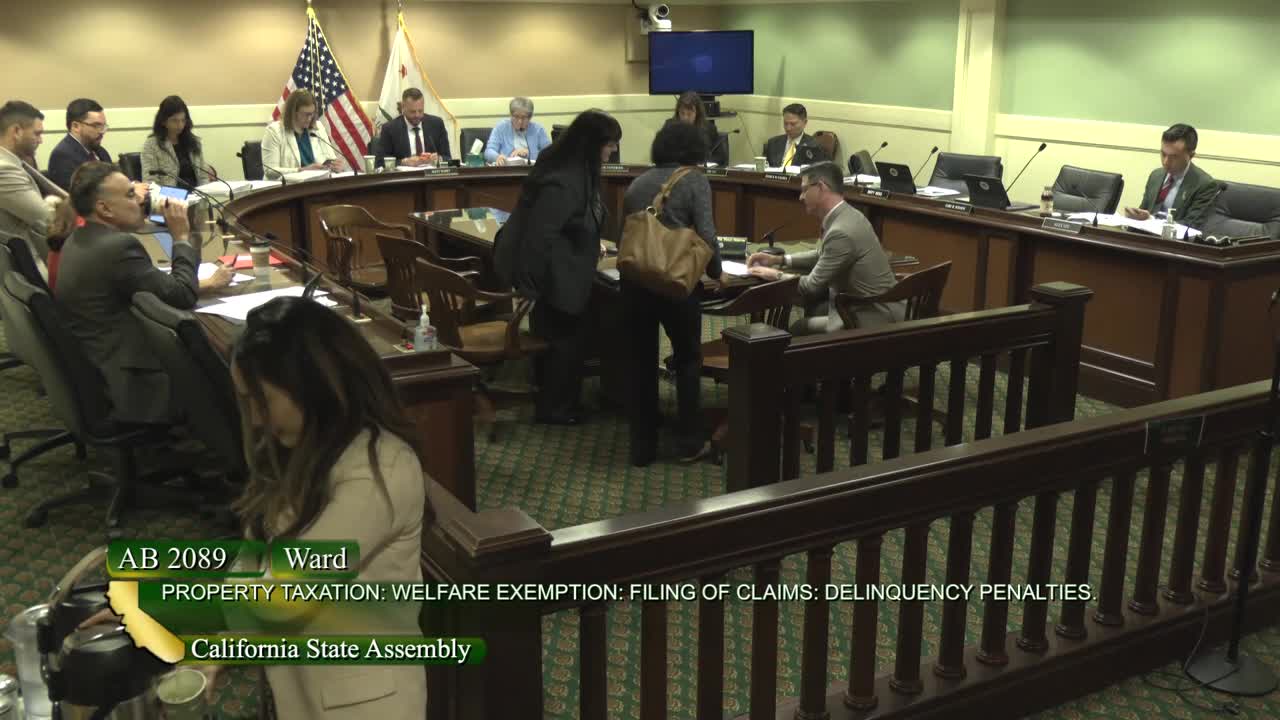 8MIN
Assembly Standing Committee on Housing and Community Development
Bill Author

Bill Co-Author(s):