AB 2103: Office of Data and Innovation: Engaged California Program.
- Session Year: 2025-2026
- House: Assembly
- Latest Version Date: 2026-09-19
Current Status:
Passed
(2026-09-19: Chaptered by Secretary of State - Chapter 332, Statutes of 2026.)
Introduced
In Committee
Awaiting First Chamber Vote
Passed First Chamber
In Committee
Awaiting Second Chamber Vote
Passed Second Chamber
Enacted
Existing law establishes the Office of Data and Innovation within the Government Operations Agency with a mission to deliver better government services to the people of California through technology and service innovation, data, and design. Existing law establishes the Data and Innovation Services Revolving Fund consisting of certain sources of moneys including donations, endowments, or grants of funds from private or public sources that commit to the offices mission of ethical, efficient, effective, secure, and responsible use of data in a manner that respects privacy. Exiting law makes moneys in the fund available upon appropriation of the Legislature, as specified.
This bill would establish the Engaged California Program within the office. The bill would require the office to, among other things, design, establish, and maintain a platform for ongoing dialogue between Californians and state government and to establish best practices for its use. Subject to certain conditions, including upon appropriation by the Legislature for the express purpose of running the Engaged California Program, the bill would require topics to be selected for deliberation in accordance with specified procedure and would require state agencies identified by the office to coordinate outreach, among other things. The bill would require the Data and Innovation Services Revolving Fund to consist of supplemental funding for the Engaged California Program from partner organizations. The bill would prohibit organizations that provide that funding from participating in the selection of a topic for deliberation and from participating in the deliberation. The bill would also make any unspent funds appropriated for the Engaged California Program during the 202627 fiscal year available for use by that program during the 202728 fiscal year.
Existing law establishes the Office of Data and Innovation within the Government Operations Agency with a mission to deliver better government services to the people of California through technology and service innovation, data, and design. Existing law establishes the Data and Innovation Services Revolving Fund consisting of certain sources of moneys including donations, endowments, or grants of funds from private or public sources that commit to the offices mission of ethical, efficient, effective, secure, and responsible use of data in a manner that respects privacy. Exiting law makes moneys in the fund available upon appropriation of the Legislature, as specified.
This bill would establish the Engaged California Program within the office. The bill would require the office to, among other things, design, establish, and maintain a platform for ongoing dialogue between Californians and state government and to establish best practices for its use. Upon appropriation by the Legislature, Subject to certain conditions, including upon appropriation by the Legislature for the express purpose of running the Engaged California Program, the bill would require topics to be selected for deliberation in accordance with specified procedure and would require state agencies identified by the office to coordinate outreach, among other things. The bill would require the Data and Innovation Services Revolving Fund to consist of supplemental funding for the Engaged California Program from partner organizations. The bill would prohibit organizations that provide that funding from participating in the selection of a topic for deliberation and from participating in the deliberation. The bill would also make any unspent funds appropriated for the Engaged California Program during the 202627 fiscal year available for use by that program during the 202728 fiscal year.
Existing law establishes the Office of Data and Innovation within the Government Operations Agency with a mission to deliver better government services to the people of California through technology and service innovation, data, and design. Existing law establishes the Data and Innovation Services Revolving Fund consisting of certain sources of moneys including donations, endowments, or grants of funds from private or public sources that commit to the offices mission of ethical, efficient, effective, secure, and responsible use of data in a manner that respects privacy. Exiting law makes moneys in the fund available upon appropriation of the Legislature, as specified.
This bill would establish the Engaged California Program within the office. The bill would require the office to to, among other things, design, establish, and maintain a platform for ongoing dialogue between Californians and state government and to establish best practices for its use. Upon appropriation of sufficient funding, by the Legislature, the bill would require the office to select and activate topics to be selected for deliberation on the platform and in accordance with specified procedure and would require state agencies identified by the office to coordinate outreach, among other things. The bill would authorize the office to receive require the Data and Innovation Services Revolving Fund to consist of supplemental funding for the Engaged California Program from partner organizations. The bill would continuously appropriate any funding received for the program to the office for purposes of the program. prohibit organizations that provide that funding from participating in the selection of a topic for deliberation and from participating in the deliberation. The bill would also make any unspent funds appropriated for the Engaged California Program during the 202627 fiscal year available for use by that program during the 202728 fiscal year.
Existing law establishes the Office of Data and Innovation within the Government Operations Agency with a mission to deliver better government services to the people of California through technology and service innovation, data, and design.
This bill would establish the Engaged California Program within the office. The bill would require the office to design, establish, and maintain a platform for ongoing dialogue between Californians and state government and to establish best practices for its use. Upon appropriation of sufficient funding, the bill would require the office to select and activate topics for deliberation on the platform and would require state agencies identified by the office to coordinate outreach, among other things. The bill would authorize the office to receive supplemental funding from partner organizations. The bill would continuously appropriate any funding received for the program to the office for purposes of the program.
(a)The Office of Data and Innovation is hereby established within the Government Operations Agency. Effective July 1, 2023, the Office of Data and Innovation shall operate as a standalone entity that reports to the Government Operations Agency consistent with other state entities listed in Section 12803.2.
(b)There shall be a Director of the Office of Data and Innovation.
The director shall be appointed by, and serve at the pleasure of, the Governor. The appointment of the director shall be subject to confirmation by the Senate. The director shall report to the Secretary of Government Operations. The director shall be responsible for managing the affairs of the office and shall perform all duties, exercise all powers and jurisdiction, and assume and discharge all responsibilities necessary to carry out the purposes of this section. The Governor may appoint people to the office who are exempt from civil service. The total number of exempt positions in the office shall not exceed 22.
(c)There shall be a Chief Data Officer in the Office of Data and Innovation who shall be appointed by, and serve at the pleasure of, the Governor. The Chief Data Officer shall report to the Director of the Office of Data and Innovation. The Chief Data Officer shall be responsible for data practices within the state with an overarching goal to improve government data use.
(d)For the purposes of this section:
(1)Director means the Director of the Office of Data and Innovation.
(2)CDO means Chief Data Officer of the Office of Data and Innovation.
(3)Fund means the Data and Innovation Services Revolving Fund.
(4)Office means the Office of Data and Innovation.
(5)Open data means a dataset that is available as a whole to all at no cost, discoverable and accessible on the internet, published to minimize the time between the creation and dissemination of the data or documents, provided under terms that permit reuse, redistribution, and mixing with other datasets, and provided in an open format that is machine-readable on data.ca.gov or its successor internet website.
(6)Service delivery means the provision of a service or services, product or products, by a state entity or state entities to persons, other state entities, constitutional state entities, independent state entities, local government entities, federal entities, private entities, or nonprofit entities.
(7)State entity means an entity within the executive branch that is under the direct authority of the Governor, including, but not limited to, all departments, boards, bureaus, commissions, councils, and agencies.
(e)The offices mission shall be to deliver better government services to the people of California through technology and service innovation, data, and design. The office shall fulfill this mission by:
(1)Collaborating with state entities to transform government services. The office shall focus on measurably improving services using a deliberate, user-focused approach and data-informed practices.
(2)Investing in state capabilities to put users first, build iteratively, and let data drive decisions.
(3)Empowering the use of data by ensuring that the state has the infrastructure, processes, and people to manage, access, and use data ethically, efficiently, effectively, securely, responsibly, and in a manner that respects privacy.
(4)Rethinking and improving how the state buys digital services and datasets.
(5)Expanding the use of common platforms, services, and tools.
(f)The director shall hire staff to assist in the fulfillment of the duties and responsibilities of the office.
(g)The director shall establish a program to improve the states service delivery and data functions, guided by service delivery and data best practices.
(1)The director is hereby authorized to engage with state entities for the purpose of improving the service and data delivery functions of those state entities.
(2)Engagements shall be formalized in writing and shall identify, at minimum, the roles and responsibilities of both the office and the state entity being engaged by the office.
(h)The director and the CDO may create, update, or publish, in consultation with the appropriate control agency, policies, standards, and procedures for state entities in the State Administrative Manual or Statewide Information Management Manual regarding:
(1)Service delivery design, implementation, maintenance, and operations.
(2)Service delivery assessments.
(3)Service delivery improvement and problem mitigation.
(4)Data governance and management, including, but not limited to, policies, standards, and procedures related to data sharing, data inventory, and open data, data standards for consistency and interoperability of data across the state, and methodological and evidence standards, including ethical data use, for performance management, analytics, and evaluation.
(i)The director shall train state supervisors, managers, executives, and other staff in leadership positions regarding service delivery and data best practices. The director may require state entity staff to attend training deemed necessary by the director. The director may consult or contract with the Department of Human Resources or the Department of Technology for assistance or delivery of training as needed to fulfill the purposes of this section.
(j)Datasets available as open data on data.ca.gov or its successor internet website or other state-managed open data portals are provided for informational purposes only. The state does not warrant the completeness, accuracy, content, or fitness for any particular purpose or use of data made available on the data portal. No warranties may be implied or inferred with respect to the publishable data made available on the data portal. The state is not liable for any deficiencies in the completeness, accuracy, content, or fitness for any particular purpose or use of publishable data made available on the data portal or by any third-party application utilizing publishable data.
(k)No later than January 31, 2024, and every two years thereafter, the CDO shall create and publish a report detailing a state data strategy to empower the use of data by ensuring that the state has the infrastructure, processes, and personnel to manage access and use data ethically, efficiently, effectively, securely, responsibly, and in a manner that respects privacy. The report may also include recommendations to improve data management across state departments, however, those recommendations shall not require those agencies to act. The report shall be submitted to the legislative and judicial branches.
(l)Any funds appropriated to the office for the purpose of funding various statewide data and innovation activities are to be administered by the director for the implementation, support, or assessment of state entities existing or proposed service delivery functions.
(m)While engaged with a state entity, office staff shall, in the performance of their duties related to the improvement of service delivery and data functions, have access to, and the authority to examine or reproduce, any and all records, data, information technology systems or other functionality, or any other document or component related to the service delivery function being improved by the office.
(1)The office shall maintain the confidentiality of, and protect from unauthorized access or disclosure, all records, data, information technology systems or other functionality, or any other document or component received from, or otherwise accessed from, any state entity engaged with the office in accordance with state law, including, but not limited to, the Information Practices Act of 1977.
(2)The director, any employee or former employee of the office, any person or business entity that is contracting with or has contracted with the office and the employees and former employees of that person or business entity shall not divulge or make known to any person not employed by the office in any manner not expressly permitted by law any particulars of any record, data, information technology systems or other functionality, or any other document or component, the disclosure of which is restricted by law from release to the public. This subdivision shall also apply to the officers and employees of, and any person or business entity that is contracting with, or has contracted with, any state or local governmental agency or publicly created entity, that has assisted the office in the course of any engagement.
(3)Any officer, employee, or person who discloses the particulars of any record, data, information technology systems or other functionality, or any other document or component in violation of this section shall be subject to a civil penalty not to exceed five thousand dollars ($5,000), including the release of any information received pursuant to Section 10850 of the Welfare and Institutions Code, or that is otherwise prohibited by law to be disclosed.
(4)Upon the completion of each engagement, the office shall dispose of all records, data, and other documentation received, copied, or otherwise in the possession of the office as a result of the engagement that contains personally identifiable information in accordance with state law.
(n)The adoption, amendment, or repeal of the policies, procedures, guidelines, or other directives consistent with this chapter are exempted from the rulemaking provisions of the Administrative Procedure Act (Chapter 3.5 (commencing with Section 11340) of Part 1).
(o)(1)Effective July 1, 2020, the Data and Innovation Services Revolving Fund is hereby created within the State Treasury. The fund shall be administered by the director to receive all moneys properly credited to the office. Notwithstanding Section 13340, until July 1, 2024, moneys in the fund are continuously appropriated to the office without regard to fiscal year to pay all costs arising from this section and rendering of services to state entities, including, but not limited to, employment and compensation of necessary personnel and expenses, such as operating and other expenses of the office, and to establish reserves. On and after July 1, 2024, moneys in the fund shall be available upon appropriation of the Legislature. At the discretion of the director, segregated, dedicated accounts within the fund may be established.
(2)On or before February 1, 2021, and each February 1 thereafter, the director shall submit a report to the Chairperson of the Joint Legislative Budget Committee, or the chairpersons designee, that includes a summary of the activities of the office and a listing and descriptions of all expenditures made from the fund, as well as all revenues received by the fund, for the prior fiscal year. The report shall also include all of the following:
(A)A list of past and current engagements organized by state entity.
(B)A list of proposed and approved information technology projects that received funding from the fund.
(C)Measurable outcomes from changes in business processes, program design, and service delivery associated with engagements receiving funding from the fund.
(D)A section that provides information on the Engaged California Program, including all of the following:
(i)The topic selected and the body that requested the topic.
(ii)The specific problem the topic was intended to solve.
(iii)The platform that was used and why it was selected.
(iv)The specific data that was used in each deliberation process and the source of the data.
(v)The agency or department, if any, that was impacted by the deliberation.
(vi)Whether the participants met the criteria in subparagraph (C) of paragraph (4) of subdivision (q), the number of participants, and how they were identified and contacted.
(vii)The outcomes of any deliberations in the previous year, including all recommendations, whether they require statutory changes or budget augmentations, and any agency or department involved in the solutions.
(viii)An update from deliberations in previous years that includes whether recommendations were implemented, whether the recommendations improved the problem that was identified, and, if so, how the recommendations improved the problem.
(3)The fund shall consist of all of the following:
(A)Moneys appropriated and made available by the Legislature for the purposes of this section.
(B)Donations, endowments, or grants of funds from private or public sources that commit to the offices mission of the ethical, efficient, effective, secure, and responsible use of data in a manner that respects privacy. The office and the Controller may establish separate accounts in the fund for the purpose of separating deposits according to their origin or intended purpose.
(C)(i)Supplemental funding for the Engaged California Program from partner organizations, including other state entities, philanthropic organizations, civil groups, and other similar organizations, provided that acceptance of that supplemental funding is otherwise in accordance with existing law.
(ii)Organizations external to state government, including, but not limited to, philanthropic organizations, civil groups, and similar entities, that provide funding pursuant to clause (i) shall not participate in the selection of a topic for deliberation, as described in subdivision (q), and shall not participate in the deliberation.
(D)Any other moneys that may be made available to the office from any other source, including the return from investments of moneys by the Treasurer.
(4)Any unspent funds appropriated for the Engaged California Program during the 202627 fiscal year shall remain available for use by that program during the 202728 fiscal year.
(p)Notwithstanding any other law, the Controller may use the moneys in the fund for cashflow loans to the General Fund, as provided in Sections 16310 and 16381.
(q)(1)Effective January 1, 2027, the Engaged California Program is hereby established within the office.
(2)The purposes of the Engaged California Program are to facilitate structured, ongoing dialogue between Californians and state government through deliberation, shared learning, and the development of actionable recommendations that inform government services and policies.
(3)For purposes of this subdivision and subdivision (o), the following definitions apply:
(A)Deliberation is a structured dialogue with a defined audience in which participants engage on a defined topic to produce actionable recommendations that inform government services, programs, and policies.
(B)Personal information has the same meaning as that term is defined in Section 1798.3 of the Civil Code.
(C)Platform means the technology, data infrastructure, and tools necessary to enable the Engaged California Program to facilitate a deliberation.
(4)The office shall have the following responsibilities with respect to the platform:
(A)Design, operate, and maintain the platform.
(B)Establish standards, guidance, and best practices for use of the platform, consistent with state and federal law.
(C)Ensure the platform remains up to date for future deployment.
(5)(A)Subject to subparagraph (B), the office shall have the following responsibilities with respect to the Engaged California Program:
(i)Implement the deliberation for topics selected in compliance with paragraph (6).
(ii)Deploy a platform that is suitable for each topic selected.
(iii)Solicit participation from a diverse group of participants, including all economic segments of the community, members of protected classes under Section 12955, and, as appropriate, the geographic population specific to a selected topic for deliberation.
(iv)For each topic selected, identify state agencies, as that term is defined in Section 11000, with relevant knowledge or expertise to support the office in designing and conducting the deliberation.
(B)The office shall have the responsibilities described in subparagraph (A) with respect to the Engaged California Program only upon selection of a topic under paragraph (6) and if any of the following conditions are met:
(i)Upon appropriation by the Legislature for the express purpose of running the Engaged California Program.
(ii)The office partners with a state entity with discretionary funding to fund an engagement.
(iii)During a state of emergency proclaimed pursuant to Section 8625 of the California Emergency Services Act (Chapter 7 (commencing with Section 8550) of Division 1).
(6)Pursuant to clause (i) of subparagraph (A) of paragraph (5), topics for deliberation shall be selected in compliance with all of the following:
(A)(i)The Speaker of the Assembly or the President pro Tempore of the Senate may select a topic for deliberation.
(ii)The Secretary of Government Operations may select a topic for deliberation.
(B) A topic for deliberation shall define a clear problem to address and meet all of the following criteria:
(i)The topic is relevant to the lived experiences or interests of Californians.
(ii)The topic is actionable, including that decisions or policy actions may reasonably be taken based on the outcomes of the deliberation.
(iii)The topic has the potential to meaningfully impact Californians or improve government services and outcomes.
(iv)The topic is appropriate for public deliberation and would benefit from input beyond the traditional stakeholder civic engagement process.
(7)Upon selection of a topic, any state agency identified pursuant to clause (iv) of subparagraph (A) of paragraph (5) shall do both of the following:
(A)Coordinate with the office to provide outreach, community engagement, and state communications expertise necessary to support the Engaged California Program.
(B)Subject to existing law, provide any necessary data and relevant information, provided that the data or information does not include any personal information. Any personal information collected in relation to this paragraph by the agency or the office shall not be used without consent from the individual identified or described.
(a)The Office of Data and Innovation is hereby established within the Government Operations Agency. Effective July 1, 2023, the Office of Data and Innovation shall operate as a standalone entity that reports to the Government Operations Agency consistent with other state entities listed in Section 12803.2.
(b)There shall be a Director of the Office of Data and Innovation.
The director shall be appointed by, and serve at the pleasure of, the Governor. The appointment of the director shall be subject to confirmation by the Senate. The director shall report to the Secretary of Government Operations. The director shall be responsible for managing the affairs of the office and shall perform all duties, exercise all powers and jurisdiction, and assume and discharge all responsibilities necessary to carry out the purposes of this section. The Governor may appoint people to the office who are exempt from civil service. The total number of exempt positions in the office shall not exceed 22.
(c)There shall be a Chief Data Officer in the Office of Data and Innovation who shall be appointed by, and serve at the pleasure of, the Governor. The Chief Data Officer shall report to the Director of the Office of Data and Innovation. The Chief Data Officer shall be responsible for data practices within the state with an overarching goal to improve government data use.
(d)For the purposes of this section:
(1)Director means the Director of the Office of Data and Innovation.
(2)CDO means Chief Data Officer of the Office of Data and Innovation.
(3)Fund means the Data and Innovation Services Revolving Fund.
(4)Office means the Office of Data and Innovation.
(5)Open data means a dataset that is available as a whole to all at no cost, discoverable and accessible on the internet, published to minimize the time between the creation and dissemination of the data or documents, provided under terms that permit reuse, redistribution, and mixing with other datasets, and provided in an open format that is machine-readable on data.ca.gov or its successor internet website.
(6)Service delivery means the provision of a service or services, product or products, by a state entity or state entities to persons, other state entities, constitutional state entities, independent state entities, local government entities, federal entities, private entities, or nonprofit entities.
(7)State entity means an entity within the executive branch that is under the direct authority of the Governor, including, but not limited to, all departments, boards, bureaus, commissions, councils, and agencies.
(e)The offices mission shall be to deliver better government services to the people of California through technology and service innovation, data, and design. The office shall fulfill this mission by:
(1)Collaborating with state entities to transform government services. The office shall focus on measurably improving services using a deliberate, user-focused approach and data-informed practices.
(2)Investing in state capabilities to put users first, build iteratively, and let data drive decisions.
(3)Empowering the use of data by ensuring that the state has the infrastructure, processes, and people to manage, access, and use data ethically, efficiently, effectively, securely, responsibly, and in a manner that respects privacy.
(4)Rethinking and improving how the state buys digital services and datasets.
(5)Expanding the use of common platforms, services, and tools.
(f)The director shall hire staff to assist in the fulfillment of the duties and responsibilities of the office.
(g)The director shall establish a program to improve the states service delivery and data functions, guided by service delivery and data best practices.
(1)The director is hereby authorized to engage with state entities for the purpose of improving the service and data delivery functions of those state entities.
(2)Engagements shall be formalized in writing and shall identify, at minimum, the roles and responsibilities of both the office and the state entity being engaged by the office.
(h)The director and the CDO may create, update, or publish, in consultation with the appropriate control agency, policies, standards, and procedures for state entities in the State Administrative Manual or Statewide Information Management Manual regarding:
(1)Service delivery design, implementation, maintenance, and operations.
(2)Service delivery assessments.
(3)Service delivery improvement and problem mitigation.
(4)Data governance and management, including, but not limited to, policies, standards, and procedures related to data sharing, data inventory, and open data, data standards for consistency and interoperability of data across the state, and methodological and evidence standards, including ethical data use, for performance management, analytics, and evaluation.
(i)The director shall train state supervisors, managers, executives, and other staff in leadership positions regarding service delivery and data best practices. The director may require state entity staff to attend training deemed necessary by the director. The director may consult or contract with the Department of Human Resources or the Department of Technology for assistance or delivery of training as needed to fulfill the purposes of this section.
(j)Datasets available as open data on data.ca.gov or its successor internet website or other state-managed open data portals are provided for informational purposes only. The state does not warrant the completeness, accuracy, content, or fitness for any particular purpose or use of data made available on the data portal. No warranties may be implied or inferred with respect to the publishable data made available on the data portal. The state is not liable for any deficiencies in the completeness, accuracy, content, or fitness for any particular purpose or use of publishable data made available on the data portal or by any third-party application utilizing publishable data.
(k)No later than January 31, 2024, and every two years thereafter, the CDO shall create and publish a report detailing a state data strategy to empower the use of data by ensuring that the state has the infrastructure, processes, and personnel to manage access and use data ethically, efficiently, effectively, securely, responsibly, and in a manner that respects privacy. The report may also include recommendations to improve data management across state departments, however, those recommendations shall not require those agencies to act. The report shall be submitted to the legislative and judicial branches.
(l)Any funds appropriated to the office for the purpose of funding various statewide data and innovation activities are to be administered by the director for the implementation, support, or assessment of state entities existing or proposed service delivery functions.
(m)While engaged with a state entity, office staff shall, in the performance of their duties related to the improvement of service delivery and data functions, have access to, and the authority to examine or reproduce, any and all records, data, information technology systems or other functionality, or any other document or component related to the service delivery function being improved by the office.
(1)The office shall maintain the confidentiality of, and protect from unauthorized access or disclosure, all records, data, information technology systems or other functionality, or any other document or component received from, or otherwise accessed from, any state entity engaged with the office in accordance with state law, including, but not limited to, the Information Practices Act of 1977.
(2)The director, any employee or former employee of the office, any person or business entity that is contracting with or has contracted with the office and the employees and former employees of that person or business entity shall not divulge or make known to any person not employed by the office in any manner not expressly permitted by law any particulars of any record, data, information technology systems or other functionality, or any other document or component, the disclosure of which is restricted by law from release to the public. This subdivision shall also apply to the officers and employees of, and any person or business entity that is contracting with, or has contracted with, any state or local governmental agency or publicly created entity, that has assisted the office in the course of any engagement.
(3)Any officer, employee, or person who discloses the particulars of any record, data, information technology systems or other functionality, or any other document or component in violation of this section shall be subject to a civil penalty not to exceed five thousand dollars ($5,000), including the release of any information received pursuant to Section 10850 of the Welfare and Institutions Code, or that is otherwise prohibited by law to be disclosed.
(4)Upon the completion of each engagement, the office shall dispose of all records, data, and other documentation received, copied, or otherwise in the possession of the office as a result of the engagement that contains personally identifiable information in accordance with state law.
(n)The adoption, amendment, or repeal of the policies, procedures, guidelines, or other directives consistent with this chapter are exempted from the rulemaking provisions of the Administrative Procedure Act (Chapter 3.5 (commencing with Section 11340) of Part 1).
(o)(1)Effective July 1, 2020, the Data and Innovation Services Revolving Fund is hereby created within the State Treasury. The fund shall be administered by the director to receive all moneys properly credited to the office. Notwithstanding Section 13340, until July 1, 2024, moneys in the fund are continuously appropriated to the office without regard to fiscal year to pay all costs arising from this section and rendering of services to state entities, including, but not limited to, employment and compensation of necessary personnel and expenses, such as operating and other expenses of the office, and to establish reserves. On and after July 1, 2024, moneys in the fund shall be available upon appropriation of the Legislature. At the discretion of the director, segregated, dedicated accounts within the fund may be established.
(2)On or before February 1, 2021, and each February 1 thereafter, the director shall submit a report to the Chairperson of the Joint Legislative Budget Committee, or the chairpersons designee, that includes a summary of the activities of the office and a listing and descriptions of all expenditures made from the fund, as well as all revenues received by the fund, for the prior fiscal year. The report shall also include all of the following:
(A)A list of past and current engagements organized by state entity.
(B)A list of proposed and approved information technology projects that received funding from the fund.
(C)Measurable outcomes from changes in business processes, program design, and service delivery associated with engagements receiving funding from the fund.
(D)A section that provides information on the Engaged California Program, including all of the following:
(i)The topic selected and the body that requested the topic.
(ii)The specific problem the topic was intended to solve.
(iii)The platform that was used and why it was selected.
(iv)The specific data that was used in each deliberation process and the source of the data.
(v)The agency or department, if any, that was impacted by the deliberation.
(vi)Whether the participants met the criteria in subparagraph (C) of paragraph (4) of subdivision (q), the number of participants, and how they were identified and contacted.
(vii)The outcomes of any deliberations in the previous year, including all recommendations, whether they require statutory changes or budget augmentations, and any agency or department involved in the solutions.
(viii)An update from deliberations in previous years that includes whether recommendations were implemented, whether the recommendations improved the problem that was identified, and, if so, how the recommendations improved the problem.
(3)The fund shall consist of all of the following:
(A)Moneys appropriated and made available by the Legislature for the purposes of this section.
(B)Donations, endowments, or grants of funds from private or public sources that commit to the offices mission of the ethical, efficient, effective, secure, and responsible use of data in a manner that respects privacy. The office and the Controller may establish separate accounts in the fund for the purpose of separating deposits according to their origin or intended purpose.
(C)(i)Supplemental funding for the Engaged California Program from partner organizations, including other state entities, philanthropic organizations, civil groups, and other similar organizations, provided that acceptance of that supplemental funding is otherwise in accordance with existing law.
(ii)Organizations external to state government, including, but not limited to, philanthropic organizations, civil groups, and similar entities, that provide funding pursuant to clause (i) shall not participate in the selection of a topic for deliberation, as described in subdivision (q), and shall not participate in the deliberation.
(D)Any other moneys that may be made available to the office from any other source, including the return from investments of moneys by the Treasurer.
(4)Any unspent funds appropriated for the Engaged California Program during the 202627 fiscal year shall remain available for use by that program during the 202728 fiscal year.
(p)Notwithstanding any other law, the Controller may use the moneys in the fund for cashflow loans to the General Fund, as provided in Sections 16310 and 16381.
(q)(1)Effective January 1, 2027, the Engaged California Program is hereby established within the office.
(2)The purposes of the Engaged California Program are to facilitate structured, ongoing dialogue between Californians and state government through deliberation, shared learning, and the development of actionable recommendations that inform government services and policies.
(3)For purposes of this subdivision and subdivision (o), the following definitions apply:
(A)Deliberation is a structured dialogue with a defined audience in which participants engage on a defined topic to produce actionable recommendations that inform government services, programs, and policies.
(B)Personal information has the same meaning as that term is defined in Section 1798.3 of the Civil Code.
(C)Platform means the technology, data infrastructure, and tools necessary to enable the Engaged California Program to facilitate a deliberation.
(4)The office shall have the following responsibilities with respect to the platform:
(A)Design, operate, and maintain the platform.
(B)Establish standards, guidance, and best practices for use of the platform, consistent with state and federal law.
(C)Ensure the platform remains up to date for future deployment.
(5)Upon appropriation by the Legislature, and selection of a topic under paragraph (6), the (A)Subject to subparagraph (B), the office shall have the following responsibilities with respect to the Engaged California Program:
(A)(i)Implement the deliberation for topics selected in compliance with paragraph (6).
(B)(ii)Deploy a separate platform that is suitable for each topic selected.
(C)(iii)Solicit participation from a diverse group of participants, including all economic segments of the community, members of protected classes under Section 12955, and, as appropriate, the geographic population specific to a selected topic for deliberation.
(D)(iv)For each topic selected, identify state agencies, as that term is defined in Section 11000, with relevant knowledge or expertise to support the office in designing and conducting the deliberation.
(B)The office shall have the responsibilities described in subparagraph (A) with respect to the Engaged California Program only upon selection of a topic under paragraph (6) and if any of the following conditions are met:
(i)Upon appropriation by the Legislature for the express purpose of running the Engaged California Program.
(ii)The office partners with a state entity with discretionary funding to fund an engagement.
(iii)During a state of emergency proclaimed pursuant to Section 8625 of the California Emergency Services Act (Chapter 7 (commencing with Section 8550) of Division 1).
(6)Pursuant to clause (i) of subparagraph (A) of paragraph (5), topics for deliberation shall be selected in compliance with all of the following:
(A)(i)The Speaker of the Assembly or the President pro Tempore of the Senate may select a topic for deliberation.
(ii)The Secretary of Government Operations may select a topic for deliberation.
(B) A topic for deliberation shall define a clear problem to address and meet all of the following criteria:
(i)The topic is relevant to the lived experiences or interests of Californians.
(ii)The topic is actionable, including that decisions or policy actions may reasonably be taken based on the outcomes of the deliberation.
(iii)The topic has the potential to meaningfully impact Californians or improve government services and outcomes.
(iv)The topic is appropriate for public deliberation and would benefit from input beyond the traditional stakeholder civic engagement process.
(7)Upon selection of a topic, any state agency identified pursuant to subparagraph (D) clause (iv) of subparagraph (A) of paragraph (5) shall do both of the following:
(A)Coordinate with the office to provide outreach, community engagement, and statement state communications expertise necessary to support the Engaged California Program.
(B)Subject to existing law, provide any necessary data and relevant information, provided that the data or information does not include any personal information. Any personal information collected in relation to this paragraph by the agency or the office shall not be used without consent from the individual identified or described.
(a)The Office of Data and Innovation is hereby established within the Government Operations Agency. Effective July 1, 2023, the Office of Data and Innovation shall operate as a standalone entity that reports to the Government Operations Agency consistent with other state entities listed in Section 12803.2.
(b)There shall be a Director of the Office of Data and Innovation.
The director shall be appointed by, and serve at the pleasure of, the Governor. The appointment of the director shall be subject to confirmation by the Senate. The director shall report to the Secretary of Government Operations. The director shall be responsible for managing the affairs of the office and shall perform all duties, exercise all powers and jurisdiction, and assume and discharge all responsibilities necessary to carry out the purposes of this section. The Governor may appoint people to the office who are exempt from civil service. The total number of exempt positions in the office shall not exceed 22.
(c)There shall be a Chief Data Officer in the Office of Data and Innovation who shall be appointed by, and serve at the pleasure of, the Governor. The Chief Data Officer shall report to the Director of the Office of Data and Innovation. The Chief Data Officer shall be responsible for data practices within the state with an overarching goal to improve government data use.
(d)For the purposes of this section:
(1)Director means the Director of the Office of Data and Innovation.
(2)CDO means Chief Data Officer of the Office of Data and Innovation.
(3)Fund means the Data and Innovation Services Revolving Fund.
(4)Office means the Office of Data and Innovation.
(5)Open data means a dataset that is available as a whole to all at no cost, discoverable and accessible on the internet, published to minimize the time between the creation and dissemination of the data or documents, provided under terms that permit reuse, redistribution, and mixing with other datasets, and provided in an open format that is machine-readable on data.ca.gov or its successor internet website.
(6)Service delivery means the provision of a service or services, product or products, by a state entity or state entities to persons, other state entities, constitutional state entities, independent state entities, local government entities, federal entities, private entities, or nonprofit entities.
(7)State entity means an entity within the executive branch that is under the direct authority of the Governor, including, but not limited to, all departments, boards, bureaus, commissions, councils, and agencies.
(e)The offices mission shall be to deliver better government services to the people of California through technology and service innovation, data, and design. The office shall fulfill this mission by:
(1)Collaborating with state entities to transform government services. The office shall focus on measurably improving services using a deliberate, user-focused approach and data-informed practices.
(2)Investing in state capabilities to put users first, build iteratively, and let data drive decisions.
(3)Empowering the use of data by ensuring that the state has the infrastructure, processes, and people to manage, access, and use data ethically, efficiently, effectively, securely, responsibly, and in a manner that respects privacy.
(4)Rethinking and improving how the state buys digital services and datasets.
(5)Expanding the use of common platforms, services, and tools.
(f)The director shall hire staff to assist in the fulfillment of the duties and responsibilities of the office.
(g)The director shall establish a program to improve the states service delivery and data functions, guided by service delivery and data best practices.
(1)The director is hereby authorized to engage with state entities for the purpose of improving the service and data delivery functions of those state entities.
(2)Engagements shall be formalized in writing and shall identify, at minimum, the roles and responsibilities of both the office and the state entity being engaged by the office.
(h)The director and the CDO may create, update, or publish, in consultation with the appropriate control agency, policies, standards, and procedures for state entities in the State Administrative Manual or Statewide Information Management Manual regarding:
(1)Service delivery design, implementation, maintenance, and operations.
(2)Service delivery assessments.
(3)Service delivery improvement and problem mitigation.
(4)Data governance and management, including, but not limited to, policies, standards, and procedures related to data sharing, data inventory, and open data, data standards for consistency and interoperability of data across the state, and methodological and evidence standards, including ethical data use, for performance management, analytics, and evaluation.
(i)The director shall train state supervisors, managers, executives, and other staff in leadership positions regarding service delivery and data best practices. The director may require state entity staff to attend training deemed necessary by the director. The director may consult or contract with the Department of Human Resources or the Department of Technology for assistance or delivery of training as needed to fulfill the purposes of this section.
(j)Datasets available as open data on data.ca.gov or its successor internet website or other state-managed open data portals are provided for informational purposes only. The state does not warrant the completeness, accuracy, content, or fitness for any particular purpose or use of data made available on the data portal. No warranties may be implied or inferred with respect to the publishable data made available on the data portal. The state is not liable for any deficiencies in the completeness, accuracy, content, or fitness for any particular purpose or use of publishable data made available on the data portal or by any third-party application utilizing publishable data.
(k)No later than January 31, 2024, and every two years thereafter, the CDO shall create and publish a report detailing a state data strategy to empower the use of data by ensuring that the state has the infrastructure, processes, and personnel to manage access and use data ethically, efficiently, effectively, securely, responsibly, and in a manner that respects privacy. The report may also include recommendations to improve data management across state departments, however, those recommendations shall not require those agencies to act. The report shall be submitted to the legislative and judicial branches.
(l)Any funds appropriated to the office for the purpose of funding various statewide data and innovation activities are to be administered by the director for the implementation, support, or assessment of state entities existing or proposed service delivery functions.
(m)While engaged with a state entity, office staff shall, in the performance of their duties related to the improvement of service delivery and data functions, have access to, and the authority to examine or reproduce, any and all records, data, information technology systems or other functionality, or any other document or component related to the service delivery function being improved by the office.
(1)The office shall maintain the confidentiality of, and protect from unauthorized access or disclosure, all records, data, information technology systems or other functionality, or any other document or component received from, or otherwise accessed from, any state entity engaged with the office in accordance with state law, including, but not limited to, the Information Practices Act of 1977.
(2)The director, any employee or former employee of the office, any person or business entity that is contracting with or has contracted with the office and the employees and former employees of that person or business entity shall not divulge or make known to any person not employed by the office in any manner not expressly permitted by law any particulars of any record, data, information technology systems or other functionality, or any other document or component, the disclosure of which is restricted by law from release to the public. This subdivision shall also apply to the officers and employees of, and any person or business entity that is contracting with, or has contracted with, any state or local governmental agency or publicly created entity, that has assisted the office in the course of any engagement.
(3)Any officer, employee, or person who discloses the particulars of any record, data, information technology systems or other functionality, or any other document or component in violation of this section shall be subject to a civil penalty not to exceed five thousand dollars ($5,000), including the release of any information received pursuant to Section 10850 of the Welfare and Institutions Code, or that is otherwise prohibited by law to be disclosed.
(4)Upon the completion of each engagement, the office shall dispose of all records, data, and other documentation received, copied, or otherwise in the possession of the office as a result of the engagement that contains personally identifiable information in accordance with state law.
(n)The adoption, amendment, or repeal of the policies, procedures, guidelines, or other directives consistent with this chapter are exempted from the rulemaking provisions of the Administrative Procedure Act (Chapter 3.5 (commencing with Section 11340) of Part 1).
(o)(1)Effective July 1, 2020, the Data and Innovation Services Revolving Fund is hereby created within the State Treasury. The fund shall be administered by the director to receive all moneys properly credited to the office. Notwithstanding Section 13340, until July 1, 2024, moneys in the fund are continuously appropriated to the office without regard to fiscal year to pay all costs arising from this section and rendering of services to state entities, including, but not limited to, employment and compensation of necessary personnel and expenses, such as operating and other expenses of the office, and to establish reserves. On and after July 1, 2024, moneys in the fund shall be available upon appropriation of the Legislature. At the discretion of the director, segregated, dedicated accounts within the fund may be established.
(2)On or before February 1, 2021, and each February 1 thereafter, the director shall submit a report to the Chairperson of the Joint Legislative Budget Committee, or the chairpersons designee, that includes a summary of the activities of the office and a listing and descriptions of all expenditures made from the fund, as well as all revenues received by the fund, for the prior fiscal year. The report shall also include all of the following:
(A)A list of past and current engagements organized by state entity.
(B)A list of proposed and approved information technology projects that received funding from the fund.
(C)Measurable outcomes from changes in business processes, program design, and service delivery associated with engagements receiving funding from the fund.
(D)A section that provides information on the Engaged California Program, which may include, but is not limited to, deliberation topics, participant demographics, recommendations, agency responses, and actions taken under the program. including all of the following:
(i)The topic selected and the body that requested the topic.
(ii)The specific problem the topic was intended to solve.
(iii)The platform that was used and why it was selected.
(iv)The specific data that was used in each deliberation process and the source of the data.
(v)The agency or department, if any, that was impacted by the deliberation.
(vi)Whether the participants met the criteria in subparagraph (C) of paragraph (4) of subdivision (q), the number of participants, and how they were identified and contacted.
(vii)The outcomes of any deliberations in the previous year, including all recommendations, whether they require statutory changes or budget augmentations, and any agency or department involved in the solutions.
(viii)An update from deliberations in previous years that includes whether recommendations were implemented, whether the recommendations improved the problem that was identified, and, if so, how the recommendations improved the problem.
(3)The fund shall consist of all of the following:
(A)Moneys appropriated and made available by the Legislature for the purposes of this section.
(B)Donations, endowments, or grants of funds from private or public sources that commit to the offices mission of the ethical, efficient, effective, secure, and responsible use of data in a manner that respects privacy. The office and the Controller may establish separate accounts in the fund for the purpose of separating deposits according to their origin or intended purpose.
(C)(i)Supplemental funding for the Engaged California Program from partner organizations, including other state entities, philanthropic organizations, civil groups, and other similar organizations, provided that acceptance of that supplemental funding is otherwise in accordance with existing law.
(ii)Organizations external to state government, including, but not limited to, philanthropic organizations, civil groups, and similar entities, that provide funding pursuant to clause (i) shall not participate in the selection of a topic for deliberation, as described in subdivision (q), and shall not participate in the deliberation.
(C)(D)Any other moneys that may be made available to the office from any other source, including the return from investments of moneys by the Treasurer.
(4)Any unspent funds appropriated for the Engaged California Program during the 202627 fiscal year shall remain available for use by that program during the 202728 fiscal year.
(p)Notwithstanding any other law, the Controller may use the moneys in the fund for cashflow loans to the General Fund, as provided in Sections 16310 and 16381.
(q)(1)Effective January 1, 2027, the Engaged California Program is hereby established within the office.
(2)The purposes of the Engaged California Program is are to facilitate structured, ongoing dialogue between Californians and state government through deliberation, shared learning, and the development of actionable recommendations that inform government services and policies.
(3)For purposes of this subdivision, platform means the technology, platform, data infrastructure, and tools necessary to enable the Engaged California Program. subdivision and subdivision (o), the following definitions apply:
(A)Deliberation is a structured dialogue with a defined audience in which participants engage on a defined topic to produce actionable recommendations that inform government services, programs, and policies.
(B)Personal information has the same meaning as that term is defined in Section 1798.3 of the Civil Code.
(C)Platform means the technology, data infrastructure, and tools necessary to enable the Engaged California Program to facilitate a deliberation.
(4)The office shall have the following responsibilities with respect to the platform:
(A)Design, operate, and maintain the platform.
(B)Establish standards, guidance, and best practices for use of the platform, consistent with state and federal law.
(C)Ensure the platform remains up to date for future deployment.
(5)Upon appropriation of moneys sufficient to fund at least one Engaged California topic either pursuant to paragraph (8) or by an act of by the Legislature, and selection of a topic under paragraph (6), the office shall have the following responsibilities with respect to the Engaged California Program:
(A)Select Implement the deliberation for topics for deliberation selected in compliance with paragraph (6).
(B)Activate the platform Deploy a separate platform that is suitable for each topic selected.
(C)For each topic selected, ensure Solicit participation from a diverse group of participants who reflect the demographic, geographic, and socioeconomic diversity of California. participants, including all economic segments of the community, members of protected classes under Section 12955, and, as appropriate, the geographic population specific to a selected topic for deliberation.
(D)For each topic selected, identify state agencies, as that term is defined in Section 11000, with relevant knowledge or expertise. expertise to support the office in designing and conducting the deliberation.
(6)Pursuant to subparagraph (A) of paragraph (5), topics for deliberation shall be selected in compliance with all of the following requirements: following:
(A)The office shall select topics in consultation with stakeholders, which may include, but are not limited to, the public, the Legislature, the Governors Office, and state departments and agencies.(A)(i)The Speaker of the Assembly or the President pro Tempore of the Senate may select a topic for deliberation.
(ii)The Secretary of Government Operations may select a topic for deliberation.
(B) A topic for deliberation shall define a clear problem to address and meet all of the following criteria:
(i)The topic is relevant to the lived experiences or interests of Californians.
(ii)The topic presents an appropriate level of complexity that allows for informed discussion and collective learning.(iii)The topic involves differing perspectives that would benefit from structured public deliberation.(iv)(ii)The topic is actionable, including that decisions or policy actions may reasonably be taken based on the outcomes of the deliberation.
(iii)The topic has the potential to meaningfully impact Californians or improve government services and outcomes.
(iv)The topic is appropriate for public deliberation and would benefit from input beyond the traditional stakeholder civic engagement process.
(7)Upon selection of a topic, the communications and external affairs teams of any state agency identified pursuant to subparagraph (D) of paragraph (5) shall do both of the following:
(A)Coordinate with the office to provide outreach, community engagement, and statement communications expertise necessary for to support the Engaged California Program.
(B)Subject to existing law, provide any necessary data and relevant information.(8)The office may accept supplemental funding to fulfill any responsibility set forth in this subdivision from partner organizations, including other state entities, philanthropic organizations, civil groups, and other similar organizations provided that acceptance of that supplemental funding is otherwise in accordance with existing law.(9)Notwithstanding Section 13340, any moneys received for purposes of the Engaged California Program shall be continuously appropriated, without regard to fiscal years, to the office for purposes of the program.(B)Subject to existing law, provide any necessary data and relevant information, provided that the data or information does not include any personal information. Any personal information collected in relation to this paragraph by the agency or the office shall not be used without consent from the individual identified or described.
(a)The Office of Data and Innovation is hereby established within the Government Operations Agency. Effective July 1, 2023, the Office of Data and Innovation shall operate as a standalone entity that reports to the Government Operations Agency consistent with other state entities listed in Section 12803.2.
(b)There shall be a Director of the Office of Data and Innovation.
The director shall be appointed by, and serve at the pleasure of, the Governor. The appointment of the director shall be subject to confirmation by the Senate. The director shall report to the Secretary of Government Operations. The director shall be responsible for managing the affairs of the office and shall perform all duties, exercise all powers and jurisdiction, and assume and discharge all responsibilities necessary to carry out the purposes of this section. The Governor may appoint people to the office who are exempt from civil service. The total number of exempt positions in the office shall not exceed 22.
(c)There shall be a Chief Data Officer in the Office of Data and Innovation who shall be appointed by, and serve at the pleasure of, the Governor. The Chief Data Officer shall report to the Director of the Office of Data and Innovation. The Chief Data Officer shall be responsible for data practices within the state with an overarching goal to improve government data use.
(d)For the purposes of this section:
(1)Director means the Director of the Office of Data and Innovation.
(2)CDO means Chief Data Officer of the Office of Data and Innovation.
(3)Fund means the Data and Innovation Services Revolving Fund.
(4)Office means the Office of Data and Innovation.
(5)Open data means a dataset that is available as a whole to all at no cost, discoverable and accessible on the internet, published to minimize the time between the creation and dissemination of the data or documents, provided under terms that permit reuse, redistribution, and mixing with other datasets, and provided in an open format that is machine-readable on data.ca.gov or its successor internet website.
(6)Service delivery means the provision of a service or services, product or products, by a state entity or state entities to persons, other state entities, constitutional state entities, independent state entities, local government entities, federal entities, private entities, or nonprofit entities.
(7)State entity means an entity within the executive branch that is under the direct authority of the Governor, including, but not limited to, all departments, boards, bureaus, commissions, councils, and agencies.
(e)The offices mission shall be to deliver better government services to the people of California through technology and service innovation, data, and design. The office shall fulfill this mission by:
(1)Collaborating with state entities to transform government services. The office shall focus on measurably improving services using a deliberate, user-focused approach and data-informed practices.
(2)Investing in state capabilities to put users first, build iteratively, and let data drive decisions.
(3)Empowering the use of data by ensuring that the state has the infrastructure, processes, and people to manage, access, and use data ethically, efficiently, effectively, securely, responsibly, and in a manner that respects privacy.
(4)Rethinking and improving how the state buys digital services and datasets.
(5)Expanding the use of common platforms, services, and tools.
(f)The director shall hire staff to assist in the fulfillment of the duties and responsibilities of the office.
(g)The director shall establish a program to improve the states service delivery and data functions, guided by service delivery and data best practices.
(1)The director is hereby authorized to engage with state entities for the purpose of improving the service and data delivery functions of those state entities.
(2)Engagements shall be formalized in writing and shall identify, at minimum, the roles and responsibilities of both the office and the state entity being engaged by the office.
(h)The director and the CDO may create, update, or publish, in consultation with the appropriate control agency, policies, standards, and procedures for state entities in the State Administrative Manual or Statewide Information Management Manual regarding:
(1)Service delivery design, implementation, maintenance, and operations.
(2)Service delivery assessments.
(3)Service delivery improvement and problem mitigation.
(4)Data governance and management, including, but not limited to, policies, standards, and procedures related to data sharing, data inventory, and open data, data standards for consistency and interoperability of data across the state, and methodological and evidence standards, including ethical data use, for performance management, analytics, and evaluation.
(i)The director shall train state supervisors, managers, executives, and other staff in leadership positions regarding service delivery and data best practices. The director may require state entity staff to attend training deemed necessary by the director. The director may consult or contract with the Department of Human Resources or the Department of Technology for assistance or delivery of training as needed to fulfill the purposes of this section.
(j)Datasets available as open data on data.ca.gov or its successor internet website or other state-managed open data portals are provided for informational purposes only. The state does not warrant the completeness, accuracy, content, or fitness for any particular purpose or use of data made available on the data portal. No warranties may be implied or inferred with respect to the publishable data made available on the data portal. The state is not liable for any deficiencies in the completeness, accuracy, content, or fitness for any particular purpose or use of publishable data made available on the data portal or by any third-party application utilizing publishable data.
(k)No later than January 31, 2024, and every two years thereafter, the CDO shall create and publish a report detailing a state data strategy to empower the use of data by ensuring that the state has the infrastructure, processes, and personnel to manage access and use data ethically, efficiently, effectively, securely, responsibly, and in a manner that respects privacy. The report may also include recommendations to improve data management across state departments, however, those recommendations shall not require those agencies to act. The report shall be submitted to the legislative and judicial branches.
(l)Any funds appropriated to the office for the purpose of funding various statewide data and innovation activities are to be administered by the director for the implementation, support, or assessment of state entities existing or proposed service delivery functions.
(m)While engaged with a state entity, office staff shall, in the performance of their duties related to the improvement of service delivery and data functions, have access to, and the authority to examine or reproduce, any and all records, data, information technology systems or other functionality, or any other document or component related to the service delivery function being improved by the office.
(1)The office shall maintain the confidentiality of, and protect from unauthorized access or disclosure, all records, data, information technology systems or other functionality, or any other document or component received from, or otherwise accessed from, any state entity engaged with the office in accordance with state law, including, but not limited to, the Information Practices Act of 1977.
(2)The director, any employee or former employee of the office, any person or business entity that is contracting with or has contracted with the office and the employees and former employees of that person or business entity shall not divulge or make known to any person not employed by the office in any manner not expressly permitted by law any particulars of any record, data, information technology systems or other functionality, or any other document or component, the disclosure of which is restricted by law from release to the public. This subdivision shall also apply to the officers and employees of, and any person or business entity that is contracting with, or has contracted with, any state or local governmental agency or publicly created entity, that has assisted the office in the course of any engagement.
(3)Any officer, employee, or person who discloses the particulars of any record, data, information technology systems or other functionality, or any other document or component in violation of this section shall be subject to a civil penalty not to exceed five thousand dollars ($5,000), including the release of any information received pursuant to Section 10850 of the Welfare and Institutions Code, or that is otherwise prohibited by law to be disclosed.
(4)Upon the completion of each engagement, the office shall dispose of all records, data, and other documentation received, copied, or otherwise in the possession of the office as a result of the engagement that contains personally identifiable information in accordance with state law.
(n)The adoption, amendment, or repeal of the policies, procedures, guidelines, or other directives consistent with this chapter are exempted from the rulemaking provisions of the Administrative Procedure Act (Chapter 3.5 (commencing with Section 11340) of Part 1).
(o)(1)Effective July 1, 2020, the Data and Innovation Services Revolving Fund is hereby created within the State Treasury. The fund shall be administered by the director to receive all moneys properly credited to the office. Notwithstanding Section 13340, until July 1, 2024, moneys in the fund are continuously appropriated to the office without regard to fiscal year to pay all costs arising from this section and rendering of services to state entities, including, but not limited to, employment and compensation of necessary personnel and expenses, such as operating and other expenses of the office, and to establish reserves. On and after July 1, 2024, moneys in the fund shall be available upon appropriation of the Legislature. At the discretion of the director, segregated, dedicated accounts within the fund may be established.
(2)On or before February 1, 2021, and each February 1 thereafter, the director shall submit a report to the Chairperson of the Joint Legislative Budget Committee, or the chairpersons designee, that includes a summary of the activities of the office and a listing and descriptions of all expenditures made from the fund, as well as all revenues received by the fund, for the prior fiscal year. The report shall also include all of the following:
(A)A list of past and current engagements organized by state entity.
(B)A list of proposed and approved information technology projects that received funding from the fund.
(C)Measurable outcomes from changes in business processes, program design, and service delivery associated with engagements receiving funding from the fund.
(D)A section that provides information on the Engaged California Program, which may include, but is not limited to, deliberation topics, participant demographics, recommendations, agency responses, and actions taken under the program.
(3)The fund shall consist of all of the following:
(A)Moneys appropriated and made available by the Legislature for the purposes of this section.
(B)Donations, endowments, or grants of funds from private or public sources that commit to the offices mission of the ethical, efficient, effective, secure, and responsible use of data in a manner that respects privacy. The office and the Controller may establish separate accounts in the fund for the purpose of separating deposits according to their origin or intended purpose.
(C)Any other moneys that may be made available to the office from any other source, including the return from investments of moneys by the Treasurer.
(p)Notwithstanding any other law, the Controller may use the moneys in the fund for cashflow loans to the General Fund, as provided in Sections 16310 and 16381.
(q)(1)Effective January 1, 2027, the Engaged California Program is hereby established within the office.
(2)The purposes of the Engaged California Program is to facilitate structured, ongoing dialogue between Californians and state government through deliberation, shared learning, and the development of actionable recommendations that inform government services and policies.
(3)For purposes of this subdivision, platform means the technology, platform, data infrastructure, and tools necessary to enable the Engaged California Program.
(4)The office shall have the following responsibilities with respect to the platform:
(A)Design, operate, and maintain the platform.
(B)Establish standards, guidance, and best practices for use of the platform, consistent with state and federal law.
(5)Upon appropriation of moneys sufficient to fund at least one Engaged California topic either pursuant to paragraph (8) or by an act of the Legislature, the office shall have the following responsibilities with respect to the Engaged California Program:
(A)Select topics for deliberation in compliance with paragraph (6).
(B)Activate the platform for each topic selected.
(C)For each topic selected, ensure a diverse group of participants who reflect the demographic, geographic, and socioeconomic diversity of California.
(D)For each topic selected, identify state agencies, as that term is defined in Section 11000, with relevant knowledge or expertise.
(6)Pursuant to subparagraph (A) of paragraph (5), topics for deliberation shall be selected in compliance with the following requirements:
(A)The office shall select topics in consultation with stakeholders, which may include, but are not limited to, the public, the Legislature, the Governors Office, and state departments and agencies.
(B)A topic for deliberation shall define a clear problem to address and meet all of the following criteria:
(i)The topic is relevant to the lived experiences or interests of Californians.
(ii)The topic presents an appropriate level of complexity that allows for informed discussion and collective learning.
(iii)The topic involves differing perspectives that would benefit from structured public deliberation.
(iv)The topic is actionable, including that decisions or policy actions may reasonably be taken based on the outcomes of the deliberation.
(7)Upon selection of a topic, the communications and external affairs teams of any state agency identified pursuant to subparagraph (D) of paragraph (5) shall do both of the following:
(A)Coordinate with the office to provide outreach, community engagement, and statement communications expertise necessary for the Engaged California Program.
(B)Subject to existing law, provide any necessary data and relevant information.
(8)The office may accept supplemental funding to fulfill any responsibility set forth in this subdivision from partner organizations, including other state entities, philanthropic organizations, civil groups, and other similar organizations provided that acceptance of that supplemental funding is otherwise in accordance with existing law.
(9)Notwithstanding Section 13340, any moneys received for purposes of the Engaged California Program shall be continuously appropriated, without regard to fiscal years, to the office for purposes of the program.
|
Date
|
Status
|
|---|---|
| Sep 19, 2026 | Chaptered by Secretary of State - Chapter 332, Statutes of 2026. |
| Sep 19, 2026 | Approved by the Governor. |
| Sep 15, 2026 | Enrolled and presented to the Governor at 3 p.m. |
| Aug 31, 2026 | Senate amendments concurred in. To Engrossing and Enrolling. (Ayes 79. Noes 0. Page 6966.). |
| Aug 31, 2026 | Senate amendments concurred in. To Engrossing and Enrolling. (Ayes 79. Noes 0.). |
| Aug 31, 2026 | Senate amendments concurred in. To Engrossing and Enrolling. |
| Aug 30, 2026 | In Assembly. Concurrence in Senate amendments pending. |
| Aug 30, 2026 | Read third time. Passed. Ordered to the Assembly. (Ayes 37. Noes 0.). |
| Aug 19, 2026 | Read second time. Ordered to third reading. |
| Aug 18, 2026 | Read third time and amended. Ordered to second reading. |
| Aug 13, 2026 | Read second time. Ordered to third reading. |
| Aug 13, 2026 | From committee: Do pass. (Ayes 7. Noes 0.) (August 13). |
| Aug 3, 2026 | In committee: Referred to APPR. suspense file. |
| Jun 16, 2026 | From committee: Do pass and re-refer to Com. on APPR. (Ayes 7. Noes 0.) (June 15). Re-referred to Com. on APPR. |
| Jun 3, 2026 | Referred to Com. on P., D.T., & C.P. |
| May 21, 2026 | In Senate. Read first time. To Com. on RLS. for assignment. |
| May 21, 2026 | Read third time. Passed. Ordered to the Senate. (Ayes 72. Noes 0. Page 5220.) |
| May 21, 2026 | Read third time. Passed. Ordered to the Senate. (Ayes 72. Noes 0.) |
| May 18, 2026 | Read second time. Ordered to third reading. |
| May 14, 2026 | From committee: Do pass. (Ayes 15. Noes 0.) (May 14). |
| May 14, 2026 | Joint Rule 62(a), file notice suspended. (Page 5030.) |
| May 14, 2026 | Joint Rule 62(a), file notice suspended. |
| May 13, 2026 | In committee: Set, first hearing. Referred to APPR. suspense file. |
| Apr 28, 2026 | Re-referred to Com. on APPR. |
| Apr 27, 2026 | Read second time and amended. |
| Apr 23, 2026 | From committee: Amend, and do pass as amended and re-refer to Com. on APPR. with recommendation: To Consent Calendar. (Ayes 15. Noes 0.) (April 21). |
| Mar 31, 2026 | In committee: Hearing postponed by committee. |
| Mar 16, 2026 | Referred to Com. on P. & C.P. |
| Feb 19, 2026 | From printer. May be heard in committee March 21. |
| Feb 18, 2026 | Read first time. To print. |
|
Date
|
Description
|
Location
|
Votes
|
|
|---|---|---|---|---|
| Aug 31, 2026 | AB 2103 Irwin Concurrence in Senate Amendments | Assembly Floor |
Passed |
|
| Aug 30, 2026 | Assembly 3rd Reading AB2103 Irwin By Cabaldon | Senate Floor |
Passed |
|
| Aug 13, 2026 | Do pass | Senate Standing Committee on Appropriations |
Passed |
|
| Aug 3, 2026 | Placed on suspense file | Senate Standing Committee on Appropriations |
Passed |
|
| Jun 15, 2026 | Do pass, but first be re-referred to the Committee on [Appropriations] | Senate Standing Committee on Privacy, Digital Technologies, and Consumer Protection |
Passed |
|
| May 21, 2026 | AB 2103 Irwin Assembly Third Reading | Assembly Floor |
Passed |
|
| May 14, 2026 | Do pass. | Assembly Standing Committee on Appropriations |
Passed |
|
| Apr 21, 2026 | Do pass as amended, and be re-referred to the Committee on [Appropriations] with recommendation: To Consent Calendar | Assembly Standing Committee on Privacy and Consumer Protection |
Passed |
This list shows positions taken on this bill by organizations on the date displayed, which is linked to the original source.
Positions by individuals are not included.
|
Organization
|
Position
|
Date
|
|---|---|---|
| Elevate California | ** Support | |
| Project Liberty | ** Support | |
| Project Liberty LLC | ** Support | |
| Project Liberty, LLC | ** Support | |
| Responsive Gov Action | ** Support | |
| Techca | ** Support | |
| Technet | ** Support |
CONCURRENCE IN SENATE AMENDMENTS
CSA1 Bill Id:AB 2103
Author:(Irwin)
As Amended Ver:August 18, 2026
Majority vote
SUMMARY
This bill codifies, effective January 1, 2027, the Engaged California Program within the Office of Data and Innovation (ODI), establishes a topic-selection process involving the Legislature and the Secretary of Government Operations, sets reporting requirements, and authorizes ODI to accept supplemental funding from partner organizations subject to restrictions on funder participation.
Senate Amendments
Provide that the Engaged California Program can fulfill its conditional deliberation responsibilities if the office partners with a state entity or there is a proclaimed state of emergency, and make various technical changes.
COMMENTS
The Engaged California Program is a program housed in the Office of Data and Innovation (ODI) that is designed to strengthen trust between Californians and their state government by creating a structured approach to public engagement. The program functions as a modern digital forum that allows participants to opt in to the conversation at their convenience. It is built to gather input using structured dialogue and balanced information, combined with an outreach approach to ensure participation reflects those most impacted by the topic under consideration.
This process was administratively created and has been deployed by ODI several times. The author provides two examples. During the Los Angeles fire recovery effort, impacted residents helped identify and prioritize recovery needs. Through a statewide workforce engagement, state employees provided input on improving service delivery. In both cases, participants could see how their input informed recommendations, while state leaders gained a clearer understanding of priorities on complex issues.
On May 7, the Governor announced the first statewide effort asking Californians to share details on how artificial intelligence is affecting their work, the economy, and what the state should do about it.
According to the Author
AB 2103 modernizes how Californians engage with their government by codifying Engaged California within the Office of Data and Innovation as a permanent statewide public engagement program. While traditional tools like hearings and public comment remain important, they do not always capture the full diversity and tapestry of California's communities. This bill provides a durable framework for structured public deliberation so that Californians from different backgrounds and regions can participate more meaningfully in state policymaking and help generate actionable recommendations that inform government policies. This measure ensures that the program can continue across administrations, preserving an innovative model for enhanced civic engagement.
Arguments in Support
Elevate California writes in support:
Elevate California's mission is to bridge the gap between everyday Californians and the policymaking process. Too often, traditional avenues for public participation fail to capture the full diversity of perspectives across our state and structural barriers exclude ordinary Californians from meaningful civic engagement.
AB 2103 represents an important step forward in modernizing how Californians engage with their government. By codifying Engaged California as a permanent statewide public engagement program within the Office of Data and Innovation, this bill ensures that more inclusive, representative, and deliberative processes become a sustained part of state governance.
Engaged California's model—bringing together diverse cohorts of residents, providing balanced educational materials, and facilitating structured dialogue—aligns closely with Elevate California's commitment to amplifying the voices of everyday Californians. AB 2103 provides the stability and flexibility needed to sustain and scale this effort across state government.
Also writing in support, Project Liberty states:
AB 2103 codifies Engaged California as a permanent program within the Office of Data and Innovation, addressing limitations in traditional public participation methods. While public hearings, town halls, and comment periods remain important, they often fail to reach a representative cross-section of Californians due to barriers such as time, geography, and accessibility.
Engaged California offers a more inclusive approach. By bringing together diverse participant cohorts, providing clear and nonpartisan information, and facilitating structured dialogue, the program enables more informed and meaningful public input. It also turns that input into actionable insights, helping decision makers create policies and programs that better reflect the needs and experiences of Californians.
Project Liberty has deep experience building the kind of digital public infrastructure that powers programs like Engaged California. Our work on open protocols and deliberative platforms, in partnership with governments and institutions around the world, demonstrates that technology-enabled civic engagement can operate at scale while maintaining the trust and safety that meaningful public participation requires.
By establishing Engaged California in statute, AB 2103 ensures continuity across administrations and reinforces the state's commitment to transparent, inclusive, and effective governance.
Arguments in Opposition
None on file.
FISCAL COMMENTS
According to the Senate Appropriations Committee:
Major administrative costs to ODI to continue statutory governance and operational requirements of the Engaged California Program (Data and Innovation Services Revolving Fund, General Fund).
Significant to major costs to state entities to participate in Engaged California Programs for outreach, community engagement, communications, data sharing and technical expertise depending on the topics selected. (Special funds, General Fund).
VOTES:
ASM PRIVACY AND CONSUMER PROTECTION: 15-0-0
YES: Bauer-Kahan, Macedo, Bryan, DeMaio, Hoover, Irwin, Lowenthal, McKinnor, Ortega, Patterson, Pellerin, Petrie-Norris, Ward, Wicks, Wilson
ASM APPROPRIATIONS: 15-0-0
YES: Wicks, Hoover, Aguiar-Curry, Calderon, Caloza, Dixon, Fong, Mark González, Krell, Pacheco, Pellerin, Sharp-Collins, Solache, Ta, Tangipa
ASSEMBLY FLOOR: 72-0-8
YES: Addis, Aguiar-Curry, Ahrens, Alanis, Alvarez, Ávila Farías, Bains, Bauer-Kahan, Bennett, Berman, Boerner, Bonta, Bryan, Calderon, Caloza, Carrillo, Castillo, Connolly, Davies, DeMaio, Dixon, Elhawary, Ellis, Flora, Fong, Gabriel, Gallagher, Gipson, Jeff Gonzalez, Mark González, Hadwick, Haney, Harabedian, Hart, Irwin, Jackson, Johnson, Kalra, Krell, Lee, Lowenthal, Macedo, McKinnor, Muratsuchi, Nguyen, Ortega, Pacheco, Papan, Patel, Patterson, Pellerin, Petrie-Norris, Quirk-Silva, Ransom, Michelle Rodriguez, Rogers, Blanca Rubio, Sanchez, Schiavo, Sharp-Collins, Solache, Soria, Stefani, Ta, Tangipa, Valencia, Wallis, Ward, Wicks, Wilson, Zbur, Rivas
ABS, ABST OR NV: Arambula, Chen, Garcia, Hoover, Lackey, Ramos, Celeste Rodriguez, Schultz
UPDATED
VERSION: August 18, 2026
CONSULTANT: Julie Salley / P. & C.P. / (916) 319-2200 FN: 0004533
SENATE RULES COMMITTEE Office of Senate Floor Analyses (916) 651-4171 | AB 2103 |
THIRD READING
Bill No: AB 2103
Author: Irwin (D)
Amended: 8/18/26 in Senate
Vote: 21
SENATE PRIV., DIGITAL TECH. & CONS. PROT. COMMITTEE: 7-0, 6/15/26
AYES: Cabaldon, Gonzalez, McNerney, Padilla, Reyes, Umberg, Wiener
NO VOTE RECORDED: Jones, Ochoa Bogh
SENATE APPROPRIATIONS COMMITTEE: 7-0, 8/13/26
AYES: Cervantes, Seyarto, Cabaldon, Dahle, Grayson, Richardson, Wahab
ASSEMBLY FLOOR: 72-0, 5/21/26 - See last page for vote
SUBJECT: Office of Data and Innovation: Engaged California Program
SOURCE: Author
DIGEST:
This bill establishes the Engaged California Program within the Office of Data and Innovation (ODI) inside the Government Operations Agency.
Senate Floor Amendments of 8/18/26 provide that the Engaged California Program can fulfill its conditional deliberation responsibilities if the office partners with a state entity or there is a proclaimed state of emergency, and make various technical changes.
ANALYSIS:
Existing law provides for open meetings and citizen participation from local school boards to the California State Legislature. The Bagley-Keene Open Meeting Act (Government [Gov.] Code §§ 11120-11132) requires meetings of state boards and commissions to be conducted openly. Additionally, the Ralph M. Brown Act (Gov. Code §§ 54950-54963) imposes similar requirements on local legislative bodies.
This bill:
- Creates the Engaged California Act within the Office of Data and Innovation (ODI) within the Government Operations Agency. ODI is to operate as a standalone entity within the agency.
- Establishes the mission of ODI as delivering better government services to the people of California through technology and service innovation, data, and design. The office shall fulfill this mission by:
- Collaborating with state entities to transform government services.
- Investing in state capabilities to put users first.
- Empowering agencies to use data ethically, efficiently, effectively, securely, responsibly, and in a manner that respects privacy.
- Improving how the state buys digital services and datasets.
- Expanding the use of common platforms, servicers, and tools.
- Requires ODI to design, operate, and maintain the platform, establish standards, guidance, and best practices for use of the platform, consistent with state and federal law, ensuring the platform remains up to date for future deployment.
- Conditions the program’s deliberation responsibilities the selection of a topic and the following conditions:
- Upon appropriation by the Legislature.
- The office partners with a state entity with discretionary funding to fund an engagement.
- During a state of emergency proclaimed pursuant to the California Emergency Services Act.
- Establishes a process for the deliberation and selection of discussion topics as specified.
- Requires the office to solicit participation from diverse groups of participants, including all economic segments.
- Expands ODI’s existing annual report to the Joint Legislative Budget Committee to include detailed information on each Engaged California deliberation, including topic, problem definition, platform used, data sources, agencies impacted, participant demographics and identification methods, outcomes and recommendations, and follow-up status of prior-year deliberations.
- Provides that any unspent Fiscal Year (FY) 2026-27 program funds remain available for use during the FY 2027-28.
- Adds personal information protections for data collected through the program, consistent with the Information Practices Act.
Background
Open and transparent communication with government is a central value of American democracy. However, as governments have grown larger and more complex, the ability of California citizens to access their government has grown equally more complex. This bill seeks to address a structural gap in how Californians participate in state policymaking and how state government gathers public input.
This bill creates the Engaged California Program within ODI to facilitate structured dialogue between Californians and their state government through deliberation and shared learning. It authorizes the Legislature to fund the program and participate in the selection of discussion topics. It sets additional reporting requirements, including topic, problem definition, data sources, agencies impacted, and participant demographics, as specified.
This bill is author-sponsored and supported by a coalition of tech associations, (Technet, TechCA) and citizen advocacy groups (Elevate California, Project Liberty, LLC). No opposition has been received. For a more thorough analysis of this bill, please see the Senate Privacy, Digital Technologies, and Consumer Protection Committee analysis.
Comment
According to the author:
AB 2103 modernizes how Californians engage with their government by codifying Engaged California within the Office of Data and Innovation as a permanent statewide public engagement program. While traditional tools like hearings and public comment remain important, they do not always capture the full diversity and tapestry of California’s communities. This bill provides a durable framework for structured public deliberation so that Californians from different backgrounds and regions can participate more meaningfully in state policymaking and help generate actionable recommendations that inform government policies. This measure ensures that the program can continue across administrations, preserving an innovative model for enhanced civic engagement.
FISCAL EFFECT: Appropriation: No Fiscal Com.: Yes Local: No
According to the Senate Appropriations Committee:
Major administrative costs to ODI to continue statutory governance and operational requirements of the Engaged California Program (Data and Innovation Services Revolving Fund, General Fund).
Significant to major costs to state entities to participate in Engaged California Programs for outreach, community engagement, communications, data sharing and technical expertise depending on the topics selected. (Special funds, General Fund).
SUPPORT: (Verified 8/14/26)
Elevate California
Project Liberty, LLC
Responsive Gov Action
TechCA
Technet
OPPOSITION: (Verified 8/14/26)
None received
ARGUMENTS IN SUPPORT: Elevate California writes:
AB 2103 represents an important step forward in modernizing how Californians engage with their government. By codifying Engaged California as a permanent statewide public engagement program within the Office of Data and Innovation, this bill ensures that more inclusive, representative, and deliberative processes become a sustained part of state governance.
Engaged California’s model—bringing together diverse cohorts of residents, providing balanced educational materials, and facilitating structured dialogue—aligns closely with Elevate California’s commitment to amplifying the voices of everyday Californians. AB 2103 provides the stability and flexibility needed to sustain and scale this effort across state government.
ASSEMBLY FLOOR: 72-0, 5/21/26
AYES: Addis, Aguiar-Curry, Ahrens, Alanis, Alvarez, Ávila Farías, Bains, Bauer-Kahan, Bennett, Berman, Boerner, Bonta, Bryan, Calderon, Caloza, Carrillo, Castillo, Connolly, Davies, DeMaio, Dixon, Elhawary, Ellis, Flora, Fong, Gabriel, Gallagher, Gipson, Jeff Gonzalez, Mark González, Hadwick, Haney, Harabedian, Hart, Irwin, Jackson, Johnson, Kalra, Krell, Lee, Lowenthal, Macedo, McKinnor, Muratsuchi, Nguyen, Ortega, Pacheco, Papan, Patel, Patterson, Pellerin, Petrie-Norris, Quirk-Silva, Ransom, Michelle Rodriguez, Rogers, Blanca Rubio, Sanchez, Schiavo, Sharp-Collins, Solache, Soria, Stefani, Ta, Tangipa, Valencia, Wallis, Ward, Wicks, Wilson, Zbur, Rivas
NO VOTE RECORDED: Arambula, Chen, Garcia, Hoover, Lackey, Ramos, Celeste Rodriguez, Schultz
Prepared by: Benjamin Diaz / P., D.T., & C.P. / (916) 651-1548
8/19/26 9:35:39
**** END ****
SENATE RULES COMMITTEE Office of Senate Floor Analyses (916) 651-4171 | AB 2103 |
THIRD READING
Bill No: AB 2103
Author: Irwin (D)
Amended: 4/27/26 in Assembly
Vote: 21
SENATE PRIV., DIGITAL TECH. & CONS. PROT. COMMITTEE: 7-0, 6/15/26
AYES: Cabaldon, Gonzalez, McNerney, Padilla, Reyes, Umberg, Wiener
NO VOTE RECORDED: Jones, Ochoa Bogh
SENATE APPROPRIATIONS COMMITTEE: 7-0, 8/13/26
AYES: Cervantes, Seyarto, Cabaldon, Dahle, Grayson, Richardson, Wahab
ASSEMBLY FLOOR: 72-0, 5/21/26 - See last page for vote
SUBJECT: Office of Data and Innovation: Engaged California Program
SOURCE: Author
DIGEST:
This bill establishes the Engaged California Program within the Office of Data and Innovation (ODI) inside the Government Operations Agency.
ANALYSIS:
Existing law provides for open meetings and citizen participation from local school boards to the California State Legislature. The Bagley-Keene Open Meeting Act (Government [Gov.] Code §§ 11120-11132) requires meetings of state boards and commissions to be conducted openly. Additionally, the Ralph M. Brown Act (Gov. Code §§ 54950-54963) imposes similar requirements on local legislative bodies.
This bill:
- Creates the Engaged California Act within the Office of Data and Innovation (ODI) within the Government Operations Agency. ODI is to operate as a standalone entity within the agency.
- Establishes the mission of ODI as delivering better government services to the people of California through technology and service innovation, data, and design. The office shall fulfill this mission by:
- Collaborating with state entities to transform government services.
- Investing in state capabilities to put users first.
- Empowering agencies to use data ethically, efficiently, effectively, securely, responsibly, and in a manner that respects privacy.
- Improving how the state buys digital services and datasets.
- Expanding the use of common platforms, servicers, and tools.
- Requires ODI to design, operate, and maintain the platform, establish standards, guidance, and best practices for use of the platform, consistent with state and federal law, ensuring the platform remains up to date for future deployment.
- Conditions the program’s deliberation responsibilities on appropriation by the Legislature and selection of a topic.
- Establishes a process for the deliberation and selection of discussion topics as specified.
- Requires the office to solicit participation from diverse groups of participants, including all economic segments.
- Expands ODI’s existing annual report to the Joint Legislative Budget Committee to include detailed information on each Engaged California deliberation, including topic, problem definition, platform used, data sources, agencies impacted, participant demographics and identification methods, outcomes and recommendations, and follow-up status of prior-year deliberations.
- Provides that any unspent FY 2026-27 program funds remain available for use during the FY 2027-28.
- Adds personal information protections for data collected through the program, consistent with the Information Practices Act.
Background
Open and transparent communication with government is a central value of American democracy. However, as governments have grown larger and more complex, the ability of California citizens to access their government has grown equally more complex. This bill seeks to address a structural gap in how Californians participate in state policymaking and how state government gathers public input.
This bill creates the Engaged California Program within ODI to facilitate structured dialogue between Californians and their state government through deliberation and shared learning. It authorizes the Legislature to fund the program and participate in the selection of discussion topics. It sets additional reporting requirements, including topic, problem definition, data sources, agencies impacted, and participant demographics, as specified.
This bill is author-sponsored and supported by a coalition of tech associations, (Technet, TechCA) and citizen advocacy groups (Elevate California, Project Liberty, LLC). No opposition has been received. For a more thorough analysis of this bill, please see the Senate Privacy, Digital Technologies, and Consumer Protection Committee analysis.
Comments
According to the author:
AB 2103 modernizes how Californians engage with their government by codifying Engaged California within the Office of Data and Innovation as a permanent statewide public engagement program. While traditional tools like hearings and public comment remain important, they do not always capture the full diversity and tapestry of California’s communities. This bill provides a durable framework for structured public deliberation so that Californians from different backgrounds and regions can participate more meaningfully in state policymaking and help generate actionable recommendations that inform government policies. This measure ensures that the program can continue across administrations, preserving an innovative model for enhanced civic engagement.
FISCAL EFFECT: Appropriation: No Fiscal Com.: Yes Local: No
According to the Senate Appropriations Committee:
Major administrative costs to ODI to continue statutory governance and operational requirements of the Engaged California Program (Data and Innovation Services Revolving Fund, General Fund).
Significant to major costs to state entities to participate in Engaged California Programs for outreach, community engagement, communications, data sharing and technical expertise depending on the topics selected. (Special funds, General Fund).
SUPPORT: (Verified 8/13/26)
Elevate California
Project Liberty, LLC
Responsive Gov Action
TechCA
Technet
OPPOSITION: (Verified 8/13/26)
None received
ARGUMENTS IN SUPPORT: Elevate California writes in support:
AB 2103 represents an important step forward in modernizing how Californians engage with their government. By codifying Engaged California as a permanent statewide public engagement program within the Office of Data and Innovation, this bill ensures that more inclusive, representative, and deliberative processes become a sustained part of state governance.
Engaged California’s model—bringing together diverse cohorts of residents, providing balanced educational materials, and facilitating structured dialogue—aligns closely with Elevate California’s commitment to amplifying the voices of everyday Californians. AB 2103 provides the stability and flexibility needed to sustain and scale this effort across state government.
ASSEMBLY FLOOR: 72-0, 5/21/26
AYES: Addis, Aguiar-Curry, Ahrens, Alanis, Alvarez, Ávila Farías, Bains, Bauer-Kahan, Bennett, Berman, Boerner, Bonta, Bryan, Calderon, Caloza, Carrillo, Castillo, Connolly, Davies, DeMaio, Dixon, Elhawary, Ellis, Flora, Fong, Gabriel, Gallagher, Gipson, Jeff Gonzalez, Mark González, Hadwick, Haney, Harabedian, Hart, Irwin, Jackson, Johnson, Kalra, Krell, Lee, Lowenthal, Macedo, McKinnor, Muratsuchi, Nguyen, Ortega, Pacheco, Papan, Patel, Patterson, Pellerin, Petrie-Norris, Quirk-Silva, Ransom, Michelle Rodriguez, Rogers, Blanca Rubio, Sanchez, Schiavo, Sharp-Collins, Solache, Soria, Stefani, Ta, Tangipa, Valencia, Wallis, Ward, Wicks, Wilson, Zbur, Rivas
NO VOTE RECORDED: Arambula, Chen, Garcia, Hoover, Lackey, Ramos, Celeste Rodriguez, Schultz
Prepared by: Benjamin Diaz / P., D.T., & C.P. / (916) 651-1548
8/15/26 9:46:16
**** END ****
SENATE COMMITTEE ON
Senator Sabrina Cervantes, Chair
2025 - 2026 Regular Session
AB 2103 (Irwin) - Office of Data and Innovation: Engaged California Program
Version: | Policy Vote: |
Urgency: | Mandate: |
Hearing Date: | Consultant: |
Bill Summary:
AB 2103 would establish in the Office of Data and Innovation (ODI), the Engaged California Program, a statutory platform for dialogue between Californians and state government.
Fiscal Impact:
Major administrative costs to ODI to continue statutory governance and operational requirements of the Engaged California Program (Data and Innovation Services Revolving Fund, General Fund).
Significant to major costs to state entities to participate in Engaged California Programs for outreach, community engagement, communications, data sharing and technical expertise depending on the topics selected. (Special funds, General Fund).
Background:
Commencing in early 2025, the Engaged California platform has produced three statewide strategic initiatives:
The Los Angeles Fire Recovery. “We worked with over 900 people affected by the Eaton and Palisades wildfires. Their input will help shape long-term recovery plans.” This initiative cost approximately $1 million, which include some initial program development costs.
State Employees. “More than 1,400 state employees gave their input. Their ideas will make California more efficient and effective.” This initiative, mostly completed by ODI, cost approximately $100,000.
Impact of AI On Work. “We are hearing your views on AI. How you use it in your work, and how you think it will affect the future of jobs.”
Proposed Law:
The Engaged California Program was established administratively. This bill establishes the program in statute and includes the Legislature in topic selection and makes funding from the Data and Innovation Services Revolving Fund available upon appropriation. The fund contains moneys appropriated by the Legislature, donations, endowments or grants of funds from private or public sources and any other moneys that may be made available to the ODI from any other source.
Related Legislation:
SB 112 (Committee on Budget and Fiscal Review) Chapter 364/2019 created the Digital Innovation Services Revolving Fund, which was retitled to the Data and Innovations Services Revolving Fund by AB 156 (Committee on Budget) Chapter 569/2022 which changed the revenue source and changed the administering agency of the Engaged California Program from the Secretary of Governmental Operations to the ODI.
Staff Comments:
The ODI reports annually to the Joint Legislative Budget Committee which contains detailed information on completed and ongoing projects, including CalData and CalInnovate.
SENATE PRIVACY, DIGITAL TECHNOLOGIES, AND CONSUMER PROTECTION COMMITTEE
Senator Christopher Cabaldon, Chair
2025-2026 Regular Session
Bill No: AB 2103 (Author:Irwin)
Version: April 27, 2026
Hearing Date: June 15, 2026
Fiscal: Yes
Urgency: No
Consultant: BH
SUBJECT
Office of Data and Innovation: Engaged California Program
DIGEST
This bill establishes the Engaged California Program within the Office of Data and Innovation (ODI) inside the Government Operations Agency.
EXECUTIVE SUMMARY
This bill creates the Engaged California Program within ODI to facilitate structured dialogue between Californians and their state government through deliberation and shared learning. It authorizes the Legislature to fund the program and participate in the selection of discussion topics. It sets additional reporting requirements, including topic, problem definition, data sources, agencies impacted, and participant demographics, as specified.
The bill is author-sponsored and supported by a coalition of tech associations, (Technet, TechCA) and citizen advocacy groups (Elevate California, Project Liberty, LLC). No opposition has been received by the committee.
PROPOSED CHANGES TO THE LAW
Existing law:
- Provides for open meetings and citizen participation from local school boards to the California State Legislature. The Bagley-Keene Open Meeting Act (Gov. Code §§ 11120-11132) requires meetings of state boards and commissions to be conducted openly. Additionally, the Ralph M. Brown Act (Gov. Code §§ 54950-54963) imposes similar requirements on local legislative bodies.
This bill:
- Creates the Engaged California Act within the Office of Data and Innovation (ODI) within the Government Operations Agency. ODI is to operate as a standalone entity within the agency.
- Establishes the mission of ODI as delivering better government services to the people of California through technology and service innovation, data, and design. The office shall fulfill this mission by:
- Collaborating with state entities to transform government services.
- Investing in state capabilities to put users first.
- Empowering agencies to use data ethically, efficiently, effectively, securely, responsibly, and in a manner that respects privacy.
- Improving how the state buys digital services and datasets.
- Expanding the use of common platforms, servicers, and tools.
- Requires ODI to design, operate, and maintain the platform, establish standards, guidance, and best practices for use of the platform, consistent with state and federal law, ensuring the platform remains up to date for future deployment.
- Conditions the program’s deliberation responsibilities on appropriation by the Legislature and selection of a topic.
- Establishes a process for the deliberation and selection of discussion topics as specified.
- Requires the office to solicit participation from diverse groups of participants, including all economic segments.
- Expands ODI’s existing annual report to the Joint Legislative Budget Committee to include detailed information on each Engaged California deliberation, including topic, problem definition, platform used, data sources, agencies impacted, participant demographics and identification methods, outcomes and recommendations, and follow-up status of prior-year deliberations.
- Provides that any unspent FY 2026-27 program funds remain available for use during the FY 2027-28.
- Adds personal information protections for data collected through the program, consistent with the Information Practices Act.
COMMENTS
- Citizen/Government communication:
Open and transparent communication with government is a central value of American democracy. However, as governments have grown larger and more complex, the ability of California citizens to access their government has grown equally more complex. This bill seeks to address a structural gap in how Californians participate in state policymaking and how state government gathers public input.
2. Author’s statement:
“AB 2103 modernizes how Californians engage with their government by codifying Engaged California within the Office of Data and Innovation as a permanent statewide public engagement program. While traditional tools like hearings and public comment remain important, they do not always capture the full diversity and tapestry of California’s communities. This bill provides a durable framework for structured public deliberation so that Californians from different backgrounds and regions can participate more meaningfully in state policymaking and help generate actionable recommendations that inform government policies. This measure ensures that the program can continue across administrations, preserving an innovative model for enhanced civic engagement.”
3. Arguments in Support:
Elevate California writes in support:
Elevate California’s mission is to bridge the gap between everyday Californians and the policymaking process. Too often, traditional avenues for public participation fail to capture the full diversity of perspectives across our state and structural barriers exclude ordinary Californians from meaningful civic engagement.
AB 2103 represents an important step forward in modernizing how Californians engage with their government. By codifying Engaged California as a permanent statewide public engagement program within the Office of Data and Innovation, this bill ensures that more inclusive, representative, and deliberative processes become a sustained part of state governance.
Engaged California’s model—bringing together diverse cohorts of residents, providing balanced educational materials, and facilitating structured dialogue—aligns closely with Elevate California’s commitment to amplifying the voices of everyday Californians. AB 2103 provides the stability and flexibility needed to sustain and scale this effort across state government.
Also in support, Project Liberty writes:
AB 2103 codifies Engaged California as a permanent program within the Office of Data and Innovation, addressing limitations in traditional public participation methods. While public hearings, town halls, and comment periods remain important, they often fail to reach a representative cross-section of Californians due to barriers such as time, geography, and accessibility.
Engaged California offers a more inclusive approach. By bringing together diverse participant cohorts, providing clear and nonpartisan information, and facilitating structured dialogue, the program enables more informed and meaningful public input. It also turns that input into actionable insights, helping decision makers create policies and programs that better reflect the needs and experiences of Californians.
Project Liberty has deep experience building the kind of digital public infrastructure that powers programs like Engaged California. Our work on open protocols and deliberative platforms, in partnership with governments and institutions around the world, demonstrates that technology-enabled civic engagement can operate at scale while maintaining the trust and safety that meaningful public participation requires.
By establishing Engaged California in statute, AB 2103 ensures continuity across administrations and reinforces the state’s commitment to transparent, inclusive, and effective governance.
SUPPORT
Elevate California
Project Liberty LLC
Responsive Gov Action
Techca
Technet
OPPOSITION
None on file
PRIOR VOTES:
Assembly Floor (Ayes 72, Noes 0)
Assembly Appropriations Committee (Ayes 15, Noes 0)
Assembly Privacy and Consumer Protection Committee (Ayes 15, Noes 0)
**************
ASSEMBLY THIRD READING
ATR Bill Id:AB 2103
Author:(Irwin)
As Amended Ver:April 27, 2026
Majority vote
SUMMARY
This bill codifies, effective January 1, 2027, the Engaged California Program within the Office of Data and Innovation (ODI), establishes a topic-selection process involving the Legislature and the Secretary of Government Operations, sets reporting requirements, and authorizes ODI to accept supplemental funding from partner organizations subject to restrictions on funder participation.
Major Provisions
- Establishes the Engaged California Program within ODI for the purpose of facilitating structured dialogue between Californians and state government through deliberation, shared learning, and development of actionable recommendations to inform government services and policies.
- Requires ODI to design, operate, and maintain the platform necessary to enable the program, establish standards and best practices for platform use, and ensure the platform remains up to date.
- Conditions the program′s deliberation responsibilities on appropriation by the Legislature and selection of a topic.
- Authorizes the Speaker of the Assembly, the President pro Tempore of the Senate, and the Secretary of Government Operations to select topics for deliberation, subject to specified topic-selection criteria.
- Requires ODI to solicit participation from a diverse group of participants for each topic, identify relevant state agencies, and coordinate with those agencies′ communications and external affairs teams.
- Authorizes ODI to accept supplemental funding from partner organizations, including other state entities, philanthropic organizations, and civil groups, and prohibits external funders from participating in topic selection or deliberation.
- Expands ODI′s existing annual report to the Joint Legislative Budget Committee to include detailed information on each Engaged California deliberation, including topic, problem definition, platform used, data sources, agencies impacted, participant demographics and identification methods, outcomes and recommendations, and follow-up status of prior-year deliberations.
- Provides that any unspent FY 2026-27 program funds remain available for use during FY 2027-28.
- Adds personal information protections for data collected through the program, consistent with the Information Practices Act.
COMMENTS
The Engaged California Program is a program housed in the Office of Data and Innovation (ODI) that is designed to strengthen trust between Californians and their state government by creating a structured approach to public engagement. The program functions as a modern digital forum that allows participants to opt in to the conversation at their convenience. It is built to gather input using structured dialogue and balanced information, combined with an outreach approach to ensure participation reflects those most impacted by the topic under consideration.
This process was administratively created and has been deployed by ODI several times. The author provides two examples. During the Los Angeles fire recovery effort, impacted residents helped identify and prioritize recovery needs. Through a statewide workforce engagement, state employees provided input on improving service delivery. In both cases, participants could see how their input informed recommendations, while state leaders gained a clearer understanding of priorities on complex issues.
On May 7, the Governor announced the first statewide effort asking Californians to share details on how artificial intelligence is affecting their work, the economy, and what the state should do about it.
According to the Author
AB 2103 modernizes how Californians engage with their government by codifying Engaged California within the Office of Data and Innovation as a permanent statewide public engagement program. While traditional tools like hearings and public comment remain important, they do not always capture the full diversity and tapestry of California′s communities. This bill provides a durable framework for structured public deliberation so that Californians from different backgrounds and regions can participate more meaningfully in state policymaking and help generate actionable recommendations that inform government policies. This measure ensures that the program can continue across administrations, preserving an innovative model for enhanced civic engagement.
Arguments in Support
Elevate California writes in support:
Elevate California′s mission is to bridge the gap between everyday Californians and the policymaking process. Too often, traditional avenues for public participation fail to capture the full diversity of perspectives across our state and structural barriers exclude ordinary Californians from meaningful civic engagement.
AB 2103 represents an important step forward in modernizing how Californians engage with their government. By codifying Engaged California as a permanent statewide public engagement program within the Office of Data and Innovation, this bill ensures that more inclusive, representative, and deliberative processes become a sustained part of state governance.
Engaged California′s model—bringing together diverse cohorts of residents, providing balanced educational materials, and facilitating structured dialogue—aligns closely with Elevate California′s commitment to amplifying the voices of everyday Californians. AB 2103 provides the stability and flexibility needed to sustain and scale this effort across state government.
Also writing in support, Project Liberty states:
AB 2103 codifies Engaged California as a permanent program within the Office of Data and Innovation, addressing limitations in traditional public participation methods. While public hearings, town halls, and comment periods remain important, they often fail to reach a representative cross-section of Californians due to barriers such as time, geography, and accessibility.
Engaged California offers a more inclusive approach. By bringing together diverse participant cohorts, providing clear and nonpartisan information, and facilitating structured dialogue, the program enables more informed and meaningful public input. It also turns that input into actionable insights, helping decision makers create policies and programs that better reflect the needs and experiences of Californians.
Project Liberty has deep experience building the kind of digital public infrastructure that powers programs like Engaged California. Our work on open protocols and deliberative platforms, in partnership with governments and institutions around the world, demonstrates that technology-enabled civic engagement can operate at scale while maintaining the trust and safety that meaningful public participation requires.
By establishing Engaged California in statute, AB 2103 ensures continuity across administrations and reinforces the state′s commitment to transparent, inclusive, and effective governance.
Arguments in Opposition
None on file.
FISCAL COMMENTS
- Likely absorbable costs (General Fund and the Data and Innovation Services Revolving Fund) to the Office of Data and Innovation (ODI) to codify and administer the Engaged California Program. ODI reports it can absorb the requirements of this bill within existing resources. The Engaged California Program is currently operating administratively within ODI; this bill codifies the program in statute effective January 1, 2027, and adds governance, reporting, and operational requirements.
- Unknown, potentially significant workload impact on other state agencies (General Fund, special funds), plausibly exceeding $150,000 annually in the aggregate. Section 12815(q)(7) requires state agencies identified by ODI as having relevant knowledge or expertise on a selected topic to coordinate with ODI on outreach, community engagement, and communications, and to provide any necessary data and information. These obligations are imposed on state agencies whose identities depend on the topics selected; the bill provides no funding for the affected agencies. The magnitude is unknown and varies by topic, but could be material for agencies
VOTES
ASM PRIVACY AND CONSUMER PROTECTION: 15-0-0
YES: Bauer-Kahan, Macedo, Bryan, DeMaio, Hoover, Irwin, Lowenthal, McKinnor, Ortega, Patterson, Pellerin, Petrie-Norris, Ward, Wicks, Wilson
ASM APPROPRIATIONS: 15-0-0
YES: Wicks, Hoover, Aguiar-Curry, Calderon, Caloza, Dixon, Fong, Mark González, Krell, Pacheco, Pellerin, Sharp-Collins, Solache, Ta, Tangipa
UPDATED
VERSION: April 27, 2026
CONSULTANT: Julie Salley / P. & C.P. / (916) 319-2200 FN: 0002965
Date of Hearing: May 13, 2026
ASSEMBLY COMMITTEE ON APPROPRIATIONS
Buffy Wicks, Chair
ABPCA Bill Id:AB 2103
Author:(Irwin) – As Amended Ver:April 27, 2026
Policy Committee: | Privacy and Consumer Protection | Vote: | 15 - 0 |
|
| ||
|
|
Urgency: No State Mandated Local Program: No Reimbursable: No
SUMMARY:
This bill codifies, effective January 1, 2027, the Engaged California Program within the Office of Data and Innovation (ODI), establishes a topic-selection process involving the Legislature and the Secretary of Government Operations, sets reporting requirements, and authorizes ODI to accept supplemental funding from partner organizations subject to restrictions on funder participation.
Specifically, this bill:
- Establishes the Engaged California Program within ODI for the purpose of facilitating structured dialogue between Californians and state government through deliberation, shared learning, and development of actionable recommendations to inform government services and policies.
- Requires ODI to design, operate, and maintain the platform necessary to enable the program, establish standards and best practices for platform use, and ensure the platform remains up to date.
- Conditions the program’s deliberation responsibilities on appropriation by the Legislature and selection of a topic.
- Authorizes the Speaker of the Assembly, the President pro Tempore of the Senate, and the Secretary of Government Operations to select topics for deliberation, subject to specified topic-selection criteria.
- Requires ODI to solicit participation from a diverse group of participants for each topic, identify relevant state agencies, and coordinate with those agencies’ communications and external affairs teams.
- Authorizes ODI to accept supplemental funding from partner organizations, including other state entities, philanthropic organizations, and civil groups, and prohibits external funders from participating in topic selection or deliberation.
- Expands ODI’s existing annual report to the Joint Legislative Budget Committee to include detailed information on each Engaged California deliberation, including topic, problem definition, platform used, data sources, agencies impacted, participant demographics and identification methods, outcomes and recommendations, and follow-up status of prior-year deliberations.
- Provides that any unspent FY 2026-27 program funds remain available for use during FY 2027-28.
- Adds personal information protections for data collected through the program, consistent with the Information Practices Act.
FISCAL EFFECT:
- Likely absorbable costs (General Fund and the Data and Innovation Services Revolving Fund) to the Office of Data and Innovation (ODI) to codify and administer the Engaged California Program. ODI reports it can absorb the requirements of this bill within existing resources. The Engaged California Program is currently operating administratively within ODI; this bill codifies the program in statute effective January 1, 2027, and adds governance, reporting, and operational requirements.
- Unknown, potentially significant workload impact on other state agencies (General Fund, special funds), plausibly exceeding $150,000 annually in the aggregate. Section 12815(q)(7) requires state agencies identified by ODI as having relevant knowledge or expertise on a selected topic to coordinate with ODI on outreach, community engagement, and communications, and to provide any necessary data and information. These obligations are imposed on state agencies whose identities depend on the topics selected; the bill provides no funding for the affected agencies. The magnitude is unknown and varies by topic, but could be material for agencies repeatedly engaged for high-volume or technically complex deliberations.
COMMENTS:
The Engaged California Program is a digital public engagement platform that ODI uses to gather structured public input on policy topics. Participants opt in to deliberations on a defined topic, receive balanced background information, engage in structured dialogue, and produce actionable recommendations for state agencies and policymakers. ODI uses targeted outreach to ensure participation reflects the demographic, geographic, and socioeconomic diversity of California, with particular focus on those most impacted by the topic under consideration. The program has been deployed administratively in two prior engagements: a Los Angeles fire recovery effort, in which impacted residents helped identify and prioritize recovery needs, and a statewide workforce engagement, in which state employees provided input on improving service delivery. The author argues that the program is currently vulnerable to reduction or elimination based on changes in administration and seeks to codify it in statute to ensure its continuation across administrations.
The Privacy and Consumer Protection committee analysis notes that, because the program was established administratively, it did not include a role for the Legislature in topic selection or appropriation of funding. Recent amendments establish Secretary of Government Operations approval for topics recommended by the ODI director, authorize the Speaker and the President pro Tempore to submit topics for deliberation, remove a continuous appropriation, expand annual reporting requirements, and add personal information protections for program data.
Analysis Prepared by: Shiran Zohar / APPR. / (916) 319-2081
Date of Hearing: April 21, 2026
Fiscal:
ASSEMBLY COMMITTEE ON PRIVACY AND CONSUMER PROTECTION
Rebecca Bauer-Kahan, Chair
ABPCA Bill Id:AB 2103 (
Author:Irwin) – As Introduced Ver:February 18, 2026
PROPOSED AMENDMENTS
SUBJECT: Office of Data and Innovation: Engaged California Program
SYNOPSIS
The Engaged California Program is a program housed in the Office of Data and Innovation (ODI) that is designed to strengthen trust between Californians and their state government by creating a structured approach to public engagement. The program functions as a modern digital forum that allows participants to opt in to the conversation at their convenience. It is built to gather input using structured dialogue and balanced information, combined with an outreach approach to ensure participation reflects those most impacted by the topic under consideration.
This process was administratively created and has been deployed by ODI several times. The author provides two examples. During the Los Angeles fire recovery effort, impacted residents helped identify and prioritize recovery needs. Through a statewide workforce engagement, state employees provided input on improving service delivery. In both cases, participants could see how their input informed recommendations, while state leaders gained a clearer understanding of priorities on complex issues.
The purpose of this bill is to codify the existing program in statute. However, because the program was established administratively, it did not include a role for the Legislature, either in the selection of topics or the appropriation of funding. To increase legislative and agency-level involvement, the amendments, enumerated in Comment #4, establish secretary approval for the topics for deliberation, allow the Legislature to submit topics that would benefit from a deliberation, and remove the continuous appropriation. In addition, the amendments clarify ODI’s responsibilities, ensure that any data containing personal information is protected, expand the annual reporting requirements as it pertains to the program, and make other technical and clarifying changes.
The bill is author-sponsored and is supported by Project Liberty and Elevate California.
EXISTING LAW:
- Establishes the Office of Data and Innovation (ODI) in the Government Operations Agency. (Gov. Code § 12815(a).)
- States that the office’s mission is to deliver better government services to the people of California through technology and service innovation, data, and design.
- Requires the office to fulfill its mission by:
- Collaborating with state entities to transform government services. The office shall focus on measurably improving services using a deliberate, user-focused approach and data-informed practices.
- Investing in state capabilities to put users first, build iteratively, and let data drive decisions.
- Empowering the use of data by ensuring that the state has the infrastructure, processes, and people to manage, access, and use data ethically, efficiently, effectively, securely, responsibly, and in a manner that respects privacy.
- Rethinking and improving how the state buys digital services and datasets.
- Expanding the use of common platforms, services, and tools. (Gov. Code § 12815(e).)
THIS BILL:
- Creates the Engaged California Program within ODI.
- States that the purpose of the program is to facilitate structured, ongoing dialogue between Californians and state government through deliberation, shared learning, and the development of actionable recommendations that inform government services and policies.
- Defines “platform” as meaning the technology, platform, data infrastructure, and tools necessary to enable the Engaged California Program.
- Establishes the following responsibilities with respect to the platform:
- Design, operate, and maintain the platform.
- Establish standards, guidance, and best practices for use of the platform, consistent with state and federal law.
- Gives the following responsibilities to the Engaged California Program:
- Select topics for deliberation.
- Activate the platform for each topic selected.
- For each topic selected, ensure a diverse group of participants who reflect the demographic, geographic, and socioeconomic diversity of California.
- For each topic selected, identify state agencies with relevant knowledge or expertise.
- Requires topics for deliberation to be selected in compliance with the following requirements:
- In consultation with stakeholders, which may include, but are not limited to, the public, the Legislature, the Governor’s Office, and state departments and agencies.
- A topic for deliberation shall define a clear problem to address and meet all of the following criteria:
- The topic is relevant to the lived experiences or interests of Californians.
- The topic presents an appropriate level of complexity that allows for informed discussion and collective learning.
- The topic involves differing perspectives that would benefit from structured public deliberation.
- The topic is actionable, including that decisions or policy actions may reasonably be taken based on the outcomes of the deliberation.
- Requires, after a topic is selected, that the external affairs and communications team of any agency or departments identified as the primary target of the topic do the following:
- Coordinate with the office to provide outreach, community engagement, and statement communications expertise necessary for the program.
- Provide any necessary data and relevant information.
- Allows the office to accept supplemental funding to fulfill their responsibilities from partner organizations, including other state entities, philanthropic organizations, civil groups, and other similar organizations.
- States that any funding received for purposes of the program shall be continuously appropriated, without regard to fiscal years.
COMMENTS:
1) Author’s statement. According to the author:
AB 2103 modernizes how Californians engage with their government by codifying Engaged California within the Office of Data and Innovation as a permanent statewide public engagement program. While traditional tools like hearings and public comment remain important, they do not always capture the full diversity and tapestry of California’s communities. This bill provides a durable framework for structured public deliberation so that Californians from different backgrounds and regions can participate more meaningfully in state policymaking and help generate actionable recommendations that inform government policies. This measure ensures that the program can continue across administrations, preserving an innovative model for enhanced civic engagement.
2) How the program currently works. According to information provided by the author, Engaged California is a program that is designed to strengthen trust between Californians and their state government by creating a structured, scalable approach to public engagement. The program functions as a modern digital forum that allows participants to opt in to the conversation at their convenience. It is built to gather input at scale using structured dialogue and balanced information, combined with an outreach approach to ensure participation reflects those most impacted by the topic under consideration.
Early deployments have demonstrated the model’s effectiveness. During the Los Angeles fire recovery effort, impacted residents helped identify and prioritize recovery needs. Through a statewide workforce engagement, state employees provided input on improving service delivery. In both cases, participants could see how their input informed recommendations, while state leaders gained a clearer understanding of priorities on complex issues. The combination of structured engagement, diverse participation, and actionable outcomes shows Engaged California can be a credible, modern approach to public engagement that supports state decision-making over time.
3) The need for the bill. If ODI is already using this process, it begs the question as to why a bill is necessary for it to continue. The author notes that Engaged California is currently under administrative authority, which leaves the program vulnerable to reduction or elimination based on administration changes. The intention of the bill is to ensure that it is codified and remains a permanent program.
4) Amendments to strengthen legislative and agency involvement. The bill envisions the director of ODI determining what problems/topics would benefit from the public Engage California Program, how the deliberations will be conducted, which groups will be involved in the process, and which recommendations to implement at the end of the process. In addition, the bill includes a continuous appropriation that removes the funding for the program from the annual budget process. The proposed Committee amendments are intended to strengthen both Legislative and Agency involvement in the program, while allowing the Engaged California Program to continue to run as efficiently as intended. This expanded role will permit both entities to have input into whether a suggested topic should be prioritized or if there are other more pressing issues that should take precedence. As currently drafted, that decision rests solely with the ODI director, who may or may not be aware of all of the issues and challenges facing the state at any given time.
Among the amendments are two significant changes designed to strengthen the Legislature’s role:
- Authorizes the leadership in the Assembly or the Senate to provide a topic that it deems would benefit from this process. The second process authorizes the director of ODI to recommend a topic to the Secretary of the Government Operations Agency for approval.
- Removes the continuous appropriation.
The following amendments clarify the purpose of the program and the role of the Legislature and the Government Operations Agency in determining topics, funding levels, and oversight over the Engaged California Program, and make other necessary clarifying and procedural changes[1]:
Government Code Section 12815(o)(2) On or before February 1, 2021, and each February 1 thereafter, the director shall submit a report to the Chairperson of the Joint Legislative Budget Committee, or the chairperson’s designee, that includes a summary of the activities of the office and a listing and descriptions of all expenditures made from the fund, as well as all revenues received by the fund, for the prior fiscal year. The report shall also include all of the following:
(A) A list of past and current engagements organized by state entity.
(B) A list of proposed and approved information technology projects that received funding from the fund.
(C) Measurable outcomes from changes in business processes, program design, and service delivery associated with engagements receiving funding from the fund.
(D) A section that provides information on the Engaged California Program, which may include, but is not limited to, deliberation topics, participant demographics, recommendations, agency responses, and actions taken under the program. including all of the following:
(i) The topic selected and the body that requested the topic.
(ii) The specific problem the topic was intended to solve.
(iii) The platform that was used and why it was selected.
(iv) The specific data that was used in each deliberation process and the source of the data.
(v) The agency or department, if any, that was impacted by the deliberation.
(vi) Whether the participants met the criteria in subparagraph (C) of paragraph (4) of subdivision (q), the number of participants, and how they were identified and contacted.
(vii) The outcomes of any deliberations in the previous year, including all recommendations, whether they require statutory changes or budget augmentations, and any agency or department involved in the solutions.
(viii) An update from deliberations in previous years that includes whether recommendations were implemented, whether the recommendations improved the problem that was identified, and, if so, how the recommendations improved the problem.
(3) The fund shall consist of all of the following:
(A) Moneys appropriated and made available by the Legislature for the purposes of this section.
(B) Donations, endowments, or grants of funds from private or public sources that commit to the office’s mission of the ethical, efficient, effective, secure, and responsible use of data in a manner that respects privacy. The office and the Controller may establish separate accounts in the fund for the purpose of separating deposits according to their origin or intended purpose.
(C) (i) Supplemental funding for the Engaged California Program from partner organizations, including other state entities, philanthropic organizations, civil groups, and other similar organizations, provided that acceptance of that supplemental funding is otherwise in accordance with existing law.
(ii) Organizations external to state government, including, but not limited to, philanthropic organizations, civil groups, and similar entities, that provide funding shall not participate in the selection of a topic for deliberation, as described in subdivision (q), and shall not participate in the deliberation.
(C)
(D) Any other moneys that may be made available to the office from any other source, including the return from investments of moneys by the Treasurer.
(p) Notwithstanding any other law, the Controller may use the moneys in the fund for cashflow loans to the General Fund, as provided in Sections 16310 and 16381.
(q) (1) Effective January 1, 2027, the Engaged California Program is hereby established within the office.
(2) The purposes of the Engaged California Program is to facilitate structured, ongoing dialogue between Californians and state government through deliberation, shared learning, and the development of actionable recommendations that inform government services and policies.
(3) For purposes of this subdivision, “platform” means the technology, platform, data infrastructure, and tools necessary to enable the Engaged California Program. subdivision and subdivision (o), the following definitions apply:
(i) “Deliberation” is a structured dialogue with a defined audience in which participants engage on a defined topic to produce actionable recommendations that inform government services, programs, and policies.
(ii) “Personal information” has the same meaning as that term is defined in Section 1798.3 of the Civil Code.
(iii) “Platform” means the technology, data infrastructure, and tools necessary to enable the Engaged California Program to facilitate a deliberation.
(4) The office shall have the following responsibilities with respect to the platform:
(A) Design, operate, and maintain the platform.
(B) Establish standards, guidance, and best practices for use of the platform, consistent with state and federal law.
(C) Ensure the platform remains up-to-date for future deployment.
(5) Upon appropriation of moneys sufficient to fund at least one Engaged California topic either pursuant to paragraph (8) or by an act of by the Legislature, and selection of a topic under paragraph (6), the office shall have the following responsibilities with respect to the Engaged California Program:
(A) Select Implement the deliberation for topics for deliberation selected in compliance with paragraph (6).
(B) Activate the platform Deploy a platform that is suitable for each the topic selected.
(C) For each topic selected, ensure Solicit participation from a diverse group of participants who reflect the demographic, geographic, and socioeconomic diversity of California. participants, including all economic segments of the community, members of protected classes under Section 12955, and, as appropriate, the geographic population specific to a selected topic for deliberation.
(D) For each topic selected, identify state agencies, as that term is defined in Section 11000, with relevant knowledge or expertise. expertise to support the office in designing and conducting the deliberation.
(6) Pursuant to subparagraph (A) of paragraph (5), topics for deliberation shall be selected in compliance with the following requirements:
(A) The office shall select topics in consultation with stakeholders, which may include, but are not limited to, the public, the Legislature, the Governor’s Office, and state departments and agencies.
(A) (i) The Speaker of the Assembly or the President pro Tempore of the Senate may select topics for deliberation.
(ii) The Secretary of the Government Operations Agency must approve any topic selected by the director and may select topics for deliberation.
(B) A topic for deliberation shall define a clear problem to address and meet all of the following criteria:
(i) The topic is relevant to the lived experiences or interests of Californians.
(ii) The topic presents an appropriate level of complexity that allows for informed discussion and collective learning.
(iii) The topic involves differing perspectives that would benefit from structured public deliberation.
(iv)
(ii) The topic is actionable, including that decisions or policy actions may reasonably be taken based on the outcomes of the deliberation.
(iii) The topic has the potential to meaningfully impact Californians or improve government services and outcomes.
(iv) The topic is appropriate for public deliberation and would benefit from input beyond the traditional stakeholder civic engagement process.
(7) Upon selection of a topic, the communications and external affairs teams of any state agency identified pursuant to subparagraph (D) of paragraph (5) shall do both of the following:
(A) Coordinate with the office to provide outreach, community engagement, and statement communications expertise necessary for to support the Engaged California Program.
(B) Subject to existing law, provide any necessary data and relevant information.
(8) The office may accept supplemental funding to fulfill any responsibility set forth in this subdivision from partner organizations, including other state entities, philanthropic organizations, civil groups, and other similar organizations provided that acceptance of that supplemental funding is otherwise in accordance with existing law.
(9) Notwithstanding Section 13340, any moneys received for purposes of the Engaged California Program shall be continuously appropriated, without regard to fiscal years, to the office for purposes of the program.
(B) Subject to existing law, provide any necessary data and relevant information, provided that the data or information does not include any personal information. Any personal information collected in relation to this paragraph by the agency or the office shall not be used without consent from the individual identified or described.
ARGUMENTS IN SUPPORT: Elevate California writes in support:
Elevate California’s mission is to bridge the gap between everyday Californians and the policymaking process. Too often, traditional avenues for public participation fail to capture the full diversity of perspectives across our state and structural barriers exclude ordinary Californians from meaningful civic engagement.
AB 2103 represents an important step forward in modernizing how Californians engage with their government. By codifying Engaged California as a permanent statewide public engagement program within the Office of Data and Innovation, this bill ensures that more inclusive, representative, and deliberative processes become a sustained part of state governance.
Engaged California’s model—bringing together diverse cohorts of residents, providing balanced educational materials, and facilitating structured dialogue—aligns closely with Elevate California’s commitment to amplifying the voices of everyday Californians. AB 2103 provides the stability and flexibility needed to sustain and scale this effort across state government.
Also writing in support, Project Liberty states:
AB 2103 codifies Engaged California as a permanent program within the Office of Data and Innovation, addressing limitations in traditional public participation methods. While public hearings, town halls, and comment periods remain important, they often fail to reach a representative cross-section of Californians due to barriers such as time, geography, and accessibility.
Engaged California offers a more inclusive approach. By bringing together diverse participant cohorts, providing clear and nonpartisan information, and facilitating structured dialogue, the program enables more informed and meaningful public input. It also turns that input into actionable insights, helping decision makers create policies and programs that better reflect the needs and experiences of Californians.
Project Liberty has deep experience building the kind of digital public infrastructure that powers programs like Engaged California. Our work on open protocols and deliberative platforms, in partnership with governments and institutions around the world, demonstrates that technology-enabled civic engagement can operate at scale while maintaining the trust and safety that meaningful public participation requires.
By establishing Engaged California in statute, AB 2103 ensures continuity across administrations and reinforces the state’s commitment to transparent, inclusive, and effective governance.
REGISTERED SUPPORT / OPPOSITION:
Support
Elevate California
Project Liberty LLC
TechCa
TechNet
Opposition
None on file.
Analysis Prepared by: Julie Salley / P. & C.P. / (916) 319-2200
The amendment language is in draft form and the exact language may change slightly as the drafting is finalized. ↑
Discussed in Hearing
 1MIN
Assembly Floor
 2MIN
Senate Floor
 16MIN
Senate Standing Committee on Privacy, Digital Technologies, and Consumer Protection
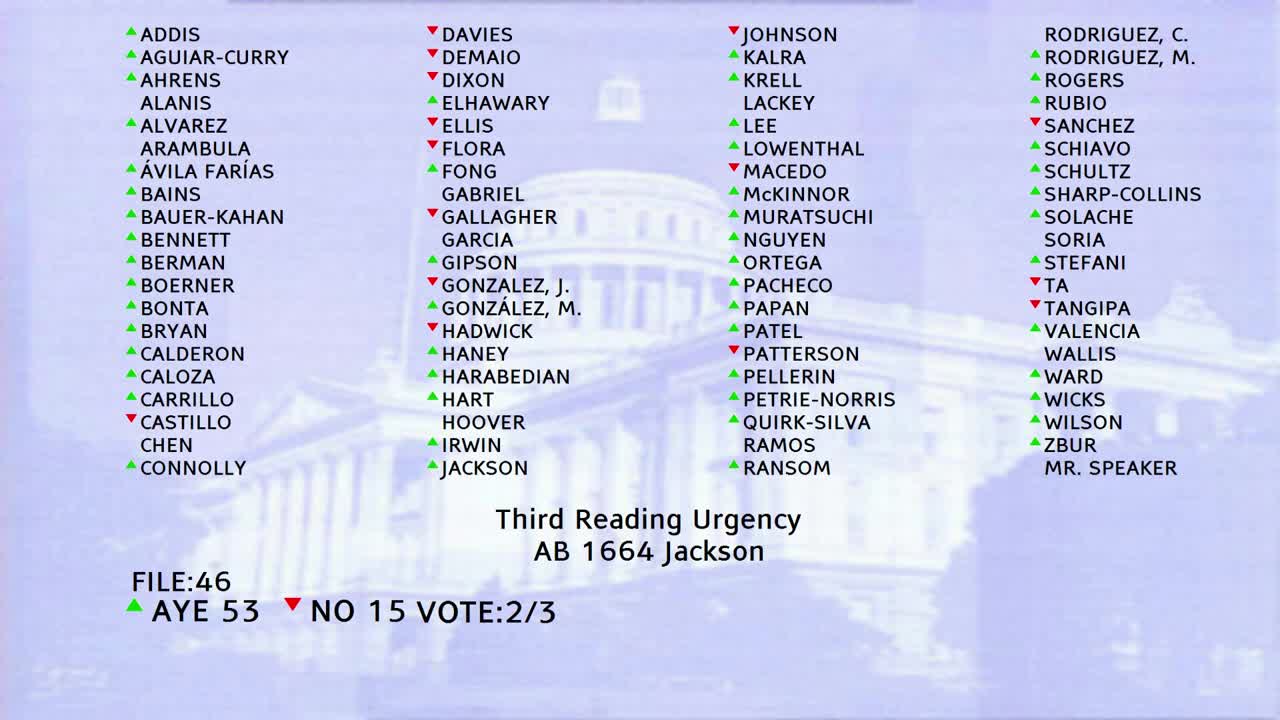 59SEC
Assembly Floor
Bill Author

Bill Co-Author(s):