AB 2104: Sexually violent predators.
- Session Year: 2025-2026
- House: Assembly
- Latest Version Date: 2026-06-25
Current Status:
In Progress
(2026-08-13: In committee: Held under submission.)
Introduced
In Committee
Awaiting First Chamber Vote
Passed First Chamber
In Committee
Awaiting Second Chamber Vote
Passed Second Chamber
Enacted
Existing law provides for the civil commitment of a person who is determined to be a sexually violent predator. Existing law establishes a procedure by which a person committed as a sexually violent predator may petition for conditional release and requires the court, if it makes a specified determination, to place the person on conditional release.
This bill would require a court presiding over any proceeding held pursuant to the above-described provisions that is open to the public to provide the public with a remote access option that allows members of the public to remotely observe the proceeding. The bill would require a court to make the audio of a proceeding accessible to the public if a court is unable to provide a remote access option that includes video due to technological limitations, as defined, that are not reasonably within the control of the court. On and after January 1, 2028, the bill would require a court to provide a remote access option with a visual feed.
Existing law provides for the civil commitment of a person who is determined to be a sexually violent predator. Existing law establishes a procedure by which a person committed as a sexually violent predator may petition for conditional release and requires the court, if it makes a specified determination, to place the person on conditional release.
This bill would require a court presiding over any proceeding held pursuant to the above-described provisions that is open to the public to provide the public with a remote access option that allows members of the public to remotely observe the proceeding.
Existing law defines certain terms for provisions related to the judicial commitment of sexually violent predators to secure facilities for appropriate treatment and confinement, and defines sexually violent predator to mean a person who has been convicted of a sexually violent offense, as specified, against one or more victims and who has a diagnosed mental disorder that makes the person a danger to the health and safety of others in that it is likely that they will engage in sexually violent criminal behavior.This bill would make technical, nonsubstantive changes to those provisions.Existing law defines certain terms for provisions related to the judicial commitment of sexually violent predators to secure facilities for appropriate treatment and confinement, and defines sexually violent predator to mean a person who has been convicted of a sexually violent offense, as specified, against one or more victims and who has a diagnosed mental disorder that makes the person a danger to the health and safety of others in that it is likely that they will engage in sexually violent criminal behavior.
This bill would make technical, nonsubstantive changes to those provisions.
(a)(1)A court presiding over any proceeding held pursuant to this article that is open to the public shall provide the public with a remote access option that allows members of the public to remotely observe the proceeding.
(2)If a court is unable to provide a remote access option that includes video due to technological limitations that are not reasonably within the control of the court, the court shall make the audio of the proceeding accessible to the public, until January 1, 2028, at which time all courts shall provide a remote access option with a visual feed.
(b)This section does not make a hearing open to the public that would not otherwise be open to the public. This section does not interfere with a courts ability to determine whether or when a proceeding is public.
(c)For the purposes of this section, technological limitations means a lack of video cameras, microphones, or streaming capability.
A court presiding over any proceeding held pursuant to this article that is open to the public shall provide the public with a remote access option that allows members of the public to remotely observe the proceeding.
SECTION 1.Section 6600 of the Welfare and Institutions Code is amended to read:6600.As used in this article, the following terms have the following meanings:(a)(1)Sexually violent predator means a person who has been convicted of a sexually violent offense against one or more victims and who has a diagnosed mental disorder that makes the person a danger to the health and safety of others in that it is likely that they will engage in sexually violent criminal behavior.(2)For purposes of this subdivision any of the following shall be considered a conviction for a sexually violent offense:(A)A prior or current conviction that resulted in a determinate prison sentence for an offense described in subdivision (b).(B)A conviction for an offense described in subdivision (b) that was committed prior to July 1, 1977, and that resulted in an indeterminate prison sentence.(C)A prior conviction in another jurisdiction for an offense that includes all of the elements of an offense described in subdivision (b).(D)A conviction for an offense under a predecessor statute that includes all of the elements of an offense described in subdivision (b).(E)A prior conviction for which the inmate received a grant of probation for an offense described in subdivision (b).(F)A prior finding of not guilty by reason of insanity for an offense described in subdivision (b).(G)A conviction resulting in a finding that the person was a mentally disordered sex offender.(H)A prior conviction for an offense described in subdivision (b) for which the person was committed to the Division of Juvenile Facilities, Department of Corrections and Rehabilitation pursuant to Section 1731.5.(I)A prior conviction for an offense described in subdivision (b) that resulted in an indeterminate prison sentence.(3)Conviction of one or more of the crimes enumerated in this section shall constitute evidence that may support a court or jury determination that a person is a sexually violent predator, but shall not be the sole basis for the determination. The existence of any prior convictions may be shown with documentary evidence. The details underlying the commission of an offense that led to a prior conviction, including a predatory relationship with the victim, may be shown by documentary evidence, including, but not limited to, preliminary hearing transcripts, trial transcripts, probation and sentencing reports, and evaluations by the State Department of State Hospitals. Jurors shall be admonished that they may not find a person a sexually violent predator based on prior offenses absent relevant evidence of a currently diagnosed mental disorder that makes the person a danger to the health and safety of others in that it is likely that they will engage in sexually violent criminal behavior.(4)The provisions of this section shall apply to any person against whom proceedings were initiated for commitment as a sexually violent predator on or after January 1, 1996.(b)Sexually violent offense means the following acts when committed by force, violence, duress, menace, fear of immediate and unlawful bodily injury on the victim or another person, or threatening to retaliate in the future against the victim or any other person, and that are committed on, before, or after the effective date of this article and result in a conviction or a finding of not guilty by reason of insanity, as defined in subdivision (a): a felony violation of Section 261, 262, 264.1, 269, 286, 287, 288, 288.5, or 289 of, or former Section 288a of, the Penal Code, or any felony violation of Section 207, 209, or 220 of the Penal Code, committed with the intent to commit a violation of Section 261, 262, 264.1, 286, 287, 288, or 289 of, or former Section 288a of, the Penal Code.(c)Diagnosed mental disorder includes a congenital or acquired condition affecting the emotional or volitional capacity that predisposes the person to the commission of criminal sexual acts in a degree constituting the person a menace to the health and safety of others.(d)Danger to the health and safety of others does not require proof of a recent overt act while the offender is in custody.(e)Predatory means an act is directed toward a stranger, a person of casual acquaintance with whom no substantial relationship exists, or an individual with whom a relationship has been established or promoted for the primary purpose of victimization.(f)Recent overt act means any criminal act that manifests a likelihood that the actor may engage in sexually violent predatory criminal behavior.(g)Notwithstanding any other provision of law and for purposes of this section, a prior juvenile adjudication of a sexually violent offense may constitute a prior conviction for which the person received a determinate term if all of the following apply:(1)The juvenile was 16 years of age or older at the time the juvenile committed the prior offense.(2)The prior offense is a sexually violent offense as specified in subdivision (b).(3)The juvenile was adjudged a ward of the juvenile court within the meaning of Section 602 because of the persons commission of the offense giving rise to the juvenile court adjudication.(4)The juvenile was committed to the Division of Juvenile Facilities, Department of Corrections and Rehabilitation for the sexually violent offense.(h)A minor adjudged a ward of the court for commission of an offense that is defined as a sexually violent offense shall be entitled to specific treatment as a sexual offender. The failure of a minor to receive that treatment shall not constitute a defense or bar to a determination that any person is a sexually violent predator within the meaning of this article.As used in this article, the following terms have the following meanings:
(a)(1)Sexually violent predator means a person who has been convicted of a sexually violent offense against one or more victims and who has a diagnosed mental disorder that makes the person a danger to the health and safety of others in that it is likely that he or she they will engage in sexually violent criminal behavior.
(2)For purposes of this subdivision any of the following shall be considered a conviction for a sexually violent offense:
(A)A prior or current conviction that resulted in a determinate prison sentence for an offense described in subdivision (b).
(B)A conviction for an offense described in subdivision (b) that was committed prior to July 1, 1977, and that resulted in an indeterminate prison sentence.
(C)A prior conviction in another jurisdiction for an offense that includes all of the elements of an offense described in subdivision (b).
(D)A conviction for an offense under a predecessor statute that includes all of the elements of an offense described in subdivision (b).
(E)A prior conviction for which the inmate received a grant of probation for an offense described in subdivision (b).
(F)A prior finding of not guilty by reason of insanity for an offense described in subdivision (b).
(G)A conviction resulting in a finding that the person was a mentally disordered sex offender.
(H)A prior conviction for an offense described in subdivision (b) for which the person was committed to the Division of Juvenile Facilities, Department of Corrections and Rehabilitation pursuant to Section 1731.5.
(I)A prior conviction for an offense described in subdivision (b) that resulted in an indeterminate prison sentence.
(3)Conviction of one or more of the crimes enumerated in this section shall constitute evidence that may support a court or jury determination that a person is a sexually violent predator, but shall not be the sole basis for the determination. The existence of any prior convictions may be shown with documentary evidence. The details underlying the commission of an offense that led to a prior conviction, including a predatory relationship with the victim, may be shown by documentary evidence, including, but not limited to, preliminary hearing transcripts, trial transcripts, probation and sentencing reports, and evaluations by the State Department of State Hospitals. Jurors shall be admonished that they may not find a person a sexually violent predator based on prior offenses absent relevant evidence of a currently diagnosed mental disorder that makes the person a danger to the health and safety of others in that it is likely that he or she they will engage in sexually violent criminal behavior.
(4)The provisions of this section shall apply to any person against whom proceedings were initiated for commitment as a sexually violent predator on or after January 1, 1996.
(b)Sexually violent offense means the following acts when committed by force, violence, duress, menace, fear of immediate and unlawful bodily injury on the victim or another person, or threatening to retaliate in the future against the victim or any other person, and that are committed on, before, or after the effective date of this article and result in a conviction or a finding of not guilty by reason of insanity, as defined in subdivision (a): a felony violation of Section 261, 262, 264.1, 269, 286, 287, 288, 288.5, or 289 of, or former Section 288a of, the Penal Code, or any felony violation of Section 207, 209, or 220 of the Penal Code, committed with the intent to commit a violation of Section 261, 262, 264.1, 286, 287, 288, or 289 of, or former Section 288a of, the Penal Code.
(c)Diagnosed mental disorder includes a congenital or acquired condition affecting the emotional or volitional capacity that predisposes the person to the commission of criminal sexual acts in a degree constituting the person a menace to the health and safety of others.
(d)Danger to the health and safety of others does not require proof of a recent overt act while the offender is in custody.
(e)Predatory means an act is directed toward a stranger, a person of casual acquaintance with whom no substantial relationship exists, or an individual with whom a relationship has been established or promoted for the primary purpose of victimization.
(f)Recent overt act means any criminal act that manifests a likelihood that the actor may engage in sexually violent predatory criminal behavior.
(g)Notwithstanding any other provision of law and for purposes of this section, a prior juvenile adjudication of a sexually violent offense may constitute a prior conviction for which the person received a determinate term if all of the following apply:
(1)The juvenile was 16 years of age or older at the time he or she the juvenile committed the prior offense.
(2)The prior offense is a sexually violent offense as specified in subdivision (b).
(3)The juvenile was adjudged a ward of the juvenile court within the meaning of Section 602 because of the persons commission of the offense giving rise to the juvenile court adjudication.
(4)The juvenile was committed to the Division of Juvenile Facilities, Department of Corrections and Rehabilitation for the sexually violent offense.
(h)A minor adjudged a ward of the court for commission of an offense that is defined as a sexually violent offense shall be entitled to specific treatment as a sexual offender. The failure of a minor to receive that treatment shall not constitute a defense or bar to a determination that any person is a sexually violent predator within the meaning of this article.
|
Date
|
Status
|
|---|---|
| Aug 13, 2026 | In committee: Held under submission. |
| Aug 3, 2026 | In committee: Referred to APPR. suspense file. |
| Jun 25, 2026 | Read second time and amended. Re-referred to Com. on APPR. |
| Jun 24, 2026 | From committee: Amend, and do pass as amended and re-refer to Com. on APPR. (Ayes 6. Noes 0.) (June 23). |
| Jun 3, 2026 | Referred to Com. on PUB. S. |
| May 21, 2026 | In Senate. Read first time. To Com. on RLS. for assignment. |
| May 21, 2026 | Read third time. Passed. Ordered to the Senate. (Ayes 70. Noes 0. Page 5221.) |
| May 21, 2026 | Read third time. Passed. Ordered to the Senate. (Ayes 70. Noes 0.) |
| May 18, 2026 | Read second time. Ordered to third reading. |
| May 14, 2026 | From committee: Do pass. (Ayes 15. Noes 0.) (May 14). |
| Apr 22, 2026 | In committee: Set, first hearing. Referred to APPR. suspense file. |
| Apr 8, 2026 | From committee: Do pass and re-refer to Com. on APPR. (Ayes 8. Noes 0.) (April 7). Re-referred to Com. on APPR. |
| Mar 10, 2026 | Re-referred to Com. on PUB. S. |
| Mar 9, 2026 | From committee chair, with author's amendments: Amend, and re-refer to Com. on PUB. S. Read second time and amended. |
| Mar 9, 2026 | Referred to Com. on PUB. S. |
| Feb 19, 2026 | From printer. May be heard in committee March 21. |
| Feb 18, 2026 | Read first time. To print. |
|
Date
|
Description
|
Location
|
Votes
|
|
|---|---|---|---|---|
| Aug 3, 2026 | Placed on suspense file | Senate Standing Committee on Appropriations |
Passed |
|
| Jun 23, 2026 | Do pass as amended, but first amend, and re-refer to the Committee on [Appropriations] | Senate Standing Committee on Public Safety |
Passed |
|
| May 21, 2026 | AB 2104 Carrillo Assembly Third Reading | Assembly Floor |
Passed |
|
| May 14, 2026 | Do pass. | Assembly Standing Committee on Appropriations |
Passed |
|
| Apr 7, 2026 | Do pass and be re-referred to the Committee on [Appropriations] | Assembly Standing Committee on Public Safety |
Passed |
This list shows positions taken on this bill by organizations on the date displayed, which is linked to the original source.
Positions by individuals are not included.
|
Organization
|
Position
|
Date
|
|---|---|---|
| 1 Private Individual | ** Support | |
| California District Attorneys Association | ** Support | |
| California Public Defenders Association | ** Against | |
| Ella Baker Center For Human Rights | ** Against | |
| Judicial Council of California | ** Against | |
| Juniper Hills Town Council | ** Support | |
| Lake Los Angeles Town Council | ** Support |
SENATE COMMITTEE ON
Senator Sabrina Cervantes, Chair
2025 - 2026 Regular Session
AB 2104 (Carrillo) - Sexually violent predators
Version: | Policy Vote: |
Urgency: | Mandate: |
Hearing Date: | Consultant: |
Bill Summary:
AB 2104 would require a court presiding over any public proceeding involving a petition for conditional release by a person who is determined to be a sexually violent predator (SVP) to provide the public with a remote access option.
Fiscal Impact:
Major one time cost, likely in the millions of dollars, to purchase, install, maintain equipment and facilities to provide livestreaming remote access. Major annual costs to the extent feasible to operate the equipment and provide remote access in a manner consistent with statutory requirement relating to SVP caselaw.
While the courts are not funded on a workload basis, an increase in workload could result in delayed court services and would put pressure on the General Fund to fund additional staff and resources. The FY 2026-27 Budget appropriated $70 million General Fund for this purpose (Trial Court Trust Fund, General Fund).
Proposed Law:
This bill adds Welfare and Institutions Code 6600.2 to require that If a court is unable to provide a remote access option that includes video due to technological limitations that are not reasonably within the control of the court, the court shall make the audio of the proceeding accessible to the public, until January 1, 2028, at which time all courts shall provide a remote access option with a visual feed.
Staff Comments:
Apart from the cost to make available remote access in any public proceeding involving a petition by an SVP, the operation of the access is problematic. Caselaw surrounding the right of public access to SVP proceedings suggests that the inclusion of mostly sensitive information, such as the defendant’s psychological treatment and testimony from victims of sex crimes, serves as, “a compelling basis for arguing that involuntary civil commitment proceedings under the SVPA are not ordinary civil proceedings that must be open to the public.” (People v. Dixon (2007) 148 Cal.App.4th 414, 429.)
Because “such proceedings are aimed at determining the status of a person’s mental health, they involve primarily personal and confidential matters.” The initial psychiatric evaluations to classify a defendant as an SVP, the trial proceedings, and release evaluations each involve confidential information to varying degrees which will require courts to carefully examine constitutional precedent to determine which proceedings must be open or closed. This bill inserts a general mandate to livestream proceedings that conflicts with constitutional requirements. Such a general rule would require courts to repeatedly start and stop the livestream, which would place an unnecessary burden on SVPA proceedings.
Proposed Author Amendments:
The author has a suspense file amendment as follows:
On page 2, in lines 3 and 4, strike out “any proceeding held pursuant to this article” and insert:
a proceeding held pursuant to Section 6608
Staff Notes Welfare and Institutions Code Section 6608 provides that a person committed as an SVP shall be permitted to petition the court for conditional release.
SENATE COMMITTEE ON PUBLIC SAFETY
Senator Jesse Arreguín, Chair
2025 - 2026 Regular
Bill No: AB 2104 Hearing Date: June 23, 2026
Author: | Carrillo | ||
Version: | March 9, 2026 | ||
Urgency: | No | Fiscal: | Yes |
Consultant: | SJ | ||
Subject: Sexually violent predators
HISTORY
Source: Author
Prior Legislation: SB 380 (Jones), Ch. 581, Stats. of 2025
SB 379 (Jones), held in Assembly Appropriations, 2025
AB 1954 (Alanis), Ch. 816, Stats. of 2024
AB 763 (Davies), not heard in Assembly Public Safety, 2023
SB 832 (Jones), failed passage in Senate Public Safety, 2023
SB 1034 (Atkins), Ch. 880, Stats. of 2022
SB 841 (Jones), failed passage in Senate Public Safety, 2022
SB 248 (Bates), Ch. 383, Stats. of 2021
AB 303 (Cervantes), Ch. 606, Stats. of 2019
AB 2661 (Arambula), Ch. 821, Stats. of 2018
SB 507 (Pavley), Ch. 576, Stats. of 2015
AB 1607 (Fox), Ch. 877, Stats. of 2014
SB 295 (Emmerson), Ch. 182, Stats. of 2013
SB 760 (Alquist), Ch. 790, Stats. of 2012
Proposition 83, as approved by the voters on November 7, 2006
SB 1128 (Alquist), Ch. 337, Stats. of 2006
AB 893 (Horton), Ch. 162, Stats. of 2005
AB 2450 (Canciamilla), Ch. 425, Stats. of 2004
AB 493 (Salinas), Ch. 222, Stats. of 2004
SB 659 (Correa), Ch. 248, Stats. of 2001
AB 1142 (Runner), Ch. 323, Stats. of 2001
SB 2018 (Schiff), Ch. 420, Stats. of 2000
SB 451 (Schiff), Ch. 41, Stats. of 2000
AB 2849 (Havice), Ch. 643, Stats. of 2000
SB 746 (Schiff), Ch. 995, Stats. of 1999
SB 11 (Schiff), Ch. 136, Stats. of 1999
SB 1976 (Mountjoy), Ch. 961, Stats. of 1998
AB 888 (Rogan), Ch. 763, Stats. of 1995
SB 1143 (Mountjoy), Ch. 764, Stats. of 1995
AB 888 (Rogan), Ch. 763, Stats. of 1995
SB 1143 (Mountjoy), Ch. 762, Stats. of 1995
Support: California District Attorneys Association
Opposition: California Public Defenders Association; Ella Baker Center for Human Rights; Judicial Council of California
Assembly Floor Vote: 70 - 0
PURPOSE
The purpose of this bill is to require any proceeding pertaining to the conditional release of a sexually violent predator (SVP) that is open to the public include a remote access option for the public to remotely observe the proceeding.
Existing law provides for the civil commitment for psychiatric and psychological treatment of a person incarcerated in the state prison who is found to be an SVP after the person has served their prison commitment. Provides that this law is known as the Sexually Violent Predator Act (“SVPA”). (Welf. & Inst. Code, § 6600, et seq.)
Existing law defines a “sexually violent predator” as “a person who has been convicted of a sexually violent offense against at least one victim, and who has a diagnosed mental disorder that makes the person a danger to the health and safety of others in that it is likely that he or she will engage in sexually violent criminal behavior.” (Welf. & Inst. Code, § 6600, subd. (a)(1).)
Existing law permits a person committed as an SVP to be held for an indeterminate term upon commitment. (Welf. & Inst. Code, §§ 6604 & 6604.1.)
Existing law establishes a process whereby a person committed as an SVP can petition for conditional release or an unconditional discharge with or without the recommendation or concurrence of the Department of State Hospitals (DSH). Provides that a hearing upon the petition cannot be held until the person who is committed has been under commitment for one year from the date of the order for commitment. (Welf. & Inst. Code, § 6608, subds. (a) & (f).)
Existing law provides that the committed person, with or without the recommendation or concurrence of DSH, may petition the court for unconditional discharge after a minimum of one year on conditional release. (Welf. & Inst. Code, § 6608, subd. (m).)
Existing law provides that if the petition is made without the consent of the director of the treatment facility, no action may be taken on the petition without first obtaining the written recommendation of the director of the treatment facility. (Welf. & Inst. Code, § 6608, subd. (e).)
Existing law requires the court to hold a hearing to determine whether the person would be a danger to the health and safety of others in that it is likely that the person will engage in sexually violent criminal behavior due to the person’s diagnosed mental disorder if under supervision and treatment in the community. (Welf. & Inst. Code, § 6608, subd. (g).)
Existing law provides that before placing a person on conditional release, the community program director designated by DSH must submit a written recommendation to the court stating which forensic conditional release program is most appropriate for supervising and treating the person. (Welf. & Inst. Code, § 6608, subd. (h).)
Existing law requires, after a judicial determination that a person should be conditionally released, the person to be placed in the county of domicile of the person prior to the person’s incarceration, unless both of the following conditions are satisfied: the court finds that extraordinary circumstances require placement outside the county of domicile and the designated county of placement was given prior notice and an opportunity to comment on the proposed placement of the committed person in the county. (Welf. & Inst. Code, § 6608.5, subd. (a).)
Existing law outlines the process for placing a person who has been approved for conditional release in the community. (Welf. & Inst. Code, § 6608.5, subds. (b)-(g).)
Existing law, the Confidentiality of Medical Information Act, generally prohibits a provider of health care, health care service plan, or contractor from disclosing medical information regarding a patient of the provider of health care or an enrollee or subscriber of a health care service plan without first obtaining an authorization. (Civ. Code, § 56.10.)
Existing law provides that all information and records obtained in the course of providing services to individuals subject to specified voluntary and involuntary commitments, including SVPs, are confidential. Specifies the circumstances under which information and records can be shared, including to the courts, as necessary for the administration of justice, and to parties to a judicial or administrative proceeding as permitted by law. (Welf. & Inst. Code, § 5328, subd. (a).)
This bill requires any proceeding pertaining to the conditional release of an SVP that is open to the public include a remote access option for the public to remotely observe the proceeding.
COMMENTS
- Need For This Bill
According to the author:
Assembly Bill 2104 … would allow members of the public to appear remotely at any Sexually Violent Predator proceeding that is open to the public. The bill would allow members of the public to observe critical court proceedings without having to commute to the courthouse and navigate an unfamiliar court system.
AB 2104 increases access to the courts for the public and removes procedural and logistic barriers that prevent members of the public from participating in matters of great public interest. Remote access to the courts eliminates the need for gas, public transit fares and costly parking fees. Remote access also reduces the amount of time participants have to be away from their workplace. By allowing increased access to the courts through remote proceedings, the court provides greater institutional accountability and transparency. Strengthening access to the courts encourages members of the public to come forward and actively participate in the judicial process.
- Background on Sexually Violent Predators (SVPs)
The Sexually Violent Predator Act (SVPA) established an extended civil commitment scheme for sex offenders who are about to be released from prison but are referred to DSH for treatment in a state hospital because they have suffered from a mental illness which causes them to be a danger to the safety of others. The initial screening is conducted by the California Department of Corrections and Rehabilitation (CDCR) and the Board of Parole Hearings. (Welf. & Inst. Code, § 6601, subd. (b).) If a determination is made that the person is likely a sexually violent predator, CDCR is required to refer to the person to DSH for a full evaluation. (Ibid.)
Under existing law, a person may be deemed an SVP if: the person has been convicted of specified sex offenses against one or more victims; the person has been diagnosed with a mental disorder that makes the person a danger to the health and safety of others in that it is likely that the person will engage in sexually violent criminal behavior; and, two licensed psychiatrists or psychologists concur in the diagnosis. (Welf. & Inst. Code, §§ 6600, subd. (a), 6601, subd. (d).) If DSH finds that the person meets the criteria to be considered an SVP, the case is referred to the county’s designated counsel who may file a petition for civil commitment. (Welf. & Inst. Code, § 6601, subd. (i).)
Once a petition has been filed, a judge holds a probable cause hearing. (Welf. & Inst. Code, § 6602.) If probable cause is found, the case proceeds to a trial at which the prosecutor must prove beyond a reasonable doubt that the person meets the statutory criteria to be considered an SVP. (Welf. & Inst. Code, § 6604.) If the prosecutor meets this burden, the person can be civilly committed to a DSH facility for treatment.
DSH must conduct an examination of an SVP’s mental condition at least annually and submit an annual report to the court. (Welf. & Inst. Code, § 6604.9, subd. (a).) This annual review is prepared by a professionally qualified person. (Ibid.) In addition, DSH has an obligation to seek judicial review any time it believes a person committed as an SVP no longer meets the criteria. (Welf. & Inst. Code, § 6607.)
The SVPA was substantially amended by Proposition 83 (“Jessica’s Law”) which became operative on November 7, 2006. An SVP commitment, as originally enacted, was for two years and subject to possible extension. Under Jessica’s Law, a person committed as an SVP may be held for an indeterminate term upon commitment or until it is shown that the defendant no longer poses a danger to others. (See People v. McKee (2010) 47 Cal.4th 1172, 1185-87.) Jessica’s Law also amended the SVPA to make it more difficult for SVPs to petition for less restrictive alternatives to commitment. These changes have survived due process, ex post facto, and equal protection challenges. (See Id. at p. 1193 (finding no due process violation because the SVPA has appropriate constitutional protections in place and the committed person “may not be held in civil commitment when he or she no longer meets the requisites of such commitment” (i.e., the person has the opportunity for release); People v. McKee (2012) 207 Cal.App.4th 1325; People v. Superior Court (Karsai) (2013) 213 Cal.App.4th 774.) Due to the significant deprivation of a person’s liberty while SVP proceedings are conducted, and potentially indefinitely after being committed as an SVP, the California Supreme Court recently held that all trial courts in the state are required to advise criminal defendants prior to pleading guilty or nolo contendere to an offense enumerated in the SVPA, or in cases where the court is aware that the defendant has a prior conviction for such an offense, of potential repercussions related to the SVPA. (In re Tellez (2024) 17 Cal.5th 77, 92.)
- Release of SVPs
Two types of release exist for SVPs—unconditional discharge and conditional release. Both types of release require a petition for release. The petition can be filed with or without the concurrence of the Director of State Hospitals, and the Director’s concurrence or lack thereof determines which is process used.
If an SVP is not eligible for an unconditional discharge, the person may petition the court for conditional release, with or without the recommendation or concurrence of the Director of State Hospitals. (Welf. & Inst. Code, § 6608, subd. (a).) A hearing on the petition cannot be held until the SVP has been under commitment for at least one year. (Welf. & Inst. Code, § 6608, subd. (f).) Upon receipt of a first or subsequent petition from a committed person without the concurrence of the Director, the court is required whenever possible to review the petition and determine if it is based upon frivolous grounds and, if so, to deny the petition without a hearing. (Welf. & Inst. Code, § 6608, subd. (a).) If the petition is not found to be frivolous, the court is required to hold a hearing. (People v. Smith (2013) 216 Cal.App.4th 947.)
Once the court sets the hearing on the petition, the petitioner is entitled to both the assistance of counsel and the appointment of experts. (Welf. & Inst. Code, § 6608, subds. (c), (g); People v. McKee, supra, 47 Cal.4th 1172, 1193.) At the hearing, the court must determine whether the petitioner would be a danger to the health and safety of others which is defined to mean “that it is likely that the person will engage in sexually violent criminal behavior due to the person’s diagnosed mental disorder if under supervision and treatment in the community.” (Welf. & Inst. Code, § 6608, subd. (h).) At the hearing, the person petitioning for release has the burden of proof by a preponderance of the evidence. (Welf. & Inst. Code, § 6608, subd. (i); People v. Rasmuson (2006) 145 Cal.App.4th 1487, 1503.) If the petition is denied, the SVP may not file a subsequent petition until one year from the date of the denial. (Welf. & Inst. Code, § 6608, subd. (j).)
If a person is approved for conditional release, DSH is required to find a suitable housing placement for the person in the community. Existing law requires that the person be placed in the county of domicile prior to the person’s incarceration unless the court finds that extraordinary circumstances require placement outside the county of domicile and the designated county of placement was given prior notice and an opportunity to comment on the proposed placement of
the committed person in the county. (Welf. & Inst. Code, § 6608.5, subd. (a).) For purposes of determining the county of domicile, the court may consider information found on a California’s driver’s license, California identification card, recent rent or utilities receipt, printed personalized checks or other recent banking documents, or any arrest record. If no information can be verified, the county of domicile is considered to be the county in which the person was arrested and convicted or last returned on parole. (Welf. & Inst. Code, § 6608.5, subd. (b)(1).) If that county is not suitable, the court, DSH, and CDCR may choose an alternative county for placement.
DSH is required to convene a housing committee consisting of the committed person’s attorney, the sheriff or the chief of police of the locality for placement, the county counsel, and the district attorney from the county of domicile, and the housing committee is required to provide assistance and consultation in DSH’s process of locating and securing housing. (Welf. & Inst. Code, § 6608.5, subd. (d)(1).) DSH must consider a number of factors when locating housing. Specifically, a conditionally-released person is prohibited from being placed within a quarter-mile of any public or private school providing instruction in kindergarten through twelfth grade if the court finds that the person has “a history of improper sexual conduct with children” or has previously been convicted of specified sex offenses. (Welf. & Inst. Code, § 6608.5, subd. (f).) DSH must additionally consider the concerns and proximity to the victim or victim’s next of kin, and the age and profile of the victim or victims of the sexually violent offenses committed by the person subject to placement. (Welf. & Inst. Code, § 6608.5, subds. (e) & (f).)
A court may approve, modify, or reject the recommended or proposed specific address within a community. The city and the address must be approved by the court. (Welf. & Inst. Code, 6609.1, subd. (a)(5)(A).) Welfare and Institutions Code section 6609.1 requires that a community be given 30 days’ notice if an SVP is pending conditional release in that community. (Welf. & Inst. Code, § 6609.1, subd. (a)(4).) Agencies receiving notice of an SVP’s placement in a specific county may comment on the placement or location of release and may suggest alternative locations for placement within a community. (Welf. & Inst. Code, § 6609.1, subd. (a)(5)(A), (b).)
Notably, if no housing placement has been found and the court has ordered the person to conditional release, the person can be released as a transient. (Karsai, supra, at p. 788-89.)
- CONREP
In October 2024, the California State Auditor published a report on DSH’s Sexually Violent Predator Conditional Release Program (CONREP). The Auditor examined the administration of the program, obstacles DSH faced in attempting to place program participants in the community, and the department’s oversight of the contractor it uses to provide various services related to the program. (State Auditor, Conditional Release Program for Sexually Violent Predators: Program Participants Are Less Likely to Reoffend, While the State Has Difficulty Finding Suitable Housing, Report 2023-130, available at <https://www.auditor.ca.gov/reports/2023-130/> (hereafter Auditor’s Report).)
The Auditor found that individuals who participated in the program were convicted of new offenses less often than SVPs who were unconditionally released and did not participate in the program. (Auditor’s Report, supra, p. 1.) Notably, of the 56 people who been released into the community on supervised release since 2003, only two have committed new offenses—one for possession of child pornography for which he was returned to custody and one failed to timely register as a sex offender. (Id. at p. 9.) The report also highlighted the numerous hurdles that the department has faced when attempting to locate suitable housing for program participants and found that DSH could improve its oversight of its contractor’s administration of the program. (Id. at pp. 1-2.)
- Effect of This Bill
This bill requires any proceeding pertaining to the conditional release of an SVP that is open to the public include a remote access option for the public to remotely observe the proceeding. It is unclear how many SVP-related court proceedings occur annually or how many of those proceedings are open to the public currently.
This bill does not clearly specify if the remote access option required must include video. However, the language of the bill does require that the remote access option allow the public to “observe” the proceeding which suggests that the intent is to require video streaming. According to the Assembly Appropriations Committee’s analysis of this bill, the Judicial Council of California has indicated that an audio-only remote access option would not present significant challenges for the courts to implement whereas an audio-visual remote access option would have that impact. As such, the author may wish to consider specifying that an audio-only option would satisfy the mandate in the bill.
- Argument in Support
According to the California District Attorneys Association:
Assembly Bill 2104 … would allow members of the public to appear remotely at any Sexually Violent Predator proceeding that is open to the public. The bill would allow members of the public to observe critical court proceedings without having to commute to the courthouse and navigate an unfamiliar court system.
AB 2104 increases access to the courts for the public and removes procedural and logistic barriers that prevent members of the public from participating in matters of great public interest. Remote access to the courts eliminates the need for gas, public transit fares and costly parking fees. Remote access also reduces the amount of time participants have to be away from their workplace. By allowing increased access to the courts through remote proceedings, the court provides greater institutional accountability and transparency. Strengthening access to the courts encourages members of the public to come forward and actively participate in the judicial process.
- Argument in Opposition
The Judicial Council of California writes:
While the courts are supportive of remote technology being used in the courts, remote participation is generally limited to those who are a party to the case or involved in the hearing (e.g. a witness). Some courts, including Los Angeles and San Bernardino, already have a process where the public can request a remote access option to these commitment hearings given the hardship the geographical distances present in those counties can create. A statewide mandate for all of these public hearings to be a live video broadcast online creates a significant fiscal impact on the courts that would need to implement technology upgrades, including purchasing additional video equipment and livestreaming capabilities for the impacted courtrooms. Livestreaming court proceedings can also have the unintended consequence of disrupting proceedings and requiring additional court staff to ensure the video feed is functioning properly.
Furthermore, the unique considerations involving sexually violent predators (SVPs) and the caselaw outlining when an SVP proceeding “is open”, as stated in the bill, complicate future attempts to implement AB 2104’s mandate. The caselaw surrounding the right of public access to SVP proceedings, seems to suggest that the inclusion of mostly sensitive information, such as the defendant’s psychological treatment and testimony from victims of sex crimes, serves as, “a compelling basis for arguing that involuntary civil commitment proceedings under the SVPA are not ordinary civil proceedings that must be open to the public.” (People v. Dixon (2007) 148 Cal.App.4th 414, 429.) Based on the fact that, “such proceedings are aimed at determining the status of a person’s mental health, they involve primarily personal and confidential matters.” (Id. at 428.) The initial psychiatric evaluations to classify a defendant as an SVP, the trial proceedings, and release evaluations each involve confidential information to varying extents. (See Welf. & Inst. Code, § 6600 et seq.) In turn, courts must carefully examine constitutional precedent to determine which proceedings must be open or closed. (Dixon, supra, 148 Cal.App.4th at 429.) AB 2104 inserts a general mandate to livestream proceedings without considering any specific determinations in line with constitutional requirements. Such a general rule would require courts to repeatedly start and the livestream, which would place an unnecessary burden on SVPA proceedings.
-- END --
ASSEMBLY THIRD READING
ATR Bill Id:AB 2104
Author:(Carrillo)
As Amended Ver:March 9, 2026
Majority vote
SUMMARY
Requires a court presiding over a proceeding involving the commitment of a sexually violent predator (SVP) that is open to the public to provide the public with a remote access option that allows members of the public to remotely observe the proceeding.
Major Provisions
COMMENTS
According to the Author
″AB 2104 improves access to justice by requiring that court hearings related to sexually violent predators (SVPs), that are already open to the public provide a remote access option. Court determinations regarding SVP placement directly affect the residents of the communities where placement may occur, and our constituents have a fundamental right to stay informed about the decision-making process.
″For many Californians, and especially those living in rural areas like my district, lack of reliable transportation can create a significant barrier to attending court hearings in person. Additional challenges, such as financial hardship, the need for childcare, illness or disability, and the inability to miss work, can make traveling to a courthouse nearly impossible. By providing remote access, AB 2104 uses available technology to reduce these barriers and ensure that rural residents can stay informed and engaged when decisions are made that impact their communities.″
Arguments in Support
According to the California District Attorneys Association, ″AB 2104 increases access to the courts for the public and removes procedural and logistic barriers that prevent members of the public from participating in matters of great public interest. Remote access to the courts eliminates the need for gas, public transit fares and costly parking fees. Remote access also reduces the amount of time participants have to be away from their workplace. By allowing increased access to the courts through remote proceedings, the court provides greater institutional accountability and transparency. Strengthening access to the courts encourages members of the public to come forward and actively participate in the judicial process.″
Arguments in Opposition
According to the California Public Defenders Association, ″Sexually Violent Predator [SVP] proceedings are not properly open to the public. Second, this bill would strip the judiciary of properly vested discretion to formulate policies governing public access to remote proceedings.
″The constitutional right held by the public to access non-criminal and ordinary civil proceedings is not absolute, and access can be limited or denied to ensure a fair trial or the privacy of participants. (See, e.g. Branzburg v. Hayes (1972) 408 U.S. 665 (excluding press from grand jury proceedings); Gannett Co., Inc. v. DePasquale (1979) 443 U.S. 368 (excluding public from pretrial suppression hearing.) Although the public enjoys a qualified constitutional right to attend criminal and ordinary civil proceedings, SVP proceedings are neither criminal nor ordinary civil cases. Instead, they are ″aimed at determining the status of a person′s mental health″ and ″involve primarily personal and confidential matters.″ (People v. Dixon (2007) 148 Cal App 4th 414.) Because civil commitment proceedings are typically closed; because SVP proceedings are designed to ensure treatment, not punishment, of people with mental disorders; and because the psychological evaluations discussed during SVP proceedings must remain confidential, public access to SVP proceedings is properly limited.
″The constitutional right to access proceedings in criminal and ordinary civil cases does not entitle the public to remotely access those proceedings, and the extent to and manner in which members of the public may remotely access the criminal and ordinary civil proceedings they are entitled to personally, physically attend are administrative matters properly sorted out by the judiciary. The Judicial Council is constitutionally tasked with ″adopt[ing] rules for court administration, practice, and procedure,″ (Cal. Const. Art. IV, § 6. and it has crafted detailed, robust rules regarding both remote proceedings (Cal. Rule of Court 3.672) and the use of photography, recording, and broadcasting equipment in court. (Cal. Rule of Court 1.150.)
″AB 2104 seeks to curtail and override judicial discretion. Local courts, applying those rules, have implemented county-specific practices for tailoring public access to remote proceedings in criminal and ordinary civil cases. For example, in Los Angeles County, the public may not remotely access criminal or ordinary civil proceedings while in Kern County, a member of the public wishing to access remote proceedings in a criminal or ordinary civil case must submit a form requesting access and explaining why physical, in-person attendance is impossible. Legislative intervention is neither necessary nor appropriate.″
FISCAL COMMENTS
According to the Assembly Committee on Appropriations, ″Unknown, but potentially significant, costs to courts (Trial Court Trust Fund). It is unclear how many SVP proceedings are open to the public and would fall within the ambit of this bill. To the extent this bill′s ″observe″ requirement implies video streaming, the Judicial Council notes that it would require installation of additional equipment in courtrooms that currently lack it. The Judicial Council indicates it would need to survey courts statewide to determine the full scope of the technology costs, and does not yet have a definitive estimate. The Judicial Council also identifies ongoing workload costs associated with managing livestreams of proceedings in which confidential mental health information may require the court to suspend the stream during closed portions of the hearing. The Judicial Council notes that audio-only streaming could be accomplished with existing court infrastructure at minimal cost. Increased pressure on the Trial Court Trust Fund may create a demand for increased funding for courts from the General Fund. The state budget provides annual General Fund backfills to the Trial Court Trust Fund to offset revenue reductions, totaling approximately $117.3 million in 2025-26.
″The Legislative Analyst′s Office recently warned of General Fund structural deficits of around $35 billion per year beginning in the 2027-28 fiscal year.″
VOTES
ASM PUBLIC SAFETY: 8-0-1
YES: Schultz, Alanis, Mark González, Haney, Harabedian, Lackey, Nguyen, Ramos
ABS, ABST OR NV: Sharp-Collins
ASM APPROPRIATIONS: 15-0-0
YES: Wicks, Hoover, Aguiar-Curry, Calderon, Caloza, Dixon, Fong, Mark González, Krell, Pacheco, Pellerin, Sharp-Collins, Solache, Ta, Tangipa
UPDATED
VERSION: March 9, 2026
CONSULTANT: Kimberly Horiuchi / PUB. S. / (916) 319-3744 FN: 0002844
Date of Hearing: April 22, 2026
ASSEMBLY COMMITTEE ON APPROPRIATIONS
Buffy Wicks, Chair
ABPCA Bill Id:AB 2104
Author:(Carrillo) – As Amended Ver:March 9, 2026
Policy Committee: | Public Safety | Vote: | 8 - 0 |
|
| ||
|
|
Urgency: No State Mandated Local Program: No Reimbursable: No
SUMMARY:
This bill requires a court presiding over a proceeding involving the commitment of a sexually violent predator (SVP) that is open to the public to provide the public with a remote access option that allows members of the public to remotely observe the proceeding.
FISCAL EFFECT:
Unknown, but potentially significant, costs to courts (Trial Court Trust Fund). It is unclear how many SVP proceedings are open to the public and would fall within the ambit of this bill. To the extent this bill’s “observe” requirement implies video streaming, the Judicial Council notes that it would require installation of additional equipment in courtrooms that currently lack it. The Judicial Council indicates it would need to survey courts statewide to determine the full scope of the technology costs, and does not yet have a definitive estimate. The Judicial Council also identifies ongoing workload costs associated with managing livestreams of proceedings in which confidential mental health information may require the court to suspend the stream during closed portions of the hearing. The Judicial Council notes that audio-only streaming could be accomplished with existing court infrastructure at minimal cost. Increased pressure on the Trial Court Trust Fund may create a demand for increased funding for courts from the General Fund. The state budget provides annual General Fund backfills to the Trial Court Trust Fund to offset revenue reductions, totaling approximately $117.3 million in 2025-26.
The Legislative Analyst’s Office recently warned of General Fund structural deficits of around $35 billion per year beginning in the 2027-28 fiscal year.
COMMENTS:
- Purpose. According to the author:
AB 2104 improves access to justice by requiring that court hearings related to sexually violent predators (SVPs), that are already open to the public provide a remote access option. Court determinations regarding SVP placement directly affect the residents of the communities where placement may occur, and our constituents have a fundamental right to stay informed about the decision-making process.
- Background. The Sexually Violent Predator Act (SVPA) authorizes the involuntary civil commitment of persons convicted of sexually violent offenses who have a diagnosed mental disorder making them likely to reoffend. Upon completion of a prison sentence, CDCR may refer an inmate to the Department of State Hospitals (DSH) for evaluation. If two independent evaluators agree the person meets the statutory criteria, the county district attorney may petition for civil commitment. If the court or jury finds the person is an SVP, the person is committed to a state mental hospital for an indeterminate term. A committed SVP may petition for conditional release or unconditional discharge after one year of commitment. SVP proceedings involve confidential mental health evaluations. The Confidentiality of Medical Information Act and Welfare and Institutions Code section 5328 generally prohibit public disclosure of information obtained in the course of providing mental health services. In People v. Dixon (2007) 148 Cal.App.4th 414, the court held that SVP proceedings are not ordinary civil cases open to the public, as they involve primarily personal and confidential mental health matters. The California Rules of Court separately prohibit remote public access to records in mental health proceedings. Because SVP proceedings are generally closed under existing law, the bill’s operative requirement — remote access for proceedings that are open to the public — may have limited practical application. The Judicial Council confirms that it is uncertain whether any portions of SVP proceedings are typically open to the public, though it is possible that some portions of a hearing could be open while others remain closed, which would require the court to start and stop the remote stream mid-hearing.
Analysis Prepared by: Shiran Zohar / APPR. / (916) 319-2081
Date of Hearing:
Counsel: Kimberly Horiuchi
ASSEMBLY COMMITTEE ON
Nick Schultz, Chair
ABPCA Bill Id:
Author:() – As Ver:
SUMMARY:
Requires a court presiding over a proceeding involving the commitment of a sexually violent predator (SVP) that is open to the public to provide the public with a remote access option that allows members of the public to remotely observe the proceeding.
EXISTING LAW:
- Provides for the civil commitment for psychiatric and psychological treatment of a prison inmate found to be an SVP after the person has served their prison commitment. This is known as the Sexually Violent Predator Act (“SVPA”). (Welf. & Inst. Code, § 6600, et seq.)
- Defines a “sexually violent predator” as “a person who has been convicted of a sexually violent offense against at least one victim, and who has a diagnosed mental disorder that makes the person a danger to the health and safety of others in that it is likely that he or she will engage in sexually violent criminal behavior.” (Welf. & Inst. Code, § 6600, subd. (a)(1).)
- Mandates that any of the following be considered a conviction for a sexually violent offense:
- A prior or current conviction that resulted in a determinate prison sentence for an offense, as specified.
- A conviction for a sexually violent offense that was committed prior to July 1, 1977, and that resulted in an indeterminate prison sentence.
- A prior conviction in another jurisdiction for an offense that includes all of the elements of a sexually violent offense, as specified.
- A conviction for an offense under a predecessor statute that includes all of the elements of a sexually violent offense, as specified.
- A prior conviction for which the inmate received a grant of probation for a sexually violent offense, as specified.
- A prior finding of not guilty by reason of insanity for a sexually violent offense, as specified.
- A conviction resulting in a finding that the person was a mentally disordered sex offender.
- A prior conviction for a sexually violent offense, as specified, which the person was committed to the former Division of Juvenile Facilities, Department of Corrections and Rehabilitation.
- A prior conviction for a sexually violent offense, as specified, hat resulted in an indeterminate prison sentence. (Welf. & Inst. Code, § 6600, subd. (a)(2)(A)-(I).)
- Defines “sexually violent offense” as the following acts when committed by force, violence, duress, menace, fear of immediate and unlawful bodily injury on the victim or another person, or threatening to retaliate in the future against the victim or any other person, and that are committed on, before, or after the effective date of this article and result in a conviction or a finding of not guilty by reason of insanity, as defined in subdivision (a): a felony rape, former spousal rape, rape with a foreign object, aggravated sexual assault of a child, sodomy, forcible oral copulation, child molestation, continuous sexual abuse of a child, or sexual penetration, or former provision on child molest, or any felony violation of kidnapping, kidnapping for ransom, or assault with intent to committed rape, former spousal rape, rape with a foreign object, sodomy, forcible oral copulation, child molestation, or sexual penetration, or former child molest. (Welf. & Inst. Code, § 6600, subd. (b).)
- Permits a person committed as an SVP to be held for an indeterminate term upon commitment. (Welf. & Inst. Code, §§ 6604 & 6604.1.)
- Establishes a process whereby a person committed as an SVP can petition for conditional release or an unconditional discharge any time after one year of commitment, notwithstanding the lack of recommendation or concurrence by the Director of DSH. (Welf. & Inst. Code, § 6608, subds. (a), (f) & (m).)
- Provides that if the petition is made without the consent of the director of the treatment facility, no action may be taken on the petition without first obtaining the written recommendation of the director of the treatment facility. (Welf. & Inst. Code, § 6608, subd. (e).)
- Provides that before actually placing a person on conditional release, the community program director designated by the DSH must recommend the program most appropriate for supervising and treating the person. (Welf. & Inst. Code, § 6608, subd. (h).)
- Provides that a person who is conditionally released shall be placed in the county of domicile of the person prior to the person’s incarceration, unless both of the following conditions are satisfied:
- The court finds that extraordinary circumstances require placement outside the county of domicile; and,
- The designated county of placement was given prior notice and an opportunity to comment on the proposed placement of the committed person in the county. (Welf. & Inst. Code, 6608.5, subd. (a).)
- The court finds that extraordinary circumstances require placement outside the county of domicile; and,
- States that the county of domicile shall designate a county agency or program that will provide assistance and consultation in the process of locating and securing housing within the county for persons committed as SVPs who are about to be conditionally released. (Welf. & Inst. Code, § 6608.5, subd. (d).)
- Specifies that in recommending a specific placement for community outpatient treatment, the DSH or its designee shall consider all of the following:
- The concerns and proximity of the victim or the victim’s next of kin; and,
- The age and profile of the victim or victims in the sexually violent offenses committed by the person subject to placement. The “profile” of a victim includes, but is not limited to, gender, physical appearance, economic background, profession, and other social or personal characteristics. (Welf. & Inst. Code, § 6608.5, subd. (e)(1)-(2).)
- The concerns and proximity of the victim or the victim’s next of kin; and,
- States that if the court determines that placement of a person in the county of their domicile is not appropriate, the court shall consider the following circumstances in designating his or her placement in a county for conditional release:
- If and how long the person has previously resided or been employed in the county; and,
- If the person has next of kin in the county. (Welf. & Inst. Code, § 6608.5, subd. (g)(1)- (2).)
- If and how long the person has previously resided or been employed in the county; and,
FISCAL EFFECT:
Unknown
COMMENTS:
- Author's Statement: According to the author, “AB 2104 improves access to justice by requiring that court hearings related to sexually violent predators (SVPs), that are already open to the public provide a remote access option. Court determinations regarding SVP placement directly affect the residents of the communities where placement may occur, and our constituents have a fundamental right to stay informed about the decision-making process.
“For many Californians, and especially those living in rural areas like my district, lack of reliable transportation can create a significant barrier to attending court hearings in person. Additional challenges, such as financial hardship, the need for childcare, illness or disability, and the inability to miss work, can make traveling to a courthouse nearly impossible. By providing remote access, AB 2104 uses available technology to reduce these barriers and ensure that rural residents can stay informed and engaged when decisions are made that impact their communities.”
- Sexually Violent Predator Act (SVPA): Enacted in 1996, the SVPA authorizes an involuntary civil commitment of any person “who has been convicted of a sexually violent offense … and who has a diagnosed mental disorder that makes the person a danger to the health and safety of others in that it is likely that he or she will engage in sexually violent criminal behavior.” (Emphasis added.) (Welf. & Inst. Code, § 6601, subd. (a).) The SVPA was designed to accomplish the dual goals of protecting the public, by confining violent sexual predators likely to reoffend, and providing treatment to those offenders. “Those committed pursuant to the SVPA are to be treated not as criminals, but as sick persons. They are to receive treatment for their disorders and must be released when they no longer constitute a threat to society.” (Emphasis added.) (People v. Superior Court (Karsai) (2013) 213 Cal.App.4th 774, 783, citing Welf. & Inst. Code, § 6250.)
Civil commitment is not a prison sentence. Once a person has been deemed no longer a threat to public safety, they must, as a matter of law, be released from custody. Involuntary commitment under the SVPA only begins after a person has completed their prison sentence. Originally, the SVP laws provided for an initial commitment of two years and then a review every two years thereafter. However, effective September 20, 2006, the law now provides for indeterminate commitments for persons found to be sexually violent predators. (Welf. & Inst. Code § 6604.) A SVP is a person convicted of specified sex offenses against at least one person and who has a diagnosed mental disorder that makes the person a danger to the health and safety of others in that it is likely that he or she will engage in sexually violent criminal behavior. (Welf. & Inst. Code, § 6600, subd. (a)(1).)
Offenders that may be designated SVP:
A sexually violent predator is defined in Welfare & Institutions Code section 6600 as “a person who has been convicted of a sexually violent offense against one or more victims and who has a diagnosed mental disorder that makes the person a danger to the health and safety of others in that it is likely that he or she will engage in sexually violent criminal behavior.” (Welf. & Inst. Code, § 6600, subd. (a).) (Emphasis added.) Welfare and Institutions Code, section 6600 further defines a sexually violent predator as someone who suffered the following:
- A prior or current conviction that resulted in a determinate prison sentence for a sexually violent offense.
- A conviction for a sexually violent offense that was committed prior to July 1, 1977, and that resulted in an indeterminate prison sentence.
- A prior conviction in another jurisdiction for an offense that includes all of the elements of a sexually violent offense.
- A conviction for an offense under a predecessor statute that includes all of the elements of a sexually violent offense.
- A prior conviction for which the inmate received a grant of probation for a sexually violent offense.
- A prior finding of not guilty by reason of insanity for a sexually violent offense.
- A conviction resulting in a finding that the person was a mentally disordered sex offender.
- A prior conviction for a sexually violent offense for which the person was committed to the Division of Juvenile Facilities, Department of Corrections and Rehabilitation, as specified.
- A prior conviction for a sexually violent offense that resulted in an indeterminate prison sentence. (Welf. & Inst. Code, § 6600, subd. (a)(1)(A-I).)
A sexually violent offense means any of the following crimes when committed by force, violence, duress, menace, fear of immediate and unlawful bodily injury on the victim or another person, or threatening to retaliate in the future against the victim or any other person, and that are committed on, before, or after the effective date of the SVPA and resulted in a conviction or a finding of not guilty by reason of insanity: (i) a felony violation of rape, (ii) former provision of spousal rape, (iii) aiding abetting rape or sexual penetration, (iv) aggravated sexual assault of a child, (v) sodomy, (vi) forcible oral copulation, (vii) child molestation, (viii) continuous sexual abuse of a child, or (ix) sexual penetration, or (x) former provision on child molest, or any felony violation of (xi) kidnapping, (xii) kidnapping with intent to commit robbery or rape, or (xiii) assault with intent to commit rape, (xiv) former provision of spousal rape, (xv) aiding and abetting rape, (xvi) sodomy, (xvii) forcible oral copulation, (xviii) child molest, or (xix) sexual penetration. (Welf. & Inst. Code, § 6600, subd. (b).)
The SVPA was formally enacted in its current form after the U.S. Supreme Court approved SVP designations in Kansas v. Hendricks (1997) 521 U.S. 346. The SVPA was somewhat controversial at the time because offenders had already served their prison sentence and were being re-incarcerated in a mental health facility for the same crimes. As a general matter, that is, on its face, an unconstitutional violation of the Ex Post Facto clause, the double jeopardy clause, and the due process clause of the 5th Amendment. (Kansas v. Hendricks, 521 U.S. at 371.) However, in validating the involuntary commitment of sexually violent offenders who are compelled to commit sex offenses due to a “mental illness,” the court explained that due process demands the individual have a mental illness and be provided a meaningful opportunity to be released when the mental illness is controlled. (Ibid., 521 U.S. at 377, conc. Kennedy.)
In 1997, the SVPA required that an offender be committed for two or more sexually violent offenses that received a determinate sentence.[1] However, Proposition 83 and its mostly duplicative legislative companion, SB 1128 (Alquist), Chapter 337, Statutes of 2006 broadened the definition of a sexually violent predator and restricted the subsequent civil proceedings necessary to ensure the offender still constitutes a danger to society.
Process of SVP designation:
When the Department of Corrections and Rehabilitation (CDCR) determines that an inmate “may be a sexually violent predator,” the CDCR Secretary refers the inmate to the DSH for a thorough evaluation. (Hubbart v. Superior Court (1999) 19 Cal.4th 1138, 1145; Welf. & Inst., § 6601, subd. (b).) A “diagnosed mental disorder” for purposes of determining whether someone is a SVP means a “congenital or acquired condition affecting the emotional or volitional capacity that predisposes the person to the commission of criminal sexual acts in a degree constituting the person a menace to the health and safety of others.” (Welf. & Inst. Code, § 6600, subd. (c).)
An evaluation “must be conducted by at least two practicing psychiatrists or psychologists in accordance with a standardized assessment protocol[.]” (Welf. & Inst. Code, § 6601, subd. (c)-(d).) If the two evaluators agree the inmate is likely to reoffend without treatment or custody due to their mental disorder, the Director of DSH must request a petition for commitment pursuant to the Welfare and Institutions Code section 6602 to the county in which the inmate was last convicted. (Welf. & Inst. Code, § 6601, subd. (d).) Thereafter, the county district attorney will file a petition for civil commitment. Due process requires any deprivation of liberty by the state requires notice and a meaningful opportunity to be heard.
Accordingly, a court then reviews the petition and determines whether there is probable cause to believe the inmate “is likely to engage in sexually violent predatory criminal behavior upon their release. If the court or jury determines that the person is a sexually violent predator, the person [is] committed for an indeterminate term” to a state mental hospital “for appropriate treatment and confinement.” (Welf. & Inst. Code, § 6604.)
The burden then shifts to the “offender seeking his or her release from an SVPA commitment” to prove he or she is no longer a significant risk to society. (Ashley Felando (2012) California’s Sexually Violent Predator Act and the Dangerous Patient Exception, 40 W. St. U. L.Rev. 73, 76; Note (2014) Examining the Conditions of Confinement for Civil Detainees under California's Sexually Violent Predators Act, 68 Hastings L.J. 1441, 1444-1446.)
If the Director of DSH determines that the inmate’s diagnosed mental disorder has so changed that the inmate is not likely to commit acts of predatory sexual violence while under supervision and treatment in the community, the Director will forward a report and recommendation for conditional release. If the court at the hearing determines that the SVP would not be a danger to others due to his or her diagnosed mental disorder while under supervision and treatment in the community, the court will order the person placed with an appropriate forensic conditional release program operated by the state for one year, a substantial portion of which is required to include outpatient supervision and treatment. (Welf. & Inst. Code, § 6608, subd. (f).)
After a judicial determination that a person would not be a danger to the health and safety of others (i.e., in that it is not likely that the person will engage in sexually violent criminal behavior due to the person’s diagnosed mental disorder while under supervision and treatment in the community), they will be placed in their pre-incarceration county of domicile, unless the court finds that extraordinary circumstances require placement outside the county domicile. (Welf. & Inst. Code, § 6608.5, subd. (a); see Welf. & Inst. Code, § 6608.5, subd. (b).)
Restrictions on Conditionally Released SVPs
A conditionally released SVP is deemed by DSH and a court to no longer pose a danger to the community and may be treated in the community rather than confinement in the state hospital. However, a conditionally released SVP is tightly monitored and supervised in the community. A person released as an SVP may not be released to any residence that is within one-quarter mile of any public or private school providing instruction in kindergarten or any grades 1 through 12, inclusive, if the person has been previously convicted of child molestation or continuous sexual abuse of a child or the court finds the person has a history of improperly sexual conduct with children. (Welf. & Inst. Code, § 6608.5, subd. (f)(1)-(2).) Additionally, a conditionally released SVP must be monitored by a global positioning system (“GPS”) until they are unconditionally released. (Welf. & Inst. Code, § 6608.1.)
- Confidentiality: As explained above, SVP trials and hearings consider whether a defendant is mentally ill and poses a continuing danger to society. These hearings are ordinarily closed to the public because they involve mental health evaluations. The Confidentiality of Medical Information Act (CMIA) prohibits releasing mental health records to the public. (See Civ. Code, § 56.10, et seq.) Additionally, Welfare and Institutions Code section 5328 provides:
“Information and records obtained in the course of providing services in accordance with statutes related to [legally required mental health evaluations], to either voluntary or involuntary recipients of services are confidential.” (Welf. & Inst. Code, § 5328, subd. (a).)
This includes SVP evaluations. However, law enforcement and district attorneys may receive SVP or sex offender evaluations in accordance with Welfare and Institutions Code section 5328.01. (See also, People v. Superior Court (Smith) (2018) 6 Cal.5th 457, 463.) Courts are prohibited from making mental health records publicly available. (Cal. Rules Ct., 2.503, subd. (c)(4) [“A court that maintains the following records in electronic form must provide electronic access to them at the courthouse, to the extent it is feasible to do so, but may not provide public remote access to these records: … Records in a mental health proceeding.”)
This bill requires a court to provide remote access to any SVP hearing that is open to the public. The court in People v. Dixon (2007) 148 Cal.App.4th 414, 428-429 generally prohibited public access to SVP proceedings.
While the psychological reports must be made available to the parties and the court (see Welf. & Inst. Code, §§ 5328, subd. (f), 6601, subd. (d); Albertson v. Superior Court (2001) 25 Cal.4th 796, 805; People v. Angulo (2005) 129 Cal.App.4th 1349, 1363, they remain confidential for all other purposes. Psychological evaluations obtained in the course of providing services under the SVPA are confidential. (Welf. & Inst. Code, § 5328; People v. Martinez (2001) 88 Cal.App.4th 465, 474–475.) While Welfare and Institutions Code section 6603 permits disclosure of defendant's psychological records to the district attorney for use in the civil commitment proceedings, the statute does not authorize their release to the general public. The Legislature's decision specifically to authorize disclosure to certain individuals, including the district attorney, implies that the documents should not be made available to just anyone. To allow open access to the public would make Welfare and Institutions section 6603 entirely unnecessary. … There is, therefore, a compelling basis for arguing that involuntary civil commitment proceedings under the SVPA are not ordinary civil proceedings that must be open to the public. (People v. Dixon, supra, 148 Cal.App.4th 414, 428-29.)
Based on existing statute and case law, it appears that SVP proceedings are closed and, theoretically, no SVP hearing would be open to the public. Therefore, since the bill requires remote access for any SVP proceeding that is open to the public, it is unclear whether it requires anything at all.
As the court in Dixon noted, the SVPA is in the Welfare & Institutions Code rather than the Penal Code, and is expressly not punitive. (Dixon, supra, at 428.) In fact, as the U.S. Supreme Court made clear, the absence of a punitive purpose was critical to holding the SVPA constitutional. (See Hendricks, supra, at p. 363.) To open SVP proceedings to the public would likely further erode the constitutional underpinnings of the SVPA – putting the scheme entirely in jeopardy.
- Argument in Support: According to the California District Attorneys Association: “AB 2104 increases access to the courts for the public and removes procedural and logistic barriers that prevent members of the public from participating in matters of great public interest. Remote access to the courts eliminates the need for gas, public transit fares and costly parking fees. Remote access also reduces the amount of time participants have to be away from their workplace. By allowing increased access to the courts through remote proceedings, the court provides greater institutional accountability and transparency. Strengthening access to the courts encourages members of the public to come forward and actively participate in the judicial process.”
- Argument in Opposition: According to the California Public Defenders Association: Sexually Violent Predator [SVP] proceedings are not properly open to the public. Second, this bill would strip the judiciary of properly vested discretion to formulate policies governing public access to remote proceedings.
The constitutional right held by the public to access non-criminal and ordinary civil proceedings is not absolute, and access can be limited or denied to ensure a fair trial or the privacy of participants. (See, e.g. Branzburg v. Hayes (1972) 408 U.S. 665 (excluding press from grand jury proceedings); Gannett Co., Inc. v. DePasquale (1979) 443 U.S. 368 (excluding public from pretrial suppression hearing.) Although the public enjoys a qualified constitutional right to attend criminal and ordinary civil proceedings, SVP proceedings are neither criminal nor ordinary civil cases. Instead, they are “aimed at determining the status of a person’s mental health” and “involve primarily personal and confidential matters.” (People v. Dixon (2007) 148 Cal App 4th 414.) Because civil commitment proceedings are typically closed; because SVP proceedings are designed to ensure treatment, not punishment, of people with mental disorders; and because the psychological evaluations discussed during SVP proceedings must remain confidential, public access to SVP proceedings is properly limited.
The constitutional right to access proceedings in criminal and ordinary civil cases does not entitle the public to remotely access those proceedings, and the extent to and manner in which members of the public may remotely access the criminal and ordinary civil proceedings they are entitled to personally, physically attend are administrative matters properly sorted out by the judiciary. The Judicial Council is constitutionally tasked with “adopt[ing] rules for court administration, practice, and procedure,” (Cal. Const. Art. IV, § 6. and it has crafted detailed, robust rules regarding both remote proceedings (Cal. Rule of Court 3.672) and the use of photography, recording, and broadcasting equipment in court. (Cal. Rule of Court 1.150.)
AB 2104 seeks to curtail and override judicial discretion. Local courts, applying those rules, have implemented county-specific practices for tailoring public access to remote proceedings in criminal and ordinary civil cases. For example, in Los Angeles County, the public may not remotely access criminal or ordinary civil proceedings while in Kern County, a member of the public wishing to access remote proceedings in a criminal or ordinary civil case must submit a form requesting access and explaining why physical, in-person attendance is impossible. Legislative intervention is neither necessary nor appropriate.
- Related Legislation:
- AB 22 (DeMaio) requires, among other things, DSH to approve a potential placement before a department employee or vendor proposes a potential placement to a court, including signing a lease or rental agreement regarding the placement of a SVP who is scheduled to be conditionally released into the community. AB 22 was referred to, but never heard in, this committee.
- AB 767 (Alanis) expands areas in which a SVP, as specified, may not reside to include within one-quarter mile of a child daycare facility and expands the definition of a private school. AB 767 is pending referral in the Senate Rules Committee.
- AB 1545 (Krell) requires the Executive Officer of the Board of Parole Hearings to make an SVP referral and additionally apply the SVPA to an offender serving a current indeterminate term. AB 1545 is pending hearing in this committee.
- SB 379 (Jones) states that the DSH is responsible for ensuring that department vendors consider public safety in the placement of a conditionally released SVPs. SB 379 was held on the Assembly Appropriations Committee suspense file.
- AB 22 (DeMaio) requires, among other things, DSH to approve a potential placement before a department employee or vendor proposes a potential placement to a court, including signing a lease or rental agreement regarding the placement of a SVP who is scheduled to be conditionally released into the community. AB 22 was referred to, but never heard in, this committee.
- Prior Legislation:
- AB 763 (Davies), of the 2023-24 Legislative Session, would have prohibited placing an SVP released on conditional release within 1/4 mile of a home school. AB 763 was referred to this committee but never heard.
- AB 2035 (Patterson), of the 2023-24 Legislative Session, would have prohibited the DSH from placing a conditionally released SVP into the community if the person does not have housing in a qualified dwelling, which is defined as a structure intended for human habitation by one person or a single family and that is not within 10 feet of another dwelling. AB 2035 failed passage in this committee.
- SB 841 (Jones), of the 2021-22 Legislative Session, would have enacted the Sexually Violent Predator Accountability, Fairness, and Enforcement Act, would have required the DSH to take specified actions regarding the placement of SVPs in communities, including notifying the county’s executive officer of the placement location, as specified. SB 841 failed passage in the Senate Public Safety Committee.
- AB 763 (Davies), of the 2023-24 Legislative Session, would have prohibited placing an SVP released on conditional release within 1/4 mile of a home school. AB 763 was referred to this committee but never heard.
REGISTERED SUPPORT / OPPOSITION:
Support
California District Attorneys Association
Juniper Hills Town Council
Lake Los Angeles Town Council
1 Private Individual
Opposition
California Public Defenders Association
Analysis Prepared by:
1995 Cal ALS 763 | 1995 Cal AB 888 | 1995 Cal Stats. ch. 763. ↑
Discussed in Hearing
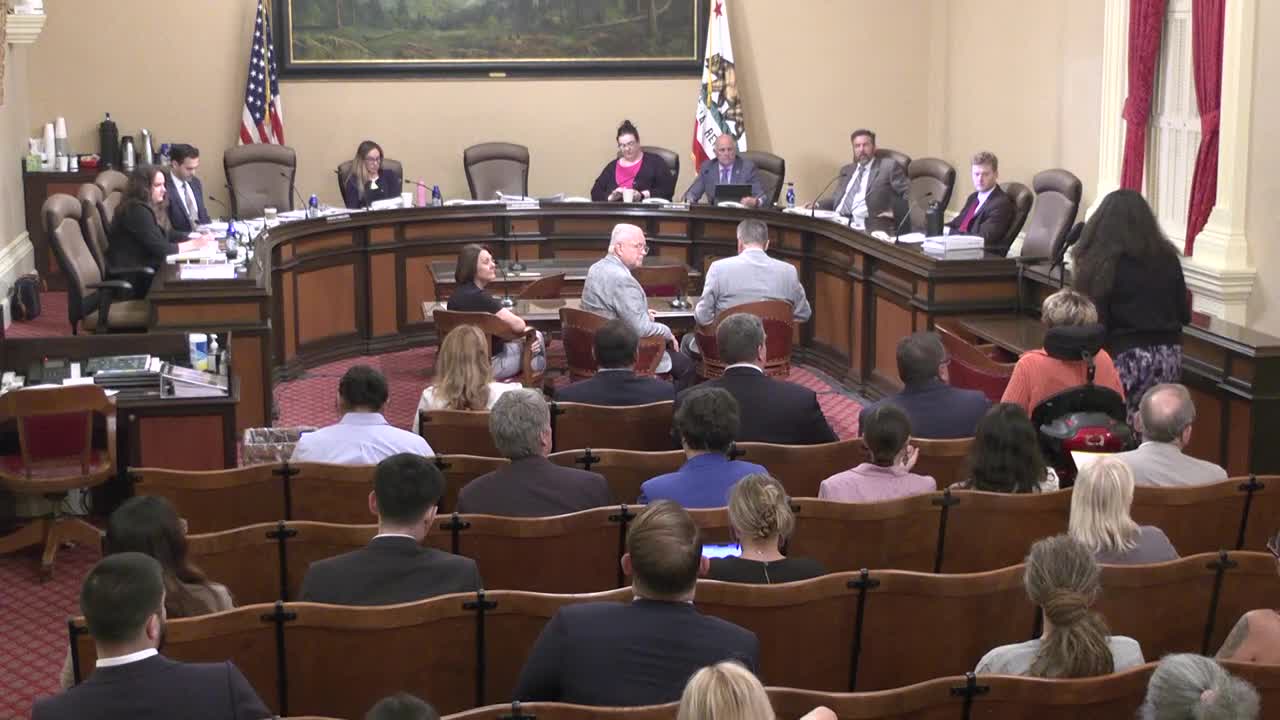 11MIN
Senate Standing Committee on Public Safety
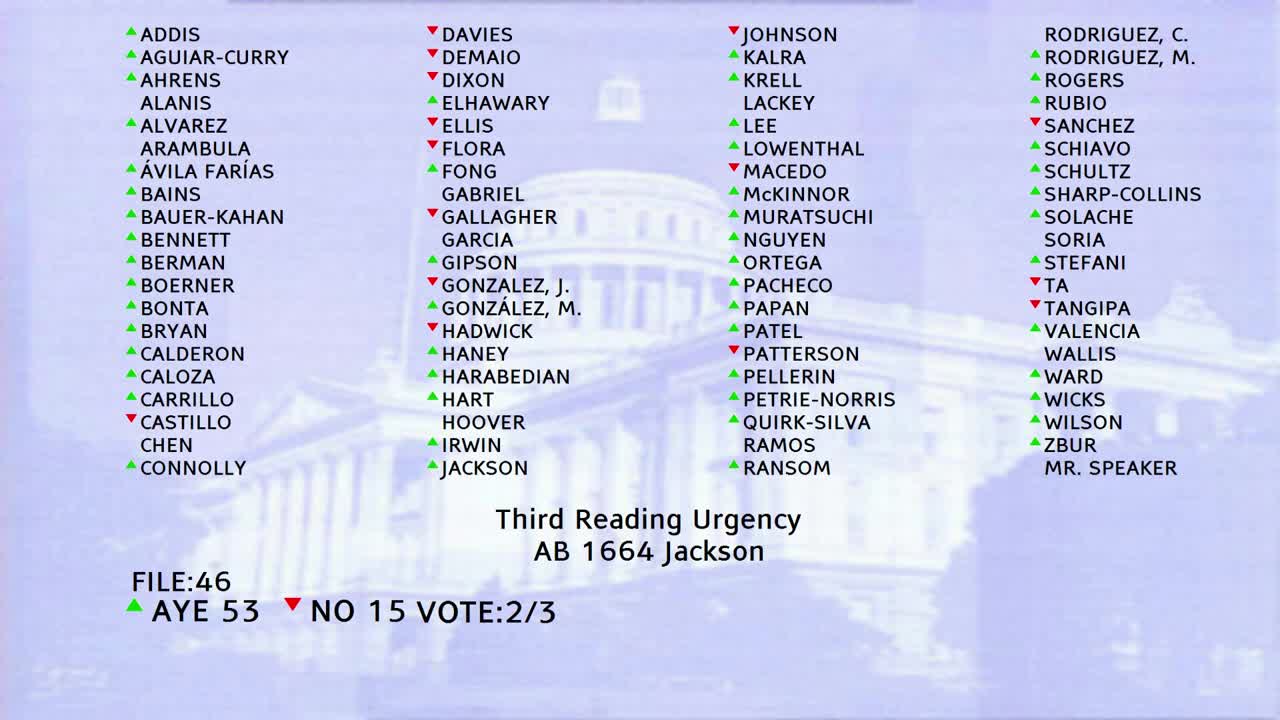 1MIN
Assembly Floor
 32MIN
Assembly Standing Committee on Appropriations
 10MIN
Assembly Standing Committee on Public Safety
Bill Author
Bill Co-Author(s):