AB 2111: Electricity: transmission planning and transmission facilities.
- Session Year: 2025-2026
- House: Assembly
- Latest Version Date: 2026-09-20
Current Status:
Passed
(2026-09-20: Chaptered by Secretary of State - Chapter 382, Statutes of 2026.)
Introduced
In Committee
Awaiting First Chamber Vote
Passed First Chamber
In Committee
Awaiting Second Chamber Vote
Passed Second Chamber
Enacted
(1)Existing law requires the Public Utilities Commission (PUC), in consultation with the State Energy Resources Conservation and Development Commission (Energy Commission), to provide transmission-focused guidance to the Independent System Operator (ISO) about resource portfolios of expected future renewable energy resources and zero-carbon resources, including the allocation of those resources by region based on technical feasibility and commercial interest in each region to allow the ISO to identify and approve transmission facilities needed to interconnect resources and reliably serve the needs of load centers, as specified. On December 23, 2022, the PUC, the Energy Commission, and the ISO entered into a memorandum of understanding related to resource and transmission planning, transmission development and permitting, procurement, and interconnections to achieve reliability and policy needs and to coordinate the timely development of resources, resource interconnections, and needed transmission infrastructure. Existing law requires the Energy Commission and the PUC, in coordination with the ISO, every 5 years, to review the memorandum of understanding and a related workplan to ensure the memorandum and workplan reflect the coordination that is needed to help meet the states energy goals.
This bill would require those entities, on or before January 1, 2028, to update the memorandum and workplan to, among other things, ensure that the memorandum and workplan reflect the requirements of Federal Energy Regulatory Commission Order 1920, as applicable.
(2)Existing law vests the PUC with regulatory authority over public utilities, including electrical corporations. Existing law requires the PUC to identify a diverse and balanced portfolio of resources needed to ensure a reliable electricity supply that provides optimal integration of renewable energy and resource diversity in a cost-effective manner, as specified.
This bill would require that the portfolio provide optimal integration in a cost-effective and risk-prudent manner, as specified.
(3)Existing law requires that the above-described transmission-focused guidance provided to the ISO provide projections each year to support planning and approvals by the ISO in its annual transmission planning process, including projections of resource portfolios and electricity demand by region for at least 15 years into the future, as specified. Existing law expresses the state policy that planning for new transmission facilities include consideration of the goal of increasing systemwide reliability and cost efficiency, among other state policy goals.
This bill would require that the transmission-focused guidance takes into account uncertainty and optionality, is risk prudent, and supports compliance with Federal Energy Regulatory Commission orders, as specified. The bill would remove the requirement that the projections be provided annually and would require the projections of resource portfolios and electricity demand by region to be for at least 20, rather than 15, years into the future. The bill would add to those state policy goals reducing resource interconnection timelines and supporting achievement of the states energy, climate change, and air quality goals.
(4)This bill would incorporate additional changes to Section 454.57 of the Public Utilities Code proposed by AB 2369 to be operative only if this bill and AB 2369 are enacted and this bill is enacted last.
(5)Under existing law, a violation of the Public Utilities Act or any order, decision, rule, direction, demand, or requirement of the PUC is a crime.
Because certain provisions of this bill would be a part of the act and because a violation of a PUC action implementing its requirements would be a crime, the bill would impose a state-mandated local program by creating a new crime.
The California Constitution requires the state to reimburse local agencies and school districts for certain costs mandated by the state. Statutory provisions establish procedures for making that reimbursement.
This bill would provide that no reimbursement is required by this act for a specified reason.
(1)Existing law requires the Public Utilities Commission (PUC), in consultation with the State Energy Resources Conservation and Development Commission (Energy Commission), to provide transmission-focused guidance to the Independent System Operator (ISO) about resource portfolios of expected future renewable energy resources and zero-carbon resources, including the allocation of those resources by region based on technical feasibility and commercial interest in each region to allow the ISO to identify and approve transmission facilities needed to interconnect resources and reliably serve the needs of load centers, as specified. On December 23, 2022, the PUC, the Energy Commission, and the ISO entered into a memorandum of understanding related to resource and transmission planning, transmission development and permitting, procurement, and interconnections to achieve reliability and policy needs and to coordinate the timely development of resources, resource interconnections, and needed transmission infrastructure. Existing law requires the Energy Commission and the PUC, in coordination with the ISO, every 5 years, to review the memorandum of understanding and a related workplan to ensure the memorandum and workplan reflect the coordination that is needed to help meet the states energy goals.
This bill would require those entities, on or before January 1, 2028, to update the memorandum and workplan to, among other things, ensure that the memorandum and workplan reflect the requirements of Federal Energy Regulatory Commission Order 1920-A, 1920, as applicable.
(2)Existing law vests the PUC with regulatory authority over public utilities, including electrical corporations. Existing law requires the PUC to identify a diverse and balanced portfolio of resources needed to ensure a reliable electricity supply that provides optimal integration of renewable energy and resource diversity in a cost-effective manner, as specified.
This bill would require that the portfolio provide optimal integration in a cost-effective and risk-prudent manner, as specified.
(3)Existing law requires that the above-described transmission-focused guidance provided to the ISO provide projections each year to support planning and approvals by the ISO in its annual transmission planning process, including projections of resource portfolios and electricity demand by region for at least 15 years into the future, as specified. Existing law expresses the state policy that planning for new transmission facilities include consideration of the goal of increasing systemwide reliability and cost efficiency, among other state policy goals.
This bill would require that the guidance be provided on a recurring basis and address the allocation of those resources by region based on a consideration of technical feasibility, resource quality and availability, and commercial interest in each region, as specified. The bill would also require the guidance to address both sufficient infrastructure capacity to facilitate cost-effective procurement of certain resources and improvements to resource diversity and competition by increasing interconnection capacity to specific locations that reflect resource availability, as specified. The bill would require the PUC to separately provide additional transmission-focused guidance to the ISO that is risk prudent and supports compliance with Federal Energy Regulatory Commission Order 1920-A, as specified. the transmission-focused guidance takes into account uncertainty and optionality, is risk prudent, and supports compliance with Federal Energy Regulatory Commission orders, as specified. The bill would remove the requirement that the projections be provided annually and would require the projections of resource portfolios and electricity demand by region to be for at least 20, rather than 15, years into the future. The bill would add to those state policy goals reducing resource interconnection timelines and supporting achievement of the states energy, climate change, and air quality goals.
The bill would also require the PUC, beginning on or before January 1, 2028, to make available on its internet website all nonconfidential input and output data used in the integrated resource planning and transmission planning processes, as specified.(4)This bill would incorporate additional changes to Section 454.57 of the Public Utilities Code proposed by AB 2369 to be operative only if this bill and AB 2369 are enacted and this bill is enacted last.
(4)(5)Under existing law, a violation of the Public Utilities Act or any order, decision, rule, direction, demand, or requirement of the PUC is a crime.
Because certain provisions of this bill would be a part of the act and because a violation of a PUC action implementing its requirements would be a crime, the bill would impose a state-mandated local program by creating a new crime.
The California Constitution requires the state to reimburse local agencies and school districts for certain costs mandated by the state. Statutory provisions establish procedures for making that reimbursement.
This bill would provide that no reimbursement is required by this act for a specified reason.
(1)Existing law requires the Public Utilities Commission (PUC), in consultation with the State Energy Resources Conservation and Development Commission (Energy Commission), to provide transmission-focused guidance to the Independent System Operator (ISO) about resource portfolios of expected future renewable energy resources and zero-carbon resources, including the allocation of those resources by region based on technical feasibility and commercial interest in each region to allow the ISO to identify and approve transmission facilities needed to interconnect resources and reliably serve the needs of load centers, as specified. On December 23, 2022, the PUC, the Energy Commission, and the ISO entered into a memorandum of understanding related to resource and transmission planning, transmission development and permitting, procurement, and interconnections to achieve reliability and policy needs and to coordinate the timely development of resources, resource interconnections, and needed transmission infrastructure. Existing law requires the Energy Commission and the PUC, in coordination with the ISO, every 5 years, to review the memorandum of understanding and a related workplan to ensure the memorandum and workplan reflect the coordination that is needed to help meet the states energy goals.
This bill would require those entities, on or before January 1, 2028, to update the memorandum and workplan to, among other things, ensure that the memorandum and workplan reflect the requirements of Federal Energy Regulatory Commission Order 1920-A. 1920-A, as applicable.
(2)Existing law vests the PUC with regulatory authority over public utilities, including electrical corporations. Existing law requires the PUC to identify a diverse and balanced portfolio of resources needed to ensure a reliable electricity supply that provides optimal integration of renewable energy and resource diversity in a cost-effective manner, as specified.
This bill would require that the portfolio provide optimal integration in a cost-effective and risk-prudent manner, as specified.
(3)Existing law establishes the ISO as a nonprofit, public benefit corporation to ensure efficient use and reliable operation of the transmission grid and to manage the transmission grid and related energy markets, as provided. Existing law requires the PUC, in consultation with the Energy Commission, to provide transmission-focused guidance to the ISO about resource portfolios of expected future renewable energy resources and zero-carbon resources and that includes the allocation of those resources by region based on technical feasibility and commercial interest in each region to allow the Independent System Operator to identify and approve transmission facilities needed to interconnect resources and reliably serve the needs of load centers, as specified. Existing law requires that the above-described transmission-focused guidance include provided to the ISO provide projections each year to support planning and approvals by the ISO in its annual transmission planning process, including projections of resource portfolios and electricity demand by region for at least 15 years into the future, as specified. Existing law expresses the state policy that planning for new transmission facilities include consideration of the goal of increasing systemwide reliability and cost efficiency, among other state policy goals.
This bill would require that the guidance be provided on a recurring basis and address the allocation of those resources by region based on a consideration of technical feasibility, resource quality and availability, and commercial interest in each region, as specified. The bill would also include require the guidance to address both sufficient infrastructure capacity to facilitate cost-effective procurement of certain resources and improvements to resource diversity and competition by increasing interconnection capacity to specific locations that reflect resource availability, as specified. The bill would require the PUC to separately provide additional transmission-focused guidance to the ISO that is risk prudent and supports compliance with Federal Energy Regulatory Commission Order 1920-A, as specified. The bill would remove the requirement that the projections be provided annually and would require the projections of resource portfolios and electricity demand by region to be for at least 20, rather than 15, years into the future. The bill would add to those state policy goals reducing resource interconnection timelines and supporting achievement of the states energy, climate change, and air quality goals.
The bill would also require the PUC, beginning on or before January 1, 2028, to make available on its internet website all nonconfidential input and output data used in the integrated resource planning and transmission planning processes, as specified.
(4)Under existing law, a violation of the Public Utilities Act or any order, decision, rule, direction, demand, or requirement of the PUC is a crime.
Because certain provisions of this bill would be a part of the act and because a violation of a PUC action implementing its requirements would be a crime, the bill would impose a state-mandated local program by creating a new crime.
The California Constitution requires the state to reimburse local agencies and school districts for certain costs mandated by the state. Statutory provisions establish procedures for making that reimbursement.
This bill would provide that no reimbursement is required by this act for a specified reason.
(1)Existing law requires the Public Utilities Commission (PUC), in consultation with the State Energy Resources Conservation and Development Commission (Energy Commission), to provide transmission-focused guidance to the Independent System Operator (ISO) about resource portfolios of expected future renewable energy resources and zero-carbon resources, including the allocation of those resources by region based on technical feasibility and commercial interest in each region to allow the ISO to identify and approve transmission facilities needed to interconnect resources and reliably serve the needs of load centers, as specified. On December 23, 2022, the PUC, the Energy Commission, and the ISO entered into a memorandum of understanding related to resource and transmission planning, transmission development and permitting, procurement, and interconnections to achieve reliability and policy needs and to coordinate the timely development of resources, resource interconnections, and needed transmission infrastructure. Existing law requires the Energy Commission and the PUC, in coordination with the ISO, every 5 years, to review the memorandum of understanding and a related workplan to ensure the memorandum and workplan reflect the coordination that is needed to help meet the states energy goals.
This bill would require those entities, on or before January 1, 2028, to update the memorandum and workplan to, among other things, ensure that the memorandum and workplan reflect the requirements of Federal Energy Regulatory Commission Order 1920-A.
(2)Existing law vests the PUC with regulatory authority over public utilities, including electrical corporations. Existing law requires the PUC to identify a diverse and balanced portfolio of resources needed to ensure a reliable electricity supply that provides optimal integration of renewable energy and resource diversity in a cost-effective manner, as specified.
This bill would require that the portfolio provide optimal integration in a cost-effective and risk prudent risk-prudent manner, as specified.
(3)Existing law establishes the ISO as a nonprofit, public benefit corporation to ensure efficient use and reliable operation of the transmission grid and to manage the transmission grid and related energy markets, as provided. Existing law requires the PUC, in consultation with the Energy Commission, to provide transmission-focused guidance to the ISO about resource portfolios of expected future renewable energy resources and zero-carbon resources and that includes the allocation of those resources by region based on technical feasibility and commercial interest in each region to allow the Independent System Operator to identify and approve transmission facilities needed to interconnect resources and reliably serve the needs of load centers, as specified. Existing law requires that the guidance include projections each year to support planning and approvals by the ISO in its annual transmission planning process, including projections of resource portfolios and electricity demand by region for at least 15 years into the future, as specified. Existing law expresses the state policy that planning for new transmission facilities include consideration of the goal of increasing systemwide reliability and cost efficiency, among other state policy goals.
This bill would require that the guidance also include both sufficient infrastructure capacity to facilitate cost-effective procurement of certain resources and improvements to resource diversity and competition by increasing interconnection capacity to specific locations that reflect resource availability, as specified. The bill would require the PUC to separately provide additional transmission-focused guidance to the ISO that is risk prudent and demonstrates satisfaction of specified requirements, including requesting the ISO to approve certain transmission projects and identifying any supplemental or accelerated transmission needs beyond the requirements of an individual resource portfolio. supports compliance with Federal Energy Regulatory Commission Order 1920-A, as specified. The bill would remove the requirement that the projections be provided annually and would require the projections of resource portfolios and electricity demand by region to be for at least 20, rather than 15, years into the future. The bill would add to those state policy goals reducing resource interconnection timelines. timelines and supporting achievement of the states energy, climate change, and air quality goals.
The bill would also require the PUC, beginning on or before January 1, 2028, to make available on its internet website all nonconfidential input and output data used in the integrated resource planning and transmission planning processes, as specified.
(4)Under existing law, a violation of the Public Utilities Act or any order, decision, rule, direction, demand, or requirement of the PUC is a crime.
Because certain provisions of this bill would be a part of the act and because a violation of a PUC action implementing its requirements would be a crime, the bill would impose a state-mandated local program by creating a new crime.
The California Constitution requires the state to reimburse local agencies and school districts for certain costs mandated by the state. Statutory provisions establish procedures for making that reimbursement.
This bill would provide that no reimbursement is required by this act for a specified reason.
(1)Existing law requires the Public Utilities Commission (PUC), in consultation with the State Energy Resources Conservation and Development Commission (Energy Commission), to provide transmission-focused guidance to the Independent System Operator (ISO) about resource portfolios of expected future renewable energy resources and zero-carbon resources, including the allocation of those resources by region based on technical feasibility and commercial interest in each region to allow the ISO to identify and approve transmission facilities needed to interconnect resources and reliably serve the needs of load centers, as specified. On December 23, 2022, the PUC, the Energy Commission, and the ISO entered into a memorandum of understanding related to resource and transmission planning, transmission development and permitting, procurement, and interconnections to achieve reliability and policy needs and to coordinate the timely development of resources, resource interconnections, and needed transmission infrastructure. Existing law requires the Energy Commission and the PUC, in coordination with the ISO, every 5 years, to review the memorandum of understanding and a related workplan to ensure the memorandum and workplan reflect the coordination that is needed to help meet the states energy goals.
This bill would require those entities, on or before January 1, 2028, to incorporate into an update of the memorandum and workplan any revisions as may be necessary to, among other things, ensure that the memorandum and workplan reflect the requirements of Federal Energy Regulatory Commission Order 1920-A.
(2)Existing law vests the PUC with regulatory authority over public utilities, including electrical corporations. Existing law requires the PUC to identify a diverse and balanced portfolio of resources needed to ensure a reliable electricity supply that provides optimal integration of renewable energy and resource diversity in a cost-effective manner, as specified.
This bill would require that the portfolio provide optimal integration in a cost-effective and risk-prudent risk prudent manner, as specified.
(3)Existing law establishes the ISO as a nonprofit, public benefit corporation to ensure efficient use and reliable operation of the transmission grid and to manage the transmission grid and related energy markets, as provided. Existing law requires the PUC, in consultation with the Energy Commission, to provide transmission-focused guidance to the ISO about resource portfolios of expected future renewable energy resources and zero-carbon resources and that includes the allocation of those resources by region based on technical feasibility and commercial interest in each region to allow the Independent System Operator to identify and approve transmission facilities needed to interconnect resources and reliably serve the needs of load centers, as specified. Existing law requires that the guidance include projections each year to support planning and approvals by the ISO in its annual transmission planning process, including projections of resource portfolios and electricity demand by region for at least 15 years into the future, as specified. Existing law expresses the state policy that planning for new transmission facilities include consideration of the goal of increasing systemwide reliability and cost efficiency, among other state policy goals.
This bill would require that the guidance also include both sufficient infrastructure capacity to facilitate cost-effective procurement of certain resources and improvements to resource diversity and competition by increasing interconnection capacity to specific locations that reflect resource availability, as specified. The bill would require the PUC to separately provide additional transmission-focused guidance to the ISO that is risk prudent and demonstrates satisfaction of specified requirements, including requesting the ISO to approve certain transmission projects and identifying any supplemental or accelerated transmission needs that are identified as risk prudent and improve adaptability, reduce risk, or support a competitive market for resource procurement. beyond the requirements of an individual resource portfolio. The bill would remove the requirement that the projections be provided annually and would require the projections of resource portfolios and electricity demand by region to be for at least 20, rather than 15, years into the future. The bill would add to those state policy goals increasing systemwide adaptability and maintaining ratepayer affordability across a range of future uncertainties, as specified. reducing resource interconnection timelines.
The bill would also require the PUC, beginning on or before January 1, 2028, to make available on its internet website all nonconfidential input and output data used in the integrated resource planning and transmission planning processes, as specified.
(4)Under existing law, a violation of the Public Utilities Act or any order, decision, rule, direction, demand, or requirement of the PUC is a crime.
Because certain provisions of this bill would be a part of the act and because a violation of a PUC action implementing its requirements would be a crime, the bill would impose a state-mandated local program by creating a new crime.
The California Constitution requires the state to reimburse local agencies and school districts for certain costs mandated by the state. Statutory provisions establish procedures for making that reimbursement.
This bill would provide that no reimbursement is required by this act for a specified reason.
(1)Existing law requires the Public Utilities Commission (PUC), in consultation with the State Energy Resources Conservation and Development Commission (Energy Commission), to provide transmission-focused guidance to the Independent System Operator (ISO) about resource portfolios of expected future renewable energy resources and zero-carbon resources, including the allocation of those resources by region based on technical feasibility and commercial interest in each region to allow the ISO to identify and approve transmission facilities needed to interconnect resources and reliably serve the needs of load centers, as specified. On December 23, 2022, the PUC, the Energy Commission, and the ISO entered into a memorandum of understanding related to resource and transmission planning, transmission development and permitting, procurement, and interconnections to achieve reliability and policy needs and to coordinate the timely development of resources, resource interconnections, and needed transmission infrastructure. Existing law requires the Energy Commission and the PUC, in coordination with the ISO, every 5 years, to review the memorandum of understanding and a related workplan to ensure the memorandum and workplan reflect the coordination that is needed to help meet the states energy goals.
This bill would require those entities, on or before January 1, 2028, to incorporate into an update of the memorandum and workplan any revisions as may be necessary to, among other things, ensure that the memorandum and workplan reflect the requirements of Federal Energy Regulatory Commission Order 1920-A, including methods to evaluate resource portfolios that reflect the best available methods of decisionmaking under uncertainty. 1920-A.
(2)Existing law vests the PUC with regulatory authority over public utilities, including electrical corporations. Existing law requires the PUC to identify a diverse and balanced portfolio of resources needed to ensure a reliable electricity supply that provides optimal integration of renewable energy and resource diversity in a cost-effective manner, as specified.
This bill would require that the portfolio provide optimal integration in a cost-effective manner that maintains ratepayer affordability across a range of future uncertainties, and risk-prudent manner, as specified.
(3)Existing law establishes the ISO as a nonprofit, public benefit corporation to ensure efficient use and reliable operation of the transmission grid and to manage the transmission grid and related energy markets, as provided. Existing law requires the PUC, in consultation with the Energy Commission, to provide transmission-focused guidance to the ISO about resource portfolios of expected future renewable energy resources and zero-carbon resources and that includes the allocation of those resources by region based on technical feasibility and commercial interest in each region to allow the Independent System Operator to identify and approve transmission facilities needed to interconnect resources and reliably serve the needs of load centers, as specified. Existing law requires that the guidance include projections each year to support planning and approvals by the ISO in its annual transmission planning process, including projections of resource portfolios and electricity demand by region for at least 15 years into the future, as specified. Existing law expresses the state policy that planning for new transmission facilities include consideration of the goal of increasing systemwide reliability and cost efficiency, among other state policy goals.
This bill would require that the guidance also include both sufficient infrastructure capacity to facilitate cost-effective procurement of certain resources and improvements to resource diversity and competition by increasing interconnection capacity to specific locations that reflect resource availability, as specified. The bill would require the PUC to separately provide additional transmission-focused guidance to the ISO that is risk prudent and demonstrates satisfaction of specified requirements, including requesting the ISO to approve certain transmission projects and identifying any supplemental or accelerated transmission needs that are identified as risk prudent and improve adaptability, reduce risk, or support a competitive market for resource procurement.
(4)Existing law requires the PUC, in consultation with the Energy Commission, to provide transmission-focused guidance to the ISO about resource portfolios of expected future renewable energy resources and zero-carbon resources, as specified, to allow the ISO to identify and approve transmission facilities needed to interconnect resources and reliably serve the needs of load centers. Existing law requires the guidance to include projections each year to support planning and approvals by the ISO in its annual transmission planning process, including projections of resource portfolios and electricity demand by region for at least 15 years into the future, as specified. Existing law expresses the state policy that planning for new transmission facilities include consideration of the goal of increasing systemwide reliability and cost efficiency, among other state policy goals.This bill would require the PUC, in consultation with the Energy Commission, when evaluating resource portfolios for submission to the ISOs transmission planning process, to submit at least one resource portfolio that is adaptable and low risk in maintaining ratepayer affordability across a range of future uncertainties, as provided. The bill would require the commissions guidance to the ISO to identify any supplemental or accelerated transmission needs that are identified in applying decisionmaking under uncertainty methods, as provided. The The bill would remove the annual requirement for that the projections be provided annually and would require the projections of resource portfolios and electricity demand by region to be for at least 20, rather than 15, years into the future. The bill would add to those state policy goals increasing systemwide adaptability and maintaining ratepayer affordability across a range of future uncertainties, as specified.
The bill would also require the PUC, beginning on or before January 1, 2028, to make available on its internet website all nonconfidential input and output data used in the integrated resource planning and transmission planning processes, as specified.
(5)(4)Under existing law, a violation of the Public Utilities Act or any order, decision, rule, direction, demand, or requirement of the PUC is a crime.
Because certain provisions of this bill would be a part of the act and because a violation of a PUC action implementing its requirements would be a crime, the bill would impose a state-mandated local program by creating a new crime.
The California Constitution requires the state to reimburse local agencies and school districts for certain costs mandated by the state. Statutory provisions establish procedures for making that reimbursement.
This bill would provide that no reimbursement is required by this act for a specified reason.
(1)Existing law requires the Public Utilities Commission (PUC), in consultation with the State Energy Resources Conservation and Development Commission (Energy Commission), to provide transmission-focused guidance to the Independent System Operator (ISO) about resource portfolios of expected future renewable energy resources and zero-carbon resources, including the allocation of those resources by region based on technical feasibility and commercial interest in each region to allow the ISO to identify and approve transmission facilities needed to interconnect resources and reliably serve the needs of load centers, as specified. On December 23, 2022, the PUC, the Energy Commission, and the ISO entered into a memorandum of understanding related to resource and transmission planning, transmission development and permitting, procurement, and interconnections to achieve reliability and policy needs and to coordinate the timely development of resources, resource interconnections, and needed transmission infrastructure. Existing law requires the Energy Commission and the PUC, in coordination with the ISO, every 5 years, to review the memorandum of understanding and a related workplan to ensure the memorandum and workplan reflect the coordination that is needed to help meet the states energy goals.
This bill would require those entities, on or before January 1, 2028, to incorporate into an update any revisions as may be necessary to to, among other things, ensure that the memorandum and workplan reflect the requirements of Federal Energy Regulatory Commission Order 1920-A, including methods to evaluate resource portfolios that reflect the best available methods of decisionmaking under uncertainty.
(2)Existing law vests the PUC with regulatory authority over public utilities, including electrical corporations. Existing law requires the PUC to identify a diverse and balanced portfolio of resources needed to ensure a reliable electricity supply that provides optimal integration of renewable energy and resource diversity in a cost-effective manner, as specified.
This bill would require that the portfolio provide optimal integration in a cost-effective manner that maintains ratepayer affordability across a range of future uncertainties, as specified.
(3)Existing law establishes the ISO as a nonprofit, public benefit corporation to ensure efficient use and reliable operation of the transmission grid and to manage the transmission grid and related energy markets, as provided. Existing law requires the PUC, in consultation with the Energy Commission, to provide transmission-focused guidance to the ISO about resource portfolios, portfolios of expected future renewable energy resources and zero-carbon resources and that includes the allocation of those resources by region based on technical feasibility and commercial interest in each region to allow the Independent System Operator to identify and approve transmission facilities needed to interconnect resources and reliably serve the needs of load centers, as specified.
This bill would require the PUC, before approving the procurement of certain resources, to complete a transmission and interconnection availability assessment and to confirm there is sufficient infrastructure in the last approved transmission plan from the ISO to support the cost-effective procurement of approved resources by load-serving entities, as specified.This bill would require that the guidance also include both sufficient infrastructure capacity to facilitate cost-effective procurement of resources and improvements to resource diversity and competition by increasing interconnection capacity to specific locations that reflect resource availability, as specified.
(4)Existing law requires the PUC, in consultation with the Energy Commission, to provide transmission-focused guidance to the ISO about resource portfolios of expected future renewable energy resources and zero-carbon resources, as specified, to allow the ISO to identify and approve transmission facilities needed to interconnect resources and reliably serve the needs of load centers. Existing law requires the guidance to include projections each year to support planning and approvals by the ISO in its annual transmission planning process, including projections of resource portfolios and electricity demand by region for at least 15 years into the future, as specified. Existing law expresses the state policy that planning for new transmission facilities include consideration of the goal of increasing systemwide reliability and cost efficiency, among other state policy goals.
This bill would require the PUC, in consultation with the Energy Commission, when evaluating resource portfolios for submission to the ISOs transmission planning process, to submit at least one resource portfolio that is adaptable and low risk in maintaining ratepayer affordability across a range of future uncertainties, as provided. The bill would require the commissions guidance to the ISO to identify any supplemental or accelerated transmission needs that are identified in applying decisionmaking under uncertainty methods, as provided. The bill would remove the annual requirement for the projections and would require the projections of resource portfolios and electricity demand by region to be for at least 20, rather than 15, years into the future. The bill would add to those state policy goals increasing systemwide adaptability and maintaining ratepayer affordability across a range of future uncertainties, as specified.
The bill would also require the PUC, beginning on or before January 1, 2028, to make available on its internet website all nonconfidential input and output data used in the integrated resource planning and transmission planning processes, as specified.
(5)Under existing law, a violation of the Public Utilities Act or any order, decision, rule, direction, demand, or requirement of the PUC is a crime.
Because certain provisions of this bill would be a part of the act and because a violation of a PUC action implementing its requirements would be a crime, the bill would impose a state-mandated local program by creating a new crime.
The California Constitution requires the state to reimburse local agencies and school districts for certain costs mandated by the state. Statutory provisions establish procedures for making that reimbursement.
This bill would provide that no reimbursement is required by this act for a specified reason.
(1)Existing law requires the Public Utilities Commission (PUC), in consultation with the State Energy Resources Conservation and Development Commission (Energy Commission), to provide transmission-focused guidance to the Independent System Operator (ISO) about resource portfolios of expected future renewable energy resources and zero-carbon resources, including the allocation of those resources by region based on technical feasibility and commercial interest in each region to allow the ISO to identify and approve transmission facilities needed to interconnect resources and reliably serve the needs of load centers, as specified. On December 23, 2022, the PUC, the Energy Commission, and the ISO entered into a memorandum of understanding related to resource and transmission planning, transmission development and permitting, procurement, and interconnections to achieve reliability and policy needs and to coordinate the timely development of resources, resource interconnections, and needed transmission infrastructure. Existing law requires the Energy Commission and the PUC, in coordination with the ISO, every 5 years, to review the memorandum of understanding and a related workplan to ensure the memorandum and workplan reflect the coordination that is needed to help meet the states energy goals.
This bill would require those entities, on or before January 1, 2028, to incorporate into an update any revisions as may be necessary to ensure that the memorandum and workplan reflect the requirements of Federal Energy Regulatory Commission Order 1920-A, including methods to evaluate resource portfolios that reflect the best available methods of decisionmaking under uncertainty.
(2)Existing law vests the PUC with regulatory authority over public utilities, including electrical corporations. Existing law requires the PUC to identify a diverse and balanced portfolio of resources needed to ensure a reliable electricity supply that provides optimal integration of renewable energy and resource diversity in a cost-effective manner, as specified.
This bill would require that the portfolio provide optimal integration in a cost-effective manner that maintains ratepayer affordability across a range of future uncertainties, as specified.
(3)Existing law establishes the ISO as a nonprofit, public benefit corporation to ensure efficient use and reliable operation of the transmission grid and to manage the transmission grid and related energy markets, as provided. Existing law requires the PUC, in consultation with the Energy Commission, to provide transmission-focused guidance to the ISO about resource portfolios, as specified.
This bill would require the PUC, before approving the procurement of certain resources, to complete a transmission and interconnection availability assessment and to confirm there is sufficient infrastructure in the last approved transmission plan from the ISO to support the cost-effective procurement of approved resources by load-serving entities, as specified.
(4)Existing law requires the PUC, in consultation with the Energy Commission, to provide transmission-focused guidance to the ISO about resource portfolios of expected future renewable energy resources and zero-carbon resources, as specified, to allow the ISO to identify and approve transmission facilities needed to interconnect resources and reliably serve the needs of load centers. Existing law requires the guidance to include projections each year to support planning and approvals by the ISO in its annual transmission planning process, including projections of resource portfolios and electricity demand by region for at least 15 years into the future, as specified. Existing law expresses the state policy that planning for new transmission facilities include consideration of the goal of increasing systemwide reliability and cost efficiency, among other state policy goals.
This bill would require the PUC, in consultation with the Energy Commission, when evaluating resource portfolios for submission to the ISOs transmission planning process, to submit at least one resource portfolio that is adaptable and low risk in maintaining ratepayer affordability across a range of future uncertainties, as provided. The bill would remove the annual requirement for the projections and would require the projections of resource portfolios and electricity demand by region to be for at least 20, rather than 15, years into the future. The bill would add to those state policy goals increasing systemwide adaptability and maintaining ratepayer affordability across a range of future uncertainties, as specified.
The bill would also require the PUC, beginning on or before January 1, 2028, to make available on its internet website all nonconfidential input and output data used in the integrated resource planning and transmission planning processes, as specified.
(5)Under existing law, a violation of the Public Utilities Act or any order, decision, rule, direction, demand, or requirement of the PUC is a crime.
Because certain provisions of this bill would be a part of the act and because a violation of a PUC action implementing its requirements would be a crime, the bill would impose a state-mandated local program by creating a new crime.
The California Constitution requires the state to reimburse local agencies and school districts for certain costs mandated by the state. Statutory provisions establish procedures for making that reimbursement.
This bill would provide that no reimbursement is required by this act for a specified reason.
(a)On or before January 1, 2028, the commission and Public Utilities Commission, in coordination with the Independent System Operator, shall update the Memorandum of Understanding Between the California Public Utilities Commission (CPUC) and the California Energy Commission (CEC) and the California Independent System Operator (ISO) Regarding Transmission and Resource Planning and Implementation (December 23, 2022) and the related workplan to do all of the following:
(1)Ensure that the memorandum and workplan reflect the requirements of Federal Energy Regulatory Commission Order 1920, as later clarified by FERC Order 1920-A and FERC Order 1920-B, as applicable. These revisions shall support the development of resource portfolios and approval of transmission facilities that are cost effective and risk prudent and equip the Independent System Operator with at least three portfolios that represent state policy needs in planning transmission in accordance with Order 1920.
(2)Ensure that the commission provides load forecasts to support risk-prudent planning by the Public Utilities Commission.
(3)Introduce a mechanism for the Public Utilities Commission to provide guidance on any supplemental or accelerated transmission needs to improve system adaptability, reduce risk, or support competitive resource procurement.
(b)For purposes of this section, risk prudent has the same meaning as set forth in Section 454.51 of the Public Utilities Code.
(c)This section shall remain in effect only until January 1, 2029, and as of that date is repealed.
SEC. 2.Section 454.51 of the Public Utilities Code is amended to read:454.51.The commission shall do all of the following:
(a)Identify a diverse and balanced portfolio of resources needed to ensure a reliable electricity supply that provides optimal integration of renewable energy and resource diversity in a cost-effective and risk-prudent manner. The portfolio shall be used by the commission to establish integrated resource planning-based procurement requirements that rely on zero-carbon-emitting resources to the maximum extent reasonable and be designed to achieve the state policy specified in Section 454.53 and any statewide greenhouse gas emissions limit established pursuant to the California Global Warming Solutions Act of 2006 (Division 25.5 (commencing with Section 38500) of the Health and Safety Code) or any successor legislation.
(b)Direct each electrical corporation to include, as part of its proposed procurement plan, a strategy for procuring best-fit and least-cost resources to satisfy the portfolio needs identified by the commission pursuant to subdivision (a).
(c)Ensure that the net costs of any incremental renewable energy integration resources, or diverse resources, procured by an electrical corporation to satisfy the need identified in subdivision (a) are allocated on a fully nonbypassable basis consistent with the treatment of costs identified in paragraph (2) of subdivision (c) of Section 365.1.
(d)Permit community choice aggregators to submit proposals for satisfying their portion of the renewable integration and diverse resources need identified in subdivision (a). If the commission finds this need is best met through long-term procurement commitments for resources, community choice aggregators shall also be required to make long-term commitments for resources. The commission shall approve proposals pursuant to this subdivision if it finds all of the following:
(1)The resources proposed by a community choice aggregator will provide equivalent integration of renewable energy.
(2)The resources proposed by a community choice aggregator will promote the efficient achievement of state energy policy objectives, including reductions in greenhouse gas emissions.
(3)Bundled customers of an electrical corporation will be indifferent to the approval of the community choice aggregator proposals.
(e)Ensure that all costs resulting from nonperformance in satisfying the need in subdivision (a) or (d), as applicable, shall be borne by the load-serving entity, as defined in Section 380, that failed to perform.
(f)For purposes of this section, both of the following definitions apply:
(1)Planning uncertainties means future uncertainties that may affect resource planning decisions, such as load growth, in-state and out-of-state resource availability, and technology costs.
(2)Risk prudent means reflective of both of the following characteristics:
(A)(i)Achieving state objectives, including ensuring a reliable electricity supply that provides optimal integration of renewable energy and resource diversity in a cost-effective manner, across a range of plausible futures informed by planning uncertainties.
(ii)The ability of a risk-prudent plan to achieve state objectives is not dependent on an assumption of perfect foresight reflective of predictions or forecasts that assign one specific value to planning uncertainties.
(B)Accounting for and including characterization of the ability of near-term decisions to improve adaptability in response to planning uncertainties, such as planning sufficient diverse resources and transmission facilities to accommodate planning uncertainties, maintaining a competitive market for resource procurement, and accounting for development and interconnection delays.
SEC. 3.Section 454.57 of the Public Utilities Code is amended to read:454.57.(a)This section shall be known, and may be cited, as the Accelerating Renewable Energy Delivery Act.
(b)The Legislature finds and declares all of the following:
(1)The commission, the Energy Commission, and the State Air Resources Board have jointly estimated that the states installed electrical generation may need a threefold increase in capacity to meet state carbon-free electricity policy targets.
(2)Recordsetting renewable energy generation build rates are needed to meet the goals of the California Renewables Portfolio Standard Program and the Senate Bill 100 (Chapter 312 of the Statutes of 2018) target of supplying 100 percent of retail sales of electricity from renewable energy resources and zero-carbon resources. However, these build rates are not achievable without additional electrical transmission lines and facilities connecting new resources to consumers in the states load centers.
(3)In recent years, California has seen problems in delivering renewable energy resources and zero-carbon resources to customers, including problems caused by constraints on the transmission system. First, there are generation pockets where the total potential output from renewable energy generation exceeds the capacity of the transmission system to export that energy. Second, there are load pockets where there is insufficient transmission capacity to import the renewable energy resources and zero-carbon resources that are available. Both types of constraints should be promptly fixed so that all available renewable energy resources and zero-carbon resources can be delivered to customers.
(4)Reducing the use of nonpreferred resources in disadvantaged communities has been a priority for those communities, and they would benefit from increased access to electricity from new renewable energy resources and zero-carbon resources delivered to serve in-city loads.
(5)New transmission facilities have many steps that must be accomplished before they are online and delivering electricity. Major new transmission lines can take more than a decade from initial planning to operation.
(6)New transmission facilities should be planned to support delivery of future renewable energy and zero-carbon resources to load centers, where those resource locations are identified in the integrated resource planning process pursuant to Sections 454.52 and 9621 or as part of longer range planning processes pursuant to Section 454.53.
(7)New transmission facilities should be designed to minimize the risk of transmission-triggered wildfires.
(8)New transmission facilities should be designed to facilitate renewable energy transmission across California to better manage the variability of the electrical supply.
(9)The Independent System Operator has issued a 20-Year Transmission Outlook that identifies substantial additional transmission projects needed to integrate renewable energy resources and storage for retail suppliers within the Independent System Operator balancing authority. Given the scale of this challenge, there is an urgent need to prioritize and accelerate the substantial effort needed to build transmission projects with long development times, while ensuring that associated costs are just and reasonable for ratepayers.
(c)Recognizing that the Independent System Operators Federal Energy Regulatory Commission-approved tariff requires the Independent System Operator to plan and approve new transmission facilities needed to achieve the states goals, it is the intent of the Legislature that the Independent System Operator shall take notice of the state policies expressed in this section.
(d)(1)In support of the states policy to supply increasing amounts of electricity from renewable energy resources and zero-carbon resources pursuant to Article 16 (commencing with Section 399.11) of Chapter 2.3 and Section 454.53, the commission, in consultation with the Energy Commission, shall provide transmission-focused guidance to the Independent System Operator about resource portfolios of expected future renewable energy resources and zero-carbon resources that takes into account uncertainty and optionality, is risk prudent, and supports compliance with Federal Energy Regulatory Commission orders, including, but not limited to, FERC Order 1920, as later clarified by FERC Order 1920-A and FERC Order 1920-B, as applicable.
(2)In developing the guidance pursuant to paragraph (1) the commission shall do all of the following:
(A)Provide an allocation of the renewable energy and zero-carbon resources by region based on consideration of technical feasibility and commercial interest in each region to allow the Independent System Operator to identify and approve transmission facilities needed to interconnect resources and reliably serve the needs of load centers.
(B)Use methods that enable decisionmaking under uncertainty, such as robust optimization or stochastic optimization, to develop candidate near-term planning decisions.
(C)Evaluate candidate planning decisions via a stress testing process through which the cost and reliability of the electrical system and the implications for future planning decisions and flexibility to support the resource portfolios are assessed, and, in a new or existing proceeding, examine the costs and risks of each candidate planning decision.
(D)(i)Submit at least three resource portfolios to the Independent System Operator that are reflective of risk-prudent, near-term planning decisions and collectively representative of the range of resource procurement trajectories that could be necessary to reliably serve load across a range of plausible futures informed by planning uncertainties, to support the Independent System Operators compliance with the requirements of Federal Energy Regulatory Commission Order 1920, as later clarified by FERC Order 1920-A and FERC Order 1920-B, as applicable.
(ii)The commission shall provide the Independent System Operator with relevant load forecasts and resource availability assumptions for each resource portfolio submitted pursuant to clause (i).
(E)Request that the Independent System Operator approve transmission projects that align with this guidance and that the commission finds to be reasonable in supporting any of the resource portfolios submitted pursuant to subparagraph (D).
(F)Ensure that resource portfolios submitted to the Independent System Operator support resources identified as under contract in integrated resource plans submitted pursuant to Section 454.52 and the interconnection of resources of strategic importance to load-serving entities.
(G)Include in this guidance any supplemental or accelerated transmission needs, beyond the requirements of an individual resource portfolio.
(H)Implement this guidance in a manner that ensures rates remain just and reasonable, in accordance with Section 451.
(e)In providing the guidance described in subdivision (d), the commission and the Energy Commission shall provide projections, including from the integrated energy policy report prepared pursuant to Section 25302 of the Public Resources Code and the load-serving entities integrated resource plans prepared pursuant to Section 454.52, to support planning and approvals by the Independent System Operator in its transmission planning process, including by doing all of the following:
(1)Providing projections of resource portfolios and electricity demand by region for at least 20 years into the future to ensure adequate lead time for the Independent System Operator to analyze and approve transmission development, and for the permitting and construction of the approved facilities, to meet the projections.
(2)Providing load growth projections, including projected growth from building and transportation electrification, that are consistent with achieving the economywide greenhouse gas emissions reductions required pursuant to the California Global Warming Solutions Act of 2006 (Division 25.5 (commencing with Section 38500) of the Health and Safety Code).
(3)Providing projections of new renewable energy resources and zero-carbon resources consistent with the build rates necessary to achieve the targets established in Article 16 (commencing with Section 399.11) of Chapter 2.3 and Section 454.53.
(4)(A)Providing resource projections that, combined with transmission capacity expansions, are expected to substantially reduce, no later than 2035, the need to rely on nonpreferred resources in local capacity areas.
(B)The resource projections in subparagraph (A) shall include consideration of cost-effective and feasible alternatives to transmission capacity expansions, including the use of energy storage resources, renewable energy resources, or zero-carbon resources that are located within the local capacity areas.
(5)Providing projections for offshore wind generation as identified by the SB 100 Joint Agency Report of the commission, the Energy Commission, and the State Air Resources Board, and informed by the strategic plan developed pursuant to Section 25991 of the Public Resources Code, to allow the Independent System Operator to identify and approve transmission facilities needed from offshore wind resource areas that would be sufficient to make offshore wind resources fully deliverable to load centers.
(6)Providing projections for increases in imports of electricity into the state that reflect the expected development of renewable energy resources and zero-carbon resources in other parts of the Western Interconnection for the purpose of delivering clean energy to California balancing authorities.
(f)On or before January 15, 2023, the commission shall request the Independent System Operator to do both of the following:
(1)Identify, based as much as possible on studies completed before January 1, 2023, by the Independent System Operator and projections provided before January 1, 2023, by the commission and the Energy Commission, the highest priority transmission facilities that are needed to allow for increased transmission capacity into local capacity areas to deliver renewable energy resources or zero-carbon resources that are expected to be developed by 2035 into those areas.
(2)Consider whether to approve transmission projects identified pursuant to paragraph (1) as part of its 202223 transmission planning process.
(g)It is the policy of the state that new transmission facilities be built on a timely basis and in anticipation of new electrical generation that will be built to meet the states renewable energy resource and zero-carbon resource targets, with interim targets for transmission capacity additions that demonstrate adequate progress toward meeting these long-term transmission needs. The commission shall request that the Independent System Operator implement this policy by approving transmission projects needed based on a longer planning period supported by the guidance provided pursuant to subdivisions (d) and (e). The projects should be approved in time to be online when needed, considering permitting and construction lead times.
(h)It is the policy of the state that planning for new transmission facilities is conducted in a cost-effective and risk-prudent manner and considers all of the following goals:
(1)Minimizing the risk of wildfire.
(2)Increasing systemwide reliability and cost efficiency, including through the sharing of diverse electrical generation resources within California and with other parts of the Western Interconnection.
(3)Supporting the achievement of the states energy, climate change, and air quality goals, including, but not limited to, the goals established pursuant to Section 454.53.
(4)Eliminating transmission constraints that prevent electrical generation resources from delivering to the wider electrical grid and that prevent importing energy into load pockets.
(5)Reducing resource interconnection timelines.
(i)For purposes of this section, all of the following definitions apply:
(1)Load-serving entity has the same meaning as set forth in Section 380.
(2)Local capacity area means a transmission constrained load pocket, as identified by the Independent System Operator, where local generation capacity is needed for reliability due to insufficient transmission capacity into the load pocket to meet electricity demand with electricity from outside of the load pocket.
(3)Near-term planning decisions means resource and transmission planning decisions that must be made in the current planning cycle without certainty as to the resolution of planning uncertainties, including, but not limited to, procurement of long lead-time resources, resources that need to be contracted within the succeeding five years, and planning for new transmission facilities with long lead times.
(4)Nonpreferred resources means electrical generation resources that are not renewable energy resources or zero-carbon resources pursuant to Section 454.53.
(5)Planning uncertainties has the same meaning as set forth in Section 454.51.
(6)Risk prudent has the same meaning as set forth in Section 454.51.
SEC. 3.5.Section 454.57 of the Public Utilities Code is amended to read:454.57.(a)This section shall be known, and may be cited, as the Accelerating Renewable Energy Delivery Act.
(b)The Legislature finds and declares all of the following:
(1)The commission, the Energy Commission, and the State Air Resources Board have jointly estimated that the states installed electrical generation may need a threefold increase in capacity to meet state carbon-free electricity policy targets.
(2)Recordsetting renewable energy generation build rates are needed to meet the goals of the California Renewables Portfolio Standard Program and the Senate Bill 100 (Chapter 312 of the Statutes of 2018) target of supplying 100 percent of retail sales of electricity from renewable energy resources and zero-carbon resources. However, these build rates are not achievable without additional electrical transmission lines and facilities connecting new resources to consumers in the states load centers.
(3)In recent years, California has seen problems in delivering renewable energy resources and zero-carbon resources to customers, including problems caused by constraints on the transmission system. First, there are generation pockets where the total potential output from renewable energy generation exceeds the capacity of the transmission system to export that energy. Second, there are load pockets where there is insufficient transmission capacity to import the renewable energy resources and zero-carbon resources that are available. Both types of constraints should be promptly fixed so that all available renewable energy resources and zero-carbon resources can be delivered to customers.
(4)Reducing the use of nonpreferred resources in disadvantaged communities has been a priority for those communities, and they would benefit from increased access to electricity from new renewable energy resources and zero-carbon resources delivered to serve in-city loads.
(5)New transmission facilities have many steps that must be accomplished before they are online and delivering electricity. Major new transmission lines can take more than a decade from initial planning to operation.
(6)New transmission facilities should be planned to support delivery of future renewable energy and zero-carbon resources to load centers, where those resource locations are identified in the integrated resource planning process pursuant to Sections 454.52 and 9621 or as part of longer range planning processes pursuant to Section 454.53.
(7)New transmission facilities should be designed to minimize the risk of transmission-triggered wildfires.
(8)New transmission facilities should be designed to facilitate renewable energy transmission across California to better manage the variability of the electrical supply.
(9)The Independent System Operator has issued a 20-Year Transmission Outlook that identifies substantial additional transmission projects needed to integrate renewable energy resources and storage for retail suppliers within the Independent System Operator balancing authority. Given the scale of this challenge, there is an urgent need to prioritize and accelerate the substantial effort needed to build transmission projects with long development times, while ensuring that associated costs are just and reasonable for ratepayers.
(c)Recognizing that the Independent System Operators Federal Energy Regulatory Commission-approved tariff requires the Independent System Operator to plan and approve new transmission facilities needed to achieve the states goals, it is the intent of the Legislature that the Independent System Operator shall take notice of the state policies expressed in this section.
(d)(1)In support of the states policy to supply increasing amounts of electricity from renewable energy resources and zero-carbon resources pursuant to Article 16 (commencing with Section 399.11) of Chapter 2.3 and Section 454.53, the commission, in consultation with the Energy Commission, shall provide transmission-focused guidance to the Independent System Operator about resource portfolios of expected future renewable energy resources and zero-carbon resources that takes into account uncertainty and optionality, is risk prudent, and supports compliance with Federal Energy Regulatory Commission orders, including, but not limited to, FERC Order 1920, as later clarified by FERC Order 1920-A and FERC Order 1920-B, as applicable.
(2)In developing the guidance pursuant to paragraph (1) the commission shall do all of the following:
(A)Provide an allocation of the renewable energy and zero-carbon resources by region based on consideration of technical feasibility and commercial interest in each region to allow the Independent System Operator to identify and approve transmission facilities needed to interconnect resources and reliably serve the needs of load centers.
(B)Use methods that enable decisionmaking under uncertainty, such as robust optimization or stochastic optimization, to develop candidate near-term planning decisions.
(C)Evaluate candidate planning decisions via a stress testing process through which the cost and reliability of the electrical system and the implications for future planning decisions and flexibility to support the resource portfolios are assessed, and, in a new or existing proceeding, examine the costs and risks of each candidate planning decision.
(D)(i)Submit at least three resource portfolios to the Independent System Operator that are reflective of risk-prudent, near-term planning decisions and collectively representative of the range of resource procurement trajectories that could be necessary to reliably serve load across a range of plausible futures informed by planning uncertainties, to support the Independent System Operators compliance with the requirements of Federal Energy Regulatory Commission Order 1920, as later clarified by FERC Order 1920-A and FERC Order 1920-B, as applicable.
(ii)The commission shall provide the Independent System Operator with relevant load forecasts and resource availability assumptions for each resource portfolio submitted pursuant to clause (i).
(E)Request that the Independent System Operator approve transmission projects that align with this guidance and that the commission finds to be reasonable in supporting any of the resource portfolios submitted pursuant to subparagraph (D).
(F)Ensure that resource portfolios submitted to the Independent System Operator support resources identified as under contract in integrated resource plans submitted pursuant to Section 454.52 and the interconnection of resources of strategic importance to load-serving entities.
(G)Include in this guidance any supplemental or accelerated transmission needs, beyond the requirements of an individual resource portfolio.
(H)Implement this guidance in a manner that ensures rates remain just and reasonable, in accordance with Section 451.
(3)The commission and Energy Commission shall identify cost-effective opportunities to enable planned or operating energy-only resources to obtain deliverability through transmission capacity expansions and shall request the Independent System Operator to reserve associated deliverability for geothermal and wind in the Independent System Operators balancing authority area for this purpose.
(4)For purposes of the Independent System Operators scoring in its interconnection process, the commission shall designate energy-only resources as long lead-time resources, using criteria consistent with its designation of long lead-time deliverable resources, as applicable.
(e)In providing the guidance described in subdivision (d), the commission and the Energy Commission shall provide projections, including from the integrated energy policy report prepared pursuant to Section 25302 of the Public Resources Code and the load-serving entities integrated resource plans prepared pursuant to Section 454.52, to support planning and approvals by the Independent System Operator in its transmission planning process, including by doing all of the following:
(1)Providing projections of resource portfolios and electricity demand by region for at least 20 years into the future to ensure adequate lead time for the Independent System Operator to analyze and approve transmission development, and for the permitting and construction of the approved facilities, to meet the projections.
(2)Providing load growth projections, including projected growth from building and transportation electrification, that are consistent with achieving the economywide greenhouse gas emissions reductions required pursuant to the California Global Warming Solutions Act of 2006 (Division 25.5 (commencing with Section 38500) of the Health and Safety Code).
(3)Providing projections of new renewable energy resources and zero-carbon resources consistent with the build rates necessary to achieve the targets established in Article 16 (commencing with Section 399.11) of Chapter 2.3 and Section 454.53.
(4)(A)Providing resource projections that, combined with transmission capacity expansions, are expected to substantially reduce, no later than 2035, the need to rely on nonpreferred resources in local capacity areas.
(B)The resource projections in subparagraph (A) shall include consideration of cost-effective and feasible alternatives to transmission capacity expansions, including the use of energy storage resources, renewable energy resources, or zero-carbon resources that are located within the local capacity areas.
(5)Providing projections for offshore wind generation as identified by the SB 100 Joint Agency Report of the commission, the Energy Commission, and the State Air Resources Board, and informed by the strategic plan developed pursuant to Section 25991 of the Public Resources Code, to allow the Independent System Operator to identify and approve transmission facilities needed from offshore wind resource areas that would be sufficient to make offshore wind resources fully deliverable to load centers.
(6)Providing projections for increases in imports of electricity into the state that reflect the expected development of renewable energy resources and zero-carbon resources in other parts of the Western Interconnection for the purpose of delivering clean energy to California balancing authorities.
(f)On or before January 15, 2023, the commission shall request the Independent System Operator to do both of the following:
(1)Identify, based as much as possible on studies completed before January 1, 2023, by the Independent System Operator and projections provided before January 1, 2023, by the commission and the Energy Commission, the highest priority transmission facilities that are needed to allow for increased transmission capacity into local capacity areas to deliver renewable energy resources or zero-carbon resources that are expected to be developed by 2035 into those areas.
(2)Consider whether to approve transmission projects identified pursuant to paragraph (1) as part of its 202223 transmission planning process.
(g)It is the policy of the state that new transmission facilities be built on a timely basis and in anticipation of new electrical generation that will be built to meet the states renewable energy resource and zero-carbon resource targets, with interim targets for transmission capacity additions that demonstrate adequate progress toward meeting these long-term transmission needs. The commission shall request that the Independent System Operator implement this policy by approving transmission projects needed based on a longer planning period supported by the guidance provided pursuant to subdivisions (d) and (e). The projects should be approved in time to be online when needed, considering permitting and construction lead times.
(h)It is the policy of the state that planning for new transmission facilities is conducted in a cost-effective and risk-prudent manner and considers all of the following goals:
(1)Minimizing the risk of wildfire.
(2)Increasing systemwide reliability and cost efficiency, including through the sharing of diverse electrical generation resources within California and with other parts of the Western Interconnection.
(3)Supporting the achievement of the states energy, climate change, and air quality goals, including, but not limited to, the goals established pursuant to Section 454.53.
(4)Eliminating transmission constraints that prevent electrical generation resources from delivering to the wider electrical grid and that prevent importing energy into load pockets.
(5)Reducing resource interconnection timelines.
(i)For purposes of this section, all of the following definitions apply:
(1)Load-serving entity has the same meaning as set forth in Section 380.
(2)Local capacity area means a transmission constrained load pocket, as identified by the Independent System Operator, where local generation capacity is needed for reliability due to insufficient transmission capacity into the load pocket to meet electricity demand with electricity from outside of the load pocket.
(3)Near-term planning decisions means resource and transmission planning decisions that must be made in the current planning cycle without certainty as to the resolution of planning uncertainties, including, but not limited to, procurement of long lead-time resources, resources that need to be contracted within the succeeding five years, and planning for new transmission facilities with long lead times.
(4)Nonpreferred resources means electrical generation resources that are not renewable energy resources or zero-carbon resources pursuant to Section 454.53.
(5)Planning uncertainties has the same meaning as set forth in Section 454.51.
(6)Risk prudent has the same meaning as set forth in Section 454.51.
SEC. 4.Section 3.5 of this bill incorporates amendments to Section 454.57 of the Public Utilities Code proposed by both this bill and Assembly Bill 2369. That section of this bill shall only become operative if (1) both bills are enacted and become effective on or before January 1, 2027, (2) each bill amends Section 454.57 of the Public Utilities Code, and (3) this bill is enacted after Assembly Bill 2369, in which case Section 3 of this bill shall not become operative.
SEC. 5.No reimbursement is required by this act pursuant to Section 6 of Article XIIIB of the California Constitution because the only costs that may be incurred by a local agency or school district will be incurred because this act creates a new crime or infraction, eliminates a crime or infraction, or changes the penalty for a crime or infraction, within the meaning of Section 17556 of the Government Code, or changes the definition of a crime within the meaning of Section 6 of Article XIIIB of the California Constitution.
(a)On or before January 1, 2028, the commission and Public Utilities Commission, in coordination with the Independent System Operator, shall update the Memorandum of Understanding Between the California Public Utilities Commission (CPUC) and the California Energy Commission (CEC) and the California Independent System Operator (ISO) Regarding Transmission and Resource Planning and Implementation (December 23, 2022) and the related workplan to do all of the following:
(1)Ensure that the memorandum and workplan reflect the requirements of Federal Energy Regulatory Commission Order 1920-A, as published in Volume 89 of the Federal Register, Number 97174, 1920, as later clarified by FERC Order 1920-A and FERC Order 1920-B, as applicable. These revisions shall support the development of resource portfolios and approval of transmission facilities that are cost effective and risk prudent and equip the Independent System Operator with at least three portfolios that represent state policy needs in planning transmission in accordance with Order 1920-A. 1920.
(2)Ensure that the commission provides load forecasts to support risk-prudent planning by the Public Utilities Commission.
(3)Introduce a mechanism for the Public Utilities Commission to provide guidance on any supplemental or accelerated transmission needs to improve system adaptability, reduce risk, or support competitive resource procurement.
(b)For purposes of this section, risk prudent has the same meaning as set forth in Section 454.51 of the Public Utilities Code.
(c)This section shall remain in effect only until January 1, 2029, and as of that date is repealed.
SEC. 2.Section 454.51 of the Public Utilities Code is amended to read:454.51.The commission shall do all of the following:
(a)Identify a diverse and balanced portfolio of resources needed to ensure a reliable electricity supply that provides optimal integration of renewable energy and resource diversity in a cost-effective and risk-prudent manner. The portfolio shall be used by the commission to establish integrated resource planning-based procurement requirements that rely on zero-carbon-emitting resources to the maximum extent reasonable and be designed to achieve the state policy specified in Section 454.53 and any statewide greenhouse gas emissions limit established pursuant to the California Global Warming Solutions Act of 2006 (Division 25.5 (commencing with Section 38500) of the Health and Safety Code) or any successor legislation.
(b)Direct each electrical corporation to include, as part of its proposed procurement plan, a strategy for procuring best-fit and least-cost resources to satisfy the portfolio needs identified by the commission pursuant to subdivision (a).
(c)Ensure that the net costs of any incremental renewable energy integration resources, or diverse resources, procured by an electrical corporation to satisfy the need identified in subdivision (a) are allocated on a fully nonbypassable basis consistent with the treatment of costs identified in paragraph (2) of subdivision (c) of Section 365.1.
(d)Permit community choice aggregators to submit proposals for satisfying their portion of the renewable integration and diverse resources need identified in subdivision (a). If the commission finds this need is best met through long-term procurement commitments for resources, community choice aggregators shall also be required to make long-term commitments for resources. The commission shall approve proposals pursuant to this subdivision if it finds all of the following:
(1)The resources proposed by a community choice aggregator will provide equivalent integration of renewable energy.
(2)The resources proposed by a community choice aggregator will promote the efficient achievement of state energy policy objectives, including reductions in greenhouse gas emissions.
(3)Bundled customers of an electrical corporation will be indifferent to the approval of the community choice aggregator proposals.
(e)Ensure that all costs resulting from nonperformance in satisfying the need in subdivision (a) or (d), as applicable, shall be borne by the load-serving entity, as defined in Section 380, that failed to perform.
(f)For purposes of this section, both of the following definitions apply:
(1)Planning uncertainties means future uncertainties that may affect resource planning decisions, including, but not limited to, such as load growth, in-state and out-of-state resource availability, and technology costs, and other factors. costs.
(2)Risk prudent means reflective of both of the following characteristics:
(A)(i)Achieving state objectives, including ensuring a reliable electricity supply that provides optimal integration of renewable energy and resource diversity in a cost-effective manner, across a range of plausible futures informed by planning uncertainties.
(ii)The ability of a risk-prudent plan to achieve state objectives is not dependent on an assumption of perfect foresight reflective of predictions or forecasts that assign one specific value to planning uncertainties.
(B)Accounting for and including characterization of the ability of near-term decisions to improve adaptability in response to planning uncertainties. For purposes of this subparagraph, improve adaptability includes, but is not limited to, uncertainties, such as planning sufficient diverse resources and transmission facilities to accommodate planning uncertainties, maintaining a competitive market for resource procurement, and accounting for development and interconnection delays, and improving preparations for other contingencies. delays.
SEC. 3.Section 454.57 of the Public Utilities Code is amended to read:454.57.(a)This section shall be known, and may be cited, as the Accelerating Renewable Energy Delivery Act.
(b)The Legislature finds and declares all of the following:
(1)The commission, the Energy Commission, and the State Air Resources Board have jointly estimated that the states installed electrical generation may need a threefold increase in capacity to meet state carbon-free electricity policy targets.
(2)Recordsetting renewable energy generation build rates are needed to meet the goals of the California Renewables Portfolio Standard Program and the Senate Bill 100 (Chapter 312 of the Statutes of 2018) target of supplying 100 percent of retail sales of electricity from renewable energy resources and zero-carbon resources. However, these build rates are not achievable without additional electrical transmission lines and facilities connecting new resources to consumers in the states load centers.
(3)In recent years, California has seen problems in delivering renewable energy resources and zero-carbon resources to customers, including problems caused by constraints on the transmission system. First, there are generation pockets where the total potential output from renewable energy generation exceeds the capacity of the transmission system to export that energy. Second, there are load pockets where there is insufficient transmission capacity to import the renewable energy resources and zero-carbon resources that are available. Both types of constraints should be promptly fixed so that all available renewable energy resources and zero-carbon resources can be delivered to customers.
(4)Reducing the use of nonpreferred resources in disadvantaged communities has been a priority for those communities, and they would benefit from increased access to electricity from new renewable energy resources and zero-carbon resources delivered to serve in-city loads.
(5)New transmission facilities have many steps that must be accomplished before they are online and delivering electricity. Major new transmission lines can take more than a decade from initial planning to operation.
(6)New transmission facilities should be planned to support delivery of future renewable energy and zero-carbon resources to load centers, where those resource locations are identified in the integrated resource planning process pursuant to Sections 454.52 and 9621 or as part of longer range planning processes pursuant to Section 454.53.
(7)New transmission facilities should be designed to minimize the risk of transmission-triggered wildfires.
(8)New transmission facilities should be designed to facilitate renewable energy transmission across California to better manage the variability of the electrical supply.
(9)The Independent System Operator has issued a 20-Year Transmission Outlook that identifies substantial additional transmission projects needed to integrate renewable energy resources and storage for retail suppliers within the Independent System Operator balancing authority. Given the scale of this challenge, there is an urgent need to prioritize and accelerate the substantial effort needed to build transmission projects with long development times, while ensuring that associated costs are just and reasonable for ratepayers.
(c)Recognizing that the Independent System Operators Federal Energy Regulatory Commission-approved tariff requires the Independent System Operator to plan and approve new transmission facilities needed to achieve the states goals, it is the intent of the Legislature that the Independent System Operator shall take notice of the state policies expressed in this section.
(d)(1)In support of the states policy to supply increasing amounts of electricity from renewable energy resources and zero-carbon resources pursuant to Article 16 (commencing with Section 399.11) of Chapter 2.3 and Section 454.53, the commission, in consultation with the Energy Commission, shall provide transmission-focused guidance to the Independent System Operator about resource portfolios of expected future renewable energy resources and zero-carbon resources on a recurring basis. The guidance shall include all of the following: that takes into account uncertainty and optionality, is risk prudent, and supports compliance with Federal Energy Regulatory Commission orders, including, but not limited to, FERC Order 1920, as later clarified by FERC Order 1920-A and FERC Order 1920-B, as applicable.
(A)The allocation of those resources by region based on consideration of technical feasibility, resource quality and availability, and commercial interest in each region to allow the Independent System Operator to identify and approve transmission facilities needed to interconnect resources and reliably serve the needs of load centers.(B)Sufficient infrastructure capacity to facilitate cost-effective procurement of resources required pursuant to clause (i) of subparagraph (E) of paragraph (1) of subdivision (a) of Section 454.52.(C)Improvements to resource diversity and competition by increasing interconnection capacity to specific locations that reflect resource availability, including, but not limited to, improvements informed by interconnection requests and development in areas with limited deliverability, including projects pursuing merchant or energy-only interconnection and projects with site control in areas of high resource potential.(2)The commission shall provide transmission-focused guidance to the Independent System Operator that is risk prudent and supports compliance with Federal Energy Regulatory Commission Order 1920-A, as published in Volume 89 of the Federal Register, Number 97174, as applicable. In developing this guidance, the guidance pursuant to paragraph (1) the commission shall do all of the following:
(A)Provide an allocation of the renewable energy and zero-carbon resources by region based on consideration of technical feasibility and commercial interest in each region to allow the Independent System Operator to identify and approve transmission facilities needed to interconnect resources and reliably serve the needs of load centers.
(A)(B)Use methods that endogenously account for planning uncertainties, including, but not limited to, enable decisionmaking under uncertainty, such as robust optimization or stochastic optimization, to develop candidate near-term planning decisions. The methods used shall incorporate at least two stages, including both of the following:
(i)A stage comprising near-term planning decisions.(ii)A stage comprising long-term planning decisions, which shall vary within the model according to differential outcomes of planning uncertainties.(B)(C)Evaluate candidate near-term planning decisions via a stress testing process through which the cost and reliability of the electrical system across a range of plausible futures informed by planning uncertainties and the implications for future long-term planning decisions and flexibility to support the range of plausible resource portfolios are assessed, and, in a public new or existing proceeding, examine the costs and risks of each candidate near-term planning decision.
(C)(D)(i)Submit at least three resource portfolios to the Independent System Operator that are reflective of risk-prudent, near-term planning decisions and collectively representative of the range of resource procurement trajectories that could be necessary to reliably serve load across a range of plausible futures informed by planning uncertainties, to support the Independent System Operators compliance with the requirements of Federal Energy Regulatory Commission Order 1920-A, as published in Volume 89 of the Federal Register, Number 97174, 1920, as later clarified by FERC Order 1920-A and FERC Order 1920-B, as applicable.
(ii)The commission shall provide the Independent System Operator with relevant load forecasts and resource availability assumptions for each resource portfolio submitted pursuant to clause (i).
(D)(E)Request that the Independent System Operator approve transmission projects that align with this guidance and that the commission finds to be reasonable in supporting any of the resource portfolios submitted pursuant to subparagraph (C). (D).
(E)(F)Ensure that resource portfolios submitted to the Independent System Operator support resources identified as under contract in integrated resource plans submitted pursuant to Section 454.52 and the interconnection of resources of strategic importance to load-serving entities.
(F)(G)Include in this guidance any supplemental or accelerated transmission needs, beyond the requirements of an individual resource portfolio.
(G)(H)Implement this guidance in a manner that ensures rates remain just and reasonable, in accordance with Section 451.
(e)In providing the guidance described in subdivision (d), the commission and the Energy Commission shall provide projections, including from the integrated energy policy report prepared pursuant to Section 25302 of the Public Resources Code and the load-serving entities integrated resource plans prepared pursuant to Section 454.52, to support planning and approvals by the Independent System Operator in its transmission planning process, including by doing all of the following:
(1)Providing projections of resource portfolios and electricity demand by region for at least 20 years into the future to ensure adequate lead time for the Independent System Operator to analyze and approve transmission development, and for the permitting and construction of the approved facilities, to meet the projections.
(2)Providing load growth projections, including projected growth from building and transportation electrification, that are consistent with achieving the economywide greenhouse gas emissions reductions required pursuant to the California Global Warming Solutions Act of 2006 (Division 25.5 (commencing with Section 38500) of the Health and Safety Code).
(3)Providing projections of new renewable energy resources and zero-carbon resources consistent with the build rates necessary to achieve the targets established in Article 16 (commencing with Section 399.11) of Chapter 2.3 and Section 454.53.
(4)(A)Providing resource projections that, combined with transmission capacity expansions, are expected to substantially reduce, no later than 2035, the need to rely on nonpreferred resources in local capacity areas.
(B)The resource projections in subparagraph (A) shall include consideration of cost-effective and feasible alternatives to transmission capacity expansions, including the use of energy storage resources, renewable energy resources, or zero-carbon resources that are located within the local capacity areas.
(5)Providing projections for offshore wind generation as identified by the SB 100 Joint Agency Report of the commission, the Energy Commission, and the State Air Resources Board, and informed by the strategic plan developed pursuant to Section 25991 of the Public Resources Code, to allow the Independent System Operator to identify and approve transmission facilities needed from offshore wind resource areas that would be sufficient to make offshore wind resources fully deliverable to load centers.
(6)Providing projections for increases in imports of electricity into the state that reflect the expected development of renewable energy resources and zero-carbon resources in other parts of the Western Interconnection for the purpose of delivering clean energy to California balancing authorities.
(f)On or before January 15, 2023, the commission shall request the Independent System Operator to do both of the following:
(1)Identify, based as much as possible on studies completed before January 1, 2023, by the Independent System Operator and projections provided before January 1, 2023, by the commission and the Energy Commission, the highest priority transmission facilities that are needed to allow for increased transmission capacity into local capacity areas to deliver renewable energy resources or zero-carbon resources that are expected to be developed by 2035 into those areas.
(2)Consider whether to approve transmission projects identified pursuant to paragraph (1) as part of its 202223 transmission planning process.
(g)It is the policy of the state that new transmission facilities be built on a timely basis and in anticipation of new electrical generation that will be built to meet the states renewable energy resource and zero-carbon resource targets, with interim targets for transmission capacity additions that demonstrate adequate progress toward meeting these long-term transmission needs. The commission shall request that the Independent System Operator implement this policy by approving transmission projects needed based on a longer planning period supported by the guidance provided pursuant to subdivisions (d) and (e). The projects should be approved in time to be online when needed, considering permitting and construction lead times.
(h)It is the policy of the state that planning for new transmission facilities is conducted in a cost-effective and risk-prudent manner and considers all of the following goals:
(1)Minimizing the risk of wildfire.
(2)Increasing systemwide reliability and cost efficiency, including through the sharing of diverse electrical generation resources within California and with other parts of the Western Interconnection.
(3)Supporting the achievement of the states energy, climate change, and air quality goals, including, but not limited to, the goals established pursuant to Section 454.53.
(4)Eliminating transmission constraints that prevent electrical generation resources from delivering to the wider electrical grid and that prevent importing energy into load pockets.
(5)Reducing resource interconnection timelines.
(i)For purposes of this section, all of the following definitions apply:
(1)Load-serving entity has the same meaning as set forth in Section 380.
(2)Local capacity area means a transmission constrained load pocket, as identified by the Independent System Operator, where local generation capacity is needed for reliability due to insufficient transmission capacity into the load pocket to meet electricity demand with electricity from outside of the load pocket.
(3)Long-term planning decisions means resource and transmission planning decisions that will not be made until subsequent planning cycles.(4)(3)Near-term planning decisions means resource and transmission planning decisions that must be made in the current planning cycle without certainty as to the resolution of planning uncertainties, including, but not limited to, procurement of long lead-time resources, resources that need to be contracted within the succeeding five years, and planning for new transmission facilities with long lead times.
(5)(4)Nonpreferred resources means electrical generation resources that are not renewable energy resources or zero-carbon resources pursuant to Section 454.53.
(6)(5)Planning uncertainties has the same meaning as set forth in Section 454.51.
(7)(6)Risk prudent has the same meaning as set forth in Section 454.51.
SEC. 3.5.Section 454.57 of the Public Utilities Code is amended to read:454.57.(a)This section shall be known, and may be cited, as the Accelerating Renewable Energy Delivery Act.
(b)The Legislature finds and declares all of the following:
(1)The commission, the Energy Commission, and the State Air Resources Board have jointly estimated that the states installed electric electrical generation may need a threefold increase in capacity to meet state carbon-free electricity policy targets.
(2)Record-setting Recordsetting renewable energy generation build rates are needed to meet the goals of the California Renewables Portfolio Standard Program and the Senate Bill 100 (Chapter 312 of the Statutes of 2018) target of supplying 100 percent of retail sales of electricity from renewable energy resources and zero-carbon resources. However, these build rates are not achievable without additional electrical transmission lines and facilities connecting new resources to consumers in the states load centers.
(3)In recent years, California has seen problems in delivering renewable energy resources and zero-carbon resources to customers, including problems caused by constraints on the transmission system. First, there are generation pockets where the total potential output from renewable energy generation exceeds the capacity of the transmission system to export that energy. Second, there are load pockets where there is insufficient transmission capacity to import the renewable energy resources and zero-carbon resources that are available. Both types of constraints should be promptly fixed so that all available renewable energy resources and zero-carbon resources can be delivered to customers.
(4)Reducing the use of nonpreferred resources in disadvantaged communities has been a priority for those communities, and they would benefit from increased access to electricity from new renewable energy resources and zero-carbon resources delivered to serve in-city loads.
(5)New transmission facilities have many steps that must be accomplished before they are online and delivering electricity. Major new transmission lines can take more than a decade from initial planning to operation.
(6)New transmission facilities should be planned proactively to support delivery to load centers from expected locations for of future renewable energy resource and zero-carbon resource development, resources to load centers, where those resource locations are identified in the integrated resource planning process pursuant to Sections 454.52 and 9621 or as part of longer range planning processes pursuant to Section 454.53.
(7)New transmission facilities should be designed to minimize the risk of transmission-triggered wildfires.
(8)New transmission facilities should be designed to facilitate renewable energy transmission across California to better manage the variability of the electrical supply.
(9)The Independent System Operator has issued a 20-Year Transmission Outlook that identifies substantial additional transmission projects needed to integrate renewable energy resources and storage for retail suppliers within the Independent System Operator balancing authority. Given the scale of this challenge, there is an urgent need to prioritize and accelerate the substantial effort needed to build transmission projects with long development times. times, while ensuring that associated costs are just and reasonable for ratepayers.
(c)Recognizing that the Independent System Operators Federal Energy Regulatory Commission-approved tariff requires the Independent System Operator to plan and approve new transmission facilities needed to achieve the states goals, it is the intent of the Legislature that the Independent System Operator shall take notice of the state policies expressed in this section.
(d)(1)In support of the states policy to supply increasing amounts of electricity from renewable energy resources and zero-carbon resources pursuant to Article 16 (commencing with Section 399.11) of Chapter 2.3 and Section 454.53, beginning as soon as possible and not later than March 31, 2024, 454.53, the commission, in consultation with the Energy Commission, shall provide transmission-focused guidance to the Independent System Operator about resource portfolios of expected future renewable energy resources and zero-carbon resources. The guidance shall include the allocation of those resources by region based on technical feasibility and commercial interest in each region to allow the Independent System Operator to identify and approve transmission facilities needed to interconnect resources and reliably serve the needs of load centers. resources that takes into account uncertainty and optionality, is risk prudent, and supports compliance with Federal Energy Regulatory Commission orders, including, but not limited to, FERC Order 1920, as later clarified by FERC Order 1920-A and FERC Order 1920-B, as applicable.
(2)In developing the guidance pursuant to paragraph (1) the commission shall do all of the following:
(A)Provide an allocation of the renewable energy and zero-carbon resources by region based on consideration of technical feasibility and commercial interest in each region to allow the Independent System Operator to identify and approve transmission facilities needed to interconnect resources and reliably serve the needs of load centers.
(B)Use methods that enable decisionmaking under uncertainty, such as robust optimization or stochastic optimization, to develop candidate near-term planning decisions.
(C)Evaluate candidate planning decisions via a stress testing process through which the cost and reliability of the electrical system and the implications for future planning decisions and flexibility to support the resource portfolios are assessed, and, in a new or existing proceeding, examine the costs and risks of each candidate planning decision.
(D)(i)Submit at least three resource portfolios to the Independent System Operator that are reflective of risk-prudent, near-term planning decisions and collectively representative of the range of resource procurement trajectories that could be necessary to reliably serve load across a range of plausible futures informed by planning uncertainties, to support the Independent System Operators compliance with the requirements of Federal Energy Regulatory Commission Order 1920, as later clarified by FERC Order 1920-A and FERC Order 1920-B, as applicable.
(ii)The commission shall provide the Independent System Operator with relevant load forecasts and resource availability assumptions for each resource portfolio submitted pursuant to clause (i).
(E)Request that the Independent System Operator approve transmission projects that align with this guidance and that the commission finds to be reasonable in supporting any of the resource portfolios submitted pursuant to subparagraph (D).
(F)Ensure that resource portfolios submitted to the Independent System Operator support resources identified as under contract in integrated resource plans submitted pursuant to Section 454.52 and the interconnection of resources of strategic importance to load-serving entities.
(G)Include in this guidance any supplemental or accelerated transmission needs, beyond the requirements of an individual resource portfolio.
(H)Implement this guidance in a manner that ensures rates remain just and reasonable, in accordance with Section 451.
(3)The commission and Energy Commission shall identify cost-effective opportunities to enable planned or operating energy-only resources to obtain deliverability through transmission capacity expansions and shall request the Independent System Operator to reserve associated deliverability for geothermal and wind in the Independent System Operators balancing authority area for this purpose.
(4)For purposes of the Independent System Operators scoring in its interconnection process, the commission shall designate energy-only resources as long lead-time resources, using criteria consistent with its designation of long lead-time deliverable resources, as applicable.
(e)In providing the guidance described in subdivision (d), the commission and the Energy Commission shall provide projections each year, projections, including from the integrated energy policy report prepared pursuant to Section 25302 of the Public Resources Code and the load-serving entities integrated resource plans prepared pursuant to Section 454.52, to support planning and approvals by the Independent System Operator in its annual transmission planning process, including by doing all of the following:
(1)Providing projections of resource portfolios and electricity demand by region for at least 15 20 years into the future to ensure adequate lead time for the Independent System Operator to analyze and approve transmission development, and for the permitting and construction of the approved facilities, to meet the projections.
(2)Providing load growth projections, including projected growth from building and transportation electrification, that are consistent with achieving the economywide greenhouse gas emissions reductions required pursuant to Division the California Global Warming Solutions Act of 2006 (Division 25.5 (commencing with Section 38500) of the Health and Safety Code. Code).
(3)Providing projections of new renewable energy resources and zero-carbon resources consistent with the build rates necessary to achieve the targets established in Article 16 (commencing with Section 399.11) of Chapter 2.3 and Section 454.53.
(4)(A)Providing resource projections that, combined with transmission capacity expansions, are expected to substantially reduce, no later than 2035, the need to rely on nonpreferred resources in local capacity areas.
(B)The resource projections in subparagraph (A) shall include consideration of cost-effective and feasible alternatives to transmission capacity expansions, including the use of energy storage resources, renewable energy resources, or zero-carbon resources that are located within the local capacity areas.
(5)Providing projections for offshore wind generation as identified by the SB 100 Joint Agency Report of the commission, the Energy Commission, and the State Air Resources Board, and informed by the strategic plan developed pursuant to Section 25991 of the Public Resources Code, to allow the Independent System Operator to identify and approve transmission facilities needed from offshore wind resource areas that would be sufficient to make offshore wind resources fully deliverable to load centers.
(6)Providing projections for increases in imports of electricity into the state that reflect the expected development of renewable energy resources and zero-carbon resources in other parts of the Western Interconnection for the purpose of delivering clean energy to California balancing authorities.
(f)On or before January 15, 2023, the commission shall request the Independent System Operator to do both of the following:
(1)Identify, based as much as possible on studies completed before January 1, 2023, by the Independent System Operator and projections provided before January 1, 2023, by the commission and the Energy Commission, the highest priority transmission facilities that are needed to allow for increased transmission capacity into local capacity areas to deliver renewable energy resources or zero-carbon resources that are expected to be developed by 2035 into those areas.
(2)Consider whether to approve transmission projects identified pursuant to paragraph (1) as part of its 202223 transmission planning process.
(g)It is the policy of the state that new transmission facilities be built on a timely basis and in anticipation of new electrical generation that will be built to meet the states renewable energy resource and zero-carbon resource targets, with interim targets for transmission capacity additions that demonstrate adequate progress toward meeting these long-term transmission needs. The commission shall request that the Independent System Operator implement this policy by approving transmission projects needed based on a longer planning period supported by the guidance provided pursuant to subdivisions (d) and (e). The projects should be approved in time to be online when needed, considering permitting and construction lead times.
(h)It is the policy of the state that planning for new transmission facilities is conducted in a cost-effective and risk-prudent manner and considers all of the following goals:
(1)Minimizing the risk of wildfire.
(2)Increasing systemwide reliability and cost efficiency, including through the sharing of diverse electrical generation resources within California and with other parts of the Western Interconnection.
(3)Supporting the achievement of the states energy, climate change, and air quality goals, including, but not limited to, the goals established pursuant to Section 454.53.
(3)(4)Eliminating transmission constraints that prevent electrical generation resources from delivering to the wider electrical grid and that prevent importing energy into load pockets.
(5)Reducing resource interconnection timelines.
(i)For purposes of this section, all of the following definitions apply:
(1)Load-serving entity has the same meaning as set forth in Section 380.
(1)(2)Local capacity area means a transmission constrained load pocket, as identified by the Independent System Operator, where local generation capacity is needed for reliability due to insufficient transmission capacity into the load pocket to meet electricity demand with electricity from outside of the load pocket.
(3)Near-term planning decisions means resource and transmission planning decisions that must be made in the current planning cycle without certainty as to the resolution of planning uncertainties, including, but not limited to, procurement of long lead-time resources, resources that need to be contracted within the succeeding five years, and planning for new transmission facilities with long lead times.
(2)(4)Nonpreferred resources means electrical generation resources that are not renewable energy resources or zero-carbon resources pursuant to Section 454.53.
(5)Planning uncertainties has the same meaning as set forth in Section 454.51.
(6)Risk prudent has the same meaning as set forth in Section 454.51.
SEC. 4.Section 454.57.5 is added to the Public Utilities Code, to read:454.57.5.Beginning on or before January 1, 2028, the commission, in coordination with the Energy Commission and the Independent System Operator, shall make available on its internet website all nonconfidential input and output data used in the integrated resource planning and transmission planning processes, consistent with requirements governing the treatment of confidential and market-sensitive information, including Section 583.SEC. 4.Section 3.5 of this bill incorporates amendments to Section 454.57 of the Public Utilities Code proposed by both this bill and Assembly Bill 2369. That section of this bill shall only become operative if (1) both bills are enacted and become effective on or before January 1, 2027, (2) each bill amends Section 454.57 of the Public Utilities Code, and (3) this bill is enacted after Assembly Bill 2369, in which case Section 3 of this bill shall not become operative.
SEC. 5.No reimbursement is required by this act pursuant to Section 6 of Article XIIIB of the California Constitution because the only costs that may be incurred by a local agency or school district will be incurred because this act creates a new crime or infraction, eliminates a crime or infraction, or changes the penalty for a crime or infraction, within the meaning of Section 17556 of the Government Code, or changes the definition of a crime within the meaning of Section 6 of Article XIIIB of the California Constitution.
(a)On or before January 1, 2028, the commission and Public Utilities Commission, in coordination with the Independent System Operator, shall update the Memorandum of Understanding Between the California Public Utilities Commission (CPUC) and the California Energy Commission (CEC) and the California Independent System Operator (ISO) Regarding Transmission and Resource Planning and Implementation (December 23, 2022) and the related workplan to do all of the following:
(1)Ensure that the memorandum and workplan reflect the requirements of Federal Energy Regulatory Commission Order 1920-A, as published in Volume 89 of the Federal Register, Number 97174. 97174, as applicable. These revisions shall support the development of resource portfolios and approval of transmission facilities that are cost effective and risk prudent and equip the Independent System Operator with at least three portfolios that represent state policy needs in planning transmission in accordance with Order 1920-A.
(2)Ensure that the commission provides load forecasts to support risk-prudent planning by the Public Utilities Commission.
(3)Introduce a mechanism for the Public Utilities Commission to provide guidance on any supplemental or accelerated transmission needs to improve system adaptability, reduce risk, or support competitive resource procurement.
(b)For purposes of this section, risk prudent has the same meaning as set forth in Section 454.51 of the Public Utilities Code.
(c)This section shall remain in effect only until January 1, 2029, and as of that date is repealed.
SEC. 2.Section 454.51 of the Public Utilities Code is amended to read:454.51.The commission shall do all of the following:
(a)Identify a diverse and balanced portfolio of resources needed to ensure a reliable electricity supply that provides optimal integration of renewable energy and resource diversity in a cost-effective and risk-prudent manner. The portfolio shall be used by the commission to establish integrated resource planning-based procurement requirements that rely on zero-carbon-emitting resources to the maximum extent reasonable and be designed to achieve the state policy specified in Section 454.53 and any statewide greenhouse gas emissions limit established pursuant to the California Global Warming Solutions Act of 2006 (Division 25.5 (commencing with Section 38500) of the Health and Safety Code) or any successor legislation.
(b)Direct each electrical corporation to include, as part of its proposed procurement plan, a strategy for procuring best-fit and least-cost resources to satisfy the portfolio needs identified by the commission pursuant to subdivision (a).
(c)Ensure that the net costs of any incremental renewable energy integration resources, or diverse resources, procured by an electrical corporation to satisfy the need identified in subdivision (a) are allocated on a fully nonbypassable basis consistent with the treatment of costs identified in paragraph (2) of subdivision (c) of Section 365.1.
(d)Permit community choice aggregators to submit proposals for satisfying their portion of the renewable integration and diverse resources need identified in subdivision (a). If the commission finds this need is best met through long-term procurement commitments for resources, community choice aggregators shall also be required to make long-term commitments for resources. The commission shall approve proposals pursuant to this subdivision if it finds all of the following:
(1)The resources proposed by a community choice aggregator will provide equivalent integration of renewable energy.
(2)The resources proposed by a community choice aggregator will promote the efficient achievement of state energy policy objectives, including reductions in greenhouse gas emissions.
(3)Bundled customers of an electrical corporation will be indifferent to the approval of the community choice aggregator proposals.
(e)Ensure that all costs resulting from nonperformance in satisfying the need in subdivision (a) or (d), as applicable, shall be borne by the load-serving entity, as defined in Section 380, that failed to perform.
(f)For purposes of this section, both of the following definitions apply:
(1)Planning uncertainties means future uncertainties that may affect resource planning decisions, including, but not limited to, load growth, in-state and out-of-state resource availability, technology costs, and other factors.
(2)Risk prudent means reflective of both of the following characteristics:
(A)(i)Achieving state objectives, including ensuring a reliable electricity supply that provides optimal integration of renewable energy and resource diversity in a cost-effective manner, across a range of plausible futures informed by planning uncertainties.
(ii)The ability of a risk-prudent plan to achieve state objectives is not dependent on an assumption of perfect foresight reflective of predictions or forecasts that assign one specific value to planning uncertainties.
(B)Accounting for and including characterization of the ability of near-term decisions to improve adaptability in response to planning uncertainties. For purposes of this subparagraph, improve adaptability includes, but is not limited to, planning sufficient diverse resources and transmission facilities to accommodate planning uncertainties, maintaining a competitive market for resource procurement, accounting for development and interconnection delays, and improving preparations for other contingencies.
SEC. 3.Section 454.57 of the Public Utilities Code is amended to read:454.57.(a)This section shall be known, and may be cited, as the Accelerating Renewable Energy Delivery Act.
(b)The Legislature finds and declares all of the following:
(1)The commission, the Energy Commission, and the State Air Resources Board have jointly estimated that the states installed electrical generation may need a threefold increase in capacity to meet state carbon-free electricity policy targets.
(2)Recordsetting renewable energy generation build rates are needed to meet the goals of the California Renewables Portfolio Standard Program and the Senate Bill 100 (Chapter 312 of the Statutes of 2018) target of supplying 100 percent of retail sales of electricity from renewable energy resources and zero-carbon resources. However, these build rates are not achievable without additional electrical transmission lines and facilities connecting new resources to consumers in the states load centers.
(3)In recent years, California has seen problems in delivering renewable energy resources and zero-carbon resources to customers, including problems caused by constraints on the transmission system. First, there are generation pockets where the total potential output from renewable energy generation exceeds the capacity of the transmission system to export that energy. Second, there are load pockets where there is insufficient transmission capacity to import the renewable energy resources and zero-carbon resources that are available. Both types of constraints should be promptly fixed so that all available renewable energy resources and zero-carbon resources can be delivered to customers.
(4)Reducing the use of nonpreferred resources in disadvantaged communities has been a priority for those communities, and they would benefit from increased access to electricity from new renewable energy resources and zero-carbon resources delivered to serve in-city loads.
(5)New transmission facilities have many steps that must be accomplished before they are online and delivering electricity. Major new transmission lines can take more than a decade from initial planning to operation.
(6)New transmission facilities should be planned to support delivery of future renewable energy and zero-carbon resources to load centers, where those resource locations are identified in the integrated resource planning process pursuant to Sections 454.52 and 9621 or as part of longer range planning processes pursuant to Section 454.53.
(7)New transmission facilities should be designed to minimize the risk of transmission-triggered wildfires.
(8)New transmission facilities should be designed to facilitate renewable energy transmission across California to better manage the variability of the electrical supply.
(9)The Independent System Operator has issued a 20-Year Transmission Outlook that identifies substantial additional transmission projects needed to integrate renewable energy resources and storage for retail suppliers within the Independent System Operator balancing authority. Given the scale of this challenge, there is an urgent need to prioritize and accelerate the substantial effort needed to build transmission projects with long development times, while ensuring that associated costs are just and reasonable for ratepayers.
(c)Recognizing that the Independent System Operators Federal Energy Regulatory Commission-approved tariff requires the Independent System Operator to plan and approve new transmission facilities needed to achieve the states goals, it is the intent of the Legislature that the Independent System Operator shall take notice of the state policies expressed in this section.
(d)(1)In support of the states policy to supply increasing amounts of electricity from renewable energy resources and zero-carbon resources pursuant to Article 16 (commencing with Section 399.11) of Chapter 2.3 and Section 454.53, beginning as soon as possible and not later than March 31, 2024, the commission, in consultation with the Energy Commission, shall provide transmission-focused guidance to the Independent System Operator about resource portfolios of expected future renewable energy resources and zero-carbon resources. resources on a recurring basis. The guidance shall include all of the following:
(A)The allocation of those resources by region based on consideration of technical feasibility feasibility, resource quality and availability, and commercial interest in each region to allow the Independent System Operator to identify and approve transmission facilities needed to interconnect resources and reliably serve the needs of load centers.
(B)Sufficient infrastructure capacity to facilitate cost-effective procurement of resources required pursuant to clause (i) of subparagraph (E) of paragraph (1) of subdivision (a) of Section 454.52.
(C)Improvements to resource diversity and competition by increasing interconnection capacity to specific locations that reflect resource availability as availability, including, but not limited to, improvements informed by interconnection requests and development in areas with limited deliverability, including projects pursuing merchant or energy-only interconnection. interconnection and projects with site control in areas of high resource potential.
(2)The commission shall provide transmission-focused guidance to the Independent System Operator that is risk prudent and supports compliance with Federal Energy Regulatory Commission Order 1920-A, as published in Volume 89 of the Federal Register, Number 97174. 97174, as applicable. In developing this guidance, the commission shall do all of the following:
(A)Use methods that endogenously account for planning uncertainties, including, but not limited to, robust optimization or stochastic optimization, to develop candidate near-term planning decisions. The methods used shall incorporate at least two stages, including both of the following:
(i)A stage comprising near-term planning decisions.
(ii)A stage comprising long-term planning decisions, which shall vary within the model according to differential outcomes of planning uncertainties.
(B)Evaluate candidate near-term planning decisions via a stress testing process through which the cost and reliability of the electrical system across a range of plausible futures informed by planning uncertainties and the implications for future long-term planning decisions and flexibility to support the range of plausible resource portfolios are assessed, and and, in a public proceeding, examine the costs and risks of each candidate near-term planning decision.
(C)(i)Submit at least three resource portfolios to the Independent System Operator that are reflective of risk-prudent, near-term planning decisions and collectively representative of the range of resource procurement trajectories that could be necessary to reliably serve load across a range of plausible futures informed by planning uncertainties, to support the Independent System Operators compliance with the requirements of Federal Energy Regulatory Commission Order 1920-A, as published in Volume 89 of the Federal Register, Number 97174. 97174, as applicable.
(ii)The commission shall provide the Independent System Operator with relevant load forecasts and resource availability assumptions for each resource portfolio submitted pursuant to clause (i).
(D)Request that the Independent System Operator approve transmission projects that align with this guidance and that the commission finds to be reasonable in supporting any of the resource portfolios submitted pursuant to subparagraph (C).
(E)Ensure that resource portfolios submitted to the Independent System Operator support resources identified as under contract in integrated resource plans submitted pursuant to Section 454.52 and the interconnection of resources of strategic importance to load-serving entities.
(F)Include in this guidance any supplemental or accelerated transmission needs, beyond the requirements of an individual resource portfolio.
(G)Implement this guidance in a manner that ensures rates remain just and reasonable, in accordance with Section 451.
(e)In providing the guidance described in subdivision (d), the commission and the Energy Commission shall provide projections, including from the integrated energy policy report prepared pursuant to Section 25302 of the Public Resources Code and the load-serving entities integrated resource plans prepared pursuant to Section 454.52, to support planning and approvals by the Independent System Operator in its transmission planning process, including by doing all of the following:
(1)Providing projections of resource portfolios and electricity demand by region for at least 20 years into the future to ensure adequate lead time for the Independent System Operator to analyze and approve transmission development, and for the permitting and construction of the approved facilities, to meet the projections.
(2)Providing load growth projections, including projected growth from building and transportation electrification, that are consistent with achieving the economywide greenhouse gas emissions reductions required pursuant to the California Global Warming Solutions Act of 2006 (Division 25.5 (commencing with Section 38500) of the Health and Safety Code).
(3)Providing projections of new renewable energy resources and zero-carbon resources consistent with the build rates necessary to achieve the targets established in Article 16 (commencing with Section 399.11) of Chapter 2.3 and Section 454.53.
(4)(A)Providing resource projections that, combined with transmission capacity expansions, are expected to substantially reduce, no later than 2035, the need to rely on nonpreferred resources in local capacity areas.
(B)The resource projections in subparagraph (A) shall include consideration of cost-effective and feasible alternatives to transmission capacity expansions, including the use of energy storage resources, renewable energy resources, or zero-carbon resources that are located within the local capacity areas.
(5)Providing projections for offshore wind generation as identified by the SB 100 Joint Agency Report of the commission, the Energy Commission, and the State Air Resources Board, and informed by the strategic plan developed pursuant to Section 25991 of the Public Resources Code, to allow the Independent System Operator to identify and approve transmission facilities needed from offshore wind resource areas that would be sufficient to make offshore wind resources fully deliverable to load centers.
(6)Providing projections for increases in imports of electricity into the state that reflect the expected development of renewable energy resources and zero-carbon resources in other parts of the Western Interconnection for the purpose of delivering clean energy to California balancing authorities.
(f)On or before January 15, 2023, the commission shall request the Independent System Operator to do both of the following:
(1)Identify, based as much as possible on studies completed before January 1, 2023, by the Independent System Operator and projections provided before January 1, 2023, by the commission and the Energy Commission, the highest priority transmission facilities that are needed to allow for increased transmission capacity into local capacity areas to deliver renewable energy resources or zero-carbon resources that are expected to be developed by 2035 into those areas.
(2)Consider whether to approve transmission projects identified pursuant to paragraph (1) as part of its 202223 transmission planning process.
(g)It is the policy of the state that new transmission facilities be built on a timely basis and in anticipation of new electrical generation that will be built to meet the states renewable energy resource and zero-carbon resource targets, with interim targets for transmission capacity additions that demonstrate adequate progress toward meeting these long-term transmission needs. The commission shall request that the Independent System Operator implement this policy by approving transmission projects needed based on a longer planning period supported by the guidance provided pursuant to subdivisions (d) and (e). The projects should be approved in time to be online when needed, considering permitting and construction lead times.
(h)It is the policy of the state that planning for new transmission facilities is conducted in a cost-effective and risk-prudent manner and considers all of the following goals:
(1)Minimizing the risk of wildfire.
(2)Increasing systemwide reliability and cost efficiency, including through the sharing of diverse electrical generation resources within California and with other parts of the Western Interconnection.
(3)Supporting the achievement of the states energy, climate change, and air quality goals, including, but not limited to, the goals established pursuant to Section 454.53.
(4)Eliminating transmission constraints that prevent electrical generation resources from delivering to the wider electrical grid and that prevent importing energy into load pockets.
(5)Reducing resource interconnection timelines.
(i)For purposes of this section, all of the following definitions apply:
(1)Load-serving entity has the same meaning as set forth in Section 380.
(2)Local capacity area means a transmission constrained load pocket, as identified by the Independent System Operator, where local generation capacity is needed for reliability due to insufficient transmission capacity into the load pocket to meet electricity demand with electricity from outside of the load pocket.
(3)Long-term planning decisions means resource and transmission planning decisions that will not be made until subsequent planning cycles.
(4)Near-term planning decisions means resource and transmission planning decisions that must be made in the current planning cycle without certainty as to the resolution of planning uncertainties, including, but not limited to, procurement of long lead-time resources, resources that need to be contracted within the succeeding five years, and planning for new transmission facilities with long lead times.
(5)Nonpreferred resources means electrical generation resources that are not renewable energy resources or zero-carbon resources pursuant to Section 454.53.
(6)Planning uncertainties has the same meaning as set forth in Section 454.51.
(7)Risk prudent has the same meaning as set forth in Section 454.51.
SEC. 4.Section 454.57.5 is added to the Public Utilities Code, to read:454.57.5.Beginning on or before January 1, 2028, the commission, in coordination with the Energy Commission and the Independent System Operator, shall make available on its internet website all nonconfidential input and output data used in the integrated resource planning and transmission planning processes, consistent with requirements governing the treatment of confidential and market-sensitive information, including Section 583.
SEC. 5.No reimbursement is required by this act pursuant to Section 6 of Article XIIIB of the California Constitution because the only costs that may be incurred by a local agency or school district will be incurred because this act creates a new crime or infraction, eliminates a crime or infraction, or changes the penalty for a crime or infraction, within the meaning of Section 17556 of the Government Code, or changes the definition of a crime within the meaning of Section 6 of Article XIIIB of the California Constitution.
(a)On or before January 1, 2028, the commission and Public Utilities Commission, in coordination with the Independent System Operator, shall update the Memorandum of Understanding Between the California Public Utilities Commission (CPUC) and the California Energy Commission (CEC) and the California Independent System Operator (ISO) Regarding Transmission and Resource Planning and Implementation (December 23, 2022) and the related workplan to do all of the following:
(1)Ensure that the memorandum and workplan reflect the requirements of Federal Energy Regulatory Commission Order 1920-A, as published in Volume 89 of the Federal Register, Number 97174. These revisions shall support the development of resource portfolios and approval of transmission facilities that are cost effective and risk prudent and equip the Independent System Operator with at least three portfolios that represent state policy needs in planning transmission in accordance with Order 1920-A.
(2)Ensure that the commission provides load forecasts to support risk prudent risk-prudent planning by the Public Utilities Commission.
(3)Introduce a mechanism for the Public Utilities Commission to provide guidance on any supplemental or accelerated transmission needs to improve system adaptability, reduce risk, or support competitive resource procurement.
(b)For purposes of this section, risk prudent has the same meaning as set forth in Section 454.51 of the Public Utilities Code.
(c)This section shall remain in effect only until January 1, 2029, and as of that date is repealed.
SEC. 2.Section 454.51 of the Public Utilities Code is amended to read:454.51.The commission shall do all of the following:
(a)Identify a diverse and balanced portfolio of resources needed to ensure a reliable electricity supply that provides optimal integration of renewable energy and resource diversity in a cost-effective and risk prudent risk-prudent manner. The portfolio shall be used by the commission to establish integrated resource planning-based procurement requirements that rely on zero-carbon-emitting resources to the maximum extent reasonable and be designed to achieve the state policy specified in Section 454.53 and any statewide greenhouse gas emissions limit established pursuant to the California Global Warming Solutions Act of 2006 (Division 25.5 (commencing with Section 38500) of the Health and Safety Code) or any successor legislation.
(b)Direct each electrical corporation to include, as part of its proposed procurement plan, a strategy for procuring best-fit and least-cost resources to satisfy the portfolio needs identified by the commission pursuant to subdivision (a).
(c)Ensure that the net costs of any incremental renewable energy integration resources, or diverse resources, procured by an electrical corporation to satisfy the need identified in subdivision (a) are allocated on a fully nonbypassable basis consistent with the treatment of costs identified in paragraph (2) of subdivision (c) of Section 365.1.
(d)Permit community choice aggregators to submit proposals for satisfying their portion of the renewable integration and diverse resources need identified in subdivision (a). If the commission finds this need is best met through long-term procurement commitments for resources, community choice aggregators shall also be required to make long-term commitments for resources. The commission shall approve proposals pursuant to this subdivision if it finds all of the following:
(1)The resources proposed by a community choice aggregator will provide equivalent integration of renewable energy.
(2)The resources proposed by a community choice aggregator will promote the efficient achievement of state energy policy objectives, including reductions in greenhouse gas emissions.
(3)Bundled customers of an electrical corporation will be indifferent to the approval of the community choice aggregator proposals.
(e)Ensure that all costs resulting from nonperformance in satisfying the need in subdivision (a) or (d), as applicable, shall be borne by the load-serving entity, as defined in Section 380, that failed to perform.
(f)For purposes of this section, both of the following definitions apply:
(1)Planning uncertainties means future uncertainties that may affect resource planning decisions, including, but not limited to, load growth, in-state and out-of-state resource availability, technology costs, and other factors.
(2)Risk prudent means reflective of all both of the following characteristics:
(A)(i)Achieving state objectives, including ensuring a reliable electricity supply that provides optimal integration of renewable energy and resource diversity in a cost-effective manner, across a range of plausible futures informed by planning uncertainties.(ii)The ability of a risk-prudent plan to achieve state objectives is not dependent on an assumption of perfect foresight reflective of predictions or forecasts that assign one specific value to planning uncertainties.
(B)Accounting for and including characterization of the ability of near-term decisions to improve adaptability in response to planning uncertainties. For purposes of this clause, subparagraph, improve adaptability includes, but is not limited to, planning sufficient resources and transmission facilities to accommodate planning uncertainties, to maintain maintaining a competitive market for resource procurement, account accounting for development and interconnection delays, and improve preparation improving preparations for other contingencies.(C)The ability of a risk prudent plan to meet state objectives is not dependent on an assumption of perfect foresight reflective of predictions or forecasts that assign one specific value to planning uncertainties.SEC. 3.Section 454.57 of the Public Utilities Code is amended to read:454.57.(a)This section shall be known, and may be cited, as the Accelerating Renewable Energy Delivery Act.
(b)The Legislature finds and declares all of the following:
(1)The commission, the Energy Commission, and the State Air Resources Board have jointly estimated that the states installed electrical generation may need a threefold increase in capacity to meet state carbon-free electricity policy targets.
(2)Recordsetting renewable energy generation build rates are needed to meet the goals of the California Renewables Portfolio Standard Program and the Senate Bill 100 (Chapter 312 of the Statutes of 2018) target of supplying 100 percent of retail sales of electricity from renewable energy resources and zero-carbon resources. However, these build rates are not achievable without additional electrical transmission lines and facilities connecting new resources to consumers in the states load centers.
(3)In recent years, California has seen problems in delivering renewable energy resources and zero-carbon resources to customers, including problems caused by constraints on the transmission system. First, there are generation pockets where the total potential output from renewable energy generation exceeds the capacity of the transmission system to export that energy. Second, there are load pockets where there is insufficient transmission capacity to import the renewable energy resources and zero-carbon resources that are available. Both types of constraints should be promptly fixed so that all available renewable energy resources and zero-carbon resources can be delivered to customers.
(4)Reducing the use of nonpreferred resources in disadvantaged communities has been a priority for those communities, and they would benefit from increased access to electricity from new renewable energy resources and zero-carbon resources delivered to serve in-city loads.
(5)New transmission facilities have many steps that must be accomplished before they are online and delivering electricity. Major new transmission lines can take more than a decade from initial planning to operation.
(6)New transmission facilities should be planned to support delivery of future renewable energy and zero-carbon resources to load centers, where those resource locations are identified in the integrated resource planning process pursuant to Sections 454.52 and 9621 or as part of longer range planning processes pursuant to Section 454.53.
(7)New transmission facilities should be designed to minimize the risk of transmission-triggered wildfires.
(8)New transmission facilities should be designed to facilitate renewable energy transmission across California to better manage the variability of the electrical supply.
(9)The Independent System Operator has issued a 20-Year Transmission Outlook that identifies substantial additional transmission projects needed to integrate renewable energy resources and storage for retail suppliers within the Independent System Operator balancing authority. Given the scale of this challenge, there is an urgent need to prioritize and accelerate the substantial effort needed to build transmission projects with long development times, while ensuring that associated costs are just and reasonable for ratepayers.
(c)Recognizing that the Independent System Operators Federal Energy Regulatory Commission-approved tariff requires the Independent System Operator to plan and approve new transmission facilities needed to achieve the states goals, it is the intent of the Legislature that the Independent System Operator shall take notice of the state policies expressed in this section.
(d)(1)In support of the states policy to supply increasing amounts of electricity from renewable energy resources and zero-carbon resources pursuant to Article 16 (commencing with Section 399.11) of Chapter 2.3 and Section 454.53, beginning as soon as possible and not later than March 31, 2024, the commission, in consultation with the Energy Commission, shall provide transmission-focused guidance to the Independent System Operator about resource portfolios of expected future renewable energy resources and zero-carbon resources. The guidance shall include all of the following:
(A)The allocation of those resources by region based on technical feasibility and commercial interest in each region to allow the Independent System Operator to identify and approve transmission facilities needed to interconnect resources and reliably serve the needs of load centers.
(B)Sufficient infrastructure capacity to facilitate cost-effective procurement of resources required pursuant to clause (i) of subparagraph (E) of paragraph (1) of subdivision (a) of Section 454.52.
(C)Improvements to resource diversity and competition by increasing interconnection capacity to specific locations that reflect resource availability as informed by interconnection requests and development in areas with limited deliverability, including projects pursuing merchant or energy-only interconnection.
(2)The commission shall provide transmission-focused guidance to the Independent System Operator that is risk prudent and demonstrates satisfaction of all of the following requirements: supports compliance with Federal Energy Regulatory Commission Order 1920-A, as published in Volume 89 of the Federal Register, Number 97174. In developing this guidance, the commission shall do all of the following:
(A)Using Use methods that endogenously account for planning uncertainties, including including, but not limited to, robust optimization and or stochastic optimization, to evaluate candidate resource portfolios. develop candidate near-term planning decisions. The methods used shall incorporate at least two stages, including both of the following:
(i)A stage comprising near-term planning decisions.
(ii)A stage comprising long-term planning decisions, which shall vary within the model according to differential outcomes of planning uncertainties.
(B)Stress testing near-term decisions in candidate resource portfolios, including, but not limited to, approval of transmission facilities with long lead times and resource procurement within the succeeding five years, to test Evaluate candidate near-term planning decisions via a stress testing process through which the cost and reliability of the electrical system across a range of plausible futures informed by planning uncertainties, uncertainties and the implications for future long-term planning decisions and flexibility to support the range of plausible resource portfolios are assessed, and in a public proceeding, examine the costs and risks of each portfolio. candidate near-term planning decision.
(C)Submitting (i)Submit at least three actionable resource portfolios derived from the candidate resource portfolios described in subparagraph (B) to the Independent System Operator, including at least one resource portfolio sufficient Operator that are reflective of risk-prudent, near-term planning decisions and collectively representative of the range of resource procurement trajectories that could be necessary to reliably serve load across a range of plausible futures informed by planning uncertainties, to support the Independent System Operators compliance with the requirements of Federal Energy Regulatory Commission Order 1920-A, as published in Volume 89 of the Federal Register, Number 97174.
(ii)The commission shall provide the Independent System Operator with relevant load forecasts and resource availability assumptions for each resource portfolio submitted pursuant to clause (i).
(D)Requesting Request that the Independent System Operator to approve transmission projects that align with this guidance and are found that the commission finds to be reasonable in supporting any of the three actionable resource portfolios identified submitted pursuant to subparagraph (C).
(E)Ensure that resource portfolios submitted to the Independent System Operator support resources identified as under contract in integrated resource plans submitted pursuant to Section 454.52 and the interconnection of resources of strategic importance to load-serving entities.
(E)Identifying(F)Include in this guidance any supplemental or accelerated transmission needs, beyond the requirements of an individual resource portfolio.
(F)Is implemented(G)Implement this guidance in a manner that ensures rates remain just and reasonable, in accordance with Section 451.
(e)In providing the guidance described in subdivision (d), the commission and the Energy Commission shall provide projections, including from the integrated energy policy report prepared pursuant to Section 25302 of the Public Resources Code and the load-serving entities integrated resource plans prepared pursuant to Section 454.52, to support planning and approvals by the Independent System Operator in its transmission planning process, including by doing all of the following:
(1)Providing projections of resource portfolios and electricity demand by region for at least 20 years into the future to ensure adequate lead time for the Independent System Operator to analyze and approve transmission development, and for the permitting and construction of the approved facilities, to meet the projections.
(2)Providing load growth projections, including projected growth from building and transportation electrification, that are consistent with achieving the economywide greenhouse gas emissions reductions required pursuant to the California Global Warming Solutions Act of 2006 (Division 25.5 (commencing with Section 38500) of the Health and Safety Code).
(3)Providing projections of new renewable energy resources and zero-carbon resources consistent with the build rates necessary to achieve the targets established in Article 16 (commencing with Section 399.11) of Chapter 2.3 and Section 454.53.
(4)(A)Providing resource projections that, combined with transmission capacity expansions, are expected to substantially reduce, no later than 2035, the need to rely on nonpreferred resources in local capacity areas.
(B)The resource projections in subparagraph (A) shall include consideration of cost-effective and feasible alternatives to transmission capacity expansions, including the use of energy storage resources, renewable energy resources, or zero-carbon resources that are located within the local capacity areas.
(5)Providing projections for offshore wind generation as identified by the SB 100 Joint Agency Report of the commission, the Energy Commission, and the State Air Resources Board, and informed by the strategic plan developed pursuant to Section 25991 of the Public Resources Code, to allow the Independent System Operator to identify and approve transmission facilities needed from offshore wind resource areas that would be sufficient to make offshore wind resources fully deliverable to load centers.
(6)Providing projections for increases in imports of electricity into the state that reflect the expected development of renewable energy resources and zero-carbon resources in other parts of the Western Interconnection for the purpose of delivering clean energy to California balancing authorities.
(f)On or before January 15, 2023, the commission shall request the Independent System Operator to do both of the following:
(1)Identify, based as much as possible on studies completed before January 1, 2023, by the Independent System Operator and projections provided before January 1, 2023, by the commission and the Energy Commission, the highest priority transmission facilities that are needed to allow for increased transmission capacity into local capacity areas to deliver renewable energy resources or zero-carbon resources that are expected to be developed by 2035 into those areas.
(2)Consider whether to approve transmission projects identified pursuant to paragraph (1) as part of its 202223 transmission planning process.
(g)It is the policy of the state that new transmission facilities be built on a timely basis and in anticipation of new electrical generation that will be built to meet the states renewable energy resource and zero-carbon resource targets, with interim targets for transmission capacity additions that demonstrate adequate progress toward meeting these long-term transmission needs. The commission shall request that the Independent System Operator implement this policy by approving transmission projects needed based on a longer planning period supported by the guidance provided pursuant to subdivisions (d) and (e). The projects should be approved in time to be online when needed, considering permitting and construction lead times.
(h)It is the policy of the state that planning for new transmission facilities is conducted in a cost-effective and risk-prudent manner and considers all of the following goals:
(1)Minimizing the risk of wildfire.
(2)Increasing systemwide reliability and cost efficiency, including through the sharing of diverse electrical generation resources within California and with other parts of the Western Interconnection.
(3)Supporting the achievement of the states energy, climate change, and air quality goals, including, but not limited to, the goals established pursuant to Section 454.53.
(3)(4)Eliminating transmission constraints that prevent electrical generation resources from delivering to the wider electrical grid and that prevent importing energy into load pockets.
(4)(5)Reducing resource interconnection timelines.
(i)For purposes of this section, all of the following definitions apply:
(1)Load-serving entity has the same meaning as set forth in Section 380.
(1)(2)Local capacity area means a transmission constrained load pocket, as identified by the Independent System Operator, where local generation capacity is needed for reliability due to insufficient transmission capacity into the load pocket to meet electricity demand with electricity from outside of the load pocket.
(3)Long-term planning decisions means resource and transmission planning decisions that will not be made until subsequent planning cycles.
(4)Near-term planning decisions means resource and transmission planning decisions that must be made in the current planning cycle without certainty as to the resolution of planning uncertainties, including, but not limited to, procurement of long lead-time resources, resources that need to be contracted within the succeeding five years, and planning for new transmission facilities with long lead times.
(2)(5)Nonpreferred resources means electrical generation resources that are not renewable energy resources or zero-carbon resources pursuant to Section 454.53.
(3)(6)Planning uncertainties has the same meaning as set forth in Section 454.51 of the Public Utilities Code. 454.51.
(4)(7)Risk prudent has the same meaning as set forth in Section 454.51 of the Public Utilities Code. 454.51.
SEC. 4.Section 454.57.5 is added to the Public Utilities Code, to read:454.57.5.Beginning on or before January 1, 2028, the commission, in coordination with the Energy Commission and the Independent System Operator, shall make available on its internet website all nonconfidential input and output data used in the integrated resource planning and transmission planning processes, consistent with requirements governing the treatment of confidential and market-sensitive information, including Section 583.
SEC. 5.No reimbursement is required by this act pursuant to Section 6 of Article XIIIB of the California Constitution because the only costs that may be incurred by a local agency or school district will be incurred because this act creates a new crime or infraction, eliminates a crime or infraction, or changes the penalty for a crime or infraction, within the meaning of Section 17556 of the Government Code, or changes the definition of a crime within the meaning of Section 6 of Article XIIIB of the California Constitution.
(a)On or before January 1, 2028, the commission and Public Utilities Commission, in coordination with the Independent System Operator, shall incorporate into an update of the Memorandum of Understanding Between the California Public Utilities Commission (CPUC) and the California Energy Commission (CEC) and the California Independent System Operator (ISO) Regarding Transmission and Resource Planning and Implementation (December 23, 2022) and the related workplan any revisions that may be necessary to do all of the following:
(1)Ensure that the memorandum and workplan reflect the requirements of Federal Energy Regulatory Commission Order 1920-A, as published in Volume 89 of the Federal Register, Number 97174. These revisions shall support the development of resource portfolios and approval of transmission facilities that are cost effective and risk prudent and equip the Independent System Operator with at least three portfolios that represent state policy needs in planning transmission in accordance with Order 1920-A.
(2)Ensure that the commission provides load forecasts to support risk prudent planning by the Public Utilities Commission.
(3)Introduce a mechanism for the Public Utilities Commission to provide guidance on any supplemental or accelerated transmission needs to improve system adaptability, reduce risk, or support competitive resource procurement.
(b)For purposes of this section, risk prudent has the same meaning as set forth in Section 454.51 of the Public Utilities Code.
(c)This section shall remain in effect only until January 1, 2029, and as of that date is repealed.
SEC. 2.Section 454.51 of the Public Utilities Code is amended to read:454.51.The commission shall do all of the following:
(a)Identify a diverse and balanced portfolio of resources needed to ensure a reliable electricity supply that provides optimal integration of renewable energy and resource diversity in a cost-effective and risk-prudent risk prudent manner. The portfolio shall be used by the commission to establish integrated resource planning-based procurement requirements that rely on zero-carbon-emitting resources to the maximum extent reasonable and be designed to achieve the state policy specified in Section 454.53 and any statewide greenhouse gas emissions limit established pursuant to the California Global Warming Solutions Act of 2006 (Division 25.5 (commencing with Section 38500) of the Health and Safety Code) or any successor legislation.
(b)Direct each electrical corporation to include, as part of its proposed procurement plan, a strategy for procuring best-fit and least-cost resources to satisfy the portfolio needs identified by the commission pursuant to subdivision (a).
(c)Ensure that the net costs of any incremental renewable energy integration resources, or diverse resources, procured by an electrical corporation to satisfy the need identified in subdivision (a) are allocated on a fully nonbypassable basis consistent with the treatment of costs identified in paragraph (2) of subdivision (c) of Section 365.1.
(d)Permit community choice aggregators to submit proposals for satisfying their portion of the renewable integration and diverse resources need identified in subdivision (a). If the commission finds this need is best met through long-term procurement commitments for resources, community choice aggregators shall also be required to make long-term commitments for resources. The commission shall approve proposals pursuant to this subdivision if it finds all of the following:
(1)The resources proposed by a community choice aggregator will provide equivalent integration of renewable energy.
(2)The resources proposed by a community choice aggregator will promote the efficient achievement of state energy policy objectives, including reductions in greenhouse gas emissions.
(3)Bundled customers of an electrical corporation will be indifferent to the approval of the community choice aggregator proposals.
(e)Ensure that all costs resulting from nonperformance in satisfying the need in subdivision (a) or (d), as applicable, shall be borne by the load-serving entity, as defined in Section 380, that failed to perform.
(f)For purposes of this section, both of the following definitions apply:
(1)Planning uncertainties means future uncertainties that may affect resource planning decisions, including, but not limited to, load growth, in-state and out-of-state resource availability, technology costs, and other factors.
(2)Risk prudent means reflective of all of the following characteristics:
(A)Achieving state objectives, including ensuring a reliable electricity supply that provides optimal integration of renewable energy and resource diversity in a cost-effective manner, across a range of plausible futures informed by planning uncertainties, and accounting for costs and risks associated with not achieving state objectives. uncertainties.
(B)Accounting for and including characterization of the ability of near-term decisions to improve adaptability in response to planning uncertainties. For purposes of this clause, improve adaptability includes, but is not limited to, planning sufficient resources and transmission facilities to accommodate planning uncertainties, to maintain a competitive market for resource procurement, account for development and interconnection delays, and improve preparation for other contingencies.
(C)The ability of a risk-prudent risk prudent plan to meet state objectives is not dependent on an assumption of perfect foresight reflective of predictions or forecasts that assign one specific value to planning uncertainties.
SEC. 3.Section 454.57 of the Public Utilities Code is amended to read:454.57.(a)This section shall be known, and may be cited, as the Accelerating Renewable Energy Delivery Act.
(b)The Legislature finds and declares all of the following:
(1)The commission, the Energy Commission, and the State Air Resources Board have jointly estimated that the states installed electrical generation may need a threefold increase in capacity to meet state carbon-free electricity policy targets.
(2)Recordsetting renewable energy generation build rates are needed to meet the goals of the California Renewables Portfolio Standard Program and the Senate Bill 100 (Chapter 312 of the Statutes of 2018) target of supplying 100 percent of retail sales of electricity from renewable energy resources and zero-carbon resources. However, these build rates are not achievable without additional electrical transmission lines and facilities connecting new resources to consumers in the states load centers.
(3)In recent years, California has seen problems in delivering renewable energy resources and zero-carbon resources to customers, including problems caused by constraints on the transmission system. First, there are generation pockets where the total potential output from renewable energy generation exceeds the capacity of the transmission system to export that energy. Second, there are load pockets where there is insufficient transmission capacity to import the renewable energy resources and zero-carbon resources that are available. Both types of constraints should be promptly fixed so that all available renewable energy resources and zero-carbon resources can be delivered to customers.
(4)Reducing the use of nonpreferred resources in disadvantaged communities has been a priority for those communities, and they would benefit from increased access to electricity from new renewable energy resources and zero-carbon resources delivered to serve in-city loads.
(5)New transmission facilities have many steps that must be accomplished before they are online and delivering electricity. Major new transmission lines can take more than a decade from initial planning to operation.
(6)New transmission facilities should be planned proactively to support delivery of future renewable energy and zero-carbon resources to load centers from expected locations for future renewable energy resource and zero-carbon resource development, centers, where those resource locations are identified in the integrated resource planning process pursuant to Sections 454.52 and 9621 or as part of longer range planning processes pursuant to Section 454.53.
(7)New transmission facilities should be designed to minimize the risk of transmission-triggered wildfires.
(8)New transmission facilities should be designed to facilitate renewable energy transmission across California to better manage the variability of the electrical supply.
(9)The Independent System Operator has issued a 20-Year Transmission Outlook that identifies substantial additional transmission projects needed to integrate renewable energy resources and storage for retail suppliers within the Independent System Operator balancing authority. Given the scale of this challenge, there is an urgent need to prioritize and accelerate the substantial effort needed to build transmission projects with long development times. times, while ensuring that associated costs are just and reasonable for ratepayers.
(c)Recognizing that the Independent System Operators Federal Energy Regulatory Commission-approved tariff requires the Independent System Operator to plan and approve new transmission facilities needed to achieve the states goals, it is the intent of the Legislature that the Independent System Operator shall take notice of the state policies expressed in this section.
(d)(1)In support of the states policy to supply increasing amounts of electricity from renewable energy resources and zero-carbon resources pursuant to Article 16 (commencing with Section 399.11) of Chapter 2.3 and Section 454.53, beginning as soon as possible and not later than March 31, 2024, the commission, in consultation with the Energy Commission, shall provide transmission-focused guidance to the Independent System Operator about resource portfolios of expected future renewable energy resources and zero-carbon resources. The guidance shall include all of the following:
(A)The allocation of those resources by region based on technical feasibility and commercial interest in each region to allow the Independent System Operator to identify and approve transmission facilities needed to interconnect resources and reliably serve the needs of load centers.
(B)Sufficient infrastructure capacity to facilitate cost-effective procurement of resources required pursuant to clause (i) of subparagraph (E) of paragraph (1) of subdivision (a) of Section 454.52. In determining if there is sufficient infrastructure, the commission shall consider the need to maintain a competitive market for resource procurement.
(C)Improvements to resource diversity and competition by increasing interconnection capacity to specific locations that reflect resource availability as informed by stakeholder input, interconnection requests, requests and development in areas with limited deliverability, including projects pursuing merchant or energy-only interconnection.
(2)The commission shall provide transmission-focused guidance to the Independent System Operator that is risk prudent and demonstrates satisfaction of all of the following requirements:
(A)Using methods that endogenously account for planning uncertainties, including robust optimization and stochastic optimization, to evaluate candidate resource portfolios.
(B)Stress testing near-term decisions in candidate resource portfolios, including, but not limited to, approval of transmission facilities with long lead times and resource procurement within the succeeding five years, to test the cost and reliability of the electrical system across a range of plausible futures informed by planning uncertainties, and in a public proceeding, examine the costs and risks of each portfolio.
(C)Submitting at least three actionable resource portfolios derived from the candidate resource portfolios described in subparagraph (B) to the Independent System Operator, including at least one resource portfolio with a high degree of adaptability to sufficient to reliably serve a range of plausible futures informed by planning uncertainties, to support the Independent System Operators compliance with the requirements of Federal Energy Regulatory Commission Order 1920-A, as published in Volume 89 of the Federal Register, Number 97174.
(D)Requesting the Independent System Operator to approve transmission projects that align with this guidance and are found to be reasonable in supporting any of the three actionable portfolios identified pursuant to subparagraph (C).
(E)Identifying any supplemental or accelerated transmission needs, beyond the requirements of an individual resource portfolio, that are identified as risk prudent and improve adaptability, reduce risk, or support a competitive market for resource procurement. portfolio.
(F)Is implemented in a manner that ensures rates remain just and reasonable, in accordance with Section 451.
(e)In providing the guidance described in subdivision (d), the commission and the Energy Commission shall provide projections, including from the integrated energy policy report prepared pursuant to Section 25302 of the Public Resources Code and the load-serving entities integrated resource plans prepared pursuant to Section 454.52, to support planning and approvals by the Independent System Operator in its transmission planning process, including by doing all of the following:
(1)Providing projections of resource portfolios and electricity demand by region for at least 20 years into the future to ensure adequate lead time for the Independent System Operator to analyze and approve transmission development, and for the permitting and construction of the approved facilities, to meet the projections.
(2)Providing load growth projections, including projected growth from building and transportation electrification, that are consistent with achieving the economywide greenhouse gas emissions reductions required pursuant to the California Global Warming Solutions Act of 2006 (Division 25.5 (commencing with Section 38500) of the Health and Safety Code).
(3)Providing projections of new renewable energy resources and zero-carbon resources consistent with the build rates necessary to achieve the targets established in Article 16 (commencing with Section 399.11) of Chapter 2.3 and Section 454.53.
(4)(A)Providing resource projections that, combined with transmission capacity expansions, are expected to substantially reduce, no later than 2035, the need to rely on nonpreferred resources in local capacity areas.
(B)The resource projections in subparagraph (A) shall include consideration of cost-effective and feasible alternatives to transmission capacity expansions, including the use of energy storage resources, renewable energy resources, or zero-carbon resources that are located within the local capacity areas.
(5)Providing projections for offshore wind generation as identified by the SB 100 Joint Agency Report of the commission, the Energy Commission, and the State Air Resources Board, and informed by the strategic plan developed pursuant to Section 25991 of the Public Resources Code, to allow the Independent System Operator to identify and approve transmission facilities needed from offshore wind resource areas that would be sufficient to make offshore wind resources fully deliverable to load centers.
(6)Providing projections for increases in imports of electricity into the state that reflect the expected development of renewable energy resources and zero-carbon resources in other parts of the Western Interconnection for the purpose of delivering clean energy to California balancing authorities.
(f)On or before January 15, 2023, the commission shall request the Independent System Operator to do both of the following:
(1)Identify, based as much as possible on studies completed before January 1, 2023, by the Independent System Operator and projections provided before January 1, 2023, by the commission and the Energy Commission, the highest priority transmission facilities that are needed to allow for increased transmission capacity into local capacity areas to deliver renewable energy resources or zero-carbon resources that are expected to be developed by 2035 into those areas.
(2)Consider whether to approve transmission projects identified pursuant to paragraph (1) as part of its 202223 transmission planning process.
(g)It is the policy of the state that new transmission facilities be built on a timely basis and in anticipation of new electrical generation that will be built to meet the states renewable energy resource and zero-carbon resource targets, with interim targets for transmission capacity additions that demonstrate adequate progress toward meeting these long-term transmission needs. The commission shall request that the Independent System Operator implement this policy by approving transmission projects needed based on a longer planning period supported by the guidance provided pursuant to subdivisions (d) and (e). The projects should be approved in time to be online when needed, considering permitting and construction lead times.
(h)It is the policy of the state that planning for new transmission facilities considers the following goals:
(1)Minimizing the risk of wildfire.
(2)Increasing systemwide reliability, adaptability, reliability and cost efficiency, including through the sharing of diverse electrical generation resources within California and with other parts of the Western Interconnection.
(3)Decreasing systemwide risk in a cost-effective and risk-prudent manner.(4)(3)Eliminating transmission constraints that prevent electrical generation resources from delivering to the wider electrical grid and that prevent importing energy into load pockets.
(5)(4)Reducing resource interconnection delays. timelines.
(i)For purposes of this section, all of the following definitions apply:
(1)Local capacity area means a transmission constrained load pocket, as identified by the Independent System Operator, where local generation capacity is needed for reliability due to insufficient transmission capacity into the load pocket to meet electricity demand with electricity from outside of the load pocket.
(2)Nonpreferred resources means electrical generation resources that are not renewable energy resources or zero-carbon resources pursuant to Section 454.53.
(3)Planning uncertainties has the same meaning as set forth in Section 454.51 of the Public Utilities Code.
(4)Risk prudent has the same meaning as set forth in Section 454.51 of the Public Utilities Code.
SEC. 4.Section 454.57.5 is added to the Public Utilities Code, to read:454.57.5.Beginning on or before than January 1, 2028, the commission, in coordination with the Energy Commission and the Independent System Operator, shall make available on its internet website all nonconfidential input and output data used in the integrated resource planning and transmission planning processes. processes, consistent with requirements governing the treatment of confidential and market-sensitive information, including Section 583.
SEC. 5.No reimbursement is required by this act pursuant to Section 6 of Article XIIIB of the California Constitution because the only costs that may be incurred by a local agency or school district will be incurred because this act creates a new crime or infraction, eliminates a crime or infraction, or changes the penalty for a crime or infraction, within the meaning of Section 17556 of the Government Code, or changes the definition of a crime within the meaning of Section 6 of Article XIIIB of the California Constitution.
(a)On or before January 1, 2028, the commission and Public Utilities Commission, in coordination with the Independent System Operator, shall incorporate into an update of the Memorandum of Understanding Between the California Public Utilities Commission (CPUC) and the California Energy Commission (CEC) and the California Independent System Operator (ISO) Regarding Transmission and Resource Planning and Implementation (December 23, 2022) and the related workplan any revisions that may be necessary to do both all of the following:
(1)Ensure that the memorandum and workplan reflect the requirements of Federal Energy Regulatory Commission Order 1920-A, as published in Volume 89 of the Federal Register, Number 97174. These revisions shall include methods to evaluate resource portfolios that reflect the best available methods of decisionmaking under uncertainty support the development of resource portfolios and approval of transmission facilities that are cost effective and risk prudent and equip the Independent System Operator with at least three portfolios that represent state policy needs in planning transmission in accordance with Order 1920-A.
(2)Ensure that the commission provides load forecasts to support risk prudent planning by the Public Utilities Commission.
(2)(3)Introduce a mechanism for the Public Utilities Commission to provide guidance on any supplemental or accelerated transmission needs to improve system adaptability, reduce risk, or support competitive resource procurement.
(b)For purposes of this section, risk prudent has the same meaning as set forth in Section 454.51 of the Public Utilities Code.
(b)(c)This section shall remain in effect only until January 1, 2029, and as of that date is repealed.
SEC. 2.Section 454.51 of the Public Utilities Code is amended to read:454.51.The commission shall do all of the following:
(a)Identify a diverse and balanced portfolio of resources needed to ensure a reliable electricity supply that provides optimal integration of renewable energy and resource diversity in a cost-effective manner that maintains ratepayer affordability across a range of future uncertainties, including, but not limited to, load growth, in-state and out-of-state resource availability, and technology cost. and risk-prudent manner. The portfolio shall be used by the commission to establish integrated resource planning-based procurement requirements that rely on zero-carbon-emitting resources to the maximum extent reasonable and be designed to achieve the state policy specified in Section 454.53 and any statewide greenhouse gas emissions limit established pursuant to the California Global Warming Solutions Act of 2006 (Division 25.5 (commencing with Section 38500) of the Health and Safety Code) or any successor legislation.
(b)Direct each electrical corporation to include, as part of its proposed procurement plan, a strategy for procuring best-fit and least-cost resources to satisfy the portfolio needs identified by the commission pursuant to subdivision (a).
(c)Ensure that the net costs of any incremental renewable energy integration resources, or diverse resources, procured by an electrical corporation to satisfy the need identified in subdivision (a) are allocated on a fully nonbypassable basis consistent with the treatment of costs identified in paragraph (2) of subdivision (c) of Section 365.1.
(d)Permit community choice aggregators to submit proposals for satisfying their portion of the renewable integration and diverse resources need identified in subdivision (a). If the commission finds this need is best met through long-term procurement commitments for resources, community choice aggregators shall also be required to make long-term commitments for resources. The commission shall approve proposals pursuant to this subdivision if it finds all of the following:
(1)The resources proposed by a community choice aggregator will provide equivalent integration of renewable energy.
(2)The resources proposed by a community choice aggregator will promote the efficient achievement of state energy policy objectives, including reductions in greenhouse gas emissions.
(3)Bundled customers of an electrical corporation will be indifferent to the approval of the community choice aggregator proposals.
(e)Ensure that all costs resulting from nonperformance in satisfying the need in subdivision (a) or (d), as applicable, shall be borne by the load-serving entity, as defined in Section 380, that failed to perform.
(f)For purposes of this section, both of the following definitions apply:
(1)Planning uncertainties means future uncertainties that may affect resource planning decisions, including, but not limited to, load growth, in-state and out-of-state resource availability, technology costs, and other factors.
(2)Risk prudent means reflective of all of the following characteristics:
(A)Achieving state objectives, including ensuring a reliable electricity supply that provides optimal integration of renewable energy and resource diversity in a cost-effective manner, across a range of plausible futures informed by planning uncertainties, and accounting for costs and risks associated with not achieving state objectives.
(B)Accounting for and including characterization of the ability of near-term decisions to improve adaptability in response to planning uncertainties. For purposes of this clause, improve adaptability includes, but is not limited to, planning sufficient resources and transmission facilities to accommodate planning uncertainties, to maintain a competitive market for resource procurement, account for development and interconnection delays, and improve preparation for other contingencies.
(C)The ability of a risk-prudent plan to meet state objectives is not dependent on an assumption of perfect foresight reflective of predictions or forecasts that assign one specific value to planning uncertainties.
SEC. 3.Section 454.57 of the Public Utilities Code is amended to read:454.57.(a)This section shall be known, and may be cited, as the Accelerating Renewable Energy Delivery Act.
(b)The Legislature finds and declares all of the following:
(1)The commission, the Energy Commission, and the State Air Resources Board have jointly estimated that the states installed electrical generation may need a threefold increase in capacity to meet state carbon-free electricity policy targets.
(2)Recordsetting renewable energy generation build rates are needed to meet the goals of the California Renewables Portfolio Standard Program and the Senate Bill 100 (Chapter 312 of the Statutes of 2018) target of supplying 100 percent of retail sales of electricity from renewable energy resources and zero-carbon resources. However, these build rates are not achievable without additional electrical transmission lines and facilities connecting new resources to consumers in the states load centers.
(3)In recent years, California has seen problems in delivering renewable energy resources and zero-carbon resources to customers, including problems caused by constraints on the transmission system. First, there are generation pockets where the total potential output from renewable energy generation exceeds the capacity of the transmission system to export that energy. Second, there are load pockets where there is insufficient transmission capacity to import the renewable energy resources and zero-carbon resources that are available. Both types of constraints should be promptly fixed so that all available renewable energy resources and zero-carbon resources can be delivered to customers.
(4)Reducing the use of nonpreferred resources in disadvantaged communities has been a priority for those communities, and they would benefit from increased access to electricity from new renewable energy resources and zero-carbon resources delivered to serve in-city loads.
(5)New transmission facilities have many steps that must be accomplished before they are online and delivering electricity. Major new transmission lines can take more than a decade from initial planning to operation.
(6)New transmission facilities should be planned proactively to support delivery to load centers from expected locations for future renewable energy resource and zero-carbon resource development, where those locations are identified in the integrated resource planning process pursuant to Sections 454.52 and 9621 or as part of longer range planning processes pursuant to Section 454.53.
(7)New transmission facilities should be designed to minimize the risk of transmission-triggered wildfires.
(8)New transmission facilities should be designed to facilitate renewable energy transmission across California to better manage the variability of the electrical supply.
(9)The Independent System Operator has issued a 20-Year Transmission Outlook that identifies substantial additional transmission projects needed to integrate renewable energy resources and storage for retail suppliers within the Independent System Operator balancing authority. Given the scale of this challenge, there is an urgent need to prioritize and accelerate the substantial effort needed to build transmission projects with long development times.
(c)Recognizing that the Independent System Operators Federal Energy Regulatory Commission-approved tariff requires the Independent System Operator to plan and approve new transmission facilities needed to achieve the states goals, it is the intent of the Legislature that the Independent System Operator shall take notice of the state policies expressed in this section.
(d)(1)In support of the states policy to supply increasing amounts of electricity from renewable energy resources and zero-carbon resources pursuant to Article 16 (commencing with Section 399.11) of Chapter 2.3 and Section 454.53, beginning as soon as possible and not later than March 31, 2024, the commission, in consultation with the Energy Commission, shall provide transmission-focused guidance to the Independent System Operator about resource portfolios of expected future renewable energy resources and zero-carbon resources. The guidance shall include all of the following:
(A)The allocation of those resources by region based on technical feasibility and commercial interest in each region to allow the Independent System Operator to identify and approve transmission facilities needed to interconnect resources and reliably serve the needs of load centers.
(B)Sufficient infrastructure capacity to facilitate cost-effective procurement of resources required pursuant to clause (i) of subparagraph (E) of paragraph (1) of subdivision (a) of Section 454.52. In determining if there is sufficient infrastructure, the commission shall consider the need to maintain a competitive market for resource procurement.
(C)Improvements to resource diversity and competition by increasing interconnection capacity to specific locations that reflect resource availability as informed by stakeholder input, interconnection requests, and development in areas with limited deliverability, including projects pursuing merchant or energy-only interconnection.
(2)When evaluating resource portfolios for submission to the Independent System Operators transmission planning process, the commission, in consultation with the Energy Commission, shall submit at least one resource portfolio that is adaptable and low risk in maintaining ratepayer affordability across a range of future uncertainties, including, but not limited to, load growth, in-state and out-of-state resource availability, and technology cost. The methods employed to evaluate resource portfolios shall be the best available methods of decisionmaking under uncertainty.(3)The commissions guidance to the Independent System Operator shall identify any supplemental or accelerated transmission needs, beyond the requirements of an individual resource portfolio, that are identified in applying decisionmaking under uncertainty methods and improve system adaptability, reduce risk, or support a competitive market for resource procurement.(2)The commission shall provide transmission-focused guidance to the Independent System Operator that is risk prudent and demonstrates satisfaction of all of the following requirements:
(A)Using methods that endogenously account for planning uncertainties, including robust optimization and stochastic optimization, to evaluate candidate resource portfolios.
(B)Stress testing near-term decisions in candidate resource portfolios, including, but not limited to, approval of transmission facilities with long lead times and resource procurement within the succeeding five years, to test the cost and reliability of the electrical system across a range of plausible futures informed by planning uncertainties, and in a public proceeding, examine the costs and risks of each portfolio.
(C)Submitting at least three actionable resource portfolios derived from the candidate resource portfolios described in subparagraph (B) to the Independent System Operator, including at least one resource portfolio with a high degree of adaptability to a range of plausible futures informed by planning uncertainties, to support the Independent System Operators compliance with the requirements of Federal Energy Regulatory Commission Order 1920-A, as published in Volume 89 of the Federal Register, Number 97174.
(D)Requesting the Independent System Operator to approve transmission projects that align with this guidance and are found to be reasonable in supporting any of the three actionable portfolios identified pursuant to subparagraph (C).
(E)Identifying any supplemental or accelerated transmission needs, beyond the requirements of an individual resource portfolio, that are identified as risk prudent and improve adaptability, reduce risk, or support a competitive market for resource procurement.
(e)In providing the guidance described in subdivision (d), the commission and the Energy Commission shall provide projections, including from the integrated energy policy report prepared pursuant to Section 25302 of the Public Resources Code and the load-serving entities integrated resource plans prepared pursuant to Section 454.52, to support planning and approvals by the Independent System Operator in its transmission planning process, including by doing all of the following:
(1)Providing projections of resource portfolios and electricity demand by region for at least 20 years into the future to ensure adequate lead time for the Independent System Operator to analyze and approve transmission development, and for the permitting and construction of the approved facilities, to meet the projections.
(2)Providing load growth projections, including projected growth from building and transportation electrification, that are consistent with achieving the economywide greenhouse gas emissions reductions required pursuant to the California Global Warming Solutions Act of 2006 (Division 25.5 (commencing with Section 38500) of the Health and Safety Code).
(3)Providing projections of new renewable energy resources and zero-carbon resources consistent with the build rates necessary to achieve the targets established in Article 16 (commencing with Section 399.11) of Chapter 2.3 and Section 454.53.
(4)(A)Providing resource projections that, combined with transmission capacity expansions, are expected to substantially reduce, no later than 2035, the need to rely on nonpreferred resources in local capacity areas.
(B)The resource projections in subparagraph (A) shall include consideration of cost-effective and feasible alternatives to transmission capacity expansions, including the use of energy storage resources, renewable energy resources, or zero-carbon resources that are located within the local capacity areas.
(5)Providing projections for offshore wind generation as identified by the SB 100 Joint Agency Report of the commission, the Energy Commission, and the State Air Resources Board, and informed by the strategic plan developed pursuant to Section 25991 of the Public Resources Code, to allow the Independent System Operator to identify and approve transmission facilities needed from offshore wind resource areas that would be sufficient to make offshore wind resources fully deliverable to load centers.
(6)Providing projections for increases in imports of electricity into the state that reflect the expected development of renewable energy resources and zero-carbon resources in other parts of the Western Interconnection for the purpose of delivering clean energy to California balancing authorities.
(f)On or before January 15, 2023, the commission shall request the Independent System Operator to do both of the following:
(1)Identify, based as much as possible on studies completed before January 1, 2023, by the Independent System Operator and projections provided before January 1, 2023, by the commission and the Energy Commission, the highest priority transmission facilities that are needed to allow for increased transmission capacity into local capacity areas to deliver renewable energy resources or zero-carbon resources that are expected to be developed by 2035 into those areas.
(2)Consider whether to approve transmission projects identified pursuant to paragraph (1) as part of its 202223 transmission planning process.
(g)It is the policy of the state that new transmission facilities be built on a timely basis and in anticipation of new electrical generation that will be built to meet the states renewable energy resource and zero-carbon resource targets, with interim targets for transmission capacity additions that demonstrate adequate progress toward meeting these long-term transmission needs. The commission shall request that the Independent System Operator implement this policy by approving transmission projects needed based on a longer planning period supported by the guidance provided pursuant to subdivisions (d) and (e). The projects should be approved in time to be online when needed, considering permitting and construction lead times.
(h)It is the policy of the state that planning for new transmission facilities considers the following goals:
(1)Minimizing the risk of wildfire.
(2)Increasing systemwide reliability, adaptability, and cost efficiency, including through the sharing of diverse electrical generation resources within California and with other parts of the Western Interconnection.
(3)Maintaining ratepayer affordability across a range of future uncertainties, including, but not limited to, load growth, in-state and out-of-state resource availability, and technology cost.(3)Decreasing systemwide risk in a cost-effective and risk-prudent manner.
(4)Eliminating transmission constraints that prevent electrical generation resources from delivering to the wider electrical grid and that prevent importing energy into load pockets.
(5)Reducing interconnection delays.
(i)For purposes of this section, both all of the following definitions apply:
(1)Local capacity area means a transmission constrained load pocket, as identified by the Independent System Operator, where local generation capacity is needed for reliability due to insufficient transmission capacity into the load pocket to meet electricity demand with electricity from outside of the load pocket.
(2)Nonpreferred resources means electrical generation resources that are not renewable energy resources or zero-carbon resources pursuant to Section 454.53.
(3)Planning uncertainties has the same meaning as set forth in Section 454.51 of the Public Utilities Code.
(4)Risk prudent has the same meaning as set forth in Section 454.51 of the Public Utilities Code.
SEC. 4.Section 454.57.5 is added to the Public Utilities Code, to read:454.57.5.Beginning on or before than January 1, 2028, the commission, in coordination with the Energy Commission and the Independent System Operator, shall make available on its internet website all nonconfidential input and output data used in the integrated resource planning and transmission planning processes.
SEC. 5.No reimbursement is required by this act pursuant to Section 6 of Article XIIIB of the California Constitution because the only costs that may be incurred by a local agency or school district will be incurred because this act creates a new crime or infraction, eliminates a crime or infraction, or changes the penalty for a crime or infraction, within the meaning of Section 17556 of the Government Code, or changes the definition of a crime within the meaning of Section 6 of Article XIIIB of the California Constitution.
(a)On or before January 1, 2028, the commission and Public Utilities Commission, in coordination with the Independent System Operator, shall incorporate into an update of the Memorandum of Understanding Between the California Public Utilities Commission (CPUC) and the California Energy Commission (CEC) and the California Independent System Operator (ISO) Regarding Transmission and Resource Planning and Implementation (December 23, 2022) and the related workplan any revisions that may be necessary to do both of the following:
(1)Ensure that the memorandum and workplan reflect the requirements of Federal Energy Regulatory Commission Order 1920-A, as published in Volume 89 of the Federal Register, Number 97174. These revisions shall include methods to evaluate resource portfolios that reflect the best available methods of decisionmaking under uncertainty and equip the Independent System Operator with at least three portfolios that represent state policy needs in planning transmission in accordance with Order 1920-A.
(2)Introduce a mechanism for the Public Utilities Commission to provide guidance on any supplemental or accelerated transmission needs to improve system adaptability, reduce risk, or support competitive resource procurement.
(b)This section shall remain in effect only until January 1, 2029, and as of that date is repealed.
SEC. 2.Section 454.51 of the Public Utilities Code is amended to read:454.51.The commission shall do all of the following:
(a)Identify a diverse and balanced portfolio of resources needed to ensure a reliable electricity supply that provides optimal integration of renewable energy and resource diversity in a cost-effective manner that maintains ratepayer affordability across a range of future uncertainties, including, but not limited to, load growth, in-state and out-of-state resource availability, and technology cost. The portfolio shall be used by the commission to establish integrated resource planning-based procurement requirements that rely on zero-carbon-emitting resources to the maximum extent reasonable and be designed to achieve the state policy specified in Section 454.53 and any statewide greenhouse gas emissions limit established pursuant to the California Global Warming Solutions Act of 2006 (Division 25.5 (commencing with Section 38500) of the Health and Safety Code) or any successor legislation.
(b)Direct each electrical corporation to include, as part of its proposed procurement plan, a strategy for procuring best-fit and least-cost resources to satisfy the portfolio needs identified by the commission pursuant to subdivision (a).
(c)Ensure that the net costs of any incremental renewable energy integration resources, or diverse resources, procured by an electrical corporation to satisfy the need identified in subdivision (a) are allocated on a fully nonbypassable basis consistent with the treatment of costs identified in paragraph (2) of subdivision (c) of Section 365.1.
(d)Permit community choice aggregators to submit proposals for satisfying their portion of the renewable integration and diverse resources need identified in subdivision (a). If the commission finds this need is best met through long-term procurement commitments for resources, community choice aggregators shall also be required to make long-term commitments for resources. The commission shall approve proposals pursuant to this subdivision if it finds all of the following:
(1)The resources proposed by a community choice aggregator will provide equivalent integration of renewable energy.
(2)The resources proposed by a community choice aggregator will promote the efficient achievement of state energy policy objectives, including reductions in greenhouse gas emissions.
(3)Bundled customers of an electrical corporation will be indifferent to the approval of the community choice aggregator proposals.
(e)Ensure that all costs resulting from nonperformance in satisfying the need in subdivision (a) or (d), as applicable, shall be borne by the load-serving entity, as defined in Section 380, that failed to perform.
SEC. 3.Section 454.52 of the Public Utilities Code is amended to read:454.52.(a)(1)Beginning in 2017, and to be updated regularly thereafter, the commission shall adopt a process for each load-serving entity to file an integrated resource plan, and a schedule for periodic updates to the plan, and shall ensure that load-serving entities do all of the following:(A)Meet the greenhouse gas emissions reduction targets established by the State Air Resources Board, in coordination with the commission and the Energy Commission, for the electricity sector and each load-serving entity that reflect the electricity sectors percentage in achieving the economywide greenhouse gas emissions reductions pursuant to Section 38566 of the Health and Safety Code.(B)Procure at least 60 percent eligible renewable energy resources by December 31, 2030, consistent with the state policy specified in Section 454.53 and Article 16 (commencing with Section 399.11) of Chapter 2.3.(C)Enable each electrical corporation to fulfill its obligation to serve its customers at just and reasonable rates.(D)Minimize impacts on ratepayers bills.(E)(i)Ensure system and local reliability on a short-term, midterm, and long-term basis, including meeting the short-term and forecast long-term resource adequacy requirements of Section 380, and require sufficient, predictable resource procurement and development to avoid unplanned energy supply shortfalls by taking into account impacts due to climate change, forecasted levels of building and transportation electrification, and other factors that can result in those shortfalls.(ii)In furtherance of avoiding unplanned energy supply shortfalls or expensive emergency procurement and ensuring a more accurate understanding of electrical grid operational needs, the commission shall aggregate reported short-term and midterm resource procurement from all load-serving entities conducted under Section 380 or this section and assess midterm resource sufficiency, and annually provide anonymized reports to the Independent System Operator. The commission shall report forward resource procurement using counting conventions that provide the data to the Independent System Operator to be used in its grid planning.(iii)To accomplish clause (i), the commission shall, as part of the integrated planning process, assess short-term, midterm, and long-term reliability by conducting probabilistic reliability modeling, including if there is sufficient capacity available for procurement in the short term and midterm by all load-serving entities to meet their procurement requirements. The commission shall review the results of that reliability modeling in a public proceeding at the same frequency as the forecast conducted in accordance with this section. When modeling short-term and midterm reliability, the commission shall model all procurement consistent with clause (ii) and may rely upon or incorporate probabilistic reliability modeling conducted by the Energy Commission into the commissions public process. The commission shall also report the modeling results in the joint Reliability Planning Assessments conducted under Section 25233 of the Public Resources Code.(F)Comply with paragraph (1) of subdivision (b) of Section 399.13.(G)Strengthen the diversity, sustainability, and resilience of the bulk transmission and distribution systems, and local communities.(H)Enhance distribution systems and demand-side energy management.(I)Minimize localized air pollutants and other greenhouse gas emissions, with early priority on disadvantaged communities identified pursuant to Section 39711 of the Health and Safety Code.(J)Maintain a diverse portfolio of energy resources, which may include eligible energy resources procured by the Department of Water Resources.(2)(A)The commission may authorize all source procurement for load-serving entities that includes various resource types including demand-side resources, supply-side resources, and resources that may be either demand-side resources or supply-side resources, taking into account the differing load-serving entities geographic service areas, to ensure that each load-serving entity meets the goals set forth in paragraph (1).(B)The commission may approve procurement of resource types that will reduce the overall emissions of greenhouse gases from the electricity sector and meet the other goals specified in paragraph (1), but due to the nature of the technology or fuel source may not compete favorably in price against other resources over the time period of the integrated resource plan.(3)In furtherance of the requirements of paragraph (1), the commission shall consider the role of existing renewable generation, grid operational efficiencies, energy storage, and distributed energy resources, including energy efficiency, in helping to ensure each load-serving entity meets energy needs and reliability needs in hours to encompass the hour of peak demand of electricity, excluding demand met by variable renewable generation directly connected to a California balancing authority, as defined in Section 399.12, while reducing the need for new electricity generation resources and new transmission resources in achieving the states energy goals at the least cost to ratepayers.(4)(A)On or before September 1, 2024, and consistent with the process and schedule adopted pursuant to paragraph (1), the commission, in consultation with the Energy Commission and the Independent System Operator, shall determine if there is a need for the procurement of eligible energy resources based on a review of the integrated resource plans submitted by load-serving entities in compliance with the requirements of this section and Section 454.53 and the progress towards meeting the portfolio of resources identified pursuant to subdivision (a) of Section 454.51.(B)If the commission determines that there is a need for the procurement of eligible energy resources, the commission shall specify the eligible energy resources that should be procured to meet that need.(C)Within six months of determining that there is a need for the procurement of eligible energy resources, the commission may request the Department of Water Resources to exercise its central procurement function to procure those eligible energy resources specified pursuant to subparagraph (B) that meet the portfolio of resources identified in subdivision (a) of Section 454.51.(D)(i)Upon receiving a request pursuant to subparagraph (C), the Department of Water Resources, before January 1, 2035, may exercise its central procurement function to conduct one or more competitive solicitations and enter into contracts to procure eligible energy resources in order to achieve the policy of the state specified in Section 454.53.(ii)Any contract entered into by the Department of Water Resources pursuant to clause (i) and approved by the commission pursuant to Section 80821 of the Water Code before January 1, 2035, shall remain in force for the duration of the contract.(E)The Department of Water Resources exercising of its central procurement function to procure eligible energy resources pursuant to this paragraph shall be conducted in accordance with Division 29.5 (commencing with Section 80800) of the Water Code.(5)Before approving procurement pursuant to this subdivision, the commission shall complete a transmission and interconnection availability assessment and confirm that there is sufficient infrastructure in the last approved transmission plan from the Independent System Operator to support the cost-effective procurement of approved resources by load-serving entities. In determining if there is sufficient infrastructure, the commission shall consider the need to maintain a competitive market for resource procurement. The transmission and interconnection availability assessment shall be made available for review and comment as part of a public proceeding.(b)(1)Each load-serving entity shall prepare and file an integrated resource plan consistent with paragraph (2) of subdivision (a) on a time schedule directed by the commission and subject to commission review.(2)Each electrical corporations plan shall follow Section 454.5.(3)The plan of a community choice aggregator shall be submitted to its governing board for approval and provided to the commission for certification, consistent with paragraph (5) of subdivision (a) of Section 366.2, and shall achieve all of the following:(A)Economic, reliability, environmental, security, and other benefits and performance characteristics that are consistent with the goals set forth in paragraph (1) of subdivision (a).(B)A diversified procurement portfolio consisting of short-term, midterm, and long-term electricity, electricity-related, and demand reduction products.(C)The resource adequacy requirements established pursuant to Section 380.(4)The plan of an electric service provider shall achieve the goals set forth in paragraph (1) of subdivision (a) through a diversified portfolio consisting of short-term, midterm, and long-term electricity, electricity-related, and demand reduction products.(c)To the extent that additional procurement is authorized for the electrical corporation in the integrated resource plan or the procurement process authorized pursuant to Section 454.5, the commission shall ensure that the costs are allocated in a fair and equitable manner to all customers consistent with Section 454.51, that there is no cost shifting among customers of load-serving entities, and that community choice aggregators may self-provide renewable integration resources consistent with Section 454.51. The commission may order the procurement of resources with specific attributes by load-serving entities as a result of the integrated resource planning process and shall enforce any resource procurement requirements on a nondiscriminatory basis. Enforcement may include the assessment of penalties for noncompliance.(d)To eliminate redundancy and increase efficiency, the process adopted pursuant to subdivision (a) shall incorporate, and not duplicate, any other planning processes of the commission.(e)This section applies to an electrical cooperative, as defined in Section 2776, only if the electrical cooperative has an annual electrical demand exceeding 700 gigawatthours, as determined based on a three-year average commencing with January 1, 2013.(f)(1)The commission shall not include the energy, capacity, or any attribute from Diablo Canyon Unit 1 beyond November 1, 2024, or Unit 2 beyond August 26, 2025, in the adopted integrated resource plan portfolios, resource stacks, or preferred system plans.(2)The commission shall disallow a load-serving entity from including in their adopted integrated resource plan any energy, capacity, or any attribute from the Diablo Canyon Unit 1 beyond November 1, 2024, or Unit 2 beyond August 26, 2025.(g)For a thermal powerplant that uses nuclear fission technology not constructed in the 21st century, all resource attributes shall be retired on January 1, 2031, and shall be reported as a separate line item resource for the purpose of complying with Section 398.4.(h)(1)Only a new energy resource that meets all of the following requirements is eligible to be procured by the Department of Water Resources pursuant to this section:(A)The resource directly supports attainment of the goals specified in Section 454.53 without increasing the states dependence on any fossil fuel-based resources.(B)The resource is determined by the commission to not be under contract at sufficient levels as shown in load-serving entities most recent individual integrated resource plans submitted to and reviewed by the commission pursuant to this section to achieve the goals specified in Section 454.53.(C)The resource has a construction and development lead time of at least five years.(D)The resource does not generate electricity using fossil fuels or fuels derived from fossil fuels.(E)The resource does not use combustion to generate electricity, unless that combustion use is ancillary and necessary to facilitate geothermal electricity generation.(2)Resources from a pump hydroelectric facility may be procured by the Department of Water Resources pursuant to this section if the pump hydroelectric facility does not exceed 500 megawatts and has been directly appropriated funding by the state before January 1, 2023.(i)For purposes of this section, all of the following definitions apply:(1)Load-serving entity has the same meaning as defined in Section 380.(2)Long term means a time period that includes five or more years in the future.(3)Midterm means a time period between two and five years in the future.(4)Short term means a time period between the present and two years in the future.SEC. 4.SEC. 3.Section 454.57 of the Public Utilities Code is amended to read:454.57.(a)This section shall be known, and may be cited, as the Accelerating Renewable Energy Delivery Act.
(b)The Legislature finds and declares all of the following:
(1)The commission, the Energy Commission, and the State Air Resources Board have jointly estimated that the states installed electrical generation may need a threefold increase in capacity to meet state carbon-free electricity policy targets.
(2)Record-setting Recordsetting renewable energy generation build rates are needed to meet the goals of the California Renewables Portfolio Standard Program and the Senate Bill 100 (Chapter 312 of the Statutes of 2018) target of supplying 100 percent of retail sales of electricity from renewable energy resources and zero-carbon resources. However, these build rates are not achievable without additional electrical transmission lines and facilities connecting new resources to consumers in the states load centers.
(3)In recent years, California has seen problems in delivering renewable energy resources and zero-carbon resources to customers, including problems caused by constraints on the transmission system. First, there are generation pockets where the total potential output from renewable energy generation exceeds the capacity of the transmission system to export that energy. Second, there are load pockets where there is insufficient transmission capacity to import the renewable energy resources and zero-carbon resources that are available. Both types of constraints should be promptly fixed so that all available renewable energy resources and zero-carbon resources can be delivered to customers.
(4)Reducing the use of nonpreferred resources in disadvantaged communities has been a priority for those communities, and they would benefit from increased access to electricity from new renewable energy resources and zero-carbon resources delivered to serve in-city loads.
(5)New transmission facilities have many steps that must be accomplished before they are online and delivering electricity. Major new transmission lines can take more than a decade from initial planning to operation.
(6)New transmission facilities should be planned proactively to support delivery to load centers from expected locations for future renewable energy resource and zero-carbon resource development, where those locations are identified in the integrated resource planning process pursuant to Sections 454.52 and 9621 or as part of longer range planning processes pursuant to Section 454.53.
(7)New transmission facilities should be designed to minimize the risk of transmission-triggered wildfires.
(8)New transmission facilities should be designed to facilitate renewable energy transmission across California to better manage the variability of the electrical supply.
(9)The Independent System Operator has issued a 20-Year Transmission Outlook that identifies substantial additional transmission projects needed to integrate renewable energy resources and storage for retail suppliers within the Independent System Operator balancing authority. Given the scale of this challenge, there is an urgent need to prioritize and accelerate the substantial effort needed to build transmission projects with long development times.
(c)Recognizing that the Independent System Operators Federal Energy Regulatory Commission-approved tariff requires the Independent System Operator to plan and approve new transmission facilities needed to achieve the states goals, it is the intent of the Legislature that the Independent System Operator shall take notice of the state policies expressed in this section.
(d)(1)In support of the states policy to supply increasing amounts of electricity from renewable energy resources and zero-carbon resources pursuant to Article 16 (commencing with Section 399.11) of Chapter 2.3 and Section 454.53, beginning as soon as possible and not later than March 31, 2024, the commission, in consultation with the Energy Commission, shall provide transmission-focused guidance to the Independent System Operator about resource portfolios of expected future renewable energy resources and zero-carbon resources. The guidance shall include the all of the following:
(A)The allocation of those resources by region based on technical feasibility and commercial interest in each region to allow the Independent System Operator to identify and approve transmission facilities needed to interconnect resources and reliably serve the needs of load centers.
(B)Sufficient infrastructure capacity to facilitate cost-effective procurement of resources required pursuant to clause (i) of subparagraph (E) of paragraph (1) of subdivision (a) of Section 454.52. In determining if there is sufficient infrastructure, the commission shall consider the need to maintain a competitive market for resource procurement.
(C)Improvements to resource diversity and competition by increasing interconnection capacity to specific locations that reflect resource availability as informed by stakeholder input, interconnection requests, and development in areas with limited deliverability, including projects pursuing merchant or energy-only interconnection.
(2)When evaluating resource portfolios for submission to the Independent System Operators transmission planning process, the commission, in consultation with the Energy Commission, shall submit at least one resource portfolio that is adaptable and low risk in maintaining ratepayer affordability across a range of future uncertainties, including, but not limited to, load growth, in-state and out-of-state resource availability, and technology cost. The methods employed to evaluate resource portfolios shall be the best available methods of decision-making decisionmaking under uncertainty.
(3)The commissions guidance to the Independent System Operator shall identify any supplemental or accelerated transmission needs, beyond the requirements of an individual resource portfolio, that are identified in applying decisionmaking under uncertainty methods and improve system adaptability, reduce risk, or support a competitive market for resource procurement.
(e)In providing the guidance described in subdivision (d), the commission and the Energy Commission shall provide projections, including from the integrated energy policy report prepared pursuant to Section 25302 of the Public Resources Code and the load-serving entities integrated resource plans prepared pursuant to Section 454.52, to support planning and approvals by the Independent System Operator in its transmission planning process, including by doing all of the following:
(1)Providing projections of resource portfolios and electricity demand by region for at least 20 years into the future to ensure adequate lead time for the Independent System Operator to analyze and approve transmission development, and for the permitting and construction of the approved facilities, to meet the projections.
(2)Providing load growth projections, including projected growth from building and transportation electrification, that are consistent with achieving the economywide greenhouse gas emissions reductions required pursuant to the California Global Warming Solutions Act of 2006 (Division 25.5 (commencing with Section 38500) of the Health and Safety Code).
(3)Providing projections of new renewable energy resources and zero-carbon resources consistent with the build rates necessary to achieve the targets established in Article 16 (commencing with Section 399.11) of Chapter 2.3 and Section 454.53.
(4)(A)Providing resource projections that, combined with transmission capacity expansions, are expected to substantially reduce, no later than 2035, the need to rely on nonpreferred resources in local capacity areas.
(B)The resource projections in subparagraph (A) shall include consideration of cost-effective and feasible alternatives to transmission capacity expansions, including the use of energy storage resources, renewable energy resources, or zero-carbon resources that are located within the local capacity areas.
(5)Providing projections for offshore wind generation as identified by the SB 100 Joint Agency Report of the commission, the Energy Commission, and the State Air Resources Board, and informed by the strategic plan developed pursuant to Section 25991 of the Public Resources Code, to allow the Independent System Operator to identify and approve transmission facilities needed from offshore wind resource areas that would be sufficient to make offshore wind resources fully deliverable to load centers.
(6)Providing projections for increases in imports of electricity into the state that reflect the expected development of renewable energy resources and zero-carbon resources in other parts of the Western Interconnection for the purpose of delivering clean energy to California balancing authorities.
(f)On or before January 15, 2023, the commission shall request the Independent System Operator to do both of the following:
(1)Identify, based as much as possible on studies completed before January 1, 2023, by the Independent System Operator and projections provided before January 1, 2023, by the commission and the Energy Commission, the highest priority transmission facilities that are needed to allow for increased transmission capacity into local capacity areas to deliver renewable energy resources or zero-carbon resources that are expected to be developed by 2035 into those areas.
(2)Consider whether to approve transmission projects identified pursuant to paragraph (1) as part of its 202223 transmission planning process.
(g)It is the policy of the state that new transmission facilities be built on a timely basis and in anticipation of new electrical generation that will be built to meet the states renewable energy resource and zero-carbon resource targets, with interim targets for transmission capacity additions that demonstrate adequate progress toward meeting these long-term transmission needs. The commission shall request that the Independent System Operator implement this policy by approving transmission projects needed based on a longer planning period supported by the guidance provided pursuant to subdivisions (d) and (e). The projects should be approved in time to be online when needed, considering permitting and construction lead times.
(h)It is the policy of the state that planning for new transmission facilities considers the following goals:
(1)Minimizing the risk of wildfire.
(2)Increasing systemwide reliability, adaptability, and cost efficiency, including through the sharing of diverse electrical generation resources within California and with other parts of the Western Interconnection.
(3)Maintaining ratepayer affordability across a range of future uncertainties, including, but not limited to, load growth, in-state and out-of-state resource availability, and technology cost.
(4)Eliminating transmission constraints that prevent electrical generation resources from delivering to the wider electrical grid and that prevent importing energy into load pockets.
(i)For purposes of this section, both of the following definitions apply:
(1)Local capacity area means a transmission constrained load pocket, as identified by the Independent System Operator, where local generation capacity is needed for reliability due to insufficient transmission capacity into the load pocket to meet electricity demand with electricity from outside of the load pocket.
(2)Nonpreferred resources means electrical generation resources that are not renewable energy resources or zero-carbon resources pursuant to Section 454.53.
SEC. 5.SEC. 4.Section 454.57.5 is added to the Public Utilities Code, to read:454.57.5.Beginning on or before than January 1, 2028, the commission, in coordination with the Energy Commission and the Independent System Operator, shall make available on its internet website all nonconfidential input and output data used in the integrated resource planning and transmission planning processes.
SEC. 6.SEC. 5.No reimbursement is required by this act pursuant to Section 6 of Article XIIIB of the California Constitution because the only costs that may be incurred by a local agency or school district will be incurred because this act creates a new crime or infraction, eliminates a crime or infraction, or changes the penalty for a crime or infraction, within the meaning of Section 17556 of the Government Code, or changes the definition of a crime within the meaning of Section 6 of Article XIIIB of the California Constitution.
(a)The commission and Public Utilities Commission, in coordination with the Independent System Operator, every five years, shall review and update as necessary the Memorandum of Understanding Between the California Public Utilities Commission (CPUC) and the California Energy Commission (CEC) and the California Independent System Operator (ISO) Regarding Transmission and Resource Planning and Implementation (December 23, 2022) and the related workplan to ensure the memorandum and workplan reflect the coordination that is needed to help meet the states energy goals, including those goals described in Section 454.53 of the Public Utilities Code.
(b)On or before January 1, 2028, the commission and Public Utilities Commission, in coordination with the Independent System Operator, shall incorporate into an update any revisions as may be necessary to ensure that the memorandum and workplan described in subdivision (a) reflect the requirements of Federal Energy Regulatory Commission Order 1920-A, as published in Volume 89 of the Federal Register, Number 97174. These revisions shall include methods to evaluate resource portfolios that reflect the best available methods of decision-making under uncertainty.
SEC. 2.Section 454.51 of the Public Utilities Code is amended to read:454.51.The commission shall do all of the following:
(a)Identify a diverse and balanced portfolio of resources needed to ensure a reliable electricity supply that provides optimal integration of renewable energy and resource diversity in a cost-effective manner. manner that maintains ratepayer affordability across a range of future uncertainties, including, but not limited to, load growth, in-state and out-of-state resource availability, and technology cost. The portfolio shall be used by the commission to establish integrated resource planning-based procurement requirements that rely on zero-carbon-emitting resources to the maximum extent reasonable and be designed to achieve the state policy specified in Section 454.53 and any statewide greenhouse gas emissions limit established pursuant to the California Global Warming Solutions Act of 2006 (Division 25.5 (commencing with Section 38500) of the Health and Safety Code) or any successor legislation.
(b)Direct each electrical corporation to include, as part of its proposed procurement plan, a strategy for procuring best-fit and least-cost resources to satisfy the portfolio needs identified by the commission pursuant to subdivision (a).
(c)Ensure that the net costs of any incremental renewable energy integration resources resources, or diverse resources, procured by an electrical corporation to satisfy the need identified in subdivision (a) are allocated on a fully nonbypassable basis consistent with the treatment of costs identified in paragraph (2) of subdivision (c) of Section 365.1.
(d)Permit community choice aggregators to submit proposals for satisfying their portion of the renewable integration and diverse resources need identified in subdivision (a). If the commission finds this need is best met through long-term procurement commitments for resources, community choice aggregators shall also be required to make long-term commitments for resources. The commission shall approve proposals pursuant to this subdivision if it finds all of the following:
(1)The resources proposed by a community choice aggregator will provide equivalent integration of renewable energy.
(2)The resources proposed by a community choice aggregator will promote the efficient achievement of state energy policy objectives, including reductions in greenhouse gas emissions.
(3)Bundled customers of an electrical corporation will be indifferent from to the approval of the community choice aggregator proposals.
(e)Ensure that all costs resulting from nonperformance to satisfy in satisfying the need identified in subdivision (a) or (d), as applicable, shall be borne by the load-serving entity, as defined in Section 380, that failed to perform.
SEC. 3.Section 454.52 of the Public Utilities Code is amended to read:454.52.(a)(1)Beginning in 2017, and to be updated regularly thereafter, the commission shall adopt a process for each load-serving entity to file an integrated resource plan, and a schedule for periodic updates to the plan, and shall ensure that load-serving entities do all of the following:
(A)Meet the greenhouse gas emissions reduction targets established by the State Air Resources Board, in coordination with the commission and the Energy Commission, for the electricity sector and each load-serving entity that reflect the electricity sectors percentage in achieving the economywide greenhouse gas emissions reductions pursuant to Section 38566 of the Health and Safety Code.
(B)Procure at least 60 percent eligible renewable energy resources by December 31, 2030, consistent with the state policy specified in Section 454.53 and Article 16 (commencing with Section 399.11) of Chapter 2.3.
(C)Enable each electrical corporation to fulfill its obligation to serve its customers at just and reasonable rates.
(D)Minimize impacts on ratepayers bills.
(E)(i)Ensure system and local reliability on a short-term, midterm, and long-term basis, including meeting the short-term and forecast long-term resource adequacy requirements of Section 380, and require sufficient, predictable resource procurement and development to avoid unplanned energy supply shortfalls by taking into account impacts due to climate change, forecasted levels of building and transportation electrification, and other factors that can result in those shortfalls.
(ii)In furtherance of avoiding unplanned energy supply shortfalls or expensive emergency procurement and ensuring a more accurate understanding of electrical grid operational needs, the commission shall aggregate reported short-term and midterm resource procurement from all load-serving entities conducted under Section 380 or this section and assess midterm resource sufficiency, and annually provide anonymized reports to the Independent System Operator. The commission shall report forward resource procurement using counting conventions that provide the data to the Independent System Operator to be used in its grid planning.
(iii)To accomplish clause (i), the commission shall, as part of the integrated planning process, assess short-term, midterm, and long-term reliability by conducting probabilistic reliability modeling, including if there is sufficient capacity available for procurement in the short term and midterm by all load-serving entities to meet their procurement requirements. The commission shall review the results of that reliability modeling in a public proceeding at the same frequency as the forecast conducted in accordance with this section. When modeling short-term and midterm reliability, the commission shall model all procurement consistent with clause (ii) and may rely upon or incorporate probabilistic reliability modeling conducted by the Energy Commission into the commissions public process. The commission shall also report the modeling results in the joint Reliability Planning Assessments conducted under Section 25233 of the Public Resources Code.
(F)Comply with paragraph (1) of subdivision (b) of Section 399.13.
(G)Strengthen the diversity, sustainability, and resilience of the bulk transmission and distribution systems, and local communities.
(H)Enhance distribution systems and demand-side energy management.
(I)Minimize localized air pollutants and other greenhouse gas emissions, with early priority on disadvantaged communities identified pursuant to Section 39711 of the Health and Safety Code.
(J)Maintain a diverse portfolio of energy resources, which may include eligible energy resources procured by the Department of Water Resources.
(2)(A)The commission may authorize all source procurement for load-serving entities that includes various resource types including demand-side resources, supply-side resources, and resources that may be either demand-side resources or supply-side resources, taking into account the differing load-serving entities geographic service areas, to ensure that each load-serving entity meets the goals set forth in paragraph (1).
(B)The commission may approve procurement of resource types that will reduce the overall emissions of greenhouse gases from the electricity sector and meet the other goals specified in paragraph (1), but due to the nature of the technology or fuel source may not compete favorably in price against other resources over the time period of the integrated resource plan.
(3)In furtherance of the requirements of paragraph (1), the commission shall consider the role of existing renewable generation, grid operational efficiencies, energy storage, and distributed energy resources, including energy efficiency, in helping to ensure each load-serving entity meets energy needs and reliability needs in hours to encompass the hour of peak demand of electricity, excluding demand met by variable renewable generation directly connected to a California balancing authority, as defined in Section 399.12, while reducing the need for new electricity generation resources and new transmission resources in achieving the states energy goals at the least cost to ratepayers.
(4)(A)On or before September 1, 2024, and consistent with the process and schedule adopted pursuant to paragraph (1), the commission, in consultation with the Energy Commission and the Independent System Operator, shall determine if there is a need for the procurement of eligible energy resources based on a review of the integrated resource plans submitted by load-serving entities in compliance with the requirements of this section and Section 454.53 and the progress towards meeting the portfolio of resources identified pursuant to subdivision (a) of Section 454.51.
(B)If the commission determines that there is a need for the procurement of eligible energy resources, the commission shall specify the eligible energy resources that should be procured to meet that need.
(C)Within six months of determining that there is a need for the procurement of eligible energy resources, the commission may request the Department of Water Resources to exercise its central procurement function to procure those eligible energy resources specified pursuant to subparagraph (B) that meet the portfolio of resources identified in subdivision (a) of Section 454.51.
(D)(i)Upon receiving a request pursuant to subparagraph (C), the Department of Water Resources, before January 1, 2035, may exercise its central procurement function to conduct one or more competitive solicitations and enter into contracts to procure eligible energy resources in order to achieve the policy of the state specified in Section 454.53.
(ii)Any contract entered into by the Department of Water Resources pursuant to clause (i) and approved by the commission pursuant to Section 80821 of the Water Code before January 1, 2035, shall remain in force for the duration of the contract.
(E)The Department of Water Resources exercising of its central procurement function to procure eligible energy resources pursuant to this paragraph shall be conducted in accordance with Division 29.5 (commencing with Section 80800) of the Water Code.
(5)Before approving procurement pursuant to this subdivision, the commission shall complete a transmission and interconnection availability assessment and confirm that there is sufficient infrastructure in the last approved transmission plan from the Independent System Operator to support the cost-effective procurement of approved resources by load-serving entities. In determining if there is sufficient infrastructure, the commission shall consider the need to maintain a competitive market for resource procurement. The transmission and interconnection availability assessment shall be made available for review and comment as part of a public proceeding.
(b)(1)Each load-serving entity shall prepare and file an integrated resource plan consistent with paragraph (2) of subdivision (a) on a time schedule directed by the commission and subject to commission review.
(2)Each electrical corporations plan shall follow Section 454.5.
(3)The plan of a community choice aggregator shall be submitted to its governing board for approval and provided to the commission for certification, consistent with paragraph (5) of subdivision (a) of Section 366.2, and shall achieve all of the following:
(A)Economic, reliability, environmental, security, and other benefits and performance characteristics that are consistent with the goals set forth in paragraph (1) of subdivision (a).
(B)A diversified procurement portfolio consisting of short-term, midterm, and long-term electricity, electricity-related, and demand reduction products.
(C)The resource adequacy requirements established pursuant to Section 380.
(4)The plan of an electric service provider shall achieve the goals set forth in paragraph (1) of subdivision (a) through a diversified portfolio consisting of short-term, midterm, and long-term electricity, electricity-related, and demand reduction products.
(c)To the extent that additional procurement is authorized for the electrical corporation in the integrated resource plan or the procurement process authorized pursuant to Section 454.5, the commission shall ensure that the costs are allocated in a fair and equitable manner to all customers consistent with Section 454.51, that there is no cost shifting among customers of load-serving entities, and that community choice aggregators may self-provide renewable integration resources consistent with Section 454.51. The commission may order the procurement of resources with specific attributes by load-serving entities as a result of the integrated resource planning process and shall enforce any resource procurement requirements on a nondiscriminatory basis. Enforcement may include the assessment of penalties for noncompliance.
(d)To eliminate redundancy and increase efficiency, the process adopted pursuant to subdivision (a) shall incorporate, and not duplicate, any other planning processes of the commission.
(e)This section applies to an electrical cooperative, as defined in Section 2776, only if the electrical cooperative has an annual electrical demand exceeding 700 gigawatthours, as determined based on a three-year average commencing with January 1, 2013.
(f)(1)The commission shall not include the energy, capacity, or any attribute from Diablo Canyon Unit 1 beyond November 1, 2024, or Unit 2 beyond August 26, 2025, in the adopted integrated resource plan portfolios, resource stacks, or preferred system plans.
(2)The commission shall disallow a load-serving entity from including in their adopted integrated resource plan any energy, capacity, or any attribute from the Diablo Canyon Unit 1 beyond November 1, 2024, or Unit 2 beyond August 26, 2025.
(g)For a thermal powerplant that uses nuclear fission technology not constructed in the twenty-first 21st century, all resource attributes shall be retired on January 1, 2031, and shall be reported as a separate, separate line item resource for purposes the purpose of complying with Section 398.4.
(h)(1)Only a new energy resource that meets all of the following requirements is eligible to be procured by the Department of Water Resources pursuant to this section:
(A)The resource directly supports attainment of the goals specified in Section 454.53 without increasing the states dependence on any fossil fuel-based resources.
(B)The resource is determined by the commission to not be under contract at sufficient levels as shown in load-serving entities most recent individual integrated resource plans submitted to and reviewed by the commission pursuant to this section to achieve the goals specified in Section 454.53.
(C)The resource has a construction and development lead time of at least five years.
(D)The resource does not generate electricity using fossil fuels or fuels derived from fossil fuels.
(E)The resource does not use combustion to generate electricity, unless that combustion use is ancillary and necessary to facilitate geothermal electricity generation.
(2)Resources from a pump hydroelectric facility may be procured by the Department of Water Resources pursuant to this section if the pump hydroelectric facility does not exceed 500 megawatts and has been directly appropriated funding by the state before January 1, 2023.
(i)For purposes of this section, all of the following definitions apply:
(1)Load-serving entity has the same meaning as defined in Section 380.
(2)Long term means a time period that includes five or more years in the future.
(3)Midterm means a time period between two and five years in the future.
(4)Short term means a time period between the present and two years in the future.
SEC. 4.Section 454.57 of the Public Utilities Code is amended to read:454.57.(a)This section shall be known, and may be cited, as the Accelerating Renewable Energy Delivery Act.
(b)The Legislature finds and declares all of the following:
(1)The commission, the Energy Commission, and the State Air Resources Board have jointly estimated that the states installed electric electrical generation may need a threefold increase in capacity to meet state carbon-free electricity policy targets.
(2)Record-setting renewable energy generation build rates are needed to meet the goals of the California Renewables Portfolio Standard Program and the Senate Bill 100 (Chapter 312 of the Statutes of 2018) target of supplying 100 percent of retail sales of electricity from renewable energy resources and zero-carbon resources. However, these build rates are not achievable without additional electrical transmission lines and facilities connecting new resources to consumers in the states load centers.
(3)In recent years, California has seen problems in delivering renewable energy resources and zero-carbon resources to customers, including problems caused by constraints on the transmission system. First, there are generation pockets where the total potential output from renewable energy generation exceeds the capacity of the transmission system to export that energy. Second, there are load pockets where there is insufficient transmission capacity to import the renewable energy resources and zero-carbon resources that are available. Both types of constraints should be promptly fixed so that all available renewable energy resources and zero-carbon resources can be delivered to customers.
(4)Reducing the use of nonpreferred resources in disadvantaged communities has been a priority for those communities, and they would benefit from increased access to electricity from new renewable energy resources and zero-carbon resources delivered to serve in-city loads.
(5)New transmission facilities have many steps that must be accomplished before they are online and delivering electricity. Major new transmission lines can take more than a decade from initial planning to operation.
(6)New transmission facilities should be planned proactively to support delivery to load centers from expected locations for future renewable energy resource and zero-carbon resource development, where those locations are identified in the integrated resource planning process pursuant to Sections 454.52 and 9621 or as part of longer range planning processes pursuant to Section 454.53.
(7)New transmission facilities should be designed to minimize the risk of transmission-triggered wildfires.
(8)New transmission facilities should be designed to facilitate renewable energy transmission across California to better manage the variability of the electrical supply.
(9)The Independent System Operator has issued a 20-Year Transmission Outlook that identifies substantial additional transmission projects needed to integrate renewable energy resources and storage for retail suppliers within the Independent System Operator balancing authority. Given the scale of this challenge, there is an urgent need to prioritize and accelerate the substantial effort needed to build transmission projects with long development times.
(c)Recognizing that the Independent System Operators Federal Energy Regulatory Commission-approved tariff requires the Independent System Operator to plan and approve new transmission facilities needed to achieve the states goals, it is the intent of the Legislature that the Independent System Operator shall take notice of the state policies expressed in this section.
(d)(1)In support of the states policy to supply increasing amounts of electricity from renewable energy resources and zero-carbon resources pursuant to Article 16 (commencing with Section 399.11) of Chapter 2.3 and Section 454.53, beginning as soon as possible and not later than March 31, 2024, the commission, in consultation with the Energy Commission, shall provide transmission-focused guidance to the Independent System Operator about resource portfolios of expected future renewable energy resources and zero-carbon resources. The guidance shall include the allocation of those resources by region based on technical feasibility and commercial interest in each region to allow the Independent System Operator to identify and approve transmission facilities needed to interconnect resources and reliably serve the needs of load centers.
(2)When evaluating resource portfolios for submission to the Independent System Operators transmission planning process, the commission, in consultation with the Energy Commission, shall submit at least one resource portfolio that is adaptable and low risk in maintaining ratepayer affordability across a range of future uncertainties, including, but not limited to, load growth, in-state and out-of-state resource availability, and technology cost. The methods employed to evaluate resource portfolios shall be the best available methods of decision-making under uncertainty.
(e)In providing the guidance described in subdivision (d), the commission and the Energy Commission shall provide projections each year, projections, including from the integrated energy policy report prepared pursuant to Section 25302 of the Public Resources Code and the load-serving entities integrated resource plans prepared pursuant to Section 454.52, to support planning and approvals by the Independent System Operator in its annual transmission planning process, including by doing all of the following:
(1)Providing projections of resource portfolios and electricity demand by region for at least 15 20 years into the future to ensure adequate lead time for the Independent System Operator to analyze and approve transmission development, and for the permitting and construction of the approved facilities, to meet the projections.
(2)Providing load growth projections, including projected growth from building and transportation electrification, that are consistent with achieving the economywide greenhouse gas emissions reductions required pursuant to Division the California Global Warming Solutions Act of 2006 (Division 25.5 (commencing with Section 38500) of the Health and Safety Code. Code).
(3)Providing projections of new renewable energy resources and zero-carbon resources consistent with the build rates necessary to achieve the targets established in Article 16 (commencing with Section 399.11) of Chapter 2.3 and Section 454.53.
(4)(A)Providing resource projections that, combined with transmission capacity expansions, are expected to substantially reduce, no later than 2035, the need to rely on nonpreferred resources in local capacity areas.
(B)The resource projections in subparagraph (A) shall include consideration of cost-effective and feasible alternatives to transmission capacity expansions, including the use of energy storage resources, renewable energy resources, or zero-carbon resources that are located within the local capacity areas.
(5)Providing projections for offshore wind generation as identified by the SB 100 Joint Agency Report of the commission, the Energy Commission, and the State Air Resources Board, and informed by the strategic plan developed pursuant to Section 25991 of the Public Resources Code, to allow the Independent System Operator to identify and approve transmission facilities needed from offshore wind resource areas that would be sufficient to make offshore wind resources fully deliverable to load centers.
(6)Providing projections for increases in imports of electricity into the state that reflect the expected development of renewable energy resources and zero-carbon resources in other parts of the Western Interconnection for the purpose of delivering clean energy to California balancing authorities.
(f)On or before January 15, 2023, the commission shall request the Independent System Operator to do both of the following:
(1)Identify, based as much as possible on studies completed before January 1, 2023, by the Independent System Operator and projections provided before January 1, 2023, by the commission and the Energy Commission, the highest priority transmission facilities that are needed to allow for increased transmission capacity into local capacity areas to deliver renewable energy resources or zero-carbon resources that are expected to be developed by 2035 into those areas.
(2)Consider whether to approve transmission projects identified pursuant to paragraph (1) as part of its 202223 transmission planning process.
(g)It is the policy of the state that new transmission facilities be built on a timely basis and in anticipation of new electrical generation that will be built to meet the states renewable energy resource and zero-carbon resource targets, with interim targets for transmission capacity additions that demonstrate adequate progress toward meeting these long-term transmission needs. The commission shall request that the Independent System Operator implement this policy by approving transmission projects needed based on a longer planning period supported by the guidance provided pursuant to subdivisions (d) and (e). The projects should be approved in time to be online when needed, considering permitting and construction lead times.
(h)It is the policy of the state that planning for new transmission facilities considers the following goals:
(1)Minimizing the risk of wildfire.
(2)Increasing systemwide reliability reliability, adaptability, and cost efficiency, including through the sharing of diverse electrical generation resources within California and with other parts of the Western Interconnection.
(3)Maintaining ratepayer affordability across a range of future uncertainties, including, but not limited to, load growth, in-state and out-of-state resource availability, and technology cost.
(3)(4)Eliminating transmission constraints that prevent electrical generation resources from delivering to the wider electrical grid and that prevent importing energy into load pockets.
(i)For purposes of this section, both of the following definitions apply:
(1)Local capacity area means a transmission constrained load pocket, as identified by the Independent System Operator, where local generation capacity is needed for reliability due to insufficient transmission capacity into the load pocket to meet electricity demand with electricity from outside of the load pocket.
(2)Nonpreferred resources means electrical generation resources that are not renewable energy resources or zero-carbon resources pursuant to Section 454.53.
SEC. 5.Section 454.57.5 is added to the Public Utilities Code, to read:454.57.5.Beginning on or before than January 1, 2028, the commission, in coordination with the Energy Commission and the Independent System Operator, shall make available on its internet website all nonconfidential input and output data used in the integrated resource planning and transmission planning processes.
SEC. 6.No reimbursement is required by this act pursuant to Section 6 of Article XIIIB of the California Constitution because the only costs that may be incurred by a local agency or school district will be incurred because this act creates a new crime or infraction, eliminates a crime or infraction, or changes the penalty for a crime or infraction, within the meaning of Section 17556 of the Government Code, or changes the definition of a crime within the meaning of Section 6 of Article XIIIB of the California Constitution.
|
Date
|
Status
|
|---|---|
| Sep 20, 2026 | Chaptered by Secretary of State - Chapter 382, Statutes of 2026. |
| Sep 20, 2026 | Approved by the Governor. |
| Sep 3, 2026 | Enrolled and presented to the Governor at 4 p.m. |
| Aug 26, 2026 | Senate amendments concurred in. To Engrossing and Enrolling. (Ayes 79. Noes 0. Page 6600.). |
| Aug 26, 2026 | Senate amendments concurred in. To Engrossing and Enrolling. (Ayes 79. Noes 0.). |
| Aug 26, 2026 | In Assembly. Concurrence in Senate amendments pending. |
| Aug 25, 2026 | Read third time. Passed. Ordered to the Assembly. (Ayes 40. Noes 0. Page 5805.). |
| Aug 25, 2026 | Read third time. Passed. Ordered to the Assembly. (Ayes 39. Noes 0.). |
| Aug 24, 2026 | Read second time. Ordered to third reading. |
| Aug 21, 2026 | Read third time and amended. Ordered to second reading. |
| Aug 13, 2026 | Read second time. Ordered to third reading. |
| Aug 13, 2026 | From committee: Do pass. (Ayes 7. Noes 0.) (August 13). |
| Aug 3, 2026 | In committee: Referred to APPR. suspense file. |
| Jul 1, 2026 | From committee chair, with author's amendments: Amend, and re-refer to committee. Read second time, amended, and re-referred to Com. on APPR. |
| Jun 24, 2026 | In committee: Set, first hearing. Hearing canceled at the request of author. |
| Jun 16, 2026 | From committee: Do pass and re-refer to Com. on APPR. (Ayes 17. Noes 0.) (June 16). Re-referred to Com. on APPR. |
| Jun 4, 2026 | From committee chair, with author's amendments: Amend, and re-refer to committee. Read second time, amended, and re-referred to Com. on E., U & C. |
| Jun 3, 2026 | Referred to Com. on E., U & C. |
| May 21, 2026 | In Senate. Read first time. To Com. on RLS. for assignment. |
| May 21, 2026 | Read third time. Passed. Ordered to the Senate. (Ayes 71. Noes 0. Page 5221.) |
| May 21, 2026 | Read third time. Passed. Ordered to the Senate. (Ayes 71. Noes 0.) |
| May 18, 2026 | Read second time. Ordered to third reading. |
| May 14, 2026 | From committee: Do pass. (Ayes 11. Noes 0.) (May 14). |
| May 6, 2026 | In committee: Set, first hearing. Referred to APPR. suspense file. |
| Apr 14, 2026 | Re-referred to Com. on APPR. |
| Apr 13, 2026 | Read second time and amended. |
| Apr 9, 2026 | From committee: Amend, and do pass as amended and re-refer to Com. on APPR. (Ayes 17. Noes 0.) (April 8). |
| Apr 6, 2026 | Re-referred to Com. on U. & E. |
| Mar 26, 2026 | From committee chair, with author's amendments: Amend, and re-refer to Com. on U. & E. Read second time and amended. |
| Mar 17, 2026 | Re-referred to Com. on U. & E. |
| Mar 16, 2026 | From committee chair, with author's amendments: Amend, and re-refer to Com. on U. & E. Read second time and amended. |
| Mar 9, 2026 | Referred to Com. on U. & E. |
| Feb 19, 2026 | From printer. May be heard in committee March 21. |
| Feb 18, 2026 | Read first time. To print. |
|
Date
|
Description
|
Location
|
Votes
|
|
|---|---|---|---|---|
| Aug 26, 2026 | AB 2111 Papan Concurrence in Senate Amendments | Assembly Floor |
Passed |
|
| Aug 25, 2026 | Assembly 3rd Reading AB2111 Papan et al. By McNerney | Senate Floor |
Passed |
|
| Aug 13, 2026 | Do pass | Senate Standing Committee on Appropriations |
Passed |
|
| Aug 3, 2026 | Placed on suspense file | Senate Standing Committee on Appropriations |
Passed |
|
| Jun 16, 2026 | Do pass, but first be re-referred to the Committee on [Appropriations] | Senate Standing Committee on Energy, Utilities and Communications |
Passed |
|
| May 21, 2026 | AB 2111 Papan Assembly Third Reading | Assembly Floor |
Passed |
|
| May 14, 2026 | Do pass. | Assembly Standing Committee on Appropriations |
Passed |
|
| Apr 8, 2026 | Do pass as amended and be re-referred to the Committee on [Appropriations] | Assembly Standing Committee on Utilities and Energy |
Passed |
This list shows positions taken on this bill by organizations on the date displayed, which is linked to the original source.
Positions by individuals are not included.
|
Organization
|
Position
|
Date
|
|---|---|---|
| Abundance Network | ** Support | |
| Bay Area Council | ** Support | |
| California Community Choice Association | ** Support | |
| California Wind Energy Association | ** Support | |
| City of Belmont | ** Support | |
| City of Redwood City | ** Support | |
| Coalition of California Utility Employees | ** Support | |
| Environmental Defense Fund | ** Support | |
| Environmental Defense Fund, Incorporated | ** Support | |
| Fervo Energy | ** Support | |
| Golden State Clean Energy LLC | ** Support | |
| Marin Clean Energy | ** Support | |
| Marin Clean Energy (MCE) | ** Support | |
| Natural Resources Defense Council | ** Support | |
| Natural Resources Defense Council (NRDC) | ** Support | |
| NET-ZERO CALIFORNIA | ** Support | |
| Peninsula Clean Energy | ** Support | |
| Redwood Coast Energy Authority | ** Support | |
| San Diego Community Power | ** Support | |
| San Jose Clean Energy | ** Support | |
| Sonoma Clean Power | ** Support | |
| Town of Hillsborough | ** Support |
CONCURRENCE IN SENATE AMENDMENTS
CSA1 Bill Id:AB 2111
Author:(Papan)
As Amended Ver:August 21, 2026
Majority vote
SUMMARY
Requires various actions to better incorporate uncertainty and risk in resource portfolio planning to inform transmission planning.
Senate Amendments
- Deletes requirements for the California Public Utilities Commission (CPUC) to make publicly available on its website all nonconfidential input and output data used in the integrated resource planning and transmission planning processes and to use specified methods to account for planning uncertainties in the transmission-focused guidance.
- Makes additional clarifying and restructuring changes.
- Incorporates changes proposed by AB 2369 (Rogers) of the current legislative session to Public Utilities Code Section 454.57, if both bills are enacted and this bill is enacted last.
COMMENTS
California's clean energy goals. SB 100 (De León) Chapter 312, Statutes of 2018 established the state's goal of supplying 100% of retail electricity sales with renewable and zero-carbon resources by 2045. SB 1020 (Laird) Chapter 361, Statutes of 2022 added interim targets of 90% by 2035 and 95% by 2040. The 2021 SB 100 Joint Agency Report estimated that meeting these goals could require an average of six gigawatts (GW) of new renewable generation and energy storage annually.
Integrated Resource Planning (IRP). To plan for these resources, SB 350 (De León) Chapter 547, Statutes of 2015 requires load-serving entities (LSEs) to submit IRPs every two years. The CPUC uses these plans to identify the resources needed to meet the state's GHG reduction and reliability goals while minimizing costs. Publicly owned utilities submit their IRPs to the CEC. SB 887 (Becker, Chapter 358, Statutes of 2022) subsequently extended the planning horizon for resource portfolios used to inform transmission planning from 10 to 15 years.
Transmission Planning Process (TPP). In turn, the California Independent System operator (CAISO) uses resource portfolios developed through the CPUC's IRP process, along with CEC demand forecasts, to inform its annual TPP. Through this process, the CAISO identifies transmission projects needed to maintain reliability, support state policy goals, and reduce costs or congestion. The CAISO Board of Governors approves the resulting transmission plan. Beyond the annual TPP, the CAISO developed a 20-Year Transmission Outlook, in coordination with the CPUC and CEC, to examine longer-term transmission needs associated with the state's clean energy goals. In 2022, the three entities also entered into an updated Memorandum of Understanding (MOU) to better coordinate resource planning, transmission planning and development, procurement, permitting, and interconnection. SB 319 (McGuire, Chapter 390, Statutes of 2023) codified the MOU and requires it to be updated every five years.
At the federal level, Federal Energy Regulatory Commission (FERC) issued Order 1920 in May 2024, requiring transmission providers to conduct long-term regional transmission planning over a horizon of at least 20 years using at least three plausible and diverse scenarios. FERC subsequently issued Orders 1920-A and 1920-B, which revised and clarified the rule. The order remains subject to ongoing federal litigation.
Energy-Only Resources. Within this planning framework, energy-only resources are generating resources interconnected to the grid without deliverability status. The CAISO has explored pathways through its Interconnection Process Enhancements to allow certain energy-only resources to seek deliverability after coming online when sufficient transmission capacity exists and network upgrades are not required. As a result, some projects may be able to begin operating as energy-only resources and later obtain deliverability if transmission capacity becomes available.
According to the Author
According to the author, :"AB 2111 modernizes California's transmission planning process by requiring the CPUC to account for a range of future scenarios and better align long-term demand projections with infrastructure and resource planning. This bill addresses limitations in the current process, which does not consistently account for sustained load growth, electrification, emerging technologies, or evolving system needs. By incorporating these factors into long-term planning, AB 2111 will help California maintain grid reliability, meet its climate goals, and provide long-term value for ratepayers."
Arguments in Support
AB 2111 is supported by community choice aggregators, environmental organizations, local governments, and clean energy advocates who contend that California's existing transmission planning framework does not adequately account for changing system conditions, load growth, electrification, and uncertainty in future energy demand and resource development.
Arguments in Opposition
None on file.
FISCAL COMMENTS
According to the Senate Committee on Appropriations, the CPUC estimates ongoing costs of approximately $1.8 million annually and one-time costs of approximately $5.2 million over four years from ratepayer funds to ensure compliance with the bill's new requirements; analyze unaccounted-for transmission plan deliverability (TPD); develop, in coordination with the CEC and CAISO, an interagency website to centrally manage and publish integrated resource planning and transmission planning data; and work with load-serving entities (LSEs) to better understand which projects are receiving interconnection points through right-of-first-refusal offers in exchange for commercial interest points, among other activities. The CEC anticipates only minor costs associated with implementation of the bill.
VOTES:
ASM UTILITIES AND ENERGY: 17-0-1
YES: Petrie-Norris, Boerner, Calderon, Chen, Davies, Mark González, Harabedian, Hart, Irwin, Kalra, Papan, Rogers, Schiavo, Schultz, Ta, Wallis, Zbur
ABS, ABST OR NV: Patterson
ASM APPROPRIATIONS: 11-0-4
YES: Wicks, Aguiar-Curry, Calderon, Caloza, Fong, Mark González, Krell, Pacheco, Pellerin, Sharp-Collins, Solache
ABS, ABST OR NV: Hoover, Dixon, Ta, Tangipa
ASSEMBLY FLOOR: 71-0-9
YES: Addis, Aguiar-Curry, Ahrens, Alanis, Alvarez, Ávila Farías, Bains, Bauer-Kahan, Bennett, Berman, Boerner, Bonta, Bryan, Calderon, Caloza, Carrillo, Castillo, Connolly, Davies, DeMaio, Dixon, Elhawary, Ellis, Fong, Gabriel, Gallagher, Gipson, Jeff Gonzalez, Mark González, Hadwick, Haney, Harabedian, Hart, Irwin, Jackson, Kalra, Krell, Lee, Lowenthal, Macedo, McKinnor, Muratsuchi, Nguyen, Ortega, Pacheco, Papan, Patel, Patterson, Pellerin, Petrie-Norris, Quirk-Silva, Ransom, Michelle Rodriguez, Rogers, Blanca Rubio, Sanchez, Schiavo, Schultz, Sharp-Collins, Solache, Soria, Stefani, Ta, Tangipa, Valencia, Wallis, Ward, Wicks, Wilson, Zbur, Rivas
ABS, ABST OR NV: Arambula, Chen, Flora, Garcia, Hoover, Johnson, Lackey, Ramos, Celeste Rodriguez
SENATE FLOOR: 40-0-0
YES: Allen, Alvarado-Gil, Archuleta, Arreguín, Ashby, Becker, Blakespear, Cabaldon, Caballero, Cervantes, Choi, Cortese, Dahle, Durazo, Gonzalez, Grayson, Grove, Hurtado, Jones, Laird, Limón, McGuire, McNerney, Menjivar, Niello, Ochoa Bogh, Padilla, Pérez, Reyes, Richardson, Rubio, Seyarto, Smallwood-Cuevas, Stern, Strickland, Umberg, Valladares, Wahab, Weber Pierson, Wiener
UPDATED
VERSION: August 21, 2026
CONSULTANT: Lina V. Malova / U. & E. / (916) 319-2083 FN: 0004216
SENATE RULES COMMITTEE Office of Senate Floor Analyses (916) 651-4171 | AB 2111 |
THIRD READING
Bill No: AB 2111
Author: Papan (D), et al.
Amended: 8/21/26 in Senate
Vote: 21
SENATE ENERGY, U. & C. COMMITTEE: 17-0, 6/16/26
AYES: Allen, Ochoa Bogh, Archuleta, Arreguín, Becker, Caballero, Gonzalez, Grove, Hurtado, McNerney, Niello, Reyes, Richardson, Rubio, Stern, Strickland, Wahab
SENATE APPROPRIATIONS COMMITTEE: 7-0, 8/13/26
AYES: Cervantes, Seyarto, Cabaldon, Dahle, Grayson, Richardson, Wahab
ASSEMBLY FLOOR: 71-0, 5/21/26 - See last page for vote
SUBJECT: Electricity: transmission planning and transmission facilities
SOURCE: Abundance Network
Peninsula Clean Energy
Sonoma Clean Power
DIGEST:
This bill requires various actions to better incorporate uncertainty and risk in resource portfolio planning to inform transmission planning. This bill requires the California Energy Commission (CEC) and the California Public Utilities Commission (CPUC), in coordination with the California Independent System Operator (CAISO), on or before January 1, 2028, to incorporate specified requirements into an update to the Memorandum of Understanding (MOU) regarding transmission and resource planning adopted by the CEC, CPUC, and CAISO from December 23, 2022, and any related workplan.
Senate Floor Amendments of 8/21/26 delete the proposed requirements on the CPUC including: to make available on its internet website all nonconfidential input and output data used in the integrated resource planning and transmission planning processes and to utilize particular methods to account for planning uncertainties within the transmission-focused guidance. Additional amendments make clarifying and restructuring changes to this bill and address chaptering issues with AB 2369 (Rogers, 2026).
ANALYSIS:
Existing law:
- Establishes that U.S. Federal Energy Regulatory Commission (FERC) has exclusive jurisdiction over the transmission of electric energy in interstate commerce. (Federal Power Act §§§201, 205, 206 (16 USC 824, 824d, 824e))
- Establishes the CPUC with jurisdiction over all public utilities, including electrical corporations. (Article XII of the California Constitution)
- Establishes CEC to conduct assessments and forecasts of all aspects of energy industry supply, production, transportation, delivery and distribution, demand, and prices and to use these assessments and forecasts to develop and evaluate energy policies and programs that conserve resources, protect the environment, ensure energy reliability, enhance the state's economy, and protect public health and safety. (Public Resources Code §25301(a))
- Establishes the CAISO as a nonprofit public benefit corporation and requires the CAISO to ensure the efficient use and reliable operation of the electrical transmission grid consistent with the achievement of planning and operating reserve criteria, as specified. (Public Utilities Code §345.5)
- Requires the CPUC to identify a diverse and balanced portfolio of resources needed to ensure a reliable electricity supply that provides optimal integration of renewable energy and resource diversity in a cost-effective manner, as specified. (Public Utilities Code §454.51)
- Requires the CPUC, in consultation with the CEC on or before March 31, 2024, to provide transmission-focused guidance to the CAISO about resource portfolios of expected future renewable energy resources and zero-carbon resources, including the allocation of those resources by region based on technical feasibility and commercial interest in each region to allow the CAISO to identify and approve transmission facilities needed to interconnect resources and reliably serve the needs of load centers. (Public Utilities Code §454.57)
- Requires the CEC and the CPUC, in coordination with the CAISO, every five years, to review the 2022 MOU regarding transmission planning and a related workplan to ensure the MOU and workplan reflect the coordination that is needed to help meet the state’s energy goals. (Public Resources Code §25308)
This bill:
- Requires the CEC, CPUC, and CAISO, on or before January 1, 2028, to update the MOU and workplan to, among other things, ensure that the MOU and workplan reflect the requirements of FERC Order 1920, as applicable.
- Defines “risk prudent” to mean reflective of two characteristics:
- Achieving the state objectives, including ensuring a reliable electricity supply that provides optimal integration of renewable energy and resource diversity in a cost-effective manner, across a range of plausible futures informed by planning uncertainties. Provides that the ability of a risk-prudent plan to achieve state objectives is not dependent on an assumption of perfect foresight reflective of predictions or forecasts that assign one specific value to planning uncertainties.
- Accounting for and including characterization of the ability of near-term decisions to improve adaptability in response to planning uncertainties, such as planning sufficient resources and transmission facilities to accommodate planning uncertainties, maintaining a competitive market for resource procurement and accounting for development and interconnection delays.
- Requires that the portfolio of resources required by Public Utilities Code §454.51 provides optimal integration in a risk-prudent manner, in addition to cost-effective manner.
- Requires the CPUC to consider uncertainty and optionality when providing transmission-focused guidance for the CAISO about resource portfolios of expected future renewable energy resources and zero-carbon resources, including ensuring the guidance is risk-prudent and supports compliance with FERC orders.
- Removes the requirement that the projections be provided annually and requires the projections of resource portfolios and electricity demand by region to be for at least 20, rather than 15, years into the future.
- Adds reducing resource interconnection timelines and supporting achievement of the state’s energy, climate change, and air quality goals to the state policy goals that express that planning for new transmission facilities include consideration of the goal of systemwide reliability and cost efficiency.
- Incorporates additional changes to address chaptering issues with Section 454.57 of the Public Utilities Code as proposed by AB 2369 (Rogers).
Background
SB 100 (De León, Chapter 312, Statutes of 2018). SB 100 established the state’s target to meet 100% of the state’s electricity retail load with renewable and zero-carbon resources by 2045. SB 1020 (Laird, Chapter 361, Statutes of 2022) established interim goals to meeting the SB 100 target, specifically requiring 90% of retail sales by 2035, 95% by 2040 to be met with renewable and zero-carbon energy resources. SB 100 Joint Agency Report evaluates the challenges and opportunities in implementing SB 100. It includes an initial assessment of the additional energy resources and the resource building rates needed to achieve 100% clean electricity, along with the associated costs. It uses a computer model to analyze these factors under various conditions and technologies. The report is scheduled to be updated every four years. The first report issued on March 2021 identified that on average the state may need six gigawatts (GW) of new renewable and energy storage annually to meet the SB 100 goals.
Integrated Resources Plan (IRP) process. SB 350 (De León, Chapter 547, Statutes of 2015) required each load-serving entity (LSE) to file a biennial IRP for approval or certification by the CPUC. The CPUC combines all LSEs’ IRPs to ensure the state is on its path to meet its clean energy procurement goals. Publicly owned utilities (POUs) are required to file their own IRPs with the CEC. The goal of the IRP is a two-year planning process to ensure that LSEs are meeting targets that allow the electricity sector to contribute to California’s economy-wide greenhouse gas (GHG) emissions reductions goals and that helps to reduce overall costs. The effort is intended to forecast needs on a 10-year horizon. In this regard, the IRP is a forward-looking activity. Whereas the requirements to meet renewable energy standards is a compliance activity to review whether LSEs and POUs have satisfied their three-year compliance obligation under the Renewable Portfolio Standard (RPS) requirements to meet an increasing share of its retail load with eligible renewable energy resources, until achieving 60% by 2035. As part of the IRP process, the CPUC has issued several procurement orders on LSEs to address near-term and mid-term procurement needs, including the need for energy storage resources. SB 887 (Becker, Chapter 358, Statutes of 2022) adjusts the planning horizon for resource portfolios to inform transmission planning from 10 years to 15 years.
Transmission Planning Process (TPP). Each year, the CAISO conducts its TPP to identify system limitations and determine where transmission upgrades or new infrastructure are needed to improve reliability and support the integration of clean new resources. The TPP relies on the CPUC's IRP process to identify the optimal mix of resources capable of meeting the state's GHG planning targets and reliability needs, with IRP results serving as key inputs into the TPP. In addition, the CAISO also incorporates the CEC's demand forecasts for electricity and natural gas sales, consumption patterns, and peak and hourly electricity demand to ensure that transmission plans are aligned with anticipated future load conditions.
The TPP is built around an annual public stakeholder process under the CAISO tariff approved by the FERC. Each year, the process concludes with the CAISO Board of Governors approving a transmission plan that identifies projects needed to support the electric grid. There are three main categories of CAISO-approved transmission projects:
- Reliability projects to meet federal reliability standards.
- Policy projects to support state policy goals.
- Economic projects that reduce congestion, production costs, transmission losses, capacity requirements, or other electric supply costs.
Following the CAISO Board’s approval of a TPP, new transmission projects identified as necessary undergo a competitive solicitation process. Transmission developers, including public utilities, investor-owned utilities, and private entities, may apply for project solicitations, with applications evaluated against qualifying criteria such as cost and prior experience. The selected transmission sponsor is then responsible for financing, constructing, owning, operating, and maintaining the transmission line.
CAISO 20-year Transmission Outlook. The CAISO created a 20-Year Transmission Outlook for the electric grid, in collaboration with the CPUC and the CEC, with the goal of exploring the longer-term grid requirements and options for meeting the State’s SB 100 clean energy objectives reliably and cost-effectively. The 20-year Outlook was released in September 2021, and the CAISO intends for the expanded planning horizon to provide valuable input for resource planning processes conducted by the CPUC and CEC, and to provide a longer-term context and framing of pertinent issues in the CAISO’s ongoing annual 10-Year Transmission Plan.
MOU on transmission planning. On December 23, 2022, the CPUC, the CEC, and the CAISO entered into a MOU related to resource and transmission planning, transmission development and permitting, procurement, and interconnections to achieve reliability and policy needs and to coordinate the timely development of resources, resource interconnections, and needed transmission infrastructure. The CPUC, CEC, and CAISO entered an updated MOU, replacing a 2010 MOU, in order to better coordinate their respective and shared efforts for the timely development of resources needed to achieve the state’s clean energy goals reliably and economically. The MOU focuses on linkages between forecasting, planning, procurement direction, and the interconnections process, among others, including those related to transmission. SB 319 (McGuire, Chapter 390, Statutes of 2023) codified the MOU and required the entities to update the MOU every five years.
FERC Order 1920. In May 2024, FERC issued a new transmission and cost allocation rule, FERC Order 1920, to ensure a reliable grid by requiring the nation’s transmission providers to plan for the transmission system that will be needed in the future. The rule adopts several requirements concerning how transmission providers must conduct long-term planning for regional transmission facilities and determine how to pay for them, to ensure needed transmission is built. These requirements include: requirement to conduct and periodically update long-term transmission planning to anticipate future needs; requirement to consider a broad set of benefits when planning new facilities; requirement to identify opportunities to modify in-kind replacement of existing transmission facilities to increase their transfer capability; ensuring customers pay only for projects from which they benefit; and expand states’ role throughout the process of planning selecting, and determining how to pay for transmission facilities. Subsequently, in November 2024, FERC adopted Order 1920-A that further clarified requirements in FERC Order 1920.
The rule requires each transmission operator to produce a regional transmission plan of at least 20 years to identify long-term needs and facilities to meet them and requires the planning to be conducted at least every five years using a plausible and diverse set of at least three scenarios that incorporate specific factors. Several states have challenged FERC’s issuance of Order 1920 in federal court, arguing that the Order’s requirements privilege states with renewable energy policies over those without. These cases have been consolidated into one case, Appalachian Voices, et al. v. FERC (4th Cir. No. 24-1650). The current administration continues to defend FERC’s rule in the court and California’s Attorney General Bonta has co-led a coalition of 12 states defending the order in an Amicus Brief. The case remains active. FERC has further revised the order, adopting FERC Order 1920-B, while largely preserving the long-term planning required in FERC Order 1920-A.
Energy-only resources. Energy-only resources are those that generate resources that are interconnected to the electric grid but are not studied for deliverability. The CAISO has begun exploring pathways through its Interconnection Process Enhancements to allow certain energy-only resources to seek deliverability after coming online, where sufficient transmission capacity exists and no network upgrades are required. Under this concept, some projects may come online earlier as energy-only and later obtain deliverability if conditions permit.
Comments
Need for this bill. According to the author:
AB 2111 modernizes California’s transmission planning process to ensure the state can reliably and affordably meet future electricity demand. The bill requires the California Public Utilities Commission (CPUC) to plan for a range of plausible future scenarios and better align long-term demand projections with infrastructure development timelines and resource planning. Planning for the future requires anticipating change rather than reacting to it. California’s energy system must be designed to meet not just today’s needs, but the demands of the future. However, the CPUC’s current transmission planning process was not built to adapt to evolving conditions. …AB 2111 addresses this by ensuring that sustained load growth and evolving system requirements are fully incorporated into transmission planning. As such, the changes made by AB 2111 will help California achieve its climate goals, maintain grid reliability, and deliver long-term value for ratepayers.
Bill seeks more certainty to connect generation resources by requiring consideration of uncertainty to be more clearly injected into transmission planning. The proponents of this bill seek greater certainty to connect energy-only resources by requiring risk-prudency and uncertainty to be more formally injected within the existing guidance for transmission planning. They desire additional transmission capacity, particularly for regions of the state that experience ongoing limited transmission capacity, by requiring more analysis and guidance that will account for uncertainties as part of the guidance provided from the CPUC to the CAISO for transmission plans. They argue that transmission constraints in California mean that a very significant number of new clean resources are unable to interconnect to the grid, citing the over 10 GW of real projects have dropped out of the current Cluster 15 interconnection process at the CAISO. They argue that the current approach to transmission planning within the CPUC’s IRP only considers the minimum amount of transmission capacity needed. They would like to see more active scenario and uncertainty planning to ensure the state connects the needed resources to achieve the state’s clean energy goals.
Costs to ratepayers. Building additional transmission capacity may result in additional costs to ratepayers. This bill includes explicit language that would require ensuring costs are guided by just and reasonable rates in order to help protect utility ratepayers from unnecessary costs.
Related/Prior Legislation
(See Policy Committee Analysis.)
FISCAL EFFECT: Appropriation: No Fiscal Com.: Yes Local: Yes
According to the Senate Appropriations Committee:
- The CPUC estimates ongoing costs of about $1.8 million annually and one-time costs of about $5.2 million spread over a period of four years (ratepayer funds) to ensure compliance with this new addition, conduct analysis of the unaccounted-for transmission plan deliverability (TPD) issue, develop an interagency website with the CEC and CAISO to centrally manage and publish integrated resource planning and transmission planning data, and work with LSEs to better understand which entities are receiving interconnection points — that is, which projects LSEs are signing right of first refusal offers with in exchange for commercial interest points — among other things.
- The CEC anticipates minor cost as a result of this bill.
SUPPORT: (Verified 8/21/26)
Abundance Network (co-source)
Peninsula Clean Energy (co-source)
Sonoma Clean Power (co-source)
Bay Area Council
California Community Choice Association
California Wind Energy Association
City of Redwood City
Coalition of California Utility Employees
Environmental Defense Fund
Fervo Energy
Marin Clean Energy
Natural Resources Defense Council
Net-Zero California
Redwood Coast Energy Authority
San Diego Community Power
San José Clean Energy
Town of Hillsborough
OPPOSITION: (Verified 8/21/26)
None received
ARGUMENTS IN SUPPORT: According to California Community Choice Association:
Today, California does not have enough transmission lines in the right places. Consequently, many new clean energy projects cannot connect to the grid: more than 10 GW of active projects have dropped out of the most recent round of interconnection in the past few months alone.
This limits power providers’ ability to secure cheaper, newer resources that could save customers money and drives up overall system costs significantly. One major reason is that the state currently plans under a single best-guess about what the future will look like, even though those highly specific assumptions often turn out to be incorrect in the rapidly evolving energy landscape. When that happens, we can end up with too little transmission, higher costs, and roadblocks for clean energy. To address this, AB 2111 will require planning agencies to examine a wider range of plausible futures and evaluate the full cost implications of different alternatives so that the state can design a resource portfolio and transmission plan that is robust at limiting total system costs while supporting our climate and reliability goals.
ASSEMBLY FLOOR: 71-0, 5/21/26
AYES: Addis, Aguiar-Curry, Ahrens, Alanis, Alvarez, Ávila Farías, Bains, Bauer-Kahan, Bennett, Berman, Boerner, Bonta, Bryan, Calderon, Caloza, Carrillo, Castillo, Connolly, Davies, DeMaio, Dixon, Elhawary, Ellis, Fong, Gabriel, Gallagher, Gipson, Jeff Gonzalez, Mark González, Hadwick, Haney, Harabedian, Hart, Irwin, Jackson, Kalra, Krell, Lee, Lowenthal, Macedo, McKinnor, Muratsuchi, Nguyen, Ortega, Pacheco, Papan, Patel, Patterson, Pellerin, Petrie-Norris, Quirk-Silva, Ransom, Michelle Rodriguez, Rogers, Blanca Rubio, Sanchez, Schiavo, Schultz, Sharp-Collins, Solache, Soria, Stefani, Ta, Tangipa, Valencia, Wallis, Ward, Wicks, Wilson, Zbur, Rivas
NO VOTE RECORDED: Arambula, Chen, Flora, Garcia, Hoover, Johnson, Lackey, Ramos, Celeste Rodriguez
Prepared by: Nidia Bautista / E., U. & C. / (916) 651-4107
8/24/26 12:09:32
**** END ****
SENATE RULES COMMITTEE Office of Senate Floor Analyses (916) 651-4171 | AB 2111 |
THIRD READING
Bill No: AB 2111
Author: Papan (D), et al.
Amended: 7/1/26 in Senate
Vote: 21
SENATE ENERGY, U. & C. COMMITTEE: 17-0, 6/16/26
AYES: Allen, Ochoa Bogh, Archuleta, Arreguín, Becker, Caballero, Gonzalez, Grove, Hurtado, McNerney, Niello, Reyes, Richardson, Rubio, Stern, Strickland, Wahab
SENATE APPROPRIATIONS COMMITTEE: 7-0, 8/13/26
AYES: Cervantes, Seyarto, Cabaldon, Dahle, Grayson, Richardson, Wahab
ASSEMBLY FLOOR: 71-0, 5/21/26 - See last page for vote
SUBJECT: Electricity: transmission planning and transmission facilities
SOURCE: Abundance Network
Peninsula Clean Energy
Sonoma Clean Power
DIGEST:
This bill requires various actions to better incorporate uncertainty and risk in resource portfolio planning to inform transmission planning. This bill requires the California Energy Commission (CEC) and the California Public Utilities Commission (CPUC), in coordination with the California Independent System Operator (CAISO), on or before January 1, 2028, to incorporate specified requirements into an update to the Memorandum of Understanding (MOU) regarding transmission and resource planning adopted by the CEC, CPUC, and CAISO from December 23, 2022, and any related workplan.
ANALYSIS:
Existing law:
- Establishes that U.S. Federal Energy Regulatory Commission (FERC) has exclusive jurisdiction over the transmission of electric energy in interstate commerce. (Federal Power Act §§§201, 205, 206 (16 USC 824, 824d, 824e))
- Establishes the CPUC with jurisdiction over all public utilities, including electrical corporations. (Article XII of the California Constitution)
- Establishes CEC to conduct assessments and forecasts of all aspects of energy industry supply, production, transportation, delivery and distribution, demand, and prices and to use these assessments and forecasts to develop and evaluate energy policies and programs that conserve resources, protect the environment, ensure energy reliability, enhance the state's economy, and protect public health and safety. (Public Resources Code §25301(a))
- Establishes the CAISO as a nonprofit public benefit corporation and requires the CAISO to ensure the efficient use and reliable operation of the electrical transmission grid consistent with the achievement of planning and operating reserve criteria, as specified. (Public Utilities Code §345.5)
- Requires the CPUC to identify a diverse and balanced portfolio of resources needed to ensure a reliable electricity supply that provides optimal integration of renewable energy and resource diversity in a cost-effective manner, as specified. (Public Utilities Code §454.51)
- Requires the CPUC, in consultation with the CEC on or before March 31, 2024, to provide transmission-focused guidance to the CAISO about resource portfolios of expected future renewable energy resources and zero-carbon resources, including the allocation of those resources by region based on technical feasibility and commercial interest in each region to allow the CAISO to identify and approve transmission facilities needed to interconnect resources and reliably serve the needs of load centers. (Public Utilities Code §454.57)
- Requires the CEC and the CPUC, in coordination with the CAISO, every five years, to review the 2022 MOU regarding transmission planning and a related workplan to ensure the MOU and workplan reflect the coordination that is needed to help meet the state’s energy goals. (Public Resources Code §25308)
This bill:
- Requires the CEC, CPUC, and CAISO, on or before January 1, 2028, to update the MOU and workplan to, among other things, ensure that the MOU and workplan reflect the requirements of FERC Order 1920-A, as applicable.
- Defines “risk prudent” to mean reflective of two characteristics:
- Achieving the state objectives, including ensuring a reliable electricity supply that provides optimal integration of renewable energy and resource diversity in a cost-effective manner, across a range of plausible futures informed by planning uncertainties.
- The ability of a risk-prudent plan to achieve state objectives is not dependent on an assumption of perfect foresight reflective of predictions or forecasts that assign one specific value to planning uncertainties.
- Accounting for and including characterization of the ability of near-term decisions to improve adaptability in response to planning uncertainties. Defines “improving adaptability” to include planning sufficient resources and transmission facilities to accommodate planning uncertainties, maintaining a competitive market for resource procurement, accounting for development and interconnection delays, and improving preparations for other contingencies.
- Achieving the state objectives, including ensuring a reliable electricity supply that provides optimal integration of renewable energy and resource diversity in a cost-effective manner, across a range of plausible futures informed by planning uncertainties.
- Requires that the portfolio of resources required by Public Utilities Code §454.51 provide optimal integration in a cost-effective and risk-prudent manner.
- Requires that the guidance be provided on a recurring basis and address the allocation of those resources by region based on a consideration of technical feasibility, resource quality and availability, and commercial interest in each region, as specified.
- Requires the guidance to address both sufficient infrastructure capacity to facilitate cost-effective procurement of certain resources and improvements to resource diversity and competition by increasing interconnection capacity to specific locations that reflect resource availability.
- Requires the CPUC to separately provide additional transmission-focused guidance to the CAISO that is risk prudent and supports compliance with FERC Order 1920-A, as specified.
- Removes the requirement that the projections be provided annually and would require the projections of resource portfolios and electricity demand by region to be for at least 20, rather than 15, years into the future. Adds to those state policy goals reducing resource interconnection timelines and supporting achievement of the state’s energy, climate change, and air quality goals.
- Requires the CPUC, beginning on or before January 1, 2028, to make available on its internet website all nonconfidential input and output data used in the integrated resource planning and transmission planning processes.
Background
SB 100 (De León, Chapter 312, Statutes of 2018). SB 100 established the state’s target to meet 100% of the state’s electricity retail load with renewable and zero-carbon resources by 2045. SB 1020 (Laird, Chapter 361, Statutes of 2022) established interim goals to meeting the SB 100 target, specifically requiring 90% of retail sales by 2035, 95% by 2040 to be met with renewable and zero-carbon energy resources. SB 100 Joint Agency Report evaluates the challenges and opportunities in implementing SB 100. It includes an initial assessment of the additional energy resources and the resource building rates needed to achieve 100% clean electricity, along with the associated costs. It uses a computer model to analyze these factors under various conditions and technologies. The report is scheduled to be updated every four years. The first report issued on March 2021 identified that on average the state may need six gigawatts (GW) of new renewable and energy storage annually to meet the SB 100 goals.
Integrated Resources Plan (IRP) process. SB 350 (De León, Chapter 547, Statutes of 2015) required each load-serving entity (LSE) to file a biennial IRP for approval or certification by the CPUC. The CPUC combines all LSEs’ IRPs to ensure the state is on its path to meet its clean energy procurement goals. Publicly owned utilities (POUs) are required to file their own IRPs with the CEC. The goal of the IRP is a two-year planning process to ensure that LSEs are meeting targets that allow the electricity sector to contribute to California’s economy-wide greenhouse gas (GHG) emissions reductions goals and that helps to reduce overall costs. The effort is intended to forecast needs on a 10-year horizon. In this regard, the IRP is a forward-looking activity. Whereas the requirements to meet renewable energy standards is a compliance activity to review whether LSEs and POUs have satisfied their three-year compliance obligation under the Renewable Portfolio Standard (RPS) requirements to meet an increasing share of its retail load with eligible renewable energy resources, until achieving 60% by 2035. As part of the IRP process, the CPUC has issued several procurement orders on LSEs to address near-term and mid-term procurement needs, including the need for energy storage resources. SB 887 (Becker, Chapter 358, Statutes of 2022) adjusts the planning horizon for resource portfolios to inform transmission planning from 10 years to 15 years.
Transmission Planning Process (TPP). Each year, the CAISO conducts its TPP to identify system limitations and determine where transmission upgrades or new infrastructure are needed to improve reliability and support the integration of clean new resources. The TPP relies on the CPUC's IRP process to identify the optimal mix of resources capable of meeting the state's GHG planning targets and reliability needs, with IRP results serving as key inputs into the TPP. In addition, the CAISO also incorporates the CEC's demand forecasts for electricity and natural gas sales, consumption patterns, and peak and hourly electricity demand to ensure that transmission plans are aligned with anticipated future load conditions.
The TPP is built around an annual public stakeholder process under the CAISO tariff approved by the FERC. Each year, the process concludes with the CAISO Board of Governors approving a transmission plan that identifies projects needed to support the electric grid. There are three main categories of CAISO-approved transmission projects:
- Reliability projects to meet federal reliability standards.
- Policy projects to support state policy goals.
- Economic projects that reduce congestion, production costs, transmission losses, capacity requirements, or other electric supply costs.
Following the CAISO Board’s approval of a TPP, new transmission projects identified as necessary undergo a competitive solicitation process. Transmission developers, including public utilities, investor-owned utilities, and private entities, may apply for project solicitations, with applications evaluated against qualifying criteria such as cost and prior experience. The selected transmission sponsor is then responsible for financing, constructing, owning, operating, and maintaining the transmission line.
CAISO 20-year Transmission Outlook. The CAISO created a 20-Year Transmission Outlook for the electric grid, in collaboration with the CPUC and the CEC, with the goal of exploring the longer-term grid requirements and options for meeting the State’s SB 100 clean energy objectives reliably and cost-effectively. The 20-year Outlook was released in September 2021, and the CAISO intends for the expanded planning horizon to provide valuable input for resource planning processes conducted by the CPUC and CEC, and to provide a longer-term context and framing of pertinent issues in the CAISO’s ongoing annual 10-Year Transmission Plan.
MOU on transmission planning. On December 23, 2022, the CPUC, the CEC, and the CAISO entered into a MOU related to resource and transmission planning, transmission development and permitting, procurement, and interconnections to achieve reliability and policy needs and to coordinate the timely development of resources, resource interconnections, and needed transmission infrastructure. The CPUC, CEC, and CAISO entered an updated MOU, replacing a 2010 MOU, in order to better coordinate their respective and shared efforts for the timely development of resources needed to achieve the state’s clean energy goals reliably and economically. The MOU focuses on linkages between forecasting, planning, procurement direction, and the interconnections process, among others, including those related to transmission. SB 319 (McGuire, Chapter 390, Statutes of 2023) codified the MOU and requires the entities to update the MOU every five years.
FERC Order 1920-A. In May 2024, FERC issued a new transmission and cost allocation rule, FERC Order 1920, to ensure a reliable grid by requiring the nation’s transmission providers to plan for the transmission system that will be needed in the future. The rule adopts several requirements concerning how transmission providers must conduct long-term planning for regional transmission facilities and determine how to pay for them, to ensure needed transmission is built. These requirements include: requirement to conduct and periodically update long-term transmission planning to anticipate future needs; requirement to consider a broad set of benefits when planning new facilities; requirement to identify opportunities to modify in-kind replacement of existing transmission facilities to increase their transfer capability; ensuring customers pay only for projects from which they benefit; and expand states’ role throughout the process of planning selecting, and determining how to pay for transmission facilities. Subsequently, in November 2024, FERC adopted Order 1920-A that further clarified requirements in FERC Order 1920.
The rule requires each transmission operator to produce a regional transmission plan of at least 20 years to identify long-term needs and facilities to meet them and requires the planning is conducted at least every five years using a plausible and diverse set of at least three scenarios that incorporate specific factors. Several states have challenged FERC’s issuance of Order 1920 in federal court, arguing that the Order’s requirements privilege states with renewable energy policies over those without. These cases have been consolidated into one case, Appalachian Voices, et al. v. FERC (4th Cir. No. 24-1650). The current administration continues to defend FERC’s rule in the court and California’s Attorney General Bonta has co-led a coalition of 12 states defending the order in an Amicus Brief. The case remains active.
Energy-only resources. Energy-only resources are those that generating resources that are interconnected to the electric grid but are not studied for deliverability. The CAISO has begun exploring pathways through its Interconnection Process Enhancements to allow certain energy-only resources to seek deliverability after coming online, where sufficient transmission capacity exists and no network upgrades are required. Under this concept, some projects may come online earlier as energy-only and later obtain deliverability if conditions permit.
Comments
Need for this bill. According to the author:
AB 2111 modernizes California’s transmission planning process to ensure the state can reliably and affordably meet future electricity demand. The bill requires the California Public Utilities Commission (CPUC) to plan for a range of plausible future scenarios and better align long-term demand projections with infrastructure development timelines and resource planning. Planning for the future requires anticipating change rather than reacting to it. California’s energy system must be designed to meet not just today’s needs, but the demands of the future. However, the CPUC’s current transmission planning process was not built to adapt to evolving conditions. …AB 2111 addresses this by ensuring that sustained load growth and evolving system requirements are fully incorporated into transmission planning. As such, the changes made by AB 2111 will help California achieve its climate goals, maintain grid reliability, and deliver long-term value for ratepayers.
Bill seeks more certainty to connect generation resources by requiring consideration of uncertainty to be more clearly injected into transmission planning. The proponents of this bill seek greater certainty to connect energy-only resources by requiring risk-prudency and uncertainty to be more formally injected within the existing guidance for transmission planning. They desire additional transmission capacity, particularly for regions of the state that experience ongoing limited transmission capacity, by requiring more analysis and guidance that will account for uncertainties as part of the guidance provided from the CPUC to the CAISO for transmission plans. They argue that transmission constraints in California mean that a very significant number of new clean resources are unable to interconnect to the grid, citing the over 10 GW of real projects have dropped out of the current Cluster 15 interconnection process at the CAISO. They argue that the current approach to transmission planning within the CPUC’s IRP only considers the minimum amount of transmission capacity needed. They would like to see more active scenario and uncertainty planning to ensure the state connects the needed resources to achieve the state’s clean energy goals. These concerns are valid. Nonetheless, should this bill move forward the author may wish to consider whether the litany of requirements in this bill are necessary to achieve the intended goals and whether the specific reference to the FERC Order, the original of which is currently subject to litigation, may need to be amended.
Costs to ratepayers. Building additional transmission capacity may result in additional costs to ratepayers. This bill includes explicit language that would require ensuring costs are guided by just and reasonable rates in order to help protect utility ratepayers from unnecessary costs.
Related/Prior Legislation
(See Policy Committee Analysis.)
FISCAL EFFECT: Appropriation: No Fiscal Com.: Yes Local: Yes
According to the Senate Appropriations Committee:
- The CPUC estimates ongoing costs of about $1.8 million annually and one-time costs of about $5.2 million spread over a period of four years (ratepayer funds) to ensure compliance with this new addition, conduct analysis of the unaccounted-for transmission plan deliverability (TPD) issue, develop an interagency website with the CEC and CAISO to centrally manage and publish integrated resource planning and transmission planning data, and work with LSEs to better understand which entities are receiving interconnection points — that is, which projects LSEs are signing right of first refusal offers with in exchange for commercial interest points — among other things.
- The CEC anticipates minor cost as a result of this bill.
SUPPORT: (Verified 8/13/26)
Abundance Network (co-source)
Peninsula Clean Energy (co-source)
Sonoma Clean Power (co-Source)
Bay Area Council
California Community Choice Association
California Wind Energy Association
City of Redwood City
Coalition of California Utility Employees
Environmental Defense Fund
Fervo Energy
Marin Clean Energy
Natural Resources Defense Council
Net-zero California
Redwood Coast Energy Authority
San Diego Community Power
Town of Hillsborough
OPPOSITION: (Verified 8/13/26)
None received
ARGUMENTS IN SUPPORT: According to California Community Choice Association:
Today, California does not have enough transmission lines in the right places. Consequently, many new clean energy projects cannot connect to the grid: more than 10 GW of active projects have dropped out of the most recent round of interconnection in the past few months alone.
This limits power providers’ ability to secure cheaper, newer resources that could save customers money and drives up overall system costs significantly. One major reason is that the state currently plans under a single best-guess about what the future will look like, even though those highly specific assumptions often turn out to be incorrect in the rapidly evolving energy landscape. When that happens, we can end up with too little transmission, higher costs, and roadblocks for clean energy. To address this, AB 2111 will require planning agencies to examine a wider range of plausible futures and evaluate the full cost implications of different alternatives so that the state can design a resource portfolio and transmission plan that is robust at limiting total system costs while supporting our climate and reliability goals.
ASSEMBLY FLOOR: 71-0, 5/21/26
AYES: Addis, Aguiar-Curry, Ahrens, Alanis, Alvarez, Ávila Farías, Bains, Bauer-Kahan, Bennett, Berman, Boerner, Bonta, Bryan, Calderon, Caloza, Carrillo, Castillo, Connolly, Davies, DeMaio, Dixon, Elhawary, Ellis, Fong, Gabriel, Gallagher, Gipson, Jeff Gonzalez, Mark González, Hadwick, Haney, Harabedian, Hart, Irwin, Jackson, Kalra, Krell, Lee, Lowenthal, Macedo, McKinnor, Muratsuchi, Nguyen, Ortega, Pacheco, Papan, Patel, Patterson, Pellerin, Petrie-Norris, Quirk-Silva, Ransom, Michelle Rodriguez, Rogers, Blanca Rubio, Sanchez, Schiavo, Schultz, Sharp-Collins, Solache, Soria, Stefani, Ta, Tangipa, Valencia, Wallis, Ward, Wicks, Wilson, Zbur, Rivas
NO VOTE RECORDED: Arambula, Chen, Flora, Garcia, Hoover, Johnson, Lackey, Ramos, Celeste Rodriguez
Prepared by: Nidia Bautista / E., U. & C. / (916) 651-4107
8/15/26 9:40:05
**** END ****
SENATE COMMITTEE ON
Senator Sabrina Cervantes, Chair
2025 - 2026 Regular Session
AB 2111 (Papan) - Electricity: transmission planning and transmission facilities
Version: | Policy Vote: |
Urgency: | Mandate: |
Hearing Date: | Consultant: |
Bill Summary:
This bill would require various actions to better incorporate uncertainty and risk in resource portfolio planning to inform transmission planning. This bill would require the California Energy Commission (CEC) and the California Public Utilities Commission (CPUC), in coordination with the California Independent System Operator (CAISO), on or before January 1, 2028, to incorporate specified requirements into an update to the Memorandum of Understanding (MOU) regarding transmission and resource planning adopted by the CEC, CPUC, and CAISO on December 23, 2022, and any related workplan.
Fiscal Impact:
- The CPUC estimates ongoing costs of about $1.8 million annually and one-time costs of about $5.2 million spread over a period of four years (ratepayer funds) to ensure compliance with this new addition, conduct analysis of the unaccounted-for transmission plan deliverability (TPD) issue, develop an interagency website with the CEC and CAISO to centrally manage and publish integrated resource planning and transmission planning data, and work with LSEs to better understand which entities are receiving interconnection points — that is, which projects LSEs are signing right of first refusal offers with in exchange for commercial interest points — among other things.
- The CEC anticipates minor cost as a result of this bill.
Background:
SB 100 (De León, Chapter 312, Statutes of 2018). SB 100 established the state’s target to meet 100% of the state’s electricity retail load with renewable and zero-carbon resources by 2045. SB 1020 (Laird, Chapter 361, Statutes of 2022) established interim goals to meeting the SB 100 target, specifically requiring 90% of retail sales by 2035, 95% by 2040 to be met with renewable and zero-carbon energy resources. SB 100 Joint Agency Report evaluates the challenges and opportunities in implementing SB 100. It includes an initial assessment of the additional energy resources and the resource building rates needed to achieve 100% clean electricity, along with the associated costs. It uses a computer model to analyze these factors under various conditions and technologies. The report is scheduled to be updated every four years. The first report issued on March 2021 identified that on average the state may need six gigawatts (GW) of new renewable and energy storage annually to meet the SB 100 goals.
Integrated Resources Plan (IRP) process. SB 350 (De León, Chapter 547, Statutes of 2015) required each load-serving entity (LSE) to file a biennial IRP for approval or certification by the CPUC. The CPUC combines all LSEs’ IRPs to ensure the state is on its path to meet its clean energy procurement goals. Publicly owned utilities (POUs) are required to file their own IRPs with the CEC. The goal of the IRP is a two-year planning process to ensure that LSEs are meeting targets that allow the electricity sector to contribute to California’s economy-wide greenhouse gas (GHG) emissions reductions goals and that helps to reduce overall costs. The effort is intended to forecast needs on a 10-year horizon. In this regard, the IRP is a forward-looking activity. Whereas the requirements to meet renewable energy standards is a compliance activity to review whether LSEs and POUs have satisfied their three-year compliance obligation under the Renewable Portfolio Standard (RPS) requirements to meet an increasing share of its retail load with eligible renewable energy resources, until achieving 60% by 2035. As part of the IRP process, the CPUC has issued several procurement orders on LSEs to address near-term and mid-term procurement needs, including the need for energy storage resources. SB 887 (Becker, Chapter 358, Statutes of 2022) adjusts the planning horizon for resource portfolios to inform transmission planning from 10 years to 15 years.
Transmission Planning Process (TPP). Each year, the CAISO conducts its TPP to identify system limitations and determine where transmission upgrades or new infrastructure are needed to improve reliability and support the integration of clean new resources. The TPP relies on the CPUC's IRP process to identify the optimal mix of resources capable of meeting the state's GHG planning targets and reliability needs, with IRP results serving as key inputs into the TPP. In addition, the CAISO also incorporates the CEC's demand forecasts for electricity and natural gas sales, consumption patterns, and peak and hourly electricity demand to ensure that transmission plans are aligned with anticipated future load conditions.
The TPP is built around an annual public stakeholder process under the CAISO tariff approved by the FERC. Each year, the process concludes with the CAISO Board of Governors approving a transmission plan that identifies projects needed to support the electric grid.
CAISO 20-year Transmission Outlook. The CAISO created a 20-Year Transmission Outlook for the electric grid, in collaboration with the CPUC and the CEC, with the goal of exploring the longer-term grid requirements and options for meeting the State’s SB 100 clean energy objectives reliably and cost-effectively. The 20-year Outlook was released in September 2021, and the CAISO intends for the expanded planning horizon to provide valuable input for resource planning processes conducted by the CPUC and CEC, and to provide a longer-term context and framing of pertinent issues in the CAISO’s ongoing annual 10-Year Transmission Plan.
Memorandum of Understanding on transmission planning. On December 23, 2022, the CPUC, the CEC, and the CAISO entered into a MOU related to resource and transmission planning, transmission development and permitting, procurement, and interconnections to achieve reliability and policy needs and to coordinate the timely development of resources, resource interconnections, and needed transmission infrastructure. The CPUC, CEC, and CAISO entered an updated MOU, replacing a 2010 MOU, in order to better coordinate their respective and shared efforts for the timely development of resources needed to achieve the state’s clean energy goals reliably and economically. The MOU focuses on linkages between forecasting, planning, procurement direction, and the interconnections process, among others, including those related to transmission. SB 319 (McGuire, Chapter 390, Statutes of 2023) codified the MOU and requires the entities to update the MOU every five years.
FERC Order 1920-A. In May 2024, FERC issued a new transmission and cost allocation rule, FERC Order 1920, to ensure a reliable grid by requiring the nation’s transmission providers to plan for the transmission system that will be needed in the future. The rule adopts several requirements concerning how transmission providers must conduct long-term planning for regional transmission facilities and determine how to pay for them, to ensure needed transmission is built. These requirements include: requirement to conduct and periodically update long-term transmission planning to anticipate future needs; requirement to consider a broad set of benefits when planning new facilities; requirement to identify opportunities to modify in-kind replacement of existing transmission facilities to increase their transfer capability; ensuring customers pay only for projects from which they benefit; and expand states’ role throughout the process of planning selecting, and determining how to pay for transmission facilities. Subsequently, in November 2024, FERC adopted Order 1920-A that further clarified requirements in FERC Order 1920.
The rule requires each transmission operator to produce a regional transmission plan of at least 20 years to identify long-term needs and facilities to meet them and requires the planning is conducted at least every five years using a plausible and diverse set of at least three scenarios that incorporate specific factors. Several states have challenged FERC’s issuance of Order 1920 in federal court, arguing that the Order’s requirements privilege states with renewable energy policies over those without. These cases have been consolidated into one case, Appalachian Voices, et al. v. FERC (4th Cir. No. 24-1650). The current administration continues to defend FERC’s rule in the court and California’s Attorney General Bonta has co-led a coalition of 12 states defending the order in an Amicus Brief. The case remains active.
Energy-only resources. Energy-only resources are those that generating resources that are interconnected to the electric grid but are not studied for deliverability. The CAISO has begun exploring pathways through its Interconnection Process Enhancements to allow certain energy-only resources to seek deliverability after coming online, where sufficient transmission capacity exists and no network upgrades are required. Under this concept, some projects may come online earlier as energy-only and later obtain deliverability if conditions permit.
Proposed Law:
This bill would:
- Require the CEC, CPUC, and CAISO, on or before January 1, 2028, to update the MOU and workplan to, among other things, ensure that the MOU and workplan reflect the requirements of FERC Order 1920-A, as applicable.
- Define "risk prudent" to mean reflective of two characteristics:
a. Achieving the state objectives, including ensuring a reliable electricity supply that provides optimal integration of renewable energy and resource diversity in a cost-effective manner, across a range of plausible futures informed by planning uncertainties.
i. The ability of a risk-prudent plan to achieve state objectives is not dependent on an assumption of perfect foresight reflective of predictions or forecasts that assign one specific value to planning uncertainties.
b. Accounting for and including characterization of the ability of near-term decisions to improve adaptability in response to planning uncertainties. Would define "improving adaptability" to include planning sufficient diverse resources and transmission facilities to accommodate planning uncertainties, maintaining a competitive market for resource procurement, accounting for development and interconnection delays, and improving preparations for other contingencies.
- Require that the portfolio of resources required by Public Utilities Code §454.51 provide optimal integration in a cost-effective and risk-prudent manner.
- Require the CPUC to provide transmission-focused guidance to the CAISO on a recurring basis, in place of the existing requirement that the guidance be provided beginning as soon as possible and not later than March 31, 2024, and require that the guidance include both sufficient infrastructure capacity to facilitate cost-effective procurement of certain resources and improvements to resource diversity and competition by increasing interconnection capacity to specific locations that reflect resource availability, including improvements informed by interconnection requests and development in areas with limited deliverability, and projects with site control in areas of high resource potential.
- Require the CPUC to separately provide additional transmission-focused guidance to the CAISO that is risk prudent and supports compliance with FERC Order 1920-A, as applicable, as specified.
- Remove the requirement that the projections be provided annually and would require the projections of resource portfolios and electricity demand by region to be for at least 20, rather than 15, years into the future. Would add to those state policy goals reducing resource interconnection timelines and supporting achievement of the state's energy, climate change, and air quality goals.
- Require the CPUC, beginning on or before January 1, 2028, to make available on its internet website all nonconfidential input and output data used in the integrated resource planning and transmission planning processes.
Related Legislation:
SB 254 (Becker, 2025) established the Transmission Infrastructure Accelerator and requires the Governor's Office of Business and Economic Development Energy Unit, in coordination with specified entities, to develop a financing and development strategy for eligible transmission projects, select projects that may receive public financing, and take steps to accelerate transmission development.
AB 2779 (Petrie-Norris, 2024) required the CAISO, upon approval of each transmission plan, to report to the CPUC and the relevant policy committees of the Legislature any new use of grid-enhancing technology deemed reasonable in that plan, and the costs and efficiency savings associated with that technology.
SB 1006 (Padilla, 2024) required electrical corporations to evaluate the use of advanced conductors and grid-enhancing technologies to increase transmission capacity and to report those evaluations to the CAISO.
SB 319 (McGuire, 2023) required specified actions related to electric transmission planning, including a review and update to a December 2022 MOU and related workplan among California energy agencies and the CAISO, the development of an electrical transmission infrastructure guidebook, and a report to the Legislature regarding the status of transmission projects.
SB 887 (Becker, 2022) directed, among other provisions, the CPUC, on or before January 15, 2023, to request the CAISO to identify the highest priority anticipated transmission facilities that are needed to deliver renewable energy resources or zero-carbon resources, and adjusted the planning horizon for the annual electricity transmission plan from 10 years to 15 years.
SB 1174 (Hertzberg, 2022) required certain CPUC reports and assessments, including to identify interconnection transmission projects and prioritize necessary approvals.
SB 100 (De León, 2018) established the 100 Percent Clean Energy Act, which increased the RPS requirement from 50% by 2030 to 60% and established a state policy that eligible renewable and zero-carbon resources supply 100% of retail electricity sales by December 31, 2045.
SB 350 (De León, 2015) established the Clean Energy and Pollution Reduction Act, which increased the RPS requirement from 33% to 50% by 2030 and created the IRP process at the CPUC to ensure long-term electricity planning aligns with the state's GHG reduction targets while maintaining reliability and controlling costs.
-- END --
SENATE COMMITTEE ON ENERGY, UTILITIES AND COMMUNICATIONS
Senator Benjamin Allen, Chair
2025 - 2026 Regular
Bill No: Hearing Date: 6/16/2026
Author: | |||
Version: | Amended | ||
Urgency: | Fiscal: | ||
Consultant: | |||
SUBJECT:
DIGEST: This bill requires various actions to better incorporate uncertainty and risk in resource portfolio planning to inform transmission planning. This bill requires the California Energy Commission (CEC) and the California Public Utilities Commission (CPUC), in coordination with the California Independent System Operator (CAISO), on or before January 1, 2028, to incorporate specified requirements into an update to the Memorandum of Understanding (MOU) regarding transmission and resource planning adopted by the CEC, CPUC, and CAISO on December 23, 2022, and any related workplan.
ANALYSIS:
Existing law:
- Establishes that U.S. Federal Energy Regulatory Commission (FERC) has exclusive jurisdiction over the transmission of electric energy in interstate commerce. (Federal Power Act §§§201, 205, 206 (16 USC 824, 824d, 824e))
- Establishes the CPUC with jurisdiction over all public utilities, including electrical corporations. (Article XII of the California Constitution)
- Establishes the State Energy Resources Conservation and Development Commission (also known as the CEC) to conduct assessments and forecasts of all aspects of energy industry supply, production, transportation, delivery and distribution, demand, and prices and to use these assessments and forecasts to develop and evaluate energy policies and programs that conserve resources, protect the environment, ensure energy reliability, enhance the state's economy, and protect public health and safety. (Public Resources Code §25301(a))
- Establishes the CAISO as a nonprofit public benefit corporation and requires the CAISO to ensure the efficient use and reliable operation of the electrical transmission grid consistent with the achievement of planning and operating reserve criteria, as specified. (Public Utilities Code §345.5)
- Requires the CPUC to identify a diverse and balanced portfolio of resources needed to ensure a reliable electricity supply that provides optimal integration of renewable energy and resource diversity in a cost-effective manner, as specified. (Public Utilities Code §454.51)
- Requires the CPUC, in consultation with the CEC on or before March 31, 2024, to provide transmission-focused guidance to the CAISO about resource portfolios of expected future renewable energy resources and zero-carbon resources, including the allocation of those resources by region based on technical feasibility and commercial interest in each region to allow the CAISO to identify and approve transmission facilities needed to interconnect resources and reliably serve the needs of load centers. (Public Utilities Code §454.57)
- Requires that the guidance include projections each year to support planning and approvals by the CAISO in its annual transmission planning process, including projections of resource portfolios and electricity demand by region for at least 15 years into the future, as specified. Expresses the state policy that planning for new transmission facilities include consideration of the goal of increasing systemwide reliability and cost efficiency, among other state policy goals. (Public Utilities Code §454.57 (e))
- Requires the CEC and the CPUC, in coordination with the CAISO, every five years, to review the 2022 MOU regarding transmission planning and a related workplan to ensure the MOU and workplan reflect the coordination that is needed to help meet the state’s energy goals. (Public Resources Code §25308)
This bill:
- Requires the CEC, CPUC, and CAISO, on or before January 1, 2028, to update the MOU and workplan to, among other things, ensure that the MOU and workplan reflect the requirements of FERC Order 1920-A.
- Defines “risk prudent” to mean reflective of two characteristics:
- Achieving the state objectives, including ensuring a reliable electricity supply that provides optimal integration of renewable energy and resource diversity in a cost-effective manner, across a range of plausible futures informed by planning uncertainties.
- The ability of a risk-prudent plan to achieve state objectives is not dependent on an assumption of perfect foresight reflective of predictions or forecasts that assign one specific value to planning uncertainties.
- Accounting for and including characterization of the ability of near-term decisions to improve adaptability in response to planning uncertainties. Defines “improving adaptability” to include planning sufficient resources and transmission facilities to accommodate planning uncertainties, maintaining a competitive market for resource procurement, accounting for development and interconnection delays, and improving preparations for other contingencies.
- Achieving the state objectives, including ensuring a reliable electricity supply that provides optimal integration of renewable energy and resource diversity in a cost-effective manner, across a range of plausible futures informed by planning uncertainties.
- Requires that the portfolio to resources required by Public Utilities Code §454.51 provide optimal integration in a cost-effective and risk-prudent manner.
- Requires that the guidance also include both sufficient infrastructure capacity to facilitate cost-effective procurement of certain resources and improvements to resource diversity and competition by increasing interconnection capacity to specific locations that reflect resource availability.
- Requires the CPUC to separately provide additional transmission-focused guidance to the CAISO that is risk prudent and supports compliance with FERC Order 1920-A, as specified.
- Removes the requirement that the projections be provided annually and would require the projections of resource portfolios and electricity demand by region to be for at least 20, rather than 15, years into the future. Adds to those state policy goals reducing resource interconnection timelines and supporting achievement of the state’s energy, climate change, and air quality goals.
- Requires the CPUC, beginning on or before January 1, 2028, to make available on its internet website all nonconfidential input and output data used in the integrated resource planning and transmission planning processes.
Background
SB 100 (De León, Chapter 312, Statutes of 2018). SB 100 established the state’s target to meet 100% of the state’s electricity retail load with renewable and zero-carbon resources by 2045. SB 1020 (Laird, Chapter 361, Statutes of 2022) established interim goals to meeting the SB 100 target, specifically requiring 90% of retail sales by 2035, 95% by 2040 to be met with renewable and zero-carbon energy resources. SB 100 Joint Agency Report evaluates the challenges and opportunities in implementing SB 100. It includes an initial assessment of the additional energy resources and the resource building rates needed to achieve 100% clean electricity, along with the associated costs. It uses a computer model to analyze these factors under various conditions and technologies. The report is scheduled to be updated every four years. The first report issued on March 2021 identified that on average the state may need six gigawatts (GW) of new renewable and energy storage annually to meet the SB 100 goals.
Integrated Resources Plan (IRP) process. SB 350 (De León, Chapter 547, Statutes of 2015) required each load-serving entity (LSE) to file a biennial IRP for approval or certification by the CPUC. The CPUC combines all LSEs’ IRPs to ensure the state is on its path to meet its clean energy procurement goals. Publicly owned utilities (POUs) are required to file their own IRPs with the CEC. The goal of the IRP is a two-year planning process to ensure that LSEs are meeting targets that allow the electricity sector to contribute to California’s economy-wide greenhouse gas (GHG) emissions reductions goals and that helps to reduce overall costs. The effort is intended to forecast needs on a 10-year horizon. In this regard, the IRP is a forward-looking activity. Whereas the requirements to meet renewable energy standards is a compliance activity to review whether LSEs and POUs have satisfied their three-year compliance obligation under the Renewable Portfolio Standard (RPS) requirements to meet an increasing share of its retail load with eligible renewable energy resources, until achieving 60% by 2035. As part of the IRP process, the CPUC has issued several procurement orders on LSEs to address near-term and mid-term procurement needs, including the need for energy storage resources. SB 887 (Becker, Chapter 358, Statutes of 2022) adjusts the planning horizon for resource portfolios to inform transmission planning from 10 years to 15 years.
Transmission Planning Process (TPP). Each year, the CAISO conducts its TPP to identify system limitations and determine where transmission upgrades or new infrastructure are needed to improve reliability and support the integration of clean new resources. The TPP relies on the CPUC's IRP process to identify the optimal mix of resources capable of meeting the state's GHG planning targets and reliability needs, with IRP results serving as key inputs into the TPP. In addition, the CAISO also incorporates the CEC's demand forecasts for electricity and natural gas sales, consumption patterns, and peak and hourly electricity demand to ensure that transmission plans are aligned with anticipated future load conditions.
The TPP is built around an annual public stakeholder process under the CAISO tariff approved by the FERC. Each year, the process concludes with the CAISO Board of Governors approving a transmission plan that identifies projects needed to support the electric grid. There are three main categories of CAISO-approved transmission projects:
- Reliability projects to meet federal reliability standards;
- Policy projects to support state policy goals; and
- Economic projects that reduce congestion, production costs, transmission losses, capacity requirements, or other electric supply costs.
Following the CAISO Board’s approval of a TPP, new projects identified as necessary go through a competitive solicitation process. Transmission developers, including public utilities, investor-owned utilities, and private entities, may apply for project solicitations, with applications evaluated against qualifying criteria such as cost and prior experience. The selected transmission sponsor is then responsible for financing, constructing, owning, operating, and maintaining the transmission line.
CAISO 20-year Transmission Outlook. The CAISO created a 20-Year Transmission Outlook for the electric grid, in collaboration with the CPUC and the CEC, with the goal of exploring the longer-term grid requirements and options for meeting the State’s SB 100 clean energy objectives reliably and cost-effectively. The 20-year Outlook was released in September 2021, and the CAISO intends for the expanded planning horizon to provide valuable input for resource planning processes conducted by the CPUC and CEC, and to provide a longer-term context and framing of pertinent issues in the CAISO’s ongoing annual 10-Year Transmission Plan.
Memorandum of Understanding on transmission planning. On December 23, 2022, the CPUC, the CEC, and the CAISO entered into a MOU related to resource and transmission planning, transmission development and permitting, procurement, and interconnections to achieve reliability and policy needs and to coordinate the timely development of resources, resource interconnections, and needed transmission infrastructure. The CPUC, CEC, and CAISO entered an updated MOU, replacing a 2010 MOU, in order to better coordinate their respective and shared efforts for the timely development of resources needed to achieve the state’s clean energy goals reliably and economically. The MOU focuses on linkages between forecasting, planning, procurement direction, and the interconnections process, among others, including those related to transmission. SB 319 (McGuire, Chapter 390, Statutes of 2023) codified the MOU and requires the entities to update the MOU every five years.
FERC Order 1920-A. In May 2024, FERC issued a new transmission and cost allocation rule, FERC Order 1920, to ensure a reliable grid by requiring the nation’s transmission providers to plan for the transmission system that will be needed in the future. The rule adopts several requirements concerning how transmission providers must conduct long-term planning for regional transmission facilities and determine how to pay for them, to ensure needed transmission is built. These requirements include: requirement to conduct and periodically update long-term transmission planning to anticipate future needs; requirement to consider a broad set of benefits when planning new facilities; requirement to identify opportunities to modify in-kind replacement of existing transmission facilities to increase their transfer capability; ensuring customers pay only for projects from which they benefit; and expand states’ role throughout the process of planning selecting, and determining how to pay for transmission facilities. Subsequently, in November 2024, FERC adopted Order 1920-A that further clarified requirements in FERC Order 1920.
The rule requires each transmission operator to produce a regional transmission plan of at least 20 years to identify long-term needs and facilities to meet them and requires the planning is conducted at least every five years using a plausible and diverse set of at least three scenarios that incorporate specific factors. Several states have challenged FERC’s issuance of Order 1920 in federal court, arguing that the Order’s requirements privilege states with renewable energy policies over those without. These cases have been consolidated into one case, Appalachian Voices, et al. v. FERC (4th Cir. No. 24-1650). The current administration continues to defend FERC’s rule in the court and California’s Attorney General Bonta has co-led a coalition of 12 states defending the order in an Amicus Brief. The case remains active.
Energy-only resources. Energy-only resources are those that generating resources that are interconnected to the electric grid but are not studied for deliverability. The CAISO has begun exploring pathways through its Interconnection Process Enhancements to allow certain energy-only resources to seek deliverability after coming online, where sufficient transmission capacity exists and no network upgrades are required. Under this concept, some projects may come online earlier as energy-only and later obtain deliverability if conditions permit.
Comments
Need for this bill. According to the author:
AB 2111 modernizes California’s transmission planning process to ensure the state can reliably and affordably meet future electricity demand. The bill requires the California Public Utilities Commission (CPUC) to plan for a range of plausible future scenarios and better align long-term demand projections with infrastructure development timelines and resource planning. Planning for the future requires anticipating change rather than reacting to it. California’s energy system must be designed to meet not just today’s needs, but the demands of the future. However, the CPUC’s current transmission planning process was not built to adapt to evolving conditions. As the state’s climate goals have expanded and electrification has accelerated, the limitations of a system focused primarily on near-term forecasts have become increasingly apparent. Existing planning approaches do not consistently account for long-term load growth, emerging technologies, or the scale of infrastructure needed to support a reliable, affordable, and clean electric grid. AB 2111 addresses this by ensuring that sustained load growth and evolving system requirements are fully incorporated into transmission planning. As such, the changes made by AB 2111 will help California achieve its climate goals, maintain grid reliability, and deliver long-term value for ratepayers.
Bill seeks more certainty to connect generation resources by requiring consideration of uncertainty to be more clearly injected into transmission planning. The proponents of this bill seek greater certainty to connect energy-only resources by requiring risk-prudency and uncertainty to be more formally injected within the existing guidance for transmission planning. They desire additional transmission capacity, particularly for regions of the state that experience ongoing limited transmission capacity, by requiring more analysis and guidance that will account for uncertainties as part of the guidance provided from the CPUC to the CAISO for transmission plans. They argue that transmission constraints in California mean that a very significant number of new clean resources are unable to interconnect to the grid, citing the over 10 GW of real projects have dropped out of the current Cluster 15 interconnection process at the CAISO. They argue that the current approach to transmission planning within the CPUC’s IRP only considers the minimum amount of transmission capacity needed. They would like to see more active scenario and uncertainty planning to ensure the state connects the needed resources to achieve the state’s clean energy goals. These concerns are valid. Nonetheless, should this bill move forward the author may wish to consider whether the litany of requirements in this bill are necessary to achieve the intended goals and whether the specific reference to the FERC Order, the original of which is currently subject to litigation, may need to be amended.
Costs to ratepayers. Building additional transmission capacity may result in additional costs to ratepayers. This bill includes explicit language that would require ensuring costs are guided by just and reasonable rates in order to help protect utility ratepayers from unnecessary costs.
Prior/Related Legislation
SB 254 (Becker, Chapter 119, Statutes of 2025) established the Transmission Infrastructure Accelerator and requires the Governor’s Office of Business and Economic Development Energy Unit, in coordination with specified entities, to develop a financing and development strategy for eligible transmission projects, select projects that may receive public financing, and take steps to accelerate transmission development.
AB 2779 (Petrie-Norris, Chapter 741, Statutes of 2024) required the CAISO, upon approval of each transmission plan, to report to the CPUC and the relevant policy committees of the Legislature any new use of grid-enhancing technology deemed reasonable in that plan, and the costs and efficiency savings associated with that technology.
SB 1006 (Padilla, Chapter 597, Statutes of 2024) required electrical corporations to evaluate the use of advanced conductors and grid-enhancing technologies to increase transmission capacity and to report those evaluations to the CAISO.
SB 319 (McGuire, Chapter 390, Statutes of 2023) required specified actions related to electric transmission planning, including: requires a review and update to a December 2022 MOU and related workplan among California energy agencies and CAISO the development of an electrical transmission infrastructure guidebook; and a report to the Legislature regarding the status of transmission projects.
SB 887 (Becker, Chapter 358, Statutes of 2022) directed, among other provisions, the CPUC, on or before January 15, 2023, to request CAISO to identify the highest priority anticipated transmission facilities that are needed to deliver renewable energy resources or zero-carbon resources and adjusts the planning horizon for the annual electricity transmission plan from 10 years to 15 years.
SB 1174 (Herzberg, Chapter 229, Statutes of 2022) required certain CPUC reports and assessments, including to identify interconnection transmission projects and prioritize necessary approvals.
SB 100 (De León, Chapter 312, Statutes of 2018) established the 100 Percent Clean Energy Act of 2018, which increased the RPS requirement from 50% by 2030 to 60% and established a state policy that eligible renewable and zero-carbon resources supply 100% of retail electricity sales by December 31, 2045.
SB 350 (De León, Chapter 547, Statutes of 2015) established the Clean Energy and Pollution Reduction Act of 2015, which increased the RPS requirement from 33% to 50% by 2030 and created the IRP process at the CPUC to ensure long-term electricity planning aligns with the state’s GHG reduction targets while maintaining reliability and controlling costs.
FISCAL EFFECT: Appropriation: Fiscal Com.: Local:
SUPPORT:
Abundance Network (Co-Sponsor)
Peninsula Clean Energy (Co-Sponsor)
Sonoma Clean Power (Co-Sponsor)
California Community Choice Association
California Wind Energy Association
City of Redwood City
Environmental Defense Fund, Incorporated
Fervo Energy
Marin Clean Energy
Natural Resources Defense Council
Net-zero California
Redwood Coast Energy Authority
San Diego Community Power
Town of Hillsborough
OPPOSITION:
None received
ARGUMENTS IN SUPPORT: According to California Community Choice Association:
Today, California does not have enough transmission lines in the right places. Consequently, many new clean energy projects cannot connect to the grid: more than 10 GW of active projects have dropped out of the most recent round of interconnection in the past few months alone.
This limits power providers’ ability to secure cheaper, newer resources that could save customers money and drives up overall system costs significantly. One major reason is that the state currently plans under a single best-guess about what the future will look like, even though those highly specific assumptions often turn out to be incorrect in the rapidly evolving energy landscape. When that happens, we can end up with too little transmission, higher costs, and roadblocks for clean energy. To address this, AB 2111 will require planning agencies to examine a wider range of plausible futures and evaluate the full cost implications of different alternatives so that the state can design a resource portfolio and transmission plan that is robust at limiting total system costs while supporting our climate and reliability goals.
-- END --
ASSEMBLY THIRD READING
ATR Bill Id:AB 2111
Author:(Papan)
As Amended Ver:April 13, 2026
Majority vote
SUMMARY
Requires the California Energy Commission (CEC) and the California Public Utilities Commission (CPUC), in coordination with the California Independent System Operator (CAISO), on or before January 1, 2028, to incorporate specified requirements into an update to the Memorandum of Understanding (MOU) regarding transmission and resource planning adopted by the CEC, CPUC, and CAISO on December 23, 2022, and any related workplan.
Major Provisions
- Defines:
- ″Planning uncertainties″ as future uncertainties that may affect resource planning decisions, including, but not limited to, load growth, in-state and out-of-state resource availability, technology costs, and other factors.
- ″Risk prudent″ to be reflective of all of (1) achieving state objectives, including ensuring a reliable electricity supply that provides optimal integration of renewable energy and resource diversity in a cost-effective manner, across a range of plausible futures informed by planning uncertainties; (2) accounting for and including characterization of the ability of near-term decisions to improve adaptability—meaning, at least, planning sufficient resources and transmission facilities to accommodate planning uncertainties, to maintain a competitive market for resource procurement, account for development and interconnection delays, and improve preparation for other contingencies; and (3) the ability of a risk prudent plan to meet state objectives is not dependent on an assumption of perfect foresight reflective of predictions or forecasts that assign one specific value to planning uncertainties.
- Requires the CPUC to identify a diverse and balanced portfolio of resources needed to ensure a reliable electricity supply that provides optimal integration of renewable energy and resource diversity in a cost-effective and risk-prudent manner.
- Requires the CPUC to provide transmission-focused guidance to the CAISO that is risk-prudent and demonstrates satisfaction with specified requirements.
- Provides that it is the policy of the state that planning for new transmission facilities considers specified goals.
- Requires the CPUC, in coordination with the CEC and CAISO, by January 1, 2028, to make available on its internet website all nonconfidential input and output data used in the integrated resource planning (IRP) and transmission planning processes (TPP), consistent with requirements governing the treatment of confidential and market-sensitive information.
COMMENTS
FERC Order No. 1920 and the 2022 Memorandum of Understanding (MOU). Planning for California′s electric transmission system involves multiple agencies and interconnected processes. CAISO conducts the state′s annual Transmission Planning Process (TPP) to identify reliability needs, transmission upgrades, and projects needed to support state energy policies. The CPUC′s Integrated Resource Planning (IRP) process develops long term resource portfolios that inform CAISO′s transmission planning, while the CEC electricity and natural gas demand forecasts help inform long term planning assumptions.
Separately, CAISO, the CPUC, and the CEC developed a 20 year Transmission Outlook intended to examine longer term transmission needs associated with California′s clean energy transition. Unlike the TPP, however, the outlook does not approve transmission projects or procurement. In December 2022, the three agencies also signed a Memorandum of Understanding (MOU) intended to improve coordination on transmission planning, resource development, electricity demand forecasting, interconnection, and resource procurement. Current law requires the CEC and CPUC, in coordination with CAISO, to review and revise the MOU at least every five years.
In May 2024, FERC issued Order No. 1920 to update requirements for long term regional transmission planning and cost allocation, including requirements to plan over at least a 20 year horizon and evaluate multiple future scenarios. The author contends that this bill is intended to ensure changing system conditions and sustained load growth are more fully incorporated into future transmission planning and coordination efforts.
Planning Under Changing Conditions. A recent academic paper by Princeton University examines approaches for planning transmission and energy resources under uncertain future conditions, including changes in demand, technology costs, and policy requirements. The paper discusses planning methods that evaluate how different resource portfolios perform across multiple future scenarios, rather than relying on a single forecast based on fixed assumptions. According to the paper, approaches that incorporate uncertainty into planning can result in different transmission investment decisions than models based on fixed future conditions.
The paper further notes that incorporating uncertainty into planning may increase some near-term transmission investments, but could reduce exposure to significantly higher costs if future conditions differ from earlier assumptions. Supporters of AB 2111 contend that some current transmission constraints reflect earlier planning assumptions that did not anticipate the scale of load growth, electrification, and clean energy development now expected in California. They therefore argue that this bill would help ensure future transmission planning better accounts for changing system conditions over time.
According to the Author
According to the author, ″AB 2111 modernizes California′s transmission planning process to ensure the state can reliably and affordably meet future electricity demand. The bill requires the California Public Utilities Commission (CPUC) to plan for a range of plausible future scenarios and better align long-term demand projections with infrastructure development timelines and resource planning. Planning for the future requires anticipating change rather than reacting to it. California′s energy system must be designed to meet not just today′s needs, but the demands of the future. However, the CPUC′s current transmission planning process was not built to adapt to evolving conditions. As the state′s climate goals have expanded and electrification has accelerated, the limitations of a system focused primarily on near-term forecasts have become increasingly apparent. Existing planning approaches do not consistently account for long-term load growth, emerging technologies, or the scale of infrastructure needed to support a reliable, affordable, and clean electric grid. AB 2111 addresses this by ensuring that sustained load growth and evolving system requirements are fully incorporated into transmission planning. As such, the changes made by AB 2111 will help California achieve its climate goals, maintain grid reliability, and deliver long-term value for ratepayers.
Arguments in Support
AB 2111 is supported by community choice aggregators, environmental organizations, local governments, and clean energy advocates who contend that California′s existing transmission planning framework does not adequately account for changing system conditions, load growth, electrification, and uncertainty in future energy demand and resource development.
Arguments in Opposition
None on file.
FISCAL COMMENTS
According to the Assembly Committee on Appropriations, implementation of this bill would create significant new workload for the CPUC related to modifying its planning processes and making additional data available on its website. The CPUC estimates costs of approximately $3.2 million from the Public Utilities Reimbursement Account, including approximately $1 million annually ongoing for staffing to implement the bill′s planning requirements and $2.2 million in one-time contract costs.
The one-time contract costs include outside expertise to support advanced modeling, scenario and resource portfolio analysis, tool development, staff training, and methodology review, as well as website development to host nonconfidential IRP and TPP input and output data consistent with confidentiality requirements.
However, the CEC anticipates only minor costs associated with implementation of this bill.
VOTES
ASM UTILITIES AND ENERGY: 17-0-1
YES: Petrie-Norris, Boerner, Calderon, Chen, Davies, Mark González, Harabedian, Hart, Irwin, Kalra, Papan, Rogers, Schiavo, Schultz, Ta, Wallis, Zbur
ABS, ABST OR NV: Patterson
ASM APPROPRIATIONS: 11-0-4
YES: Wicks, Aguiar-Curry, Calderon, Caloza, Fong, Mark González, Krell, Pacheco, Pellerin, Sharp-Collins, Solache
ABS, ABST OR NV: Hoover, Dixon, Ta, Tangipa
UPDATED
VERSION: April 13, 2026
CONSULTANT: Lina V. Malova / U. & E. / (916) 319-2083 FN: 0002708
Date of Hearing: May 6, 2026
ASSEMBLY COMMITTEE ON APPROPRIATIONS
Buffy Wicks, Chair
ABPCA Bill Id:AB 2111
Author:(Papan) – As Amended Ver:April 13, 2026
Policy Committee: | Utilities and Energy | Vote: | 17 - 0 |
|
| ||
|
|
Urgency: No State Mandated Local Program: Yes Reimbursable: No
SUMMARY:
This bill modifies requirements concerning planning for the development of electricity resources and electricity transmission facilities so that such planning, consistent with federal requirements, achieves state objectives in a way that considers a range of plausible futures and improves adaptability in response to such potential futures.
Specifically, among other things, this bill directs the California Energy Commission (CEC) and the California Public Utilities Commission (CPUC), in coordination with the California Independent System Operator (CAISO), by January 1, 2028, to update an existing memorandum of understanding (MOU) between the three entities and a related workplan—so that:
- The MOU and workplan reflect the requirements of Federal Energy Regulatory Commission (FERC) Order 1920-A, as published in Volume 89 of the Federal Register, Number 97174, to support the development of resource portfolios and approval of transmission facilities that are cost effective and risk prudent and equip CAISO with at least three portfolios that represent state policy needs in planning transmission in accordance with Order 1920-A.
- The CEC provides electrical load forecasts to support risk prudent planning by the CPUC.
- The CPUC may provide guidance on any supplemental or accelerated transmission needs to improve system adaptability, reduce risk or support competitive resource procurement.
Key to these requirements, the bill provides the following definitions:
- Planning uncertainties—future uncertainties that may affect resource planning decisions, including, but not limited to, load growth, in-state and out-of-state resource availability, technology costs and other factors.
- Risk prudent—reflective of all of (1) achieving state objectives, including ensuring a reliable electricity supply that provides optimal integration of renewable energy and resource diversity in a cost-effective manner, across a range of plausible futures informed by planning uncertainties; (2) accounting for and including characterization of the ability of near-term decisions to improve adaptability—meaning, at least, planning sufficient resources and transmission facilities to accommodate planning uncertainties, to maintain a competitive market for resource procurement, account for development and interconnection delays, and improve preparation for other contingencies; and (3) the ability of a risk prudent plan to meet state objectives is not dependent on an assumption of perfect foresight reflective of predictions or forecasts that assign one specific value to planning uncertainties.
In addition, the bill requires the CPUC, in coordination with the CEC and CAISO, by January 1, 2028, to make available on its internet website all nonconfidential input and output data used in the integrated resource planning (IRP) and transmission planning processes (TPP), consistent with requirements governing the treatment of confidential and market-sensitive information.
FISCAL EFFECT:
Implementation of this bill will entail significant new workload of the CPUC modify its planning processes and to make data available on its website. The CPUC anticipates cost of $3.2 million (Public Utilities Reimbursement Account), of which approximately $1 million annually, ongoing, is for in-house staffing to implement the bill’s planning requirements and $2.2 million is for one-time costs, as follows:
- $1.2 million—A four-year contract with an outside entity to support and provide expertise in advanced modeling methods (e.g., stochastic optimization, stress test and analyze scenarios and resource portfolios; support development or customization of tools; assist with staff training, model validation, and independent review of methodologies; and other technical duties.
- $1 million—A three-year contract with an outside entity to develop CPUC’s website so it is capable of hosting all nonconfidential input and output data used in the IRP and TPP, consistent with requirements governing the treatment of confidential and market-sensitive information.
The CEC, for its part, anticipates minor cost as a result of this bill.
COMMENTS:
Planning for transmission involves several entities and several interrelated processes. CAISO—a nonprofit public benefit corporation established by state law and operating under federal regulation—directs the operations of transmission facilities and is responsible for the reliability of such facilities, and ensures electric reliability across much of California and a small part of Nevada by balancing electricity supply and demand at every moment. The electrical transmission system under CAISO’s direction is often referred to as “the grid.” Each year, CAISO conducts a TPP to identify inadequacies of the grid and upgrades needed to ensure reliability and meet state policy goals, such as renewable energy procurement, and to approve transmission projects and related procurement.
The CPUC, as directed by statute, regularly develops IRPs to “identify a diverse and balanced portfolio of resources needed to ensure a reliable electricity supply that provides optimal integration of renewable energy in a cost-effective manner.” The CPUC’s IRPs are inputs to CAISO’s TPP.
Foundational to the work of both the CAISO and the CPUC is the CEC’s forecast of demand for electricity and natural gas, both for California as a whole, but also for regions and subregions. Traditionally, the CEC’s demand forecast has looked out ten years, but the CEC’s demand forecast published in January 2022 looked out 15 years.
Building off of, but distinct from these processes, CAISO, in collaboration with the CPUC and the CEC, published its “CAISO 20-year Transmission Outlook.” The outlook is to identify longer-term transmission needs to achieve the state’s clean energy goals. However, unlike CAISO’s TPP, the outlook does not approve transmission projects or procurement.
In furtherance of better coordination, the three entities—the CEC, the CPUC and CAISO—signed an MOU in December of 2022. Known as the Memorandum of Understanding Between the CPUC and the CEC and the CAISO Regarding Transmission and Resources Planning and Implementation, the document reflects what the three entities describe as a:
desire to work together to enhance coordination of resource planning and transmission planning to achieve state reliability and policy needs, and coordinate the timely development of resources, resource interconnections, and the needed transmission infrastructure.
These efforts at coordination notwithstanding, the author contends the transmission planning process “was not built to adapt to evolving conditions” and describes this bill as ensuring “sustained load growth and evolving system requirements are fully incorporated into transmission planning.”
A joint letter penned by the Abundance Network and two of the state’s community choice aggregators, Peninsula Clean Energy and Sonoma Clean Power, similarly describes the state’s transmission planning efforts as “largely around a single ‘best guess’ forecast of future demand and resources” and that “those assumptions can quickly become outdated.” According to these supporters, the bill “would improve California’s transmission planning framework by requiring the state to evaluate a wider range of plausible future scenarios and compare the total system costs of different transmission and resource strategies.”
The bill is underpinned by a recent study Gabriel Mantegna et al., “Uncertainty-Aware Grid Planning in the Real World: A Method Enabling Large-Scale, Two-Stage Adaptive Robust Optimization for Capacity Expansion Planning,” funded by the two CCAs. A summary of the study states:
In this paper we introduce a method for endogenizing uncertainty into capacity expansion models, a variant of adaptive robust optimization, that addresses this gap. We apply the method to a real-world capacity expansion planning problem, that of the State of California, and compare its performance to that of traditional adaptive robust optimization. We find that both the traditional method and our method identify increased transmission investment as a key lever for increasing robustness and adaptability, while helping to avoid downside risks that current deterministic planning processes may be exposing ratepayers to. Our method performs similarly to the traditional method in terms of outcomes, while significantly reducing computational complexity, making it scalable to real-world planning problems.
There is no opposition registered against this bill.
Analysis Prepared by: Jay Dickenson / APPR. / (916) 319-2081
Date of Hearing: April 8, 2026
ASSEMBLY COMMITTEE ON UTILITIES AND ENERGY
Cottie Petrie-Norris, Chair
ABPCA Bill Id:AB 2111 (
Author:Papan) – As Amended Ver:March 26, 2026
SUBJECT: Electricity: transmission planning and transmission facilities
SUMMARY: Requires the California Energy Commission (CEC), the California Public Utilities Commission (CPUC), in coordination with the California Independent System Operator (CAISO), to incorporate revisions into an update of the Memorandum of Understanding (MOU) to ensure that the MOU and workplan reflect the requirements of Federal Energy Regulatory Commission (FERC) Order 1920-A.
Specifically, this bill:
- Requires the CEC, the CPUC, in coordination with the CAISO, on or before January 1, 2028, to incorporate into an update of the MOU between the CEC, the CPUC, and the CAISO regarding transmission and resource planning and implementation (December 23, 2022) and related workplan any revisions that may be necessary to do all the following:
- Ensure that the MOU and workplan reflect the requirements of FERC Order 1920-A. These revisions shall support the development of resource portfolios and approval of transmission facilities that are cost-effective and risk prudent, and equip the CAISO with at least three portfolios that represent state policy needs in planning transmission in accordance with Order 1920-A.
- Ensure that the CEC provides load forecasts to support risk-prudent planning by the CPUC.
- Introduce a mechanism for the CPUC to provide guidance on any supplemental or accelerated transmission needs to improve system adaptability, reduce risk, or support competitive resource procurement.
- Defines “risk prudent” to be reflective of all the following characteristics:
- Achieving state objectives, including ensuring a reliable electricity supply that provides optimal integration of renewable energy and resource diversity in a cost-effective manner, across a range of plausible futures informed by planning uncertainties, and accounting for costs and risks associated with not achieving state objectives.
- Accounting for and including characterization of the ability of near-term decisions to improve adaptability in response to planning uncertainties. For purposes of this clause, “improve adaptability” includes, but is not limited to, planning sufficient resources and transmission facilities to accommodate planning uncertainties, to maintain a competitive market for resource procurement, account for development and interconnection delays, and improve preparation for other contingencies.
- The ability of a risk-prudent plan to meet state objectives is not dependent on an assumption of perfect foresight reflective of predictions or forecasts that assign one specific value to planning uncertainties.
- Defines “planning uncertainties” as future uncertainties that may affect resource planning decisions, including, but not limited to, load growth, in-state and out-of-state resource availability, technology costs, and other factors.
- Requires the CPUC to identify a diverse and balanced portfolio of resources needed to ensure a reliable electricity supply that provides optimal integration of renewable energy and resource diversity in a cost-effective and risk-prudent manner.
- Requires the CPUC to provide transmission-focused guidance to the CAISO that is risk-prudent and demonstrates satisfaction with all of the following requirements:
- Using methods that endogenously account for planning uncertainties, including robust optimization and stochastic optimization, to evaluate candidate resource portfolios.
- Stress testing near-term decisions in candidate resource portfolios, including, but not limited to, approval of transmission facilities with long lead times and resource procurement within the succeeding five years, to test the cost and reliability of the electrical system across a range of plausible futures informed by planning uncertainties, and in a public proceeding, examine the costs and risks of each portfolio.
- Submitting at least three actionable resource portfolios derived from the candidate resource portfolios to the CAISO, including at least one resource portfolio with a high degree of adaptability to a range of plausible futures informed by planning uncertainties, to support the Independent System Operator’s compliance with the requirements of FERC Order 1920-A.
- Requesting the CAISO to approve transmission projects that align with this guidance that are found to be reasonable in supporting any of the three actionable portfolios identified.
- Identifying any supplemental or accelerated transmission needs, beyond the requirements of an individual resource portfolio, that are identified as risk-prudent and improve adaptability, reduce risk, or support a competitive market for resource procurement.
- Provides that it is the policy of the state that planning for new transmission facilities considers specified goals, including:
- Minimizing the risk of wildfire.
- Increasing systemwide reliability, adaptability, and cost efficiency, including through the sharing of diverse electrical generation resources within California and with other parts of the Western Interconnection.
- Decreasing systemwide risk in a cost-effective and risk-prudent manner.
- Eliminating transmission constraints that prevent electrical generation resources from delivering to the wider electrical grid and that prevent importing energy into load pockets.
- Reducing interconnection delays.
EXISTING LAW:
- Establishes that FERC has exclusive jurisdiction over the transmission of electric energy in interstate commerce. Also, establishes the process and procedures for establishing transmission of electric energy in interstate commerce by public utilities, i.e., the rates, terms, and conditions of interstate electric transmission by public utilities. (Federal Power Act §§§ 201, 205, 206 (16 USC 824, 824d, 824e))
- Requires the CEC to conduct assessments and forecasts of all aspects of energy industry supply, production, transportation, delivery and distribution, demand, and prices and to use these assessments and forecasts to develop and evaluate energy policies and programs that conserve resources, protect the environment, ensure energy reliability, enhance the state's economy, and protect public health and safety. (Public Resources Code § 25301(a))
- Establishes CAISO as a nonprofit public benefit corporation and requires CAISO to ensure the efficient use and reliable operation of the electrical transmission grid consistent with the achievement of planning and operating reserve criteria, as specified. (Public Utilities Code § 345.5)
- Establishes and vests the CPUC with regulatory authority over public utilities, including electrical corporations. (Article XII of the California Constitution)
- Requires that all charges demanded or received by any public utility for any product, commodity or service be just and reasonable, and provides that every unjust or unreasonable charge is unlawful. (Public Utilities Code §451)
- Provides that planning for new transmission facilities consider goals including increasing systemwide reliability and cost efficiency, among other state policy objectives. (Public Utilities Code § 454.57(h))
- Requires the guidance to include projections each year to support planning and approvals by the ISO in its annual transmission planning process, including projections of resource portfolios and electricity demand by region for at least 15 years into the future. (Public Utilities Code § 454.53(d)(2).
- On December 23, 2022, the CPUC, the CEC, and CAISO entered into an MOU related to resource and transmission planning, transmission development and permitting, procurement, and interconnections to achieve reliability and policy needs and to coordinate the timely development of resources, resource interconnections, and needed transmission infrastructure. By law, the MOU and the related workplan are subject to review every five years to ensure they remain aligned with the state's energy goals. (Public Utilities Code § 913.12.)
- Requires the CPUC to identify a diverse and balanced portfolio of resources needed to ensure a reliable electricity supply that provides optimal integration of renewable energy in a cost-effective manner. (Public Utilities Code §§ 454.51)
- Requires retail sellers and publicly owned utilities to increase purchases of renewable energy such that at least 60% of retail sales are procured from eligible renewable energy resources by December 31, 2030. This is known as the Renewables Portfolio Standard (RPS). (Public Utilities Code § 399.11 et seq.)
- Establishes the policy that all of the state's retail electricity be supplied with a mix of RPS-eligible and zero-carbon resources by December 31, 2045, for a total of 100% clean energy. This is called throughout this analysis the “SB 100 policy.” (Public Utilities Code § 454.53)
FISCAL EFFECT: Unknown. This bill is keyed fiscal and will be referred to the Committee on Appropriations for its review.
BACKGROUND:
Mapping California’s Clean Energy Future: Integrated Energy Policy Report (IEPR) – The CEC prepares the Integrated Energy Policy Report (IEPR) every two years, with updates provided in the years between. Through this report, the CEC assesses and forecasts all aspects of the state's energy system, including energy supply, distribution, demand, and pricing. This information is then used to develop energy policies intended to conserve resources, protect the environment, and ensure energy reliability, among other goals. To do so, the CEC may obtain demand forecasts, resource plans, market assessments, and other relevant planning information from electric and natural gas utilities, transportation fuel suppliers, technology developers, and other market participants.¹ The IEPR also includes a strategic plan for California's transmission grid.² Taken together, the forecasts and policy assessments feed into other statewide electricity planning processes, including the Integrated Resource Planning process led by the CPUC and the transmission planning efforts of CAISO.
The Path to 2045: Integrated Resource Planning – California's approach to long-term electricity planning has evolved over the past decade. Before 2015, planning occurred through Long-Term Procurement Plan (LTPP) proceedings that focused primarily on investor-owned utilities (IOUs), which considered greenhouse gas (GHG) costs as a factor in procurement decisions but did not plan toward statewide GHG reduction targets or require participation by other load-serving entities.[1] SB 350 (De León, Chapter 547, Statutes of 2015) changed that, directing the CPUC to develop the Integrated Resource Plan (IRP), setting a target of reducing GHG emissions to 40% below 1990 levels by 2030, and broadening planning responsibilities to a wider set of load-serving entities (LSE’s). The LSEs include electrical corporations, community choice aggregators, and electric service providers, which together serve roughly 75% of California's electricity demand.[2] SB 100 (De León, Chapter 312, Statutes of 2018 built on this foundation, establishing a target of 100% carbon-free electricity by 2045 and directing the IRP to plan toward that goal.
The IRP operates on a two-year cycle. Each cycle begins with the CPUC establishing planning assumptions such as forecasts for electricity demand, technology costs, fuel prices, and greenhouse gas emission limits set by CARB. Using those assumptions, the CPUC uses RESOLVE, a capacity-expansion model, to identify the least-cost resource portfolio capable of meeting reliability requirements and GHG reduction targets.[3] The resulting portfolio is referred to as the Reference System Plan, which serves as the foundation for statewide resource planning.
In parallel, each LSE submits an IRP outlining how it intends to procure resources to meet the forecasted demand and comply with the state's GHG reduction targets and reliability requirements. After reviewing both the modeling results and the individual LSE filings, the CPUC adopts a Preferred System Plan (PSP) identifying the resource portfolio that will guide future procurement. The input from the PSP is used for additional planning processes, including the Transmission Planning Process (TPP) by the CAISO, SB 100 report and subsequent LSEs’ IRP plans.[4]
Transmission Planning Process (TPP) – Each year, the CAISO conducts its Transmission Planning Process (TPP) to identify system limitations and determine where transmission upgrades or new infrastructure are needed to improve reliability and support the integration of clean new resources. The TPP relies on the CPUC's IRP process to identify the optimal mix of resources capable of meeting the state's GHG planning targets and reliability needs, with IRP results serving as key inputs into the TPP. In addition, the CAISO also incorporates the CEC's demand forecasts for electricity and natural gas sales, consumption patterns, and peak and hourly electricity demand to ensure that transmission plans are aligned with anticipated future load conditions.
The TPP is built around an annual public stakeholder process under the CAISO tariff approved by the FERC. Each year, the process concludes with the CAISO Board of Governors approving a transmission plan that identifies projects needed to support the electric grid. There are three main categories of CAISO-approved transmission projects:[5]
- Reliability projects to meet federal reliability standards;
- Policy projects to support state policy goals; and
- Economic projects that reduce congestion, production costs, transmission losses, capacity requirements, or other electric supply costs.
Following the CAISO Board’s approval of a TPP, new projects identified as necessary go through a competitive solicitation process. Transmission developers, including public utilities, investor-owned utilities, and private entities, may apply for project solicitations, with applications evaluated against qualifying criteria such as cost and prior experience. The selected transmission sponsor is then responsible for financing, constructing, owning, operating, and maintaining the transmission line.
CAISO 20-year Transmission Outlook – In May 2022, CAISO, in coordination with the CPUC and the CEC, released a 20-Year Transmission Outlook, a self-initiated study identifying long-term transmission needs and pathways to support the state’s clean energy goals reliably and cost-effectively. Given the long lead times required to develop transmission infrastructure, primarily due to right-of-way acquisition and environmental permitting requirements, CAISO has extended its planning horizon beyond the conventional 10-year timeframe, with the most recent cycle covering a 15-year period.[6] The Outlook provides a baseline to guide long-term planning. An updated 2024 Outlook estimates that between $45.8 billion and $63.2 billion in transmission investments may be needed over the next 20 years to support the state’s clean energy goals.[7] The Outlook is a conceptual planning exercise and does not approve transmission projects or procurement since future planning decisions may differ from its assumptions.
2022 Memorandum of Understanding (MOU) – As California’s electric grid rapidly evolves to accommodate new and clean energy resources, the need for improved approaches to planning and managing transmission infrastructure has become apparent. In December 2022, the CPUC, CAISO, and the CEC signed an updated MOU to enhance coordination of their shared responsibilities in transmission planning, resource development, electricity demand forecasting, interconnection process, and resource procurement.[8] The MOU is intended to improve alignment among the agencies’ respective planning processes, including the CEC’s electricity demand forecasting, the CPUC’s Integrated Resource Planning process, and the CAISO’s Transmission Planning Process. Current law requires the CEC and the CPUC, in coordination with the CAISO, to review and revise the MOU at least every five years to ensure continued coordination as the state transitions to a clean energy future.
Federal Transmission Planning Reforms – In May 2024, the FERC adopted No. 1920, a rule intended to update the requirements for long-term regional transmission planning and cost allocation across the nation’s transmission system.[9] The rule requires transmission providers to conduct long-term regional transmission planning over at least a 20-year horizon and to consider a range of future scenarios, including changes in electricity demand, generation resource mix, extreme weather risks, and federal, state, and local policy requirements. The rule also requires transmission providers to evaluate transmission facilities based on their potential to provide multiple benefits that include improved reliability, cost savings, and support for policy goals.[10] This rule was adopted in response to concerns that existing regional transmission planning frameworks, many of which focused on near-term reliability and economic needs, were not designed to anticipate longer-term changes in the electric grid, including extreme weather, changes in the resource mix, and growing demand.[11]
COMMENTS:
- Author’s Statement. According to the author, “AB 2111 modernizes California’s transmission planning process to ensure the state can reliably and affordably meet future electricity demand. The bill requires the California Public Utilities Commission (CPUC) to plan for a range of plausible future scenarios and better align long-term demand projections with infrastructure development timelines and resource planning. Planning for the future requires anticipating change rather than reacting to it. California’s energy system must be designed to meet not just today’s needs, but the demands of the future. However, the CPUC’s current transmission planning process was not built to adapt to evolving conditions. As the state’s climate goals have expanded and electrification has accelerated, the limitations of a system focused primarily on near-term forecasts have become increasingly apparent. Existing planning approaches do not consistently account for long-term load growth, emerging technologies, or the scale of infrastructure needed to support a reliable, affordable, and clean electric grid. AB 2111 addresses this by ensuring that sustained load growth and evolving system requirements are fully incorporated into transmission planning. As such, the changes made by AB 2111 will help California achieve its climate goals, maintain grid reliability, and deliver long-term value for ratepayers.
- FERC Order No. 1920. In May 2024, FERC issued Order No. 1920 to update requirements for long-term regional transmission planning and cost allocation. The order requires transmission providers to plan over at least a 20-year horizon, evaluate multiple future scenarios, and account for uncertainty in future system needs. As California’s transmission provider, CAISO submitted its compliance filing in December 2025 and is currently working with the CEC and CPUC on implementation. Although CAISO also publishes a 20-year transmission outlook, as noted in the background, that document is informational and does not itself approve projects for development. By contrast, CAISO’s core transmission planning process generally remains focused on projects expected to move forward over roughly the next 15 years. AB 2111 would require the CPUC and CEC, in coordination with CAISO, to update their existing MOU to reflect the requirements of FERC Order No. 1920-A, including how resource portfolios are evaluated under different future conditions and how those assumptions inform transmission planning.
- Planning Under Changing Conditions. A recent academic paper by Princeton report examines the use of planning under uncertainty in long-term transmission and resource decisions, including methods that allow energy planners to make near-term investments while adjusting to changing future conditions such as demand, costs, and policy requirements.[12] Rather than relying on a single, deterministic forecast based on fixed assumptions, these approaches evaluate how portfolios perform across multiple potential futures and identify options that remain feasible and cost-effective under different conditions.
The paper notes that models that endogenously account for uncertainty, including approaches such as stochastic or robust optimization, can result in different outcomes than deterministic models that assume fixed future conditions.[13] These differences are particularly evident in transmission investment decisions. In the California case study, these investments are associated with relatively modest increases in near-term costs up to about $1 billion annually (or about 0–0.4 cents per kilowatt-hour). The paper states that incorporating uncertainty into planning may help reduce ratepayer exposure to significantly higher costs in downside scenarios where key uncertainties, such as demand, costs, or resource availability, turn out worse than expected. In the paper’s case study, potential costs in these worst-case scenarios exceed $20 billion annually (approximately 8 cents per kilowatt-hour), or approximately $5 billion annually (2 cents per kilowatt-hour), excluding non-served energy costs.
Therefore, supporters of this bill contend that current transmission constraints are due, in part, to earlier planning assumptions that did not anticipate the scale of clean energy development now expected in California. Specifically, planning around 2016 reflected policy targets at the time, including a 50 percent RPS by 2030, that did not anticipate the scale of load growth, electrification, and clean resource development now expected. The CPUC currently identifies a need for approximately 56,000 megawatts of new clean resources by 2035. The gap between earlier assumptions and current needs mirrors the type of planning uncertainty identified in the research, where reliance on fixed assumptions may not account for changing system conditions.
In response, AB 2111 requires the CPUC to provide transmission-focused guidance to the CAISO that is risk-prudent, including:
- Using methods that endogenously account for planning uncertainties, including robust optimization and stochastic optimization, to evaluate candidate resource portfolios.
- Submitting at least three actionable resource portfolios to the CAISO, including at least one resource portfolio with a high degree of adaptability to a range of plausible futures.
Together, these provisions are intended to address the planning challenges identified in the research by requiring resource portfolios to be evaluated across a range of future conditions, rather than relying on fixed assumptions that may not reflect changing system needs.
However, the extent to which these findings support increased transmission investment is unclear. While the paper suggests that additional transmission may help manage uncertainty, it does not fully assess whether those investments would be needed under expected system conditions or whether they could lead to unnecessary overbuilding. California’s existing transmission planning processes, including those conducted by the CAISO, already consider multiple scenarios and include planning margins to account for uncertainty, and it is unclear that the approaches proposed by AB 2111 would lead to different planning outcomes.
- Ambiguities.
- This bill defines “risk-prudent” planning to include:
- Achieving state objectives across a range of plausible futures, including ensuring a reliable electricity supply that provides optimal integration of renewable energy and resource diversity in a cost-effective manner, across a range of plausible futures informed by planning uncertainties
However, “risk prudent” is not a standard term used in current electricity planning, and the bill does not specify what risks are being addressed (e.g., reliability, cost, or system performance). Similarly, the bill’s mention of the requirement to ensure “optimal integration of renewable energy and resource diversity” is ambiguous. It’s unclear what constitutes optimal and what standard, if any, is used to determine it. If not clarified, these definitions may be interpreted broadly by the energy entities and could complicate implementation of the transmission planning approaches AB 2111 intends to achieve.
- Clarifying Amendments. This legislation contains several other provisions that may benefit from additional clarity. As such, the committee recommends other technical amendments that are clarifying in nature.
- Need to be Cautious. Similarly, AB 2111 expands planning and transmission requirements, including identifying additional or accelerated transmission needs, which could increase costs for ratepayers. Therefore, the committee recommends including provisions that ensure ratepayer impacts are considered and rates remain just and reasonable.
- Confidentiality Safeguards. This legislation requires the CPUC, in coordination with the CEC and the CAISO, to make available on its internet website nonconfidential input and output data used in the integrated resource planning and transmission planning processes. However, this provision requires clarification to ensure the release of data is consistent with current confidentiality rules. For this reason, the committee recommends amending this provision to ensure it is implemented consistent with existing rules governing the treatment of confidential and market-sensitive information, including Section 583 of the Public Utilities Code.
- Related Legislation.
AB 2493 (Petrie-Norris) requires the California Public Utilities Commission (CPUC) to establish an independent third-party auditing process to evaluate how large electrical corporations administer transmission and generator interconnection activities. Status: Assembly Committee on Utilities and Energy
- Prior Legislation.
SB 254 (Becker) establishes the Transmission Infrastructure Accelerator and requires the Governor’s Office of Business and Economic Development Energy Unit, in coordination with specified entities, to develop a financing and development strategy for eligible transmission projects, select projects that may receive public financing, and take steps to accelerate transmission development, as specified. Status: Chapter 119, Statutes of 2025
AB 2779 (Petrie-Norris) requires the California Independent System Operator (CAISO), upon approval of each transmission plan, to report to the California Public Utilities Commission (CPUC) and the relevant policy committees of the Legislature any new use of grid-enhancing technology deemed reasonable in that plan, and the costs and efficiency savings associated with that technology. Status: Chapter, September 27, 2024.
SB 1006 (Padilla) requires electrical corporations to evaluate the use of advanced conductors and grid-enhancing technologies to increase transmission capacity and to report those evaluations to the California Independent System Operator (CAISO), as specified. Status: Chapter 597, Statutes of 2024.
AB 585 (Rivas) requires the Governor’s Office of Business and Economic Development, in consultation with the California Energy Commission, the California Public Utilities Commission, and the State Air Resources Board, to prepare an assessment of the barriers, challenges, and impediments limiting the deployment and development of clean energy projects, and to submit that assessment to the Legislature on or before January 1, 2026, as specified. Status: Chapter 336, Statutes of 2023
AB 1373 (Garcia) establishes a rebuttable presumption of need in a certificate of public convenience and necessity proceeding for a proposed transmission project if specified conditions are met, including that the CAISO governing board has made explicit findings regarding the need for the project and determined that it is the most cost-effective transmission solution. Status: Chapter 367, Statutes of 2023.
SB 319 (McGuire) requires the CPUC, the CEC, and CAISO to review an MOU and a related workplan every five years to ensure they reflect the coordination needed to meet the state's energy goals. This requirement builds on the MOU that the three energy entities entered into on December 23, 2022, related to resource and transmission planning, transmission development and permitting, procurement, and interconnections to support reliability and the timely development of resources and transmission infrastructure. Status: Chapter 390, Statutes of 2023
SB 887 (Becker) adjusts the planning horizon for the annual electricity transmission plan from 10 years to 15 years and requires the California Independent System Operator (CAISO) to consider approval for specified transmission projects as part of the CAISO 2022-23 transmission planning process. Status: Chapter 358, Statutes of 2022.
SB 1174 (Hertzberg) requires specified reporting related to electric transmission projects and requires the California Public Utilities Commission (CPUC), in coordination with other state agencies, to identify interconnection transmission projects and prioritize necessary approvals, as specified. Status: Chapter 229, Statutes of 2022.
SB 100 (De León) established the 100 Percent Clean Energy Act of 2018, which increased the Renewables Portfolio Standard (RPS) requirement from 50 percent by 2030 to 60 percent and established a state policy that eligible renewable and zero-carbon resources supply 100 percent of retail electricity sales by December 31, 2045. Status: Chapter 312, Statutes of 2018.
SB 350 (De León) established the Clean Energy and Pollution Reduction Act of 2015, which increased the Renewables Portfolio Standard (RPS) requirement from 33 percent to 50 percent by 2030 and created the Integrated Resource Planning process at the California Public Utilities Commission to ensure long-term electricity planning aligns with the state’s greenhouse gas reduction targets while maintaining reliability and controlling costs. Status: Chapter 547, Statutes of 2015.
REGISTERED SUPPORT / OPPOSITION:
Support
Abundance Network
City of Belmont
Environmental Defense Fund, Incorporated
Fervo Energy
Golden State Clean Energy LLC
Marin Clean Energy (MCE)
Natural Resources Defense Council (NRDC)
Net-zero California
Peninsula Clean Energy
Redwood Coast Energy Authority
San Diego Community Power
Sonoma Clean Power
Town of Hillsborough
Opposition
None on file.
Analysis Prepared by: Lina V. Malova / U. & E. / (916) 319-2083
California Public Utilities Commission, Decision 04-12-048, “Opinion Regarding Long-Term Procurement Plan”, December 16, 2004; California Public Utilities Commission, Decision 07-12-052, “Order Instituting Rulemaking to Establish Policies and Cost Recovery Mechanisms for Generation Procurement and the Formation of a Diversified Resource Portfolio”, December 20, 2007. The LTPP proceedings were initiated to ensure that investor-owned utilities could resume procurement responsibilities on behalf of their customers. CPUC Decision 04-12-048 directed IOUs to employ a greenhouse gas adder when evaluating bids in all-source solicitations as an analytical tool to improve price comparisons between fossil, renewable, and demand-side resources; the adder was not paid to generators or charged to ratepayers and did not constitute a binding emissions reduction target. ↑
Public Utilities Code § 454.51-454.53. ↑
Energy and Environmental Economics (E3), Tools Resolve; https://www.ethree.com/tools/resolve/ ↑
California Public Utilities Commission, Fact Sheet: Decision Adopting 2021 Preferred System Plan, February 10, 2022, https://www.cpuc.ca.gov/-/media/cpuc-website/divisions/energy-division/documents/integrated-resource-plan-and-long-term-procurement-plan-irp-ltpp/2019-2020-irp-events-and-materials/psp-decision-fact-sheet.pdf. ↑
California Independent System Operator, Presentation on 2025-2026 Transmission Planning Process, Stakeholder Meeting, February 26, 2025, https://stakeholdercenter.caiso.com/RecurringStakeholderProcesses/2025-2026-Transmission-planning-process ↑
California Independent System Operator, "ISO Board of Governors Approves 2024-2025 Transmission Plan," May 2025, https://www.caiso.com/about/news/news-releases/iso-board-of-governors-approves-2024-2025-transmission-plan ↑
California Independent System Operator, 2024 20-Year Transmission Outlook Update: July 31, 2024), 71–72. ↑
California ISO; “Memorandum of Understanding between the California Public Utilities Commission (CPUC), the California Energy Commission (CEC) and the California Independent System Operator (ISO) regarding Transmission and Resource Planning and Implementation,” http://www.caiso.com/planning/Pages/TransmissionPlanning/Default.aspx, December 2022 ↑
Federal Energy Regulatory Commission, Order No. 1920: Building for the Future Through Electric Regional Transmission Planning and Cost Allocation; May 13, 2024, https://www.federalregister.gov/documents/2024/06/11/2024-10872/building-for-the-future-through-electric-regional-transmission-planning-and-cost-allocation ↑
Federal Energy Regulatory Commission, Explainer on the Transmission Planning and Cost Allocation Final Rule (Order No. 1920), https://www.ferc.gov/explainer-transmission-planning-and-cost-allocation-final-rule ↑
Federal Energy Regulatory Commission, Order No. 1920: Building for the Future Through Electric Regional Transmission Planning and Cost Allocation, May 13, 2024, https://www.federalregister.gov/documents/2024/06/11/2024-10872/building-for-the-future-through-electric-regional-transmission-planning-and-cost-allocation. ↑
Gabriel Mantegna et al., Uncertainty-Aware Grid Planning in the Real World: “A Method Enabling Large-Scale, Two-Stage Adaptive Robust Optimization for Capacity Expansion Planning”; https://arxiv.org/abs/2603.00394 ↑
Ibid at pp. 2 ↑
Discussed in Hearing
 1MIN
Assembly Floor
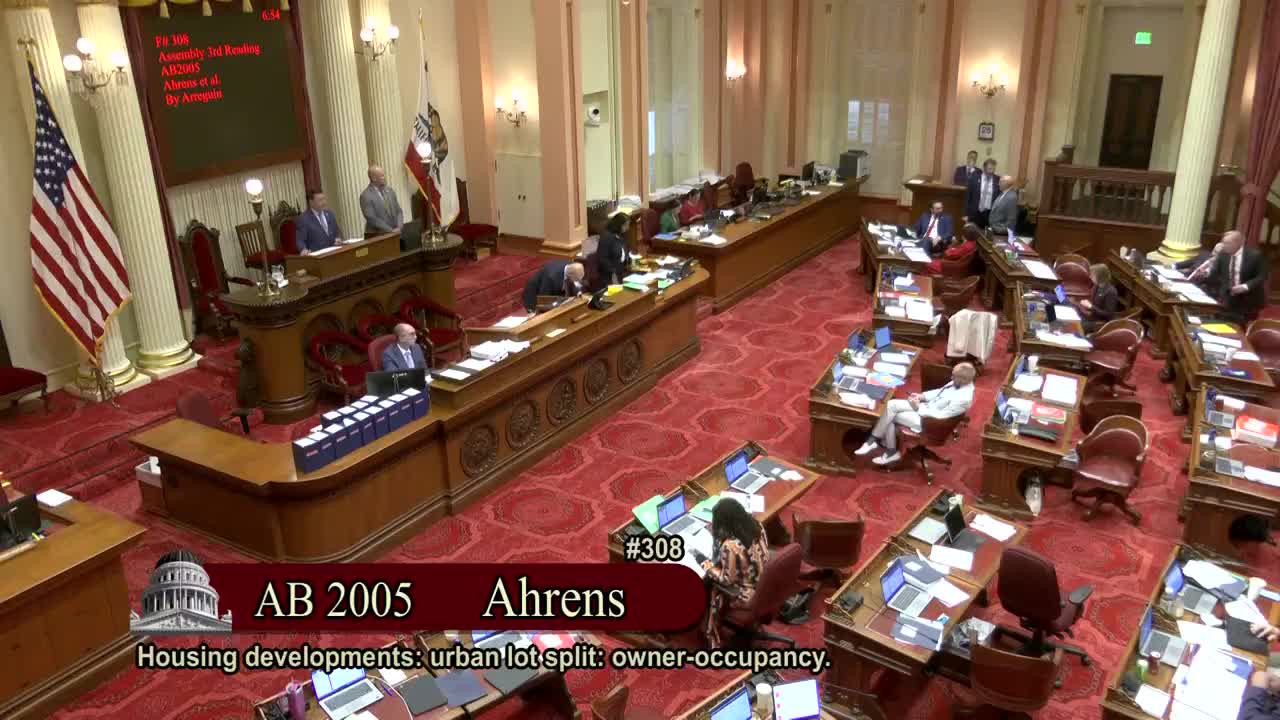 2MIN
Senate Floor
 52SEC
Senate Standing Committee on Appropriations
 5MIN
Senate Standing Committee on Energy, Utilities and Communications
 1MIN
Assembly Floor
 7MIN
Assembly Standing Committee on Utilities and Energy
Bill Author

Bill Co-Author(s):