AB 2115: California Native Americans: formal apology.
- Session Year: 2025-2026
- House: Assembly
- Latest Version Date: 2026-09-25
Current Status:
Passed
(2026-09-25: Chaptered by Secretary of State - Chapter 448, Statutes of 2026.)
Introduced
In Committee
Awaiting First Chamber Vote
Passed First Chamber
In Committee
Awaiting Second Chamber Vote
Passed Second Chamber
Enacted
Existing law provides that the State of California recognizes and accepts responsibility for the harms and atrocities committed by the state in promoting, facilitating, enforcing, and permitting chattel slavery and apologizes for perpetuating the harms African Americans have faced, as specified. Existing law requires a plaque memorializing this apology to be publicly and conspicuously installed and maintained in the State Capitol Building.
This bill, the Rowena Mae Ramos Act, would provide that the State of California recognizes and accepts responsibility for all of the harms and atrocities committed by its representatives who promoted, permitted, facilitated, and enforced policies of violence against California Native Americans. The bill would further provide that the State of California apologizes for perpetuating the harms experienced by California Native Americans as a result of policies enacted, sanctioned, or tolerated by the Legislature. The bill would require a plaque memorializing this apology to be publicly and conspicuously installed and maintained in the State Capitol Building. The bill would impose specified duties on the Department of General Services and the Joint Rules Committee relating to the installation and maintenance of the plaque. The bill would authorize the Department of General Services and the Joint Rules Committee to receive money from grants and private donations and would continuously appropriate those funds for this purpose, as specified.
The bill would require the Legislature to prepare the formal apology and would request it be signed by specified state leaders. The bill would require the Secretary of State to submit a final copy of this formal apology to the State Archives, where it would be available for viewing by the general public in perpetuity. The bill would include related legislative findings.
Existing law provides that the State of California recognizes and accepts responsibility for the harms and atrocities committed by the state in promoting, facilitating, enforcing, and permitting chattel slavery and apologizes for perpetuating the harms African Americans have faced, as specified. Existing law requires a plaque memorializing this apology to be publicly and conspicuously installed and maintained in the State Capitol Building.
This bill bill, the Rowena Mae Ramos Act, would provide that the State of California recognizes and accepts responsibility for all of the harms and atrocities committed by its representatives who promoted, permitted, facilitated, and enforced policies of violence against California Native Americans. The bill would further provide that the State of California apologizes for perpetuating the harms experienced by California Native Americans as a result of policies enacted, sanctioned, or tolerated by the Legislature. The bill would require a plaque memorializing this apology to be publicly and conspicuously installed and maintained in the State Capitol Building. The bill would impose specified duties on the Department of General Services and the Joint Rules Committee relating to the installation and maintenance of the plaque. The bill would authorize the Department of General Services and the Joint Rules Committee to receive money from grants and private donations and would continuously appropriate those funds for this purpose, as specified.
The bill would require the Legislature to prepare the formal apology and would request it be signed by specified state leaders. The bill would require the Secretary of State to submit a final copy of this formal apology to the State Archives, where it would be available for viewing by the general public in perpetuity. The bill would include related legislative findings.
Existing law provides that the State of California recognizes and accepts responsibility for the harms and atrocities committed by the state in promoting, facilitating, enforcing, and permitting chattel slavery and apologizes for perpetuating the harms African Americans have faced, as specified. Existing law requires a plaque memorializing this apology to be publicly and conspicuously installed and maintained in the State Capitol Building.
This bill would provide that the State of California recognizes and accepts responsibility for all of the harms and atrocities committed by its representatives who promoted, permitted, facilitated, and enforced policies of violence against California Native Americans. The bill would further provide that the State of California apologizes for perpetuating the harms experienced by California Native Americans as a result of policies enacted, sanctioned, or tolerated by the Legislature. The bill would require a plaque memorializing this apology to be publicly and conspicuously installed and maintained in the State Capitol Building. The bill would impose various specified duties on the Department of General Services and the Joint Rules Committee relating to the installation and maintenance of the plaque. The bill would authorize the Department of General Services and the Joint Rules Committee to receive money from grants and private donations and would continuously appropriate those funds for this purpose, as specified.
The bill would require the Legislature to prepare the formal apology and would request it be signed by specified state leaders. The bill would require the Secretary of State to submit a final copy of this formal apology to the State Archives, where it would be available for viewing by the general public in perpetuity. The bill would include related legislative findings.
Existing law provides that the State of California recognizes and accepts responsibility for the harms and atrocities committed by the state in promoting, facilitating, enforcing, and permitting chattel slavery and apologizes for perpetuating the harms African Americans have faced, as specified. Existing law requires a plaque memorializing this apology to be publicly and conspicuously installed and maintained in the State Capitol Building.
This bill would provide that the State of California recognizes and accepts responsibility for all of the harms and atrocities committed by its representatives who promoted, permitted, facilitated, and enforced policies of violence against California Native Americans. The bill would further provide that the State of California apologizes for perpetuating the harms California Native Americans as a result of policies enacted, sanctioned, or tolerated by the Legislature. The bill would require a plaque memorializing this apology to be publicly and conspicuously installed and maintained in the State Capitol Building. The bill would impose various duties on the Department of General Services and the Joint Rules Committee relating to the installation and maintenance of the plaque. The bill would authorize the Department of General Services and the Joint Rules Committee to receive money from grants and private donations and would continuously appropriate those funds for this purpose, as specified.
The bill would require the Legislature to prepare the formal apology and would request it be signed by specified state leaders. The bill would require the Secretary of State to submit a final copy of this formal apology to the State Archives, where it would be available for viewing by the general public in perpetuity. The bill would include related legislative findings.
(a)This chapter shall be known, and may be cited, as the Rowena Mae Ramos Act.
(b)Rowena Mae Ramos was a beloved elder of the Yuhaaviatam of San Manuel Nation, remembered for a life grounded in cultural pride, generosity, and service. Deeply connected to her heritage, she was a familiar presence at community gatherings across the region, bird dancing and singing the songs passed down through her family, and carrying this cultural knowledge forward with enduring love and dignity. Through her teachings and stories, she passed down the history of her people, ensuring that future generations would remain rooted in their identity and traditions.
8304.1.The Legislature finds and declares all of the following:
(a)Before the annexation of the California territory by the United States of America, the Native people of this land were subjected to systems of forced labor and enslavement under Spanish rule until 1821 through the Franciscan mission system.
(b)During the Mexican administration of the province from 1821 to 1845, Native Americans received land grants that were unequal in both size and quality compared to those granted to White Mexican citizens, leaving many Native Americans unable to sustain themselves on the limited lands they were allotted. The Native population continued to decline during this period while their ancestral homelands were continuously carved up by migrating Mexican, United States, British, and Canadian settlers.
(c)Since the incorporation of the California territory into the United States of America in 1848, the California State Legislature was complicit in the actions taken by the Governor against the Native people of this land. The California State Legislature directed, supported, and aided in the early persecutions of Native Americans.
(d)In 1849, delegates of the California Constitutional Convention willfully and deliberately agreed to provisions in the new constitution to deny California Native Americans the right to vote. The delegates of the conventions, in a majority, affirmed only allowing White male citizens of the United States and White Mexican men, who elected to be citizens of the United States under the Treaty of Guadalupe Hidalgo, the right to vote.
(e)As one of the first actions taken as the newly established Legislature of the State of California in 1850, it passed An Act for the Government and Protection of Indians (Chapter 133 of the Statutes of 1850), which facilitated the removal of Indigenous groups from their lands through family separation and indentured servitude. This act also prohibited Indigenous people from serving as credible witnesses against criminal acts committed by White citizens.
(f)The Legislature in An Act for the Government and Protection of Indians criminalized the actions of Native Americans who they believed to be vagrants. Specifically, the act imposed on Native Americans who shall be found loitering and strolling about, or frequenting public places where liquors are sold, begging, or leading an immoral or profligate course of life the threat of arrest on the complaint of any resident citizen of the county and brought before any Justice of the Peace of the proper county, Mayor or Recorder of any incorporated town or city, who shall examined said accused Indian, and hear the testimony in relation thereto... . If the Native American was so found to be a vagrant, the act directed the officer having him in charge or custody, to hire out such vagrant within twenty-four hours to the best bidder, by public notice given as he shall direct, for the highest price that can be had, for any term not exceeding four months... .
(g)The Legislature allowed the Governor to use Article VII of the 1849 California Constitution, relating to the Governors authority to call upon militias to execute the laws of the state, to suppress any insurrection and to repel any invasion, to pursue and punish Native Americans whom they suspected to be attackers in the states frontiers.
(h)In 1850, the Legislature enacted two laws that authorize the formation of militias for the defense of the state against Native American attacks. An Act Concerning Volunteer or Independent Companies (Chapter 54 of the Statutes of 1850) authorized citizens to organize into volunteer or independent companies that allowed them to arm themselves in the same manner as the United States Army, prepare muster rolls twice a year, and to render assistance and full obedience when summoned or commanded under the law. An Act Concerning the Organization of the Militia (Chapter 76 of the Statutes of 1850) delegated authority to the positions created by the Legislature to command and organize the state militias. The Governor was designated as the chief of all state forces. The Legislature would elect four major generals, eight brigadier generals, one adjutant general, and one quarter master general. The State Treasurer was made the ex officio paymaster, while county sheriffs held the authority to mobilize enrolled militias at the Governors request.
(i)The Legislature passed numerous laws and joint resolutions relative to the Indian Wars between tribal nations and the state from 1851 through 1859. These laws and resolutions aided and recognized the efforts of the state in defending against the Indian attacks.
(j)The state incurred an expenditure of eight hundred forty-three thousand three hundred seventy-three dollars and forty-eight cents ($843,373.48) from 1851 through 1859 for the subsistence and pay of troops ordered out by the Governor for the suppression of hostilities by Native Americans within its borders.
(k)Between 1854 and 1858, the state ordered expeditions against Native Americans in Humboldt, Klamath, San Bernardino, Modoc, Pit River, and Tulare, which accrued an estimated cost of four hundred forty-nine thousand six hundred five dollars and seventy-four cents ($449,605.74).
(l)The incurred costs by the state from the expeditions of 1854 through 1859 associated with the expeditions against Native American attacks amounted to one million two hundred ninety-three thousand one hundred seventy-nine dollars and twenty cents ($1,293,179.20). These war expenditures were funded by taxpayer dollars to suppress and eradicate Native American communities, which were deemed an internal threat by the state.
(m)In 1851, the state failed to intervene as officials of the local government of the County of Shasta encouraged violence against Native Americans, with local authorities reportedly offering five dollars for every Indian head brought to them, which was reported by local newspapers at the time.
(n)In 1852, the Legislature voted to oppose the ratification of 18 treaties between the United State government and California Indian tribes.
(o)In 1860, the Legislature established a Joint Special Committee on the Mendocino Indian War, which provided recommendations by both the majority and minority in regard to crimes committed between White settlers and Native Americans. The Majority Report determined that the state needed to pass legislation that would provide better protection of the Indians of California, while the Minority Report dissented and requested that the federal government cede to the State of California the entire jurisdiction over Indians and Indian affairs within [its] borders and that the state should, then, adopt a general system of peonage or apprenticeships, for the proper disposition and distributions of the Indians by families among responsible citizens.
(p)In 1861, members of the California State Militia sought compensation from the Adjutant General of California for actions taken against the Native American population, reporting at the time to have scalped 30 Native Americans.
(q)Between 1892 and 1974, California was home to 13 federal Indian boarding schools, which were institutions established by the federal government with the stated purpose of assimilating Native American children into American culture.
(r)These schools forcibly removed thousands of Native children from their families, communities, and traditional homelands, subjecting them to harsh discipline, cultural suppression, and the loss of their languages, identities, and spiritual practices.
(s)The legacy of these institutions continues to have profound intergenerational impacts on California Native American tribes, including enduring historical trauma and lasting harm to their communities well-being.
(t)In 1953, Congress enacted Public Law 83-280, granting certain states criminal jurisdiction over American Indians on reservations and permitting civil litigation previously under tribal or federal jurisdiction to be handled in state courts. The states mandated to assume civil and criminal jurisdiction over federal Indian lands under Public Law 83-280 were Alaska, California, Minnesota, Nebraska, Oregon, and Wisconsin.
(u)Public Law 83-280 has had devastating and long-lasting effects on tribal communities in states where it was imposed, leaving many tribes vulnerable to exploitation, violence, and the erosion of tribal sovereignty.
(v)In State of Arizona v. State of California (1963) 373 U.S. 546, the Supreme Court of the United States tied tribal water rights to the amount of acreage formally recognized within each reservation, rather than to the full extent of tribes historical, cultural, or subsistence-based water needs.
(w)This framework severely limited many tribes access to sufficient water by basing their rights on artificially reduced reservation boundaries, many of which had been diminished through federal and state policies, broken treaties, or unlawful land seizures.
(x)In 2001, the Legislature enacted Assembly Bill 978 (Chapter 818 of the Statutes of 2001), the California Native American Graves Protection and Repatriation Act of 2001, requiring all state agencies and state-funded museums that possess collections of Native American human remains or cultural items to establish a process for identifying and repatriating those items to the appropriate tribes.
(y)Despite the California Native American Graves Protection and Repatriation Act of 2001 being designed to address gaps in the federal Native American Graves Protection and Repatriation Act of 1990 (25 U.S.C. Sec. 3001 et seq.), Californias institutions of higher learning, including the University of California and the California State University, still retain many ancestral remains and cultural items that have yet to be repatriated to their respective tribes.
(z)In 1878, the Legislature approved the Act to Create Hastings College of the Law, in the University of the State of California, (Chapter 351 of the Statutes of 1878) authorizing Serranus Clinton Hastings to establish the first law school in California.
(aa)A three-year investigation into Serranus Clinton Hastings in 2020 revealed his involvement in the mass killings of Native Americans in the 1850s, concluding that he perpetrated genocidal acts against Californias Native Americans, most notably the Yuki Tribe, in the Eden Valley and Round Valley regions of the County of Mendocino.
(ab)From 1878 to 2022, inclusive, the state continued to appropriate funds in semiannual installments while the college operated under the name designated in the original act.
(ac)In 2022, the Legislature enacted Assembly Bill 2022 (Chapter 479 of the Statutes of 2022), requiring the removal of the offensive term squaw from all geographic features and place names in the state.
(ad)Prior to its enactment, more than 100 geographic features and place names in California still contained the term despite its derogatory nature toward Californias Native Americans.
(ae)Despite the many wrongdoings committed by the Legislature and other institutions in the state, California Native Americans have survived. Their survival stands as a testament to their resilience and their spirit of resistance and defiance against those who wished them harm.
(af)In 2019, Governor Gavin Newsom issued an apology to California Native Americans through Executive Order No. N-15-19, which also established the California Truth and Healing Council.
(ag)The Legislature and California Native Americans have never formally examined or documented their own relationship for the express purpose of acknowledging and accounting for the historical wrongs committed through the states actions and inaction.
(ah)The Legislature has never formally apologized to California Native Americans for its historical wrongdoing.
(ai)The Legislature has never formally expressed a commitment to working with California Native American tribes to build a closer relationship with their communities and governments to rectify the historical wrongdoing.
2.Recognition and Acceptance of Responsibility for Harms and Atrocities Committed: Formal Apology8304.2.(a)The State of California recognizes and accepts responsibility for all of the harms and atrocities committed by its representatives who promoted, permitted, facilitated, and enforced policies of violence against California Native Americans, which has left an enduring legacy of trauma and has led to the destruction of important cultural and spiritual sites, and recognizes the irreparable harms it has caused to its tribal communities.
(b)The Legislature commends and honors California Native Americans for their resilience and continued work to maintain their cultural and linguistic traditions for which this state proudly considers part of its history and cultural identity.
(c)The Legislature apologizes for perpetuating the harms experienced by California Native Americans as a result of policies enacted, sanctioned, or tolerated by this body throughout the states history. These harms, which include acts of violence, forced displacement, cultural suppression, land theft, family separation, and the deliberate erosion of tribal sovereignty, inflicted generational trauma and contributed to the systemic marginalization of Native peoples across California.
(d)The Legislature acknowledges that these were not isolated incidents but part of a sustained pattern of state-supported actions and inactions that denied California Native Americans their inherent rights, dignity, and humanity. The Legislature further recognizes that the consequences of these injustices continue to affect tribal communities today, contributing to disparities in health, education, land access, cultural preservation, and economic opportunity.
(e)The Legislature humbly asks for forgiveness from those affected by past atrocities, whether committed deliberately or through negligence, and affirms its responsibility to confront and end ongoing injustices that stem from these historical wrongs.
8304.3.(a)A plaque memorializing this apology, including the title of this chapter and the contents of Sections 8304.1 and 8304.2, shall be installed and maintained publicly and conspicuously in the State Capitol Building.
(b)The Department of General Services, in consultation with the Joint Rules Committee, shall plan and install a plaque pursuant to this section in the State Capitol Building.
(c)The Department of General Services, in consultation with the Joint Rules Committee, shall complete both of the following goals:
(1)Ensure Americans with Disabilities Act of 1990 (42 U.S.C. Sec. 12101 et seq.) compliance and other safety concerns.
(2)Develop a maintenance plan for the long-term maintenance of the plaque.
(d)The Department of General Services shall, in consultation with the Joint Rules Committee, establish a schedule for the design, construction, and dedication of the plaque, implement procedures to solicit designs for the plaque, devise a selection process for the choice of the design, and establish a program for the dedication of the plaque.
(e)The Joint Rules Committee shall approve the design and any other aspect of the plaque and the Department of General Services shall provide for the continuous maintenance and upkeep of the fixture.
8304.4.The Secretary of State shall submit a final copy of this formal apology to the State Archives, where it shall be available for viewing by the general public in perpetuity. The Legislature shall prepare the formal apology, which shall bear the Great Seal of the State and requests that this apology be signed by the Speaker of the Assembly, the President pro Tempore of the Senate, the Governor, and the Chief Justice of California.
8304.5.Notwithstanding any other provision of law, the Department of General Services and the Joint Rules Committee may receive moneys from any federal, state, or local grant, or from any private donation or grant, for the purposes of this chapter. Notwithstanding Section 13340, any funds received pursuant to this section are continuously appropriated to the Department of General Services and the Joint Rules Committee, without regard to fiscal years, for the purpose of this chapter.
(a)This chapter shall be known, and may be cited, as the California State Legislatures Formal Apology to California Native Americans Rowena Mae Ramos Act.
(b)Rowena Mae Ramos was a beloved elder of the Yuhaaviatam of San Manuel Nation, remembered for a life grounded in cultural pride, generosity, and service. Deeply connected to her heritage, she was a familiar presence at community gatherings across the region, bird dancing and singing the songs passed down through her family, and carrying this cultural knowledge forward with enduring love and dignity. Through her teachings and stories, she passed down the history of her people, ensuring that future generations would remain rooted in their identity and traditions.
8304.1.The Legislature finds and declares all of the following:
(a)Before the annexation of the California territory by the United States of America, the Native people of this land were subjected to systems of forced labor and enslavement under Spanish rule until 1821 through the Franciscan mission system.
(b)During the Mexican administration of the province from 1821 to 1845, Native Americans received land grants that were unequal in both size and quality compared to those granted to White Mexican citizens, leaving many Native Americans unable to sustain themselves on the limited lands they were allotted. The Native population continued to decline during this period while their ancestral homelands were continuously carved up by migrating Mexican, United States, British, and Canadian settlers.
(c)Since the incorporation of the California territory into the United States of America in 1848, the California State Legislature was complicit in the actions taken by the Governor against the Native people of this land. The California State Legislature directed, supported, and aided in the early persecutions of Native Americans.
(d)In 1849, delegates of the California Constitutional Convention willfully and deliberately agreed to provisions in the new constitution to deny California Native Americans the right to vote. The delegates of the conventions, in a majority, affirmed only allowing White male citizens of the United States and White Mexican men, who elected to be citizens of the United States under the Treaty of Guadalupe Hidalgo, the right to vote.
(e)As one of the first actions taken as the newly established Legislature of the State of California in 1850, it passed An Act for the Government and Protection of Indians (Chapter 133 of the Statutes of 1850), which facilitated the removal of Indigenous groups from their lands through family separation and indentured servitude. This act also prohibited Indigenous people from serving as credible witnesses against criminal acts committed by White citizens.
(f)The Legislature in An Act for the Government and Protection of Indians criminalized the actions of Native Americans who they believed to be vagrants. Specifically, the act imposed on Native Americans who shall be found loitering and strolling about, or frequenting public places where liquors are sold, begging, or leading an immoral or profligate course of life the threat of arrest on the complaint of any resident citizen of the county and brought before any Justice of the Peace of the proper county, Mayor or Recorder of any incorporated town or city, who shall examined said accused Indian, and hear the testimony in relation thereto... . If the Native American was so found to be a vagrant, the act directed the officer having him in charge or custody, to hire out such vagrant within twenty-four hours to the best bidder, by public notice given as he shall direct, for the highest price that can be had, for any term not exceeding four months... .
(g)The Legislature allowed the Governor to use Article VII of the 1849 California Constitution, relating to the Governors authority to call upon militias to execute the laws of the state, to suppress any insurrection and to repel any invasion, to pursue and punish Native Americans whom they suspected to be attackers in the states frontiers.
(h)In 1850, the Legislature enacted two laws that authorize the formation of militias for the defense of the state against Native American attacks. An Act Concerning Volunteer or Independent Companies (Chapter 54 of the Statutes of 1850) authorized citizens to organize into volunteer or independent companies that allowed them to arm themselves in the same manner as the United States Army, prepare muster rolls twice a year, and to render assistance and full obedience when summoned or commanded under the law. An Act Concerning the Organization of the Militia (Chapter 76 of the Statutes of 1850) delegated authority to the positions created by the Legislature to command and organize the state militias. The Governor was designated as the chief of all state forces. The Legislature would elect four major generals, eight brigadier generals, one adjutant general, and one quarter master general. The State Treasurer was made the ex officio paymaster, while county sheriffs held the authority to mobilize enrolled militias at the Governors request.
(i)The Legislature passed numerous laws and joint resolutions relative to the Indian Wars between tribal nations and the state from 1851 through 1859. These laws and resolutions aided and recognized the efforts of the state in defending against the Indian attacks.
(j)The state incurred an expenditure of eight hundred forty-three thousand three hundred seventy-three dollars and forty-eight cents ($843,373.48) from 1851 through 1859 for the subsistence and pay of troops ordered out by the Governor for the suppression of hostilities by Native Americans within its borders.
(k)Between 1854 and 1858, the state ordered expeditions against Native Americans in Humboldt, Klamath, San Bernardino, Modoc, Pit River, and Tulare, which accrued an estimated cost of four hundred forty-nine thousand six hundred five dollars and seventy-four cents ($449,605.74).
(l)The incurred costs by the state from the expeditions of 1854 through 1859 associated with the expeditions against Native American attacks amounted to one million two hundred ninety-three thousand one hundred seventy-nine dollars and twenty cents ($1,293,179.20). These war expenditures were funded by taxpayer dollars to suppress and eradicate Native American communities, which were deemed an internal threat by the state.
(m)In 1851, the state failed to intervene as officials of the local government of the County of Shasta encouraged violence against Native Americans, with local authorities reportedly offering five dollars for every Indian head brought to them, which was reported by local newspapers at the time.
(n)In 1852, the Legislature voted to oppose the ratification of 18 treaties between the United State government and California Indian tribes.
(o)In 1860, the Legislature established a Joint Special Committee on the Mendocino Indian War, which provided recommendations by both the majority and minority in regard to crimes committed between White settlers and Native Americans. The Majority Report determined that the state needed to pass legislation that would provide better protection of the Indians of California, while the Minority Report dissented and requested that the federal government cede to the State of California the entire jurisdiction over Indians and Indian affairs within [its] borders and that the state should, then, adopt a general system of peonage or apprenticeships, for the proper disposition and distributions of the Indians by families among responsible citizens.
(p)In 1861, members of the California State Militia sought compensation from the Adjutant General of California for actions taken against the Native American population, reporting at the time to have scalped 30 Native Americans.
(q)Between 1892 and 1974, California was home to 13 federal Indian boarding schools, which were institutions established by the federal government with the stated purpose of assimilating Native American children into American culture.
(r)These schools forcibly removed thousands of Native children from their families, communities, and traditional homelands, subjecting them to harsh discipline, cultural suppression, and the loss of their languages, identities, and spiritual practices.
(s)The legacy of these institutions continues to have profound intergenerational impacts on California Native American tribes, including enduring historical trauma and lasting harm to their communities well-being.
(t)In 1953, Congress enacted Public Law 83-280, granting certain states criminal jurisdiction over American Indians on reservations and permitting civil litigation previously under tribal or federal jurisdiction to be handled in state courts. The states mandated to assume civil and criminal jurisdiction over federal Indian lands under Public Law 83-280 were Alaska, California, Minnesota, Nebraska, Oregon, and Wisconsin.
(u)Public Law 83-280 has had devastating and long-lasting effects on tribal communities in states where it was imposed, leaving many tribes vulnerable to exploitation, violence, and the erosion of tribal sovereignty.
(v)In State of Arizona v. State of California (1963) 373 U.S. 546, the Supreme Court of the United States tied tribal water rights to the amount of acreage formally recognized within each reservation, rather than to the full extent of tribes historical, cultural, or subsistence-based water needs.
(w)This framework severely limited many tribes access to sufficient water by basing their rights on artificially reduced reservation boundaries, many of which had been diminished through federal and state policies, broken treaties, or unlawful land seizures.
(x)In 2001, the Legislature enacted Assembly Bill 978 (Chapter 818 of the Statutes of 2001), the California Native American Graves Protection and Repatriation Act of 2001, requiring all state agencies and state-funded museums that possess collections of Native American human remains or cultural items to establish a process for identifying and repatriating those items to the appropriate tribes.
(y)Despite the California Native American Graves Protection and Repatriation Act of 2001 being designed to address gaps in the federal Native American Graves Protection and Repatriation Act of 1990 (25 U.S.C. Sec. 3001 et seq.), Californias institutions of higher learning, including the University of California and the California State University, still retain many ancestral remains and cultural items that have yet to be repatriated to their respective tribes.
(z)In 1878, the Legislature approved the Act to Create Hastings College of the Law, in the University of the State of California, (Chapter 351 of the Statutes of 1878) authorizing Serranus Clinton Hastings to establish the first law school in California.
(aa)A three-year investigation into Serranus Clinton Hastings in 2020 revealed his involvement in the mass killings of Native Americans in the 1850s, concluding that he perpetrated genocidal acts against Californias Native Americans, most notably the Yuki Tribe, in the Eden Valley and Round Valley regions of the County of Mendocino.
(ab)From 1878 to 2022, inclusive, the state continued to appropriate funds in semiannual installments while the college operated under the name designated in the original act.
(ac)In 2022, the Legislature enacted Assembly Bill 2022 (Chapter 479 of the Statutes of 2022), requiring the removal of the offensive term squaw from all geographic features and place names in the state.
(ad)Prior to its enactment, more than 100 geographic features and place names in California still contained the term despite its derogatory nature toward Californias Native Americans.
(ae)Despite the many wrongdoings committed by the Legislature and other institutions in the state, California Native Americans have survived. Their survival stands as a testament to their resilience and their spirit of resistance and defiance against those who wished them harm.
(af)In 2019, Governor Gavin Newsom issued an apology to California Native Americans through Executive Order No. N-15-19, which also established the California Truth and Healing Council.
(ag)The Legislature and California Native Americans have never formally examined or documented their own relationship for the express purpose of acknowledging and accounting for the historical wrongs committed through the states actions and inaction.
(ah)The Legislature has never formally apologized to California Native Americans for its historical wrongdoing.
(ai)The Legislature has never formally expressed a commitment to working with California Native American tribes to build a closer relationship with their communities and governments to rectify the historical wrongdoing.
2.Recognition and Acceptance of Responsibility for Harms and Atrocities Committed: Formal Apology8304.2.(a)The State of California recognizes and accepts responsibility for all of the harms and atrocities committed by its representatives who promoted, permitted, facilitated, and enforced policies of violence against California Native Americans, which has left an enduring legacy of trauma and has led to the destruction of important cultural and spiritual sites, and recognizes the irreparable harms it has caused to its tribal communities.
(b)The Legislature commends and honors California Native Americans for their resilience and continued work to maintain their cultural and linguistic traditions for which this state proudly considers part of its history and cultural identity.
(c)The Legislature apologizes for perpetuating the harms experienced by California Native Americans as a result of policies enacted, sanctioned, or tolerated by this body throughout the states history. These harms, which include acts of violence, forced displacement, cultural suppression, land theft, family separation, and the deliberate erosion of tribal sovereignty, inflicted generational trauma and contributed to the systemic marginalization of Native peoples across California.
(d)The Legislature acknowledges that these were not isolated incidents but part of a sustained pattern of state-supported actions and inactions that denied California Native Americans their inherent rights, dignity, and humanity. The Legislature further recognizes that the consequences of these injustices continue to affect tribal communities today, contributing to disparities in health, education, land access, cultural preservation, and economic opportunity.
(e)The Legislature humbly asks for forgiveness from those affected by past atrocities, whether committed deliberately or through negligence, and affirms its responsibility to confront and end ongoing injustices that stem from these historical wrongs.
8304.3.(a)A plaque memorializing this apology, including the title of this chapter and the contents of Sections 8304.1 and 8304.2 8304.2, shall be installed and maintained publicly and conspicuously in the State Capitol Building.
(b)The Department of General Services, in consultation with the Joint Rules Committee, shall plan and install a plaque pursuant to this section in the State Capitol Building.
(c)The Department of General Services, in consultation with the Joint Rules Committee, shall complete both of the following goals:
(1)Ensure Americans with Disabilities Act of 1990 (42 U.S.C. Sec. 12101 et seq.) compliance and other safety concerns.
(2)Develop a maintenance plan for the long-term maintenance of the plaque.
(d)The Department of General Services shall, in consultation with the Joint Rules Committee, establish a schedule for the design, construction, and dedication of the plaque, implement procedures to solicit designs for the plaque, devise a selection process for the choice of the design, and establish a program for the dedication of the plaque.
(e)The Joint Rules Committee shall approve the design and any other aspect of the plaque and the Department of General Services shall provide for the continuous maintenance and upkeep of the fixture.
8304.4.The Secretary of State shall submit a final copy of this formal apology to the State Archives, where it shall be available for viewing by the general public in perpetuity. The Legislature shall prepare the formal apology, which shall bear the Great Seal of the State and requests that this apology be signed by the Speaker of the Assembly, the President pro Tempore of the Senate, the Governor, and the Chief Justice of California.
8304.5.Notwithstanding any other provision of law, the Department of General Services and the Joint Rules Committee may receive moneys from any federal, state, or local grant, or from any private donation or grant, for the purposes of this chapter. Notwithstanding Section 13340, any funds received pursuant to this section are continuously appropriated to the Department of General Services and the Joint Rules Committee, without regard to fiscal years, for the purpose of this chapter.
This chapter shall be known, and may be cited, as the California State Legislatures Formal Apology to California Native Americans Act.
8304.1.The Legislature finds and declares all of the following:
(a)Before the annexation of the California territory by the United States of America, the Native people of this land were subjected to systems of forced labor and enslavement under Spanish rule until 1821 through the Franciscan mission system.
(b)During the Mexican administration of the province from 1821 to 1845, Native Americans received land grants that were unequal in both size and quality compared to those granted to white White Mexican citizens, leaving many Native Americans unable to sustain themselves on the limited lands they were allotted. The Native population continued to decline during this period while their ancestral homelands were continuously carved up by migrating Mexican, United States, British, and Canadian settlers.
(c)Since the incorporation of the California territory into the United States of America in 1848, the California State Legislature was complicit in the actions taken by the governor Governor against the Native people of this land. The California State Legislature directed, supported, and aided in the early persecutions of Native Americans.
(d)In 1849, delegates of the California Constitutional Convention wilfully willfully and deliberately agreed to provisions in the new constitution to deny California Native Americans the right to vote. The delegates of the conventions, in a majority, affirmed only allowing white White male citizens of the United States and white White Mexican men, who elected to be citizens of the United States under the Treaty of Guadalupe Hidalgo, the right to vote.
(e)As one of the first actions taken as the newly established Legislature of the State of California in 1850, it passed An Act for the Government and Protection of Indians (Chapter 133 of the Statutes of 1850), which facilitated the removal of Indigenous groups from their lands through family separation and indentured servitude. This act also prohibited Indigenous people from serving as credible witnesses against criminal acts committed by white White citizens.
(f)The Legislature in An Act for the Government and Protection of Indians criminalized the actions of Native Americans who they believed to be vagrants. Specifically, the act imposed on Native Americans who shall be found loitering and strolling about, or frequenting public places where liquors are sold, begging, or leading an immoral or profligate course of life the threat of arrest on the complaint of any resident citizen of the county and brought before any Justice of the Peace of the proper county, Mayor or Recorder of any incorporated town or city, who shall examined said accused Indian, and hear the testimony in relation thereto... . thereto... . If the Native American was so found to be a vagrant, the act directed the officer having him in charge or custody, to hire out such vagrant within twenty-four hours to the best bidder, by public notice given as he shall direct, for the highest price that can be had, for any term not exceeding four months... .
(g)The Legislature allowed the Governor to use Article VII of the 1849 California Constitution, relating to the Governors authority to call upon militias to execute the laws of the state, to suppress any insurrection and to repel any invasion, to pursue and punish Native Americans whom they suspected to be attackers in the states frontiers.
(h)In 1850, the Legislature enacted two laws that authorize the formation of militias for the defense of the state against Native American attacks. An Act Concerning Volunteer or Independent Companies (Chapter 54 of the Statutes of 1850) authorized citizens to organize into volunteer or independent companies that allowed them to arm themselves in the same manner as the United States Army, prepare muster rolls twice a year, and to render assistance and full obedience when summoned or commanded under the law. An Act Concerning the Organization of the Militia (Chapter 76 of the Statutes of 1850) delegated authority to the positions created by the Legislature to command and organize the state militias. The governor Governor was designated as the chief of all state forces. The Legislature would elect four major generals, eight brigadier generals, one adjutant general, and one quarter master general. The State Treasurer was made the ex officio paymaster, while county sheriffs held the authority to mobilize enrolled militias at the Governors request.
(i)The Legislature passed numerous laws and joint resolutions relative to the Indian Wars between tribal nations and the state from 1851 through 1859. These laws and resolutions aided and recognized the efforts of the state in defending against the Indian attacks.
(j)The state incurred an expenditure of eight hundred forty-three thousand three hundred seventy-three dollars and forty-eight cents ($843, 373.48) ($843,373.48) from 1851 through 1859 for the subsistence and pay of troops ordered out by the Governor for the suppression of hostilities by Native Americans within its borders.
(k)Between 1854 and 1858, the state ordered expeditions against Native Americans in Humboldt, Klamath, San Bernardino, Modoc, Pit River, and Tulare, which accrued an estimated cost of four hundred forty-nine thousand six hundred five dollars and seventy-four cents ($449,605.74).
(l)The incurred costs by the state from the expeditions of 1854 through 1859 associated with the expeditions against Native American attacks amounted to one million two hundred ninety-three thousand one hundred seventy-nine dollars and twenty cents ($1,293,179.20). These war expenditures were funded by taxpayer dollars to suppress and eradicate Native American communities, which were deemed an internal threat by the state.
(m)In 1851, the state failed to intervene as officials of the local government of the County of Shasta encouraged violence against Native Americans, with local authorities reportedly offering five dollars for every Indian head brought to them, which was reported by local newspapers at the time.
(n)In 1852, the Legislature voted to oppose the ratification of 18 treaties between the United State government and California Indian tribes.
(o)In 1860, the Legislature established a Joint Special Committee on the Mendocino Indian War, which provided recommendations by both the majority and minority in regard to crimes committed between white White settlers and Native Americans. The Majority Report determined that the state needed to pass legislation that would provide better protection of the Indians of California, while the Minority Report dissented and requested that the federal government cede to the State of California the entire jurisdiction over Indians and Indian affairs within [its] borders and that the state should, then, adopt a general system of peonage or apprenticeships, for the proper disposition and distributions of the Indians by families among responsible citizens.
(p)In 1861, members of the California State Militia sought compensation from the Adjutant General of California for actions taken against the Native American population, reporting at the time to have scalped 30 Native Americans.
(q)Between 1892 and 1974, California was home to 13 federal Indian boarding schools, which were institutions established by the federal government with the stated purpose of assimilating Native American children into American culture.
(r)These schools forcibly removed thousands of Native children from their families, communities, and traditional homelands, subjecting them to harsh discipline, cultural suppression, and the loss of their languages, identities, and spiritual practices.
(s)The legacy of these institutions continues to have profound intergenerational impacts on California Native American tribes, including enduring historical trauma and lasting harm to their communities well-being.
(t)In 1953, Congress enacted Public Law 83-280, granting certain states criminal jurisdiction over American Indians on reservations and permitting civil litigation previously under tribal or federal jurisdiction to be handled in state courts. The states mandated to assume civil and criminal jurisdiction over federal Indian lands under Public Law 83-280 were Alaska, California, Minnesota, Nebraska, Oregon, and Wisconsin.
(u)Public Law 83-280 has had devastating and long-lasting effects on tribal communities in states where is it was imposed, leaving many tribes vulnerable to exploitation, violence, and the erosion of tribal sovereignty.
(v)In State of Arizona v. State of California (1963) 373 U.S. 546, the Supreme Court of the United States tied tribal water rights to the amount of acreage formally recognized within each reservation, rather than to the full extent of tribes historical, cultural, or subsistence-based water needs.
(w)This framework severely limited many tribes access to sufficient water by basing their rights on artificially reduced reservation boundaries, many of which had been diminished through federal and state policies, broken treaties, or unlawful land seizures.
(x)In 2001, the Legislature enacted Assembly Bill 978 (Chapter 818 of the Statutes of 2001), the California Native American Graves Protection and Repatriation Act of 2001, requiring all state agencies and state-funded museums that possess collections of Native American human remains or cultural items to establish a process for identifying and repatriating those items to the appropriate tribes.
(y)Despite the California Native American Graves Protection and Repatriation Act of 2001 being designed to address gaps in the federal Native American Graves Protection and Repatriation Act of 1990 (25 U.S.C. Sec. 3001 et seq.), Californias institutions of higher learning, including the University of California and the California State University, still retain many ancestral remains and cultural items that have yet to be repatriated to their respective tribes.
(z)In 1878, the Legislature approved the Act to Create Hastings College of the Law, in the University of the State of California, (Chapter 351 of the Statutes of 1878) authorizing Serranus Clinton Hastings to establish the first law school in California.
(aa)A three-year investigation into Serranus Clinton Hastings in 2020 revealed his involvement in the mass killings of Native Americans in the 1850s, concluding that he perpetrated genocidal acts against Californias Native Americans, most notably the Yuki Tribe, in the Eden Valley and Round Valley regions of the County of Mendocino.
(ab)From 1878 to 2022, inclusive, the state continued to appropriate funds in semiannual installments while the college operated under the name designated in the original act.
(ac)In 2022, the Legislature enacted Assembly Bill 2022 (Chapter 479 of the Statutes of 2022), requiring the removal of the offensive term squaw from all geographic features and place names in the state.
(ad)Prior to its enactment, more than 100 geographic features and place names in California still contained the term despite its derogatory nature toward Californias Native Americans.
(ae)Despite the many wrongdoings committed by the Legislature and other institutions in the state, California Native Americans have survived. Their survival stands as a testament to their resilience and their spirit of resistance and defiance against those who wished them harm.
(af)In 2019, Governor Gavin Newsom issued an apology to California Native Americans through Executive Order No. N-15-19, which also established the California Truth and Healing Council.
(ag)The Legislature and California Native Americans have never formally examined or documented their own relationship for the express purpose of acknowledging and accounting for the historical wrongs committed through the states actions and inaction.
(ah)The Legislature has never formally apologized to California Native Americans for its historical wrongdoing.
(ai)The Legislature has never formally expressed a commitment to working with California Native American Tribes tribes to build a closer relationship with their communities and governments to rectify the historical wrongdoing.
2.Recognition and Acceptance of Responsibility for Harms and Atrocities Committed: Formal Apology8304.2.(a)The State of California recognizes and accepts responsibility for all of the harms and atrocities committed by the its representatives who promoted, permitted, facilitated, and enforced policies of violence against California Native Americans, which has left an enduring legacy of trauma and has led to the destruction of important cultural and spiritual sites, and recognizes the irreparable harms it has caused to its tribal communities.
(b)The Legislature commends and honors California Native Americans for their resilience and continued work to maintain their cultural and linguistic traditions for which this state proudly considers part of its history and cultural identity.
(c)The Legislature apologizes for perpetuating the harms experienced by California Native Americans as a result of policies enacted, sanctioned, or tolerated by this body throughout the states history. These harms, which include acts of violence, forced displacement, cultural suppression, land theft, family separation, and the deliberate erosion of tribal sovereignty, inflicted generational trauma and contributed to the systemic marginalization of Native peoples across California.
(d)The Legislature acknowledges that these were not isolated incidents but part of a sustained pattern of state-supported actions and inactions that denied California Native Americans their inherent rights, dignity, and humanity. The Legislature further recognizes that the consequences of these injustices continue to affect tribal communities today, contributing to disparities in health, education, land access, cultural preservation, and economic opportunity.
(e)The Legislature humbly asks for forgiveness from those affected by past atrocities, whether committed deliberately or through negligence, and affirms its responsibility to confront and end ongoing injustices that stem from these historical wrongs.
8304.3.(a)A plaque memorializing this apology, including the contents of Sections 8304.1 and 8304.2 shall be installed and maintained publicly and conspicuously in the State Capitol Building.
(b)The Department of General Services, in consultation with the Joint Rules Committee, shall plan and install a plaque pursuant to this section in the State Capitol Building.
(c)The Department of General Services, in consultation with the Joint Rules Committee, shall complete all both of the following goals:
(1)Review of the preliminary design plans to identify potential maintenance concerns. (2)(1)Ensure Americans with Disabilities Act of 1990 (42 U.S.C. Sec. 12101, 12101 et seq.) compliance and other safety concerns.
(3)Review and approval of California Environmental Quality Act (Division 13 (commencing with Section 21000) of the Public Resources Code) documents prepared for work at the designated historic property.(4)Review of final construction documents to ensure that all requirements are met.(5)Prepare a maintenance agreement outlining the Department of General Services responsibility for the long-term maintenance of the plaque due to aging, vandalism, or relocation.(2)Develop a maintenance plan for the long-term maintenance of the plaque.
(d)The Department of General Services shall, in consultation with the Joint Rules Committee, establish a schedule for the design, construction, and dedication of the plaque, implement procedures to solicit designs for the plaque, devise a selection process for the choice of the design, and establish a program for the dedication of the plaque.
(e)The Joint Rules Committee shall approve the design and any other aspect of the plaque and the Department of General Services shall provide for the continuous maintenance and upkeep of the fixture.
8304.4.The Secretary of State shall submit a final copy of this formal apology to the State Archives, where it shall be available for viewing by the general public in perpetuity. The Legislature shall prepare the formal apology, which shall bear the Great Seal of the State and requests that this apology be signed by the Speaker of the Assembly, the President pro Tempore of the Senate, the Governor, and the Chief Justice of California.
8304.5.Notwithstanding any other provision of law, the Department of General Services and the Joint Rules Committee may receive moneys from any federal, state, or local grant, or from any private donation or grant, for the purposes of this chapter. Notwithstanding Section 13340, any funds received pursuant to this section are continuously appropriated to the Department of General Services and the Joint Rules Committee, without regard to fiscal years, for the purpose of this chapter.
This chapter shall be known, and may be cited, as the California State Legislatures Formal Apology to California Native Americans Act.
8304.1.The Legislature finds and declares all of the following:
(a)Before the annexation of the California territory by the United States of America, the Native people of this land were subjected to systems of forced labor and enslavement under Spanish rule until 1821 through the Franciscan mission system.
(b)During the Mexican administration of the province from 1821 to 1845, Native Americans received land grants that were unequal in both size and quality compared to those granted to white Mexican citizens, leaving many Native Americans unable to sustain themselves on the limited lands they were allotted. The Native population continued to decline during this period while their ancestral homelands were continuously carved up by migrating Mexican, United States, British, and Canadian settlers.
(c)Since the incorporation of the California territory into the United States of America in 1848, the California State Legislature was complicit in the actions taken by the governor against the Native people of this land. The California State Legislature directed, supported, and aided in the early persecutions of Native Americans.
(d)In 1849, delegates of the California Constitutional Convention wilfully and deliberately agreed to provisions in the new constitution to deny California Native Americans the right to vote. The delegates of the conventions, in a majority, affirmed only allowing white male citizens of the United States and white Mexican men, who elected to be citizens of the United States under the Treaty of Guadalupe Hidalgo, the right to vote.
(e)As one of the first actions taken as the newly established Legislature of the State of California in 1850, it passed An Act for the Government and Protection of Indians (Chapter 133 of the Statutes of 1850), which facilitated the removal of Indigenous groups from their lands through family separation and indentured servitude. This act also prohibited Indigenous people from serving as credible witnesses against criminal acts committed by white citizens.
(f)The Legislature in An Act for the Government and Protection of Indians criminalized the actions of Native Americans who they believed to be vagrants. Specifically, the act imposed on Native Americans who shall be found loitering and strolling about, or frequenting public places where liquors are sold, begging, or leading an immoral or profligate course of life the threat of arrest on the complaint of any resident citizen of the county and brought before any Justice of the Peace of the proper county, Mayor or Recorder of any incorporated town or city, who shall examined said accused Indian, and hear the testimony in relation thereto... . If the Native American was so found to be a vagrant, the act directed the officer having him in charge or custody, to hire out such vagrant within twenty-four hours to the best bidder, by public notice given as he shall direct, for the highest price that can be had, for any term not exceeding four months... .
(g)The Legislature allowed the Governor to use Article VII of the 1849 California Constitution, relating to the Governors authority to call upon militias to execute the laws of the state, to suppress any insurrection and to repel any invasion, to pursue and punish Native Americans whom they suspected to be attackers in the states frontiers.
(h)In 1850, the Legislature enacted two laws that authorize the formation of militias for the defense of the state against Native American attacks. An Act Concerning Volunteer or Independent Companies (Chapter 54 of the Statutes of 1850) authorized citizens to organize into volunteer or independent companies that allowed them to arm themselves in the same manner as the United States Army, prepare muster rolls twice a year, and to render assistance and full obedience when summoned or commanded under the law. An Act Concerning the Organization of the Militia (Chapter 76 of the Statutes of 1850) delegated authority to the positions created by the Legislature to command and organize the state militias. The governor was designated as the chief of all state forces. The Legislature would elect four major generals, eight brigadier generals, one adjutant general, and one quarter master general. The State Treasurer was made the ex officio paymaster, while county sheriffs held the authority to mobilize enrolled militias at the Governors request.
(i)The Legislature passed numerous laws and joint resolutions relative to the Indian Wars between tribal nations and the state from 1851 through 1859. These laws and resolutions aided and recognized the efforts of the state in defending against the Indian attacks.
(j)The state incurred an expenditure of eight hundred forty-three thousand three hundred seventy-three dollars and forty-eight cents ($843, 373.48) from 1851 through 1859 for the subsistence and pay of troops ordered out by the Governor for the suppression of hostilities by Native Americans within its borders.
(k)Between 1854 and 1858, the state ordered expeditions against Native Americans in Humboldt, Klamath, San Bernardino, Modoc, Pit River, and Tulare, which accrued an estimated cost of four hundred forty-nine thousand six hundred five dollars and seventy-four cents ($449,605.74).
(l)The incurred costs by the state from the expeditions of 1854 through 1859 associated with the expeditions against Native American attacks amounted to one million two hundred ninety-three thousand one hundred seventy-nine dollars and twenty cents ($1,293,179.20). These war expenditures were funded by taxpayer dollars to suppress and eradicate Native American communities, which were deemed an internal threat by the state.
(m)In 1851, the state failed to intervene as officials of the local government of the County of Shasta encouraged violence against Native Americans, with local authorities reportedly offering five dollars for every Indian head brought to them, which was reported by local newspapers at the time.
(n)In 1852, the Legislature voted to oppose the ratification of 18 treaties between the United State government and California Indian tribes.
(o)In 1860, the Legislature established a Joint Special Committee on the Mendocino Indian War, which provided recommendations by both the majority and minority in regard to crimes committed between white settlers and Native Americans. The Majority Report determined that the state needed to pass legislation that would provide better protection of the Indians of California, while the Minority Report dissented and requested that the federal government cede to the State of California the entire jurisdiction over Indians and Indian affairs within [its] borders and that the state should, then, adopt a general system of peonage or apprenticeships, for the proper disposition and distributions of the Indians by families among responsible citizens.
(p)In 1861, members of the California State Militia sought compensation from the Adjutant General of California for actions taken against the Native American population, reporting at the time to have scalped 30 Native Americans.
(q)Between 1892 and 1974, California was home to 13 federal Indian boarding schools, which were institutions established by the federal government with the stated purpose of assimilating Native American children into American culture.
(r)These schools forcibly removed thousands of Native children from their families, communities, and traditional homelands, subjecting them to harsh discipline, cultural suppression, and the loss of their languages, identities, and spiritual practices.
(s)The legacy of these institutions continues to have profound intergenerational impacts on California Native American tribes, including enduring historical trauma and lasting harm to their communities well-being.
(t)In 1953, Congress enacted Public Law 83-280, granting certain states criminal jurisdiction over American Indians on reservations and permitting civil litigation previously under tribal or federal jurisdiction to be handled in state courts. The states mandated to assume civil and criminal jurisdiction over federal Indian lands under Public Law 83-280 were Alaska, California, Minnesota, Nebraska, Oregon, and Wisconsin.
(u)Public Law 83-280 has had devastating and long-lasting effects on tribal communities in states where is was imposed, leaving many tribes vulnerable to exploitation, violence, and the erosion of tribal sovereignty.
(v)In State of Arizona v. State of California (1963) 373 U.S. 546, the Supreme Court of the United States tied tribal water rights to the amount of acreage formally recognized within each reservation, rather than to the full extent of tribes historical, cultural, or subsistence-based water needs.
(w)This framework severely limited many tribes access to sufficient water by basing their rights on artificially reduced reservation boundaries, many of which had been diminished through federal and state policies, broken treaties, or unlawful land seizures.
(x)In 2001, the Legislature enacted Assembly Bill 978 (Chapter 818 of the Statutes of 2001), the California Native American Graves Protection and Repatriation Act of 2001, requiring all state agencies and state-funded museums that possess collections of Native American human remains or cultural items to establish a process for identifying and repatriating those items to the appropriate tribes.
(y)Despite the California Native American Graves Protection and Repatriation Act of 2001 being designed to address gaps in the federal Native American Graves Protection and Repatriation Act of 1990 (25 U.S.C. Sec. 3001 et seq.), Californias institutions of higher learning, including the University of California and the California State University, still retain many ancestral remains and cultural items that have yet to be repatriated to their respective tribes.
(z)In 1878, the Legislature approved the Act to Create Hastings College of the Law, in the University of the State of California, (Chapter 351 of the Statutes of 1878) authorizing Serranus Clinton Hastings to establish the first law school in California.
(aa)A three-year investigation into Serranus Clinton Hastings in 2020 revealed his involvement in the mass killings of Native Americans in the 1850s, concluding that he perpetrated genocidal acts against Californias Native Americans, most notably the Yuki Tribe, in the Eden Valley and Round Valley regions of the County of Mendocino.
(ab)From 1878 to 2022, inclusive, the state continued to appropriate funds in semiannual installments while the college operated under the name designated in the original act.
(ac)In 2022, the Legislature enacted Assembly Bill 2022 (Chapter 479 of the Statutes of 2022), requiring the removal of the offensive term squaw from all geographic features and place names in the state.
(ad)Prior to its enactment, more than 100 geographic features and place names in California still contained the term despite its derogatory nature toward Californias Native Americans.
(ae)Despite the many wrongdoings committed by the Legislature and other institutions in the state, California Native Americans have survived. Their survival stands as a testament to their resilience and their spirit of resistance and defiance against those who wished them harm.
(af)In 2019, Governor Gavin Newsom issued an apology to California Native Americans through Executive Order No. N-15-19, which also established the California Truth and Healing Council.
(ag)The Legislature and California Native Americans have never formally examined or documented their own relationship for the express purpose of acknowledging and accounting for the historical wrongs committed through the states actions and inaction.
(ah)The Legislature has never formally apologized to California Native Americans for its historical wrongdoing.
(ai)The Legislature has never formally expressed a commitment to working with California Native American Tribes to build a closer relationship with their communities and governments to rectify the historical wrongdoing.
2.Recognition and Acceptance of Responsibility for Harms and Atrocities Committed: Formal Apology8304.2.(a)The State of California recognizes and accepts responsibility for all of the harms and atrocities committed by the its representatives who promoted, permitted, facilitated, and enforced policies of violence against California Native Americans, which has left an enduring legacy of trauma and has led to the destruction of important cultural and spiritual sites, and recognizes the irreparable harms it has caused to its tribal communities.
(b)The Legislature commends and honors California Native Americans for their resilience and continued work to maintain their cultural and linguistic traditions for which this state proudly considers part of its history and cultural identity.
(c)The Legislature apologizes for perpetuating the harms experienced by California Native Americans as a result of policies enacted, sanctioned, or tolerated by this body throughout the states history. These harms, which include acts of violence, forced displacement, cultural suppression, land theft, family separation, and the deliberate erosion of tribal sovereignty, inflicted generational trauma and contributed to the systemic marginalization of Native peoples across California.
(d)The Legislature acknowledges that these were not isolated incidents but part of a sustained pattern of state-supported actions and inactions that denied California Native Americans their inherent rights, dignity, and humanity. The Legislature further recognizes that the consequences of these injustices continue to affect tribal communities today, contributing to disparities in health, education, land access, cultural preservation, and economic opportunity.
(e)The Legislature humbly asks for forgiveness from those affected by past atrocities, whether committed deliberately or through negligence, and affirms its responsibility to confront and end ongoing injustices that stem from these historical wrongs.
8304.3.(a)A plaque memorializing this apology, including the contents of Sections 8304.1 and 8304.2 shall be installed and maintained publicly and conspicuously in the State Capitol Building.
(b)The Department of General Services, in consultation with the Joint Rules Committee, shall plan a plaque pursuant to this section in the State Capitol Building.
(c)The Department of General Services, in consultation with the Joint Rules Committee, shall complete all of the following goals:
(1)Review of the preliminary design plans to identify potential maintenance concerns.
(2)Ensure Americans with Disabilities Act of 1990 (42 U.S.C. Sec. 12101, et seq.) compliance and other safety concerns.
(3)Review and approval of California Environmental Quality Act (Division 13 (commencing with Section 21000) of the Public Resources Code) documents prepared for work at the designated historic property.
(4)Review of final construction documents to ensure that all requirements are met.
(5)Prepare a maintenance agreement outlining the Department of General Services responsibility for the long-term maintenance of the plaque due to aging, vandalism, or relocation.
(d)The Department of General Services shall, in consultation with the Joint Rules Committee, establish a schedule for the design, construction, and dedication of the plaque, implement procedures to solicit designs for the plaque, devise a selection process for the choice of the design, and establish a program for the dedication of the plaque.
(e)The Joint Rules Committee shall approve the design and any other aspect of the plaque and the Department of General Services shall provide for the continuous maintenance and upkeep of the fixture.
8304.4.The Secretary of State shall submit a final copy of this formal apology to the State Archives, where it shall be available for viewing by the general public in perpetuity. The Legislature shall prepare the formal apology, which shall bear the Great Seal of the State and requests that this apology be signed by the Speaker of the Assembly, the President pro Tempore of the Senate, the Governor, and the Chief Justice of California.
8304.5.Notwithstanding any other provision of law, the Department of General Services and the Joint Rules Committee may receive moneys from any federal, state, or local grant, or from any private donation or grant, for the purposes of this chapter. Notwithstanding Section 13340, any funds received pursuant to this section are continuously appropriated to the Department of General Services and the Joint Rules Committee, without regard to fiscal years, for the purpose of this chapter.
REVISIONS: HeadingLine 2.|
Date
|
Status
|
|---|---|
| Sep 25, 2026 | Chaptered by Secretary of State - Chapter 448, Statutes of 2026. |
| Sep 25, 2026 | Approved by the Governor. |
| Sep 3, 2026 | Enrolled and presented to the Governor at 4 p.m. |
| Aug 26, 2026 | Senate amendments concurred in. To Engrossing and Enrolling. (Ayes 79. Noes 0. Page 6579.). |
| Aug 26, 2026 | Senate amendments concurred in. To Engrossing and Enrolling. (Ayes 79. Noes 0.). |
| Aug 25, 2026 | In Assembly. Concurrence in Senate amendments pending. |
| Aug 25, 2026 | Read third time. Passed. Ordered to the Assembly. (Ayes 40. Noes 0. Page 5781.). |
| Aug 25, 2026 | Read third time. Passed. Ordered to the Assembly. (Ayes 38. Noes 0.). |
| Aug 24, 2026 | Read second time. Ordered to third reading. |
| Aug 20, 2026 | Read third time and amended. Ordered to second reading. |
| Aug 17, 2026 | Read second time. Ordered to third reading. |
| Aug 13, 2026 | Read second time and amended. Ordered returned to second reading. |
| Aug 13, 2026 | From committee: Amend, and do pass as amended. (Ayes 7. Noes 0.) (August 13). |
| Aug 3, 2026 | In committee: Referred to APPR. suspense file. |
| Jun 23, 2026 | From committee: Do pass and re-refer to Com. on APPR. (Ayes 14. Noes 0.) (June 23). Re-referred to Com. on APPR. |
| Jun 17, 2026 | From committee: Do pass and re-refer to Com. on G.O. (Ayes 11. Noes 0.) (June 16). Re-referred to Com. on G.O. |
| Jun 3, 2026 | Referred to Coms. on JUD. and G.O. |
| May 27, 2026 | In Senate. Read first time. To Com. on RLS. for assignment. |
| May 26, 2026 | Read third time. Passed. Ordered to the Senate. (Ayes 78. Noes 0. Page 5307.) |
| May 26, 2026 | Read third time. Passed. Ordered to the Senate. (Ayes 78. Noes 0.) |
| May 26, 2026 | Read third time. Passed. Ordered to the Senate. |
| May 18, 2026 | Read second time. Ordered to third reading. |
| May 14, 2026 | From committee: Do pass. (Ayes 15. Noes 0.) (May 14). |
| Apr 15, 2026 | In committee: Set, first hearing. Referred to APPR. suspense file. |
| Mar 24, 2026 | From committee: Do pass and re-refer to Com. on APPR. (Ayes 12. Noes 0.) (March 24). Re-referred to Com. on APPR. |
| Mar 24, 2026 | Coauthors revised. |
| Mar 9, 2026 | Referred to Com. on JUD. |
| Feb 19, 2026 | From printer. May be heard in committee March 21. |
| Feb 18, 2026 | Read first time. To print. |
|
Date
|
Description
|
Location
|
Votes
|
|
|---|---|---|---|---|
| Aug 26, 2026 | AB 2115 Ramos Concurrence in Senate Amendments | Assembly Floor |
Passed |
|
| Aug 25, 2026 | Assembly 3rd Reading AB2115 Ramos et al. By Laird | Senate Floor |
Passed |
|
| Aug 13, 2026 | Do pass as amended | Senate Standing Committee on Appropriations |
Passed |
|
| Aug 3, 2026 | Placed on suspense file | Senate Standing Committee on Appropriations |
Passed |
|
| Jun 23, 2026 | Do pass, but first be re-referred to the Committee on [Appropriations] | Senate Standing Committee on Governmental Organization |
Passed |
|
| Jun 16, 2026 | Do pass, but first be re-referred to the Committee on [Governmental Organization] | Senate Standing Committee on Judiciary |
Passed |
|
| May 26, 2026 | AB 2115 Ramos Assembly Third Reading | Assembly Floor |
Passed |
|
| May 14, 2026 | Do pass. | Assembly Standing Committee on Appropriations |
Passed |
|
| Mar 24, 2026 | Do pass and be re-referred to the Committee on [Appropriations] | Assembly Standing Committee on Judiciary |
Passed |
This list shows positions taken on this bill by organizations on the date displayed, which is linked to the original source.
Positions by individuals are not included.
|
Organization
|
Position
|
Date
|
|---|---|---|
| California Rural Indian Health Board, Inc. | ** Support | |
| California Tribal Business Alliance | ** Support | |
| CFT-A Union of Educators and Classified Professionals | ** Support | |
| CFT – a Union of Educators & Classified Professionals, AFT, AFL-CIO | ** Support | |
| East Bay Regional Park District | ** Support | |
| Habematolel Pomo Of Upper Lake | ** Support | |
| Morongo Band Of Mission Indians | ** Support | |
| Santa Ynez Band Of Chumash Indians | ** Support | |
| Society for California Archaeology | ** Support | |
| The Santa Ynez Band of Chumash Indians | ** Support | |
| Wilton Rancheria | ** Support | |
| Yurok Tribe | ** Support |
CONCURRENCE IN SENATE AMENDMENTS
CSA1 Bill Id:AB 2115
Author:(Ramos)
As Amended Ver:August 20, 2026
Majority vote
SUMMARY
Establishes the Rowena Mae Ramos Act to require the State of California, and the Legislature in particular, to recognize and accept responsibility for harms caused to California Native Americans and to issue and memorialize a formal apology, as specified.
Major Provisions
- Makes findings and declarations detailing the State′s history of perpetuating harm against Native Americans through policies that were enacted, sanctioned, or tolerated by the Legislature, and noting also that, while the Governor issued an apology by Executive Order, the Legislature has never formally acknowledged or accepted responsibility for historical wrongs and never formally apologized for its wrongdoing.
- Provides that the State of California recognizes and accepts responsibility for all the harms and atrocities committed by its representatives who promoted, permitted, facilitated, and enforced policies of violence against California Native Americans, which has left an enduring legacy of trauma and has led to the destruction of important cultural and spiritual sites, and recognizes the irreparable harms it has caused to its tribal communities.
- Provides that the California Legislature commends and honors California Native Americans for their resilience; apologizes for perpetuating the harms against California Native Americans because of policies enacted, sanctioned, or tolerated by the Legislature; and acknowledges that these were not isolated incidents but part of a sustained pattern of state and state-supported actions.
- Requires a plaque memorializing this apology to be installed in the State Capitol Building and authorizes the Department of General Services and the Joint Rules Committee to receive private and public donations to fund the design, installation, and maintenance of the plaque, as specified.
- Requires the Legislature to prepare the formal apology, which shall bear the Great Seal of the State and requests that this apology be signed by the Speaker of the Assembly, the President pro Tempore of the Senate, the Governor, and the Chief Justice of the California Supreme Court, and it requires the Secretary of State to submit a final copy of this apology to the State Archives, where it shall be available to the public for viewing in perpetuity.
Senate Amendments
- Provide the bill shall be known as the Rowena Mae Ramos Act.
- Make technical and clarifying changes, especially as to the Department of General Services obligations to maintain the plaque.
COMMENTS
Last year the Assembly heard and passed AJR 18 (Ramos), which acknowledged the wrongs committed by the State of California against California′s indigenous peoples during the early years of California statehood, including the appropriation of Native lands, the denial of civil and political rights, state-sanctioned indentured servitude for Native American children and adults charged with ″vagrancy,″ and the funding of violent campaigns – carried out both by regular troops and organized citizen groups – against California′s indigenous peoples.
This bill takes the next logical step by accepting responsibility for the harms committed against California Native Americans and issuing a formal apology on behalf of the Legislature. Specifically, this bill requires the Legislature to prepare a formal apology that recognizes and accepts responsibility for the harms that the state committed, encouraged, facilitated, or allowed to be committed. The bill requires that the apology contain the Great Seal of the State of California and requests that it be signed by the Speaker of the Assembly, the President pro Tempore of the Senate, the Governor, and the Chief Justice of the California Supreme Court. It requires the Secretary of State to submit the apology to the State Archives where it may be viewed by the public in perpetuity. Finally, the bill requires the Department of General Services (DGS) and the Legislative Joint Rules Committee to arrange for the design, installation, and maintenance of a plaque memorializing the apology, and requires that the plaque be displayed in a conspicuous place in the State Capitol Building. The bill would authorize DGS and the Joint Rules Committee to receive public and private money to fund the design, installation, and maintenance of the plaque.
Governor Newsom′s Executive Order. As noted in the bill′s findings and declarations, in 2019 Governor Gavin Newson issued Executive Order N-15-19 that, among other things, apologized ″on behalf of the citizens of the State of California to all California Native Americans for the many instances of violence, maltreatment, and neglect [that] California inflicted California′ tribes.″ The Executive Order also ordered the Governor′s Tribal Advisor to establish the Truth and Healing Council to bear witness to, record, and examine the historical record of the state′s relationship with Native Californians. However, the author notes, the California Legislature has never formally apologized for its role in committing harm. As detailed below, the Legislature′s role was significant, both in terms of its own actions and policies, and in terms of encouraging, funding, and tolerating private acts of violence.
Historical Background. One of the most succinct studies of California′s early laws relating to indigenous Californians was produced by the California Research Bureau of the California State Library in 2002. Prepared by Kimberly Johnston-Dodds at the request of Senator John Burton, who was then the President pro Tempore, the report focused on ″four examples of early State of California laws and policies that significantly impacted the California Indians′ way of life″: (1) the 1850 Act for the Government and Protection of Indians; (2) California militia policies and expeditions waged against Native Americans from 1851-1859; (3) the State of California′s official response to federal treaties negotiated with California tribes during 1851 and 1852; and (4) early state fish protection laws that exempt California Indians from certain prohibitions. (Kimberly Johnston-Dobbs, Early California Laws Related to California Indians, California Research Bureau Report 02-014 (2002), p. 1.) This fascinating report includes not only a concise narrative overview of early state policies, but also includes as appendices many important primacy sources, including statutes, court documents, copies of articles of indenture, and related material.
According to Johnston-Dobbs, the 1850 Act for the Government and Protection of Indians facilitated the removal of Indians from native lands, separated children from their families by apprenticing and indenturing them to white families, and punished Native Americans arrested for ″vagrancy″ by hiring them out to the highest bidder if they could not provide sufficient bail. As Johnston-Dodds notes, an earlier version of the Act was perhaps more accurately titled ″An Act for the protection, punishment, and government of Indians,″ though there seemed to be much more punishment and government than protection. Many of these provisions, including the vagrancy provisions, were quite like Black Codes passed in Southern states after the Civil War to regulate the lives of Freedmen, including prohibitions on Native American testimony against whites in criminal trials. Johnston-Dodds also documents many cases in which the provisions of the Act providing for the ″apprenticeship″ of Native American children, removed from the custody of their parents sometimes amounted to little more than the ″kidnapping and selling of Indians.″ (Id., at pp. 5-14.)
Article VII of the 1849 Constitution gave the Governor the power to call out the militia to ″suppress insurrections and repel invasions.″ However, even when there were no insurrections (and certainly ″invasions″) by Native Californians, the Governor used conflicts between whites and Native Americans as a pretext for ordering the militia ″to resist and punish the attacks of the Indians upon the frontier.″ According to the records of California State Comptroller, the state spent over $843,000 on these militia campaigns. In addition, the Legislature reimbursed local armed citizen organizations that waged war on Native Californians. In all, the expenditures against Native Californians amounted to nearly $1.3 million. (Id., at pp.16-18, citing Comptroller of the State of California, Expenditures for Military Expeditions for Military Expeditions against Indians, located at California State Archives.)
In 1860, during the so-called ″Mendocino Wars,″ the Legislature created a Joint Special Committee to investigate incidents of alleged Indian stealing of settlers′ livestock, as well as alleged atrocities committed by whites against Native Americans. The Committee′s majority report noted that Native Americans had committed ″depredations on the stock of the settlers,″ but it also concluded that the response to these ″depredations″ were disproportionate and ″marked by the most horrid atrocity. . . No provocation has been shown, if any could be, to justify such acts.″ The report noted:
Accounts are daily coming from the counties of the Coast Range, of sickening atrocities and wholesale slaughters of great numbers of defenseless Indians in that region of the country. Within the last four months, more Indians have been killed by our people than during the century of Spanish and Mexican domination. Either our government, or our citizens, or both, are to blame. (The report is reproduced in Johnston-Dodds, pp. 20-22.)
Indeed, someone is to blame. The documents analyzed in the California Research Bureau Report, as well as the many secondary sources cited in the report′s footnotes, suggest that the California State Legislature, by its own admission, shares much of the blame. While many of the atrocities were committed by private citizens, those actions were either authorized, funded, or tolerated by the Legislature. This bill takes cognizance of this fact and issues a formal apology and memorializes both the Legislature′s responsibility and the ongoing resilience of California Native Americans.
According to the Author
AB 2115 would provide that the State of California recognizes and accepts responsibility for all the harms and atrocities committed by its public officials, those who promoted, permitted, facilitated, and enforced policies of violence against California′s First People. This apology would further the path of reconciliation and demonstrate the state commitment to rectifying the wrongs committed against their communities.
Although the Governor has apologized for the historic wrongs committed by his predecessors, the Legislature and courts have yet to apologize for their role in this traumatic history. Their actions remain a stain on California′s history, one that has not been truthfully or fully told. California′s First People deserve an apology for the harm they endured and the generational trauma that continues to affect their communities to this day.
Arguments in Support
The Santa Ynez Band of Chumash Indians, the bill′s sponsor, writes in support:
California is home to the largest Native American population in the United States, with more than 100 Native Nations residing within its border, each nation with its own distinct culture, spiritual traditions, and histories. These communities have endured centuries of violence sanctioned by both state and federal policies, violence that has continued to impact their communities to this day.
For tribes like the Chumash, whose ancestral homelands span the Central Coast, these policies were not abstract or distant. They translated into dispossession from traditional lands, the erosion of cultural practices, and generations of trauma that continue to affect our people today. These harms were the direct result of state-sanctioned policies adopted and maintained during California′s early history.
AB 2115 builds on the work initiated by Governor Newsom′s 2019 executive order. It ensures that the Legislature formally acknowledges its role in these historic wrongs and affirms the State′s commitment to true government-to-government relationships with tribal nations. This acknowledgment provides a necessary foundation for rebuilding trust and advancing meaningful reconciliation.
Arguments in Opposition
None on file
FISCAL COMMENTS
According to the Senate Appropriations Committee, $500,000 to $1 million one-time to design and install a plague memorializing this apology. Minor absorbable costs annually for maintenance (federal, General Fund, local, private).
VOTES:
ASM JUDICIARY: 12-0-0
YES: Kalra, Macedo, Bauer-Kahan, Bryan, Connolly, Dixon, Harabedian, Pacheco, Papan, Sanchez, Stefani, Zbur
ASM APPROPRIATIONS: 15-0-0
YES: Wicks, Hoover, Aguiar-Curry, Calderon, Caloza, Dixon, Fong, Mark González, Krell, Pacheco, Pellerin, Sharp-Collins, Solache, Ta, Tangipa
ASSEMBLY FLOOR: 78-0-2
YES: Addis, Aguiar-Curry, Ahrens, Alanis, Alvarez, Arambula, Ávila Farías, Bains, Bauer-Kahan, Bennett, Berman, Boerner, Bonta, Bryan, Calderon, Caloza, Carrillo, Castillo, Chen, Connolly, Davies, DeMaio, Dixon, Elhawary, Ellis, Flora, Fong, Gabriel, Gallagher, Garcia, Gipson, Jeff Gonzalez, Mark González, Hadwick, Haney, Harabedian, Hart, Hoover, Irwin, Jackson, Johnson, Kalra, Krell, Lackey, Lee, Lowenthal, Macedo, McKinnor, Nguyen, Ortega, Pacheco, Papan, Patel, Patterson, Pellerin, Petrie-Norris, Quirk-Silva, Ramos, Ransom, Michelle Rodriguez, Rogers, Blanca Rubio, Sanchez, Schiavo, Schultz, Sharp-Collins, Solache, Soria, Stefani, Ta, Tangipa, Valencia, Wallis, Ward, Wicks, Wilson, Zbur, Rivas
ABS, ABST OR NV: Muratsuchi, Celeste Rodriguez
UPDATED
VERSION: August 20 2026
CONSULTANT: Tom Clark / JUD. / (916) 319-2334 FN: 0003998
SENATE RULES COMMITTEE Office of Senate Floor Analyses (916) 651-4171 | AB 2115 |
THIRD READING
Bill No: AB 2115
Author: Ramos (D), et al.
Amended: 8/18/26 in Senate
Vote: 21
SENATE JUDICIARY COMMITTEE: 11-0, 6/16/26
AYES: Umberg, Niello, Allen, Caballero, Durazo, Laird, Reyes, Stern, Valladares, Wahab, Wiener
NO VOTE RECORDED: Ashby, Weber Pierson
SENATE GOVERNMENTAL ORG. COMMITTEE: 14-0, 6/23/26
AYES: Rubio, Valladares, Archuleta, Ashby, Blakespear, Cervantes, Dahle, Hurtado, Ochoa Bogh, Padilla, Richardson, Smallwood-Cuevas, Wahab, Weber Pierson
NO VOTE RECORDED: Alvarado-Gil
ASSEMBLY FLOOR: 78-0, 5/26/26 - See last page for vote
SUBJECT: California Native Americans: formal apology
SOURCE: Santa Ynez Band of Chumash Indians
DIGEST:
This bill 1) states that the State of California recognizes, accepts responsibility, apologizes, and asks forgiveness for the harms and atrocities committed by the State and its representatives, directly or by sanctioning private actors, against California Native Americans; and 2) requires a plaque memorializing the apology to be installed and maintained publicly and conspicuously in the State Capitol Building.
Senate Floor Amendments of 8/18/26 rename the measure the “Rowena Mae Ramos Act,” make findings and declarations relating to the measure’s eponym, and require the plaque commemorating the apology to bear the name of the measure.
ANALYSIS:
Existing federal law, in the Department of Defense Appropriations Act of 2010, recognized that “there have been years of official depredations, ill-conceived policies, and the breaking of covenants by the Federal Government regarding Indian tribes” and apologizes on behalf of the people of the United States to all Native Peoples for the many instances of violence, maltreatment, and neglect inflicted on Native Peoples by citizens of the United States. (Pub. L. No. 111-118, § 8113, 123 Stat. 3409, 3453.)
Existing state law:
- Makes legislative findings and declarations relating to California’s perpetration of gross human rights violations and crimes against humanity on African slaves and their descendants, and states that California recognizes, accepts responsibility, apologizes, and asks forgiveness for those harms. (Government (Gov.) Code, §§ 8301.1, 8301.2.)
- Requires a plaque memorializing the apology in 1) to be installed and maintained publicly and conspicuously in the State Capitol Building. (Gov. Code, § 8301.3.)
- Requires the Secretary of State to submit a final copy of the formal apology in 1) to the State Archives, as specified. (Gov. Code, § 8301.4.)
- Through Executive Order, states that the State of California does all of the following:
- Recognizes that the State historically sanctioned over a century of depredations and prejudicial policies against California Native Americans.
- Commends and honors California Native Americans for persisting, carrying on cultural and linguistic traditions, and stewarding and protecting this land that we now share.
- Apologizes on behalf of the citizens of the State of California to all California Native Americans for the many instances of violence, maltreatment, and neglect California inflicted on tribes. (Governor’s Exec. Order No. N-15-19 (Jun. 18, 2019).)
- Requires, through Executive Order, the Governor’s Tribal Advisor to establish the Truth and Healing Council to bear witness to, record, examine existing documentation of, and receive California Native American narratives regarding the historical relationship between the State of California and California Native Americans in order to clarify the historical record of this relationship in the spirit of truth and healing. (Governor’s Exec. Order No. N-15-19 (Jun. 18, 2019).)
This bill:
- Establishes the Rowena Mae Ramos Act.
- Makes findings and declarations about the United States and California’s history of policies, and complicity in private acts, that harmed and encouraged violence against California Native Americans, removed California Native Americans from their lands, denied California Native Americans their civil rights, separated California Native American children from their families and kept them from their culture, and stole tribal resources.
- Finds and declares the following:
- Rowena Mae Ramos was a beloved elder of the Yuhaaviatam of San Manuel Nation, remembered for a life grounded in cultural pride, generosity, and service. Deeply connected to her heritage, she was a familiar presence at community gatherings across the region, bird dancing and singing the songs passed down through her family, and carrying this cultural knowledge forward with enduring love and dignity. Through her teachings and stories, she passed down the history of her people, ensuring that future generations would remain rooted in their identity and traditions.
- Despite the many wrongdoings committed by the Legislature and other institutions in the State, California Native Americans have survived. Their survival stands as a testament to their resilience and their spirit of resistance and defiance against those who wished them harm.
- In 2019, Governor Gavin Newsom issued an apology to California Native Americans through Executive Order No. N-15-19, which also established the California Truth and Healing Council.
- The Legislature and California Native Americans have never formally examined or documented their own relationship for the express purpose of acknowledging and accounting for the historical wrongs committed through the State’s actions and inaction.
- The Legislature has never formally apologized to California Native Americans for its historical wrongdoing.
- The Legislature has never formally expressed a commitment to working with California Native American Tribes to build a closer relationship with their communities and governments to rectify the historical wrongdoing.
- Provides all of the following:
- The State of California recognizes and accepts responsibility for all of the harms and atrocities committed by its representatives who promoted, permitted, facilitated, and enforced policies of violence against California Native Americans, which has left an enduring legacy of trauma and has led to the destruction of important cultural and spiritual sites, and recognizes the irreparable harms it has caused to its tribal communities.
- The Legislature commends and honors California Native Americans for their resilience and continued work to maintain their cultural and linguistic traditions, which this State proudly considers part of its history and cultural identity.
- The Legislature apologizes for perpetuating the harms experienced by California Native Americans as a result of policies enacted, sanctioned, or tolerated by this body throughout the State’s history. These harms, which include acts of violence, forced displacement, cultural suppression, land theft, family separation, and the deliberate erosion of tribal sovereignty, inflicted generational trauma and contributed to the systematic marginalization of Native peoples across California.
- The Legislature acknowledges that these were not isolated incidents but part of a sustained pattern of state-supported actions and inactions that denied California Native Americans their inherent rights, dignity, and humanity. The Legislature further recognizes that the consequences of these injustices continue to affect tribal communities today, contributing to disparities in health, education, land access, cultural preservation, and economic opportunity.
- The Legislature humbly asks for forgiveness from those affected by past atrocities, whether committed deliberately or through negligence, and affirms its responsibility to confront and end ongoing injustices that stem from these historical wrongs.
- Requires a plaque memorializing the apology in 4), including the findings and declarations in 2)-4) and the name of the measure, to be installed and maintained publicly and conspicuously in the State Capitol Building.
- Requires the Department of General Services (DGS), in consultation with the Joint Rules Committee, to do all of the following:
- Plan and install the plaque to be put in the State Capitol Building pursuant to 5).
- Ensure compliance with the Americans with Disabilities Act and other safety concerns.
- Develop a maintenance agreement for the long-term maintenance of the plaque.
- Establish a schedule for the design, construction, and dedication of the plaque, implement procedures to solicit designs for the plaque, devise a selection process for the choice of design, and establish a program for the dedication of the plaque.
- Requires the Joint Rules Committee to approve the design and any other aspect of the plaque, and the DGS to provide for continuous maintenance and upkeep of the fixture.
- Requires the Secretary of State to submit a final copy of the formal apology in 4) to the State Archives, where it shall be available for viewing by the general public in perpetuity.
- The Legislature shall prepare the formal apology.
- The apology shall bear the Great Seal of the State.
- The Speaker of the Assembly, President Pro Tem of the Senate, Governor, and Chief Justice of California are requested to sign the apology.
- Permits the DGS and Joint Rules Committee, notwithstanding any other provision of law, to receive moneys from any federal, state, or local grant, or from any private donation or grant, for the purposes of this bill, and that any such funds received are continuously appropriated to the DGS and Joint Rules Committee, without regard to fiscal years, for the purpose of this bill.
Comments
In 2019, Governor Gavin Newsom signed an executive order that apologized on behalf of the citizens of the State of California to all California Native Americans for the many instances of violence, maltreatment, and neglect California inflicted on tribes. The executive order recognized that the State of California and California Native Americans have never jointly formally examined or documented their relationship for the express purpose of acknowledging and accounting for the State’s historical wrongs committed against California Native Americans. To date, however, the Legislature has not apologized for its role in committing, or sanctioning, these historical wrongs.
This bill extends a long-overdue apology to California Native Americans on behalf of the California Legislature for its responsibility for the state’s denial of rights to, and violence against, California Native Americans. The bill further provides that the Legislature accepts responsibility for its role in denying California Native Americans their inherent rights, dignity, and sovereignty, asks for forgiveness, and affirms the Legislature’s responsibility to confront and end ongoing injustices that stem from these historical wrongs. Additionally, this bill requires a plaque commemorating the apology to be established and placed in the State Capitol Building.
FISCAL EFFECT: Appropriation: Yes Fiscal Com.: Yes Local: No
SUPPORT: (Verified 8/18/26)
Santa Ynez Band of Chumash Indians (source)
CFT – A Union of Educators & Classified Professionals, AFT, AFL-CIO
East Bay Regional Park District
Habematolel Pomo of Upper Lake
Morongo Band of Mission Indians
Society for California Archaeology
Wilton Rancheria
Yurok Tribe
OPPOSITION: (Verified 8/18/26)
None received
ARGUMENTS IN SUPPORT: According to the Santa Ynez Band of Chumash Indians:
California is home to the largest Native American population in the United States, with more than 100 Native Nations residing within its border, each nation with its own distinct culture, spiritual traditions, and histories. These communities have endured centuries of violence sanctioned by both state and federal policies, violence that has continued to impact their communities to this day.
For tribes like the Chumash, whose ancestral homelands span the Central Coast, these policies were not abstract or distant. They translated into dispossession from traditional lands, the erosion of cultural practices, and generations of trauma that continue to affect our people today. These harms were the direct result of state-sanctioned policies adopted and maintained during California’s early history.
AB 2115 builds on the work initiated by Governor Newsom’s 2019 executive order. It ensures that the Legislature formally acknowledges its role in these historic wrongs and affirms the State’s commitment to true government-to-government relationships with tribal nations. This acknowledgment provides a necessary foundation for rebuilding trust and advancing meaningful reconciliation.
ASSEMBLY FLOOR: 78-0, 5/26/26
AYES: Addis, Aguiar-Curry, Ahrens, Alanis, Alvarez, Arambula, Ávila Farías, Bains, Bauer-Kahan, Bennett, Berman, Boerner, Bonta, Bryan, Calderon, Caloza, Carrillo, Castillo, Chen, Connolly, Davies, DeMaio, Dixon, Elhawary, Ellis, Flora, Fong, Gabriel, Gallagher, Garcia, Gipson, Jeff Gonzalez, Mark González, Hadwick, Haney, Harabedian, Hart, Hoover, Irwin, Jackson, Johnson, Kalra, Krell, Lackey, Lee, Lowenthal, Macedo, McKinnor, Nguyen, Ortega, Pacheco, Papan, Patel, Patterson, Pellerin, Petrie-Norris, Quirk-Silva, Ramos, Ransom, Michelle Rodriguez, Rogers, Blanca Rubio, Sanchez, Schiavo, Schultz, Sharp-Collins, Solache, Soria, Stefani, Ta, Tangipa, Valencia, Wallis, Ward, Wicks, Wilson, Zbur, Rivas
NO VOTE RECORDED: Muratsuchi, Celeste Rodriguez
Prepared by: Allison Whitt Meredith / JUD. / (916) 651-4113
8/24/26 13:38:02
**** END ****
SENATE RULES COMMITTEE Office of Senate Floor Analyses (916) 651-4171 | AB 2115 |
THIRD READING
Bill No: AB 2115
Author: Ramos (D), et al.
Amended: 8/13/26 in Senate
Vote: 21
SENATE JUDICIARY COMMITTEE: 11-0, 6/16/26
AYES: Umberg, Niello, Allen, Caballero, Durazo, Laird, Reyes, Stern, Valladares, Wahab, Wiener
NO VOTE RECORDED: Ashby, Weber Pierson
SENATE GOVERNMENTAL ORG. COMMITTEE: 14-0, 6/23/26
AYES: Rubio, Valladares, Archuleta, Ashby, Blakespear, Cervantes, Dahle, Hurtado, Ochoa Bogh, Padilla, Richardson, Smallwood-Cuevas, Wahab, Weber Pierson
NO VOTE RECORDED: Alvarado-Gil
SENATE APPROPRIATIONS COMMITTEE: 7-0, 8/13/26
AYES: Cervantes, Seyarto, Cabaldon, Dahle, Grayson, Richardson, Wahab
ASSEMBLY FLOOR: 78-0, 5/26/26 - See last page for vote
SUBJECT: California Native Americans: formal apology
SOURCE: Santa Ynez Band of Chumash Indians
DIGEST:
This bill states that the State of California recognizes, accepts responsibility, apologizes, and asks forgiveness for the harms and atrocities committed by the state and its representatives, directly or by sanctioning private actors, against California Native Americans; and requires a plaque memorializing the apology to be installed and maintained publicly and conspicuously in the State Capitol Building.
ANALYSIS:
Existing federal law, in the Department of Defense Appropriations Act of 2010, recognized that “there have been years of official depredations, ill-conceived policies, and the breaking of covenants by the Federal Government regarding Indian tribes” and apologizes on behalf of the people of the United States to all Native Peoples for the many instances of violence, maltreatment, and neglect inflicted on Native Peoples by citizens of the United States. (Pub. L. No. 111-118, § 8113, 123 Stat. 3409, 3453.)
Existing state law:
- Makes legislative findings and declarations relating to California’s perpetration of gross human rights violations and crimes against humanity on African slaves and their descendants, and states that California recognizes, accepts responsibility, apologizes, and asks forgiveness for those harms. (Government (Gov.) Code, §§ 8301.1, 8301.2.)
- Requires a plaque memorializing the apology in 1) to be installed and maintained publicly and conspicuously in the State Capitol Building. (Gov. Code, § 8301.3.)
- Requires the Secretary of State to submit a final copy of the formal apology in 1) to the State Archives, as specified. (Gov. Code, § 8301.4.)
- Through Executive Order, states that the State of California does all of the following:
- Recognizes that the state historically sanctioned over a century of depredations and prejudicial policies against California Native Americans.
- Commends and honors California Native Americans for persisting, carrying on cultural and linguistic traditions, and stewarding and protecting this land that we now share.
- Apologizes on behalf of the citizens of the State of California to all California Native Americans for the many instances of violence, maltreatment, and neglect California inflicted on tribes. (Governor’s Executive Order No. N-15-19 (June 18, 2019).)
- Requires, through Executive Order, the Governor’s Tribal Advisor to establish the Truth and Healing Council to bear witness to, record, examine existing documentation of, and receive California Native American narratives regarding the historical relationship between the State of California and California Native Americans in order to clarify the historical record of this relationship in the spirit of truth and healing. (Governor’s Executive Order No. N-15-19 (June 18, 2019).)
This bill:
- Establishes the California State Legislature’s Formal Apology to California Native Americans Act.
- Makes findings and declarations about the United States and California’s history of policies, and complicity in private acts, that harmed and encouraged violence against California Native Americans, removed California Native Americans from their lands, denied California Native Americans their civil rights, separated California Native American children from their families and kept them from their culture, and stole tribal resources.
- Finds and declares the following:
- Despite the many wrongdoings committed by the Legislature and other institutions in the state, California Native Americans have survived. Their survival stands as a testament to their resilience and their spirit of resistance and defiance against those who wished them harm.
- In 2019, Governor Gavin Newsom issued an apology to California Native Americans through Executive Order No. N-15-19, which also established the California Truth and Healing Council.
- The Legislature and California Native Americans have never formally examined or documented their own relationship for the express purpose of acknowledging and accounting for the historical wrongs committed through the state’s actions and inaction.
- The Legislature has never formally apologized to California Native Americans for its historical wrongdoing.
- The Legislature has never formally expressed a commitment to working with California Native American Tribes to build a closer relationship with their communities and governments to rectify the historical wrongdoing.
- Provides all of the following:
- The State of California recognizes and accepts responsibility for all of the harms and atrocities committed by its representatives who promoted, permitted, facilitated, and enforced policies of violence against California Native Americans, which has left an enduring legacy of trauma and has led to the destruction of important cultural and spiritual sites, and recognizes the irreparable harms it has caused to its tribal communities.
- The Legislature commends and honors California Native Americans for their resilience and continued work to maintain their cultural and linguistic traditions, which this state proudly considers part of its history and cultural identity.
- The Legislature apologizes for perpetuating the harms experienced by California Native Americans as a result of policies enacted, sanctioned, or tolerated by this body throughout the state’s history. These harms, which include acts of violence, forced displacement, cultural suppression, land theft, family separation, and the deliberate erosion of tribal sovereignty, inflicted generational trauma and contributed to the systematic marginalization of Native peoples across California.
- The Legislature acknowledges that these were not isolated incidents but part of a sustained pattern of state-supported actions and inactions that denied California Native Americans their inherent rights, dignity, and humanity. The Legislature further recognizes that the consequences of these injustices continue to affect tribal communities today, contributing to disparities in health, education, land access, cultural preservation, and economic opportunity.
- The Legislature humbly asks for forgiveness from those affected by past atrocities, whether committed deliberately or through negligence, and affirms its responsibility to confront and end ongoing injustices that stem from these historical wrongs.
- Requires a plaque memorializing the apology in 4), including the findings and declarations in 2)-4), to be installed and maintained publicly and conspicuously in the State Capitol Building.
- Requires the Department of General Services (DGS), in consultation with the Joint Rules Committee, to do all of the following:
- Plan and install the plaque to be put in the State Capitol Building pursuant to 5).
- Ensure compliance with the Americans with Disabilities Act and other safety concerns.
- Develop a maintenance agreement for the long-term maintenance of the plaque.
- Establish a schedule for the design, construction, and dedication of the plaque, implement procedures to solicit designs for the plaque, devise a selection process for the choice of design, and establish a program for the dedication of the plaque.
- Requires the Joint Rules Committee to approve the design and any other aspect of the plaque, and the DGS to provide for continuous maintenance and upkeep of the fixture.
- Requires the Secretary of State to submit a final copy of the formal apology in 4) to the State Archives, where it shall be available for viewing by the general public in perpetuity.
- The Legislature shall prepare the formal apology.
- The apology shall bear the Great Seal of the State.
- The Speaker of the Assembly, President Pro Tem of the Senate, Governor, and Chief Justice of California are requested to sign the apology.
- Permits the DGS and Joint Rules Committee, notwithstanding any other provision of law, to receive moneys from any federal, state, or local grant, or from any private donation or grant, for the purposes of this bill, and that any such funds received are continuously appropriated to the DGS and Joint Rules Committee, without regard to fiscal years, for the purpose of this bill.
Comments
In 2019, Governor Gavin Newsom signed an executive order that apologized on behalf of the citizens of the State of California to all California Native Americans for the many instances of violence, maltreatment, and neglect California inflicted on tribes. The executive order recognized that the State of California and California Native Americans have never jointly formally examined or documented their relationship for the express purpose of acknowledging and accounting for the state’s historical wrongs committed against California Native Americans. To date, however, the Legislature has not apologized for its role in committing, or sanctioning, these historical wrongs.
This bill extends a long-overdue apology to California Native Americans on behalf of the California Legislature for its responsibility for the state’s denial of rights to, and violence against, California Native Americans. This bill further provides that the Legislature accepts responsibility for its role in denying California Native Americans their inherent rights, dignity, and sovereignty, asks for forgiveness, and affirms the Legislature’s responsibility to confront and end ongoing injustices that stem from these historical wrongs. Additionally, this bill requires a plaque commemorating the apology to be established and placed in the State Capitol Building.
FISCAL EFFECT: Appropriation: Yes Fiscal Com.: Yes Local: No
SUPPORT: (Verified 8/14/26)
Santa Ynez Band of Chumash Indians (Source)
CFT – A Union of Educators & Classified Professionals, AFT, AFL-CIO
East Bay Regional Park District
Habematolel Pomo of Upper Lake
Morongo Band of Mission Indians
Society for California Archaeology
Wilton Rancheria
Yurok Tribe
OPPOSITION: (Verified 8/14/26)
None received
ARGUMENTS IN SUPPORT: According to the Santa Ynez Band of Chumash Indians:
California is home to the largest Native American population in the United States, with more than 100 Native Nations residing within its border, each nation with its own distinct culture, spiritual traditions, and histories. These communities have endured centuries of violence sanctioned by both state and federal policies, violence that has continued to impact their communities to this day.
For tribes like the Chumash, whose ancestral homelands span the Central Coast, these policies were not abstract or distant. They translated into dispossession from traditional lands, the erosion of cultural practices, and generations of trauma that continue to affect our people today. These harms were the direct result of state-sanctioned policies adopted and maintained during California’s early history.
AB 2115 builds on the work initiated by Governor Newsom’s 2019 executive order. It ensures that the Legislature formally acknowledges its role in these historic wrongs and affirms the state’s commitment to true government-to-government relationships with tribal nations. This acknowledgment provides a necessary foundation for rebuilding trust and advancing meaningful reconciliation.
ASSEMBLY FLOOR: 78-0, 5/26/26
AYES: Addis, Aguiar-Curry, Ahrens, Alanis, Alvarez, Arambula, Ávila Farías, Bains, Bauer-Kahan, Bennett, Berman, Boerner, Bonta, Bryan, Calderon, Caloza, Carrillo, Castillo, Chen, Connolly, Davies, DeMaio, Dixon, Elhawary, Ellis, Flora, Fong, Gabriel, Gallagher, Garcia, Gipson, Jeff Gonzalez, Mark González, Hadwick, Haney, Harabedian, Hart, Hoover, Irwin, Jackson, Johnson, Kalra, Krell, Lackey, Lee, Lowenthal, Macedo, McKinnor, Nguyen, Ortega, Pacheco, Papan, Patel, Patterson, Pellerin, Petrie-Norris, Quirk-Silva, Ramos, Ransom, Michelle Rodriguez, Rogers, Blanca Rubio, Sanchez, Schiavo, Schultz, Sharp-Collins, Solache, Soria, Stefani, Ta, Tangipa, Valencia, Wallis, Ward, Wicks, Wilson, Zbur, Rivas
NO VOTE RECORDED: Muratsuchi, Celeste Rodriguez
Prepared by: Allison Whitt Meredith / JUD. / (916) 651-4113
8/17/26 10:54:44
**** END ****
SENATE COMMITTEE ON
Senator Sabrina Cervantes, Chair
2025 - 2026 Regular Session
AB 2115 (Ramos) - California Native Americans: formal apology
Version: | Policy Vote: |
Urgency: | Mandate: |
Hearing Date: | Consultant: |
Bill Summary:
AB 2115 would require the State of California to recognize and accept responsibility for harms committed against California Native Americas. The bill would require a plaque memorializing this apology to be installed in the State Capitol Building and would authorize the Department of General Services and the Joint Rules Committee to receive money from grants and private donations.
*********** ANALYSIS ADDENDUM – SUSPENSE FILE ***********
The following information is revised to reflect amendments
adopted by the committee on August 13, 2026
Fiscal Impact:
$500,000 to $1 million one-time to design and install a plague memorializing this apology. Minor absorbable costs annually for maintenance (federal, General Fund, local, private).
Author Amendments:
- Strike the requirement that Department of General Services, in consultation with the Joint Rules Committee, shall complete all the following goals:
- Review of the preliminary design plans to identify potential maintenance concerns.
- Review and approval of California Environmental Quality Act (Division 13 (commencing with Section 21000) of the Public Resources Code) documents prepared for work at the designated historic property.
- Review of final construction documents to ensure that all requirements are met.
- Prepare a maintenance agreement outlining the Department of General Services responsibility for the long-term maintenance of the plaque due to aging, vandalism, or relocation.
- Instead, require Department of General Services, in consultation with the Joint Rules Committee, to complete both of the following goals:
- Ensure Americans with Disabilities Act of 1990 (42 U.S.C. Sec. 12101, 12101 et seq.) compliance and other safety concerns.
- Develop a maintenance plan for the long-term maintenance of the plaque.
- Ensure Americans with Disabilities Act of 1990 (42 U.S.C. Sec. 12101, 12101 et seq.) compliance and other safety concerns.
-- END --
SENATE COMMITTEE ON
Senator Sabrina Cervantes, Chair
2025 - 2026 Regular Session
AB 2115 (Ramos) - California Native Americans: formal apology
Version: | Policy Vote: |
Urgency: | Mandate: |
Hearing Date: | Consultant: |
Bill Summary:
AB 2115 would require the State of California to recognize and accept responsibility for harms committed against California Native Americas. The bill would require a plaque memorializing this apology to be installed in the State Capitol Building and would authorize the Department of General Services and the Joint Rules Committee to receive money from grants and private donations.
Fiscal Impact:
$500,000 to $1 million one time to design and install a plague memorializing this apology. Minor absorbable costs annually for maintenance (federal, General Fund, local, private).
Background:
In 2001, the Legislature enacted Assembly Bill 978 (Chapter 818 of the Statutes of 2001), the California Native American Graves Protection and Repatriation Act of 2001, requiring all state agencies and state-funded museums that possess collections of Native American human remains or cultural items to establish a process for identifying and repatriating those items to the appropriate tribes.
In 2019, Governor Newsom issued an apology to California Native Americans through Executive Order No. N-15-19, which also established the California Truth and Healing Council.
Proposed Law:
The Secretary of State shall submit a final copy of this formal apology to the State Archives, where it shall be available for viewing by the public in perpetuity. The Legislature shall prepare the formal apology, which shall bear the Great Seal of the State and requests that this apology be signed by the Speaker of the Assembly, the President pro Tempore of the Senate, the Governor, and the Chief Justice of California.
Related Legislation:
AB 3089 (Jones-Sawyer) Chapter 624/2024 provides that the State of California recognizes and accepts responsibility for all of the harms committed by the state in connection with chattel slavery and its enduring legacy, issues an apology from the State of California for perpetuating the harms African Americans face through state and private action, and requires a plaque memorializing the apology to be installed in the State Capitol.
SB 670 (Dunn) Chapter 663/2005 expresses the apology of the State of California to the victims that were illegally deported or coerced into leaving the United States under the Mexican Repatriation Program of the 1930’s and requires a plaque be placed in be installed and maintained by the Department of Parks and Recreation in an appropriate public place in Los Angeles to commemorate the victims of the repatriation program.
Staff Comments:
This bill calls for a plaque memorializing this apology, included in the contents of Government Code Sections 8304.1 and 8304.2, as added by the bill, to be installed and maintained publicly and conspicuously in the State Capitol Building.
Sections 8304.1 and 8304.2 contain approximately 2,100 words.
The approximately 900 word plaque authorized by AB 3089 (Jones-Sawyer) (see Related Legislation above) remains in the design stage.
For reference, the Gettysburg Address was 271 words.
Recommended Amendments:
Parameters governing the size, word content and materials of the plaque should be set forth in statute.
Proposed Author Amendments: The author has suspense file amendments which (1) require the development of a plan for the long term maintenance of the plaque and (2) are technical and clarifying.
SENATE COMMITTEE ON GOVERNMENTAL ORGANIZATION
Senator Susan Rubio
Chair
2025 - 2026 Regular
Bill No: Hearing Date: 6/23/2026
Author: | , et al. | ||
Version: | Introduced | ||
Urgency: | Fiscal: | ||
Consultant: | |||
SUBJECT:
DIGEST: This bill requires the State of California to recognize and accept responsibility for harms caused to California Native Americans and to issue and memorialize a formal apology, as specified. Specifically, the bill requires a plaque memorializing this apology to be installed in the State Capitol Building, as specified.
ANALYSIS:
Existing law:
- Provides that the State of California recognizes and accepts responsibility for all of the harms committed by the state in connection with chattel slavery and its enduring legacy, issues an apology from the State of California for perpetuating the harms African Americans face through state and private action, and requires a plaque memorializing the apology to be installed in the State Capitol. (Gov. Code, §§ 8301.2 – 8301.4)
- Establishes the Apology Act for the 1930s Mexican Repatriation Program, which does all of the following:
- Makes findings and declarations relating to California’s role in the forcible removal of persons of Mexican ancestry from the United States beginning in 1929.
- Provides that the State of California apologizes to the persons forcibly removed and other victims for the fundamental violations of their basic civil liberties and constitutional rights committed during the period of illegal deportation and coerced immigration, and that the State of California regrets the suffering and hardship those individuals and their families endured as a direct result of the government-sponsored Repatriation Program of the 1930s.
- Requires a plaque commemorating the victims of the Repatriation Program be installed and maintained by the Department of Parks and Recreation at an appropriate public place in Los Angeles, as specified. (Gov. Code, tit. 2, div. 1, ch. 8.5, §§ 8720 et seq.)
- Provides that the State of California apologizes to all California Native Americans on behalf of all citizens of the State of California for the many instances of violence, maltreatment, and neglect California inflicted on tribes. (Governor’s Exec. Order No. N-15-19 (Jun. 18, 2019).)
- Establishes the Task Force to develop reparations proposals for African Americans, with special consideration for African Americans who are descended from persons enslaved in the United States, and provided that the Task Force statutes would remain in effect until July 1, 2023, and as of that date be repealed. (former Gov. Code, §§ 8301-8301.7, repealed by Gov. Code § 8301.7.)
- Creates, by Executive Order N-15-19, the California Truth and Healing Council to “bear witness to, record, examine existing documentation of, and receive California Native American narratives regarding the historical relationship between the State of California and California Native Americans in order to clarify the historical record of this relationship in the spirit of truth and healing.”
This bill:
- Requires the State of California to recognize and accept responsibility for all of the harms and atrocities against California Native Americans and recognizes the irreparable harms it has caused to its tribal communities.
- Provides that the California Legislature commends and honors California Native Americans for their resilience; apologizes for perpetuating the harms against California Native Americans because of policies enacted, sanctioned, or tolerated by the Legislature; and acknowledges that these were not isolated incidents but part of a sustained patterns of state and state-supported actions.
- Requires a plaque memorializing this apology to be installed and maintained publicly and conspicuously in the State Capitol Building.
- Requires DGS, in consultation with the Joint Rules Committee, to complete all of the following:
- Review preliminary designs to identify potential maintenance concerns.
- Ensure compliance with the American Disabilities Act of 1990 (ADA) and other safety concerns.
- Review and approval of the California Environmental Quality Act documents prepared for work at the designated historic property.
- Review of final construction documents to ensure that all requirements are met.
- Prepare a maintenance agreement outlining DGS’ responsibility for the long-term maintenance of the plaque due to aging, vandalism, or relocation.
- Requires DGS, in consultation with the Joint Rules Committee, to establish a schedule for the design, construction, and dedication of the plaque, implement procedures to solicit designs for the plaque, devise a selection process for the choice of the design, and establish a program for the dedication of the plaque.
- Requires the Joint Rules Committee to approve the design and any other aspect of the plaque and DGS to provide for the continuous maintenance and upkeep of the fixture.
- Requires the Legislature to prepare the formal apology, which shall bear the Great Seal of the State and requests that the apology be signed by the Speaker of the Assembly, the President Pro Tempore of the Senate, the Governor, and the Chief Justice of California.
- Requires the Secretary of State to submit a final copy of the formal apology to the State Archives, where it shall be available for viewing by the general public in perpetuity.
- Authorizes DGS and the Joint Rules Committee to receive moneys from any federal, state, or local grant, or from any private donation.
Background
Author Statement. According to the author’s office, “AB 2115 would provide that the State of California recognizes and accepts responsibility for all of the harms and atrocities committed by its public officials, those who promoted, permitted, facilitated, and enforced policies of violence against California’s First People. This apology would further the path of reconciliation and demonstrate the state commitment to rectifying the wrongs committed against their communities.”
Furthermore, “although the Governor has apologized for the historic wrongs committed by his predecessors, the Legislature and courts have yet to apologize for their role in this traumatic history. Their actions remain a stain on California’s history, one that has not been truthfully or fully told. California’s First People deserve an apology for the harm they endured and the generational trauma that continues to affect their communities to this day.”
Governor Newsom Apology. On June 2019, Governor Gavin Newsom Issued Executive Order N-15-19 (EO) and acknowledged and apologized on behalf of the state for the historical “violence, exploitation, dispossession, and the attempted destruction of tribal communities” which separated California Native Americans from their ancestral lands and sacred practices. The EO specifically apologized “on behalf of the citizens of the State of California to all California Native Americans for the many instances of violence, maltreatment and neglect California inflicted on tribes. Furthermore, the EO acknowledges that California’s discriminatory laws and policies – including those denying the existence of tribal government powers – persisted well into the twentieth century. Critically, the EO recognizes that despite all of this, the California Native Americans resisted, survived, and carried on cultural and linguistic traditions against all odds.
The EO called for the creation of the Truth and Healing Council to “bear witness to, record, examine existing documentation of, and receive California Native American narratives regarding the historical relationship between the State of California and California Native Americans in order to clarify the historical record of his relationship in the spirit of truth and healing.”
The California Truth and Healing Council. The California Truth and Healing Council (Council), created by the EO, is led and convened by the Governor’s Tribal Advisor and governed by a Governing Council of California Native American leaders. The Council may also include additional non-voting representatives from California Native American Tribes, relevant state and local agencies, and other relevant non-governmental stakeholders.
The Council works with California Native American tribes to shape the overarching focus and to develop the work of the Council and will endeavor to accurately represent the diversity of experience of all California Native Americans within the State of California through ongoing communication and consultation.
The EO requires the Council to submit a written report of findings to the Governor’s Office by January 1, 2025. As of June 2026, the report has yet to be submitted.
Plaque Requirement. This bill requires that a plaque memorializing this apology be installed and maintained in the State Capitol Building. DGS, in consultation with the Joint Rules Committee, would be responsible for reviewing design plans, ensuring compliance with the ADA, and preparing a maintenance agreement outlining the department’s responsibility for the maintenance of the plaque. Ultimately, the Joint Rules Committee will be responsible for approving the design and any other aspect of the plaque while DGS will be responsible for the maintenance and upkeep.
Prior/Related Legislation
AJR 18 (Ramos, 2026) resolves to recognize the historical wrongdoing committed against California Native Americans. (Pending in the Senate Judiciary Committee)
AB 3089 (Jones-Sawyer, Chapter 624, Statutes of 2024) provides that the State of California recognizes and accepts responsibility for all of the harms committed by the state in connection with chattel slavery and its enduring legacy, issues an apology from the State of California for perpetuating the harms African Americans face through state and private action, and requires a plaque memorializing the apology to be installed in the State Capitol.
SB 670 (Dunn, Chapter 663, Statutes of 2005) expresses the apology of the State of California to the victims that were illegally deported or coerced into leaving the United States under the Mexican Repatriation Program of the 1930’s and requires a plaque be placed in a designated public location to commemorate the victims of the repatriation program.
FISCAL EFFECT: Appropriation: Fiscal Com.: Local:
SUPPORT:
Santa Ynez Band of Chumash Indians (Source)
California Rural Indian Health Board, Inc.
California Tribal Business Alliance
CFT – A Union of Educators & Classified Professionals, AFT, AFL-CIO
Habematolel Pomo of Upper Lake
Santa Ynez Band of Chumash Indians
Society for California Archaeology
Yurok Tribe
OPPOSITION:
None received
ARGUMENTS IN SUPPORT: According to the Santa Ynez Band of Chumash Indians, “AB 2115 (Ramos) would require a plaque memorializing this apology to be publicly and conspicuously installed and maintained in the State Capitol Building With these reforms in place, California can finally move toward officially righting the wrongs caused by the state’s official role in these past atrocities as well as their lingering effects.”
DUAL REFERRAL: Senate Judiciary Committee (11-0) and Senate Governmental Organization Committee
Senator Thomas Umberg, Chair
2025-2026 Regular Session
Bill No: AB 2115 (Author:Ramos)
Version: February 18, 2026
Hearing Date: June 16, 2026
Fiscal: Yes
Urgency: No
Consultant: AWM
SUBJECT
California Native Americans: formal apology
DIGEST
This bill states that the State of California recognizes, accepts responsibility, apologizes, and asks forgiveness for the harms and atrocities committed by the State and its representatives, directly or by sanctioning private actors, against California Native Americans; and requires a plaque memorializing the apology to be installed and maintained publicly and conspicuously in the State Capitol Building.
EXECUTIVE SUMMARY
In 2019, Governor Gavin Newsom signed an executive order that apologized on behalf of the citizens of the State of California to all California Native Americans for the many instances of violence, maltreatment, and neglect California inflicted on tribes. The executive order recognized that the State of California and California Native Americans have never jointly formally examined or documented their relationship for the express purpose of acknowledging and accounting for the State’s historical wrongs committed against California Native Americans. To date, however, the Legislature has not apologized for its role in committing, or sanctioning, these historical wrongs.
This bill extends a long-overdue apology to California Native Americans on behalf of the California Legislature for its responsibility for the state’s denial of rights to, and violence against, California Native Americans. The bill further provides that the Legislature accepts responsibility for its role in denying California Native Americans their inherent rights, dignity, and sovereignty, asks for forgiveness, and affirms the Legislature’s responsibility to confront and end ongoing injustices that stem from these historical wrongs. Additionally, this bill requires a plaque commemorating the apology to be established and placed in the State Capitol Building.
This bill is sponsored by the Santa Ynez Band of Chumash Indians and is supported by Habematolel Pomo of Upper Lake, the Morongo Band of Mission Indians, the Society for California Archaeology, and the Yurok Tribe. The Committee has not received timely opposition to this bill. If this Committee passes this bill, it will then be heard by the Senate Governmental Organization Committee.
PROPOSED CHANGES TO THE LAW
Existing federal law, in the Department of Defense Appropriations Act of 2010, recognized that “there have been years of official depredations, ill-conceived policies, and the breaking of covenants by the Federal Government regarding Indian tribes” and apologizes on behalf of the people of the United States to all Native Peoples for the many instances of violence, maltreatment, and neglect inflicted on Native Peoples by citizens of the United States. (Pub. L. No. 111-118, § 8113, 123 Stat. 3409, 3453.)
Existing state law and executive orders:
- Makes legislative findings and declarations relating to California’s perpetration of gross human rights violations and crimes against humanity on African slaves and their descendants, and states that California recognizes, accepts responsibility, apologizes, and asks forgiveness for those harms. (Gov. Code, §§ 8301.1, 8301.2.)
- Requires a plaque memorializing the apology in 1) to be installed and maintained publicly and conspicuously in the State Capitol Building. (Gov. Code, § 8301.3.)
- Requires the Secretary of State to submit a final copy of the formal apology in 1) to the State Archives, as follows:
- The Legislature shall prepare the formal apology.
- The formal apology shall bear the Great Seal of the State.
- The apology is requested to be signed by the Speaker of the Assembly, the President Pro Tempore of the Senate, the Governor, and the Chief Justice of California.
- The copy of the formal apology shall be available for viewing by the general public in perpetuity. (Gov. Code, § 8301.4.)
- Through Executive Order, states that the State of California does all of the following:
- Recognizes that the State historically sanctioned over a century of depredations and prejudicial policies against California Native Americans.
- Commends and honors California Native Americans for persisting, carrying on cultural and linguistic traditions, and stewarding and protecting this land that we now share.
- Apologizes on behalf of the citizens of the State of California to all California Native Americans for the many instances of violence, maltreatment, and neglect California inflicted on tribes. (Governor’s Exec. Order No. N-15-19 (Jun. 18, 2019).)
- Requires, through Executive Order, the Governor’s Tribal Advisor to establish the Truth and Healing Council to bear witness to, record, examine existing documentation of, and receive California Native American narratives regarding the historical relationship between the State of California and California Native Americans in order to clarify the historical record of this relationship in the spirit of truth and healing. (Governor’s Exec. Order No. N-15-19 (Jun. 18, 2019).)
This bill:
- Establishes the California State Legislature’s Formal Apology to California Native Americans Act.
- Makes findings and declarations about the United States and California’s history of policies, and complicity in private acts, that harmed and encouraged violence against California Native Americans, removed California Native Americans from their lands, denied California Native Americans their civil rights, separated California Native American children from their families and kept them from their culture, and stole tribal resources.
- Finds and declares the following:
- Despite the many wrongdoings committed by the Legislature and other institutions in the State, California Native Americans have survived. Their survival stands as a testament to their resilience and their spirit of resistance and defiance against those who wished them harm.
- In 2019, Governor Gavin Newsom issued an apology to California Native Americans through Executive Order No. N-15-19, which also established the California Truth and Healing Council.
- The Legislature and California Native Americans have never formally examined or documented their own relationship for the express purpose of acknowledging and accounting for the historical wrongs committed through the State’s actions and inaction.
- The Legislature has never formally apologized to California Native Americans for its historical wrongdoing.
- The Legislature has never formally expressed a commitment to working with California Native American Tribes to build a closer relationship with their communities and governments to rectify the historical wrongdoing.
- Provides all of the following:
- The State of California recognizes and accepts responsibility for all of the harms and atrocities committed by its representatives who promoted, permitted, facilitated, and enforced policies of violence against California Native Americans, which has left an enduring legacy of trauma and has led to the destruction of important cultural and spiritual sites, and recognizes the irreparable harms it has caused to its tribal communities.
- The Legislature commends and honors California Native Americans for their resilience and continued work to maintain their cultural and linguistic traditions, which this State proudly considers part of its history and cultural identity.
- The Legislature apologizes for perpetuating the harms experienced by California Native Americans as a result of policies enacted, sanctioned, or tolerated by this body throughout the State’s history. These harms, which include acts of violence, forced displacement, cultural suppression, land theft, family separation, and the deliberate erosion of tribal sovereignty, inflicted generational trauma and contributed to the systematic marginalization of Native peoples across California.
- The Legislature acknowledges that these were not isolated incidents but part of a sustained pattern of state-supported actions and inactions that denied California Native Americans their inherent rights, dignity, and humanity. The Legislature further recognizes that the consequences of these injustices continue to affect tribal communities today, contributing to disparities in health, education, land access, cultural preservation, and economic opportunity.
- The Legislature humbly asks for forgiveness from those affected by past atrocities, whether committed deliberately or through negligence, and affirms its responsibility to confront and end ongoing injustices that stem from these historical wrongs.
- Requires a plaque memorializing the apology in 4), including the findings and declarations in 2)-4), to be installed and maintained publicly and conspicuously in the State Capitol Building.
- Requires the Department of General Services (DGS), in consultation with the Joint Rules Committee, to do all of the following:
- Plan the plaque to be put in the State Capitol Building pursuant to 5).
- Review the preliminary design plans to identify potential maintenance concerns.
- Ensure compliance with the Americans with Disabilities Act and other safety concerns.
- Obtain any necessary review and approval under the California Environmental Quality Act for the work at the designated historic property.
- Review the final construction documents to ensure that all requirements are met.
- Prepare a maintenance agreement outlining the DGS’s responsibility for the long-term maintenance of the plaque due to aging, vandalism, or relocation.
- Establish a schedule for the design, construction, and dedication of the plaque, implement procedures to solicit designs for the plaque, devise a selection process for the choice of design, and establish a program for the dedication of the plaque.
- Requires the Joint Rules Committee to approve the design and any other aspect of the plaque, and the DGS to provide for continuous maintenance and upkeep of the fixture.
- Requires the Secretary of State to submit a final copy of the formal apology in 4) to the State Archives, where it shall be available for viewing by the general public in perpetuity.
- The Legislature shall prepare the formal apology.
- The apology shall bear the Great Seal of the State.
- The Speaker of the Assembly, President Pro Tem of the Senate, Governor, and Chief Justice of California are requested to sign the apology.
- Permits the DGS and Joint Rules Committee, notwithstanding any other provision of law, to receive moneys from any federal, state, or local grant, or from any private donation or grant, for the purposes of this bill, and that any such funds received are continuously appropriated to the DGS and Joint Rules Committee, without regard to fiscal years, for the purpose of this bill.
COMMENTS
- Author’s comment
According to the author:
AB 2115 would provide that the State of California recognizes and accepts responsibility for all of the harms and atrocities committed by its public officials, those who promoted, permitted, facilitated, and enforced policies of violence against California’s First People. This apology would further the path of reconciliation and demonstrate the state commitment to rectifying the wrongs committed against their communities.
Although the Governor has apologized for the historic wrongs committed by his predecessors, the Legislature and courts have yet to apologize for their role in this traumatic history. Their actions remain a stain on California’s history, one that has not been truthfully or fully told. California’s First People deserve an apology for the harm they endured and the generational trauma that continues to affect their communities to this day.
2. California’s long, shameful history of violence, enslavement, family separation, and deliberate cultural suppression of California Native Americans
It is not possible, in the space of this analysis, to give a full accounting of the atrocities committed, encouraged, or sanctioned by the State against California Native Americans. This Comment merely provides a high-level overview of some of the most horrific examples.
- Enslavement
As soon as colonizers arrived in what is now California, they forced Native Americans into enslavement. Spanish colonizers established missions in California that were “essentially coercive religious labor camps organized primarily to benefit the colonizers” at the expense of the Native American residents.[1] Indigenous persons were subjected to forced family separation, sexual assault, and coerced working conditions tantamount to slavery.[2] Nearly one-third of California’s Native American population died as a direct consequence of the missions.[3] The Mexican Republic continued the practice of holding Indigenous persons as slaves.[4]
Although California ostensibly joined the United States as a free state, the 1850 Act for the Government and Protection of Indians provided that:
Any Indian [sic] able to work and support himself in some honest calling, not having wherewithal to maintain himself, who shall be found loitering and strolling about, or frequenting public places where liquors are sold, begging, or leading an immoral or profligate course of life, shall be liable to be arrested on the complaint of any resident citizen of the county.[5]
A Native American person found to be a “vagrant” under this law would be “hired out” to the highest bidder in a public auction, for a term of up to four months; the Native American would receive room and board but not pay.[6] The general system of indenture for Native Americans was also expanded in 1860, permitting male children to be indentured until they were up to 30 years old.[7] Evidence suggests that many “indentured” children were kidnapped by white Californians or taken as “prisoners of war.”[8] These laws functionally criminalized being Native American in public and forced Native Americans into slavery and were not repealed in their entirety until 1937.[9]
- Genocidal violence
The Gold Rush “brought death, torture, rape, starvation, and disease to the Indigenous peoples whose ancestral territories included the sought-after goldfields north and east of San Francisco.”[10] After California joined the Union, California’s first governor, Peter H. Burnett, believed it was “inevitable” that “a war of extinction [would] continue to be waged between the races, until the Indian race becomes extinct.”[11] To that end, Burnett and subsequent California governors repeatedly used the State Militia to attack Native Americans in California; while “it is impossible to determine exactly” the total number of attacks, records indicate that campaigns took place all over the state.[12] In addition to the official militia attacks, the Legislature enacted the “Act Concerning Volunteer or Independent Companies,” which permitted the citizens of a county to organize into an independent military company, arm themselves like the United States Army, and provide “assistance” to the state militia upon request.[13] Between 1850 and 1859, the Governor called forth the militia for so-called “Expeditions against the Indians” on multiple occasions.[14] Overall, “US occupation and settlement exterminated more than one hundred thousand California Native people…reducing the population to thirty thousand by 1870—quite possibly the most extreme demographic disaster of all time.”[15]
In 1860, the Legislature established a Joint Special Committee on the Mendocino Indian War to investigate allegations that Native Americans stole and killed settlers’ stock and that white Californians had committed atrocities against Native Americans.[16] A majority of the committee concluded that California utterly failed to protect Native Americans from white settlers, who had destroyed Native Americans’ ability to subsist on the land and then murdered Native Americans en masse when they killed the settlers’ cattle just to survive.[17] The majority recommended that the Legislature enact legislation to better protect Native Americans in California.[18] A minority of the committee, however, argued for the wholesale destruction of Native life: the Minority Report recommended that the state should “adopt a general system of peonage or apprenticeship, for the proper disposition and distribution of the Indians by families among responsible citizens.”[19] Such an act would ensure that “whites might be provided with profitable and convenient servants, and the Indians with the best protection and all the necessaries of life in permanent and comfortable homes.”[20]
- Land theft
The 1850 Act for the Government and Protection of Indians “facilitated removing California Indians from their traditional lands, separating at least a generation of children and adults from their families, languages, and cultures.”[21] Specifically, the Act allowed any white person to apply to a Justice of the Peace for the removal of California Native Americans from lands in the white person’s possession.[22] Although the federal government attempted to enter into treaties with 18 California Indigenous tribes, which would have set aside 7,488,000 acres, or 11,700 square miles, for Indigenous use, the California Legislature instructed its senators to oppose ratification and called for the government to remove the Indians from the state as they had done in other states.[23] The Senate failed to ratify the treaties.[24] Many of the California Native Americans who were removed from their lands were transported to reservations in Oregon and Oklahoma against their will.[25]
- Boarding schools and the destruction of Native American culture through family separation
For as long as America has been a country, Americans have used Indian children as weapons against their tribes. Following the ratification of the Constitution, “American military strategists, empowered by the foreign affairs and war powers, targeted Indian children for kidnapping and imprisonment as a means to undermine tribal resistance.”[26] “Early American state papers make note of military plans to capture children, hold them in military jails, and use them as bargaining chips with tribal leaders.”[27] Treaties between the United States and various Indian tribes during the end of the eighteenth century and the early nineteenth century provided for the “education” of Indian children, which “intertwined western religions and religious entities with federal programs designed to educate—or ‘civilize’—Indian nations.”[28]
By the latter half of the nineteenth century, eradicating Indian culture by removing children from their homes, families, and tribes was official American policy, as captured in the slogan “Kill the Indian to Save the Man.”[29] The “boarding school” model gained prominence after Congress enacted federal legislation to compel Indian parents to send their children to government schools.[30] Indian children were removed from their families against their will—often for years at a time—forced to speak English and punished for speaking their native languages, and housed in deplorable conditions, with the goal of forcing them to reject their culture and embrace “whiteness.”[31]
Thirteen Federal Indian Boarding Schools (FIBS) were located in California.[32] FIBS practiced “systematic identity-alteration methods” to alienate Indian children from their families and tribes, including forcing them to adopt Christianity, cutting their hair, and “renaming Indian children from Indian names to different English names”—literally stealing their identities.[33] Destroying Indian families was the point—“taking [Indian children] from their parents when small and keeping them away until parents and children become strangers to each other…the problem of the [Indian] could be solved by educating the children, not to return to the reservation, but to be absorbed one by one into the white population.”[34] Even worse, the “United States used monies resulting from Indian wealth depletion from cessions of territories, and held in Federal trust accounts for Indian tribes, to pay for the attempted assimilation process of Indians,” with Indian trust fund monies making up to 95 percent of the funding.[35]
In the twentieth century, the project of forced assimilation changed its methods, but not its goal. As state governments developed child welfare programs, “[m]any states began to systematically remove Indian children from their homes in the mid-twentieth century to ‘save’ them from reservation life, intentionally placing the children in non-Indian homes as far away from their families as possible.”[36] This policy held that mere Indian identity was sufficient to warrant taking a child: “most government officials deemed Indian families inherently and irreparably unfit,” and one state policy “held that the reservation was, by definition, an unacceptable environment for children.”[37] “State actors removed children with ‘few standards and no systematic review of judgments’ by impartial tribunals” and “Indian parents rarely received adequate notice, almost never received paid counsel, and generally had no meaningful opportunity to respond” to the removals.[38] After decades of this practice:
It was estimated that state governments removed between 25 [percent] and 30 [percent] of all Indian children nationwide from their families, placing about 90 [percent] of those removed children in non-Indian homes. No one will ever know the exact numbers; far too many removals were paperless and lacked even rudimentary process.[39]
The United States did not halt the states’ Native American family separation policies until 1978, with the passage of the Indian Child Welfare Act.[40]
- Denial of civil rights
At the California Constitutional Convention in 1849—before California was formally admitted to the United States—a majority of delegates voted to deny Native American males the right to vote, even though they had been granted suffrage under the prior Mexican regime, and even though they would be required to pay state taxes.[41] In 1850 and 1851, the Legislature enacted measures prohibiting Native Americans from “giving ‘evidence in favor of, or against, any white person.’ ”[42] Although this provision was eliminated in 1855, “legal treatises of the 1860s continued to cite the general civil procedure laws that excluded Indians from being witnesses at court as valid law.”[43] The 1850 Act for the Government and Protection of Indians further restricted Native Americans’ legal rights, including permitting a justice of the peace to decide any matter involving a Native American, and prohibiting the Native American person from appealing the justice’s ruling to an actual court.[44]
3. Past apologies for California’s, and the nation’s, treatment of Native Americans
In 2009, Congress passed, and President Barack Obama signed, the Department of Defense Appropriations Act, 2010.[45] Section 8113 of that Act set forth an “acknowledgement and apology” on behalf of “the people of the United States to all Native Peoples for the many instances of violence, maltreatment, and neglect inflicted on Native Peoples by citizens of the United States.”[46] The apology “urge[d] the President to acknowledge the wrongs of the United States against Indian tribes in the history of the United States in order to bring healing to this land,”[47] but no further steps were taken by the Obama administration. In October of 2024, President Joe Biden formally apologized for the federal government’s Native American boarding schools, describing it as “[o]ne of the most horrific chapters in American history.”[48]
Here in California, in 2019, Governor Gavin Newsom signed an executive order that apologized “on behalf of the citizens of the State of California to all California Native Americans for the many instances of violence, maltreatment and neglect California inflicted on tribes.”[49] The executive order also directed the Governor’s Tribal Advisor to establish the Truth and Healing Council, which would be led and convened by the Governor’s Tribal Advisor and include representatives or delegates from California Native American tribes.[50] The Truth and Healing Council was directed to “bear witness to, record, examine existing documentation of, and receive California Native American narratives regarding the historical relationship between the State of California and California Native Americans in order to clarify the historical record of this relationship in the spirit of truth and healing.”[51] The Council was slated to provide a final report to the Governor in 2025, but it does not appear that the report has been published.[52]
4. This bill offers an apology on behalf of the State of California, and asks forgiveness on behalf of the Legislature for all of the harms committed, or sanctioned, by the State against California Native Americans
This bill offers a long-overdue apology to California Native Americans on behalf of the California Legislature for its responsibility for the state’s denial of rights to, and violence against, California Native Americans. The bill recognizes that, despite the centuries of repression and violence committed against them, California Native Americans have survived, and that their survival is a testament to their resilience and their spirit of resistance and defiance against those who wished them harm. The bill also recognizes that California Native Americans’ cultural and linguistic traditions are a vital part of California’s history and cultural identity. The bill apologizes and accepts responsibility for the Legislature’s role in denying California Native Americans their inherent rights, dignity, and sovereignty, asks for forgiveness, and affirms the Legislature’s responsibility to confront and end ongoing injustices that stem from these historical wrongs.
To ensure that the Legislature’s apology doesn’t fade into obscurity, this bill requires the establishment of a plaque memorializing the apology, which will be completed by DGS in consultation with the Joint Rules Committee. The Senate Governmental Organization Committee, which will hear this bill if it passes out of this Committee, will address the creation of the plaque.
5. This apology is not intended to, and does not appear to, create legal liability on behalf of the State
Although this bill states that California recognizes and accepts responsibility for all the harms and atrocities committed, or sanctioned, by the State against California Native Americans, this bill is not intended to, and appears very unlikely to, establish legal liability on behalf of the State. First and foremost, it does not appear that there is any precedent for an apology of this type—in which a governmental actor apologizes for historical wrongs—resulting in legal liability; Committee staff were unable to find any case law to that effect. Moreover, a number of legal doctrines appear to make a lawsuit based on this bill’s apology legally impossible, including sovereign immunity,[53] the political question doctrine,[54] and statutes of limitations.[55] Also, “the primacy of the individual is critical to American jurisprudence,” which has led to a general judicial refusal to impose liability on a group basis;[56] because this bill’s apology does not address specific injuries to specific individuals, it is almost certainly too vague to satisfy the legal requirements of harm, causation, and damages necessary in a legal action.
Indeed, the State has already issued formal apologies for a number of atrocities committed or sanctioned by the State without incurring liability, including:
- In 2024, the Legislature passed, and the Governor signed, AB 3089 (Jones-Sawyer, Ch. 624, Stats. 2024), which formally accepted responsibility for the harms and atrocities committed by the State in connection with chattel slavery and for perpetuating the harms suffered by African Americans, and apologized for those harms. AB 3089 is structurally similar to this bill, and also requires the establishment of a plaque in the State Capitol Building to commemorate the apology.
- The Apology Act for the 1930s Mexican Repatriation Program, which apologized to the persons forcibly removed and other victims for California’s role in the forcible removal of persons of Mexican ancestry from the United States beginning in 1929 and the fundamental violations of their basic civil liberties and constitutional rights committed during that period.[57]
- The Assembly passed a House Resolution that apologized to all Americans of Japanese ancestry for its past actions in support of the unjust exclusion, removal, and incarceration of persons of Japanese descent during World War II.[58]
It does not appear that any of these past apologies, or apologies issued by the federal government,[59] resulted in legal liability for the acts which were the subject of the apology.
6. Arguments in support
According to the Santa Ynez Band of Chumash Indians:
California is home to the largest Native American population in the United States, with more than 100 Native Nations residing within its border, each nation with its own distinct culture, spiritual traditions, and histories. These communities have endured centuries of violence sanctioned by both state and federal policies, violence that has continued to impact their communities to this day.
For tribes like the Chumash, whose ancestral homelands span the Central Coast, these policies were not abstract or distant. They translated into dispossession from traditional lands, the erosion of cultural practices, and generations of trauma that continue to affect our people today. These harms were the direct result of state-sanctioned policies adopted and maintained during California’s early history.
AB 2115 builds on the work initiated by Governor Newsom’s 2019 executive order. It ensures that the Legislature formally acknowledges its role in these historic wrongs and affirms the State’s commitment to true government-to-government relationships with tribal nations. This acknowledgment provides a necessary foundation for rebuilding trust and advancing meaningful reconciliation.
SUPPORT
Santa Ynez Band of Chumash Indians (sponsor)
Habematolel Pomo of Upper Lake
Morongo Band of Mission Indians
Society for California Archaeology
Yurok Tribe
OPPOSITION
None received
RELATED LEGISLATION
Pending legislation: ARJ 18 (Ramos, 2026) is similar to this bill but does not include the requirement to commemorate the apology with a permanent plaque. AJR 18 is pending before this Committee.
Prior legislation:
AB 3089 (Jones-Sawyer, Ch. 624, Stats. 2024) stated that the State of California recognizes and accepts responsibility for all of the harms committed by the state in connection with chattel slavery and its enduring legacy, issued an apology from the State of California for perpetuating the harms African Americans face through state and private action, and required a plaque memorializing the apology to be installed in the State Capitol. AB 3089 is discussed further in Comment 5 of this analysis.
AB 2022 (Ramos, Ch. 479, Stats. 2022) required, commencing January 1, 2025, the removal of the term “squaw” from all geographic features and place names in the state, and for place names including that term to be renamed.
AB 1936 (Ramos, Ch. 478, Stats. 2022) recognized S.C. Hastings’ perpetration of genocidal acts against California Native Americans and redesignated the previously eponymous law school as the “College of Law, San Francisco.”
PRIOR VOTES
Assembly Floor (Ayes 78, Noes 0)
Assembly Appropriations Committee (Ayes 15, Noes 0)
Assembly Judiciary Committee (Ayes 12, Noes 0)
**************
Castillo, State of California Native American Heritage Commission, Short Overview of California Indian History, http://nahc.ca.gov/resources/california-indian-history/. All links in this analysis are current as of June 11, 2026. ↑
Ibid. ↑
Castillo, supra. ↑
Ibid. ↑
Johnston-Dodds, Early California Laws and Policies Related to California Native Americans (Sept. 2002) California Research Bureau, CRB-02-2014, p. 8, available at https://courts.ca.gov/sites/default/files/courts/default/2024-08/module1-resources.pdf. ↑
Ibid. ↑
Id. at pp. 8-9. ↑
Id. at pp. 10-12. ↑
Id. at p. 14. ↑
Dunbar-Ortiz, An Indigenous Peoples’ History of the United States (2104) at p. 129 (An Indigenous Peoples’ History of the United States). ↑
Johnston-Dodds, supra, at p. 15. Burnett also attempted to enact laws that would have excluded Black people and Chinese immigrants from the state. (Nokes, Gavin Newson calls out California’s racist first governor. Who was Peter Hardeman Burnett? (Jun. 30, 2019; updated Jul. 9, 2019) CalMatters, https://calmatters.org/politics/2019/06/native-american-genocide/.) ↑
Johnston-Dodds, supra, at pp. 15-16. ↑
Id. at p. 17. ↑
Id. at p. 16. ↑
Dunbar-Ortiz, supra, at p. 129. ↑
Johnston-Dodds, supra, at p. 20. ↑
Id. at pp. 20-21. ↑
Id. at p. 21. ↑
Id. at p. 22. ↑
Ibid. ↑
Id. at p. 5. ↑
Ibid. ↑
Castillo, supra. ↑
Ibid. In 1944, under a federal law allowing Indigenous persons to sue the federal government for loss of lands, as represented by the state attorney general, the California Attorney General agreed to a settlement of $17,053,941.98—but the government withheld “its ‘costs’ of providing reservations, supplies, and even salaries of the corrupt and do-nothing” reservation overseers, resulting in a payment of $150 per Indigenous person. (Ibid.) ↑
Dunbar-Ortiz, supra, at p. 130. ↑
Fletcher & Sengel, Indian Children and the Federal-Tribal Trust Relationship, 95 Neb. L. Rev. 885, 889-890. ↑
Id. at p. 902. ↑
Id. at pp. 910-911. ↑
Lacey, The White Man's Law and the American Indian Family in the Assimilation Era, 40 Ark. L. Rev. 327, 356–357 (1986) (internal quotation marks omitted). ↑
United States Department of the Interior, Federal Indian Boarding School Initiative: Investigative Report, Vol. 1 (May 2022) p. 35. ↑
Lacey, supra, at pp. 356-358. ↑
Bureau of Indian Affairs, List of Federal Indian Boarding Schools, Appendix A to the Federal Indian Boarding School Initiative: Investigative Report, Vol. 2 (2024) pp. 1-2, available at https://www.bia.gov/sites/default/files/media_document/vol_ii_appendix_a_list_of_federal_indian_boarding_schools_public_508_final%5B1%5D.pdf. ↑
Federal Indian Boarding School Initiative: Investigative Report, supra, at p. 53. The full list of horrors experienced by Indian children is too long to list in this analysis; as the Department of the Interior notes, “[r]ampant physical, sexual, and emotional abuse; disease; malnourishment; overcrowding; and lack of health care” at the boarding schools are all well-documented. (Id. at p. 56.) ↑
Id. at p. 38. ↑
Id. at p. 41. ↑
Fletcher & Stengel, supra, at p. 952. ↑
Id. at pp. 954-955 (internal modifications omitted). ↑
Id. at p. 954. ↑
Id. at pp. 954-955. ↑
See 25 U.S.C. §§ 1901 et seq. ↑
Johnston-Dodds, supra, at p. 3. The Constitution ultimately granted the right to vote to white men and Mexican men who had elected become citizens under the treaty of Guadalupe Hidalgo. (Ibid.) Although the Fifteenth Amendment to the United States Constitution prohibited the denial of the right to vote on the basis of race, most California Native Americans were denied suffrage until the federal Citizenship Act of 1924 was enacted. (Ibid.) ↑
Id. at p. 6. ↑
Id. at p. 8. ↑
Ibid. ↑
Pub. L. No. 111-118 (Dec. 19, 2009) 123 Stat. 3409. ↑
Id., § 8113, 123 Stat. at p. 3453. ↑
Ibid. ↑
Pres. Joe Biden, Presidential Remarks on Helping Tribal Communities (Oct. 25, 2024) C-SPAN, https://www.c-span.org/program/public-affairs-event/presidential-remarks-on-helping-tribal-communities/651073. ↑
Governor’s Exec. Order No. N-15-19 (Jun. 18, 2019). ↑
Ibid. ↑
Ibid. ↑
See Governor’s Office of Tribal Affairs, About the California Truth & Healing Council, https://tribalaffairs.ca.gov/cthc/about/. ↑
E.g., Sonoma Ag Art v. Dept. of Food & Agriculture (2004) 125 Cal.App.4th 122, 124 (“ ‘Sovereign immunity is the rule in California’ ”); see also Gov. Code, § 815. ↑
E.g., Powell v. McCormack (1969) 395 U.S. 486, 518-522; see In re Nazi Era Cases Against German Defenses Litig. (D.N.J. 2001) 129 F.Supp.2d 370, 383-384 (ruling that political question doctrine rendered plaintiff’s suit seeking damages from companies for atrocities committed in Nazi Germany non-justiciable). ↑
See Code Civ. Proc., pt. 2, tit. 2, §§ 312 et seq. ↑
Burkett, Reconciliation and Nonrepetition: A new Paradigm for African-American Reparations, 86 Or. L. Rev. 99, 126-127 (2007). ↑
Gov. Code, tit. 2, div. 1, ch. 8.5, §§ 8720 et seq. ↑
HR 77 (Muratsuchi, 2020). A virtually identical resolution was introduced in the Senate, but it was held due to COVID-19-related bill limits. (See SR 72 (Pan, 2020).) ↑
Federal government apologies include the Civil Liberties Act of 1988, which apologized for unjustly interning persons of Japanese descent during World War II (50 U.S.C. §§ 4211-4220); a resolution apologizing to Native Hawaiians for the overthrow of the Kingdom of Hawai’i (Pub. L. 103-150 (Nov. 23, 1993) 107 Stat. 1510); and President Clinton’s apology for the so-called “syphilis study” at Tuskegee (National Archives, Remarks by the President In Apology for Study Done in Tuskegee (May 16, 1997), https://clintonwhitehouse4.archives.gov/textonly/New/Remarks/Fri/19970516-898.html). ↑
ASSEMBLY THIRD READING
ATR Bill Id:AB 2115
Author:(Ramos)
As Introduced Ver:February 18, 2026
Majority vote
SUMMARY
Requires the State of California, and the Legislature in particular, to recognize and accept responsibility for harms caused to California Native Americans and to issue and memorialize a formal apology, as specified.
Major Provisions
- Makes findings and declarations detailing the State′s history of perpetuating harm against Native Americans through policies that were enacted, sanctioned, or tolerated by the Legislature, and noting also that, while the Governor issued an apology by Executive Order, the Legislature has never formally acknowledged or accepted responsibility for historical wrongs and never formally apologized for its wrongdoing.
- Provides that the State of California recognizes and accepts responsibility for all the harms and atrocities committed by its representatives who promoted, permitted, facilitated, and enforced policies of violence against California Native Americans, which has left an enduring legacy of trauma and has led to the destruction of important cultural and spiritual sites, and recognizes the irreparable harms it has caused to its tribal communities.
- Provides that the California Legislature commends and honors California Native Americans for their resilience; apologizes for perpetuating the harms against California Native Americans because of policies enacted, sanctioned, or tolerated by the Legislature; and acknowledges that these were not isolated incidents but part of a sustained pattern of state and state-supported actions.
- Requires a plaque memorializing this apology to be installed in the State Capitol Building and authorizes the Department of General Services and the Joint Rules Committee to receive private and public donations to fund the design, installation, and maintenance of the plaque.
- Requires the Legislature to prepare the formal apology, which shall bear the Great Seal of the State and requests that this apology be signed by the Speaker of the Assembly, the President pro Tempore of the Senate, the Governor, and the Chief Justice of the California Supreme Court, and it requires the Secretary of State to submit a final copy of this apology to the State Archives, where it shall be available to the public for viewing in perpetuity.
COMMENTS
Last year the Assembly heard and passed AJR 18 (Ramos), which acknowledged the wrongs committed by the State of California against California′s indigenous peoples during the early years of California statehood, including the appropriation of Native lands, the denial of civil and political rights, state-sanctioned indentured servitude for Native American children and adults charged with ″vagrancy,″ and the funding of violent campaigns – carried out both by regular troops and organized citizen groups – against California′s indigenous peoples.
This bill takes the next logical step by accepting responsibility for the harms committed against California Native Americans and issuing a formal apology on behalf of the Legislature. Specifically, this bill requires the Legislature to prepare a formal apology that recognizes and accepts responsibility for the harms that the state committed, encouraged, facilitated, or allowed to be committed. The bill requires that the apology contain the Great Seal of the State of California and requests that it be signed by the Speaker of the Assembly, the President pro Tempore of the Senate, the Governor, and the Chief Justice of the California Supreme Court. It requires the Secretary of State to submit the apology to the State Archives where it may be viewed by the public in perpetuity. Finally, the bill requires the Department of General Services (DGS) and the Legislative Joint Rules Committee to arrange for the design, installation, and maintenance of a plaque memorializing the apology, and requires that the plaque be displayed in a conspicuous place in the State Capitol Building. The bill would authorize DGS and the Joint Rules Committee to receive public and private money to fund the design, installation, and maintenance of the plaque.
Governor Newsom′s Executive Order. As noted in the bill′s findings and declarations, in 2019 Governor Gavin Newson issued Executive Order N-15-19 that, among other things, apologized ″on behalf of the citizens of the State of California to all California Native Americans for the many instances of violence, maltreatment, and neglect [that] California inflicted California′ tribes.″ The Executive Order also ordered the Governor′s Tribal Advisor to establish the Truth and Healing Council to bear witness to, record, and examine the historical record of the state′s relationship with Native Californians. However, the author notes, the California Legislature has never formally apologized for its role in committing harm. As detailed below, the Legislature′s role was significant, both in terms of its own actions and policies, and in terms of encouraging, funding, and tolerating private acts of violence.
Historical Background. One of the most succinct studies of California′s early laws relating to indigenous Californians was produced by the California Research Bureau of the California State Library in 2002. Prepared by Kimberly Johnston-Dodds at the request of Senator John Burton, who was then the President pro Tempore, the report focused on ″four examples of early State of California laws and policies that significantly impacted the California Indians′ way of life″: (1) the 1850 Act for the Government and Protection of Indians; (2) California militia policies and expeditions waged against Native Americans from 1851-1859; (3) the State of California′s official response to federal treaties negotiated with California tribes during 1851 and 1852; and (4) early state fish protection laws that exempt California Indians from certain prohibitions. (Kimberly Johnston-Dobbs, Early California Laws Related to California Indians, California Research Bureau Report 02-014 (2002), p. 1.) This fascinating report includes not only a concise narrative overview of early state policies, but also includes as appendices many important primacy sources, including statutes, court documents, copies of articles of indenture, and related material.
According to Johnston-Dobbs, the 1850 Act for the Government and Protection of Indians facilitated the removal of Indians from native lands, separated children from their families by apprenticing and indenturing them to white families, and punished Native Americans arrested for ″vagrancy″ by hiring them out to the highest bidder if they could not provide sufficient bail. As Johnston-Dodds notes, an earlier version of the Act was perhaps more accurately titled ″An Act for the protection, punishment, and government of Indians,″ though there seemed to be much more punishment and government than protection. Many of these provisions, including the vagrancy provisions, were quite like Black Codes passed in Southern states after the Civil War to regulate the lives of Freedmen, including prohibitions on Native American testimony against whites in criminal trials. Johnston-Dodds also documents many cases in which the provisions of the Act providing for the ″apprenticeship″ of Native American children, removed from the custody of their parents sometimes amounted to little more than the ″kidnapping and selling of Indians.″ (Id., at pp. 5-14.)
Article VII of the 1849 Constitution gave the Governor the power to call out the militia to ″suppress insurrections and repel invasions.″ However, even when there were no insurrections (and certainly ″invasions″) by Native Californians, the Governor used conflicts between whites and Native Americans as a pretext for ordering the militia ″to resist and punish the attacks of the Indians upon the frontier.″ According to the records of California State Comptroller, the state spent over $843,000 on these militia campaigns. In addition, the Legislature reimbursed local armed citizen organizations that waged war on Native Californians. In all, the expenditures against Native Californians amounted to nearly $1.3 million. (Id., at pp.16-18, citing Comptroller of the State of California, Expenditures for Military Expeditions for Military Expeditions against Indians, located at California State Archives.)
In 1860, during the so-called ″Mendocino Wars,″ the Legislature created a Joint Special Committee to investigate incidents of alleged Indian stealing of settlers′ livestock, as well as alleged atrocities committed by whites against Native Americans. The Committee′s majority report noted that Native Americans had committed ″depredations on the stock of the settlers,″ but it also concluded that the response to these ″depredations″ were disproportionate and ″marked by the most horrid atrocity. . . No provocation has been shown, if any could be, to justify such acts.″ The report noted:
Accounts are daily coming from the counties of the Coast Range, of sickening atrocities and wholesale slaughters of great numbers of defenseless Indians in that region of the country. Within the last four months, more Indians have been killed by our people than during the century of Spanish and Mexican domination. Either our government, or our citizens, or both, are to blame. (The report is reproduced in Johnston-Dodds, pp. 20-22.)
Indeed, someone is to blame. The documents analyzed in the California Research Bureau Report, as well as the many secondary sources cited in the report′s footnotes, suggest that the California State Legislature, by its own admission, shares much of the blame. While many of the atrocities were committed by private citizens, those actions were either authorized, funded, or tolerated by the Legislature. This bill takes cognizance of this fact and issues a formal apology and memorializes both the Legislature′s responsibility and the ongoing resilience of California Native Americans.
According to the Author
AB 2115 would provide that the State of California recognizes and accepts responsibility for all the harms and atrocities committed by its public officials, those who promoted, permitted, facilitated, and enforced policies of violence against California′s First People. This apology would further the path of reconciliation and demonstrate the state commitment to rectifying the wrongs committed against their communities.
Although the Governor has apologized for the historic wrongs committed by his predecessors, the Legislature and courts have yet to apologize for their role in this traumatic history. Their actions remain a stain on California′s history, one that has not been truthfully or fully told. California′s First People deserve an apology for the harm they endured and the generational trauma that continues to affect their communities to this day.
Arguments in Support
The Santa Ynez Band of Chumash Indians, the bill′s sponsor, writes in support:
California is home to the largest Native American population in the United States, with more than 100 Native Nations residing within its border, each nation with its own distinct culture, spiritual traditions, and histories. These communities have endured centuries of violence sanctioned by both state and federal policies, violence that has continued to impact their communities to this day.
For tribes like the Chumash, whose ancestral homelands span the Central Coast, these policies were not abstract or distant. They translated into dispossession from traditional lands, the erosion of cultural practices, and generations of trauma that continue to affect our people today. These harms were the direct result of state-sanctioned policies adopted and maintained during California′s early history.
AB 2115 builds on the work initiated by Governor Newsom′s 2019 executive order. It ensures that the Legislature formally acknowledges its role in these historic wrongs and affirms the State′s commitment to true government-to-government relationships with tribal nations. This acknowledgment provides a necessary foundation for rebuilding trust and advancing meaningful reconciliation.
Arguments in Opposition
None on file
FISCAL COMMENTS
According to the Assembly Appropriations Committee:
- Minor, absorbable costs to the Secretary of State for submitting the formal apology to the State Archives, which the office reports would be part of its normal course of business.
- General Services estimates $500,000 in one-time costs and $250 per year in ongoing costs to comply with this bill (General Fund). General Services estimates one-time costs of $235,000 for the design on the plaque, project management, environmental and historic documentation, and regulatory reviews and bidding. General Services additionally estimates $265,000 for installation of the plaque and project management and inspection. In 2024, Assemblymember Jones-Sawyer introduced similar legislation, AB 3089, Chapter 624, addressing the issue of chattel slavery. At that time, both the apology and the commissioning of the plaque were expected to be under $150,000. General Services estimates a higher price tag for this bill, citing unknowns about the plaque, including its size and material. The Legislative Analyst′s Office recently warned of General Fund structural deficits of around $35 billion per year beginning in the 2027-28 fiscal year.
VOTES
ASM JUDICIARY: 12-0-0
YES: Kalra, Macedo, Bauer-Kahan, Bryan, Connolly, Dixon, Harabedian, Pacheco, Papan, Sanchez, Stefani, Zbur
ASM APPROPRIATIONS: 15-0-0
YES: Wicks, Hoover, Aguiar-Curry, Calderon, Caloza, Dixon, Fong, Mark González, Krell, Pacheco, Pellerin, Sharp-Collins, Solache, Ta, Tangipa
UPDATED
VERSION: February 18, 2026
CONSULTANT: Tom Clark / JUD. / (916) 319-2334 FN: 0002631
Date of Hearing: April 15, 2026
ASSEMBLY COMMITTEE ON APPROPRIATIONS
Buffy Wicks, Chair
ABPCA Bill Id:AB 2115
Author:(Ramos) – As Introduced Ver:February 18, 2026
Policy Committee: | Judiciary | Vote: | 12 - 0 |
|
| ||
|
|
Urgency: No State Mandated Local Program: No Reimbursable: No
SUMMARY:
This bill establishes a formal apology from the California State Legislature to California Native Americans for historical policies of violence, displacement, and cultural suppression, and requires the installation of a commemorative plaque in the State Capitol.
FISCAL EFFECT:
- Minor, absorbable costs to the Secretary of State for submitting the formal apology to the State Archives, which the office reports would be part of its normal course of business.
- General Services estimates $500,000 in one-time costs and $250 per year in ongoing costs to comply with this bill (General Fund). General Services estimates one-time costs of $235,000 for the design on the plaque, project management, environmental and historic documentation, and regulatory reviews and bidding. General Services additionally estimates $265,000 for installation of the plaque and project management and inspection. In 2024, Assemblymember Jones-Sawyer introduced similar legislation, AB 3089, Chapter 624, addressing the issue of chattel slavery. At that time, both the apology and the commissioning of the plaque were expected to be under $150,000. General Services estimates a higher price tag for this bill, citing unknowns about the plaque, including its size and material. The Legislative Analyst’s Office recently warned of General Fund structural deficits of around $35 billion per year beginning in the 2027-28 fiscal year.
COMMENTS:
Beginning with the 1850 Act for the Government and Protection of Indians, the California Legislature has enacted laws that facilitated the removal of Native Americans from their lands, created systems of indentured servitude, denied Native Americans the right to vote and to testify in court, and funded militia expeditions against Native communities. The state spent nearly $1.3 million on military campaigns against Native Californians between 1851 and 1859. In 2019, Governor Newsom issued an executive apology and established the California Truth and Healing Council. Last year, this committee passed AJR 18 (Ramos), acknowledging these wrongs. This bill takes the next step by codifying a formal legislative apology.
Analysis Prepared by: Shiran Zohar / APPR. / (916) 319-2081
Date of Hearing: March 24, 2026
ASSEMBLY COMMITTEE ON JUDICIARY
Ash Kalra, Chair
ABPCA Bill Id:AB 2115
Author:(Ramos) – As Introduced Ver:February 18, 2026
SUBJECT: California Native Americans: formal apology
KEY ISSUE: Should the state of california recognize and accept responsibility for the harms committed against Native Americans, and should the legislature prepare a formal apology and arrange for placement of a plaque memorializing this apology?
SYNOPSIS
Last year this Committee heard and passed AJR 18 (Ramos), which acknowledged the wrongs committed by the State of California against California’s indigenous peoples during the early years of California statehood, including the appropriation of Native lands, the denial of civil and political rights, state-sanctioned indentured servitude for Native American children and adults charged with “vagrancy,” and the funding of violent campaigns – carried out both by regular troops and organized citizen militias – against California’s indigenous peoples.
This bill takes the next step by accepting responsibility for the harms committed against California Native Americans and issuing a formal apology. Specifically, this bill requires the Legislature to prepare a formal apology that recognizes and accepts responsibility for the harms that the state committed, encouraged, facilitated, or allowed to be committed. The bill requires that the apology contain the Great Seal of the State of California and requests that it be signed by the Speaker of the Assembly, the President pro Tempore of the Senate, the Governor, and the Chief Justice of the California Supreme Court. It requires the Secretary of State to submit the apology to the State Archives where it may be viewed by the public in perpetuity. Finally, the bill requires the Department of General Services (DGS) and the Legislative Joint Rules Committee to arrange for the design, installation, and maintenance of a plaque memorializing the apology, and requires that the plaque be displayed in a conspicuous place in the State Capitol Building. The bill would authorize DGS and the Joint Rules Committee to receive public and private money to fund the design, installation, and maintenance of the plaque.
This bill is sponsored by the Santa Ynez Band of Chumash Indians. There is no registered opposition to this bill. Last year’s AJR 18 did not receive any “no” votes in the Committee or on the Floor.
SUMMARY: Requires the State of California, and the Legislature in particular, to recognize and accept responsibility for harms caused to California Native Americans and to issue and memorialize a formal apology, as specified. Specifically, this bill:
- Makes findings and declarations detailing the State’s history of perpetuating harm against Native Americans through policies that were enacted, sanctioned, or tolerated by the Legislature, and noting also that, while the Governor issued an apology by Executive Order, the Legislature has never formally acknowledged or accepted responsibility for historical wrongs and never formally apologized for its wrongdoing.
- Provides that the State of California recognizes and accepts responsibility for all the harms and atrocities committed by its representatives who promoted, permitted, facilitated, and enforced policies of violence against California Native Americans, which has left an enduring legacy of trauma and has led to the destruction of important cultural and spiritual sites, and recognizes the irreparable harms it has caused to its tribal communities.
- Provides that the California Legislature commends and honors California Native Americans for their resilience; apologizes for perpetuating the harms against California Native Americans because of policies enacted, sanctioned, or tolerated by the Legislature; and acknowledges that these were not isolated incidents but part of a sustained pattern of state and state-supported actions.
- Requires a plaque memorializing this apology to be installed in the State Capitol Building and authorizes the Department of General Services and the Joint Rules Committee to receive private and public donations to fund the design, installation, and maintenance of the plaque.
- Requires the Legislature to prepare the formal apology, which shall bear the Great Seal of the State and requests that this apology be signed by the Speaker of the Assembly, the President pro Tempore of the Senate, the Governor, and the Chief Justice of the California Supreme Court, and it requires the Secretary of State to submit a final copy of this apology to the State Archives, where it shall be available to the public for viewing in perpetuity.
EXISTING LAW provides that the State of California recognizes and accepts responsibility for harms committed by the state in promoting, facilitating, enforcing, and permitting chattel slavery and formally apologizes for perpetuating harm against African Americans. Requires that a plaque memorializing the apology be prepared and installed in the California State Capitol Building, as specified. (Government Code Sections 8301.2 and 8301.3.)
FISCAL EFFECT: As currently in print this bill is keyed fiscal.
COMMENTS: According to the author:
AB 2115 would provide that the State of California recognizes and accepts responsibility for all the harms and atrocities committed by its public officials, those who promoted, permitted, facilitated, and enforced policies of violence against California’s First People. This apology would further the path of reconciliation and demonstrate the state commitment to rectifying the wrongs committed against their communities.
Although the Governor has apologized for the historic wrongs committed by his predecessors, the Legislature and courts have yet to apologize for their role in this traumatic history. Their actions remain a stain on California’s history, one that has not been truthfully or fully told. California’s First People deserve an apology for the harm they endured and the generational trauma that continues to affect their communities to this day.
Last year this Committee heard and passed AJR 18 (Ramos), which acknowledged the wrongs committed by the State of California against California’s indigenous peoples during the early years of California statehood, including the appropriation of Native lands, the denial of civil and political rights, state-sanctioned indentured servitude for Native American children and adults charged with “vagrancy,” and the funding of violent campaigns – carried out both by regular troops and organized citizen groups – against California’s indigenous peoples.
This bill takes the next logical step by accepting responsibility for the harms committed against California Native Americans and issuing a formal apology on behalf of the Legislature. Specifically, this bill requires the Legislature to prepare a formal apology that recognizes and accepts responsibility for the harms that the state committed, encouraged, facilitated, or allowed to be committed. The bill requires that the apology contain the Great Seal of the State of California and requests that it be signed by the Speaker of the Assembly, the President pro Tempore of the Senate, the Governor, and the Chief Justice of the California Supreme Court. It requires the Secretary of State to submit the apology to the State Archives where it may be viewed by the public in perpetuity. Finally, the bill requires the Department of General Services (DGS) and the Legislative Joint Rules Committee to arrange for the design, installation, and maintenance of a plaque memorializing the apology, and requires that the plaque be displayed in a conspicuous place in the State Capitol Building. The bill would authorize DGS and the Joint Rules Committee to receive public and private money to fund the design, installation, and maintenance of the plaque.
Governor Newsom’s Executive Order. As noted by the author’s background material and in the bill’s findings and declarations, in 2019 Governor Gavin Newson issued Executive Order N-15-19 that, among other things, apologized “on behalf of the citizens of the State of California to all California Native Americans for the many instances of violence, maltreatment, and neglect [that] California inflicted California’ tribes.” The Executive Order also ordered the Governor’s Tribal Advisor to establish the Truth and Healing Council to bear witness to, record, and examine the historical record of the state’s relationship with Native Californians. However, the author notes, the California Legislature has never formally apologized for its role in committing harm. As detailed below, the Legislature’s role was significant, both in terms of its own actions and policies, and in terms of encouraging, funding, and tolerating private acts of violence.
Historical Background. Hubert Howe Bancroft (1832-1918), who contributed to and oversaw the creation of a multivolume History of California in the late 19th century, in 1886 wrote the following about the onset of the “American” (U.S.) period of California history:
The idea of conquest in the American mind has never been associated with tyranny. On the contrary, such is the national trust in its own superiority and beneficence, that either as a government or as individuals we have believed ourselves bestowing a precious boon upon whomsoever we could confer in a brotherly spirit our institutions. And down to the present time the other nations of the earth have not been able to prove us far in the wrong in indulging this patriotic self-esteem. (Bancroft, History of California, vol. 6, p. 256.)
One can only imagine that California’s indigenous people did not see “conquest” in quite the same way as Bancroft did. They did not experience conquest as “beneficence,” a “precious boon,” or “brotherly spirit.” They might have accused Bancroft not of indulging in a patriotic “self-esteem,” but in self-serving denial and historical blindness. This bill seeks to address that denial and blindness with a formal acknowledgement and apology.
Over the past several decades, historians have uncovered a more complex and less triumphal story of California’s early history than the one provided by Bancroft. Even before California became a state, people of all races swarmed to California’s mother lode in search of gold. When they did, as the historian Shirley Moore wrote, they “encroached on traditional Indian communities, breached treaties, and exploited Indian labor, resources, and goodwill.” (Shirley Ann Wilson Moore, “’We Feel the Want of Protection:’ Politics of Law and Race in California, 1848-1878,” in Burns and Orsi, eds., Taming the Elephant: Politics, Government, and Law in Pioneer California (2003), pp. 97, 104-105.)
The California Constitution and Early Legislation. Even before the U.S. Congress formally recognized California as a state – and while California remained under military occupation after the Mexican American War (1846-1848) – residents of the military territory convened a constitutional convention, drafted and ratified the 1849 Constitution, and submitted it to the U.S. Congress for approval. They elected a Governor and elected members to the new state Assembly and Senate. In 1850, while still waiting for Congress to recognize California as a state, the Legislature convened and began drafting a comprehensive body of state laws. Not all Californians participated in this process, however. The constitutional delegates, and the members of the first state legislature, consisted of Anglo-American men, most of whom had arrived in California only recently, and a smaller number of “Californios,” drawn from the Spanish-speaking elite of Mexican California. Consistent with the requirements of the 1849 Constitution, all laws were to be published in English and Spanish, a practice that continued until the current 1879 Constitution eliminated that requirement. (See several of the essays produced in Burns and Orsi, supra.)
However, not all Californians participated in the process. In addition to the absence of women, none of the many African Americans and Asian Americans who came to California during the Gold Rush were represented. The same was true for California’s Native American population. The lack of representation was reflected both by the 1849 Constitution and in the statutes passed by the first Legislature. Although the delegates debated whether to give Native Californians the right to vote, the final document only granted the right to vote to, “Every white male citizen of the United States, and every white male citizen of Mexico, who shall have elected to become a citizen of the United States, under the treaty of peace [Treaty of Guadalupe Hidalgo].” (California Constitution of 1849, Article II, Section 1.)
While the delegates had debated granting Native Americans the right to vote, they did not do so. Instead, they added the following provision:
Provided, that nothing herein contained shall be construed to prevent the Legislature, by a two-thirds concurrent vote, from admitting to the right of suffrage, Indians or the descendants of Indians, in such special cases as such a proportion of the legislative body may deem just and proper. (Article II, Section 1.)
The Legislature never passed such legislation. Although the 15th Amendment to the U.S. Constitution prohibited denying the right to vote based on race, Native Americans in California did not become citizens and earn the right to vote until the federal Citizenship Act of 1924.
One of the most succinct studies of California’s early laws relating to indigenous Californians was produced by the California Research Bureau of the California State Library in 2002. Prepared by Kimberly Johnston-Dodds at the request of Senator John Burton, who was then the President pro Tempore, the report focused on “four examples of early State of California laws and policies that significantly impacted the California Indians’ way of life”: (1) the 1850 Act for the Government and Protection of Indians; (2) California militia policies and expeditions waged against Native Americans from 1851-1859; (3) the State of California’s official response to federal treaties negotiated with California tribes during 1851 and 1852; and (4) early state fish protection laws that exempt California Indians from certain prohibitions. (Kimberly Johnston-Dobbs, Early California Laws Related to California Indians, California Research Bureau Report 02-014 (2002), p. 1.) This fascinating report includes not only a concise narrative overview of early state policies, but also includes as appendices many important primacy sources, including statutes, court documents, copies of articles of indenture, and related material.
According to Johnston-Dobbs, the 1850 Act for the Government and Protection of Indians facilitated the removal of Indians from native lands, separated children from their families by apprenticing and indenturing them to white families, and punished Native Americans arrested for “vagrancy” by hiring them out to the highest bidder if they could not provide sufficient bail. As Johnston-Dodds notes, an earlier version of the Act was perhaps more accurately titled “An Act for the protection, punishment, and government of Indians,” though there seemed to be much more punishment and government than protection. Many of these provisions, including the vagrancy provisions, were quite like Black Codes passed in Southern states after the Civil War to regulate the lives of Freedmen, including prohibitions on Native American testimony against whites in criminal trials. Johnston-Dodds also documents many cases in which the provisions of the Act providing for the “apprenticeship” of Native American children, removed from the custody of their parents sometimes amounted to little more than the “kidnapping and selling of Indians.” (Id., at pp. 5-14.)
Article VII of the 1849 Constitution gave the Governor the power to call out the militia to “suppress insurrections, and repel invasions.” However, even when there were no insurrections (and certainly “invasions”) by Native Californians, the Governor used conflicts between whites and Native Americans as a pretext for ordering the militia “to resist and punish the attacks of the Indians upon the frontier.” According to the records of California State Comptroller, the state spent over $843,000 on these militia campaigns. In addition, the Legislature reimbursed local armed citizen organizations that waged war on Native Californians. In all, the expenditures against Native Californians amounted to nearly $1.3 million. (Id., at pp.16-18, citing Comptroller of the State of California, Expenditures for Military Expeditions for Military Expeditions against Indians, located at California State Archives.)
In 1860, during the so-called “Mendocino Wars,” the Legislature created a Joint Special Committee to investigate incidents of alleged Indian stealing of settlers’ livestock, as well as alleged atrocities committed by whites against Native Americans. The Committee’s majority report noted that Native Americans had committed “depredations on the stock of the settlers,” but it also concluded that the response to these “depredations” were disproportionate and “marked by the most horrid atrocity. . . No provocation has been shown, if any could be, to justify such acts.” The report noted:
Accounts are daily coming from the counties of the Coast Range, of sickening atrocities and wholesale slaughters of great numbers of defenseless Indians in that region of the country. Within the last four months, more Indians have been killed by our people than during the century of Spanish and Mexican domination. Either our government, or our citizens, or both, are to blame. (The report is reproduced in Johnston-Dodds, pp. 20-22.)
Indeed, someone is to blame. The documents analyzed in the California Research Bureau Report, as well as the many secondary sources cited in the report’s footnotes, suggest that the California State Legislature, by its own admission, shares much of the blame. While many of the atrocities were committed by private citizens, those actions were either authorized, funded, or tolerated by the Legislature.
ARGUMENTS IN SUPPORT: The Santa Ynez Band of Chumash Indians, the bill’s sponsor, writes in support:
California is home to the largest Native American population in the United States, with more than 100 Native Nations residing within its border, each nation with its own distinct culture, spiritual traditions, and histories. These communities have endured centuries of violence sanctioned by both state and federal policies, violence that has continued to impact their communities to this day.
For tribes like the Chumash, whose ancestral homelands span the Central Coast, these policies were not abstract or distant. They translated into dispossession from traditional lands, the erosion of cultural practices, and generations of trauma that continue to affect our people today. These harms were the direct result of state-sanctioned policies adopted and maintained during California’s early history.
AB 2115 builds on the work initiated by Governor Newsom’s 2019 executive order. It ensures that the Legislature formally acknowledges its role in these historic wrongs and affirms the State’s commitment to true government-to-government relationships with tribal nations. This acknowledgment provides a necessary foundation for rebuilding trust and advancing meaningful reconciliation.
REGISTERED SUPPORT / OPPOSITION:
Support
Santa Ynez Band of Chumash Indians
CFT-A Union of Educators and Classified Professionals
Opposition
None on file
Analysis Prepared by: Tom Clark / JUD. / (916) 319-2334
Discussed in Hearing
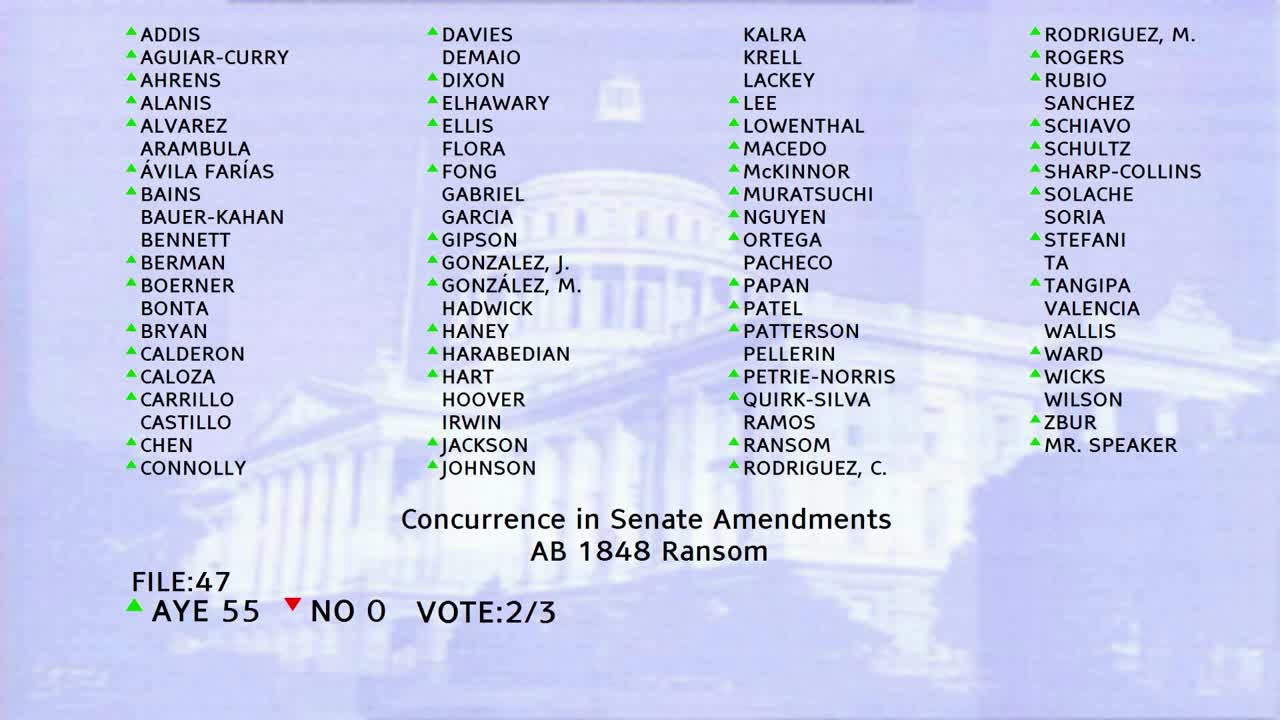 1MIN
Assembly Floor
 3MIN
Senate Floor
 1MIN
Senate Standing Committee on Appropriations
 17MIN
Senate Standing Committee on Governmental Organization
 9MIN
Senate Standing Committee on Judiciary
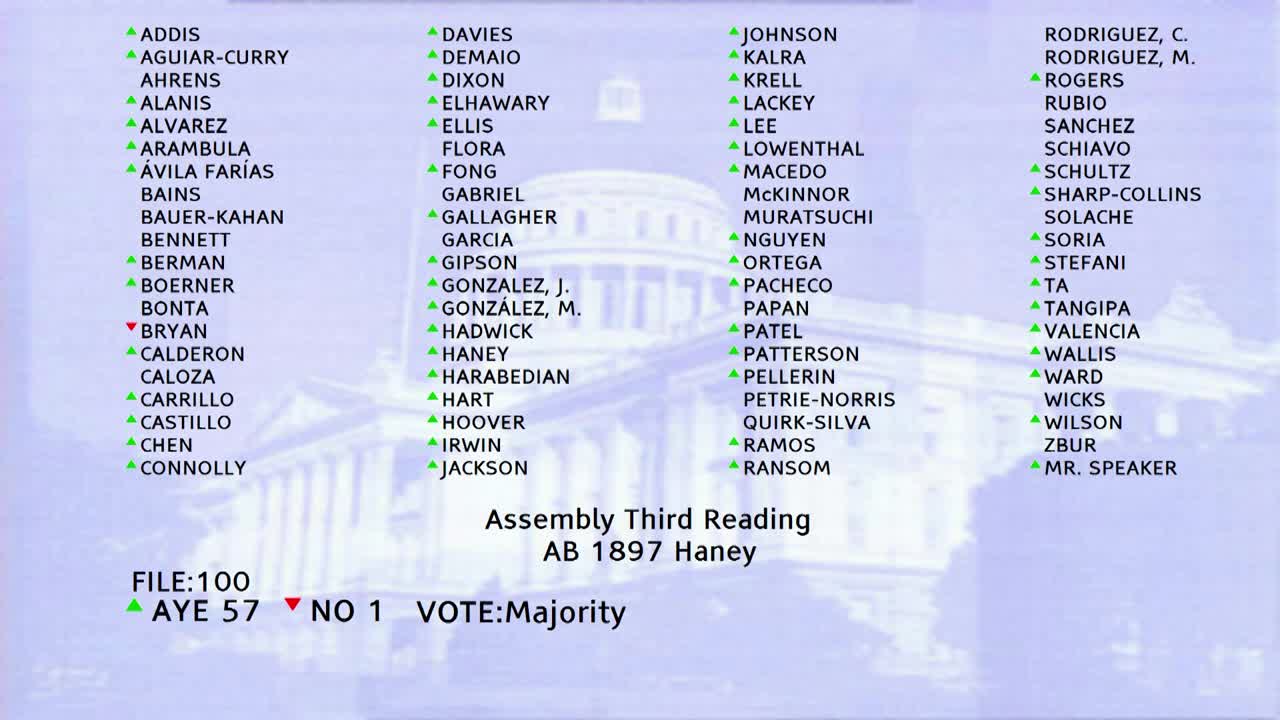 2MIN
Assembly Floor
 15MIN
Assembly Standing Committee on Judiciary
Bill Author