AB 2119: Criminal procedure: gender bias in sexual assault and domestic violence investigations.
- Session Year: 2025-2026
- House: Assembly
- Latest Version Date: 2026-04-08
Current Status:
In Progress
(2026-05-14: In committee: Held under submission.)
Introduced
In Committee
Awaiting First Chamber Vote
Passed First Chamber
In Committee
Awaiting Second Chamber Vote
Passed Second Chamber
Enacted
Existing law establishes specified rights for victims and witnesses of crimes, including to be notified or informed regarding specified court proceedings and the right to have a support person present at any interviews with law enforcement for a victim of domestic violence or sexual assault. Existing law requires a law enforcement agency to inform a victim of the rights they may have.
This bill would state that a victim of sexual assault or domestic violence has the right to a fair, unbiased, and complete investigation by law enforcement, regardless of gender and would authorize a victim of one of these crimes to request a reinvestigation of their report by the district attorney. The bill would create a civil cause of action if a law enforcement agency violated these rights and would make that cause of action retroactive to investigations made before January 1, 2027. enforcement. The bill would require a district attorney to establish a process for reviewing and investigating reported cases of sexual assault or domestic violence and would require that process to include a report to the victim explaining the decision whether or not to bring criminal accusations and which accusations to allege.
Existing law establishes the Commission on Peace Officer Standards and Training and requires the commission to create courses of training that must be completed by persons before those persons can become peace officers. The commission is also required to create guidelines and training courses for peace officers on specified law enforcement topics, including the investigation of domestic violence complaints and sexual assault.
This bill would require those courses and guidelines to include trauma-informed methods for responding to victims, gender-neutral or gender-inclusive language in reporting, and best practices for bias prevention. The bill would require the commission to prepare a course on gender bias in responding to reports of sexual assault and domestic violence and would require that course to adhere to guidance provided by the Department of Justice, as specified.
Existing law establishes the State Department of Public Health and charges it with providing education and outreach to the public on various issues relating to public health, such as lyme disease, human immunodeficiency virus and acquired immune deficiency syndrome, and hepatitis C.
This bill would require the department to develop materials to educate the public that all genders may be the victim of sexual assault and domestic violence, that all genders may perpetrate sexual assault and domestic violence, and that all genders have equal rights to safety, shelter, and legal protections and remedies.
Because this bill would create new duties for local law enforcement agencies, it would impose a state-mandated local program.
The California Constitution requires the state to reimburse local agencies and school districts for certain costs mandated by the state. Statutory provisions establish procedures for making that reimbursement.
This bill would provide that, if the Commission on State Mandates determines that the bill contains costs mandated by the state, reimbursement for those costs shall be made pursuant to the statutory provisions noted above.
Existing law establishes specified rights for victims and witnesses of crimes, including to be notified or informed regarding specified court proceedings and the right to have a support person present at any interviews with law enforcement for a victim of domestic violence or sexual assault. Existing law requires a law enforcement agency to inform a victim of the rights they may have.
This bill would state that a victim of sexual assault or domestic violence has the right to a fair, unbiased, and complete investigation by law enforcement, regardless of gender and would authorize a victim of one of these crimes to request a reinvestigation of their report by the district attorney. The bill would create a civil cause of action if a law enforcement agency violated these rights and would make that cause of action retroactive to investigations made before January 1, 2027. The bill would require a district attorney to establish a process for reviewing and investigating reported cases of sexual assault or domestic violence and would require that process to include a report to the victim explaining the decision whether or not to bring criminal accusations and which accusations to allege.
Existing law prescribes the time after the commission of a crime in which a criminal action is required to be commenced, referred to as a statute of limitation. Existing law also prescribes situations in which a statute of limitation is tolled or extended.This bill would provide that the statute of limitations for specified felony offenses involving sexual assault and domestic violence that have not expired as of January 1, 2027, shall commence to run beginning on January 1, 2027.Existing law establishes the Commission on Peace Officer Standards and Training and requires the commission to create courses of training that must be completed by persons before those persons can become peace officers. The commission is also required to create guidelines and training courses for peace officers on specified law enforcement topics, including the investigation of domestic violence complaints and sexual assault.
This bill would require those courses and guidelines to include trauma-informed methods for responding to victims, gender-neutral or gender-inclusive language in reporting, and best practices for bias prevention. The bill would require the commission to prepare a course on gender bias in responding to reports of sexual assault and domestic violence and would require that course to adhere to guidance provided by the Department of Justice, as specified.
Existing law establishes the State Department of Public Health and charges it with providing education and outreach to the public on various issues relating to public health, such as lyme disease, human immunodeficiency virus and acquired immune deficiency syndrome, and hepatitis C.
This bill would require the department to develop materials to educate the public that all genders may be the victim of sexual assault and domestic violence, that all genders may perpetrate sexual assault and domestic violence, and that all genders have equal rights to safety, shelter, and legal protections and remedies.
Because this bill would create new duties for local law enforcement agencies, it would impose a state-mandated local program.
The California Constitution requires the state to reimburse local agencies and school districts for certain costs mandated by the state. Statutory provisions establish procedures for making that reimbursement.
This bill would provide that, if the Commission on State Mandates determines that the bill contains costs mandated by the state, reimbursement for those costs shall be made pursuant to the statutory provisions noted above.
Existing law establishes specified rights for victims and witnesses of crimes, including to be notified or informed regarding specified court proceedings and the right to have a support person present at any interviews with law enforcement for a victim of domestic violence or sexual assault. Existing law requires a law enforcement agency to inform a victim of the rights they may have.
This bill would state that a victim of sexual assault or domestic violence has the right to a fair, unbiased, and complete investigation by law enforcement, regardless of gender and would authorize a victim of one of these crimes to request a reinvestigation of their report by the district attorney. The bill would create a civil cause of action if a law enforcement agency violated these rights and would make that cause of action retroactive to investigations made before January 1, 2027. The bill would require a district attorney to establish a process for reviewing and investigating reported cases of sexual assault or domestic violence and would require that process to include a report to the victim explaining the decision whether or not to bring criminal accusations and which accusations to allege.
Existing law prescribes the time after the commission of a crime in which a criminal action is required to be commenced, referred to as a statute of limitation. Existing law also prescribes situations in which a statute of limitation is tolled or extended.
This bill would provide that the statute of limitations for specified felony offenses involving sexual assault and domestic violence that have not expired as of January 1, 2027, shall commence to run beginning on January 1, 2027.
Existing law establishes the Commission on Peace Officer Standards and Training and requires the commission to create courses of training that must be completed by persons before those persons can become peace officers. The commission is also required to create guidelines and training courses for peace officers on specified law enforcement topics, including the investigation of domestic violence complaints and sexual assault.
This bill would require those courses and guidelines to include trauma-informed methods for responding to victims, gender-neutral or gender-inclusive language in reporting, and best practices for bias prevention. The bill would require the commission to prepare a course on gender bias in responding to reports of sexual assault and domestic violence and would require that course to adhere to guidance provided by the Department of Justice, as specified.
Existing law establishes the State Department of Public Health and charges it with providing education and outreach to the public on various issues relating to public health, such as lyme disease, human immunodeficiency virus and acquired immune deficiency syndrome, and hepatitis C.
This bill would require the department to develop materials to educate the public that all genders may be the victim of sexual assault and domestic violence, that all genders may perpetrate sexual assault and domestic violence, and that all genders have equal rights to safety, shelter, and legal protections and remedies.
Because this bill would create new duties for local law enforcement agencies, it would impose a state-mandated local program.
The California Constitution requires the state to reimburse local agencies and school districts for certain costs mandated by the state. Statutory provisions establish procedures for making that reimbursement.
This bill would provide that, if the Commission on State Mandates determines that the bill contains costs mandated by the state, reimbursement for those costs shall be made pursuant to the statutory provisions noted above.
(a)The State Department of Public Health, in collaboration with the California Victim Compensation Board, the Office of Emergency Services, and victim advocacy organizations shall develop materials to educate the public that all genders may be the victim of sexual assault and domestic violence, that all genders may perpetrate sexual assault and domestic violence, and that all genders have equal rights to safety, shelter, and legal protections and remedies.
(b)These materials shall be distributed statewide via television and radio public service announcements, social media and internet platforms, and printed materials at public health offices, hospitals, schools, public transit centers, and county offices.
SEC. 2.Chapter 7.7 (commencing with Section 313.6) is added to Title 9 of Part 1 of the Penal Code, to read:7.7.Equal Rights in Sexual Assault and Domestic Violence Investigations313.6.(a)Every victim of sexual assault or domestic violence has the right to a fair, unbiased, and complete investigation by law enforcement and the collection of all relevant evidence by law enforcement regardless of the victims gender, gender identity or expression, sexual orientation, age, race or ethnicity, disability, immigration status, or relationship to the alleged perpetrator. enforcement.
(b)(1)Except as provided in paragraph (2), in the course of an investigation of sexual assault, law enforcement shall not question or imply that a victims physiological sexual response constitutes consent or undermines their credibility.
(2)Paragraph (1) does not apply to a district attorney, their deputy, or other prosecutor investigating a complaint of sexual assault.
(c)Every alleged perpetrator of sexual assault or domestic violence has the right to equal treatment under the law regardless of gender identity or expression.
(d)(1)Except as provided in paragraph (2), a victim may request that a district attorney reinvestigate a complaint of sexual assault or domestic violence within 60 days after making the initial report to law enforcement.
(2)Notwithstanding paragraph (1), a victim who reported a sexual assault or act of domestic violence on or after January 1, 2020, but before January 1, 2027, may request a reinvestigation pursuant to paragraph (1) at any time.
(e)This section applies to acts of sexual assault and domestic violence committed on or after January 1, 2020.
313.61.(a)A victim may bring a civil action for damages against the investigating law enforcement agency for a violation of Section 313.6 for the recovery of any of the following:(1)Actual and compensatory damages.(2)Pain and suffering.(3)Punitive damages.(4)Attorneys fees and court costs.(b)This section applies to reports of sexual assault or domestic violence made to a law enforcement agency prior to January 1, 2027.313.62.313.61.(a)Each district attorney shall establish and maintain an internal process for reviewing and investigating reported cases of sexual assault or domestic violence, with or without an arrest, that includes all of the following:
(1)An independent investigation of the case, not conducted by the initial investigating agency.
(2)An evaluation of any evidence that the alleged perpetrator violated Section 115, paragraph (1) of subdivision (a) of Section 148, or Section 148.5 or 148.9.
(3)A report to the victim explaining the decision whether or not to bring criminal accusations and which accusations to allege.
(b)In determining whether or not to bring criminal allegations in a case of sexual assault or domestic violence, a prosecutor shall not rely solely upon the report of the initial investigating agency.
SEC. 3.Section 422.875 is added to the Penal Code, immediately following Section 422.87, to read:422.875.Each state and local law enforcement agency shall adopt a Gender Bias in Law Enforcement Response to Sexual Assault and Domestic Violence policy that shall comply with the guidelines and practices provided in the Identifying and Preventing Gender Bias in Law Enforcement Response to Sexual Assault and Domestic Violence publication issued by the Department of Justice in 2022.
SEC. 4.Section 13516 of the Penal Code is amended to read:13516.(a)The commission shall prepare guidelines establishing standard procedures which may be followed by police agencies in the investigation of sexual assault cases, and cases involving the sexual exploitation or sexual abuse of children, including, police response to, and treatment of, victims of these crimes. Those guidelines shall include all of the following:
(1)Trauma-informed methods for responding to victims, regardless of gender.
(2)Gender-neutral or gender-inclusive language, as determined by the victim in report documentation.
(3)Best practices for bias prevention.
(b)The course of training leading to the basic certificate issued by the commission shall, on and after July 1, 1977, include adequate instruction in the procedures described in subdivision (a). No reimbursement shall be made to local agencies based on attendance on or after that date at any course which does not comply with the requirements of this subdivision.
(c)The commission shall prepare and implement a course for the training of specialists in the investigation of sexual assault cases, child sexual exploitation cases, and child sexual abuse cases. Officers assigned to investigation duties which include the handling of cases involving the sexual exploitation or sexual abuse of children, shall successfully complete that training within six months of the date the assignment was made.
(d)It is the intent of the Legislature in the enactment of this section to encourage the establishment of sex crime investigation units in police agencies throughout the state, which units shall include, but not be limited to, investigating crimes involving the sexual exploitation and sexual abuse of children.
(e)It is the further intent of the Legislature in the enactment of this section to encourage the establishment of investigation guidelines that take into consideration the sensitive nature of the sexual exploitation and sexual abuse of children with respect to both the accused and the alleged victim.
SEC. 5.Section 13519 of the Penal Code is amended to read:13519.(a)The commission shall implement by January 1, 1986, a course or courses of instruction for the training of law enforcement officers in California in the handling of domestic violence complaints and also shall develop guidelines for law enforcement response to domestic violence. The course or courses of instruction and the guidelines shall include a brief current and historical context on communities of color impacted by incarceration and violence, enforcement of criminal laws in domestic violence situations, availability of civil remedies and community resources, and protection of the victim. If appropriate, the training presenters shall include domestic violence experts, who may include victims of domestic violence and people who have committed domestic violence and have been or are in the process of being rehabilitated, with expertise in the delivery of direct services to victims and people who have committed domestic violence, including, but not limited to, utilizing the staff of domestic violence shelter-based programs in the presentation of training.
(b)As used in this section, law enforcement officer means any officer or employee of a local police department or sheriffs office, a peace officer of the Department of Parks and Recreation, as defined in subdivision (f) of Section 830.2, a peace officer of the University of California Police Department, as defined in subdivision (b) of Section 830.2, a peace officer of the California State University Police Departments, as defined in subdivision (c) of Section 830.2, a peace officer, as defined in subdivision (d) of Section 830.31, or a peace officer as defined in subdivisions (a) and (b) of Section 830.32.
(c)The course of basic training for law enforcement officers shall include adequate instruction in the procedures and techniques described below:
(1)The provisions set forth in Title 5 (commencing with Section 13700) relating to response, enforcement of court orders, and data collection.
(2)The legal duties imposed on peace officers to make arrests and offer protection and assistance including guidelines for making felony and misdemeanor arrests.
(3)Techniques for handling incidents of domestic violence that minimize the likelihood of injury to the officer and that promote the safety of the victim. These techniques shall include, but are not limited to, the following:
(A)Methods for ensuring victim interviews occur in a venue separate from the alleged perpetrator and with appropriate sound barriers to prevent the conversation from being overheard.
(B)Questions for the victim, including, but not limited to, the following:
(i)Whether the victim would like a followup visit to provide needed support or resources.
(ii)Information on obtaining a gun violence restraining order and a protective order described in Section 6218 of the Family Code.
(C)A verbal review of the resources available for victims outlined on the written notice provided pursuant to paragraph (9) of subdivision (c) of Section 13701.
(4)The nature and extent of domestic violence.
(5)The signs of domestic violence.
(6)Criminal conduct that may be related to domestic violence, including, but not limited to, any of the following:
(A)Coercion, as described in paragraph (1) of subdivision (h) of Section 236.1, for purposes of committing or impeding the investigation or prosecution of domestic violence.
(B)False imprisonment, as defined in Section 236.
(C)Extortion, as defined in Section 518, and the use of fear, as described in Section 519.
(D)Identity theft, as defined in Section 530.5, impersonation through an internet website or by other electronic means, as defined in Section 528.5, false personation, as defined in Section 530, receiving money or property as a result of false personation, and mail theft.
(E)Stalking, as defined in Section 646.9, including by telephone or electronic communication.
(F)Nonconsensual pornography, as described in paragraph (4) of subdivision (j) of Section 647.
(7)The assessment of lethality or signs of lethal violence in domestic violence situations.
(8)The legal rights of, and remedies available to, victims of domestic violence.
(9)The use of an arrest by a private person in a domestic violence situation.
(10)Documentation, report writing, and evidence collection.
(11)Domestic violence diversion.
(12)Tenancy issues and domestic violence.
(13)The impact on children of law enforcement intervention in domestic violence.
(14)The services and facilities available to victims and batterers.
(15)The use and applications of this code in domestic violence situations.
(16)Verification and enforcement of temporary restraining orders when (A) the suspect is present and (B) the suspect has fled.
(17)Verification and enforcement of stay-away orders.
(18)Cite and release policies.
(19)Emergency assistance to victims and how to assist victims in pursuing criminal justice options.
(20)Trauma-informed methods for responding to victims, regardless of gender.
(21)Gender-neutral or gender-inclusive language, as determined by the victim, in report documentation.
(22)Best practices for bias prevention.
(d)The guidelines developed by the commission shall also incorporate the factors described in subdivision (c), and the following procedures and techniques:
(1)Identification and detection of staged crime scenes.
(2)Working with a multidisciplinary team in the handling of domestic violence cases.
(3)Indicators of domestic homicide in suspicious death cases, including all of the following:
(A)The decedent died prematurely or in an untimely manner.
(B)The scene of the death gives the appearance of death due to suicide or accident.
(C)One partner wanted to end the relationship.
(D)There is a history of being victimized by domestic violence that includes coercive control.
(E)The decedent is found dead in a home or place of residence.
(F)The decedent is found by a current or previous partner.
(G)There is a history of being victimized by domestic violence that includes strangulation or suffocation.
(H)The current or previous partner of the decedent, or child of the decedent or the decedents current or previous partner, is the last to see the decedent alive.
(I)The partner had control of the scene before law enforcement arrived.
(J)The body of the decedent has been moved or the scene or other evidence is altered in some way.
(e)Local law enforcement agencies are encouraged to include, as a part of their advanced officer training program, periodic updates and training on domestic violence. The commission shall assist where possible.
(f)(1)The course of instruction, the learning and performance objectives, the standards for the training, and the guidelines shall be developed by the commission in consultation with appropriate groups and individuals having an interest and expertise in the field of domestic violence. The groups and individuals shall include, but shall not be limited to, the following: one representative each from the California Peace Officers Association, the Peace Officers Research Association of California, the State Bar of California, the California Women Lawyers, and the Commission on the Status of Women and Girls; two representatives from the commission; two representatives from the California Partnership to End Domestic Violence; two peace officers, recommended by the commission, who are experienced in the provision of domestic violence training; two domestic violence experts, recommended by the California Partnership to End Domestic Violence, who are experienced in the provision of direct services to victims of domestic violence; and at least one representative of service providers serving the lesbian, gay, bisexual, and transgender community in connection with domestic violence. At least one of the persons selected shall be a former victim of domestic violence; one representative of an organization working to advance criminal justice reform; and one representative of an organization working to advance racial justice.
(2)The commission, in consultation with these groups and individuals, shall review existing training programs to determine in what ways domestic violence training might be included as a part of ongoing programs.
(g)Each law enforcement officer below the rank of supervisor who is assigned to patrol duties and would normally respond to domestic violence calls or incidents of domestic violence shall complete, every two years, an updated course of instruction on domestic violence that is developed according to the standards and guidelines developed pursuant to subdivisions (a) and (d). The instruction required pursuant to this subdivision shall be funded from existing resources available for the training required pursuant to this section. It is the intent of the Legislature not to increase the annual training costs of local government entities.
SEC. 6.Section 13519.17 is added to the Penal Code, to read:13519.17.The commission shall prepare a course of instruction on gender bias and law enforcement response to reports of sexual assault and domestic violence. The course shall adhere to the guidance provided in the Identifying and Preventing Gender Bias in Law Enforcement Response to Sexual Assault and Domestic Violence publication issued by the Department of Justice in 2022.
SEC. 7.If the Commission on State Mandates determines that this act contains costs mandated by the state, reimbursement to local agencies and school districts for those costs shall be made pursuant to Part 7 (commencing with Section 17500) of Division 4 of Title 2 of the Government Code.
(a)The State Department of Public Health, in collaboration with the California Victim Compensation Board, the Office of Emergency Services, and victim advocacy organizations shall develop materials to educate the public that all genders may be the victim of sexual assault and domestic violence, that all genders may perpetrate sexual assault and domestic violence, and that all genders have equal rights to safety, shelter, and legal protections and remedies.
(b)These materials shall be distributed statewide via television and radio public service announcements, social media and internet platforms, and printed materials at public health offices, hospitals, schools, public transit centers, and county offices.
SEC. 2.Chapter 7.7 (commencing with Section 313.6) is added to Title 9 of Part 1 of the Penal Code, to read:7.7.Equal Rights in Sexual Assault and Domestic Violence Investigations313.6.(a)Every victim of sexual assault or domestic violence has the right to a fair, unbiased, and complete investigation by law enforcement and the collection of all relevant evidence by law enforcement regardless of the victims gender, gender identity or expression, sexual orientation, age, race or ethnicity, disability, immigration status, or relationship to the alleged perpetrator.
(b)(1)Except as provided in paragraph (2), in the course of an investigation of sexual assault, law enforcement shall not question or imply that a victims physiological sexual response constitutes consent or undermines their credibility.
(2)Paragraph (1) does not apply to a district attorney, their deputy, or other prosecutor investigating a complaint of sexual assault.
(c)Every alleged perpetrator of sexual assault or domestic violence has the right to equal treatment under the law regardless of gender identity or expression.
(d)(1)Except as provided in paragraph (2), a victim may request that a district attorney reinvestigate a complaint of sexual assault or domestic violence within 60 days after making the initial report to law enforcement.
(2)Notwithstanding paragraph (1), a victim who reported a sexual assault or act of domestic violence on or after January 1, 2020, but before January 1, 2027, may request a reinvestigation pursuant to paragraph (1) at any time.
(e)This section applies to acts of sexual assault and domestic violence committed on or after January 1, 2020.
313.61.(a)A victim may bring a civil action for damages against the investigating law enforcement agency for a violation of Section 313.6 for the recovery of any of the following:
(1)Actual and compensatory damages.
(2)Pain and suffering.
(3)Punitive damages.
(4)Attorneys fees and court costs.
(b)This section applies to reports of sexual assault or domestic violence made to a law enforcement agency prior to January 1, 2027.
313.62.(a)Each district attorney shall establish and maintain an internal process for reviewing and investigating reported cases of sexual assault or domestic violence, with or without an arrest, that includes all of the following:
(1)An independent investigation of the case, not conducted by the initial investigating agency.
(2)An evaluation of any evidence that the alleged perpetrator violated Section 115, paragraph (1) of subdivision (a) of Section 148, or Section 148.5 or 148.9.
(3)A report to the victim explaining the decision whether or not to bring criminal accusations and which accusations to allege.
(b)In determining whether or not to bring criminal allegations in a case of sexual assault or domestic violence, a prosecutor shall not rely solely upon the report of the initial investigating agency.
SEC. 3.Section 422.875 is added to the Penal Code, immediately following Section 422.87, to read:422.875.Each state and local law enforcement agency shall adopt a Gender Bias in Law Enforcement Response to Sexual Assault and Domestic Violence policy that shall comply with the guidelines and practices provided in the Identifying and Preventing Gender Bias in Law Enforcement Response to Sexual Assault and Domestic Violence publication issued by the Department of Justice in 2022.
SEC. 4.Section 803 of the Penal Code is amended to read:803.(a)Except as provided in this section, a limitation of time prescribed in this chapter is not tolled or extended for any reason.(b)The time during which prosecution of the same person for the same conduct is pending in a court of this state is not a part of a limitation of time prescribed in this chapter.(c)A limitation of time prescribed in this chapter does not commence to run until the discovery of an offense described in this subdivision. This subdivision applies to an offense punishable by imprisonment in the state prison or imprisonment pursuant to subdivision (h) of Section 1170, a material element of which is fraud or breach of a fiduciary obligation, the commission of the crimes of theft or embezzlement upon an elder or dependent adult, or the basis of which is misconduct in office by a public officer, employee, or appointee, including, but not limited to, the following offenses:(1)Grand theft of any type, forgery, falsification of public records, or acceptance of, or asking, receiving, or agreeing to receive, a bribe, by a public official or a public employee, including, but not limited to, a violation of Section 68, 86, or 93.(2)A violation of Section 72, 118, 118a, 132, 134, or 186.10.(3)A violation of Section 25540, of any type, or Section 25541 of the Corporations Code.(4)A violation of Section 1090 or 27443 of the Government Code.(5)Felony welfare fraud or Medi-Cal fraud in violation of Section 11483 or 14107 of the Welfare and Institutions Code.(6)Felony insurance fraud in violation of Section 548 or 550 of this code or former Section 1871.1, or Section 1871.4, of the Insurance Code.(7)A violation of Section 580, 581, 582, 583, or 584 of the Business and Professions Code.(8)A violation of Section 22430 of the Business and Professions Code.(9)A violation of Section 103800 of the Health and Safety Code.(10)A violation of Section 529a.(11)A violation of subdivision (d) or (e) of Section 368.(d)If the defendant is out of the state when or after the offense is committed, the prosecution may be commenced as provided in Section 804 within the limitations of time prescribed by this chapter, and no time up to a maximum of three years during which the defendant is not within the state shall be a part of those limitations.(e)A limitation of time prescribed in this chapter does not commence to run until the offense has been discovered, or could have reasonably been discovered, with regard to offenses under Division 7 (commencing with Section 13000) of the Water Code, under Chapter 6.5 (commencing with Section 25100) or Chapter 6.7 (commencing with Section 25280) of Division 20 of, or Part 4 (commencing with Section 41500) of Division 26 of, or Part 2 (commencing with Section 78000) of Division 45 of, the Health and Safety Code, or under Section 386, or offenses under Chapter 5 (commencing with Section 2000) of Division 2 of, Chapter 9 (commencing with Section 4000) of Division 2 of, Section 6126 of, Chapter 10 (commencing with Section 7301) of Division 3 of, or Chapter 19.5 (commencing with Section 22440) of Division 8 of, the Business and Professions Code.(f)(1)Notwithstanding any other limitation of time described in this chapter, if subdivision (b) of Section 799 does not apply, a criminal complaint may be filed within one year of the date of a report to a California law enforcement agency by a person of any age alleging that the person, while under 18 years of age, was the victim of a crime described in Section 261, 286, 287, 288, 288.5, or 289, former Section 288a, or Section 289.5, as enacted by Chapter 293 of the Statutes of 1991 relating to penetration by an unknown object.(2)This subdivision applies only if all of the following occur:(A)The limitation period specified in Section 800, 801, or 801.1, whichever is later, has expired.(B)The crime involved substantial sexual conduct, as described in subdivision (b) of Section 1203.066, excluding masturbation that is not mutual.(C)There is independent evidence that corroborates the victims allegation. If the victim was 21 years of age or older at the time of the report, the independent evidence shall clearly and convincingly corroborate the victims allegation.(3)Evidence shall not be used to corroborate the victims allegation if that evidence would otherwise be inadmissible during trial. Independent evidence excludes the opinions of mental health professionals.(4)(A)In a criminal investigation involving any of the crimes listed in paragraph (1) committed against a child, if the applicable limitations period has not expired, that period shall be tolled from the time a party initiates litigation challenging a grand jury subpoena until the end of the litigation, including any associated writ or appellate proceeding, or until the final disclosure of evidence to the investigating or prosecuting agency, if that disclosure is ordered pursuant to the subpoena after the litigation.(B)This subdivision does not affect the definition or applicability of any evidentiary privilege.(C)This subdivision shall not apply if a court finds that the grand jury subpoena was issued or caused to be issued in bad faith.(g)(1)Notwithstanding any other limitation of time described in this chapter, a criminal complaint may be filed within one year of the date on which the identity of the suspect is conclusively established by DNA testing, if both of the following conditions are met:(A)The crime is one that is described in subdivision (c) of Section 290.(B)The offense was committed before January 1, 2001, and biological evidence collected in connection with the offense is analyzed for DNA type no later than January 1, 2004, or the offense was committed on or after January 1, 2001, and biological evidence collected in connection with the offense is analyzed for DNA type no later than two years from the date of the offense.(2)For purposes of this section, DNA means deoxyribonucleic acid.(h)For any crime, the proof of which depends substantially upon evidence that was seized under a warrant, but which is unavailable to the prosecuting authority under the procedures described in People v. Superior Court (Laff) (2001) 25 Cal.4th 703, People v. Superior Court (Bauman & Rose) (1995) 37 Cal.App.4th 1757, or subdivision (c) of Section 1524, relating to claims of evidentiary privilege or attorney work product, the limitation of time prescribed in this chapter shall be tolled from the time of the seizure until final disclosure of the evidence to the prosecuting authority. This section does not otherwise affect the definition or applicability of any evidentiary privilege or attorney work product.(i)(1)Notwithstanding any other limitation of time described in this chapter, a criminal complaint may be filed within one year of the date on which a hidden recording is discovered related to a violation of paragraph (2) or (3) of subdivision (j) of Section 647.(2)Notwithstanding any other limitation of time described in this chapter, a criminal complaint may be filed within one year of the date on which it is discovered that, but not more than four years after, an image was intentionally distributed in violation of paragraph (4) of subdivision (j) of Section 647.(j)(1)Notwithstanding any other limitation of time described in this chapter, if a person flees the scene of an accident that caused death or permanent, serious injury, as defined in subdivision (d) of Section 20001 of the Vehicle Code, a criminal complaint brought pursuant to paragraph (2) of subdivision (b) of Section 20001 of the Vehicle Code may be filed within the applicable time period described in Section 801 or 802 or one year after the person is initially identified by law enforcement as a suspect in the commission of the offense, whichever is later, but in no case later than six years after the commission of the offense.(2)If, after committing the crime described in paragraph (1), a person is out of the state for the purpose of evading prosecution, the statute of limitations may be tolled for up to three years during any time the person is out of the state.(k)Notwithstanding any other limitation of time described in this chapter, if a person flees the scene of an accident, a criminal complaint brought pursuant to paragraph (1) or (2) of subdivision (c) of Section 192 may be filed within the applicable time period described in Section 801 or 802, or one year after the person is initially identified by law enforcement as a suspect in the commission of that offense, whichever is later, but in no case later than six years after the commission of the offense.(l)A limitation of time prescribed in this chapter does not commence to run until the discovery of an offense involving the offering or giving of a bribe to a public official or public employee, including, but not limited to, a violation of Section 67, 67.5, 85, 92, or 165, or Section 35230 or 72530 of the Education Code.(m)Notwithstanding any other limitation of time prescribed in this chapter, if a person actively conceals or attempts to conceal an accidental death in violation of Section 152, a criminal complaint may be filed within one year after the person is initially identified by law enforcement as a suspect in the commission of that offense, provided, however, that in any case a complaint may not be filed more than four years after the commission of the offense.(n)(1)Notwithstanding any other limitation of time described in this chapter, a criminal complaint brought pursuant to a violation of Section 367g may be filed within one year of the discovery of the offense or within one year after the offense could have reasonably been discovered.(2)This subdivision applies to crimes that were committed on or after January 1, 2021, and to crimes for which the statute of limitations that was in effect before January 1, 2021, has not run as of January 1, 2021.(o)Notwithstanding any other limitation of time described in this chapter, the statute of limitations for a felony offense described in subdivision (c) of Section 290 or Section 273.5 that was committed on or after January 1, 2020, for which the statute of limitations that was in effect prior to January 1, 2027, has not expired as of January 1, 2027, shall commence to run beginning on January 1, 2027.SEC. 5.SEC. 4.Section 13516 of the Penal Code is amended to read:13516.(a)The commission shall prepare guidelines establishing standard procedures which may be followed by police agencies in the investigation of sexual assault cases, and cases involving the sexual exploitation or sexual abuse of children, including, police response to, and treatment of, victims of these crimes. Those guidelines shall include all of the following:
(1)Trauma-informed methods for responding to victims, regardless of gender.
(2)Gender-neutral or gender-inclusive language, as determined by the victim in report documentation.
(3)Best practices for bias prevention.
(b)The course of training leading to the basic certificate issued by the commission shall, on and after July 1, 1977, include adequate instruction in the procedures described in subdivision (a). No reimbursement shall be made to local agencies based on attendance on or after that date at any course which does not comply with the requirements of this subdivision.
(c)The commission shall prepare and implement a course for the training of specialists in the investigation of sexual assault cases, child sexual exploitation cases, and child sexual abuse cases. Officers assigned to investigation duties which include the handling of cases involving the sexual exploitation or sexual abuse of children, shall successfully complete that training within six months of the date the assignment was made.
(d)It is the intent of the Legislature in the enactment of this section to encourage the establishment of sex crime investigation units in police agencies throughout the state, which units shall include, but not be limited to, investigating crimes involving the sexual exploitation and sexual abuse of children.
(e)It is the further intent of the Legislature in the enactment of this section to encourage the establishment of investigation guidelines that take into consideration the sensitive nature of the sexual exploitation and sexual abuse of children with respect to both the accused and the alleged victim.
SEC. 6.SEC. 5.Section 13519 of the Penal Code is amended to read:13519.(a)The commission shall implement by January 1, 1986, a course or courses of instruction for the training of law enforcement officers in California in the handling of domestic violence complaints and also shall develop guidelines for law enforcement response to domestic violence. The course or courses of instruction and the guidelines shall include a brief current and historical context on communities of color impacted by incarceration and violence, enforcement of criminal laws in domestic violence situations, availability of civil remedies and community resources, and protection of the victim. If appropriate, the training presenters shall include domestic violence experts, who may include victims of domestic violence and people who have committed domestic violence and have been or are in the process of being rehabilitated, with expertise in the delivery of direct services to victims and people who have committed domestic violence, including, but not limited to, utilizing the staff of domestic violence shelter-based programs in the presentation of training.
(b)As used in this section, law enforcement officer means any officer or employee of a local police department or sheriffs office, a peace officer of the Department of Parks and Recreation, as defined in subdivision (f) of Section 830.2, a peace officer of the University of California Police Department, as defined in subdivision (b) of Section 830.2, a peace officer of the California State University Police Departments, as defined in subdivision (c) of Section 830.2, a peace officer, as defined in subdivision (d) of Section 830.31, or a peace officer as defined in subdivisions (a) and (b) of Section 830.32.
(c)The course of basic training for law enforcement officers shall include adequate instruction in the procedures and techniques described below:
(1)The provisions set forth in Title 5 (commencing with Section 13700) relating to response, enforcement of court orders, and data collection.
(2)The legal duties imposed on peace officers to make arrests and offer protection and assistance including guidelines for making felony and misdemeanor arrests.
(3)Techniques for handling incidents of domestic violence that minimize the likelihood of injury to the officer and that promote the safety of the victim. These techniques shall include, but are not limited to, the following:
(A)Methods for ensuring victim interviews occur in a venue separate from the alleged perpetrator and with appropriate sound barriers to prevent the conversation from being overheard.
(B)Questions for the victim, including, but not limited to, the following:
(i)Whether the victim would like a followup visit to provide needed support or resources.
(ii)Information on obtaining a gun violence restraining order and a protective order described in Section 6218 of the Family Code.
(C)A verbal review of the resources available for victims outlined on the written notice provided pursuant to paragraph (9) of subdivision (c) of Section 13701.
(4)The nature and extent of domestic violence.
(5)The signs of domestic violence.
(6)Criminal conduct that may be related to domestic violence, including, but not limited to, any of the following:
(A)Coercion, as described in paragraph (1) of subdivision (h) of Section 236.1, for purposes of committing or impeding the investigation or prosecution of domestic violence.
(B)False imprisonment, as defined in Section 236.
(C)Extortion, as defined in Section 518, and the use of fear, as described in Section 519.
(D)Identity theft, as defined in Section 530.5, impersonation through an internet website or by other electronic means, as defined in Section 528.5, false personation, as defined in Section 530, receiving money or property as a result of false personation, and mail theft.
(E)Stalking, as defined in Section 646.9, including by telephone or electronic communication.
(F)Nonconsensual pornography, as described in paragraph (4) of subdivision (j) of Section 647.
(7)The assessment of lethality or signs of lethal violence in domestic violence situations.
(8)The legal rights of, and remedies available to, victims of domestic violence.
(9)The use of an arrest by a private person in a domestic violence situation.
(10)Documentation, report writing, and evidence collection.
(11)Domestic violence diversion.
(12)Tenancy issues and domestic violence.
(13)The impact on children of law enforcement intervention in domestic violence.
(14)The services and facilities available to victims and batterers.
(15)The use and applications of this code in domestic violence situations.
(16)Verification and enforcement of temporary restraining orders when (A) the suspect is present and (B) the suspect has fled.
(17)Verification and enforcement of stay-away orders.
(18)Cite and release policies.
(19)Emergency assistance to victims and how to assist victims in pursuing criminal justice options.
(20)Trauma-informed methods for responding to victims, regardless of gender.
(21)Gender-neutral or gender-inclusive language, as determined by the victim, in report documentation.
(22)Best practices for bias prevention.
(d)The guidelines developed by the commission shall also incorporate the factors described in subdivision (c), and the following procedures and techniques:
(1)Identification and detection of staged crime scenes.
(2)Working with a multidisciplinary team in the handling of domestic violence cases.
(3)Indicators of domestic homicide in suspicious death cases, including all of the following:
(A)The decedent died prematurely or in an untimely manner.
(B)The scene of the death gives the appearance of death due to suicide or accident.
(C)One partner wanted to end the relationship.
(D)There is a history of being victimized by domestic violence that includes coercive control.
(E)The decedent is found dead in a home or place of residence.
(F)The decedent is found by a current or previous partner.
(G)There is a history of being victimized by domestic violence that includes strangulation or suffocation.
(H)The current or previous partner of the decedent, or child of the decedent or the decedents current or previous partner, is the last to see the decedent alive.
(I)The partner had control of the scene before law enforcement arrived.
(J)The body of the decedent has been moved or the scene or other evidence is altered in some way.
(e)Local law enforcement agencies are encouraged to include, as a part of their advanced officer training program, periodic updates and training on domestic violence. The commission shall assist where possible.
(f)(1)The course of instruction, the learning and performance objectives, the standards for the training, and the guidelines shall be developed by the commission in consultation with appropriate groups and individuals having an interest and expertise in the field of domestic violence. The groups and individuals shall include, but shall not be limited to, the following: one representative each from the California Peace Officers Association, the Peace Officers Research Association of California, the State Bar of California, the California Women Lawyers, and the Commission on the Status of Women and Girls; two representatives from the commission; two representatives from the California Partnership to End Domestic Violence; two peace officers, recommended by the commission, who are experienced in the provision of domestic violence training; two domestic violence experts, recommended by the California Partnership to End Domestic Violence, who are experienced in the provision of direct services to victims of domestic violence; and at least one representative of service providers serving the lesbian, gay, bisexual, and transgender community in connection with domestic violence. At least one of the persons selected shall be a former victim of domestic violence; one representative of an organization working to advance criminal justice reform; and one representative of an organization working to advance racial justice.
(2)The commission, in consultation with these groups and individuals, shall review existing training programs to determine in what ways domestic violence training might be included as a part of ongoing programs.
(g)Each law enforcement officer below the rank of supervisor who is assigned to patrol duties and would normally respond to domestic violence calls or incidents of domestic violence shall complete, every two years, an updated course of instruction on domestic violence that is developed according to the standards and guidelines developed pursuant to subdivisions (a) and (d). The instruction required pursuant to this subdivision shall be funded from existing resources available for the training required pursuant to this section. It is the intent of the Legislature not to increase the annual training costs of local government entities.
SEC. 7.SEC. 6.Section 13519.17 is added to the Penal Code, to read:13519.17.The commission shall prepare a course of instruction on gender bias and law enforcement response to reports of sexual assault and domestic violence. The course shall adhere to the guidance provided in the Identifying and Preventing Gender Bias in Law Enforcement Response to Sexual Assault and Domestic Violence publication issued by the Department of Justice in 2022.
SEC. 8.SEC. 7.If the Commission on State Mandates determines that this act contains costs mandated by the state, reimbursement to local agencies and school districts for those costs shall be made pursuant to Part 7 (commencing with Section 17500) of Division 4 of Title 2 of the Government Code.
(a)The State Department of Public Health, in collaboration with the California Victim Compensation Board, the Office of Emergency Services, and victim advocacy organizations shall develop materials to educate the public that all genders may be the victim of sexual assault and domestic violence, that all genders may perpetrate sexual assault and domestic violence, and that all genders have equal rights to safety, shelter, and legal protections and remedies.
(b)These materials shall be distributed statewide via television and radio public service announcements, social media and internet platforms, and printed materials at public health offices, hospitals, schools, public transit centers, and county offices.
SEC. 2.Chapter 7.7 (commencing with Section 313.6) is added to Title 9 of Part 1 of the Penal Code, to read:7.7.Equal Rights in Sexual Assault and Domestic Violence Investigations313.6.(a)Every victim of sexual assault or domestic violence has the right to a fair, unbiased, and complete investigation by law enforcement and the collection of all relevant evidence by law enforcement regardless of the victims gender, gender identity or expression, sexual orientation, age, race or ethnicity, disability, immigration status, or relationship to the alleged perpetrator.
(b)(1)Except as provided in paragraph (2), in the course of an investigation of sexual assault, law enforcement shall not question or imply that a victims physiological sexual response constitutes consent or undermines their credibility.
(2)Paragraph (1) does not apply to a district attorney, their deputy, or other prosecutor investigating a complaint of sexual assault.
(c)Every alleged perpetrator of sexual assault or domestic violence has the right to equal treatment under the law regardless of gender identity or expression.
(d)(1)Except as provided in paragraph (2), a victim may request that a district attorney reinvestigate a complaint of sexual assault or domestic violence within 60 days after making the initial report to law enforcement.
(2)Notwithstanding paragraph (1), a victim who reported a sexual assault or act of domestic violence on or after January 1, 2020, but before January 1, 2027, may request a reinvestigation pursuant to paragraph (1) at any time.
(e)This section applies to acts of sexual assault and domestic violence committed on or after January 1, 2020.
313.61.(a)A victim may bring a civil action for damages against the investigating law enforcement agency for a violation of Section 313.6 for the recovery of any of the following:
(1)Actual and compensatory damages.
(2)Pain and suffering.
(3)Punitive damages.
(4)Attorneys fees and court costs.
(b)This section applies to reports of sexual assault or domestic violence made to a law enforcement agency prior to January 1, 2027.
313.62.(a)Each district attorney shall establish and maintain an internal process for reviewing and investigating reported cases of sexual assault or domestic violence, with or without an arrest, that includes all of the following:
(1)An independent investigation of the case, not conducted by the initial investigating agency.
(2)An evaluation of any evidence that the alleged perpetrator violated Section 115, paragraph (1) of subdivision (a) of Section 148, or Section 148.5 or 148.9.
(3)A report to the victim explaining the decision whether or not to bring criminal accusations and which accusations to allege.
(b)In determining whether or not to bring criminal allegations in a case of sexual assault or domestic violence, a prosecutor shall not rely solely upon the report of the initial investigating agency.
SEC. 3.Section 422.875 is added to the Penal Code, immediately following Section 422.87, to read:422.875.Each state and local law enforcement agency shall adopt a Gender Bias in Law Enforcement Response to Sexual Assault and Domestic Violence policy that shall comply with the guidelines and practices provided in the Identifying and Preventing Gender Bias in Law Enforcement Response to Sexual Assault and Domestic Violence publication issued by the Department of Justice in 2022.
SEC. 4.Section 803 of the Penal Code is amended to read:803.(a)Except as provided in this section, a limitation of time prescribed in this chapter is not tolled or extended for any reason.
(b)The time during which prosecution of the same person for the same conduct is pending in a court of this state is not a part of a limitation of time prescribed in this chapter.
(c)A limitation of time prescribed in this chapter does not commence to run until the discovery of an offense described in this subdivision. This subdivision applies to an offense punishable by imprisonment in the state prison or imprisonment pursuant to subdivision (h) of Section 1170, a material element of which is fraud or breach of a fiduciary obligation, the commission of the crimes of theft or embezzlement upon an elder or dependent adult, or the basis of which is misconduct in office by a public officer, employee, or appointee, including, but not limited to, the following offenses:
(1)Grand theft of any type, forgery, falsification of public records, or acceptance of, or asking, receiving, or agreeing to receive, a bribe, by a public official or a public employee, including, but not limited to, a violation of Section 68, 86, or 93.
(2)A violation of Section 72, 118, 118a, 132, 134, or 186.10.
(3)A violation of Section 25540, of any type, or Section 25541 of the Corporations Code.
(4)A violation of Section 1090 or 27443 of the Government Code.
(5)Felony welfare fraud or Medi-Cal fraud in violation of Section 11483 or 14107 of the Welfare and Institutions Code.
(6)Felony insurance fraud in violation of Section 548 or 550 of this code or former Section 1871.1, or Section 1871.4, of the Insurance Code.
(7)A violation of Section 580, 581, 582, 583, or 584 of the Business and Professions Code.
(8)A violation of Section 22430 of the Business and Professions Code.
(9)A violation of Section 103800 of the Health and Safety Code.
(10)A violation of Section 529a.
(11)A violation of subdivision (d) or (e) of Section 368.
(d)If the defendant is out of the state when or after the offense is committed, the prosecution may be commenced as provided in Section 804 within the limitations of time prescribed by this chapter, and no time up to a maximum of three years during which the defendant is not within the state shall be a part of those limitations.
(e)A limitation of time prescribed in this chapter does not commence to run until the offense has been discovered, or could have reasonably been discovered, with regard to offenses under Division 7 (commencing with Section 13000) of the Water Code, under Chapter 6.5 (commencing with Section 25100) or Chapter 6.7 (commencing with Section 25280) of Division 20 of, or Part 4 (commencing with Section 41500) of Division 26 of, or Part 2 (commencing with Section 78000) of Division 45 of, the Health and Safety Code, or under Section 386, or offenses under Chapter 5 (commencing with Section 2000) of Division 2 of, Chapter 9 (commencing with Section 4000) of Division 2 of, Section 6126 of, Chapter 10 (commencing with Section 7301) of Division 3 of, or Chapter 19.5 (commencing with Section 22440) of Division 8 of, the Business and Professions Code.
(f)(1)Notwithstanding any other limitation of time described in this chapter, if subdivision (b) of Section 799 does not apply, a criminal complaint may be filed within one year of the date of a report to a California law enforcement agency by a person of any age alleging that the person, while under 18 years of age, was the victim of a crime described in Section 261, 286, 287, 288, 288.5, or 289, former Section 288a, or Section 289.5, as enacted by Chapter 293 of the Statutes of 1991 relating to penetration by an unknown object.
(2)This subdivision applies only if all of the following occur:
(A)The limitation period specified in Section 800, 801, or 801.1, whichever is later, has expired.
(B)The crime involved substantial sexual conduct, as described in subdivision (b) of Section 1203.066, excluding masturbation that is not mutual.
(C)There is independent evidence that corroborates the victims allegation. If the victim was 21 years of age or older at the time of the report, the independent evidence shall clearly and convincingly corroborate the victims allegation.
(3)Evidence shall not be used to corroborate the victims allegation if that evidence would otherwise be inadmissible during trial. Independent evidence excludes the opinions of mental health professionals.
(4)(A)In a criminal investigation involving any of the crimes listed in paragraph (1) committed against a child, if the applicable limitations period has not expired, that period shall be tolled from the time a party initiates litigation challenging a grand jury subpoena until the end of the litigation, including any associated writ or appellate proceeding, or until the final disclosure of evidence to the investigating or prosecuting agency, if that disclosure is ordered pursuant to the subpoena after the litigation.
(B)This subdivision does not affect the definition or applicability of any evidentiary privilege.
(C)This subdivision shall not apply if a court finds that the grand jury subpoena was issued or caused to be issued in bad faith.
(g)(1)Notwithstanding any other limitation of time described in this chapter, a criminal complaint may be filed within one year of the date on which the identity of the suspect is conclusively established by DNA testing, if both of the following conditions are met:
(A)The crime is one that is described in subdivision (c) of Section 290.
(B)The offense was committed before January 1, 2001, and biological evidence collected in connection with the offense is analyzed for DNA type no later than January 1, 2004, or the offense was committed on or after January 1, 2001, and biological evidence collected in connection with the offense is analyzed for DNA type no later than two years from the date of the offense.
(2)For purposes of this section, DNA means deoxyribonucleic acid.
(h)For any crime, the proof of which depends substantially upon evidence that was seized under a warrant, but which is unavailable to the prosecuting authority under the procedures described in People v. Superior Court (Laff) (2001) 25 Cal.4th 703, People v. Superior Court (Bauman & Rose) (1995) 37 Cal.App.4th 1757, or subdivision (c) of Section 1524, relating to claims of evidentiary privilege or attorney work product, the limitation of time prescribed in this chapter shall be tolled from the time of the seizure until final disclosure of the evidence to the prosecuting authority. This section does not otherwise affect the definition or applicability of any evidentiary privilege or attorney work product.
(i)(1)Notwithstanding any other limitation of time described in this chapter, a criminal complaint may be filed within one year of the date on which a hidden recording is discovered related to a violation of paragraph (2) or (3) of subdivision (j) of Section 647.
(2)Notwithstanding any other limitation of time described in this chapter, a criminal complaint may be filed within one year of the date on which it is discovered that, but not more than four years after, an image was intentionally distributed in violation of paragraph (4) of subdivision (j) of Section 647.
(j)(1)Notwithstanding any other limitation of time described in this chapter, if a person flees the scene of an accident that caused death or permanent, serious injury, as defined in subdivision (d) of Section 20001 of the Vehicle Code, a criminal complaint brought pursuant to paragraph (2) of subdivision (b) of Section 20001 of the Vehicle Code may be filed within the applicable time period described in Section 801 or 802 or one year after the person is initially identified by law enforcement as a suspect in the commission of the offense, whichever is later, but in no case later than six years after the commission of the offense.
(2)If, after committing the crime described in paragraph (1), a person is out of the state for the purpose of evading prosecution, the statute of limitations may be tolled for up to three years during any time the person is out of the state.
(k)Notwithstanding any other limitation of time described in this chapter, if a person flees the scene of an accident, a criminal complaint brought pursuant to paragraph (1) or (2) of subdivision (c) of Section 192 may be filed within the applicable time period described in Section 801 or 802, or one year after the person is initially identified by law enforcement as a suspect in the commission of that offense, whichever is later, but in no case later than six years after the commission of the offense.
(l)A limitation of time prescribed in this chapter does not commence to run until the discovery of an offense involving the offering or giving of a bribe to a public official or public employee, including, but not limited to, a violation of Section 67, 67.5, 85, 92, or 165, or Section 35230 or 72530 of the Education Code.
(m)Notwithstanding any other limitation of time prescribed in this chapter, if a person actively conceals or attempts to conceal an accidental death in violation of Section 152, a criminal complaint may be filed within one year after the person is initially identified by law enforcement as a suspect in the commission of that offense, provided, however, that in any case a complaint may not be filed more than four years after the commission of the offense.
(n)(1)Notwithstanding any other limitation of time described in this chapter, a criminal complaint brought pursuant to a violation of Section 367g may be filed within one year of the discovery of the offense or within one year after the offense could have reasonably been discovered.
(2)This subdivision applies to crimes that were committed on or after January 1, 2021, and to crimes for which the statute of limitations that was in effect before January 1, 2021, has not run as of January 1, 2021.
(o)Notwithstanding any other limitation of time described in this chapter, the statute of limitations for a felony offense described in subdivision (c) of Section 290 or Section 273.5 that was committed on or after January 1, 2020, for which the statute of limitations that was in effect prior to January 1, 2027, has not expired as of January 1, 2027, shall commence to run beginning on January 1, 2027.
SEC. 5.Section 13516 of the Penal Code is amended to read:13516.(a)The commission shall prepare guidelines establishing standard procedures which may be followed by police agencies in the investigation of sexual assault cases, and cases involving the sexual exploitation or sexual abuse of children, including, police response to, and treatment of, victims of these crimes. Those guidelines shall include all of the following:
(1)Trauma-informed methods for responding to victims, regardless of gender.
(2)Gender-neutral or gender-inclusive language, as determined by the victim in report documentation.
(3)Best practices for bias prevention.
(b)The course of training leading to the basic certificate issued by the commission shall, on and after July 1, 1977, include adequate instruction in the procedures described in subdivision (a). No reimbursement shall be made to local agencies based on attendance on or after that date at any course which does not comply with the requirements of this subdivision.
(c)The commission shall prepare and implement a course for the training of specialists in the investigation of sexual assault cases, child sexual exploitation cases, and child sexual abuse cases. Officers assigned to investigation duties which include the handling of cases involving the sexual exploitation or sexual abuse of children, shall successfully complete that training within six months of the date the assignment was made.
(d)It is the intent of the Legislature in the enactment of this section to encourage the establishment of sex crime investigation units in police agencies throughout the state, which units shall include, but not be limited to, investigating crimes involving the sexual exploitation and sexual abuse of children.
(e)It is the further intent of the Legislature in the enactment of this section to encourage the establishment of investigation guidelines that take into consideration the sensitive nature of the sexual exploitation and sexual abuse of children with respect to both the accused and the alleged victim.
SEC. 6.Section 13519 of the Penal Code is amended to read:13519.(a)The commission shall implement by January 1, 1986, a course or courses of instruction for the training of law enforcement officers in California in the handling of domestic violence complaints and also shall develop guidelines for law enforcement response to domestic violence. The course or courses of instruction and the guidelines shall include a brief current and historical context on communities of color impacted by incarceration and violence, enforcement of criminal laws in domestic violence situations, availability of civil remedies and community resources, and protection of the victim. If appropriate, the training presenters shall include domestic violence experts, who may include victims of domestic violence and people who have committed domestic violence and have been or are in the process of being rehabilitated, with expertise in the delivery of direct services to victims and people who have committed domestic violence, including, but not limited to, utilizing the staff of domestic violence shelter-based programs in the presentation of training.
(b)As used in this section, law enforcement officer means any officer or employee of a local police department or sheriffs office, a peace officer of the Department of Parks and Recreation, as defined in subdivision (f) of Section 830.2, a peace officer of the University of California Police Department, as defined in subdivision (b) of Section 830.2, a peace officer of the California State University Police Departments, as defined in subdivision (c) of Section 830.2, a peace officer, as defined in subdivision (d) of Section 830.31, or a peace officer as defined in subdivisions (a) and (b) of Section 830.32.
(c)The course of basic training for law enforcement officers shall include adequate instruction in the procedures and techniques described below:
(1)The provisions set forth in Title 5 (commencing with Section 13700) relating to response, enforcement of court orders, and data collection.
(2)The legal duties imposed on peace officers to make arrests and offer protection and assistance including guidelines for making felony and misdemeanor arrests.
(3)Techniques for handling incidents of domestic violence that minimize the likelihood of injury to the officer and that promote the safety of the victim. These techniques shall include, but are not limited to, the following:
(A)Methods for ensuring victim interviews occur in a venue separate from the alleged perpetrator and with appropriate sound barriers to prevent the conversation from being overheard.
(B)Questions for the victim, including, but not limited to, the following:
(i)Whether the victim would like a followup visit to provide needed support or resources.
(ii)Information on obtaining a gun violence restraining order and a protective order described in Section 6218 of the Family Code.
(C)A verbal review of the resources available for victims outlined on the written notice provided pursuant to paragraph (9) of subdivision (c) of Section 13701.
(4)The nature and extent of domestic violence.
(5)The signs of domestic violence.
(6)Criminal conduct that may be related to domestic violence, including, but not limited to, any of the following:
(A)Coercion, as described in paragraph (1) of subdivision (h) of Section 236.1, for purposes of committing or impeding the investigation or prosecution of domestic violence.
(B)False imprisonment, as defined in Section 236.
(C)Extortion, as defined in Section 518, and the use of fear, as described in Section 519.
(D)Identity theft, as defined in Section 530.5, impersonation through an internet website or by other electronic means, as defined in Section 528.5, false personation, as defined in Section 530, receiving money or property as a result of false personation, and mail theft.
(E)Stalking, as defined in Section 646.9, including by telephone or electronic communication.
(F)Nonconsensual pornography, as described in paragraph (4) of subdivision (j) of Section 647.
(7)The assessment of lethality or signs of lethal violence in domestic violence situations.
(8)The legal rights of, and remedies available to, victims of domestic violence.
(9)The use of an arrest by a private person in a domestic violence situation.
(10)Documentation, report writing, and evidence collection.
(11)Domestic violence diversion.
(12)Tenancy issues and domestic violence.
(13)The impact on children of law enforcement intervention in domestic violence.
(14)The services and facilities available to victims and batterers.
(15)The use and applications of this code in domestic violence situations.
(16)Verification and enforcement of temporary restraining orders when (A) the suspect is present and (B) the suspect has fled.
(17)Verification and enforcement of stay-away orders.
(18)Cite and release policies.
(19)Emergency assistance to victims and how to assist victims in pursuing criminal justice options.
(20)Trauma-informed methods for responding to victims, regardless of gender.
(21)Gender-neutral or gender-inclusive language, as determined by the victim, in report documentation.
(22)Best practices for bias prevention.
(d)The guidelines developed by the commission shall also incorporate the factors described in subdivision (c), and the following procedures and techniques:
(1)Identification and detection of staged crime scenes.
(2)Working with a multidisciplinary team in the handling of domestic violence cases.
(3)Indicators of domestic homicide in suspicious death cases, including all of the following:
(A)The decedent died prematurely or in an untimely manner.
(B)The scene of the death gives the appearance of death due to suicide or accident.
(C)One partner wanted to end the relationship.
(D)There is a history of being victimized by domestic violence that includes coercive control.
(E)The decedent is found dead in a home or place of residence.
(F)The decedent is found by a current or previous partner.
(G)There is a history of being victimized by domestic violence that includes strangulation or suffocation.
(H)The current or previous partner of the decedent, or child of the decedent or the decedents current or previous partner, is the last to see the decedent alive.
(I)The partner had control of the scene before law enforcement arrived.
(J)The body of the decedent has been moved or the scene or other evidence is altered in some way.
(e)Local law enforcement agencies are encouraged to include, as a part of their advanced officer training program, periodic updates and training on domestic violence. The commission shall assist where possible.
(f)(1)The course of instruction, the learning and performance objectives, the standards for the training, and the guidelines shall be developed by the commission in consultation with appropriate groups and individuals having an interest and expertise in the field of domestic violence. The groups and individuals shall include, but shall not be limited to, the following: one representative each from the California Peace Officers Association, the Peace Officers Research Association of California, the State Bar of California, the California Women Lawyers, and the Commission on the Status of Women and Girls; two representatives from the commission; two representatives from the California Partnership to End Domestic Violence; two peace officers, recommended by the commission, who are experienced in the provision of domestic violence training; two domestic violence experts, recommended by the California Partnership to End Domestic Violence, who are experienced in the provision of direct services to victims of domestic violence; and at least one representative of service providers serving the lesbian, gay, bisexual, and transgender community in connection with domestic violence. At least one of the persons selected shall be a former victim of domestic violence; one representative of an organization working to advance criminal justice reform; and one representative of an organization working to advance racial justice.
(2)The commission, in consultation with these groups and individuals, shall review existing training programs to determine in what ways domestic violence training might be included as a part of ongoing programs.
(g)Each law enforcement officer below the rank of supervisor who is assigned to patrol duties and would normally respond to domestic violence calls or incidents of domestic violence shall complete, every two years, an updated course of instruction on domestic violence that is developed according to the standards and guidelines developed pursuant to subdivisions (a) and (d). The instruction required pursuant to this subdivision shall be funded from existing resources available for the training required pursuant to this section. It is the intent of the Legislature not to increase the annual training costs of local government entities.
SEC. 7.Section 13519.17 is added to the Penal Code, to read:13519.17.The commission shall prepare a course of instruction on gender bias and law enforcement response to reports of sexual assault and domestic violence. The course shall adhere to the guidance provided in the Identifying and Preventing Gender Bias in Law Enforcement Response to Sexual Assault and Domestic Violence publication issued by the Department of Justice in 2022.
SEC. 8.If the Commission on State Mandates determines that this act contains costs mandated by the state, reimbursement to local agencies and school districts for those costs shall be made pursuant to Part 7 (commencing with Section 17500) of Division 4 of Title 2 of the Government Code.
|
Date
|
Status
|
|---|---|
| May 14, 2026 | In committee: Held under submission. |
| May 6, 2026 | In committee: Set, first hearing. Referred to APPR. suspense file. |
| Apr 16, 2026 | Re-referred to Com. on APPR. pursuant to Assembly Rule 96. |
| Apr 9, 2026 | Re-referred to Com. on JUD. |
| Apr 8, 2026 | From committee chair, with author's amendments: Amend, and re-refer to Com. on JUD. Read second time and amended. |
| Apr 8, 2026 | In committee: Hearing postponed by committee. |
| Apr 6, 2026 | Re-referred to Com. on JUD. |
| Mar 26, 2026 | Read second time and amended. |
| Mar 25, 2026 | From committee: Amend, and do pass as amended and re-refer to Com. on JUD. (Ayes 5. Noes 0.) (March 24). |
| Mar 9, 2026 | Referred to Coms. on PUB. S. and JUD. |
| Feb 19, 2026 | From printer. May be heard in committee March 21. |
| Feb 18, 2026 | Read first time. To print. |
|
Date
|
Description
|
Location
|
Votes
|
|
|---|---|---|---|---|
| Mar 24, 2026 | Do pass as amended and be re-referred to the Committee on [Judiciary] | Assembly Standing Committee on Public Safety |
Passed |
This list shows positions taken on this bill by organizations on the date displayed, which is linked to the original source.
Positions by individuals are not included.
|
Organization
|
Position
|
Date
|
|---|---|---|
| California District Attorneys Association | ** Against | |
| California Police Chiefs Association | ** Against | |
| California State Sheriffs' Association | ** Against |
Date of Hearing: May 6, 2026
ASSEMBLY COMMITTEE ON APPROPRIATIONS
Buffy Wicks, Chair
ABPCA Bill Id:AB 2119
Author:(Jackson) – As Amended Ver:April 8, 2026
Policy Committee: | Public Safety | Vote: | 5 - 0 |
|
| ||
|
|
Urgency: No State Mandated Local Program: Yes Reimbursable: Yes
SUMMARY:
This bill establishes rights for victims of sexual assault and domestic violence to a fair, unbiased, and complete law enforcement investigation, requires state and local law enforcement agencies to adopt gender bias prevention policies, establishes a district attorney reinvestigation process, authorizes a civil action for violations of the specified victim rights, and requires a statewide public education campaign on sexual assault and domestic violence across all genders.
Specifically, this bill:
- Requires the Department of Public Health (DPH), in collaboration with the California Victim Compensation Board (Cal VCB), the Office of Emergency Services (OES), and victim advocacy organizations, to develop and distribute statewide public education materials via television and radio PSAs, social media, and printed materials at public health offices, hospitals, schools, transit centers, and county offices.
- Requires every state and local law enforcement agency to adopt a Gender Bias in Law Enforcement Response policy consistent with 2022 U.S. Department of Justice guidance.
- Requires the Commission on Peace Officer Standards and Training (POST) to update its basic training with trauma-informed and gender-neutral language guidance and to prepare a new course of instruction on gender bias and law enforcement response to sexual assault and domestic violence.
- Authorizes a victim to request the district attorney reinvestigate a complaint within 60 days after the initial report, and permits victims who reported between January 1, 2020 and January 1, 2027, to request reinvestigation at any time.
- Requires each district attorney to establish a process for reviewing and investigating reported cases, including an independent investigation not conducted by the initial investigating agency, evaluation of whether the alleged perpetrator engaged in specified offenses, and a written report to the victim explaining the charging decision.
- Prohibits a prosecutor from relying solely on the initial investigating agency’s report when determining whether to bring criminal allegations.
FISCAL EFFECT:
- Unknown, but potentially significant costs for the Department of Public Health (General Fund) to develop materials to educate the public, and to distribute by television and radio PSAs, social media content, and printed materials across multiple distribution channels. Previous campaigns to educate the public on matters of public health importance have cost DPH in the range of $5 million to $10 million, depending on the geographic scope of the campaign. Cal VCB and OES report that as agencies required to provide input, rather than develop the material, their costs are minor and absorbable.
- Minor and absorbable costs to POST, which reports that the training material obligations imposed by this bill are already in its existing guidelines and training.
- Unknown, potentially significant costs on county district attorneys to establish a process for reviewing and investigating reported sexual assault and domestic violence cases, commissioning independent investigations from outside agencies, and providing written reports to victims explaining charging decisions. The bill also requires every local law enforcement agency to adopt a new gender bias policy. These duties constitute a new program or higher level of service on local agencies, and are potentially reimbursable by the state, subject to a determination by the Commission on State Mandates.
COMMENTS:
- Purpose. According to the author:
AB 2119 addresses a critical and long-standing gap in California law: the failure of our legal system to equally protect all victims of sexual assault and domestic violence regardless of gender. Current law lacks explicit requirements to prevent gender bias in law enforcement investigations, leaving male victims, LGBTQ+ survivors, and others who do not fit the cultural stereotype of a “typical” victim without the full protection of the law.
This bill requires law enforcement agencies to adopt gender bias prevention policies, prohibits the use of a victim's physiological response to undermine their credibility, creates independent oversight of charging decisions, and launches a statewide public education campaign to ensure all Californians know that sexual violence affects every gender and that every survivor deserves equal access to justice.
- Background. Existing law requires POST to provide basic training on racial, identity, and cultural diversity under Penal Code section 13519.4, and establishes the Racial and Identity Profiling Advisory Board to analyze law enforcement training and practices. Existing POST Learning Domain 42 addresses recognition of gender bias and sexual orientation and gender identity bias as part of basic peace officer training. The Public Safety Committee analysis notes that POST’s existing Cultural Diversity and Discrimination training largely mirrors the recommendations of the 2022 U.S. Department of Justice guidance the bill would codify.
This bill builds on that framework by establishing enforceable victim rights, creating a civil cause of action, requiring every law enforcement agency to adopt a specific gender bias policy, and establishing a district attorney reinvestigation process. The bill also requires DPH to develop and distribute a statewide public education campaign.
The reinvestigation and independent investigation requirements are likely to be the most significant cost drivers for county district attorneys. Under the bill, a victim may request reinvestigation within 60 days of the initial report, and victims who reported between January 1, 2020, and January 1, 2027, may request reinvestigation at any time — creating a potentially substantial backlog workload. The bill requires that any reinvestigation be conducted by an agency other than the initial investigating agency, and that the district attorney provide a written charging decision report to the victim. The California District Attorneys Association, in its opposition letter, argues that these provisions would significantly increase workload and delay case processing, and that the bill’s referenced state reimbursement mechanism is “uncertain” and “chronically delayed.”
The Public Safety Committee analysis identifies several drafting concerns, including: (1) the ambiguity of the prohibition on law enforcement “implying” that a victim’s physiological sexual response constitutes consent, which may leave investigators uncertain about permissible lines of questioning; (2) the 60-day reinvestigation window, which does not account for the status of an ongoing investigation and could require duplicative investigation while the initial investigation is still active; and (3) the practical difficulty of securing independent investigations by outside law enforcement agencies given existing resource constraints.
Analysis Prepared by: Shiran Zohar / APPR. / (916) 319-2081
Date of Hearing:
Counsel: Kimberly Horiuchi
ASSEMBLY COMMITTEE ON
Nick Schultz, Chair
ABPCA Bill Id:
Author:() – As Ver:
As Proposed to be Amended in Committee
SUMMARY:
Provides that every victim of sexual assault or domestic violence has the right to a fair, unbiased, and complete investigation by law enforcement and the collection of all relevant evidence by law enforcement regardless of the victim’s gender, gender identity or expression, sexual orientation, age, race or ethnicity, disability, immigration status, or relationship to the alleged perpetrator. Specifically, this bill:
- Requires the Department of Public Health (DPH), in collaboration with the California Victim Compensation Board (Cal VCB), the Office of Emergency Services (OES), and victim advocacy organizations to develop materials to educate the public that all genders may be the victim of sexual assault and domestic violence, that all genders may perpetrate sexual assault and domestic violence, and that all genders have equal rights to safety, shelter, and legal protections and remedies.
- Mandates that the aforementioned materials be distributed statewide via television and radio public service announcements, social media and internet platforms, and printed materials at public health offices, hospitals, schools, public transit centers, and county offices.
- States every victim of sexual assault or domestic violence has the right to a fair, unbiased, and complete investigation by law enforcement and the collection of all relevant evidence by law enforcement regardless of the victim’s gender, gender identity or expression, sexual orientation, age, race or ethnicity, disability, immigration status, or relationship to the alleged perpetrator.
- Mandates that in the course of an investigation of sexual assault, law enforcement may not question or imply that a victim’s physiological sexual response constitutes consent or undermines their credibility. This does not apply to a district attorney, their deputy, or other prosecutor investigating a complaint of sexual assault.
- States that any alleged perpetrator of sexual assault or domestic violence has the right to equal treatment under the law regardless of gender identity or expression.
- Authorizes a victim to request a district attorney reinvestigate a complaint of sexual assault or domestic violence within 60 days after making the initial report to law enforcement and a victim who reported a sexual assault or act of domestic violence on or after January 1, 2020, but before January 1, 2027, may request a reinvestigation at any time.
- Allows a victim to bring a civil action for damages against the investigating law enforcement agency, for any report of sexual assault or domestic violence occurring before January 1, 2027, for violations of the rights specified above for the recovery of actual damages, pain and suffering, punitive damages, and attorney fees and court costs.
- Requires a district attorney to establish and maintain an individual process for reviewing and investigating reported cases of sexual assault or domestic violence, with or without an arrest, that includes all of the following:
- An independent investigation of the case, not conducted by the initial investigating agency.
- An evaluation of any evidence that the alleged perpetrator violated provisions of law pertaining to offering false or forged instruments for filing, obstructing a peace officer, false reporting, or impersonating a law enforcement officer.
- A report to the victim explaining the decision whether or not to bring criminal accusations and which accusations to allege.
- An independent investigation of the case, not conducted by the initial investigating agency.
- Prohibits, in determining whether or not to bring criminal allegations in a case of sexual assault or domestic violence, a prosecutor from relying solely upon the report of the initial investigating agency.
- Mandates that each state and local law enforcement agency (LEA) adopt a Gender Bias in Law Enforcement Response to Sexual Assault and Domestic Violence policy that complies with the guidelines and practices provided in the Identifying and Preventing Gender Bias in Law Enforcement Response to Sexual Assault and Domestic Violence publication issued by the Biden Department of Justice in 2022.
- Requires the Commission on Peace Officer Standards and Training (POST) to add to its basic training instruction related to trauma-informed methods for responding to victims, regardless of gender, gender neutral, gender inclusive language, as determined by the victim, in report documentation.
- Requires POST to prepare a course of instruction on gender bias and law enforcement response to reports of sexual assault and domestic violence.
- Requires the course to the guidance provided in the Identifying and Preventing Gender Bias in Law Enforcement Response to Sexual Assault and Domestic Violence publication issued by the Biden Department of Justice in 2022.
EXISTING LAW:
- Establishes the Racial and Identity Profiling Advisory Board (RIPA) for the purposes of eliminating racial and identity profiling and improving diversity and racial and identity sensitivity in law enforcement. Every year RIPA shall analyze law enforcement training and issue a report that provides RIPA’s analysis. (Pen. Code, § 13519.4 subd. (j)(3)(B)(E).)
- Mandates that the basic training course for peace officers include adequate instruction on racial, identity, and cultural diversity in order to foster mutual respect and cooperation between law enforcement and members of all racial, identity, and cultural groups. In developing the training, POST shall consult with appropriate groups and individuals having an interest and expertise in the field of racial, identity, and cultural awareness and diversity. (Pen. Code, § 13519.4 (b).)
- Provides that once the initial basic peace officer training is completed, specified peace officers who adhere to the standards approved by the POST shall be required to complete a refresher course on racial and identity profiling, including implicit bias, every five years thereafter, or on a more frequent basis if deemed necessary, in order to keep current with changing racial, identity, and cultural trends. (Pen. Code, § 13519.4, subd. (i).)
FISCAL EFFECT:
Unknown
COMMENTS:
- Author's Statement: According to the author, "AB 2119 addresses a critical and long-standing gap in California law: the failure of our legal system to equally protect all victims of sexual assault and domestic violence regardless of gender. Current law lacks explicit requirements to prevent gender bias in law enforcement investigations, leaving male victims, LGBTQ+ survivors, and others who do not fit the cultural stereotype of a "typical" victim without the full protection of the law. Research consistently shows that sexual assault cases involving male victims or non-stranger perpetrators are disproportionately deprioritized, inadequately investigated, and far less likely to result in arrest or prosecution not because the crimes are less serious, but because deeply embedded assumptions about who can be a victim continue to shape how law enforcement responds.
This bill requires law enforcement agencies to adopt gender bias prevention policies, prohibits the use of a victim's physiological response to undermine their credibility, creates independent oversight of charging decisions, and launches a statewide public education campaign to ensure all Californians know that sexual violence affects every gender and that every survivor deserves equal access to justice. AB 2119 is about fundamental fairness ensuring that the protections California promises to survivors are delivered equally, regardless of who they are.
- POST Learning Domain Regarding Gender Bias: This bill requires POST to prepare a course of instruction on gender bias and law enforcement response to reports of sexual assault and domestic violence. The bill further requires the POST training adhere to the U.S. DOJ policy on Identifying and Preventing Gender Bias in Law Enforcement Response to Sexual Assault.[1] However, the POST Cultural Diversity/ Discrimination largely mirrors the recommendations of the 2022 US DOJ guidance as part of the basic course of instruction. Learning Domain 42 specifically trains in recognizing gender bias (and more specifically LGBTQIA bias) in law enforcement.[2] Specifically, Chapter 4 of LD 42 is aimed at exposing sexual orientation and gender identity bias. The stated basis for the training is as follows:
“Peace officers need to recognize and respect the complexities of sexual orientation and gender identity and develop the skills necessary to understand, effectively communicate, and respond to the needs of the community and law enforcement workplace.”[3]
It is not clear that the current learning domain is insufficient. It is part of the basic course, meaning it is required for all law enforcement and mandatory to perform duties as a peace officer in California.
- State Auditor Report on Peace Officer Bias: In 2022, the California State Auditor’s Office (CSA) audited five law enforcement departments (including LA Sheriff, San Jose Police Department, and the California Department of Rehabilitation and Corrections (CDCR)) for peace officer bias and uncovered a number of bias-related issues.[4] As part of the audit, the State Auditor reviewed a selection of five internal investigations at each department, reviewed the public social media accounts of approximately 450 officers, and examined agency responses to incidents and allegations of biased conduct.
The report defined bias in general as a lack of objectivity that can take the form of preconceived judgments, opinions, or attitudes about a person or group based on actual or perceived identity characteristics. (See fn. 4, at p. 13.) Using this general definition of bias, the State Auditor identified numerous occasions of explicit or implicit bias and the corresponding disciplinary actions. (See fn. 4, at p. 19.)
One of these instances included an officer filming black incarcerated individuals and narrating, “Black Lives Matter”; he later explained he was sarcastically responding to their sagging pants. (See fn. 4, at p. 20.) That officer received a temporary pay reduction. (Ibid.) In another instance, an officer admitted teasing incarcerated black youth about watermelon and chicken, and also admitted to teasing them about their clothing, asking them if they were homosexual. (Ibid.) That officer, as part of a broader investigation into other matters, was given an unpaid suspension and was required to take training. (Ibid.) A third officer told investigators he shared a joke with one or two coworkers about taking a biology exam, being asked to name something commonly found in a cell, and being told that “Mexicans” was apparently an incorrect answer. (Ibid.) That officer retired during the investigation. (Ibid.)
- Practical Concerns: While very laudable in its intent, this bill may result in more flawed investigations and lead to more unjust outcomes. First, the bill states that law enforcement may not “imply” that a victim’s physiological sexual response constitutes consent or undermines credibility. It is unclear what the author means by “implied” questioning when obtaining information from a victim. This lack of clarity may result in detectives missing information that may lead to the arrest of a suspect. Furthermore, it is not clear why law enforcement is not allowed to “imply” certain information, but the district attorney is allowed to question a victim about physiological sexual response.
Additionally, this bill seems to provide rights only to some victims. All people may be subject to domestic violence and sexual assault including cis heterosexual men and women, both heterosexual and homosexual Trans men and women at any stage of transition, non-binary people, and Intersex people. However, by making reference to such things as “physiological sexual response,” the assumption is these rights are only meant to apply to people with penises. Given that sexual assault may happen to anyone, it is arguable that portions of the bill are discriminatory. (People v. Gregori (1983) 144 Cal.App.3d 353, 356 [holding that in order to prove a law is discriminatory, the plaintiff must show they have been deliberately either included or excluded from enforcement or benefit.]).
Second, this bill states that a victim may request a district attorney reinvestigate a complaint within 60 days after making the initial report to law enforcement. It also allows a victim who reported a sexual assault or domestic violence between January 1, 2020, and January 1, 2027, to request a reinvestigation – presumably within 60 days, although the bill does not specify.
However, this provision does not take into account the status of the investigation. If an investigation is ongoing, asking for a reinvestigation makes little sense. A detective may be investigating a claim of sexual assault, including filing search warrants or questioning other witnesses all within the 60-day timeframe. While the victim may not know everything the detectives are doing, that does not mean they are not actively investigating a claim of sexual assault or domestic violence.
Third, this bill requires that district attorneys must establish an internal review of misdemeanor or felony sexual assault and domestic violence cases without an arrest that requires an independent investigation conducted by an outside agency, an evaluation of whether the alleged perpetrator filed a false report, engaged in obstruction, or engaged in assault under color of authority. Following a reinvestigation, the district attorney must issue a decision to the victim explaining whether to bring charges. It also states that the decision to charge may not be based solely on the report of the initial investigating agency.
For instance, if the Los Angeles Police Department takes a sexual assault complaint from a victim and begins an investigation, 58 days later the victim requests a reinvestigation even though the current LAPD investigation is still ongoing. Presumably, the LA County District Attorney must get another agency to investigate despite the fact that LAPD is still investigating. Furthermore, if no arrest is made in the specified period of time, the DA must explain the decision without making reference to the initial report. This seems unworkable given that law enforcement does not have sufficient resources to conduct separate investigations either as requested or to provide an explanation to the victim.
- Argument in Support: None submitted.
- Argument in Opposition: Argument in Opposition: According to the California District Attorneys Association: “Victims of sexual assault and domestic violence deserve respect, fairness, and equal access to justice. However, provisions within AB 2119 create vague legal standards, expose law enforcement agencies to significant new liability, and impose substantial operational burdens on district attorneys’ offices, without a clear funding mechanism.
“AB 2119 establishes a statutory right to a “fair, unbiased, and complete investigation” and creates a new civil cause of action against law enforcement agencies for alleged violations of this standard. While fairness and impartiality are foundational principles of the criminal justice system, the bill does not define a “complete” investigation. By creating a legally enforceable standard without clear parameters, agencies could face litigation over discretionary investigative decisions whenever a case does not result in prosecution or when a victim disagrees with how the investigation was conducted.
“In addition, AB 2119 would impose significant new operational requirements on district attorneys’ offices. The bill directs prosecutors not to rely solely on the report of the investigating agency when evaluating cases and requires each district attorney to establish a process that includes its own “independent investigation.” In addition, the bill requires prosecutors to provide a report to victims explaining whether criminal charges will be filed and identifying the charges alleged. Taken together, these provisions substantially alter the existing case review process. District attorneys already review investigations carefully and routinely request follow-up investigation, but mandating duplicative investigations and detailed written explanations would significantly increase workload and delay case processing.
“Finally, AB 2119 does not include a reliable funding mechanism to support these new mandates. Although the bill references the state mandate reimbursement process, reimbursement under that system is uncertain and frequently delayed. District attorneys’ offices are already managing significant caseloads with limited staffing resources and imposing new investigative and reporting requirements without guaranteed funding risks diverting resources away from prosecuting cases and supporting victims.”
- Related Legislation: AB 2347 (Aherns) would require POST to conduct a comprehensive review of existing hate crimes training programs to be completed by January 1, 2028. And by July 1, 2028, adopt evidence-based training requirements to address the gaps identified in the review regarding the prevention, identification, and investigation of hate crimes. AB 2347 is pending hearing in this committee.
- Prior Legislation:
- AB 2547 (Nazarian), AB 2547 would have required POST to establish a definition of “biased conduct,” as specified, and would have required law enforcement agencies to use that definition in any investigation into a bias-related complaint or an incident that involves possible indications of officer bias. AB 2547 was held in the Senate Appropriations Committee.
- SB 2 (Bradford), Chapter 409, Statutes of 2021, required that peace officers lose their certification if they commit certain acts, including engaging in discrimination, as specified.
- AB 846 (Burke), Chapter 322, Statutes of 2020, required that POST review and update regulations and screening materials to ensure identification of implicit and explicit biases towards specified characteristics.
- AB 243 (Kamlager), of the 2019-2020 Legislative Session, would have required peace officers to complete a refresher training every two years on racial, identity, and cultural trends. AB 243 was held in the Senate Appropriations Committee.
- AB 2547 (Nazarian), AB 2547 would have required POST to establish a definition of “biased conduct,” as specified, and would have required law enforcement agencies to use that definition in any investigation into a bias-related complaint or an incident that involves possible indications of officer bias. AB 2547 was held in the Senate Appropriations Committee.
REGISTERED SUPPORT / OPPOSITION:
Support
None submitted
Opposition
California District Attorneys Association
California Police Chiefs Association
California State Sheriffs' Association
Analysis Prepared by:
Discussed in Hearing
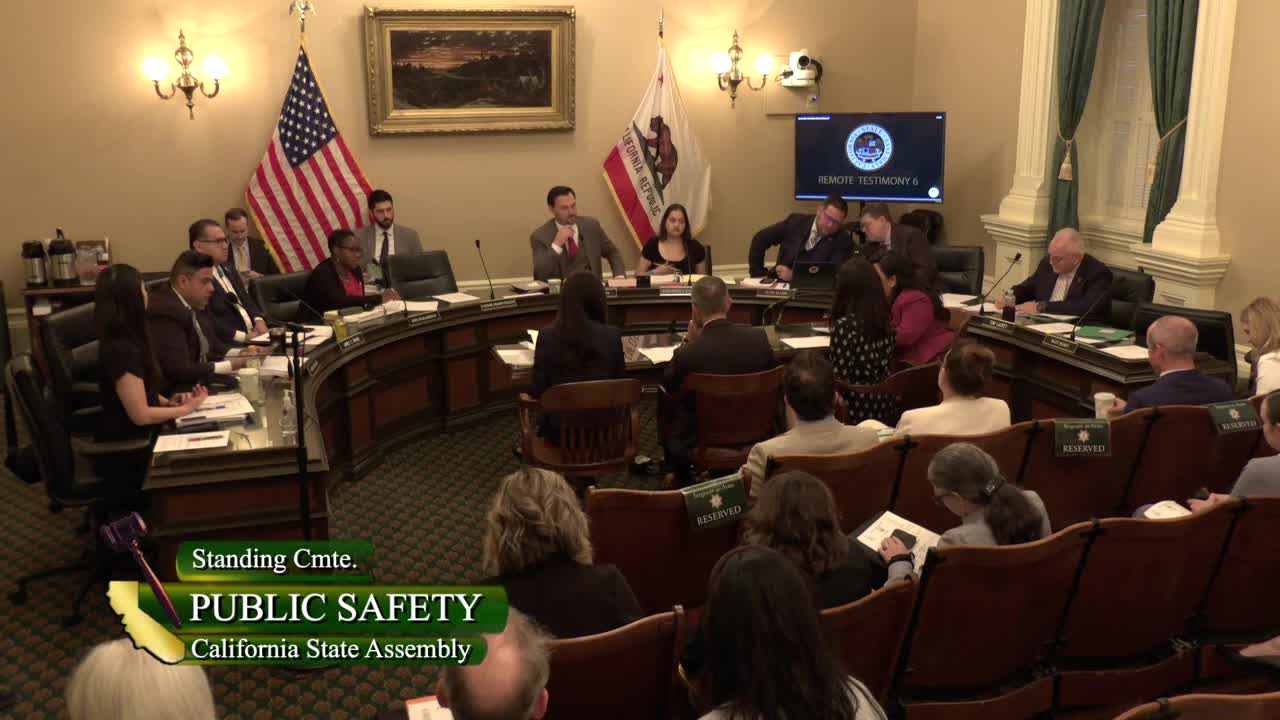 13MIN
Assembly Standing Committee on Public Safety
Bill Author

Bill Co-Author(s):