AB 2141: Pharmacies: license discipline: stipulated settlement and disciplinary order.
- Session Year: 2025-2026
- House: Assembly
- Latest Version Date: 2026-03-19
Current Status:
In Progress
(2026-08-13: In committee: Held under submission.)
Introduced
In Committee
Awaiting First Chamber Vote
Passed First Chamber
In Committee
Awaiting Second Chamber Vote
Passed Second Chamber
Enacted
Under existing state law, the Pharmacy Law, the California State Board of Pharmacy licenses and regulates the practice of pharmacy in this state. Existing law sets forth various disciplinary actions, including license suspension or revocation, against licensees for offenses committed under those licensing provisions. Existing law requires discipline proceedings to be conducted in accordance with the administrative adjudicative provisions of the Administrative Procedure Act (APA). Existing law authorizes an agency to formulate and issue a decision by settlement, as provided, except in an adjudicative proceeding to determine whether an occupational license should be revoked, suspended, limited, or conditioned, existing law prohibits a settlement from being made before issuance of the agency pleading.
This bill would authorize the board and licensee to enter into a stipulated settlement and disciplinary order to license discipline without and in advance of the filing of an agency pleading, notwithstanding the above-referenced requirement concerning the APA, and if prescribed conditions are met, including, among others, that the licensee willingly waives the administrative adjudicative procedures of the APA and the licensee submitted mitigation and rehabilitation information, as provided. The bill would require a specified committee of the board to consider the mitigation and rehabilitation information and authorize the committee to extend a stipulated settlement and discipline order offer to the licensee, as provided. The bill would require that the stipulated settlement and disciplinary order be agreed to in writing between the committee and the licensee within 60 calendar days of the date of the licensees waiver of the administrative adjudicative procedures of the APA, as provided. The bill would provide that the stipulated settlement and disciplinary order is contingent upon approval by the board, as provided.
Under existing law, if sufficient appropriations are not available for the payment of certain claims, settlements, or judgments, the Attorney General is required to report the claims, settlements, and judgments to the chairperson of either the Senate Committee on Appropriations or the Assembly Committee on Appropriations, who is then required to cause introduction of legislation appropriating the funds necessary for payment.This bill would express the intention of the Legislature to enact subsequent legislation relating to the payment of claims against the state.Under existing law, if sufficient appropriations are not available for the payment of certain claims, settlements, or judgments, the Attorney General is required to report the claims, settlements, and judgments to the chairperson of either the Senate Committee on Appropriations or the Assembly Committee on Appropriations, who is then required to cause introduction of legislation appropriating the funds necessary for payment.
This bill would express the intention of the Legislature to enact subsequent legislation relating to the payment of claims against the state.
(a)Notwithstanding subdivision (b) of Section 11415.60 of the Government Code, the board and licensee may enter into a stipulated settlement and disciplinary order to license discipline without and in advance of the filing of an accusation or other agency pleading pursuant to this section, including if all of the following conditions are met:
(1)Enforcement staff or investigators for the board conducted an inspection or investigation as provided for in this chapter and substantiated violations of law.
(2)Enforcement staff at the board provided the licensee with findings of the violations in writing, and a notice of possible eligibility for a stipulated settlement and disciplinary order.
(3)The licensee, within 15 days of being provided with the findings of the violations, notified the board in writing of the licensees willingness to waive the administrative adjudication provisions of the Administrative Procedure Act (Chapter 5 (commencing with Section 11500) of Part 1 of Division 3 of the Government Code), including notice and hearing requirements, and to consider a stipulated settlement and disciplinary order as an alternative to action taken on the basis of a pleading. The board may, for good cause, extend the deadline for the licensee to respond in writing beyond 15 days.
(4)The licensee submitted mitigation and rehabilitation information, as specified in the boards disciplinary guidelines.
(b)(1)If the conditions described in paragraphs (1) to (4), inclusive, of subdivision (a) are met, a committee consisting of the executive officer, two members of the board, one public member, and one licensee member shall consider the mitigation and rehabilitation information described in paragraph (4) of subdivision (a) and, in their sole discretion, may extend a stipulated settlement and disciplinary order offer to the licensee. Any stipulated settlement and disciplinary order offer shall be based on the violations substantiated by the inspection or investigation, and shall be consistent with the boards disciplinary guidelines.
(2)(A)The stipulated settlement and disciplinary order, incorporating the findings of the violations, shall be agreed to in writing between the committee described in paragraph (1) and licensee within 60 calendar days of the date of the licensees waiver pursuant to paragraph (3) of subdivision (a).
(B)The committee described in paragraph (1) may agree to extend the time period described in subparagraph (A) at its exclusive discretion. An extension shall be in writing and shall be granted only for good cause or when good faith settlement discussions are ongoing.
(3)If the committee described in paragraph (1) and the licensee fails to come to agreement within the time limits set forth in paragraph (2), the board shall file the appropriate disciplinary pleading.
(c)The stipulated settlement and disciplinary order shall be contingent upon approval by the board, except that the members of the committee described in subdivision (b) shall recuse themselves and not participate or vote on the stipulated settlement and disciplinary order.
(1)If the stipulated settlement and disciplinary order is approved by the board, it shall be a public record.
(2)If the board fails to approve the stipulated settlement and disciplinary order, both of the following shall apply:
(A)The stipulated settlement and disciplinary order shall be of no force or effect and the board shall not be disqualified from further action by having offered or considered the stipulated settlement and disciplinary order.
(B)The board shall file the appropriate disciplinary pleading.
(d)This section does not limit or prohibit the ability to engage in good faith settlement negotiations or to negotiate and enter into a stipulated settlement and disciplinary order after the disciplinary pleading has been filed.
SECTION 1.It is the intent of the Legislature to enact subsequent legislation relating to the payment of claims against the state. REVISIONS: HeadingLine 2.It is the intent of the Legislature to enact subsequent legislation relating to the payment of claims against the state.
|
Date
|
Status
|
|---|---|
| Aug 13, 2026 | In committee: Held under submission. |
| Aug 3, 2026 | In committee: Referred to APPR. suspense file. |
| Jun 29, 2026 | From committee: Do pass and re-refer to Com. on APPR. (Ayes 8. Noes 1.) (June 29). Re-referred to Com. on APPR. |
| Jun 3, 2026 | Referred to Com. on B. P. & E.D. |
| May 21, 2026 | In Senate. Read first time. To Com. on RLS. for assignment. |
| May 21, 2026 | Read third time. Passed. Ordered to the Senate. (Ayes 72. Noes 0. Page 5222.) |
| May 21, 2026 | Read third time. Passed. Ordered to the Senate. (Ayes 72. Noes 0.) |
| May 18, 2026 | Read second time. Ordered to third reading. |
| May 14, 2026 | From committee: Do pass. (Ayes 15. Noes 0.) (May 14). |
| May 14, 2026 | Joint Rule 62(a), file notice suspended. (Page 5030.) |
| May 14, 2026 | Joint Rule 62(a), file notice suspended. |
| May 13, 2026 | In committee: Set, first hearing. Referred to APPR. suspense file. |
| Apr 22, 2026 | From committee: Do pass and re-refer to Com. on APPR. with recommendation: To Consent Calendar. (Ayes 12. Noes 0.) (April 21). Re-referred to Com. on APPR. |
| Apr 7, 2026 | From committee: Do pass and re-refer to Com. on JUD. (Ayes 19. Noes 0.) (April 7). Re-referred to Com. on JUD. |
| Apr 7, 2026 | Coauthors revised. |
| Mar 24, 2026 | In committee: Hearing postponed by committee. |
| Mar 23, 2026 | Re-referred to Com. on B. & P. |
| Mar 19, 2026 | Referred to Coms. on B. & P. and JUD. |
| Mar 19, 2026 | From committee chair, with author's amendments: Amend, and re-refer to Com. on B. & P. Read second time and amended. |
| Feb 19, 2026 | From printer. May be heard in committee March 21. |
| Feb 18, 2026 | Read first time. To print. |
|
Date
|
Description
|
Location
|
Votes
|
|
|---|---|---|---|---|
| Aug 3, 2026 | Placed on suspense file | Senate Standing Committee on Appropriations |
Passed |
|
| Jun 29, 2026 | Do pass, but first be re-referred to the Committee on [Appropriations] | Senate Standing Committee on Business, Professions and Economic Development |
Passed |
|
| May 21, 2026 | AB 2141 Patterson Assembly Third Reading | Assembly Floor |
Passed |
|
| May 14, 2026 | Do pass. | Assembly Standing Committee on Appropriations |
Passed |
|
| Apr 21, 2026 | Do pass and be re-referred to the Committee on [Appropriations] with recommendation: To Consent Calendar | Assembly Standing Committee on Judiciary |
Passed |
|
| Apr 7, 2026 | Do pass and be re-referred to the Committee on [Judiciary] | Assembly Standing Committee on Business and Professions |
Passed |
This list shows positions taken on this bill by organizations on the date displayed, which is linked to the original source.
Positions by individuals are not included.
|
Organization
|
Position
|
Date
|
|---|---|---|
| Alliance for Pharmacy Compounding | ** Support | |
| Alliance For Pharmacy Compounding | ** Support | |
| California Naturopathic Doctors Association | ** Support | |
| California State Board of Pharmacy | ** Support |
SENATE COMMITTEE ON
Senator Sabrina Cervantes, Chair
2025 - 2026 Regular Session
AB 2141 (Patterson) - Pharmacies: license discipline: stipulated settlement and disciplinary order
Version: | Policy Vote: |
Urgency: | Mandate: |
Hearing Date: | Consultant: |
Bill Summary:
AB 2141 creates a disciplinary process specific to the California State Board of Pharmacy, allowing certain enforcement matters to be resolved through a stipulated settlement and disciplinary order in lieu, and in advance, of the filing of an accusation under the Administrative Procedure Act (APA).
Fiscal Impact:
The Board of Pharmacy notes that the new disciplinary process would shift the legal workload from the Attorney General (AG) to the Department of Consumer Affairs (DCA) Legal Office. DCA Legal estimates non-absorbable costs of $301,000 in Fiscal Year (FY) 2026-27 and $293,000 ongoing annually (Consumer and Client Services Division Fund) to support 1.0 Attorney IV position. This estimate assumes 90 cases annually.
The Board also notes unknown, potentially significant additional costs to provide education on and implementation of the new disciplinary process. These costs are currently undetermined, but they are not expected to be absorbable within current resources (Pharmacy Board Contingent Fund).
DCA’s Office of Information Services reports an absorbable IT workload to create new enforcement codes.
Background:
The Board's enforcement program represents its largest operational expenditure, historically accounting for approximately 64 percent of its budget. The Board processes an average of 3,500 complaints annually, categorizing them by their potential risk to public health and safety. High-priority complaints, such as prescription drug theft or impaired licensees, are referred to the AG for formal disciplinary action. Conversely, lower-priority complaints involving general noncompliance or prescription errors are typically resolved through citations, fines, or letters of admonishment. Between FYs 2021-22 and 2023-24, this robust enforcement effort resulted in thousands of investigations and citations, including 551 license revocations or surrenders.
Formal disciplinary actions are strictly governed by the APA. In these proceedings, the AG prosecutes the case before an independent Administrative Law Judge (ALJ), who conducts an evidentiary hearing and issues a proposed decision. Crucially, the APA vests final decision-making authority with the licensing board, preserving its statutory mandate to enforce the applicable practice act. The Board exercises its independent judgment to adopt, modify, or completely reject the ALJ's proposed decision. If rejected, the Board may decide the case itself based on the administrative record, complete with procedural safeguards and subject to subsequent judicial review.
To manage disciplinary matters efficiently, the Board frequently utilizes stipulated settlements. While the law permits agencies to settle adjudicative proceedings, occupational license discipline typically requires the filing of a formal accusation before a settlement can be finalized. Consequently, the Board resolves approximately 80 percent of its disciplinary cases post-accusation, prior to an administrative hearing. In cases ultimately resulting in discipline, the Board is authorized to seek cost recovery for investigation expenses, securing approximately $1.4 million in FY 2023-24, though such awards rely on the discretion of the presiding ALJ.
For lower-level infractions resulting in citations, the Board generally assesses maximum fines of $5,000 per licensee, weighing factors such as the violation's severity, prior history, and the licensee's cooperation. However, statutory exceptions allow for significantly higher penalties, including up to $25,000 per prescription for unauthorized internet sales, and up to $150,000 for chain community pharmacy violations resulting from explicit corporate policies. Licensees have the right to appeal citations through an informal office conference to present mitigating information, or they may pursue a formal administrative appeal under the APA, which ultimately returns to the Board for final adoption or rejection.
Proposed Law:
- Authorizes the Board, notwithstanding the APA, to negotiate and enter into a stipulated settlement and disciplinary order with a licensee before filing an accusation or other disciplinary pleading.
- Requires, before a pre-accusation settlement may be considered, that Board enforcement staff complete an inspection or investigation, substantiate violations of law, provide the licensee with written findings of those violations, and notify the licensee of potential eligibility for the settlement process.
- Requires the licensee, within 15 days of receiving the findings, to waive the notice and hearing provisions of the APA and elect to participate in the settlement process in lieu of formal administrative adjudication.
- Requires the licensee to submit mitigation and rehabilitation information consistent with the Board’s disciplinary guidelines.
- Establishes a settlement committee consisting of the Executive Officer, two Board members, one public member, and one licensee member to review the matter and, in its sole discretion, determine whether to extend a stipulated settlement offer consistent with the Board’s disciplinary guidelines.
- Requires any stipulated settlement to be reached within 60 calendar days, unless extended by the committee for good cause or while good-faith settlement discussions are ongoing; requires the Board to file a formal disciplinary pleading if no agreement is reached.
- Requires the stipulated settlement to be approved by the full Board, with members of the settlement committee recused from participating in the Board’s consideration of the settlement.
- Provides that an approved stipulated settlement becomes a public record; however, if the Board rejects the settlement, the proposed agreement has no force or effect and may not disqualify the Board from further proceedings, and the Board must file the appropriate disciplinary pleading.
- Specifies that the bill does not limit the Board’s existing authority to negotiate stipulated settlements after an accusation has been filed.
-- END --
SENATE COMMITTEE ON
BUSINESS, PROFESSIONS AND ECONOMIC DEVELOPMENT
Senator Aisha Wahab, Chair
2025 - 2026 Regular
Bill No: Hearing Date: June 29, 2026
Author: | |||
Version: |
| ||
Urgency: | Fiscal: | ||
Consultant: | |||
Subject:
SUMMARY:
Creates a California State Board of Pharmacy (Board)-specific disciplinary process allowing certain enforcement matters to be resolved through a stipulated settlement before an accusation is filed under the Administrative Procedure Act (APA), requiring the licensee to waive the notice and hearing provisions of the APA in order to participate.
Existing law:
- Establishes Board within the Department of Consumer Affairs to administer and enforce the Pharmacy Law. (Business and Professions Code (BPC) §§ 4000 et seq.; § 4001
- Provides that protection of the public is the highest priority for the Board in exercising its licensing, regulatory, and disciplinary functions and requires that whenever the protection of the public is inconsistent with other interests sought to be promoted, the protection of the public shall be paramount. (BPC § 4001.1)
- Authorizes the Board to suspend or revoke a license and to discipline a licensee by suspending judgment, placing the licensee on probation, suspending the right to practice, revoking the license, or taking any other disciplinary action the Board deems proper. (BPC § 4300)
- Requires disciplinary proceedings brought by the Board under the Pharmacy Law to be conducted in accordance with APA (Chapter 5 (commencing with Section 11500) of Part 1 of Division 3 of the Government Code), grants the Board all powers provided under the APA, and provides that final Board actions are subject to judicial review pursuant to Code of Civil Procedure section 1094.5. (BPC § 4300(e).)
- Establishes the APA governing formal administrative adjudications by state agencies, including disciplinary proceedings involving occupational licensees. (Government Code (GC) §§ 11500 et seq.)
- Authorizes a state agency to resolve an adjudicative proceeding by settlement, subject to any required agency approval, and provides that, in proceedings to determine whether an occupational license should be revoked, suspended, limited, or conditioned, a settlement may not be made before issuance of the agency pleading. (GC § 11415.60.)
- Provides that, following an administrative hearing, an Administrative Law Judge (ALJ) prepares a proposed decision for consideration by the agency. Authorizes the agency to adopt the proposed decision, reduce or otherwise mitigate the proposed penalty, make technical or other minor changes, reject the proposed decision and remand the case for further proceedings, or reject the proposed decision and decide the case upon the administrative record, with or without taking additional evidence, as specified. (GC § 11517.)
- Authorizes a party aggrieved by a final agency decision to obtain judicial review by filing a petition for writ of administrative mandate. (GC § 11523; Code Civ. Proc. § 1094.5.)
This bill:
- Authorizes the Board, notwithstanding the APA, to negotiate and enter into a stipulated settlement and disciplinary order with a licensee before filing an accusation or other disciplinary pleading.
- Requires, before a pre-accusation settlement may be considered, that Board enforcement staff complete an inspection or investigation, substantiate violations of law, provide the licensee with written findings of those violations, and notify the licensee of potential eligibility for the settlement process.
- Requires the licensee, within 15 days of receiving the findings, to waive the notice and hearing provisions of the APA and elect to participate in the settlement process in lieu of formal administrative adjudication.
- Requires the licensee to submit mitigation and rehabilitation information consistent with the Board’s disciplinary guidelines.
- Establishes a settlement committee consisting of the Executive Officer, two Board members, one public member, and one licensee member to review the matter and, in its sole discretion, determine whether to extend a stipulated settlement offer consistent with the Board’s disciplinary guidelines.
- Requires any stipulated settlement to be reached within 60 calendar days, unless extended by the committee for good cause or while good-faith settlement discussions are ongoing; requires the Board to file a formal disciplinary pleading if no agreement is reached.
- Requires the stipulated settlement to be approved by the full Board, with members of the settlement committee recused from participating in the Board’s consideration of the settlement.
- Provides that an approved stipulated settlement becomes a public record, but if the Board rejects the settlement, the proposed agreement has no force or effect, may not disqualify the Board from further proceedings, and the Board must file the appropriate disciplinary pleading.
- Specifies that the bill does not limit the Board’s existing authority to negotiate stipulated settlements after an accusation has been filed.
FISCAL EFFECT:
This bill is keyed fiscal by Legislative Counsel. According to the Assembly Committee on Appropriations, the Board states this bill shifts legal workload from the Office of the Attorney General to the Department of Consumer Affairs Legal Office. The Board estimates 90 cases per year and costs of $284,000 in 2026-27 and $276,000 in 2027-28 and ongoing for an Attorney III position. The Board states it could incur expenditures on implementation activities that will exceed the Board’s usual implementation costs that focus on education. However, the Board is unable to quantify the costs. The DCA Office of Information Services estimates adding new enforcement codes will cost $1,000, which is absorbable.
COMMENTS:
- Purpose. The Alliance for Pharmacy Compounding is the sponsor of this bill. According to the Author, “This bill remedies a situation that requires formal accusations to be filed against licensees. Instead, this measure will allow the Board of Pharmacy and licensees to enter into stipulated settlements and disciplinary orders before an accusation is filed. This improves efficiency, conserves state resources, and allows the Board to focus its efforts on matters that jeopardize public health and safety.” The Author states that “An example of money lost by the BOP in 2022/2023 due to lost ALJ cases are three sterile compounding cases. The BOP brought the same charge of adulteration in all three cases. They lost more money in each subsequent case as each judge granted less in requested recovery costs as the BOP continued to lose on the same adulteration issue.”
- Background. The Board regulates over 50,700 pharmacists, 1,300 advanced practice pharmacists, 4,400 intern pharmacists, and 65,700 pharmacy technicians across a total of 32 licensing programs. In addition to regulating professionals, the Board oversees and licenses pharmacies, clinics, wholesalers, third-party logistic providers, and automated drug delivery systems. Pharmacy Law states that “protection of the public shall be the highest priority for the California State Board of Pharmacy in exercising its licensing, regulatory, and disciplinary functions. Whenever the protection of the public is inconsistent with other interests sought to be promoted, the protection of the public shall be paramount.”
The Board has its own enforcement staff, which includes field inspectors responsible for conducting investigations and inspections of pharmacies as well as sterile compounding and outsourcing facilities. The Board’s enforcement program is its largest budget expenditure, historically comprising about 64 percent of its total operating expenses. The Board’s Enforcement Unit regularly engages in investigations of licensees that may result in disciplinary action, as well as cases involving unlicensed activity. For example, between Fiscal Years 2021-22 through 2023-24, the BOP completed 8,719 investigations, referred 839 investigations for formal discipline, issued 4,092 citations, revoked or accepted surrender of 551 licenses, and placed 344 licensees on probation.
On average, the Board consistently receives around 3,500 complaints from the public or other sources per year. These complaints are then categorized into priorities based on the potential risk to public health and safety. The highest priority complaints—ranked 1 and 2—involve offenses such as impaired licensee on duty, prescription drug theft, and the unauthorized furnishing of prescription drugs. Priority 3 and 4 complaints are less serious and involve offenses like failure to provide patient consultation, prescription errors, working with an expired license, and general noncompliance issues. These complaints are most likely to result in the issuance of a fine or a letter of admonishment. High-priority complaints are referred to the Attorney General, where the Board files formal accusations seeking discipline against the licensee. Tools such as interim suspension orders are available in appropriate cases to protect the public while disciplinary proceedings are pending.
Most disciplinary actions brought by licensing boards within the Department of Consumer Affairs, including the Board, are conducted pursuant to the APA (Government Code Section 11500 et seq.). Under the APA, an accusation is prosecuted by the Attorney General before an Administrative Law Judge (ALJ) of the Office of Administrative Hearings, who conducts an evidentiary hearing and prepares a proposed decision containing findings of fact, legal conclusions, and a recommended disposition.
The ALJ’s proposed decision, however, does not constitute the final disciplinary action of the licensing board. Rather, Government Code section 11517 vests final decision-making authority in the agency. Upon receiving a proposed decision, the licensing board may adopt the proposed decision, reduce or otherwise mitigate the proposed penalty, make technical or other non-substantive changes, reject the proposed decision and remand the matter for further proceedings before the ALJ, or reject the proposed decision and decide the case itself upon the administrative record, with or without taking additional evidence, as authorized by Government Code section 11517(c).
The APA assigns distinct responsibilities to the ALJ and the licensing board. The ALJ serves as an independent hearing officer responsible for conducting the evidentiary hearing and preparing a proposed decision, while the licensing board—whose members are appointed pursuant to statute and charged with administering and enforcing the applicable practice act—retains responsibility for determining the final disposition of disciplinary matters. Accordingly, the APA preserves the board’s authority to exercise its independent judgment before issuing a final decision.
When a board rejects a proposed decision and elects to decide the matter itself, the APA establishes additional procedural safeguards. The board must base its decision on the administrative record, may consider additional evidence only as authorized by statute, must provide the parties an opportunity to present written argument before the board, and must issue a written decision supported by findings. The board’s final decision is then subject to judicial review through a petition for writ of administrative mandate pursuant to Government Code section 11523 and Code of Civil Procedure section 1094.5. In disciplinary actions involving professional licenses, courts generally exercise independent judgment review where the license constitutes a fundamental vested right.
Licensing boards like the Board have exercised this authority on prior occasions by rejecting proposed decisions pursuant to Government Code section 11517 and issuing final decisions based upon the administrative record. Accordingly, a board’s authority to reject an ALJ’s proposed decision is an established feature of California's administrative disciplinary process, rather than an extraordinary remedy. The APA reflects a balance between independent adjudication by the Office of Administrative Hearings and the authority of the licensing board to make the final disciplinary decision under Government Code section 11517.
Existing law also authorizes parties to resolve disciplinary matters through stipulated settlements. Under Government Code section 11415.60, agencies may settle adjudicative proceedings before or after issuance of an agency pleading. However, in proceedings to determine whether an occupational license should be revoked, suspended, limited, or conditioned, a settlement generally may not be made before issuance of the agency pleading. In professional licensing disciplinary proceedings, that pleading is typically an accusation, the formal charging document filed by the Attorney General on behalf of the licensing board that identifies the alleged violations of the applicable practice act and serves as the basis for administrative adjudication. As a result, stipulated settlements involving license discipline ordinarily occur after an accusation has been filed and before the matter proceeds to an administrative hearing.
The Board settles approximately 80 percent of its disciplinary cases post-accusation. A total of 413 post-accusation case settlements occurred between Fiscal Years 2021-22 through 2023-24. The Board is authorized to seek cost recovery for expenses incurred during a successful investigation in cases where the licensee is ultimately subjected to discipline. However, cost recovery is not always awarded by administrative law judges. The Board was awarded approximately $1.4 million in cost recovery in Fiscal Year 2023-24.
For most cases resulting in a citation and fine or a letter of admonishment, the Board is limited to issuing fines of $5,000 to each licensee investigated in a single case. Some specified violations carry higher maximum fines; for example, the Board may issue fines of $25,000 per prescription for internet sales of drugs where no underlying appropriate examination occurred. When determining what fines to assess, the Board considers the gravity of the violation, history of previous violations, extent to which the cited individual is cooperating with the investigation, and other elements suggesting good or bad faith on behalf of the licensee. As of 2022, the Board has authority to bring an action for up to $100,000 in fines for repeated violations by pharmacies operating under common ownership or management within a chain community pharmacy, or up to $150,000 for any violation of the Pharmacy Law demonstrated to be the result of a written policy or which was expressly encouraged by the common owner or manager.
Licensees may appeal a citation issued by the Board by requesting an informal office conference. The office conference allows the licensee the opportunity to present additional or mitigating information to the Board’s executive officer or designee and a supervising inspector. Upon conclusion, staff may affirm, modify, or dismiss the citation or affirm or dismiss the letter of admonishment. A licensee may also submit a formal appeal to the Board within thirty days of the issuance of a citation. Appeals are conducted pursuant to the APA by an administrative law judge who renders a decision, which is presented to the Board for adoption or rejection.
- Arguments in Support. The Alliance for Pharmacy Compounding writes that “Creating a defined interim step would allow the Board and licensees to engage in a more solutions-oriented process, helping to resolve appropriate cases more efficiently while reserving formal referral and litigation for matters that warrant that level of enforcement…It also supports greater consistency and predictability for licensees operating in good faith within a complex regulatory environment. Compounding pharmacies play a critical role in patient care by preparing medications tailored to individual needs, particularly when FDA-approved options are not appropriate or available. A regulatory approach that allows for early engagement and resolution helps ensure that compliant pharmacies can continue to serve patients without unnecessary disruption, while still holding bad actors accountable.”
- Policy Comments. Unlike existing practice, the bill authorizes disciplinary negotiations before an accusation is filed. By the time an accusation is filed, the Board has completed a lengthy investigation, determined that violations of the Pharmacy Law have been substantiated, and referred the matter to the Attorney General for formal disciplinary proceedings. The filing of an accusation marks the beginning of the formal administrative adjudication process, not the beginning of the investigation, and under existing law the parties already retain broad authority to negotiate and resolve disciplinary matters through stipulated settlements without proceeding to an administrative hearing.
The bill expressly overrides Government Code section 11415.60 by authorizing qualifying disciplinary matters to be resolved before an accusation is filed, creating a disciplinary process applicable only to the Board of Pharmacy. Existing law establishes a comprehensive and generally uniform administrative adjudication framework governing disciplinary actions brought by licensing boards within the Department of Consumer Affairs. That framework contemplates the filing of an accusation before a matter is resolved by settlement while still encouraging negotiated resolutions where appropriate. It is unclear why a Board-specific exception to these generally applicable procedural requirements is necessary.
Under current law, an accusation is the formal charging document filed by the Attorney General on behalf of the licensing board identifying the alleged statutory violations supporting the proposed discipline. If a disciplinary matter settles, both the accusation and the stipulated settlement generally become public records. Under AB 2141, however, qualifying matters could be resolved entirely through a pre-accusation stipulated settlement. Although the final stipulated settlement would become a public record if approved by the Board, no formal accusation identifying the alleged violations, legal causes for discipline, or factual basis supporting the Board's enforcement action would ever be filed. As a result, members of the public, employers, and other interested parties may have less information regarding the nature of the violations underlying the Board’s disciplinary action.
The APA reflects a longstanding policy of providing a consistent and transparent disciplinary framework applicable to licensing boards throughout the Department of Consumer Affairs while preserving flexibility for negotiated settlements. AB 2141 would depart from that framework for a single licensing board without making comparable changes applicable to other DCA boards. If enacted, the bill may establish a precedent for future requests from professions seeking board-specific exemptions from the APA based on dissatisfaction with discipline, raising broader questions regarding the consistency, transparency, and uniformity of California's professional licensing disciplinary system.
SUPPORT AND OPPOSITION:
Support:
Alliance for Pharmacy Compounding
California Naturopathic Doctors Association
Opposition:
None received
-- END --
ASSEMBLY THIRD READING
ATR Bill Id:AB 2141
Author:(Patterson)
As Amended Ver:March 19, 2026
Majority vote
SUMMARY
Authorizes the California State Board of Pharmacy (BOP) to resolve a potential cause for discipline by a licensee through a stipulated settlement agreement prior to the filing of a formal accusation.
Major Provisions
- Authorize the BOP and a licensee to enter into a stipulated settlement and disciplinary order to license discipline without and in advance of the filing of an accusation or other agency pleading.
- Require a pre-accusation settlement to meet the following conditions:
- Enforcement staff or investigators for the BOP conducted an inspection or investigation as provided for in the Pharmacy Law and substantiated violations of law.
- Enforcement staff at the BOP provided the licensee with findings of the violations in writing, and a notice of possible eligibility for a stipulated settlement and disciplinary order.
- The licensee, within 15 days of being provided with the findings of the violations, notified the BOP in writing of the licensee's willingness to waive the administrative adjudication provisions of the Administrative Procedure Act, including notice and hearing requirements, and to consider a stipulated settlement and disciplinary order as an alternative to action taken on the basis of a pleading.
- The licensee submitted mitigation and rehabilitation information, as specified in the BOP's disciplinary guidelines.
- Allow the BOP to extend the 15-day deadline for good cause.
- Provide that a committee consisting of the BOP's executive officer, two members of the board, one public member, and one licensee member shall consider the mitigation and rehabilitation information and provides the committee with discretion to extend a stipulated settlement and disciplinary order offer to the licensee.
- Require a stipulated settlement and disciplinary order, incorporating the findings of the violations, to be agreed to in writing between the committee and licensee within 60 calendar days of the date of the licensee's waiver of the Administrative Procedure Act (APA).
- Allow the committee of the BOP to agree to extend the time period for an agreement at its discretion in writing and restricts extensions to instances where there is good cause or when good faith settlement discussions are ongoing.
- Provide that a stipulated settlement and disciplinary order is contingent upon approval by the BOP, except that the members of the committee shall recuse themselves and not participate or vote on the stipulated settlement and disciplinary order.
- Provide that a BOP-approved stipulated settlement and disciplinary order is public record.
- Require the BOP to file the appropriate disciplinary pleading if the committee and the licensee fail to reach an agreement within the provided time limits or if the BOP fails to approve a proposed stipulated settlement and disciplinary order.
- Provide that a stipulated settlement and disciplinary order that is not approved by the BOP has no force or effect and the BOP shall not be disqualified from further action by having offered or considered the stipulated settlement and disciplinary order.
- Clarify that the process for reaching a pre-accusation settlement agreement does not limit or prohibit the BOP's ability to engage in good faith settlement negotiations or to negotiate and enter into a stipulated settlement and disciplinary order after the disciplinary pleading has been filed.
COMMENTS
Enforcement of the Pharmacy Law. The BOP is entrusted with administering and enforcing the Pharmacy Law. The BOP has its own enforcement staff, which includes field inspectors responsible for conducting investigations and inspections of pharmacies as well as sterile compounding and outsourcing facilities. The BOP's enforcement program is its largest budget expenditure, historically comprising about 64% of its total operating expenses. The BOP's Enforcement Unit regularly engages in investigations of licensees that may result in disciplinary action, as well as cases involving unlicensed activity. For example, between Fiscal Years 2021-22 through 2023-24, the BOP completed 8,719 investigations, referred 839 investigations for formal discipline, issued 4,092 citations, revoked or accepted surrender of 551 licenses, and placed 344 licensees on probation.
On average, the BOP consistently receives around 3,500 complaints from the public or other sources per year. High-priority complaints are referred to the Attorney General, where the BOP files formal accusations seeking discipline against the licensee. Tools such as interim suspension orders and are used to protect the public pending the outcome of the disciplinary action. Subject to judicial review, the BOP has final authority over its disciplinary cases. The BOP settles approximately 80 percent of its disciplinary cases post-accusation. A total of 413 post-accusation case settlements occurred between Fiscal Years 2021-22 through 2023-24.
For most cases resulting in a citation and fine or a letter of admonishment, the BOP is limited to issuing fines of $5,000 to each licensee investigated in a single case. Some specified violations carry higher maximum fines; for example, the BOP may issue fines of $25,000 per prescription for internet sales of drugs where no underlying appropriate examination occurred. When determining what fines to assess, the BOP considers the gravity of the violation, history of previous violations, extent to which the cited individual is cooperating with the investigation, and other elements suggesting good or bad faith on behalf of the licensee. As of 2022, the BOP has authority to bring an action for higher fines against pharmacies operating under common ownership or management within a chain community pharmacy.
Licensees may appeal a citation issued by the BOP by requesting an informal office conference. The office conference allows the licensee the opportunity to present additional or mitigating information to the BOP's executive officer or designee and a supervising inspector. Upon conclusion, staff may affirm, modify, or dismiss the citation or affirm or dismiss the letter of admonishment. A licensee may also submit a formal appeal to the BOP within thirty days of the issuance of a citation. Appeals are conducted pursuant to the APA by an administrative law judge who renders a decision, which is presented to the BOP for adoption or rejection.
Alternative Dispute Resolutions. The BOP does not have authority to settle cases in advance of filing of an accusation. When the BOP was entering the early stages of sunset review in 2019, its Enforcement Committee was in the process of developing an alternative enforcement model proposal that provides a mechanism for settlements pre-accusation. This topic was discussed in the BOP's 2020 sunset background paper, in which Issue #14 posed the question: "Would enabling the Board to participate in alternate disciplinary processes for licensees whose misconduct is likely to result in a citation and fine provide for speedier disciplinary cases and prove more cost efficient for Board staff?"
The sunset background paper went on to state:
An appeals process exists for licensees who are being subjected a citation and fine through a request for an informal office conference. As previously discussed, this office conference allows the licensee the opportunity to present additional or mitigating information to the Board's executive officer or designee and a supervising inspector. Stakeholders within the profession have suggested that a similar opportunity to meet informally with Board staff should be available when a licensee is being subjected to disciplinary action. Currently, the Board has no authority to settle a case prior to the filing of an action by the Attorney General. Allowing licensees to meet with Board staff and pursue a mutually agreeable outcome would likely alleviate case resolution timelines and provide cost savings to the Board.
The staff recommendation in the sunset background paper was for the BOP to inform the Committees of whether it believed some form of pre-accusation alternative dispute resolution would be of benefit and to provide any suggested language that it believed would achieve this goal. Subsequently, the BOP provided the Committees with language that would authorize the BOP to reach a stipulated settlement agreement with a licensee prior to filing a formal accusation. However, this language was not ultimately included in the BOP's sunset bill.
The concept of a pre-accusation settlement mechanism was raised again by stakeholders during BOP's 2025 sunset review. In April 2025, the sponsor of this bill provided written comments to the committee that included proposals intended to "improve communication and strengthen the working relationship between licensees and regulators." The written comments included a request for the consideration of language to establish "a structured update or mediation process before enforcement cases are referred to the Attorney General's Office." This proposal was not incorporated into the BOP's sunset bill, in part because it had not been previously discussed in the BOP's sunset background paper for that year.
This bill proposes to establish an alternative dispute resolution mechanism based on language originally provided by the BOP during its 2020 sunset review. The bill would authorize—not require—the BOP to enter into a stipulated settlement and disciplinary order to license discipline without and in advance of the filing of an accusation or other agency pleading. The bill would establish a formal process and timeline for these pre-accusation settlements to occur.
By allowing the BOP to enter into a settlement prior to the filing of an accusation, this bill would be establishing an exception to the administrative adjudication provisions of the APA. Under the APA, an adjudicative proceeding to determine whether an occupational license should be revoked, suspended, limited, or conditioned, a settlement may not be made before issuance of the agency pleading, including an accusation by a licensing board. The implications of establishing such an exception are within the jurisdiction of the Assembly Committee on Judiciary, which has also been referred this bill.
According to the Author
"This bill remedies a situation that requires formal accusations to be filed against licensees. Instead, this measure will allow the Board of Pharmacy and licensees to enter into stipulated settlements and disciplinary orders before an accusation is filed. This improves efficiency, conserves state resources, and allows the Board to focus its efforts on matters that jeopardize public health and safety."
Arguments in Support
The Alliance for Pharmacy Compounding, the sponsor of this bill, writes in support: "Creating a defined interim step would allow the Board and licensees to engage in a more solutions-oriented process, helping to resolve appropriate cases more efficiently while reserving formal referral and litigation for matters that warrant that level of enforcement. This approach can reduce administrative and state budgetary burden, shorten resolution timelines, and improve regulatory outcomes, all while maintaining the Board's authority to take disciplinary action where necessary."
Arguments in Opposition
None on file.
FISCAL COMMENTS
According to the Assembly Committee on Appropriations, the BOP estimates 90 cases per year and costs of $284,000 in 2026-27 and $276,000 in 2027-28 and ongoing; the BOP states it could incur expenditures on implementation activities that will exceed the BOP's usual implementation costs that focus on education—however, the BOP is unable to quantify the costs. The DCA Office of Information Services estimates adding new enforcement codes will cost $1,000, which is absorbable.
VOTES
ASM BUSINESS AND PROFESSIONS: 19-0-0
YES: Berman, Johnson, Addis, Ahrens, Alanis, Bains, Aguiar-Curry, Caloza, Chen, Elhawary, Hadwick, Haney, Hart, Irwin, Jackson, Lowenthal, Macedo, Nguyen, Pellerin
ASM JUDICIARY: 12-0-0
YES: Kalra, Macedo, Bauer-Kahan, Bryan, Connolly, Dixon, Harabedian, Pacheco, Papan, Sanchez, Stefani, Zbur
ASM APPROPRIATIONS: 15-0-0
YES: Wicks, Hoover, Aguiar-Curry, Calderon, Caloza, Dixon, Fong, Mark González, Krell, Pacheco, Pellerin, Sharp-Collins, Solache, Ta, Tangipa
UPDATED
VERSION: March 19, 2026
CONSULTANT: Robert Sumner / B. & P. / (916) 319-3301 FN: 0003017
Date of Hearing: May 13, 2026
ASSEMBLY COMMITTEE ON APPROPRIATIONS
Buffy Wicks, Chair
ABPCA Bill Id:AB 2141
Author:(Patterson) – As Amended Ver:March 19, 2026
Policy Committee: | Business and Professions | Vote: | 19 - 0 |
Judiciary | 12 - 0 | ||
|
|
Urgency: No State Mandated Local Program: No Reimbursable: No
SUMMARY:
This bill authorizes the California State Board of Pharmacy (Board) to resolve a potential cause for discipline by a licensee through a stipulated settlement agreement without first filing a formal accusation.
Specifically, this bill:
- Authorizes the Board and a licensee to enter into a stipulated settlement and disciplinary order without, and in advance of, the filing of an accusation or other agency pleading.
- Requires a pre-accusation settlement to meet the following conditions:
- Enforcement staff or investigators for the Board conducted an inspection or investigation as provided for in the Pharmacy Law and substantiated violations of law.
- Enforcement staff at the Board provided the licensee with findings of the violations in writing, and a notice of possible eligibility for a stipulated settlement and disciplinary order.
- The licensee, within 15 days of being provided with the findings of the violations, notified the Board in writing of the licensee’s willingness to waive the administrative adjudication provisions of the Administrative Procedures Act (APA) and to consider a stipulated settlement and disciplinary order as an alternative to action taken on the basis of a pleading.
- The licensee submitted mitigation and rehabilitation information, as specified in the board’s disciplinary guidelines.
- Enforcement staff or investigators for the Board conducted an inspection or investigation as provided for in the Pharmacy Law and substantiated violations of law.
- Requires a committee consisting of the board’s executive officer, two members of the board, one public member, and one licensee member consider the mitigation and rehabilitation information and provides the committee with discretion to extend a stipulated settlement and disciplinary order offer to the licensee.
- Requires a stipulated settlement and disciplinary order, incorporating the findings of the violations, to be agreed to in writing between the committee and licensee within 60 calendar days of the date of the licensee’s waiver of the APA and provides that the settlement is contingent upon approval by the board, except as specified.
- Requires the board to file the appropriate disciplinary pleading if the committee and the licensee fail to reach an agreement, as specified.
FISCAL EFFECT:
The Board states this bill shifts legal workload from the Office of the Attorney General to the Department of Consumer Affairs (DCA) Legal Office. The Board estimates 90 cases per year and costs of $284,000 in 2026-27 and $276,000 in 2027-28 and ongoing for an Attorney III position (Pharmacy Board Contingent Fund).
The Board states it could incur expenditures on implementation activities that will exceed the Board’s usual implementation costs that focus on education. However, the Board is unable to quantify the costs (Pharmacy Board Contingent Fund).
The DCA Office of Information Services estimates adding new enforcement codes will cost $1,000, which is absorbable.
COMMENTS:
- Purpose. According to the author:
This bill remedies a situation that requires formal accusations to be filed against licensees. Instead, this measure will allow the Board of Pharmacy and licensees to enter into stipulated settlements and disciplinary orders before an accusation is filed. This improves efficiency, conserves state resources, and allows the Board to focus its efforts on matters that jeopardize public health and safety.
- Background. Under existing law, the Board must initiate formal disciplinary proceedings by filing an accusation under an administrative process set forth in the APA. While settlements are common, they typically occur only after the formal accusation has been filed. According to the author and sponsor, the requirement that the board initiate formal disciplinary proceedings in order to resolve a potential disciplinary action creates inefficiencies, especially in cases where violations have already been substantiated and both the board and licensee are willing to resolve the matter early without need of a formal accusation.
Analysis Prepared by: Allegra Kim / APPR. / (916) 319-2081
Date of Hearing: April 21, 2026
ASSEMBLY COMMITTEE ON JUDICIARY
Ash Kalra, Chair
ABPCA Bill Id:AB 2141
Author:(Patterson) – As Amended Ver:March 19, 2026
proposed consent
SUBJECT: Pharmacies: license discipline: stipulated settlement and disciplinary order
KEY ISSUE: Should the California State pharmacy board be allowed to resolve a potential cause for discipline by a licensee through a stipulated settlement agreement prior to the filing of a formal accusation?
SYNOPSIS
Under existing law, the California Board of Pharmacy (board) initiates formal disciplinary proceedings against a licensee by first filing an accusation under the adjudicative process set forth in Administrative Procedures Act (APA). While settlements are common, they typically occur only after the formal accusation has been filed. According to the author and sponsor, the requirement that the board initiate formal disciplinary proceedings in order to resolve a potential disciplinary action creates inefficiencies, especially in cases where violations have already been substantiated and both the board and licensee are willing to resolve the matter early without a formal accusation.
This bill allows the board to resolve a disciplinary matter through a stipulated settlement agreement without the need of first filing of a formal accusation. As such, the bill creates an exception to the adjudication provisions of the APA. Under the APA, in a proceeding to determine whether an occupational license should be revoked, suspended, limited, or conditioned, a settlement may not be made before issuance of the agency pleading, including an accusation by a licensing board. Where a violation has been substantiated and the board and licensee are willing to resolve the matter through a stipulated settlement, this bill allows them to do so, whether or not the board has filed a formal accusation. This bill was previously approved by the Committee on Business & Professions by unanimous vote.
SUMMARY: Authorizes the California State Board of Pharmacy (Board) to resolve a potential cause for discipline by a licensee through a stipulated settlement agreement prior to the filing of a formal accusation. Specifically, this bill:
- Authorizes the board and a licensee to enter into a stipulated settlement and disciplinary order without and in advance of the filing of an accusation or other agency pleading.
- Requires a pre-accusation settlement to meet the following conditions:
- Enforcement staff or investigators for the board conducted an inspection or investigation as provided for in the Pharmacy Law and substantiated violations of law.
- Enforcement staff at the board provided the licensee with findings of the violations in writing, and a notice of possible eligibility for a stipulated settlement and disciplinary order.
- The licensee, within 15 days of being provided with the findings of the violations, notified the board in writing of the licensee’s willingness to waive the administrative adjudication provisions of the APA, including notice and hearing requirements, and to consider a stipulated settlement and disciplinary order as an alternative to action taken on the basis of a pleading.
- The licensee submitted mitigation and rehabilitation information, as specified in the board’s disciplinary guidelines.
- Provides that a committee consisting of the board’s executive officer, two members of the board, one public member, and one licensee member shall consider the mitigation and rehabilitation information and provides the committee with discretion to extend a stipulated settlement and disciplinary order offer to the licensee.
- Requires a stipulated settlement and disciplinary order, incorporating the findings of the violations, to be agreed to in writing between the committee and licensee within 60 calendar days of the date of the licensee’s waiver of the APA and provides that the settlement is contingent upon approval by the board, except as specified.
- Requires the board to file the appropriate disciplinary pleading if the committee and the licensee fail to reach an agreement, as specified.
EXISTING LAW:
- Establishes the Board of Pharmacy (board) within the Department of Consumer Affairs and authorizes the board to adopt rules and regulations as may be necessary for the protection of the public. (Business and Professions Code Section 4000 et seq.)
- Provides that every license issued by the board may be suspended, revoked, denied, or subjected to other forms of discipline deemed proper by the board, and requires the board to issue citations, issue abatement orders, fines, and take other appropriate action against any licensee who is guilty of unprofessional conduct. (Business and Professions Code Sections 4300-4317.5.)
- Establishes the administrative adjudication provisions of the Administrative Procedure Act. (Government Code Section 11400 et seq.)
- Allows for an agency to formulate and issue a decision by settlement, pursuant to an agreement of the parties, without conducting an adjudicative proceeding, and provides that a settlement may be made before or after issuance of an agency pleading, except that in an adjudicative proceeding to determine whether an occupational license should be revoked, suspended, limited, or conditioned, a settlement may not be made before issuance of the agency pleading. (Government Code Section 11415.60.)
FISCAL EFFECT: As currently in print this bill is keyed fiscal.
COMMENTS: According to the author, this bill “remedies a situation that requires formal accusations to be filed against licensees. Instead, this measure will allow the Board of Pharmacy and licensees to enter into stipulated settlements and disciplinary orders before an accusation is filed. This improves efficiency, conserves state resources, and allows the Board to focus its efforts on matters that jeopardize public health and safety.”
Under existing law, the Board must initiate formal disciplinary proceedings by filing an accusation under an administrative process set forth in APA. While settlements are common, they typically occur only after the formal accusation has been filed. According to the author and sponsor, the requirement that the board initiate formal disciplinary proceedings in order to resolve a potential disciplinary action creates inefficiencies, especially in cases where violations have already been substantiated and both the board and licensee are willing to resolve the matter early without need of a formal accusation.
This bill allows the board to resolve a disciplinary matter through a stipulated settlement agreement without the need of first filing of a formal accusation. As such, the bill creates an exception to adjudication provisions of the APA. Under the APA, in a proceeding to determine whether an occupational license should be revoked, suspended, limited, or conditioned, a settlement may not be made before issuance of the agency pleading, including an accusation by a licensing board. Where a violation has been substantiated and the board and licensee are willing to resolve the matter through a stipulated settlement, this bill allows them to do so whether or not the board has filed a formal accusation.
ARGUMENTS IN SUPPORT: The Alliance for Pharmacy Compounding writes in support:
AB 2141 introduces a thoughtful and measured improvement to the enforcement framework by establishing an interim step before referral to the Attorney General. From a process standpoint, this is an important refinement. It creates an opportunity for earlier engagement between the Board and licensees, which can lead to clarification, corrective action, and resolution in appropriate cases without immediately escalating to formal litigation.
This type of approach is not new. Many states already incorporate some form of interim or informal resolution step within their enforcement processes, allowing regulators and licensees to address issues at an earlier stage when appropriate. These frameworks have demonstrated that early engagement can improve compliance outcomes while reserving formal enforcement actions for more serious or unresolved matters.
From a legal and administrative perspective, this approach aligns with principles of proportionality and efficiency in enforcement. Not every matter requires referral to the Attorney General, particularly those involving technical compliance issues or evolving standards. Providing a structured opportunity for resolution prior to referral can reduce unnecessary burden on state resources, improve timelines, and support more consistent outcomes.
The California Naturopathic Doctors Association writes in support:
AB 2141 provides an important opportunity to introduce a more structured and collaborative step in the enforcement process before cases are referred to the Attorney General’s Office. In practice, many enforcement matters, particularly those involving technical or evolving areas of compliance, could benefit from an earlier opportunity for clarification, corrective action, or resolution.
REGISTERED SUPPORT / OPPOSITION:
Support
Alliance for Pharmacy Compounding
The California Naturopathic Doctors Association
Opposition
None on file
Analysis Prepared by: Tom Clark / JUD. / (916) 319-2334
Date of Hearing:
ASSEMBLY COMMITTEE ON BUSINESS AND PROFESSIONS
Marc Berman, Chair
ABPCA Bill Id:AB 2141
Author:(Patterson) – As Amended Ver:March 19, 2026
NOTE: This bill is double referred and if passed by this Committee will be re-referred to the Assembly Committee on Judiciary.
SUBJECT: Pharmacies: license discipline: stipulated settlement and disciplinary order.
SUMMARY: Authorizes the California State Board of Pharmacy (BOP) to resolve a potential cause for discipline by a licensee through a stipulated settlement agreement prior to the filing of a formal accusation.
EXISTING LAW:
- Establishes the Pharmacy Law. (Business and Professions Code (BPC) §§ 4000 et seq.)
- Establishes the BOP within the Department of Consumer Affairs (DCA) to administer and enforce the Pharmacy Law. (BPC § 4001)
- Provides that protection of the public shall be the highest priority for the BOP in exercising its licensing, regulatory, and disciplinary functions. (BPC § 4001.1)
- Authorizes the BOP to adopt rules and regulations as may be necessary for the protection of the public. (BPC § 4005)
- Provides that every license issued by the BOP may be suspended, revoked, denied, or subjected to other forms of discipline deemed proper by the BOP. (BPC § 4300)
- Provides that the BOP shall take action against any licensee who is guilty of unprofessional conduct and identifies various acts constituting unprofessional misconduct by a licensee. (BPC §§ 4301 – 4306.5)
- Requires the BOP to prioritize its investigative and prosecutorial resources to ensure that pharmacists representing the greatest threat of patient harm are identified and disciplined expeditiously. (BPC § 4301.1)
- Allows for a person whose license has been revoked or suspended or who has been placed on probation to petition the BOP for reinstatement or modification of penalty after a specified period of time has elapsed. (BPC § 4309)
- Authorizes the BOP to issue citations containing fines and orders of abatement for violations of the Pharmacy Law or other laws governing the practice of pharmacy. (BPC § 4314)
- Authorizes the BOP to issue a letter of admonishment to licensees for failure to comply with the Pharmacy Law or other laws governing the practice of pharmacy. (BPC § 4315)
- Authorizes the BOP to issue a cease and desist order to facilities or persons operating or practicing without a license. (BPC § 4316)
- Authorizes the BOP to bring an action for administrative fines up to $100,000 per violation for three or more violations of materially similar provisions of the Pharmacy Law within five years by three or more pharmacies operating under common ownership or management within a chain community pharmacy, and authorizes the BOP to bring an action for fines not to exceed $150,000 for any violation of the Pharmacy Law demonstrated to be the result of a written policy or which was expressly encouraged by an owner or manager. (BPC § 4317.5)
- Establishes the administrative adjudication provisions of the Administrative Procedure Act (APA). (Government Code (GOV) §§ 11400 et seq.)
- Allows for an agency to formulate and issue a decision by settlement, pursuant to an agreement of the parties, without conducting an adjudicative proceeding, and provides that a settlement may be made before or after issuance of an agency pleading, except that in an adjudicative proceeding to determine whether an occupational license should be revoked, suspended, limited, or conditioned, a settlement may not be made before issuance of the agency pleading. (GOV § 11415.60)
THIS BILL:
- Authorizes the BOP and a licensee to enter into a stipulated settlement and disciplinary order to license discipline without and in advance of the filing of an accusation or other agency pleading.
- Requires a pre-accusation settlement to meet the following conditions:
- Enforcement staff or investigators for the BOP conducted an inspection or investigation as provided for in the Pharmacy Law and substantiated violations of law.
- Enforcement staff at the BOP provided the licensee with findings of the violations in writing, and a notice of possible eligibility for a stipulated settlement and disciplinary order.
- The licensee, within 15 days of being provided with the findings of the violations, notified the BOP in writing of the licensee’s willingness to waive the administrative adjudication provisions of the Administrative Procedure Act, including notice and hearing requirements, and to consider a stipulated settlement and disciplinary order as an alternative to action taken on the basis of a pleading.
- The licensee submitted mitigation and rehabilitation information, as specified in the BOP’s disciplinary guidelines.
- Allows the BOP to extend the 15-day deadline for good cause.
- Provides that a committee consisting of the BOP’s executive officer, two members of the board, one public member, and one licensee member shall consider the mitigation and rehabilitation information and provides the committee with discretion to extend a stipulated settlement and disciplinary order offer to the licensee.
- Requires a stipulated settlement and disciplinary order, incorporating the findings of the violations, to be agreed to in writing between the committee and licensee within 60 calendar days of the date of the licensee’s waiver of the APA.
- Allows the committee of the BOP to agree to extend the time period for an agreement at its discretion in writing and restricts extensions to instances where there is good cause or when good faith settlement discussions are ongoing.
- Provides that a stipulated settlement and disciplinary order is contingent upon approval by the BOP, except that the members of the committee shall recuse themselves and not participate or vote on the stipulated settlement and disciplinary order.
- Provides that a stipulated settlement and disciplinary order approved by the BOP is public record.
- Requires the BOP to file the appropriate disciplinary pleading if the committee and the licensee fail to reach an agreement within the provided time limits or if the BOP fails to approve a proposed stipulated settlement and disciplinary order.
- Provides that a stipulated settlement and disciplinary order that is not approved by the BOP has no force or effect and the BOP shall not be disqualified from further action by having offered or considered the stipulated settlement and disciplinary order.
- Clarifies that the process for reaching a pre-accusation settlement agreement does not limit or prohibit the BOP’s ability to engage in good faith settlement negotiations or to negotiate and enter into a stipulated settlement and disciplinary order after the disciplinary pleading has been filed.
FISCAL EFFECT: Unknown; this bill is keyed fiscal by the Legislative Counsel.
COMMENTS:
Purpose. This bill is sponsored by the Alliance for Pharmacy Compounding. According to the author:
This bill remedies a situation that requires formal accusations to be filed against licensees. Instead, this measure will allow the Board of Pharmacy and licensees to enter into stipulated settlements and disciplinary orders before an accusation is filed. This improves efficiency, conserves state resources, and allows the Board to focus its efforts on matters that jeopardize public health and safety.
Background.
California State Board of Pharmacy. The BOP is the regulatory body within the DCA responsible for overseeing the practice of pharmacy in California. The BOP is currently estimated to regulate over 50,700 pharmacists, 1,300 advanced practice pharmacists, 4,400 intern pharmacists, and 65,700 pharmacy technicians across a total of 32 licensing programs. In addition to regulating professionals, the BOP oversees and licenses pharmacies, clinics, wholesalers, third-party logistic providers, and automated drug delivery systems.
Enforcement of the Pharmacy Law. The BOP is entrusted with administering and enforcing the Pharmacy Law. Statute provides that “protection of the public shall be the highest priority for the California State Board of Pharmacy in exercising its licensing, regulatory, and disciplinary functions. Whenever the protection of the public is inconsistent with other interests sought to be promoted, the protection of the public shall be paramount.”
The BOP has its own enforcement staff, which includes field inspectors responsible for conducting investigations and inspections of pharmacies as well as sterile compounding and outsourcing facilities. The BOP’s enforcement program is its largest budget expenditure, historically comprising about 64 percent of its total operating expenses. The BOP’s Enforcement Unit regularly engages in investigations of licensees that may result in disciplinary action, as well as cases involving unlicensed activity. For example, between Fiscal Years 2021-22 through 2023-24, the BOP completed 8,719 investigations, referred 839 investigations for formal discipline, issued 4,092 citations, revoked or accepted surrender of 551 licenses, and placed 344 licensees on probation.
On average, the BOP consistently receives around 3,500 complaints from the public or other sources per year. These complaints are then categorized into priorities based on the potential risk to public health and safety. The highest priority complaints—ranked 1 and 2—involve offenses such as impaired licensee on duty, prescription drug theft, and the unauthorized furnishing of prescription drugs. Priority 3 and 4 complaints are less serious and involve offenses like failure to provide patient consultation, prescription errors, working with an expired license, and general noncompliance issues. These complaints are most likely to result in the issuance of a fine or a letter of admonishment.
High-priority complaints are referred to the Attorney General, where the BOP files formal accusations seeking discipline against the licensee. Tools such as interim suspension orders and are used to protect the public pending the outcome of the disciplinary action. Subject to judicial review, the BOP has final authority over its disciplinary cases. The BOP settles approximately 80 percent of its disciplinary cases post-accusation. A total of 413 post-accusation case settlements occurred between Fiscal Years 2021-22 through 2023-24.
The BOP is authorized to seek cost recovery for expenses incurred during a successful investigation in cases where the licensee is ultimately subjected to discipline. However, cost recovery is not always awarded by administrative law judges. The BOP was awarded approximately $1.4 million in cost recovery in Fiscal Year 2023-24.
For most cases resulting in a citation and fine or a letter of admonishment, the BOP is limited to issuing fines of $5,000 to each licensee investigated in a single case. Some specified violations carry higher maximum fines; for example, the BOP may issue fines of $25,000 per prescription for internet sales of drugs where no underlying appropriate examination occurred. When determining what fines to assess, the BOP considers the gravity of the violation, history of previous violations, extent to which the cited individual is cooperating with the investigation, and other elements suggesting good or bad faith on behalf of the licensee. As of 2022, the BOP has authority to bring an action for up to $100,000 in fines for repeated violations by pharmacies operating under common ownership or management within a chain community pharmacy, or up to $150,000 for any violation of the Pharmacy Law demonstrated to be the result of a written policy or which was expressly encouraged by the common owner or manager.
Licensees may appeal a citation issued by the BOP by requesting an informal office conference. The office conference allows the licensee the opportunity to present additional or mitigating information to the BOP’s executive officer or designee and a supervising inspector. Upon conclusion, staff may affirm, modify, or dismiss the citation or affirm or dismiss the letter of admonishment. A licensee may also submit a formal appeal to the BOP within thirty days of the issuance of a citation. Appeals are conducted pursuant to the APA by an administrative law judge who renders a decision, which is presented to the BOP for adoption or rejection.
Alternative Dispute Resolutions. The BOP does not have authority to settle cases in advance of filing of an accusation. When the BOP was entering the early stages of sunset review in 2019, its Enforcement Committee was in the process of developing an alternative enforcement model proposal that provides a mechanism for settlements pre-accusation. This topic was discussed in the BOP’s 2020 sunset background paper, in which Issue #14 posed the question: “Would enabling the Board to participate in alternate disciplinary processes for licensees whose misconduct is likely to result in a citation and fine provide for speedier disciplinary cases and prove more cost efficient for Board staff?”
The sunset background paper went on to state:
An appeals process exists for licensees who are being subjected a citation and fine through a request for an informal office conference. As previously discussed, this office conference allows the licensee the opportunity to present additional or mitigating information to the Board’s executive officer or designee and a supervising inspector. Stakeholders within the profession have suggested that a similar opportunity to meet informally with Board staff should be available when a licensee is being subjected to disciplinary action. Currently, the Board has no authority to settle a case prior to the filing of an action by the Attorney General. Allowing licensees to meet with Board staff and pursue a mutually agreeable outcome would likely alleviate case resolution timelines and provide cost savings to the Board.
The staff recommendation in the sunset background paper was for the BOP to inform the Committees of whether it believed some form of pre-accusation alternative dispute resolution would be of benefit and to provide any suggested language that it believed would achieve this goal. Subsequently, the BOP provided the Committees with language that would authorize the BOP to reach a stipulated settlement agreement with a licensee prior to filing a formal accusation. However, this language was not ultimately included in the BOP’s sunset bill.
The concept of a pre-accusation settlement mechanism was raised again by stakeholders during BOP’s 2025 sunset review. In April 2025, the sponsor of this bill provided written comments to the committee that included proposals intended to “improve communication and strengthen the working relationship between licensees and regulators.” The written comments included a request for the consideration of language to establish “a structured update or mediation process before enforcement cases are referred to the Attorney General’s Office.” This proposal was not incorporated into the BOP’s sunset bill, in part because it had not been previously discussed in the BOP’s sunset background paper for that year.
This bill proposes to establish an alternative dispute resolution mechanism based on language originally provided by the BOP during its 2020 sunset review. The bill would authorize—not require—the BOP to enter into a stipulated settlement and disciplinary order to license discipline without and in advance of the filing of an accusation or other agency pleading. The bill would establish a formal process and timeline for these pre-accusation settlements to occur.
By allowing the BOP to enter into a settlement prior to the filing of an accusation, this bill would be establishing an exception to the administrative adjudication provisions of the APA. Under the APA, an adjudicative proceeding to determine whether an occupational license should be revoked, suspended, limited, or conditioned, a settlement may not be made before issuance of the agency pleading, including an accusation by a licensing board. The implications of establishing such an exception are within the jurisdiction of the Assembly Committee on Judiciary, which has also been referred this bill.
Prior Related Legislation. AB 1503 (Berman), Chapter 196, Statutes of 2025 extended the sunset date for the BOP and made additional changes in response to issues raised during the BOP’s sunset review oversight process.
AB 1533 (Committee on Business and Professions), Chapter 629, Statutes of 2021 extended the sunset date for the BOP and made additional technical changes, statutory improvements, and policy reforms in response to issues raised during the BOP’s sunset review oversight process.
ARGUMENTS IN SUPPORT:
The Alliance for Pharmacy Compounding, the sponsor of this bill, writes in support: “Creating a defined interim step would allow the Board and licensees to engage in a more solutions-oriented process, helping to resolve appropriate cases more efficiently while reserving formal referral and litigation for matters that warrant that level of enforcement. This approach can reduce administrative and state budgetary burden, shorten resolution timelines, and improve regulatory outcomes, all while maintaining the Board’s authority to take disciplinary action where necessary.”
ARGUMENTS IN OPPOSITION:
None on file.
REGISTERED SUPPORT:
Alliance for Pharmacy Compounding (Sponsor)
California Naturopathic Doctors Association
REGISTERED OPPOSITION:
None on file
Analysis Prepared by: Robert Sumner / B. & P. / (916) 319-3301
Discussed in Hearing
 1MIN
Senate Standing Committee on Appropriations
 16MIN
Senate Standing Committee on Business, Professions and Economic Development
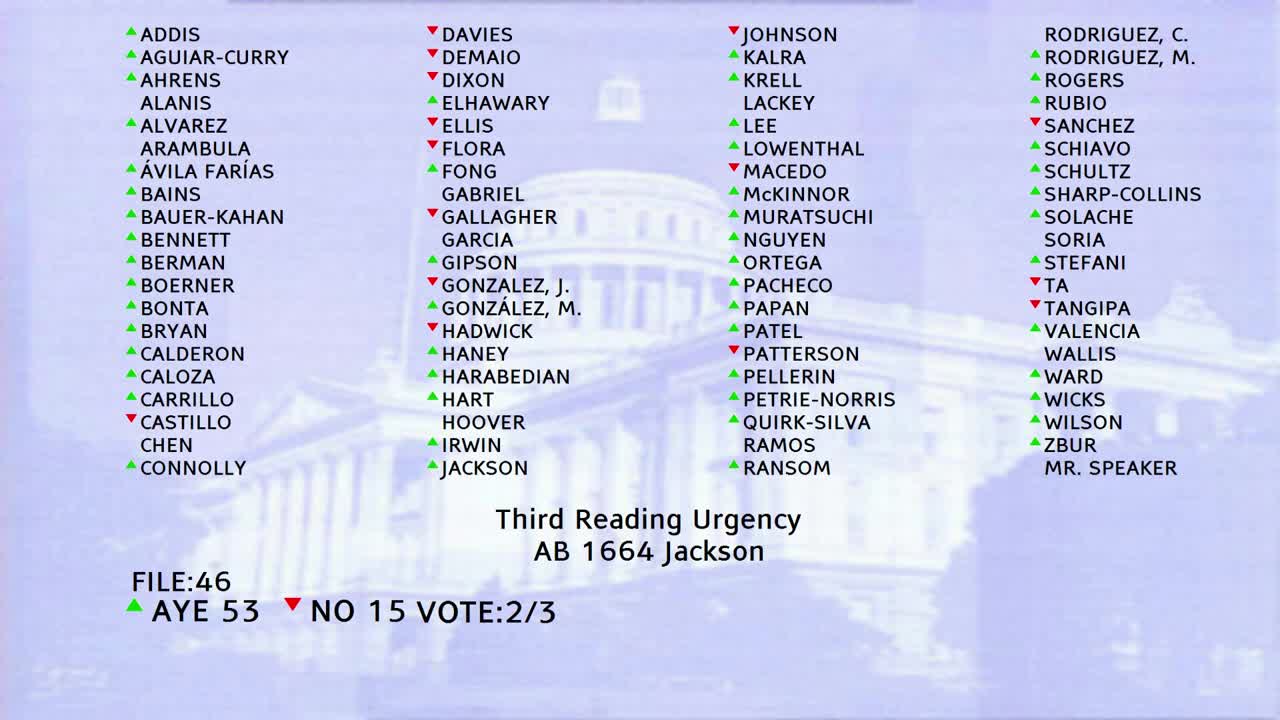 1MIN
Assembly Floor
 6MIN
Assembly Standing Committee on Business and Professions


Bill Co-Author(s):
