AB 2156: Holidays: Farmworkers Day.
- Session Year: 2025-2026
- House: Assembly
- Latest Version Date: 2026-03-26
Current Status:
Passed
(2026-03-26: Chaptered by Secretary of State - Chapter 7, Statutes of 2026.)
Introduced
In Committee
Awaiting First Chamber Vote
Passed First Chamber
In Committee
Awaiting Second Chamber Vote
Passed Second Chamber
Enacted
Existing law designates specific days as holidays in this state, including Cesar Chavez Day on March 31, and requires the Governor to annually proclaim March 31 as Cesar Chavez Day.
This bill would instead designate March 31 as Farmworkers Day and would require the Governor to annually proclaim March 31 as Farmworkers Day.
This bill would declare that it is to take effect immediately as an urgency statute.
Existing federal regulations require a state, prior to issuing a REAL ID drivers license or REAL ID identification card, to check with all other states to determine if an applicant currently holds a REAL ID drivers license or REAL ID identification card in another state. Existing law requires specified forms filed with the Department of Motor Vehicles (DMV) to contain a social security account number. Existing law provides that information provided on those forms regarding a drivers license or identification card applicants social security account number or ineligibility for a social security account number is not a public record and is not subject to disclosure by the department, except for specified reasons. This bill would expand those exceptions by permitting the DMV to disclose specified information to participate in the State-to-State Verification Service for purposes of verifying and exchanging drivers license, identification card, and driver history records with participating jurisdictions.This bill would declare that it is to take effect immediately as an urgency statute.Existing federal regulations require a state, prior to issuing a REAL ID drivers license or REAL ID identification card, to check with all other states to determine if an applicant currently holds a REAL ID drivers license or REAL ID identification card in another state. Existing law requires specified forms filed with the Department of Motor Vehicles (DMV) to contain a social security account number. Existing law provides that information provided on those forms regarding a drivers license or identification card applicants social security account number or ineligibility for a social security account number is not a public record and is not subject to disclosure by the department, except for specified reasons.
This bill would expand those exceptions by permitting the DMV to disclose specified information to participate in the State-to-State Verification Service for purposes of verifying and exchanging drivers license, identification card, and driver history records with participating jurisdictions.
This bill would declare that it is to take effect immediately as an urgency statute.
(a)The holidays in this state are:
(1)Every Sunday.
(2)January 1.
(3)The third Monday in January, known as Dr. Martin Luther King, Jr. Day.
(4)The date corresponding with the second new moon following the winter solstice, or the third new moon following the winter solstice should an intercalary month intervene, known as Lunar New Year.
(5)February 12, known as Lincoln Day.
(6)The third Monday in February.
(7)March 31, known as Farmworkers Day.
(8)April 24, known as Genocide Remembrance Day.
(9)The 15th day of the month of Kartik in the Hindu lunar calendar of each year, known as Diwali.
(10)The last Monday in May.
(11)June 19, known as Juneteenth.
(12)July 4.
(13)The first Monday in September.
(14)September 9, known as Admission Day.
(15)The fourth Friday in September, known as Native American Day.
(16)The second Monday in October, known as Columbus Day.
(17)November 11, known as Veterans Day.
(18)December 25.
(19)Good Friday from 12 noon until 3 p.m.
(20)(A)Every day appointed by the President or Governor for a public fast, thanksgiving, or holiday.
(B)Except for the Thursday in November appointed as Thanksgiving Day, this paragraph and paragraphs (3), (4), and (7) shall not apply to a city, county, or district unless made applicable by charter, or by ordinance or resolution of the governing body thereof.
(b)If this section is in conflict with the provisions of a memorandum of understanding reached pursuant to Chapter 12 (commencing with Section 3560) of Division 4 of Title 1, the memorandum of understanding shall be controlling without further legislative action, except that if those provisions of a memorandum of understanding require the expenditure of funds, the provisions shall not become effective unless approved by the Legislature in the annual Budget Act.
SEC. 2.Section 6717 of the Government Code is amended to read:6717.The Governor shall annually proclaim March 31 as Farmworkers Day.
SEC. 3.This act is an urgency statute necessary for the immediate preservation of the public peace, health, or safety within the meaning of Article IV of the California Constitution and shall go into immediate effect. The facts constituting the necessity are:
Due to the proximity of the holiday at issue for the 2026 calendar year, it is necessary for this act to take effect immediately.
(a)The holidays in this state are:
(1)Every Sunday.
(2)January 1.
(3)The third Monday in January, known as Dr. Martin Luther King, Jr. Day.
(4)The date corresponding with the second new moon following the winter solstice, or the third new moon following the winter solstice should an intercalary month intervene, known as Lunar New Year.
(5)February 12, known as Lincoln Day.
(6)The third Monday in February.
(7)March 31, known as Cesar Chavez Farmworkers Day.
(8)April 24, known as Genocide Remembrance Day.
(9)The 15th day of the month of Kartik in the Hindu lunar calendar of each year, known as Diwali.
(10)The last Monday in May.
(11)June 19, known as Juneteenth.
(12)July 4.
(13)The first Monday in September.
(14)September 9, known as Admission Day.
(15)The fourth Friday in September, known as Native American Day.
(16)The second Monday in October, known as Columbus Day.
(17)November 11, known as Veterans Day.
(18)December 25.
(19)Good Friday from 12 noon until 3 p.m.
(20)(A)Every day appointed by the President or Governor for a public fast, thanksgiving, or holiday.
(B)Except for the Thursday in November appointed as Thanksgiving Day, this paragraph and paragraphs (3), (4), and (7) shall not apply to a city, county, or district unless made applicable by charter, or by ordinance or resolution of the governing body thereof.
(b)If this section is in conflict with the provisions of a memorandum of understanding reached pursuant to Chapter 12 (commencing with Section 3560) of Division 4 of Title 1, the memorandum of understanding shall be controlling without further legislative action, except that if those provisions of a memorandum of understanding require the expenditure of funds, the provisions shall not become effective unless approved by the Legislature in the annual Budget Act.
SEC. 2.Section 6717 of the Government Code is amended to read:6717.The Governor shall annually proclaim March 31 as Cesar Chavez Farmworkers Day.
SEC. 3.This act is an urgency statute necessary for the immediate preservation of the public peace, health, or safety within the meaning of Article IV of the California Constitution and shall go into immediate effect. The facts constituting the necessity are:
Due to the proximity of the holiday at issue for the 2026 calendar year, it is necessary for this act to take effect immediately.
SECTION 1.Section 1653.5 of the Vehicle Code, as amended by Section 11 of Chapter 14 of the Statutes of 2020, is amended to read:1653.5.(a)Each form prescribed by the department for use by an applicant for the issuance or renewal by the department of a drivers license or identification card pursuant to Division 6 (commencing with Section 12500) shall contain a section for the applicants social security account number.(b)Each form prescribed by the department for use by an applicant for the issuance, renewal, or transfer of the registration or certificate of title to a vehicle shall contain a section for the applicants drivers license or identification card number.(c)Except as provided in Section 12801, a person who submits to the department a form that, pursuant to subdivision (a), contains a section for the applicants social security account number, or pursuant to subdivision (b), the applicants drivers license or identification card number, if any, shall furnish the appropriate number in the space provided.(d)Except as provided in Section 12801, the department shall not complete an application that does not include the applicants social security account number or drivers license or identification card number as required under subdivision (c).(e)An applicants social security account number shall not be included by the department on a drivers license, identification card, registration, certificate of title, or any other document issued by the department.(f)Notwithstanding any other law, information regarding an applicants social security account number, or ineligibility for a social security number, obtained by the department pursuant to this section, is not a public record and shall not be disclosed by the department except for any of the following purposes:(1)Responding to a request for information from an agency operating pursuant to, and carrying out the provisions of, Part A (Block Grants to States for Temporary Assistance for Needy Families), or Part D (Child Support and Establishment of Paternity), of Subchapter IV of Chapter 7 of Title 42 of the United States Code.(2)Implementation of Section 12419.10 of the Government Code.(3)Responding to information requests from the Franchise Tax Board for the purpose of tax administration.(4)Responding to information requests from the Employment Development Department for purposes relating to tax administration and ensuring compliance with family temporary disability insurance, unemployment compensation disability, and unemployment compensation benefit requirements.(5)(A)Participation in the State-to-State Verification Service, or any successor system, operated by the American Association of Motor Vehicle Administrators, for the sole purposes of verifying and exchanging drivers license, identification card, and driver history records with participating jurisdictions. Information disclosed pursuant to this paragraph shall only pertain to individuals who have been issued a REAL ID-compliant drivers license or identification card and only to the minimum extent necessary to comply with federal law.(B)Unless otherwise required by federal law, the department shall not disclose an applicants address, photograph, gender marker, biometric data, including, but not limited to, fingerprints, or whether the applicant holds a drivers license or identification card issued pursuant to Section 12801.9.(g)This section shall become inoperative on the effective date of a final judicial determination made by any court of appellate jurisdiction that any provision of the act that added this section, or its application, either in whole or in part, is enjoined, found unconstitutional, or held invalid for any reason. The department shall post this information on its internet website.SEC. 2.Section 1653.5 of the Vehicle Code, as amended by Section 168 of Chapter 71 of the Statutes of 2014, is amended to read:1653.5.(a)Each form prescribed by the department for use by an applicant for the issuance or renewal by the department of a drivers license or identification card pursuant to Division 6 (commencing with Section 12500) shall contain a section for the applicants social security account number.(b)Each form prescribed by the department for use by an applicant for the issuance, renewal, or transfer of the registration or certificate of title to a vehicle shall contain a section for the applicants drivers license or identification card number.(c)A person who submits to the department a form that, pursuant to subdivision (a), contains a section for the applicants social security account number, or pursuant to subdivision (b), the applicants drivers license or identification card number, if any, shall furnish the appropriate number in the space provided.(d)The department shall not complete an application that does not include the applicants social security account number or drivers license or identification card number as required under subdivision (c).(e)An applicants social security account number shall not be included by the department on a drivers license, identification card, registration, certificate of title, or any other document issued by the department.(f)Notwithstanding any other law, information regarding an applicants social security account number, obtained by the department pursuant to this section, is not a public record and shall not be disclosed by the department except for any of the following purposes:(1)Responding to a request for information from an agency operating pursuant to, and carrying out the provisions of, Part A (Block Grants to States for Temporary Assistance for Needy Families), or Part D (Child Support and Establishment of Paternity), of Subchapter IV of Chapter 7 of Title 42 of the United States Code.(2)Implementation of Section 12419.10 of the Government Code.(3)Responding to information requests from the Franchise Tax Board for the purpose of tax administration.(4)Responding to information requests from the Employment Development Department for purposes relating to tax administration and ensuring compliance with family temporary disability insurance, unemployment compensation disability, and unemployment compensation benefit requirements.(5)(A)Participation in the State-to-State Verification Service, or any successor system, operated by the American Association of Motor Vehicle Administrators, for the sole purposes of verifying and exchanging drivers license, identification card, and driver history records with participating jurisdictions. Information disclosed pursuant to this paragraph shall only pertain to individuals who have been issued a REAL ID-compliant drivers license or identification card and only to the minimum extent necessary to comply with federal law.(B)Unless otherwise required by federal law, the department shall not disclose an applicants address, photograph, gender marker, biometric data, including, but not limited to, fingerprints, or whether the applicant holds a drivers license or identification card issued pursuant to Section 12801.9.(g)This section shall become operative on the effective date of a final judicial determination made by any court of appellate jurisdiction that any provision of the act that added this section, or its application, either in whole or in part, is enjoined, found unconstitutional, or held invalid for any reason. The department shall post this information on its internet website.SEC. 3.This act is an urgency statute necessary for the immediate preservation of the public peace, health, or safety within the meaning of Article IV of the California Constitution and shall go into immediate effect. The facts constituting the necessity are:In order to implement provisions of the Budget Act of 2025 relating to the Department of Motor Vehicles and the State-to-State Verification Service, it is necessary that this act go into immediate effect.(a)Each form prescribed by the department for use by an applicant for the issuance or renewal by the department of a drivers license or identification card pursuant to Division 6 (commencing with Section 12500) shall contain a section for the applicants social security account number.
(b)Each form prescribed by the department for use by an applicant for the issuance, renewal, or transfer of the registration or certificate of title to a vehicle shall contain a section for the applicants drivers license or identification card number.
(c)Except as provided in Section 12801, a person who submits to the department a form that, pursuant to subdivision (a), contains a section for the applicants social security account number, or pursuant to subdivision (b), the applicants drivers license or identification card number, if any, shall furnish the appropriate number in the space provided.
(d)Except as provided in Section 12801, the department shall not complete an application that does not include the applicants social security account number or drivers license or identification card number as required under subdivision (c).
(e)An applicants social security account number shall not be included by the department on a drivers license, identification card, registration, certificate of title, or any other document issued by the department.
(f)Notwithstanding any other law, information regarding an applicants social security account number, or ineligibility for a social security number, obtained by the department pursuant to this section, is not a public record and shall not be disclosed by the department except for any of the following purposes:
(1)Responding to a request for information from an agency operating pursuant to, and carrying out the provisions of, Part A (Block Grants to States for Temporary Assistance for Needy Families), or Part D (Child Support and Establishment of Paternity), of Subchapter IV of Chapter 7 of Title 42 of the United States Code.
(2)Implementation of Section 12419.10 of the Government Code.
(3)Responding to information requests from the Franchise Tax Board for the purpose of tax administration.
(4)Responding to information requests from the Employment Development Department for purposes relating to tax administration and ensuring compliance with family temporary disability insurance, unemployment compensation disability, and unemployment compensation benefit requirements.
(5)(A)Participation in the State-to-State Verification Service, or any successor system, operated by the American Association of Motor Vehicle Administrators, for the sole purposes of verifying and exchanging drivers license, identification card, and driver history records with participating jurisdictions. Information disclosed pursuant to this paragraph shall only pertain to individuals who have been issued a REAL ID-compliant drivers license or identification card and only to the minimum extent necessary to comply with federal law.
(B)Unless otherwise required by federal law, the department shall not disclose an applicants address, photograph, gender marker, biometric data, including, but not limited to, fingerprints, or whether the applicant holds a drivers license or identification card issued pursuant to Section 12801.9.
(g)This section shall become inoperative on the effective date of a final judicial determination made by any court of appellate jurisdiction that any provision of the act that added this section, or its application, either in whole or in part, is enjoined, found unconstitutional, or held invalid for any reason. The department shall post this information on its internet website.
SEC. 2.Section 1653.5 of the Vehicle Code, as amended by Section 168 of Chapter 71 of the Statutes of 2014, is amended to read:1653.5.(a)Each form prescribed by the department for use by an applicant for the issuance or renewal by the department of a drivers license or identification card pursuant to Division 6 (commencing with Section 12500) shall contain a section for the applicants social security account number.
(b)Each form prescribed by the department for use by an applicant for the issuance, renewal, or transfer of the registration or certificate of title to a vehicle shall contain a section for the applicants drivers license or identification card number.
(c)A person who submits to the department a form that, pursuant to subdivision (a), contains a section for the applicants social security account number, or pursuant to subdivision (b), the applicants drivers license or identification card number, if any, shall furnish the appropriate number in the space provided.
(d)The department shall not complete an application that does not include the applicants social security account number or drivers license or identification card number as required under subdivision (c).
(e)An applicants social security account number shall not be included by the department on a drivers license, identification card, registration, certificate of title, or any other document issued by the department.
(f)Notwithstanding any other law, information regarding an applicants social security account number, obtained by the department pursuant to this section, is not a public record and shall not be disclosed by the department except for any of the following purposes:
(1)Responding to a request for information from an agency operating pursuant to, and carrying out the provisions of, Part A (Block Grants to States for Temporary Assistance for Needy Families), or Part D (Child Support and Establishment of Paternity), of Subchapter IV of Chapter 7 of Title 42 of the United States Code.
(2)Implementation of Section 12419.10 of the Government Code.
(3)Responding to information requests from the Franchise Tax Board for the purpose of tax administration.
(4)Responding to information requests from the Employment Development Department for purposes relating to tax administration and ensuring compliance with family temporary disability insurance, unemployment compensation disability, and unemployment compensation benefit requirements.
(5)(A)Participation in the State-to-State Verification Service, or any successor system, operated by the American Association of Motor Vehicle Administrators, for the sole purposes of verifying and exchanging drivers license, identification card, and driver history records with participating jurisdictions. Information disclosed pursuant to this paragraph shall only pertain to individuals who have been issued a REAL ID-compliant drivers license or identification card and only to the minimum extent necessary to comply with federal law.
(B)Unless otherwise required by federal law, the department shall not disclose an applicants address, photograph, gender marker, biometric data, including, but not limited to, fingerprints, or whether the applicant holds a drivers license or identification card issued pursuant to Section 12801.9.
(g)This section shall become operative on the effective date of a final judicial determination made by any court of appellate jurisdiction that any provision of the act that added this section, or its application, either in whole or in part, is enjoined, found unconstitutional, or held invalid for any reason. The department shall post this information on its Internet Web site. internet website.
SEC. 3.This act is an urgency statute necessary for the immediate preservation of the public peace, health, or safety within the meaning of Article IV of the California Constitution and shall go into immediate effect. The facts constituting the necessity are:
In order to implement provisions of the Budget Act of 2025 relating to the Department of Motor Vehicles and the State-to-State Verification Service, it is necessary that this act go into immediate effect.
|
Date
|
Status
|
|---|---|
| Mar 26, 2026 | Chaptered by Secretary of State - Chapter 7, Statutes of 2026. |
| Mar 26, 2026 | Approved by the Governor. |
| Mar 26, 2026 | Enrolled and presented to the Governor at 11:45 a.m. |
| Mar 26, 2026 | In Assembly. Ordered to Engrossing and Enrolling. |
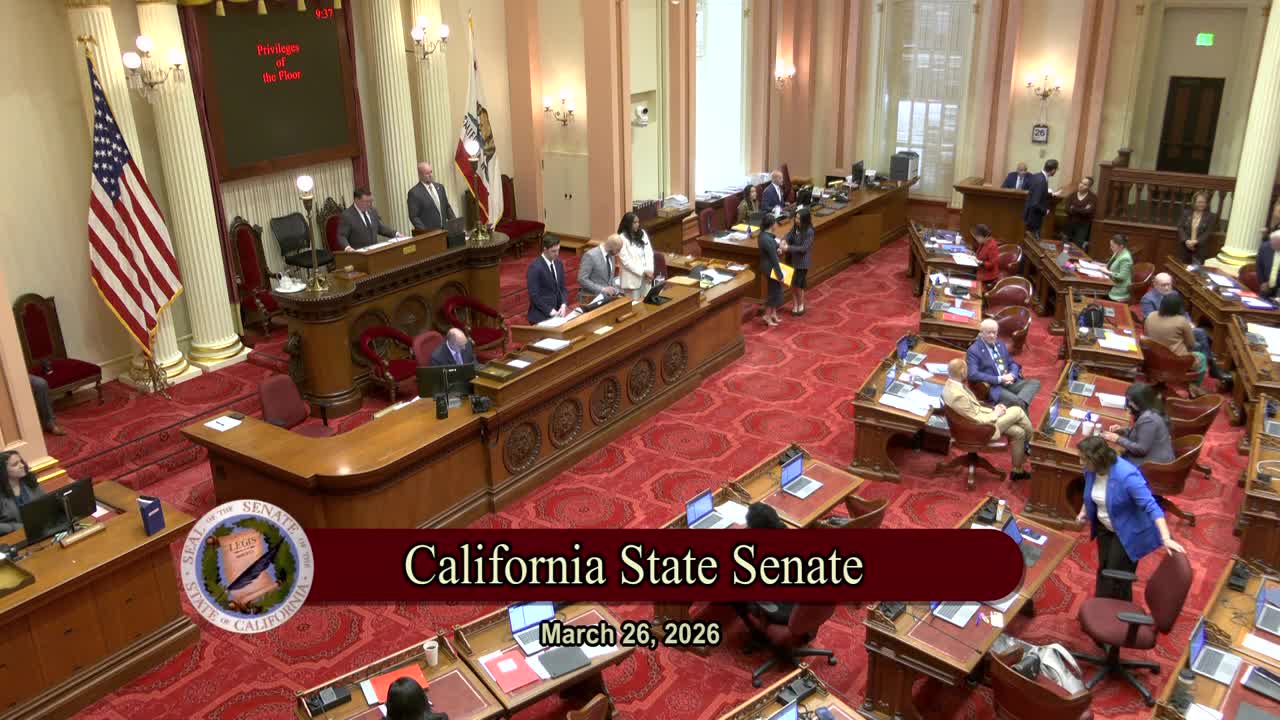
| Mar 26, 2026 | Read third time. Urgency clause adopted. Passed. Ordered to the Assembly. (Ayes 37. Noes 0. Page 3698.). |
| Mar 26, 2026 | Read third time. Urgency clause adopted. Passed. Ordered to the Assembly. (Ayes 37. Noes 0.). |
| Mar 25, 2026 | Read second time. Ordered to third reading. |
| Mar 24, 2026 | From committee: Do pass. (Ayes 14. Noes 0.) (March 24). |
| Mar 23, 2026 | Joint Rule 62(a) suspended. (Page 3636.) |
| Mar 23, 2026 | Referred to Com. on G.O. |
| Mar 23, 2026 | Joint Rule 62(a) suspended. |
| Mar 23, 2026 | In Senate. Read first time. To Com. on RLS. for assignment. |
| Mar 23, 2026 | Assembly Rule 63 suspended. (Page 4368.) |
| Mar 23, 2026 | Assembly Rule 96 suspended. (Page 4368.) |
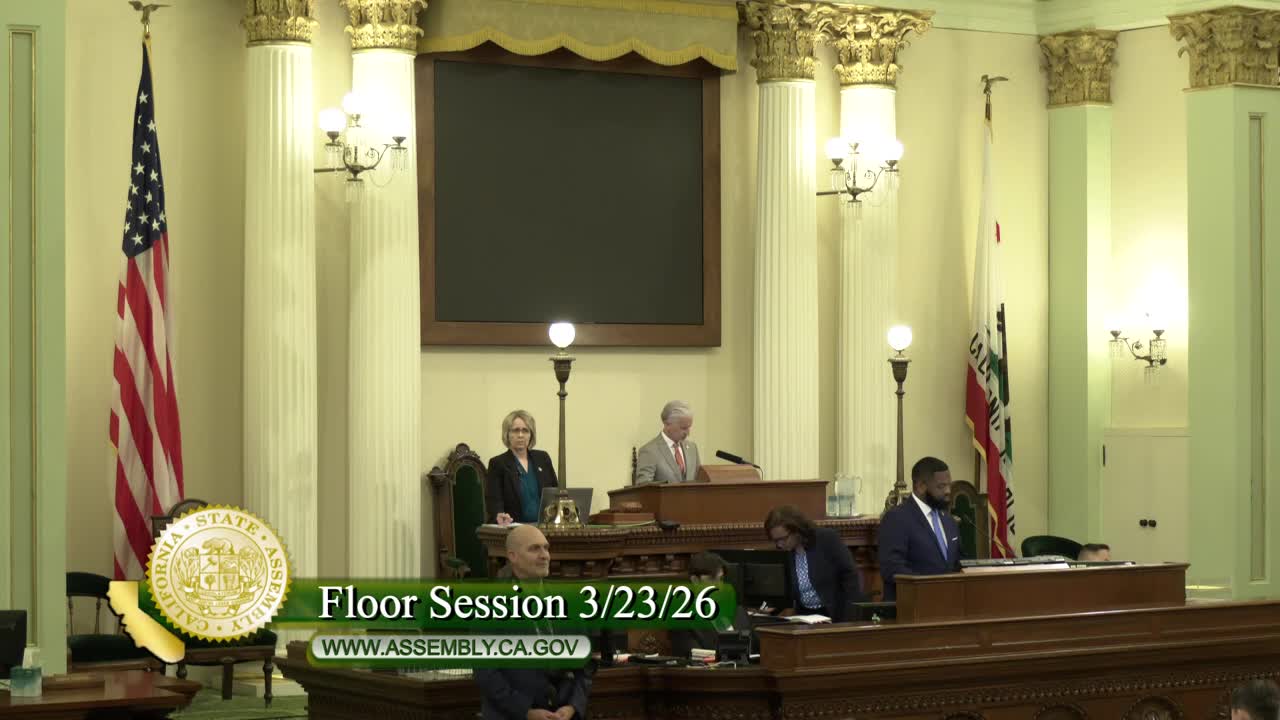
| Mar 23, 2026 | Read third time. Urgency clause adopted. Passed. Ordered to the Senate. (Ayes 70. Noes 0. Page 4374.). |
| Mar 23, 2026 | Read third time. Urgency clause adopted. Passed. Ordered to the Senate. (Ayes 70. Noes 0.). |
| Mar 23, 2026 | Ordered to third reading. |
| Mar 23, 2026 | Withdrawn from committee. |
| Mar 23, 2026 | Assembly Rule 63 suspended. |
| Mar 23, 2026 | Assembly Rule 96 suspended. |
| Mar 23, 2026 | Re-referred to Com. on TRANS. |
| Mar 20, 2026 | From committee chair, with author's amendments: Amend, and re-refer to Com. on TRANS. Read second time and amended. |
| Mar 9, 2026 | Referred to Coms. on TRANS. and P. & C.P. |
| Feb 19, 2026 | From printer. May be heard in committee March 21. |
| Feb 18, 2026 | Read first time. To print. |
|
Date
|
Description
|
Location
|
Votes
|
|
|---|---|---|---|---|
| Mar 26, 2026 | Assembly 3rd Reading AB2156 Rivas et al. By Limón Urgency Clause | Senate Floor |
Passed |
|
| Mar 24, 2026 | Do pass | Senate Standing Committee on Governmental Organization |
Passed |
|
| Mar 23, 2026 | AB 2156 RIVAS Third Reading Urgency By AGUIAR-CURRY | Assembly Floor |
Passed |
This list shows positions taken on this bill by organizations on the date displayed, which is linked to the original source.
Positions by individuals are not included.
|
Organization
|
Position
|
Date
|
|---|---|---|
| California Federation Of Teachers | ** Support | |
| Eleni Kounalakis, Lieutenant Governor | ** Support |
SENATE RULES COMMITTEE Office of Senate Floor Analyses (916) 651-4171 | AB 2156 |
THIRD READING
Bill No: AB 2156
Author: Rivas (D) and Limón (D), et al.
Amended: 3/20/26 in Assembly
Vote: 27 - Urgency
SENATE GOVERNMENTAL ORG. COMMITTEE: 14-0, 3/24/26
AYES: Rubio, Valladares, Alvarado-Gil, Archuleta, Blakespear, Cervantes, Dahle, Hurtado, Ochoa Bogh, Padilla, Richardson, Smallwood-Cuevas, Wahab, Weber Pierson
NO VOTE RECORDED: Ashby
ASSEMBLY FLOOR: 70-0, 3/23/26 - See last page for vote
SUBJECT: Holidays: Farmworkers Day
SOURCE: Author
DIGEST:
This bill designates March 31 as Farmworkers Day and requires the Governor to annually proclaim March 31 as Farmworkers Day.
ANALYSIS:
Existing law:
- Recognizes various state holidays including:
- January 1st (New Year);
- Third Monday in January (Dr. Martin Luther King, Jr. Day);
- February 12th (Lincoln Day);
- Third Monday in February (Washington Day);
- March 31st (Cesar Chavez);
- April 24, known as “Genocide Remembrance Day”;
- Last Monday in May (Memorial Day);
- June 19, known as “Juneteenth;”
- July 4th;
- September 9 (Admission day);
- Fourth Friday in September (Native American Day);
- Second Monday in October (Columbus Day);
- November 11th (Veterans Day);
- December 25th;
- Good Friday from 12 noon until 3 p.m.
- Specifies that if the above holidays are in conflict with the provisions of a memorandum of understanding, the memorandum of understanding shall be controlling without further legislative action.
- Designates August 26 of each year as California Farmworker Day and requires the Governor to annually proclaim August 26 as California Farmworker Day.
This bill:
- Deletes the designation of March 31 as Cesar Chavez Day and instead designates March 31 as Farmworkers Day.
- Deletes the Requirement that the Governor proclaim March 31 as Cesar Chavez Day and instead requires the Governor to proclaim March 31 as Farmworkers Day.
- Contains an urgency.
Background
Author’s Statement. According to the Author’s office, “the farmworkers rights movement has been rooted in the lasting values of dignity and justice. To honor the movement’s rich California history and the steadfast dedication behind it, we are putting forward legislation to designate the following 2026 state holiday in California as Farmworkers Day.”
New York Times Investigation. On March 18, 2026, the New York Times published the results of an investigation that outlined a series of allegations against César Chávez describing a pattern of sexual abuse and misconduct during his time as leader in the farmworker movement. According to the report, Chávez allegedly abused at least two young girls in the 1970s. One account describes inappropriate contact when the young girl was around 12 years old, followed by rape at age 15. Another young girl described repeated sexual encounters over several years starting when the girl was about 13 years old.
Among the most significant accounts are allegations from Dolores Huerta, co-founder of what eventually became the Farmworkers Union, who issued a public statement in response to the report by The New York Times. In her statement, Dolores Huerta confirmed that she experienced sexual coercion by Chávez in the 1960s. She described that Chávez exerted power and control over her in ways that led to nonconsensual encounters resulting in two pregnancies. Dolores Huerta framed her experience in terms of survival rather than victimhood, stating that she now understands herself “as a survivor” of abuse and coercion, and emphasizing that power dynamics and loyalty to the farmworker movement contributed to her decision not to report earlier. In her own words, Dolores Huerta wrote:
I have never identified myself as a victim, but now I understand that I am a survivor – of violence, sexual abuse, of domineering men who saw me, and other women, as property, of things to control. The knowledge that he hurt young girls sickens me. My heart aches for everyone who suffered alone and in silence for years. There are no words strong enough to condemn those deplorable actions [Chávez] did. Cesar’s actions do not reflect the values of our community and movement. The farmworker movement has always been bigger and far more important than any one individual I have kept this secret long enough. My silence ends here.
Advocate Response. Following these allegations, advocates have emphasized that listening to survivors, believing their accounts, and offering meaningful support can play a critical role in the healing process. In public statements, the Rape, Abuse, & Incest National Network (RAINN), describes the allegations as “grave and deeply distressing” noting that when prominent figures are accused of such profound betrayals of trust, the effects can reverberate across entire communities and may retraumatize survivors of sexual violence.
RAINN further underscored and reminded the public that there is no “right’ time or “standard way” for a survivor to come forward. The organization emphasized that survivors, “cite personal or family reasons for not disclosing rape, and others are deterred by the stigma they perceive within their community or because they fear the outcome of reporting. The calculus is even harder when the person who committed the rape is such a prominent figure, which can lead survivors to fear they will not be believed or will be blamed for bringing down someone who is admired in their community. Ultimately, we need to trust survivors to make the decision that is right for them.”
Response by State and Local Jurisdictions. In response to allegations involving César Chávez, states and local jurisdictions—particularly across California and the Southwest—have undertaken a range of actions that reflect both immediate responses and long-term considerations regarding the commemoration of Chávez’s legacy. In the short term, several jurisdictions have canceled or suspended official César Chávez Day events, while government leaders and organizations have issued statements emphasizing support for survivors.
Concurrently, several state and local governments are pursuing or considering the renaming of César Chávez Day to more broadly honor farmworkers, with legislative proposals and executive actions already underway in some areas. For example, the City of Los Angeles issued a proclamation to rename the holiday to Farmworkers Day, reflecting a broader commemorative focus.
At the local level, cities have begun evaluating and, in some cases, removing Chávez’s name from public spaces, including streets, parks, schools, and civic buildings, as well as taking down statues, murals, and other commemorative displays. For example, the City of Fresno voted to restore original street names, reversing a prior renaming to “César Chávez Boulevard.”
Beyond these immediate and symbolic responses, institutions such as museums, universities, and state agencies are engaging in broader cultural and historical reassessments, reconsidering how Chávez is represented in educational materials and public exhibits. Collectively, these actions seem to reflect a shift toward recognizing the broader farmworker movement while reevaluating the role of individual figures within it.
Farmworkers in California. With approximately $50 billion in agricultural annual revenue, California is the leading agricultural state in the United States. California produces more than 350 commodities; including about one-third of the nation’s vegetables and nearly two-thirds of the nation’s fruits and nuts.
According to the Center for Farmworker Families, between one-third to one-half of all farmworkers in the United States reside in California, or approximately 500,000-800,000 farmworkers. The Salinas Valley, the “Salad Bowl of the Nation,” employs more than 50,000 farmworkers. However, this number could be much higher given the difficulty with tracking data on immigrant farmworkers. Approximately 75% of all farmworkers in California are undocumented. Roughly, one-third of farmworkers are women.
According to the U.S. Bureau of Labor statistics, agriculture is considered one of the most dangerous industries in the nation. Common injuries involve exposure to the elements, health-related symptoms related to pesticide exposure in both farmworkers and their children, and farm equipment injuries. Even though farmworkers work in one of the most dangerous industries, they receive very little benefits and protections.
Related/Prior Legislation
AB 268 (Kalra, Chapter 358, Statutes of 2025) added Diwali to the list of state holidays, and authorizes public schools and state employees to take certain type of leave in recognition of Diwali, as specified.
SB 721 (Hueso, Chapter 496, Statutes of 2021) designates August 26 of each year as California Farmworker Day and requires the Governor to annually proclaim August 26 as California Farmworker Day.
AB 1655 (Jones-Sawyer, Chapter 753, Statutes of 2022) adds June 19, known as “Juneteenth,” to the list of state holidays and authorize state employees to elect to take time off with pay in recognition of Juneteenth, as specified.
AB 2644 (Reyes, Chapter 130, Statutes of 2018) requires the Governor to annually proclaim April 10 as Dolores Huerta Day, set apart that date as a date having special significance, and encouraged all public schools and educational institutions to conduct exercises remembering the life of Dolores Huerta.
AB 7 (Bonta, Chapter 29, Statutes of 2015) requires the Governor to annually proclaim October 25 as Larry Itliong Day, designated that date each year as having special significance, and encouraged all public schools and educational institutions to conduct exercises remembering the life of Larry Itliong and the contributions he made to the state.
SB 984 (Polanco, Chapter 213, Statutes of 2000) established a paid holiday for state employees each March 31, which would be designated as “Cesar Chavez Day.”
SB 1373 (Torres, Chapter 1011, Statutes of 1994) requires the Governor to annually proclaim March 31 as Cesar Chavez Day, and included March 31, known as Cesar Chavez Day, in the list of state holidays.
FISCAL EFFECT: Appropriation: No Fiscal Com.: No Local: No
SUPPORT: (Verified 3/24/26)
California Federation of Teachers
Eleni Kounalakis, Lieutenant Governor
OPPOSITION: (Verified 3/24/26)
None received
ASSEMBLY FLOOR: 70-0, 3/23/26
AYES: Addis, Aguiar-Curry, Ahrens, Alanis, Alvarez, Arambula, Ávila Farías, Bains, Bennett, Berman, Boerner, Bryan, Caloza, Carrillo, Castillo, Chen, Connolly, Davies, DeMaio, Dixon, Ellis, Flora, Fong, Gabriel, Gallagher, Garcia, Gipson, Jeff Gonzalez, Mark González, Haney, Harabedian, Hart, Hoover, Irwin, Jackson, Johnson, Kalra, Krell, Lackey, Lowenthal, Macedo, McKinnor, Muratsuchi, Nguyen, Ortega, Pacheco, Papan, Patel, Patterson, Pellerin, Petrie-Norris, Ransom, Michelle Rodriguez, Rogers, Blanca Rubio, Sanchez, Schultz, Sharp-Collins, Solache, Soria, Stefani, Ta, Tangipa, Valencia, Wallis, Ward, Wicks, Wilson, Zbur, Rivas
NO VOTE RECORDED: Bauer-Kahan, Bonta, Calderon, Elhawary, Hadwick, Lee, Quirk-Silva, Ramos, Celeste Rodriguez, Schiavo
Prepared by: Felipe Lopez / G.O. / (916) 651-1530
3/25/26 16:17:24
**** END ****
(Without Reference to File)
ASSEMBLY THIRD READING
ATR Bill Id:AB 2156
Author:(Rivas and Limón)
As Amended Ver:March 20, 2026
2/3 vote. Urgency
SUMMARY
This bill would designate March 31 as "Farmworkers Day," a state holiday, and require the Governor to annually proclaim March 31 as "Farmworkers Day."
Major Provisions
1) Changes Section 6700 of the Government Code that designates specific days as holidays in this state to declare that March 31, shall be known as Farmworkers Day.
2) Deletes the requirement that the Governor proclaim March 31 as Cesar Chavez Day and instead requires the Governor to proclaim March 31 as Farmworkers Day.
3) Contains an urgency clause.
4) Adds Coauthors.
1) Recognizes various state holidays including: January 1st (New Year); Third Monday in January (Dr. Martin Luther King, Jr. Day); February 12th (Lincoln Day); Third Monday in February (Washington Day); March 31st (Cesar Chavez Day); April 24 (known as "Genocide Remembrance Day"); The 15th day of the month of Kartik in the Hindu lunar calendar of each year (known as "Diwali"); Last Monday in May (Memorial Day); June 19, (known as "Juneteenth"); July 4th; September 9 (Admission Day); Fourth Friday in September (Native American Day); Second Monday in October (Columbus Day); November 11th (Veterans Day); December 25th; Good Friday from 12 noon until 3 p.m. (Section 6700, Gov. Code)
2) Entitles state employees to the following holidays: January 1, the third Monday in January, the third Monday in February, March 31, the last Monday in May, July 4, the first Monday in September, November 11, Thanksgiving Day, the day after Thanksgiving, December 25, the day chosen by an employee pursuant to Section 19854. Gov. Code ("Personal Holiday"), and every day appointed by the Governor of this state for a public fast, thanksgiving, or holiday. (Section 19853 (a), Gov. Code)
3) Authorizes a state employee to elect to receive holiday credit to observe their religion, culture, or heritage, among other provisions, including those relating to collective bargaining. (Section 19853.2, Gov. Code)
4) Provides the Governor shall annually proclaim March 31 as "Cesar Chavez Day." (Section 6717 Gov. Code)
COMMENTS
The measure is scheduled to take effect immediately before the 2026 holiday. The bill would rename the current César Chávez state holiday to Farmworkers Day, following a recent New York Times investigative article detailing allegations of sexual abuse and misconduct against Chávez during his leadership in the farmworker movement. Supporters of the change note that this bill will shift recognition from an individual to the broader farmworker movement.
Farmworkers in California. With approximately $50 billion in annual agricultural revenue, California is the leading agricultural state in the United States. The state produces more than 350 commodities, including about one-third of the nation's vegetables and nearly two-thirds of its fruits and nuts.
According to the Center for Farmworker Families, between one-third and one-half of all farmworkers in the United States reside in California—an estimated 500,000 to 800,000 farmworkers. The Salinas Valley, often referred to as the "Salad Bowl of the Nation," alone employs more than 50,000 farmworkers. However, this number may be significantly higher due to the challenges of accurately tracking immigrant farmworker populations.
According to the U.S. Bureau of Labor Statistics, agriculture is one of the most dangerous industries in the nation. Common risks include exposure to extreme weather conditions, health issues related to pesticide exposure affecting both farmworkers and their children, and injuries from farm equipment. Despite working in such hazardous conditions, farmworkers often receive minimal benefits and protections.
According to the Author
The author states that "The farmworkers rights movement has been rooted in the lasting values of dignity and justice. To honor the movement's rich California history and the steadfast dedication behind it, we are putting forward legislation to designate the following 2026 state holiday in California as Farmworkers Day."
Arguments in Support
CFT — A Union of Educators & Classified Professionals writes, "Farmworkers are an essential workforce. They feed not only our communities across the state but the entire nation with essential food. Food is harvested in treacherous heat conditions, or without regard to air quality from fires or pesticides. Workers fought for union contracts requiring basic human needs such as rest periods, toilets in the fields, clean drinking water, hand washing facilities, protective clothing against pesticide exposure, banning pesticide straying while workers are in the fields, outlawing DDT [dichlorodiphenyltrichloroethane] and other dangerous pesticides, lengthening pesticide re-entry periods beyond state and federal standards, and requiring the testing of farm workers on a regular basis to monitor for pesticide exposure. For these reasons, it is incredibly appropriate to recognize the work, the struggle, and the humanity of farmworkers with a state holiday."
Arguments in Opposition
None on file
FISCAL COMMENTS
This bill is keyed non-fiscal by Legislative Counsel.
VOTES
Votes are not relevant.
UPDATED
VERSION: March 20, 2026
CONSULTANT: Eric Johnson / G.O. / (916) 319-2531 FN: 0002316
SENATE COMMITTEE ON GOVERNMENTAL ORGANIZATION
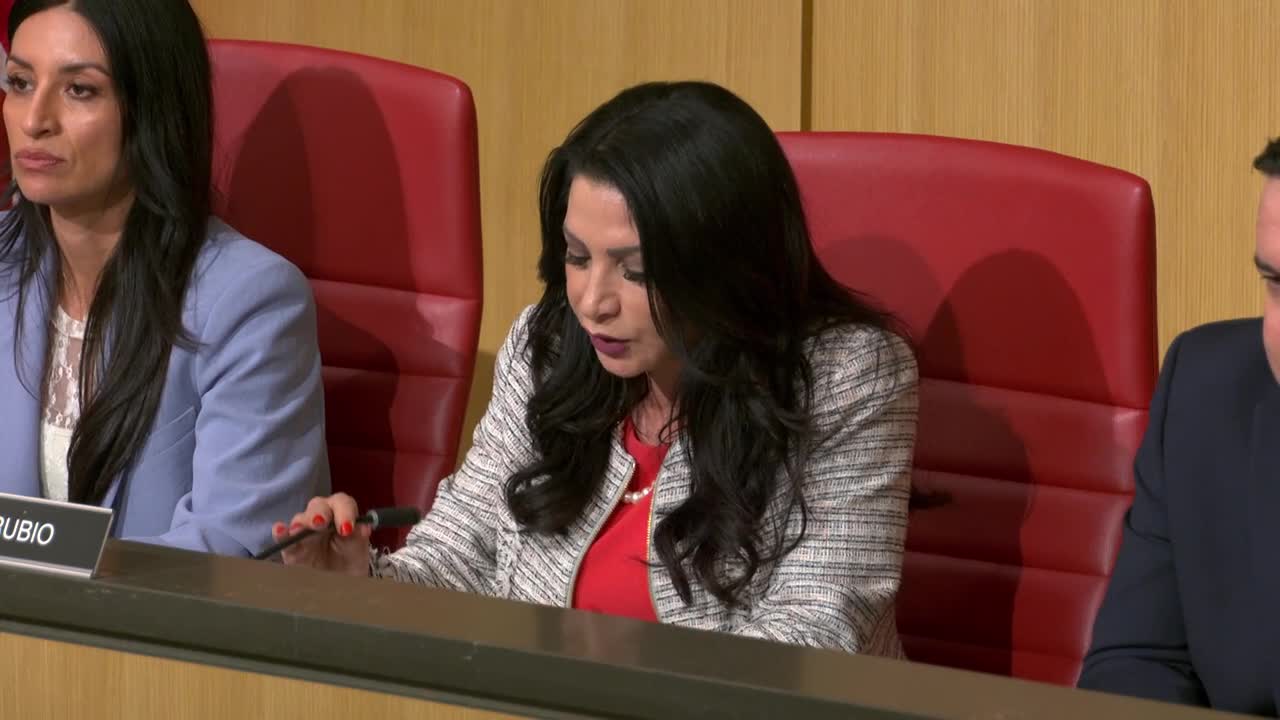
Senator Susan Rubio
Chair
2025 - 2026 Regular
Bill No: Hearing Date: 3/24/2026
Author: | and Limón, et al. | ||
Version: | Amended | ||
Urgency: | Fiscal: | ||
Consultant: | |||
SUBJECT:
DIGEST: This bill designates March 31 as Farmworkers Day and requires the Governor to annually proclaim March 31 as Farmworkers Day.
ANALYSIS:
Existing law:
- Recognizes various state holidays including:
- January 1st (New Year);
- Third Monday in January (Dr. Martin Luther King, Jr. Day);
- February 12th (Lincoln Day);
- Third Monday in February (Washington Day);
- March 31st (Cesar Chavez);
- April 24, known as “Genocide Remembrance Day”;
- Last Monday in May (Memorial Day);
- June 19, known as “Juneteenth;”
- July 4th;
- September 9 (Admission day);
- Fourth Friday in September (Native American Day);
- Second Monday in October (Columbus Day);
- November 11th (Veterans Day);
- December 25th;
- Good Friday from 12 noon until 3 p.m.
- Specifies that if the above holidays are in conflict with the provisions of a memorandum of understanding, the memorandum of understanding shall be controlling without further legislative action.
- Designates August 26 of each year as California Farmworker Day and requires the Governor to annually proclaim August 26 as California Farmworker Day.
- Adopts state holidays as judicial holidays, with certain exceptions, including Admission Day and Columbus day.
This bill:
- Deletes the designation of March 31 as Cesar Chavez Day and instead designates March 31 as Farmworkers Day.
- Deletes the Requirement that the Governor proclaim March 31 as Cesar Chavez Day and instead requires the Governor to proclaim March 31 as Farmworkers Day.
- Contains an urgency.
Background
Author’s Statement. According to the Author’s office, “the farmworkers rights movement has been rooted in the lasting values of dignity and justice. To honor the movement’s rich California history and the steadfast dedication behind it, we are putting forward legislation to designate the following 2026 state holiday in California as Farmworkers Day.”
New York Times Investigation. On March 18, 2026, the New York Times published the results of an investigation that outlined a series of allegations against César Chávez describing a pattern of sexual abuse and misconduct during his time as leader in the farmworker movement. According to the report, Chávez allegedly abused at least two young girls in the 1970s. One account describes inappropriate contact when the young girl was around 12 years old, followed by rape at age 15. Another young girl described repeated sexual encounters over several years starting when the girl was about 13 years old.
Among the most significant accounts are allegations from Dolores Huerta, co-founder of what eventually became the Farmworkers Union, who issued a public statement in response to the report by The New York Times. In her statement, Dolores Huerta confirmed that she experienced sexual coercion by Chávez in the 1960s. She described that Chávez exerted power and control over her in ways that led to nonconsensual encounters resulting in two pregnancies. Dolores Huerta framed her experience in terms of survival rather than victimhood, stating that she now understands herself “as a survivor” of abuse and coercion, and emphasizing that power dynamics and loyalty to the farmworker movement contributed to her decision not to report earlier. In her own words, Dolores Huerta wrote:
I have never identified myself as a victim, but now I understand that I am a survivor – of violence, sexual abuse, of domineering men who saw me, and other women, as property, of things to control. The knowledge that he hurt young girls sickens me. My heart aches for everyone who suffered alone and in silence for years. There are no words strong enough to condemn those deplorable actions [Chávez] did. Cesar’s actions do not reflect the values of our community and movement. The farmworker movement has always been bigger and far more important than any one individual I have kept this secret long enough. My silence ends here.
Advocate Response. Following these allegations, advocates have emphasized that listening to survivors, believing their accounts, and offering meaningful support can play a critical role in the healing process. In public statements, the Rape, Abuse, & Incest National Network (RAINN), describes the allegations as “grave and deeply distressing” noting that when prominent figures are accused of such profound betrayals of trust, the effects can reverberate across entire communities and may retraumatize survivors of sexual violence.
RAINN further underscored and reminded the public that there is no “right’ time or “standard way” for a survivor to come forward. The organization emphasized that survivors, “cite personal or family reasons for not disclosing rape, and others are deterred by the stigma they perceive within their community or because they fear the outcome of reporting. The calculus is even harder when the person who committed the rape is such a prominent figure, which can lead survivors to fear they will not be believed or will be blamed for bringing down someone who is admired in their community. Ultimately, we need to trust survivors to make the decision that is right for them.”
Response by State and Local Jurisdictions. In response to allegations involving César Chávez, states and local jurisdictions—particularly across California and the Southwest—have undertaken a range of actions that reflect both immediate responses and long-term considerations regarding the commemoration of Chávez’s legacy. In the short term, several jurisdictions have canceled or suspended official César Chávez Day events, while government leaders and organizations have issued statements emphasizing support for survivors.
Concurrently, several state and local governments are pursuing or considering the renaming of César Chávez Day to more broadly honor farmworkers, with legislative proposals and executive actions already underway in some areas. For example, the City of Los Angeles issued a proclamation to rename the holiday to Farmworkers Day, reflecting a broader commemorative focus.
At the local level, cities have begun evaluating and, in some cases, removing Chávez’s name from public spaces, including streets, parks, schools, and civic buildings, as well as taking down statues, murals, and other commemorative displays. For example, the City of Fresno voted to restore original street names, reversing a prior renaming to “César Chávez Boulevard.”
Beyond these immediate and symbolic responses, institutions such as museums, universities, and state agencies are engaging in broader cultural and historical reassessments, reconsidering how Chávez is represented in educational materials and public exhibits. Collectively, these actions seem to reflect a shift toward recognizing the broader farmworker movement while reevaluating the role of individual figures within it.
Farmworkers in California. With approximately $50 billion in agricultural annual revenue, California is the leading agricultural state in the United States. California produces more than 350 commodities; including about one-third of the nation’s vegetables and nearly two-thirds of the nation’s fruits and nuts.
According to the Center for Farmworker Families, between one-third to one-half of all farmworkers in the United States reside in California, or approximately 500,000-800,000 farmworkers. The Salinas Valley, the “Salad Bowl of the Nation,” employs more than 50,000 farmworkers. However, this number could be much higher given the difficulty with tracking data on immigrant farmworkers. Approximately 75% of all farmworkers in California are undocumented. Roughly, one-third of farmworkers are women.
According to the U.S. Bureau of Labor statistics, agriculture is considered one of the most dangerous industries in the nation. Common injuries involve exposure to the elements, health-related symptoms related to pesticide exposure in both farmworkers and their children, and farm equipment injuries. Even though farmworkers work in one of the most dangerous industries, they receive very little benefits and protections.
Prior/Related Legislation
AB 268 (Kalra, Chapter 358, Statutes of 2025) added Diwali to the list of state holidays, and authorizes public schools and state employees to take certain type of leave in recognition of Diwali, as specified.
SB 721 (Hueso, Chapter 496, Statutes of 2021) designates August 26 of each year as California Farmworker Day and requires the Governor to annually proclaim August 26 as California Farmworker Day.
AB 1655 (Jones-Sawyer, Chapter 753, Statutes of 2022) adds June 19, known as “Juneteenth,” to the list of state holidays and authorize state employees to elect to take time off with pay in recognition of Juneteenth, as specified.
AB 1801 (Nazarian, Chapter 761, Statutes of 2022) added April 24, known as “Genocide Awareness Day,” to the list of state holidays and authorize community colleges and public schools to close on April 24, known as “Genocide Awareness Day,” as specified. Additionally, the bill would authorize state employees to elect to take time off with pay in recognition of “Genocide Awareness Day,” as specified.
AB 2596 (Low, Chapter 792, Statutes of 2022) repealed provisions requiring the Governor to annually proclaim the Lunar New year, and instead recognized the Lunar Year as a state holiday and authorizes state employees, with specified exceptions, to elect to receive eight hours of holiday credit for the Lunar New Year in lieu of receiving eight hours of personal holiday credit, as specified.
AB 2644 (Reyes, Chapter 130, Statutes of 2018) requires the Governor to annually proclaim April 10 as Dolores Huerta Day, set apart that date as a date having special significance, and encouraged all public schools and educational institutions to conduct exercises remembering the life of Dolores Huerta.
AB 7 (Bonta, Chapter 29, Statutes of 2015) requires the Governor to annually proclaim October 25 as Larry Itliong Day, designated that date each year as having special significance, and encouraged all public schools and educational institutions to conduct exercises remembering the life of Larry Itliong and the contributions he made to the state.
AB 1973 (Hernandez, Chapter, Statutes of 2014) established the Fourth Friday in September as a state holiday known as Native American Day.
AB 1953 (Baca, Chapter 637, Statutes of 1998) renamed "American Indian Day" to "Native American Day" and authorized the State Board of Education to adopt a model curriculum guide related to "Native American Day."
SB 984 (Polanco, Chapter 213, Statutes of 2000) established a paid holiday for state employees each March 31, which would be designated as “Cesar Chavez Day.”
SB 1373 (Torres, Chapter 1011, Statutes of 1994) requires the Governor to annually proclaim March 31 as Cesar Chavez Day, and included March 31, known as Cesar Chavez Day, in the list of state holidays.
FISCAL EFFECT: Appropriation: Fiscal Com.: Local:
SUPPORT:
None received
OPPOSITION:
None received


Bill Co-Author(s):