AB 2161: Medi-Cal eligibility: work or community engagement.
- Session Year: 2025-2026
- House: Assembly
- Latest Version Date: 2026-09-14
Current Status:
Passed
(2026-09-15: Chaptered by Secretary of State - Chapter 209, Statutes of 2026.)
Introduced
In Committee
Awaiting First Chamber Vote
Passed First Chamber
In Committee
Awaiting Second Chamber Vote
Passed Second Chamber
Enacted
Existing law establishes the Medi-Cal program, which is administered by the State Department of Health Care Services and under which qualified low-income individuals receive health care services. The Medi-Cal program is in part governed by, and funded pursuant to, federal Medicaid program provisions.
Existing federal law generally requires, commencing in 2027, Medicaid beneficiaries between 19 and 64 years of age, inclusive, with income up to 138% of the federal poverty level, commonly known as Medicaid expansion adults, to demonstrate community engagement as a condition of Medicaid eligibility.
Existing state law sets forth various provisions to conform to that federal requirement. Existing law requires, no sooner than January 1, 2027, as specified, an applicable individual to demonstrate work or community engagement. Existing law sets forth the mechanisms for an applicable individual to comply with that requirement on a monthly basis, including, among others, a minimum of 80 hours of work, community service, or participation in a work program, or a minimum of half-time enrollment in an educational program.
This bill would make changes to the definitions of applicable individual, work program, and educational program, and to some of the compliance mechanisms regarding monthly income, for purposes of the above-described provisions. When there is a conflict in reliable data sources that adversely impacts the eligibility of an applicant or beneficiary, the bill would require the county to request the applicant or beneficiary to confirm information before taking any adverse action on the application or renewal.
Existing law requires a county, if it is unable to verify that an applicable individual either has met the requirement to demonstrate work or community engagement or was deemed to have demonstrated work or community engagement, to provide the individual with a notice of noncompliance, as specified, and to continue to provide the individual with Medi-Cal services during a 30-calendar-day period if the individual is enrolled in the Medi-Cal program.
This bill would require the county to notify applicable individuals enrolled in the Medi-Cal program of the requirement to demonstrate work or community engagement based on certain delivery formats. For an applicable individual renewing their Medi-Cal enrollment during a 6-month redetermination period and who otherwise meets all other eligibility criteria, the bill would require the county to maintain active eligibility pending verification of work or community engagement until at least the last day of the month of the 30-calendar-day period.
Under the bill, an applicable individual would be deemed to have received the notice of noncompliance 5 days after the date on the notice. Under the bill, self-attestation that the individual did not receive a timely notice would constitute good cause for not providing a satisfactory showing within the 30-calendar-day period. If no satisfactory showing is made after the 30-calendar-day period, the bill would require the department to consider all other bases of eligibility for medical assistance under the Medi-Cal state plan prior to denying coverage at application or determining that an individual is ineligible.
The bill would authorize the department to defer implementation of any of the above-described changes if the change would result in a fiscal impact that would require an additional appropriation and that additional appropriation has not been made, as specified.
By creating new duties for counties relating to Medi-Cal eligibility determinations with regard to work or community engagement, the bill would impose a state-mandated local program.
The California Constitution requires the state to reimburse local agencies and school districts for certain costs mandated by the state. Statutory provisions establish procedures for making that reimbursement.
This bill would provide that, if the Commission on State Mandates determines that the bill contains costs mandated by the state, reimbursement for those costs shall be made pursuant to the statutory provisions noted above.
Existing law establishes the Medi-Cal program, which is administered by the State Department of Health Care Services and under which qualified low-income individuals receive health care services. The Medi-Cal program is in part governed by, and funded pursuant to, federal Medicaid program provisions.
Existing federal law, enacted on July 4, 2025, sets forth various changes to Medicaid eligibility with regard to community engagement reporting, redeterminations, cost sharing, and retroactive coverage, among other factors, for certain Medicaid populations, including law generally requires, commencing in 2027, Medicaid beneficiaries between 19 and 64 years of age, inclusive, with income up to 138% of the federal poverty level, commonly known as Medicaid expansion adults. Federal law generally requires a Medicaid expansion adult, commencing January 1, 2027, or earlier at state option, adults, to demonstrate community engagement as a condition of Medicaid eligibility. Existing
Existing state law sets forth various provisions to conform to that federal requirement. Existing law requires, no sooner than January 1, 2027, as specified, an applicable individual to demonstrate work or community engagement. Existing law sets forth the mechanisms for an applicable individual to comply with that requirement on a monthly basis, including, among others, a minimum of 80 hours of work, community service, or participation in a work program, or a minimum of half-time enrollment in an educational program. Existing law exempts certain categories of individuals from the requirement, including, among others, a parent or family caregiver of a dependent child 13 years of age or younger or a disabled individual, and a medically frail person.
Existing law states the intent of the Legislature that the department implement work or community engagement requirements under the above-described federal law to ensure that all eligible Medi-Cal applicants and beneficiaries obtain and maintain coverage in ways that are least administratively burdensome to those individuals. Existing law sets forth provisions to conform to the above-described federal provisions, including work or community engagement requirements, exemptions, and notices of noncompliance if applicable.For purposes of the above-described provisions, the bill would revise the definitions of applicable individual and educational program, as specified. The bill would also revise the definition of work program to allow the inclusion of additional programs that comply with federal regulation or directives. The bill would require an applicable individuals total monthly income and average monthly income over the preceding 6 months to be calculated using modified adjusted gross income-based financial methods, as specified, for purposes of demonstrating the individuals work or community engagement. For beneficiaries who cannot be deemed compliant following ex parte review, the bill would authorize a county to request a Medi-Cal managed care plan to provide any information that will verify that a beneficiary is exempt or meets the requirements. The bill would require the county to request that an applicant or beneficiary confirm information before taking any adverse action on the application or renewal when there is a conflict in reliable data sources that adversely impacts the eligibility of an applicant or beneficiary.This bill would make changes to the definitions of applicable individual, work program, and educational program, and to some of the compliance mechanisms regarding monthly income, for purposes of the above-described provisions. When there is a conflict in reliable data sources that adversely impacts the eligibility of an applicant or beneficiary, the bill would require the county to request the applicant or beneficiary to confirm information before taking any adverse action on the application or renewal.
Existing law specifies that if a county requires a county, if it is unable to verify that an applicable individual either has met the requirement to demonstrate work or community engagement or was deemed to have demonstrated work or community engagement, the county is required to provide the individual with a notice of noncompliance, as specified, and to continue to provide the individual with a period of 30 calendar days to make a satisfactory showing consistent with the work and community engagement requirements. Medi-Cal services during a 30-calendar-day period if the individual is enrolled in the Medi-Cal program.
This bill would require the county to notify applicable individuals enrolled in the Medi-Cal program of the requirement to demonstrate work or community engagement based on certain delivery formats. For an applicable individual renewing their Medi-Cal enrollment during a 6-month redetermination period and who otherwise meets all other eligibility criteria, the bill would require the county to maintain active eligibility pending verification of work or community engagement until at least the last day of the month of the 30-calendar-day period.
Under the bill, an applicable individual would be deemed to have received a the notice of noncompliance 5 days after the date on the notice. Under the bill, self-attestation by an applicable individual that the individual did not receive a timely notice constitutes good cause for not providing the above-described satisfactory showing. The bill would set forth other procedural steps for the county in reissuing the notice of noncompliance and maintaining or reactivating Medi-Cal eligibility. would constitute good cause for not providing a satisfactory showing within the 30-calendar-day period. If no satisfactory showing is made after the 30-calendar-day period, the bill would require the department to consider all other bases of eligibility for medical assistance under the Medi-Cal state plan prior to denying coverage at application or determining that an individual is ineligible.
This bill would authorize the department to defer implementation of these changes to existing law if these changes wouldThe bill would authorize the department to defer implementation of any of the above-described changes if the change would result in a fiscal impact that would require an additional appropriation and that additional appropriation has not been made, as specified.
By creating new duties for counties relating to Medi-Cal eligibility determinations with regard to work or community engagement, the bill would impose a state-mandated local program.
The California Constitution requires the state to reimburse local agencies and school districts for certain costs mandated by the state. Statutory provisions establish procedures for making that reimbursement.
This bill would provide that, if the Commission on State Mandates determines that the bill contains costs mandated by the state, reimbursement for those costs shall be made pursuant to the statutory provisions noted above.
Existing law establishes the Medi-Cal program, which is administered by the State Department of Health Care Services and under which qualified low-income individuals receive health care services. The Medi-Cal program is in part governed by, and funded pursuant to, federal Medicaid program provisions.
Existing federal law, enacted on July 4, 2025, sets forth various changes to Medicaid eligibility with regard to community engagement reporting, redeterminations, cost sharing, and retroactive coverage, among other factors, for certain Medicaid populations, including beneficiaries between 19 and 64 years of age, inclusive, with income up to 138% of the federal poverty level, commonly known as Medicaid expansion adults. Federal law generally requires a Medicaid expansion adult, commencing January 1, 2027, or earlier at state option, to demonstrate community engagement as a condition of Medicaid eligibility. Existing law sets forth the mechanisms for an applicable individual to comply with that requirement on a monthly basis, including, among others, a minimum of 80 hours of work, community service, or participation in a work program, or a minimum of half-time enrollment in an educational program. Existing law exempts certain categories of individuals from the requirement, including, among others, a parent or family caregiver of a dependent child 13 years of age or younger or a disabled individual, and a medically frail person.
Existing law states the intent of the Legislature that the department implement work or community engagement requirements under the above-described federal law to ensure that all eligible Medi-Cal applicants and beneficiaries obtain and maintain coverage in ways that are least administratively burdensome to those individuals. Existing law sets forth provisions to conform to the above-described federal provisions, including work or community engagement requirements, exemptions, and notices of noncompliance if applicable.
For purposes of the above-described provisions, the bill would revise the definitions of applicable individual and educational program, as specified. The bill would also revise the definition of work program to allow the inclusion of additional programs that comply with federal regulation or directives. The bill would require an applicable individuals total monthly income and average monthly income over the preceding 6 months to be calculated using modified adjusted gross income-based financial methods, as specified, for purposes of demonstrating the individuals work or community engagement. For beneficiaries who cannot be deemed compliant following ex parte review, the bill would authorize a county to request a Medi-Cal managed care plan to provide any information that will verify that a beneficiary is exempt or meets the requirements. The bill would require the county to request that an applicant or beneficiary confirm information before taking any adverse action on the application or renewal when there is a conflict in reliable data sources that adversely impacts the eligibility of an applicant or beneficiary.
Existing law specifies that if a county is unable to verify that an applicable individual either has met the requirement to demonstrate work or community engagement or was deemed to have demonstrated work or community engagement, the county is required to provide the individual with a notice of noncompliance, as specified, and provide the individual with a period of 30 calendar days to make a satisfactory showing consistent with the work and community engagement requirements.
Under the bill, an applicable individual would be deemed to have received a notice of noncompliance 5 days after the date on the notice. Under the bill, self-attestation by an applicable individual that the individual did not receive a timely notice constitutes good cause for not providing the above-described satisfactory showing. The bill would set forth other procedural steps for the county in reissuing the notice of noncompliance and maintaining or reactivating Medi-Cal eligibility.
This bill would authorize the department to defer implementation of these changes to existing law if these changes would result in a fiscal impact that would require an additional appropriation and that additional appropriation has not been made, as specified.
By creating new duties for counties relating to Medi-Cal eligibility determinations with regard to work or community engagement, the bill would impose a state-mandated local program.
The California Constitution requires the state to reimburse local agencies and school districts for certain costs mandated by the state. Statutory provisions establish procedures for making that reimbursement.
This bill would provide that, if the Commission on State Mandates determines that the bill contains costs mandated by the state, reimbursement for those costs shall be made pursuant to the statutory provisions noted above.
Existing law establishes the Medi-Cal program, which is administered by the State Department of Health Care Services and under which qualified low-income individuals receive health care services. The Medi-Cal program is in part governed by, and funded pursuant to, federal Medicaid program provisions.Existing federal law, enacted on July 4, 2025, sets forth various changes to Medicaid eligibility with regard to community engagement reporting, redeterminations, cost sharing, and retroactive coverage, among other factors, for certain Medicaid populations, including beneficiaries between 19 and 64 years of age, inclusive, with income up to 138% of the federal poverty level, commonly known as Medicaid expansion adults.(1)For purposes of Medicaid eligibility redeterminations, the above-described federal law requires that a Medicaid expansion adult undergo a redetermination once every 6 months, instead of an annual redetermination, except as specified.Existing state law generally requires a county to perform eligibility redeterminations for Medi-Cal beneficiaries every 12 months and to promptly redetermine eligibility whenever the county receives information about changes in a beneficiarys circumstances, as specified.This bill would make changes to those redetermination provisions to conform to the 6-month redetermination requirement under the above-described federal law for Medicaid expansion adults. The bill would make other conforming changes to related provisions.Existing state law requires, in the case of a Medi-Cal eligibility redetermination, if the county is unable to determine continued eligibility based on certain information obtained, that the beneficiary be provided with a renewal form that identifies any additional information needed by the county to determine eligibility. Existing law requires that the form include certain details, including that, if the beneficiary chooses to return the form to the county in person or via mail, the beneficiary is required to sign the form in order for it to be considered complete.This bill would expand the form delivery mechanisms to include the telephone, online, or commonly available electronic means. The bill would require a county to accept specified methods of signatures.By creating new duties for counties relating to Medi-Cal eligibility redeterminations, the bill would impose a state-mandated local program.(2)The above-described federal law generally requires a Medicaid expansion adult, commencing January 1, 2027, or earlier at state option, to demonstrate community engagement as a condition of Medicaid eligibility. Existing law sets forth the mechanisms for complying with that requirement on a monthly basis, including, among others, a minimum of 80 hours of work or community service or a minimum of half-time enrollment in an educational program. Existing law exempts certain categories of individuals from the requirement, including, among others, a parent or family caregiver of a dependent child 13 years of age or younger or a disabled individual, and a medically frail person.This bill would state the intent of the Legislature that the department implement work or community engagement requirements under the above-described federal law to ensure that all eligible Medi-Cal applicants and beneficiaries obtain and maintain coverage in ways that are least administratively burdensome to those individuals. The bill would set forth provisions to conform to the above-described federal provisions, including work or community engagement requirements, exemptions, and notices of noncompliance if applicable.The bill would require the department, before verifying an individuals compliance, to ensure and confirm that systems are programmed to maintain coverage with minimal data requests to an applicant or beneficiary, as specified. For beneficiaries who cannot be deemed compliant following ex parte review, the bill would require the county to request a Medi-Cal managed care plan to provide any data that will verify that a beneficiary is exempted or meets the requirements before requesting information directly from the beneficiary.By creating new duties for counties relating to Medi-Cal eligibility determinations with regard to work or community engagement, the bill would impose a state-mandated local program.The bill would require the department to adopt regulations by July 1, 2028. The bill would require the department, beginning July 1, 2027, to provide a semiannual status report on implementation to the Legislature, until regulations have been adopted.Under the bill, implementation of these provisions would be subject to an appropriation in the annual Budget Act. The bill also would require that these provisions be implemented only after the Director of Health Care Services determines, and communicates in writing to the Department of Finance, that systems have been programmed for implementation. Under the bill, these provisions would remain operative only as long as the above-described federal law is operative.(3)The California Constitution requires the state to reimburse local agencies and school districts for certain costs mandated by the state. Statutory provisions establish procedures for making that reimbursement.This bill would provide that, if the Commission on State Mandates determines that the bill contains costs mandated by the state, reimbursement for those costs shall be made pursuant to the statutory provisions noted above.Existing law establishes the Medi-Cal program, which is administered by the State Department of Health Care Services and under which qualified low-income individuals receive health care services. The Medi-Cal program is in part governed by, and funded pursuant to, federal Medicaid program provisions.
Existing federal law, enacted on July 4, 2025, sets forth various changes to Medicaid eligibility with regard to community engagement reporting, redeterminations, cost sharing, and retroactive coverage, among other factors, for certain Medicaid populations, including beneficiaries between 19 and 64 years of age, inclusive, with income up to 138% of the federal poverty level, commonly known as Medicaid expansion adults.
(1)For purposes of Medicaid eligibility redeterminations, the above-described federal law requires that a Medicaid expansion adult undergo a redetermination once every 6 months, instead of an annual redetermination, except as specified.
Existing state law generally requires a county to perform eligibility redeterminations for Medi-Cal beneficiaries every 12 months and to promptly redetermine eligibility whenever the county receives information about changes in a beneficiarys circumstances, as specified.
This bill would make changes to those redetermination provisions to conform to the 6-month redetermination requirement under the above-described federal law for Medicaid expansion adults. The bill would make other conforming changes to related provisions.
Existing state law requires, in the case of a Medi-Cal eligibility redetermination, if the county is unable to determine continued eligibility based on certain information obtained, that the beneficiary be provided with a renewal form that identifies any additional information needed by the county to determine eligibility. Existing law requires that the form include certain details, including that, if the beneficiary chooses to return the form to the county in person or via mail, the beneficiary is required to sign the form in order for it to be considered complete.
This bill would expand the form delivery mechanisms to include the telephone, online, or commonly available electronic means. The bill would require a county to accept specified methods of signatures.
By creating new duties for counties relating to Medi-Cal eligibility redeterminations, the bill would impose a state-mandated local program.
(2)The above-described federal law generally requires a Medicaid expansion adult, commencing January 1, 2027, or earlier at state option, to demonstrate community engagement as a condition of Medicaid eligibility. Existing law sets forth the mechanisms for complying with that requirement on a monthly basis, including, among others, a minimum of 80 hours of work or community service or a minimum of half-time enrollment in an educational program. Existing law exempts certain categories of individuals from the requirement, including, among others, a parent or family caregiver of a dependent child 13 years of age or younger or a disabled individual, and a medically frail person.
This bill would state the intent of the Legislature that the department implement work or community engagement requirements under the above-described federal law to ensure that all eligible Medi-Cal applicants and beneficiaries obtain and maintain coverage in ways that are least administratively burdensome to those individuals. The bill would set forth provisions to conform to the above-described federal provisions, including work or community engagement requirements, exemptions, and notices of noncompliance if applicable.
The bill would require the department, before verifying an individuals compliance, to ensure and confirm that systems are programmed to maintain coverage with minimal data request requests to an applicant or beneficiary, as specified. For beneficiaries who cannot be deemed compliant following ex parte review, the bill would require the county to request a Medi-Cal managed care plan to provide any data that will verify that a beneficiary is exempted or meets the requirements before requesting information directly from the beneficiary.
By creating new duties for counties relating to Medi-Cal eligibility determinations with regard to work or community engagement, the bill would impose a state-mandated local program.
The bill would require the department to adopt regulations by July 1, 2028. The bill would require the department, beginning July 1, 2027, to provide a semiannual status report on implementation to the Legislature, until regulations have been adopted.
Under the bill, implementation of these provisions would be subject to an appropriation in the annual Budget Act. The bill also would require that these provisions be implemented only after the Director of Health Care Services determines, and communicates in writing to the Department of Finance, that systems have been programmed for implementation. Under the bill, these provisions would remain operative only as long as the above-described federal law is operative.
(3)The California Constitution requires the state to reimburse local agencies and school districts for certain costs mandated by the state. Statutory provisions establish procedures for making that reimbursement.
This bill would provide that, if the Commission on State Mandates determines that the bill contains costs mandated by the state, reimbursement for those costs shall be made pursuant to the statutory provisions noted above.
Existing law establishes the Medi-Cal program, which is administered by the State Department of Health Care Services and under which qualified low-income individuals receive health care services. The Medi-Cal program is in part governed by, and funded pursuant to, federal Medicaid program provisions.
Existing federal law, enacted on July 4, 2025, sets forth various changes to Medicaid eligibility with regard to community engagement reporting, redeterminations, cost sharing, and retroactive coverage, among other factors, for certain Medicaid populations, including beneficiaries between 19 and 64 years of age, inclusive, with income up to 138% of the federal poverty level, commonly known as Medicaid expansion adults.
(1)For purposes of Medicaid eligibility redeterminations, the above-described federal law requires that a Medicaid expansion adult undergo a redetermination once every 6 months, instead of an annual redetermination, except as specified.
Existing state law generally requires a county to perform eligibility redeterminations for Medi-Cal beneficiaries every 12 months and to promptly redetermine eligibility whenever the county receives information about changes in a beneficiarys circumstances, as specified.
This bill would make changes to those redetermination provisions to conform to the 6-month redetermination requirement under the above-described federal law for Medicaid expansion adults. The bill would make other conforming changes to related provisions.
Existing state law requires, in the case of a Medi-Cal eligibility redetermination, if the county is unable to determine continued eligibility based on certain information obtained, that the beneficiary be provided with a renewal form that identifies any additional information needed by the county to determine eligibility. Existing law requires that the form include certain details, including that, if the beneficiary chooses to return the form to the county in person or via mail, the beneficiary is required to sign the form in order for it to be considered complete.
This bill would expand the form delivery mechanisms to include the telephone, online, or commonly available electronic means. The bill would require a county to accept specified methods of signatures.
By creating new duties for counties relating to Medi-Cal eligibility redeterminations, the bill would impose a state-mandated local program.
The(2)The above-described federal law generally requires a Medicaid expansion adult, commencing January 1, 2027, or earlier at state option, to demonstrate community engagement as a condition of Medicaid eligibility. Existing law sets forth the mechanisms for complying with that requirement on a monthly basis, including, among others, a minimum of 80 hours of work or community service or a minimum of half-time enrollment in an educational program. Existing law exempts certain categories of individuals from the requirement, including, among others, a parent or family caregiver of a dependent child 13 years of age or younger or a disabled individual, and a medically frail person.
This bill would state the intent of the Legislature that the department implement work or community engagement requirements under the above-described federal law to ensure that all eligible Medi-Cal applicants and beneficiaries obtain and maintain coverage in ways that are least administratively burdensome to those individuals. The bill would set forth provisions to conform to the above-described federal provisions, including work or community engagement requirements, exemptions, and notices of noncompliance if applicable.
The bill would require the department, before verifying an individuals compliance, to ensure and confirm that systems are programmed to maintain coverage with minimal data request to an applicant or beneficiary, as specified. For beneficiaries who cannot be deemed compliant following ex-parte ex parte review, the bill would require the county to request a Medi-Cal managed care plan to provide any data that will verify that a beneficiary is exempted or meets the requirements before requesting information directly from the beneficiary.
By creating new duties for counties relating to Medi-Cal eligibility determinations with regard to work or community engagement, the bill would impose a state-mandated local program.
The bill would require the department to adopt regulations by July 1, 2028. The bill would require the department, beginning July 1, 2027, to provide a semiannual status report on implementation to the Legislature, until regulations have been adopted.
Under the bill, these provisions would be implemented only after the Director of Health Care Services determines, and communicates in writing to the Department of Finance, that systems have been programmed for implementation. Under the bill, these provisions would remain operative only as long as the above-described federal law is operative.
The(3)The California Constitution requires the state to reimburse local agencies and school districts for certain costs mandated by the state. Statutory provisions establish procedures for making that reimbursement.
This bill would provide that, if the Commission on State Mandates determines that the bill contains costs mandated by the state, reimbursement for those costs shall be made pursuant to the statutory provisions noted above.
Existing law establishes the Medi-Cal program, which is administered by the State Department of Health Care Services and under which qualified low-income individuals receive health care services. The Medi-Cal program is in part governed by, and funded pursuant to, federal Medicaid program provisions.
Existing federal law, enacted on July 4, 2025, sets forth various changes to Medicaid eligibility with regard to community engagement reporting, redeterminations, cost sharing, and retroactive coverage, among other factors, for certain Medicaid populations, including beneficiaries between 19 and 64 years of age, inclusive, with income up to 138% of the federal poverty level, commonly known as Medicaid expansion adults.
The above-described federal law generally requires a Medicaid expansion adult, commencing January 1, 2027, or earlier at state option, to demonstrate community engagement as a condition of Medicaid eligibility. Existing law sets forth the mechanisms for complying with that requirement on a monthly basis, including, among others, a minimum of 80 hours of work or community service or a minimum of half-time enrollment in an educational program. Existing law exempts certain categories of individuals from the requirement, including, among others, a parent or family caregiver of a dependent child 13 years of age or younger or a disabled individual, and a medically frail person.
This bill would state the intent of the Legislature that the department implement work or community engagement requirements under the above-described federal law to ensure that all eligible Medi-Cal applicants and beneficiaries obtain and maintain coverage in ways that are least administratively burdensome to those individuals. The bill would set forth provisions to conform to the above-described federal provisions, including work or community engagement requirements, exemptions, and notices of noncompliance if applicable.
The bill would require the department, before verifying an individuals compliance, to ensure and confirm that systems are programmed to maintain coverage with minimal data request to an applicant or beneficiary, as specified. For beneficiaries who cannot be deemed compliant following ex-parte review, the bill would require the county to request a Medi-Cal managed care plan to provide any data that will verify that a beneficiary is exempted or meets the requirements before requesting information directly from the beneficiary.
By creating new duties for counties relating to Medi-Cal eligibility determinations with regard to work or community engagement, the bill would impose a state-mandated local program.
The bill would require the department to adopt regulations by July 1, 2028. The bill would require the department, beginning July 1, 2027, to provide a semiannual status report on implementation to the Legislature, until regulations have been adopted.
Under the bill, these provisions would be implemented only after the Director of Health Care Services determines, and communicates in writing to the Department of Finance, that systems have been programmed for implementation. Under the bill, these provisions would remain operative only as long as the above-described federal law is operative.
The California Constitution requires the state to reimburse local agencies and school districts for certain costs mandated by the state. Statutory provisions establish procedures for making that reimbursement.
This bill would provide that, if the Commission on State Mandates determines that the bill contains costs mandated by the state, reimbursement for those costs shall be made pursuant to the statutory provisions noted above.
(a)It is the intent of the Legislature that the department implement work or community engagement requirements set forth in Section 1396a(xx) of Title 42 of the United States Code (Section 71119 of federal H.R. 1 (Public Law 119-21)) to ensure that all eligible Medi-Cal applicants and beneficiaries obtain and maintain coverage in ways that are least administratively burdensome to applicants and beneficiaries.
(b)For purposes of this section, the following definitions apply:
(1)Applicable individual means an individual, other than a specified excluded individual as defined in paragraph (2), who is eligible to enroll, or is enrolled, in the Medi-Cal program and is any of the following:
(A)An individual whose Medi-Cal eligibility is pursuant to Section 1396a(a)(10)(A)(i)(VIII) of Title 42 of the United States Code.
(B)An individual who receives state-funded Medi-Cal coverage and who meets the same criteria described in Section 1396a(a)(10)(A)(i)(VIII) of Title 42 of the United States Code.
(C)An individual who meets both of the following:
(i)Is otherwise eligible to enroll, or is enrolled, under a waiver of the Medi-Cal state plan that provides coverage that is equivalent to minimum essential coverage, as described in Section 5000A(f)(1)(A) of the Internal Revenue Code of 1986 and as determined in accordance with standards prescribed by the United States Secretary of Health and Human Services in regulations.
(ii)Has attained 19 years of age and is under 65 years of age, is not pregnant, and is not entitled to, or enrolled for, benefits under federal Medicare Part A (42 U.S.C. Sec. 1395c et seq.), or eligible for, or enrolled for, benefits under federal Medicare Part B (42 U.S.C. Sec. 1395j et seq.).
(2)Specified excluded individual means any of the following individuals, as determined in accordance with criteria established by federal regulation or directive from the federal Centers for Medicare and Medicaid Services:
(A)An individual who is described in Section 1396a(a)(10)(A)(i)(IX) of Title 42 of the United States Code.
(B)An Indian or an Urban Indian, as defined in paragraphs (13) and (28) of Section 1603 of Title 25 of the United States Code, respectively.
(C)A California Indian, as described in Section 1679(a) of Title 25 of the United States Code.
(D)An individual who has otherwise been determined eligible as an Indian for the federal Indian Health Service under regulations promulgated by the United States Secretary of Health and Human Services.
(E)The parent, guardian, caretaker relative, or family caregiver of a dependent child 13 years of age or younger or a disabled individual.
(F)The parent, guardian, caretaker relative, or family caregiver of an individual with a chronic or other health condition, disability, or functional limitation.
(G)A veteran with a disability rated as total under Section 1155 of Title 38 of the United States Code.
(H)An individual who is medically frail or otherwise has special medical needs, as defined by the United States Secretary of Health and Human Services, including any of the following individuals:
(i)An individual who is blind or disabled, as defined in Section 1382c of Title 42 of the United States Code.
(ii)An individual with a substance use disorder.
(iii)An individual with a disabling mental disorder.
(iv)An individual with a physical, intellectual, or developmental disability that significantly impairs their ability to perform one or more activities of daily living.
(v)An individual with a serious or complex medical condition.
(I)An individual in compliance with the work requirements under the federal Temporary Assistance for Needy Families (TANF).
(J)A member of a household that receives Supplemental Nutrition Assistance Program (SNAP) benefits under the federal Food and Nutrition Act of 2008 (Public Law 110-246) and is not exempt from a work requirement under that act.
(K)An individual participating in a drug addiction or alcoholic treatment and rehabilitation program, as defined in Section 2012(h) of Title 7 of the United States Code.
(L)An inmate or former inmate of a public institution released at any point during the three-month period ending on the first day of that month.
(M)An individual who is pregnant or entitled to postpartum medical assistance under paragraph (5) or (16) of Section 1396(e) of Title 42 of the United States Code.
(N)Foster youth or former foster youth under 26 years of age.
(3)Educational program includes all of the following:
(A)An institution of higher education, as defined in Section 1001 of Title 20 of the United States Code.
(B)A program of career and technical education, as defined in Section 2302 of Title 20 of the United States Code.
(C)A high school, as defined in Section 7801 of Title 20 of the United States Code.
(D)A state-approved program of study leading to a certificate of high school equivalence for an applicable individual who has not received a high school diploma.
(4)Work program has the meaning as set forth in Section 2015(o)(1) of Title 7 of the United States Code, which includes, among other programs, certain employment and training programs described in paragraph (4) of subdivision (d) of that section, subject to the exclusions described in paragraph (1) of subdivision (o) of that section. Work program may include additional programs that comply with federal regulation or directives.
(c)The department shall confirm that systems are programmed to maintain coverage with minimal information requests to an applicant or beneficiary by doing both of the following:
(1)Verifying compliance through interfaces with data sources that include, but are not limited to, wage data, Medi-Cal eligibility aid codes, Medi-Cal claims and encounter data, and data from the State Department of Social Services.
(2)Allowing individuals the option to add, through consent-based verification platforms and any other means, information to their application or renewal for purposes of verifying compliance.
(d)No sooner than January 1, 2027, pursuant to the requirements set forth in Section 1396a(xx) of Title 42 of the United States Code, as a condition of Medi-Cal eligibility, and following the departments confirmation that systems are programmed to maintain coverage with minimal data requests to an applicable individual, an applicable individual shall demonstrate work or community engagement.
(1)An applicable individual who applies for the Medi-Cal program shall demonstrate work or community engagement for one month immediately preceding the month during which the individual applies for the Medi-Cal program.
(2)An applicable individual enrolled and receiving Medi-Cal services shall demonstrate work or community engagement for any one month during the period between the individuals most recent determination or redetermination, as applicable, of eligibility and their next regularly scheduled redetermination of eligibility as described in Section 14005.37.
(e)Subject to this subdivision and subdivision (f), an applicable individual demonstrates work or community engagement for a month if they meet one or more of the following conditions with respect to that month, as determined in accordance with criteria established by federal regulation or directives from the federal Centers for Medicare and Medicaid Services:
(1)The individual works no less than 80 hours.
(2)The individual completes no less than 80 hours of community service.
(3)The individual participates in a work program for no less than 80 hours.
(4)The individual is enrolled in an educational program at least half-time.
(5)The individual engages in any combination of the activities described in paragraphs (1) to (4), inclusive, for a total of no less than 80 hours.
(6)The individual has a total monthly income, using modified adjusted gross income (MAGI)-based financial methods, as specified in Section 1396a(e)(14) of Title 42 of the United States Code, for their individual MAGI-based household budget, that is no less than the applicable minimum wage requirement under Section 206 of Title 29 of the United States Code, multiplied by 80 hours.
(7)The individual had an average monthly income over the preceding six months, based on the individuals MAGI-based household budget, as described in paragraph (6), that is no less than the applicable minimum wage requirement under Section 206 of Title 29 of the United States Code, multiplied by 80 hours, and is a seasonal worker, as described in Section 45R(d)(5)(B) of the federal Internal Revenue Code of 1986.
(f)An applicable individual is deemed to have demonstrated work or community engagement under subdivision (d) for a month if, for part or all of the month, the individual either is a specified excluded individual, as defined in paragraph (2) of subdivision (b), or is any of the following:
(1)An individual under 19 years of age.
(2)An individual entitled to, or enrolled for, benefits under federal Medicare Part A (42 U.S.C. Sec. 1395c et seq.), or enrolled for benefits under federal Medicare Part B (42 U.S.C. Sec. 1395j et seq.).
(3)An individual described in any of subclauses (I) through (VII) of Section 1396a(a)(10)(A)(i) of Title 42 of the United States Code.
(4)An inmate of a public institution at any point during the three-month period ending on the first day of that month.
(5)An individual excluded based on any other federally required or approved exemptions outlined in the state plan or waivers.
(g)An applicable individual may be found compliant with work or community engagement under subdivision (d) for that month if they experience a short-term hardship, a short-term hardship is applicable to the individual, and they are otherwise eligible for the short-term hardship.
(h)For purposes of this section, and in accordance with applicable federal law, an applicable individual experiences a short-term hardship event during a month if, for part or all of that month, any of the following is met, as determined in accordance with criteria established by federal regulation or directives from the federal Centers for Medicare and Medicaid Services:
(1)The individual receives inpatient hospital services, nursing facility services, services in an intermediate care facility for individuals with intellectual disabilities, inpatient psychiatric hospital services, or other services of similar acuity, including outpatient care relating to other services specified in this paragraph, as determined by the United States Secretary of Health and Human Services, and the individual requests a short-term hardship exemption.
(2)The individual resides in a county in which an emergency or disaster was declared by the President of the United States pursuant to the federal National Emergencies Act (50 U.S.C. Sec. 1601 et seq.) or the federal Robert T. Stafford Disaster Relief and Emergency Assistance Act (42 U.S.C. Sec. 5121 et seq.).
(3)The individual resides in a county with an unemployment rate that is at or above the lesser of 8 percent or 1.5 times the national unemployment rate, subject to a request from the department to the United States Secretary of Health and Human Services.
(4)The individual or their dependent must travel outside of their community for an extended period of time to receive medical services necessary to treat a serious or complex medical condition, as described in Section 1396a(xx)(9)(A)(ii)(V)(ee) of Title 42 of the United States Code, that are not available within their community of residence, and the individual requests a short-term hardship exemption.
(i)When there is a conflict in reliable data sources that adversely impacts the eligibility of an applicant or beneficiary, the county shall request the applicant or beneficiary to confirm information before taking any adverse action on the application or renewal.
(j)For purposes of verifying that an applicable individual has met the requirement to demonstrate work or community engagement under subdivision (e), or determining that the individual is deemed to have demonstrated work or community engagement under subdivision (f) or (g), or determining that the individual is a specified excluded individual under paragraph (2) of subdivision (b), the department shall establish processes and use available and reliable information without requiring, where possible and only when sufficient verification has been submitted, the applicable individual to submit additional information.
(k)(1)If a county is unable to verify that an applicable individual either has met the requirement to demonstrate work or community engagement under subdivision (e) or was deemed to have demonstrated work or community engagement under subdivision (f) or (g), the county shall do all of the following:
(A)Provide the applicable individual with the notice of noncompliance described in subdivision (m).
(B)Provide the applicable individual with a period of 30 calendar days, beginning on the date on which the notice of noncompliance is received by the individual, to do any of the following:
(i)Make a satisfactory showing of compliance with the requirement for work or community engagement under subdivision (d).
(ii)Make a satisfactory showing that the applicable individual was deemed to have demonstrated work or community engagement under subdivision (f) or (g).
(iii)Make a satisfactory showing that the work or community engagement requirement does not apply to the individual on the basis that the individual does not meet the definition of an applicable individual under paragraph (1) of subdivision (b).
(C)(i)Continue to provide the applicable individual with Medi-Cal services during the 30-calendar-day period if the applicable individual is enrolled in the Medi-Cal program.
(ii)For an applicable individual renewing their Medi-Cal enrollment during a six-month redetermination period and who otherwise meets all other eligibility criteria, the county shall maintain active eligibility pending verification of work or community engagement until at least the last day of the month of the 30-calendar-day period.
(D)Deny the applicable individuals application for the Medi-Cal program, or disenroll the individual from the Medi-Cal program, if no satisfactory showing is made pursuant to subparagraph (B) and the applicable individual is not a specified excluded individual as defined in paragraph (2) of subdivision (b), no later than the end of the month following the month in which the 30-calendar-day period ends.
(E)Before denying the applicable individuals application or disenrolling the individual, the county shall first do both of the following:
(i)Determine whether there is any other basis for eligibility for the Medi-Cal program or for another insurance affordability program for the individual.
(ii)Provide written notice and grant the individual an opportunity for a fair hearing.
(2)For purposes of this subdivision, an applicable individual is deemed to have received the notice of noncompliance five days after the date on the notice. Self-attestation by an applicable individual that the individual did not receive a timely notice constitutes good cause for not providing a satisfactory showing pursuant to subparagraph (B) of paragraph (1) within the 30-calendar-day period.
(l)(1)As specified by the department, and pursuant to federal requirements, the county shall notify applicable individuals enrolled in the Medi-Cal program of the requirement to demonstrate work or community engagement pursuant to this section.
(2)The notice required under paragraph (1) shall be delivered by regular mail or, if elected by the individual, in an electronic format, and shall be delivered in one or more additional forms, which may include telephone, text message, an internet website, other commonly available electronic means, and such other forms as the United States Secretary of Health and Human Services determines appropriate.
(m)The notice of noncompliance provided to an applicable individual shall be on a form prescribed by the department and shall include the name and telephone number of the county department worker, county department call center, or other appropriate county department contact that is available to assist applicants and beneficiaries with questions about their notice, and the date the form was completed. A copy of the notice shall be placed in the case file. The notice shall include all of the following information:
(1)How to make a satisfactory showing of compliance with the work or community engagement requirement, including which months will be assessed for work or community engagement, how to show that the beneficiary demonstrated work or community engagement, and how to show that the individual should be deemed to have demonstrated work or community engagement.
(2)How to make a satisfactory showing that the work or community engagement requirement does not apply to the individual on the basis that the individual does not meet the definition of an applicable individual, including because the individual meets the criteria for one or more of the categories of a specified excluded individual.
(3)The deadline for providing the information.
(4)A description of how the information should be submitted to the county.
(5)A description of the consequences of noncompliance with work or community engagement requirements and failure to respond to the notice of noncompliance.
(6)How the individual may reapply for the Medi-Cal program if their application is denied or the individual is disenrolled.
(7)Information about short-term hardship events.
(8)The applicable individuals right to request a state hearing, including the procedures for requesting a state hearing and the time limits within which a state hearing must be requested.
(9)The circumstances under which aid will be continued if a state hearing is requested.
(n)If no satisfactory showing is made after the 30-calendar-day period consistent with subdivision (k), the department shall consider all other bases of eligibility for medical assistance under the Medi-Cal state plan prior to denying coverage at application or determining that an individual is ineligible.
(o)(1)Notwithstanding Chapter 3.5 (commencing with Section 11340) of Part 1 of Division 3 of Title 2 of the Government Code, the department may implement, interpret, or make specific this section, in whole or in part, by means of plan or county letters, information notices, plan or provider bulletins, or other similar instructions, until regulations are adopted.
(2)The department shall adopt regulations by July 1, 2029, for purposes of this section, in accordance with the requirements of Chapter 3.5 (commencing with Section 11340) of Part 1 of Division 3 of Title 2 of the Government Code.
(p)This section shall remain operative only as long as Section 1396a(xx) of Title 42 of the United States Code (Section 71119 of federal H.R. 1 (Public Law 119-21)) is operative.
(q)(1)This section shall be implemented only after the director determines, and communicates in writing to the Department of Finance, that systems have been programmed for implementation of this section.
(2)This section shall be implemented only to the extent that any necessary federal approvals are obtained and that federal financial participation is available and not otherwise jeopardized.
(r)If any change made to this section by the act that added this subdivision results in a fiscal impact to the department or to a county to the extent that the change would require an additional appropriation beyond what is appropriated in the annual Budget Act or other legislation, and that additional appropriation has not been made, the department may defer implementation of the change until that additional appropriation is made in the annual Budget Act or other legislation. If the department defers implementation of a change, the department shall notify the appropriate fiscal and policy committees of the Legislature and shall publish this notification on the departments internet website.
SEC. 2.If the Commission on State Mandates determines that this act contains costs mandated by the state, reimbursement to local agencies and school districts for those costs shall be made pursuant to Part 7 (commencing with Section 17500) of Division 4 of Title 2 of the Government Code.
(a)It is the intent of the Legislature that the department implement work or community engagement requirements set forth in Section 1396a(xx) of Title 42 of the United States Code (Section 71119 of federal H.R. 1 (Public Law 119-21)) to ensure that all eligible Medi-Cal applicants and beneficiaries obtain and maintain coverage in ways that are least administratively burdensome to applicants and beneficiaries.
(b)For purposes of this section, the following definitions apply:
(1)Applicable individual means an individual, other than a specified excluded individual as defined in paragraph (2), who is eligible to enroll, or is enrolled, in the Medi-Cal program and is either any of the following:
(A)An individual whose Medi-Cal eligibility is pursuant to Section 1396a(a)(10)(A)(i)(VIII) of Title 42 of the United States Code.
(B)An individual who receives state-funded Medi-Cal coverage and who meets the same criteria described in Section 1396a(a)(10)(A)(i)(VIII) of Title 42 of the United States Code.
(C)An individual who meets both of the following:
(i)Is otherwise eligible to enroll, or is enrolled, under a waiver of the Medi-Cal state plan that provides coverage that is equivalent to minimum essential coverage, as described in Section 5000A(f)(1)(A) of the Internal Revenue Code of 1986 and as determined in accordance with standards prescribed by the United States Secretary of Health and Human Services in regulations.
(ii)Has attained 19 years of age and is under 65 years of age, is not pregnant, and is not entitled to, or enrolled for, benefits under federal Medicare Part A (42 U.S.C. Sec. 1395c et seq.), or eligible for, or enrolled for, benefits under federal Medicare Part B (42 U.S.C. Sec. 1395j et seq.).
(2)Specified excluded individual means any of the following individuals, as determined in accordance with criteria established by federal regulation or directive from the federal Centers for Medicare and Medicaid Services:
(A)An individual who is described in Section 1396a(a)(10)(A)(i)(IX) of Title 42 of the United States Code.
(B)An Indian or an Urban Indian, as defined in paragraphs (13) and (28) of Section 1603 of Title 25 of the United States Code, respectively.
(C)A California Indian, as described in Section 1679(a) of Title 25 of the United States Code.
(D)An individual who has otherwise been determined eligible as an Indian for the federal Indian Health Service under regulations promulgated by the United States Secretary of Health and Human Services.
(E)The parent, guardian, caretaker relative, or family caregiver of a dependent child 13 years of age or younger or a disabled individual.
(F)The parent, guardian, caretaker relative, or family caregiver of an individual with a chronic or other health condition, disability, or functional limitation.
(G)A veteran with a disability rated as total under Section 1155 of Title 38 of the United States Code.
(H)An individual who is medically frail or otherwise has special medical needs, as defined by the United States Secretary of Health and Human Services, including any of the following individuals:
(i)An individual who is blind or disabled, as defined in Section 1382c of Title 42 of the United States Code.
(ii)An individual with a substance use disorder.
(iii)An individual with a disabling mental disorder.
(iv)An individual with a physical, intellectual, or developmental disability that significantly impairs their ability to perform one or more activities of daily living.
(v)An individual with a serious or complex medical condition.
(I)An individual in compliance with the work requirements under the federal Temporary Assistance for Needy Families (TANF).
(J)A member of a household that receives Supplemental Nutrition Assistance Program (SNAP) benefits under the federal Food and Nutrition Act of 2008 (Public Law 110-246) and is not exempt from a work requirement under that act.
(K)An individual participating in a drug addiction or alcoholic treatment and rehabilitation program, as defined in Section 2012(h) of Title 7 of the United States Code.
(L)An inmate or former inmate of a public institution released at any point during the three-month period ending on the first day of that month.
(M)An individual who is pregnant or entitled to postpartum medical assistance under paragraph (5) or (16) of Section 1396(e) of Title 42 of the United States Code.
(N)Foster youth or former foster youth under 26 years of age.
(3)Educational program includes all of the following:
(A)An institution of higher education, as defined in Section 1001 of Title 20 of the United States Code.
(B)A program of career and technical education, as defined in Section 2302 of Title 20 of the United States Code.
(C)A high school, as defined in Section 7801 of Title 20 of the United States Code.
(D)A state-approved program of study leading to a certificate of high school equivalence for an applicable individual who has not received a high school diploma.
(4)Work program has the meaning as set forth in Section 2015(o)(1) of Title 7 of the United States Code, which includes, among other programs, certain employment and training programs described in paragraph (4) of subdivision (d) of that section, subject to the exclusions described in paragraph (1) of subdivision (o) of that section. Work program may include additional programs that comply with federal regulation or directives.
(c)The department shall confirm that systems are programmed to maintain coverage with minimal information requests to an applicant or beneficiary by doing both of the following:
(1)Verifying compliance through interfaces with data sources that include, but are not limited to, wage data, Medi-Cal eligibility aid codes, Medi-Cal claims and encounter data, and data from the State Department of Social Services.
(2)Allowing individuals the option to add, through consent-based verification platforms and any other means, information to their application or renewal for purposes of verifying compliance.
(d)No sooner than January 1, 2027, pursuant to the requirements set forth in Section 1396a(xx) of Title 42 of the United States Code, as a condition of Medi-Cal eligibility, and following the departments confirmation that systems are programmed to maintain coverage with minimal data requests to an applicable individual, an applicable individual shall demonstrate work or community engagement.
(1)An applicable individual who applies for the Medi-Cal program shall demonstrate work or community engagement for one month immediately preceding the month during which the individual applies for the Medi-Cal program.
(2)An applicable individual enrolled and receiving Medi-Cal services shall demonstrate work or community engagement for any one month during the period between the individuals most recent determination or redetermination, as applicable, of eligibility and their next regularly scheduled redetermination of eligibility as described in Section 14005.37.
(e)Subject to this subdivision and subdivision (f), an applicable individual demonstrates work or community engagement for a month if they meet one or more of the following conditions with respect to that month, as determined in accordance with criteria established by federal regulation or directives from the federal Centers for Medicare and Medicaid Services:
(1)The individual works no less than 80 hours.
(2)The individual completes no less than 80 hours of community service.
(3)The individual participates in a work program for no less than 80 hours.
(4)The individual is enrolled in an educational program at least half-time.
(5)The individual engages in any combination of the activities described in paragraphs (1) to (4), inclusive, for a total of no less than 80 hours.
(6)The individual has a total monthly income, using modified adjusted gross income (MAGI)-based financial methods, as specified in Section 1396a(e)(14) of Title 42 of the United States Code, for their individual MAGI-based household, household budget, that is no less than the applicable minimum wage requirement under Section 206 of Title 29 of the United States Code, multiplied by 80 hours.
(7)The individual had an average monthly income over the preceding six months, based on the individuals MAGI-based income for their MAGI-based household, household budget, as described in paragraph (6), that is no less than the applicable minimum wage requirement under Section 206 of Title 29 of the United States Code, multiplied by 80 hours, and is a seasonal worker, as described in Section 45R(d)(5)(B) of the federal Internal Revenue Code of 1986.
(f)An applicable individual is deemed to have demonstrated work or community engagement under subdivision (d) for a month if, for part or all of the month, the individual either is a specified excluded individual, as defined in paragraph (2) of subdivision (b), or is any of the following:
(1)An individual under 19 years of age.
(2)An individual entitled to, or enrolled for, benefits under federal Medicare Part A (42 U.S.C. Sec. 1395c et seq.), or enrolled for benefits under federal Medicare Part B (42 U.S.C. Sec. 1395j et seq.).
(3)An individual described in any of subclauses (I) through (VII) of Section 1396a(a)(10)(A)(i) of Title 42 of the United States Code.
(4)An inmate of a public institution at any point during the three-month period ending on the first day of that month.
(5)An individual excluded based on any other federally required or approved exemptions outlined in the state plan or waivers.
(g)An applicable individual may be found compliant with work or community engagement under subdivision (b) (d) for that month if they experience a short-term hardship, a short-term hardship is applicable to the individual, and they are otherwise eligible for the short-term hardship.
(h)For purposes of this section, and in accordance with applicable federal law, an applicable individual experiences a short-term hardship event during a month if, for part or all of that month, any of the following is met, as determined in accordance with criteria established by federal regulation or directives from the federal Centers for Medicare and Medicaid Services:
(1)The individual receives inpatient hospital services, nursing facility services, services in an intermediate care facility for individuals with intellectual disabilities, inpatient psychiatric hospital services, or other services of similar acuity, including outpatient care relating to other services specified in this paragraph, as determined by the United States Secretary of Health and Human Services, and the individual requests a short-term hardship exemption.
(2)The individual resides in a county in which an emergency or disaster was declared by the President of the United States pursuant to the federal National Emergencies Act (50 U.S.C. Sec. 1601 et seq.) or the federal Robert T. Stafford Disaster Relief and Emergency Assistance Act (42 U.S.C. Sec. 5121 et seq.).
(3)The individual resides in a county with an unemployment rate that is at or above the lesser of 8 percent or 1.5 times the national unemployment rate, subject to a request from the department to the United States Secretary of Health and Human Services.
(4)The individual or their dependent must travel outside of their community for an extended period of time to receive medical services necessary to treat a serious or complex medical condition, as described in Section 1396a(xx)(9)(A)(ii)(V)(ee) of Title 42 of the United States Code, that are not available within their community of residence, and the individual requests a short-term hardship exemption.
(i)For beneficiaries who cannot be deemed compliant following ex parte review, as required by Section 1396a(xx)(5) of Title 42 of the United States Code, the county may request a Medi-Cal managed care plan to provide any information that will verify that a beneficiary is exempt or meets work or community engagement requirements.(j)(i)When there is a conflict in reliable data sources that adversely impacts the eligibility of an applicant or beneficiary, the county shall request the applicant or beneficiary to confirm information before taking any adverse action on the application or renewal.
(k)(j)For purposes of verifying that an applicable individual has met the requirement to demonstrate work or community engagement under subdivision (e), or determining that the individual is deemed to have demonstrated work or community engagement under subdivision (f) or (g), or determining that the individual is a specified excluded individual under paragraph (2) of subdivision (b), the department shall establish processes and use available and reliable information without requiring, where possible and only when sufficient verification has been submitted, the applicable individual to submit additional information.
(l)(k)(1)If a county is unable to verify that an applicable individual either has met the requirement to demonstrate work or community engagement under subdivision (e) or was deemed to have demonstrated work or community engagement under subdivision (f) or (g), the county shall do all of the following:
(A)Provide the applicable individual with the notice of noncompliance described in subdivision (m).
(B)Provide the applicable individual with a period of 30 calendar days, beginning on the date on which the notice of noncompliance is received by the individual, to do any of the following:
(i)Make a satisfactory showing of compliance with the requirement for work or community engagement under subdivision (d).
(ii)Make a satisfactory showing that the applicable individual was deemed to have demonstrated work or community engagement under subdivision (f) or (g).
(iii)Make a satisfactory showing that the work or community engagement requirement does not apply to the individual on the basis that the individual does not meet the definition of an applicable individual under paragraph (1) of subdivision (b).
(C)(i)Continue to provide the applicable individual with Medi-Cal services during the 30-calendar-day period if the applicable individual is enrolled in the Medi-Cal program.
(ii)For an applicable individual renewing their Medi-Cal enrollment during a six-month redetermination period and who otherwise meets all other eligibility criteria, the county shall maintain active eligibility pending verification of work or community engagement until at least the last day of the month of the 30-calendar-day period.
(D)Deny the applicable individuals application for the Medi-Cal program, or disenroll the individual from the Medi-Cal program, if no satisfactory showing is made pursuant to subparagraph (B) and the applicable individual is not a specified excluded individual as defined in paragraph (2) of subdivision (b), no later than the end of the month following the month in which the 30-calendar-day period ends.
(E)Before denying the applicable individuals application or disenrolling the individual, the county shall first do both of the following:
(i)Determine whether there is any other basis for eligibility for the Medi-Cal program or for another insurance affordability program for the individual.
(ii)Provide written notice and grant the individual an opportunity for a fair hearing.
(2)For purposes of this subdivision, an applicable individual is deemed to have received the notice of noncompliance five days after the date on the notice. Self-attestation by an applicable individual that the individual did not receive a timely notice constitutes good cause for not providing a satisfactory showing pursuant to subparagraph (B) of paragraph (1) within the 30-calendar-day period.
(3)When an applicable individual demonstrates good cause, the county shall, after confirming the individuals correct mailing address, reissue a notice and maintain or reactivate Medi-Cal eligibility without a gap in coverage for a period of 30 calendar days, beginning on the date that the reissued notice of noncompliance is received by the individual.(l)(1)As specified by the department, and pursuant to federal requirements, the county shall notify applicable individuals enrolled in the Medi-Cal program of the requirement to demonstrate work or community engagement pursuant to this section.
(2)The notice required under paragraph (1) shall be delivered by regular mail or, if elected by the individual, in an electronic format, and shall be delivered in one or more additional forms, which may include telephone, text message, an internet website, other commonly available electronic means, and such other forms as the United States Secretary of Health and Human Services determines appropriate.
(m)The notice of noncompliance provided to an applicable individual shall be on a form prescribed by the department and shall include the name and telephone number of the county department worker, county department call center, or other appropriate county department contact that is available to assist applicants and beneficiaries with questions about their notice, and the date the form was completed. A copy of the notice shall be placed in the case file. The notice shall include all of the following information:
(1)How to make a satisfactory showing of compliance with the work or community engagement requirement, including which months will be assessed for work or community engagement, how to show that the beneficiary demonstrated work or community engagement, and how to show that the individual should be deemed to have demonstrated work or community engagement.
(2)How to make a satisfactory showing that the work or community engagement requirement does not apply to the individual on the basis that the individual does not meet the definition of an applicable individual, including because the individual meets the criteria for one or more of the categories of a specified excluded individual.
(3)The deadline for providing the information.
(4)A description of how the information should be submitted to the county.
(5)A description of the consequences of noncompliance with work or community engagement requirements and failure to respond to the notice of noncompliance.
(6)How the individual may reapply for the Medi-Cal program if their application is denied or the individual is disenrolled.
(7)Information about short-term hardship events.
(8)The applicable individuals right to request a state hearing, including the procedures for requesting a state hearing and the time limits within which a state hearing must be requested.
(9)The circumstances under which aid will be continued if a state hearing is requested.
(n)If no satisfactory showing is made after the 30-calendar-day period consistent with subdivision (k), the department shall consider all other bases of eligibility for medical assistance under the Medi-Cal state plan prior to denying coverage at application or determining that an individual is ineligible.
(n)(o)(1)Notwithstanding Chapter 3.5 (commencing with Section 11340) of Part 1 of Division 3 of Title 2 of the Government Code, the department may implement, interpret, or make specific this section, in whole or in part, by means of plan or county letters, information notices, plan or provider bulletins, or other similar instructions, until regulations are adopted.
(2)The department shall adopt regulations by July 1, 2029, for purposes of this section, in accordance with the requirements of Chapter 3.5 (commencing with Section 11340) of Part 1 of Division 3 of Title 2 of the Government Code.
(3)Notwithstanding Section 10231.5 of the Government Code, beginning on July 1, 2027, the department shall provide a semiannual status report on implementation of this section to the Legislature, in accordance with Section 9795 of the Government Code, until regulations have been adopted.(o)(p)This section shall remain operative only as long as Section 1396a(xx) of Title 42 of the United States Code (Section 71119 of federal H.R. 1 (Public Law 119-21)) is operative.
(p)(q)(1)This section shall be implemented only after the director determines, and communicates in writing to the Department of Finance, that systems have been programmed for implementation of this section.
(2)This section shall be implemented only to the extent that any necessary federal approvals are obtained and that federal financial participation is available and not otherwise jeopardized.
(q)(r)If any change made to this section by the act that added this subdivision results in a fiscal impact to the department or to a county to the extent that the change would require an additional appropriation beyond what is appropriated in the annual Budget Act or other legislation, and that additional appropriation has not been made, the department may defer implementation of the change until that additional appropriation is made in the annual Budget Act or other legislation. If the department defers implementation of a change, the department shall notify the appropriate fiscal and policy committees of the Legislature and shall publish this notification on the departments internet website.
SEC. 2.If the Commission on State Mandates determines that this act contains costs mandated by the state, reimbursement to local agencies and school districts for those costs shall be made pursuant to Part 7 (commencing with Section 17500) of Division 4 of Title 2 of the Government Code.
(a)It is the intent of the Legislature that the department implement work or community engagement requirements set forth in Section 1396a(xx) of Title 42 of the United States Code (Section 71119 of federal H.R. 1 (Public Law 119-21)) to ensure that all eligible Medi-Cal applicants and beneficiaries obtain and maintain coverage in ways that are least administratively burdensome to applicants and beneficiaries.
(b)For purposes of this section, the following definitions apply:
(1)Applicable individual means an individual, other than a specified excluded individual as defined in paragraph (2), who is eligible to enroll, or is enrolled, in the Medi-Cal program and is any either of the following:
(A)An individual whose Medi-Cal eligibility is pursuant to Section 1396a(a)(10)(A)(i)(VIII) of Title 42 of the United States Code.
(B)An individual who receives state-funded Medi-Cal coverage and who meets the same criteria described in Section 1396a(a)(10)(A)(i)(VIII) of Title 42 of the United States Code.
(C)An individual who has attained 19 years of age and is under 65 years of age, is not pregnant, and is not entitled to, or enrolled for, benefits under federal Medicare Part A (42 U.S.C. Sec. 1395c et seq.), or eligible for, or enrolled for, benefits under federal Medicare Part B (42 U.S.C. Sec. 1395j et seq.).(2)Specified excluded individual means any of the following individuals, as determined in accordance with criteria established by federal regulation or directive from the federal Centers for Medicare and Medicaid Services:
(A)An individual who is described in Section 1396a(a)(10)(A)(i)(IX) of Title 42 of the United States Code.
(B)An Indian or an Urban Indian, as defined in paragraphs (13) and (28) of Section 1603 of Title 25 of the United States Code, respectively.
(C)A California Indian, as described in Section 1679(a) of Title 25 of the United States Code.
(D)An individual who has otherwise been determined eligible as an Indian for the federal Indian Health Service under regulations promulgated by the United States Secretary of Health and Human Services.
(E)The parent, guardian, caretaker relative, or family caregiver of a dependent child 13 years of age or younger or a disabled individual.
(F)The parent, guardian, caretaker relative, or family caregiver of an individual with a chronic or other health condition, disability, or functional limitation.
(G)A veteran with a disability rated as total under Section 1155 of Title 38 of the United States Code.
(H)An individual who is medically frail or otherwise has special medical needs, as defined by the United States Secretary of Health and Human Services, including any of the following individuals:
(i)An individual who is blind or disabled, as defined in Section 1382c of Title 42 of the United States Code.
(ii)An individual with a substance use disorder.
(iii)An individual with a disabling mental disorder.
(iv)An individual with a physical, intellectual, or developmental disability that significantly impairs their ability to perform one or more activities of daily living.
(v)An individual with a serious or complex medical condition.
(I)An individual in compliance with the work requirements under the federal Temporary Assistance for Needy Families (TANF).
(J)A member of a household that receives Supplemental Nutrition Assistance Program (SNAP) benefits under the federal Food and Nutrition Act of 2008 (Public Law 110-246) and is not exempt from a work requirement under that act.
(K)An individual participating in a drug addiction or alcoholic treatment and rehabilitation program, as defined in Section 2012(h) of Title 7 of the United States Code.
(L)An inmate or former inmate of a public institution released at any point during the three-month period ending on the first day of that month.
(M)An individual who is pregnant or entitled to postpartum medical assistance under paragraph (5) or (16) of Section 1396(e) of Title 42 of the United States Code.
(N)Foster youth or former foster youth under 26 years of age.
(3)Educational program includes both all of the following:
(A)An institution of higher education, as defined in Section 1001 of Title 20 of the United States Code.
(B)A program of career and technical education, as defined in Section 2302 of Title 20 of the United States Code.
(C)A high school, as defined in Section 7801 of Title 20 of the United States Code.
(D)A state-approved program of study leading to a certificate of high school equivalence for an applicable individual who has not received a high school diploma.
(4)Work program has the meaning as set forth in Section 2015(o)(1) of Title 7 of the United States Code, which includes, among other programs, certain employment and training programs described in paragraph (4) of subdivision (d) of that section, subject to the exclusions described in paragraph (1) of subdivision (o) of that section. Work program may include additional programs that comply with federal regulation or directives.
(c)The department shall confirm that systems are programmed to maintain coverage with minimal information requests to an applicant or beneficiary by doing both of the following:
(1)Verifying compliance through interfaces with data sources that include, but are not limited to, wage data, Medi-Cal eligibility aid codes, Medi-Cal claims and encounter data, and data from the State Department of Social Services.
(2)Allowing individuals the option to add, through consent-based verification platforms and any other means, information to their application or renewal for purposes of verifying compliance.
(d)No sooner than January 1, 2027, pursuant to the requirements set forth in Section 1396a(xx) of Title 42 of the United States Code, as a condition of Medi-Cal eligibility, and following the departments confirmation that systems are programmed to maintain coverage with minimal data requests to an applicable individual, an applicable individual shall demonstrate work or community engagement.
(1)An applicable individual who applies for the Medi-Cal program shall demonstrate work or community engagement for one month immediately preceding the month during which the individual applies for the Medi-Cal program.
(2)An applicable individual enrolled and receiving Medi-Cal services shall demonstrate work or community engagement for any one month during the period between the individuals most recent determination or redetermination, as applicable, of eligibility and their next regularly scheduled redetermination of eligibility as described in Section 14005.37.
(e)Subject to this subdivision and subdivision (f), an applicable individual demonstrates work or community engagement for a month if they meet one or more of the following conditions with respect to that month, as determined in accordance with criteria established by federal regulation or directives from the federal Centers for Medicare and Medicaid Services:
(1)The individual works no less than 80 hours.
(2)The individual completes no less than 80 hours of community service.
(3)The individual participates in a work program for no less than 80 hours.
(4)The individual is enrolled in an educational program at least half-time.
(5)The individual engages in any combination of the activities described in paragraphs (1) to (4), inclusive, for a total of no less than 80 hours.
(6)The individual has a total monthly income, including, but not limited to, earned income, unemployment benefits, state disability insurance, retirement income, or dividends, income, using modified adjusted gross income (MAGI)-based financial methods, as specified in Section 1396a(e)(14) of Title 42 of the United States Code, for their MAGI-based household, that is no less than the applicable minimum wage requirement under Section 206 of Title 29 of the United States Code, multiplied by 80 hours.
(7)The individual had an average monthly income, including, but not limited to, earned income, unemployment benefits, state disability insurance, retirement income, or dividends, income over the preceding six months months, based on the individuals MAGI-based income for their MAGI-based household, as described in paragraph (6), that is no less than the applicable minimum wage requirement under Section 206 of Title 29 of the United States Code, multiplied by 80 hours, and is a seasonal worker, as described in Section 45R(d)(5)(B) of the federal Internal Revenue Code of 1986.
(f)An applicable individual is deemed to have demonstrated work or community engagement under subdivision (d) for a month if, for part or all of the month, the individual either is a specified excluded individual, as defined in paragraph (2) of subdivision (b), or is any of the following:
(1)An individual under 19 years of age.
(2)An individual entitled to, or enrolled for, benefits under federal Medicare Part A (42 U.S.C. Sec. 1395c et seq.), or enrolled for benefits under federal Medicare Part B (42 U.S.C. Sec. 1395j et seq.).
(3)An individual described in any of subclauses (I) through (VII) of Section 1396a(a)(10)(A)(i) of Title 42 of the United States Code.
(4)An inmate of a public institution at any point during the three-month period ending on the first day of that month.
(5)An individual excluded based on any other federally required or approved exemptions outlined in the state plan or waivers.
(g)An applicable individual may be found compliant with work or community engagement under subdivision (b) for that month if they experience a short-term hardship, a short-term hardship is applicable to the individual, and they are otherwise eligible for the short-term hardship.
(h)For purposes of this section, and in accordance with applicable federal law, an applicable individual experiences a short-term hardship event during a month if, for part or all of that month, any of the following is met, as determined in accordance with criteria established by federal regulation or directives from the federal Centers for Medicare and Medicaid Services:
(1)The individual receives inpatient hospital services, nursing facility services, services in an intermediate care facility for individuals with intellectual disabilities, inpatient psychiatric hospital services, or other services of similar acuity, including outpatient care relating to other services specified in this paragraph, as determined by the United States Secretary of Health and Human Services, and the individual requests a short-term hardship exemption.
(2)The individual resides in a county in which an emergency or disaster was declared by the President of the United States pursuant to the federal National Emergencies Act (50 U.S.C. Sec. 1601 et seq.) or the federal Robert T. Stafford Disaster Relief and Emergency Assistance Act (42 U.S.C. Sec. 5121 et seq.).
(3)The individual resides in a county with an unemployment rate that is at or above the lesser of 8 percent or 1.5 times the national unemployment rate, subject to a request from the department to the United States Secretary of Health and Human Services.
(4)The individual or their dependent must travel outside of their community for an extended period of time to receive medical services necessary to treat a serious or complex medical condition, as described in Section 1396a(xx)(9)(A)(ii)(V)(ee) of Title 42 of the United States Code, that are not available within their community of residence, and the individual requests a short-term hardship exemption.
(i)For beneficiaries who cannot be deemed compliant following ex parte review, as required by Section 1396a(xx)(5) of Title 42 of the United States Code, the county may request a Medi-Cal managed care plan to provide any information that will verify that a beneficiary is exempt or meets work or community engagement requirements.
(j)When there is a conflict in reliable data sources that adversely impacts the eligibility of an applicant or beneficiary, the county shall request the applicant or beneficiary to confirm information before taking any adverse action on the application or renewal.
(i)(k)For purposes of verifying that an applicable individual has met the requirement to demonstrate work or community engagement under subdivision (e), or determining that the individual is deemed to have demonstrated work or community engagement under subdivision (f) or (g), or determining that the individual is a specified excluded individual under paragraph (2) of subdivision (b), the department shall establish processes and use available and reliable information without requiring, where possible and only when sufficient verification has been submitted, the applicable individual to submit additional information.
(j)(l)(1)If a county is unable to verify that an applicable individual either has met the requirement to demonstrate work or community engagement under subdivision (e) or was deemed to have demonstrated work or community engagement under subdivision (f) or (g), the county shall do all of the following:
(1)(A)Provide the applicable individual with the notice of noncompliance described in subdivision (k) (m).
(2)(B)Provide the applicable individual with a period of 30 calendar days, beginning on the date on which the notice of noncompliance is received by the individual, to do any of the following:
(A)(i)Make a satisfactory showing of compliance with the requirement for work or community engagement under subdivision (d).
(B)(ii)Make a satisfactory showing that the applicable individual was deemed to have demonstrated work or community engagement under subdivision (f) or (g).
(C)(iii)Make a satisfactory showing that the work or community engagement requirement does not apply to the individual on the basis that the individual does not meet the definition of an applicable individual under paragraph (1) of subdivision (b).
(3)(C)Continue to provide the applicable individual with Medi-Cal services during the 30-calendar-day period if the applicable individual is enrolled in the Medi-Cal program.
(4)(D)Deny the applicable individuals application for the Medi-Cal program, or disenroll the individual from the Medi-Cal program, if no satisfactory showing is made pursuant to paragraph (2) subparagraph (B) and the applicable individual is not a specified excluded individual as defined in paragraph (2) of subdivision (b), no later than the end of the month following the month in which the 30-calendar-day period ends.
(5)(E)Before denying the applicable individuals application or disenrolling the individual, the county shall first do both of the following:
(A)(i)Determine whether there is any other basis for eligibility for the Medi-Cal program or for another insurance affordability program for the individual.
(B)(ii)Provide written notice and grant the individual an opportunity for a fair hearing.
(2)For purposes of this subdivision, an applicable individual is deemed to have received the notice of noncompliance five days after the date on the notice. Self-attestation by an applicable individual that the individual did not receive a timely notice constitutes good cause for not providing a satisfactory showing pursuant to subparagraph (B) of paragraph (1) within the 30-calendar-day period.
(3)When an applicable individual demonstrates good cause, the county shall, after confirming the individuals correct mailing address, reissue a notice and maintain or reactivate Medi-Cal eligibility without a gap in coverage for a period of 30 calendar days, beginning on the date that the reissued notice of noncompliance is received by the individual.
(k)(m)The notice of noncompliance provided to an applicable individual shall be on a form prescribed by the department and shall include the name and telephone number of the county department worker, county department call center, or other appropriate county department contact that is available to assist applicants and beneficiaries with questions about their notice, and the date the form was completed. A copy of the notice shall be placed in the case file. The notice shall include all of the following information:
(1)How to make a satisfactory showing of compliance with the work or community engagement requirement, including which months will be assessed for work or community engagement, how to show that the beneficiary demonstrated work or community engagement, and how to show that the individual should be deemed to have demonstrated work or community engagement.
(2)How to make a satisfactory showing that the work or community engagement requirement does not apply to the individual on the basis that the individual does not meet the definition of an applicable individual, including because the individual meets the criteria for one or more of the categories of a specified excluded individual.
(3)The deadline for providing the information.
(4)A description of how the information should be submitted to the county.
(5)A description of the consequences of noncompliance with work or community engagement requirements and failure to respond to the notice of noncompliance.
(6)How the individual may reapply for the Medi-Cal program if their application is denied or the individual is disenrolled.
(7)Information about short-term hardship events.
(8)The applicable individuals right to request a state hearing, including the procedures for requesting a state hearing and the time limits within which a state hearing must be requested.
(9)The circumstances under which aid will be continued if a state hearing is requested.
(l)(n)(1)Notwithstanding Chapter 3.5 (commencing with Section 11340) of Part 1 of Division 3 of Title 2 of the Government Code, the department may implement, interpret, or make specific this section, in whole or in part, by means of plan or county letters, information notices, plan or provider bulletins, or other similar instructions, until regulations are adopted.
(2)The department shall adopt regulations by July 1, 2029, for purposes of this section, in accordance with the requirements of Chapter 3.5 (commencing with Section 11340) of Part 1 of Division 3 of Title 2 of the Government Code.
(3)Notwithstanding Section 10231.5 of the Government Code, beginning on July 1, 2027, the department shall provide a semiannual status report on implementation of this section to the Legislature, in accordance with Section 9795 of the Government Code, until regulations have been adopted.
(m)(o)This section shall remain operative only as long as Section 1396a(xx) of Title 42 of the United States Code (Section 71119 of federal H.R. 1 (Public Law 119-21)) is operative.
(n)(p)(1)This section shall be implemented only after the director determines, and communicates in writing to the Department of Finance, that systems have been programmed for implementation of this section.
(2)This section shall be implemented only to the extent that any necessary federal approvals are obtained and that federal financial participation is available and not otherwise jeopardized.
(q)If any change made to this section by the act that added this subdivision results in a fiscal impact to the department or to a county to the extent that the change would require an additional appropriation beyond what is appropriated in the annual Budget Act or other legislation, and that additional appropriation has not been made, the department may defer implementation of the change until that additional appropriation is made in the annual Budget Act or other legislation. If the department defers implementation of a change, the department shall notify the appropriate fiscal and policy committees of the Legislature and publish this notification on the departments internet website.
SEC. 2.If the Commission on State Mandates determines that this act contains costs mandated by the state, reimbursement to local agencies and school districts for those costs shall be made pursuant to Part 7 (commencing with Section 17500) of Division 4 of Title 2 of the Government Code.
All matter omitted in this version of the bill appears in the bill as amended in the Assembly, May 18, 2026. (JR11)(a)(1)Except as provided in paragraph (2) or as provided in Section 14005.39, a county shall perform redeterminations of eligibility for Medi-Cal beneficiaries every 12 months and shall promptly redetermine eligibility whenever the county receives information about changes in a beneficiarys circumstances that may affect eligibility for Medi-Cal benefits. The procedures for redetermining Medi-Cal eligibility described in this section shall apply to all Medi-Cal beneficiaries, including those individuals who are subject to six-month redeterminations as described in paragraph (2).
(2)(A)Effective no sooner than January March 1, 2027, notwithstanding paragraph (1), with respect to redeterminations of Medi-Cal eligibility scheduled on or after January March 1, 2027, a county shall perform redeterminations once every six months for individuals enrolled under Section 1396a(a)(10)(A)(i)(VIII) of Title 42 of the United States Code.
(B)Subparagraph (A) shall not apply to any individual described in Section 1396a(xx)(9)(A)(ii)(II) of Title 42 of the United States Code, or to any other individual whose Medicaid eligibility is not specifically required by federal law to be redetermined every six months.
(b)Loss of eligibility for cash aid under that program shall not result in a redetermination under this section unless the reason for the loss of eligibility is one that would result in the need for a redetermination for a person whose eligibility for Medi-Cal under Section 14005.30 was determined without a concurrent determination of eligibility for cash aid under the CalWORKs program.
(c)A loss of contact, as evidenced by the return of mail marked in such a way as to indicate that it could not be delivered to the intended recipient or that there was no forwarding address, shall require a prompt redetermination according to the procedures set forth in this section.
(d)Except as otherwise provided in this section, Medi-Cal eligibility shall continue during the redetermination process described in this section and a beneficiarys Medi-Cal eligibility shall not be terminated under this section until the county makes a specific determination based on facts clearly demonstrating that the beneficiary is no longer eligible for Medi-Cal benefits under any basis and due process rights guaranteed under this division have been met. For the purposes of this subdivision, for a beneficiary who is subject to the use of MAGI-based financial methods, the determination of whether the beneficiary is eligible for Medi-Cal benefits under any basis shall include, but is not limited to, a determination of eligibility for Medi-Cal benefits on a basis that is exempt from the use of MAGI-based financial methods only if either of the following occurs:
(1)The county assesses the beneficiary as being potentially eligible under a program that is exempt from the use of MAGI-based financial methods, including, but not limited to, on the basis of age, blindness, disability, or the need for long-term care services and supports.
(2)The beneficiary requests that the county determine whether the beneficiary is eligible for Medi-Cal benefits on a basis that is exempt from the use of MAGI-based financial methods.
(e)(1)For purposes of acquiring information necessary to conduct the eligibility redeterminations described in this section, a county shall gather information available to the county that is relevant to the beneficiarys Medi-Cal eligibility prior to contacting the beneficiary. Sources for these efforts shall include information contained in the beneficiarys file or other information, including more recent information available to the county, including, but not limited to, Medi-Cal, CalWORKs, and CalFresh case files of the beneficiary or of any of their immediate family members, which are open, or were closed within the last 90 days, information accessed through any databases accessed under Sections 435.948, 435.949, and 435.956 of Title 42 of the Code of Federal Regulations, and, wherever feasible, other sources of relevant information reasonably available to the county or to the county via the department.
(2)In the case of an annual or six-month redetermination, if, based upon information obtained pursuant to paragraph (1), the county is able to make a determination of continued eligibility, the county shall notify the beneficiary of both of the following:
(A)The eligibility determination and the information it is based on.
(B)That the beneficiary is required to inform the county via the internet, by telephone, by mail, in person, or through other commonly available electronic means, in counties where such electronic communication is available, if any information contained in the notice is inaccurate but that the beneficiary is not required to sign and return the notice if all information provided on the notice is accurate.
(3)The county shall make all reasonable efforts not to send multiple notices during the same time period about eligibility. The notice of eligibility renewal shall contain other related information such as if the beneficiary is in a new Medi-Cal program.
(4)In the case of a redetermination due to a change in circumstances, if a county determines that the change in circumstances does not affect the beneficiarys eligibility status, the county shall not send the beneficiary a notice unless required to do so by federal law.
(f)(1)In the case of an annual or six-month eligibility redetermination, if the county is unable to determine continued eligibility based on the information obtained pursuant to paragraph (1) of subdivision (e), the beneficiary shall be so informed and shall be provided with an annual or six-month renewal form, at least 60 days before the beneficiarys annual or six-month redetermination date, that is prepopulated with information that the county has obtained and that identifies any additional information needed by the county to determine eligibility. The form shall include all of the following:
(A)The requirement that the beneficiary provide any necessary information to the county within 60 days of the date that the form is sent to the beneficiary.
(B)That the beneficiary may respond to the county via the internet, by mail, by telephone, in person, or through other commonly available electronic means if those means are available in that county.
(C)That if the beneficiary chooses to return the form or renewal information to the county in person, by telephone, online, via mail, or through commonly available electronic means, the beneficiary shall sign the form or renewal information in order for it to be considered complete. A county shall accept electronic signatures, including telephonically recorded signatures, signatures obtained through an online application, and handwritten signatures transmitted via any other electronic means.
(D)The telephone number to call in order to obtain more information.
(2)The county shall attempt to contact the beneficiary via the internet, by telephone, or through other commonly available electronic means, if those means are available in that county, during the 60-day period after the prepopulated form is mailed to the beneficiary to collect the necessary information if the beneficiary has not responded to the request for additional information or has provided an incomplete response.
(3)If the beneficiary has not provided any response to the written request for information sent pursuant to paragraph (1) within 60 days from the date the form is sent, the county shall terminate the beneficiarys eligibility for Medi-Cal benefits following the provision of timely notice.
(4)If the beneficiary responds to the written request for information during the 60-day period pursuant to paragraph (1) but the information provided is incomplete, the county shall follow the procedures set forth in paragraph (3) of subdivision (g) to work with the beneficiary to complete the information.
(5)(A)The form required by this subdivision shall be developed by the department in consultation with the counties and representatives of eligibility workers and consumers.
(B)For beneficiaries whose eligibility is not determined using MAGI-based financial methods, the county may use existing renewal forms until the state develops prepopulated renewal forms to provide to beneficiaries. The department shall develop prepopulated renewal forms for use with beneficiaries whose eligibility is not determined using MAGI-based financial methods by January 1, 2015.
(g)(1)In the case of a redetermination due to change in circumstances, if a county cannot obtain sufficient information to redetermine eligibility pursuant to subdivision (e), the county shall send to the beneficiary a form that states the information needed to redetermine eligibility. The county shall only request information related to the change in circumstances. The county shall not request information or documentation that has been previously provided by the beneficiary, that is not absolutely necessary to complete the eligibility determination, or that is not subject to change. The county shall only request information for nonapplicants necessary to make an eligibility determination or for a purpose directly related to the administration of the state Medicaid plan. The form shall advise the individual to provide any necessary information to the county via the internet, by telephone, by mail, in person, or through other commonly available electronic means. The beneficiary is not required to sign or return the form. The form shall include a telephone number to call in order to obtain more information. Future revisions to the form shall be developed by the department in consultation with the counties, representatives of consumers, and eligibility workers. A Medi-Cal beneficiary shall have 30 days from the date the form is mailed pursuant to this subdivision to respond.
(2)If the purpose for a redetermination under this section is a loss of contact with the Medi-Cal beneficiary, as evidenced by the return of mail marked in such a way as to indicate that it could not be delivered to the intended recipient or that there was no forwarding address, a return of the form described in this subdivision marked as undeliverable shall result in an immediate notice of action terminating Medi-Cal eligibility.
(3)During the 30-day period after the date of mailing of a form to the Medi-Cal beneficiary pursuant to this subdivision, the county shall attempt to contact the beneficiary by telephone, in writing, or other commonly available electronic means, in counties where such electronic communication is available, to request the necessary information if the beneficiary has not responded to the request for additional information or has provided an incomplete response. If the beneficiary does not supply the necessary information to the county within the 30-day limit, a 10-day notice of termination of Medi-Cal eligibility shall be sent.
(h)Beneficiaries shall be required to report any change in circumstances that may affect their eligibility within 10 calendar days following the date the change occurred.
(i)If, within 90 days of a Medi-Cal beneficiarys eligibility termination date or a change in eligibility status due to the beneficiarys failure to provide needed information, the discontinued beneficiary submits to the county a signed and completed form or otherwise provides the needed information to the county, eligibility shall be redetermined in a timely manner by the county without requiring a new application. The beneficiary shall be entitled to request a Medi-Cal eligibility determination for any of the three months immediately prior to the month in which the beneficiary provided the needed information to the county, in accordance with Section 14019.
(j)If the information available to the county pursuant to the redetermination procedures of this section does not indicate a basis of eligibility, Medi-Cal benefits may be terminated so long as due process requirements have otherwise been met.
(k)The department shall, with the counties and representatives of consumers, including those with disabilities, and Medi-Cal eligibility workers, develop a timeframe for redetermination of Medi-Cal eligibility based upon disability, including ex parte review, the redetermination forms described in subdivisions (f) and (g), timeframes for responding to county or state requests for additional information, and the forms and procedures to be used. The forms and procedures shall be as consumer-friendly as possible for people with disabilities. The timeframe shall provide a reasonable and adequate opportunity for the Medi-Cal beneficiary to obtain and submit medical records and other information needed to establish eligibility for Medi-Cal based upon disability.
(l)The county shall consider blindness as continuing until the reviewing physician determines that a beneficiarys vision has improved beyond the applicable definition of blindness contained in the plan.
(m)The county shall consider disability as continuing until the review team determines that a beneficiarys disability no longer meets the applicable definition of disability contained in the plan.
(n)In the case of a redetermination due to a change in circumstances, if a county determines that the beneficiary remains eligible for Medi-Cal benefits, the county shall begin a new 12-month or 6-month eligibility period.
(o)For individuals determined ineligible for Medi-Cal by a county following the redetermination procedures set forth in this section, the county shall determine eligibility for other insurance affordability programs, and, if the individual is found to be eligible, the county shall, as appropriate, transfer the individuals electronic account to other insurance affordability programs via a secure electronic interface.
(p)Any renewal form or notice shall be accessible to persons who are limited-English proficient and persons with disabilities consistent with all federal and state requirements.
(q)The requirements to provide information in subdivisions (e) and (g), and to report changes in circumstances in subdivision (h), may be provided through any of the modes of submission allowed in Section 435.907(a) of Title 42 of the Code of Federal Regulations, including an internet website identified by the department, telephone, mail, in person, and other commonly available electronic means as authorized by the department.
(r)Forms required to be signed by a beneficiary pursuant to this section shall be signed under penalty of perjury. Electronic signatures, telephonic signatures, and handwritten signatures transmitted by electronic transmission shall be accepted.
(s)For purposes of this section, MAGI-based financial methods means income calculated using the financial methodologies described in Section 1396a(e)(14) of Title 42 of the United States Code, and as added by the federal Patient Protection and Affordable Care Act (Public Law 111-148), as amended by the federal Health Care and Education Reconciliation Act of 2010 (Public Law 111-152), and any subsequent amendments.
(t)When contacting a beneficiary under paragraphs (2) and (4) of subdivision (f), and paragraph (3) of subdivision (g), a county shall first attempt to use the method of contact identified by the beneficiary as the preferred method of contact, if a method has been identified.
(u)The department shall seek federal approval to extend the annual redetermination date under this section for a three-month period for those Medi-Cal beneficiaries whose annual redeterminations are scheduled to occur between January 1, 2014, and March 31, 2014.
(v)Notwithstanding Chapter 3.5 (commencing with Section 11340) of Part 1 of Division 3 of Title 2 of the Government Code, the department, without taking any further regulatory action, shall implement, interpret, or make specific this section by means of all-county letters, plan letters, plan or provider bulletins, or similar instructions until the time regulations are adopted. The department shall adopt regulations by July 1, 2017, in accordance with the requirements of Chapter 3.5 (commencing with Section 11340) of Part 1 of Division 3 of Title 2 of the Government Code. Beginning six months after the effective date of this section, and notwithstanding Section 10231.5 of the Government Code, the department shall provide a status report to the Legislature on a semiannual basis, in compliance with Section 9795 of the Government Code, until regulations have been adopted.
(w)This section shall be implemented only if and to the extent that federal financial participation is available and any necessary federal approvals have been obtained.
(x)This section shall become operative on January 1, 2014.
SEC. 2.Section 14005.69 is added to the Welfare and Institutions Code, immediately following Section 14005.68, to read:14005.69.(a)It is the intent of the Legislature that the department implement work or community engagement requirements set forth in Section 1396a(xx) of Title 42 of the United States Code (Section 71119 of federal House Resolution 1 (Public Law 119-21)) to ensure that all eligible Medi-Cal applicants and beneficiaries obtain and maintain coverage in ways that are least administratively burdensome to applicants and beneficiaries.
(b)For purposes of this section, the following definitions apply:
(1)Applicable individual means an individual, other than a specified excluded individual as defined in paragraph (2), who is either of the following:
(A)An individual who is eligible to enroll, or is enrolled, in the Medi-Cal program under Section 1396a(a)(10)(A)(i)(VIII) of Title 42 of the United States Code.
(B)An individual who has attained 19 years of age and is under 65 years of age, is not pregnant, and is not entitled to, or enrolled for, benefits under federal Medicare Part A (42 U.S.C. Sec. 1395c et seq.), or eligible for, or enrolled for, benefits under Medicare Part B (42 U.S.C. Sec. 1395j et seq.).
(2)Specified excluded individual means any of the following individuals: individuals, as determined in accordance with criteria established by federal regulation or directive from the federal Centers for Medicare and Medicaid Services:
(A)An individual who is a foster youth or former foster youth under 26 years of age, as described in Section 1396a(a)(10)(A)(i)(IX) of Title 42 of the United States Code.
(B)An Indian or an Urban Indian, as defined in paragraphs (13) and (28) of Section 1603 of Title 25 of the United States Code, respectively.
(C)A California Indian, as described in Section 1679(a) of Title 25 of the United States Code.
(D)An individual who has otherwise been determined eligible as an Indian for the Indian Health Service under regulations promulgated by the United States Secretary of Health and Human Services.
(E)The parent, guardian, caretaker relative, or family caregiver of a dependent child 13 years of age or younger.
(F)The parent, guardian, caretaker relative, or family caregiver of an individual with a chronic or other health condition, disability, or functional limitation.
(G)A veteran with a disability rated as total under Section 1155 of Title 38 of the United States Code.
(H)An individual who is medically frail or otherwise has special medical needs, as defined by the United States Secretary of Health and Human Services, including, but not limited to, any of the following individuals:
(i)An individual who is blind or disabled, as defined in Section 1382c of Title 42 of the United States Code.
(ii)An individual with a substance use disorder.
(iii)An individual with a disabling mental disorder.
(iv)An individual with a physical, intellectual, or developmental disability that significantly impairs their ability to perform one or more activities of daily living.
(v)An individual with a serious or complex medical condition.
(I)An individual in compliance with the work requirements under the federal Temporary Assistance for Needy Families (TANF).
(J)A member of a household that receives supplemental nutrition assistance program benefits under the federal Food and Nutrition Act of 2008 (Public Law 88-525) and is not exempt from a work requirement under that act.
(K)An individual participating in a drug addiction or alcoholic treatment and rehabilitation program, as defined in Section 2012(h) of Title 7 of the United States Code.
(L)An inmate of a public institution.
(M)An individual who is pregnant or entitled to postpartum medical assistance under Section 1396a(e)(5) or (16) of Title 42 of the United States Code.
(3)Educational program includes both of the following:
(A)An institution of higher education, as defined in Section 1001 of Title 20 of the United States Code.
(B)A program of career and technical education, as defined in Section 2302 of Title 20 of the United States Code.
(4)Work program has the meaning as set forth in Section 2015(o)(1) of Title 7 of the United States Code, which includes, among other programs, certain employment and training programs described in paragraph (4) of subdivision (d) of that section, subject to the exclusions described in paragraph (1) of subdivision (o) of that section.
(c)Before verifying an individuals compliance with work or community engagement requirements, the The department shall ensure and confirm that systems are programmed to maintain coverage with minimal data request information requests to an applicant or beneficiary by doing both all of the following:
(1)Limiting compliance to applicants or beneficiaries who are federally required under Section 1396a(xx) of Title 42 of the United States Code to meet work or community engagement requirements.
(2)Measuring Verifying compliance through interfaces with data sources that include, but are not limited to, wage data, gig economy, Medi-Cal eligibility aid codes, Medi-Cal claims and encounter data, and data from the State Department of Social Services.
(3)Allowing individuals the option to add, through consent-based verification platforms and any other means, information to their application or renewal for purposes of verifying compliance.
(d)No sooner than January March 1, 2027, pursuant to the requirements set forth in Section 1396a(xx) of Title 42 of the United States Code, as a condition of Medi-Cal eligibility and following the departments confirmation that systems are programmed to maintain coverage with minimal data request requests to an applicable individual, an applicable individual shall demonstrate work or community engagement.
(1)An applicable individual who applies for the Medi-Cal program shall demonstrate work or community engagement for one month immediately preceding the month during which the individual applies for the Medi-Cal program.
(2)An applicable individual enrolled and receiving Medi-Cal services shall demonstrate work or community engagement for any one month during the period between the individuals most recent determination or redetermination, as applicable, of eligibility and their next regularly scheduled redetermination of eligibility as described in Section 14005.37.
(e)Subject to this subdivision and subdivision (f), an applicable individual demonstrates work or community engagement for a month if they meet one or more of the following conditions with respect to that month, as determined in accordance with criteria established by federal regulation: regulation or directive from the federal Centers for Medicare and Medicaid Services:
(1)The individual works no less than 80 hours.
(2)The individual completes no less than 80 hours of community service.
(3)The individual participates in a work program for no less than 80 hours.
(4)The individual is enrolled in an educational program at least half-time.
(5)The individual engages in any combination of the activities described in paragraphs (1) to (4), inclusive, for a total of no less than 80 hours.
(6)The individual has a total monthly income, including, but not limited to, earned income, unemployment benefits, state disability insurance, retirement income, or dividends, that is no less than the applicable minimum wage requirement under Section 206 of Title 29 of the United States Code, multiplied by 80 hours.
(7)The individual had an average monthly income, including, but not limited to, earned income, unemployment benefits, state disability insurance, retirement income, or dividends, over the preceding six months that is no less than the applicable minimum wage requirement under Section 206 of Title 29 of the United States Code, multiplied by 80 hours, and is a seasonal worker, as described in Section 45R(d)(5)(B) of the federal Internal Revenue Code of 1986.
(f)An applicable individual is excluded from work or community engagement requirements under subdivision (d) for a month if, for part or all of the month, the individual either is a specified excluded individual, as defined under paragraph (2) of subdivision (b), or is any of the following:
(1)An individual under 19 years of age.
(2)An individual entitled to, or enrolled for, benefits under federal Medicare Part A (42 U.S.C. Sec. 1395c et seq.), or enrolled for benefits under federal Medicare Part B (42 U.S.C. Sec. 1395j et seq.).
(3)An individual described in any of subclauses (I) through (VII) of Section 1396a(a)(10)(A)(i) of Title 42 of the United States Code.
(4)An inmate of a public institution at any point during the three-month period ending on the first day of that month.
(5)An individual excluded based on any other federally required or approved exemptions outlined in the state plan or waivers.
(6)Any other individual not specifically required by federal law to comply with work or community engagement requirements.
(g)An applicable individual shall be deemed to have demonstrated work or community engagement under subdivision (d) for that month if they experience a short-term hardship.
(h)For purposes of this section, and in accordance with applicable federal law, an applicable individual experiences a short-term hardship event during a month if, for part or all of that month, any of the following is met: met, as determined in accordance with criteria established by federal regulation or directive from the federal Centers for Medicare and Medicaid Services:
(1)The individual receives inpatient hospital services, nursing facility services, services in an intermediate care facility for individuals with intellectual disabilities, inpatient psychiatric hospital services, or other services of similar acuity, including outpatient care relating to other services specified in this paragraph, as determined by the United States Secretary of Health and Human Services, and the individual requests a short-term hardship exemption.
(2)The individual resides in a county in which an emergency or disaster was declared by the United States President pursuant to the federal National Emergencies Act (50 U.S.C. Sec. 1601 et seq.) or the federal Robert T. Stafford Disaster Relief and Emergency Assistance Act (42 U.S.C. Sec. 5121 et seq.).
(3)The individual resides in a county with an unemployment rate that is at or above the lesser of 8 percent or 1.5 times the national unemployment rate, subject to a request from the department to the United States Secretary of Health and Human Services.
(4)The individual or their dependent must travel outside of their community for an extended period of time to receive medical services necessary to treat a serious or complex medical condition, as described in Section 1396a(xx)(9)(A)(ii)(V)(ee) of Title 42 of the United States Code, that are not available within their community of residence, and the individual requests a short-term hardship exemption.
(i)For beneficiaries who cannot be deemed compliant following ex parte review, as required by Section 1396a(xx)(5) of Title 42 of the United States Code, the county shall request a Medi-Cal managed care plan to provide any data information that will verify that a beneficiary is exempted or meets work or community engagement requirements before requesting information directly from the beneficiary.
(j)When there is a conflict in reliable data sources that adversely impacts an applicants or beneficiarys eligibility, the county shall use data that are most beneficial to the applicant or beneficiary or to maintain eligibility following verification from an applicant or beneficiary. request the applicant or beneficiary to confirm information before taking any adverse action on the application or renewal.
(k)For purposes of verifying that an applicable individual has met the requirement to demonstrate work or community engagement under subdivision (e), or determining that the individual is excluded from, or deemed to have demonstrated, work or community engagement under subdivision (f) or (g), or determining that the individual is a specified excluded individual under paragraph (2) of subdivision (b), the department shall establish processes and use available and reliable information without requiring, where possible and only when sufficient verification has been submitted, the applicable individual to submit additional information.
(l)(1)If a county is unable to verify that an applicable individual either has met the requirement to demonstrate work or community engagement under subdivision (e) or was deemed to have demonstrated work or community engagement under subdivision (f) or (g), the county shall do all of the following:
(1)(A)Provide the applicable individual with the notice of noncompliance described in subdivision (n).
(2)(B)Provide the applicable individual with a period of 30 calendar days, beginning on the date on which the notice of noncompliance is received by the individual, to do any of the following:
(A)(i)Make a satisfactory showing of compliance with the requirement for work or community engagement under subdivision (e).
(B)(ii)Make a satisfactory showing that the applicable individual was deemed to have demonstrated work or community engagement under subdivision (f) or (g).
(C)(iii)Make a satisfactory showing that the work or community engagement requirement does not apply to the individual on the basis that the individual does not meet the definition of applicable individual under paragraph (1) of subdivision (b).
(3)(C)Continue to provide the applicable individual with Medi-Cal services during the 30-calendar-day period if the applicable individual is enrolled in the Medi-Cal program.
(A)(i)For an applicable individual newly applying for the Medi-Cal program, the county shall approve applicants pending verification of work or community engagement and maintain active Medi-Cal eligibility until at least the last day of the 30-calendar-day period.
(B)(ii)For an applicable individual renewing their Medi-Cal enrollment during a six-month redetermination period, the county shall maintain active eligibility until at least the last day of the month of the 30-calendar-day period.
(C)For purposes of this subdivision, an applicable individual is deemed to have received the notice of noncompliance 10 business days after the county provides the letter to the United States Postal Service, except when the applicable individual attests to not receiving the notice or has good cause for not meeting the 30-calendar-day period.(D)When an applicable individual attests to not receiving the notice of noncompliance or has good cause, the county shall maintain or reactivate Medi-Cal eligibility, without a gap in coverage, until the applicable time period in subparagraph (A) or (B) expires.(4)(D)Deny the applicable individuals application for the Medi-Cal program, or disenroll the individual from the Medi-Cal program, if no satisfactory showing is made pursuant to paragraph (2) subparagraph (B) and the applicable individual is not a specified excluded individual as defined in paragraph (2) of subdivision (b), no later than the end of the month following the month in which the 30-calendar-day period ends.
(A)Before ends. Before denying the applicable individuals application or disenrolling the individual, the county shall first do both of the following:
(i)Determine whether there is any other basis for eligibility for the Medi-Cal program or for another insurance affordability program for the individual.
(ii)Provide written notice and grant the individual an opportunity for a fair hearing.
(2)(A)For purposes of this subdivision, an applicable individual is deemed to have received the notice of noncompliance 10 business days after the county provides the letter to the United States Postal Service. Self-attestation by an applicable individual of nonreceipt of the notice of noncompliance constitutes good cause for not meeting the 30-calendar-day period.
(B)When an applicable individual demonstrates good cause, the county shall, after confirming the individuals correct mailing address, reissue a notice and maintain or reactivate Medi-Cal eligibility without a gap in coverage for a period of 30 calendar days, beginning on the date that the reissued notice of noncompliance is received by the individual.
(m)(1)As specified by the department, and pursuant to federal requirements, the county shall notify applicable individuals enrolled in the Medi-Cal program of the requirement to demonstrate work or community engagement pursuant to this section.
(2)The notice required under paragraph (1) shall be delivered by regular mail or, if elected by the individual, in an electronic format, and shall be delivered in one or more additional forms, which may include telephone, text message, an internet website, other commonly available electronic means, and such other forms as the United States Secretary of Health and Human Services determines appropriate.
(n)The notice of noncompliance provided to an applicable individual shall be on a form prescribed by the department and shall include the name and telephone number of the county department worker, county department call center, or other appropriate county department contact that is available to assist applicants and beneficiaries with questions about their notice, and the date the form was completed. A copy of the notice shall be placed in the case file. The notice shall include all of the following information:
(1)A statement explaining that the applicable individual has been determined to be subject to work or community engagement requirements, including the specific factual basis for that determination and the applicable law or regulation.
(2)A statement explaining that the applicable individual has been determined to be noncompliant with work or community engagement requirements, and a description of how the individual may make a satisfactory showing as described in paragraph (2) subparagraph (B) of paragraph (1) of subdivision (l).
(3)An outline of how the individual may reapply for the Medi-Cal program if the individuals application is denied or the individual is disenrolled.
(4)The applicable individuals right to request a state hearing, including the procedures for requesting a state hearing and the time limits within which a state hearing must be requested.
(5)The circumstances under which aid will be continued if a state hearing is requested.
(o)(1)Notwithstanding Chapter 3.5 (commencing with Section 11340) of Part 1 of Division 3 of Title 2 of the Government Code, the department shall implement, interpret, or make specific this section by means of all-county letters, plan letters, plan or provider bulletins, or similar instructions, until regulations are adopted.
(2)The department shall adopt regulations by July 1, 2028, for purposes of this section, in accordance with the requirements of Chapter 3.5 (commencing with Section 11340) of Part 1 of Division 3 of Title 2 of the Government Code.
(3)Notwithstanding Section 10231.5 of the Government Code, beginning July 1, 2027, the department shall provide a semiannual status report on implementation of this section to the Legislature, in accordance with Section 9795 of the Government Code, until regulations have been adopted.
(p)This section shall remain operative only as long as Section 1396a(xx) of Title 42 of the United States Code (Section 71119 of federal House Resolution 1 (Public Law 119-21)) is operative.
(q)(1)Implementation of this section shall be subject to an appropriation in the annual Budget Act for this purpose. This
(2)This section shall be implemented only after the director determines, and communicates in writing to the Department of Finance, that systems have been programmed for implementation of this section.
SEC. 3.If the Commission on State Mandates determines that this act contains costs mandated by the state, reimbursement to local agencies and school districts for those costs shall be made pursuant to Part 7 (commencing with Section 17500) of Division 4 of Title 2 of the Government Code.
(a)(1)Except as provided in paragraph (2) or as provided in Section 14005.39, a county shall perform redeterminations of eligibility for Medi-Cal beneficiaries every 12 months and shall promptly redetermine eligibility whenever the county receives information about changes in a beneficiarys circumstances that may affect eligibility for Medi-Cal benefits. The procedures for redetermining Medi-Cal eligibility described in this section shall apply to all Medi-Cal beneficiaries. beneficiaries, including those individuals who are subject to six-month redeterminations as described in paragraph (2).
(2)(A)Effective no sooner than January 1, 2027, notwithstanding paragraph (1), with respect to redeterminations of Medi-Cal eligibility scheduled on or after January 1, 2027, a county shall perform redeterminations once every six months for individuals enrolled under Section 1396a(a)(10)(A)(i)(VIII) of Title 42 of the United States Code.
(B)Subparagraph (A) shall not apply to any individual described in Section 1396a(xx)(9)(A)(ii)(II) of Title 42 of the United States Code, or to any other individual whose Medicaid eligibility is not specifically required by federal law to be redetermined every six months.
(b)Loss of eligibility for cash aid under that program shall not result in a redetermination under this section unless the reason for the loss of eligibility is one that would result in the need for a redetermination for a person whose eligibility for Medi-Cal under Section 14005.30 was determined without a concurrent determination of eligibility for cash aid under the CalWORKs program.
(c)A loss of contact, as evidenced by the return of mail marked in such a way as to indicate that it could not be delivered to the intended recipient or that there was no forwarding address, shall require a prompt redetermination according to the procedures set forth in this section.
(d)Except as otherwise provided in this section, Medi-Cal eligibility shall continue during the redetermination process described in this section and a beneficiarys Medi-Cal eligibility shall not be terminated under this section until the county makes a specific determination based on facts clearly demonstrating that the beneficiary is no longer eligible for Medi-Cal benefits under any basis and due process rights guaranteed under this division have been met. For the purposes of this subdivision, for a beneficiary who is subject to the use of MAGI-based financial methods, the determination of whether the beneficiary is eligible for Medi-Cal benefits under any basis shall include, but is not limited to, a determination of eligibility for Medi-Cal benefits on a basis that is exempt from the use of MAGI-based financial methods only if either of the following occurs:
(1)The county assesses the beneficiary as being potentially eligible under a program that is exempt from the use of MAGI-based financial methods, including, but not limited to, on the basis of age, blindness, disability, or the need for long-term care services and supports.
(2)The beneficiary requests that the county determine whether the beneficiary is eligible for Medi-Cal benefits on a basis that is exempt from the use of MAGI-based financial methods.
(e)(1)For purposes of acquiring information necessary to conduct the eligibility redeterminations described in this section, a county shall gather information available to the county that is relevant to the beneficiarys Medi-Cal eligibility prior to contacting the beneficiary. Sources for these efforts shall include information contained in the beneficiarys file or other information, including more recent information available to the county, including, but not limited to, Medi-Cal, CalWORKs, and CalFresh case files of the beneficiary or of any of their immediate family members, which are open, or were closed within the last 90 days, information accessed through any databases accessed under Sections 435.948, 435.949, and 435.956 of Title 42 of the Code of Federal Regulations, and, wherever feasible, other sources of relevant information reasonably available to the county or to the county via the department.
(2)In the case of an annual or six-month redetermination, if, based upon information obtained pursuant to paragraph (1), the county is able to make a determination of continued eligibility, the county shall notify the beneficiary of both of the following:
(A)The eligibility determination and the information it is based on.
(B)That the beneficiary is required to inform the county via the internet, by telephone, by mail, in person, or through other commonly available electronic means, in counties where such electronic communication is available, if any information contained in the notice is inaccurate but that the beneficiary is not required to sign and return the notice if all information provided on the notice is accurate.
(3)The county shall make all reasonable efforts not to send multiple notices during the same time period about eligibility. The notice of eligibility renewal shall contain other related information such as if the beneficiary is in a new Medi-Cal program.
(4)In the case of a redetermination due to a change in circumstances, if a county determines that the change in circumstances does not affect the beneficiarys eligibility status, the county shall not send the beneficiary a notice unless required to do so by federal law.
(f)(1)In the case of an annual or six-month eligibility redetermination, if the county is unable to determine continued eligibility based on the information obtained pursuant to paragraph (1) of subdivision (e), the beneficiary shall be so informed and shall be provided with an annual or six-month renewal form, at least 60 days before the beneficiarys annual or six-month redetermination date, that is prepopulated with information that the county has obtained and that identifies any additional information needed by the county to determine eligibility. The form shall include all of the following:
(A)The requirement that the beneficiary provide any necessary information to the county within 60 days of the date that the form is sent to the beneficiary.
(B)That the beneficiary may respond to the county via the internet, by mail, by telephone, in person, or through other commonly available electronic means if those means are available in that county.
(C)That if the beneficiary chooses to return the form to the county in person or via mail, or renewal information to the county in person, by telephone, online, via mail, or through commonly available electronic means, the beneficiary shall sign the form or renewal information in order for it to be considered complete. A county shall accept electronic signatures, including telephonically recorded signatures, signatures obtained through an online application, and handwritten signatures transmitted via any other electronic means.
(D)The telephone number to call in order to obtain more information.
(2)The county shall attempt to contact the beneficiary via the internet, by telephone, or through other commonly available electronic means, if those means are available in that county, during the 60-day period after the prepopulated form is mailed to the beneficiary to collect the necessary information if the beneficiary has not responded to the request for additional information or has provided an incomplete response.
(3)If the beneficiary has not provided any response to the written request for information sent pursuant to paragraph (1) within 60 days from the date the form is sent, the county shall terminate the beneficiarys eligibility for Medi-Cal benefits following the provision of timely notice.
(4)If the beneficiary responds to the written request for information during the 60-day period pursuant to paragraph (1) but the information provided is incomplete, the county shall follow the procedures set forth in paragraph (3) of subdivision (g) to work with the beneficiary to complete the information.
(5)(A)The form required by this subdivision shall be developed by the department in consultation with the counties and representatives of eligibility workers and consumers.
(B)For beneficiaries whose eligibility is not determined using MAGI-based financial methods, the county may use existing renewal forms until the state develops prepopulated renewal forms to provide to beneficiaries. The department shall develop prepopulated renewal forms for use with beneficiaries whose eligibility is not determined using MAGI-based financial methods by January 1, 2015.
(g)(1)In the case of a redetermination due to change in circumstances, if a county cannot obtain sufficient information to redetermine eligibility pursuant to subdivision (e), the county shall send to the beneficiary a form that states the information needed to redetermine eligibility. The county shall only request information related to the change in circumstances. The county shall not request information or documentation that has been previously provided by the beneficiary, that is not absolutely necessary to complete the eligibility determination, or that is not subject to change. The county shall only request information for nonapplicants necessary to make an eligibility determination or for a purpose directly related to the administration of the state Medicaid plan. The form shall advise the individual to provide any necessary information to the county via the internet, by telephone, by mail, in person, or through other commonly available electronic means. The beneficiary is not required to sign or return the form. The form shall include a telephone number to call in order to obtain more information. Future revisions to the form shall be developed by the department in consultation with the counties, representatives of consumers, and eligibility workers. A Medi-Cal beneficiary shall have 30 days from the date the form is mailed pursuant to this subdivision to respond.
(2)If the purpose for a redetermination under this section is a loss of contact with the Medi-Cal beneficiary, as evidenced by the return of mail marked in such a way as to indicate that it could not be delivered to the intended recipient or that there was no forwarding address, a return of the form described in this subdivision marked as undeliverable shall result in an immediate notice of action terminating Medi-Cal eligibility.
(3)During the 30-day period after the date of mailing of a form to the Medi-Cal beneficiary pursuant to this subdivision, the county shall attempt to contact the beneficiary by telephone, in writing, or other commonly available electronic means, in counties where such electronic communication is available, to request the necessary information if the beneficiary has not responded to the request for additional information or has provided an incomplete response. If the beneficiary does not supply the necessary information to the county within the 30-day limit, a 10-day notice of termination of Medi-Cal eligibility shall be sent.
(h)Beneficiaries shall be required to report any change in circumstances that may affect their eligibility within 10 calendar days following the date the change occurred.
(i) If, within 90 days of a Medi-Cal beneficiarys eligibility termination date or a change in eligibility status due to the beneficiarys failure to provide needed information, the discontinued beneficiary submits to the county a signed and completed form or otherwise provides the needed information to the county, eligibility shall be redetermined in a timely manner by the county without requiring a new application. The beneficiary shall be entitled to request a Medi-Cal eligibility determination for any of the three months immediately prior to the month in which the beneficiary provided the needed information to the county, in accordance with Section 14019.
(j)If the information available to the county pursuant to the redetermination procedures of this section does not indicate a basis of eligibility, Medi-Cal benefits may be terminated so long as due process requirements have otherwise been met.
(k)The department shall, with the counties and representatives of consumers, including those with disabilities, and Medi-Cal eligibility workers, develop a timeframe for redetermination of Medi-Cal eligibility based upon disability, including ex parte review, the redetermination forms described in subdivisions (f) and (g), timeframes for responding to county or state requests for additional information, and the forms and procedures to be used. The forms and procedures shall be as consumer-friendly as possible for people with disabilities. The timeframe shall provide a reasonable and adequate opportunity for the Medi-Cal beneficiary to obtain and submit medical records and other information needed to establish eligibility for Medi-Cal based upon disability.
(l)The county shall consider blindness as continuing until the reviewing physician determines that a beneficiarys vision has improved beyond the applicable definition of blindness contained in the plan.
(m)The county shall consider disability as continuing until the review team determines that a beneficiarys disability no longer meets the applicable definition of disability contained in the plan.
(n)In the case of a redetermination due to a change in circumstances, if a county determines that the beneficiary remains eligible for Medi-Cal benefits, the county shall begin a new 12-month or 6-month eligibility period.
(o)For individuals determined ineligible for Medi-Cal by a county following the redetermination procedures set forth in this section, the county shall determine eligibility for other insurance affordability programs, and, if the individual is found to be eligible, the county shall, as appropriate, transfer the individuals electronic account to other insurance affordability programs via a secure electronic interface.
(p)Any renewal form or notice shall be accessible to persons who are limited-English proficient and persons with disabilities consistent with all federal and state requirements.
(q)The requirements to provide information in subdivisions (e) and (g), and to report changes in circumstances in subdivision (h), may be provided through any of the modes of submission allowed in Section 435.907(a) of Title 42 of the Code of Federal Regulations, including an internet website identified by the department, telephone, mail, in person, and other commonly available electronic means as authorized by the department.
(r)Forms required to be signed by a beneficiary pursuant to this section shall be signed under penalty of perjury. Electronic signatures, telephonic signatures, and handwritten signatures transmitted by electronic transmission shall be accepted.
(s)For purposes of this section, MAGI-based financial methods means income calculated using the financial methodologies described in Section 1396a(e)(14) of Title 42 of the United States Code, and as added by the federal Patient Protection and Affordable Care Act (Public Law 111-148), as amended by the federal Health Care and Education Reconciliation Act of 2010 (Public Law 111-152), and any subsequent amendments.
(t)When contacting a beneficiary under paragraphs (2) and (4) of subdivision (f), and paragraph (3) of subdivision (g), a county shall first attempt to use the method of contact identified by the beneficiary as the preferred method of contact, if a method has been identified.
(u)The department shall seek federal approval to extend the annual redetermination date under this section for a three-month period for those Medi-Cal beneficiaries whose annual redeterminations are scheduled to occur between January 1, 2014, and March 31, 2014.
(v)Notwithstanding Chapter 3.5 (commencing with Section 11340) of Part 1 of Division 3 of Title 2 of the Government Code, the department, without taking any further regulatory action, shall implement, interpret, or make specific this section by means of all-county letters, plan letters, plan or provider bulletins, or similar instructions until the time regulations are adopted. The department shall adopt regulations by July 1, 2017, in accordance with the requirements of Chapter 3.5 (commencing with Section 11340) of Part 1 of Division 3 of Title 2 of the Government Code. Beginning six months after the effective date of this section, and notwithstanding Section 10231.5 of the Government Code, the department shall provide a status report to the Legislature on a semiannual basis, in compliance with Section 9795 of the Government Code, until regulations have been adopted.
(w)This section shall be implemented only if and to the extent that federal financial participation is available and any necessary federal approvals have been obtained.
(x)This section shall become operative on January 1, 2014.
SECTION 1.SEC. 2.Section 14005.69 is added to the Welfare and Institutions Code, immediately following Section 14005.68, to read:14005.69.(a)It is the intent of the Legislature that the department implement work or community engagement requirements set forth in Section 1396a(xx) of Title 42 of the United States Code (Section 71119 of federal House Resolution 1 (Public Law 119-21)) to ensure that all eligible Medi-Cal applicants and beneficiaries obtain and maintain coverage in ways that are least administratively burdensome to applicants and beneficiaries.
(b)For purposes of this section, the following definitions apply:
(1)Applicable individual means an individual, other than a specified excluded individual as defined in paragraph (2), who is either of the following:
(A)An individual who is eligible to enroll, or is enrolled, in the Medi-Cal program under Section 1396a(a)(10)(A)(i)(VIII) of Title 42 of the United States Code, including an individual who receives state-funded Medi-Cal coverage. Code.
(B)An individual who has attained 19 years of age and is under 65 years of age, is not pregnant, and is not entitled to, or enrolled for, benefits under federal Medicare Part A (42 U.S.C. Section Sec. 1395c et seq.), or eligible for, or enrolled for for, benefits under Medicare Part B (42 U.S.C. Section Sec. 1395j et seq.).
(2)Specified excluded individual means any of the following individuals:
(A)An individual who is a foster youth or former foster youth under 26 years of age, as described in Section 1396a(a)(10)(A)(i)(IX) of Title 42 of the United States Code.
(B)An Indian or an Urban Indian, as defined in paragraphs (13) and (28) of Section 1603 of Title 25 of the United States Code, respectively.
(C)A California Indian, as described in Section 1679(a) of Title 25 of the United States Code.
(D)An individual who has otherwise been determined eligible as an Indian for the Indian Health Service under regulations promulgated by the United States Secretary of Health and Human Services.
(E)The parent, guardian, caretaker relative, or family caregiver of a dependent child 13 years of age or younger.
(F)The parent, guardian, caretaker relative, or family caregiver of an individual with a chronic or other health condition, disability, or functional limitation.
(G)A veteran with a disability rated as total under Section 1155 of Title 38 of the United States Code.
(H)An individual who is medically frail or otherwise has special medical needs, as defined by the United States Secretary of Health and Human Services, including, but not limited to, any of the following individuals:
(i)An individual who is blind or disabled, as defined in Section 1382c of Title 42 of the United States Code.
(ii)An individual with a substance use disorder.
(iii)An individual with a disabling mental disorder.
(iv)An individual with a physical, intellectual, or developmental disability that significantly impairs their ability to perform one or more activities of daily living.
(v)An individual with a serious or complex medical condition.
(I)An individual in compliance with the work requirements under the federal Temporary Assistance for Needy Families (TANF).
(J)A member of a household that receives supplemental nutrition assistance program benefits under the federal Food and Nutrition Act of 2008 (Public Law 88-525) and is not exempt from a work requirement under that act.
(K)An individual participating in a drug addiction or alcoholic treatment and rehabilitation program, as defined in Section 2012(h) of Title 7 of the United States Code.
(L)An inmate of a public institution.
(M)An individual who is pregnant or entitled to postpartum medical assistance under Section 1396a(e)(5) or (16) of Title 42 of the United States Code.
(3)Educational program includes both of the following:
(A)An institution of higher education, as defined in Section 1001 of Title 20 of the United States Code.
(B)A program of career and technical education, as defined in Section 2302 of Title 20 of the United States Code.
(4)Work program has the meaning as set forth in Section 2015(o)(1) of Title 7 of the United States Code, which includes, among other programs, certain employment and training programs described in paragraph (4) of subdivision (d) of that section, subject to the exclusions described in paragraph (1) of subdivision (o) of that section.
(c)Before verifying an individuals compliance with work or community engagement requirements, the department shall ensure and confirm that systems are programmed to maintain coverage with minimal data request to an applicant or beneficiary by doing both of the following:
(1)Limiting compliance to applicants or beneficiaries who are federally required under Section 1396a(xx) of Title 42 of the United States Code to meet work or community engagement requirements.
(2)Measuring compliance through interfaces with data sources that include, but are not limited to, wage data, gig economy, Medi-Cal eligibility aid codes, Medi-Cal claims and encounter data, and data from the State Department of Social Services.
(d)No sooner than January 1, 2027, pursuant to the requirements set forth in Section 1396a(xx) of Title 42 of the United States Code, as a condition of Medi-Cal eligibility and following the departments confirmation that systems are programmed to maintain coverage with minimal data request to an applicable individual, an applicable individual shall demonstrate work or community engagement.
(1)An applicable individual who applies for the Medi-Cal program shall demonstrate work or community engagement for one month immediately preceding the month during which the individual applies for the Medi-Cal program.
(2)An applicable individual enrolled and receiving Medi-Cal services shall demonstrate work or community engagement for any one month during the period between the individuals most recent determination or redetermination, as applicable, of eligibility and their next regularly scheduled redetermination of eligibility as described in Section 14005.37.
(e)Subject to this subdivision and subdivision (f), an applicable individual demonstrates work or community engagement for a month if they meet one or more of the following conditions with respect to that month, as determined in accordance with criteria established by federal regulation:
(1)The individual works no less than 80 hours.
(2)The individual completes no less than 80 hours of community service.
(3)The individual participates in a work program for no less than 80 hours.
(4)The individual is enrolled in an educational program at least half-time.
(5)The individual engages in any combination of the activities described in paragraphs (1) to (4), inclusive, for a total of no less than 80 hours.
(6)The individual has a total monthly income, including, but not limited to, earned income, unemployment benefits, state disability insurance, retirement income, or dividends, that is no less than the applicable minimum wage requirement under Section 206 of Title 29 of the United States Code, multiplied by 80 hours.
(7)The individual had an average monthly income, including, but not limited to, earned income, unemployment benefits, state disability insurance, retirement income, or dividends, over the preceding six months that is no less than the applicable minimum wage requirement under Section 206 of Title 29 of the United States Code, multiplied by 80 hours, and is a seasonal worker, as described in Section 45R(d)(5)(B) of the federal Internal Revenue Code of 1986.
(f)An applicable individual is excluded from work or community engagement requirements under subdivision (d) for a month if, for part or all of the month, the individual either is a specified excluded individual, as defined under paragraph (2) of subdivision (b), or is any of the following:
(1)An individual under 19 years of age.
(2)An individual entitled to, or enrolled for, benefits under federal Medicare Part A (42 U.S.C. Section Sec. 1395c et seq.), or enrolled for benefits under federal Medicare Part B (42 U.S.C. Section Sec. 1395j et seq.).
(3)An individual described in any of subclauses (I) through (VII) of Section 1396a(a)(10)(A)(i) of Title 42 of the United States Code.
(4)An inmate of a public institution at any point during the three-month period ending on the first day of that month.
(5)An individual excluded based on any other federally required or approved exemptions outlined in the state plan or waivers.
(6)Any other individual not specifically required by federal law to comply with work or community engagement requirements.
(g)An applicable individual shall be deemed to have demonstrated work or community engagement under subdivision (d) for that month if they experience a short-term hardship.
(h)For purposes of this section, and in accordance with applicable federal law, an applicable individual experiences a short-term hardship event during a month if, for part or all of that month, any of the following is met:
(1)The individual receives inpatient hospital services, nursing facility services, services in an intermediate care facility for individuals with intellectual disabilities, inpatient psychiatric hospital services, or other services of similar acuity, including outpatient care relating to other services specified in this paragraph, as determined by the United States Secretary of Health and Human Services, and the individual requests a short-term hardship exemption.
(2)The individual resides in a county in which an emergency or disaster was declared by the United States President pursuant to the federal National Emergencies Act (50 U.S.C. Sec. 1601 et seq.) or the federal Robert T. Stafford Disaster Relief and Emergency Assistance Act (42 U.S.C. Sec. 5121 et seq.).
(3)The individual resides in a county with an unemployment rate that is at or above the lesser of 8 percent or 1.5 times the national unemployment rate, subject to a request from the department to the United States Secretary of Health and Human Services.
(4)The individual or their dependent must travel outside of their community for an extended period of time to receive medical services necessary to treat a serious or complex medical condition, as described in 42 U.S.C. Section 1396a(xx)(9)(A)(ii)(V)(ee), Section 1396a(xx)(9)(A)(ii)(V)(ee) of Title 42 of the United States Code, that are not available within their community of residence, and the individual requests a short-term hardship exemption.
(i)For beneficiaries who cannot be deemed compliant following ex-parte ex parte review, as required by Section 1396a(xx)(5) of Title 42 of the United States Code, the county shall request a Medi-Cal managed care plan to provide any data that will verify that a beneficiary is exempted or meets work or community engagement requirements before requesting information directly from the beneficiary.
(j)When there is a conflict in reliable data sources that adversely impacts an applicants or beneficiarys eligibility, the county shall use data that are most beneficial to the applicant or beneficiary or to maintain eligibility following verification from an applicant or beneficiary.
(k)For purposes of verifying that an applicable individual has met the requirement to demonstrate work or community engagement under subdivision (e), or determining that the individual is excluded from, or deemed to have demonstrated, work or community engagement under subdivision (f) or (g), or determining that the individual is a specified excluded individual under paragraph (2) of subdivision (b), the department shall establish processes and use available and reliable information without requiring, where possible and only when sufficient verification has been submitted, the applicable individual to submit additional information.
(l)If a county is unable to verify that an applicable individual either has met the requirement to demonstrate work or community engagement under subdivision (e) or was deemed to have demonstrated work or community engagement under subdivision (f) or (g), the county shall do all of the following:
(1)Provide the applicable individual with the notice of noncompliance described in subdivision (n).
(2)Provide the applicable individual with a period of 30 calendar days, beginning on the date on which the notice of noncompliance is received by the individual, to do any of the following:
(A)Make a satisfactory showing of compliance with the requirement for work or community engagement under subdivision (e).
(B)Make a satisfactory showing that the applicable individual was deemed to have demonstrated work or community engagement under subdivision (f) or (g).
(C)Make a satisfactory showing that the work or community engagement requirement does not apply to the individual on the basis that the individual does not meet the definition of applicable individual under paragraph (1) of subdivision (b).
(3)Continue to provide the applicable individual with Medi-Cal services during the 30-calendar-day period if the applicable individual is enrolled in the Medi-Cal program.
(A)For an applicable individual newly applying for the Medi-Cal program, the county shall approve applicants pending verification of work or community engagement and maintain active Medi-Cal eligibility until at least the last day of the 30-day calendar 30-calendar-day period.
(B)For an applicable individual renewing their Medi-Cal enrollment during a six-month redetermination period, the county shall maintain active eligibility until at least the last day of the month of the 30-day calendar 30-calendar-day period.
(C)For purposes of this subdivision, an applicable individual is deemed to have received the notice of noncompliance 10 business days after the county provides the letter to the United States Postal Service, except when the applicable individual attests to not receiving the notice or has good cause for not meeting the 30-calendar-day period.
(D)When an applicable individual attests to not receiving the notice of noncompliance or has good cause, the county shall maintain or reactivate Medi-Cal eligibility, without a gap in coverage, until the applicable time period in subparagraph (A) or (B) expires.
(4)Deny the applicable individuals application for the Medi-Cal program, or disenroll the individual from the Medi-Cal program, if no satisfactory showing is made pursuant to paragraph (2) and the applicable individual is not a specified excluded individual as defined in paragraph (2) of subdivision (b), no later than the end of the month following the month in which the 30-calendar-day period ends.
(A)Before denying the applicable individuals application or disenrolling the individual, the county shall first do both of the following:
(i)Determine whether there is any other basis for eligibility for the Medi-Cal program or for another insurance affordability program for the individual.
(ii)Provide written notice and grant the individual an opportunity for a fair hearing.
(m)(1)As specified by the department, and pursuant to federal requirements, the county shall notify applicable individuals enrolled in the Medi-Cal program of the requirement to demonstrate work or community engagement pursuant to this section.
(2)The notice required under paragraph (1) shall be delivered by regular mail or, if elected by the individual, in an electronic format, and shall be delivered in one or more additional forms, which may include telephone, text message, an internet website, other commonly available electronic means, and such other forms as the United States Secretary of Health and Human Services determines appropriate.
(n)The notice of noncompliance provided to an applicable individual shall be on a form prescribed by the department and shall include the name and telephone number of the county department worker, county department call center, or other appropriate county department contact that is available to assist applicants and beneficiaries with questions about their notice, and the date the form was completed. A copy of the notice shall be placed in the case file. The notice shall include all of the following information:
(1)A statement explaining that the applicable individual has been determined to be subject to work or community engagement requirements, including the specific factual basis for that determination and the applicable law or regulation.
(2)A statement explaining that the applicable individual has been determined to be noncompliant with work or community engagement requirements, and a description of how the individual may make a satisfactory showing as described in paragraph (2) of subdivision (l).
(3)An outline of how the individual may reapply for the Medi-Cal program if the individuals application is denied or the individual is disenrolled.
(4)The applicable individuals right to request a state hearing, including the procedures for requesting a state hearing and the time limits within which a state hearing must be requested.
(5)The circumstances under which aid will be continued if a state hearing is requested.
(o)(1)Notwithstanding Chapter 3.5 (commencing with Section 11340) of Part 1 of Division 3 of Title 2 of the Government Code, the department shall implement, interpret, or make specific this section by means of all-county letters, plan letters, plan or provider bulletins, or similar instructions, until regulations are adopted.
(2)The department shall adopt regulations by July 1, 2028, for purposes of this section, in accordance with the requirements of Chapter 3.5 (commencing with Section 11340) of Part 1 of Division 3 of Title 2 of the Government Code.
(3)Notwithstanding Section 10231.5 of the Government Code, beginning July 1, 2027, the department shall provide a semiannual status report on implementation of this section to the Legislature, in accordance with Section 9795 of the Government Code, until regulations have been adopted.
(p)This section shall remain operative only as long as Section 1396a(xx) of Title 42 of the United States Code (Section 71119 of federal House Resolution 1 (Public Law 119-21)) is operative.
(q)This section shall be implemented only after the director determines, and communicates in writing to the Department of Finance, that systems have been programmed for implementation of this section.
SEC. 2.SEC. 3.If the Commission on State Mandates determines that this act contains costs mandated by the state, reimbursement to local agencies and school districts for those costs shall be made pursuant to Part 7 (commencing with Section 17500) of Division 4 of Title 2 of the Government Code.
REVISIONS: HeadingLine 2.(a)It is the intent of the Legislature that the department implement work or community engagement requirements set forth in Section 1396a(xx) of Title 42 of the United States Code (Section 71119 of federal House Resolution 1 (Public Law 119-21)) to ensure that all eligible Medi-Cal applicants and beneficiaries obtain and maintain coverage in ways that are least administratively burdensome to applicants and beneficiaries.
(b)For purposes of this section, the following definitions apply:
(1)Applicable individual means an individual, other than a specified excluded individual as defined in paragraph (2), who is either of the following:
(A)An individual who is eligible to enroll, or is enrolled, in the Medi-Cal program under Section 1396a(a)(10)(A)(i)(VIII) of Title 42 of the United States Code, including an individual who receives state-funded Medi-Cal coverage.
(B)An individual who has attained 19 years of age and is under 65 years of age, is not pregnant, and is not entitled to, or enrolled for, benefits under federal Medicare Part A (42 U.S.C. Section 1395c et seq.), or eligible for, or enrolled for benefits under Medicare Part B (42 U.S.C. Section 1395j et seq.).
(2)Specified excluded individual means any of the following individuals:
(A)An individual who is a foster youth or former foster youth under 26 years of age, as described in Section 1396a(a)(10)(A)(i)(IX) of Title 42 of the United States Code.
(B)An Indian or an Urban Indian, as defined in paragraphs (13) and (28) of Section 1603 of Title 25 of the United States Code, respectively.
(C)A California Indian, as described in Section 1679(a) of Title 25 of the United States Code.
(D)An individual who has otherwise been determined eligible as an Indian for the Indian Health Service under regulations promulgated by the United States Secretary of Health and Human Services.
(E)The parent, guardian, caretaker relative, or family caregiver of a dependent child 13 years of age or younger.
(F)The parent, guardian, caretaker relative, or family caregiver of an individual with a chronic or other health condition, disability, or functional limitation.
(G)A veteran with a disability rated as total under Section 1155 of Title 38 of the United States Code.
(H)An individual who is medically frail or otherwise has special medical needs, as defined by the United States Secretary of Health and Human Services, including, but not limited to, any of the following individuals:
(i)An individual who is blind or disabled, as defined in Section 1382c of Title 42 of the United States Code.
(ii)An individual with a substance use disorder.
(iii)An individual with a disabling mental disorder.
(iv)An individual with a physical, intellectual, or developmental disability that significantly impairs their ability to perform one or more activities of daily living.
(v)An individual with a serious or complex medical condition.
(I)An individual in compliance with the work requirements under the federal Temporary Assistance for Needy Families (TANF).
(J)A member of a household that receives supplemental nutrition assistance program benefits under the federal Food and Nutrition Act of 2008 (Public Law 88-525) and is not exempt from a work requirement under that act.
(K)An individual participating in a drug addiction or alcoholic treatment and rehabilitation program, as defined in Section 2012(h) of Title 7 of the United States Code.
(L)An inmate of a public institution.
(M)An individual who is pregnant or entitled to postpartum medical assistance under Section 1396a(e)(5) or (16) of Title 42 of the United States Code.
(3)Educational program includes both of the following:
(A)An institution of higher education, as defined in Section 1001 of Title 20 of the United States Code.
(B)A program of career and technical education, as defined in Section 2302 of Title 20 of the United States Code.
(4)Work program has the meaning as set forth in Section 2015(o)(1) of Title 7 of the United States Code, which includes, among other programs, certain employment and training programs described in paragraph (4) of subdivision (d) of that section, subject to the exclusions described in paragraph (1) of subdivision (o) of that section.
(c)Before verifying an individuals compliance with work or community engagement requirements, the department shall ensure and confirm that systems are programmed to maintain coverage with minimal data request to an applicant or beneficiary by doing both of the following:
(1)Limiting compliance to applicants or beneficiaries who are federally required under Section 1396a(xx) of Title 42 of the United States Code to meet work or community engagement requirements.
(2)Measuring compliance through interfaces with data sources that include, but are not limited to, wage data, gig economy, Medi-Cal eligibility aid codes, Medi-Cal claims and encounter data, and data from the State Department of Social Services.
(d)No sooner than January 1, 2027, pursuant to the requirements set forth in Section 1396a(xx) of Title 42 of the United States Code, as a condition of Medi-Cal eligibility and following the departments confirmation that systems are programmed to maintain coverage with minimal data request to an applicable individual, an applicable individual shall demonstrate work or community engagement.
(1)An applicable individual who applies for the Medi-Cal program shall demonstrate work or community engagement for one month immediately preceding the month during which the individual applies for the Medi-Cal program.
(2)An applicable individual enrolled and receiving Medi-Cal services shall demonstrate work or community engagement for any one month during the period between the individuals most recent determination or redetermination, as applicable, of eligibility and their next regularly scheduled redetermination of eligibility as described in Section 14005.37.
(e)Subject to this subdivision and subdivision (f), an applicable individual demonstrates work or community engagement for a month if they meet one or more of the following conditions with respect to that month, as determined in accordance with criteria established by federal regulation:
(1)The individual works no less than 80 hours.
(2)The individual completes no less than 80 hours of community service.
(3)The individual participates in a work program for no less than 80 hours.
(4)The individual is enrolled in an educational program at least half-time.
(5)The individual engages in any combination of the activities described in paragraphs (1) to (4), inclusive, for a total of no less than 80 hours.
(6)The individual has a total monthly income, including, but not limited to, earned income, unemployment benefits, state disability insurance, retirement income, or dividends, that is no less than the applicable minimum wage requirement under Section 206 of Title 29 of the United States Code, multiplied by 80 hours.
(7)The individual had an average monthly income, including, but not limited to, earned income, unemployment benefits, state disability insurance, retirement income, or dividends, over the preceding six months that is no less than the applicable minimum wage requirement under Section 206 of Title 29 of the United States Code, multiplied by 80 hours, and is a seasonal worker, as described in Section 45R(d)(5)(B) of the federal Internal Revenue Code of 1986.
(f)An applicable individual is excluded from work or community engagement requirements under subdivision (d) for a month if, for part or all of the month, the individual either is a specified excluded individual, as defined under paragraph (2) of subdivision (b), or is any of the following:
(1)An individual under 19 years of age.
(2)An individual entitled to, or enrolled for, benefits under federal Medicare Part A (42 U.S.C. Section 1395c et seq.), or enrolled for benefits under federal Medicare Part B (42 U.S.C. Section 1395j et seq.).
(3)An individual described in any of subclauses (I) through (VII) of Section 1396a(a)(10)(A)(i) of Title 42 of the United States Code.
(4)An inmate of a public institution at any point during the three-month period ending on the first day of that month.
(5)An individual excluded based on any other federally required or approved exemptions outlined in the state plan or waivers.
(6)Any other individual not specifically required by federal law to comply with work or community engagement requirements.
(g)An applicable individual shall be deemed to have demonstrated work or community engagement under subdivision (d) for that month if they experience a short-term hardship.
(h)For purposes of this section, and in accordance with applicable federal law, an applicable individual experiences a short-term hardship event during a month if, for part or all of that month, any of the following is met:
(1)The individual receives inpatient hospital services, nursing facility services, services in an intermediate care facility for individuals with intellectual disabilities, inpatient psychiatric hospital services, or other services of similar acuity, including outpatient care relating to other services specified in this paragraph, as determined by the United States Secretary of Health and Human Services, and the individual requests a short-term hardship exemption.
(2)The individual resides in a county in which an emergency or disaster was declared by the United States President pursuant to the federal National Emergencies Act (50 U.S.C. Sec. 1601 et seq.) or the federal Robert T. Stafford Disaster Relief and Emergency Assistance Act (42 U.S.C. Sec. 5121 et seq.).
(3)The individual resides in a county with an unemployment rate that is at or above the lesser of 8 percent or 1.5 times the national unemployment rate, subject to a request from the department to the United States Secretary of Health and Human Services.
(4)The individual or their dependent must travel outside of their community for an extended period of time to receive medical services necessary to treat a serious or complex medical condition, as described in 42 U.S.C. Section 1396a(xx)(9)(A)(ii)(V)(ee), that are not available within their community of residence, and the individual requests a short-term hardship exemption.
(i)For beneficiaries who cannot be deemed compliant following ex-parte review, as required by Section 1396a(xx)(5) of Title 42 of the United States Code, the county shall request a Medi-Cal managed care plan to provide any data that will verify that a beneficiary is exempted or meets work or community engagement requirements before requesting information directly from the beneficiary.
(j)When there is a conflict in reliable data sources that adversely impacts an applicants or beneficiarys eligibility, the county shall use data that are most beneficial to the applicant or beneficiary or to maintain eligibility following verification from an applicant or beneficiary.
(k)For purposes of verifying that an applicable individual has met the requirement to demonstrate work or community engagement under subdivision (e), or determining that the individual is excluded from, or deemed to have demonstrated, work or community engagement under subdivision (f) or (g), or determining that the individual is a specified excluded individual under paragraph (2) of subdivision (b), the department shall establish processes and use available and reliable information without requiring, where possible and only when sufficient verification has been submitted, the applicable individual to submit additional information.
(l)If a county is unable to verify that an applicable individual either has met the requirement to demonstrate work or community engagement under subdivision (e) or was deemed to have demonstrated work or community engagement under subdivision (f) or (g), the county shall do all of the following:
(1)Provide the applicable individual with the notice of noncompliance described in subdivision (n).
(2)Provide the applicable individual with a period of 30 calendar days, beginning on the date on which the notice of noncompliance is received by the individual, to do any of the following:
(A)Make a satisfactory showing of compliance with the requirement for work or community engagement under subdivision (e).
(B)Make a satisfactory showing that the applicable individual was deemed to have demonstrated work or community engagement under subdivision (f) or (g).
(C)Make a satisfactory showing that the work or community engagement requirement does not apply to the individual on the basis that the individual does not meet the definition of applicable individual under paragraph (1) of subdivision (b).
(3)Continue to provide the applicable individual with Medi-Cal services during the 30-calendar-day period if the applicable individual is enrolled in the Medi-Cal program.
(A)For an applicable individual newly applying for the Medi-Cal program, the county shall approve applicants pending verification of work or community engagement and maintain active Medi-Cal eligibility until at least the last day of the 30-day calendar period.
(B)For an applicable individual renewing their Medi-Cal enrollment during a six-month redetermination period, the county shall maintain active eligibility until at least the last day of the month of the 30-day calendar period.
(C)For purposes of this subdivision, an applicable individual is deemed to have received the notice of noncompliance 10 business days after the county provides the letter to the United States Postal Service, except when the applicable individual attests to not receiving the notice or has good cause for not meeting the 30-calendar-day period.
(D)When an applicable individual attests to not receiving the notice of noncompliance or has good cause, the county shall maintain or reactivate Medi-Cal eligibility, without a gap in coverage, until the applicable time period in subparagraph (A) or (B) expires.
(4)Deny the applicable individuals application for the Medi-Cal program, or disenroll the individual from the Medi-Cal program, if no satisfactory showing is made pursuant to paragraph (2) and the applicable individual is not a specified excluded individual as defined in paragraph (2) of subdivision (b), no later than the end of the month following the month in which the 30-calendar-day period ends.
(A)Before denying the applicable individuals application or disenrolling the individual, the county shall first do both of the following:
(i)Determine whether there is any other basis for eligibility for the Medi-Cal program or for another insurance affordability program for the individual.
(ii)Provide written notice and grant the individual an opportunity for a fair hearing.
(m)(1)As specified by the department, and pursuant to federal requirements, the county shall notify applicable individuals enrolled in the Medi-Cal program of the requirement to demonstrate work or community engagement pursuant to this section.
(2)The notice required under paragraph (1) shall be delivered by regular mail or, if elected by the individual, in an electronic format, and shall be delivered in one or more additional forms, which may include telephone, text message, an internet website, other commonly available electronic means, and such other forms as the United States Secretary of Health and Human Services determines appropriate.
(n)The notice of noncompliance provided to an applicable individual shall be on a form prescribed by the department and shall include the name and telephone number of the county department worker, county department call center, or other appropriate county department contact that is available to assist applicants and beneficiaries with questions about their notice, and the date the form was completed. A copy of the notice shall be placed in the case file. The notice shall include all of the following information:
(1)A statement explaining that the applicable individual has been determined to be subject to work or community engagement requirements, including the specific factual basis for that determination and the applicable law or regulation.
(2)A statement explaining that the applicable individual has been determined to be noncompliant with work or community engagement requirements, and a description of how the individual may make a satisfactory showing as described in paragraph (2) of subdivision (l).
(3)An outline of how the individual may reapply for the Medi-Cal program if the individuals application is denied or the individual is disenrolled.
(4)The applicable individuals right to request a state hearing, including the procedures for requesting a state hearing and the time limits within which a state hearing must be requested.
(5)The circumstances under which aid will be continued if a state hearing is requested.
(o)(1)Notwithstanding Chapter 3.5 (commencing with Section 11340) of Part 1 of Division 3 of Title 2 of the Government Code, the department shall implement, interpret, or make specific this section by means of all-county letters, plan letters, plan or provider bulletins, or similar instructions, until regulations are adopted.
(2)The department shall adopt regulations by July 1, 2028, for purposes of this section, in accordance with the requirements of Chapter 3.5 (commencing with Section 11340) of Part 1 of Division 3 of Title 2 of the Government Code.
(3)Notwithstanding Section 10231.5 of the Government Code, beginning July 1, 2027, the department shall provide a semiannual status report on implementation of this section to the Legislature, in accordance with Section 9795 of the Government Code, until regulations have been adopted.
(p)This section shall remain operative only as long as Section 1396a(xx) of Title 42 of the United States Code (Section 71119 of federal House Resolution 1 (Public Law 119-21)) is operative.
(q)This section shall be implemented only after the director determines, and communicates in writing to the Department of Finance, that systems have been programmed for implementation of this section.
SEC. 2.If the Commission on State Mandates determines that this act contains costs mandated by the state, reimbursement to local agencies and school districts for those costs shall be made pursuant to Part 7 (commencing with Section 17500) of Division 4 of Title 2 of the Government Code.
|
Date
|
Status
|
|---|---|
| Sep 15, 2026 | Chaptered by Secretary of State - Chapter 209, Statutes of 2026. |
| Sep 15, 2026 | Approved by the Governor. |
| Sep 14, 2026 | Chaptered by Secretary of State - Chapter 209, Statutes of 2026. |
| Sep 14, 2026 | Approved by the Governor. |
| Sep 3, 2026 | Enrolled and presented to the Governor at 4 p.m. |
| Aug 26, 2026 | Senate amendments concurred in. To Engrossing and Enrolling. (Ayes 60. Noes 11. Page 6567.). |
| Aug 26, 2026 | Senate amendments concurred in. To Engrossing and Enrolling. (Ayes 60. Noes 11.). |
| Aug 25, 2026 | In Assembly. Concurrence in Senate amendments pending. |
| Aug 25, 2026 | Read third time. Passed. Ordered to the Assembly. (Ayes 30. Noes 9. Page 5775.). |
| Aug 25, 2026 | Read third time. Passed. Ordered to the Assembly. (Ayes 29. Noes 8.). |
| Aug 20, 2026 | Read second time. Ordered to third reading. |
| Aug 19, 2026 | Read third time and amended. Ordered to second reading. |
| Aug 17, 2026 | Read second time. Ordered to third reading. |
| Aug 13, 2026 | Read second time and amended. Ordered returned to second reading. |
| Aug 13, 2026 | From committee: Amend, and do pass as amended. (Ayes 5. Noes 2.) (August 13). |
| Aug 3, 2026 | In committee: Referred to APPR. suspense file. |
| Jul 2, 2026 | From committee: Do pass and re-refer to Com. on APPR. (Ayes 8. Noes 2.) (July 1). Re-referred to Com. on APPR. |
| Jun 3, 2026 | Referred to Com. on HEALTH. |
| May 27, 2026 | In Senate. Read first time. To Com. on RLS. for assignment. |
| May 26, 2026 | Read third time. Passed. Ordered to the Senate. (Ayes 58. Noes 12. Page 5375.) |
| May 26, 2026 | Read third time. Passed. Ordered to the Senate. (Ayes 58. Noes 12.) |
| May 26, 2026 | Read third time. Passed. Ordered to the Senate. |
| May 19, 2026 | Read second time. Ordered to third reading. |
| May 18, 2026 | Read second time and amended. Ordered returned to second reading. |
| May 14, 2026 | From committee: Amend, and do pass as amended. (Ayes 11. Noes 2.) (May 14). |
| Apr 29, 2026 | In committee: Set, first hearing. Referred to APPR. suspense file. |
| Apr 8, 2026 | From committee: Do pass and re-refer to Com. on APPR. (Ayes 12. Noes 2.) (April 7). Re-referred to Com. on APPR. |
| Apr 8, 2026 | Coauthors revised. |
| Mar 24, 2026 | Re-referred to Com. on HEALTH. |
| Mar 23, 2026 | From committee chair, with author's amendments: Amend, and re-refer to Com. on HEALTH. Read second time and amended. |
| Mar 2, 2026 | Referred to Com. on HEALTH. |
| Feb 19, 2026 | From printer. May be heard in committee March 21. |
| Feb 18, 2026 | Read first time. To print. |
|
Date
|
Description
|
Location
|
Votes
|
|
|---|---|---|---|---|
| Aug 26, 2026 | AB 2161 Bonta Concurrence in Senate Amendments | Assembly Floor |
Passed |
|
| Aug 25, 2026 | Assembly 3rd Reading AB2161 Bonta et al. By Weber Pierson | Senate Floor |
Passed |
|
| Aug 13, 2026 | Do pass as amended | Senate Standing Committee on Appropriations |
Passed |
|
| Aug 3, 2026 | Placed on suspense file | Senate Standing Committee on Appropriations |
Passed |
|
| Jul 1, 2026 | Do pass, but first be re-referred to the Committee on [Appropriations] | Senate Standing Committee on Health |
Passed |
|
| May 26, 2026 | AB 2161 Bonta Assembly Third Reading | Assembly Floor |
Passed |
|
| May 14, 2026 | Do pass as amended. | Assembly Standing Committee on Appropriations |
Passed |
|
| Apr 7, 2026 | Do pass and be re-referred to the Committee on [Appropriations] | Assembly Standing Committee on Health |
Passed |
This list shows positions taken on this bill by organizations on the date displayed, which is linked to the original source.
Positions by individuals are not included.
|
Organization
|
Position
|
Date
|
|---|---|---|
| Access Reproductive Justice | ** Support | |
| Alliance for A Better Community | ** Support | |
| alzheimer's greater los angeles | ** Support | |
| alzheimer's orange county | ** Support | |
| Alzheimer'S San Diego | ** Support | |
| American Cancer Society Cancer Action Network, Inc. | ** Support | |
| AMERICAN COLLEGE OF OBSTETRICIANS & GYNECOLOGISTS - DISTRICT IX | ** Support | |
| American Diabetes Association | ** Support | |
| American Federation of State, County and Municipal Employees | ** Support | |
| Asian Americans for Community Involvement | ** Support | |
| Asian Resources, Inc. | ** Support | |
| Association Of Regional Center Agencies | ** Support | |
| Beverly Hills Synagogue | ** Support | |
| Biocom California | ** Support | |
| California Academy of Child and Adolescent Psychiatry | ** Support | |
| California Academy Of Family Physicians | ** Support | |
| California Advocates for Nursing Home Reform | ** Support | |
| California Alliance For Retired Americans | ** Support | |
| California Alliance Of Child And Family Services | ** Support | |
| California Behavioral Health Association | ** Support | |
| California Behavioral Health Planning Council | ** Support | |
| California Collaborative for Long-Term Services and Supports | ** Support | |
| California Community Foundation | ** Support | |
| California Faculty Association | ** Support | |
| California Family Resource Association | ** Support | |
| California Immigrant Policy Center | ** Support | |
| California Kidney Care Alliance | ** Support | |
| California LGBTQ Health and Human Services Network | ** Support | |
| California Long Term Care Ombudsman Association | ** Support | |
| California Opioid Maintenance Providers | ** Support | |
| California Opioid Maintenance Providers (Comp) | ** Support | |
| California Pan - Ethnic Health Network | ** Support | |
| California Physicians Alliance | ** Support | |
| California Podiatric Medical Association | ** Support | |
| CALIFORNIA PRIMARY CARE ASSOCIATION ADVOCATES | ** Support | |
| California Retired Teachers Association | ** Support | |
| Cardea Health | ** Support | |
| Caring Across Generations | ** Support | |
| Celestria Health | ** Support | |
| Center for Employment Opportunities | ** Support | |
| Central American Resource Center of California | ** Support | |
| Child Abuse Prevention Center | ** Support | |
| Children Now | ** Support | |
| Choice in Aging | ** Support | |
| Coalition of California Welfare Rights Organizations | ** Support | |
| Coalition of Orange County Community Health Centers | ** Support | |
| Community Clinic Association of Los Angeles County | ** Support | |
| Community Clinic Association of Los Angeles County (CCALAC) | ** Support | |
| Community Health Partnership | ** Support | |
| Community Legal Aid SoCal | ** Support | |
| Community Legal Services in East Palo Alto | ** Support | |
| County Of Los Angeles | ** Support | |
| County Of San Diego | ** Support | |
| Courage California | ** Support | |
| Cystic Fibrosis Foundation | ** Support | |
| Democrats for Israel Los Angeles | ** Support | |
| Disability Rights California | ** Support | |
| Drug Policy Alliance | ** Support | |
| East Bay Community Law Center | ** Support | |
| Family Voices of California | ** Support | |
| Friends Committee On Legislation Of California | ** Support | |
| Gardner Health Services, Inc. | ** Support | |
| Gender Affirming Professionals | ** Support | |
| Grace Institute - End Child Poverty in Ca | ** Support | |
| Hadassah, the Women's Zionist of America, INC. | ** Support | |
| Health4Kern | ** Support | |
| Health Access California | ** Support | |
| Hillel of San Diego | ** Support | |
| Hispanas Organized for Political Equality | ** Support | |
| Indivisible Ca: Statestrong | ** Support | |
| Inland Empire Immigrant Youth Collective | ** Support | |
| JCC-Federation of San Luis Obispo | ** Support | |
| JCRC Jewish Long Beach | ** Support | |
| JCRC Santa Barbara County | ** Support | |
| Jewish California | ** Support | |
| Jewish Center for Justice | ** Support | |
| Jewish Community Relations Council (JCRC) Bay Area | ** Support | |
| Jewish Council for Public Affairs | ** Support | |
| Jewish Democratic Club of Marin | ** Support | |
| Jewish Family and Children’s Services (JFCS) of East Bay | ** Support | |
| Jewish Family Service of Los Angeles | ** Support | |
| Jewish Family Service of San Diego | ** Support | |
| Jewish Family Services of Silicon Valley | ** Support | |
| Jewish Federation Bay Area | ** Support | |
| Jewish Federation of Greater Santa Barbara | ** Support | |
| Jewish Federation of Orange County | ** Support | |
| Jewish Federation of the Desert | ** Support | |
| Jewish Federation of The Greater San Gabriel and Pomona Valleys | ** Support | |
| Jewish Partisan Educational Foundation | ** Support | |
| Jewish Vocational Services (JVS) Bay Area | ** Support | |
| JFCS of Long Beach and Orange County | ** Support | |
| Justice in Aging | ** Support | |
| JVS SoCal | ** Support | |
| LA Best Babies Network | ** Support | |
| Latino Coalition for a Healthy California | ** Support | |
| LeadingAge California | ** Support | |
| Los Angeles LGBT Center | ** Support | |
| Maternal and Child Health Access | ** Support | |
| Multi-faith Action Coalition | ** Support | |
| National Council of Jewish Women – San Francisco | ** Support | |
| National Health Law Program | ** Support | |
| National Multiple Sclerosis Society | ** Support | |
| Neighborhood Legal Services of Los Angeles County | ** Support | |
| NextGen California | ** Support | |
| Northeast Valley Health Corporation | ** Support | |
| Occupational Therapy Association Of California | ** Support | |
| Orale: Organizing Rooted in Abolition Liberation and Empowerment | ** Support | |
| Orange County United Way | ** Support | |
| Organizing Rooted in Abolition Liberation and Empowerment | ** Support | |
| PICO California | ** Support | |
| Planned Parenthood Affiliates Of California | ** Support | |
| Prevent Child Abuse California | ** Support | |
| Private Essential Access Community Hospitals | ** Support | |
| Public Counsel | ** Support | |
| Safe Kids California | ** Support | |
| San Francisco Aids Foundation | ** Support | |
| San Francisco Senior and Disability Action | ** Support | |
| Senior Services Coalition of Alameda County | ** Support | |
| Serving Seniors | ** Support | |
| South Asian Network | ** Support | |
| Southeast Asia Resource Action Center | ** Support | |
| The Children's Partnership | ** Support | |
| The Everylife Foundation for Rare Diseases | ** Support | |
| The Los Angeles Trust for Children’s Health | ** Support | |
| Two individuals | ** Support | |
| Unidosus | ** Support | |
| United Ways Of California | ** Support | |
| western center on law & poverty | ** Support |
CONCURRENCE IN SENATE AMENDMENTS
CSA1 Bill Id:AB 2161
Author:(Bonta)
As Amended Ver:August 19, 2026
Majority vote
SUMMARY
Facilitates consumer-friendly implementation of federally mandated work requirements in Medi-Cal by requiring consumer notices, requiring that coverage be preserved while compliance with work requirements is verified, requiring a county to consider all other bases of eligibility if compliance with work requirements cannot be not verified, and requiring a county to request information from a beneficiary before an adverse action is taken when there is conflicting eligibility information. Makes a technical change to correctly reflect the federal definition of the populations required to comply with work requirements and expands the types of work and educational programs that can be used to verify compliance. Allows the Department of Health Care Services (DHCS) to defer implementation of any provision that results in costs beyond what has been appropriated to the department.
Senate Amendments
- Conform to policy recently enacted in SB 164 (Committee on Budget and Fiscal Review), Chapter 27, Statutes of 2026, the health-related trailer bill accompanying the 2026 Budget Act, including removing provisions that would have exempted Medi-Cal members with Unsatisfactory Immigration Status (UIS) from compliance with work requirements.
- Add several provisions to conform to federal guidance by expanding which educational and work programs can be used to verify compliance, clarifying how income is counted for purposes of proving compliance.
- Narrow and recast language that made the bill contingent on appropriation, to conform to recently enacted budget language and in acknowledgement that DHCS has already received an appropriation to implement work requirements.
- Delete several provisions, including a provision implementing six-month eligibility checks, a provision requiring counties to contact managed care plans for data to help verify compliance with work requirements, and a provision that required DHCS to provide a semiannual update on the status of related regulations.
COMMENTS
Basic Medi-Cal Eligibility Redetermination Requirements and Processes. Medi-Cal is California's Medicaid program. As with most components of Medicaid, the federal government has rules establishing minimum requirements for eligibility groups that must be covered and eligibility rules that must be followed. States also have a variety of options in how they design their programs, provided they seek federal approval for program changes.
Currently, individuals who have been found eligible and are enrolled in Medi-Cal must have their eligibility redetermined every 12 months to retain coverage for the next year. If, during the 12-month period, new information that affects eligibility becomes available to the county, either reported by the individual or accessed through other electronic data sources, a beneficiary or enrollee will automatically have their eligibility redetermined based on the new information. Beneficiaries must report to the county any change in their circumstances that may affect their Medi-Cal eligibility within ten calendar days of the change.
The Patient Protection and Affordable Care Act (ACA) required states to implement data-sharing strategies to simplify eligibility and redetermination processes for beneficiaries. Medicaid agencies now verify eligibility largely through available data sources rather than paper documentation. State law establishes specific process requirements and due process safeguards for redeterminations of eligibility.
"ACA Expansion" Population. California expanded Medi-Cal as authorized under the ACA, beginning in 2014 to adults ages 19-64 without dependent children who had incomes below 138% of the federal poverty level (ACA Expansion population). Some large states, including Florida and Texas, did not adopt this optional expansion, and eliminating the ACA expansion of Medicaid had been a key goal of "repeal" efforts over the last 15 years by opponents of the ACA.
H.R. 1 Eligibility Rules. Federal H.R. 1 of 2025, officially titled the “One Big Beautiful Bill Act,” includes significant Medicaid-related changes that reduce federal investment in Medicaid, including new eligibility rules for the ACA Expansion population. More stringent eligibility rules result in federal cost savings from individuals losing Medicaid coverage. H.R. 1 represents the largest ever cut to the Medicaid program, with savings from Medicaid eligibility-related and financing changes projected to partially offset the loss of federal revenue associated with tax cuts that disproportionately benefit the wealthy and corporations.
Work or Community Engagement Requirements. Section 71119 of federal H.R.1, with certain exceptions, requires the ACA expansion population—generally, adults ages 19 through 64 without dependent children— to engage in a minimum of work or community engagement requirements (called "community engagement requirements" in H.R. 1) beginning in 2027. This means an individual needs to document at least 80 hours per month of work, community service, or job training to keep Medi-Cal coverage. The law outlines mandatory and short-term hardship exemptions, which must be verified every six months. New work or community engagement rules impose significant administrative work on counties to verify compliance and on beneficiaries and applicants to prove they comply. The new requirements are estimated to lead to large coverage losses. DHCS estimates 1.4 million Medi-Cal members will lose coverage by January 2028 because of the imposition of work requirements.
2026 Budget Act and UIS Populations. Individuals who meet other Medi-Cal eligibility criteria, but for whom federal matching funds are unavailable for full-scope Medi-Cal, are referred to as having UIS for purposes of federal matching funds. Because coverage for individuals who have UIS is state funded, the state has discretion to establish eligibility rules for this category of individuals. As part of the Governor's 2026-27 Proposed Budget released in January, the Newsom Administration proposed extending work or community engagement rules for individuals with UIS. The final budget adopted this proposal, and this bill was amended to conform to the policy enacted in the budget with respect to UIS populations.
According to the Author
In 2025, the Trump administration championed H.R. 1, which enacted new, stringent Medicaid eligibility rules with the intent to remove low-income people from the Medicaid rolls and offset the cost of tax cuts for the wealthiest Americans. These new eligibility rules include work or community engagement requirements for individuals ages 19-64 in Medicaid who are not raising young children, requiring beneficiaries to jump through hoops to prove they are working or are otherwise exempt to maintain their coverage. It also subjected these individuals to eligibility re-checks every six months. These rules are designed not to help people find jobs or stay covered, but to bury them in paperwork until they lose coverage. Through the Health budget trailer bill in June, California adopted a framework for implementation of the new federal requirements. This bill makes modest but important adjustments to the current framework, making a needed technical adjustment to ensure very low-income parents can maintain their coverage, expanding the types of programs that count for compliance, and requiring robust notification and cure processes to help people keep covered when verifying compliance.
Arguments in Support
Co-sponsors Western Center on Law & Poverty, Health Access California, Justice in Aging, and National Health Law Program support this bill, arguing it protects Medi-Cal coverage for low-income Californians from H.R. 1's administrative red tape and conforms to federal definitions which exclude parents and caretakers with incomes below 109% from work reporting requirements. The Co-sponsors argue this bill implements work reporting requirements in least harmful way and clarifies notification rights so that people know how to demonstrate compliance before their Medi-Cal coverage is terminated.
Arguments in Opposition
None on file.
FISCAL COMMENTS
According to the Senate Appropriations Committee:
- Unknown ongoing costs due to increased Medi-Cal caseloads (General Fund and federal funds).
- Unknown ongoing costs, likely minor, for DHCS for state administration (General Fund and federal funds).
- Unknown one-time costs, potentially low hundreds of thousands, for automation updates (General Fund and federal funds).
- Unknown costs to counties for administration. Costs would be potentially reimbursable by the state, subject to a determination by the Commission on State Mandates.
VOTES:
ASM HEALTH: 12-2-2
YES: Bonta, Addis, Aguiar-Curry, Ahrens, Caloza, Carrillo, Mark González, Patel, Rogers, Schiavo, Sharp-Collins, Stefani
NO: Johnson, Sanchez
ABS, ABST OR NV: Chen, Patterson
ASM APPROPRIATIONS: 11-2-2
YES: Wicks, Aguiar-Curry, Calderon, Caloza, Fong, Mark González, Krell, Pacheco, Pellerin, Sharp-Collins, Solache
NO: Dixon, Tangipa
ABS, ABST OR NV: Hoover, Ta
ASSEMBLY FLOOR: 58-12-10
YES: Addis, Aguiar-Curry, Ahrens, Alvarez, Arambula, Ávila Farías, Bains, Bauer-Kahan, Bennett, Berman, Boerner, Bonta, Bryan, Calderon, Caloza, Carrillo, Connolly, Elhawary, Fong, Gabriel, Garcia, Gipson, Mark González, Haney, Harabedian, Hart, Irwin, Jackson, Kalra, Krell, Lee, Lowenthal, McKinnor, Nguyen, Ortega, Pacheco, Papan, Patel, Pellerin, Petrie-Norris, Quirk-Silva, Ramos, Ransom, Michelle Rodriguez, Rogers, Blanca Rubio, Schiavo, Schultz, Sharp-Collins, Solache, Soria, Stefani, Valencia, Ward, Wicks, Wilson, Zbur, Rivas
NO: Davies, DeMaio, Dixon, Ellis, Gallagher, Jeff Gonzalez, Hadwick, Johnson, Macedo, Patterson, Sanchez, Tangipa
ABS, ABST OR NV: Alanis, Castillo, Chen, Flora, Hoover, Lackey, Muratsuchi, Celeste Rodriguez, Ta, Wallis
UPDATED
VERSION: August 19, 2026
CONSULTANT: Lisa Murawski / HEALTH / (916) 319-2097 FN: 0004202
SENATE RULES COMMITTEE Office of Senate Floor Analyses (916) 651-4171 | AB 2161 |
THIRD READING
Bill No: AB 2161
Author: Bonta (D), et al.
Amended: 8/19/26 in Senate
Vote: 21
SENATE HEALTH COMMITTEE: 8-2, 7/1/26
AYES: Weber Pierson, Caballero, Durazo, Gonzalez, Menjivar, Padilla, Pérez, Smallwood-Cuevas
NOES: Valladares, Grove
NO VOTE RECORDED: Rubio
SENATE APPROPRIATIONS COMMITTEE: 5-2, 8/13/26
AYES: Cervantes, Cabaldon, Grayson, Richardson, Wahab
NOES: Seyarto, Dahle
ASSEMBLY FLOOR: 58-12, 5/26/26 - See last page for vote
SUBJECT: Medi-Cal: redeterminations and work or community engagement
SOURCE: Health Access California
Justice in Aging
National Health Law Program
Western Center on Law & Poverty
DIGEST:
This bill makes technical changes to the state’s implementation of new federal Medicaid work or community engagement requirements, including: clarifying the which individuals are subject to the requirements, clarifying what income counts when determining whether a person is working for purposes of the requirements, and specifying the steps that counties must take when they are unable to verify whether an individual meets the work or community engagement requirements.
Senate Floor Amendments of 8/19/26 incorporate technical assistance from the Department of Health Care Services making clarifying amendments as agreed by the author.
ANALYSIS:
Existing federal law:
- Establishes the Medicaid program to enable each state to furnish medical assistance on behalf of individuals whose income and resources are insufficient to meet the costs of necessary medical services. [Title 42 United States Code (USC) §1396, et seq.]
- Establishes an income counting methodology for purposes of the Medicaid program based on Modified Adjusted Gross Income. [42 USC section1396a]
- Requires, Starting January 1, 2027, as enacted by H.R. 1 (Public Law No. 119-21), individuals with incomes below 138% of the federal poverty level who are under age 65, and not otherwise Medicaid eligible as pregnant individuals, parents, caretakers, or persons with disabilities, (known as “the Affordable Care Act (ACA) expansion adults”) to demonstrate community engagement through at least 80 hours of work, community service, or participation in a work program, as defined, or at least half-time participation in an educational program, as defined, or have a monthly income not less than 80 times the federal minimum wage in a specified month, or an average monthly income over the preceding six months not less than 80 times the federal minimum wage. This is referred to as the “work or community engagement” requirements. [42 USC §1396a]
- Excludes individuals from the work or community engagement requirement who are foster or former foster youth under 26 years of age; an Indian, Urban Indian, California Indian, or otherwise eligible for Indian Health Services; a parent, guardian or caretaker relative of a dependent child under 13 or an individual with a disability or chronic health condition; a veteran with a disability; an individual who is medically frail, is blind or disabled, has a substance use disorder, disabling mental disorder; has a physical, intellectual or developmental disability that impairs one or more activities of daily living; an individual with a serious or complex medical condition; an individual in compliance with the work requirements under Temporary Assistance for Needy Families or the Supplemental Nutrition Assistance Program; an individual participating in a drug addiction or alcohol rehabilitation program; an inmate of a public institution; or a pregnant or postpartum individual. [42 USC §1396a]
- Exempts individuals experiencing short-term hardships, including those who are receiving inpatient hospital services, nursing facility services, services in an intermediate care facility for individuals with intellectual disabilities, inpatient psychiatric hospital services, including services of similar acuity; the individual resides in a county where these is a national emergency or disaster or the unemployment rate is over 8% or 1.5 times the national unemployment rate; or, the individual must travel outside their community for an extended period of time to receive medical care for a complex medical condition that is not available in their community of residence. [42 USC §1396a]
- Specifies procedures for determining compliance, including the use of ex parte verifications; specifies procedures for noncompliant individuals including noticing and termination requirements; and precludes individuals who are terminated for noncompliance with the work or community engagement requirements from utilizing premium subsidies on the state Exchange program. [42 USC §1396a]
- Requires states to provide individuals who are subject to the work or community engagement requirements information on how to comply, the consequences for noncompliance, and how to identify themselves as qualifying for an exception to the requirement in at least two different formats (e.g. mail, text, telephone, website, or other commonly available electronic means). [42 USC §1396a]
Existing state law:
- Establishes the Medi-Cal program, which is administered by the Department of Health Care Services (DHCS), and under which qualified low-income individuals receive health care services. [Welfare and Institutions Code (WIC) §14000, et seq.]
- Authorizes the DHCS director to contract, on a bid or nonbid basis, with any qualified individual, organization, or entity to provide services to, arrange for, or case manage the care of Medi-Cal beneficiaries and establishes managed care models that DHCS contracts within each county. [WIC §14087.3, §14089, §14087.98, §14087.967, and §14087.5]
- Delegates, to the county of residence, the responsibility for Medi-Cal eligibility determinations and ongoing case management. [WIC §14015.5]
- Codifies the provisions of H.R. 1 requiring ACA expansion adults to participate in work or community engagement unless excluded or exempted under federal law as described above. [WIC §14005.69]
- States the intent of the Legislature to implement the law so that all eligible applicants and recipients maintain coverage and in ways that are the least administratively burdensome to applicants and beneficiaries. [WIC §14005.69]
This bill:
- Clarifies the description of individuals required to comply with the work or community engagement requirement to conform with federal law.
- Includes high school and high school equivalence certificate programs as additional educational programs allowed under federal rules to meet the work or community engagement requirements, as well as any other work program that complies with federal regulation or directive.
- Clarifies that the income calculation to meet the work requirement is based on the existing Modified Adjusted Gross Income methodology as applied to an individual within the household.
- Requires a county to request that a Medi-Cal applicant or recipient confirm information before taking adverse action on an application or renewal if conflicting information in reliable data sources would adversely impact the eligibility of the applicant or beneficiary.
- Specifies that notices of noncompliance with the work or community engagement requirement are deemed received five days after the date on the notice unless the intended recipient attests that it was not received, and such non-receipt constitutes good cause for not providing a showing of compliance within 30 days.
- Requires counties to notify Medi-Cal recipients subject to the work or community engagement requirement of the requirement.
- Requires DHCS to consider all other bases of Medi-Cal eligibility prior to denying or determining an individual ineligible for failure to meet the work or community engagement requirement.
- Authorizes DHCS to defer implementation of this bill if funding already appropriated is insufficient to implement these changes. Requires DHCS to notify the appropriate fiscal and policy committees and publish the notification on its website should this be the case.
Background
According to the author of this bill:
In 2025, the Trump administration championed H.R.1, which enacted new, stringent Medicaid eligibility rules that will remove low-income people from the Medicaid rolls to offset the cost of tax cuts for the wealthiest Americans. These new rules include “work or community engagement” requirements for adults who are not raising young children, requiring beneficiaries to jump through hoops to prove they are working or are otherwise exempt to maintain their coverage. They also subject these individuals to eligibility re-checks every six months. These rules are designed not to help people find jobs or stay covered, but to bury them in paperwork until they lose coverage. Through the Health budget trailer bill in June, California adopted a framework for implementation of the new federal requirements. This bill makes modest but important adjustments to the current framework, making a needed technical adjustment to ensure very low-income parents can maintain their coverage, expanding the types of programs that count for compliance, and requiring robust notification and cure processes to help people keep covered when verifying compliance.
H.R. 1. H.R. 1, the federal budget reconciliation bill passed in July 2025, makes a number of changes primarily to lower taxes, increase funding for immigration control and national defense, and restrict access to and funding for SNAP and Medicaid. Medicaid payments were reduced by defunding family planning providers that provide abortions, prohibiting new or increased provider taxes to fund Medicaid and requiring a gradual reduction of existing provider taxes, capping the rate the state may set for certain services, reducing the federal share of payment for emergency services to adults with unqualified immigration status, and making changes in allowable payments under federal waiver programs.
More relevant to this bill are a number of changes to the Medicaid eligibility rules, which were enacted to reduce the number of people receiving assistance through the Medicaid program.. The new “community engagement requirements” (or “work requirements”) require nondisabled adults between the ages of 19 and 65 who gained coverage through the Affordable Care Act (“ACA expansion adults”) to demonstrate 80 hours of work, education, or volunteer activities a month to be eligible for Medicaid coverage, unless they qualify for a limited exemption. States are required to verify that an individual meets the community engagement requirements twice a year, starting January 1, 2027. This bill makes technical changes to the implementation of this requirement that occurred in the health trailer bill SB 164 (Committee on Budget and Fiscal Review, Chapter 27, Statutes of 2026).
Impacts of H.R. 1 eligibility barriers. The UC Berkeley Labor Center estimates that 1.87 million adults will lose coverage due to the work requirements, and 270,000 will lose coverage due to the semiannual eligibility redeterminations. An report from DHCS in the “Implementation Plan for New Federal Eligibility and Enrollment Changes Under H.R. 1,” released on January 29, 2026, estimates up to 1.8 million will lose coverage due to work requirements, increased renewals, and the normal churn of individuals transitioning from Medi-Cal to Covered California. These numbers are somewhat in flux now that the Centers for Medicare and Medicaid Services has released an interim final rule interpreting the work or community engagement requirements that indicate that certain exemptions will be interpreted more narrowly than expected, so the numbers could be even higher.
According to a 2021 issue brief, Medicaid Churning and Continuity of Care, by the U.S. Health and Human Services Department, Medicaid “churn” (recipients moving in and out of coverage caused by frequent redeterminations) results in higher administrative costs, less predictable state expenditures, and higher monthly health care costs due to pent-up demand for health care services. People who experience churn are more likely to delay care, receive less preventive care, refill prescriptions less often, and have more emergency department visits.
FISCAL EFFECT: Appropriation: No Fiscal Com.: Yes Local: Yes
According to the Senate Appropriations Committee, the estimated fiscal impact is as follows:
- Unknown ongoing costs due to increased Medi-Cal caseloads (General Fund and federal funds).
- Unknown ongoing costs, likely minor, for DHCS for state administration (General Fund and federal funds).
- Unknown one-time costs, potentially hundreds of thousands, for automation updates (General Fund and federal funds).
- Unknown costs to counties for administration. Costs would be potentially reimbursable by the state, subject to a determination by the Commission on State Mandates.
SUPPORT: (Verified 8/19/2026)
Health Access California (co-source)
Justice in Aging (co-source)
National Health Law Program (co-source)
Western Center on Law & Poverty (co-source)
Access Reproductive Justice
Alliance for a Better Community
Alzheimer's Greater Los Angeles
Alzheimer's Orange County
Alzheimer's San Diego
American Cancer Society Cancer Action Network, Inc.
American College of Obstetricians & Gynecologists - District IX
American Diabetes Association
American Federation of State, County and Municipal Employees
Asian Americans for Community Involvement
Asian Resources, Inc.
Association of Regional Center Agencies
Beverly Hills Synagogue
Biocom California
California Academy of Child and Adolescent Psychiatry
California Academy of Family Physicians
California Advocates for Nursing Home Reform
California Alliance for Retired Americans
California Alliance of Child and Family Services
California Behavioral Health Association
California Behavioral Health Planning Council
California Collaborative for Long-term Services and Supports
California Community Foundation
California Faculty Association
California Family Resource Association
California Immigrant Policy Center
California Kidney Care Alliance
California LGBTQ Health and Human Services Network
California Long Term Care Ombudsman Association
California Opioid Maintenance Providers
California Pan - Ethnic Health Network
California Physicians Alliance
California Podiatric Medical Association
California Primary Care Association Advocates
California Retired Teachers Association
Cardea Health
Caring Across Generations
Celestria Health
Center for Employment Opportunities
Central American Resource Center of California
Child Abuse Prevention Center
Children Now
Choice in Aging
Coalition of California Welfare Rights Organizations
Coalition of Orange County Community Health Centers
Community Clinic Association of Los Angeles County
Community Health Partnership
Community Legal Aid SoCal
Community Legal Services in East Palo Alto
County of Los Angeles
County of San Diego
Courage California
Cystic Fibrosis Foundation
Democrats for Israel Los Angeles
Disability Rights California
Drug Policy Alliance
East Bay Community Law Center
Family Voices of California
Friends Committee on Legislation of California
Gardner Health Services, Inc.
Gender Affirming Professionals
Grace Institute - End Child Poverty in CA
Hadassah, the Women's Zionist of America, INC.
Hillel of San Diego
Hispanas Organized for Political Equality
Indivisible CA: StateStrong
Inland Empire Immigrant Youth Collective
JCC-Federation of San Luis Obispo
Jewish Family and Children’s Services (JFCS) of East Bay
JFCS of Long Beach and Orange County
Jewish Community Relations Council (JCRC) Bay Area
JCRC Santa Barbara County
JCRC Jewish Long Beach
Jewish California
Jewish Center for Justice
Jewish Council for Public Affairs
Jewish Democratic Club of Marin
Jewish Family Service of Los Angeles
Jewish Family Service of San Diego
Jewish Family Services of Silicon Valley
Jewish Federation Bay Area
Jewish Federation of Greater Santa Barbara
Jewish Federation of Orange County
Jewish Federation of the Desert
Jewish Federation of the Greater San Gabriel and Pomona Valleys
Jewish Partisan Educational Foundation
Jewish Vocational Services (JVS) Bay Area
JVS SoCal
LA Best Babies Network
Latino Coalition for a Healthy California
LeadingAge California
Los Angeles LGBT Center
Maternal and Child Health Access
Multi-faith Action Coalition
National Council of Jewish Women – San Francisco
National Multiple Sclerosis Society
Neighborhood Legal Services of Los Angeles County
NextGen California
Northeast Valley Health Corporation
Occupational Therapy Association of California
Orange County United Way
Organizing Rooted in Abolition Liberation and Empowerment
PICO California
Planned Parenthood Affiliates of California
Private Essential Access Community Hospitals
Public Counsel
San Francisco AIDS Foundation
San Francisco Senior and Disability Action
Senior Services Coalition of Alameda County
South Asian Network
Southeast Asia Resource Action Center
The Children's Partnership
The EveryLife Foundation for Rare Diseases
The Los Angeles Trust for Children’s Health
UnidosUS
United Ways of California
Two individuals
OPPOSITION: (Verified 8/19/2026)
None received
ARGUMENTS IN SUPPORT: Co-sponsors Western Center on Law and Poverty, National Health Law Program, Health Access California, and Justice in Aging write that this bill would shield against some of the Medi-Cal coverage cuts by excluding all parents and caretakers with incomes below 109% from work reporting requirements. These parents and caretakers were eligible for Medi-Cal before the Affordable Care Act under Section 1931(b) of the Social Security Act and so should not be included at all, and this bill makes that clarification. The bill would also clarify which income counts in determining whether a person meets work reporting requirement, implement recent federal guidance on what counts as educational and work programs, codify county practice to request information before taking any adverse action when there is conflict in data, and clarify requirements around good cause exceptions.
ASSEMBLY FLOOR: 58-12, 5/26/26
AYES: Addis, Aguiar-Curry, Ahrens, Alvarez, Arambula, Ávila Farías, Bains, Bauer-Kahan, Bennett, Berman, Boerner, Bonta, Bryan, Calderon, Caloza, Carrillo, Connolly, Elhawary, Fong, Gabriel, Garcia, Gipson, Mark González, Haney, Harabedian, Hart, Irwin, Jackson, Kalra, Krell, Lee, Lowenthal, McKinnor, Nguyen, Ortega, Pacheco, Papan, Patel, Pellerin, Petrie-Norris, Quirk-Silva, Ramos, Ransom, Michelle Rodriguez, Rogers, Blanca Rubio, Schiavo, Schultz, Sharp-Collins, Solache, Soria, Stefani, Valencia, Ward, Wicks, Wilson, Zbur, Rivas
NOES: Davies, DeMaio, Dixon, Ellis, Gallagher, Jeff Gonzalez, Hadwick, Johnson, Macedo, Patterson, Sanchez, Tangipa
NO VOTE RECORDED: Alanis, Castillo, Chen, Flora, Hoover, Lackey, Muratsuchi, Celeste Rodriguez, Ta, Wallis
Prepared by: Jen Flory / HEALTH / (916) 651-4111
8/20/26 10:30:13
**** END ****
SENATE RULES COMMITTEE Office of Senate Floor Analyses (916) 651-4171 | AB 2161 |
THIRD READING
Bill No: AB 2161
Author: Bonta (D), et al.
Amended: 8/13/26 in Senate
Vote: 21
SENATE HEALTH COMMITTEE: 8-2, 7/1/26
AYES: Weber Pierson, Caballero, Durazo, Gonzalez, Menjivar, Padilla, Pérez, Smallwood-Cuevas
NOES: Valladares, Grove
NO VOTE RECORDED: Rubio
SENATE APPROPRIATIONS COMMITTEE: 5-2, 8/13/26
AYES: Cervantes, Cabaldon, Grayson, Richardson, Wahab
NOES: Seyarto, Dahle
ASSEMBLY FLOOR: 58-12, 5/26/26 - See last page for vote
SUBJECT: Medi-Cal: redeterminations and work or community engagement
SOURCE: Health Access California
Justice in Aging
National Health Law Program
Western Center on Law & Poverty
DIGEST:
This bill makes technical changes to the state’s implementation of new federal Medicaid work or community engagement requirements: clarifying the exclusion of very low-income parents from the requirements, clarifying what income counts when determining whether a person is working for purposes of the requirements, and specifying the steps that counties must take when they are unable to verify whether an individual meets the work or community engagement requirements.
ANALYSIS:
Existing federal law:
- Establishes the Medicaid program to enable each state to furnish medical assistance on behalf of individuals whose income and resources are insufficient to meet the costs of necessary medical services. [42 USC §1396, et seq.]
- Establishes an income counting methodology for purposes of the Medicaid program based on Modified Adjusted Gross Income. [42 USC section1396a]
- Requires, Starting January 1, 2027, as enacted by H.R. 1(Public Law No. 119-21), individuals with incomes below 138% of the federal poverty level who are under age 65, and not otherwise Medicaid eligible as pregnant individuals, parents, caretakers, or persons with disabilities, (known as “the Affordable Care Act (ACA) expansion adults”) to demonstrate community engagement through at least 80 hours of work, community service, or participation in a work program, as defined, or at least half-time participation in an educational program, as defined, or have a monthly income not less than 80 times the federal minimum wage in a specified month, or an average monthly income over the preceding six months not less than 80 times the federal minimum wage. This is referred to as the “work or community engagement” requirements. [42 USC §1396a]
- Excludes individuals from the work or community engagement requirement who are foster or former foster youth under 26 years of age; an Indian, Urban Indian, California Indian, or otherwise eligible for Indian Health Services; a parent, guardian or caretaker relative of a dependent child under 13 or an individual with a disability or chronic health condition; a veteran with a disability; an individual who is medically frail, is blind or disabled, has a substance use disorder, disabling mental disorder; has a physical, intellectual or developmental disability that impairs one or more activities of daily living; an individual with a serious or complex medical condition; an individual in compliance with the work requirements under Temporary Assistance for Needy Families or the Supplemental Nutrition Assistance Program; an individual participating in a drug addiction or alcohol rehabilitation program; an inmate of a public institution; or a pregnant or postpartum individual. [42 USC §1396a]
- Exempts individuals experiencing short-term hardships, including those who are receiving inpatient hospital services, nursing facility services, services in an intermediate care facility for individuals with intellectual disabilities, inpatient psychiatric hospital services, including services of similar acuity; the individual resides in a county where these is a national emergency or disaster or the unemployment rate is over 8% or 1.5 times the national unemployment rate; or, the individual must travel outside their community for an extended period of time to receive medical care for a complex medical condition that is not available in their community of residence. [42 USC §1396a]
- Specifies procedures for determining compliance, including the use of ex parte verifications; specifies procedures for noncompliant individuals including noticing and termination requirements; and precludes individuals who are terminated for noncompliance with the work or community engagement requirements from utilizing premium subsidies on the state Exchange program. [42 USC §1396a]
- Requires states to provide individuals who are subject to the work or community engagement requirements information on how to comply, the consequences for noncompliance, and how to identify themselves as qualifying for an exception to the requirement in at least two different formats (e.g. mail, text, telephone, website, or other commonly available electronic means). [42 USC §1396a]
Existing state law:
- Establishes the Medi-Cal program, which is administered by the Department of Health Care Services (DHCS), and under which qualified low-income individuals receive health care services. [Welfare and Institutions Code (WIC) §14000, et seq.]
- Authorizes the DHCS director to contract, on a bid or nonbid basis, with any qualified individual, organization, or entity to provide services to, arrange for, or case manage the care of Medi-Cal beneficiaries and establishes managed care models that DHCS contracts within each county. [WIC §14087.3, §14089, §14087.98, §14087.967, and §14087.5]
- Delegates, to the county of residence, the responsibility for Medi-Cal eligibility determinations and ongoing case management. [WIC §14015.5]
- Codifies the provisions of H.R. 1 requiring ACA expansion adults to participate in work or community engagement unless excluded or exempted under federal law as described above. [WIC §14005.69]
- States the intent of the Legislature to implement the law so that all eligible applicants and recipients maintain coverage and in ways that are the least administratively burdensome to applicants and beneficiaries. [WIC §14005.69]
This bill:
- Makes the following technical changes to the state codification of the federal work or community engagement requirements:
- Deletes a portion of the description of individuals required to comply with the work or community engagement requirement that inadvertently included additional individuals, i.e, parents with very low incomes that are not ACA expansion adults.
- Includes high school and high school equivalence certificate programs as additional educational programs allowed under federal rules to meet the work or community engagement requirements, as well as any other work program that complies with federal regulation or directive.
- Clarifies that the income calculation to meet the work requirement is based on the existing Modified Adjusted Gross Income methodology.
- Authorizes counties to contact a Medi-Cal recipient’s managed care plan if the county cannot show the recipient has met the work or community engagement requirement to determine if the Medi-Cal plan has information that would verify that the recipient is exempt or meets the requirement.
- Requires a county to request that a Medi-Cal applicant or recipient confirm information before taking adverse action on an application or renewal if conflicting information in reliable data sources would adversely impact the eligibility of the applicant or beneficiary.
- Specifies that notices of noncompliance with the work or community engagement requirement are deemed received five days after the date on the notice unless the intended recipient attests that it was not received, and such non-receipt constitutes good cause for not providing a showing of compliance within 30 days.
- Requires a county to reissue a notice an maintain or reactivate Medi-Cal eligibility without a gap in coverage for 30 days when an individual shows good cause for not providing a showing of compliance with the work or community engagement requirement.
- Requires DHCS to provide a semiannual status report on the implementation of the work or community engagement requirements until regulations are adopted.
- Authorizes DHCS to defer implementation of this bill if funding already appropriated is insufficient to implement these changes. Requires DHCS to notify the appropriate fiscal and policy committees and publish the notification on its website should this be the case.
Background
According to the author of this bill:
In 2025, the Trump administration championed H.R.1, which enacted new, stringent Medicaid eligibility rules that will remove low-income people from the Medicaid rolls to offset the cost of tax cuts for the wealthiest Americans. These new rules include “work or community engagement” requirements for adults who are not raising young children, requiring beneficiaries to jump through hoops to prove they are working or are otherwise exempt to maintain their coverage. They also subject these individuals to eligibility re-checks every six months. These rules are designed not to help people find jobs or stay covered, but to bury them in paperwork until they lose coverage. Through the Health budget trailer bill in June, California adopted a framework for implementation of the new federal requirements. This bill makes modest but important adjustments to the current framework, making a needed technical adjustment to ensure very low-income parents can maintain their coverage, expanding the types of programs that count for compliance, and requiring robust notification and cure processes to help people keep covered when verifying compliance.
H.R. 1. H.R. 1, the federal budget reconciliation bill passed in July 2025, makes a number of changes primarily to lower taxes, increase funding for immigration control and national defense, and restrict access to and funding for SNAP and Medicaid. Medicaid payments were reduced by defunding family planning providers that provide abortions, prohibiting new or increased provider taxes to fund Medicaid and requiring a gradual reduction of existing provider taxes, capping the rate the state may set for certain services, reducing the federal share of payment for emergency services to adults with unqualified immigration status, and making changes in allowable payments under federal waiver programs.
More relevant to this bill are a number of changes to the Medicaid eligibility rules, which were enacted to reduce the number of people receiving assistance through the Medicaid program.. The new “community engagement requirements” (or “work requirements”) require nondisabled adults between the ages of 19 and 65 who gained coverage through the Affordable Care Act (“ACA expansion adults”) to demonstrate 80 hours of work, education, or volunteer activities a month to be eligible for Medicaid coverage, unless they qualify for a limited exemption. States are required to verify that an individual meets the community engagement requirements twice a year, starting January 1, 2027. This bill makes technical changes to the implementation of this requirement that occurred in the health trailer bill SB 164 (Committee on Budget and Fiscal Review, Chapter 27, Statutes of 2026).
Impacts of H.R. 1 eligibility barriers. The UC Berkeley Labor Center estimates that 1.87 million adults will lose coverage due to the work requirements, and 270,000 will lose coverage due to the semiannual eligibility redeterminations. An report from DHCS in the “Implementation Plan for New Federal Eligibility and Enrollment Changes Under H.R. 1,” released on January 29, 2026, estimates up to 1.8 million will lose coverage due to work requirements, increased renewals, and the normal churn of individuals transitioning from Medi-Cal to Covered California. These numbers are somewhat in flux now that the Centers for Medicare and Medicaid Services has released an interim final rule interpreting the work or community engagement requirements that indicate that certain exemptions will be interpreted more narrowly than expected, so the numbers could be even higher.
According to a 2021 issue brief, Medicaid Churning and Continuity of Care, by the U.S. Health and Human Services Department, Medicaid “churn” (recipients moving in and out of coverage caused by frequent redeterminations) results in higher administrative costs, less predictable state expenditures, and higher monthly health care costs due to pent-up demand for health care services. People who experience churn are more likely to delay care, receive less preventive care, refill prescriptions less often, and have more emergency department visits. This bill contains a number of provisions intended to make compliance with the rule easier on recipients by mandating considerable work by DHCS and the counties to determine eligibility without needing documentation from recipients.
FISCAL EFFECT: Appropriation: No Fiscal Com.: Yes Local: Yes
According to the Senate Appropriations Committee, the estimated fiscal impact is as follows:
- Unknown ongoing costs due to increased Medi-Cal caseloads (General Fund and federal funds).
- Unknown ongoing costs, likely minor, for DHCS for state administration (General Fund and federal funds).
- Unknown one-time costs, potentially hundreds of thousands, for automation updates (General Fund and federal funds).
- Unknown costs to counties for administration. Costs would be potentially reimbursable by the state, subject to a determination by the Commission on State Mandates.
SUPPORT: (Verified 8/14/26)
Health Access California (co-source)
Justice in Aging (co-source)
National Health Law Program (co-source)
Western Center on Law & Poverty (co-source)
Access Reproductive Justice
Alliance for a Better Community
Alzheimer's Greater Los Angeles
Alzheimer's Orange County
Alzheimer's San Diego
American Cancer Society Cancer Action Network, Inc.
American College of Obstetricians & Gynecologists - District IX
American Diabetes Association
American Federation of State, County and Municipal Employees
Asian Americans for Community Involvement
Asian Resources, Inc.
Association of Regional Center Agencies
Beverly Hills Synagogue
Biocom California
California Academy of Child and Adolescent Psychiatry
California Academy of Family Physicians
California Advocates for Nursing Home Reform
California Alliance for Retired Americans
California Alliance of Child and Family Services
California Behavioral Health Association
California Behavioral Health Planning Council
California Collaborative for Long-term Services and Supports
California Community Foundation
California Faculty Association
California Family Resource Association
California Immigrant Policy Center
California Kidney Care Alliance
California LGBTQ Health and Human Services Network
California Long Term Care Ombudsman Association
California Opioid Maintenance Providers
California Pan - Ethnic Health Network
California Physicians Alliance
California Podiatric Medical Association
California Primary Care Association Advocates
California Retired Teachers Association
Cardea Health
Caring Across Generations
Celestria Health
Center for Employment Opportunities
Central American Resource Center of California
Child Abuse Prevention Center
Children Now
Choice in Aging
Coalition of California Welfare Rights Organizations
Coalition of Orange County Community Health Centers
Community Clinic Association of Los Angeles County
Community Health Partnership
Community Legal Aid SoCal
Community Legal Services in East Palo Alto
County of Los Angeles
County of San Diego
Courage California
Cystic Fibrosis Foundation
Democrats for Israel Los Angeles
Disability Rights California
Drug Policy Alliance
East Bay Community Law Center
Family Voices of California
Friends Committee on Legislation of California
Gardner Health Services, Inc.
Gender Affirming Professionals
Grace Institute - End Child Poverty in CA
Hadassah, the Women's Zionist of America, INC.
Hillel of San Diego
Hispanas Organized for Political Equality
Indivisible CA: StateStrong
Inland Empire Immigrant Youth Collective
JCC-Federation of San Luis Obispo
Jewish Family and Children’s Services (JFCS) of East Bay
JFCS of Long Beach and Orange County
Jewish Community Relations Council (JCRC) Bay Area
JCRC Santa Barbara County
JCRC Jewish Long Beach
Jewish California
Jewish Center for Justice
Jewish Council for Public Affairs
Jewish Democratic Club of Marin
Jewish Family Service of Los Angeles
Jewish Family Service of San Diego
Jewish Family Services of Silicon Valley
Jewish Federation Bay Area
Jewish Federation of Greater Santa Barbara
Jewish Federation of Orange County
Jewish Federation of the Desert
Jewish Federation of the Greater San Gabriel and Pomona Valleys
Jewish Partisan Educational Foundation
Jewish Vocational Services (JVS) Bay Area
JVS SoCal
LA Best Babies Network
Latino Coalition for a Healthy California
LeadingAge California
Los Angeles LGBT Center
Maternal and Child Health Access
Multi-faith Action Coalition
National Council of Jewish Women – San Francisco
National Multiple Sclerosis Society
Neighborhood Legal Services of Los Angeles County
NextGen California
Northeast Valley Health Corporation
Occupational Therapy Association of California
Orange County United Way
Organizing Rooted in Abolition Liberation and Empowerment
PICO California
Planned Parenthood Affiliates of California
Private Essential Access Community Hospitals
Public Counsel
San Francisco AIDS Foundation
San Francisco Senior and Disability Action
Senior Services Coalition of Alameda County
South Asian Network
Southeast Asia Resource Action Center
The Children's Partnership
The EveryLife Foundation for Rare Diseases
The Los Angeles Trust for Children’s Health
UnidosUS
United Ways of California
Two individuals
OPPOSITION: (Verified 8/14/26)
None received
ARGUMENTS IN SUPPORT: Co-sponsors Western Center on Law and Poverty, National Health Law Program, Health Access California, and Justice in Aging write that this bill would shield against some of the Medi-Cal coverage cuts by excluding all parents and caretakers with incomes below 109% from work reporting requirements. These parents and caretakers were eligible for Medi-Cal before the Affordable Care Act under Section 1931(b) of the Social Security Act and so should not be included at all, and this bill makes that clarification. The bill would also clarify which income counts in determining whether a person meets work reporting requirement, implement recent federal guidance on what counts as educational and work programs, codify county practice to request information before taking any adverse action when there is conflict in data, and clarify requirements around good cause exceptions.
ASSEMBLY FLOOR: 58-12, 5/26/26
AYES: Addis, Aguiar-Curry, Ahrens, Alvarez, Arambula, Ávila Farías, Bains, Bauer-Kahan, Bennett, Berman, Boerner, Bonta, Bryan, Calderon, Caloza, Carrillo, Connolly, Elhawary, Fong, Gabriel, Garcia, Gipson, Mark González, Haney, Harabedian, Hart, Irwin, Jackson, Kalra, Krell, Lee, Lowenthal, McKinnor, Nguyen, Ortega, Pacheco, Papan, Patel, Pellerin, Petrie-Norris, Quirk-Silva, Ramos, Ransom, Michelle Rodriguez, Rogers, Blanca Rubio, Schiavo, Schultz, Sharp-Collins, Solache, Soria, Stefani, Valencia, Ward, Wicks, Wilson, Zbur, Rivas
NOES: Davies, DeMaio, Dixon, Ellis, Gallagher, Jeff Gonzalez, Hadwick, Johnson, Macedo, Patterson, Sanchez, Tangipa
NO VOTE RECORDED: Alanis, Castillo, Chen, Flora, Hoover, Lackey, Muratsuchi, Celeste Rodriguez, Ta, Wallis
Prepared by: Jen Flory / HEALTH / (916) 651-4111
8/17/26 10:13:59
**** END ****
SENATE COMMITTEE ON
Senator Sabrina Cervantes, Chair
2025 - 2026 Regular Session
AB 2161 (Bonta) - Medi-Cal: redeterminations and work or community engagement
Version: | Policy Vote: |
Urgency: | Mandate: |
Hearing Date: | Consultant: |
Bill Summary:
AB 2161 would include provisions implementing recent federal requirements related to the eligibility redetermination process and work or community engagement requirements in the Medi-Cal program.
*********** ANALYSIS ADDENDUM – SUSPENSE FILE ***********
The following information is revised to reflect amendments
adopted by the committee on August 13, 2026
Fiscal Impact:
- Unknown ongoing costs due to increased Medi-Cal caseloads (General Fund and federal funds).
- Unknown ongoing costs, likely minor, for the Department of Health Care Services (DHCS) for state administration (General Fund and federal funds).
- Unknown one-time costs, potentially low hundreds of thousands, for automation updates (General Fund and federal funds).
- Unknown costs to counties for administration. Costs would be potentially reimbursable by the state, subject to a determination by the Commission on State Mandates.
Author Amendments:
Delete provisions of the bill related to redeterminations; and replace provisions related to the Medi-Cal work requirements with provisions that modify definitions and modify criteria for determining compliance with work requirements.
SENATE COMMITTEE ON
Senator Sabrina Cervantes, Chair
2025 - 2026 Regular Session
AB 2161 (Bonta) - Medi-Cal: redeterminations and work or community engagement
Version: | Policy Vote: |
Urgency: | Mandate: |
Hearing Date: | Consultant: |
Bill Summary:
AB 2161 would include provisions implementing recent federal requirements related to the eligibility redetermination process and work or community engagement requirements in the Medi-Cal program.
Fiscal Impact:
- Unknown ongoing costs, potentially tens of millions, due to increased Medi-Cal caseloads from exempting certain state-funded populations from the 6-month redetermination and work or community engagement requirements (General Fund).
- Unknown ongoing costs, potentially hundreds of thousands, for the Department of Health Care Services (DHCS) for state administration (General Fund and federal funds).
- Unknown one-time costs, potentially hundreds of thousands, for automation updates (General Fund and federal funds).
- Unknown costs to counties for administration. Costs would be potentially reimbursable by the state, subject to a determination by the Commission on State Mandates.
Background:
The Medi-Cal program provides health care services to qualified low-income individuals. Counties are responsible for determining eligibility for the program at the local level. The Medi-Cal program is primarily governed by the federal Medicaid program. H.R. 1 (Public Law No 119-21) made a number of significant changes that restrict eligibility and funding for the federal Medicaid program. Changes include, but are not limited to:
- Work requirements. The new “community engagement requirements” (or “work requirements”) require nondisabled adults between the ages of 19 and 65 who gained coverage through the federal Affordable Care Act (“ACA expansion adults”) to demonstrate 80 hours of work, education, or volunteer activities in order to be eligible for Medicaid coverage, unless they qualify for a limited exemption.
- Semiannual eligibility redeterminations. H.R. 1 requires an eligibility redetermination process every 6 months for nondisabled adults between the ages of 19 and 65 who gained coverage through the federal Affordable Care Act (“ACA expansion adults”). Prior to the enactment of H.R. 1, the federal Medicaid program required the eligibility of all Medicaid recipients to be renewed once every 12 months or when the recipient reported a change in circumstances.
Proposed Law:
Specific provisions of the bill would:
- Delete the requirement that an individual who receives state-funded Medi-Cal coverage, as specified, is subject to the 6-month redetermination process; and provide that the 6-month redetermination requirement does not apply to any other individual whose Medicaid eligibility is not specifically required by federal law to be redetermined every six months.
- Make changes to the types of beneficiary signatures that a county may accept for purposes of an annual or 6-month redetermination process.
- Make changes to the “90-day cure period” provisions related to the redetermination process.
- Delete the requirement that an individual who receives state-funded Medi-Cal coverage, as specified, is subject to the work or community engagement requirements; and limit compliance to applicants or beneficiaries who are federally required, as specified, to meet work or community engagement requirements.
- Impose requirements related to the process for verifying that an applicable individual has met the requirement to demonstrate work or community engagement, as specified.
Related Legislation:
SB 164 (Committee on Budget and Fiscal Review, Chapter 27, Statutes of 2026), the health budget trailer bill, included provisions similar to provisions in AB 2161.
AB 2201 (Boerner) would impose requirements regarding the Medi-Cal eligibility redetermination process. The bill is scheduled to be heard August 3, 2026 in this committee.
AB 2208 (Stefani) would establish cost-sharing provisions in the Medi-Cal program in response to H.R. 1 and include provisions related to the eligibility verification process.
Staff Comments:
The Budget Act of 2026 includes the following:
- $196.9 million General Fund in 2026-27 for county eligibility workload related to H.R. 1 implementation.
- $33 million ($15.5 million General Fund and $17.5 million federal funds) in 2026-27, $11.3 million ($5.7 million General Fund and $5.7 million federal funds) in 2027-28, $3.3 million ($1.6 million General Fund and $1.6 million federal fund) in 2028-29 and 2029-30 for DHCS staff positions and resources to support implementation of eligibility and other changes related to H.R. 1.
- $20,453,000 in 2026-27 in federal funds to support administrative and eligibility system costs associated with the implementation of federal work and community engagement requirements.
-- END --
SENATE COMMITTEE ON HEALTH
Senator Akilah Weber Pierson, Chair
BILL NO: AB 2161
AUTHOR: | Bonta | ||
VERSION: | May 18, 2026 | ||
HEARING DATE: | July 1, 2026 | ||
CONSULTANT: | Jen Flory | ||
SUBJECT: Medi-Cal: redeterminations and work or community engagement
SUMMARY:
Codifies federal requirements to implement work or community engagement requirements on specified populations in the Medi-Cal program. Requires the Department of Health Care Services to implement this requirement in the least administratively burdensome way possible according to specified procedures. Excludes immigrants not strictly subject to this requirement from the population required to comply. Codifies federal requirements requiring specified populations to renew Medi-Cal eligibility every six months.
Existing federal law:
- Establishes the Medicaid program to enable each state to furnish medical assistance on behalf of individuals whose income and resources are insufficient to meet the costs of necessary medical services. [42 USC §1396, et seq.]
- Requires the eligibility of all Medicaid recipients to be renewed when the recipient reports a change in circumstances or once every 12 months. [42 C.F.R. §435.916 and §435.919]
- Starting January 1, 2027, as enacted by H.R. 1 (Public Law No. 119-21), requires individuals with incomes below 138% of the federal poverty level who are under age 65, not pregnant, and have no Medicaid-eligible dependents (known as “the Affordable Care Act (ACA) expansion adults”) have their eligibility for Medicaid additionally redetermined every six months. [42 USC §1396a]
- Starting January 1, 2027, as enacted by H.R. 1, requires ACA expansion adults to demonstrate community engagement through at least 80 hours of work, community service, or participation in a work program, as defined, or at least half-time participation in an educational program, as defined, or have a monthly income not less than 80 times the federal minimum wage in a specified month, or an average monthly income over the preceding six months not less than 80 times the federal minimum wage. This is referred to as the “work or community engagement” requirements. [42 USC §1396a]
- Excludes individuals from the work or community engagement requirement who are foster or former foster youth under 26 years of age; an Indian, Urban Indian, California Indian, or otherwise eligible for Indian Health Services; a parent, guardian or caretaker relative of a dependent child under 13 or an individual with a disability or chronic health condition; a veteran with a disability; an individual who is medically frail, is blind or disabled, has a substance use disorder, disabling mental disorder; has a physical, intellectual or developmental disability that impairs one or more activities of daily living; an individual with a serious or complex medical condition; an individual in compliance with the work requirements under Temporary Assistance for Needy Families or the Supplemental Nutrition Assistance Program; an individual participating in a drug addiction or alcohol rehabilitation program; an inmate of a public institution; or a pregnant or postpartum individual. [42 USC §1396a]
- Exempts individuals experiencing short-term hardships, including those who are receiving inpatient hospital services, nursing facility services, services in an intermediate care facility for individuals with intellectual disabilities, inpatient psychiatric hospital services, including services of similar acuity; the individual resides in a county where these is a national emergency or disaster or the unemployment rate is over 8% or 1.5 times the national unemployment rate; or, the individual must travel outside their community for an extended period of time to receive medical care for a complex medical condition that is not available in their community of residence. [42 USC §1396a]
- Specifies procedures for determining compliance, including the use of ex parte verifications; specifies procedures for noncompliant individuals including noticing and termination requirements; and precludes individuals who are terminated for noncompliance with the work or community engagement requirements from utilizing premium subsidies on the state Exchange program. [42 USC §1396a]
- Requires states to provide individuals who are subject to the work or community engagement requirements information on how to comply, the consequences for noncompliance, and how to identify themselves as qualifying for an exception to the requirement in at least two different formats (e.g. mail, text, telephone, website, or other commonly available electronic means). [42 USC §1396a]
- Authorizes lawfully present immigrants with satisfactory immigration status to receive federal public benefits, including lawful permanent residents, asylees, refugees, parolees, Cuban and Haitian entrants, individuals lawfully residing in the U.S. in accordance with Compact of Free Association, and immigrants who have been battered or subject to extreme cruelty. [8 USC 1641]
- Starting October 1, 2026, as enacted by H.R. 1, limits federal payments to states for individuals who are not citizens or nationals of the U.S., lawful permanent residents, Cuban or Haitian entrants, or individuals lawfully residing in the U.S. in accordance with a Compact of Free Association. [42 USC §1396b]
Existing state law:
- Establishes the Medi-Cal program, which is administered by the Department of Health Care Services (DHCS), and under which qualified low-income individuals receive health care services. [WIC §14000, et seq.]
- Authorizes the DHCS director to contract, on a bid or nonbid basis, with any qualified individual, organization, or entity to provide services to, arrange for, or case manage the care of Medi-Cal beneficiaries and establishes managed care models that DHCS contracts within each county. [WIC §14087.3, §14089, §14087.98, §14087.967, and §14087.5]
- Delegates, to the county of residence, the responsibility for Medi-Cal eligibility determinations and ongoing case management. [WIC §14015.5]
- Requires a county to perform redeterminations of eligibility for Medi-Cal recipients every 12 months and to promptly redetermine eligibility whenever the county receives information about changes in a recipient’s circumstances that may affect eligibility for Medi-Cal benefits. [WIC §14005.37]
- Authorizes eligibility for the Medi-Cal program during any of the three months immediately prior to the month in which the application was made. [22 CCR §50197]
- Establishes Medi-Cal eligibility for individuals without satisfactory immigration status using state funds and directs DHCS to maximize federal financial participation in implementing this section to the extent allowable. [WIC §14007.8]
This bill:
- Codifies the provisions of H.R. 1 requiring eligibility redeterminations for ACA expansion adult category every six months starting with redeterminations scheduled on or after March 1, 2027, but exempts individuals not specifically required by federal law to be redetermined every six months.
- Authorizes Medi-Cal recipients to use electronic means to return their renewal information and requires counties to accept electronic signatures, including telephonically recorded signatures, signatures obtained through an online application, and handwritten signatures transmitted via electronic means.
- Codifies the provisions of H.R. 1 requiring ACA expansion adults to participate in work or community engagement unless excluded or exempted under federal law as described in Existing Law 4) through 8) above. States the intent of the Legislature to implement the law so that all eligible applicants and recipients maintain coverage and in ways that are the least administratively burdensome to applicants and beneficiaries.
- Requires DHCS to ensure and confirm that systems are programmed to maintain coverage with minimal information requests to an applicant or recipient, limits compliance with the work or community engagement requirements to those applicants or recipients who are required under federal law, verifies compliance through interfaces with various specified data sources, allows individuals to add other consent-based verification platforms to verify compliance, and specifies types of income that count for compliance.
- Requires counties to request information from managed care plans that would verify a recipient’s compliance with the work or community engagement requirements and specifies the notice requirements counties must follow for individuals found noncompliant with the work or community engagement requirements.
- Authorizes DHCS to implement the work or community engagement requirements via guidance in lieu of regulation, but requires a semiannual status report on the implementation of this bill until regulations have been adopted.
- Conditions the implementation of the work or community engagement requirements upon an appropriation in the annual Budget Act for this purpose and upon the DHCS director determining and communicating in writing to the Department of Finance that systems have been programmed for the implementation of this bill. Specifies that the work or community engagement requirements in this bill remain operative only so long as the authorizing federal law is operative.
FISCAL EFFECT:
According to the Assembly Appropriations Committee:
Cost pressures in the tens of millions to low hundreds of millions of dollars per year (General Fund (GF), federal funds), as this bill is subject to an appropriation. The County Welfare Directors Association of California (CWDA), representing county health and human services agencies, which perform Medi-Cal eligibility determinations on behalf of the state, estimates agencies will be able to maintain enrollment for about 30% of Medi-Cal beneficiaries through ex parte review and exemptions. CWDA estimates 70% of beneficiaries will go through the redetermination process, with costs estimated as follows:
- Fiscal year (FY) 2026-27: $45 million ($11 million General Fund (GF)) to $105 million ($26 million GF);
- FY 2027-28: $202 million ($51 million GF) to $524 million ($131 million GF);
- FY 2028-29: $177 million ($44 million GF) to $413 million ($103 million GF); and,
- FY 2029-30: $127 million ($32 million GF) to $297 million ($74 million GF).
CWDA notes redetermination costs would decrease over time due to declining Medi-Cal enrollment. These local costs are potentially reimbursable by the state, subject to a determination by the Commission on State Mandates (GF).
PRIOR VOTES:
Assembly Floor: | 58 - 12 |
Assembly Appropriations Committee: | 11 - 2 |
Assembly Health Committee: | 12 - 2 |
COMMENTS:
- Author’s statement. According to the author, in 2025, the Trump administration championed H.R.1, which enacted new, stringent Medicaid eligibility rules that will remove low-income people from the Medicaid rolls to offset the cost of tax cuts for the wealthiest Americans. These new rules include “work or community engagement” requirements for adults who are not raising young children, requiring beneficiaries to jump through hoops to prove they are working or are otherwise exempt to maintain their coverage. They also subject these individuals to eligibility re-checks every six months. These rules are designed not to help people find jobs or stay covered, but to bury them in paperwork until they lose coverage. This bill protects Californians’ Medi-Cal coverage to the maximum extent possible by limiting the application of these new, onerous Medicaid eligibility rules, codifying state-optional exemptions to these rules, requiring available data sources be leveraged to keep people covered, and requiring robust notification and cure processes to help people keep covered when verifying compliance.
- H.R. 1. H.R. 1, the federal budget reconciliation bill passed in July 2025, makes a number of changes primarily to lower taxes, increase funding for immigration control and national defense, and restrict access to and funding for SNAP and Medicaid. Medicaid payments were reduced by defunding family planning providers that provide abortions, prohibiting new or increased provider taxes to fund Medicaid and requiring a gradual reduction of existing provider taxes, capping the rate the state may set for certain services, reducing the federal share of payment for emergency services to adults with unqualified immigration status, and making changes in allowable payments under federal waiver programs. More relevant to this bill are a number of changes to the Medicaid eligibility rules, which were enacted to reduce the number of people receiving assistance through the Medicaid program.
- Work requirements. The new “community engagement requirements” (or “work requirements”) require nondisabled adults between the ages of 19 and 65 who gained coverage through the Affordable Care Act (“ACA expansion adults”) to demonstrate 80 hours of work, education, or volunteer activities a month to be eligible for Medicaid coverage, unless they qualify for a limited exemption (pregnant or postpartum; incarcerated; parents with dependent children under age 14; disabled veterans; individuals with serious or complex medical conditions, including substance use or disabling mental disorders; and former foster youth; or live in either an area with a federally declared disaster or with a recognized high unemployment rate). Because the work requirement is calculated based on federal minimum wage, many may be exempt if they earn at least $580 in monthly income. States are required to verify that an individual meets the community engagement requirements twice a year, starting January 1, 2027. This bill implements those requirements with additional detail intended to ensure that recipients have sufficient notice and opportunity to comply.
- Semiannual eligibility redeterminations. Under current federal regulation and state law, Medi-Cal eligibility must be redetermined once every 12 months or whenever an individual reports a change in circumstances. H.R. 1 requires an additional eligibility renewal process every six months for the same group of ACA expansion adults that the work requirements apply to, starting January 1, 2027. This is intended to reduce the Medicaid rolls because eligible individuals often fail to respond to requests for information. In fact, prior to the ACA, California would use additional redeterminations, at times quarterly redeterminations when the state budget was tight, to reduce Medi-Cal enrollment. This bill contains language excluding populations not specifically required to renew their eligibility every six months, which clearly applies to exempted tribal populations. However, even immigrants with limited-scope services are required to renew their eligibility every six months.
- Reduced federal funding for previously qualified immigrants. H.R. 1 also ends the availability of full-scope federal Medicaid funding for additional groups of immigrants who are lawfully present, including refugees, asylees, victims of trafficking and others under humanitarian immigration statuses, starting October 1, 2026. The state can only continue to provide for full-scope Medi-Cal for these populations by paying for the entirety of their care, with the exception of emergency and pregnancy services. Emergency and pregnancy services, while still eligible for federal financial participation, are now reimbursed at a lower rate as well: 50% versus 90% for the ACA expansion adults.
- Impacts of H.R. 1 eligibility barriers. The UC Berkeley Labor Center estimates that 1.87 million adults will lose coverage due to the work requirements, and 270,000 will lose coverage due to the semiannual eligibility redeterminations. The most recent estimate from DHCS in the “Implementation Plan for New Federal Eligibility and Enrollment Changes Under H.R. 1,” released on January 29, 2026, estimates up to 1.8 million will lose coverage due to work requirements, increased renewals, and the normal churn of individuals transitioning from Medi-Cal to Covered California. DHCS has also shared that approximately 200,000 immigrants will no longer have satisfactory immigration status due to the H.R. 1 change regarding immigrant eligibility and, according to the current Governor’s budget proposal, will lose full-scope Medi-Cal. These numbers are somewhat in flux now that the Centers for Medicare and Medicaid Services has released an interim final rule interpreting the work or community engagement requirements that indicate that certain exemptions will be interpreted more narrowly than expected, so the numbers could be even higher.
According to a 2021 issue brief, Medicaid Churning and Continuity of Care, by the U.S. Health and Human Services Department, Medicaid “churn” (recipients moving in and out of coverage caused by frequent redeterminations) results in higher administrative costs, less predictable state expenditures, and higher monthly health care costs due to pent-up demand for health care services. People who experience churn are more likely to delay care, receive less preventive care, refill prescriptions less often, and have more emergency department visits. This bill seeks to reduce churn in Medi-Cal by including recipients and other stakeholders in developing outreach and education plans and requiring specified data on any coverage losses.
With regards to work or community engagement requirements, research published by Health Affairs in September 2020 on Arkansas’s temporary community engagement requirements found that lack of outreach was a significant problem in the implementation. Almost 35% of those potentially subject to the requirement had heard nothing about it. A February 2020 Urban Institute report on New Hampshire’s attempt to implement work requirements described that during the one month the requirement was in effect, only 32% of the recipients subjected to the requirement were in compliance with the target, causing state officials to pause the program before it was ultimately halted by a court. According to the report, outreach remained a key issue with recipients reporting that they did not understand the information sent to them and a too heavy reliance on mail- and telephone-based communication. Georgia more recently implemented work requirements in 2023, but that was part of a demonstration waiver that was the first time Georgia had expanded coverage to the ACA expansion adults at all, so no individuals lost coverage as a result. Nonetheless, the demonstration was widely criticized as the administrative expenses of implementing the expansion in this manner were more than double the cost of actually providing care to the same individuals, as noted by a September 2025 U.S. Government Accountability Office report. This bill contains a number of provisions intended to make compliance with the rule easier on recipients by mandating considerable work by DHCS and the counties to determine eligibility without needing documentation from recipients.
- Related legislation. SB 987 (Weber Pierson) would have created the California Health Access Fund to redirect any savings to the state resulting from decreased enrollment in the Medi-Cal program caused by the implementation of H.R. 1 to ensure that California residents losing health coverage can continue to receive health care services and that health care providers are reimbursed for these services. SB 987 was held on the Senate Appropriations suspense file.
SB 1202 (Weber Pierson) would require the DHCS to establish a dashboard to track enrollment data related to the implementation H.R. 1 Medicaid enrollment barriers, and requires DHCS, counties, and Medi-Cal managed care plans to undertake linguistically and culturally appropriate outreach efforts to Medi-Cal recipients to educate them on the changes to federal law and maintaining Medi-Cal eligibility. SB 1202 passed the Assembly Health Committee by a vote of 15-0 on June 9, 2026.
AB 2201 (Boerner) would codify H.R. 1’s semiannual redetermination requirements and allow more instances where a Medi-Cal recipient may be renewed ex parte, or without requiring a recipient to produce income information such as for individuals with minimal, stable income sources, as defined, such as Supplemental Security Income. AB 2201 is set for hearing in this Committee on July 1, 2026.
AB 2208 (Stefani) would codify H.R. 1’s Medicaid cost-sharing requirements and limit the cost sharing to one cent; require Medi-Cal systems implementing H.R. 1 changes to be user-tested; and require the state to provide three months of retroactive eligibility for Medi-Cal even after H.R. 1 limits federal payments for retroactive eligibility. AB 2201 is set for hearing in this Committee on July 1, 2026.
- Support. Co-sponsors Health Access, Justice in Aging, National Health Law Program, and Western Center on Law & Poverty write that federal law has required certain adults to meet specified work and community engagement requirements to remain eligible for Medi-Cal, but DHCS has decided to apply this reporting requirement to state-funded ACA expansion adults. They state this is punitive to immigrant communities who face the threat of daily immigration enforcement actions and imposing these requirements on individuals who may not have authorization to work puts these individuals at risk. A number of other provider and advocacy organizations write in support noting in particular the elements of this bill that would ensure that the implementation of work or community engagement requirements are implemented in the least burdensome manner to Medi-Cal recipients.
- Policy comment. This bill calls to question the issue of whether immigrants with unsatisfactory immigration status should be required to comply with the work or community engagement requirements. The requirement arguably only applies to the ACA expansion adults receiving federal financial participation, thus the state need not apply it to immigrant populations it chooses to cover from its own funds, particularly those immigrants who do not have authorization to work in the United States. In addition, other recent changes to Medi-Cal coverage for this population such as the limitation on certain services, enrollment freezes, premiums that will soon be imposed, and a change in delivery system due to a federal requirement to exclude immigrants with unsatisfactory immigration status from Medicaid managed care plans, the Medi-Cal benefits for immigrants with unsatisfactory immigration status are much different than for the rest of the population. However, it should also be noted that including all immigrants who are ACA expansion adults in the work or community engagement requirement is in the budget trailer bills SB 164/AB 164 that the Legislature and Administration have agreed on that will be voted on shortly.
SUPPORT AND OPPOSITION:
Support: Health Access California (co-sponsor)
Justice in Aging (co-sponsor)
National Health Law Program (co-sponsor)
Western Center on Law & Poverty (co-sponsor)
Access Reproductive Justice
Alliance for a Better Community
Alzheimer's Greater Los Angeles
Alzheimer's Orange County
Alzheimer's San Diego
American Cancer Society Cancer Action Network, Inc.
American College of Obstetricians & Gynecologists - District IX
American Diabetes Association
American Federation of State, County and Municipal Employees
Asian Americans for Community Involvement
Asian Resources, Inc.
Association of Regional Center Agencies
Beverly Hills Synagogue
Biocom California
California Academy of Family Physicians
California Advocates for Nursing Home Reform
California Alliance for Retired Americans
California Alliance of Child and Family Services
California Behavioral Health Association
California Collaborative for Long-term Services and Supports
California Community Foundation
California Faculty Association
California Family Resource Association
California Immigrant Policy Center
California Kidney Care Alliance
California LGBTQ Health and Human Services Network
California Long Term Care Ombudsman Association
California Opioid Maintenance Providers
California Pan - Ethnic Health Network
California Physicians Alliance
California Podiatric Medical Association
California Primary Care Association Advocates
California Retired Teachers Association
Cardea Health
Caring Across Generations
Celestria Health
Center for Employment Opportunities
Central American Resource Center of California
Child Abuse Prevention Center
Children Now
Choice in Aging
Coalition of California Welfare Rights Organizations
Coalition of Orange County Community Health Centers
Community Clinic Association of Los Angeles County
Community Health Partnership
Community Legal Aid SoCal
Community Legal Services in East Palo Alto
County of Los Angeles
County of San Diego
Courage California
Cystic Fibrosis Foundation
Democrats for Israel Los Angeles
Disability Rights California
Drug Policy Alliance
East Bay Community Law Center
Family Voices of California
Friends Committee on Legislation of California
Gardner Health Services, Inc.
Gender Affirming Professionals
Grace Institute - End Child Poverty in CA
Hadassah, the Women's Zionist of America, INC.
Hillel of San Diego
Hispanas Organized for Political Equality
Indivisible CA: StateStrong
Inland Empire Immigrant Youth Collective
JCC-Federation of San Luis Obispo
Jewish Family and Children’s Services (JFCS) of East Bay
JFCS of Long Beach and Orange County
Jewish Community Relations Council (JCRC) Bay Area
JCRC Santa Barbara County
JCRC Jewish Long Beach
Jewish California
Jewish Center for Justice
Jewish Council for Public Affairs
Jewish Democratic Club of Marin
Jewish Family Service of Los Angeles
Jewish Family Service of San Diego
Jewish Family Services of Silicon Valley
Jewish Federation Bay Area
Jewish Federation of Greater Santa Barbara
Jewish Federation of Orange County
Jewish Federation of the Desert
Jewish Federation of the Greater San Gabriel and Pomona Valleys
Jewish Partisan Educational Foundation
Jewish Vocational Services (JVS) Bay Area
JVS SoCal
LA Best Babies Network
Latino Coalition for a Healthy California
LeadingAge California
Los Angeles LGBT Center
Maternal and Child Health Access
Multi-faith Action Coalition
National Council of Jewish Women – San Francisco
National Multiple Sclerosis Society
Neighborhood Legal Services of Los Angeles County
Northeast Valley Health Corporation
Occupational Therapy Association of California
Orange County United Way
Organizing Rooted in Abolition Liberation and Empowerment
PICO California
Planned Parenthood Affiliates of California
Private Essential Access Community Hospitals
Public Counsel
San Francisco AIDS Foundation
San Francisco Senior and Disability Action
Senior Services Coalition of Alameda County
South Asian Network
Southeast Asia Resource Action Center
The Children's Partnership
The EveryLife Foundation for Rare Diseases
The Los Angeles Trust for Children’s Health
UnidosUS
Two individuals
Oppose: None received.
-- END --
ASSEMBLY THIRD READING
ATR Bill Id:AB 2161
Author:(Bonta)
As Amended Ver:May 18, 2026
Majority vote
SUMMARY
Establishes requirements for implementation of federally required changes to Medi-Cal eligibility rules in a manner that prioritizes maintaining Medi-Cal coverage. Limits implementation to what is federally required and codifies mandatory and state-optional exemptions to the rules. Prohibits Department of Health Care Services (DHCS) from applying these more stringent eligibility processes to Medi-Cal members for which these processes are not federally required. Requires data sources to be leveraged to automate eligibility determinations. Specifies notices and noncompliance procedures. Makes implementation contingent on an appropriation for these purposes.
Major Provisions
COMMENTS
Basic Medi-Cal Eligibility Redetermination Requirements and Processes. Medi-Cal is California's Medicaid program. As with most components of Medicaid, the federal government has rules establishing minimum requirements for eligibility groups that must be covered and eligibility rules that must be followed. States also have a variety of options in how they design their programs, provided they seek federal approval for program changes.
Currently, individuals who have been found eligible and are enrolled in Medi-Cal must have their eligibility redetermined every 12 months to retain coverage for the next year. If, during the 12-month period, new information that affects eligibility becomes available to the county, either reported by the individual or accessed through other electronic data sources, a beneficiary or enrollee will automatically have their eligibility redetermined based on the new information. Beneficiaries must report to the county any change in their circumstances that may affect their Medi-Cal eligibility within ten calendar days of the change.
The Patient Protection and Affodable Care Act (ACA) required states to implement data-sharing strategies to simplify eligibility and redetermination processes for beneficiaries. Medicaid agencies now verify eligibility largely through available data sources rather than paper documentation. State law establishes specific process requirements and due process safeguards for redeterminations of eligibility.
"ACA Expansion" Population. California expanded Medi-Cal as authorized under the ACA, beginning in 2014 to adults ages 19-64 without dependent children who had incomes below 138% of the federal poverty level (ACA Expansion population). Some large states, including Florida and Texas, did not adopt this optional expansion, and eliminating the ACA expansion of Medicaid had been a key goal of "repeal" efforts over the last 15 years by opponents of the ACA.
H.R. 1 Eligibility Rules. Federal H.R. 1 of 2025, officially titled the “One Big Beautiful Bill Act,” includes significant Medicaid-related changes that reduce federal investment in Medicaid, including new eligibility rules for the ACA Expansion population. More stringent eligibility rules result in cost savings from individuals losing Medicaid coverage. H.R. 1 represents the largest ever cut to the Medicaid program, with savings from Medicaid eligibility-related and financing changes projected to partially offset the loss of federal revenue associated with tax cuts that disproportionately benefit the wealthy and corporations. Substantial evidence has shown imposing additional paperwork requirements on Medicaid enrollees leads to coverage losses due to procedural issues even when the beneficiary still qualifies for coverage.
- Work or Community Engagement Requirements. Section 71119 of federal H.R.1, with certain exceptions, requires the ACA expansion population—generally, adults ages 19 through 64 without dependent children— to engage in a minimum of work or community engagement requirements (called "community engagement requirements" in H.R. 1) beginning in 2027. This means an individual needs to document at least 80 hours per month of work, community service, or job training to keep Medi-Cal coverage. The law outlines mandatory and short-term hardship exemptions, which must be verified every 6 months. The new work or community requirement is estimated to lead to large coverage losses. The ACA Expansion population, to which the rule applies, includes about 4.6 million Medi-Cal members. Of these, about 1.8 million are projected to be determined either exempt from the rule or income compliant via an automated source. This leaves an estimated 2.8 million Medi-Cal members whose compliance with work or community engagement requirements will need to be verified. Ultimately, DHCS estimates that 233,000 Medi-Cal members will lose coverage by June 2027, 1 million by January 2028, and 1.4 million by June 2028 as a result of the imposition of work requirements. DHCS projects this coverage loss will significantly drive up California’s uninsured rate and raise costs for hospitals and clinics treating uninsured patients.
- Six-Month Eligibility Checks. Section 71107 of federal H.R. 1 requires states to redetermine eligibility for the ACA expansion population twice a year instead of once a year. Many eligible Medi-Cal members are projected to lose coverage because of the increased frequency of eligibility paperwork. In recent analysis of those disenrolled at their eligibility redetermination, DHCS has found so-called "procedural disenrollments" to be common (procedural disenrollment is when an individual is disenrolled without having been deemed ineligible, often due to missing or late paperwork).
Projected Administrative Impacts. New work or community engagement rules impose significant administrative work on counties to verify compliance and on beneficiaries and applicants to prove they comply. The California Welfare Directors Association (CWDA), representing county health and human services agencies that conduct eligibility determination on behalf of the state, has requested a budget allocation for increased administrative costs related to these new requirements for $270 million General Fund in fiscal year 2026-27; $343 million General Fund in 2027-28; $215 million General Fund in 2028-29, and $153 million General Fund ongoing annually thereafter.
2026-27 Governor’s Budget Proposal. As part of the Governor's 2026-27 Proposed Budget released in January, the Newsom Administration proposes to apply work or community engagement rules and six-month eligibility verification to individuals whose citizenship status disqualifies them from federal eligibility and whose full-scope Medi-Cal coverage is funded at 100% state cost. Individuals who meet other Medi-Cal eligibility criteria, but for whom federal matching funds are unavailable for full-scope Medi-Cal, are referred to as having unsatisfactory immigration status (UIS) for purposes of federal matching funds. Because coverage for individuals who have UIS is state funded, the state has discretion to establish eligibility rules for this category of individuals. The imposition of H.R. 1 eligibility rules on state-funded UIS populations ages 19-64, as the Administration proposes, is, therefore, a discretionary eligibility proposal. This bill would reject that proposal, limiting the state's ability to impose work or community engagement requirements and six-month redeterminations on the state-funded UIS population and any other population that is not explicitly required by federal law to comply with these new rules.
The Administration has proposed Trailer Bill Legislation (TBL) to implement H.R. 1, much of which is similar to this bill. However, in addition to not applying H.R. 1 eligibility rules to state-funded populations, this bill contains other provisions that are not part of the Administration’s proposed eligibility-related TBL, including, among other things:
- Legislative intent to ensure that all eligible Medi-Cal applicants and beneficiaries obtain and maintain coverage in ways that are least administratively burdensome, including an explicit requirement to measure compliance using specified data sources;
- A requirement for DHCS to eventually adopt implementing regulations and to report on the status of regulations; and,
- A contingency provision requiring DHCS implement the new eligibility rules only to the extent the federal law implementing these eligibility rules is in place.
According to the Author
In 2025, the Trump administration championed H.R. 1, which enacted new, stringent Medicaid eligibility rules with the intent to remove low-income people from the Medicaid rolls and offset the cost of tax cuts for the wealthiest Americans. These new eligibility rules include work or community engagement requirements for individuals ages 19-64 in Medicaid who are not raising young children, requiring beneficiaries to jump through hoops to prove they are working or are otherwise exempt to maintain their coverage. It also subjected these individuals to eligibility re-checks every six months. These rules are designed not to help people find jobs or stay covered, but to bury them in paperwork until they lose coverage. Through the Governor’s Budget, DHCS has proposed doubling down on these failed and burdensome policies by applying the rules to state-funded populations, which is not required by H.R. 1. This is cruel, it will result in more people losing coverage, and it wastes time and money on unnecessary paperwork. This bill is intended to protect Californians' Medi-Cal coverage to the maximum extent possible by limiting the application of these new, onerous Medicaid eligibility rules to what is federally required under H.R. 1, codifying state-optional exemptions to these rules, requiring available data sources be leveraged to keep people covered, and requiring robust notification and cure processes to help people keep covered when verifying compliance.
Arguments in Support
A wide range of consumer and health advocates, labor organizations, legal services organizations, and safety net providers support this bill, arguing it protects Medi-Cal coverage for low-income Californians from H.R. 1's administrative red tape. Co-sponsors Western Center on Law & Poverty, Health Access California, Justice in Aging, and National Health Law Program argue that the application of H.R. 1 eligibility rules to state-funded Medi-Cal expansion adults is more severe than H.R. 1 demands, legally problematic, and punitive to immigrant communities. Co-sponsors argue that for immigrant communities who face the threat of daily immigration enforcement actions, the state's proposal to impose work requirements on individuals who may not have authorization to work in the U.S. could put these individuals at risk and exclude more people from Medi-Cal, even if they are engaging in work activities. Co-sponsors note these requirements fail to meaningfully increase employment rates or average earnings but delay access to care and decrease program participation. In addition, co-sponsors argue that the bill minimizes administrative burden for some Medi-Cal members to prove compliance by automating data sources, exemptions, and exceptions; applies work requirements in least harmful way for members to obtain and maintain coverage; and codifies and clarifies notification rights so that people know how to demonstrate compliance before their Medi-Cal coverage is terminated.
Arguments in Opposition
None on file.
FISCAL COMMENTS
According to the Assembly Committee on Appropriations:
Cost pressures in the tens of millions to low hundreds of millions of dollars per year (General Fund (GF), federal funds), as this bill is subject to an appropriation. The County Welfare Directors Association of California (CWDA), representing county health and human services agencies, which perform Medi-Cal eligibility determinations on behalf of the state, estimates agencies will be able to maintain enrollment for about 30% of Medi-Cal beneficiaries through ex parte review and exemptions. CWDA estimates 70% of beneficiaries will go through the redetermination process, with costs estimated as follows:
- Fiscal year (FY) 2026-27: $45 million ($11 million General Fund (GF)) to $105 million ($26 million GF).
- FY 2027-28: $202 million ($51 million GF) to $524 million ($131 million GF).
- FY 2028-29: $177 million ($44 million GF) to $413 million ($103 million GF).
- FY 2029-30: $127 million ($32 million GF) to $297 million ($74 million GF).
CWDA notes redetermination costs would decrease over time due to declining Medi-Cal enrollment. These local costs are potentially reimbursable by the state, subject to a determination by the Commission on State Mandates (GF).
VOTES
ASM HEALTH: 12-2-2
YES: Bonta, Addis, Aguiar-Curry, Ahrens, Caloza, Carrillo, Mark González, Patel, Rogers, Schiavo, Sharp-Collins, Stefani
NO: Johnson, Sanchez
ABS, ABST OR NV: Chen, Patterson
ASM APPROPRIATIONS: 11-2-2
YES: Wicks, Aguiar-Curry, Calderon, Caloza, Fong, Mark González, Krell, Pacheco, Pellerin, Sharp-Collins, Solache
NO: Dixon, Tangipa
ABS, ABST OR NV: Hoover, Ta
UPDATED
VERSION: May 18, 2026
CONSULTANT: Lisa Murawski / HEALTH / (916) 319-2097 FN: 0003009
Date of Hearing: April 29, 2026
ASSEMBLY COMMITTEE ON APPROPRIATIONS
Buffy Wicks, Chair
ABPCA Bill Id:AB 2161
Author:(Bonta) – As Amended Ver:March 23, 2026
Policy Committee: | Health | Vote: | 12 - 2 |
|
| ||
|
|
Urgency: No State Mandated Local Program: Yes Reimbursable: Yes
SUMMARY:
This bill establishes requirements for implementation of changes to Medi-Cal eligibility rules related to work and community engagement requirements and redeterminations required under federal House Resolution 1 (H.R. 1; Public Law 119-21) in a manner that prioritizes maintaining Medi-Cal coverage, limits implementation to what is federally required, and codifies mandatory and state-optional exemptions.
Specifically, this bill:
- Requires a county, no sooner than January 1, 2027, to redetermine Medi-Cal eligibility every six months for beneficiaries between 19 and 64 years of age, inclusive, with income up to 138% of the federal poverty level (“Medicaid expansion population”), and makes other conforming changes to related provisions.
- Expands the ways a beneficiary may deliver renewal forms to include telephone, online, and commonly available electronic means, and requires a county to accept signatures via any electronic means.
- States intent of the Legislature that DHCS implement work or community engagement requirements under HR 1 in a manner that ensures eligible Medi-Cal applicants and beneficiaries obtain and maintain coverage with the least administrative burden.
- Defines, for the purposes of work or community engagement requirements, “applicable individual” as an individual other than a specifically excluded individual, who is 19 to 64 years old, inclusive, without dependent children, for whom eligibility was added pursuant to a state option under the 2010 Patient Protection and Affordable Care Act.
- Specifies populations to whom work or community engagement requirements do not apply, such as a foster youth or former foster youth under 26 years of age, the parent or caretaker of a dependent child under 13 years of age, a veteran with a disability, an inmate of a public institution, and a person who is medically frail, as defined, among others.
- Requires DHCS, before verifying an individual’s compliance with work or community engagement requirements, to ensure and confirm systems are programmed to maintain coverage with minimal data requested.
- Requires, no sooner than January 1, 2027, an applicable individual to demonstrate work or community engagement for one month immediately preceding the month during which the individual applies for Medi-Cal, and for any month during the period between the individual’s most recent determination or redetermination of eligibility and their next regularly scheduled redetermination of eligibility.
- Defines the conditions for an applicable individual to meet work or community engagement requirements as meeting at least one of the following conditions for a month:
- Participation in work, community service, or a work program for 80 hours or more.
- Half-time enrollment in an educational program.
- Any combination of items a and b, above, for at least 80 hours.
- Total monthly income or, for a seasonal worker, average monthly income, that is no less than the federal minimum wage requirement, multiplied by 80 hours.
- For a beneficiary who cannot be deemed compliant through review based on reliable external information (“ex parte review”), requires a county to request a Medi-Cal managed care plan to provide any data that will verify a beneficiary is exempted or meets the requirements before requesting information directly from the beneficiary.
- Requires DHCS to adopt regulations by July 1, 2028, and beginning July 1, 2027, to provide a twice-yearly status report until regulations are adopted.
- Authorizes DHCS to implement the provisions of this bill by means of all-plan letters and other types of instructions until regulations are adopted.
- Specifies that provisions of this bill must be implemented only after the director of DHCS determines and communicates to the Department of Finance that the systems have been programmed for implementation, and only as long as HR 1 is operative.
FISCAL EFFECT:
The County Welfare Directors Association of California (CWDA), representing county health and human services agencies, which perform Medi-Cal eligibility determinations on behalf of the state, estimates agencies will be able to maintain enrollment for about 30% of Medi-Cal beneficiaries through ex parte review and exemptions. CWDA estimates 70% of beneficiaries will go through the redetermination process, with costs estimated as follows:
- Fiscal year (FY) 2026-27: $45 million ($11 million General Fund (GF)) to $105 million ($26 million GF).
- FY 2027-28: $202 million ($51 million GF) to $524 million ($131 million GF).
- FY 2028-29: $177 million ($44 million GF) to $413 million ($103 million GF).
- FY 2029-30: $127 million ($32 million GF) to $297 million ($74 million GF).
CWDA notes redetermination costs would decrease over time due to declining Medi-Cal enrollment. These local costs are potentially reimbursable by the state, subject to a determination by the Commission on State Mandates (GF).
The Legislative Analyst’s Office recently warned of GF structural deficits of around $35 billion per year in FY 2027-28 and ongoing.
COMMENTS:
- Purpose. This bill is sponsored by Western Center on Law & Poverty, Health Access California, Justice in Aging, and National Health Law Program. According to the author:
In 2025, the Trump administration championed H.R. 1, which enacted new, stringent Medicaid eligibility rules…These new eligibility rules include work or community engagement requirements for individuals ages 19-64 in Medicaid who are not raising young children, requiring beneficiaries to jump through hoops to prove they are working or are otherwise exempt to maintain their coverage. It also subjected these individuals to eligibility re-checks every six months. Through the Governor’s Budget, DHCS has proposed doubling down on these failed and burdensome policies by applying the rules to state-funded populations, which is not required by H.R. 1,…will result in more people losing coverage, and wastes time and money on unnecessary paperwork. This bill is intended to protect Californians’ Medi-Cal coverage to the maximum extent possible by limiting the application of these new, onerous Medicaid eligibility rules to what is federally required under H.R. 1, codifying state-optional exemptions to these rules, requiring available data sources be leveraged to keep people covered, and requiring robust notification and cure processes to help people keep covered when verifying compliance.
- Background. H.R. 1. H.R. 1 requires, beginning January 1, 2027, the Medicaid expansion population to comply with “community engagement requirements,” establishes mandatory and state-optional exemptions from compliance, requires states to establish processes and use reliable information available to the state, and, where possible, without requiring the applicable individual to submit additional information to ascertain compliance. H.R. 1 also establishes hours and income thresholds that constitute compliance and procedures for noncompliance. H.R. 1 also allows the secretary of the federal Department of Health and Human Services (HHS) to exempt a state from complying with the law for a defined period if the state requests exemption and the state is demonstrating a good faith effort to comply.
DHCS estimates 233,000 Medi-Cal members will lose coverage by June 2027, one million by January 2028, and 1.4 million by June 2028 as a result of the imposition of work requirements, significantly increasing California’s uninsured rate and raising costs for hospitals and clinics treating uninsured patients.
The requirement for six-month, rather than annual, eligibility redeterminations will also result in Medi-Cal members losing coverage. DHCS has found many members become disenrolled without having been deemed ineligible, often due to missing or late paperwork, and despite wanting to be enrolled in Medi-Cal.
Federal regulations implementing work or community engagement requirements are forthcoming; H.R. 1 requires the federal HHS Secretary to issue regulations by June 1, 2026. When these regulations are released, the Legislature may need to consider whether further legislation is needed.
2026-27 Governor’s Budget Proposal. In its 2026-27 Proposed Budget released in January, the Newsom administration proposed to apply work or community engagement rules and six-month eligibility verification to individuals with unsatisfactory immigration status (UIS), whose citizenship status disqualifies them from federal eligibility, and whose full-scope Medi-Cal coverage is funded at 100% state cost because federal matching funds are unavailable for full-scope Medi-Cal. Because coverage for individuals who have UIS is state-funded, the state has discretion to establish eligibility rules for this category of individuals. This bill rejects the Governor’s proposal and limits the state’s ability to impose work or community engagement requirements and six-month redeterminations on the state-funded UIS population and any other population that is not explicitly required by federal law to comply with these new rules. People with UIS status may be legal immigrants. H.R. 1 redefines many categories of lawfully residing immigrants as UIS, making their coverage newly ineligible for federal matching funds. These categories include most refugees and asylees, as well as victims of human trafficking. The Governor’s 2026-27 Proposed Budget, in response, proposes to move these categories of immigrants to restricted-scope coverage (emergency and pregnancy care only), leaving this population essentially uninsured.
Other UIS populations with legal status that are currently enrolled in Medi-Cal would be subject to new H.R. 1 eligibility rules under the Governor’s 2026-27 Proposed Budget. The Medi-Cal program is currently closed to new applicants with UIS, pursuant to an enrollment freeze for these populations adopted in the 2025-26 Budget Act.
- Related Legislation. This bill is part of a package of bills related to implementing various aspects of H.R. 1 and sponsored by the coalition sponsoring this bill.
AB 2201 (Boerner) extends eligibility-related flexibilities to streamline asset and income verifications where allowed under federal law. AB 2201 is pending in this committee.
AB 2208 (Stefani), also being heard on April 7, 2026, by the Assembly Health Committee, would maintain three months of retroactive coverage despite H.R. 1’s restriction to one or two months, depending upon the population; would implement one-cent copayments to minimize barriers to accessing health care, and would allow individuals to update eligibility information using mobile devices. AB 2208 is pending in this committee.
SB 1202 (Weber Pierson) requires DHCS to establish a dashboard to track enrollment data related to the implementation of H.R. 1 and is pending in the Senate Appropriations Committee.
Analysis Prepared by: Allegra Kim / APPR. / (916) 319-2081
Date of Hearing: April 7, 2026
ASSEMBLY COMMITTEE ON HEALTH
Mia Bonta, Chair
ABPCA Bill Id:AB 2161
Author:(Bonta) – As Amended Ver:March 23, 2026
SUBJECT: Medi-Cal: redeterminations and work or community engagement.
SUMMARY: Establishes requirements for implementation of federally required changes to Medi-Cal eligibility rules in a manner that prioritizes maintaining Medi-Cal coverage. Limits implementation to what is federally required and codifies mandatory and state-optional exemptions to the rules. Prohibits Department of Health Care Services (DHCS) from applying these more stringent eligibility processes to Medi-Cal members for which these processes are not federally required. Requires data sources to be leveraged to automate eligibility determinations. Specifies notices and noncompliance procedures. Specifically, this bill:
WORK OR COMMUNITY ENGAGEMENT REQUIREMENTS
Intent and Definitions
- Establishes the intent of the Legislature that DHCS implement work or community engagement requirements set forth in Section 71119 of federal House Resolution 1 (H.R. 1; Public Law 119-21) to ensure that all eligible Medi-Cal applicants and beneficiaries obtain and maintain coverage in ways that are least administratively burdensome to applicants and beneficiaries.
- Defines “applicable individual,” for the purposes of work or community engagement requirements, as an individual, other than a specified excluded individual, who is an individual aged 19-64 without dependent children for whom eligibility was added pursuant to a state option under the 2010 Patient Protection and Affordable Care Act (ACA) (sometimes referred to as the “ACA expansion” population)).
Populations Excluded or Deemed Compliant
- Specifies numerous populations to whom work or community engagement requirements do not apply, including:
- An individual who is a foster youth or former foster youth under 26 years of age;
- A Native American, as specified;
- The parent, guardian, caretaker relative, or family caregiver of a dependent child 13 years of age or younger;
- The parent, guardian, caretaker relative, or family caregiver of an individual with a chronic or other health condition, disability, or functional limitation;
- A veteran with a disability rated as total under federal law;
- An individual who is medically frail or otherwise has special medical needs, as defined by the United States Secretary of Health and Human Services (federal HHS Secretary), including, but not limited to, any of the following individuals:
- An individual who is blind or disabled, as defined in Section 1382c of Title 42 of the United States Code;
- An individual with a substance use disorder;
- An individual with a disabling mental disorder;
- An individual with a physical, intellectual, or developmental disability that significantly impairs their ability to perform one or more activities of daily living; or,
- An individual with a serious or complex medical condition.
- An individual in compliance with the work requirements under the federal Temporary Assistance for Needy Families (TANF) (CalWORKS in California);
- A member of a household that receives food assistance through the Supplemental Nutrition Assistance Program (SNAP) and is not exempt from a work requirement under that act;
- An individual participating in a drug addiction or alcoholic treatment and rehabilitation program, as specified;
- An inmate of a public institution; and,
- An individual who is pregnant or entitled to postpartum medical assistance under specified Medicaid programs.
- Excludes the following additional population groups from a requirement to comply with work or community engagement rules:
- An individual under 19 years of age;
- An individual entitled to, or enrolled for, benefits under Medicare;
- An individual enrolled in eligibility categories established prior to the ACA, including children, foster youth, and pregnant women, among others;
- An inmate of a public institution at any point during the three-month period ending on the first day of that month;
- An individual excluded based on any other federally required or approved exemptions outlined in the state plan or waivers; and,
- Any other individual not specifically required by federal law to comply with work or community engagement requirements.
- Deems an applicable individual to have demonstrated work or community engagement for a particular month if they experience a short-term hardship, defined as any of the following:
- The individual receives institutional services, including inpatient hospital services, nursing facility services, or other services of similar acuity, and the individual requests a short-term hardship exemption;
- The individual or their dependent must travel outside of their community for an extended period of time to receive medical services, as specified, and the individual requests a short-term hardship exemption;
- The individual resides in a county in which a federal emergency or disaster was declared; or,
- The individual resides in a county with an unemployment rate that is at or above the lesser of 8% or 1.5 times the national unemployment rate, subject to a request from DHCS to the federal HHS Secretary.
Requirements, Compliance Details, and Verifications
- Requires DHCS, before verifying an individual’s compliance with work or community engagement requirements, to ensure and confirm that systems are programmed to maintain coverage with minimal data request to an applicant or beneficiary by doing both of the following:
- Limiting compliance to applicants or beneficiaries who are required under federal law to meet work or community engagement requirements; and,
- Measuring compliance through interfaces with data sources that include, but are not limited to, wage data, gig economy, Medi-Cal eligibility aid codes, Medi-Cal claims and encounter data, and data from the Department of Social Services (DSS).
- Requires an applicable individual to demonstrate work or community engagement pursuant to federal law, as a condition of Medi-Cal eligibility and following DHCS’s confirmation that systems are programmed to maintain coverage with minimal data request to an applicable individual.
- Requires an applicable individual who applies for Medi-Cal to demonstrate work or community engagement for one month immediately preceding the month during which the individual applies for the Medi-Cal program.
- Requires an applicable individual enrolled and receiving Medi-Cal services to demonstrate work or community engagement for any one month during the period between the individual’s most recent determination or redetermination, as applicable, of eligibility and their next regularly scheduled redetermination of eligibility.
- Deems an applicable individual compliant for a month if they meet one or more of the following conditions with respect to that month, as determined in accordance with criteria established by federal regulation:
- The individual works no less than 80 hours;
- The individual completes no less than 80 hours of community service;
- The individual participates in a work program for no less than 80 hours;
- The individual is enrolled in an educational program, as specified, at least half-time;
- The individual engages in any combination of the activities described in paragraphs a) to d), inclusive, for a total of no less than 80 hours;
- The individual has a total monthly income, as specified, that is no less than the federal minimum wage, multiplied by 80 hours ($580 per month in 2026); and,
- The individual had an average monthly income, as specified, over the preceding six months that is no less than the federal minimum wage, multiplied by 80 hours and is a seasonal worker, as described in specified federal law.
Requirements on DHCS and Counties When Verifying Compliance
- Requires, for beneficiaries who cannot be deemed compliant following ex parte (automated) review, a county to request a Medi-Cal managed care plan to provide any data that will verify that a beneficiary is exempted or meets work or community engagement requirements before requesting information directly from the beneficiary.
- Requires a county, when there is a conflict in reliable data sources that adversely impacts an applicant’s or beneficiary’s eligibility, to use data that are most beneficial to the applicant or beneficiary or to maintain eligibility following verification from an applicant or beneficiary.
- Requires DHCS, when establishing compliance and verification processes, to establish processes and use available and reliable information without requiring, where possible and only when sufficient verification has been submitted, the applicable individual to submit additional information.
- Establishes processes a county must follow when a county is unable to verify that an applicable individual either has met the requirement to demonstrate work or community engagement, including providing sufficient notice and an opportunity to provide verification of compliance and continuation of Medi-Cal services for 30 days for enrolled beneficiaries. Requires a county to approve applicants pending verification of work or community engagement and maintain active Medi-Cal eligibility until at least the last day of the 30-calendar-day period.
- Requires a county, when an applicable individual attests to not receiving the notice of noncompliance or has good cause, to maintain or reactivate Medi-Cal eligibility, without a gap in coverage, for a specified time period.
- Requires a county, before denying the applicable individual’s application or disenrolling the individual, to first do both of the following:
- Determine whether there is any other basis for Medi-Cal eligibility or for another insurance affordability program for the individual; and,
- Provide written notice and grant the individual an opportunity for a fair hearing.
- Establishes detailed requirements for explanatory notices and notices of noncompliance related to work or community engagement requirements, including an explanation of the requirement and how to comply, as well as their right to a state hearing to appeal a decision that results in disenrollment.
Bulletin Authority and Implementation Conditions
- Authorizes DHCS to implement its provisions by means of all-county letters, plan letters, plan or provider bulletins, or similar instructions, until regulations are adopted. Requires DHCS to adopt regulations by July 1, 2028 and to provide a semiannual status report on implementation to the Legislature until regulations have been adopted.
- Makes provisions implementing work and community engagement requirements operative only as long as the corresponding federal law establishing these requirements remains operative.
- Conditions implementation of work and community engagement requirements on a finding by the DHCS director that systems have been programmed for implementation.
SIX-MONTH REDETERMINATIONS
- Requires a county, effective no sooner than January 1, 2027, to perform redeterminations once every six months for the ACA Expansion population, consistent with federal requirements.
- Prohibits the application of 6-month redeterminations to certain Indian/tribal members, as defined, and any other individual whose Medicaid eligibility is not specifically required by federal law to be redetermined every six months.
- Adds flexibility for a beneficiary returning an eligibility form by allowing the beneficiary to return forms by person, by telephone, online, via mail, or through commonly available electronic means, and requires a county to accept electronic signatures, including telephonically recorded signatures, signatures obtained through an online application, and handwritten signatures transmitted via any other electronic means.
EXISTING FEDERAL LAW:
- Authorizes states, beginning January 1, 2014, to expand Medicaid to individuals who are under 65 years of age, not pregnant, not entitled to, or enrolled for, benefits under Medicare, and whose income does not exceed 133% of the poverty line plus applicable income disregards. [Title 42, United States Code (42 U.S.C.), §1396a (a)(10)(A)(i)(VIII), as interpreted by National Federation of Independent Business v. Sebelius (2012), 567 U.S. 519]
- Requires, beginning January 1, 2027, the ACA Expansion population enrolled in Medicaid to comply with “community engagement requirements.” Creates mandatory and state-optional exemptions from compliance. Allows states to conduct compliance checks more frequently than as part of eligibility reverification. Requires states to establish processes and use reliable information available to the state, without requiring, where possible, the applicable individual to submit additional information. Establishes hours and income thresholds that constitute compliance, and procedures for noncompliance. Requires notice and outreach to affected individuals. Allows the federal HHS Secretary to exempt a state from complying with the law for a defined period if the state requests exemption and the state is demonstrating a good faith effort to comply. [42 U.S.C. § 1396a(xx)]
- Prohibits a state from using a Medicaid managed care entity or other specified entity, or other contractor to determine beneficiary compliance with the provisions described in 2) above, unless the contractor has no direct or indirect financial relationship with any Medicaid managed care entity or other specified entity that is responsible for providing or arranging for Medicaid services pursuant to a contract with the state. [Uncodified; Public Law 119–21 § 71119 (c)]
- Requires, not later than June 1, 2026, the federal HHS Secretary to promulgate an interim final rule for purposes of implementing the provisions described in 2) above. [Uncodified; Public Law 119–21 § 71119 (d)]
- Requires states, on or after the first day of the first quarter that begins after December 31, 2026, to redetermine once every 6 months for the ACA Expansion population, excluding specified Indian/tribal groups, as defined. [42 U.S.C. § 1396a(e)(14)(L)]
EXISTING STATE LAW:
- Establishes the Medi-Cal Program, administered by DHCS, to provide comprehensive health benefits to low-income individuals who meet specified eligibility criteria. [Welfare and Institutions Code (WIC) § 14000, et seq.]
- Makes Medi-Cal eligibility and enrollment functions a county function and responsibility, subject to the direction, authority, and regulations of DHCS. [WIC § 14001.11]
- Establishes a process for the determination and redetermination of an individual’s eligibility for Medi-Cal, as specified in 4) through 11), below. [WIC § 14005, et seq.]
- Requires a county to perform redeterminations of eligibility for beneficiaries every 12 months and promptly redetermine eligibility whenever the county receives information about changes in a beneficiary’s circumstance that may affect eligibility. [WIC § 14005.37]
- Requires eligibility to continue during the redetermination process and prohibits eligibility from being terminated until the county makes a specific determination based on facts clearly demonstrating the beneficiary is no longer eligible, and due process rights have been met. [Ibid.]
- Requires, for purposes of acquiring information necessary to conduct eligibility redeterminations, a county to gather information available to the county that is relevant to the beneficiary’s eligibility, prior to contacting the beneficiary. Specifies state and federal data sources for this information. [Ibid.]
- Requires, if a county is able to make an eligibility determination based on accessible data, the county to notify the beneficiary of the determination and the information on which it is based, and requires the county to notify the beneficiary that they must inform the county if any of the information is inaccurate, but that the beneficiary is not required to sign and return the notice if all information is accurate. [Ibid.]
- Requires a beneficiary to sign a renewal form if the beneficiary chooses to return the form in person or via mail. [Ibid.]
- Requires, in the case of a redetermination due to a change in circumstances, if a county cannot obtain sufficient information to redetermine eligibility, a county to send the beneficiary a form that states the information needed to redetermine eligibility, and limits the additional data a county can request from the beneficiary. [Ibid.]
- Requires a county to terminate eligibility if the purpose for a redetermination is loss of contact with the beneficiary, and the renewal form is also returned as undeliverable. [Ibid.]
- Requires, during the 30-day period after the date of mailing a form to the beneficiary requesting additional information for redetermination of eligibility, the county to attempt to contact the beneficiary to request necessary information. Requires, if the beneficiary does not supply the necessary information to the county within the 30-day limit, a 10-day notice of termination of eligibility to be sent. [Ibid.]
FISCAL EFFECT: Unknown. This bill has not been analyzed by a fiscal committee.
COMMENTS:
- PURPOSE OF THIS BILL. According to the author, in 2025, the Trump administration championed H.R. 1, which enacted new, stringent Medicaid eligibility rules with the intent to remove low-income people from the Medicaid rolls and offset the cost of tax cuts for the wealthiest Americans. The author explains these new eligibility rules include work or community engagement requirements for individuals ages 19-64 in Medicaid who are not raising young children, requiring beneficiaries to jump through hoops to prove they are working or are otherwise exempt to maintain their coverage. It also subjected these individuals to eligibility re-checks every six months. The author argues these rules are designed not to help people find jobs or stay covered, but to bury them in paperwork until they lose coverage. Through the Governor’s Budget, the author laments that DHCS has proposed doubling down on these failed and burdensome policies by applying the rules to state-funded populations, which is not required by H.R. 1. The author states that this is cruel, it will result in more people losing coverage, and it wastes time and money on unnecessary paperwork. The author concludes that this bill is intended to protect Californians’ Medi-Cal coverage to the maximum extent possible by limiting the application of these new, onerous Medicaid eligibility rules to what is federally required under H.R. 1, codifying state-optional exemptions to these rules, requiring available data sources be leveraged to keep people covered, and requiring robust notification and cure processes to help people keep covered when verifying compliance.
- BACKGROUND.
- Basic Medi-Cal Eligibility Redetermination Requirements and Processes. As with most components of Medicaid, the federal government has rules establishing minimum requirements for eligibility groups that must be covered and eligibility rules that must be followed. States also have a variety of options in how they design their programs, provided they seek federal approval for program changes.
Currently, individuals who have been found eligible and are enrolled in Medi-Cal must have their eligibility redetermined every 12 months to retain coverage for the next year. If, during the 12-month period, new information that affects eligibility becomes available to the county, either reported by the individual or accessed through other electronic data sources, a beneficiary or enrollee will automatically have their eligibility redetermined based on the new information. Beneficiaries must report to the county any change in their circumstances that may affect their Medi-Cal eligibility within ten calendar days of the change.
To renew beneficiaries’ Medicaid coverage, states must first attempt to confirm ongoing eligibility using data available to the agency without requiring information from the individual. This requirement, also known as “ex parte” renewals, can reduce the administrative burden for states and simplify the process for beneficiaries. An ex parte renewal is a redetermination of eligibility that states can make based on reliable information available to the agency without requiring information from the individual.
The ACA required states to implement data-sharing strategies to simplify eligibility and redetermination processes for beneficiaries. Medicaid and Children's Health Insurance Program (CHIP) agencies now rely primarily on information available through data sources (e.g., the federal Social Security Administration and the Departments of Homeland Security and Labor) rather than paper documentation from families for purposes of verifying eligibility.
State law establishes specific process requirements and due process safeguards for redeterminations of eligibility. Generally, a beneficiary has 30 days to respond to a request for information, if additional information is needed to establish eligibility. If the beneficiary does not provide the necessary information to the county within the 30-day period, the county may send the beneficiary a ten-day Notice of Action of terminating their eligibility. If terminated, the beneficiary still has 90 days from termination to “cure” or provide the information requested. Beneficiaries also have the right to appeal an adverse determination.
- “ACA Expansion” Population. California expanded Medi-Cal as authorized under the ACA, beginning in 2014 to adults ages 19-64 without dependent children who had incomes below 138% of the federal poverty level (ACA Expansion population). Some large states, including Florida and Texas, did not adopt this optional expansion, and eliminating the ACA expansion of Medicaid had been a key goal of “repeal” efforts over the last 15 years by opponents of the ACA. The ACA was structured to mitigate states costs related to the Medicaid expansion; the federal government generally pays for 90% of the cost of coverage for this population, with the state responsible for the remaining 10%.
Research consistently demonstrates significant benefits to adopting the ACA expansion. A KFF review of 404 studies conducted in 2020 found the ACA expansion has been linked to gains in coverage; improvements in access, financial security, and some measures of health status/outcomes; and economic benefits for states and providers. Other studies show Medicaid expansion is linked to reductions in poverty rates, food insecurity, and evictions.
The ACA also simplified income calculation for most eligibility groups, including the ACA Expansion population, by implementing a “Modified Adjusted Gross Income” (MAGI) methodology. California’s procedures for determining eligibility for the populations groups subject to the MAGI methodology, including data sources that are consulted, are documented in a federally required MAGI-Based Eligibility Verification Plan.
- H.R. 1 Eligibility Rules. H.R. 1 of 2025, officially titled the “One Big Beautiful Bill Act,” includes significant Medicaid-related changes that reduce federal investment in Medicaid, including new eligibility rules for the ACA Expansion population. More stringent eligibility rules result in cost savings from individuals losing Medicaid coverage. H.R. 1 represents the largest-ever cut to the Medicaid program, with savings from Medicaid eligibility-related and financing changes projected to partially offset the loss of federal revenue associated with tax cuts that disproportionately benefit the wealthy and corporations.
There is substantial evidence that imposing additional paperwork requirements on Medicaid enrollees leads to coverage losses due to procedural issues, including not receiving or understanding notices or forms or not returning forms within required timeframes, even when the beneficiary still qualifies for coverage. According to a KFF report, there are several recent examples of state Medicaid programs experiencing declining enrollment due to changes in eligibility processes.
- Work or Community Engagement Requirements. Section 71119 of federal H.R.1 with certain exceptions, requires the ACA expansion population—generally, adults ages 19 through 64 without dependent children— to engage in a minimum of work or community engagement requirements (called “community engagement requirements” in H.R. 1) beginning in 2027. This means an individual needs to document at least 80 hours per month of work, community service, or job training to keep Medi-Cal coverage. The law outlines mandatory and short-term hardship exemptions, which must be verified every 6 months. The full list of exemptions is detailed in Summary, 3) through 5), above.
- Data Shows Lost Coverage, Not More Work, When These Rules are Implemented. Although rhetoric related to work requirements indicates these policies are designed to support employment, evidence from other states and programs consistently shows that significant coverage losses under policies similar to H.R. 1’s occur because individuals face administrative barriers, paperwork burdens, and documentation challenges even when they remain eligible.
- Work or Community Engagement Requirements. Section 71119 of federal H.R.1 with certain exceptions, requires the ACA expansion population—generally, adults ages 19 through 64 without dependent children— to engage in a minimum of work or community engagement requirements (called “community engagement requirements” in H.R. 1) beginning in 2027. This means an individual needs to document at least 80 hours per month of work, community service, or job training to keep Medi-Cal coverage. The law outlines mandatory and short-term hardship exemptions, which must be verified every 6 months. The full list of exemptions is detailed in Summary, 3) through 5), above.
According to a 2020 study, Arkansas’ experience with Medicaid work requirements led to a decrease in the number of Arkansans with health coverage and no significant changes in employment outcomes compared to similar states without work requirements. Furthermore, data analyzed by KFF and reported by the UC Berkeley Labor Center demonstrates that most Medi-Cal members who can work are already working. Data from 2023 show that 63% of non-disabled, non-elderly adults reported working full-time or part-time, 14% were not working due to being a caretaker for a family member, 8% were students, and 7% reported a disability or other illness that was not eligible for a federal disability designation. Missed notices, unstable housing, limited internet access, language barriers, or confusion about reporting requirements can result in termination of coverage even when individuals meet eligibility requirements.
A federal Congressional Budget Office (CBO) report found that work requirements in safety net programs not only fail to meaningfully increase employment rates or average earnings, but also delay access to care and decrease program participation by creating an additional administrative barrier. The CBO cited research from the implementation of work requirements in Arkansas indicating that “many participants were unaware of the work requirement or found it too onerous to demonstrate compliance.”
- Projected Impact on Medi-Cal Coverage in California. The new work and community requirement is estimated to lead to large coverage losses. The ACA Expansion population, to which the rule applies, includes about 4.6 million Medi-Cal members. Of these, about 1.8 million are projected to be determined either exempt from the rule or income compliant via an automated source. This leaves an estimated 2.8 million Medi-Cal members whose compliance with work or community engagement requirements will need to be verified.
Ultimately, DHCS estimates that 233,000 Medi-Cal members will lose coverage by June 2027, 1 million by January 2028, and 1.4 million by June 2028 as a result of the imposition of work requirements. DHCS projects this coverage loss will significantly drive up California’s uninsured rate and raise costs for hospitals and clinics treating uninsured patients.
- Six-Month Eligibility Checks. Section 71107 of federal H.R. 1 requires states to redetermine eligibility for the ACA expansion population twice a year instead of once a year. Many eligible Medi-Cal members are projected to lose coverage because of the increased frequency of eligibility paperwork. In recent analysis of those disenrolled at their eligibility redetermination, DHCS has found so-called “procedural disenrollments” to be common (procedural disenrollment is when an individual is disenrolled without having been deemed ineligible, often due to missing or late paperwork). When DHCS partnered with the California Health Care Foundation to survey those procedurally disenrolled in 2024, about one-third (31%) reported they did not know they would lose Medi-Cal if they failed to complete their renewal, nearly four in ten (37%) said they would like to restart Medi-Cal but did not know how, and nearly half (45%) of all survey respondents said they did not receive a renewal form. Many of the same concerns noted in the section above about missed notices, unstable housing, limited internet access, and other practical barriers also apply to the six-month eligibility checks.
- Projected Administrative Impacts. New work or community engagement rules impose significant administrative work on counties to verify compliance and on beneficiaries and applicants to prove they comply. The California Welfare Directors Association (CWDA), representing county health and human services agencies that conduct eligibility determination on behalf of the state, estimates 3.5 additional hours would be needed per client, per year for robust exemption and compliance review for individuals who cannot be verified via automated data matches, as well as approximately 50 additional minutes of follow-up for clients initially deemed noncompliant and to resolve documentation issues. CWDA estimates an additional 1.2 hours per client, per year to support the shift from annual to six-month redeterminations. CWDA has requested a budget allocation for increased administrative costs related to these new requirements for $270 million General Fund in fiscal year 2026-27; $343 million General Fund in 2027-28; $215 million General Fund in 2028-29, and $153 million General Fund ongoing annually thereafter.
When individuals disenrolled for procedural reasons later re-enroll in the program, usually when they try to seek care, this phenomenon is referred to as caseload “churn.” A 2021 HHS report found that reducing churn can reduce administrative costs from counties sending out far fewer renewal packets and streamlining county staff time since they receive and process fewer renewal packets and new applications. A 2015 study estimated that the administrative cost of a single person disenrolling and reenrolling in Medicaid costs $560-840 when adjusted for inflation.
- DHCS Implementation of H.R. 1. As the administering agency for Medi-Cal, DHCS is charged with complying with new federal laws and policies, including the new Medicaid financing and eligibility rules imposed by H.R. 1. DHCS has released “Implementation Guiding Principles” to explain the department’s implementation approach to complying with federal requirements. These include the following:
- Automate to Protect Coverage. Maximize the use of data sources to confirm eligibility without burdening members. Reduce paperwork, streamline verifications, and safeguard coverage stability;
- Communicate with Clarity and Connection. Implement an outreach and education campaign that is culturally relevant, linguistically accurate, and written in plain language to build trust and help members understand the changes;
- Simplify the Renewal Experience. Modernize and streamline the Medi-Cal renewal process with a clearer, member-friendly form and six-month renewal steps that are easier to navigate;
- Educate and Train Those Who Serve Medi-Cal Members. Deliver comprehensive training on all H.R. 1 provisions for county eligibility workers. Provide clear policy guidance, practical tools, and ongoing technical assistance so counties and DHCS Coverage Ambassadors (community volunteers who help people find, understand, or keep their health coverage) can confidently support members; and,
- Provide Timely and Transparent Communication to Members. Share information on H.R. 1 changes early on so members can build awareness, anticipate changes to their coverage, and have ample preparation time to meet new requirements.
- DHCS Implementation of H.R. 1. As the administering agency for Medi-Cal, DHCS is charged with complying with new federal laws and policies, including the new Medicaid financing and eligibility rules imposed by H.R. 1. DHCS has released “Implementation Guiding Principles” to explain the department’s implementation approach to complying with federal requirements. These include the following:
DHCS has begun releasing updates to their implementation approach through stakeholder forums, workgroups, and other communication channels, and has solicited and accepted stakeholder feedback. DHCS also released the first iteration of an H.R. 1 Implementation Plan. According to DHCS, ongoing workgroups with counties, managed care plans, advocates, and community partners are shaping policy to support implementation readiness. DHCS has released preliminary guidance to counties on implementation of work requirements, including two all-county welfare director’s letters (ACWDLs): ACWDL 25-30 with guidance on work reporting requirements and ACWDL 25-31 with guidance on more frequent renewals.
- Data Sources to Improve Ex Parte Renewal Rate. Consistent with DHCS’s guiding principle to automate coverage, this bill requires DHCS to use data sources that include, but are not limited to, wage data, gig economy, Medi-Cal eligibility aid codes, Medi-Cal claims and encounter data, and data from DSS. As described in California’s MAGI-Based Eligibility Verification Plan discussed above, DHCS already receives data from numerous state and federal sources to facilitate ex parte reviews, including State Quarterly Wage Data from the Employment Development Department and data from the Internal Revenue Service and Social Security Administration, among others. Medi-Cal uses the same eligibility system as CalFresh, the state’s SNAP program, and CalWORKS, the state’s TANF program, making CalFresh and CalWORKS data accessible for Medi-Cal eligibility purposes. DHCS is exploring the potential for data matching with higher education systems, the Department of Rehabilitation, and other sources to verify exemptions based on, for instance, participation in work programs or enrollment in college coursework. DHCS is also considering contracts with private sources of timely wage data, including companies Equifax and Truv. Finally, DHCS states it plans to use Medi-Cal claims and encounter data to automate exemptions to work or community engagement requirements based on “medical frailty” and certain diagnoses (such as substance use disorder) that can exempt an individual from compliance.
- 2026-27 Governor’s Budget Proposal. As part of the Governor’s 2026-27 Proposed Budget released in January, the Newsom Administration proposes to apply work or community engagement rules and six-month eligibility verification to individuals whose citizenship status disqualifies them from federal eligibility and whose full-scope Medi-Cal coverage is funded at 100% state cost. Individuals who meet other Medi-Cal eligibility criteria, but for whom federal matching funds are unavailable for full-scope Medi-Cal, are referred to as having unsatisfactory immigration status (UIS) for purposes of federal matching funds. Because coverage for individuals who have UIS is state-funded, the state has discretion to establish eligibility rules for this category of individuals.
The imposition of H.R. 1 eligibility rules on state-funded UIS populations ages 19-64, as the Administration proposes, is, therefore, a discretionary eligibility proposal. This bill would reject that proposal, limiting the state’s ability to impose work or community engagement requirements and six-month redeterminations on the state-funded UIS population and any other population that is not explicitly required by federal law to comply with these new rules.
UIS status is different than legal immigration status; some legal immigrants are also considered UIS. In fact, H.R. 1 redefines many categories of lawfully residing immigrants as UIS, making the costs for their coverage newly ineligible for federal matching funds. These categories include most refugees and asylees, as well as victims of human trafficking. The Governor’s 2026-27 Proposed Budget, in response, proposes to move these categories of immigrants to restricted-scope coverage (emergency and pregnancy care only), leaving this population essentially uninsured. Other UIS populations with legal status that are currently enrolled in Medi-Cal would be subject to new H.R. 1 eligibility rules under the Governor’s 2026-27 Proposed Budget. The Medi-Cal program is currently closed to new applicants with UIS, pursuant to an enrollment freeze for these populations adopted in the 2025-26 Budget Act.
The Administration has proposed Trailer Bill Legislation (TBL) to implement H.R. 1, much of which is similar to this bill. However, in addition to not applying H.R. 1 eligibility rules to state-funded populations, this bill contains other provisions that are not part of the Administration’s proposed eligibility-related TBL, including:
- Legislative intent to ensure that all eligible Medi-Cal applicants and beneficiaries obtain and maintain coverage in ways that are least administratively burdensome to applicants and beneficiaries;
- An explicit requirement to measure compliance using specified data sources;
- Additional specificity about the type of income that counts for compliance;
- A requirement for counties to request data from managed care plans to demonstrate compliance;
- The right for a beneficiary or applicant to use the most beneficial data source to demonstrate compliance;
- Additional specificity about the notice of noncompliance and requirements that the county maintain active eligibility for a specified time period or reactivate eligibility without a gap in coverage, as specified;
- A requirement for DHCS to eventually adopt implementing regulations and to report on the status of regulations; and,
- A contingency provision requiring DHCS implement the new eligibility rules only to the extent the federal law implementing these eligibility rules is in place.
- SUPPORT. A wide range of consumer and health advocates, labor organizations, legal services organizations, and safety net providers support this bill, arguing it protects Medi-Cal coverage for low-income Californians from H.R. 1’s administrative red tape. Co-sponsors Western Center on Law & Poverty, Health Access California, Justice in Aging, and National Health Law Program argue that the application of H.R. 1 eligibility rules to state-funded Medi-Cal expansion adults is more severe than H.R. 1 demands, legally problematic, and punitive to immigrant communities. Co-sponsors argue that for immigrant communities who face the threat of daily immigration enforcement actions, the state’s proposal to impose work requirements on individuals who may not have authorization to work in the U.S. could put these individuals at risk and exclude more people from Medi-Cal, even if they are engaging in work activities. Co-sponsors note these requirements fail to meaningfully increase employment rates or average earnings but delay access to care and decrease program participation. In addition, co-sponsors argue that the bill minimizes administrative burden for some Medi-Cal members to prove compliance by automating data sources, exemptions, and exceptions; applies work requirements in least harmful way for members to obtain and maintain coverage; and codifies and clarifies notification rights so that people know how to demonstrate compliance before their Medi-Cal coverage is terminated.
- RELATED LEGISLATION. A package of bills, sponsored by the coalition co-sponsoring this bill, are all related to implementing various aspects of H.R. 1:
- AB 2201 (Boerner), also being heard on April 7, 2025, by the Assembly Health Committee, would extend eligibility-related flexibilities to streamline asset and income verifications where federally allowable.
- AB 2208 (Stefani), also being heard on April 7, 2025, by the Assembly Health Committee, would maintain three months of retroactive coverage despite H.R.1’s restriction to one or two months, depending upon the population; would implement one-cent copayments to minimize barriers to accessing health care, and would allow individuals to update eligibility information using mobile devices.
- SB 1202 (Weber Pierson), pending in the Senate Health Committee, would require the state to collect data to document the impact of H.R. 1 and would require robust outreach to assist Medi-Cal members to preserve coverage.
- PREVIOUS LEGISLATION. AB 2956 (Boerner) of 2024 would have extended numerous temporary federally allowable processes (federal flexibilities) related to the redetermination of Medi-Cal eligibility and establish 12-month continuous Medi-Cal eligibility for adults. AB 2956 was held on suspense in the Assembly Appropriations Committee.
- POLICY COMMENT. Federal regulations implementing work or community engagement requirements is forthcoming; H.R. 1 requires the federal HHS Secretary to issue regulations by June 1, 2026. The author should review the details of these regulations when they are released and consider whether future amendments are needed to ensure the provisions in the bill remain consistent with the forthcoming regulations.
REGISTERED SUPPORT / OPPOSITION:
Support
Western Center on Law & Poverty (co-sponsor)
Health Access California (co-sponsor)
Justice in Aging (co-sponsor)
National Health Law Program (co-sponsor)
Access Reproductive Justice
Alliance for a Better Community
Alzheimer's Greater Los Angeles
Alzheimer's Orange County
Alzheimer's San Diego
American College of Obstetricians & Gynecologists - District IX
American Diabetes Association
American Federation of State, County and Municipal Employees, AFL-CIO
Asian Americans for Community Involvement
Asian Resources, Inc.
Association of Regional Center Agencies
California Academy of Family Physicians
California Advocates for Nursing Home Reform
California Alliance for Retired Americans
California Alliance of Child and Family Services
California Community Foundation
California Faculty Association
California Family Resource Association
California Immigrant Policy Center
California Kidney Care Alliance
California LGBTQ Health and Human Services Network
California Opioid Maintenance Providers (COMP)
California Pan - Ethnic Health Network
California Physicians Alliance
California Retired Teachers Association
Cardea Health
Caring Across Generations
Center for Employment Opportunities
Child Abuse Prevention Center and its Affiliates Safe Kids California, Prevent Child Abuse California and the California Family Resource Association; the
Children Now
Choice in Aging
Coalition of California Welfare Rights Organizations
Coalition of Orange County Community Health Centers
Community Clinic Association of Los Angeles County (CCALAC)
Community Health Partnership
Community Legal Aid SoCal
Community Legal Services in East Palo Alto
Courage California
CPCA Advocates, Subsidiary of the California Primary Care Association
Disability Rights California
East Bay Community Law Center
Family Voices of California
Friends Committee on Legislation of California
Gender Affirming Professionals
Grace Institute - End Child Poverty in CA
Health4Kern
Indivisible CA: StateStrong
Inland Empire Immigrant Youth Collective
Jewish Family Service of Los Angeles
LA Best Babies Network
Latino Coalition for a Healthy California
LeadingAge California
Maternal and Child Health Access
Multi-faith Action Coalition
National Multiple Sclerosis Society
Neighborhood Legal Services of Los Angeles County
Northeast Valley Health Corporation
Orale: Organizing Rooted in Abolition Liberation and Empowerment
Planned Parenthood Affiliates of California
Public Counsel
San Francisco Aids Foundation
San Francisco Senior and Disability Action
Senior Services Coalition of Alameda County
Serving Seniors
South Asian Network
Southeast Asia Resource Action Center
The Children's Partnership
Unidosus
One individual
Opposition
None on file
Analysis Prepared by: Lisa Murawski / HEALTH / (916) 319-2097
Discussed in Hearing
 1MIN
Assembly Floor
 3MIN
Senate Floor
 46SEC
Senate Standing Committee on Appropriations
 13MIN
Senate Standing Committee on Health
 3MIN
Assembly Floor
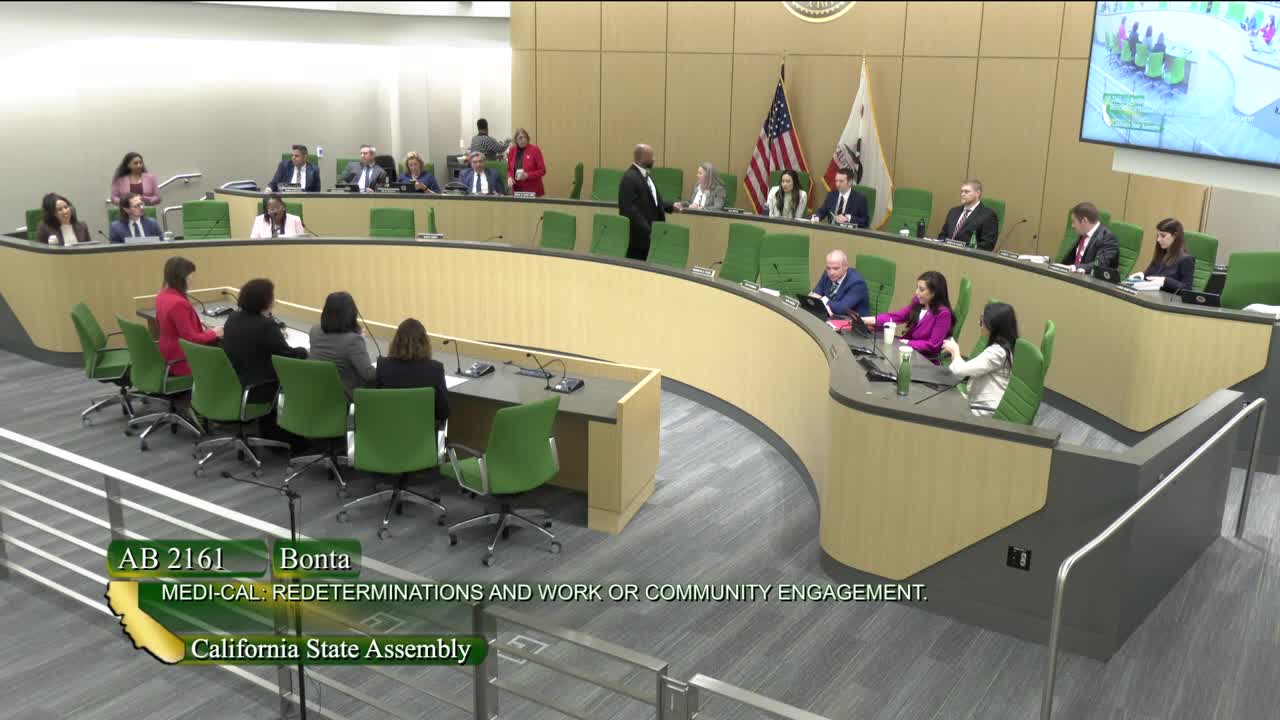 14MIN
Assembly Standing Committee on Health
Bill Author