AB 2166: Multifamily housing development: offsite housing factories: backstop financing.
- Session Year: 2025-2026
- House: Assembly
- Latest Version Date: 2026-09-01
Current Status:
Failed
(2026-09-18: Vetoed by Governor.)
Introduced
In Committee
Awaiting First Chamber Vote
Passed First Chamber
In Committee
Awaiting Second Chamber Vote
Passed Second Chamber
Enacted
The Bergeson-Peace Infrastructure and Economic Development Bank Act creates within the Governors Office of Business and Economic Development the California Infrastructure and Economic Development Bank (bank) and requires it to administer the act, which, among other things, provides for the financing of certain economic development projects.
This bill would establish, upon appropriation by the Legislature, the Multifamily Backstop Financing Program (program), for purposes of supporting multifamily projects through the provision of state-backed credit backstops that would enable surety companies to issue payment and performance bonds to qualified offsite housing factories in the state. The bill would authorize the bank to provide credit backstops to surety companies and surety insurers that issue construction bonds according to specified parameters. The bill would require the bank to adopt rules and regulations necessary to implement the program.
The Bergeson-Peace Infrastructure and Economic Development Bank Act creates within the Governors Office of Business and Economic Development the California Infrastructure and Economic Development Bank (bank) and requires it to administer the act, which, among other things, provides for the financing of certain economic development projects.
This bill would establish, upon appropriation by the Legislature, the Multifamily Backstop Financing Program (program), for purposes of supporting multifamily projects through the provision of state-backed credit backstops that would enable surety companies to issue payment and performance bonds to qualified offsite housing factories in the state. The bill would authorize the bank to provide credit backstops to surety companies and surety insurers that issue construction bonds according to specified parameters. The bill would require the bank to adopt rules and regulations necessary to implement the program. The bill would state that it is the Legislatures intent to include provisions relating to the prioritization and review of applications received.
The Bergeson-Peace Infrastructure and Economic Development Bank Act creates within the Governors Office of Business and Economic Development the California Infrastructure and Economic Development Bank (bank) and requires it to administer the act, which, among other things, provides for the financing of certain economic development projects.
This bill would establish, upon appropriation by the Legislature, the Multifamily Backstop Financing Program (program), for purposes of supporting multifamily projects through the provision of state-backed credit backstops that would enable surety companies to issue payment and performance bonds to qualified offsite housing factories in the state. The bill would authorize the agency bank to provide credit backstops to surety companies and surety insurers that issue construction bonds according to specified parameters. The bill would require the agency bank to adopt rules and regulations necessary to implement the program. The bill would state that it is the Legislatures intent to include provisions relating to the prioritization and review of applications received pursuant to this chapter. received.
Existing law establishes the California Housing Finance Agency (agency) and authorizes the agency to, among other things, make loans to finance affordable housing, including residential structures, housing developments, multifamily rental housing, special needs housing, and other forms of housing, as specified.
This bill would establish, upon appropriation by the Legislature, the Multifamily Backstop Financing Program (program), for purposes of supporting multifamily projects through the provision of state-backed credit backstops that would enable surety companies to issue payment and performance bonds to qualified offsite housing factories in the state. The bill would authorize the agency to provide credit backstops to surety companies and surety insurers that issue construction bonds according to specified parameters. The bill would require the agency to adopt rules and regulations necessary to implement the program. The bill would state that it is the Legislatures intent to include provisions relating to the prioritization and review of applications received pursuant to this chapter.
Existing law provides that the Department of Housing and Community Development is administered by an executive officer, known as the Director of Housing and Community Development. Under existing law, the director is appointed by the Governor, subject to confirmation by the Senate, and holds office at the pleasure of the Governor.This bill would make a nonsubstantive change to these provisions.Existing law provides that the Department of Housing and Community Development is administered by an executive officer, known as the Director of Housing and Community Development. Under existing law, the director is appointed by the Governor, subject to confirmation by the Senate, and holds office at the pleasure of the Governor.
This bill would make a nonsubstantive change to these provisions.
The Legislature finds and declares all of the following:
(a)Californias offsite housing manufacturing sector is stuck in a self-reinforcing cycle that blocks scale and prevents the industry from delivering on its promise of faster, lower cost construction.
(b)In multifamily, stick-built construction, owners, lenders, and general contractors use surety bonds, such as performance and payment bonds, to reduce the risk that a contractor or subcontractor fails to perform or fails to pay downstream parties.
(c)These bonds are generally required by general contractors and owners for material or large scopes on a housing development, as bonding increases confidence in schedule and delivery reliability, which supports construction lending and public financing. Without bonding, factories are treated as nonstandard or high risk by general contractors and developers, thus constraining adoption even when product quality is strong.
(d)However, sureties are reluctant to issue bonds to scaling factories due to limited operating history, nontraditional assets, and volatile cashflow. Without bonding, developers are required to take on additional, and often untenable, risk of financial loss to work with factories. In turn, factories are unable to win sufficient projects to build a track record and stable pipeline. Resulting factory failures mean the state loses a pathway to lower cost, higher throughput housing production.
(e)This cycle is a market failure with broad public consequences. Without an intervention that addresses the risk of factory failure through bonding, California may struggle to stabilize factory capacity, drive cost reductions through repetition and scale, and translate offsite innovation into real housing delivery.
(f)Therefore, Californias offsite construction industry must be stabilized and scaled for purposes of reducing construction costs over time and addressing the states housing shortage. To support this objective, this chapter establishes a state-backed credit backstop to enable surety companies to issue payment and performance bonds to support offsite housing factories in the state that assist multifamily housing builds in the state.
63089.101.For purposes of this chapter, the following definitions shall apply:
(a)Program means the Multifamily Backstop Financing Program established by this chapter.
(b)Qualified applicant means a surety company or surety insurer that issues construction bonds.
(c)Qualified factory means an offsite housing factory, whether volumetric, panelized, or otherwise, in the state that delivers obligations for qualified multifamily projects.
(d)Qualified multifamily project means a project located in the state that consists of multifamily residential uses only or a mix of multifamily residential and nonresidential uses, with at least two-thirds of the square footage of the development designated for residential use.
(e)Tail risk means a risk that occurs either when the frequency of low probability events is higher than expected under a normal probability distribution or when there are observed events of very significant size or magnitude.
63089.102.(a)There is hereby established, upon appropriation by the Legislature, the Multifamily Backstop Financing Program for purposes of supporting multifamily projects through the provision of state-backed credit backstops that would enable surety companies to issue payment and performance bonds to offsite housing factories in the state, as described in this chapter.
(b)Under the program, the bank may provide credit backstops to qualified applicants in accordance with the following:
(1)A credit backstop shall be issued only to qualified applicants if the backstop will be used by the applicant to issue payment bonds or performance bonds to qualified factories on qualified multifamily projects.
(2)The credit backstop shall cover 90 percent of the payment or performance bond value, at the discretion of the bank.
(3)The credit backstop shall not replace surety underwriting and shall only be used to reduce tail risk. The qualified applicant shall continue to decide the specific details of the payment or performance bond following industry standards.
63089.103.The bank shall adopt rules and regulations necessary to implement this chapter.
The Legislature finds and declares all of the following:
(a)Californias offsite housing manufacturing sector is stuck in a self-reinforcing cycle that blocks scale and prevents the industry from delivering on its promise of faster, lower cost construction.
(b)In multifamily, stick-built construction, owners, lenders, and general contractors use surety bonds, such as performance and payment bonds, to reduce the risk that a contractor or subcontractor fails to perform or fails to pay downstream parties.
(c)These bonds are generally required by general contractors and owners for material or large scopes on a housing development, as bonding increases confidence in schedule and delivery reliability, which supports construction lending and public financing. Without bonding, factories are treated as nonstandard or high risk by general contractors and developers, thus constraining adoption even when product quality is strong.
(d)However, sureties are reluctant to issue bonds to scaling factories due to limited operating history, nontraditional assets, and volatile cashflow. Without bonding, developers are required to take on additional, and often untenable, risk of financial loss to work with factories. In turn, factories are unable to win sufficient projects to build a track record and stable pipeline. Resulting factory failures mean the state loses a pathway to lower cost, higher throughput housing production.
(e)This cycle is a market failure with broad public consequences. Without an intervention that addresses the risk of factory failure through bonding, California may struggle to stabilize factory capacity, drive cost reductions through repetition and scale, and translate offsite innovation into real housing delivery.
(f)Therefore, the Legislature finds and declares that Californias offsite construction industry must be stabilized and scaled for purposes of reducing construction costs over time and addressing the states housing shortage. To support this objective, this chapter establishes a state-backed credit backstop to enable surety companies to issue payment and performance bonds to support offsite housing factories in the state that assist multifamily housing builds in the state.
63089.101.For purposes of this chapter, the following definitions shall apply:
(a)Program means the Multifamily Backstop Financing Program established by this chapter.
(b)Qualified applicant means a surety company or surety insurer that issues construction bonds.
(c)Qualified factory means an offsite housing factory, whether volumetric, panelized, or otherwise, in the state that delivers obligations for qualified multifamily projects.
(d)Qualified multifamily project means a project located in the state that consists of multifamily residential uses only or a mix of multifamily residential and nonresidential uses, with at least two-thirds of the square footage of the development designated for residential use.
(e)Tail risk means a risk that occurs either when the frequency of low probability events is higher than expected under a normal probability distribution or when there are observed events of very significant size or magnitude.
63089.102.(a)There is hereby established, upon appropriation by the Legislature, the Multifamily Backstop Financing Program for purposes of supporting multifamily projects through the provision of state-backed credit backstops that would enable surety companies to issue payment and performance bonds to offsite housing factories in the state, as described in this chapter.
(b)Under the program, the bank may provide credit backstops to qualified applicants in accordance with the following:
(1)A credit backstop shall be issued only to qualified applicants if the backstop will be used by the applicant to issue payment bonds or performance bonds to qualified factories on qualified multifamily projects.
(2)The credit backstop shall cover ____ 90 percent of the payment or performance bond value, at the discretion of the bank.
(3)The credit backstop shall not replace surety underwriting and shall only be used to reduce tail risk. The qualified applicant shall continue to decide the specific details of the payment or performance bond following industry standards.
(c)It is the intent of the Legislature to include provisions relating to the prioritization and review of applications received pursuant to this chapter.63089.103.The bank shall adopt rules and regulations necessary to implement this chapter.
The Legislature finds and declares all of the following:
(a)Californias offsite housing manufacturing sector is stuck in a self-reinforcing cycle that blocks scale and prevents the industry from delivering on its promise of faster, lower cost construction.
(b)In multifamily, stick-built construction, owners, lenders, and general contractors use surety bonds, such as performance and payment bonds, to reduce the risk that a contractor or subcontractor fails to perform or fails to pay downstream parties.
(c)These bonds are generally required by general contractors and owners for material or large scopes on a housing development, as bonding increases confidence in schedule and delivery reliability, which supports construction lending and public financing. Without bonding, factories are treated as nonstandard or high risk by general contractors and developers, thus constraining adoption even when product quality is strong.
(d)However, sureties are reluctant to issue bonds to scaling factories due to limited operating history, nontraditional assets, and volatile cashflow. Without bonding, developers are required to take on additional, and often untenable, risk of financial loss to work with factories. In turn, factories are unable to win sufficient projects to build a track record and stable pipeline. Resulting factory failures mean the state loses a pathway to lower cost, higher throughput housing production.
(e)This cycle is a market failure with broad public consequences. Without an intervention that addresses the risk of factory failure through bonding, California may struggle to stabilize factory capacity, drive cost reductions through repetition and scale, and translate offsite innovation into real housing delivery.
(f)Therefore, the Legislature finds and declares that Californias offsite construction industry must be stabilized and scaled for purposes of reducing construction costs over time and addressing the states housing shortage. To support this objective, this chapter establishes a state-backed credit backstop to enable surety companies to issue payment and performance bonds to support offsite housing factories in the state that assist multifamily housing builds in the state.
63089.101.For purposes of this chapter, the following definitions shall apply:
(a)Program means the Multifamily Backstop Financing Program established by this chapter.
(b)Qualified applicant means a surety company or surety insurer that issues construction bonds.
(c)Qualified factory means an offsite housing factory, whether volumetric, panelized, or otherwise, in the state that delivers obligations for qualified multifamily projects.
(d)Qualified multifamily project means a project located in the state that consists of multifamily residential uses only or a mix of multifamily residential and nonresidential uses, with at least two-thirds of the square footage of the development designated for residential use.
(e)Tail risk means a risk that occurs either when the frequency of low probability events is higher than expected under a normal probability distribution or when there are observed events of very significant size or magnitude.
63089.102.(a)There is hereby established, upon appropriation by the Legislature, the Multifamily Backstop Financing Program for purposes of supporting multifamily projects through the provision of state-backed credit backstops that would enable surety companies to issue payment and performance bonds to offsite housing factories in the state, as described in this chapter.
(b)Under the program, the bank may provide credit backstops to qualified applicants in accordance with the following:
(1)A credit backstop shall be issued only to qualified applicants if the backstop will be used by the applicant to issue payment bonds or performance bonds to qualified factories on qualified multifamily projects.
(2)The credit backstop shall cover ____ percent of the payment or performance bond value, at the discretion of the bank.
(3)The credit backstop shall not replace surety underwriting and shall only be used to reduce tail risk. The qualified applicant shall continue to decide the specific details of the payment or performance bond following industry standards.
(c)It is the intent of the Legislature to include provisions relating to the prioritization and review of applications received pursuant to this chapter.
63089.103.The bank shall adopt rules and regulations necessary to implement this chapter.
SECTION 1.Chapter 10.5 (commencing with Section 50310) is added to Part 1 of Division 31 of the Health and Safety Code, to read:10.5.Multifamily Backstop Financing50310.The Legislature finds and declares all of the following:(a)Californias offsite housing manufacturing sector is stuck in a self-reinforcing cycle that blocks scale and prevents the industry from delivering on its promise of faster, lower cost construction.(b)In multifamily, stick-built construction, owners, lenders, and general contractors use surety bonds, such as performance and payment bonds, to reduce the risk that a contractor or subcontractor fails to perform or fails to pay downstream parties.(c)These bonds are generally required by general contractors and owners for material or large scopes on a housing development, as bonding increases confidence in schedule and delivery reliability, which supports construction lending and public financing. Without bonding, factories are treated as nonstandard or high risk by general contractors and developers, thus constraining adoption even when product quality is strong.(d)However, sureties are reluctant to issue bonds to scaling factories due to limited operating history, nontraditional assets, and volatile cash flow. Without bonding, developers are required to take on additional, and often untenable, risk of financial loss to work with factories. In turn, factories are unable to win sufficient projects to build a track record and stable pipeline. Resulting factory failures mean the state loses a pathway to lower cost, higher throughput housing production.(e)This cycle is a market failure with broad public consequences. Without an intervention that addresses the risk of factory failure through bonding, California may struggle to stabilize factory capacity, drive cost reductions through repetition and scale, and translate offsite innovation into real housing delivery.(f)Therefore, the Legislature finds and declares that Californias offsite construction industry must be stabilized and scaled for purposes of reducing construction costs over time and addressing the states housing shortage. To support this objective, this chapter establishes a state-backed credit backstop to enable surety companies to issue payment and performance bonds to support offsite housing factories in the state that assist multifamily housing builds in the state.50311.For purposes of this chapter, the following definitions shall apply:(a)Agency means the California Housing Finance Agency.(b)Program means the Multifamily Backstop Program established by this chapter.(c)Qualified applicant means a surety company or surety insurer that issues construction bonds.(d)Qualified factory means an offsite housing factory, whether volumetric, panelized, or otherwise, in the state that delivers obligations for qualified multifamily projects.(e)Qualified multifamily project means a project located in the state that consists of multifamily residential uses only or a mix of multifamily residential and nonresidential uses, with at least two-thirds of the square footage of the development designated for residential use.(f)Tail risk means a risk that occurs either when the frequency of low probability events is higher than expected under a normal probability distribution or when there are observed events of very significant size or magnitude.50312.(a)There is hereby established, upon appropriation by the Legislature, the Multifamily Backstop Financing Program for purposes of supporting multifamily projects through the provision of state-backed credit backstops that would enable surety companies to issue payment and performance bonds to offsite housing factories in the state, as described in this chapter.(b)Under the program, the California Housing Finance Agency may provide credit backstops to qualified applicants in accordance with the following:(1)A credit backstop shall be issued only to qualified applicants if the backstop will be used by the applicant to issue payment bonds or performance bonds to qualified factories on qualified multifamily projects.(2)The credit backstop shall cover ____ percent of the payment or performance bond value, at the discretion of the agency.(3)The credit backstop shall not replace surety underwriting and shall only be used to reduce tail risk. The qualified applicant shall continue to decide the specific details of the payment or performance bond following industry standards.(c)It is the intent of the Legislature to include provisions relating to the prioritization and review of applications received pursuant to this chapter.50313.The agency shall adopt rules and regulations necessary to implement this chapter.The Legislature finds and declares all of the following:
(a)Californias offsite housing manufacturing sector is stuck in a self-reinforcing cycle that blocks scale and prevents the industry from delivering on its promise of faster, lower cost construction.
(b)In multifamily, stick-built construction, owners, lenders, and general contractors use surety bonds, such as performance and payment bonds, to reduce the risk that a contractor or subcontractor fails to perform or fails to pay downstream parties.
(c)These bonds are generally required by general contractors and owners for material or large scopes on a housing development, as bonding increases confidence in schedule and delivery reliability, which supports construction lending and public financing. Without bonding, factories are treated as nonstandard or high risk by general contractors and developers, thus constraining adoption even when product quality is strong.
(d)However, sureties are reluctant to issue bonds to scaling factories due to limited operating history, nontraditional assets, and volatile cash flow. Without bonding, developers are required to take on additional, and often untenable, risk of financial loss to work with factories. In turn, factories are unable to win sufficient projects to build a track record and stable pipeline. Resulting factory failures mean the state loses a pathway to lower cost, higher throughput housing production.
(e)This cycle is a market failure with broad public consequences. Without an intervention that addresses the risk of factory failure through bonding, California may struggle to stabilize factory capacity, drive cost reductions through repetition and scale, and translate offsite innovation into real housing delivery.
(f)Therefore, the Legislature finds and declares that Californias offsite construction industry must be stabilized and scaled for purposes of reducing construction costs over time and addressing the states housing shortage. To support this objective, this chapter establishes a state-backed credit backstop to enable surety companies to issue payment and performance bonds to support offsite housing factories in the state that assist multifamily housing builds in the state.
50311.For purposes of this chapter, the following definitions shall apply:
(a)Agency means the California Housing Finance Agency.
(b)Program means the Multifamily Backstop Program established by this chapter.
(c)Qualified applicant means a surety company or surety insurer that issues construction bonds.
(d)Qualified factory means an offsite housing factory, whether volumetric, panelized, or otherwise, in the state that delivers obligations for qualified multifamily projects.
(e)Qualified multifamily project means a project located in the state that consists of multifamily residential uses only or a mix of multifamily residential and nonresidential uses, with at least two-thirds of the square footage of the development designated for residential use.
(f)Tail risk means a risk that occurs either when the frequency of low probability events is higher than expected under a normal probability distribution or when there are observed events of very significant size or magnitude.
50312.(a)There is hereby established, upon appropriation by the Legislature, the Multifamily Backstop Financing Program for purposes of supporting multifamily projects through the provision of state-backed credit backstops that would enable surety companies to issue payment and performance bonds to offsite housing factories in the state, as described in this chapter.
(b)Under the program, the California Housing Finance Agency may provide credit backstops to qualified applicants in accordance with the following:
(1)A credit backstop shall be issued only to qualified applicants if the backstop will be used by the applicant to issue payment bonds or performance bonds to qualified factories on qualified multifamily projects.
(2)The credit backstop shall cover ____ percent of the payment or performance bond value, at the discretion of the agency.
(3)The credit backstop shall not replace surety underwriting and shall only be used to reduce tail risk. The qualified applicant shall continue to decide the specific details of the payment or performance bond following industry standards.
(c)It is the intent of the Legislature to include provisions relating to the prioritization and review of applications received pursuant to this chapter.
50313.The agency shall adopt rules and regulations necessary to implement this chapter.
SECTION 1.Section 50401 of the Health and Safety Code is amended to read:50401.The department shall be administered by an executive officer known as the Director of Housing and Community Development. The director shall be appointed by the Governor, subject to confirmation by the Senate, and hold office at the pleasure of the Governor. The director shall receive the annual salary provided for by Chapter 6 (commencing with Section 11550) of Part 1 of Division 3 of Title 2 of the Government Code.The department shall be administered by an executive officer known as the Director of Housing and Community Development. The director shall be appointed by the Governor, subject to confirmation by the Senate, and shall hold office at the pleasure of the Governor. The director shall receive the annual salary provided for by Chapter 6 (commencing with Section 11550) of Part 1 of Division 3 of Title 2 of the Government Code.
|
Date
|
Status
|
|---|---|
| Sep 18, 2026 | Vetoed by Governor. |
| Sep 4, 2026 | Enrolled and presented to the Governor at 4 p.m. |
| Aug 27, 2026 | Senate amendments concurred in. To Engrossing and Enrolling. (Ayes 73. Noes 1. Page 6689.). |
| Aug 27, 2026 | Senate amendments concurred in. To Engrossing and Enrolling. (Ayes 73. Noes 1.). |
| Aug 27, 2026 | In Assembly. Concurrence in Senate amendments pending. |
| Aug 26, 2026 | Read third time. Passed. Ordered to the Assembly. (Ayes 38. Noes 0. Page 5901.). |
| Aug 26, 2026 | Read third time. Passed. Ordered to the Assembly. (Ayes 37. Noes 0.). |
| Aug 24, 2026 | Read second time. Ordered to third reading. |
| Aug 20, 2026 | Read third time and amended. Ordered to second reading. |
| Aug 13, 2026 | Read second time. Ordered to third reading. |
| Aug 13, 2026 | From committee: Do pass. (Ayes 6. Noes 0.) (August 13). |
| Aug 3, 2026 | In committee: Referred to APPR. suspense file. |
| Jul 1, 2026 | From committee: Do pass and re-refer to Com. on APPR. (Ayes 8. Noes 0.) (June 30). Re-referred to Com. on APPR. |
| Jun 22, 2026 | From committee: Do pass and re-refer to Com. on HOUSING. (Ayes 8. Noes 1.) (June 22). Re-referred to Com. on HOUSING. |
| Jun 3, 2026 | Referred to Coms. on B. P. & E.D. and HOUSING. |
| May 21, 2026 | In Senate. Read first time. To Com. on RLS. for assignment. |
| May 21, 2026 | Read third time. Passed. Ordered to the Senate. (Ayes 70. Noes 1. Page 5223.) |
| May 21, 2026 | Read third time. Passed. Ordered to the Senate. (Ayes 70. Noes 1.) |
| May 18, 2026 | Read second time. Ordered to third reading. |
| May 14, 2026 | From committee: Do pass. (Ayes 13. Noes 0.) (May 14). |
| May 6, 2026 | In committee: Set, first hearing. Referred to APPR. suspense file. |
| Apr 28, 2026 | Re-referred to Com. on APPR. |
| Apr 27, 2026 | Read second time and amended. |
| Apr 23, 2026 | From committee: Amend, and do pass as amended and re-refer to Com. on APPR. (Ayes 11. Noes 0.) (April 22). |
| Mar 23, 2026 | Re-referred to Com. on H. & C.D. |
| Mar 19, 2026 | From committee chair, with author's amendments: Amend, and re-refer to Com. on H. & C.D. Read second time and amended. |
| Mar 19, 2026 | Referred to Com. on H. & C.D. |
| Feb 19, 2026 | From printer. May be heard in committee March 21. |
| Feb 18, 2026 | Read first time. To print. |
|
Date
|
Description
|
Location
|
Votes
|
|
|---|---|---|---|---|
| Aug 27, 2026 | AB 2166 Carrillo Concurrence in Senate Amendments | Assembly Floor |
Passed |
|
| Aug 26, 2026 | Assembly 3rd Reading AB2166 Carrillo et al. By Cabaldon | Senate Floor |
Passed |
|
| Aug 13, 2026 | Do pass | Senate Standing Committee on Appropriations |
Passed |
|
| Aug 3, 2026 | Placed on suspense file | Senate Standing Committee on Appropriations |
Passed |
|
| Jun 30, 2026 | Do pass, but first be re-referred to the Committee on [Appropriations] | Senate Standing Committee on Housing |
Passed |
|
| Jun 22, 2026 | Do pass, but first be re-referred to the Committee on [Housing] | Senate Standing Committee on Business, Professions and Economic Development |
Passed |
|
| May 21, 2026 | AB 2166 Carrillo Assembly Third Reading | Assembly Floor |
Passed |
|
| May 14, 2026 | Do pass. | Assembly Standing Committee on Appropriations |
Passed |
|
| Apr 22, 2026 | Do pass as amended and be re-referred to the Committee on [Appropriations] | Assembly Standing Committee on Housing and Community Development |
Passed |
This list shows positions taken on this bill by organizations on the date displayed, which is linked to the original source.
Positions by individuals are not included.
|
Organization
|
Position
|
Date
|
|---|---|---|
| Abundance Network | ** Support | |
| Autodesk, Inc. | ** Support | |
| Bay Area Council | ** Support | |
| California Conference of Carpenters | ** Support | |
| California Conference of Carpenters (co-source) | ** Support | |
| California Council For Affordable Housing | ** Support | |
| California Housing Consortium | ** Support | |
| California YIMBY | ** Support | |
| Casita Coalition | ** Support | |
| CBIA | ** Support | |
| Circulate Planning & Policy | ** Support | |
| Eden Housing | ** Support | |
| Housing Trust Silicon Valley | ** Support | |
| Inner City Law Center | ** Support | |
| LeadingAge California | ** Support | |
| League Of California Cities | ** Support | |
| Non-Profit Housing Association of Northern California | ** Support | |
| Student Homes Coalition | ** Support |
GOVERNOR′S VETO
GV Bill Id:AB 2166
Author:(Carrillo and Wicks)
As Enrolled Ver:September 1, 2026
2/3 vote
SUMMARY
- Require the credit backstop provided by IBank to over 90% of the payment or performance bond value.
- Delete intent language.
Governor′s Veto Message
To the Members of the California State Assembly:
I am returning Assembly Bill 2166 without my signature.
This bill would establish the Multifamily Backstop Financing Program within the California Infrastructure and Economic Development Bank to provide state-backed credit support for surety bonds issued to eligible offsite housing factories serving multifamily projects.
I support innovative financing strategies that can lower housing construction costs, and I thank the author for advancing this important goal. However, this novel program is estimated to require hundreds of millions of dollars in initial capitalization, funding that was not included in the state budget. A proposal of this scale should instead be considered through the annual budget process, where its funding needs, risk protections, and administrative structure can be evaluated together.
In partnership with the Legislature this year, my administration has enacted a balanced budget that recognizes the challenging fiscal landscape our state faces while maintaining our commitment to working families and our most vulnerable communities. With significant fiscal pressures and the federal government's hostile economic policies, it is vital that we remain disciplined when considering bills with significant fiscal implications that ore not included in the budget, such as this measure.
For these reasons, I cannot sign this bill.
COMMENTS
Factory-Built Housing: FBH, often referred to as modular, manufactured, or prefabricated housing, involves the construction or assembly of various components of a housing unit or room in a factory and the transport of those components or structures to the construction site, where they are installed and fixed to a building foundation. This is in contrast to traditional (″site-built″ or ″stick-built″) homes, which are built piece by piece on top of the foundation at the actual construction site. The mass production techniques in a factory environment can sometimes be faster and cheaper than site-built construction methods and are not as impacted by weather constraints that might hamper construction progress on a site, though benefits will vary widely between projects.
HCD has maintained building code and plan approval authority over FBH since the California Factory-Built Housing Law was first enacted in the 1960s. HCD currently contracts with various Design Approval Agencies (DAAs) who perform third-party review and approval of FBH designs according to regulations established by HCD and the building standards governing FBH. Approved FBH must bear a California Insignia of Approval on each FBH system or component in the project. There are also Quality Assurance Agencies (QAAs) approved by HCD that inspect FBH during the production phase in the manufacturing facility or offsite. Local agencies maintain authority over a variety of post-manufacture elements of these projects (for example, snow load, wind pressure, building setback, and architectural requirements) and are also responsible for inspecting and approving the installation of the FBH at the project site.
Select Committee on Housing Construction Innovation: In late 2025, the Assembly Select Committee on Housing Innovation (Select Committee) was established to explore how the state can play a role in reducing housing costs by facilitating innovation in housing construction. The Select Committee conducted two hearings in January 2026 and received testimony from industry experts. These experts discussed all of the following: the benefits and risks of industrialized construction methods, including potential cost savings; the ability to reduce project timelines; and, regulatory, labor, and budget considerations. The hearings also explored barriers to opportunities for scaling construction innovation.
The Select Committee requested support from the University of California, Berkeley′s Terner Center for Housing Innovation (Terner Center) to conduct research, including interviews with people familiar with the industry. The Terner Center interviewed 65 people representing different perspectives in the industry, including market-rate and affordable housing developers, general contractors, off-site manufacturers, architects, investors, lenders, building trades unions, carpenters union members, state and regional government staff, building code experts, and representatives from companies using 3D printing, artificial intelligence, or other emerging technologies.
The Terner Center published a white paper, titled ″Potential Pathways to Scale Innovative Construction Methods in California.″ The Terner Center′s white paper details seven categories of approximately 40 policy proposals identified by stakeholders as potential pathways to reducing barriers to accelerating industrialized construction, including FBH, at scale. This bill incorporates one of the Terner Center recommendations to reduce financial risk and liability to encourage industry growth.
State Intervention: Stakeholders that participated in the Terner Center interviews argued that the FBH industry will not grow and reach the scale necessary to help address the state′s housing shortage without the state providing access to capital. Financial institutions and insurers view FBH as riskier than site-built construction. This risk results from the fact that FBH is fundamentally different than traditional construction and involves logistics not associated with site-built housing, like the need to sequence delivery of FBH. In addition, some FBH factories and project failures support the lending community′s concerns with the risk of backing a new and unproven industry. Stakeholders believe the state could provide several types of financial backing to the FBH industry that would help the industry grow.
First, the state could issue bonds to support factories to guarantee performance and agree to compensate developers, lenders, and subcontractors if a factory were to fail mid-project. State-backed bonds would help the industry to grow, especially in the early stages of growth. Second, the state could provide a loan guarantee program for FBH factories. The state would assume some of the risk from loans originated by the private lenders on specific projects. If the factory failed mid-project, the state would be on the hook for some portion of the loans. Stakeholders liken this proposal to federally backed loan guarantee programs. Finally, the state could create a revolving loan or credit facility that could support predevelopment costs, including deposits or financing gaps that private lenders are reluctant to cover. A surety company ensures risks generally through bonds, which are issued for public works construction projects. If the contractor fails to fulfill the contractual terms, the owner can compel the surety to complete the project.
This bill proposes that the state, through IBank, provide a ″credit backstop″ to a surety company or a surety insurer that issues payment bonds or performance bonds to support production of FBH to qualified factories on qualified multifamily projects. IBank would have the authority to determine how much of the total bond the surety insurer will back. This amount is unspecified in the bill. According to this bill, the credit backstop provided by IBank will not replace surety underwriting and shall only be used to reduce tail risk. Tail risk is defined as the risk that occurs either when the frequency of low probability events is higher than expected under a normal probability distribution or when there are observed events of very significant size or magnitude. The surety company would decide the specific details of the payment or performance bond following industry standards.
According to the Author
″We all know California is in the midst of a housing crisis. The cost of building homes is high, leading to a construction shortage, that ultimately passes on these costs to homeowners and renters. This is especially true with affordable housing, which struggles even more than market-rate housing to find developers willing to build. A large part of that is just the cost of the building itself, which is the largest percentage of the cost of a new development. One way to significantly reduce that cost is by using factory-built housing. These homes are constructed in a factory and then brought to the project site to be propped up or put together, allowing lower costs due to their mass production. Unfortunately, these factories struggle in California, as they are unable to receive insurance coverage, preventing developers, lenders, and general contractors from using this cheaper alternative. AB 2166 creates a state-backed credit backstop, to allow these factories to be insured, subsequently creating a more affordable option for housing development. To build more affordable housing, we have to make it more affordable to build, AB 2166 will do that.
Arguments in Support
According to the California Housing Consortium, ″Lenders, developers, and general contractors often need factories to be bonded to protect against factory failure. However, insurance providers, or sureties, are reluctant to issue bonds to scaling factories. Without bonding, developers and their lenders must take on additional risk of financial loss to work with factories or opt to move forward with conventional construction methods instead. To promote industry growth, reduce financial risk, and address liability gaps, AB 2166 creates a fund that covers a percentage of the surety bond, enabling surety companies to insure more modular housing factories. By creating a state bonding mechanism for modular housing factories, AB 2166 will support factory growth, help stabilize the industry, and lead to lower construction costs over time.″
Arguments in Opposition
None on file.
FISCAL COMMENTS
According to the Assembly Committee on Appropriations:
- The IBank estimates General Fund costs in the hundreds of millions of dollars for an initial allocation to provide the financial backstops for qualifying applicants. This funding would be used to cover any failure of a housing manufacturer to perform or pay others for downstream workload.
- The IBank estimates costs in the high millions to low-tens of millions of dollars for external consultants and 10 to 14 permanent staff positions to implement the new program. For context, to establish a recent startup, the Transmission Revolving Fund program, IBank has requested funding of $3.6 million for seven staff positions and $11 million for non-staff expenses. IBank estimates double the costs for implementing the proposed program given the lack of familiarity with the industry, greater complexity and as noted below the structural differences between existing IBank loan guarantee programs.
- The IBank notes this program requires a different structure than IBank′s existing Small Business Loan Guarantee Program, which is supported by a network of seven Financial Development Corporations and 158 participating lenders and has been built over 30 years. Without this kind of supporting infrastructure which funds IBank′s Small Business Financing Center (SBFC) staffing, the IBank expects to need significantly more staffing than the existing SBFC team.
This program also represents a new type of funding program in IBank to support qualified applicants through guarantees or backstops to provide specified construction surety bonds. It is difficult to fully determine a fiscal estimate to implement the provisions of this bill and as such, the IBank would need to perform an assessment of the market to understand associated risks and opportunities as well as to set up the program rules and requirements. To date, the IBank has not been involved with industries related to housing or the building of housing.
According to the Legislative Analyst′s Office, the General Fund faces a structural deficit in the tens of billions of dollars over the next several fiscal years.
VOTES
ASM HOUSING AND COMMUNITY DEVELOPMENT: 11-0-1
YES: Haney, Patterson, Ávila Farías, Caloza, Garcia, Kalra, Lee, Quirk-Silva, Ta, Wicks, Wilson
ABS, ABST OR NV: Tangipa
ASM APPROPRIATIONS: 13-0-2
YES: Wicks, Hoover, Aguiar-Curry, Calderon, Caloza, Fong, Mark González, Krell, Pacheco, Pellerin, Sharp-Collins, Solache, Ta
ABS, ABST OR NV: Dixon, Tangipa
ASSEMBLY FLOOR: 70-1-9
YES: Addis, Aguiar-Curry, Ahrens, Alanis, Alvarez, Ávila Farías, Bains, Bauer-Kahan, Bennett, Berman, Boerner, Bonta, Bryan, Calderon, Caloza, Carrillo, Castillo, Connolly, Davies, Elhawary, Ellis, Flora, Fong, Gabriel, Gallagher, Gipson, Jeff Gonzalez, Mark González, Hadwick, Haney, Harabedian, Hart, Irwin, Jackson, Kalra, Krell, Lee, Lowenthal, Macedo, McKinnor, Muratsuchi, Nguyen, Ortega, Pacheco, Papan, Patel, Patterson, Pellerin, Petrie-Norris, Quirk-Silva, Ransom, Michelle Rodriguez, Rogers, Blanca Rubio, Sanchez, Schiavo, Schultz, Sharp-Collins, Solache, Soria, Stefani, Ta, Tangipa, Valencia, Wallis, Ward, Wicks, Wilson, Zbur, Rivas
NO: DeMaio
ABS, ABST OR NV: Arambula, Chen, Dixon, Garcia, Hoover, Johnson, Lackey, Ramos, Celeste Rodriguez
SENATE FLOOR: 38-0-2
YES: Allen, Alvarado-Gil, Archuleta, Arreguín, Ashby, Becker, Blakespear, Cabaldon, Caballero, Cervantes, Choi, Cortese, Dahle, Durazo, Gonzalez, Grayson, Grove, Hurtado, Jones, Laird, Limón, McGuire, McNerney, Menjivar, Ochoa Bogh, Padilla, Pérez, Reyes, Richardson, Rubio, Seyarto, Smallwood-Cuevas, Stern, Strickland, Umberg, Wahab, Weber Pierson, Wiener
ABS, ABST OR NV: Niello, Valladares
ASSEMBLY FLOOR: 73-1-5
YES: Addis, Aguiar-Curry, Ahrens, Alanis, Alvarez, Arambula, Ávila Farías, Bains, Bauer-Kahan, Bennett, Berman, Boerner, Bonta, Bryan, Calderon, Caloza, Carrillo, Castillo, Chen, Connolly, Davies, Elhawary, Ellis, Flora, Fong, Gabriel, Garcia, Gipson, Jeff Gonzalez, Mark González, Hadwick, Haney, Harabedian, Hart, Hoover, Irwin, Jackson, Kalra, Krell, Lee, Lowenthal, Muratsuchi, Nguyen, Ortega, Pacheco, Papan, Patel, Patterson, Pellerin, Petrie-Norris, Quirk-Silva, Ramos, Ransom, Celeste Rodriguez, Michelle Rodriguez, Rogers, Blanca Rubio, Sanchez, Schiavo, Schultz, Sharp-Collins, Solache, Soria, Stefani, Ta, Tangipa, Valencia, Wallis, Ward, Wicks, Wilson, Zbur, Rivas
NO: DeMaio
ABS, ABST OR NV: Dixon, Johnson, Lackey, Macedo, McKinnor
UPDATED
VERSION: September 1, 2026
CONSULTANT: Lisa Engel / H. & C.D. / (916) 319-2085 FN: 0004599
CONCURRENCE IN SENATE AMENDMENTS
CSA1 Bill Id:AB 2166
Author:(Carrillo and Wicks)
As Amended Ver:August 20, 2026
Majority vote
SUMMARY
Establishes the Multifamily Backstop Financing Program at the Governor’s Office of Business and Economic Development the California Infrastructure and Economic Development Bank (IBank) with the stated purpose of supporting multifamily projects through the provision of state-backed credit backstops that would enable surety companies to issue payment and performance bonds to offsite housing factories in the state, as specified.
Senate Amendments
- Require the credit backstop provided by IBank to over 90% of the payment or performance bond value.
- Delete intent language.
COMMENTS
Factory-Built Housing: FBH, often referred to as modular, manufactured, or prefabricated housing, involves the construction or assembly of various components of a housing unit or room in a factory and the transport of those components or structures to the construction site, where they are installed and fixed to a building foundation. This is in contrast to traditional (“site-built” or “stick-built”) homes, which are built piece by piece on top of the foundation at the actual construction site. The mass production techniques in a factory environment can sometimes be faster and cheaper than site-built construction methods and are not as impacted by weather constraints that might hamper construction progress on a site, though benefits will vary widely between projects.
HCD has maintained building code and plan approval authority over FBH since the California Factory-Built Housing Law was first enacted in the 1960s. HCD currently contracts with various Design Approval Agencies (DAAs) who perform third-party review and approval of FBH designs according to regulations established by HCD and the building standards governing FBH. Approved FBH must bear a California Insignia of Approval on each FBH system or component in the project. There are also Quality Assurance Agencies (QAAs) approved by HCD that inspect FBH during the production phase in the manufacturing facility or offsite. Local agencies maintain authority over a variety of post-manufacture elements of these projects (for example, snow load, wind pressure, building setback, and architectural requirements) and are also responsible for inspecting and approving the installation of the FBH at the project site.
Select Committee on Housing Construction Innovation: In late 2025, the Assembly Select Committee on Housing Innovation (Select Committee) was established to explore how the state can play a role in reducing housing costs by facilitating innovation in housing construction. The Select Committee conducted two hearings in January 2026 and received testimony from industry experts. These experts discussed all of the following: the benefits and risks of industrialized construction methods, including potential cost savings; the ability to reduce project timelines; and, regulatory, labor, and budget considerations. The hearings also explored barriers to opportunities for scaling construction innovation.
The Select Committee requested support from the University of California, Berkeley’s Terner Center for Housing Innovation (Terner Center) to conduct research, including interviews with people familiar with the industry. The Terner Center interviewed 65 people representing different perspectives in the industry, including market-rate and affordable housing developers, general contractors, off-site manufacturers, architects, investors, lenders, building trades unions, carpenters union members, state and regional government staff, building code experts, and representatives from companies using 3D printing, artificial intelligence, or other emerging technologies.
The Terner Center published a white paper, titled “Potential Pathways to Scale Innovative Construction Methods in California.” The Terner Center’s white paper details seven categories of approximately 40 policy proposals identified by stakeholders as potential pathways to reducing barriers to accelerating industrialized construction, including FBH, at scale. This bill incorporates one of the Terner Center recommendations to reduce financial risk and liability to encourage industry growth.
State Intervention: Stakeholders that participated in the Terner Center interviews argued that the FBH industry will not grow and reach the scale necessary to help address the state’s housing shortage without the state providing access to capital. Financial institutions and insurers view FBH as riskier than site-built construction. This risk results from the fact that FBH is fundamentally different than traditional construction and involves logistics not associated with site-built housing, like the need to sequence delivery of FBH. In addition, some FBH factories and project failures support the lending community's concerns with the risk of backing a new and unproven industry. Stakeholders believe the state could provide several types of financial backing to the FBH industry that would help the industry grow.
First, the state could issue bonds to support factories to guarantee performance and agree to compensate developers, lenders, and subcontractors if a factory were to fail mid-project. State-backed bonds would help the industry to grow, especially in the early stages of growth. Second, the state could provide a loan guarantee program for FBH factories. The state would assume some of the risk from loans originated by the private lenders on specific projects. If the factory failed mid-project, the state would be on the hook for some portion of the loans. Stakeholders liken this proposal to federally backed loan guarantee programs. Finally, the state could create a revolving loan or credit facility that could support predevelopment costs, including deposits or financing gaps that private lenders are reluctant to cover. A surety company ensures risks generally through bonds, which are issued for public works construction projects. If the contractor fails to fulfill the contractual terms, the owner can compel the surety to complete the project.
This bill proposes that the state, through IBank, provide a “credit backstop” to a surety company or a surety insurer that issues payment bonds or performance bonds to support production of FBH to qualified factories on qualified multifamily projects. IBank would have the authority to determine how much of the total bond the surety insurer will back. This amount is unspecified in the bill. According to this bill, the credit backstop provided by IBank will not replace surety underwriting and shall only be used to reduce tail risk. Tail risk is defined as the risk that occurs either when the frequency of low probability events is higher than expected under a normal probability distribution or when there are observed events of very significant size or magnitude. The surety company would decide the specific details of the payment or performance bond following industry standards.
According to the Author
“We all know California is in the midst of a housing crisis. The cost of building homes is high, leading to a construction shortage, that ultimately passes on these costs to homeowners and renters. This is especially true with affordable housing, which struggles even more than market-rate housing to find developers willing to build. A large part of that is just the cost of the building itself, which is the largest percentage of the cost of a new development. One way to significantly reduce that cost is by using factory-built housing. These homes are constructed in a factory and then brought to the project site to be propped up or put together, allowing lower costs due to their mass production. Unfortunately, these factories struggle in California, as they are unable to receive insurance coverage, preventing developers, lenders, and general contractors from using this cheaper alternative. AB 2166 creates a state-backed credit backstop, to allow these factories to be insured, subsequently creating a more affordable option for housing development. To build more affordable housing, we have to make it more affordable to build, AB 2166 will do that.”
Arguments in Support
According to the California Housing Consortium, “Lenders, developers, and general contractors often need factories to be bonded to protect against factory failure. However, insurance providers, or sureties, are reluctant to issue bonds to scaling factories. Without bonding, developers and their lenders must take on additional risk of financial loss to work with factories or opt to move forward with conventional construction methods instead. To promote industry growth, reduce financial risk, and address liability gaps, AB 2166 creates a fund that covers a percentage of the surety bond, enabling surety companies to insure more modular housing factories. By creating a state bonding mechanism for modular housing factories, AB 2166 will support factory growth, help stabilize the industry, and lead to lower construction costs over time.”
Arguments in Opposition
None on file.
FISCAL COMMENTS
According to the Assembly Committee on Appropriations:
- The IBank estimates General Fund costs in the hundreds of millions of dollars for an initial allocation to provide the financial backstops for qualifying applicants. This funding would be used to cover any failure of a housing manufacturer to perform or pay others for downstream workload.
- The IBank estimates costs in the high millions to low-tens of millions of dollars for external consultants and 10 to 14 permanent staff positions to implement the new program. For context, to establish a recent startup, the Transmission Revolving Fund program, IBank has requested funding of $3.6 million for seven staff positions and $11 million for non-staff expenses. IBank estimates double the costs for implementing the proposed program given the lack of familiarity with the industry, greater complexity and as noted below the structural differences between existing IBank loan guarantee programs.
- The IBank notes this program requires a different structure than IBank’s existing Small Business Loan Guarantee Program, which is supported by a network of seven Financial Development Corporations and 158 participating lenders and has been built over 30 years. Without this kind of supporting infrastructure which funds IBank’s Small Business Financing Center (SBFC) staffing, the IBank expects to need significantly more staffing than the existing SBFC team.
This program also represents a new type of funding program in IBank to support qualified applicants through guarantees or backstops to provide specified construction surety bonds. It is difficult to fully determine a fiscal estimate to implement the provisions of this bill and as such, the IBank would need to perform an assessment of the market to understand associated risks and opportunities as well as to set up the program rules and requirements. To date, the IBank has not been involved with industries related to housing or the building of housing.
According to the Legislative Analyst’s Office, the General Fund faces a structural deficit in the tens of billions of dollars over the next several fiscal years.
VOTES:
ASM HOUSING AND COMMUNITY DEVELOPMENT: 11-0-1
YES: Haney, Patterson, Ávila Farías, Caloza, Garcia, Kalra, Lee, Quirk-Silva, Ta, Wicks, Wilson
ABS, ABST OR NV: Tangipa
ASM APPROPRIATIONS: 13-0-2
YES: Wicks, Hoover, Aguiar-Curry, Calderon, Caloza, Fong, Mark González, Krell, Pacheco, Pellerin, Sharp-Collins, Solache, Ta
ABS, ABST OR NV: Dixon, Tangipa
ASSEMBLY FLOOR: 70-1-9
YES: Addis, Aguiar-Curry, Ahrens, Alanis, Alvarez, Ávila Farías, Bains, Bauer-Kahan, Bennett, Berman, Boerner, Bonta, Bryan, Calderon, Caloza, Carrillo, Castillo, Connolly, Davies, Elhawary, Ellis, Flora, Fong, Gabriel, Gallagher, Gipson, Jeff Gonzalez, Mark González, Hadwick, Haney, Harabedian, Hart, Irwin, Jackson, Kalra, Krell, Lee, Lowenthal, Macedo, McKinnor, Muratsuchi, Nguyen, Ortega, Pacheco, Papan, Patel, Patterson, Pellerin, Petrie-Norris, Quirk-Silva, Ransom, Michelle Rodriguez, Rogers, Blanca Rubio, Sanchez, Schiavo, Schultz, Sharp-Collins, Solache, Soria, Stefani, Ta, Tangipa, Valencia, Wallis, Ward, Wicks, Wilson, Zbur, Rivas
NO: DeMaio
ABS, ABST OR NV: Arambula, Chen, Dixon, Garcia, Hoover, Johnson, Lackey, Ramos, Celeste Rodriguez
UPDATED
VERSION: August 20, 2026
CONSULTANT: Lisa Engel / H. & C.D. / (916) 319-2085 FN: 0003976
SENATE RULES COMMITTEE Office of Senate Floor Analyses (916) 651-4171 | AB 2166 |
THIRD READING
Bill No: AB 2166
Author: Carrillo (D) and Wicks (D), et al.
Amended: 8/20/26
Vote: 21
SENATE BUS., PROF. & ECON. DEV. COMMITTEE: 8-1, 6/22/26
AYES: Wahab, Choi, Archuleta, Arreguín, Caballero, Menjivar, Richardson, Umberg
NOES: Niello
NO VOTE RECORDED: Smallwood-Cuevas, Strickland
SENATE HOUSING COMMITTEE: 8-0, 6/30/26
AYES: Arreguín, Cabaldon, Caballero, Cortese, Durazo, Grayson, Ochoa Bogh, Padilla
NO VOTE RECORDED: Seyarto, Gonzalez
SENATE APPROPRIATIONS COMMITTEE: 6-0, 8/13/26
AYES: Cervantes, Cabaldon, Dahle, Grayson, Richardson, Wahab
NO VOTE RECORDED: Seyarto
ASSEMBLY FLOOR: 70-1, 5/21/26 - See last page for vote
SUBJECT: Multifamily housing development: offsite housing factories: backstop financing
SOURCE: California Conference of Carpenters
California Housing Consortium
DIGEST:
This bill establishes the Multifamily Backstop Financing Program to support multifamily projects by providing state-backed credit backstops to enable surety companies to issue payment and performance bonds to offsite housing factories in the state.
Senate Floor Amendments of 8/20/26 specify that the credit backstop must cover 90% of the payment or performance bond value, at the discretion of IBank.
ANALYSIS:
Existing law:
- Establishes the Governor’s Office of Business and Economic Development (GO-Biz) within the Governor's Office for the purpose of serving as the lead state entity for economic strategy and marketing of California on issues relating to business development, private sector investment and economic growth. (Government Code (GC) §§ 12096 – 12098.5)
- Establishes the Bergeson-Peace Infrastructure and Economic Development Bank Act and creates the IBank. (GC § 63000 et seq.)
- Authorizes IBank to make loans, issue bonds, and provide other economic development assistance, among other things. (GC § 63050 et seq.)
This bill:
- Establishes, upon appropriation by the Legislature, the Multifamily Backstop Financing Program within the IBank to support multifamily housing projects through state-backed credit backstops.
- Authorizes IBank to provide credit backstops to qualified applicants to facilitate the issuance of payment and performance bonds for qualified factories participating in qualified multifamily projects.
- Requires that a credit backstop be issued only when it will be used by a qualified applicant to issue payment or performance bonds to a qualified factory for a qualified multifamily project.
- Authorizes IBank to determine the percentage of a payment or performance bond that may be covered by a credit backstop.
- Specifies that a credit backstop shall not replace traditional surety underwriting and may only be used to reduce tail risk.
- Requires qualified applicants to continue making underwriting and bonding decisions in accordance with industry standards.
- States the intent of the Legislature to establish provisions governing the prioritization and review of applications submitted under the program.
- Requires IBank to adopt regulations necessary to implement the program.
- Defines a qualified applicant as a surety company or surety insurer that issues construction bonds.
- Defines a qualified factory as an in-state offsite housing factory, including volumetric, panelized, or other factory-built housing manufacturers, that provides obligations for qualified multifamily projects.
- Defines a qualified multifamily project as a development located in California consisting entirely of multifamily residential uses or a mix of residential and nonresidential uses, provided that at least two-thirds of the project's square footage is designated for residential use.
- Defines tail risk as a risk associated with low-probability but high-impact events, including events that occur more frequently than expected or result in unusually significant losses.
Background
Payment and performance bonds are commonly used on construction projects to provide financial protections for project owners, lenders, contractors, subcontractors, and suppliers if a contractor or manufacturer fails to perform its obligations. Proponents of this bill contend that offsite housing manufacturers can face challenges obtaining such bonds because sureties may view the sector as carrying elevated or unfamiliar risks. This bill proposes to address that concern by authorizing IBank to provide state-backed credit support intended to reduce a portion of the risk assumed by private surety providers.
California continues to face a significant housing shortage that has contributed to high housing costs and affordability challenges throughout the state. Despite ongoing efforts to increase housing production, housing development has generally not kept pace with projected demand. Discussions have continued to explore strategies intended to reduce housing development costs, accelerate production timelines, and address barriers that may limit housing construction. One strategy receiving increased attention is factory-built, modular, and other forms of offsite construction. Unlike traditional construction, where most building components are assembled at the project site, offsite construction shifts a significant portion of production to a factory setting before components are transported for final assembly.
California already regulates factory-built housing through HCD’s Factory-Built Housing Program, which oversees residential structures manufactured in a factory and transported to their permanent installation site. HCD has noted that factory-based production may provide opportunities for increased standardization, improved production efficiencies, and potential cost savings under certain circumstances. Researchers, policymakers, and industry stakeholders have evaluated whether industrialized construction methods could help California produce housing more quickly and efficiently. In 2026, the Assembly Select Committee on Housing Construction Innovation examined factory-based housing production and potential policy changes intended to support expansion of the sector as part of broader discussions regarding housing production and construction innovation.
Although proponents contend that modular and factory-built construction may reduce project timelines and construction costs, adoption has remained limited. Researchers and industry participants have identified a variety of challenges, including transportation costs, financing constraints, insurance and bonding requirements, supply-chain considerations, workforce issues, and regulatory barriers.
Some lenders, insurers, investors, and surety providers have viewed factory-built construction as a newer and less familiar delivery model, which may create challenges in securing financing and risk-management products. Recent research has suggested that efforts to reduce financial barriers and perceived risk may facilitate broader adoption of industrialized construction methods.
This bill seeks to address one aspect of those challenges by authorizing a state-backed credit backstop program intended to reduce risk exposure for surety companies that issue payment and performance bonds to qualified offsite housing factories.
FISCAL EFFECT: Appropriation: No Fiscal Com.: Yes Local: No
According to the Senate Committee on Appropriations, the bill will result in unknown, unabsorbable one-time and ongoing costs, likely ranging from the tens to hundreds of millions of dollars for IBank to establish and administer a new construction surety bond guarantee program. IBank anticipates unknown, significant one-time costs, likely ranging in the millions of dollars, to conduct a market assessment to evaluate risks and establish program rules; one-time seed funding in the hundreds of millions of dollars to provide financial backstops for qualifying applicants and cover potential manufacturer defaults and; ongoing costs in the tens of millions of dollars, including an additional 10.0 to 14.0 permanent staff to maintain the program. As a recent budget comparison, IBank requested $11 million in one-time funding and $3.6 million ongoing for 7.0 permanent positions to establish a Transmission Revolving Fund program. IBank expects to need at least double the resources of that program to meet the mandates of the Multifamily Housing Development Program, as IBank lacks experience in housing construction-related financing.
While the proposed program may share some similarities with IBank’s existing Small Business Loan Guarantee Program (SBLGP), IBank notes that the bill creates a new type of funding program requiring a fundamentally different structure. Unlike the SBLGP, which relies on a 30-year-old network of seven Financial Development Corporations and 158 participating lenders, the program proposed by this bill lacks a supporting infrastructure and will require significantly more internal staffing than the current Small Business Finance Center team.
SUPPORT: (Verified 8/20/26)
California Conference of Carpenters (co-source)
California Housing Consortium (co-source)
Abundance Network
Autodesk, INC.
Bay Area Council
California Council for Affordable Housing
California Yimby
Casita Coalition
CBIA
Circulate Planning & Policy
Eden Housing
Housing Trust Silicon Valley
Inner City Law Center
Leadingage California
League of California Cities
Non-profit Housing Association of Northern California
Student Homes Coalition
OPPOSITION: (Verified 8/20/26)
None received
ARGUMENTS IN SUPPORT: Supporters state that “By creating a state bonding mechanism for modular housing factories, AB 2166 will support factory growth, help stabilize the industry, and lead to lower construction costs over time.” They note the Terner Center’s recent report Potential Pathways to Scale Innovative Construction Methods in California which discusses opportunities for the state to adopt industrialized construction methods. According to supporters, “It highlights the advantages of factory-built housing and summarizes some of the barriers that prevent the scaling of innovative construction strategies in California.” They note that this bill will help to address some of the barriers identified in the report.
The League of California Cities writes that “Factory-built housing has been an option for housing development under California law since the late 1960s, but uptake of these projects has been limited so far. One reason for the slow uptake may be the lack of financing to build factories that produce the necessary factory-built components and homes for residential development. AB 2166 provides an important funding source to support the development of factories, which may create economic development opportunities in local communities and result in more housing options for developers to build the housing local agencies have planned for in their communities.”
According to supporters, “Lenders, developers, and general contractors often need factories to be bonded to protect against factory failure. However, insurance providers, or sureties, are reluctant to issue bonds to scaling factories. Without bonding, developers and their lenders must take on additional risk of financial loss to work with factories or opt to move forward with conventional construction methods instead. To promote industry growth, reduce financial risk, and address liability gaps, AB 2166 creates a fund that covers a percentage of the surety bond, enabling surety companies to insure more modular housing factories.”
Leading Age California writes that “By stabilizing the factory-built housing sector, the bill will promote industry growth, reduce risk for affordable housing developers, and contribute to lower construction costs over time. For nonprofit affordable senior housing providers, these changes can expand access to cost-saving construction methods and improve the feasibility of deeply affordable projects serving older adults.”
ASSEMBLY FLOOR: 70-1, 5/21/26
AYES: Addis, Aguiar-Curry, Ahrens, Alanis, Alvarez, Ávila Farías, Bains, Bauer-Kahan, Bennett, Berman, Boerner, Bonta, Bryan, Calderon, Caloza, Carrillo, Castillo, Connolly, Davies, Elhawary, Ellis, Flora, Fong, Gabriel, Gallagher, Gipson, Jeff Gonzalez, Mark González, Hadwick, Haney, Harabedian, Hart, Irwin, Jackson, Kalra, Krell, Lee, Lowenthal, Macedo, McKinnor, Muratsuchi, Nguyen, Ortega, Pacheco, Papan, Patel, Patterson, Pellerin, Petrie-Norris, Quirk-Silva, Ransom, Michelle Rodriguez, Rogers, Blanca Rubio, Sanchez, Schiavo, Schultz, Sharp-Collins, Solache, Soria, Stefani, Ta, Tangipa, Valencia, Wallis, Ward, Wicks, Wilson, Zbur, Rivas
NOES: DeMaio
NO VOTE RECORDED: Arambula, Chen, Dixon, Garcia, Hoover, Johnson, Lackey, Ramos, Celeste Rodriguez
Prepared by: Sarah Mason / B., P. & E.D. /
8/24/26 11:41:44
**** END ****
SENATE RULES COMMITTEE Office of Senate Floor Analyses (916) 651-4171 | AB 2166 |
THIRD READING
Bill No: AB 2166
Author: Carrillo (D) and Wicks (D), et al.
Amended: 4/27/26 in Assembly
Vote: 21
SENATE BUS., PROF. & ECON. DEV. COMMITTEE: 8-1, 6/22/26
AYES: Wahab, Choi, Archuleta, Arreguín, Caballero, Menjivar, Richardson, Umberg
NOES: Niello
NO VOTE RECORDED: Smallwood-Cuevas, Strickland
SENATE HOUSING COMMITTEE: 8-0, 6/30/26
AYES: Arreguín, Cabaldon, Caballero, Cortese, Durazo, Grayson, Ochoa Bogh, Padilla
NO VOTE RECORDED: Seyarto, Gonzalez
SENATE APPROPRIATIONS COMMITTEE: 6-0, 8/13/26
AYES: Cervantes, Cabaldon, Dahle, Grayson, Richardson, Wahab
NO VOTE RECORDED: Seyarto
ASSEMBLY FLOOR: 70-1, 5/21/26 - See last page for vote
SUBJECT: Multifamily housing development: offsite housing factories: backstop financing
SOURCE: California Housing Consortium
California Conference of Carpenters
DIGEST:
This bill establishes the Multifamily Backstop Financing Program to support multifamily projects by providing state-backed credit backstops to enable surety companies to issue payment and performance bonds to offsite housing factories in the state.
ANALYSIS:
Existing law:
- Establishes the Governor’s Office of Business and Economic Development (GO-Biz) within the Governor's Office for the purpose of serving as the lead state entity for economic strategy and marketing of California on issues relating to business development, private sector investment and economic growth. (Government Code (GC) §§ 12096 – 12098.5)
- Establishes the Bergeson-Peace Infrastructure and Economic Development Bank Act and creates the California Infrastructure Economic Development Bank (IBank). (GC § 63000 et seq.)
- Establishes the GO-Biz as the administrator of the Fund. (GC § 63021)
- Authorizes IBank to make loans, issue bonds, and provide other economic development assistance, among other things. (GC § 63050 et seq.)
This bill:
- Establishes, upon appropriation by the Legislature, the Multifamily Backstop Financing Program within the IBank to support multifamily housing projects through state-backed credit backstops.
- Authorizes IBank to provide credit backstops to qualified applicants to facilitate the issuance of payment and performance bonds for qualified factories participating in qualified multifamily projects.
- Requires that a credit backstop be issued only when it will be used by a qualified applicant to issue payment or performance bonds to a qualified factory for a qualified multifamily project.
- Authorizes IBank to determine the percentage of a payment or performance bond that may be covered by a credit backstop.
- Specifies that a credit backstop shall not replace traditional surety underwriting and may only be used to reduce tail risk.
- Requires qualified applicants to continue making underwriting and bonding decisions in accordance with industry standards.
- States the intent of the Legislature to establish provisions governing the prioritization and review of applications submitted under the program.
- Requires IBank to adopt regulations necessary to implement the program.
- Defines a qualified applicant as a surety company or surety insurer that issues construction bonds.
- Defines a qualified factory as an in-state offsite housing factory, including volumetric, panelized, or other factory-built housing manufacturers, that provides obligations for qualified multifamily projects.
- Defines a qualified multifamily project as a development located in California consisting entirely of multifamily residential uses or a mix of residential and nonresidential uses, provided that at least two-thirds of the project's square footage is designated for residential use.
- Defines tail risk as a risk associated with low-probability but high-impact events, including events that occur more frequently than expected or result in unusually significant losses.
Background
Payment and performance bonds are commonly used on construction projects to provide financial protections for project owners, lenders, contractors, subcontractors, and suppliers if a contractor or manufacturer fails to perform its obligations. Proponents of this bill contend that offsite housing manufacturers can face challenges obtaining such bonds because sureties may view the sector as carrying elevated or unfamiliar risks. This bill proposes to address that concern by authorizing IBank to provide state-backed credit support intended to reduce a portion of the risk assumed by private surety providers.
California continues to face a significant housing shortage that has contributed to high housing costs and affordability challenges throughout the state. Despite ongoing efforts to increase housing production, housing development has generally not kept pace with projected demand. Discussions have continued to explore strategies intended to reduce housing development costs, accelerate production timelines, and address barriers that may limit housing construction. One strategy receiving increased attention is factory-built, modular, and other forms of offsite construction. Unlike traditional construction, where most building components are assembled at the project site, offsite construction shifts a significant portion of production to a factory setting before components are transported for final assembly.
California already regulates factory-built housing through HCD’s Factory-Built Housing Program, which oversees residential structures manufactured in a factory and transported to their permanent installation site. HCD has noted that factory-based production may provide opportunities for increased standardization, improved production efficiencies, and potential cost savings under certain circumstances. Researchers, policymakers, and industry stakeholders have evaluated whether industrialized construction methods could help California produce housing more quickly and efficiently. In 2026, the Assembly Select Committee on Housing Construction Innovation examined factory-based housing production and potential policy changes intended to support expansion of the sector as part of broader discussions regarding housing production and construction innovation.
Although proponents contend that modular and factory-built construction may reduce project timelines and construction costs, adoption has remained limited. Researchers and industry participants have identified a variety of challenges, including transportation costs, financing constraints, insurance and bonding requirements, supply-chain considerations, workforce issues, and regulatory barriers.
Some lenders, insurers, investors, and surety providers have viewed factory-built construction as a newer and less familiar delivery model, which may create challenges in securing financing and risk-management products. Recent research has suggested that efforts to reduce financial barriers and perceived risk may facilitate broader adoption of industrialized construction methods.
This bill seeks to address one aspect of those challenges by authorizing a state-backed credit backstop program intended to reduce risk exposure for surety companies that issue payment and performance bonds to qualified offsite housing factories.
FISCAL EFFECT: Appropriation: No Fiscal Com.: Yes Local: No
According to the Senate Appropriations Committee:
Unknown, unabsorbable one-time and ongoing costs, likely ranging from the tens to hundreds of millions of dollars (General Fund and special fund), for IBank to establish and administer a new construction surety bond guarantee program. Specifically, IBank anticipates:
- Unknown, significant one-time costs, likely ranging in the millions of dollars, to conduct a market assessment to evaluate risks and establish program rules.
- One-time seed funding in the hundreds of millions of dollars to provide financial backstops for qualifying applicants and cover potential manufacturer defaults.
- Ongoing costs in the tens of millions of dollars, including an additional 10.0 to 14.0 permanent staff to maintain the program. As a recent budget comparison, IBank requested $11 million in one-time funding and $3.6 million ongoing for 7.0 permanent positions to establish a Transmission Revolving Fund program. IBank expects to need at least double the resources of that program to meet the mandates of the Multifamily Housing Development Program, as IBank lacks experience in housing construction-related financing.
While the proposed program may share some similarities with IBank’s existing Small Business Loan Guarantee Program (SBLGP), IBank notes that the bill creates a new type of funding program requiring a fundamentally different structure. Unlike the SBLGP, which relies on a 30-year-old network of seven Financial Development Corporations and 158 participating lenders, the program proposed by this bill lacks a supporting infrastructure and will require significantly more internal staffing than the current Small Business Finance Center team.
SUPPORT: (Verified 8/14/26)
California Conference of Carpenters (co-source)
California Housing Consortium (co-source)
Abundance Network
Autodesk, INC.
Bay Area Council
California Council for Affordable Housing
California Yimby
Casita Coalition
CBIA
Circulate Planning & Policy
Eden Housing
Housing Trust Silicon Valley
Inner City Law Center
Leadingage California
League of California Cities
Non-profit Housing Association of Northern California
Student Homes Coalition
OPPOSITION: (Verified 8/14/26)
None received
ARGUMENTS IN SUPPORT: Supporters state that “By creating a state bonding mechanism for modular housing factories, AB 2166 will support factory growth, help stabilize the industry, and lead to lower construction costs over time.” They note the Terner Center’s recent report Potential Pathways to Scale Innovative Construction Methods in California which discusses opportunities for the state to adopt industrialized construction methods. According to supporters, “It highlights the advantages of factory-built housing and summarizes some of the barriers that prevent the scaling of innovative construction strategies in California.” They note that this bill will help to address some of the barriers identified in the report.
The League of California Cities writes that “Factory-built housing has been an option for housing development under California law since the late 1960s, but uptake of these projects has been limited so far. One reason for the slow uptake may be the lack of financing to build factories that produce the necessary factory-built components and homes for residential development. AB 2166 provides an important funding source to support the development of factories, which may create economic development opportunities in local communities and result in more housing options for developers to build the housing local agencies have planned for in their communities.”
According to supporters, “Lenders, developers, and general contractors often need factories to be bonded to protect against factory failure. However, insurance providers, or sureties, are reluctant to issue bonds to scaling factories. Without bonding, developers and their lenders must take on additional risk of financial loss to work with factories or opt to move forward with conventional construction methods instead. To promote industry growth, reduce financial risk, and address liability gaps, AB 2166 creates a fund that covers a percentage of the surety bond, enabling surety companies to insure more modular housing factories.”
Leading Age California writes that “By stabilizing the factory-built housing sector, the bill will promote industry growth, reduce risk for affordable housing developers, and contribute to lower construction costs over time. For nonprofit affordable senior housing providers, these changes can expand access to cost-saving construction methods and improve the feasibility of deeply affordable projects serving older adults.”
ASSEMBLY FLOOR: 70-1, 5/21/26
AYES: Addis, Aguiar-Curry, Ahrens, Alanis, Alvarez, Ávila Farías, Bains, Bauer-Kahan, Bennett, Berman, Boerner, Bonta, Bryan, Calderon, Caloza, Carrillo, Castillo, Connolly, Davies, Elhawary, Ellis, Flora, Fong, Gabriel, Gallagher, Gipson, Jeff Gonzalez, Mark González, Hadwick, Haney, Harabedian, Hart, Irwin, Jackson, Kalra, Krell, Lee, Lowenthal, Macedo, McKinnor, Muratsuchi, Nguyen, Ortega, Pacheco, Papan, Patel, Patterson, Pellerin, Petrie-Norris, Quirk-Silva, Ransom, Michelle Rodriguez, Rogers, Blanca Rubio, Sanchez, Schiavo, Schultz, Sharp-Collins, Solache, Soria, Stefani, Ta, Tangipa, Valencia, Wallis, Ward, Wicks, Wilson, Zbur, Rivas
NOES: DeMaio
NO VOTE RECORDED: Arambula, Chen, Dixon, Garcia, Hoover, Johnson, Lackey, Ramos, Celeste Rodriguez
Prepared by: Sarah Mason / B., P. & E.D. /
8/14/26 16:26:38
**** END ****
SENATE COMMITTEE ON
Senator Sabrina Cervantes, Chair
2025 - 2026 Regular Session
AB 2166 (Carrillo) - Multifamily housing development: offsite housing factories: backstop financing
Version: | Policy Vote: |
Urgency: | Mandate: |
Hearing Date: | Consultant: |
Bill Summary:
AB 2166 establishes, upon appropriation, the Multifamily Housing Development Program at the Infrastructure and Economic Development Bank (IBank) to support multifamily projects by providing state-backed credit backstops to enable surety companies to issue payment and performance bonds to offsite housing factories in the state.
Fiscal Impact:
Unknown, unabsorbable one-time and ongoing costs, likely ranging from the tens to hundreds of millions of dollars (General Fund and special fund), for IBank to establish and administer a new construction surety bond guarantee program. Specifically, IBank anticipates:
- Unknown, significant one-time costs, likely ranging in the millions of dollars, to conduct a market assessment to evaluate risks and establish program rules.
- One-time seed funding in the hundreds of millions of dollars to provide financial backstops for qualifying applicants and cover potential manufacturer defaults.
- Ongoing costs in the tens of millions of dollars, including an additional 10.0 to 14.0 permanent staff to maintain the program. As a recent budget comparison, IBank requested $11 million in one-time funding and $3.6 million ongoing for 7.0 permanent positions to establish a Transmission Revolving Fund program. IBank expects to need at least double the resources of that program to meet the mandates of the Multifamily Housing Development Program, as IBank lacks experience in housing construction-related financing.
While the proposed program may share some similarities with IBank’s existing Small Business Loan Guarantee Program (SBLGP), IBank notes that the bill creates a new type of funding program requiring a fundamentally different structure. Unlike the SBLGP, which relies on a 30-year-old network of seven Financial Development Corporations and 158 participating lenders, the program proposed by this bill lacks a supporting infrastructure and will require significantly more internal staffing than the current Small Business Finance Center team.
Background:
According to IBank’s website, IBank was created in 1994 to finance public infrastructure and private development that promote a healthy climate for jobs, contribute to a strong economy, and improve the quality of life in California communities. IBank has broad authority to issue tax-exempt and taxable revenue bonds, provide financing to public agencies, provide credit enhancements, acquire or lease facilities, and leverage state and federal funds. IBank’s current programs include the Infrastructure State Revolving Fund Loan Program, the California Lending for Energy and Environmental Needs Center, the Climate Catalyst Revolving Loan Fund, the Small Business Finance Center, and the Bond Financing Program.
Proposed Law:
- Establishes the Multifamily Backstop Financing Program, upon appropriation, for purposes of supporting multifamily projects through the provision of state-backed credit backstops that would enable surety companies to issue payment and performance bonds to offsite housing factories in the state.
- Authorizes IBank, under the program, to provide credit backstops to qualified applicants in accordance with the following:
- A credit backstop shall be issued only to qualified applicants if the backstop will be used by the applicant to issue payment bonds or performance bonds to qualified factories on qualified multifamily projects.
- The credit backstop shall cover ____ percent of the payment or performance bond value, at the discretion of the bank.
- The credit backstop shall not replace surety underwriting and shall only be used to reduce tail risk. The qualified applicant shall continue to decide the specific details of the payment or performance bond following industry standards.
- Requires IBank to adopt rules and regulations necessary to implement the program.
- Provides definitions for purposes of the program, including:
- “Qualified applicant” means a surety company or surety insurer that issues construction bonds.
- “Qualified factory” means an offsite housing factory, whether volumetric, panelized, or otherwise, in the state that delivers obligations for qualified multifamily projects.
- “Qualified multifamily project” means a project located in the state that consists of multifamily residential uses only or a mix of multifamily residential and nonresidential uses, with at least two-thirds of the square footage of the development designated for residential use.
- “Tail risk” means a risk that occurs either when the frequency of low probability events is higher than expected under a normal probability distribution or when there are observed events of very significant size or magnitude.
- States legislative intent to include provisions relating to the prioritization and review of applications received pursuant to the program.
- States legislative findings and declarations.
-- END --
SENATE COMMITTEE ON HOUSING
Senator Jesse Arreguín, Chair
2025 - 2026 Regular
Bill No: AB 2166 Hearing Date: 6/30/2026
Author: | Carrillo | ||
Version: | 4/27/2026 Amended | ||
Urgency: | No | Fiscal: | Yes |
Consultant: | Ryan Hardmeyer | ||
SUBJECT: Multifamily housing development: offsite housing factories: backstop financing
DIGEST: This bill establishes the Multifamily Backstop Financing Program at the California Infrastructure and Economic Development Bank (IBank).
ANALYSIS:
Existing law:
- Establishes the “California Factory-Built Housing Law” for the purpose of ensuring the health and safety of persons using or purchasing factory-built homes (FBH) or FBH building components and helps provide California residents with reduced housing costs through mass production techniques resulting from a factory production environment.
- Establishes the IBank within the Governor's Office of Business and Economic Development and authorizes it to undertake a variety of infrastructure related financial activities including, but not limited to, the administration of the Infrastructure State Revolving Loan Fund, oversight of the Small Business Finance Center, and the issuance of tax-exempt and taxable revenue bonds.
- Authorizes IBank to provide financing for economic development facilities by:
- Issuing taxable revenue bonds, as specified, to provide financing for economic development projects. Financed projects are required to be compatible with the public interest, which is defined as having the project be located in California, those seeking funds are capable of meeting obligations incurred under the agreement, and in the case of loans or bonds, the amount of the payments are adequate to pay the related expenses of the IBank;
- Issuing taxable revenue bonds, as specified, to provide financing for the revolving loan funds and economic development projects of small business development corporations, local economic development corporations, community development corporations, and nonprofit organizations in which revolving loan funds and economic development projects shall be compatible with the public interest;
- Issuing tax-exempt revenue bonds, as specified, to provide financing for economic development facilities as permissible under federal law and in accordance with applicable California law relating to the distribution of state allocations for private activity bonds. Financed projects are required to be compatible with the public interest, which is defined as having the project be located in California, those seeking funds being capable of meeting obligations incurred under the agreement, and in the case of loans or bonds, the amount of the payments are adequate to pay the related expenses of the IBank; and,
- Issuing tax-exempt revenue bonds, as specified, for economic development facilities of public sector and nonprofit organizations qualifying for exemption under federal law.
- Defines an “economic development facility” to mean real and personal property, structures, buildings, equipment, and supporting components thereof that are used to provide industrial, recreational, research, commercial, utility, goods movement, or service enterprise facilities, community, educational, cultural, or social welfare facilities and any parts or combinations thereof, and all facilities or infrastructure necessary or desirable in connection therewith including provision for working capital.
This bill:
- Defines “program” to mean the Multifamily Backstop Financing Program established by this bill.
- Defines “qualified applicant” to mean a surety company or surety insurer that issues construction bonds.
- Defines “qualified factory” to mean an offsite housing factory, whether volumetric, panelized, or otherwise, in the state that delivers obligations for qualified multifamily projects.
- Defines “qualified multifamily project” to mean a project located in the state that consists of multifamily residential uses only or a mix of multifamily residential and nonresidential uses, with at least two-thirds of the square footage of the development designated for residential use.
- Defines “tail risk” to mean a risk that occurs either when the frequency of low probability events is higher than expected under a normal probability distribution or when there are observed events of very significant size or magnitude.
- Establishes, upon appropriation by the Legislature, the Multifamily Backstop Financing Program for purposes of supporting multifamily projects through the provision of state-backed credit backstops that would enable surety companies to issue payment and performance bonds to offsite housing factories in the state.
- Provides that under the program, the bank may provide credit backstops to qualified applicants in accordance with the following:
- A credit backstop shall be issued only to qualified applicants if the backstop will be used by the applicant to issue payment bonds or performance bonds to qualified factories on qualified multifamily projects.
- The credit backstop shall cover an unspecified percentage of the payment or performance bond value, at the discretion of the bank.
- The credit backstop shall not replace surety underwriting and shall only be used to reduce tail risk. The qualified applicant shall continue to decide the specific details of the payment or performance bond, as specified.
- States that it is the intent of the Legislature to include provisions relating to the prioritization and review of applications received pursuant to this bill.
- Provides that the IBank shall adopt rules and regulations necessary to implement this bill.
Background
Factory-Built Housing (FBH). FBH refers to industrialized housing construction, where either the entirety of, or components of, a housing unit are produced or assembled in an offsite factory, or both, and then transported to the housing site. FBH is often colloquially referred to as modular or prefabricated housing. Where traditional “site-built” or “stick-built” housing is entirely constructed on a foundation at the actual housing site, FBH utilizes the efficiencies of an assembly line, similar to a car or an appliance. Entire units and modules are assembled in a climate-controlled factory and are much less susceptible to construction delays associated with traditional housing construction (e.g., disruptive weather). While benefits may vary by project and jurisdiction, the Terner Center for Housing Innovation at U.C. Berkeley (Terner Center), finds that using FBH methods has the potential to reduce hard costs for a project by 10-25% and significantly reduce build times, compared to traditional construction.[1]
Select Committee on Housing Construction Innovation. In late 2025, the Assembly Select Committee on Housing Innovation (Select Committee) was established with the purpose of exploring how the state can play a role in reducing housing costs by facilitating innovation in housing construction. The Select Committee conducted two hearings in January 2026 and received testimony from industry experts. These experts discussed all of the following: the benefits and risks of industrialized construction methods, including potential cost savings; the ability to reduce project timelines; and, regulatory, labor, and budget considerations. The hearings also explored barriers to opportunities for scaling construction innovation.
The Select Committee requested support from the Terner Center to conduct research, including interviews with people familiar with the industry. The Terner Center interviewed 65 people representing different perspectives in the industry, including market-rate and affordable housing developers, general contractors, off-site manufacturers, architects, investors, lenders, union members, state and regional government staff, building code experts, and representatives from companies using 3D printing, A.I., and other emerging technologies.
The IBank. The IBank was established in 1994 to promote “economic revitalization, enable future development, and encourage a healthy climate for jobs in California.” Housed within the Governor’s Office of Business and Economic Development (GO-Biz), it is governed by a five-member board of directors comprised of the Director of GO-Biz (Chair), the State Treasurer, the Director of the Department of Finance, the Transportation Agency, and a Governor’s appointee. With the exception of funds for programs to support and the Small Business Loan Guarantee Program administration, which must be annually appropriated by the State Legislature, all IBank funds are continuously appropriated without regard to fiscal year. The IBank administers three programs: (1) the Infrastructure State Revolving Fund which provides direct low-cost financing to public agencies for a variety of public infrastructure projects; (2) the Conduit Bond Program which provides financing for manufacturing companies, public benefit nonprofit organizations, public agencies and other eligible entities; and, (3) the Small Business Finance Center which helps small businesses access private financing through loan guarantees, direct loans, and performance bond guarantees. The Small Business Finance Center provides credit support to sureties issuing bonds to contractors.
Comments
- Author’s statement. “We all know California is in the midst of a housing crisis. The cost of building homes is high, leading to a construction shortage, that ultimately passes on these costs to homeowners and renters. This is especially true with affordable housing, which struggles even more than market-rate housing to find developers willing to build. A large part of that is just the cost of the building itself, which is the largest percentage of the cost of a new development. One way to significantly reduce that cost is by using factory-built housing. These homes are constructed in a factory and then brought to the project site to be propped up or put together, allowing lower costs due to their mass production. Unfortunately, these factories struggle in California, as they are unable to receive insurance coverage, preventing developers, lenders, and general contractors from using this cheaper alternative. AB 2166 creates a state-backed credit backstop, to allow these factories to be insured, subsequently creating a more affordable option for housing development. To build more affordable housing, we have to make it more affordable to build, AB 2166 will do that.”
- State intervention in the public interest. Stakeholders that participated in the Terner Center interviews (noted in the Background section) argued that the FBH industry will not grow and reach the scale necessary to help address the state’s housing shortage without the state providing access to capital. Many housing factories are trapped in a difficult, self-fulfilling loop, where they need backing and longer-term investment to standup and continue operating. Financial backers are hesitant to back them until they have a proven record of producing housing. In addition, a mixed record of housing factory success (largely due to unpredictable demand and capital) supports the lending community’s concerns of backing a new and unproven industry. This bill would establish a program within the IBank to provide a “credit backstop” to a surety company or a surety insurer that issues payment bonds or performance bonds to support production of FBH to qualified factories on qualified multifamily projects. IBank would have the authority to determine how much of the total bond the surety insurer will back. This backing is not intended to entirely replace surety underwriting, but rather reduce tail risk, which could help strengthen the FBH industry by improving lender confidence in it.
Much of the rationale behind the state providing this kind of backing is that it will reap a multitude of benefits from FBH expanding. Proponents argue that the expansion of FBH will drive down housing costs, improve development timelines, and generate economies of scale that all may harmonize to transform the state’s approach to combating the housing affordability crisis. In particular, this bill’s focus on multifamily housing at the center of backing FBH could play a role in bringing down the high costs associated with the development type, which could be particularly beneficial for affordable housing developers seeking to get the highest use out of every dollar to meet the growing needs of Californians who cannot afford market-rate housing.
- Incoming! This bill was heard in the Business, Professions, and Economic Development Committee on June 22nd, where it passed on a vote of 8-1.
Related/Prior Legislation
AB 2185 (Quirk-Silva, 2026) — would require state agencies administering affordable multifamily housing programs to remove any barriers to, and create opportunities to fund, FBH no later than July 1st, 2027. This bill is pending in the Senate Housing Committee.
FISCAL EFFECT: Appropriation: Fiscal Com.: Local:
POSITIONS: (Communicated to the committee before noon on Wednesday,
June 24th, 2026.)
SUPPORT:
California Housing Consortium (Sponsor)
Autodesk, INC.
Bay Area Council
California Conference of Carpenters
California Council for Affordable Housing
California Yimby
Casita Coalition
Cbia
Circulate Planning & Policy
Eden Housing
Housing Trust Silicon Valley
Inner City Law Center
Leadingage California
Student Homes Coalition
OPPOSITION:
None received.
-- END --
Stephanie Hawke, et. al. Potential Pathways to Scale Innovative Construction Methods in California. Accessible here: https://ternercenter.berkeley.edu/wp-content/uploads/2026/03/PathwaystoScaleInnovativeConstruction2026.pdf. March 2026. ↑
SENATE COMMITTEE ON
BUSINESS, PROFESSIONS AND ECONOMIC DEVELOPMENT
Senator Dr. Aisha Wahab, Chair
2025 - 2026 Regular
Bill No: Hearing Date: June 22, 2026
Author: | |||
Version: |
| ||
Urgency: | Fiscal: | ||
Consultant: | |||
Subject:
SUMMARY:
Establishes the Multifamily Backstop Financing Program to support multifamily projects by providing state-backed credit backstops to enable surety companies to issue payment and performance bonds to offsite housing factories in the state.
NOTE: This bill is double-referred to the Senate Committee on Housing, second.
Existing law:
- Establishes the Governor’s Office of Business and Economic Development (GO-Biz) within the Governor's Office for the purpose of serving as the lead state entity for economic strategy and marketing of California on issues relating to business development, private sector investment and economic growth. (Government Code (GC) §§ 12096 – 12098.5)
- Establishes the Bergeson-Peace Infrastructure and Economic Development Bank Act and creates the IBank. (GC § 63000 et seq.)
- Establishes the GO-Biz as the administrator of the Fund. (GC § 63021)
- Authorizes IBank to make loans, issue bonds, and provide other economic development assistance, among other things. (GC § 63050 et seq.)
This bill:
- Establishes, upon appropriation by the Legislature, the Multifamily Backstop Financing Program within the IBank to support multifamily housing projects through state-backed credit backstops.
- Authorizes IBank to provide credit backstops to qualified applicants to facilitate the issuance of payment and performance bonds for qualified factories participating in qualified multifamily projects.
- Requires that a credit backstop be issued only when it will be used by a qualified applicant to issue payment or performance bonds to a qualified factory for a qualified multifamily project.
- Authorizes IBank to determine the percentage of a payment or performance bond that may be covered by a credit backstop.
- Specifies that a credit backstop shall not replace traditional surety underwriting and may only be used to reduce tail risk.
- Requires qualified applicants to continue making underwriting and bonding decisions in accordance with industry standards.
- States the intent of the Legislature to establish provisions governing the prioritization and review of applications submitted under the program.
- Requires IBank to adopt regulations necessary to implement the program.
- Defines a qualified applicant as a surety company or surety insurer that issues construction bonds.
- Defines a qualified factory as an in-state offsite housing factory, including volumetric, panelized, or other factory-built housing manufacturers, that provides obligations for qualified multifamily projects.
- Defines a qualified multifamily project as a development located in California consisting entirely of multifamily residential uses or a mix of residential and nonresidential uses, provided that at least two-thirds of the project's square footage is designated for residential use.
- Defines tail risk as a risk associated with low-probability but high-impact events, including events that occur more frequently than expected or result in unusually significant losses.
FISCAL EFFECT:
This bill is keyed fiscal by Legislative Counsel. According to the Assembly Committee on Appropriations, IBank estimates General Fund costs in the hundreds of millions of dollars for an initial allocation to provide the financial backstops for qualifying applicants. This funding would be used to cover any failure of a housing manufacturer to perform or pay others for downstream workload. IBank estimates costs in the high millions to low-tens of millions of dollars for external consultants and 10 to 14 permanent staff positions to implement the new program. For context, to establish a recent startup, the Transmission Revolving Fund program, IBank has requested funding of $3.6 million for seven staff positions and $11 million for non-staff expenses. IBank estimates double the costs for implementing the proposed program given the lack of familiarity with the industry, greater complexity and as noted below the structural differences between existing IBank loan guarantee programs. IBank notes this program requires a different structure than IBank’s existing Small Business Loan Guarantee Program, which is supported by a network of seven Financial Development Corporations and 158 participating lenders and has been built over 30 years. Without this kind of supporting infrastructure which funds IBank’s Small Business Financing Center (SBFC) staffing, the IBank expects to need significantly more staffing than the existing SBFC team. This program also represents a new type of funding program in IBank to support qualified applicants through guarantees or backstops to provide specified construction surety bonds. It is difficult to fully determine a fiscal estimate to implement the provisions of this bill and as such, IBank would need to perform an assessment of the market to understand associated risks and opportunities as well as to set up the program rules and requirements. To date, IBank has not been involved with industries related to housing or the building of housing.
COMMENTS:
- Purpose. This bill is sponsored by the California Housing Consortium and California Conference of Carpenters. According to the Author, “We all know California is in the midst of a housing crisis. The cost of building homes is high, leading to a construction shortage, that ultimately passes on these costs to homeowners and renters. This is especially true with affordable housing, which struggles even more than market-rate housing to find developers willing to build. A large part of that is just the cost of the building itself, which is the largest percentage of the cost of a new development. One way to significantly reduce that cost is by using factory-built housing. These homes are constructed in a factory and then brought to the project site to be propped up or put together, allowing lower costs due to their mass production. Unfortunately, these factories struggle in California, as they are unable to receive insurance coverage, preventing developers, lenders, and general contractors from using this cheaper alternative. AB 2166 creates a state-backed credit backstop, to allow these factories to be insured, subsequently creating a more affordable option for housing development. To build more affordable housing, we have to make it more affordable to build, AB 2166 will do that.”
The Author states that “California’s off-site housing manufacturing sector is stuck in a self-reinforcing cycle that blocks scale and prevents the industry from delivering on its promise of faster, lower-cost construction. The doom loop looks like this:
- Projects and general contractors want factories to be bonded to protect against factory failure mid-project.
- Sureties (insurance providers) are reluctant to issue bonds to scaling factories due to limited operating history, non-traditional assets, and volatile cash flow.
- Without bonding, developers have to take on additional, often untenable risk of financial loss in order to work with factories
- Factories can’t win enough projects to build a track record and stable pipeline.
- Without a stable pipeline, factories remain financially fragile and at higher risk of failure.
- That fragility reinforces surety reluctance, which further reduces project access.
- Result: factories fail before they can scale, and California loses a pathway to lower-cost, higher-throughput housing production.
This is a market failure with broad public consequences: without an intervention that addresses risk of factory failure through bonding, California may struggle to stabilize factory capacity, drive cost reductions through repetition and scale, and translate off-site innovation into real housing delivery.”
- Background.
IBank and Infrastructure Financing. According to its website, the California Infrastructure and Economic Development Bank (IBank) was created in 1994 to finance public infrastructure and private development projects that promote economic development and improve quality of life in California communities. Located within GO-Biz, IBank has authority to issue taxable and tax-exempt revenue bonds, provide financing to public agencies, provide credit enhancements, acquire or lease facilities, and leverage state and federal funds. Current programs include the Infrastructure State Revolving Fund Loan Program, California Lending for Energy and Environmental Needs Center, Climate Catalyst Revolving Loan Fund, Small Business Finance Center, and Bond Financing Program.
Payment and performance bonds are commonly used on construction projects to provide financial protections for project owners, lenders, contractors, subcontractors, and suppliers if a contractor or manufacturer fails to perform its obligations. Proponents of this bill contend that offsite housing manufacturers can face challenges obtaining such bonds because sureties may view the sector as carrying elevated or unfamiliar risks. This bill proposes to address that concern by authorizing IBank to provide state-backed credit support intended to reduce a portion of the risk assumed by private surety providers.
California’s Housing Shortage. California continues to face a significant housing shortage that has contributed to high housing costs and affordability challenges throughout the state. The California Department of Housing and Community Development (HCD) has estimated that approximately 2.5 million additional homes, including one million affordable homes, will be needed by 2030 to meet projected housing needs. Despite ongoing efforts to increase housing production, housing development has generally not kept pace with projected demand. Discussions have continued to explore strategies intended to reduce housing development costs, accelerate production timelines, and address barriers that may limit housing construction.
Interest in Factory-Built and Offsite Housing. One strategy receiving increased attention is factory-built, modular, and other forms of offsite construction. Unlike traditional construction, where most building components are assembled at the project site, offsite construction shifts a significant portion of production to a factory setting before components are transported for final assembly.
California already regulates factory-built housing through HCD’s Factory-Built Housing Program, which oversees residential structures manufactured in a factory and transported to their permanent installation site. HCD has noted that factory-based production may provide opportunities for increased standardization, improved production efficiencies, and potential cost savings under certain circumstances.
Researchers, policymakers, and industry stakeholders have evaluated whether industrialized construction methods could help California produce housing more quickly and efficiently. The Terner Center for Housing Innovation at UC Berkeley has published research examining offsite and modular construction and recently worked with the Assembly Select Committee on Housing Construction Innovation to identify potential opportunities and barriers associated with wider adoption of these methods. According to the Terner Center, construction innovation may help address challenges associated with high construction costs, labor shortages, and project delays that affect housing production throughout the state.
In 2026, the Assembly Select Committee on Housing Construction Innovation examined factory-based housing production and potential policy changes intended to support expansion of the sector as part of broader discussions regarding housing production and construction innovation.
Barriers to Scaling Offsite Construction. Although proponents contend that modular and factory-built construction may reduce project timelines and construction costs, adoption has remained limited. Researchers and industry participants have identified a variety of challenges, including transportation costs, financing constraints, insurance and bonding requirements, supply-chain considerations, workforce issues, and regulatory barriers.
Some lenders, insurers, investors, and surety providers have viewed factory-built construction as a newer and less familiar delivery model, which may create challenges in securing financing and risk-management products. Recent research has suggested that efforts to reduce financial barriers and perceived risk may facilitate broader adoption of industrialized construction methods.
This bill seeks to address one aspect of those challenges by authorizing a state-backed credit backstop program intended to reduce risk exposure for surety companies that issue payment and performance bonds to qualified offsite housing factories.
- Arguments in Support. Supporters state that “By creating a state bonding mechanism for modular housing factories, AB 2166 will support factory growth, help stabilize the industry, and lead to lower construction costs over time.” They note the Terner Center’s recent report Potential Pathways to Scale Innovative Construction Methods in California which discusses opportunities for the state to adopt industrialized construction methods. According to supporters, “It highlights the advantages of factory-built housing and summarizes some of the barriers that prevent the scaling of innovative construction strategies in California.” They note that this bill will help to address some of the barriers identified in the report.
The League of California Cities writes that “Factory-built housing has been an option for housing development under California law since the late 1960s, but uptake of these projects has been limited so far. One reason for the slow uptake may be the lack of financing to build factories that produce the necessary factory-built components and homes for residential development. AB 2166 provides an important funding source to support the development of factories, which may create economic development opportunities in local communities and result in more housing options for developers to build the housing local agencies have planned for in their communities.”
According to supporters, “Lenders, developers, and general contractors often need factories to be bonded to protect against factory failure. However, insurance providers, or sureties, are reluctant to issue bonds to scaling factories. Without bonding, developers and their lenders must take on additional risk of financial loss to work with factories or opt to move forward with conventional construction methods instead. To promote industry growth, reduce financial risk, and address liability gaps, AB 2166 creates a fund that covers a percentage of the surety bond, enabling surety companies to insure more modular housing factories.”
Leading Age California writes that “By stabilizing the factory-built housing sector, the bill will promote industry growth, reduce risk for affordable housing developers, and contribute to lower construction costs over time. For nonprofit affordable senior housing providers, these changes can expand access to cost-saving construction methods and improve the feasibility of deeply affordable projects serving older adults.”
SUPPORT AND OPPOSITION:
Support:
Abundance Network
Autodesk, INC.
Bay Area Council
California Conference of Carpenters
California Council for Affordable Housing
California Housing Consortium
California Yimby
Casita Coalition
CBIA
Circulate Planning & Policy
Eden Housing
Housing Trust Silicon Valley
Inner City Law Center
Leadingage California
League of California Cities
Non-profit Housing Association of Northern California
Student Homes Coalition
Opposition:
None received
-- END --
ASSEMBLY THIRD READING
ATR Bill Id:AB 2166
Author:(Carrillo and Wicks)
As Amended Ver:April 27, 2026
Majority vote
SUMMARY
Establishes the Multifamily Backstop Financing Program at the Governor′s Office of Business and Economic Development the California Infrastructure and Economic Development Bank (IBank) with the stated purpose of supporting multifamily projects through the provision of state-backed credit backstops that would enable surety companies to issue payment and performance bonds to offsite housing factories in the state, as specified.
Major Provisions
- Includes the following definitions:
- ″Qualified applicant″ means a surety company or surety insurer that issues construction bonds;
- ″Qualified factory″ means an offsite housing factory, whether volumetric, panelized, or otherwise, in the state that delivers obligations for qualified multifamily projects
- ″Qualified multifamily project″ means a project located in the state that consists of multifamily residential uses only or a mix of multifamily residential and nonresidential uses, with at least two-thirds of the square footage of the development designated for residential use; and
- ″Tail risk″ means a risk that occurs either when the frequency of low probability events is higher than expected under a normal probability distribution or when there are observed events of very significant size or magnitude.
- Authorizes IBank to provide credit backstops to qualified applicants in accordance with the following:
- A credit backstop shall be issued only to a surety company or a surety insurer that issues bonds if the backstop will be used by the applicant to issue payment bonds or performance bonds to qualified factories on qualified multifamily projects;
- The credit backstop shall cover an unspecified percentage of the payment or performance bond value, at the discretion of the agency; and
- The credit backstop shall not replace surety underwriting and shall only be used to reduce tail risk. The qualified applicant shall continue to decide the specific details of the payment or performance bond following industry standards.
- Provides that it is the intent of the Legislature to include provisions relating to the prioritization and review of applications received.
COMMENTS
Factory-Built Housing: FBH, often referred to as modular, manufactured, or prefabricated housing, involves the construction or assembly of various components of a housing unit or room in a factory and the transport of those components or structures to the construction site, where they are installed and fixed to a building foundation. This is in contrast to traditional (″site-built″ or ″stick-built″) homes, which are built piece by piece on top of the foundation at the actual construction site. The mass production techniques in a factory environment can sometimes be faster and cheaper than site-built construction methods and are not as impacted by weather constraints that might hamper construction progress on a site, though benefits will vary widely between projects.
HCD has maintained building code and plan approval authority over FBH since the California Factory-Built Housing Law was first enacted in the 1960s. HCD currently contracts with various Design Approval Agencies (DAAs) who perform third-party review and approval of FBH designs according to regulations established by HCD and the building standards governing FBH. Approved FBH must bear a California Insignia of Approval on each FBH system or component in the project. There are also Quality Assurance Agencies (QAAs) approved by HCD that inspect FBH during the production phase in the manufacturing facility or offsite. Local agencies maintain authority over a variety of post-manufacture elements of these projects (for example, snow load, wind pressure, building setback, and architectural requirements) and are also responsible for inspecting and approving the installation of the FBH at the project site.
Select Committee on Housing Construction Innovation: In late 2025, the Assembly Select Committee on Housing Innovation (Select Committee) was established to explore how the state can play a role in reducing housing costs by facilitating innovation in housing construction. The Select Committee conducted two hearings in January 2026 and received testimony from industry experts. These experts discussed all of the following: the benefits and risks of industrialized construction methods, including potential cost savings; the ability to reduce project timelines; and, regulatory, labor, and budget considerations. The hearings also explored barriers to opportunities for scaling construction innovation.
The Select Committee requested support from the University of California, Berkeley′s Terner Center for Housing Innovation (Terner Center) to conduct research, including interviews with people familiar with the industry. The Terner Center interviewed 65 people representing different perspectives in the industry, including market-rate and affordable housing developers, general contractors, off-site manufacturers, architects, investors, lenders, building trades unions, carpenters union members, state and regional government staff, building code experts, and representatives from companies using 3D printing, artificial intelligence, or other emerging technologies.
The Terner Center published a white paper, titled ″Potential Pathways to Scale Innovative Construction Methods in California.″ The Terner Center′s white paper details seven categories of approximately 40 policy proposals identified by stakeholders as potential pathways to reducing barriers to accelerating industrialized construction, including FBH, at scale. These categories of proposals include:
- increase certainty through building code reform;
- increase consistency and certainty through other process reforms;
- reduce financial risk and liability to encourage industry growth;
- support pipeline certainty through demand aggregation;
- increase long-term industry certainty by developing a strong workforce pipeline;
- modify existing state funding stream to better align with the realities of FBH; and
- address negative perceptions of industrialized construction through education and data
This bill incorporates one of the Terner Center recommendations to reduce financial risk and liability to encourage industry growth.
State Intervention: Stakeholders that participated in the Terner Center interviews argued that the FBH industry will not grow and reach the scale necessary to help address the state′s housing shortage without the state providing access to capital. Financial institutions and insurers view FBH as riskier than site-built construction. This risk results from the fact that FBH is fundamentally different than traditional construction and involves logistics not associated with site-built housing, like the need to sequence delivery of FBH. In addition, some FBH factories and project failures support the lending community′s concerns with the risk of backing a new and unproven industry. Stakeholders believe the state could provide several types of financial backing to the FBH industry that would help the industry grow.
First, the state could issue bonds to support factories to guarantee performance and agree to compensate developers, lenders, and subcontractors if a factory were to fail mid-project. State-backed bonds would help the industry to grow, especially in the early stages of growth. Second, the state could provide a loan guarantee program for FBH factories. The state would assume some of the risk from loans originated by the private lenders on specific projects. If the factory failed mid-project, the state would be on the hook for some portion of the loans. Stakeholders liken this proposal to federally backed loan guarantee programs. Finally, the state could create a revolving loan or credit facility that could support predevelopment costs, including deposits or financing gaps that private lenders are reluctant to cover. A surety company ensures risks generally through bonds, which are issued for public works construction projects. If the contractor fails to fulfill the contractual terms, the owner can compel the surety to complete the project.
This bill proposes that the state, through IBank, provide a ″credit backstop″ to a surety company or a surety insurer that issues payment bonds or performance bonds to support production of FBH to qualified factories on qualified multifamily projects. IBank would have the authority to determine how much of the total bond the surety insurer will back. This amount is unspecified in the bill. According to this bill, the credit backstop provided by IBank will not replace surety underwriting and shall only be used to reduce tail risk. Tail risk is defined as the risk that occurs either when the frequency of low probability events is higher than expected under a normal probability distribution or when there are observed events of very significant size or magnitude. The surety company would decide the specific details of the payment or performance bond following industry standards.
According to the Author
″We all know California is in the midst of a housing crisis. The cost of building homes is high, leading to a construction shortage, that ultimately passes on these costs to homeowners and renters. This is especially true with affordable housing, which struggles even more than market-rate housing to find developers willing to build. A large part of that is just the cost of the building itself, which is the largest percentage of the cost of a new development. One way to significantly reduce that cost is by using factory-built housing. These homes are constructed in a factory and then brought to the project site to be propped up or put together, allowing lower costs due to their mass production. Unfortunately, these factories struggle in California, as they are unable to receive insurance coverage, preventing developers, lenders, and general contractors from using this cheaper alternative. AB 2166 creates a state-backed credit backstop, to allow these factories to be insured, subsequently creating a more affordable option for housing development. To build more affordable housing, we have to make it more affordable to build, AB 2166 will do that.″
Arguments in Support
According to the California Housing Consortium, ″Lenders, developers, and general contractors often need factories to be bonded to protect against factory failure. However, insurance providers, or sureties, are reluctant to issue bonds to scaling factories. Without bonding, developers and their lenders must take on additional risk of financial loss to work with factories or opt to move forward with conventional construction methods instead. To promote industry growth, reduce financial risk, and address liability gaps, AB 2166 creates a fund that covers a percentage of the surety bond, enabling surety companies to insure more modular housing factories. By creating a state bonding mechanism for modular housing factories, AB 2166 will support factory growth, help stabilize the industry, and lead to lower construction costs over time.″
Arguments in Opposition
None on file.
FISCAL COMMENTS
According to the Assembly Committee on Appropriations:
- The IBank estimates General Fund costs in the hundreds of millions of dollars for an initial allocation to provide the financial backstops for qualifying applicants. This funding would be used to cover any failure of a housing manufacturer to perform or pay others for downstream workload.
- The IBank estimates costs in the high millions to low-tens of millions of dollars for external consultants and 10 to 14 permanent staff positions to implement the new program. For context, to establish a recent startup, the Transmission Revolving Fund program, IBank has requested funding of $3.6 million for seven staff positions and $11 million for non-staff expenses. IBank estimates double the costs for implementing the proposed program given the lack of familiarity with the industry, greater complexity and as noted below the structural differences between existing IBank loan guarantee programs.
- The IBank notes this program requires a different structure than IBank′s existing Small Business Loan Guarantee Program, which is supported by a network of seven Financial Development Corporations and 158 participating lenders and has been built over 30 years. Without this kind of supporting infrastructure which funds IBank′s Small Business Financing Center (SBFC) staffing, the IBank expects to need significantly more staffing than the existing SBFC team.
This program also represents a new type of funding program in IBank to support qualified applicants through guarantees or backstops to provide specified construction surety bonds. It is difficult to fully determine a fiscal estimate to implement the provisions of this bill and as such, the IBank would need to perform an assessment of the market to understand associated risks and opportunities as well as to set up the program rules and requirements. To date, the IBank has not been involved with industries related to housing or the building of housing.
According to the Legislative Analyst′s Office, the General Fund faces a structural deficit in the tens of billions of dollars over the next several fiscal years.
VOTES
ASM HOUSING AND COMMUNITY DEVELOPMENT: 11-0-1
YES: Haney, Patterson, Ávila Farías, Caloza, Garcia, Kalra, Lee, Quirk-Silva, Ta, Wicks, Wilson
ABS, ABST OR NV: Tangipa
ASM APPROPRIATIONS: 13-0-2
YES: Wicks, Hoover, Aguiar-Curry, Calderon, Caloza, Fong, Mark González, Krell, Pacheco, Pellerin, Sharp-Collins, Solache, Ta
ABS, ABST OR NV: Dixon, Tangipa
UPDATED
VERSION: April 27, 2026
CONSULTANT: Lisa Engel / H. & C.D. / (916) 319-2085 FN: 0002577
Date of Hearing: May 6, 2026
ASSEMBLY COMMITTEE ON APPROPRIATIONS
Buffy Wicks, Chair
ABPCA Bill Id:AB 2166
Author:(Carrillo) – As Amended Ver:April 27, 2026
Policy Committee: | Housing and Community Development | Vote: | 11 - 0 |
|
| ||
|
|
Urgency: No State Mandated Local Program: No Reimbursable: No
SUMMARY:
This bill establishes the Multifamily Backstop Financing Program at the California Infrastructure and Economic Development Bank (IBank) to support multifamily projects by providing state-backed credit backstops to enable surety companies to issue payment and performance bonds to offsite housing factories in the state. The bill relies on a General Fund appropriation to fund the program.
Specifically, this bill:
- Authorizes the IBank to provide credit backstops to qualified applicants as follows:
- A credit backstop may be issued only to a surety company or a surety insurer that issues bonds if the backstop will be used to issue payment bonds or performance bonds to qualified factories on qualified multifamily projects.
- The credit backstop must cover an unspecified percentage of the payment or performance bond value, at the discretion of the IBank.
- The credit backstop may not replace surety underwriting and may only be used to reduce tail risk. The qualified applicant must continue to decide the specific details of the payment or performance bond following industry standards.
- States Legislative intent to include provisions relating to the prioritization and review of applications received.
- Defines “tail risk” to mean a risk that occurs either when the frequency of low probability events is higher than expected under a normal probability distribution or when there are observed events of very significant size or magnitude.
FISCAL EFFECT:
- The IBank estimates General Fund costs in the hundreds of millions of dollars for an initial allocation to provide the financial backstops for qualifying applicants. This funding would be used to cover any failure of a housing manufacturer to perform or pay others for downstream workload.
- The IBank estimates costs in the high millions to low-tens of millions of dollars for external consultants and 10 to 14 permanent staff positions to implement the new program. For context, to establish a recent startup, the Transmission Revolving Fund program, IBank has requested funding of $3.6 million for seven staff positions and $11 million for non-staff expenses. IBank estimates double the costs for implementing the proposed program given the lack of familiarity with the industry, greater complexity and as noted below the structural differences between existing IBank loan guarantee programs.
- The IBank notes this program requires a different structure than IBank’s existing Small Business Loan Guarantee Program, which is supported by a network of seven Financial Development Corporations and 158 participating lenders and has been built over 30 years. Without this kind of supporting infrastructure which funds IBank’s Small Business Financing Center (SBFC) staffing, the IBank expects to need significantly more staffing than the existing SBFC team.
This program also represents a new type of funding program in IBank to support qualified applicants through guarantees or backstops to provide specified construction surety bonds. It is difficult to fully determine a fiscal estimate to implement the provisions of this bill and as such, the IBank would need to perform an assessment of the market to understand associated risks and opportunities as well as to set up the program rules and requirements. To date, the IBank has not been involved with industries related to housing or the building of housing.
According to the Legislative Analyst’s Office, the General Fund faces a structural deficit in the tens of billions of dollars over the next several fiscal years.
COMMENTS:
- Purpose. According to the author:
The cost of building homes is high, leading to a construction shortage, that ultimately passes on these costs to homeowners and renters. This is especially true with affordable housing, which struggles even more than market-rate housing to find developers willing to build. One way to significantly reduce that cost is by using factory-built housing. Unfortunately, these factories struggle in California, as they are unable to receive insurance coverage, preventing developers, lenders, and general contractors from using this cheaper alternative. [This bill] creates a state-backed credit backstop, to allow these factories to be insured, subsequently creating a more affordable option for housing development.
- Background. Factory-Built Housing: FBH, often referred to as modular, manufactured, or prefabricated housing, involves the construction or assembly of various components of a housing unit or room in a factory and then transporting those components or structures to the construction site, where they are installed and fixed to a building foundation. Under the California Factory-Built Housing Law, the California Department of Housing and Community Development (HCD) maintains building code and plan approval authority over FBH.
Assembly Select Committee on Housing Innovation (Select Committee). The Select Committee was established in 2025 to explore the state’s role in reducing housing costs through facilitating innovation in housing construction. The Select Committee requested support from the University of California, Berkeley’s Terner Center for Housing Innovation (Terner Center) to conduct research, including interviews with people familiar with the industry. The Terner Center produced a white paper detailing seven categories of approximately 40 policy proposals identified by stakeholders as potential pathways to reducing barriers to accelerating industrialized construction, including FBH, at scale.
Relevant to this bill, stakeholders that participated in the Terner Center interviews asserted the FBH industry will not reach the scale necessary to help address the state’s housing shortage without the state providing access to capital. They explained that financial institutions and insurers view FBH as riskier than site-built construction because FBH involves logistics not associated with site-built housing, such as the need to sequence delivery of FBH components. Some FBH factory and project failures support the lending community's concerns with the risk of backing a new and unproven industry. Stakeholders believe the state could provide several types of financial backing to the FBH industry that would help the industry grow.
This bill implements one of the Terner Center recommendations to reduce financial risk and liability to encourage industry growth.
IBank. The IBank, within the Governor’s Office of Business and Economic Develoment (GO-Biz) was established to promote "economic revitalization, enable future development, and encourage a healthy climate for jobs in California." The IBank administers three programs: 1) the Infrastructure State Revolving Fund, which provides direct low-cost financing to public agencies for a variety of public infrastructure projects; 2) the Conduit Bond Program, which provides financing for manufacturing companies, public benefit nonprofit organizations, public agencies and other eligible entities; and (3) the Small Business Finance Center which helps small businesses access private financing through loan guarantees, direct loans, and performance bond guarantees. The Small Business Finance Center provides credit support to sureties issuing bonds to contractors.
Analysis Prepared by: Jennifer Swenson / APPR. / (916) 319-2081
Date of Hearing: April 22, 2026
ASSEMBLY COMMITTEE ON HOUSING AND COMMUNITY DEVELOPMENT
Matt Haney, Chair
ABPCA Bill Id:AB 2166 (
Author:Carrillo) – As Amended Ver:March 19, 2026
SUBJECT: Multifamily housing development: offsite housing factories: backstop financing
SUMMARY: Establishes the Multifamily Backstop Financing Program at the California Housing Finance Agency (CalHFA) with the stated purpose of supporting multifamily projects through the provision of state-backed credit backstops that would enable surety companies to issue payment and performance bonds to offsite housing factories in the state, as specified. Specifically, this bill:
- Includes the following definitions:
- “Qualified applicant” means a surety company or surety insurer that issues construction bonds;
- “Qualified factory” means an offsite housing factory, whether volumetric, panelized, or otherwise, in the state that delivers obligations for qualified multifamily projects;
- “Qualified multifamily project” means a project located in the state that consists of multifamily residential uses only or a mix of multifamily residential and nonresidential uses, with at least two-thirds of the square footage of the development designated for residential use; and
- “Tail risk” means a risk that occurs either when the frequency of low probability events is higher than expected under a normal probability distribution or when there are observed events of very significant size or magnitude.
- Authorizes CalHFA to provide credit backstops to qualified applicants in accordance with the following:
- A credit backstop shall be issued only to a surety company or a surety insurer that issues bonds if the backstop will be used by the applicant to issue payment bonds or performance bonds to qualified factories on qualified multifamily projects;
- The credit backstop shall cover an unspecified percentage of the payment or performance bond value, at the discretion of the agency; and
- The credit backstop shall not replace surety underwriting and shall only be used to reduce tail risk. The qualified applicant shall continue to decide the specific details of the payment or performance bond following industry standards.
- Provides that it is the intent of the Legislature to include provisions relating to the prioritization and review of applications received.
EXISTING LAW:
- Establishes the Home Purchase Assistance Fund at CalHFA. (Health and Safety Code (HSC) 51342)
- Requires CalHFA to administer a home purchase program to assist low- and moderate-income homebuyers to qualify for the purchase of owner-occupied homes. Authorizes assistance in the form of any of the following:
- An interest rate subsidy to reduce the interest rate;
- A deferred-payment, low-interest, subordinate mortgage loan, including downpayment assistance, closing cost assistance, or both, to make financing affordable to low- and moderate-income homebuyers; and
- Buying down the cost of mortgage insurance. (HSC 51343)
- Establishes the IBank within the Governor's Office of Business and Economic Development (GO-Biz) and authorizes it to undertake a variety of infrastructure related financial activities including, but not limited to, the administration of the Infrastructure State Revolving Loan Fund (ISRF), oversight of the Small Business Finance Center, and the issuance of tax-exempt and taxable revenue bonds.
- Authorizes the IBank to provide financing for economic development facilities by:
- Issuing taxable revenue bonds, as specified, to provide financing for economic development projects. Financed projects are required to be compatible with the public interest, which is defined as having the project be located in California, those seeking funds are capable of meeting obligations incurred under the agreement, and in the case of loans or bonds, the amount of the payments are adequate to pay the related expenses of the IBank;
- Issuing taxable revenue bonds, as specified, to provide financing for the revolving loan funds and economic development projects of small business development corporations, local economic development corporations, community development corporations, and nonprofit organizations in which revolving loan funds and economic development projects shall be compatible with the public interest;
- Issuing tax-exempt revenue bonds, as specified, to provide financing for economic development facilities as permissible under federal law and in accordance with applicable California law relating to the distribution of state allocations for private activity bonds. Financed projects are required to be compatible with the public interest, which is defined as having the project be located in California, those seeking funds being capable of meeting obligations incurred under the agreement, and in the case of loans or bonds, the amount of the payments are adequate to pay the related expenses of the IBank; and
- Issuing tax-exempt revenue bonds, as specified, for economic development facilities of public sector and nonprofit organizations qualifying for exemption under federal law.
- Defines an “economic development facility” to mean real and personal property, structures, buildings, equipment, and supporting components thereof that are used to provide industrial, recreational, research, commercial, utility, goods movement, or service enterprise facilities, community, educational, cultural, or social welfare facilities and any parts or combinations thereof, and all facilities or infrastructure necessary or desirable in connection therewith including provision for working capital.
FISCAL EFFECT: Unknown
COMMENTS:
Author’s Statement: According to the author, “We all know California is in the midst of a housing crisis. The cost of building homes is high, leading to a construction shortage, that ultimately passes on these costs to homeowners and renters. This is especially true with affordable housing, which struggles even more than market-rate housing to find developers willing to build. A large part of that is just the cost of the building itself, which is the largest percentage of the cost of a new development. One way to significantly reduce that cost is by using factory-built housing. These homes are constructed in a factory and then brought to the project site to be propped up or put together, allowing lower costs due to their mass production. Unfortunately, these factories struggle in California, as they are unable to receive insurance coverage, preventing developers, lenders, and general contractors from using this cheaper alternative. AB 2166 creates a state-backed credit backstop, to allow these factories to be insured, subsequently creating a more affordable option for housing development. To build more affordable housing, we have to make it more affordable to build, AB 2166 will do that.”
Factory-Built Housing: FBH, often referred to as modular, manufactured, or prefabricated housing, involves the construction or assembly of various components of a housing unit or room in a factory and the transport of those components or structures to the construction site, where they are installed and fixed to a building foundation. This is in contrast to traditional (“site-built” or “stick-built”) homes, which are built piece by piece on top of the foundation at the actual construction site. The mass production techniques in a factory environment can sometimes be faster and cheaper than site-built construction methods and are not as impacted by weather constraints that might hamper construction progress on a site, though benefits will vary widely between projects.
HCD has maintained building code and plan approval authority over FBH since the California Factory-Built Housing Law was first enacted in the 1960s. HCD currently contracts with various Design Approval Agencies (DAAs) who perform third-party review and approval of FBH designs according to regulations established by HCD and the building standards governing FBH. Approved FBH must bear a California Insignia of Approval on each FBH system or component in the project. There are also Quality Assurance Agencies (QAAs) approved by HCD that inspect FBH during the production phase in the manufacturing facility or offsite. Local agencies maintain authority over a variety of post-manufacture elements of these projects (for example, snow load, wind pressure, building setback, and architectural requirements) and are also responsible for inspecting and approving the installation of the FBH at the project site.[1]
Select Committee on Housing Construction Innovation: In late 2025, the Assembly Select Committee on Housing Innovation (Select Committee) was established to explore how the state can play a role in reducing housing costs by facilitating innovation in housing construction. The Select Committee conducted two hearings in January 2026 and received testimony from industry experts. These experts discussed all of the following: the benefits and risks of industrialized construction methods, including potential cost savings; the ability to reduce project timelines; and, regulatory, labor, and budget considerations. The hearings also explored barriers to opportunities for scaling construction innovation.
The Select Committee requested support from the University of California, Berkeley’s Terner Center for Housing Innovation (Terner Center) to conduct research, including interviews with people familiar with the industry. The Terner Center interviewed 65 people representing different perspectives in the industry, including market-rate and affordable housing developers, general contractors, off-site manufacturers, architects, investors, lenders, building trades unions, carpenters union members, state and regional government staff, building code experts, and representatives from companies using 3D printing, artificial intelligence, or other emerging technologies.
The Terner Center published a white paper, titled “Potential Pathways to Scale Innovative Construction Methods in California.” The Terner Center’s white paper details seven categories of approximately 40 policy proposals identified by stakeholders as potential pathways to reducing barriers to accelerating industrialized construction, including FBH, at scale. These categories of proposals include:
- increase certainty through building code reform;
- increase consistency and certainty through other process reforms;
- reduce financial risk and liability to encourage industry growth;
- support pipeline certainty through demand aggregation;
- increase long-term industry certainty by developing a strong workforce pipeline;
- modify existing state funding stream to better align with the realities of FBH; and
- address negative perceptions of industrialized construction through education and data
This bill incorporates one of the Terner Center recommendations to reduce financial risk and liability to encourage industry growth.
State Intervention: Stakeholders that participated in the Terner Center interviews argued that the FBH industry will not grow and reach the scale necessary to help address the state’s housing shortage without the state providing access to capital. Financial institutions and insurers view FBH as riskier than site-built construction. This risk results from the fact that FBH is fundamentally different than traditional construction and involves logistics not associated with site-built housing, like the need to sequence delivery of FBH. In addition, some FBH factories and project failures support the lending community's concerns with the risk of backing a new and unproven industry. Stakeholders believe the state could provide several types of financial backing to the FBH industry that would help the industry grow.
First, the state could issue bonds to support factories to guarantee performance and agree to compensate developers, lenders, and subcontractors if a factory were to fail mid-project. State-backed bonds would help the industry to grow, especially in the early stages of growth. Second, the state could provide a loan guarantee program for FBH factories. The state would assume some of the risk from loans originated by the private lenders on specific projects. If the factory failed mid-project, the state would be on the hook for some portion of the loans. Stakeholders liken this proposal to federally backed loan guarantee programs. Finally, the state could create a revolving loan or credit facility that could support predevelopment costs, including deposits or financing gaps that private lenders are reluctant to cover.
A surety company ensures risks generally through bonds, which are issued for public works construction projects. If the contractor fails to fulfill the contractual terms, the owner can compel the surety to complete the project. This bill proposes that the state, through CalHFA, provide a “credit backstop” to a surety company or a surety insurer that issues payment bonds or performance bonds to support production of FBH to qualified factories on qualified multifamily projects. CalHFA would have the authority to determine how much of the total bond the surety insurer will back. This amount is unspecified in the bill.
According to this bill, the credit backstop provided by CalHFA will not replace surety underwriting and shall only be used to reduce tail risk. Tail risk is defined as the risk that occurs either when the frequency of low probability events is higher than expected under a normal probability distribution or when there are observed events of very significant size or magnitude. The surety company would decide the specific details of the payment or performance bond following industry standards.
CalHFA: CalHFA is the state’s affordable housing lender. In addition to a multi-family loans and grant programs, CalHFA runs several programs to support firsttime homebuyers, including a 30-year fixed interest mortgage and down payment assistance. The fixed interest first mortgage is an FHA-insured loan that is secured on a property. CalHFA does not lend money directly to consumers. CalHFA-approved lenders qualify consumers and make all mortgage loans. CalHFA purchases closed loans that meet CalHFA's requirements.
CalHFA’s Mixed-Income Housing Program (MIP) provides loans to multi-family affordable housing developments with a mix of incomes with the average income at 60% of the AMI. Historically, CalHFA also provided construction loans to affordable development. CalHFA’s Conduit Issuer Program is designed to facilitate access to tax-exempt and taxable bonds by developers financing multifamily rental housing. CalHFA is not liable for funding; the debt is secured solely by the revenue from the project.
CalHFA has a separate credit rating from the state. The agency’s credit rating was upgraded to AA+ by S&P Global Ratings in August 2025. A high credit rating allows CalHFA to issue debt at lower interest rates, which translates to more affordable financing for homebuyers and rental developers.
Overview of the IBank: The IBank was established in 1994 to promote "economic revitalization, enable future development, and encourage a healthy climate for jobs in California." Housed within GO-Biz, it is governed by a five-member board of directors comprised of the Director of GO-Biz (chair), the State Treasurer, the Director of the Department of Finance, the Transportation Agency, and a Governor’s appointee. With the exception of funds for programs to support and the Small Business Loan Guarantee Program administration, which must be annually appropriated by the State Legislature, all IBank funds are continuously appropriated without regard to fiscal year. The IBank administers three programs: (1) the Infrastructure State Revolving Fund which provides direct low-cost financing to public agencies for a variety of public infrastructure projects; (2) the Conduit Bond Program which provides financing for manufacturing companies, public benefit nonprofit organizations, public agencies and other eligible entities; and (3) the Small Business Finance Center which helps small businesses access private financing through loan guarantees, direct loans, and performance bond guarantees. The Small Business Finance Center provides credit support to sureties issuing bonds to contractors.
Arguments in Support: According to the California Housing Consortium, “Lenders, developers, and general contractors often need factories to be bonded to protect against factory failure. However, insurance providers, or sureties, are reluctant to issue bonds to scaling factories. Without bonding, developers and their lenders must take on additional risk of financial loss to work with factories or opt to move forward with conventional construction methods instead. To
promote industry growth, reduce financial risk, and address liability gaps, AB 2166 creates a fund that covers a percentage of the surety bond, enabling surety companies to insure more modular housing factories. By creating a state bonding mechanism for modular housing factories, AB 2166 will support factory growth, help stabilize the industry, and lead to lower
construction costs over time.”
Arguments in Opposition: None on file.
Committee Amendments: The Small Business Finance Center operates a surety and loan guarantee program, which is more line with what this bill is trying to model for FBH. Therefore, the Committee may wish to consider if the functions created by this bill would be more appropriately housed at IBank to utilize that existing expertise.
REGISTERED SUPPORT / OPPOSITION:
Support
California Housing Consortium (Sponsor)
Abundance Network
Autodesk, INC.
California Conference of Carpenters
California Council for Affordable Housing
California YIMBY
Casita Coalition
CBIA
Circulate Planning & Policy
LeadingAge California
Non-profit Housing Association of Northern California
Student Homes Coalition
Opposition
None on file
Analysis Prepared by: Lisa Engel / H. & C.D. / (916) 319-2085
For more information, see HCD’s “Factory-Built Housing Handbook for Local Enforcement Agencies, Builders, and the General Public,” https://www.hcd.ca.gov/building-standards/manufactured-modular-factory-built/factory-built-housing/docs/hcdfbh314.pdf ↑
Discussed in Hearing
 1MIN
Assembly Floor
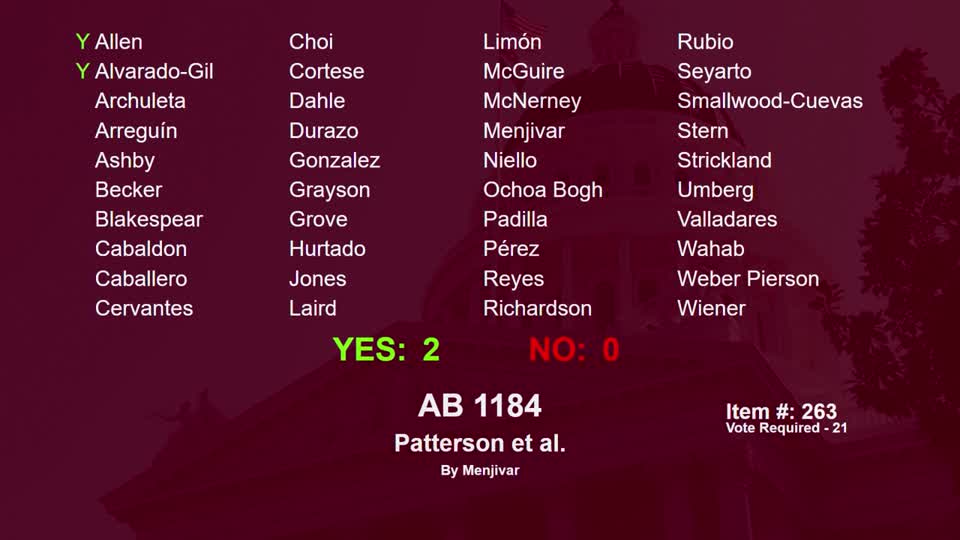 2MIN
Senate Floor
 11MIN
Senate Standing Committee on Housing
 12MIN
Senate Standing Committee on Business, Professions and Economic Development
 2MIN
Assembly Floor
 10MIN