AB 2172: Property taxation: county assessment appeals boards: assessment appeals commissioners.
- Session Year: 2025-2026
- House: Assembly
- Latest Version Date: 2026-09-27
Current Status:
Passed
(2026-09-27: Chaptered by Secretary of State - Chapter 585, Statutes of 2026.)
Introduced
In Committee
Awaiting First Chamber Vote
Passed First Chamber
In Committee
Awaiting Second Chamber Vote
Passed Second Chamber
Enacted
Existing property tax law authorizes a county board of supervisors to create assessment appeals boards for the county to equalize the valuation of taxable property within the county for purposes of taxation. Existing property tax law requires an assessment appeals board to consist of 3 members or of 5 members acting as a 3-member panel, selected as specified. Existing law also sets forth minimum qualifications for a member of an assessment appeals board.
This bill, commencing January 1, 2027, and until January 1, 2034, would authorize the county board of supervisors of a county containing a population of 500,000 or more to alternatively provide by ordinance that any property tax assessment appeals in the county may be heard and decided by a single-member appeals board, the single member of which would be known as an assessment appeals commissioner. The bill would set forth minimum qualifications for the commissioner, as specified. The bill would require the State Board of Equalization to adopt rules and guidelines necessary to ensure consistent hearing procedures, public access, and decisionmaking standards for these commissioners. The bill would prohibit a commissioner from hearing any new appeals after December 31, 2031, but would permit the commissioner to continue to hear and decide appeals received after January 1, 2027, but on or before December 31, 2031, following December 31, 2031. This bill would additionally require, if a county appoints commissioners to hear and decide assessment appeals, the county to provide a process by which the appellant may object to their appeal being heard and decided by an assessment appeals commissioner. The board would require the county, in the case that an appellant does not make that objection, to ensure the appeal is heard by a 3- or 5-member board.
This bill would specify that, for purposes of implementing the bills provisions with respect to other provisions relating to assessment appeals boards, a reference to an assessment appeals board also includes a single-member appeals board, as applicable, and a reference to member means a commissioner with respect to a single-member appeals board. The bill would make related findings and declarations.
Existing property tax law authorizes a county board of supervisors to create assessment appeals boards for the county to equalize the valuation of taxable property within the county for purposes of taxation. Existing property tax law requires an assessment appeals board to consist of 3 members or of 5 members acting as a 3-member panel, selected as specified. Existing law also sets forth minimum qualifications for a member of an assessment appeals board.
This bill, commencing January 1, 2027, and until January 1, 2034, would authorize the county board of supervisors of a county containing a population of 500,000 or more to alternatively provide by ordinance that all any property tax assessment appeals in the county may be heard and decided by a single-member appeals board, the single member of which would be known as an assessment appeals commissioner. The bill would set forth minimum qualifications for the commissioner, as specified. The bill would require the State Board of Equalization to adopt rules and guidelines necessary to ensure consistent hearing procedures, public access, and decisionmaking standards for these commissioners. The bill would prohibit a commissioner from hearing any new appeals after December 31, 2031, but would permit the commissioner to continue to hear and decide appeals received after January 1, 2027, but on or before December 31, 2031, following December 31, 2031. This bill would additionally require, if a county appoints commissioners to hear and decide assessment appeals, the county to provide a process by which the appellant may object to their appeal being heard and decided by an assessment appeals commissioner. The board would require the county, in the case that an appellant does not make that objection, to ensure the appeal is heard by a 3- or 5-member board.
This bill would specify that, for purposes of implementing the bills provisions with respect to other provisions relating to assessment appeals boards, a reference to an assessment appeals board also includes a single-member appeals board, as applicable, and a reference to member means a commissioner with respect to a single-member appeals board. The bill would make related findings and declarations.
Existing property tax law authorizes a county board of supervisors to create assessment appeals boards for the county to equalize the valuation of taxable property within the county for purposes of taxation. Existing property tax law requires an assessment appeals board to consist of 3 members or of 5 members acting as a 3-member panel, selected as specified. Existing law also sets forth minimum qualifications for a member of an assessment appeals board.
This bill, commencing January 1, 2027, and until January 1, 2034, would authorize the county board of supervisors of a county containing a population of 500,000 or more to alternatively provide by ordinance that all property tax assessment appeals in the county be heard and decided by a single-member appeals board, the single member of which would be known as an assessment appeals commissioner. The bill would set forth minimum qualifications for the commissioner, as specified. The bill would require the State Board of Equalization to adopt rules and guidelines necessary to ensure consistent hearing procedures, public access, and decisionmaking standards for these commissioners. The bill would prohibit a commissioner from hearing any new appeals after December 31, 2031, but would permit the commissioner to continue to hear and decide appeals received after January 1, 2027, but on or before December 31, 2031, following December 31, 2031. This bill would additionally require, if a county appoints commissioners to hear and decide assessment appeals, the county to provide a process by which the appellant may authorize the commissioner to hear and decide their appeal. object to their appeal being heard and decided by an assessment appeals commissioner. The board would require the county, in the case that an appellant does not make that authorization, objection, to ensure the appeal is heard by a 3- or 5-member board.
This bill would specify that, for purposes of implementing the bills provisions with respect to other provisions relating to assessment appeals boards, a reference to an assessment appeals board also includes a single-member appeals board, as applicable, and a reference to member means a commissioner with respect to a single-member appeals board. The bill would make related findings and declarations.
Existing property tax law authorizes a county board of supervisors to create assessment appeals boards for the county to equalize the valuation of taxable property within the county for purposes of taxation. Existing property tax law requires an assessment appeals board to consist of 3 members or of 5 members acting as a 3-member panel, selected as specified. Existing law also sets forth minimum qualifications for a member of an assessment appeals board.
This bill, commencing January 1, 2027, and until January 1, 2034, would authorize the county board of supervisors of a county containing a population of 500,000 or more to alternatively provide by ordinance that all property tax assessment appeals in the county be heard and decided by a single-member appeals board, the single member of which would be known as an assessment appeals commissioner. The bill would set forth minimum qualifications for the commissioner, as specified. The bill would require the State Board of Equalization to adopt rules and guidelines necessary to ensure consistent hearing procedures, public access, and decisionmaking standards for these commissioners. The bill would prohibit a commissioner from hearing any new appeals after December 31, 2031, but would permit the commissioner to continue to hear and decide appeals received after January 1, 2027, but on or before December 31, 2031, following December 31, 2031. This bill would additionally require, if a county authorizes appoints commissioners to hear and decide assessment appeals, the county to provide a process by which the appellant may request that authorize the commissioner to hear and decide their appeal appeal. The board would require the county, in the case that an appellant does not make that authorization, to ensure the appeal is heard by a 3- or 5-member board.
This bill would specify that, for purposes of implementing the bills provisions with respect to other provisions relating to assessment appeals boards, a reference to an assessment appeals board also includes a single-member appeals board, as applicable, and a reference to member means a commissioner with respect to a single-member appeals board. The bill would make related findings and declarations.
Existing property tax law authorizes a county board of supervisors to create assessment appeals boards for the county to equalize the valuation of taxable property within the county for purposes of taxation. Existing property tax law requires an assessment appeals board to consist of 3 members or of 5 members acting as a 3-member panel, selected as specified. Existing law also sets forth minimum qualifications for a member of an assessment appeals board.
This bill, commencing January 1, 2027, and until January 1, 2034, would authorize the county board of supervisors to alternatively provide by ordinance that all property tax assessment appeals in the county be heard and decided by a single-member appeals board, the single member of which would be known as an assessment appeals commissioner. The bill would set forth minimum qualifications for the commissioner, as specified. The bill would require the State Board of Equalization to adopt rules and guidelines necessary to ensure consistent hearing procedures, public access, and decisionmaking standards for these commissioners. The bill would prohibit a commissioner from hearing any new appeals after December 31, 2031, but would permit the commissioner to continue to hear and decide appeals received after January 1, 2027, but on or before December 31, 2031, following December 31, 2031. This bill would additionally require, if a county authorizes commissioners to hear and decide assessment appeals, the county to provide a process by which the appellant may request that their appeal is heard by a 3- or 5-member board.
This bill would specify that, for purposes of implementing the bills provisions with respect to other provisions relating to assessment appeals boards, a reference to an assessment appeals board also includes a single-member appeals board, as applicable, and a reference to member means a commissioner with respect to a single-member appeals board. The bill would make related findings and declarations.
The Legislature finds and declares all of the following:
(a)Assessment appeals boards play a critical role in ensuring fairness and uniformity in the property tax system by providing independent, quasi-judicial review of assessment disputes.
(b)In large and complex counties, the increasing volume and technical complexity of property assessment appealsparticularly involving income-producing and commercial propertiesrequire greater professional expertise and procedural efficiency.
(c)Authorizing counties to appoint qualified assessment appeals commissioners, in lieu of three-member panels, will increase the timeliness, consistency, and legal rigor of property tax appeals determinations while preserving due process and public accountability.
(d)This act is intended to supplement, not replace, the authority of counties to appoint traditional, three-member assessment appeals boards under existing law.
SEC. 2.Section 1620.5 is added to the Revenue and Taxation Code, to read:1620.5.(a)For purposes of this article in implementing Section 1622.3, both of the following shall apply:
(1)Assessment appeals board shall also include a single-member appeals board, as applicable.
(2) Member, when used to refer to a member of a three- or five-member assessment appeals board, shall mean a commissioner, with respect to a single-member appeals board.
(b)This section shall be operative only until January 1, 2034, and as of that date is repealed.
SEC. 3.Section 1622.3 is added to the Revenue and Taxation Code, to read:1622.3.(a)As an alternative to the selection procedures established in Section 1622 and Section 1622.1, commencing January 1, 2027, and before January 1, 2032, the county board of supervisors of a county containing a population of 500,000 or more may, by ordinance, provide that any property tax assessment appeals in the county may be heard and decided by a single-member appeals board, the single member of which shall be known as an assessment appeals commissioner. A commissioner appointed pursuant to this subdivision shall exercise all powers and duties of an assessment appeals board provided in this part. The qualifications for the commissioner shall be those set forth in Sections 1624, 1624.01, 1624.02, and 1624.05, in addition to those set forth in subdivision (b). An assessment appeals commissioner shall not hear and decide a property tax assessment if an appellant has filed an objection pursuant to subdivision (e).
(b)An assessment appeals commissioner appointed pursuant to subdivision (a) shall meet all of the following minimum qualifications:
(1)Possesses one of the following qualifications:
(A)A certified public accountant with experience in the appraisal or valuation of real property or business personal property.
(B)A licensed real estate broker holding one of the following professional designations:
(i)Certified commercial investment member (CCIM).
(ii)Certified real estate brokerage manager (CRB).
(iii)Certified residential specialist (CRS).
(iv)Graduate Realtor Institute (GRI).
(v)A comparable designation evidencing specialization in commercial or investment real estate.
(C)A real property appraiser holding the Member Appraisal Institute (MAI) designation or a comparable designation evidencing experience in the valuation of complex income-producing property.
(D)A personal property appraiser holding an Accredited Senior Appraiser (ASA) designation from the American Society of Appraisers or a comparable designation.
(E)An attorney with experience in the valuation of complex, income-producing, and business property.
(F)An individual with experience comparable to that described in subparagraphs (A) to (E), inclusive, as determined by the appointing authority.
(2)Has demonstrated ability to conduct fair and impartial hearings and to prepare written findings of fact and conclusions of law.
(c)A county that elects to appoint an assessment appeals commissioner pursuant to subdivision (a) may also authorize, by ordinance, the appointment of one or more alternate commissioners who meet the same qualifications as the commissioner. The alternate commissioners shall serve in the absence or disqualification of the regular commissioner.
(d)This section shall not be construed to limit the authority of a county to do either of the following:
(1)Establish multiple assessment appeals boards, whether composed of three members, five members acting as three-member panels, or a single commissioner.
(2)Appoint alternate members pursuant to this article.
(e)If a county appoints an assessment appeals commissioner pursuant to this section to adjudicate property tax appeals, the county shall provide a process by which the appellant may object to their appeal being heard and decided by an assessment appeals commissioner. Upon receipt of an objection, the county shall ensure the appeal is heard and decided by a three- or five-member assessment appeals board, as appropriate.
(f)The State Board of Equalization shall adopt rules and guidelines necessary to ensure consistent hearing procedures, public access, and decisionmaking standards for assessment appeals commissioners appointed pursuant to subdivision (b).
(g)The assessment appeals commissioner shall not hear any new appeals after December 31, 2031. However, the commissioner may continue to hear and decide appeals received after January 1, 2027, but on or before December 31, 2031, following December 31, 2031, in accordance with this part.
(h)This section shall be operative only until January 1, 2034, and as of that date is repealed.
The Legislature finds and declares all of the following:
(a)Assessment appeals boards play a critical role in ensuring fairness and uniformity in the property tax system by providing independent, quasi-judicial review of assessment disputes.
(b)In large and complex counties, the increasing volume and technical complexity of property assessment appealsparticularly involving income-producing and commercial propertiesrequire greater professional expertise and procedural efficiency.
(c)Authorizing counties to appoint qualified assessment appeals commissioners, in lieu of three-member panels, will increase the timeliness, consistency, and legal rigor of property tax appeals determinations while preserving due process and public accountability.
(d)This act is intended to supplement, not replace, the authority of counties to appoint traditional, three-member assessment appeals boards under existing law.
SEC. 2.Section 1620.5 is added to the Revenue and Taxation Code, to read:1620.5.(a)For purposes of this article in implementing Section 1622.3, both of the following shall apply:
(1)Assessment appeals board shall also include a single-member appeals board, as applicable.
(2) Member, when used to refer to a member of a three- or five-member assessment appeals board, shall mean a commissioner, with respect to a single-member appeals board.
(b)This section shall be operative only until January 1, 2034, and as of that date is repealed.
SEC. 3.Section 1622.3 is added to the Revenue and Taxation Code, to read:1622.3.(a)As an alternative to the selection procedures established in Section 1622 and Section 1622.1, commencing January 1, 2027, and before January 1, 2032, the county board of supervisors of a county containing a population of 500,000 or more may, by ordinance, provide that all any property tax assessment appeals in the county may be heard and decided by a single-member appeals board, the single member of which shall be known as an assessment appeals commissioner. A commissioner appointed pursuant to this subdivision shall exercise all powers and duties of an assessment appeals board provided in this part. The qualifications for the commissioner shall be those set forth in Sections 1624, 1624.01, 1624.02, and 1624.05, in addition to those set forth in subdivision (b). An assessment appeals commissioner shall not hear and decide a property tax assessment if an appellant has filed an objection pursuant to subdivision (e).
(b)An assessment appeals commissioner appointed pursuant to subdivision (a) shall meet all of the following minimum qualifications:
(1)Possesses one of the following qualifications:
(A)A certified public accountant with experience in the appraisal or valuation of real property or business personal property.
(B)A licensed real estate broker holding one of the following professional designations:
(i)Certified commercial investment member (CCIM).
(ii)Certified real estate brokerage manager (CRB).
(iii)Certified residential specialist (CRS).
(iv)Graduate Realtor Institute (GRI).
(v)A comparable designation evidencing specialization in commercial or investment real estate.
(C)A real property appraiser holding the Member Appraisal Institute (MAI) designation or a comparable designation evidencing experience in the valuation of complex income-producing property.
(D)A personal property appraiser holding an Accredited Senior Appraiser (ASA) designation from the American Society of Appraisers or a comparable designation.
(E)An attorney with experience in the valuation of complex, income-producing, and business property.
(F)An individual with experience comparable to that described in subparagraphs (A) to (E), inclusive, as determined by the appointing authority.
(2)Has demonstrated ability to conduct fair and impartial hearings and to prepare written findings of fact and conclusions of law.
(c)A county that elects to appoint an assessment appeals commissioner pursuant to subdivision (a) may also authorize, by ordinance, the appointment of one or more alternate commissioners who meet the same qualifications as the commissioner. The alternate commissioners shall serve in the absence or disqualification of the regular commissioner.
(d)This section shall not be construed to limit the authority of a county to do either of the following:
(1)Establish multiple assessment appeals boards, whether composed of three members, five members acting as three-member panels, or a single commissioner.
(2)Appoint alternate members pursuant to this article.
(e)If a county appoints an assessment appeals commissioner pursuant to this section to adjudicate property tax appeals, the county shall provide a process by which the appellant may object to their appeal being heard and decided by an assessment appeals commissioner. Upon receipt of an objection, the county shall ensure the appeal is heard and decided by a three- or five-member assessment appeals board, as appropriate.
(f)The State Board of Equalization shall adopt rules and guidelines necessary to ensure consistent hearing procedures, public access, and decisionmaking standards for assessment appeals commissioners appointed pursuant to subdivision (b).
(g)The assessment appeals commissioner shall not hear any new appeals after December 31, 2031. However, the commissioner may continue to hear and decide appeals received after January 1, 2027, but on or before December 31, 2031, following December 31, 2031, in accordance with this part.
(h)This section shall be operative only until January 1, 2034, and as of that date is repealed.
The Legislature finds and declares all of the following:
(a)Assessment appeals boards play a critical role in ensuring fairness and uniformity in the property tax system by providing independent, quasi-judicial review of assessment disputes.
(b)In large and complex counties, the increasing volume and technical complexity of property assessment appealsparticularly involving income-producing and commercial propertiesrequire greater professional expertise and procedural efficiency.
(c)Authorizing counties to appoint qualified assessment appeals commissioners, in lieu of three-member panels, will increase the timeliness, consistency, and legal rigor of property tax appeals determinations while preserving due process and public accountability.
(d)This act is intended to supplement, not replace, the authority of counties to appoint traditional, three-member assessment appeals boards under existing law.
SEC. 2.Section 1620.5 is added to the Revenue and Taxation Code, to read:1620.5.(a)For purposes of this article in implementing subdivision (b) of Section 1622 and subdivision (c) of Section 1622.1, Section 1622.3, both of the following shall apply:
(1)Assessment appeals board shall also include a single-member appeals board, as applicable.
(2) Member, when used to refer to a member of a three three- or five-member assessment appeals board, shall mean a commissioner, with respect to a single-member appeals board.
(b)This section shall be operative only until January 1, 2034, and as of that date is repealed.
SEC. 3.Section 1622 of the Revenue and Taxation Code is amended to read:1622.(a)Except as provided in subdivision (b), an assessment appeals board shall consist of three members selected by lot by the presiding judge of the superior court of the county from among those persons nominated for that purpose by the members of the county board of supervisors. Within 60 days after the adoption of the ordinance providing for the creation of assessment appeals boards, each member of the board of supervisors shall nominate not less than three nor more than five persons for appointment to the assessment appeals boards.(b)As an alternative to appointing a three-member assessment appeals board pursuant to subdivision (a), commencing January 1, 2027, and before January 1, 2032, the county board of supervisors of a county containing a population of 500,000 or more may, by ordinance, provide that all property tax assessment appeals in the county be heard and decided by a single-member appeals board, the single member of which shall be known as an assessment appeals commissioner. A commissioner appointed pursuant to this subdivision shall exercise all powers and duties of an assessment appeals board provided in this part. The qualifications for the commissioner shall be those set forth in Sections 1624, 1624.01, 1624.02, and 1624.05, in addition to those set forth in subdivision (c). An assessment appeals commissioner shall not hear and decide a property tax assessment appeal without obtaining the authorization of the appellant pursuant to Section 1622.3.(c)An assessment appeals commissioner appointed pursuant to subdivision (b) shall meet all of the following minimum qualifications:(1)Possesses one of the following qualifications:(A)A certified public accountant with experience in the appraisal or valuation of real property or business personal property.(B)A licensed real estate broker holding one of the following professional designations:(i)Certified commercial investment member (CCIM).(ii)Certified real estate brokerage manager (CRB).(iii)Certified residential specialist (CRS).(iv)Graduate Realtor Institute (GRI).(v)A comparable designation evidencing specialization in commercial or investment real estate.(C)A real property appraiser holding the Member Appraisal Institute (MAI) designation or a comparable designation evidencing experience in the valuation of complex income-producing property.(D)A personal property appraiser holding an Accredited Senior Appraiser (ASA) designation from the American Society of Appraisers or a comparable designation.(E)An attorney with experience in the valuation of complex, income-producing, and business property.(F)An individual with experience comparable to that described in subparagraphs (A) to (E), inclusive, as determined by the appointing authority.(2)Has demonstrated ability to conduct fair and impartial hearings and to prepare written findings of fact and conclusions of law.(d)A county that elects to appoint an assessment appeals commissioner pursuant to subdivision (b) may also authorize, by ordinance, the appointment of one or more alternate commissioners who meet the same qualifications as the commissioner. The alternate commissioners shall serve in the absence or disqualification of the regular commissioner.(e)This section shall not be construed to limit the authority of a county to do either of the following:(1)Establish multiple assessment appeals boards, whether composed of three members or a single commissioner.(2)Appoint alternate members pursuant to this section or Section 1622.1.(f)The State Board of Equalization shall adopt rules and guidelines necessary to ensure consistent hearing procedures, public access, and decisionmaking standards for assessment appeals commissioners appointed pursuant to subdivision (b).(g)The assessment appeals commissioner shall not hear any new appeals after December 31, 2031. However, the commissioner may continue to hear and decide appeals received after January 1, 2027, but on or before December 31, 2031, following December 31, 2031, in accordance with this part.(h) This section shall be operative only until January 1, 2034, and as of that date is repealed.SEC. 4.Section 1622 is added to the Revenue and Taxation Code, to read:1622.(a)An assessment appeals board shall consist of three members selected by lot by the presiding judge of the superior court of the county from among those persons nominated for that purpose by the members of the county board of supervisors. Within 60 days after the adoption of the ordinance providing for the creation of assessment appeals boards, each member of the board of supervisors shall nominate not less than three nor more than five persons for appointment to the assessment appeals boards.(b)This section shall become operative on January 1, 2034.SEC. 5.Section 1622.1 of the Revenue and Taxation Code is amended to read:1622.1.(a)As an alternative to the selection procedure provided in Section 1622, the county board of supervisors may, by ordinance, elect to appoint directly the members of the assessment appeals board. Approval of each member shall be by majority vote of the board of supervisors.(b)An assessment appeals board appointed pursuant to this section may consist of three or five members. If a five-member board is appointed, the board shall only act as a three-member panel designated from time to time by the clerk of the assessment appeals board. If a five-member board is appointed, the term of office of these members shall be three years except that upon the original selection of these members, the members shall be assigned terms in such a manner that the terms of no more than two offices shall expire in any one year.(c)As an alternative to appointing a three- or five-member assessment appeals board pursuant to subdivision (b), commencing January 1, 2027, and before January 1, 2032, the county board of supervisors of a county containing a population of 500,000 or more may, by ordinance, provide that all property tax assessment appeals in the county be heard and decided by a single appeals commissioner. A commissioner appointed pursuant to this subdivision shall exercise all powers and duties of an assessment appeals board provided in this part. The qualifications for the commissioner shall be those set forth in Sections 1624, 1624.01, 1624.02, and 1624.05, in addition to those set forth in subdivision (d). An assessment appeals commissioner shall not hear and decide a property tax assessment appeal without obtaining the authorization of the appellant pursuant to Section 1622.3.(d)An assessment appeals commissioner appointed pursuant to subdivision (c) shall meet all of the following minimum qualifications set forth in subdivision (c) of Section 1622.(e)A county that elects to appoint an assessment appeals commissioner pursuant to subdivision (c) may also authorize, by ordinance, the appointment of one or more alternate commissioners who meet the same qualifications as the commissioner. The alternate commissioners shall serve in the absence or disqualification of the regular commissioner.(f)This section shall not be construed to limit the authority of a county to do either of the following:(1)Establish multiple assessment appeals boards, whether composed of three members, five members acting as three-member panels, or a single commissioner.(2)Appoint alternate members pursuant to this section or Section 1622.(g)The State Board of Equalization shall adopt rules and guidelines necessary to ensure consistent hearing procedures, public access, and decisionmaking standards for assessment appeals commissioners appointed pursuant to subdivision (c).(h)The assessment appeals commissioner shall not hear any new appeals after December 31, 2031. However, the commissioner may continue to hear and decide appeals received after January 1, 2027, but on or before December 31, 2031, following December 31, 2031, in accordance with this part.(i)This section shall be operative only until January 1, 2034, and as of that date is repealed.SEC. 6.Section 1622.1 is added to the Revenue and Taxation Code, to read:1622.1.(a)As an alternative to the selection procedure provided in Section 1622, the county board of supervisors may, by ordinance, elect to appoint directly the members of the assessment appeals board. Approval of each member shall be by majority vote of the board of supervisors.(b)An assessment appeals board appointed pursuant to this section may consist of three or five members. If a five-member board is appointed, the board shall only act as a three-member panel designated from time to time by the clerk of the assessment appeals board. If a five-member board is appointed, the term of office of these members shall be three years, except that, upon the original selection of these members, the members shall be assigned terms in such a manner that the terms of no more than two offices shall expire in any one year.(c)This section shall become operative on January 1, 2034.SEC. 7.Section 1622.3 is added to the Revenue and Taxation Code, to read:1622.3.(a)If a county appoints an assessment appeals commissioner pursuant to Section 1622 or 1622.1 to adjudicate property tax appeals, the county shall provide a process by which the appellant may authorize the commissioner to hear and decide their appeal. If the appellant does not authorize the commissioner to hear and decide their appeal, the county shall ensure the case is heard by a three- or five-member board.(b)This section shall be operative only until January 1, 2034, and as of that date is repealed.SEC. 3.Section 1622.3 is added to the Revenue and Taxation Code, to read:1622.3.(a)As an alternative to the selection procedures established in Section 1622 and Section 1622.1, commencing January 1, 2027, and before January 1, 2032, the county board of supervisors of a county containing a population of 500,000 or more may, by ordinance, provide that all property tax assessment appeals in the county be heard and decided by a single-member appeals board, the single member of which shall be known as an assessment appeals commissioner. A commissioner appointed pursuant to this subdivision shall exercise all powers and duties of an assessment appeals board provided in this part. The qualifications for the commissioner shall be those set forth in Sections 1624, 1624.01, 1624.02, and 1624.05, in addition to those set forth in subdivision (b). An assessment appeals commissioner shall not hear and decide a property tax assessment if an appellant has filed an objection pursuant to subdivision (e).
(b)An assessment appeals commissioner appointed pursuant to subdivision (a) shall meet all of the following minimum qualifications:
(1)Possesses one of the following qualifications:
(A)A certified public accountant with experience in the appraisal or valuation of real property or business personal property.
(B)A licensed real estate broker holding one of the following professional designations:
(i)Certified commercial investment member (CCIM).
(ii)Certified real estate brokerage manager (CRB).
(iii)Certified residential specialist (CRS).
(iv)Graduate Realtor Institute (GRI).
(v)A comparable designation evidencing specialization in commercial or investment real estate.
(C)A real property appraiser holding the Member Appraisal Institute (MAI) designation or a comparable designation evidencing experience in the valuation of complex income-producing property.
(D)A personal property appraiser holding an Accredited Senior Appraiser (ASA) designation from the American Society of Appraisers or a comparable designation.
(E)An attorney with experience in the valuation of complex, income-producing, and business property.
(F)An individual with experience comparable to that described in subparagraphs (A) to (E), inclusive, as determined by the appointing authority.
(2)Has demonstrated ability to conduct fair and impartial hearings and to prepare written findings of fact and conclusions of law.
(c)A county that elects to appoint an assessment appeals commissioner pursuant to subdivision (a) may also authorize, by ordinance, the appointment of one or more alternate commissioners who meet the same qualifications as the commissioner. The alternate commissioners shall serve in the absence or disqualification of the regular commissioner.
(d)This section shall not be construed to limit the authority of a county to do either of the following:
(1)Establish multiple assessment appeals boards, whether composed of three members, five members acting as three-member panels, or a single commissioner.
(2)Appoint alternate members pursuant to this article.
(e)If a county appoints an assessment appeals commissioner pursuant to this section to adjudicate property tax appeals, the county shall provide a process by which the appellant may object to their appeal being heard and decided by an assessment appeals commissioner. Upon receipt of an objection, the county shall ensure the appeal is heard and decided by a three- or five-member assessment appeals board, as appropriate.
(f)The State Board of Equalization shall adopt rules and guidelines necessary to ensure consistent hearing procedures, public access, and decisionmaking standards for assessment appeals commissioners appointed pursuant to subdivision (b).
(g)The assessment appeals commissioner shall not hear any new appeals after December 31, 2031. However, the commissioner may continue to hear and decide appeals received after January 1, 2027, but on or before December 31, 2031, following December 31, 2031, in accordance with this part.
(h)This section shall be operative only until January 1, 2034, and as of that date is repealed.
The Legislature finds and declares all of the following:
(a)Assessment appeals boards play a critical role in ensuring fairness and uniformity in the property tax system by providing independent, quasi-judicial review of assessment disputes.
(b)In large and complex counties, the increasing volume and technical complexity of property assessment appealsparticularly involving income-producing and commercial propertiesrequire greater professional expertise and procedural efficiency.
(c)Authorizing counties to appoint qualified assessment appeals commissioners, in lieu of three-member panels, will increase the timeliness, consistency, and legal rigor of property tax appeals determinations while preserving due process and public accountability.
(d)This act is intended to supplement, not replace, the authority of counties to appoint traditional, three-member assessment appeals boards under existing law.
SEC. 2.Section 1620.5 is added to the Revenue and Taxation Code, to read:1620.5.(a)For purposes of this article in implementing subdivision (b) of Section 1622 and subdivision (c) of Section 1622.1, both of the following shall apply:
(1)Assessment appeals board shall also include a single-member appeals board, as applicable.
(2) Member, when used to refer to a member of a three or five-member assessment appeals board, shall mean a commissioner, with respect to a single-member appeals board.(b)This section shall be operative only until January 1, 2034, and as of that date is repealed.
SEC. 3.Section 1622 of the Revenue and Taxation Code is amended to read:1622.(a)Except as provided in subdivision (b), an assessment appeals board shall consist of three members selected by lot by the presiding judge of the superior court of the county from among those persons nominated for that purpose by the members of the county board of supervisors. Within 60 days after the adoption of the ordinance providing for the creation of assessment appeals boards, each member of the board of supervisors shall nominate not less than three nor more than five persons for appointment to the assessment appeals boards.
(b)As an alternative to appointing a three-member assessment appeals board pursuant to subdivision (a), commencing January 1, 2027, and before January 1, 2032, the county board of supervisors of a county containing a population of 500,000 or more may, by ordinance, provide that all property tax assessment appeals in the county be heard and decided by a single-member appeals board, the single member of which shall be known as an assessment appeals commissioner. A commissioner appointed pursuant to this subdivision shall exercise all powers and duties of an assessment appeals board provided in this part. The qualifications for the commissioner shall be those set forth in Sections 1624, 1624.01, 1624.02, and 1624.05, in addition to those set forth in subdivision (c). An assessment appeals commissioner shall not hear and decide a property tax assessment appeal without obtaining the authorization of the appellant pursuant to Section 1622.3.
(c)An assessment appeals commissioner appointed pursuant to subdivision (b) shall meet all of the following minimum qualifications:
(1)Possesses one of the following qualifications:
(A)A certified public accountant with experience in the appraisal or valuation of real property or business personal property.
(B)A licensed real estate broker holding one of the following professional designations:
(i)Certified commercial investment member (CCIM).
(ii)Certified real estate brokerage manager (CRB).
(iii)Certified residential specialist (CRS).
(iv)Graduate Realtor Institute (GRI).
(v)A comparable designation evidencing specialization in commercial or investment real estate.
(C)A real property appraiser holding the Member Appraisal Institute (MAI) designation or a comparable designation evidencing experience in the valuation of complex income-producing property.
(D)A personal property appraiser holding an Accredited Senior Appraiser (ASA) designation from the American Society of Appraisers or a comparable designation.
(E)An attorney with experience in the valuation of complex, income-producing, and business property.
(F)An individual with experience comparable to that described in subparagraphs (A) to (E), inclusive, as determined by the appointing authority.
(2)Has demonstrated ability to conduct fair and impartial hearings and to prepare written findings of fact and conclusions of law.
(d)A county that elects to appoint an assessment appeals commissioner pursuant to subdivision (b) may also authorize, by ordinance, the appointment of one or more alternate commissioners who meet the same qualifications as the commissioner. The alternate commissioners shall serve in the absence or disqualification of the regular commissioner.
(e)This section shall not be construed to limit the authority of a county to do either of the following:
(1)Establish multiple assessment appeals boards, whether composed of three members or a single commissioner.
(2)Appoint alternate members pursuant to this section or Section 1622.1.
(f)The State Board of Equalization shall adopt rules and guidelines necessary to ensure consistent hearing procedures, public access, and decisionmaking standards for assessment appeals commissioners appointed pursuant to subdivision (b).
(g)The assessment appeals commissioner shall not hear any new appeals after December 31, 2031. However, the commissioner may continue to hear and decide appeals received after January 1, 2027, but on or before December 31, 2031, following December 31, 2031, in accordance with this part.
(h) This section shall be operative only until January 1, 2034, and as of that date is repealed.
SEC. 4.Section 1622 is added to the Revenue and Taxation Code, to read:1622.(a)An assessment appeals board shall consist of three members selected by lot by the presiding judge of the superior court of the county from among those persons nominated for that purpose by the members of the county board of supervisors. Within 60 days after the adoption of the ordinance providing for the creation of assessment appeals boards, each member of the board of supervisors shall nominate not less than three nor more than five persons for appointment to the assessment appeals boards.
(b)This section shall become operative on January 1, 2034.
SEC. 5.Section 1622.1 of the Revenue and Taxation Code is amended to read:1622.1.(a)As an alternative to the selection procedure provided in Section 1622, the county board of supervisors may, by ordinance, elect to appoint directly the members of the assessment appeals board. Approval of each member shall be by majority vote of the board of supervisors.
(b)An assessment appeals board appointed pursuant to this section may consist of three or five members. If a five-member board is appointed, the board shall only act as a three-member panel designated from time to time by the clerk of the assessment appeals board. If a five-member board is appointed, the term of office of these members shall be three years except that upon the original selection of these members, the members shall be assigned terms in such a manner that the terms of no more than two offices shall expire in any one year.
(c)As an alternative to appointing a three- or five-member assessment appeals board pursuant to subdivision (b), commencing January 1, 2027, and before January 1, 2032, the county board of supervisors of a county containing a population of 500,000 or more may, by ordinance, provide that all property tax assessment appeals in the county be heard and decided by a single appeals commissioner. A commissioner appointed pursuant to this subdivision shall exercise all powers and duties of an assessment appeals board provided in this part. The qualifications for the commissioner shall be those set forth in Sections 1624, 1624.01, 1624.02, and 1624.05, in addition to those set forth in subdivision (d). An assessment appeals commissioner shall not hear and decide a property tax assessment appeal without obtaining the authorization of the appellant pursuant to Section 1622.3.
(d)An assessment appeals commissioner appointed pursuant to subdivision (c) shall meet all of the following minimum qualifications set forth in subdivision (c) of Section 1622.
(e)A county that elects to appoint an assessment appeals commissioner pursuant to subdivision (c) may also authorize, by ordinance, the appointment of one or more alternate commissioners who meet the same qualifications as the commissioner. The alternate commissioners shall serve in the absence or disqualification of the regular commissioner.
(f)This section shall not be construed to limit the authority of a county to do either of the following:
(1)Establish multiple assessment appeals boards, whether composed of three members, five members acting as three-member panels, or a single commissioner.
(2)Appoint alternate members pursuant to this section or Section 1622.
(g)The State Board of Equalization shall adopt rules and guidelines necessary to ensure consistent hearing procedures, public access, and decisionmaking standards for assessment appeals commissioners appointed pursuant to subdivision (c).
(h)The assessment appeals commissioner shall not hear any new appeals after December 31, 2031. However, the commissioner may continue to hear and decide appeals received after January 1, 2027, but on or before December 31, 2031, following December 31, 2031, in accordance with this part.
(i)This section shall be operative only until January 1, 2034, and as of that date is repealed.
SEC. 6.Section 1622.1 is added to the Revenue and Taxation Code, to read:1622.1.(a)As an alternative to the selection procedure provided in Section 1622, the county board of supervisors may, by ordinance, elect to appoint directly the members of the assessment appeals board. Approval of each member shall be by majority vote of the board of supervisors.
(b)An assessment appeals board appointed pursuant to this section may consist of three or five members. If a five-member board is appointed, the board shall only act as a three-member panel designated from time to time by the clerk of the assessment appeals board. If a five-member board is appointed, the term of office of these members shall be three years, except that, upon the original selection of these members, the members shall be assigned terms in such a manner that the terms of no more than two offices shall expire in any one year.
(c)This section shall become operative on January 1, 2034.
SEC. 7.Section 1622.3 is added to the Revenue and Taxation Code, to read:1622.3.(a)If a county authorizes appoints an assessment appeals commissioner pursuant to Section 1622 or 1622.1 to adjudicate property tax appeals, the county shall provide a process by which the appellant may request that their appeal is heard by a three- or a five-member board. Upon receipt of a request described in the preceding sentence, authorize the commissioner to hear and decide their appeal. If the appellant does not authorize the commissioner to hear and decide their appeal, the county shall ensure the case is heard by a three- or five-member board.
(b)This section shall be operative only until January 1, 2034, and as of that date is repealed.
The Legislature finds and declares all of the following:
(a)Assessment appeals boards play a critical role in ensuring fairness and uniformity in the property tax system by providing independent, quasi-judicial review of assessment disputes.
(b)In large and complex counties, the increasing volume and technical complexity of property assessment appealsparticularly involving income-producing and commercial propertiesrequire greater professional expertise and procedural efficiency.
(c)Authorizing counties to appoint qualified assessment appeals commissioners, in lieu of three-member panels, will increase the timeliness, consistency, and legal rigor of property tax appeals determinations while preserving due process and public accountability.
(d)This act is intended to supplement, not replace, the authority of counties to appoint traditional, three-member assessment appeals boards under existing law.
SEC. 2.Section 1620.5 is added to the Revenue and Taxation Code, to read:1620.5.(a)For purposes of this article in implementing subdivision (b) of Section 1622 and subdivision (c) of Section 1622.1, both of the following shall apply:
(1)Assessment appeals board shall also include a single-member appeals board, as applicable.
(2)Member, when used to refer to a member of a three or five-member assessment appeals board, shall mean a commissioner, with respect to a single-member appeals board.
(b)This section shall be operative only until January 1, 2034, and as of that date is repealed.
SEC. 3.Section 1622 of the Revenue and Taxation Code is amended to read:1622.An (a)Except as provided in subdivision (b), an assessment appeals board shall consist of three members selected by lot by the presiding judge of the superior court of the county from among those persons nominated for that purpose by the members of the county board of supervisors. Within 60 days after the adoption of the ordinance providing for the creation of assessment appeals boards, each member of the board of supervisors shall nominate not less than three nor more than five persons for appointment to the assessment appeals boards.
(b)As an alternative to appointing a three-member assessment appeals board pursuant to subdivision (a), commencing January 1, 2027, and before January 1, 2032, the county board of supervisors may, by ordinance, provide that all property tax assessment appeals in the county be heard and decided by a single-member appeals board, the single member of which shall be known as an assessment appeals commissioner. A commissioner appointed pursuant to this subdivision shall exercise all powers and duties of an assessment appeals board provided in this part. The qualifications for the commissioner shall be those set forth in Sections 1624, 1624.01, 1624.02, and 1624.05, in addition to those set forth in subdivision (c).
(c)An assessment appeals commissioner appointed pursuant to subdivision (b) shall meet all of the following minimum qualifications:
(1)Possesses one of the following qualifications:
(A)A certified public accountant with experience in the appraisal or valuation of real property or business personal property.
(B)A licensed real estate broker holding one of the following professional designations:
(i)Certified commercial investment member (CCIM).
(ii)Certified real estate brokerage manager (CRB).
(iii)Certified residential specialist (CRS).
(iv)Graduate Realtor Institute (GRI).
(v)A comparable designation evidencing specialization in commercial or investment real estate.
(C)A real property appraiser holding the Member Appraisal Institute (MAI) designation or a comparable designation evidencing experience in the valuation of complex income-producing property.
(D)A personal property appraiser holding an Accredited Senior Appraiser (ASA) designation from the American Society of Appraisers or a comparable designation.
(E)An attorney with experience in the valuation of complex, income-producing, and business property.
(F)An individual with experience comparable to that described in subparagraphs (A) to (E), inclusive, as determined by the appointing authority.
(2)Has demonstrated ability to conduct fair and impartial hearings and to prepare written findings of fact and conclusions of law.
(d)A county that elects to appoint an assessment appeals commissioner pursuant to subdivision (b) may also authorize, by ordinance, the appointment of one or more alternate commissioners who meet the same qualifications as the commissioner. The alternate commissioners shall serve in the absence or disqualification of the regular commissioner.
(e)This section shall not be construed to limit the authority of a county to do either of the following:
(1)Establish multiple assessment appeals boards, whether composed of three members or a single commissioner.
(2)Appoint alternate members pursuant to this section or Section 1622.1.
(f)The State Board of Equalization shall adopt rules and guidelines necessary to ensure consistent hearing procedures, public access, and decisionmaking standards for assessment appeals commissioners appointed pursuant to subdivision (b).
(g)The assessment appeals commissioner shall not hear any new appeals after December 31, 2031. However, the commissioner may continue to hear and decide appeals received after January 1, 2027, but on or before December 31, 2031, following December 31, 2031, in accordance with this part.
(h)This section shall be operative only until January 1, 2034, and as of that date is repealed.
SEC. 4.Section 1622 is added to the Revenue and Taxation Code, to read:1622.(a)An assessment appeals board shall consist of three members selected by lot by the presiding judge of the superior court of the county from among those persons nominated for that purpose by the members of the county board of supervisors. Within 60 days after the adoption of the ordinance providing for the creation of assessment appeals boards, each member of the board of supervisors shall nominate not less than three nor more than five persons for appointment to the assessment appeals boards.
(b)This section shall become operative on January 1, 2034.
SEC. 5.Section 1622.1 of the Revenue and Taxation Code is amended to read:1622.1.(a)As an alternative to the selection procedure provided in Section 1622, the county board of supervisors may, by ordinance, elect to appoint directly the members of the assessment appeals board. Approval of each member shall be by majority vote of the board of supervisors.
(b)An assessment appeals board appointed pursuant to this section may consist of three or five members. If a five-member board is appointed, the board shall only act as a three-member panel designated from time to time by the clerk of the assessment appeals board. If a five-member board is appointed, the term of office of these members shall be three years except that upon the original selection of these members, the members shall be assigned terms in such a manner that the terms of no more than two offices shall expire in any one year.
(c)As an alternative to appointing a three- or five-member assessment appeals board pursuant to subdivision (b), commencing January 1, 2027, and before January 1, 2032, the county board of supervisors may, by ordinance, provide that all property tax assessment appeals in the county be heard and decided by a single appeals commissioner. A commissioner appointed pursuant to this subdivision shall exercise all powers and duties of an assessment appeals board provided in this part. The qualifications for the commissioner shall be those set forth in Sections 1624, 1624.01, 1624.02, and 1624.05, in addition to those set forth in subdivision (d).
(d)An assessment appeals commissioner appointed pursuant to subdivision (c) shall meet all of the following minimum qualifications set forth in subdivision (c) of Section 1622.
(e)A county that elects to appoint an assessment appeals commissioner pursuant to subdivision (c) may also authorize, by ordinance, the appointment of one or more alternate commissioners who meet the same qualifications as the commissioner. The alternate commissioners shall serve in the absence or disqualification of the regular commissioner.
(f)This section shall not be construed to limit the authority of a county to do either of the following:
(1)Establish multiple assessment appeals boards, whether composed of three members, five members acting as three-member panels, or a single commissioner.
(2)Appoint alternate members pursuant to this section or Section 1622.
(g)The State Board of Equalization shall adopt rules and guidelines necessary to ensure consistent hearing procedures, public access, and decisionmaking standards for assessment appeals commissioners appointed pursuant to subdivision (c).
(h)The assessment appeals commissioner shall not hear any new appeals after December 31, 2031. However, the commissioner may continue to hear and decide appeals received after January 1, 2027, but on or before December 31, 2031, following December 31, 2031, in accordance with this part.
(i)This section shall be operative only until January 1, 2034, and as of that date is repealed.
SEC. 6.Section 1622.1 is added to the Revenue and Taxation Code, to read:1622.1.(a)As an alternative to the selection procedure provided in Section 1622, the county board of supervisors may, by ordinance, elect to appoint directly the members of the assessment appeals board. Approval of each member shall be by majority vote of the board of supervisors.
(b)An assessment appeals board appointed pursuant to this section may consist of three or five members. If a five-member board is appointed, the board shall only act as a three-member panel designated from time to time by the clerk of the assessment appeals board. If a five-member board is appointed, the term of office of these members shall be three years, except that, upon the original selection of these members, the members shall be assigned terms in such a manner that the terms of no more than two offices shall expire in any one year.
(c)This section shall become operative on January 1, 2034.
SEC. 7.Section 1622.3 is added to the Revenue and Taxation Code, to read:1622.3.(a)If a county authorizes an assessment appeals commissioner pursuant to Section 1622 or 1622.1 to adjudicate property tax appeals, the county shall provide a process by which the appellant may request that their appeal is heard by a three- or a five-member board. Upon receipt of a request described in the preceding sentence, the county shall ensure the case is heard by a three- or five-member board.
(b)This section shall be operative only until January 1, 2034, and as of that date is repealed.
|
Date
|
Status
|
|---|---|
| Sep 27, 2026 | Chaptered by Secretary of State - Chapter 585, Statutes of 2026. |
| Sep 27, 2026 | Approved by the Governor. |
| Aug 31, 2026 | Enrolled and presented to the Governor at 4 p.m. |
| Aug 25, 2026 | Senate amendments concurred in. To Engrossing and Enrolling. (Ayes 77. Noes 0. Page 6484.). |
| Aug 25, 2026 | Senate amendments concurred in. To Engrossing and Enrolling. (Ayes 77. Noes 0.). |
| Aug 24, 2026 | In Assembly. Concurrence in Senate amendments pending. |
| Aug 24, 2026 | Read third time. Passed. Ordered to the Assembly. (Ayes 40. Noes 0. Page 5698.). |
| Aug 24, 2026 | Read third time. Passed. Ordered to the Assembly. (Ayes 39. Noes 0.). |
| Aug 13, 2026 | Read second time. Ordered to third reading. |
| Aug 13, 2026 | From committee: Do pass. (Ayes 7. Noes 0.) (August 13). |
| Aug 3, 2026 | In committee: Referred to APPR. suspense file. |
| Jun 24, 2026 | From committee: Do pass and re-refer to Com. on APPR. (Ayes 4. Noes 0.) (June 24). Re-referred to Com. on APPR. |
| Jun 11, 2026 | From committee chair, with author's amendments: Amend, and re-refer to committee. Read second time, amended, and re-referred to Com. on REV. & TAX. |
| Jun 3, 2026 | Referred to Com. on REV. & TAX. |
| May 21, 2026 | In Senate. Read first time. To Com. on RLS. for assignment. |
| May 21, 2026 | Read third time. Passed. Ordered to the Senate. (Ayes 73. Noes 0. Page 5183.) |
| May 21, 2026 | Read third time. Passed. Ordered to the Senate. (Ayes 73. Noes 0.) |
| May 14, 2026 | Read second time. Ordered to third reading. |
| May 13, 2026 | From committee: Do pass. (Ayes 15. Noes 0.) (May 13). |
| Apr 27, 2026 | Re-referred to Com. on APPR. |
| Apr 23, 2026 | Read second time and amended. |
| Apr 22, 2026 | From committee: Amend, and do pass as amended and re-refer to Com. on APPR. (Ayes 7. Noes 0.) (April 20). |
| Apr 13, 2026 | Re-referred to Com. on REV. & TAX. |
| Apr 9, 2026 | From committee chair, with author's amendments: Amend, and re-refer to Com. on REV. & TAX. Read second time and amended. |
| Mar 2, 2026 | Referred to Com. on REV. & TAX. |
| Feb 19, 2026 | From printer. May be heard in committee March 21. |
| Feb 18, 2026 | Read first time. To print. |
|
Date
|
Description
|
Location
|
Votes
|
|
|---|---|---|---|---|
| Aug 25, 2026 | AB 2172 Gipson Concurrence in Senate Amendments | Assembly Floor |
Passed |
|
| Aug 24, 2026 | Assembly 3rd Reading AB2172 Gipson By Grayson | Senate Floor |
Passed |
|
| Aug 13, 2026 | Do pass | Senate Standing Committee on Appropriations |
Passed |
|
| Aug 3, 2026 | Placed on suspense file | Senate Standing Committee on Appropriations |
Passed |
|
| Jun 24, 2026 | Do pass, but first be re-referred to the Committee on [Appropriations] | Senate Standing Committee on Revenue and Taxation |
Passed |
|
| May 21, 2026 | AB 2172 Gipson Assembly Third Reading | Assembly Floor |
Passed |
|
| May 13, 2026 | Do pass. | Assembly Standing Committee on Appropriations |
Passed |
|
| Apr 20, 2026 | Do pass as amended and be re-referred to the Committee on [Appropriations] | Assembly Standing Committee on Revenue and Taxation |
Passed |
This list shows positions taken on this bill by organizations on the date displayed, which is linked to the original source.
Positions by individuals are not included.
|
Organization
|
Position
|
Date
|
|---|---|---|
| California Assessors Association | ** Support | |
| California State Board of Equalization | ** Support | |
| Los Angeles County Assessor Jeffrey Prang | ** Support | |
| The California Assessors Association | ** Support |
CONCURRENCE IN SENATE AMENDMENTS
CSA1 Bill Id:AB 2172
Author:(Gipson)
As Amended Ver:June 11, 2026
Majority vote
SUMMARY
Authorizes certain counties to establish a one-member assessment appeals board (AAB), titled an assessment appeals commissioner (AAC).
Senate Amendments
Clarify that eligible counties may use this bill's alternative process to adjudicate any appeal rather than all appeals.
COMMENTS
- AABs: The California Constitution requires that each county establish a board of equalization to equalize local assessments. County boards of supervisors or AABs may serve as the county board of equalization. Thus, an AAB exercises:
[…] judicial functions, and its decisions as to the value of the property and the fairness of the assessment so far as amount is concerned constitutes an independent and conclusive judgment of the tribunal created by law for the determination of that question, which abrogates and takes the place of the judgement of the assessor upon that question. (Los Angeles Gas and Electric Co. v. County of Los Angeles (1912) 162 Cal. 164.)
In other words, an AAB is a quasi-judicial body. An AAB's decision is final and may not be reheard by the board, even at the request of the assessor or taxpayer. The determination of value by an AAB may only be reviewed by a subsequent court if the determination was fraudulent, arbitrary, involved an abuse of discretion, or the AAB failed to follow standards prescribed by the Legislature. AABs have no jurisdiction to grant or deny exemptions; to decide disputes involving tax rates, local government budgets, tax bills, or tax policy; and have no authority to consider a taxpayer's ability to pay in making their determinations.
The State Constitution did not delineate the composition of AABs and largely defers to the Legislature regarding the application of the constitutional requirement. In implementing this requirement, the Legislature has established a series of procedures by which counties may nominate and appoint AAB members. The Legislature has stipulated that AABs be three- or five-member boards. Existing law specifies the terms for which these members may serve, appointment of alternative members, and the minimum qualifications for a person to be eligible to serve as a member, among other administrative procedures. Importantly, the Legislature has required that a county determine within two years of an application for the reduction in assessment whether the opinion of value claimed by the applicant is valid. Absent this determination, the law presumes that the applicant's opinion is correct. In effect, this creates a two-year deadline where a county must make a determination or the full value of the property defaults to the applicant's opinion of value.
- Assessment appeals in Los Angeles (LA) County: As the largest county in the state, LA experiences the highest volume of assessment appeals. Of the nearly 30,000 appeals statewide over the 2023-24 fiscal year, nearly 9,000 were filed in LA County. In turn, LA County is experiencing a backlog of assessment appeals that need adjudicating; this is not a new phenomenon. The Legislature has acted to alleviate this backlog by providing greater flexibility in AAB procedures. In 2020, this Committee authored AB 3373 (Committee on Revenue and Taxation), Chapter 57, Statutes of 2020, which removed the limitation on the number of AABs a county may create. The next year, the Legislature passed AB 1203 (Burke), Chapter 418, Statutes of 2021, which expanded the type of professional experience a person may have to be eligible for nomination to an AAB and authorized LA County to reduce, from three years to one year, the intervening period that a person who was an employee of the assessor's office must wait before being eligible as a nominee to an AAB. Despite these actions, LA County remains burdened by a backlog of appeals - a backlog that is likely to increase as victims of the recent January 2025 fires in LA County file for reductions in assessment to reflect the damaged values of their properties.
- This bill: This bill would authorize an additional option for counties with a population of 500,000 or more when establishing bodies to adjudicate assessment appeals. Specifically, this bill would allow large counties to establish a one-member AAB, known as an "AAC". An AAC would have the same authority, and be subject to the same restrictions as a standard AAB but would have additional minimum qualifications for a person nominated as an AAC.
According to the Author
The author has submitted the following statement in support of this bill:
AB 2172 gives counties a practical, time-limited tool to reduce delays in the property tax appeals process by allowing a single, qualified commissioner to hear complex cases. Multi-day appeals involving properties like hotels, stadiums, and possessory interests are often difficult to schedule under the current multi-member system, leading to backlogs. This bill streamlines hearings, improves efficiency, and speeds resolution while preserving due process by allowing taxpayers to request a traditional multi-member board.
Arguments in Support
The California Assessors Association, writing in support of a previous, but substantially similar, version of this bill, states, in part:
From an administrative standpoint, this measure offers counties an important tool to address increasing workloads. Single-member hearings can reduce scheduling delays, improve efficiency, and allow for more timely resolution of appeals – particularly in counties where backlogs can impact both taxpayers and local agencies.
[This] bill also maintains important taxpayer protections. Commissioners must meet defined qualifications, and hearings remain subject to oversight and procedural standards established by the BOE, including requirements for transparency, public access, and written findings. The inclusion of a sunset date ensures the Legislature has an opportunity to evaluate the effectiveness of this approach before considering any extension.
Arguments in Opposition
None on file
FISCAL COMMENTS
The Senate Appropriations Committee states that, "[t]he Board of Equalization (BOE) indicates that [the BOE] would incur first-year costs of $71,000, steadily declining in the ensuing years (General Fund)."
VOTES:
ASM REVENUE AND TAXATION: 7-0-0
YES: Gipson, Sanchez, Carrillo, DeMaio, McKinnor, Quirk-Silva, Michelle Rodriguez
ASM APPROPRIATIONS: 15-0-0
YES: Wicks, Hoover, Bauer-Kahan, Calderon, Caloza, Ellis, Fong, Mark González, Krell, Pacheco, Pellerin, Sharp-Collins, Solache, Ta, Tangipa
ASSEMBLY FLOOR: 73-0-7
YES: Addis, Aguiar-Curry, Ahrens, Alanis, Alvarez, Ávila Farías, Bains, Bauer-Kahan, Bennett, Berman, Boerner, Bonta, Bryan, Calderon, Carrillo, Castillo, Connolly, Davies, DeMaio, Dixon, Elhawary, Ellis, Flora, Fong, Gabriel, Gallagher, Gipson, Jeff Gonzalez, Mark González, Hadwick, Haney, Harabedian, Hart, Hoover, Irwin, Jackson, Johnson, Kalra, Krell, Lee, Lowenthal, Macedo, McKinnor, Muratsuchi, Nguyen, Ortega, Pacheco, Papan, Patel, Patterson, Pellerin, Petrie-Norris, Quirk-Silva, Ransom, Michelle Rodriguez, Rogers, Blanca Rubio, Sanchez, Schiavo, Schultz, Sharp-Collins, Solache, Soria, Stefani, Ta, Tangipa, Valencia, Wallis, Ward, Wicks, Wilson, Zbur, Rivas
ABS, ABST OR NV: Arambula, Caloza, Chen, Garcia, Lackey, Ramos, Celeste Rodriguez
SENATE FLOOR: 40-0-0
YES: Allen, Alvarado-Gil, Archuleta, Arreguín, Ashby, Becker, Blakespear, Cabaldon, Caballero, Cervantes, Choi, Cortese, Dahle, Durazo, Gonzalez, Grayson, Grove, Hurtado, Jones, Laird, Limón, McGuire, McNerney, Menjivar, Niello, Ochoa Bogh, Padilla, Pérez, Reyes, Richardson, Rubio, Seyarto, Smallwood-Cuevas, Stern, Strickland, Umberg, Valladares, Wahab, Weber Pierson, Wiener
UPDATED
VERSION: June 11, 2026
CONSULTANT: Harrison Bowlby / REV. & TAX. / (916) 319-2098 FN: 0003726
CONCURRENCE IN SENATE AMENDMENTS
CSA1 Bill Id:AB 2172
Author:(Gipson)
As Amended Ver:June 11, 2026
Majority vote
SUMMARY
Authorizes certain counties to establish a one-member assessment appeals board (AAB), titled an assessment appeals commissioner (AAC).
Senate Amendments
Clarify that eligible counties may use this bill's alternative process to adjudicate any appeal rather than all appeals.
COMMENTS
- AABs: The California Constitution requires that each county establish a board of equalization to equalize local assessments. County boards of supervisors or AABs may serve as the county board of equalization. Thus, an AAB exercises:
[…] judicial functions, and its decisions as to the value of the property and the fairness of the assessment so far as amount is concerned constitutes an independent and conclusive judgment of the tribunal created by law for the determination of that question, which abrogates and takes the place of the judgement of the assessor upon that question. (Los Angeles Gas and Electric Co. v. County of Los Angeles (1912) 162 Cal. 164.)
In other words, an AAB is a quasi-judicial body. An AAB's decision is final and may not be reheard by the board, even at the request of the assessor or taxpayer. The determination of value by an AAB may only be reviewed by a subsequent court if the determination was fraudulent, arbitrary, involved an abuse of discretion, or the AAB failed to follow standards prescribed by the Legislature. AABs have no jurisdiction to grant or deny exemptions; to decide disputes involving tax rates, local government budgets, tax bills, or tax policy; and have no authority to consider a taxpayer's ability to pay in making their determinations.
The State Constitution did not delineate the composition of AABs and largely defers to the Legislature regarding the application of the constitutional requirement. In implementing this requirement, the Legislature has established a series of procedures by which counties may nominate and appoint AAB members. The Legislature has stipulated that AABs be three- or five-member boards. Existing law specifies the terms for which these members may serve, appointment of alternative members, and the minimum qualifications for a person to be eligible to serve as a member, among other administrative procedures. Importantly, the Legislature has required that a county determine within two years of an application for the reduction in assessment whether the opinion of value claimed by the applicant is valid. Absent this determination, the law presumes that the applicant's opinion is correct. In effect, this creates a two-year deadline where a county must make a determination or the full value of the property defaults to the applicant's opinion of value.
- Assessment appeals in Los Angeles (LA) County: As the largest county in the state, LA experiences the highest volume of assessment appeals. Of the nearly 30,000 appeals statewide over the 2023-24 fiscal year, nearly 9,000 were filed in LA County. In turn, LA County is experiencing a backlog of assessment appeals that need adjudicating; this is not a new phenomenon. The Legislature has acted to alleviate this backlog by providing greater flexibility in AAB procedures. In 2020, this Committee authored AB 3373 (Committee on Revenue and Taxation), Chapter 57, Statutes of 2020, which removed the limitation on the number of AABs a county may create. The next year, the Legislature passed AB 1203 (Burke), Chapter 418, Statutes of 2021, which expanded the type of professional experience a person may have to be eligible for nomination to an AAB and authorized LA County to reduce, from three years to one year, the intervening period that a person who was an employee of the assessor's office must wait before being eligible as a nominee to an AAB. Despite these actions, LA County remains burdened by a backlog of appeals - a backlog that is likely to increase as victims of the recent January 2025 fires in LA County file for reductions in assessment to reflect the damaged values of their properties.
- This bill: This bill would authorize an additional option for counties with a population of 500,000 or more when establishing bodies to adjudicate assessment appeals. Specifically, this bill would allow large counties to establish a one-member AAB, known as an "AAC". An AAC would have the same authority, and be subject to the same restrictions as a standard AAB but would have additional minimum qualifications for a person nominated as an AAC.
According to the Author
The author has submitted the following statement in support of this bill:
AB 2172 gives counties a practical, time-limited tool to reduce delays in the property tax appeals process by allowing a single, qualified commissioner to hear complex cases. Multi-day appeals involving properties like hotels, stadiums, and possessory interests are often difficult to schedule under the current multi-member system, leading to backlogs. This bill streamlines hearings, improves efficiency, and speeds resolution while preserving due process by allowing taxpayers to request a traditional multi-member board.
Arguments in Support
The California Assessors Association, writing in support of a previous, but substantially similar, version of this bill, states, in part:
From an administrative standpoint, this measure offers counties an important tool to address increasing workloads. Single-member hearings can reduce scheduling delays, improve efficiency, and allow for more timely resolution of appeals – particularly in counties where backlogs can impact both taxpayers and local agencies.
[This] bill also maintains important taxpayer protections. Commissioners must meet defined qualifications, and hearings remain subject to oversight and procedural standards established by the BOE, including requirements for transparency, public access, and written findings. The inclusion of a sunset date ensures the Legislature has an opportunity to evaluate the effectiveness of this approach before considering any extension.
Arguments in Opposition
None on file
FISCAL COMMENTS
The Senate Appropriations Committee states that, "[t]he Board of Equalization (BOE) indicates that [the BOE] would incur first-year costs of $71,000, steadily declining in the ensuing years (General Fund)."
VOTES:
ASM REVENUE AND TAXATION: 7-0-0
YES: Gipson, Sanchez, Carrillo, DeMaio, McKinnor, Quirk-Silva, Michelle Rodriguez
ASM APPROPRIATIONS: 15-0-0
YES: Wicks, Hoover, Bauer-Kahan, Calderon, Caloza, Ellis, Fong, Mark González, Krell, Pacheco, Pellerin, Sharp-Collins, Solache, Ta, Tangipa
ASSEMBLY FLOOR: 73-0-7
YES: Addis, Aguiar-Curry, Ahrens, Alanis, Alvarez, Ávila Farías, Bains, Bauer-Kahan, Bennett, Berman, Boerner, Bonta, Bryan, Calderon, Carrillo, Castillo, Connolly, Davies, DeMaio, Dixon, Elhawary, Ellis, Flora, Fong, Gabriel, Gallagher, Gipson, Jeff Gonzalez, Mark González, Hadwick, Haney, Harabedian, Hart, Hoover, Irwin, Jackson, Johnson, Kalra, Krell, Lee, Lowenthal, Macedo, McKinnor, Muratsuchi, Nguyen, Ortega, Pacheco, Papan, Patel, Patterson, Pellerin, Petrie-Norris, Quirk-Silva, Ransom, Michelle Rodriguez, Rogers, Blanca Rubio, Sanchez, Schiavo, Schultz, Sharp-Collins, Solache, Soria, Stefani, Ta, Tangipa, Valencia, Wallis, Ward, Wicks, Wilson, Zbur, Rivas
ABS, ABST OR NV: Arambula, Caloza, Chen, Garcia, Lackey, Ramos, Celeste Rodriguez
UPDATED
VERSION: June 11, 2026
CONSULTANT: Harrison Bowlby / REV. & TAX. / (916) 319-2098 FN: 0003726
SENATE RULES COMMITTEE Office of Senate Floor Analyses (916) 651-4171 | AB 2172 |
THIRD READING
Bill No: AB 2172
Author: Gipson (D)
Amended: 6/11/26 in Senate
Vote: 21
SENATE REVENUE AND TAXATION COMMITTEE: 4-0, 6/24/26
AYES: McNerney, Ashby, Becker, Grayson
NO VOTE RECORDED: Alvarado-Gil
SENATE APPROPRIATIONS COMMITTEE: 7-0, 8/13/26
AYES: Cervantes, Seyarto, Cabaldon, Dahle, Grayson, Richardson, Wahab
ASSEMBLY FLOOR: 73-0, 5/21/26 - See last page for vote
SUBJECT: Property taxation: county assessment appeals boards: assessment appeals commissioners
SOURCE: Los Angeles County Assessor Jeffrey Prang
DIGEST:
This bill enacts an alternative process for counties with a population of more than 500,000 to consider assessment appeals by providing for the appointment of “assessment appeals commissioners,” to hear all assessment appeals.
ANALYSIS:
Existing law:
- Provides that all property is taxable and shall be assessed at the same percentage of fair market value, unless explicitly exempted by the Constitution or federal law (California Constitution, Article XIII, Section One).
- Requires that all property taxed by a local government be assessed in the county, city, and district in which it’s situated (California Constitution, Article XIII, Section 14).
- Places the appellate authority for locally-assessed property taxes with the county board of supervisors or one or more assessment appeals boards (AABs) constituting the county board of equalization, and requires the board of supervisors to equalize the value of all property by adjusting individual assessments (California Constitution, Article XIII, Section 16).
- Provides a process for taxpayers seeking to appeal an assessor’s valuation of locally-assessed property to file an appeal (which can include a claim for refund) with the county.
- Requires assessment appeals boards to hear and decide appeal applications within two years of the date the taxpayer files the application.
- States that if the two-year time period is not met, the taxpayer’s opinion of value is enrolled for the tax year covered by the appeal, and remains in effect until the appeals board makes a final determination.
- Provides that AAB members are either appointed by the board of supervisors or by lot by the presiding judge of the superior court of the county from a list of persons nominated by the members of the county board of supervisors.
- States that AAB members serve three-year terms or complete vacated, unexpired terms.
- Requires AAB members to possess five years of professional experience in California as a certified public accountant or public accountant, licensed real estate broker, attorney, or property appraiser; however, allows counties with a population of less than 200,000 to nominate someone “possessed of competent knowledge of property appraisal and taxation,” without professional experience.
- Permits counties to appoint one or more hearing officers to make recommendations to the county board of equalization or assessment appeals boards, and applies the same requirements for participation for hearing officers as assessment appeals board members.
- Directs hearing officers to prepare a report and recommendation for the AAB, which is binding unless the board of supervisors enacts an ordinance providing that the recommendation is not binding.
This bill:
- Enacts an alternative process for counties with a population of more than 500,000 to consider assessment appeals by providing for the appointment of “assessment appeals commissioners” (AACs) to hear any assessment appeals, with some exceptions.
- Provides that the county must adopt its provisions by ordinance, with specified requirements, including that AACs must meet the current qualifications in state law to be eligible as a member of an AAB, demonstrate the ability to conduct fair and impartial hearings, and prepare written findings of fact and conclusions of law.
- Additionally requires AACs to be one of the following:
- A certified public accountant with experience in the appraisal or valuation of real property or business personal property;
- A licensed real estate broker with a Graduate Realtor Institute designation, certified as a commercial investment member, a real estate broker manager, or a residential specialist, or any comparable designation evidencing specialization in commercial or investment real estate;
- A real property appraiser holding the Member Appraisal Institute designation or a comparable designation evidencing experience in the valuation of complex income-producing property;
- A personal property appraiser holding an Accredited Senior Appraiser designation from the American Society of Appraisers or a comparable designation;
- An attorney with experience in the valuation of complex, income-producing, and business property; or,
- An individual with experience comparable to that described above, as determined by the appointing authority.
- Requires AACs to consider all assessment appeals in counties enacting an ordinance to implement AB 2172’s provisions; however, counties must also create a process where a taxpayer can object, in which case the appeals must be heard and decided by a three- or five-member assessment appeals board.
- Permits counties to appoint alternate AACs who meet the same qualifications when an AAC is absent or disqualified.
- Defines several terms.
- Makes legislative findings and declarations supporting its purposes.
- Applies to appeals received between January 1, 2027, and January 1, 2032, and sunsets entirely on January 1, 2034.
- Directs the State Board of Equalization (BOE) to adopt rules and guidelines necessary to ensure consistent hearing procedures, public access, and decision-making standards for AACs.
Background
Los Angeles County. As the largest county in the state, Los Angeles experiences the highest volume of assessment appeals. Of the nearly 30,000 appeals statewide over the 2023-24 fiscal year, nearly 9,000 were filed in Los Angeles County. Historically, the County has had a backlog of assessment appeals that need adjudicating, approximately 37,910 as of April 1, 2026. The County closed 21% of its assessment appeals in 2025-26 as of April 1, 2026, a rate that declined from 53% in 2022-23.
In recent years, the Legislature has enacted measures to assist the County with reducing its backlog: AB 3373 (Committee on Revenue and Taxation, Chapter 57, Statutes of 2020) removed the previous statutory limitation on the number of AABs a county may create. Los Angeles County implemented the measure, which helped reduce its backlog. AB 1203 (Burke, Chapter 418, Statutes of 2021) expanded the professional experiences a person may have to qualify for nomination to an AAB and authorized LA County to reduce, from three years to one year, the intervening period that a person who was an employee of the assessor’s office must wait before being eligible as a nominee to an AAB.
To make the assessment appeals process more professional and efficient, Los Angeles County Assessor Jeffrey Prang wants to allow larger counties to enact an alternative assessment appeals process where most appeals are adjudicated by a single Assessment Appeals Commissioner who must meet higher qualifications.
FISCAL EFFECT: Appropriation: No Fiscal Com.: Yes Local: No
According to the Senate Appropriations Committee, BOE indicates that it would incur first-year costs of $71,000, steadily declining in the ensuing years (General Fund).
SUPPORT: (Verified 8/13/26)
Los Angeles County Assessor Jeffrey Prang (Source)
California Assessors’ Association
California State Board of Equalization
OPPOSITION: (Verified 8/13/26)
None received
ARGUMENTS IN SUPPORT: According to the author, “AB 2172 gives counties a practical, time limited tool to reduce delays in the property tax appeals process by allowing a single, qualified commissioner to hear complex cases. Multi-day appeals involving complex properties like hotels, stadiums, and possessory interests are often difficult to schedule under the current multi-member system, leading to backlogs. This bill streamlines hearings, improves efficiency, and speeds resolution while preserving due process by allowing taxpayers to request a traditional multi-member board.”
ASSEMBLY FLOOR: 73-0, 5/21/26
AYES: Addis, Aguiar-Curry, Ahrens, Alanis, Alvarez, Ávila Farías, Bains, Bauer-Kahan, Bennett, Berman, Boerner, Bonta, Bryan, Calderon, Carrillo, Castillo, Connolly, Davies, DeMaio, Dixon, Elhawary, Ellis, Flora, Fong, Gabriel, Gallagher, Gipson, Jeff Gonzalez, Mark González, Hadwick, Haney, Harabedian, Hart, Hoover, Irwin, Jackson, Johnson, Kalra, Krell, Lee, Lowenthal, Macedo, McKinnor, Muratsuchi, Nguyen, Ortega, Pacheco, Papan, Patel, Patterson, Pellerin, Petrie-Norris, Quirk-Silva, Ransom, Michelle Rodriguez, Rogers, Blanca Rubio, Sanchez, Schiavo, Schultz, Sharp-Collins, Solache, Soria, Stefani, Ta, Tangipa, Valencia, Wallis, Ward, Wicks, Wilson, Zbur, Rivas
NO VOTE RECORDED: Arambula, Caloza, Chen, Garcia, Lackey, Ramos, Celeste Rodriguez
Prepared by: Colin Grinnell / REV. & TAX. / (916) 651-4117
8/14/26 13:55:11
**** END ****
SENATE COMMITTEE ON
Senator Sabrina Cervantes, Chair
2025 - 2026 Regular Session
AB 2172 (Gipson) - Property taxation: county assessment appeals boards: assessment appeals commissioners
Version: | Policy Vote: |
Urgency: | Mandate: |
Hearing Date: | Consultant: |
Bill Summary:
AB 2172 would enact an alternative process for counties with a population of more than 500,000 to consider assessment appeals, as specified.
Fiscal Impact:
The Board of Equalization (BOE) indicates that it would incur first-year costs of $71,000, steadily declining in the ensuing years (General Fund).
Background:
Article XIII of the California Constitution requires locally assessed property to be assessed by the county in which it is located and establishes county boards of equalization to hear assessment appeals. In most counties, this function is performed by one or more assessment appeals boards (AABs), quasi-judicial bodies that hear disputes over property valuations. AAB members are appointed pursuant to state law, must meet specified qualifications and training requirements, and generally serve three-year terms. Counties may also appoint qualified assessment hearing officers to hear appeals and make recommendations to the AAB.
Taxpayers who dispute an assessor's valuation may appeal to the county AAB. An AAB's determination is generally limited to the evidence presented by the parties, is final unless overturned by a court, and must generally be made within two years of a timely filed appeal. If a final determination is not made within that period, the taxpayer's claimed value must be enrolled until the appeal is resolved, although continuances typically prevent this outcome.
Los Angeles County handles the largest volume of assessment appeals in the state and continues to experience a significant backlog despite recent statutory changes intended to improve processing. AB 3373 (Committee on Revenue and Taxation, Chapter 57, Statutes of 2020) removed the limit on the number of AABs a county may establish, and AB 1203 (Burke, Chapter 418, Statutes of 2021) expanded AAB member eligibility and reduced waiting periods for certain former assessor employees. Nevertheless, the County had approximately 37,900 pending appeals as of April 1, 2026, and the backlog is expected to grow as appeals related to the January 2025 wildfires are filed. This bill authorizes, until January 1, 2034, counties with populations of 500,000 or more to establish single-member AABs to hear appeals, while preserving a taxpayer's right to request a hearing before a multi-member board.
Proposed Law:
This bill, among other things, would do the following:
- Enact an alternative process for counties with a population of more than 500,000 to consider assessment appeals by providing for the appointment of “assessment appeals commissioners” (AACs) to hear any assessment appeals, with some exceptions.
- Provide that the county must adopt its provisions by ordinance, with specified requirements, including that AACs must meet the current qualifications for AAB members, demonstrate the ability to conduct fair and impartial hearings, and prepare written findings of fact and conclusions of law.
- Provide that AACs must consider all assessment appeals in counties enacting an ordinance to implement the bill’s provisions; however, they must also create a process where the taxpayer can object, in which case the appeals will be heard and decided by a three- or five-member assessment appeals board. Counties can appoint alternate AACs who meet the same qualifications when an AAC is absent or disqualified.
- Apply to appeals received between January 1, 2027, and January 1, 2032, and sunset entirely on January 1, 2034.
- Direct BOE to adopt rules and guidelines necessary to ensure consistent hearing procedures, public access, and decision-making standards for AACs.
Staff Comments:
Although the bill imposes procedural requirements on single-member assessment appeals boards, it does not create a state-mandated local program because counties are authorized, but not required, to establish such boards. Counties that do not establish single-member AABs are not subject to these requirements.
-- END --
SENATE COMMITTEE ON REVENUE AND TAXATION
Senator Jerry McNerney, Chair
2025 - 2026 Regular
Bill No: | AB 2172 | Hearing Date: | 6/24/26 |
Author: | Gipson | Tax Levy: | No |
Version: | 6/11/26 Amended | Fiscal: | Yes |
Consultant: | Grinnell | ||
Property taxation: county assessment appeals boards: assessment appeals commissioners
Enacts an alternative process for counties with a population of more than 500,000 to consider assessment appeals by providing for the appointment of “assessment appeals commissioners,” to hear all assessment appeals.
Background
Section One of Article XIII of the California Constitution provides that all property is taxable and shall be assessed at the same percentage of fair market value, unless explicitly exempted by the Constitution or federal law. Section 14 of Article XIII additionally requires that all property taxed by a local government be assessed in the county, city, and district in which it’s situated. Section 16 of Article XIII of the California Constitution provides for the establishment of local boards of equalization, which have the duty of equalizing the value of the local roll by adjusting individual assessments. Section 16 also directs the Legislature to provide for the number and qualifications of assessment appeals board (AAB) members, as well as the manner of selecting and removing them, and their terms.
Assessment appeals. Taxpayers seeking to appeal an assessor’s valuation of locally-assessed property generally contact the assessor to request a change in value, but if unsuccessful, can file an appeal (which can include a claim for refund) with the county. In nine California counties, boards of supervisors hear appeals directly, while all the others have created one or more AABs to perform the quasi-judicial role of holding a hearing to determine the value of the taxpayer’s property.
AAB members are either appointed by the board of supervisors or by lot by the presiding judge of the superior court of the county from a list of persons nominated by the members of the county board of supervisors. Members serve a three-year term or complete a vacated, unexpired term. Currently, state law does not set the number of terms a member may serve; however, many counties have ordinances that do.
In addition to completing a training program, AAB members must possess five years of professional experience in California as a certified public accountant or public accountant, licensed real estate broker, attorney, or property appraiser. However, in counties with a population of less than 200,000, someone “possessed of competent knowledge of property appraisal and taxation,” can be appointed without professional experience.
In the process of determining the value of property, an AAB is generally limited to the evidence presented by the assessor and taxpayer. An AAB may request the assessor or taxpayer to provide specific evidence and examine the assessor and taxpayer on evidence they present. An AAB’s decision is final and may not be reheard by the board even if requested by the assessor or taxpayer. Furthermore, an AAB may not reconsider or rehear its own decision on an application unless a court orders it to do so. On appeal, a court’s review of a board’s findings of factual issues is limited to a determination of whether or not its findings were supported by substantial evidence presented at the appeals hearing[1]; courts do make determinations as to whether AABs correctly apply the law.
If an AAB fails to make a final determination on an application for reduction in assessment within two years of the timely filing of the application, the taxpayer’s opinion of value as reflected on the application must be enrolled on the assessment roll for the years covered by the application, until a final determination is made. However, this rarely occurs, as AABs can generally continue a hearing to a later date, and taxpayers can also request continuances.
Assessment hearing officers. Since 1970, counties can appoint assessment hearing officers, either directly or by contract, with the state Office of Administrative Hearings for the services of an administrative law judge. Hearings by a hearing officer are subject to the same statutes and regulations that apply to appeals boards. At the conclusion of the hearing, the hearing officer prepares a report and recommendation for the appeals board, which is binding unless the board of supervisors enacts an ordinance providing that the recommendation is not binding. Hearing officers must meet the same qualifications as AAB members, except in specified circumstances. Nine counties, including the County of Los Angeles (LA), currently utilize hearing officers.
Los Angeles County. As the largest county in the state, Los Angeles experiences the highest volume of assessment appeals. Of the nearly 30,000 appeals statewide over the 2023-24 fiscal year, nearly 9,000 were filed in Los Angeles County. Historically, the County has had a backlog of assessment appeals that need adjudicating, approximately 37,910 as of April 1, 2026. The County closed 21% of its assessment appeals in 2025-26 as of April 1, 2026, a rate that declined from 53% in 2022-23. Many cases from previous years have been continued so the county has not had to enroll a taxpayer’s opinion of value due to the two-year deadline.
In recent years, the Legislature has enacted measures to assist the County reduce its backlog: AB 3373 (Committee on Revenue and Taxation, 2020) removed the limitation on the number of AABs a county may create. Los Angeles County implemented the measure, which helped reduce its backlog. AB 1203 (Burke, 2021) expanded the professional experiences a person may have to qualify for nomination to an AAB and authorized LA County to reduce, from three years to one year, the intervening period that a person who was an employee of the assessor’s office must wait before being eligible as a nominee to an AAB.
To make the assessment appeals process more professional and efficient, Los Angeles County Assessor Jeffrey Prang wants to allow larger counties to enact an alternative assessment appeals process where most appeals are adjudicated by a single Assessment Appeals Commissioner who must meet higher qualifications.
Proposed Law
Assembly Bill 2172 enacts an alternative process for counties with a population of more than 500,000 to consider assessment appeals by providing for the appointment of “assessment appeals commissioners” (AACs) to hear any assessment appeals, with some exceptions. The bill provides that the county must adopt its provisions by ordinance, with the following requirements, including that AACs must meet the current qualifications for AAB members, demonstrate the ability to conduct fair and impartial hearings, and prepare written findings of fact and conclusions of law.
The measure requires AACs to be one of the following:
- A certified public accountant with experience in the appraisal or valuation of real property or business personal property;
- A licensed real estate broker with a Graduate Realtor Institute designation, certified as a commercial investment member, a real estate broker manager, or a residential specialist, or any comparable designation evidencing specialization in commercial or investment real estate;
- A real property appraiser holding the Member Appraisal Institute designation or a comparable designation evidencing experience in the valuation of complex income-producing property;
- A personal property appraiser holding an Accredited Senior Appraiser designation from the American Society of Appraisers or a comparable designation;
- An attorney with experience in the valuation of complex, income-producing, and business property; or,
- An individual with experience comparable to that described above, as determined by the appointing authority.
As a default, AACs must consider all assessment appeals in counties enacting an ordinance to implement AB 2172’s provisions; however, they must also create a process where the taxpayer can object, in which case the appeals will be heard and decided by a three- or five-member assessment appeals board. Counties can appoint alternate AACs who meet the same qualifications when an AAC is absent or disqualified.
The measure makes legislative findings and declarations supporting its purposes. The bill applies to appeals received between January 1, 2027, and January 1, 2032, and sunsets entirely on January 1, 2034. AB 2172 also directs the State Board of Equalization (BOE) to adopt rules and guidelines necessary to ensure consistent hearing procedures, public access, and decision-making standards for AACs.
State Revenue Impact
No estimate.
Comments
1. Purpose of the bill. According to the author, “AB 2172 gives counties a practical, time limited tool to reduce delays in the property tax appeals process by allowing a single, qualified commissioner to hear complex cases. Multi-day appeals involving complex properties like hotels, stadiums, and possessory interests are often difficult to schedule under the current multi-member system, leading to backlogs. This bill streamlines hearings, improves efficiency, and speeds resolution while preserving due process by allowing taxpayers to request a traditional multi-member board.”
2. What’s different? Every non-exempt property owner in California pays a property tax, and has the right to appeal the assessor’s determination of value. State law sets forth an appeal process consistent with a County’s constitutional duty to equalize the local assessment roll. As the property tax is the state’s only tax administered by local officials pursuant to the California Constitution and state law, this process can vary. Every county board of supervisors is the county board of equalization, and many county boards of supervisors continue to directly consider property tax appeals today, especially in less populous counties. All others have created assessment appeals boards, and even assessment hearing officers in a handful of counties. However, property appraisal is a very specific skill set, so it can be difficult to find qualified assessment appeals boards members, who are not full-time employees and are generally compensated on a per-meeting basis. AB 2172 would add a new procedure that counties can choose to implement, where individual members who must meet higher qualifications become the default method to adjudicate appeals. For counties that choose to implement the bill, it will be a fundamental change to the assessment appeals system.
3. Opt-in. As noted above, California’s assessment appeals system gives counties flexibility to create AABs, choose how many AABs to create, implement assessment appeals commissioners, and even allow counties with fewer than 200,000 to adopt lower qualifications for AAB members. However, many provisions of state law are binding: taxpayers must file an application, AAB decisions are final, AABs must make findings of fact, among other requirements. AB 2172 is permissive, so only those Boards of Supervisors in counties with a population of more than 500,000 (16 of 58) enacting an ordinance are bound by its procedure. Additionally, even in a county that implements AB 2172’s AACs, it must provide a process for taxpayers to instead have a three or five-member AABs consider their appeal.
4. Three-tracks. Many counties have already established assessment hearing commissioners to consider appeals when requested by the taxpayer. Those same counties can also have one or more AABs. Should counties adopt AB 2172, they can have AACs too to largely replace AABs, but the bill allows taxpayers to opt out of an AAC hearing in favor of a three or five-member AABs. Should AB 2172 be enacted, and counties elect to implement it, counties will have to reconcile the multiple potential tracks for taxpayers to appeal their assessments.
Assembly Actions
Assembly Revenue & Taxation Committee: 7-0
Assembly Appropriations Committee: 15-0
Assembly Floor: 73-0
Support and Opposition
(6/18/26)
Support: Los Angeles County Assessor Jeffrey Prang (Sponsor)
California Assessors’ Association
California State Board of Equalization
Opposition: None received.
-- END --
County of San Diego v. Assessment Appeals Bd. No. 2 (1983) 148 Cal.App.3d 548 ↑
ASSEMBLY THIRD READING
ATR Bill Id:AB 2172
Author:(Gipson)
As Amended Ver:April 23, 2026
Majority vote
SUMMARY
Authorizes certain counties to establish a one-member assessment appeals board (AAB)
Major Provisions
- Authorizes, as an alternative to existing processes governing AAB member appointment, the county board of supervisors of a county containing a population of 500,000 or more to, by ordinance, provide that all property tax assessment appeals in the county be heard and decided by a single-member appeals board, the single member of which shall be known as an assessment appeals commissioner (AAC).
- Provides that this authorization for an alternative process is operative beginning January 1, 2027, and until January 1, 2032.
- Requires that the AAC meet the qualifications of an AAB under existing law, demonstrate the ability to conduct fair and impartial hearings and to prepare written findings of fact and conclusions of law, and be one of the following:
- A certified public accountant with experience in the appraisal or valuation of real property or business personal property;
- A licensed real estate broker with a Graduate Realtor Institute designation, certified as a commercial investment member, a real estate broker manager, or a residential specialist, or any comparable designation evidencing specialization in commercial or investment real estate;
- A real property appraiser holding the Member Appraisal Institute designation or a comparable designation evidencing experience in the valuation of complex income-producing property;
- A personal property appraiser holding an Accredited Senior Appraiser designation from the American Society of Appraisers or a comparable designation;
- An attorney with experience in the valuation of complex, income-producing, and business property; or,
- An individual with experience comparable to that described above, as determined by the appointing authority.
- Requires a county to establish a process by which the appellant may object to the appeal being heard and decided by an AAC.
- Requires a county to ensure the appeal is heard and decided by a three- or five-member AAB if the county receives an objection by the appellant to adjudication by an AAC.
- Authorizes a county to appoint one or more alternate AACs who meet the qualifications under this bill, and who must serve in the absence or disqualification of the regular AAC.
- Provides that this bill shall not be construed to limit the authority of a county to establish multiple AABs, regardless of composition, or to appoint alternate members pursuant to existing law.
- Requires the State Board of Equalization (BOE) to adopt rules and guidelines necessary to ensure consistent hearing procedures, public access, and decision-making standards for AACs appointed pursuant to this bill.
- Prohibits an AAC from hearing any new appeals after December 31, 2031, but allows a commissioner to continue hearing and deciding appeals received after January 1, 2027, but on or before December 31, 2031, following December 31, 2031.
- Makes inoperative, and repeals, this bill's provisions as of January 1, 2034.
- Reinstates existing law on January 1, 2034.
COMMENTS
AABs: The California Constitution requires that each county establish a board of equalization to equalize local assessments. County boards of supervisors or AABs may serve as the county board of equalization. Thus, an AAB exercises:
[…] judicial functions, and its decisions as to the value of the property and the fairness of the assessment so far as amount is concerned constitutes an independent and conclusive judgment of the tribunal created by law for the determination of that question, which abrogates and takes the place of the judgement of the assessor upon that question. (Los Angeles Gas and Electric Co. v. County of Los Angeles (1912) 162 Cal. 164.)
In other words, an AAB is a quasi-judicial body. An AAB's decision is final and may not be reheard by the board, even at the request of the assessor or taxpayer. The determination of value by an AAB may only be reviewed by a subsequent court if the determination was fraudulent, arbitrary, involved an abuse of discretion, or the AAB failed to follow standards prescribed by the Legislature. AABs have no jurisdiction to grant or deny exemptions; to decide disputes involving tax rates, local government budgets, tax bills, or tax policy; and have no authority to consider a taxpayer's ability to pay in making their determinations.
The State Constitution did not delineate the composition of AABs and largely defers to the Legislature regarding the application of the constitutional requirement. In implementing this requirement, the Legislature has established a series of procedures by which counties may nominate and appoint AAB members. The Legislature has stipulated that AABs be three- or five-member boards. Existing law specifies the terms for which these members may serve, appointment of alternative members, and the minimum qualifications for a person to be eligible to serve as a member, among other administrative procedures. Importantly, the Legislature has required that a county determine within two years of an application for the reduction in assessment whether the opinion of value claimed by the applicant is valid. Absent this determination, the law presumes that the applicant's opinion is correct. In effect, this creates a two-year deadline where a county must make a determination or the full value of the property defaults to the applicant's opinion of value.
Assessment appeals in Los Angeles (LA) County: As the largest county in the state, LA experiences the highest volume of assessment appeals. Of the nearly 30,000 appeals statewide over the 2023-24 fiscal year, nearly 9,000 were filed in LA County. In turn, LA County is experiencing a backlog of assessment appeals that need adjudicating; this is not a new phenomenon. The Legislature has acted to alleviate this backlog by providing greater flexibility in AAB procedures. In 2020, this Committee authored AB 3373 (Committee on Revenue and Taxation), Chapter 57, Statutes of 2020, which removed the limitation on the number of AABs a county may create. The next year, the Legislature passed AB 1203 (Burke), Chapter 418, Statutes of 2021, which expanded the type of professional experience a person may have to be eligible for nomination to an AAB and authorized LA County to reduce, from three years to one year, the intervening period that a person who was an employee of the assessor's office must wait before being eligible as a nominee to an AAB. Despite these actions, LA County remains burdened by a backlog of appeals - a backlog that is likely to increase as victims of the recent January 2025 fires in LA County file for reductions in assessment to reflect the damaged values of their properties.
This bill: This bill would authorize an additional option for counties with a population of 500,000 or more when establishing bodies to adjudicate assessment appeals. Specifically, this bill would allow large counties to establish a one-member AAB, known as an "AAC". An AAC would have the same authority, and be subject to the same restrictions as a standard AAB but would have additional minimum qualifications for a person nominated as an AAC.
According to the Author
The author has submitted the following statement in support of this bill:
AB 2172 gives counties a practical, time-limited tool to reduce delays in the property tax appeals process by allowing a single, qualified commissioner to hear complex cases. Multi-day appeals involving properties like hotels, stadiums, and possessory interests are often difficult to schedule under the current multi-member system, leading to backlogs. This bill streamlines hearings, improves efficiency, and speeds resolution while preserving due process by allowing taxpayers to request a traditional multi-member board.
Arguments in Support
The California Assessors Association, writing in support of a previous, but substantially similar, version of this bill, states, in part:
From an administrative standpoint, this measure offers counties an important tool to address increasing workloads. Single-member hearings can reduce scheduling delays, improve efficiency, and allow for more timely resolution of appeals – particularly in counties where backlogs can impact both taxpayers and local agencies.
[This] bill also maintains important taxpayer protections. Commissioners must meet defined qualifications, and hearings remain subject to oversight and procedural standards established by the BOE, including requirements for transparency, public access, and written findings. The inclusion of a sunset date ensures the Legislature has an opportunity to evaluate the effectiveness of this approach before considering any extension.
Arguments in Opposition
None on file
FISCAL COMMENTS
The Assembly Appropriations Committee, in its analysis of this bill, estimates the following fiscal impact:
- Minor and absorbable costs to the BOE to adopt single-member AAB rules and guidelines.
- Although this bill requires an AAB to follow certain procedures, this bill does not create a state-mandated local program because a county must comply with these requirements only if the county establishes a single-member AAB, and this bill does not require (only authorizes) a county to have such a program. Thus, a county does not need to follow this bill's requirements if the county does not utilize a single-member AAB.
VOTES
ASM REVENUE AND TAXATION: 7-0-0
YES: Gipson, Sanchez, Carrillo, DeMaio, McKinnor, Quirk-Silva, Michelle Rodriguez
ASM APPROPRIATIONS: 15-0-0
YES: Wicks, Hoover, Bauer-Kahan, Calderon, Caloza, Ellis, Fong, Mark González, Krell, Pacheco, Pellerin, Sharp-Collins, Solache, Ta, Tangipa
UPDATED
VERSION: April 23, 2026
CONSULTANT: Harrison Bowlby / REV. & TAX. / (916) 319-2098 FN: 0002569
Date of Hearing: May 13, 2026
ASSEMBLY COMMITTEE ON APPROPRIATIONS
Buffy Wicks, Chair
ABPCA Bill Id:AB 2172
Author:(Gipson) – As Amended Ver:April 23, 2026
Policy Committee: | Revenue and Taxation | Vote: | 7 - 0 |
|
| ||
|
|
Urgency: No State Mandated Local Program: No Reimbursable: No
SUMMARY:
This bill authorizes certain counties to establish a single-member assessment appeals board (AAB).
Specifically, this bill:
- Authorizes, until January 1, 2034, a county board of supervisors of a county with a population of 500,000 or more to provide by ordinance that all property tax assessment appeals be heard and decided by a single-member AAB, known as the assessment appeals commissioner, as an alternative to the existing multi-member AAB.
- Sets the minimum qualifications for a commissioner, which includes certain professional experience and a demonstrated ability to conduct fair and impartial hearings.
- Authorizes a county to additionally authorize, by ordinance, the appointment of one or more alternate commissioners who meet the same qualifications as the commissioner to serve in the commissioner’s absence or disqualification.
- Requires the county to provide a process by which an appellant may object to their appeal being heard and decided by a commissioner, upon receipt of which the county must ensure the appeal is heard and decided by a multi-member AAB.
- Requires the State Board of Equalization (BOE) to adopt rules and guidelines to ensure consistent hearing procedures, public access, and decision-making standards for commissioners.
FISCAL EFFECT:
- Minor and absorbable costs to the BOE to adopt single-member AAB rules and guidelines.
- Although this bill requires an AAB to follow certain procedures, this bill does not create a state-mandated local program because a county must comply with these requirements only if the county establishes a single-member AAB, and this bill does not require (only authorizes) a county to have such a program. Thus, a county does not need to follow this bill’s requirements if the county does not utilize a single-member AAB.
COMMENTS:
- Purpose. According to the author:
AB 2172 gives counties a practical, time-limited tool to reduce delays in the property tax appeals process by allowing a single, qualified commissioner to hear complex cases. Multi-day appeals involving properties like hotels, stadiums, and possessory interests are often difficult to schedule under the current multi-member system, leading to backlogs. This bill streamlines hearings, improves efficiency, and speeds resolution while preserving due process by allowing taxpayers to request a traditional multi-member board.
This bill is supported by the California Assessors Association.
- AABs. The California Constitution requires each county to establish a board of equalization to equalize local property tax assessments. In practice, this duty is fulfilled by the county board of supervisors or an AAB, which serves as a quasi-judicial body. Existing law establishes a series of procedures by which a county may nominate and appoint AAB members, who serve on either three- or five-member boards. Notably, existing law requires a county to determine within two years of an application for a reduction in assessment whether the value claimed by the appellant is valid. Absent such a determination by the AAB, the value claimed by the appellant is presumed correct, in effect creating a two-year deadline for a county to make a determination of a property’s assessed value before the amount defaults to the appellant’s opinion of the value. The determination of value by an AAB may only be reviewed by a subsequent court if the determination is fraudulent, arbitrary, involved an abuse of discretion, or the AAB failed to follow statutory standards.
As the largest county in the state, Los Angeles County experiences the highest volume of assessment appeals and is experiencing a backlog of appeals that must be adjudicated. To help alleviate this backlog, AB 3373 (Committee on Revenue and Taxation), Chapter 57, Statutes of 2020, removed the limitation on the number of AABs a county may create and AB 1203 (Burke), Chapter 418, Statutes of 2021, expanded the type of professional experience a person may have to serve on an AAB and authorized Los Angeles County to reduce the intervening period a former employee of the assessor’s office must wait before being eligible to serve on an AAB. Despite these actions, Los Angeles County remains burdened by a backlog of appeals that will likely increase as victims of the January 2025 wildfires file for reductions in assessment to reflect damaged property values. This bill authorizes, until January 1, 2034, a county with a population of 500,000 or more (approximately 16 counties) to establish a single-member AAB to streamline the hearing and adjudication process. However, this bill allows an appellant to object to their appeal being heard by a single-member AAB and request a hearing by a multi-member AAB.
Analysis Prepared by: Irene Ho / APPR. / (916) 319-2081
Date of Hearing: April 20, 2026
ASSEMBLY COMMITTEE ON REVENUE AND TAXATION
Mike Gipson, Chair
ABPCA Bill Id:AB 2172 (
Author:Gipson) – As Amended Ver:April 9, 2026
Majority vote. Fiscal committee.
SUBJECT: Property taxation: county assessment appeals boards: assessment appeals commissioners
SUMMARY: Authorizes certain counties to establish a one-member assessment appeals board (AAB), as defined. Specifically, this bill:
- Authorizes, as an alternative to the process governing a three-member AAB nominated by a county board of supervisors and appointed by a superior court judge of that county, commencing January 1, 2027, and before January 1, 2032, the county board of supervisors of a county containing a population of 500,000 or more to, by ordinance, provide that all property tax assessment appeals in the county be heard and decided by a single-member appeals board, the single member of which shall be known as an assessment appeals commissioner (AAC).
- Requires that the AAC meet the qualifications under existing law, demonstrate the ability to conduct fair and impartial hearings and to prepare written findings of fact and conclusions of law, and be one of the following:
- A certified public accountant with experience in the appraisal or valuation of real property or business personal property;
- A licensed real estate broker with a Graduate Realtor Institute designation, certified as a commercial investment member, a real estate broker manager, or a residential specialist, or any comparable designation evidencing specialization in commercial or investment real estate;
- A real property appraiser holding the Member Appraisal Institute designation or a comparable designation evidencing experience in the valuation of complex income-producing property;
- A personal property appraiser holding an Accredited Senior Appraiser designation from the American Society of Appraisers or a comparable designation;
- An attorney with experience in the valuation of complex, income-producing, and business property; or,
- An individual with experience comparable to that described above, as determined by the appointing authority.
- Authorizes, as an alternative to the county board of supervisors directly appointing a three- or five-member AAB, commencing January 1, 2027, and before January 1, 2032, the county board of supervisors of a county containing a population of 500,000 or more to, by ordinance, provide that all property tax assessment appeals in the county be heard and decided by a single AAC. An AAC appointed under this authorization must meet the qualifications listed above, in addition to those under existing law.
- Prohibits an AAC from hearing and deciding a property tax assessment appeal without obtaining the authorization of the appellant, as specified.
- Requires that a county provide a process by which the appellant may authorize the AAC to hear and decide the appeal. A county must ensure the case is heard by a three- or five-member board if the appellant does not authorize the AAC to hear and decide the appeal.
- Requires that an AAC exercise the same powers and duties of an AAB under existing law.
- Authorizes a county to appoint one or more alternate AACs who meet the qualifications under this bill, who must serve in the absence or disqualification of the regular AAC.
- Provides that this bill shall not be construed to limit the authority of a county to establish multiple AABs, regardless of composition, or to appoint alternate members pursuant to existing law.
- Requires the State Board of Equalization (BOE) to adopt rules and guidelines necessary to ensure consistent hearing procedures, public access, and decision-making standards for AACs appointed pursuant to this bill.
- Prohibits an AAC from hearing any new appeals after December 31, 2031, but allows a commissioner to continue hearing and deciding appeals received after January 1, 2027, but on or before December 31, 2031, following December 31, 2031.
- Makes inoperative, and repeals, this bill's provisions as of January 1, 2034.
- Reinstates existing law on January 1, 2034.
EXISTING LAW:
- Provides that all property is taxable and shall be assessed at the same percentage of fair market value, unless otherwise provided by the California Constitution, or the laws of the United States. (California Constitution, Article XIII, Section 1.)
- Requires that the county board of supervisors, or one or more AABs created by the county board of supervisors, be the county board of equalization for a county. A county board of equalization must equalize the values of all property on the local assessment roll by adjusting individual assessments. The Legislature must define the number and qualifications of members of AABs, the manner of selecting, appointing and removing them, the terms for which they serve, and the procedure by which two or more county boards of supervisors may jointly create one or more AABs. (California Constitution, Article XIII, Section 16.)
- Requires an affected party, or their agent, to submit a verified, written application to the county, as specified, in order for a reduction in an assessment on the local roll to be made. The application must include the facts claimed to require the reduction, and the applicant's opinion of the full value of the property. (Revenue and Taxation Code (R&TC) Section 1603.)
- Requires a county board of equalization or an AAB to make a final determination on the application for a reduction in assessment of property within two years of the timely filing of an application. If a county fails to adjudicate the appeal within two years, then the applicant's opinion of value as reflected on the application must be the value upon which taxes are to be levied for the tax year or years covered by the application. This requirement does not apply if the applicant and the adjudicating board agree in writing, or on the record, to an extension of time for the hearing, or if the application for reduction is consolidated with another application by the same applicant. The applicant must agree to this consolidation, as specified. (R&TC Section 1604.)
- Requires that an AAB consists of three members selected by lot by the presiding judge of the superior court of the county from among those persons nominated for that purpose by the members of the county board of supervisors. Within 60 days after the adoption of the ordinance providing for the creation of AABs, each member of the board of supervisors must nominate not less than three, and no more than five, persons for appointment to the AABs. (R&TC Section 1622.)
- Authorizes a county board of supervisors to, as an alternative to the selection process listed above, elect to appoint directly, by ordinance, the members of an AAB by a majority vote. An AAB formed pursuant to this authorization may consist of three or five members. If a five-member board is appointed, it may only act as a three-member panel designated from time to time by the clerk of the AAB. (R&TC Section 1622.1.)
- Requires that an AAB member in a county with a population of less than 200,000 either:
- Have a minimum of five years professional experience in this state as a certified public accountant or public accountant, be a licensed real estate broker, an attorney, a property appraiser accredited by a nationally recognized professional organization, or a property appraiser certified by the Office of Real Estate Appraisers, or a property appraiser certified by the BOE; or,
- be a person who the nominating member of the board of supervisors has reason to believe is possessed of competent knowledge of property appraisal and taxation. (R&TC Section 1624.)
- Requires that every person newly appointed or selected as an AAB member complete certain training provided by the BOE within a specified period. (R&TC Sections 1624.01 and 1624.02.)
- Prohibits a person from being eligible for nomination as an AAB member in a county with a population of 200,000 or more, unless that person has a minimum of five years' professional experience in this state as one of the following:
- A certified public accountant or public accountant;
- A licensed real estate broker;
- An attorney;
- A property appraiser accredited by a nationally recognized professional organization;
- A property appraiser certified by the Bureau of Real Estate Appraisers; or,
- A property appraiser certified by the BOE.
Regardless of the above listed requirement, a person is eligible for nomination as an AAB member if that person is already serving as an AAB member at the time of their nomination. Additionally, in the County of Los Angeles, a person is eligible for nomination as an AAB member if the person has a minimum of five years' professional experience in this state in a real estate field, including, but not limited to, business accounting and taxation, land use and urban planning, real estate development or investment analysis, and real estate banking or financing. (R&TC Section 1624.05.)
FISCAL EFFECT: Pending a revenue estimate by the BOE, but likely below this Committee's Suspense File threshold.
COMMENTS:
- The author has submitted the following statement in support of this bill:
AB 2172 gives counties a practical, time-limited tool to reduce delays in the property tax appeals process by allowing a single, qualified commissioner to hear complex cases. Multi-day appeals involving properties like hotels, stadiums, and possessory interests are often difficult to schedule under the current multi-member system, leading to backlogs. This bill streamlines hearings, improves efficiency, and speeds resolution while preserving due process by allowing taxpayers to request a traditional multi-member board.
- The California Assessor's Association, writing in support of this bill, states, in part:
From an administrative standpoint, this measure offers counties an important tool to address increasing workloads. Single-member hearings can reduce scheduling delays, improve efficiency, and allow for more timely resolution of appeals – particularly in counties where backlogs can impact both taxpayers and local agencies.
[This] bill also maintains important taxpayer protections. Commissioners must meet defined qualifications, and hearings remain subject to oversight and procedural standards established by the BOE, including requirements for transparency, public access, and written findings. The inclusion of a sunset date ensures the Legislature has an opportunity to evaluate the effectiveness of this approach before considering any extension.
- Committee Staff Comments:
- AABs: The California Constitution requires that each county establish a board of equalization to equalize local assessments. County boards of supervisors or AABs may serve as the county board of equalization. Thus, an AAB exercises:
…judicial functions, and its decisions as to the value of the property and the fairness of the assessment so far as amount is concerned constitutes an independent and conclusive judgment of the tribunal created by law for the determination of that question, which abrogates and takes the place of the judgement of the assessor upon that question[1].
In other words, an AAB is a quasi-judicial body. An AAB's decision is final and may not be reheard by the board, even at the request of the assessor or taxpayer. The determination of value by an AAB may only be reviewed by a subsequent court if the determination was fraudulent, arbitrary, involved an abuse of discretion, or the AAB failed to follow standards prescribed by the Legislature. AABs have no jurisdiction to grant or deny exemptions; to decide disputes involving tax rates, local government budgets, tax bills, or tax policy; and have no authority to consider a taxpayer's ability to pay in making their determinations.
The State Constitution did not delineate the composition of AABs and largely defers to the Legislature regarding the application of the constitutional requirement. In implementing this requirement, the Legislature has established a series of procedures by which counties may nominate and appoint AAB members. The Legislature has stipulated that AABs be three- or five-member boards. Existing law specifies the terms for which these members may serve, appointment of alternative members, and the minimum qualifications for a person to be eligible to serve as a member, among other administrative procedures. Importantly, the Legislature has required that a county determine within two years of an application for the reduction in assessment whether the opinion of value claimed by the applicant is valid. Absent this determination, the law presumes that the applicant's opinion is correct. In effect, this creates a two-year deadline where a county must make a determination or the full value of the property defaults to the applicant's opinion of value.
- Assessment appeals in Los Angeles (LA) County: As the largest county in the state, LA experiences the highest volume of assessment appeals. Of the nearly 30,000 appeals statewide over the 2023-24 fiscal year, nearly 9,000 were filed in LA County. In turn, LA County is experiencing a backlog of assessment appeals that need adjudicating; this is not a new phenomenon. The Legislature has acted to alleviate this backlog by providing greater flexibility in AAB procedures. In 2020, this Committee authored AB 3373 (Committee on Revenue and Taxation), Chapter 57, Statutes of 2020, which removed the limitation on the number of AABs a county may create. The next year, the Legislature passed AB 1203 (Burke), Chapter 418, Statutes of 2021, which expanded the type of professional experience a person may have to be eligible for nomination to an AAB and authorized LA County to reduce, from three years to one year, the intervening period that a person who was an employee of the assessor's office must wait before being eligible as a nominee to an AAB. Despite these actions, LA County remains burdened by a backlog of appeals - a backlog that is likely to increase as victims of the recent January 2025 fires in LA County file for reductions in assessment to reflect the damaged values of their properties.
- This bill: This bill would authorize an additional option for counties with a population of 500,000 or more when establishing bodies to adjudicate assessment appeals. Specifically, this bill would allow large counties to establish a one-member AAB, known as an “AAC”. An AAC would have the same authority, and be subject to the same restrictions as a standard AAB but would have additional minimum qualifications for a person nominated as an AAC.
- You don't know what you don't know: As currently drafted, this bill would provide that an applicant for an assessment reduction must authorize an AAC to adjudicate their appeal. Given the purpose of this bill is to provide large counties with greater flexibility in managing assessment appeals, Committee staff questions to what extent this opt-in provision would provide that flexibility. For instance, how would an appellant know to make that request? Would the county inform the appellant of this option? If so, would an appellant be disincentivized from choosing this option if they believe the county is attempting to force them into an unfavorable process? Rather than the existing opt-in provision, the author and Committee may wish to consider authorizing an appellant to request that their application be heard by an AAB if they do not wish to be subject to an AAC, and require the county to adjudicate the appeal by an AAB if so requested.
- An appeal to simplicity: As currently drafted, this bill would authorize an alternative process to the existing provisions governing the nomination and appointment of members to an AAB. This alternative process is stipulated under both sections authorizing those existing provisions. The provisions of this bill's alternative process mirror one another under those existing sections. For simplicity, the author and Committee may wish to amend this bill to consolidate the alternative process into a single section and clarify that this section is an alternative to the existing authorizations.
REGISTERED SUPPORT / OPPOSITION:
Support
California Assessors Association
Opposition
None on file
Analysis Prepared by: Harrison Bowlby / REV. & TAX. / (916) 319-2098
Los Angeles Gas and Electric Co. v. County of Los Angeles (1912) 162 Cal. 164. ↑
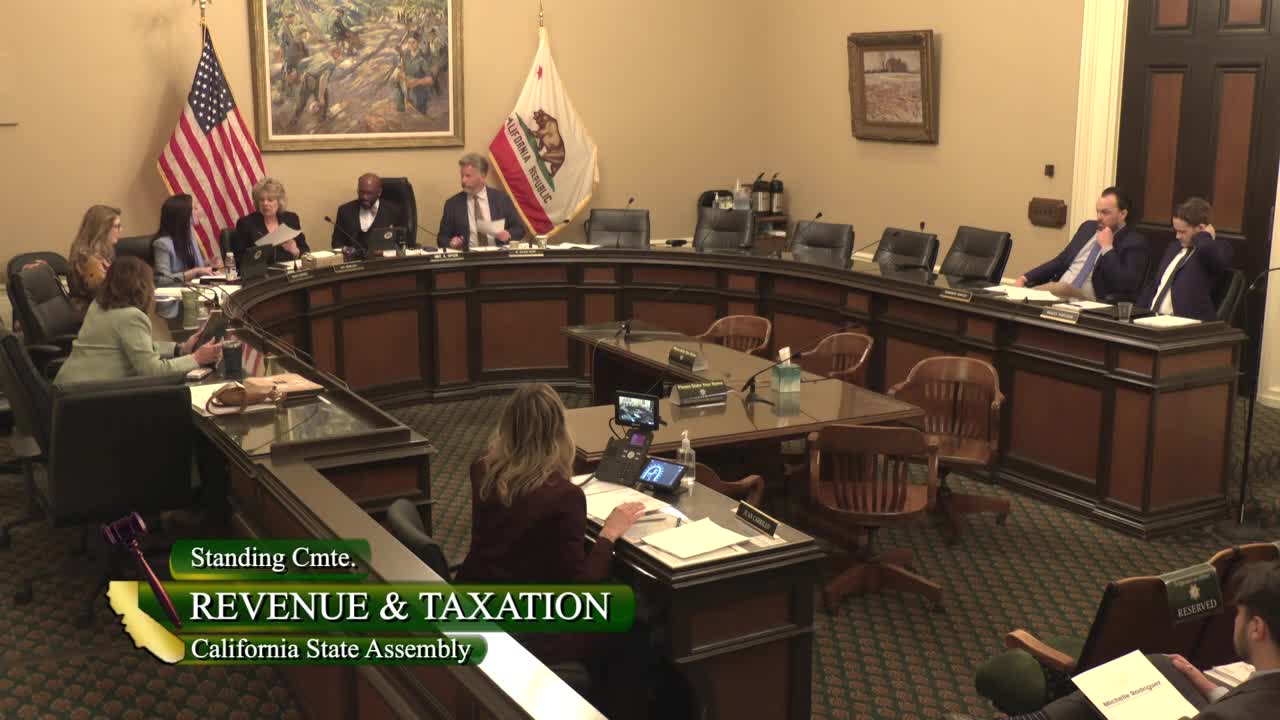
Bill Author

Bill Co-Author(s):