AB 2189: Statewide Special Education Parent Advocacy Collaborative.
- Session Year: 2025-2026
- House: Assembly
- Latest Version Date: 2026-06-22
Current Status:
In Progress
(2026-08-13: In committee: Held under submission.)
Introduced
In Committee
Awaiting First Chamber Vote
Passed First Chamber
In Committee
Awaiting Second Chamber Vote
Passed Second Chamber
Enacted
Existing law establishes the State Council on Developmental Disabilities to, among other things, serve as the state planning council responsible for developing the California Developmental Disabilities State Plan and monitoring and evaluating the implementation of the plan. Existing law requires the council to conduct activities related to meeting the objectives of the state plan. Existing law requires these activities to include, among other things, supporting and conducting technical assistance activities to assist public and private entities to contribute to the objectives of the state plan, and authorizes the activities to include, among other things, supporting and conducting activities to assist neighborhoods and communities to respond positively to individuals with disabilities and their families.
This bill would require the council to establish and administer a Statewide Special Education Parent Advocacy Collaborative to build statewide capacity for parent and pupil engagement in special education advocacy, systems change, and policy development. The bill would require the council to conduct a competitive grant process to award $800,000 annually for 3 fiscal years to a statewide advocacy organization. The bill would appropriate those funds from the General Fund to the council for that purpose for the 202728, 202829, and 202930 fiscal years. The bill would require the selected grantee to conduct outreach and training through meetings or forums to provide information on statewide special education advocacy, as specified. The bill would also require the grantee to, among other things, (1) identify key challenges and opportunities in state policy relating to improving outcomes for pupils with disabilities, (2) establish and facilitate a statewide collaborative of parents, pupils, and stakeholders to build advocacy and leadership skills for state-level advocacy, and (3) establish measurable outcomes aligned with statewide accountability systems, as provided. The bill would require the grantee to submit an annual report to the council and would require the council to submit a report, on or before December 31, 2030, to the Legislature and the Governor that includes the outcomes achieved, as provided. The bill would make these provisions contingent upon an appropriation for these purposes.
Existing law establishes the State Council on Developmental Disabilities to, among other things, serve as the state planning council responsible for developing the California Developmental Disabilities State Plan and monitoring and evaluating the implementation of the plan. Existing law requires the council to conduct activities related to meeting the objectives of the state plan. Existing law requires these activities to include, among other things, supporting and conducting technical assistance activities to assist public and private entities to contribute to the objectives of the state plan, and authorizes the activities to include, among other things, supporting and conducting activities to assist neighborhoods and communities to respond positively to individuals with disabilities and their families.
This bill would authorize the council to award a grant, subject to appropriation by the Legislature, to a statewide advocacy organization to conduct outreach and training through local meetings or forums for the purpose of providing special education pupils and their families with information regarding special education advocacy and rights.This bill would require the council to establish and administer a Statewide Special Education Parent Advocacy Collaborative to build statewide capacity for parent and pupil engagement in special education advocacy, systems change, and policy development. The bill would require the council to conduct a competitive grant process to award $800,000 annually for 3 fiscal years to a statewide advocacy organization. The bill would appropriate those funds from the General Fund to the council for that purpose for the 202728, 202829, and 202930 fiscal years. The bill would require the selected grantee to conduct outreach and training through meetings or forums to provide information on statewide special education advocacy, as specified. The bill would also require the grantee to, among other things, (1) identify key challenges and opportunities in state policy relating to improving outcomes for pupils with disabilities, (2) establish and facilitate a statewide collaborative of parents, pupils, and stakeholders to build advocacy and leadership skills for state-level advocacy, and (3) establish measurable outcomes aligned with statewide accountability systems, as provided. The bill would require the grantee to submit an annual report to the council and would require the council to submit a report, on or before December 31, 2030, to the Legislature and the Governor that includes the outcomes achieved, as provided.
Existing law establishes the State Council on Developmental Disabilities to, among other things, serve as the state planning council responsible for developing the California Developmental Disabilities State Plan and monitoring and evaluating the implementation of the plan. Existing law requires the council to conduct activities related to meeting the objectives of the state plan. Existing law requires these activities to include, among other things, supporting and conducting technical assistance activities to assist public and private entities to contribute to the objectives of the state plan, and authorizes the activities to include, among other things, supporting and conducting activities to assist neighborhoods and communities to respond positively to individuals with disabilities and their families.
This bill would authorize the council to award a grant, subject to appropriation by the Legislature, to a statewide advocacy organization to conduct outreach and training through local meetings or forums for the purpose of providing special education pupils and their families with information regarding special education advocacy and rights.
(a)The Legislature finds and declares all of the following:
(1)The federal Individuals with Disabilities Education Act (20 U.S.C. Sec. 1400 et seq.)(IDEA) guarantees pupils with disabilities the right to a free, appropriate public education and related services designed to meet their unique needs.
(2)Effective implementation and enforcement of the IDEA requires meaningful engagement of parents, families, and pupils, including those transitioning to postsecondary education or adulthood.
(3)Recent reductions in federal capacity to monitor and enforce the IDEA, including staffing reductions within the United States Department of Educations Office for Civil Rights and the United States Department of Educations Office of Special Education Programs, have diminished the capacity of the federal government to oversee compliance with the IDEA, and heighten the importance of states responsibility to ensure compliance and accountability.
(4)California serves one of the largest populations of pupils with disabilities in the nation and has been identified as needing assistance or intervention in implementing IDEA requirements, underscoring the need for strengthened statewide oversight and support systems.
(5)Existing parent support structures, including the Family Empowerment Centers on Disability, the Early Start Family Resource Centers, and community advisory committees, provide critical local-level support, but are not charged with engaging in statewide systems-level advocacy and policy engagement.
(6)A coordinated, statewide structure that builds the capacity of parents and pupils to engage in systems advocacy, coalition building, and statewide policy processes is necessary to ensure consistent implementation of the IDEA and equitable outcomes for pupils with disabilities.
(7)The California Collaborative for Educational Excellence has developed a theory of action emphasizing continuous improvement, capacity building, and data-informed decisionmaking, which provides a framework for strengthening systems of support across Californias education system.
(b)Therefore, it is the intent of the Legislature to establish a statewide advocacy collaborative to engage parents of pupils with disabilities to build leadership capacity, coordinate statewide advocacy efforts, and engage in state policy processes, in order to improve outcomes for pupils with disabilities through systems change.
SEC. 2.Chapter 9 (commencing with Section 56870) is added to Part 30 of Division 4 of Title 2 of the Education Code, to read:9.Statewide Special Education Parent Advocacy Collaborative56870.For purposes of this chapter, the following definitions apply:
(a)Advocacy means activities that promote, support, or influence public policy, systems, or practices at the local, regional, or state level to improve outcomes for pupils with disabilities, including systems advocacy, capacity building, and systems change. Advocacy does not include representation of individual pupils in due process hearings or individualized education program disputes.
(b)Collaborative means the Statewide Special Education Parent Advocacy Collaborative established pursuant to this chapter.
(c)Council means the State Council on Developmental Disabilities.
(d)Grantee means the nonprofit statewide advocacy organization selected pursuant to Section 56872.
(e)Parent means both of the following:
(1)A parent, guardian, or other family member responsible for the care or support of a pupil with a disability.
(2)An education rights holder of a pupil with a disability.
(f)Pupil with a disability means an individual with a disability with a particular impairment described in Section 1401 of Title 20 of the United States Code, including infants, toddlers, children, youth, and individuals up to 21 years of age, inclusive, and including those transitioning to postsecondary education or adulthood.
(g)Statewide advocacy organization means an organization with demonstrated success representing the interests of families and individuals with disabilities with particular impairments described in Section 1401 of Title 20 of the United States Code, through local or statewide forums.
56871.The council shall establish and administer a Statewide Special Education Parent Advocacy Collaborative for the purpose of building statewide capacity for parent and pupil engagement in special education advocacy, systems change, and policy development.
56872.(a)The council shall conduct a competitive grant process to award eight hundred thousand dollars ($800,000) annually for three fiscal years to an eligible nonprofit statewide advocacy organization.
(b)The council may retain up to 5 percent of the grant funding described in subdivision (a) for purposes of administering the grant.
(c)The grantee shall conduct outreach and training through meetings or forums for the purpose of providing parent leaders, pupil advocates, and other stakeholders, inclusive of postsecondary students, with culturally and linguistically responsive information regarding statewide special education advocacy for the purpose of systems advocacy, capacity building, and systems change.
(d)The grant shall be awarded through a competitive process that includes a public solicitation of applications and an evaluation based on established criteria.
(e)In awarding the grant, the council shall consider evaluate whether an applicant has all of the following:
(1)Demonstrated experience in statewide community organizing.
(2)Demonstrated experience in coalition building across diverse geographic regions.
(3)Demonstrated experience in advocacy on behalf of pupils with disabilities and their families.
(4)Ability to coordinate with existing entities, including, but not limited to, the Family Empowerment Centers on Disability, the Early Start Family Resource Centers, community advisory committees, Parent Training and Information Centers, and local educational agencies.
56873.The grantee shall, at a minimum, do all of the following:
(a)Work with parents, pupils, family support entities, and stakeholders to identify key challenges and opportunities in state policy relating to improving outcomes for pupils with disabilities.
(b)Identify and build a network of at least 200 leader stakeholders engaged in advocacy for pupils with disabilities.
(c)Establish and facilitate a statewide collaborative of parents, pupils, and stakeholders, including identifying and supporting a cohort of approximately 40 to 50 parent and pupil leaders representing diverse geographic regions of the state to build advocacy and leadership skills for state-level advocacy.
(d)Conduct not fewer than three convenings annually to provide training, build relationships, and coordinate statewide advocacy efforts.
(e)Develop and implement a statewide training program, including virtual and in-person opportunities, to build participant knowledge and skills.
(f)Provide training and technical assistance designed to develop participant capacity in all of the following areas:
(1)State-level advocacy and legislative engagement.
(2)Statewide communications, messaging, and public engagement.
(3)Sharing best practices in effective parent and pupil advocacy and leadership development.
(4)Coalition building and community organizing across regions.
(5)Understanding and monitoring compliance with the federal Individuals with Disabilities Education Act (20 U.S.C. Sec. 1400 et seq.).
(6)Use of data, including the California School Dashboard and the State Performance Plan, to inform advocacy and systems change.
(g)Coordinate with and leverage existing local, regional, and statewide parent and family support structures to ensure alignment and avoid duplication of services.
(h)Collect, analyze, and elevate the experiences of parents and pupils to inform state-level policymaking, oversight, and systems improvement.
56874.Activities conducted pursuant to this chapter shall be guided by the California Collaborative for Educational Excellences theory of action, including principles of continuous improvement, capacity building, and data-driven decisionmaking.
56875.The grantee shall establish measurable outcomes aligned with statewide accountability systems, including the California School Dashboard and the State Performance Plan. The outcomes shall include, but are not limited to, all of the following:
(a)Increased participation of parents and pupils in statewide advocacy efforts.
(b)Improved coordination among parent and family support organizations.
(c)Increased capacity of participants to engage in systems-level advocacy.
(d)Contributions to improved outcomes for pupils with disabilities, as measured by relevant state indicators.
56876.(a)The grantee shall submit an annual report to the council.
(b)(1)The council shall submit a report, on or before December 31, 2030, to the Legislature and the Governor, in compliance with Section 9795 of the Government Code, that includes, but is not limited to, all of the following:
(A)A description of activities conducted pursuant to this section.
(B)The number and geographic distribution of participants.
(C)Outcomes achieved, including alignment with the California School Dashboard and State Performance Plan indicators.
(D)Recommendations for improving statewide special education advocacy and oversight.
(2)The report shall be made publicly available on the councils internet website.
56877.The implementation of this chapter is contingent upon an appropriation in the annual Budget Act or another statute for these purposes.
(a)The Legislature finds and declares all of the following:
(1)The federal Individuals with Disabilities Education Act (20 U.S.C. Sec. 1400 et seq.)(IDEA) guarantees pupils with disabilities the right to a free, appropriate public education and related services designed to meet their unique needs.
(2)Effective implementation and enforcement of the IDEA requires meaningful engagement of parents, families, and pupils, including those transitioning to postsecondary education or adulthood.
(3)Recent reductions in federal capacity to monitor and enforce the IDEA, including staffing reductions within the United States Department of Educations Office for Civil Rights and the United States Department of Educations Office of Special Education Programs, have diminished the capacity of the federal government to oversee compliance with the IDEA, and heighten the importance of states responsibility to ensure compliance and accountability.
(4)California serves one of the largest populations of pupils with disabilities in the nation and has been identified as needing assistance or intervention in implementing IDEA requirements, underscoring the need for strengthened statewide oversight and support systems.
(5)Existing parent support structures, including the Family Empowerment Centers on Disability, the Early Start Family Resource Centers, and community advisory committees, provide critical local-level support, but are not charged with engaging in statewide systems-level advocacy and policy engagement.
(6)A coordinated, statewide structure that builds the capacity of parents and pupils to engage in systems advocacy, coalition building, and statewide policy processes is necessary to ensure consistent implementation of the IDEA and equitable outcomes for pupils with disabilities.
(7)The California Collaborative for Educational Excellence has developed a theory of action emphasizing continuous improvement, capacity building, and data-informed decisionmaking, which provides a framework for strengthening systems of support across Californias education system.
(b)Therefore, it is the intent of the Legislature to establish a statewide advocacy collaborative to engage parents of pupils with disabilities to build leadership capacity, coordinate statewide advocacy efforts, and engage in state policy processes, in order to improve outcomes for pupils with disabilities through systems change.
SEC. 2.Chapter 9 (commencing with Section 56870) is added to Part 30 of Division 4 of Title 2 of the Education Code, to read:9.Statewide Special Education Parent Advocacy Collaborative56870.For purposes of this chapter, the following definitions apply:
(a)Advocacy means activities that promote, support, or influence public policy, systems, or practices at the local, regional, or state level to improve outcomes for pupils with disabilities, including systems advocacy, capacity building, and systems change. Advocacy does not include representation of individual pupils in due process hearings or individualized education program disputes.
(b)Collaborative means the Statewide Special Education Parent Advocacy Collaborative established pursuant to this chapter.
(c)Council means the State Council on Developmental Disabilities.
(d)Grantee means the nonprofit statewide advocacy organization selected pursuant to Section 56872.
(e)Parent means both of the following:
(1)A parent, guardian, or other family member responsible for the care or support of a pupil with a disability.
(2)An education rights holder of a pupil with a disability.
(f)Pupil with a disability means an individual with a disability with a particular impairment described in Section 1401 of Title 20 of the United States Code, including infants, toddlers, children, youth, and individuals up to 21 years of age, inclusive, and including those transitioning to postsecondary education or adulthood.
(g)Statewide advocacy organization means an organization with demonstrated success representing the interests of families and individuals with disabilities with particular impairments described in Section 1401 of Title 20 of the United States Code, through local or statewide forums.
56871.The council shall establish and administer a Statewide Special Education Parent Advocacy Collaborative for the purpose of building statewide capacity for parent and pupil engagement in special education advocacy, systems change, and policy development.
56872.(a)The council shall conduct a competitive grant process to award eight hundred thousand dollars ($800,000) annually for three fiscal years to an eligible nonprofit statewide advocacy organization.
(b)The council may retain ____ ($____) up to 5 percent of the grant funding described in subdivision (a) for purposes of administering the grant.
(c)The grantee shall conduct outreach and training through meetings or forums for the purpose of providing parent leaders, pupil advocates, and other stakeholders, inclusive of postsecondary students, with culturally and linguistically responsive information regarding statewide special education advocacy for the purpose of systems advocacy, capacity building, and systems change.
(d)The grant shall be awarded through a competitive process that includes a public solicitation of applications and an evaluation based on established criteria.
(e)In awarding the grant, the council shall consider all of the following:
(1)Demonstrated experience in statewide community organizing.
(2)Demonstrated experience in coalition building across diverse geographic regions.
(3)Demonstrated experience in advocacy on behalf of pupils with disabilities and their families.
(4)Ability to coordinate with existing entities, including, but not limited to, the Family Empowerment Centers on Disability, the Early Start Family Resource Centers, community advisory committees, Parent Training and Information Centers, and local educational agencies.
56873.The grantee shall, at a minimum, do all of the following:
(a)Work with parents, pupils, family support entities, and stakeholders to identify key challenges and opportunities in state policy relating to improving outcomes for pupils with disabilities.
(b)Identify and build a network of at least 200 leader stakeholders engaged in advocacy for pupils with disabilities.
(c)Establish and facilitate a statewide collaborative of parents, pupils, and stakeholders, including identifying and supporting a cohort of approximately 40 to 50 parent and pupil leaders representing diverse geographic regions of the state to build advocacy and leadership skills for state-level advocacy.
(d)Conduct not fewer than three convenings annually to provide training, build relationships, and coordinate statewide advocacy efforts.
(e)Develop and implement a statewide training program, including virtual and in-person opportunities, to build participant knowledge and skills.
(f)Provide training and technical assistance designed to develop participant capacity in all of the following areas:
(1)State-level advocacy and legislative engagement.
(2)Statewide communications, messaging, and public engagement.
(3)Sharing best practices in effective parent and pupil advocacy and leadership development.
(4)Coalition building and community organizing across regions.
(5)Understanding and monitoring compliance with the federal Individuals with Disabilities Education Act (20 U.S.C. Sec. 1400 et seq.).
(6)Use of data, including the California School Dashboard and the State Performance Plan, to inform advocacy and systems change.
(g)Coordinate with and leverage existing local, regional, and statewide parent and family support structures to ensure alignment and avoid duplication of services.
(h)Collect, analyze, and elevate the experiences of parents and pupils to inform state-level policymaking, oversight, and systems improvement.
56874.Activities conducted pursuant to this chapter shall be guided by the California Collaborative for Educational Excellences theory of action, including principles of continuous improvement, capacity building, and data-driven decisionmaking.
56875.The grantee shall establish measurable outcomes aligned with statewide accountability systems, including the California School Dashboard and the State Performance Plan. The outcomes shall include, but are not limited to, all of the following:
(a)Increased participation of parents and pupils in statewide advocacy efforts.
(b)Improved coordination among parent and family support organizations.
(c)Increased capacity of participants to engage in systems-level advocacy.
(d)Contributions to improved outcomes for pupils with disabilities, as measured by relevant state indicators.
56876.(a)The grantee shall submit an annual report to the council.
(b)(1)The council shall submit a report, on or before December 31, 2030, to the Legislature and the Governor, in compliance with Section 9795 of the Government Code, that includes, but is not limited to, all of the following:
(A)A description of activities conducted pursuant to this section.
(B)The number and geographic distribution of participants.
(C)Outcomes achieved, including alignment with the California School Dashboard and State Performance Plan indicators.
(D)Recommendations for improving statewide special education advocacy and oversight.
(2)The report shall be made publicly available on the councils internet website.
56877.The sum of eight hundred thousand dollars ($800,000) is hereby appropriated each fiscal year for the 202728, 202829, and 202930 fiscal years from the General Fund to the State Council on Developmental Disabilities for the purposes of this chapter.56877.The implementation of this chapter is contingent upon an appropriation in the annual Budget Act or another statute for these purposes.
(a)The Legislature finds and declares all of the following:
(1)The federal Individuals with Disabilities Education Act (20 U.S.C. Sec. 1400 et seq.)(IDEA) guarantees pupils with disabilities the right to a free, appropriate public education and related services designed to meet their unique needs.
(2)Effective implementation and enforcement of the IDEA requires meaningful engagement of parents, families, and pupils, including those transitioning to postsecondary education or adulthood.
(3)Recent reductions in federal capacity to monitor and enforce the IDEA, including staffing reductions within the United States Department of Educations Office for Civil Rights and the United States Department of Educations Office of Special Education Programs, have diminished the capacity of the federal government to oversee compliance with the IDEA, and heighten the importance of states responsibility to ensure compliance and accountability.
(4)California serves one of the largest populations of pupils with disabilities in the nation and has been identified as needing assistance or intervention in implementing IDEA requirements, underscoring the need for strengthened statewide oversight and support systems.
(5)Existing parent support structures, including the Family Empowerment Centers on Disability, the Early Start Family Resource Centers, and community advisory committees, provide critical local-level support, but are not charged with engaging in statewide systems-level advocacy and policy engagement.
(6)A coordinated, statewide structure that builds the capacity of parents and pupils to engage in systems advocacy, coalition building, and statewide policy processes is necessary to ensure consistent implementation of the IDEA and equitable outcomes for pupils with disabilities.
(7)The California Collaborative for Educational Excellence has developed a theory of action emphasizing continuous improvement, capacity building, and data-informed decisionmaking, which provides a framework for strengthening systems of support across Californias education system.
(b)Therefore, it is the intent of the Legislature to establish a statewide advocacy collaborative to engage parents of pupils with disabilities to build leadership capacity, coordinate statewide advocacy efforts, and engage in state policy processes, in order to improve outcomes for pupils with disabilities through systems change.
SEC. 2.Chapter 9 (commencing with Section 56870) is added to Part 30 of Division 4 of Title 2 of the Education Code, to read:9.Statewide Special Education Parent Advocacy Collaborative56870.For purposes of this chapter, the following definitions apply:
(a)Advocacy means activities that promote, support, or influence public policy, systems, or practices at the local, regional, or state level to improve outcomes for pupils with disabilities, including systems advocacy, capacity building, and systems change. Advocacy does not include representation of individual pupils in due process hearings or individualized education program disputes.
(b)Collaborative means the Statewide Special Education Parent Advocacy Collaborative established pursuant to this chapter.
(c)Council means the State Council on Developmental Disabilities.
(d)Grantee means the nonprofit statewide advocacy organization selected pursuant to Section 56872.
(e)Parent means both of the following:
(1)A parent, guardian, or other family member responsible for the care or support of a pupil with a disability.
(2)An education rights holder of a pupil with a disability.
(f)Pupil with a disability means an individual with a disability with a particular impairment described in Section 1401 of Title 20 of the United States Code, including infants, toddlers, children, youth, and individuals up to 21 years of age, inclusive, and including those transitioning to postsecondary education or adulthood.
(g)Statewide advocacy organization means an organization with demonstrated success representing the interests of families and individuals with disabilities with particular impairments described in Section 1401 of Title 20 of the United States Code, through local or statewide forums.
56871.The council shall establish and administer a Statewide Special Education Parent Advocacy Collaborative for the purpose of building statewide capacity for parent and pupil engagement in special education advocacy, systems change, and policy development.
56872.(a)The council shall conduct a competitive grant process to award eight hundred thousand dollars ($800,000) annually for three fiscal years to an eligible nonprofit statewide advocacy organization.
(b)The council may retain ____ ($____) for purposes of administering the grant.
(c)The grantee shall conduct outreach and training through meetings or forums for the purpose of providing parent leaders, pupil advocates, and other stakeholders, inclusive of postsecondary students, with culturally and linguistically responsive information regarding statewide special education advocacy for the purpose of systems advocacy, capacity building, and systems change.
(d)The grant shall be awarded through a competitive process that includes a public solicitation of applications and an evaluation based on established criteria.
(e)In awarding the grant, the council shall consider all of the following:
(1)Demonstrated experience in statewide community organizing.
(2)Demonstrated experience in coalition building across diverse geographic regions.
(3)Demonstrated experience in advocacy on behalf of pupils with disabilities and their families.
(4)Ability to coordinate with existing entities, including, but not limited to, the Family Empowerment Centers on Disability, the Early Start Family Resource Centers, community advisory committees, Parent Training and Information Centers, and local educational agencies.
56873.The grantee shall, at a minimum, do all of the following:
(a)Work with parents, pupils, family support entities, and stakeholders to identify key challenges and opportunities in state policy relating to improving outcomes for pupils with disabilities.
(b)Identify and build a network of at least 200 leader stakeholders engaged in advocacy for pupils with disabilities.
(c)Establish and facilitate a statewide collaborative of parents, pupils, and stakeholders, including identifying and supporting a cohort of approximately 40 to 50 parent and pupil leaders representing diverse geographic regions of the state to build advocacy and leadership skills for state-level advocacy.
(d)Conduct not fewer than three convenings annually to provide training, build relationships, and coordinate statewide advocacy efforts.
(e)Develop and implement a statewide training program, including virtual and in-person opportunities, to build participant knowledge and skills.
(f)Provide training and technical assistance designed to develop participant capacity in all of the following areas:
(1)State-level advocacy and legislative engagement.
(2)Statewide communications, messaging, and public engagement.
(3)Sharing best practices in effective parent and pupil advocacy and leadership development.
(4)Coalition building and community organizing across regions.
(5)Understanding and monitoring compliance with the federal Individuals with Disabilities Education Act (20 U.S.C. Sec. 1400 et seq.).
(6)Use of data, including the California School Dashboard and the State Performance Plan, to inform advocacy and systems change.
(g)Coordinate with and leverage existing local, regional, and statewide parent and family support structures to ensure alignment and avoid duplication of services.
(h)Collect, analyze, and elevate the experiences of parents and pupils to inform state-level policymaking, oversight, and systems improvement.
56874.Activities conducted pursuant to this chapter shall be guided by the California Collaborative for Educational Excellences theory of action, including principles of continuous improvement, capacity building, and data-driven decisionmaking.
56875.The grantee shall establish measurable outcomes aligned with statewide accountability systems, including the California School Dashboard and the State Performance Plan. The outcomes shall include, but are not limited to, all of the following:
(a)Increased participation of parents and pupils in statewide advocacy efforts.
(b)Improved coordination among parent and family support organizations.
(c)Increased capacity of participants to engage in systems-level advocacy.
(d)Contributions to improved outcomes for pupils with disabilities, as measured by relevant state indicators.
56876.(a)The grantee shall submit an annual report to the council.
(b)(1)The council shall submit a report, on or before December 31, 2030, to the Legislature and the Governor, in compliance with Section 9795 of the Government Code, that includes, but is not limited to, all of the following:
(A)A description of activities conducted pursuant to this section.
(B)The number and geographic distribution of participants.
(C)Outcomes achieved, including alignment with the California School Dashboard and State Performance Plan indicators.
(D)Recommendations for improving statewide special education advocacy and oversight.
(2)The report shall be made publicly available on the councils internet website.
56877.The sum of eight hundred thousand dollars ($800,000) is hereby appropriated each fiscal year for the 202728, 202829, and 202930 fiscal years from the General Fund to the State Council on Developmental Disabilities for the purposes of this chapter.
SECTION 1.Section 4540 of the Welfare and Institutions Code is amended to read:4540.The state council, established pursuant to the federal Developmental Disabilities Assistance and Bill of Rights Act of 2000 (Public Law 106-402 (42 U.S.C. Sec. 15001 et seq.)), shall do all of the following:(a)Serve as an advocate for individuals with developmental disabilities and, through council members, staff, consultants, and contractors and grantees, conduct advocacy, capacity building, and systemic change activities.(b)Develop and implement the state plan in accordance with requirements issued by the United States Secretary of Health and Human Services, monitor and evaluate the implementation of this plan, and submit reports as the United States Secretary of Health and Human Services may reasonably request. The state council may review and comment on other plans and programs in the state affecting individuals with developmental disabilities.(c)Serve as the official agency responsible for planning the provision of the federal funds allotted to the state under Public Law 106-402 (42 U.S.C. Sec. 15001 et seq.), by conducting and supporting advocacy, capacity building, and systemic change activities. The council may itself conduct these activities and may provide grant funding to local agencies in compliance with applicable state and federal law, for those same purposes.(d)Prepare and approve a budget, for the use of amounts paid to the state to hire any staff and to obtain the services of any professional, technical, or clerical personnel consistent with state and federal law, as the council determines to be necessary to carry out its functions.(e)To the extent that resources are available, implement the state plan by conducting activities including, but not limited to, all of the activities specified in paragraphs (1) to (11), inclusive.(1)Encouraging and assisting in the establishment or strengthening of self-advocacy organizations led by individuals with developmental disabilities.(2)Supporting and conducting geographically based outreach activities to identify individuals with developmental disabilities and their families who otherwise might not come to the attention of the council and assist and enable the individuals and families to obtain services, individualized supports, and other forms of assistance, including access to special adaptation of generic community services or specialized services.(3)Supporting and conducting training for persons who are individuals with developmental disabilities, their families, and personnel, including professionals, paraprofessionals, students, volunteers, and other community members, to enable those persons to obtain access to, or to provide, community services, individualized supports, and other forms of assistance, including special adaptation of generic community services or specialized services for individuals with developmental disabilities and their families.(4)Supporting and conducting technical assistance activities to assist public and private entities to contribute to the objectives of the state plan.(5)Supporting and conducting activities to assist neighborhoods and communities to respond positively to individuals with developmental disabilities and their families.(6)Supporting and conducting activities to promote interagency collaboration and coordination at the state and local levels to better serve, support, assist, or advocate for individuals with developmental disabilities and their families.(7)Coordinating with related councils, committees, and programs to enhance coordination of services.(8)Supporting and conducting activities to eliminate barriers to access and use of community services by individuals with disabilities, enhance systems design and redesign, and enhance citizen participation to address issues identified in the state plan.(9)Supporting and conducting activities to educate the public about the capabilities, preferences, and needs of individuals with developmental disabilities and their families, and to develop and support coalitions that support the policy agenda of the council, including training in self-advocacy, education of policymakers, and citizen leadership roles.(10)Supporting and conducting activities to provide information to policymakers by supporting and conducting studies and analyses, gathering information, and developing and disseminating model policies and procedures, information, approaches, strategies, findings, conclusions, and recommendations. The council may provide the information directly to federal, state, and local policymakers, including the Congress of the United States, the federal executive branch, the Governor, the Legislature, and state agencies in order to increase the abilities of those policymakers to offer opportunities and enhance or adapt generic services to meet the needs of, or provide specialized services to, individuals with developmental disabilities and their families.(11)Supporting, on a time-limited basis, activities to demonstrate new approaches to serving individuals with developmental disabilities that are a part of an overall strategy for systemic change.(f)Prepare an annual written report of its activities, its recommendations, and an evaluation of the efficiency of the administration of this division to the Governor and the Legislature. This report shall include both the statewide and regional activities of the state council. This report shall be submitted to the Legislature in accordance with Section 9795 of the Government Code.(g)Except as otherwise provided in this division, the state council shall not engage in the administration of the day-to-day operation of service programs identified in the state plan, nor in the financial management and accounting of funds.(h)(1)The council may award a grant, subject to appropriation by the Legislature, to a statewide advocacy organization to conduct outreach and training through local meetings or forums for the purpose of providing special education pupils and their families with information regarding special education advocacy and rights.(2)For the purposes of this section, a statewide advocacy organization means an organization with demonstrated success representing the interests of families and persons with disabilities as defined in Individuals with Disabilities Education Act (20 U.S.C. Sec. 1400 et seq.) through local or statewide forums.The state council, established pursuant to the federal Developmental Disabilities Assistance and Bill of Rights Act of 2000 (Public Law 106-402 (42 U.S.C. Sec. 15001 et seq.)), shall do all of the following:
(a)Serve as an advocate for individuals with developmental disabilities and, through council members, staff, consultants, and contractors and grantees, conduct advocacy, capacity building, and systemic change activities.
(b)Develop and implement the state plan in accordance with requirements issued by the United States Secretary of Health and Human Services, monitor and evaluate the implementation of this plan, and submit reports as the United States Secretary of Health and Human Services may reasonably request. The state council may review and comment on other plans and programs in the state affecting individuals with developmental disabilities.
(c)Serve as the official agency responsible for planning the provision of the federal funds allotted to the state under Public Law 106-402 (42 U.S.C. Sec. 15001 et seq.), by conducting and supporting advocacy, capacity building, and systemic change activities. The council may itself conduct these activities and may provide grant funding to local agencies in compliance with applicable state and federal law, for those same purposes.
(d)Prepare and approve a budget, for the use of amounts paid to the state to hire any staff and to obtain the services of any professional, technical, or clerical personnel consistent with state and federal law, as the council determines to be necessary to carry out its functions.
(e)To the extent that resources are available, implement the state plan by conducting activities including, but not limited to, all of the activities specified in paragraphs (1) to (11), inclusive.
(1)Encouraging and assisting in the establishment or strengthening of self-advocacy organizations led by individuals with developmental disabilities.
(2)Supporting and conducting geographically based outreach activities to identify individuals with developmental disabilities and their families who otherwise might not come to the attention of the council and assist and enable the individuals and families to obtain services, individualized supports, and other forms of assistance, including access to special adaptation of generic community services or specialized services.
(3)Supporting and conducting training for persons who are individuals with developmental disabilities, their families, and personnel, including professionals, paraprofessionals, students, volunteers, and other community members, to enable those persons to obtain access to, or to provide, community services, individualized supports, and other forms of assistance, including special adaptation of generic community services or specialized services for individuals with developmental disabilities and their families.
(4)Supporting and conducting technical assistance activities to assist public and private entities to contribute to the objectives of the state plan.
(5)Supporting and conducting activities to assist neighborhoods and communities to respond positively to individuals with developmental disabilities and their families.
(6)Supporting and conducting activities to promote interagency collaboration and coordination at the state and local levels to better serve, support, assist, or advocate for individuals with developmental disabilities and their families.
(7)Coordinating with related councils, committees, and programs to enhance coordination of services.
(8)Supporting and conducting activities to eliminate barriers to access and use of community services by individuals with disabilities, enhance systems design and redesign, and enhance citizen participation to address issues identified in the state plan.
(9)Supporting and conducting activities to educate the public about the capabilities, preferences, and needs of individuals with developmental disabilities and their families, and to develop and support coalitions that support the policy agenda of the council, including training in self-advocacy, education of policymakers, and citizen leadership roles.
(10)Supporting and conducting activities to provide information to policymakers by supporting and conducting studies and analyses, gathering information, and developing and disseminating model policies and procedures, information, approaches, strategies, findings, conclusions, and recommendations. The council may provide the information directly to federal, state, and local policymakers, including the Congress of the United States, the federal executive branch, the Governor, the Legislature, and state agencies in order to increase the abilities of those policymakers to offer opportunities and enhance or adapt generic services to meet the needs of, or provide specialized services to, individuals with developmental disabilities and their families.
(11)Supporting, on a time-limited basis, activities to demonstrate new approaches to serving individuals with developmental disabilities that are a part of an overall strategy for systemic change.
(f)Prepare an annual written report of its activities, its recommendations, and an evaluation of the efficiency of the administration of this division to the Governor and the Legislature. This report shall include both the statewide and regional activities of the state council. This report shall be submitted to the Legislature in accordance with Section 9795 of the Government Code.
(g)Except as otherwise provided in this division, the state council shall not engage in the administration of the day-to-day operation of service programs identified in the state plan, nor in the financial management and accounting of funds.
(h)(1)The council may award a grant, subject to appropriation by the Legislature, to a statewide advocacy organization to conduct outreach and training through local meetings or forums for the purpose of providing special education pupils and their families with information regarding special education advocacy and rights.
(2)For the purposes of this section, a statewide advocacy organization means an organization with demonstrated success representing the interests of families and persons with disabilities as defined in Individuals with Disabilities Education Act (20 U.S.C. Sec. 1400 et seq.) through local or statewide forums.
The state council, established pursuant to the federal Developmental Disabilities Assistance and Bill of Rights Act of 2000 (Public Law 106-402 (42 U.S.C. Sec. 15001 et seq.)), shall do all of the following:
(a)Serve as an advocate for individuals with developmental disabilities and, through council members, staff, consultants, and contractors and grantees, conduct advocacy, capacity building, and systemic change activities.
(b)Develop and implement the state plan in accordance with requirements issued by the United States Secretary of Health and Human Services, monitor and evaluate the implementation of this plan, and submit reports as the United States Secretary of Health and Human Services may reasonably request. The state council may review and comment on other plans and programs in the state affecting individuals with developmental disabilities.
(c)Serve as the official agency responsible for planning the provision of the federal funds allotted to the state under Public Law 106-402 (42 U.S.C. Sec. 15001 et seq.), by conducting and supporting advocacy, capacity building, and systemic change activities. The council may itself conduct these activities and may provide grant funding to local agencies in compliance with applicable state and federal law, for those same purposes.
(d)Prepare and approve a budget, for the use of amounts paid to the state to hire any staff and to obtain the services of any professional, technical, or clerical personnel consistent with state and federal law, as the council determines to be necessary to carry out its functions.
(e)To the extent that resources are available, implement the state plan by conducting activities including, but not limited to, all of the activities specified in paragraphs (1) to (11), inclusive.
(1)Encouraging and assisting in the establishment or strengthening of self-advocacy organizations led by individuals with developmental disabilities.
(2)Supporting and conducting geographically based outreach activities to identify individuals with developmental disabilities and their families who otherwise might not come to the attention of the council and assist and enable the individuals and families to obtain services, individualized supports, and other forms of assistance, including access to special adaptation of generic community services or specialized services.
(3)Supporting and conducting training for persons who are individuals with developmental disabilities, their families, and personnel, including professionals, paraprofessionals, students, volunteers, and other community members, to enable those persons to obtain access to, or to provide, community services, individualized supports, and other forms of assistance, including special adaptation of generic community services or specialized services for individuals with developmental disabilities and their families.
(4)Supporting and conducting technical assistance activities to assist public and private entities to contribute to the objectives of the state plan.
(5)Supporting and conducting activities to assist neighborhoods and communities to respond positively to individuals with developmental disabilities and their families.
(6)Supporting and conducting activities to promote interagency collaboration and coordination at the state and local levels to better serve, support, assist, or advocate for individuals with developmental disabilities and their families.
(7)Coordinating with related councils, committees, and programs to enhance coordination of services.
(8)Supporting and conducting activities to eliminate barriers to access and use of community services by individuals with disabilities, enhance systems design and redesign, and enhance citizen participation to address issues identified in the state plan.
(9)Supporting and conducting activities to educate the public about the capabilities, preferences, and needs of individuals with developmental disabilities and their families, and to develop and support coalitions that support the policy agenda of the council, including training in self-advocacy, education of policymakers, and citizen leadership roles.
(10)Supporting and conducting activities to provide information to policymakers by supporting and conducting studies and analyses, gathering information, and developing and disseminating model policies and procedures, information, approaches, strategies, findings, conclusions, and recommendations. The council may provide the information directly to federal, state, and local policymakers, including the Congress of the United States, the federal executive branch, the Governor, the Legislature, and state agencies in order to increase the abilities of those policymakers to offer opportunities and enhance or adapt generic services to meet the needs of, or provide specialized services to, individuals with developmental disabilities and their families.
(11)Supporting, on a time-limited basis, activities to demonstrate new approaches to serving individuals with developmental disabilities that are a part of an overall strategy for systemic change.
(f)Prepare an annual written report of its activities, its recommendations, and an evaluation of the efficiency of the administration of this division to the Governor and the Legislature. This report shall include both the statewide and regional activities of the state council. This report shall be submitted to the Legislature in accordance with Section 9795 of the Government Code.
(g)Except as otherwise provided in this division, the state council shall not engage in the administration of the day-to-day operation of service programs identified in the state plan, nor in the financial management and accounting of funds.
(h)The council may award a grant, subject to appropriation by the Legislature, to a statewide advocacy organization to conduct outreach and training through local meetings or forums for the purpose of providing special education pupils and their families with information regarding special education advocacy and rights.
|
Date
|
Status
|
|---|---|
| Aug 13, 2026 | In committee: Held under submission. |
| Aug 3, 2026 | In committee: Referred to APPR. suspense file. |
| Jul 2, 2026 | From committee: Do pass and re-refer to Com. on APPR. with recommendation: To Consent Calendar. (Ayes 7. Noes 0.) (July 1). Re-referred to Com. on APPR. |
| Jun 22, 2026 | From committee chair, with author's amendments: Amend, and re-refer to committee. Read second time, amended, and re-referred to Com. on ED. |
| Jun 16, 2026 | From committee: Do pass and re-refer to Com. on ED. with recommendation: To Consent Calendar. (Ayes 5. Noes 0.) (June 15). Re-referred to Com. on ED. |
| Jun 10, 2026 | Referred to Coms. on HUMAN S. and ED. |
| May 28, 2026 | In Senate. Read first time. To Com. on RLS. for assignment. |
| May 27, 2026 | Read third time. Passed. Ordered to the Senate. (Ayes 75. Noes 0. Page 5491.) |
| May 27, 2026 | Read third time. Passed. Ordered to the Senate. (Ayes 75. Noes 0.) |
| May 27, 2026 | Read third time. Passed. Ordered to the Senate. |
| May 19, 2026 | Read second time. Ordered to third reading. |
| May 18, 2026 | Read second time and amended. Ordered returned to second reading. |
| May 14, 2026 | From committee: Amend, and do pass as amended. (Ayes 11. Noes 0.) (May 14). |
| May 6, 2026 | In committee: Set, first hearing. Referred to APPR. suspense file. |
| Apr 28, 2026 | Re-referred to Com. on APPR. |
| Apr 27, 2026 | Read second time and amended. |
| Apr 23, 2026 | From committee: Amend, and do pass as amended and re-refer to Com. on APPR. (Ayes 8. Noes 0.) (April 22). |
| Apr 20, 2026 | Re-referred to Com. on ED. |
| Apr 16, 2026 | Read second time and amended. |
| Apr 15, 2026 | From committee: Amend, and do pass as amended and re-refer to Com. on ED. (Ayes 6. Noes 0.) (April 14). |
| Mar 9, 2026 | Referred to Com. on HUM. S. |
| Feb 20, 2026 | From printer. May be heard in committee March 22. |
| Feb 19, 2026 | Read first time. To print. |
|
Date
|
Description
|
Location
|
Votes
|
|
|---|---|---|---|---|
| Aug 3, 2026 | Placed on suspense file | Senate Standing Committee on Appropriations |
Passed |
|
| Jul 1, 2026 | Do pass, but first be re-referred to the Committee on [Appropriations] with the recommendation: To Consent Calendar | Senate Standing Committee on Education |
Passed |
|
| Jun 15, 2026 | Do pass, but first be re-referred to the Committee on [Education] with the recommendation: To Consent Calendar | Senate Standing Committee on Human Services |
Passed |
|
| May 27, 2026 | AB 2189 Nguyen Assembly Third Reading | Assembly Floor |
Passed |
|
| May 14, 2026 | Do pass as amended. | Assembly Standing Committee on Appropriations |
Passed |
|
| Apr 22, 2026 | Do pass as amended and be re-referred to the Committee on [Appropriations] | Assembly Standing Committee on Education |
Passed |
|
| Apr 14, 2026 | Do pass as amended and be re-referred to the Committee on [Education] | Assembly Standing Committee on Human Services |
Passed |
This list shows positions taken on this bill by organizations on the date displayed, which is linked to the original source.
Positions by individuals are not included.
|
Organization
|
Position
|
Date
|
|---|---|---|
| Arc Of California | ** Support | |
| Association Of Regional Center Agencies | ** Support | |
| California Disability Services Association | ** Support | |
| California Teachers Association | ** Against | |
| Care Parent Network | ** Against | |
| Down Syndrome Association of Santa Barbara County | ** Support | |
| Educate. Advocate. | ** Support | |
| Epilepsy Foundation Los Angeles | ** Support | |
| Family Voices of California | ** Against | |
| Fasd Network Of Southern California | ** Support | |
| Marin Center for Independent Living | ** Against | |
| Parents for Change | ** Support | |
| Parents Helping Parents | ** Against | |
| Support for Families of Children with Disabilities | ** Against | |
| The Arc and United Cerebral Palsy California Collaboration (Sponsor) | ** Support | |
| The Arc Of California | ** Support |
SENATE COMMITTEE ON
Senator Sabrina Cervantes, Chair
2025 - 2026 Regular Session
AB 2189 (Nguyen) - Statewide Special Education Parent Advocacy Collaborative
Version: | Policy Vote: |
Urgency: | Mandate: |
Hearing Date: | Consultant: |
Bill Summary:
AB 2189 would require the State Council on Developmental Disabilities to establish and administer a Statewide Special Education Parent Advocacy Collaborative.
Fiscal Impact:
- General Fund costs of $800,000 annually for three fiscal years to provide grants, of which up to 5 percent may be retained by the State Council on Developmental Disabilities for administration.
- The State Council on Developmental Disabilities indicates that the council would need $303,000 during the three-year period for state administration and that the 5 percent cap for administration would result in insufficient funds to cover the costs.
Background:
State Council on Developmental Disabilities (SCDD). State and federal law establishes the SCDD as an independent state agency to ensure that people with developmental disabilities and their families receive the services and supports they need. The SCDD works to achieve a person-centered and family-based system of individualized services, supports, and other assistance. The SCDD provides trainings for self-advocates, family members, and law enforcement; provides direct problem-solving assistance; and partners with community organizations to expand access to housing, education, employment, and safety.
Individuals with Disabilities Education Act (IDEA). The federal IDEA ensures that children with disabilities and their families have access to a free appropriate public education and to improve educational results for children with disabilities.
Proposed Law:
Specific provisions of the bill would:
- Require SCDD to establish and administer a Statewide Special Education Parent Advocacy Collaborative for the purpose of building statewide capacity for parent and pupil engagement in special education advocacy, systems change, and policy development.
- Require SCDD to conduct a competitive grant process to award $800,000 annually for three fiscal years to an eligible nonprofit statewide advocacy organization; and authorize the SCDD to retain up to 5 percent of the grant funding for administration.
- Require grantees, at a minimum, do all of the following:
- Work with parents, pupils, family support entities, and stakeholders to identify key challenges and opportunities in state policy relating to improving outcomes for pupils with disabilities.
- Identify and build a network of at least 200 leader stakeholders engaged in advocacy for pupils with disabilities.
- Establish and facilitate a statewide collaborative of parents, pupils, and stakeholders, including identifying and supporting a cohort of approximately 40 to 50 parent and pupil leaders representing diverse geographic regions of the state to build advocacy and leadership skills for state-level advocacy.
- Conduct not fewer than three convenings annually to provide training, build relationships, and coordinate statewide advocacy efforts.
- Develop and implement a statewide training program, including virtual and in-person opportunities, to build participant knowledge and skills.
- Provide training and technical assistance designed to develop participant capacity, as specified.
- Coordinate with and leverage existing local, regional, and statewide parent and family support structures to ensure alignment and avoid duplication of services.
- Collect, analyze, and elevate the experiences of parents and pupils to inform state-level policymaking, oversight, and systems improvement.
- Require SCDD to submit a report, on or before December 31, 2030, to the Legislature and the Governor, as specified.
- Condition implementation upon an appropriation in the annual Budget Act or another statute for these purposes.
Related Legislation: The Budget Act of 2026 includes $2.4 million General Fund for the SCDD for a Special Education Parent Action Network.
-- END --
SENATE COMMITTEE ON EDUCATION
Senator Sasha Renée Pérez, Chair
2025 - 2026 Regular
Bill No: Hearing Date: July 1, 2026
Author: | |||
Version: |
| ||
Urgency: | Fiscal: | ||
Consultant: | |||
Subject: .
SUMMARY
This bill establishes, contingent upon an appropriation, a three-year Statewide Special Education Parent Advocacy Collaborative administered by the State Council on Developmental Disabilities (SCDD) to fund a nonprofit organization to build statewide parent leadership, systems advocacy, and policy engagement on behalf of pupils with disabilities.
BACKGROUND
Existing law:
- Establishes the Individuals with Disabilities Education Act (IDEA), which guarantees eligible children with disabilities the right to a free appropriate public education (FAPE) and related procedural safeguards.
- Establishes the SCDD as an independent state agency responsible for advocating for individuals with developmental disabilities and implementing the federally required state plan.
- Establishes the Advisory Commission on Special Education to advise the Governor, Legislature, State Board of Education, and Superintendent of Public Instruction regarding special education policy.
- Requires each Special Education Local Plan Area (SELPA) to maintain a Community Advisory Committee (CAC) to advise the SELPA on its local special education program and encourage parent participation.
- Establishes Family Empowerment Centers on Disability (FECs) throughout California to provide information, training, peer support, referrals, and assistance to families of children and young adults with disabilities.
- Establishes Early Start Family Resource Centers to provide information, training, and family support for infants and toddlers with developmental delays or disabilities.
- Establishes federally funded Parent Training and Information Centers (PTIs) that assist families in understanding and exercising their rights under IDEA.
- Establishes the California Collaborative for Educational Excellence (CCEE) to support continuous improvement through capacity building, technical assistance, and data-informed improvement strategies.
ANALYSIS
This bill:
- Makes legislative findings regarding IDEA implementation and enforcement, recent reductions in federal oversight capacity, California’s IDEA performance, the need for greater statewide parent engagement, and the role of systems advocacy in improving educational outcomes.
- Establishes the Statewide Special Education Parent Advocacy Collaborative, administered by the SCDD.
- Requires the SCDD to award an $800,000 annual competitive grant for three fiscal years to a qualified nonprofit statewide advocacy organization and authorizes the council to retain up to five percent for grant administration.
- Specifies eligibility criteria for the selected organization, including demonstrated experience with statewide community organizing, coalition building, disability advocacy, and coordinating with existing parent support organizations and educational entities.
- Requires the grantee to identify statewide policy priorities affecting pupils with disabilities, build a statewide network of at least 200 advocacy leaders, develop a cohort of approximately 40-50 parent and pupil leaders, conduct at least three statewide convenings annually, provide statewide advocacy and leadership training, provide technical assistance on legislative advocacy, coalition building, IDEA compliance, communications, and data use, coordinate with existing parent support organizations to avoid duplication, and collect parent and pupil experiences to inform state policymaking.
- Requires activities to be guided by the CCEE’s theory of action.
- Requires measurable outcomes related to parent participation, coordination among organizations, advocacy capacity, and pupil outcomes.
- Requires annual reporting by the grantee and a final report by the SCDD to the Legislature and Governor by December 31, 2030.
- Makes implementation contingent upon an appropriation.
STAFF COMMENTS
- Need for the bill. According to the author, “With oversight and enforcement of the Individuals with Disabilities Education Act (IDEA) shifting onto the California Department of Education it is more important now than ever for California to develop a coordinated infrastructure that unifies and trains parent leaders statewide on how they can stand up for the rights of students with disabilities. As a mother of a child with special needs, I know firsthand how complex and overwhelming the special education system can be. Parents should not have to navigate it alone. AB 2189 ensures families have access to training, support, and a coordinated voice so we can protect the rights of students with disabilities and help ensure the system is working for families.”
- The bill establishes a new statewide advocacy infrastructure, rather than expanding direct services to families. California already supports parents of pupils with disabilities through Family Empowerment Centers, Early Start Family Resource Centers, Parent Training and Information Centers, CACs, and the Advisory Commission on Special Education. Unlike those entities, this proposal is expressly designed to organize statewide advocacy, leadership development, and policy engagement rather than provide individual assistance or Individualized Education Program (IEP) support. The policy question is therefore not whether parents should receive support, but whether the state should create and fund a new statewide advocacy organization in addition to existing parent support structures.
- The bill attempts to distinguish systems advocacy from individual representation, but the practical distinction may become blurred. The bill defines advocacy to exclude representation in due process hearings or individual IEP disputes, instead focusing on systems advocacy and policy change. Even so, many of the proposed activities, including training parents on IDEA compliance, collecting family experiences, and monitoring implementation, overlap with functions already performed by existing organizations and naturally arise from individual experiences within the special education system. As implemented, maintaining a clear distinction between systems advocacy and case-specific advocacy may prove challenging.
- The bill relies on an outside nonprofit to perform a statewide public policy function. Rather than creating the collaborative within an education agency, the bill directs the SCDD to competitively select a nonprofit organization to organize statewide parent advocacy and help shape state-level policy discussions. While the bill includes reporting requirements and measurable outcomes, it also raises broader questions regarding the appropriate role of state-funded nonprofit advocacy organizations in influencing education policy and how success would ultimately be measured beyond participation metrics.
- Federal uncertainty provides context for the proposal, but does not by itself establish the appropriate state response. The bill is premised in part on reduced federal oversight capacity under IDEA and California’s continued need for assistance in IDEA implementation. Those developments understandably prompt discussion about strengthening state-level accountability and parent engagement. The policy question before the Committee, however, is whether creating a statewide advocacy collaborative administered through a grant to a nonprofit organization is the most effective use of limited state resources, or whether strengthening existing accountability, oversight, or family support structures would better address those same concerns.
SUPPORT
The Arc and United Cerebral Palsy California Collaboration (sponsor)
Association of Regional Center Agencies
OPPOSITION
None received
-- END --
SENATE COMMITTEE ON HUMAN SERVICES
Senator Becker, Chair
2025 - 2026 Regular
Bill No: | AB 2189 | ||
Author: | Nguyen | ||
Version: | May 18, 2026 | Hearing Date: | June 15, 2026 |
Urgency: | No | Fiscal: | Yes |
Consultant: | Diana Dominguez | ||
Subject: Statewide Special Education Parent Advocacy Collaborative
SUMMARY
This bill would require the State Council on Developmental Disabilities (SCDD) to award a competitive grant to an eligible nonprofit statewide advocacy organization. This bill would require the grantee to conduct outreach and training through meetings or forums to provide parent leaders and pupil advocates with information regarding statewide special education advocacy for the purpose of systems advocacy, capacity building, and systems change.
ABSTRACT
Existing Law:
- Establishes the federal Individuals with Disabilities Education Act (IDEA), which ensures that children with disabilities and the families of such children have access to a free appropriate public education and to improve educational results for children with disabilities. (20 United States Code 1400 et seq.)
- Establishes the SCDD with authority independent of any single state service agency. Provides that the Council shall serve as an advocate for individuals with developmental disabilities and develop and implement the state plan in accordance with federal requirements, among other responsibilities. (Welfare and Institutions Code 4520 and 4540)
This Bill:
- Makes findings and declarations, including the following:
- The federal IDEA guarantees pupils with disabilities the right to a free, appropriate public education and related services designed to meet their unique needs.
- Effective implementation and enforcement of the IDEA requires meaningful engagement of parents, families, and pupils, including those transitioning to postsecondary education or adulthood.
- Recent reductions in federal capacity to monitor and enforce the IDEA have diminished the capacity of the federal government to oversee compliance with the IDEA and heighten the importance of states’ responsibility to ensure compliance and accountability.
- California serves one of the largest populations of pupils with disabilities in the nation and has been identified as needing assistance or intervention in implementing IDEA requirements, underscoring the need for strengthened statewide oversight and support systems.
- Existing parent support structures provide critical local-level support but are not charged with engaging in statewide systems-level advocacy and policy engagement.
- States it is the intent of the Legislature to establish a statewide advocacy collaborative to engage parents of pupils with disabilities to build leadership capacity, coordinate statewide advocacy efforts, and engage in state policy processes, in order to improve outcomes for pupils with disabilities through systems change.
- Defines the following terms, for purposes of this bill:
- “Advocacy” means activities that promote, support, or influence public policy, systems, or practices at the local, regional, or state level to improve outcomes for pupils with disabilities, including systems advocacy, capacity building, and systems change. “Advocacy” does not include representation of individual pupils in due process hearings or individualized education program disputes.
- “Collaborative” means the Statewide Special Education Parent Advocacy Collaborative established pursuant to this bill.
- “Council” means the SCDD.
- “Grantee” means the selected nonprofit statewide advocacy organization.
- “Parent” means both of the following:
- A parent, guardian, or other family member responsible for the care or support of a pupil with a disability.
- An education rights holder of a pupil with a disability.
- “Pupil with a disability” means an individual with a disability with a particular impairment described in Section 1401 of Title 20 of the United States Code, including infants, toddlers, children, youth, and individuals up to 21 years of age, inclusive, and including those transitioning to postsecondary education or adulthood.
- “Statewide advocacy organization” means an organization with demonstrated success representing the interests of families and individuals with disabilities with particular impairments described in Section 1401 of Title 20 of the United States Code, through local or statewide forums.
- Requires the SCDD to conduct a competitive grant process to award $800,000 annually for three fiscal years to an eligible nonprofit statewide advocacy organization. Authorizes the SCDD to retain up to 5% of the grant funding for purposes of administering the grant.
- Requires the grantee to conduct outreach and training through meetings or forums for the purpose of providing parent leaders, pupil advocates, and other stakeholders, inclusive of postsecondary students, with culturally and linguistically responsive information regarding statewide special education advocacy for the purpose of systems advocacy, capacity building, and systems change.
- Requires the grant to be awarded through a competitive process that includes a public solicitation of applications and an evaluation based on established criteria.
- Requires the SCDD to consider all of the following in awarding the grant:
- Demonstrated experience in statewide community organizing.
- Demonstrated experience in coalition building across diverse geographic regions.
- Demonstrated experience in advocacy on behalf of pupils with disabilities and their families.
- Ability to coordinate with existing entities, including, but not limited to, the Family Empowerment Centers on Disability, the Early Start Family Resource Centers, community advisory committees, Parent Training and Information Centers, and local educational agencies.
- Requires the grantee, at a minimum, to do all of the following:
- Work with parents, pupils, family support entities, and stakeholders to identify key challenges and opportunities in state policy relating to improving outcomes for pupils with disabilities.
- Identify and build a network of at least 200 leader stakeholders engaged in advocacy for pupils with disabilities.
- Establish and facilitate a statewide collaborative of parents, pupils, and stakeholders, including identifying and supporting a cohort of approximately 40 to 50 parent and pupil leaders representing diverse geographic regions of the state to build advocacy and leadership skills for state-level advocacy.
- Conduct not fewer than three convenings annually to provide training, build relationships, and coordinate statewide advocacy efforts.
- Develop and implement a statewide training program, including virtual and in-person opportunities, to build participant knowledge and skills.
- Provide training and technical assistance designed to develop participant capacity in all of the following areas:
- State-level advocacy and legislative engagement.
- Statewide communications, messaging, and public engagement.
- Sharing best practices in effective parent and pupil advocacy and leadership development.
- Coalition building and community organizing across regions.
- Understanding and monitoring compliance with the federal Individuals with Disabilities Education Act (20 U.S.C. Sec. 1400 et seq.).
- Use of data, including the California School Dashboard and the State Performance Plan, to inform advocacy and systems change.
- Coordinate with and leverage existing local, regional, and statewide parent and family support structures to ensure alignment and avoid duplication of services.
- Collect, analyze, and elevate the experiences of parents and pupils to inform state-level policymaking, oversight, and systems improvement.
- Requires activities conducted pursuant to this bill to be guided by the California Collaborative for Education Excellence’s theory of action, including principles of continuous improvement, capacity building, and data-driven decision-making.
- Requires the grantee to establish measurable outcomes aligned with statewide accountability systems, including the California School Dashboard and the State Performance Plan. Requires the outcomes to include, but not be limited to, all of the following:
- Increased participation of parents and pupils in statewide advocacy efforts.
- Improved coordination among parent and family support organizations.
- Increased capacity of participants to engage in systems-level advocacy.
- Contributions to improved outcomes for pupils with disabilities, as measured by relevant state indicators.
- Requires the grantee to submit an annual report to the SCDD.
- Requires the SCDD to submit a report, on or before December 31, 2030, to the Legislature and the Governor, in compliance with Section 9795 of the Government Code, that includes, but is not limited to, all of the following:
- A description of activities conducted pursuant to this section.
- The number and geographic distribution of participants.
- Outcomes achieved, including alignment with the California School Dashboard and State Performance Plan indicators.
- Recommendations for improving statewide special education advocacy and oversight.
- Requires the SCDD report to be made publicly available on the council’s internet website.
- Provides that the implementation of this bill is contingent upon an appropriation in the annual Budget Act or another statute for these purposes.
FISCAL IMPACT
According to the Assembly Appropriations Committee,
One-time General Fund (GF) costs of $2.4 million over three years to the Council to establish the Collaborative and fund a grant to an eligible nonprofit statewide advocacy organization, including $1.3 million for staffing, $900,000 for organizing, training, and technical assistance, $60,000 for digital infrastructure, communications and data collection, and $150,000 for grant administration, evaluation and reporting.
This bill contains an $800,000 annual GF appropriation for fiscal years 2027-28, 2028-29, and 2029-30 for this purpose and specifies the Council may retain an unspecified amount for administrative purposes.
The author has submitted a state budget request for $800,000 per year for the next three fiscal years to fund this effort.
The Legislative Analyst’s Office recently warned of General Fund structural deficits of around $35 billion per year in the 2027-28 fiscal year and ongoing.
BACKGROUND AND DISCUSSION
Purpose of the Bill:
According to the author, “With oversight and enforcement of the Individuals with Disabilities Education Act (IDEA) shifting onto the California Department of Education it is more important now than ever for California to develop a coordinated infrastructure that unifies and trains parent leaders statewide on how they can stand up for the rights of students with disabilities. As a mother of a child with special needs, I know firsthand how complex and overwhelming the special education system can be. Parents should not have to navigate it alone. AB 2189 ensures families have access to training, support, and a coordinated voice so we can protect the rights of students with disabilities and help ensure the system is working for families.”
State Council on Developmental Disabilities (SCDD)
The SCDD is established under state and federal law as an independent state agency to ensure that people with developmental disabilities and their families receive the services and supports they need. The SCDD works to achieve a person-centered and family-based system of individualized services, supports, and other assistance. The SCDD provides trainings for self-advocates, family members, and law enforcement; provides direct problem-solving assistance; and partners with community organizations to expand access to housing, education, employment, and safety; among other activities. The SCDD’s current state plan, which spans 2022 to 2026, includes three goals:
- Maintain and/or increase the number of people with intellectual/developmental disabilities that become strong self-advocates, peer trainers and community leaders.
- Lead in partnership with family/self-advocates and others to protect and enhance civil rights to improve community-based systems and be more fully inclusive and supportive of people with intellectual/developmental disabilities and their families.
- Increase partnerships with and support of more people with intellectual/developmental disabilities and their families, so they know their rights and can advocate for and receive supports and services.[1]
Individuals with Disabilities Education Act (IDEA)
In 1975, President Gerald Ford signed into law the Education for All Handicapped Children Act (Public Law 94-142), which is now known as the IDEA. This civil rights law guarantees access to a free appropriate public school education in the least restrictive environment to every child with a disability. According to the U.S. Department of Education, more than 8 million children with disabilities received special education and related services designed to meet their individual needs in 2022–23.[2] The IDEA was reauthorized by Congress in 2004 and most recently amended by the Every Student Succeeds Act (Public Law 114-95) in 2015.
The U.S. Department of Education is responsible for oversight of states’ implementation of the IDEA. States submit an Annual Performance Report on progress made toward measurable targets set in their State Performance Plan, which include indicators that track child and family outcomes and measure compliance with the requirements of the IDEA. Upon reviewing these reports, the Department issues an annual determination for each state, which may be one of the following: meets the requirements and purposes of the IDEA; needs assistance in implementing the requirements of the IDEA; needs intervention in implementing the requirements of the IDEA; or needs substantial intervention in implementing the requirements of the IDEA. In 2025, for IDEA Part B, which serves students with disabilities from 3 through 21 years of age, California was determined as needing assistance. For IDEA Part C, which serves infants and toddlers birth through 2 years of age, California was determined as needing intervention.
On October 10, 2025, the U.S. Department of Education laid off 121 employees from the Office of Special Education and Rehabilitative Services, resulting in seven employees who remain within the Office of Special Education Programs (OSEP).[3] The OSEP monitors states’ and territories’ compliance with the IDEA, administers technical assistance to families, and monitors the rights of students with disabilities. These layoffs have diminished the OSEP’s capacity to provide oversight of IDEA implementation, which risks weakening the protections under the Act for students with disabilities. Following the state’s annual determinations, it is unclear how federal staffing and funding changes will impact how California will receive the assistance and intervention determined as necessary by the U.S. Department of Education. Without these staff, “there is no oversight to make sure all children with disabilities get the services they’re entitled to.”[4] These staffing cuts reflect President Trump’s executive order to close the U.S. Department of Education and return education authority to the states.[5]
Related/Prior Legislation:
AB 130 (Committee on Budget, Chapter 44, Statutes of 2021), a budget trailer bill, revised the statutes related to Family Empowerment Centers, including requiring the California Department of Education to award grants by March 1, 2022, to applicants in those of the 32 regions in the state that did not have a center and to give priority to certain applicants, increasing the minimum base rate for each center awarded a grant from $150,000 to $246,000 commencing on July 1, 2021.
COMMENTS
This bill seeks to empower parent leaders, pupil advocates, and other special education stakeholders by establishing a statewide special education parent advocacy collaborative. This bill would require the SCDD to conduct a competitive grant process to award an eligible nonprofit statewide advocacy organization with grant funding over three years to establish the collaborative. According to the bill sponsor, while local advocacy efforts exist at the individual and local/district level, such as assistance at Individualized Education Program meetings and creation of local priorities, the special education student and parent voice is not represented at the state level. However, other stakeholders, such as the Special Education Local Plan Areas and teachers unions are active in state special education policy discussions. According to the bill sponsor, the intent is for the three years of funding will establish a strong foundation for the collaborative, after which it will seek to be self-sustaining.
PRIOR VOTES
Assembly Floor: | 75 - 0 |
Assembly Appropriations Committee: | 11 - 0 |
Assembly Human Services Committee: | 6 - 0 |
POSITIONS
Support:
The Arc and United Cerebral Palsy California Collaboration (Sponsor)
Parents for Change
Oppose:
None received
-- END --
https://scdd.ca.gov/wp-content/uploads/sites/33/2025/08/2022-26-State-Plan-8.13.25-FINAL.pdf ↑
https://sites.ed.gov/idea/about-idea/ ↑
https://storage.courtlistener.com/recap/gov.uscourts.cand.457131/gov.uscourts.cand.457131.62.6_1.pdf ↑
https://www.npr.org/2025/10/13/nx-s1-5572489/trump-special-education-department-funding-layoffs-disabilities ↑
https://www.whitehouse.gov/presidential-actions/2025/03/improving-education-outcomes-by-empowering-parents-states-and-communities/ ↑
ASSEMBLY THIRD READING
ATR Bill Id:AB 2189
Author:(Nguyen)
As Amended Ver:May 18, 2026
Majority vote
SUMMARY
Requires, contingent upon an appropriation, the State Council on Developmental Disabilities (Council) to establish and administer a Statewide Special Education Parent Advocacy Collaborative for the purpose of building statewide capacity for parent and pupil engagement in special education advocacy, systems change, and policy development.
Major Provisions
- Require that the grant be awarded through a competitive grant process and provide $800,000 annually for three years, to an eligible nonprofit statewide advocacy organization, defined to mean an organization with demonstrated success representing the interests of families and persons with disabilities, through local or statewide forums. Authorize the State Council to retain an unspecified amount of the funding appropriated for the grant for administration.
- Require the State Council to consider all of the following when awarding the grant:
- Demonstrated experience in statewide special education advocacy for the purpose of systems advocacy, capacity building, and systems change;
- Demonstrated experience in coalition building across diverse geographic regions and demographic groups;
- Demonstrated experience and expertise in advocacy on behalf of the disability community; and,
- Experience working with existing entities providing training and support to parents of pupils with disabilities, as specified.
- Require that the grantee conduct outreach and training through meetings or forums for the purpose of providing parent leaders, student advocates, and other stakeholders, inclusive of postsecondary students, with culturally and linguistically responsive information regarding statewide special education advocacy for the purpose of systems advocacy, capacity building, and systems change.
- Require the grantee to, at a minimum, do all of the following:
- Identify and build a network of at least 200 leader stakeholders engaged in advocacy for students with disabilities;
- Establish and facilitate a statewide collaborative of parents, pupils, and stakeholders, including identifying and supporting a cohort of approximately 40 to 50 parent and pupil leaders representing diverse geographic regions of the state;
- Conduct not fewer than three convenings annually to provide training, build relationships, and coordinate statewide advocacy efforts;
- Develop and implement a statewide training program, including virtual and in-person opportunities, to build participant knowledge and skills;
- Provide training and technical assistance designed to develop participant capacity in all of the following areas:
- State-level advocacy and legislative engagement;
- Statewide communications, messaging, and public engagement;
- Sharing best practices in effective parent and pupil advocacy and leadership development;
- Coalition building and community organizing across regions;
- Understanding of the federal Individuals with Disabilities Education Act (IDEA); and,
- Use of data, including pupil outcome data used for purposes of the California School Dashboard and the State Performance Plan, to inform advocacy and systems change.
- Coordinate and collaborate with and leverage existing local, regional, and statewide parent and family support entities to ensure alignment and avoid duplication of services;
- Collect, analyze, and document the experiences of parents and pupils to inform state-level policymaking, oversight, and systems improvement;
- Be guided in the activities specified in this subdivision by the California Collaborative for Educational Excellence's theory of action, including principles of continuous improvement, capacity building, and data-driven decision-making; and,
- Report on the activities as required.
- Require the grantee to submit an annual report to the State Council, and the State Council to submit a report to the appropriate policy and fiscal committees of the Legislature that includes, but is not limited to, all of the following:
- A description of activities conducted;
- Outcomes of the activities required by this section, including but not limited to:
- Increased participation of parents and pupils in statewide advocacy efforts;
- Improved coordination among parent and family support organizations; and,
- Increased capacity of participants to engage in systems-level advocacy.
- The number, geographic distribution, and demographics of participants; and,
- Recommendations for improving statewide special education advocacy and oversight.
- Require that the report be made publicly available on the State Council’s website.
COMMENTS
Background: California State Council on Developmental Disabilities. The State Council serves as an independent state agency to ensure that people with developmental disabilities and their families receive the services and supports they need. For 2025-26, the State Council identified the following as policy priorities: 1) protecting and enhancing civil rights; 2) guaranteeing access to education and employment; 3) identifying & prioritizing emerging issues in the intellectual/developmental disability community; 4) promoting access to quality supports in the community; 5) ensuring safety in the community; and, 6) improving housing and community living.
Dismantlement of Access to Education and Supports. In 2024, the United States Department of Education’s Office of Civil Rights received 22,687 complaints, which is an 18% increase from years prior. Complaints containing allegations of disability discrimination comprised 37% (8,457) of all complaints received.[1] According to a 2024 annual report by the U.S. Department of Education's Office of Civil Rights, "overall staffing level has declined significantly – falling from nearly 1,100 FTE staff in [fiscal year] (FY) 1981 to 588 FTE staff in FY 2024. This reduction comes even as the volume of complaints received has grown significantly, increasing from under 3,000 in FY 1981 to 22,687 in FY 2024." Furthering the trend of reducing resources, the U.S. Department of Education announced on March 11, 2025, its plans to reduce 50% of its workforce through deferred resignation, voluntary separation, early retirement, and reduction-in-force, which was later upheld by the Supreme Court.[2]
In addition to the Office of Civil Rights, on October 10, 2025, 121 employees from the Office of Special Education and Rehabilitative Services (OSERS) were laid off, and seven remain within the Office of Special Education Programs (OSEP), housed within OSERS.[3] OSEP monitors states and territories' compliance with IDEA, administers technical assistance to families, and monitors the rights of students with disabilities.
California's Individuals with Disabilities Education Act Compliance. Each year, states report to the U.S. Secretary of Education in their Annual Performance Report on progress toward the measurable targets set in their State Performance Plan. The Part B (which serves students with disabilities, from 3 through 21 years of age) and Part C (which serves infants and toddlers birth through 2 years of age) State Performance Plans and Annual Performance Reports include indicators that track child and family outcomes as well as indicators that measure compliance with the requirements of the IDEA. The U.S. Department of Education then issues an annual determination for each state on its progress in meeting statutory requirements. These determinations support ongoing efforts to improve education for the nation's 7.5 million infants, toddlers, children, and youth with disabilities. IDEA details four categories for the Secretary’s determinations. A state's determination may be:
- Meets the requirements and purposes of IDEA;
- Needs assistance in implementing the requirements of IDEA;
- Needs intervention in implementing the requirements of IDEA; or,
- Needs substantial intervention in implementing the requirements of IDEA.
In 2025, for IDEA Part B, California was designated "Needs Assistance" for two or more consecutive years. And, for IDEA Part C, California, along with three other states, was designated "Needs Intervention." It is unclear how federal staffing and funding changes will impact how California will receive the assistance and intervention needed, as determined by the U.S. Department of Education.
Existing Support for Students with Disabilities in California. As required by federal and state law, the Advisory Commission on Special Education is an advisory body which provides recommendations and advice to the State Board of Education, the State Superintendent of Public Instruction, the California Legislature, and the Governor on new or continuing areas of research, program development, and evaluation in special education. In 2025, the commission convened twice. The commission releases an annual report, with 2023-24 as the last report posted on its webpage. The report identified five goal areas: community schools, equity and innovation, student and family voice, emotional and behavioral health, and literacy.
The commission states, "During the past year, the [Advisory Commission on Special Education] has worked to increase the direct involvement of students and their families with the commission. These efforts are aligned with state policies and practices on the meaningful engagement of educational partners. This engagement has enlightened the commission on the most pressing needs of students and their families and helped to shape the commission’s priorities."[4]
Further, the commission notes that FECs were created in "every area of the state." FECs serve parents and families of children and young adults with disabilities, between 3 and 22 years of age in California. Services available through each FEC vary based on the needs of the region they serve and are staffed primarily by parents, guardians, and family members of children and young adults with disabilities. They were designed to do the following:
- Offer specialized training, peer-to-peer support, access to information, and resources and support with referrals and services.
- Support parents to better understand their child’s educational and developmental needs and serve as a resource to parents for the individual education program process.
- Promote positive relationships and effective communication between parents and professionals responsible for providing educational and related services.
- Collaborate with community-based, local, and state agencies serving children with disabilities.
According to the Author
"With oversight and enforcement of the Individuals with Disabilities Education Act (IDEA) shifting onto the California Department of Education it is more important now than ever for California to develop a coordinated infrastructure that unifies and trains parent leaders statewide on how they can stand up for the rights of students with disabilities. As a mother of a child with special needs, I know firsthand how complex and overwhelming the special education system can be. Parents should not have to navigate it alone. [This bill] ensures families have access to training, support, and a coordinated voice so we can protect the rights of students with disabilities and help ensure the system is working for families."
Arguments in Support
According to the sponsors of the bill, the Arc of California, "What California lacks is a coordinated, statewide advocacy structure focused on systemic change. [This bill] is designed to fill this gap. Rather than duplicating individual advocacy efforts, the bill focuses on building a statewide coalition of leaders drawn from local networks across California who can engage in coordinated, systems-level advocacy.
"[This bill] would create the infrastructure to bring together approximately 40 to 50 highly engaged parents, self-advocates and other leaders with strong local influence. Through in-person summits and ongoing collaboration, this network would build trust, identify shared priorities, and receive training in community organizing and statewide advocacy. This model would allow local expertise to inform coordinated action at the state level."
Arguments in Opposition
According to the California Teachers Association, "CTA believes state oversight agencies are necessary for the operation of state mandated programs. The California State Council on Developmental Disabilities, a state agency, is being given the authority to award grants to outside organizations to conduct outreach and training for students and their families. There is no oversight or measurable accountability of these outside organizations. Currently, three County Offices of Education have the responsibility to do exactly what this bill intends to do: develop training and conduct outreach to communities to provide advocacy to special education students and their families. This bill is duplicative and redundant."
FISCAL COMMENTS
According to the Assembly Appropriations Committee on May 14, 2026:
One-time General Fund (GF) costs pressures of $2.4 million over three years for the Council to establish the Collaborative and fund a grant to an eligible nonprofit statewide advocacy organization, including $1.3 million for staffing, $900,000 for organizing, training, and technical assistance, $60,000 for digital infrastructure, communications and data collection, and $150,000 for grant administration, evaluation and reporting.
This bill is contingent upon a GF appropriation for this purpose and specifies the Council may retain up to 5% of the grant funding for administrative purposes.
The author has submitted a state budget request for $800,000 per year for the next three fiscal years to fund this effort.
The Legislative Analyst's Office recently warned of General Fund structural deficits of around $35 billion per year in the 2027-28 fiscal year and ongoing.
VOTES
ASM HUMAN SERVICES: 6-0-1
YES: Lee, Castillo, Calderon, Elhawary, Jackson, Solache
ABS, ABST OR NV: Tangipa
ASM EDUCATION: 8-0-1
YES: Patel, Hoover, Bonta, Castillo, Garcia, Lowenthal, Pellerin, Zbur
ABS, ABST OR NV: Alvarez
ASM APPROPRIATIONS: 11-0-4
YES: Wicks, Aguiar-Curry, Calderon, Caloza, Fong, Mark González, Krell, Pacheco, Pellerin, Sharp-Collins, Solache
ABS, ABST OR NV: Hoover, Dixon, Ta, Tangipa
UPDATED
VERSION: May 18, 2026
CONSULTANT: Alexandria Smith / HUM. S. / (916) 319-2089 FN: 0003018
https://www.ed.gov/media/document/ocr-report-president-and-secretary-of-education-2024-109012.pdf ↑
https://www.ed.gov/about/news/press-release/us-department-of-education-initiates-reduction-force ↑
https://storage.courtlistener.com/recap/gov.uscourts.cand.457131/gov.uscourts.cand.457131.62.6_1.pdf ↑
https://www.sipimpact.org/Publications/Advisory-Commission-on-Special-Education-ACSE-Reports/2023-2024/ ↑
Date of Hearing: May 6, 2026
ASSEMBLY COMMITTEE ON APPROPRIATIONS
Buffy Wicks, Chair
ABPCA Bill Id:AB 2189
Author:(Nguyen) – As Amended Ver:April 27, 2026
Policy Committee: | Human Services | Vote: | 6 - 0 |
Education | 8 - 0 | ||
|
|
Urgency: No State Mandated Local Program: No Reimbursable: No
SUMMARY:
This bill requires the State Council on Developmental Disabilities (Council) to establish and administer a Statewide Special Education Parent Advocacy Collaborative (Collaborative) for the purpose of building statewide capacity for parent and pupil engagement in special education advocacy, systems change, and policy development. The bill appropriates $800,000 from the General Fund (GF) annually for three years for this purpose.
Specifically, this bill:
- Requires the Council to conduct a competitive grant process to award $800,000 annually for three fiscal years to an eligible nonprofit statewide advocacy organization.
- Appropriates $800,000 from the GF to the Council for each of fiscal years 2027-28, 2028-29 and 2029-30.
- Authorizes the Council to retain an unspecified amount to administer the grant.
- Requires the grantee conduct outreach and training through meetings or forums for the purpose of providing parent leaders, student advocates, and other stakeholders, inclusive of postsecondary students, with culturally and linguistically responsive information regarding statewide special education advocacy for the purpose of systems advocacy, capacity building, and systems change.
- Requires the grant be awarded through a competitive process that includes public solicitation of applications and an evaluation based on established criteria, including demonstrated experience in statewide special education advocacy, coalition building, advocacy on behalf of the disability community, and working with existing entities providing training and support to parents of pupils with disabilities.
- Specifies the tasks of the grantee, including, among other items, to identify and build a network of at least 200 leader stakeholders engaged in advocacy for students with disabilities, establish and facilitate a statewide collaborative, develop and implement a statewide training program, provide technical assistance, and collect, analyze, and document the experiences of parents and pupils to inform state-level policymaking, oversight, and systems improvements.
- Requires the grantee to establish measurable outcomes aligned with statewide accountability systems.
- Requires the grantee to submit an annual report to the Council, and the Council to submit a report to the Legislature by December 31, 2030, as specified, and to post the report on the Council’s website.
FISCAL EFFECT:
One-time General Fund (GF) costs of $2.4 million over three years to the Council to establish the Collaborative and fund a grant to an eligible nonprofit statewide advocacy organization, including $1.3 million for staffing, $900,000 for organizing, training, and technical assistance, $60,000 for digital infrastructure, communications and data collection, and $150,000 for grant administration, evaluation and reporting.
This bill contains an $800,000 annual GF appropriation for fiscal years 2027-28, 2028-29, and 2029-30 for this purpose and specifies the Council may retain an unspecified amount for administrative purposes.
The author has submitted a state budget request for $800,000 per year for the next three fiscal years to fund this effort.
The Legislative Analyst’s Office recently warned of General Fund structural deficits of around $35 billion per year in the 2027-28 fiscal year and ongoing.
COMMENTS:
- Purpose. According to the author:
With oversight and enforcement of the Individuals with Disabilities Education Act (IDEA) shifting onto the California Department of Education it is more important now than ever for California to develop a coordinated infrastructure that unifies and trains parent leaders statewide on how they can stand up for the rights of students with disabilities. As a mother of a child with special needs, I know firsthand how complex and overwhelming the special education system can be. Parents should not have to navigate it alone. [This bill] ensures families have access to training, support, and a coordinated voice so we can protect the rights of students with disabilities and help ensure the system is working for families.
- Background. Federal law requires each state to establish a state council on developmental disabilities to advocate for individuals with developmental disabilities. State councils are federally funded and receive federal grants to address the needs of individuals with developmental disabilities within their state. To qualify for federal funding, a state council must submit a state plan detailing priorities, strategies, and planned projects. Federal law requires members be appointed by the Governor and at least 60% of the members must be individuals with developmental disabilities or their family members. California law establishes the Council as the state planning council responsible for developing the California Developmental Disabilities State Plan and monitoring and evaluating the implementation of the plan. The Governor appoints the Council’s 31 members.
According to The Arc of California, the bill’s sponsor:
For decades, the federal government has played a central role in overseeing and enforcing the rights of students with disabilities through the Individuals with Disabilities Education Act, administered by the Office of Special Education Programs within the U.S. Department of Education. However, recent federal actions have significantly weakened this oversight. Families are already feeling the impact. In 2025, from March to September alone, the Department received 9,269 civil rights complaints, of which 6,353, or 68 percent, were dismissed without resolution. As federal capacity diminishes, responsibility for enforcement is increasingly shifting to states, local education agencies, and ultimately to parents and self-advocates.
California has strong local infrastructure through Family Empowerment Centers, Family Resource Centers and other community-based organizations. However, local organizations train and organize parents, but that doesn’t necessarily translate into coordination and action in Sacramento. What California lacks is a coordinated, statewide advocacy structure focused on systemic change. [This bill] is designed to fill this gap. Rather than duplicating individual advocacy efforts, the bill focuses on building a statewide coalition of leaders drawn from local networks across California who can engage in coordinated, systems-level advocacy.
Analysis Prepared by: Jennifer Swenson / APPR. / (916) 319-2081
Date of Hearing: April 22, 2026
ASSEMBLY COMMITTEE ON EDUCATION
Darshana R. Patel, Chair
ABPCA Bill Id:AB 2189 (
Author:Nguyen) – As Amended Ver:April 16, 2026
SUBJECT: State Council on Developmental Disabilities
SUMMARY: Authorizes the State Council on Developmental Disabilities (State Council) to award a grant, subject to appropriation by the Legislature, to a statewide advocacy organization to conduct outreach and training through local meetings or forums for the purpose of providing special education pupils and their families with information regarding special education advocacy and rights. Specifically, this bill:
- Authorizes the State Council to award a grant, subject to appropriation by the Legislature, to a statewide advocacy organization to conduct outreach and training through local meetings or forums for the purpose of providing special education pupils and their families with information regarding special education advocacy and rights.
- Defines a statewide advocacy organization to mean an organization with demonstrated success representing the interests of families and persons with disabilities, as defined in the Individuals with Disabilities Education Act (IDEA).
EXISTING LAW:
- In federal law, establishes the IDEA and provides that it is the right of a child to receive free appropriate public education (FAPE) and related services for eligible children with disabilities from birth through 21 years of age. (20 U.S.C. 1400 et seq.)
- Establishes the responsibilities of the State Council to include serving as an advocate for individuals with developmental disabilities and, through council members, staff, consultants, contractors, and grantees, and to conduct advocacy, capacity building, and systemic change activities, as specified. (Welfare and Institutions Code (WIC) 4540)
- Establishes Family Empowerment Centers on Disability (FECs) to provide training, information, and support to parents and families of children and young adults with disabilities. (EC 56400 et seq)
- Requires, through the California Early Start Intervention Services Act (CEISA) that services be provided by Family Resource Centers (FRCs) that provide parents of infants and toddlers from birth to two years of age parent-to-parent support, information dissemination and referral, public awareness, family professional collaboration activities, and transition assistance for families. (Government Code (GC) 95004)
- In federal law, establishes Parent Training and Information Centers (PTICs) to provide training and information that meets the needs of parents of children with disabilities, particularly underserved parents and parents of children who may be inappropriately identified, to enable their children with disabilities to meet developmental and functional goals, and be prepared to lead productive independent adult lives. (20 U.S.C 1471)
- Requires each Special Education Local Plan Area (SELPA) to have a Community Advisory Committee (CAC), composed of parents, teachers, and others. Sets forth their responsibilities, including advising the SELPA on its local plan, supporting activities on behalf of students with disabilities, assisting in parent awareness of the importance of regular school attendance, and supporting community involvement. (EC 56912 et seq)
FISCAL EFFECT: Unknown
COMMENTS:
Need for the bill. According to the author, “With oversight and enforcement of the Individuals with Disabilities Education Act (IDEA) shifting onto the California Department of Education it is more important now than ever for California to develop a coordinated infrastructure that unifies and trains parent leaders statewide on how they can stand up for the rights of students with disabilities. As a mother of a child with special needs, I know firsthand how complex and overwhelming the special education system can be. Parents should not have to navigate it alone. AB 2189 ensures families have access to training, support, and a coordinated voice so we can protect the rights of students with disabilities and help ensure the system is working for families.”
Existing state and federal family support initiatives in special education. This bill proposes to establish a grant to a statewide advocacy organization to conduct outreach and training through local meetings or forums for the purpose of providing special education pupils and their families with information regarding special education advocacy and rights.
There are a number of existing state and federally-funded programs to provide support to families of students with disabilities. They include:
- Family Empowerment Centers: The FECs provide specialized training, peer-to-peer support, information, and referral services to families of children and young adults with disabilities. They aim to assist parents to better understand their child’s educational and developmental needs, effectively communicate with service providers, serve as a resource for the individual education program (IEP) process, participate in school reform and improvement activities, promote alternative dispute resolution (ADR), and support positive relationships between parents and professionals. FECs operate as or through non-profit organizations and participate in the statewide Family Empowerment and Disability Council (FEDC), composed of the executive directors of the FECs.
- Family Resource Centers: Part of the Early Start program for infants and toddlers with disabilities, FRCs work in partnership with local regional centers and education agencies to provide families with information about early intervention services and how to navigate the Early Start system. California’s FRC are staffed by parents who have children with special needs and provide information and parent-to-parent support. Each FRC is unique, reflecting the needs of their community. They may operate as independent sites or be based in regional centers, local education agencies (LEAs), public health facilities, hospitals or homes. Family support services are available in many languages and are culturally responsive to the needs of the individual family.
- Community Advisory Committees: Every SELPA is required to establish a CAC, composed of parents, teachers, and others involved in the education of students with disabilities. The CAC’s responsibilities include advising the SELPA on its local plan, supporting activities on behalf of students with disabilities, assisting in parent awareness of the importance of regular school attendance, and supporting community involvement.
- Parent Training and Information Centers: Each PTIC is a parent-directed non-profit organization funded and managed by the Office of Special Education Programs (OSEP) at the U.S. Department of Education (USDOE), under the IDEA. The PTICs provide a variety of direct services for children and youth with disabilities, families, professionals, and other organizations that support them. Some of the activities include helping parents participate effectively in their children’s education and development, and partnering with professionals and policymakers to improve outcomes for all children with disabilities.
- Community Parent Resource Centers: CPRCs are managed and funded by the OSEP and help ensure that underserved parents of children, ages birth through age 26 with disabilities, including low-income parents, parents of limited English-proficient children, and parents with disabilities, have the training and information the parents need to enable the parents to participate effectively in helping their children with disabilities.
The Committee may wish to consider that these organizations primarily provide education and support to families for purposes of supporting individual students, not advocacy on statewide issues.
Bill needs substance. This bill would authorize the State Council to award a grant to a statewide advocacy organization to conduct outreach and training through local meetings or forums for the purpose of providing special education pupils and their families with information regarding special education advocacy and rights.
This bill does not address a number of key questions typically addressed by proposed legislation of this nature. These include:
- What is the overarching goal of this initiative, in terms of student outcomes?
- What is meant by advocacy? Does this mean advocacy related to individual students and their IEPs, or advocacy at a state level for policy purposes? Is there overlap between this initiative and the many existing family support programs noted above?
- What would the grantee’s responsibilities be, and what are the desired outcomes of the grant?
- Would this work be done independently or in collaboration with existing family support organizations?
- What is the process for awarding this grant? Would it be competitively awarded, or simply designated by the State Council? What are the qualifications to be a grantee?
- How would the state be informed of the implementation of the grant and its outcomes?
- Why is this grant proposed to be housed at the State Council, when the grant related to all students with disabilities, and the State Council’s focus is on students with developmental disabilities?
These unanswered questions have led some stakeholders to oppose this bill. The Committee may wish to consider that the Committee amendments shown below would address a number of these questions.
Federal government dismantles civil rights complaints function. According to the Assembly Human Services Committee, in 2024 the USDOE’s Office of Civil Rights received 22,687 complaints, which is an 18% increase from years prior. Complaints containing allegations of disability discrimination comprised 37% (8,457) of all complaints received. According to a 2024 annual report by the U.S. Department of Education’s Office of Civil Rights, “overall staffing level has declined significantly – falling from nearly 1,100 FTE staff in [fiscal year] (FY) 1981 to 588 FTE staff in FY 2024. This reduction comes even as the volume of complaints received has grown significantly, increasing from under 3,000 in FY 1981 to 22,687 in FY 2024.” Furthering the trend of reducing resources, the USDOE announced on March 11, 2025 its plans to reduce 50% of its workforce through deferred resignation, voluntary separation, early retirement, and reduction-in-force. This reductio in force was later upheld by the Supreme Court.
According to the Assembly Human Services Committee, in addition to the Office of Civil Rights, on October 10, 2025, 121 employees from the Office of Special Education and Rehabilitative Services (OSERS) were laid off, and seven remain within the Office of Special Education Programs (OSEP), housed within OSERS. OSEP monitors states and territories' compliance with IDEA, administers technical assistance to families, and monitors the rights of students with disabilities.
Recommended Committee amendments. Staff recommends that the bill be amended to replace its current content with the following:
- Require, contingent upon an appropriation, the State Council to establish and administer a Statewide Special Education Parent Advocacy Collaborative for the purpose of building statewide capacity for parent and pupil engagement in special education advocacy, systems change, and policy development.
- Establish relevant definitions for purposes of the act, including clarifying that advocacy means activities that promote, support, or influence public policy, systems, or practices at the local, regional, or state level to improve outcomes for pupils with disabilities, including systems advocacy, capacity building, and systems change, and does not include representation other advocacy related to individual pupils in in special education processes, including but not limited to dispute resolution.
- Require that the grant be awarded through a competitive grant process and provide $800,000 annually for three years, to an eligible nonprofit statewide advocacy organization, defined to mean an organization with demonstrated success representing the interests of families and persons with disabilities, through local or statewide forums. Authorize the State Council to retain an unspecified amount of the funding appropriated for the grant for administration.
- Require the State Council to consider all of the following when awarding the grant:
- Demonstrated experience in statewide special education advocacy for the purpose of systems advocacy, capacity building, and systems change;
- Demonstrated experience in coalition building across diverse geographic regions and demographic groups;
- Demonstrated experience and expertise in advocacy on behalf of the disability community; and
- Experience working with existing entities providing training and support to parents of pupils with disabilities, including, but not limited to, FECs, FRCs, CACs, PTICs, and LEAs.
- Require that the grantee conduct outreach and training through meetings or forums for the purpose of providing parent leaders, student advocates, and other stakeholders, inclusive of postsecondary students, with culturally and linguistically responsive information regarding statewide special education advocacy for the purpose of systems advocacy, capacity building, and systems change.
- Require the grantee to, at a minimum, do all of the following:
- Identify and build a network of at least 200 leader stakeholders engaged in advocacy for students with disabilities;
- Establish and facilitate a statewide collaborative of parents, pupils, and stakeholders, including identifying and supporting a cohort of approximately 40 to 50 parent and pupil leaders representing diverse geographic regions of the state;
- Conduct not fewer than three convenings annually to provide training, build relationships, and coordinate statewide advocacy efforts;
- Develop and implement a statewide training program, including virtual and in-person opportunities, to build participant knowledge and skills;
- Provide training and technical assistance designed to develop participant capacity in all of the following areas:
- State-level advocacy and legislative engagement;
- Statewide communications, messaging, and public engagement;
- Sharing best practices in effective parent and pupil advocacy and leadership development;
- Coalition building and community organizing across regions;
- Understanding of the IDEA; and
- Use of data, including pupil outcome data used for purposes of the California School Dashboard and the State Performance Plan, to inform advocacy and systems change.
- Coordinate and collaborate with and leverage existing local, regional, and statewide parent and family support entities to ensure alignment and avoid duplication of services;
- Collect, analyze, and document the experiences of parents and pupils to inform state-level policymaking, oversight, and systems improvement;
- Be guided in the activities specified in this subdivision by the California Collaborative for Educational Excellence’s (CCEE) theory of action, including principles of continuous improvement, capacity building, and data-driven decision-making; and
- Report on the activities as required.
- Require the grantee to submit an annual report to the State Council, and the State Council to submit a report to the appropriate policy and fiscal committees of the Legislature that includes, but is not limited to, all of the following:
- A description of activities conducted;
- Outcomes of the activities required by this section, including but not limited to:
- Increased participation of parents and pupils in statewide advocacy efforts;
- Improved coordination among parent and family support organizations; and
- Increased capacity of participants to engage in systems-level advocacy.
- The number, geographic distribution, and demographics of participants; and
- Recommendations for improving statewide special education advocacy and oversight.
- Require that the report be made publicly available on the State Council’s website.
- State the intent of the legislature that $800,000 be appropriated annually for three fiscal years to the State Council for purposes of the measure.
Arguments in support. The Arc California writes, “For decades, the federal government has played a central role in overseeing and enforcing the rights of students with disabilities through the Individuals with Disabilities Education Act, administered by the Office of Special Education Programs within the U.S. Department of Education. However, recent federal actions have significantly weakened this oversight. Families are already feeling the impact. In 2025, from March to September alone, the Department received 9,269 civil rights complaints, of which 6,353, or 68 percent, were dismissed without resolution. As federal capacity diminishes, responsibility for enforcement is increasingly shifting to states, local education agencies, and ultimately to parents and self-advocates.
California has strong local infrastructure through Family Empowerment Centers, Family Resource Centers and other community-based organizations. These organizations play a critical role in supporting families through individual advocacy, providing information, resources, and peer support tailored to a child’s specific educational needs. However, local organizations train and organize parents, but that doesn’t necessarily translate into coordination and action in Sacramento. This proposal is also distinct from existing structures such as the Advisory Commission on Special Education. While the Commission plays an important advisory role to the State Board of Education and Superintendent, its function is limited to providing recommendations. It is not designed to organize, mobilize, or support a statewide network of advocates engaged in systemic change.
What California lacks is a coordinated, statewide advocacy structure focused on systemic change. AB 2189 is designed to fill this gap. Rather than duplicating individual advocacy efforts, the bill focuses on building a statewide coalition of leaders drawn from local networks across California who can engage in coordinated, systems-level advocacy.”
Arguments in opposition. Family Voices of California writes, “As currently drafted, the bill lacks sufficient clarity in several key areas that are critical to ensuring it achieves its intended impact. Specifically:
- Clarity of Purpose: It remains unclear whether AB 2189 is intended to support individual advocacy or to equip families for engagement in statewide systems-level special education advocacy. California already has an established infrastructure supporting individual advocacy through Parent Training and Information Centers (PTIs), Family Resource Centers (FRCs), and Family Empowerment Centers (FECs). If the intent of AB 2189 is to advance systems-level advocacy, this should be explicitly stated to avoid duplication and ensure the program adds unique value.
- Grant Structure: The bill’s reference to ‘a grant’ and ‘a statewide advocacy organization’ may unintentionally limit participation. A competitive grant process awarding funds to one or more nonprofit organizations would better reflect the diversity of California’s communities and ensure that organizations with deep, established relationships with families can effectively participate.
- Access and Equity: Families’ ability to engage in advocacy is often shaped by language, culture, and access. The bill should more clearly require that funded activities support families in engaging in culturally and linguistically responsive advocacy, not solely the provision of information. This includes ensuring that grantees have demonstrated expertise in engaging and elevating the voices of diverse communities of families of students receiving special education services.”
Related legislation. AB 130 (Committee on Budget), Chapter 44, Statutes of 2021, revised the statutes related to the FECs, including requiring the California Department of Education (CDE) to award grants by March 1, 2022, to applicants in those of the 32 regions in the state that did not have a center and to give priority to certain applicants, increasing the minimum base rate for each center awarded a grant from $150,000 to $246,000 commencing on July 1, 2021.
AB 126 (Garcia) of the 2021-22 Session would have required the establishment of additional FECs, established increased funding levels awarded to each FEC, established new requirements for data collection and reporting to the CDE, and required, subject to an appropriation for this purpose, the CDE to $20 million in one-time funding to FECs and other organizations to support families of students with disabilities whose education had been impacted by the COVID-19 pandemic. This bill was held in the Senate Education Committee.
AB 2056 (Eduardo Garcia) of the 2019-20 Session was substantially similar to AB 126 of the 2021-22 Session. This bill was held in the Assembly Education Committee.
AB 236 (Eduardo Garcia) of the 2019-20 Session was substantially similar to AB 126 of the 2021-22 Session. This bill was held in the Senate Appropriations Committee.
AB 2704 (O’Donnell) of the 2017-18 Session was substantially similar to AB 126 of the 2021-22 Session. This bill was held in the Senate Appropriations Committee.
SB 695 (Portantino) of the 2019-20 Session would have required LEAs to communicate in the native language of a parent during the planning process for an IEP, and provide a student’s parent with a copy of the completed IEP and other related documents in the native language of the parent within 30 days of the IEP team meeting. This bill was vetoed by the Governor, who stated:
Current law already requires that non-English speaking parents and guardians understand their child's IEP, and LEAs must take any action needed to ensure that pupil's non-English speaking parent understands the IEP process and LEAs must also provide any materials used to assess or place a student with exceptional needs in the parent's native language.
By establishing more prescriptive requirements, particularly specifying a 30-day timeline within which those documents must be translated, the bill would exceed the requirements of federal law (the Individuals with Disabilities Act), thereby creating a costly reimbursable state mandate that will reduce funding available to support broader educational programs for these students.
If a California school district's practices of providing translation services are inadequate, avenues already exist to remedy these problems.
SB 884 (Beall), Chapter 835, Statutes of 2016, requires the CDE to include in its sample procedural safeguards, maintained on its website, a link to the CDE’s webpage that lists FECs.
SB 511 (Alpert), Chapter 690, Statutes of 2001, required the CDE to establish FECs in each of 32 Early Start regions in the state, established the FEDC, allocated a base grant of $150,000 to each FEC, established an allocation mechanism that is determined according to school enrollment of the region served, required FECs to collect specified types of data, and specified certain responsibilities for the FEDC.
REGISTERED SUPPORT / OPPOSITION:
Support
Arc and United Cerebral Palsy California Collaboration
Association of Regional Center Agencies
California Disability Services Association
Down Syndrome Association of Santa Barbara County
Educate. Advocate.
Epilepsy Foundation Los Angeles
FASD Network of Southern California
Opposition
California Teachers Association
Care Parent Network
Family Voices of California
Marin Center for Independent Living
Parents Helping Parents
Support for Families of Children with Disabilities
Analysis Prepared by: Tanya Lieberman / ED. / (916) 319-2087
Date of Hearing: April 14, 2026
ASSEMBLY COMMITTEE ON HUMAN SERVICES
Alex Lee, Chair
ABPCA Bill Id:AB 2189 (
Author:Nguyen) – As Introduced Ver:February 19, 2026
SUBJECT: State Council on Developmental Disabilities
SUMMARY: Authorizes the State Council on Developmental Disabilities (State Council) to award a grant, subject to appropriation by the Legislature, to a statewide advocacy organization to conduct outreach and training through local meetings or forums for the purpose of providing special education pupils and their families with information regarding special education advocacy and rights.
EXISTING LAW:
State law:
- Establishes the responsibilities of the State Council as follows:
- Serve as an advocate for individuals with developmental disabilities and, through council members, staff, consultants, contractors, and grantees, conduct advocacy, capacity building, and systemic change activities;
- Develop and implement the state plan in accordance with requirements issued by the United States (U.S.) Secretary of Health and Human Services (HHS), monitor and evaluate the implementation of this plan, and submit reports as the U.S. Secretary of HHS may reasonably request. The state council may review and comment on other plans and programs in the state affecting individuals with developmental disabilities;
- Serve as the official agency responsible for planning the provision of the federal funds allotted to the state as described in federal law below by conducting and supporting advocacy, capacity building, and systemic change activities. The council may itself conduct these activities and may provide grant funding to local agencies in compliance with applicable state and federal law, for those same purposes;
- Prepare and approve a budget, for the use of amounts paid to the state to hire any staff and to obtain the services of any professional, technical, or clerical personnel consistent with state and federal law, as the council determines to be necessary to carry out its functions;
- To the extent that resources are available, implement the state plan by conducting activities including, but not limited to, all of the following activities:
- Encouraging and assisting in the establishment or strengthening of self-advocacy organizations led by individuals with developmental disabilities;
- Supporting and conducting geographically based outreach activities to identify individuals with developmental disabilities and their families who otherwise might not come to the attention of the Council and assist and enable the individuals and families to obtain services, individualized supports, and other forms of assistance, including access to special adaptation of generic community services or specialized services;
- Supporting and conducting training for persons who are individuals with developmental disabilities, their families, and personnel, including professionals, paraprofessionals, students, volunteers, and other community members, to enable those persons to obtain access to, or to provide, community services, individualized supports, and other forms of assistance, including special adaptation of generic community services or specialized services for individuals with developmental disabilities and their families;
- Supporting and conducting technical assistance activities to assist public and private entities to contribute to the objectives of the state plan;
- Supporting and conducting activities to assist neighborhoods and communities to respond positively to individuals with developmental disabilities and their families;
- Supporting and conducting activities to promote interagency collaboration and coordination at the state and local levels to better serve, support, assist, or advocate for individuals with developmental disabilities and their families;
- Coordinating with related councils, committees, and programs to enhance coordination of services.
- Supporting and conducting activities to eliminate barriers to access and use of community services by individuals with disabilities, enhance systems design and redesign, and enhance citizen participation to address issues identified in the state plan;
- Supporting and conducting activities to educate the public about the capabilities, preferences, and needs of individuals with developmental disabilities and their families, and to develop and support coalitions that support the policy agenda of the council, including training in self-advocacy, education of policymakers, and citizen leadership roles;
- Supporting and conducting activities to provide information to policymakers by supporting and conducting studies and analyses, gathering information, and developing and disseminating model policies and procedures, information, approaches, strategies, findings, conclusions, and recommendations. The Council may provide the information directly to federal, state, and local policymakers, including the Congress of the U.S., the federal executive branch, the Governor, the Legislature, and state agencies in order to increase the abilities of those policymakers to offer opportunities and enhance or adapt generic services to meet the needs of, or provide specialized services to, individuals with developmental disabilities and their families; and,
- Supporting, on a time-limited basis, activities to demonstrate new approaches to serving individuals with developmental disabilities that are a part of an overall strategy for systemic change;
- Prepare an annual written report of its activities, its recommendations, and an evaluation of the efficiency of the administration of this division to the Governor and the Legislature. This report shall include both the statewide and regional activities of the State Council. This report shall be submitted to the Legislature in accordance with state law; and,
- Except as otherwise provided, the State Council shall not engage in the administration of the day-to-day operation of service programs identified in the state plan, nor in the financial management and accounting of funds. (Welfare and Institutions Code § 4540)
- Encouraging and assisting in the establishment or strengthening of self-advocacy organizations led by individuals with developmental disabilities;
- Establishes the Advisory Commission on Special Education. (Education Code § 33590-33596)
Federal law:
- Establishes the Developmental Disabilities Assistance and Bill of Rights Act of 2000 which ensures individuals with developmental disabilities have access to community services, individualized supports, and protection from abuse or neglect. Provides funding for states to establish. It promotes independence, productivity, and inclusion, while funding state councils, advocacy system, and University Centers for Excellence in Developmental Disabilities. (42 United States Code [U.S.C.] § 15001 et seq.)
- Prohibits discrimination on the basis of disability in any program or activity receiving federal financial assistance or conducted by a federal agency. (29 U.S.C § 794)
- Establishes the Individuals with Disabilities Education Act (IDEA) and provides that it is the right of a child to receive free appropriate public education and specialized services for eligible children with disabilities from birth through 21 years of age. (20 U.S.C. § 1400 et seq.)
- Requires states to establish and maintain an advisory panel for the purpose of providing policy guidance with respect to special education and related services for children with disabilities in the State. (20 U.S.C § 1412(a)(21)(A-D))
FISCAL EFFECT: Unknown, this bill has not been analyzed by a fiscal committee.
COMMENTS:
Background: California State Council on Developmental Disabilities. The State Council serves as an independent state agency to ensure that people with developmental disabilities and their families receive the services and supports they need. The Governor appoints the State Council’s 31 members. Federal law requires 60% of the State Council membership to be self-advocates and family advocate representatives. According to the State Council’s website, in 2024, they trained 20,961 people, provided 13,300 individuals with direct problem-solving assistance, partnered with 1,347 community organizations to expand access to housing, education, employment, and safety, protected 5.8 million students from harmful restraint practices, helped 1,117 people transition from sheltered workshops into minimum-wage or better jobs, distributed more than 350,000 personal protective equipment items and 2,879 emergency Go-Bags, and secured nearly $2.4 million in leveraged funding for community change.
For 2025-26, the State Council identified the following as policy priorities: 1) protecting and enhancing civil rights; 2) guaranteeing access to education and employment; 3) identifying & prioritizing emerging issues in the intellectual/developmental disability community; 4) promoting access to quality supports in the community; 5) ensuring safety in the community; and, 6) improving housing and community living.
Dismantlement of Access to Education and Supports. In 2024, the U.S. Department of Education’s Office of Civil Rights received 22,687 complaints, which is an 18% increase from years prior. Complaints containing allegations of disability discrimination comprised 37% (8,457) of all complaints received.[1] According to a 2024 annual report by the U.S. Department of Education’s Office of Civil Rights, “overall staffing level has declined significantly – falling from nearly 1,100 FTE staff in [fiscal year] (FY) 1981 to 588 FTE staff in FY 2024. This reduction comes even as the volume of complaints received has grown significantly, increasing from under 3,000 in FY 1981 to 22,687 in FY 2024.” Furthering the trend of reducing resources, the U.S. Department of Education announced on March 11, 2025, its plans to reduce 50% of its workforce through deferred resignation, voluntary separation, early retirement, and reduction-in-force, which was later upheld by the Supreme Court.[2]
In addition to the Office of Civil Rights, on October 10, 2025, 121 employees from the Office of Special Education and Rehabilitative Services (OSERS) were laid off, and seven remain within the Office of Special Education Programs (OSEP), housed within OSERS.[3] OSEP monitors states and territories' compliance with IDEA, administers technical assistance to families, and monitors the rights of students with disabilities.
California’s Individuals with Disabilities Education Act Compliance. Each year, states report to the U.S. Secretary of Education in their Annual Performance Report on progress toward the measurable targets set in their State Performance Plan. The Part B (which serves students with disabilities, from 3 through 21 years of age) and Part C (which serves infants and toddlers birth through 2 years of age) State Performance Plans and Annual Performance Reports include indicators that track child and family outcomes as well as indicators that measure compliance with the requirements of the IDEA. The U.S. Department of Education then issues an annual determination for each state on its progress in meeting statutory requirements. These determinations support ongoing efforts to improve education for the nation’s 7.5 million infants, toddlers, children, and youth with disabilities. IDEA details four categories for the Secretary’s determinations. A state’s determination may be:
- Meets the requirements and purposes of IDEA;
- Needs assistance in implementing the requirements of IDEA;
- Needs intervention in implementing the requirements of IDEA; or,
- Needs substantial intervention in implementing the requirements of IDEA.
In 2025, for IDEA Part B, California was designated, “Needs Assistance for two or more consecutive years. And, for IDEA Part C, California, along with three other states, was designated ‘Needs Intervention.’ It is unclear how federal staffing and funding changes will impact how California will receive the assistance and intervention needed, as determined by the U.S. Department of Education.
Existing Support for Students with Disabilities in California. As required by federal and state law, the Advisory Commission on Special Education is an advisory body which provides recommendations and advice to the State Board of Education, the State Superintendent of Public Instruction, the California Legislature, and the Governor on new or continuing areas of research, program development, and evaluation in special education. In 2025, the commission convened twice. The commission releases an annual report, with 2023-24 as the last report posted on its webpage. The report identified five goal areas: community schools, equity and innovation, student and family voice, emotional and behavioral health, and literacy.
The commission states, “During the past year, the [Advisory Commission on Special Education] has worked to increase the direct involvement of students and their families with the commission. These efforts are aligned with state policies and practices on the meaningful engagement of educational partners. This engagement has enlightened the commission on the most pressing needs of students and their families and helped to shape the commission’s priorities.”[4]
Further, the commission notes that Family Empowerment Centers (FECs) were created in “every area of the state.” FECs serve parents and families of children and young adults with disabilities, between 3 and 22 years of age in California. Services available through each FEC vary based on the needs of the region they serve and are staffed primarily by parents, guardians, and family members of children and young adults with disabilities. They were designed to do the following:
- Offer specialized training, peer-to-peer support, access to information, and resources and support with referrals and services.
- Support parents to better understand their child’s educational and developmental needs and serve as a resource to parents for the individual education program process.
- Promote positive relationships and effective communication between parents and professionals responsible for providing educational and related services.
- Collaborate with community-based, local, and state agencies serving children with disabilities.
This bill establishes a grant program administered by the State Council to, similarly, provide outreach and training to families regarding their educational rights.
Author’s Statement: According to the Author, “With oversight and enforcement of the Individuals with Disabilities Education Act (IDEA) shifting onto the California Department of Education it is more important now than ever for California to develop a coordinated infrastructure that unifies and trains parent leaders statewide on how they can stand up for the rights of students with disabilities. As a mother of a child with special needs, I know firsthand how complex and overwhelming the special education system can be. Parents should not have to navigate it alone. [This bill] ensures families have access to training, support, and a coordinated voice so we can protect the rights of students with disabilities and help ensure the system is working for families.”
Equity Implications: Students with disabilities experience more difficulty in excelling in school without added supports, and the disparities amongst minorities are even greater. Students with disabilities graduate at lower rates (66% for learning disabilities; 48% for behavior disabilities) than the general population.[5] Students with disabilities are disproportionately suspended, with 9% suspended compared to 4% of general education peers, rising to 20% for Black students with disabilities.[6]
Students with disabilities have legal rights, but with the erosion of the U.S. Department of Education, these students and their families are left with less support. This bill may create additional support opportunities.
Policy Considerations: This bill authorizes a grant program to be administered by the State Council to a statewide advocacy organization; however, this bill does not define what a statewide advocacy organization means.
Proposed Committee Amendments: In order to address the above policy considerations, the Committee proposes the author take the following amendments:
(1) A statewide advocacy organization means an organization with demonstrated success representing the interests of families and persons with disabilities, as defined in 20 U.S.C. § 1401, through local or statewide forums.
Arguments in support: According to the sponsors of the bill, the Arc of California, “What California lacks is a coordinated, statewide advocacy structure focused on systemic change. [This bill] is designed to fill this gap. Rather than duplicating individual advocacy efforts, the bill focuses on building a statewide coalition of leaders drawn from local networks across California who can engage in coordinated, systems-level advocacy.
“[This bill] would create the infrastructure to bring together approximately 40 to 50 highly engaged parents, self-advocates and other leaders with strong local influence. Through in-person summits and ongoing collaboration, this network would build trust, identify shared priorities, and receive training in community organizing and statewide advocacy. This model would allow local expertise to inform coordinated action at the state level.”
Arguments in opposition: According to the California Teachers Association, “CTA believes state oversight agencies are necessary for the operation of state mandated programs. The California State Council on Developmental Disabilities, a state agency, is being given the authority to award grants to outside organizations to conduct outreach and training for students and their families. There is no oversight or measurable accountability of these outside organizations. Currently, three County Offices of Education have the responsibility to do exactly what this bill intends to do: develop training and conduct outreach to communities to provide advocacy to special education students and their families. This bill is duplicative and redundant.”
REGISTERED SUPPORT / OPPOSITION:
Support
The Arc and United Cerebral Palsy California Collaboration (Sponsor)
Association of Regional Center Agencies
California Disability Services Association
Down Syndrome Association of Santa Barbara County
Educate. Advocate.
Epilepsy Foundation Los Angeles
FASD Network of Southern California
Two private citizens
Opposition
California Teachers Association
Analysis Prepared by: Alexandria Smith / HUM. S. / (916) 319-2089
https://www.ed.gov/media/document/ocr-report-president-and-secretary-of-education-2024-109012.pdf ↑
https://www.ed.gov/about/news/press-release/us-department-of-education-initiates-reduction-force ↑
https://storage.courtlistener.com/recap/gov.uscourts.cand.457131/gov.uscourts.cand.457131.62.6_1.pdf ↑
https://www.sipimpact.org/Publications/Advisory-Commission-on-Special-Education-ACSE-Reports/2023-2024/ ↑
https://nationaldisabilitycenter.org/resources/developmental-course-taking-and-academic-outcomes-for-community-college-students/#:~:text=Previous%20research%20on%20developmental%20course,Implications%20for%20Practice ↑
https://www.the74million.org/article/for-students-with-disabilities-suspension-is-not-just-a-matter-of-race-and-gender-but-geography/#:~:text=Percentage%20of%20students%20with%20disabilities%20in%20each%20state%20that%20are,compared%20to%20their%20removal%20rate&text=This%20trend%20of%20disproportionality%20is,higher:%2020%25%20were%20suspended. ↑
Discussed in Hearing
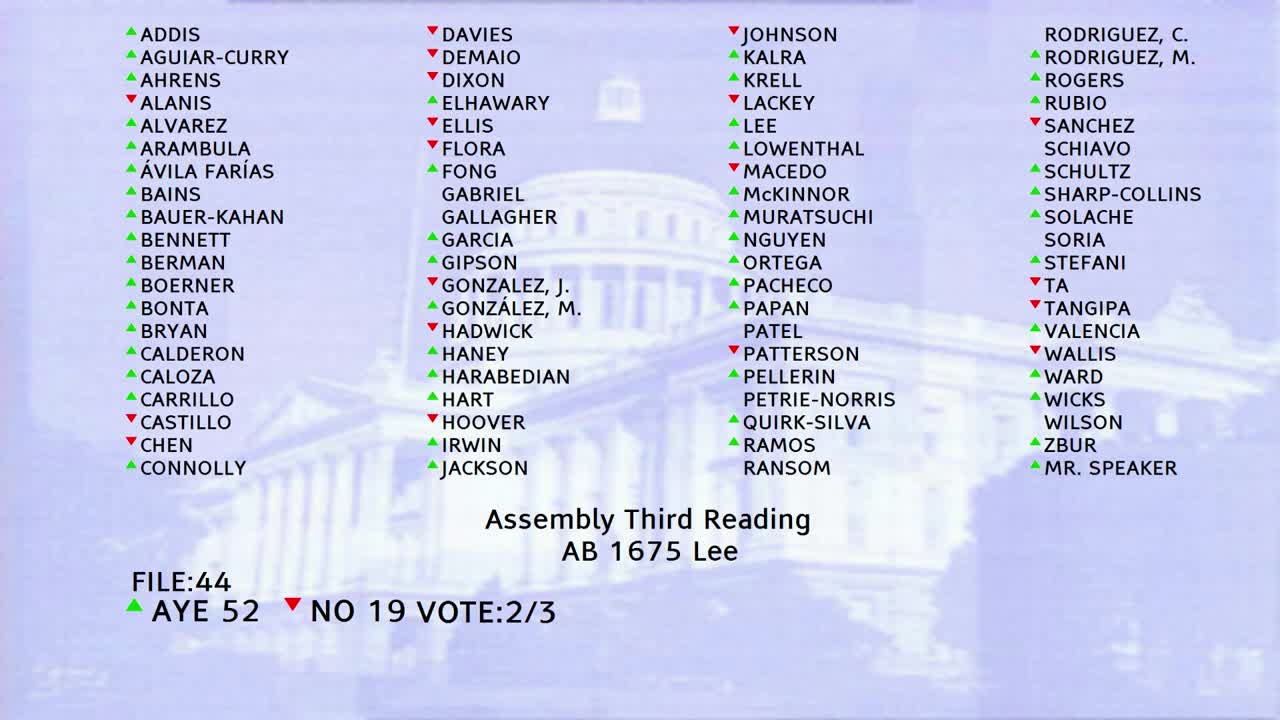 2MIN
Assembly Floor
 14MIN
Assembly Standing Committee on Education
 16MIN
Assembly Standing Committee on Human Services
Bill Author