AB 2196: Foreign driver’s licenses.
- Session Year: 2025-2026
- House: Assembly
- Latest Version Date: 2026-02-19
Current Status:
Failed
(2026-05-14: From committee: Without further action pursuant to Joint Rule 62(a).)
Introduced
In Committee
Awaiting First Chamber Vote
Passed First Chamber
In Committee
Awaiting Second Chamber Vote
Passed Second Chamber
Enacted
Existing law prohibits a person from having in the persons possession or otherwise under the persons control more than one drivers license. Existing law prohibits the Department of Motor Vehicles from issuing a drivers license to, or renewing a drivers license of, a person who holds a valid drivers license issued by a foreign jurisdiction unless the license has been surrendered to the department, or is lost or destroyed. Except as specified, existing law requires the department to require an applicant for an original drivers license to submit satisfactory proof of California residency and that the applicants presence in the United States is authorized under federal law.
Existing law requires the department, upon application for an original drivers license, except a student license, to require an examination of the applicant. Existing law requires the examination to test, among other things, the applicants knowledge and understanding of the provisions of the Vehicle Code governing the operation of vehicles upon the highways, an actual demonstration of the applicants ability to exercise ordinary and reasonable control in operating a motor vehicle by driving it under the supervision of an examining officer, and a test of the hearing and eyesight of the applicant, as specified. Existing law authorizes the department to waive the driving test part of the examination for an applicant who submits a license issued by another state, territory, or possession of the United States, the District of Columbia, or the Commonwealth of Puerto Rico if the department verifies through any acknowledged national driver record data source that there are no stops, holds, or other impediments to its issuance.
This bill would authorize the department, for purposes of the issuance of a noncommercial class C drivers license, to the extent not prohibited by federal law or treaty, to waive the driving test part of the examination for an applicant who submits a drivers license issued by Japan, the Republic of China (Taiwan), and South Korea, also referred to as foreign nation, under specified conditions, including a requirement that the foreign nation, in a memorandum of understanding, extends the same reciprocal privilege relating to the issuance of a drivers license to a person who holds a valid California drivers license. The bill would require an applicant to be 18 years of age or older, to submit satisfactory proof of legal residency in California and specified documents issued by the foreign nation, and to have no stops, holds, or other impediments to issuance in the persons driving record. The bill would specify that an applicant may submit a drivers license issued by a foreign nation that is equivalent to a noncommercial or a commercial class A, class B, or class C California drivers license, but would require the California drivers license issued by the department to the applicant to be a noncommercial class C drivers license only.
(a)(1)The examination shall include all of the following:
(A)A test of the applicants knowledge and understanding of the provisions of this code governing the operation of vehicles upon the highways.
(B)A test of the applicants ability to read and understand simple English used in highway traffic and directional signs.
(C)A test of the applicants understanding of traffic signs and signals, including the bikeway signs, markers, and traffic control devices established by the Department of Transportation.
(D)An actual demonstration of the applicants ability to exercise ordinary and reasonable control in operating a motor vehicle by driving it under the supervision of an examining officer. The applicant shall submit to an examination appropriate to the type of motor vehicle or combination of vehicles the applicant desires a license to drive, except that the department may waive the driving test part of the examination for any applicant who submits a license issued by another state, territory, or possession of the United States, the District of Columbia, or the Commonwealth of Puerto Rico if the department verifies through any acknowledged national driver record data source that there are no stops, holds, or other impediments to its issuance. The examining officer may request to see evidence of financial responsibility for the vehicle before supervising the demonstration of the applicants ability to operate the vehicle. The examining officer may refuse to examine an applicant who is unable to provide proof of financial responsibility for the vehicle, unless proof of financial responsibility is not required by this code.
(E)A test of the hearing and eyesight of the applicant, and of other matters that may be necessary to determine the applicants mental and physical fitness of the applicant to operate a motor vehicle upon the highways, and whether any grounds exist for refusal of a license under this code.
(2)(A)Before a class A or class B drivers license, or class C drivers license with a commercial endorsement, may be issued or renewed, the applicant shall have in the applicants driver record a valid report of a medical examination of the applicant given not more than two years before the date of the application by a health care professional. As used in this paragraph, health care professional means a person who is licensed, certified, or registered in accordance with applicable state laws and regulations to practice medicine and perform physical examinations in the United States. Health care professionals are doctors of medicine, doctors of osteopathy, physician assistants, and registered advanced practice nurses, or doctors of chiropractic who are clinically competent to perform the medical examination presently required of motor carrier drivers by the United States Department of Transportation. The report shall be on a form approved by the department. In establishing the requirements, consideration may be given to the standards presently required of motor carrier drivers by the Federal Motor Carrier Safety Administration.
(B)The department may accept a federal waiver of one or more physical qualification standards if the waiver is accompanied by a report of a nonqualifying medical examination for a class A or class B drivers license, or class C drivers license with a commercial endorsement, pursuant to Section 391.41(a)(3)(ii) of Subpart E of Part 391 of Title 49 of the Code of Federal Regulations.
(3)A physical defect of the applicant that, in the opinion of the department, is compensated for to ensure safe driving ability, shall not prevent the issuance of a license to the applicant.
(b)In accordance with the following classifications, an applicant for a drivers license shall be required to submit to an examination appropriate to the type of motor vehicle or combination of vehicles the applicant desires a license to drive:
(1)Class A includes the following:
(A)Except as provided in subparagraph (H) of paragraph (3), a combination of vehicles, if a vehicle being towed has a gross vehicle weight rating or gross vehicle weight of more than 10,000 pounds.
(B)A vehicle towing more than one vehicle.
(C)A trailer bus.
(D)The operation of all vehicles under class B and class C.
(2)Class B includes the following:
(A)Except as provided in subparagraph (H) of paragraph (3), a single vehicle with a gross vehicle weight rating or gross vehicle weight of more than 26,000 pounds.
(B)A single vehicle with three or more axles, except any three-axle vehicle weighing less than 6,000 pounds.
(C)A bus with a gross vehicle weight rating or gross vehicle weight of more than 26,000 pounds, except a trailer bus.
(D)A farm labor vehicle.
(E)A single vehicle with three or more axles or a gross vehicle weight rating or gross vehicle weight of more than 26,000 pounds towing another vehicle with a gross vehicle weight rating or gross vehicle weight of 10,000 pounds or less.
(F)A house car over 40 feet in length, excluding safety devices and safety bumpers.
(G)The operation of all vehicles covered under class C.
(3)Class C includes the following:
(A)A two-axle vehicle with a gross vehicle weight rating or gross vehicle weight of 26,000 pounds or less, including when the vehicle is towing a trailer or semitrailer with a gross vehicle weight rating or gross vehicle weight of 10,000 pounds or less.
(B)Notwithstanding subparagraph (A), a two-axle vehicle weighing 4,000 pounds or more unladen when towing a trailer coach not exceeding 9,000 pounds gross.
(C)A house car of 40 feet in length or less.
(D)A three-axle vehicle weighing 6,000 pounds gross or less.
(E)A house car of 40 feet in length or less or a vehicle towing another vehicle with a gross vehicle weight rating of 10,000 pounds or less, including when a tow dolly is used. A person driving a vehicle may not tow another vehicle in violation of Section 21715.
(F)(i)A two-axle vehicle weighing 4,000 pounds or more unladen when towing either a trailer coach or a fifth-wheel travel trailer not exceeding 10,000 pounds gross vehicle weight rating, when the towing of the trailer is not for compensation.
(ii)A two-axle vehicle weighing 4,000 pounds or more unladen when towing a fifth-wheel travel trailer exceeding 10,000 pounds, but not exceeding 15,000 pounds, gross vehicle weight rating, when the towing of the trailer is not for compensation, and if the person has passed a specialized written examination provided by the department relating to the knowledge of this code and other safety aspects governing the towing of recreational vehicles upon the highway.
(iii)The authority to operate combinations of vehicles under this subparagraph may be granted by endorsement on a class C license upon completion of that written examination.
(G)A vehicle or combination of vehicles with a gross combination weight rating or a gross vehicle weight rating, as those terms are defined in subdivisions (j) and (k), respectively, of Section 15210, of 26,000 pounds or less, if all of the following conditions are met:
(i)Is operated by a farmer, an employee of a farmer, or an instructor credentialed in agriculture as part of an instructional program in agriculture at the high school, community college, or university level.
(ii)Is used exclusively in the conduct of agricultural operations.
(iii)Is not used in the capacity of a for-hire carrier or for compensation.
(H)Firefighting equipment, provided that the equipment is operated by a person who holds a firefighter endorsement pursuant to Section 12804.11.
(I)A motorized scooter.
(J)A bus with a gross vehicle weight rating or gross vehicle weight of 26,000 pounds or less, except a trailer bus.
(K)Class C does not include a two-wheel motorcycle or a two-wheel motor-driven cycle.
(4)Class M1. A two-wheel motorcycle or a motor-driven cycle. Authority to operate a vehicle included in a class M1 license may be granted by endorsement on a class A, B, or C license upon completion of an appropriate examination.
(5)(A)Class M2 includes a motorized bicycle or moped, or a bicycle with an attached motor, except an electric bicycle as described in subdivision (a) of Section 312.5.
(B)Authority to operate vehicles included in class M2 may be granted by endorsement on a class A, B, or C license upon completion of an appropriate examination. Persons holding a class M1 license or endorsement may operate vehicles included in class M2 without further examination.
(c)A drivers license or driver certificate is not valid for operating a commercial motor vehicle, as defined in subdivision (b) of Section 15210, any other motor vehicle listed in paragraph (1) or (2) of subdivision (b), or any other vehicle requiring a driver to hold any driver certificate or any drivers license endorsement under Section 15275, unless a medical certificate approved by the department that has been issued within two years of the date of the operation of that vehicle and a copy of the medical examination report from which the certificate was issued is on file with the department. Otherwise, the license is valid only for operating class C vehicles that are not commercial vehicles, as defined in subdivision (b) of Section 15210, and for operating class M1 or M2 vehicles, if so endorsed, that are not commercial vehicles, as defined in subdivision (b) of Section 15210.
(d)A license or driver certificate issued before the enactment of Chapter 7 (commencing with Section 15200) is valid to operate the class or type of vehicles specified under the law in existence before that enactment until the license or certificate expires or is otherwise suspended, revoked, or canceled. Upon application for renewal or replacement of a drivers license, endorsement, or certificate required to operate a commercial motor vehicle, a valid medical certificate on a form approved by the department shall be submitted to the department.
(e)The department may accept a certificate of driving skill that is issued by an employer, authorized by the department to issue a certificate under Section 15250, of the applicant, in lieu of a driving test, on class A or B applications, if the applicant has first qualified for a class C license and has met the other examination requirements for the license for which the applicant is applying. The certificate may be submitted as evidence of the applicants skill in the operation of the types of equipment covered by the license for which the applicant is applying.
(f)The department may accept a certificate of competence in lieu of a driving test on class M1 or M2 applications, when the certificate is issued by a law enforcement agency for its officers who operate class M1 or M2 vehicles in their duties, if the applicant has met the other examination requirements for the license for which the applicant is applying.
(g)The department may accept a certificate of satisfactory completion of a motorcyclist training program approved by the commissioner pursuant to Section 2932 in lieu of a driving test on class M1 or M2 applications, if the applicant has met the other examination requirements for the license for which the applicant is applying. The department shall review and approve the written and driving test used by a program to determine whether the program may issue a certificate of completion.
(h)Notwithstanding subdivision (b), a person holding a valid California drivers license of any class may operate a short-term rental motorized bicycle without taking any special examination for the operation of a motorized bicycle, and without having a class M2 endorsement on that license. As used in this subdivision, short-term means 48 hours or less.
(i)A person under 21 years of age shall not be issued a class M1 or M2 license or endorsement unless the person provides evidence satisfactory to the department of completion of a novice motorcycle safety training program that is operated pursuant to Article 2 (commencing with Section 2930) of Chapter 5 of Division 2.
(j)A driver of a vanpool vehicle may operate with a class C license but shall possess evidence of a medical examination required for a class B license when operating vanpool vehicles. In order to be eligible to drive the vanpool vehicle, the driver shall keep in the vanpool vehicle a statement, signed under penalty of perjury, that the driver has not been convicted of reckless driving, drunk driving, or a hit-and-run offense in the last five years.
(k)(1)For purposes of the issuance of a noncommercial class C drivers license, notwithstanding subparagraph (D) of paragraph (1) of subdivision (a), and to the extent not prohibited by federal law or treaty, the department may waive the driving test part of the examination for an applicant who submits a drivers license issued by Japan, the Republic of China (Taiwan), or South Korea under all of the following conditions:
(A)The department has determined the driving examination required by the foreign nation is substantially similar to the driving examination required by the department.
(B)The foreign nation, in a memorandum of understanding, extends the same reciprocal privilege relating to the issuance of a drivers license to a person who holds a valid California drivers license.
(C)The department verifies through the applicants abstract of driving record provided pursuant to subparagraph (D) that there are no stops, holds, or other impediments to the issuance of a drivers license.
(D)The applicant has submitted a copy of the applicants foreign drivers license and an abstract of the applicants foreign driving record covering no less than the previous five years, issued by the appropriate government entity from the foreign nation and, if applicable, the English translation of the drivers license and abstract of driving record. These documents shall all be notarized by a consulate general of the issuing foreign nation in this state.
(E)The applicant is 18 years of age or older.
(F)The applicant has submitted satisfactory proof of legal residency in California.
(G)The drivers license issued by the foreign nation has been surrendered to the department or has been destroyed.
(2)For purposes of this subdivision, an applicant may submit a drivers license issued by a foreign nation that is equivalent to a noncommercial or a commercial class A, class B, or class C California drivers license, but the California drivers license issued by the department to the applicant shall be a noncommercial class C drivers license only.
(3)For purposes of this subdivision, foreign nation refers to Japan, the Republic of China (Taiwan), and South Korea.
(k)(l)This section shall remain in effect only until January 1, 2029, and as of that date is repealed.
SEC. 2.Section 12804.9 of the Vehicle Code, as amended by Section 4 of Chapter 16 of the Statutes of 2025, is amended to read:12804.9.(a)(1)The examination shall include all of the following:
(A)A test of the applicants knowledge and understanding of the provisions of this code governing the operation of vehicles upon the highways.
(B)A test of the applicants ability to read and understand simple English used in highway traffic and directional signs.
(C)A test of the applicants understanding of traffic signs and signals, including the bikeway signs, markers, and traffic control devices established by the Department of Transportation.
(D)An actual demonstration of the applicants ability to exercise ordinary and reasonable control in operating a motor vehicle by driving it under the supervision of an examining officer. The applicant shall submit to an examination appropriate to the type of motor vehicle or combination of vehicles the applicant desires a license to drive, except that the department may waive the driving test part of the examination for any applicant who submits a license issued by another state, territory, or possession of the United States, the District of Columbia, or the Commonwealth of Puerto Rico if the department verifies through any acknowledged national driver record data source that there are no stops, holds, or other impediments to its issuance. The examining officer may request to see evidence of financial responsibility for the vehicle before supervising the demonstration of the applicants ability to operate the vehicle. The examining officer may refuse to examine an applicant who is unable to provide proof of financial responsibility for the vehicle, unless proof of financial responsibility is not required by this code.
(E)A test of the hearing and eyesight of the applicant, and of other matters that may be necessary to determine the applicants mental and physical fitness of the applicant to operate a motor vehicle upon the highways, and whether any grounds exist for refusal of a license under this code.
(2)(A)Before a class A or class B drivers license, or class C drivers license with a commercial endorsement, may be issued or renewed, the applicant shall have in the applicants driver record a valid report of a medical examination of the applicant given not more than two years before the date of the application by a health care professional. As used in this paragraph, health care professional means a person who is licensed, certified, or registered in accordance with applicable state laws and regulations to practice medicine and perform physical examinations in the United States. Health care professionals are doctors of medicine, doctors of osteopathy, physician assistants, and registered advanced practice nurses, or doctors of chiropractic who are clinically competent to perform the medical examination presently required of motor carrier drivers by the United States Department of Transportation. The report shall be on a form approved by the department. In establishing the requirements, consideration may be given to the standards presently required of motor carrier drivers by the Federal Motor Carrier Safety Administration.
(B)The department may accept a federal waiver of one or more physical qualification standards if the waiver is accompanied by a report of a nonqualifying medical examination for a class A or class B drivers license, or class C drivers license with a commercial endorsement, pursuant to Section 391.41(a)(3)(ii) of Subpart E of Part 391 of Title 49 of the Code of Federal Regulations.
(3)A physical defect of the applicant that, in the opinion of the department, is compensated for to ensure safe driving ability, shall not prevent the issuance of a license to the applicant.
(b)In accordance with the following classifications, an applicant for a drivers license shall be required to submit to an examination appropriate to the type of motor vehicle or combination of vehicles the applicant desires a license to drive:
(1)Class A includes the following:
(A)Except as provided in subparagraph (H) of paragraph (3), a combination of vehicles, if a vehicle being towed has a gross vehicle weight rating or gross vehicle weight of more than 10,000 pounds.
(B)A vehicle towing more than one vehicle.
(C)A trailer bus.
(D)The operation of all vehicles under class B and class C.
(2)Class B includes the following:
(A)Except as provided in subparagraph (H) of paragraph (3), a single vehicle with a gross vehicle weight rating or gross vehicle weight of more than 26,000 pounds.
(B)A single vehicle with three or more axles, except any three-axle vehicle weighing less than 6,000 pounds.
(C)A bus with a gross vehicle weight rating or gross vehicle weight of more than 26,000 pounds, except a trailer bus.
(D)A farm labor vehicle.
(E)A single vehicle with three or more axles or a gross vehicle weight rating or gross vehicle weight of more than 26,000 pounds towing another vehicle with a gross vehicle weight rating or gross vehicle weight of 10,000 pounds or less.
(F)A house car over 40 feet in length, excluding safety devices and safety bumpers.
(G)The operation of all vehicles covered under class C.
(3)Class C includes the following:
(A)A two-axle vehicle with a gross vehicle weight rating or gross vehicle weight of 26,000 pounds or less, including when the vehicle is towing a trailer or semitrailer with a gross vehicle weight rating or gross vehicle weight of 10,000 pounds or less.
(B)Notwithstanding subparagraph (A), a two-axle vehicle weighing 4,000 pounds or more unladen when towing a trailer coach not exceeding 9,000 pounds gross.
(C)A house car of 40 feet in length or less.
(D)A three-axle vehicle weighing 6,000 pounds gross or less.
(E)A house car of 40 feet in length or less or a vehicle towing another vehicle with a gross vehicle weight rating of 10,000 pounds or less, including when a tow dolly is used. A person driving a vehicle may not tow another vehicle in violation of Section 21715.
(F)(i)A two-axle vehicle when towing a trailer exceeding 10,000 pounds, but not exceeding 15,000 pounds gross vehicle weight rating or gross vehicle weight, if all of the following conditions are met:
(I)The towing of the trailer is not for compensation or commercial purposes.
(II)The trailer is coupled to the towing vehicle by a bed-mounted gooseneck hitch or a fifth-wheel and kingpin connection.
(III)The trailer is used exclusively for recreational purposes.
(IV)The trailer is used for the transportation of property or human habitation, or both.
(V)The person has passed a specialized written examination provided by the department relating to the knowledge of this code and other safety aspects governing the towing of recreational vehicles upon the highway.
(ii)A vehicle towing a fifth-wheel travel trailer exceeding 10,000 pounds, but not exceeding 15,000 pounds, gross vehicle weight rating or gross vehicle weight, when the towing of the trailer is not for compensation, and if the person has passed a specialized written examination provided by the department relating to the knowledge of this code and other safety aspects governing the towing of recreational vehicles upon the highway.
(iii)The authority to operate combinations of vehicles under this subparagraph may be granted by endorsement on a class C license upon completion of that written examination.
(G)A vehicle or combination of vehicles with a gross combination weight rating or a gross vehicle weight rating, as those terms are defined in subdivisions (j) and (k), respectively, of Section 15210, of 26,000 pounds or less, if all of the following conditions are met:
(i)Is operated by a farmer, an employee of a farmer, or an instructor credentialed in agriculture as part of an instructional program in agriculture at the high school, community college, or university level.
(ii)Is used exclusively in the conduct of agricultural operations.
(iii)Is not used in the capacity of a for-hire carrier or for compensation.
(H)Firefighting equipment, provided that the equipment is operated by a person who holds a firefighter endorsement pursuant to Section 12804.11.
(I)A motorized scooter.
(J)A bus with a gross vehicle weight rating or gross vehicle weight of 26,000 pounds or less, except a trailer bus.
(K)Class C does not include a two-wheel motorcycle or a two-wheel motor-driven cycle.
(4)Class M1. A two-wheel motorcycle or a motor-driven cycle. Authority to operate a vehicle included in a class M1 license may be granted by endorsement on a class A, B, or C license upon completion of an appropriate examination.
(5)(A)Class M2 includes a motorized bicycle or moped, or a bicycle with an attached motor, except an electric bicycle as described in subdivision (a) of Section 312.5.
(B)Authority to operate vehicles included in class M2 may be granted by endorsement on a class A, B, or C license upon completion of an appropriate examination. Persons holding a class M1 license or endorsement may operate vehicles included in class M2 without further examination.
(c)A drivers license or driver certificate is not valid for operating a commercial motor vehicle, as defined in subdivision (b) of Section 15210, any other motor vehicle listed in paragraph (1) or (2) of subdivision (b), or any other vehicle requiring a driver to hold any driver certificate or any drivers license endorsement under Section 15275, unless a medical certificate approved by the department that has been issued within two years of the date of the operation of that vehicle and a copy of the medical examination report from which the certificate was issued is on file with the department. Otherwise, the license is valid only for operating class C vehicles that are not commercial vehicles, as defined in subdivision (b) of Section 15210, and for operating class M1 or M2 vehicles, if so endorsed, that are not commercial vehicles, as defined in subdivision (b) of Section 15210.
(d)A license or driver certificate issued before the enactment of Chapter 7 (commencing with Section 15200) is valid to operate the class or type of vehicles specified under the law in existence before that enactment until the license or certificate expires or is otherwise suspended, revoked, or canceled. Upon application for renewal or replacement of a drivers license, endorsement, or certificate required to operate a commercial motor vehicle, a valid medical certificate on a form approved by the department shall be submitted to the department.
(e)The department may accept a certificate of driving skill that is issued by an employer, authorized by the department to issue a certificate under Section 15250, of the applicant, in lieu of a driving test, on class A or B applications, if the applicant has first qualified for a class C license and has met the other examination requirements for the license for which the applicant is applying. The certificate may be submitted as evidence of the applicants skill in the operation of the types of equipment covered by the license for which the applicant is applying.
(f)The department may accept a certificate of competence in lieu of a driving test on class M1 or M2 applications, when the certificate is issued by a law enforcement agency for its officers who operate class M1 or M2 vehicles in their duties, if the applicant has met the other examination requirements for the license for which the applicant is applying.
(g)The department may accept a certificate of satisfactory completion of a motorcyclist training program approved by the commissioner pursuant to Section 2932 in lieu of a driving test on class M1 or M2 applications, if the applicant has met the other examination requirements for the license for which the applicant is applying. The department shall review and approve the written and driving test used by a program to determine whether the program may issue a certificate of completion.
(h)Notwithstanding subdivision (b), a person holding a valid California drivers license of any class may operate a short-term rental motorized bicycle without taking any special examination for the operation of a motorized bicycle, and without having a class M2 endorsement on that license. As used in this subdivision, short-term means 48 hours or less.
(i)A person under 21 years of age shall not be issued a class M1 or M2 license or endorsement unless the person provides evidence satisfactory to the department of completion of a novice motorcycle safety training program that is operated pursuant to Article 2 (commencing with Section 2930) of Chapter 5 of Division 2.
(j)A driver of a vanpool vehicle may operate with a class C license but shall possess evidence of a medical examination required for a class B license when operating vanpool vehicles. In order to be eligible to drive the vanpool vehicle, the driver shall keep in the vanpool vehicle a statement, signed under penalty of perjury, that the driver has not been convicted of reckless driving, drunk driving, or a hit-and-run offense in the last five years.
(k)(1)For purposes of the issuance of a noncommercial class C drivers license, notwithstanding subparagraph (D) of paragraph (1) of subdivision (a), and to the extent not prohibited by federal law or treaty, the department may waive the driving test part of the examination for an applicant who submits a drivers license issued by Japan, the Republic of China (Taiwan), or South Korea under all of the following conditions:
(A)The department has determined the driving examination required by the foreign nation is substantially similar to the driving examination required by the department.
(B)The foreign nation, in a memorandum of understanding, extends the same reciprocal privilege relating to the issuance of a drivers license to a person who holds a valid California drivers license.
(C)The department verifies through the applicants abstract of driving record provided pursuant to subparagraph (D) that there are no stops, holds, or other impediments to the issuance of a drivers license.
(D)The applicant has submitted a copy of the applicants foreign drivers license and an abstract of the applicants foreign driving record covering no less than the previous five years, issued by the appropriate government entity from the foreign nation and, if applicable, the English translation of the drivers license and abstract of driving record. These documents shall all be notarized by a consulate general of the issuing foreign nation in this state.
(E)The applicant is 18 years of age or older.
(F)The applicant has submitted satisfactory proof of legal residency.
(G)The drivers license issued by the foreign nation has been surrendered to the department or has been destroyed.
(2)For purposes of this subdivision, an applicant may submit a drivers license issued by a foreign nation that is equivalent to a noncommercial or a commercial class A, class B, or class C California drivers license, but the California drivers license issued by the department to the applicant shall be a noncommercial class C drivers license only.
(3)For purposes of this subdivision, foreign nation refers to Japan, the Republic of China (Taiwan), and South Korea.
(k)(l)This section shall become operative on January 1, 2029.
|
Date
|
Status
|
|---|---|
| May 14, 2026 | From committee: Without further action pursuant to Joint Rule 62(a). |
| Apr 20, 2026 | In committee: Set, first hearing. Failed passage. |
| Mar 9, 2026 | Referred to Com. on TRANS. |
| Feb 20, 2026 | From printer. May be heard in committee March 22. |
| Feb 19, 2026 | Read first time. To print. |
|
Date
|
Description
|
Location
|
Votes
|
|
|---|---|---|---|---|
| Apr 20, 2026 | Do pass and be re-referred to the Committee on [Appropriations] | Assembly Standing Committee on Transportation |
Failed |
This list shows positions taken on this bill by organizations on the date displayed, which is linked to the original source.
Positions by individuals are not included.
|
Organization
|
Position
|
Date
|
|---|---|---|
| Streets Are For Everyone | ** Against | |
| Streets for All | ** Against |
Date of Hearing: April 20, 2026
ASSEMBLY COMMITTEE ON TRANSPORTATION
Lori D. Wilson, Chair
ABPCA Bill Id:AB 2196 (
Author:Ta) – As Introduced Ver:February 19, 2026
SUBJECT: Foreign driver’s licenses
SUMMARY: Authorizes the Department of Motor Vehicles (DMV) to waive the driving test part of an examination for a class C license for an applicant who submits a driver’s license issued by Japan, the Republic of China (Taiwan), or South Korea under specified conditions. Specifically, this bill:
- Specifies DMV may waive the driving test if:
- DMV determines the driving examination required by the foreign nation is substantially similar to the driving examination required by DMV;
- The foreign nation, in a memorandum of understanding, extends the same reciprocal privilege relating to the issuance of a driver’s license to a person who holds a valid California Driver’s license;
- The applicant has submitted a copy of the applicant’s foreign driver’s license and an abstract of the applicant’s foreign driving record covering no less than the previous five years, issued by the appropriate government entity from the foreign nation and, if applicable, the English translation of the driver’s license and abstract of driving record. Requires the documents to be notarized by a consulate general of the issuing foreign nation in this state;
- Requires the applicant to be 18 or older;
- Requires the applicant to submit satisfactory proof of legal residency in California; and,
- Requires the applicant to surrender the foreign driver’s license.
- Specifies that an applicant may submit a driver’s license issued by a foreign nation that is equivalent to a noncommercial or a commercial class A, B, or class C California driver’s license, but the California driver’s license issued by DMV shall only be a noncommercial class C license.
EXISTING LAW:
- Permits a person over the age of 16 and is a resident of a foreign nation who possesses a driver's license from that nation to operate a motor vehicle within California without obtaining a driver's license from DMV for 10 days, or 30 days if over the age of 18. (Vehicle Code (VEH) 12503 and 12504)
- Prohibits a person who is a resident in California from possessing more than one driver's license and further requires a person to surrender their driver's license from a foreign jurisdiction prior to being issued a driver's license from DMV. (VEH 12511)
- Requires an applicant for an original driver's license to take and pass an examination which tests the applicant’s knowledge of California’s rules of the road, demonstrate their ability to satisfactorily control and operate a motor vehicle, and pass a visual and hearing exam. (VEH 12804.9)
- Allows DMV to waive the behind-the-wheel portion of a driver's license examination if the department verifies the applicant’s driving record from another state, territory, or possession of the United States does not have any stops, holds, or other impediments. (VEH 12804.9)
- Requires an applicant to provide satisfactory proof of California residency when applying for an original driver's license. (VEH 12804.9)
- Provides that an individual with a Class C license may drive a 2-axle vehicle with a gross vehicle weight rating of 26,000 pounds or less, a 3-axle vehicle weighing 6,000 pounds gross or less, a motorized scooter, or any housecar 40 feet or less. (VEH 12804.9)
FISCAL EFFECT: Unknown
COMMENTS: Who Can Drive in California Without a California Driver’s License? Americans from other states and foreign nationals are allowed to drive in California without a California driver’s license if they are visiting the state and have a driver’s license from their home state or country. California does not require visitors from a foreign nation to have an International Driver’s Permit (IDP), also mistakenly referred to as an International Driver’s License, in order to drive in the state of California. An IDP is a document that translates individual’s driver’s licenses into 19 different languages and is often required when visiting other countries.
Once someone becomes a resident of California, they are required to have a California driver’s license to drive in this state. New residents from out-of-state are required to take the written examination on the rules of the road and pass a visual and hearing examination to obtain a California driver’s license. They may have to take a behind-the-wheel portion of the driver’s license exam, but that exam can be waived by DMV if the department verifies the applicant’s driving record from another state, territory, or possession of the United States does not have any stops, holds, or other impediments on their license. A licensee must surrender their out-of-state license in order to receive their California driver’s license.
Foreign nationals, regardless of their country of origin, are required to take both the written and behind-the-wheel portion of the exam to obtain a California driver’s license.
Other States. Thirty-three states and three territories have reciprocal agreements with Taiwan. Some waive the behind the wheel examination and others waive both a written examination and a behind the wheel examination. Over 20 states have a similar agreement with South Korea. Six states have an agreement with Japan.
According to the author, “California is home to large Taiwanese, Japanese, and Korean communities, yet immigrants from these countries face unnecessary barriers when building a livelihood in the state. One such barrier is the ability to drive.
AB 2196 authorizes the Department of Motor Vehicles to establish reciprocal agreements with Taiwan, Japan, and South Korea, allowing eligible residents to exchange a valid foreign driver’s license for a California driver’s license. This bill reduces unnecessary barriers, streamlines the licensing process, and supports residents working to build their lives in California.
California’s current approach is inconsistent with national norms. Forty-six states have entered into reciprocal driver’s license exchange agreements with at least one other nation, and thirty-five of those states include Taiwan, Japan, or South Korea. AB 2196 brings California in line with the rest of the country while increasing accessibility for immigrants.”
Streets for All, writing in opposition to this bill, argues: “AB 2196 eliminates the currently required driving test portion of license exams for applicants with licenses from Japan, Taiwan, and South Korea. It also requires said countries to have a reciprocal agreement with California in order to eliminate the driving test for said applicants.
AB 2196 does not account for left-sided driving differences, such as in Japan. The reciprocal program is also helpful for long-term residents abroad, however interim licensure provisions already exist in countries like Japan, where foreigners can use an IDP for 3 months to a year. In addition, road conditions in California can be vastly different from abroad, the driver’s test and the preparation it requires are vital tools in the acclimation process.
Streets For All is a street safety organization, we believe maintaining high standards of driving competency is essential to maintaining the safety of all drivers on our roads. Passing a driving test is not an unreasonable burden to the use of our roadways.”
Committee concerns. According to the Public Policy Institute of California, California is home to approximately 10.9 million foreign-born residents, representing 28% of the state’s total population. These residents originate from over 150 countries, with the leading countries of origin being Mexico (3.95 million), the Philippines (855,000), China (822,000), and India (626,000). This bill would create a tiered system where only a small fraction of California’s immigrant population is eligible for a testing waiver, while the vast majority, including those from our largest immigrant countries, must still complete a behind-the-wheel examination to ensure they can safely navigate California roads.
The Legislature may not be the appropriate body to determine which foreign jurisdictions maintain driving standards equivalent to California’s. By selecting specific countries for reciprocity via statute, the Legislature risks making these determinations based on geopolitical relationships rather than objective safety data. This could inadvertently place the State in the position of making foreign policy decisions that have broader implications for United States international relations.
Moreover, existing law maintains a consistent and fair standard for all foreign nationals: regardless of country of origin, new residents must demonstrate their driving competency through a practical examination. The Committee should consider whether it is appropriate to depart from this uniform safety standard to treat individuals from Japan, Korea, and Taiwan differently than the millions of other Californians who have successfully completed the state's licensing requirements.
Previous Legislation. AB 723 (Low) of 2021 would have Allowed a person with a driver's license from a foreign nation to be exempt from taking the behind-the-wheel examination when applying for a California driver's license if the country formed an MOU with the State of California. That bill died in Assembly Appropriations Committee.
AB 269 (Quirk-Silva) of 2019 was sustainably similar to AB 723. AB 269 was held in the Assembly Appropriations Committee.
SB 1360 (Portantino) of 2018 was substantially AB 723. SB 1360 was not taken up for a vote and died on the Assembly floor.
REGISTERED SUPPORT / OPPOSITION:
Support
None on file
Opposition
Streets are for Everyone
Streets for All
Analysis Prepared by: David Sforza / TRANS. / (916) 319-2093
Discussed in Hearing
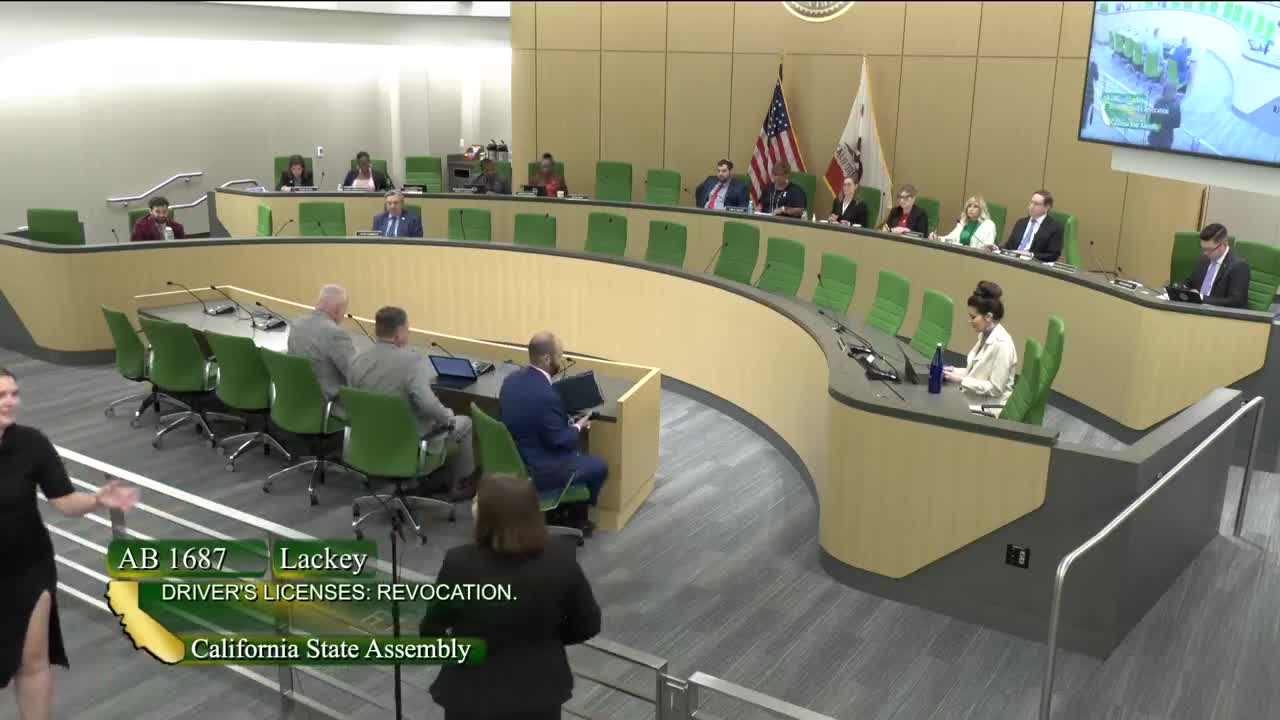 12MIN
Assembly Standing Committee on Transportation
Bill Author

Bill Co-Author(s):