AB 2205: Personal Income Tax Law: Corporation Tax Law: New Employment Credit.
- Session Year: 2025-2026
- House: Assembly
- Latest Version Date: 2026-03-18
Current Status:
In Progress
(2026-05-14: Joint Rule 62(a), file notice suspended. (Page 5030.))
Introduced
In Committee
Awaiting First Chamber Vote
Passed First Chamber
In Committee
Awaiting Second Chamber Vote
Passed Second Chamber
Enacted
The Personal Income Tax Law and the Corporation Tax Law allow various credits against the taxes imposed by those laws, including, for taxable years beginning on or after January 1, 2014, and before January 1, 2026, a credit for hiring qualified full-time employees, as defined, within a designated census tract or economic development area in an amount equal to 35% of the qualified wages, defined in part as those wages that exceed 150% of minimum wage but do not exceed 350% of minimum wage, paid to those employees multiplied by the applicable percentage for that taxable year. Existing law exempts certain taxpayers from the above-described census tract or economic development area requirement, as specified, and disallows the above-described credit for specified businesses. Existing law repeals the above-described provisions on December 1, 2029.
This bill would extend the operative date for the above-described tax credits through taxable years beginning before January 1, 2031. The bill would extend the above-described repeal date to December 1, 2034.
Existing law requires any bill authorizing a new tax expenditure to contain, among other things, specific goals that the tax expenditure will achieve, detailed performance indicators, and data collection requirements.
This bill also would include additional information required for any bill authorizing a new tax expenditure.
This bill would take effect immediately as a tax levy.
The Personal Income Tax Law and the Corporation Tax Law allow various credits against the taxes imposed by those laws, including, for taxable years beginning on or after January 1, 2014, and before January 1, 2026, a credit for hiring qualified full-time employees, as defined, within a designated census tract or economic development area in an amount equal to 35% of the qualified wages, defined in part as those wages that exceed 150% of minimum wage but do not exceed 350% of minimum wage, paid to those employees multiplied by the applicable percentage for that taxable year. Existing law exempts certain taxpayers from the above-described census tract or economic development area requirement, as specified, and disallows the above-described credit for specified businesses. Existing law repeals the above-described provisions on December 1, 2029.
This bill would extend the operative date for the above-described tax credits through taxable years beginning before January 1, 2031. The bill would extend the above-described repeal date to December 1, 2034.
Existing law requires any bill authorizing a new tax expenditure to contain, among other things, specific goals that the tax expenditure will achieve, detailed performance indicators, and data collection requirements.
This bill also would include additional information required for any bill authorizing a new tax expenditure.
This bill would take effect immediately as a tax levy.
(a)(1)For each taxable year beginning on or after January 1, 2014, and before January 1, 2031, there shall be allowed to a qualified taxpayer that hires a qualified full-time employee and pays or incurs qualified wages attributable to work performed by the qualified full-time employee in a designated census tract or economic development area, and that receives a tentative credit reservation for that qualified full-time employee, a credit against the net tax, as defined in Section 17039, in an amount calculated under this section.
(2)For each taxable year beginning on or after January 1, 2023, and before January 1, 2031, the designated census tract or economic development area requirements shall not apply to a qualified taxpayer described in clause (ii), (iii), (iv), or (v) of subparagraph (A) of paragraph (14) of subdivision (b).
(3)The amount of the credit allowable under this section for a taxable year shall be equal to the product of the tentative credit amount for the taxable year and the applicable percentage for that taxable year.
(4)(A)If a qualified taxpayer relocates to a designated census tract or economic development area, the qualified taxpayer shall be allowed a credit with respect to qualified wages for each qualified full-time employee employed within the new location only if the qualified taxpayer provides each employee at the previous location or locations a written offer of employment at the new location in the designated census tract or economic development area with comparable compensation.
(B)For purposes of this paragraph, relocates to a designated census tract or economic development area means an increase in the number of qualified full-time employees, employed by a qualified taxpayer, within a designated census tract or tracts or economic development areas within a 12-month period in which there is a decrease in the number of full-time employees, employed by the qualified taxpayer in this state, but outside of designated census tracts or economic development areas.
(C)This paragraph does not apply to a small business.
(5)The credit allowed by this section may be claimed only on a timely filed original return of the qualified taxpayer and only with respect to a qualified full-time employee for whom the qualified taxpayer has received a tentative credit reservation.
(b)For purposes of this section:
(1)The tentative credit amount for a taxable year shall be equal to the product of the applicable credit percentage for each qualified full-time employee and the qualified wages paid by the qualified taxpayer during the taxable year to that qualified full-time employee.
(2)The applicable percentage for a taxable year shall be equal to a fraction, the numerator of which is the net increase in the total number of full-time employees employed in this state during the taxable year, determined on an annual full-time equivalent basis, as compared with the total number of full-time employees employed in this state during the base year, determined on the same basis, and the denominator of which shall be the total number of qualified full-time employees employed in this state during the taxable year. The applicable percentage shall not exceed 100 percent.
(3)The applicable credit percentage means the credit percentage for the calendar year during which a qualified full-time employee was first employed by the qualified taxpayer. The applicable credit percentage for all calendar years shall be 35 percent.
(4)Base year means the 2013 taxable year, except in the case of a qualified taxpayer who first hires a qualified full-time employee in a taxable year beginning on or after January 1, 2015, the base year means the taxable year immediately preceding the taxable year in which a qualified full-time employee was first hired by the qualified taxpayer.
(5)Acquired includes any gift, inheritance, transfer incident to divorce, or any other transfer, whether or not for consideration.
(6)Annual full-time equivalent means either of the following:
(A)In the case of a full-time employee paid hourly qualified wages, annual full-time equivalent means the total number of hours worked for the qualified taxpayer by the employee, not to exceed 2,000 hours per employee, divided by 2,000.
(B)In the case of a salaried full-time employee, annual full-time equivalent means the total number of weeks worked for the qualified taxpayer by the employee divided by 52.
(7)Designated census tract means a census tract within the state that is determined by the Department of Finance to have a civilian unemployment rate that is within the top 25 percent of all census tracts within the state and has a poverty rate within the top 25 percent of all census tracts within the state, as prescribed in Section 13073.5 of the Government Code.
(8)Economic development area means either of the following:
(A)A former enterprise zone. For purposes of this section, former enterprise zone means an enterprise zone designated and in effect as of December 31, 2011, any enterprise zone designated during 2012, and any revision of an enterprise zone prior to June 30, 2013, under former Chapter 12.8 (commencing with Section 7070) of Division 7 of Title 1 of the Government Code, as in effect on December 31, 2012, excluding any census tract within an enterprise zone that is identified by the Department of Finance pursuant to Section 13073.5 of the Government Code as a census tract within the lowest quartile of census tracts with the lowest civilian unemployment and poverty.
(B)A local agency military base recovery area designated as of the effective date of the act adding this subparagraph, in accordance with Section 7114 of the Government Code.
(9)Electric airplane manufacturing means manufacturing of electric airplanes that would be classified under Code 3364 of the North American Industry Classification System (NAICS) published by the United States Office of Management and Budget, 2022 edition.
(10)Lithium production means lithium mining and manufacturing described in Codes 212390 or 325180 of the North American Industry Classification System (NAICS) published by the United States Office of Management and Budget, 2022 edition.
(11)Manufacturing of lithium batteries means the manufacturing described in Code 335910 of the North American Industry Classification System (NAICS) published by the United States Office of Management and Budget, 2022 edition.
(12)Minimum wage means the wage established pursuant to Chapter 1 (commencing with Section 1171) of Part 4 of Division 2 of the Labor Code.
(13)(A)Qualified full-time employee means an individual who meets all of the following requirements:
(i)(I)Performs at least 50 percent of their services for the qualified taxpayer during the taxable year in a designated census tract or economic development area.
(II)This clause does not apply to employees of a qualified taxpayer described in clause (ii), (iii), (iv), or (v) of subparagraph (A) of paragraph (14).
(ii)Receives starting wages that are at least 150 percent of the minimum wage or at least 100 percent of the minimum wage for employees of a qualified taxpayer described in clause (ii), (iii), (iv), or (v) of subparagraph (A) of paragraph (14).
(iii)Is hired by the qualified taxpayer on or after January 1, 2014.
(iv)Is hired by the qualified taxpayer after the date the Department of Finance determines that the census tract referred to in clause (i) is a designated census tract or that the census tracts within a former enterprise zone are not census tracts with the lowest civilian unemployment and poverty.
(v)Satisfies either of the following conditions:
(I)Is paid qualified wages by the qualified taxpayer for services not less than an average of 35 hours per week.
(II)Is a salaried employee and was paid compensation during the taxable year for full-time employment, within the meaning of Section 515 of the Labor Code, by the qualified taxpayer.
(vi)Upon commencement of employment with the qualified taxpayer, satisfies any of the following conditions:
(I)Was unemployed for the six months immediately preceding employment with the qualified taxpayer. In the case of an individual that completed a program of study at a college, university, or other postsecondary educational institution, received a baccalaureate, postgraduate, or professional degree, and was unemployed for the six months immediately preceding employment with the qualified taxpayer, that individual must have completed that program of study at least 12 months prior to the individuals commencement of employment with the qualified taxpayer.
(II)Is a veteran who separated from service in the Armed Forces of the United States within the 12 months preceding commencement of employment with the qualified taxpayer.
(III)Was a recipient of the credit allowed under Section 32 of the Internal Revenue Code, relating to earned income, as applicable for federal purposes, for the previous taxable year.
(IV)Is an ex-offender previously convicted of a felony.
(V)Is a recipient of either CalWORKs, in accordance with Article 2 (commencing with Section 11250) of Chapter 2 of Part 3 of Division 9 of the Welfare and Institutions Code, or general assistance, in accordance with Section 17000.5 of the Welfare and Institutions Code.
(B)An individual may be considered a qualified full-time employee only for the period of time commencing with the date the individual is first employed by the qualified taxpayer and ending 60 months thereafter.
(14)(A)Qualified taxpayer means any of the following:
(i)A person or entity engaged in a trade or business within a designated census tract or economic development area that, during the taxable year, pays or incurs qualified wages.
(ii)A person or entity engaged in semiconductor manufacturing or semiconductor research and development that, upon requesting a tentative credit reservation, self-certifies and provides verification, in the form and manner prescribed by the Franchise Tax Board, that they intend to apply or have applied for federal funding pursuant to Sections 101 to 106, inclusive, of, or intend to claim or have claimed the credit pursuant to Section 107 of, Division A of the federal Creating Helpful Incentives to Produce Semiconductors (CHIPS) Act of 2022 (Public Law 117-167), and that pays or incurs qualified wages during the taxable year.
(iii)A person or entity engaged in electric airplane manufacturing that, upon requesting a tentative credit reservation, self-certifies and provides verification, in the form and manner prescribed by the Franchise Tax Board, that they have received a sales and use tax exclusion pursuant to Section 6010.8 for an electric vertical takeoff and landing (eVTOL) manufacturer and that pays or incurs qualified wages during the taxable year.
(iv)A person or entity engaged in lithium production that, upon requesting a tentative credit reservation, self-certifies and provides verification, in the form and manner prescribed by the Franchise Tax Board, that they are a producer, as defined by Section 47002, who pays the tax imposed by Part 25 (commencing with Section 47000) for the taxable year and that pays or incurs qualified wages during the taxable year.
(v)(I)A person or entity engaged in manufacturing of lithium batteries that, upon requesting a tentative credit reservation, self-certifies and provides verification, in the form and manner prescribed by the Franchise Tax Board, that their primary business is lithium battery manufacturing and that pays or incurs qualified wages during the taxable year.
(II)For purposes of this clause, primary business means 50 percent or more of their gross income is derived from lithium battery manufacturing.
(B)In the case of any pass-thru entity, the determination of whether a taxpayer is a qualified taxpayer under this section shall be made at the entity level and any credit under this section or Section 23626 shall be allowed to the pass-thru entity and passed through to the partners and shareholders in accordance with applicable provisions of this part or Part 11 (commencing with Section 23001). For purposes of this subdivision, the term pass-thru entity means any partnership or S corporation.
(C)Qualified taxpayers shall not include any of the following:
(i)Employers that provide temporary help services, as described in Code 561320 of the North American Industry Classification System (NAICS) published by the United States Office of Management and Budget, 2012 edition.
(ii)Employers that provide retail trade services, as described in Sector 44-45 of the North American Industry Classification System (NAICS) published by the United States Office of Management and Budget, 2012 edition.
(iii)Employers that are primarily engaged in providing food services, as described in Code 711110, 722511, 722513, 722514, or 722515 of the North American Industry Classification System (NAICS) published by the United States Office of Management and Budget, 2012 edition.
(iv)Employers that are primarily engaged in services as described in Code 713210, 721120, or 722410 of the North American Industry Classification System (NAICS) published by the United States Office of Management and Budget, 2012 edition.
(v)(I)An employer that is a sexually oriented business.
(II)For purposes of this clause:
(ia)Sexually oriented business means a nightclub, bar, restaurant, or similar commercial enterprise that provides for an audience of two or more individuals live nude entertainment or live nude performances where the nudity is a function of everyday business operations and where nudity is a planned and intentional part of the entertainment or performance.
(ib)Nude means clothed in a manner that leaves uncovered or visible, through less than fully opaque clothing, any portion of the genitals or, in the case of a female, any portion of the breasts below the top of the areola of the breasts.
(D)Subparagraph (C) shall not apply to a taxpayer that is a small business.
(15)Qualified wages means those wages subject to withholding pursuant to Division 6 (commencing with Section 13000) of the Unemployment Insurance Code that meet all of the following requirements:
(A)(i)Except as provided in clause (ii) or (iii), that portion of wages paid or incurred by the qualified taxpayer during the taxable year to each qualified full-time employee that exceeds 150 percent of minimum wage, but does not exceed 350 percent of minimum wage.
(ii)(I)In the case of a qualified full-time employee employed in a designated pilot area, that portion of wages paid or incurred by the qualified taxpayer during the taxable year to each qualified full-time employee that exceeds ten dollars ($10) per hour or an equivalent amount for salaried employees, but does not exceed 350 percent of minimum wage. For qualified full-time employees described in the preceding sentence, clause (ii) of subparagraph (A) of paragraph (13) is modified by substituting ten dollars ($10) per hour or an equivalent amount for salaried employees for 150 percent of the minimum wage.
(II)For purposes of this clause:
(ia)Designated pilot area means an area designated as a designated pilot area by the Governors Office of Business and Economic Development.
(ib)Areas that may be designated as a designated pilot area are limited to areas within a designated census tract or an economic development area with average wages less than the statewide average wages, based on information from the Labor Market Division of the Employment Development Department, and areas within a designated census tract or an economic development area based on high poverty or high unemployment.
(ic)The total number of designated pilot areas that may be designated is limited to five, one or more of which must be an area within five or fewer designated census tracts within a single county based on high poverty or high unemployment or an area within an economic development area based on high poverty or high unemployment.
(id)The designation of a designated pilot area shall be applicable for a period of four calendar years, commencing with the first calendar year for which the designation of a designated pilot area is effective. The applicable period of a designated pilot area may be extended, in the sole discretion of the Governors Office of Business and Economic Development, for an additional period of up to three calendar years. The applicable period, and any extended period, shall not extend beyond December 31, 2020.
(III)The designation of an area as a designated pilot area and the extension of the applicable period of a designated pilot area shall be at the sole discretion of the Governors Office of Business and Economic Development and shall not be subject to administrative appeal or judicial review.
(iii)For qualified full-time employees of a qualified taxpayer described in clause (ii), (iii), (iv), or (v) of subparagraph (A) of paragraph (14), that portion of wages paid or incurred by the qualified taxpayer during the taxable year to each qualified full-time employee that exceeds 100 percent of the minimum wage, but does not exceed 350 percent of the minimum wage.
(B)Wages paid or incurred during the 60-month period beginning with the first day the qualified full-time employee commences employment with the qualified taxpayer. In the case of any employee who is reemployed, including a regularly occurring seasonal increase, in the trade or business operations of the qualified taxpayer, this reemployment shall not be treated as constituting commencement of employment for purposes of this section.
(C)Except as provided in paragraph (3) of subdivision (n), qualified wages shall not include any wages paid or incurred by the qualified taxpayer on or after the date that the Department of Finances redesignation of designated census tracts is effective, as provided in paragraph (2) of subdivision (g), so that a census tract is no longer a designated census tract.
(16)Seasonal employment means employment by a qualified taxpayer that has regular and predictable substantial reductions in trade or business operations.
(17)Semiconductor manufacturing or semiconductor research and development means manufacturing described in Code 3344 of the North American Industry Classification System (NAICS) published by the United States Office of Management and Budget, 2022 edition.
(18)(A)Small business means a trade or business that has aggregate gross receipts, less returns and allowances reportable to this state, of less than two million dollars ($2,000,000) during the previous taxable year.
(B)(i)For purposes of this paragraph, gross receipts, less returns and allowances reportable to this state, means the sum of the gross receipts from the production of business income, as defined in subdivision (a) of Section 25120, and the gross receipts from the production of nonbusiness income, as defined in subdivision (d) of Section 25120.
(ii)In the case of any trade or business activity conducted by a partnership or an S corporation, the limitations set forth in subparagraph (A) shall be applied to the partnership or S corporation and to each partner or shareholder.
(C)(i)Small business shall not include a sexually oriented business.
(ii)For purposes of this subparagraph:
(I)Sexually oriented business means a nightclub, bar, restaurant, or similar commercial enterprise that provides for an audience of two or more individuals live nude entertainment or live nude performances where the nudity is a function of everyday business operations and where nudity is a planned and intentional part of the entertainment or performance.
(II)Nude means clothed in a manner that leaves uncovered or visible, through less than fully opaque clothing, any portion of the genitals or, in the case of a female, any portion of the breasts below the top of the areola of the breasts.
(19)An individual is unemployed for any period for which the individual is all of the following:
(A)Not in receipt of wages subject to withholding under Section 13020 of the Unemployment Insurance Code for that period.
(B)Not a self-employed individual (within the meaning of Section 401(c)(1)(B) of the Internal Revenue Code, relating to self-employed individual) for that period.
(C)Not a registered full-time student at a high school, college, university, or other postsecondary educational institution for that period.
(c)The net increase in full-time employees of a qualified taxpayer shall be determined as provided by this subdivision:
(1)(A)The net increase in full-time employees shall be determined on an annual full-time equivalent basis by subtracting from the amount determined in subparagraph (C) the amount determined in subparagraph (B).
(B)The total number of full-time employees employed in the base year by the taxpayer and by any trade or business acquired by the taxpayer during the current taxable year.
(C)The total number of full-time employees employed in the current taxable year by the taxpayer and by any trade or business acquired during the current taxable year.
(2)For taxpayers who first commence doing business in this state during the taxable year, the number of full-time employees for the base year shall be zero.
(d)For purposes of this section:
(1)All employees of the trades or businesses that are treated as related under Section 267, 318, or 707 of the Internal Revenue Code shall be treated as employed by a single taxpayer.
(2)In determining whether the taxpayer has first commenced doing business in this state during the taxable year, the provisions of subdivision (f) of Section 17276, without application of paragraph (7) of that subdivision, shall apply.
(e)(1)(A)Except as provided in subparagraph (B), to be eligible for the credit allowed by this section, a qualified taxpayer shall, upon hiring a qualified full-time employee, request a tentative credit reservation from the Franchise Tax Board within 30 days of complying with the Employment Development Departments new hire reporting requirements as provided in Section 1088.5 of the Unemployment Insurance Code, in the form and manner prescribed by the Franchise Tax Board.
(B)For taxable years beginning on or after January 1, 2023, and before January 1, 2024, to be eligible for the credit allowed by this section, a qualified taxpayer described in clause (ii), (iii), (iv), or (v) of subparagraph (A) of paragraph (14) of subdivision (b) shall, upon hiring a qualified full-time employee, request a tentative credit reservation from the Franchise Tax Board on or before the last day of the month following the close of the taxable year for which the credit is claimed, in the form and manner prescribed by the Franchise Tax Board.
(2)To obtain a tentative credit reservation with respect to a qualified full-time employee, the qualified taxpayer shall provide necessary information, as determined by the Franchise Tax Board, including the name, social security number, the start date of employment, the rate of pay of the qualified full-time employee, the qualified taxpayers gross receipts, less returns and allowances, for the previous taxable year, and whether the qualified full-time employee is a resident of a targeted employment area, as defined in former Section 7072 of the Government Code, as in effect on December 31, 2013.
(3)The qualified taxpayer shall provide the Franchise Tax Board an annual certification of employment with respect to each qualified full-time employee hired in a previous taxable year, on or before, the 15th day of the third month of the taxable year. The certification shall include necessary information, as determined by the Franchise Tax Board, including the name, social security number, start date of employment, and rate of pay for each qualified full-time employee employed by the qualified taxpayer.
(4)(A)A qualified taxpayer, as defined under clause (ii), (iii), (iv), or (v) of subparagraph (A) of paragraph (14) of subdivision (b), shall, upon request, provide to the Franchise Tax Board the applicable verification specified in subparagraph (A) of paragraph (14) of subdivision (b).
(B)The verification shall be provided in the form and manner prescribed by the Franchise Tax Board.
(C)Any disallowance of a credit claimed due to a failure to provide verification under this paragraph shall be treated as a mathematical error appearing on the return. Any amount of tax resulting from such disallowance may be assessed by the Franchise Tax Board in the same manner as provided by Section 19051.
(5)A tentative credit reservation provided to a taxpayer with respect to an employee of that taxpayer shall not constitute a determination by the Franchise Tax Board with respect to any of the requirements of this section regarding a taxpayers eligibility for the credit authorized by this section.
(f)The Franchise Tax Board shall do all of the following:
(1)Approve a tentative credit reservation with respect to a qualified full-time employee hired during a calendar year.
(2)Determine the aggregate tentative reservation amount and the aggregate small business tentative reservation amount for a calendar year.
(3)A tentative credit reservation request from a qualified taxpayer with respect to a qualified full-time employee who is a resident of a targeted employment area, as defined in former Section 7072 of the Government Code, as in effect on December 31, 2013, shall be expeditiously processed by the Franchise Tax Board. The residence of a qualified full-time employee in a targeted employment area shall have no other effect on the eligibility of an individual as a qualified full-time employee or the eligibility of a qualified taxpayer for the credit authorized by this section.
(4)Notwithstanding Section 19542, provide as a searchable database on its internet website, for each taxable year beginning on or after January 1, 2014, and before January 1, 2031, the employer names, amounts of tax credit claimed, and number of new jobs created for each taxable year pursuant to this section and Section 23626.
(g)(1)The Department of Finance shall, by January 1, 2014, and by January 1 of every fifth year thereafter, provide the Franchise Tax Board with a list of the designated census tracts and a list of census tracts with the lowest civilian unemployment rate.
(2)The redesignation of designated census tracts and lowest civilian unemployment census tracts by the Department of Finance as provided in Section 13073.5 of the Government Code shall be effective, for purposes of this credit, one year after the date the Department of Finance redesignates the designated census tracts.
(h)For purposes of this section:
(1)All employees of the trades or businesses that are treated as related under Section 267, 318, or 707 of the Internal Revenue Code shall be treated as employed by a single taxpayer.
(2)All employees of trades or businesses that are not incorporated, and that are under common control, shall be treated as employed by a single taxpayer.
(3)The credit, if any, allowable by this section with respect to each trade or business shall be determined by reference to its proportionate share of the expense of the qualified wages giving rise to the credit, and shall be allocated to that trade or business in that manner.
(4)Principles that apply in the case of controlled groups of corporations, as specified in subdivision (h) of Section 23626, shall apply with respect to determining employment.
(5)If an employer acquires the major portion of a trade or business of another employer, hereinafter in this paragraph referred to as the predecessor, or the major portion of a separate unit of a trade or business of a predecessor, then, for purposes of applying this section, other than subdivision (i), for any taxable year ending after that acquisition, the employment relationship between a qualified full-time employee and an employer shall not be treated as terminated if the employee continues to be employed in that trade or business.
(i)(1)If the employment of any qualified full-time employee, with respect to whom qualified wages are taken into account under subdivision (a), is terminated by the qualified taxpayer at any time during the first 36 months after commencing employment with the qualified taxpayer, whether or not consecutive, the tax imposed by this part for the taxable year in which that employment is terminated shall be increased by an amount equal to the credit allowed under subdivision (a) for that taxable year and all prior taxable years attributable to qualified wages paid or incurred with respect to that employee.
(2)Paragraph (1) does not apply to any of the following:
(A)A termination of employment of a qualified full-time employee who voluntarily leaves the employment of the qualified taxpayer.
(B)A termination of employment of a qualified full-time employee who, before the close of the period referred to in paragraph (1), becomes disabled and unable to perform the services of that employment, unless that disability is removed before the close of that period and the qualified taxpayer fails to offer reemployment to that employee.
(C)A termination of employment of a qualified full-time employee, if it is determined that the termination was due to the misconduct, as defined in Sections 1256-30 to 1256-43, inclusive, of Title 22 of the California Code of Regulations, of that employee.
(D)A termination of employment of a qualified full-time employee due to a substantial reduction in the trade or business operations of the qualified taxpayer, including reductions due to seasonal employment.
(E)A termination of employment of a qualified full-time employee, if that employee is replaced by other qualified full-time employees so as to create a net increase in both the number of employees and the hours of employment.
(F)A termination of employment of a qualified full-time employee, when that employment is considered seasonal employment and the qualified employee is rehired on a seasonal basis.
(3)For purposes of paragraph (1), the employment relationship between the qualified taxpayer and a qualified full-time employee shall not be treated as terminated by reason of a mere change in the form of conducting the trade or business of the qualified taxpayer, if the qualified full-time employee continues to be employed in that trade or business and the qualified taxpayer retains a substantial interest in that trade or business.
(4)An increase in tax under paragraph (1) shall not be treated as tax imposed by this part for purposes of determining the amount of any credit allowable under this part.
(j)In the case of an estate or trust, both of the following apply:
(1)The qualified wages for a taxable year shall be apportioned between the estate or trust and the beneficiaries on the basis of the income of the estate or trust allocable to each.
(2)A beneficiary to whom any qualified wages have been apportioned under paragraph (1) shall be treated, for purposes of this part, as the employer with respect to those wages.
(k)In the case in which the credit allowed by this section exceeds the net tax, the excess may be carried over to reduce the net tax in the following year, and the succeeding four years if necessary, until the credit is exhausted.
(l)The Franchise Tax Board may prescribe rules, guidelines, or procedures necessary or appropriate to carry out the purposes of this section, including any guidelines regarding the allocation of the credit allowed under this section. Chapter 3.5 (commencing with Section 11340) of Part 1 of Division 3 of Title 2 of the Government Code shall not apply to any rule, guideline, or procedure prescribed by the Franchise Tax Board pursuant to this section.
(m)(1)Upon the effective date of this section, the Department of Finance shall estimate the total dollar amount of credits that will be claimed under this section with respect to each fiscal year from the 201314 fiscal year to the 202021 fiscal year, inclusive.
(2)(A)The Franchise Tax Board shall annually provide to the Joint Legislative Budget Committee, by no later than March 1, a report of the total dollar amount of the credits claimed under this section with respect to the relevant fiscal year. The report shall compare the total dollar amount of credits claimed under this section with respect to that fiscal year with the departments estimate with respect to that same fiscal year. If the total dollar amount of credits claimed for the fiscal year is less than the estimate for that fiscal year, the report shall identify options for increasing annual claims of the credit so as to meet estimated amounts.
(B)Beginning March 1, 2025, the report required by this paragraph shall include information relating to the total dollar amount of the credits claimed under this section by qualified taxpayers described in clause (ii), (iii), (iv), or (v) of subparagraph (A) of paragraph (14) of subdivision (b).
(n)(1)This section shall remain in effect only until December 1, 2034, and as of that date is repealed.
(2)Notwithstanding paragraph (1) of subdivision (a), this section shall continue to be operative for taxable years beginning on or after January 1, 2031, but only with respect to qualified full-time employees who commenced employment with a qualified taxpayer in a designated census tract or economic development area in a taxable year beginning before January 1, 2031.
(3)This section shall remain operative for any qualified taxpayer with respect to any qualified full-time employee after the designated census tract is no longer designated or an economic development area ceases to be an economic development area, as defined in this section, for the remaining period, if any, of the 60-month period after the original date of hiring of an otherwise qualified full-time employee and any wages paid or incurred with respect to those qualified full-time employees after the designated census tract is no longer designated or an economic development area ceases to be an economic development area, as defined in this section, shall be treated as qualified wages under this section, provided the employee satisfies any other requirements of paragraphs (13) and (15) of subdivision (b), as if the designated census tract was still designated and binding or the economic development area was still in existence.
(o)For purposes of complying with Section 41 as it relates to the amendments made to this section and Section 23626 by the act adding this subdivision, hereafter the expansion of the credit, the Legislature finds as follows:
(1)The specific goal, purpose, and objective of the expansion of the credit is to incentivize semiconductor, lithium production and manufacturing, and electric airplane companies to invest in California-based operations.
(2)The performance indicator for the Legislature to use in determining whether the expansion of the credit is achieving the stated goal, purpose, and objective is the total dollar amount of credits claimed by taxpayers engaged in semiconductor manufacturing, semiconductor research and development, lithium production and manufacturing, and electric airplane manufacturing, as reported pursuant to subparagraph (B) of paragraph (2) of subdivision (m) of this section and subparagraph (B) of paragraph (2) of subdivision (l) of Section 23626.
(p)The amendments made to this section by the act adding this subdivision shall be operative for taxable years beginning on or after January 1, 2023.
SEC. 2.Section 23626 of the Revenue and Taxation Code is amended to read:23626.(a)(1)For each taxable year beginning on or after January 1, 2014, and before January 1, 2031, there shall be allowed to a qualified taxpayer that hires a qualified full-time employee and pays or incurs qualified wages attributable to work performed by the qualified full-time employee in a designated census tract or economic development area, and that receives a tentative credit reservation for that qualified full-time employee, a credit against the tax, as defined by Section 23036, in an amount calculated under this section.
(2)For each taxable year beginning on or after January 1, 2023, and before January 1, 2031, the designated census tract or economic development area requirements shall not apply to a qualified taxpayer described in clause (ii), (iii), (iv), or (v) of subparagraph (A) of paragraph (14) of subdivision (b).
(3)The amount of the credit allowable under this section for a taxable year shall be equal to the product of the tentative credit amount for the taxable year and the applicable percentage for the taxable year.
(4)(A)If a qualified taxpayer relocates to a designated census tract or economic development area, the qualified taxpayer shall be allowed a credit with respect to qualified wages for each qualified full-time employee who is employed within the new location only if the qualified taxpayer provides each employee at the previous location or locations a written offer of employment at the new location in the designated census tract or economic development area with comparable compensation.
(B)For purposes of this paragraph, relocates to a designated census tract or economic development area means an increase in the number of qualified full-time employees, employed by a qualified taxpayer, within a designated census tract or tracts or economic development areas within a 12-month period in which there is a decrease in the number of full-time employees, employed by the qualified taxpayer in this state, but outside of designated census tracts or economic development areas.
(C)This paragraph does not apply to a small business.
(5)The credit allowed by this section may only be claimed on a timely filed original return of the qualified taxpayer and only with respect to a qualified full-time employee for whom the qualified taxpayer has received a tentative credit reservation.
(b)For purposes of this section:
(1)The tentative credit amount for a taxable year shall be equal to the product of the applicable credit percentage for each qualified full-time employee and the qualified wages paid by the qualified taxpayer during the taxable year to that qualified full-time employee.
(2)The applicable percentage for a taxable year shall be equal to a fraction, the numerator of which is the net increase in the total number of full-time employees employed in this state during the taxable year, determined on an annual full-time equivalent basis, as compared with the total number of full-time employees employed in this state during the base year, determined on the same basis, and the denominator of which shall be the total number of qualified full-time employees employed in this state during the taxable year. The applicable percentage shall not exceed 100 percent.
(3)The applicable credit percentage means the credit percentage for the calendar year during which a qualified full-time employee was first employed by the qualified taxpayer. The applicable credit percentage for all calendar years shall be 35 percent.
(4)Base year means the 2013 taxable year, or in the case of a qualified taxpayer who first hires a qualified full-time employee in a taxable year beginning on or after January 2015, the taxable year immediately preceding the taxable year in which the qualified full-time employee was hired.
(5)Acquired includes any gift, inheritance, transfer incident to divorce, or any other transfer, whether or not for consideration.
(6)Annual full-time equivalent means either of the following:
(A)In the case of a full-time employee paid hourly qualified wages, annual full-time equivalent means the total number of hours worked for the qualified taxpayer by the employee (not to exceed 2,000 hours per employee) divided by 2,000.
(B)In the case of a salaried full-time employee, annual full-time equivalent means the total number of weeks worked for the qualified taxpayer by the employee divided by 52.
(7)Designated census tract means a census tract within the state that is determined by the Department of Finance to have a civilian unemployment rate that is within the top 25 percent of all census tracts within the state and has a poverty rate within the top 25 percent of all census tracts within the state, as prescribed in Section 13073.5 of the Government Code.
(8)Economic development area means either of the following:
(A)A former enterprise zone. For purposes of this section, former enterprise zone means an enterprise zone designated and in effect as of December 31, 2011, any enterprise zone designated during 2012, and any revision of an enterprise zone prior to June 30, 2013, under former Chapter 12.8 (commencing with Section 7070) of Division 7 of Title 1 of the Government Code, as in effect on December 31, 2012, excluding any census tract within an enterprise zone that is identified by the Department of Finance pursuant to Section 13073.5 of the Government Code as a census tract within the lowest quartile of census tracts with the lowest civilian unemployment and poverty.
(B)A local agency military base recovery area designated as of the effective date of the act adding this subparagraph, in accordance with Section 7114 of the Government Code.
(9)Electric airplane manufacturing means manufacturing of electric airplanes that would be classified under Code 3364 of the North American Industry Classification System (NAICS) published by the United States Office of Management and Budget, 2022 edition.
(10)Lithium production means lithium mining and manufacturing described in Codes 212390 or 325180 of the North American Industry Classification System (NAICS) published by the United States Office of Management and Budget, 2022 edition.
(11)Manufacturing of lithium batteries means the manufacturing described in Code 335910 of the North American Industry Classification System (NAICS) published by the United States Office of Management and Budget, 2022 edition.
(12)Minimum wage means the wage established pursuant to Chapter 1 (commencing with Section 1171) of Part 4 of Division 2 of the Labor Code.
(13)(A)Qualified full-time employee means an individual who meets all of the following requirements:
(i)(I)Performs at least 50 percent of their services for the qualified taxpayer during the taxable year in a designated census tract or economic development area.
(II)This clause does not apply to employees of a qualified taxpayer described in clause (ii), (iii), (iv), or (v) of subparagraph (A) of paragraph (14).
(ii)Receives starting wages that are at least 150 percent of the minimum wage or at least 100 percent of the minimum wage for employees of a qualified taxpayer described in clause (ii), (iii), (iv), or (v) of subparagraph (A) of paragraph (14).
(iii)Is hired by the qualified taxpayer on or after January 1, 2014.
(iv)Is hired by the qualified taxpayer after the date the Department of Finance determines that the census tract referred to in clause (i) is a designated census tract or that the census tracts within a former enterprise zone are not census tracts with the lowest civilian unemployment and poverty.
(v)Satisfies either of the following conditions:
(I)Is paid qualified wages by the qualified taxpayer for services not less than an average of 35 hours per week.
(II)Is a salaried employee and was paid compensation during the taxable year for full-time employment, within the meaning of Section 515 of the Labor Code, by the qualified taxpayer.
(vi)Upon commencement of employment with the qualified taxpayer, satisfies any of the following conditions:
(I)Was unemployed for the six months immediately preceding employment with the qualified taxpayer. In the case of an individual who completed a program of study at a college, university, or other postsecondary educational institution, received a baccalaureate, postgraduate, or professional degree, and was unemployed for the six months immediately preceding employment with the qualified taxpayer, that individual must have completed that program of study at least 12 months prior to the individuals commencement of employment with the qualified taxpayer.
(II)Is a veteran who separated from service in the Armed Forces of the United States within the 12 months preceding commencement of employment with the qualified taxpayer.
(III)Was a recipient of the credit allowed under Section 32 of the Internal Revenue Code, relating to earned income, as applicable for federal purposes, for the previous taxable year.
(IV)Is an ex-offender previously convicted of a felony.
(V)Is a recipient of either CalWORKs, in accordance with Article 2 (commencing with Section 11250) of Chapter 2 of Part 3 of Division 9 of the Welfare and Institutions Code, or general assistance, in accordance with Section 17000.5 of the Welfare and Institutions Code.
(B)An individual may only be considered a qualified full-time employee for the period of time commencing with the date the individual is first employed by the qualified taxpayer and ending 60 months thereafter.
(14)(A)Qualified taxpayer means any of the following:
(i)A corporation engaged in a trade or business within designated census tract or economic development area that, during the taxable year, pays or incurs qualified wages.
(ii)A person or entity engaged in semiconductor manufacturing or semiconductor research and development that, upon requesting a tentative credit reservation, self-certifies and provides verification, in the form and manner prescribed by the Franchise Tax Board, that they intend to apply or have applied for federal funding pursuant to Sections 101 to 106, inclusive, of, or intend to claim or have claimed the credit pursuant to Section 107 of, Division A of the federal Creating Helpful Incentives to Produce Semiconductors (CHIPS) Act of 2022 (Public Law 117-167), and that pays or incurs qualified wages during the taxable year.
(iii)A person or entity engaged in electric airplane manufacturing that, upon requesting a tentative credit reservation, self-certifies and provides verification, in the form and manner prescribed by the Franchise Tax Board, that they have received a sales and use tax exclusion pursuant to Section 6010.8 for an electric vertical takeoff and landing (eVTOL) manufacturer and that pays or incurs qualified wages during the taxable year.
(iv)A person or entity engaged in lithium production that, upon requesting a tentative credit reservation, self-certifies and provides verification, in the form and manner prescribed by the Franchise Tax Board, that they are a producer, as defined by Section 47002, who pays the tax imposed by Part 25 (commencing with Section 47000) for the taxable year and that pays or incurs qualified wages during the taxable year.
(v)(I)A person or entity engaged in manufacturing of lithium batteries that, upon requesting a tentative credit reservation, self-certifies and provides verification, in the form and manner prescribed by the Franchise Tax Board, that their primary business is lithium battery manufacturing and that pays or incurs qualified wages during the taxable year.
(II)For purposes of this clause, primary business means 50 percent or more of their gross income is derived from lithium battery manufacturing.
(B)In the case of any pass-thru entity, the determination of whether a taxpayer is a qualified taxpayer under this section shall be made at the entity level and any credit under this section or Section 17053.73 shall be allowed to the pass-thru entity and passed through to the partners and shareholders in accordance with applicable provisions of this part or Part 10 (commencing with Section 17001). For purposes of this subdivision, the term pass-thru entity means any partnership or S corporation.
(C)Qualified taxpayer shall not include any of the following:
(i)Employers that provide temporary help services, as described in Code 561320 of the North American Industry Classification System (NAICS) published by the United States Office of Management and Budget, 2012 edition.
(ii)Employers that provide retail trade services, as described in Sector 44-45 of the North American Industry Classification System (NAICS) published by the United States Office of Management and Budget, 2012 edition.
(iii)Employers that are primarily engaged in providing food services, as described in Code 711110, 722511, 722513, 722514, or 722515 of the North American Industry Classification System (NAICS) published by the United States Office of Management and Budget, 2012 edition.
(iv)Employers that are primarily engaged in services as described in Code 713210, 721120, or 722410 of the North American Industry Classification System (NAICS) published by the United States Office of Management and Budget, 2012 edition.
(v)(I)An employer that is a sexually oriented business.
(II)For purposes of this clause:
(ia)Sexually oriented business means a nightclub, bar, restaurant, or similar commercial enterprise that provides for an audience of two or more individuals live nude entertainment or live nude performances where the nudity is a function of everyday business operations and where nudity is a planned and intentional part of the entertainment or performance.
(ib)Nude means clothed in a manner that leaves uncovered or visible, through less than fully opaque clothing, any portion of the genitals or, in the case of a female, any portion of the breasts below the top of the areola of the breasts.
(D)Subparagraph (C) shall not apply to a taxpayer that is a small business.
(15)Qualified wages means those wages subject to withholding pursuant to Division 6 (commencing with Section 13000) of the Unemployment Insurance Code that meet all of the following requirements:
(A)(i)Except as provided in clause (ii) or (iii), that portion of wages paid or incurred by the qualified taxpayer during the taxable year to each qualified full-time employee that exceeds 150 percent of minimum wage, but does not exceed 350 percent of the minimum wage.
(ii)(I)In the case of a qualified full-time employee employed in a designated pilot area, that portion of wages paid or incurred by the qualified taxpayer during the taxable year to each qualified full-time employee that exceeds ten dollars ($10) per hour or an equivalent amount for salaried employees, but does not exceed 350 percent of the minimum wage. For qualified full-time employees described in the preceding sentence, clause (ii) of subparagraph (A) of paragraph (13) is modified by substituting ten dollars ($10) per hour or an equivalent amount for salaried employees for 150 percent of the minimum wage.
(II)For purposes of this clause:
(ia)Designated pilot area means an area designated as a designated pilot area by the Governors Office of Business and Economic Development.
(ib)Areas that may be designated as a designated pilot area are limited to areas within a designated census tract or an economic development area with average wages less than the statewide average wages, based on information from the Labor Market Division of the Employment Development Department, and areas within a designated census tract or an economic development area based on high poverty or high unemployment.
(ic)The total number of designated pilot areas that may be designated is limited to five, one or more of which must be an area within five or fewer designated census tracts within a single county based on high poverty or high unemployment or an area within an economic development area based on high poverty or high unemployment.
(id)The designation of a designated pilot area shall be applicable for a period of four calendar years, commencing with the first calendar year for which the designation of a designated pilot area is effective. The applicable period of a designated pilot area may be extended, in the sole discretion of the Governors Office of Business and Economic Development, for an additional period of up to three calendar years. The applicable period, and any extended period, shall not extend beyond December 31, 2020.
(III)The designation of an area as a designated pilot area and the extension of the applicable period of a designated pilot area shall be at the sole discretion of the Governors Office of Business and Economic Development and shall not be subject to administrative appeal or judicial review.
(iii)For qualified full-time employees of a qualified taxpayer described in clause (ii), (iii), (iv), or (v) of subparagraph (A) of paragraph (14), that portion of wages paid or incurred by the qualified taxpayer during the taxable year to each qualified full-time employee that exceeds 100 percent of minimum wage, but does not exceed 350 percent of the minimum wage.
(B)Wages paid or incurred during the 60-month period beginning with the first day the qualified full-time employee commences employment with the qualified taxpayer. In the case of any employee who is reemployed, including regularly occurring seasonal increase, in the trade or business operations of the qualified taxpayer, this reemployment shall not be treated as constituting commencement of employment for purposes of this section.
(C)Except as provided in paragraph (3) of subdivision (m), qualified wages shall not include any wages paid or incurred by the qualified taxpayer on or after the date that the Department of Finances redesignation of designated census tracts is effective, as provided in paragraph (2) of subdivision (g), so that a census tract is no longer determined to be a designated census tract.
(16)Seasonal employment means employment by a qualified taxpayer that has regular and predictable substantial reductions in trade or business operations.
(17)Semiconductor manufacturing or semiconductor research and development means manufacturing described in Code 3344 of the North American Industry Classification System (NAICS) published by the United States Office of Management and Budget, 2022 edition.
(18)(A)Small business means a trade or business that has aggregate gross receipts, less returns and allowances reportable to this state, of less than two million dollars ($2,000,000) during the previous taxable year.
(B)(i)For purposes of this paragraph, gross receipts, less returns and allowances reportable to this state, means the sum of the gross receipts from the production of business income, as defined in subdivision (a) of Section 25120, and the gross receipts from the production of nonbusiness income, as defined in subdivision (d) of Section 25120.
(ii)In the case of any trade or business activity conducted by a partnership or an S corporation, the limitations set forth in subparagraph (A) shall be applied to the partnership or S corporation and to each partner or shareholder.
(iii)For taxpayers that are required to be included in a combined report under Section 25101 or authorized to be included in a combined report under Section 25101.15, the dollar amount specified in subparagraph (A) shall apply to the aggregate gross receipts of all taxpayers that are required to be or authorized to be included in a combined report.
(C)(i)Small business shall not include a sexually oriented business.
(ii)For purposes of this subparagraph:
(I)Sexually oriented business means a nightclub, bar, restaurant, or similar commercial enterprise that provides for an audience of two or more individuals live nude entertainment or live nude performances where the nudity is a function of everyday business operations and where nudity is a planned and intentional part of the entertainment or performance.
(II)Nude means clothed in a manner that leaves uncovered or visible, through less than fully opaque clothing, any portion of the genitals or, in the case of a female, any portion of the breasts below the top of the areola of the breasts.
(19)An individual is unemployed for any period for which the individual is all of the following:
(A)Not in receipt of wages subject to withholding under Section 13020 of the Unemployment Insurance Code for that period.
(B)Not a self-employed individual (within the meaning of Section 401(c)(1)(B) of the Internal Revenue Code, relating to self-employed individual) for that period.
(C)Not a registered full-time student at a high school, college, university, or other postsecondary educational institution for that period.
(c)The net increase in full-time employees of a qualified taxpayer shall be determined as provided by this subdivision:
(1)(A)The net increase in full-time employees shall be determined on an annual full-time equivalent basis by subtracting from the amount determined in subparagraph (C) the amount determined in subparagraph (B).
(B)The total number of full-time employees employed in the base year by the taxpayer and by any trade or business acquired by the taxpayer during the current taxable year.
(C)The total number of full-time employees employed in the current taxable year by the taxpayer and by any trade or business acquired during the current taxable year.
(2)For taxpayers who first commence doing business in this state during the taxable year, the number of full-time employees for the base year shall be zero.
(d)For purposes of this section:
(1)All employees of the trades or businesses that are treated as related under Section 267, 318, or 707 of the Internal Revenue Code shall be treated as employed by a single taxpayer.
(2)In determining whether the taxpayer has first commenced doing business in this state during the taxable year, the provisions of subdivision (g) of Section 24416, without application of paragraph (7) of that subdivision, apply.
(e)(1)(A)Except as provided in subparagraph (B), to be eligible for the credit allowed by this section, a qualified taxpayer shall, upon hiring a qualified full-time employee, request a tentative credit reservation from the Franchise Tax Board within 30 days of complying with the Employment Development Departments new hire reporting requirement as provided in Section 1088.5 of the Unemployment Insurance Code, in the form and manner prescribed by the Franchise Tax Board.
(B)For taxable years beginning on or after January 1, 2023, and before January 1, 2024, to be eligible for the credit allowed by this section, a qualified taxpayer described in clause (ii), (iii), (iv), or (v) of subparagraph (A) of paragraph (14) of subdivision (b) shall, upon hiring a qualified full-time employee, request a tentative credit reservation from the Franchise Tax Board on or before the last day of the month following the close of the taxable year for which the credit is claimed, in the form and manner prescribed by the Franchise Tax Board.
(2)To obtain a tentative credit reservation with respect to a qualified full-time employee, the qualified taxpayer shall provide necessary information, as determined by the Franchise Tax Board, including the name, the social security number, the start date of employment, the rate of pay of the qualified full-time employee, the qualified taxpayers gross receipts, less returns and allowances, for the previous taxable year, and whether the qualified full-time employee is a resident of a targeted employment area, as defined in former Section 7072 of the Government Code, as in effect on December 31, 2013.
(3)The qualified taxpayer shall provide the Franchise Tax Board an annual certification of employment with respect to each qualified full-time employee hire in a previous taxable year, on or before the 15th day of the third month of the taxable year. The certification shall include necessary information, as determined by the Franchise Tax Board, including the name, social security number, start date of employment, and rate of pay for each qualified full-time employee employed by the qualified taxpayer.
(4)(A)A qualified taxpayer, as defined under clause (ii), (iii), (iv), or (v) of subparagraph (A) of paragraph (14) of subdivision (b), shall, upon request, provide to the Franchise Tax Board the applicable verification specified in subparagraph (A) of paragraph (14) of subdivision (b).
(B)The verification shall be provided in the form and manner prescribed by the Franchise Tax Board.
(C)Any disallowance of a credit claimed due to a failure to provide verification under this paragraph shall be treated as a mathematical error appearing on the return. Any amount of tax resulting from such disallowance may be assessed by the Franchise Tax Board in the same manner as provided by Section 19051.
(5)A tentative credit reservation provided to a taxpayer with respect to an employee of that taxpayer shall not constitute a determination by the Franchise Tax Board with respect to any of the requirements of this section regarding a taxpayers eligibility for the credit authorized by this section.
(f)The Franchise Tax Board shall do all of the following:
(1)Approve a tentative credit reservation with respect to a qualified full-time employee hired during a calendar year.
(2)Determine the aggregate tentative reservation amount and the aggregate small business tentative reservation amount for a calendar year.
(3)A tentative credit reservation request from a qualified taxpayer with respect to a qualified full-time employee who is a resident of a targeted employment area, as defined in former Section 7072 of the Government Code, as in effect on December 31, 2013, shall be expeditiously processed by the Franchise Tax Board. The residence of a qualified full-time employee in a targeted employment area shall have no other effect on the eligibility of an individual as a qualified full-time employee or the eligibility of a qualified taxpayer for the credit authorized by this section.
(4)Notwithstanding Section 19542, provide as a searchable database on its internet website, for each taxable year beginning on or after January 1, 2014, and before January 1, 2031, the employer names, amounts of tax credit claimed, and number of new jobs created for each taxable year pursuant to this section and Section 17053.73.
(g)(1)The Department of Finance shall, by January 1, 2014, and by January 1 of every fifth year thereafter, provide the Franchise Tax Board with a list of the designated census tracts and a list of census tracts with the lowest civilian unemployment rate.
(2)The redesignation of designated census tracts and lowest civilian unemployment census tracts by the Department of Finance as provided in Section 13073.5 of the Government Code shall be effective, for purposes of this credit, one year after the date that the Department of Finance redesignates the designated census tracts.
(h)(1)For purposes of this section:
(A)All employees of the trades or businesses that are treated as related under Section 267, 318, or 707 of the Internal Revenue Code shall be treated as employed by a single qualified taxpayer.
(B)All employees of all corporations that are members of the same controlled group of corporations shall be treated as employed by a single qualified taxpayer.
(C)The credit, if any, allowable by this section to each member shall be determined by reference to its proportionate share of the expense of the qualified wages giving rise to the credit, and shall be allocated in that manner.
(D)If a qualified taxpayer acquires the major portion of a trade or business of another taxpayer, hereinafter in this paragraph referred to as the predecessor, or the major portion of a separate unit of a trade or business of a predecessor, then, for purposes of applying this section for any taxable year ending after that acquisition, the employment relationship between a qualified full-time employee and a qualified taxpayer shall not be treated as terminated if the employee continues to be employed in that trade or business.
(2)For purposes of this subdivision, controlled group of corporations means a controlled group of corporations as defined in Section 1563(a) of the Internal Revenue Code, except that:
(A)More than 50 percent shall be substituted for at least 80 percent each place it appears in Section 1563(a)(1) of the Internal Revenue Code.
(B)The determination shall be made without regard to subsections (a)(4) and (e)(3)(C) of Section 1563 of the Internal Revenue Code.
(3)Rules similar to the rules provided in Sections 46(e) and 46(h) of the Internal Revenue Code, as in effect on November 4, 1990, shall apply to both of the following:
(A)An organization to which Section 593 of the Internal Revenue Code applies.
(B)A regulated investment company or a real estate investment trust subject to taxation under this part.
(i)(1)If the employment of any qualified full-time employee, with respect to whom qualified wages are taken into account under subdivision (a), is terminated by the qualified taxpayer at any time during the first 36 months after commencing employment with the qualified taxpayer, whether or not consecutive, the tax imposed by this part for the taxable year in which that employment is terminated shall be increased by an amount equal to the credit allowed under subdivision (a) for that taxable year and all prior taxable years attributable to qualified wages paid or incurred with respect to that employee.
(2)Paragraph (1) does not apply to any of the following:
(A)A termination of employment of a qualified full-time employee who voluntarily leaves the employment of the qualified taxpayer.
(B)A termination of employment of a qualified full-time employee who, before the close of the period referred to in paragraph (1), becomes disabled and unable to perform the services of that employment, unless that disability is removed before the close of that period and the qualified taxpayer fails to offer reemployment to that employee.
(C)A termination of employment of a qualified full-time employee, if it is determined that the termination was due to the misconduct, as defined in Sections 1256-30 to 1256-43, inclusive, of Title 22 of the California Code of Regulations, of that employee.
(D)A termination of employment of a qualified full-time employee due to a substantial reduction in the trade or business operations of the qualified taxpayer, including reductions due to seasonal employment.
(E)A termination of employment of a qualified full-time employee, if that employee is replaced by other qualified full-time employees so as to create a net increase in both the number of employees and the hours of employment.
(F)A termination of employment of a qualified full-time employee, when that employment is considered seasonal employment and the qualified employee is rehired on a seasonal basis.
(3)For purposes of paragraph (1), the employment relationship between the qualified taxpayer and a qualified full-time employee shall not be treated as terminated by reason of a mere change in the form of conducting the trade or business of the qualified taxpayer, if the qualified full-time employee continues to be employed in that trade or business and the qualified taxpayer retains a substantial interest in that trade or business.
(4)An increase in tax under paragraph (1) shall not be treated as tax imposed by this part for purposes of determining the amount of any credit allowable under this part.
(j)In the case where the credit allowed by this section exceeds the tax, the excess may be carried over to reduce the tax in the following year, and the succeeding four years if necessary, until exhausted.
(k)The Franchise Tax Board may prescribe rules, guidelines, or procedures necessary or appropriate to carry out the purposes of this section, including any guidelines regarding the allocation of the credit allowed under this section. Chapter 3.5 (commencing with Section 11340) of Part 1 of Division 3 of Title 2 of the Government Code shall not apply to any rule, guideline, or procedure prescribed by the Franchise Tax Board pursuant to this section.
(l)(1)Upon the effective date of this section, the Department of Finance shall estimate the total dollar amount of credits that will be claimed under this section with respect to each fiscal year from the 201314 fiscal year to the 202021 fiscal year, inclusive.
(2)(A)The Franchise Tax Board shall annually provide to the Joint Legislative Budget Committee, by no later than March 1, a report of the total dollar amount of the credits claimed under this section with respect to the relevant fiscal year. The report shall compare the total dollar amount of credits claimed under this section with respect to that fiscal year with the departments estimate with respect to that same fiscal year. If the total dollar amount of credits claimed for the fiscal year is less than the estimate for that fiscal year, the report shall identify options for increasing annual claims of the credit so as to meet estimated amounts.
(B)Beginning March 1, 2025, the report required by this paragraph shall include information relating to the total dollar amount of the credits claimed under this section by taxpayers described in clause (ii), (iii), (iv), or (v) of subparagraph (A) of paragraph (14) of subdivision (b).
(m)(1)This section shall remain in effect only until December 1, 2034, and as of that date is repealed.
(2)Notwithstanding paragraph (1) of subdivision (a), this section shall continue to be operative for taxable years beginning on or after January 1, 2031, but only with respect to qualified full-time employees who commenced employment with a qualified taxpayer in a designated census tract or economic development area in a taxable year beginning before January 1, 2031.
(3)This section shall remain operative for any qualified taxpayer with respect to any qualified full-time employee after the designated census tract is no longer designated or an economic development area ceases to be an economic development area, as defined in this section, for the remaining period, if any, of the 60-month period after the original date of hiring of an otherwise qualified full-time employee and any wages paid or incurred with respect to those qualified full-time employees after the designated census tract is no longer designated or an economic development area ceases to be an economic development area, as defined in this section, shall be treated as qualified wages under this section, provided the employee satisfies any other requirements of paragraphs (13) and (15) of subdivision (b), as if the designated census tract was still designated and binding or the economic development area was still in existence.
(n)The amendments made to this section by the act adding this subdivision shall be operative for taxable years beginning on or after January 1, 2023.
(o)(1)For purposes of complying with Section 41 as it relates to the amendments made to this section and Section 17053.73 by the act adding this subdivision, the Legislature finds and declares all of the following:
(A)The specific goal of the credit allowed by this section and Section 17053.73 is to create new job opportunities for those workers facing barriers to employment including, but not limited to, those with criminal history and veterans.
(B)The performance indicators for the Legislature to use in determining whether the credit is achieving its stated goal shall be the number of taxpayers receiving the credit allowed by this section and Section 17053.73 and the average dollar amount of credits allowed, as well as the number of employees hired under these credits.
(2)(A)Notwithstanding Section 10231.5 of the Government Code, the Franchise Tax Board shall submit a report to the Legislature, in compliance with Section 9795 of the Government Code, by January March 1, 2030, and annually thereafter, detailing the number of taxpayers allowed a credit pursuant to this section and Section 17053.73, the average dollar value of credits allowed pursuant to this section and Section 17053.73 for the most recent taxable year, and the number of employees hired during the most recent taxable year, to the extent data is available.
(B)The disclosure requirements of this paragraph shall be treated as an exception to Section 19542.
SEC. 3.This act provides for a tax levy within the meaning of Article IV of the California Constitution and shall go into immediate effect.
(a)(1)For each taxable year beginning on or after January 1, 2014, and before January 1, 2026, 2031, there shall be allowed to a qualified taxpayer that hires a qualified full-time employee and pays or incurs qualified wages attributable to work performed by the qualified full-time employee in a designated census tract or economic development area, and that receives a tentative credit reservation for that qualified full-time employee, a credit against the net tax, as defined in Section 17039, in an amount calculated under this section.
(2)For each taxable year beginning on or after January 1, 2023, and before January 1, 2026, 2031, the designated census tract or economic development area requirements shall not apply to a qualified taxpayer described in clause (ii), (iii), (iv), or (v) of subparagraph (A) of paragraph (14) of subdivision (b).
(3)The amount of the credit allowable under this section for a taxable year shall be equal to the product of the tentative credit amount for the taxable year and the applicable percentage for that taxable year.
(4)(A)If a qualified taxpayer relocates to a designated census tract or economic development area, the qualified taxpayer shall be allowed a credit with respect to qualified wages for each qualified full-time employee employed within the new location only if the qualified taxpayer provides each employee at the previous location or locations a written offer of employment at the new location in the designated census tract or economic development area with comparable compensation.
(B)For purposes of this paragraph, relocates to a designated census tract or economic development area means an increase in the number of qualified full-time employees, employed by a qualified taxpayer, within a designated census tract or tracts or economic development areas within a 12-month period in which there is a decrease in the number of full-time employees, employed by the qualified taxpayer in this state, but outside of designated census tracts or economic development areas.
(C)This paragraph does not apply to a small business.
(5)The credit allowed by this section may be claimed only on a timely filed original return of the qualified taxpayer and only with respect to a qualified full-time employee for whom the qualified taxpayer has received a tentative credit reservation.
(b)For purposes of this section:
(1)The tentative credit amount for a taxable year shall be equal to the product of the applicable credit percentage for each qualified full-time employee and the qualified wages paid by the qualified taxpayer during the taxable year to that qualified full-time employee.
(2)The applicable percentage for a taxable year shall be equal to a fraction, the numerator of which is the net increase in the total number of full-time employees employed in this state during the taxable year, determined on an annual full-time equivalent basis, as compared with the total number of full-time employees employed in this state during the base year, determined on the same basis, and the denominator of which shall be the total number of qualified full-time employees employed in this state during the taxable year. The applicable percentage shall not exceed 100 percent.
(3)The applicable credit percentage means the credit percentage for the calendar year during which a qualified full-time employee was first employed by the qualified taxpayer. The applicable credit percentage for all calendar years shall be 35 percent.
(4)Base year means the 2013 taxable year, except in the case of a qualified taxpayer who first hires a qualified full-time employee in a taxable year beginning on or after January 1, 2015, the base year means the taxable year immediately preceding the taxable year in which a qualified full-time employee was first hired by the qualified taxpayer.
(5)Acquired includes any gift, inheritance, transfer incident to divorce, or any other transfer, whether or not for consideration.
(6)Annual full-time equivalent means either of the following:
(A)In the case of a full-time employee paid hourly qualified wages, annual full-time equivalent means the total number of hours worked for the qualified taxpayer by the employee, not to exceed 2,000 hours per employee, divided by 2,000.
(B)In the case of a salaried full-time employee, annual full-time equivalent means the total number of weeks worked for the qualified taxpayer by the employee divided by 52.
(7)Designated census tract means a census tract within the state that is determined by the Department of Finance to have a civilian unemployment rate that is within the top 25 percent of all census tracts within the state and has a poverty rate within the top 25 percent of all census tracts within the state, as prescribed in Section 13073.5 of the Government Code.
(8)Economic development area means either of the following:
(A)A former enterprise zone. For purposes of this section, former enterprise zone means an enterprise zone designated and in effect as of December 31, 2011, any enterprise zone designated during 2012, and any revision of an enterprise zone prior to June 30, 2013, under former Chapter 12.8 (commencing with Section 7070) of Division 7 of Title 1 of the Government Code, as in effect on December 31, 2012, excluding any census tract within an enterprise zone that is identified by the Department of Finance pursuant to Section 13073.5 of the Government Code as a census tract within the lowest quartile of census tracts with the lowest civilian unemployment and poverty.
(B)A local agency military base recovery area designated as of the effective date of the act adding this subparagraph, in accordance with Section 7114 of the Government Code.
(9)Electric airplane manufacturing means manufacturing of electric airplanes that would be classified under Code 3364 of the North American Industry Classification System (NAICS) published by the United States Office of Management and Budget, 2022 edition.
(10)Lithium production means lithium mining and manufacturing described in Codes 212390 or 325180 of the North American Industry Classification System (NAICS) published by the United States Office of Management and Budget, 2022 edition.
(11)Manufacturing of lithium batteries means the manufacturing described in Code 335910 of the North American Industry Classification System (NAICS) published by the United States Office of Management and Budget, 2022 edition.
(12)Minimum wage means the wage established pursuant to Chapter 1 (commencing with Section 1171) of Part 4 of Division 2 of the Labor Code.
(13)(A)Qualified full-time employee means an individual who meets all of the following requirements:
(i)(I)Performs at least 50 percent of their services for the qualified taxpayer during the taxable year in a designated census tract or economic development area.
(II)This clause does not apply to employees of a qualified taxpayer described in clause (ii), (iii), (iv), or (v) of subparagraph (A) of paragraph (14).
(ii)Receives starting wages that are at least 150 percent of the minimum wage or at least 100 percent of the minimum wage for employees of a qualified taxpayer described in clause (ii), (iii), (iv), or (v) of subparagraph (A) of paragraph (14).
(iii)Is hired by the qualified taxpayer on or after January 1, 2014.
(iv)Is hired by the qualified taxpayer after the date the Department of Finance determines that the census tract referred to in clause (i) is a designated census tract or that the census tracts within a former enterprise zone are not census tracts with the lowest civilian unemployment and poverty.
(v)Satisfies either of the following conditions:
(I)Is paid qualified wages by the qualified taxpayer for services not less than an average of 35 hours per week.
(II)Is a salaried employee and was paid compensation during the taxable year for full-time employment, within the meaning of Section 515 of the Labor Code, by the qualified taxpayer.
(vi)Upon commencement of employment with the qualified taxpayer, satisfies any of the following conditions:
(I)Was unemployed for the six months immediately preceding employment with the qualified taxpayer. In the case of an individual that completed a program of study at a college, university, or other postsecondary educational institution, received a baccalaureate, postgraduate, or professional degree, and was unemployed for the six months immediately preceding employment with the qualified taxpayer, that individual must have completed that program of study at least 12 months prior to the individuals commencement of employment with the qualified taxpayer.
(II)Is a veteran who separated from service in the Armed Forces of the United States within the 12 months preceding commencement of employment with the qualified taxpayer.
(III)Was a recipient of the credit allowed under Section 32 of the Internal Revenue Code, relating to earned income, as applicable for federal purposes, for the previous taxable year.
(IV)Is an ex-offender previously convicted of a felony.
(V)Is a recipient of either CalWORKs, in accordance with Article 2 (commencing with Section 11250) of Chapter 2 of Part 3 of Division 9 of the Welfare and Institutions Code, or general assistance, in accordance with Section 17000.5 of the Welfare and Institutions Code.
(B)An individual may be considered a qualified full-time employee only for the period of time commencing with the date the individual is first employed by the qualified taxpayer and ending 60 months thereafter.
(14)(A)Qualified taxpayer means any of the following:
(i)A person or entity engaged in a trade or business within a designated census tract or economic development area that, during the taxable year, pays or incurs qualified wages.
(ii)A person or entity engaged in semiconductor manufacturing or semiconductor research and development that, upon requesting a tentative credit reservation, self-certifies and provides verification, in the form and manner prescribed by the Franchise Tax Board, that they intend to apply or have applied for federal funding pursuant to Sections 101 to 106, inclusive, of, or intend to claim or have claimed the credit pursuant to Section 107 of, Division A of the federal Creating Helpful Incentives to Produce Semiconductors (CHIPS) Act of 2022 (Public Law 117-167), and that pays or incurs qualified wages during the taxable year.
(iii)A person or entity engaged in electric airplane manufacturing that, upon requesting a tentative credit reservation, self-certifies and provides verification, in the form and manner prescribed by the Franchise Tax Board, that they have received a sales and use tax exclusion pursuant to Section 6010.8 for an electric vertical takeoff and landing (eVTOL) manufacturer and that pays or incurs qualified wages during the taxable year.
(iv)A person or entity engaged in lithium production that, upon requesting a tentative credit reservation, self-certifies and provides verification, in the form and manner prescribed by the Franchise Tax Board, that they are a producer, as defined by Section 47002, who pays the tax imposed by Part 25 (commencing with Section 47000) for the taxable year and that pays or incurs qualified wages during the taxable year.
(v)(I)A person or entity engaged in manufacturing of lithium batteries that, upon requesting a tentative credit reservation, self-certifies and provides verification, in the form and manner prescribed by the Franchise Tax Board, that their primary business is lithium battery manufacturing and that pays or incurs qualified wages during the taxable year.
(II)For purposes of this clause, primary business means 50 percent or more of their gross income is derived from lithium battery manufacturing.
(B)In the case of any pass-thru entity, the determination of whether a taxpayer is a qualified taxpayer under this section shall be made at the entity level and any credit under this section or Section 23626 shall be allowed to the pass-thru entity and passed through to the partners and shareholders in accordance with applicable provisions of this part or Part 11 (commencing with Section 23001). For purposes of this subdivision, the term pass-thru entity means any partnership or S corporation.
(C)Qualified taxpayers shall not include any of the following:
(i)Employers that provide temporary help services, as described in Code 561320 of the North American Industry Classification System (NAICS) published by the United States Office of Management and Budget, 2012 edition.
(ii)Employers that provide retail trade services, as described in Sector 44-45 of the North American Industry Classification System (NAICS) published by the United States Office of Management and Budget, 2012 edition.
(iii)Employers that are primarily engaged in providing food services, as described in Code 711110, 722511, 722513, 722514, or 722515 of the North American Industry Classification System (NAICS) published by the United States Office of Management and Budget, 2012 edition.
(iv)Employers that are primarily engaged in services as described in Code 713210, 721120, or 722410 of the North American Industry Classification System (NAICS) published by the United States Office of Management and Budget, 2012 edition.
(v)(I)An employer that is a sexually oriented business.
(II)For purposes of this clause:
(ia)Sexually oriented business means a nightclub, bar, restaurant, or similar commercial enterprise that provides for an audience of two or more individuals live nude entertainment or live nude performances where the nudity is a function of everyday business operations and where nudity is a planned and intentional part of the entertainment or performance.
(ib)Nude means clothed in a manner that leaves uncovered or visible, through less than fully opaque clothing, any portion of the genitals or, in the case of a female, any portion of the breasts below the top of the areola of the breasts.
(D)Subparagraph (C) shall not apply to a taxpayer that is a small business.
(15)Qualified wages means those wages subject to withholding pursuant to Division 6 (commencing with Section 13000) of the Unemployment Insurance Code that meet all of the following requirements:
(A)(i)Except as provided in clause (ii) or (iii), that portion of wages paid or incurred by the qualified taxpayer during the taxable year to each qualified full-time employee that exceeds 150 percent of minimum wage, but does not exceed 350 percent of minimum wage.
(ii)(I)In the case of a qualified full-time employee employed in a designated pilot area, that portion of wages paid or incurred by the qualified taxpayer during the taxable year to each qualified full-time employee that exceeds ten dollars ($10) per hour or an equivalent amount for salaried employees, but does not exceed 350 percent of minimum wage. For qualified full-time employees described in the preceding sentence, clause (ii) of subparagraph (A) of paragraph (13) is modified by substituting ten dollars ($10) per hour or an equivalent amount for salaried employees for 150 percent of the minimum wage.
(II)For purposes of this clause:
(ia)Designated pilot area means an area designated as a designated pilot area by the Governors Office of Business and Economic Development.
(ib)Areas that may be designated as a designated pilot area are limited to areas within a designated census tract or an economic development area with average wages less than the statewide average wages, based on information from the Labor Market Division of the Employment Development Department, and areas within a designated census tract or an economic development area based on high poverty or high unemployment.
(ic)The total number of designated pilot areas that may be designated is limited to five, one or more of which must be an area within five or fewer designated census tracts within a single county based on high poverty or high unemployment or an area within an economic development area based on high poverty or high unemployment.
(id)The designation of a designated pilot area shall be applicable for a period of four calendar years, commencing with the first calendar year for which the designation of a designated pilot area is effective. The applicable period of a designated pilot area may be extended, in the sole discretion of the Governors Office of Business and Economic Development, for an additional period of up to three calendar years. The applicable period, and any extended period, shall not extend beyond December 31, 2020.
(III)The designation of an area as a designated pilot area and the extension of the applicable period of a designated pilot area shall be at the sole discretion of the Governors Office of Business and Economic Development and shall not be subject to administrative appeal or judicial review.
(iii)For qualified full-time employees of a qualified taxpayer described in clause (ii), (iii), (iv), or (v) of subparagraph (A) of paragraph (14), that portion of wages paid or incurred by the qualified taxpayer during the taxable year to each qualified full-time employee that exceeds 100 percent of the minimum wage, but does not exceed 350 percent of the minimum wage.
(B)Wages paid or incurred during the 60-month period beginning with the first day the qualified full-time employee commences employment with the qualified taxpayer. In the case of any employee who is reemployed, including a regularly occurring seasonal increase, in the trade or business operations of the qualified taxpayer, this reemployment shall not be treated as constituting commencement of employment for purposes of this section.
(C)Except as provided in paragraph (3) of subdivision (n), qualified wages shall not include any wages paid or incurred by the qualified taxpayer on or after the date that the Department of Finances redesignation of designated census tracts is effective, as provided in paragraph (2) of subdivision (g), so that a census tract is no longer a designated census tract.
(16)Seasonal employment means employment by a qualified taxpayer that has regular and predictable substantial reductions in trade or business operations.
(17)Semiconductor manufacturing or semiconductor research and development means manufacturing described in Code 3344 of the North American Industry Classification System (NAICS) published by the United States Office of Management and Budget, 2022 edition.
(18)(A)Small business means a trade or business that has aggregate gross receipts, less returns and allowances reportable to this state, of less than two million dollars ($2,000,000) during the previous taxable year.
(B)(i)For purposes of this paragraph, gross receipts, less returns and allowances reportable to this state, means the sum of the gross receipts from the production of business income, as defined in subdivision (a) of Section 25120, and the gross receipts from the production of nonbusiness income, as defined in subdivision (d) of Section 25120.
(ii)In the case of any trade or business activity conducted by a partnership or an S corporation, the limitations set forth in subparagraph (A) shall be applied to the partnership or S corporation and to each partner or shareholder.
(C)(i)Small business shall not include a sexually oriented business.
(ii)For purposes of this subparagraph:
(I)Sexually oriented business means a nightclub, bar, restaurant, or similar commercial enterprise that provides for an audience of two or more individuals live nude entertainment or live nude performances where the nudity is a function of everyday business operations and where nudity is a planned and intentional part of the entertainment or performance.
(II)Nude means clothed in a manner that leaves uncovered or visible, through less than fully opaque clothing, any portion of the genitals or, in the case of a female, any portion of the breasts below the top of the areola of the breasts.
(19)An individual is unemployed for any period for which the individual is all of the following:
(A)Not in receipt of wages subject to withholding under Section 13020 of the Unemployment Insurance Code for that period.
(B)Not a self-employed individual (within the meaning of Section 401(c)(1)(B) of the Internal Revenue Code, relating to self-employed individual) for that period.
(C)Not a registered full-time student at a high school, college, university, or other postsecondary educational institution for that period.
(c)The net increase in full-time employees of a qualified taxpayer shall be determined as provided by this subdivision:
(1)(A)The net increase in full-time employees shall be determined on an annual full-time equivalent basis by subtracting from the amount determined in subparagraph (C) the amount determined in subparagraph (B).
(B)The total number of full-time employees employed in the base year by the taxpayer and by any trade or business acquired by the taxpayer during the current taxable year.
(C)The total number of full-time employees employed in the current taxable year by the taxpayer and by any trade or business acquired during the current taxable year.
(2)For taxpayers who first commence doing business in this state during the taxable year, the number of full-time employees for the base year shall be zero.
(d)For purposes of this section:
(1)All employees of the trades or businesses that are treated as related under Section 267, 318, or 707 of the Internal Revenue Code shall be treated as employed by a single taxpayer.
(2)In determining whether the taxpayer has first commenced doing business in this state during the taxable year, the provisions of subdivision (f) of Section 17276, without application of paragraph (7) of that subdivision, shall apply.
(e)(1)(A)Except as provided in subparagraph (B), to be eligible for the credit allowed by this section, a qualified taxpayer shall, upon hiring a qualified full-time employee, request a tentative credit reservation from the Franchise Tax Board within 30 days of complying with the Employment Development Departments new hire reporting requirements as provided in Section 1088.5 of the Unemployment Insurance Code, in the form and manner prescribed by the Franchise Tax Board.
(B)For taxable years beginning on or after January 1, 2023, and before January 1, 2024, to be eligible for the credit allowed by this section, a qualified taxpayer described in clause (ii), (iii), (iv), or (v) of subparagraph (A) of paragraph (14) of subdivision (b) shall, upon hiring a qualified full-time employee, request a tentative credit reservation from the Franchise Tax Board on or before the last day of the month following the close of the taxable year for which the credit is claimed, in the form and manner prescribed by the Franchise Tax Board.
(2)To obtain a tentative credit reservation with respect to a qualified full-time employee, the qualified taxpayer shall provide necessary information, as determined by the Franchise Tax Board, including the name, social security number, the start date of employment, the rate of pay of the qualified full-time employee, the qualified taxpayers gross receipts, less returns and allowances, for the previous taxable year, and whether the qualified full-time employee is a resident of a targeted employment area, as defined in former Section 7072 of the Government Code, as in effect on December 31, 2013.
(3)The qualified taxpayer shall provide the Franchise Tax Board an annual certification of employment with respect to each qualified full-time employee hired in a previous taxable year, on or before, the 15th day of the third month of the taxable year. The certification shall include necessary information, as determined by the Franchise Tax Board, including the name, social security number, start date of employment, and rate of pay for each qualified full-time employee employed by the qualified taxpayer.
(4)(A)A qualified taxpayer, as defined under clause (ii), (iii), (iv), or (v) of subparagraph (A) of paragraph (14) of subdivision (b), shall, upon request, provide to the Franchise Tax Board the applicable verification specified in subparagraph (A) of paragraph (14) of subdivision (b).
(B)The verification shall be provided in the form and manner prescribed by the Franchise Tax Board.
(C)Any disallowance of a credit claimed due to a failure to provide verification under this paragraph shall be treated as a mathematical error appearing on the return. Any amount of tax resulting from such disallowance may be assessed by the Franchise Tax Board in the same manner as provided by Section 19051.
(5)A tentative credit reservation provided to a taxpayer with respect to an employee of that taxpayer shall not constitute a determination by the Franchise Tax Board with respect to any of the requirements of this section regarding a taxpayers eligibility for the credit authorized by this section.
(f)The Franchise Tax Board shall do all of the following:
(1)Approve a tentative credit reservation with respect to a qualified full-time employee hired during a calendar year.
(2)Determine the aggregate tentative reservation amount and the aggregate small business tentative reservation amount for a calendar year.
(3)A tentative credit reservation request from a qualified taxpayer with respect to a qualified full-time employee who is a resident of a targeted employment area, as defined in former Section 7072 of the Government Code, as in effect on December 31, 2013, shall be expeditiously processed by the Franchise Tax Board. The residence of a qualified full-time employee in a targeted employment area shall have no other effect on the eligibility of an individual as a qualified full-time employee or the eligibility of a qualified taxpayer for the credit authorized by this section.
(4)Notwithstanding Section 19542, provide as a searchable database on its internet website, for each taxable year beginning on or after January 1, 2014, and before January 1, 2026, 2031, the employer names, amounts of tax credit claimed, and number of new jobs created for each taxable year pursuant to this section and Section 23626.
(g)(1)The Department of Finance shall, by January 1, 2014, and by January 1 of every fifth year thereafter, provide the Franchise Tax Board with a list of the designated census tracts and a list of census tracts with the lowest civilian unemployment rate.
(2)The redesignation of designated census tracts and lowest civilian unemployment census tracts by the Department of Finance as provided in Section 13073.5 of the Government Code shall be effective, for purposes of this credit, one year after the date the Department of Finance redesignates the designated census tracts.
(h)For purposes of this section:
(1)All employees of the trades or businesses that are treated as related under Section 267, 318, or 707 of the Internal Revenue Code shall be treated as employed by a single taxpayer.
(2)All employees of trades or businesses that are not incorporated, and that are under common control, shall be treated as employed by a single taxpayer.
(3)The credit, if any, allowable by this section with respect to each trade or business shall be determined by reference to its proportionate share of the expense of the qualified wages giving rise to the credit, and shall be allocated to that trade or business in that manner.
(4)Principles that apply in the case of controlled groups of corporations, as specified in subdivision (h) of Section 23626, shall apply with respect to determining employment.
(5)If an employer acquires the major portion of a trade or business of another employer, hereinafter in this paragraph referred to as the predecessor, or the major portion of a separate unit of a trade or business of a predecessor, then, for purposes of applying this section, other than subdivision (i), for any taxable year ending after that acquisition, the employment relationship between a qualified full-time employee and an employer shall not be treated as terminated if the employee continues to be employed in that trade or business.
(i)(1)If the employment of any qualified full-time employee, with respect to whom qualified wages are taken into account under subdivision (a), is terminated by the qualified taxpayer at any time during the first 36 months after commencing employment with the qualified taxpayer, whether or not consecutive, the tax imposed by this part for the taxable year in which that employment is terminated shall be increased by an amount equal to the credit allowed under subdivision (a) for that taxable year and all prior taxable years attributable to qualified wages paid or incurred with respect to that employee.
(2)Paragraph (1) does not apply to any of the following:
(A)A termination of employment of a qualified full-time employee who voluntarily leaves the employment of the qualified taxpayer.
(B)A termination of employment of a qualified full-time employee who, before the close of the period referred to in paragraph (1), becomes disabled and unable to perform the services of that employment, unless that disability is removed before the close of that period and the qualified taxpayer fails to offer reemployment to that employee.
(C)A termination of employment of a qualified full-time employee, if it is determined that the termination was due to the misconduct, as defined in Sections 1256-30 to 1256-43, inclusive, of Title 22 of the California Code of Regulations, of that employee.
(D)A termination of employment of a qualified full-time employee due to a substantial reduction in the trade or business operations of the qualified taxpayer, including reductions due to seasonal employment.
(E)A termination of employment of a qualified full-time employee, if that employee is replaced by other qualified full-time employees so as to create a net increase in both the number of employees and the hours of employment.
(F)A termination of employment of a qualified full-time employee, when that employment is considered seasonal employment and the qualified employee is rehired on a seasonal basis.
(3)For purposes of paragraph (1), the employment relationship between the qualified taxpayer and a qualified full-time employee shall not be treated as terminated by reason of a mere change in the form of conducting the trade or business of the qualified taxpayer, if the qualified full-time employee continues to be employed in that trade or business and the qualified taxpayer retains a substantial interest in that trade or business.
(4)An increase in tax under paragraph (1) shall not be treated as tax imposed by this part for purposes of determining the amount of any credit allowable under this part.
(j)In the case of an estate or trust, both of the following apply:
(1)The qualified wages for a taxable year shall be apportioned between the estate or trust and the beneficiaries on the basis of the income of the estate or trust allocable to each.
(2)A beneficiary to whom any qualified wages have been apportioned under paragraph (1) shall be treated, for purposes of this part, as the employer with respect to those wages.
(k)In the case in which the credit allowed by this section exceeds the net tax, the excess may be carried over to reduce the net tax in the following year, and the succeeding four years if necessary, until the credit is exhausted.
(l)The Franchise Tax Board may prescribe rules, guidelines, or procedures necessary or appropriate to carry out the purposes of this section, including any guidelines regarding the allocation of the credit allowed under this section. Chapter 3.5 (commencing with Section 11340) of Part 1 of Division 3 of Title 2 of the Government Code shall not apply to any rule, guideline, or procedure prescribed by the Franchise Tax Board pursuant to this section.
(m)(1)Upon the effective date of this section, the Department of Finance shall estimate the total dollar amount of credits that will be claimed under this section with respect to each fiscal year from the 201314 fiscal year to the 202021 fiscal year, inclusive.
(2)(A)The Franchise Tax Board shall annually provide to the Joint Legislative Budget Committee, by no later than March 1, a report of the total dollar amount of the credits claimed under this section with respect to the relevant fiscal year. The report shall compare the total dollar amount of credits claimed under this section with respect to that fiscal year with the departments estimate with respect to that same fiscal year. If the total dollar amount of credits claimed for the fiscal year is less than the estimate for that fiscal year, the report shall identify options for increasing annual claims of the credit so as to meet estimated amounts.
(B)Beginning March 1, 2025, the report required by this paragraph shall include information relating to the total dollar amount of the credits claimed under this section by qualified taxpayers described in clause (ii), (iii), (iv), or (v) of subparagraph (A) of paragraph (14) of subdivision (b).
(n)(1)This section shall remain in effect only until December 1, 2029, 2034, and as of that date is repealed.
(2)Notwithstanding paragraph (1) of subdivision (a), this section shall continue to be operative for taxable years beginning on or after January 1, 2026, 2031, but only with respect to qualified full-time employees who commenced employment with a qualified taxpayer in a designated census tract or economic development area in a taxable year beginning before January 1, 2026. 2031.
(3)This section shall remain operative for any qualified taxpayer with respect to any qualified full-time employee after the designated census tract is no longer designated or an economic development area ceases to be an economic development area, as defined in this section, for the remaining period, if any, of the 60-month period after the original date of hiring of an otherwise qualified full-time employee and any wages paid or incurred with respect to those qualified full-time employees after the designated census tract is no longer designated or an economic development area ceases to be an economic development area, as defined in this section, shall be treated as qualified wages under this section, provided the employee satisfies any other requirements of paragraphs (13) and (15) of subdivision (b), as if the designated census tract was still designated and binding or the economic development area was still in existence.
(o)For purposes of complying with Section 41 as it relates to the amendments made to this section and Section 23626 by the act adding this subdivision, hereafter the expansion of the credit, the Legislature finds as follows:
(1)The specific goal, purpose, and objective of the expansion of the credit is to incentivize semiconductor, lithium production and manufacturing, and electric airplane companies to invest in California-based operations.
(2)The performance indicator for the Legislature to use in determining whether the expansion of the credit is achieving the stated goal, purpose, and objective is the total dollar amount of credits claimed by taxpayers engaged in semiconductor manufacturing, semiconductor research and development, lithium production and manufacturing, and electric airplane manufacturing, as reported pursuant to subparagraph (B) of paragraph (2) of subdivision (m) of this section and subparagraph (B) of paragraph (2) of subdivision (l) of Section 23626.
(p)The amendments made to this section by the act adding this subdivision shall be operative for taxable years beginning on or after January 1, 2023.
SEC. 2.Section 23626 of the Revenue and Taxation Code is amended to read:23626.(a)(1)For each taxable year beginning on or after January 1, 2014, and before January 1, 2026, 2031, there shall be allowed to a qualified taxpayer that hires a qualified full-time employee and pays or incurs qualified wages attributable to work performed by the qualified full-time employee in a designated census tract or economic development area, and that receives a tentative credit reservation for that qualified full-time employee, a credit against the tax, as defined by Section 23036, in an amount calculated under this section.
(2)For each taxable year beginning on or after January 1, 2023, and before January 1, 2026, 2031, the designated census tract or economic development area requirements shall not apply to a qualified taxpayer described in clause (ii), (iii), (iv), or (v) of subparagraph (A) of paragraph (14) of subdivision (b).
(3)The amount of the credit allowable under this section for a taxable year shall be equal to the product of the tentative credit amount for the taxable year and the applicable percentage for the taxable year.
(4)(A)If a qualified taxpayer relocates to a designated census tract or economic development area, the qualified taxpayer shall be allowed a credit with respect to qualified wages for each qualified full-time employee who is employed within the new location only if the qualified taxpayer provides each employee at the previous location or locations a written offer of employment at the new location in the designated census tract or economic development area with comparable compensation.
(B)For purposes of this paragraph, relocates to a designated census tract or economic development area means an increase in the number of qualified full-time employees, employed by a qualified taxpayer, within a designated census tract or tracts or economic development areas within a 12-month period in which there is a decrease in the number of full-time employees, employed by the qualified taxpayer in this state, but outside of designated census tracts or economic development areas.
(C)This paragraph does not apply to a small business.
(5)The credit allowed by this section may only be claimed on a timely filed original return of the qualified taxpayer and only with respect to a qualified full-time employee for whom the qualified taxpayer has received a tentative credit reservation.
(b)For purposes of this section:
(1)The tentative credit amount for a taxable year shall be equal to the product of the applicable credit percentage for each qualified full-time employee and the qualified wages paid by the qualified taxpayer during the taxable year to that qualified full-time employee.
(2)The applicable percentage for a taxable year shall be equal to a fraction, the numerator of which is the net increase in the total number of full-time employees employed in this state during the taxable year, determined on an annual full-time equivalent basis, as compared with the total number of full-time employees employed in this state during the base year, determined on the same basis, and the denominator of which shall be the total number of qualified full-time employees employed in this state during the taxable year. The applicable percentage shall not exceed 100 percent.
(3)The applicable credit percentage means the credit percentage for the calendar year during which a qualified full-time employee was first employed by the qualified taxpayer. The applicable credit percentage for all calendar years shall be 35 percent.
(4)Base year means the 2013 taxable year, or in the case of a qualified taxpayer who first hires a qualified full-time employee in a taxable year beginning on or after January 2015, the taxable year immediately preceding the taxable year in which the qualified full-time employee was hired.
(5)Acquired includes any gift, inheritance, transfer incident to divorce, or any other transfer, whether or not for consideration.
(6)Annual full-time equivalent means either of the following:
(A)In the case of a full-time employee paid hourly qualified wages, annual full-time equivalent means the total number of hours worked for the qualified taxpayer by the employee (not to exceed 2,000 hours per employee) divided by 2,000.
(B)In the case of a salaried full-time employee, annual full-time equivalent means the total number of weeks worked for the qualified taxpayer by the employee divided by 52.
(7)Designated census tract means a census tract within the state that is determined by the Department of Finance to have a civilian unemployment rate that is within the top 25 percent of all census tracts within the state and has a poverty rate within the top 25 percent of all census tracts within the state, as prescribed in Section 13073.5 of the Government Code.
(8)Economic development area means either of the following:
(A)A former enterprise zone. For purposes of this section, former enterprise zone means an enterprise zone designated and in effect as of December 31, 2011, any enterprise zone designated during 2012, and any revision of an enterprise zone prior to June 30, 2013, under former Chapter 12.8 (commencing with Section 7070) of Division 7 of Title 1 of the Government Code, as in effect on December 31, 2012, excluding any census tract within an enterprise zone that is identified by the Department of Finance pursuant to Section 13073.5 of the Government Code as a census tract within the lowest quartile of census tracts with the lowest civilian unemployment and poverty.
(B)A local agency military base recovery area designated as of the effective date of the act adding this subparagraph, in accordance with Section 7114 of the Government Code.
(9)Electric airplane manufacturing means manufacturing of electric airplanes that would be classified under Code 3364 of the North American Industry Classification System (NAICS) published by the United States Office of Management and Budget, 2022 edition.
(10)Lithium production means lithium mining and manufacturing described in Codes 212390 or 325180 of the North American Industry Classification System (NAICS) published by the United States Office of Management and Budget, 2022 edition.
(11)Manufacturing of lithium batteries means the manufacturing described in Code 335910 of the North American Industry Classification System (NAICS) published by the United States Office of Management and Budget, 2022 edition.
(12)Minimum wage means the wage established pursuant to Chapter 1 (commencing with Section 1171) of Part 4 of Division 2 of the Labor Code.
(13)(A)Qualified full-time employee means an individual who meets all of the following requirements:
(i)(I)Performs at least 50 percent of their services for the qualified taxpayer during the taxable year in a designated census tract or economic development area.
(II)This clause does not apply to employees of a qualified taxpayer described in clause (ii), (iii), (iv), or (v) of subparagraph (A) of paragraph (14).
(ii)Receives starting wages that are at least 150 percent of the minimum wage or at least 100 percent of the minimum wage for employees of a qualified taxpayer described in clause (ii), (iii), (iv), or (v) of subparagraph (A) of paragraph (14).
(iii)Is hired by the qualified taxpayer on or after January 1, 2014.
(iv)Is hired by the qualified taxpayer after the date the Department of Finance determines that the census tract referred to in clause (i) is a designated census tract or that the census tracts within a former enterprise zone are not census tracts with the lowest civilian unemployment and poverty.
(v)Satisfies either of the following conditions:
(I)Is paid qualified wages by the qualified taxpayer for services not less than an average of 35 hours per week.
(II)Is a salaried employee and was paid compensation during the taxable year for full-time employment, within the meaning of Section 515 of the Labor Code, by the qualified taxpayer.
(vi)Upon commencement of employment with the qualified taxpayer, satisfies any of the following conditions:
(I)Was unemployed for the six months immediately preceding employment with the qualified taxpayer. In the case of an individual who completed a program of study at a college, university, or other postsecondary educational institution, received a baccalaureate, postgraduate, or professional degree, and was unemployed for the six months immediately preceding employment with the qualified taxpayer, that individual must have completed that program of study at least 12 months prior to the individuals commencement of employment with the qualified taxpayer.
(II)Is a veteran who separated from service in the Armed Forces of the United States within the 12 months preceding commencement of employment with the qualified taxpayer.
(III)Was a recipient of the credit allowed under Section 32 of the Internal Revenue Code, relating to earned income, as applicable for federal purposes, for the previous taxable year.
(IV)Is an ex-offender previously convicted of a felony.
(V)Is a recipient of either CalWORKs, in accordance with Article 2 (commencing with Section 11250) of Chapter 2 of Part 3 of Division 9 of the Welfare and Institutions Code, or general assistance, in accordance with Section 17000.5 of the Welfare and Institutions Code.
(B)An individual may only be considered a qualified full-time employee for the period of time commencing with the date the individual is first employed by the qualified taxpayer and ending 60 months thereafter.
(14)(A)Qualified taxpayer means any of the following:
(i)A corporation engaged in a trade or business within designated census tract or economic development area that, during the taxable year, pays or incurs qualified wages.
(ii)A person or entity engaged in semiconductor manufacturing or semiconductor research and development that, upon requesting a tentative credit reservation, self-certifies and provides verification, in the form and manner prescribed by the Franchise Tax Board, that they intend to apply or have applied for federal funding pursuant to Sections 101 to 106, inclusive, of, or intend to claim or have claimed the credit pursuant to Section 107 of, Division A of the federal Creating Helpful Incentives to Produce Semiconductors (CHIPS) Act of 2022 (Public Law 117-167), and that pays or incurs qualified wages during the taxable year.
(iii)A person or entity engaged in electric airplane manufacturing that, upon requesting a tentative credit reservation, self-certifies and provides verification, in the form and manner prescribed by the Franchise Tax Board, that they have received a sales and use tax exclusion pursuant to Section 6010.8 for an electric vertical takeoff and landing (eVTOL) manufacturer and that pays or incurs qualified wages during the taxable year.
(iv)A person or entity engaged in lithium production that, upon requesting a tentative credit reservation, self-certifies and provides verification, in the form and manner prescribed by the Franchise Tax Board, that they are a producer, as defined by Section 47002, who pays the tax imposed by Part 25 (commencing with Section 47000) for the taxable year and that pays or incurs qualified wages during the taxable year.
(v)(I)A person or entity engaged in manufacturing of lithium batteries that, upon requesting a tentative credit reservation, self-certifies and provides verification, in the form and manner prescribed by the Franchise Tax Board, that their primary business is lithium battery manufacturing and that pays or incurs qualified wages during the taxable year.
(II)For purposes of this clause, primary business means 50 percent or more of their gross income is derived from lithium battery manufacturing.
(B)In the case of any pass-thru entity, the determination of whether a taxpayer is a qualified taxpayer under this section shall be made at the entity level and any credit under this section or Section 17053.73 shall be allowed to the pass-thru entity and passed through to the partners and shareholders in accordance with applicable provisions of this part or Part 10 (commencing with Section 17001). For purposes of this subdivision, the term pass-thru entity means any partnership or S corporation.
(C)Qualified taxpayer shall not include any of the following:
(i)Employers that provide temporary help services, as described in Code 561320 of the North American Industry Classification System (NAICS) published by the United States Office of Management and Budget, 2012 edition.
(ii)Employers that provide retail trade services, as described in Sector 44-45 of the North American Industry Classification System (NAICS) published by the United States Office of Management and Budget, 2012 edition.
(iii)Employers that are primarily engaged in providing food services, as described in Code 711110, 722511, 722513, 722514, or 722515 of the North American Industry Classification System (NAICS) published by the United States Office of Management and Budget, 2012 edition.
(iv)Employers that are primarily engaged in services as described in Code 713210, 721120, or 722410 of the North American Industry Classification System (NAICS) published by the United States Office of Management and Budget, 2012 edition.
(v)(I)An employer that is a sexually oriented business.
(II)For purposes of this clause:
(ia)Sexually oriented business means a nightclub, bar, restaurant, or similar commercial enterprise that provides for an audience of two or more individuals live nude entertainment or live nude performances where the nudity is a function of everyday business operations and where nudity is a planned and intentional part of the entertainment or performance.
(ib)Nude means clothed in a manner that leaves uncovered or visible, through less than fully opaque clothing, any portion of the genitals or, in the case of a female, any portion of the breasts below the top of the areola of the breasts.
(D)Subparagraph (C) shall not apply to a taxpayer that is a small business.
(15)Qualified wages means those wages subject to withholding pursuant to Division 6 (commencing with Section 13000) of the Unemployment Insurance Code that meet all of the following requirements:
(A)(i)Except as provided in clause (ii) or (iii), that portion of wages paid or incurred by the qualified taxpayer during the taxable year to each qualified full-time employee that exceeds 150 percent of minimum wage, but does not exceed 350 percent of the minimum wage.
(ii)(I)In the case of a qualified full-time employee employed in a designated pilot area, that portion of wages paid or incurred by the qualified taxpayer during the taxable year to each qualified full-time employee that exceeds ten dollars ($10) per hour or an equivalent amount for salaried employees, but does not exceed 350 percent of the minimum wage. For qualified full-time employees described in the preceding sentence, clause (ii) of subparagraph (A) of paragraph (13) is modified by substituting ten dollars ($10) per hour or an equivalent amount for salaried employees for 150 percent of the minimum wage.
(II)For purposes of this clause:
(ia)Designated pilot area means an area designated as a designated pilot area by the Governors Office of Business and Economic Development.
(ib)Areas that may be designated as a designated pilot area are limited to areas within a designated census tract or an economic development area with average wages less than the statewide average wages, based on information from the Labor Market Division of the Employment Development Department, and areas within a designated census tract or an economic development area based on high poverty or high unemployment.
(ic)The total number of designated pilot areas that may be designated is limited to five, one or more of which must be an area within five or fewer designated census tracts within a single county based on high poverty or high unemployment or an area within an economic development area based on high poverty or high unemployment.
(id)The designation of a designated pilot area shall be applicable for a period of four calendar years, commencing with the first calendar year for which the designation of a designated pilot area is effective. The applicable period of a designated pilot area may be extended, in the sole discretion of the Governors Office of Business and Economic Development, for an additional period of up to three calendar years. The applicable period, and any extended period, shall not extend beyond December 31, 2020.
(III)The designation of an area as a designated pilot area and the extension of the applicable period of a designated pilot area shall be at the sole discretion of the Governors Office of Business and Economic Development and shall not be subject to administrative appeal or judicial review.
(iii)For qualified full-time employees of a qualified taxpayer described in clause (ii), (iii), (iv), or (v) of subparagraph (A) of paragraph (14), that portion of wages paid or incurred by the qualified taxpayer during the taxable year to each qualified full-time employee that exceeds 100 percent of minimum wage, but does not exceed 350 percent of the minimum wage.
(B)Wages paid or incurred during the 60-month period beginning with the first day the qualified full-time employee commences employment with the qualified taxpayer. In the case of any employee who is reemployed, including regularly occurring seasonal increase, in the trade or business operations of the qualified taxpayer, this reemployment shall not be treated as constituting commencement of employment for purposes of this section.
(C)Except as provided in paragraph (3) of subdivision (m), qualified wages shall not include any wages paid or incurred by the qualified taxpayer on or after the date that the Department of Finances redesignation of designated census tracts is effective, as provided in paragraph (2) of subdivision (g), so that a census tract is no longer determined to be a designated census tract.
(16)Seasonal employment means employment by a qualified taxpayer that has regular and predictable substantial reductions in trade or business operations.
(17)Semiconductor manufacturing or semiconductor research and development means manufacturing described in Code 3344 of the North American Industry Classification System (NAICS) published by the United States Office of Management and Budget, 2022 edition.
(18)(A)Small business means a trade or business that has aggregate gross receipts, less returns and allowances reportable to this state, of less than two million dollars ($2,000,000) during the previous taxable year.
(B)(i)For purposes of this paragraph, gross receipts, less returns and allowances reportable to this state, means the sum of the gross receipts from the production of business income, as defined in subdivision (a) of Section 25120, and the gross receipts from the production of nonbusiness income, as defined in subdivision (d) of Section 25120.
(ii)In the case of any trade or business activity conducted by a partnership or an S corporation, the limitations set forth in subparagraph (A) shall be applied to the partnership or S corporation and to each partner or shareholder.
(iii)For taxpayers that are required to be included in a combined report under Section 25101 or authorized to be included in a combined report under Section 25101.15, the dollar amount specified in subparagraph (A) shall apply to the aggregate gross receipts of all taxpayers that are required to be or authorized to be included in a combined report.
(C)(i)Small business shall not include a sexually oriented business.
(ii)For purposes of this subparagraph:
(I)Sexually oriented business means a nightclub, bar, restaurant, or similar commercial enterprise that provides for an audience of two or more individuals live nude entertainment or live nude performances where the nudity is a function of everyday business operations and where nudity is a planned and intentional part of the entertainment or performance.
(II)Nude means clothed in a manner that leaves uncovered or visible, through less than fully opaque clothing, any portion of the genitals or, in the case of a female, any portion of the breasts below the top of the areola of the breasts.
(19)An individual is unemployed for any period for which the individual is all of the following:
(A)Not in receipt of wages subject to withholding under Section 13020 of the Unemployment Insurance Code for that period.
(B)Not a self-employed individual (within the meaning of Section 401(c)(1)(B) of the Internal Revenue Code, relating to self-employed individual) for that period.
(C)Not a registered full-time student at a high school, college, university, or other postsecondary educational institution for that period.
(c)The net increase in full-time employees of a qualified taxpayer shall be determined as provided by this subdivision:
(1)(A)The net increase in full-time employees shall be determined on an annual full-time equivalent basis by subtracting from the amount determined in subparagraph (C) the amount determined in subparagraph (B).
(B)The total number of full-time employees employed in the base year by the taxpayer and by any trade or business acquired by the taxpayer during the current taxable year.
(C)The total number of full-time employees employed in the current taxable year by the taxpayer and by any trade or business acquired during the current taxable year.
(2)For taxpayers who first commence doing business in this state during the taxable year, the number of full-time employees for the base year shall be zero.
(d)For purposes of this section:
(1)All employees of the trades or businesses that are treated as related under Section 267, 318, or 707 of the Internal Revenue Code shall be treated as employed by a single taxpayer.
(2)In determining whether the taxpayer has first commenced doing business in this state during the taxable year, the provisions of subdivision (g) of Section 24416, without application of paragraph (7) of that subdivision, apply.
(e)(1)(A)Except as provided in subparagraph (B), to be eligible for the credit allowed by this section, a qualified taxpayer shall, upon hiring a qualified full-time employee, request a tentative credit reservation from the Franchise Tax Board within 30 days of complying with the Employment Development Departments new hire reporting requirement as provided in Section 1088.5 of the Unemployment Insurance Code, in the form and manner prescribed by the Franchise Tax Board.
(B)For taxable years beginning on or after January 1, 2023, and before January 1, 2024, to be eligible for the credit allowed by this section, a qualified taxpayer described in clause (ii), (iii), (iv), or (v) of subparagraph (A) of paragraph (14) of subdivision (b) shall, upon hiring a qualified full-time employee, request a tentative credit reservation from the Franchise Tax Board on or before the last day of the month following the close of the taxable year for which the credit is claimed, in the form and manner prescribed by the Franchise Tax Board.
(2)To obtain a tentative credit reservation with respect to a qualified full-time employee, the qualified taxpayer shall provide necessary information, as determined by the Franchise Tax Board, including the name, the social security number, the start date of employment, the rate of pay of the qualified full-time employee, the qualified taxpayers gross receipts, less returns and allowances, for the previous taxable year, and whether the qualified full-time employee is a resident of a targeted employment area, as defined in former Section 7072 of the Government Code, as in effect on December 31, 2013.
(3)The qualified taxpayer shall provide the Franchise Tax Board an annual certification of employment with respect to each qualified full-time employee hire in a previous taxable year, on or before the 15th day of the third month of the taxable year. The certification shall include necessary information, as determined by the Franchise Tax Board, including the name, social security number, start date of employment, and rate of pay for each qualified full-time employee employed by the qualified taxpayer.
(4)(A)A qualified taxpayer, as defined under clause (ii), (iii), (iv), or (v) of subparagraph (A) of paragraph (14) of subdivision (b), shall, upon request, provide to the Franchise Tax Board the applicable verification specified in subparagraph (A) of paragraph (14) of subdivision (b).
(B)The verification shall be provided in the form and manner prescribed by the Franchise Tax Board.
(C)Any disallowance of a credit claimed due to a failure to provide verification under this paragraph shall be treated as a mathematical error appearing on the return. Any amount of tax resulting from such disallowance may be assessed by the Franchise Tax Board in the same manner as provided by Section 19051.
(5)A tentative credit reservation provided to a taxpayer with respect to an employee of that taxpayer shall not constitute a determination by the Franchise Tax Board with respect to any of the requirements of this section regarding a taxpayers eligibility for the credit authorized by this section.
(f)The Franchise Tax Board shall do all of the following:
(1)Approve a tentative credit reservation with respect to a qualified full-time employee hired during a calendar year.
(2)Determine the aggregate tentative reservation amount and the aggregate small business tentative reservation amount for a calendar year.
(3)A tentative credit reservation request from a qualified taxpayer with respect to a qualified full-time employee who is a resident of a targeted employment area, as defined in former Section 7072 of the Government Code, as in effect on December 31, 2013, shall be expeditiously processed by the Franchise Tax Board. The residence of a qualified full-time employee in a targeted employment area shall have no other effect on the eligibility of an individual as a qualified full-time employee or the eligibility of a qualified taxpayer for the credit authorized by this section.
(4)Notwithstanding Section 19542, provide as a searchable database on its internet website, for each taxable year beginning on or after January 1, 2014, and before January 1, 2026, 2031, the employer names, amounts of tax credit claimed, and number of new jobs created for each taxable year pursuant to this section and Section 17053.73.
(g)(1)The Department of Finance shall, by January 1, 2014, and by January 1 of every fifth year thereafter, provide the Franchise Tax Board with a list of the designated census tracts and a list of census tracts with the lowest civilian unemployment rate.
(2)The redesignation of designated census tracts and lowest civilian unemployment census tracts by the Department of Finance as provided in Section 13073.5 of the Government Code shall be effective, for purposes of this credit, one year after the date that the Department of Finance redesignates the designated census tracts.
(h)(1)For purposes of this section:
(A)All employees of the trades or businesses that are treated as related under Section 267, 318, or 707 of the Internal Revenue Code shall be treated as employed by a single qualified taxpayer.
(B)All employees of all corporations that are members of the same controlled group of corporations shall be treated as employed by a single qualified taxpayer.
(C)The credit, if any, allowable by this section to each member shall be determined by reference to its proportionate share of the expense of the qualified wages giving rise to the credit, and shall be allocated in that manner.
(D)If a qualified taxpayer acquires the major portion of a trade or business of another taxpayer, hereinafter in this paragraph referred to as the predecessor, or the major portion of a separate unit of a trade or business of a predecessor, then, for purposes of applying this section for any taxable year ending after that acquisition, the employment relationship between a qualified full-time employee and a qualified taxpayer shall not be treated as terminated if the employee continues to be employed in that trade or business.
(2)For purposes of this subdivision, controlled group of corporations means a controlled group of corporations as defined in Section 1563(a) of the Internal Revenue Code, except that:
(A)More than 50 percent shall be substituted for at least 80 percent each place it appears in Section 1563(a)(1) of the Internal Revenue Code.
(B)The determination shall be made without regard to subsections (a)(4) and (e)(3)(C) of Section 1563 of the Internal Revenue Code.
(3)Rules similar to the rules provided in Sections 46(e) and 46(h) of the Internal Revenue Code, as in effect on November 4, 1990, shall apply to both of the following:
(A)An organization to which Section 593 of the Internal Revenue Code applies.
(B)A regulated investment company or a real estate investment trust subject to taxation under this part.
(i)(1)If the employment of any qualified full-time employee, with respect to whom qualified wages are taken into account under subdivision (a), is terminated by the qualified taxpayer at any time during the first 36 months after commencing employment with the qualified taxpayer, whether or not consecutive, the tax imposed by this part for the taxable year in which that employment is terminated shall be increased by an amount equal to the credit allowed under subdivision (a) for that taxable year and all prior taxable years attributable to qualified wages paid or incurred with respect to that employee.
(2)Paragraph (1) does not apply to any of the following:
(A)A termination of employment of a qualified full-time employee who voluntarily leaves the employment of the qualified taxpayer.
(B)A termination of employment of a qualified full-time employee who, before the close of the period referred to in paragraph (1), becomes disabled and unable to perform the services of that employment, unless that disability is removed before the close of that period and the qualified taxpayer fails to offer reemployment to that employee.
(C)A termination of employment of a qualified full-time employee, if it is determined that the termination was due to the misconduct, as defined in Sections 1256-30 to 1256-43, inclusive, of Title 22 of the California Code of Regulations, of that employee.
(D)A termination of employment of a qualified full-time employee due to a substantial reduction in the trade or business operations of the qualified taxpayer, including reductions due to seasonal employment.
(E)A termination of employment of a qualified full-time employee, if that employee is replaced by other qualified full-time employees so as to create a net increase in both the number of employees and the hours of employment.
(F)A termination of employment of a qualified full-time employee, when that employment is considered seasonal employment and the qualified employee is rehired on a seasonal basis.
(3)For purposes of paragraph (1), the employment relationship between the qualified taxpayer and a qualified full-time employee shall not be treated as terminated by reason of a mere change in the form of conducting the trade or business of the qualified taxpayer, if the qualified full-time employee continues to be employed in that trade or business and the qualified taxpayer retains a substantial interest in that trade or business.
(4)An increase in tax under paragraph (1) shall not be treated as tax imposed by this part for purposes of determining the amount of any credit allowable under this part.
(j)In the case where the credit allowed by this section exceeds the tax, the excess may be carried over to reduce the tax in the following year, and the succeeding four years if necessary, until exhausted.
(k)The Franchise Tax Board may prescribe rules, guidelines, or procedures necessary or appropriate to carry out the purposes of this section, including any guidelines regarding the allocation of the credit allowed under this section. Chapter 3.5 (commencing with Section 11340) of Part 1 of Division 3 of Title 2 of the Government Code shall not apply to any rule, guideline, or procedure prescribed by the Franchise Tax Board pursuant to this section.
(l)(1)Upon the effective date of this section, the Department of Finance shall estimate the total dollar amount of credits that will be claimed under this section with respect to each fiscal year from the 201314 fiscal year to the 202021 fiscal year, inclusive.
(2)(A)The Franchise Tax Board shall annually provide to the Joint Legislative Budget Committee, by no later than March 1, a report of the total dollar amount of the credits claimed under this section with respect to the relevant fiscal year. The report shall compare the total dollar amount of credits claimed under this section with respect to that fiscal year with the departments estimate with respect to that same fiscal year. If the total dollar amount of credits claimed for the fiscal year is less than the estimate for that fiscal year, the report shall identify options for increasing annual claims of the credit so as to meet estimated amounts.
(B)Beginning March 1, 2025, the report required by this paragraph shall include information relating to the total dollar amount of the credits claimed under this section by taxpayers described in clause (ii), (iii), (iv), or (v) of subparagraph (A) of paragraph (14) of subdivision (b).
(m)(1)This section shall remain in effect only until December 1, 2029, 2034, and as of that date is repealed.
(2)Notwithstanding paragraph (1) of subdivision (a), this section shall continue to be operative for taxable years beginning on or after January 1, 2026, 2031, but only with respect to qualified full-time employees who commenced employment with a qualified taxpayer in a designated census tract or economic development area in a taxable year beginning before January 1, 2026. 2031.
(3)This section shall remain operative for any qualified taxpayer with respect to any qualified full-time employee after the designated census tract is no longer designated or an economic development area ceases to be an economic development area, as defined in this section, for the remaining period, if any, of the 60-month period after the original date of hiring of an otherwise qualified full-time employee and any wages paid or incurred with respect to those qualified full-time employees after the designated census tract is no longer designated or an economic development area ceases to be an economic development area, as defined in this section, shall be treated as qualified wages under this section, provided the employee satisfies any other requirements of paragraphs (13) and (15) of subdivision (b), as if the designated census tract was still designated and binding or the economic development area was still in existence.
(n)The amendments made to this section by the act adding this subdivision shall be operative for taxable years beginning on or after January 1, 2023.
(o)(1)For purposes of complying with Section 41 as it relates to the amendments made to this section and Section 17053.73 by the act adding this subdivision, the Legislature finds and declares all of the following:
(A)The specific goal of the credit allowed by this section and Section 17053.73 is to create new job opportunities for those workers facing barriers to employment including, but not limited to, those with criminal history and veterans.
(B)The performance indicators for the Legislature to use in determining whether the credit is achieving its stated goal shall be the number of taxpayers receiving the credit allowed by this section and Section 17053.73 and the average dollar amount of credits allowed, as well as the number of employees hired under these credits.
(2)(A)Notwithstanding Section 10231.5 of the Government Code, the Franchise Tax Board shall submit a report to the Legislature, in compliance with Section 9795 of the Government Code, by January 1, 2030, and annually thereafter, detailing the number of taxpayers allowed a credit pursuant to this section and Section 17053.73, the average dollar value of credits allowed pursuant to this section and Section 17053.73 for the most recent taxable year, and the number of employees hired during the most recent taxable year, to the extent data is available.
(B)The disclosure requirements of this paragraph shall be treated as an exception to Section 19542.
SEC. 3.This act provides for a tax levy within the meaning of Article IV of the California Constitution and shall go into immediate effect.
|
Date
|
Status
|
|---|---|
| May 14, 2026 | Joint Rule 62(a), file notice suspended. (Page 5030.) |
| May 14, 2026 | In committee: Held under submission. |
| May 14, 2026 | Joint Rule 62(a), file notice suspended. |
| May 13, 2026 | In committee: Set, first hearing. Referred to APPR. suspense file. |
| Apr 28, 2026 | From committee: Do pass and re-refer to Com. on APPR. (Ayes 7. Noes 0.) (April 27). Re-referred to Com. on APPR. |
| Apr 13, 2026 | In committee: Set, second hearing. Referred to REV. & TAX. suspense file. |
| Apr 6, 2026 | In committee: Set, first hearing. Hearing canceled at the request of author. |
| Mar 19, 2026 | Re-referred to Com. on REV. & TAX. |
| Mar 18, 2026 | From committee chair, with author's amendments: Amend, and re-refer to Com. on REV. & TAX. Read second time and amended. |
| Mar 9, 2026 | Referred to Com. on REV. & TAX. |
| Feb 20, 2026 | From printer. May be heard in committee March 22. |
| Feb 19, 2026 | Read first time. To print. |
|
Date
|
Description
|
Location
|
Votes
|
|
|---|---|---|---|---|
| Apr 27, 2026 | Do pass and be re-referred to the Committee on [Appropriations] | Assembly Standing Committee on Revenue and Taxation |
Passed |
This list shows positions taken on this bill by organizations on the date displayed, which is linked to the original source.
Positions by individuals are not included.
|
Organization
|
Position
|
Date
|
|---|---|---|
| California Association for Local Economic Development (CALED) | ** Support | |
| California Chamber Of Commerce | ** Support | |
| California Manufacturers And Technology Association | ** Support | |
| California Teachers Association | ** Against | |
| Carrazco, LLP | ** Support |
Date of Hearing: May 13, 2026
ASSEMBLY COMMITTEE ON APPROPRIATIONS
Buffy Wicks, Chair
ABPCA Bill Id:AB 2205
Author:(Quirk-Silva) – As Amended Ver:March 18, 2026
Policy Committee: | Revenue and Taxation | Vote: | 7 - 0 |
|
| ||
|
|
Urgency: No State Mandated Local Program: No Reimbursable: No
SUMMARY:
This bill authorizes the New Employment Credit (NEC) for the current taxable year and the next four taxable years.
Specifically, this bill:
- Extends, under the Personal Income Tax (PIT) Law and Corporation Tax (CT) Law, the operation of the NEC by five years, including the taxable year beginning January 1, 2026, until the taxable year before January 1, 2031.
- Extends the exemption of certain taxpayers from the NEC’s designated census tract or economic development area requirements another five years.
- Declares the goals and performance indicators for the continued tax expenditure and requires the Franchise Tax Board (FTB) to submit an annual report with related credit information.
FISCAL EFFECT:
- General Fund (GF) revenue loss of approximately $1.4 million in fiscal year (FY) 2026-27, $3 million in FY 2027-28, and $4.2 million in FY 2028-29.
By reducing GF revenue, this bill also likely decreases Proposition 98 GF spending by approximately 40% of the revenue loss (the exact amount depends on the operative test of the annual Proposition 98 guarantee).
- Likely absorbable costs to the FTB to continue administering the NEC and report credit information to the Legislature.
The Legislative Analyst’s Office recently warned of GF structural deficits of around $35 billion per year in FY 2027-28 and ongoing.
COMMENTS:
- Purpose. According to the author:
California’s [NEC] has helped direct job creation and investment into communities that need it most and has been a cornerstone of job creation and economic development since 2014. To sustain its impact, we should act swiftly to bring back the NEC and ensure continued growth in high-need areas. AB 2205 reinstates the credit so businesses can continue expanding their workforce and supporting economic opportunity in underserved communities.
- Hiring Credits. Existing federal and state laws provide various tax credits for certain businesses to hire certain people. Federal law provides a Work Opportunity Tax Credit (WOTC) to an employer that hires an employee with certain personal characteristics, including an individual who has been convicted of a felony and has a hire date within one year of the individual’s conviction or release from prison. The WOTC is generally equal to 40% of up to $6,000 in qualified wages, resulting in a maximum tax credit of $2,400.
California’s New Employment Credit (NEC) provides, through the 2025 taxable year, a PIT and CT credit to employers that hire certain full-time employees, including an individual convicted of a felony, and pay above 150% of minimum wage for work done within economically disadvantaged census tracts or former enterprise zones. The credit amount is set at 35% of qualified wages. Certain employers, such as those in the retail or food service industry, are prohibited from receiving the NEC. In order to claim the NEC, the employer must receive a tentative credit reservation from FTB within 30 days of the employee’s hire date, provide an annual certification of each qualified employee, and demonstrate a net increase in the employer’s total number or full-time employees working in California compared to a pre-credit base year.
The Legislative Analyst’s Office has opined that low NEC utilization suggests the NEC has been challenging or unappealing for businesses to use, likely due to the NEC’s high wage threshold, small credit amount, and administrative complexity. This bill authorizes the NEC for the 2026 taxable year and the next four taxable years.
- Support and Opposition. This bill is supported by various business associations, with the California Manufacturers and Technology Association arguing, “The expiration of the NEC at the end of 2025 eliminated one of California’s most effective and targeted tools for driving job creation and private investment in high-need areas.”
This bill is opposed by the California Teachers Association (CTA), which argues that while the policy may be well intended, “CTA does not support this approach, as it would reduce overall funding for education. CTA believes Proposition 98 should be protected from reductions through the creation of new or expanding existing tax expenditures.”
Analysis Prepared by: Irene Ho / APPR. / (916) 319-2081
Date of Hearing: April 27, 2026
ASSEMBLY COMMITTEE ON REVENUE AND TAXATION
Mike Gipson, Chair
ABPCA Bill Id:AB 2205 (
Author:Quirk-Silva) – As Amended Ver:March 18, 2026
SUSPENSE
Majority vote. Tax Levy. Fiscal committee.
SUBJECT: Personal Income Tax Law: Corporation Tax Law: New Employment Credit
SUMMARY: Extends, under the Personal Income Tax (PIT) Law and Corporation Tax (CT) Law the operation of the New Employment Credit (NEC) by five years. Specifically, this bill:
- Extends the sunset date from taxable years beginning before January 1, 2026, to taxable years beginning before January 1, 2031, and extends the repeal date to December 1, 2034.
- Extends the exemption from the designated census tract or economic development area requirements for taxpayers in specified industries, who self-certify and provide verification, as specified, by five years to taxable years beginning before January 1, 2031.
- Finds and declares the following for the purposes of satisfying the requirements of Revenue and Taxation Code (R&TC) Section 41:
- The specific goal of the credit is to create new job opportunities for those workers facing barriers to employment including, but not limited to, those with criminal history and veterans.
- To measure whether this bill achieves its intended purpose, the Franchise Tax Board (FTB) shall prepare a written report to the Legislature by March 1, 2030, including the following information:
- The number of taxpayers receiving the credit;
- The average credit amount on tax returns claiming the credit; and,
- The number of employees hired during the most recent taxable year, to the extent data is available.
EXISTING FEDERAL LAW:
- Provided the Work Opportunity Tax Credit (WOTC), which allowed employers to claim a tax credit for hiring workers that are "members of targeted groups", which included individuals who have been convicted of a felony under state or federal law and were hired within one year of either the individual's conviction or release from prison. The credit amount was calculated as a percentage of the eligible employee's wages during the first year of the eligible employee's employment, up to a statutory maximum, which depended on the worker's specific characteristics. (Internal Revenue Code (IRC) Section 51(a).)
- Provides the empowerment zone employment credit, which provides a wage credit of up to $3,000 per year for each qualified zone employee hired by an eligible business. The credit is calculated as 20% of the first $15,000 in wages paid to each eligible employee each year. The business must be located within a designated Empowerment Zone, as designated by the Departments of Housing and Urban Development (HUD) and Agriculture (USDA). Additionally, the employee for whom the credit is claimed must also reside within the Empowerment Zone. Both full-time and part-time employees qualify, provided they work at least 90 days during the year for which the credit is claimed. (IRC Section 1396.)
EXISTING STATE LAW:
- Established the NEC, under the PIT Law and CT Law, which allowed a credit for taxable years beginning on or after January 1, 2014, and before January 1, 2026, to a "qualified taxpayer" that did all of the following:
- Hired a "qualified full-time employee";
- Received a credit reservation for that employee;
- Paid "qualified wages" for work performed by that employee in a designated census tract or economic development area, unless otherwise specified; and,
- Reported the credit on a timely filed original return. (R&TC Sections 17053.73 and 23626.)
- Defined a "qualified taxpayer" as a person or entity engaged in a trade or business within a designated census tract or economic development area that, during the taxable year, paid or incurred "qualified wages", unless otherwise provided.
- Defined a "qualified full-time employee" as an individual, unless otherwise specified, that met the following requirements:
- Performed at least 50% of their services for the qualified taxpayer during the taxable year in a designated census tract or economic development area;
- Received starting wages that were at least 150% of minimum wage;
- Was paid "qualified wages" for not less than an average of 35 hours per week or 40 hours per week if they were a salaried employee; and,
- Satisfied at least one of the following conditions at the time of hire:
- Was unemployed for the six months immediately preceding employment with the qualified taxpayer;
- Was a veteran who separated from service in the Armed Forces of the United States within the 12 months preceding commencement of employment with the qualified taxpayer;
- Received the Federal Earned Income Tax Credit (EITC) in the previous taxable year;
- Was an ex-offender previously convicted of a felony; or,
- Was receiving either CalWORKs or county general assistance.
- Defined "qualified wages" as wages that are the portion of wages paid or incurred by the qualified taxpayer during the taxable year to each qualified full-time employee that exceeds 150% of minimum wage but not 350% of the minimum wage.
- Defined a "designated census tract" as a census tract within the state that was determined by the Department of Finance to have a civilian unemployment rate within the top 25% of all census tracts within the state and had a poverty rate within the top 25% of all census tracts within the state.
- Defined an "economic development area" as either a former enterprise zone or a local agency military base recovery area, as specified.
- Provided that, unless the taxpayer was a "small business", qualified taxpayers shall not include any of the following:
- Employers that provide temporary help services, as described in Code 561320 of the North American Industry Classification System (NAICS) published by the United States Office of Management and Budget, 2012 edition;
- Employers that provide retail trade services, as described in NAICS Sector 44-45;
- Employers that are primarily engaged in providing food services, as described in NAICS Codes 711110, 722511, 722513, 722514, or 722515; or,
- Employers that are primarily engaged in casino, casino hotel, and alcoholic beverage establishments as described in NAICS Codes 713210, 721120, or 722410.
- Defined a "small business" as a trade or business that had aggregate gross receipts, minus returns and allowances reportable to this state, of less than $2 million during the previous taxable year.
- Prohibited employers engaged in sexually oriented businesses from claiming the NEC.
- Exempted, for taxable years beginning on or after January 1, 2023, and before January 1, 2026, taxpayers engaged in the following industries from the designated census tract or economic development area requirements and reduced the qualifying wage floor:
- Semiconductor manufacturing or research and development that has applied, or intends to apply, for funding under the federal Creating Helpful Incentives to Product Semiconductors (CHIPS) Act of 2022 (NAICS Code category 3344);
- Electric airplane manufacturing that has received a sales and use tax exclusion as an electric vertical takeoff and landing (eVTOL) manufacturer (NAICS Code category 3364);
- Lithium production as defined under the California Lithium Extraction Tax Law (NAICS Codes 212390 or 325180); and,
- Lithium battery manufacturing where at least 50% of the primary business involves manufacturing lithium batteries (NAICS Code 335910).
- Requires the FTB to maintain a searchable database on its website reporting the name of the person or entity claiming the credit, the total amount of credit claimed, and the number of new jobs created.
- Establishes the Homeless Hiring Tax Credit (HHTC), under the PIT Law and CT Law, which allows a credit for taxable years beginning on or after January 1, 2022, and before January 1, 2027, to a qualified taxpayer that hires an "eligible individual", which is a person that meets both of the following criteria:
- The person is homeless or has received supportive services from a homeless services provider, as designated by a local continuum of care or a community-based service provider that is connected to the local coordinated entry system or to a local Homeless Management Information System, on the date of the hire or anytime during the 180-day period immediately before the hire; and,
- The person has been issued a certification by a continuum of care or a community-based service provider that is connected to the local coordinated entry system or to a local Homeless Management Information System and that certificate has not expired. (R&TC Sections 17053.80 and 23629.)
FISCAL EFFECT: The FTB estimates that this bill will result in a revenue loss of approximately $1.4 million in fiscal year (FY) 2026-27, $3 million in FY 2027-28, and $4.2 million in FY 2028-29.
COMMENTS:
- The author has provided the following statement in support of this bill:
California's New Employment Credit has helped direct job creation and investment into communities that need it most and has been a cornerstone of job creation and economic development since 2014. To sustain its impact, we should act swiftly to bring back the NEC and ensure continued growth in high-need areas. AB 2205 reinstates the credit so businesses can continue expanding their workforce and supporting economic opportunity in underserved communities.
- This bill is sponsored by Carrazco, LLP, which notes:
Many of the businesses we represent operate within Designated Geographic Areas (DGAs), regions specifically identified as most in need of economic development. The NEC has played a critical role in enabling these businesses to grow responsibly by incentivizing the hiring of individuals from harder-to-employ populations. In our experience, this credit does not just support hiring, it allows employers to create new positions, invest in workforce training, and provide long-term opportunities to individuals who might otherwise face barriers to employment. Without the continuation of the NEC, many of our clients would be forced to reconsider expansion plans, limit hiring, or scale back investments in employee development. These impacts would be felt most acutely in the very communities the program is designed to support.
- This bill is supported by the California Manufacturers and Technology Association (CMTA), which notes, in part:
The expiration of the NEC at the end of 2025 eliminated one of California's most effective and targeted tools for driving job creation and private investment in high-need areas. AB 2205 provides a timely and necessary solution by reinstating this proven program, ensuring continuity and certainty for employers. California's high cost of doing business continues to challenge manufacturers' ability to expand and compete. The NEC directly offsets hiring costs, enabling manufacturers to create full-time, quality jobs while reinvesting in operations and workforce development. Without it, many employers face difficult decisions about whether to grow in California or shift investment elsewhere.
- This bill is opposed by the California Teachers Association, which notes, in part:
In fiscal year 2025-26, the Department of Finance estimated a $94 billion dollar loss in general fund revenue due to existing tax expenditures. This is revenue that would have otherwise gone to the General Fund, of which approximately 40% would have gone
toward the Proposition 98 minimum guarantee. Once tax credits are passed with a simple majority, it takes a two-thirds vote of the Legislature to repeal them. While we understand that some of these bills are well intended, CTA does not support this approach, as it would reduce overall funding for education. CTA believes Proposition 98 should be protected from reductions through the creation of new or expanding existing tax expenditures.
- Committee Staff Comments:
- What is a "tax expenditure"? Existing law provides various credits, deductions, exclusions, and exemptions for particular taxpayer groups. In the late 1960s, U.S. Treasury officials began arguing that these features of the tax law should be referred to as "expenditures" since they are generally enacted to accomplish some governmental purpose and there is a determinable cost associated with each (in the form of foregone revenues).
As the Department of Finance notes in its annual Tax Expenditure Report, there are several key differences between tax expenditures and direct expenditures. First, tax expenditures are typically reviewed less frequently than direct expenditures. Second, there is generally no control over the amount of revenue losses associated with any given tax expenditure. Finally, it should also be noted that, once enacted, it takes a two-thirds vote to rescind an existing tax expenditure absent a sunset date. This effectively results in a "one-way ratchet" whereby tax expenditures can be conferred by majority vote, but cannot be rescinded, irrespective of their efficacy or cost, without a supermajority vote. - Federal WOTC overview: The WOTC, which expired in 2025 and has not yet been extended by Congress, provided a federal tax credit to employers that hired workers with certain personal characteristics, including qualified ex-felons, veterans, recipients of certain public benefits, individuals with a disability receiving vocational rehabilitation services, or other specified populations.[1] A qualified ex-felon, for purposes of the WOTC, was an individual who had been convicted of a felony under state or federal law and had a hiring date within one year of either the individual's conviction or release from prison. Employers of all sizes qualified for the WOTC.
The WOTC was designed to incentivize the hiring of employees with certain characteristics by subsidizing a portion of the qualified worker's wage. In an ideal situation, if an employer has a choice between hiring two identical applicants, one of whom is eligible for the WOTC and one of whom is not, the employer may opt to hire the WOTC-eligible applicant because employing that worker will have a lower after-tax cost. The credit was structured to provide an advantage to workers from the WOTC target groups seeking employment; it was not designed to stimulate the creation of new jobs. - WOTC mechanics: An individual's eligibility for the WOTC was determined by state workforce agencies, which also processed WOTC certifications. In California, this entity was the Employment Development Department (EDD). A jobseeker that belonged to one of the eligible groups could obtain a conditional certification form via their local workforce development board or other relevant public agency that provides assistance to jobseekers. Using this conditional certification, the jobseeker could then use their status as a WOTC-eligible employee when applying for jobs, potentially giving them an advantage over other applicants. Alternatively, an employer could complete and submit forms to the state's WOTC coordinator. In either scenario, the IRS Form 8850 must have been submitted within 28 days after the eligible hire began work. Some employers make all new hires complete this form as part of their new hire paperwork so they retain the option to file credit claims later for qualifying employees.
States then verified that an individual was a member of a covered group and notified the employer that the application had been certified. Once a new hire was certified, the employer could claim the WOTC as part of the General Business Credit. If an employer did not have tax liability in the tax year that the WOTC-eligible worker was hired, the credit from the WOTC—as part of the General Business Credit—could be carried back up to one year or carried forward up to 20 years before expiring. For most target groups, the maximum wages that were eligible for the WOTC was $6,000. Assuming the eligible employee worked at least 400 hours and the employer claimed the full 40% credit, the maximum credit for most eligible workers was $2,400. - Was the WOTC working? Researchers with the Brookings Institute have summarized decades of research and criticized the WOTC for failing to deliver sustained economic benefits for disadvantaged workers, stating:
- What is a "tax expenditure"? Existing law provides various credits, deductions, exclusions, and exemptions for particular taxpayer groups. In the late 1960s, U.S. Treasury officials began arguing that these features of the tax law should be referred to as "expenditures" since they are generally enacted to accomplish some governmental purpose and there is a determinable cost associated with each (in the form of foregone revenues).
Employers cannot screen applicants for WOTC eligibility in the hiring process. Employers are typically not allowed or are reluctant to ask applicants about criminal records or benefit receipt, since doing so can expose them to discrimination lawsuits. As a result, the credit does not influence who gets hired.
This points to a puzzle: If the credit has no effect on hiring, why is it so expensive? Who is benefitting from $2 billion per year in tax credits?
The answer is that certain large firms—especially in fast food, retail, and temporary staffing—regularly hire lots of workers for low-wage jobs, and in the process, hire WOTC qualifying workers totally by accident. Enactment of the WOTC credit gave them an incentive to comb through the files of these routine hires, collecting the lucrative subsidy after the fact.
As a result, nearly all WOTC benefits (97%) go to corporations for workers who would have been employed even without the credit. And the benefits are highly concentrated: In Wisconsin, half of all credits went to just 48 large corporations, even though those firms accounted for only a small share of total hiring in the state.
In short, the credit does little to expand opportunity. The average WOTC-certified worker earns about $9 an hour, and the median job lasts less than a year. There is no evidence that the credit improves retention, raises wages, or reduces reliance on public benefits. Meanwhile, a handful of firms receive a tax savings worth millions of dollars.[2]
- California's NEC: In 2013, the Legislature enacted AB 93 (Committee on Budget), Chapter 69, Statutes of 2013, and SB 90 (Galgiani), Chapter 70, Statutes of 2013, which reformed California's economic development policies by eliminating enterprise zones and other geographically targeted economic development areas. Enacted with the abuse of previous tax incentives in mind, the NEC contained much more stringent requirements for taxpayers to qualify.[3] Qualified full-time employees included many of the same categories included under the Enterprise Zone Hiring Credit: previously unemployed persons, veterans, ex-offenders, and low-income families with children.
The table below displays NEC return and credit data:
- California's NEC: In 2013, the Legislature enacted AB 93 (Committee on Budget), Chapter 69, Statutes of 2013, and SB 90 (Galgiani), Chapter 70, Statutes of 2013, which reformed California's economic development policies by eliminating enterprise zones and other geographically targeted economic development areas. Enacted with the abuse of previous tax incentives in mind, the NEC contained much more stringent requirements for taxpayers to qualify.[3] Qualified full-time employees included many of the same categories included under the Enterprise Zone Hiring Credit: previously unemployed persons, veterans, ex-offenders, and low-income families with children.
Tax Year | Number of Returns | Estimated NEC Amounts Claimed | Total Credits Allowed |
2019 | 403 | $3,511,994 | $3,582,380 |
2020 | 380 | $4,231,745 | $4,393,560 |
2021 | 331 | $5,401,737 | $4,887,582 |
2022 | 352 | $3,602,406 | $3,520,759 |
2023 | 232 | $3,494,682 | $3,992,483 |
2024* | 208 | n/a | $4,730,165 |
Source: FTB Annual New Employment Credit Reports, 2021-26.
Eligible employees were required to work at least an average of 35 hours per week and meet other specified requirements. To claim the credit, taxpayers had to receive a tentative credit reservation from the FTB for each qualified full-time employee within 30 days from the date of hire and certify each qualified employee annually. Additionally, state law set the amount of credit at 35% of qualified wages, on wages paid between 150% and 350% of minimum wage, with the top and bottom wage range increasing over time due to increases in the minimum wage rate. However, taxpayers must also have had a net increase in their total number of full-time employees working in California compared to their base year based on annual full-time equivalents to claim the credit.
When the Legislature enacted the NEC in AB 93 and SB 90, revenue estimates projected taxpayers would claim $22 million in NECs in the 2014 taxable year and $69 million in the 2015 taxable year. However, final valid claims were $340,822 in year 2014 (2% of the initial estimate) and $693,323 in 2015 (1% of the initial estimate).3 Over these first two tax years the credit was available, at least 1,829 taxpayers claimed the credit, but the FTB determined that 83% of the claims were invalid.
- NEC expansion: In 2023, Governor Newsom's January budget proposed expanding the availability of the NEC by eliminating the geographic restrictions for qualifying semiconductor manufacturing and research and development firms. SB 131 (Committee on Budget and Fiscal Review), Chapter 55, Statutes of 2023, exempted taxpayers engaged in semiconductor, electric airplane, lithium production, and lithium battery manufacturing, as described in specified NAICS codes, from the designated census tract or economic development area requirements for taxable years beginning on or after January 1, 2023 and before January 1, 2026. Additionally, SB 131 reduced the qualifying wage floor from 150% of minimum wage to the portion of wages that exceeded 100% of minimum wage.
- Barriers to claiming the NEC: The Legislative Analyst's Office has reported that the low amount of credits claimed suggests that the credit has been challenging or unappealing for businesses to use and cites the credits' high-wage threshold, small credit amount, complexity, uncertainty, and interaction with other credits as contributing to low participation. Another restriction that may have hindered use is that taxpayers had to demonstrate an overall increase in employment as compared to a base year, meaning that a company must have continually increased their workforce year over year. A new business that is rapidly expanding can easily meet this target, but more established firms are less likely to continuously increase employment.
Additionally, the statute required that the employer and employees be located in areas that are designated to have the highest unemployment and poverty levels but only allowed employers to generate credits when paying workers more than 150% of minimum wage. However, census tracts where businesses pay residents high wages are less likely to have high unemployment and poverty rates.
- Homeless Hiring Tax Credit: The HHTC is available for taxable years beginning
January 1, 2022, through December 31, 2026. Employers may receive a tax credit of $2,500 to $10,000 for each eligible employee based on the actual hours worked in the taxable year. Employers may claim up to $30,000 of credit per taxable year. To be eligible, the employee must be certified by a certifying organization. Employers must make a tentative credit reservation with the FTB to claim the credit. A total of $30 million of credit is available annually.
- Homeless Hiring Tax Credit: The HHTC is available for taxable years beginning
According to the FTB's March 2025 HHTC report, just 10 taxpayers applied for reservations in the 2023 taxable year, representing a total of $113,333 in credit reservations. However, the amount of credits actually allowed on 2023 tax year returns cannot be disclosed due to state privacy rules because the number of taxpayers claiming the credit was fewer than 10. The FTB's January 2024 report was also unable to provide any data regarding the number of returns claiming the credit and the amount of credits allowed due to state privacy rules. Thus, fewer than 10 taxpayers have actually claimed the HHTC in each taxable year it has been available.
- Committee's tax expenditure policy: Both R&TC Section 41 and Committee policy require any tax expenditure bill to outline specific goals, purposes, and objectives that the tax expenditure will achieve, along with detailed performance indicators for the Legislature to use when measuring whether the tax expenditure meets those stated goals, purposes, and objectives. A tax expenditure bill will not be eligible for a Committee vote unless it has complied with these requirements. In its current form, this bill states that the goal of the credits is to create new job opportunities for those workers facing barriers to employment including, but not limited to, those with criminal history and veterans. To measure whether this bill achieves its intended purpose, the FTB is required to prepare and submit a written report to the Legislature by March 1, 2030, detailing the number of taxpayers receiving the credit, the average credit amount on tax returns claiming the credit and, the number of employees hired during the most recent taxable year, to the extent data is available.
In addition to the R&TC Section 41 requirements, this Committee's policy also requires that all tax expenditure proposals contain an appropriate sunset provision to be eligible for a vote. According to this policy, an "appropriate sunset provision" means five years, except in the case of a tax expenditure measure providing relief to California veterans, in which case "appropriate sunset provision" means ten years. This bill, as currently drafted, complies with the Committee's policy on sunset dates. - Related legislation: AB 1565 (Ta) would allow businesses with fewer than five employees a credit, under the PIT Law and the CT Law, equal to 40% of the wages paid to an employee who has previously been convicted of a felony and is hired within one-year of release from incarceration, as specified. AB 1565 is currently pending on this Committee's Suspense File.
- Prior legislation:
- AB 2294 (Schiavo), of the 2023-24 Legislative Session, would have expanded the NEC by eliminating the requirement that the new employment be located within a designated census tract or economic development area, lowering the floor for qualifying wages, and removing prohibitions on food service, temporary help, and retail businesses. AB 2294 was not heard by this Committee.
- SB 131 (Committee on Budget and Fiscal Review), Chapter 55, Statutes of 2023, exempted taxpayers engaged in semiconductor, electric airplane, lithium production, and lithium battery manufacturing, as described in specified NAICS codes, from the designated census tract or economic development area requirements and reduced the qualifying wage floor for taxable years beginning on or after January 1, 2023 and before January 1, 2026.
- SB 1349 (Caballero), of the 2021-22 Legislative Session, would have modified the NEC to remove the requirement that work be performed in a designated census tract or economic development area, removed all requirements relating to those designated areas, expanded the definition of a qualified full-time employee, added Section 41 language, and make other technical nonsubstantive changes. SB 1349 was held on the Assembly Appropriations Committee's Suspense File.
- AB 2035 (Villapudua), of the 2021-22 Legislative Session, was substantially similar to SB 1349. AB 2035 did not pass out of this Committee by the constitutional deadline.
- AB 2294 (Schiavo), of the 2023-24 Legislative Session, would have expanded the NEC by eliminating the requirement that the new employment be located within a designated census tract or economic development area, lowering the floor for qualifying wages, and removing prohibitions on food service, temporary help, and retail businesses. AB 2294 was not heard by this Committee.
- Committee's tax expenditure policy: Both R&TC Section 41 and Committee policy require any tax expenditure bill to outline specific goals, purposes, and objectives that the tax expenditure will achieve, along with detailed performance indicators for the Legislature to use when measuring whether the tax expenditure meets those stated goals, purposes, and objectives. A tax expenditure bill will not be eligible for a Committee vote unless it has complied with these requirements. In its current form, this bill states that the goal of the credits is to create new job opportunities for those workers facing barriers to employment including, but not limited to, those with criminal history and veterans. To measure whether this bill achieves its intended purpose, the FTB is required to prepare and submit a written report to the Legislature by March 1, 2030, detailing the number of taxpayers receiving the credit, the average credit amount on tax returns claiming the credit and, the number of employees hired during the most recent taxable year, to the extent data is available.
REGISTERED SUPPORT / OPPOSITION:
Support
California Association for Local Economic Development (CALED)
California Chamber of Commerce
California Manufacturers and Technology Association
Carrazco, LLP
Opposition
California Teachers Association
Analysis Prepared by: Wesley Whitaker / REV. & TAX. / (916) 319-2098
The Work Opportunity Tax Credit, Congressional Research Service (September 25, 2018). https://sgp.fas.org/crs/misc/R43729.pdf. ↑
Looney, The soon-to-expire Work Opportunity Tax Credit has not been working, Brookings Institute (December 10, 2025). https://www.brookings.edu/articles/the-soon-to-expire-work-opportunity-tax-credit-has-not-been-working/. ↑
Implementation and Effectiveness of California's New Employment Credit, California State Senate Committee on Governance and Finance (March 8, 2023). https://sgf.senate.ca.gov/sites/sgf.senate.ca.gov/files/background_-_final_with_letterhead.pdf.
* Not all timely 2024 tax returns had been processed prior to publishing the most recent report. ↑
Date of Hearing: April 13, 2026
ASSEMBLY COMMITTEE ON REVENUE AND TAXATION
Mike Gipson, Chair
ABPCA Bill Id:AB 2205 (
Author:Quirk-Silva) – As Amended Ver:March 18, 2026
Majority vote. Tax Levy. Fiscal committee.
SUBJECT: Personal Income Tax Law: Corporation Tax Law: New Employment Credit
SUMMARY: Extends, under the Personal Income Tax (PIT) Law and Corporation Tax (CT) Law the operation of the New Employment Credit (NEC) by five years. Specifically, this bill:
- Extends the sunset date from taxable years beginning before January 1, 2026, to taxable years beginning before January 1, 2031, and extends the repeal date to December 1, 2034.
- Extends the exemption from the designated census tract or economic development area requirements for taxpayers in specified industries, who self-certify and provide verification, as specified, by five years to taxable years beginning before January 1, 2031.
- Finds and declares the following for the purposes of satisfying the requirements of Revenue and Taxation Code (R&TC) Section 41:
- The specific goal of the credit is to create new job opportunities for those workers facing barriers to employment including, but not limited to, those with criminal history and veterans.
- To measure whether this bill achieves its intended purpose, the Franchise Tax Board (FTB) shall prepare a written report to the Legislature by March 1, 2030, including the following information:
- The number of taxpayers receiving the credit;
- The average credit amount on tax returns claiming the credit; and,
- The number of employees hired during the most recent taxable year, to the extent data is available.
EXISTING FEDERAL LAW:
- Provided the Work Opportunity Tax Credit (WOTC), which allowed employers to claim a tax credit for hiring workers that are "members of targeted groups", which included individuals who have been convicted of a felony under state or federal law and were hired within one year of either the individual's conviction or release from prison. The credit amount was calculated as a percentage of the eligible employee's wages during the first year of the eligible employee's employment, up to a statutory maximum, which depended on the worker's specific characteristics. (Internal Revenue Code (IRC) Section 51(a).)
- Provides the empowerment zone employment credit, which provides a wage credit of up to $3,000 per year for each qualified zone employee hired by an eligible business. The credit is calculated as 20% of the first $15,000 in wages paid to each eligible employee each year. The business must be located within a designated Empowerment Zone, as designated by the Departments of Housing and Urban Development (HUD) and Agriculture (USDA). Additionally, the employee for whom the credit is claimed must also reside within the Empowerment Zone. Both full-time and part-time employees qualify, provided they work at least 90 days during the year for which the credit is claimed. (IRC Section 1396.)
EXISTING STATE LAW:
- Established the NEC, under the PIT Law and CT Law, which allowed a credit for taxable years beginning on or after January 1, 2014, and before January 1, 2026, to a "qualified taxpayer" that did all of the following:
- Hired a "qualified full-time employee";
- Received a credit reservation for that employee;
- Paid "qualified wages" for work performed by that employee in a designated census tract or economic development area, unless otherwise specified; and,
- Reported the credit on a timely filed original return. (R&TC Sections 17053.73 and 23626.)
- Defined a "qualified taxpayer" as a person or entity engaged in a trade or business within a designated census tract or economic development area that, during the taxable year, paid or incurred "qualified wages", unless otherwise provided.
- Defined a "qualified full-time employee" as an individual, unless otherwise specified, that met the following requirements:
- Performed at least 50% of their services for the qualified taxpayer during the taxable year in a designated census tract or economic development area;
- Received starting wages that were at least 150% of minimum wage;
- Was paid "qualified wages" for not less than an average of 35 hours per week or 40 hours per week if they were a salaried employee; and,
- Satisfied at least one of the following conditions at the time of hire:
- Was unemployed for the six months immediately preceding employment with the qualified taxpayer;
- Was a veteran who separated from service in the Armed Forces of the United States within the 12 months preceding commencement of employment with the qualified taxpayer;
- Received the Federal Earned Income Tax Credit (EITC) in the previous taxable year;
- Was an ex-offender previously convicted of a felony; or,
- Was receiving either CalWORKs or county general assistance.
- Defined "qualified wages" as wages that are the portion of wages paid or incurred by the qualified taxpayer during the taxable year to each qualified full-time employee that exceeds 150% of minimum wage but not 350% of the minimum wage.
- Defined a "designated census tract" as a census tract within the state that was determined by the Department of Finance to have a civilian unemployment rate within the top 25% of all census tracts within the state and had a poverty rate within the top 25% of all census tracts within the state.
- Defined an "economic development area" as either a former enterprise zone or a local agency military base recovery area, as specified.
- Provided that, unless the taxpayer was a "small business", qualified taxpayers shall not include any of the following:
- Employers that provide temporary help services, as described in Code 561320 of the North American Industry Classification System (NAICS) published by the United States Office of Management and Budget, 2012 edition;
- Employers that provide retail trade services, as described in NAICS Sector 44-45;
- Employers that are primarily engaged in providing food services, as described in NAICS Codes 711110, 722511, 722513, 722514, or 722515; or,
- Employers that are primarily engaged in casino, casino hotel, and alcoholic beverage establishments as described in NAICS Codes 713210, 721120, or 722410.
- Defined a "small business" as a trade or business that had aggregate gross receipts, minus returns and allowances reportable to this state, of less than $2 million during the previous taxable year.
- Prohibited employers engaged in sexually oriented businesses from claiming the NEC.
- Exempted, for taxable years beginning on or after January 1, 2023, and before January 1, 2026, taxpayers engaged in the following industries from the designated census tract or economic development area requirements and reduced the qualifying wage floor:
- Semiconductor manufacturing or research and development that has applied, or intends to apply, for funding under the federal Creating Helpful Incentives to Product Semiconductors (CHIPS) Act of 2022 (NAICS Code category 3344);
- Electric airplane manufacturing that has received a sales and use tax exclusion as an electric vertical takeoff and landing (eVTOL) manufacturer (NAICS Code category 3364);
- Lithium production as defined under the California Lithium Extraction Tax Law (NAICS Codes 212390 or 325180); and,
- Lithium battery manufacturing where at least 50% of the primary business involves manufacturing lithium batteries (NAICS Code 335910).
- Requires the FTB to maintain a searchable database on its website reporting the name of the person or entity claiming the credit, the total amount of credit claimed, and the number of new jobs created.
- Establishes the Homeless Hiring Tax Credit (HHTC), under the PIT Law and CT Law, which allows a credit for taxable years beginning on or after January 1, 2022, and before January 1, 2027, to a qualified taxpayer that hires an "eligible individual", which is a person that meets both of the following criteria:
- The person is homeless or has received supportive services from a homeless services provider, as designated by a local continuum of care or a community-based service provider that is connected to the local coordinated entry system or to a local Homeless Management Information System, on the date of the hire or anytime during the 180-day period immediately before the hire; and,
- The person has been issued a certification by a continuum of care or a community-based service provider that is connected to the local coordinated entry system or to a local Homeless Management Information System and that certificate has not expired. (R&TC Sections 17053.80 and 23629.)
FISCAL EFFECT: The FTB estimates that this bill will result in a revenue loss of approximately $1.4 million in fiscal year (FY) 2026-27, $3 million in FY 2027-28, and $4.2 million in FY 2028-29.
COMMENTS:
- The author has provided the following statement in support of this bill:
California's New Employment Credit has helped direct job creation and investment into communities that need it most and has been a cornerstone of job creation and economic development since 2014. To sustain its impact, we should act swiftly to bring back the NEC and ensure continued growth in high-need areas. AB 2205 reinstates the credit so businesses can continue expanding their workforce and supporting economic opportunity in underserved communities.
- This bill is sponsored by Carrazco, LLP, which notes:
Many of the businesses we represent operate within Designated Geographic Areas (DGAs), regions specifically identified as most in need of economic development. The NEC has played a critical role in enabling these businesses to grow responsibly by incentivizing the hiring of individuals from harder-to-employ populations. In our experience, this credit does not just support hiring, it allows employers to create new positions, invest in workforce training, and provide long-term opportunities to individuals who might otherwise face barriers to employment. Without the continuation of the NEC, many of our clients would be forced to reconsider expansion plans, limit hiring, or scale back investments in employee development. These impacts would be felt most acutely in the very communities the program is designed to support.
- This bill is supported by the California Manufacturers and Technology Association (CMTA), which notes, in part:
The expiration of the NEC at the end of 2025 eliminated one of California's most effective and targeted tools for driving job creation and private investment in high-need areas. AB 2205 provides a timely and necessary solution by reinstating this proven program, ensuring continuity and certainty for employers. California's high cost of doing business continues to challenge manufacturers' ability to expand and compete. The NEC directly offsets hiring costs, enabling manufacturers to create full-time, quality jobs while reinvesting in operations and workforce development. Without it, many employers face difficult decisions about whether to grow in California or shift investment elsewhere.
- This bill is opposed by the California Teachers Association, which notes, in part:
In fiscal year 2025-26, the Department of Finance estimated a $94 billion dollar loss in general fund revenue due to existing tax expenditures. This is revenue that would have otherwise gone to the General Fund, of which approximately 40% would have gone
toward the Proposition 98 minimum guarantee. Once tax credits are passed with a simple majority, it takes a two-thirds vote of the Legislature to repeal them. While we understand that some of these bills are well intended, CTA does not support this approach, as it would reduce overall funding for education. CTA believes Proposition 98 should be protected from reductions through the creation of new or expanding existing tax expenditures.
- Committee Staff Comments:
- What is a "tax expenditure"? Existing law provides various credits, deductions, exclusions, and exemptions for particular taxpayer groups. In the late 1960s, U.S. Treasury officials began arguing that these features of the tax law should be referred to as "expenditures" since they are generally enacted to accomplish some governmental purpose and there is a determinable cost associated with each (in the form of foregone revenues).
As the Department of Finance notes in its annual Tax Expenditure Report, there are several key differences between tax expenditures and direct expenditures. First, tax expenditures are typically reviewed less frequently than direct expenditures. Second, there is generally no control over the amount of revenue losses associated with any given tax expenditure. Finally, it should also be noted that, once enacted, it takes a two-thirds vote to rescind an existing tax expenditure absent a sunset date. This effectively results in a "one-way ratchet" whereby tax expenditures can be conferred by majority vote, but cannot be rescinded, irrespective of their efficacy or cost, without a supermajority vote. - Federal WOTC overview: The WOTC, which expired in 2025 and has not yet been extended by Congress, provided a federal tax credit to employers that hired workers with certain personal characteristics, including qualified ex-felons, veterans, recipients of certain public benefits, individuals with a disability receiving vocational rehabilitation services, or other specified populations.[1] A qualified ex-felon, for purposes of the WOTC, was an individual who had been convicted of a felony under state or federal law and had a hiring date within one year of either the individual's conviction or release from prison. Employers of all sizes qualified for the WOTC.
The WOTC was designed to incentivize the hiring of employees with certain characteristics by subsidizing a portion of the qualified worker's wage. In an ideal situation, if an employer has a choice between hiring two identical applicants, one of whom is eligible for the WOTC and one of whom is not, the employer may opt to hire the WOTC-eligible applicant because employing that worker will have a lower after-tax cost. The credit was structured to provide an advantage to workers from the WOTC target groups seeking employment; it was not designed to stimulate the creation of new jobs. - WOTC mechanics: An individual's eligibility for the WOTC was determined by state workforce agencies, which also processed WOTC certifications. In California, this entity was the Employment Development Department (EDD). A jobseeker that belonged to one of the eligible groups could obtain a conditional certification form via their local workforce development board or other relevant public agency that provides assistance to jobseekers. Using this conditional certification, the jobseeker could then use their status as a WOTC-eligible employee when applying for jobs, potentially giving them an advantage over other applicants. Alternatively, an employer could complete and submit forms to the state's WOTC coordinator. In either scenario, the IRS Form 8850 must have been submitted within 28 days after the eligible hire began work. Some employers make all new hires complete this form as part of their new hire paperwork so they retain the option to file credit claims later for qualifying employees.
States then verified that an individual was a member of a covered group and notified the employer that the application had been certified. Once a new hire was certified, the employer could claim the WOTC as part of the General Business Credit. If an employer did not have tax liability in the tax year that the WOTC-eligible worker was hired, the credit from the WOTC—as part of the General Business Credit—could be carried back up to one year or carried forward up to 20 years before expiring. For most target groups, the maximum wages that were eligible for the WOTC was $6,000. Assuming the eligible employee worked at least 400 hours and the employer claimed the full 40% credit, the maximum credit for most eligible workers was $2,400. - Was the WOTC working? Researchers with the Brookings Institute have summarized decades of research and criticized the WOTC for failing to deliver sustained economic benefits for disadvantaged workers, stating:
- What is a "tax expenditure"? Existing law provides various credits, deductions, exclusions, and exemptions for particular taxpayer groups. In the late 1960s, U.S. Treasury officials began arguing that these features of the tax law should be referred to as "expenditures" since they are generally enacted to accomplish some governmental purpose and there is a determinable cost associated with each (in the form of foregone revenues).
Employers cannot screen applicants for WOTC eligibility in the hiring process. Employers are typically not allowed or are reluctant to ask applicants about criminal records or benefit receipt, since doing so can expose them to discrimination lawsuits. As a result, the credit does not influence who gets hired.
This points to a puzzle: If the credit has no effect on hiring, why is it so expensive? Who is benefitting from $2 billion per year in tax credits?
The answer is that certain large firms—especially in fast food, retail, and temporary staffing—regularly hire lots of workers for low-wage jobs, and in the process, hire WOTC qualifying workers totally by accident. Enactment of the WOTC credit gave them an incentive to comb through the files of these routine hires, collecting the lucrative subsidy after the fact.
As a result, nearly all WOTC benefits (97%) go to corporations for workers who would have been employed even without the credit. And the benefits are highly concentrated: In Wisconsin, half of all credits went to just 48 large corporations, even though those firms accounted for only a small share of total hiring in the state.
In short, the credit does little to expand opportunity. The average WOTC-certified worker earns about $9 an hour, and the median job lasts less than a year. There is no evidence that the credit improves retention, raises wages, or reduces reliance on public benefits. Meanwhile, a handful of firms receive a tax savings worth millions of dollars.[2]
- California's NEC: In 2013, the Legislature enacted AB 93 (Committee on Budget), Chapter 69, Statutes of 2013, and SB 90 (Galgiani), Chapter 70, Statutes of 2013, which reformed California's economic development policies by eliminating enterprise zones and other geographically targeted economic development areas. Enacted with the abuse of previous tax incentives in mind, the NEC contained much more stringent requirements for taxpayers to qualify.[3] Qualified full-time employees included many of the same categories included under the Enterprise Zone Hiring Credit: previously unemployed persons, veterans, ex-offenders, and low-income families with children.
The table below displays NEC return and credit data:
- California's NEC: In 2013, the Legislature enacted AB 93 (Committee on Budget), Chapter 69, Statutes of 2013, and SB 90 (Galgiani), Chapter 70, Statutes of 2013, which reformed California's economic development policies by eliminating enterprise zones and other geographically targeted economic development areas. Enacted with the abuse of previous tax incentives in mind, the NEC contained much more stringent requirements for taxpayers to qualify.[3] Qualified full-time employees included many of the same categories included under the Enterprise Zone Hiring Credit: previously unemployed persons, veterans, ex-offenders, and low-income families with children.
Tax Year | Number of Returns | Estimated NEC Amounts Claimed | Total Credits Allowed |
2019 | 403 | $3,511,994 | $3,582,380 |
2020 | 380 | $4,231,745 | $4,393,560 |
2021 | 331 | $5,401,737 | $4,887,582 |
2022 | 352 | $3,602,406 | $3,520,759 |
2023 | 232 | $3,494,682 | $3,992,483 |
2024* | 208 | n/a | $4,730,165 |
Source: FTB Annual New Employment Credit Reports, 2021-26.
Eligible employees were required to work at least an average of 35 hours per week and meet other specified requirements. To claim the credit, taxpayers had to receive a tentative credit reservation from the FTB for each qualified full-time employee within 30 days from the date of hire and certify each qualified employee annually. Additionally, state law set the amount of credit at 35% of qualified wages, on wages paid between 150% and 350% of minimum wage, with the top and bottom wage range increasing over time due to increases in the minimum wage rate. However, taxpayers must also have had a net increase in their total number of full-time employees working in California compared to their base year based on annual full-time equivalents to claim the credit.
When the Legislature enacted the NEC in AB 93 and SB 90, revenue estimates projected taxpayers would claim $22 million in NECs in the 2014 taxable year and $69 million in the 2015 taxable year. However, final valid claims were $340,822 in year 2014 (2% of the initial estimate) and $693,323 in 2015 (1% of the initial estimate).3 Over these first two tax years the credit was available, at least 1,829 taxpayers claimed the credit, but the FTB determined that 83% of the claims were invalid.
- NEC expansion: In 2023, Governor Newsom's January budget proposed expanding the availability of the NEC by eliminating the geographic restrictions for qualifying semiconductor manufacturing and research and development firms. SB 131 (Committee on Budget and Fiscal Review), Chapter 55, Statutes of 2023, exempted taxpayers engaged in semiconductor, electric airplane, lithium production, and lithium battery manufacturing, as described in specified NAICS codes, from the designated census tract or economic development area requirements for taxable years beginning on or after January 1, 2023 and before January 1, 2026. Additionally, SB 131 reduced the qualifying wage floor from 150% of minimum wage to the portion of wages that exceeded 100% of minimum wage.
- Barriers to claiming the NEC: The Legislative Analyst's Office has reported that the low amount of credits claimed suggests that the credit has been challenging or unappealing for businesses to use and cites the credits' high-wage threshold, small credit amount, complexity, uncertainty, and interaction with other credits as contributing to low participation. Another restriction that may have hindered use is that taxpayers had to demonstrate an overall increase in employment as compared to a base year, meaning that a company must have continually increased their workforce year over year. A new business that is rapidly expanding can easily meet this target, but more established firms are less likely to continuously increase employment.
Additionally, the statute required that the employer and employees be located in areas that are designated to have the highest unemployment and poverty levels but only allowed employers to generate credits when paying workers more than 150% of minimum wage. However, census tracts where businesses pay residents high wages are less likely to have high unemployment and poverty rates.
- Homeless Hiring Tax Credit: The HHTC is available for taxable years beginning
January 1, 2022, through December 31, 2026. Employers may receive a tax credit of $2,500 to $10,000 for each eligible employee based on the actual hours worked in the taxable year. Employers may claim up to $30,000 of credit per taxable year. To be eligible, the employee must be certified by a certifying organization. Employers must make a tentative credit reservation with the FTB to claim the credit. A total of $30 million of credit is available annually.
- Homeless Hiring Tax Credit: The HHTC is available for taxable years beginning
According to the FTB's March 2025 HHTC report, just 10 taxpayers applied for reservations in the 2023 taxable year, representing a total of $113,333 in credit reservations. However, the amount of credits actually allowed on 2023 tax year returns cannot be disclosed due to state privacy rules because the number of taxpayers claiming the credit was fewer than 10. The FTB's January 2024 report was also unable to provide any data regarding the number of returns claiming the credit and the amount of credits allowed due to state privacy rules. Thus, fewer than 10 taxpayers have actually claimed the HHTC in each taxable year it has been available.
- Committee's tax expenditure policy: Both R&TC Section 41 and Committee policy require any tax expenditure bill to outline specific goals, purposes, and objectives that the tax expenditure will achieve, along with detailed performance indicators for the Legislature to use when measuring whether the tax expenditure meets those stated goals, purposes, and objectives. A tax expenditure bill will not be eligible for a Committee vote unless it has complied with these requirements. In its current form, this bill states that the goal of the credits is to create new job opportunities for those workers facing barriers to employment including, but not limited to, those with criminal history and veterans. To measure whether this bill achieves its intended purpose, the FTB is required to prepare and submit a written report to the Legislature by March 1, 2030, detailing the number of taxpayers receiving the credit, the average credit amount on tax returns claiming the credit and, the number of employees hired during the most recent taxable year, to the extent data is available.
In addition to the R&TC Section 41 requirements, this Committee's policy also requires that all tax expenditure proposals contain an appropriate sunset provision to be eligible for a vote. According to this policy, an "appropriate sunset provision" means five years, except in the case of a tax expenditure measure providing relief to California veterans, in which case "appropriate sunset provision" means ten years. This bill, as currently drafted, complies with the Committee's policy on sunset dates. - Related legislation: AB 1565 (Ta) would allow businesses with fewer than five employees a credit, under the PIT Law and the CT Law, equal to 40% of the wages paid to an employee who has previously been convicted of a felony and is hired within one-year of release from incarceration, as specified. AB 1565 is currently pending on this Committee's Suspense File.
- Prior legislation:
- AB 2294 (Schiavo), of the 2023-24 Legislative Session, would have expanded the NEC by eliminating the requirement that the new employment be located within a designated census tract or economic development area, lowering the floor for qualifying wages, and removing prohibitions on food service, temporary help, and retail businesses. AB 2294 was not heard by this Committee.
- SB 131 (Committee on Budget and Fiscal Review), Chapter 55, Statutes of 2023, exempted taxpayers engaged in semiconductor, electric airplane, lithium production, and lithium battery manufacturing, as described in specified NAICS codes, from the designated census tract or economic development area requirements and reduced the qualifying wage floor for taxable years beginning on or after January 1, 2023 and before January 1, 2026.
- SB 1349 (Caballero), of the 2021-22 Legislative Session, would have modified the NEC to remove the requirement that work be performed in a designated census tract or economic development area, removed all requirements relating to those designated areas, expanded the definition of a qualified full-time employee, added Section 41 language, and make other technical nonsubstantive changes. SB 1349 was held on the Assembly Appropriations Committee's Suspense File.
- AB 2035 (Villapudua), of the 2021-22 Legislative Session, was substantially similar to SB 1349. AB 2035 did not pass out of this Committee by the constitutional deadline.
- AB 2294 (Schiavo), of the 2023-24 Legislative Session, would have expanded the NEC by eliminating the requirement that the new employment be located within a designated census tract or economic development area, lowering the floor for qualifying wages, and removing prohibitions on food service, temporary help, and retail businesses. AB 2294 was not heard by this Committee.
- Committee's tax expenditure policy: Both R&TC Section 41 and Committee policy require any tax expenditure bill to outline specific goals, purposes, and objectives that the tax expenditure will achieve, along with detailed performance indicators for the Legislature to use when measuring whether the tax expenditure meets those stated goals, purposes, and objectives. A tax expenditure bill will not be eligible for a Committee vote unless it has complied with these requirements. In its current form, this bill states that the goal of the credits is to create new job opportunities for those workers facing barriers to employment including, but not limited to, those with criminal history and veterans. To measure whether this bill achieves its intended purpose, the FTB is required to prepare and submit a written report to the Legislature by March 1, 2030, detailing the number of taxpayers receiving the credit, the average credit amount on tax returns claiming the credit and, the number of employees hired during the most recent taxable year, to the extent data is available.
REGISTERED SUPPORT / OPPOSITION:
Support
California Association for Local Economic Development (CALED)
California Chamber of Commerce
California Manufacturers and Technology Association
Carrazco, LLP
Opposition
California Teachers Association
Analysis Prepared by: Wesley Whitaker / REV. & TAX. / (916) 319-2098
The Work Opportunity Tax Credit, Congressional Research Service (September 25, 2018). https://sgp.fas.org/crs/misc/R43729.pdf. ↑
Looney, The soon-to-expire Work Opportunity Tax Credit has not been working, Brookings Institute (December 10, 2025). https://www.brookings.edu/articles/the-soon-to-expire-work-opportunity-tax-credit-has-not-been-working/. ↑
Implementation and Effectiveness of California's New Employment Credit, California State Senate Committee on Governance and Finance (March 8, 2023). https://sgf.senate.ca.gov/sites/sgf.senate.ca.gov/files/background_-_final_with_letterhead.pdf.
* Not all timely 2024 tax returns had been processed prior to publishing the most recent report. ↑
Discussed in Hearing
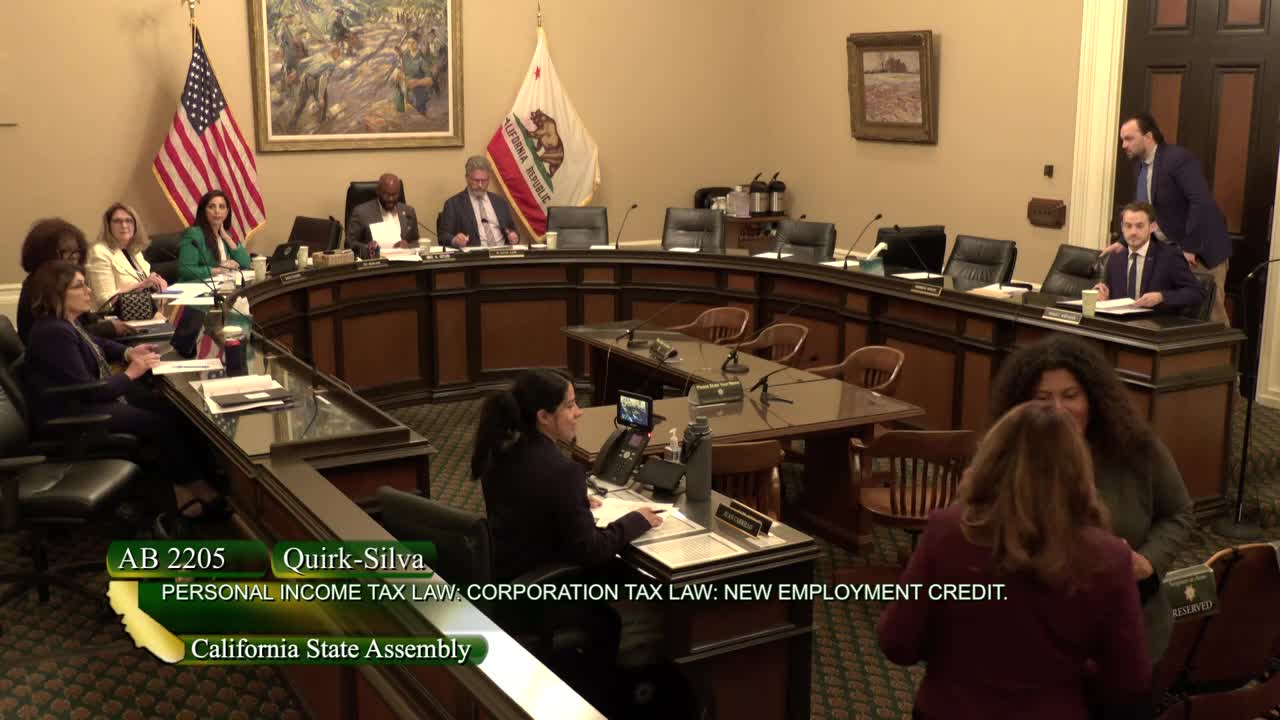 7MIN
Assembly Standing Committee on Revenue and Taxation
Bill Author

Bill Co-Author(s):