AB 2218: Water policy: California Native American tribes.
- Session Year: 2025-2026
- House: Assembly
- Latest Version Date: 2026-08-30
Current Status:
Failed
(2026-09-30: Vetoed by Governor.)
Introduced
In Committee
Awaiting First Chamber Vote
Passed First Chamber
In Committee
Awaiting Second Chamber Vote
Passed Second Chamber
Enacted
Existing law establishes the sovereignty of the state.
This bill would require the state government to support California Native Americans to maintain cultural and linguistic traditions, practice ecosystem stewardship, and engage in good faith government-to-government consultations with all California Native American tribes regarding policies that may affect tribal communities.
Existing law establishes various state water policies, including the policy that the use of water for domestic purposes is the highest use of water and the human right to water. Existing law requires the State Water Resources Control Board to act upon all applications for a permit to appropriate water.
This bill would declare that it is the established policy of the state to recognize and address the inequities, as described, inflicted upon all California Native American tribes through financial assistance, protection of tribal beneficial uses, consultation on water projects, plans, and policies, and incorporation of indigenous knowledge to restore and protect ecosystems. The bill would require specified state agencies, including the State Water Resources Control Board, regional water quality control boards, and the Natural Resources Agency, to incorporate this policy when revising, adopting, or establishing policies, regulations, permits, or grant criteria to address identified inequities. The bill would require those state entities to identify and offer financial assistance to the tribes consistent with existing legal and policy requirements for financial assistance programs. If there is a dispute between a California Native American tribe and one of those state agencies over the implementation of that policy, the bill would require that matter to be brought before the Governors Office of Tribal Affairs for mediation before the state agency action is challenged in court and would specify procedures and timelines for mediation, as provided.
Existing law authorizes the board to conduct investigations and to issue information orders in administering water rights, as provided.
The bill would require the state board, in furtherance of an investigation and upon request, to consult with a tribe whose ancestral territory includes the water body or water bodies at issue for the claimed riparian or appropriative right.
Existing law establishes the sovereignty of the state.
This bill would require the state government to support California Native Americans to maintain cultural and linguistic traditions, practice ecosystem stewardship, and engage in good faith government-to-government consultations with all California Native American tribes regarding policies that may affect tribal communities.
Existing law establishes various state water policies, including the policy that the use of water for domestic purposes is the highest use of water and the human right to water. Existing law requires the State Water Resources Control Board to act upon all applications for a permit to appropriate water.
This bill would declare that it is the established policy of the state to recognize and address the inequities, as described, inflicted upon all California Native American tribes through financial assistance, protection of tribal water beneficial uses, consultation on water projects, plans, and policies, and incorporation of indigenous knowledge to restore and protect ecosystems. The bill would require specified state agencies, including the State Water Resources Control Board, regional water quality control boards, and the Natural Resources Agency, to incorporate this policy when revising, adopting, or establishing policies, regulations, permits, or grant criteria to address identified inequities. The bill would require those state entities to identify and offer financial assistance to the tribes consistent with existing legal and policy requirements for financial assistance programs. If there is a dispute between a California Native American tribe and one of those state agencies over the implementation of that policy, the bill would require that matter to be brought before the Governors Office of Tribal Affairs for mediation before the state agency action is challenged in court and would specify procedures and timelines for mediation, as provided.
Existing law authorizes the board to conduct investigations and to issue information orders in administering water rights, as provided.
The bill would require the state board, in furtherance of an investigation and upon request, to consult with a tribe whose ancestral territory includes the water body or water bodies at issue for the claimed riparian or appropriative right.
Existing law establishes the sovereignty of the state.
This bill would require the state government to support California Native Americans to maintain cultural and linguistic traditions, practice ecosystem stewardship, and engage in good faith government-to-government consultations with all California Native American tribes regarding policies that may affect tribal communities.
Existing law establishes various state water policies, including the policy that the use of water for domestic purposes is the highest use of water and the human right to water. Existing law requires the State Water Resources Control Board to act upon all applications for a permit to appropriate water.
This bill would declare that it is the established policy of the state to acknowledge and correct recognize and address the inequities caused by state-sanctioned acts of termination, removal, and assimilation inequities, as described, inflicted upon all California Native American tribes through compensation, legal recognition of rights, or replacement of benefits lost. financial assistance, protection of tribal water uses, consultation on water projects, plans, and policies, and incorporation of indigenous knowledge to restore and protect ecosystems. The bill would require all relevant specified state agencies, including the Department of Water Resources and the State Water Resources Control Board, regional water quality control boards, and the Natural Resources Agency, to consider and incorporate this policy when revising, adopting, or establishing rights, policies, regulations, permits, or grant criteria to address identified inequities. inequities. The bill would require those state entities to identify and offer financial assistance to the tribes consistent with existing legal and policy requirements for financial assistance programs.
Existing law authorizes the board to conduct investigations and to issue information orders in administering water rights, as provided.
The bill would require the state board, in furtherance of an investigation and upon request, to consult with a tribe whose ancestral territory includes the water body or water bodies at issue for the claimed riparian or appropriative right.
Existing law establishes various state water policies, including the policy that the use of water for domestic purposes is the highest use of water and the human right to water.
This bill would declare that it is the established policy of the state to acknowledge and correct the inequities caused by state-sanctioned acts of termination, removal, and assimilation inflicted upon all California Native American tribes through compensation, legal recognition of rights, or replacement of benefits lost. The bill would require all relevant state agencies, including the Department of Water Resources and the State Water Resources Control Board, to consider and incorporate this policy when revising, adopting, or establishing rights, policies, regulations, permits, or grant criteria to address identified inequities.
(a)The Legislature recognizes that the state historically sanctioned over one century of depredations and prejudicial policies against California Native Americans, including removal from ancestral land. The Legislature apologizes on behalf of the citizens of the state to all California Native Americans for the violence, mistreatment, and neglect inflicted upon them.
(b)The Legislature declares that the state government shall support California Native Americans to maintain cultural and linguistic traditions, practice ecosystem stewardship, and engage in good faith government-to-government consultations with all California Native American tribes regarding policies that may affect tribal communities.
SEC. 2.Section 106.2 is added to the Water Code, to read:106.2.(a)It is hereby declared to be the established policy of the state to recognize and address the inequities regarding access to, and control over, water caused by state-sanctioned acts of termination, removal, and assimilation inflicted upon all California Native American tribes through financial assistance, protection of tribal beneficial uses, consultation on water projects, plans, and policies, and incorporation of indigenous knowledge to restore and protect ecosystems.
(b)(1)The following state agencies shall implement the policy set forth in subdivision (a) when revising, adopting, or establishing policies, regulations, permits, or grant criteria to address identified inequities:
(A)The State Water Resources Control Board.
(B)Regional water quality control boards.
(C)The Natural Resources Agency and all its departments, conservancies, boards, commissions, and councils.
(D)The Delta Stewardship Council.
(E)The Office of Land Use and Climate Innovation.
(2)The state agencies listed in paragraph (1) shall identify and offer financial assistance to California Native American tribes consistent with existing legal and policy requirements for financial assistance programs.
(c)(1)If there is a dispute between a California Native American tribe and a state agency described in paragraph (1) of subdivision (b) over the implementation of the policy set forth in subdivision (a), that matter shall be brought before the Governors Office of Tribal Affairs. The office shall, within 30 days of the date that the tribe or the state agency referred the matter to the office, convene a meeting between the tribe and the state agency for mediation. The meeting shall take place before the state agency action is challenged in court. During mediation, the state agency action that is the subject of the mediation shall be stayed.
(2)(A)The Governors Office of Tribal Affairs shall gather information on the matter for not more than 60 days from the date of the initial meeting between the tribe and the agency. The office shall have not more than 30 days from the date the office concludes gathering information to reach reconciliation. Reconciliation occurs when the state agency and the California Native American tribe are able to reach a mutually agreeable resolution on the matter.
(B)At any point during mediation, a tribe may withdraw from the process if the tribe believes that the state agency is not negotiating in good faith.
(3)If the state agency and the tribe do not reach reconciliation within 30 days from the date the office concludes gathering information pursuant to paragraph (2), the state agency action shall be stayed for an additional 60 days after the expiration of the 30-day period described in paragraph (2). If the state agency and the tribe do not reach reconciliation at the end of that 60-day period, the Governors Office of Tribal Affairs shall issue a letter documenting the exhaustion of administrative remedies.
SEC. 3.Section 1051 of the Water Code is amended to read:1051.(a)The board for the purpose of this division may:
(1)Investigate all streams, stream systems, portions of stream systems, lakes, or other bodies of water.
(2)Take testimony in regard to the rights to water or the use of water thereon or therein.
(3)Investigate and ascertain whether or not water heretofore filed upon or any claimed riparian or appropriative right is valid under the laws of this state.
(b)(1)(A)In furtherance of an investigation authorized pursuant to this section, the board may issue an information order, as executed by the executive director of the board.
(B)In furtherance of an investigation authorized pursuant to this section, upon request, the board shall consult with a California Native American tribe whose ancestral territory includes the water body or water bodies at issue for the claimed riparian or appropriative right.
(2)The information order may be issued to a water right holder or claimant to provide the following information related to a diversion and use of water:
(A)Information required to be reported pursuant to Part 5.1 (commencing with Section 5100).
(B)Information concerning the basis of the water right claimed.
(C)Information related to the patent date claimed for the place of use, if the claimed right is a riparian right.
(D)Information concerning the notice date of the appropriation and the date of actual delivery of water to beneficial use.
(E)Information concerning prior diversions and use, including direct diversions and diversions to storage.
(3)(A)The information order may be issued to a diverter or user of water to provide information concerning that diverters prior diversion or use, including direct diversions and diversions to storage, or identification of the person or holder claiming the right under which the water was diverted or used.
(B)Information obtained under this paragraph from a diverter or user who is not the water right holder or claimant shall not be binding on, or treated as an admission by, the water right holder or claimant.
(c)The burden of any order issued under subdivision (b), including costs, shall bear a reasonable relationship to the need for the requested information and the benefits to be obtained from the board receiving that information. In making a request, the board shall do both of the following:
(1)Provide the person to whom the request is directed with a written explanation with regard to the need for the information.
(2)Identify the evidence that supports requiring that person to provide the information.
(d)A diversion or use of water ascertained to be unauthorized may be enforced as a trespass under Section 1052, following notice and opportunity for hearing as required under Section 1052, Section 1055, or Article 2 (commencing with Section 1831) of Chapter 12 of Part 2.
(e)Nothing in this section shall limit any authority held by the board under this code or any other provision of law.
(a)The Legislature recognizes that the state historically sanctioned over one century of depredations and prejudicial policies against California Native Americans, including removal from ancestral land. The Legislature apologizes on behalf of the citizens of the state to all California Native Americans for the violence, mistreatment, and neglect inflicted upon them.
(b)The Legislature declares that the state government shall support California Native Americans to maintain cultural and linguistic traditions, practice ecosystem stewardship, and engage in good faith government-to-government consultations with all California Native American tribes regarding policies that may affect tribal communities.
SEC. 2.Section 106.2 is added to the Water Code, to read:106.2.(a)It is hereby declared to be the established policy of the state to recognize and address the inequities regarding access to, and control over, water caused by state-sanctioned acts of termination, removal, and assimilation inflicted upon all California Native American tribes through financial assistance, protection of tribal water beneficial uses, consultation on water projects, plans, and policies, and incorporation of indigenous knowledge to restore and protect ecosystems.
(b)(1)The following state agencies shall implement the policy set forth in subdivision (a) when revising, adopting, or establishing policies, regulations, permits, or grant criteria to address identified inequities:
(A)The State Water Resources Control Board.
(B)Regional water quality control boards.
(C)The Natural Resources Agency and all its departments, conservancies, boards, commissions, and councils.
(D)The Delta Stewardship Council.
(E)The Office of Land Use and Climate Innovation.
(2)The state agencies listed in paragraph (1) shall identify and offer financial assistance to California Native American tribes consistent with existing legal and policy requirements for financial assistance programs.
(c)(1)If there is a dispute between a California Native American tribe and a state agency described in paragraph (1) of subdivision (b) over the implementation of the policy set forth in subdivision (a), that matter shall be brought before the Governors Office of Tribal Affairs. The office shall, within 30 days of the date that the tribe or the state agency referred the matter to the office, convene a meeting between the tribe and the state agency for mediation. The meeting shall take place before the state agency action is challenged in court. During mediation, the state agency action that is the subject of the mediation shall be stayed.
(2)(A)The Governors Office of Tribal Affairs shall gather information on the matter for not more than 60 days from the date of the initial meeting between the tribe and the agency. The office shall have not more than 30 days from the date the office concludes gathering information to reach reconciliation. Reconciliation occurs when the state agency and the California Native American tribe are able to reach a mutually agreeable resolution on the matter.
(B)At any point during mediation, a tribe may withdraw from the process if the tribe believes that the state agency is not negotiating in good faith.
(3)If the state agency and the tribe do not reach reconciliation within 30 days from the date the office concludes gathering information pursuant to paragraph (2), the state agency action shall be stayed for an additional 60 days after the expiration of the 30-day period described in paragraph (2). If the state agency and the tribe do not reach reconciliation at the end of that 60-day period, the Governors Office of Tribal Affairs shall issue a letter documenting the exhaustion of administrative remedies.
SEC. 3.Section 1051 of the Water Code is amended to read:1051.(a)The board for the purpose of this division may:
(1)Investigate all streams, stream systems, portions of stream systems, lakes, or other bodies of water.
(2)Take testimony in regard to the rights to water or the use of water thereon or therein.
(3)Investigate and ascertain whether or not water heretofore filed upon or any claimed riparian or appropriative right is valid under the laws of this state.
(b)(1)(A)In furtherance of an investigation authorized pursuant to this section, the board may issue an information order, as executed by the executive director of the board.
(B)In furtherance of an investigation authorized pursuant to this section, upon request, the board shall consult with a California Native American tribe whose ancestral territory includes the water body or water bodies at issue for the claimed riparian or appropriative right.
(2)The information order may be issued to a water right holder or claimant to provide the following information related to a diversion and use of water:
(A)Information required to be reported pursuant to Part 5.1 (commencing with Section 5100).
(B)Information concerning the basis of the water right claimed.
(C)Information related to the patent date claimed for the place of use, if the claimed right is a riparian right.
(D)Information concerning the notice date of the appropriation and the date of actual delivery of water to beneficial use.
(E)Information concerning prior diversions and use, including direct diversions and diversions to storage.
(3)(A)The information order may be issued to a diverter or user of water to provide information concerning that diverters prior diversion or use, including direct diversions and diversions to storage, or identification of the person or holder claiming the right under which the water was diverted or used.
(B)Information obtained under this paragraph from a diverter or user who is not the water right holder or claimant shall not be binding on, or treated as an admission by, the water right holder or claimant.
(c)The burden of any order issued under subdivision (b), including costs, shall bear a reasonable relationship to the need for the requested information and the benefits to be obtained from the board receiving that information. In making a request, the board shall do both of the following:
(1)Provide the person to whom the request is directed with a written explanation with regard to the need for the information.
(2)Identify the evidence that supports requiring that person to provide the information.
(d)A diversion or use of water ascertained to be unauthorized may be enforced as a trespass under Section 1052, following notice and opportunity for hearing as required under Section 1052, Section 1055, or Article 2 (commencing with Section 1831) of Chapter 12 of Part 2.
(e)Nothing in this section shall limit any authority held by the board under this code or any other provision of law.
(a)The Legislature recognizes that the state historically sanctioned over one century of depredations and prejudicial policies against California Native Americans, including removal from ancestral land. The Legislature apologizes on behalf of the citizens of the state to all California Native Americans for the violence, mistreatment, and neglect inflicted upon them.
(b)The Legislature declares that the state government shall support California Native Americans to maintain cultural and linguistic traditions, practice ecosystem stewardship, and engage in good faith government-to-government consultations with all California Native American tribes regarding policies that may affect tribal communities.
SECTION 1.SEC. 2.Section 106.2 is added to the Water Code, to read:106.2.(a)It is hereby declared to be the established policy of the state to acknowledge and correct recognize and address the inequities regarding access to, and control over, water caused by state-sanctioned acts of termination, removal, and assimilation inflicted upon all California Native American tribes through compensation, legal recognition of rights, or replacement of benefits lost. financial assistance, protection of tribal water uses, consultation on water projects, plans, and policies, and incorporation of indigenous knowledge to restore and protect ecosystems.
(b)All relevant state agencies, including the department and the state board, shall consider and incorporate this policy (1)The following state agencies shall implement the policy set forth in subdivision (a) when revising, adopting, or establishing rights, policies, regulations, permits, or grant criteria to address identified inequities. inequities:
(A)The State Water Resources Control Board.
(B)Regional water quality control boards.
(C)The Natural Resources Agency and all its departments, conservancies, boards, commissions, and councils.
(D)The Delta Stewardship Council.
(E)The Office of Land Use and Climate Innovation.
(2)The state agencies listed in paragraph (1) shall identify and offer financial assistance to California Native American tribes consistent with existing legal and policy requirements for financial assistance programs.
SEC. 3.Section 1051 of the Water Code is amended to read:1051.(a)The board for the purpose of this division may:
(1)Investigate all streams, stream systems, portions of stream systems, lakes, or other bodies of water.
(2)Take testimony in regard to the rights to water or the use of water thereon or therein.
(3)Investigate and ascertain whether or not water heretofore filed upon or any claimed riparian or appropriative right is valid under the laws of this state.
(b)(1)(A)In furtherance of an investigation authorized pursuant to this section, the board may issue an information order, as executed by the executive director of the board.
(B)In furtherance of an investigation authorized pursuant to this section, upon request, the board shall consult with a California Native American tribe whose ancestral territory includes the water body or water bodies at issue for the claimed riparian or appropriative right.
(2)The information order may be issued to a water right holder or claimant to provide the following information related to a diversion and use of water:
(A)Information required to be reported pursuant to Part 5.1 (commencing with Section 5100).
(B)Information concerning the basis of the water right claimed.
(C)Information related to the patent date claimed for the place of use, if the claimed right is a riparian right.
(D)Information concerning the notice date of the appropriation and the date of actual delivery of water to beneficial use.
(E)Information concerning prior diversions and use, including direct diversions and diversions to storage.
(3)(A)The information order may be issued to a diverter or user of water to provide information concerning that diverters prior diversion or use, including direct diversions and diversions to storage, or identification of the person or holder claiming the right under which the water was diverted or used.
(B)Information obtained under this paragraph from a diverter or user who is not the water right holder or claimant shall not be binding on, or treated as an admission by, the water right holder or claimant.
(c)The burden of any order issued under subdivision (b), including costs, shall bear a reasonable relationship to the need for the requested information and the benefits to be obtained from the board receiving that information. In making a request, the board shall do both of the following:
(1)Provide the person to whom the request is directed with a written explanation with regard to the need for the information.
(2)Identify the evidence that supports requiring that person to provide the information.
(d)A diversion or use of water ascertained to be unauthorized may be enforced as a trespass under Section 1052, following notice and opportunity for hearing as required under Section 1052, Section 1055, or Article 2 (commencing with Section 1831) of Chapter 12 of Part 2.
(e)Nothing in this section shall limit any authority held by the board under this code or any other provision of law.
(a)It is hereby declared to be the established policy of the state to acknowledge and correct the inequities caused by state-sanctioned acts of termination, removal, and assimilation inflicted upon all California Native American tribes through compensation, legal recognition of rights, or replacement of benefits lost.
(b)All relevant state agencies, including the department and the state board, shall consider and incorporate this policy when revising, adopting, or establishing rights, policies, regulations, permits, or grant criteria to address identified inequities.
|
Date
|
Status
|
|---|---|
| Sep 30, 2026 | Vetoed by Governor. |
| Sep 3, 2026 | Enrolled and presented to the Governor at 4 p.m. |
| Aug 26, 2026 | Senate amendments concurred in. To Engrossing and Enrolling. (Ayes 56. Noes 0. Page 6600.). |
| Aug 26, 2026 | Senate amendments concurred in. To Engrossing and Enrolling. (Ayes 56. Noes 0.). |
| Aug 26, 2026 | In Assembly. Concurrence in Senate amendments pending. |
| Aug 25, 2026 | Read third time. Passed. Ordered to the Assembly. (Ayes 28. Noes 0. Page 5798.). |
| Aug 25, 2026 | Read third time. Passed. Ordered to the Assembly. (Ayes 28. Noes 0.). |
| Aug 13, 2026 | Read second time. Ordered to third reading. |
| Aug 13, 2026 | From committee: Do pass. (Ayes 4. Noes 0.) (August 13). |
| Aug 3, 2026 | In committee: Referred to APPR. suspense file. |
| Jul 2, 2026 | Read second time and amended. Re-referred to Com. on APPR. |
| Jul 2, 2026 | From committee: Amend, and do pass as amended and re-refer to Com. on APPR. (Ayes 4. Noes 0.) (July 1). |
| Jun 24, 2026 | From committee: Do pass and re-refer to Com. on E.Q. (Ayes 5. Noes 0.) (June 23). Re-referred to Com. on E.Q. |
| Jun 10, 2026 | Referred to Coms. on N.R. & W. and E.Q. |
| May 28, 2026 | In Senate. Read first time. To Com. on RLS. for assignment. |
| May 27, 2026 | Read third time. Passed. Ordered to the Senate. (Ayes 57. Noes 0. Page 5454.) |
| May 27, 2026 | Read third time. Passed. Ordered to the Senate. (Ayes 57. Noes 0.) |
| May 27, 2026 | Read third time. Passed. Ordered to the Senate. |
| May 18, 2026 | Read second time. Ordered to third reading. |
| May 14, 2026 | From committee: Do pass. (Ayes 11. Noes 0.) (May 14). |
| May 6, 2026 | In committee: Set, first hearing. Referred to APPR. suspense file. |
| Apr 20, 2026 | Re-referred to Com. on APPR. |
| Apr 16, 2026 | Read second time and amended. |
| Apr 15, 2026 | From committee: Amend, and do pass as amended and re-refer to Com. on APPR. (Ayes 5. Noes 0.) (April 14). |
| Apr 14, 2026 | From committee: Do pass and re-refer to Com. on E.S & T.M. (Ayes 9. Noes 0.) (April 14). Re-referred to Com. on E.S & T.M. |
| Apr 14, 2026 | From committee: Do pass and re-refer to Com. on E.S & T.M. (Ayes 7. Noes 0.) (April 14). Re-referred to Com. on E.S & T.M. |
| Mar 26, 2026 | Assembly Rule 56 suspended. (Page 4433.) |
| Mar 26, 2026 | (Pending re-refer to Com. on E.S. & T.M.) |
| Mar 26, 2026 | Assembly Rule 56 suspended. |
| Mar 24, 2026 | In committee: Set, first hearing. Hearing canceled at the request of author. |
| Mar 9, 2026 | Referred to Coms. on W., P., & W. and E.S & T.M. |
| Feb 20, 2026 | From printer. May be heard in committee March 22. |
| Feb 19, 2026 | Read first time. To print. |
|
Date
|
Description
|
Location
|
Votes
|
|
|---|---|---|---|---|
| Aug 26, 2026 | AB 2218 Kalra Concurrence in Senate Amendments | Assembly Floor |
Passed |
|
| Aug 25, 2026 | Assembly 3rd Reading AB2218 Kalra et al. By McGuire | Senate Floor |
Passed |
|
| Aug 13, 2026 | Do pass | Senate Standing Committee on Appropriations |
Passed |
|
| Aug 3, 2026 | Placed on suspense file | Senate Standing Committee on Appropriations |
Passed |
|
| Jul 1, 2026 | Do pass as amended, but first amend, and re-refer to the Committee on [Appropriations] | Senate Standing Committee on Environmental Quality |
Passed |
|
| Jun 23, 2026 | Do pass, but first be re-referred to the Committee on [Environmental Quality] | Senate Standing Committee on Natural Resources and Water |
Passed |
|
| May 27, 2026 | AB 2218 Kalra Assembly Third Reading | Assembly Floor |
Passed |
|
| May 14, 2026 | Do pass. | Assembly Standing Committee on Appropriations |
Passed |
|
| Apr 14, 2026 | Do pass as amended and be re-referred to the Committee on [Appropriations] | Assembly Standing Committee on Environmental Safety and Toxic Materials |
Passed |
|
| Apr 14, 2026 | Do pass and be re-referred to the Committee on [Environmental Safety and Toxic Materials] | Assembly Standing Committee on Water, Parks, and Wildlife |
Passed |
This list shows positions taken on this bill by organizations on the date displayed, which is linked to the original source.
Positions by individuals are not included.
|
Organization
|
Position
|
Date
|
|---|---|---|
| American River Conservancy | ** Support | |
| American Whitewater | ** Support | |
| American Whitewater Association of Ramaytush Ohlone | ** Support | |
| Association Of California Water Agencies | ** Against | |
| Association of Ramaytush Ohlone | ** Support | |
| Audobon California | ** Support | |
| Azul | ** Support | |
| Band of the Kumeyaay Nation | ** Support | |
| Bayquest | ** Support | |
| Building Owners and Managers Association | ** Against | |
| CactusToCloud Institute | ** Support | |
| Calforests | ** Against | |
| CalForests (unless amended) | ** Against | |
| California Building Industry Association | ** Against | |
| California Business Properties Association | ** Against | |
| California Chamber Of Commerce | ** Against | |
| California Coastkeeper Alliance | ** Support | |
| California Environmental Voters | ** Support | |
| California Farm Bureau | ** Against | |
| California Institute for Biodiversity | ** Support | |
| California Municipal Utilities Association | ** Against | |
| California Native Plant Society, Alta Peak Chapter | ** Support | |
| California Rural Indian Health Board, Inc. | ** Support | |
| California Special Districts Assoc. | ** Against | |
| California Special Districts Association | ** Against | |
| California Sportfishing Protection Alliance | ** Support | |
| California State Association Of Counties | ** Against | |
| California Tribal Business Alliance | ** Support | |
| California Trout | ** Support | |
| California Trout Center for Environmental Health | ** Support | |
| Center For Environmental Health | ** Support | |
| Center on Race, Poverty & the Environment | ** Support | |
| City of Corona | ** Against | |
| cleanearth4kids.org | ** Support | |
| Clean Water Action | ** Support | |
| Coalition of California State Tribes | ** Support | |
| COFEM | ** Support | |
| Community Alliance With Family Farmers | ** Support | |
| Consejo de Federaciones Mexicanas | ** Support | |
| Defenders Of Wildlife | ** Support | |
| El Dorado Irrigation District | ** Against | |
| Endangered Habitats League | ** Support | |
| Environmental Defense Fund | ** Support | |
| Environmental Law Foundation | ** Support | |
| Environmental Protection Information Center | ** Support | |
| Fix the World Consulting, LLC | ** Support | |
| Friends Committee On Legislation Of California | ** Support | |
| Friends of Harbors, Beaches and Parks | ** Support | |
| Friends Of Plumas Wilderness | ** Support | |
| Friends of the Eel River | ** Support | |
| Friends of the Inyo | ** Support | |
| Friends of the River | ** Support | |
| Golden State Salmon Association | ** Support | |
| GreenLatinos | ** Support | |
| Humboldt Progressive Democrats | ** Support | |
| Humboldt Waterkeeper | ** Support | |
| Inland Empire Waterkeeper | ** Support | |
| Kakoon Ta Ruk Band of Ohlone-costanoan Indians of the Big Sur Rancheria | ** Support | |
| Karuk Tribe | ** Support | |
| Klamath Indigenous Land Trust | ** Support | |
| Latino Outdoors | ** Support | |
| League Of California Cities | ** Against | |
| Los Angeles Neighborhood Land Trust | ** Support | |
| Los Angeles Waterkeeper | ** Support | |
| Mak-warép Ohlone Land Conservancy | ** Support | |
| Mid Klamath Watershed Council | ** Support | |
| Mono Lake Committee | ** Support | |
| Monterey Waterkeeper | ** Support | |
| Mountain Area Preservation | ** Support | |
| Mount Shasta Bioregional Ecology Center | ** Support | |
| Mount Shasta Bioregional Ecology Center | ** Support | |
| Naiop California | ** Against | |
| National Audubon Society | ** Support | |
| Natural Resources Defense Council | ** Support | |
| Northern California Tribal Chairperson's Association | ** Support | |
| Northern California Water Assoc. | ** Against | |
| Northern California Water Association | ** Against | |
| Northern California Water Association (unless amended) | ** Against | |
| NRDC | ** Support | |
| Nurture Nature | ** Support | |
| Orange County Coastkeeper | ** Support | |
| Outward Bound Adventures | ** Support | |
| Pesticide Action and Agroecology Network | ** Support | |
| Planning And Conservation League | ** Support | |
| Regional Water Authority | ** Against | |
| Regional Water Authority (unless amended) | ** Against | |
| Resource Renewal Institute | ** Support | |
| Restore the Delta | ** Support | |
| Ridges to Riffles Indigenous Conservation Group | ** Support | |
| RKNDL Forestry Consultation | ** Support | |
| Rural County Representatives of California | ** Against | |
| Russian Riverkeeper | ** Support | |
| Sacred Places Institute for Indigenous Peoples | ** Support | |
| Salmon River Restoration Council | ** Support | |
| San Diego Coastkeeper | ** Support | |
| San Francisco Baykeeper | ** Support | |
| Santa Barbara Channelkeeper | ** Support | |
| Santa Ynez Band Of Chumash Indians | ** Support | |
| Save California Salmon | ** Support | |
| Save The Bay | ** Support | |
| Sequoia Riverlands Trust | ** Support | |
| Shasta Waterkeeper | ** Support | |
| Shingle Springs Band Of Miwok Indians | ** Support | |
| Sierra Club California | ** Support | |
| Sierra Nevada Alliance | ** Support | |
| Solano County Water Agency | ** Against | |
| South Yuba River Citizens League | ** Support | |
| Sustainable Conservation | ** Support | |
| Sustainable Tahoe | ** Support | |
| Sycuan Band Of The Kumeyaay Nation | ** Support | |
| The Nature Conservancy | ** Support | |
| The Otter Project | ** Support | |
| Tribal Workforce Trade Association | ** Support | |
| Trout Unlimited | ** Support | |
| Trust for Public Land | ** Support | |
| Trust For Public Land; The | ** Support | |
| Union Of Concerned Scientists | ** Support | |
| Valley Ag Water Coalition | ** Against | |
| Water Blueprint for the San Joaquin Valley Advocacy Fund | ** Against | |
| Water Climate Trust | ** Support | |
| Watershed Research & Training Center | ** Support | |
| Wholly H20 | ** Support | |
| Wholly H2O | ** Support | |
| Wildlands Network | ** Support | |
| Winnemem Wintu Tribe | ** Support | |
| Yuba River Waterkeeper | ** Support | |
| Yurok Tribe | ** Support |
GOVERNOR′S VETO
GV Bill Id:AB 2218
Author:(Kalra)
As Enrolled Ver:August 30, 2026
2/3 vote
SUMMARY
Declares it is statewide policy to recognize and address the wrongs inflicted upon California Native American tribes regarding access to, and control over, water by state-sanctioned acts of termination, removal, and assimilation, and directs relevant state agencies to take steps to implement this policy.
- Provides that a dispute between a California Native American tribe and a state agency regarding said state agency′s implementation of this bill shall be brought before the Governor′s Office of Tribal Affairs for mediation before the state agency′s action is challenged in court. During mediation over the dispute, the state agency′s action shall be stayed.
- Requires the Office of Tribal Affairs to convene a meeting between a tribe and state agency involved in a dispute within 30 days of a dispute being referred to the office.
- Requires the Office of Tribal Affairs to gather information on the dispute for no more than 60 days following the meeting described in #2, above. Provide the Office of Tribal Affairs has 30 days following the gathering of information to reach reconciliation.
- Provides that reconciliation occurs when a state agency and tribe are able to reach a mutually agreeable resolution on the matter subject to mediation.
- Provides that a tribe may withdraw from mediation at any point if the tribe believes the state agency is not acting in good faith.
- Provides that if a state agency and tribe do not reach reconciliation within 30 days of the date the Office of Tribal Affairs concludes gathering information, the state agency′s action shall be stayed for an additional 60 days. If at the end of that 60-day period a state agency and tribe still have not achieved reconciliation, the Office of Tribal Affairs shall issue a letter documenting the exhaustion of administrative remedies
Governor′s Veto Message
″This bill would establish a state policy to recognize and address the inequities inflicted upon all California Native American tribes regarding access to, and control over, water by state-sanctioned actions of termination, removal, and assimilation, and would require several state agencies to take a series of steps to implement this policy. The bill would also require disputes between a tribe and an agency over implementation of the policy to be brought before the Governor′s Office of Tribal Affairs for mediation before the agency action is challenged in court.
I have long recognized the historical harms perpetrated against Native peoples and tribal governments in California, and my administration has worked tirelessly to address them. Under my administration, state agencies are directed to foster respectful, government-to-government dialogue with tribes above and beyond what existing law requires. For example, the Department of Water Resources convened a tribal advisory committee to ensure tribal perspectives are incorporated into updates to the California Water Plan. The State Water Resources Control Board also expressly incorporated Tribal Beneficial Uses into its long-term planning, which involves extensive engagement and collaboration with tribal nations to protect water resources important to tribes.
I also recognize, however, that California must streamline its water policies to protect our water supply from the reality of climate change. I am concerned this bill would undermine that imperative – adding new layers of process to duplicate work that my Administration already priorities. I am further concerned that the bill is not sufficiently clear about how its new policy should be implemented – or whether such implementation would disrupt important regulations, policies, permits, and grant criteria already moving forward. Adding new sources of uncertainty will delay our urgent fight to secure Californians′ water supplies.″
COMMENTS
California is home to the largest Native American population in the country and has 109 federally recognized tribes with several other groups seeking federal recognition. According to 2020 U.S. Census data, 631,016 Californians identify as ″American Indian″ or ″Alaska Native″; when including the Californians that identify as ″American Indian″ or ″Alaska Native″ in combination with another race or ethnicity, the number of Native Americans in California increases to 1.4 million residents.
Very few Native Americans live on their ancestral lands in California today. This is due to the repeated efforts of Spanish, Mexican, Russian, and U.S. governments to subdue and displace Indigenous peoples: ″All four colonial nations sponsored policies that uprooted Indigenous People and communities from the lands in which they were created, and all four deployed violence, in the form of slavery, genocide, and an administrative state bent on eliminating California Indian people″ (Akins and Bauer, 2021, 3). Lands legally controlled by tribes in California today result from presidential executive order, federal statute, or action by tribes and tribal members themselves to purchase land. Water rights were not often appropriately accounted for in the protection of tribal lands.
Governor Newsom issued Executive Order (EO) N-15-19 on June 19, 2019 containing a formal recognition of California′s exploitation of, violence towards, and destruction of tribal communities and a formal apology on behalf of the State of California. The EO: 1) recognizes that the state historically sanctioned over a century of depredations and prejudicial policies against California Native Americans; 2) commends and honors California Native Americans for persisting, carrying on cultural and linguistic traditions, and stewarding and protecting this land we now share; and 3) apologizes on behalf of the citizens of the State of California to California Native Americans for the many instances of violence, maltreatment, and neglect California inflicted on tribes.
Similarly, Governor Brown issued EO B-10-11 on September 19, 2011 that recognizes and reaffirms the inherent right of Native American tribes to exercise sovereign authority over their members and territories, establishes the Governor′s Tribal Advisor position within the Governor′s Office, reaffirms the state′s commitment to working with tribes, and encourages all state agencies, departments, and boards to communicate and consult with California Native American tribes and provide an opportunity for meaningful input into the development of legislation, regulations, rules, and policies on matters that may impact tribal communities.
During its August 18, 2020 meeting, the State Water Resources Control Board (State Water Board) publicly acknowledged that the historical effects of institutional racism must be confronted throughout government, and it directed staff to develop a priority plan of action. The State Water Board′s Racial Equity Team held public and employee listening sessions to help develop a draft resolution. After receiving public comment and making various changes, the State Water Board adopted Resolution 2021-0050 Condemning Racism, Xenophobia, Bigotry, and Racial Injustice and Strengthening Commitment to Racial Equity, Diversity, Inclusion, Access, and Anti-Racism (Racial Equity Resolution) on November 16, 2021. The Racial Equity Resolution affirms the State Water Board′s commitment to racial equity and directs staff to undertake a variety of actions to achieve racial equity throughout all Water Board programs and activities.
The Racial Equity Resolution, among other findings and provisions, acknowledges and ″condemns acts of racism, xenophobia, bigotry, white supremacy, and institutional and systemic racism; adopts racial equity, diversity, and inclusion as core values; and acknowledges the role of government agencies—including the Water Boards—in redressing racial inequities and dismantling institutional and systemic racism.″ In addition, it ″reaffirms [the State Water Board′s] commitment to improving communication, working relationships, and co-management practices with all California Native American Tribes, including seeking input and consultation on the Water Boards′ rules, regulations, policies, and programs to advance decisions and policies that better protect California′s water resources. The State Water Board recognizes [its] parallel relationship to the people [it] serves and values tribes′ traditional ecological knowledge and historic experience with managing California′s water resources since time immemorial.″
The State Water Board′s and Regional Water Boards′ have a tribal consultation policy that affirms their commitment to strengthening and sustaining government-to-government relationships with both federally and non-federally recognized California Native American tribes. The intent of this policy is to guide State Water Board and Regional Water Board staff to engage with California Native American Tribes through timely and meaningful consultation and collaboration on actions that may have an impact to tribal lands, tribal interests and/or tribal cultural resources consistent with the mission of the State Water Board and Regional Water Boards. The policy establishes statewide general guidelines for tribal consultations across the Water Boards. The State Water Board tribal consultation policy builds upon EO B-10-11 and is similar to the Environmental Protection Agency (CalEPA)′s 2015 policy on ″Consultation with California Native American Tribes″ (updated in 2020). Among other provisions, the State Water Board′s tribal consultation policy adopts the definition of ″consultation″ in Government Code § 65352.4 ″as the meaningful and timely process of seeking, discussing, and considering carefully the views of others, in a manner that is cognizant of all parties′ cultural values and, where feasible, seeking agreement. Consultation between government agencies and Native American tribes shall be conducted in a way that is mutually respectful of each party′s sovereignty. Consultation shall also recognize the tribes′ potential needs for confidentiality with respect to places that have traditional tribal cultural significance.″
In addition, many of the agencies affected by this bill have adopted policies, programs, directives, and executive orders to improve tribal consultation and collaboration and the state′s communication and working relationship with tribes in recent years. These include CalEPA′s tribal affairs program; the Department of Toxic Substances Control, the Department of Pesticide Regulation, the Office of Environmental Health Hazard Assessment, the Air Resources Board; California Natural Resources Agency′s tribal affairs program, tribal consultation policy, and tribal nature-based solutions program; various tribal programs and initiatives led by the Department of Parks and Recreation (such as those related to tribal co-management of land); Department of Water Resources (DWR), and the Department of Fish and Wildlife.
The Governor′s Office of Tribal Affairs is responsible for overseeing and implementing effective government-to-government consultation between the administration and California tribes on policies that affect California tribal communities. Led by the Tribal Affairs Secretary, the Office of Tribal Affairs serves as a direct link between California tribes and the Governor, advises the Governor and executive administration officials, facilitates communication and consultation between tribes and state agencies, reviews and provides recommendations on state legislation and regulations affecting tribes and formulates and implements the administration′s Native American policy priorities. This bill tasks the Office of Tribal Affairs with mediating disputes between state agencies and California tribes over the implementation of this bill. This bill is silent on what happens if this administrative remedy is exhausted without a resolution, but presumably either party would be allowed to turn to the courts to address the dispute.
According to the Author
″California Native American Tribes have lived on this land since time immemorial, developing a deep and comprehensive understanding of its ecological systems. This includes its watersheds, around which indigenous communities have cultivated highly diverse cultural and culinary practices. Unfortunately, colonization, historic land seizures, and other state-sanctioned actions have deprived Tribes of the water resources and management practices that support their communities. While many state agencies, including [DWR], have made efforts to rectify these inequities, their work remains vulnerable to legal challenges. [This bill] addresses this issue by establishing a state policy of recognizing and addressing water-related inequities perpetrated against the Indigenous People of California, giving the state the statutory backing it needs to respectfully and effectively address generations of injustice.″
Arguments in Support
The Shingle Springs Band of Miwok Indians is a co-sponsor of this bill and writes that it ″acknowledges the historic injustices experienced by California Native American Tribes and seeks to center Tribal equity within California′s water policy framework.″ Shingle Springs notes that ″the development of California′s water rights system occurred alongside the dispossession of Indigenous peoples from our ancestral lands and waterways, resulting in profound cultural, ecological, and public health consequences that continue today.″ Shingle Springs argues that this bill ″represents an important step toward addressing this legacy of injustice″ and ″advances a forward-looking vision rooted in fairness, accountability, and collaboration.″
The Karuk Tribe is the other co-sponsor of this bill and argues that this bill ″provides a legal basis and framework for identifying inequities and taking corrective action within existing authorities.″ The Karuk Tribe maintains that such a legal framework for correcting past harms is necessary given that ″California′s water rights system, based on the ′first in time, first in right′ principle has historically overlooked the true first inhabitants of this land and original water users, California Native Americans. This complete oversight, coupled with state-sponsored actions that removed Native Americans from their lands and their waters has systematically excluded Tribal Nations from crucial decision-making processes concerning our state′s waterways.″
Arguments in Opposition
The Association of California Water Agencies (ACWA) argues this bill ″threatens to disrupt water management actions and water deliverability across California with potentially significant fiscal and operational implications for the State″ by subjecting several state agencies to a ″new and poorly defined standard under the Water Code.″ ACWA further contends that this bill requires implementation of a policy without clear guidance and lacks legal guardrails. In addition, ACWA asserts that the requirement for mediation added by amendments taken in the Senate are insufficient as this provision allows ″a tribe to withdraw from mediation at any point if it determines that the state is not engaging in good faith.″ Finally, ACWA maintains that this bill overlooks existing tribal consultation policies and imposes ″complex and potentially legally challenging mandates″ without identifying where existing consultation policies fall short thereby subjecting state agency actions to ″endless litigation and delay.″
FISCAL COMMENTS
According to the Senate Appropriations Committee, this bill has the following fiscal impact:
- The State Water Board estimates ongoing costs of $6.25 million annually (General Fund) for dedicated tribal coordinators and support staff within the Regional Water Boards and major programs of the State Water Board to better coordinate with tribes. According to the State Water Board, the additional staffing would be needed to ensure that the more extensive consultation, engagement, and potential mediation can be performed within existing programmatic and legal deadlines. In addition, an unknown amount of annual contracting costs would be required in furtherance of this work.
- The Governor′s Office of Land Use and Climate Innovation (LCI) estimates ongoing costs of $1.3 million each year for the first two years and $1.2 million annually thereafter (General Fund) to coordinate and collaborate with the other agencies listed in the bill and work to ensure all LCI guidance documents, policies, and grant guidelines are updated to reflect the new policy as well as identify and provide new technical assistance such as model ordinances or other best practices. These monies would also be used to provide dedicated technical support for many smaller or under-resourced tribes. Additionally, the financial and technical assistance program would ensure ongoing interagency coordination on tribal consultation and facilitation; provide tribal capacity support to enhance tribal expertise and compensation for tribal participation; provide policy and technical support to tribes; support tribal mapping and data analysis that adheres to tribal data sovereignty for the identification of priority water rights; and participate in the new process for administrative remedies.
- The Governor′s Office of Tribal Affairs estimates ongoing costs of $935,000 annually (General Fund) to handle mediation preparation and information gathering, assist with mediation, potentially verify tribal cultural claims, and handle administration/intake/notetaking.
- DWR reports that without clarity on the bill′s duties and programs, it is unable to provide a fiscal estimate but expects this bill to have a financial impact due to the requirement to provide tribes with financial assistance. DWR costs are unknown, but would likely be significant related to the costs of expanded water rights proceedings, among other things.
- Unknown but potentially significant ongoing costs for the California Natural Resources Agency and all its departments, conservancies, boards, commissions, and councils as well as the Delta Stewardship Council to implement the provisions of this bill.
VOTES
ASM ENVIRONMENTAL SAFETY AND TOXIC MATERIALS: 5-0-2
YES: Connolly, Bauer-Kahan, Lee, McKinnor, Papan
ABS, ABST OR NV: Ellis, Castillo
ASM WATER, PARKS, AND WILDLIFE: 9-0-4
YES: Papan, Alvarez, Ávila Farías, Bennett, Boerner, Caloza, Hart, Muratsuchi, Rogers
ABS, ABST OR NV: Jeff Gonzalez, Alanis, Bains, Gallagher
ASM APPROPRIATIONS: 11-0-4
YES: Wicks, Aguiar-Curry, Calderon, Caloza, Fong, Mark González, Krell, Pacheco, Pellerin, Sharp-Collins, Solache
ABS, ABST OR NV: Hoover, Dixon, Ta, Tangipa
ASSEMBLY FLOOR: 57-0-23
YES: Addis, Aguiar-Curry, Ahrens, Alvarez, Arambula, Ávila Farías, Bauer-Kahan, Bennett, Berman, Boerner, Bonta, Bryan, Calderon, Caloza, Carrillo, Connolly, Elhawary, Fong, Gabriel, Garcia, Gipson, Mark González, Haney, Harabedian, Hart, Irwin, Jackson, Kalra, Krell, Lee, Lowenthal, McKinnor, Muratsuchi, Nguyen, Ortega, Pacheco, Papan, Patel, Pellerin, Petrie-Norris, Quirk-Silva, Ramos, Ransom, Michelle Rodriguez, Rogers, Schiavo, Schultz, Sharp-Collins, Solache, Soria, Stefani, Valencia, Ward, Wicks, Wilson, Zbur, Rivas
ABS, ABST OR NV: Alanis, Bains, Castillo, Chen, Davies, DeMaio, Dixon, Ellis, Flora, Gallagher, Jeff Gonzalez, Hadwick, Hoover, Johnson, Lackey, Macedo, Patterson, Celeste Rodriguez, Blanca Rubio, Sanchez, Ta, Tangipa, Wallis
SENATE FLOOR: 28-0-12
YES: Allen, Alvarado-Gil, Archuleta, Arreguín, Ashby, Becker, Blakespear, Cervantes, Cortese, Durazo, Gonzalez, Laird, Limón, McGuire, McNerney, Menjivar, Padilla, Pérez, Reyes, Richardson, Rubio, Smallwood-Cuevas, Stern, Umberg, Valladares, Wahab, Weber Pierson, Wiener
ABS, ABST OR NV: Cabaldon, Caballero, Choi, Dahle, Grayson, Grove, Hurtado, Jones, Niello, Ochoa Bogh, Seyarto, Strickland
ASSEMBLY FLOOR: 56-0-23
YES: Addis, Aguiar-Curry, Ahrens, Alvarez, Arambula, Ávila Farías, Bauer-Kahan, Bennett, Berman, Boerner, Bonta, Bryan, Calderon, Caloza, Carrillo, Connolly, Elhawary, Fong, Gabriel, Garcia, Gipson, Mark González, Haney, Harabedian, Hart, Irwin, Jackson, Kalra, Krell, Lee, Lowenthal, McKinnor, Muratsuchi, Nguyen, Ortega, Papan, Patel, Pellerin, Petrie-Norris, Quirk-Silva, Ramos, Ransom, Celeste Rodriguez, Rogers, Schiavo, Schultz, Sharp-Collins, Solache, Soria, Stefani, Valencia, Ward, Wicks, Wilson, Zbur, Rivas
ABS, ABST OR NV: Alanis, Bains, Castillo, Chen, Davies, DeMaio, Dixon, Ellis, Flora, Jeff Gonzalez, Hadwick, Hoover, Johnson, Lackey, Macedo, Pacheco, Patterson, Michelle Rodriguez, Blanca Rubio, Sanchez, Ta, Tangipa, Wallis
UPDATED
VERSION: August 30, 2026
CONSULTANT: Pablo Garza / W., P., & W. / (916) 319-2096 FN: 0004649
CONCURRENCE IN SENATE AMENDMENTS
CSA1 Bill Id:AB 2218
Author:(Kalra)
As Amended Ver:July 2, 2026
Majority vote
SUMMARY
Declares it is statewide policy to recognize and address the wrongs inflicted upon California Native American tribes regarding access to, and control over, water by state-sanctioned acts of termination, removal, and assimilation, and directs relevant state agencies to take steps to implement this policy.
Senate Amendments
- Provide that a dispute between a California Native American tribe and a state agency regarding said state agency′s implementation of this bill shall be brought before the Governor′s Office of Tribal Affairs for mediation before the state agency′s action is challenged in court. During mediation over the dispute, the state agency′s action shall be stayed.
- Require the Office of Tribal Affairs to convene a meeting between a tribe and state agency involved in a dispute within 30 days of a dispute being referred to the office.
- Require the Office of Tribal Affairs to gather information on the dispute for no more than 60 days following the meeting described in #2, above. Provide the Office of Tribal Affairs has 30 days following the gathering of information to reach reconciliation.
- Provide that reconciliation occurs when a state agency and tribe are able to reach a mutually agreeable resolution on the matter subject to mediation.
- Provide that a tribe may withdraw from mediation at any point if the tribe believes the state agency is not acting in good faith.
- Provide that if a state agency and tribe do not reach reconciliation within 30 days of the date the Office of Tribal Affairs concludes gathering information, the state agency′s action shall be stayed for an additional 60 days. If at the end of that 60-day period a state agency and tribe still have not achieved reconciliation, the Office of Tribal Affairs shall issue a letter documenting the exhaustion of administrative remedies.
COMMENTS
California is home to the largest Native American population in the country and has 109 federally recognized tribes with several other groups seeking federal recognition. According to 2020 U.S. Census data, 631,016 Californians identify as ″American Indian″ or ″Alaska Native″; when including the Californians that identify as ″American Indian″ or ″Alaska Native″ in combination with another race or ethnicity, the number of Native Americans in California increases to 1.4 million residents.
Very few Native Americans live on their ancestral lands in California today. This is due to the repeated efforts of Spanish, Mexican, Russian, and U.S. governments to subdue and displace Indigenous peoples: ″All four colonial nations sponsored policies that uprooted Indigenous People and communities from the lands in which they were created, and all four deployed violence, in the form of slavery, genocide, and an administrative state bent on eliminating California Indian people″ (Akins and Bauer, 2021, 3). Lands legally controlled by tribes in California today result from presidential executive order, federal statute, or action by tribes and tribal members themselves to purchase land. Water rights were not often appropriately accounted for in the protection of tribal lands.
Governor Newsom issued Executive Order (EO) N-15-19 on June 19, 2019 containing a formal recognition of California′s exploitation of, violence towards, and destruction of tribal communities and a formal apology on behalf of the State of California. The EO: 1) recognizes that the state historically sanctioned over a century of depredations and prejudicial policies against California Native Americans; 2) commends and honors California Native Americans for persisting, carrying on cultural and linguistic traditions, and stewarding and protecting this land we now share; and 3) apologizes on behalf of the citizens of the State of California to California Native Americans for the many instances of violence, maltreatment, and neglect California inflicted on tribes.
Similarly, Governor Brown issued EO B-10-11 on September 19, 2011 that recognizes and reaffirms the inherent right of Native American tribes to exercise sovereign authority over their members and territories, establishes the Governor′s Tribal Advisor position within the Governor′s Office, reaffirms the state′s commitment to working with tribes, and encourages all state agencies, departments, and boards to communicate and consult with California Native American tribes and provide an opportunity for meaningful input into the development of legislation, regulations, rules, and policies on matters that may impact tribal communities.
During its August 18, 2020 meeting, the State Water Resources Control Board (State Water Board) publicly acknowledged that the historical effects of institutional racism must be confronted throughout government, and it directed staff to develop a priority plan of action. The State Water Board′s Racial Equity Team held public and employee listening sessions to help develop a draft resolution. After receiving public comment and making various changes, the State Water Board adopted Resolution 2021-0050 Condemning Racism, Xenophobia, Bigotry, and Racial Injustice and Strengthening Commitment to Racial Equity, Diversity, Inclusion, Access, and Anti-Racism (Racial Equity Resolution) on November 16, 2021. The Racial Equity Resolution affirms the State Water Board′s commitment to racial equity and directs staff to undertake a variety of actions to achieve racial equity throughout all Water Board programs and activities.
The Racial Equity Resolution, among other findings and provisions, acknowledges and ″condemns acts of racism, xenophobia, bigotry, white supremacy, and institutional and systemic racism; adopts racial equity, diversity, and inclusion as core values; and acknowledges the role of government agencies—including the Water Boards—in redressing racial inequities and dismantling institutional and systemic racism.″ In addition, it ″reaffirms [the State Water Board′s] commitment to improving communication, working relationships, and co-management practices with all California Native American Tribes, including seeking input and consultation on the Water Boards′ rules, regulations, policies, and programs to advance decisions and policies that better protect California′s water resources. The State Water Board recognizes [its] parallel relationship to the people [it] serves and values tribes′ traditional ecological knowledge and historic experience with managing California′s water resources since time immemorial.″
The State Water Board′s and Regional Water Boards′ have a tribal consultation policy that affirms their commitment to strengthening and sustaining government-to-government relationships with both federally and non-federally recognized California Native American tribes. The intent of this policy is to guide State Water Board and Regional Water Board staff to engage with California Native American Tribes through timely and meaningful consultation and collaboration on actions that may have an impact to tribal lands, tribal interests and/or tribal cultural resources consistent with the mission of the State Water Board and Regional Water Boards. The policy establishes statewide general guidelines for tribal consultations across the Water Boards. The State Water Board tribal consultation policy builds upon EO B-10-11 and is similar to the Environmental Protection Agency (CalEPA)′s 2015 policy on ″Consultation with California Native American Tribes″ (updated in 2020). Among other provisions, the State Water Board′s tribal consultation policy adopts the definition of ″consultation″ in Government Code § 65352.4 ″as the meaningful and timely process of seeking, discussing, and considering carefully the views of others, in a manner that is cognizant of all parties′ cultural values and, where feasible, seeking agreement. Consultation between government agencies and Native American tribes shall be conducted in a way that is mutually respectful of each party′s sovereignty. Consultation shall also recognize the tribes′ potential needs for confidentiality with respect to places that have traditional tribal cultural significance.″
In addition, many of the agencies affected by this bill have adopted policies, programs, directives, and executive orders to improve tribal consultation and collaboration and the state′s communication and working relationship with tribes in recent years. These include CalEPA′s tribal affairs program; the Department of Toxic Substances Control, the Department of Pesticide Regulation, the Office of Environmental Health Hazard Assessment, the Air Resources Board; California Natural Resources Agency′s tribal affairs program, tribal consultation policy, and tribal nature-based solutions program; various tribal programs and initiatives led by the Department of Parks and Recreation (such as those related to tribal co-management of land); Department of Water Resources (DWR), and the Department of Fish and Wildlife.
The Governor′s Office of Tribal Affairs is responsible for overseeing and implementing effective government-to-government consultation between the administration and California tribes on policies that affect California tribal communities. Led by the Tribal Affairs Secretary, the Office of Tribal Affairs serves as a direct link between California tribes and the Governor, advises the Governor and executive administration officials, facilitates communication and consultation between tribes and state agencies, reviews and provides recommendations on state legislation and regulations affecting tribes and formulates and implements the administration′s Native American policy priorities. This bill tasks the Office of Tribal Affairs with mediating disputes between state agencies and California tribes over the implementation of this bill. This bill is silent on what happens if this administrative remedy is exhausted without a resolution, but presumably either party would be allowed to turn to the courts to address the dispute.
According to the Author
″California Native American Tribes have lived on this land since time immemorial, developing a deep and comprehensive understanding of its ecological systems. This includes its watersheds, around which indigenous communities have cultivated highly diverse cultural and culinary practices. Unfortunately, colonization, historic land seizures, and other state-sanctioned actions have deprived Tribes of the water resources and management practices that support their communities. While many state agencies, including [DWR], have made efforts to rectify these inequities, their work remains vulnerable to legal challenges. [This bill] addresses this issue by establishing a state policy of recognizing and addressing water-related inequities perpetrated against the Indigenous People of California, giving the state the statutory backing it needs to respectfully and effectively address generations of injustice.″
Arguments in Support
The Shingle Springs Band of Miwok Indians is a co-sponsor of this bill and writes that it ″acknowledges the historic injustices experienced by California Native American Tribes and seeks to center Tribal equity within California′s water policy framework.″ Shingle Springs notes that ″the development of California′s water rights system occurred alongside the dispossession of Indigenous peoples from our ancestral lands and waterways, resulting in profound cultural, ecological, and public health consequences that continue today.″ Shingle Springs argues that this bill ″represents an important step toward addressing this legacy of injustice″ and ″advances a forward-looking vision rooted in fairness, accountability, and collaboration.″The Karuk Tribe is the other co-sponsor of this bill and argues that this bill ″provides a legal basis and framework for identifying inequities and taking corrective action within existing authorities.″ The Karuk Tribe maintains that such a legal framework for correcting past harms is necessary given that ″California′s water rights system, based on the ′first in time, first in right′ principle has historically overlooked the true first inhabitants of this land and original water users, California Native Americans. This complete oversight, coupled with state-sponsored actions that removed Native Americans from their lands and their waters has systematically excluded Tribal Nations from crucial decision-making processes concerning our state′s waterways.″
Arguments in Opposition
The Association of California Water Agencies (ACWA) argues this bill ″threatens to disrupt water management actions and water deliverability across California with potentially significant fiscal and operational implications for the State″ by subjecting several state agencies to a ″new and poorly defined standard under the Water Code.″ ACWA further contends that this bill requires implementation of a policy without clear guidance and lacks legal guardrails. In addition, ACWA asserts that the requirement for mediation added by amendments taken in the Senate are insufficient as this provision allows ″a tribe to withdraw from mediation at any point if it determines that the state is not engaging in good faith.″ Finally, ACWA maintains that this bill overlooks existing tribal consultation policies and imposes ″complex and potentially legally challenging mandates″ without identifying where existing consultation policies fall short thereby subjecting state agency actions to ″endless litigation and delay.″
FISCAL COMMENTS
According to the Senate Appropriations Committee, this bill has the following fiscal impact:
- The State Water Board estimates ongoing costs of $6.25 million annually (General Fund) for dedicated tribal coordinators and support staff within the Regional Water Boards and major programs of the State Water Board to better coordinate with tribes. According to the State Water Board, the additional staffing would be needed to ensure that the more extensive consultation, engagement, and potential mediation can be performed within existing programmatic and legal deadlines. In addition, an unknown amount of annual contracting costs would be required in furtherance of this work.
- The Governor′s Office of Land Use and Climate Innovation (LCI) estimates ongoing costs of $1.3 million each year for the first two years and $1.2 million annually thereafter (General Fund) to coordinate and collaborate with the other agencies listed in the bill and work to ensure all LCI guidance documents, policies, and grant guidelines are updated to reflect the new policy as well as identify and provide new technical assistance such as model ordinances or other best practices. These monies would also be used to provide dedicated technical support for many smaller or under-resourced tribes. Additionally, the financial and technical assistance program would ensure ongoing interagency coordination on tribal consultation and facilitation; provide tribal capacity support to enhance tribal expertise and compensation for tribal participation; provide policy and technical support to tribes; support tribal mapping and data analysis that adheres to tribal data sovereignty for the identification of priority water rights; and participate in the new process for administrative remedies.
- The Governor′s Office of Tribal Affairs estimates ongoing costs of $935,000 annually (General Fund) to handle mediation preparation and information gathering, assist with mediation, potentially verify tribal cultural claims, and handle administration/intake/notetaking.
- DWR reports that without clarity on the bill′s duties and programs, it is unable to provide a fiscal estimate but expects this bill to have a financial impact due to the requirement to provide tribes with financial assistance. DWR costs are unknown, but would likely be significant related to the costs of expanded water rights proceedings, among other things.
- Unknown but potentially significant ongoing costs for the California Natural Resources Agency and all its departments, conservancies, boards, commissions, and councils as well as the Delta Stewardship Council to implement the provisions of this bill.
VOTES:
ASM ENVIRONMENTAL SAFETY AND TOXIC MATERIALS: 5-0-2
YES: Connolly, Bauer-Kahan, Lee, McKinnor, Papan
ABS, ABST OR NV: Ellis, Castillo
ASM WATER, PARKS, AND WILDLIFE: 9-0-4
YES: Papan, Alvarez, Ávila Farías, Bennett, Boerner, Caloza, Hart, Muratsuchi, Rogers
ABS, ABST OR NV: Jeff Gonzalez, Alanis, Bains, Gallagher
ASM APPROPRIATIONS: 11-0-4
YES: Wicks, Aguiar-Curry, Calderon, Caloza, Fong, Mark González, Krell, Pacheco, Pellerin, Sharp-Collins, Solache
ABS, ABST OR NV: Hoover, Dixon, Ta, Tangipa
ASSEMBLY FLOOR: 57-0-23
YES: Addis, Aguiar-Curry, Ahrens, Alvarez, Arambula, Ávila Farías, Bauer-Kahan, Bennett, Berman, Boerner, Bonta, Bryan, Calderon, Caloza, Carrillo, Connolly, Elhawary, Fong, Gabriel, Garcia, Gipson, Mark González, Haney, Harabedian, Hart, Irwin, Jackson, Kalra, Krell, Lee, Lowenthal, McKinnor, Muratsuchi, Nguyen, Ortega, Pacheco, Papan, Patel, Pellerin, Petrie-Norris, Quirk-Silva, Ramos, Ransom, Michelle Rodriguez, Rogers, Schiavo, Schultz, Sharp-Collins, Solache, Soria, Stefani, Valencia, Ward, Wicks, Wilson, Zbur, Rivas
ABS, ABST OR NV: Alanis, Bains, Castillo, Chen, Davies, DeMaio, Dixon, Ellis, Flora, Gallagher, Jeff Gonzalez, Hadwick, Hoover, Johnson, Lackey, Macedo, Patterson, Celeste Rodriguez, Blanca Rubio, Sanchez, Ta, Tangipa, Wallis
UPDATED
VERSION: July 2, 2026
CONSULTANT: Pablo Garza / W., P., & W. / (916) 319-2096 FN: 0004208
8 SENATE RULES COMMITTEE Office of Senate Floor Analyses (916) 651-4171 | AB 2218 |
THIRD READING
Bill No: AB 2218
Author: Kalra (D), et al.
Amended: 7/2/26 in Senate
Vote: 21
SENATE NATURAL RES. & WATER COMMITTEE: 5-0, 6/23/26
AYES: Becker, Allen, Cabaldon, Laird, Stern
NO VOTE RECORDED: Seyarto, Grove
SENATE ENVIRONMENTAL QUALITY COMMITTEE: 4-0, 7/1/26
AYES: Blakespear, Allen, Gonzalez, Menjivar
NO VOTE RECORDED: Valladares, Dahle, Hurtado
SENATE APPROPRIATIONS COMMITTEE: 4-0, 8/13/26
AYES: Cervantes, Cabaldon, Grayson, Richardson
NO VOTE RECORDED: Seyarto, Dahle, Wahab
ASSEMBLY FLOOR: 57-0, 5/27/26 - See last page for vote
SUBJECT: Water policy: California Native American tribes
SOURCE: Karuk Tribe
Shingle Springs Band of Miwok Indians
DIGEST:
This bill declares it statewide policy to recognize and address the wrongs inflicted upon California Native American tribes regarding certain water-related issues. Directs certain state agencies to take steps to implement this policy and establishes a mediation process to resolve disputes.
ANALYSIS:
Existing law:
- Establishes the State Water Resources Control Board (SWRCB) to administer water rights, develop, adopt, and enforce water quality standards, implement safe drinking water solutions, and enforce water efficiency standards. The SWRCB can investigate all bodies of water to ascertain whether a riparian or appropriate right is valid.
- Establishes the Department of Water Resources (DWR) and grants it broad authority over, and responsibilities in, California water management, including dams, flood control projects, the State Water Project, sustainable groundwater management, and the California Water Plan.
- Requires the SWRCB and Regional Water Quality Control Boards (regional water boards) to identify issues of environmental justice in the planning, policy, and permitting processes. The SWRCB must, subject to an appropriation, hire environmental justice and tribal community coordinator experts to meet environmental justice goals and objectives, promote meaningful engagement in the decision-making process, inform regulations that address water quality issues that disproportionately impact disadvantaged communities, and solicit community input on projects to be listed in the regional water boards supplemental environmental project list.
- Requires the SWRCB and regional water boards to make concise, programmatic findings on potential environmental justice, tribal, and racial equity considerations when adopting or amending water quality control plans or state policies for water quality control.
- Requires the SWRCB to consult with various state agencies and California Native American tribes in establishing a Freshwater and Estuarine Harmful Algal Bloom Program to protect water quality and public health.
- Requires DWR to adopt guidelines for Integrated Regional Watershed Management (IRWM) plans that require the planning and implementation process be public and allow appropriate local agencies and stakeholders, including Native American tribes with lands in the region, to participate.
- Encourages state agencies to consult on a government-to-government basis with federally recognized tribes, and to consult with non-federally recognized tribes and tribal organizations, to allow tribal officials the opportunity to provide meaningful and timely input in the development of policies, processes, programs, and projects that have tribal implications.
- Defines “consultation” as the meaningful and timely processing of seeking, discussing, and considering carefully the views of others, in a manner that is cognizant of all parties’ cultural values. Consultation between government agencies and Native American tribes shall be conducted in a way that is mutually respectful of each party’s sovereignty and must recognize tribes’ potential needs for confidentiality with respect to places that have traditional tribal cultural significance.
- Requires a California Environmental Quality Act (CEQA) lead agency to consult with California Native American Tribes that are traditionally and culturally affiliated with the geographic area of a proposed project if the tribe requested notification and consultation for the project. CEQA must evaluate effects of the project on tribal cultural resources, historic resources, and unique archaeological resources as environmental impacts.
This bill:
- Declares it to the be the established policy of the state to recognize and address the inequities regarding access to, and control over, water caused by state-sanctioned acts of termination, removal, and assimilation inflicted on California Native American tribes through financial assistance, protection of tribal water uses, consultation on water projects, plans, and policies, and incorporation of indigenous knowledge to restore and protect ecosystems.
- Requires the following state agencies to implement this policy when revising, adopting, or establishing policies, regulations, permits, or grant criteria to address identified inequities:
- SWRCB;
- Regional water boards;
- The California Natural Resources Agency (CNRA) and all its departments, conservancies, boards, commissions, and offices;
- The Delta Stewardship Council; and
- The Office of Land Use and Climate Innovation (LCI).
- Requires these agencies to identify and offer financial assistance to California Native American tribes consistent with existing legal and policy requirements for financial assistance programs.
- Requires the SWRCB, when investigating bodies of water regarding a claimed riparian or appropriative right, to, upon request, consult with a California Native American tribe whose ancestral territory includes the water body or water bodies at issue.
- Establishes a mediation process to be used in the event of a dispute between a California Native American tribe and a state agency covered by this bill. The process would be overseen by the Governor’s Office of Tribal Affairs.
Background
State agencies with tribal policies. While not an exhaustive list, a number of state agencies – many of which are affected by this bill – have adopted policies to promote collaboration with California’s Native American tribes. For example:
- CNRA, which oversees more than 29 departments, conservancies, and commissions, adopted its Tribal Consultation Policy in 2012 to “…provide meaningful input into the development of regulations … and activities that may affect tribal communities.”
- DWR’s office of Tribal Affairs adopted a Tribal Engagement Policy in 2016 to improve collaboration and consultation with California’s tribes.
- The Delta Stewardship Council adopted its Tribal Consultation Policy in 2015 to ensure effective government-to-government consultation between the Council and Native American tribes and tribal communities and to provide meaningful input into the development of regulations, rules, policies and more that may affect tribal communities.
- LCI serves as a long-range planning and research agency and is in the process of updating its Tribal Consultation Guidelines and developing a Tribal Consultation Toolkit.
- The SWRCB’s Tribal Affairs Program strives to create meaningful opportunities for collaboration that respect tribal voices and contribute to a more sustainable and equitable future for all Californians.
Comments
Purpose of the bill. According to the author, “California Native American Tribes have lived on this land since time immemorial, developing a deep and comprehensive understanding of its ecological systems. This includes its watersheds, around which indigenous communities have cultivated highly diverse cultural and culinary practices. Unfortunately, colonization, historic land seizures, and other state-sanctioned actions have deprived Tribes of the water resources and management practices that support their communities. While many state agencies, including the Department of Water Resources, have made efforts to rectify these inequities, their work remains vulnerable to legal challenges. AB 2218 addresses this issue by establishing a state policy of recognizing and addressing water-related inequities perpetrated against the Indigenous People of California, giving the state the statutory backing it needs to respectfully and effectively address generations of injustice.”
What agencies will this bill affect? In addition to the SWRCB, the 9 regional water boards, the Delta Stewardship Council, LCI, and CNRA, this bill affects ALL “departments, conservancies, boards, commissions, and councils” under CNRA.
This is a lengthy list, including:
- Eight departments such as the Department of Forestry and Fire Protection, Department of Conservation, Department of Fish and Wildlife, and the Department of Parks and Recreation;
- Ten conservancies, such as the Sacramento-San Joaquin Delta, Santa Monica Mountains, and the State Coastal conservancies;
- Twenty boards and commissions, such as the Board of Forestry and Fire Protection, California Coastal Commission, and the California Energy Commission[1]; and
- Three councils, including the Biodiversity Council, Delta Stewardship Council, and the Ocean Protection Council.
What are these entities supposed to implement and how will they know when they’ve complied with the bill? This bill requires these 50+ state agencies to, when revising, adopting, or establishing policies, regulations, permits, or grant criteria, to implement the policy of recognizing and addressing inequities relating to water through financial assistance, protection of tribal water uses, consultation on water projects, plans, and policies, and incorporation of indigenous knowledge to restore and protect ecosystems.
However, this bill provides no specifics about how an agency should go about implementing the policy. More significantly, it is also unclear how an agency will be able to establish it has complied with the law to properly address the many historical inequities that have affected California Native American tribes for decades.
Granted, because each situation is unique, it is not practical or even advisable to put a roadmap to compliance into statute to direct each agency in each situation. At the same time though, it is also accurate to note that due to the vagueness of the language, agencies will have no way of knowing when they’ve complied with the law.
Mandatory financial assistance? Beyond the requirement to “implement” a policy, the bill also requires each of the named state entities to “identify and offer” financial assistance to California Native American tribes. While the assistance must be “consistent with existing legal and policy requirements for financial assistance programs,” it could be interpreted to mandate that financial assistance be provided to these tribes, regardless of whether funding is available or if there are more qualified recipients for financial aid.
Mediation process. If there is a dispute over the implementation of the policy between a California Native American tribe and a state agency, this bill requires the Governor’s Office of Tribal Affairs (OTA) to mediate the matter. This bill established timelines that must be adhered to and allows a tribe to withdraw from the process at any time if it doesn’t believe the state agency is negotiating in good faith. This bill is silent on what happens if this administrative remedy is exhausted without a resolution, but presumably either party would be allowed to ask a court to address the matter.
FISCAL EFFECT: Appropriation: No Fiscal Com.: Yes Local: No
According to the Senate Appropriations Committee’s analysis, annual ongoing costs are estimated to be more than $8 million.
SUPPORT: (Verified 8/6/26)
Karuk Tribe (co-source)
Shingle Springs Band of Miwok Indians (co-source)
American River Conservancy
American Whitewater Association of Ramaytush Ohlone
Audobon California
Azul
Bayquest
Cactustocloud Institute
California Coastkeeper Alliance
California Environmental Voters
California Institute for Biodiversity
California Native Plant Society, Alta Peak Chapter
California Rural Indian Health Board, Inc.
California Sportfishing Protection Alliance
California Tribal Business Alliance
California Trout Center for Environmental Health
Center on Race, Poverty & the Environment
Clean Water Action
Cleanearth4kids.org
Coalition of California State Tribes
COFEM
Community Alliance With Family Farmers
Defenders of Wildlife
Endangered Habitats League
Environmental Defense Fund
Environmental Law Foundation
Environmental Protection Information Center
Fix the World Consulting, LLC
Friends Committee on Legislation of California
Friends of Harbors, Beaches and Parks
Friends of Plumas Wilderness
Friends of the Eel River
Friends of the Inyo
Friends of the River
Golden State Salmon Association
Greenlatinos
Humboldt Progressive Democrats
Humboldt Waterkeeper
Inland Empire Waterkeeper
Kakoon Ta Ruk Band of Ohlone-costanoan Indians of the Big Sur Rancheria Klamath Indigenous Land Trust
Latino Outdoors
Los Angeles Neighborhood Land Trust
Los Angeles Waterkeeper
Mak-warép Ohlone Land Conservancy
Mid Klamath Watershed Council
Mono Lake Committee
Monterey Waterkeeper
Mount Shasta Bioregional Ecology Center
Mountain Area Preservation
National Audubon Society
Northern California Tribal Chairperson's Association
NRDC
Nurture Nature
Orange County Coastkeeper
Outward Bound Adventures
Pesticide Action and Agroecology Network
Planning and Conservation League
Resource Renewal Institute
Restore the Delta
Ridges to Riffles Indigenous Conservation Group
RKNDL Forestry Consultation
Russian Riverkeeper
Sacred Places Institute for Indigenous Peoples
Salmon River Restoration Council
San Diego Coastkeeper
San Francisco Baykeeper
Santa Barbara Channelkeeper
Santa Ynez Band of Chumash Indians
Save California Salmon
Save the Bay
Sequoia Riverlands Trust
Shasta Waterkeeper
Sierra Club California
Sierra Nevada Alliance
South Yuba River Citizens League
Sustainable Conservation
Sustainable Tahoe
Band of the Kumeyaay Nation
The Nature Conservancy
The Otter Project
Tribal Workforce Trade Association
Trust for Public Land
Union of Concerned Scientists
Water Climate Trust
Watershed Research & Training Center
Wholly H2o
Wildlands Network
Winnemem Wintu Tribe
Yuba River Waterkeeper
Yurok Tribe
OPPOSITION: (Verified 8/6/26)
Association of California Water Agencies
Building Owners and Managers Association
CalForests
California Building Industry Association
California Business Properties Association
California Chamber of Commerce
California Farm Bureau
California Municipal Utilities Association
California Special Districts Assoc.
California State Association of Counties
City of Corona
El Dorado Irrigation District
League of California Cities
NAIOP California
Northern California Water Assoc.
Regional Water Authority
Rural County Representatives of California
Solano County Water Agency
Valley Ag Water Coalition
Water Blueprint for the San Joaquin Valley Advocacy Fund
ASSEMBLY FLOOR: 57-0, 5/27/26
AYES: Addis, Aguiar-Curry, Ahrens, Alvarez, Arambula, Ávila Farías, Bauer-Kahan, Bennett, Berman, Boerner, Bonta, Bryan, Calderon, Caloza, Carrillo, Connolly, Elhawary, Fong, Gabriel, Garcia, Gipson, Mark González, Haney, Harabedian, Hart, Irwin, Jackson, Kalra, Krell, Lee, Lowenthal, McKinnor, Muratsuchi, Nguyen, Ortega, Pacheco, Papan, Patel, Pellerin, Petrie-Norris, Quirk-Silva, Ramos, Ransom, Michelle Rodriguez, Rogers, Schiavo, Schultz, Sharp-Collins, Solache, Soria, Stefani, Valencia, Ward, Wicks, Wilson, Zbur, Rivas
NO VOTE RECORDED: Alanis, Bains, Castillo, Chen, Davies, DeMaio, Dixon, Ellis, Flora, Gallagher, Jeff Gonzalez, Hadwick, Hoover, Johnson, Lackey, Macedo, Patterson, Celeste Rodriguez, Blanca Rubio, Sanchez, Ta, Tangipa, Wallis
Prepared by: Evan Goldberg / N.R. & W. / (916) 651-4116
8/14/26 15:45:18
**** END ****
Formally the State Energy Resources Conservation and Development Commission. ↑
SENATE COMMITTEE ON
Senator Sabrina Cervantes, Chair
2025 - 2026 Regular Session
AB 2218 (Kalra) - Water policy: California Native American tribes
Version: | Policy Vote: |
Urgency: | Mandate: |
Hearing Date: | Consultant: |
Bill Summary:
This bill would declare it statewide policy to recognize and address the wrongs inflicted upon California Native American tribes regarding access to, and control over, water by state-sanctioned acts of termination, removal, and assimilation, and would direct relevant state agencies to take steps to implement this policy.
Fiscal Impact:
- The State Water Board estimates ongoing costs of $6.25 million annually (General Fund) for dedicated tribal coordinators and support staff within the Regional Water Boards and major programs of the State Water Board to better coordinate with tribes. According to the Water Board, the additional staffing would be needed to ensure that the more extensive consultation, engagement, and potential mediation can be performed within existing programmatic and legal deadlines. In addition, an unknown amount of annual contracting costs would be required in furtherance of this work.
- The Governor’s Office of Land Use and Climate Innovation (LCI) estimates ongoing costs of $1.3 million each year for the first two years and $1.2 million annually thereafter (General Fund) to coordinate and collaborate with the other agencies listed in the bill and work to ensure all LCI guidance documents, policies, and grant guidelines are updated to reflect the new policy as well as identify and provide new technical assistance such as model ordinances or other best practices. These monies would also be used to provide dedicated technical support for many smaller or under-resourced tribes. Additionally, the financial and technical assistance program would ensure ongoing interagency coordination on tribal consultation and facilitation; provide tribal capacity support to enhance tribal expertise and compensation for tribal participation; provide policy and technical support to tribes; support tribal mapping and data analysis that adheres to tribal data sovereignty for the identification of priority water rights; participate in the new process for administrative remedies.
- The Governor's Office of Tribal Affairs estimates ongoing costs of $935,000 annually (General Fund) to handle mediation prep and information gathering, assist with mediation, potentially verify tribal cultural claims, and handle administration/intake/notetaking.
- The Department of Water Resources (DWR) reports that without clarity on the bill's duties and programs, it is unable to provide a fiscal estimate but expects this bill to have a financial impact due to the requirement to provide tribes with financial assistance. DWR costs are unknown, but would likely be significant related to the costs of expanded water rights proceedings, among other things.
- Unknown but potentially significant ongoing costs for the California Natural Resources Agency (CNRA) and all its departments, conservancies, boards, commissions, and councils as well as the Delta Stewardship Council (DSC) to implement the provisions of this bill.
Background:
Over the past several years, the state has adopted numerous policies, programs, directives, and executive orders to improve tribal consultation and collaboration and the state’s communication and working relationship with tribes. Examples include the Governor’s Office of Tribal Affairs; the California Environmental Protection Agency’s tribal affairs program; tribal consultation policies adopted by the State Water Board, the Department of Toxic Substances Control, the Department of Pesticide Regulation, the Office of Environmental Health Hazard Assessment, the Air Resources Board, and DWR (among others); the State Water Board’s racial equity resolution; CNRA’s tribal affairs program, tribal consultation policy, and tribal nature-based solutions program; various tribal programs and initiatives led by the Department of Parks and Recreation (such as those related to tribal co-management of land) and the Department of Fish and Wildlife; Executive Orders N-15-19 and B-10-11; and other related efforts.
Proposed Law:
This bill would:
- Declare it to be the established policy of the state to recognize and address the inequities regarding access to, and control over, water caused by state-sanctioned acts of termination, removal, and assimilation inflicted on California Native American tribes through financial assistance, protection of tribal beneficial uses, consultation on water projects, plans, and policies, and incorporation of indigenous knowledge to restore and protect ecosystems.
- Require the following state agencies to implement this policy when revising, adopting, or establishing policies, regulations, permits, or grant criteria to address identified inequities:
a. State Water Board.
b. Regional water boards.
c. CNRA and all its departments, conservancies, boards, commissions, and councils.
d. The Delta Stewardship Council.
e. The Office of Land Use and Climate Innovation.
- Require the above listed agencies to identify and offer financial assistance to California Native American tribes consistent with existing legal and policy requirements for financial assistance programs.
- Require a dispute between a California Native American tribe and one of the above listed agencies over implementation of the policy to be brought before the Governor's Office of Tribal Affairs, and require the office, within 30 days of referral, to convene a meeting between the tribe and the agency for mediation before the agency action is challenged in court. Require the agency action that is the subject of the mediation to be stayed during mediation.
a. Require the office to gather information for not more than 60 days from the initial meeting, and allow not more than 30 days from the conclusion of information gathering to reach reconciliation, defined as a mutually agreeable resolution.
b. Authorize a tribe to withdraw from the process at any point if the tribe believes the agency is not negotiating in good faith.
c. Require the agency action to be stayed for an additional 60 days if reconciliation is not reached within that 30-day period, and require the office to issue a letter documenting exhaustion of administrative remedies if reconciliation is not reached at the end of the 60 days.
- Require the State Water Board, when conducting an investigation of bodies of water regarding a claimed riparian or appropriative right, to, upon request, consult with a California Native American tribe whose ancestral territory includes the water body or water bodies at issue.
Related Legislation:
AB 1881 (Ramos, 2026) would exempt information regarding tribal sacred and cultural sites and practices from disclosure under the California Public Records Act, would prohibit a governmental agency from substantially burdening a California Indian or California Native American tribe in the exercise of religious beliefs or spiritual practices, and would require governmental agencies to meaningfully engage with any affected tribe before taking any action that may impact a tribal sacred site or cultural landscape.
AB 2115 (Ramos, 2026) would require the State of California, and the Legislature in particular, to recognize and accept responsibility for harms caused to California Native Americans and to issue and memorialize a formal apology.
AB 362 (Ramos, 2025) would have required the State Water Board and the Regional Water Boards, when approving a project or regulatory program, to describe how that project or regulatory program would impact tribal water uses and to incorporate tribal uses of water into water quality control plans. AB 362 died on the Assembly Floor.
AB 1284 (Ramos, Chapter 657, Statutes of 2024) establishes the Tribal Cogovernance and Comanagement of Ancestral Lands and Waters Act to encourage the state to enter into cogovernance and comanagement agreements with federally recognized tribes.
AB 2614 (Ramos, 2024) was substantially similar to AB 362 (Ramos, 2025). The bill died in the Assembly Appropriations Committee.
AB 923 (Ramos, Chapter 475, Statutes of 2022) encourages the state and its agencies to consult on a government-to-government basis with federally recognized and, as specified, with nonfederally recognized tribes, in order to allow tribal officials the opportunity to provide meaningful input in the development of policies, processes, programs, and projects that have tribal implications.
AB 2108 (Robert Rivas, Chapter 347, Statutes of 2022) requires the State Water Board and Regional Water Boards to make programmatic findings on potential environmental justice, tribal impact, and racial equity considerations when issuing regional or reissuing statewide waste discharge requirements or waivers of waste discharge requirements. Requires the State Water Board and Regional Water Boards to engage communities impacted by proposed discharges of waste throughout the waste discharge planning, policy, and permitting process.
AB 52 (Gatto, Chapter 532, Statutes of 2014) establishes a process for a California Native American tribe to engage and consult during CEQA review to avoid significant effects on tribal cultural resources.
AB 685 (Eng, Chapter 524, Statutes of 2012) enacts the Human Right to Water state policy.
Staff Comments:
Numerous state agencies – including many of the entities included in this bill – have adopted tribal consultation policies. For example, CNRA’s policy states the agency is committed to early, often, and meaningful consultation with California Native American tribes with the goal of collaborative partnership and meaningful inclusion of tribal governments’ priorities and interests throughout the agency’s work. Recently, CNRA established a statewide goal of expanding tribal stewardship over at least 7.5 million acres of lands and coastal waters in California, by, among other things, expanding tribal access, collaboration, ancestral land return, and tribal ecological knowledge. The state’s nine Regional Water Boards are in different stages of their Basin Plan amendment processes to include Tribal Beneficial Uses of water.
In addition, many agencies provide funding to tribes for various purposes. For example, the State Water Board offers funding to tribes through its Safe and Affordable Funding for Equity and Resilience Program, Supplemental Environmental Projects, and the California Environmental Protection Agency’s Small Environmental Justice Small Grants Program. CNRA’s Tribal Nature-Based Solutions program offers grants for tribal multi-benefit nature-based solutions projects; the Proposition 4 climate bond makes $10 million available for this program. Proposition 4 includes additional funding for tribes; for example, of the $386 million made available to DWR for, among other things, groundwater storage and recharge, the bond requires that at least $25 million be provided for projects that provide direct benefits to tribal communities. The Strategic Growth Council (which is part of LCI), as part of its Affordable Housing and Sustainable Communities Program, includes a tribal set-aside in which the council seeks to fund at least one project per funding cycle to a tribal entity.
The extent to which the requirements of this bill overlap with the existing and ongoing efforts is not entirely clear. However, given the broad language and far-reaching directives in the bill – including offering financial assistance, protecting tribal water uses, and implementing the policy established in the bill in state policies, regulations, permits, and grants – staff note ongoing costs to applicable agencies could be substantial.
-- END --
SENATE COMMITTEE ON ENVIRONMENTAL QUALITY
Senator Blakespear, Chair
2025 - 2026 Regular
Bill No: AB 2218
Author: | Kalra | ||
Version: | 4/16/2026 | Hearing Date: | 7/1/2026 |
Urgency: | No | Fiscal: | Yes |
Consultant: | Taylor McKie | ||
SUBJECT: Water policy: California Native American tribes
DIGEST: This bill declares it is the policy of the state to recognize and address inequities regarding access to, and control over, water caused by state-sanctioned acts inflicted upon California Native American tribes and implement the policy within specified state agencies.
ANALYSIS:
Existing federal law:
- Establishes the federal Clean Water Act (CWA) to regulate discharges of pollutants into the waters of the United States and regulate quality standards for surface waters. (33 United States Code §§ 1251, et seq.)
- Establishes the federal Safe Drinking Water Act (SDWA) that requires drinking water to meet specified standards for contamination as set by the United States Environmental Protection Agency (U.S. EPA). (42 United States Code (USC) §§ 300(f) et seq.)
Existing state law:
- Establishes as the policy of the state that every human being has the right to safe, clean, affordable, and accessible water adequate for human consumption, cooking, and sanitary purposes. (Water Code (WC) § 106.3)
- Requires, pursuant to the California Safe Drinking Water Act (SDWA), the State Water Resources Control Board (State Water Board) to regulate drinking water and to enforce the federal SDWA and other regulations. (Health and Safety Code (HSC) § 116275, et seq.)
- Requires all relevant state agencies, including the Department of Water Resources (DWR) and the State Water Board, to consider the above “human right to water” state policy when revising, adopting, or establishing policies, regulations, and grant criteria when those policies, regulations, and criteria are pertinent to the uses of water, as defined. (WC § 106.3 (b))
- Pursuant to the Porter-Cologne Water Quality Control Act (Porter-Cologne), prohibits the discharge of pollutants to surface waters unless the discharger obtains a permit from the State Water Board. (WC §§ 13000 et seq.)
- Delegates to California’s Regional Water Quality Control Boards (Regional Water Boards) the ability to adopt water quality standards within their region of jurisdiction. (WC § 13240)
- Creates the Safe and Affordable Drinking Water Fund in the State Treasury to help water systems provide an adequate and affordable supply of safe drinking water in both the near and long terms. (Health and Safety Code (HSC) § 116766)
- Requires the State Water Board, under the Safe and Affordable Drinking Water Fund, when providing funding to:
- Narrowly craft any waiver of tribal sovereign immunity to serve both the individual needs of the tribe and make the funding agreement enforceable;
- Include the State Water Board’s designated tribal liaison or their designee in all discussions with eligible recipients of the Fund;
- Consider, when expending moneys under the Fund, providing assistance to federally recognized California Native American tribes or non-federally recognized Native American tribes on the contact list maintained by the Native American Heritage Commission and to make diligent efforts to ensure the distribution of funds to those tribes; and
- Post on its internet website, and update annually, the number of inquiries for funding received from tribes, the number of applications for funding received from tribes, and the total amount of funding granted to tribes each year. (HSC § 116766)
- Requires the State Water Board and Regional Water Boards, in the planning, policy or permitting process to engage in equitable, culturally relevant community outreach to promote meaningful civil engagement from potentially impacted communities of proposed discharges of waste that may have disproportionate impacts on water quality in disadvantaged communities or tribal communities and ensure that outreach and engagement shall continue throughout the waste discharge planning, policy, and permitting processes. (Water Code (WC) § 189.7)
- Requires the State Water Board and Regional Water Boards to:
- When adopting water quality control plans or state policies for water quality control, including amendments to those plans and policies that incorporate an implementation program allowing time to comply with water quality objectives, to make a concise, programmatic finding on potential environmental justice, tribal impact, and racial equity considerations related to the adoption;
- When issuing or reissuing regional or statewide waste discharge requirements or waivers of waste discharge requirements, to make a concise, programmatic finding on potential environmental justice, tribal impact, and racial equity considerations related to the issuance; and,
- When issuing or reissuing individual waste discharge requirements or waivers of waste discharge requirements that regulate activity or a facility that may impact a disadvantaged or tribal community, to make a finding on potential environmental justice, tribal impact, and racial equity considerations. (WC § 13149.2)
This bill:
- States that the Legislature recognizes that the state historically sanctioned over one century of depredations and prejudicial policies against California Native Americans, including removal from ancestral land, and apologizes on behalf of the citizens of the state to all California Native Americans for the violence, mistreatment, and neglect inflicted upon them.
- Declares that the state government shall support California Native Americans to maintain cultural and linguistic traditions, practice ecosystem stewardship, and engage in good faith government-to-government consultations with all California Native American tribes regarding policies that may affect tribal communities.
- Declares that it is the established policy of the state to recognize and address the inequities regarding access to, and control over, water caused by state-sanctioned acts of termination, removal, and assimilation inflected upon all California Native American tribes through financial assistance, protection of tribal water uses, consultation on water projects, plans, and policies, and incorporation of indigenous knowledge to restore and protect ecosystems.
- Requires the State Water Board, Regional Water Boards, Natural Resources Agency, and Office of Land Use and Climate Innovation to implement the policy declared in these provisions when revising, adopting, or establishing policies, regulations, permits, or grant criteria to address identified inequities.
- Requires the specified implementing state agencies to identify and offer financial assistance to California Native American tribes consistent with existing legal and policy requirements for financial assistance programs.
- Requires the State Water Board to consult with a California Native American tribe whose ancestral territory includes the water body or water bodies at issue in furtherance of an investigation of a claimed riparian or appropriative right.
Background
- Acknowledging the past and its remnants. As sovereign nations and original stewards of the waters in California, tribes have exceptional expertise and experience in managing the state’s environment and natural resources. Over the last two centuries, however, the state has ignored tribal stewardship and perpetuated historical atrocities, including systematic genocide, forced removal of tribal communities from ancestral lands, and criminalization of traditional practices and ceremonies. These state sanctioned actions have greatly harmed the health and wellbeing of tribal communities throughout history and continue to have ramifications to this day. They have also caused the abandonment and criminalization of beneficial practices that maintained the health of California’s waters.[1]
In the 19th century, the California Legislature opposed the ratification of 18 treaties negotiated between the federal government and over 100 Native tribes throughout California that would have reserved and protected millions of acres of land for the tribes. This led to the rejection of these treaties that left tribes without secure homelands or access to resources, including water resources.1,[2] Native Californians were then displaced from the most valuable lands near navigable waters and wetlands to higher and drier areas inland. Various policies implemented in the following decades, such as the State Water Commission Act, restricted or eliminated water access and rights to Tribal communities. Most Tribal water rights are associated with reservations and federally recognized tribes and are known as federal reserved water rights, but tribes that lack that recognition may not have such water rights.2
The early objectives of state funded water projects that prioritized certain needs ignored ecological needs including in-stream flows, life cycles of culturally-important fish, and the diverse cultural-ecological systems and stewardship practices of Native tribes.[3] With development, the health of the state’s aquatic ecosystems declined as about 90% of wetlands were drained; rivers were leveed, dammed, or diverted; and salmon and wildlife populations declined. The projects statewide ultimately depleted and degraded the quality of Tribal surface and groundwater.2
In acknowledging these impacts, state agencies have only recently begun to work with tribes to develop an understanding of Tribal water rights and stewardship, and ensure that Tribal interests are represented in public decision making. Tribal water rights have an increasingly significant role in regional water management and are essential to the well-being of California’s Native tribes and the interests of California broadly.2
- Human right to water. In 2012, California became the first state to enact a Human Right to Water law, AB 685 (Eng, Chapter 524, Statutes of 2012). Public policy continues to focus on the right of every human being to have safe, clean, affordable, and accessible water adequate for human consumption, cooking, and sanitation. Water supply, contaminants, costs of treatment and distribution systems, the number and nature of small public water systems, especially in disadvantaged communities, and many other factors will continue to challenge progress in addressing the Human Right to Water.
- Regulating water quality and tribal impacts. The federal SDWA was enacted in 1974 to protect public health by regulating drinking water. California has enacted its own SDWA to implement the federal law and establish state standards. The United States Environmental Protection Agency (U.S. EPA) enforces the federal SDWA at the national level. However, most states, including California, have been granted “primacy” by the U.S. EPA, giving them authority to implement and enforce the federal SDWA at the state level.
Federally regulated tribal water systems are regulated by the U.S. EPA, and not by the State Water Board, but there are policies and programs, such as Safe and Affordable Funding for Equity and Resilience (SAFER) described below, that aim to support all tribal drinking water needs. Although most of the state’s residents receive drinking water that meets federal and state drinking water standards, many drinking water systems in the state consistently fail to provide safe drinking water. The 2023 Drinking Water Needs Assessment indicated that 17 out of 143 tribal community water systems met criteria for a failing water system.[4] In partnership with federal agencies, the State Water Board is working to respond to the needs of these impacted tribal community water systems.[5]
The State Water Board and Regional Water Boards also set water quality objectives to protect beneficial uses of waters in the state. These water quality objectives protect Tribal and non-Tribal uses of state waters. In 2016, the State Water Board established three new beneficial use definitions that recognize Tribal practices and water quality interests that were previously neglected in regulatory activities.2
The State and Regional Water Boards also seek collaboration and input from tribes through consultation on rules, regulations, policies, and programs that helps advance decisions and policies that better protect water resources in the state.5 It is a policy of the State Water Board and Regional Water Boards to “develop effective communication with all California Native American Tribes that allows for meaningful participation and input while developing or revising the Water Boards’ regulations, rules, policies, programs or plans that may impact Tribes.” While consultation improves engagement, the author and sponsors note that consultation may not result in beneficial outcomes for the tribes.
- The Safe and Affordable Funding for Equity and Resilience (SAFER) program. SB 200 (Monning, Chapter 120, Statutes of 2019) created SAFER and the Safe and Affordable Drinking Water Fund (Fund). The SAFER program supports permanent and sustainable drinking water solutions that ensure all Californians have access to safe, affordable, and reliable drinking water. The Fund was established to address funding gaps and provide solutions to water systems, especially those serving disadvantaged communities, to address both their short- and long-term drinking water needs. The State Water Board has worked with federal and state agencies to advance comprehensive tribal drinking water solutions through the SAFER Program and works to fund emergency services, planning, construction, and treatment of both drinking and wastewater.4
The Safe and Affordable Drinking Water Fund Expenditure Plan is adopted annually by the State Water Board and directs how money from the Fund can be spent. The Plan is based on a drinking water needs assessment, including past and planned expenditures, and prioritizes projects for funding. The Plan has indicated that engagement with tribes would be prioritized with outreach, program design and funding elements of the SAFER Program. Both California Native and federally recognized tribes are eligible to receive SAFER funding.[6]
Even though the State Water Board adopted a policy emphasizing engagement with Native American tribes, issues with the Native American tribes receiving these funds continued. The Native American tribes, as a sovereign nation, were not positioned or inclined to give up their sovereignty in order to receive funds under SAFER. As a result, Assemblymember Eduardo Garica introduced AB 2877 (Chapter, 481, Statutes of 2022), which requires the State Water Board, when providing funding under SAFER, to narrowly craft any waiver of tribal sovereign immunity to serve both the individual needs of the tribe and make the funding agreement enforceable and provide assistance to federally recognized and non-federally recognized tribes.
- State Water Board’s Racial Equity Resolution and Racial Equity Action plan. On November 16, 2021, the State Water Board adopted resolution number 2021-0050: Condemning Racism, Xenophobia, Bigotry, and Racial Injustice and Strengthening Commitment to Racial Equity, Diversity, Inclusion, Access, and Anti-Racism. The resolution stated, “… California Native American Tribes continue to face barriers to defining, quantifying, accessing, protecting, and controlling their ancestral lands, water rights, instream flows, cultural resources, and beneficial uses. Redistribution of water has reduced or eliminated access to healthy traditional food sources such as smelt, salmon, freshwater mussels, and freshwater plants. Disconnection from traditional ancestral land and water and the unavailability of traditional foods have been linked to serious and pervasive health issues. In addition, low or non-existent instream flows, and associated water quality problems, impair or prevent water-related cultural, spiritual, and subsistence practices. These injustices are exacerbated by climate change and complex water resource and watershed management processes.”
Additionally, the State Water Board resolved to accomplish several things, among them, the State Water Board, “Reaffirms our commitment to improving communication, working relationships, and co-management practices with all California Native American Tribes, including seeking input and consultation on the Water Boards’ rules, regulations, policies, and programs to advance decisions and policies that better protect California’s water resources. The State Water Board recognizes our parallel relationship to the people we serve and values tribes’ traditional ecological knowledge and historic experience with managing California’s water resources since time immemorial.”
This bill is consistent with the State Water Board’s adopted Racial Equity Resolution and Racial Equity Action plan.
- Legislation to enhance tribal engagement. The California Legislature has passed significant legislation to promote tribal-state partnerships throughout the relevant agencies. AB 923 (Ramos, Chapter 475, Statutes of 2022) encouraged the consultation of the State and its agencies with tribes on a government-to-government basis and allowed opportunities to provide meaningful and timely input on the development of policies that have tribal implications. AB 1284 (Ramos, Chapter 657, Statutes of 2024) encouraged the departments under the California Natural Resource Agency to enter into meaningful co-management and co-governance agreements.
AB 2108 (Rivas, Chapter, 347, Statutes of 2022) was enacted to improve the State Water Board’s and Regional Water Boards’ engagement with disadvantaged communities and Native American Tribes. AB 2108 required the State Water Board and Regional Water Boards, in the planning, policy, or permitting process, to engage in equitable, culturally relevant community outreach to promote meaningful civil engagement with potentially impacted communities of proposed discharges of waste that may have disproportionate impacts on water quality in disadvantaged communities or tribal communities and ensure that outreach and engagement shall continue throughout the waste discharge planning, policy, and permitting processes. The bill also required for any plan, policy, or waste discharge requirement to include a finding on tribal impact considerations related to their adoption.
In furtherance of such policies, this bill seeks statutory recognition of the past treatment of California Native American Tribes, and requires the state’s water agencies, including DWR and the State Water Board and Regional Water Boards, to recognize and address inequities resulting from previous state sanctioned actions through programs and policies (including grant programs, public engagement, and technical assistance) in order to improve the quality of and access to water for our Native American Tribes.
Comments
- Purpose of Bill. According to the author, “California Native American Tribes have lived on this land since time immemorial, developing a deep and comprehensive understanding of its ecological systems. This includes its watersheds, around which indigenous communities have cultivated highly diverse cultural and culinary practices. Unfortunately, colonization, historic land seizures, and other state-sanctioned actions have deprived Tribes of the water resources and management practices that support their communities. While many state agencies, including the Department of Water Resources, have made efforts to rectify these inequities, their work remains vulnerable to legal challenges. AB 2218 addresses this issue by establishing a state policy of recognizing and addressing water-related inequities perpetrated against the Indigenous People of California, giving the state the statutory backing it needs to respectfully and effectively address generations of injustice.”
- Addressing inequities. This bill requires specified state agencies to recognize and address identified inequities regarding access to, and control over, water caused by state-sanctioned acts inflected on California Native American Tribes. Further, the bill calls for these inequities to be addressed through financial assistance, protection of tribal water uses, consultation, and incorporation of indigenous knowledge.
This bill also issues an apology to all California Native Americans for the violence, mistreatment, and neglect inflicted upon them. Social scientists argue that an apology may be considered successful if it catalyzes a series of measures that together work to dismantle the legacy of historical injustice. With repair, governments can demonstrate that their remorse for past harms is sincere.[7]
Following apologies, the aim must be the restoration and rebuilding of relationships in novel and context-sensitive ways that promote the needs of all groups. This can be accomplished by reshaping policies, practices, and institutions such that the harm inflicted is acknowledged and effort is placed in a way that that harm is not repeated.7,[8]
This bill demonstrates this apologetic repair through the specific lens of addressing inequities that have been identified by the state agencies regarding access and control of water. Inequity can refer to the unfair or unjust circumstances that prevent certain individuals or groups from accessing resources, opportunities, or achieving positive outcomes. Inequities that have been identified would imply the perpetuation of a particular harm and its current existence and impact on tribal communities. Addressing the identified inequities would involve a movement towards fairness and repair. The means of repair is specifically defined through financial assistance, protection of tribal water uses, consultation, and incorporation of indigenous knowledge. It should be noted that the affected state agencies would maintain discretion in identifying such inequities, selecting the means to address that inequity, and determining how a movement towards equity should be made.
The language of this policy must be carefully crafted to reflect the nature and sincerity of the stated apology. The implementation of this policy ensures that a movement towards equity occurs, whereas the consideration of this policy allows state agencies to decide whether a movement towards equity ought to occur, after an inequity has been identified. The more the language promotes a desired change and outcome towards equity, the more sincere and effective the apology would become. The language must also acknowledge the current processes and frameworks under which this policy would be integrated and consider the resource constraints of the affected agencies. However, it could be argued that the additional resources yielded to effectuate this policy is indeed part of the apology.
- Senate Committee on Natural Resources and Water Amendments. Due to timing constraints, committee amendments accepted in the Senate Committee on Natural Resources and Water on June 23, 2026, will be amended into the bill as part of actions taken in this committee. Committee amendments create administrative remedies to potential disputes between the listed state agencies and a California Native American Tribe over the implementation of the proposed policy by requiring mediation with the Governor’s Office of Tribal Affairs before an action is challenged in court.
DOUBLE REFERRAL:
This measure was heard in Senate Committee on Natural Resources and Water on June 23, 2026, and passed out of committee with a vote of 5-0.
Related/Prior Legislation
AB 362 (Ramos, 2025) would have required the State Water Board and the Regional Water Boards, after January 1, 2026, to define tribal beneficial uses in their water quality control plans and, where applicable, adopt water quality standards to achieve reasonable protection of tribal water uses into water quality control plans; and would have exempted the adoption of tribal water uses within a water quality control plan from the requirements of the California Environmental Quality Act. This bill did not meet the house of origin deadline and was returned to the Assembly Desk.
AB 2614 (Ramos, 2024) would have defined tribal water uses and required this definition to be used by state agencies in place of previously used definitions for tribal traditional cultural uses and tribal subsistence uses; and would have required the State Water Board and the Regional Water Boards, when approving a project or regulatory program, to describe how that project or regulatory program would impact tribal water uses.
AB 2108 (Robert Rivas, Chapter 347, Statutes of 2022) required the State Water Board and the Regional Water Boards to make programmatic findings on potential environmental justice, tribal impact, and racial equity considerations when issuing regional or reissuing statewide waste discharge requirements or waivers of waste discharge requirements; and required the State Water Board and Regional Water Boards to engage communities impacted by proposed discharges of waste throughout the waste discharge planning, policy, and permitting process.
AB 2877 (Garcia, Chapter 481, Statutes of 2022) required the State Water Board when administering funds under the Safe and Affordable Drinking Water Fund (Fund) to work with tribes to remove barriers for those tribes to accessing funding under the Fund; and provided that a limited waiver of tribal sovereignty is not required for a tribe that is an eligible recipient to access funding under the Fund.
SOURCE:
Karuk Tribe
Shingle Springs Band of Miwok Indians
SUPPORT:
Alta Peak Chapter, California Native Plant Society
American River Conservancy
American Whitewater
Association of Ramaytush Ohlone
Azul
Bayquest
Cactustocloud Institute
California Coastkeeper Alliance
California Environmental Voters
California Institute for Biodiversity
California Rural Indian Health Board, INC.
California Sportfishing Protection Alliance
Center for Environmental Health
Center on Race, Poverty & the Environment
Clean Water Action
Cleanearth4kids.org
Cofem
Community Alliance With Family Farmers
Defenders of Wildlife
Endangered Habitats League
Environmental Defense Fund
Environmental Law Foundation
Environmental Protection Information Center
Fix the World Consulting, LLC
Friends Committee on Legislation of California
Friends of Harbors, Beaches and Parks
Friends of Plumas Wilderness
Friends of the Eel River
Friends of the Inyo
Friends of the River
Golden State Salmon Association
Greenlatinos
Humboldt Progressive Democrats
Humboldt Waterkeeper
Inland Empire Waterkeeper
Karuk Tribe
Latino Outdoors
Los Angeles Neighborhood Land Trust
Los Angeles Waterkeeper
Mak-warép Ohlone Land Conservancy
Mid Klamath Watershed Council
Mono Lake Committee
Monterey Waterkeeper
Mount Shasta Bioregional Ecology Center
Mountain Area Preservation
Northern California Tribal Chairperson's Association
Nrdc
Nurture Nature
Orange County Coastkeeper
Outward Bound Adventures
Pesticide Action and Agroecology Network
Planning and Conservation League
Resource Renewal Institute
Restore the Delta
Ridges to Riffles Indigenous Conservation Group
Rkndl Forestry Consultation
Russian Riverkeeper
Sacred Places Institute for Indigenous Peoples
Salmon River Restoration Council
San Diego Coastkeeper
San Francisco Baykeeper
Santa Barbara Channelkeeper
Santa Ynez Band of Chumash Indians
Save the Bay
Sequoia Riverlands Trust
Shasta Waterkeeper
Sierra Club California
Sierra Nevada Alliance
South Yuba River Citizens League
Sustainable Conservation
Sustainable Tahoe
Sycuan Band of the Kumeyaay Nation
The Otter Project
Tribal Workforce Trade Association
Trust for Public Land; the
Union of Concerned Scientists
Water Climate Trust
Watershed Research & Training Center
Wholly H2o
Wildlands Network
Winnemem Wintu Tribe
Yuba River Waterkeeper
Yurok Tribe
OPPOSITION:
Building Owners and Managers Association
California Building Industry Association
California Business Properties Association
California Chamber of Commerce
California Farm Bureau
California Municipal Utilities Association
California Special Districts Association
California State Association of Counties (CSAC)
City of Corona
El Dorado Irrigation District
Naiop California
Rural County Representatives of California (RCRC)
Solano County Water Agency
Valley Ag Water Coalition
Water Blueprint for the San Joaquin Valley Advocacy Fund
Association of California Water Agencies (ACWA)
Calforests
League of California Cities
Northern California Water Association
Regional Water Authority
-- END --
California Natural Resources Agency. (2024). Tribal Stewardship Policy. ↑
Public Policy Institute of California. (2026). Tribal Water Rights in California. ↑
Middleton-Manning, B. R. (2015). Holding the Headwaters: Northern California Indian Resistance to State and Corporate Water Development. ↑
State Water Board. (2023). 2023 Needs Assessment. ↑
State Water Board. (2023). Tribal Affairs 2023 Annual Report. ↑
State Water Board. (2021). Policy for Developing the Fund Expenditure Plan for the Safe and Affordable Drinking Water Fund. ↑
Wohl, M. (2011). A Critical Review of Official Public Apologies: Aims, Pitfalls, and a Staircase Model of Effectiveness. ↑
Howard-Hassmann, R. (2012). Official Apologies. ↑
SENATE COMMITTEE ON NATURAL RESOURCES AND WATER
Senator Josh Becker, Chair
2025 - 2026 Regular
Bill No: AB Hearing Date: June 23, 2026
Author: | |||
Version: | Amended | ||
Urgency: | Fiscal: | ||
Consultant: | |||
Subject: Water policy: California Native American tribes
SUMMARY
This bill would declare it statewide policy to recognize and address the wrongs inflicted upon California Native American tribes regarding access to, and control over, water by state-sanctioned acts of termination, removal, and assimilation and would direct relevant state agencies to take steps to implement this policy.
BACKGROUND AND EXISTING LAW
California Natural Resources Agency Tribal policy. The California Natural Resources Agency (CNRA) oversees more than 29 departments, conservancies, and commissions. It’s mission is to protect, manage, and restore the state’s environment and its vast natural, cultural, and historical resources. It is made up of various departments, conservancies, boards, commissions, councils, and museums.
On November 20, 2012, CNRA adopted its Tribal Consultation Policy with the purpose of ensuring “effective government-to-government consultation between [CNRA], [CNRA’s departments, boards, commissions, councils, and conservancies] and Indian tribes and tribal communities to further [CNRA’s] mission, and to provide meaningful input into the development of regulations, rules, policies, programs, projects, plans, property decisions, and activities that may affect tribal communities.” The policy acknowledges that each agency within CNRA has a different statutory mandate and may have consultation, communication, collaboration, or interaction requirements that are imposed on it by other laws and regulations, including federal law. To that end, the policy is intended to improve CNRA’s consultation, communication, and collaboration with tribes to the extent that it does not conflict with existing applicable laws or regulations. Additionally, the policy explicitly states that it is not a regulation and it does not create, expand, limit, waive, or interpret any legal rights or obligations.
CNRA’s policy contains 5 main components: (1) outreach, (2) tribal liaisons, (3) tribal liaison committee, (4) access to contact information, and (5) training.
Outreach. CNRA’s tribal policy requires CNRA and its departments, boards, commissions, councils, and conservancies to identify Native American tribes to consult at the earliest possible time in the planning process and allow a reasonable opportunity for tribes to respond and participate. Each is required to distribute public documents, notices and information to California Indian Tribes, tribal communities, and tribal consortia and to conduct meetings, outreach, and workshops at time and locations that facilitate tribal participation as much as possible.
Tribal Liaisons. Each department, board, commission, council, and conservancy within CNRA is required to designate at least one tribal liaison to ensure that outreach and communication efforts are consistent with the CNRA policy.
Tribal Liaison Committee. The Tribal Liaison Committee is made up of each of the tribal liaisons and are required to meet regularly to review tribal consultation efforts and opportunities and share information.
Contact information. CNRA is required to work with the Native American Heritage Commission to maintain a contact list of tribal representatives from federally-recognized and non-federally recognized California Native American Tribes.
Training. CNRA provides training to tribal liaisons and executive staff, managers, supervisors, and employees on implementation of the CNRA tribal policy.
Further, CNRA has published a Tribal Grant Administration Guidance document to provide CNRA staff that design and administer grant programs where California Native American tribes are eligible applicants with best practices and general guidance on how to better serve tribes through equitable, culturally-relevant grant guidelines development, grant applicant scoring review, and grant administration post-award.
Additionally, CNRA has developed a Tribal Stewardship Policy, with the goal of expanding tribal stewardship at least 7.5 million acres of California land and coastal waters and establishes standard practices to advance meaningful and durable tribal stewardship through (1) ancestral land return, (2) collaboration, and (3) access.
Department of Water Resources Office of Tribal Affairs. The Department of Water Resources (DWR) is one of the departments within CNRA. In 2016, DWR adopted its Tribal Engagement Policy with the intention of strengthening DWR’s commitment to improving communication, collaboration, and consultation with California Tribes. DWR adopted the following policy principles to achieve early and meaningful tribal engagement and to strengthen and sustain collaboration with California Tribes.[1]
- Establish meaningful dialogue between DWR and California Tribes early on in planning for CEQA projects to ensure that DWR’s tribal outreach efforts are consistent with mandated tribal consultation policies, and to ensure that California Tribes know how information from consultation affected DWR’s decision making process;
- Establish guidelines to share information between DWR and California Tribes, while protecting their confidential information to the fullest extent of the law;
- Consult with California Tribes to identify and protect tribal cultural resources where feasible, and to develop treatment and mitigation plans to mitigate for impacts to tribal cultural resources and cultural places;
- Develop criteria in communication plans and grant funding decisions for all applicable DWR programs that will facilitate tribal participation;
- Provide cultural competency training for DWR executives, managers, supervisors, and staff on tribal engagement and consultation practices;
- Recognize that California Tribes have distinct cultural, spiritual, environmental, economic, public health interests, and traditional ecological knowledge about California’s natural resources;
- Enable California Tribes to manage and act as caretakers of tribal cultural resources.
Delta Stewardship Council. The Delta Stewardship Council is another agency within CNRA. The Delta Stewardship Council adopted its Tribal Consultation Policy in 2015 to ensure effective government-to-government consultation between the council and Indian tribes and tribal communities and to provide meaningful input into the development of regulations, rules, policies, programs, projects, plans, property decisions, and activities that may affect tribal communities. Similar to CNRA’s policy, the council’s policy is not intended to replace or supplant obligations mandated by federal law and it is intended that the policy defines provisions for improving council consultation, communication, and collaboration with tribes. Also, the Council’s Tribal Consultation Policy includes five components that are similar to CNRA’s tribal policy: (1) outreach, (2) tribal liaisons, (3) tribal liaison committee, (4) access to contact information, and (5) training.
Office of Land Use and Climate Innovation. The Office of Land Use and Climate Innovation (formerly the Office of Planning and Research) (LCI) serves as a long-range planning and research agency. LCI’s focus is on areas impacting land-use, climate, and housing opportunities, amongst others. It does not have an overarching policy, but rather standard operating practices that are specific to either the program or policy area. Additionally, LCI is in the process of updating SB 18 Tribal Consultation Guidelines and developing a Tribal Consultation Toolkit. According to LCI’s website, the update builds on Tribal consultations and outreach that began in September 2025. LCI’s updated Tribal Consultation Guidelines and Toolkit is intended to aid jurisdictions in understanding and complying with legislative requirements around planning and tribal consultation. The updated guidelines will be designed to provide more comprehensive tools to help jurisdictions facilitate meaningful consultations with Tribal governments, build lasting relationships rooted in trust and respect, and foster a more inclusive planning process.
State Water Resources Control Board Tribal Affairs Program. The State Water Resources Control Board (State Water Board) and the nine regional water quality control boards (regional water boards) are charged with protecting the water quality of the state’s bodies of water and allocating surface water rights. According to the State Water Board’s website, the Tribal Affairs Program within the Office of Public Engagement, Equity, and Tribal Affairs is dedicated to strengthening its partnerships with California Native American Tribes by providing resources, guidance, and support that honor tribal sovereignty, culture, and community priorities. Through this end, the State Water Board and Regional Water Quality Control Boards (collectively, the Water Boards) strive to create meaningful opportunities for collaboration that respect tribal voices and contribute to a more sustainable and equitable future for all Californians. Within the Tribal Affairs Program, there are 4 main focuses: tribal affairs contacts, tribal consultations, tribal beneficial uses, and tribal funding.
Tribal affairs contacts. The Tribal Affairs Program is staffed by a Tribal Liaison, a Tribal Affairs Program Manager, and a Tribal Affairs Specialists. Additionally, each Regional Water Board and program division has designated Tribal Coordinators, who aid in fostering transparency, strengthening communication, and supporting government-to government consultation with Tribes.
Tribal consultations. In 2019, the Water Boards finalized its Tribal Consultation Policy, affirming its responsibility to consult directly with California Native American Tribes on policies, projects, and actions that may impact tribal rights, resources, or interests. In 2025, the Water Boards began revising its policy to strengthen and improve its consultation practices. This revised policy is intended to outline the legal requirements, principals, goals, staff expectations, and commitments guiding government-to-government relationships. Additionally, the Water Boards is in the process of updating its Tribal Consultation and Engagement Protocol, which will provide detailed procedures and steps for Tribal Coordinators and Water Board staff engaging and consulting with tribes.
Tribal Beneficial Uses. Tribal Beneficial Uses are water quality designations that are intended to recognize and protect the unique and vital relationship between California Native American tribes and water. TBUs provide a framework to ensure that water quality standards account for tribal uses. All 10 Regional Water Boards are at different stages in their processes to include tribal beneficial uses in their water quality control plans.
Tribal funding. The Water Boards offer various financial programs to assist California Native American tribes in protecting and improving California’s waters. Funding from these loan and grant programs primarily comes from voter-approved bonds and federal money. To help navigate the various funding opportunities, Tribal Affairs Program staff help provide support for tribally led projects seeking funding opportunities, technical support to help tribes assess and prepare projects for funding applications, and one-on-one coordination to connecting tribes with the right resources and staff.
Existing law:
- Establishes the State Water Board to administer water rights, develop, adopt, and enforce water quality standards, implement safe drinking water solutions, and enforce water efficiency standards. (Water Code (WAT) §13000, et seq., Health and Safety Code (HSC) §116765, et seq., and WAT §10608, et seq. respectively).
- Authorizes the State Water Board to investigate all bodies of water to ascertain whether a riparian or appropriate right is valid. (WAT §1051).
- Authorizes the State Water Board to investigate all bodies of water to ascertain whether a riparian or appropriate right is valid. (WAT §1051).
- Establishes the Department of Water Resources (DWR) and grants it broad authority over, and responsibilities in, California water management, including dams, flood control projects, the State Water Project, sustainable groundwater management, and the California Water Plan. (WAT §6000 et seq., §8300 et seq., §11419 et seq., §10720 et seq., and §10004 et seq., respectively).
- Requires the State Water Board and Regional Water Quality Control Boards (regional water boards) to begin outreach as early as possible to identify issues of environmental justice in planning, policy, and permitting processes. Further, requires the State Water Board, subject to appropriations, to hire environmental justice and tribal community coordinator positions to adhere to environmental justice goals and objectives, promote meaningful engagement in the decision-making process, inform regulations that address water quality issues that disproportionately impact disadvantaged communities, and solicit community input on projects to be listed in the regional water boards supplemental environmental project list. (WAT §189.7).
- Declares that it is state policy that every human being has the right to safe, clean, affordable, and accessible water adequate for human consumption, cooking, and sanitary purposes and directs all relevant state agencies to consider this policy when administering programs. (WAT §106.3).
- Protects the existing rights of California Native American tribes within the Klamath River Basin as of the adoption of the Klamath River Basin Compact in 1959. (WAT §5901).
- Authorizes an Indian tribe to voluntarily and fully participate in implementation of the Sustainable Groundwater Management of 2014. (WAT §10720.3).
- Requires the State Water Board and regional water boards to make concise, programmatic findings on potential environmental justice, tribal, and racial equity considerations when adopting or amending water quality control plans or state policies for water quality control. (WAT §13149.2).
- Requires the State Water Board to consult with various state agencies and California Native American tribes in establishing a Freshwater and Estuarine Harmful Algal Bloom Program to protect water quality and public health. (WAT §13182).
- Requires DWR to adopt guidelines for Integrated Regional Watershed Management (IRWM) plans that, among other things, require that the IRWM planning and implementation process be public and allow appropriate local agencies and stakeholders, including Native American tribes that have lands within the region, to participate. (WAT §10541).
- Encourages state agencies to consult on a government-to-government basis with federally recognized tribes, and to consult with non-federally recognized tribes and tribal organizations, in order to allow tribal officials the opportunity to provide meaningful and timely input in the development of policies, processes, programs, and projects that have tribal implications. (Government Code (GOV) §11019.81).
- Defines “consultation” as the meaningful and timely processing of seeking, discussing, and considering carefully the views of others, in a manner that is cognizant of all parties’ cultural values and, where feasible, seeking agreement. Consultation between government agencies and Native American tribes shall be conducted in a way that is mutually respectful of each party’s sovereignty. Consultation also shall recognize tribes’ potential needs for confidentiality with respect to places that have traditional tribal cultural significance. (GOV §65352.4).
- Defines “consultation” as the meaningful and timely processing of seeking, discussing, and considering carefully the views of others, in a manner that is cognizant of all parties’ cultural values and, where feasible, seeking agreement. Consultation between government agencies and Native American tribes shall be conducted in a way that is mutually respectful of each party’s sovereignty. Consultation also shall recognize tribes’ potential needs for confidentiality with respect to places that have traditional tribal cultural significance. (GOV §65352.4).
- Requires a California Environmental Quality Act (CEQA) lead agency, prior to the release of a negative declaration, a mitigated negative declaration, or an environmental impact report for a project, to consult with California Native American Tribes that are traditionally and culturally affiliated with the geographic area of a proposed project if the tribe requested notification and requested consultation for the project. CEQA must evaluate effects of the project on tribal cultural resources, historic resources, and unique archaeological resources as environmental impacts. (Public Resources Code §§21073 – 21074, and 21080.31 et seq.).
PROPOSED LAW
This bill would:
- Declare it to the be the established policy of the state to recognize and address the inequities regarding access to, and control over, water caused by state-sanctioned acts of termination, removal, and assimilation inflicted on California Native American tribes through financial assistance, protection of tribal water uses, consultation on water projects, plans, and policies, and incorporation of indigenous knowledge to restore and protect ecosystems.
- Require the following state agencies to implement this policy when revising, adopting, or establishing policies, regulations, permits, or grant criteria to address identified inequities:
- State Water Board.
- Regional water boards.
- CNRA and all its departments, conservancies, boards, commissions, and offices.
- The Delta Stewardship Council.
- The Office of Land Use and Climate Innovation.
- Require the above listed agencies to identify and offer financial assistance to California Native American tribes consistent with existing legal and policy requirements for financial assistance programs.
- Require the State Water Board, when conducting an investigation of bodies of water regarding a claimed riparian or appropriative right, to, upon request, consult with a California Native American tribe whose ancestral territory includes the water body or water bodies at issue.
ARGUMENTS IN SUPPORT
According to the author, “California Native American Tribes have lived on this land since time immemorial, developing a deep and comprehensive understanding of its ecological systems. This includes its watersheds, around which indigenous communities have cultivated highly diverse cultural and culinary practices. Unfortunately, colonization, historic land seizures, and other state-sanctioned actions have deprived Tribes of the water resources and management practices that support their communities. While many state agencies, including the Department of Water Resources, have made efforts to rectify these inequities, their work remains vulnerable to legal challenges. AB 2218 addresses this issue by establishing a state policy of recognizing and addressing water-related inequities perpetrated against the Indigenous People of California, giving the state the statutory backing it needs to respectfully and effectively address generations of injustice.”
ARGUMENTS IN OPPOSITION
Writing in an oppose unless amended position, the Association of California Water Agencies and other groups are concerned that this bill “would require state agencies to operate under [the] policy without clear directions or guidelines of when to appropriately apply it.” The group points to the State’s Human Right to Water Law, which requires state agencies to consider the human right to water when revising, adopting, or establishing policies, regulations, and grant criteria, and asks that the bill be amended similarly. Further, the groups are concerned that “without clear standards, guardrails, or limits, [the] bill could expose state agencies and permit applications to an increase in litigation, project delay, and financial challenges.” The groups request a savings clause to confirm that nothing modifies, impairs, or supersedes any existing water right, permit, or license and language that states that the bill does not create a new cause of action on incur additional responsibilities to legal users of water or any public water system.
COMMENTS
Application with CNRA.
In addition to the State Water Board, regional water boards, and LCI, this bill applies to all of the departments, conservancies, boards, commissions, and councils within CNRA. This includes 8 departments such as the Department of Forestry and Fire Protection, Department of Conservation, Department of Fish and Wildlife, Department of Parks and Recreation, Department of Water Resources, Office of Energy Infrastructure Safety; 10 conservancies, such as the California Tahoe Conservancy, Sacramento-San Joaquin Delta Conservancy, Santa Monica Mountains Conservancy, and the State Coastal Conservancy; 20 boards and commissions, such as the Board of Forestry, California Coastal Commission, California Energy Commission, California Water Commission California Fish and Game Commission, and Parks and Recreation Commission; and 3 councils, including the Biodiversity Council, Delta Stewardship Council, and the Ocean Protection Council.
While each of these agencies, as a part of CNRA, are subject to CNRA’s general tribal policy, some agencies, such as DWR and the Delta Stewardship Council, may have also developed their own individual policies and protocols as well.
Specific requirements of agencies are vague.
Opponents of the bill argue that this bill will be difficult for the listed state agencies to implement because it is unclear exactly what actions the agency would have to take to comply with the bill. Under the bill, specified state agencies would be required, when revising, adopting, or establishing policies, regulations, permits, or grant criteria, to implement the policy of recognizing and addressing inequities relating to water through financial assistance, protection of tribal water uses, consultation on water projects, plans, and policies, and incorporation of indigenous knowledge to restore and protect ecosystems. However, the bill does not provide specifics on what a state agency would have to do to ensure that it has properly addressed California Native American tribe inequities. For example, if an agency is developing the criteria for a financial assistance program for habitat restoration, how will it know if it has adequately protected tribal water uses in its grant criteria. Or if administering a grant, that it has adequately consulted with the impacted tribe? As state agencies implement this bill, it will likely create uncertainty in knowing whether it has fulfilled the bill’s requirements and inconsistency between agencies in its application.
According to the bill’s sponsor, specific standards or thresholds of implementation should not be inserted because each circumstance will be different. It would not be appropriate, according to sponsors of the bill, to insert a “one-size-fits-all” approach, as different policies, regulations, permits, or grant criteria may vary in complexity or tribes may have different experiences. The downside to inserting specific thresholds is that it has the potential of creating a “bare minimum” that agencies would be required to fulfill, creating the risk of shortcutting the tribes’ involvement and the ability of the state agency to properly address past inequities. Ultimately, according to the sponsors, it would be up to the Tribes to determine whether a state agency has properly addressed past inequities when revising, adopting, or establishing policies, regulations, permits, or grant criteria.
The other side of this argument is that state agencies acting in good faith to address inequities would be dependent on a subjective determination of the impacted tribe or tribes.
If a tribe feels that a state agency has not properly implemented this bill, author’s staff has indicated that the tribe could challenge the state agency action in court.
“Implement” versus “consider.” Various organizations, in an oppose unless amendment position, have suggested an amendment that would require the state agencies to “consider” rather than “implement” the bill’s policy.
The author and sponsors, however, contend that the word “implement” makes clear that agencies are expected to take action to fulfill the policy goals. In contrast the word “consider,” according to the sponsors, is a passive allowance for agencies to evaluate tribal water uses incompletely and avoid taking action. It is not the author’s intent to mirror the Human Right to Water statute but instead ensure that there will be consistent and ongoing incorporation of tribal water uses, beyond what is currently in Executive Orders or agency guidelines, which can be modified or rescinded.
Tribal water users versus tribal beneficial uses.
Another requested amendment is that “tribal water uses” be replaced with “tribal beneficial uses” because existing policy frameworks already use “tribal beneficial uses,” where as “tribal water uses” is not used. According to the author, “tribal beneficial uses” comes from the federal Clean Water Act and California’s Porter-Cologne Water Quality Act. Some beneficial water uses are codified in statute, while others are adopted by regional water boards. In addition, some state agencies do not use the term “tribal beneficial use.” “Tribal water use,” in contrast, could be used in non-regulatory contexts and could apply in instances were “tribal beneficial uses” have not been formally designated by the State Water Board.
Thus, it appears that “tribal water use” would be a completely new term, and it is unknown how and in what context that term would be implemented. Without a clear definition of what “tribal water use” means, it is likely to add to confusion and inconsistency in state agency implementation of this bill. Some state agencies, particularly the water boards, on the other hand, have experience with “tribal beneficial uses,” and what it means, prompting better consistency in application.
The Committee may wish to amend the bill to replace “tribal water use” with “tribal beneficial use.” See Amendment #1.
Double reference to Delta Stewardship Council.
This bill specifically lists the Delta Stewardship Council as an entity that would be subject to the bill. However, the Delta Stewardship Council is also part of CNRA. It is unclear why the Delta Stewardship Council is individually listed when it is also already a part of CNRA. The Committee may wish to amend the bill to strike the Delta Stewardship Council from the specific list to reduce redundancy. See Amendment #2.
Committee amendments will be taken in Senate Environmental Quality Committee. Due to time constraints, if the committee wishes to amend the bill and the bill is passed out of this committee, the amendments will be taken in the Senate Environmental Quality Committee’s hearing on this bill.
Related legislation
AB 1881 (Ramos), of the current legislative session exempts information regarding tribal sacred and cultural sites and practices from disclosure under the California Public Records Act, prohibits a governmental agency from substantially burdening a California Indian or California Native American tribe in the exercise of religious beliefs or spiritual practices, and requires governmental agencies to meaningfully engage with any affected tribe before taking any action that may impact a tribal sacred site or cultural landscape. AB 1881 is pending referral in the Senate Rules Committee.
AB 2115 (Ramos), of the current legislative session, requires the State of California, and the Legislature in particular, to recognize and accept responsibility for harms caused to California Native Americans and to issue and memorialize a formal apology. AB 2115 is pending in the Senate Judiciary Committee.
AB 362 (Ramos) of 2025 would have required the State Water Board and the Regional Water Boards, when approving a project or regulatory program, to describe how that project or regulatory program would impact tribal water uses and to incorporate tribal uses of water into water quality control plans. AB 362 died on the Assembly Floor.
AB 923 (Ramos, Chapter 475, Statutes of 2022) encourages the state and its agencies to consult on a government-to-government basis with federally recognized and, as specified, with nonfederally recognized tribes, in order to allow tribal officials the opportunity to provide meaningful input in the development of policies, processes, programs, and projects that have tribal implications.
AB 2108 (Robert Rivas), Chapter 347, Statutes of 2022, requires the State Water Board and Regional Water Boards to make programmatic findings on potential environmental justice, tribal impact, and racial equity considerations when issuing regional or reissuing statewide waste discharge requirements or waivers of waste discharge requirements. Requires the State Water Board and Regional Water Boards to engage communities impacted by proposed discharges of waste throughout the waste discharge planning, policy, and permitting process.
AB 1284 (Ramos), Chapter 657, Statutes of 2024, establishes the Tribal Cogovernance and Comanagement of Ancestral Lands and Waters Act to encourage the state to enter into cogovernance and comanagement agreements with federally recognized tribes.
AB 2614 (Ramos) of 2024 was substantially similar to AB 362 (Ramos) of 2025. AB 2614 was held in the Assembly Appropriations Committee.
AB 685 (Eng), Chapter 524, Statutes of 2012, enacts the Human Right to Water state policy.
AB 52 (Gatto), Chapter 532, Statutes of 2014, establishes a process for a California Native American tribe to engage and consult during CEQA review to avoid significant effects on tribal cultural resources.
SUGGESTED AMENDMENTS: In addition to the amendments described below, discussions are underway to potentially address other concerns.
AMENDMENT 1
Amend proposed Water Code Section 106.2(a) to read:
(a) It is here by declared to be the established policy of the state to recognize and address the inequities regarding access to, and control over, water caused by state-sanctioned acts of termination, removal, and assimilation inflicted upon all California Native American tribes through financial assistance, protection of tribal water uses, tribal beneficial uses, consultation on water projects, plans, and policies, and incorporation of indigenous knowledge to restore and protect ecosystems.
AMENDMENT 2
Amend proposed Water Code Section 106.2(b)(1)(D) to read:
(D) The Delta Stewardship Council.
SUPPORT
Karuk Tribe (co-sponsor)
Shingle Springs Band of Miwok Indians (co-sponsor)
American River Conservancy
American Whitewater
Association of Ramaytush Ohlone
Audobon California
Azul
Bayquest
Cactustocloud Institute
California Coastkeeper Alliance
California Environmental Voters
California Institute for Biodiversity
California Native Plant Society, Alta Peak Chapter
California Rural Indian Health Board, INC.
California Sportfishing Protection Alliance
California Tribal Business Alliance
California Trout
Center for Environmental Health
Center on Race, Poverty & the Environment
Clean Water Action
Cleanearth4kids.org
Coalition of California State Tribes
COFEM
Community Alliance With Family Farmers
Defenders of Wildlife
Endangered Habitats League
Environmental Defense Fund
Environmental Law Foundation
Environmental Protection Information Center
Fix the World Consulting, LLC
Friends Committee on Legislation of California
Friends of Harbors, Beaches and Parks
Friends of Plumas Wilderness
Friends of the Eel River
Friends of the Inyo
Friends of the River
Golden State Salmon Association
Greenlatinos
Humboldt Progressive Democrats
Humboldt Waterkeeper
Inland Empire Waterkeeper
Kakoon Ta Ruk Band of Ohlone-costanoan Indians of the Big Sur Rancheria
Klamath Indigenous Land Trust
Latino Outdoors
Los Angeles Neighborhood Land Trust
Los Angeles Waterkeeper
Mak-warép Ohlone Land Conservancy
Mid Klamath Watershed Council
Mono Lake Committee
Monterey Waterkeeper
Mount Shasta Bioregional Ecology Center
Mountain Area Preservation
National Audubon Society
Northern California Tribal Chairperson's Association
NRDC
Nurture Nature
Orange County Coastkeeper
Outward Bound Adventures
Pesticide Action and Agroecology Network
Planning and Conservation League
Resource Renewal Institute
Restore the Delta
Ridges to Riffles Indigenous Conservation Group
RKNDL Forestry Consultation
Russian Riverkeeper
Sacred Places Institute for Indigenous Peoples
Salmon River Restoration Council
San Diego Coastkeeper
San Francisco Baykeeper
Santa Barbara Channelkeeper
Santa Ynez Band of Chumash Indians
Save California Salmon
Save the Bay
Sequoia Riverlands Trust
Shasta Waterkeeper
Sierra Club California
Sierra Nevada Alliance
South Yuba River Citizens League
Sustainable Conservation
Sustainable Tahoe
Sycuan Band of the Kumeyaay Nation
The Nature Conservancy
The Otter Project
Tribal Workforce Trade Association
Trust for Public Land; the
Union of Concerned Scientists
Water Climate Trust
Watershed Research & Training Center
Wholly H2o
Wildlands Network
Winnemem Wintu Tribe
Yuba River Waterkeeper
Yurok Tribe
OPPOSITION
Association of California Water Agencies (unless amended)
Building Owners and Managers Association
CalForests (unless amended)
California Building Industry Association
California Business Properties Association
California Chamber of Commerce (unless amended)
California Farm Bureau
California Municipal Utilities Association
California Special Districts Association (unless amended)
California State Association of Counties (unless amended)
City of Corona
El Dorado Irrigation District
League of California Cities (unless amended)
NAIOP California
Northern California Water Association (unless amended)
Regional Water Authority (unless amended)
Rural County Representatives of California (RCRC)
Solano County Water Agency
Valley Ag Water Coalition
Water Blueprint for the San Joaquin Valley Advocacy Fund
-- END --
ASSEMBLY THIRD READING
ATR Bill Id:AB 2218
Author:(Kalra)
As Amended Ver:April 16, 2026
Majority vote
SUMMARY
Declares it is statewide policy to recognize and address the wrongs inflicted upon California Native American tribes regarding access to, and control over, water by state-sanctioned acts of termination, removal, and assimilation and directs relevant state agencies to take steps to implement this policy.
Major Provisions
- Recognizes that the state sanctioned over one century of depredations and prejudicial policies against California Native Americans and apologizes to all California Native Americans for the violence, mistreatment, and neglect inflicted upon them.
- Declares that the state government shall support California Native Americans to maintain cultural and linguistic traditions, practice ecosystem stewardship, and engage in good faith government-to-government consultations with all California Native American tribes regarding policies that may affect them.
- Declares it is statewide policy to recognize the inequities regarding access to, and control over, water caused by state-sanctioned acts of termination, removal, and assimilation inflicted upon all California Native American tribes and address these inequities through financial assistance, protection of tribal water uses, consultation on water projects, plans, and policies, and incorporation of indigenous knowledge to restore and protect ecosystems.
- Requires the State Water Resources Control Board (State Water Board), Regional Water Quality Control Boards (Regional Water Boards), the Natural Resources Agency and all its departments, conservancies, boards, commissions, and councils, the Delta Stewardship Council (DSC), and the Office of Land Use and Climate Innovation (LCI) to implement the statewide policy declared by this bill.
- Requires the State Water Board, when investigating the basis of a water right, to consult with a California Native American tribe, when requested, whose ancestral territory includes the water body where the water right is claimed.
COMMENTS
California is home to the largest Native American population in the country and has 109 federally recognized tribes with several other groups seeking federal recognition. According to 2020 U.S. Census data, 631,016 Californians identify as ″American Indian″ or ″Alaska Native″; when including the Californians that identify as ″American Indian″ or ″Alaska Native″ in combination with another race or ethnicity, the number of Native Americans in California increases to 1.4 million residents. Very few Native Americans live on their ancestral lands in California today. This is due to the repeated efforts of Spanish, Mexican, Russian, and U.S. governments to subdue and displace Indigenous peoples: ″All four colonial nations sponsored policies that uprooted Indigenous People and communities from the lands in which they were created, and all four deployed violence, in the form of slavery, genocide, and an administrative state bent on eliminating California Indian people″ (Akins and Bauer, 2021, 3). Lands legally controlled by tribes in California today result from presidential executive order, federal statute, or action by tribes and tribal members themselves to purchase land. Water rights were not often appropriately accounted for in the protection of tribal lands. Governor Newsom issued Executive Order (EO) N-15-19 on June 19, 2019 containing a formal recognition of California′s exploitation of, violence towards, and destruction of tribal communities and a formal apology on behalf of the State of California. The EO: 1) recognizes that the state historically sanctioned over a century of depredations and prejudicial policies against California Native Americans; 2) commends and honors California Native Americans for persisting, carrying on cultural and linguistic traditions, and stewarding and protecting this land we now share; and 3) apologizes on behalf of the citizens of the State of California to California Native Americans for the many instances of violence, maltreatment, and neglect California inflicted on tribes.
Similarly, Governor Brown issued EO B-10-11 on September 19, 2011 that recognizes and reaffirms the inherent right of Native American tribes to exercise sovereign authority over their members and territories, establishes the Governor′s Tribal Advisor position within the Governor′s Office, reaffirms the state′s commitment to working with tribes, and encourages all state agencies, departments, and boards to communicate and consult with California Native American tribes and provide an opportunity for meaningful input into the development of legislation, regulations, rules, and policies on matters that may impact tribal communities.During its August 18, 2020 meeting, the State Water Board publicly acknowledged that the historical effects of institutional racism must be confronted throughout government, and it directed staff to develop a priority plan of action. The State Water Board′s Racial Equity Team held public and employee listening sessions to help develop a draft resolution. After receiving public comment and making various changes, the State Water Board adopted Resolution 2021-0050 Condemning Racism, Xenophobia, Bigotry, and Racial Injustice and Strengthening Commitment to Racial Equity, Diversity, Inclusion, Access, and Anti-Racism (Racial Equity Resolution) on November 16, 2021. The Racial Equity Resolution affirms the State Water Board′s commitment to racial equity and directs staff to undertake a variety of actions to achieve racial equity throughout all Water Board programs and activities.The Racial Equity Resolution, among other findings and provisions, acknowledges and ″condemns acts of racism, xenophobia, bigotry, white supremacy, and institutional and systemic racism; adopts racial equity, diversity, and inclusion as core values; and acknowledges the role of government agencies—including the Water Boards—in redressing racial inequities and dismantling institutional and systemic racism.″ In addition, it ″reaffirms [the State Water Board′s] commitment to improving communication, working relationships, and co-management practices with all California Native American Tribes, including seeking input and consultation on the Water Boards′ rules, regulations, policies, and programs to advance decisions and policies that better protect California′s water resources. The State Water Board recognizes [its] parallel relationship to the people [it] serves and values tribes′ traditional ecological knowledge and historic experience with managing California′s water resources since time immemorial.″
The State Water Board′s and Regional Water Boards′ have a tribal consultation policy that affirms their commitment to strengthening and sustaining government-to-government relationships with both federally and non-federally recognized California Native American tribes. The intent of this policy is to guide State Water Board and Regional Water Board staff to engage with California Native American Tribes through timely and meaningful consultation and collaboration on actions that may have an impact to tribal lands, tribal interests and/or tribal cultural resources consistent with the mission of the State Water Board and Regional Water Boards. The policy establishes statewide general guidelines for tribal consultations across the Water Boards. The State Water Board tribal consultation policy builds upon EO B-10-11 and is similar to the Environmental Protection Agency (CalEPA)′s 2015 policy on ″Consultation with California Native American Tribes″ (updated in 2020). Among other provisions, the State Water Board′s tribal consultation policy adopts the definition of ″consultation″ in Government Code Section 65352.4 ″as the meaningful and timely process of seeking, discussing, and considering carefully the views of others, in a manner that is cognizant of all parties′ cultural values and, where feasible, seeking agreement. Consultation between government agencies and Native American tribes shall be conducted in a way that is mutually respectful of each party′s sovereignty. Consultation shall also recognize the tribes′ potential needs for confidentiality with respect to places that have traditional tribal cultural significance.″
In addition, many of the agencies affected by this bill have adopted policies, programs, directives, and executive orders to improve tribal consultation and collaboration and the state′s communication and working relationship with tribes in recent years. These include the Governor′s Office of Tribal Affairs; CalEPA′s tribal affairs program; the Department of Toxic Substances Control, the Department of Pesticide Regulation, the Office of Environmental Health Hazard Assessment, the Air Resources Board; California Natural Resources Agency′s tribal affairs program, tribal consultation policy, and tribal nature-based solutions program; various tribal programs and initiatives led by the Department of Parks and Recreation (such as those related to tribal co-management of land); DWR, and the Department of Fish and Wildlife.
According to the Author
California Native American Tribes have lived on this land since time immemorial, developing a deep and comprehensive understanding of its ecological systems. This includes its watersheds, around which indigenous communities have cultivated highly diverse cultural and culinary practices. Unfortunately, colonization, historic land seizures, and other state-sanctioned actions have deprived Tribes of the water resources and management practices that support their communities. While many state agencies, including [DWR], have made efforts to rectify these inequities, their work remains vulnerable to legal challenges. [This bill] addresses this issue by establishing a state policy of recognizing and correcting water-related inequities perpetrated against the Indigenous People of California, giving the state the statutory backing it needs to respectfully and effectively address generations of injustice.
Arguments in Support
The Shingle Springs Band of Miwok Indians is a co-sponsor of this bill and writes that it ″acknowledges the historic injustices experienced by California Native American Tribes and seeks to center Tribal equity within California′s water policy framework.″ Shingle Springs notes that ″the development of California′s water rights system occurred alongside the dispossession of Indigenous peoples from our ancestral lands and waterways, resulting in profound cultural, ecological, and public health consequences that continue today.″ Shingle Springs argues that this bill ″represents an important step toward addressing this legacy of injustice″ and ″advances a forward-looking vision rooted in fairness, accountability, and collaboration.″The Karuk Tribe is the other co-sponsor of this bill and argues that this bill ″provides a legal basis and framework for identifying inequities and taking corrective action within existing authorities.″ The Karuk Tribe maintains that such a legal framework for correcting past harms is necessary given that ″California′s water rights system, based on the ′first in time, first in right′ principle has historically overlooked the true first inhabitants of this land and original water users, California Native Americans. This complete oversight, coupled with state-sponsored actions that removed Native Americans from their lands and their waters has systematically excluded Tribal Nations from crucial decision-making processes concerning our state′s waterways.″
Arguments in Opposition
The California Municipal Utilities Association (CMUA) opposes this bill and contends that it has an expansive scope that creates uncertainty in implementation. CMUA argues that many terms and phrases in this bill need to be defined in order to create more certainty regarding the bill′s impact: ″terms such as ′inequities,′ ′compensation,′ ′replacement of benefits lost,′ and ′legal recognition of rights′ are not defined. Paired with the requirement to ′consider and incorporate,′ these terms are incredibly problematic.″ Finally, CMUA maintains that this bill has implications far beyond just water policy:
Although this bill proposes text to the Water Code, the scope of its application may reach far beyond ″water-related″ decisions. The inclusion of ″relevant agencies″ may suggest that this policy is to be considered by many agencies beyond those that work within the Water Code, for example, the Department of Fish and Wildlife, the Public Utilities Commission, the Department of Education, the Department of Corrections and Rehabilitation, the Department of State Hospitals, etc. Should this policy be considered by all government agencies? As written, this policy may be as far-reaching as to impact housing, healthcare, or government decisions.
The Association of California Water Agencies (ACWA) has taken an ″oppose unless amended″ position on this bill, arguing that it is vague, expansive, ambiguous, and lacks legal guardrails. ACWA states ″it is unclear how exactly an agency would be expected to implement this policy. Without clear standards, guardrails, or limits, this bill could expose state agencies and permit applicants to an increase in litigation, project delay, and financial challenges.″ ACWA seeks amendments that:
…replace the current remedial framework — compensation, legal recognition of rights, and replacement of benefits lost — with language that reflects the State Water Board′s [Racial Equity] Resolution, including improved consultation, meaningful government-to-government engagement, and access to safe, clean drinking water. We further request the addition of definitional provisions that identify which agencies are subject to the mandate, the process that agencies must follow to identify inequities, and an explicit savings clause confirming that nothing in the bill modifies, impairs, or supersedes any existing water right, permit, or license issued under the Water Code. Finally, we request the inclusion of language explicitly stating that nothing in this bill would create new causes of action or incur additional responsibility [for] legal users of water or any public water system.
FISCAL COMMENTS
According to the Assembly Appropriations Committee, this bill has the following fiscal impact:
- The State Water Board estimates ongoing annual General Fund costs of $5.3 million for about 21 new staff to serve as dedicated tribal coordinators within the Regional Water Boards and in the State Water Board′s major programs to better coordinate with tribes. The State Water Board additionally anticipates it will need contracting dollars of an unknown amount and notes that if other tribal engagement bills are enacted this session, the boards may be able to merge staffing and contracting costs for multiple bills.
2) The Sierra Nevada Conservancy (SNC) notes its tribal engagement team (which is currently 1.5 staff) is at capacity and cannot absorb the additional workload created by this bill. SNC asserts it would need between one and two analysts (low- to mid-hundreds of thousands of dollars annually) to implement this bill (General Fund). DSC estimates ongoing annual General Fund costs of approximately $185,000 for one staff services manager II or similar position to implement the bill. The Bay Conservation and Development Commission (BCDC) estimates ongoing annual General Fund costs of about $170,000 for one supervisor position (to serve as BCDC′s tribal liaison) to develop robust tribal consultation policies and practices for its permitting work. The Ocean Protection Council anticipates minor and absorbable costs.
3) LCI notes that if it is not required to establish a new financial assistance program, it would incur annual General Fund costs of $431,000 for two years (for one analyst for two years and one senior environmental scientist) followed by ongoing annual General Fund costs of $246,000 (for the one senior environmental scientist) to coordinate and collaborate with the other agencies listed in the bill, ensure all LCI guidance documents, policies, and grant guidelines are updated to reflect the new policy, identify and provide technical assistance such as model ordinances or other best practices, provide dedicated technical support for smaller or under-resourced tribes (to, for example, translate water data into land-use policy impacts), and other related tasks. If LCI must create and administer an ongoing financial assistance program, its ongoing General Fund costs would be closer to $1.2 million annually.
The Legislative Analyst′s Office recently warned of General Fund structural deficits of around $35 billion per year in the 2027-28 fiscal year and ongoing.
VOTES
ASM ENVIRONMENTAL SAFETY AND TOXIC MATERIALS: 5-0-2
YES: Connolly, Bauer-Kahan, Lee, McKinnor, Papan
ABS, ABST OR NV: Ellis, Castillo
ASM WATER, PARKS, AND WILDLIFE: 9-0-4
YES: Papan, Alvarez, Ávila Farías, Bennett, Boerner, Caloza, Hart, Muratsuchi, Rogers
ABS, ABST OR NV: Jeff Gonzalez, Alanis, Bains, Gallagher
ASM APPROPRIATIONS: 11-0-4
YES: Wicks, Aguiar-Curry, Calderon, Caloza, Fong, Mark González, Krell, Pacheco, Pellerin, Sharp-Collins, Solache
ABS, ABST OR NV: Hoover, Dixon, Ta, Tangipa
UPDATED
VERSION: April 16, 2026
CONSULTANT: Pablo Garza / W., P., & W. / (916) 319-2096 FN: 0002717
Date of Hearing: May 6, 2026
ASSEMBLY COMMITTEE ON APPROPRIATIONS
Buffy Wicks, Chair
ABPCA Bill Id:AB 2218
Author:(Kalra) – As Amended Ver:April 16, 2026
Policy Committee: | Environmental Safety and Toxic Materials | Vote: | 5 - 0 |
Water, Parks and Wildlife | 9 - 0 | ||
|
|
Urgency: No State Mandated Local Program: No Reimbursable: No
SUMMARY:
The bill establishes state policy to address inequities in tribal access to and control over water through, among other things, financial assistance, consultation, protection of tribal water uses, and incorporation of indigenous knowledge and requires certain state agencies to implement this policy in their decisions and to consult with tribes, including during certain water rights investigations.
Specifically, this bill, among other things:
1) Declares it is the established policy of the state to recognize and address the inequities regarding access to, and control over, water caused by state-sanctioned acts of termination, removal, and assimilation inflicted upon all California Native American tribes through financial assistance; protection of tribal water uses; consultation on water projects, plans, and policies; and incorporation of indigenous knowledge to restore and protect ecosystems.
2) Requires the following state agencies to implement the policy described above when revising, adopting, or establishing policies, regulations, permits, or grant criteria to address identified inequities: the State Water Resources Control Board (State Water Board); Regional Water Quality Control Boards (Regional Water Boards); the California Natural Resources Agency (CNRA) and all its departments, conservancies, boards, commissions, and councils; the Delta Stewardship Council (DSC); and the Office of Land Use and Climate Innovation (LCI).
3) Requires the state agencies listed above to identify and offer financial assistance to California Native American tribes consistent with existing legal and policy requirements for financial assistance programs.
4) Requires the State Water Board, in furtherance of an investigation (in the administration of water rights), upon request, to consult with a California Native American tribe whose ancestral territory includes the water body or water bodies at issue for the claimed riparian or appropriative water right.
FISCAL EFFECT:
As discussed in the background, numerous state agencies – including many of the entities included in this bill – have adopted tribal consultation policies. For example, CNRA’s policy states the agency is committed to early, often, and meaningful consultation with California Native American tribes with the goal of collaborative partnership and meaningful inclusion of tribal governments’ priorities and interests throughout the agency’s work. Recently, CNRA established a statewide goal of expanding tribal stewardship over at least 7.5 million acres of lands and coastal waters in California, by, among other things, expanding tribal access, collaboration, ancestral land return, and tribal ecological knowledge. The state’s nine Regional Water Boards are in different stages of their Basin Plan amendment processes to include Tribal Beneficial Uses of water.
In addition, many agencies provide funding to tribes for various purposes. For example, the State Water Board offers funding to tribes through its Safe and Affordable Funding for Equity and Resilience Program, Supplemental Environmental Projects, and the California Environmental Protection Agency’s Small Environmental Justice Small Grants Program. CNRA’s Tribal Nature-Based Solutions program offers grants for tribal multi-benefit nature-based solutions projects; the Proposition 4 climate bond makes $10 million available for this program. Proposition 4 includes additional funding for tribes; for example, of the $386 million made available to the Department of Water Resources (DWR) for, among other things, groundwater storage and recharge, the bond requires that at least $25 million be provided for projects that provide direct benefits to tribal communities. The Strategic Growth Council (which is part of LCI), as part of its Affordable Housing and Sustainable Communities Program, includes a tribal set-aside in which the council seeks to fund at least one project per funding cycle to a tribal entity.
It is not clear to the committee the extent to which the requirements of this bill overlap with the existing and ongoing efforts described above. However, given the broad language and far-reaching directives in the bill – including offering financial assistance, protecting tribal water uses, and implementing the policy established in the bill in state policies, regulations, permits, and grants – the committee notes ongoing costs to applicable agencies may be relatively significant.
1) For its part, the State Water Board estimates ongoing annual General Fund costs of $5.3 million for about 21 new staff to serve as dedicated tribal coordinators within the Regional Water Boards and in the State Water Board’s major programs to better coordinate with tribes. The State Water Board additionally anticipates it will need contracting dollars of an unknown amount and notes that if other tribal engagement bills are enacted this session, the boards may be able to merge staffing and contracting costs for multiple bills.
2) The Sierra Nevada Conservancy (SNC) notes its tribal engagement team (which is currently 1.5 staff) is at capacity and cannot absorb the additional workload created by this bill. SNC asserts it would need between one and two analysts (low- to mid-hundreds of thousands of dollars annually) to implement this bill (General Fund). DSC estimates ongoing annual General Fund costs of approximately $185,000 for one staff services manager II or similar position to implement the bill. The Bay Conservation and Development Commission (BCDC) estimates ongoing annual General Fund costs of about $170,000 for one supervisor position (to serve as BCDC’s tribal liaison) to develop robust tribal consultation policies and practices for its permitting work. The Ocean Protection Council anticipates minor and absorbable costs. The committee did not receive cost estimates from other CNRA boards, departments, conservancies, commissions, and councils at the time of the writing of this analysis.
3) LCI notes that if it is not required to establish a new financial assistance program, it would incur annual General Fund costs of $431,000 for two years (for one analyst for two years and one senior environmental scientist) followed by ongoing annual General Fund costs of $246,000 (for the one senior environmental scientist) to coordinate and collaborate with the other agencies listed in the bill, ensure all LCI guidance documents, policies, and grant guidelines are updated to reflect the new policy, identify and provide technical assistance such as model ordinances or other best practices, provide dedicated technical support for smaller or underresourced tribes (to, for example, translate water data into land-use policy impacts), and other related tasks. If LCI must create and administer an ongoing financial assistance program, its ongoing General Fund costs would be closer to $1.2 million annually.
The Legislative Analyst’s Office recently warned of General Fund structural deficits of around $35 billion per year in the 2027-28 fiscal year and ongoing.
COMMENTS:
1) Purpose. According to the author:
California Native American Tribes have lived on this land since time immemorial, developing a deep and comprehensive understanding of its ecological systems. This includes its watersheds, around which indigenous communities have cultivated highly diverse cultural and culinary practices. Unfortunately, colonization, historic land seizures, and other state-sanctioned actions have deprived Tribes of the water resources and management practices that support their communities. While many state agencies, including the Department of Water Resources, have made efforts to rectify these inequities, their work remains vulnerable to legal challenges.
AB 2218 addresses this issue by establishing a state policy of recognizing and correcting water-related inequities perpetrated against the Indigenous People of California, giving the state the statutory backing it needs to respectfully and effectively address generations of injustice.
2) Background. This bill is sponsored by the Karuk Tribe, which notes that the colonization, displacement, and genocide of Native American tribes contributed to the loss of water resources and water management practices that support traditional food sources and ways of life. The Karuk tribes argues that the state’s water right system, based on the “first in time, first in right” principle has “historically overlooked the true first inhabitants of this land and original water users, California Native Americans,” and that this oversight, coupled with “state-sponsored actions that removed Native Americans from their lands and their waters has systematically excluded Tribal nations from crucial decision-making processes concerning our state’s waterways.”
Over the past several years, the state has adopted numerous policies, programs, directives, and executive orders to improve tribal consultation and collaboration and the state’s communication and working relationship with tribes. Examples include the Governor’s Office of Tribal Affairs; the California Environmental Protection Agency’s tribal affairs program; tribal consultation policies adopted by the State Water Board, the Department of Toxic Substances Control, the Department of Pesticide Regulation, the Office of Environmental Health Hazard Assessment, the Air Resources Board, and DWR (among others); the State Water Board’s racial equity resolution; CNRA’s tribal affairs program, tribal consultation policy, and tribal nature-based solutions program; various tribal programs and initiatives led by the Department of Parks and Recreation (such as those related to tribal co-management of land) and the Department of Fish and Wildlife; Executive Orders N-15-19 and B-10-11; and other related efforts.
Among others in support, the Santa Ynez Band of Chumash Indians argues this bill will help “ensure that tribal perspectives are meaningfully considered in water-related actions and that future policies better reflect principles of equity, sustainability, and respect for tribal sovereignty.”
The Association of California Water Agencies (ACWA) and a coalition of organizations, writing in an oppose-unless-amended position, argue this bill introduces broad, vague language that would result in significant legal uncertainty, does not acknowledge existing statewide and local efforts to promote tribal engagement, and lacks guardrails necessary for preventing the creation of unfunded mandates.
Analysis Prepared by: Nikita Koraddi / APPR. / (916) 319-2081
Date of Hearing: April 14, 2026
ASSEMBLY COMMITTEE ON WATER, PARKS, AND WILDLIFE
Diane Papan, Chair
ABPCA Bill Id:AB 2218 (
Author:Kalra) – As Introduced Ver:February 19, 2026
SUBJECT: Water policy: California Native American tribes
SUMMARY: Declares it is statewide policy to acknowledge and correct the wrongs inflicted upon California Native American tribes and directs all relevant state agencies to take steps to implement this policy. Specifically, this bill:
- Declares it is the policy of the state to acknowledge and correct the inequities caused by state-sanctioned acts of termination, removal, and assimilation inflicted upon all California Native American tribes through compensation, legal recognition of rights, or replacement of benefits lost.
- Requires all relevant state agencies, including the Department of Water Resources (DWR) and the State Water Resources Control Board (State Water Board), to consider and incorporate the policy articulated in #1, above, when revising, adopting, or establishing rights, policies, regulations, permits, or grant criteria to address identified inequities.
EXISTING LAW:
- Establishes the State Water Board (Water Code § 175 et seq.) to administer water rights, develop, adopt, and enforce water quality standards (Water Code § 13000, et seq.), implement safe drinking water solutions (Health and Safety Code § 116765 et seq.), and enforce water efficiency standards (Water Code §§ 10608 et seq. and 10609 et seq.), among other responsibilities.
- Establishes DWR (Water Code § 120) and grants it broad authority over, and responsibilities in, California water management, including dams (Water Code § 6000 et seq.), flood control projects (Water Code § 8300 et seq.), the State Water Project (Water Code § 11419 et seq.), sustainable groundwater management (Water Code § 10720 et seq.), and the California Water Plan (Water Code § 10004 et seq.).
- Requires the State Water Board and Regional Water Quality Control Boards (Regional Water Boards) to begin outreach as early as possible to identify issues of environmental justice in planning, policy, and permitting processes. Further, requires the State Water Board, subject to appropriations, to hire environmental justice and tribal community coordinator positions to adhere to environmental justice goals and objectives, promote meaningful engagement in the decision-making process, inform regulations that address water quality issues that disproportionately impact disadvantaged communities, and solicit community input on projects to be listed on the Regional Water Boards supplemental environmental project list (Water Code § 189.7).
- Declares that it is state policy that every human being has the right to safe, clean, affordable, and accessible water adequate for human consumption, cooking, and sanitary purposes and directs all relevant state agencies to consider this policy when administering programs (Water Code § 106.3).
- Protects the existing rights of California Native American tribes within the Klamath River Basin as of the adoption of the Klamath River Basin Compact in 1959 (Water Code § 5901).
- Requires DWR to establish an advisory committee consisting of representatives of various sectors, including tribes, to inform updates to the California Water Plan (Water Code § 10004).
- Authorizes an Indian tribe to voluntarily and fully participate in implementation of the Sustainable Groundwater Management Act of 2014 (SGMA) (Water Code § 10720.3).
- Requires the State Water Board and Regional Water Boards to make concise, programmatic findings on potential environmental justice, tribal, and racial equity considerations when adopting or amending water quality control plans or state policies for water quality control (Water Code § 13149.2).
- Requires the State Water Board to consult with various state agencies and California Native American tribes in establishing a Freshwater and Estuarine Harmful Algal Bloom Program to protect water quality and public health (Water Code § 13182).
- Requires DWR to adopt guidelines for Integrated Regional Watershed Management (IRWM) plans that, among other things, require that the IRWM planning and implementation process be public and allow appropriate local agencies and stakeholders, including Native American tribes that have lands within the region, to participate (Water Code § 10541).
- Encourages state agencies to consult on a government-to-government basis with federally recognized tribes, and to consult with non-federally recognized tribes and tribal organizations, in order to allow tribal officials the opportunity to provide meaningful and timely input in the development of policies, processes, programs, and projects that have tribal implications (Government Code § 11019.81).
- Defines “consultation” as the meaningful and timely process of seeking, discussing, and considering carefully the views of others, in a manner that is cognizant of all parties’ cultural values and, where feasible, seeking agreement. Consultation between government agencies and Native American tribes shall be conducted in a way that is mutually respectful of each party’s sovereignty. Consultation shall also recognize the tribes’ potential needs for confidentiality with respect to places that have traditional tribal cultural significance (Government Code § 65352.4).
- Requires a California Environmental Quality Act (CEQA) lead agency, prior to the release of a negative declaration, a mitigated negative declaration, or an environmental impact report for a project, to consult with California Native American Tribes that are traditionally and culturally affiliated with the geographic area of a proposed project if the tribe requested notification and requested consultation for the project. CEQA must evaluate effects of the project on tribal cultural resources, historic resources, and unique archaeological resources as environmental impacts (Public Resources Code §§ 21073–21074and 21080.31 et seq.).
FISCAL EFFECT: Unknown. This bill is keyed fiscal.
COMMENTS:
- Purpose of this bill. The author argues that this bill will provide the statutory authority and framework for state agencies to address centuries of state-sanctioned injustice inflicted upon California Native American tribes:
California Native American Tribes have lived on this land since time immemorial, developing a deep and comprehensive understanding of its ecological systems. This includes its watersheds, around which indigenous communities have cultivated highly diverse cultural and culinary practices. Unfortunately, colonization, historic land seizures, and other state-sanctioned actions have deprived Tribes of the water resources and management practices that support their communities. While many state agencies, including [DWR], have made efforts to rectify these inequities, their work remains vulnerable to legal challenges. [This bill] addresses this issue by establishing a state policy of recognizing and correcting water-related inequities perpetrated against the Indigenous People of California, giving the state the statutory backing it needs to respectfully and effectively address generations of injustice.
- Background. California is home to the largest Native American population in the country and has 110 federally recognized tribes[1] with another 81 groups seeking federal recognition.[2] According to 2020 U.S. Census data, 631,016 Californians identify as “American Indian” or “Alaska Native”; when including the Californians that identify as “American Indian” or “Alaska Native” in combination with another race or ethnicity, the number of Native Americans in California increases to 1.4 million residents.[3]
Very few Native Americans live on their ancestral lands in California today. This is due to the repeated efforts of Spanish, Mexican, Russian, and U.S. governments to subdue and displace Indigenous peoples: “All four colonial nations sponsored policies that uprooted Indigenous People and communities from the lands in which they were created, and all four deployed violence, in the form of slavery, genocide, and an administrative state bent on eliminating California Indian people.”[4]
The federal government sent three commissioners to California to negotiate treaties with California tribes in 1851. These commissioners negotiated 18 treaties with 139 tribes that would have set aside approximately 7.5 million acres for Indian use and granted other rights to Native Californians; however, when President Fillmore submitted the treaties to the U.S. Senate for ratification in February 1852, senators from California objected and the U.S. Senate rejected the treaties during a secret session. The U.S. Senate then placed the treaties in its archive, concealing the existence of these treaties from the public for more than 50 years.[5] In 1903, the federal government sent another Indian agent to California to settle Indians on reserved lands. By that time, however, many tribes no longer lived on their ancestral lands, so small plots of land were established for Indian families. California Native American tribes lost access to land, water, cultural resources, and more as a result of this tragic history.
Lands legally controlled by tribes in California today result from presidential executive order, federal statute, or action by tribes and tribal members themselves to purchase land. Water rights were not often appropriately accounted for in the protection of tribal lands.
Water is essential for all life and, like other groups across the globe, “quite often, Indigenous People chose to live on or near bodies of water.”[6] In addition, many tribes strongly believe that water is an interconnected element that flows through all spaces in tribal communities. This stems from their own Indigenous Knowledge Systems; these systems are tribes’ own skills, perceptions, ideologies, and experiences. Additionally, some tribal communities’ creation stories include water, some of which share that water sources like springs and underground waterways are pathways that connect their ancestors from the past to the present.[7]
Executive Order (EO) N-15-19. Issued by Governor Newsom on June 19, 2019, EO N-15-19 is a formal recognition of California’s exploitation of, violence towards, and destruction of tribal communities and a formal apology on behalf of the State of California. The EO:
- Recognizes that the state historically sanctioned over a century of depredations and prejudicial policies against California Native Americans;
- Commends and honors California Native Americans for persisting, carrying on cultural and linguistic traditions, and stewarding and protecting this land we now share; and
- Apologizes on behalf of the citizens of the State of California to California Native Americans for the many instances of violence, maltreatment, and neglect California inflicted on tribes.
The EO also called for the establishment of a Truth and Healing Council to bear witness to and record the historical relationship between the state and California Native Americans.
EO B-10-11. Issued by Governor Brown on September 19, 2011, this EO recognizes and reaffirms the inherent right of Native American Tribes to exercise sovereign authority over their members and territories, establishes the Governor’s Tribal Advisor position within the Governor’s Office, reaffirms the state’s commitment to working with Tribes, and encourages all state agencies, departments, and boards to communicate and consult with California Native American Tribes and provide an opportunity for meaningful input into the development of legislation, regulations, rules, and policies on matters that may impact tribal communities.
State Water Board Resolution 2021-0050 Condemning Racism, Xenophobia, Bigotry, and Racial Injustice and Strengthening Commitment to Racial Equity, Diversity, Inclusion, Access, and Anti-Racism (Racial Equity Resolution). During its August 18, 2020 meeting, the State Water Board publicly acknowledged that the historical effects of institutional racism must be confronted throughout government, and it directed staff to develop a priority plan of action. The Water Board’s Racial Equity Team held public and employee listening sessions to help develop a draft resolution. After a public comment period on the draft resolution in spring 2021, the Racial Equity Team made significant updates to the resolution. On November 16, 2021, the State Water Board formally adopted the Racial Equity Resolution, which affirms commitment to racial equity and directs staff to undertake a variety of actions to achieve racial equity throughout all State Water Board programs and activities.
The Racial Equity Resolution, among other findings and provisions, acknowledges and “condemns acts of racism, xenophobia, bigotry, white supremacy, and institutional and systemic racism; adopts racial equity, diversity, and inclusion as core values; and acknowledges the role of government agencies—including the Water Boards—in redressing racial inequities and dismantling institutional and systemic racism.” In addition, it “reaffirms [the State Water Board’s] commitment to improving communication, working relationships, and co-management practices with all California Native American Tribes, including seeking input and consultation on the Water Boards’ rules, regulations, policies, and programs to advance decisions and policies that better protect California’s water resources. The State Water Board recognizes [its] parallel relationship to the people [it] serves and values tribes’ traditional ecological knowledge and historic experience with managing California’s water resources since time immemorial.”
Kings County Farm Bureau v. State Water Resources Control Board. The author has pointed to a lower court decision in the Kings County case as part of the impetus for this bill. The Kings County Farm Bureau filed this action in May 2024; the action contained nine causes of action against the State Water Board relating to its role in implementing SGMA. The State Water Board had designated the Tulare groundwater subbasin as probationary in April 2024 and began taking steps to impose groundwater well monitoring requirements and fees on groundwater pumpers in the Tulare subbasin. Fundamentally, the Kings County Farm Bureau argued that the State Water Board had exceeded its authority and harmed groundwater pumpers with its actions. The lower court agreed with the Kings County Farm Bureau that the State Water Board had exceeded its authority and made other errors. As a result, the lower court issued a preliminary injunction against the State Water Board in September 2024.
In its ruling on the preliminary injunction, the lower court cited the Racial Equity Resolution as an example of regulatory overreach by the State Water Board to bolster its decision (the fourth cause of action in the original petition does cite the application of the Racial Equity Resolution to SGMA as an unlawful expansion of State Water Board authority). The Fifth District Court of Appeal overturned the preliminary injunction in October 2025 and remanded the case back to the lower court for further review (F088720); the opinion did not cite the Racial Equity Resolution, instead laying out the authority granted to the State Water Board under SGMA and discussing potential harm to plaintiffs, among other legal issues.
State Water Board tribal consultation policy (June 2019). The tribal consultation policy affirms the State Water Board’s and Regional Water Boards’ continued commitment to strengthening and sustaining government-to-government relationships with both federally and non-federally recognized California Native American Tribes. The intent of this policy is to guide State Water Board and Regional Water Board staff to engage with California Native American Tribes through timely and meaningful consultation and collaboration on actions that may have an impact to tribal lands, tribal interests and/or tribal cultural resources consistent with the mission of the State Water Board and Regional Water Boards. The policy establishes statewide general guidelines for tribal consultations across the Water Boards. The State Water Board tribal consultation policy builds upon EO B-10-11 and is similar to CalEPA’s 2015 policy on “Consultation with California Native American Tribes” (updated in 2020). Among other provisions, the State Water Board’s tribal consultation policy adopts the definition in Government Code § 65352.4 (see Existing Law #13).
- Arguments in support. The Shingle Springs Band of Miwok Indians is a co-sponsor of this bill and writes that it “acknowledges the historic injustices experienced by California Native American Tribes and seeks to center Tribal equity within California’s water policy framework.” Shingle Springs notes that “the development of California’s water rights system occurred alongside the dispossession of Indigenous peoples from our ancestral lands and waterways, resulting in profound cultural, ecological, and public health consequences that continue today.” Shingle Springs argues that this bill “represents an important step toward addressing this legacy of injustice” and “advances a forward-looking vision rooted in fairness, accountability, and collaboration.”
The Karuk Tribe is the other co-sponsor of this bill and argues that this bill “provides a legal basis and framework for identifying inequities and taking corrective action within existing authorities.” The Karuk Tribe maintains that such a legal framework for correcting past harms is necessary given that “California’s water rights system, based on the ‘first in time, first in right’ principle [that] has historically overlooked the true first inhabitants of this land and original water users, California Native Americans. This complete oversight, coupled with state-sponsored actions that removed Native Americans from their lands and their waters has systematically excluded Tribal Nations from crucial decision-making processes concerning our state’s waterways.” - Arguments in opposition. The California Municipal Utilities Association (CMUA) opposes this bill and contends that it has an expansive scope that creates uncertainty in implementation. CMUA argues that many terms and phrases in this bill need to be defined in order to create more certainty regarding the bill’s impact: “terms such as ‘inequities,’ ‘compensation,’ ‘replacement of benefits lost,’ and ‘legal recognition of rights’ are not defined. Paired with the requirement to ‘consider and incorporate,’ these terms are incredibly problematic.” Finally, CMUA maintains that this bill has implications far beyond just water policy:
Although this bill proposes text to the Water Code, the scope of its application may reach far beyond “water-related” decisions. The inclusion of “relevant agencies” may suggest that this policy is to be considered by many agencies beyond those that work within the Water Code, for example, the Department of Fish and Wildlife, the Public Utilities Commission, the Department of Education, the Department of Corrections and Rehabilitation, the Department of State Hospitals, etc. Should this policy be considered by all government agencies? As written, this policy may be as far-reaching as to impact housing, healthcare, or government decisions.
- Oppose unless amended. The Association of California Water Agencies (ACWA) has taken an “oppose unless amended” position on this bill, arguing that it is vague, expansive, ambiguous, and lacks legal guardrails. ACWA states “it is unclear how exactly an agency would be expected to implement this policy. Without clear standards, guardrails, or limits, this bill could expose state agencies and permit applicants to an increase in litigation, project delay, and financial challenges.” ACWA seeks amendments that:
…replace the current remedial framework — compensation, legal recognition of rights, and replacement of benefits lost — with language that reflects the State Water Board's [Racial Equity] Resolution, including improved consultation, meaningful government-to-government engagement, and access to safe, clean drinking water. We further request the addition of definitional provisions that identify which agencies are subject to the mandate, the process that agencies must follow to identify inequities, and an explicit savings clause confirming that nothing in the bill modifies, impairs, or supersedes any existing water right, permit, or license issued under the Water Code. Finally, we request the inclusion of language explicitly stating that nothing in this bill would create new causes of action or incur additional responsibility [for] legal users of water or any public water system.
- Proposed Committee amendments. To reduce the broad scope of this bill and avoid unintended consequences that may be disruptive to state water management, the Committee may wish to request that the author make the following amendments to this bill:
Amendment 1
Section 187 is added to the Government Code, to read:
187(a). The legislature recognizes that the State historically sanctioned over a century of depredations and prejudicial policies against California Native Americans, including removal from ancestral land. The legislature apologizes on behalf of the citizens of the State to all California Native Americans for the violence, mistreatment, and neglect inflicted upon them.
(b) The legislature declares that the state government will support California Native Americans to maintain cultural and linguistic traditions, practice ecosystem stewardship, and engage in good faith government-to-government consultations with all California Native American tribes regarding policies that may affect tribal communities.
Amendment 2
Section 106.2 is added to the Water Code, to read:
106.2. (a) It is hereby declared to be the established policy of the state to acknowledge recognize and correct address the inequities regarding access to, and control over, water caused by state-sanctioned acts of termination, removal, and assimilation inflicted upon all California Native American tribes through compensation financial assistance, legal recognition of rights protection of tribal water uses, consultation on water projects, plans, and policies, and incorporation of indigenous knowledge to restore and protect ecosystems or replacement of benefits lost.
(b) The following state agencies All relevant state agencies, including the department and the state board, shall consider and incorporate implement this policy when revising, adopting, or establishing rights, policies, regulations, permits, or grant criteria to address identified inequities: The State Water Resources Control Board, Regional Water Quality Control Boards, the Natural Resources Agency and all its departments, conservancies, boards, commissions, and councils, the Delta Stewardship Council, and the Office of Land Use and Climate Innovation.
(c) The state agencies listed in subsection (b) shall identify and offer financial assistance to California Native American tribes consistent with existing legal and policy requirements for financial assistance programs.
Amendment 3
Section 1051 of the Water Code is amended to, read:
1051. (a) The board for the purpose of this division may:
(1) Investigate all streams, stream systems, portions of stream systems, lakes, or other bodies of water.
(2) Take testimony in regard to the rights to water or the use of water thereon or therein.
(3) Investigate and ascertain whether or not water heretofore filed upon or any claimed riparian or appropriative right is valid under the laws of this state.
(b) (1) In furtherance of an investigation authorized pursuant to this section, the board:
(1) Maymay issue an information order, as executed by the executive director of the board.
(2) Upon request, shall consult with a California Native American tribe whose ancestral territory includes the waterbody or waterbodies at issue for the claimed riparian or appropriative right.
….
*If the above amendments are accepted by the author, the amendments will be taken upon passage in the Assembly Environmental Safety and Toxic Materials Committee due to time and procedural constraints.
- Dual referral. This bill has also been referred to the Assembly Environmental Safety and Toxic Materials Committee.
- Related legislation. AB 1881 (Ramos) of the current legislative session exempts information regarding tribal sacred and cultural sites and practices from disclosure under the California Public Records Act, prohibits a governmental agency from substantially burdening a California Indian or California Native American tribe in the exercise of religious beliefs or spiritual practices, and requires governmental agencies to meaningfully engage with any affected tribe before taking any action that may impact a tribal sacred site or cultural landscape. AB 1881 is set for hearing on April 14, 2026 in the Assembly Judiciary Committee.
AB 2115 (Ramos) of the current legislative session requires the State of California, and the Legislature in particular, to recognize and accept responsibility for harms caused to California Native Americans and to issue and memorialize a formal apology. AB 2115 is pending in the Assembly Appropriations Committee.
AB 362 (Ramos) of 2025 would have required the State Water Board and the Regional Water Boards, when approving a project or regulatory program, to describe how that project or regulatory program would impact tribal water uses and to incorporate tribal uses of water into water quality control plans. AB 362 died on the Assembly Floor.
AB 2108 (Robert Rivas), Chapter 347, Statutes of 2022, requires the State Water Board and Regional Water Boards to make programmatic findings on potential environmental justice, tribal impact, and racial equity considerations when issuing regional or reissuing statewide waste discharge requirements or waivers of waste discharge requirements. Requires the State Water Board and Regional Water Boards to engage communities impacted by proposed discharges of waste throughout the waste discharge planning, policy, and permitting process.
AB 1284 (Ramos), Chapter 657, Statutes of 2024, establishes the Tribal Cogovernance and Comanagement of Ancestral Lands and Waters Act to encourage the state to enter into cogovernance and comanagement agreements with federally recognized tribes.
AB 2614 (Ramos) of 2024 was substantially similar to AB 362 (Ramos) of 2025. AB 2614 was held in the Assembly Appropriations Committee.
AB 685 (Eng), Chapter 524, Statutes of 2012, enacts the Human Right to Water state policy.
AB 52 (Gatto), Chapter 532, Statutes of 2014, establishes a process for a California Native American tribe to engage and consult during CEQA review to avoid significant effects on tribal cultural resources.
REGISTERED SUPPORT / OPPOSITION:
Support
Karuk Tribe (co-sponsor)
Shingle Springs Band of Miwok Indians (co-sponsor)
American River Conservancy
American Whitewater
Audobon California
Azul
CactusToCloud Institute
California Coastkeeper Alliance
California Environmental Voters
California Institute for Biodiversity
California Native Plant Society, Alta Peak Chapter
California Rural Indian Health Board, Inc.
California Sportfishing Protection Alliance
California Tribal Business Alliance
California Trout
Center for Environmental Health
Center on Race, Poverty & the Environment
Clean Water Action
Cleanearth4kids.org
Coalition of California State Tribes
Community Alliance With Family Farmers
Consejo De Federaciones Mexicanas
Defenders of Wildlife
Endangered Habitats League
Environmental Defense Fund
Environmental Law Foundation
Environmental Protection Information Center
Fix the World Consulting, LLC
Friends of Harbors, Beaches and Parks
Friends of Plumas Wilderness
Friends of the Eel River
Friends of the Inyo
Friends of the River
GreenLatinos
Humboldt Progressive Democrats
Humboldt Waterkeeper
Inland Empire Waterkeeper
Klamath Indigenous Land Trust
Latino Outdoors
Los Angeles Neighborhood Land Trust
Los Angeles Waterkeeper
Mid Klamath Watershed Council
Mono Lake Committee
Monterey Waterkeeper
Mount Shasta Bioregional Ecology Center
Mountain Area Preservation
Natural Resources Defense Council
Northern California Tribal Chairperson's Association
Nurture Nature
Orange County Coastkeeper
Outward Bound Adventures
Pesticide Action and Agroecology Network
Planning and Conservation League
Resource Renewal Institute
Restore the Delta
Ridges to Riffles Indigenous Conservation Group
RKNDL Forestry Consultation
Russian Riverkeeper
Salmon River Restoration Council
San Diego Coastkeeper
San Francisco Baykeeper
Santa Barbara Channelkeeper
Save California Salmon
Save the Bay
Sequoia Riverlands Trust
Shasta Waterkeeper
Sierra Club California
Sierra Nevada Alliance
South Yuba River Citizens League
Sustainable Tahoe
The Otter Project
Trout Unlimited
Trust for Public Land, The
Union of Concerned Scientists
Water Climate Trust
Watershed Research & Training Center
Wholly H2O
Wildlands Network
Winnemem Wintu Tribe
Yuba River Waterkeeper
Oppose Unless Amended
Association of California Water Agencies
California Chamber of Commerce
California State Association of Counties
League of California Cities
Opposition
California Building Industry Association
California Farm Bureau
California Municipal Utilities Association
Rural County Representatives of California
Valley Ag Water Coalition
Analysis Prepared by: Pablo Garza / W., P., & W. / (916) 319-2096
U.S. Department of Health and Human Services, Indian Health Service. (2022, Jan 28). List of Federally-Recognized Tribes in CA. https://www.ihs.gov/california/index.cfm/tribal-consultation/resources-for-tribal-leaders/list-of-federally-recognized-tribes-in-ca/. ↑
Center for Families, Children & the Courts. (2012, Jan). Frequently Asked Questions: Indian Tribes and Tribal Communities in California. https://www.courts.ca.gov/documents/TribalFAQs.pdf. ↑
U.S. Census Bureau. (2020, Aug 12). Race and Ethnicity in the United States: 2010 Census and 2020 Census. https://www.census.gov/library/visualizations/interactive/race-and-ethnicity-in-the-united-state-2010-and-2020-census.html. ↑
Akins, D. and Bauer, Jr., W. (2021). We Are the Land: A History of Native California. Oakland: University of California Press, p. 3. ↑
U.S. National Park Service. (2004, Nov 17). A History of Native American Indians in California 1849-1879. https://www.nps.gov/parkhistory/online_books/5views/5views1c.htm. ↑
Akins, D. and Bauer, Jr., W. (2021). We Are the Land: A History of Native California. Oakland: University of California Press, p. 16. ↑
Larned, S. M. (2018) Water is Life: The Native American Tribal Role in Protecting Natural Resources. Environmental and Earth Law Journal, Vol. 8, 57-58. ↑
Date of Hearing: April 14, 2026
ASSEMBLY COMMITTEE ON ENVIRONMENTAL SAFETY AND TOXIC MATERIALS
Damon Connolly, Chair
ABPCA Bill Id:AB 2218 (
Author:Kalra) – As Introduced Ver:February 19, 2026
SUBJECT: Water policy: California Native American tribes
SUMMARY: Declares the established policy of the state to acknowledge and correct the inequities caused by state-sanctioned acts of termination, removal, and assimilation inflicted upon all California Native American tribes through compensation, legal recognition of rights, or replacement of benefits lost. Requires, all relevant state agencies, including the Department of Water Resources (DWR) and the State Water Resources Control Board (State Water Board), to consider and incorporate this policy when revising, adopting, or establishing rights, policies, regulations, permits, or grant criteria to address identified inequities.
EXISTING LAW:
- Establishes the federal Clean Water Act (CWA) to regulate discharges of pollutants into the waters of the United States and regulate quality standards for surface waters. (33 United States Code § 1251, et seq.)
- Establishes as the policy of the state that every human being has the right to safe, clean, affordable, and accessible water adequate for human consumption, cooking, and sanitary purposes. (Water Code (WC) § 106.3)
- Requires all relevant state agencies, including DWR and the State Water Board, to consider the above "human right to water" state policy when revising, adopting, or establishing policies, regulations, and grant criteria when those policies, regulations, and criteria are pertinent to the uses of water, as defined. (WC § 106.3 (b))
- Pursuant to the Porter-Cologne Water Quality Control Act (Porter-Cologne), prohibits the discharge of pollutants to surface waters unless the discharger obtains a permit from the State Water Board. (WC § 13000, et seq.)
5) Delegates to California’s Regional Water Quality Control Boards (Regional Water Boards) the ability to adopt water quality standards within their region of jurisdiction. (WC § 13240)
6) Creates the Safe and Affordable Drinking Water Fund in the State Treasury to help water systems provide an adequate and affordable supply of safe drinking water in both the near and long terms. (Health and Safety Code (HSC) § 116766)
7) Requires the State Water Board, under the Safe and Affordable Drinking Water Fund, when providing funding to:
- Narrowly craft any waiver of tribal sovereign immunity to serve both the individual needs of the tribe and make the funding agreement enforceable;
- Include the State Water Board’s designated tribal liaison or their designee in all discussions with eligible recipients of the Fund;
- Consider, when expending moneys under the Fund, to provide assistance to federally recognized California Native American tribes or nonfederally recognized Native American tribes on the contact list maintained by the Native American Heritage Commission and to make diligent efforts to ensure the distribution of funds to those tribes; and,
- Post on its internet website, and update annually, the number of inquiries for funding received from tribes, the number of applications for funding received from tribes, and the total amount of funding granted to tribes each year. (HSC § 116766)
8) Requires the State Water Board and Regional Water Quality Control Boards, in the planning, policy or permitting process to engage in equitable, culturally relevant community outreach to promote meaningful civil engagement from potentially impacted communities of proposed discharges of waste that may have disproportionate impacts on water quality in disadvantaged communities or tribal communities and ensure that outreach and engagement shall continue throughout the waste discharge planning, policy, and permitting processes. (Water Code (WC) § 189.7)
9) Requires the State Water Board and Regional Water Boards to:
a) When adopting water quality control plans or state policies for water quality control, including amendments to those plans and policies that incorporate an implementation program allowing time to comply with water quality objectives, to make a concise, programmatic finding on potential environmental justice, tribal impact, and racial equity considerations related to the adoption;
b) When issuing or reissuing regional or statewide waste discharge requirements or waivers of waste discharge requirements, to make a concise, programmatic finding on potential environmental justice, tribal impact, and racial equity considerations related to the issuance; and,
c) When issuing or reissuing individual waste discharge requirements or waivers of waste discharge requirements that regulate activity or a facility that may impact a disadvantaged or tribal community, to make a finding on potential environmental justice, tribal impact, and racial equity considerations. (WC 13149.2)
FISCAL EFFECT: Unknown.
COMMENTS:
Need for the bill: According to the author,
"California Native American Tribes have lived on this land since time immemorial, developing a deep and comprehensive understanding of its ecological systems. This includes its watersheds, around which indigenous communities have cultivated highly diverse cultural and culinary practices. Unfortunately, colonization, historic land seizures, and other state-sanctioned actions have deprived Tribes of the water resources and management practices that support their communities. While many state agencies, including the Department of Water Resources, have made efforts to rectify these inequities, their work remains vulnerable to legal challenges. AB 2218 addresses this issue by establishing a state policy of recognizing and correcting water-related inequities perpetrated against the Indigenous People of California, giving the state the statutory backing it needs to respectfully and effectively address generations of injustice."
Human right to water: In 2012, California became the first state to enact a Human Right to Water law, AB 685 (Eng, Chapter 524, Statutes of 2012). Public policy continues to focus on the right of every human being to have safe, clean, affordable, and accessible water adequate for human consumption, cooking, and sanitation. Water supply, contaminants, costs of treatment and distribution systems, the number and nature of small public water systems, especially in disadvantaged communities, and many other factors will continue to challenge progress in addressing the Human Right to Water.
State Water Board's Racial Equity Resolution and Racial Equity Action plan: On November 16, 2021, the State Water Board adopted resolution number 2021-0050: Condemning Racism, Xenophobia, Bigotry, and Racial Injustice and Strengthening Commitment to Racial Equity, Diversity, Inclusion, Access, and Anti-Racism. The resolution stated, "… California Native American Tribes continue to face barriers to defining, quantifying, accessing, protecting, and controlling their ancestral lands, water rights, instream flows, cultural resources, and beneficial uses. Redistribution of water has reduced or eliminated access to healthy traditional food sources such as smelt, salmon, freshwater mussels, and freshwater plants. Disconnection from traditional ancestral land and water and the unavailability of traditional foods have been linked to serious and pervasive health issues. In addition, low or non-existent instream flows, and associated water quality problems, impair or prevent water-related cultural, spiritual, and subsistence practices. These injustices are exacerbated by climate change and complex water resource and watershed management processes." Additionally, the State Water Board resolved to accomplish several things, among them, the State Water Board, "Reaffirms our commitment to improving communication, working relationships, and co-management practices with all California Native American Tribes, including seeking input and consultation on the Water Boards’ rules, regulations, policies, and programs to advance decisions and policies that better protect California’s water resources. The State Water Board recognizes our parallel relationship to the people we serve and values tribes’ traditional ecological knowledge and historic experience with managing California’s water resources since time immemorial."
This bill: AB 2218 is consistent with the State Water Board’s adopted Racial Equity Resolution and Racial Equity Action plan.
Federal Clean Water Act (CWA): The Federal Water Pollution Control Act of 1948 was the first major U.S. law to address water pollution. The law was amended in 1972 and became commonly known as the Clean Water Act (CWA). The federal CWA establishes the basic structure for regulating discharges of pollutants into the waters of the United States and regulating quality standards for surface waters. Under the CWA, the United States Environmental Protection Agency (US EPA) has implemented pollution control programs, including setting wastewater standards for industrial facilities, as well as setting water quality standards for all contaminants in surface waters. The CWA made it unlawful to discharge any pollutant from a point source into navigable waters without a permit.
Regulation of drinking water: The federal SDWA was enacted in 1974 to protect public health by regulating drinking water. California has enacted its own SDWA to implement the federal law and establish state standards. The United States Environmental Protection Agency (U.S. EPA) enforces the federal SDWA at the national level. However, most states, including California, have been granted "primacy" by the U.S. EPA, giving them authority to implement and enforce the federal SDWA at the state level.
Lack of clean safe drinking water: Although most of the state’s residents receive drinking water that meets federal and state drinking water standards, many drinking water systems in the state consistently fail to provide safe drinking water to their customers. Lack of safe drinking water is a problem that disproportionately affects residents of California’s disadvantaged communities.
Disadvantaged communities often lack the rate base, as well as the technical, managerial, and financial capacity, to show they can afford and effectively manage operations and maintenance costs related to water treatment. Being unable to pay for maintenance, these communities are effectively barred from accessing capital improvement funding. In contrast, larger water systems have the financial capacity both to pay treatment costs and to provide for a well-trained and technically competent workforce of water system operators.
The Safe and Affordable Funding for Equity and Resilience (SAFER) program: SB 200 (Monning, Chapter 120, Statutes of 2019) created SAFER and the Safe and Affordable Drinking Water Fund (Fund). The SAFER program supports permanent and sustainable drinking water solutions that ensure all Californians have access to safe, affordable, and reliable drinking water. The Fund was established to address funding gaps and provide solutions to water systems, especially those serving disadvantaged communities, to address both their short- and long-term drinking water needs.
Expenditure Plan: The Safe and Affordable Drinking Water Fund Expenditure Plan (Plan) is adopted annually by the State Water Board and directs how money from the Fund can be spent. The Plan is based on a drinking water needs assessment, including past and planned expenditures, and prioritizes projects for funding.
Tribal considerations within the Plan: According to the "Policy for Developing the Fund Expenditure Plan for the Safe and Affordable Drinking Water Fund, October 19, 2021", the State Water Board included the following tribal considerations, "Engagement with California Native American Tribes will be prioritized in outreach, program design and funding elements of the SAFER Program. California Native American Tribes are eligible recipients of monies from the Fund. The water system needs of California Native American Tribes will be evaluated for funding based on the same criteria as other eligible recipients. All State Water Board funding agreements contain compliance obligations, such as monitoring, reporting, inspection, and accounting. These compliance obligations ensure that the State Water Board complies with statutory requirements and responsibly administers state funds. Federally recognized Native American Tribes are also eligible to receive SAFER funding and staff will work with them to try to ensure that they can also benefit from the SAFER Program. In order to fund a project with a federally recognized Native American Tribe, the State Water Board may require a limited waiver of sovereign immunity strictly to ensure compliance with the terms of the financial assistance agreement. In addition, the State Water Board will work cooperatively with California Native American Tribes to access water quality data and water system operational information, if available."
Challenges with Native American Tribes accessing funds under the SAFER program: Even though the State Water Board adopted the above policy on October 19, 2021, providing emphasis with engaging with Native American Tribes, issues with the Native American Tribes actually receiving these funds continued. The Native American Tribes, as a sovereign nation, were not positioned or inclined to give up their sovereignty in order to receive funds under SAFER. As a result, Assemblymember Eduardo Garica introduced AB 2877 (Chapter, 481, Statutes of 2022), which requires the State Water Board, when providing funding under SAFER, to:
- Narrowly craft any waiver of tribal sovereign immunity to serve both the individual needs of the tribe and make the funding agreement enforceable;
- Include the State Water Board’s designated tribal liaison or their designee in all discussions with eligible recipients of the Fund;
- To consider, when expending monies under the Fund, to provide assistance to federally recognized California Native American tribes or nonfederally recognized Native American tribes on the contact list maintained by the Native American Heritage Commission and to make diligent efforts to ensure the distribution of funds to those tribes; and,
d) To post on its internet website, and update annually, the number of inquiries for funding received from tribes, the number of applications for funding received from tribes, and the total amount of funding granted to tribes each year.
Additional legislation dealing with California Native American Tribes and the State Water Board: Also, in 2022, Assemblymember Robert Rivas introduced AB 2108 (Chapter, 347, Statutes of 2022), to improve the State Water Board's and Regional Water Boards' engagement with disadvantaged communities and Native American Tribes. AB 2018 requires the State Water Board and Regional Water Boards, in the planning, policy, or permitting process, to engage in equitable, culturally relevant community outreach to promote meaningful civil engagement with potentially impacted communities of proposed discharges of waste that may have disproportionate impacts on water quality in disadvantaged communities or tribal communities and ensure that outreach and engagement shall continue throughout the waste discharge planning, policy, and permitting processes. Additionally the bill requires the State Water Board and Regional Water Boards:
a) When adopting water quality control plans or state policies for water quality control, including amendments to those plans and policies that incorporate an implementation program allowing time to comply with water quality objectives, to make a concise, programmatic finding on potential environmental justice, tribal impact, and racial equity considerations related to the adoption;
b) When issuing or reissuing regional or statewide waste discharge requirements or waivers of waste discharge requirements, to make a concise, programmatic finding on potential environmental justice, tribal impact, and racial equity considerations related to the issuance; and,
c) When issuing or reissuing individual waste discharge requirements or waivers of waste discharge requirements that regulate activity or a facility that may impact a disadvantaged or tribal community, to make a finding on potential environmental justice, tribal impact, and racial equity considerations.
This bill: AB 2218 is consistent with the Human Right to Water, AB 2877, and AB 2108. AB 2218 seeks statutory recognition of the past treatment of California Native American Tribes, and building off if recently enacted laws, requires the state's water agencies (DWR and the State Water Board and Regional Water Boards) to consider what the California Native Americans have lost and adopt our water programs (including grant programs, public engagement, and technical assistance) in order to improve the quality of and access to water for our Native American Tribes.
Potential amendments: The author is in the process of negotiating further amendments to this bill. Given that this bill will be heard on the morning of April 14th in the Assembly Water Parks and Wildlife Committee and then in the afternoon of April 14th in the Assembly Environmental Safety and Toxic Materials Committee, the amendments would be adopted in the Assembly Environmental Safety and Toxic Materials Committee.
Arguments in support: According to the Karuk Tribe, the sponsor of the bill:
"AB 2218 would establish a clear statewide policy directive acknowledging and seeking to remedy the inequities inflicted upon Tribes in California through historical state-sanctioned acts of termination, removal, and forced assimilation. The Karuk Tribe is a federal-recognized Native American Tribe with over 1.04 million acres of aboriginal territory in the middle Klamath Basin, which spans large portions of Humboldt and Siskiyou Counties, and extends into Joesphine County, Oregon. The colonization, displacement, and genocide of our people in California contributed to the loss of water resources and watershed management practices that support our traditional food sources and ways of life. California's water rights system, based on the "first in time, first in right" principle, has historically overlooked the true first inhabitants of this land and original water users, California Native Americans. This complete oversight, couple with the state-sponsored actions that removed Native American from their lands and their waters has systemically excluded Tribal Nations from crucial decision-making processes concerning our state's waterways.
By requiring state agencies to consider the racial inequities caused by state-sanctioned harm, and to correct those inequities through compensation, legal recognition of rights, or replacement of benefits lost when revising, adopting, or establishing rights, policies, permits, or grant criteria, the bill provides a legal basis and framework for identifying inequities and taking corrective action within existing authorities. This framework equips advocates and decision-makers with a legitimate statutory basis to advance policies that respond to historical harm. As such, the bill represents a foundational step toward addressing and rectifying generations of state-sanctioned injustice, functioning both as a values-based acknowledgment of past harms and as a practical tool to shape more equitable policy outcomes."
Arguments in opposition: According to a coalition of organizations including local governments, agricultural interests, and building associations,
"The policy requires the State Water Resources Control Board (State Water Board) and the Department of Water Resources (DWR) and “relevant agencies” to “consider and incorporate this policy when revising, adopting, or establishing rights, policies, regulations, permits, or grant criteria to address identified inequities.”
We are concerned with the bill's vague language, how it will be implemented, whether the language aligns with the author’s intent, and its expansive scope, which will lead to unintended consequences.
The vague language is especially concerning in considering how this bill will be implemented. As representatives of water users, water rights holders, and water systems in California, we are concerned about how the State Water Board and DWR decisions will consider and incorporate this vague policy.
This bill could affect every permit, policy, regulation, etc. Given that broad application, it is crucial to understand how incorporating the policy will affect those agency decisions. How will incorporating the policy affect a water-right diversion application? How could incorporating the policy impact the adoption of the Bay-Delta plan? How would the State Water Board address the inequities when adopting a PFAS regulation? Specifically, how would the State Water Board or DWR compensate for inequities? Or how would these agencies replace a benefit lost? These are a few questions we’ve asked the author’s office to help us better understand the expected implementation. These questions remain unanswered. The Legislature should not pass a state policy that is not clearly implementable."
Double-referral: Should this bill pass the Assembly Water Parks and Wildlife Committee on April 14th ,it will be re-referred to the Assembly Environmental Safety and Toxic Materials Committee.
Related legislation:
1) AB 362 (Ramos, 2025). Would have required the State Water Board and the Regional Water Boards, after January 1, 2026, to define tribal beneficial uses in their water quality control plans and, where applicable, adopt water quality standards to achieve reasonable protection of tribal water uses into water quality control plans. Would have exempted the adoption of tribal water uses within a water quality control plan from the requirements of the California Environmental Quality Act. This bill did not meet the house of origin deadline and was returned to the Assembly Desk.
2) AB 2614 (Ramos, 2024). Would have defined tribal water uses and required this definition to be used by state agencies in place of previously used definitions for tribal traditional cultural uses and tribal subsistence uses. Would have required the State Water Board and the Regional Water Boards, when approving a project or regulatory program, to describe how that project or regulatory program would impact tribal water uses. Status???
3) AB 2108 (Robert Rivas, Chapter 347, Statutes of 2022). Requires the State Water Board and the Regional Water Boards to make programmatic findings on potential environmental justice, tribal impact, and racial equity considerations when issuing regional or reissuing statewide waste discharge requirements or waivers of waste discharge requirements. Requires the State Water Board and Regional Water Boards to engage communities impacted by proposed discharges of waste throughout the waste discharge planning, policy, and permitting process.
4) AB 2877 (Garcia, Chapter 481, Statutes of 2022). Requires the State Water Board when administering funds under the Safe and Affordable Drinking Water Fund (Fund) to work with tribes to remove barriers for those tribes to accessing funding under the Fund. Provides that a limited waiver of tribal sovereignty is not required for a tribe that is an eligible recipient to access funding under the Fund.
REGISTERED SUPPORT / OPPOSITION:
Support
Shingle Springs Band of Miwok Indians (sponsor)
Alta Peak Chapter, California Native Plant Society
American River Conservancy
American Whitewater
Audobon California
Azul
Cactustocloud Institute
California Coastkeeper Alliance
California Environmental Voters
California Institute for Biodiversity
California Native Plant Society, Alta Peak Chapter
California Rural Indian Health Board, INC.
California Sportfishing Protection Alliance
California Tribal Business Alliance
California Trout
Center for Environmental Health
Center on Race, Poverty & the Environment
Clean Water Action
Cleanearth4kids.org
Coalition of California State Tribes
Community Alliance With Family Farmers
Consejo De Federaciones Mexicanas
Defenders of Wildlife
Endangered Habitats League
Environmental Defense Fund
Environmental Law Foundation
Environmental Protection Information Center
Fix the World Consulting, LLC
Friends Committee on Legislation of California
Friends of Harbors, Beaches and Parks
Friends of Plumas Wilderness
Friends of the Eel River
Friends of the Inyo
Friends of the River
Golden State Salmon Association
GreenLatinos
Humboldt Progressive Democrats
Humboldt Waterkeeper
Inland Empire Waterkeeper
Karuk Tribe
Klamath Indigenous Land Trust
Latino Outdoors
Los Angeles Neighborhood Land Trust
Los Angeles Waterkeeper
Mid Klamath Watershed Council
Mono Lake Committee
Monterey Waterkeeper
Mount Shasta Bioregional Ecology Center
Mountain Area Preservation
National Audubon Society
Northern California Tribal Chairperson's Association
NRDC
Nurture Nature
Orange County Coastkeeper
Outward Bound Adventures
Pesticide Action and Agroecology Network
Planning and Conservation League
Resource Renewal Institute
Restore the Delta
Ridges to Riffles Indigenous Conservation Group
RKNDL Forestry Consultation
Russian Riverkeeper
Salmon River Restoration Council
San Diego Coastkeeper
San Francisco Baykeeper
Santa Barbara Channelkeeper
Save California Salmon
Save the Bay
Sequoia Riverlands Trust
Shasta Waterkeeper
Sierra Club California
Sierra Nevada Alliance
South Yuba River Citizens League
Sustainable Tahoe
The Otter Project
Trust for Public Land
Union of Concerned Scientists
Water Climate Trust
Watershed Research & Training Center
Wholly H20
Wildlands Network
Winnemem Wintu Tribe
Yuba River Waterkeeper
Opposition
Association of California Water Agencies
Boma California
California Building Industry Association
California Business Properties Association
California Chamber of Commerce
California Farm Bureau
California Municipal Utilities Association
California Special Districts Association
California State Association of Counties
El Dorado Irrigation District
League of California Cities
NAIOP California
Rural County Representatives of California
Valley AG Water Coalition
Water Blueprint for the San Joaquin Valley Advocacy Fund
Analysis Prepared by: Josh Tooker / E.S. & T.M. / (916) 319-3965
Discussed in Hearing
 3MIN
Assembly Floor
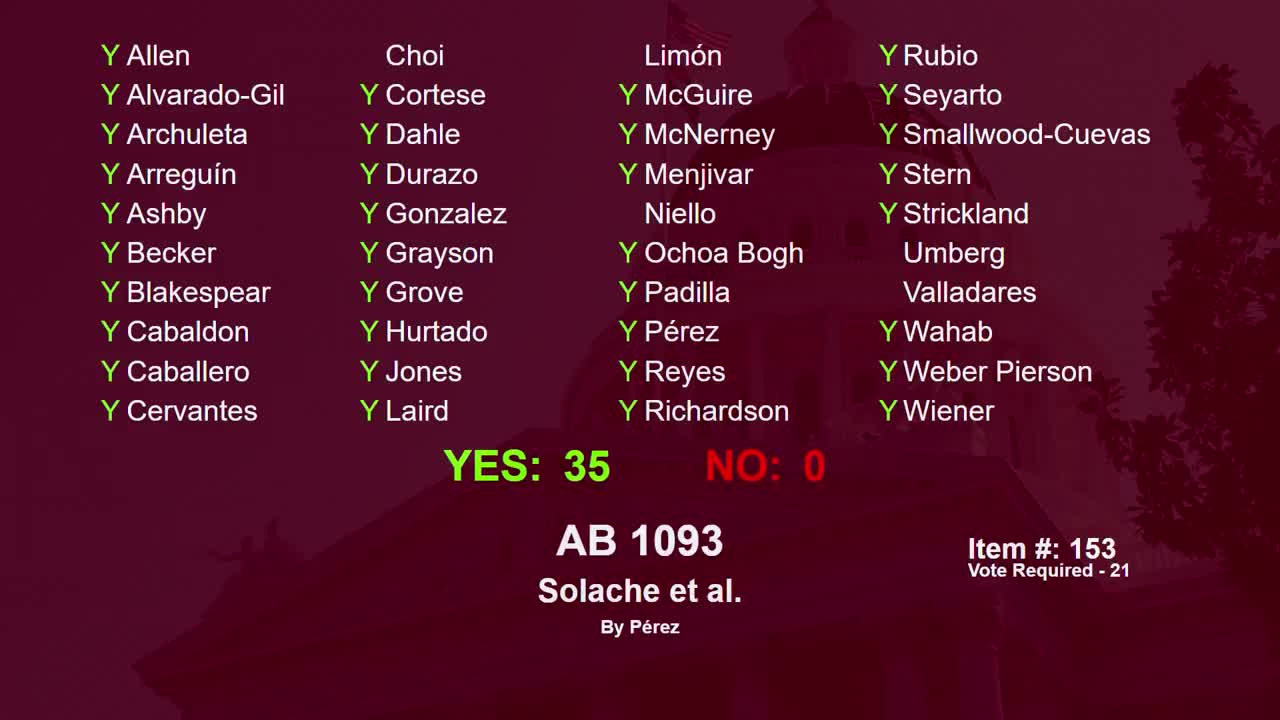 2MIN
Senate Floor
 53SEC
Senate Standing Committee on Appropriations
 18MIN
Senate Standing Committee on Environmental Quality
 27MIN
Senate Standing Committee on Natural Resources and Water
 2MIN
Assembly Floor
 31MIN
Assembly Standing Committee on Water, Parks, and Wildlife
 19MIN
Assembly Standing Committee on Environmental Safety and Toxic Materials
Bill Author