AB 2224: County recorders: fees.
- Session Year: 2025-2026
- House: Assembly
- Latest Version Date: 2026-09-18
Current Status:
Passed
(2026-09-18: Chaptered by Secretary of State - Chapter 292, Statutes of 2026.)
Introduced
In Committee
Awaiting First Chamber Vote
Passed First Chamber
In Committee
Awaiting Second Chamber Vote
Passed Second Chamber
Enacted
Existing law establishes the office of county recorder and requires the county recorder to accept for recordation any instrument, paper, or notice that is authorized or required to be recorded, subject to the collection of specified fees.
This bill would require the county recorder to provide access to a true copy of the public record for each recorded instrument, paper, or notice, as specified. By imposing new duties on county recorders, the bill would impose a state-mandated local program.
Existing law prohibits the fee for recording and indexing an instrument, paper, or notice from exceeding $10 for recording the first page and $3 for each additional page, which charges are to reimburse the county for the costs of services rendered. Existing law requires the county recorder to impose additional recording fees of $1 per page for nonconforming print spacing and $3 per page for nonconforming page dimensions. Existing law requires $1 of each $3 fee for each additional page to be deposited in the county general fund.
The bill would, instead, set the fee for recording and indexing at $15 for recording the first page and $4 for each additional page, and would prohibit the fees from exceeding the reasonable costs of the county recorders office for providing these services. The bill would delete the provisions requiring $1 and $3 fees for nonconforming spacing and page dimensions, and $1 of each $3 fee for each additional page to be deposited in the county general fund. The bill would require the county recorder collecting a prescribed fee to implement an electronic recording delivery system, and would provide that various other fees are restricted, as prescribed, or solely for the county recorders office, as specified.
Existing law authorizes a county recorder to charge an additional fee of $1 for specified documents requiring additional indexing based on the number of names listed and for each reference to a previously recorded document, other than the first such reference, as specified.
The bill would repeal these provisions and make conforming changes.
Existing law requires the fee for recording every release of lien, encumbrance, or notice executed by the state, or any municipality, county, city, district, or other political subdivision, to be a certain amount on January 1 of the year the release is recorded if the original lien, encumbrance, or notice was recorded without fee, as specified.
This bill would, instead, calculate that fee as of January 1 of the year the original lien, encumbrance, or notice was recorded without fee, as specified.
Upon approval by resolution of the board of supervisors and system certification by the Attorney General, existing law authorizes a county recorder to establish an electronic recording delivery system, as specified. Upon system certification, existing law authorizes a county recorder to enter into a contract with any of specified entities for the delivery for recording, and return to the party requesting recording, a digitized electronic record, as specified. Until January 1, 2027, existing law authorizes a county recorder to enter into a contract with an entity other than those specified, as described above, if certain requirements are met.
This bill would remove the repeal date of January 1, 2027, and make various conforming changes.
Existing law authorizes a county recorder to include in the countys electronic delivery system a secure method for accepting for recording a digital or digitized electronic record that is an instrument of reconveyance, substitution of trustee, or assignment of deed of trust.
This bill would remove the limit of the above provisions to those types of documents.
The bill would include related legislative findings concerning county recorders and county recorder fees.
By imposing new duties on counties relative to recording fees, the bill would impose a state-mandated local program.
The California Constitution requires the state to reimburse local agencies and school districts for certain costs mandated by the state. Statutory provisions establish procedures for making that reimbursement.
This bill would provide that no reimbursement is required by this act for a specified reason.
Existing law establishes the office of county recorder and requires the county recorder to accept for recordation any instrument, paper, or notice that is authorized or required to be recorded, subject to the collection of specified fees.
This bill would require the county recorder to provide access to a true copy of the public record for each recorded instrument, paper, or notice, as specified. By imposing new duties on county recorders, the bill would impose a state-mandated local program.
Existing law prohibits the fee for recording and indexing an instrument, paper, or notice from exceeding $10 for recording the first page and $3 for each additional page, which charges are to reimburse the county for the costs of services rendered. Existing law requires the county recorder to impose additional recording fees of $1 per page for nonconforming print spacing and $3 per page for nonconforming page dimensions. Existing law requires $1 of each $3 fee for each additional page to be deposited in the county general fund.
The bill would, instead, set the fee for recording and indexing at $15 for recording the first page and $4 for each additional page, and would prohibit the fees from exceeding the reasonable costs of the county recorders office for providing these services. The bill would delete the provisions requiring $1 and $3 fees for nonconforming spacing and page dimensions, and $1 of each $3 fee for each additional page to be deposited in the county general fund. The bill would require the county recorder collecting a prescribed fee to implement an electronic recording delivery system, and would provide that various other fees are restricted, as prescribed, or solely for the county recorders office, as specified.
Existing law authorizes a county recorder to charge an additional fee of $1 for specified documents requiring additional indexing based on the number of names listed and for each reference to a previously recorded document, other than the first such reference, as specified.
The bill would repeal these provisions. provisions and make conforming changes.
Upon approval by resolution of the board of supervisors and system certification by the Attorney General, existing law authorizes a county recorder to establish an electronic recording delivery system, as specified. Upon system certification, existing law authorizes a county recorder to enter into a contract with any of specified entities for the delivery for recording, and return to the party requesting recording, a digitized electronic record, as specified. Until January 1, 2027, existing law authorizes a county recorder to enter into a contract with an entity other than those specified, as described above, if certain requirements are met.
This bill would remove the repeal date of January 1, 2027, and make various conforming changes.
Existing law authorizes a county recorder to include in the countys electronic delivery system a secure method for accepting for recording a digital or digitized electronic record that is an instrument of reconveyance, substitution of trustee, or assignment of deed of trust.
This bill would remove the limit of the above provisions to those types of documents.
The bill would include related legislative findings concerning county recorders and county recorder fees.
By imposing new duties on counties relative to recording fees, the bill would impose a state-mandated local program.
The California Constitution requires the state to reimburse local agencies and school districts for certain costs mandated by the state. Statutory provisions establish procedures for making that reimbursement.
This bill would provide that no reimbursement is required by this act for a specified reason.
Existing law establishes the office of county recorder and requires the county recorder to accept for recordation any instrument, paper, or notice that is authorized or required to be recorded, subject to the collection of specified fees.
This bill would require the county recorder to provide access to a true copy of the public record for each recorded instrument, paper, or notice, as specified. By imposing new duties on county recorders, the bill would impose a state-mandated local program.
Existing law prohibits the fee for recording and indexing an instrument, paper, or notice from exceeding $10 for recording the first page and $3 for each additional page, which charges are to reimburse the county for the costs of services rendered. Existing law requires the county recorder to impose additional recording fees of $1 per page for nonconforming print spacing and $3 per page for nonconforming page dimensions. Existing law requires $1 of each $3 fee for each additional page to be deposited in the county general fund.
The bill would, instead, set the fee for recording and indexing at $15 for recording the first page and $4 for each additional page, and would prohibit the fees from exceeding the reasonable costs of the county recorders office for providing these services. The bill would delete the provisions requiring $1 and $3 fees for nonconforming spacing and page dimensions, and $1 of each $3 fee for each additional page to be deposited in the county general fund. The bill would require the county recorder collecting a prescribed fee to implement an electronic recording delivery system, and would provide that various other fees are restricted, as prescribed, or solely for the county recorders office, as specified.
Existing law authorizes a county recorder to charge an additional fee of $1 for specified documents requiring additional indexing based on the number of names listed and for each reference to a previously recorded document, other than the first such reference, as specified.
The bill would repeal these provisions.
Upon approval by resolution of the board of supervisors and system certification by the Attorney General, existing law authorizes a county recorder to establish an electronic recording delivery system, as specified. Upon system certification, existing law authorizes a county recorder to enter into a contract with any of specified entities for the delivery for recording, and return to the party requesting recording, a digitized electronic record, as specified. Until January 1, 2027, existing law authorizes a county recorder to enter into a contract with an entity other than those specified, as described above, if certain requirements are met.
This bill would remove the repeal date of January 1, 2027, and make various conforming changes.
Existing law authorizes a county recorder to include in the countys electronic delivery system a secure method for accepting for recording a digital or digitized electronic record that is an instrument of reconveyance, substitution of trustee, or assignment of deed of trust.
This bill would remove the limit of the above provisions to those types of documents.
The bill would include related legislative findings concerning county recorders and county recorder fees.
By imposing new duties on counties relative to recording fees, the bill would impose a state-mandated local program.
The California Constitution requires the state to reimburse local agencies and school districts for certain costs mandated by the state. Statutory provisions establish procedures for making that reimbursement.
This bill would provide that no reimbursement is required by this act for a specified reason.
Existing law establishes the office of county recorder and requires the county recorder to accept for recordation any instrument, paper, or notice that is authorized or required to be recorded, subject to the collection of specified fees.This bill would require the county recorder to provide access to a true copy of the public record for each recorded instrument, paper, or notice, as specified. By imposing new duties on county recorders, the bill would impose a state-mandated local program.Existing law prohibits the fee for recording and indexing an instrument, paper, or notice from exceeding $10 for recording the first page and $3 for each additional page, which charges are to reimburse the county for the costs of services rendered. Existing law requires the county recorder to impose additional recording fees of $1 per page for nonconforming print spacing and $3 per page for nonconforming page dimensions. Existing law requires $1 of each $3 fee for each additional page to be deposited in the county general fund.The bill would, instead, set the fee for recording and indexing at $15 for recording the first page and $4 for each additional page, and would prohibit the fees from exceeding the reasonable costs of the county recorders office for providing these services. The bill would delete the provisions requiring $1 and $3 fees for nonconforming spacing and page dimensions, and $1 of each $3 fee for each additional page to be deposited in the county general fund. The bill would require the county recorder collecting a prescribed fee to implement an electronic recording delivery system, and would provide that various other fees are restricted, as prescribed, or solely for the county recorders office, as specified.Existing law authorizes a county recorder to charge an additional fee of $1 for specified documents requiring additional indexing based on the number of names listed and for each reference to a previously recorded document, other than the first such reference, as specified.The bill would repeal these provisions.Existing law authorizes the county board of supervisors to provide for an additional fee of $1 for each instrument, paper, or notice of record to order to defray the cost of converting the county recorders document storage system to micrographics. Existing law provides for that, upon completing this conversation and payment of costs, this fee would no longer be imposed.The bill would, instead, specify the above-described $1 fee is to defray the cost of archiving as determined by the county recorder, and would delete the above described provisions related to micrographics conversion, thereby extending this fee indefinitely.The bill would include related legislative findings concerning county recorders and county recorder fees.By imposing new duties on counties relative to recording fees, the bill would impose a state-mandated local program.The California Constitution requires the state to reimburse local agencies and school districts for certain costs mandated by the state. Statutory provisions establish procedures for making that reimbursement.This bill would provide that no reimbursement is required by this act for a specified reason.Existing law establishes the office of county recorder and requires the county recorder to accept for recordation any instrument, paper, or notice that is authorized or required to be recorded, subject to the collection of specified fees.
This bill would require the county recorder to provide access to a true copy of the public record for each recorded instrument, paper, or notice, as specified. By imposing new duties on county recorders, the bill would impose a state-mandated local program.
Existing law prohibits the fee for recording and indexing an instrument, paper, or notice from exceeding $10 for recording the first page and $3 for each additional page, which charges are to reimburse the county for the costs of services rendered. Existing law requires the county recorder to impose additional recording fees of $1 per page for nonconforming print spacing and $3 per page for nonconforming page dimensions. Existing law requires $1 of each $3 fee for each additional page to be deposited in the county general fund.
The bill would, instead, set the fee for recording and indexing at $15 for recording the first page and $4 for each additional page, and would prohibit the fees from exceeding the reasonable costs of the county recorders office for providing these services. The bill would delete the provisions requiring $1 and $3 fees for nonconforming spacing and page dimensions, and $1 of each $3 fee for each additional page to be deposited in the county general fund. The bill would require the county recorder collecting a prescribed fee to implement an electronic recording delivery system, and would provide that various other fees are restricted, as prescribed, or solely for the county recorders office, as specified.
Existing law authorizes a county recorder to charge an additional fee of $1 for specified documents requiring additional indexing based on the number of names listed and for each reference to a previously recorded document, other than the first such reference, as specified.
The bill would repeal these provisions.
Existing law authorizes the county board of supervisors to provide for an additional fee of $1 for each instrument, paper, or notice of record to order to defray the cost of converting the county recorders document storage system to micrographics. Existing law provides for that, upon completing this conversation and payment of costs, this fee would no longer be imposed.
The bill would, instead, specify the above-described $1 fee is to defray the cost of archiving as determined by the county recorder, and would delete the above described provisions related to micrographics conversion, thereby extending this fee indefinitely.
The bill would include related legislative findings concerning county recorders and county recorder fees.
By imposing new duties on counties relative to recording fees, the bill would impose a state-mandated local program.
The California Constitution requires the state to reimburse local agencies and school districts for certain costs mandated by the state. Statutory provisions establish procedures for making that reimbursement.
This bill would provide that no reimbursement is required by this act for a specified reason.
(a)The Legislature finds and declares all of the following:
(1)County recorders serve as the official archivist for vital and official records, including real property documents, maps, and other essential filings. These records provide constructive notice as required by statute to protect Californias legal, financial, housing systems, and property ownership. Records of birth, death, or marriage events are necessary to obtain medical, financial, or survivor benefits and are necessary to meet federal security standards. The integrity, accessibility, and timely processing of these records are essential to the public, the states real estate industry, and financial institutions.
(2)County recorders maintain daily operations to provide the public with consistent access to official records and strive to provide a seamless recording for California home buyers and the general public, while meeting recording statutory requirements.
(3)The county recorder is a fee-for-service department where fees charged are intended to cover the cost of services provided to the public.
(b)It is the intent of the Legislature to adjust recording fees to increase transparency for the public and to ensure the effective delivery of government services by requiring all of the following:
(1)Electronic recording throughout California for all documents.
(2)The elimination of fees no longer necessary due to technological advances.
(3)The standardization of the fee structure to promote greater clarity to the public, expedite the recording process, and decrease the frequency of recording rejections.
SEC. 2.Section 6103.8 of the Government Code is amended to read:6103.8.(a)Sections 6103 and 27383 do not apply to any fee or charge for recording full releases executed or recorded pursuant to Section 7174 of the Government Code, Sections 4608 and 5003.7 of the Public Resources Code, and Sections 2194, 11496, 12494, and 32362 of the Revenue and Taxation Code, where there is full satisfaction of the amount due under the lien that is released.
(b)The fee for recording full releases listed in subdivision (a) shall be the amount prescribed in subdivision (a) of Section 27361.3.
(c)In the case of full releases recorded by the state taxing agency pursuant to Section 7174 of the Government Code, the recording agency shall be billed quarterly or, at the option of the agency, at more frequent intervals. All billing shall refer to the agency certificate number of the recorded releases.
(d)The fee for recording full releases for any document relating to an agreement to reimburse a county for public aid granted by the county shall be the amount prescribed in subdivision (a) of Section 27361.3.
(e)The fee for filing any release of judgment that was in favor of a government agency and recorded pursuant to Section 6103 or 27383 shall be the amount prescribed in subdivision (a) of Section 27361.3.
(f)Sections 6103 and 27383 do not apply to any fee or charge for recording a notice of state tax lien under subdivision (d) of Section 7171 or a certificate of release under subdivision (h) of Section 7174.
(g)The fee for recording a notice of state tax lien pursuant to subdivision (d) of Section 7171 and a certificate of release under subdivision (h) of Section 7174 shall be as permitted by Sections 27361 and 27361.4.
(h)In the case of recording a notice of state tax lien pursuant to subdivision (f) or a certificate of release pursuant to subdivision (f), the recording agency shall be billed quarterly or at the option of the agency at more frequent intervals. All billing shall refer to the agency notice or certificate number.
SEC. 3.Section 7171 of the Government Code is amended to read:7171.(a)With respect to real property, at any time after creation of a state tax lien, the agency may record in the office of the county recorder of the county in which the real property is located a notice of state tax lien.
(b)With respect to personal property, at any time after creation of a state tax lien, the agency may file a notice of state tax lien with the Secretary of State pursuant to Chapter 14.5 (commencing with Section 7220).
(c)(1)The notice of state tax lien recorded or filed pursuant to subdivision (a) or (b) shall include all of the following:
(A)The name and last known address of the taxpayer.
(B)The name of the agency giving notice of the lien.
(C)The amount of the unpaid tax.
(D)A statement that the amount of the unpaid tax is a lien on all real or personal property and rights to that property, including all after-acquired property and rights to property, belonging to the taxpayer.
(E)A statement that the agency has complied with all of the provisions of the applicable law for determining and assessing the tax.
(2)Notwithstanding paragraph (4) of subdivision (b) of Section 27390, the transmission, filing, recording, and indexing of notices of state tax liens recorded or filed pursuant to subdivision (a) or (b), and all documents that relate to or affect those liens, including, but not limited to, a release, an extension, or a subordination, by electronic or magnetic means using computerized data processing, telecommunications, or the other similar information technologies available to the filing offices shall be permitted. A facsimile signature that complies with the requirements of paragraph (2) of subdivision (b) of Section 27201 shall be accepted on any document relating to a state tax lien filed or recorded pursuant to this paragraph.
(d)If the notice of state tax lien recorded in any county reflects an out-of-state address as the last known address of the taxpayer, the agency shall pay the fees required by Sections 27361 and 27361.4.
(e)The agency recording a notice of state tax lien pursuant to subdivision (d) may collect from the taxpayer, in any manner provided by law for the collection of the tax, the cost of recording.
SEC. 4.Section 7174 of the Government Code is amended to read:7174.(a)If the agency determines that the amount of tax, interest, and any penalty are sufficiently secured by a lien on other property or that the release or subordination of the state tax lien will not jeopardize the collection of the amount of the tax, including interest and penalty, the agency may at any time release all or any portion of the property subject to the state tax lien from the lien or may subordinate the state tax lien to other liens and encumbrances.
(b)If the agency finds that the liability represented by the state tax lien, including any interest accrued thereon, is legally unenforceable, the agency may release the lien.
(c)If the agency has recorded a notice of state tax lien as provided in Section 7171 and the liability represented by the lien, including any interest and penalty, has been satisfied in full:
(1)If the agency is other than the Controller or the State Board of Equalization, the agency shall, not later than 40 days after the liability is satisfied, record a certificate of release in the office of the county recorder where the notice of state tax lien is recorded.
(2)In the case of the Controller or the State Board of Equalization, the agency shall, not later than 40 days after the liability is satisfied, do one of the following:
(A)Record a certificate of release in the office of the county recorder where the notice of state tax lien is recorded.
(B)Deposit in the mail or otherwise deliver to the taxpayer a certificate of release.
(d)If the agency records a certificate of release under subdivision (c) or files a certificate of release under subdivision (e), the cost of recording or filing is an obligation of the taxpayer and may be collected from the taxpayer in any manner provided by law for the collection of the tax.
(e)If the agency has filed a notice of state tax lien with the Secretary of State as provided in Section 7171 and the liability represented by the state tax lien, including any interest and penalty, has been satisfied in full, the agency shall, not later than 40 days after the liability is satisfied, do one of the following:
(1)File a certificate of release with the Secretary of State.
(2)Deposit in the mail or otherwise deliver a certificate of release to the taxpayer.
(f)For the purpose of subdivisions (c) and (e), if payment is made by check, the 40-day period does not commence to run until the check has been paid by the financial institution upon which it was drawn.
(g)A certificate by the agency to the effect that any property has been released from a state tax lien or that the lien has been subordinated to other liens and encumbrances is conclusive evidence that the property has been released or that the lien has been subordinated as provided in the certificate.
(h)If the certificate of release recorded pursuant to subdivisions (a), (b), and (c) reflects an out-of-state address as the last known address of the taxpayer, the agency shall pay the fees permitted by Sections 27361 and 27361.4.
SEC. 5.Section 27201 of the Government Code is amended to read:27201.(a)(1)(A)The recorder shall, upon payment of proper fees and taxes, accept for recordation any instrument, paper, or notice that is authorized or required by statute, or court order to be recorded, or authorized or required to be recorded by a local ordinance that relates to the recordation of any instrument, paper, or notice that relates to real property, if the instrument, paper, or notice contains sufficient information to be indexed as provided by statute, meets recording requirements of state statutes and local ordinances, and is photographically reproducible. The county recorder shall not refuse to record any instrument, paper, or notice that is authorized or required by statute, court order, or local ordinance that relates to the recordation of any instrument, paper, or notice that relates to real property to be recorded on the basis of its lack of legal sufficiency.
(B)Photographically reproducible, for purposes of this division, means all instruments, papers, or notices that comply with standards as recommended by the American National Standards Institute or the Association for Information and Image Management for recording of records.
(2)(A)A person of or related to the record may request that the recorder correct the information contained in an index of a record. The request shall identify the exact location of an error within a specifically identified index entry.
(B)If the person making the request provides sufficient evidence to the recorder to determine that there is an error in the index that needs to be corrected, the recorder shall correct that index entry within 30 business days of receiving the request.
(C)The corrected index entry shall be entered into the public index to reflect both the error and the correction. The recorder shall note that an index entry has been corrected in accordance with local policy.
(b)(1)Each instrument, paper, or notice shall contain an original signature or signatures, except as otherwise provided by law, or be a certified copy of the original.
(2)A facsimile signature shall be accepted on a lien recorded by a governmental agency when that facsimile signature has been officially adopted by that agency. The lien shall have noted on its face a statement to that effect. The officially adopted facsimile signature shall be provided to the county recorder by a letter from the agency. A facsimile signature shall continue to be valid until the agency notifies the county recorder that the facsimile signature has been revoked.
(c)(1)Each instrument, paper, or notice that is rerecorded shall be executed and acknowledged or verified as a new document, in addition to any previous execution and acknowledgment or verification, unless any of the following apply:
(A)The instrument, paper, or notice is otherwise exempted by Section 27287 or any other law.
(B)The instrument, paper, or notice is presented solely to correct a recording sequence. The intent of the parties with regard to the priority of recorded documents shall be controlling regardless of the sequence of recording by a county recorder or the sequence of recording specified in instructions given by a submitter to a county recorder. This subparagraph is declaratory of existing law, and any rerecording of documents to change the sequential numbers assigned to a document by the recorder shall not require the document to be executed and acknowledged or verified as a new document.
(C)(i)The instrument, paper, or notice is presented solely to make a minor correction with a corrective affidavit. The corrective affidavit shall satisfy all of the following:
(I)Be attached to the original recorded instrument, paper, or notice.
(II)Set out the information corrected.
(III)Be certified by the party submitting the affidavit under penalty of perjury.
(IV)Be acknowledged pursuant to Section 27287.
(ii)For purposes of this subparagraph, minor correction includes any of the following:
(I)An incorrect or missing address of the party to which the instrument, paper, or notice is to be returned following recording pursuant to Section 27361.6.
(II)A clarification of illegible text pursuant to Section 27361.7.
(III)An incorrect or missing printed or typed name of an individual or entity near the signature pursuant to Section 27280.5.
(IV)An incorrect or missing documentary transfer tax amount due pursuant to Section 11932 of the Revenue and Taxation Code.
(2)Each rerecorded instrument, paper, or notice shall include a cover sheet that complies with Section 27361.6 and shall state the reason for rerecording on the cover sheet.
(d)The recorder shall provide access to a true copy of the public record for each instrument, paper, or notice, recorded in the office of the recorder, to facilitate public inspection.
SEC. 6.Section 27361 of the Government Code is amended to read:27361.(a)(1)The fee for recording and indexing every instrument, paper, or notice required or permitted by law to be recorded shall be fifteen dollars ($15) for recording the first page and four dollars ($4) for each additional page, to reimburse the county for the costs of services rendered pursuant to this subdivision.
(2)The county recorder collecting the fee pursuant to paragraph (1) shall implement an electronic recording delivery system, pursuant to the Electronic Recording Delivery Act of 2004 (Article 6 (commencing with Section 27390) of Chapter 6 of Part 3 of Division 2 of Title 3), on or before January 1, 2028.
(3)Notwithstanding paragraph (1), the fees imposed by paragraph (1) shall not exceed the reasonable costs of the county recorders office for providing these services.
(b)Notwithstanding Section 68085, one dollar ($1) for recording the first page and one dollar ($1) for each additional page shall be restricted and available solely to support, maintain, improve, and provide for the full operation for modernized creation, retention, and retrieval of information in each countys system of recorded documents.
(c)(1)In addition to all other fees authorized by this section, a county recorder may charge a fee of one dollar ($1) for recording the first page of every instrument, paper, or notice required or permitted by law to be recorded, as authorized by each countys board of supervisors. The funds generated by this fee shall be restricted and used only by the county recorder collecting the fee for the purpose of implementing a social security number truncation program pursuant to Article 3.5 (commencing with Section 27300).
(2)A county recorder shall not charge the fee described in paragraph (1) after December 31, 2017, unless the county recorder has received reauthorization by the countys board of supervisors. A county recorder shall not seek reauthorization of the fee by the board before June 1, 2017, or after December 31, 2017. In determining the additional period of authorization, the board shall consider the review described in paragraph (4).
(3)Notwithstanding paragraph (2), a county recorder who, pursuant to subdivision (c) of Section 27304, secures a revenue anticipation loan, or other outside source of funding, for the implementation of a social security number truncation program, may be authorized to charge the fee described in paragraph (1) for a period not to exceed the term of repayment of the loan or other outside source of funding.
(4)A county board of supervisors that authorizes the fee described in this subdivision shall require the county auditor to conduct two reviews to verify that the funds generated by this fee are used only for the purpose of the program, as described in Article 3.5 (commencing with Section 27300) and for conducting these reviews. The reviews shall state the progress of the county recorder in truncating recorded documents pursuant to subdivision (a) of Section 27301, and shall estimate any ongoing costs to the county recorder of complying with subdivisions (a) and (b) of Section 27301. The board shall require that the first review be completed not before June 1, 2012, or after December 31, 2013, and that the second review be completed not before June 1, 2017, or after December 31, 2017. The reviews shall adhere to generally accepted accounting standards, and the review results shall be made available to the public.
(d)Except as provided in subdivision (g) of Section 6103.8, the fee authorized by this section shall not be charged to those entities exempted from the payment of recording fees under Section 6103 or 27383.
(e)Unless otherwise specified, all fees collected pursuant to this section shall be restricted, dedicated to, and solely utilized for, the recorders office.
SEC. 7.Section 27361.2 of the Government Code is repealed.SEC. 8.Section 27361.3 of the Government Code is amended to read:27361.3.(a)Notwithstanding any contrary provision of the law, the fee for recording every release of lien, encumbrance, or notice executed by the state, or any municipality, county, city, district, or other political subdivision shall be two times the fee charged to record the first page of a lien, encumbrance, or notice under subdivision (a) of Section 27361, on January 1 of the year the original lien, encumbrance, or notice was recorded without fee as provided by Section 27383.
(b)No fee shall be charged for recording a release of lien, encumbrance, or notice which was recorded in error by the state, or any municipality, county, city, district, or other political subdivision if there is noted on the face of the release of lien, encumbrance, or notice a statement to that effect.
(c)Two dollars ($2) for recording each release of lien pursuant to this section shall be restricted and available solely to support, maintain, improve, and provide for the full operation for modernized creation, retention, and retrieval of information in each countys system of recorded documents.
SEC. 9.Section 27361.8 of the Government Code is repealed.SEC. 10.Section 27388.2 of the Government Code is amended to read:27388.2.(a)In addition to all other fees authorized by this section, a county recorder may charge a fee of two dollars ($2) for recording the first page of every real estate instrument, paper, or notice required or permitted by law to be recorded per each single transaction per parcel of real property, except those expressly exempted from payment of recording fees, as authorized by each countys board of supervisors and in accordance with applicable constitutional requirements. The funds generated by this fee shall be restricted and used only by the county recorder collecting the fee for the purpose of implementing a restrictive covenant program pursuant to Section 12956.3. Real estate instrument, paper, or notice means a document relating to real property, including, but not limited to, the following: deed, grant deed, trustees deed, deed of trust, reconveyance, quit claim deed, fictitious deed of trust, assignment of deed of trust, request for notice of default, abstract of judgment, subordination agreement, declaration of homestead, abandonment of homestead, notice of default, release or discharge, easement, notice of trustee sale, notice of completion, UCC financing statement, mechanics lien, maps, and covenants, conditions, and restrictions.
(b)The fee described in subdivision (a) shall not be imposed on any of the following documents:
(1)Any real estate instrument, paper, or notice recorded in connection with a transfer subject to the imposition of a documentary transfer tax, as defined in Section 11911 of the Revenue and Taxation Code.
(2)Any real estate instrument, paper, or notice recorded in connection with a transfer of real property that is a residential dwelling to an owner-occupier.
(3)Any real estate instrument, paper, or notice executed or recorded by the federal government in accordance with the Uniform Federal Lien Registration Act (Title 7 (commencing with Section 2100) of Part 4 of the Code of Civil Procedure).
(4)Any real estate instrument, paper, or notice executed or recorded by the state or any county, municipality, or other political subdivision of the state.
(c)A county recorder shall not charge the fee described in this section after December 31, 2027, unless the county recorder has received reauthorization by the countys board of supervisors. A county recorder shall not seek reauthorization of the fee by the board before June 1, 2027, or after December 31, 2027. Any reauthorization period shall not exceed five years.
SEC. 11.Section 27391 of the Government Code, as amended by Section 3 of Chapter 380 of the Statutes of 2016, is amended to read:27391.(a)Upon approval by resolution of the board of supervisors and system certification by the Attorney General, a county recorder may establish an electronic recording delivery system.
(b)Upon system certification, a county recorder may enter into a contract with a title insurer as defined in Section 12340.4 of the Insurance Code, underwritten title company as defined in Section 12340.5 of the Insurance Code, institutional lender as defined in paragraph (1), (2), or (4) of subdivision (j) of Section 50003 of the Financial Code, or an entity of local, state, or federal government for the delivery for recording, and return to the party requesting recording, of a digital or digitized electronic record that is an instrument to be recorded consistent with subdivision (a) of Section 27201. The contract may provide for the delivery of documents by an agent. However, the agent shall not be a vendor of electronic recording delivery systems.
(c)(1)A county recorder may enter into a contract with an authorized submitter not authorized pursuant to subdivision (b) for the delivery for recording, and return to the party requesting recording, of a digital or digitized electronic record that is an instrument to be recorded consistent with subdivision (a) of Section 27201. The contract may provide for the delivery of documents by an agent. However, the agent shall not be a vendor of electronic recording delivery systems.
(2)An authorized submitter authorized pursuant to this subdivision and any agent submitting documents on behalf of an authorized submitter pursuant to this subdivision shall provide proof of financial responsibility by providing a certificate of insurance evidencing an amount of general liability coverage reasonably adequate to protect against liability and cover potential losses. The amount of general liability coverage required by this paragraph shall be set through rule or regulation by the Attorney General in consultation with interested parties.
(d)A county recorder may refuse to enter into a contract with any party or may terminate or suspend access to a system for any good faith reason, including, but not limited to, a determination by the county recorder that termination or suspension is necessary to protect the public interest, to protect the integrity of public records, or to protect homeowners from financial harm, or if the volume or quality of instruments submitted by the requester is not sufficient to warrant electronic recordation. A county recorder may also terminate or suspend access to a system if a party commits a substantive breach of the contract, the requirements of this article, or the regulations adopted pursuant to this article.
(e)Notwithstanding Section 27321, a county recorder may require a party electronically submitting records to mail a copy of the recorded electronic document to the address specified in the instructions for mailing upon completion of recording.
(f)When a signature is required to be accompanied by a notarys seal or stamp, that requirement is satisfied if the electronic signature of the notary contains all of the following:
(1)The name of the notary.
(2)The words Notary Public.
(3)The name of the county where the bond and oath of office of the notary are filed.
(4)The sequential identification number assigned to the notary, if any.
(5)The sequential identification number assigned to the manufacturer or vendor of the notarys physical or electronic seal, if any.
SEC. 12.Section 27391 of the Government Code, as added by Section 4 of Chapter 380 of the Statutes of 2016, is repealed.SEC. 13.Section 27393 of the Government Code, as amended by Section 5 of Chapter 380 of the Statutes of 2016, is amended to read:27393.(a)The Attorney General shall, in consultation with interested parties, adopt regulations for the review, approval, and oversight of electronic recording delivery systems. Regulations shall be adopted pursuant to the Administrative Procedure Act (Chapter 3.5 (commencing with Section 11340) of Part 1 of Division 3). The regulations shall comply with Section 12168.7.
(b)The regulations adopted pursuant to subdivision (a) may include, but need not be limited to, all of the following:
(1)Establishment of baseline technological and procedural specifications for electronic recording delivery systems.
(2)Requirements for security, capacity, reliability, and uniformity.
(3)Requirements as to the nature and frequency of computer security audits.
(4)A statement of a detailed and uniform definition of the term source code consistent with paragraph (7) of subdivision (b) of Section 27390, and as used in this article, and applicable to each countys electronic recording delivery system.
(5)Requirements for placement of a copy of the operating system, source code, compilers, and all related software associated with each countys electronic recording delivery system in an approved escrow facility prior to that systems first use.
(6)Requirements to ensure that substantive modifications to an operating system, compilers, related software, or source code are approved by the Attorney General.
(7)Procedures for initial certification of vendors offering software and other services to counties for electronic recording delivery systems.
(8)Requirements for system certification and for oversight of approved systems.
(9)Requirements for general liability coverage required by subdivision (c) of Section 27391.
(10)Requirements for fingerprinting and criminal records checks required by Section 27395, including a list of employment positions or classifications subject to criminal records checks under subdivision (f) of that section.
(11)Requirements for uniform index information that shall be included in every digitized or digital electronic record.
(12)Requirements for protecting proprietary information accessed pursuant to subdivision (e) of Section 27394 from public disclosure.
(13)Requirements for certification under Section 27397.5.
(c)The Attorney General may promulgate any other regulations necessary to fulfill their obligations under this article.
(d)An electronic recording delivery system shall be subject to local inspection and review by the Attorney General. The Attorney General shall furnish a statement of any relevant findings associated with a local inspection of an electronic recording delivery system, to the county recorder and the district attorney of the affected county, and to all technology vendors associated with that system.
SEC. 14.Section 27393 of the Government Code, as added by Section 6 of Chapter 380 of the Statutes of 2016, is repealed.SEC. 15.Section 27397.5 of the Government Code is amended to read:27397.5.(a)A county recorder may include in the countys electronic recording delivery system a secure method for accepting for recording a digital or digitized electronic record, including, but not limited to, an instrument of reconveyance, substitution of trustee, or assignment of deed of trust.
(b)A county recorder may contract with a title insurer, as defined in Section 12340.4 of the Insurance Code, underwritten title company, as defined in Section 12340.5 of the Insurance Code, an entity of state, local, or federal government, or an institutional lender, as defined in Section 50003 of the Financial Code, or their authorized agents, to be an authorized submitter of the documents specified in subdivision (a).
(c)With respect to the electronic submission of the records described in subdivision (a), the requirements that an authorized submitter be subject to a security audit under Section 27394 and a criminal records check under Section 27395 shall not apply where the certification requirements of subdivision (d) have been met.
(d)(1)In order for subdivision (c) to apply, the county recorder and the Attorney General shall certify that the method of submission allowed under the system will not permit an authorized submitter or its employees and agents, or any third party, to modify, manipulate, insert, or delete information in the public record, maintained by the county recorder, or information in electronic records submitted pursuant to subdivision (b) of Section 27391.
(2)Certification under this section may be withdrawn by either the county recorder or the Attorney General at any time either determines that the requirements of this subdivision are not met.
(e)For purposes of this section, an agent of an authorized submitter shall not include a vendor of electronic recording delivery systems.
SEC. 16.No reimbursement is required by this act pursuant to Section 6 of Article XIIIB of the California Constitution because a local agency or school district has the authority to levy service charges, fees, or assessments sufficient to pay for the program or level of service mandated by this act, within the meaning of Section 17556 of the Government Code.
(a)The Legislature finds and declares all of the following:
(1)County recorders serve as the official archivist for vital and official records, including real property documents, maps, and other essential filings. These records provide constructive notice as required by statute to protect Californias legal, financial, housing systems, and property ownership. Records of birth, death, or marriage events are necessary to obtain medical, financial, or survivor benefits and are necessary to meet federal security standards. The integrity, accessibility, and timely processing of these records are essential to the public, the states real estate industry, and financial institutions.
(2)County recorders maintain daily operations to provide the public with consistent access to official records and strive to provide a seamless recording for California home buyers and the general public, while meeting recording statutory requirements.
(3)The county recorder is a fee-for-service department where fees charged are intended to cover the cost of services provided to the public.
(b)It is the intent of the Legislature to adjust recording fees to increase transparency for the public and to ensure the effective delivery of government services by requiring all of the following:
(1)Electronic recording throughout California for all documents.
(2)The elimination of fees no longer necessary due to technological advances.
(3)The standardization of the fee structure to promote greater clarity to the public, expedite the recording process, and decrease the frequency of recording rejections.
(4)A four-month implementation window prior to eliminating and adjusting the fee to allow adequate time for the public notice and real estate industry preparation.SEC. 2.Section 6103.8 of the Government Code is amended to read:6103.8.(a)Sections 6103 and 27383 do not apply to any fee or charge for recording full releases executed or recorded pursuant to Section 7174 of the Government Code, Sections 4608 and 5003.7 of the Public Resources Code, and Sections 2194, 11496, 12494, and 32362 of the Revenue and Taxation Code, where there is full satisfaction of the amount due under the lien that is released.
(b)The fee for recording full releases listed in subdivision (a) shall be the amount prescribed in subdivision (a) of Section 27361.3.
(c)In the case of full releases recorded by the state taxing agency pursuant to Section 7174 of the Government Code, the recording agency shall be billed quarterly or, at the option of the agency, at more frequent intervals. All billing shall refer to the agency certificate number of the recorded releases.
(d)The fee for recording full releases for any document relating to an agreement to reimburse a county for public aid granted by the county shall be the amount prescribed in subdivision (a) of Section 27361.3.
(e)The fee for filing any release of judgment that was in favor of a government agency and recorded pursuant to Section 6103 or 27383 shall be the amount prescribed in subdivision (a) of Section 27361.3.
(f)Sections 6103 and 27383 do not apply to any fee or charge for recording a notice of state tax lien under subdivision (d) of Section 7171 or a certificate of release under subdivision (h) of Section 7174.
(g)The fee for recording a notice of state tax lien pursuant to subdivision (d) of Section 7171 and a certificate of release under subdivision (h) of Section 7174 shall be as permitted by Sections 27361 and 27361.4.
(h)In the case of recording a notice of state tax lien pursuant to subdivision (f) or a certificate of release pursuant to subdivision (f), the recording agency shall be billed quarterly or at the option of the agency at more frequent intervals. All billing shall refer to the agency notice or certificate number.
SEC. 3.Section 7171 of the Government Code is amended to read:7171.(a)With respect to real property, at any time after creation of a state tax lien, the agency may record in the office of the county recorder of the county in which the real property is located a notice of state tax lien.
(b)With respect to personal property, at any time after creation of a state tax lien, the agency may file a notice of state tax lien with the Secretary of State pursuant to Chapter 14.5 (commencing with Section 7220).
(c)(1)The notice of state tax lien recorded or filed pursuant to subdivision (a) or (b) shall include all of the following:
(A)The name and last known address of the taxpayer.
(B)The name of the agency giving notice of the lien.
(C)The amount of the unpaid tax.
(D)A statement that the amount of the unpaid tax is a lien on all real or personal property and rights to that property, including all after-acquired property and rights to property, belonging to the taxpayer.
(E)A statement that the agency has complied with all of the provisions of the applicable law for determining and assessing the tax.
(2)Notwithstanding paragraph (4) of subdivision (b) of Section 27390, the transmission, filing, recording, and indexing of notices of state tax liens recorded or filed pursuant to subdivision (a) or (b), and all documents that relate to or affect those liens, including, but not limited to, a release, an extension, or a subordination, by electronic or magnetic means using computerized data processing, telecommunications, or the other similar information technologies available to the filing offices shall be permitted. A facsimile signature that complies with the requirements of paragraph (2) of subdivision (b) of Section 27201 shall be accepted on any document relating to a state tax lien filed or recorded pursuant to this paragraph.
(d)If the notice of state tax lien recorded in any county reflects an out-of-state address as the last known address of the taxpayer, the agency shall pay the fees required by Sections 27361 and 27361.4.
(e)The agency recording a notice of state tax lien pursuant to subdivision (d) may collect from the taxpayer, in any manner provided by law for the collection of the tax, the cost of recording.
SEC. 4.Section 7174 of the Government Code is amended to read:7174.(a)If the agency determines that the amount of tax, interest, and any penalty are sufficiently secured by a lien on other property or that the release or subordination of the state tax lien will not jeopardize the collection of the amount of the tax, including interest and penalty, the agency may at any time release all or any portion of the property subject to the state tax lien from the lien or may subordinate the state tax lien to other liens and encumbrances.
(b)If the agency finds that the liability represented by the state tax lien, including any interest accrued thereon, is legally unenforceable, the agency may release the lien.
(c)If the agency has recorded a notice of state tax lien as provided in Section 7171 and the liability represented by the lien, including any interest and penalty, has been satisfied in full:
(1)If the agency is other than the Controller or the State Board of Equalization, the agency shall, not later than 40 days after the liability is satisfied, record a certificate of release in the office of the county recorder where the notice of state tax lien is recorded.
(2)In the case of the Controller or the State Board of Equalization, the agency shall, not later than 40 days after the liability is satisfied, do one of the following:
(A)Record a certificate of release in the office of the county recorder where the notice of state tax lien is recorded.
(B)Deposit in the mail or otherwise deliver to the taxpayer a certificate of release.
(d)If the agency records a certificate of release under subdivision (c) or files a certificate of release under subdivision (e), the cost of recording or filing is an obligation of the taxpayer and may be collected from the taxpayer in any manner provided by law for the collection of the tax.
(e)If the agency has filed a notice of state tax lien with the Secretary of State as provided in Section 7171 and the liability represented by the state tax lien, including any interest and penalty, has been satisfied in full, the agency shall, not later than 40 days after the liability is satisfied, do one of the following:
(1)File a certificate of release with the Secretary of State.
(2)Deposit in the mail or otherwise deliver a certificate of release to the taxpayer.
(f)For the purpose of subdivisions (c) and (e), if payment is made by check, the 40-day period does not commence to run until the check has been paid by the financial institution upon which it was drawn.
(g)A certificate by the agency to the effect that any property has been released from a state tax lien or that the lien has been subordinated to other liens and encumbrances is conclusive evidence that the property has been released or that the lien has been subordinated as provided in the certificate.
(h)If the certificate of release recorded pursuant to subdivisions (a), (b), and (c) reflects an out-of-state address as the last known address of the taxpayer, the agency shall pay the fees permitted by Sections 27361 and 27361.4.
SEC. 5.Section 27201 of the Government Code is amended to read:27201.(a)(1)(A)The recorder shall, upon payment of proper fees and taxes, accept for recordation any instrument, paper, or notice that is authorized or required by statute, or court order to be recorded, or authorized or required to be recorded by a local ordinance that relates to the recordation of any instrument, paper, or notice that relates to real property, if the instrument, paper, or notice contains sufficient information to be indexed as provided by statute, meets recording requirements of state statutes and local ordinances, and is photographically reproducible. The county recorder shall not refuse to record any instrument, paper, or notice that is authorized or required by statute, court order, or local ordinance that relates to the recordation of any instrument, paper, or notice that relates to real property to be recorded on the basis of its lack of legal sufficiency.
(B)Photographically reproducible, for purposes of this division, means all instruments, papers, or notices that comply with standards as recommended by the American National Standards Institute or the Association for Information and Image Management for recording of records.
(2)(A)A person of or related to the record may request that the recorder correct the information contained in an index of a record. The request shall identify the exact location of an error within a specifically identified index entry.
(B)If the person making the request provides sufficient evidence to the recorder to determine that there is an error in the index that needs to be corrected, the recorder shall correct that index entry within 30 business days of receiving the request.
(C)The corrected index entry shall be entered into the public index to reflect both the error and the correction. The recorder shall note that an index entry has been corrected in accordance with local policy.
(b)(1)Each instrument, paper, or notice shall contain an original signature or signatures, except as otherwise provided by law, or be a certified copy of the original.
(2)A facsimile signature shall be accepted on a lien recorded by a governmental agency when that facsimile signature has been officially adopted by that agency. The lien shall have noted on its face a statement to that effect. The officially adopted facsimile signature shall be provided to the county recorder by a letter from the agency. A facsimile signature shall continue to be valid until the agency notifies the county recorder that the facsimile signature has been revoked.
(c)(1)Each instrument, paper, or notice that is rerecorded shall be executed and acknowledged or verified as a new document, in addition to any previous execution and acknowledgment or verification, unless any of the following apply:
(A)The instrument, paper, or notice is otherwise exempted by Section 27287 or any other law.
(B)The instrument, paper, or notice is presented solely to correct a recording sequence. The intent of the parties with regard to the priority of recorded documents shall be controlling regardless of the sequence of recording by a county recorder or the sequence of recording specified in instructions given by a submitter to a county recorder. This subparagraph is declaratory of existing law, and any rerecording of documents to change the sequential numbers assigned to a document by the recorder shall not require the document to be executed and acknowledged or verified as a new document.
(C)(i)The instrument, paper, or notice is presented solely to make a minor correction with a corrective affidavit. The corrective affidavit shall satisfy all of the following:
(I)Be attached to the original recorded instrument, paper, or notice.
(II)Set out the information corrected.
(III)Be certified by the party submitting the affidavit under penalty of perjury.
(IV)Be acknowledged pursuant to Section 27287.
(ii)For purposes of this subparagraph, minor correction includes any of the following:
(I)An incorrect or missing address of the party to which the instrument, paper, or notice is to be returned following recording pursuant to Section 27361.6.
(II)A clarification of illegible text pursuant to Section 27361.7.
(III)An incorrect or missing printed or typed name of an individual or entity near the signature pursuant to Section 27280.5.
(IV)An incorrect or missing documentary transfer tax amount due pursuant to Section 11932 of the Revenue and Taxation Code.
(2)Each rerecorded instrument, paper, or notice shall include a cover sheet that complies with Section 27361.6 and shall state the reason for rerecording on the cover sheet.
(d)The recorder shall provide access to a true copy of the public record for each instrument, paper, or notice, recorded in the office of the recorder, to facilitate public inspection.
SEC. 6.Section 27361 of the Government Code is amended to read:27361.(a)(1)The fee for recording and indexing every instrument, paper, or notice required or permitted by law to be recorded shall be fifteen dollars ($15) for recording the first page and four dollars ($4) for each additional page, to reimburse the county for the costs of services rendered pursuant to this subdivision.
(2)The county recorder collecting the fee pursuant to paragraph (1) shall implement an electronic recording delivery system, pursuant to the Electronic Recording Delivery Act of 2004 (Article 6 (commencing with Section 27390) of Chapter 6 of Part 3 of Division 2 of Title 3), on or before January 1, 2028.
(3)Notwithstanding paragraph (1), the fees imposed by paragraph (1) shall not exceed the reasonable costs of the county recorders office for providing these services.
(b)Notwithstanding Section 68085, one dollar ($1) for recording the first page and one dollar ($1) for each additional page shall be restricted and available solely to support, maintain, improve, and provide for the full operation for modernized creation, retention, and retrieval of information in each countys system of recorded documents.
(c)(1)In addition to all other fees authorized by this section, a county recorder may charge a fee of one dollar ($1) for recording the first page of every instrument, paper, or notice required or permitted by law to be recorded, as authorized by each countys board of supervisors. The funds generated by this fee shall be restricted and used only by the county recorder collecting the fee for the purpose of implementing a social security number truncation program pursuant to Article 3.5 (commencing with Section 27300).
(2)A county recorder shall not charge the fee described in paragraph (1) after December 31, 2017, unless the county recorder has received reauthorization by the countys board of supervisors. A county recorder shall not seek reauthorization of the fee by the board before June 1, 2017, or after December 31, 2017. In determining the additional period of authorization, the board shall consider the review described in paragraph (4).
(3)Notwithstanding paragraph (2), a county recorder who, pursuant to subdivision (c) of Section 27304, secures a revenue anticipation loan, or other outside source of funding, for the implementation of a social security number truncation program, may be authorized to charge the fee described in paragraph (1) for a period not to exceed the term of repayment of the loan or other outside source of funding.
(4)A county board of supervisors that authorizes the fee described in this subdivision shall require the county auditor to conduct two reviews to verify that the funds generated by this fee are used only for the purpose of the program, as described in Article 3.5 (commencing with Section 27300) and for conducting these reviews. The reviews shall state the progress of the county recorder in truncating recorded documents pursuant to subdivision (a) of Section 27301, and shall estimate any ongoing costs to the county recorder of complying with subdivisions (a) and (b) of Section 27301. The board shall require that the first review be completed not before June 1, 2012, or after December 31, 2013, and that the second review be completed not before June 1, 2017, or after December 31, 2017. The reviews shall adhere to generally accepted accounting standards, and the review results shall be made available to the public.
(d)Except as provided in subdivision (g) of Section 6103.8, the fee authorized by this section shall not be charged to those entities exempted from the payment of recording fees under Section 6103 or 27383.
(e)Unless otherwise specified, all fees collected pursuant to this section shall be restricted, dedicated to, and solely utilized for, the recorders office.
SEC. 7.Section 27361.2 of the Government Code is repealed.SEC. 8.Section 27361.3 of the Government Code is amended to read:27361.3.(a)Notwithstanding any contrary provision of the law, the fee for recording every release of lien, encumbrance, or notice executed by the state, or any municipality, county, city, district, or other political subdivision shall be two times the fee charged to record the first page of a lien, encumbrance, or notice under subdivision (a) of Section 27361, on January 1 of the year the release is recorded if the original lien, encumbrance, or notice was recorded without fee as provided by Section 27383.
(b)No fee shall be charged for recording a release of lien, encumbrance, or notice which was recorded in error by the state, or any municipality, county, city, district, or other political subdivision if there is noted on the face of the release of lien, encumbrance, or notice a statement to that effect.
(c)Two dollars ($2) for recording each release of lien pursuant to this section shall be restricted and available solely to support, maintain, improve, and provide for the full operation for modernized creation, retention, and retrieval of information in each countys system of recorded documents.
SEC. 9.Section 27361.8 of the Government Code is repealed.SEC. 10.Section 27388.2 of the Government Code is amended to read:27388.2.(a)In addition to all other fees authorized by this section, a county recorder may charge a fee of two dollars ($2) for recording the first page of every real estate instrument, paper, or notice required or permitted by law to be recorded per each single transaction per parcel of real property, except those expressly exempted from payment of recording fees, as authorized by each countys board of supervisors and in accordance with applicable constitutional requirements. The funds generated by this fee shall be restricted and used only by the county recorder collecting the fee for the purpose of implementing a restrictive covenant program pursuant to Section 12956.3. Real estate instrument, paper, or notice means a document relating to real property, including, but not limited to, the following: deed, grant deed, trustees deed, deed of trust, reconveyance, quit claim deed, fictitious deed of trust, assignment of deed of trust, request for notice of default, abstract of judgment, subordination agreement, declaration of homestead, abandonment of homestead, notice of default, release or discharge, easement, notice of trustee sale, notice of completion, UCC financing statement, mechanics lien, maps, and covenants, conditions, and restrictions.
(b)The fee described in subdivision (a) shall not be imposed on any of the following documents:
(1)Any real estate instrument, paper, or notice recorded in connection with a transfer subject to the imposition of a documentary transfer tax, as defined in Section 11911 of the Revenue and Taxation Code.
(2)Any real estate instrument, paper, or notice recorded in connection with a transfer of real property that is a residential dwelling to an owner-occupier.
(3)Any real estate instrument, paper, or notice executed or recorded by the federal government in accordance with the Uniform Federal Lien Registration Act (Title 7 (commencing with Section 2100) of Part 4 of the Code of Civil Procedure).
(4)Any real estate instrument, paper, or notice executed or recorded by the state or any county, municipality, or other political subdivision of the state.
(c)A county recorder shall not charge the fee described in this section after December 31, 2027, unless the county recorder has received reauthorization by the countys board of supervisors. A county recorder shall not seek reauthorization of the fee by the board before June 1, 2027, or after December 31, 2027. Any reauthorization period shall not exceed five years.
SEC. 11.Section 27391 of the Government Code, as amended by Section 3 of Chapter 380 of the Statutes of 2016, is amended to read:27391.(a)Upon approval by resolution of the board of supervisors and system certification by the Attorney General, a county recorder may establish an electronic recording delivery system.
(b)Upon system certification, a county recorder may enter into a contract with a title insurer as defined in Section 12340.4 of the Insurance Code, underwritten title company as defined in Section 12340.5 of the Insurance Code, institutional lender as defined in paragraph (1), (2), or (4) of subdivision (j) of Section 50003 of the Financial Code, or an entity of local, state, or federal government for the delivery for recording, and return to the party requesting recording, of a digital or digitized electronic record that is an instrument to be recorded consistent with subdivision (a) of Section 27201. The contract may provide for the delivery of documents by an agent. However, the agent shall not be a vendor of electronic recording delivery systems.
(c)(1)A county recorder may enter into a contract with an authorized submitter not authorized pursuant to subdivision (b) for the delivery for recording, and return to the party requesting recording, of a digital or digitized electronic record that is an instrument to be recorded consistent with subdivision (a) of Section 27201. The contract may provide for the delivery of documents by an agent. However, the agent shall not be a vendor of electronic recording delivery systems.
(2)An authorized submitter authorized pursuant to this subdivision and any agent submitting documents on behalf of an authorized submitter pursuant to this subdivision shall provide proof of financial responsibility by providing a certificate of insurance evidencing an amount of general liability coverage reasonably adequate to protect against liability and cover potential losses. The amount of general liability coverage required by this paragraph shall be set through rule or regulation by the Attorney General in consultation with interested parties.
(d)A county recorder may refuse to enter into a contract with any party or may terminate or suspend access to a system for any good faith reason, including, but not limited to, a determination by the county recorder that termination or suspension is necessary to protect the public interest, to protect the integrity of public records, or to protect homeowners from financial harm, or if the volume or quality of instruments submitted by the requester is not sufficient to warrant electronic recordation. A county recorder may also terminate or suspend access to a system if a party commits a substantive breach of the contract, the requirements of this article, or the regulations adopted pursuant to this article.
(e)Notwithstanding Section 27321, a county recorder may require a party electronically submitting records to mail a copy of the recorded electronic document to the address specified in the instructions for mailing upon completion of recording.
(f)When a signature is required to be accompanied by a notarys seal or stamp, that requirement is satisfied if the electronic signature of the notary contains all of the following:
(1)The name of the notary.
(2)The words Notary Public.
(3)The name of the county where the bond and oath of office of the notary are filed.
(4)The sequential identification number assigned to the notary, if any.
(5)The sequential identification number assigned to the manufacturer or vendor of the notarys physical or electronic seal, if any.
SEC. 12.Section 27391 of the Government Code, as added by Section 4 of Chapter 380 of the Statutes of 2016, is repealed.SEC. 13.Section 27393 of the Government Code, as amended by Section 5 of Chapter 380 of the Statutes of 2016, is amended to read:27393.(a)The Attorney General shall, in consultation with interested parties, adopt regulations for the review, approval, and oversight of electronic recording delivery systems. Regulations shall be adopted pursuant to the Administrative Procedure Act (Chapter 3.5 (commencing with Section 11340) of Part 1 of Division 3). The regulations shall comply with Section 12168.7.
(b)The regulations adopted pursuant to subdivision (a) may include, but need not be limited to, all of the following:
(1)Establishment of baseline technological and procedural specifications for electronic recording delivery systems.
(2)Requirements for security, capacity, reliability, and uniformity.
(3)Requirements as to the nature and frequency of computer security audits.
(4)A statement of a detailed and uniform definition of the term source code consistent with paragraph (7) of subdivision (b) of Section 27390, and as used in this article, and applicable to each countys electronic recording delivery system.
(5)Requirements for placement of a copy of the operating system, source code, compilers, and all related software associated with each countys electronic recording delivery system in an approved escrow facility prior to that systems first use.
(6)Requirements to ensure that substantive modifications to an operating system, compilers, related software, or source code are approved by the Attorney General.
(7)Procedures for initial certification of vendors offering software and other services to counties for electronic recording delivery systems.
(8)Requirements for system certification and for oversight of approved systems.
(9)Requirements for general liability coverage required by subdivision (c) of Section 27391.
(10)Requirements for fingerprinting and criminal records checks required by Section 27395, including a list of employment positions or classifications subject to criminal records checks under subdivision (f) of that section.
(11)Requirements for uniform index information that shall be included in every digitized or digital electronic record.
(12)Requirements for protecting proprietary information accessed pursuant to subdivision (e) of Section 27394 from public disclosure.
(13)Requirements for certification under Section 27397.5.
(c)The Attorney General may promulgate any other regulations necessary to fulfill their obligations under this article.
(d)An electronic recording delivery system shall be subject to local inspection and review by the Attorney General. The Attorney General shall furnish a statement of any relevant findings associated with a local inspection of an electronic recording delivery system, to the county recorder and the district attorney of the affected county, and to all technology vendors associated with that system.
SEC. 14.Section 27393 of the Government Code, as added by Section 6 of Chapter 380 of the Statutes of 2016, is repealed.SEC. 15.Section 27397.5 of the Government Code is amended to read:27397.5.(a)A county recorder may include in the countys electronic recording delivery system a secure method for accepting for recording a digital or digitized electronic record, including, but not limited to, an instrument of reconveyance, substitution of trustee, or assignment of deed of trust.
(b)A county recorder may contract with a title insurer, as defined in Section 12340.4 of the Insurance Code, underwritten title company, as defined in Section 12340.5 of the Insurance Code, an entity of state, local, or federal government, or an institutional lender, as defined in Section 50003 of the Financial Code, or their authorized agents, to be an authorized submitter of the documents specified in subdivision (a).
(c)With respect to the electronic submission of the records described in subdivision (a), the requirements that an authorized submitter be subject to a security audit under Section 27394 and a criminal records check under Section 27395 shall not apply where the certification requirements of subdivision (d) have been met.
(d)(1)In order for subdivision (c) to apply, the county recorder and the Attorney General shall certify that the method of submission allowed under the system will not permit an authorized submitter or its employees and agents, or any third party, to modify, manipulate, insert, or delete information in the public record, maintained by the county recorder, or information in electronic records submitted pursuant to subdivision (b) of Section 27391.
(2)Certification under this section may be withdrawn by either the county recorder or the Attorney General at any time either determines that the requirements of this subdivision are not met.
(e)For purposes of this section, an agent of an authorized submitter shall not include a vendor of electronic recording delivery systems.
SEC. 16.No reimbursement is required by this act pursuant to Section 6 of Article XIIIB of the California Constitution because a local agency or school district has the authority to levy service charges, fees, or assessments sufficient to pay for the program or level of service mandated by this act, within the meaning of Section 17556 of the Government Code.
(a)The Legislature finds and declares all of the following:
(1)County recorders serve as the official archivist for vital and official records, including real property documents, maps, and other essential filings. These records provide constructive notice as required by statute to protect Californias legal, financial, housing systems, and property ownership. Records of birth, death, or marriage events are necessary to obtain medical, financial, or survivor benefits and are necessary to meet federal security standards. The integrity, accessibility, and timely processing of these records are essential to the public, the states real estate industry, and financial institutions.
(2)County recorders maintain daily operations to provide the public with consistent access to official records and strive to provide a seamless recording for California home buyers and the general public, while meeting recording statutory requirements.
(3)The county recorder is a fee-for-service department where fees charged are intended to cover the cost of services provided to the public.
(b)It is the intent of the Legislature to adjust recording fees to increase transparency for the public and to ensure the effective delivery of government services by requiring all of the following:
(1)Electronic recording throughout California for all documents.
(2)The elimination of fees no longer necessary due to technological advances.
(3)The standardization of the fee structure to promote greater clarity to the public, expedite the recording process, and decrease the frequency of recording rejections.
(4)A four-month implementation window prior to eliminating and adjusting the fee to allow adequate time for the public notice and real estate industry preparation.
SEC. 2.Section 6103.8 of the Government Code is amended to read:6103.8.(a)Sections 6103 and 27383 do not apply to any fee or charge for recording full releases executed or recorded pursuant to Section 7174 of the Government Code, Sections 4608 and 5003.7 of the Public Resources Code, and Sections 2194, 11496, 12494, and 32362 of the Revenue and Taxation Code, where there is full satisfaction of the amount due under the lien that is released.
(b)The fee for recording full releases listed in subdivision (a) shall be the amount prescribed in subdivision (a) of Section 27361.3.
(c)In the case of full releases recorded by the state taxing agency pursuant to Section 7174 of the Government Code, the recording agency shall be billed quarterly or, at the option of the agency, at more frequent intervals. All billing shall refer to the agency certificate number of the recorded releases.
(d)The fee for recording full releases for any document relating to an agreement to reimburse a county for public aid granted by the county shall be the amount prescribed in subdivision (a) of Section 27361.3.
(e)The fee for filing any release of judgment that was in favor of a government agency and recorded pursuant to Section 6103 or 27383 shall be the amount prescribed in subdivision (a) of Section 27361.3.
(f)Sections 6103 and 27383 do not apply to any fee or charge for recording a notice of state tax lien under subdivision (d) of Section 7171 or a certificate of release under subdivision (h) of Section 7174.
(g)The fee for recording a notice of state tax lien pursuant to subdivision (d) of Section 7171 and a certificate of release under subdivision (h) of Section 7174 shall be as permitted by Sections 27361, 27361.2, 27361.4, and 27361.8. 27361 and 27361.4.
(h)In the case of recording a notice of state tax lien pursuant to subdivision (f) or a certificate of release pursuant to subdivision (f), the recording agency shall be billed quarterly or at the option of the agency at more frequent intervals. All billing shall refer to the agency notice or certificate number.
SEC. 3.Section 7171 of the Government Code is amended to read:7171.(a)With respect to real property, at any time after creation of a state tax lien, the agency may record in the office of the county recorder of the county in which the real property is located a notice of state tax lien.
(b)With respect to personal property, at any time after creation of a state tax lien, the agency may file a notice of state tax lien with the Secretary of State pursuant to Chapter 14.5 (commencing with Section 7220).
(c)(1)The notice of state tax lien recorded or filed pursuant to subdivision (a) or (b) shall include all of the following:
(A)The name and last known address of the taxpayer.
(B)The name of the agency giving notice of the lien.
(C)The amount of the unpaid tax.
(D)A statement that the amount of the unpaid tax is a lien on all real or personal property and rights to that property, including all after-acquired property and rights to property, belonging to the taxpayer.
(E)A statement that the agency has complied with all of the provisions of the applicable law for determining and assessing the tax.
(2)Notwithstanding paragraph (4) of subdivision (b) of Section 27390, the transmission, filing, recording, and indexing of notices of state tax liens recorded or filed pursuant to subdivision (a) or (b), and all documents that relate to or affect those liens, including, but not limited to, a release, an extension, or a subordination, by electronic or magnetic means using computerized data processing, telecommunications, the other similar information technologies available to the filing offices shall be permitted. A facsimile signature that complies with the requirements of paragraph (2) of subdivision (b) of Section 27201 shall be accepted on any document relating to a state tax lien filed or recorded pursuant to this paragraph.
(d)If the notice of state tax lien recorded in any county reflects an out-of-state address as the last known address of the taxpayer, the agency shall pay the fees required by Sections 27361, 27361.2, 27361.4, and 27361.8. 27361 and 27361.4.
(e)The agency recording a notice of state tax lien pursuant to subdivision (d) may collect from the taxpayer, in any manner provided by law for the collection of the tax, the cost of recording.
SEC. 4.Section 7174 of the Government Code is amended to read:7174.(a)If the agency determines that the amount of tax, interest, and any penalty are sufficiently secured by a lien on other property or that the release or subordination of the state tax lien will not jeopardize the collection of the amount of the tax, including interest and penalty, the agency may at any time release all or any portion of the property subject to the state tax lien from the lien or may subordinate the state tax lien to other liens and encumbrances.
(b)If the agency finds that the liability represented by the state tax lien, including any interest accrued thereon, is legally unenforceable, the agency may release the lien.
(c)If the agency has recorded a notice of state tax lien as provided in Section 7171 and the liability represented by the lien, including any interest and penalty, has been satisfied in full:
(1)If the agency is other than the Controller or the State Board of Equalization, the agency shall, not later than 40 days after the liability is satisfied, record a certificate of release in the office of the county recorder where the notice of state tax lien is recorded.
(2)In the case of the Controller or the State Board of Equalization, the agency shall, not later than 40 days after the liability is satisfied, do one of the following:
(A)Record a certificate of release in the office of the county recorder where the notice of state tax lien is recorded.
(B)Deposit in the mail or otherwise deliver to the taxpayer a certificate of release.
(d)If the agency records a certificate of release under subdivision (c) or files a certificate of release under subdivision (e), the cost of recording or filing is an obligation of the taxpayer and may be collected from the taxpayer in any manner provided by law for the collection of the tax.
(e)If the agency has filed a notice of state tax lien with the Secretary of State as provided in Section 7171 and the liability represented by the state tax lien, including any interest and penalty, has been satisfied in full, the agency shall, not later than 40 days after the liability is satisfied, do one of the following:
(1)File a certificate of release with the Secretary of State.
(2)Deposit in the mail or otherwise deliver a certificate of release to the taxpayer.
(f)For the purpose of subdivisions (c) and (e), if payment is made by check, the 40-day period does not commence to run until the check has been paid by the financial institution upon which it was drawn.
(g)A certificate by the agency to the effect that any property has been released from a state tax lien or that the lien has been subordinated to other liens and encumbrances is conclusive evidence that the property has been released or that the lien has been subordinated as provided in the certificate.
(h)If the certificate of release recorded pursuant to subdivisions (a), (b), and (c) reflects an out-of-state address as the last known address of the taxpayer, the agency shall pay the fees permitted by Sections 27361, 27361.2, 27361.4, and 27361.8. 27361 and 27361.4.
SEC. 2.SEC. 5.Section 27201 of the Government Code is amended to read:27201.(a)(1)(A)The recorder shall, upon payment of proper fees and taxes, accept for recordation any instrument, paper, or notice that is authorized or required by statute, or court order to be recorded, or authorized or required to be recorded by a local ordinance that relates to the recordation of any instrument, paper, or notice that relates to real property, if the instrument, paper, or notice contains sufficient information to be indexed as provided by statute, meets recording requirements of state statutes and local ordinances, and is photographically reproducible. The county recorder shall not refuse to record any instrument, paper, or notice that is authorized or required by statute, court order, or local ordinance that relates to the recordation of any instrument, paper, or notice that relates to real property to be recorded on the basis of its lack of legal sufficiency.
(B)Photographically reproducible, for purposes of this division, means all instruments, papers, or notices that comply with standards as recommended by the American National Standards Institute or the Association for Information and Image Management for recording of records.
(2)(A)A person of or related to the record may request that the recorder correct the information contained in an index of a record. The request shall identify the exact location of an error within a specifically identified index entry.
(B)If the person making the request provides sufficient evidence to the recorder to determine that there is an error in the index that needs to be corrected, the recorder shall correct that index entry within 30 business days of receiving the request.
(C)The corrected index entry shall be entered into the public index to reflect both the error and the correction. The recorder shall note that an index entry has been corrected in accordance with local policy.
(b)(1)Each instrument, paper, or notice shall contain an original signature or signatures, except as otherwise provided by law, or be a certified copy of the original.
(2)A facsimile signature shall be accepted on a lien recorded by a governmental agency when that facsimile signature has been officially adopted by that agency. The lien shall have noted on its face a statement to that effect. The officially adopted facsimile signature shall be provided to the county recorder by a letter from the agency. A facsimile signature shall continue to be valid until the agency notifies the county recorder that the facsimile signature has been revoked.
(c)(1)Each instrument, paper, or notice that is rerecorded shall be executed and acknowledged or verified as a new document, in addition to any previous execution and acknowledgment or verification, unless any of the following apply:
(A)The instrument, paper, or notice is otherwise exempted by Section 27287 or any other law.
(B)The instrument, paper, or notice is presented solely to correct a recording sequence. The intent of the parties with regard to the priority of recorded documents shall be controlling regardless of the sequence of recording by a county recorder or the sequence of recording specified in instructions given by a submitter to a county recorder. This subparagraph is declaratory of existing law, and any rerecording of documents to change the sequential numbers assigned to a document by the recorder shall not require the document to be executed and acknowledged or verified as a new document.
(C)(i)The instrument, paper, or notice is presented solely to make a minor correction with a corrective affidavit. The corrective affidavit shall satisfy all of the following:
(I)Be attached to the original recorded instrument, paper, or notice.
(II)Set out the information corrected.
(III)Be certified by the party submitting the affidavit under penalty of perjury.
(IV)Be acknowledged pursuant to Section 27287.
(ii)For purposes of this subparagraph, minor correction includes any of the following:
(I)An incorrect or missing address of the party to which the instrument, paper, or notice is to be returned following recording pursuant to Section 27361.6.
(II)A clarification of illegible text pursuant to Section 27361.7.
(III)An incorrect or missing printed or typed name of an individual or entity near the signature pursuant to Section 27280.5.
(IV)An incorrect or missing documentary transfer tax amount due pursuant to Section 11932 of the Revenue and Taxation Code.
(2)Each rerecorded instrument, paper, or notice shall include a cover sheet that complies with Section 27361.6 and shall state the reason for rerecording on the cover sheet.
(d)The recorder shall provide access to a true copy of the public record for each instrument, paper, or notice, recorded in the office of the recorder, to facilitate public inspection.
SEC. 3.SEC. 6.Section 27361 of the Government Code is amended to read:27361.(a)(1)The fee for recording and indexing every instrument, paper, or notice required or permitted by law to be recorded shall be fifteen dollars ($15) for recording the first page and four dollars ($4) for each additional page, to reimburse the county for the costs of services rendered pursuant to this subdivision.
(2)The county recorder collecting the fee pursuant to paragraph (1) shall implement an electronic recording delivery system, pursuant to the Electronic Recording Delivery Act of 2004 (Article 6 (commencing with Section 27390) of Chapter 6 of Part 3 of Division 2 of Title 3), on or before January 1, 2028.
(3)Notwithstanding paragraph (1), the fees imposed by paragraph (1) shall not exceed the reasonable costs of the county recorders office for providing these services.
(b)Notwithstanding Section 68085, one dollar ($1) for recording the first page and one dollar ($1) for each additional page shall be restricted and available solely to support, maintain, improve, and provide for the full operation for modernized creation, retention, and retrieval of information in each countys system of recorded documents.
(c)(1)In addition to all other fees authorized by this section, a county recorder may charge a fee of one dollar ($1) for recording the first page of every instrument, paper, or notice required or permitted by law to be recorded, as authorized by each countys board of supervisors. The funds generated by this fee shall be restricted and used only by the county recorder collecting the fee for the purpose of implementing a social security number truncation program pursuant to Article 3.5 (commencing with Section 27300).
(2)A county recorder shall not charge the fee described in paragraph (1) after December 31, 2017, unless the county recorder has received reauthorization by the countys board of supervisors. A county recorder shall not seek reauthorization of the fee by the board before June 1, 2017, or after December 31, 2017. In determining the additional period of authorization, the board shall consider the review described in paragraph (4).
(3)Notwithstanding paragraph (2), a county recorder who, pursuant to subdivision (c) of Section 27304, secures a revenue anticipation loan, or other outside source of funding, for the implementation of a social security number truncation program, may be authorized to charge the fee described in paragraph (1) for a period not to exceed the term of repayment of the loan or other outside source of funding.
(4)A county board of supervisors that authorizes the fee described in this subdivision shall require the county auditor to conduct two reviews to verify that the funds generated by this fee are used only for the purpose of the program, as described in Article 3.5 (commencing with Section 27300) and for conducting these reviews. The reviews shall state the progress of the county recorder in truncating recorded documents pursuant to subdivision (a) of Section 27301, and shall estimate any ongoing costs to the county recorder of complying with subdivisions (a) and (b) of Section 27301. The board shall require that the first review be completed not before June 1, 2012, or after December 31, 2013, and that the second review be completed not before June 1, 2017, or after December 31, 2017. The reviews shall adhere to generally accepted accounting standards, and the review results shall be made available to the public.
(d)Except as provided in subdivision (g) of Section 6103.8, the fee authorized by this section shall not be charged to those entities exempted from the payment of recording fees under Section 6103 or 27383.
(e)Unless otherwise specified, all fees collected pursuant to this section shall be restricted, dedicated to, and solely utilized for, the recorders office.
SEC. 4.SEC. 7.Section 27361.2 of the Government Code is repealed.SEC. 5.SEC. 8.Section 27361.3 of the Government Code is amended to read:27361.3.(a)Notwithstanding any contrary provision of the law, the fee for recording every release of lien, encumbrance, or notice executed by the state, or any municipality, county, city, district, or other political subdivision shall be two times the fee charged to record the first page of a lien, encumbrance, or notice under subdivision (a) of Section 27361, on January 1 of the year the release is recorded if the original lien, encumbrance, or notice was recorded without fee as provided by Section 27383.
(b)No fee shall be charged for recording a release of lien, encumbrance, or notice which was recorded in error by the state, or any municipality, county, city, district, or other political subdivision if there is noted on the face of the release of lien, encumbrance, or notice a statement to that effect.
(c)Two dollars ($2) for recording each release of lien pursuant to this section shall be restricted and available solely to support, maintain, improve, and provide for the full operation for modernized creation, retention, and retrieval of information in each countys system of recorded documents.
SEC. 6.SEC. 9.Section 27361.8 of the Government Code is repealed.SEC. 7.SEC. 10.Section 27388.2 of the Government Code is amended to read:27388.2.(a)In addition to all other fees authorized by this section, a county recorder may charge a fee of two dollars ($2) for recording the first page of every real estate instrument, paper, or notice required or permitted by law to be recorded per each single transaction per parcel of real property, except those expressly exempted from payment of recording fees, as authorized by each countys board of supervisors and in accordance with applicable constitutional requirements. The funds generated by this fee shall be restricted and used only by the county recorder collecting the fee for the purpose of implementing a restrictive covenant program pursuant to Section 12956.3. Real estate instrument, paper, or notice means a document relating to real property, including, but not limited to, the following: deed, grant deed, trustees deed, deed of trust, reconveyance, quit claim deed, fictitious deed of trust, assignment of deed of trust, request for notice of default, abstract of judgment, subordination agreement, declaration of homestead, abandonment of homestead, notice of default, release or discharge, easement, notice of trustee sale, notice of completion, UCC financing statement, mechanics lien, maps, and covenants, conditions, and restrictions.
(b)The fee described in subdivision (a) shall not be imposed on any of the following documents:
(1)Any real estate instrument, paper, or notice recorded in connection with a transfer subject to the imposition of a documentary transfer tax, as defined in Section 11911 of the Revenue and Taxation Code.
(2)Any real estate instrument, paper, or notice recorded in connection with a transfer of real property that is a residential dwelling to an owner-occupier.
(3)Any real estate instrument, paper, or notice executed or recorded by the federal government in accordance with the Uniform Federal Lien Registration Act (Title 7 (commencing with Section 2100) of Part 4 of the Code of Civil Procedure).
(4)Any real estate instrument, paper, or notice executed or recorded by the state or any county, municipality, or other political subdivision of the state.
(c)A county recorder shall not charge the fee described in this section after December 31, 2027, unless the county recorder has received reauthorization by the countys board of supervisors. A county recorder shall not seek reauthorization of the fee by the board before June 1, 2027, or after December 31, 2027. Any reauthorization period shall not exceed five years.
SEC. 8.SEC. 11.Section 27391 of the Government Code, as amended by Section 3 of Chapter 380 of the Statutes of 2016, is amended to read:27391.(a)Upon approval by resolution of the board of supervisors and system certification by the Attorney General, a county recorder may establish an electronic recording delivery system.
(b)Upon system certification, a county recorder may enter into a contract with a title insurer as defined in Section 12340.4 of the Insurance Code, underwritten title company as defined in Section 12340.5 of the Insurance Code, institutional lender as defined in paragraph (1), (2), or (4) of subdivision (j) of Section 50003 of the Financial Code, or an entity of local, state, or federal government for the delivery for recording, and return to the party requesting recording, of a digital or digitized electronic record that is an instrument to be recorded consistent with subdivision (a) of Section 27201. The contract may provide for the delivery of documents by an agent. However, the agent shall not be a vendor of electronic recording delivery systems.
(c)(1)A county recorder may enter into a contract with an authorized submitter not authorized pursuant to subdivision (b) for the delivery for recording, and return to the party requesting recording, of a digital or digitized electronic record that is an instrument to be recorded consistent with subdivision (a) of Section 27201. The contract may provide for the delivery of documents by an agent. However, the agent shall not be a vendor of electronic recording delivery systems.
(2)An authorized submitter authorized pursuant to this subdivision and any agent submitting documents on behalf of an authorized submitter pursuant to this subdivision shall provide proof of financial responsibility by providing a certificate of insurance evidencing an amount of general liability coverage reasonably adequate to protect against liability and cover potential losses. The amount of general liability coverage required by this paragraph shall be set through rule or regulation by the Attorney General in consultation with interested parties.
(d)A county recorder may refuse to enter into a contract with any party or may terminate or suspend access to a system for any good faith reason, including, but not limited to, a determination by the county recorder that termination or suspension is necessary to protect the public interest, to protect the integrity of public records, or to protect homeowners from financial harm, or if the volume or quality of instruments submitted by the requester is not sufficient to warrant electronic recordation. A county recorder may also terminate or suspend access to a system if a party commits a substantive breach of the contract, the requirements of this article, or the regulations adopted pursuant to this article.
(e)Notwithstanding Section 27321, a county recorder may require a party electronically submitting records to mail a copy of the recorded electronic document to the address specified in the instructions for mailing upon completion of recording.
(f)When a signature is required to be accompanied by a notarys seal or stamp, that requirement is satisfied if the electronic signature of the notary contains all of the following:
(1)The name of the notary.
(2)The words Notary Public.
(3)The name of the county where the bond and oath of office of the notary are filed.
(4)The sequential identification number assigned to the notary, if any.
(5)The sequential identification number assigned to the manufacturer or vendor of the notarys physical or electronic seal, if any.
SEC. 9.SEC. 12.Section 27391 of the Government Code, as added by Section 4 of Chapter 380 of the Statutes of 2016, is repealed.SEC. 10.SEC. 13.Section 27393 of the Government Code, as amended by Section 5 of Chapter 380 of the Statutes of 2016, is amended to read:27393.(a)The Attorney General shall, in consultation with interested parties, adopt regulations for the review, approval, and oversight of electronic recording delivery systems. Regulations shall be adopted pursuant to the Administrative Procedure Act (Chapter 3.5 (commencing with Section 11340) of Part 1 of Division 3). The regulations shall comply with Section 12168.7.
(b)The regulations adopted pursuant to subdivision (a) may include, but need not be limited to, all of the following:
(1)Establishment of baseline technological and procedural specifications for electronic recording delivery systems.
(2)Requirements for security, capacity, reliability, and uniformity.
(3)Requirements as to the nature and frequency of computer security audits.
(4)A statement of a detailed and uniform definition of the term source code consistent with paragraph (7) of subdivision (b) of Section 27390, and as used in this article, and applicable to each countys electronic recording delivery system.
(5)Requirements for placement of a copy of the operating system, source code, compilers, and all related software associated with each countys electronic recording delivery system in an approved escrow facility prior to that systems first use.
(6)Requirements to ensure that substantive modifications to an operating system, compilers, related software, or source code are approved by the Attorney General.
(7)Procedures for initial certification of vendors offering software and other services to counties for electronic recording delivery systems.
(8)Requirements for system certification and for oversight of approved systems.
(9)Requirements for general liability coverage required by subdivision (c) of Section 27391.
(10)Requirements for fingerprinting and criminal records checks required by Section 27395, including a list of employment positions or classifications subject to criminal records checks under subdivision (f) of that section.
(11)Requirements for uniform index information that shall be included in every digitized or digital electronic record.
(12)Requirements for protecting proprietary information accessed pursuant to subdivision (e) of Section 27394 from public disclosure.
(13)Requirements for certification under Section 27397.5.
(c)The Attorney General may promulgate any other regulations necessary to fulfill their obligations under this article.
(d)An electronic recording delivery system shall be subject to local inspection and review by the Attorney General. The Attorney General shall furnish a statement of any relevant findings associated with a local inspection of an electronic recording delivery system, to the county recorder and the district attorney of the affected county, and to all technology vendors associated with that system.
SEC. 11.SEC. 14.Section 27393 of the Government Code, as added by Section 6 of Chapter 380 of the Statutes of 2016, is repealed.SEC. 12.SEC. 15.Section 27397.5 of the Government Code is amended to read:27397.5.(a)A county recorder may include in the countys electronic recording delivery system a secure method for accepting for recording a digital or digitized electronic record, including, but not limited to, an instrument of reconveyance, substitution of trustee, or assignment of deed of trust.
(b)A county recorder may contract with a title insurer, as defined in Section 12340.4 of the Insurance Code, underwritten title company, as defined in Section 12340.5 of the Insurance Code, an entity of state, local, or federal government, or an institutional lender, as defined in Section 50003 of the Financial Code, or their authorized agents, to be an authorized submitter of the documents specified in subdivision (a).
(c)With respect to the electronic submission of the records described in subdivision (a), the requirements that an authorized submitter be subject to a security audit under Section 27394 and a criminal records check under Section 27395 shall not apply where the certification requirements of subdivision (d) have been met.
(d)(1)In order for subdivision (c) to apply, the county recorder and the Attorney General shall certify that the method of submission allowed under the system will not permit an authorized submitter or its employees and agents, or any third party, to modify, manipulate, insert, or delete information in the public record, maintained by the county recorder, or information in electronic records submitted pursuant to subdivision (b) of Section 27391.
(2)Certification under this section may be withdrawn by either the county recorder or the Attorney General at any time either determines that the requirements of this subdivision are not met.
(e)For purposes of this section, an agent of an authorized submitter shall not include a vendor of electronic recording delivery systems.
SEC. 13.SEC. 16.No reimbursement is required by this act pursuant to Section 6 of Article XIIIB of the California Constitution because a local agency or school district has the authority to levy service charges, fees, or assessments sufficient to pay for the program or level of service mandated by this act, within the meaning of Section 17556 of the Government Code.
(a)The Legislature finds and declares all of the following:
(1)County recorders serve as the official archivist for vital and official records, including real property documents, maps, and other essential filings. These records provide constructive notice as required by statute to protect Californias legal, financial, housing systems, and property ownership. Records of birth, death, or marriage events are necessary to obtain medical, financial, or survivor benefits and are necessary to meet federal security standards. The integrity, accessibility, and timely processing of these records are essential to the public, the states real estate industry, and financial institutions.
(2)County recorders maintain daily operations to provide the public with consistent access to official records and strive to provide a seamless recording for California home buyers and the general public, while meeting recording statutory requirements.
(3)The county recorder is a fee-for-service department where fees charged are intended to cover the cost of services provided to the public.
(b)It is the intent of the Legislature to adjust recording fees to increase transparency for the public and to ensure the effective delivery of government services by requiring all of the following:
(1)Electronic recording throughout California for all documents.
(2)The elimination of fees no longer necessary due to technological advances.
(3)The standardization of the fee structure to promote greater clarity to the public, expedite the recording process, and decrease the frequency of recording rejections.
(4)A four-month implementation window prior to eliminating and adjusting the fee to allow adequate time for the public notice and real estate industry preparation.
SEC. 2.Section 27201 of the Government Code is amended to read:27201.(a)(1)(A)The recorder shall, upon payment of proper fees and taxes, accept for recordation any instrument, paper, or notice that is authorized or required by statute, or court order to be recorded, or authorized or required to be recorded by a local ordinance that relates to the recordation of any instrument, paper, or notice that relates to real property, if the instrument, paper, or notice contains sufficient information to be indexed as provided by statute, meets recording requirements of state statutes and local ordinances, and is photographically reproducible. The county recorder shall not refuse to record any instrument, paper, or notice that is authorized or required by statute, court order, or local ordinance that relates to the recordation of any instrument, paper, or notice that relates to real property to be recorded on the basis of its lack of legal sufficiency.
(B)Photographically reproducible, for purposes of this division, means all instruments, papers, or notices that comply with standards as recommended by the American National Standards Institute or the Association for Information and Image Management for recording of records.
(2)(A)A person of or related to the record may request that the recorder correct the information contained in an index of a record. The request shall identify the exact location of an error within a specifically identified index entry.
(B)If the person making the request provides sufficient evidence to the recorder to determine that there is an error in the index that needs to be corrected, the recorder shall correct that index entry within 30 business days of receiving the request.
(C)The corrected index entry shall be entered into the public index to reflect both the error and the correction. The recorder shall note that an index entry has been corrected in accordance with local policy.
(b)(1)Each instrument, paper, or notice shall contain an original signature or signatures, except as otherwise provided by law, or be a certified copy of the original.
(2)A facsimile signature shall be accepted on a lien recorded by a governmental agency when that facsimile signature has been officially adopted by that agency. The lien shall have noted on its face a statement to that effect. The officially adopted facsimile signature shall be provided to the county recorder by a letter from the agency. A facsimile signature shall continue to be valid until the agency notifies the county recorder that the facsimile signature has been revoked.
(c)(1)Each instrument, paper, or notice that is rerecorded shall be executed and acknowledged or verified as a new document, in addition to any previous execution and acknowledgment or verification, unless any of the following apply:
(A)The instrument, paper, or notice is otherwise exempted by Section 27287 or any other law.
(B)The instrument, paper, or notice is presented solely to correct a recording sequence. The intent of the parties with regard to the priority of recorded documents shall be controlling regardless of the sequence of recording by a county recorder or the sequence of recording specified in instructions given by a submitter to a county recorder. This subparagraph is declaratory of existing law, and any rerecording of documents to change the sequential numbers assigned to a document by the recorder shall not require the document to be executed and acknowledged or verified as a new document.
(C)(i)The instrument, paper, or notice is presented solely to make a minor correction with a corrective affidavit. The corrective affidavit shall satisfy all of the following:
(I)Be attached to the original recorded instrument, paper, or notice.
(II)Set out the information corrected.
(III)Be certified by the party submitting the affidavit under penalty of perjury.
(IV)Be acknowledged pursuant to Section 27287.
(ii)For purposes of this subparagraph, minor correction includes any of the following:
(I)An incorrect or missing address of the party to which the instrument, paper, or notice is to be returned following recording pursuant to Section 27361.6.
(II)A clarification of illegible text pursuant to Section 27361.7.
(III)An incorrect or missing printed or typed name of an individual or entity near the signature pursuant to Section 27280.5.
(IV)An incorrect or missing documentary transfer tax amount due pursuant to Section 11932 of the Revenue and Taxation Code.
(2)Each rerecorded instrument, paper, or notice shall include a cover sheet that complies with Section 27361.6 and shall state the reason for rerecording on the cover sheet.
(d)The recorder shall provide access to a true copy of the public record for each instrument, paper, or notice, recorded in the office of the recorder, to facilitate public inspection.
SEC. 3.Section 27361 of the Government Code is amended to read:27361.(a)(1)The fee for recording and indexing every instrument, paper, or notice required or permitted by law to be recorded shall not exceed ten be fifteen dollars ($10) ($15) for recording the first page and three four dollars ($3) ($4) for each additional page, to reimburse the county for the costs of services rendered pursuant to this subdivision, except the recorder may charge additional fees as follows: subdivision.
(1)If the printing on printed forms is spaced more than nine lines per vertical inch or more than 22 characters and spaces per inch measured horizontally for not less than three inches in one sentence, the recorder shall charge one dollar ($1) extra for each page or sheet on which printing appears, except, however, the extra charge shall not apply to printed words that are directive or explanatory in nature for completion of the form or on vital statistics forms. Fees collected under this paragraph are not subject to subdivision (b) or (c).(2)If a page or sheet does not conform to the dimensions described in subdivision (a) of Section 27361.5, the recorder shall charge three dollars ($3) extra per page or sheet of the document. The funds generated by the extra charge authorized under this paragraph shall be available solely to support, maintain, improve, and provide for the full operation for modernized creation, retention, and retrieval of information in each countys system of recorded documents. Fees collected under this paragraph are not subject to subdivision (b) or (c).(b)One dollar ($1) of each three dollar ($3) fee for each additional page shall be deposited in the county general fund.(2)The county recorder collecting the fee pursuant to paragraph (1) shall implement an electronic recording delivery system, pursuant to the Electronic Recording Delivery Act of 2004 (Article 6 (commencing with Section 27390) of Chapter 6 of Part 3 of Division 2 of Title 3), on or before January 1, 2028.
(3)Notwithstanding paragraph (1), the fees imposed by paragraph (1) shall not exceed the reasonable costs of the county recorders office for providing these services.
(c)(b)Notwithstanding Section 68085, one dollar ($1) for recording the first page and one dollar ($1) for each additional page shall be restricted and available solely to support, maintain, improve, and provide for the full operation for modernized creation, retention, and retrieval of information in each countys system of recorded documents.
(d)(c)(1)In addition to all other fees authorized by this section, a county recorder may charge a fee of one dollar ($1) for recording the first page of every instrument, paper, or notice required or permitted by law to be recorded, as authorized by each countys board of supervisors. The funds generated by this fee shall be restricted and used only by the county recorder collecting the fee for the purpose of implementing a social security number truncation program pursuant to Article 3.5 (commencing with Section 27300).
(2)A county recorder shall not charge the fee described in paragraph (1) after December 31, 2017, unless the county recorder has received reauthorization by the countys board of supervisors. A county recorder shall not seek reauthorization of the fee by the board before June 1, 2017, or after December 31, 2017. In determining the additional period of authorization, the board shall consider the review described in paragraph (4).
(3)Notwithstanding paragraph (2), a county recorder who, pursuant to subdivision (c) of Section 27304, secures a revenue anticipation loan, or other outside source of funding, for the implementation of a social security number truncation program, may be authorized to charge the fee described in paragraph (1) for a period not to exceed the term of repayment of the loan or other outside source of funding.
(4)A county board of supervisors that authorizes the fee described in this subdivision shall require the county auditor to conduct two reviews to verify that the funds generated by this fee are used only for the purpose of the program, as described in Article 3.5 (commencing with Section 27300) and for conducting these reviews. The reviews shall state the progress of the county recorder in truncating recorded documents pursuant to subdivision (a) of Section 27301, and shall estimate any ongoing costs to the county recorder of complying with subdivisions (a) and (b) of Section 27301. The board shall require that the first review be completed not before June 1, 2012, or after December 31, 2013, and that the second review be completed not before June 1, 2017, or after December 31, 2017. The reviews shall adhere to generally accepted accounting standards, and the review results shall be made available to the public.
(e)(d)Except as provided in subdivision (g) of Section 6103.8, the fee authorized by this section shall not be charged to those entities exempted from the payment of recording fees under Section 6103 or 27383.
(e)Unless otherwise specified, all fees collected pursuant to this section shall be restricted, dedicated to, and solely utilized for, the recorders office.
SEC. 4.Section 27361.2 of the Government Code is repealed.27361.2.(a)Whenever any instrument, paper, or notice is recorded that contains references to more than one previously recorded document and requires additional indexing by the county recorder to give notice required by law, an additional fee of one dollar ($1) shall be charged for each reference to a previously recorded document, other than the first such reference, requiring additional indexing. References to group mining claims listed on a proof of labor shall be considered as only one reference when they are consecutively numbered or lettered alphabetically, and each break in consecutive numbers or letters shall be considered as an additional mine for fee purposes under this section and shall be so indexed in the index.(b)Except as provided in subdivision (g) of Section 6103.8, the fee authorized by this section shall not be charged to those entities exempted from the payment of recording fees under Section 6103 or 27383.SEC. 5.Section 27361.3 of the Government Code is amended to read:27361.3.(a)Notwithstanding any contrary provision of the law, the fee for recording every release of lien, encumbrance, or notice executed by the state, or any municipality, county, city, district, or other political subdivision shall be two times the fee charged to record the first page of a lien, encumbrance, or notice under subdivision (a) of Section 27361, on January 1 of the year the release is recorded if the original lien, encumbrance, or notice was recorded without fee as provided by Section 27383.
(b)No fee shall be charged for recording a release of lien, encumbrance, or notice which was recorded in error by the state, or any municipality, county, city, district, or other political subdivision if there is noted on the face of the release of lien, encumbrance, or notice a statement to that effect.
(c)Two dollars ($2) for recording each release of lien pursuant to this section shall be restricted and available solely to support, maintain, improve, and provide for the full operation for modernized creation, retention, and retrieval of information in each countys system of recorded documents.
SEC. 6.Section 27361.8 of the Government Code is repealed.27361.8.(a)Whenever any instrument, paper, or notice is recorded that requires additional indexing by the county recorder to give notice required by law and does not refer to a previously recorded document by reference, as covered in Section 27361.2, an additional fee of one dollar ($1) shall be charged for each group of 10 names or fractional portion thereof after the initial group of 10 names.(b)Except as provided in subdivision (g) of Section 6103.8, the fee authorized by this section shall not be charged to those entities exempted from the payment of recording fees under Section 6103 or 27383.SEC. 7.Section 27388.2 of the Government Code is amended to read:27388.2.(a)In addition to all other fees authorized by this section, a county recorder may charge a fee of two dollars ($2) for recording the first page of every real estate instrument, paper, or notice required or permitted by law to be recorded per each single transaction per parcel of real property, except those expressly exempted from payment of recording fees, as authorized by each countys board of supervisors and in accordance with applicable constitutional requirements. The funds generated by this fee shall be restricted and used only by the county recorder collecting the fee for the purpose of implementing a restrictive covenant program pursuant to Section 12956.3. Real estate instrument, paper, or notice means a document relating to real property, including, but not limited to, the following: deed, grant deed, trustees deed, deed of trust, reconveyance, quit claim deed, fictitious deed of trust, assignment of deed of trust, request for notice of default, abstract of judgment, subordination agreement, declaration of homestead, abandonment of homestead, notice of default, release or discharge, easement, notice of trustee sale, notice of completion, UCC financing statement, mechanics lien, maps, and covenants, conditions, and restrictions.
(b)The fee described in subdivision (a) shall not be imposed on any of the following documents:
(1)Any real estate instrument, paper, or notice recorded in connection with a transfer subject to the imposition of a documentary transfer tax, as defined in Section 11911 of the Revenue and Taxation Code.
(2)Any real estate instrument, paper, or notice recorded in connection with a transfer of real property that is a residential dwelling to an owner-occupier.
(3)Any real estate instrument, paper, or notice executed or recorded by the federal government in accordance with the Uniform Federal Lien Registration Act (Title 7 (commencing with Section 2100) of Part 4 of the Code of Civil Procedure).
(4)Any real estate instrument, paper, or notice executed or recorded by the state or any county, municipality, or other political subdivision of the state.
(c)A county recorder shall not charge the fee described in this section after December 31, 2027, unless the county recorder has received reauthorization by the countys board of supervisors. A county recorder shall not seek reauthorization of the fee by the board before June 1, 2027, or after December 31, 2027. Any reauthorization period shall not exceed five years.
SEC. 8.Section 27391 of the Government Code, as amended by Section 3 of Chapter 380 of the Statutes of 2016, is amended to read:27391.(a)Upon approval by resolution of the board of supervisors and system certification by the Attorney General, a county recorder may establish an electronic recording delivery system.
(b)Upon system certification, a county recorder may enter into a contract with a title insurer as defined in Section 12340.4 of the Insurance Code, underwritten title company as defined in Section 12340.5 of the Insurance Code, institutional lender as defined in paragraph (1), (2), or (4) of subdivision (j) of Section 50003 of the Financial Code, or an entity of local, state, or federal government for the delivery for recording, and return to the party requesting recording, of a digital or digitized electronic record that is an instrument to be recorded consistent with subdivision (a) of Section 27201. The contract may provide for the delivery of documents by an agent. However, the agent shall not be a vendor of electronic recording delivery systems.
(c)(1)A county recorder may enter into a contract with an authorized submitter not authorized pursuant to subdivision (b) for the delivery for recording, and return to the party requesting recording, of a digital or digitized electronic record that is an instrument to be recorded consistent with subdivision (a) of Section 27201. The contract may provide for the delivery of documents by an agent. However, the agent shall not be a vendor of electronic recording delivery systems.
(2)An authorized submitter authorized pursuant to this subdivision and any agent submitting documents on behalf of an authorized submitter pursuant to this subdivision shall provide proof of financial responsibility by providing a certificate of insurance evidencing an amount of general liability coverage reasonably adequate to protect against liability and cover potential losses. The amount of general liability coverage required by this paragraph shall be set through rule or regulation by the Attorney General in consultation with interested parties.
(d)A county recorder may refuse to enter into a contract with any party or may terminate or suspend access to a system for any good faith reason, including, but not limited to, a determination by the county recorder that termination or suspension is necessary to protect the public interest, to protect the integrity of public records, or to protect homeowners from financial harm, or if the volume or quality of instruments submitted by the requester is not sufficient to warrant electronic recordation. A county recorder may also terminate or suspend access to a system if a party commits a substantive breach of the contract, the requirements of this article, or the regulations adopted pursuant to this article.
(e)Notwithstanding Section 27321, a county recorder may require a party electronically submitting records to mail a copy of the recorded electronic document to the address specified in the instructions for mailing upon completion of recording.
(f)When a signature is required to be accompanied by a notarys seal or stamp, that requirement is satisfied if the electronic signature of the notary contains all of the following:
(1)The name of the notary.
(2)The words Notary Public.
(3)The name of the county where the bond and oath of office of the notary are filed.
(4)The sequential identification number assigned to the notary, if any.
(5)The sequential identification number assigned to the manufacturer or vendor of the notarys physical or electronic seal, if any.
(g)This section shall remain in effect only until January 1, 2027, and as of that date is repealed.SEC. 9.Section 27391 of the Government Code, as added by Section 4 of Chapter 380 of the Statutes of 2016, is repealed.27391.(a)Upon approval by resolution of the board of supervisors and system certification by the Attorney General, a county recorder may establish an electronic recording delivery system.(b)Upon system certification, a county recorder may enter into a contract with a title insurer as defined in Section 12340.4 of the Insurance Code, underwritten title company as defined in Section 12340.5 of the Insurance Code, institutional lender as defined in paragraph (1), (2), or (4) of subdivision (j) of Section 50003 of the Financial Code, or an entity of local, state, or federal government for the delivery for recording, and return to the party requesting recording, of a digitized electronic record that is an instrument affecting a right, title, or interest in real property. The contract may provide for the delivery of documents by an agent. However, the agent shall not be a vendor of electronic recording delivery systems.(c)A county recorder may refuse to enter into a contract with any party or may terminate or suspend access to a system for any good faith reason, including, but not limited to, a determination by the county recorder that termination or suspension is necessary to protect the public interest, to protect the integrity of public records, or to protect homeowners from financial harm, or if the volume or quality of instruments submitted by the requester is not sufficient to warrant electronic recordation. A county recorder may also terminate or suspend access to a system if a party commits a substantive breach of the contract, the requirements of this article, or the regulations adopted pursuant to this article.(d)Notwithstanding Section 27321, a county recorder may require a party electronically submitting records to mail a copy of the recorded electronic document to the address specified in the instructions for mailing upon completion of recording.(e)When a signature is required to be accompanied by a notarys seal or stamp, that requirement is satisfied if the electronic signature of the notary contains all of the following:(1)The name of the notary.(2)The words Notary Public.(3)The name of the county where the bond and oath of office of the notary are filed.(4)The sequential identification number assigned to the notary, if any.(5)The sequential identification number assigned to the manufacturer or vendor of the notarys physical or electronic seal, if any.(f)This section shall become operative on January 1, 2027.SEC. 10.Section 27393 of the Government Code, as amended by Section 5 of Chapter 380 of the Statutes of 2016, is amended to read:27393.(a)The Attorney General shall, in consultation with interested parties, adopt regulations for the review, approval, and oversight of electronic recording delivery systems. Regulations shall be adopted pursuant to the Administrative Procedure Act (Chapter 3.5 (commencing with Section 11340) of Part 1 of Division 3). The regulations shall comply with Section 12168.7.
(b)The regulations adopted pursuant to subdivision (a) may include, but need not be limited to, all of the following:
(1)Establishment of baseline technological and procedural specifications for electronic recording delivery systems.
(2)Requirements for security, capacity, reliability, and uniformity.
(3)Requirements as to the nature and frequency of computer security audits.
(4)A statement of a detailed and uniform definition of the term source code consistent with paragraph (7) of subdivision (b) of Section 27390, and as used in this article, and applicable to each countys electronic recording delivery system.
(5)Requirements for placement of a copy of the operating system, source code, compilers, and all related software associated with each countys electronic recording delivery system in an approved escrow facility prior to that systems first use.
(6)Requirements to ensure that substantive modifications to an operating system, compilers, related software, or source code are approved by the Attorney General.
(7)Procedures for initial certification of vendors offering software and other services to counties for electronic recording delivery systems.
(8)Requirements for system certification and for oversight of approved systems.
(9)Requirements for general liability coverage required by subdivision (c) of Section 27391.
(10)Requirements for fingerprinting and criminal records checks required by Section 27395, including a list of employment positions or classifications subject to criminal records checks under subdivision (f) of that section.
(11)Requirements for uniform index information that shall be included in every digitized or digital electronic record.
(12)Requirements for protecting proprietary information accessed pursuant to subdivision (e) of Section 27394 from public disclosure.
(13)Requirements for certification under Section 27397.5.
(c)The Attorney General may promulgate any other regulations necessary to fulfill his or her their obligations under this article.
(d)An electronic recording delivery system shall be subject to local inspection and review by the Attorney General. The Attorney General shall furnish a statement of any relevant findings associated with a local inspection of an electronic recording delivery system, to the county recorder and the district attorney of the affected county, and to all technology vendors associated with that system.
(e)This section shall remain in effect only until January 1, 2027, and as of that date is repealed.SEC. 11.Section 27393 of the Government Code, as added by Section 6 of Chapter 380 of the Statutes of 2016, is repealed.27393.(a)The Attorney General shall, in consultation with interested parties, adopt regulations for the review, approval, and oversight of electronic recording delivery systems. Regulations shall be adopted pursuant to the Administrative Procedure Act (Chapter 3.5 (commencing with Section 11340) of Part 1 of Division 3). The regulations shall comply with Section 12168.7.(b)The regulations adopted pursuant to subdivision (a) may include, but need not be limited to, all of the following:(1)Establishment of baseline technological and procedural specifications for electronic recording delivery systems.(2)Requirements for security, capacity, reliability, and uniformity.(3)Requirements as to the nature and frequency of computer security audits.(4)A statement of a detailed and uniform definition of the term source code consistent with paragraph (7) of subdivision (b) of Section 27390, and as used in this article, and applicable to each countys electronic recording delivery system.(5)Requirements for placement of a copy of the operating system, source code, compilers, and all related software associated with each countys electronic recording delivery system in an approved escrow facility prior to that systems first use.(6)Requirements to ensure that substantive modifications to an operating system, compilers, related software, or source code are approved by the Attorney General.(7)Procedures for initial certification of vendors offering software and other services to counties for electronic recording delivery systems.(8)Requirements for system certification and for oversight of approved systems.(9)Requirements for fingerprinting and criminal records checks required by Section 27395, including a list of employment positions or classifications subject to criminal records checks under subdivision (f) of that section.(10)Requirements for uniform index information that shall be included in every digitized or digital electronic record.(11)Requirements for protecting proprietary information accessed pursuant to subdivision (e) of Section 27394 from public disclosure.(12)Requirements for certification under Section 27397.5.(c)The Attorney General may promulgate any other regulations necessary to fulfill his or her obligations under this article.(d)An electronic recording delivery system shall be subject to local inspection and review by the Attorney General. The Attorney General shall furnish a statement of any relevant findings associated with a local inspection of an electronic recording delivery system, to the county recorder and the district attorney of the affected county, and to all technology vendors associated with that system.(e)This section shall become operative on January 1, 2027.SEC. 12.Section 27397.5 of the Government Code is amended to read:27397.5.(a)A county recorder may include in the countys electronic recording delivery system a secure method for accepting for recording a digital or digitized electronic record that is record, including, but not limited to, an instrument of reconveyance, substitution of trustee, or assignment of deed of trust.
(b)A county recorder may contract with a title insurer, as defined in Section 12340.4 of the Insurance Code, underwritten title company, as defined in Section 12340.5 of the Insurance Code, an entity of state, local, or federal government, or an institutional lender, as defined in Section 50003 of the Financial Code, or their authorized agents, to be an authorized submitter of the documents specified in subdivision (a).
(c)With respect to the electronic submission of the records described in subdivision (a), the requirements that an authorized submitter be subject to a security audit under Section 27394 and a criminal records check under Section 27395 shall not apply where the certification requirements of subdivision (d) have been met.
(d)(1)In order for subdivision (c) to apply, the county recorder and the Attorney General shall certify that the method of submission allowed under the system will not permit an authorized submitter or its employees and agents, or any third party, to modify, manipulate, insert, or delete information in the public record, maintained by the county recorder, or information in electronic records submitted pursuant to subdivision (b) of Section 27391.
(2)Certification under this section may be withdrawn by either the county recorder or the Attorney General at any time either determines that the requirements of this subdivision are not met.
(e)For purposes of this section, an agent of an authorized submitter shall not include a vendor of electronic recording delivery systems.
SEC. 13.No reimbursement is required by this act pursuant to Section 6 of Article XIIIB of the California Constitution because a local agency or school district has the authority to levy service charges, fees, or assessments sufficient to pay for the program or level of service mandated by this act, within the meaning of Section 17556 of the Government Code.
SECTION 1.(a)The Legislature finds and declares all of the following:(1)County recorders serve as the official archivist for vital and official records, including real property documents, maps, and other essential filings. These records provide constructive notice as required by statute to protect Californias legal, financial, housing systems, and property ownership. Records of birth, death, or marriage events are necessary to obtain medical, financial, or survivor benefits and are necessary to meet federal security standards. The integrity, accessibility, and timely processing of these records are essential to the public, the states real estate industry, and financial institutions.(2)County recorders maintain daily operations to provide the public with consistent access to official records and strive to provide a seamless recording for California homebuyers and the general public, while meeting recording statutory requirements.(3)The county recorder is a fee for service department where fees charged are intended to cover the cost of services provided to the public.(b)It is the intent of the Legislature to adjust recording fees to increase transparency for the public and to ensure the effective delivery of government services by requiring all of the following:(1)Electronic recording throughout California.(2)The elimination of fees no longer necessary due to technological advances.(3)The standardization of the fee structure to promote greater clarity to the public, expedite the recording process, and decrease the frequency of recording rejections.SEC. 2.Section 27201 of the Government Code is amended to read:27201.(a)(1)(A)The recorder shall, upon payment of proper fees and taxes, accept for recordation any instrument, paper, or notice that is authorized or required by statute, or court order to be recorded, or authorized or required to be recorded by a local ordinance that relates to the recordation of any instrument, paper, or notice that relates to real property, if the instrument, paper, or notice contains sufficient information to be indexed as provided by statute, meets recording requirements of state statutes and local ordinances, and is photographically reproducible. The county recorder shall not refuse to record any instrument, paper, or notice that is authorized or required by statute, court order, or local ordinance that relates to the recordation of any instrument, paper, or notice that relates to real property to be recorded on the basis of its lack of legal sufficiency.(B)Photographically reproducible, for purposes of this division, means all instruments, papers, or notices that comply with standards as recommended by the American National Standards Institute or the Association for Information and Image Management for recording of records.(2)(A)A person of or related to the record may request that the recorder correct the information contained in an index of a record. The request shall identify the exact location of an error within a specifically identified index entry.(B)If the person making the request provides sufficient evidence to the recorder to determine that there is an error in the index that needs to be corrected, the recorder shall correct that index entry within 30 business days of receiving the request.(C)The corrected index entry shall be entered into the public index to reflect both the error and the correction. The recorder shall note that an index entry has been corrected in accordance with local policy.(b)(1)Each instrument, paper, or notice shall contain an original signature or signatures, except as otherwise provided by law, or be a certified copy of the original.(2)A facsimile signature shall be accepted on a lien recorded by a governmental agency when that facsimile signature has been officially adopted by that agency. The lien shall have noted on its face a statement to that effect. The officially adopted facsimile signature shall be provided to the county recorder by a letter from the agency. A facsimile signature shall continue to be valid until the agency notifies the county recorder that the facsimile signature has been revoked.(c)(1)Each instrument, paper, or notice that is rerecorded shall be executed and acknowledged or verified as a new document, in addition to any previous execution and acknowledgment or verification, unless any of the following apply:(A)The instrument, paper, or notice is otherwise exempted by Section 27287 or any other law.(B)The instrument, paper, or notice is presented solely to correct a recording sequence. The intent of the parties with regard to the priority of recorded documents shall be controlling regardless of the sequence of recording by a county recorder or the sequence of recording specified in instructions given by a submitter to a county recorder. This subparagraph is declaratory of existing law, and any rerecording of documents to change the sequential numbers assigned to a document by the recorder shall not require the document to be executed and acknowledged or verified as a new document.(C)(i)The instrument, paper, or notice is presented solely to make a minor correction with a corrective affidavit. The corrective affidavit shall satisfy all of the following:(I)Be attached to the original recorded instrument, paper, or notice.(II)Set out the information corrected.(III)Be certified by the party submitting the affidavit under penalty of perjury.(IV)Be acknowledged pursuant to Section 27287.(ii)For purposes of this subparagraph, minor correction includes any of the following:(I)An incorrect or missing address of the party to which the instrument, paper, or notice is to be returned following recording pursuant to Section 27361.6.(II)A clarification of illegible text pursuant to Section 27361.7.(III)An incorrect or missing printed or typed name of an individual or entity near the signature pursuant to Section 27280.5.(IV)An incorrect or missing documentary transfer tax amount due pursuant to Section 11932 of the Revenue and Taxation Code.(2)Each rerecorded instrument, paper, or notice shall include a cover sheet that complies with Section 27361.6 and shall state the reason for rerecording on the cover sheet.(d)The recorder shall provide access to a true copy of the public record for each instrument, paper, or notice, recorded in the office of the recorder, to facilitate public inspection.SEC. 3.Section 27361 of the Government Code is amended to read:27361.(a)(1)The fee for recording and indexing every instrument, paper, or notice required or permitted by law to be recorded shall be fifteen dollars ($15) for recording the first page and four dollars ($4) for each additional page, to reimburse the county for the costs of services rendered pursuant to this subdivision.(2)The county recorder collecting the fee pursuant to paragraph (1) shall implement an electronic recording delivery system, pursuant to Electronic Recording Delivery Act of 2004, Article 6 (commencing with Section 27390) of Chapter 6 of Part 3 of Division 2 of Title 3, on or before January 1, 2028.(3)Notwithstanding paragraph (1), the fees imposed by paragraph (1) shall not exceed the reasonable costs of the county recorders office for providing these services.(b)Notwithstanding Section 68085, one dollar ($1) for recording the first page and one dollar ($1) for each additional page shall be restricted and available solely to support, maintain, improve, and provide for the full operation for modernized creation, retention, and retrieval of information in each countys system of recorded documents.(c)(1)In addition to all other fees authorized by this section, a county recorder may charge a fee of one dollar ($1) for recording the first page of every instrument, paper, or notice required or permitted by law to be recorded, as authorized by each countys board of supervisors. The funds generated by this fee shall be restricted and used only by the county recorder collecting the fee for the purpose of implementing a social security number truncation program pursuant to Article 3.5 (commencing with Section 27300).(2)A county recorder shall not charge the fee described in paragraph (1) after December 31, 2017, unless the county recorder has received reauthorization by the countys board of supervisors. A county recorder shall not seek reauthorization of the fee by the board before June 1, 2017, or after December 31, 2017. In determining the additional period of authorization, the board shall consider the review described in paragraph (4).(3)Notwithstanding paragraph (2), a county recorder who, pursuant to subdivision (c) of Section 27304, secures a revenue anticipation loan, or other outside source of funding, for the implementation of a social security number truncation program, may be authorized to charge the fee described in paragraph (1) for a period not to exceed the term of repayment of the loan or other outside source of funding.(4)A county board of supervisors that authorizes the fee described in this subdivision shall require the county auditor to conduct two reviews to verify that the funds generated by this fee are used only for the purpose of the program, as described in Article 3.5 (commencing with Section 27300) and for conducting these reviews. The reviews shall state the progress of the county recorder in truncating recorded documents pursuant to subdivision (a) of Section 27301, and shall estimate any ongoing costs to the county recorder of complying with subdivisions (a) and (b) of Section 27301. The board shall require that the first review be completed not before June 1, 2012, or after December 31, 2013, and that the second review be completed not before June 1, 2017, or after December 31, 2017. The reviews shall adhere to generally accepted accounting standards, and the review results shall be made available to the public.(d)Except as provided in subdivision (g) of Section 6103.8, the fee authorized by this section shall not be charged to those entities exempted from the payment of recording fees under Section 6103 or 27383.(e)Unless otherwise specified, all fees collected pursuant to this section shall be restricted, dedicated to, and solely utilized for, the recorders office.SEC. 4.Section 27361.2 of the Government Code is repealed.SEC. 5.Section 27361.3 of the Government Code is amended to read:27361.3.(a)Notwithstanding any contrary provision of the law, the fee for recording every release of lien, encumbrance, or notice executed by the state, or any municipality, county, city, district, or other political subdivision shall be two times the fee charged to record the first page of a lien, encumbrance, or notice under subdivision (a) of Section 27361, on January 1 of the year the release is recorded if the original lien, encumbrance, or notice was recorded without fee as provided by Section 27383.(b)No fee shall be charged for recording a release of lien, encumbrance, or notice which was recorded in error by the state, or any municipality, county, city, district, or other political subdivision if there is noted on the face of the release of lien, encumbrance, or notice a statement to that effect.(c)Two dollars ($2) for recording each release of lien pursuant to this section shall be restricted and available solely to support, maintain, improve, and provide for the full operation for modernized creation, retention, and retrieval of information in each countys system of recorded documents.SEC. 6.Section 27361.4 of the Government Code, as amended by Section 17 of Chapter 77 of the Statutes of 2021, is amended to read:27361.4.(a)The board of supervisors of any county may provide for an additional fee of one dollar ($1) for filing every instrument, paper, or notice for record, in order to defray the cost of archiving as determined by the county recorder.(b)The board of supervisors of any county may provide for an additional fee, other than the fees authorized in subdivisions (a) and (c), of one dollar ($1) for filing every instrument, paper, or notice for record provided that the resolution providing for the additional fee establishes the days of operation of the county recorders offices as every business day except for legal holidays and those holidays designated as judicial holidays pursuant to Section 135 of the Code of Civil Procedure.(c)The board of supervisors of any county may provide for an additional fee, other than the fees authorized in subdivisions (a) and (b), of one dollar ($1) for filing every instrument, paper, or notice for record provided that the resolution providing for the additional fee requires that the instrument, paper, or notice be indexed within two business days after the date of recordation.(d)Except as provided in subdivision (g) of Section 6103.8, the fees authorized by this section shall not be charged to those entities exempted from the payment of recording fees under Section 6103 or 27383.SEC. 7.Section 27361.8 of the Government Code is repealed.SEC. 8.Section 27388.2 of the Government Code is amended to read:27388.2.(a)In addition to all other fees authorized by this section, a county recorder may charge a fee of two dollars ($2) for recording the first page of every real estate instrument, paper, or notice required or permitted by law to be recorded per each single transaction per parcel of real property, except those expressly exempted from payment of recording fees, as authorized by each countys board of supervisors and in accordance with applicable constitutional requirements. The funds generated by this fee shall be restricted and used only by the county recorder collecting the fee for the purpose of implementing a restrictive covenant program pursuant to Section 12956.3. Real estate instrument, paper, or notice means a document relating to real property, including, but not limited to, the following: deed, grant deed, trustees deed, deed of trust, reconveyance, quit claim deed, fictitious deed of trust, assignment of deed of trust, request for notice of default, abstract of judgment, subordination agreement, declaration of homestead, abandonment of homestead, notice of default, release or discharge, easement, notice of trustee sale, notice of completion, UCC financing statement, mechanics lien, maps, and covenants, conditions, and restrictions.(b)The fee described in subdivision (a) shall not be imposed on any of the following documents:(1)Any real estate instrument, paper, or notice recorded in connection with a transfer subject to the imposition of a documentary transfer tax, as defined in Section 11911 of the Revenue and Taxation Code.(2)Any real estate instrument, paper, or notice recorded in connection with a transfer of real property that is a residential dwelling to an owner-occupier.(3)Any real estate instrument, paper, or notice executed or recorded by the federal government in accordance with the Uniform Federal Lien Registration Act (Title 7 (commencing with Section 2100) of Part 4 of the Code of Civil Procedure).(4)Any real estate instrument, paper, or notice executed or recorded by the state or any county, municipality, or other political subdivision of the state.(c)A county recorder shall not charge the fee described in this section after December 31, 2027, unless the county recorder has received reauthorization by the countys board of supervisors. A county recorder shall not seek reauthorization of the fee by the board before June 1, 2027, or after December 31, 2027. Any reauthorization period shall not exceed five years.SEC. 9.No reimbursement is required by this act pursuant to Section 6 of Article XIIIB of the California Constitution because a local agency or school district has the authority to levy service charges, fees, or assessments sufficient to pay for the program or level of service mandated by this act, within the meaning of Section 17556 of the Government Code.(a)The Legislature finds and declares all of the following:
(1)County recorders serve as the official archivist for vital and official records, including real property documents, maps, and other essential filings. These records provide constructive notice as required by statute to protect Californias legal, financial, housing systems, and property ownership. Records of birth, death, or marriage events are necessary to obtain medical, financial, or survivor benefits and are necessary to meet federal security standards. The integrity, accessibility, and timely processing of these records are essential to the public, the states real estate industry, and financial institutions.
(2)County recorders maintain daily operations to provide the public with consistent access to official records and strive to provide a seamless recording for California homebuyers and the general public, while meeting recording statutory requirements.
(3)The county recorder is a fee for service department where fees charged are intended to cover the cost of services provided to the public.
(b)It is the intent of the Legislature to adjust recording fees to increase transparency for the public and to ensure the effective delivery of government services by requiring all of the following:
(1)Electronic recording throughout California.
(2)The elimination of fees no longer necessary due to technological advances.
(3)The standardization of the fee structure to promote greater clarity to the public, expedite the recording process, and decrease the frequency of recording rejections.
SEC. 2.Section 27201 of the Government Code is amended to read:27201.(a)(1)(A)The recorder shall, upon payment of proper fees and taxes, accept for recordation any instrument, paper, or notice that is authorized or required by statute, or court order to be recorded, or authorized or required to be recorded by a local ordinance that relates to the recordation of any instrument, paper, or notice that relates to real property, if the instrument, paper, or notice contains sufficient information to be indexed as provided by statute, meets recording requirements of state statutes and local ordinances, and is photographically reproducible. The county recorder shall not refuse to record any instrument, paper, or notice that is authorized or required by statute, court order, or local ordinance that relates to the recordation of any instrument, paper, or notice that relates to real property to be recorded on the basis of its lack of legal sufficiency.
(B)Photographically reproducible, for purposes of this division, means all instruments, papers, or notices that comply with standards as recommended by the American National Standards Institute or the Association for Information and Image Management for recording of records.
(2)(A)A person of or related to the record may request that the recorder correct the information contained in an index of a record. The request shall identify the exact location of an error within a specifically identified index entry.
(B)If the person making the request provides sufficient evidence to the recorder to determine that there is an error in the index that needs to be corrected, the recorder shall correct that index entry within 30 business days of receiving the request.
(C)The corrected index entry shall be entered into the public index to reflect both the error and the correction. The recorder shall note that an index entry has been corrected in accordance with local policy.
(b)(1)Each instrument, paper, or notice shall contain an original signature or signatures, except as otherwise provided by law, or be a certified copy of the original.
(2)A facsimile signature shall be accepted on a lien recorded by a governmental agency when that facsimile signature has been officially adopted by that agency. The lien shall have noted on its face a statement to that effect. The officially adopted facsimile signature shall be provided to the county recorder by a letter from the agency. A facsimile signature shall continue to be valid until the agency notifies the county recorder that the facsimile signature has been revoked.
(c)(1)Each instrument, paper, or notice that is rerecorded shall be executed and acknowledged or verified as a new document, in addition to any previous execution and acknowledgment or verification, unless any of the following apply:
(A)The instrument, paper, or notice is otherwise exempted by Section 27287 or any other law.
(B)The instrument, paper, or notice is presented solely to correct a recording sequence. The intent of the parties with regard to the priority of recorded documents shall be controlling regardless of the sequence of recording by a county recorder or the sequence of recording specified in instructions given by a submitter to a county recorder. This subparagraph is declaratory of existing law, and any rerecording of documents to change the sequential numbers assigned to a document by the recorder shall not require the document to be executed and acknowledged or verified as a new document.
(C)(i)The instrument, paper, or notice is presented solely to make a minor correction with a corrective affidavit. The corrective affidavit shall satisfy all of the following:
(I)Be attached to the original recorded instrument, paper, or notice.
(II)Set out the information corrected.
(III)Be certified by the party submitting the affidavit under penalty of perjury.
(IV)Be acknowledged pursuant to Section 27287.
(ii)For purposes of this subparagraph, minor correction includes any of the following:
(I)An incorrect or missing address of the party to which the instrument, paper, or notice is to be returned following recording pursuant to Section 27361.6.
(II)A clarification of illegible text pursuant to Section 27361.7.
(III)An incorrect or missing printed or typed name of an individual or entity near the signature pursuant to Section 27280.5.
(IV)An incorrect or missing documentary transfer tax amount due pursuant to Section 11932 of the Revenue and Taxation Code.
(2)Each rerecorded instrument, paper, or notice shall include a cover sheet that complies with Section 27361.6 and shall state the reason for rerecording on the cover sheet.
(d)The recorder shall provide access to a true copy of the public record for each instrument, paper, or notice, recorded in the office of the recorder, to facilitate public inspection.
SEC. 3.Section 27361 of the Government Code is amended to read:27361.(a)(1)The fee for recording and indexing every instrument, paper, or notice required or permitted by law to be recorded shall not exceed ten be fifteen dollars ($10) ($15) for recording the first page and three four dollars ($3) ($4) for each additional page, to reimburse the county for the costs of services rendered pursuant to this subdivision, except the recorder may charge additional fees as follows: subdivision.
(1)If the printing on printed forms is spaced more than nine lines per vertical inch or more than 22 characters and spaces per inch measured horizontally for not less than three inches in one sentence, the recorder shall charge one dollar ($1) extra for each page or sheet on which printing appears, except, however, the extra charge shall not apply to printed words that are directive or explanatory in nature for completion of the form or on vital statistics forms. Fees collected under this paragraph are not subject to subdivision (b) or (c).(2)If a page or sheet does not conform to the dimensions described in subdivision (a) of Section 27361.5, the recorder shall charge three dollars ($3) extra per page or sheet of the document. The funds generated by the extra charge authorized under this paragraph shall be available solely to support, maintain, improve, and provide for the full operation for modernized creation, retention, and retrieval of information in each countys system of recorded documents. Fees collected under this paragraph are not subject to subdivision (b) or (c).(b)One dollar ($1) of each three dollar ($3) fee for each additional page shall be deposited in the county general fund.(c)(2)The county recorder collecting the fee pursuant to paragraph (1) shall implement an electronic recording delivery system, pursuant to Electronic Recording Delivery Act of 2004, Article 6 (commencing with Section 27390) of Chapter 6 of Part 3 of Division 2 of Title 3, on or before January 1, 2028.
(3)Notwithstanding paragraph (1), the fees imposed by paragraph (1) shall not exceed the reasonable costs of the county recorders office for providing these services.
(b)Notwithstanding Section 68085, one dollar ($1) for recording the first page and one dollar ($1) for each additional page shall be restricted and available solely to support, maintain, improve, and provide for the full operation for modernized creation, retention, and retrieval of information in each countys system of recorded documents.
(d)(c)(1)In addition to all other fees authorized by this section, a county recorder may charge a fee of one dollar ($1) for recording the first page of every instrument, paper, or notice required or permitted by law to be recorded, as authorized by each countys board of supervisors. The funds generated by this fee shall be restricted and used only by the county recorder collecting the fee for the purpose of implementing a social security number truncation program pursuant to Article 3.5 (commencing with Section 27300).
(2)A county recorder shall not charge the fee described in paragraph (1) after December 31, 2017, unless the county recorder has received reauthorization by the countys board of supervisors. A county recorder shall not seek reauthorization of the fee by the board before June 1, 2017, or after December 31, 2017. In determining the additional period of authorization, the board shall consider the review described in paragraph (4).
(3)Notwithstanding paragraph (2), a county recorder who, pursuant to subdivision (c) of Section 27304, secures a revenue anticipation loan, or other outside source of funding, for the implementation of a social security number truncation program, may be authorized to charge the fee described in paragraph (1) for a period not to exceed the term of repayment of the loan or other outside source of funding.
(4)A county board of supervisors that authorizes the fee described in this subdivision shall require the county auditor to conduct two reviews to verify that the funds generated by this fee are used only for the purpose of the program, as described in Article 3.5 (commencing with Section 27300) and for conducting these reviews. The reviews shall state the progress of the county recorder in truncating recorded documents pursuant to subdivision (a) of Section 27301, and shall estimate any ongoing costs to the county recorder of complying with subdivisions (a) and (b) of Section 27301. The board shall require that the first review be completed not before June 1, 2012, or after December 31, 2013, and that the second review be completed not before June 1, 2017, or after December 31, 2017. The reviews shall adhere to generally accepted accounting standards, and the review results shall be made available to the public.
(e)(d)Except as provided in subdivision (g) of Section 6103.8, the fee authorized by this section shall not be charged to those entities exempted from the payment of recording fees under Section 6103 or 27383.
(e)Unless otherwise specified, all fees collected pursuant to this section shall be restricted, dedicated to, and solely utilized for, the recorders office.
SEC. 4.Section 27361.2 of the Government Code is repealed.27361.2.(a)Whenever any instrument, paper, or notice is recorded that contains references to more than one previously recorded document and requires additional indexing by the county recorder to give notice required by law, an additional fee of one dollar ($1) shall be charged for each reference to a previously recorded document, other than the first such reference, requiring additional indexing. References to group mining claims listed on a proof of labor shall be considered as only one reference when they are consecutively numbered or lettered alphabetically, and each break in consecutive numbers or letters shall be considered as an additional mine for fee purposes under this section and shall be so indexed in the index.(b)Except as provided in subdivision (g) of Section 6103.8, the fee authorized by this section shall not be charged to those entities exempted from the payment of recording fees under Section 6103 or 27383.SEC. 5.Section 27361.3 of the Government Code is amended to read:27361.3.(a)Notwithstanding any contrary provision of the law, the fee for recording every release of lien, encumbrance, or notice executed by the state, or any municipality, county, city, district, or other political subdivision shall be two times the fee charged to record the first page of a lien, encumbrance, or notice under subdivision (a) of Section 27361, on January 1 of the year the release is recorded if the original lien, encumbrance, or notice was recorded without fee as provided by Section 27383.
(b)No fee shall be charged for recording a release of lien, encumbrance, or notice which was recorded in error by the state, or any municipality, county, city, district, or other political subdivision if there is noted on the face of the release of lien, encumbrance, or notice a statement to that effect.
(c)Two dollars ($2) for recording each release of lien pursuant to this section shall be restricted and available solely to support, maintain, improve, and provide for the full operation for modernized creation, retention, and retrieval of information in each countys system of recorded documents.
SEC. 6.Section 27361.4 of the Government Code, as amended by Section 17 of Chapter 77 of the Statutes of 2021, is amended to read:27361.4.(a)The board of supervisors of any county may provide for an additional fee of one dollar ($1) for filing every instrument, paper, or notice for record, in order to defray the cost of converting the county recorders document storage system to micrographics. Upon completion of the conversion and payment of the costs therefor, this additional fee shall no longer be imposed. archiving as determined by the county recorder.
(b)The board of supervisors of any county may provide for an additional fee, other than the fees authorized in subdivisions (a) and (c), of one dollar ($1) for filing every instrument, paper, or notice for record provided that the resolution providing for the additional fee establishes the days of operation of the county recorders offices as every business day except for legal holidays and those holidays designated as judicial holidays pursuant to Section 135 of the Code of Civil Procedure.
(c)The board of supervisors of any county may provide for an additional fee, other than the fees authorized in subdivisions (a) and (b), of one dollar ($1) for filing every instrument, paper, or notice for record provided that the resolution providing for the additional fee requires that the instrument, paper, or notice be indexed within two business days after the date of recordation.
(d)Except as provided in subdivision (g) of Section 6103.8, the fees authorized by this section shall not be charged to those entities exempted from the payment of recording fees under Section 6103 or 27383.
(e)This section shall become operative on January 1, 2026.SEC. 7.Section 27361.8 of the Government Code is repealed.27361.8.(a)Whenever any instrument, paper, or notice is recorded that requires additional indexing by the county recorder to give notice required by law and does not refer to a previously recorded document by reference, as covered in Section 27361.2, an additional fee of one dollar ($1) shall be charged for each group of 10 names or fractional portion thereof after the initial group of 10 names.(b)Except as provided in subdivision (g) of Section 6103.8, the fee authorized by this section shall not be charged to those entities exempted from the payment of recording fees under Section 6103 or 27383.SEC. 8.Section 27388.2 of the Government Code is amended to read:27388.2.(a)In addition to all other fees authorized by this section, a county recorder may charge a fee of two dollars ($2) for recording the first page of every real estate instrument, paper, or notice required or permitted by law to be recorded per each single transaction per parcel of real property, except those expressly exempted from payment of recording fees, as authorized by each countys board of supervisors and in accordance with applicable constitutional requirements. The funds generated by this fee shall be restricted and used only by the county recorder collecting the fee for the purpose of implementing a restrictive covenant program pursuant to Section 12956.3. Real estate instrument, paper, or notice means a document relating to real property, including, but not limited to, the following: deed, grant deed, trustees deed, deed of trust, reconveyance, quit claim deed, fictitious deed of trust, assignment of deed of trust, request for notice of default, abstract of judgment, subordination agreement, declaration of homestead, abandonment of homestead, notice of default, release or discharge, easement, notice of trustee sale, notice of completion, UCC financing statement, mechanics lien, maps, and covenants, conditions, and restrictions.
(b)The fee described in subdivision (a) shall not be imposed on any of the following documents:
(1)Any real estate instrument, paper, or notice recorded in connection with a transfer subject to the imposition of a documentary transfer tax, as defined in Section 11911 of the Revenue and Taxation Code.
(2)Any real estate instrument, paper, or notice recorded in connection with a transfer of real property that is a residential dwelling to an owner-occupier.
(3)Any real estate instrument, paper, or notice executed or recorded by the federal government in accordance with the Uniform Federal Lien Registration Act (Title 7 (commencing with Section 2100) of Part 4 of the Code of Civil Procedure).
(4)Any real estate instrument, paper, or notice executed or recorded by the state or any county, municipality, or other political subdivision of the state.
(c)A county recorder shall not charge the fee described in this section after December 31, 2027, unless the county recorder has received reauthorization by the countys board of supervisors. A county recorder shall not seek reauthorization of the fee by the board before June 1, 2027, or after December 31, 2027. Any reauthorization period shall not exceed five years.
SEC. 9.No reimbursement is required by this act pursuant to Section 6 of Article XIIIB of the California Constitution because a local agency or school district has the authority to levy service charges, fees, or assessments sufficient to pay for the program or level of service mandated by this act, within the meaning of Section 17556 of the Government Code.
|
Date
|
Status
|
|---|---|
| Sep 18, 2026 | Chaptered by Secretary of State - Chapter 292, Statutes of 2026. |
| Sep 18, 2026 | Approved by the Governor. |
| Aug 24, 2026 | Enrolled and presented to the Governor at 4:30 p.m. |
| Aug 17, 2026 | In Assembly. Ordered to Engrossing and Enrolling. |
| Aug 17, 2026 | Read third time. Passed. Ordered to the Assembly. (Ayes 38. Noes 0. Page 5495.). |
| Aug 17, 2026 | Read third time. Passed. Ordered to the Assembly. (Ayes 38. Noes 0.). |
| Jun 30, 2026 | Read second time. Ordered to third reading. |
| Jun 29, 2026 | From committee: Be ordered to second reading pursuant to Senate Rule 28.8. |
| Jun 17, 2026 | From committee: Do pass and re-refer to Com. on APPR. (Ayes 6. Noes 0.) (June 17). Re-referred to Com. on APPR. |
| Jun 10, 2026 | Referred to Com. on L. GOV. |
| May 28, 2026 | In Senate. Read first time. To Com. on RLS. for assignment. |
| May 27, 2026 | Read third time. Passed. Ordered to the Senate. (Ayes 72. Noes 0. Page 5442.) |
| May 27, 2026 | Read third time. Passed. Ordered to the Senate. (Ayes 72. Noes 0.) |
| May 27, 2026 | Read third time. Passed. Ordered to the Senate. |
| May 21, 2026 | Read third time and amended. Ordered to third reading. (Page 5242.) |
| May 21, 2026 | Read third time and amended. Ordered to third reading. |
| May 7, 2026 | Read third time and amended. Ordered to third reading. (Page 4974.) |
| May 7, 2026 | Read third time and amended. Ordered to third reading. |
| May 7, 2026 | Read second time. Ordered to third reading. |
| May 6, 2026 | From committee: Do pass. (Ayes 14. Noes 0.) (May 6). |
| Apr 23, 2026 | From committee: Do pass and re-refer to Com. on APPR. (Ayes 9. Noes 0.) (April 22). Re-referred to Com. on APPR. |
| Apr 7, 2026 | Re-referred to Com. on L. GOV. |
| Apr 6, 2026 | From committee chair, with author's amendments: Amend, and re-refer to Com. on L. GOV. Read second time and amended. |
| Mar 9, 2026 | Referred to Com. on L. GOV. |
| Feb 20, 2026 | From printer. May be heard in committee March 22. |
| Feb 19, 2026 | Read first time. To print. |
|
Date
|
Description
|
Location
|
Votes
|
|
|---|---|---|---|---|
| Aug 17, 2026 | Assembly 3rd Reading AB2224 Hadwick et al. By Grove | Senate Floor |
Passed |
|
| Jun 17, 2026 | Do pass, but first be re-referred to the Committee on [Appropriations] | Senate Standing Committee on Local Government |
Passed |
|
| May 27, 2026 | AB 2224 Hadwick Assembly Third Reading | Assembly Floor |
Passed |
|
| May 6, 2026 | Do pass. | Assembly Standing Committee on Appropriations |
Passed |
|
| Apr 22, 2026 | Do pass and be re-referred to the Committee on [Appropriations] | Assembly Standing Committee on Local Government |
Passed |
This list shows positions taken on this bill by organizations on the date displayed, which is linked to the original source.
Positions by individuals are not included.
|
Organization
|
Position
|
Date
|
|---|---|---|
| Agenthome | ** Support | |
| Butte County Clerk-Recorder/Registrar of Voters | ** Support | |
| Coalition for Improving Court Access | ** Support | |
| Colusa County Clerk-Recorder-Registrar | ** Support | |
| Corinthian Title Company | ** Support | |
| County of Contra Costa | ** Support | |
| County Of Los Angeles | ** Support | |
| County of Riverside | ** Support | |
| County Recorders’ Association of California | ** Support | |
| County Recorders Association Of California | ** Support | |
| Fidelity National Title Company | ** Support | |
| Inyo County Clerk-Recorder | ** Support | |
| Napa County Assessor-Recorder-County Clerk | ** Support | |
| Riverside County Assessor-County Clerk-Recorder | ** Support | |
| Shasta County Assessor-Recorder | ** Support | |
| Westcor Land Title Insurance Company | ** Support | |
| Wfg National Title Company | ** Support | |
| Yolo County Clerk-Recorder | ** Support |
SENATE RULES COMMITTEE Office of Senate Floor Analyses (916) 651-4171 | AB 2224 |
THIRD READING
Bill No: AB 2224
Author: Hadwick (R), et al.
Amended: 5/21/26 in Assembly
Vote: 21
SENATE LOCAL GOVERNMENT COMMITTEE: 6-0, 6/17/26
AYES: Durazo, Choi, Arreguín, Cervantes, Laird, Seyarto
NO VOTE RECORDED: Ashby
SENATE APPROPRIATIONS COMMITTEE: Senate Rule 28.8
ASSEMBLY FLOOR: 72-0, 5/27/26 - See last page for vote
SUBJECT: County recorders: fees
SOURCE: County Recorders Association of California
DIGEST:
This bill makes various changes to recording fees and requires county recorders to implement an electronic recording system by January 1, 2028.
ANALYSIS:
Existing law:
- Prohibits the fee for recording and indexing an instrument, paper, or notice from exceeding $10 for recording the first page and $3 fee for each additional page, to reimburse the county for the costs of services rendered, as specified.
- Requires $1 of each $3 fee for each additional page to be deposited in the county general fund.
- Authorizes additional recording fees for specified purposes.
- Establishes the Electronic Recording Delivery Act of 2004 (ERDA), which provides the following:
- Authorizes, upon approval by resolution of the board of supervisors and system certification by the Attorney General, a recorder to establish an electronic recording delivery system (ERDS).
- Authorizes, upon system certification, a recorder to enter into a contract with specified entities for the delivery for recording, and return to the party requesting recording, a digitized electronic record.
- Authorizes, until January 1, 2027, a county to enter into a contract with an entity other than those specified above, if certain requirements are met.
This bill:
- Makes various changes to recording fees and requires county recorders to implement an electronic recording system by January 1, 2028. Specifically, the measure:
- Increases the recording fee for the first page from $10 to $15;
- Increases the fee for additional pages from $3 to $4;
- Repeals the additional $1 per-page fee for recording documents if the printing on printed forms is spaced more than nine lines per vertical inch or more than 22 characters and spaces per inch measured horizontally for not less than three inches in one sentence;
- Repeals the additional $3 per-page fee for pages that do not conform to 8.5x 11 inch paper size;
- Repeals the requirement that $1 of each $3 fee for each additional page must be deposited in the county general fund; and
- Repeals the additional $1 per indexing fees for records that require additional indexing work.
- Prohibits fee amounts from exceeding the reasonable costs of the county recorder’s office for providing these services.
- Requires that fees collected exclusively go towards the county recorder’s office and requires the recorder to provide access to a true copy of the public record for each instrument, paper, or notice, recorded in the office of the recorder, to facilitate public inspection.
- Removes the January 1, 2027, sunset on provisions of the ERDA that allow for the digitized electronic delivery of specified records and expands the ability of the county recorder to include in their ERDS a secure method of receiving electronic records to any record.
Background
County recorders are responsible for examining and recording all documents dealing with the ownership of land in counties. These documents include payments of taxes or fees, filings of fictitious business names, deeds, mortgage documents, easements, power of attorney documents, liens, and any documents that affect the ownership of any given property. Other documents include deeds of trust, court decrees, and documents affecting title to real property; commercial code filings; subdivision maps; vital statistics such as births, deaths, and marriages; and other items.
Comments
Purpose of the bill. According to the author, “California county recorder’s offices are funded via fees on recorded documents. However, their costs have risen while fees have not been increased since 2011— resulting in growing budget shortages. Assembly Bill 2224 creates a more straightforward fee system for consumers and helps recorders recuperate their rising costs while requiring them to offer digital recording services.”
Another bite at the apple. Recorders have articulated the need for fee reform for years. Most recently, they asked the Legislature to increase recording fees in AB 1430 (Bennett, 2025), which would have increased the recording and indexing fee to $15 for recording the first page and $4 for recording each additional page at the county recorder’s office. The Governor vetoed AB 1430. AB 2224 takes another stab at the issue, but balances the same fee increases as AB 1430 proposed with deleting unnecessary fees due to technological advancements, offsetting some of the cost burden for these increased fees. Additionally, it requires county recorders to implement e-recording, which is supposed to increase the efficiency of their operations.
FISCAL EFFECT: Appropriation: No Fiscal Com.: Yes Local: Yes
SUPPORT: (Verified 6/30/26)
County Recorders Association of California (source)
Agenthome
Coalition for Improving Court Access
Corinthian Title Company
County of Contra Costa
County of Los Angeles
County of Riverside
Fidelity National Title Company
Westcor Land Title Insurance Company
Wfg National Title Company
OPPOSITION: (Verified 6/30/26)
None received
ASSEMBLY FLOOR: 72-0, 5/27/26
AYES: Addis, Aguiar-Curry, Ahrens, Alanis, Alvarez, Arambula, Ávila Farías, Bains, Bauer-Kahan, Bennett, Berman, Boerner, Bonta, Bryan, Calderon, Caloza, Carrillo, Castillo, Chen, Connolly, Davies, Dixon, Elhawary, Ellis, Flora, Fong, Gabriel, Gallagher, Garcia, Gipson, Jeff Gonzalez, Mark González, Hadwick, Haney, Harabedian, Hart, Hoover, Irwin, Johnson, Kalra, Krell, Lackey, Lowenthal, McKinnor, Muratsuchi, Nguyen, Ortega, Pacheco, Papan, Patterson, Pellerin, Petrie-Norris, Quirk-Silva, Ramos, Ransom, Michelle Rodriguez, Rogers, Blanca Rubio, Schiavo, Schultz, Sharp-Collins, Solache, Soria, Stefani, Tangipa, Valencia, Wallis, Ward, Wicks, Wilson, Zbur, Rivas
NO VOTE RECORDED: DeMaio, Jackson, Lee, Macedo, Patel, Celeste Rodriguez, Sanchez, Ta
Prepared by: Jonathan Peterson / L. GOV. / (916) 651-4119
7/1/26 16:55:10
**** END ****
SENATE COMMITTEE ON LOCAL GOVERNMENT
Senator María Elena Durazo, Chair
2025 - 2026 Regular
Bill No: | AB 2224 | Hearing Date: | 6/17/26 |
Author: | Hadwick | Fiscal: | Yes |
Version: | 5/21/26 | Consultant: | Peterson |
County recorders: fees
Makes various changes to recording fees and requires county recorders to implement an electronic recording system by January 1, 2028.
Background
County boards of supervisors can levy authorized fees or charges in amounts reasonably necessary to recover the costs of providing products or services or the cost of enforcing regulations (AB 151, Hannigan, 1983). The fees or charges may reflect the average cost of providing products or services or enforcing regulations, plus limited indirect costs.
County recorders are responsible for examining and recording all documents dealing with the ownership of land in counties. These documents include payments of taxes or fees, filings of fictitious business names, deeds, mortgage documents, easements, power of attorney documents, liens, and any documents that affect the ownership of any given property. Other documents include deeds of trust, court decrees, and documents affecting title to real property; commercial code filings; subdivision maps; vital statistics such as births, deaths, and marriages; and other items.
Existing law allows county recorders to charge a filing fee for recording and indexing every instrument, paper, or notice required or permitted by law to be recorded. From 1985 (SB 2277, McCorquodale, 1984) to 2009, the maximum charge was $4 for the recording of the first page and $3 for each additional page. In 2009, SB 676 (Wolk) increased the maximum charge for the recording of the first page of a document from $4 to $10, where it remains today. One dollar of each $3 dollar fee for an additional page must go into the county general fund. In addition, recorders can also collect a $1 fee on the first and each additional page if they use it solely to support, maintain, improve, and provide for the full operation for modernized creation, retention, and retrieval of information in each county’s system of recorded documents.
Since 1980, recorders have been able to charge an additional $1 fee for filing every instrument, paper, or notice for record in order to defray the cost of converting the recorder’s document storage system to microfilm (AB 3332, Filante, 1980). All 58 counties currently impose the $1 fee. In 2019, AB 212 (Bonta) expanded the uses of that fee to over county recorder archive programs and the preservation of recorded documents in electronic media or in a cloud computing storage service. AB 212’s provisions sunset on January 1, 2026.
A recorder of any county may, in lieu of a written paper, accept for recording digitized images, digital images, or both, of a recordable instrument, subject to specified conditions (AB 3264, Frazee, 1988). The Electronic Recording Delivery Act (AB 578, Leno, 2004) authorizes the digitized electronic delivery, recording, and return of specified types of instruments submitted by title insurers, underwritten title companies, institutional lenders, and government entities through an electronic record delivery system (ERDS) upon approval by the county board of supervisors and certification by the Attorney General. The Act requires the State Attorney General, in consultation with interested parties, to adopt regulations for the review, approval, and oversight of electronic recording delivery systems. AB 2143 (Irwin, 2016) expands, until January 1, 2027, the scope of the state law that allows for the digitized electronic delivery, recording, and return of some types of recordable instruments.
The County Recorders Association of California wants to increase overall recording fees to reflect updated costs, delete outdated fees, and shift more counties towards electronic recording.
Proposed Law
Assembly Bill 2224 makes various changes to recording fees and requires county recorders to implement an electronic recording system by January 1, 2028. Specifically, AB 2224:
- Increases the recording fee for the first page from $10 to $15;
- Increases the fee for additional pages from $3 to $4;
- Repeals the additional $1 per-page fee for recording documents if the printing on printed forms is spaced more than nine lines per vertical inch or more than 22 characters and spaces per inch measured horizontally for not less than three inches in one sentence;
- Repeals the additional $3 per-page fee for pages that do not conform to 8.5x 11 inch paper size;
- Repeals the requirement that $1 of each $3 fee for each additional page must be deposited in the county general fund; and
- Repeals the additional $1 per indexing fees for records that require additional indexing work.
AB 2224 prohibits fee amounts from exceeding the reasonable costs of the county recorder’s office for providing these services. It also requires that fees collected exclusively go towards the county recorder’s office and requires the recorder to provide access to a true copy of the public record for each instrument, paper, or notice, recorded in the office of the recorder, to facilitate public inspection. AB 2224 removes the January 1, 2027, sunset on provisions of the Electronic Recording Delivery Act that allow for the digitized electronic delivery of specified records and expands the ability of the county recorder to include in their ERDS a secure method of receiving electronic records to any record.
The measure makes findings and declarations to further its intent.
Comments
1. Purpose of the bill. According to the author, “California county recorder’s offices are funded via fees on recorded documents. However, their costs have risen while fees have not been increased since 2011— resulting in growing budget shortages. Assembly Bill 2224 creates a more straightforward fee system for consumers and helps recorders recuperate their rising costs while requiring them to offer digital recording services.”
2. Another bite at the apple. Recorders have articulated the need for fee reform for years. Most recently, they asked the Legislature to increase recording fees in AB 1430 (Bennett, 2025), which would have increased the recording and indexing fee to $15 for recording the first page and $4 for recording each additional page at the county recorder’s office. The Governor vetoed AB 1430 with the following message:
“I am returning Assembly Bill 1430 without my signature.
“This bill would increase county recording base fees and make various changes to the allocation of these fees. Specifically, this bill would increase the record and indexing fee to $15 for the first page, and $4 for each additional page. For documents dealing with the ownership of land in counties - including payments of taxes or fees, deeds, mortgage documents, easements - and any documents that affect the ownership of any given property, this bill would increase the recorder fee from $1 to $3 for each additional page.
“Californians realizing the dream of property ownership rely on recorder offices to handle important documents with care, making these offices critical points of interaction between residents and their government. I appreciate the author's intent to improve the efficiency of California's land title system, for both the public and county recorders, to ensure expeditious processing of real property records. However, raising these fees on Californians will disincentivize efforts to think innovatively about how to deliver recording services at a lower cost, faster, and with better customer service. I encourage the author and counties to consider ways to achieve that goal without solely relying on fee increases.
For this reason, I cannot sign this bill.”
AB 2224 takes another stab at the issue, but balances the same fee increases as AB 1430 proposed with deleting unnecessary fees due to technological advancements, offsetting some of the cost burden for these increased fees. Additionally, it requires county recorders to implement e-recording, which is supposed to increase the efficiency of their operations.
3. Mandate. The California Constitution requires the state to reimburse local governments for the costs of new or expanded state mandated local programs. Because AB 2224 adds to the duties of local officials, Legislative Counsel says the bill imposes a new state mandate. AB 2224 disclaims the state’s responsibility for providing reimbursement by citing local governments’ authority to charge for the costs of implementing the bill’s provisions.
Assembly Actions
Assembly Committee on Local Government: 9-0
Assembly Committee on Appropriations: 14-0
Assembly Floor: 72-0
Support and Opposition
(6/12/2026)
Support: County Recorders Association of California (sponsor)
Agenthome
Coalition for Improving Court Access
Corinthian Title Company
County of Contra Costa
County of Riverside
Fidelity National Title Company
Westcor Land Title Insurance Company
Wfg National Title Company
Opposition: None Submitted
-- END --
ASSEMBLY THIRD READING
ATR Bill Id:AB 2224
Author:(Hadwick)
As Amended Ver:May 21, 2026
Majority vote
SUMMARY
Increases the fees county recorders (recorders) may charge for recording and indexing documents to maximums of $15 for the first page and $4 for each additional page, requires recorders collecting these fees to implement an electronic recording delivery system (ERDS), and makes additional changes to the duties of recorders and the various fees they may charge for recording documents.
Major Provisions
- Increases the maximum fees for recording and indexing every instrument, paper, or notice required or permitted by law to be recorded from $10 to $15 for recording the first page and from $3 to $4 for each additional page, to reimburse the county for the costs of rendering these services.
- Requires a recorder collecting the fees pursuant to 1), above, to implement an ERDS pursuant to the Electronic Recording Delivery Act of 2004 (ERDA) on or before January 1, 2028.
- Specifies that the fees authorized pursuant to 1), above, shall not exceed the reasonable costs of the recorder's office for providing these services.
- Deletes provisions in existing law that require recorders to charge additional fees for the following:
- A $1 per page fee if printing is spaced incorrectly, as specified.
- A $3 per page or per sheet fee if a page or sheet does not conform to certain dimensions, as specified.
- A $1 per reference fee for references to previously recorded documents that require additional indexing, as specified.
- A $1 fee for recording a document that requires additional indexing and does not refer to a previously recorded document, as specified.
- Deletes a provision requiring $1 of the recording fee for each additional page to be deposited in the county general fund.
- Requires, unless otherwise specified, all fees collected by the recorder to be restricted, dedicated to, and solely utilized for, the recorder′s office, as specified.
- Requires the recorder to provide access to a true copy of the public record for each instrument, paper, or notice, recorded in the office of the recorder, to facilitate public inspection.
- Makes permanent certain provisions of the ERDA by deleting the sunset date of January 1, 2027, that applies to:
- A provision allowing a recorder to enter into contracts with specified entities for digital records and requiring these entities to provide proof of general liability coverage, as specified.
- A provision that allows regulations adopted by the Attorney General (AG) pursuant to the ERDA to include requirements for general liability coverage specified in a), above.
- Clarifies that the recording fee for every release of lien, encumbrance, or notice executed by the state, or any municipality, county, city, district, or other political subdivision, to be calculated based on when the original lien is recorded rather than when the release is recorded, as specified.
- Makes technical, clarifying and conforming changes.
COMMENTS
County recorders serve as the custodian of vital records, recorded land documents and other legal documents that support the integrity of property ownership and legal transactions. Documents that are commonly recorded include payments of taxes or fees, filings of fictitious business names, deeds, mortgage documents, easements, power of attorney documents, liens, and any documents that affect the ownership of any given property. Other documents include deeds of trust, court decrees, and many other documents affecting title to real property; commercial code filings; subdivision maps; vital statistics such as births, deaths, and marriages; and other items.
County recorders are a fee-for-service operation with fees structured to allow for cost recovery. Existing law requires the county recorder to accept for recordation any instrument, paper, or notice that is authorized or required to be recorded, subject to the collection of specified fees. Existing law prohibits the base fee for recording and indexing an instrument, paper, or notice from exceeding $10 for recording the first page and $3 for each additional page. Existing law requires $1 of each $3 fee for each additional page to be deposited in the county general fund. Existing law allows the county recorder to charge several additional fees sufficient to defray county recorders′ costs for specified purposes.
The most recent county recorder′s fee increase was enacted via SB 676 (Wolk), Chapter 606, Statutes of 2009. SB 676 increased the maximum charge for the recording of the first page from $4 to $10 and maintained the maximum charge of $3 for each additional page, with the ability to charge additional specified fees.
Electronic Recording. AB 578 (Leno), Chapter 621, Statutes of 2004, established the ERDA to create a statewide system for county recorders to record electronic records of real property instruments. AB 578 required the AG to adopt regulations for certification and oversight of any ERDS and associated software and other services. AB 578 followed several years of legislative action regarding electronic recording.
In order to establish an ERDS, a county recorder must be authorized to do so by resolution of the county board and must obtain system certification from the ERDS Program, which is administered by the AG. A county′s ERDS must meet specified security standards and all persons with a secure access role are required to undergo fingerprint criminal history checks.
AB 2143 (Irwin), Chapter 380, Statutes of 2016, allowed additional persons and entities to deliver electronic records to county recorders for recording and expanded the types of electronic records that may be delivered to a county recorder for recording pursuant to the ERDA. AB 2143 also included a sunset date of January 1, 2027, on these provisions to ensure legislative review of the bill′s expanded authorizations.
The County Recorders Association of California, sponsor of this bill, reports that most counties have implemented electronic recording, except for the following: Alpine, Amador, Colusa, Del Norte, Imperial, Lake, Lassen, Mariposa, Mendocino, Sierra, Siskiyou, and Trinity.
According to the Author
"California county recorder′s offices are funded via fees on recorded documents. However, their costs have risen while fees have not been increased since 2011— resulting in growing budget shortages. Assembly Bill 2224 creates a more straightforward fee system for consumers and helps recorders recuperate their rising costs while requiring them to offer digital recording services."
Arguments in Support
The County Recorders Association of California, sponsor of this measure, writes, ″Legislative statutes govern Recorder office structures and fee authority to ensure stable, cost recovery funding. Currently, Government Code 27361 authorizes County Recorders to charge a fee maximum of $10 for the first page of a document, and $3 for every additional page – a fee that was codified in 2009 and implemented 15 years ago in January 2010. Recorder offices are fee-for-service departments, the Recorder can only charge for the services provided and are not to collect more than the cost of providing those services to the public. AB 2224 modernizes the allowable base recording fee, which will help advance electronic recording and AB 2224 in turn, also eliminates outdated fees that are no longer necessary due to technological advances. The bill continues to require fees collected to be dedicated to, and solely utilized for, the county recorder′s office, and the statutory language specifically articulates that the base fee cannot exceed the cost of providing the recording services."
″Additionally, AB 2224 will require all 58 counties in California to transition to a modern electronic recording model to ensure our offices are incorporating modern technologies that ensures we are operating efficiently. With this transition, County Recorders are prepared to eliminate the outdated paper-based fees found under GC27361; including the $3 non-conforming and $1 penalty print fee ($4 total), which moves us closer to the industry recommended consistent fee structure across all counties. The ability to relinquish these obsolete fees is directly tied to establishing a sustainable, modernized base recording fee that supports the technology necessary to serve the public effectively.″
Arguments in Opposition
None on file.
FISCAL COMMENTS
No state costs. One-time local costs, likely minor, to each county recorder′s office to implement the fee changes authorized by this bill. Additional unknown costs to the 12 county recorders that have yet to implement ERDS. These costs are not reimbursable by the state because a local agency has general authority to charge and adjust fees to offset increased costs associated with the provisions of this bill. However, because county recorder fees are capped in statute, in many counties cost recovery from recorder′s fees falls short and the county general fund must subsidize the office to maintain services.
VOTES
ASM LOCAL GOVERNMENT: 9-0-1
YES: Carrillo, Johnson, Pacheco, Ramos, Ransom, Blanca Rubio, Stefani, Ward, Wilson
ABS, ABST OR NV: Ta
ASM APPROPRIATIONS: 14-0-1
YES: Wicks, Hoover, Aguiar-Curry, Caloza, Dixon, Fong, Mark González, Krell, Pacheco, Pellerin, Sharp-Collins, Solache, Ta, Tangipa
ABS, ABST OR NV: Arambula
UPDATED
VERSION: May 21, 2026
CONSULTANT: Angela Mapp / L. GOV. / (916) 319-3958 FN: 0003100
ASSEMBLY THIRD READING
ATR Bill Id:AB 2224
Author:(Hadwick)
As Amended Ver:May 07, 2026
Majority vote
SUMMARY
Increases the fees county recorders (recorders) may charge for recording and indexing documents to maximums of $15 for the first page and $4 for each additional page, requires recorders collecting these fees to implement an electronic recording delivery system (ERDS), and makes additional changes to the duties of recorders and the various fees they may charge for recording documents.
Major Provisions
- Increases the maximum fees for recording and indexing every instrument, paper, or notice required or permitted by law to be recorded from $10 to $15 for recording the first page and from $3 to $4 for each additional page, to reimburse the county for the costs of rendering these services.
- Requires a recorder collecting the fees pursuant to 1), above, to implement an ERDS pursuant to the Electronic Recording Delivery Act of 2004 (ERDA) on or before January 1, 2028.
- Specifies that the fees authorized pursuant to 1), above, shall not exceed the reasonable costs of the recorder′′s office for providing these services.
- Deletes provisions in existing law that require recorders to charge additional fees for the following:
- A $1 per page fee if printing is spaced incorrectly, as specified.
- A $3 per page or per sheet fee if a page or sheet does not conform to certain dimensions, as specified.
- A $1 per reference fee for references to previously recorded documents that require additional indexing, as specified.
- A $1 fee for recording a document that requires additional indexing and does not refer to a previously recorded document, as specified.
- Deletes a provision requiring $1 of the recording fee for each additional page to be deposited in the county general fund.
- Requires, unless otherwise specified, all fees collected by the recorder to be restricted, dedicated to, and solely utilized for, the recorder′s office, as specified.
- Requires the recorder to provide access to a true copy of the public record for each instrument, paper, or notice, recorded in the office of the recorder, to facilitate public inspection.
- Makes permanent certain provisions of the ERDA by deleting the sunset date of January 1, 2027, that applies to:
- A provision allowing a recorder to enter into contracts with specified entities for digital records and requiring these entities to provide proof of general liability coverage, as specified.
- A provision that allows regulations adopted by the Attorney General (AG ) pursuant to the ERDA to include requirements for general liability coverage specified in a), above.
- Makes technical, clarifying and conforming changes.
COMMENTS
County recorders serve as the custodian of vital records, recorded land documents and other legal documents that support the integrity of property ownership and legal transactions. Documents that are commonly recorded include payments of taxes or fees, filings of fictitious business names, deeds, mortgage documents, easements, power of attorney documents, liens, and any documents that affect the ownership of any given property. Other documents include deeds of trust, court decrees, and many other documents affecting title to real property; commercial code filings; subdivision maps; vital statistics such as births, deaths, and marriages; and other items.
County recorders are a fee-for-service operation with fees structured to allow for cost recovery. Existing law requires the county recorder to accept for recordation any instrument, paper, or notice that is authorized or required to be recorded, subject to the collection of specified fees. Existing law prohibits the base fee for recording and indexing an instrument, paper, or notice from exceeding $10 for recording the first page and $3 for each additional page. Existing law requires $1 of each $3 fee for each additional page to be deposited in the county general fund. Existing law allows the county recorder to charge several additional fees sufficient to defray county recorders′ costs for specified purposes.
The most recent county recorder′s fee increase was enacted via SB 676 (Wolk), Chapter 606, Statutes of 2009. SB 676 increased the maximum charge for the recording of the first page from $4 to $10 and maintained the maximum charge of $3 for each additional page, with the ability to charge additional specified fees.
Electronic Recording. AB 578 (Leno), Chapter 621, Statutes of 2004, established the ERDA to create a statewide system for county recorders to record electronic records of real property instruments. AB 578 required the AG to adopt regulations for certification and oversight of any ERDS and associated software and other services. AB 578 followed several years of legislative action regarding electronic recording.
In order to establish an ERDS, a county recorder must be authorized to do so by resolution of the county board and must obtain system certification from the ERDS Program, which is administered by the AG. A county′s ERDS must meet specified security standards and all persons with a secure access role are required to undergo fingerprint criminal history checks.
AB 2143 (Irwin), Chapter 380, Statutes of 2016, allowed additional persons and entities to deliver electronic records to county recorders for recording and expanded the types of electronic records that may be delivered to a county recorder for recording pursuant to the ERDA. AB 2143 also included a sunset date of January 1, 2027, on these provisions to ensure legislative review of the bill′s expanded authorizations.
The County Recorders Association of California, sponsor of this bill, reports that most counties have implemented electronic recording, except for the following: Alpine, Amador, Colusa, Del Norte, Imperial, Lake, Lassen, Mariposa, Mendocino, Sierra, Siskiyou, and Trinity.
According to the Author
California county recorder′s offices are funded via fees on recorded documents. However, their costs have risen while fees have not been increased since 2011— resulting in growing budget shortages. Assembly Bill 2224 creates a more straightforward fee system for consumers and helps recorders recuperate their rising costs while requiring them to offer digital recording services.
Arguments in Support
The County Recorders Association of California, sponsor of this measure, writes, ″Legislative statutes govern Recorder office structures and fee authority to ensure stable, cost recovery funding. Currently, Government Code 27361 authorizes County Recorders to charge a fee maximum of $10 for the first page of a document, and $3 for every additional page – a fee that was codified in 2009 and implemented 15 years ago in January 2010. Recorder offices are fee-for-service departments, the Recorder can only charge for the services provided and are not to collect more than the cost of providing those services to the public. AB 2224 modernizes the allowable base recording fee, which will help advance electronic recording and AB 2224 in turn also eliminates outdated fees that are no longer necessary due to technological advances. The bill continues to require fees collected to be dedicated to, and solely utilized for, the county recorder′s office, and the statutory language specifically articulates that the base fee cannot exceed the cost of providing the recording services.
″Additionally, AB 2224 will require all 58 counties in California to transition to a modern electronic recording model to ensure our offices are incorporating modern technologies that ensures we are operating efficiently. With this transition, County Recorders are prepared to eliminate the outdated paper-based fees found under GC27361; including the $3 non-conforming and $1 penalty print fee ($4 total), which moves us closer to the industry recommended consistent fee structure across all counties. The ability to relinquish these obsolete fees is directly tied to establishing a sustainable, modernized base recording fee that supports the technology necessary to serve the public effectively.″
Arguments in Opposition
None on file.
FISCAL COMMENTS
No state costs. One-time local costs, likely minor, to each county recorder′s office to implement the fee changes authorized by this bill. Additional unknown costs to the 12 county recorders that have yet to implement ERDS. These costs are not reimbursable by the state because a local agency has general authority to charge and adjust fees to offset increased costs associated with the provisions of this bill. However, because county recorder fees are capped in statute, in many counties cost recovery from recorder′s fees falls short and the county general fund must subsidize the office to maintain services.
VOTES
ASM LOCAL GOVERNMENT: 9-0-1
YES: Carrillo, Johnson, Pacheco, Ramos, Ransom, Blanca Rubio, Stefani, Ward, Wilson
ABS, ABST OR NV: Ta
ASM APPROPRIATIONS: 14-0-1
YES: Wicks, Hoover, Aguiar-Curry, Caloza, Dixon, Fong, Mark González, Krell, Pacheco, Pellerin, Sharp-Collins, Solache, Ta, Tangipa
ABS, ABST OR NV: Arambula
UPDATED
VERSION: May 07, 2026
CONSULTANT: Angela Mapp / L. GOV. / (916) 319-3958 FN: 0002532
Date of Hearing: May 6, 2026
ASSEMBLY COMMITTEE ON APPROPRIATIONS
Buffy Wicks, Chair
ABPCA Bill Id:AB 2224
Author:(Hadwick) – As Amended Ver:April 6, 2026
Policy Committee: | Local Government | Vote: | 9 - 0 |
|
| ||
|
|
Urgency: No State Mandated Local Program: Yes Reimbursable: No
SUMMARY:
This bill increases the base recording and indexing fee a county recorder may charge to $15 for recording the first page and $4 for recording each additional page, and requires recorders collecting these fees to implement an electronic recording delivery system (ERDS).
Specifically, this bill:
- Increases the fee for recording and indexing every instrument, paper, or notice required or permitted by law to be recorded to $15 (from a maximum of $10) for recording the first page and to $4 (from a maximum of $3) for each additional page, to reimburse the county for the costs of rendering these services.
- Requires a recorder collecting a fee pursuant to item 1), above, to implement an ERDS pursuant to the Electronic Recording Delivery Act (ERDA) of 2004, by January 1, 2028.
- Prohibits the fee required pursuant to item 1), above, from exceeding the reasonable costs of the county recorder’s office for providing these services.
- Deletes four existing recording fees (totaling $6).
- Deletes a provision requiring $1 of the recording fee for each additional page be deposited in the county general fund.
- Requires, unless otherwise specified, all fees collected by the recorder to be restricted, dedicated to, and solely utilized for, the recorder’s office, as specified.
- Requires the recorder to provide access to a true copy of the public record for each instrument, paper, or notice, recorded in the office of the recorder, to facilitate public inspection.
- Makes permanent certain provisions of ERDA by deleting the sunset date of January 1, 2027.
FISCAL EFFECT:
No state costs. One-time local costs, likely minor, to each county recorder’s office to implement the fee changes authorized by this bill. Additional unknown costs to the 12 county recorders that have yet to implement ERDS. These costs are not reimbursable by the state because a local agency has general authority to charge and adjust fees to offset increased costs associated with the provisions of this bill. However, because county recorder fees are capped in statute, in many counties cost recovery from recorder’s fees falls short and the county general fund must subsidize the office to maintain services.
COMMENTS:
- Purpose. This bill is sponsored by the County Recorders’ Association of California. According to the author:
California county recorder’s offices are funded via fees on recorded documents. However, their costs have risen while fees have not been increased since 201, resulting in growing budget shortages. [This bill] creates a more straightforward fee system for consumers and helps recorders recuperate their rising costs while requiring them to offer digital recording services.
- Background. Recorder Fees. County recorders serve as the custodian of vital records, recorded land documents and other legal documents that support the integrity of property ownership, and legal transactions. Count recorders are a fee-for-service operation with fees structured to allow for cost recovery. Existing law requires the county recorder to accept for recording any instrument, paper, or notice authorized or required to be recorded, subject to the collection of specified fees. Existing law prohibits the base fee for recording and indexing an instrument, paper, or notice from exceeding $10 for recording the first page and $3 for each additional page. Existing law requires $1 of each $3 fee for each additional page to be deposited in the county general fund. Existing law allows the county recorder to charge several additional fees sufficient to defray county recorders’ costs for specified purposes. Not all counties charge the maximum fees allowed.
The base county recorder fee has not been increased since 2010, when it was raised from $4 to $10. According to the sponsor, the current funding situation poses a significant threat to recorder operations, and without an inflation adjustment, county recorders will have increasing difficulty in providing quality services to the public. Currently, 34 of the 58 county recorders have requested or rely on county general fund dollars to maintain services.
ERDA. The ERDA created a statewide system for county recorders to record electronic records of real property instruments. To establish an ERDS, a county recorder must be authorized by resolution of the county board and must obtain system certification from the ERDS Program, administered by the Attorney General. A county’s ERDS must meet specified security standards and all persons with a secure access role must undergo a fingerprint criminal background check.
AB 2143 (Irwin), Chapter 380, Statutes of 2016, allowed additional persons and entities to deliver electronic records to county recorders for recording and expanded the types of electronic records that may be delivered to a county recorder for recording pursuant to the ERDA. AB 2143 included a January 12, 2027, sunset date. This bill’s sponsor reports that all but 12 small counties have implemented electronic recording.
- Related Legislation. AB 1430 (Bennett), of this legislative session, contained recording fee increases similar to those in this bill but was vetoed by the Governor, who expressed concern that raising fees would “disincentivize efforts to think innovatively about how to deliver recording services at a lower cost, faster, and with better customer service.”
According to the author and sponsor, this bill responds to the Governor’s veto message
to improve transparency and efficiency in the recording process by standardizing recording fees, eliminating outdated charges, and requiring statewide electronic recording to ensure timely and accessible public records.
Analysis Prepared by: Jennifer Swenson / APPR. / (916) 319-2081
Date of Hearing: April 22, 2026
ASSEMBLY COMMITTEE ON LOCAL GOVERNMENT
Juan Carrillo, Chair
ABPCA Bill Id:AB 2224 (
Author:Hadwick) – As Amended Ver:April 6, 2026
SUBJECT: County recorders: fees
SUMMARY: Increases the fees county recorders (recorders) may charge for recording and indexing documents to maximums of $15 for the first page and $4 for each additional page, requires recorders collecting these fees to implement an electronic recording delivery system (ERDS), and makes additional changes to the duties of recorders and the various fees they may charge for recording documents. Specifically, this bill:
- Increases the maximum fees for recording and indexing every instrument, paper, or notice required or permitted by law to be recorded from $10 to $15 for recording the first page and from $3 to $4 for each additional page, to reimburse the county for the costs of rendering these services.
- Requires a recorder collecting the fees pursuant to 1), above, to implement an ERDS pursuant to the Electronic Recording Delivery Act of 2004 (ERDA) on or before January 1, 2028.
- Specifies that the fees authorized pursuant to 1), above, shall not exceed the reasonable costs of the recorder’s office for providing these services.
- Deletes provisions in existing law that require recorders to charge additional fees for the following:
- A $1 per page fee if printing is spaced incorrectly, as specified.
- A $3 per page or per sheet fee if a page or sheet does not conform to certain dimensions, as specified.
- A $1 per reference fee for references to previously recorded documents that require additional indexing, as specified.
- A $1 fee for recording a document that requires additional indexing and does not refer to a previously recorded document, as specified.
- Deletes a provision requiring $1 of the recording fee for each additional page to be deposited in the county general fund.
- Requires, unless otherwise specified, all fees collected by the recorder to be restricted, dedicated to, and solely utilized for, the recorder’s office, as specified.
- Requires the recorder to provide access to a true copy of the public record for each instrument, paper, or notice, recorded in the office of the recorder, to facilitate public inspection.
- Makes permanent certain provisions of the ERDA by deleting the sunset date of January 1, 2027, that applies to:
- A provision allowing a recorder to enter into contracts with specified entities for digital records and requiring these entities to provide proof of general liability coverage, as specified.
- A provision that allows regulations adopted by the Attorney General (AG ) pursuant to the ERDA to include requirements for general liability coverage specified in a), above.
- Makes technical, clarifying and conforming changes.
- Contains findings and declarations regarding its purpose.
- Provides that no reimbursement is required by this bill pursuant to Section 6 of Article XIII B of the California Constitution because a local agency or school district has the authority to levy service charges, fees, or assessments sufficient to pay for the program or level of service mandated by this bill, as specified.
EXISTING LAW:
- Prohibits the fee for recording and indexing an instrument, paper, or notice from exceeding $10 for recording the first page and $3 fee for each additional page, to reimburse the county for the costs of services rendered, as specified. [Government Code (GOV) § 27361]
- Requires $1 of each $3 fee for each additional page to be deposited in the county general fund. (GOV § 27361)
- Authorizes additional recording fees for specified purposes (GOV §§ 27361, 27361.2, 27361.3, 27361.8, and 27388.2, among others)
- Establishes the ERDA, which provides the following:
- Authorizes, upon approval by resolution of the board of supervisors and system certification by the AG, a recorder to establish an ERDS.
- Authorizes, upon system certification, a recorder to enter into a contract with specified entities for the delivery for recording, and return to the party requesting recording, a digitized electronic record.
- Authorizes, until January 1, 2027, a county to enter into a contract with an entity other than those specified above, if certain requirements are met. (GOV §§ 27390 – 27399)
FISCAL EFFECT: This bill is keyed fiscal and contains a state-mandated local program.
COMMENTS:
- Author’s Statement. “California county recorder’s offices are funded via fees on recorded documents. However, their costs have risen while fees have not been increased since 2011— resulting in growing budget shortages. Assembly Bill 2224 creates a more straightforward fee system for consumers and helps recorders recuperate their rising costs while requiring them to offer digital recording services.”
- Background. County recorders serve as the custodian of vital records, recorded land documents and other legal documents that support the integrity of property ownership and legal transactions. Documents that are commonly recorded include payments of taxes or fees, filings of fictitious business names, deeds, mortgage documents, easements, power of attorney documents, liens, and any documents that affect the ownership of any given property. Other documents include deeds of trust, court decrees, and many other documents affecting title to real property; commercial code filings; subdivision maps; vital statistics such as births, deaths, and marriages; and other items.
- Recording Fees. County recorders are a fee-for-service operation with fees structured to allow for cost recovery. Existing law requires the county recorder to accept for recordation any instrument, paper, or notice that is authorized or required to be recorded, subject to the collection of specified fees. Existing law prohibits the base fee for recording and indexing an instrument, paper, or notice from exceeding $10 for recording the first page and $3 for each additional page. Existing law requires $1 of each $3 fee for each additional page to be deposited in the county general fund. Existing law allows the county recorder to charge several additional fees sufficient to defray county recorders' costs for specified purposes.
The most recent county recorder's fee increase was enacted via SB 676 (Wolk), Chapter 606, Statutes of 2009. SB 676 increased the maximum charge for the recording of the first page from $4 to $10 and maintained the maximum charge of $3 for each additional page, with the ability to charge additional specified fees.
- Electronic Recording. AB 578 (Leno), Chapter 621, Statutes of 2004, established the ERDA to create a statewide system for county recorders to record electronic records of real property instruments. AB 578 required the AG to adopt regulations for certification and oversight of any ERDS and associated software and other services. AB 578 followed several years of legislative action regarding electronic recording.
Pursuant to the requirements of AB 1906 (Brewer), Chapter 463, Statutes of 1998, the AG's Task Force on Electronic Recordation (Task Force) presented its recommendations in July 1999. The Task Force found that by transmitting digital images of documents over telecommunication lines, rather than delivering them in person to county offices, business representatives could save local agencies and themselves time and money. However, the Task Force warned, "the use of these new technologies, while providing opportunities for substantial improvement of service," also exposes the most sensitive of public records to the possibility of "corruption, damage, or destruction." In addition, pilot projects in Orange and San Bernardino counties were approved by the Legislature in 1996 and 1998.
In order to establish an ERDS, a county recorder must be authorized to do so by resolution of the county board and must obtain system certification from the ERDS Program, which is administered by the AG. A county’s ERDS must meet specified security standards and all persons with a secure access role are required to undergo fingerprint criminal history checks.
AB 2143 (Irwin), Chapter 380, Statutes of 2016, allowed additional persons and entities to deliver electronic records to county recorders for recording and expanded the types of electronic records that may be delivered to a county recorder for recording pursuant to the ERDA. AB 2143 also included a sunset date of January 1, 2027, on these provisions to ensure legislative review of the bill's expanded authorizations.
According to this Committee’s analysis of AB 2143:
“Among its many provisions, ERDA required the AG to conduct an evaluation of ERDS and report to the Legislature by June 30, 2009. Due to the lengthy regulatory process, the report was completed before any ERDS were certified. The report focused largely on the activities of the AG in complying with the requirements of ERDA as they pertained to the development of regulations and program procedures. However, the report also included information from the experiences of Orange County and San Bernardino County. Both counties reported significant cost savings and potential improvements in security and real estate fraud prevention due to the security protections built into their electronic recording systems. Both the AG and the County Recorders Association of California, sponsor of this measure, attest that there have been no instances of fraud connected with the use of ERDS since it became operational. To date, the AG has certified ERDS for 24 counties.”
The County Recorders Association of California, sponsor of this bill, reports that most counties have implemented electronic recording, except for the following: Alpine, Amador, Colusa, Del Norte, Imperial, Lake, Lassen, Mariposa, Mendocino, Sierra, Siskiyou, and Trinity.
- Bill Summary. This bill allows increases in the maximum recording fees to $15 for recording the first page and $4 for each additional page. Recorders that collect these fees must implement an ERDS pursuant to the ERDA by January 1, 2028. This bill specifies that these fees shall not exceed the reasonable costs of the recorder’s office for providing these services.
This bill deletes provisions in existing law that require recorders to charge additional fees for specified items and deletes a requirement that $1 of the recording fee for each additional page be deposited in the county general fund. This bill requires all fees collected by the recorder to be restricted, dedicated to, and solely utilized for the recorder’s office, unless otherwise specified.
This bill requires the recorder to provide access to a true copy of the public record for each instrument, paper, or notice, recorded in the office of the recorder to facilitate public inspection. This bill also makes permanent certain provisions of the ERDA that were enacted temporarily via AB 2143.
This bill is sponsored by the County Recorders Association of California.
- Previous Legislation. AB 1430 (Bennett) of 2025 would have increased the recording and indexing fee to $15 for recording the first page and $4 for recording each additional page at the county recorder's office and made additional changes to various recording fees for specified purposes. AB 1430 was vetoed with the following message:
“Californians realizing the dream of property ownership rely on recorder offices to handle important documents with care, making these offices critical points of interaction between residents and their government. I appreciate the author's intent to improve the efficiency of California's land title system, for both the public and county recorders, to ensure expeditious processing of real property records. However, raising these fees on Californians will disincentivize efforts to think innovatively about how to deliver recording services at a lower cost, faster, and with better customer service. I encourage the author and counties to consider ways to achieve that goal without solely relying on fee increases. For this reason, I cannot sign this bill.”
AB 2143 (Irwin), Chapter 380, Statutes of 2016, allowed additional persons and entities to deliver electronic records to county recorders for recording and expanded the types of electronic records that may be delivered to a county recorder for recording pursuant to the ERDA until January 1, 2027.
AB 1738 (Committee on Local Government), Chapter 520, Statutes of 2005, required a federal background check to be conducted before any person could be authorized to secure access to an ERDS.
AB 578 (Leno), Chapter 621, Statutes of 2004, established the ERDA and created a statewide system for county recorders to record electronic records of real property instruments.
AB 1906 (Brewer), Chapter 463, Statutes of 1998, extended the pilot program allowing Orange County and San Bernardino County to accept digitized property records from title companies, and required the AG to appoint a task force to address technical, legal, security, and economic issues associated with electronic recordation.
AB 3296 (Brewer), Chapter 842, Statutes of 1996, allowed Orange County and San Bernardino County to accept digitized property records from title companies under specified conditions, until January 1, 1999.
- Arguments in Support. The County Recorders Association of California, sponsor of this measure, writes, “Legislative statutes govern Recorder office structures and fee authority to ensure stable, cost recovery funding. Currently, Government Code 27361 authorizes County Recorders to charge a fee maximum of $10 for the first page of a document, and $3 for every additional page – a fee that was codified in 2009 and implemented 15 years ago in January 2010. Recorder offices are fee-for-service departments, the Recorder can only charge for the services provided and are not to collect more than the cost of providing those services to the public. AB 2224 modernizes the allowable base recording fee, which will help advance electronic recording and AB 2224 in turn also eliminates outdated fees that are no longer necessary due to technological advances. The bill continues to require fees collected to be dedicated to, and solely utilized for, the county recorder’s office, and the statutory language specifically articulates that the base fee cannot exceed the cost of providing the recording services.
“Additionally, AB 2224 will require all 58 counties in California to transition to a modern electronic recording model to ensure our offices are incorporating modern technologies that ensures we are operating efficiently. With this transition, County Recorders are prepared to eliminate the outdated paper-based fees found under GC27361; including the $3 non-conforming and $1 penalty print fee ($4 total), which moves us closer to the industry recommended consistent fee structure across all counties. The ability to relinquish these obsolete fees is directly tied to establishing a sustainable, modernized base recording fee that supports the technology necessary to serve the public effectively.”
- Arguments in Opposition. None on file.
REGISTERED SUPPORT / OPPOSITION:
Support
County Recorders Association of California [SPONSOR]
Butte County Clerk-Recorder/Registrar of Voters
Colusa County Clerk-Recorder-Registrar
Inyo County Clerk-Recorder
Napa County Assessor-Recorder-County Clerk
Riverside County Assessor-County Clerk-Recorder
Shasta County Assessor-Recorder
Yolo County Clerk-Recorder
Opposition
None on file
Analysis Prepared by: Angela Mapp / L. GOV. / (916) 319-3958
Discussed in Hearing
 2MIN
Senate Floor
 6MIN
Senate Standing Committee on Local Government
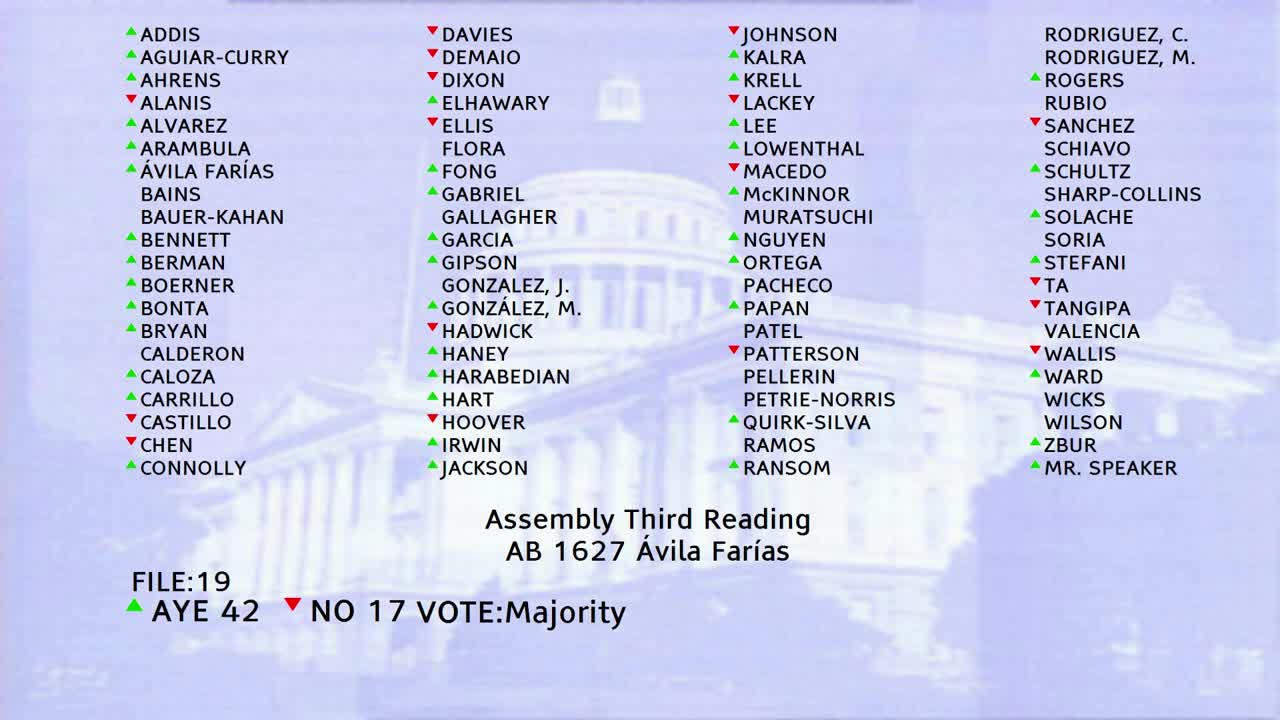 36SEC
Assembly Floor
 7MIN
Assembly Standing Committee on Local Government
Bill Author

Bill Co-Author(s):