AB 2232: Parole advancement hearings: reporting.
- Session Year: 2025-2026
- House: Assembly
- Latest Version Date: 2026-07-02
Current Status:
In Progress
(2026-08-13: In committee: Held under submission.)
Introduced
In Committee
Awaiting First Chamber Vote
Passed First Chamber
In Committee
Awaiting Second Chamber Vote
Passed Second Chamber
Enacted
Existing law, as amended by Proposition 9, the Victims Bill of Rights Act of 2008: Marsys Law, at the November 4, 2008, statewide general election, requires the Board of Parole Hearings, following a decision denying parole, to schedule the next hearing 3, 5, 7, 10, or 15 years from the date of the last hearing, as specified. Existing law also authorizes the board, in its discretion and after considering the views and interests of the victim, to advance a hearing to an earlier date, when a change in circumstances or new information establishes a reasonable likelihood that consideration of the public and victims safety does not require additional incarceration. Existing law authorizes an inmate to request that the board exercise its discretion to advance a hearing and provides the procedure for an inmate to make that request.
This bill would require the board, in coordination with the Department of Corrections and Rehabilitation, to collect and publish annual data regarding requests to advance parole consideration hearing dates and administrative review processes the boards review of those requests, as specified. The bill would require the board to submit the report to the Legislature by March 1, 2027, and annually thereafter. Following submission of the report to the Legislature, the bill would also require the board to make the report publicly available on its internet website on that date and annually thereafter.
This bill, for each request to advance a parole consideration hearing date, would require the board to maintain a written summary of the decision, including the basis for approval or denial and the primary factors considered. The bill would require the summaries to be made available to certain entities, including the incarcerated person or their counsel.
This bill would repeal these provisions as of January 1, 2032.
Existing law, as amended by Proposition 9, the Victims Bill of Rights Act of 2008: Marsys Law, at the November 4, 2008, statewide general election, requires the Board of Parole Hearings, following a decision denying parole, to schedule the next hearing 3, 5, 7, 10, or 15 years from the date of the last hearing, as specified. Existing law also authorizes the board, in its discretion and after considering the views and interests of the victim, to advance a hearing to an earlier date, when a change in circumstances or new information establishes a reasonable likelihood that consideration of the public and victims safety does not require additional incarceration. Existing law authorizes an inmate to request that the board exercise its discretion to advance a hearing and provides the procedure for an inmate to make that request.
This bill would remove the boards authority to advance a parole hearing to an earlier date and would remove the corresponding provisions authorizing an inmate to request an advancement of their hearing date.This bill would require the board, in coordination with the Department of Corrections and Rehabilitation, to collect and publish annual data regarding requests to advance parole consideration hearing dates and administrative review processes of those requests, as specified. The bill would require the board to submit the report to the Legislature by March 1, 2027, and annually thereafter. Following submission of the report to the Legislature, the bill would also require the board to make the report publicly available on its internet website on that date and annually thereafter.
This bill, for each request to advance a parole consideration hearing date, would require the board to maintain a written summary of the decision, including the basis for approval or denial and the primary factors considered. The bill would require the summaries to be made available to certain entities, including the incarcerated person or their counsel.
This bill would repeal these provisions as of January 1, 2032.
Existing law, as amended by Proposition 9, the Victims Bill of Rights Act of 2008: Marsys Law, at the November 4, 2008, statewide general election, requires the Board of Parole Hearings, following a decision denying parole, to schedule the next hearing 3, 5, 7, 10, or 15 years from the date of the last hearing, as specified. Existing law also authorizes the board, in its discretion and after considering the views and interests of the victim, to advance a hearing to an earlier date, when a change in circumstances or new information establishes a reasonable likelihood that consideration of the public and victims safety does not require additional incarceration. Existing law authorizes an inmate to request that the board exercise its discretion to advance a hearing and provides the procedure for an inmate to make that request.
This bill would remove the boards authority to advance a parole hearing to an earlier date and would remove the corresponding provisions authorizing an inmate to request an advancement of their hearing date.
(a)(1)The Board of Parole Hearings, in coordination with the Department of Corrections and Rehabilitation, shall collect and publish annual data regarding requests to advance parole consideration hearing dates pursuant to subdivision (d) of Section 3041.5 and administrative review processes the boards review of those requests.
(2)The board shall submit the report to the Legislature by March 1, 2027, and annually thereafter. Following the submission of the report to the Legislature, the board shall also make the report publicly available on its internet website on March 1, 2027, and annually thereafter.
(b)The report pursuant to subdivision (a) shall include, but not be limited to, all of the following:
(1)Volume and outcomes, including:
(A)Total number of requests to advance parole consideration hearing dates filed.
(B)Total number of requests to advance parole consideration hearing dates granted, denied, and pending.
(C)Percentage of requests to advance parole consideration hearing dates granted.
(D)Number of hearings advanced through administrative review by the board pursuant to paragraph (4) of subdivision (b) of Section 3041.5 versus the number of hearings advanced through requests pursuant to subdivision (d) of Section 3041.5.
(2)Timing and impact, including:
(A)Average duration of an incarcerated persons denial period for advancement of a parole consideration hearing date.
(B)Average time during an incarcerated persons denial period that a request to advance a parole consideration hearing date is granted, expressed in months or years into an incarcerated persons denial period.
(C)Frequency of repeat advancement requests.
(3)General criteria and factors relied upon in granting or denying advancement, including all of the following:
(A)Evidence of rehabilitation.
(B)Institutional behavior.
(C)Nature of psychological evaluations.
(D)Nature and severity of the offense.
(4)Rehabilitation metrics, including:
(A)Types of rehabilitative programming considered, including cognitive behavioral interventions.
(B)Completion rates of programming recommended by the board.
(C)Correlation, if any, between program completion and advancement decisions.
(D)The amount of time the incarcerated person waited to be admitted into these programs.
(5)Victim considerations, including:
(A)Whether victim notification was provided.
(B)Whether victim input was received and considered.
(C)General categories of victim concerns raised.
(D)Measures taken to ensure compliance with victim rights pursuant to Section 28 of Article I of the California Constitution (Marsys Law).
(6)Outcomes of hearings that are advanced, including:
(A)Grant rates for advanced hearings versus regularly scheduled hearings.
(B)Time to release following advancement of the hearing.
(C)Any available recidivism or return-to-custody data.
(c)(1)For each request to advance a parole consideration hearing date pursuant to subdivision (d) of Section 3041.5, the board shall maintain a written summary of the decision, including the basis for approval or denial and the primary factors considered.
(2)The summaries shall be made available to all of the following:
(A)The incarcerated person or their counsel.
(B)The victim or next of kin, upon request.
(C)The district attorneys office.
(d)A report to be submitted pursuant to subdivision (a) shall be submitted in compliance with Section 9795 of the Government Code.
(e)This section shall remain in effect until January 1, 2032, and is repealed as of that date.
(a)(1)The Board of Parole Hearings, in coordination with the Department of Corrections and Rehabilitation, shall collect and publish annual data regarding requests to advance parole consideration hearing dates pursuant to subdivision (d) of Section 3041.5 and administrative review processes of those requests.
(2)The board shall submit the report to the Legislature by March 1, 2027, and annually thereafter. Following the submission of the report to the Legislature, the board shall also make the report publicly available on its internet website on March 1, 2027, and annually thereafter.
(b)The report pursuant to subdivision (a) shall include, but not be limited to, all of the following:
(1)Volume and outcomes, including:
(A)Total number of requests to advance parole consideration hearing dates filed.
(B)Total number of requests to advance parole consideration hearing dates granted, denied, and pending.
(C)Percentage of requests to advance parole consideration hearing dates granted.
(D)Number of hearings advanced through administrative review by the board pursuant to paragraph (4) of subdivision (b) of Section 3041.5 versus the number of hearings advanced through requests pursuant to subdivision (d) of Section 3041.5.
(2)Timing and impact, including:
(A)Average duration of an incarcerated persons denial period for advancement of a parole consideration hearing date.
(B)Average time during an incarcerated persons denial period that a request to advance a parole consideration hearing date is granted, expressed in months or years into an incarcerated persons denial period.
(C)Frequency of repeat advancement requests.
(3)General criteria and factors relied upon in granting or denying advancement, including all of the following:
(A)Evidence of rehabilitation.
(B)Institutional behavior.
(C)Nature of psychological evaluations.
(D)Nature and severity of the offense.
(4)Rehabilitation metrics, including:
(A)Types of rehabilitative programming considered, including cognitive behavioral interventions.
(B)Completion rates of programming recommended by the board.
(C)Correlation, if any, between program completion and advancement decisions.
(D)The amount of time the incarcerated person waited to be admitted into these programs.
(5)Victim considerations, including:
(A)Whether victim notification was provided.
(B)Whether victim input was received and considered.
(C)General categories of victim concerns raised.
(D)Measures taken to ensure compliance with victim rights pursuant to Section 28 of Article I of the California Constitution (Marsys Law).
(6)Outcomes of hearings that are advanced, including:
(A)Grant rates for advanced hearings versus regularly scheduled hearings.
(B)Time to release following advancement of the hearing.
(C)Any available recidivism or return-to-custody data.
(c)(1)For each request to advance a parole consideration hearing date pursuant to subdivision (d) of Section 3041.5, the board shall maintain a written summary of the decision, including the basis for approval or denial and the primary factors considered.
(2)The summaries shall be made available to all of the following:
(A)The incarcerated person or their counsel.
(B)The victim or next of kin, upon request.
(C)The district attorneys office.
(d)A report to be submitted pursuant to subdivision (a) shall be submitted in compliance with Section 9795 of the Government Code.
(e)This section shall remain in effect until January 1, 2032, and is repealed as of that date.
SECTION 1.Section 3041.5 of the Penal Code is amended to read:3041.5.(a)At all hearings for the purpose of reviewing an inmates parole suitability, or the setting, postponing, or rescinding of parole, with the exception of en banc review of tie votes, the following shall apply:(1)At least 10 days before any hearing by the Board of Parole Hearings, the inmate shall be permitted to review the file which will be examined by the board and shall have the opportunity to enter a written response to any material contained in the file.(2)The inmate shall be permitted to be present, to ask and answer questions, and to speak on their own behalf. Neither the inmate nor the attorney for the inmate shall be entitled to ask questions of any person appearing at the hearing pursuant to subdivision (b) of Section 3043.(3)Unless legal counsel is required by some other law, a person designated by the Department of Corrections and Rehabilitation shall be present to ensure that all facts relevant to the decision be presented, including, if necessary, contradictory assertions as to matters of fact that have not been resolved by departmental or other procedures.(4)The inmate and any person described in subdivision (b) of Section 3043 shall be permitted to request and receive a stenographic record of all proceedings.(5)If the hearing is for the purpose of postponing or rescinding parole, the inmate shall have the rights set forth in paragraphs (3) and (4) of subdivision (c) of Section 2932.(6)The board shall set a date to reconsider whether an inmate should be released on parole that ensures a meaningful consideration of whether the inmate is suitable for release on parole.(b)(1)Within 10 days following any decision granting parole, the board shall send the inmate a written statement setting forth the reason or reasons for granting parole, the conditions the inmate shall meet in order to be released, and the consequences of failure to meet those conditions.(2)Within 20 days following any decision denying parole, the board shall send the inmate a written statement setting forth the reason or reasons for denying parole, and suggest activities in which the inmate might participate that will benefit them while they are incarcerated.(3)The board shall schedule the next hearing, after considering the views and interests of the victim, as follows:(A)Fifteen years after any hearing at which parole is denied, unless the board finds by clear and convincing evidence that the criteria relevant to the decision denying parole are such that consideration of the public and victims safety does not require a more lengthy period of incarceration for the inmate than 10 additional years.(B)Ten years after any hearing at which parole is denied, unless the board finds by clear and convincing evidence that the criteria relevant to the decision denying parole are such that consideration of the public and victims safety does not require a more lengthy period of incarceration for the inmate than seven additional years.(C)Three years, five years, or seven years after any hearing at which parole is denied, because the criteria relevant to the decision denying parole are such that consideration of the public and victims safety requires a more lengthy period of incarceration for the inmate, but does not require a more lengthy period of incarceration for the inmate than seven additional years.(4)Within 10 days of any board action resulting in the rescinding of parole, the board shall send the inmate a written statement setting forth the reason or reasons for that action, and shall schedule the inmates next hearing in accordance with paragraph (3).(c)The board shall conduct a parole hearing pursuant to this section as a de novo hearing. Findings made and conclusions reached in a prior parole hearing shall be considered in but shall not be deemed to be binding upon subsequent parole hearings for an inmate, but shall be subject to reconsideration based upon changed facts and circumstances. When conducting a hearing, the board shall admit the prior recorded or memorialized testimony or statement of a victim or witness, upon request of the victim or if the victim or witness has died or become unavailable. At each hearing the board shall determine the appropriate action to be taken based on the criteria set forth in paragraph (1) of subdivision (b) of Section 3041.SEC. 2.Section 3055 of the Penal Code is amended to read:3055.(a)The Elderly Parole Program is hereby established, to be administered by the Board of Parole Hearings, for purposes of reviewing the parole suitability of any inmate who is 50 years of age or older and has served a minimum of 20 years of continuous incarceration on the inmates current sentence, serving either a determinate or indeterminate sentence.(b)(1)For purposes of this code, the term elderly parole eligible date means the date on which an inmate who qualifies as an elderly offender is eligible for release from prison.(2)For purposes of this section, incarceration means detention in a city or county jail, local juvenile facility, a mental health facility, a Division of Juvenile Justice facility, or a Department of Corrections and Rehabilitation facility.(c)When considering the release of an inmate specified by subdivision (a) pursuant to Section 3041, the board shall give special consideration to whether age, time served, and diminished physical condition, if any, have reduced the elderly inmates risk for future violence.(d)When scheduling a parole consideration hearing date pursuant to subdivision (b) of Section 3041.5, the board shall consider whether the inmate meets or will meet the criteria specified in subdivision (a).(e)An individual who is subject to this section shall meet with the board pursuant to subdivision (a) of Section 3041. If an inmate is found suitable for parole under the Elderly Parole Program, the board shall release the individual on parole as provided in Section 3041.(f)If parole is not granted, the board shall set the time for a subsequent elderly parole hearing in accordance with paragraph (3) of subdivision (b) of Section 3041.5. No subsequent elderly parole hearing shall be necessary if the offender is released pursuant to other statutory provisions prior to the date of the subsequent hearing.(g)This section does not apply to cases in which sentencing occurs pursuant to Section 1170.12, subdivisions (b) to (i), inclusive, of Section 667, or in cases which an individual was sentenced to life in prison without the possibility of parole or death.(h)This section does not apply if the person was convicted of first-degree murder if the victim was a peace officer, as defined in Section 830.1, 830.2, 830.3, 830.31, 830.32, 830.33, 830.34, 830.35, 830.36, 830.37, 830.4, 830.5, 830.6, 830.10, 830.11, or 830.12, who was killed while engaged in the performance of their duties, and the individual knew, or reasonably should have known, that the victim was a peace officer engaged in the performance of their duties, or the victim was a peace officer or a former peace officer under any of the above-enumerated sections, and was intentionally killed in retaliation for the performance of their official duties.(i)This section does not alter the rights of victims at parole hearings.(j)By December 31, 2022, the board shall complete all elderly parole hearings for individuals who were sentenced to determinate or indeterminate terms and who, on the effective date of the bill that added this subdivision, are or will be entitled to have their parole suitability considered at an elderly parole hearing before January 1, 2023.(a)At all hearings for the purpose of reviewing an inmates parole suitability, or the setting, postponing, or rescinding of parole, with the exception of en banc review of tie votes, the following shall apply:
(1)At least 10 days before any hearing by the Board of Parole Hearings, the inmate shall be permitted to review the file which will be examined by the board and shall have the opportunity to enter a written response to any material contained in the file.
(2)The inmate shall be permitted to be present, to ask and answer questions, and to speak on his or her their own behalf. Neither the inmate nor the attorney for the inmate shall be entitled to ask questions of any person appearing at the hearing pursuant to subdivision (b) of Section 3043.
(3)Unless legal counsel is required by some other law, a person designated by the Department of Corrections and Rehabilitation shall be present to ensure that all facts relevant to the decision be presented, including, if necessary, contradictory assertions as to matters of fact that have not been resolved by departmental or other procedures.
(4)The inmate and any person described in subdivision (b) of Section 3043 shall be permitted to request and receive a stenographic record of all proceedings.
(5)If the hearing is for the purpose of postponing or rescinding parole, the inmate shall have the rights set forth in paragraphs (3) and (4) of subdivision (c) of Section 2932.
(6)The board shall set a date to reconsider whether an inmate should be released on parole that ensures a meaningful consideration of whether the inmate is suitable for release on parole.
(b)(1)Within 10 days following any decision granting parole, the board shall send the inmate a written statement setting forth the reason or reasons for granting parole, the conditions he or she must the inmate shall meet in order to be released, and the consequences of failure to meet those conditions.
(2)Within 20 days following any decision denying parole, the board shall send the inmate a written statement setting forth the reason or reasons for denying parole, and suggest activities in which he or she the inmate might participate that will benefit him or her them while he or she is they are incarcerated.
(3)The board shall schedule the next hearing, after considering the views and interests of the victim, as follows:
(A)Fifteen years after any hearing at which parole is denied, unless the board finds by clear and convincing evidence that the criteria relevant to the decision denying parole are such that consideration of the public and victims safety does not require a more lengthy period of incarceration for the inmate than 10 additional years.
(B)Ten years after any hearing at which parole is denied, unless the board finds by clear and convincing evidence that the criteria relevant to the decision denying parole are such that consideration of the public and victims safety does not require a more lengthy period of incarceration for the inmate than seven additional years.
(C)Three years, five years, or seven years after any hearing at which parole is denied, because the criteria relevant to the decision denying parole are such that consideration of the public and victims safety requires a more lengthy period of incarceration for the inmate, but does not require a more lengthy period of incarceration for the inmate than seven additional years.
(4)The board may in its discretion, after considering the views and interests of the victim, advance a hearing set pursuant to paragraph (3) to an earlier date, when a change in circumstances or new information establishes a reasonable likelihood that consideration of the public and victims safety does not require the additional period of incarceration of the inmate provided in paragraph (3).(5)(4)Within 10 days of any board action resulting in the rescinding of parole, the board shall send the inmate a written statement setting forth the reason or reasons for that action, and shall schedule the inmates next hearing in accordance with paragraph (3).
(c)The board shall conduct a parole hearing pursuant to this section as a de novo hearing. Findings made and conclusions reached in a prior parole hearing shall be considered in but shall not be deemed to be binding upon subsequent parole hearings for an inmate, but shall be subject to reconsideration based upon changed facts and circumstances. When conducting a hearing, the board shall admit the prior recorded or memorialized testimony or statement of a victim or witness, upon request of the victim or if the victim or witness has died or become unavailable. At each hearing the board shall determine the appropriate action to be taken based on the criteria set forth in paragraph (1) of subdivision (b) of Section 3041.
(d)(1)An inmate may request that the board exercise its discretion to advance a hearing set pursuant to paragraph (3) of subdivision (b) to an earlier date, by submitting a written request to the board, with notice, upon request, and a copy to the victim which shall set forth the change in circumstances or new information that establishes a reasonable likelihood that consideration of the public safety does not require the additional period of incarceration of the inmate.(2)The board shall have sole jurisdiction, after considering the views and interests of the victim to determine whether to grant or deny a written request made pursuant to paragraph (1), and its decision shall be subject to review by a court or magistrate only for a manifest abuse of discretion by the board. The board shall have the power to summarily deny a request that does not comply with this subdivision or that does not set forth a change in circumstances or new information as required in paragraph (1) that in the judgment of the board is sufficient to justify the action described in paragraph (4)of subdivision (b).(3)An inmate may make only one written request as provided in paragraph (1) during each three-year period. Following either a summary denial of a request made pursuant to paragraph (1), or the decision of the board after a hearing described in subdivision (a) to deny parole, the inmate shall not be entitled to submit another request for a hearing pursuant to subdivision (a) until a three-year period of time has elapsed from the summary denial or decision of the board.SEC. 2.Section 3055 of the Penal Code is amended to read:3055.(a)The Elderly Parole Program is hereby established, to be administered by the Board of Parole Hearings, for purposes of reviewing the parole suitability of any inmate who is 50 years of age or older and has served a minimum of 20 years of continuous incarceration on the inmates current sentence, serving either a determinate or indeterminate sentence.
(b)(1)For purposes of this code, the term elderly parole eligible date means the date on which an inmate who qualifies as an elderly offender is eligible for release from prison.
(2)For purposes of this section, incarceration means detention in a city or county jail, local juvenile facility, a mental health facility, a Division of Juvenile Justice facility, or a Department of Corrections and Rehabilitation facility.
(c)When considering the release of an inmate specified by subdivision (a) pursuant to Section 3041, the board shall give special consideration to whether age, time served, and diminished physical condition, if any, have reduced the elderly inmates risk for future violence.
(d)When scheduling a parole consideration hearing date pursuant to subdivision (b) of Section 3041.5 or when considering a request for an advance hearing pursuant to subdivision (d) of Section 3041.5, the board shall consider whether the inmate meets or will meet the criteria specified in subdivision (a).
(e)An individual who is subject to this section shall meet with the board pursuant to subdivision (a) of Section 3041. If an inmate is found suitable for parole under the Elderly Parole Program, the board shall release the individual on parole as provided in Section 3041.
(f)If parole is not granted, the board shall set the time for a subsequent elderly parole hearing in accordance with paragraph (3) of subdivision (b) of Section 3041.5. No subsequent elderly parole hearing shall be necessary if the offender is released pursuant to other statutory provisions prior to the date of the subsequent hearing.
(g)This section does not apply to cases in which sentencing occurs pursuant to Section 1170.12, subdivisions (b) to (i), inclusive, of Section 667, or in cases which an individual was sentenced to life in prison without the possibility of parole or death.
(h)This section does not apply if the person was convicted of first-degree murder if the victim was a peace officer, as defined in Section 830.1, 830.2, 830.3, 830.31, 830.32, 830.33, 830.34, 830.35, 830.36, 830.37, 830.4, 830.5, 830.6, 830.10, 830.11, or 830.12, who was killed while engaged in the performance of their duties, and the individual knew, or reasonably should have known, that the victim was a peace officer engaged in the performance of their duties, or the victim was a peace officer or a former peace officer under any of the above-enumerated sections, and was intentionally killed in retaliation for the performance of their official duties.
(i)This section does not alter the rights of victims at parole hearings.
(j)By December 31, 2022, the board shall complete all elderly parole hearings for individuals who were sentenced to determinate or indeterminate terms and who, on the effective date of the bill that added this subdivision, are or will be entitled to have their parole suitability considered at an elderly parole hearing before January 1, 2023.
|
Date
|
Status
|
|---|---|
| Aug 13, 2026 | In committee: Held under submission. |
| Aug 3, 2026 | In committee: Referred to APPR. suspense file. |
| Jul 2, 2026 | Read second time and amended. Re-referred to Com. on APPR. |
| Jul 1, 2026 | From committee: Amend, and do pass as amended and re-refer to Com. on APPR. (Ayes 6. Noes 0.) (June 30). |
| Jun 17, 2026 | In committee: Set, second hearing. Hearing canceled at the request of author. |
| Jun 9, 2026 | In committee: Set, first hearing. Hearing canceled at the request of author. |
| Jun 3, 2026 | Referred to Com. on PUB. S. |
| May 22, 2026 | In Senate. Read first time. To Com. on RLS. for assignment. |
| May 22, 2026 | Read third time. Passed. Ordered to the Senate. (Ayes 65. Noes 0. Page 5266.) |
| May 22, 2026 | Read third time. Passed. Ordered to the Senate. (Ayes 65. Noes 0.) |
| May 18, 2026 | Read second time. Ordered to third reading. |
| May 14, 2026 | From committee: Do pass. (Ayes 15. Noes 0.) (May 14). |
| May 14, 2026 | Joint Rule 62(a), file notice suspended. (Page 5030.) |
| May 14, 2026 | Joint Rule 62(a), file notice suspended. |
| May 13, 2026 | In committee: Set, first hearing. Referred to APPR. suspense file. |
| Apr 27, 2026 | Re-referred to Com. on APPR. |
| Apr 23, 2026 | Read second time and amended. |
| Apr 22, 2026 | From committee: Amend, and do pass as amended and re-refer to Com. on APPR. (Ayes 9. Noes 0.) (April 21). |
| Apr 14, 2026 | In committee: Set, second hearing. Hearing canceled at the request of author. |
| Apr 7, 2026 | In committee: Set, first hearing. Hearing canceled at the request of author. |
| Mar 9, 2026 | Referred to Com. on PUB. S. |
| Feb 20, 2026 | From printer. May be heard in committee March 22. |
| Feb 19, 2026 | Read first time. To print. |
|
Date
|
Description
|
Location
|
Votes
|
|
|---|---|---|---|---|
| Aug 3, 2026 | Placed on suspense file | Senate Standing Committee on Appropriations |
Passed |
|
| Jun 30, 2026 | Do pass as amended, but first amend, and re-refer to the Committee on [Appropriations] | Senate Standing Committee on Public Safety |
Passed |
|
| May 22, 2026 | AB 2232 Patterson Assembly Third Reading | Assembly Floor |
Passed |
|
| May 14, 2026 | Do pass. | Assembly Standing Committee on Appropriations |
Passed |
|
| Apr 21, 2026 | Do pass as amended and be re-referred to the Committee on [Appropriations] | Assembly Standing Committee on Public Safety |
Passed |
This list shows positions taken on this bill by organizations on the date displayed, which is linked to the original source.
Positions by individuals are not included.
|
Organization
|
Position
|
Date
|
|---|---|---|
| All of US or None (HQ) | ** Against | |
| A New PATH | ** Against | |
| A New Way of Life Re-Entry Project | ** Against | |
| Arcadia Police Officers' Association | ** Support | |
| Be the Solution (BTS) Commission | ** Support | |
| Brea Police Association | ** Support | |
| Burbank Police Officers' Association | ** Support | |
| California Association of School Police Chiefs | ** Support | |
| California Coalition for Women Prisoners | ** Against | |
| California Coalition of School Safety Professionals | ** Support | |
| California for Safety and Justice | ** Against | |
| California Narcotic Officers' Association | ** Support | |
| Californians United for a Responsible Budget | ** Against | |
| California Police Chiefs Association | ** Support | |
| California Public Defenders Association | ** Against | |
| California Reserve Peace Officers Association | ** Support | |
| California State Sheriffs' Association | ** Support | |
| California State Sheriffs’ Association | ** Support | |
| Care First California | ** Against | |
| Claremont Police Officers' Association | ** Support | |
| Communities United for Restorative Youth Justice (CURYJ) | ** Against | |
| Community Works West | ** Against | |
| Corona Police Officers' Association | ** Support | |
| Courage California | ** Against | |
| Culver City Police Officers' Association | ** Support | |
| Dee Hill Foundation INC | ** Against | |
| Dignity and Power Now | ** Against | |
| Ella Baker Center For Human Rights | ** Against | |
| Empowering Women Impacted by Incarceration | ** Against | |
| (EM)power + Resilience Project | ** Support | |
| Felony Murder Elimination Project | ** Against | |
| Friends Committee On Legislation Of California | ** Against | |
| Fullerton Police Officers' Association | ** Support | |
| Initiate Justice | ** Against | |
| Justice2jobs Coalition | ** Against | |
| LA Defensa | ** Against | |
| Legal Services for Prisoners with Children | ** Against | |
| Local 148 Los Angeles County Public Defender's Union | ** Against | |
| Los Angeles County District Attorney’s Office | ** Support | |
| Los Angeles School Police Management Association | ** Support | |
| los angeles school police officers association | ** Support | |
| Murrieta Police Officers' Association | ** Support | |
| Newport Beach Police Association | ** Support | |
| Palos Verdes Police Officers' Association | ** Support | |
| Placer County Deputy Sheriffs' Association | ** Support | |
| Placer County District Attorney's Office | ** Support | |
| Placer County District Attorney's Office (Sponsor) | ** Support | |
| Pomona Police Officers' Association | ** Support | |
| Prison Policy Initiative | ** Against | |
| Riverside County District Attorney | ** Support | |
| Riverside Police Officers' Association | ** Support | |
| Riverside Sheriffs' Association | ** Support | |
| Rubicon Programs | ** Against | |
| San Francisco Public Defender | ** Against | |
| San Quentin Skunkworks | ** Against | |
| Saving Lives in Custody California | ** Against | |
| Sister Warriors Freedom Coalition | ** Against | |
| Smart Justice California, a Project of Beyond Impact | ** Against | |
| The California Baptist Capitol Ministry | ** Support | |
| The W. Haywood Burns Institute | ** Against | |
| transitions clinic network | ** Against | |
| Uncommon Law | ** Against | |
| Universidad Popular | ** Against |
SENATE COMMITTEE ON
Senator Sabrina Cervantes, Chair
2025 - 2026 Regular Session
AB 2232 (Patterson) - Parole advancement hearings: reporting
Version: | Policy Vote: |
Urgency: | Mandate: |
Hearing Date: | Consultant: |
Bill Summary:
AB 2232 would require the Board of Parole Hearings (BPH) to publish an annual report on the advance parole consideration hearing date process. The provisions of the bill would sunset January 1, 2032.
Fiscal Impact:
To the extent that some of the data required by this bill may not be currently captured, the California Department of Corrections and Rehabilitation (CDCR) estimates annual cost pressures, likely in the low hundreds of thousands of dollars, to collect, analyze, and publish the required data specified. Costs would primarily be associated with staff workload and data collection activities. To the extent existing systems are insufficient to capture or report the required information, one-time information technology costs may be incurred to modify existing systems or develop new data tracking and reporting functionality. (General Fund)
Background:
Existing law entitles victims to be informed of all parole procedures, to participate in the parole process, to provide information to the parole authority to be considered before the parole of the offender, and to be notified, upon request, of the parole or other release of the offender.
When a person is denied parole at a parole hearing, the hearing panel will decide the denial length, that is, the amount of time until the person’s next parole hearing. The parole denial length is between 3 and 15 years. Once BPH has set the date of the person’s next parole hearing, the future hearing date can be advanced if (1) the incarcerated person can file a petition to advance their next hearing date or (2) BPH may advance the hearing on its own. Both processes allow for the hearing date to be advanced when there is a change in circumstance or new information establishes a reasonable likelihood that public safety does not require the person to remain incarcerated
Proposed Law:
This bill adds Penal Code Section 3069.6(b) which requires BPH, in coordination with CDCR, to collect and publish annual data regarding requests to advance parole consideration hearing dates and administrative review processes of those requests. BPH would be required to submit the report to the Legislature and make the report publicly available on its website on March 1, 2027, and annually thereafter.
This bill requires the report to include all of the following:
• Volume and outcomes, including:
• Timing and impact.
• General criteria and factors relied upon in granting or denying advancement
• Types of rehabilitative programming considered, including cognitive behavioral interventions.
• Victim considerations, including:
This bill requires BPH to maintain a written summary of the decision for each request to advance a parole consideration hearing date made by an incarcerated person. Specifies that the summary include the basis for approval or denial and the primary factors considered.
SENATE COMMITTEE ON PUBLIC SAFETY
Senator Jesse Arreguín, Chair
2025 - 2026 Regular
Bill No: AB 2232 Hearing Date: June 30, 2026
Author: | Patterson | ||
Version: | April 23, 2026 | ||
Urgency: | No | Fiscal: | Yes |
Consultant: | SJ | ||
Subject: Parole advancement hearings: reporting
HISTORY
Source: Placer County District Attorney
Prior Legislation: SB 81 (Skinner), vetoed, 2023
AB 89 (Sanchez), held in Senate Appropriations, 2023
SB 412 (Archuleta), Ch. 712, Stats. of 2023
SB 1341 (Hueso), not heard in Senate Public Safety, 2016
AB 487 (Gonzalez), vetoed, 2015
Support: (EM)power + Resilience Project; California State Sheriffs’ Association; Los Angeles County District Attorney’s Office; The California Baptist Capitol Ministry
Opposition: Initiate Justice
Assembly Floor Vote: 65 - 0
PURPOSE
The purpose of this bill is to require the Board of Parole Hearings (BPH) to maintain a written summary of all decisions to grant or deny requests to advance parole hearing dates and to collect and publish annual data regarding requests to advance parole hearing dates and administrative review processes of those requests.
Existing law entitles victims to be informed of all parole procedures, to participate in the parole process, to provide information to the parole authority to be considered before the parole of the offender, and to be notified, upon request, of the parole or other release of the offender. (Cal. Const., art. I, § 28, subd. (b)(15).)
Existing law requires the board to meet with each incarcerated person during the sixth year prior to the inmate’s minimum eligible parole date (MEPD) for the purposes of reviewing and documenting the incarcerated person’s activities and conduct pertinent to both parole eligibility. Requires that the board to provide the incarcerated person with information about the parole hearing process, legal factors relevant to their suitability or unsuitability for parole, and individualized recommendations for the person regarding their work assignments, rehabilitative programs, and institutional behavior during the consultation. (Pen. Code, § 3041, subd. (a)(1).)
Existing law requires a panel of two or more commissioners or deputy commissioners to meet with the incarcerated person that one year prior to the inmate’s MEPD. Provides that the panel shall normally grant parole. (Pen. Code, § 3041, subd. (a)(2).)
Existing law requires that an incarcerated person be released upon a grant of parole, subject to all applicable review periods. Prohibits the release of an incarcerated person who has not reached their MEPD unless the incarcerated person is eligible for earlier release pursuant to their youth offender parole eligibility date or elderly parole eligible date. (Pen. Code, § 3041, subd. (a)(4).)
Existing law requires the panel or board, sitting en banc, to grant parole to an incarcerated person unless it determines that the gravity of the current convicted offense or offenses, or the timing and gravity of current or past convicted offense or offenses, is such that consideration of the public safety requires a more lengthy period of incarceration for this individual. (Pen. Code, § 3041, subd. (b)(1).)
Existing law requires BPH to send the incarcerated person a written statement setting forth the reason or reasons for denying parole within 20 days following a parole denial. (Pen. Code, § 3041.5, subd. (b)(2).)
Existing law outlines the timing of an incarcerated person’s next parole hearing following a parole denial. (Pen. Code, § 3041.5, subd. (b)(3).)
Existing law authorizes the board in its discretion, after considering the views and interests of the victim, to advance a hearing to an earlier date, when a change in circumstances or new information establishes a reasonable likelihood that consideration of the public and victim’s safety does not require the additional period of incarceration. (Pen. Code, § 3041.5, subd. (b)(4).)
Existing law provides that an incarcerated individual may request that the board exercise its discretion to advance a hearing (following a parole denial) to an earlier date, by submitting a written request to the board, with notice, upon request, and a copy to the victim. Requires the request to set forth the change in circumstances or new information that establishes a reasonable likelihood that consideration of the public safety does not require the additional period of incarceration. (Pen. Code, § 3041.5, subd. (d)(1).)
This bill requires BPH, in coordination with the Department of Corrections and Rehabilitation (CDCR), to collect and publish annual data regarding requests to advance parole consideration hearing dates and administrative review processes of those requests.
This bill requires BPH to submit the report to the Legislature by March 1, 2027, and annually thereafter. Requires BPH to make the report publicly available on its website on March 1, 2027, and annually thereafter.
This bill requires the report to include all of the following:
- Volume and outcomes, including:
- Total number of requests to advance parole consideration hearing dates filed.
- Total number of requests to advance parole consideration hearing dates granted, denied, and pending.
- Percentage of requests to advance parole consideration hearing dates granted.
- Number of hearings advanced through administrative review by the board versus the number of hearings advanced through requests by incarcerated persons.
- Timing and impact, including:
- Average duration of an incarcerated person’s denial period for advancement of a parole consideration hearing date.
- Average time during an incarcerated person’s denial period that a request to advance a parole consideration hearing date is granted, expressed in months or years into an incarcerated person’s denial period.
- Frequency of repeat advancement requests.
- General criteria and factors relied upon in granting or denying advancement, including all of the following:
- Evidence of rehabilitation.
- Institutional behavior.
- Nature of psychological evaluations.
- Nature and severity of the offense.
- Rehabilitation metrics, including:
- Types of rehabilitative programming considered, including cognitive behavioral interventions.
- Completion rates of programming recommended by the board.
- Correlation, if any, between program completion and advancement decisions.
- The amount of time the incarcerated person waited to be admitted into these programs.
- Victim considerations, including:
- Whether victim notification was provided.
- Whether victim input was received and considered.
- General categories of victim concerns raised.
- Measures taken to ensure compliance with victim rights pursuant to Section 28 of Article I of the California Constitution (Marsy’s Law).
- Outcomes of hearings that are advanced, including:
- Grant rates for advanced hearings versus regularly scheduled hearings.
- Time to release following advancement of the hearing.
- Any available recidivism or return-to-custody data.
This bill requires BPH to maintain a written summary of the decision for each request to advance a parole consideration hearing date made by an incarcerated person. Specifies that the summary include the basis for approval or denial and the primary factors considered.
This bill requires that the summaries be made available to all of the following: the incarcerated person or their counsel; the victim or next of kin, upon request; and the district attorney’s office.
This bill includes a sunset provision that the bill is repealed on January 1, 2032.
COMMENTS
- Need For This Bill
According to the author:
There should be transparency and accountability in the parole process. While individuals may request that their parole consideration hearing be advanced, there is currently limited information available regarding how often these requests are granted or denied and the factors that drive those decisions. This bill increases transparency by requiring the Board of Parole Hearings to document and report on requests to advance parole hearings, providing policymakers, victims, families, and the public with greater insight into how these decisions are made. Greater transparency promotes confidence in the parole system and helps ensure consistency and accountability in its administration.
- Parole Suitability
Incarcerated individuals who are indeterminately sentenced must be granted parole by the BPH in order to be released from prison. The Penal Code provides that the parole board “shall grant parole to an inmate unless it determines that the gravity of the current convicted offense or offenses, or the timing and gravity of current or past convicted offense or offenses, is such that consideration of the public safety requires a more lengthy period of incarceration for this individual.” (Pen. Code, § 3041, subd. (b).) The fundamental consideration when making a determination about an individual’s suitability for parole is whether the individual currently poses an unreasonable risk of danger to society if released from prison. (In re Shaputis (2008) 44 Cal.4th 1241.) The decision whether to grant parole is an inherently subjective determination. (In re Rosenkrantz (2002) 29 Cal.4th 616, 655.)
- Advancement of Parole Hearings
When a person is denied parole at a parole hearing, the hearing panel will decide the denial length (i.e., the amount of time until the person’s next parole hearing). The parole denial length is between 3 and 15 years. (Pen. Code, § 3041.5, subd. (b)(3).) Once BPH has set the date of the person’s next parole hearing, the future hearing date can be advanced one of two ways: the incarcerated person can file a petition to advance their next hearing date or BPH may advance the hearing on its own. (Pen. Code, § 3041.5, subds. (b)(4), (d)(1).) Both processes allow for the hearing date to be advanced when there is a change in circumstance or new information establishes a reasonable likelihood that public safety does not require the person to remain incarcerated. (Ibid.)
Petition to advance
An incarcerated person may submit a petition to advance their next hearing to BPH. (Pen. Code, § 3041.5, subd. (d)(1).) The petition to advance may be filed at any time after their first parole hearing, even if the person stipulated to being unsuitable for parole at that hearing. (Cal. Code Regs., tit. 15, § 2150.) A petition to advance a parole hearing may only be submitted once every three years from the date of the Board’s decision approving or denying their last petition. (Pen. Code, § 3041.5, subd. (d)(3).) A person may not submit a petition to move up the date of their initial parole hearing; the timing of a person’s first parole hearing is generally determined by statute. In the petition, the incarcerated person must describe a change in circumstances or new information establishing there is a reasonable likelihood that public safety does not require them to serve more time in prison. (Pen. Code, § 3041.5, subd. (d)(1).)
Administrative review
After considering the views and interests of the victim and their family members, BPH may advance an incarcerated person’s next parole hearing date if the Board finds there has been a change in circumstances or new information establishing a reasonable likelihood that public safety does not require the person to serve more time in prison. (Pen. Code, § 3041.5, subds. (b)(4).) BPH may review an incarcerated person’s circumstances at any time to determine if there is a reasonable likelihood they are suitable for parole. (In re Vicks (2013) 56 Cal.4th 274.) The Board uses the “administrative review” process to identify incarcerated persons who have a good possibility of being found suitable for parole and review their cases to determine if the Board should advance their next hearing date.
To determine if a hearing should be advanced, the Board conducts an administrative review of all incarcerated persons denied parole for a period of three years who have a low or moderate overall risk rating on their most recent comprehensive risk assessment. (Cal. Code Regs., tit. 15, §§ 2153-2154.) This review happens 11 months after the person’s parole hearing. (Ibid.) The Board initially screens each case to see if the case meets the criteria for a full review—a “review on the merits.” If any of the following apply, the case will be screened out and the Board will not conduct a full review:
- The incarcerated person stipulated to unsuitability at their last parole hearing;
- The person’s last parole hearing resulted in a denial of more than three years;
- The person’s overall risk rating was high on their most recent comprehensive risk assessment;
- The person or their attorney submitted a petition to advance since their last parole hearing, which was either approved or denied (i.e., “reviewed on the merits”);
- The person was found guilty of a specified serious rule violation since their last parole hearing; The person was convicted of a new crime since their last parole hearing; or
- The person’s next hearing date has already been advanced since their last parole hearing. (Cal. Code Regs., tit. 15, § 2154.)
If none of the above apply, the Board will conduct a full review of the case and decide whether to move up the person’s next parole hearing date.
In addition to the process outlined above, BPH may initiate an administrative review—referred to as an “ad hoc administrative review”—of an incarcerated person at any time to determine whether to advance the date of the person’s next parole hearing. (Cal. Code Regs., tit. 15, § 2152.) When the Board initiates an ad hoc administrative review, it conducts a “review on the merits.” (Cal. Code Regs., tit. 15, § 2156.) An ad hoc administrative review is most often initiated to address unique or unexpected changes in circumstances or new information when the case is not eligible for review under a petition to advance or the administrative review process for three-year denials. The Board may conduct ad hoc reviews for individuals who were denied parole for more than three years. (Cal. Code Regs., tit. 15, § 2152.)
Review and the decision
When deciding whether to move up an incarcerated person’s next parole hearing date, a deputy commissioner will conduct a “review on the merits.” During a review on the merits, a deputy commissioner reviews any statements received from the victim or victim’s family member, and in the case of a petition to advance, information in the petition. (Cal. Code Regs., tit. 15, § 2156.) The deputy commissioner also reviews the incarcerated person’s institutional records, documents previously submitted to the Board, and the decision from the person’s last parole hearing. (Ibid.) The deputy commissioner then determines whether there has been a change in circumstances or new information establishing a reasonable likelihood that consideration of public safety does not require the person serve more time in prison. (Ibid.) If so, the person’s next parole hearing date will be advanced. (Ibid.) If the deputy commissioner determines there has not been a change in circumstances or new information meeting the standard, the person’s next parole hearing will not be advanced. (Ibid.)
The Board sends notice of its decision to the incarcerated person and any victim and victim’s family member who received notice of the review. (Cal. Code Regs., tit. 15, § 2156.) If the incarcerated person disagrees with the decision, they may request that the decision be reviewed. (Ibid.) The request must be in writing and submitted within 30 calendar days of the person being served with the decision. (Ibid.) The request for review of the decision must include a description of why the person believes the decision was not correct and may include additional information that was not available at the time the decision was made. (Cal. Code Regs., tit. 15, § 2157.) The Board must complete its review of the decision within 15 business days of receiving the request. (Ibid.) If the review resulted in a previous decision being overturned or modified, the Board must also notify any registered victim and victim’s family members within five business days. (Ibid.)
In addition to the outcomes described above, the deputy commissioner can reduce the length of the denial the person received at their last hearing. (Cal. Code Regs., tit. 15, § 2156, subd. (g).)
- Effect of This Bill
This bill creates new data collections requirements related to the parole hearing advancement process. Specifically, this bill requires BPH to collect and publish data annually regarding requests to advance parole consideration hearing dates and the administrative review processes of those requests. This provision may need a clarifying amendment. The petition to advance a hearing (which is initiated by an incarcerated person) and BPH’s administrative review are two separate mechanisms that can advance a parole hearing date. If the intent of this provision is to require the reporting of information relating to both processes, then the author may wish to consider clarifying that. If the intent is to only apply data collection and reporting to the requests to advance a parole hearing date via Penal Code section 3041.5, subdivision (d), then the author may wish to amend the bill to replace the phrase “administrative review processes of those requests” with “the board’s review of those requests.”
Among the data that would be included in the annual report are:
- Total number of requests to advance parole consideration hearing dates filed.
- Total number of requests to advance parole consideration hearing dates granted, denied, and pending.
- Percentage of requests to advance parole consideration hearing dates granted.
- Number of hearings advanced through administrative review by the board versus the number of hearings advanced through requests by incarcerated persons.
- Average duration of an incarcerated person’s denial period for advancement of a parole consideration hearing date.
- General criteria and factors relied upon in granting or denying advancement, including all of the following, such as evidence of rehabilitation, institutional behavior, and nature of psychological evaluations, among others.
- Types of rehabilitative programming considered, including cognitive behavioral interventions.
- Victim considerations, including whether victim input was received and considered.
- Outcomes of hearings that are advanced, including grant rates for advanced hearings versus regularly scheduled hearings.
This bill additionally requires BPH to maintain a written summary of the decision for each request to advance a parole consideration hearing date made by an incarcerated person which must include the basis for the approval or denial and the main factors considered. The summaries are must be made available to the incarcerated person or their counsel, the victim or next of kin, upon request, and the district attorney’s office. Finally this bill contains a sunset date of January 1, 2032.
- Argument in Support
The California State Sheriffs’ Association writes:
[AB] 2232 … would require the Board of Parole Hearings (BPH) to collect and publish annual data regarding requests to advance parole consideration hearing dates.
Existing law authorizes BPH, in its discretion and after considering the views and interests of the victim, to advance a parole hearing to an earlier date, when a change in circumstances or new information establishes a reasonable likelihood that consideration of the public and victim’s safety does not require additional incarceration.
Flaws in existing law, such as the authority to grant early parole hearings, have undermined the integrity of parole denials by weakening their intended purpose and creating instability in the justice process. When a parole board determines that an individual should not be reconsidered for several years, that decision is meant to provide certainty, accountability, and a period of relief for victims’ families. This bill will provide meaningful data regarding requests to advance parole consideration hearing dates, thereby enhancing public protection and transparency.
-- END --
ASSEMBLY THIRD READING
ATR Bill Id:AB 2232
Author:(Patterson)
As Amended Ver:April 23, 2026
Majority vote
SUMMARY
Requires the Board of Parole Hearings (BPH) to publish an annual report on the advance parole consideration hearing process.
Major Provisions
- Requires Board of Parole Hearings, in coordination with the Department of Corrections and Rehabilitation, shall collect and publish annual data regarding requests to advance parole consideration hearing dates pursuant to subdivision (d) of Section 3041.5 and administrative review processes of those requests.
- The board shall submit the report to the Legislature by March 1, 2027 and annually thereafter. The board shall make the report publicly available on its internet website no later than March 1, 2027 of each year following the submission of the report to the Legislature.
- The report shall include, but not be limited to, all of the following:
- Volume and outcomes, including:
- Total number of requests to advance parole consideration hearing dates filed.
- Total number of requests to advance parole consideration hearing dates granted, denied, and pending.
- Percentage of requests to advance parole consideration hearing dates granted.
- Number of hearings advanced through administrative review by the board, as specified, versus number of hearings advanced through requests, as specified.
- Timing and impact, including:
- Average duration of an incarcerated person′s denial period for advance of a parole consideration hearing date.
- Average time during an incarcerated person′s denial period that a request to advance a parole consideration hearing date is granted, expressed in months or years into an incarcerated person′s denial period.
- Frequency of repeat advancement requests.
- General criteria and factors relied upon in granting or denying advancement, including all of the following:
- Evidence of rehabilitation.
- Institutional behavior.
- Nature of psychological evaluations.
- Nature and severity of the offense.
- Rehabilitation metrics, including:
- Types of rehabilitative programming considered, including cognitive behavioral interventions.
- Completion rates of programming recommended by the board.
- Correlation, if any, between program completion and advancement decisions.
- The amount of time the incarcerated person waited to be admitted into these programs.
- Victim considerations, including:
- Whether victim notification was provided.
- Whether victim input was received and considered.
- General categories of victim concerns raised.
- Measures taken to ensure compliance with victim rights pursuant to Section 28 of Article I of the California Constitution (Marsy′s Law), including consideration of victim safety and consideration of emotional psychological impact.
- Outcomes of hearings that are advanced, including:
- Grant rates for advanced hearings versus regularly scheduled hearings.
- Time to release following advancement of the hearing.
- Any available recidivism or return-to-custody data.
- Volume and outcomes, including:
- For each request to advance a parole consideration hearing date pursuant to subdivision (d) of Section 3041.5, the board shall maintain a written summary of the decision, including the basis for approval or denial and the primary factors considered.
- The summaries shall be made available to all of the following:
- The incarcerated person or their counsel.
- The victim or next of kin, upon request.
- The district attorney′s office.
- This section shall remain in effect until January 1, 2032, and is repealed as of that date.
COMMENTS
Effect of this Bill: BPH is required to hold a hearing on a person′s suitability for parole one year before the person′s minimum eligible parole date to determine if the person should be released from prison. (Penal Code, Section 3041, subd. (a)(2).) Existing law requires BPH to grant parole unless it determines that the gravity of the current convicted offense or offenses, or the timing and gravity of the current or past convicted offense or offenses, is such that consideration of public safety requires a more lengthy period of incarceration for this individual. (Penal Code, Section 3041, subd. (b)(1).) BPH can consider all relevant, reliable information available. (15 California Code of Regulations, title 15, Section 2281, subdivision. (b).) Factors showing unsuitability include, among others, whether the person abused their victim during the offense or the offense was exceptionally cruel or callous; and, whether the person has an unstable social history, committed a sadistic sexual offense, demonstrates a lack of remorse, or has engaged in serious misconduct while incarcerated. (15 California Code of Regulations, title 15, Section 2281, subdivision (c).) However, regardless of the length of time served, a person must be found unsuitable for and denied parole if BPH determines that the person poses an unreasonable risk of danger to society if released from prison. (California Code of Regulations, title 15, Section 2281, subdivision (a).)If BPH denies parole, then it must schedule the next parole hearing, after considering the views and interests of the victim, 15 years after the hearing at which parole was denied, unless BPH finds by clear and convincing evidence that the criteria relevant to the decision denying parole are such that consideration of the public and victim′s safety does not require a more lengthy period of incarceration for the inmate than 10 additional years; 10 years after any hearing at which parole is denied, unless the board finds by clear and convincing evidence that the criteria relevant to the decision denying parole are such that consideration of the public and victim′s safety does not require a more lengthy period of incarceration for the inmate than seven additional years; or three years, five years, or seven years after any hearing at which parole is denied, because the criteria relevant to the decision denying parole are such that consideration of the public and victim′s safety requires a more lengthy period of incarceration for the inmate, but does not require a more lengthy period of incarceration for the inmate than seven additional years. (Penal Code, Section 3041.5, subdivision (b)(3)(A)-(C).)If a parole consideration hearing results in a denial period of three years, BPH must initiate an administrative review 11 months later to determine whether to advance the date of the inmate′s next parole consideration hearing, as specified, unless the incarcerated person was determinately sentenced and is within 24 months of being released as a result of their Earliest Possible Release Date. (California Code of Regulations, title 15, Section 2153.)Notwithstanding a denial of parole, BPH has the discretion, after considering the views and interests of the victim, to advance a parole hearing to an earlier date when a change in circumstances or new information establishes a reasonable likelihood that consideration of the public and victim′s safety does not require the additional period of incarceration. (Penal Code, Section 3041.5, subdivision (b)(4).) Even if BPH does not exercise this discretion, an incarcerated person may request an advance hearing date by submitting a written request to BPH, with notice, upon request, and a copy to the victim, setting forth the change in circumstances or new information that establishes a reasonable likelihood that consideration of the public safety does not require the additional period of incarceration of the inmate. (Penal Code, Section 3041.5, subdivision (d)(1). After considering the views and interests of the victim, BPH decides whether to grant or deny a request for an advance hearing date, a decision that is subject to review by a court or magistrate only for a manifest abuse of discretion. (Penal Code, Section 3041.5, subdivision (d)(2).) BPH may summarily deny a request that does not comply with specific requirements or that does not set forth a change in circumstances or new information sufficient to justify granting an advance hearing date. (Penal Code, Section 3041.5, subdivision. (d)(2).) An incarcerated person may make only one written request for an advance hearing date every three years. (Penal Code, Section 3041.5, subdivision (d)(3).)Provides that, to file a written petition to advance the date of the inmate′s next parole consideration hearing, the incarcerated person or their attorney of record must send BPH a completed Petition to Advance Hearing Date Form or a written request that includes the following the incarcerated person′s name; their CDCR number; the institution at which the incarcerated person is housed; a statement of the change in circumstances or new information since the date of the incarcerated person′s most recent hearing resulting in a denial or stipulation of unsuitability; how the change in circumstances or new information establishes a reasonable likelihood that consideration of the public safety does not require that the inmate remain incarcerated until the date of his or her next parole consideration hearing; and the incarcerated person′s signature and date of signature. (California Code Regulations, title 15, Section2150, subdivision (b).) BPH, within 10 business days of receiving an advance hearing petition, must review the petition to determine whether the board has jurisdiction to advance the date of the inmate′s next parole consideration hearing. (California Code Regulation, title 15, Section 2151, subdivision (a). BPH has jurisdiction to advance the date of the incarcerated person′s next parole consideration hearing if all of the following are true: the incarcerated person′s last parole consideration hearing resulted in a denial of parole or a stipulation of unsuitability, and the incarcerated person has not submitted a petition to advance a parole consideration hearing date that was reviewed on the merits within the past three years. (California Code of Regulations, title 15, Section 2151, subdivisions (b)(1) & (2).) This bill would require BPH to publish an annual report on the advance parole consideration hearing process. The bill would require BPH to report, among other things, on the number of requests for advance parole consideration hearings and the of those requests, and whether the advance hearing process was initiated by BPH or by an incarcerated person′s petition. It would also have to include information on the criteria BPH relied on when making a determination on whether to advance a parole consideration hearing, and what rehabilitation metrics were used to evaluate the incarcerated person′s suitability for parole. Further, it would have to provide information related to victim notification and whether the victim submitted input on the suitability of the incarcerated person. The outcomes of the advanced parole considerations hearing must also be reported.
According to the Author
″Victims deserve stability and predictability in the parole process. Under current law, parole hearings can be repeatedly advanced after a denial, forcing victims and their families to relive traumatic events sooner than expected. [This bill] reinforces the timelines approved by voters, prevents repeated attempts to circumvent parole denials, and strengthens confidence in the parole system for victims, families, and the public.″
Arguments in Support
According to the Placer County District Attorney′s Office, the bill′s sponsor, ″Under current law, inmates may administratively advance their parole suitability hearings--even after the Board of Parole Hearings has conducted a full evidentiary hearing and issued a denial with a specified deferral period. The current system undermines the decisions of the Board Commissioners, disrupts the intended structure of parole review, and imposes unnecessary and repeated trauma on victims and their families. Penal Code Section 3041.5 (d) expressly conditions the Board′s discretion to advance a parole hearing after consideration of the views and interests of the victim, yet this statutory safeguard is not consistently applied within the current administrative review process. ″Parole hearings are not perfunctory proceedings. They are comprehensive, hours-long evaluations in which the Board carefully weighs the totality of the record, including the severity of the offense, the inmate′s insight and accountability, institutional conduct, rehabilitation efforts, a comprehensive psychological and risk analysis, and the enduring impact on victims. These hearings also provide a critical opportunity for victims and their families to prepare statements, relive the facts of the crime, and advocate for their continued safety. When the Board denies parole and sets a deferral period, that decision often reflects a deliberate and informed judgment as to when the matter should be revisited. ″The current administrative advancement mechanism disregards that judgment in many cases. This not only diminishes the meaning of a parole board denial in certain cases, but it also erodes confidence in the system′s consistency and clarity – for both the inmate and the victims. While we respect statutory opportunity for advancement, the current administrative review process has removed a standard of discretion that existed during Marsy law negotiations. ″Further, a parole denial is intended to require the individual to reflect and address the specific deficiencies identified by the Board during a defined deferral period. Permitting some inmates to move their hearings forward through administrative means bypasses the intended decision and weakens the rehabilitative goal behind denying the hearing. This legal loophole gives false hope to the inmate by permitting the individuals to bypass the Board′s directive rather than comply with it. ″More importantly, it places an extraordinary and unnecessary burden on victims. Our office has witnessed firsthand the profound emotional toll this process exacts. In one case, the Vanderschoot family, whose daughter was murdered by her boyfriend Daniel Bezemer, endured a full parole hearing in 2023, resulting in a five-year denial. They began the difficult process of healing, relying on the certainty that they would not have to revisit the trauma for several years. Just two years later—days before Christmas—they would be required to prepare once again for a parole hearing. Although parole was denied once again because the inmate hadn′t done the work requested in the 2023 parole hearing, the harm to the family had already been done. ″The current administrative standards do not promote rehabilitation. They do not serve justice. It is unjust to those involved in the parole hearings, including the parole board commissioners, the prosecution, and the victims and their families. ″[This bill] addresses this issue by seeking to establish clearer standards and limitations on the administrative advancement of parole hearings following a denial. These changes ensure that the Board′s decision are honored, the parole process remains consistent and credible, and victims are not subjected to unnecessary and repeated trauma.″
Arguments in Opposition
According to Uncommon Law, ″[T]he Administrative Review and Petition to Advance] procedures give the Board discretion to advance a parole candidate′s subsequent hearing date if the Board determines, after considering the views and interests of the victim, that new information or changed circumstances demonstrate further incarceration may not be necessary for public safety. Eliminating these two procedures would likely violate state and federal constitutional prohibitions on ex post facto laws, and likely expose the government to legal challenges for due process violations. Moreover, [this bill] would undermine rehabilitation and public safety by preventing the Board from making informed decisions and removing an important incentive for incarcerated people to sustain rehabilitative efforts after parole denials.
FISCAL COMMENTS
According to the Assembly Appropriations Committee, ″Ongoing cost pressures (General Fund), likely in the low hundreds of thousands of dollars to the California Department of Corrections and Rehabilitation (CDCR) for data collection, written decision summaries for each advancement request, and annual report production through fiscal year 2031-32 for data not currently captured. To the extent existing systems are insufficient to capture or report the required information, CDCR anticipates incurring one-time information technology costs to modify existing systems or develop new data tracking and reporting functionality.″
VOTES
ASM PUBLIC SAFETY: 9-0-0
YES: Schultz, Alanis, Mark González, Haney, Harabedian, Lackey, Nguyen, Ramos, Sharp-Collins
ASM APPROPRIATIONS: 15-0-0
YES: Wicks, Hoover, Aguiar-Curry, Calderon, Caloza, Dixon, Fong, Mark González, Krell, Pacheco, Pellerin, Sharp-Collins, Solache, Ta, Tangipa
UPDATED
VERSION: April 23, 2026
CONSULTANT: Andrew Ironside / PUB. S. / (916) 319-3744 FN: 0002860
Date of Hearing: May 13, 2026
ASSEMBLY COMMITTEE ON APPROPRIATIONS
Buffy Wicks, Chair
ABPCA Bill Id:AB 2232
Author:(Patterson) – As Amended Ver:April 23, 2026
Policy Committee: | Public Safety | Vote: | 9 - 0 |
|
| ||
|
|
Urgency: No State Mandated Local Program: No Reimbursable: No
SUMMARY:
This bill requires the Board of Parole Hearings (BPH) to publish an annual report on the advance-parole consideration hearing process.
Specifically, this bill:
- Requires BPH, in coordination with the Department of Corrections and Rehabilitation (CDCR), to collect and publish annual data regarding requests to advance-parole consideration hearing dates.
- Requires BPH to submit a report to the Legislature by March 1, 2027 and annually thereafter, and make the report publicly available on its internet website.
- Requires BPH, for each request to advance a parole consideration hearing date, to maintain a written summary of the decision — made available to the incarcerated person, the victim, and the district attorney’s office — including the basis for approval or denial and the primary factors considered.
- Sunsets on January 1, 2032.
FISCAL EFFECT:
Ongoing cost pressures (General Fund), likely in the low hundreds of thousands of dollars to the California Department of Corrections and Rehabilitation (CDCR) for data collection, written decision summaries for each advancement request, and annual report production through fiscal year 2031-32 for data not currently captured. To the extent existing systems are insufficient to capture or report the required information, CDCR anticipates incurring one-time information technology costs to modify existing systems or develop new data tracking and reporting functionality.
COMMENTS:
- Purpose. According to the author:
Victims deserve stability and predictability in the parole process. Under current law, parole hearings can be repeatedly advanced after a denial, forcing victims and their families to relive traumatic events sooner than expected. AB 2232 reinforces the timelines approved by voters, prevents repeated attempts to circumvent parole denials, and strengthens confidence in the parole system for victims, families, and the public.
- Background. BPH was created in 2005, succeeding the Board of Prison Terms, and is the state agency responsible for determining parole suitability and setting release dates for individuals found suitable for release. BPH holds a parole suitability hearing one year before a person’s minimum eligible parole date and must grant parole unless public safety requires further incarceration. When parole is denied, Marsy’s Law (Proposition 9, 2008) requires the next hearing to be scheduled three, five, seven, 10, or 15 years out, with a default of 15 years and a presumption against shorter periods. Marsy’s Law also authorized BPH to advance a hearing — on its own motion or by an incarcerated person’s petition — when changed circumstances or new information establish a reasonable likelihood that public and victim safety do not require the additional period of incarceration. BPH currently conducts administrative reviews of certain three-year denials and accepts petitions to advance once every three years. This bill requires BPH to publish an annual report on the advance parole consideration hearing process, including the volume and outcomes of advancement requests, whether advancement was initiated by BPH or by petition, the criteria relied on, rehabilitation metrics, victim notification and input, and outcomes of advanced hearings. It also requires BPH to maintain written summaries of each advancement decision and make them available to the incarcerated person, the victim or next of kin, and the district attorney.
Analysis Prepared by: Shiran Zohar / APPR. / (916) 319-2081
Date of Hearing:
Chief Counsel: Andrew Ironside
ASSEMBLY COMMITTEE ON
Nick Schultz, Chair
ABPCA Bill Id:
Author:() – As Ver:
As Proposed to be Amended in Committee
SUMMARY:
Requires the Board of Parole Hearings (BPH) to publish an annual report on the advance parole consideration hearing process. Specifically, this bill:
- Requires Board of Parole Hearings, in coordination with the Department of Corrections and Rehabilitation, shall collect and publish annual data regarding requests to advance parole consideration hearing dates pursuant to subdivision (d) of Section 3041.5 and administrative review processes of those requests.
- The board shall submit the report to the Legislature by March 1, 2027 and annually thereafter. The board shall make the report publicly available on its internet website no later than March 1, 2027 of each year following the submission of the report to the Legislature.
- The report shall include, but not be limited to, all of the following:
- Volume and outcomes, including:
- Total number of requests to advance parole consideration hearing dates filed.
- Total number of requests to advance parole consideration hearing dates granted, denied, and pending.
- Percentage of requests to advance parole consideration hearing dates granted.
- Number of hearings advanced through administrative review by the board, as specified, versus number of hearings advanced through requests, as specified.
- Total number of requests to advance parole consideration hearing dates filed.
- Timing and impact, including:
- Average duration of an incarcerated person’s denial period for advance of a parole consideration hearing date.
- Average time during an incarcerated person’s denial period that a request to advance a parole consideration hearing date is granted, expressed in months or years into an incarcerated person’s denial period.
- Frequency of repeat advancement requests.
- Average duration of an incarcerated person’s denial period for advance of a parole consideration hearing date.
- General criteria and factors relied upon in granting or denying advancement, including all of the following:
- Evidence of rehabilitation.
- Institutional behavior.
- Nature of psychological evaluations.
- Nature and severity of the offense.
- Evidence of rehabilitation.
- Rehabilitation metrics, including:
- Types of rehabilitative programming considered, including cognitive behavioral interventions.
- Completion rates of programming recommended by the board.
- Correlation, if any, between program completion and advancement decisions.
- The amount of time the incarcerated person waited to be admitted into these programs.
- Types of rehabilitative programming considered, including cognitive behavioral interventions.
- Victim considerations, including:
- Whether victim notification was provided.
- Whether victim input was received and considered.
- General categories of victim concerns raised.
- Measures taken to ensure compliance with victim rights pursuant to Section 28 of Article I of the California Constitution (Marsy’s Law), including consideration of victim safety and consideration of emotional psychological impact.
- Whether victim notification was provided.
- Outcomes of hearings that are advanced, including:
- Grant rates for advanced hearings versus regularly scheduled hearings.
- Time to release following advancement of the hearing.
- Any available recidivism or return-to-custody data.
- Grant rates for advanced hearings versus regularly scheduled hearings.
- Volume and outcomes, including:
- For each request to advance a parole consideration hearing date pursuant to subdivision (d) of Section 3041.5, the board shall maintain a written summary of the decision, including the basis for approval or denial and the primary factors considered.
- The summaries shall be made available to all of the following:
- The incarcerated person or their counsel.
- The victim or next of kin, upon request.
- The district attorney’s office.
- The incarcerated person or their counsel.
- This section shall remain in effect until January 1, 2032, and is repealed as of that date.
EXISTING LAW:
- Requires BPH to schedule the next hearing, after considering the views and interests of the victim, as follows:
- Fifteen years after any hearing at which parole is denied, unless the board finds by clear and convincing evidence that the criteria relevant to the decision denying parole are such that consideration of the public and victim’s safety does not require a more lengthy period of incarceration for the inmate than 10 additional years.
- Ten years after any hearing at which parole is denied, unless the board finds by clear and convincing evidence that the criteria relevant to the decision denying parole are such that consideration of the public and victim’s safety does not require a more lengthy period of incarceration for the inmate than seven additional years.
- Three years, five years, or seven years after any hearing at which parole is denied, because the criteria relevant to the decision denying parole are such that consideration of the public and victim’s safety requires a more lengthy period of incarceration for the inmate, but does not require a more lengthy period of incarceration for the inmate than seven additional years. (Pen. Code, § 3041.5, subd. (b)(3)(A)-(C).)
- Fifteen years after any hearing at which parole is denied, unless the board finds by clear and convincing evidence that the criteria relevant to the decision denying parole are such that consideration of the public and victim’s safety does not require a more lengthy period of incarceration for the inmate than 10 additional years.
- Authorizes BPH, in its discretion, after considering the views and interests of the victim, to advance a parole hearing to an earlier date when a change in circumstances or new information establishes a reasonable likelihood that consideration of the public and victim’s safety does not require the additional period of incarceration. (Pen. Code, § 3041.5, subd. (b)(4).)
- Authorizes an inmate to request an advance hearing date by submitting a written request to BPH, with notice, upon request, and a copy to the victim, setting forth the change in circumstances or new information that establishes a reasonable likelihood that consideration of the public safety does not require the additional period of incarceration of the inmate. (Pen. Code, § 3041.5, subd. (d)(1).)
- Authorizes BPH, after considering the views and interests of the victim, to decide to grant or deny a request for an advance hearing date. (Pen. Code, § 3041.5, subd. (d)(2).)
- Provides that BPH’s decision is subject to review by a court or magistrate only for a manifest abuse of discretion by BPH. (Pen. Code, § 3041.5, subd. (d)(2).)
- Authorizes BPH to summarily deny a request that does not comply with specific requirements or that does not set forth a change in circumstances or new information sufficient to justify granting an advance hearing date. (Pen. Code, § 3041.5, subd. (d)(2).)
- Provides that an incarcerated person may make only one written request for an advance hearing date every three years. (Pen. Code, § 3041.5, subd. (d)(3).)
- Provides that, following either a summary denial of a request for an advance hearing, or the decision of BPH after a hearing to deny parole, the incarcerated person may not submit another request for a hearing until a three-year period of time has elapsed from the summary denial or decision of the board. (Pen. Code, § 3041.5, subd. (d)(3).)
- Provides that at all hearings for the purpose of reviewing an inmate’s parole suitability, or the setting, postponing, or rescinding of parole, with the exception of en banc review of tie votes, the following apply:
- At least 10 days before any BPH hearing, the incarcerated person is permitted to review the file which will be examined by the board and the opportunity to enter a written response to any material contained in the file.
- The incarcerated person shall be permitted to be present, to ask and answer questions, and to speak on his or her own behalf. Neither the incarcerated person nor their attorney is entitled to ask questions of any person appearing at the hearing, as specified.
- Unless legal counsel is required by some other law, a person designated by the Department of Corrections and Rehabilitation (CDCR) shall be present to ensure that all facts relevant to the decision be presented, including, if necessary, contradictory assertions as to matters of fact that have not been resolved by departmental or other procedures.
- The inmate and specified persons are permitted to request and receive a stenographic record of all proceedings.
- If the hearing is for the purpose of postponing or rescinding parole, the inmate shall have specified rights.
- BPH shall set a date to reconsider whether an inmate should be released on parole that ensures a meaningful consideration of whether the inmate is suitable for release on parole. (Pen. Code, § 3041.5, subd. (a).)
- At least 10 days before any BPH hearing, the incarcerated person is permitted to review the file which will be examined by the board and the opportunity to enter a written response to any material contained in the file.
- Requires BPH, within 10 days of granting parole, to send the incarcerated person a written statement setting forth the reasons for granting parole, the conditions of release, and the consequences of failure to meet those conditions. (Pen. Code, § 3041.5, subd. (b)(1).)
- Requires BPH, within 20 days of denying parole, to send the incarcerated person a written statement setting forth the reasons for denying parole, and suggest activities in which to participate that will benefit the person while incarcerated. (Pen. Code, § 3041.5, subd. (b)(2).)
- Requires BPH, within 10 days of any board action resulting in the rescinding of parole, to send the incarcerated person a written statement setting forth the reasons for that action, and to schedule the inmate’s next hearing. (Pen. Code, § 3041.5, subd. (b)(5).)
- Requires BPH to conduct a parole hearing as a de novo hearing. Findings made and conclusions reached in a prior parole hearing shall be considered in but shall not be deemed to be binding upon subsequent parole hearings for an inmate, but shall be subject to reconsideration based upon changed facts and circumstances. (Pen. Code, § 3041.5, subd. (c).)
- Requires BPH, when conducting a hearing, to admit the prior recorded or memorialized testimony or statement of a victim or witness, upon request of the victim or if the victim or witness has died or become unavailable. (Pen. Code, § 3041.5, subd. (c).)
- Provides that at each hearing the board shall determine the appropriate action to be taken based on the criteria set forth in paragraph (1) of subdivision (b) of Section 3041. (Pen. Code, § 3041.5, subd. (c).)
- Requires BPH, 11 months after a parole consideration hearing results in a denial period of three years, to initiate an administrative review to determine whether to advance the date of the inmate's next parole consideration hearing, as specified, unless the incarcerated person was determinately sentenced inmates and is within 24 months of being released as a result of their Earliest Possible Release Date. (Cal. Code Regs., tit. 15, § 2153.)
- Requires BPH, within five business days of determining BPH has jurisdiction to review a petition for an advance hearing date, or within five business days of BPH initiating an ad hoc administrative review, to notify registered victims of the BPH’s pending review on the merits and provide an opportunity to submit a written statement. (Cal. Code Regs., tit. 15, § 2155, subd. (a).)
- Provides that a registered victim is any person who is registered as a victim with the BPH’s Office of Victim and Survivor Rights and Services on the date BPH staff determined it has jurisdiction of a petition for advance hearing date, the date BPH staff determined none of the circumstances in section 2154(b) apply, or on the date BPH initiated an ad hoc administrative review under section 2152. (Cal. Code Regs., tit. 15, § 2155, subd. (c).)
- Requires, within 15 business days of the conclusion of the notification process, a commissioner or deputy commissioner, as specified, as a hearing officer, to conduct a review on the merits and determine whether the date of the inmate's next parole consideration hearing should be advanced. (Cal. Code Regs., tit. 15, § 2156, subd. (a).)
- Provides that, after reviewing and considering all relevant and reliable information and the specified factors, the hearing officer shall advance the date of the incarcerated person’s next parole consideration hearing if the hearing officer determines there has been a change in circumstances or new information that establishes a reasonable likelihood that consideration of the public and the victim's safety does not require that the inmate remain incarcerated until the date of his or her next parole consideration hearing. (Cal. Code Regs., tit. 15, § 2156, subd. (e).)
- Provides that, in the absence of the above a determination, the date of the inmate's next parole consideration hearing shall not be advanced. (Cal. Code Regs., tit. 15, § 2156, subd.(e).)
- Requires the hearing officer shall issue a written decision that includes a statement of reasons supporting the decision. (Cal. Code Regs., tit. 15, § 2156, subd. (f).)
- Requires BPH, within five business days of issuing a decision, to send notice of the decision to any registered victim who received notice, as specified. (Cal. Code Regs., tit. 15, § 2156, subd. (e).)
FISCAL EFFECT:
Unknown
COMMENTS:
- Author's Statement: According to the author, “Victims deserve stability and predictability in the parole process. Under current law, parole hearings can be repeatedly advanced after a denial, forcing victims and their families to relive traumatic events sooner than expected. AB 2232 reinforces the timelines approved by voters, prevents repeated attempts to circumvent parole denials, and strengthens confidence in the parole system for victims, families, and the public.”
- The Board of Parole Hearings: The Board of Parole Hearings was created in 2005. Prior to 2005, the Board of Prison Terms handled the adult population eligible to receive parole. The Board of Prison Terms was charged with parole hearings and revocation hearings for adults. Based on the recommendations of a task force assembled by then Governor Schwarzenegger, the Board of Prison Terms was dissolved to form the Board of Parole Hearings charged with similar responsibilities and governed by the same statutory language. Among its many powers, the Board of Parole Hearings has the authority to determine parole suitability and set a date for parole release when an individual is found suitable for release. (Pen. Code, § 5075, et seq.)
- Effect of this Bill: BPH is required to hold a hearing on a person’s suitability for parole one year before the person’s minimum eligible parole date to determine if the person should be released from prison. (Pen. Code, § 3041, subd. (a)(2).) Existing law requires BPH to grant parole unless it determines that the gravity of the current convicted offense or offenses, or the timing and gravity of the current or past convicted offense or offenses, is such that consideration of public safety requires a more lengthy period of incarceration for this individual. (Pen. Code, § 3041, subd. (b)(1).) BPH can consider all relevant, reliable information available. (15 Cal. Code Regs., tit. 15, § 2281, subd. (b).) Factors showing unsuitability include, among others, whether the person abused their victim during the offense or the offense was exceptionally cruel or callous; and, whether the person has an unstable social history, committed a sadistic sexual offense, demonstrates a lack of remorse, or has engaged in serious misconduct while incarcerated. (15 Cal. Code Regs., tit. 15, § 2281, subd. (c).) However, regardless of the length of time served, a person must be found unsuitable for and denied parole if BPH determines that the person poses an unreasonable risk of danger to society if released from prison. (Cal. Code Regs., tit. 15, § 2281, subd. (a).)
If BPH denies parole, then it must schedule the next parole hearing, after considering the views and interests of the victim, 15 years after the hearing at which parole was denied, unless BPH finds by clear and convincing evidence that the criteria relevant to the decision denying parole are such that consideration of the public and victim’s safety does not require a more lengthy period of incarceration for the inmate than 10 additional years; 10 years after any hearing at which parole is denied, unless the board finds by clear and convincing evidence that the criteria relevant to the decision denying parole are such that consideration of the public and victim’s safety does not require a more lengthy period of incarceration for the inmate than seven additional years; or three years, five years, or seven years after any hearing at which parole is denied, because the criteria relevant to the decision denying parole are such that consideration of the public and victim’s safety requires a more lengthy period of incarceration for the inmate, but does not require a more lengthy period of incarceration for the inmate than seven additional years. (Pen. Code, § 3041.5, subd. (b)(3)(A)-(C).)
If a parole consideration hearing results in a denial period of three years, BPH must initiate an administrative review 11 months later to determine whether to advance the date of the inmate's next parole consideration hearing, as specified, unless the incarcerated person was determinately sentenced and is within 24 months of being released as a result of their Earliest Possible Release Date. (Cal. Code Regs., tit. 15, § 2153.)
Notwithstanding a denial of parole, BPH has the discretion, after considering the views and interests of the victim, to advance a parole hearing to an earlier date when a change in circumstances or new information establishes a reasonable likelihood that consideration of the public and victim’s safety does not require the additional period of incarceration. (Pen. Code, § 3041.5, subd. (b)(4).) Even if BPH does not exercise this discretion, an incarcerated person may request an advance hearing date by submitting a written request to BPH, with notice, upon request, and a copy to the victim, setting forth the change in circumstances or new information that establishes a reasonable likelihood that consideration of the public safety does not require the additional period of incarceration of the inmate. (Pen. Code, § 3041.5, subd. (d)(1). After considering the views and interests of the victim, BPH decides whether to grant or deny a request for an advance hearing date, a decision that is subject to review by a court or magistrate only for a manifest abuse of discretion. (Pen. Code, § 3041.5, subd. (d)(2).) BPH may summarily deny a request that does not comply with specific requirements or that does not set forth a change in circumstances or new information sufficient to justify granting an advance hearing date. (Pen. Code, § 3041.5, subd. (d)(2).) An incarcerated person may make only one written request for an advance hearing date every three years. (Pen. Code, § 3041.5, subd. (d)(3).)
Provides that, to file a written petition to advance the date of the inmate’s next parole consideration hearing, the incarcerated person or their attorney of record must send BPH a completed Petition to Advance Hearing Date Form or a written request that includes the following the incarcerated person’s name; their CDCR number; the institution at which the incarcerated person is housed; a statement of the change in circumstances or new information since the date of the incarcerated person’s most recent hearing resulting in a denial or stipulation of unsuitability; how the change in circumstances or new information establishes a reasonable likelihood that consideration of the public safety does not require that the inmate remain incarcerated until the date of his or her next parole consideration hearing; and the incarcerated person’s signature and date of signature. (Cal. Code Regs., tit. 15, § 2150, subd. (b).) BPH, within 10 business days of receiving an advance hearing petition, must review the petition to determine whether the board has jurisdiction to advance the date of the inmate's next parole consideration hearing. (Cal. Code Regs., tit. 15, § 2151, subd. (a). BPH has jurisdiction to advance the date of the incarcerated person’s next parole consideration hearing if all of the following are true: the incarcerated person’s last parole consideration hearing resulted in a denial of parole or a stipulation of unsuitability, and the incarcerated person has not submitted a petition to advance a parole consideration hearing date that was reviewed on the merits within the past three years. (Cal. Code Regs., tit. 15, § 2151, subd. (b)(1) & (2).)
This bill would require BPH to publish an annual report on the advance parole consideration hearing process. The billl would require BPH to report, among other things, on the number of requests for advance parole consideration hearings and the of those requests, and whether the advance hearing process was initiated by BPH or by an incarcerated person’s petition. It would also have to include information on the criteria BPH relied on when making a determination on whether to advance a parole consideration hearing, and what rehabilitation metrics were used to evaluate the incarcerated person’s suitability for parole. Further, it would have to provide information related to victim notification and whether the victim submitted input on the suitability of the incarcerated person. The outcomes of the advanced parole considerations hearing must also be reported. - Advanced Parole Consideration Hearings and the Victims’ Bill of Rights Act of 2008: Marcy’s Law: Proposition 9, also known as the Victims’ Bill of Rights Act of 2008: Marcy’s Law, was passed by the voters on November 4, 2008. Prior to Marcy’s Law, the parole board could defer a subsequent parole hearing following a denial of parole for one year unless it found that it was not reasonable to expect the incarcerated person to be suitable for parole within that time, in which case it could be extended up to five years if the person had been convicted of murder or up to two years for other offenses.[1] Marcy’s Law, among other things, changed the length of the deferral period following a denial of parole. As the California Supreme Court explains:
As amended in 2008 by Marsy's Law, section 3041.5 establishes longer deferral periods following the denial of parole than did the statute in 1983. The deferral periods range from a default period of 15 years to a minimum of three years. More specifically, the next hearing is to occur in 15 years, “unless the board finds by clear and convincing evidence that the criteria relevant to the setting of parole release dates … are such that consideration of the public and victim's safety does not require a more lengthy period of incarceration for the prisoner than 10 additional years.” (Pen. Code, § 3041.5, subd. (b)(3)(A).) If the Board makes such a finding, the next hearing shall be in 10 years unless the Board finds, again by clear and convincing evidence and considering the same criteria and considerations, that a period of more than seven years is not required. (Pen. Code, § 3041.5, subd. (b)(3)(B).) In that event, the next hearing shall be in three, five, or seven years. (Pen. Code, § 3041.5, subd. (b)(3)(C).) The Board is required to “consider[] the views and interests of the victim” before selecting the appropriate deferral period. (Pen. Code, § 3041.5, subd. (b)(3).) (In re Vicks (2013) 56 Cal.4th 274, 284.)
However, Marcy’s Law did not just extend the deferral period, but also gave the parole board discretion to advance a parole suitability hearing prior to the end of the deferral period “when a change in circumstances or new information establishes a reasonable likelihood that consideration of the public and victim's safety does not require the additional period of incarceration of the prisoner.” (Pen. Code, § 3041.5, subd. (b)(4); In re Vicks, supra, at p. 284.)
Further, Marcy’s Law gave an incarcerated person the opportunity to request an advance parole suitability hearing “by submitting a written request to the board, with notice, upon request, and a copy to the victim which shall set forth the change in circumstances or new information that establishes a reasonable likelihood that consideration of the public safety does not require the additional period of incarceration of the inmate.” (Pen. Code, § 3041.5, subd. (d)(1); In re Vicks, supra, at pp. 284-285.) The California Supreme Court adds:
The Board may summarily deny a petition to advance if the petition does not comply with these requirements, or if, in the judgment of the Board, the change in circumstances or new information is insufficient to justify the Board's exercising its discretion under subdivision (b)(4). (Pen. Code, § 3041.5, subd. (d)(2).) Section 3041.5 does not expressly address what other actions the Board may take in response to a written request, but if the petition sets forth a “change in circumstances or new information that establishes a reasonable likelihood that consideration of the public safety does not require the additional period of incarceration of the inmate,” the Board has authority under subdivision (b)(4) to hold a parole suitability hearing at an earlier date than was set when parole was previously denied.
Section 3041.5 provides that “[a]n inmate may make only one written request [to advance a hearing] during each three-year period.” (Pen. Code, § 3041.5, subd. (d)(3).) The three-year period is calculated from one of two start dates: “Following either [1] a summary denial of [an inmate's] request … or [2] the decision of the board after a hearing described in subdivision (a) to not set a parole date, the inmate shall not be entitled to submit another request for a hearing pursuant to subdivision (a) until a three-year period of time has elapsed from the summary denial or decision of the board.” (Pen. Code, § 3041.5, subd. (d)(3).) (In re Vicks, supra, at p. 285.)
As noted above, this bill would require BPH to report specified data related to the conduct and outcomes of advanced parole consideration hearings.
- Committee Amendments: The bill in print eliminates BPH’s authority to advance, and an incarcerated person’s ability to request an advance of, a parole suitability hearing when, after considering the views and interests of the victim, there has a been a change in circumstances or new information that establishes a reasonable likelihood that consideration of the public safety does not require the additional period of incarceration. The bill as proposed to be amended in committee would gut and amend this bill, instead requiring BPH to publish an annual report on the advance parole consideration hearing process. Among other things, this bill would require a report on the number of requests for advance parole consideration hearings and the of those requests, and whether the advance hearing process was initiated by BPH or by an incarcerated person’s petition. It would also have to include information on the criteria BPH relied on when making a determination on whether to advance a parole consideration hearing, and what rehabilitation metrics were used to evaluate the incarcerated person’s suitability for parole. Further, it would have to provide information related to victim notification and whether the victim submitted input on the suitability of the incarcerated person. The outcomes of the advanced parole considerations hearing must also be reported.
- Argument in Support: According to the Placer County District Attorney’s Office, the bill’s sponsor, “Under current law, inmates may administratively advance their parole suitability hearings--even after the Board of Parole Hearings has conducted a full evidentiary hearing and issued a denial with a specified deferral period. The current system undermines the decisions of the Board Commissioners, disrupts the intended structure of parole review, and imposes unnecessary and repeated trauma on victims and their families. Penal Code section 3041.5 (d) expressly conditions the Board’s discretion to advance a parole hearing after consideration of the views and interests of the victim, yet this statutory safeguard is not consistently applied within the current administrative review process.
“Parole hearings are not perfunctory proceedings. They are comprehensive, hours-long evaluations in which the Board carefully weighs the totality of the record, including the severity of the offense, the inmate’s insight and accountability, institutional conduct, rehabilitation efforts, a comprehensive psychological and risk analysis, and the enduring impact on victims. These hearings also provide a critical opportunity for victims and their families to prepare statements, relive the facts of the crime, and advocate for their continued safety. When the Board denies parole and sets a deferral period, that decision often reflects a deliberate and informed judgment as to when the matter should be revisited.
“The current administrative advancement mechanism disregards that judgment in many cases. This not only diminishes the meaning of a parole board denial in certain cases, but it also erodes confidence in the system’s consistency and clarity – for both the inmate and the victims. While we respect statutory opportunity for advancement, the current administrative review process has removed a standard of discretion that existed during Marsy law negotiations.
“Further, a parole denial is intended to require the individual to reflect and address the specific deficiencies identified by the Board during a defined deferral period. Permitting some inmates to move their hearings forward through administrative means bypasses the intended decision and weakens the rehabilitative goal behind denying the hearing. This legal loophole gives false hope to the inmate by permitting the individuals to bypass the Board’s directive rather than comply with it.
“More importantly, it places an extraordinary and unnecessary burden on victims. Our office has witnessed firsthand the profound emotional toll this process exacts. In one case, the Vanderschoot family, whose daughter was murdered by her boyfriend Daniel Bezemer, endured a full parole hearing in 2023, resulting in a five-year denial. They began the difficult process of healing, relying on the certainty that they would not have to revisit the trauma for several years. Just two years later—days before Christmas—they would be required to prepare once again for a parole hearing. Although parole was denied once again because the inmate hadn’t done the work requested in the 2023 parole hearing, the harm to the family had already been done.
“The current administrative standards do not promote rehabilitation. They do not serve justice. It is unjust to those involved in the parole hearings, including the parole board commissioners, the prosecution, and the victims and their families.
“AB 2232 addresses this issue by seeking to establish clearer standards and limitations on the administrative advancement of parole hearings following a denial. These changes ensure that the Board’s decision are honored, the parole process remains consistent and credible, and victims are not subjected to unnecessary and repeated trauma.” - Argument in Opposition: According to Uncommon Law, “[T]he Administrative Review and Petition to Advance] procedures give the Board discretion to advance a parole candidate’s subsequent hearing date if the Board determines, after considering the views and interests of the victim, that new information or changed circumstances demonstrate further incarceration may not be necessary for public safety. Eliminating these two procedures would likely violate state and federal constitutional prohibitions on ex post facto laws, and likely expose the government to legal challenges for due process violations. Moreover, AB 2232 would undermine rehabilitation and public safety by preventing the Board from making informed decisions and removing an important incentive for incarcerated people to sustain rehabilitative efforts after parole denials.
“Background on Marsy’s Law and Changes to California’s Parole Process
“In 2008, California voters approved Proposition 9, known as the California Victim’s Bill of Rights Act of 2008 or “Marsy’s Law,” which amended the California Constitution to expand victims’ rights and modified Penal Code sections 3041.5 and 3043 governing parole suitability hearings. Prior to Marsy’s Law, the default parole denial period was one year, and the maximum parole denial length was five years for murder cases and two years for all other cases. Marsy’s Law dramatically increased those denial periods, setting denial lengths of 15, 10, 7, 5, or 3 years, while also shifting the presumption towards the longest denial periods.
“Marsy’s Law also established an important safeguard against the risk of prolonged incarceration: the Board’s broad discretionary authority to advance hearing dates in light of new information or changed circumstances. Specifically, subdivision (b)(4) of Penal Code section 3041.5 authorized the parole board’s discretion to advance a hearing when “a change in circumstances or new information establishes a reasonable likelihood that consideration of the public and victim’s safety does not require additional incarceration,” while subdivision (d)(1) of the same section allowed incarcerated people to submit written requests for consideration of an advanced hearing. The Board’s Administrative Review and Petition to Advance processes were created to implement these statutory provisions created by Marsy’s Law, and are further explained below.
“The Board conducts an Administrative Review of certain people who received a three year denial who have a low or moderate overall risk rating on their most recent comprehensive risk assessment to evaluate whether their next hearing date may be advanced to approximately 18 months from the date of the last parole denial.3 Cases are screened to automatically exclude individuals such as those with high risk scores, serious recent disciplinary violations, or recent crimes, before a deputy commissioner conducts a full review on the merits. Notably, the Board developed this approach to systematically identify people who were most likely to have received one-year denials pre-Marsy’s Law to ensure these individuals were not unconstitutionally deprived of an earlier release date.4 After considering the views and interest of the victim(s) and their family members, the Board may advance the next parole hearing date if it finds a change in circumstances or new information showing that public safety does not require the person to serve more time in prison.5
“Petition to Advance. The Petition to Advance (PTA) process allows incarcerated to people to submit a written request for an advanced hearing once every three years after an initial hearing.6 The petition must demonstrate changed circumstances or new information –– such as evidence of significant new rehabilitation efforts –– showing there is a reasonable likelihood that continued incarceration is no longer necessary for public safety. If the Board determines the standard has been met, it may modify the denial length from the last hearing to the next longest denial length; For example, a five-year denial would be modified to a three-year denial.
“Both the Administrative Review and Petition to Advance procedures simply allow the advancement of the next hearing date––they do not modify or diminish in any way the rigor of the parole suitability consideration at the advanced hearing. In fact, most hearings that are advanced through these processes do not result in a grant of parole.
“Eliminating The Administrative Review and Petition to Advance Processes Raises Serious Concerns of Ex Post Facto and Due Process Violations
“The increase in denial lengths created by Marsy’s Law raised an important constitutional question regarding whether extending parole denial periods for people whose crimes were committed before Marsy’s Law took effect constituted an ex post facto increase in punishment, prohibited under both the United States and California constitutions. Courts ultimately upheld the constitutionality of Marsy’s Law because of the existence of the Administrative Review and Petition to Advance processes. For example, the California Supreme Court in In re Vicks (2013) 56 Cal.4th 274 concluded that Marsy’s Law did not violate ex post facto principles because the possibility of advanced hearings under subdivisions (b)(4) and (d)(1) of Penal Code section 3041.5 neutralized the significant risk of prolonged incarceration for those whose crimes preceded Marsy’s Law.7
“In other words, the Administrative Review and Petition to Advance processes were central to finding that Marsy’s Law did not violate constitutional law. Subsequently, the Board formalized the Administrative Review and Petition to Advance processes through the rulemaking process, designing structured procedures that would alleviate constitutional concerns regarding ex post facto violations while upholding public safety. AB 2232 removes the very legal safeguards that prevented Marsy’s Law from being struck down for violating ex post facto
“In addition to rendering Marsy’s Law unconstitutional, AB 2232 may itself violate the prohibition on ex post facto legislation. By depriving the Board of any ability to advance parole hearings, AB 2232 will prolong incarceration for parole candidates who, under current law, could be found suitable for parole and released prior to their next hearing date. Under current law, a parole candidate who only requires one more year of rehabilitation following a parole denial can be released from prison after approximately 18 months. If AB 2232 passed, however, that exact same person would be forced to spend three years in prison, even if such lengthy incarceration were required by neither public safety nor the interests of the victims. Removing the Board’s discretion to advance hearings will likely result in protracted litigation regarding the constitutionality of this legislation.
“Finally, AB 2232 is arbitrary and capricious because it eliminates — overnight — advancement mechanisms that parole candidates have relied on for nearly two decades. Eliminating these advancement mechanisms would likely further expose the government to potential legal challenges for due process violations.
“The Administrative Review and Petition to Advance Processes Promote Public Safety
“Beyond their constitutional importance, the current Administrative Review and Petition to Advance procedures are vital aspects of the parole consideration process that promote public safety and rehabilitation while incorporating victim input.
“Reviews are rigorous and require review of victim input statements, the incarcerated person’s institutional records, documents previously submitted to the Board, and previous parole hearing decisions. These procedures therefore retain the rigorous, discretionary nature of the parole board’s evaluation of public safety risk while also allowing consideration of meaningful changes in a person’s circumstances. In addition, both procedures involve victim input and notification: registered victims and victims’ family members who request notice are notified, given the opportunity to provide written input for consideration in the Board’s decision to advance the next parole hearing date, given notice of the Board’s decisions in these matters, and may request a copy of a Petition to Advance.8 Finally, these procedures reinforce the rehabilitative goals of California’s prison system.
“Research shows that people are more likely to sustain behavior change when they have clear incentives and opportunities to demonstrate progress. The possibility of earning an advanced parole hearing date within clearly structured procedures serves as a powerful incentive for parole candidates to engage in sustained rehabilitation and disciplinary-free behavior following a parole denial. Ultimately, these procedures help to prevent wasteful state spending on incarcerating people for longer lengths than necessary in between parole hearings.
“The Administrative Review and Petition to Advance Processes Promote Informed and Accurate Parole Decisions
“The hearing advancement mechanisms that AB 2232 seeks to eliminate allow the Board to incorporate new information that could not have been evaluated at the time of the original hearing, enabling more accurate and informed parole decisions that uphold public safety. For example, in 2024, a drug testing error in California prisons led to thousands of false positive drug test results for people in substance use treatment programs. Before the testing error was discovered, the Board relied on those drug tests to deny some people parole. After the error came to light, however, the Board used its hearing advancement authority to schedule new parole hearings for candidates who had been wrongfully denied parole based on the erroneous tests. Had the Board not been able to advance hearings, the only avenue for fixing the Board’s mistakes would have been for individual parole candidates to take the Board to court, causing unnecessary delays, costs, and expenditures of judicial resources.” - Related Legislation:
- AB 2342 (Hoover) would authorize the Governor, subject to a constitutional amendment approved by the voters, reverse or modify a BPH decision to grant parole to an incarcerated person convicted of a violent felony, as specified, if the inmate is serving an indeterminate term for an offense other than murder or the inmate is serving a determinate term and has not completed that term, but only if the board’s decision was the result of Youth Offender Parole or Elderly Parole Program proceedings. AB 2342 is pending a hearing in this committee.
- AB 2570 (Lackey) would increase the age at which an incarcerated person becomes eligible for the Elderly Parole Program from 50- to 65-years-old. AB 2570 is pending a hearing in this committee.
- AB 2727 (Nguyen) would, among other things, provide that habitual sex offenders and one strike sex offenders, as specified, and other persons convicted of specified child sex crime are ineligible for the Elderly Parole Program until they are 65-year-old and have served 25 years of their sentence. AB 2727 is pending a hearing in this committee.
- SB 356 (Jones) would increase the minimum age limitation for the Elderly Parole Program to inmates who are 60 years of age and who have served a minimum of 25 years. SB 356 is pending hearing in this committee.
- SB 1278 (Niello) would exclude persons sentenced for a one-strike sex offense, as a habitual sex offender, or for specified sex offenses classified as a “violent” and/or “serious” felony. SB 1278 is pending referral in the Senate Rules Committee.
- AB 2342 (Hoover) would authorize the Governor, subject to a constitutional amendment approved by the voters, reverse or modify a BPH decision to grant parole to an incarcerated person convicted of a violent felony, as specified, if the inmate is serving an indeterminate term for an offense other than murder or the inmate is serving a determinate term and has not completed that term, but only if the board’s decision was the result of Youth Offender Parole or Elderly Parole Program proceedings. AB 2342 is pending a hearing in this committee.
- Prior Legislation:
- AB 47 (Nguyen), of the 2025-2026 Legislative Session, would have provided that a person sentenced for a one-strike sex offense or as a habitual sex offender is ineligible for elderly parole until the person is 60 years old or older and has served a minimum of 25 years of continuous incarceration on their current sentence. AB 47 was held in suspense in the Assembly Appropriations Committee.
- SB 286, of the 2025-2026 Legislative Session, would have exclude from Elderly Parole eligibility individuals convicted of murder or specified felony sex offenses, or sentenced as a habitual sex offender or under the One Strike Sex Offense statute. SB 286 was held in suspense in the Senate Appropriations Committee.
- AB 1177 (McKinnor), of the 2023-2024 Legislative Session, would have required BPH to send a copy of the stenographic transcript of an incarcerated person’s parole hearing to the incarcerated person once the transcript was created, and would have also required BPH to provide a copy of the audio recording of the hearing to the incarcerated person upon request. AB 1177 was held in suspense in the Assembly Appropriations Committee.
- AB 3234 (Ting), Chapter 334, Statutes of 2020, lowered the minimum age limitation for the Elderly Parole Program to inmates who are 50 years of age and who have served a minimum of 20 years.
- AB 1448 (Weber), Chapter 676, Statutes of 2017, codified the Elderly Parole Program, to be administered by the Board of Parole Hearings.
- SB 230 (Hancock), Chapter 470, Statutes of 2015, allowed incarcerated persons serving life sentences who are found suitable for parole to be paroled, as specified, and authorized the Governor to request a review of a BPH decision to grant or deny parole at any time before the incarcerated person’s scheduled release.
- SB 1341 (Hueso), of the 2015-2016 Legislative Session, would have limited BPH’s discretion to advance a parole hearing to an earlier date by requiring any advanced date to be not less than two years after a hearing at which parole was denied. SB 1341 did not receive a hearing in the Senate Public Safety Committee.
- AB 487 (Gonzalez), of the 2015-2016 Legislative Session, among other things, required BPH to provide notice of an incarcerated person’s request for an advanced parole suitability hearing to the district attorney and the victim, if the victim had previously requested notification of all BPH actions, no less than 30 days before BPH may grant the incarcerated person’s request. AB 487 was vetoed.
- AB 1166 (Nielsen), Chapter 276, Statutes of 2009, provided that where there is a tie vote in a parole consideration hearing, the resulting en banc proceeding by the entire board shall only consider the record of the hearing that produced the tie vote, rather than hold a new hearing at which the inmate would have due process rights.
- AB 47 (Nguyen), of the 2025-2026 Legislative Session, would have provided that a person sentenced for a one-strike sex offense or as a habitual sex offender is ineligible for elderly parole until the person is 60 years old or older and has served a minimum of 25 years of continuous incarceration on their current sentence. AB 47 was held in suspense in the Assembly Appropriations Committee.
REGISTERED SUPPORT / OPPOSITION:
Support
Placer County District Attorney's Office (Sponsor)
(EM)power + Resilience Project
Arcadia Police Officers' Association
Be the Solution (BTS) Commission
Brea Police Association
Burbank Police Officers' Association
California Association of School Police Chiefs
California Coalition of School Safety Professionals
California Narcotic Officers' Association
California Police Chiefs Association
California Reserve Peace Officers Association
California State Sheriffs' Association
Claremont Police Officers Association
Corona Police Officers Association
Culver City Police Officers' Association
Fullerton Police Officers' Association
Los Angeles School Police Management Association
Los Angeles School Police Officers Association
Murrieta Police Officers' Association
Newport Beach Police Association
Palos Verdes Police Officers Association
Placer County Deputy Sheriffs' Assocation
Pomona Police Officers' Association
Riverside County District Attorney
Riverside Police Officers Association
Riverside Sheriffs' Association
11 Private Individuals
Opposition
A New Path
A New Way of Life Re-entry Project
All of US or None (HQ)
California Coalition for Women Prisoners
California for Safety and Justice
California Public Defenders Association
Californians United for a Responsible Budget
Care First California
Communities United for Restorative Youth Justice (CURYJ)
Community Works West
Courage California
Dee Hill Foundation INC
Dignity and Power Now
Ella Baker Center for Human Rights
Empowering Women Impacted by Incarceration
Felony Murder Elimination Project
Friends Committee on Legislation of California
Initiate Justice
Justice2jobs Coalition
LA Defensa
Legal Services for Prisoners With Children
Local 148 Los Angeles County Public Defender's Union
Prison Policy Initiative
Rubicon Programs
San Francisco Public Defender
San Quentin Skunkworks
Saving Lives in Custody California
Sister Warriors Freedom Coalition
Smart Justice California, a Project of Beyond Impact
The W. Haywood Burns Institute
Transitions Clinic Network
Uncommon Law
Universidad Popular
15 Private Individuals
Analysis Prepared by:
Date of Hearing:
Chief Counsel: Andrew Ironside
ASSEMBLY COMMITTEE ON
Nick Schultz, Chair
ABPCA Bill Id:
Author:() – As Ver:
PULLED BY THE AUTHOR.
Analysis Prepared by:
Discussed in Hearing
 58SEC
Senate Standing Committee on Appropriations
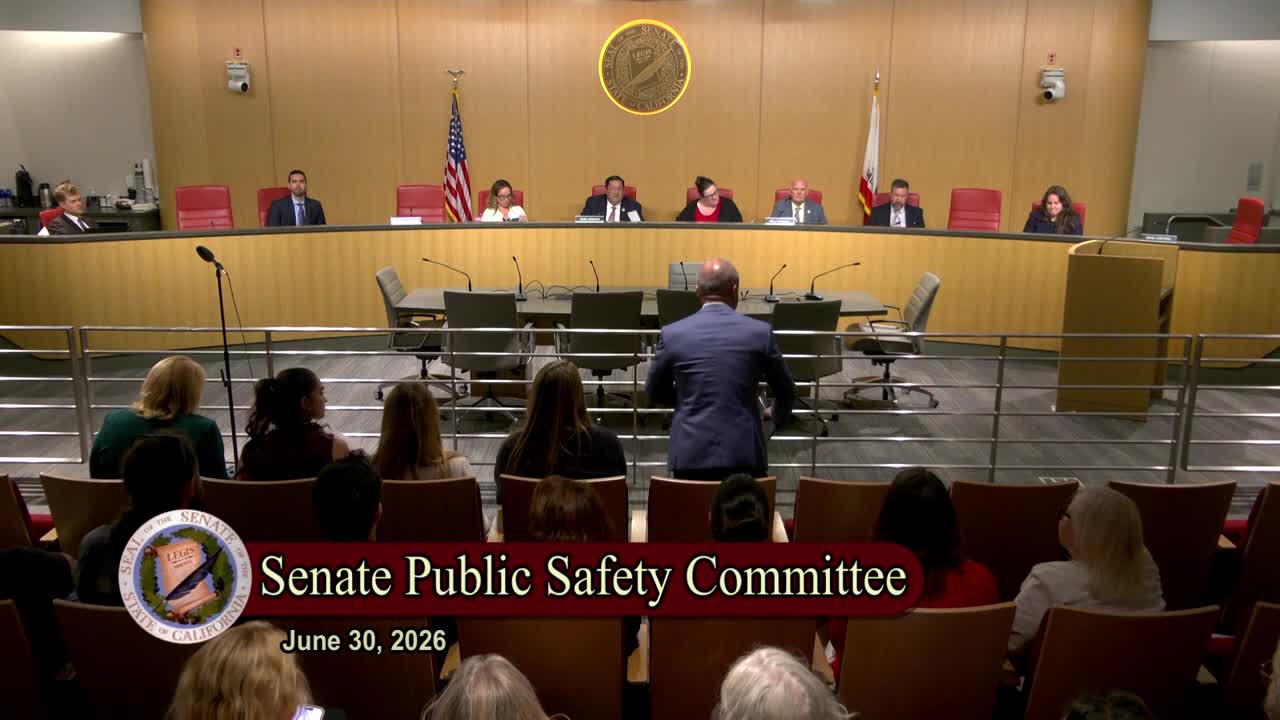 11MIN
Senate Standing Committee on Public Safety
 1MIN
Assembly Floor
 8MIN
Assembly Standing Committee on Public Safety
Bill Author

Bill Co-Author(s):