AB 2234: California Environmental Quality Act: geothermal exploratory projects.
- Session Year: 2025-2026
- House: Assembly
- Latest Version Date: 2026-09-30
Current Status:
Passed
(2026-09-30: Chaptered by Secretary of State - Chapter 927, Statutes of 2026.)
Introduced
In Committee
Awaiting First Chamber Vote
Passed First Chamber
In Committee
Awaiting Second Chamber Vote
Passed Second Chamber
Enacted
The California Environmental Quality Act (CEQA) requires a lead agency, as defined, to prepare, or cause to be prepared, and certify the completion of an environmental impact report on a project that it proposes to carry out or approve that may have a significant effect on the environment or to adopt a negative declaration if the lead agency finds that the project will not have that effect. CEQA also requires a lead agency to prepare a mitigated negative declaration for a project that may have a significant effect on the environment if revisions in the project would avoid or mitigate that effect and there is no substantial evidence that the project, as revised, would have a significant effect on the environment.
Existing law establishes the Geologic Energy Management Division in the Department of Conservation. Existing law requires the division to be the lead agency for all geothermal exploratory projects for purposes of CEQA, except as provided. Existing law defines geothermal exploratory project, for purposes of CEQA, in part as a project composed of not more than 6 wells and associated drilling and testing equipment whose chief and original purpose is to evaluate the presence and characteristics of geothermal resources. Existing law requires wells included within a geothermal exploratory project to be located at least 1/2 mile from geothermal development wells that are capable of producing geothermal resources in commercial quantities.
This bill would expressly include, as part of a geothermal exploratory project, equipment and activities necessary to establish interconnectivity between wells and reservoirs, as provided. The bill would specify that the above-described 1/2 mile limit is measured from all points along the wellhead location and well course, including the bottom of the well, as provided.
The California Environmental Quality Act (CEQA) requires a lead agency, as defined, to prepare, or cause to be prepared, and certify the completion of an environmental impact report on a project that it proposes to carry out or approve that may have a significant effect on the environment or to adopt a negative declaration if the lead agency finds that the project will not have that effect. CEQA also requires a lead agency to prepare a mitigated negative declaration for a project that may have a significant effect on the environment if revisions in the project would avoid or mitigate that effect and there is no substantial evidence that the project, as revised, would have a significant effect on the environment.
Existing law establishes the Geologic Energy Management Division in the Department of Conservation. Existing law requires the division to be the lead agency for all geothermal exploratory projects for purposes of CEQA, except as provided. Existing law defines geothermal exploratory project, for purposes of CEQA, in part as a project composed of not more than 6 wells and associated drilling and testing equipment whose chief and original purpose is to evaluate the presence and characteristics of geothermal resources. Existing law requires wells included within a geothermal exploratory project to be located at least 1/2 mile from geothermal development wells that are capable of producing geothermal resources in commercial quantities.
This bill would expressly include as part of a geothermal exploratory project, among other things, equipment and activities necessary to establish interconnectivity between wells and reservoirs. The bill would specify that the above-described1/2mile limit is measured from all points along the wellhead location and well course.
This bill would define, for the purposes of CEQA, geothermal technology pilot project. The bill would require the division to be the lead agency for all geothermal technology pilot projects, except as provided.Existing law requires the owner or operator of any well, before commencing the original drilling of a well or the redrilling of an abandoned well, to file with the State Oil and Gas Supervisor or the district deputy a written notice of intention to commence drilling, accompanied by a prescribed fee. A violation of the geothermal resources laws is a crime.This bill would require, before commencing the drilling, deepening, or redrilling of a well that is part of a geothermal technology pilot project, the owner or operator of that well to file with the supervisor a written notice of intention to commence drilling pursuant to the above-described provision. The bill would require, if a notice of intention is submitted for a well that is part of a geothermal technology pilot project and the well is located within 1/2 mile of an existing geothermal well capable of producing in commercial quantities, the notice of intent to include a written consent agreement that meets specific requirements, as provided. Because a violation of these requirements would be a crime, the bill would impose a state-mandated local program. The California Constitution requires the state to reimburse local agencies and school districts for certain costs mandated by the state. Statutory provisions establish procedures for making that reimbursement.This bill would provide that no reimbursement is required by this act for a specified reason.The California Environmental Quality Act (CEQA) requires a lead agency, as defined, to prepare, or cause to be prepared, and certify the completion of an environmental impact report on a project that it proposes to carry out or approve that may have a significant effect on the environment or to adopt a negative declaration if the lead agency finds that the project will not have that effect. CEQA also requires a lead agency to prepare a mitigated negative declaration for a project that may have a significant effect on the environment if revisions in the project would avoid or mitigate that effect and there is no substantial evidence that the project, as revised, would have a significant effect on the environment.
Existing law establishes the Geologic Energy Management Division in the Department of Conservation. Existing law requires the division to be the lead agency for all geothermal exploratory projects for purposes of CEQA, except as provided. Existing law defines geothermal exploratory project, for purposes of CEQA, in part as a project composed of not more than 6 wells and associated drilling and testing equipment whose chief and original purpose is to evaluate the presence and characteristics of geothermal resources. Existing law requires wells included within a geothermal exploratory project to be located at least 1/2 mile from geothermal development wells that are capable of producing geothermal resources in commercial quantities.
This bill would expressly include as part of a geothermal exploratory project, among other things, equipment and activities necessary to establish interconnectivity between wells and reservoirs. The bill would specify that the above-described 1/2 mile1/2mile limit is measured from any point all points along the wellhead location and well course and would exclude certain wells connecting to geothermal reservoirs from this limit if written consent is provided by the owner and operator of the geothermal development well that is producing in commercial quantities, as specified. course.
This bill would define, for the purposes of CEQA, geothermal technology pilot project. The bill would require the division to be the lead agency for all geothermal technology pilot projects, except as provided.
Existing law requires the owner or operator of any well, before commencing the original drilling of a well or the redrilling of an abandoned well, to file with the State Oil and Gas Supervisor or the district deputy a written notice of intention to commence drilling, accompanied by a prescribed fee. A violation of the geothermal resources laws is a crime.
This bill would require, before commencing the drilling, deepening, or redrilling of a well that is part of a geothermal technology pilot project, the owner or operator of that well to file with the supervisor a written notice of intention to commence drilling pursuant to the above-described provision. The bill would require, if a notice of intention is submitted for a well that is part of a geothermal technology pilot project and the well is located within 1/2 mile of an existing geothermal well capable of producing in commercial quantities, the notice of intent to include a written consent agreement that meets specific requirements, as provided. Because a violation of these requirements would be a crime, the bill would impose a state-mandated local program.
The California Constitution requires the state to reimburse local agencies and school districts for certain costs mandated by the state. Statutory provisions establish procedures for making that reimbursement.
This bill would provide that no reimbursement is required by this act for a specified reason.
The California Environmental Quality Act (CEQA) requires a lead agency, as defined, to prepare, or cause to be prepared, and certify the completion of an environmental impact report on a project that it proposes to carry out or approve that may have a significant effect on the environment or to adopt a negative declaration if the lead agency finds that the project will not have that effect. CEQA also requires a lead agency to prepare a mitigated negative declaration for a project that may have a significant effect on the environment if revisions in the project would avoid or mitigate that effect and there is no substantial evidence that the project, as revised, would have a significant effect on the environment.
Existing law establishes the Geologic Energy Management Division in the Department of Conservation. Existing law requires the division to be the lead agency for all geothermal exploratory projects for purposes of CEQA, except as provided. Existing law defines geothermal exploratory project, for purposes of CEQA, in part as a project composed of not more than 6 wells and associated drilling and testing equipment whose chief and original purpose is to evaluate the presence and characteristics of geothermal resources. Existing law requires wells included within a geothermal exploratory project to be located at least 1/2 mile from geothermal development wells that are capable of producing geothermal resources in commercial quantities.
This bill would expressly include as part of a geothermal exploratory project, among other things, equipment and activities necessary to establish interconnectivity between wells and reservoirs. The bill would specify that the above-described 1/2 mile limit is measured from the bottom of the wells interaction point any point along the wellhead location and well course and would exclude certain wells connecting to geothermal reservoirs from this limit if written consent is provided by the owner or and operator of the geothermal development well that is producing in commercial quantities, as specified.
The California Environmental Quality Act (CEQA) requires a lead agency, as defined, to prepare, or cause to be prepared, and certify the completion of an environmental impact report on a project that it proposes to carry out or approve that may have a significant effect on the environment or to adopt a negative declaration if the lead agency finds that the project will not have that effect. CEQA also requires a lead agency to prepare a mitigated negative declaration for a project that may have a significant effect on the environment if revisions in the project would avoid or mitigate that effect and there is no substantial evidence that the project, as revised, would have a significant effect on the environment.
Existing law establishes the Geologic Energy Management Division in the Department of Conservation. Existing law requires the division to be the lead agency for all geothermal exploratory projects for purposes of CEQA, except as provided. Existing law defines geothermal exploratory project, for purposes of CEQA, in part as a project composed of not more than 6 wells and associated drilling and testing equipment whose chief and original purpose is to evaluate the presence and characteristics of geothermal resources. Existing law requires wells included within a geothermal exploratory project to be located at least 1/2 mile from geothermal development wells that are capable of producing geothermal resources in commercial quantities.
This bill would expressly include as part of a geothermal exploratory project, among other things, equipment and activities necessary to establish interconnectivity between wells and reservoirs. The bill would specify that the above-described 1/2 mile limit is measured from the bottom of the wells interaction point and would exclude certain wells connecting to geothermal reservoirs from the 1/2-mile this limit described above. if written consent is provided by the owner or operator of the geothermal development well that is producing in commercial quantities, as specified.
The California Environmental Quality Act (CEQA) requires a lead agency, as defined, to prepare, or cause to be prepared, and certify the completion of an environmental impact report on a project that it proposes to carry out or approve that may have a significant effect on the environment or to adopt a negative declaration if the lead agency finds that the project will not have that effect. CEQA also requires a lead agency to prepare a mitigated negative declaration for a project that may have a significant effect on the environment if revisions in the project would avoid or mitigate that effect and there is no substantial evidence that the project, as revised, would have a significant effect on the environment.
Existing law establishes the Geologic Energy Management Division in the Department of Conservation. Existing law requires the division to be the lead agency for all geothermal exploratory projects for purposes of CEQA, except as provided. Existing law defines geothermal exploratory project, for purposes of CEQA, in part as a project composed of not more than 6 wells and associated drilling and testing equipment whose chief and original purpose is to evaluate the presence and characteristics of geothermal resources. Existing law requires wells included within a geothermal exploratory project to be located at least 1/2 mile from geothermal development wells that are capable of producing geothermal resources in commercial quantities.
This bill would expressly include as part of a geothermal exploratory project, among other things, equipment and activities necessary to establish interconnectivity between wells and reservoirs. The bill would exclude certain wells connecting to geothermal reservoirs from the 1/2-mile limit described above.
Geothermal exploratory project means a project as defined in Section 21065 composed of not more than six wells and associated drilling and testing equipment, including equipment and activities necessary to establish interconnectivity between wells and reservoirs, whose chief and original purpose is to evaluate the presence and characteristics of geothermal resources before commencement of a geothermal field development project as defined in Section 65928.5 of the Government Code. Wells included within a geothermal exploratory project shall be located at least one-half mile, measured from all points along the wellhead location and well course, including the bottom of the well, from geothermal development wells that are capable of producing geothermal resources in commercial quantities.
Geothermal exploratory project means a project as defined in Section 21065 composed of not more than six wells and associated drilling and testing equipment, including equipment and activities necessary to establish interconnectivity between wells and reservoirs, whose chief and original purpose is to evaluate the presence and characteristics of geothermal resources before commencement of a geothermal field development project as defined in Section 65928.5 of the Government Code. Wells included within a geothermal exploratory project shall be located at least one-half mile, measured from all points along the wellhead location and well course, including the bottom of the well, from geothermal development wells that are capable of producing geothermal resources in commercial quantities.
Geothermal exploratory project means a project as defined in Section 21065 composed of not more than six wells and associated drilling and testing equipment, including equipment and activities necessary to establish interconnectivity between wells and reservoirs, whose chief and original purpose is to evaluate the presence and characteristics of geothermal resources before commencement of a geothermal field development project as defined in Section 65928.5 of the Government Code. Wells included within a geothermal exploratory project shall be located at least one-half mile, measured from all points along the wellhead location and well course, including the bottom of the well, from geothermal development wells that are capable of producing geothermal resources in commercial quantities.
SEC. 4.Section 21065.6 is added to the Public Resources Code, to read:21065.6.Geothermal technology pilot project means a project, as defined in Section 21065, composed of not more than six wells and associated drilling and testing equipment, including equipment and activities necessary to establish interconnectivity between wells and reservoirs, to connect geothermal reservoirs whose permeability or capacity to allow the flow of geothermal fluids, including water, has been increased from its natural or original state through stimulation, horizontal drilling, or the use of closed-loop configurations, for the chief and original purpose of confirming the viability of those techniques or technologies within that resource. SEC. 5.No reimbursement is required by this act pursuant to Section 6 of Article XIIIB of the California Constitution because the only costs that may be incurred by a local agency or school district will be incurred because this act creates a new crime or infraction, eliminates a crime or infraction, or changes the penalty for a crime or infraction, within the meaning of Section 17556 of the Government Code, or changes the definition of a crime within the meaning of Section 6 of Article XIIIB of the California Constitution.(a)For the purposes of the California Environmental Quality Act Division 13 (commencing with Section 21000), the division shall be the lead agency as defined in Section 21067 for all geothermal exploratory projects as defined in Section 21065.5. 21065.5 and for all geothermal technology pilot projects as defined in Section 21065.6.
(b)(1)The division may delegate its lead agency responsibility under this section to a county that has adopted a geothermal element, as defined in Section 25133, for its general plan.
(2)Upon the request of an applicant, the county in which a geothermal exploratory project is located, regardless of whether the county has adopted a geothermal element for its general plan, shall assume responsibilities of a lead agency, as defined in Section 21067, for the project. The applicant shall make the request to the county and the division.
(c)If a county assumes lead agency responsibility pursuant to subdivision (b), the county and the division shall confer regarding necessary information that should be included in the environmental review for the project to facilitate the divisions exercise of its authority as a responsible agency, as defined in Section 21069.
(d)The provisions of this section shall not apply to geothermal exploratory projects, as defined in Section 21065.5, where, before January 1, 1979, preparation of an environmental impact report for a geothermal exploratory project has begun or an application for a geothermal exploratory project that will require preparation of an environmental impact report has been filed.
SEC. 2.Section 3715.6 is added to the Public Resources Code, to read:3715.6.(a)Before commencing the drilling, deepening, or redrilling of a well that is part of a geothermal technology pilot project, the owner or operator of the well shall file with the supervisor a written notice of intention to commence drilling pursuant to Section 3724.
(b)If a notice of intention submitted under Section 3724 is for a well that is part of a geothermal technology pilot project and the well is located within one-half mile of an existing geothermal well capable of producing geothermal resources in commercial quantities, then the notice of intention shall include a written consent agreement that meets the requirements of subdivision (c). For the purposes of this section, the one-half mile distance shall be measured from all points along the wellhead locations and well courses of the two wells, including the bottoms of the wells.
(c)A written consent agreement required under subdivision (b) shall meet all of the following requirements:
(1)The written consent agreement shall be executed by a responsible officer of the owner or operator of the existing well. If the owner and operator are separate, then the written consent agreement shall be executed by a responsible officer of both the owner and the operator of the existing well.
(2)The owner or operator of the existing geothermal well capable of producing in commercial quantities may require, as a condition of providing written consent, provisions in the agreement requiring the owner or operator of the geothermal technology pilot project well to undertake, for the purpose of protecting the existing geothermal resource or existing geothermal well infrastructure any or all of the following measures:
(A)Conduct ongoing monitoring to demonstrate that the geothermal technology pilot project will not result in degradation of existing commercial geothermal resources, including measurable decline in reservoir pressure, temperature, or steam output, and that no induced seismicity exceeding site-specific thresholds occurs. The monitoring program shall be verified by a third-party professional appropriately licensed pursuant to the Business and Professions Code and agreed upon by the parties at the time of the submission of the notice of intention.
(B)Demonstration that the geothermal technology pilot project will not impose any undue harm to the productive capability of any geothermal project operating under a powerplant license approved by the State Energy Resources Conservation and Development Commission or require any environmental mitigation to be imposed upon the holder of the license to operate in compliance with the projects conditions of certification.
(C)Indemnification by the geothermal technology pilot project owner and operator for all costs associated with safeguarding existing geothermal resources from any loss of reservoir pressure, temperature, or steam output and contamination of the reservoir with unnatural fluids, and provide adequate financial assurances to the owner and operator of the geothermal development well, including, but not limited to, a bond or escrow fund sufficient to cover any required remediation, compensation, or infrastructure repair.
(3)The written consent agreement shall provide that either party may bring an appropriate civil action in a court of competent jurisdiction to enforce the terms of the written consent agreement as a contract, and shall not limit the availability to either party of any remedy at law or in equity otherwise available.
(d)For purposes of this section, geothermal technology pilot project has the same meaning as defined in Section 21065.6.
SECTION 1.SEC. 3.Section 21065.5 of the Public Resources Code is amended to read:21065.5.(a)Geothermal exploratory project means a project as defined in Section 21065 composed of not more than six wells and associated drilling and testing equipment, including equipment and activities necessary to establish interconnectivity between wells and reservoirs, temporary roads, electric distribution lines, and infrastructure to provide power for drilling and testing equipment, whose chief and original purpose is to evaluate the presence and characteristics of geothermal resources before commencement of a geothermal field development project as defined in Section 65928.5 of the Government Code. Wells included within a geothermal exploratory project shall be located at least one-half mile, measured from any point all points along the wellhead location and well course, including the bottom of the wells interaction point, well, from geothermal development wells that are capable of producing geothermal resources in commercial quantities, except wells connecting to geothermal reservoirs whose permeability or capacity to allow the flow of geothermal fluids, including water, has been increased from its natural or original state through stimulation, horizontal drilling, the use of closed-loop configurations, or other techniques if the owner and operator of the geothermal development well that is capable of producing in commercial quantities provides written consent for its location within that one-half mile. quantities.
(b)Written consent pursuant to subdivision (a) shall be executed by a responsible officer of the owner or operator, as applicable. The owner and operator of a geothermal development well capable of producing in commercial quantities may require, as conditions of providing written consent, any or all of the following:(1)The geothermal exploratory project proponent demonstrates, through ongoing monitoring, that the project will not result in degradation of existing commercial geothermal resources, including no measurable decline in reservoir pressure, temperature, or steam output, and no induced seismicity exceeding site-specific thresholds, as verified by a third-party licensed geoscience firm approved by the Geologic Energy Management Division.(2)The geothermal exploratory project proponent demonstrates that the project will not impose any undue harm to the productive capability of any geothermal project operating under a power plant license approved by the State Energy Resources Conservation and Development Commission or require any environmental mitigation to be imposed upon the holder of the license to operate in compliance with the projects conditions of certification.(3)The geothermal exploratory project proponent accepts all costs associated with safeguarding existing geothermal resources from any loss of reservoir pressure, temperature, or steam output and contamination of the reservoir with unnatural fluids, and provides adequate financial assurances, including a bond or escrow fund sufficient to cover any required remediation, compensation, or infrastructure repair.(c)This section does not alter the Geologic Energy Management Divisions discretionary authority over well permitting pursuant to Chapter 4 (commencing with Section 3700) of Division 3.SEC. 4.Section 21065.6 is added to the Public Resources Code, to read:21065.6.Geothermal technology pilot project means a project, as defined in Section 21065, composed of not more than six wells and associated drilling and testing equipment, including equipment and activities necessary to establish interconnectivity between wells and reservoirs, to connect geothermal reservoirs whose permeability or capacity to allow the flow of geothermal fluids, including water, has been increased from its natural or original state through stimulation, horizontal drilling, or the use of closed-loop configurations, for the chief and original purpose of confirming the viability of those techniques or technologies within that resource.
SEC. 5.No reimbursement is required by this act pursuant to Section 6 of Article XIIIB of the California Constitution because the only costs that may be incurred by a local agency or school district will be incurred because this act creates a new crime or infraction, eliminates a crime or infraction, or changes the penalty for a crime or infraction, within the meaning of Section 17556 of the Government Code, or changes the definition of a crime within the meaning of Section 6 of Article XIIIB of the California Constitution.
(a)Geothermal exploratory project means a project as defined in Section 21065 composed of not more than six wells and associated drilling and testing equipment, including equipment and activities necessary to establish interconnectivity between wells and reservoirs, temporary roads, electric distribution lines, and infrastructure to provide power for drilling and testing equipment, whose chief and original purpose is to evaluate the presence and characteristics of geothermal resources before commencement of a geothermal field development project as defined in Section 65928.5 of the Government Code. Wells included within a geothermal exploratory project shall be located at least one-half mile, measured from any point along the wellhead location and well course, including the bottom of the wells wells interaction point, from geothermal development wells that are capable of producing geothermal resources in commercial quantities, except wells connecting to geothermal reservoirs whose permeability or capacity to allow the flow of geothermal fluids, including water, has been increased from its natural or original state through stimulation, horizontal drilling, the use of closed-loop configurations, or other techniques if the owner or and operator of the geothermal development well that is capable of producing in commercial quantities provides written consent for its location within that one-half mile.
(b)Written consent pursuant to subdivision (a) shall be executed by a responsible officer of the owner or operator, as applicable. The owner and operator of a geothermal development well capable of producing in commercial quantities may require, as conditions of providing written consent, any or all of the following:
(1)The geothermal exploratory project proponent demonstrates, through ongoing monitoring, that the project will not result in degradation of existing commercial geothermal resources, including no measurable decline in reservoir pressure, temperature, or steam output, and no induced seismicity exceeding site-specific thresholds, as verified by a third-party licensed geoscience firm approved by the Geologic Energy Management Division.
(2)The geothermal exploratory project proponent demonstrates that the project will not impose any undue harm to the productive capability of any geothermal project operating under a power plant license approved by the State Energy Resources Conservation and Development Commission or require any environmental mitigation to be imposed upon the holder of the license to operate in compliance with the projects conditions of certification.
(3)The geothermal exploratory project proponent accepts all costs associated with safeguarding existing geothermal resources from any loss of reservoir pressure, temperature, or steam output and contamination of the reservoir with unnatural fluids, and provides adequate financial assurances, including a bond or escrow fund sufficient to cover any required remediation, compensation, or infrastructure repair.
(c)This section does not alter the Geologic Energy Management Divisions discretionary authority over well permitting pursuant to Chapter 4 (commencing with Section 3700) of Division 3.
Geothermal exploratory project means a project as defined in Section 21065 composed of not more than six wells and associated drilling and testing equipment, including equipment and activities necessary to establish interconnectivity between wells and reservoirs, temporary roads, electric distribution lines, and infrastructure to provide power for drilling and testing equipment, whose chief and original purpose is to evaluate the presence and characteristics of geothermal resources before commencement of a geothermal field development project as defined in Section 65928.5 of the Government Code. Wells included within a geothermal exploratory project, excluding wells connecting to geothermal reservoirs whose permeability or capacity to allow the flow of geothermal fluids, including water, has been increased from its natural or original state through stimulation, horizontal drilling, the use of closed-loop configurations, or other techniques, project shall be located at least one-half mile mile, measured from the bottom of the wells interaction point, from geothermal development wells that are capable of producing geothermal resources in commercial quantities. quantities, except wells connecting to geothermal reservoirs whose permeability or capacity to allow the flow of geothermal fluids, including water, has been increased from its natural or original state through stimulation, horizontal drilling, the use of closed-loop configurations, or other techniques if the owner or operator of the geothermal development well that is capable of producing in commercial quantities provides written consent for its location within that one-half mile.
Geothermal exploratory project means a project as defined in Section 21065 composed of not more than six wells and associated drilling and testing equipment, including equipment and activities necessary to establish interconnectivity between wells and reservoirs, temporary roads, electric distribution lines, and infrastructure to provide power for drilling and testing equipment, whose chief and original purpose is to evaluate the presence and characteristics of geothermal resources prior to before commencement of a geothermal field development project as defined in Section 65928.5 of the Government Code. Wells included within a geothermal exploratory project must project, excluding wells connecting to geothermal reservoirs whose permeability or capacity to allow the flow of geothermal fluids, including water, has been increased from its natural or original state through stimulation, horizontal drilling, the use of closed-loop configurations, or other techniques, shall be located at least one-half mile from geothermal development wells which that are capable of producing geothermal resources in commercial quantities.
|
Date
|
Status
|
|---|---|
| Sep 30, 2026 | Chaptered by Secretary of State - Chapter 927, Statutes of 2026. |
| Sep 30, 2026 | Approved by the Governor. |
| Sep 15, 2026 | Enrolled and presented to the Governor at 3 p.m. |
| Aug 31, 2026 | Senate amendments concurred in. To Engrossing and Enrolling. (Ayes 79. Noes 0. Page 6967.). |
| Aug 31, 2026 | Senate amendments concurred in. To Engrossing and Enrolling. (Ayes 79. Noes 0.). |
| Aug 31, 2026 | Senate amendments concurred in. To Engrossing and Enrolling. |
| Aug 30, 2026 | In Assembly. Concurrence in Senate amendments pending. |
| Aug 30, 2026 | Read third time. Passed. Ordered to the Assembly. (Ayes 39. Noes 0.). |
| Aug 28, 2026 | Read second time. Ordered to third reading. |
| Aug 27, 2026 | Read third time and amended. Ordered to second reading. |
| Aug 26, 2026 | From special consent calendar |
| Aug 26, 2026 | Ordered to third reading. |
| Aug 25, 2026 | Ordered to special consent calendar. |
| Aug 17, 2026 | Read second time. Ordered to third reading. |
| Aug 13, 2026 | Read second time and amended. Ordered returned to second reading. |
| Aug 13, 2026 | From committee: Amend, and do pass as amended. (Ayes 7. Noes 0.) (August 13). |
| Aug 3, 2026 | In committee: Referred to APPR. suspense file. |
| Jul 6, 2026 | From committee: Amend, and do pass as amended and re-refer to Com. on APPR. (Ayes 7. Noes 0.) (July 1). |
| Jul 6, 2026 | Read second time and amended. Re-referred to Com. on APPR. |
| Jun 24, 2026 | From committee: Do pass and re-refer to Com. on N.R. & W. (Ayes 6. Noes 0.) (June 24). Re-referred to Com. on N.R. & W. |
| Jun 15, 2026 | From committee chair, with author's amendments: Amend, and re-refer to committee. Read second time, amended, and re-referred to Com. on E.Q. |
| Jun 10, 2026 | Referred to Coms. on E.Q. and N.R. & W. |
| May 28, 2026 | In Senate. Read first time. To Com. on RLS. for assignment. |
| May 27, 2026 | Read third time. Passed. Ordered to the Senate. (Ayes 79. Noes 0. Page 5455.) |
| May 27, 2026 | Read third time. Passed. Ordered to the Senate. (Ayes 79. Noes 0.) |
| May 27, 2026 | Read third time. Passed. Ordered to the Senate. |
| May 18, 2026 | Read second time. Ordered to third reading. |
| May 14, 2026 | From committee: Do pass. (Ayes 15. Noes 0.) (May 14). |
| Apr 22, 2026 | In committee: Set, first hearing. Referred to APPR. suspense file. |
| Apr 7, 2026 | From committee: Do pass and re-refer to Com. on APPR. with recommendation: To Consent Calendar. (Ayes 14. Noes 0.) (April 6). Re-referred to Com. on APPR. |
| Mar 9, 2026 | Referred to Com. on NAT. RES. |
| Feb 20, 2026 | From printer. May be heard in committee March 22. |
| Feb 19, 2026 | Read first time. To print. |
|
Date
|
Description
|
Location
|
Votes
|
|
|---|---|---|---|---|
| Aug 31, 2026 | AB 2234 Papan Concurrence in Senate Amendments | Assembly Floor |
Passed |
|
| Aug 30, 2026 | Assembly 3rd Reading AB2234 Papan By Laird | Senate Floor |
Passed |
|
| Aug 13, 2026 | Do pass as amended | Senate Standing Committee on Appropriations |
Passed |
|
| Aug 3, 2026 | Placed on suspense file | Senate Standing Committee on Appropriations |
Passed |
|
| Jul 1, 2026 | Do pass as amended, but first amend, and re-refer to the Committee on [Appropriations] | Senate Standing Committee on Natural Resources and Water |
Passed |
|
| Jun 24, 2026 | Do pass, but first be re-referred to the Committee on [Natural Resources and Water] | Senate Standing Committee on Environmental Quality |
Passed |
|
| May 27, 2026 | AB 2234 Papan Assembly Third Reading | Assembly Floor |
Passed |
|
| May 14, 2026 | Do pass. | Assembly Standing Committee on Appropriations |
Passed |
|
| Apr 6, 2026 | Do pass and be re-referred to the Committee on [Appropriations] with recommendation: To Consent Calendar | Assembly Standing Committee on Natural Resources |
Passed |
This list shows positions taken on this bill by organizations on the date displayed, which is linked to the original source.
Positions by individuals are not included.
|
Organization
|
Position
|
Date
|
|---|---|---|
| California Department of Finance | ** Against | |
| California Resources Corporation | ** Support | |
| Calpine Corporation | ** Against | |
| Northern California Power Agency | ** Against | |
| San Jose Clean Energy | ** Support | |
| Sonoma Clean Energy | ** Support | |
| Sonoma Clean Power | ** Support | |
| The Nature Conservancy | ** Support |
CONCURRENCE IN SENATE AMENDMENTS
CSA1 Bill Id:AB 2234
Author:(Papan)
As Amended Ver:August 27, 2026
Majority vote
SUMMARY
Revises the definition of "geothermal exploratory project" to specifically include equipment and activities necessary to establish interconnectivity between wells and reservoirs and specify that the one-half mile limit is measured from all points along the wellhead location and well course, including the bottom of the well.
Senate Amendments
- Strike the addition of "temporary roads, electric distribution lines, and infrastructure to provide power for drilling and testing equipment."
- Strike the exception to one-half mile limit for "wells connecting to geothermal reservoirs whose permeability or capacity to allow the flow of geothermal fluids, including water, has been increased from its natural or original state through stimulation, horizontal drilling, the use of closed-loop configurations, or other techniques."
- Specify that the one-half mile limit is "measured from all points along the wellhead location and well course, including the bottom of the well."
COMMENTS
Geothermal is a form of renewable energy defined as heat energy from the earth. Geothermal resources are reservoirs of hot water that are naturally occurring or are manufactured to operate at varying temperatures and depths below the earth's surface. Wells, ranging from a few feet to several miles deep, can be drilled into underground reservoirs to tap steam and hot water that can be brought to the surface for use in electricity generation, direct heating, and industrial processes. The United States is the world's largest producer of geothermal electricity and California has the highest geothermal capacity of all states. "The Geysers" geothermal steam field, located within Lake, Mendocino, and Sonoma Counties, contains 349 out of California's 563 high-temperature geothermal wells. Imperial County (including the Salton Sea) houses 194 wells, and the remaining 20 are located in Lassen, Modoc, and Mono Counties. California has installed 2,627 MW of geothermal nameplate capacity – accounting for 72% of the total geothermal plant capacity in the United States. Many of these geothermal resource areas are known to have been inhabited and visited by Native Americans for thousands of years prior to European settlement.
Under current law, a geothermal project is divided into two discrete components for purposes of California Environmental Quality Act (CEQA). The “exploration” phase involves drilling one or more exploration wells at a given site to map out the subsurface environment and assess exactly where a new geothermal power plant should be located. The subsequent "geothermal field development" phase involves drilling the necessary injector and producer wells, building the power plant, grid connections, and associated infrastructure. This phase is much more complicated and expansive. Typically, a geothermal developer cannot move forward with geothermal field development until some level of exploration has taken place as they need to site the wells in precisely the right location to make sure they are getting enough heat to support power generation, and that information can only be ascertained through exploration.
This bill expands the definition of geothermal exploratory project, explicitly including equipment and activities necessary to establish interconnectivity between wells and reservoirs. Though not explicit, these changes appear to be intended to accommodate more intensive exploration activities associated with "enhanced" geothermal systems, which may include hydraulic, thermal, chemical and/or explosive well stimulation techniques not previously used in California for geothermal production.
According to the Author
California has a massive underground network of untapped geothermal energy. While the industry has taken great strides toward unlocking this firm energy source and supplying it to end-users, state law has not kept pace with technological advancements. Innovations like closed-loop and enhanced geothermal systems (EGS) can potentially supply many gigawatts more energy than previous technologies…
The new definition is modernized in two ways; first, by removing the half-mile restriction between exploratory and commercial wells for advanced systems, it acknowledges that newer tech has built-in safeguards to avoid disturbing neighboring wells. Second, the definition recognizes that all equipment and infrastructure necessary for modern development should be considered part of a project, not separate.
Arguments in Support
According to sponsor Sonoma Clean Power, (AB 2234) will modernize the definition of geothermal exploration and help pave the way for a new renaissance of geothermal development in California…The technical clarifications and updates contained in AB 2234 are an important part of improving our legal framework around this exciting energy source and ensuring that California continues to lead the nation in geothermal energy production.
Arguments in Opposition
None received for current version.
FISCAL COMMENTS
According to the Assembly Appropriations Committee, ongoing staff workload costs of an unknown amount, likely in excess of $150,000 (Oil, Gas, and Geothermal Administrative Fund), for the Geologic Energy Management Division (CalGEM) to implement this bill. By expanding the definition of “geothermal exploratory project” to include new technologies, this bill requires CalGEM to meet with potential project developers to understand how their technology works and may be deployed and what modifications to the wellbore or well pad may be needed to facilitate exploration. This work may involve site visits by CalGEM. Division staff must also evaluate potential impacts of the proposed geothermal exploratory project under CEQA and determine whether the proposed technology or project may require a permit for the well work.
VOTES:
ASM NATURAL RESOURCES: 14-0-0
YES: Bryan, Ellis, Alanis, Connolly, Garcia, Haney, Hoover, Kalra, Macedo, Boerner, Pellerin, Schultz, Wicks, Zbur
ASM APPROPRIATIONS: 15-0-0
YES: Wicks, Hoover, Aguiar-Curry, Calderon, Caloza, Dixon, Fong, Mark González, Krell, Pacheco, Pellerin, Sharp-Collins, Solache, Ta, Tangipa
ASSEMBLY FLOOR: 79-0-1
YES: Addis, Aguiar-Curry, Ahrens, Alanis, Alvarez, Arambula, Ávila Farías, Bains, Bauer-Kahan, Bennett, Berman, Boerner, Bonta, Bryan, Calderon, Caloza, Carrillo, Castillo, Chen, Connolly, Davies, DeMaio, Dixon, Elhawary, Ellis, Flora, Fong, Gabriel, Gallagher, Garcia, Gipson, Jeff Gonzalez, Mark González, Hadwick, Haney, Harabedian, Hart, Hoover, Irwin, Jackson, Johnson, Kalra, Krell, Lackey, Lee, Lowenthal, Macedo, McKinnor, Muratsuchi, Nguyen, Ortega, Pacheco, Papan, Patel, Patterson, Pellerin, Petrie-Norris, Quirk-Silva, Ramos, Ransom, Michelle Rodriguez, Rogers, Blanca Rubio, Sanchez, Schiavo, Schultz, Sharp-Collins, Solache, Soria, Stefani, Ta, Tangipa, Valencia, Wallis, Ward, Wicks, Wilson, Zbur, Rivas
ABS, ABST OR NV: Celeste Rodriguez
UPDATED
VERSION: August 27, 2026
CONSULTANT: Lawrence Lingbloom / NAT. RES. / (916) 319-2092 FN: 0004527
SENATE RULES COMMITTEE Office of Senate Floor Analyses (916) 651-4171 | AB 2234 |
THIRD READING
Bill No: AB 2234
Author: Papan (D)
Amended: 8/27/26 in Senate
Vote: 21
SENATE ENVIRONMENTAL QUALITY COMMITTEE: 6-0, 6/24/26
AYES: Blakespear, Valladares, Allen, Dahle, Gonzalez, Menjivar
NO VOTE RECORDED: Hurtado
SENATE NATURAL RES. & WATER COMMITTEE: 7-0, 7/1/26
AYES: Becker, Seyarto, Allen, Cabaldon, Grove, Laird, Stern
SENATE APPROPRIATIONS COMMITTEE: 7-0, 8/13/26
AYES: Cervantes, Seyarto, Cabaldon, Dahle, Grayson, Richardson, Wahab
ASSEMBLY FLOOR: 79-0, 5/27/26 - See last page for vote
SUBJECT: California Environmental Quality Act: geothermal exploratory projects: geothermal technology pilot projects: Geologic Energy Management Division
SOURCE: Sonoma Clean Energy
DIGEST:
- This bill modifies the definition of “geothermal exploratory project” to include equipment and activities necessary to establish interconnectivity between wells and reservoir and to specify the features the one-half mile distance between a geothermal exploratory project well and a geothermal development well is measured from.
Senate floor amendments of 8/27/26 delete geothermal technology pilot projects.
ANALYSIS:
Existing law:
- Establishes the Geologic Energy Management Division (CalGEM) within the Department of Conservation as the state’s geothermal well regulator. The State Oil and Gas Supervisor (supervisor) leads CalGEM.
- Proclaims that Californians have a direct and primary interest in the development of geothermal resources, and the state should exercise its power and jurisdiction to require that wells for the discovery and production of geothermal resources be drilled, operated, maintained and abandoned in such manner as to safeguard life, health, property, and the public welfare, and to encourage maximum economic recovery. (Public Resources Code (PRC) §3700)
- Requires the supervisor to so supervise the drilling, operation, maintenance and abandonment of geothermal resources wells as to encourage the greatest economic recovery of geothermal resources, to prevent damage to life, health, property, and natural resources, and to prevent damage to, and waste from, the underground geothermal deposits, and to prevent damage to underground and surface waters suitable for irrigation or domestic purposes by reason of the drilling, operation, maintenance, and abandonment of geothermal resources wells. (PRC §3714)
- Requires the supervisor to also supervise the drilling, operation, maintenance, and abandonment of wells so as to permit the owners or operators of such wells to utilize all methods and practices known to the industry for the purpose of increasing the ultimate recovery of geothermal resources, and to allow the operator to do what a prudent operator using reasonable diligence would do, as provided. (PRC §3715)
- Requires an owner or operator before drilling or re-drilling, abandoning or deepening or altering the casing of a well to file with the supervisor or CalGEM district deputy a written notice of intention (NOI) to drill the well containing certain information and pay a fee. (PRC §3724)
- Defines geothermal resources to mean the natural heat of the earth, the energy, in whatever form, below the surface of the earth present in, resulting, from, or created by, or which may be extracted from, such natural heat, and all minerals in solution or other products obtained from naturally heated fluids, brines, associated gases, and steam, in whatever form, below the surface of the earth, but excluding oil, hydrocarbon gas, or other hydrocarbon substances. (PRC §6903)
- Defines a geothermal exploratory project to be not more than six wells and for the purpose of evaluating the presence and characteristics of geothermal resources prior to starting a geothermal field development project. For purposes of preparing an environmental document the environmental impacts shall be limited to the proposed drill sites, the proposed wells, and any roads or other facilities that may be required before the exploratory wells can be drilled. Wells included within a geothermal exploratory project must be located at least one-half mile from geothermal development wells which are capable of producing geothermal resources in commercial quantities. Application requirements include a narrative description including the probable short-term and long-term impacts of the project, and acceptable mitigation measures. (see PRC §21065.6; Title 14, California Code of Regulations, §§1680 et seq.)
- CEQA requires a lead agency to spearhead an environmental impact report (EIR) for a project that may have a significant effect on the environment. CEQA also requires a lead agency to prepare an negative declaration (ND) for a project that will have no significant effects on the environment, or a mitigated negative declaration (MND) for projects that have no significant effects after mitigation. (PRC §§21000 et seq.)
- Specifies that CalGEM is the default lead agency for geothermal exploratory projects, but that CalGEM can delegate its lead agency responsibility to a county that has adopted a geothermal element in its general plan. In addition, at the request of an applicant, the county in which a geothermal exploratory project is located shall assume responsibilities of the lead agency, regardless of whether or not the county has a geothermal element. In this case, the county and CalGEM confer regarding necessary information that should be included in the environmental review for the project to facilitate CalGEM’s exercise of its authority as a responsible agency. (PRC §3715.5)
- Defines “geothermal field development project” as a development project composed of geothermal wells, resource transportation lines, production equipment, roads, and other facilities which are necessary to supply geothermal energy to any particular heat utilization equipment for its productive life, all within an area delineated by the applicant. (Government Code §65928.5)
This bill:
- Modifies the definition of “geothermal exploratory project” to include equipment and activities necessary to establish interconnectivity between wells and reservoir and to specify the features the one-half mile distance between a geothermal exploratory project well and a geothermal development well is measured from.
[NOTE: For additional information regarding this bill, see the Senate Environmental Quality, and Natural Resources and Water Committees’ analyses.]
FISCAL EFFECT: Appropriation: No Fiscal Com.: Yes Local: Yes
According to the Senate Appropriations Committee for a previous version of the bill:
- Ongoing costs likely in the hundreds of thousands of dollars annually (Oil, Gas, and Geothermal Administrative Fund) for the Geologic Energy Management Division (CalGEM) to receive notices of intention (NOIs) for pilot-project wells, review consent agreements as part of NOI completeness, serve as CEQA lead agency for geothermal technology pilot projects, among other things.
SUPPORT: (Verified 8/14/26)
Sonoma Clean Energy (source)
California Resources Corporation
San Jose Clean Energy
The Nature Conservancy
OPPOSITION: (Verified 8/14/26)
California Department of Finance
ARGUMENTS IN SUPPORT: According to the author, “California has a massive underground network of untapped geothermal energy. Innovations like closed-loop and enhanced geothermal systems (EGS) have the potential to generate many gigawatts more energy than previous technologies, as conventional geothermal developers are limited by their need for naturally occurring groundwater.”
“However, the outdated statutory definition of geothermal exploratory projects restricts the deployment of these new technologies. AB 2234 will modernize the definition of geothermal projects by updating the application of the half-mile restriction and recognizing that all equipment and infrastructure necessary for modern development should be considered part of a project, not separate. By revising the geothermal exploratory project definition, AB 2234 can expand access to firm, clean energy and signal that California is open for exploration.”
ARGUMENTS IN OPPOSITION: The California Department of Finance, writing in opposition to a previous version of the bill notes: “Finance is opposed to this bill because it results in General Fund impacts not included in the 2026 Budget Act.”
ASSEMBLY FLOOR: 79-0, 5/27/26
AYES: Addis, Aguiar-Curry, Ahrens, Alanis, Alvarez, Arambula, Ávila Farías, Bains, Bauer-Kahan, Bennett, Berman, Boerner, Bonta, Bryan, Calderon, Caloza, Carrillo, Castillo, Chen, Connolly, Davies, DeMaio, Dixon, Elhawary, Ellis, Flora, Fong, Gabriel, Gallagher, Garcia, Gipson, Jeff Gonzalez, Mark González, Hadwick, Haney, Harabedian, Hart, Hoover, Irwin, Jackson, Johnson, Kalra, Krell, Lackey, Lee, Lowenthal, Macedo, McKinnor, Muratsuchi, Nguyen, Ortega, Pacheco, Papan, Patel, Patterson, Pellerin, Petrie-Norris, Quirk-Silva, Ramos, Ransom, Michelle Rodriguez, Rogers, Blanca Rubio, Sanchez, Schiavo, Schultz, Sharp-Collins, Solache, Soria, Stefani, Ta, Tangipa, Valencia, Wallis, Ward, Wicks, Wilson, Zbur, Rivas
NO VOTE RECORDED: Celeste Rodriguez
Prepared by: Katharine Moore / N.R. & W. / (916) 651-4116
8/28/26 11:28:47
**** END ****
SENATE RULES COMMITTEE Office of Senate Floor Analyses (916) 651-4171 | AB 2234 |
THIRD READING
Bill No: AB 2234
Author: Papan (D)
Amended: 8/13/26 in Senate
Vote: 21
SENATE ENVIRONMENTAL QUALITY COMMITTEE: 6-0, 6/24/26
AYES: Blakespear, Valladares, Allen, Dahle, Gonzalez, Menjivar
NO VOTE RECORDED: Hurtado
SENATE NATURAL RES. & WATER COMMITTEE: 7-0, 7/1/26
AYES: Becker, Seyarto, Allen, Cabaldon, Grove, Laird, Stern
SENATE APPROPRIATIONS COMMITTEE: 7-0, 8/13/26
AYES: Cervantes, Seyarto, Cabaldon, Dahle, Grayson, Richardson, Wahab
ASSEMBLY FLOOR: 79-0, 5/27/26 - See last page for vote
SUBJECT: California Environmental Quality Act: geothermal exploratory projects: geothermal technology pilot projects: Geologic Energy Management Division
SOURCE: Sonoma Clean Energy
DIGEST:
This bill creates geothermal technology pilot projects composed of up to six wells, provides for a geothermal technology pilot project well to be within one-half mile of an existing geothermal well capable of producing the geothermal resource in commercial quantities if a written consent agreement meeting certain specifications is reached, requires the Geologic Energy Management Division (CalGEM) to be the lead agency under the California Environmental Quality Act (CEQA) for a geothermal technology pilot project, and authorizes CalGEM to delegate its lead agency status to a county in certain circumstances, among other provisions, as provided.
ANALYSIS:
Existing law:
- Establishes CalGEM within the Department of Conservation as the state’s geothermal well regulator. The State Oil and Gas Supervisor (supervisor) leads CalGEM.
- Proclaims that Californians have a direct and primary interest in the development of geothermal resources, and the state should exercise its power and jurisdiction to require that wells for the discovery and production of geothermal resources be drilled, operated, maintained and abandoned in such manner as to safeguard life, health, property, and the public welfare, and to encourage maximum economic recovery. (Public Resources Code (PRC) §3700)
- Requires the supervisor to so supervise the drilling, operation, maintenance and abandonment of geothermal resources wells as to encourage the greatest economic recovery of geothermal resources, to prevent damage to life, health, property, and natural resources, and to prevent damage to, and waste from, the underground geothermal deposits, and to prevent damage to underground and surface waters suitable for irrigation or domestic purposes by reason of the drilling, operation, maintenance, and abandonment of geothermal resources wells. (PRC §3714)
- Requires the supervisor to also supervise the drilling, operation, maintenance, and abandonment of wells so as to permit the owners or operators of such wells to utilize all methods and practices known to the industry for the purpose of increasing the ultimate recovery of geothermal resources, and to allow the operator to do what a prudent operator using reasonable diligence would do, as provided. (PRC §3715)
- Requires an owner or operator before drilling or re-drilling, abandoning or deepening or altering the casing of a well to file with the supervisor or CalGEM district deputy a written notice of intention (NOI) to drill the well containing certain information and pay a fee. (PRC §3724)
- Defines geothermal resources to mean the natural heat of the earth, the energy, in whatever form, below the surface of the earth present in, resulting, from, or created by, or which may be extracted from, such natural heat, and all minerals in solution or other products obtained from naturally heated fluids, brines, associated gases, and steam, in whatever form, below the surface of the earth, but excluding oil, hydrocarbon gas, or other hydrocarbon substances. (PRC §6903)
- Defines a geothermal exploratory project to be not more than six wells and for the purpose of evaluating the presence and characteristics of geothermal resources prior to starting a geothermal field development project. For purposes of preparing an environmental document the environmental impacts shall be limited to the proposed drill sites, the proposed wells, and any roads or other facilities that may be required before the exploratory wells can be drilled. Wells included within a geothermal exploratory project must be located at least one-half mile from geothermal development wells which are capable of producing geothermal resources in commercial quantities. Application requirements include a narrative description including the probable short-term and long-term impacts of the project, and acceptable mitigation measures. (see PRC §21065.6; Title 14, California Code of Regulations, §§1680 et seq.)
- CEQA requires a lead agency to spearhead an environmental impact report (EIR) for a project that may have a significant effect on the environment. CEQA also requires a lead agency to prepare an negative declaration (ND) for a project that will have no significant effects on the environment, or a mitigated negative declaration (MND) for projects that have no significant effects after mitigation. (PRC §§21000 et seq.)
- Specifies that CalGEM is the default lead agency for geothermal exploratory projects, but that CalGEM can delegate its lead agency responsibility to a county that has adopted a geothermal element in its general plan. In addition, at the request of an applicant, the county in which a geothermal exploratory project is located shall assume responsibilities of the lead agency, regardless of whether or not the county has a geothermal element. In this case, the county and CalGEM confer regarding necessary information that should be included in the environmental review for the project to facilitate CalGEM’s exercise of its authority as a responsible agency. (PRC §3715.5)
- Defines “geothermal field development project” as a development project composed of geothermal wells, resource transportation lines, production equipment, roads, and other facilities which are necessary to supply geothermal energy to any particular heat utilization equipment for its productive life, all within an area delineated by the applicant. (Government Code §65928.5)
This bill:
- Defines “geothermal technology pilot project” to mean a project composed of not more than six wells and associated drilling and testing equipment, including equipment and activities necessary to establish interconnectivity between wells and reservoirs, to connect geothermal reservoirs whose permeability or capacity to allow the flow of geothermal fluids has been increased from its natural or original state through stimulation, horizontal drilling, or the use of closed-loop configurations, for the chief and original purpose of confirming the viability of those techniques or technologies within that resource.
- Requires CalGEM to be the lead agency under CEQA for geothermal technology pilot projects, and adds geothermal technology pilot projects to the existing ability of CalGEM to delegate its lead agency responsibility for geothermal exploratory projects to a county, as provided.
- Requires the owner or operator of a well that is part of a geothermal technology pilot project to file with the supervisor a written NOI to commence drilling before commencing drilling, deepening, or redrilling, as specified.
- If the NOI is for a well that is part of a geothermal technology pilot project and the well is located within one-half mile of an existing geothermal well capable of producing geothermal resources in commercial quantities, the NOI shall include a written consent agreement, as provided. Requires the written consent agreement to meet all of the following requirements:
- Requires the written consent agreement to be executed by a responsible officer of the owner or operator of the existing well, or by a responsible office of both the owner or operator if the owner or operator are different.
- Authorizes the owner or operator of the existing geothermal well capable of producing in commercial quantities to require provisions in the agreement requiring the owner or operator of the geothermal technology pilot project well to undertake certain measures – such as ongoing monitoring of the resource, demonstration that the geothermal technology pilot project will not impose any undue harm to the productive capability of any geothermal project operating under a powerplant license, and indemnification by the geothermal technology pilot project owner and operator for all costs associated with safeguarding existing geothermal resources, including a bond or escrow fund sufficient to cover any required remediation, compensation, or infrastructure repair, among others.
- Requires the written consent agreement to provide that either party may bring an appropriate civil action in a court of competent jurisdiction to enforce the terms of the written consent agreement as a contract, and shall not limit the availability to either party of any remedy at law or in equity otherwise available.
- If the NOI is for a well that is part of a geothermal technology pilot project and the well is located within one-half mile of an existing geothermal well capable of producing geothermal resources in commercial quantities, the NOI shall include a written consent agreement, as provided. Requires the written consent agreement to meet all of the following requirements:
- Provides that no reimbursement is required to local agencies and school districts for certain state-mandated costs, as specified. Makes various minor, technical and conforming changes to statute.
[NOTE: For additional information regarding this bill, see the Senate Environmental Quality, and Natural Resources and Water Committees’ analyses.]
FISCAL EFFECT: Appropriation: No Fiscal Com.: Yes Local: No
According to Senate Appropriations Committee:
- Ongoing costs likely in the hundreds of thousands of dollars annually (Oil, Gas, and Geothermal Administrative Fund) for the Geologic Energy Management Division (CalGEM) to receive notices of intention (NOIs) for pilot-project wells, review consent agreements as part of NOI completeness, serve as CEQA lead agency for geothermal technology pilot projects, among other things.
Sonoma Clean Energy (source)
California Resources Corporation
San Jose Clean Energy
The Nature Conservancy
OPPOSITION: (Verified 8/14/26)
California Department of Finance
ARGUMENTS IN SUPPORT: According to the author, “California has a massive underground network of untapped geothermal energy. Innovations like closed-loop and enhanced geothermal systems (EGS) have the potential to generate many gigawatts more energy than previous technologies, as conventional geothermal developers are limited by their need for naturally occurring groundwater.”
“However, the outdated statutory definition of geothermal exploratory projects restricts the deployment of these new technologies. AB 2234 will modernize the definition of geothermal projects by updating the application of the half-mile restriction and recognizing that all equipment and infrastructure necessary for modern development should be considered part of a project, not separate. By revising the geothermal exploratory project definition, AB 2234 can expand access to firm, clean energy and signal that California is open for exploration.”
ARGUMENTS IN OPPOSITION: The California Department of Finance, writing in opposition to a previous version of the bill notes: “Finance is opposed to this bill because it results in General Fund impacts not included in the 2026 Budget Act.”
ASSEMBLY FLOOR: 79-0, 5/27/26
AYES: Addis, Aguiar-Curry, Ahrens, Alanis, Alvarez, Arambula, Ávila Farías, Bains, Bauer-Kahan, Bennett, Berman, Boerner, Bonta, Bryan, Calderon, Caloza, Carrillo, Castillo, Chen, Connolly, Davies, DeMaio, Dixon, Elhawary, Ellis, Flora, Fong, Gabriel, Gallagher, Garcia, Gipson, Jeff Gonzalez, Mark González, Hadwick, Haney, Harabedian, Hart, Hoover, Irwin, Jackson, Johnson, Kalra, Krell, Lackey, Lee, Lowenthal, Macedo, McKinnor, Muratsuchi, Nguyen, Ortega, Pacheco, Papan, Patel, Patterson, Pellerin, Petrie-Norris, Quirk-Silva, Ramos, Ransom, Michelle Rodriguez, Rogers, Blanca Rubio, Sanchez, Schiavo, Schultz, Sharp-Collins, Solache, Soria, Stefani, Ta, Tangipa, Valencia, Wallis, Ward, Wicks, Wilson, Zbur, Rivas
NO VOTE RECORDED: Celeste Rodriguez
Prepared by: Katharine Moore / N.R. & W. / (916) 651-4116
8/17/26 19:20:50
**** END ****
SENATE COMMITTEE ON
Senator Sabrina Cervantes, Chair
2025 - 2026 Regular Session
AB 2234 (Papan) - California Environmental Quality Act: geothermal exploratory projects
Version: | Policy Vote: |
Urgency: | Mandate: |
Hearing Date: | Consultant: |
Bill Summary:
This bill would revise the definition of a geothermal exploratory project in the California Environmental Quality Act (CEQA) to include certain aboveground equipment and activities, and would specify that exploratory project wells can be located within one-half mile from a commercial scale geothermal development well so long as the owner and operator of the commercial scale geothermal development well provide written consent, as provided.
*********** ANALYSIS ADDENDUM – SUSPENSE FILE ***********
The following information is revised to reflect amendments
adopted by the committee on August 13, 2026
Fiscal Impact:
- Ongoing costs likely in the hundreds of thousands of dollars annually (Oil, Gas, and Geothermal Administrative Fund) for the Geologic Energy Management Division (CalGEM) to receive notices of intention (NOIs) for pilot-project wells, review consent agreements as part of NOI completeness, serve as CEQA lead agency for geothermal technology pilot projects, among other things.
Committee Amendments:
Committee amendments would remove enhanced-permeability wells and the written-consent setback exception from the CEQA "geothermal exploratory project" definition, and would instead define those wells as a new CEQA category, "geothermal technology pilot project," with CalGEM as lead agency.
Wells connecting to reservoirs whose permeability or capacity has been enhanced through stimulation, horizontal drilling, or closed-loop configurations would stop being a special case inside the CEQA definition of "geothermal exploratory project" and become their own CEQA project category, termed "geothermal technology pilot project" — up to six wells and associated drilling and testing equipment whose chief and original purpose is confirming the viability of those techniques within that resource. CalGEM would be the CEQA lead agency for the new category, the same role it holds for exploratory projects.
These amendments would also relocate the proximity written-consent requirement into CalGEM's notice-of-intention permitting process. Before drilling, deepening, or redrilling a pilot-project well, the operator would be required to file an NOI, and if the well sits within one-half mile of an existing well capable of producing in commercial quantities, the NOI must include a written consent agreement executed by the existing well's owner or operator (both, if separate). The existing well's owner or operator could condition consent on the same three categories as before — monitoring, protection of CEC-licensed plants, and cost protection.
-- END --
SENATE COMMITTEE ON
Senator Sabrina Cervantes, Chair
2025 - 2026 Regular Session
AB 2234 (Papan) - California Environmental Quality Act: geothermal exploratory projects
Version: | Policy Vote: |
Urgency: | Mandate: |
Hearing Date: | Consultant: |
Bill Summary:
This bill would revise the definition of a geothermal exploratory project in the California Environmental Quality Act (CEQA) to include certain aboveground equipment and activities, and would specify that exploratory project wells can be located within one-half mile from a commercial scale geothermal development well so long as the owner and operator of the commercial scale geothermal development well provide written consent, as provided.
Fiscal Impact:
- The Department of Conservation (DOC), which houses the Geologic Energy Management Division or CalGEM, reports unknown ongoing costs, potentially $357,000 in the first year and $334,000 annually thereafter (Oil, Gas, and Geothermal Administrative Fund). See staff comments for details.
Background:
CEQA is designed to make government agencies and the public aware of the environmental impacts of a proposed project, ensure the public can participate in the review process, and identify and implement measures to mitigate or eliminate any harm the project may cause. Unless a project qualifies for a statutory or categorical exemption, it must undergo environmental analysis beginning with an initial study, which determines whether the project may proceed under a negative declaration or mitigated negative declaration or requires a full environmental impact report.
Geothermal projects take place in two phases: the “exploration” phase involves drilling one or more exploration wells at a given site to map out the subsurface environment and assess exactly where a new geothermal power plant should be located. The subsequent “field development” phase involves drilling the necessary injector and producer wells and building the power plant, grid connections, and associated infrastructure.
Both exploratory and field development geothermal projects are subject to environmental review under CEQA. One difference between the two is that geothermal exploratory projects have CalGEM as the default lead agency in charge of CEQA review, rather than the city or county (as is the case for field development projects). However, geothermal exploratory projects have two roads to have the city or county be the lead agency: either CalGEM can delegate this responsibility to a city or county with an existing geothermal element in their general plan, or a project applicant can request the county to be the lead agency.
Proposed Law:
This bill would:
- Revise the definition of "geothermal exploratory project" to:
a. Include "equipment and activities necessary to establish interconnectivity between wells and reservoirs, temporary roads, electric distribution lines, and infrastructure to provide power for drilling and testing equipment"; and
b. Specify that wells can be located within one-half mile from a commercial scale geothermal development well, as measured from any point along the wellhead location and well course, including the bottom of the wells' interaction point, so long as the owner and operator of the commercial-scale geothermal development provide written consent for its location within that one-half mile.
- Require written consent to be executed by a responsible officer of the owner or operator, as applicable, and authorize the owner and operator of a geothermal development well capable of producing in commercial quantities to require, as conditions of providing written consent, any or all of the following:
a. That the exploratory project proponent demonstrate, through ongoing monitoring, that the project will not result in degradation of existing commercial geothermal resources, including no measurable decline in reservoir pressure, temperature, or steam output, and no induced seismicity exceeding site-specific thresholds, as verified by a third-party licensed geoscience firm approved by the Geologic Energy Management Division (CalGEM).
b. That the exploratory project proponent demonstrate that the project will not impose any undue harm to the productive capability of any geothermal project operating under a power plant license approved by the CEC, or require any environmental mitigation to be imposed upon the license holder to operate in compliance with the project's conditions of certification.
c. That the exploratory project proponent accept all costs associated with safeguarding existing geothermal resources from any loss of reservoir pressure, temperature, or steam output and contamination of the reservoir with unnatural fluids, and provide adequate financial assurances, including a bond or escrow fund sufficient to cover any required remediation, compensation, or infrastructure repair.
- Specify that the section would not alter CalGEM's discretionary authority over well permitting.
Related Legislation:
AB 1359 (Papan, Chapter 678, Statutes of 2024) authorizes the Geologic Energy Management Division (CalGEM) in the Department of Conservation (DOC) to delegate lead agency authority under CEQA for geothermal exploratory projects, as provided.
AB 527 (Papan, 2025) among other provisions, this bill would have established a CEQA exemption for geothermal exploratory project. This bill was vetoed by the governor.
Staff Comments:
According to DOC, in order to facilitate the evaluation of proposed and actual downhole wellbores, CalGEM would need specialized software. Currently CalGEM uses Geographix for this type of work. This software would cost about $10,000 per user per year and CalGEM would need to add 5 new users to implement this bill. Additionally, the new users would need training to utilize the software effectively. The appropriate training has a one-time cost of $10,000 for up to 25 staff. This software can additionally be used to perform complex technical evaluations of geothermal projects and would provide ongoing support for the geothermal team. Total cost would be $60,000 the first year with an ongoing cost of $50,000. The cost could be decreased if the overall cost of the training is spread across multiple funding sources or if staff are able to use shared licenses.
Further, if this bill increases industry interest in pursuing EGS technologies, CalGEM would require a dedicated position to conduct research and technical reviews of new EGS technologies and to develop operating procedures for reviewing and permitting these new technologies. This position may also assist in the development of new regulations to further develop EGS requirements that reflect emerging technologies, as necessary.
-- END --
SENATE COMMITTEE ON NATURAL RESOURCES AND WATER
Senator Josh Becker, Chair
2025 - 2026 Regular
Bill No: AB Hearing Date: July 1, 2026
Author: | |||
Version: | Amended | ||
Urgency: | Fiscal: | ||
Consultant: | |||
Subject: California Environmental Quality Act: geothermal exploratory projects
SUMMARY
This bill would revise the definition of a geothermal exploratory project in the California Environmental Quality Act to include certain aboveground equipment and activities and specify that exploratory project wells can be located within one-half mile from a commercial scale geothermal development well so long as the owner or operator of the commercial scale geothermal development well provides written consent, as provided.
BACKGROUND AND EXISTING LAW
Geothermal Energy
Geothermal energy comes from heat stored in rocks and fluids in the Earth’s crust, according to the Geologic Energy Management Division (CalGEM). Geothermal fluids include both hot water and steam[1]. There are more than 650 active, high temperature wells in the state’s geothermal fields. Fluids from these wells are used to generate electricity at adjacent power plants.
California is the single largest generator of electricity from geothermal energy in the country. As of 2018, there were 43 operating geothermal power plants in the state with an installed capacity of about 2.7 gigawatts (GW). In 2022, about 5% of the state’s electrical energy came from geothermal resources.
Of note in California, the Geysers is the single largest geothermal field and geothermal electrical operation in the world and has been in commercial operation for over 60 years. Calpine owns and operates 13 geothermal plants within the 45-square-mile complex, primarily located in Sonoma County, representing approximately 725 megawatts (MW) of electrical generation capacity currently. There have been considerable efforts made in the last few decades to recharge the water (and hence steam) supply at the Geysers after the resource had become degraded in which both Calpine and the Northern California Power Agency (NCPA) were involved. NCPA also operates in the Geysers.
Geothermal energy is considered to be a renewable energy resource, and is anticipated to be an important clean energy-producing component of the state meeting its 2045 carbon neutrality target. Geothermal energy provides baseload renewable energy which can help fill in the evening and winter gaps in renewable power generation capacity when solar and wind are not generating sufficient energy to meet the state’s needs. Advances in technology suggest that many more locations will have sufficient subsurface geothermal resources in the near future to viably produce energy. New technology may also allow geothermal power plants to provide more than baseload services.
Geothermal wells in the state – except for those on federal leases – are permitted, drilled, operated, and permanently sealed under CalGEM’s auspices. Any proposed well must demonstrate compliance with the California Environmental Quality Act (CEQA) prior to CalGEM permitting the well. CalGEM would have to approve a notice of intention (NOI) for the exploratory well to be drilled. In all likelihood, CalGEM would also have to issue a project approval letter (PAL) as geothermal injection wells are considered Class V Underground Injection Control (UIC) wells.[2] The PAL may include operational restrictions on the well or wells, and for an exploratory well would be of limited duration.
Prior to a large-scale geothermal development project, one or more exploratory wells would be drilled to map out the subsurface environment and assess exactly where development wells would be best located. The subsequent “geothermal field development” phase involves determining the locations of all of the injection and development wells, and any associated powerplant, grid connections, and associated infrastructure. The geothermal field development would likely necessitate an additional CEQA review. Other agencies, such as the State Water Resources Control Board and Regional Water Quality Control Boards, may also have a permitting role for a geothermal project.
Geothermal energy projects generally have two phases. There is an exploratory phase – where the resource is evaluated and mapped – and a field development phase. A geothermal exploratory project is limited to wells and certain necessary surface support equipment. A geothermal field development project would be much larger in scope and include a power plant.
Next generation geothermal energy development
Conventional geothermal energy wells depend upon very specific geology – comparatively hot, permeable rock formations relatively near the surface. The geothermal brine is heated by the formation, and pumped up to the surface by a well. The heat is used to generate electricity.
There are at least two “next generation” geothermal energy techniques which are less limited geologically than conventional geothermal energy development:
- “Enhanced geothermal” typically uses hydraulic fracturing (i.e. fracking) of comparatively hot geologic formations relatively near the surface to make them permeable for the working fluid. Thermal or chemical stimulation can also be used to improve the permeability of the geologic reservoir/formation. Once the reservoir permeability is improved, the geothermal working fluid (typically water) is injected into the reservoir/formation by one well and pumped out by another after heating. Fervo Energy has reported successful pilot projects in Utah that use enhanced geothermal as has the U.S. Department of Energy backed “Frontier Observatory for Research in Geothermal Energy” (FORGE) project, similarly located in Utah.
- “Advanced geothermal” is a broad category and includes additional methods to fracture the geologic formation than hydraulic fracturing, such as microwave technology; closed-loop systems; or the drilling of very deep wells. Drilling very deep wells has technological challenges, but can result in conditions that are relatively more efficient for subsequent energy production.
The U.S. Department of Energy estimates these next generation geothermal systems can produce up to 90 GW of renewable power by 2050, and up to 300 GW depending upon storage and other emerging technologies. In 2025, the federal government cut some renewable energy tax credits and support, but left those for geothermal energy intact.
CEQA
CEQA provides a process for evaluating the environmental effects of applicable projects undertaken or approved by public agencies. If a project is not exempt from CEQA, an initial study is prepared to determine whether the project may have a significant effect on the environment. If the initial study shows that there would not be a significant effect on the environment, the lead agency must prepare a negative declaration (ND). If the initial study shows that the project may have a significant effect on the environment, the lead agency must prepare an environmental impact report (EIR).
Generally, an EIR must accurately describe the proposed project, identify and analyze each significant environmental impact expected to result from the proposed project, identify mitigation measures to reduce those impacts to the extent feasible, and evaluate a range of reasonable alternatives to the proposed project. If mitigation measures are required or incorporated into a project, the agency must adopt a reporting or monitoring program to ensure compliance with those measures.
Under existing law, CalGEM is the default lead agency for geothermal exploratory projects, but provides that CalGEM can delegate its lead agency responsibility to a county that has adopted a geothermal element in its general plan.[3] In addition, at the request of an applicant, the county assume responsibilities as the lead agency regardless of the existence of a geothermal element. In this instance, the county and CalGEM confer regarding necessary information to be included in the environmental review for the project to facilitate CalGEM’s exercise of its authority as a responsible agency. A geothermal exploratory project is a project composed of no more than six wells and associated equipment whose chief and original purpose is to evaluate the geothermal resources prior to geothermal field development. Under existing law, the geothermal exploratory project must be located at least one-half miles from geothermal development wells producing geothermal resources in commercial quantities.
Existing law:
- Establishes CalGEM within the Department of Conservation as the state’s geothermal well regulator. The State Oil and Gas Supervisor (supervisor) leads CalGEM.
- Proclaims that Californians have a direct and primary interest in the development of geothermal resources, and the state should exercise its power and jurisdiction to require that wells for the discovery and production of geothermal resources be drilled, operated, maintained and abandoned in such manner as to safeguard life, health, property, and the public welfare, and to encourage maximum economic recovery. (Public Resources Code (PRC) §3700)
- Requires the supervisor to so supervise the drilling, operation, maintenance and abandonment of geothermal resources wells as to encourage the greatest economic recovery of geothermal resources, to prevent damage to life, health, property, and natural resources, and to prevent damage to, and waste from, the underground geothermal deposits, and to prevent damage to underground and surface waters suitable for irrigation or domestic purposes by reason of the drilling, operation, maintenance, and abandonment of geothermal resources wells. (PRC §3714)
- Requires the supervisor to also supervise the drilling, operation, maintenance, and abandonment of wells so as to permit the owners or operators of such wells to utilize all methods and practices known to the industry for the purpose of increasing the ultimate recovery of geothermal resources, and to allow the operator to do what a prudent operator using reasonable diligence would do, as provided. (PRC §3715)
- Requires an owner or operator before drilling or re-drilling, abandoning or deepening or altering the casing of a well to file with the supervisor or CalGEM district deputy a written notice of intention to drill the well containing certain information and pay a fee. (PRC §3724)
- Requires, upon the completion or abandonment of any geothermal well, that true copies of the log, core record, history, and other materials, as specified, be provided to the CalGEM district deputy, as provided. (PRC §3735)
- Defines geothermal resources to mean the natural heat of the earth, the energy, in whatever form, below the surface of the earth present in, resulting, from, or created by, or which may be extracted from, such natural heat, and all minerals in solution or other products obtained from naturally heated fluids, brines, associated gases, and steam, in whatever form, below the surface of the earth, but excluding oil, hydrocarbon gas, or other hydrocarbon substances. (PRC §6903)
- Defines a geothermal exploratory project to be not more than six wells and for the purpose of evaluating the presence and characteristics of geothermal resources prior to starting a geothermal field development project. For purposes of preparing an environmental document the environmental impacts shall be limited to the proposed drill sites, the proposed wells, and any roads or other facilities that may be required before the exploratory wells can be drilled. Wells included within a geothermal exploratory project must be located at least one-half mile from geothermal development wells which are capable of producing geothermal resources in commercial quantities. Application requirements include a narrative description including the probable short-term and long-term impacts of the project, and acceptable mitigation measures. (see PRC §21065.6; Title 14, California Code of Regulations, §§1680 et seq.)
- CEQA requires a lead agency to spearhead an EIR for a project that may have a significant effect on the environment. CEQA also requires a lead agency to prepare an ND for a project that will have no significant effects on the environment, or a mitigated negative declaration (MND) for projects that have no significant effects after mitigation. (PRC §§21000 et seq.)
- Specifies that CalGEM is the default lead agency for geothermal exploratory projects, but that CalGEM can delegate its lead agency responsibility to a county that has adopted a geothermal element in its general plan. In addition, at the request of an applicant, the county in which a geothermal exploratory project is located shall assume responsibilities of the lead agency, regardless of whether or not the county has a geothermal element. In this case, the county and CalGEM confer regarding necessary information that should be included in the environmental review for the project to facilitate CalGEM’s exercise of its authority as a responsible agency. (PRC §3715.5)
- Defines “geothermal field development project” as a development project composed of geothermal wells, resource transportation lines, production equipment, roads, and other facilities which are necessary to supply geothermal energy to any particular heat utilization equipment for its productive life, all within an area delineated by the applicant. (Government Code §65928.5)
PROPOSED LAW
This bill would:
- Revise the definition of “geothermal exploratory project” to:
- Include “equipment and activities necessary to establish interconnectivity between wells and reservoirs, temporary roads, electric distribution lines, and infrastructure to provide power for drilling and testing equipment”; and
- Specifies that wells can be located within one half mile from a commercial scale geothermal development well, as measured from the bottom of the wells interaction point, so long as the owner or operator of the commercial-scale geothermal development provides written consent for its location within that one-half mile.
ARGUMENTS IN SUPPORT
According to the author, “California has a massive underground network of untapped geothermal energy. Innovations like closed-loop and enhanced geothermal systems (EGS) have the potential to generate many gigawatts more energy than previous technologies, as conventional geothermal developers are limited by their need for naturally occurring groundwater.”
“However, the outdated statutory definition of geothermal exploratory projects restricts the deployment of these new technologies. AB 2234 will modernize the definition of geothermal projects by updating the application of the half-mile restriction and recognizing that all equipment and infrastructure necessary for modern development should be considered part of a project, not separate. By revising the geothermal exploratory project definition, AB 2234 can expand access to firm, clean energy and signal that California is open for exploration.”
ARGUMENTS IN OPPOSITION
The Northern California Power Agency (NCPA) writing in opposition states “While we appreciate efforts to encourage innovation and reduce barriers to responsible renewable energy development, we are very concerned that AB 2234 could adversely impact existing geothermal resources.”
“As California evaluates new geothermal technologies, policymakers should ensure that the development of one extraction system does not inadvertently diminish the productivity, efficiency, or sustainability of another operating within the same geothermal resource. For NCPA and its members, these concerns are particularly significant because The Geysers represents a substantial, long-term public investment in renewable energy infrastructure.”
NCPA suggests amendments to require that the geothermal exploratory project monitor the non-degradation of the resource, demonstrate that it will not impose any undue harm on existing commercial reservoir pressure, and accepts all costs of safeguarding an existing resource.
COMMENTS
This bill is double-referred. This bill was referred to both the Senate Environmental Quality Committee and this Committee. This Committee is the committee of second referral, and elements of the bill under the Senate Environmental Quality Committee’s jurisdiction are included here for completeness and context only. The Senate Environmental Quality Committee heard this bill on June 24, 2026 where it passed on a vote of 6 – 0 – 1.
The CEQA, NOI, and PAL processes are different and each has distinct criteria. The CEQA process scopes out the environmental impacts of the proposed geothermal exploratory project. As proposed herein, the proposed site of the geothermal exploratory project could be within one-half mile of a geothermal commercial development well. However, after CEQA is completed, CalGEM would perform a technical review on any proposed geothermal exploratory project well prior to issuing a NOI and PAL. It is at this point that risks of subsurface interaction between the exploratory well and any nearby commercial development well will be thoroughly evaluated. If interference occurs, it is difficult to control. NCPA is concerned that they would potentially lose some of their geothermal resource due to interaction with a proposed geothermal exploratory project well nearby. The one-half mile distance between a geothermal exploratory project well and a commercial development well, however, is not a hard buffer or setback. It is unclear what the written consent required under the proposed bill during the CEQA would necessarily mean for the subsequent NOI and PAL.
In view of this, the Committee may wish to amend the bill to affirm CalGEM’s regulatory authority specific to well permitting. [Amendment #1]
Negotiations underway. The author is engaged with the opposition in an effort to address the concerns raised.
Technical amendment. In the term “wells interaction point,” “wells” is possessive. The Committee may wish to amend the bill accordingly. [Amendment #2]
SUGGESTED AMENDMENTS
AMENDMENT 1
Add to PRC §21065.5 at the end:
Nothing in this section alters the Geologic Energy Management Division’s discretionary authority over well permitting pursuant to Chapter 4 of Division 3 of this code (commencing with Section 3700).
AMENDMENT 2
Revise “wells interaction point” to read “wells’ interaction point”
SUPPORT
Sonoma Clean Energy (sponsor)
California Resources Corporation
The Nature Conservancy
OPPOSITION
Northern California Power Agency
-- END --
Fluids at temperatures higher than the boiling point of water are considered “high temperature.” ↑
Following the federal passage of the Safe Drinking Water Act, the UIC program regulations were developed. There are currently six classes of UIC well. California has a “primacy” agreement for Class II UIC wells with the U.S. Environmental Protection Agency (U.S. EPA)for oil and gas wells. California also has a Memorandum of Agreement with the U.S. EPA governing geothermal wells. ↑
Imperial and Siskiyou counties have adopted geothermal elements. ↑
SENATE COMMITTEE ON ENVIRONMENTAL QUALITY
Senator Blakespear, Chair
2025 - 2026 Regular
Bill No: AB 2234
Author: | Papan | ||
Version: | 6/17/2026 | Hearing Date: | 6/24/2026 |
Urgency: | No | Fiscal: | Yes |
Consultant: | Brynn Cook | ||
SUBJECT: California Environmental Quality Act: geothermal exploratory projects
DIGEST: Revises the California Environmental Quality Act (CEQA) definition of “geothermal exploratory project” to accommodate “enhanced” geothermal exploration techniques, and include temporary roads, and electric distribution lines.
ANALYSIS:
Existing law:
- The California Environmental Quality Act (CEQA) requires a lead agency to spearhead an environmental impact report (EIR) for a project that may have a significant effect on the environment. CEQA also requires a lead agency to prepare a negative declaration (ND) for a project that will have no significant effects on the environment, or a mitigated negative declaration (MND) for projects that have no significant effects after mitigation. (Public Resources Code (PRC) §§ 21000 et seq.)
- Establishes the California Department of Geologic Energy Management (CalGEM) within the Department of Conservation as the state’s geothermal well regulator. The State Oil and Gas Supervisor (supervisor) leads CalGEM.
- Defines “geothermal exploratory project” as a project composed of not more than six wells and associated drilling and testing equipment, whose chief and original purpose is to evaluate the presence and characteristics of geothermal resources prior to commencement of a geothermal field development. Wells included within a geothermal exploratory project must be located at least one-half mile from geothermal development wells which are capable of producing geothermal resources in commercial quantities. (PRC 21065.5)
- Defines “geothermal field development project” as a development project composed of geothermal wells, resource transportation lines, production equipment, roads, and other facilities which are necessary to supply geothermal energy to any particular heat utilization equipment for its productive life, all within an area delineated by the applicant. (Government Code 65928.5).
- Specifies that CalGEM is the default lead agency for geothermal exploratory projects, but that the division can delegate its lead agency responsibility to a county that has adopted a geothermal element in its general plan. In addition, at the request of an applicant, the county in which a geothermal exploratory project is located shall assume responsibilities of the lead agency, regardless of whether or not the county has a geothermal element. In this case, the county and division confer regarding necessary information that should be included in the environmental review for the project to facilitate the division’s exercise of its authority as a responsible agency (PRC §3715.5)
- Requires a lead agency to consult with responsible and trustee agencies prior to determining whether or not a negative declaration or environmental impact report (EIR) is required for a proposed project (PRC § 21080.3)
This bill:
- Revises the definition of “geothermal exploratory project” to:
- Include “equipment and activities necessary to establish interconnectivity between wells and reservoirs, temporary roads, electric distribution lines, and infrastructure to provide power for drilling and testing equipment”; and
- Specifies that wells can be located within one half mile from a commercial scale geothermal development well, as measured from the bottom of the wells interaction point, so long as the owner or operator of the commercial-scale geothermal development provides written consent for its location within that one-half mile.
Background
- The a, b, c’s of CEQA. CEQA is designed to (a) make government agencies and the public aware of the environmental impacts of a proposed project, (b) ensure the public can take part in the review process, and (c) identify and implement measures to mitigate or eliminate any negative impact the project may have on the environment. CEQA is enforced by civil lawsuits that can challenge any project’s environmental review.
Under CEQA, projects (unless they have a specific exemption) must undergo environmental analysis. This process starts with an initial study which determines what level of further environmental review is needed for a given project. If a project has no significant effects on the environment, or if those effects can be fully mitigated, the project can move forward with a negative declaration (ND) or mitigated negative declaration (MND). If the initial study finds that the project has potentially significant effects on the environment, then the lead agency submits a notice of preparation (NOP) that they are going to conduct an EIR. An EIR provides a thorough environmental review of a proposed project. Under the law, projects have one year to complete an EIR, except in extenuating circumstances.
- Advanced geothermal systems. According to the U.S. Department of Energy (U.S. DOE), many more areas may be able to utilize geothermal resources through the use of advanced geothermal systems. These new systems may be able to utilize any area where there are relatively hot rocks – not just in the well-known high-temperature geothermal resource areas such as those in Imperial County. These new systems include:
- Closed loop systems where water is circulated in a below-ground loop to gain heat energy;
- Hydrothermal systems where water is injected into subsurface strata with existing cracks in it to gain heat energy as it flows through before it is produced by a different well; and
- Enhanced geothermal systems which are similar to hydrothermal systems except the cracks are made in the subsurface strata by hydraulic fracturing or other similar techniques.
Enhanced Geothermal Systems (EGS) use three general types of well stimulation: thermal, hydraulic, and chemical stimulation. Thermal stimulation relies on the introduction of chilled water, and thus cold stress, to a geothermal reservoir. Hydraulic stimulation relies on the introduction of water or a combination of water and sand or water and gel-proppant fluids to a geothermal reservoir. Chemical well stimulation techniques involve the use of aqueous solutions to allow acids, bases, and chelating agents to be introduced into geothermal reservoirs.
The U.S. DOE estimates these next generation geothermal systems can produce up to 90 gigawatts (GW) of renewable power by 2050, and up to 300 GW depending upon storage and other emerging technologies. The U.S. DOE estimates that the cost of this power should fall to $60 - $70 per megawatt-hours (MWh) by 2030. Because of its ability to provide clean, firm power, geothermal has some comparative advantages to solar and wind, however current estimates suggest that it is likely to remain a more expensive source of energy in the foreseeable future.
- What is exploratory geothermal? Geothermal projects take place in two phases: the “exploration” phase involves drilling one or more exploration wells at a given site to map out the subsurface environment and assess exactly where a new geothermal power plant should be located. The subsequent “field development” phase involves drilling the necessary injector and producer wells and building the power plant, grid connections, and associated infrastructure.
Both exploratory and field development geothermal projects are subject to environmental review under CEQA. One difference between the two is that geothermal exploratory projects have CalGEM as the default lead agency in charge of CEQA review, rather than the city or county (as is the case for field development projects). However, geothermal exploratory projects have two roads to have the city or county be the lead agency: either CalGEM can delegate this responsibility to a city or county with an existing geothermal element in their general plan, or a project applicant can request the county to be the lead agency.
Comments
- Purpose of Bill. According to the author, “AB 2234 can expand clean energy generation head-on by modernizing the statutory definition of “geothermal exploratory projects” to reflect emerging geothermal technologies.
“California has a massive underground network of untapped geothermal energy. While the industry has taken great strides toward unlocking this firm energy source and supplying it to end-users, state law has not kept pace with technological advancements. Innovations like closed-loop and enhanced geothermal systems (EGS) can potentially supply many gigawatts more energy than previous technologies. Traditional geothermal is limited in scope since developers rely on naturally occurring groundwater — but these location restraints do not make sense for new technology that can harness heat from deep within the earth.
“The new definition is modernized in two ways; first, by removing the half-mile restriction between exploratory and commercial wells for advanced systems, it acknowledges that newer tech has built-in safeguards to avoid disturbing neighboring wells. Second, the definition recognizes that all equipment and infrastructure necessary for modern development should be considered part of a project, not separate. By aligning statute with innovation, AB 2234 can expand access to firm, clean energy and signals that California is open for exploration.”
- Environmental implications for expanding exploratory geothermal? AB 2234 expands the definition of “geothermal exploratory project,” to include techniques used for enhanced geothermal systems. It specifically includes temporary roads and power lines, while also relaxing the prohibition on exploratory wells within one-half mile of existing commercial wells.
For purposes of environmental review under CEQA, this change is minimal: geothermal exploratory projects must still undergo full CEQA review. The only change for purposes of CEQA is that the default lead agency would be CalGEM, not the local land use authority. However, CalGEM could still delegate its lead agency responsibility to the county, or the project applicant could request that the county be the lead agency.
Related/Prior Legislation
AB 1359 (Papan, Chapter 678, Statutes of 2024) authorizes the Geologic Energy Management Division (CalGEM) in the Department of Conservation (DOC) to delegate lead agency authority under CEQA for geothermal exploratory projects, as provided.
AB 527 (Papan, 2025) among other provisions, this bill would have established a CEQA exemption for geothermal exploratory project. This bill was vetoed by the governor.
DOUBLE REFERRAL:
If this measure is approved by the Senate Environmental Quality Committee, the do pass motion must include the action to re-refer the bill to the Senate Natural Resources and Water Committee.
SOURCE:
Sonoma Clean Power
SUPPORT:
Sonoma Clean Power
The Nature Conservancy
OPPOSITION:
Calpine Corporation
Northern California Power Agency
-- END --
ASSEMBLY THIRD READING
ATR Bill Id:AB 2234
Author:(Papan)
As Introduced Ver:February 19, 2026
Majority vote
SUMMARY
Revises the California Environmental Quality Act (CEQA) definition of "geothermal exploratory project" to accommodate "enhanced" geothermal exploration techniques.
Major Provisions
Revises the definition of "geothermal exploratory project" to specifically include "equipment and activities necessary to establish interconnectivity between wells and reservoirs, temporary roads, electric distribution lines, and infrastructure to provide power for drilling and testing equipment" and adds exceptions to one-half mile limit for "wells connecting to geothermal reservoirs whose permeability or capacity to allow the flow of geothermal fluids, including water, has been increased from its natural or original state through stimulation, horizontal drilling, the use of closed-loop configurations, or other techniques."
COMMENTS
Geothermal is a form of renewable energy defined as heat energy from the earth. Geothermal resources are reservoirs of hot water that are naturally occurring or are manufactured to operate at varying temperatures and depths below the earth's surface. Wells, ranging from a few feet to several miles deep, can be drilled into underground reservoirs to tap steam and hot water that can be brought to the surface for use in electricity generation, direct heating, and industrial processes. The United States is the world's largest producer of geothermal electricity and California has the highest geothermal capacity of all states. "The Geysers" geothermal steam field, located within Lake, Mendocino, and Sonoma Counties, contains 349 out of California's 563 high-temperature geothermal wells. Imperial County (including the Salton Sea) houses 194 wells, and the remaining 20 are located in Lassen, Modoc, and Mono Counties. California has installed 2,627 MW of geothermal nameplate capacity – accounting for 72% of the total geothermal plant capacity in the United States. Many of these geothermal resource areas are known to have been inhabited and visited by Native Americans for thousands of years prior to European settlement.
Under current law, a geothermal project is divided into two discrete components for purposes of CEQA. The "exploration" phase involves drilling one or more exploration wells at a given site to map out the subsurface environment and assess exactly where a new geothermal power plant should be located. The subsequent "geothermal field development" phase involves drilling the necessary injector and producer wells, building the power plant, grid connections, and associated infrastructure. This phase is much more complicated and expansive. Typically, a geothermal developer cannot move forward with geothermal field development until some level of exploration has taken place as they need to site the wells in precisely the right location to make sure they are getting enough heat to support power generation, and that information can only be ascertained through exploration.
This bill expands the definition of geothermal exploratory project, explicitly including temporary roads and power lines, while also relaxing the prohibition on exploratory wells within one-half mile of existing commercial wells. Though not explicit, these changes appear to be intended to accommodate more intensive exploration activities associated with "enhanced" geothermal systems, which may include hydraulic, thermal, chemical and/or explosive well stimulation techniques not previously used in California for geothermal production.
According to the Author
California has a massive underground network of untapped geothermal energy. While the industry has taken great strides toward unlocking this firm energy source and supplying it to end-users, state law has not kept pace with technological advancements. Innovations like closed-loop and enhanced geothermal systems (EGS) can potentially supply many gigawatts more energy than previous technologies…
The new definition is modernized in two ways; first, by removing the half-mile restriction between exploratory and commercial wells for advanced systems, it acknowledges that newer tech has built-in safeguards to avoid disturbing neighboring wells. Second, the definition recognizes that all equipment and infrastructure necessary for modern development should be considered part of a project, not separate.
Arguments in Support
According to sponsor Sonoma Clean Power, (AB 2234) will modernize the definition of geothermal exploration and help pave the way for a new renaissance of geothermal development in California…The technical clarifications and updates contained in AB 2234 are an important part of improving our legal framework around this exciting energy source and ensuring that California continues to lead the nation in geothermal energy production.
Arguments in Opposition
None received.
FISCAL COMMENTS
According to the Assembly Appropriations Committee, ongoing staff workload costs of an unknown amount, likely in excess of $150,000 (Oil, Gas, and Geothermal Administrative Fund), for the Geologic Energy Management Division (CalGEM) to implement this bill. By expanding the definition of "geothermal exploratory project" to include new technologies, this bill requires CalGEM to meet with potential project developers to understand how their technology works and may be deployed and what modifications to the wellbore or well pad may be needed to facilitate exploration. This work may involve site visits by CalGEM. Division staff must also evaluate potential impacts of the proposed geothermal exploratory project under CEQA and determine whether the proposed technology or project may require a permit for the well work.
VOTES
ASM NATURAL RESOURCES: 14-0-0
YES: Bryan, Ellis, Alanis, Connolly, Garcia, Haney, Hoover, Kalra, Macedo, Boerner, Pellerin, Schultz, Wicks, Zbur
ASM APPROPRIATIONS: 15-0-0
YES: Wicks, Hoover, Aguiar-Curry, Calderon, Caloza, Dixon, Fong, Mark González, Krell, Pacheco, Pellerin, Sharp-Collins, Solache, Ta, Tangipa
UPDATED
VERSION: February 19, 2026
CONSULTANT: Lawrence Lingbloom / NAT. RES. / (916) 319-2092 FN: 0003045
Date of Hearing: April 22, 2026
ASSEMBLY COMMITTEE ON APPROPRIATIONS
Buffy Wicks, Chair
ABPCA Bill Id:AB 2234
Author:(Papan) – As Introduced Ver:February 19, 2026
Policy Committee: | Natural Resources | Vote: | 14 - 0 |
|
| ||
|
|
Urgency: No State Mandated Local Program: No Reimbursable: No
SUMMARY:
This bill makes changes to the definition of “geothermal exploratory project.”
Specifically, this bill revises the definition of “geothermal exploratory project” to:
1) Include “equipment and activities necessary to establish interconnectivity between wells and reservoirs, temporary roads, electric distribution lines, and infrastructure to provide power for drilling and testing equipment.”
2) Exclude “wells connecting to geothermal reservoirs whose permeability or capacity to allow the flow of geothermal fluids, including water, has been increased from its natural or original state through stimulation, horizontal drilling, the use of closed-loop configurations, or other techniques” from an existing requirement for wells included within a geothermal exploratory project to be located at least one-half mile from geothermal development wells that are capable of producing geothermal resources in commercial quantities.
FISCAL EFFECT:
Ongoing staff workload costs of an unknown amount, likely in excess of $150,000 (Oil, Gas, and Geothermal Administrative Fund), for the Geologic Energy Management Division (CalGEM) to implement this bill. By expanding the definition of “geothermal exploratory project” to include new technologies, this bill requires CalGEM to meet with potential project developers to understand how their technology works and may be deployed and what modifications to the wellbore or well pad may be needed to facilitate exploration. This work may involve site visits by CalGEM. Division staff must also evaluate potential impacts of the proposed geothermal exploratory project under the California Environmental Quality Act (CEQA) and determine whether the proposed technology or project may require a permit for the well work.
COMMENTS:
1) Purpose. According to the author:
California has a massive underground network of untapped geothermal energy. While the industry has taken great strides toward unlocking this firm energy source and supplying it to end-users, state law has not kept pace with technological advancements. Innovations like closed-loop and enhanced geothermal systems (EGS) can potentially supply many gigawatts more energy than previous technologies…
The new definition is modernized in two ways; first, by removing the half-mile restriction between exploratory and commercial wells for advanced systems, it acknowledges that newer tech has built-in safeguards to avoid disturbing neighboring wells. Second, the definition recognizes that all equipment and infrastructure necessary for modern development should be considered part of a project, not separate.
2) Background. Geothermal resources are reservoirs of hot water that are naturally occurring or are manufactured to operate at varying temperatures and depths below the earth’s surface. Wells, ranging from a few feet to several miles deep, can be drilled into underground reservoirs to tap steam and hot water that can be brought to the surface for use in electricity generation, direct heating, and industrial processes. The United States is the world’s largest producer of geothermal electricity and California has the highest geothermal capacity of all states.
Under current law, a geothermal project is divided into two discrete components for purposes of CEQA. The “exploration” phase involves drilling one or more exploration wells at a given site to map out the subsurface environment and assess exactly where a new geothermal power plant should be located. The subsequent “field development” phase involves drilling the necessary injector and producer wells and building the power plant, grid connections, and associated infrastructure.
This bill, sponsored by Sonoma Clean Power, expands the definition of “geothermal exploratory project,” explicitly including temporary roads and power lines, while also relaxing the prohibition on exploratory wells within one-half mile of existing commercial wells. According to the Assembly Natural Resources Committee, though not explicit, these changes appear to be intended to accommodate more intensive exploration activities associated with “enhanced” geothermal systems, which may include hydraulic, thermal, chemical, or explosive well stimulation techniques not previously used in California for geothermal production.
3) Related Legislation. AB 527 (Papan) of the current legislative session, among other things, established a CEQA exemption for geothermal exploratory projects and included the same definition revisions as this bill. AB 527 was vetoed. The Governor’s veto message stated:
In addition to delaying much-needed regulations that are already in process, [CalGEM] would need to substantially increase fees on geothermal operators to implement the new requirements imposed by the bill. While I support the expansion of the geothermal energy industry in California as a much-needed source of baseload clean power, the increased fees caused by this bill could disincentivize geothermal development in California beyond any incentive provided by a CEQA exemption for one part of a project's permitting process.
Additionally, I signed Assembly Bill 1359 (Papan) last year, which made a series of targeted reforms to the review and approval of geothermal exploration projects. It is prudent that we understand the effects of these changes before granting wholesale CEQA exemptions with costly and complicated conditions.
Analysis Prepared by: Nikita Koraddi / APPR. / (916) 319-2081
Date of Hearing: April 6, 2026
ASSEMBLY COMMITTEE ON NATURAL RESOURCES
Isaac G. Bryan, Chair
ABPCA Bill Id:AB 2234 (
Author:Papan) – As Introduced Ver:February 19, 2026
SUBJECT: California Environmental Quality Act: geothermal exploratory projects
SUMMARY: Revises the California Environmental Quality Act (CEQA) definition of “geothermal exploratory project” to accommodate “enhanced” geothermal exploration techniques.
EXISTING LAW:
- CEQA requires lead agencies with the principal responsibility for carrying out or approving a proposed project to prepare a negative declaration, mitigated negative declaration, or environmental impact report (EIR) for this action, unless the project is exempt from CEQA. (Public Resources Code (PRC) 21000 et seq.)
- Provides that the Geologic Energy Management Division (CalGEM) shall be the CEQA lead agency for all geothermal exploratory projects. However, CalGEM is authorized to delegate its lead agency responsibility to a county that has adopted a geothermal element for its general plan (e.g., Sonoma County). Requires a county to assume lead agency responsibility upon the request of a geothermal exploratory project applicant to the county and CalGEM. Requires a county lead agency to confer with CalGEM regarding necessary information that should be included in the environmental review for the project to facilitate CalGEM’s exercise of its authority as a responsible agency. (PRC 3715.5)
- Defines “geothermal exploratory project” as a project composed of not more than six wells and associated drilling and testing equipment, whose chief and original purpose is to evaluate the presence and characteristics of geothermal resources prior to commencement of a geothermal field development. Wells included within a geothermal exploratory project must be located at least one-half mile from geothermal development wells which are capable of producing geothermal resources in commercial quantities. (PRC 21065.5)
- Defines “geothermal field development project” as a development project composed of geothermal wells, resource transportation lines, production equipment, roads, and other facilities which are necessary to supply geothermal energy to any particular heat utilization equipment for its productive life, all within an area delineated by the applicant. (Government Code 65928.5)
THIS BILL revises the definition of “geothermal exploratory project” to specifically include “equipment and activities necessary to establish interconnectivity between wells and reservoirs, temporary roads, electric distribution lines, and infrastructure to provide power for drilling and testing equipment” and adds exceptions to one-half mile limit for “wells connecting to geothermal reservoirs whose permeability or capacity to allow the flow of geothermal fluids, including water, has been increased from its natural or original state through stimulation, horizontal drilling, the use of closed-loop configurations, or other techniques.”
FISCAL EFFECT: Unknown
COMMENTS:
- Background. Geothermal is a form of renewable energy defined as heat energy from the earth. Geothermal resources are reservoirs of hot water that are naturally occurring or are manufactured to operate at varying temperatures and depths below the earth's surface. Wells, ranging from a few feet to several miles deep, can be drilled into underground reservoirs to tap steam and hot water that can be brought to the surface for use in electricity generation, direct heating, and industrial processes. The United States is the world's largest producer of geothermal electricity and California has the highest geothermal capacity of all states. “The Geysers” geothermal steam field, located within Lake, Mendocino, and Sonoma Counties, contains 349 out of California's 563 high-temperature geothermal wells. Imperial County (including the Salton Sea) houses 194 wells, and the remaining 20 are located in Lassen, Modoc, and Mono Counties. California has installed 2,627 MW of geothermal nameplate capacity – accounting for 72% of the total geothermal plant capacity in the United States. Many of these geothermal resource areas are known to have been inhabited and visited by Native Americans for thousands of years prior to European settlement.
Under current law, a geothermal project is divided into two discrete components for purposes of CEQA. The “exploration” phase involves drilling one or more exploration wells at a given site to map out the subsurface environment and assess exactly where a new geothermal power plant should be located. The subsequent “geothermal field development” phase involves drilling the necessary injector and producer wells, building the power plant, grid connections, and associated infrastructure. This phase is much more complicated and expansive. Typically, a geothermal developer cannot move forward with geothermal field development until some level of exploration has taken place as they need to site the wells in precisely the right location to make sure they are getting enough heat to support power generation, and that information can only be ascertained through exploration.
This bill expands the definition of geothermal exploratory project, explicitly including temporary roads and power lines, while also relaxing the prohibition on exploratory wells within one-half mile of existing commercial wells. Though not explicit, these changes appear to be intended to accommodate more intensive exploration activities associated with “enhanced” geothermal systems, which may include hydraulic, thermal, chemical and/or explosive well stimulation techniques not previously used in California for geothermal production.
- Author’s statement:
AB 2234 can expand clean energy generation head-on by modernizing the statutory definition of “geothermal exploratory projects” to reflect emerging geothermal technologies.
California has a massive underground network of untapped geothermal energy. While the industry has taken great strides toward unlocking this firm energy source and supplying it to end-users, state law has not kept pace with technological advancements. Innovations like closed-loop and enhanced geothermal systems (EGS) can potentially supply many gigawatts more energy than previous technologies. Traditional geothermal is limited in scope since developers rely on naturally occurring groundwater — but these location restraints do not make sense for new technology that can harness heat from deep within the earth.
The new definition is modernized in two ways; first, by removing the half-mile restriction between exploratory and commercial wells for advanced systems, it acknowledges that newer tech has built-in safeguards to avoid disturbing neighboring wells. Second, the definition recognizes that all equipment and infrastructure necessary for modern development should be considered part of a project, not separate.
By aligning statute with innovation, AB 2234 can expand access to firm, clean energy and signals that California is open for exploration.
- Prior legislation.
AB 527 (Papan, 2025) established a CEQA exemption for geothermal exploratory projects, and included the same definition revisions as this bill. AB 527 passed this committee on April 28, 2025, but was later vetoed by the Governor, who commented:
In addition to delaying much-needed regulations that are already in process, the Division would need to substantially increase fees on geothermal operators to implement the new requirements imposed by the bill. While I support the expansion of the geothermal energy industry in California as a much-needed source of baseload clean power, the increased fees caused by this bill could disincentivize geothermal development in California beyond any incentive provided by a CEQA exemption for one part of a project's permitting process.
Additionally, I signed Assembly Bill 1359 (Papan) last year, which made a series of targeted reforms to the review and approval of geothermal exploration projects. It is prudent that we understand the effects of these changes before granting wholesale CEQA exemptions with costly and complicated conditions.
AB 1359 (Papan), Chapter 678, Statutes of 2024, requires a county to assume lead agency responsibility upon the request of a geothermal exploratory project applicant to the county and CalGEM, and requires a county lead agency to confer with CalGEM regarding necessary information that should be included in the environmental review for the project to facilitate CalGEM’s exercise of its authority as a responsible agency.
REGISTERED SUPPORT / OPPOSITION:
Support
Sonoma Clean Power (sponsor)
Opposition
None on file
Analysis Prepared by: Lawrence Lingbloom / NAT. RES. /
Discussed in Hearing
 1MIN
Assembly Floor
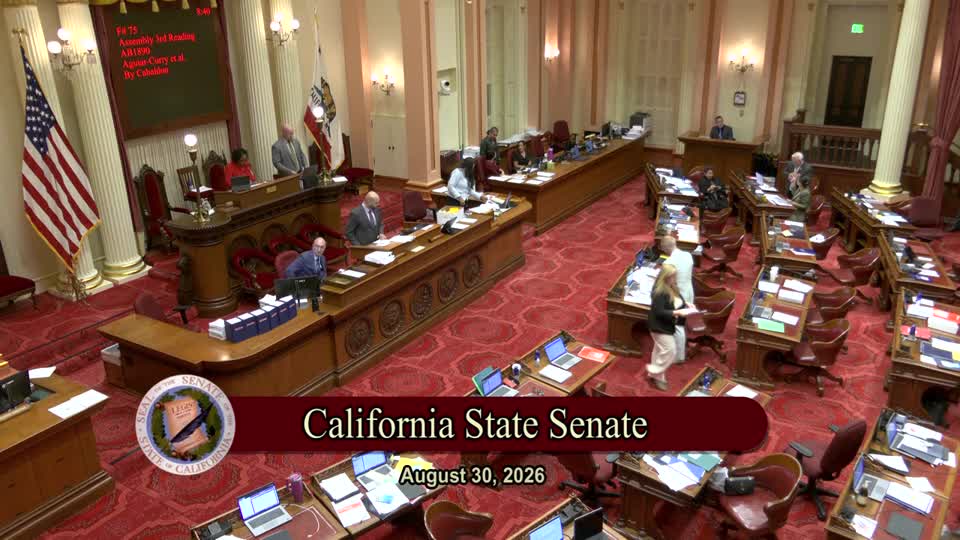 50SEC
Senate Floor
 1MIN
Senate Standing Committee on Appropriations
 12MIN
Senate Standing Committee on Natural Resources and Water
 9MIN
Senate Standing Committee on Environmental Quality
 1MIN
Assembly Floor
 32MIN
Assembly Standing Committee on Appropriations
Bill Author

Bill Co-Author(s):