AB 2242: Pupil safety: sextortion informational poster.
- Session Year: 2025-2026
- House: Assembly
- Latest Version Date: 2026-09-27
Current Status:
Passed
(2026-09-27: Chaptered by Secretary of State - Chapter 592, Statutes of 2026.)
Introduced
In Committee
Awaiting First Chamber Vote
Passed First Chamber
In Committee
Awaiting Second Chamber Vote
Passed Second Chamber
Enacted
Existing law requires each educational institution in the state to have a written policy on sexual harassment and to display that policy in a prominent location, as defined, in the main administrative building or other area of the educational institutions campus or schoolsite. Existing law requires each schoolsite in a school district, county office of education, or charter school, serving pupils in any of grades 9 to 12, inclusive, to create a poster that notifies pupils of that policy and to prominently and conspicuously display the poster in each bathroom and locker room at the schoolsite, as specified.
This bill would require each school district, county office of education, and charter school maintaining any combination of grades 7 to 12, inclusive, on or before the start of the 202728 school year, to display, at each schoolsite, as defined, in at least one mens restroom, one womens restroom, and one all-gender restroom used by pupils a legible poster printed in both English and a primary language other than English spoken by at least 15% of pupils enrolled at the schoolsite, that contains specified information relating to sextortion, including, among other information, an age-appropriate description of sextortion, as defined, and contact information for local, state, and federal law enforcement for purposes of reporting or seeking assistance relating to sextortion. The bill would require the department, on or before July 1, 2027, to develop and post on its internet website a model template of the poster for use by those local educational agencies. By imposing additional duties on local educational agencies, the bill would impose a state-mandated local program.
The California Constitution requires the state to reimburse local agencies and school districts for certain costs mandated by the state. Statutory provisions establish procedures for making that reimbursement.
This bill would provide that, if the Commission on State Mandates determines that the bill contains costs mandated by the state, reimbursement for those costs shall be made pursuant to the statutory provisions noted above.
Existing law requires each educational institution in the state to have a written policy on sexual harassment and to display that policy in a prominent location, as defined, in the main administrative building or other area of the educational institutions campus or schoolsite. Existing law requires each schoolsite in a school district, county office of education, or charter school, serving pupils in any of grades 9 to 12, inclusive, to create a poster that notifies pupils of that policy and to prominently and conspicuously display the poster in each bathroom and locker room at the schoolsite, as specified.
This bill would require each public school school district, county office of education, and charter school maintaining any combination of grades 7 to 12, inclusive, on or before the start of the 202728 school year, to display display, at each schoolsite, as defined, in at least one mens restroom and restroom, one womens restroom restroom, and one all-gender restroom used by pupils a legible poster printed in both English and Spanish a primary language other than English spoken by at least 15% of pupils enrolled at the schoolsite, that contains specified information relating to sextortion, including, among other information, an age-appropriate description of sextortion, as defined, and contact information for local, state, and federal law enforcement for purposes of reporting or seeking assistance relating to sextortion. The bill would require the department, on or before July 1, 2027, to develop and post on its internet website a model template of the poster for use by those local educational agencies. By imposing additional duties on public schools, local educational agencies, the bill would impose a state-mandated local program.
The California Constitution requires the state to reimburse local agencies and school districts for certain costs mandated by the state. Statutory provisions establish procedures for making that reimbursement.
This bill would provide that, if the Commission on State Mandates determines that the bill contains costs mandated by the state, reimbursement for those costs shall be made pursuant to the statutory provisions noted above.
Existing law requires each educational institution in the state to have a written policy on sexual harassment and to display that policy in a prominent location, as defined, in the main administrative building or other area of the educational institutions campus or schoolsite. Existing law requires each schoolsite in a school district, county office of education, or charter school, serving pupils in any of grades 9 to 12, inclusive, to create a poster that notifies pupils of that policy and to prominently and conspicuously display the poster in each bathroom and locker room at the schoolsite, as specified.
This bill would require each public school maintaining any combination of grades 7 to 12, inclusive, on or before the start of the 202728 school year, to display in at least one mens restroom and one womens restroom used by pupils a legible poster printed in both English and Spanish that contains specified information relating to sextortion, including, among other information, an age-appropriate description of sextortion, as defined, and contact information for local, state, and federal law enforcement for purposes of reporting or seeking assistance relating to sextortion. By imposing additional duties on public schools, the bill would impose a state-mandated local program.
The California Constitution requires the state to reimburse local agencies and school districts for certain costs mandated by the state. Statutory provisions establish procedures for making that reimbursement.
This bill would provide that, if the Commission on State Mandates determines that the bill contains costs mandated by the state, reimbursement for those costs shall be made pursuant to the statutory provisions noted above.
(a)On or before the start of the 202728 school year, each local educational agency shall display, at each schoolsite it maintains, in at least one mens restroom, one womens restroom, and one all-gender restroom used by pupils, a legible poster printed in English and any primary language other than English spoken by at least 15 percent of pupils enrolled at the schoolsite, determined pursuant to Section 48985, that is at least 12 by 18 inches in size that contains all of the following information:
(1)An age-appropriate description of sextortion.
(2)Contact information for local, state, and federal law enforcement for purposes of reporting and seeking assistance related to sextortion.
(3)Contact information for the 988 Suicide and Crisis Lifeline.
(4)The Uniform Resource Locator (URL), quick response (QR) code, or other similar resource to identify the internet website for informational and support resources regarding online enticement, including sextortion, provided by the National Center for Missing and Exploited Children or any federally funded successor entity.
(b)On or before July 1, 2027, the department shall develop and post on the departments internet website a model template of the poster described in subdivision (a) for use by local educational agencies.
(c)For the purposes of this section, the following definitions apply:
(1)Local educational agency means a school district, county office of education, or charter school maintaining any combination of grades 7 to 12, inclusive.
(2)Schoolsite means a school serving any combination of grades 7 to 12, inclusive, maintained by a local educational agency.
(3)Sextortion means the threat to use sexual or intimate images or videos, however obtained, to compel another person to produce sexual or intimate images or videos, engage in sexual acts, or provide anything of value.
SEC. 2.If the Commission on State Mandates determines that this act contains costs mandated by the state, reimbursement to local agencies and school districts for those costs shall be made pursuant to Part 7 (commencing with Section 17500) of Division 4 of Title 2 of the Government Code.
(a)On or before the start of the 202728 school year, each local educational agency shall display, at each schoolsite it maintains, in at least one mens restroom, one womens restroom, and one all-gender restroom used by pupils, a legible poster printed in English and any primary language other than English spoken by at least 15 percent of pupils enrolled at the schoolsite, determined pursuant to Section 48985, that is at least 12 by 18 inches in size that contains all of the following information:
(1)An age-appropriate description of sextortion.
(2)Contact information for the 988 Suicide and Crisis Lifeline. local, state, and federal law enforcement for purposes of reporting and seeking assistance related to sextortion.
(3)Contact information for a national suicide prevention hotline. the 988 Suicide and Crisis Lifeline.
(4)The Uniform Resource Locator (URL), quick response (QR) code, or other similar resource to identify the internet website for informational and support resources regarding online enticement, including sextortion, provided by the National Center for Missing and Exploited Children or any federally funded successor entity.
(b)On or before July 1, 2027, the department shall develop and post on the departments internet website a model template of the poster described in subdivision (a) for use by local educational agencies.
(c)For the purposes of this section, the following definitions apply:
(1)Local educational agency means a school district, county office of education, or charter school maintaining any combination of grades 7 to 12, inclusive.
(2)Schoolsite means a school serving any combination of grades 7 to 12, inclusive, maintained by a local educational agency.
(3)Sextortion means the threat to use sexual or intimate images or videos, however obtained, to compel another person to produce sexual or intimate images or videos, engage in sexual acts, or provide anything of value.
SEC. 2.If the Commission on State Mandates determines that this act contains costs mandated by the state, reimbursement to local agencies and school districts for those costs shall be made pursuant to Part 7 (commencing with Section 17500) of Division 4 of Title 2 of the Government Code.
(a)On or before the start of the 202728 school year, each public school maintaining any combination of grades 7 to 12, inclusive, local educational agency shall display, at each schoolsite it maintains, in at least one mens restroom and restroom, one womens restroom restroom, and one all-gender restroom used by pupils, a legible poster printed in both English and Spanish any primary language other than English spoken by at least 15 percent of pupils enrolled at the schoolsite, determined pursuant to Section 48985, that is at least 12 by 18 inches in size that contains all of the following information:
(1)An age-appropriate description of sextortion.
(2)Contact information for local, state, and federal law enforcement for purposes of reporting or seeking assistance relating to sextortion. the 988 Suicide and Crisis Lifeline.
(3)Contact information for a national suicide prevention hotline.
(4)The Uniform Resource Locator (URL), quick response (QR) code, or other similar resource to identify the internet website for informational and support resources regarding sextortion online enticement, including sextortion, provided by the National Center for Missing and Exploited Children or any federally funded successor entity.
(b)On or before July 1, 2027, the department shall develop and post on the departments internet website a model template of the poster described in subdivision (a) for use by local educational agencies.
(b)(c)For the purposes of this section, the following definitions apply:
(1)Public school Local educational agency means a school operated by a school district, county office of education, or charter school. school maintaining any combination of grades 7 to 12, inclusive.
(2)Schoolsite means a school serving any combination of grades 7 to 12, inclusive, maintained by a local educational agency.
(2)(3)Sextortion means the threat to use sexual or intimate images or videos, however obtained, to compel another person to produce sexual or intimate images or videos, engage in sexual acts, or provide anything of value.
SEC. 2.If the Commission on State Mandates determines that this act contains costs mandated by the state, reimbursement to local agencies and school districts for those costs shall be made pursuant to Part 7 (commencing with Section 17500) of Division 4 of Title 2 of the Government Code.
(a)On or before the start of the 202728 school year, each public school maintaining any combination of grades 7 to 12, inclusive, shall display, in at least one mens restroom and one womens restroom used by pupils, a legible poster printed in both English and Spanish that is at least 12 by 18 inches in size that contains all of the following information:
(1)An age-appropriate description of sextortion.
(2)Contact information for local, state, and federal law enforcement for purposes of reporting or seeking assistance relating to sextortion.
(3)Contact information for a national suicide prevention hotline.
(4)The Uniform Resource Locator (URL), quick response (QR) code, or other similar resource to identify the internet website for informational and support resources regarding sextortion provided by the National Center for Missing and Exploited Children or any federally funded successor entity.
(b)For the purposes of this section, the following definitions apply:
(1)Public school means a school operated by a school district, county office of education, or charter school.
(2)Sextortion means the threat to use sexual or intimate images or videos, however obtained, to compel another person to produce sexual or intimate images or videos, engage in sexual acts, or provide anything of value.
SEC. 2.If the Commission on State Mandates determines that this act contains costs mandated by the state, reimbursement to local agencies and school districts for those costs shall be made pursuant to Part 7 (commencing with Section 17500) of Division 4 of Title 2 of the Government Code.
|
Date
|
Status
|
|---|---|
| Sep 27, 2026 | Chaptered by Secretary of State - Chapter 592, Statutes of 2026. |
| Sep 27, 2026 | Approved by the Governor. |
| Sep 8, 2026 | Enrolled and presented to the Governor at 3:30 p.m. |
| Aug 28, 2026 | Senate amendments concurred in. To Engrossing and Enrolling. (Ayes 76. Noes 0. Page 6777.). |
| Aug 28, 2026 | Senate amendments concurred in. To Engrossing and Enrolling. (Ayes 76. Noes 0.). |
| Aug 20, 2026 | In Assembly. Concurrence in Senate amendments pending. |
| Aug 20, 2026 | Read third time. Passed. Ordered to the Assembly. (Ayes 39. Noes 0. Page 5591.). |
| Aug 20, 2026 | Read third time. Passed. Ordered to the Assembly. (Ayes 39. Noes 0.). |
| Aug 18, 2026 | Ordered to special consent calendar. |
| Aug 13, 2026 | Read second time. Ordered to third reading. |
| Aug 13, 2026 | From committee: Do pass. (Ayes 7. Noes 0.) (August 13). |
| Aug 3, 2026 | In committee: Referred to APPR. suspense file. |
| Jun 25, 2026 | From committee: Do pass and re-refer to Com. on APPR. with recommendation: To Consent Calendar. (Ayes 7. Noes 0.) (June 24). Re-referred to Com. on APPR. |
| Jun 11, 2026 | From committee chair, with author's amendments: Amend, and re-refer to committee. Read second time, amended, and re-referred to Com. on ED. |
| Jun 10, 2026 | Referred to Com. on ED. |
| Jun 1, 2026 | In Senate. Read first time. To Com. on RLS. for assignment. |
| May 28, 2026 | Read third time. Passed. Ordered to the Senate. (Ayes 76. Noes 0. Page 5543.) |
| May 28, 2026 | Read third time. Passed. Ordered to the Senate. (Ayes 76. Noes 0.) |
| May 18, 2026 | Read second time. Ordered to third reading. |
| May 14, 2026 | From committee: Do pass. (Ayes 15. Noes 0.) (May 14). |
| May 6, 2026 | In committee: Set, first hearing. Referred to APPR. suspense file. |
| Apr 6, 2026 | Re-referred to Com. on APPR. |
| Mar 26, 2026 | Read second time and amended. |
| Mar 25, 2026 | From committee: Amend, and do pass as amended and re-refer to Com. on APPR. with recommendation: To Consent Calendar. (Ayes 9. Noes 0.) (March 25). |
| Mar 9, 2026 | Referred to Com. on ED. |
| Feb 20, 2026 | From printer. May be heard in committee March 22. |
| Feb 19, 2026 | Read first time. To print. |
|
Date
|
Description
|
Location
|
Votes
|
|
|---|---|---|---|---|
| Aug 28, 2026 | AB 2242 Davies Concurrence in Senate Amendments | Assembly Floor |
Passed |
|
| Aug 20, 2026 | Special Consent AB2242 Davies By Grove | Senate Floor |
Passed |
|
| Aug 13, 2026 | Do pass | Senate Standing Committee on Appropriations |
Passed |
|
| Aug 3, 2026 | Placed on suspense file | Senate Standing Committee on Appropriations |
Passed |
|
| Jun 24, 2026 | Do pass, but first be re-referred to the Committee on [Appropriations] with the recommendation: To Consent Calendar | Senate Standing Committee on Education |
Passed |
|
| May 28, 2026 | AB 2242 Davies Assembly Third Reading | Assembly Floor |
Passed |
|
| May 14, 2026 | Do pass. | Assembly Standing Committee on Appropriations |
Passed |
|
| Mar 25, 2026 | Do pass as amended, and be re-referred to the Committee on [Appropriations] with recommendation: To Consent Calendar | Assembly Standing Committee on Education |
Passed |
This list shows positions taken on this bill by organizations on the date displayed, which is linked to the original source.
Positions by individuals are not included.
|
Organization
|
Position
|
Date
|
|---|---|---|
| San Diego District Attorney's Office | ** Support |
CONCURRENCE IN SENATE AMENDMENTS
CSA1 Bill Id:AB 2242
Author:(Davies)
As Amended Ver:June 11, 2026
Majority vote
SUMMARY
Requires local education agencies (LEAs) that serve students in grades 7 to 12 to display a poster that contains age-appropriate information and resources related to the practice of sextortion in at least one men's, one women's, and one all-gender restroom used by pupils. Requires the poster to include specified information and adhere to existing translation requirements.
Senate Amendments
- Clarify that the poster must contain contact information for local, state, and federal law enforcement for purposes for reporting and seeking assistance related to sextortion, in addition to the 988 Suicide and Crisis Lifeline.
COMMENTS
What is sextortion, and how does it happen? Sextortion is a form of online enticement or blackmail. The Federal Bureau of Investigation (FBI) maintains a webpage with information and resources about sextortion. It describes sextortion as follows:
Sextortion can start on any site, app, messaging platform, or game where people meet and communicate. In some cases, the first contact from the criminal will be a threat. The person may claim to already have a revealing picture or video of a child that will be shared if the victim does not send more pictures.
More often, however, this crime starts when young people believe they are communicating with someone their own age who is interested in a relationship or with someone who is offering something of value.
After the criminals have one or more videos or pictures, they threaten to publish that content, or they threaten violence, to get the victim to produce more images. The shame, fear, and confusion children feel when they are caught in this cycle often prevents them from asking for help or reporting the abuse. Caregivers and young people should understand how the crime occurs and openly discuss online safety.
The FBI further describes financial sextortion as follows:
In these cases, the offender receives sexually explicit material from the child and then threatens to release the compromising material unless the victim sends money and/or gift cards. The amount requested varies, and the offender often releases the victim’s sexually explicit material regardless of whether or not they receive payment. This increasing threat has resulted in an alarming number of deaths by suicide.
Rates of online enticement, including sextortion, are rising. The National Center for Missing and Exploited Children (NCMEC) observed a 300% increase in reports of online enticement, which includes sextortion, between 2021 and 2023. In 2023, their online CyberTipline received 186,000 reports of online enticement; in 2024, that number rose to 456,000 reports. The extent to which this increase represents improved awareness of online enticement and how to report it, versus an increase in the actual crime, is unknown.
NCMEC sextortion resources. This bill requires the poster to include a link to guidance from the NCMEC, which maintains a page on online enticement, including sextortion. The resources gathered are thorough and easy to understand, and include information about how sextortion occurs, how to report it, and where to receive support.
According to the Author
According to the author, "Our children are facing a digital crisis where 'sextortion' and technology-facilitated harassment are devastating lives in the shadows of our schools. While existing laws mandate that sexual harassment policies stay tucked away in administrative offices, AB 2242 meets students where they are by placing life-saving information and reporting resources in the private, high-traffic areas of restrooms and locker rooms. By requiring these notices to be printed in both English and Spanish, we are ensuring that every student, regardless of their background or primary language, has the tools to identify exploitation and the courage to come forward. We must act now to transform our schools from passive observers into proactive shields against the predators who weaponize technology to target our youth."
Arguments in Support
According to the San Diego District Attorney's Office, "Sextortion is a form of child sexual exploitation that disproportionately targets minors through online platforms. Perpetrators often obtain intimate images through deception and threaten to distribute those images unless victims provide money, additional content, or engage in sexual acts. Many victims are driven by fear of humiliation and exposure to comply rather than seek help. AB 2242 will empower students in prevention and intervention measures against sextortion before any further harm can be caused."
Arguments in Opposition
None on file.
FISCAL COMMENTS
According to the Assembly Appropriations Committee, "One-time Proposition 98 General Fund costs for all LEAs serving students in grades seven through 12, to post a sextortion information poster in bathrooms within each schoolsite, as specified.
According to the CDE, there are more than 400 unified and high school districts in California, collectively representing approximately 3,000 individual schoolsites, in addition to several elementary school districts who may also serve grades seven and eight as well as charter schools. If every impacted LEA incurred costs of $50 associated with designing, printing, and posting the required poster at each schoolsite, costs could be at least $150,000 statewide."
One-time General Fund cost pressures of an unknown amount, likely minor and absorbable, for the CDE to develop and post a model poster template.
VOTES:
ASM EDUCATION: 9-0-0
YES: Patel, Hoover, Alvarez, Bonta, Alanis, Garcia, Lowenthal, Pellerin, Zbur
ASM APPROPRIATIONS: 15-0-0
YES: Wicks, Hoover, Aguiar-Curry, Calderon, Caloza, Dixon, Fong, Mark González, Krell, Pacheco, Pellerin, Sharp-Collins, Solache, Ta, Tangipa
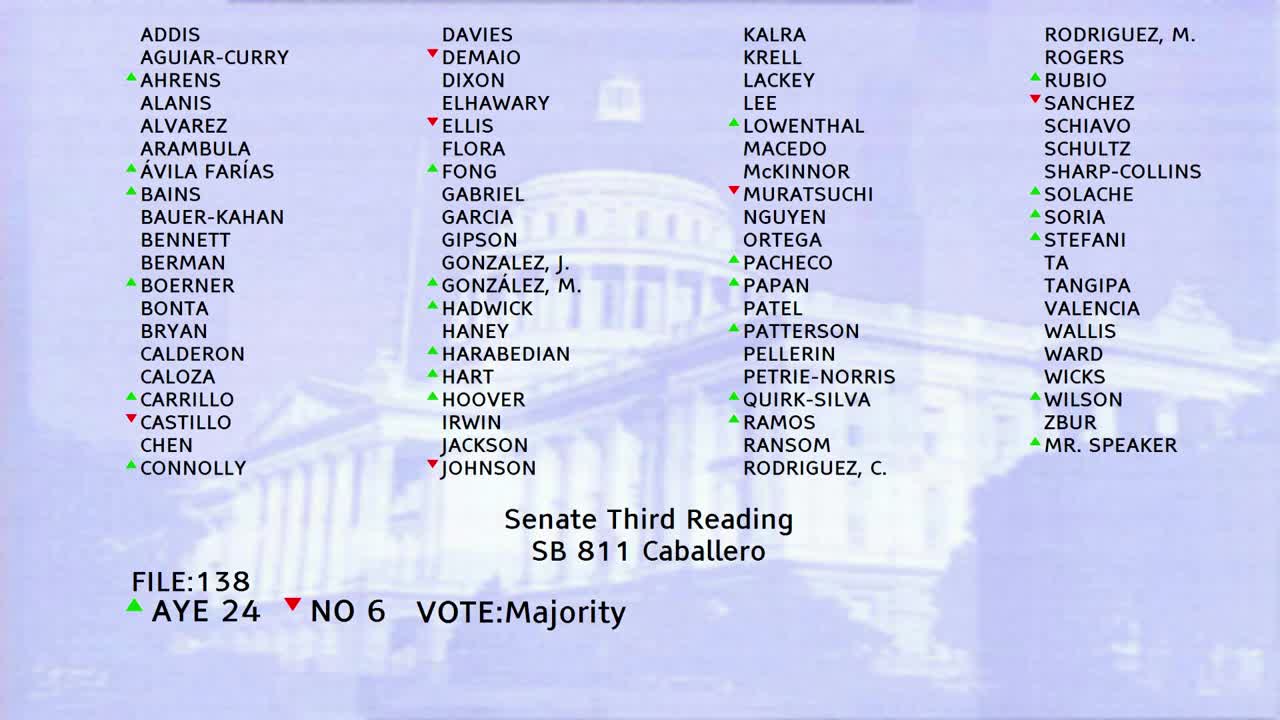
ASSEMBLY FLOOR: 76-0-4
YES: Addis, Aguiar-Curry, Ahrens, Alanis, Alvarez, Arambula, Ávila Farías, Bains, Bauer-Kahan, Bennett, Berman, Boerner, Bonta, Bryan, Calderon, Caloza, Carrillo, Castillo, Chen, Connolly, Davies, DeMaio, Dixon, Elhawary, Ellis, Flora, Fong, Gabriel, Gallagher, Garcia, Gipson, Jeff Gonzalez, Mark González, Hadwick, Haney, Harabedian, Hart, Hoover, Irwin, Johnson, Kalra, Krell, Lackey, Lowenthal, Macedo, McKinnor, Muratsuchi, Nguyen, Ortega, Pacheco, Papan, Patel, Patterson, Pellerin, Petrie-Norris, Ramos, Ransom, Michelle Rodriguez, Rogers, Blanca Rubio, Sanchez, Schiavo, Schultz, Sharp-Collins, Solache, Soria, Stefani, Ta, Tangipa, Valencia, Wallis, Ward, Wicks, Wilson, Zbur, Rivas
ABS, ABST OR NV: Jackson, Lee, Quirk-Silva, Celeste Rodriguez
SENATE FLOOR: 39-0-1
YES: Allen, Alvarado-Gil, Archuleta, Arreguín, Ashby, Becker, Blakespear, Cabaldon, Caballero, Cervantes, Choi, Cortese, Dahle, Durazo, Gonzalez, Grayson, Grove, Hurtado, Jones, Laird, Limón, McGuire, McNerney, Menjivar, Niello, Ochoa Bogh, Padilla, Pérez, Richardson, Rubio, Seyarto, Smallwood-Cuevas, Stern, Strickland, Umberg, Valladares, Wahab, Weber Pierson, Wiener
ABS, ABST OR NV: Reyes
UPDATED
VERSION: June 11, 2026
CONSULTANT: Sarah Cate Hawthorne / ED. / (916) 319-2087 FN: 0003812
SENATE RULES COMMITTEE Office of Senate Floor Analyses (916) 651-4171 | AB 2242 |
THIRD READING
Bill No: AB 2242
Author: Davies (R)
Amended: 6/11/26 in Senate
Vote: 21
SENATE EDUCATION COMMITTEE: 7-0, 6/24/26
AYES: Pérez, Ochoa Bogh, Cabaldon, Choi, Cortese, Gonzalez, Reyes
SENATE APPROPRIATIONS COMMITTEE: 7-0, 8/13/26
AYES: Cervantes, Seyarto, Cabaldon, Dahle, Grayson, Richardson, Wahab
SENATE APPROPRIATIONS COMMITTEE: 7-0, 8/13/26
AYES: Cervantes, Seyarto, Cabaldon, Dahle, Grayson, Richardson, Wahab
ASSEMBLY FLOOR: 76-0, 5/28/26 - See last page for vote
SUBJECT: Pupil safety: sextortion informational poster
SOURCE: Author
DIGEST:
This bill requires local educational agencies (LEAs) serving students in grades 7 to 12 to display an informational poster on sextortion in at least one of women’s restroom, men’s restroom, and all-gender restroom at each of its schoolsites. This bill also requires the California Department of Education (CDE) to develop and post on its website a model poster template for LEA use.
ANALYSIS:
Existing law:
- Requires each schoolsite in a school district, county office of education (COE), or charter school, serving pupils in any of grades 9 through 12, inclusive, to create a poster that notifies pupils of the applicable written policy on sexual harassment. Requires that the poster be prominently and conspicuously displayed in each bathroom and locker at the schoolsite. (Education Code (EC) § 231.6)
- Requires the State Superintendent of Public Instruction (SPI) to create and post on the CDE website, a poster that notifies children of the appropriate telephone number to call to report child abuse or neglect. Encourages school districts, charter schools, and private schools to post the appropriate version or versions of the poster in an area of the school where pupils frequently congregate. (EC § 33133.5)
- Requires each schoolsite in a school district, COE, or charter school serving pupils in grades 6 to 12, to create a poster that identifies approaches and shares resources regarding pupil mental health, as specified. Requires the poster to be prominently and conspicuously displayed in appropriate public areas that are accessible to, and commonly frequented by, pupils at each schoolsite. Requires the CDE to develop and maintain a model poster in collaboration with mental health experts, pupils, and administrators to serve as a guide for school districts, COEs, and charter schools. (EC § 49428.5)
- Requires the CDE to post on its website resources on teen dating violence prevention, local and national hotlines and services for youth experiencing teen dating violence, and other relevant resources for parents, guardians, and other caretakers of students. (EC § 231.7)
- Requires public schools, including charter schools and private schools, that serve students in any of grades 7 to 12, and public and private institutions of higher education that issue pupil or student identification cards, to print the telephone number for the National Domestic Violence Hotline and local domestic violence hotlines on those identification cards. (EC § 215.5)
- Establishes the California Healthy Youth Act (CHYA), which requires LEAs to provide comprehensive sexual health and Human Immunodeficiency Virus (HIV) prevention instruction to all students in grades 7 to 12, at least once in middle school and once in high school. (EC § 51933)
- Requires, as part of comprehensive sexual health education, that LEAs and charter schools provide students with instruction on sexual assault, intimate partner violence, sexual abuse, and human trafficking. (EC § 51934)
- Requires, as part of comprehensive sexual health education, that LEAs and charter schools provide information on local resources for assistance with sexual assault and intimate partner violence. (EC § 51934)
- Requires the Instructional Quality Commission (IQC), during its next revision of the Health Education Framework, on or after January 1, 2025, to consider including content on sextortion. Defines “sextortion” as a threat to use sexual or intimate images or videos, however obtained, to compel another person to produce sexual or intimate images or videos, engage in sexual acts, or provide anything of value. (EC § 33546.2)
This bill:
- Requires LEAs, on or before the 2027-28 school year, to display at each schoolsite it maintains, in at least one men’s restroom, one women’s restroom, and one all-gender restroom used by pupils, a legible poster printed in English and any primary language other than English spoken by at least 15% of pupils enrolled at the schoolsite that is at least 12 by 18 inches in size that contains all of the following information:
- An age-appropriate description of sextortion.
- Contact information for local, state, and federal law enforcement for purposes of reporting and seeking assistance related to sextortion.
- Contact information for the 988 Suicide and Crisis Lifeline.
- The Uniform Resource Locator (URL), quick response (QR) code, or similar resource to identify the internet website for informational and support resources regarding online enticement, including sextortion, provided by the National Center for Missing and Exploited Children or any federally funded successor entity.
- Requires the CDE, on or before July 1, 2027, to develop and post on its website, a template model of the poster described in #1 above for use by LEAs.
- Defines the following terms:
- “Local educational agency” means a school district, COE, or charter school maintaining any combination of grades 7 to 12, inclusive.
- “Schoolsite” means a school serving any combination of grades 7 to 12, inclusive, maintained by an LEA.
- “Sextortion” means the threat to use sexual or intimate images or videos, however obtained, to compel another person to produce sexual or intimate images or videos, engage in sexual acts, or provide anything of value.
Comments
Need for the bill. According to the author, “Our children are facing a digital crisis where “sextortion” and technology-facilitated harassment are devastating lives in the shadows of our schools. While existing laws mandate that sexual harassment policies stay tucked away in administrative offices, AB 2242 meets students where they are by placing life-saving information and reporting resources in the private, high-traffic areas of restrooms and locker rooms. By requiring these notices to be printed in both English and Spanish, we are ensuring that every student, regardless of their background or primary language, has the tools to identify exploitation and the courage to come forward. We must act now to transform our schools from passive observers into proactive shields against the predators who weaponize technology to target our youth.”
What is sextortion? Sextortion, as defined in this bill and existing statute, is the threat to use sexual or intimate images or videos, however obtained, to compel another person to produce sexual or intimate images or videos, engage in sexual acts, or provide anything of value.
The Federal Bureau of Investigation (FBI) maintains an information and resource page specifically focusing on sextortion that targets children and teens. There, they note the following:
Sextortion can start on any site, app, messaging platform, or game where people meet and communicate. In some cases, the first contact from the criminal will be a threat. The person may claim to already have a revealing picture or video of a child that will be shared if the victim does not send more pictures.
More often, however, this crime starts when young people believe they are communicating with someone their own age who is interested in a relationship or with someone who is offering something of value. After the criminals have one or more videos or pictures, they threaten to publish that content, or they threaten violence, to get the victim to produce more images. The shame, fear, and confusion children feel when they are caught in this cycle often prevent them from asking for help or reporting the abuse.
The FBI also notes the following about financial sextortion:
Financial sextortion is different from traditional sextortion. In these cases, the offender receives sexually explicit material from the child and then threatens to release the compromising material unless the victim sends money and/or gift cards. The amount requested varies, and the offender often releases the victim’s sexually explicit material regardless of whether or not they receive payment. This increasing threat has resulted in an alarming number of deaths by suicide.
Other efforts to encourage sextortion awareness. In 2024, the Legislature passed AB 2932 (Joe Patterson, Chapter 118, Statutes of 2024), requiring the IQC to consider incorporating content on sextortion during its next revision of the Health Education Curriculum Framework (Framework), or before. While the Framework has not been revised since the passage of that bill, the most recent Framework adopted in 2019 includes discussions that help students understand that sexually explicit photographs that students take of themselves and send to other students can sometimes be used as blackmail to force or coerce victims into sex trafficking.
FISCAL EFFECT: Appropriation: No Fiscal Com.: Yes Local: Yes
According to the Senate Appropriations Committee:
- This bill could result in one-time Proposition 98 General Fund costs in the low hundreds of thousands of dollars for schools serving students in grades seven through 12, to post a sextortion information poster in their bathrooms. This estimate assumes there are about 3,000 schoolsites that would be impacted and a cost of $50 each to design, print, and post the posters at each schoolsite.
- The costs for the California Department of Education to develop and post a model template on its website are likely to be minor and absorbable within existing resources.
SUPPORT: (Verified 8/13/26)
San Diego County District Attorney’s Office
OPPOSITION: (Verified 8/13/26)
None received
ASSEMBLY FLOOR: 76-0, 5/28/26
AYES: Addis, Aguiar-Curry, Ahrens, Alanis, Alvarez, Arambula, Ávila Farías, Bains, Bauer-Kahan, Bennett, Berman, Boerner, Bonta, Bryan, Calderon, Caloza, Carrillo, Castillo, Chen, Connolly, Davies, DeMaio, Dixon, Elhawary, Ellis, Flora, Fong, Gabriel, Gallagher, Garcia, Gipson, Jeff Gonzalez, Mark González, Hadwick, Haney, Harabedian, Hart, Hoover, Irwin, Johnson, Kalra, Krell, Lackey, Lowenthal, Macedo, McKinnor, Muratsuchi, Nguyen, Ortega, Pacheco, Papan, Patel, Patterson, Pellerin, Petrie-Norris, Ramos, Ransom, Michelle Rodriguez, Rogers, Blanca Rubio, Sanchez, Schiavo, Schultz, Sharp-Collins, Solache, Soria, Stefani, Ta, Tangipa, Valencia, Wallis, Ward, Wicks, Wilson, Zbur, Rivas
NO VOTE RECORDED: Jackson, Lee, Quirk-Silva, Celeste Rodriguez
Prepared by: Therresa Austin / ED. / (916) 651-4105
8/14/26 15:05:13
**** END ****
SENATE COMMITTEE ON
Senator Sabrina Cervantes, Chair
2025 - 2026 Regular Session
AB 2242 (Davies) - Pupil safety: sextortion informational poster
Version: | Policy Vote: |
Urgency: | Mandate: |
Hearing Date: | Consultant: |
Bill Summary:
This bill requires local educational agencies (LEAs) serving students in grades 7 to 12 to display an informational poster on sextortion in a women’s restroom, men’s restroom, and all-gender restroom at each of its schoolsites.
Fiscal Impact:
This bill could result in one-time Proposition 98 General Fund costs in the low hundreds of thousands of dollars for schools serving students in grades seven through 12, to post a sextortion information poster in their bathrooms. This estimate assumes there are about 3,000 schoolsites that would be impacted and a cost of $50 each to design, print, and post the posters at each schoolsite.
The costs for the California Department of Education to develop and post a model template on its website are likely to be minor and absorbable within existing resources.
Background:
Existing law requires the CDE to post on its website resources on teen dating violence prevention, local and national hotlines and services for youth experiencing teen dating violence, and other relevant resources for parents, guardians, and other caretakers of students.
Existing law requires each schoolsite in a school district, county office of education (COE), or charter school, serving pupils in any of grades 9 through 12, inclusive, to create a poster that notifies pupils of the applicable written policy on sexual harassment. The law requires that the poster be prominently and conspicuously displayed in each bathroom and locker at the schoolsite.
Existing law requires the State Superintendent of Public Instruction (SPI) to create and post on the CDE website, a poster that notifies children of the appropriate telephone number to call to report child abuse or neglect. The law encourages school districts, charter schools, and private schools to post the appropriate version or versions of the poster in an area of the school where pupils frequently congregate.
Proposed Law:
This bill requires LEAs, on or before the 2027-28 school year, to display at each schoolsite it maintains, for at least one men’s restroom, one women’s restroom, and one all-gender restroom used by pupils, a legible poster printed in English and any primary language other than English spoken by at least 15 percent of pupils enrolled at the schoolsite that is at least 12 by 18 inches in size that contains all of the following information:
- An age-appropriate description of sextortion.
- Contact information for local, state, and federal law enforcement for purposes of reporting and seeking assistance related to sextortion.
- Contact information for the 988 Suicide and Crisis Lifeline.
- The Uniform Resource Locator (URL), quick response (QR) code, or similar resource to identify the internet website for informational and support resources regarding online enticement, including sextortion, provided by the National Center for Missing and Exploited Children or any federally funded successor entity.
This bill requires the CDE, on or before July 1, 2027, to develop and post on its website, a template model of the poster described in #1 above for use by LEAs.
This bill defines “sextortion” as a threat to use sexual or intimate images or videos, however obtained, to compel another person to produce sexual or intimate images or videos, engage in sexual acts, or provide anything of value
Staff Comments:
Sextortion, as defined in this bill and existing statute, is the threat to use sexual or intimate images or videos, however obtained, to compel another person to produce sexual or intimate images or videos, engage in sexual acts, or provide anything of value. According to the author, “Our children are facing a digital crisis where “sextortion” and technology-facilitated harassment are devastating lives in the shadows of our schools. While existing laws mandate that sexual harassment policies stay tucked away in administrative offices, AB 2242 meets students where they are by placing life-saving information and reporting resources in the private, high-traffic areas of restrooms and locker rooms. By requiring these notices to be printed in both English and Spanish, we are ensuring that every student, regardless of their background or primary language, has the tools to identify exploitation and the courage to come forward. We must act now to transform our schools from passive observers into proactive shields against the predators who weaponize technology to target our youth.”
-- END --
SENATE COMMITTEE ON EDUCATION
Senator Sasha Renée Pérez, Chair
2025 - 2026 Regular
Bill No: Hearing Date: June 24, 2026
Author: | |||
Version: | June 11, 2026 | ||
Urgency: | Fiscal: | ||
Consultant: | |||
Subject:
SUMMARY
This bill requires local educational agencies (LEAs) serving students in grades 7 to 12 to display an informational poster on sextortion in at least one of women’s restroom, men’s restroom, and all-gender restroom at each of its schoolsites. The bill also requires the California Department of Education (CDE) to develop and post on its website a model poster template for LEA use.
BACKGROUND
Existing law:
- Requires each schoolsite in a school district, county office of education (COE), or charter school, serving pupils in any of grades 9 through 12, inclusive, to create a poster that notifies pupils of the applicable written policy on sexual harassment. Requires that the poster be prominently and conspicuously displayed in each bathroom and locker at the schoolsite. (Education Code (EC) § 231.6)
- Requires the State Superintendent of Public Instruction (SPI) to create and post on the CDE website, a poster that notifies children of the appropriate telephone number to call to report child abuse or neglect. Encourages school districts, charter schools, and private schools to post the appropriate version or versions of the poster in an area of the school where pupils frequently congregate. (EC § 33133.5)
- Requires each schoolsite in a school district, COE, or charter school serving pupils in grades 6 to 12, to create a poster that identifies approaches and shares resources regarding pupil mental health, as specified. Requires the poster to be prominently and conspicuously displayed in appropriate public areas that are accessible to, and commonly frequented by, pupils at each schoolsite. Requires the CDE to develop and maintain a model poster in collaboration with mental health experts, pupils, and administrators to serve as a guide for school districts, COEs, and charter schools. (EC § 49428.5)
- Requires the CDE to post on its website resources on teen dating violence prevention, local and national hotlines and services for youth experiencing teen dating violence, and other relevant resources for parents, guardians, and other caretakers of students. (EC § 231.7)
- Requires public schools, including charter schools and private schools, that serve students in any of grades 7 to 12, and public and private institutions of higher education that issue pupil or student identification cards, to print the telephone number for the National Domestic Violence Hotline and local domestic violence hotlines on those identification cards. (EC § 215.5)
- Establishes the California Healthy Youth Act (CHYA), which requires LEAs to provide comprehensive sexual health and Human Immunodeficiency Virus (HIV) prevention instruction to all students in grades 7 to 12, at least once in middle school and once in high school. (EC § 51933)
- Requires, as part of comprehensive sexual health education, that LEAs and charter schools provide students with instruction on sexual assault, intimate partner violence, sexual abuse, and human trafficking. (EC § 51934)
- Requires, as part of comprehensive sexual health education, that LEAs and charter schools provide information on local resources for assistance with sexual assault and intimate partner violence. (EC § 51934)
- Requires the Instructional Quality Commission (IQC), during its next revision of the Health Education Framework, on or after January 1, 2025, to consider including content on sextortion. Defines “sextortion” as a threat to use sexual or intimate images or videos, however obtained, to compel another person to produce sexual or intimate images or videos, engage in sexual acts, or provide anything of value. (EC § 33546.2)
ANALYSIS
This bill:
- Requires LEAs, on or before the 2027-28 school year, to display at each schoolsite it maintains, in at least one men’s restroom, one women’s restroom, and one all-gender restroom used by pupils, a legible poster printed in English and any primary language other than English spoken by at least 15% of pupils enrolled at the schoolsite that is at least 12 by 18 inches in size that contains all of the following information:
- An age-appropriate description of sextortion.
- Contact information for local, state, and federal law enforcement for purposes of reporting and seeking assistance related to sextortion.
- Contact information for the 988 Suicide and Crisis Lifeline.
- The Uniform Resource Locator (URL), quick response (QR) code, or similar resource to identify the internet website for informational and support resources regarding online enticement, including sextortion, provided by the National Center for Missing and Exploited Children or any federally funded successor entity.
- Requires the CDE, on or before July 1, 2027, to develop and post on its website, a template model of the poster described in #1 above for use by LEAs.
- Defines the following terms:
- “Local educational agency” means a school district, COE, or charter school maintaining any combination of grades 7 to 12, inclusive.
- “Schoolsite” means a school serving any combination of grades 7 to 12, inclusive, maintained by an LEA.
- “Sextortion” means the threat to use sexual or intimate images or videos, however obtained, to compel another person to produce sexual or intimate images or videos, engage in sexual acts, or provide anything of value
STAFF COMMENTS
- Need for the bill. According to the author, “Our children are facing a digital crisis where “sextortion” and technology-facilitated harassment are devastating lives in the shadows of our schools. While existing laws mandate that sexual harassment policies stay tucked away in administrative offices, AB 2242 meets students where they are by placing life-saving information and reporting resources in the private, high-traffic areas of restrooms and locker rooms. By requiring these notices to be printed in both English and Spanish, we are ensuring that every student, regardless of their background or primary language, has the tools to identify exploitation and the courage to come forward. We must act now to transform our schools from passive observers into proactive shields against the predators who weaponize technology to target our youth.”
- What is sextortion? Sextortion, as defined in this bill and existing statute, is the threat to use sexual or intimate images or videos, however obtained, to compel another person to produce sexual or intimate images or videos, engage in sexual acts, or provide anything of value.
The Federal Bureau of Investigation (FBI) maintains an information and resource page specifically focusing on sextortion that targets children and teens. There, they note the following:
Sextortion can start on any site, app, messaging platform, or game where people meet and communicate. In some cases, the first contact from the criminal will be a threat. The person may claim to already have a revealing picture or video of a child that will be shared if the victim does not send more pictures.
More often, however, this crime starts when young people believe they are communicating with someone their own age who is interested in a relationship or with someone who is offering something of value.
After the criminals have one or more videos or pictures, they threaten to publish that content, or they threaten violence, to get the victim to produce more images. The shame, fear, and confusion children feel when they are caught in this cycle often prevent them from asking for help or reporting the abuse.
The FBI also notes the following about financial sextortion:
Financial sextortion is different from traditional sextortion. In these cases, the offender receives sexually explicit material from the child and then threatens to release the compromising material unless the victim sends money and/or gift cards. The amount requested varies, and the offender often releases the victim’s sexually explicit material regardless of whether or not they receive payment. This increasing threat has resulted in an alarming number of deaths by suicide.
- Other efforts to encourage sextortion awareness. In 2024, the Legislature passed AB 2932 (Joe Patterson, Chapter 118, Statutes of 2024), requiring the IQC to consider incorporating content on sextortion during its next revision of the Health Education Curriculum Framework (Framework), or before. While the Framework has not been revised since the passage of that bill, the most recent Framework adopted in 2019 includes discussions that help students understand that sexually explicit photographs that students take of themselves and send to other students can sometimes be used as blackmail to force or coerce victims into sex trafficking.
- Prior and related legislation.
AB 748 (Carrillo, Chapter 431, Statutes of 2022) requires public schools serving pupils in any of grades 6 to 12 to create and conspicuously display a poster that identifies approaches and shares resources regarding pupil mental health. Also requires the CDE to develop a model poster.
AB 543 (Smith, Chapter 428, Statutes of 2019) requires public schools serving grades 9 to 12 to create and prominently display a poster that notifies pupils of the school’s sexual harassment policy.
SB 1178 (Vidak, Chapter 171, Statutes of 2016) requires the SPI to develop a poster that notifies students of the appropriate resources available for reporting child abuse or neglect.
SUPPORT
San Diego County District Attorney’s Office
OPPOSITION
None received
-- END --
ASSEMBLY THIRD READING
ATR Bill Id:AB 2242
Author:(Davies)
As Amended Ver:March 26, 2026
Majority vote
SUMMARY
Requires local education agencies (LEAs) that serve students in grades 7 to 12 to display a poster that contains age-appropriate information and resources related to the practice of sextortion.
Major Provisions
- Defines sextortion as the threat to use sexual or intimate images or videos, however obtained, to compel another person to produce sexual or intimate images or videos, engage in sexual acts, or provide anything of value.
- Requires LEAs with students in grades 7 through 12 to display a poster on sextortion in at least one men's and one women's restroom used by students. Requires the poster to be printed in both English and any language spoken by 15% or more of enrolled students and be at least 12 by 18 inches in size.
- Requires the content of the poster to include all of the following:
- An age-appropriate description of sextortion;
- Contact information for local, state, and federal law enforcement for the purpose of reporting or seeking assistance relating to sextortion;
- Contact information for the 988 Suicide and Crises Lifeline; and
- The internet address for the sextortion resources provided by the National Center for Missing and Exploited Children (NCMEC), or any federally funded successor entity, in either uniform resource locator (URL) quick response (QR), or another similar form.
- Require the California Department of Education (CDE), on or before July 1, 2027, to develop and post on its website a model template of the described template than can be modified and used by LEAs.
COMMENTS
What is sextortion, and how does it happen? Sextortion is a form of online enticement or blackmail. The Federal Bureau of Investigation (FBI) maintains a webpage with information and resources about sextortion. It describes sextortion as follows:
Sextortion can start on any site, app, messaging platform, or game where people meet and communicate. In some cases, the first contact from the criminal will be a threat. The person may claim to already have a revealing picture or video of a child that will be shared if the victim does not send more pictures.
More often, however, this crime starts when young people believe they are communicating with someone their own age who is interested in a relationship or with someone who is offering something of value.
After the criminals have one or more videos or pictures, they threaten to publish that content, or they threaten violence, to get the victim to produce more images. The shame, fear, and confusion children feel when they are caught in this cycle often prevents them from asking for help or reporting the abuse. Caregivers and young people should understand how the crime occurs and openly discuss online safety.
The FBI further describes financial sextortion as follows:
In these cases, the offender receives sexually explicit material from the child and then threatens to release the compromising material unless the victim sends money and/or gift cards. The amount requested varies, and the offender often releases the victim's sexually explicit material regardless of whether or not they receive payment. This increasing threat has resulted in an alarming number of deaths by suicide.
Rates of online enticement, including sextortion, are rising. The NCMEC observed a 300% increase in reports of online enticement, which includes sextortion, between 2021 and 2023. In 2023, their online CyberTipline received 186,000 reports of online enticement; in 2024, that number rose to 456,000 reports. The extent to which this increase represents improved awareness of online enticement and how to report it, versus an increase in the actual crime, is unknown.
According to the Author
According to the author, "Our children are facing a digital crisis where 'sextortion' and technology-facilitated harassment are devastating lives in the shadows of our schools. While existing laws mandate that sexual harassment policies stay tucked away in administrative offices, AB 2242 meets students where they are by placing life-saving information and reporting resources in the private, high-traffic areas of restrooms and locker rooms. By requiring these notices to be printed in both English and Spanish, we are ensuring that every student, regardless of their background or primary language, has the tools to identify exploitation and the courage to come forward. We must act now to transform our schools from passive observers into proactive shields against the predators who weaponize technology to target our youth."
Arguments in Support
According to the San Diego District Attorney's Office, "Sextortion is a form of child sexual exploitation that disproportionately targets minors through online platforms. Perpetrators often obtain intimate images through deception and threaten to distribute those images unless victims provide money, additional content, or engage in sexual acts. Many victims are driven by fear of humiliation and exposure to comply rather than seek help. AB 2242 will empower students in prevention and intervention measures against sextortion before any further harm can be caused."
Arguments in Opposition
None on file.
FISCAL COMMENTS
According to the Assembly Appropriations Committee, "One-time Proposition 98 General Fund costs for all LEAs serving students in grades seven through 12, to post a sextortion information poster in bathrooms within each schoolsite, as specified.
According to the CDE, there are more than 400 unified and high school districts in California, collectively representing approximately 3,000 individual schoolsites, in addition to several elementary school districts who may also serve grades seven and eight as well as charter schools. If every impacted LEA incurred costs of $50 associated with designing, printing, and posting the required poster at each schoolsite, costs could be at least $150,000 statewide."
One-time General Fund cost pressures of an unknown amount, likely minor and absorbable, for the CDE to develop and post a model poster template.
VOTES
ASM EDUCATION: 9-0-0
YES: Patel, Hoover, Alvarez, Bonta, Alanis, Garcia, Lowenthal, Pellerin, Zbur
ASM APPROPRIATIONS: 15-0-0
YES: Wicks, Hoover, Aguiar-Curry, Calderon, Caloza, Dixon, Fong, Mark González, Krell, Pacheco, Pellerin, Sharp-Collins, Solache, Ta, Tangipa
UPDATED
VERSION: March 26, 2026
CONSULTANT: Sarah Cate Hawthorne / ED. / (916) 319-2087 FN: 0002674
Date of Hearing: May 6, 2026
ASSEMBLY COMMITTEE ON APPROPRIATIONS
Buffy Wicks, Chair
ABPCA Bill Id:AB 2242
Author:(Davies) – As Amended Ver:March 26, 2026
Policy Committee: | Education | Vote: | 9 - 0 |
|
| ||
|
|
Urgency: No State Mandated Local Program: Yes Reimbursable: Yes
SUMMARY:
This bill requires, beginning with the 2027-28 school year, a local educational agency (LEA) serving students in grades seven through 12, to display, in at least one men’s, one women’s, and one all-gender restroom used by students at each schoolsite, a sextortion information and resources poster printed in English and any primary language other than English spoken by at least 15% of students enrolled at the respective schoolsite.
The bill requires the California Department of Education (CDE) to develop and post on its internet website a model poster template for use by LEAs.
FISCAL EFFECT:
- One-time Proposition 98 General Fund costs for all LEAs serving students in grades seven through 12, to post a sextortion information poster in bathrooms within each schoolsite, as specified.
According to the CDE, there are more than 400 unified and high school districts in California, collectively representing approximately 3,000 individual schoolsites, in addition to several elementary school districts who may also serve grades seven and eight as well as charter schools. If every impacted LEA incurred costs of $50 associated with designing, printing, and posting the required poster at each schoolsite, costs could be at least $150,000 statewide.
- One-time General Fund cost pressures of an unknown amount, likely minor and absorbable, for the CDE to develop and post a model poster template.
COMMENTS:
- Purpose. According to the author:
Our children are facing a digital crisis where ‘sextortion’ and technology-facilitated harassment are devastating lives in the shadows of our schools. While existing laws mandate that sexual harassment policies stay tucked away in administrative offices, AB 2242 meets students where they are by placing life-saving information and reporting resources in the private, high-traffic areas of restrooms and locker rooms.
- Background. According to the Federal Bureau of Investigation (FBI), sextortion occurs when a criminal gains photographic or video content of an individual, often through some form of online communication that begins under friendly pretenses, which they threaten to publish, or threaten violence, unless the victim produces more images. The resulting shame, fear, and confusion experienced by the victim often prevents them from asking for help or reporting the abuse. According to the National Center for Missing or Exploited Children (NCMEC), between 2021 and 2023 there was a 300% increase in reports of online enticement, which includes sextortion.
Analysis Prepared by: Aaron Heredia / APPR. / (916) 319-2081
Date of Hearing: March 25, 2026
ASSEMBLY COMMITTEE ON EDUCATION
Darshana R. Patel, Chair
ABPCA Bill Id:AB 2242 (
Author:Davies) – As Introduced Ver:February 19, 2026
SUBJECT: Pupil safety: sextortion informational poster
SUMMARY: Requires local education agencies (LEAs) that serve students in grades 7 to 12 to display a poster that contains age-appropriate information and resources related to the practice of sextortion. Specifically, this bill:
- Defines sextortion as the threat to use sexual or intimate images or videos, however obtained, to compel another person to produce sexual or intimate images or videos, engage in sexual acts, or provide anything of value.
- Requires LEAs with students in grades 7 through 12 to display a poster on sextortion in at least one men’s and one women’s restroom used by students. Specifies that the poster must be printed in both English and Spanish and be at least 12 by 18 inches in size.
- Requires the content of the poster to include all of the following:
- An age-appropriate description of sextortion;
- Contact information for local, state, and federal law enforcement for the purpose of reporting or seeking assistance relating to sextortion;
- Contact information for a national suicide prevention hotline; and
- The internet address for the sextortion resources provided by the National Center for Missing and Exploited Children (NCMEC), or any federally funded successor entity, in either uniform resource locator (URL) quick response (QR), or another similar form.
EXISTING LAW:
- Requires the State Board of Education (SBE) Instructional Quality Commission (IQC) to consider including content on sextortion when the health curriculum framework is next revised, on or after January 1, 2025. Defines sextortion as a threat to use sexual or intimate images or videos, however obtained, to compel another person to produce sexual or intimate images or videos, engage in sexual acts, or provide anything of value. (Education Code (EC) 33546.2)
- Requires that students in grades 7 to 12, inclusive, receive instruction at least once in junior high or middle school and once in high school about adolescent relationship abuse and intimate partner violence, including the early warning signs. (EC 51934)
- Authorizes a school district to provide optional instruction, as part of comprehensive sexual health education and HIV prevention education, regarding the potential risks and consequences of creating and sharing sexually suggestive or sexually explicit materials through cellular telephones, social networking websites, computer networks, or other digital media. (EC 51934)
- Requires the California Department of Education (CDE) to post on its website resources on teen dating violence prevention, local and national hotlines and services for youth experiencing teen dating violence, and other relevant sources for parents, guardians, and other caretakers of students. (EC 231.7)
- Requires that, when the health education framework is revised after January 1, 2016, the IQC consider including comprehensive information for grades 9 to 12, inclusive, on sexual harassment and violence that includes, but is not limited to, all of the following:
- Information on different forms of sexual harassment and violence, including instances that occur among peers and in a dating relationship; a discussion of prevention strategies; how students report sexual harassment and violence; and potential resources victims can access;
- Discussion of the affirmative consent standard, as defined, and skills students may use to establish boundaries in peer and dating relationships; and
- Discussion of legal aspects of sexual harassment and violence under state and federal law. (EC 33544)
- Requires that, if the governing board of a school district requires a course in health education for graduation from high school, the governing board of the school district include instruction in sexual harassment and violence, including, but not limited to, information on the affirmative consent standard, as defined. (EC 33544)
FISCAL EFFECT: This bill has been keyed as a possible state-mandated local program by the Office of Legislative Counsel.
COMMENTS:
Need for the bill. According to the author, “Our children are facing a digital crisis where ‘sextortion’ and technology-facilitated harassment are devastating lives in the shadows of our schools. While existing laws mandate that sexual harassment policies stay tucked away in administrative offices, AB 2242 meets students where they are by placing life-saving information and reporting resources in the private, high-traffic areas of restrooms and locker rooms. By requiring these notices to be printed in both English and Spanish, we are ensuring that every student, regardless of their background or primary language, has the tools to identify exploitation and the courage to come forward. We must act now to transform our schools from passive observers into proactive shields against the predators who weaponize technology to target our youth.”
What is sextortion, and how does it happen? Sextortion is a form of online enticement or blackmail. The Federal Bureau of Investigation (FBI) maintains a webpage with information and resources about sextortion. It describes sextortion as follows:
Sextortion can start on any site, app, messaging platform, or game where people meet and communicate. In some cases, the first contact from the criminal will be a threat. The person may claim to already have a revealing picture or video of a child that will be shared if the victim does not send more pictures.
More often, however, this crime starts when young people believe they are communicating with someone their own age who is interested in a relationship or with someone who is offering something of value.
After the criminals have one or more videos or pictures, they threaten to publish that content, or they threaten violence, to get the victim to produce more images. The shame, fear, and confusion children feel when they are caught in this cycle often prevents them from asking for help or reporting the abuse. Caregivers and young people should understand how the crime occurs and openly discuss online safety.
It also describes financial sextortion as follows:
In these cases, the offender receives sexually explicit material from the child and then threatens to release the compromising material unless the victim sends money and/or gift cards. The amount requested varies, and the offender often releases the victim’s sexually explicit material regardless of whether or not they receive payment. This increasing threat has resulted in an alarming number of deaths by suicide.
Rates of online enticement, including sextortion, are rising. The NCMEC observed a 300% increase in reports of online enticement, which includes sextortion, between 2021 and 2023. In 2023, their online CyberTipline received 186,000 reports of online enticement; in 2024, that number rose to 456,000 reports. Data comparing the number of reports in 2024 to 2025 (below) show reports continue to grow at an alarming rate. The extent to which this increase represents improved awareness of online enticement and how to report it, versus an increase in the actual crime, is unknown.

Source: NCMEC, 2025
NCMEC sextortion resources. The NCMEC website maintains a page on online enticement, which includes sextortion. The resources gathered are thorough and easy to understand. As of March 2025, these resources include:
- An overview of online enticement generally and sextortion specifically;
- Common tactics used to entice children;
- Online behaviors that increase a child’s risk for sextortion;
- Statistics on the rates and incidence of online enticement;
- Information about their CyberTipline, which allows anyone to report suspected exploitative activity;
- Information about NetSmartz, an NCMEC online educational program that uses games, animated videos, classroom based lesson plans, and activities to help children make safer choices online;
- Information about Team HOPE, an NCMEC program that supports families of missing or sexually exploited children; and
- Links to current reports and data regarding online enticement.
Related legislation. AB 1766 (Krell) of the 2025-26 Session requires the IQC, the next time it revises the health curriculum framework, to consider including specified content on human trafficking and sexual exploitation.
AB 1792 (Michelle Rodriguez) of the 2025-26 Session requires that, during the next revision of health curriculum framework, the IQC consider including, and recommending for adoption by the SBE, specific content related to sexual health instruction to educate pupils about dating abuse and digital violence.
AB 2932 (Patterson), Chapter 118, Statutes of 2024, requires the SBE IQC to consider including content on sextortion when the health curriculum framework is next revised, on or after January 1, 2025.
AB 1071 (Hoover), Chapter 65, Statutes of 2023, requires the CDE to post on its website resources on teen dating violence prevention, local and national hotlines and services for youth experiencing teen dating violence, and other relevant sources for parents, guardians, and other caretakers of students.
AB 643 (Frazier), Chapter 574, Statutes of 2017, requires that content on the early warning signs of adolescent relationship abuse and intimate partner violence be included in mandated sexual health instruction.
SB 592 (Leyva) of the 2015-16 Session would have required school districts to provide educational programs that promote healthy relationships and prevent adolescent relationship abuse to students in grades 6-12, required the Superintendent of Public Instruction (SPI) to provide information for use by schools, and required school safety plans to include procedures and policies to prevent and respond to adolescent relationship abuse. This bill was held in the Senate Appropriations Committee.
AB 329 (Weber), Chapter 398, Statutes of 2015, makes instruction in sexual health education a requirement, revises HIV prevention education content, expands topics covered in sexual health education, requires this instruction to be inclusive of different sexual orientations, and clarifies parental consent policy.
SB 695 (de Leon), Chapter 424, Statutes of 2015, requires the IQC to consider adding content to the health curriculum framework for grades 9-12 on sexual harassment and violence, including the affirmative consent standard, and requires school districts which require a health course for graduation to include this content.
Committee Amendments. Staff recommends the bill be amended as follows:
- Clarify the definition of an LEA, specify that a national suicide prevention hotline means the 988 Suicide and Crisis Lifeline, and specify that resources include the NCMEC webpage on sextortion and online enticement.
- Require the CDE to, by July 1 2027, develop and maintain a template poster than LEAs can modify for their own use.
- Clarify that the poster must be translated into any language spoken by 15% or more of the students enrolled at the school site, as determined pursuant to Section 48985.
- Specify that the poster must posted in one gender neutral bathroom frequented by students, in addition to one men’s and one women’s.
REGISTERED SUPPORT / OPPOSITION:
Support
None on file
Opposition
None on file
Analysis Prepared by: Sarah Cate Hawthorne / ED. / (916) 319-2087
Discussed in Hearing
 49SEC
Assembly Floor
 1MIN
Senate Standing Committee on Appropriations
 58SEC
Assembly Floor
Bill Author

Bill Co-Author(s):