AB 2259: Prisons: mental health.
- Session Year: 2025-2026
- House: Assembly
- Latest Version Date: 2026-02-19
Current Status:
In Progress
(2026-05-14: In committee: Held under submission.)
Introduced
In Committee
Awaiting First Chamber Vote
Passed First Chamber
In Committee
Awaiting Second Chamber Vote
Passed Second Chamber
Enacted
Existing law authorizes the Secretary of the Department of Corrections and Rehabilitation to establish and maintain classes for incarcerated persons utilizing institutional personnel or entering into an agreement with the governing board of a school district or private school. Existing law requires the department to develop and implement a plan to obtain additional rehabilitation and treatment services for incarcerated persons and parolees. Existing law requires that plan to include, among other things, filling vacant state staff positions that provide direct and indirect rehabilitation services, or obtaining services from local governments and contractors to assist with treatment for parolees and incarcerated persons.
This bill would require the department to establish a 3-year pilot program at 2 institutions that would provide access to specified mental health therapy for certain incarcerated persons not classified by the department to receive mental health treatment from the institution. The bill would require communications during therapy sessions, as specified, between the incarcerated person and assigned therapist to be confidential. The bill would require the California Correctional Health Care Services to be the custodian of records for treatment records generated under this pilot program. The bill would require the department to report certain information to the fiscal and appropriate policy committees of the Legislature, from March 1, 2028, to March 1, 2031.
The bill would make related findings and declarations.
The Legislature finds and declares all of the following:
(a)Rehabilitation is an essential function of the Department of Corrections and Rehabilitation.
(b)The primary function of the Department of Corrections and Rehabilitations Statewide Mental Health Program is to ensure patients have ready access to mental health services based on their need.
(c)Mental health therapy contributes to personal growth, reflection, and preparation for safe and successful postincarceration reentry and helps foster a safer environment for staff and people incarcerated in the Department of Corrections and Rehabilitation.
(d)Mental health therapy can be provided by an array of licensed professionals or registered mental health providers, including marriage and family therapists, psychologists, and professional clinical counselors.
(e)To that end, access to mental health therapy should be available to all people incarcerated in the Department of Corrections and Rehabilitation, regardless of their security level or length of sentence, without requiring a pre-existing mental health diagnosis.
(f)The department has implemented a successful telepsychiatry program that has improved access to mental health care services and reduced staffing shortages. The utilization of telehealth technologies for a broader population will provide for a greater variety of options for incarcerated people to meet with mental health providers and receive care.
(g)This pilot intends to support continuity of care for justice-involved individuals connecting them to community-based providers prior to release and supporting individuals ability to remain under the care of that connected provider. The pilot would be consistent with the goals of the State of Californias Medi-Cal justice-involved initiatives to the extent permitted by federal law.
SEC. 2.Section 2693 is added to the Penal Code, to read:2693.(a)In order to foster incarcerated peoples growth, mental and emotional wellness, and rehabilitation, the Department of Corrections and Rehabilitation shall establish a three-year pilot program at two institutions. The pilot program shall include one institution housing people of each gender. The pilot program at each institution shall provide access to mental health therapy to an incarcerated person in either of the following settings:
(1)Virtual therapy opportunities, including telehealth and telepsychiatry, in a confidential setting.
(2)Contracted licensed or registered mental health providers who can provide counseling in a confidential setting.
(b)For each incarcerated person, virtual therapy opportunities or in-person sessions, pursuant to subdivision (a), shall be offered at least twice per month, for a minimum of 50 minutes, or as determined by the provider. Services provided through the pilot program shall be delivered using a short-term, evidence-based, therapeutic model appropriate for pre-release transitioning planning, including, but not limited to, brief cognitive behavioral therapy or similar structured interventions focused on the development of coping skills, reentry planning, and stabilization.
(c)Access to services during an incarcerated persons enrollment in the pilot program shall be limited to persons who are not currently determined by the department as having the following classification statuses:
(1)Correctional Clinical Case Management System.
(2)Enhanced Outpatient Program.
(3)Acute levels of care, including the Psychiatric Inpatient Programs or Mental Health Crisis Bed.
(d)(1)Participating incarcerated persons shall be within 90 days of their release from custody, or within 90 days of the persons minimum eligible parole date or earliest possible release date.
(2)The Department of Corrections and Rehabilitation, in coordination with the Department of Health Care Services, shall facilitate enrollment support for participating incarcerated persons to ensure that eligible persons are informed of Medi-Cal benefits no later than 90 days prior to their release date.
(3)Services provided through the pilot program may be covered through Medi-Cal or other allowable funding sources to support continuity of care prior to release and upon reentry.
(e)Enrollment shall not result in an incarcerated person being classified as having a serious mental health disorder unless the provider has made a formal recommendation and the incarcerated person offers express, written permission.
(f)Communications between an incarcerated person and the assigned mental health provider shall be confidential pursuant to the privacy protections of the Health Insurance Portability and Accountability Act of 1996 (HIPAA) (Public Law 104-191). The California Correctional Health Care Services shall act as the custodian of records for all treatment documents generated under this pilot program.
(g)Upon the incarcerated persons release from custody, the department shall provide them with information about community-based treatment programs.
(h)(1)The department shall report to the fiscal and appropriate policy committees of the Legislature on March 1, 2028, and each March 1 thereafter until March 1, 2031. The report shall include all of the following:
(A)The planned capacity of the program at each participating facility.
(B)The number of incarcerated persons enrolled in the program at each participating facility.
(C)The percentage of participants with positive posttreatment outcomes.
(D)The number of persons who are successfully linked to postrelease community-based treatment programs.
(2)A report to be submitted pursuant to this subdivision shall be submitted in compliance with Section 9795 of the Government Code.
(i)For the purposes of this section, virtual therapy opportunities means services provided by tablet, video conference, or other technologies.
(j)For the purposes of this section, positive outcomes means an inmate exhibiting any of the following:
(1)Reduced disciplinary action or writeups from staff.
(2)Self-acceptance.
(3)Self-understanding.
(4)Improved interpersonal safety and functioning.
(k)This section shall become inoperative on July 1, 2031, and, as of January 1, 2032, is repealed.
|
Date
|
Status
|
|---|---|
| May 14, 2026 | In committee: Held under submission. |
| Apr 22, 2026 | In committee: Set, first hearing. Referred to APPR. suspense file. |
| Mar 25, 2026 | From committee: Do pass and re-refer to Com. on APPR. (Ayes 8. Noes 0.) (March 24). Re-referred to Com. on APPR. |
| Mar 9, 2026 | Referred to Com. on PUB. S. |
| Feb 20, 2026 | From printer. May be heard in committee March 22. |
| Feb 19, 2026 | Read first time. To print. |
|
Date
|
Description
|
Location
|
Votes
|
|
|---|---|---|---|---|
| Mar 24, 2026 | Do pass and be re-referred to the Committee on [Appropriations] | Assembly Standing Committee on Public Safety |
Passed |
This list shows positions taken on this bill by organizations on the date displayed, which is linked to the original source.
Positions by individuals are not included.
|
Organization
|
Position
|
Date
|
|---|---|---|
| Aclu California Action | ** Support | |
| California Police Chiefs Association | ** Support | |
| Ella Baker Center For Human Rights | ** Support | |
| Mental Health America of California | ** Support | |
| Technet | ** Support |
Date of Hearing: April 22, 2026
ASSEMBLY COMMITTEE ON APPROPRIATIONS
Buffy Wicks, Chair
ABPCA Bill Id:AB 2259
Author:(Ransom) – As Introduced Ver:February 19, 2026
Policy Committee: | Public Safety | Vote: | 8 - 0 |
|
| ||
|
|
Urgency: No State Mandated Local Program: No Reimbursable: No
SUMMARY:
This bill requires the California Department of Corrections (CDCR) to establish a three-year pilot program at two institutions — one male, one female — to provide voluntary, confidential mental health therapy to incarcerated persons within 90 days of release who are not currently classified to receive mental health treatment.
Specifically, this bill:
- Requires each pilot institution to provide access to virtual therapy (telehealth, telepsychiatry) or in-person sessions with contracted licensed or registered mental health providers, at least twice per month for a minimum of 50 minutes per session, using short-term, evidence-based therapeutic models focused on coping skills, reentry planning, and stabilization.
- Limits eligibility to incarcerated persons not currently in the Correctional Clinical Case Management System, Enhanced Outpatient Program, or acute levels of care, and who are within 90 days of their release or earliest possible release date.
- Directs CDCR to coordinate with the Department of Health Care Services (DHCS) to facilitate Medi-Cal enrollment for participants up to 90 days before release, and provides that pilot services may be covered through Medi-Cal or other allowable funding sources.
- Requires annual reports to the Legislature from March 1, 2028, through March 1, 2031, on program capacity, enrollment, posttreatment outcomes, and linkages to community-based treatment.
- Sunsets July 1, 2031.
FISCAL EFFECT:
- Unknown but potentially significant costs (General Fund) to CDCR to establish and operate the pilot program. According to CDCR, approximately 52,000 incarcerated persons statewide — 59% of the population — are not currently classified to receive mental health treatment. CDCR estimates total annual costs for clinician staffing and equipment at the two pilot institutions would be in the millions of dollars. The bill requires sessions at least twice per month for a minimum of 50 minutes per participant. CDCR notes critical staffing shortages in clinical positions, particularly in certain geographic regions, that may make hiring difficult, as the department is already working to fill vacancies under the Coleman litigation. Consistent with the committee rules, this bill is a candidate for the committee’s suspense file because it has the primary purpose of creating a pilot program.
- Unknown but potentially significant one-time costs (General Fund) for facility modifications or construction to create confidential therapy space at the two pilot institutions. Space limitations and existing demand for treatment rooms may create operational challenges.
- Unknown, likely significant ongoing costs (General Fund) for telehealth infrastructure, including equipment, electronic health record licenses, IT maintenance and support, and clerical staff for records management, tracking, and billing. These costs may be partially offset by federal Medi-Cal matching funds. The bill provides that services may be covered through Medi-Cal or other allowable funding sources, and directs CDCR to coordinate with DHCS to facilitate Medi-Cal enrollment for participants up to 90 days before release, consistent with California Advancing and Innovating Medi-Cal (CalAIM) justice-involved initiatives. The extent of any offset depends on federal approval and individual participant eligibility.
- Minor costs (General Fund) for annual legislative reporting from March 1, 2028, through March 1, 2031.
The Legislative Analyst’s Office recently warned of General Fund structural deficits of around $35 billion per year beginning in the 2027-28 fiscal year.
COMMENTS:
- Purpose. According to the author:
Mental health and therapy are proven to support personal growth and self-reflection, both of which are essential to a justice-involved individual’s successful reentry. AB 2259 would establish a pilot program to give pre-release individuals access to the therapy they may need to safely reintegrate into an ever-changing world… AB 2259 will ensure that all people in our state’s justice system–whether diagnosed or not–have access to the care they need for the health and safety of themselves and others.
- Background. CDCR’s Mental Health Services Delivery System operates under a court order in Coleman v. Newsom and provides treatment at multiple levels of care — from outpatient case management (CCCMS) through inpatient psychiatric programs. Approximately 41% of the incarcerated population currently receives mental health treatment through this system. The remaining 59% do not have a mental health designation and are ineligible for these services. This bill targets that population in the 90-day pre-release window, providing short-term, evidence-based therapeutic interventions such as brief cognitive behavioral therapy focused on coping skills, reentry planning, and stabilization. Services would be delivered through telehealth or contracted licensed mental health providers in confidential settings. Enrollment does not result in a participant being classified as having a serious mental health disorder unless the provider formally recommends it and the participant provides written consent — a provision designed to avoid deterring participation.
The bill directs CDCR to coordinate with DHCS to facilitate Medi-Cal enrollment for participants prior to release, consistent with CalAIM. CalAIM is a multi-year initiative to transform the state’s Medi-Cal program; one component allows Medi-Cal coverage to begin up to 90 days before an incarcerated person’s release date, enabling pre-release services — including behavioral health screenings, care coordination, and connections to community providers — to be partially funded through federal matching dollars rather than solely through state General Fund. To the extent pilot participants are enrolled in Medi-Cal pre-release and services qualify for federal reimbursement, the General Fund cost of the pilot could be partially offset. The extent of any offset depends on federal approval, individual eligibility, and whether the specific services delivered under the pilot meet Medi-Cal billing requirements.
CDCR flags an operational concern regarding individuals whose scheduled release date is extended — for example, due to a disciplinary infraction resulting in credit loss or a parole denial — while they are already enrolled in the 90-day pre-release window. The bill does not address whether those individuals would continue receiving services, be disenrolled, or be re-enrolled when they again fall within the 90-day window, creating potential administrative complications and questions about continuity of care.
Analysis Prepared by: Shiran Zohar / APPR. / (916) 319-2081
Date of Hearing:
Chief Counsel: Andrew Ironside
ASSEMBLY COMMITTEE ON
Nick Schultz, Chair
ABPCA Bill Id:
Author:() – As Ver:
SUMMARY:
Requires the Department of Corrections and Rehabilitation (CDCR) to establish a three-year pilot program to provide voluntary mental health therapy to incarcerated individuals within 90 days of their release or earliest possible release date. Specifically, this bill:
- Requires CDCR to offer a three-year pilot program at two CDCR institutions, with one program each dedicated to separate institutions housing people of each gender.
- Provides the pilot program at each institution shall provide access to virtual therapy opportunities, including telehealth and telepsychiatry, or in-person therapy opportunities with a licensed or registered mental health provider.
- Provides that the therapy opportunities would shall be offered at least twice a month, for a minimum of 50 minutes, and follow evidence based therapeutic models appropriate for pre-release transition planning, as specified.
- Provides that access to these mental health services during an incarcerated person’s enrollment in the pilot program is limited to persons who are not determined to have the following classification status:
- Correctional Clinical Case Management System;
- Enhanced Outpatient Program; and
- Acute levels of care, including the Psychiatric Inpatient Programs or Mental Health Crisis Bed.
- Provides that participating incarcerated persons shall be within 90 days of their release from custody, or within 90 days of the person’s minimum eligible parole date or earliest possible release date.
- Requires CDCR to coordinate with the Department of Health Care Services to facilitate enrollment support for participating persons to ensure that eligible individuals are informed of Medi-Cal benefits no later than 90 days before their release date.
- Provides that services provided through the pilot program may be covered through Medi-Cal or other allowable funding sources to support continuity of care prior to release and upon reentry.
- Provides that enrollment shall not result in an incarcerated person being classified as having a serious mental health disorder unless the provider has made a formal recommendation and the incarcerated person offers express, written permission.
- Clarifies that communications between an incarcerated individual and a mental health provider under this pilot program are confidential pursuant to Health Insurance Portability and Accountability Act of 1996 (HIPAA). The California Correctional Health Care Services shall act as the custodian of records for all treatment documents generated under this pilot program.
- Requires CDCR to provide an incarcerated individual participating in the pilot program with information about community-based treatment programs upon their release.
- Requires CDCR to submit annual reports to the Legislature evaluating program capacity, participation, outcomes, and other specified metrics.
- Requires the report to include all of the following:
- The planned capacity of the program at each participating facility.
- The number of incarcerated persons enrolled in the program at each participating facility.
- The percentage of participants with positive posttreatment outcomes.
- The number of persons who are successfully linked to postrelease community-based treatment programs.
- The planned capacity of the program at each participating facility.
- Defines “virtual therapy opportunities” to mean services provided by tablet, video conference, or other technologies.
- Defines “positive outcomes” to mean an inmate exhibiting any of the following:
- Reduced disciplinary action or writeups from staff.
- Self-acceptance.
- Self-understanding.
- Improved interpersonal safety and functioning.
- Reduced disciplinary action or writeups from staff.
- Provides that the pilot program would sunset on July 1, 2031.
EXISTING LAW:
- Establishes the Secretary of CDCR and vests responsibility for the care, custody, treatment, training, discipline, and employment of persons confined in state prisons. (Pen. Code, § 5054.)
- Authorizes CDCR to provide medically and psychologically necessary services, including prescreening for mental disorders, competency evaluations related to classification hearings, and evaluations relating to parole determinations. (Pen. Code, § 5058.5.)
- Provides that a person in custody may voluntarily apply for inpatient or outpatient mental health services, subject to approval by jail officials, the court, and the local mental health director when the treatment occurs outside the jail. (Pen. Code, § 4011.8.)
- Provides that the Director of Corrections maintain psychiatric and diagnostic clinics within state correctional institutions staffed by licensed mental health professionals. These clinics are responsible for conducting evaluations and studies of incarcerated individuals, including their life history, causes of criminal behavior, and recommendations for treatment, training, and rehabilitation, subject to approval by the director. (Pen. Code, § 5079.)
- Defines “medically necessary” as health care services that are determined by the attending or primary medical, mental health, or dental care provider to be needed to protect life, prevent significant illness or disability, or alleviate severe pain, and are supported by health outcome data or clinical evidence as being an effective health care service for the purpose intended or in the absence of available health outcome data is judged to be necessary and is supported by diagnostic information or specialty consultation. (Cal. Code Regs., tit. 15, § 3999.98.)
- Defines “mental health evaluation” as a psychological evaluation performed by a mental health clinician that includes a brief narrative of the presenting problem, historical information of relevance, a mental status examination and assessment of level of functioning, determination of need for mental health treatment and recommended level of care, and a referral to a psychiatrist if there is a possible need for psychotropic medication or other psychiatric intervention. (Cal. Code Regs., tit. 15, § 3999.98.)
- Allows CDCR to only provide patients with the health care services that are medically necessary and provides that such services may be subject to approval or disapproval by the licensed medical, mental health, or dental care supervisors. (Cal. Code Regs., tit. 15, § 3999.200.)
- Provides that CDCR will provide a broad range of mental health services to patients by assessing the needs of its population and developing specialized programs of mental health care, to the extent resources are available for this purpose. Provides that necessary and appropriate mental health services will be provided to patients, and adequate staff and facilities will be maintained for the delivery of such services. (Cal. Code Regs., tit. 15, § 3999.330, subd. (a).)
- Provides that when a patient is found to require mental health care not available within these resources, but which is available in the Department of State Hospitals, the case will be referred to the Secretary for consideration of temporary transfer to that department pursuant to Penal Code section 2684. (Cal. Code Regs., tit. 15, § 3999.330, subd. (b).)
- Provides all required mental health treatment or diagnostic services to be provided under the supervision of a psychiatrist licensed to practice in this state, or a psychologist licensed to practice in this state and who holds a doctoral degree and has at least two years of experience in the diagnosis and treatment of emotional and mental disorders. (Cal. Code Regs., tit. 15, § 3999.330, subd. (d).)
- Provides that records of mental health diagnosis, evaluation, and treatment prepared or maintained by CDCR remain the property of the department and are subject to all applicable laws governing their confidentiality and disclosure. Provides that treatment will be in accord with sound principles of practice and will not serve a punitive purpose. (Cal. Code Regs., tit. 15, § 3999.330, subd. (e).)
- Requires all persons committed to CDCR to be informed that mental health services are available to them. Requires they are informed that, upon their request, an evaluative interview will be provided within a reasonable period of time by a licensed practitioner, or a specially trained counselor supervised by a licensed practitioner. Provides that, upon request, they will be provided with information as to what specialized treatment programs may be available in the department and how such treatment may be obtained. (Cal. Code Regs., tit. 15, § 3999.330, subd. (f).)
FISCAL EFFECT:
Unknown
COMMENTS:
- Author's Statement: According to the author, "Over the last decade, California has furthered its commitment to putting rehabilitation at the forefront of our justice system. Mental health and therapy are proven to support personal growth and self-reflection, both of which are essential to a justice-involved individual’s successful reentry. AB 2259 would establish a pilot program to give pre-release individuals access to the therapy they may need to safely reintegrate into an ever-changing world. Currently, mental health services like cognitive behavioral therapy are only available to people with a pre-existing diagnosis, or people who are placed into high-acuity treatment levels. AB 2259 will ensure that all people in our state’s justice system–whether diagnosed or not–have access to the care they need for the health and safety of themselves and others.”
- Mental Health Services at CDCR: CDCR’s Mental Health Services Delivery System provides incarcerated individuals access to mental health services. According to CDCR, the primary function of their Statewide Mental Health Program (SMHP) is to ensure patients have ready access to mental health services based on their need.[1] The SMHP operates under a court order reached in the Coleman v. Newsom lawsuit filed originally in 1990 as Coleman v. Wilson. (Coleman v. Newsom (E.D. Cal. 1990) No. 2:90-cv-0520.) In 1997, the parties reached agreement on a plan to address constitutional inadequacies by establishing mental health services, including programs and staffing, at multiple levels of care. CDCR’s Mental Health Services Delivery System Program Guide provides the policies and procedures that govern delivery of these mental health services.[2]
According to the Mental Health Services Delivery System Program Guide:
Any inmate can be referred for mental health services at any time. Inmates who are not identified at Reception or upon arrival at an institution as needing mental health services, may develop such needs later. Any staff members that have concerns about an inmate’s mental stability are encouraged to refer that inmate for evaluation by a qualified mental health clinician (psychiatrist, psychologist, or clinical social worker).[3]
Based on the program guide, an inmate must meet the specific treatment criteria to receive treatment at a specific level of care. Correctional Clinical Case Management System (CCCMS) is the basic, primary level of outpatient mental health care at CDCR. Enhanced Outpatient Program (EOP) is the highest level of outpatient care. EOP provides more intensive level of outpatient clinical care than CCCMS. Mental Health Crisis Bed (MHCB) is acute care that provides short-term inpatient treatment for episodes of psychiatric distress or mental disorder. Lastly, Psychiatric Inpatient Programs (PIPs) provide treatment that is more intensive for patients who cannot function adequately or stabilize in an outpatient program or shorter-term inpatient program and provide long-term inpatient mental health care.[4]
This bill would establish a three-year pilot program at two or more CDCR institutions that would provide access to voluntary virtual and in-person mental health counseling sessions to incarcerated individuals within 90 days of their release. Individuals already designated by CDCR to receive mental health care, pursuant to the above-described levels of care, would not be eligible for this mental health resource, as the bill intends to offer mental health services to incarcerated individuals who do not already receive treatment. Additionally, the pilot program is designed to connect incarcerated individuals with enrollment in Medi-Cal benefits upon release which could help facilitate a more stable transition back into society.
- Argument in Support: According to Mental Health America of California, a co-sponsor of this bill, “While programs such as the Correctional Clinical Case Management System (CCCMS), Enhanced Outpatient Program (EOP), Mental Health Crisis Bed (MHCB), and the Psychiatric Inpatient Program (PIP) are available, only those with a mental health designation are eligible for them. Many incarcerated individuals experiencing mental health challenges may not have a designation and thus are ineligible for services. With the number of incarcerated individuals with an active mental health case rising by 63% over the past decade, the demand for mental health services will continue to grow.[5]
“This bill establishes a pilot program at two designated correctional facilities and provides mental health therapy for individuals up to 90 days before their release. Program eligibility is focused on individuals unable to access CCCMS, EOP, MHCB, and PIP, expanding mental health services to all regardless of a mental health designation by the CDCR. Providing therapy to all individuals prior to release will improve community integration and reduce recidivism.”
- Related Legislation:
- AB 1922 (Lowenthal) would prohibit the use of mechanical restraints on an incarcerated person or juvenile who is admitted to a hospital and receiving care. AB 1922 is pending a hearing in this committee.
- AB 2593 (Elhawary) would prohibit CDCR staff from interfering with or denying access to medically necessary health care for incarcerated persons. AB 2593 is pending a hearing in this committee.
- AB 1922 (Lowenthal) would prohibit the use of mechanical restraints on an incarcerated person or juvenile who is admitted to a hospital and receiving care. AB 1922 is pending a hearing in this committee.
- Prior Legislation:
- AB 857 (Ortega), Chapter 857, Statues of 2023, required CDCR to provide each incarcerated person, upon release, informational materials about vocational rehabilitation services and independent living programs offered by the Department of Rehabilitation.
- AB 1104 (Bonta), Chapter 560, Statutes of 2023, provides that effective rehabilitation increases public safety and builds stronger communities, and that the purpose of incarceration is rehabilitation and successful community reintegration through education, treatment, and restorative justice programs.
- SB 513 (Wiener), of the 2023- 2024 Legislative Session, would have required CDCR to conduct mental health treatment to accomplish specified goals. SB 513 was held in the Senate Appropriations Committee.
- AB 428 (Waldron), of the 2023-2024 Legislative Session, would have established the California Department of Reentry to provide leadership, coordination, and technical assistance to ensure successful reentry services are provided to incarcerated individuals. AB 428 was held in the Assembly Appropriations Committee.
- AB 2142 (Haney), of the 2023-2024 Legislative Session, would have required CDCR to establish a three-year pilot program at two or more institutions to provide access to mental health therapy for incarcerated persons who are not otherwise classified to receive institutional mental health treatment. AB 2142 was held in the Assembly Appropriations Committee.
- AB 2250 (Bonta), of the 2021-2022 Legislative Session, would have required CDCR to establish a reentry services pilot program to provide comprehensive, structured reentry services for women released from state prison. AB 2250 was held in the Assembly Appropriations Committee.
- AB 2730 (Villapudua), of the 2021-2022 Legislative Session, would have created the California Anti-recidivism and Public Safety Act pilot program which would have required CDCR to sponsor a program to help incarcerated persons reintegrate into their communities, reduce recidivism, and increase public safety. AB 2730 was vetoed.
- AB 620 (Holden), of the 2017-2018 Legislative Session, would have required CDCR to provide meaningful opportunity for successful release of incarcerated persons by offering information about and access to effective trauma focused programming, as specified. AB 620 was held in the Assembly Appropriations Committee.
- AB 2129 (Jones-Sawyer), of the 2013-2014 Legislative Session, would have required CDCR to develop a voluntary reentry program that included access to cognitive behavior therapy. AB 2129 was held in the Assembly Appropriations Committee.
REGISTERED SUPPORT / OPPOSITION:
Support
ACLU California Action
California Police Chiefs Association
Ella Baker Center for Human Rights
Mental Health America of California
Technet
Opposition
None Submitted
Analysis Prepared by:
Discussed in Hearing
 32MIN
Assembly Standing Committee on Appropriations
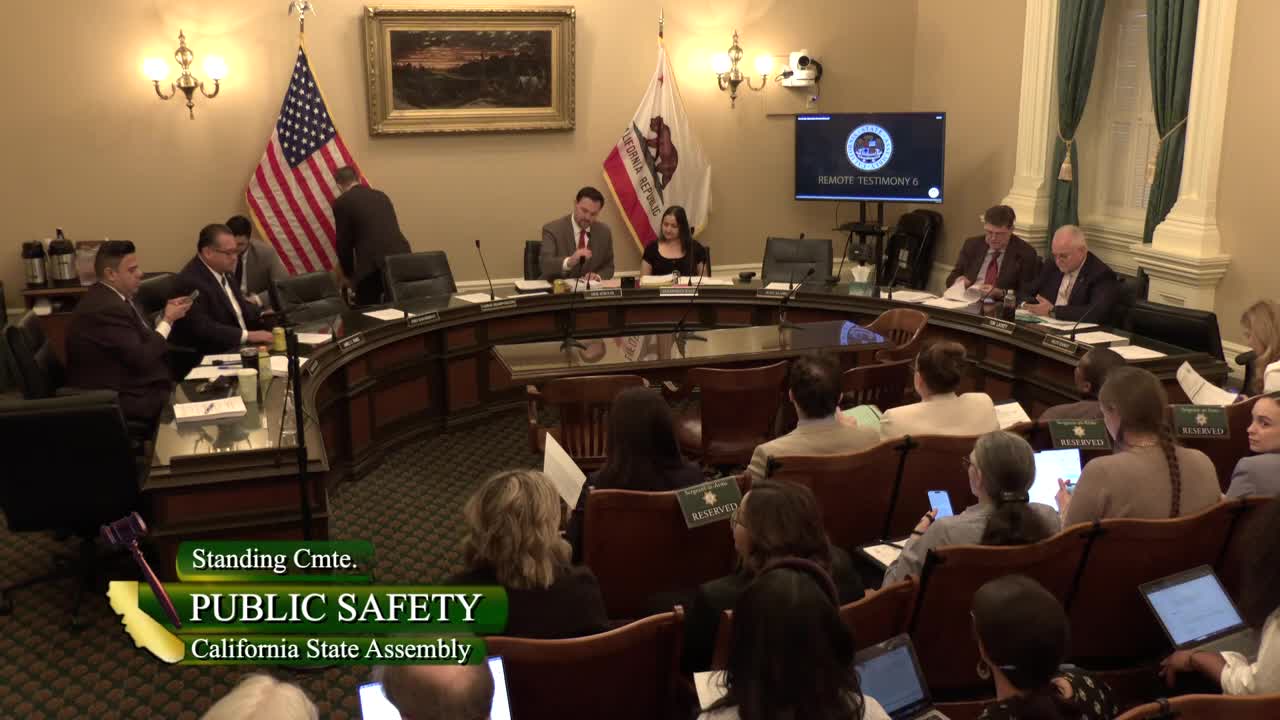 7MIN
Assembly Standing Committee on Public Safety
Bill Author

Bill Co-Author(s):