AB 2261: Protective orders.
- Session Year: 2025-2026
- House: Assembly
- Latest Version Date: 2026-09-27
Current Status:
Passed
(2026-09-27: Chaptered by Secretary of State - Chapter 595, Statutes of 2026.)
Introduced
In Committee
Awaiting First Chamber Vote
Passed First Chamber
In Committee
Awaiting Second Chamber Vote
Passed Second Chamber
Enacted
Existing law allows the court to issue a protective order restraining a defendant from any contact with the victim if the defendant has been convicted of specified crimes, including a crime involving domestic violence, human trafficking, a crime in furtherance of a criminal street gang, or a registerable sex offense.
This bill would additionally authorize the court to consider issuing an order restraining the defendant from contact with any person who is a member of the victims family, as defined, or household. By authorizing the issuance of protective orders in certain circumstances and the extension of certain protective orders, a violation of which is punishable as a crime, this bill would impose a state-mandated local program.
This bill would incorporate additional changes to Section 136.2 of the Penal Code proposed by AB 1889 to be operative only if this bill and AB 1889 are enacted and this bill is enacted last.
The California Constitution requires the state to reimburse local agencies and school districts for certain costs mandated by the state. Statutory provisions establish procedures for making that reimbursement.
This bill would provide that no reimbursement is required by this act for a specified reason.
Existing law allows the court to issue a protective order restraining a defendant from any contact with the victim if the defendant has been convicted of specified crimes, including a crime involving domestic violence, human trafficking, a crime in furtherance of a criminal street gang, or a registerable sex offense.
This bill would additionally authorize the court to consider issuing an order restraining the defendant from contact with any person who is a member of the victims family, as defined, or household. By authorizing the issuance of protective orders in certain circumstances and the extension of certain protective orders, a violation of which is punishable as a crime, this bill would impose a state-mandated local program.
The California Constitution requires the state to reimburse local agencies and school districts for certain costs mandated by the state. Statutory provisions establish procedures for making that reimbursement.
This bill would provide that no reimbursement is required by this act for a specified reason.
Existing law allows the court to issue a protective order restraining a defendant from any contact with the victim if the defendant has been convicted of specified crimes, including a crime involving domestic violence, human trafficking, a crime in furtherance of a criminal street gang, or a registerable sex offense.
This bill would additionally authorize the court to consider issuing an order restraining the defendant from contact with any person who is a member of the victims family or household if there is competent evidence that the individual is a victim of an offense described above that was committed by the defendant. family, as defined, or household. By authorizing the issuance of protective orders in certain circumstances and the extension of certain protective orders, a violation of which is punishable as a crime, this bill would impose a state-mandated local program.
The California Constitution requires the state to reimburse local agencies and school districts for certain costs mandated by the state. Statutory provisions establish procedures for making that reimbursement.
This bill would provide that no reimbursement is required by this act for a specified reason.
Existing law allows the court to issue a protective order restraining a defendant from any contact with the victim if the defendant has been convicted of specified crimes, including a crime involving domestic violence, human trafficking, a crime in furtherance of a criminal street gang, or a registerable sex offense.
This bill would additionally authorize the court to consider issuing an order restraining the defendant from contact with any person who is a member of the victims family or household or any other person if there is competent evidence that the individual is a victim of an offense described above that was committed by the defendant. By authorizing the issuance of protective orders in certain circumstances and the extension of certain protective orders, a violation of which is punishable as a crime, this bill would impose a state-mandated local program.
The California Constitution requires the state to reimburse local agencies and school districts for certain costs mandated by the state. Statutory provisions establish procedures for making that reimbursement.
This bill would provide that no reimbursement is required by this act for a specified reason.
(a)(1)Upon a good cause belief that harm to, or intimidation or dissuasion of, a victim or witness has occurred or is reasonably likely to occur, a court with jurisdiction over a criminal matter may issue orders, including, but not limited to, the following:
(A)An order issued pursuant to Section 6320 of the Family Code.
(B)An order that a defendant shall not violate any provision of Section 136.1.
(C)An order that a person before the court other than a defendant, including, but not limited to, a subpoenaed witness or other person entering the courtroom of the court, shall not violate any provision of Section 136.1.
(D)An order that a person described in this section shall have no communication whatsoever with a specified witness or a victim except through an attorney under reasonable restrictions that the court may impose.
(E)An order calling for a hearing to determine if an order described in subparagraphs (A) to (D), inclusive, should be issued.
(F)(i)An order that a particular law enforcement agency within the jurisdiction of the court provide protection for a victim, witness, or both, or for immediate family members of a victim or a witness who reside in the same household as the victim or witness or within reasonable proximity of the victims or witness household, as determined by the court. The order shall not be made without the consent of the law enforcement agency except for limited and specified periods of time and upon an express finding by the court of a clear and present danger of harm to the victim or witness or immediate family members of the victim or witness.
(ii)For purposes of this paragraph, immediate family members include the spouse, children, or parents of the victim or witness.
(G)(i)An order protecting a victim or witness of violent crime from all contact by the defendant or contact with the intent to annoy, harass, threaten, or commit acts of violence by the defendant. The court or its designee shall transmit orders made under this paragraph to law enforcement personnel within one business day of the issuance, modification, extension, or termination of the order pursuant to subdivision (a) of Section 6380 of the Family Code. It is the responsibility of the court to transmit the modification, extension, or termination orders made under this paragraph to the same agency that entered the original protective order into the California Restraining and Protective Order System.
(ii)(I)If a court does not issue an order pursuant to clause (i) when the defendant is charged with a crime involving domestic violence, as defined in Section 13700 of this code or in Section 6211 of the Family Code, the court, on its own motion, shall consider issuing a protective order upon a good cause belief that harm to, or intimidation or dissuasion of, a victim or witness has occurred or is reasonably likely to occur, that provides as follows:
(ia)The defendant shall not own, possess, purchase, receive, or attempt to purchase or receive a firearm while the protective order is in effect.
(ib)The defendant shall relinquish ownership or possession of any firearms pursuant to Section 527.9 of the Code of Civil Procedure.
(II)A person who owns, possesses, purchases, or receives, or attempts to purchase or receive a firearm while this protective order is in effect is punishable pursuant to Section 29825.
(iii)An order issued, modified, extended, or terminated by a court pursuant to this subparagraph shall be issued on forms adopted by the Judicial Council that have been approved by the Department of Justice pursuant to subdivision (i) of Section 6380 of the Family Code. However, the fact that an order issued by a court pursuant to this section was not issued on forms adopted by the Judicial Council and approved by the Department of Justice shall not make the order unenforceable.
(iv)A protective order issued under this subparagraph may require the defendant to be placed on electronic monitoring if the local government, with the concurrence of the county sheriff or the chief probation officer with jurisdiction, adopts a policy to authorize electronic monitoring of defendants and specifies the agency with jurisdiction for this purpose. If the court determines that the defendant has the ability to pay for the monitoring program, the court shall order the defendant to pay for the monitoring. If the court determines that the defendant does not have the ability to pay for the electronic monitoring, the court may order electronic monitoring to be paid for by the local government that adopted the policy to authorize electronic monitoring. The duration of electronic monitoring shall not exceed one year from the date the order is issued. The electronic monitoring shall not be in place if the protective order is not in place.
(2)For purposes of this subdivision, a minor who was not a victim of, but who was physically present at the time of, an act of domestic violence is a witness and is deemed to have suffered harm within the meaning of paragraph (1).
(b)A person violating an order made pursuant to subparagraphs (A) to (G), inclusive, of paragraph (1) of subdivision (a) may be punished for a substantive offense described in Section 136.1 or for a contempt of the court making the order. A finding of contempt shall not be a bar to prosecution for a violation of Section 136.1. However, a person held in contempt shall be entitled to credit for punishment imposed therein against a sentence imposed upon conviction of an offense described in Section 136.1. A conviction or acquittal for a substantive offense under Section 136.1 shall be a bar to a subsequent punishment for contempt arising out of the same act.
(c)(1)(A)Notwithstanding subdivision (e), an emergency protective order issued pursuant to Chapter 2 (commencing with Section 6250) of Part 3 of Division 10 of the Family Code or Section 646.91 shall have precedence in enforcement over any other restraining or protective order, provided the emergency protective order meets all of the following requirements:
(i)The emergency protective order is issued to protect one or more individuals who are already protected persons under another restraining or protective order.
(ii)The emergency protective order restrains the individual who is the restrained person in the other restraining or protective order specified in clause (i).
(iii)The provisions of the emergency protective order are more restrictive in relation to the restrained person than are the provisions of the other restraining or protective order specified in clause (i).
(B)An emergency protective order that meets the requirements of subparagraph (A) shall have precedence in enforcement over the provisions of any other restraining or protective order only with respect to those provisions of the emergency protective order that are more restrictive in relation to the restrained person.
(2)Except as described in paragraph (1), a no-contact order, as described in Section 6320 of the Family Code, shall have precedence in enforcement over any other restraining or protective order.
(d)(1)A person subject to a protective order issued under this section shall not own, possess, purchase, or receive, or attempt to purchase or receive, a firearm while the protective order is in effect.
(2)The court shall order a person subject to a protective order issued under this section to relinquish ownership or possession of any firearms pursuant to Section 527.9 of the Code of Civil Procedure.
(3)A person who owns, possesses, purchases, or receives, or attempts to purchase or receive a firearm while the protective order is in effect is punishable pursuant to Section 29825.
(e)(1)When the defendant is charged with a crime involving domestic violence, as defined in Section 13700 of this code or in Section 6211 of the Family Code, a violation of Section 261, 261.5, or former Section 262, or a crime that requires the defendant to register pursuant to subdivision (c) of Section 290, including, but not limited to, commercial sexual exploitation of a minor in violation of Section 236.1, the court shall consider issuing the above-described orders on its own motion. All interested parties shall receive a copy of those orders. To facilitate this, the courts records of all criminal cases involving domestic violence, a violation of Section 261, 261.5, or former Section 262, or a crime that requires the defendant to register pursuant to subdivision (c) of Section 290, including, but not limited to, commercial sexual exploitation of a minor in violation of Section 236.1, shall be marked to clearly alert the court to this issue.
(2)When a complaint, information, or indictment charging a crime involving domestic violence, as defined in Section 13700 of this code or in Section 6211 of the Family Code, a violation of Section 261, 261.5, or former Section 262, or a crime that requires the defendant to register pursuant to subdivision (c) of Section 290, including, but not limited to, commercial sexual exploitation of a minor in violation of Section 236.1, has been issued, except as described in subdivision (c), a restraining order or protective order against the defendant issued by the criminal court in that case has precedence in enforcement over a civil court order against the defendant.
(3)Custody and visitation with respect to the defendant and the defendants minor children may be ordered by a family or juvenile court consistent with the protocol established pursuant to subdivision (f), but if it is ordered after a criminal protective order has been issued pursuant to this section, the custody and visitation order shall make reference to and, if there is not an emergency protective order that has precedence in enforcement pursuant to paragraph (1) of subdivision (c) or a no-contact order, as described in Section 6320 of the Family Code, acknowledge the precedence of enforcement of an appropriate criminal protective order. On or before July 1, 2014, the Judicial Council shall modify the criminal and civil court forms consistent with this subdivision.
(f)On or before January 1, 2003, the Judicial Council shall promulgate a protocol, for adoption by each local court in substantially similar terms, to provide for the timely coordination of all orders against the same defendant and in favor of the same named victim or victims. The protocol shall include, but shall not be limited to, mechanisms for ensuring appropriate communication and information sharing between criminal, family, and juvenile courts concerning orders and cases that involve the same parties and shall permit a family or juvenile court order to coexist with a criminal court protective order subject to the following conditions:
(1)An order that permits contact between the restrained person and the persons children shall provide for the safe exchange of the children and shall not contain language, either printed or handwritten, that violates a no-contact order issued by a criminal court.
(2)The safety of all parties shall be the courts paramount concern. The family or juvenile court shall specify the time, day, place, and manner of transfer of the child as provided in Section 3100 of the Family Code.
(g)On or before January 1, 2003, the Judicial Council shall modify the criminal and civil court protective order forms consistent with this section.
(h)(1)When a complaint, information, or indictment charging a crime involving domestic violence, as defined in Section 13700 of this code or in Section 6211 of the Family Code, has been filed, the court may consider, in determining whether good cause exists to issue an order under subparagraph (A) of paragraph (1) of subdivision (a), the underlying nature of the offense charged and the information provided to the court pursuant to Section 273.75.
(2)When a complaint, information, or indictment charging a violation of Section 261, 261.5, or former Section 262, or a crime that requires the defendant to register pursuant to subdivision (c) of Section 290, including, but not limited to, commercial sexual exploitation of a minor in violation of Section 236.1, has been filed, the court may consider, in determining whether good cause exists to issue an order under paragraph (1) of subdivision (a), the underlying nature of the offense charged, the defendants relationship to the victim, the likelihood of continuing harm to the victim, any current restraining order or protective order issued by a civil or criminal court involving the defendant, and the defendants criminal history, including, but not limited to, prior convictions for a violation of Section 261, 261.5, or former Section 262, a crime that requires the defendant to register pursuant to subdivision (c) of Section 290, including, but not limited to, commercial sexual exploitation of a minor in violation of Section 236.1, any other forms of violence, or a weapons offense.
(i)(1)When a criminal defendant has been convicted of a crime involving domestic violence, as defined in Section 13700 of this code or in Section 6211 of the Family Code, a violation of subdivision (a), (b), or (c) of Section 236.1 prohibiting human trafficking, Section 261, 261.5, former Section 262, subdivision (a) of Section 266h, or subdivision (a) of Section 266i, a violation of Section 186.22, or a crime that requires the defendant to register pursuant to subdivision (c) of Section 290, the court, at the time of sentencing, shall consider issuing an order restraining the defendant from any contact with a victim of the crime. The court may consider issuing an order restraining the defendant from any person who is a member of the victims family or household. The order may be valid for up to 10 years, as determined by the court. This protective order may be issued by the court regardless of whether the defendant is sentenced to the state prison or a county jail, whether the defendant is subject to mandatory supervision, or whether imposition of sentence is suspended and the defendant is placed on probation. The order may be modified by the sentencing court in the county in which it was issued throughout the duration of the order. It is the intent of the Legislature in enacting this subdivision that the duration of a restraining order issued by the court be based upon the seriousness of the facts before the court, the probability of future violations, the safety of a victim and the victims immediate family, and any information provided to the court pursuant to Section 273.75.
(2)When a criminal defendant has been convicted of a crime involving domestic violence, as defined in Section 13700 of this code or in Section 6211 of the Family Code, a violation of Section 261, 261.5, or former Section 262, a violation of Section 186.22, or a crime that requires the defendant to register pursuant to subdivision (c) of Section 290, the court, at the time of sentencing, shall consider issuing an order restraining the defendant from any contact with a percipient witness to the crime if it can be established by clear and convincing evidence that the witness has been harassed, as defined in paragraph (3) of subdivision (b) of Section 527.6 of the Code of Civil Procedure, by the defendant.
(3)An order under this subdivision may include provisions for electronic monitoring if the local government, upon receiving the concurrence of the county sheriff or the chief probation officer with jurisdiction, adopts a policy authorizing electronic monitoring of defendants and specifies the agency with jurisdiction for this purpose. If the court determines that the defendant has the ability to pay for the monitoring program, the court shall order the defendant to pay for the monitoring. If the court determines that the defendant does not have the ability to pay for the electronic monitoring, the court may order the electronic monitoring to be paid for by the local government that adopted the policy authorizing electronic monitoring. The duration of the electronic monitoring shall not exceed one year from the date the order is issued.
(j)For purposes of this section, the following terms have the following meanings:
(1)Local government means the county that has jurisdiction over the protective order.
(2)Member of the victims family means any person related to the named victim, including through adoption, domestic partnership, or marriage or by consanguinity or affinity within the second degree.
SEC. 1.5.Section 136.2 of the Penal Code is amended to read:136.2.(a)(1)Upon a good cause belief that harm to, or intimidation or dissuasion of, a victim or witness has occurred or is reasonably likely to occur, a court with jurisdiction over a criminal matter may issue orders, including, but not limited to, the following:
(A)An order issued pursuant to Section 6320 of the Family Code.
(B)An order that a defendant shall not violate any provision of Section 136.1.
(C)An order that a person before the court other than a defendant, including, but not limited to, a subpoenaed witness or other person entering the courtroom of the court, shall not violate any provision of Section 136.1.
(D)An order that a person described in this section shall have no communication whatsoever with a specified witness or a victim except through an attorney under reasonable restrictions that the court may impose.
(E)An order calling for a hearing to determine if an order described in subparagraphs (A) to (D), inclusive, should be issued.
(F)(i)An order that a particular law enforcement agency within the jurisdiction of the court provide protection for a victim, witness, or both, or for immediate family members of a victim or a witness who reside in the same household as the victim or witness or within reasonable proximity of the victims or witness household, as determined by the court. The order shall not be made without the consent of the law enforcement agency except for limited and specified periods of time and upon an express finding by the court of a clear and present danger of harm to the victim or witness or immediate family members of the victim or witness.
(ii)For purposes of this paragraph, immediate family members include the spouse, children, or parents of the victim or witness.
(G)(i)An order protecting a victim or witness of violent crime from all contact by the defendant or contact with the intent to annoy, harass, threaten, or commit acts of violence by the defendant. The court or its designee shall transmit orders made under this paragraph to law enforcement personnel within one business day of the issuance, modification, extension, or termination of the order pursuant to subdivision (a) of Section 6380 of the Family Code. It is the responsibility of the court to transmit the modification, extension, or termination orders made under this paragraph to the same agency that entered the original protective order into the California Restraining and Protective Order System.
(ii)(I)If a court does not issue an order pursuant to clause (i) when the defendant is charged with a crime involving domestic violence, as defined in Section 13700 of this code or in Section 6211 of the Family Code, the court, on its own motion, shall consider issuing a protective order upon a good cause belief that harm to, or intimidation or dissuasion of, a victim or witness has occurred or is reasonably likely to occur, that provides as follows:
(ia)The defendant shall not own, possess, purchase, receive, or attempt to purchase or receive a firearm while the protective order is in effect.
(ib)The defendant shall relinquish ownership or possession of any firearms pursuant to Section 527.9 of the Code of Civil Procedure.
(II)A person who owns, possesses, purchases, or receives, or attempts to purchase or receive a firearm while this protective order is in effect is punishable pursuant to Section 29825.
(iii)An order issued, modified, extended, or terminated by a court pursuant to this subparagraph shall be issued on forms adopted by the Judicial Council that have been approved by the Department of Justice pursuant to subdivision (i) of Section 6380 of the Family Code. However, the fact that an order issued by a court pursuant to this section was not issued on forms adopted by the Judicial Council and approved by the Department of Justice shall not make the order unenforceable.
(iv)A protective order issued under this subparagraph may require the defendant to be placed on electronic monitoring if the local government, with the concurrence of the county sheriff or the chief probation officer with jurisdiction, adopts a policy to authorize electronic monitoring of defendants and specifies the agency with jurisdiction for this purpose. If the court determines that the defendant has the ability to pay for the monitoring program, the court shall order the defendant to pay for the monitoring. If the court determines that the defendant does not have the ability to pay for the electronic monitoring, the court may order electronic monitoring to be paid for by the local government that adopted the policy to authorize electronic monitoring. The duration of electronic monitoring shall not exceed one year from the date the order is issued. The electronic monitoring shall not be in place if the protective order is not in place.
(2)For purposes of this subdivision, a minor who was not a victim of, but who was physically present at the time of, an act of domestic violence is a witness and is deemed to have suffered harm within the meaning of paragraph (1).
(b)A person violating an order made pursuant to subparagraphs (A) to (G), inclusive, of paragraph (1) of subdivision (a) may be punished for a substantive offense described in Section 136.1 or for a contempt of the court making the order. A finding of contempt shall not be a bar to prosecution for a violation of Section 136.1. However, a person held in contempt shall be entitled to credit for punishment imposed therein against a sentence imposed upon conviction of an offense described in Section 136.1. A conviction or acquittal for a substantive offense under Section 136.1 shall be a bar to a subsequent punishment for contempt arising out of the same act.
(c)(1)(A)Notwithstanding subdivision (e), an emergency protective order issued pursuant to Chapter 2 (commencing with Section 6250) of Part 3 of Division 10 of the Family Code or Section 646.91 shall have precedence in enforcement over any other restraining or protective order, provided the emergency protective order meets all of the following requirements:
(i)The emergency protective order is issued to protect one or more individuals who are already protected persons under another restraining or protective order.
(ii)The emergency protective order restrains the individual who is the restrained person in the other restraining or protective order specified in clause (i).
(iii)The provisions of the emergency protective order are more restrictive in relation to the restrained person than are the provisions of the other restraining or protective order specified in clause (i).
(B)An emergency protective order that meets the requirements of subparagraph (A) shall have precedence in enforcement over the provisions of any other restraining or protective order only with respect to those provisions of the emergency protective order that are more restrictive in relation to the restrained person.
(2)Except as described in paragraph (1), a no-contact order, as described in Section 6320 of the Family Code, shall have precedence in enforcement over any other restraining or protective order.
(d)(1)A person subject to a protective order issued under this section shall not own, possess, purchase, or receive, or attempt to purchase or receive, a firearm while the protective order is in effect.
(2)The court shall order a person subject to a protective order issued under this section to relinquish ownership or possession of any firearms pursuant to Section 527.9 of the Code of Civil Procedure.
(3)A person who owns, possesses, purchases, or receives, or attempts to purchase or receive a firearm while the protective order is in effect is punishable pursuant to Section 29825.
(e)(1)When the defendant is charged with a crime involving domestic violence, as defined in Section 13700 of this code or in Section 6211 of the Family Code, a violation of Section 261, 261.5, or former Section 262, or a crime that requires the defendant to register pursuant to subdivision (c) of Section 290, including, but not limited to, commercial sexual exploitation of a minor in violation of Section 236.1, the court shall consider issuing the above-described orders on its own motion. All interested parties shall receive a copy of those orders. To facilitate this, the courts records of all criminal cases involving domestic violence, a violation of Section 261, 261.5, or former Section 262, or a crime that requires the defendant to register pursuant to subdivision (c) of Section 290, including, but not limited to, commercial sexual exploitation of a minor in violation of Section 236.1, shall be marked to clearly alert the court to this issue.
(2)When a complaint, information, or indictment charging a crime involving domestic violence, as defined in Section 13700 of this code or in Section 6211 of the Family Code, a violation of Section 261, 261.5, or former Section 262, or a crime that requires the defendant to register pursuant to subdivision (c) of Section 290, including, but not limited to, commercial sexual exploitation of a minor in violation of Section 236.1, has been issued, except as described in subdivision (c), a restraining order or protective order against the defendant issued by the criminal court in that case has precedence in enforcement over a civil court order against the defendant.
(3)Custody and visitation with respect to the defendant and the defendants minor children may be ordered by a family or juvenile court consistent with the protocol established pursuant to subdivision (f), but if it is ordered after a criminal protective order has been issued pursuant to this section, the custody and visitation order shall make reference to and, if there is not an emergency protective order that has precedence in enforcement pursuant to paragraph (1) of subdivision (c) or a no-contact order, as described in Section 6320 of the Family Code, acknowledge the precedence of enforcement of an appropriate criminal protective order. On or before July 1, 2014, the Judicial Council shall modify the criminal and civil court forms consistent with this subdivision.
(f)On or before January 1, 2003, the Judicial Council shall promulgate a protocol, for adoption by each local court in substantially similar terms, to provide for the timely coordination of all orders against the same defendant and in favor of the same named victim or victims. The protocol shall include, but shall not be limited to, mechanisms for ensuring appropriate communication and information sharing between criminal, family, and juvenile courts concerning orders and cases that involve the same parties and shall permit a family or juvenile court order to coexist with a criminal court protective order subject to the following conditions:
(1)An order that permits contact between the restrained person and the persons children shall provide for the safe exchange of the children and shall not contain language, either printed or handwritten, that violates a no-contact order issued by a criminal court.
(2)The safety of all parties shall be the courts paramount concern. The family or juvenile court shall specify the time, day, place, and manner of transfer of the child as provided in Section 3100 of the Family Code.
(g)On or before January 1, 2003, the Judicial Council shall modify the criminal and civil court protective order forms consistent with this section.
(h)(1)When a complaint, information, or indictment charging a crime involving domestic violence, as defined in Section 13700 of this code or in Section 6211 of the Family Code, has been filed, the court may consider, in determining whether good cause exists to issue an order under subparagraph (A) of paragraph (1) of subdivision (a), the underlying nature of the offense charged and the information provided to the court pursuant to Section 273.75.
(2)When a complaint, information, or indictment charging a violation of Section 261, 261.5, or former Section 262, or a crime that requires the defendant to register pursuant to subdivision (c) of Section 290, including, but not limited to, commercial sexual exploitation of a minor in violation of Section 236.1, has been filed, the court may consider, in determining whether good cause exists to issue an order under paragraph (1) of subdivision (a), the underlying nature of the offense charged, the defendants relationship to the victim, the likelihood of continuing harm to the victim, any current restraining order or protective order issued by a civil or criminal court involving the defendant, and the defendants criminal history, including, but not limited to, prior convictions for a violation of Section 261, 261.5, or former Section 262, a crime that requires the defendant to register pursuant to subdivision (c) of Section 290, including, but not limited to, commercial sexual exploitation of a minor in violation of Section 236.1, any other forms of violence, or a weapons offense.
(i)(1)When a criminal defendant has been convicted of a crime involving domestic violence, as defined in Section 13700 of this code or in Section 6211 of the Family Code, a violation of subdivision (a), (b), or (c) of Section 236.1 prohibiting human trafficking, Section 261, 261.5, former Section 262, subdivision (a) of Section 266h, or subdivision (a) of Section 266i, a violation of Section 186.22, or a crime that requires the defendant to register pursuant to subdivision (c) of Section 290, the court, at the time of sentencing, shall consider issuing an order restraining the defendant from any contact with a victim of the crime. The court may consider issuing an order restraining the defendant from any person who is a member of the victims family or household. The order may be valid for up to either 10 years, or 1 year after the persons release from the state prison or a county jail, whichever is later, as determined by the court. This protective order may be issued by the court regardless of whether the defendant is sentenced to the state prison or a county jail, whether the defendant is subject to mandatory supervision, or whether imposition of sentence is suspended and the defendant is placed on probation. The order may be modified by the sentencing court in the county in which it was issued throughout the duration of the order. It is the intent of the Legislature in enacting this subdivision that the duration of a restraining order issued by the court be based upon the seriousness of the facts before the court, the probability of future violations, the safety of a victim and the victims immediate family, and any information provided to the court pursuant to Section 273.75.
(2)When a criminal defendant has been convicted of a crime involving domestic violence, as defined in Section 13700 of this code or in Section 6211 of the Family Code, a violation of Section 261, 261.5, or former Section 262, a violation of Section 186.22, or a crime that requires the defendant to register pursuant to subdivision (c) of Section 290, the court, at the time of sentencing, shall consider issuing an order restraining the defendant from any contact with a percipient witness to the crime if it can be established by clear and convincing evidence that the witness has been harassed, as defined in paragraph (3) of subdivision (b) of Section 527.6 of the Code of Civil Procedure, by the defendant.
(3)An order under this subdivision may include provisions for electronic monitoring if the local government, upon receiving the concurrence of the county sheriff or the chief probation officer with jurisdiction, adopts a policy authorizing electronic monitoring of defendants and specifies the agency with jurisdiction for this purpose. If the court determines that the defendant has the ability to pay for the monitoring program, the court shall order the defendant to pay for the monitoring. If the court determines that the defendant does not have the ability to pay for the electronic monitoring, the court may order the electronic monitoring to be paid for by the local government that adopted the policy authorizing electronic monitoring. The duration of the electronic monitoring shall not exceed one year from the date the order is issued.
(j)For purposes of this section, the following terms have the following meanings:
(1)Local government means the county that has jurisdiction over the protective order.
(2)Member of the victims family means any person related to the named victim, including through adoption, domestic partnership, or marriage or by consanguinity or affinity within the second degree.
SEC. 2.Section 1.5 of this bill incorporates amendments to Section 136.2 of the Penal Code proposed by both this bill and Assembly Bill 1889. That section of this bill shall only become operative if (1) both bills are enacted and become effective on or before January 1, 2027, (2) each bill amends Section 136.2 of the Penal Code, and (3) this bill is enacted after Assembly Bill 1889, in which case Section 1 of this bill shall not become operative.
SEC. 3.No reimbursement is required by this act pursuant to Section 6 of Article XIIIB of the California Constitution because the only costs that may be incurred by a local agency or school district will be incurred because this act creates a new crime or infraction, eliminates a crime or infraction, or changes the penalty for a crime or infraction, within the meaning of Section 17556 of the Government Code, or changes the definition of a crime within the meaning of Section 6 of Article XIIIB of the California Constitution.
(a)(1)Upon a good cause belief that harm to, or intimidation or dissuasion of, a victim or witness has occurred or is reasonably likely to occur, a court with jurisdiction over a criminal matter may issue orders, including, but not limited to, the following:
(A)An order issued pursuant to Section 6320 of the Family Code.
(B)An order that a defendant shall not violate any provision of Section 136.1.
(C)An order that a person before the court other than a defendant, including, but not limited to, a subpoenaed witness or other person entering the courtroom of the court, shall not violate any provision of Section 136.1.
(D)An order that a person described in this section shall have no communication whatsoever with a specified witness or a victim except through an attorney under reasonable restrictions that the court may impose.
(E)An order calling for a hearing to determine if an order described in subparagraphs (A) to (D), inclusive, should be issued.
(F)(i)An order that a particular law enforcement agency within the jurisdiction of the court provide protection for a victim, witness, or both, or for immediate family members of a victim or a witness who reside in the same household as the victim or witness or within reasonable proximity of the victims or witness household, as determined by the court. The order shall not be made without the consent of the law enforcement agency except for limited and specified periods of time and upon an express finding by the court of a clear and present danger of harm to the victim or witness or immediate family members of the victim or witness.
(ii)For purposes of this paragraph, immediate family members include the spouse, children, or parents of the victim or witness.
(G)(i)An order protecting a victim or witness of violent crime from all contact by the defendant or contact with the intent to annoy, harass, threaten, or commit acts of violence by the defendant. The court or its designee shall transmit orders made under this paragraph to law enforcement personnel within one business day of the issuance, modification, extension, or termination of the order pursuant to subdivision (a) of Section 6380 of the Family Code. It is the responsibility of the court to transmit the modification, extension, or termination orders made under this paragraph to the same agency that entered the original protective order into the California Restraining and Protective Order System.
(ii)(I)If a court does not issue an order pursuant to clause (i) when the defendant is charged with a crime involving domestic violence, as defined in Section 13700 of this code or in Section 6211 of the Family Code, the court, on its own motion, shall consider issuing a protective order upon a good cause belief that harm to, or intimidation or dissuasion of, a victim or witness has occurred or is reasonably likely to occur, that provides as follows:
(ia)The defendant shall not own, possess, purchase, receive, or attempt to purchase or receive a firearm while the protective order is in effect.
(ib)The defendant shall relinquish ownership or possession of any firearms pursuant to Section 527.9 of the Code of Civil Procedure.
(II)A person who owns, possesses, purchases, or receives, or attempts to purchase or receive a firearm while this protective order is in effect is punishable pursuant to Section 29825.
(iii)An order issued, modified, extended, or terminated by a court pursuant to this subparagraph shall be issued on forms adopted by the Judicial Council that have been approved by the Department of Justice pursuant to subdivision (i) of Section 6380 of the Family Code. However, the fact that an order issued by a court pursuant to this section was not issued on forms adopted by the Judicial Council and approved by the Department of Justice shall not make the order unenforceable.
(iv)A protective order issued under this subparagraph may require the defendant to be placed on electronic monitoring if the local government, with the concurrence of the county sheriff or the chief probation officer with jurisdiction, adopts a policy to authorize electronic monitoring of defendants and specifies the agency with jurisdiction for this purpose. If the court determines that the defendant has the ability to pay for the monitoring program, the court shall order the defendant to pay for the monitoring. If the court determines that the defendant does not have the ability to pay for the electronic monitoring, the court may order electronic monitoring to be paid for by the local government that adopted the policy to authorize electronic monitoring. The duration of electronic monitoring shall not exceed one year from the date the order is issued. The electronic monitoring shall not be in place if the protective order is not in place.
(2)For purposes of this subdivision, a minor who was not a victim of, but who was physically present at the time of, an act of domestic violence is a witness and is deemed to have suffered harm within the meaning of paragraph (1).
(b)A person violating an order made pursuant to subparagraphs (A) to (G), inclusive, of paragraph (1) of subdivision (a) may be punished for a substantive offense described in Section 136.1 or for a contempt of the court making the order. A finding of contempt shall not be a bar to prosecution for a violation of Section 136.1. However, a person held in contempt shall be entitled to credit for punishment imposed therein against a sentence imposed upon conviction of an offense described in Section 136.1. A conviction or acquittal for a substantive offense under Section 136.1 shall be a bar to a subsequent punishment for contempt arising out of the same act.
(c)(1)(A)Notwithstanding subdivision (e), an emergency protective order issued pursuant to Chapter 2 (commencing with Section 6250) of Part 3 of Division 10 of the Family Code or Section 646.91 shall have precedence in enforcement over any other restraining or protective order, provided the emergency protective order meets all of the following requirements:
(i)The emergency protective order is issued to protect one or more individuals who are already protected persons under another restraining or protective order.
(ii)The emergency protective order restrains the individual who is the restrained person in the other restraining or protective order specified in clause (i).
(iii)The provisions of the emergency protective order are more restrictive in relation to the restrained person than are the provisions of the other restraining or protective order specified in clause (i).
(B)An emergency protective order that meets the requirements of subparagraph (A) shall have precedence in enforcement over the provisions of any other restraining or protective order only with respect to those provisions of the emergency protective order that are more restrictive in relation to the restrained person.
(2)Except as described in paragraph (1), a no-contact order, as described in Section 6320 of the Family Code, shall have precedence in enforcement over any other restraining or protective order.
(d)(1)A person subject to a protective order issued under this section shall not own, possess, purchase, or receive, or attempt to purchase or receive, a firearm while the protective order is in effect.
(2)The court shall order a person subject to a protective order issued under this section to relinquish ownership or possession of any firearms pursuant to Section 527.9 of the Code of Civil Procedure.
(3)A person who owns, possesses, purchases, or receives, or attempts to purchase or receive a firearm while the protective order is in effect is punishable pursuant to Section 29825.
(e)(1)When the defendant is charged with a crime involving domestic violence, as defined in Section 13700 of this code or in Section 6211 of the Family Code, a violation of Section 261, 261.5, or former Section 262, or a crime that requires the defendant to register pursuant to subdivision (c) of Section 290, including, but not limited to, commercial sexual exploitation of a minor in violation of Section 236.1, the court shall consider issuing the above-described orders on its own motion. All interested parties shall receive a copy of those orders. To facilitate this, the courts records of all criminal cases involving domestic violence, a violation of Section 261, 261.5, or former Section 262, or a crime that requires the defendant to register pursuant to subdivision (c) of Section 290, including, but not limited to, commercial sexual exploitation of a minor in violation of Section 236.1, shall be marked to clearly alert the court to this issue.
(2)When a complaint, information, or indictment charging a crime involving domestic violence, as defined in Section 13700 of this code or in Section 6211 of the Family Code, a violation of Section 261, 261.5, or former Section 262, or a crime that requires the defendant to register pursuant to subdivision (c) of Section 290, including, but not limited to, commercial sexual exploitation of a minor in violation of Section 236.1, has been issued, except as described in subdivision (c), a restraining order or protective order against the defendant issued by the criminal court in that case has precedence in enforcement over a civil court order against the defendant.
(3)Custody and visitation with respect to the defendant and the defendants minor children may be ordered by a family or juvenile court consistent with the protocol established pursuant to subdivision (f), but if it is ordered after a criminal protective order has been issued pursuant to this section, the custody and visitation order shall make reference to and, if there is not an emergency protective order that has precedence in enforcement pursuant to paragraph (1) of subdivision (c) or a no-contact order, as described in Section 6320 of the Family Code, acknowledge the precedence of enforcement of an appropriate criminal protective order. On or before July 1, 2014, the Judicial Council shall modify the criminal and civil court forms consistent with this subdivision.
(f)On or before January 1, 2003, the Judicial Council shall promulgate a protocol, for adoption by each local court in substantially similar terms, to provide for the timely coordination of all orders against the same defendant and in favor of the same named victim or victims. The protocol shall include, but shall not be limited to, mechanisms for ensuring appropriate communication and information sharing between criminal, family, and juvenile courts concerning orders and cases that involve the same parties and shall permit a family or juvenile court order to coexist with a criminal court protective order subject to the following conditions:
(1)An order that permits contact between the restrained person and the persons children shall provide for the safe exchange of the children and shall not contain language, either printed or handwritten, that violates a no-contact order issued by a criminal court.
(2)The safety of all parties shall be the courts paramount concern. The family or juvenile court shall specify the time, day, place, and manner of transfer of the child as provided in Section 3100 of the Family Code.
(g)On or before January 1, 2003, the Judicial Council shall modify the criminal and civil court protective order forms consistent with this section.
(h)(1)When a complaint, information, or indictment charging a crime involving domestic violence, as defined in Section 13700 of this code or in Section 6211 of the Family Code, has been filed, the court may consider, in determining whether good cause exists to issue an order under subparagraph (A) of paragraph (1) of subdivision (a), the underlying nature of the offense charged and the information provided to the court pursuant to Section 273.75.
(2)When a complaint, information, or indictment charging a violation of Section 261, 261.5, or former Section 262, or a crime that requires the defendant to register pursuant to subdivision (c) of Section 290, including, but not limited to, commercial sexual exploitation of a minor in violation of Section 236.1, has been filed, the court may consider, in determining whether good cause exists to issue an order under paragraph (1) of subdivision (a), the underlying nature of the offense charged, the defendants relationship to the victim, the likelihood of continuing harm to the victim, any current restraining order or protective order issued by a civil or criminal court involving the defendant, and the defendants criminal history, including, but not limited to, prior convictions for a violation of Section 261, 261.5, or former Section 262, a crime that requires the defendant to register pursuant to subdivision (c) of Section 290, including, but not limited to, commercial sexual exploitation of a minor in violation of Section 236.1, any other forms of violence, or a weapons offense.
(i)(1)When a criminal defendant has been convicted of a crime involving domestic violence, as defined in Section 13700 of this code or in Section 6211 of the Family Code, a violation of subdivision (a), (b), or (c) of Section 236.1 prohibiting human trafficking, Section 261, 261.5, former Section 262, subdivision (a) of Section 266h, or subdivision (a) of Section 266i, a violation of Section 186.22, or a crime that requires the defendant to register pursuant to subdivision (c) of Section 290, the court, at the time of sentencing, shall consider issuing an order restraining the defendant from any contact with a victim of the crime. The court may consider issuing an order restraining the defendant from any person who is a member of the victims family or household. The order may be valid for up to 10 years, as determined by the court. This protective order may be issued by the court regardless of whether the defendant is sentenced to the state prison or a county jail, whether the defendant is subject to mandatory supervision, or whether imposition of sentence is suspended and the defendant is placed on probation. The order may be modified by the sentencing court in the county in which it was issued throughout the duration of the order. It is the intent of the Legislature in enacting this subdivision that the duration of a restraining order issued by the court be based upon the seriousness of the facts before the court, the probability of future violations, the safety of a victim and the victims immediate family, and any information provided to the court pursuant to Section 273.75.
(2)When a criminal defendant has been convicted of a crime involving domestic violence, as defined in Section 13700 of this code or in Section 6211 of the Family Code, a violation of Section 261, 261.5, or former Section 262, a violation of Section 186.22, or a crime that requires the defendant to register pursuant to subdivision (c) of Section 290, the court, at the time of sentencing, shall consider issuing an order restraining the defendant from any contact with a percipient witness to the crime if it can be established by clear and convincing evidence that the witness has been harassed, as defined in paragraph (3) of subdivision (b) of Section 527.6 of the Code of Civil Procedure, by the defendant.
(3)An order under this subdivision may include provisions for electronic monitoring if the local government, upon receiving the concurrence of the county sheriff or the chief probation officer with jurisdiction, adopts a policy authorizing electronic monitoring of defendants and specifies the agency with jurisdiction for this purpose. If the court determines that the defendant has the ability to pay for the monitoring program, the court shall order the defendant to pay for the monitoring. If the court determines that the defendant does not have the ability to pay for the electronic monitoring, the court may order the electronic monitoring to be paid for by the local government that adopted the policy authorizing electronic monitoring. The duration of the electronic monitoring shall not exceed one year from the date the order is issued.
(j)For purposes of this section, the following terms have the following meanings:
(1)Local government means the county that has jurisdiction over the protective order.
(2)Member of the victims family means any person related to the named victim, including through adoption, domestic partnership, or marriage or by consanguinity or affinity within the second degree.
SEC. 1.5.Section 136.2 of the Penal Code is amended to read:136.2.(a)(1)Upon a good cause belief that harm to, or intimidation or dissuasion of, a victim or witness has occurred or is reasonably likely to occur, a court with jurisdiction over a criminal matter may issue orders, including, but not limited to, the following:
(A)An order issued pursuant to Section 6320 of the Family Code.
(B)An order that a defendant shall not violate any provision of Section 136.1.
(C)An order that a person before the court other than a defendant, including, but not limited to, a subpoenaed witness or other person entering the courtroom of the court, shall not violate any provision of Section 136.1.
(D)An order that a person described in this section shall have no communication whatsoever with a specified witness or a victim except through an attorney under reasonable restrictions that the court may impose.
(E)An order calling for a hearing to determine if an order described in subparagraphs (A) to (D), inclusive, should be issued.
(F)(i)An order that a particular law enforcement agency within the jurisdiction of the court provide protection for a victim, witness, or both, or for immediate family members of a victim or a witness who reside in the same household as the victim or witness or within reasonable proximity of the victims or witness household, as determined by the court. The order shall not be made without the consent of the law enforcement agency except for limited and specified periods of time and upon an express finding by the court of a clear and present danger of harm to the victim or witness or immediate family members of the victim or witness.
(ii)For purposes of this paragraph, immediate family members include the spouse, children, or parents of the victim or witness.
(G)(i)An order protecting a victim or witness of violent crime from all contact by the defendant or contact with the intent to annoy, harass, threaten, or commit acts of violence by the defendant. The court or its designee shall transmit orders made under this paragraph to law enforcement personnel within one business day of the issuance, modification, extension, or termination of the order pursuant to subdivision (a) of Section 6380 of the Family Code. It is the responsibility of the court to transmit the modification, extension, or termination orders made under this paragraph to the same agency that entered the original protective order into the California Restraining and Protective Order System.
(ii)(I)If a court does not issue an order pursuant to clause (i) when the defendant is charged with a crime involving domestic violence, as defined in Section 13700 of this code or in Section 6211 of the Family Code, the court, on its own motion, shall consider issuing a protective order upon a good cause belief that harm to, or intimidation or dissuasion of, a victim or witness has occurred or is reasonably likely to occur, that provides as follows:
(ia)The defendant shall not own, possess, purchase, receive, or attempt to purchase or receive a firearm while the protective order is in effect.
(ib)The defendant shall relinquish ownership or possession of any firearms pursuant to Section 527.9 of the Code of Civil Procedure.
(II)A person who owns, possesses, purchases, or receives, or attempts to purchase or receive a firearm while this protective order is in effect is punishable pursuant to Section 29825.
(iii)An order issued, modified, extended, or terminated by a court pursuant to this subparagraph shall be issued on forms adopted by the Judicial Council that have been approved by the Department of Justice pursuant to subdivision (i) of Section 6380 of the Family Code. However, the fact that an order issued by a court pursuant to this section was not issued on forms adopted by the Judicial Council and approved by the Department of Justice shall not make the order unenforceable.
(iv)A protective order issued under this subparagraph may require the defendant to be placed on electronic monitoring if the local government, with the concurrence of the county sheriff or the chief probation officer with jurisdiction, adopts a policy to authorize electronic monitoring of defendants and specifies the agency with jurisdiction for this purpose. If the court determines that the defendant has the ability to pay for the monitoring program, the court shall order the defendant to pay for the monitoring. If the court determines that the defendant does not have the ability to pay for the electronic monitoring, the court may order electronic monitoring to be paid for by the local government that adopted the policy to authorize electronic monitoring. The duration of electronic monitoring shall not exceed one year from the date the order is issued. The electronic monitoring shall not be in place if the protective order is not in place.
(2)For purposes of this subdivision, a minor who was not a victim of, but who was physically present at the time of, an act of domestic violence is a witness and is deemed to have suffered harm within the meaning of paragraph (1).
(b)A person violating an order made pursuant to subparagraphs (A) to (G), inclusive, of paragraph (1) of subdivision (a) may be punished for a substantive offense described in Section 136.1 or for a contempt of the court making the order. A finding of contempt shall not be a bar to prosecution for a violation of Section 136.1. However, a person held in contempt shall be entitled to credit for punishment imposed therein against a sentence imposed upon conviction of an offense described in Section 136.1. A conviction or acquittal for a substantive offense under Section 136.1 shall be a bar to a subsequent punishment for contempt arising out of the same act.
(c)(1)(A)Notwithstanding subdivision (e), an emergency protective order issued pursuant to Chapter 2 (commencing with Section 6250) of Part 3 of Division 10 of the Family Code or Section 646.91 shall have precedence in enforcement over any other restraining or protective order, provided the emergency protective order meets all of the following requirements:
(i)The emergency protective order is issued to protect one or more individuals who are already protected persons under another restraining or protective order.
(ii)The emergency protective order restrains the individual who is the restrained person in the other restraining or protective order specified in clause (i).
(iii)The provisions of the emergency protective order are more restrictive in relation to the restrained person than are the provisions of the other restraining or protective order specified in clause (i).
(B)An emergency protective order that meets the requirements of subparagraph (A) shall have precedence in enforcement over the provisions of any other restraining or protective order only with respect to those provisions of the emergency protective order that are more restrictive in relation to the restrained person.
(2)Except as described in paragraph (1), a no-contact order, as described in Section 6320 of the Family Code, shall have precedence in enforcement over any other restraining or protective order.
(d)(1)A person subject to a protective order issued under this section shall not own, possess, purchase, or receive, or attempt to purchase or receive, a firearm while the protective order is in effect.
(2)The court shall order a person subject to a protective order issued under this section to relinquish ownership or possession of any firearms pursuant to Section 527.9 of the Code of Civil Procedure.
(3)A person who owns, possesses, purchases, or receives, or attempts to purchase or receive a firearm while the protective order is in effect is punishable pursuant to Section 29825.
(e)(1)When the defendant is charged with a crime involving domestic violence, as defined in Section 13700 of this code or in Section 6211 of the Family Code, a violation of Section 261, 261.5, or former Section 262, or a crime that requires the defendant to register pursuant to subdivision (c) of Section 290, including, but not limited to, commercial sexual exploitation of a minor in violation of Section 236.1, the court shall consider issuing the above-described orders on its own motion. All interested parties shall receive a copy of those orders. To facilitate this, the courts records of all criminal cases involving domestic violence, a violation of Section 261, 261.5, or former Section 262, or a crime that requires the defendant to register pursuant to subdivision (c) of Section 290, including, but not limited to, commercial sexual exploitation of a minor in violation of Section 236.1, shall be marked to clearly alert the court to this issue.
(2)When a complaint, information, or indictment charging a crime involving domestic violence, as defined in Section 13700 of this code or in Section 6211 of the Family Code, a violation of Section 261, 261.5, or former Section 262, or a crime that requires the defendant to register pursuant to subdivision (c) of Section 290, including, but not limited to, commercial sexual exploitation of a minor in violation of Section 236.1, has been issued, except as described in subdivision (c), a restraining order or protective order against the defendant issued by the criminal court in that case has precedence in enforcement over a civil court order against the defendant.
(3)Custody and visitation with respect to the defendant and the defendants minor children may be ordered by a family or juvenile court consistent with the protocol established pursuant to subdivision (f), but if it is ordered after a criminal protective order has been issued pursuant to this section, the custody and visitation order shall make reference to and, if there is not an emergency protective order that has precedence in enforcement pursuant to paragraph (1) of subdivision (c) or a no-contact order, as described in Section 6320 of the Family Code, acknowledge the precedence of enforcement of an appropriate criminal protective order. On or before July 1, 2014, the Judicial Council shall modify the criminal and civil court forms consistent with this subdivision.
(f)On or before January 1, 2003, the Judicial Council shall promulgate a protocol, for adoption by each local court in substantially similar terms, to provide for the timely coordination of all orders against the same defendant and in favor of the same named victim or victims. The protocol shall include, but shall not be limited to, mechanisms for ensuring appropriate communication and information sharing between criminal, family, and juvenile courts concerning orders and cases that involve the same parties and shall permit a family or juvenile court order to coexist with a criminal court protective order subject to the following conditions:
(1)An order that permits contact between the restrained person and the persons children shall provide for the safe exchange of the children and shall not contain language, either printed or handwritten, that violates a no-contact order issued by a criminal court.
(2)The safety of all parties shall be the courts paramount concern. The family or juvenile court shall specify the time, day, place, and manner of transfer of the child as provided in Section 3100 of the Family Code.
(g)On or before January 1, 2003, the Judicial Council shall modify the criminal and civil court protective order forms consistent with this section.
(h)(1)When a complaint, information, or indictment charging a crime involving domestic violence, as defined in Section 13700 of this code or in Section 6211 of the Family Code, has been filed, the court may consider, in determining whether good cause exists to issue an order under subparagraph (A) of paragraph (1) of subdivision (a), the underlying nature of the offense charged and the information provided to the court pursuant to Section 273.75.
(2)When a complaint, information, or indictment charging a violation of Section 261, 261.5, or former Section 262, or a crime that requires the defendant to register pursuant to subdivision (c) of Section 290, including, but not limited to, commercial sexual exploitation of a minor in violation of Section 236.1, has been filed, the court may consider, in determining whether good cause exists to issue an order under paragraph (1) of subdivision (a), the underlying nature of the offense charged, the defendants relationship to the victim, the likelihood of continuing harm to the victim, any current restraining order or protective order issued by a civil or criminal court involving the defendant, and the defendants criminal history, including, but not limited to, prior convictions for a violation of Section 261, 261.5, or former Section 262, a crime that requires the defendant to register pursuant to subdivision (c) of Section 290, including, but not limited to, commercial sexual exploitation of a minor in violation of Section 236.1, any other forms of violence, or a weapons offense.
(i)(1)When a criminal defendant has been convicted of a crime involving domestic violence, as defined in Section 13700 of this code or in Section 6211 of the Family Code, a violation of subdivision (a), (b), or (c) of Section 236.1 prohibiting human trafficking, Section 261, 261.5, former Section 262, subdivision (a) of Section 266h, or subdivision (a) of Section 266i, a violation of Section 186.22, or a crime that requires the defendant to register pursuant to subdivision (c) of Section 290, the court, at the time of sentencing, shall consider issuing an order restraining the defendant from any contact with a victim of the crime. The order court may consider issuing an order restraining the defendant from any person who is a member of the victims family or household. The order may be valid for up to 10 years, either 10 years, or 1 year after the persons release from the state prison or a county jail, whichever is later, as determined by the court. This protective order may be issued by the court regardless of whether the defendant is sentenced to the state prison or a county jail, whether the defendant is subject to mandatory supervision, or whether imposition of sentence is suspended and the defendant is placed on probation. The order may be modified by the sentencing court in the county in which it was issued throughout the duration of the order. It is the intent of the Legislature in enacting this subdivision that the duration of a restraining order issued by the court be based upon the seriousness of the facts before the court, the probability of future violations, the safety of a victim and the victims immediate family, and any information provided to the court pursuant to Section 273.75.
(2)When a criminal defendant has been convicted of a crime involving domestic violence, as defined in Section 13700 of this code or in Section 6211 of the Family Code, a violation of Section 261, 261.5, or former Section 262, a violation of Section 186.22, or a crime that requires the defendant to register pursuant to subdivision (c) of Section 290, the court, at the time of sentencing, shall consider issuing an order restraining the defendant from any contact with a percipient witness to the crime if it can be established by clear and convincing evidence that the witness has been harassed, as defined in paragraph (3) of subdivision (b) of Section 527.6 of the Code of Civil Procedure, by the defendant.
(3)An order under this subdivision may include provisions for electronic monitoring if the local government, upon receiving the concurrence of the county sheriff or the chief probation officer with jurisdiction, adopts a policy authorizing electronic monitoring of defendants and specifies the agency with jurisdiction for this purpose. If the court determines that the defendant has the ability to pay for the monitoring program, the court shall order the defendant to pay for the monitoring. If the court determines that the defendant does not have the ability to pay for the electronic monitoring, the court may order the electronic monitoring to be paid for by the local government that adopted the policy authorizing electronic monitoring. The duration of the electronic monitoring shall not exceed one year from the date the order is issued.
(j)For purposes of this section, local government means the county that has jurisdiction over the protective order.(j)For purposes of this section, the following terms have the following meanings:
(1)Local government means the county that has jurisdiction over the protective order.
(2)Member of the victims family means any person related to the named victim, including through adoption, domestic partnership, or marriage or by consanguinity or affinity within the second degree.
SEC. 2.Section 1.5 of this bill incorporates amendments to Section 136.2 of the Penal Code proposed by both this bill and Assembly Bill 1889. That section of this bill shall only become operative if (1) both bills are enacted and become effective on or before January 1, 2027, (2) each bill amends Section 136.2 of the Penal Code, and (3) this bill is enacted after Assembly Bill 1889, in which case Section 1 of this bill shall not become operative.
SEC. 2.SEC. 3.No reimbursement is required by this act pursuant to Section 6 of Article XIIIB of the California Constitution because the only costs that may be incurred by a local agency or school district will be incurred because this act creates a new crime or infraction, eliminates a crime or infraction, or changes the penalty for a crime or infraction, within the meaning of Section 17556 of the Government Code, or changes the definition of a crime within the meaning of Section 6 of Article XIIIB of the California Constitution.
(a)(1)Upon a good cause belief that harm to, or intimidation or dissuasion of, a victim or witness has occurred or is reasonably likely to occur, a court with jurisdiction over a criminal matter may issue orders, including, but not limited to, the following:
(A)An order issued pursuant to Section 6320 of the Family Code.
(B)An order that a defendant shall not violate any provision of Section 136.1.
(C)An order that a person before the court other than a defendant, including, but not limited to, a subpoenaed witness or other person entering the courtroom of the court, shall not violate any provision of Section 136.1.
(D)An order that a person described in this section shall have no communication whatsoever with a specified witness or a victim except through an attorney under reasonable restrictions that the court may impose.
(E)An order calling for a hearing to determine if an order described in subparagraphs (A) to (D), inclusive, should be issued.
(F)(i)An order that a particular law enforcement agency within the jurisdiction of the court provide protection for a victim, witness, or both, or for immediate family members of a victim or a witness who reside in the same household as the victim or witness or within reasonable proximity of the victims or witness household, as determined by the court. The order shall not be made without the consent of the law enforcement agency except for limited and specified periods of time and upon an express finding by the court of a clear and present danger of harm to the victim or witness or immediate family members of the victim or witness.
(ii)For purposes of this paragraph, immediate family members include the spouse, children, or parents of the victim or witness.
(G)(i)An order protecting a victim or witness of violent crime from all contact by the defendant or contact with the intent to annoy, harass, threaten, or commit acts of violence by the defendant. The court or its designee shall transmit orders made under this paragraph to law enforcement personnel within one business day of the issuance, modification, extension, or termination of the order pursuant to subdivision (a) of Section 6380 of the Family Code. It is the responsibility of the court to transmit the modification, extension, or termination orders made under this paragraph to the same agency that entered the original protective order into the California Restraining and Protective Order System.
(ii)(I)If a court does not issue an order pursuant to clause (i) when the defendant is charged with a crime involving domestic violence, as defined in Section 13700 of this code or in Section 6211 of the Family Code, the court, on its own motion, shall consider issuing a protective order upon a good cause belief that harm to, or intimidation or dissuasion of, a victim or witness has occurred or is reasonably likely to occur, that provides as follows:
(ia)The defendant shall not own, possess, purchase, receive, or attempt to purchase or receive a firearm while the protective order is in effect.
(ib)The defendant shall relinquish ownership or possession of any firearms pursuant to Section 527.9 of the Code of Civil Procedure.
(II)A person who owns, possesses, purchases, or receives, or attempts to purchase or receive a firearm while this protective order is in effect is punishable pursuant to Section 29825.
(iii)An order issued, modified, extended, or terminated by a court pursuant to this subparagraph shall be issued on forms adopted by the Judicial Council that have been approved by the Department of Justice pursuant to subdivision (i) of Section 6380 of the Family Code. However, the fact that an order issued by a court pursuant to this section was not issued on forms adopted by the Judicial Council and approved by the Department of Justice shall not make the order unenforceable.
(iv)A protective order issued under this subparagraph may require the defendant to be placed on electronic monitoring if the local government, with the concurrence of the county sheriff or the chief probation officer with jurisdiction, adopts a policy to authorize electronic monitoring of defendants and specifies the agency with jurisdiction for this purpose. If the court determines that the defendant has the ability to pay for the monitoring program, the court shall order the defendant to pay for the monitoring. If the court determines that the defendant does not have the ability to pay for the electronic monitoring, the court may order electronic monitoring to be paid for by the local government that adopted the policy to authorize electronic monitoring. The duration of electronic monitoring shall not exceed one year from the date the order is issued. The electronic monitoring shall not be in place if the protective order is not in place.
(2)For purposes of this subdivision, a minor who was not a victim of, but who was physically present at the time of, an act of domestic violence is a witness and is deemed to have suffered harm within the meaning of paragraph (1).
(b)A person violating an order made pursuant to subparagraphs (A) to (G), inclusive, of paragraph (1) of subdivision (a) may be punished for a substantive offense described in Section 136.1 or for a contempt of the court making the order. A finding of contempt shall not be a bar to prosecution for a violation of Section 136.1. However, a person held in contempt shall be entitled to credit for punishment imposed therein against a sentence imposed upon conviction of an offense described in Section 136.1. A conviction or acquittal for a substantive offense under Section 136.1 shall be a bar to a subsequent punishment for contempt arising out of the same act.
(c)(1)(A)Notwithstanding subdivision (e), an emergency protective order issued pursuant to Chapter 2 (commencing with Section 6250) of Part 3 of Division 10 of the Family Code or Section 646.91 shall have precedence in enforcement over any other restraining or protective order, provided the emergency protective order meets all of the following requirements:
(i)The emergency protective order is issued to protect one or more individuals who are already protected persons under another restraining or protective order.
(ii)The emergency protective order restrains the individual who is the restrained person in the other restraining or protective order specified in clause (i).
(iii)The provisions of the emergency protective order are more restrictive in relation to the restrained person than are the provisions of the other restraining or protective order specified in clause (i).
(B)An emergency protective order that meets the requirements of subparagraph (A) shall have precedence in enforcement over the provisions of any other restraining or protective order only with respect to those provisions of the emergency protective order that are more restrictive in relation to the restrained person.
(2)Except as described in paragraph (1), a no-contact order, as described in Section 6320 of the Family Code, shall have precedence in enforcement over any other restraining or protective order.
(d)(1)A person subject to a protective order issued under this section shall not own, possess, purchase, or receive, or attempt to purchase or receive, a firearm while the protective order is in effect.
(2)The court shall order a person subject to a protective order issued under this section to relinquish ownership or possession of any firearms pursuant to Section 527.9 of the Code of Civil Procedure.
(3)A person who owns, possesses, purchases, or receives, or attempts to purchase or receive a firearm while the protective order is in effect is punishable pursuant to Section 29825.
(e)(1)When the defendant is charged with a crime involving domestic violence, as defined in Section 13700 of this code or in Section 6211 of the Family Code, a violation of Section 261, 261.5, or former Section 262, or a crime that requires the defendant to register pursuant to subdivision (c) of Section 290, including, but not limited to, commercial sexual exploitation of a minor in violation of Section 236.1, the court shall consider issuing the above-described orders on its own motion. All interested parties shall receive a copy of those orders. To facilitate this, the courts records of all criminal cases involving domestic violence, a violation of Section 261, 261.5, or former Section 262, or a crime that requires the defendant to register pursuant to subdivision (c) of Section 290, including, but not limited to, commercial sexual exploitation of a minor in violation of Section 236.1, shall be marked to clearly alert the court to this issue.
(2)When a complaint, information, or indictment charging a crime involving domestic violence, as defined in Section 13700 of this code or in Section 6211 of the Family Code, a violation of Section 261, 261.5, or former Section 262, or a crime that requires the defendant to register pursuant to subdivision (c) of Section 290, including, but not limited to, commercial sexual exploitation of a minor in violation of Section 236.1, has been issued, except as described in subdivision (c), a restraining order or protective order against the defendant issued by the criminal court in that case has precedence in enforcement over a civil court order against the defendant.
(3)Custody and visitation with respect to the defendant and the defendants minor children may be ordered by a family or juvenile court consistent with the protocol established pursuant to subdivision (f), but if it is ordered after a criminal protective order has been issued pursuant to this section, the custody and visitation order shall make reference to and, if there is not an emergency protective order that has precedence in enforcement pursuant to paragraph (1) of subdivision (c) or a no-contact order, as described in Section 6320 of the Family Code, acknowledge the precedence of enforcement of an appropriate criminal protective order. On or before July 1, 2014, the Judicial Council shall modify the criminal and civil court forms consistent with this subdivision.
(f)On or before January 1, 2003, the Judicial Council shall promulgate a protocol, for adoption by each local court in substantially similar terms, to provide for the timely coordination of all orders against the same defendant and in favor of the same named victim or victims. The protocol shall include, but shall not be limited to, mechanisms for ensuring appropriate communication and information sharing between criminal, family, and juvenile courts concerning orders and cases that involve the same parties and shall permit a family or juvenile court order to coexist with a criminal court protective order subject to the following conditions:
(1)An order that permits contact between the restrained person and the persons children shall provide for the safe exchange of the children and shall not contain language, either printed or handwritten, that violates a no-contact order issued by a criminal court.
(2)The safety of all parties shall be the courts paramount concern. The family or juvenile court shall specify the time, day, place, and manner of transfer of the child as provided in Section 3100 of the Family Code.
(g)On or before January 1, 2003, the Judicial Council shall modify the criminal and civil court protective order forms consistent with this section.
(h)(1)When a complaint, information, or indictment charging a crime involving domestic violence, as defined in Section 13700 of this code or in Section 6211 of the Family Code, has been filed, the court may consider, in determining whether good cause exists to issue an order under subparagraph (A) of paragraph (1) of subdivision (a), the underlying nature of the offense charged and the information provided to the court pursuant to Section 273.75.
(2)When a complaint, information, or indictment charging a violation of Section 261, 261.5, or former Section 262, or a crime that requires the defendant to register pursuant to subdivision (c) of Section 290, including, but not limited to, commercial sexual exploitation of a minor in violation of Section 236.1, has been filed, the court may consider, in determining whether good cause exists to issue an order under paragraph (1) of subdivision (a), the underlying nature of the offense charged, the defendants relationship to the victim, the likelihood of continuing harm to the victim, any current restraining order or protective order issued by a civil or criminal court involving the defendant, and the defendants criminal history, including, but not limited to, prior convictions for a violation of Section 261, 261.5, or former Section 262, a crime that requires the defendant to register pursuant to subdivision (c) of Section 290, including, but not limited to, commercial sexual exploitation of a minor in violation of Section 236.1, any other forms of violence, or a weapons offense.
(i)(1)When a criminal defendant has been convicted of a crime involving domestic violence, as defined in Section 13700 of this code or in Section 6211 of the Family Code, a violation of subdivision (a), (b), or (c) of Section 236.1 prohibiting human trafficking, Section 261, 261.5, former Section 262, subdivision (a) of Section 266h, or subdivision (a) of Section 266i, a violation of Section 186.22, or a crime that requires the defendant to register pursuant to subdivision (c) of Section 290, the court, at the time of sentencing, shall consider issuing an order restraining the defendant from any contact with a victim of the crime. The court may consider issuing an order restraining the defendant from any person who is a member of the victims family or household. The order may be valid for up to 10 years, as determined by the court. This protective order may be issued by the court regardless of whether the defendant is sentenced to the state prison or a county jail, whether the defendant is subject to mandatory supervision, or whether imposition of sentence is suspended and the defendant is placed on probation. The order may be modified by the sentencing court in the county in which it was issued throughout the duration of the order. It is the intent of the Legislature in enacting this subdivision that the duration of a restraining order issued by the court be based upon the seriousness of the facts before the court, the probability of future violations, the safety of a victim and the victims immediate family, and any information provided to the court pursuant to Section 273.75.
(2)When a criminal defendant has been convicted of a crime involving domestic violence, as defined in Section 13700 of this code or in Section 6211 of the Family Code, a violation of Section 261, 261.5, or former Section 262, a violation of Section 186.22, or a crime that requires the defendant to register pursuant to subdivision (c) of Section 290, the court, at the time of sentencing, shall consider issuing an order restraining the defendant from any contact with a percipient witness to the crime if it can be established by clear and convincing evidence that the witness has been harassed, as defined in paragraph (3) of subdivision (b) of Section 527.6 of the Code of Civil Procedure, by the defendant.
(3)An order under this subdivision may include provisions for electronic monitoring if the local government, upon receiving the concurrence of the county sheriff or the chief probation officer with jurisdiction, adopts a policy authorizing electronic monitoring of defendants and specifies the agency with jurisdiction for this purpose. If the court determines that the defendant has the ability to pay for the monitoring program, the court shall order the defendant to pay for the monitoring. If the court determines that the defendant does not have the ability to pay for the electronic monitoring, the court may order the electronic monitoring to be paid for by the local government that adopted the policy authorizing electronic monitoring. The duration of the electronic monitoring shall not exceed one year from the date the order is issued.
(j)For purposes of this section, the following terms have the following meanings:
(1)Local government means the county that has jurisdiction over the protective order.
(2)Member of the victims family means any person related to the named victim, including through adoption adoption, domestic partnership, or marriage or by consanguinity or affinity within the second degree.
SEC. 2.No reimbursement is required by this act pursuant to Section 6 of Article XIIIB of the California Constitution because the only costs that may be incurred by a local agency or school district will be incurred because this act creates a new crime or infraction, eliminates a crime or infraction, or changes the penalty for a crime or infraction, within the meaning of Section 17556 of the Government Code, or changes the definition of a crime within the meaning of Section 6 of Article XIIIB of the California Constitution.
(a)(1)Upon a good cause belief that harm to, or intimidation or dissuasion of, a victim or witness has occurred or is reasonably likely to occur, a court with jurisdiction over a criminal matter may issue orders, including, but not limited to, the following:
(A)An order issued pursuant to Section 6320 of the Family Code.
(B)An order that a defendant shall not violate any provision of Section 136.1.
(C)An order that a person before the court other than a defendant, including, but not limited to, a subpoenaed witness or other person entering the courtroom of the court, shall not violate any provision of Section 136.1.
(D)An order that a person described in this section shall have no communication whatsoever with a specified witness or a victim except through an attorney under reasonable restrictions that the court may impose.
(E)An order calling for a hearing to determine if an order described in subparagraphs (A) to (D), inclusive, should be issued.
(F)(i)An order that a particular law enforcement agency within the jurisdiction of the court provide protection for a victim, witness, or both, or for immediate family members of a victim or a witness who reside in the same household as the victim or witness or within reasonable proximity of the victims or witness household, as determined by the court. The order shall not be made without the consent of the law enforcement agency except for limited and specified periods of time and upon an express finding by the court of a clear and present danger of harm to the victim or witness or immediate family members of the victim or witness.
(ii)For purposes of this paragraph, immediate family members include the spouse, children, or parents of the victim or witness.
(G)(i)An order protecting a victim or witness of violent crime from all contact by the defendant or contact with the intent to annoy, harass, threaten, or commit acts of violence by the defendant. The court or its designee shall transmit orders made under this paragraph to law enforcement personnel within one business day of the issuance, modification, extension, or termination of the order pursuant to subdivision (a) of Section 6380 of the Family Code. It is the responsibility of the court to transmit the modification, extension, or termination orders made under this paragraph to the same agency that entered the original protective order into the California Restraining and Protective Order System.
(ii)(I)If a court does not issue an order pursuant to clause (i) when the defendant is charged with a crime involving domestic violence, as defined in Section 13700 of this code or in Section 6211 of the Family Code, the court, on its own motion, shall consider issuing a protective order upon a good cause belief that harm to, or intimidation or dissuasion of, a victim or witness has occurred or is reasonably likely to occur, that provides as follows:
(ia)The defendant shall not own, possess, purchase, receive, or attempt to purchase or receive a firearm while the protective order is in effect.
(ib)The defendant shall relinquish ownership or possession of any firearms pursuant to Section 527.9 of the Code of Civil Procedure.
(II)A person who owns, possesses, purchases, or receives, or attempts to purchase or receive a firearm while this protective order is in effect is punishable pursuant to Section 29825.
(iii)An order issued, modified, extended, or terminated by a court pursuant to this subparagraph shall be issued on forms adopted by the Judicial Council that have been approved by the Department of Justice pursuant to subdivision (i) of Section 6380 of the Family Code. However, the fact that an order issued by a court pursuant to this section was not issued on forms adopted by the Judicial Council and approved by the Department of Justice shall not make the order unenforceable.
(iv)A protective order issued under this subparagraph may require the defendant to be placed on electronic monitoring if the local government, with the concurrence of the county sheriff or the chief probation officer with jurisdiction, adopts a policy to authorize electronic monitoring of defendants and specifies the agency with jurisdiction for this purpose. If the court determines that the defendant has the ability to pay for the monitoring program, the court shall order the defendant to pay for the monitoring. If the court determines that the defendant does not have the ability to pay for the electronic monitoring, the court may order electronic monitoring to be paid for by the local government that adopted the policy to authorize electronic monitoring. The duration of electronic monitoring shall not exceed one year from the date the order is issued. The electronic monitoring shall not be in place if the protective order is not in place.
(2)For purposes of this subdivision, a minor who was not a victim of, but who was physically present at the time of, an act of domestic violence is a witness and is deemed to have suffered harm within the meaning of paragraph (1).
(b)A person violating an order made pursuant to subparagraphs (A) to (G), inclusive, of paragraph (1) of subdivision (a) may be punished for a substantive offense described in Section 136.1 or for a contempt of the court making the order. A finding of contempt shall not be a bar to prosecution for a violation of Section 136.1. However, a person held in contempt shall be entitled to credit for punishment imposed therein against a sentence imposed upon conviction of an offense described in Section 136.1. A conviction or acquittal for a substantive offense under Section 136.1 shall be a bar to a subsequent punishment for contempt arising out of the same act.
(c)(1)(A)Notwithstanding subdivision (e), an emergency protective order issued pursuant to Chapter 2 (commencing with Section 6250) of Part 3 of Division 10 of the Family Code or Section 646.91 shall have precedence in enforcement over any other restraining or protective order, provided the emergency protective order meets all of the following requirements:
(i)The emergency protective order is issued to protect one or more individuals who are already protected persons under another restraining or protective order.
(ii)The emergency protective order restrains the individual who is the restrained person in the other restraining or protective order specified in clause (i).
(iii)The provisions of the emergency protective order are more restrictive in relation to the restrained person than are the provisions of the other restraining or protective order specified in clause (i).
(B)An emergency protective order that meets the requirements of subparagraph (A) shall have precedence in enforcement over the provisions of any other restraining or protective order only with respect to those provisions of the emergency protective order that are more restrictive in relation to the restrained person.
(2)Except as described in paragraph (1), a no-contact order, as described in Section 6320 of the Family Code, shall have precedence in enforcement over any other restraining or protective order.
(d)(1)A person subject to a protective order issued under this section shall not own, possess, purchase, or receive, or attempt to purchase or receive, a firearm while the protective order is in effect.
(2)The court shall order a person subject to a protective order issued under this section to relinquish ownership or possession of any firearms pursuant to Section 527.9 of the Code of Civil Procedure.
(3)A person who owns, possesses, purchases, or receives, or attempts to purchase or receive a firearm while the protective order is in effect is punishable pursuant to Section 29825.
(e)(1)When the defendant is charged with a crime involving domestic violence, as defined in Section 13700 of this code or in Section 6211 of the Family Code, a violation of Section 261, 261.5, or former Section 262, or a crime that requires the defendant to register pursuant to subdivision (c) of Section 290, including, but not limited to, commercial sexual exploitation of a minor in violation of Section 236.1, the court shall consider issuing the above-described orders on its own motion. All interested parties shall receive a copy of those orders. To facilitate this, the courts records of all criminal cases involving domestic violence, a violation of Section 261, 261.5, or former Section 262, or a crime that requires the defendant to register pursuant to subdivision (c) of Section 290, including, but not limited to, commercial sexual exploitation of a minor in violation of Section 236.1, shall be marked to clearly alert the court to this issue.
(2)When a complaint, information, or indictment charging a crime involving domestic violence, as defined in Section 13700 of this code or in Section 6211 of the Family Code, a violation of Section 261, 261.5, or former Section 262, or a crime that requires the defendant to register pursuant to subdivision (c) of Section 290, including, but not limited to, commercial sexual exploitation of a minor in violation of Section 236.1, has been issued, except as described in subdivision (c), a restraining order or protective order against the defendant issued by the criminal court in that case has precedence in enforcement over a civil court order against the defendant.
(3)Custody and visitation with respect to the defendant and the defendants minor children may be ordered by a family or juvenile court consistent with the protocol established pursuant to subdivision (f), but if it is ordered after a criminal protective order has been issued pursuant to this section, the custody and visitation order shall make reference to and, if there is not an emergency protective order that has precedence in enforcement pursuant to paragraph (1) of subdivision (c) or a no-contact order, as described in Section 6320 of the Family Code, acknowledge the precedence of enforcement of an appropriate criminal protective order. On or before July 1, 2014, the Judicial Council shall modify the criminal and civil court forms consistent with this subdivision.
(f)On or before January 1, 2003, the Judicial Council shall promulgate a protocol, for adoption by each local court in substantially similar terms, to provide for the timely coordination of all orders against the same defendant and in favor of the same named victim or victims. The protocol shall include, but shall not be limited to, mechanisms for ensuring appropriate communication and information sharing between criminal, family, and juvenile courts concerning orders and cases that involve the same parties and shall permit a family or juvenile court order to coexist with a criminal court protective order subject to the following conditions:
(1)An order that permits contact between the restrained person and the persons children shall provide for the safe exchange of the children and shall not contain language, either printed or handwritten, that violates a no-contact order issued by a criminal court.
(2)The safety of all parties shall be the courts paramount concern. The family or juvenile court shall specify the time, day, place, and manner of transfer of the child as provided in Section 3100 of the Family Code.
(g)On or before January 1, 2003, the Judicial Council shall modify the criminal and civil court protective order forms consistent with this section.
(h)(1)When a complaint, information, or indictment charging a crime involving domestic violence, as defined in Section 13700 of this code or in Section 6211 of the Family Code, has been filed, the court may consider, in determining whether good cause exists to issue an order under subparagraph (A) of paragraph (1) of subdivision (a), the underlying nature of the offense charged and the information provided to the court pursuant to Section 273.75.
(2)When a complaint, information, or indictment charging a violation of Section 261, 261.5, or former Section 262, or a crime that requires the defendant to register pursuant to subdivision (c) of Section 290, including, but not limited to, commercial sexual exploitation of a minor in violation of Section 236.1, has been filed, the court may consider, in determining whether good cause exists to issue an order under paragraph (1) of subdivision (a), the underlying nature of the offense charged, the defendants relationship to the victim, the likelihood of continuing harm to the victim, any current restraining order or protective order issued by a civil or criminal court involving the defendant, and the defendants criminal history, including, but not limited to, prior convictions for a violation of Section 261, 261.5, or former Section 262, a crime that requires the defendant to register pursuant to subdivision (c) of Section 290, including, but not limited to, commercial sexual exploitation of a minor in violation of Section 236.1, any other forms of violence, or a weapons offense.
(i)(1)When a criminal defendant has been convicted of a crime involving domestic violence, as defined in Section 13700 of this code or in Section 6211 of the Family Code, a violation of subdivision (a), (b), or (c) of Section 236.1 prohibiting human trafficking, Section 261, 261.5, former Section 262, subdivision (a) of Section 266h, or subdivision (a) of Section 266i, a violation of Section 186.22, or a crime that requires the defendant to register pursuant to subdivision (c) of Section 290, the court, at the time of sentencing, shall consider issuing an order restraining the defendant from any contact with a victim of the crime. The court may consider issuing an order restraining the defendant from any person who is a member of the victims family or household. The order may be valid for up to 10 years, as determined by the court. This protective order may be issued by the court regardless of whether the defendant is sentenced to the state prison or a county jail, whether the defendant is subject to mandatory supervision, or whether imposition of sentence is suspended and the defendant is placed on probation. The order may be modified by the sentencing court in the county in which it was issued throughout the duration of the order. It is the intent of the Legislature in enacting this subdivision that the duration of a restraining order issued by the court be based upon the seriousness of the facts before the court, the probability of future violations, the safety of a victim and the victims immediate family, and any information provided to the court pursuant to Section 273.75.
(2)When a criminal defendant has been convicted of a crime involving domestic violence, as defined in Section 13700 of this code or in Section 6211 of the Family Code, a violation of Section 261, 261.5, or former Section 262, a violation of Section 186.22, or a crime that requires the defendant to register pursuant to subdivision (c) of Section 290, the court, at the time of sentencing, shall consider issuing an order restraining the defendant from any contact with a percipient witness to the crime if it can be established by clear and convincing evidence that the witness has been harassed, as defined in paragraph (3) of subdivision (b) of Section 527.6 of the Code of Civil Procedure, by the defendant.
(3)An order under this subdivision may include provisions for electronic monitoring if the local government, upon receiving the concurrence of the county sheriff or the chief probation officer with jurisdiction, adopts a policy authorizing electronic monitoring of defendants and specifies the agency with jurisdiction for this purpose. If the court determines that the defendant has the ability to pay for the monitoring program, the court shall order the defendant to pay for the monitoring. If the court determines that the defendant does not have the ability to pay for the electronic monitoring, the court may order the electronic monitoring to be paid for by the local government that adopted the policy authorizing electronic monitoring. The duration of the electronic monitoring shall not exceed one year from the date the order is issued.
(j)For purposes of this section, local government means the county that has jurisdiction over the protective order.(j)For purposes of this section, the following terms have the following meanings:
(1)Local government means the county that has jurisdiction over the protective order.
(2)Member of the victims family means any person related to the named victim, including through adoption or marriage or by consanguinity or affinity within the second degree.
SEC. 2.No reimbursement is required by this act pursuant to Section 6 of Article XIIIB of the California Constitution because the only costs that may be incurred by a local agency or school district will be incurred because this act creates a new crime or infraction, eliminates a crime or infraction, or changes the penalty for a crime or infraction, within the meaning of Section 17556 of the Government Code, or changes the definition of a crime within the meaning of Section 6 of Article XIIIB of the California Constitution.
(a)(1)Upon a good cause belief that harm to, or intimidation or dissuasion of, a victim or witness has occurred or is reasonably likely to occur, a court with jurisdiction over a criminal matter may issue orders, including, but not limited to, the following:
(A)An order issued pursuant to Section 6320 of the Family Code.
(B)An order that a defendant shall not violate any provision of Section 136.1.
(C)An order that a person before the court other than a defendant, including, but not limited to, a subpoenaed witness or other person entering the courtroom of the court, shall not violate any provision of Section 136.1.
(D)An order that a person described in this section shall have no communication whatsoever with a specified witness or a victim except through an attorney under reasonable restrictions that the court may impose.
(E)An order calling for a hearing to determine if an order described in subparagraphs (A) to (D), inclusive, should be issued.
(F)(i)An order that a particular law enforcement agency within the jurisdiction of the court provide protection for a victim, witness, or both, or for immediate family members of a victim or a witness who reside in the same household as the victim or witness or within reasonable proximity of the victims or witness household, as determined by the court. The order shall not be made without the consent of the law enforcement agency except for limited and specified periods of time and upon an express finding by the court of a clear and present danger of harm to the victim or witness or immediate family members of the victim or witness.
(ii)For purposes of this paragraph, immediate family members include the spouse, children, or parents of the victim or witness.
(G)(i)An order protecting a victim or witness of violent crime from all contact by the defendant or contact with the intent to annoy, harass, threaten, or commit acts of violence by the defendant. The court or its designee shall transmit orders made under this paragraph to law enforcement personnel within one business day of the issuance, modification, extension, or termination of the order pursuant to subdivision (a) of Section 6380 of the Family Code. It is the responsibility of the court to transmit the modification, extension, or termination orders made under this paragraph to the same agency that entered the original protective order into the California Restraining and Protective Order System.
(ii)(I)If a court does not issue an order pursuant to clause (i) when the defendant is charged with a crime involving domestic violence, as defined in Section 13700 of this code or in Section 6211 of the Family Code, the court, on its own motion, shall consider issuing a protective order upon a good cause belief that harm to, or intimidation or dissuasion of, a victim or witness has occurred or is reasonably likely to occur, that provides as follows:
(ia)The defendant shall not own, possess, purchase, receive, or attempt to purchase or receive a firearm while the protective order is in effect.
(ib)The defendant shall relinquish ownership or possession of any firearms pursuant to Section 527.9 of the Code of Civil Procedure.
(II)A person who owns, possesses, purchases, or receives, or attempts to purchase or receive a firearm while this protective order is in effect is punishable pursuant to Section 29825.
(iii)An order issued, modified, extended, or terminated by a court pursuant to this subparagraph shall be issued on forms adopted by the Judicial Council that have been approved by the Department of Justice pursuant to subdivision (i) of Section 6380 of the Family Code. However, the fact that an order issued by a court pursuant to this section was not issued on forms adopted by the Judicial Council and approved by the Department of Justice shall not make the order unenforceable.
(iv)A protective order issued under this subparagraph may require the defendant to be placed on electronic monitoring if the local government, with the concurrence of the county sheriff or the chief probation officer with jurisdiction, adopts a policy to authorize electronic monitoring of defendants and specifies the agency with jurisdiction for this purpose. If the court determines that the defendant has the ability to pay for the monitoring program, the court shall order the defendant to pay for the monitoring. If the court determines that the defendant does not have the ability to pay for the electronic monitoring, the court may order electronic monitoring to be paid for by the local government that adopted the policy to authorize electronic monitoring. The duration of electronic monitoring shall not exceed one year from the date the order is issued. The electronic monitoring shall not be in place if the protective order is not in place.
(2)For purposes of this subdivision, a minor who was not a victim of, but who was physically present at the time of, an act of domestic violence is a witness and is deemed to have suffered harm within the meaning of paragraph (1).
(b)A person violating an order made pursuant to subparagraphs (A) to (G), inclusive, of paragraph (1) of subdivision (a) may be punished for a substantive offense described in Section 136.1 or for a contempt of the court making the order. A finding of contempt shall not be a bar to prosecution for a violation of Section 136.1. However, a person held in contempt shall be entitled to credit for punishment imposed therein against a sentence imposed upon conviction of an offense described in Section 136.1. A conviction or acquittal for a substantive offense under Section 136.1 shall be a bar to a subsequent punishment for contempt arising out of the same act.
(c)(1)(A)Notwithstanding subdivision (e), an emergency protective order issued pursuant to Chapter 2 (commencing with Section 6250) of Part 3 of Division 10 of the Family Code or Section 646.91 shall have precedence in enforcement over any other restraining or protective order, provided the emergency protective order meets all of the following requirements:
(i)The emergency protective order is issued to protect one or more individuals who are already protected persons under another restraining or protective order.
(ii)The emergency protective order restrains the individual who is the restrained person in the other restraining or protective order specified in clause (i).
(iii)The provisions of the emergency protective order are more restrictive in relation to the restrained person than are the provisions of the other restraining or protective order specified in clause (i).
(B)An emergency protective order that meets the requirements of subparagraph (A) shall have precedence in enforcement over the provisions of any other restraining or protective order only with respect to those provisions of the emergency protective order that are more restrictive in relation to the restrained person.
(2)Except as described in paragraph (1), a no-contact order, as described in Section 6320 of the Family Code, shall have precedence in enforcement over any other restraining or protective order.
(d)(1)A person subject to a protective order issued under this section shall not own, possess, purchase, or receive, or attempt to purchase or receive, a firearm while the protective order is in effect.
(2)The court shall order a person subject to a protective order issued under this section to relinquish ownership or possession of any firearms pursuant to Section 527.9 of the Code of Civil Procedure.
(3)A person who owns, possesses, purchases, or receives, or attempts to purchase or receive a firearm while the protective order is in effect is punishable pursuant to Section 29825.
(e)(1)When the defendant is charged with a crime involving domestic violence, as defined in Section 13700 of this code or in Section 6211 of the Family Code, a violation of Section 261, 261.5, or former Section 262, or a crime that requires the defendant to register pursuant to subdivision (c) of Section 290, including, but not limited to, commercial sexual exploitation of a minor in violation of Section 236.1, the court shall consider issuing the above-described orders on its own motion. All interested parties shall receive a copy of those orders. To facilitate this, the courts records of all criminal cases involving domestic violence, a violation of Section 261, 261.5, or former Section 262, or a crime that requires the defendant to register pursuant to subdivision (c) of Section 290, including, but not limited to, commercial sexual exploitation of a minor in violation of Section 236.1, shall be marked to clearly alert the court to this issue.
(2)When a complaint, information, or indictment charging a crime involving domestic violence, as defined in Section 13700 of this code or in Section 6211 of the Family Code, a violation of Section 261, 261.5, or former Section 262, or a crime that requires the defendant to register pursuant to subdivision (c) of Section 290, including, but not limited to, commercial sexual exploitation of a minor in violation of Section 236.1, has been issued, except as described in subdivision (c), a restraining order or protective order against the defendant issued by the criminal court in that case has precedence in enforcement over a civil court order against the defendant.
(3)Custody and visitation with respect to the defendant and the defendants minor children may be ordered by a family or juvenile court consistent with the protocol established pursuant to subdivision (f), but if it is ordered after a criminal protective order has been issued pursuant to this section, the custody and visitation order shall make reference to and, if there is not an emergency protective order that has precedence in enforcement pursuant to paragraph (1) of subdivision (c) or a no-contact order, as described in Section 6320 of the Family Code, acknowledge the precedence of enforcement of an appropriate criminal protective order. On or before July 1, 2014, the Judicial Council shall modify the criminal and civil court forms consistent with this subdivision.
(f)On or before January 1, 2003, the Judicial Council shall promulgate a protocol, for adoption by each local court in substantially similar terms, to provide for the timely coordination of all orders against the same defendant and in favor of the same named victim or victims. The protocol shall include, but shall not be limited to, mechanisms for ensuring appropriate communication and information sharing between criminal, family, and juvenile courts concerning orders and cases that involve the same parties and shall permit a family or juvenile court order to coexist with a criminal court protective order subject to the following conditions:
(1)An order that permits contact between the restrained person and the persons children shall provide for the safe exchange of the children and shall not contain language, either printed or handwritten, that violates a no-contact order issued by a criminal court.
(2)The safety of all parties shall be the courts paramount concern. The family or juvenile court shall specify the time, day, place, and manner of transfer of the child as provided in Section 3100 of the Family Code.
(g)On or before January 1, 2003, the Judicial Council shall modify the criminal and civil court protective order forms consistent with this section.
(h)(1)When a complaint, information, or indictment charging a crime involving domestic violence, as defined in Section 13700 of this code or in Section 6211 of the Family Code, has been filed, the court may consider, in determining whether good cause exists to issue an order under subparagraph (A) of paragraph (1) of subdivision (a), the underlying nature of the offense charged and the information provided to the court pursuant to Section 273.75.
(2)When a complaint, information, or indictment charging a violation of Section 261, 261.5, or former Section 262, or a crime that requires the defendant to register pursuant to subdivision (c) of Section 290, including, but not limited to, commercial sexual exploitation of a minor in violation of Section 236.1, has been filed, the court may consider, in determining whether good cause exists to issue an order under paragraph (1) of subdivision (a), the underlying nature of the offense charged, the defendants relationship to the victim, the likelihood of continuing harm to the victim, any current restraining order or protective order issued by a civil or criminal court involving the defendant, and the defendants criminal history, including, but not limited to, prior convictions for a violation of Section 261, 261.5, or former Section 262, a crime that requires the defendant to register pursuant to subdivision (c) of Section 290, including, but not limited to, commercial sexual exploitation of a minor in violation of Section 236.1, any other forms of violence, or a weapons offense.
(i)(1)When a criminal defendant has been convicted of a crime involving domestic violence, as defined in Section 13700 of this code or in Section 6211 of the Family Code, a violation of subdivision (a), (b), or (c) of Section 236.1 prohibiting human trafficking, Section 261, 261.5, former Section 262, subdivision (a) of Section 266h, or subdivision (a) of Section 266i, a violation of Section 186.22, or a crime that requires the defendant to register pursuant to subdivision (c) of Section 290, the court, at the time of sentencing, shall consider issuing an order restraining the defendant from any contact with a victim of the crime. The court may consider issuing an order restraining the defendant from any person who is a member of the victims family or household. The court may consider issuing an order restraining the defendant from any contact with any other person if there is competent evidence that the individual is a victim of an offense described in this paragraph that was committed by the defendant. The order may be valid for up to 10 years, as determined by the court. This protective order may be issued by the court regardless of whether the defendant is sentenced to the state prison or a county jail, whether the defendant is subject to mandatory supervision, or whether imposition of sentence is suspended and the defendant is placed on probation. The order may be modified by the sentencing court in the county in which it was issued throughout the duration of the order. It is the intent of the Legislature in enacting this subdivision that the duration of a restraining order issued by the court be based upon the seriousness of the facts before the court, the probability of future violations, the safety of a victim and the victims immediate family, and any information provided to the court pursuant to Section 273.75.
(2)When a criminal defendant has been convicted of a crime involving domestic violence, as defined in Section 13700 of this code or in Section 6211 of the Family Code, a violation of Section 261, 261.5, or former Section 262, a violation of Section 186.22, or a crime that requires the defendant to register pursuant to subdivision (c) of Section 290, the court, at the time of sentencing, shall consider issuing an order restraining the defendant from any contact with a percipient witness to the crime if it can be established by clear and convincing evidence that the witness has been harassed, as defined in paragraph (3) of subdivision (b) of Section 527.6 of the Code of Civil Procedure, by the defendant.
(3)An order under this subdivision may include provisions for electronic monitoring if the local government, upon receiving the concurrence of the county sheriff or the chief probation officer with jurisdiction, adopts a policy authorizing electronic monitoring of defendants and specifies the agency with jurisdiction for this purpose. If the court determines that the defendant has the ability to pay for the monitoring program, the court shall order the defendant to pay for the monitoring. If the court determines that the defendant does not have the ability to pay for the electronic monitoring, the court may order the electronic monitoring to be paid for by the local government that adopted the policy authorizing electronic monitoring. The duration of the electronic monitoring shall not exceed one year from the date the order is issued.
(j)For purposes of this section, local government means the county that has jurisdiction over the protective order.
SEC. 2.No reimbursement is required by this act pursuant to Section 6 of Article XIIIB of the California Constitution because the only costs that may be incurred by a local agency or school district will be incurred because this act creates a new crime or infraction, eliminates a crime or infraction, or changes the penalty for a crime or infraction, within the meaning of Section 17556 of the Government Code, or changes the definition of a crime within the meaning of Section 6 of Article XIIIB of the California Constitution.
|
Date
|
Status
|
|---|---|
| Sep 27, 2026 | Chaptered by Secretary of State - Chapter 595, Statutes of 2026. |
| Sep 27, 2026 | Approved by the Governor. |
| Sep 10, 2026 | Enrolled and presented to the Governor at 3 p.m. |
| Aug 30, 2026 | Senate amendments concurred in. To Engrossing and Enrolling. (Ayes 75. Noes 0. Page 6848.). |
| Aug 30, 2026 | Senate amendments concurred in. To Engrossing and Enrolling. (Ayes 75. Noes 0.). |
| Aug 30, 2026 | Senate amendments concurred in. To Engrossing and Enrolling. |
| Aug 26, 2026 | In Assembly. Concurrence in Senate amendments pending. |
| Aug 25, 2026 | Read third time. Passed. Ordered to the Assembly. (Ayes 40. Noes 0. Page 5807.). |
| Aug 25, 2026 | Read third time. Passed. Ordered to the Assembly. (Ayes 39. Noes 0.). |
| Aug 24, 2026 | Read second time. Ordered to third reading. |
| Aug 21, 2026 | Read third time and amended. Ordered to second reading. |
| Aug 17, 2026 | Read second time. Ordered to third reading. |
| Aug 13, 2026 | Read second time and amended. Ordered returned to second reading. |
| Aug 13, 2026 | From committee: Amend, and do pass as amended. (Ayes 7. Noes 0.) (August 13). |
| Aug 3, 2026 | In committee: Referred to APPR. suspense file. |
| Jul 2, 2026 | Read second time and amended. Re-referred to Com. on APPR. |
| Jul 1, 2026 | From committee: Amend, and do pass as amended and re-refer to Com. on APPR. (Ayes 6. Noes 0.) (June 30). |
| Jun 10, 2026 | Referred to Com. on PUB. S. |
| Jun 1, 2026 | In Senate. Read first time. To Com. on RLS. for assignment. |
| May 28, 2026 | Read third time. Passed. Ordered to the Senate. (Ayes 72. Noes 0. Page 5542.) |
| May 28, 2026 | Read third time. Passed. Ordered to the Senate. (Ayes 72. Noes 0.) |
| May 18, 2026 | Read second time. Ordered to third reading. |
| May 14, 2026 | From committee: Do pass. (Ayes 15. Noes 0.) (May 14). |
| May 6, 2026 | In committee: Set, first hearing. Referred to APPR. suspense file. |
| Apr 21, 2026 | Re-referred to Com. on APPR. |
| Apr 20, 2026 | Read second time and amended. |
| Apr 16, 2026 | From committee: Amend, and do pass as amended and re-refer to Com. on APPR. (Ayes 9. Noes 0.) (April 14). |
| Apr 7, 2026 | In committee: Hearing postponed by committee. |
| Mar 9, 2026 | Referred to Com. on PUB. S. |
| Feb 20, 2026 | From printer. May be heard in committee March 22. |
| Feb 19, 2026 | Read first time. To print. |
|
Date
|
Description
|
Location
|
Votes
|
|
|---|---|---|---|---|
| Aug 30, 2026 | AB 2261 Dixon Concurrence in Senate Amendments | Assembly Floor |
Passed |
|
| Aug 25, 2026 | Assembly 3rd Reading AB2261 Dixon By Valladares | Senate Floor |
Passed |
|
| Aug 13, 2026 | Do pass as amended | Senate Standing Committee on Appropriations |
Passed |
|
| Aug 3, 2026 | Placed on suspense file | Senate Standing Committee on Appropriations |
Passed |
|
| Jun 30, 2026 | Do pass as amended, but first amend, and re-refer to the Committee on [Appropriations] | Senate Standing Committee on Public Safety |
Passed |
|
| May 28, 2026 | AB 2261 Dixon Assembly Third Reading | Assembly Floor |
Passed |
|
| May 14, 2026 | Do pass. | Assembly Standing Committee on Appropriations |
Passed |
|
| Apr 14, 2026 | Do pass as amended and be re-referred to the Committee on [Appropriations] | Assembly Standing Committee on Public Safety |
Passed |
This list shows positions taken on this bill by organizations on the date displayed, which is linked to the original source.
Positions by individuals are not included.
|
Organization
|
Position
|
Date
|
|---|---|---|
| Aclu California Action | ** Against | |
| California Attorneys For Criminal Justice | ** Against | |
| California District Attorneys Association | ** Support | |
| California Police Chiefs Association | ** Support | |
| California Public Defenders Association | ** Against | |
| California State Sheriffs' Association | ** Support | |
| California State Sheriffs’ Association | ** Support | |
| Local 148 Los Angeles County Public Defender's Union | ** Against | |
| Los Angeles County District Attorney'S Office | ** Support | |
| Santa Clara County District Attorney’s Office | ** Support |
CONCURRENCE IN SENATE AMENDMENTS
CSA1 Bill Id:AB 2261
Author:(Dixon)
As Amended Ver:August 21, 2026
Majority vote
SUMMARY
Authorizes the court, upon conviction of specified offenses, to consider issuing an order restraining a defendant from contact with any person who is a member of the victim's family or household.
Senate Amendments
- Define "member of the victim's family" to mean any person related to the named victim, including through adoption, domestic partnership, or marriage or by consanguinity or affinity within the second degree.
- Double-joints this bill with AB 1889 (Ramos) to avoid chaptering issues.
COMMENTS
- As passed by the Assembly, this bill: Authorized the court, upon conviction of specified offenses, to consider issuing an order restraining a defendant from contact with any person who is a member of the victim's family or household.
- Background: Post-Conviction Protective Orders: Penal Code section 136.2 authorizes the court in certain criminal trials, upon a showing of good cause, to issue specified protective orders against a defendant or third party. The purpose of Penal Code section 136.2 is to prevent a defendant in a domestic violence or sexual assault trial from: (a) engaging in witness or victim intimidation; (b) for law enforcement to provide protection to a victim, witness or a victim's or witness' immediate family members; and (c) to stay away from any victim or witness for up to 10 years. Good cause means evidence that a defendant intends to intimate a victim or witness. It is not automatic and requires a judicial hearing and specified findings to impose. (Babalola v. Superior Court (People) (2011), 192 Cal. App. 4th 948 ["There was no finding of good cause to believe an attempt to intimidate or dissuade a victim occurred or was reasonably likely to occur."].)
Penal Code section 136.2 was amended in 2017, adding the words "of the crime" after "victim" in subdivision (i)(1) and, subsequently, courts have read this authority to apply only to individuals who are the named victim of the offense of conviction. (See AB 264 (Low) Chapter 270, Statutes. 2017; People v. Pena (2025) 113 Cal.App.5th 640.) An appellate court held that the language in Penal Code section 136.2, post legislative amendments enacted after AB 264 in 2017, no longer authorizes a court to issue a protective order for a victim of a crime for which the defendant is not convicted. (Id. at p. 643.) Similarly, another appellate court held that the post-conviction criminal protective order authorized in Penal Code section 136.2 does not cover family members who were harmed by the crime. (People v. Waltz (2025) 112 Cal.App.5th 127, 144.)
According to the Author
"This measure restores and clarifies judicial discretion by authorizing courts to issue criminal protective orders not only for the victim of the offense of conviction, but also for a victim's family members; members of the victim's household; and other individuals where competent evidence demonstrates that they were victims of qualifying offenses committed by the defendant. In doing so, and by clearly defining who may be protected and requiring competent evidence, AB 2261 ensures due process while allowing courts to respond appropriately to demonstrated risk."
Arguments in Support
According to California District Attorneys Association, "Current law authorizes courts to issue post-conviction protective orders restraining a defendant from contacting a "victim of the crime" for certain enumerated offenses, including domestic violence, sexual offenses, human trafficking, and gang-related crimes. However, a 2018 amendment to the statute narrowed judicial authority by limiting CPOs to only the specific victim of the count for which the defendant was convicted.
"Recent appellate decisions have confirmed the restrictive effect of this language. In People v. Walts (2025) 112 Cal.App.5th 127 and People v. Pena (2025) 113 Cal.App.5th 640, courts concluded that trial courts lack authority to issue protective orders for individuals harmed by the defendant's conduct unless they are the named victim of the offense of conviction.
"AB 2261 appropriately restores and clarifies judicial discretion. The bill authorizes courts to issue protective orders not only for the victim of the offense of conviction, but also for a victim's family members, members of the victim's household, and other individuals where competent evidence establishes that they were victims of qualifying offenses committed by the defendant.
"In practice, plea negotiations and jury verdicts can result in convictions on some counts while others are dismissed or unresolved. Under current law, this can leave clearly vulnerable individuals without protection. AB 2261 closes that gap and ensures that courts may issue protective orders consistent with the evidence before them and the safety needs of victims."
Arguments in Opposition
According to ACLU California Action, "This language is unnecessary as judges already have the power to issue an order restraining the defendant from a victim of the crime. If there is information that a victim's family member is a victim, the judge will include the victim's family on the list of people protected by the restraining order. Sometimes, the victims' family is the same as the defendant's family, so careful consideration must be made when considering evidence presented about who is a victim in the case. This should be done on a case-by-case basis."
FISCAL COMMENTS
According to Senate Appropriations Committee, "Likely moderate workload cost pressures to the courts, as the bill may add additional hearing time onto existing hearings if anyone objects to the inclusion of various family members to the protective order. Over 360,000 criminal protective orders were issued in the state between 2020 to 2023. It generally costs approximately $1,200 to operate a courtroom for one hour. Although courts are not funded on the basis of workload, increased pressure on the Trial Court Trust Fund may create a demand for increased funding for courts. The FY 2026-27 Budget appropriated $70 million to backfill revenue reductions. (Trial Court Trust Fund, General Fund)"
VOTES:
ASM PUBLIC SAFETY: 9-0-0
YES: Schultz, Alanis, Mark González, Haney, Harabedian, Lackey, Nguyen, Ramos, Sharp-Collins
ASM APPROPRIATIONS: 15-0-0
YES: Wicks, Hoover, Aguiar-Curry, Calderon, Caloza, Dixon, Fong, Mark González, Krell, Pacheco, Pellerin, Sharp-Collins, Solache, Ta, Tangipa
ASSEMBLY FLOOR: 72-0-8
YES: Addis, Aguiar-Curry, Ahrens, Alanis, Alvarez, Arambula, Ávila Farías, Bains, Bauer-Kahan, Bennett, Berman, Boerner, Bonta, Calderon, Caloza, Carrillo, Castillo, Chen, Connolly, Davies, DeMaio, Dixon, Ellis, Flora, Fong, Gabriel, Gallagher, Garcia, Gipson, Jeff Gonzalez, Mark González, Hadwick, Haney, Harabedian, Hart, Hoover, Irwin, Kalra, Krell, Lackey, Lowenthal, Macedo, Muratsuchi, Nguyen, Ortega, Pacheco, Papan, Patel, Patterson, Pellerin, Petrie-Norris, Ramos, Ransom, Michelle Rodriguez, Rogers, Blanca Rubio, Sanchez, Schiavo, Schultz, Sharp-Collins, Solache, Soria, Stefani, Ta, Tangipa, Valencia, Wallis, Ward, Wicks, Wilson, Zbur, Rivas
ABS, ABST OR NV: Bryan, Elhawary, Jackson, Johnson, Lee, McKinnor, Quirk-Silva, Celeste Rodriguez
SENATE FLOOR: 40-0-0
YES: Allen, Alvarado-Gil, Archuleta, Arreguín, Ashby, Becker, Blakespear, Cabaldon, Caballero, Cervantes, Choi, Cortese, Dahle, Durazo, Gonzalez, Grayson, Grove, Hurtado, Jones, Laird, Limón, McGuire, McNerney, Menjivar, Niello, Ochoa Bogh, Padilla, Pérez, Reyes, Richardson, Rubio, Seyarto, Smallwood-Cuevas, Stern, Strickland, Umberg, Valladares, Wahab, Weber Pierson, Wiener
UPDATED
VERSION: August 13, 2026
CONSULTANT: Stella Choe / PUB. S. / (916) 319-3744 FN: 0004225
SENATE RULES COMMITTEE Office of Senate Floor Analyses (916) 651-4171 | AB 2261 |
THIRD READING
Bill No: AB 2261
Author: Dixon (R)
Amended: 8/21/26 in Senate
Vote: 21
SENATE PUBLIC SAFETY COMMITTEE: 6-0, 6/30/26
AYES: Arreguín, Seyarto, Caballero, Cortese, Pérez, Wiener
ASSEMBLY FLOOR: 72-0, 5/28/26 - See last page for vote
SUBJECT: Protective orders
SOURCE: California District Attorneys Association; Santa Clara County District Attorney’s Office
DIGEST:
This bill authorizes the court, upon conviction of specified offenses, to consider issuing an order restraining a defendant from contact with any person who is a member of the victim's family or household, as defined.
Senate Floor Amendments of 8/21/26 are technical double jointing amendments to incorporate additional changes to Section 136.2 of the Penal Code as proposed by AB 1889 to be operative only if AB 2261 (Dixon) and AB 1889 (Ramos) are enacted and AB 2261 is enacted last.
ANALYSIS:
Existing law:
- Authorizes the trial court in a criminal case to issue protective orders when there is a good cause belief that harm to, or intimidation or dissuasion of, a victim or witness has occurred or is reasonably likely to occur. (Penal (Pen.) Code, § 136.2, subd. (a).)
- Provides that a person violating a protective order may be punished for any substantive offense described in provisions of law related to intimidation of witnesses or victims, or for contempt of court. (Pen. Code, § 136.2, subd. (b).)
- Requires the court, at the time of sentencing, to consider issuing an order restraining the defendant from any contact with a victim of the crime when the defendant has been convicted of a crime involving domestic violence, as specified, human trafficking, rape, statutory rape, spousal rape, pimping, pandering, a gang-related offense, elder abuse, stalking, a sexual offense involving a minor victim, or a crime that requires the defendant to register as a sex offender; existing law provides that the order may be valid for up to 10 years, as determined by the court. (Pen. Code, §§ 136.2, subd. (i)(1); 368, subd. (l); 646.9, subd. (k); 1201.3, subd. (a).)
- Provides that the post-conviction protective order may be issued by the court regardless of whether the defendant is sentenced to the state prison or a county jail, whether the defendant is subject to mandatory supervision, or whether imposition of sentence is suspended and the defendant is placed on probation and provides that the order may be modified by the sentencing court in the county in which it was issued throughout the duration of the order. (Pen. Code, § 136.2, subd. (i)(1).)
- Provides that the duration of a restraining order issued by the court be based upon the seriousness of the facts before the court, the probability of future violations, the safety of a victim and the victim’s immediate family, and any information provided to the court, as specified. (Pen. Code, § 136.2, subd. (i)(1).)
- Provides that a willful and knowing violation of a criminal protective order constitutes contempt of court, a misdemeanor, punishable by imprisonment in a county jail for up to one year or a fine of $1,000, or both. (Pen. Code, §§ 166, subds. (a)(4), (c)(4); 273.6, subd. (a).)
This bill authorizes the court, when a defendant has been convicted of specified crimes, including domestic violence, human trafficking, a crime in furtherance of a criminal street gang, or a registerable sex offense, to consider issuing an order restraining the defendant from contact with any person who is a member of the victim’s family or household. This bill defines “member of a victim’s family” as any person related to the named victim, including through adoption, domestic partnership, or marriage or by consanguinity or affinity within the second degree.
Background
Penal Code section 136.2 was amended in 2017, adding the words “of the crime” after “victim” in subdivision (i)(1) and, subsequently, courts have read this authority to apply only to individuals who are the named victim of the offense of conviction. (See AB 264 (Low) Ch. 270, Stats. 2017; People v. Pena (2025) 113 Cal.App.5th 640.) An appellate court held that the language in Penal Code section 136.2, post legislative amendments enacted after AB 264 in 2017, no longer authorizes a court to issue a protective order for a victim of a crime for which the defendant is not convicted. (Id. at p. 643.) Similarly, another appellate court held that the post-conviction criminal protective order authorized in Penal Code section 136.2 does not cover family members who were harmed by the crime. (People v. Waltz (2025) 112 Cal.App.5th 127, 144.)
The consequences of having the court issue a protective order against a person can be severe. Depending on the facts, such an order may implicate an individual’s property interests by forcing the person to vacate their own home. A protective order may also affect a person’s immigration status given that a violation of a protective order is a deportable offense. (8 United States Code (U.S.C.) § 1127(a)(2)(E)(ii).) Additionally, the restrained person will generally not be able to purchase, receive, own, or possess a firearm and will have to turn in, sell, or transfer any firearms the person has, and will not be able to buy, receive, own, or possess a firearm while the order is in effect. (Pen. Code, §§ 29825, 136.2, subd. (d).) Violation of a protective order is criminal contempt; criminal contempt under Penal Code section 166 is a misdemeanor, and proceedings under the statute are conducted like any other misdemeanor offense. (In re McKinney (1968) 70 Cal.2d 8, 10; In re Kreitman (1995) 40 Cal.App.4th 750, 755.)
FISCAL EFFECT: Appropriation: No Fiscal Com.: Yes Local: Yes
According to the Senate Committee on Appropriations:
Likely moderate workload cost pressures to the courts, as the bill may add additional hearing time onto existing hearings if anyone objects to the inclusion of various family members to the protective order. Over 360,000 criminal protective orders were issued in the state between 2020 to 2023. It generally costs approximately $1,200 to operate a courtroom for one hour. Although courts are not funded on the basis of workload, increased pressure on the Trial Court Trust Fund may create a demand for increased funding for courts. The FY 2026-27 Budget appropriated $70 million to backfill revenue reductions. (Trial Court Trust Fund, General Fund)
SUPPORT: (Verified 8/21/26)
California District Attorneys Association (co-source)
Santa Clara County District Attorney’s Office (co-source)
California Police Chiefs Association
California State Sheriffs' Association
Los Angeles County District Attorney's Office
OPPOSITION: (Verified 8/21/26)
ACLU California Action
California Attorneys for Criminal Justice
Local 148 Los Angeles County Public Defender's Union
ASSEMBLY FLOOR: 72-0, 5/28/26
AYES: Addis, Aguiar-Curry, Ahrens, Alanis, Alvarez, Arambula, Ávila Farías, Bains, Bauer-Kahan, Bennett, Berman, Boerner, Bonta, Calderon, Caloza, Carrillo, Castillo, Chen, Connolly, Davies, DeMaio, Dixon, Ellis, Flora, Fong, Gabriel, Gallagher, Garcia, Gipson, Jeff Gonzalez, Mark González, Hadwick, Haney, Harabedian, Hart, Hoover, Irwin, Kalra, Krell, Lackey, Lowenthal, Macedo, Muratsuchi, Nguyen, Ortega, Pacheco, Papan, Patel, Patterson, Pellerin, Petrie-Norris, Ramos, Ransom, Michelle Rodriguez, Rogers, Blanca Rubio, Sanchez, Schiavo, Schultz, Sharp-Collins, Solache, Soria, Stefani, Ta, Tangipa, Valencia, Wallis, Ward, Wicks, Wilson, Zbur, Rivas
NO VOTE RECORDED: Bryan, Elhawary, Jackson, Johnson, Lee, McKinnor, Quirk-Silva, Celeste Rodriguez
Prepared by: Natalia DaSilva Telles / PUB. S. /
8/24/26 13:44:52
**** END ****
SENATE RULES COMMITTEE Office of Senate Floor Analyses (916) 651-4171 | AB 2261 |
THIRD READING
Bill No: AB 2261
Author: Dixon (R)
Amended: 8/13/26 in Senate
Vote: 21
SENATE PUBLIC SAFETY COMMITTEE: 6-0, 6/30/26
AYES: Arreguín, Seyarto, Caballero, Cortese, Pérez, Wiener
SENATE APPROPRIATIONS COMMITTEE: 7-0, 8/13/26
AYES: Cervantes, Seyarto, Cabaldon, Dahle, Grayson, Richardson, Wahab
ASSEMBLY FLOOR: 72-0, 5/28/26 - See last page for vote
SUBJECT: Protective orders
SOURCE: California District Attorneys Association;
Santa Clara County District Attorney’s Office
DIGEST:
This bill authorizes the court, upon conviction of specified offenses, to consider issuing an order restraining a defendant from contact with any person who is a member of the victim's family or household, as defined.
ANALYSIS:
Existing law:
- Authorizes the trial court in a criminal case to issue protective orders when there is a good cause belief that harm to, or intimidation or dissuasion of, a victim or witness has occurred or is reasonably likely to occur. (Penal (Pen.) Code, § 136.2, subd. (a).)
- Provides that a person violating a protective order may be punished for any substantive offense described in provisions of law related to intimidation of witnesses or victims, or for contempt of court. (Pen. Code, § 136.2, subd. (b).)
- Requires the court, at the time of sentencing, to consider issuing an order restraining the defendant from any contact with a victim of the crime when the defendant has been convicted of a crime involving domestic violence, as specified, human trafficking, rape, statutory rape, spousal rape, pimping, pandering, a gang-related offense, elder abuse, stalking, a sexual offense involving a minor victim, or a crime that requires the defendant to register as a sex offender; existing law provides that the order may be valid for up to 10 years, as determined by the court. (Pen. Code, §§ 136.2, subd. (i)(1); 368, subd. (l); 646.9, subd. (k); 1201.3, subd. (a).)
- Provides that the post-conviction protective order may be issued by the court regardless of whether the defendant is sentenced to the state prison or a county jail, whether the defendant is subject to mandatory supervision, or whether imposition of sentence is suspended and the defendant is placed on probation and provides that the order may be modified by the sentencing court in the county in which it was issued throughout the duration of the order. (Pen. Code, § 136.2, subd. (i)(1).)
- Provides that the duration of a restraining order issued by the court be based upon the seriousness of the facts before the court, the probability of future violations, the safety of a victim and the victim’s immediate family, and any information provided to the court, as specified. (Pen. Code, § 136.2, subd. (i)(1).)
- Provides that a willful and knowing violation of a criminal protective order constitutes contempt of court, a misdemeanor, punishable by imprisonment in a county jail for up to one year or a fine of $1,000, or both. (Pen. Code, §§ 166, subds. (a)(4), (c)(4); 273.6, subd. (a).)
This bill authorizes the court, when a defendant has been convicted of specified crimes, including domestic violence, human trafficking, a crime in furtherance of a criminal street gang, or a registerable sex offense, to consider issuing an order restraining the defendant from contact with any person who is a member of the victim’s family or household. This bill defines “member of a victim’s family” as any person related to the named victim, including through adoption, domestic partnership, or marriage or by consanguinity or affinity within the second degree.
Background
Penal Code section 136.2 was amended in 2017, adding the words “of the crime” after “victim” in subdivision (i)(1) and, subsequently, courts have read this authority to apply only to individuals who are the named victim of the offense of conviction. (See AB 264 (Low) Chapter 270, Statutes. 2017; People v. Pena (2025) 113 Cal.App.5th 640.) An appellate court held that the language in Penal Code section 136.2, post legislative amendments enacted after AB 264 in 2017, no longer authorizes a court to issue a protective order for a victim of a crime for which the defendant is not convicted. (Id. at p. 643.) Similarly, another appellate court held that the post-conviction criminal protective order authorized in Penal Code section 136.2 does not cover family members who were harmed by the crime. (People v. Waltz (2025) 112 Cal.App.5th 127, 144.)
The consequences of having the court issue a protective order against a person can be severe. Depending on the facts, such an order may implicate an individual’s property interests by forcing the person to vacate their own home. A protective order may also affect a person’s immigration status given that a violation of a protective order is a deportable offense. (8 U.S.C. § 1127(a)(2)(E)(ii).) Additionally, the restrained person will generally not be able to purchase, receive, own, or possess a firearm and will have to turn in, sell, or transfer any firearms the person has, and will not be able to buy, receive, own, or possess a firearm while the order is in effect. (Pen. Code, §§ 29825, 136.2, subd. (d).) Violation of a protective order is criminal contempt; criminal contempt under Penal Code section 166 is a misdemeanor, and proceedings under the statute are conducted like any other misdemeanor offense. (In re McKinney (1968) 70 Cal.2d 8, 10; In re Kreitman (1995) 40 Cal.App.4th 750, 755.)
FISCAL EFFECT: Appropriation: No Fiscal Com.: Yes Local: Yes
According to the Senate Committee on Appropriations:
Likely moderate workload cost pressures to the courts, as the bill may add additional hearing time onto existing hearings if anyone objects to the inclusion of various family members to the protective order. Over 360,000 criminal protective orders were issued in the state between 2020 to 2023. It generally costs approximately $1,200 to operate a courtroom for one hour. Although courts are not funded on the basis of workload, increased pressure on the Trial Court Trust Fund may create a demand for increased funding for courts. The FY 2026-27 Budget appropriated $70 million to backfill revenue reductions. (Trial Court Trust Fund, General Fund)
SUPPORT: (Verified 8/13/26)
California District Attorneys Association (co-source)
Santa Clara County District Attorney’s Office (co-source)
California Police Chiefs Association
California State Sheriffs' Association
Los Angeles County District Attorney's Office
OPPOSITION: (Verified 8/13/26)
ACLU California Action
California Attorneys for Criminal Justice
Local 148 Los Angeles County Public Defender's Union
ASSEMBLY FLOOR: 72-0, 5/28/26
AYES: Addis, Aguiar-Curry, Ahrens, Alanis, Alvarez, Arambula, Ávila Farías, Bains, Bauer-Kahan, Bennett, Berman, Boerner, Bonta, Calderon, Caloza, Carrillo, Castillo, Chen, Connolly, Davies, DeMaio, Dixon, Ellis, Flora, Fong, Gabriel, Gallagher, Garcia, Gipson, Jeff Gonzalez, Mark González, Hadwick, Haney, Harabedian, Hart, Hoover, Irwin, Kalra, Krell, Lackey, Lowenthal, Macedo, Muratsuchi, Nguyen, Ortega, Pacheco, Papan, Patel, Patterson, Pellerin, Petrie-Norris, Ramos, Ransom, Michelle Rodriguez, Rogers, Blanca Rubio, Sanchez, Schiavo, Schultz, Sharp-Collins, Solache, Soria, Stefani, Ta, Tangipa, Valencia, Wallis, Ward, Wicks, Wilson, Zbur, Rivas
NO VOTE RECORDED: Bryan, Elhawary, Jackson, Johnson, Lee, McKinnor, Quirk-Silva, Celeste Rodriguez
Prepared by: Natalia DaSilva Telles / PUB. S. /
8/17/26 10:13:52
**** END ****
SENATE COMMITTEE ON
Senator Sabrina Cervantes, Chair
2025 - 2026 Regular Session
AB 2261 (Dixon) - Protective orders
Version: | Policy Vote: |
Urgency: | Mandate: |
Hearing Date: | Consultant: |
Bill Summary:
AB 2261 would authorize a court, upon a defendant’s conviction of specified offenses, to consider issuing a post-conviction protective order restraining the defendant from contact with any person who is a member of the victim’s family or household, in addition to the victim of the crime.
*********** ANALYSIS ADDENDUM – SUSPENSE FILE ***********
The following information is revised to reflect amendments
adopted by the committee on August 13, 2026
Fiscal Impact:
Likely moderate workload cost pressures to the courts, as the bill may add additional hearing time onto existing hearings if anyone objects to the inclusion of various family members to the protective order. Over 360,000 criminal protective orders were issued in the state between 2020 to 2023. It generally costs approximately $1,200 to operate a courtroom for one hour. Although courts are not funded on the basis of workload, increased pressure on the Trial Court Trust Fund may create a demand for increased funding for courts. The FY 2026-27 Budget appropriated $70 million to backfill revenue reductions. (Trial Court Trust Fund, General Fund)
Committee Amendments:
Provide that “Member of the victim’s family” means any person related to the named victim, including through adoption, domestic partnership, or marriage or by consanguinity or affinity within the second degree.
-- END --
SENATE COMMITTEE ON
Senator Sabrina Cervantes, Chair
2025 - 2026 Regular Session
AB 2261 (Dixon) - Protective orders
Version: | Policy Vote: |
Urgency: | Mandate: |
Hearing Date: | Consultant: |
Bill Summary:
AB 2261 would authorize a court, upon a defendant’s conviction of specified offenses. to consider issuing a post-conviction protective order restraining the defendant from contact with any person who is a member of the victim’s family or household, in addition to the victim of the crime.
Fiscal Impact:
Likely moderate workload cost pressures to the courts, as the bill may add additional hearing time onto existing hearings if anyone objects to the inclusion of various family members to the protective order. Over 360,000 criminal protective orders were issued in the state between 2020 to 2023. It generally costs approximately $1,200 to operate a courtroom for one hour. Although courts are not funded on the basis of workload, increased pressure on the Trial Court Trust Fund may create a demand for increased funding for courts. The FY 2026-27 Budget appropriated $70 million to backfill revenue reductions. (Trial Court Trust Fund, General Fund)
Background:
Existing law authorizes the trial court in a criminal case to issue protective orders when there is a good cause belief that harm to, or intimidation or dissuasion of, a victim or witness has occurred or is reasonably likely to occur.
Existing law provides that a person violating a protective order may be punished for any substantive offense described in provisions of law related to intimidation of witnesses or victims, or for contempt of court.
Existing law requires the court, at the time of sentencing, to consider issuing an order restraining the defendant from any contact with a victim of the crime when the defendant has been convicted of a crime involving domestic violence, human trafficking, a gang-related offense, or a crime that requires the defendant to register as a sex offender; existing law provides that the order may be valid for up to 10 years, as determined by the court.
Proposed Law:
This bill authorizes the court, when a defendant has been convicted of specified crimes, including domestic violence, human trafficking, a crime in furtherance of a criminal street gang, or a registerable sex offense, to consider issuing an order restraining the defendant from contact with any person who is a member of the victim’s family or household.
SENATE COMMITTEE ON PUBLIC SAFETY
Senator Jesse Arreguín, Chair
2025 - 2026 Regular
Bill No: AB 2261 Hearing Date: June 30, 2026
Author: | Dixon | ||
Version: | April 20, 2026 | ||
Urgency: | No | Fiscal: | Yes |
Consultant: | NDT | ||
Subject: Protective orders
HISTORY
Source: California District Attorneys Association; Santa Clara County District
Attorney’s Office
Prior Legislation: AB 285 (Ramos), held in Assembly Appropriations, 2025
AB 561 (Quirk-Silva), Ch. 267, Stats. of 2025
AB 1363 (Stefani), Ch. 574, Stats. of 2025
SB 421 (Valladares), failed passage in Senate Public Safety, 2025
AB 2308 (Davies), Ch. 649, Stats. of 2024
AB 2024 (Pacheco), Ch. 648, Stats. of 2024
SB 538 (Rubio), Ch. 686, Stats. of 2021
AB 264 (Low), Ch. 270, Stats. of 2017
SB 352 (Block), Ch. 279, Stats. of 2015
AB 307 (Campos), Ch. 291, Stats. of 2013
SB 723 (Pavley), Ch. 155, Stats. of 2011
SB 834 (Florez), Ch. 627, Stats. of 2010
AB 289 (Spitzer), Ch. 582, Stats. of 2007
Support: California Police Chiefs Association; California State Sheriffs’ Association; Los Angeles County District Attorney’s Office
Opposition: Local 148 Los Angeles County Public Defender’s Union
Assembly Floor Vote: 72 - 0
PURPOSE
The purpose of this bill is to authorize the court, upon conviction of specified offenses, to consider issuing an order restraining a defendant from contact with any person who is a member of the victim's family or household.
Existing law authorizes the trial court in a criminal case to issue protective orders when there is a good cause belief that harm to, or intimidation or dissuasion of, a victim or witness has occurred or is reasonably likely to occur. (Pen. Code, § 136.2, subd. (a).)
Existing law provides that a person violating a protective order may be punished for any substantive offense described in provisions of law related to intimidation of witnesses or victims, or for contempt of court. (Pen. Code, § 136.2, subd. (b).)
Existing law requires the court, at the time of sentencing, to consider issuing an order restraining the defendant from any contact with a victim of the crime when the defendant has been convicted of a crime involving domestic violence, as specified, human trafficking, rape, statutory rape, spousal rape, pimping, pandering, a gang-related offense, elder abuse, stalking, a sexual offense involving a minor victim, or a crime that requires the defendant to register as a sex offender; existing law provides that the order may be valid for up to 10 years, as determined by the court. (Pen. Code, §§ 136.2, subd. (i)(1); 368, subd. (l); 646.9, subd. (k); 1201.3, subd. (a).)
Existing law provides that the post-conviction protective order may be issued by the court regardless of whether the defendant is sentenced to the state prison or a county jail, whether the defendant is subject to mandatory supervision, or whether imposition of sentence is suspended and the defendant is placed on probation and provides that the order may be modified by the sentencing court in the county in which it was issued throughout the duration of the order. (Pen. Code, § 136.2, subd. (i)(1).)
Existing law provides that the duration of a restraining order issued by the court be based upon the seriousness of the facts before the court, the probability of future violations, the safety of a victim and the victim’s immediate family, and any information provided to the court, as specified. (Pen. Code, § 136.2, subd. (i)(1).)
Existing law authorizes a post-conviction restraining order to include provisions for electronic monitoring for up to one year from the date of the order. (Pen. Code, § 136.2, subd. (i)(3).)
Existing law requires the court, at the time of sentencing, to consider issuing an order restraining the defendant from any contact with a percipient witness to a crime, upon clear and convincing evidence of witness harassment, when the defendant was convicted of a crime involving domestic violence, rape, statutory rape, spousal rape, gang activity, or a crime requiring sex offender registration. (Pen. Code, § 136.2, subd. (i)(2).)
Existing law prohibits a person who is subject to a protective order from owning, possessing, purchasing, attempting to purchase or receive, a firearm while the protective order is in effect. Requires the court to order a person subject to the protective order to relinquish ownership or possession of any firearms. (Pen. Code, § 136.2, subd. (d).)
Existing law provides that a willful and knowing violation of a criminal protective order constitutes contempt of court, a misdemeanor, punishable by imprisonment in a county jail for up to one year or a fine of $1,000, or both. (Pen. Code, §§ 166, subds. (a)(4), (c)(4); 273.6, subd. (a).)
Existing law authorizes a court to issue civil harassment restraining orders for up to five years upon a showing of clear and convincing evidence of unlawful harassment. (Civ. Pro. Code, § 527.6, subds. (a) & (j)(1).)
Existing law authorizes a court to issue a civil domestic violence restraining order enjoining a party from, among other things contacting or coming within a specified distance of a specified person. (Fam. Code, § 6320.)
Existing law provides that the civil domestic violence restraining order may have a duration for up to five years, and may be renewed upon a request of a party, either for five years or permanently, without a showing of any further abuse since the issuance of the order and provides that failure to state the expiration date on the face of the order creates an order with a duration of three years. (Fam. Code, §§ 6320, subd. (a); 6345, subds. (a) & (c).)
This bill authorizes the court, when a defendant has been convicted of specified crimes, including domestic violence, human trafficking, a crime in furtherance of a criminal street gang, or a registerable sex offense, to consider issuing an order restraining the defendant from contact with any person who is a member of the victim’s family or household.
COMMENTS
- Need for This Bill
According to the author:
This measure restores and clarifies judicial discretion by authorizing courts to issue criminal protective orders not only for the victim of the offense of conviction, but also for a victim’s family members and members of the victim’s household. In doing so, and by clearly defining who may be protected and requiring competent evidence, AB 2261 ensures due process while allowing courts to respond appropriately to demonstrated risk.
- Post-Conviction Criminal Protective Orders
As a general matter, a court can issue a protective order in any criminal proceeding pursuant to Penal Code section 136.2, subdivision (a), where it finds good cause belief that harm to, or intimidation or dissuasion of, a victim or witness has occurred or is reasonably likely to occur. Protective orders issued under this statute are valid only during the pendency of the criminal proceedings. (People v. Ponce (2009) 173 Cal.App.4th 378, 382.)
When criminal proceedings have concluded, the court has the authority to issue post-conviction protective orders as a condition of probation in cases where probation was granted. In some cases in which probation has not been granted, the court also has the authority to issue post-conviction protective orders. The court is authorized to issue no-contact orders for up to 15 years when a defendant has been convicted of willful infliction of corporal injury to a spouse, former spouse, cohabitant, former cohabitant, or the mother or father of the defendant’s child. (Pen. Code, § 273.5, subd. (j).) The court can also issue no-contact orders lasting up to 10 years in the following types of cases: a domestic violence-related offense not involving willful infliction of corporal injury, human trafficking, rape, spousal rape, statutory rape, pimping, pandering, a gang-related offense, or any crime requiring sex offender registration. (Pen. Code, § 136.2, subd. (i)(1).) A post-conviction protective order lasting up to 10 years can also be issued in cases in which there was a conviction for stalking, or abuse of an elder or dependent adult. (Pen. Code, §§ 646.9, subd. (k), 368, subd. (l).) Similarly, in cases involving a criminal conviction or juvenile adjudication for a sex offense in which the victim was a minor, the court may issue an order “that would prohibit … harassing, intimidating, or threatening the victim or the victim’s family members or spouse.” (Pen. Code, § 1201.3, subd. (a).)
The consequences of having the court issue a protective order against a person can be severe. For example, the protective order may prohibit the defendant from being within a certain distance of the person named in the order, implicating the defendant’s right to travel. Depending on the facts, such an order may implicate an individual’s property interests by forcing the person to vacate their own home. A protective order may also affect a person’s immigration status given that a violation of a protective order is a deportable offense. (8 U.S.C. § 1127(a)(2)(E)(ii).) Additionally, the restrained person will generally not be able to purchase, receive, own, or possess a firearm and will have to turn in, sell, or transfer any firearms the person has, and will not be able to buy, receive, own, or possess a firearm while the order is in effect. (Pen. Code, §§ 29825, 136.2, subd. (d).)
Penal Code section 136.2 was amended in 2017, adding the words “of the crime” after “victim” in subdivision (i)(1) and, subsequently, courts have read this authority to apply only to individuals who are the named victim of the offense of conviction. (See AB 264 (Low) Ch. 270, Stats. 2017; People v. Pena (2025) 113 Cal.App.5th 640.) Pena involved a defendant who was charged with multiple counts against two separate victims. The jury found the defendant guilty on one count which involved one victim and declared a mistrial on the other counts which all involved another victim. The prosecuting attorney decided not to retry the defendant on those charges. (Id. at p. 644.) At sentencing, the court only issued a protective order for the victim of the counts on which the jury could not reach a verdict. (Ibid.) On appeal, the court held that the language in Penal Code section 136.2, post legislative amendments enacted after AB 264 in 2017, no longer authorizes a court to issue a protective order for a victim of a crime for which the defendant is not convicted. (Id. at p. 643.)
Similarly, another appellate court held that the post-conviction criminal protective order authorized in Penal Code section 136.2 does not cover family members who were harmed by the crime. (People v. Waltz (2025) 112 Cal.App.5th 127, 144.)
- Criminal Contempt
Disobedience of a court order may be punished as criminal contempt. The crime of contempt is a general intent crime. It is proven by showing that the defendant intended to commit the prohibited act, without any additional showing that he or she intended “to do some further act or achieve some additional consequence.” (People v. Greenfield (1982) 134 Cal.App.3d Supp. 1, 4.) Nevertheless, a violation must also be willful, which in the case of a court order encompasses both intent to disobey the order, and disregard of the duty to obey the order.” (In re Karpf (1970) 10 Cal.App.3d 355, 372.)
Criminal contempt under Penal Code section 166 is a misdemeanor, and proceedings under the statute are conducted like any other misdemeanor offense. (In re McKinney (1968) 70 Cal.2d 8, 10; In re Kreitman (1995) 40 Cal.App.4th 750, 755.) The criminal contempt power is vested in the prosecution, and the trial court has no power to institute criminal contempt proceedings under the Penal Code. (In re McKinney, supra, 70 Cal.2d at p. 13.) A defendant charged with the crime of contempt is “entitled to the full panoply of substantive and due process rights.” (People v. Kalnoki (1992) 7 Cal.App.4th Supp. 8, 11.) The defendant has the right to a jury trial regardless of the sentence imposed. (People v. Earley (2004) 122 Cal.App.4th 542, 550.)
- Effect of This Bill
This bill authorizes post-conviction criminal protective orders to be issued for persons not tied to the conviction, including a member of the victim’s family or household, for certain cases involving domestic violence, human trafficking, crimes in furtherance of a criminal street gang, or registerable sex offenses. While this may increase judicial economy in some cases, it may also create protective orders that are not fully supported with factual findings. Furthermore, if a family or household member needs protection, that person, under current law, could seek a civil harassment order. (Code Civ. Proc., § 527.6, subd. (i)(1).)
The Committee may consider defining family or household to avoid confusion as to who may be considered a family member or household member of a victim. Particularly, the Committee may wish to mirror the following definition, created by Labor Code section 245.5(c), and apply it only to family members whose primary residence is with the victim:
“Family member” means any of the following:
(1) A child, which for purposes of this article means a biological, adopted, or foster child, stepchild, legal ward, or a child to whom the victim stands in loco parentis. This definition of a child is applicable regardless of age or dependency status.
(2) A biological, adoptive, or foster parent, stepparent, or legal guardian of an employee or the employee’s spouse or registered domestic partner, or a person who stood in loco parentis when the victim was a minor child.
(3) A current or former spouse.
(4) A current or former registered domestic partner.
(5) A grandparent or step-grandparent.
(6) A grandchild or step-grandchild.
(7) A sibling, step-sibling or half-sibling.
The Committee may also consider including a requirement that the post-conviction protective order be issued to family or household members of the victim only after the establishment by clear and convincing evidence that the person is being harassed, as required for certain witnesses in Penal Code section 136.2(i)(2).
- Argument in Support
According to the California State Sheriffs’ Association:
Penal Code section 136.2 authorizes courts to issue criminal protective orders restraining a defendant from contact with victims of specified offenses, including domestic violence, sexual offenses, human trafficking, and gang-related crimes. In 2018, the statutory language was amended to limit protective orders to the “victim of the crime,” which appellate courts have interpreted to mean only the specific victim of the count for which the defendant was convicted. This limitation creates significant safety gaps, particularly in domestic violence and sexual abuse cases where multiple victims are common.
By clearly defining who may be protected, the bill ensures due process while allowing courts to respond appropriately to demonstrated risk. This proposal closes statutory gaps, strengthens victim safety, and aligns the statute with the Legislature’s longstanding intent to expand, not restrict, the availability of criminal protective orders in serious cases.
- Argument in Opposition
According to Local 148 Los Angeles County Public Defender’s Union:
This added language is unnecessary as judges already have the power to issue an order restraining the defendant from a victim of the crime. If there is information that a victim’s family member is a victim, the judge will include the victim’s family on the list of people protected by the restraining order. Sometimes, the victims’ family is the same as the defendant’s family, so careful consideration must be made when considering evidence presented about who is a victim in the case. This should be done on a case-by-case basis and is already being done in courtrooms without this unnecessary language.
-- END --
ASSEMBLY THIRD READING
ATR Bill Id:AB 2261
Author:(Dixon)
As Amended Ver:April 20, 2026
Majority vote
SUMMARY
Authorizes the court, upon conviction of specified offenses, to consider issuing an order restraining a defendant from contact with any person who is a member of the victim's family or household.
Major Provisions
COMMENTS
According to the Author
"This measure restores and clarifies judicial discretion by authorizing courts to issue criminal protective orders not only for the victim of the offense of conviction, but also for a victim's family members; members of the victim's household; and other individuals where competent evidence demonstrates that they were victims of qualifying offenses committed by the defendant. In doing so, and by clearly defining who may be protected and requiring competent evidence, AB 2261 ensures due process while allowing courts to respond appropriately to demonstrated risk."
Arguments in Support
According to California District Attorneys Association, "Current law authorizes courts to issue post-conviction protective orders restraining a defendant from contacting a "victim of the crime" for certain enumerated offenses, including domestic violence, sexual offenses, human trafficking, and gang-related crimes. However, a 2018 amendment to the statute narrowed judicial authority by limiting CPOs to only the specific victim of the count for which the defendant was convicted.
"Recent appellate decisions have confirmed the restrictive effect of this language. In People v. Walts (2025) 112 Cal.App.5th 127 and People v. Pena (2025) 113 Cal.App.5th 640, courts concluded that trial courts lack authority to issue protective orders for individuals harmed by the defendant's conduct unless they are the named victim of the offense of conviction.
"AB 2261 appropriately restores and clarifies judicial discretion. The bill authorizes courts to issue protective orders not only for the victim of the offense of conviction, but also for a victim's family members, members of the victim's household, and other individuals where competent evidence establishes that they were victims of qualifying offenses committed by the defendant.
"In practice, plea negotiations and jury verdicts can result in convictions on some counts while others are dismissed or unresolved. Under current law, this can leave clearly vulnerable individuals without protection. AB 2261 closes that gap and ensures that courts may issue protective orders consistent with the evidence before them and the safety needs of victims."
Arguments in Opposition
According to California Public Defenders Association, "After a person is convicted of specified crimes, a court may issue an order protecting the victim. This bill would allow a court to issue a post-conviction order protecting members of a victim's family or household. We have no objection to this provision.
"We do, however, take issue with the provision allowing a court to issue an order protecting 'any other person if there is competent evidence that the individual is a victim of an offense described in this paragraph that was committed by the defendant.'
"It is problematic that the bill uses the term 'competent evidence.' Definitionally, "competent evidence" basically means any admissible evidence. It is not a standard of proof.
"Competent evidence also generally must amount to substantial evidence. A person may provide competent evidence that is not substantial.
"Substantial evidence" is evidence that is of "ponderable legal significance. Obviously the word cannot be deemed synonymous with 'any' evidence. It must be reasonable . . ., credible, and of solid value . . . ." (Kuhn v. Department of General Services (1994) 22 Cal.App.4th 1627, 1633.)
"Competent evidence is also not a standard of proof. Again, speaking generally there are three standards of proof in California: preponderance of the evidence, clear and convincing evidence, and beyond a reasonable doubt. The typical civil case used the preponderance standard. Criminal cases require proof beyond a reasonable doubt. Clear and convincing is somewhere between the two and usually used in situations where important rights are at stake.
"What is the standard of proof here? Just saying 'competent evidence' is insufficient because it does not tell a judge how much proof there must be to issue an order protecting a third person. By contrast, subdivision (i)(2) of Penal Code Section 136.2 allows an order to be issued to protect a witness to a crime 'if it can be established by clear and convincing evidence that the witness has been harassed, as defined in paragraph (3) of subdivision (b) of Section 527.6 of the Code of Civil Procedure, by the defendant.'
"We suggest that the portion of the bill that allows issuing an order protecting an uninvolved third person be deleted."
FISCAL COMMENTS
According to the Assembly Appropriations Committee, "Cost pressures (Trial Court Trust Fund, General Fund) of an unknown but likely moderate amount to the courts, as the bill may add additional hearing time onto existing hearings if anyone objects to the inclusion of various family members to the protective order. Judicial Council notes potential costs due to ambiguity with the undefined terms "family" and "household." Over 360,000 criminal protective orders were issued in the state between 2020 to 2023. It generally costs approximately $1,000 to operate a courtroom for one hour. Although courts are not funded on the basis of workload, increased pressure on the Trial Court Trust Fund may create a demand for increased funding for courts from the General Fund. The state budget provides annual General Fund backfills to the Trial Court Trust Fund to offset revenue reductions, totaling approximately $117.3 million in 2025-26.
"The Legislative Analyst's Office recently warned of General Fund structural deficits of around $35 billion per year beginning in the 2027-28 fiscal year."
VOTES
ASM PUBLIC SAFETY: 9-0-0
YES: Schultz, Alanis, Mark González, Haney, Harabedian, Lackey, Nguyen, Ramos, Sharp-Collins
ASM APPROPRIATIONS: 15-0-0
YES: Wicks, Hoover, Aguiar-Curry, Calderon, Caloza, Dixon, Fong, Mark González, Krell, Pacheco, Pellerin, Sharp-Collins, Solache, Ta, Tangipa
UPDATED
VERSION: April 20, 2026
CONSULTANT: Stella Choe / PUB. S. / (916) 319-3744 FN: 0002864
Date of Hearing: May 6, 2026
ASSEMBLY COMMITTEE ON APPROPRIATIONS
Buffy Wicks, Chair
ABPCA Bill Id:AB 2261
Author:(Dixon) – As Amended Ver:April 20, 2026
Policy Committee: | Public Safety | Vote: | 9 - 0 |
|
| ||
|
|
Urgency: No State Mandated Local Program: Yes Reimbursable: No
SUMMARY:
This bill authorizes a court, upon a defendant’s conviction of specified offenses, to consider issuing a post-conviction protective order restraining the defendant from contact with any person who is a member of the victim’s family or household, in addition to the victim of the crime.
FISCAL EFFECT:
Cost pressures (Trial Court Trust Fund, General Fund) of an unknown but likely moderate amount to the courts, as the bill may add additional hearing time onto existing hearings if anyone objects to the inclusion of various family members to the protective order. Judicial Council notes potential costs due to ambiguity with the undefined terms “family” and “household.” Over 360,000 criminal protective orders were issued in the state between 2020 to 2023. It generally costs approximately $1,000 to operate a courtroom for one hour. Although courts are not funded on the basis of workload, increased pressure on the Trial Court Trust Fund may create a demand for increased funding for courts from the General Fund. The state budget provides annual General Fund backfills to the Trial Court Trust Fund to offset revenue reductions, totaling approximately $117.3 million in 2025-26
The Legislative Analyst’s Office recently warned of General Fund structural deficits of around $35 billion per year beginning in the 2027-28 fiscal year.
COMMENTS:
- Purpose. According to the author:
This measure restores and clarifies judicial discretion by authorizing courts to issue criminal protective orders not only for the victim of the offense of conviction, but also for a victim’s family members; members of the victim’s household; and other individuals where competent evidence demonstrates that they were victims of qualifying offenses committed by the defendant. In doing so, and by clearly defining who may be protected and requiring competent evidence, AB 2261 ensures due process while allowing courts to respond appropriately to demonstrated risk.
- Background. Penal Code Section 136.2 authorizes a court, in specified criminal cases, to issue protective orders against a defendant. Subdivision (i)(1) authorizes a court, at the time of sentencing in cases involving domestic violence, human trafficking, rape, statutory rape, pimping, pandering, gang activity, or offenses requiring sex offender registration, to consider issuing an order, valid for up to 10 years, restraining the defendant from contact with a victim of the crime. According to the Public Safety Committee’s analysis, two recent appellate decisions held that the post-conviction protective order authority in Section 136.2 does not extend to individuals who are not the named victim of the offense of conviction, including family members harmed by the defendant's conduct. This bill expands the court’s authority under subdivision (i)(1) to consider issuing an order covering members of the victim’s family or household.
Analysis Prepared by: Shiran Zohar / APPR. / (916) 319-2081
Date of Hearing:
Deputy Chief Counsel: Stella Choe
ASSEMBLY COMMITTEE ON PUBLIC SAFETY
Nick Schultz, Chair
ABPCA Bill Id:AB 2261
Author:(Dixon) – As Introduced Ver:February 19, 2026
As Proposed to be Amended in Committee
SUMMARY:
Authorizes the court, upon conviction of specified offenses, to consider issuing an order restraining a defendant from contact with any person who is a member of the victim’s family or household or any other person if there is competent evidence that the individual is a victim of those specified offenses.
EXISTING LAW:
- Authorizes the trial court in a criminal case to issue a protective order when there is a good cause belief that harm to, or intimidation or dissuasion of, a victim or witness has occurred or is reasonably likely to occur. (Pen. Code, § 136.2, subd. (a).)
- Provides that a person violating a protective order may be punished for any substantive offense described in provisions of law related to intimidation of witnesses or victims, or for contempt of court. (Pen. Code, § 136.2, subd. (b).)
- Requires a court to consider issuing up to a 10-year restraining order protecting victims for convictions including, but not limited to domestic violence, certain types of human trafficking, gang activity, statutory rape, pimping of a minor, and offenses requiring sex offender registration. (Pen. Code, §§ 136.2, subd. (i)(1); 273.5, subd. (j); 368, subd. (l); 646.9, subd. (k); 1201.3, subd. (a).)
- Provides that a post-conviction protective order may be issued by the court regardless of whether the defendant is sentenced to the state prison, or a county jail, or subject to mandatory supervision, or whether the defendant is placed on probation. The duration of a protective order issued by the court should be based upon the seriousness of the facts before the court, the probability of future violations, and the safety of the victim and the victim’s immediate family. (Pen. Code, § 136.2, subd. (i)(1).)
- Requires a court to consider issuing up to a 10-year restraining order protecting percipient witness, upon clear and convincing evidence of witness harassment, in cases with convictions including, but not limited to domestic violence, statutory rape, gang activity, and sex registerable offenses. (Pen. Code, § 136.2, subd. (i)(2).)
- Authorizes a court to place conditions on a 10-year restraining order that can include electronic monitoring for up to one year, as specified. (Pen. Code, § 136.2, subd. (i)(3).)
- Prohibits a person who is subject to a protective order from owning, possessing, purchasing, attempting to purchase or receive a firearm while the protective order is in effect, and the court shall order a person subject to the protective order to relinquish ownership or possession of any firearms. (Pen. Code, § 136.2, subd. (d).)
- Authorizes courts to issue civil harassment restraining orders, as specified. (Code Civ. Proc. § 527 et seq.)
- Authorizes courts to issue domestic violence restraining orders, as specified. (Fam. Code, § 6300 et seq.)
- Punishes an individual for willful disobedience of, among other things, a lawful restraining order. (Pen. Code, §§ 166 & 273.6.)
FISCAL EFFECT:
Unknown
COMMENTS:
- Author's Statement: According to the author, “This measure restores and clarifies judicial discretion by authorizing courts to issue criminal protective orders not only for the victim of the offense of conviction, but also for a victim’s family members; members of the victim’s household; and other individuals where competent evidence demonstrates that they were victims of qualifying offenses committed by the defendant. In doing so, and by clearly defining who may be protected and requiring competent evidence, AB 2261 ensures due process while allowing courts to respond appropriately to demonstrated risk.”
- Restraining Orders and Protective Orders: Protective orders and restraining orders are, in the outcome, very similar – both are orders issued or approved by a court that prevents a person from contacting another person under specific circumstances and may also restrict other conduct to prevent harassment, threats, or violence. (See generally, Fam. Code, § 6218, subds. (a)-(c).)
However, there are a couple of differences, at least in a practical sense. According to the California Courts, Self Help Guide, the police may ask for an emergency (which includes instances of domestic violence) protective order (EPO) to protect the victim of a crime, usually when the victim calls the police or 911 for help.
If the defendant (the person accused of committing the crime) is arrested and charged, a judge can issue a criminal protective order (CPO) to protect victims and witnesses, particularly during the pendency of the case (as with Penal Code section 136.2). EPOs and CPOs are protective orders. Protective orders and “temporary restraining orders or TROs” are often used interchangeably. A victim may also be able to file their own moving papers to request a protective or restraining order. A restraining order can include some of the same orders as an EPO or CPO, like ordering the defendant to stay away from the victim. But in restraining order cases filed by a victim (instead of law enforcement), additional protections may be available. A victim can have a restraining order and an EPO or CPO at the same time as one is issued on an emergency basis and one is issued for a longer period of time. (See Fam. Code, § 6320, subd. (a); Judicial Branch of California, California Courts Self-Help Guide, Guide to Protective Orders, p. 1-2.)[1]
An EPO can include orders that the defendant: (a) not contact people protected by the order; (b) not harass, stalk, threaten or hurt people protected by the order; (c) stay a certain distance away from people protected by the order or places they live or go regularly; (d) move out from a home that is shared with the protected person; or (e) not have guns, firearms, or ammunition. An EPO only lasts a short time, usually 5-7 days. If the person protected by the EPO needs protection that lasts longer or wants to ask for other orders, they can apply for a restraining order. A protective order may be issued for a short period of time, often without service to the alleged wrongdoer (ex parte), so the victim may be protected while the court calendars a hearing on the order and the alleged wrongdoer may be served a more formalized notice. In some cases, law enforcement will seek a protective order even after the alleged wrongdoer was already arrested.
In cases of a restraining order, where a person may be enjoined from contacting someone for a longer period of time, the alleged victim may seek a civil order barring a person from coming within a certain distance, but may not have resulted from any police intervention against the person being restrained. A person may be the subject of a protective order or a restraining order even if they are not facing a criminal charge and are never convicted of any criminal act.
Simple violation of a protective or restraining order is a misdemeanor. (See Pen. Code, § 166, subd. (a)(4); Pen. Code, § 273.6, subd. (a).) If a person violates a protective or restraining order issued in a domestic violence case and injury results, that person may be sentenced to a minimum of 30 days and a maximum of one year in county jail – in addition to whatever the defendant receives for any possible assaultive or threatening conduct. (See Pen. Code, § 273.6, subd. (b).) Any criminal conviction also requires proof beyond a reasonable doubt that the defendant was aware of the protective order, knew what they were not allowed to do, and violated the order anyway. It is not the most direct method for ensuring a parolee does not re-contact a victim or witness.
In addition to the penalties for violating a protective order, any person who violates a protective order issued pursuant to Penal Code section 136.2, may be sentenced as if the person engaged in witness intimidation –to a state prison sentence of up to four years. (Pen. Code, § 136.1, subd. (c); Pen. Code, § 136.2, subd. (b).) It is unclear what adding an additional six months onto a protective order issued pursuant to Penal Code section 136.2 would do to protect victims of domestic violence or sexual assault. Most certainly, if a person is willing to commit an assault or homicide less than six months after release from prison, it seems doubtful they would be deterred by a protective order.
- Criminal Protective Orders Under Penal Code section 136.2: Penal Code section 136.2 authorizes the court in certain criminal trials, upon a showing of good cause, to issue specified protective orders against a defendant or third party. The purpose of Penal Code section 136.2 is to prevent a defendant in a domestic violence or sexual assault trial from: (a) engaging in witness or victim intimidation; (b) for law enforcement to provide protection to a victim, witness or a victim’s or witness’ immediate family members; and (c) to stay away from any victim or witness for up to 10 years. Good cause means evidence that a defendant intends to intimate a victim or witness. It is not automatic and requires a judicial hearing and specified findings to impose. (Babalola v. Superior Court (People) (2011), 192 Cal. App. 4th 948 [“There was no finding of good cause to believe an attempt to intimidate or dissuade a victim occurred or was reasonably likely to occur.”].)
Penal Code section 136.2 also allows the court, in specific circumstances, to order electronic monitoring for up to one year. In cases related to domestic violence and offenses requiring sex offender registration, the case file must be clearly marked so that the court is aware of their nature for purposes of considering a protective order. (Pen. Code, § 136.2, subd. (e)(1).) The court has the authority to issue pre- and post-conviction protective orders. (Pen. Code, § 136.2.) Any person subject to a protective order pursuant to Penal Code section 136.2 may not possess a firearm.
Finally, Penal Code section 136.2, subdivision (i)(1) allows the court to issue a protective order in certain cases, including domestic violence cases, for up to 10 years, regardless of whether the defendant is sentenced to state prison or county jail, or placed on probation. Penal Code section 136.2, subdivision (i)(2) authorizes the court to issue an order prohibiting a defendant from any contact with any witness to the underlying crime if it can be established by clear and convincing evidence that the witness has been harassed, as defined in existing law authorizing a restraining order to be issued for civil harassment, by the defendant.
- Effect of this Legislation: This bill amends Penal Code section 136.2 for purposes of post-conviction protective orders issued pursuant to subdivision (i)(1). Currently, that subdivision states, “When a criminal defendant has been convicted of a crime involving domestic violence, as defined, prohibiting human trafficking, rape, statutory rape, pimping, or pandering, active participation in a street gang, or a crime that requires the defendant to register as a sex offender, the court, at the time of sentencing, shall consider issuing an order restraining the defendant from any contact with a victim of the crime.” This bill would add that the court may consider issuing an order for additional individuals, specifically any person who is a member of the victim’s family or household or any other person if there is competent evidence that the individual is a victim of one of the enumerated offenses.
Penal Code section 136.2 was amended in 2017 adding the words “of the crime” after “victim” in subdivision (i)(1) and, subsequently, courts have read this authority to apply only to individuals who are the named victim of the offense of conviction. (See AB 264 (Low) Ch. 270, Stats. 2017; People v. Pena (2025) 113 Cal.App.5th 640.) Pena involved a defendant who was charged with multiple counts against two separate victims. The jury found the defendant guilty on one count which involved one victim, and declared a mistrial on the other counts which all involved another victim. The prosecuting attorney decided not to retry the defendant on those charges. (Id. at p. 644.) At sentencing, the court only issued a protective order for the victim of the counts on which the jury could not reach a verdict. (Ibid.) On appeal, the court held that the language in Penal Code section 136.2, post legislative amendments enacted after AB 264 in 2017, no longer authorizes a court to issue a protective order for a victim of a crime for which the defendant is not convicted. (Id. at p. 643.)
Similarly, another appellate court held that the post-conviction criminal protective order authorized in Penal Code section 136.2 does not cover family members who were harmed by the crime. (People v. Waltz (2025) 112 Cal.App.5th 127, 144.)
The amendment to the statute adding “of the crime” after victim was enacted by AB 264 in 2017. The bill, which was sponsored by the California District Attorneys Association, expanded the court’s authority to issue post-conviction restraining orders to include gang cases and to cover witnesses to the qualifying crimes. The introduced version of the bill removed the enumerated offenses thus applying the subdivision to all crimes and added in “of the crime” after “victim.” The bill was amended by this committee to add back in the qualifying offenses and include gang crimes. (Assem. Com. on Pub. Safety, Analysis of Assem. Bill No. 264 (2017-2018 Reg. Sess.) as amended Mar. 28, 2017.) Additionally, for witnesses, the committee amendment authorized the court to issue an order restraining the defendant from any contact “if it can be established by clear and convincing evidence that witness has been harassed” as defined in existing civil laws pertaining to civil harassment restraining orders. (Ibid.) “Harassment” is defined as “unlawful violence, a credible threat of violence, or a knowing and willful course of conduct directed at a specific person that seriously alarms, annoys, or harasses the person, and that serves no legitimate purpose. The course of conduct must be that which would cause a reasonable person to suffer substantial emotional distress, and must actually cause substantial emotional distress to the petitioner.” (Code of Civ. Proc., § 527.6, subd. (b)(3).)
The reason for the language adding “of the crime” after victim is not discussed is any of the legislative analyses on the bill, thus the intent is unclear.
This bill would authorize post-conviction criminal protective orders to be issued for persons not tied to the conviction including a member of the victim’s family or household or any other person where there is competent evidence that the individual is a victim of one of the enumerated offenses. The sponsor acknowledges that there are other avenues to receive a restraining order. For example, a civil protection order may be sought by the person not covered by a post-conviction criminal protective order. However, they argue that since the person is already in court the judge should be able to consider issuing such a restraining order for convenience to the person and judicial economy.
Notably, if a person were to seek a civil harassment order, the court would still have to find by clear and convincing evidence that, based on the facts presented, unlawful harassment has occurred. (Code Civ. Proc., § 527.6, subd. (i)(1).) Additionally, a civil harassment order may last no longer than five years, with three years being the default if no term is specified (Code Civ. Proc., § 527.6, subd. (j), whereas a post-conviction criminal protective order may last up to ten years (Pen. Code, § 136.2, subd. (i)).
While the stated intent is to protect those persons who were named victims of a charged offense that did not result in a conviction, this bill is written more broadly. The bill authorizes “any other person if there is competent evidence that the individual is a victim of an enumerated offense.” Opponents of the bill argue that this addition is vague because “competent evidence” may mean any admissible evidence and that it is unclear what standard of proof should be used to determine whether there is competent evidence to support the issuance of the order.
- Effects of Restraining Orders: The consequences of having the court issue a restraining order against a person can be very severe. For example, the restraining order may prohibit the defendant from being within a certain distance of the person named in the order, thereby implicating the defendant’s right to travel. Depending on the facts, such an order may implicate an individual’s property interests by forcing him or her to vacate his or her own home.
A restraining order may also affect a person’s immigration status. A violation of a protective order is a deportable offense. Section 237(a)(2)(E)(ii) of the Immigration and Nationality Act (INA) states: “Any alien who at any time after entry is enjoined under a protection order issued by a court and whom the court determines has engaged in conduct that violates the portion of a protection order that involves protection against credible threats of violence, repeated harassment, or bodily injury to the person or persons for whom the protection order was issued is deportable.”
This bill would expand protective orders that may be issued against a defendant who was convicted of specified crimes to include persons who were not the victim of the crime that the defendant was convicted of.
- Committee Amendments: The author has agreed to amend the bill in committee to strike the provision that would authorize the court to consider issuing an order restraining the defendant from any contact with any other person if there is competent evidence that the individual is a victim of one of the enumerated offenses that was committed by the defendant.
- Argument in Support: According to California District Attorneys Association, “Current law authorizes courts to issue post-conviction protective orders restraining a defendant from contacting a “victim of the crime” for certain enumerated offenses, including domestic violence, sexual offenses, human trafficking, and gang-related crimes. However, a 2018 amendment to the statute narrowed judicial authority by limiting CPOs to only the specific victim of the count for which the defendant was convicted.
“Recent appellate decisions have confirmed the restrictive effect of this language. In People v. Walts (2025) 112 Cal.App.5th 127 and People v. Pena (2025) 113 Cal.App.5th 640, courts concluded that trial courts lack authority to issue protective orders for individuals harmed by the defendant’s conduct unless they are the named victim of the offense of conviction.
“AB 2261 appropriately restores and clarifies judicial discretion. The bill authorizes courts to issue protective orders not only for the victim of the offense of conviction, but also for a victim’s family members, members of the victim’s household, and other individuals where competent evidence establishes that they were victims of qualifying offenses committed by the defendant.
“In practice, plea negotiations and jury verdicts can result in convictions on some counts while others are dismissed or unresolved. Under current law, this can leave clearly vulnerable individuals without protection. AB 2261 closes that gap and ensures that courts may issue protective orders consistent with the evidence before them and the safety needs of victims.”
- Argument in Opposition: According to California Public Defenders Association, “After a person is convicted of specified crimes, a court may issue an order protecting the victim. This bill would allow a court to issue a post-conviction order protecting members of a victim’s family or household. We have no objection to this provision.
“We do, however, take issue with the provision allowing a court to issue an order protecting ‘any other person if there is competent evidence that the individual is a victim of an offense described in this paragraph that was committed by the defendant.’
“It is problematic that the bill uses the term ‘competent evidence.’ Definitionally, “competent evidence” basically means any admissible evidence. It is not a standard of proof.
Competent evidence also generally must amount to substantial evidence. A person may provide competent evidence that is not substantial.
“Substantial evidence” is evidence that is of “ponderable legal significance. Obviously the word cannot be deemed synonymous with ‘any’ evidence. It must be reasonable . . ., credible, and of solid value . . . .” (Kuhn v. Department of General Services (1994) 22 Cal.App.4th 1627, 1633.)
“Competent evidence is also not a standard of proof. Again, speaking generally there are three standards of proof in California: preponderance of the evidence, clear and convincing evidence, and beyond a reasonable doubt. The typical civil case used the preponderance standard. Criminal cases require proof beyond a reasonable doubt. Clear and convincing is somewhere between the two and usually used in situations where important rights are at stake.
“What is the standard of proof here? Just saying ‘competent evidence’ is insufficient because it does not tell a judge how much proof there must be to issue an order protecting a third person. By contrast, subdivision (i)(2) of Penal Code section 136.2 allows an order to be issued to protect a witness to a crime ‘if it can be established by clear and convincing evidence that the witness has been harassed, as defined in paragraph (3) of subdivision (b) of Section 527.6 of the Code of Civil Procedure, by the defendant.’
“We suggest that the portion of the bill that allows issuing an order protecting an uninvolved third person be deleted.”
- Related Legislation: AB 1877 (Stefani) would make the willful and knowing violation of specified criminal protective orders and stay-away orders punishable as an alternate felony-misdemeanor, rather than a misdemeanor, if the person who is the subject of a protective order was charged with, or convicted of, a felony for the conduct upon which the protective order was based, unless the matter is reduced to a misdemeanor or the charge was dismissed. AB 1877 is pending a hearing in the Assembly Appropriations Committee.
- Prior Legislation:
- AB 285 (Ramos), of the 2025-2026 Legislative Session, would have required a court, when imposing a state prison sentence on a defendant convicted of domestic violence or a sex offense, to issue a temporary criminal protective order against the same identified victim or victims from an original witness intimidation protective order, as specified, for a maximum period of 180 days. AB 285 was held in suspense in the Assembly Appropriations Committee.
- SB 421 (Valladares), of the 2025-2026 Legislative Session, would have allowed a court to issue a permanent protective order restraining a defendant from any contact with the victim if the defendant has been convicted of any serious or violent felony, as defined, or any felony requiring registration as a sex offender. SB 421 failed passage in the Senate Public Safety Committee.
- AB 264 (Low), Chapter 270, Statutes of 2017, required the court to consider issuing a restraining order for up to 10 years in gang cases, and expands the court's authority to issue post-conviction restraining orders to cover witnesses to the qualifying crimes.
- SB 352 (Block), Chapter 279, Statutes of 2015, required the court to consider issuing a restraining order for up to 10 years when a defendant is convicted for an offense involving abuse of an elder or a dependent adult, regardless of the sentence imposed.
- AB 307 (Campos), Chapter 291, Statutes of 2013, allowed a court to issue a protective order for up to 10 years when a defendant is convicted of specified sex crimes, regardless of the sentence imposed.
- SB 723 (Pavley), Chapter 155, Statutes of 2011, allowed a court to issue a protective order for up to 10 years when a defendant is convicted for an offense involving domestic violence, regardless of the sentence imposed.
- SB 834 (Florez), Chapter 627, Statutes of 2010, allowed a court to issue a protective order for up to 10 years in sex cases involving a minor victim.
- AB 289 (Spitzer), Chapter 582, Statutes of 2007, allowed a court to issue a protective order for 10 years upon a defendant's conviction for stalking
REGISTERED SUPPORT / OPPOSITION:
Support
California District Attorneys Association
California Police Chiefs Association
California State Sheriffs' Association
Opposition
California Public Defenders Association
Local 148 Los Angeles County Public Defender's Union
Analysis Prepared by:
Stella Choe / PUB. S. / (916) 319-3744
Discussed in Hearing
 1MIN
Assembly Floor
 1MIN
Senate Floor
 1MIN
Senate Standing Committee on Appropriations
 5MIN
Senate Standing Committee on Public Safety
 7MIN
Assembly Floor
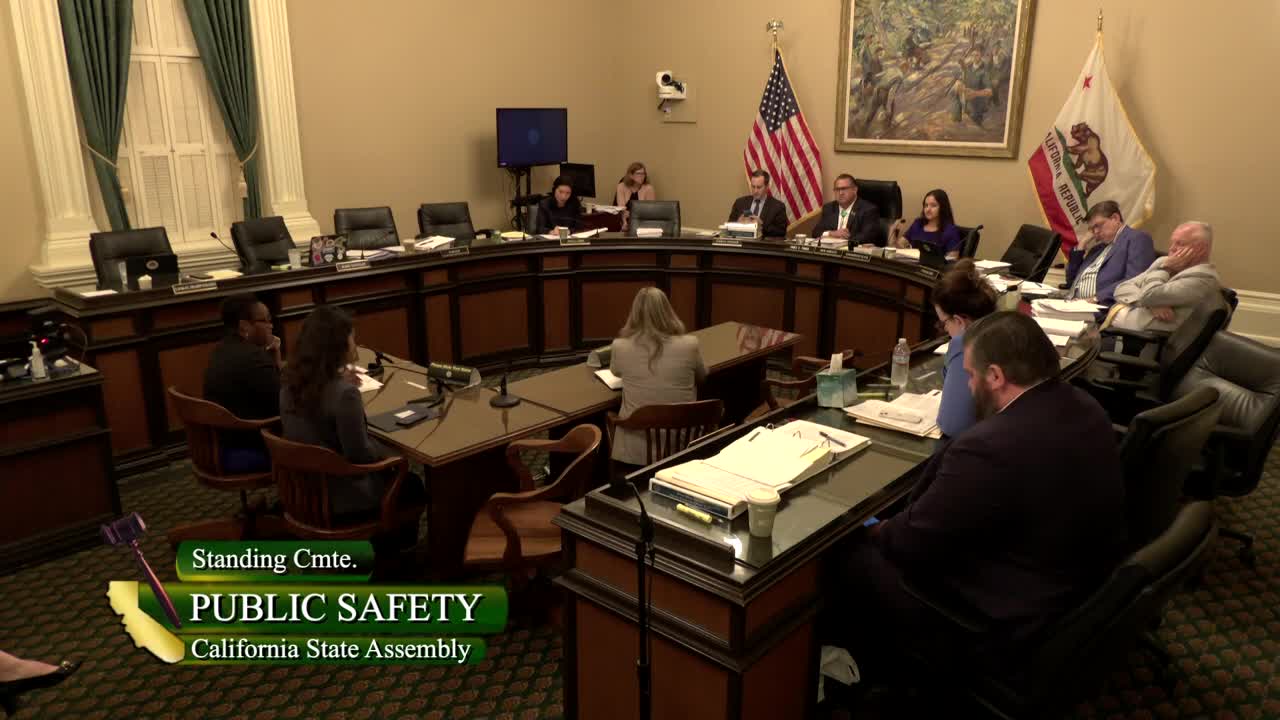 7MIN
Assembly Standing Committee on Public Safety
Bill Author

Bill Co-Author(s):