AB 2266: Electricity: load-serving entities.
- Session Year: 2025-2026
- House: Assembly
- Latest Version Date: 2026-09-20
Current Status:
Passed
(2026-09-20: Chaptered by Secretary of State - Chapter 389, Statutes of 2026.)
Introduced
In Committee
Awaiting First Chamber Vote
Passed First Chamber
In Committee
Awaiting Second Chamber Vote
Passed Second Chamber
Enacted
Existing law requires the Public Utilities Commission to set resource adequacy and resource procurement obligations for load-serving entities, which include electrical corporations, electric service providers, and community choice aggregators. Existing law requires various compliance reporting for load-serving entities.
This bill would require the commission, on or before January 1, 2030, to consider a process to consolidate certain plans submitted by load-serving entities into a single procurement plan, and would require the commission, when feasible, to consolidate certain compliance reporting for reliability requirements, as specified. The bill would require the commission, if it determines that the consolidation is not feasible, to set forth its reasons in a specified decision or ruling.
Under existing law, a violation of any order, decision, rule, direction, demand, or requirement of the commission is a crime.
Because a violation of a commission action implementing the provisions of the bill would be a crime, the bill would impose a state-mandated local program.
The California Constitution requires the state to reimburse local agencies and school districts for certain costs mandated by the state. Statutory provisions establish procedures for making that reimbursement.
This bill would provide that no reimbursement is required by this act for a specified reason.
Existing law requires the Public Utilities Commission to set resource adequacy and resource procurement obligations for load-serving entities, which include electrical corporations, electric service providers, and community choice aggregators. Existing law requires various compliance reporting for load-serving entities.
This bill would require the commission, on and after January 1, 2030, when setting certain resource adequacy procurement requirements and evaluating the compliance status for load-serving entities, to use the same capacity valuation methodology, as defined, to ensure consistent and predictable compliance standards, as specified. The bill would authorize the commission to use different capacity valuation methodologies when setting the planning reserve margin and evaluating certain short-term, mid-term, and long-term reliability needs. The bill would require the commission, on or before January 1, 2030, to complete consider a process to consolidate certain plans submitted by load-serving entities into a single procurement plan, and would require the commission, when feasible, to consolidate certain compliance reporting for reliability requirements, as specified. The bill would require the commission, if it determines that the consolidation is not feasible, to set forth its reasons in a specified decision or ruling.
Existing law establishes the Independent System Operator as a nonprofit, public benefit corporation and requires the Independent System Operator, among other duties, to ensure the efficient use and reliable operation of the electrical transmission grid consistent with the achievement of planning and operating reserve criteria, as provided.This bill would require the commission, if the Independent System Operator exercises its backstop procurement authority to ensure sufficient resources to operate the electrical grid, to include in a specified annual report an explanation of why the need for the backstop procurement arose, as provided.Under existing law, a violation of the Public Utilities Act or any order, decision, rule, direction, demand, or requirement of the commission is a crime.
Because the provisions of this bill would be a part of the act and a violation of a commission action implementing certain the provisions of the bill would be a crime, the bill would impose a state-mandated local program.
The California Constitution requires the state to reimburse local agencies and school districts for certain costs mandated by the state. Statutory provisions establish procedures for making that reimbursement.
This bill would provide that no reimbursement is required by this act for a specified reason.
Existing law requires the Public Utilities Commission to set resource adequacy and resource procurement obligations for load-serving entities, which include electrical corporations, electric service providers, and community choice aggregators. Existing law requires various compliance reporting for load-serving entities.
This bill would require the commission, on and after January 1, 2030, when setting certain resource adequacy and resource procurement obligations requirements and evaluating the compliance status for load-serving entities, to use the same capacity valuation method, methodology, as defined, to assess the reliability contribution of each resource type, to ensure consistent and predictable compliance standards, as specified. The bill would authorize the commission to use different capacity valuation methodologies when setting the planning reserve margin and evaluating certain short-term, mid-term, and long-term reliability needs. The bill would require the commission, on or before January 1, 2030, to complete a process to consolidate certain plans submitted by load-serving entities into a single procurement plan, and would require the commission, when feasible, to consolidate certain compliance reporting for reliability requirements, as specified.
Existing law establishes the Independent System Operator as a nonprofit, public benefit corporation and requires the Independent System Operator, among other duties, to ensure the efficient use and reliable operation of the electrical transmission grid consistent with the achievement of planning and operating reserve criteria, as provided.
This bill would require the commission, if the Independent System Operator exercises its backstop procurement authority to ensure sufficient resources to operate the electrical grid, to include in a specified annual report an explanation of why the need for the backstop procurement arose, as provided.
Under existing law, a violation of the Public Utilities Act or any order, decision, rule, direction, demand, or requirement of the commission is a crime.
Because the provisions of this bill would be a part of the act and a violation of a commission action implementing certain provisions of the bill would be a crime, the bill would impose a state-mandated local program.
The California Constitution requires the state to reimburse local agencies and school districts for certain costs mandated by the state. Statutory provisions establish procedures for making that reimbursement.
This bill would provide that no reimbursement is required by this act for a specified reason.
Existing law requires the Public Utilities Commission to set resource adequacy and resource procurement obligations for load-serving entities, which include electrical corporations, electric service providers, and community choice aggregators. Existing law requires various compliance reporting for load-serving entities.
This bill would require the commission, on and after January 1, 2030, when setting certain resource adequacy and resource procurement obligations for load-serving entities, to use the same capacity valuation method, as defined, to assess the reliability contribution of each resource type, as specified. The bill would require the commission, on or before January 1, 2030, to initiate complete a process to consolidate certain compliance reporting for plans submitted by load-serving entities, entities into a single procurement plan, and would require the commission, when feasible, to consolidate certain compliance reporting for reliability requirements, as specified.
Existing law establishes the Independent System Operator as a nonprofit, public benefit corporation and requires the Independent System Operator, among other duties, to ensure the efficient use and reliable operation of the electrical transmission grid consistent with the achievement of planning and operating reserve criteria, as provided.
This bill would require the commission, if the Independent System Operator exercises its backstop procurement authority to ensure sufficient resources to operate the electrical grid, to include in a specified annual report an explanation of why the need for the backstop procurement arose, as provided.
Under existing law, a violation of the Public Utilities Act or any order, decision, rule, direction, demand, or requirement of the commission is a crime.
Because the provisions of this bill would be a part of the act and a violation of a commission action implementing certain provisions of the bill would be a crime, the bill would impose a state-mandated local program.
The California Constitution requires the state to reimburse local agencies and school districts for certain costs mandated by the state. Statutory provisions establish procedures for making that reimbursement.
This bill would provide that no reimbursement is required by this act for a specified reason.
Existing law requires the Public Utilities Commission to set resource adequacy and resource procurement obligations for load-serving entities, which include electrical corporations, electric service providers, and community choice aggregators. Existing law requires various compliance reporting for load-serving entities.
This bill would require the commission, on and after January 1, 2030, when setting certain resource adequacy and resource procurement obligations for load-serving entities, to use the same capacity valuation method, as defined, to assess the reliability contribution of each resource type, as specified. The bill would require the commission, on or before January 1, 2030, to initiate a process to consolidate certain compliance reporting for load-serving entities, as specified.
Existing law establishes the Independent System Operator as a nonprofit, public benefit corporation and requires the Independent System Operator, among other duties, to ensure the efficient use and reliable operation of the electrical transmission grid consistent with the achievement of planning and operating reserve criteria, as provided.
This bill would require the commission, if the Independent System Operator exercises its backstop procurement authority to ensure sufficient resources to operate the electrical grid, to include in a specified annual report an explanation of why the need for the backstop procurement arose, as provided.
Under existing law, a violation of the Public Utilities Act or any order, decision, rule, direction, demand, or requirement of the commission is a crime.
Because the provisions of this bill would be a part of the act and a violation of a commission action implementing certain provisions of the bill would be a crime, the bill would impose a state-mandated local program.
The California Constitution requires the state to reimburse local agencies and school districts for certain costs mandated by the state. Statutory provisions establish procedures for making that reimbursement.
This bill would provide that no reimbursement is required by this act for a specified reason.
Existing law requires the Public Utilities Commission to set resource adequacy and resource procurement obligations for load-serving entities, which include electrical corporations, electric service providers, and community choice aggregators. Existing law requires various compliance reporting for load-serving entities.
This bill would require the commission, on and after January 1, 2030, when setting certain resource adequacy and resource procurement obligations for load-serving entities, to use the same capacity valuation method method, as defined, to assess the reliability contribution of each resource type, as specified. The bill would require the commission, on or before January 1, 2030, to initiate a process to consolidate certain compliance reporting for load-serving entities, as specified.
Existing law establishes the Independent System Operator as a nonprofit, public benefit corporation and requires the Independent System Operator, among other duties, to ensure the efficient use and reliable operation of the electrical transmission grid consistent with the achievement of planning and operating reserve criteria, as provided.
This bill would require the commission, if the Independent System Operator exercises its backstop procurement authority to ensure sufficient resources to operate the electrical grid, to include in a specified annual report an explanation of why the need for the backstop procurement arose, as provided.
Under existing law, a violation of the Public Utilities Act or any order, decision, rule, direction, demand, or requirement of the commission is a crime.
Because the provisions of this bill would be a part of the act and a violation of a commission action implementing certain provisions of the bill would be a crime, the bill would impose a state-mandated local program.
The California Constitution requires the state to reimburse local agencies and school districts for certain costs mandated by the state. Statutory provisions establish procedures for making that reimbursement.
This bill would provide that no reimbursement is required by this act for a specified reason.
Existing law requires the Public Utilities Commission to set resource adequacy and resource procurement obligations for load-serving entities, which include electrical corporations, electric service providers, and community choice aggregators. Existing law requires various compliance reporting for load-serving entities.
This bill would require the commission, on and after January 1, 2030, when setting certain resource adequacy and resource procurement obligations for load-serving entities, to use the same capacity valuation method to assess the reliability contribution of each resource type, as specified. The bill would require the commission, on or before January 1, 2030, to initiate a process to consolidate certain compliance reporting for load-serving entities, as specified.
Existing law establishes the Independent System Operator as a nonprofit, public benefit corporation and requires the Independent System Operator, among other duties, to ensure the efficient use and reliable operation of the electrical transmission grid consistent with the achievement of planning and operating reserve criteria, as provided.
This bill would require the commission, if the Independent System Operator exercises its backstop procurement authority to ensure sufficient resources to operate the electrical grid, to include in a specified annual report an explanation of why the need for the backstop procurement arose, as provided.
Under existing law, a violation of the Public Utilities Act or any order, decision, rule, direction, demand, or requirement of the commission is a crime.
Because the provisions of this bill would be a part of the act and a violation of a commission action implementing certain provisions of the bill would be a crime, the bill would impose a state-mandated local program.
The California Constitution requires the state to reimburse local agencies and school districts for certain costs mandated by the state. Statutory provisions establish procedures for making that reimbursement.
This bill would provide that no reimbursement is required by this act for a specified reason.
It is the intent of the Legislature to
improve information and transparency by consolidating compliance reporting requirements to facilitate improved stakeholder participation and regulatory decisionmaking.
Minimize the states reliance on backstop procurement mechanisms through continuously improving interagency coordination to position the state for effective participation in a regional energy market.
SEC. 2.Section 380.9 is added to the Public Utilities Code, immediately following Section 380.5, to read:380.9.(a)On or before January 1, 2030, the commission shall consider a process to consolidate plans submitted by load-serving entities to the commission pursuant to Sections 399.15 and 454.52 into a single procurement plan. The commission shall, when feasible, consolidate compliance reporting for reliability requirements established pursuant to Sections 380 and 454.52. If the commission determines that consolidation under this subdivision is not feasible, the commission shall set forth its reasons in the decision or ruling addressing load-serving entities' procurement or compliance reporting obligations pursuant to Sections 399.15 and 454.52.
(b)Any compliance reporting requirements or template issued by the commission to ensure compliance with Sections 380, 399.15, and 454.52 shall be finalized for a minimum of 30 business days before a compliance report submission by a load-serving entity.
(c)For purposes of this section,
load-serving entity has the same meaning as defined in Section 380.
SEC. 3.No reimbursement is required by this act pursuant to Section 6 of Article XIIIB of the California Constitution because the only costs that may be incurred by a local agency or school district will be incurred because this act creates a new crime or infraction, eliminates a crime or infraction, or changes the penalty for a crime or infraction, within the meaning of Section 17556 of the Government Code, or changes the definition of a crime within the meaning of Section 6 of Article XIIIB of the California Constitution.
(a)It is the intent of the Legislature to do all of the following:
(1)Ensure alignment of resource valuation methods across electricity supply procurement programs to improve efficiency in regulatory implementation processes to meet the short-term, mid-term, and long-term reliability needs of the state.(2)Improve improve information and transparency by consolidating compliance reporting requirements to facilitate improved stakeholder participation and regulatory decisionmaking.
(3)Minimize the states reliance on backstop procurement mechanisms through continuously improving interagency coordination to position the state for effective participation in a regional energy market.
(b)It is not the intent of the Legislature to prescribe any specific technical method or compliance structure, but to ensure consistency and close alignment between multiple programs affecting ratepayer cost.SEC. 2.Section 380.9 is added to the Public Utilities Code, immediately following Section 380.5, to read:380.9.(a)On and after January 1, 2030, the commission shall, when setting resource adequacy procurement requirements and evaluating a load-serving entitys compliance status pursuant to Sections 380 and 454.52, use the same capacity valuation methodology to ensure consistent and predictable compliance standards. The commission may use different capacity valuation methodologies when setting the planning reserve margin and evaluating short-term, mid-term, and long-term reliability needs pursuant to Sections 380 and 454.52.(b)(a)On or before January 1, 2030, the commission shall complete consider a process to consolidate plans submitted by load-serving entities to the commission pursuant to Sections 399.15 and 454.52 into a single procurement plan. The commission shall, when feasible, consolidate compliance reporting for reliability requirements established pursuant to Sections 380 and 454.52. If the commission determines that consolidation under this subdivision is not feasible, the commission shall set forth its reasons in the decision or ruling addressing load-serving entities' procurement or compliance reporting obligations pursuant to Sections 399.15 and 454.52.
(c)(b)Any compliance reporting requirements or template issued by the commission to ensure compliance with Sections 380, 399.15, and 454.52 shall be finalized for a minimum of 30 business days before a compliance report submission by a load-serving entity.
(d)If the Independent System Operator exercises its backstop procurement authority to ensure sufficient resources to operate the electrical grid in a calendar year, the commission shall include in its public report pursuant to Section 380 for that calendar year an explanation of whether the backstop procurement need arose due to any noncompliance by load-serving entities or due to differences in methodology between the commission and the Independent System Operator in assessing the reliability contribution of different resource types.(e)(c)For purposes of this section, both of the following definitions apply:
(1)Capacity valuation methodology means the analytical framework used to quantify the reliability contribution that different resource types provide to the grid.(2)Load-serving entity load-serving entity has the same meaning as defined in Section 380.
SEC. 3.No reimbursement is required by this act pursuant to Section 6 of Article XIIIB of the California Constitution because the only costs that may be incurred by a local agency or school district will be incurred because this act creates a new crime or infraction, eliminates a crime or infraction, or changes the penalty for a crime or infraction, within the meaning of Section 17556 of the Government Code, or changes the definition of a crime within the meaning of Section 6 of Article XIIIB of the California Constitution.
(a)It is the intent of the Legislature to do all of the following:
(1)Ensure alignment of resource valuation methods across electricity supply procurement programs to improve efficiency in regulatory implementation processes to meet the short-term, midterm, mid-term, and long-term reliability needs of the state.
(2)Improve information and transparency by consolidating compliance reporting requirements to facilitate improved stakeholder participation and regulatory decisionmaking.
(3)Minimize the states reliance on backstop procurement mechanisms through continuously improving interagency coordination to position the state for effective participation in a regional energy market.
(b)It is not the intent of the Legislature to prescribe any specific technical method or compliance structure, but to ensure consistency and close alignment between multiple programs affecting ratepayer cost.
SEC. 2.Section 380.9 is added to the Public Utilities Code, immediately following Section 380.5, to read:380.9.(a)On and after January 1, 2030, the commission shall, when setting resource adequacy and resource procurement obligations for requirements and evaluating a load-serving entities entitys compliance status pursuant to Sections 380 and 454.52, use the same capacity valuation method to assess the reliability contribution of each resource type to ensure consistent short-term, midterm, and long-term reliability outlooks. methodology to ensure consistent and predictable compliance standards. The commission may use different capacity valuation methodologies when setting the planning reserve margin and evaluating short-term, mid-term, and long-term reliability needs pursuant to Sections 380 and 454.52.
(b)On or before January 1, 2030, the commission shall complete a process to consolidate plans submitted by load-serving entities to the commission pursuant to Sections 399.15 and 454.52 into a single procurement plan. The commission shall, when feasible, consolidate compliance reporting for reliability requirements established pursuant to Sections 380 and 454.52.
(c)Any compliance reporting requirements or template issued by the commission to ensure compliance with Sections 380, 399.15, and 454.52 shall be finalized for a minimum of 30 business days before a compliance report submission by a load-serving entity.
(d)If the Independent System Operator exercises its backstop procurement authority to ensure sufficient resources to operate the electrical grid in a calendar year, the commission shall include in its public report pursuant to Section 380 for that calendar year an explanation of whether the backstop procurement need arose due to any noncompliance by load-serving entities or due to differences in methodology between the commission and the Independent System Operator in assessing the reliability contribution of different resource types.
(e)For purposes of this section, both of the following definitions apply:
(1)Capacity valuation method methodology means the method analytical framework used to quantify the reliability contribution that a resource provides different resource types provide to the grid.
(2)Load-serving entity has the same meaning as defined in Section 380.
SEC. 3.No reimbursement is required by this act pursuant to Section 6 of Article XIIIB of the California Constitution because the only costs that may be incurred by a local agency or school district will be incurred because this act creates a new crime or infraction, eliminates a crime or infraction, or changes the penalty for a crime or infraction, within the meaning of Section 17556 of the Government Code, or changes the definition of a crime within the meaning of Section 6 of Article XIIIB of the California Constitution.
(a)It is the intent of the Legislature to do all of the following:
(1)Ensure alignment of resource valuation methods across electricity supply procurement programs to improve efficiency in regulatory implementation processes to meet the short-term, midterm, and long-term reliability needs of the state.
(2)Improve information and transparency by consolidating compliance reporting requirements to facilitate improved stakeholder participation and regulatory decisionmaking.
(3)Minimize the states reliance on backstop procurement mechanisms through continuously improving interagency coordination to position the state for effective participation in a regional energy market.
(b)It is not the intent of the Legislature to prescribe any specific technical method or compliance structure, but to ensure consistency and close alignment between multiple programs affecting ratepayer cost.
SEC. 2.Section 380.9 is added to the Public Utilities Code, to immediately follow immediately following Section 380.5, to read:380.9.(a)On and after January 1, 2030, the commission shall, when setting resource adequacy and resource procurement obligations for load-serving entities pursuant to Sections 380 and 454.52, use the same capacity valuation method to assess the reliability contribution of each resource type to ensure consistent short-term, midterm, and long-term reliability outlooks.
(b)On or before January 1, 2030, the commission shall initiate complete a process to consolidate compliance reporting for load-serving entities for programs established pursuant to Sections 380, 399.15, and 454.52 into a single compliance reporting process. plans submitted by load-serving entities to the commission pursuant to Sections 399.15 and 454.52 into a single procurement plan. The commission shall, when feasible, consolidate compliance reporting for reliability requirements established pursuant to Sections 380 and 454.52.
(c)Any compliance reporting requirements or template issued by the commission to ensure compliance with Sections 380, 399.15, and 454.52 shall be finalized for a minimum of 20 calendar 30 business days before a compliance report submission by a load-serving entity.
(d)If the Independent System Operator exercises its backstop procurement authority to ensure sufficient resources to operate the electrical grid in a calendar year, the commission shall include in its public report pursuant to Section 380 for that calendar year an explanation of whether the backstop procurement need arose due to any noncompliance by load-serving entities or due to differences in methodology between the commission and the Independent System Operator in assessing the reliability contribution of different resource types.
(e)For purposes of this section, both of the following definitions apply:
(1)Capacity valuation method means the method used to quantify the reliability contribution that a resource provides to the grid.
(2)Load-serving entity has the same meaning as defined in Section 380.
SEC. 3.No reimbursement is required by this act pursuant to Section 6 of Article XIIIB of the California Constitution because the only costs that may be incurred by a local agency or school district will be incurred because this act creates a new crime or infraction, eliminates a crime or infraction, or changes the penalty for a crime or infraction, within the meaning of Section 17556 of the Government Code, or changes the definition of a crime within the meaning of Section 6 of Article XIIIB of the California Constitution.
(a)The It is the intent of the Legislature hereby finds and declares to do all of the following:
(1)The success of Californias clean energy transition depends on continued coordination and collaboration between multiple state agencies and the Independent System Operator to meet the states clean energy and greenhouse gas reduction targets.(2)Numerous policies established through successive legislative sessions created multiple regulatory programs aimed at decarbonizing the electrical grid by addressing reliability, renewable energy development, renewable integration, and midterm and long-term reliability.(3)Laws affecting Californias effort to decarbonize its electrical grid and maintain grid reliability include, among others, the California Renewables Portfolio Standard Program established pursuant to Senate Bill 1078 of the 200102 Regular Session (Chapter 516 of the Statutes of 2002), the provisions relating to resource adequacy established pursuant to Assembly Bill 380 of the 200506 Regular Session (Chapter 367 of the Statutes of 2005), and the Clean Energy and Pollution Reduction Act of 2015 enacted through Senate Bill 350 of the 201516 Regular Session (Chapter 547 of the Statutes of 2015).(4)Following the electrical grid emergency events in the years 2020 and 2022, to protect the health and safety of California residents and to maintain the critical functions of the states economy, Governor Newsom signed into law Assembly Bill 205 of the 202122 Regular Session (Chapter 61 of the Statutes of 2022), which, among various energy affordability measures, created the Strategic Reliability Reserve to secure additional electricity supply.(5)The State Energy Resources Conservation and Development Commission, the Public Utilities Commission, and the Independent System Operator, under Governor Newsom, established a memorandum of understanding in December 2022 to align energy planning processes and agree on a single recommended demand forecast to guide transmission planning and resource procurement cycles.(6)Following the establishment of the 2022 interagency memorandum of understanding on transmission and resource planning, joint agency coordination resulted in significant regulatory reforms to improve the transmission interconnection process and updates to the states resource adequacy program to ensure sufficient resources are available to meet critical hour demand levels of each month.(7)Assembly Bill 1373 of the 202324 Regular Session (Chapter 367 of the Statutes of 2023) affirmed the authority of the Public Utilities Commission to order new resources procurement by load-serving entities to ensure midterm and long-term reliability. Assembly Bill 2368 of the 202324 Regular Session (Chapter 713 of the Statutes of 2024) further required the Public Utilities Commission and the Independent System Operator to align on a single reliability standard to guide resource adequacy planning across multiple regulatory programs.(8)Assembly Bill 825 of the 202526 Regular Session (Chapter 116 of the Statutes of 2025) further authorized the creation of a regional energy market to improve reliability and reduce costs. Ongoing interagency efforts to connect the seams between participating jurisdictions will increase the ratepayer benefits of a regional energy market.(9)While policymaking by the state is inherently iterative, layers of regulatory program development created in a successive manner over the years has resulted in parallel processes, multiple compliance structures, and different resource valuation methods used in multiple regulatory forums for transitioning the same electrical grid towards a carbon neutral system. The resulting regulatory complexity, multiple compliance structures, and inconsistencies in resource valuation create inefficiencies in meeting California clean energy goals, increase the legal burden of public participation, increase the risk of costly backstop resource procurement, and exacerbate expensive reliance on mechanisms such as the strategic reliability reserve.(10)An efficient governance structure with a well-organized compliance system will improve the efficacy of Californias clean energy programs and position California ratepayers to harness the most value from regional energy market participation.(b)(1)It is the intent of the Legislature to do all of the following:(A)(1)Ensure alignment of resource valuation methods across electricity supply procurement programs to improve efficiency in regulatory implementation processes to meet the short-term, midterm, and long-term reliability needs of the state.
(B)(2)Improve information and transparency by consolidating compliance reporting requirements to facilitate improved stakeholder participation and regulatory decisionmaking.
(C)(3)Minimize the states reliance on backstop procurement mechanisms through continuously improving interagency coordination to position the state for effective participation in a regional energy market.
(2)(b)It is not the intent of the Legislature to prescribe any specific technical method or compliance structure, but to ensure consistency and close alignment between multiple programs affecting ratepayer cost.
SEC. 2.Section 380.9 is added to the Public Utilities Code, to immediately follow Section 380.5, to read:380.9.(a)On and after January 1, 2030, the commission shall, when setting resource adequacy and resource procurement obligations for load-serving entities pursuant to Sections 380 and 454.52, use the same capacity valuation method to assess the reliability contribution of each resource type to ensure consistent short-term, midterm, and long-term reliability outlooks.
(b)On or before January 1, 2030, the commission shall initiate a process to consolidate compliance reporting for load-serving entities for programs established pursuant to Sections 380, 399.15, and 454.52 into a single compliance reporting process.
(c)Any compliance reporting requirements or template issued by the commission to ensure compliance with Sections 380, 399.15, and 454.52 shall be finalized for a minimum of 20 calendar days before a compliance report submission by a load-serving entity.
(d)If the Independent System Operator exercises its backstop procurement authority to ensure sufficient resources to operate the electrical grid in a calendar year, the commission shall include in its public report pursuant to Section 380 for that calendar year an explanation of whether the backstop procurement need arose due to any noncompliance by load-serving entities or due to differences in methodology between the commission and the Independent System Operator in assessing the reliability contribution of different resource types.
(e)For purposes of this section, both of the following definitions apply:
(1)Capacity valuation method means the method used to quantify the reliability benefit contribution that a resource provides towards meeting grid reliability needs. to the grid.
(2)Load-serving entity has the same meaning as defined in Section 380.
SEC. 3.No reimbursement is required by this act pursuant to Section 6 of Article XIIIB of the California Constitution because the only costs that may be incurred by a local agency or school district will be incurred because this act creates a new crime or infraction, eliminates a crime or infraction, or changes the penalty for a crime or infraction, within the meaning of Section 17556 of the Government Code, or changes the definition of a crime within the meaning of Section 6 of Article XIIIB of the California Constitution.
(a)The Legislature hereby finds and declares all of the following following:
(1)The success of Californias clean energy transition depends on continued coordination and collaboration between multiple state agencies and the Independent System Operator to meet the states clean energy and greenhouse gas reduction targets.
(2)Numerous policies established through successive legislative sessions created multiple regulatory programs aimed at decarbonizing the electrical grid by addressing reliability, renewable energy development, renewable integration, and midterm and long-term reliability.
(3)Laws affecting Californias effort to decarbonize its electrical grid and maintain grid reliability include, among others, the California Renewables Portfolio Standard Program established pursuant to Senate Bill 1078 of the 200102 Regular Session (Chapter 516 of the Statutes of 2002), the provisions relating to resource adequacy established pursuant to Assembly Bill 380 of the 200506 Regular Session (Chapter 367 of the Statutes of 2005), and the Clean Energy and Pollution Reduction Act of 2015 enacted through Senate Bill 350 of the 201516 Regular Session (Chapter 547 of the Statutes of 2015).
(4)Following the electrical grid emergency events in the years 2020 and 2022, to protect the health and safety of California residents and to maintain the critical functions of the states economy, Governor Newsom signed into law Assembly Bill 205 of the 202122 Regular Session (Chapter 61 of the Statutes of 2022), which, among various energy affordability measures, created the Strategic Reliability Reserve to secure additional electricity supply.
(5)The State Energy Resources Conservation and Development Commission, the Public Utilities Commission, and the Independent System Operator, under Governor Newsom, established a memorandum of understanding in December 2022 to align energy planning processes and agree on a single recommended demand forecast to guide transmission planning and resource procurement cycles.
(6)Following the establishment of the 2022 interagency memorandum of understanding on transmission and resource planning, joint agency coordination resulted in significant regulatory reforms to improve the transmission interconnection process and updates to the states resource adequacy program to ensure sufficient resources are available to meet critical hour demand levels of each month.
(7)Assembly Bill 1373 of the 202324 Regular Session (Chapter 367 of the Statutes of 2023) affirmed the authority of the Public Utilities Commission to order new resources procurement by load-serving entities to ensure midterm and long-term reliability. Assembly Bill 2368 of the 202324 Regular Session (Chapter 713 of the Statutes of 2024) further required the Public Utilities Commission and the Independent System Operator to align on a single reliability standard to guide resource adequacy planning across multiple regulatory programs.
(8)Assembly Bill 825 of the 202526 Regular Session (Chapter 116 of the Statute Statutes of 2025) further authorized the creation of a regional energy market to improve reliability and reduce costs. Ongoing inter-agency interagency efforts to connect the seams between participating jurisdictions will increase the ratepayer benefits of a regional energy market.
(9)While policymaking by the state is inherently iterative, layers of regulatory program development created in a successive manner over the years has resulted in parallel processes, multiple compliance structures, and different resource valuation methods used in multiple regulatory forums for transitioning the same electrical grid toward towards a carbon neutral system. The resulting regulatory complexity, multiple compliance structures, and inconsistencies in resource valuation create inefficiencies in meeting California clean energy goals, increase the legal burden of public participation, increase the risk of costly backstop resource procurement, and exacerbate expensive reliance on mechanisms such as the strategic reliability reserve.
(10)An efficient governance structure with a well-organized compliance system will improve the efficacy of Californias clean energy programs and position California ratepayers to harness the most value from regional energy market participation.
(b)(1)It is the intent of the Legislature to do all of the following:
(A)Ensure alignment of resource valuation methods across electricity supply procurement programs to improve efficiency in regulatory implementation processes to meet the short-term, midterm, and long-term reliability needs of the state.
(B)Improve information and transparency by consolidating compliance reporting requirements to facilitate improved stakeholder participation and regulatory decision-making. decisionmaking.
(C)Minimize the states reliance on backstop procurement mechanisms through continuously improving inter-agency interagency coordination to position the state for effective participation in a regional energy market.
(2)It is not the intent of the Legislature to prescribe any specific technical method or compliance structure, but to ensure consistency and close alignment between multiple programs affecting ratepayer cost.
SEC. 2.Section 380.9 is added to the Public Utilities Code, to immediately follow Section 380.5, to read:380.9.(a)On and after January 1, 2030, the commission shall, when setting resource adequacy and resource procurement obligations for load-serving entities pursuant to Sections 380 and 454.52, use the same capacity valuation method to assess the reliability contribution of each resource type to ensure consistent short-term, midterm, and long-term reliability outlooks.
(b)(1)On or before January 1, 2030, the commission shall initiate a process to consolidate compliance reporting for load-serving entities for programs established pursuant to Sections 380, 399.15, and 454.52 into a single compliance reporting process.
(2)(c)Any compliance reporting requirement requirements or template issued by the commission to ensure compliance with Sections 380, 399.15, and 454.52 shall be finalized for a minimum of 20 calendar days before a compliance report submission by a load-serving entity to provide sufficient time to ensure data accuracy and consistency. entity.
(c)(d)If the Independent System Operator exercises its backstop procurement authority to ensure sufficient resources to operate the electrical grid in a calendar year, the commission shall include in its public report pursuant to Section 380 for that calendar year an explanation of whether the backstop procurement need arose due to any noncompliance by load-serving entities or due to differences in methodology between the commission and the Independent System Operator in assessing the reliability contribution of different resource types.
(d)(e)For purposes of this section, load-serving both of the following definitions apply:
(1)Capacity valuation method means the method used to quantify the reliability benefit that a resource provides towards meeting grid reliability needs.
(2)Load-serving entity has the same meaning as defined in Section 380.
SEC. 3.No reimbursement is required by this act pursuant to Section 6 of Article XIIIB of the California Constitution because the only costs that may be incurred by a local agency or school district will be incurred because this act creates a new crime or infraction, eliminates a crime or infraction, or changes the penalty for a crime or infraction, within the meaning of Section 17556 of the Government Code, or changes the definition of a crime within the meaning of Section 6 of Article XIIIB of the California Constitution.
(a)The Legislature hereby finds and declares all of the following
(1)The success of Californias clean energy transition depends on continued coordination and collaboration between multiple state agencies and the Independent System Operator to meet the states clean energy and greenhouse gas reduction targets.
(2)Numerous policies established through successive legislative sessions created multiple regulatory programs aimed at decarbonizing the electrical grid by addressing reliability, renewable energy development, renewable integration, and midterm and long-term reliability.
(3)Laws affecting Californias effort to decarbonize its electrical grid and maintain grid reliability include, among others, the California Renewables Portfolio Standard Program established pursuant to Senate Bill 1078 of the 200102 Regular Session (Chapter 516 of the Statutes of 2002), the provisions relating to resource adequacy established pursuant to Assembly Bill 380 of the 200506 Regular Session (Chapter 367 of the Statutes of 2005), and the Clean Energy and Pollution Reduction Act of 2015 enacted through Senate Bill 350 of the 201516 Regular Session (Chapter 547 of the Statutes of 2015).
(4)Following the electrical grid emergency events in the years 2020 and 2022, to protect the health and safety of California residents and to maintain the critical functions of the states economy, Governor Newsom signed into law Assembly Bill 205 of the 202122 Regular Session (Chapter 61 of the Statutes of 2022), which, among various energy affordability measures, created the Strategic Reliability Reserve to secure additional electricity supply.
(5)The State Energy Resources Conservation and Development Commission, the Public Utilities Commission, and the Independent System Operator, under Governor Newsom, established a memorandum of understanding in December 2022 to align energy planning processes and agree on a single recommended demand forecast to guide transmission planning and resource procurement cycles.
(6)Following the establishment of the 2022 interagency memorandum of understanding on transmission and resource planning, joint agency coordination resulted in significant regulatory reforms to improve the transmission interconnection process and updates to the states resource adequacy program to ensure sufficient resources are available to meet critical hour demand levels of each month.
(7)Assembly Bill 1373 of the 202324 Regular Session (Chapter 367 of the Statutes of 2023) affirmed the authority of the Public Utilities Commission to order new resources procurement by load-serving entities to ensure midterm and long-term reliability. Assembly Bill 2368 of the 202324 Regular Session (Chapter 713 of the Statutes of 2024) further required the Public Utilities Commission and the Independent System Operator to align on a single reliability standard to guide resource adequacy planning across multiple regulatory programs.
(8)Assembly Bill 825 of the 202526 Regular Session (Chapter 116 of the Statute of 2025) further authorized the creation of a regional energy market to improve reliability and reduce costs. Ongoing inter-agency efforts to connect the seams between participating jurisdictions will increase the ratepayer benefits of a regional energy market.
(9)While policymaking by the state is inherently iterative, layers of regulatory program development created in a successive manner over the years has resulted in parallel processes, multiple compliance structures, and different resource valuation methods used in multiple regulatory forums for transitioning the same electrical grid toward a carbon neutral system. The resulting regulatory complexity, multiple compliance structures, and inconsistencies in resource valuation create inefficiencies in meeting California clean energy goals, increase the legal burden of public participation, increase the risk of costly backstop resource procurement, and exacerbate expensive reliance on mechanisms such as the strategic reliability reserve.
(10)An efficient governance structure with a well-organized compliance system will improve the efficacy of Californias clean energy programs and position California ratepayers to harness the most value from regional energy market participation.
(b)(1)It is the intent of the Legislature to do all of the following:
(A)Ensure alignment of resource valuation methods across electricity supply procurement programs to improve efficiency in regulatory implementation processes to meet the short-term, midterm, and long-term reliability needs of the state.
(B)Improve information and transparency by consolidating compliance reporting requirements to facilitate improved stakeholder participation and regulatory decision-making.
(C)Minimize the states reliance on backstop procurement mechanisms through continuously improving inter-agency coordination to position the state for effective participation in a regional energy market.
(2)It is not the intent of the Legislature to prescribe any specific technical method or compliance structure, but to ensure consistency and close alignment between multiple programs affecting ratepayer cost.
SEC. 2.Section 380.9 is added to the Public Utilities Code, to immediately follow Section 380.5, to read:380.9.(a)On and after January 1, 2030, the commission shall, when setting resource adequacy and resource procurement obligations for load-serving entities pursuant to Sections 380 and 454.52, use the same capacity valuation method to assess the reliability contribution of each resource type to ensure consistent short-term, midterm, and long-term reliability outlooks.
(b)(1)On or before January 1, 2030, the commission shall initiate a process to consolidate compliance reporting for load-serving entities for programs established pursuant to Sections 380, 399.15, and 454.52 into a single compliance reporting process.
(2)Any compliance reporting requirement issued by the commission shall be finalized for a minimum of 20 calendar days before a compliance report submission by a load-serving entity to provide sufficient time to ensure data accuracy and consistency.
(c)If the Independent System Operator exercises its backstop procurement authority to ensure sufficient resources to operate the electrical grid in a calendar year, the commission shall include in its public report pursuant to Section 380 for that calendar year an explanation of whether the backstop procurement need arose due to any noncompliance by load-serving entities or due to differences in methodology between the commission and the Independent System Operator in assessing the reliability contribution of different resource types.
(d)For purposes of this section, load-serving entity has the same meaning as defined in Section 380.
SEC. 3.No reimbursement is required by this act pursuant to Section 6 of Article XIIIB of the California Constitution because the only costs that may be incurred by a local agency or school district will be incurred because this act creates a new crime or infraction, eliminates a crime or infraction, or changes the penalty for a crime or infraction, within the meaning of Section 17556 of the Government Code, or changes the definition of a crime within the meaning of Section 6 of Article XIIIB of the California Constitution.
|
Date
|
Status
|
|---|---|
| Sep 20, 2026 | Chaptered by Secretary of State - Chapter 389, Statutes of 2026. |
| Sep 20, 2026 | Approved by the Governor. |
| Sep 10, 2026 | Enrolled and presented to the Governor at 3 p.m. |
| Aug 30, 2026 | Senate amendments concurred in. To Engrossing and Enrolling. (Ayes 79. Noes 0. Page 6874.). |
| Aug 30, 2026 | Senate amendments concurred in. To Engrossing and Enrolling. (Ayes 79. Noes 0.). |
| Aug 30, 2026 | Senate amendments concurred in. To Engrossing and Enrolling. |
| Aug 28, 2026 | In Assembly. Concurrence in Senate amendments pending. |
| Aug 27, 2026 | Read third time. Passed. Ordered to the Assembly. (Ayes 38. Noes 2. Page 5991.). |
| Aug 27, 2026 | Read third time. Passed. Ordered to the Assembly. (Ayes 37. Noes 2.). |
| Aug 24, 2026 | Read second time. Ordered to third reading. |
| Aug 21, 2026 | Read third time and amended. Ordered to second reading. |
| Aug 17, 2026 | Read second time. Ordered to third reading. |
| Aug 13, 2026 | Read second time and amended. Ordered returned to second reading. |
| Aug 13, 2026 | From committee: Amend, and do pass as amended. (Ayes 5. Noes 2.) (August 13). |
| Aug 3, 2026 | In committee: Referred to APPR. suspense file. |
| Jun 22, 2026 | Read second time and amended. Re-referred to Com. on APPR. |
| Jun 18, 2026 | From committee: Amend, and do pass as amended and re-refer to Com. on APPR. (Ayes 14. Noes 2.) (June 16). |
| Jun 3, 2026 | Referred to Com. on E., U & C. |
| May 22, 2026 | In Senate. Read first time. To Com. on RLS. for assignment. |
| May 22, 2026 | Read third time. Passed. Ordered to the Senate. (Ayes 73. Noes 0. Page 5267.) |
| May 22, 2026 | Read third time. Passed. Ordered to the Senate. (Ayes 73. Noes 0.) |
| May 18, 2026 | Read second time. Ordered to third reading. |
| May 14, 2026 | From committee: Do pass. (Ayes 15. Noes 0.) (May 14). |
| May 14, 2026 | Joint Rule 62(a), file notice suspended. (Page 5030.) |
| May 14, 2026 | Joint Rule 62(a), file notice suspended. |
| May 13, 2026 | In committee: Set, first hearing. Referred to APPR. suspense file. |
| Apr 14, 2026 | Re-referred to Com. on APPR. |
| Apr 13, 2026 | Read second time and amended. |
| Apr 9, 2026 | From committee: Amend, and do pass as amended and re-refer to Com. on APPR. with recommendation: To Consent Calendar. (Ayes 17. Noes 0.) (April 8). |
| Mar 17, 2026 | Re-referred to Com. on U. & E. |
| Mar 16, 2026 | From committee chair, with author's amendments: Amend, and re-refer to Com. on U. & E. Read second time and amended. |
| Mar 9, 2026 | Referred to Com. on U. & E. |
| Feb 20, 2026 | From printer. May be heard in committee March 22. |
| Feb 19, 2026 | Read first time. To print. |
|
Date
|
Description
|
Location
|
Votes
|
|
|---|---|---|---|---|
| Aug 30, 2026 | AB 2266 Schultz Concurrence in Senate Amendments | Assembly Floor |
Passed |
|
| Aug 27, 2026 | Assembly 3rd Reading AB2266 Schultz By Becker | Senate Floor |
Passed |
|
| Aug 13, 2026 | Do pass as amended | Senate Standing Committee on Appropriations |
Passed |
|
| Aug 3, 2026 | Placed on suspense file | Senate Standing Committee on Appropriations |
Passed |
|
| Jun 16, 2026 | Do pass as amended, but first amend, and re-refer to the Committee on [Appropriations] | Senate Standing Committee on Energy, Utilities and Communications |
Passed |
|
| May 22, 2026 | AB 2266 Schultz Assembly Third Reading | Assembly Floor |
Passed |
|
| May 14, 2026 | Do pass. | Assembly Standing Committee on Appropriations |
Passed |
|
| Apr 8, 2026 | Do pass as amended, and be re-referred to the Committee on [Appropriations] with recommendation: To Consent Calendar | Assembly Standing Committee on Utilities and Energy |
Passed |
This list shows positions taken on this bill by organizations on the date displayed, which is linked to the original source.
Positions by individuals are not included.
|
Organization
|
Position
|
Date
|
|---|---|---|
| Alliance For Retail Energy Markets | ** Support | |
| Alliance for Retail Energy Markets (AReM) | ** Support | |
| Ava Community Energy | ** Support | |
| California Community Choice Association | ** Support | |
| Environmental Defense Fund | ** Support | |
| Environmental Defense Fund, Incorporated | ** Support | |
| Independent Energy Producers Association | ** Against | |
| INDEPENDENT ENERGY PRODUCERS ASSOCIATION (IEPA) | ** Against | |
| Nrg Energy | ** Support |
CONCURRENCE IN SENATE AMENDMENTS
CSA1 Bill Id:AB 2266
Author:(Schultz)
As Amended Ver:August 21, 2026
Majority vote
SUMMARY
Requires the California Public Utilities Commission (CPUC), to consider a process, by January 1, 2030, to consolidate the Integrated Resource Plan (IRP) and Renewables Portfolio Standard (RPS) plans submitted by load serving entities (LSE) into a single procurement plan. If the CPUC determines that consolidation is not feasible, the CPUC is required to report on its reasoning for this conclusion.
Senate Amendments
- Strike the requirement that the CPUC use the same capacity valuation methodology when setting resource adequacy procurement requirements and evaluating a load serving entity’s compliance status with IRP and RPS plans.
- Strike the requirement that the CPUC include a report on backstop procurement needs ordered by the California Independent System Operator (CAISO).
- Change the requirement on the CPUC for the consolidation of procurement plans from initiating the process by January 1, 2030, to considering a consolidation process by that date.
- Strike the requirement that the consideration of procurement plan consolidation include RA procurement.
- Change the basis for procurement plan consolidation from CPUC compliance reporting obligations to the plans submitted by the LSEs.
- Moves back the requirement that the CPUC finalize compliance reporting requirements prior to LSE submissions from 20 calendar days to 30 business days.
COMMENTS
The CPUC requires each LSE to demonstrate it has procured sufficient energy resources to meet its legal obligations. One such obligation is that the LSE demonstrates to the CPUC each month that it has procured an adequate supply of energy resources to meet 1) its portion of the energy needs of the entire electrical system (system reliability), 2) the energy needs of a local area (local reliability) and 3) the energy resources to meet rapid increases in demand (flexible capacity). Together, this obligation is referred to as resource adequacy, or "RA."
In addition, the CPUC requires each LSE to file with it every three years an integrated resource plan (IRP), which demonstrates how the LSE will procure energy resources sufficient to meet increasingly stringent obligations that such resources be renewable, pursuant to the RPS, and overall reduce the amount of emitted greenhouse gases.
This bill directs the CPUC to consider a process to consolidate plans submitted by LSEs for compliance with IRP and RSP requirements. The author describes this bill as “increasing transparency of compliance data through streamlined reporting.”
According to the Author
"AB 2266 would streamline overlapping CPUC procurement and compliance processes, improve transparency, and help align how resource reliability is evaluated across programs. As California has built on its success as a clean-energy leader, separately enacted programs have created a patchwork of CPUC processes over time. This bill seeks to reduce duplicative reporting, provide clearer procurement signals, and improve confidence in whether the state is procuring the right mix of resources. AB 2266 would minimize California's reliance on expensive backstop procurement by directing the CPUC to resolve inconsistent reliability valuation methods used for compliance review across key energy resource programs. The bill would require the CPUC to explain, in its annual resource adequacy report, whether any backstop procurement was driven by LSE noncompliance or by methodological inconsistencies. Taken together, these changes are intended to support continuous process improvements, more efficient planning, better accountability, and better outcomes for ratepayers."
Arguments in Support
This bill is supported by Ava Community Energy, the Alliance for Retail Energy Markets (AReM), NRG Energy, and the Environmental Defense Fund. AReM notes that "the inconsistent application of capacity valuation methods to the same molecule of energy depending on which program is looking causes challenges in the marketplace and increases the potential for over- or under-calculations." AReM goes on to note the bill "will help streamline the integration of renewables into the grid, improve reliability procurement processes, increase public transparency, and keep costs low for California."
Arguments in Opposition
None on file
FISCAL COMMENTS
According to the Senate Committee on Appropriations, this bill could result in unknown but significant ongoing CPUC costs, possibly around a million dollars annually.
VOTES:
ASM UTILITIES AND ENERGY: 17-0-1
YES: Petrie-Norris, Patterson, Boerner, Calderon, Davies, Mark González, Harabedian, Hart, Irwin, Kalra, Papan, Rogers, Schiavo, Schultz, Ta, Wallis, Zbur
ABS, ABST OR NV: Chen
ASM APPROPRIATIONS: 15-0-0
YES: Wicks, Hoover, Aguiar-Curry, Calderon, Caloza, Dixon, Fong, Mark González, Krell, Pacheco, Pellerin, Sharp-Collins, Solache, Ta, Tangipa
ASSEMBLY FLOOR: 73-0-7
YES: Addis, Aguiar-Curry, Ahrens, Alanis, Alvarez, Ávila Farías, Bains, Bennett, Berman, Boerner, Bonta, Bryan, Calderon, Caloza, Carrillo, Castillo, Connolly, Davies, DeMaio, Dixon, Elhawary, Ellis, Flora, Fong, Gallagher, Garcia, Gipson, Jeff Gonzalez, Mark González, Hadwick, Haney, Harabedian, Hart, Hoover, Irwin, Jackson, Johnson, Kalra, Krell, Lackey, Lee, Lowenthal, Macedo, McKinnor, Muratsuchi, Nguyen, Ortega, Pacheco, Papan, Patel, Patterson, Pellerin, Petrie-Norris, Quirk-Silva, Ramos, Ransom, Michelle Rodriguez, Rogers, Blanca Rubio, Sanchez, Schiavo, Schultz, Sharp-Collins, Solache, Soria, Stefani, Tangipa, Valencia, Wallis, Ward, Wilson, Zbur, Rivas
ABS, ABST OR NV: Arambula, Bauer-Kahan, Chen, Gabriel, Celeste Rodriguez, Ta, Wicks
UPDATED
VERSION: August 21, 2026
CONSULTANT: Laura Shybut / U. & E. / (916) 319-2083 FN: 0004379
SENATE RULES COMMITTEE Office of Senate Floor Analyses (916) 651-4171 | AB 2266 |
THIRD READING
Bill No: AB 2266
Author: Schultz (D)
Amended: 8/21/26 in Senate
Vote: 21
SENATE ENERGY, U. & C. COMMITTEE: 14-2, 6/16/26
AYES: Allen, Ochoa Bogh, Archuleta, Arreguín, Becker, Gonzalez, Grove, Hurtado, McNerney, Reyes, Richardson, Rubio, Stern, Wahab
NOES: Niello, Strickland
NO VOTE RECORDED: Caballero
SENATE APPROPRIATIONS COMMITTEE: 5-2, 8/13/26
AYES: Cervantes, Cabaldon, Grayson, Richardson, Wahab
NOES: Seyarto, Dahle
ASSEMBLY FLOOR: 73-0, 5/22/26 - See last page for vote
SUBJECT: Electricity: load-serving entities
SOURCE: Author
DIGEST:
- This bill requires the California Public Utilities Commission (CPUC), on or before January 1, 2030, to consider a process to consolidate specified energy procurement plans submitted by load serving entities (LSEs) to the CPUC. This bill also requires the CPUC, when feasible, to consolidate specified compliance reporting requirements.
Senate Floor Amendments of 08/21/26 delete provisions of this bill addressing capacity valuation methods and reporting on the use of backstop procurement. The amendments also require the CPUC to consider consolidated procurement plans, instead of requiring consolidated plans, and requires the CPUC to provide reasons if it determines not to consolidate procurement plans or compliance reporting.
ANALYSIS:
Existing law:
- Establishes and vests the CPUC with regulatory authority over public utilities, including electrical corporations. (Article 12 of the California Constitution)
- Establishes the California Independent System Operator (CAISO) as a nonprofit, public benefit corporation and requires the CAISO, among other duties, to ensure the efficient use and reliable operation of the electrical transmission grid consistent with the achievement of planning and operating reserve criteria, as provided. (Public Utilities Code §§ 345 and 345.5)
- Requires the CPUC to work with the CAISO to establish resource adequacy (RA) requirements for LSEs, which include electrical corporations, electric service providers (ESPs), and community choice aggregators (CCAs). Specifies the criteria the CPUC must consider when establishing RA requirements and specifies that an electrical corporation’s reasonable costs for meeting RA are recoverable from customers through nonbypassable charges. Defines LSEs as electrical corporations, CCAs and ESPs. (Public Utilities Code § 380)
- Establishes the Renewable Portfolio Standard (RPS) program which requires retail sellers (including LSEs) to procure at least 60% eligible renewable energy resources by December 31, 2030. (Public Utilities Code §§ 399.11-399.33)
- Requires the CPUC to identify a diverse and balanced portfolio of resources needed to ensure a reliable electricity supply that provides optimal integration of renewable energy and resource diversity in a cost-effective manner. Requires the CPUC to establish integrated resource planning-based procurement requirements that rely on zero-carbon-emitting resources to the maximum extent reasonable and be designed to achieve the state policy specified in Section 454.53 and any statewide greenhouse gas emissions (GHG) limit. (Public Utilities Code § 454.51)
- Requires the CPUC to adopt a process for each LSE to file an integrated resource plan (IRP) and schedule periodic update to the plan and require that LSEs ensure system and local reliability and require sufficient, predictable resource procurement and development to avoid unplanned energy supply shortfalls, as provided. (Public Utilities Code § 454.52)
This bill:
- Makes findings and declarations regarding the Legislature’s intent to improve information and transparency and minimize the state’s reliance on backstop procurement mechanisms.
- Requires the CPUC, on or before January 1, 2030, to consider a process to consolidate plans submitted by LSEs to the CPUC pursuant to the IRP and RPS programs into a single procurement plan.
- Requires the CPUC, when feasible, to consolidate compliance reporting for reliability requirements pursuant to the RA and IRP programs.
- Requires the CPUC, if it determines consolidation of plans or reporting requirements are not feasible, to provide the reasons in the decision or ruling addressing LSEs’ procurement or compliance reporting obligations.
- Requires any compliance reporting requirements or templates issued by the CPUC to ensure compliance with the RA program, RPS, or IRP are finalized for a minimum of 30 business days before a compliance report submission by an LSE.
Background
SB 100 (De León, Chapter 312, Statutes of 2018). SB 100 established the state’s target to meet 100% of the state’s electricity retail load with renewable and zero-carbon resources by 2045. SB 1020 (Laird, Chapter 361, Statutes of 2022) established interim goals to meeting the SB 100 target, specifically requiring 90% of retail sales by 2035, 95% by 2040 to be met with renewable and zero-carbon energy resources. SB 100 Joint Agency Report evaluates the challenges and opportunities in implementing SB 100. It includes an initial assessment of the additional energy resources and the resource building rates needed to achieve 100% clean electricity, along with the associated costs. The report is scheduled to be updated every four years. The first report issued March 2021 identified preliminarily that on average the state may need six gigawatts of new renewable and energy storage annually to meet the SB 100 goals. The California Energy Commission (CEC) is developing the 2025 report.
IRP process. SB 350 (De León, Chapter 547, Statutes of 2015) required each LSE to file a biennial IRP for approval or certification by the CPUC. The CPUC combines all LSEs’ IRPs to ensure the state is on its path to meet its clean energy procurement goals. Public owned utilities (POUs) are required to file their own IRPs with the CEC. The goal of the IRP is a two-year planning process to ensure that LSEs are meeting targets that allow the electricity sector to contribute to California’s economy-wide GHG emissions reductions goals and that helps to reduce overall costs. The CPUC adopted a 2023 portfolio that reduces 25 million metric ton (MMT) of GHG emissions by 2035, as compared to the previously adopted 38 MMT by 2030 planning target. The IRP is intended to forecast needs on a 10-year horizon. In this regard, the IRP is a forward-looking activity. As part of the IRP process, the CPUC has issued several procurement orders on LSEs to address near-term and mid-term procurement needs. Within the procurement orders, the CPUC has directed central procurement for local RA and mid-term reliability by electric investor-owned utilities (IOUs) for customers, including those of other LSEs.
Resource adequacy (RA). Following the California energy crisis of 2000-01, the California Legislature enacted legislation to prevent future incidents of widespread blackouts and rolling brownouts due to lack of electric generating capacity. Among the reforms adopted in response to the crisis was the adoption of Public Utilities Code §380 as an effort to better ensure reliability of electricity generation supply. The statute directs the CPUC, in consultation with the CAISO, to establish RA requirements for all LSEs, including electric IOUs, ESPs, and CCAs (which did not exist at the time of the crisis).
The current RA program consists of system, local, and flexible requirements for each month of a compliance year. In October of each year, LSEs must demonstrate that they have procured 90% of their system RA obligations for the five summer months (May-September) of the following year, as well as 100% of their local requirements, and 90% of their flexible requirements for each month of the coming compliance year. In recent years, the CPUC has adopted changes to the RA program, including increasing the planning reserve margin for all LSEs. The CPUC also assesses penalties on the LSEs who fail to satisfy their RA obligations, including limiting the expansion of CCAs if they are deficient in their RA requirement. The CPUC has implemented a significant change to the RA program by implementing a slice-of-day (SOD) framework that assesses the hourly use of resources. The CPUC has been developing the new structure for a few years and in 2025 implemented the first year of compliance for the SOD. The CPUC adopted a 17% planning reserve margin for the SOD framework, consistent with previous planning reserve margins, to procure enough RA to meet load obligations in each hour rather than monthly. Under the SOD framework, LSEs receive a 24-hour obligation for each of the 12 months of the year. The new RA framework requires that resources, including energy storage resources, demonstrate their ability to provide capacity during specific, critical hours rather than just a daily peak.
CAISO backstop procurement. If California RA rules fail to provide sufficient resources, the CAISO is compelled to utilize centralized backstop procurement mechanisms in order to maintain electric system reliability. Backstop procurement is whereby the CAISO contracts with a generator to address the shortfall. Under Federal Energy Regulatory Commission (FERC) rules, the CAISO, like all other balancing authorities, must ensure system reliability or face penalties by FERC. The CAISO has two mechanisms for centralized backstop procurement: Reliability Must Run (RMR) and Capacity Procurement Mechanism (CPM). As this procurement can be due to an emergency supply shortfall, they can be more expensive than planned procurement.
Comments
Need for this bill. According to the author:
AB 2266 would streamline overlapping CPUC procurement and compliance processes, improve transparency, and help align how resource reliability is evaluated across programs. As California has built on its success as a clean-energy leader, separately enacted programs have created a patchwork of CPUC processes over time. This bill seeks to reduce duplicative reporting, provide clearer procurement signals, and improve confidence in whether the state is procuring the right mix of resources. …Taken together, these changes are intended to support continuous process improvements, more efficient planning, better accountability, and better outcomes for ratepayers.
CPUC proposes new framework, Reliable and Clean Power Procurement Program (RCPPP). As part of existing proceedings, including those related to RA and IRP, specifically R. 25-10-003, the CPUC is actively exploring a more formal programmatic approach for how procurement may be ordered or authorized, in lieu of the current ad hoc, order-by-order approach. Beginning in 2020 to April 2025, CPUC staff papers have proposed an RCPPP to support affordability in both reliability and GHG reductions by giving LSEs a more predictable regulatory framework to procure their share of resources needed to meet electric system reliability and GHG emissions reduction goals at least cost. The CPUC's proposed RCPPP offers two options: one that allows LSEs to procure both new and existing resources to fill system reliability gaps, and one limited to new resources only. Both options are designed to address procurement shortfalls that LSEs cannot or do not fill on their own. The proposal will undergo extensive stakeholder review in the coming months through the IRP proceeding.
Bill requires the CPUC to consider consolidated procurement plans and/or compliance reporting. This bill requires the CPUC, by January 1, 2030, to consider a process to consolidate procurement plans submitted by LSEs in compliance with the RPS and the IRP. The bill also requires the CPUC, when feasible, to consolidate compliance reporting for reliability requirements pursuant to the RA and IRP programs. Recent amendments require the CPUC to provide reasons for not consolidated procurement plans or compliance reporting. These requirements may be folded into considerations within the RCPPP or within relevant proceedings.
Related/Prior Legislation
(See Policy Committee Analysis)
FISCAL EFFECT: Appropriation: No Fiscal Com.: Yes Local: Yes
According to the Senate Appropriations Committee, unknown but significant ongoing CPUC costs, possibly around a million dollars annually (ratepayer funds), to implement the provisions of this bill. Potential CPUC workload could include rulemaking, methodology development, reconciliation with the Slice-of-Day framework, compliance and other reporting, and coordination with the CEC and utilities.
SUPPORT: (Verified 8/21/26)
Alliance for Retail Energy Markets
Ava Community Energy
California Community Choice Association
Environmental Defense Fund
NRG Energy
OPPOSITION: (Verified 8/21/26)
Independent Energy Producers Association
ARGUMENTS IN SUPPORT: According to AVA Community Energy:
As the grid incorporates a wider range of resource types, including storage and distributed energy resources, the need for consistent and transparent valuation methodologies has become increasingly important. As a community choice aggregator (CCA), Ava and other load serving entities (LSEs) must navigate multiple capacity valuation frameworks across different programs, each with its own assumptions, metrics, and compliance requirements. This fragmentation increases administrative burden, complicates procurement decisions, and introduces uncertainty into long-term planning.
AB 2266 addresses these challenges by requiring the CPUC to adopt a single, standardized approach to valuing resource adequacy capacity. This reform will improve transparency, reduce duplicative compliance requirements, and enable more efficient resource procurement. By streamlining these processes, AB 2266 will help reduce administrative costs and support more cost-effective planning, ultimately benefiting customers through lower rates.
ARGUMENTS IN OPPOSITION: The Independent Energy Producers Association (IEP) reasons for opposing this bill largely relate to language that was amended out of this bill by recent Floor Amendments. It is unclear whether IEP opposes the current language remaining in this bill.
ASSEMBLY FLOOR: 73-0, 5/22/26
AYES: Addis, Aguiar-Curry, Ahrens, Alanis, Alvarez, Ávila Farías, Bains, Bennett, Berman, Boerner, Bonta, Bryan, Calderon, Caloza, Carrillo, Castillo, Connolly, Davies, DeMaio, Dixon, Elhawary, Ellis, Flora, Fong, Gallagher, Garcia, Gipson, Jeff Gonzalez, Mark González, Hadwick, Haney, Harabedian, Hart, Hoover, Irwin, Jackson, Johnson, Kalra, Krell, Lackey, Lee, Lowenthal, Macedo, McKinnor, Muratsuchi, Nguyen, Ortega, Pacheco, Papan, Patel, Patterson, Pellerin, Petrie-Norris, Quirk-Silva, Ramos, Ransom, Michelle Rodriguez, Rogers, Blanca Rubio, Sanchez, Schiavo, Schultz, Sharp-Collins, Solache, Soria, Stefani, Tangipa, Valencia, Wallis, Ward, Wilson, Zbur, Rivas
NO VOTE RECORDED: Arambula, Bauer-Kahan, Chen, Gabriel, Celeste Rodriguez, Ta, Wicks
Prepared by: Nidia Bautista / E., U. & C. / (916) 651-4107
8/24/26 13:28:48
**** END ****
SENATE RULES COMMITTEE Office of Senate Floor Analyses (916) 651-4171 | AB 2266 |
THIRD READING
Bill No: AB 2266
Author: Schultz (D)
Amended: 8/13/26 in Senate
Vote: 21
SENATE ENERGY, U. & C. COMMITTEE: 14-2, 6/16/26
AYES: Allen, Ochoa Bogh, Archuleta, Arreguín, Becker, Gonzalez, Grove, Hurtado, McNerney, Reyes, Richardson, Rubio, Stern, Wahab
NOES: Niello, Strickland
NO VOTE RECORDED: Caballero
SENATE APPROPRIATIONS COMMITTEE: 5-2, 8/13/26
AYES: Cervantes, Cabaldon, Grayson, Richardson, Wahab
NOES: Seyarto, Dahle
ASSEMBLY FLOOR: 73-0, 5/22/26 - See last page for vote
SUBJECT: Electricity: load-serving entities
SOURCE: Author
DIGEST:
This bill requires the California Public Utilities Commission (CPUC), and after January 1, 2030, when setting certain resource adequacy procurement requirements and evaluating the compliance status for load-serving entities (LSEs), to use the same capacity valuation methodology, to ensure consistent and predictable compliance standards.
ANALYSIS:
Existing law:
- Establishes and vests the CPUC with regulatory authority over public utilities, including electrical corporations. (Article 12 of the California Constitution)
- Establishes the California Independent System Operator (CAISO) as a nonprofit, public benefit corporation and requires the CAISO, among other duties, to ensure the efficient use and reliable operation of the electrical transmission grid consistent with the achievement of planning and operating reserve criteria, as provided. (Public Utilities Code §§ 345 and 345.5)
- Requires the CPUC to work with the CAISO to establish resource adequacy (RA) requirements for LSEs, which include electrical corporations, electric service providers (ESPs), and community choice aggregators (CCAs). Specifies the criteria the CPUC must consider when establishing RA requirements and specifies that an electrical corporation’s reasonable costs for meeting RA are recoverable from customers through nonbypassable charges. Defines LSEs as electrical corporations, CCAs and ESPs. (Public Utilities Code § 380)
- Establishes the Renewable Portfolio Standard (RPS) program which requires retail sellers (including LSEs) to procure at least 60% eligible renewable energy resources by December 31, 2030. (Public Utilities Code §§ 399.11-399.33)
- Requires the CPUC to identify a diverse and balanced portfolio of resources needed to ensure a reliable electricity supply that provides optimal integration of renewable energy and resource diversity in a cost-effective manner. Requires the CPUC to establish integrated resource planning-based procurement requirements that rely on zero-carbon-emitting resources to the maximum extent reasonable and be designed to achieve the state policy specified in Section 454.53 and any statewide greenhouse gas emissions (GHG) limit. (Public Utilities Code § 454.51)
- Requires the CPUC to adopt a process for each LSE to file an integrated resource plan (IRP) and schedule periodic update to the plan and require that LSEs ensure system and local reliability and require sufficient, predictable resource procurement and development to avoid unplanned energy supply shortfalls, as provided. (Public Utilities Code § 454.52)
This bill:
- Makes findings and declarations regarding the Legislature’s intent to align valuation methods across electricity supply procurement programs, improve information and transparency, minimize the state’s reliance on backstop procurement mechanisms; while stating it is not the intent of the Legislature to prescribe any specific technical method or compliance structure.
- Defines “capacity valuation methodology” to mean the analytical framework used to quantify the reliability contribution that different resource types provide to the grid.
- Requires the CPUC, on and after January 1, 2030, when setting certain RA procurement requirements and evaluating a LSE’s compliance statutes to the IRP and RA obligations for LSEs, to use the same capacity valuation methodology to ensure consistent and predictable compliance standards.
- Authorizes the CPUC to use different capacity valuation methodologies when setting the planning reserve margin and evaluating short-term, mid-term, and long-term reliability.
- Requires the CPUC, on or before January 1, 2030, to complete a process to consolidate plans submitted by LSE to the CPUC pursuant to the IRP and RPS programs into a single procurement plan.
- Requires the CPUC, when feasible, to consolidate compliance reporting for reliability requirements pursuant to the RA and IRP programs.
- Requires the CPUC, if the CAISO exercises its backstop procurement authority to ensure sufficient resources to operate the electrical grid in a calendar year, to include in the RA annual report an explanation of why the need for the backstop procurement arose, whether the need arose due to any noncompliance by LSEs or due to differences in methodology between the CPUC and CAISO in assessing the reliability contribution of different resource types.
Background
SB 100 (De León, Chapter 312, 2018). SB 100 established the state’s target to meet 100% of the state’s electricity retail load with renewable and zero-carbon resources by 2045. SB 1020 (Laird, Chapter 361, Statutes of 2022) established interim goals to meeting the SB 100 target, specifically requiring 90% of retail sales by 2035, 95% by 2040 to be met with renewable and zero-carbon energy resources. SB 100 Joint Agency Report evaluates the challenges and opportunities in implementing SB 100. It includes an initial assessment of the additional energy resources and the resource building rates needed to achieve 100% clean electricity, along with the associated costs. The report is scheduled to be updated every four years. The first report issued March 2021 identified preliminarily that on average the state may need six gigawatts of new renewable and energy storage annually to meet the SB 100 goals. The California Energy Commission (CEC) is developing the 2025 report.
IRP process. SB 350 (De León, Chapter 547, Statutes of 2015) required each LSE to file a biennial IRP for approval or certification by the CPUC. The CPUC combines all LSEs’ IRPs to ensure the state is on its path to meet its clean energy procurement goals. Public owned utilities (POUs) are required to file their own IRPs with the CEC. The goal of the IRP is a two-year planning process to ensure that LSEs are meeting targets that allow the electricity sector to contribute to California’s economy-wide GHG emissions reductions goals and that helps to reduce overall costs. The CPUC adopted a 2023 portfolio that reduces 25 million metric ton (MMT) of GHG emissions by 2035, as compared to the previously adopted 38 MMT by 2030 planning target. The IRP is intended to forecast needs on a 10-year horizon. In this regard, the IRP is a forward-looking activity. As part of the IRP process, the CPUC has issued several procurement orders on LSEs to address near-term and mid-term procurement needs. Within the procurement orders, the CPUC has directed central procurement for local RA and mid-term reliability by electric investor-owned utilities (IOUs) for customers, including those of other LSEs.
Resource adequacy (RA). Following the California energy crisis of 2000-01, the California Legislature enacted legislation to prevent future incidents of widespread blackouts and rolling brownouts due to lack of electric generating capacity. Among the reforms adopted in response to the crisis was the adoption of Public Utilities Code §380 as an effort to better ensure reliability of electricity generation supply. The statute directs the CPUC, in consultation with the CAISO, to establish RA requirements for all LSEs, including electric IOUs, ESPs, and CCAs (which did not exist at the time of the crisis).
The current RA program consists of system, local, and flexible requirements for each month of a compliance year. In October of each year, LSEs must demonstrate that they have procured 90% of their system RA obligations for the five summer months (May-September) of the following year, as well as 100% of their local requirements, and 90% of their flexible requirements for each month of the coming compliance year. In recent years, the CPUC has adopted changes to the RA program, including increasing the planning reserve margin for all LSEs. The CPUC also assesses penalties on the LSEs who fail to satisfy their RA obligations, including limiting the expansion of CCAs if they are deficient in their RA requirement. The CPUC has implemented a significant change to the RA program by implementing a slice-of-day (SOD) framework that assesses the hourly use of resources. The CPUC has been developing the new structure for a few years and in 2025 implemented the first year of compliance for the SOD. The CPUC adopted a 17% planning reserve margin for the SOD framework, consistent with previous planning reserve margins, to procure enough RA to meet load obligations in each hour rather than monthly. Under the SOD framework, LSEs receive a 24-hour obligation for each of the 12 months of the year. The new RA framework requires that resources, including energy storage resources, demonstrate their ability to provide capacity during specific, critical hours rather than just a daily peak.
CAISO backstop procurement. If California RA rules fail to provide sufficient resources, the CAISO is compelled to utilize centralized backstop procurement mechanisms in order to maintain electric system reliability. Backstop procurement is whereby the CAISO contracts with a generator to address the shortfall. Under Federal Energy Regulatory Commission (FERC) rules, the CAISO, like all other balancing authorities, must ensure system reliability or face penalties by FERC. The CAISO has two mechanisms for centralized backstop procurement: Reliability Must Run (RMR) and Capacity Procurement Mechanism (CPM). As this procurement can be due to an emergency supply shortfall, they can be more expensive than planned procurement.
Comments
Need for this bill. According to the author:
AB 2266 would streamline overlapping CPUC procurement and compliance processes, improve transparency, and help align how resource reliability is evaluated across programs. As California has built on its success as a clean-energy leader, separately enacted programs have created a patchwork of CPUC processes over time. This bill seeks to reduce duplicative reporting, provide clearer procurement signals, and improve confidence in whether the state is procuring the right mix of resources. AB 2266 would minimize California’s reliance on expensive backstop procurement by directing the CPUC to resolve inconsistent reliability valuation methods used for compliance review across key energy resource programs. The bill would require the CPUC to explain, in
its annual resource adequacy report, whether any backstop procurement was driven by LSE noncompliance or by methodological inconsistencies. Taken together, these changes are intended to support continuous process improvements, more efficient planning, better accountability, and better outcomes for ratepayers.
Resource capacity valuation methodologies vary by program. The IRP program aims to model optimal future electricity resource portfolios to achieve state policy goals, including GHG reduction goals, and requires LSEs to submit long-term plans demonstrating their intent to meet expected future obligations. The RA program functions as a near-term compliance program to ensure reliability with a one- to three-year time horizon. RA resources are subject to a must-offer obligation in the CAISO market to help ensure they will be available. Both programs plan for a 1-in-10-year loss of load (0.1 LOLE). However, due to the varied time horizon and goals of each program, the resource capacity valuations vary for each program.
CPUC proposes new framework, Reliable and Clean Power Procurement Program (RCPPP). As part of existing proceedings, including those related to RA and IRP, specifically R. 25-10-003, the CPUC is actively exploring a more formal programmatic approach for how procurement may be ordered or authorized, in lieu of the current ad hoc, order-by-order approach. Beginning in 2020 to April 2025, CPUC staff papers have proposed an RCPPP to support affordability in both reliability and GHG reductions by giving LSEs a more predictable regulatory framework to procure their share of resources needed to meet electric system reliability and GHG emissions reduction goals at least cost. The CPUC's proposed RCPPP offers two options: one that allows LSEs to procure both new and existing resources to fill system reliability gaps, and one limited to new resources only. Both options are designed to address procurement shortfalls that LSEs cannot or do not fill on their own. The proposal will undergo extensive stakeholder review in the coming months through the IRP proceeding. As part of the CPUC’s 2025 staff proposal on RCPPP, the CPUC staff noted the two accounting approaches are analytically complementary rather than mutually exclusive: marginal ELCC is oriented toward system-level reliability optimization, while SOD is oriented toward ensuring each LSE meets its own hourly obligations, and using both in tandem – as proposed under both RCPPP options – is speculated to provide additional reliability value overall. The CAISO is also evaluating changes to capacity accreditation methodologies for resources within the Resource Adequacy Modeling and Program Design initiative seeks amendments to its RA program to explore necessary reforms to RA rules and requirements.
Bill seeks a uniform capacity valuation methodology for procurement across each resource types. This bill would require the CPUC to adopt a uniform capacity valuation methodology for energy resources procured as part of the RA program and when evaluating compliance as part of IRP and RA, and requires the CPUC to consider such an approach for RA when feasible. The desire for such an approach is intended to help LSEs (and the generators) better predict the value of the resources both within the RA, IRP, and RPS programs. A desire for a uniform methodology is understandable and something the CPUC and CAISO are considering within the relevant proceedings. Supporters of this bill contend the benefits of the uniform approach will ensure predictability, improve reliability, and affordability as LSEs make procurement decisions that can be certain to satisfy reliability and GHG reduction goals.
Opponents raise concerns that these issues are best addressed by regulatory processes at the CPUC and CAISO. The Independent Energy Producers Association, representing a variety of energy-generating resources, contends these are issues better addressed within the CPUC and CAISO proceedings, particularly as they are actively being considered. They note that the varying goals and time horizons of the RA and IRP programs necessitate differing capacity valuation methodologies, even as they both drive towards a 0.1 LOLE. They further note that the RA program uses only existing resources which would naturally have a lower number of resources to including in the input assumptions that are used to calculate the 0.1 LOLE as compared to the IRP which is a much longer time horizon. They contend a uniform capacity valuation will not reduce over procurement or drive down costs, due to the planning reserve margin requirements that are needed for reliability. It is not clear whether recent author amendments address the oppositions’ concerns.
Prior/Related Legislation
(See Policy Committee Analysis)
FISCAL EFFECT: Appropriation: No Fiscal Com.: Yes Local: Yes
According to the Senate Appropriations Committee, unknown but significant ongoing CPUC costs, possibly around a million dollars annually (ratepayer funds), to implement the provisions of this bill. Potential CPUC workload could include rulemaking, methodology development, reconciliation with the Slice-of-Day framework, compliance and other reporting, and coordination with the CEC and utilities.
SUPPORT: (Verified 8/13/26)
Alliance for Retail Energy Markets
Ava Community Energy
California Community Choice Association
Environmental Defense Fund
NRG Energy
OPPOSITION: (Verified 8/13/26)
Independent Energy Producers Association
ARGUMENTS IN SUPPORT: According to AVA Community Energy:
As the grid incorporates a wider range of resource types, including storage and distributed energy resources, the need for consistent and transparent valuation methodologies has become increasingly important. As a community choice aggregator (CCA), Ava and other load serving entities (LSEs) must navigate multiple capacity valuation frameworks across different programs, each with its own assumptions, metrics, and compliance requirements. This fragmentation increases administrative burden, complicates procurement decisions, and introduces uncertainty into long-term planning.
AB 2266 addresses these challenges by requiring the CPUC to adopt a single, standardized approach to valuing resource adequacy capacity. This reform will improve transparency, reduce duplicative compliance requirements, and enable more efficient resource procurement. By streamlining these processes, AB 2266 will help reduce administrative costs and support more cost-effective planning, ultimately benefiting customers through lower rates.
ARGUMENTS IN OPPOSITION: According to the Independent Energy Producers Association (IEP):
IEP opposes AB 2266 for two primary reasons: (1) both the California Public Utilities Commission (CPUC) and the California Independent System Operator (CAISO) are currently contemplating the proposal put forward in this bill in the Resource Adequacy (RA) and Integrated Resource Plan (IRP) proceedings at the CPUC and the RA initiative at the CAISO; and, (2) mandating the CPUC choose one capacity valuation methodology for all resources to be used in both the RA and IRP proceedings risks reliability and will not lead to lower costs.
ASSEMBLY FLOOR: 73-0, 5/22/26
AYES: Addis, Aguiar-Curry, Ahrens, Alanis, Alvarez, Ávila Farías, Bains, Bennett, Berman, Boerner, Bonta, Bryan, Calderon, Caloza, Carrillo, Castillo, Connolly, Davies, DeMaio, Dixon, Elhawary, Ellis, Flora, Fong, Gallagher, Garcia, Gipson, Jeff Gonzalez, Mark González, Hadwick, Haney, Harabedian, Hart, Hoover, Irwin, Jackson, Johnson, Kalra, Krell, Lackey, Lee, Lowenthal, Macedo, McKinnor, Muratsuchi, Nguyen, Ortega, Pacheco, Papan, Patel, Patterson, Pellerin, Petrie-Norris, Quirk-Silva, Ramos, Ransom, Michelle Rodriguez, Rogers, Blanca Rubio, Sanchez, Schiavo, Schultz, Sharp-Collins, Solache, Soria, Stefani, Tangipa, Valencia, Wallis, Ward, Wilson, Zbur, Rivas
NO VOTE RECORDED: Arambula, Bauer-Kahan, Chen, Gabriel, Celeste Rodriguez, Ta, Wicks
Prepared by: Nidia Bautista / E., U. & C. / (916) 651-4107
8/17/26 11:02:17
**** END ****
SENATE COMMITTEE ON
Senator Sabrina Cervantes, Chair
2025 - 2026 Regular Session
AB 2266 (Schultz) - Electricity: load-serving entities
Version: | Policy Vote: |
Urgency: | Mandate: |
Hearing Date: | Consultant: |
Bill Summary:
This bill would require the California Public Utilities Commission (CPUC), on and after January 1, 2030, when setting certain resource procurement obligations for load-serving entities (LSEs), to use the same capacity valuation method to assess the reliability contribution of each resource type.
*********** ANALYSIS ADDENDUM – SUSPENSE FILE ***********
The following information is revised to reflect amendments
adopted by the committee on August 13, 2026
Fiscal Impact:
- Unknown but significant ongoing CPUC costs, possibly around a million dollars annually (ratepayer funds), to implement the provisions of this bill. Potential CPUC workload could include rulemaking, methodology development, reconciliation with the Slice-of-Day framework, compliance and other reporting, and coordination with the CEC and utilities.
Author Amendments:
Author amendments would narrow the CPUC's same-methodology requirement — requiring use of the same capacity valuation methodology, when setting resource adequacy procurement requirements and evaluating a load-serving entity's compliance status, to ensure consistent and predictable compliance standards — and would authorize the CPUC to use different capacity valuation methodologies when setting the planning reserve margin and evaluating short-term, mid-term, and long-term reliability needs, among other changes. These amendments would preserve the CPUC’s methodology flexibility in analytical settings — the planning reserve margin and integrated resource planning reliability evaluations.
-- END --
SENATE COMMITTEE ON
Senator Sabrina Cervantes, Chair
2025 - 2026 Regular Session
AB 2266 (Schultz) - Electricity: load-serving entities
Version: | Policy Vote: |
Urgency: | Mandate: |
Hearing Date: | Consultant: |
Bill Summary:
This bill would require the California Public Utilities Commission (CPUC), on and after January 1, 2030, when setting certain resource procurement obligations for load-serving entities (LSEs), to use the same capacity valuation method to assess the reliability contribution of each resource type.
Fiscal Impact:
- Unknown but significant ongoing CPUC costs, possibly around a million dollars annually (ratepayer funds), to implement the provisions of this bill. Potential CPUC workload could include rulemaking, methodology development, reconciliation with the Slice-of-Day framework, compliance and other reporting, and coordination with the CEC and utilities.
Background:
SB 100 and clean energy targets. SB 100 (De León, 2018) established the state's target to meet 100% of the state's electricity retail load with renewable and zero-carbon resources by 2045. SB 1020 (Laird, 2022) established interim goals toward that target, requiring 90% of retail sales by 2035 and 95% by 2040 to be met with renewable and zero-carbon energy resources. The SB 100 Joint Agency Report evaluates the challenges and opportunities in implementing SB 100, including an initial assessment of the additional energy resources and resource building rates needed to achieve 100% clean electricity, along with the associated costs. It uses a computer model to analyze these factors under various conditions and technologies, and is scheduled to be updated every four years. The first report, issued March 2021, preliminarily identified that on average the state may need six gigawatts of new renewable and energy storage annually to meet the SB 100 goals. The CEC is developing the 2025 report.
IRP process. SB 350 (De León, 2015) required each LSE to file a biennial IRP for approval or certification by the CPUC. The CPUC combines all LSEs' IRPs to ensure the state is on its path to meet its clean energy procurement goals. POUs file their own IRPs with the CEC. The goal of the IRP is a two-year planning process to ensure that LSEs are meeting targets that allow the electricity sector to contribute to California's economy-wide GHG emissions reduction goals and that help reduce overall costs. The CPUC adopted a 2023 portfolio that reduces GHG emissions to 25 MMT by 2035, as compared to the previously adopted 38 MMT by 2030 planning target. The IRP is intended to forecast needs on a 10-year horizon, making it a forward-looking activity. As part of the IRP process, the CPUC has issued several procurement orders on LSEs to address near-term and mid-term procurement needs. Within those orders, the CPUC has directed central procurement for local RA and mid-term reliability by electric IOUs for customers, including those of other LSEs.
Resource adequacy. Following the California energy crisis of 2000-01, the Legislature enacted legislation to prevent future incidents of widespread blackouts and rolling brownouts due to lack of electric generating capacity. Among the reforms adopted in response was Public Utilities Code §380, an effort to better ensure reliability of electricity generation supply. The statute directs the CPUC, in consultation with the CAISO, to establish RA requirements for all LSEs, including electric IOUs, ESPs, and CCAs, which did not exist at the time of the crisis.
The current RA program consists of system, local, and flexible requirements for each month of a compliance year. In October of each year, LSEs must demonstrate that they have procured 90% of their system RA obligations for the five summer months (May through September) of the following year, as well as 100% of their local requirements, and 90% of their flexible requirements for each month of the coming compliance year. In recent years, the CPUC has adopted changes to the RA program, including increasing the planning reserve margin for all LSEs. The CPUC also assesses penalties on LSEs that fail to satisfy their RA obligations, including limiting the expansion of CCAs if they are deficient in their RA requirement. The CAISO conducts a Local Capacity Technical Analysis to identify the minimum local resource capacity required in each local area to meet energy needs, using a 1-in-10 weather year and N-1-1 (emergency) contingency.
RA Slice-of-Day framework. The CPUC has implemented a significant change to the RA program through a Slice-of-Day (SOD) framework that assesses the hourly use of resources. The CPUC developed the new structure over several years and in 2025 implemented the first year of compliance. The CPUC adopted a 17% planning reserve margin for the SOD framework, consistent with previous planning reserve margins, to procure enough RA to meet load obligations in each hour rather than monthly. Under the framework, LSEs receive a 24-hour obligation for each of the 12 months of the year, and resources, including energy storage resources, must demonstrate their ability to provide capacity during specific critical hours rather than just a daily peak.
CAISO backstop procurement. If California RA rules fail to provide sufficient resources, the CAISO is compelled to use centralized backstop procurement mechanisms in order to maintain electric system reliability. Backstop procurement is the process whereby the CAISO contracts with a generator to address the shortfall. Under FERC rules, the CAISO, like all other balancing authorities, must ensure system reliability or face penalties by FERC. The CAISO has two mechanisms for centralized backstop procurement: Reliability Must Run (RMR) and Capacity Procurement Mechanism (CPM). Because this procurement can be prompted by an emergency supply shortfall, it can be more expensive than planned procurement.
Proposed Law:
This bill would:
- Make findings and declarations regarding the Legislature's intent to align valuation methods across electricity supply procurement programs, improve information and transparency, and minimize the state's reliance on backstop procurement mechanisms, while stating it is not the intent of the Legislature to prescribe any specific technical method or compliance structure.
- Define "capacity valuation method" to mean the method used to quantify the reliability contribution that a resource provides to the grid.
- Require the CPUC, on and after January 1, 2030, when setting certain RA and IRP resource procurement obligations for LSEs, to use the same capacity valuation method to assess the reliability contribution of each resource type.
- Require the CPUC, on or before January 1, 2030, to complete a process to consolidate the plans submitted by LSEs under the IRP and RPS programs into a single procurement plan, and to consolidate compliance reporting for reliability requirements under the RA and IRP programs when feasible.
- Require the CPUC to finalize any compliance reporting requirements or template issued by the CPUC at a minimum of 30 business days before a compliance report submission by an LSE.
- Require the CPUC, if the CAISO exercises its backstop procurement authority to ensure sufficient resources to operate the electrical grid in a calendar year, to include in the RA annual report an explanation of why the need for the backstop procurement arose, whether the need arose due to any noncompliance by LSEs or due to differences in methodology between the CPUC and CAISO.
Related Legislation:
AB 2368 (Petrie-Norris, 2024) modified several aspects of the RA program and IRP process at the CPUC in order to address challenges with electricity reliability.
AB 1373 (E. Garcia, 2023) made numerous changes to electricity policy, most notably, authorized the DWR to serve as a central procurement entity to procure energy resources in order to help the state meet its renewable and zero-carbon energy resources and reliability goals. The bill also includes numerous related and additional provisions.
AB 205 (Committee on Budget, 2022) among other things, authorized the DWR to contract for, purchase, finance or otherwise secure electrical generation to create additional capacity during extreme energy grid events, and established the Strategic Reliability Reserve to fund these actions.
SB 1158 (Becker, 2022) among its provisions, required the CPUC as part of the RA program to require every LSE to annually report information regarding the sources of electricity and the emissions of GHG associated with those sources of electricity for RA requirements.
SB 100 (De León, 2018) establishes the 100 Percent Clean Energy Act of 2017 which increases the RPS requirement from 50% by 2030 to 60% and creates the policy of planning to meet all of the state's retail electricity supply with a mix of RPS-eligible and zero-carbon resources by December 31, 2045, for a total of 100% clean energy.
SB 1136 (Hertzberg, 2018) revised existing statute that required the CPUC, in consultation with the CAISO, to establish RA requirements for the state's LSEs.
SB 618 (Bradford, 2017) required the IRP plans of all LSEs to contribute to a diverse and balanced portfolio of resources needed to ensure a reliable electricity supply that provides optimal integration of renewable energy in a cost-effective manner and meets the emissions limits for GHGs.
SB 350 (De León, 2015) among its provisions, the "Clean Energy and Pollution Reduction Act of 2015," established targets to increase retail sales of renewable electricity to 50% by 2030 and established the IRP process and required each LSE to file an IRP plan for approval or certification by the CPUC.
-- END --
SENATE COMMITTEE ON ENERGY, UTILITIES AND COMMUNICATIONS
Senator Benjamin Allen, Chair
2025 - 2026 Regular
Bill No: Hearing Date: 6/16/2026
Author: | |||
Version: | Amended | ||
Urgency: | Fiscal: | ||
Consultant: | |||
SUBJECT:
DIGEST: This bill requires the California Public Utilities Commission (CPUC), and after January 1, 2030, when setting certain resource procurement obligations for load-serving entities (LSEs), to use the same capacity valuation method to assess the reliability contribution of each resource type.
ANALYSIS
Existing law:
- Establishes and vests the CPUC with regulatory authority over public utilities, including electrical corporations. (Article 12 of the California Constitution)
- Establishes the California Independent System Operator (CAISO) as a nonprofit, public benefit corporation and requires the CAISO, among other duties, to ensure the efficient use and reliable operation of the electrical transmission grid consistent with the achievement of planning and operating reserve criteria, as provided. (Public Utilities Code §§345 and 345.5)
- Requires the CPUC to work with the CAISO to establish resource adequacy (RA) requirements for LSEs, which include electrical corporations, electric service providers (ESPs), and community choice aggregators (CCAs). Specifies the criteria the CPUC must consider when establishing RA requirements and specifies that an electrical corporation’s reasonable costs for meeting RA are recoverable from customers through non-bypassable charges. Defines LSEs as electrical corporations, CCAs and ESPs. (Public Utilities Code §380)
- Establishes the Renewable Portfolio Standard (RPS) program which requires retail sellers (including LSEs) to procure at least 60% eligible renewable energy resources by December 31, 2030. (Public Utilities Code §§399.11-399.33)
- Requires the CPUC to identify a diverse and balanced portfolio of resources needed to ensure a reliable electricity supply that provides optimal integration of renewable energy and resource diversity in a cost-effective manner. Requires the CPUC to establish integrated resource planning-based procurement requirements that rely on zero-carbon-emitting resources to the maximum extent reasonable and be designed to achieve the state policy specified in Section 454.53 and any statewide greenhouse gas emissions (GHG) limit. (Public Utilities Code §454.51)
- Requires the CPUC to adopt a process for each LSE to file an integrated resource plan (IRP) and schedule periodic update to the plan and require that LSEs ensure system and local reliability and require sufficient, predictable resource procurement and development to avoid unplanned energy supply shortfalls, as provided.
- Requires the CPUC, beginning in 2017, and to be updated regularly thereafter, to adopt a process for each LSE to file an IRP, and a schedule for periodic updates to the plan, and requires LSEs meet the GHG reduction targets, procure the renewable energy resource compliance obligations, ensure just and reasonable rates and minimize impacts on ratepayers’ bills. (Public Utilities Code §454.52)
This bill:
- Makes findings and declarations regarding the Legislature’s intent to align valuation methods across electricity supply procurement programs, improve information and transparency, minimize the state’s reliance on backstop procurement mechanisms; while stating it is not the intent of the Legislature to prescribe any specific technical method or compliance structure.
- Defines “capacity valuation method” to mean the method used to quantify the reliability contribution that a resource provides to the grid.
- Requires the CPUC, on and after January 1, 2030, when setting certain RA and IRP resource procurement obligations for LSEs, to use the same capacity valuation method to assess the reliability contribution of each resource type.
- Requires the CPUC, on or before January 1, 2030, to initiate a process to consolidate compliance reporting for LSEs across RA, IRP, and RPS programs into a single compliance reporting process.
- Requires the CPUC to finalize any compliance reporting requirements or template issued by the CPUC at a minimum of 20 calendar days before a compliance report submission by a LSE.
- Requires the CPUC, if the CAISO exercises its backstop procurement authority to ensure sufficient resources to operate the electrical grid in a calendar year, to include in the RA annual report an explanation of why the need for the backstop procurement arose, whether the need arose due to any noncompliance by LSEs or due to differences in methodology between the CPUC and CAISO.
Background
SB 100 (De León, Chapter 312, 2018). SB 100 established the state’s target to meet 100% of the state’s electricity retail load with renewable and zero-carbon resources by 2045. SB 1020 (Laird, Chapter 361, Statutes of 2022) established interim goals to meeting the SB 100 target, specifically requiring 90% of retail sales by 2035, 95% by 2040 to be met with renewable and zero-carbon energy resources. SB 100 Joint Agency Report evaluates the challenges and opportunities in implementing SB 100. It includes an initial assessment of the additional energy resources and the resource building rates needed to achieve 100% clean electricity, along with the associated costs. It uses a computer model to analyze these factors under various conditions and technologies. The report is scheduled to be updated every four years. The first report issued March 2021 identified preliminarily that on average the state may need six gigawatts of new renewable and energy storage annually to meet the SB 100 goals. The California Energy Commission (CEC) is developing the 2025 report.
IRP process. SB 350 (De León, Chapter 547, Statutes of 2015) required each LSE to file a biennial IRP for approval or certification by the CPUC. The CPUC combines all LSEs’ IRPs to ensure the state is on its path to meet its clean energy procurement goals. Public owned utilities (POUs) are required to file their own IRPs with the CEC. The goal of the IRP is a two-year planning process to ensure that LSEs are meeting targets that allow the electricity sector to contribute to California’s economy-wide GHG emissions reductions goals and that helps to reduce overall costs. The CPUC adopted a 2023 portfolio that reduces 25 million metric ton (MMT) of GHG emissions by 2035, as compared to the previously adopted 38 MMT by 2030 planning target. The IRP is intended to forecast needs on a 10-year horizon. In this regard, the IRP is a forward-looking activity. As part of the IRP process, the CPUC has issued several procurement orders on LSEs to address near-term and mid-term procurement needs. Within the procurement orders, the CPUC has directed central procurement for local RA and mid-term reliability by electric investor-owned utilities (IOUs) for customers, including those of other LSEs.
Resource adequacy (RA). Following the California energy crisis of 2000-01, the California Legislature enacted legislation to prevent future incidents of widespread blackouts and rolling brownouts due to lack of electric generating capacity. Among the reforms adopted in response to the crisis was the adoption of Public Utilities Code §380 as an effort to better ensure reliability of electricity generation supply. The statute directs the CPUC, in consultation with the CAISO, to establish RA requirements for all LSEs, including electric IOUs, ESPs, and CCAs (which did not exist at the time of the crisis).
The current RA program consists of system, local, and flexible requirements for each month of a compliance year. In October of each year, LSEs must demonstrate that they have procured 90% of their system RA obligations for the five summer months (May-September) of the following year, as well as 100% of their local requirements, and 90% of their flexible requirements for each month of the coming compliance year. In recent years, the CPUC has adopted changes to the RA program, including increasing the planning reserve margin for all LSEs. The CPUC also assesses penalties on the LSEs who fail to satisfy their RA obligations, including limiting the expansion of CCAs if they are deficient in their RA requirement. The CAISO conducts a Local Capacity Technical Analysis to identify the minimum local resource capacity required in each local area to meet energy needs used a 1-in-10 weather year and N-1-1(emergency) contingency.
RA Slice-of-Day (SOD) Framework. The CPUC has implemented a significant change to the RA program by implementing a SOD framework that assesses the hourly use of resources. The CPUC has been developing the new structure for a few years and in 2025 implemented the first year of compliance for the SOD. The CPUC adopted a 17% planning reserve margin for the SOD framework, consistent with previous planning reserve margins, to procure enough RA to meet load obligations in each hour rather than monthly. Under the SOD framework, LSEs receive a 24-hour obligation for each of the 12 months of the year. The new RA framework requires that resources, including energy storage resources, demonstrate their ability to provide capacity during specific, critical hours rather than just a daily peak.
CAISO backstop procurement. If California RA rules fail to provide sufficient resources, the CAISO is compelled to utilize centralized backstop procurement mechanisms in order to maintain electric system reliability. Backstop procurement is whereby the CAISO contracts with a generator to address the shortfall. Under Federal Energy Regulatory Commission (FERC) rules, the CAISO, like all other balancing authorities, must ensure system reliability or face penalties by FERC. The CAISO has two mechanisms for centralized backstop procurement: Reliability Must Run (RMR) and Capacity Procurement Mechanism (CPM). As this procurement can be due to an emergency supply shortfall, they can be more expensive than planned procurement.
Comments
Need for this bill. According to the author:
AB 2266 would streamline overlapping CPUC procurement and compliance processes, improve transparency, and help align how resource reliability is evaluated across programs. As California has built on its success as a clean-energy leader, separately enacted programs have created a patchwork of CPUC processes over time. This bill seeks to reduce duplicative reporting, provide clearer procurement signals, and improve confidence in whether the state is procuring the right mix of resources. AB 2266 would minimize California’s reliance on expensive backstop procurement by directing the CPUC to resolve inconsistent reliability valuation methods used for compliance review across key energy resource programs. The bill would require the CPUC to explain, in its annual resource adequacy report, whether any backstop procurement was driven by LSE noncompliance or by methodological inconsistencies. Taken together, these changes are intended to support continuous process improvements, more efficient planning, better accountability, and better outcomes for ratepayers.
Resource capacity valuation methods vary by program. The IRP program aims to model optimal future electricity resource portfolios to achieve state policy goals, including GHG reduction goals, and requires LSEs to submit long-term plans demonstrating their intent to meet expected future obligations. The RA program functions as a near-term compliance program to ensure reliability with a one- to three-year time horizon. RA resources are subject to a must-offer obligation in the CAISO market to help ensure they will be available. Both programs plan for a 1-in-10-year loss of load (0.1 LOLE). However, due to the varied time horizon and goals of each program, the resource capacity valuations vary for each program. The RA program established Maximum Cumulative Capacity buckets to prevent over-reliance on use-limited resources and utilized Effective Load Carrying Capacity (ELCC) methodologies for wind and solar to limit their capacity counting value. ELCC uses probabilistic grid modeling to measure the reliable capacity a resource actually contributes to the grid, expressed as the equivalent amount of capacity it could substitute while maintaining the same level of system reliability. For example, a 100 megawatts (MW) solar resource with an ELCC of 30% contributes the same reliability value as 30 MW of perfect, firm capacity. However, under the SOD framework, the CPUC has established a 24 hour/day RA obligation with an hourly resource accreditation accounting framework. The SOD framework divides each day in each month into hourly time slices to specifically evaluate how well an LSE’s portfolio matches its load, plus the reserve margin, resulting in 288 slices (12 months x 24 hours) per year that require LSEs to show compliance. Under SOD, LSEs must demonstrate sufficient capacity to satisfy their specific managed load profile (plus planning reserve margin) in all 24 hours of the worst day in each month, defined as the day of the month that contains the highest coincident peak load forecast per the CEC’s forecast. Resource accreditation is dependent upon the portfolio interactions with each LSE’s portfolio and varies by type with renewable using a probabilistic method, firm resources using installed capacity, and storage using energy charging sufficiency. Marginal ELCC takes a different, system-wide approach. Rather than evaluating each LSE against its own worst-day load profile, marginal ELCC measures every resource type's reliability contribution against a "perfect capacity" benchmark during the critical hours when the system is at greatest risk of loss of load. This common currency puts all resources (renewables, storage, demand response, thermal) on a level playing field by capturing weather-driven variability, dispatch limitations, outage rates, and interactions with the broader CAISO portfolio. Need determination, LSE allocation, and resource accreditation are all measured during the same critical hours, calibrated to the one in ten days-per-year LOLE reliability standard.
CPUC proposes new framework, Reliable and Clean Power Procurement Program (RCPPP). As part of existing proceedings, including those related to RA and IRP, specifically R. 25-10-003, the CPUC is actively exploring a more formal programmatic approach for how procurement may be ordered or authorized, in lieu of the current ad hoc, order-by-order approach. Beginning in 2020 to April 2025, CPUC staff papers have proposed a RCPPP to support affordability in both reliability and GHG reductions by giving LSEs a more predictable regulatory framework to procure their share of resources needed to meet electric system reliability and GHG emissions reduction goals at least cost. The CPUC's proposed RCPPP offers two options: one that allows LSEs to procure both new and existing resources to fill system reliability gaps, and one limited to new resources only. Both options are designed to address procurement shortfalls that LSEs cannot or do not fill on their own. The proposal will undergo extensive stakeholder review in the coming months through the IRP proceeding. As part of the CPUC’s 2025 staff proposal on RCPPP, the CPUC staff noted the two accounting approaches are analytically complementary rather than mutually exclusive: marginal ELCC is oriented toward system-level reliability optimization, while SOD is oriented toward ensuring each LSE meets its own hourly obligations, and using both in tandem – as proposed under both RCPPP options – is speculated to provide additional reliability value overall. The CAISO is also evaluating changes to capacity accreditation methodologies for resources within the Resource Adequacy Modeling and Program Design initiative seeks amendments to its RA program to explore necessary reforms to RA rules and requirements.
Bill seeks a uniform capacity valuation method to assess reliability for each resource type. This bill would require the CPUC to adopt a uniform capacity valuation methodology for energy resources. The desire for such an approach is intended to help LSEs (and the generators) better predict the value of the resources both within the RA, IRP, and RPS programs. A desire for a uniform methodology is understandable and something the CPUC and CAISO are considering with the relevant proceedings. Supporters of this bill contend the benefits of the uniform approach will ensure predictability, improve reliability, and affordability as LSEs make procurement decisions that can be certain to satisfy reliability and GHG reduction goals. However, the Independent Energy Producers Association, representing a variety of energy generating resources, contends these are issues better addressed within the CPUC and CAISO proceedings, particularly as they are actively being considered. They note that the varying goals and time horizons of the RA and IRP programs necessitate differing capacity valuation methodologies, even as they both drive towards a 0.1 LOLE. They further note that the RA program uses only existing resources which would naturally have a lower number of resources to including in the input assumptions that are used to calculate the 0.1 LOLE as compared to the IRP which is a much longer time horizon. They contend a uniform capacity valuation will not reduce over procurement or drive down costs, due to the planning reserve margin requirements that are needed for reliability.
Amendments. To address concerns raised by the California Community Choice Aggregators Association (CalCCA), the author and committee may wish to amend this bill to clarify that the CPUC shall complete a process to consolidate reporting of procurement plans for IRP and RPS (but not including RA) by January 1, 2030, require the CPUC to consolidate compliance reporting, where feasible, for reliability requirements, and provide a minimum of 30 (instead of 20) business days before updating a compliance report submission template.
Prior/Related Legislation
AB 2368 (Petrie-Norris, Chapter 713, Statutes of 2024.) modified several aspects of the RA program and IRP process at the CPUC in order to address challenges with electricity reliability.
AB 1373 (E. Garcia, Chapter Statutes of 2023) made numerous changes to electricity policy, most notably, authorized the DWR to serve as a central procurement entity to procure energy resources in order to help the state meet its renewable and zero-carbon energy resources and reliability goals. The bill also includes numerous related and additional provisions.
AB 205 (Committee on Budget, Chapter 61, Statutes of 2022) among other things, authorized the DWR to contract for, purchase, finance or otherwise secure electrical generation to create additional capacity during extreme energy grid events, and established the Strategic Reliability Reserve to fund these actions.
SB 1158 (Becker, Chapter 367, Statutes of 2022) among its provisions, required the CPUC as part of the RA program to require every LSEs to annually report information regarding the sources of electricity and the emissions of GHG associated with those sources of electricity for RA requirements.
SB 100 (De Leon, Chapter 312, Statutes of 2018) establishes the 100 Percent Clean Energy Act of 2017 which increases the RPS requirement from 50% by 2030 to 60% and creates the policy of planning to meet all of the state's retail electricity supply with a mix of RPS-eligible and zero-carbon resources by December 31, 2045, for a total of 100% clean energy.
SB 1136 (Hertzberg, Chapter 851, Statutes of 2018) revised existing statute that required the CPUC, in consultation with the CAISO, to establish RA requirements for the state’s LSEs.
SB 618 (Bradford, Chapter 431, Statutes of 2017) required the IRP plans of all LSEs to contribute to a diverse and balanced portfolio of resources needed to ensure a reliable electricity supply that provides optimal integration of renewable energy in a cost-effective manner and meets the emissions limits for GHGs.
SB 350 (De Leon, Chapter 547, Statutes of 2015) among its provisions, the "Clean Energy and Pollution Reduction Act of 2015," established targets to increase retail sales of renewable electricity to 50% by 2030 and established the IRP process and required each LSE to file IRP plan for approval or certification by the CPUC.
FISCAL EFFECT: Appropriation: Fiscal Com.: Local:
SUPPORT:
Alliance for Retail Energy Markets
Ava Community Energy
California Community Choice Association
Environmental Defense Fund
OPPOSITION:
Independent Energy Producers Association
ARGUMENTS IN SUPPORT: According to AVA Community Energy:
As the grid incorporates a wider range of resource types, including storage and distributed energy resources, the need for consistent and transparent valuation methodologies has become increasingly important. As a community choice aggregator (CCA), Ava and other load serving entities (LSEs) must navigate multiple capacity valuation frameworks across different programs, each with its own assumptions, metrics, and compliance requirements. This fragmentation increases administrative burden, complicates procurement decisions, and introduces uncertainty into long-term planning.
AB 2266 addresses these challenges by requiring the CPUC to adopt a single, standardized approach to valuing resource adequacy capacity. This reform will improve transparency, reduce duplicative compliance requirements, and enable more efficient resource procurement. By streamlining these processes, AB 2266 will help reduce administrative costs and support more cost-effective planning, ultimately benefiting customers through lower rates.
ARGUMENTS IN OPPOSITION: According to the Independent Energy Producers Association (IEP):
IEP opposes AB 2266 for two primary reasons: (1) both the California Public Utilities Commission (CPUC) and the California Independent System Operator (CAISO) are currently contemplating the proposal put forward in this bill in the Resource Adequacy (RA) and Integrated Resource Plan (IRP) proceedings at the CPUC and the RA initiative at the CAISO; and, (2) mandating the CPUC choose one capacity valuation methodology for all resources to be used in both the RA and IRP proceedings risks reliability and will not lead to lower costs.
-- END --
ASSEMBLY THIRD READING
ATR Bill Id:AB 2266
Author:(Schultz)
As Amended Ver:April 13, 2026
Majority vote
SUMMARY
Requires the California Public Utilities Commission (CPUC), by January 1, 2030, to use a single, uniform capacity valuation method when setting the resource adequacy (RA) and resource procurement obligations of each load-serving entity (LSE) – meaning certain entities that provide retail electrical service, such as investor-owned utilities (IOUs) and community choice aggregators (CCAs) – and to initiate a process to consolidate LSE compliance reporting across the RA, Integrated Resource Plan (IRP), and Renewables Portfolio Standard (RPS) programs into a single reporting framework.
Additionally, directs the CPUC, if the California Independent System Operator (CAISO) exercises its backstop procurement authority to ensure sufficient resources to operate the electrical grid in a calendar year, to include in its annual public RA report for that calendar year an explanation of whether the backstop procurement need arose due to any noncompliance by LSE or due to differences in methodology between the CPUC and CAISO in assessing the reliability contribution of different resource types.
Major Provisions
COMMENTS
The CPUC requires each LSE to demonstrate it has procured sufficient energy resources to meet its legal obligations. One such obligation is that the LSE demonstrates to the CPUC each month that it has procured an adequate supply of energy resources to meet 1) its portion of the energy needs of the entire electrical system (system reliability), 2) the energy needs of a local area (local reliability) and 3) the energy resources to meet rapid increases in demand (flexible capacity). Together, this obligation is referred to as resource adequacy, or "RA."
In addition, the CPUC requires each LSE to file with it every three years an integrated resource plan (IRP), which demonstrates how the LSE will procure energy resources sufficient to meet increasingly stringent obligations that such resources be renewable, pursuant to the RPS, and not emit greenhouse gases.
The CPUC uses differing metrics to determine the capacity value of energy resources the LSEs procure to meet each of the differing types of RA obligations and the meet their RPS and IRP requirements. The author contends the CPUC's differing methods of measuring capacity, which the author describes as "a patchwork of CPUC processes," make it difficult, and costly, for LSEs to comply with their procurement obligations. The author describes this bill as "increasing transparency of compliance data through streamlined reporting."
In addition, the bill addresses situations in which the CAISO, which manages the state's electrical transmission grid and ensures electrical supply and electrical demand are constantly balanced, must exercise its "backstop procurement authority" by procuring electricity on an emergency, and usually costly, basis. Typically, CAISO exercises this authority because, for a variety of reasons, the state's LSEs have not procured sufficient energy resources, the CPUC's RA program notwithstanding. This bill requires the CPUC to explain whether CAISO used its backstop procurement because of noncompliance by an LSE with its RA obligations or because of differences in methodology between the CPUC and CAISO in assessing the reliability contribution of different resource types.
According to the Author
According to the author, "The creation of a streamlined CPUC workstream to plan, evaluate, and continuously improve the integration of clean energy resources into California's grid will deliver meaningful gains in economic efficiency, reliability, and transparency benefits for all customers and stakeholders. As we built on California's success as a clean energy leader, California's separately enacted clean energy policy programs resulted in a patchwork of CPUC processes. With the substantive policy foundation now laid, the next step is to streamline these overlapping regulatory processes. AB 2266 will reduce the regulatory burden on all load serving entities and interested stakeholders by increasing transparency of compliance data through streamlined reporting. Further, AB 2266 seeks to reduce situations in which California must rely on expensive, last minute backup resources by reconciling internal CPUC inconsistencies in the calculation of the reliability benefit of each resource type, while at the same time creating a "look back" requirement within the CPUC's annual resource adequacy reporting to ensure that procurement outcomes are evaluated against real-world performance, thereby reducing costs, and maintaining California's lead in clean energy deployment."
Arguments in Support
This bill is supported by Ava Community Energy, the Alliance for Retail Energy Markets (AReM), and the Environmental Defense Fund. AReM notes that "the inconsistent application of capacity valuation methods to the same molecule of energy depending on which program is looking causes challenges in the marketplace and increases the potential for over- or under-calculations." AReM goes on to note the bill "will help streamline the integration of renewables into the grid, improve reliability procurement processes, increase public transparency, and keep costs low for California."
Arguments in Opposition
The Independent Energy Producers Association (IEPA) have an Oppose Unless Amended position on this bill, noting "requiring one capacity valuation methodology will not reduce over procurement or drive down costs" and that the bill could put "reliability at risk, leading to expensive and dirty backup procurement." IEPA is seeking an amendment to strike the requirement in the bill that the same capacity valuation method be used for the RA and IRP programs.
FISCAL COMMENTS
According to the Assembly Committee on Appropriations, the CPUC estimates the cost of new workload from this bill would be approximately $1.7 million, ongoing. In addition, the CPUC estimates it will need a one-time contract of up to $5 million for a consultant contract to modify the current compliance report intake system.
VOTES
ASM UTILITIES AND ENERGY: 17-0-1
YES: Petrie-Norris, Patterson, Boerner, Calderon, Davies, Mark González, Harabedian, Hart, Irwin, Kalra, Papan, Rogers, Schiavo, Schultz, Ta, Wallis, Zbur
ABS, ABST OR NV: Chen
ASM APPROPRIATIONS: 15-0-0
YES: Wicks, Hoover, Aguiar-Curry, Calderon, Caloza, Dixon, Fong, Mark González, Krell, Pacheco, Pellerin, Sharp-Collins, Solache, Ta, Tangipa
UPDATED
VERSION: April 13, 2026
CONSULTANT: Laura Shybut / U. & E. / (916) 319-2083 FN: 0002718
Date of Hearing: May 13, 2026
ASSEMBLY COMMITTEE ON APPROPRIATIONS
Buffy Wicks, Chair
ABPCA Bill Id:AB 2266
Author:(Schultz) – As Amended Ver:April 13, 2026
Policy Committee: | Utilities and Energy | Vote: | 17 - 0 |
|
| ||
|
|
Urgency: No State Mandated Local Program: Yes Reimbursable: No
SUMMARY:
This bill requires the California Public Utilities Commission (CPUC), when setting resource adequacy (RA) and resource procurement obligations for load-serving entities (LSEs) — meaning certain entities that provide retail electrical service, such as investor-owned utilities (IOUs) and community choice aggregators (CCAs) — to use a standard method to assess the reliability contribution of each resource type and makes other related changes.
More specifically, this bill:
- Requires the CPUC, by January 1, 2030, (a) when setting RA and energy resource procurement obligations for LSEs, to use the same capacity valuation method — that is, the method used to quantify the reliability contribution that a resource provides to the grid — to assess the reliability contribution of each resource type to ensure consistent short-term, midterm and long-term reliability outlooks and (b) to initiate a process to consolidate compliance reporting for LSEs for three program areas—RA, the renewable portfolio standard (RPS) and integrated resource planning (IRP)—into a single compliance reporting process.
- Directs the CPUC, if the California Independent System Operator (CAISO) exercises its backstop procurement authority to ensure sufficient resources to operate the electrical grid in a calendar year, to include in its annual public RA report for that calendar year an explanation of whether the backstop procurement need arose due to any noncompliance by LSE or due to differences in methodology between the CPUC and CAISO in assessing the reliability contribution of different resource types.
FISCAL EFFECT:
This bill requires significant new analytical and regulatory work of the CPUC to apply a standard capacity valuation method to assess the reliability contribution of various resource types. The bill also creates significant analytical and administrative work for the CPUC to include in its annual public RA report explanations of whether CAISO backstop procurement, should it occur, arose from noncompliance by an LSE or due to differences in methodology between the CPUC and CAISO in assessing the reliability contribution of different resource types.
The CPUC estimates the cost of this workload to be approximately $1.7 million (Public Utilities Commission Utilities Reimbursement Account (PUCURA)) ongoing for seven new staff positions and associated resources, as follows (all cost annual): (1) two senior regulatory analysts ($218,000 each) and two regulatory analysts ($185,000 each) to initiate methodology standardization and assess resource reliability and the potential effect of changing the capacity valuation method, (2) two utilities engineers ($185,000 each) to manage processes to hire a technical consultant, as well as manage the project and the consultant, consult with the IT project manager and manage the project budget and work plan, (3) one analyst ($160,000) to provide administrative support, (4) $250,000 to maintain a database and (5) $150,000 for various IT licenses and subscriptions.
In addition, the CPUC contends it will need a one-time contract of up to $5 million (PUCURA) for a consultant contract to modify the current web-based compliance report intake system and incorporate newly developed reporting templates and increased RPS database functions.
COMMENTS:
The CPUC requires each LSE to demonstrate it has procured sufficient energy resources to meet its legal obligations. One such obligation is that the LSE demonstrates to the CPUC each month that it has procured an adequate supply of energy resources to meet (1) its portion of the energy needs of entire electrical system (system reliability), (2) the energy needs of a local area (local reliability) and (3) energy resources to meet rapid increases in demand (flexible capacity). Together, this obligation is referred to resource adequacy, or “RA.”
In addition, the CPUC requires each LSE to file with it every three years an integrated resource plan (IRP), which demonstrates how the LSE will procure energy resources sufficient to meet increasingly stringent obligations that such resources be renewable, pursuant to the RPS, and not emit greenhouse gases.
The CPUC uses differing metrics to determine the capacity value of energy resources the LSEs procure to meet each of the differing types of RA obligations and the meet their RPS and IRP requirements. The author contends the CPUC’s differing methods of measuring capacity, which the author describes as “a patchwork of CPUC processes,” make it difficult, and costly, for LSEs to comply with their procurement obligations. The author describes this bill as “increasing transparency of compliance data through streamlined reporting.”
In addition, the bill addresses situations in which the CAISO, which manages the state’s electrical transmission grid and ensures electrical supply and electrical demand are constantly balanced, must exercise its “backstop procurement authority” by procuring electricity on an emergency, and usually costly, basis. Typically, CAISO exercises this authority because, for a variety of reasons, the state’s LSEs have not procured sufficient energy resources, the CPUC’s RA program notwithstanding. This bill requires the CPUC to explain whether CAISO used its backstop procurement because of noncompliance by an LSE with its RA obligations or because of differences in methodology between the CPUC and CAISO in assessing the reliability contribution of different resource types. According to the author, this requirement will “reduce situations in which California must rely on expensive, last minute backup resources” while ensuring “procurement outcomes are evaluated against real-world performance.”
Analysis Prepared by: Jay Dickenson / APPR. / (916) 319-2081
Date of Hearing: April 8, 2026
ASSEMBLY COMMITTEE ON UTILITIES AND ENERGY
Cottie Petrie-Norris, Chair
ABPCA Bill Id:AB 2266 (
Author:Schultz) – As Amended Ver:March 16, 2026
SUBJECT: Electricity: load-serving entities
SUMMARY: Requires the California Public Utilities Commission (CPUC), by January 1, 2030, to use a single, uniform capacity valuation method when setting the resource adequacy (RA) and resource procurement obligations of each load-serving entity (LSE), and to initiate a process to consolidate LSE compliance reporting across the RA, Integrated Resource Plan (IRP), and Renewables Portfolio Standard (RPS) programs into a single reporting framework. Specifically, this bill:
- Requires the CPUC by January 1, 2030, to use a single method for measuring the reliability contribution of each resource type when setting both RA (PUC § 380) and IRP (PUC § 454.52) procurement obligations.
- Requires the CPUC to begin consolidating LSE compliance reporting across the three major energy programs – RA, RPS (PUC § 399.15), and IRP – into a single reporting framework. The CPUC is required to initiate the process by January 1, 2030, not necessarily complete it.
- Requires the CPUC to finalize any compliance reporting templates or requirements at least 20 calendar days before an LSE's submission deadline.
- Requires the CPUC, whenever the California Independent System Operator (CAISO) exercises its backstop procurement authority, to publicly explain in its annual RA report whether the backstop need was caused by LSE noncompliance or by methodological inconsistencies between the CPUC and CAISO in how they value resource reliability.
- Defines "capacity valuation method" to mean the method used to quantify the reliability benefit that a resource provides towards meeting grid reliability needs.
- Makes numerous findings and declarations related to the numerous legislative policies aimed at decarbonizing the grid.
EXISTING LAW:
- Requires the CAISO to ensure the efficient use and reliable operation of the transmission grid consistent with the achievement of planning and operating reserve criteria that are no less stringent than those established by the Western Electricity Coordinating Council and the North American Electric Reliability Council. (Public Utilities Code § 345)
- Requires the CPUC, in consultation with the CAISO, to establish RA requirements for LSEs, facilitate the development of resources, equitably allocate costs of generating capacity, minimize enforcement requirements and costs, and maximize the ability of community choice aggregators (CCAs) to determine the generation resources used to serve their customers. (Public Utilities Code § 380)
- Establishes rules related to the Renewables Portfolio Standard Program (RPS). (Public Utilities Code §§ 399.11-399.33)
- Requires LSEs to file an IRP to the CPUC that meets greenhouse gas (GHG) emissions reduction targets and clean energy targets; enables each electrical corporation to fulfill its obligations to serve its customers at just and reasonable rates; minimizes impacts on ratepayers’ bills; strengthens the diversity, sustainability, and resilience of the bulk transmission and distribution systems; enhances distribution systems and demand-side energy management; and maintains a diverse portfolio of energy resources. (Public Utilities Code § 454.52)
FISCAL EFFECT: Unknown. This bill is keyed fiscal and will be referred to the Assembly Committee on Appropriations for its review.
BACKGROUND:
Current Statewide Resource Planning: the Integrated Resource Plans (IRP), the Integrated Energy Policy Report (IEPR), and the Resource Adequacy (RA) Program – California's electricity planning and procurement regime is administered jointly by the CPUC, CEC, and CAISO through three complementary frameworks – the Integrated Resource Plan (IRP), the Integrated Energy Policy Report (IEPR), and the Resource Adequacy (RA) program – that together govern short-, mid-, and long-term procurement by load-serving entities (LSEs).
The IRP, established by SB 350 (De León, Chapter 547, Statutes of 2015), directs each LSE to file a long-term resource plan aimed at reducing GHG emissions at the lowest system-wide cost, with the most recent analysis identifying nearly 63 GW of new resources needed by 2035 across a mix of geothermal, wind, solar, storage, and other clean technologies.[1] LSEs' RPS compliance obligations occur alongside the IRP on three-year compliance periods, ratcheting toward a 60% renewables requirement by 2030 and ultimately 100% zero-carbon electricity by 2045. Informing both the IRP and RA processes is the CEC's IEPR, a biennial demand forecast covering a 15-year planning horizon that assesses all aspects of energy supply, demand, and pricing to guide statewide energy policy.

Figure 1: Resource planning across the energy agencies with associated timelines. Source: CEC.
Running concurrently with these longer-term planning streams is the RA program, which focuses on near-term reliability. Established by AB 380 (Nunez, Chapter 367, Statutes of 2005) following the 2000-01 energy crisis, RA requires each LSE to demonstrate it has procured sufficient resources to meet three categories of obligations — system, local, and flexible capacity — on a monthly basis. System requirements are set using the CEC's IEPR demand forecast plus a 15% planning reserve margin; local requirements are based on an annual CAISO study using a once-in-ten-years weather standard; and flexible requirements are derived from the largest three-hour ramp needed to reliably operate the system each month. LSEs must demonstrate 90% of summer system RA obligations and 100% of local requirements by October of the prior year, with additional monthly demonstrations of full compliance required throughout the year.
RA Reform: Transition to the Slice of Day (SOD) Framework – In 2021, the CPUC determined that a "slice of day" (SOD) approach to RA better reflected evolving supply and demand trends, and began implementing that framework in 2023 for compliance beginning in 2024.[2] In 2023, the CPUC adopted reforms to operationalize a transition to this framework.[3] Ultimately, 2024 would be a test year and not the first compliance year for SOD, and 2025 is the first year in which LSEs must comply with these new requirements.
Under the SOD framework, LSEs must demonstrate they have procured sufficient capacity to meet expected demand — including the planning reserve margin — for each hour of the peak day of each month, representing the most challenging demand conditions the system faces. The CPUC sets the methodology for valuing different resource types, but LSEs have discretion in how they meet their obligations. The SOD approach is intentionally more granular than its predecessor, reflecting the complexity of modern grid reliability rather than the conditions that existed when the RA program was created following the 2000-01 energy crisis.
Procurement in the IRP – Beginning in 2016, the CPUC used the IRP process to assess the portfolio of resources needed to cost-effectively integrate renewable energy and achieve the state's zero-carbon electricity goals. What began as primarily a decarbonization modeling exercise has since evolved into a system-wide planning tool that examines how each LSE's supply and demand decisions interact with those of all others on the grid – a natural evolution for the regulator responsible for overseeing LSEs' RA and IRP obligations. The IRP's mid- and long-term outlook complements the near-term RA program, and the two have grown increasingly intertwined. State law has been amended on multiple occasions to reflect that both programs are, at their core, examining the same electrical system, just across different time horizons.[4]
The IRP process now operates on two tracks: planning and procurement. In the planning track, the CPUC assesses the individual integrated resource plans of all LSEs compared to what is needed for the system. The CPUC transmits its resource portfolio to CAISO for use in the Transmission Planning Process, which produces an annual plan for expanding transmission infrastructure to meet economic, reliability, and policy needs.
In the IRP procurement track, the CPUC can order its jurisdictional LSEs to procure additional resources when LSE plans fall short of the preferred system plan — that is, when a gap emerges between what the CPUC's analysis says the system needs and what LSEs are actually procuring. To date, the CPUC has exercised this authority four times, most recently calling for 6GW of new, clean resources.[5]
Reliable & Clean Power Procurement Program (RCPPP) – in mid-2025, a CPUC staff paper[6] was released on an updated proposal regarding how mid-term procurement could be ordered in the IRP process, as a successor to the somewhat ad hoc procurement order process previously used.
The CPUC's proposed Reliable and Clean Power Procurement Program (RCPPP) offers two options: one that allows LSEs to procure both new and existing resources to fill system reliability gaps, and one limited to new resources only. Both options are designed to address procurement shortfalls that LSEs cannot or do not fill on their own. The proposal will undergo extensive stakeholder review in the coming months through the IRP proceeding.
Resource Counting – The CPUC's RA program has long grappled with how to accurately value different resource types. Early approaches used Maximum Cumulative Capacity buckets and Effective Load Carrying Capability (ELCC) methodologies for wind and solar. ELCC measures the reliable capacity a resource actually contributes to the grid – expressed as the equivalent amount of "perfect," always-available capacity it could replace while maintaining the same level of system reliability. A 100 MW solar resource with an ELCC of 30%, for example, contributes the same reliability value as 30 MW of perfect, firm capacity.
With the introduction of the 24-hour SOD framework – requiring each LSE to demonstrate sufficient capacity to meet its own managed load profile, including an hourly planning reserve margin, during the worst day of each month – resource counting has varied by type:[7] renewables use a probability-based exceedance method, firm resources use installed capacity, and storage requires LSEs to demonstrate energy charging sufficiency from their own portfolios. Because resources are not measured against a common currency, their value under SOD depends on portfolio interactions within each individual LSE’s portfolio.
Marginal ELCC takes a different, system-wide approach. Rather than evaluating each LSE against its own worst-day load profile, marginal ELCC measures every resource type's reliability contribution against a "perfect capacity" benchmark during the critical hours when the system is at greatest risk of loss of load. This common currency puts all resources (renewables, storage, demand response, thermal) on a level playing field by capturing weather-driven variability, dispatch limitations, outage rates, and interactions with the broader CAISO portfolio. Need determination, LSE allocation, and resource accreditation are all measured during the same critical hours, calibrated to the 0.1 days-per-year Loss of Load Expectation (LOLE) reliability standard. As part of the CPUC’s 2025 staff proposal on RCPPP, the CPUC staff noted the two accounting approaches are analytically complementary rather than mutually exclusive: marginal ELCC is oriented toward system-level reliability optimization, while SOD is oriented toward ensuring each LSE meets its own hourly obligations, and using both in tandem – as proposed under both RCPPP options – is speculated to provide additional reliability value overall.[8]
COMMENTS:
- Author’s Statement. According to the author, “The creation of a streamlined CPUC workstream to plan, evaluate, and continuously improve the integration of clean energy resources into California’s grid will deliver meaningful gains in economic efficiency, reliability, and transparency benefits for all customers and stakeholders. As we built on California’s success as a clean energy leader, California’s separately enacted clean energy policy programs resulted in a patchwork of CPUC processes. With the substantive policy foundation now laid, the next step is to streamline these overlapping regulatory processes. AB 2266 will reduce the regulatory burden on all load serving entities and interested stakeholders by increasing transparency of compliance data through streamlined reporting. Further, AB 2266 seeks to reduce situations in which California must rely on expensive, last minute backup resources by reconciling internal CPUC inconsistencies in the calculation of the reliability benefit of each resource type, while at the same time creating a “look back” requirement within the CPUC’s annual resource adequacy reporting to ensure that procurement outcomes are evaluated against real-world performance, thereby reducing costs, and maintaining California’s lead in clean energy deployment.”
- Purpose of Bill. AB 2266 seeks to streamline how the CPUC oversees electricity procurement and resource planning. The bill has three core directives. First, it requires the CPUC to use a single, uniform capacity valuation method when setting RA and IRP procurement obligations for LSEs across its programs, so that the reliability contribution of each resource type is measured consistently. Second, it requires the CPUC to initiate a process to consolidate compliance reporting for LSEs across its three major clean energy programs – RA, the IRP, and the RPS – into a single reporting process, with a requirement that any new or amended reporting templates be finalized at least 20 days before a compliance deadline. Third, it requires the CPUC, in any year where CAISO exercises its backstop procurement authority, to include in its annual RA report an explanation of whether the backstop need arose from LSE noncompliance or from any methodological inconsistencies between CPUC and CAISO in assessing resource reliability.
- Many Elephants. There is an ancient story of several men who each touch a different part of an elephant and reach entirely different conclusions: one feels the trunk and says it's a snake, another feels the leg and says it's a tree, another feels the side and says it's a wall, and so on. Each is correct about the part he examined, but none has an accurate picture of the whole. In some ways, the story of the elephant mirrors the RA and IRP disconnect at the heart of this bill: both programs are examining the same resource and the same grid, but through different methodological lenses, and arriving at different conclusions about that resource's reliability value – not because the resource changed, but because each program is only seeing part of the picture.
As noted above, these two counting methods exist for good reasons. In RA, SOD is designed to ensure that each LSE can meet its own load obligations on a given day. The methodology forces LSEs to match their specific portfolio to their specific load profile hour by hour. In IRP, ELCC is designed to measure a resource's marginal contribution to system-wide reliability across a probabilistic range of conditions. ELCC is better at capturing the value of resource diversity and portfolio interactions at scale. Each is well suited to the job it was designed to do.
The risk in forcing a single method across both programs, as the current bill proposes, is that you may optimize well for one purpose while degrading the other. For example, ELCC values are portfolio-dependent and shift as the resource mix changes: a resource's ELCC today may look different in five years as more solar and storage saturate the system. That's useful for long-term planning but can create compliance uncertainty in the near-term RA context, where LSEs need stable, predictable RA values to execute contracts. SOD, on the other hand, can overvalue short-duration resources that look reliable in a single peak hour but can't sustain output across a multi-hour stress event.
Moreover, the two programs (RA & IRP) are asking slightly different questions. RA asks, “Can this LSE meet its load on the worst day of each month?” (individual) while IRP asks, “What does the system need across a range of plausible futures over the next 15 years?” (system/group). Forcing one method onto both may produce a technically consistent answer that doesn't fully serve either question. In other words, you gain uniformity but lose the nuance that each framework was capturing about different dimensions of what the elephant can do.
But as noted by the support for this measure, the downside in having these different methods is that it simultaneously sends contradictory market signals, causing resources to be valued differently depending on which compliance bucket they're filling. This can distort investment decisions and make it hard to know whether the system as a whole is over- or under-procured. The bill doesn't prescribe which method wins; it just says the CPUC must pick one and apply it consistently. Whether that's worth the tradeoff in methodological precision is the core question of this bill.
- Minor Cleanup. This bill defines “Capacity Valuation Method” as “the reliability benefit that a resource provides towards meeting grid reliability needs.” The committee recommends minor edits to this definition to replace “benefit” with “contribution,” and “towards meeting grid reliability needs” with “to the grid.”
- Findings and Declarations. This bill begins with ten formal findings and declarations, asserting as established legislative fact a detailed history of California's clean energy regulatory programs, the grid emergencies of 2020 and 2022, and (most substantively) that the layering of successive programs has produced regulatory complexity, multiple compliance structures, and resource valuation inconsistencies that increase costs, raise backstop procurement risk, and burden public participation. While some of these findings are accurate, and chronicle an important narrative, they are largely tangential to the operative provisions of the bill. Therefore, the committee recommends striking all 10 findings and declarations but retaining the intent section in subdivision (b) of Section 1.
- Prior Legislation.
AB 2368 (Petrie-Norris) modifies several aspects of the RA program and IRP process at the CPUC in order to address challenges with electric reliability. Earlier versions of the bill included requiring the same “counting” rules between the IRP and RA programs. Status: Chapter 713, Statutes of 2024.
AB 205 (Committee on Budget), among other things, authorized the Department of Water Resources (DWR) to contract for, purchase, finance, or otherwise secure electrical generation to create additional capacity during extreme energy grid events, and established the Strategic Reliability Reserve to fund these actions. Status: Chapter 61, Statutes of 2022.
SB 618 (Bradford) required, explicitly, the IRPs of all LSEs to contribute to a diverse and balanced portfolio of resources needed to ensure a reliable electricity supply, meet certain environmental goals, and prevent cost shifting among LSEs. Status: Chapter 431, Statutes of 2017.
SB 350 (de León), among other things, increased the RPS and directed the CPUC to develop a process by which LSEs submit IRPs to the CPUC for review or certification. Status: Chapter 737, Statutes of 2015.
REGISTERED SUPPORT / OPPOSITION:
Support
Alliance for Retail Energy Markets
Environmental Defense Fund, Incorporated
Opposition
None on file.
Analysis Prepared by: Laura Shybut / U. & E. / (916) 319-2083
25 MMT scenario resource stack; CPUC, Decision Transmitting Electricity Resource Portfolios to The California Independent System Operator For 2025-2026 Transmission Planning Process, D. 25-02-026; https://docs.cpuc.ca.gov/PublishedDocs/Published/G000/M557/K879/557879249.PDF ↑
D.21-07-014, Decision on Track 3B.2 Issues: Restructure of the Resource Adequacy Program, issued July 16, 2021, in Rulemaking 19-11-009. ↑
D.23-04-010, Decision on Phase 2 of the Resource Adequacy Reform Track, issued April 7, 2023, in Rulemaking 21-10-002. ↑
SB 155 (Bradford, Statutes of 2019) provided that, through the Resource Adequacy program, the CPUC shall ensure reliability on both a near- and long-term basis, as well as serve the existing RPS long-term contracting requirements. AB 1373 (Garcia, Becker, Ting, Statutes of 2023) added resources needed to achieve the state’s long-term decarbonization objectives to the scope of the Resource Adequacy program, including further linking it to the IRP process, among many other provisions. ↑
CPUC press release, “CPUC Advances Clean and Affordable Electricity with New Procurement Decision,” March 2, 2026; https://www.cpuc.ca.gov/news-and-updates/all-news/cpuc-advances-clean-and-affordable-electricity-with-new-procurement-decision ↑
CPUC, “Attachment A: Staff Proposal: RCPPP” R. 20-05-003, April 29, 2025, https://docs.cpuc.ca.gov/PublishedDocs/Efile/G000/M565/K140/565140169.PDF ↑
The Commission considered using ELCC for use-limited resources and renewables in RA, but declined to do so when adopting slice of day: “The Commission recognizes that the 24-hour framework departs from probabilistic planning, as is used in the IRP process. We find, however, that a more deterministic approach is necessary to achieve short-term reliability needs as it assesses the needs of the grid for every hour of the day. For example, the current solar ELCC values represent aggregate contributions within the month (in the form of one value); this value, however, does not capture hourly granularity, where solar can fairly reliably meet load in the middle of the day but provide little or no contribution later in the evening.” (D.22-06-050 at 75-76) ↑
Pg. 38, CPUC, “Attachment A: Staff Proposal: RCPPP” R. 20-05-003, April 29, 2025, https://docs.cpuc.ca.gov/PublishedDocs/Efile/G000/M565/K140/565140169.PDF ↑
Discussed in Hearing
 6SEC
Assembly Floor
 2MIN
Senate Floor
 35MIN
Senate Standing Committee on Energy, Utilities and Communications
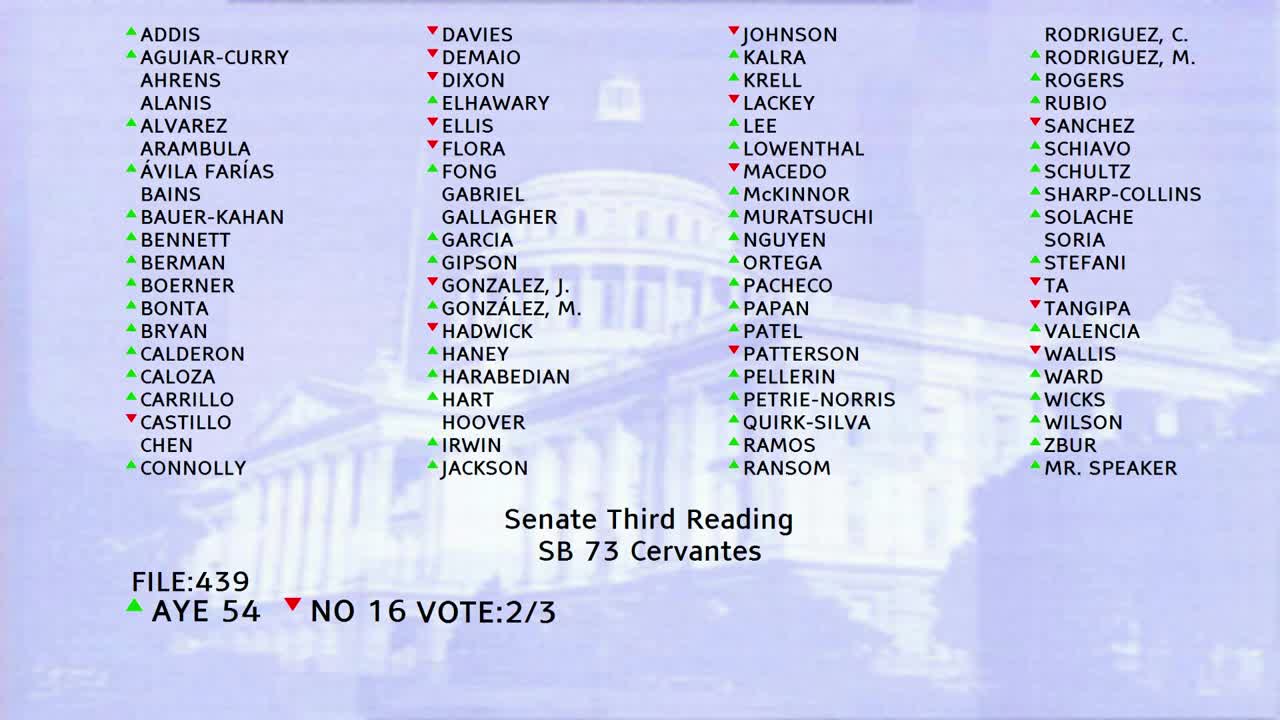 55SEC
Assembly Floor
Bill Author

Bill Co-Author(s):