AB 2273: Crimes: SCRIVNER Act.
- Session Year: 2025-2026
- House: Assembly
- Latest Version Date: 2026-09-18
Current Status:
Passed
(2026-09-18: Chaptered by Secretary of State - Chapter 298, Statutes of 2026.)
Introduced
In Committee
Awaiting First Chamber Vote
Passed First Chamber
In Committee
Awaiting Second Chamber Vote
Passed Second Chamber
Enacted
Existing law provides that any person who willfully and lewdly commits any lewd or lascivious act, including any of the acts constituting other crimes, as provided, upon or with the body, or any part or member thereof, of a child who is under 14 years of age, with the intent of arousing, appealing to, or gratifying the lust, passions, or sexual desires of that person or the child, is guilty of a felony, punishable by imprisonment in the state prison for 3, 6, or 8 years.
The bill would require the Department of Justice, upon completion of an investigation of a person who holds an elected office in which the department determines the person committed specified crimes relating to rape, that the victim was a minor, and that the case is appropriate for prosecution, to bring criminal charges against that person within 30 days.
Existing law authorizes a court to grant pretrial diversion to a defendant suffering from a mental disorder, on an accusatory pleading alleging the commission of a misdemeanor or felony offense, in order to allow the defendant to undergo mental health treatment. Existing law makes a defendant ineligible for this diversion program if the defendant is charged with specified offenses, including, among other offenses, any sex offense except indecent exposure.
This bill would, when the facts alleged in the accusatory pleading or disclosed in the preliminary hearing transcript would constitute an offense for which a defendant would be ineligible for diversion under these provisions, and the defendant has not been charged with those offenses, require the prosecution to state on the record why those charges are not being sought and whether they have conferred with the victim about the charges filed. By increasing duties on prosecutors, this bill would impose a state-mandated local program.
This bill would incorporate additional changes to Section 1001.36 of the Penal Code proposed by AB 46 to be operative only if this bill and AB 46 are enacted and this bill is enacted last.
The California Constitution requires the state to reimburse local agencies and school districts for certain costs mandated by the state. Statutory provisions establish procedures for making that reimbursement.
This bill would provide that, if the Commission on State Mandates determines that the bill contains costs mandated by the state, reimbursement for those costs shall be made pursuant to the statutory provisions noted above.
Existing law provides that any person who willfully and lewdly commits any lewd or lascivious act, including any of the acts constituting other crimes, as provided, upon or with the body, or any part or member thereof, of a child who is under 14 years of age, with the intent of arousing, appealing to, or gratifying the lust, passions, or sexual desires of that person or the child, is guilty of a felony, punishable by imprisonment in the state prison for 3, 6, or 8 years.
This bill would remove the requirement that the person had that specific intent of arousing, appealing to, or gratifying the lust, passions, or sexual desires of that person or child, if the person was under the influence of a mind- or mood-altering substance. By expanding the scope of a crime, this bill would create a state-mandated local program.The bill would additionally require the Department of Justice, upon completion of an investigation of a person who holds an elected office in which the department determines the person committed specified crimes relating to rape, that the victim was a minor, and that the case is appropriate for prosecution, to bring criminal charges against that person within 30 days.
Existing law authorizes a court to grant pretrial diversion to a defendant suffering from a mental disorder, on an accusatory pleading alleging the commission of a misdemeanor or felony offense, in order to allow the defendant to undergo mental health treatment. Existing law makes a defendant ineligible for this diversion program if the defendant is charged with specified offenses, including, among other offenses, any sex offense except indecent exposure.
This bill would make a defendant ineligible for pretrial diversion if the court determines that the facts alleged in the accusatory pleading or disclosed in the preliminary hearing transcript, police reports, or other evidence would constitute any of the offenses prohibited from receiving diversion, regardless of whether the prosecution formally charges or ultimately proceeds on those offenses. The California Constitution requires the state to reimburse local agencies and school districts for certain costs mandated by the state. Statutory provisions establish procedures for making that reimbursement.This bill would provide that no reimbursement is required by this act for a specified reason.This bill would, when the facts alleged in the accusatory pleading or disclosed in the preliminary hearing transcript would constitute an offense for which a defendant would be ineligible for diversion under these provisions, and the defendant has not been charged with those offenses, require the prosecution to state on the record why those charges are not being sought and whether they have conferred with the victim about the charges filed. By increasing duties on prosecutors, this bill would impose a state-mandated local program.
The California Constitution requires the state to reimburse local agencies and school districts for certain costs mandated by the state. Statutory provisions establish procedures for making that reimbursement.
This bill would provide that, if the Commission on State Mandates determines that the bill contains costs mandated by the state, reimbursement for those costs shall be made pursuant to the statutory provisions noted above.
Existing law provides that any person who willfully and lewdly commits any lewd or lascivious act, including any of the acts constituting other crimes, as provided, upon or with the body, or any part or member thereof, of a child who is under 14 years of age, with the intent of arousing, appealing to, or gratifying the lust, passions, or sexual desires of that person or the child, is guilty of a felony, punishable by imprisonment in the state prison for 3, 6, or 8 years.
This bill would remove the requirement that the person had that specific intent of arousing, appealing to, or gratifying the lust, passions, or sexual desires of that person or child, if the person was under the influence of a mind- or mood-altering substance. By expanding the scope of a crime, this bill would create a state-mandated local program.
The bill would additionally require the Department of Justice, upon completion of an investigation of a person who holds an elected office in which the department determines the person committed specified crimes relating to rape, that the victim was a minor, and that the case is appropriate for prosecution, to bring criminal charges against that person within 30 days.
Existing law authorizes a court to grant pretrial diversion to a defendant suffering from a mental disorder, on an accusatory pleading alleging the commission of a misdemeanor or felony offense, in order to allow the defendant to undergo mental health treatment. Existing law makes a defendant ineligible for this diversion program if the defendant is charged with specified offenses, including, among other offenses, any sex offense except indecent exposure.
This bill would make a defendant ineligible for pretrial diversion if the court determines that the facts alleged in the accusatory pleading or disclosed in the preliminary hearing transcript, police reports, or other evidence would constitute any of the offenses prohibited from receiving diversion, regardless of whether the prosecution formally charges or ultimately proceeds on those offenses.
The California Constitution requires the state to reimburse local agencies and school districts for certain costs mandated by the state. Statutory provisions establish procedures for making that reimbursement.
This bill would provide that no reimbursement is required by this act for a specified reason.
This act shall be known, and may be cited, as the Sexual Contact and Rape Investigation, Victims New Enforcement Rights Act or the SCRIVNER Act.
SEC. 2.Section 1001.36 of the Penal Code is amended to read:1001.36.(a)On an accusatory pleading alleging the commission of a misdemeanor or felony offense not set forth in subdivision (d), the court may, in its discretion, and after considering the positions of the defense and prosecution, grant pretrial diversion to a defendant pursuant to this section if the defendant satisfies the eligibility requirements for pretrial diversion set forth in subdivision (b) and the court determines that the defendant is suitable for that diversion under the factors set forth in subdivision (c).
(b)A defendant is eligible for pretrial diversion pursuant to this section if both of the following criteria are met:
(1)The defendant has been diagnosed with a mental disorder as identified in the most recent edition of the Diagnostic and Statistical Manual of Mental Disorders, including, but not limited to, bipolar disorder, schizophrenia, schizoaffective disorder, or post-traumatic stress disorder, but excluding antisocial personality disorder and pedophilia. Evidence of the defendants mental disorder shall be provided by the defense and shall include a diagnosis or treatment for a diagnosed mental disorder within the last five years by a qualified mental health expert. In opining that a defendant suffers from a qualifying disorder, the qualified mental health expert may rely on an examination of the defendant, the defendants medical records, arrest reports, or any other relevant evidence.
(2)The defendants mental disorder was a significant factor in the commission of the charged offense. If the defendant has been diagnosed with a mental disorder, the court shall find that the defendants mental disorder was a significant factor in the commission of the offense unless there is clear and convincing evidence that it was not a motivating factor, causal factor, or contributing factor to the defendants involvement in the alleged offense. A court may consider any relevant and credible evidence, including, but not limited to, police reports, preliminary hearing transcripts, witness statements, statements by the defendants mental health treatment provider, medical records, records or reports by qualified medical experts, or evidence that the defendant displayed symptoms consistent with the relevant mental disorder at or near the time of the offense.
(c)For any defendant who satisfies the eligibility requirements in subdivision (b), the court must consider whether the defendant is suitable for pretrial diversion. A defendant is suitable for pretrial diversion if all of the following criteria are met:
(1)In the opinion of a qualified mental health expert, the defendants symptoms of the mental disorder causing, contributing to, or motivating the criminal behavior would respond to mental health treatment.
(2)The defendant consents to diversion and waives the defendants right to a speedy trial, or a defendant has been found to be an appropriate candidate for diversion in lieu of commitment pursuant to clause (iii) of subparagraph (B) of, or clause (v) of subparagraph (C) of, paragraph (1) of subdivision (a) of Section 1370, or subparagraph (A) of paragraph (1) of subdivision (b) of Section 1370.01 and, as a result of the defendants mental incompetence, cannot consent to diversion or give a knowing and intelligent waiver of the defendants right to a speedy trial.
(3)The defendant agrees to comply with treatment as a condition of diversion, or the defendant has been found to be an appropriate candidate for diversion in lieu of commitment for restoration of competency treatment pursuant to clause (iii) of subparagraph (B) of, or clause (v) of subparagraph (C) of, paragraph (1) of subdivision (a) of Section 1370 or subparagraph (A) of paragraph (1) of subdivision (b) of Section 1370.01 and, as a result of the defendants mental incompetence, cannot agree to comply with treatment.
(4)The defendant will not pose an unreasonable risk of danger to public safety, as defined in Section 1170.18, if treated in the community. The court may consider the opinions of the district attorney, the defense, or a qualified mental health expert, and may consider the defendants treatment plan, the defendants violence and criminal history, the current charged offense, and any other factors that the court deems appropriate.
(d)(1)A defendant shall not be placed into a diversion program, pursuant to this section, for the following current charged offenses:
(A)Murder or voluntary manslaughter.
(B)An offense for which a person, if convicted, would be required to register pursuant to Section 290, except for a violation of Section 314.
(C)Rape.
(D)Lewd or lascivious act on a child under 14 years of age.
(E)Assault with intent to commit rape, sodomy, or oral copulation, in violation of Section 220.
(F)Commission of rape or sexual penetration in concert with another person, in violation of Section 264.1.
(G)Continuous sexual abuse of a child, in violation of Section 288.5.
(H)A violation of subdivision (b) or (c) of Section 11418.
(2)For purposes of this section, when the facts alleged in the accusatory pleading or disclosed in the preliminary hearing transcript, would constitute any of the offenses enumerated in this subdivision, and the defendant has not been charged with those offenses, the prosecution shall state on the record why those charges are not being sought and whether they have conferred with the victim about the charges filed.
(e)At any stage of the proceedings, the court may require the defendant to make a prima facie showing that the defendant will meet the minimum requirements of eligibility for diversion and that the defendant and the offense are suitable for diversion. The hearing on the prima facie showing shall be informal and may proceed on offers of proof, reliable hearsay, and argument of counsel. If a prima facie showing is not made, the court may summarily deny the request for diversion or grant any other relief as may be deemed appropriate.
(f)As used in this chapter, the following terms have the following meanings:
(1)Pretrial diversion means the postponement of prosecution, either temporarily or permanently, at any point in the judicial process from the point at which the accused is charged until adjudication, to allow the defendant to undergo mental health treatment, subject to all of the following:
(A)(i)The court is satisfied that the recommended inpatient or outpatient program of mental health treatment will meet the specialized mental health treatment needs of the defendant.
(ii)The defendant may be referred to a program of mental health treatment utilizing existing inpatient or outpatient mental health resources. Before approving a proposed treatment program, the court shall consider the request of the defense, the request of the prosecution, the needs of the defendant, and the interests of the community. The treatment may be procured using private or public funds, and a referral may be made to a county mental health agency, existing collaborative courts, or assisted outpatient treatment only if that entity has agreed to accept responsibility for the treatment of the defendant, and mental health services are provided only to the extent that resources are available and the defendant is eligible for those services.
(iii)If the court refers the defendant to a county mental health agency pursuant to this section and the agency determines that it is unable to provide services to the defendant, the court shall accept a written declaration to that effect from the agency in lieu of requiring live testimony. That declaration shall serve only to establish that the program is unable to provide services to the defendant at that time and does not constitute evidence that the defendant is unqualified or unsuitable for diversion under this section.
(B)The provider of the mental health treatment program in which the defendant has been placed shall provide regular reports to the court, the defense, and the prosecutor on the defendants progress in treatment.
(C)The period during which criminal proceedings against the defendant may be diverted is limited as follows:
(i)If the defendant is charged with a felony, the period shall be no longer than two years.
(ii)If the defendant is charged with a misdemeanor, the period shall be no longer than one year.
(D)Upon request, the court shall conduct a hearing to determine whether restitution, as defined in subdivision (f) of Section 1202.4, is owed to any victim as a result of the diverted offense and, if owed, order its payment during the period of diversion. However, a defendants inability to pay restitution due to indigence or mental disorder shall not be grounds for denial of diversion or a finding that the defendant has failed to comply with the terms of diversion.
(2)Qualified mental health expert includes, but is not limited to, a psychiatrist, psychologist, a person described in Section 5751.2 of the Welfare and Institutions Code, or a person whose knowledge, skill, experience, training, or education qualifies them as an expert.
(g)If any of the following circumstances exists, the court shall, after notice to the defendant, defense counsel, and the prosecution, hold a hearing to determine whether the criminal proceedings should be reinstated, whether the treatment should be modified, or whether the defendant should be conserved and referred to the conservatorship investigator of the county of commitment to initiate conservatorship proceedings for the defendant pursuant to Chapter 3 (commencing with Section 5350) of Part 1 of Division 5 of the Welfare and Institutions Code:
(1)The defendant is charged with an additional misdemeanor allegedly committed during the pretrial diversion and that reflects the defendants propensity for violence.
(2)The defendant is charged with an additional felony allegedly committed during the pretrial diversion.
(3)The defendant is engaged in criminal conduct rendering the defendant unsuitable for diversion.
(4)Based on the opinion of a qualified mental health expert whom the court may deem appropriate, either of the following circumstances exists:
(A)The defendant is performing unsatisfactorily in the assigned program.
(B)The defendant is gravely disabled, as defined in subparagraph (B) of paragraph (1) of subdivision (h) of Section 5008 of the Welfare and Institutions Code. A defendant shall only be conserved and referred to the conservatorship investigator pursuant to this finding.
(h)If the defendant has performed satisfactorily in diversion, at the end of the period of diversion, the court shall dismiss the defendants criminal charges that were the subject of the criminal proceedings at the time of the initial diversion. A court may conclude that the defendant has performed satisfactorily if the defendant has substantially complied with the requirements of diversion, has avoided significant new violations of law unrelated to the defendants mental health condition, and has a plan in place for long-term mental health care. If the court dismisses the charges, the clerk of the court shall file a record with the Department of Justice indicating the disposition of the case diverted pursuant to this section. Upon successful completion of diversion, if the court dismisses the charges, the arrest upon which the diversion was based shall be deemed never to have occurred, and the court shall order access to the record of the arrest restricted in accordance with Section 1001.9, except as specified in subdivisions (j) and (k). The defendant who successfully completes diversion may indicate in response to any question concerning the defendants prior criminal record that the defendant was not arrested or diverted for the offense, except as specified in subdivision (j).
(i)A record pertaining to an arrest resulting in successful completion of diversion, or any record generated as a result of the defendants application for or participation in diversion, shall not, without the defendants consent, be used in any way that could result in the denial of any employment, benefit, license, or certificate.
(j)The defendant shall be advised that, regardless of the defendants completion of diversion, both of the following apply:
(1)The arrest upon which the diversion was based may be disclosed by the Department of Justice to any peace officer application request and that, notwithstanding subdivision (i), this section does not relieve the defendant of the obligation to disclose the arrest in response to any direct question contained in any questionnaire or application for a position as a peace officer, as defined in Section 830.
(2)An order to seal records pertaining to an arrest made pursuant to this section has no effect on a criminal justice agencys ability to access and use those sealed records and information regarding sealed arrests, as described in Section 851.92.
(k)A finding that the defendant suffers from a mental disorder, any progress reports concerning the defendants treatment, including, but not limited to, any finding that the defendant be prohibited from owning or controlling a firearm because they are a danger to themselves or others pursuant to subdivision (m), or any other records related to a mental disorder that were created as a result of participation in, or completion of, diversion pursuant to this section or for use at a hearing on the defendants eligibility for diversion under this section may not be used in any other proceeding without the defendants consent, unless that information is relevant evidence that is admissible under the standards described in paragraph (2) of subdivision (f) of Section 28 of Article I of the California Constitution. However, when determining whether to exercise its discretion to grant diversion under this section, a court may consider previous records of participation in diversion under this section.
(l)The county agency administering the diversion, the defendants mental health treatment providers, the public guardian or conservator, and the court shall, to the extent not prohibited by federal law, have access to the defendants medical and psychological records, including progress reports, during the defendants time in diversion, as needed, for the purpose of providing care and treatment and monitoring treatment for diversion or conservatorship.
(m)(1)The prosecution may request an order from the court that the defendant be prohibited from owning or possessing a firearm until they successfully complete diversion because they are a danger to themselves or others pursuant to subdivision (i) of Section 8103 of the Welfare and Institutions Code.
(2)The prosecution shall bear the burden of proving, by clear and convincing evidence, both of the following are true:
(A)The defendant poses a significant danger of causing personal injury to themselves or another by having in their custody or control, owning, purchasing, possessing, or receiving a firearm.
(B)The prohibition is necessary to prevent personal injury to the defendant or any other person because less restrictive alternatives either have been tried and found to be ineffective or are inadequate or inappropriate for the circumstances of the defendant.
(3)(A)If the court finds that the prosecution has not met that burden, the court shall not order that the person is prohibited from having, owning, purchasing, possessing, or receiving a firearm.
(B)If the court finds that the prosecution has met the burden, the court shall order that the person is prohibited, and shall inform the person that they are prohibited, from owning or controlling a firearm until they successfully complete diversion because they are a danger to themselves or others.
(4)An order imposed pursuant to this subdivision shall be in effect until the defendant has successfully completed diversion or until their firearm rights are restored pursuant to paragraph (4) of subdivision (g) of Section 8103 of the Welfare and Institutions Code.
SEC. 2.5.Section 1001.36 of the Penal Code is amended to read:1001.36.(a)On an accusatory pleading alleging the commission of a misdemeanor or felony offense not set forth in subdivision (d), the court may, in its discretion, and after considering the positions of the defense and prosecution, grant pretrial diversion to a defendant pursuant to this section if the defendant satisfies the eligibility requirements for pretrial diversion set forth in subdivision (b) and the court determines that the defendant is suitable for that diversion under the factors set forth in subdivision (c). Diversion pursuant to this section is discretionary in all cases, when exercised consistent with subdivision (b) or (c).
(b)A defendant is eligible for pretrial diversion pursuant to this section if both of the following criteria are met:
(1)The defendant has been diagnosed with a mental disorder as identified in the most recent edition of the Diagnostic and Statistical Manual of Mental Disorders, including, but not limited to, bipolar disorder, schizophrenia, schizoaffective disorder, or post-traumatic stress disorder, but excluding antisocial personality disorder and pedophilia. Evidence of the defendants mental disorder shall be provided by the defense and shall include a diagnosis or treatment for a diagnosed mental disorder within the last five years by a qualified mental health expert. In opining that a defendant suffers from a qualifying disorder, the qualified mental health expert may rely on an examination of the defendant, the defendants medical records, arrest reports, or any other relevant evidence.
(2)The defendants mental disorder was a significant factor in the commission of the charged offense. If the defendant has been diagnosed or rediagnosed with a mental disorder within five years of the current offense, based on the evidence offered in paragraph (1), the court shall find that the defendants mental disorder was a significant factor in the commission of the offense unless there is clear and convincing evidence that it was not a motivating factor, causal factor, or contributing factor to the defendants involvement in the alleged offense. A court may consider any relevant and credible evidence, including, but not limited to, police reports, preliminary hearing transcripts, witness statements, statements by the defendants mental health treatment provider, medical records, records or reports by qualified medical experts, or evidence that the defendant displayed symptoms consistent with the relevant mental disorder at or near the time of the offense.
(c)(1)For any defendant who satisfies the eligibility requirements in subdivision (b), the court shall consider whether the defendant is suitable for pretrial diversion. A defendant is suitable for pretrial diversion if all of the following criteria are met:
(A)In the opinion of a qualified mental health expert, the proposed mental health diversion plan is clinically appropriate to address the symptoms of the defendants mental disorder that caused, contributed to, or motivated the charged offense.
(B)The defendant consents to diversion and waives the defendants right to a speedy trial, or a defendant has been found to be an appropriate candidate for diversion in lieu of commitment pursuant to clause (iii) of subparagraph (B) of, or clause (v) of subparagraph (C) of, paragraph (1) of subdivision (a) of Section 1370 or subparagraph (A) of paragraph (1) of subdivision (b) of Section 1370.01 and, as a result of the defendants mental incompetence, cannot consent to diversion or give a knowing and intelligent waiver of the defendants right to a speedy trial.
(C)The defendant agrees to comply with the proposed treatment as a condition of diversion, or the defendant has been found to be an appropriate candidate for diversion in lieu of commitment for restoration of competency treatment pursuant to clause (iii) of subparagraph (B) of, or clause (v) of subparagraph (C) of, paragraph (1) of subdivision (a) of Section 1370 or subparagraph (A) of paragraph (1) of subdivision (b) of Section 1370.01 and, as a result of the defendants mental incompetence, cannot agree to comply with treatment.
(D)The defendant will not pose a substantial and undue risk to the physical safety of another person, if treated in the community. The court may consider any factors that the court deems appropriate in making this determination, including, but not limited to, the opinions of the district attorney, the defense, or a qualified mental health expert, and may consider the defendants treatment plan, the defendants violence and criminal history, and the current charged offense. The court shall consider the victims rights under subdivision (b) of Section 28 of Article I of the California Constitution.
(2)If the court denies diversion under this section, the court shall orally state the reasons on the record.
(d)(1)A defendant shall not be placed into a diversion program, pursuant to this section, for the following current charged offenses:
(A)Murder or voluntary manslaughter.
(B)An offense for which a person, if convicted, would be required to register pursuant to Section 290, except for a violation of Section 314.
(C)Rape.
(D)Lewd or lascivious act on a child under 14 years of age.
(E)Assault with intent to commit rape, sodomy, or oral copulation, in violation of Section 220.
(F)Commission of rape or sexual penetration in concert with another person, in violation of Section 264.1.
(G)Continuous sexual abuse of a child, in violation of Section 288.5.
(H)A violation of subdivision (b) or (c) of Section 11418.
(2)For purposes of this section, when the facts alleged in the accusatory pleading or disclosed in the preliminary hearing transcript, would constitute any of the offenses enumerated in this subdivision, and the defendant has not been charged with those offenses, the prosecution shall state on the record why those charges are not being sought and whether they have conferred with the victim about the charges filed.
(e)At any stage of the proceedings, the court may require the defendant to make a prima facie showing that the defendant will meet the minimum requirements of eligibility for diversion and that the defendant and the offense are suitable for diversion. The hearing on the prima facie showing shall be informal and may proceed on offers of proof, reliable hearsay, and argument of counsel. If a prima facie showing is not made, the court may summarily deny the request for diversion or grant any other relief as may be deemed appropriate.
(f)As used in this chapter, the following terms have the following meanings:
(1)Pretrial diversion means the postponement of prosecution, either temporarily or permanently, at any point in the judicial process from the point at which the accused is charged until adjudication, to allow the defendant to undergo mental health treatment, subject to all of the following:
(A)(i)The court is satisfied that the recommended inpatient or outpatient program of mental health treatment will meet the specialized mental health treatment needs of the defendant and the treatment is consistent with the underlying purpose of mental health diversion, as described in Section 1001.35.
(ii)The defendant may be referred to a program of mental health treatment utilizing existing inpatient or outpatient mental health resources. Before approving a proposed treatment program, the court shall consider the request of the defense, the request of the prosecution, the needs of the defendant, and the interests of the community. The treatment may be procured using private or public funds, and a referral may be made to a county mental health agency, existing collaborative courts, or assisted outpatient treatment only if that entity has agreed to accept responsibility for the treatment of the defendant, and mental health services are provided only to the extent that resources are available and the defendant is eligible for those services.
(iii)If the court refers the defendant to a county mental health agency pursuant to this section and the agency determines that it is unable to provide services to the defendant, the court shall accept a written declaration to that effect from the agency in lieu of requiring live testimony. That declaration shall serve only to establish that the program is unable to provide services to the defendant at that time and does not constitute evidence that the defendant is unqualified or unsuitable for diversion under this section.
(B)The provider of the mental health treatment program in which the defendant has been placed shall provide regular reports to the court, the defense, and the prosecutor on the defendants progress in treatment.
(C)The period during which criminal proceedings against the defendant may be diverted is limited as follows:
(i)If the defendant is charged with a felony, the period shall be no longer than two years.
(ii)If the defendant is charged with a misdemeanor, the period shall be no longer than one year.
(D)Upon request, the court shall conduct a hearing to determine whether restitution, as defined in subdivision (f) of Section 1202.4, is owed to any victim as a result of the diverted offense and, if owed, order its payment during the period of diversion. However, a defendants inability to pay restitution due to indigence or mental disorder shall not be grounds for denial of diversion or a finding that the defendant has failed to comply with the terms of diversion.
(2)Qualified mental health expert includes, but is not limited to, a psychiatrist, psychologist, a person described in Section 5751.2 of the Welfare and Institutions Code, or a person whose knowledge, skill, experience, training, or education qualifies them as an expert.
(g)If any of the following circumstances exists, the court shall, after notice to the defendant, defense counsel, and the prosecution, hold a hearing to determine whether the criminal proceedings should be reinstated, whether the treatment should be modified, or whether the defendant should be conserved and referred to the conservatorship investigator of the county of commitment to initiate conservatorship proceedings for the defendant pursuant to Chapter 3 (commencing with Section 5350) of Part 1 of Division 5 of the Welfare and Institutions Code:
(1)The defendant is charged with an additional misdemeanor allegedly committed during the pretrial diversion and that reflects the defendants propensity for violence.
(2)The defendant is charged with an additional felony allegedly committed during the pretrial diversion.
(3)The defendant is engaged in criminal conduct rendering the defendant unsuitable for diversion.
(4)Based on the opinion of a qualified mental health expert whom the court may deem appropriate, either of the following circumstances exists:
(A)The defendant is performing unsatisfactorily in the assigned program.
(B)The defendant is gravely disabled, as defined in subparagraph (B) of paragraph (1) of subdivision (h) of Section 5008 of the Welfare and Institutions Code. A defendant shall only be conserved and referred to the conservatorship investigator pursuant to this finding.
(h)If the defendant has performed satisfactorily in diversion, at the end of the period of diversion, the court shall dismiss the defendants criminal charges that were the subject of the criminal proceedings at the time of the initial diversion. A court may conclude that the defendant has performed satisfactorily if the defendant has substantially complied with the requirements of diversion, has avoided significant new violations of law unrelated to the defendants mental health condition, and has a plan in place for long-term mental health care. If the court dismisses the charges, the clerk of the court shall file a record with the Department of Justice indicating the disposition of the case diverted pursuant to this section. Upon successful completion of diversion, if the court dismisses the charges, the arrest upon which the diversion was based shall be deemed never to have occurred, and the court shall order access to the record of the arrest restricted in accordance with Section 1001.9, except as specified in subdivisions (j) and (k). The defendant who successfully completes diversion may indicate in response to any question concerning the defendants prior criminal record that the defendant was not arrested or diverted for the offense, except as specified in subdivision (j).
(i)A record pertaining to an arrest resulting in successful completion of diversion, or any record generated as a result of the defendants application for or participation in diversion, shall not, without the defendants consent, be used in any way that could result in the denial of any employment, benefit, license, or certificate.
(j)The defendant shall be advised that, regardless of the defendants completion of diversion, both of the following apply:
(1)The arrest upon which the diversion was based may be disclosed by the Department of Justice to any peace officer application request and that, notwithstanding subdivision (i), this section does not relieve the defendant of the obligation to disclose the arrest in response to any direct question contained in any questionnaire or application for a position as a peace officer, as defined in Section 830.
(2)An order to seal records pertaining to an arrest made pursuant to this section has no effect on a criminal justice agencys ability to access and use those sealed records and information regarding sealed arrests, as described in Section 851.92.
(k)A finding that the defendant suffers from a mental disorder, any progress reports concerning the defendants treatment, including, but not limited to, any finding that the defendant be prohibited from owning or controlling a firearm because they are a danger to themselves or others pursuant to subdivision (m), or any other records related to a mental disorder that were created as a result of participation in, or completion of, diversion pursuant to this section or for use at a hearing on the defendants eligibility for diversion under this section may not be used in any other proceeding without the defendants consent, unless that information is relevant evidence that is admissible under the standards described in paragraph (2) of subdivision (f) of Section 28 of Article I of the California Constitution. However, when determining whether to exercise its discretion to grant diversion under this section, a court may consider previous records of participation in diversion under this section.
(l)The county agency administering the diversion, the defendants mental health treatment providers, the public guardian or conservator, and the court shall, to the extent not prohibited by federal law, have access to the defendants medical and psychological records, including progress reports, during the defendants time in diversion, as needed, for the purpose of providing care and treatment and monitoring treatment for diversion or conservatorship.
(m)(1)The prosecution may request an order from the court that the defendant be prohibited from owning or possessing a firearm until they successfully complete diversion because they are a danger to themselves or others pursuant to subdivision (i) of Section 8103 of the Welfare and Institutions Code.
(2)The prosecution shall bear the burden of proving, by clear and convincing evidence, both of the following are true:
(A)The defendant poses a significant danger of causing personal injury to themselves or another by having in their custody or control, owning, purchasing, possessing, or receiving a firearm.
(B)The prohibition is necessary to prevent personal injury to the defendant or any other person because less restrictive alternatives either have been tried and found to be ineffective or are inadequate or inappropriate for the circumstances of the defendant.
(3)(A)If the court finds that the prosecution has not met that burden, the court shall not order that the person is prohibited from having, owning, purchasing, possessing, or receiving a firearm.
(B)If the court finds that the prosecution has met the burden, the court shall order that the person is prohibited, and shall inform the person that they are prohibited, from owning or controlling a firearm until they successfully complete diversion because they are a danger to themselves or others.
(4)An order imposed pursuant to this subdivision shall be in effect until the defendant has successfully completed diversion or until their firearm rights are restored pursuant to paragraph (4) of subdivision (g) of Section 8103 of the Welfare and Institutions Code.
SEC. 3.Section 11110 is added to the Penal Code, to read:11110.(a)The Department of Justice, upon completion of an investigation of a person who holds an elected office in which the department determines the person committed a crime in Chapter 1 (commencing with Section 261) or Chapter 5 (commencing with Section 281) of Title 9 of Part 1, that the victim was a minor, and that the case is appropriate for prosecution, shall bring criminal charges against that person within 30 days.
(b)A failure to bring charges within 30 days pursuant to subdivision (a) does not preclude prosecution at a later date.
SEC. 4.Section 2.5 of this bill incorporates amendments to Section 1001.36 of the Penal Code proposed by both this bill and Assembly Bill 46. That section of this bill shall only become operative if (1) both bills are enacted and become effective on or before January 1, 2027, (2) each bill amends Section 1001.36 of the Penal Code, and (3) this bill is enacted after Assembly Bill 46, in which case Section 2 of this bill shall not become operative.
SEC. 5.If the Commission on State Mandates determines that this act contains costs mandated by the state, reimbursement to local agencies and school districts for those costs shall be made pursuant to Part 7 (commencing with Section 17500) of Division 4 of Title 2 of the Government Code.
This act shall be known, and may be cited, as the Sexual Contact and Rape Investigation, Victims New Enforcement Rights Act or the SCRIVNER Act.
SEC. 2.Section 1001.36 of the Penal Code is amended to read:1001.36.(a)On an accusatory pleading alleging the commission of a misdemeanor or felony offense not set forth in subdivision (d), the court may, in its discretion, and after considering the positions of the defense and prosecution, grant pretrial diversion to a defendant pursuant to this section if the defendant satisfies the eligibility requirements for pretrial diversion set forth in subdivision (b) and the court determines that the defendant is suitable for that diversion under the factors set forth in subdivision (c).
(b)A defendant is eligible for pretrial diversion pursuant to this section if both of the following criteria are met:
(1)The defendant has been diagnosed with a mental disorder as identified in the most recent edition of the Diagnostic and Statistical Manual of Mental Disorders, including, but not limited to, bipolar disorder, schizophrenia, schizoaffective disorder, or post-traumatic stress disorder, but excluding antisocial personality disorder and pedophilia. Evidence of the defendants mental disorder shall be provided by the defense and shall include a diagnosis or treatment for a diagnosed mental disorder within the last five years by a qualified mental health expert. In opining that a defendant suffers from a qualifying disorder, the qualified mental health expert may rely on an examination of the defendant, the defendants medical records, arrest reports, or any other relevant evidence.
(2)The defendants mental disorder was a significant factor in the commission of the charged offense. If the defendant has been diagnosed with a mental disorder, the court shall find that the defendants mental disorder was a significant factor in the commission of the offense unless there is clear and convincing evidence that it was not a motivating factor, causal factor, or contributing factor to the defendants involvement in the alleged offense. A court may consider any relevant and credible evidence, including, but not limited to, police reports, preliminary hearing transcripts, witness statements, statements by the defendants mental health treatment provider, medical records, records or reports by qualified medical experts, or evidence that the defendant displayed symptoms consistent with the relevant mental disorder at or near the time of the offense.
(c)For any defendant who satisfies the eligibility requirements in subdivision (b), the court must consider whether the defendant is suitable for pretrial diversion. A defendant is suitable for pretrial diversion if all of the following criteria are met:
(1)In the opinion of a qualified mental health expert, the defendants symptoms of the mental disorder causing, contributing to, or motivating the criminal behavior would respond to mental health treatment.
(2)The defendant consents to diversion and waives the defendants right to a speedy trial, or a defendant has been found to be an appropriate candidate for diversion in lieu of commitment pursuant to clause (iii) of subparagraph (B) of, or clause (v) of subparagraph (C) of, paragraph (1) of subdivision (a) of Section 1370, or subparagraph (A) of paragraph (1) of subdivision (b) of Section 1370.01 and, as a result of the defendants mental incompetence, cannot consent to diversion or give a knowing and intelligent waiver of the defendants right to a speedy trial.
(3)The defendant agrees to comply with treatment as a condition of diversion, or the defendant has been found to be an appropriate candidate for diversion in lieu of commitment for restoration of competency treatment pursuant to clause (iii) of subparagraph (B) of, or clause (v) of subparagraph (C) of, paragraph (1) of subdivision (a) of Section 1370 or subparagraph (A) of paragraph (1) of subdivision (b) of Section 1370.01 and, as a result of the defendants mental incompetence, cannot agree to comply with treatment.
(4)The defendant will not pose an unreasonable risk of danger to public safety, as defined in Section 1170.18, if treated in the community. The court may consider the opinions of the district attorney, the defense, or a qualified mental health expert, and may consider the defendants treatment plan, the defendants violence and criminal history, the current charged offense, and any other factors that the court deems appropriate.
(d)(1)A defendant shall not be placed into a diversion program, pursuant to this section, for the following current charged offenses:
(A)Murder or voluntary manslaughter.
(B)An offense for which a person, if convicted, would be required to register pursuant to Section 290, except for a violation of Section 314.
(C)Rape.
(D)Lewd or lascivious act on a child under 14 years of age.
(E)Assault with intent to commit rape, sodomy, or oral copulation, in violation of Section 220.
(F)Commission of rape or sexual penetration in concert with another person, in violation of Section 264.1.
(G)Continuous sexual abuse of a child, in violation of Section 288.5.
(H)A violation of subdivision (b) or (c) of Section 11418.
(2)For purposes of this section, when the facts alleged in the accusatory pleading or disclosed in the preliminary hearing transcript, would constitute any of the offenses enumerated in this subdivision, and the defendant has not been charged with those offenses, the prosecution shall state on the record why those charges are not being sought and whether they have conferred with the victim about the charges filed.
(e)At any stage of the proceedings, the court may require the defendant to make a prima facie showing that the defendant will meet the minimum requirements of eligibility for diversion and that the defendant and the offense are suitable for diversion. The hearing on the prima facie showing shall be informal and may proceed on offers of proof, reliable hearsay, and argument of counsel. If a prima facie showing is not made, the court may summarily deny the request for diversion or grant any other relief as may be deemed appropriate.
(f)As used in this chapter, the following terms have the following meanings:
(1)Pretrial diversion means the postponement of prosecution, either temporarily or permanently, at any point in the judicial process from the point at which the accused is charged until adjudication, to allow the defendant to undergo mental health treatment, subject to all of the following:
(A)(i)The court is satisfied that the recommended inpatient or outpatient program of mental health treatment will meet the specialized mental health treatment needs of the defendant.
(ii)The defendant may be referred to a program of mental health treatment utilizing existing inpatient or outpatient mental health resources. Before approving a proposed treatment program, the court shall consider the request of the defense, the request of the prosecution, the needs of the defendant, and the interests of the community. The treatment may be procured using private or public funds, and a referral may be made to a county mental health agency, existing collaborative courts, or assisted outpatient treatment only if that entity has agreed to accept responsibility for the treatment of the defendant, and mental health services are provided only to the extent that resources are available and the defendant is eligible for those services.
(iii)If the court refers the defendant to a county mental health agency pursuant to this section and the agency determines that it is unable to provide services to the defendant, the court shall accept a written declaration to that effect from the agency in lieu of requiring live testimony. That declaration shall serve only to establish that the program is unable to provide services to the defendant at that time and does not constitute evidence that the defendant is unqualified or unsuitable for diversion under this section.
(B)The provider of the mental health treatment program in which the defendant has been placed shall provide regular reports to the court, the defense, and the prosecutor on the defendants progress in treatment.
(C)The period during which criminal proceedings against the defendant may be diverted is limited as follows:
(i)If the defendant is charged with a felony, the period shall be no longer than two years.
(ii)If the defendant is charged with a misdemeanor, the period shall be no longer than one year.
(D)Upon request, the court shall conduct a hearing to determine whether restitution, as defined in subdivision (f) of Section 1202.4, is owed to any victim as a result of the diverted offense and, if owed, order its payment during the period of diversion. However, a defendants inability to pay restitution due to indigence or mental disorder shall not be grounds for denial of diversion or a finding that the defendant has failed to comply with the terms of diversion.
(2)Qualified mental health expert includes, but is not limited to, a psychiatrist, psychologist, a person described in Section 5751.2 of the Welfare and Institutions Code, or a person whose knowledge, skill, experience, training, or education qualifies them as an expert.
(g)If any of the following circumstances exists, the court shall, after notice to the defendant, defense counsel, and the prosecution, hold a hearing to determine whether the criminal proceedings should be reinstated, whether the treatment should be modified, or whether the defendant should be conserved and referred to the conservatorship investigator of the county of commitment to initiate conservatorship proceedings for the defendant pursuant to Chapter 3 (commencing with Section 5350) of Part 1 of Division 5 of the Welfare and Institutions Code:
(1)The defendant is charged with an additional misdemeanor allegedly committed during the pretrial diversion and that reflects the defendants propensity for violence.
(2)The defendant is charged with an additional felony allegedly committed during the pretrial diversion.
(3)The defendant is engaged in criminal conduct rendering the defendant unsuitable for diversion.
(4)Based on the opinion of a qualified mental health expert whom the court may deem appropriate, either of the following circumstances exists:
(A)The defendant is performing unsatisfactorily in the assigned program.
(B)The defendant is gravely disabled, as defined in subparagraph (B) of paragraph (1) of subdivision (h) of Section 5008 of the Welfare and Institutions Code. A defendant shall only be conserved and referred to the conservatorship investigator pursuant to this finding.
(h)If the defendant has performed satisfactorily in diversion, at the end of the period of diversion, the court shall dismiss the defendants criminal charges that were the subject of the criminal proceedings at the time of the initial diversion. A court may conclude that the defendant has performed satisfactorily if the defendant has substantially complied with the requirements of diversion, has avoided significant new violations of law unrelated to the defendants mental health condition, and has a plan in place for long-term mental health care. If the court dismisses the charges, the clerk of the court shall file a record with the Department of Justice indicating the disposition of the case diverted pursuant to this section. Upon successful completion of diversion, if the court dismisses the charges, the arrest upon which the diversion was based shall be deemed never to have occurred, and the court shall order access to the record of the arrest restricted in accordance with Section 1001.9, except as specified in subdivisions (j) and (k). The defendant who successfully completes diversion may indicate in response to any question concerning the defendants prior criminal record that the defendant was not arrested or diverted for the offense, except as specified in subdivision (j).
(i)A record pertaining to an arrest resulting in successful completion of diversion, or any record generated as a result of the defendants application for or participation in diversion, shall not, without the defendants consent, be used in any way that could result in the denial of any employment, benefit, license, or certificate.
(j)The defendant shall be advised that, regardless of the defendants completion of diversion, both of the following apply:
(1)The arrest upon which the diversion was based may be disclosed by the Department of Justice to any peace officer application request and that, notwithstanding subdivision (i), this section does not relieve the defendant of the obligation to disclose the arrest in response to any direct question contained in any questionnaire or application for a position as a peace officer, as defined in Section 830.
(2)An order to seal records pertaining to an arrest made pursuant to this section has no effect on a criminal justice agencys ability to access and use those sealed records and information regarding sealed arrests, as described in Section 851.92.
(k)A finding that the defendant suffers from a mental disorder, any progress reports concerning the defendants treatment, including, but not limited to, any finding that the defendant be prohibited from owning or controlling a firearm because they are a danger to themselves or others pursuant to subdivision (m), or any other records related to a mental disorder that were created as a result of participation in, or completion of, diversion pursuant to this section or for use at a hearing on the defendants eligibility for diversion under this section may not be used in any other proceeding without the defendants consent, unless that information is relevant evidence that is admissible under the standards described in paragraph (2) of subdivision (f) of Section 28 of Article I of the California Constitution. However, when determining whether to exercise its discretion to grant diversion under this section, a court may consider previous records of participation in diversion under this section.
(l)The county agency administering the diversion, the defendants mental health treatment providers, the public guardian or conservator, and the court shall, to the extent not prohibited by federal law, have access to the defendants medical and psychological records, including progress reports, during the defendants time in diversion, as needed, for the purpose of providing care and treatment and monitoring treatment for diversion or conservatorship.
(m)(1)The prosecution may request an order from the court that the defendant be prohibited from owning or possessing a firearm until they successfully complete diversion because they are a danger to themselves or others pursuant to subdivision (i) of Section 8103 of the Welfare and Institutions Code.
(2)The prosecution shall bear the burden of proving, by clear and convincing evidence, both of the following are true:
(A)The defendant poses a significant danger of causing personal injury to themselves or another by having in their custody or control, owning, purchasing, possessing, or receiving a firearm.
(B)The prohibition is necessary to prevent personal injury to the defendant or any other person because less restrictive alternatives either have been tried and found to be ineffective or are inadequate or inappropriate for the circumstances of the defendant.
(3)(A)If the court finds that the prosecution has not met that burden, the court shall not order that the person is prohibited from having, owning, purchasing, possessing, or receiving a firearm.
(B)If the court finds that the prosecution has met the burden, the court shall order that the person is prohibited, and shall inform the person that they are prohibited, from owning or controlling a firearm until they successfully complete diversion because they are a danger to themselves or others.
(4)An order imposed pursuant to this subdivision shall be in effect until the defendant has successfully completed diversion or until their firearm rights are restored pursuant to paragraph (4) of subdivision (g) of Section 8103 of the Welfare and Institutions Code.
SEC. 2.5.Section 1001.36 of the Penal Code is amended to read:1001.36.(a)On an accusatory pleading alleging the commission of a misdemeanor or felony offense not set forth in subdivision (d), the court may, in its discretion, and after considering the positions of the defense and prosecution, grant pretrial diversion to a defendant pursuant to this section if the defendant satisfies the eligibility requirements for pretrial diversion set forth in subdivision (b) and the court determines that the defendant is suitable for that diversion under the factors set forth in subdivision (c). Diversion pursuant to this section is discretionary in all cases, when exercised consistent with subdivision (b) or (c).
(b)A defendant is eligible for pretrial diversion pursuant to this section if both of the following criteria are met:
(1)The defendant has been diagnosed with a mental disorder as identified in the most recent edition of the Diagnostic and Statistical Manual of Mental Disorders, including, but not limited to, bipolar disorder, schizophrenia, schizoaffective disorder, or post-traumatic stress disorder, but excluding antisocial personality disorder and pedophilia. Evidence of the defendants mental disorder shall be provided by the defense and shall include a diagnosis or treatment for a diagnosed mental disorder within the last five years by a qualified mental health expert. In opining that a defendant suffers from a qualifying disorder, the qualified mental health expert may rely on an examination of the defendant, the defendants medical records, arrest reports, or any other relevant evidence.
(2)The defendants mental disorder was a significant factor in the commission of the charged offense. If the defendant has been diagnosed or rediagnosed with a mental disorder, the disorder within five years of the current offense, based on the evidence offered in paragraph (1), the court shall find that the defendants mental disorder was a significant factor in the commission of the offense unless there is clear and convincing evidence that it was not a motivating factor, causal factor, or contributing factor to the defendants involvement in the alleged offense. A court may consider any relevant and credible evidence, including, but not limited to, police reports, preliminary hearing transcripts, witness statements, statements by the defendants mental health treatment provider, medical records, records or reports by qualified medical experts, or evidence that the defendant displayed symptoms consistent with the relevant mental disorder at or near the time of the offense.
(c)(1)For any defendant who satisfies the eligibility requirements in subdivision (b), the court must shall consider whether the defendant is suitable for pretrial diversion. A defendant is suitable for pretrial diversion if all of the following criteria are met:
(1)(A)In the opinion of a qualified mental health expert, the defendants symptoms of the mental disorder causing, contributing to, or motivating the criminal behavior would respond to mental health treatment. proposed mental health diversion plan is clinically appropriate to address the symptoms of the defendants mental disorder that caused, contributed to, or motivated the charged offense.
(2)(B)The defendant consents to diversion and waives the defendants right to a speedy trial, or a defendant has been found to be an appropriate candidate for diversion in lieu of commitment pursuant to clause (iii) of subparagraph (B) of, or clause (v) of subparagraph (C), (C) of, paragraph (1) of subdivision (a) of Section 1370, 1370 or subparagraph (A) of paragraph (1) of subdivision (b) of Section 1370.01 and, as a result of the defendants mental incompetence, cannot consent to diversion or give a knowing and intelligent waiver of the defendants right to a speedy trial.
(3)(C)The defendant agrees to comply with the proposed treatment as a condition of diversion, or the defendant has been found to be an appropriate candidate for diversion in lieu of commitment for restoration of competency treatment pursuant to clause (iii) of subparagraph (B) of, or clause (v) of subparagraph (C) of, paragraph (1) of subdivision (a) of Section 1370 or subparagraph (A) of paragraph (1) of subdivision (b) of Section 1370.01 and, as a result of the defendants mental incompetence, cannot agree to comply with treatment.
(4)(D)The defendant will not pose an unreasonable risk of danger to public safety, as defined in Section 1170.18, a substantial and undue risk to the physical safety of another person, if treated in the community. The court may consider the any factors that the court deems appropriate in making this determination, including, but not limited to, the opinions of the district attorney, the defense, or a qualified mental health expert, and may consider the defendants treatment plan, the defendants violence and criminal history, and the current charged offense, and any other factors that the court deems appropriate. offense. The court shall consider the victims rights under subdivision (b) of Section 28 of Article I of the California Constitution.
(2)If the court denies diversion under this section, the court shall orally state the reasons on the record.
(d)(1)A defendant may shall not be placed into a diversion program, pursuant to this section, for the following current charged offenses:
(1)(A)Murder or voluntary manslaughter.
(2)(B)An offense for which a person, if convicted, would be required to register pursuant to Section 290, except for a violation of Section 314.
(3)(C)Rape.
(4)(D)Lewd or lascivious act on a child under 14 years of age.
(5)(E)Assault with intent to commit rape, sodomy, or oral copulation, in violation of Section 220.
(6)(F)Commission of rape or sexual penetration in concert with another person, in violation of Section 264.1.
(7)(G)Continuous sexual abuse of a child, in violation of Section 288.5.
(8)(H)A violation of subdivision (b) or (c) of Section 11418.
(2)For purposes of this section, when the facts alleged in the accusatory pleading or disclosed in the preliminary hearing transcript, would constitute any of the offenses enumerated in this subdivision, and the defendant has not been charged with those offenses, the prosecution shall state on the record why those charges are not being sought and whether they have conferred with the victim about the charges filed.
(e)At any stage of the proceedings, the court may require the defendant to make a prima facie showing that the defendant will meet the minimum requirements of eligibility for diversion and that the defendant and the offense are suitable for diversion. The hearing on the prima facie showing shall be informal and may proceed on offers of proof, reliable hearsay, and argument of counsel. If a prima facie showing is not made, the court may summarily deny the request for diversion or grant any other relief as may be deemed appropriate.
(f)As used in this chapter, the following terms have the following meanings:
(1)Pretrial diversion means the postponement of prosecution, either temporarily or permanently, at any point in the judicial process from the point at which the accused is charged until adjudication, to allow the defendant to undergo mental health treatment, subject to all of the following:
(A)(i)The court is satisfied that the recommended inpatient or outpatient program of mental health treatment will meet the specialized mental health treatment needs of the defendant. defendant and the treatment is consistent with the underlying purpose of mental health diversion, as described in Section 1001.35.
(ii)The defendant may be referred to a program of mental health treatment utilizing existing inpatient or outpatient mental health resources. Before approving a proposed treatment program, the court shall consider the request of the defense, the request of the prosecution, the needs of the defendant, and the interests of the community. The treatment may be procured using private or public funds, and a referral may be made to a county mental health agency, existing collaborative courts, or assisted outpatient treatment only if that entity has agreed to accept responsibility for the treatment of the defendant, and mental health services are provided only to the extent that resources are available and the defendant is eligible for those services.
(iii)If the court refers the defendant to a county mental health agency pursuant to this section and the agency determines that it is unable to provide services to the defendant, the court shall accept a written declaration to that effect from the agency in lieu of requiring live testimony. That declaration shall serve only to establish that the program is unable to provide services to the defendant at that time and does not constitute evidence that the defendant is unqualified or unsuitable for diversion under this section.
(B)The provider of the mental health treatment program in which the defendant has been placed shall provide regular reports to the court, the defense, and the prosecutor on the defendants progress in treatment.
(C)The period during which criminal proceedings against the defendant may be diverted is limited as follows:
(i)If the defendant is charged with a felony, the period shall be no longer than two years.
(ii)If the defendant is charged with a misdemeanor, the period shall be no longer than one year.
(D)Upon request, the court shall conduct a hearing to determine whether restitution, as defined in subdivision (f) of Section 1202.4, is owed to any victim as a result of the diverted offense and, if owed, order its payment during the period of diversion. However, a defendants inability to pay restitution due to indigence or mental disorder shall not be grounds for denial of diversion or a finding that the defendant has failed to comply with the terms of diversion.
(2)Qualified mental health expert includes, but is not limited to, a psychiatrist, psychologist, a person described in Section 5751.2 of the Welfare and Institutions Code, or a person whose knowledge, skill, experience, training, or education qualifies them as an expert.
(g)If any of the following circumstances exists, the court shall, after notice to the defendant, defense counsel, and the prosecution, hold a hearing to determine whether the criminal proceedings should be reinstated, whether the treatment should be modified, or whether the defendant should be conserved and referred to the conservatorship investigator of the county of commitment to initiate conservatorship proceedings for the defendant pursuant to Chapter 3 (commencing with Section 5350) of Part 1 of Division 5 of the Welfare and Institutions Code:
(1)The defendant is charged with an additional misdemeanor allegedly committed during the pretrial diversion and that reflects the defendants propensity for violence.
(2)The defendant is charged with an additional felony allegedly committed during the pretrial diversion.
(3)The defendant is engaged in criminal conduct rendering the defendant unsuitable for diversion.
(4)Based on the opinion of a qualified mental health expert whom the court may deem appropriate, either of the following circumstances exists:
(A)The defendant is performing unsatisfactorily in the assigned program.
(B)The defendant is gravely disabled, as defined in subparagraph (B) of paragraph (1) of subdivision (h) of Section 5008 of the Welfare and Institutions Code. A defendant shall only be conserved and referred to the conservatorship investigator pursuant to this finding.
(h)If the defendant has performed satisfactorily in diversion, at the end of the period of diversion, the court shall dismiss the defendants criminal charges that were the subject of the criminal proceedings at the time of the initial diversion. A court may conclude that the defendant has performed satisfactorily if the defendant has substantially complied with the requirements of diversion, has avoided significant new violations of law unrelated to the defendants mental health condition, and has a plan in place for long-term mental health care. If the court dismisses the charges, the clerk of the court shall file a record with the Department of Justice indicating the disposition of the case diverted pursuant to this section. Upon successful completion of diversion, if the court dismisses the charges, the arrest upon which the diversion was based shall be deemed never to have occurred, and the court shall order access to the record of the arrest restricted in accordance with Section 1001.9, except as specified in subdivisions (j) and (k). The defendant who successfully completes diversion may indicate in response to any question concerning the defendants prior criminal record that the defendant was not arrested or diverted for the offense, except as specified in subdivision (j).
(i)A record pertaining to an arrest resulting in successful completion of diversion, or any record generated as a result of the defendants application for or participation in diversion, shall not, without the defendants consent, be used in any way that could result in the denial of any employment, benefit, license, or certificate.
(j)The defendant shall be advised that, regardless of the defendants completion of diversion, both of the following apply:
(1)The arrest upon which the diversion was based may be disclosed by the Department of Justice to any peace officer application request and that, notwithstanding subdivision (i), this section does not relieve the defendant of the obligation to disclose the arrest in response to any direct question contained in any questionnaire or application for a position as a peace officer, as defined in Section 830.
(2)An order to seal records pertaining to an arrest made pursuant to this section has no effect on a criminal justice agencys ability to access and use those sealed records and information regarding sealed arrests, as described in Section 851.92.
(k)A finding that the defendant suffers from a mental disorder, any progress reports concerning the defendants treatment, including, but not limited to, any finding that the defendant be prohibited from owning or controlling a firearm because they are a danger to themselves or others pursuant to subdivision (m), or any other records related to a mental disorder that were created as a result of participation in, or completion of, diversion pursuant to this section or for use at a hearing on the defendants eligibility for diversion under this section may not be used in any other proceeding without the defendants consent, unless that information is relevant evidence that is admissible under the standards described in paragraph (2) of subdivision (f) of Section 28 of Article I of the California Constitution. However, when determining whether to exercise its discretion to grant diversion under this section, a court may consider previous records of participation in diversion under this section.
(l)The county agency administering the diversion, the defendants mental health treatment providers, the public guardian or conservator, and the court shall, to the extent not prohibited by federal law, have access to the defendants medical and psychological records, including progress reports, during the defendants time in diversion, as needed, for the purpose of providing care and treatment and monitoring treatment for diversion or conservatorship.
(m)(1)The prosecution may request an order from the court that the defendant be prohibited from owning or possessing a firearm until they successfully complete diversion because they are a danger to themselves or others pursuant to subdivision (i) of Section 8103 of the Welfare and Institutions Code.
(2)The prosecution shall bear the burden of proving, by clear and convincing evidence, both of the following are true:
(A)The defendant poses a significant danger of causing personal injury to themselves or another by having in their custody or control, owning, purchasing, possessing, or receiving a firearm.
(B)The prohibition is necessary to prevent personal injury to the defendant or any other person because less restrictive alternatives either have been tried and found to be ineffective or are inadequate or inappropriate for the circumstances of the defendant.
(3)(A)If the court finds that the prosecution has not met that burden, the court shall not order that the person is prohibited from having, owning, purchasing, possessing, or receiving a firearm.
(B)If the court finds that the prosecution has met the burden, the court shall order that the person is prohibited, and shall inform the person that they are prohibited, from owning or controlling a firearm until they successfully complete diversion because they are a danger to themselves or others.
(4)An order imposed pursuant to this subdivision shall be in effect until the defendant has successfully completed diversion or until their firearm rights are restored pursuant to paragraph (4) of subdivision (g) of Section 8103 of the Welfare and Institutions Code.
SEC. 3.Section 11110 is added to the Penal Code, to read:11110.(a)The Department of Justice, upon completion of an investigation of a person who holds an elected office in which the department determines the person committed a crime in Chapter 1 (commencing with Section 261) or Chapter 5 (commencing with Section 281) of Title 9 of Part 1, that the victim was a minor, and that the case is appropriate for prosecution, shall bring criminal charges against that person within 30 days.
(b)A failure to bring charges within 30 days pursuant to subdivision (a) does not preclude prosecution at a later date.
SEC. 4.Section 2.5 of this bill incorporates amendments to Section 1001.36 of the Penal Code proposed by both this bill and Assembly Bill 46. That section of this bill shall only become operative if (1) both bills are enacted and become effective on or before January 1, 2027, (2) each bill amends Section 1001.36 of the Penal Code, and (3) this bill is enacted after Assembly Bill 46, in which case Section 2 of this bill shall not become operative.
SEC. 4.SEC. 5.If the Commission on State Mandates determines that this act contains costs mandated by the state, reimbursement to local agencies and school districts for those costs shall be made pursuant to Part 7 (commencing with Section 17500) of Division 4 of Title 2 of the Government Code.
This act shall be known, and may be cited, as the Sexual Contact and Rape Investigation, Victims New Enforcement Rights Act or the SCRIVNER Act.
SEC. 2.Section 288 of the Penal Code is amended to read:288.(a)Except as provided in subdivision (i), a person who lewdly commits any lewd or lascivious act, including any of the acts constituting other crimes provided for in Part 1, upon or with the body, or any part or member thereof, of a child who is under the age of 14 years, and the act was committed willfully and with the intent of arousing, appealing to, or gratifying the lust, passions, or sexual desires of that person or the child, or the person was under the influence of a mind- or mood-altering substance, is guilty of a felony and shall be punished by imprisonment in the state prison for three, six, or eight years.(b)(1)A person who commits an act described in subdivision (a) by use of force, violence, duress, menace, or fear of immediate and unlawful bodily injury on the victim or another person, is guilty of a felony and shall be punished by imprisonment in the state prison for 5, 8, or 10 years.(2)A person who is a caretaker and commits an act described in subdivision (a) upon a dependent person by use of force, violence, duress, menace, or fear of immediate and unlawful bodily injury on the victim or another person, with the intent described in subdivision (a), is guilty of a felony and shall be punished by imprisonment in the state prison for 5, 8, or 10 years.(c)(1)A person who commits an act described in subdivision (a) with the intent described in that subdivision or under the influence of a mind- or mood-altering substance, and the victim is a child of 14 or 15 years, and that person is at least 10 years older than the child, is guilty of a public offense and shall be punished by imprisonment in the state prison for one, two, or three years, or by imprisonment in a county jail for not more than one year. In determining whether the person is at least 10 years older than the child, the difference in age shall be measured from the birth date of the person to the birth date of the child.(2)A person who is a caretaker and commits an act described in subdivision (a) upon a dependent person, with the intent described in subdivision (a) or under the influence of a mind- or mood-altering substance, is guilty of a public offense and shall be punished by imprisonment in the state prison for one, two, or three years, or by imprisonment in a county jail for not more than one year.(d)In any arrest or prosecution under this section or Section 288.5, the peace officer, district attorney, and the court shall consider the needs of the child victim or dependent person and shall do whatever is necessary, within existing budgetary resources, and constitutionally permissible to prevent psychological harm to the child victim or to prevent psychological harm to the dependent person victim resulting from participation in the court process.(e)(1)Upon the conviction of a person for a violation of subdivision (a) or (b), the court may, in addition to any other penalty or fine imposed, order the defendant to pay an additional fine not to exceed ten thousand dollars ($10,000). In setting the amount of the fine, the court shall consider any relevant factors, including, but not limited to, the seriousness and gravity of the offense, the circumstances of its commission, whether the defendant derived any economic gain as a result of the crime, and the extent to which the victim suffered economic losses as a result of the crime. Every fine imposed and collected under this section shall be deposited in the Victim-Witness Assistance Fund to be available for appropriation to fund child sexual exploitation and child sexual abuse victim counseling centers and prevention programs pursuant to Section 13837.(2)If the court orders a fine imposed pursuant to this subdivision, the actual administrative cost of collecting that fine, not to exceed 2 percent of the total amount paid, may be paid into the general fund of the county treasury for the use and benefit of the county.(f)For purposes of paragraph (2) of subdivision (b) and paragraph (2) of subdivision (c), the following definitions apply:(1)Caretaker means an owner, operator, administrator, employee, independent contractor, agent, or volunteer of any of the following public or private facilities when the facilities provide care for elder or dependent persons:(A)Twenty-four hour health facilities, as defined in Sections 1250, 1250.2, and 1250.3 of the Health and Safety Code.(B)Clinics.(C)Home health agencies.(D)Adult day health care centers.(E)Secondary schools that serve dependent persons and postsecondary educational institutions that serve dependent persons or elders.(F)Sheltered workshops.(G)Camps.(H)Community care facilities, as defined by Section 1402 of the Health and Safety Code, and residential care facilities for the elderly, as defined in Section 1569.2 of the Health and Safety Code.(I)Respite care facilities.(J)Foster homes.(K)Regional centers for persons with developmental disabilities.(L)A home health agency licensed in accordance with Chapter 8 (commencing with Section 1725) of Division 2 of the Health and Safety Code.(M)An agency that supplies in-home supportive services.(N)Board and care facilities.(O)Any other protective or public assistance agency that provides health services or social services to elder or dependent persons, including, but not limited to, in-home supportive services, as defined in Section 14005.14 of the Welfare and Institutions Code.(P)Private residences.(2)Board and care facilities means licensed or unlicensed facilities that provide assistance with one or more of the following activities:(A)Bathing.(B)Dressing.(C)Grooming.(D)Medication storage.(E)Medical dispensation.(F)Money management.(3)Dependent person means a person, regardless of whether the person lives independently, who has a physical or mental impairment that substantially restricts their ability to carry out normal activities or to protect their rights, including, but not limited to, persons who have physical or developmental disabilities or whose physical or mental abilities have significantly diminished because of age. Dependent person includes a person who is admitted as an inpatient to a 24-hour health facility, as defined in Sections 1250, 1250.2, and 1250.3 of the Health and Safety Code.(g)Paragraph (2) of subdivision (b) and paragraph (2) of subdivision (c) apply to the owners, operators, administrators, employees, independent contractors, agents, or volunteers working at these public or private facilities and only to the extent that the individuals personally commit, conspire, aid, abet, or facilitate any act prohibited by paragraph (2) of subdivision (b) and paragraph (2) of subdivision (c).(h)Paragraph (2) of subdivision (b) and paragraph (2) of subdivision (c) do not apply to a caretaker who is a spouse of, or who is in an equivalent domestic relationship with, the dependent person under care.(i)(1)A person convicted of a violation of subdivision (a) shall be imprisoned in the state prison for life with the possibility of parole if the defendant personally inflicted bodily harm upon the victim.(2)The penalty provided in this subdivision shall only apply if the fact that the defendant personally inflicted bodily harm upon the victim is pled and proved.(3)As used in this subdivision, bodily harm means any substantial physical injury resulting from the use of force that is more than the force necessary to commit the offense.SEC. 3.SEC. 2.Section 1001.36 of the Penal Code is amended to read:1001.36.(a)On an accusatory pleading alleging the commission of a misdemeanor or felony offense not set forth in subdivision (d), the court may, in its discretion, and after considering the positions of the defense and prosecution, grant pretrial diversion to a defendant pursuant to this section if the defendant satisfies the eligibility requirements for pretrial diversion set forth in subdivision (b) and the court determines that the defendant is suitable for that diversion under the factors set forth in subdivision (c).
(b)A defendant is eligible for pretrial diversion pursuant to this section if both of the following criteria are met:
(1)The defendant has been diagnosed with a mental disorder as identified in the most recent edition of the Diagnostic and Statistical Manual of Mental Disorders, including, but not limited to, bipolar disorder, schizophrenia, schizoaffective disorder, or post-traumatic stress disorder, but excluding antisocial personality disorder and pedophilia. Evidence of the defendants mental disorder shall be provided by the defense and shall include a diagnosis or treatment for a diagnosed mental disorder within the last five years by a qualified mental health expert. In opining that a defendant suffers from a qualifying disorder, the qualified mental health expert may rely on an examination of the defendant, the defendants medical records, arrest reports, or any other relevant evidence.
(2)The defendants mental disorder was a significant factor in the commission of the charged offense. If the defendant has been diagnosed with a mental disorder, the court shall find that the defendants mental disorder was a significant factor in the commission of the offense unless there is clear and convincing evidence that it was not a motivating factor, causal factor, or contributing factor to the defendants involvement in the alleged offense. A court may consider any relevant and credible evidence, including, but not limited to, police reports, preliminary hearing transcripts, witness statements, statements by the defendants mental health treatment provider, medical records, records or reports by qualified medical experts, or evidence that the defendant displayed symptoms consistent with the relevant mental disorder at or near the time of the offense.
(c)For any defendant who satisfies the eligibility requirements in subdivision (b), the court must consider whether the defendant is suitable for pretrial diversion. A defendant is suitable for pretrial diversion if all of the following criteria are met:
(1)In the opinion of a qualified mental health expert, the defendants symptoms of the mental disorder causing, contributing to, or motivating the criminal behavior would respond to mental health treatment.
(2)The defendant consents to diversion and waives the defendants right to a speedy trial, or a defendant has been found to be an appropriate candidate for diversion in lieu of commitment pursuant to clause (iii) of subparagraph (B) of, or clause (v) of subparagraph (C), (C) of, paragraph (1) of subdivision (a) of Section 1370, or subparagraph (A) of paragraph (1) of subdivision (b) of Section 1370.01 and, as a result of the defendants mental incompetence, cannot consent to diversion or give a knowing and intelligent waiver of the defendants right to a speedy trial.
(3)The defendant agrees to comply with treatment as a condition of diversion, or the defendant has been found to be an appropriate candidate for diversion in lieu of commitment for restoration of competency treatment pursuant to clause (iii) of subparagraph (B) of, or clause (v) of subparagraph (C) of, paragraph (1) of subdivision (a) of Section 1370 or subparagraph (A) of paragraph (1) of subdivision (b) of Section 1370.01 and, as a result of the defendants mental incompetence, cannot agree to comply with treatment.
(4)The defendant will not pose an unreasonable risk of danger to public safety, as defined in Section 1170.18, if treated in the community. The court may consider the opinions of the district attorney, the defense, or a qualified mental health expert, and may consider the defendants treatment plan, the defendants violence and criminal history, the current charged offense, and any other factors that the court deems appropriate.
(d)(1)A defendant shall not be placed into a diversion program, pursuant to this section, for the following current charged offenses:
(A)Murder or voluntary manslaughter.
(B)An offense for which a person, if convicted, would be required to register pursuant to Section 290, except for a violation of Section 314.
(C)Rape.
(D)Lewd or lascivious act on a child under 14 years of age.
(E)Assault with intent to commit rape, sodomy, or oral copulation, in violation of Section 220.
(F)Commission of rape or sexual penetration in concert with another person, in violation of Section 264.1.
(G)Continuous sexual abuse of a child, in violation of Section 288.5.
(H)A violation of subdivision (b) or (c) of Section 11418.
(2)For purposes of this subdivision, a defendant shall be deemed ineligible for pretrial diversion section, when the facts alleged in the accusatory pleading or disclosed in the preliminary hearing transcript, police reports, or other evidence would constitute any of the offenses enumerated in this subdivision, regardless of whether the prosecution formally charges or ultimately proceeds on those offenses. The court shall make this eligibility determination based on the factual conduct underlying the case, not solely on the specific charges filed. and the defendant has not been charged with those offenses, the prosecution shall state on the record why those charges are not being sought and whether they have conferred with the victim about the charges filed.
(e)At any stage of the proceedings, the court may require the defendant to make a prima facie showing that the defendant will meet the minimum requirements of eligibility for diversion and that the defendant and the offense are suitable for diversion. The hearing on the prima facie showing shall be informal and may proceed on offers of proof, reliable hearsay, and argument of counsel. If a prima facie showing is not made, the court may summarily deny the request for diversion or grant any other relief as may be deemed appropriate.
(f)As used in this chapter, the following terms have the following meanings:
(1)Pretrial diversion means the postponement of prosecution, either temporarily or permanently, at any point in the judicial process from the point at which the accused is charged until adjudication, to allow the defendant to undergo mental health treatment, subject to all of the following:
(A)(i)The court is satisfied that the recommended inpatient or outpatient program of mental health treatment will meet the specialized mental health treatment needs of the defendant.
(ii)The defendant may be referred to a program of mental health treatment utilizing existing inpatient or outpatient mental health resources. Before approving a proposed treatment program, the court shall consider the request of the defense, the request of the prosecution, the needs of the defendant, and the interests of the community. The treatment may be procured using private or public funds, and a referral may be made to a county mental health agency, existing collaborative courts, or assisted outpatient treatment only if that entity has agreed to accept responsibility for the treatment of the defendant, and mental health services are provided only to the extent that resources are available and the defendant is eligible for those services.
(iii)If the court refers the defendant to a county mental health agency pursuant to this section and the agency determines that it is unable to provide services to the defendant, the court shall accept a written declaration to that effect from the agency in lieu of requiring live testimony. That declaration shall serve only to establish that the program is unable to provide services to the defendant at that time and does not constitute evidence that the defendant is unqualified or unsuitable for diversion under this section.
(B)The provider of the mental health treatment program in which the defendant has been placed shall provide regular reports to the court, the defense, and the prosecutor on the defendants progress in treatment.
(C)The period during which criminal proceedings against the defendant may be diverted is limited as follows:
(i)If the defendant is charged with a felony, the period shall be no longer than two years.
(ii)If the defendant is charged with a misdemeanor, the period shall be no longer than one year.
(D)Upon request, the court shall conduct a hearing to determine whether restitution, as defined in subdivision (f) of Section 1202.4, is owed to any victim as a result of the diverted offense and, if owed, order its payment during the period of diversion. However, a defendants inability to pay restitution due to indigence or mental disorder shall not be grounds for denial of diversion or a finding that the defendant has failed to comply with the terms of diversion.
(2)Qualified mental health expert includes, but is not limited to, a psychiatrist, psychologist, a person described in Section 5751.2 of the Welfare and Institutions Code, or a person whose knowledge, skill, experience, training, or education qualifies them as an expert.
(g)If any of the following circumstances exists, the court shall, after notice to the defendant, defense counsel, and the prosecution, hold a hearing to determine whether the criminal proceedings should be reinstated, whether the treatment should be modified, or whether the defendant should be conserved and referred to the conservatorship investigator of the county of commitment to initiate conservatorship proceedings for the defendant pursuant to Chapter 3 (commencing with Section 5350) of Part 1 of Division 5 of the Welfare and Institutions Code:
(1)The defendant is charged with an additional misdemeanor allegedly committed during the pretrial diversion and that reflects the defendants propensity for violence.
(2)The defendant is charged with an additional felony allegedly committed during the pretrial diversion.
(3)The defendant is engaged in criminal conduct rendering the defendant unsuitable for diversion.
(4)Based on the opinion of a qualified mental health expert whom the court may deem appropriate, either of the following circumstances exists:
(A)The defendant is performing unsatisfactorily in the assigned program.
(B)The defendant is gravely disabled, as defined in subparagraph (B) of paragraph (1) of subdivision (h) of Section 5008 of the Welfare and Institutions Code. A defendant shall only be conserved and referred to the conservatorship investigator pursuant to this finding.
(h)If the defendant has performed satisfactorily in diversion, at the end of the period of diversion, the court shall dismiss the defendants criminal charges that were the subject of the criminal proceedings at the time of the initial diversion. A court may conclude that the defendant has performed satisfactorily if the defendant has substantially complied with the requirements of diversion, has avoided significant new violations of law unrelated to the defendants mental health condition, and has a plan in place for long-term mental health care. If the court dismisses the charges, the clerk of the court shall file a record with the Department of Justice indicating the disposition of the case diverted pursuant to this section. Upon successful completion of diversion, if the court dismisses the charges, the arrest upon which the diversion was based shall be deemed never to have occurred, and the court shall order access to the record of the arrest restricted in accordance with Section 1001.9, except as specified in subdivisions (j) and (k). The defendant who successfully completes diversion may indicate in response to any question concerning the defendants prior criminal record that the defendant was not arrested or diverted for the offense, except as specified in subdivision (j).
(i)A record pertaining to an arrest resulting in successful completion of diversion, or any record generated as a result of the defendants application for or participation in diversion, shall not, without the defendants consent, be used in any way that could result in the denial of any employment, benefit, license, or certificate.
(j)The defendant shall be advised that, regardless of the defendants completion of diversion, both of the following apply:
(1)The arrest upon which the diversion was based may be disclosed by the Department of Justice to any peace officer application request and that, notwithstanding subdivision (i), this section does not relieve the defendant of the obligation to disclose the arrest in response to any direct question contained in any questionnaire or application for a position as a peace officer, as defined in Section 830.
(2)An order to seal records pertaining to an arrest made pursuant to this section has no effect on a criminal justice agencys ability to access and use those sealed records and information regarding sealed arrests, as described in Section 851.92.
(k)A finding that the defendant suffers from a mental disorder, any progress reports concerning the defendants treatment, including, but not limited to, any finding that the defendant be prohibited from owning or controlling a firearm because they are a danger to themselves or others pursuant to subdivision (m), or any other records related to a mental disorder that were created as a result of participation in, or completion of, diversion pursuant to this section or for use at a hearing on the defendants eligibility for diversion under this section may not be used in any other proceeding without the defendants consent, unless that information is relevant evidence that is admissible under the standards described in paragraph (2) of subdivision (f) of Section 28 of Article I of the California Constitution. However, when determining whether to exercise its discretion to grant diversion under this section, a court may consider previous records of participation in diversion under this section.
(l)The county agency administering the diversion, the defendants mental health treatment providers, the public guardian or conservator, and the court shall, to the extent not prohibited by federal law, have access to the defendants medical and psychological records, including progress reports, during the defendants time in diversion, as needed, for the purpose of providing care and treatment and monitoring treatment for diversion or conservatorship.
(m)(1)The prosecution may request an order from the court that the defendant be prohibited from owning or possessing a firearm until they successfully complete diversion because they are a danger to themselves or others pursuant to subdivision (i) of Section 8103 of the Welfare and Institutions Code.
(2)The prosecution shall bear the burden of proving, by clear and convincing evidence, both of the following are true:
(A)The defendant poses a significant danger of causing personal injury to themselves or another by having in their custody or control, owning, purchasing, possessing, or receiving a firearm.
(B)The prohibition is necessary to prevent personal injury to the defendant or any other person because less restrictive alternatives either have been tried and found to be ineffective or are inadequate or inappropriate for the circumstances of the defendant.
(3)(A)If the court finds that the prosecution has not met that burden, the court shall not order that the person is prohibited from having, owning, purchasing, possessing, or receiving a firearm.
(B)If the court finds that the prosecution has met the burden, the court shall order that the person is prohibited, and shall inform the person that they are prohibited, from owning or controlling a firearm until they successfully complete diversion because they are a danger to themselves or others.
(4)An order imposed pursuant to this subdivision shall be in effect until the defendant has successfully completed diversion or until their firearm rights are restored pursuant to paragraph (4) of subdivision (g) of Section 8103 of the Welfare and Institutions Code.
SEC. 4.SEC. 3.Section 11110 is added to the Penal Code, to read:11110.(a)The Department of Justice, upon completion of an investigation of a person who holds an elected office in which the department determines the person committed a crime in Chapter 1 (commencing with Section 261) or Chapter 5 (commencing with Section 281) of Title 9 of Part 1, that the victim was a minor, and that the case is appropriate for prosecution, shall bring criminal charges against that person within 30 days.
(b)A failure to bring charges within 30 days pursuant to subdivision (a) does not preclude prosecution at a later date.
SEC. 5.No reimbursement is required by this act pursuant to Section 6 of Article XIIIB of the California Constitution because the only costs that may be incurred by a local agency or school district will be incurred because this act creates a new crime or infraction, eliminates a crime or infraction, or changes the penalty for a crime or infraction, within the meaning of Section 17556 of the Government Code, or changes the definition of a crime within the meaning of Section 6 of Article XIIIB of the California Constitution.SEC. 4.If the Commission on State Mandates determines that this act contains costs mandated by the state, reimbursement to local agencies and school districts for those costs shall be made pursuant to Part 7 (commencing with Section 17500) of Division 4 of Title 2 of the Government Code.
This act shall be known, and may be cited, as the Sexual Contact and Rape Investigation, Victims New Enforcement Rights Act or the SCRIVNER Act.
SEC. 2.Section 288 of the Penal Code is amended to read:288.(a)Except as provided in subdivision (i), a person who willfully and lewdly commits any lewd or lascivious act, including any of the acts constituting other crimes provided for in Part 1, upon or with the body, or any part or member thereof, of a child who is under the age of 14 years, and the act was committed willfully and with the intent of arousing, appealing to, or gratifying the lust, passions, or sexual desires of that person or the child, or the person was under the influence of a mind- or mood-altering substance, is guilty of a felony and shall be punished by imprisonment in the state prison for three, six, or eight years.
(b)(1)A person who commits an act described in subdivision (a) by use of force, violence, duress, menace, or fear of immediate and unlawful bodily injury on the victim or another person, is guilty of a felony and shall be punished by imprisonment in the state prison for 5, 8, or 10 years.
(2)A person who is a caretaker and commits an act described in subdivision (a) upon a dependent person by use of force, violence, duress, menace, or fear of immediate and unlawful bodily injury on the victim or another person, with the intent described in subdivision (a), is guilty of a felony and shall be punished by imprisonment in the state prison for 5, 8, or 10 years.
(c)(1)A person who commits an act described in subdivision (a) with the intent described in that subdivision, subdivision or under the influence of a mind- or mood-altering substance, and the victim is a child of 14 or 15 years, and that person is at least 10 years older than the child, is guilty of a public offense and shall be punished by imprisonment in the state prison for one, two, or three years, or by imprisonment in a county jail for not more than one year. In determining whether the person is at least 10 years older than the child, the difference in age shall be measured from the birth date of the person to the birth date of the child.
(2)A person who is a caretaker and commits an act described in subdivision (a) upon a dependent person, with the intent described in subdivision (a), (a) or under the influence of a mind- or mood-altering substance, is guilty of a public offense and shall be punished by imprisonment in the state prison for one, two, or three years, or by imprisonment in a county jail for not more than one year.
(d)In any arrest or prosecution under this section or Section 288.5, the peace officer, district attorney, and the court shall consider the needs of the child victim or dependent person and shall do whatever is necessary, within existing budgetary resources, and constitutionally permissible to prevent psychological harm to the child victim or to prevent psychological harm to the dependent person victim resulting from participation in the court process.
(e)(1)Upon the conviction of a person for a violation of subdivision (a) or (b), the court may, in addition to any other penalty or fine imposed, order the defendant to pay an additional fine not to exceed ten thousand dollars ($10,000). In setting the amount of the fine, the court shall consider any relevant factors, including, but not limited to, the seriousness and gravity of the offense, the circumstances of its commission, whether the defendant derived any economic gain as a result of the crime, and the extent to which the victim suffered economic losses as a result of the crime. Every fine imposed and collected under this section shall be deposited in the Victim-Witness Assistance Fund to be available for appropriation to fund child sexual exploitation and child sexual abuse victim counseling centers and prevention programs pursuant to Section 13837.
(2)If the court orders a fine imposed pursuant to this subdivision, the actual administrative cost of collecting that fine, not to exceed 2 percent of the total amount paid, may be paid into the general fund of the county treasury for the use and benefit of the county.
(f)For purposes of paragraph (2) of subdivision (b) and paragraph (2) of subdivision (c), the following definitions apply:
(1)Caretaker means an owner, operator, administrator, employee, independent contractor, agent, or volunteer of any of the following public or private facilities when the facilities provide care for elder or dependent persons:
(A)Twenty-four hour health facilities, as defined in Sections 1250, 1250.2, and 1250.3 of the Health and Safety Code.
(B)Clinics.
(C)Home health agencies.
(D)Adult day health care centers.
(E)Secondary schools that serve dependent persons and postsecondary educational institutions that serve dependent persons or elders.
(F)Sheltered workshops.
(G)Camps.
(H)Community care facilities, as defined by Section 1402 of the Health and Safety Code, and residential care facilities for the elderly, as defined in Section 1569.2 of the Health and Safety Code.
(I)Respite care facilities.
(J)Foster homes.
(K)Regional centers for persons with developmental disabilities.
(L)A home health agency licensed in accordance with Chapter 8 (commencing with Section 1725) of Division 2 of the Health and Safety Code.
(M)An agency that supplies in-home supportive services.
(N)Board and care facilities.
(O)Any other protective or public assistance agency that provides health services or social services to elder or dependent persons, including, but not limited to, in-home supportive services, as defined in Section 14005.14 of the Welfare and Institutions Code.
(P)Private residences.
(2)Board and care facilities means licensed or unlicensed facilities that provide assistance with one or more of the following activities:
(A)Bathing.
(B)Dressing.
(C)Grooming.
(D)Medication storage.
(E)Medical dispensation.
(F)Money management.
(3)Dependent person means a person, regardless of whether the person lives independently, who has a physical or mental impairment that substantially restricts his or her their ability to carry out normal activities or to protect his or her their rights, including, but not limited to, persons who have physical or developmental disabilities or whose physical or mental abilities have significantly diminished because of age. Dependent person includes a person who is admitted as an inpatient to a 24-hour health facility, as defined in Sections 1250, 1250.2, and 1250.3 of the Health and Safety Code.
(g)Paragraph (2) of subdivision (b) and paragraph (2) of subdivision (c) apply to the owners, operators, administrators, employees, independent contractors, agents, or volunteers working at these public or private facilities and only to the extent that the individuals personally commit, conspire, aid, abet, or facilitate any act prohibited by paragraph (2) of subdivision (b) and paragraph (2) of subdivision (c).
(h)Paragraph (2) of subdivision (b) and paragraph (2) of subdivision (c) do not apply to a caretaker who is a spouse of, or who is in an equivalent domestic relationship with, the dependent person under care.
(i)(1)A person convicted of a violation of subdivision (a) shall be imprisoned in the state prison for life with the possibility of parole if the defendant personally inflicted bodily harm upon the victim.
(2)The penalty provided in this subdivision shall only apply if the fact that the defendant personally inflicted bodily harm upon the victim is pled and proved.
(3)As used in this subdivision, bodily harm means any substantial physical injury resulting from the use of force that is more than the force necessary to commit the offense.
SEC. 3.Section 1001.36 of the Penal Code is amended to read:1001.36.(a)On an accusatory pleading alleging the commission of a misdemeanor or felony offense not set forth in subdivision (d), the court may, in its discretion, and after considering the positions of the defense and prosecution, grant pretrial diversion to a defendant pursuant to this section if the defendant satisfies the eligibility requirements for pretrial diversion set forth in subdivision (b) and the court determines that the defendant is suitable for that diversion under the factors set forth in subdivision (c).
(b)A defendant is eligible for pretrial diversion pursuant to this section if both of the following criteria are met:
(1)The defendant has been diagnosed with a mental disorder as identified in the most recent edition of the Diagnostic and Statistical Manual of Mental Disorders, including, but not limited to, bipolar disorder, schizophrenia, schizoaffective disorder, or post-traumatic stress disorder, but excluding antisocial personality disorder and pedophilia. Evidence of the defendants mental disorder shall be provided by the defense and shall include a diagnosis or treatment for a diagnosed mental disorder within the last five years by a qualified mental health expert. In opining that a defendant suffers from a qualifying disorder, the qualified mental health expert may rely on an examination of the defendant, the defendants medical records, arrest reports, or any other relevant evidence.
(2)The defendants mental disorder was a significant factor in the commission of the charged offense. If the defendant has been diagnosed with a mental disorder, the court shall find that the defendants mental disorder was a significant factor in the commission of the offense unless there is clear and convincing evidence that it was not a motivating factor, causal factor, or contributing factor to the defendants involvement in the alleged offense. A court may consider any relevant and credible evidence, including, but not limited to, police reports, preliminary hearing transcripts, witness statements, statements by the defendants mental health treatment provider, medical records, records or reports by qualified medical experts, or evidence that the defendant displayed symptoms consistent with the relevant mental disorder at or near the time of the offense.
(c)For any defendant who satisfies the eligibility requirements in subdivision (b), the court must consider whether the defendant is suitable for pretrial diversion. A defendant is suitable for pretrial diversion if all of the following criteria are met:
(1)In the opinion of a qualified mental health expert, the defendants symptoms of the mental disorder causing, contributing to, or motivating the criminal behavior would respond to mental health treatment.
(2)The defendant consents to diversion and waives the defendants right to a speedy trial, or a defendant has been found to be an appropriate candidate for diversion in lieu of commitment pursuant to clause (iii) of subparagraph (B) of, or clause (v) of subparagraph (C), of, paragraph (1) of subdivision (a) of Section 1370, or subparagraph (A) of paragraph (1) of subdivision (b) of Section 1370.01 and, as a result of the defendants mental incompetence, cannot consent to diversion or give a knowing and intelligent waiver of the defendants right to a speedy trial.
(3)The defendant agrees to comply with treatment as a condition of diversion, or the defendant has been found to be an appropriate candidate for diversion in lieu of commitment for restoration of competency treatment pursuant to clause (iii) of subparagraph (B) of, or clause (v) of subparagraph (C) of, paragraph (1) of subdivision (a) of Section 1370 or subparagraph (A) of paragraph (1) of subdivision (b) of Section 1370.01 and, as a result of the defendants mental incompetence, cannot agree to comply with treatment.
(4)The defendant will not pose an unreasonable risk of danger to public safety, as defined in Section 1170.18, if treated in the community. The court may consider the opinions of the district attorney, the defense, or a qualified mental health expert, and may consider the defendants treatment plan, the defendants violence and criminal history, the current charged offense, and any other factors that the court deems appropriate.
(d)(1)A defendant may shall not be placed into a diversion program, pursuant to this section, for the following current charged offenses:
(1)(A)Murder or voluntary manslaughter.
(2)(B)An offense for which a person, if convicted, would be required to register pursuant to Section 290, except for a violation of Section 314.
(3)(C)Rape.
(4)(D)Lewd or lascivious act on a child under 14 years of age.
(5)(E)Assault with intent to commit rape, sodomy, or oral copulation, in violation of Section 220.
(6)(F)Commission of rape or sexual penetration in concert with another person, in violation of Section 264.1.
(7)(G)Continuous sexual abuse of a child, in violation of Section 288.5.
(8)(H)A violation of subdivision (b) or (c) of Section 11418.
(2)For purposes of this subdivision, a defendant shall be deemed ineligible for pretrial diversion when the facts alleged in the accusatory pleading or disclosed in the preliminary hearing transcript, police reports, or other evidence would constitute any of the offenses enumerated in this subdivision, regardless of whether the prosecution formally charges or ultimately proceeds on those offenses. The court shall make this eligibility determination based on the factual conduct underlying the case, not solely on the specific charges filed.
(e)At any stage of the proceedings, the court may require the defendant to make a prima facie showing that the defendant will meet the minimum requirements of eligibility for diversion and that the defendant and the offense are suitable for diversion. The hearing on the prima facie showing shall be informal and may proceed on offers of proof, reliable hearsay, and argument of counsel. If a prima facie showing is not made, the court may summarily deny the request for diversion or grant any other relief as may be deemed appropriate.
(f)As used in this chapter, the following terms have the following meanings:
(1)Pretrial diversion means the postponement of prosecution, either temporarily or permanently, at any point in the judicial process from the point at which the accused is charged until adjudication, to allow the defendant to undergo mental health treatment, subject to all of the following:
(A)(i)The court is satisfied that the recommended inpatient or outpatient program of mental health treatment will meet the specialized mental health treatment needs of the defendant.
(ii)The defendant may be referred to a program of mental health treatment utilizing existing inpatient or outpatient mental health resources. Before approving a proposed treatment program, the court shall consider the request of the defense, the request of the prosecution, the needs of the defendant, and the interests of the community. The treatment may be procured using private or public funds, and a referral may be made to a county mental health agency, existing collaborative courts, or assisted outpatient treatment only if that entity has agreed to accept responsibility for the treatment of the defendant, and mental health services are provided only to the extent that resources are available and the defendant is eligible for those services.
(iii)If the court refers the defendant to a county mental health agency pursuant to this section and the agency determines that it is unable to provide services to the defendant, the court shall accept a written declaration to that effect from the agency in lieu of requiring live testimony. That declaration shall serve only to establish that the program is unable to provide services to the defendant at that time and does not constitute evidence that the defendant is unqualified or unsuitable for diversion under this section.
(B)The provider of the mental health treatment program in which the defendant has been placed shall provide regular reports to the court, the defense, and the prosecutor on the defendants progress in treatment.
(C)The period during which criminal proceedings against the defendant may be diverted is limited as follows:
(i)If the defendant is charged with a felony, the period shall be no longer than two years.
(ii)If the defendant is charged with a misdemeanor, the period shall be no longer than one year.
(D)Upon request, the court shall conduct a hearing to determine whether restitution, as defined in subdivision (f) of Section 1202.4, is owed to any victim as a result of the diverted offense and, if owed, order its payment during the period of diversion. However, a defendants inability to pay restitution due to indigence or mental disorder shall not be grounds for denial of diversion or a finding that the defendant has failed to comply with the terms of diversion.
(2)Qualified mental health expert includes, but is not limited to, a psychiatrist, psychologist, a person described in Section 5751.2 of the Welfare and Institutions Code, or a person whose knowledge, skill, experience, training, or education qualifies them as an expert.
(g)If any of the following circumstances exists, the court shall, after notice to the defendant, defense counsel, and the prosecution, hold a hearing to determine whether the criminal proceedings should be reinstated, whether the treatment should be modified, or whether the defendant should be conserved and referred to the conservatorship investigator of the county of commitment to initiate conservatorship proceedings for the defendant pursuant to Chapter 3 (commencing with Section 5350) of Part 1 of Division 5 of the Welfare and Institutions Code:
(1)The defendant is charged with an additional misdemeanor allegedly committed during the pretrial diversion and that reflects the defendants propensity for violence.
(2)The defendant is charged with an additional felony allegedly committed during the pretrial diversion.
(3)The defendant is engaged in criminal conduct rendering the defendant unsuitable for diversion.
(4)Based on the opinion of a qualified mental health expert whom the court may deem appropriate, either of the following circumstances exists:
(A)The defendant is performing unsatisfactorily in the assigned program.
(B)The defendant is gravely disabled, as defined in subparagraph (B) of paragraph (1) of subdivision (h) of Section 5008 of the Welfare and Institutions Code. A defendant shall only be conserved and referred to the conservatorship investigator pursuant to this finding.
(h)If the defendant has performed satisfactorily in diversion, at the end of the period of diversion, the court shall dismiss the defendants criminal charges that were the subject of the criminal proceedings at the time of the initial diversion. A court may conclude that the defendant has performed satisfactorily if the defendant has substantially complied with the requirements of diversion, has avoided significant new violations of law unrelated to the defendants mental health condition, and has a plan in place for long-term mental health care. If the court dismisses the charges, the clerk of the court shall file a record with the Department of Justice indicating the disposition of the case diverted pursuant to this section. Upon successful completion of diversion, if the court dismisses the charges, the arrest upon which the diversion was based shall be deemed never to have occurred, and the court shall order access to the record of the arrest restricted in accordance with Section 1001.9, except as specified in subdivisions (j) and (k). The defendant who successfully completes diversion may indicate in response to any question concerning the defendants prior criminal record that the defendant was not arrested or diverted for the offense, except as specified in subdivision (j).
(i)A record pertaining to an arrest resulting in successful completion of diversion, or any record generated as a result of the defendants application for or participation in diversion, shall not, without the defendants consent, be used in any way that could result in the denial of any employment, benefit, license, or certificate.
(j)The defendant shall be advised that, regardless of the defendants completion of diversion, both of the following apply:
(1)The arrest upon which the diversion was based may be disclosed by the Department of Justice to any peace officer application request and that, notwithstanding subdivision (i), this section does not relieve the defendant of the obligation to disclose the arrest in response to any direct question contained in any questionnaire or application for a position as a peace officer, as defined in Section 830.
(2)An order to seal records pertaining to an arrest made pursuant to this section has no effect on a criminal justice agencys ability to access and use those sealed records and information regarding sealed arrests, as described in Section 851.92.
(k)A finding that the defendant suffers from a mental disorder, any progress reports concerning the defendants treatment, including, but not limited to, any finding that the defendant be prohibited from owning or controlling a firearm because they are a danger to themselves or others pursuant to subdivision (m), or any other records related to a mental disorder that were created as a result of participation in, or completion of, diversion pursuant to this section or for use at a hearing on the defendants eligibility for diversion under this section may not be used in any other proceeding without the defendants consent, unless that information is relevant evidence that is admissible under the standards described in paragraph (2) of subdivision (f) of Section 28 of Article I of the California Constitution. However, when determining whether to exercise its discretion to grant diversion under this section, a court may consider previous records of participation in diversion under this section.
(l)The county agency administering the diversion, the defendants mental health treatment providers, the public guardian or conservator, and the court shall, to the extent not prohibited by federal law, have access to the defendants medical and psychological records, including progress reports, during the defendants time in diversion, as needed, for the purpose of providing care and treatment and monitoring treatment for diversion or conservatorship.
(m)(1)The prosecution may request an order from the court that the defendant be prohibited from owning or possessing a firearm until they successfully complete diversion because they are a danger to themselves or others pursuant to subdivision (i) of Section 8103 of the Welfare and Institutions Code.
(2)The prosecution shall bear the burden of proving, by clear and convincing evidence, both of the following are true:
(A)The defendant poses a significant danger of causing personal injury to themselves or another by having in their custody or control, owning, purchasing, possessing, or receiving a firearm.
(B)The prohibition is necessary to prevent personal injury to the defendant or any other person because less restrictive alternatives either have been tried and found to be ineffective or are inadequate or inappropriate for the circumstances of the defendant.
(3)(A)If the court finds that the prosecution has not met that burden, the court shall not order that the person is prohibited from having, owning, purchasing, possessing, or receiving a firearm.
(B)If the court finds that the prosecution has met the burden, the court shall order that the person is prohibited, and shall inform the person that they are prohibited, from owning or controlling a firearm until they successfully complete diversion because they are a danger to themselves or others.
(4)An order imposed pursuant to this subdivision shall be in effect until the defendant has successfully completed diversion or until their firearm rights are restored pursuant to paragraph (4) of subdivision (g) of Section 8103 of the Welfare and Institutions Code.
SEC. 4.Section 11110 is added to the Penal Code, to read:11110.(a)The Department of Justice, upon completion of an investigation of a person who holds an elected office in which the department determines the person committed a crime in Chapter 1 (commencing with Section 261) or Chapter 5 (commencing with Section 281) of Title 9 of Part 1, that the victim was a minor, and that the case is appropriate for prosecution, shall bring criminal charges against that person within 30 days.
(b)A failure to bring charges within 30 days pursuant to subdivision (a) does not preclude prosecution at a later date.
SEC. 5.No reimbursement is required by this act pursuant to Section 6 of Article XIIIB of the California Constitution because the only costs that may be incurred by a local agency or school district will be incurred because this act creates a new crime or infraction, eliminates a crime or infraction, or changes the penalty for a crime or infraction, within the meaning of Section 17556 of the Government Code, or changes the definition of a crime within the meaning of Section 6 of Article XIIIB of the California Constitution.
|
Date
|
Status
|
|---|---|
| Sep 18, 2026 | Chaptered by Secretary of State - Chapter 298, Statutes of 2026. |
| Sep 18, 2026 | Approved by the Governor. |
| Sep 3, 2026 | Enrolled and presented to the Governor at 4 p.m. |
| Aug 26, 2026 | Senate amendments concurred in. To Engrossing and Enrolling. (Ayes 75. Noes 0. Page 6582.). |
| Aug 26, 2026 | Senate amendments concurred in. To Engrossing and Enrolling. (Ayes 75. Noes 0.). |
| Aug 25, 2026 | In Assembly. Concurrence in Senate amendments pending. |
| Aug 25, 2026 | Read third time. Passed. Ordered to the Assembly. (Ayes 40. Noes 0. Page 5767.). |
| Aug 25, 2026 | Read third time. Passed. Ordered to the Assembly. (Ayes 39. Noes 0.). |
| Aug 20, 2026 | Read second time. Ordered to third reading. |
| Aug 19, 2026 | Read third time and amended. Ordered to second reading. |
| Aug 19, 2026 | Ordered to third reading. |
| Aug 19, 2026 | From special consent calendar. |
| Aug 18, 2026 | Ordered to special consent calendar. |
| Aug 13, 2026 | From committee: Do pass. (Ayes 7. Noes 0.) (August 13). |
| Aug 13, 2026 | Read second time. Ordered to third reading. |
| Aug 3, 2026 | In committee: Referred to APPR. suspense file. |
| Jun 24, 2026 | From committee: Do pass and re-refer to Com. on APPR. (Ayes 6. Noes 0.) (June 23). Re-referred to Com. on APPR. |
| May 27, 2026 | Referred to Com. on PUB. S. |
| May 18, 2026 | In Senate. Read first time. To Com. on RLS. for assignment. |
| May 18, 2026 | Read third time. Passed. Ordered to the Senate. (Ayes 68. Noes 0. Page 5132.) |
| May 18, 2026 | Read third time. Passed. Ordered to the Senate. (Ayes 68. Noes 0.) |
| May 14, 2026 | Read second time. Ordered to third reading. |
| May 13, 2026 | From committee: Do pass. (Ayes 15. Noes 0.) (May 13). |
| Apr 27, 2026 | Re-referred to Com. on APPR. |
| Apr 23, 2026 | Read second time and amended. |
| Apr 22, 2026 | From committee: Amend, and do pass as amended and re-refer to Com. on APPR. (Ayes 9. Noes 0.) (April 21). |
| Apr 14, 2026 | In committee: Hearing postponed by committee. |
| Apr 7, 2026 | In committee: Set, first hearing. Hearing canceled at the request of author. |
| Mar 9, 2026 | Referred to Com. on PUB. S. |
| Feb 20, 2026 | From printer. May be heard in committee March 22. |
| Feb 19, 2026 | Read first time. To print. |
|
Date
|
Description
|
Location
|
Votes
|
|
|---|---|---|---|---|
| Aug 26, 2026 | AB 2273 Bains Concurrence in Senate Amendments | Assembly Floor |
Passed |
|
| Aug 25, 2026 | Assembly 3rd Reading AB2273 Bains By Grove | Senate Floor |
Passed |
|
| Aug 13, 2026 | Do pass | Senate Standing Committee on Appropriations |
Passed |
|
| Aug 3, 2026 | Placed on suspense file | Senate Standing Committee on Appropriations |
Passed |
|
| Jun 23, 2026 | Do pass, but first be re-referred to the Committee on [Appropriations] | Senate Standing Committee on Public Safety |
Passed |
|
| May 18, 2026 | AB 2273 Bains Assembly Third Reading | Assembly Floor |
Passed |
|
| May 13, 2026 | Do pass. | Assembly Standing Committee on Appropriations |
Passed |
|
| Apr 21, 2026 | Do pass as amended and be re-referred to the Committee on [Appropriations] | Assembly Standing Committee on Public Safety |
Passed |
This list shows positions taken on this bill by organizations on the date displayed, which is linked to the original source.
Positions by individuals are not included.
|
Organization
|
Position
|
Date
|
|---|---|---|
| Aclu California Action | ** Against | |
| California Police Chiefs Association | ** Support | |
| California Public Defenders Association | ** Against | |
| Ella Baker Center For Human Rights | ** Against | |
| Friends Committee On Legislation Of California | ** Against | |
| Initiate Justice | ** Against | |
| Justice2jobs Coalition | ** Against | |
| LA Defensa | ** Against | |
| Los Angeles County District Attorney’s Office | ** Support | |
| Peace Officers Research Association Of California | ** Support | |
| San Francisco Public Defender | ** Against |
CONCURRENCE IN SENATE AMENDMENTS
CSA1 Bill Id:AB 2273
Author:(Bains)
As Amended Ver:August 19, 2026
Majority vote
SUMMARY
Requires a prosecutor to state on the record why specified charges were not sought when facts constituting offenses that would be statutorily excluded from mental health diversion are alleged in the complaint or disclosed at a preliminary hearing but the defendant is not charged with those offenses.
Senate Amendments
Double-joints this bill with AB 46 (Nguyen), Chapter 18, Statutes of 2026 to avoid chaptering issues.
COMMENTS
As Passed by the Assembly, this bill: Required a prosecutor to state on the record why specified charges were not sought when facts constituting offenses that would be statutorily excluded from mental health diversion are alleged in the complaint or disclosed at a preliminary hearing but the defendant is not charged with those offenses.
Major Provisions
- Stated that when the facts alleged in the accusatory pleading or disclosed in the preliminary hearing transcript would constitute any of the excluded enumerated offenses that make a defendant categorically ineligible for mental health diversion, and the defendant has not been charged with those offenses, the prosecution shall state on the record why those charges are not being sought and whether they have conferred with the victim about the charges filed.
- Required the Department of Justice (DOJ), upon completion of an investigation of a person who holds an elected office in which the department determines the person committed specified crimes relating to rape, that the victim was a minor, and that the case is appropriate for prosecution, to bring criminal charges against that person within 30 days.
- Specified that a failure to bring charges within 30 days does not preclude prosecution at a later date.
According to the Author
No statement received.
Arguments in Support
According to California Police Chiefs Association, "The bill also strengthens prosecutorial accountability and transparency by requiring the California Department of Justice to bring charges within 30 days in cases involving elected officials accused of serious sexual crimes against minors, when the evidence supports prosecution. This provision promotes public trust in the justice system and ensures timely action in high-profile and sensitive cases."
Arguments in Opposition
According to California Public Defenders Association, "AB 2273 would require the Department of Justice to file charges within 30 days in certain cases involving elected officials and minor victims. This provision appears to be tailored to a specific factual scenario and does not reflect a neutral, statewide standard. Because the bill provides that failure to comply with this deadline does not preclude prosecution, the provision risks being largely symbolic while introducing additional complexity and potential inconsistency into prosecutorial decision-making.
"CPDA recognizes the concerns that have motivated this bill, including the risk that serious underlying conduct may not be fully reflected in the charges filed in a given case. Those concerns can and should be addressed in a manner that preserves the integrity of California's statutory framework."
FISCAL COMMENTS
According to the Senate Appropriations Committee, "Potentially moderate to significant one time trial court costs if a DOJ investigation results in criminal charges. The universe of cases triggering this requirement is expected to be very small. (Trial Court Trust Fund, General Fund)
"Minor costs to county prosecuting attorneys' offices to state on the record the grounds for not charging an enumerated offense statutorily excluded from mental health diversion when the facts alleged in the accusatory pleading or disclosed at the preliminary hearing would constitute that offense, and to confer with the victim about the charges filed. General Fund costs will depend on whether the duties imposed by this bill constitute a reimbursable state mandate, as determined by the Commission on State Mandates (General Fund)."
VOTES:
ASM PUBLIC SAFETY: 9-0-0
YES: Schultz, Alanis, Mark González, Haney, Harabedian, Lackey, Nguyen, Ramos, Sharp-Collins
ASM APPROPRIATIONS: 15-0-0
YES: Wicks, Hoover, Bauer-Kahan, Calderon, Caloza, Ellis, Fong, Mark González, Krell, Pacheco, Pellerin, Sharp-Collins, Solache, Ta, Tangipa
ASSEMBLY FLOOR: 68-0-12
YES: Addis, Aguiar-Curry, Ahrens, Alanis, Alvarez, Arambula, Ávila Farías, Bains, Bauer-Kahan, Bennett, Berman, Boerner, Bonta, Caloza, Carrillo, Castillo, Chen, Connolly, Davies, DeMaio, Ellis, Fong, Gabriel, Garcia, Gipson, Jeff Gonzalez, Mark González, Hadwick, Haney, Harabedian, Hart, Hoover, Irwin, Jackson, Johnson, Krell, Lackey, Lowenthal, Macedo, McKinnor, Muratsuchi, Nguyen, Ortega, Pacheco, Papan, Patel, Patterson, Pellerin, Petrie-Norris, Ramos, Ransom, Michelle Rodriguez, Rogers, Blanca Rubio, Sanchez, Schiavo, Schultz, Sharp-Collins, Solache, Soria, Ta, Tangipa, Valencia, Wallis, Ward, Wilson, Zbur, Rivas
ABS, ABST OR NV: Bryan, Calderon, Dixon, Elhawary, Flora, Gallagher, Kalra, Lee, Quirk-Silva, Celeste Rodriguez, Stefani, Wicks
UPDATED
VERSION: August 19, 2026
CONSULTANT: Stella Choe / PUB. S. / (916) 319-3744 FN: 0004157
SENATE RULES COMMITTEE Office of Senate Floor Analyses (916) 651-4171 | AB 2273 |
THIRD READING
Bill No: AB 2273
Author: Bains (D)
Amended: 8/19/26 in Assembly
Vote: 21
SENATE PUBLIC SAFETY COMMITTEE: 6-0, 6/23/26
AYES: Arreguín, Seyarto, Caballero, Cortese, Pérez, Wiener
SENATE APPROPRIATIONS COMMITTEE: 7-0, 8/13/26
AYES: Cervantes, Seyarto, Cabaldon, Dahle, Grayson, Richardson, Wahab
ASSEMBLY FLOOR: 68-0, 5/18/26 - See last page for vote
SUBJECT: Crimes: Scrivner Act
SOURCE: Author
DIGEST:
This bill requires a prosecutor to state on the record why specified charges were not sought when facts constituting offenses that would be statutorily excluded from mental health diversion are alleged in the complaint or disclosed at a preliminary hearing but the defendant is not charged with those offenses.
Senate Floor Amendments of 8/19/26 include double jointing language.
ANALYSIS:
Existing law:
- Allows a court, in its discretion, and after considering the positions of the defense and prosecution, to grant pretrial mental health diversion to a defendant charged with a misdemeanor or a felony if the defendant specified eligibility and suitability requirements. (Penal [Pen.] Code, § 1001.36, subd. (a).)
- Provides that a defendant is eligible for mental health diversion if both of the following criteria are met:
- The defendant suffers from a mental disorder as identified in the most recent edition of the Diagnostic and Statistical Manual of Mental Disorders, including, but not limited to, bipolar disorder, schizophrenia, schizoaffective disorder, or post-traumatic stress disorder, but excluding antisocial personality disorder and pedophilia. Requires the defense to produce evidence of the defendant’s mental disorder which must include a diagnosis or treatment by a qualified mental health expert within the last five years.
- The defendant’s mental disorder was a significant factor in the commission of the charged offense, as provided. (Pen. Code, § 1001.36, subd. (b).)
- Requires the court, for any defendant who meet the eligibility criteria, to consider whether the defendant is suitable for mental health diversion. (Pen. Code, § 1001.36, subd. (c).)
- Provides that a defendant is suitable for mental health diversion if all of the following criteria are met:
- In the opinion of a qualified mental health expert, the defendant’s symptoms of the mental disorder causing, contributing to, or motivating the criminal behavior would respond to mental health treatment.
- The defendant consents to diversion and waives their right to a speedy trial, unless a defendant has been found to be an appropriate candidate for diversion in lieu of commitment due to their mental incompetence and cannot consent to diversion or give a knowing and intelligent waiver of their right to a speedy trial;
- The defendant agrees to comply with treatment as a condition of diversion; or the defendant has been found to be an appropriate candidate for diversion in lieu of commitment for restoration of competency treatment and, as a result of the defendant’s mental incompetence, cannot agree to comply with treatment.
- The defendant will not pose an unreasonable risk of danger to public safety—i.e., unreasonable risk of committing a super strike offense—if treated in the community. In making this determination, the court may consider the opinions of the district attorney, the defense, or a qualified mental health expert, and may consider the defendant's treatment plan, violence and criminal history, the current charged offense, and any other factors that the court deems appropriate. (Pen. Code, § 1001.36, subds. (c)(1)-(4).)
- Contains a presumption that the defendant’s diagnosed mental disorder was a significant factor in the commission of the offense unless there is clear and convincing evidence that it was not a motivating factor, causal factor, or contributing factor to the defendant’s involvement in the alleged offense. Authorizes a court to consider any relevant and credible evidence, including, but not limited to, police reports, preliminary hearing transcripts, witness statements, statements by the defendant’s mental health treatment provider, medical records, records or reports by qualified medical experts, or evidence that the defendant displayed symptoms consistent with the relevant mental disorder at or near the time of the offense. (Pen. Code § 1001.36, subd. (b)(2).)
- Excludes defendants from mental health diversion eligibility if they are charged with murder, voluntary manslaughter, an offense requiring sex offender registration (except for indecent exposure), or offenses involving weapons of mass destruction. (Pen. Code, § 1001.36, subd. (d).)
- States that at any stage of the proceedings, the court may require the defendant to make a prima facie showing that the defendant will meet the minimum requirements of eligibility for diversion and that the defendant and the offense are suitable for diversion. (Pen. Code, § 1001.36, subd. (e).)
- Provides that the hearing on the prima facie showing is informal and may proceed on offers of proof, reliable hearsay, and argument of counsel. Authorizes the court to summarily deny the request for diversion or grant any other relief as may be deemed appropriate if a prima facie showing is not made. (Pen. Code, § 1001.36, subd. (e).)
- Defines “pretrial diversion” for purposes of mental health diversion as the postponement of prosecution, either temporarily or permanently, at any point in the judicial process from the point at which the accused is charged until adjudication, to allow the defendant to undergo mental health treatment, subject to the following conditions:
- The court is satisfied that the recommended inpatient or outpatient program of mental health treatment will meet the specialized mental health treatment needs of the defendant;
- The provider of the mental health treatment program in which the defendant has been placed must provide regular reports to the court, the defense, and the prosecutor on the defendant’s progress in treatment; and,
- A defendant may be diverted no longer than two years if it is a felony, and one year if it is a misdemeanor. (Pen. Code, § 1001.36, subd. (f).)
- Requires the court to hold a hearing, after proper notice, to determine whether the criminal proceedings should be reinstated, the treatment should be modified, or the defendant should be conserved, if any of the following circumstances exist:
- The defendant is charged with an additional misdemeanor allegedly committed during the pretrial diversion and that reflects the defendant’s propensity for violence;
- The defendant is charged with an additional felony allegedly committed during the pretrial diversion;
- The defendant is engaged in criminal conduct rendering him or her unsuitable for diversion; or,
- A qualified mental health expert opines that: the defendant is performing unsatisfactorily in the assigned program; or the defendant is gravely disabled, as defined. (Pen. Code, § 1001.36, subd. (g).)
- Requires the court to dismiss the criminal charges if the defendant has performed satisfactorily in diversion. Provides that a court may conclude that the defendant has performed satisfactorily if the defendant has substantially complied with the requirements of diversion, has avoided significant new violations of law unrelated to the defendant’s mental health condition, and has a plan in place for long-term mental health care. (Pen. Code, § 1001.36, subd. (h).)
- Provides that upon successful completion of diversion, if the court dismisses the charges, the arrest upon which the diversion was based shall be deemed never to have occurred. Requires the court to order access to the record of the arrest restricted, as specified. Provides that the defendant who successfully completes diversion may indicate in response to any question concerning the defendant’s prior criminal record that the defendant was not arrested or diverted for the offense, except on an application for a position as a peace officer. (Pen. Code, § 1001.36, subds. (h) & (j).)
- Prohibits plea bargaining if the indictment or information charges the defendant with specified violent sex crimes unless there is insufficient evidence to prove the people’s case, or testimony of a material witness cannot be obtained, or a reduction or dismissal would not result in a substantial change in sentence. Requires the district attorney to state on the record why a sentence under one of those sections was not sought at the time of presenting the agreement to the court. (Pen. Code, § 1192.7, subd. (a)(3).)
- Entitles victims, as part of the Victims’ Bill of Rights, to reasonable notice of and to reasonably confer with the prosecuting agency, upon request, regarding, the arrest of the defendant if known by the prosecutor, the charges filed, the determination whether to extradite the defendant, and, upon request, to be notified of and informed before any pretrial disposition of the case. (Cal. Const., art I, § 28.)
- Establishes the Attorney General (AG) as the chief law officer of the state and states that whenever in the opinion of the AG any law of the State is not being adequately enforced in any county, it shall be the duty of the AG to prosecute any violations of law of which the superior court shall have jurisdiction, and in such cases the Attorney General shall have all the powers of a district attorney. (Cal. Const., art. V, § 13.)
This bill:
- Requires the prosecution, in cases for which the facts alleged in the accusatory pleading or disclosed in the preliminary hearing transcript would constitute any of the excluded enumerated offenses that make a defendant categorically ineligible for mental health diversion, and the defendant has not been charged with those offenses, to state on the record why those charges are not being sought and whether they have conferred with the victim about the charges filed.
- Requires the Department of Justice (DOJ), upon completion of an investigation of a person who holds an elected office in which the department determines the person committed specified crimes relating to rape, that the victim was a minor, and that the case is appropriate for prosecution, to bring criminal charges against that person within 30 days.
- Specifies that a failure to bring charges within 30 days does not preclude prosecution at a later date.
- Provides that it shall be known, and may be cited, as the Sexual Contact and Rape Investigation, Victims’ New Enforcement Rights Act or the SCRIVNER Act.
Background
In 2018, the Legislature enacted Penal Code sections 1001.35 and 1001.36 which created a pretrial diversion program for certain defendants with mental health disorders. (Committee (Com.) on Budget, Chapter 34, Statutes of 2018.) Pretrial diversion “allows for the suspension of criminal proceedings and potential dismissal of charges upon successful completion of mental health treatment.” (Sarmiento v. Superior Court (2024) 98 Cal.App.5th 882, 890 (Sarmiento).) The statute expressly states the purpose of this legislation was to “[i]ncrease[] diversion of [such] individuals” based on concerns that “incarceration only serves to aggravate [their] preexisting conditions and does little to deter future lawlessness.” (Sen. Com. on Public Safety, Analysis of Sen. Bill No. 215 (2017–2018 Reg. Sess.) as amended Jan. 3, 2018, p. 4.) Certain offenses are ineligible for pretrial diversion, including murder, rape, and registerable sex offenses, among others. (Pen. Code, § 1001.36, subd. (d).)
Under current law, Penal Code section 1001.36, subdivision (b), provides that a defendant is eligible for mental health diversion if both of the following criteria are met: the defendant suffers from a qualifying mental disorder, as evidenced by a diagnosis or treatment for a diagnosed mental disorder within the last five years by a qualified mental health expert; and, the disorder played a significant role in the commission of the charged offense. The second prong is presumptively satisfied unless there is clear and convincing evidence that the disorder was “not a motivating factor, causal factor, or contributing factor to the defendant’s involvement in the alleged offense.” (Pen. Code, § 1001.36, subd. (d).)
Once eligibility is established, a trial court must consider whether the defendant is suitable for pretrial diversion. (Pen. Code, § 1001.36, subd. (c).) A defendant is suitable if: (1) in the opinion of a qualified mental health expert, the defendant’s mental health disorder would respond to treatment; (2) the defendant consents to diversion and agrees to waive their speedy trial rights; (3) the defendant agrees to comply with treatment requirements; and (4) the defendant will not pose an unreasonable risk of danger to public safety as defined in Penal Code section 1170.18 (i.e., an unreasonable risk of committing certain violent felonies known as super strikes), if treated in the community. (Pen. Code, § 1001.36, subd. (c)(1)-(4).)
The maximum period of diversion is two years if the defendant is charged with a felony, and one year if the defendant is charged with a misdemeanor. (Pen. Code, § 1001.36, subd. (f).) If the defendant performs satisfactorily in diversion, the trial court must dismiss the criminal charges that were the subject of the criminal proceedings at the time of the initial diversion. (Pen. Code, § 1001.36, subd. (h).)
Existing law gives the trial court discretion to grant diversion if the minimum standards are met, and, correspondingly, to refuse to grant diversion even though the defendant meets all of the requirements. (J. Richard Couzens, Mental Health Diversion Under Penal Code Sections 1001.35 and 1001.36 (May 2024), p. 14 <https://capcentral.org/wp-content/uploads/2023/12/Judge-Couzens-Mental-Health-Diversion-MAY-2024.pdf ; see also Vaughn v. Superior Court (2024) 105 Cal.App.5th 124, 134.) But this “residual” discretion must be exercised “‘consistent with the principles and purpose of the [mental health diversion].’” (People v. Qualkinbush (2022) 79 Cal.App.5th 879, 891, quoting Wade v. Superior Court (2019) 33 Cal.App.5th 694, 710; see also Sarmiento, supra, 98 Cal.App.5th at p. 892.) A court abuses its discretion when it makes an arbitrary or capricious decision by applying the wrong legal standard. (Vaughn, supra, 105 Cal.App.5th at p. 135.)
This bill requires the prosecution, for purposes of mental health diversion, whenever the facts alleged in the accusatory pleading or disclosed in the preliminary hearing transcript would constitute any of the excluded offenses that make a defendant categorically ineligible for diversion, and the defendant has not been charged with those offenses, to state on the record why those charges are not being sought and whether they have conferred with the victim about the charges filed. This bill also requires DOJ, upon completion of an investigation of a person who holds an elected office in which DOJ determines the person committed specified crimes relating to rape, that the victim was a minor, and that the case is appropriate for prosecution, to bring criminal charges against that person within 30 days. Notably, this bill states that the failure to bring prosecution within 30 days does not preclude prosecution at a later date.
FISCAL EFFECT: Appropriation: No Fiscal Com.: Yes Local: Yes
According to the Senate Appropriations Committee:
Potentially moderate to significant one time trial court costs if a DOJ investigation results in criminal charges. The universe of cases triggering this requirement is expected to be very small. (Trial Court Trust Fund, General Fund)
Minor costs to county prosecuting attorneys’ offices to state on the record the grounds for not charging an enumerated offense statutorily excluded from mental health diversion when the facts alleged in the accusatory pleading or disclosed at the preliminary hearing would constitute that offense, and to confer with the victim about the charges filed. General Fund costs will depend on whether the duties imposed by this bill constitute a reimbursable state mandate, as determined by the Commission on State Mandates (General Fund).
SUPPORT: (Verified 8/19/26)
California Police Chiefs Association
Los Angeles County District Attorney’s Office
Peace Officers Research Association of California
OPPOSITION: (Verified 8/19/26)
ACLU California Action
Initiate Justice
ASSEMBLY FLOOR: 68-0, 5/18/26
AYES: Addis, Aguiar-Curry, Ahrens, Alanis, Alvarez, Arambula, Ávila Farías, Bains, Bauer-Kahan, Bennett, Berman, Boerner, Bonta, Caloza, Carrillo, Castillo, Chen, Connolly, Davies, DeMaio, Ellis, Fong, Gabriel, Garcia, Gipson, Jeff Gonzalez, Mark González, Hadwick, Haney, Harabedian, Hart, Hoover, Irwin, Jackson, Johnson, Krell, Lackey, Lowenthal, Macedo, McKinnor, Muratsuchi, Nguyen, Ortega, Pacheco, Papan, Patel, Patterson, Pellerin, Petrie-Norris, Ramos, Ransom, Michelle Rodriguez, Rogers, Blanca Rubio, Sanchez, Schiavo, Schultz, Sharp-Collins, Solache, Soria, Ta, Tangipa, Valencia, Wallis, Ward, Wilson, Zbur, Rivas
NO VOTE RECORDED: Bryan, Calderon, Dixon, Elhawary, Flora, Gallagher, Kalra, Lee, Quirk-Silva, Celeste Rodriguez, Stefani, Wicks
Prepared by: Stephanie Jordan / PUB. S. /
8/20/26 10:30:12
SENATE RULES COMMITTEE Office of Senate Floor Analyses (916) 651-4171 | AB 2273 |
THIRD READING
Bill No: AB 2273
Author: Bains (D)
Amended: 4/23/26 in Assembly
Vote: 21
SENATE PUBLIC SAFETY COMMITTEE: 6-0, 6/23/26
AYES: Arreguín, Seyarto, Caballero, Cortese, Pérez, Wiener
SENATE APPROPRIATIONS COMMITTEE: 7-0, 8/13/26
AYES: Cervantes, Seyarto, Cabaldon, Dahle, Grayson, Richardson, Wahab
ASSEMBLY FLOOR: 68-0, 5/18/26 - See last page for vote
SUBJECT: Crimes: Scrivner Act
SOURCE: Author
DIGEST:
This bill requires a prosecutor to state on the record why specified charges were not sought when facts constituting offenses that would be statutorily excluded from mental health diversion are alleged in the complaint or disclosed at a preliminary hearing but the defendant is not charged with those offenses.
ANALYSIS:
Existing law:
- Allows a court, in its discretion, and after considering the positions of the defense and prosecution, to grant pretrial mental health diversion to a defendant charged with a misdemeanor or a felony if the defendant specified eligibility and suitability requirements. (Penal [Pen.] Code, § 1001.36, subd. (a).)
- Provides that a defendant is eligible for mental health diversion if both of the following criteria are met:
- The defendant suffers from a mental disorder as identified in the most recent edition of the Diagnostic and Statistical Manual of Mental Disorders, including, but not limited to, bipolar disorder, schizophrenia, schizoaffective disorder, or post-traumatic stress disorder, but excluding antisocial personality disorder and pedophilia. Requires the defense to produce evidence of the defendant’s mental disorder which must include a diagnosis or treatment by a qualified mental health expert within the last five years.
- The defendant’s mental disorder was a significant factor in the commission of the charged offense, as provided. (Pen. Code, § 1001.36, subd. (b).)
- Requires the court, for any defendant who meet the eligibility criteria, to consider whether the defendant is suitable for mental health diversion. (Pen. Code, § 1001.36, subd. (c).)
- Provides that a defendant is suitable for mental health diversion if all of the following criteria are met:
- In the opinion of a qualified mental health expert, the defendant’s symptoms of the mental disorder causing, contributing to, or motivating the criminal behavior would respond to mental health treatment.
- The defendant consents to diversion and waives their right to a speedy trial, unless a defendant has been found to be an appropriate candidate for diversion in lieu of commitment due to their mental incompetence and cannot consent to diversion or give a knowing and intelligent waiver of their right to a speedy trial;
- The defendant agrees to comply with treatment as a condition of diversion; or the defendant has been found to be an appropriate candidate for diversion in lieu of commitment for restoration of competency treatment and, as a result of the defendant’s mental incompetence, cannot agree to comply with treatment.
- The defendant will not pose an unreasonable risk of danger to public safety—i.e., unreasonable risk of committing a super strike offense—if treated in the community. In making this determination, the court may consider the opinions of the district attorney, the defense, or a qualified mental health expert, and may consider the defendant's treatment plan, violence and criminal history, the current charged offense, and any other factors that the court deems appropriate. (Pen. Code, § 1001.36, subds. (c)(1)-(4).)
- Contains a presumption that the defendant’s diagnosed mental disorder was a significant factor in the commission of the offense unless there is clear and convincing evidence that it was not a motivating factor, causal factor, or contributing factor to the defendant’s involvement in the alleged offense. Authorizes a court to consider any relevant and credible evidence, including, but not limited to, police reports, preliminary hearing transcripts, witness statements, statements by the defendant’s mental health treatment provider, medical records, records or reports by qualified medical experts, or evidence that the defendant displayed symptoms consistent with the relevant mental disorder at or near the time of the offense. (Pen. Code § 1001.36, subd. (b)(2).)
- Excludes defendants from mental health diversion eligibility if they are charged with murder, voluntary manslaughter, an offense requiring sex offender registration (except for indecent exposure), or offenses involving weapons of mass destruction. (Pen. Code, § 1001.36, subd. (d).)
- States that at any stage of the proceedings, the court may require the defendant to make a prima facie showing that the defendant will meet the minimum requirements of eligibility for diversion and that the defendant and the offense are suitable for diversion. (Pen. Code, § 1001.36, subd. (e).)
- Provides that the hearing on the prima facie showing is informal and may proceed on offers of proof, reliable hearsay, and argument of counsel. Authorizes the court to summarily deny the request for diversion or grant any other relief as may be deemed appropriate if a prima facie showing is not made. (Pen. Code, § 1001.36, subd. (e).)
- Defines “pretrial diversion” for purposes of mental health diversion as the postponement of prosecution, either temporarily or permanently, at any point in the judicial process from the point at which the accused is charged until adjudication, to allow the defendant to undergo mental health treatment, subject to the following conditions:
- The court is satisfied that the recommended inpatient or outpatient program of mental health treatment will meet the specialized mental health treatment needs of the defendant;
- The provider of the mental health treatment program in which the defendant has been placed must provide regular reports to the court, the defense, and the prosecutor on the defendant’s progress in treatment; and,
- A defendant may be diverted no longer than two years if it is a felony, and one year if it is a misdemeanor. (Pen. Code, § 1001.36, subd. (f).)
- Requires the court to hold a hearing, after proper notice, to determine whether the criminal proceedings should be reinstated, the treatment should be modified, or the defendant should be conserved, if any of the following circumstances exist:
- The defendant is charged with an additional misdemeanor allegedly committed during the pretrial diversion and that reflects the defendant’s propensity for violence;
- The defendant is charged with an additional felony allegedly committed during the pretrial diversion;
- The defendant is engaged in criminal conduct rendering him or her unsuitable for diversion; or,
- A qualified mental health expert opines that: the defendant is performing unsatisfactorily in the assigned program; or the defendant is gravely disabled, as defined. (Pen. Code, § 1001.36, subd. (g).)
- Requires the court to dismiss the criminal charges if the defendant has performed satisfactorily in diversion. Provides that a court may conclude that the defendant has performed satisfactorily if the defendant has substantially complied with the requirements of diversion, has avoided significant new violations of law unrelated to the defendant’s mental health condition, and has a plan in place for long-term mental health care. (Pen. Code, § 1001.36, subd. (h).)
- Provides that upon successful completion of diversion, if the court dismisses the charges, the arrest upon which the diversion was based shall be deemed never to have occurred. Requires the court to order access to the record of the arrest restricted, as specified. Provides that the defendant who successfully completes diversion may indicate in response to any question concerning the defendant’s prior criminal record that the defendant was not arrested or diverted for the offense, except on an application for a position as a peace officer. (Pen. Code, § 1001.36, subds. (h) & (j).)
- Prohibits plea bargaining if the indictment or information charges the defendant with specified violent sex crimes unless there is insufficient evidence to prove the people’s case, or testimony of a material witness cannot be obtained, or a reduction or dismissal would not result in a substantial change in sentence. Requires the district attorney to state on the record why a sentence under one of those sections was not sought at the time of presenting the agreement to the court. (Pen. Code, § 1192.7, subd. (a)(3).)
- Entitles victims, as part of the Victims’ Bill of Rights, to reasonable notice of and to reasonably confer with the prosecuting agency, upon request, regarding, the arrest of the defendant if known by the prosecutor, the charges filed, the determination whether to extradite the defendant, and, upon request, to be notified of and informed before any pretrial disposition of the case. (Cal. Const., art I, § 28.)
- Establishes the Attorney General (AG) as the chief law officer of the state and states that whenever in the opinion of the AG any law of the State is not being adequately enforced in any county, it shall be the duty of the AG to prosecute any violations of law of which the superior court shall have jurisdiction, and in such cases the Attorney General shall have all the powers of a district attorney. (Cal. Const., art. V, § 13.)
This bill:
- Requires the prosecution, in cases for which the facts alleged in the accusatory pleading or disclosed in the preliminary hearing transcript would constitute any of the excluded enumerated offenses that make a defendant categorically ineligible for mental health diversion, and the defendant has not been charged with those offenses, to state on the record why those charges are not being sought and whether they have conferred with the victim about the charges filed.
- Requires the Department of Justice (DOJ), upon completion of an investigation of a person who holds an elected office in which the department determines the person committed specified crimes relating to rape, that the victim was a minor, and that the case is appropriate for prosecution, to bring criminal charges against that person within 30 days.
- Specifies that a failure to bring charges within 30 days does not preclude prosecution at a later date.
- Provides that it shall be known, and may be cited, as the Sexual Contact and Rape Investigation, Victims’ New Enforcement Rights Act or the SCRIVNER Act.
Background
In 2018, the Legislature enacted Penal Code sections 1001.35 and 1001.36 which created a pretrial diversion program for certain defendants with mental health disorders. (Committee (Com.) on Budget, Ch. 34, Stats. of 2018.) Pretrial diversion “allows for the suspension of criminal proceedings and potential dismissal of charges upon successful completion of mental health treatment.” (Sarmiento v. Superior Court (2024) 98 Cal.App.5th 882, 890 (Sarmiento).) The statute expressly states the purpose of this legislation was to “[i]ncrease[] diversion of [such] individuals” based on concerns that “incarceration only serves to aggravate [their] preexisting conditions and does little to deter future lawlessness.” (Sen. Com. on Public Safety, Analysis of Sen. Bill No. 215 (2017–2018 Reg. Sess.) as amended Jan. 3, 2018, p. 4.) Certain offenses are ineligible for pretrial diversion, including murder, rape, and registerable sex offenses, among others. (Pen. Code, § 1001.36, subd. (d).)
Under current law, Penal Code section 1001.36, subdivision (b), provides that a defendant is eligible for mental health diversion if both of the following criteria are met: the defendant suffers from a qualifying mental disorder, as evidenced by a diagnosis or treatment for a diagnosed mental disorder within the last five years by a qualified mental health expert; and, the disorder played a significant role in the commission of the charged offense. The second prong is presumptively satisfied unless there is clear and convincing evidence that the disorder was “not a motivating factor, causal factor, or contributing factor to the defendant’s involvement in the alleged offense.” (Pen. Code, § 1001.36, subd. (d).)
Once eligibility is established, a trial court must consider whether the defendant is suitable for pretrial diversion. (Pen. Code, § 1001.36, subd. (c).) A defendant is suitable if: (1) in the opinion of a qualified mental health expert, the defendant’s mental health disorder would respond to treatment; (2) the defendant consents to diversion and agrees to waive their speedy trial rights; (3) the defendant agrees to comply with treatment requirements; and (4) the defendant will not pose an unreasonable risk of danger to public safety as defined in Penal Code section 1170.18 (i.e., an unreasonable risk of committing certain violent felonies known as super strikes), if treated in the community. (Pen. Code, § 1001.36, subd. (c)(1)-(4).)
The maximum period of diversion is two years if the defendant is charged with a felony, and one year if the defendant is charged with a misdemeanor. (Pen. Code, § 1001.36, subd. (f).) If the defendant performs satisfactorily in diversion, the trial court must dismiss the criminal charges that were the subject of the criminal proceedings at the time of the initial diversion. (Pen. Code, § 1001.36, subd. (h).)
Existing law gives the trial court discretion to grant diversion if the minimum standards are met, and, correspondingly, to refuse to grant diversion even though the defendant meets all of the requirements. (J. Richard Couzens, Mental Health Diversion Under Penal Code Sections 1001.35 and 1001.36 (May 2024), p. 14 <https://capcentral.org/wp-content/uploads/2023/12/Judge-Couzens-Mental-Health-Diversion-MAY-2024.pdf ; see also Vaughn v. Superior Court (2024) 105 Cal.App.5th 124, 134.) But this “residual” discretion must be exercised “‘consistent with the principles and purpose of the [mental health diversion].’” (People v. Qualkinbush (2022) 79 Cal.App.5th 879, 891, quoting Wade v. Superior Court (2019) 33 Cal.App.5th 694, 710; see also Sarmiento, supra, 98 Cal.App.5th at p. 892.) A court abuses its discretion when it makes an arbitrary or capricious decision by applying the wrong legal standard. (Vaughn, supra, 105 Cal.App.5th at p. 135.)
This bill requires the prosecution, for purposes of mental health diversion, whenever the facts alleged in the accusatory pleading or disclosed in the preliminary hearing transcript would constitute any of the excluded offenses that make a defendant categorically ineligible for diversion, and the defendant has not been charged with those offenses, to state on the record why those charges are not being sought and whether they have conferred with the victim about the charges filed. This bill also requires DOJ, upon completion of an investigation of a person who holds an elected office in which DOJ determines the person committed specified crimes relating to rape, that the victim was a minor, and that the case is appropriate for prosecution, to bring criminal charges against that person within 30 days. Notably, this bill states that the failure to bring prosecution within 30 days does not preclude prosecution at a later date.
FISCAL EFFECT: Appropriation: No Fiscal Com.: Yes Local: Yes
According to the Senate Appropriations Committee:
Potentially moderate to significant one time trial court costs if a DOJ investigation results in criminal charges. The universe of cases triggering this requirement is expected to be very small. (Trial Court Trust Fund, General Fund)
Minor costs to county prosecuting attorneys’ offices to state on the record the grounds for not charging an enumerated offense statutorily excluded from mental health diversion when the facts alleged in the accusatory pleading or disclosed at the preliminary hearing would constitute that offense, and to confer with the victim about the charges filed. General Fund costs will depend on whether the duties imposed by this bill constitute a reimbursable state mandate, as determined by the Commission on State Mandates (General Fund).
SUPPORT: (Verified 8/13/26)
California Police Chiefs Association
Los Angeles County District Attorney’s Office
Peace Officers Research Association of California
OPPOSITION: (Verified 8/13/26)
ACLU California Action
Initiate Justice
ASSEMBLY FLOOR: 68-0, 5/18/26
AYES: Addis, Aguiar-Curry, Ahrens, Alanis, Alvarez, Arambula, Ávila Farías, Bains, Bauer-Kahan, Bennett, Berman, Boerner, Bonta, Caloza, Carrillo, Castillo, Chen, Connolly, Davies, DeMaio, Ellis, Fong, Gabriel, Garcia, Gipson, Jeff Gonzalez, Mark González, Hadwick, Haney, Harabedian, Hart, Hoover, Irwin, Jackson, Johnson, Krell, Lackey, Lowenthal, Macedo, McKinnor, Muratsuchi, Nguyen, Ortega, Pacheco, Papan, Patel, Patterson, Pellerin, Petrie-Norris, Ramos, Ransom, Michelle Rodriguez, Rogers, Blanca Rubio, Sanchez, Schiavo, Schultz, Sharp-Collins, Solache, Soria, Ta, Tangipa, Valencia, Wallis, Ward, Wilson, Zbur, Rivas
NO VOTE RECORDED: Bryan, Calderon, Dixon, Elhawary, Flora, Gallagher, Kalra, Lee, Quirk-Silva, Celeste Rodriguez, Stefani, Wicks
Prepared by: Stephanie Jordan / PUB. S. /
8/14/26 14:33:00
SENATE COMMITTEE ON
Senator Sabrina Cervantes, Chair
2025 - 2026 Regular Session
AB 2273 (Bains) - Crimes: Scrivner Act
Version: | Policy Vote: |
Urgency: | Mandate: |
Hearing Date: | Consultant: |
Bill Summary:
AB 2273 would require the Department of Justice (DOJ), upon completion of an investigation of a person who holds an elected office in which DOJ determines the person committed specified crimes relating to rape, that the victim was a minor, and that the case is appropriate for prosecution, to bring criminal charges against that person in 30 days. The bill would impose duties on the prosecuting attorney to state on the record the grounds for not charging an enumerated offense. By increasing duties on prosecutors, this bill would impose a state mandated local program.
Fiscal Impact:
Potentially moderate to significant one time trial court costs if a DOJ investigation results in criminal charges. The universe of cases triggering this requirement is expected to be very small. (Trial Court Trust Fund, General Fund)
Minor costs to county prosecuting attorneys’ offices to state on the record the grounds for not charging an enumerated offense statutorily excluded from mental health diversion when the facts alleged in the accusatory pleading or disclosed at the preliminary hearing would constitute that offense, and to confer with the victim about the charges filed. General Fund costs will depend on whether the duties imposed by this bill constitute a reimbursable state mandate, as determined by the Commission on State Mandates (General Fund).
Background:
Per the Public Safety committee analysis, this bill responds to the case of a former Kern County Supervisor who was granted pretrial mental health diversion after being charged with felony child abuse and weapons offenses, even though the allegations of conduct would have constituted lewd acts on a child under 14, an offense that would have rendered the defendant categorically ineligible for diversion, but the defendant was not charged with that offense.
Proposed Law:
This act shall be known, and may be cited, as the Sexual Contact and Rape Investigation, Victims’ New Enforcement Rights Act or the SCRIVNER Act.
The alleged facts that would constitute an offense under this bill are narrow and unique. The bill requires an on-the-record statement of the reasons for the charging decision, rather than rendering the defendant ineligible for diversion based on uncharged conduct. This bill also requires DOJ, upon completion of an investigation of a person who holds an elected office in which DOJ determines the person committed specified rape-related crimes, the victim was a minor, and the case is appropriate for prosecution, to bring criminal charges within 30 days, while preserving DOJ’s ability to file charges later.
SENATE COMMITTEE ON PUBLIC SAFETY
Senator Jesse Arreguín, Chair
2025 - 2026 Regular
Bill No: AB 2273 Hearing Date: June 23, 2026
Author: | Bains | ||
Version: | April 23, 2026 | ||
Urgency: | No | Fiscal: | Yes |
Consultant: | SJ | ||
Subject: Crimes: Scrivner Act
HISTORY
Source: Author
Prior Legislation: AB 433 (Krell), failed passage in Assembly Public Safety, 2025
AB 1412 (Hart), Ch. 687, Stats. of 2023
AB 1323 (Menjivar), Ch. 646, Stats. of 2024
AB 455 (Quirk-Silva), Ch. 236, Stats. of 2023
SB 1223 (Becker), Ch. 735, Stats. of 2022
SB 666 (Stone), failed passage in Senate Public Safety Committee, 2019
SB 215 (Beall), Ch. 1005, Stats. of 2018
AB 1810 (Comm. on Budget), Ch. 34, Stats. of 2018
Support: Peace Officers Research Association of California
Opposition: ACLU California Action
Assembly Floor Vote: 68 - 0
PURPOSE
The purpose of this bill is to require a prosecutor to state on the record why specified charges were not sought when facts constituting offenses that would be statutorily excluded from mental health diversion are alleged in the complaint or disclosed at a preliminary hearing but the defendant is not charged with those offenses.
Existing law allows a court, in its discretion, and after considering the positions of the defense and prosecution, to grant pretrial mental health diversion to a defendant charged with a misdemeanor or a felony if the defendant specified eligibility and suitability requirements. (Pen. Code, § 1001.36, subd. (a).)
Existing law provides that a defendant is eligible for mental health diversion if both of the following criteria are met:
- The defendant suffers from a mental disorder as identified in the most recent edition of the Diagnostic and Statistical Manual of Mental Disorders, including, but not limited to, bipolar disorder, schizophrenia, schizoaffective disorder, or post-traumatic stress disorder, but excluding antisocial personality disorder and pedophilia. Requires the defense to produce evidence of the defendant’s mental disorder which must include a diagnosis or treatment by a qualified mental health expert within the last five years.
- The defendant’s mental disorder was a significant factor in the commission of the charged offense, as provided. (Pen. Code, § 1001.36, subd. (b).)
Existing law requires the court, for any defendant who meet the eligibility criteria, to consider whether the defendant is suitable for mental health diversion. (Pen. Code, § 1001.36, subd. (c).)
Existing law provides that a defendant is suitable for mental health diversion if all of the following criteria are met:
- In the opinion of a qualified mental health expert, the defendant’s symptoms of the mental disorder causing, contributing to, or motivating the criminal behavior would respond to mental health treatment.
- The defendant consents to diversion and waives their right to a speedy trial, unless a defendant has been found to be an appropriate candidate for diversion in lieu of commitment due to their mental incompetence and cannot consent to diversion or give a knowing and intelligent waiver of their right to a speedy trial;
- The defendant agrees to comply with treatment as a condition of diversion; or the defendant has been found to be an appropriate candidate for diversion in lieu of commitment for restoration of competency treatment and, as a result of the defendant’s mental incompetence, cannot agree to comply with treatment.
- The defendant will not pose an unreasonable risk of danger to public safety—i.e., unreasonable risk of committing a super strike offense[1]—if treated in the community. In making this determination, the court may consider the opinions of the district attorney, the defense, or a qualified mental health expert, and may consider the defendant's treatment plan, violence and criminal history, the current charged offense, and any other factors that the court deems appropriate. (Pen. Code, § 1001.36, subds. (c)(1)-(4).)
Existing law contains a presumption that the defendant’s diagnosed mental disorder was a significant factor in the commission of the offense unless there is clear and convincing evidence that it was not a motivating factor, causal factor, or contributing factor to the defendant’s involvement in the alleged offense. Authorizes a court to consider any relevant and credible evidence, including, but not limited to, police reports, preliminary hearing transcripts, witness statements, statements by the defendant’s mental health treatment provider, medical records, records or reports by qualified medical experts, or evidence that the defendant displayed symptoms consistent with the relevant mental disorder at or near the time of the offense. (Pen. Code § 1001.36, subd. (b)(2).)
Existing law excludes defendants from mental health diversion eligibility if they are charged with murder, voluntary manslaughter, an offense requiring sex offender registration (except for indecent exposure), or offenses involving weapons of mass destruction. (Pen. Code, § 1001.36, subd. (d).)
Existing law states that at any stage of the proceedings, the court may require the defendant to make a prima facie showing that the defendant will meet the minimum requirements of eligibility for diversion and that the defendant and the offense are suitable for diversion. (Pen. Code, § 1001.36, subd. (e).)
Existing law provides that the hearing on the prima facie showing is informal and may proceed on offers of proof, reliable hearsay, and argument of counsel. Authorizes the court to summarily deny the request for diversion or grant any other relief as may be deemed appropriate if a prima facie showing is not made. (Pen. Code, § 1001.36, subd. (e).)
Existing law defines “pretrial diversion” for purposes of mental health diversion as the postponement of prosecution, either temporarily or permanently, at any point in the judicial process from the point at which the accused is charged until adjudication, to allow the defendant to undergo mental health treatment, subject to the following conditions:
- The court is satisfied that the recommended inpatient or outpatient program of mental health treatment will meet the specialized mental health treatment needs of the defendant;
- The provider of the mental health treatment program in which the defendant has been placed must provide regular reports to the court, the defense, and the prosecutor on the defendant’s progress in treatment; and,
- A defendant may be diverted no longer than two years if it is a felony, and one year if it is a misdemeanor. (Pen. Code, § 1001.36, subd. (f).)
Existing law requires the court to hold a hearing, after proper notice, to determine whether the criminal proceedings should be reinstated, the treatment should be modified, or the defendant should be conserved, if any of the following circumstances exist:
- The defendant is charged with an additional misdemeanor allegedly committed during the pretrial diversion and that reflects the defendant’s propensity for violence;
- The defendant is charged with an additional felony allegedly committed during the pretrial diversion;
- The defendant is engaged in criminal conduct rendering him or her unsuitable for diversion; or,
- A qualified mental health expert opines that: the defendant is performing unsatisfactorily in the assigned program; or the defendant is gravely disabled, as defined. (Pen. Code, § 1001.36, subd. (g).)
Existing law requires the court to dismiss the criminal charges if the defendant has performed satisfactorily in diversion. Provides that a court may conclude that the defendant has performed satisfactorily if the defendant has substantially complied with the requirements of diversion, has avoided significant new violations of law unrelated to the defendant’s mental health condition, and has a plan in place for long-term mental health care. (Pen. Code, § 1001.36, subd. (h).)
Existing law provides that upon successful completion of diversion, if the court dismisses the charges, the arrest upon which the diversion was based shall be deemed never to have occurred. Requires the court to order access to the record of the arrest restricted, as specified. Provides that the defendant who successfully completes diversion may indicate in response to any question concerning the defendant’s prior criminal record that the defendant was not arrested or diverted for the offense, except on an application for a position as a peace officer. (Pen. Code, § 1001.36, subds. (h) & (j).)
Existing law prohibits plea bargaining if the indictment or information charges the defendant with specified violent sex crimes unless there is insufficient evidence to prove the people’s case, or testimony of a material witness cannot be obtained, or a reduction or dismissal would not result in a substantial change in sentence. Requires the district attorney to state on the record why a sentence under one of those sections was not sought at the time of presenting the agreement to the court. (Pen. Code, § 1192.7, subd. (a)(3).)
Existing law entitles victims, as part of the Victims’ Bill of Rights, to reasonable notice of and to reasonably confer with the prosecuting agency, upon request, regarding, the arrest of the defendant if known by the prosecutor, the charges filed, the determination whether to extradite the defendant, and, upon request, to be notified of and informed before any pretrial disposition of the case. (Cal. Const., art I, § 28.)
Existing law establishes the Attorney General (AG) as the chief law officer of the state and states that whenever in the opinion of the AG any law of the State is not being adequately enforced in any county, it shall be the duty of the AG to prosecute any violations of law of which the superior court shall have jurisdiction, and in such cases the Attorney General shall have all the powers of a district attorney. (Cal. Const., art. V, § 13.)
This bill requires the prosecution, in cases for which the facts alleged in the accusatory pleading or disclosed in the preliminary hearing transcript would constitute any of the excluded enumerated offenses that make a defendant categorically ineligible for mental health diversion, and the defendant has not been charged with those offenses, to state on the record why those charges are not being sought and whether they have conferred with the victim about the charges filed.
This bill requires the Department of Justice (DOJ), upon completion of an investigation of a person who holds an elected office in which the department determines the person committed specified crimes relating to rape, that the victim was a minor, and that the case is appropriate for prosecution, to bring criminal charges against that person within 30 days.
This bill specifies that a failure to bring charges within 30 days does not preclude prosecution at a later date.
This bill provides that it shall be known, and may be cited, as the Sexual Contact and Rape Investigation, Victims’ New Enforcement Rights Act or the SCRIVNER Act.
COMMENTS
- Need For This Bill
According to the author:
Justice should not work differently for the rich, the powerful, or the politically connected. Yet when an elected official is accused of sexually abusing a child, lengthy delays, unexplained charging decisions, and lack of transparency can leave victims and the public wondering whether everyone is truly held to the same standard under the law.
The SCRIVNER Act is about restoring trust in a system that depends on public confidence. When the Department of Justice determines that an elected official committed a serious sexual offense against a minor and that the case should be prosecuted, charges should not languish for months without action. And when prosecutors decline to pursue more serious charges supported by the facts, they should be required to explain why and disclose whether the victim was consulted.
This bill requires accountability and transparency in cases where the stakes could not be higher. Victims deserve answers. The public deserves confidence that justice is being applied fairly. And elected officials should never receive special treatment because of their position or influence.
- Mental Health Diversion
In 2018, the Legislature enacted Penal Code sections 1001.35 and 1001.36 which created a pretrial diversion program for certain defendants with mental health disorders. (Com. on Budget, Ch. 34, Stats. of 2018.) Pretrial diversion “allows for the suspension of criminal proceedings and potential dismissal of charges upon successful completion of mental health treatment.” (Sarmiento v. Superior Court (2024) 98 Cal.App.5th 882, 890 (Sarmiento).) The statute expressly states the purpose of this legislation was to “[i]ncrease[] diversion of [such] individuals” based on concerns that “incarceration only serves to aggravate [their] preexisting conditions and does little to deter future lawlessness.” (Sen. Com. on Public Safety, Analysis of Sen. Bill No. 215 (2017–2018 Reg. Sess.) as amended Jan. 3, 2018, p. 4.) Certain offenses are ineligible for pretrial diversion, including murder, rape, and registerable sex offenses, among others. (Pen. Code, § 1001.36, subd. (d).)
Under current law, Penal Code section 1001.36, subdivision (b), provides that a defendant is eligible for mental health diversion if both of the following criteria are met: the defendant suffers from a qualifying mental disorder, as evidenced by a diagnosis or treatment for a diagnosed mental disorder within the last five years by a qualified mental health expert; and, the disorder played a significant role in the commission of the charged offense. The second prong is presumptively satisfied unless there is clear and convincing evidence that the disorder was “not a motivating factor, causal factor, or contributing factor to the defendant’s involvement in the alleged offense.” (Pen. Code, § 1001.36, subd. (d).)
Once eligibility is established, a trial court must consider whether the defendant is suitable for pretrial diversion. (Pen. Code, § 1001.36, subd. (c).) A defendant is suitable if: (1) in the opinion of a qualified mental health expert, the defendant’s mental health disorder would respond to treatment; (2) the defendant consents to diversion and agrees to waive their speedy trial rights; (3) the defendant agrees to comply with treatment requirements; and (4) the defendant will not pose an unreasonable risk of danger to public safety as defined in Penal Code section 1170.18 (i.e., an unreasonable risk of committing certain violent felonies known as super strikes), if treated in the community. (Pen. Code, § 1001.36, subd. (c)(1)-(4).)
The maximum period of diversion is two years if the defendant is charged with a felony, and one year if the defendant is charged with a misdemeanor. (Pen. Code, § 1001.36, subd. (f).) If the defendant performs satisfactorily in diversion, the trial court must dismiss the criminal charges that were the subject of the criminal proceedings at the time of the initial diversion. (Pen. Code, § 1001.36, subd. (h).)
Existing law gives the trial court discretion to grant diversion if the minimum standards are met, and, correspondingly, to refuse to grant diversion even though the defendant meets all of the requirements. (J. Richard Couzens, Mental Health Diversion Under Penal Code Sections 1001.35 and 1001.36 (May 2024), p. 14 <https://capcentral.org/wp-
content/uploads/2023/12/Judge-Couzens-Mental-Health-Diversion-MAY-2024.pdf>; see also Vaughn v. Superior Court (2024) 105 Cal.App.5th 124, 134.) But this “residual” discretion must be exercised “‘consistent with the principles and purpose of the [mental health diversion].’” (People v. Qualkinbush (2022) 79 Cal.App.5th 879, 891, quoting Wade v. Superior Court (2019) 33 Cal.App.5th 694, 710; see also Sarmiento, supra, 98 Cal.App.5th at p. 892.) A court abuses its discretion when it makes an arbitrary or capricious decision by applying the wrong legal standard. (Vaughn, supra, 105 Cal.App.5th at p. 135.) For example, in People v. Whitmill (2022) 86 Cal.App.5th 1138, 1151, the Court of Appeal reversed the denial of mental health diversion because substantial evidence did not support finding that the defendant posed an unreasonable risk to public safety. The Court of Appeal reasoned it was “unclear” how the trial court determined that the expert opinion did not find a low risk for future dangerousness when the doctor expressly concluded that the appellant fit the mental health eligibility criteria. (Ibid.) In People v. Pacheco (2022) 75 Cal.App.5th 207, on the other hand, the Court of Appeal held the trial court properly denied mental health diversion to a defendant who started a brush fire.
The court concluded the defendant, who suffered from schizophrenia and was addicted to methamphetamine, posed an unreasonable risk of danger to public safety. A clinical psychologist opined that if the defendant returned to using methamphetamine, he would become unstable and psychotic and be likely to reoffend, and the record supported that he would not refrain from using methamphetamine if treated in the community.
- Scrivner Case
This bill was introduced in response to the Zachary Scrivner case. Scrivner is a former Kern County Supervisor who was charged in February 2025 with three felony counts of Penal Code section 273a, subdivision (a), alleging child abuse, and two felony counts of Penal Code section 30605, subdivision (a), alleging possession of assault weapons.[2] The prosecuting agency was the California DOJ which agreed to review the investigation into Scrivner due to a conflict of interest because the Kern County District Attorney is the defendant’s aunt.[3] At the time of the offense, Scrivner had served as Supervisor in Kern County for 13 years before resigning in August of 2024, and served a prior term on the Bakersfield City Council.
According to the Kern County Sheriff’s Office, the District Attorney had called the Sheriff and reported that Scrivner was experiencing a psychotic episode at his home.[4] When deputies arrived at Scrivner’s home, they found that he had fought with his children and was stabbed by one of them amid allegations that he had sexually assaulted one of the other children.[5] Although information in DOJ’s complaint alleged that Scrivner had committed a lewd act on one of his children who was under the age of 14 after he had consumed “alcohol, Ambien, benzos (benzodiazepines) and cocaine metabolites in his system,” he was charged with felony child abuse rather than lewd acts on a minor under the age of 14.[6] The superior court judge overseeing the case granted the defense motion for Scrivner to enter into pretrial mental health diversion program based on a diagnosis that he is suffering from mental health disorders, including alcohol-use disorder, depression, and anxiety.[7] The court noted that the prosecution offered no alternative to Scrivner’s medical diagnosis that had been submitted to the court in support of the motion.[8] During the period of diversion, Scrivner is required to continue with treatment at a psychiatric clinic, continue to see a psychiatric practitioner at a minimum of every 6 months, and comply with psychiatric medications as prescribed by treating medical professionals.[9] He must also refrain from drug and alcohol use and is subject to random drug tests.[10] If he successfully completes the program, the charges will be dismissed.[11]
DOJ has filed a writ of mandate for the Court of Appeal to review the superior court’s grant of mental health diversion for Scrivner arguing that there is clear and convincing evidence that Scrivner’s mental health disorders were not a motivating, causal, or contributing factor[12] in the weapons offenses. State legislators have pushed to get answers from DOJ regarding why Scrivner was not charged with lewd acts on a child which would have made him statutorily ineligible for diversion. To date, no clear answer has been provided.[13]
- Effect of This Bill
This bill requires the prosecution, for purposes of mental health diversion, whenever the facts alleged in the accusatory pleading or disclosed in the preliminary hearing transcript would constitute any of the excluded offenses that make a defendant categorically ineligible for diversion, and the defendant has not been charged with those offenses, to state on the record why those charges are not being sought and whether they have conferred with the victim about the charges filed. This bill also requires DOJ, upon completion of an investigation of a person who holds an elected office in which DOJ determines the person committed specified crimes relating to rape, that the victim was a minor, and that the case is appropriate for prosecution, to bring criminal charges against that person within 30 days. Notably, the bill states that the failure to bring prosecution within 30 days does not preclude prosecution at a later date.
- Argument in Support
The Peace Officers Research Association of California write:
AB 2273 strengthens existing law by ensuring that individuals who commit lewd acts against a child under 14 years of age cannot avoid accountability simply because they were under the influence of a mind- or mood-altering substance. The bill closes a gap in current law by allowing prosecution in circumstances where intoxication may otherwise complicate proof of specific sexual intent.
Crimes against children demand clear and enforceable standards that prioritize victim protection and accountability. AB 2273 provides law enforcement and prosecutors with a more practical and effective framework to address these serious offenses and help ensure offenders are held responsible for their actions.
- Argument in Opposition
According to the ACLU California Action:
AB 2273 would … require the prosecution to state on record why certain charges are not being sought on uncharged allegations drawn from preliminary hearing transcripts or the accusatory pleading. This shift raises serious concerns. By forcing prosecutors to publicly justify why they do not pursue more severe charges that disqualify the defendant from diversion, this new requirement creates intense political and administrative pressure to simply file harsher chargers. This seems intended to pressure prosecutors away from using their discretion to keep people on a path towards rehabilitation by depriving people of diversion.
Moreover, AB 2273 would require the DOJ to file charges within 30 days in certain cases involving elected officials and minor victims. This provision appears to be tailored to a specific factual scenario and does not reflect a neutral, statewide standard. Because the bill provides that failure to comply with this deadline does not preclude prosecution, the provision risks being largely symbolic while introducing additional complexity and potential inconsistency into prosecutorial decision-making.
As amended, AB 2273 restricts the exact tool we need more in our justice system. By forcing arbitrary speed and politically weaponized reporting, it moves California away from rehabilitation and back towards an era of mass incarceration.
-- END --
The violent felonies known as “super strikes” include murder, attempted murder, solicitation to commit murder, assault with a machine gun on a police officer, possession of a weapon of mass destruction, and any serious felony punishable by death or life imprisonment, and specified sex offenses. (Pen. Code, §§ 667, subd. (e)(2)(C)(iv) & 1170.18, subd. (c).) ↑
Office of the Attorney General, Attorney General Bonta Announces Felony Charges Filed Against Former Kern County Supervisor (Feb. 14, 2025), available at <https://oag.ca.gov/news/press-releases/attorney-general-bonta-announces-felony-charges-filed-against-former-kern-county> ↑
Celine Stevens, California DOJ agrees to review investigation into Supervisor Zack Scrivner
(May 2, 2024), available at <https://bakersfieldnow.com/news/local/california-doj-agrees-to-review-investigation-into-zack-scrivner> ↑
Melissa Gomez, California law let a politician avoid jail for child abuse charges. Lawmakers are furious (Jan. 8, 2026), available at <https://www.latimes.com/california/story/2026-01-08/zack-scrivner-mental-health-diversion-lawmakers-angry-child-abuse> ↑
Ibid. ↑
Ibid.; Pen. Code, §§ 288, subd. (a), 273a, subd. (a). ↑
Peter Segall, Scrivner granted mental health diversion (Dec. 19, 2025), available at <https://www.bakersfield.com/news/scrivner-granted-mental-health-diversion/article_1fb33d7d-9c7f-4e51-8e5b-4d8273c571e1.html>. ↑
Ibid. ↑
Ibid. ↑
Ibid. ↑
Penal Code section 1001.36, subd. (h). ↑
Jason Kotowski, Petition challenging Scrivner’s mental health diversion rejected, attorney says (Feb. 18, 2026), available at <https://www.kget.com/news/zack-scrivner-investigation/ags-office-files-petition-challenging-scrivners-mental-health-diversion/>. ↑
Connor Dore, Kern County lawmakers join in bipartisan push for more transparency in Scrivner case
(Jan. 8, 2026), available at <https://www.kget.com/news/zack-scrivner-investigation/kern-county-lawmakers-join-in-bipartisan-push-for-more-scrivner-transparency/?ipid=promo-link-block3>. ↑
ASSEMBLY THIRD READING
ATR Bill Id:AB 2273
Author:(Bains)
As Amended Ver:April 23, 2026
Majority vote
SUMMARY
Requires a prosecutor to state on the record why specified charges were not sought when facts constituting offenses that would be statutorily excluded from mental health diversion are alleged in the complaint or disclosed at a preliminary hearing but the defendant is not charged with those offenses.
Major Provisions
- States that when the facts alleged in the accusatory pleading or disclosed in the preliminary hearing transcript would constitute any of the excluded enumerated offenses that make a defendant categorically ineligible for mental health diversion, and the defendant has not been charged with those offenses, the prosecution shall state on the record why those charges are not being sought and whether they have conferred with the victim about the charges filed.
- Requires the Department of Justice (DOJ), upon completion of an investigation of a person who holds an elected office in which the department determines the person committed specified crimes relating to rape, that the victim was a minor, and that the case is appropriate for prosecution, to bring criminal charges against that person within 30 days.
- Specifies that a failure to bring charges within 30 days does not preclude prosecution at a later date.
COMMENTS
According to the Author
No statement received.
Arguments in Support
According to California Police Chiefs Association, "The bill also strengthens prosecutorial accountability and transparency by requiring the California Department of Justice to bring charges within 30 days in cases involving elected officials accused of serious sexual crimes against minors, when the evidence supports prosecution. This provision promotes public trust in the justice system and ensures timely action in high-profile and sensitive cases."
Arguments in Opposition
According to California Public Defenders Association, "AB 2273 would require the Department of Justice to file charges within 30 days in certain cases involving elected officials and minor victims. This provision appears to be tailored to a specific factual scenario and does not reflect a neutral, statewide standard. Because the bill provides that failure to comply with this deadline does not preclude prosecution, the provision risks being largely symbolic while introducing additional complexity and potential inconsistency into prosecutorial decision-making.
"CPDA recognizes the concerns that have motivated this bill, including the risk that serious underlying conduct may not be fully reflected in the charges filed in a given case. Those concerns can and should be addressed in a manner that preserves the integrity of California’s statutory framework."
FISCAL COMMENTS
According to the Assembly Appropriations Committee:
- Costs (local funds, General Fund) of an unknown but likely minor amount to county prosecuting attorneys' offices to state on the record (or in writing) the grounds for not charging an enumerated offense statutorily excluded from mental health diversion when the facts alleged in the accusatory pleading or disclosed at the preliminary hearing would constitute that offense, and to confer with the victim about the charges filed. General Fund costs will depend on whether the duties imposed by this bill constitute a reimbursable state mandate, as determined by the Commission on State Mandates.
- Cost pressures (Trial Court Trust Fund) of an unknown but likely minor amount to the trial courts to receive and adjudicate prosecutor declarations on the record at arraignment or other applicable proceedings. Although courts are not funded on the basis of workload, increased pressure on the Trial Court Trust Fund may create a demand for increased funding for courts from the General Fund.
- Costs (General Fund) of an unknown but likely minor amount to the DOJ to comply with the 30-day charging requirement under proposed Penal Code Section 11110, including any workload associated with prioritizing and finalizing charging decisions in qualifying cases involving elected officials accused of specified sex offenses against minors. Per the policy committee analysis, the universe of cases triggering this requirement is expected to be very small. Failure to bring charges within 30 days does not preclude later prosecution under proposed Section 11110(b), so the provision creates a deadline but no enforcement mechanism or sanction for missing it.
The Legislative Analyst's Office recently warned of General Fund structural deficits of around $35 billion per year beginning in the 2027-28 fiscal year.
VOTES
ASM PUBLIC SAFETY: 9-0-0
YES: Schultz, Alanis, Mark González, Haney, Harabedian, Lackey, Nguyen, Ramos, Sharp-Collins
ASM APPROPRIATIONS: 15-0-0
YES: Wicks, Hoover, Bauer-Kahan, Calderon, Caloza, Ellis, Fong, Mark González, Krell, Pacheco, Pellerin, Sharp-Collins, Solache, Ta, Tangipa
UPDATED
VERSION: April 23, 2026
CONSULTANT: Stella Choe / PUB. S. / (916) 319-3744 FN: 0002554
Date of Hearing: May 13, 2026
ASSEMBLY COMMITTEE ON APPROPRIATIONS
Buffy Wicks, Chair
ABPCA Bill Id:AB 2273
Author:(Bains) – As Amended Ver:April 23, 2026
Policy Committee: | Public Safety | Vote: | 9 - 0 |
|
| ||
|
|
Urgency: No State Mandated Local Program: Yes Reimbursable: Yes
SUMMARY:
This bill, the Scrivner Act, requires (1) the prosecution to state on the record why charges are not being sought when the facts alleged in the accusatory pleading or disclosed in the preliminary hearing transcript would constitute one of the offenses that would categorically exclude a defendant from mental health diversion under Penal Code Section 1001.36(d), and (2) the Department of Justice (DOJ) to bring criminal charges within 30 days of completing an investigation of an elected official where DOJ determines the person committed specified rape-related crimes, the victim was a minor, and the case is appropriate for prosecution.
FISCAL EFFECT:
- Costs (local funds, General Fund) of an unknown but likely minor amount to county prosecuting attorneys' offices to state on the record (or in writing) the grounds for not charging an enumerated offense statutorily excluded from mental health diversion when the facts alleged in the accusatory pleading or disclosed at the preliminary hearing would constitute that offense, and to confer with the victim about the charges filed. General Fund costs will depend on whether the duties imposed by this bill constitute a reimbursable state mandate, as determined by the Commission on State Mandates.
- Cost pressures (Trial Court Trust Fund) of an unknown but likely minor amount to the trial courts to receive and adjudicate prosecutor declarations on the record at arraignment or other applicable proceedings. Although courts are not funded on the basis of workload, increased pressure on the Trial Court Trust Fund may create a demand for increased funding for courts from the General Fund.
- Costs (General Fund) of an unknown but likely minor amount to the DOJ to comply with the 30-day charging requirement under proposed Penal Code Section 11110, including any workload associated with prioritizing and finalizing charging decisions in qualifying cases involving elected officials accused of specified sex offenses against minors. Per the policy committee analysis, the universe of cases triggering this requirement is expected to be very small. Failure to bring charges within 30 days does not preclude later prosecution under proposed Section 11110(b), so the provision creates a deadline but no enforcement mechanism or sanction for missing it.
The Legislative Analyst’s Office recently warned of General Fund structural deficits of around $35 billion per year beginning in the 2027-28 fiscal year.
COMMENTS:
- Purpose. Per the Public Safety committee analysis, this bill responds to the case of a former Kern County Supervisor who was granted pretrial mental health diversion after being charged with felony child abuse and weapons offenses, even though the allegations of conduct would have constituted lewd acts on a child under 14 — an offense that would have rendered the defendant categorically ineligible for diversion — but the defendant was not charged with that offense.
- Background. California’s mental health diversion law (Penal Code Section 1001.36) authorizes a court, in its discretion, to grant pretrial diversion to a defendant charged with a misdemeanor or felony if the defendant has a qualifying mental disorder, the disorder was a significant factor in the commission of the charged offense, and the defendant satisfies enumerated suitability criteria. The law categorically excludes defendants charged with murder, voluntary manslaughter, rape, lewd or lascivious acts on a child under 14, certain sex offenses requiring registration, and offenses involving weapons of mass destruction.
This bill addresses what appears to be a very narrow circumstance: where the facts in an accusatory pleading or preliminary hearing transcript could support charging a defendant with one of the categorically excluded offenses, but the defendant has not been charged with that offense. by requiring the prosecution to state on the record why those charges were not sought and whether the prosecution has conferred with the victim about the charges filed. The Public Safety committee analysis notes that this bill, as introduced, would have rendered a defendant ineligible for diversion based on uncharged conduct shown in the pleading or preliminary hearing transcript, which the analysis notes raises due process concerns under the Sixth Amendment notice and jury trial guarantees. The current version of the bill is significantly narrower: it requires an on-the-record statement of the reasons for the charging decision, rather than rendering the defendant ineligible for diversion based on uncharged conduct. This bill also requires DOJ, upon completion of an investigation of a person who holds an elected office in which DOJ determines the person committed specified rape-related crimes, the victim was a minor, and the case is appropriate for prosecution, to bring criminal charges within 30 days, while preserving DOJ’s ability to file charges later.
Analysis Prepared by: Shiran Zohar / APPR. / (916) 319-2081
Date of Hearing:
Deputy Chief Counsel: Stella Choe
ASSEMBLY COMMITTEE ON PUBLIC SAFETY
Nick Schultz, Chair
ABPCA Bill Id:AB 2273
Author:(Bains) – As Introduced Ver:February 19, 2026
As Proposed to be Amended in Committee
SUMMARY:
Requires a prosecutor to state on the record why specified charges were not sought when facts constituting offenses that would be statutorily excluded from mental health diversion are alleged in the complaint or disclosed at a preliminary hearing but the defendant is not charged with those offenses. Specifically, this bill:
- States that when the facts alleged in the accusatory pleading or disclosed in the preliminary hearing transcript would constitute any of the excluded enumerated offenses that make a defendant categorically ineligible for mental health diversion, and the defendant has not been charged with those offenses, the prosecution shall state on the record why those charges are not being sought and whether they have conferred with the victim about the charges filed.
- Requires the Department of Justice (DOJ), upon completion of an investigation of a person who holds an elected office in which the department determines the person committed specified crimes relating to rape, that the victim was a minor, and that the case is appropriate for prosecution, to bring criminal charges against that person within 30 days.
- Specifies that a failure to bring charges within 30 days does not preclude prosecution at a later date.
EXISTING LAW:
- States that the purpose of mental health diversion is to promote the following:
- Increased diversion of individuals with mental disorders to mitigate the individuals’ entry and reentry into the criminal justice system while protecting public safety;
- Allowing local discretion and flexibility for counties in the development and implementation of diversion for individuals with mental disorders across a continuum of care settings; and,
- Providing diversion that meets the unique mental health treatment and support needs of individuals with mental disorders. (Pen. Code, § 1001.35.)
- Increased diversion of individuals with mental disorders to mitigate the individuals’ entry and reentry into the criminal justice system while protecting public safety;
- Authorizes a court to, after considering the positions of the defense and prosecution, grant pretrial mental health diversion to defendant charged with a misdemeanor or a felony if the defendant meets the following eligibility and suitability requirements:
- The defendant suffers from a mental disorder as identified in the most recent edition of the Diagnostic and Statistical Manual of Mental Disorders, including, but not limited to, bipolar disorder, schizophrenia, schizoaffective disorder, or post-traumatic stress disorder, but excluding antisocial personality disorder, borderline personality disorder, and pedophilia, and the defense produces evidence of the defendant’s mental disorder which must include a diagnosis by a qualified mental health expert within the last five years;
- The defendant’s mental disorder was a significant factor in the commission of the charged offense, as provided;
- In the opinion of a qualified mental health expert, the defendant’s symptoms of the mental disorder motivating the criminal behavior would respond to mental health treatment;
- The defendant consents to diversion and waives their right to a speedy trial, unless a defendant has been found to be an appropriate candidate for diversion in lieu of commitment due to their mental incompetence and cannot consent to diversion or give a knowing and intelligent waiver of their right to a speedy trial;
- The defendant agrees to comply with treatment as a condition of diversion; and,
- The defendant will not pose an unreasonable risk of danger to public safety, as defined, if treated in the community. In making this determination, the court may consider the opinions of the district attorney, the defense, or a qualified mental health expert, and may consider the defendant’s treatment plan, violence and criminal history, the current charged offense, and any other factors that the court deems appropriate. (Pen. Code, § 1001.36, subds. (a)-(c).)
- The defendant suffers from a mental disorder as identified in the most recent edition of the Diagnostic and Statistical Manual of Mental Disorders, including, but not limited to, bipolar disorder, schizophrenia, schizoaffective disorder, or post-traumatic stress disorder, but excluding antisocial personality disorder, borderline personality disorder, and pedophilia, and the defense produces evidence of the defendant’s mental disorder which must include a diagnosis by a qualified mental health expert within the last five years;
- Contains a presumption that the defendant's mental disorder was a significant factor in the commission of the offense, which can be rebutted with clear and convincing evidence. (Pen. Code, § 1001.36, subd. (b)(2).)
- Excludes defendants from mental health diversion eligibility if they are charged with murder, voluntary manslaughter, an offense requiring sex-offender registration (except for indecent exposure), or offenses involving weapons of mass destruction. (Pen. Code, § 1001.36, subd. (d).)
- States that if the defendant has performed satisfactorily in diversion, at the end of the period of diversion, the court shall dismiss the defendant’s criminal charges that were the subject of the criminal proceedings at the time of the initial diversion. A court may conclude that the defendant has performed satisfactorily if the defendant has substantially complied with the requirements of diversion, has avoided significant new violations of law unrelated to the defendant’s mental health condition, and has a plan in place for long-term mental health care. (Pen. Code, § 1001.36, subd. (h).)
- Provides that if the indictment or information charges the defendant with specified violent sex crimes, plea bargaining is prohibited unless there is insufficient evidence to prove the people’s case, or testimony of a material witness cannot be obtained, or a reduction or dismissal would not result in a substantial change in sentence. At the time of presenting the agreement to the court, the district attorney shall state on the record why a sentence under one of those sections was not sought. (Pen. Code, § 1192.7, subd. (b)(3).)
- Entitles victims, as part of the Victims’ Bill of Rights, to reasonable notice of and to reasonably confer with the prosecuting agency, upon request, regarding, the arrest of the defendant if known by the prosecutor, the charges filed, the determination whether to extradite the defendant, and, upon request, to be notified of and informed before any pretrial disposition of the case. (Cal. Const., art I, § 28.)
- Establishes the Attorney General (AG) as the chief law officer of the state and states that whenever in the opinion of the AG any law of the State is not being adequately enforced in any county, it shall be the duty of the AG to prosecute any violations of law of which the superior court shall have jurisdiction, and in such cases the Attorney General shall have all the powers of a district attorney. (Cal. Const., art. V, § 13.)
FISCAL EFFECT:
Unknown
COMMENTS:
- Author's Statement: None received.
- Background on Mental Health Diversion: Diversion is the suspension of criminal proceedings for a prescribed time period with certain conditions. A defendant may not be required to admit guilt as a prerequisite for placement in a pretrial diversion program. If diversion is successfully completed, the criminal charges are dismissed and the defendant may, with certain exceptions, legally answer that he or she has never been arrested or charged for the diverted offense. If diversion is not successfully completed, the criminal proceedings resume, however, a hearing to terminate diversion is required.
In 2018, the Legislature enacted a law authorizing pretrial diversion of eligible defendants with mental disorders. Under the mental health diversion law, in order to be eligible for diversion, 1) the defendant must suffer from a mental disorder, except those specifically excluded, 2) that played a significant factor in the commission of the charged offense; 3) in the opinion of a qualified mental health expert, the defendant’s symptoms of the mental disorder causing, contributing to, or motivating the criminal behavior would respond to mental health treatment; 4) the defendant must consent to diversion and waive the right to a speedy trial; 5) the defendant must agree to comply with treatment as a condition of diversion; and 6) the court is satisfied that the defendant will not pose an unreasonable risk of danger to public safety, as defined, if treated in the community. (Pen. Code, § 1001.36, subds. (b)-(c).) The law also states that a defendant is not eligible if they are charged with specified crimes, including murder, voluntary manslaughter, specified sex crimes and any crime requiring sex offender registration. (Pen. Code, § 1001.36, subd. (d).)
In 2022, the Legislature amended the mental health diversion law to, among other things restate that granting diversion is in the trial court’s discretion in subdivision (a) (the original law provided the court’s discretion in subdivision (h)) and to require the court to find that the defendant’s mental disorder was a significant factor in the commission of the offense unless there is clear and convincing evidence that it was not.[1] The cited reason for this change was a recommendation from the Committee on the Revision of the Penal Code.[2] One of the Committee’s recommendations, after staff’s exhaustive research and receiving public testimony from expert witnesses including crime victims, law enforcement leaders, judges, and criminal defense experts and advocates, was to strengthen the mental health diversion law by increasing its use in appropriate cases, with include consideration of risk to public safety. Specifically, the Committee recommended that the law be changed to simplify the procedural process for obtaining diversion by presuming that a defendant’s diagnosed “mental disorder” has a connection to their offense. A judge could deny diversion if that presumption was rebutted or for other reasons currently permitted under the law, including finding that the individual would pose an unreasonable risk to public safety if placed in a diversion program.[3]
In addition to the eligibility requirements of the defendant, mental health treatment program must meet the following requirements: 1) the court is satisfied that the recommended inpatient or outpatient program of mental health treatment will meet the specialized mental health treatment needs of the defendant; 2) the defendant may be referred to a program of mental health treatment utilizing existing inpatient or outpatient mental health resources; 3) and the program must submit regular reports to the court and counsel regarding the defendant’s progress in treatment. (Pen. Code, § 1001.36, subd. (f).) The court has the discretion to select the specific program of diversion for the defendant. The county is not required to create a mental health program for the purposes of diversion, and even if a county has existing mental health programs suitable for diversion, the particular program selected by the court must agree to receive the defendant for treatment. (Pen. Code, § 1001.36, subd. (f)(1)(A).)
The diversion program cannot last more than two years for a felony and cannot last for more than a year on a misdemeanor. (Pen. Code, § 1001.36, subd. (f)(1)(C).) If there is a request for victim restitution, the court shall conduct a hearing to determine whether restitution is owed to any victim as a result of the diverted offense and, if owed, order its payment during the period of restitution. (Pen. Code, § 1001.36, subd. (f)(1)(D).)
The stated purpose of the diversion program is “to promote all of the following: . . . Allowing local discretion and flexibility for counties in the development and implementation of diversion for individuals with mental disorders across a continuum of care settings.” (Pen. Code, § 1001.35, subd. (b).) The law states that courts have discretion to grant diversion if the minimum standards are met, and, correspondingly, refuse to grant diversion even though the defendant meets all of the requirements[4]:
There may be times because of the defendant’s circumstances, where the interests of justice do not support diversion of the case. The defendant’s criminal or mental health history may reflect an unsuitability of the crime or the defendant for diversion. It may be that because of the defendant’s level of disability there is no reasonably available and suitable treatment program for the defendant. The defendant’s treatment history may indicate the prospect of successfully completing a program is quite poor. Conduct in prior diversion programs may indicate the defendant is now unsuitable. (See § 1001.36, subd. (k) [the court may consider past performance on diversion in determining suitability].) The court may consider whether the defendant and the community will be better served by the regimen of mental health court. (See §1001.36, subd. (f)(1)(A)(ii)) [the court may consider interests of the community in selecting a program].) The court is not limited to excluding persons only because of the risk of committing a “super strike.” (Qualkinbush, supra, 79 Cal.App.5th at pp. 888-889.) In exercising its discretion to grant or deny mental health diversion under subdivision (a), the court may consider any factor relevant to whether the defendant is suitable for diversion. (See Qualkinbush, supra, 79 Cal.App.5th at pp. 889-890.)
(J. Couzens, Memorandum RE: Mental Health Diversion (Pen. Code, §§ 1001.35-1001.36) (AB 1810 & SB 215) [revised] (May 2024), p. 4, fn. omitted.) While the court retains discretion to deny or grant diversion even where the defendant meets the threshold requirements for diversion (Pen. Code, § 1001.36, subd. (a)), this discretion must be exercised “consistent with the principles and purpose of the governing law.” (Sarmiento v. Superior Court (2024) 98 Cal.App.5th 882, 892.)
When exercising its discretion to deny diversion, the court’s conclusion that a defendant is not suitable for diversion must be supported by substantial evidence based on the individual facts of the case. If the facts do not support such a conclusion, the court’s denial may be overturned under an abuse of discretion standard which is a deferential standard: “A court abuses its discretion when it makes an arbitrary or capricious decision by applying the wrong legal standard, or bases its decision on express or implied factual findings that are not supported by substantial evidence.” (Id. at pp. 901-901, citing People v. Moine (2021) 62 Cal.App.5th 440, 449.)
As discussed above, existing law specifies factors for a court to determine a defendant’s eligibility for diversion. Upon determination that a defendant is eligible (diagnosis of a mental disorder within the last five years, the mental disorder was a significant factor in the commission of the charged offense, and the charge is not one of the excluded offenses), the court must then consider factors to determine whether the defendant is suitable (expert opinion that defendant’s symptoms would respond to treatment, defendant consents and waives right to speedy trial, defendant agrees to comply with treatment as a condition of diversion, and the defendant will not pose an unreasonable risk of danger to public safety, as defined). In determining the public safety risk, the court may consider any information that the court deems appropriate including the opinion of the district attorney and the defendant’s violence. (Pen. Code, § 1001.36, subd. (c)(4).)
This existing language is broad enough to allow various evidence, such as uncharged conduct either related to the case or unrelated prior history, to be considered in determining whether a defendant is suitable for mental health diversion.
- Uncharged Conduct: Generally, a person may not receive increased punishment based on uncharged and unproven conduct because this violates the Sixth Amendment notice and jury trial guarantees. (Apprendi v. New Jersey (2000) 530 U.S. 466.) This procedural protection is ingrained in our sentencing laws for purposes of imposing a term higher than the middle term in a statutory triad and in imposing longer sentences from enhancements. (Pen. Code, § 1170, subd. (b).) An implied plead and prove requirement has also been recognized by courts in other aspects of a person’s sentence such as a denial of probation. (People v. Lo Cicero (1969) 71 Cal.2d 1186, 1191.)
This bill, as written, would have made a person ineligible for mental health diversion if the court determines that the facts alleged in the accusatory pleading or disclosed in the preliminary hearing transcript, police reports, or other evidence would constitute any of the enumerated offenses statutorily prohibited from diversion, regardless of whether the prosecution formally charges or ultimately proceeds on those offenses. Including such facts in a complaint or a preliminary hearing that does not result in those charges being filed raises the question of why the prosecuting attorney did not file charges supported by that evidence. Allowing evidence that the defendant may have committed one of the statutorily excluded offenses to be used against the defendant without providing procedural protections to allow the defendant to defend against those claims raises serious due process concerns.
As proposed to be amended in this committee, the bill would instead state that when the facts alleged in the accusatory pleading or disclosed in the preliminary hearing transcript would constitute any of the enumerated offenses that make a defendant categorically ineligible for mental health diversion, and the defendant has not been charged with those offenses, the prosecution shall state on the record why those charges are not being sought and whether they have conferred with the victim about the charges filed.
- Impetus for this Bill: The impetus for this bill comes from the case of Zachary Scrivner, a former Kern County Supervisor who was charged in February 2025 with three felony counts of Penal Code section 273a, subdivision (a), alleging child abuse, and two felony counts of Penal Code section 30605, subdivision (a), alleging possession of assault weapons.[5] The prosecuting agency was the California DOJ who agreed to investigate the case due to a conflict of interest because the Kern County District Attorney Cynthia Zimmer is the defendant’s aunt.[6] At the time of the offense, Scrivner had served as Supervisor in Kern County for a period of 13 years before resigning in August of 2024, and served a prior term on the Bakersfield City Council.
According to the Kern County Sheriff’s Office, the District Attorney had called the Sheriff and reported that Scrivner was experiencing a psychotic episode at his home.[7] When deputies arrived at Scrivner’s home, they found that he had fought with his children and was stabbed after allegations that he had sexually abused one of the children.[8] Although information in DOJ’s complaint alleged that Scrivner had committed a lewd act on one of his children who was under the age of 14[9] after he had consumed “alcohol, Ambien, benzos (benzodiazepines) and cocaine metabolites in his system,” he was charged with felony child abuse[10] rather than lewd acts on a minor under the age of 14. The superior court judge overseeing the case granted the defense motion for Scrivner to enter into pretrial mental health diversion program based on a diagnosis that he is suffering from mental health disorders, including alcohol-use disorder, depression and anxiety.[11] The court noted that the prosecution offered no alternative to Scrivner’s medical diagnosis that had been submitted to the court in support of the motion.[12] During the period of diversion, Scrivner is required to continue with treatment at a psychiatric clinic, continue to see a psychiatric practitioner at a minimum of every 6 months, and comply with psychiatric medications as prescribed by treating medical professionals. He is also to refrain from drug and alcohol use and is subject to random drug tests.[13] If he successfully completes the program, the charges would be dismissed.[14]
DOJ has filed a writ of mandate for the Court of Appeal to review the superior court’s grant of mental health diversion for Scrivner arguing that there is clear and convincing evidence that Scrivner’s mental health disorders were not a motivating, causal, or contributing factor[15] in the weapons offenses.
Lawmakers have pushed to get answers from DOJ on why Scrivner was not charged with lewd acts on a child which would have made him statutorily ineligible for diversion, however to date, no clear answer has been provided.[16]
This bill would require, for purposes of mental health diversion, whenever the facts alleged in the accusatory pleading or disclosed in the preliminary hearing transcript would constitute any of the excluded offenses that make a defendant categorically ineligible for diversion, and the defendant has not been charged with those offenses, the prosecution shall state on the record why those charges are not being sought and whether they have conferred with the victim about the charges filed.
Additionally, due to concerns that the eventual charges against Scrivner filed by DOJ came much later than the community had anticipated, this bill requires DOJ, upon completion of an investigation of a person who holds an elected office in which DOJ determines the person committed specified crimes relating to rape, that the victim was a minor, and that the case is appropriate for prosecution, to bring criminal charges against that person within 30 days. However, the bill states that the failure to bring prosecution within the 30 days does not preclude prosecution at a later date.
- Committee Amendments: The author has agreed to accept committee amendments that delete the bill’s changes to Penal Code section 288 and delete the requirement that uncharged conduct would make the defendant ineligible for diversion. Instead, the amendments provide that when the facts alleged in the accusatory pleading or disclosed in the preliminary hearing transcript would constitute any of the excluded enumerated offenses that make a defendant categorically ineligible for diversion, and the defendant has not been charged with those offenses, the prosecution shall state on the record why those charges are not being sought and whether they have conferred with the victim about the charges filed.
- Argument in Support: According to California Police Chiefs Association, “The bill also strengthens prosecutorial accountability and transparency by requiring the California Department of Justice to bring charges within 30 days in cases involving elected officials accused of serious sexual crimes against minors, when the evidence supports prosecution. This provision promotes public trust in the justice system and ensures timely action in high-profile and sensitive cases.”
- Argument in Opposition: According to California Public Defenders Association, “AB 2273 would require the Department of Justice to file charges within 30 days in certain cases involving elected officials and minor victims. This provision appears to be tailored to a specific factual scenario and does not reflect a neutral, statewide standard. Because the bill provides that failure to comply with this deadline does not preclude prosecution, the provision risks being largely symbolic while introducing additional complexity and potential inconsistency into prosecutorial decision-making.
“CPDA recognizes the concerns that have motivated this bill, including the risk that serious underlying conduct may not be fully reflected in the charges filed in a given case. Those concerns can and should be addressed in a manner that preserves the integrity of California’s statutory framework.”
- Related Legislation:
- AB 46 (Nguyen) would make various changes to the mental health diversion law including revising the public safety standard for purposes of determining suitability for diversion to instead require the court to find that the defendant will not pose a substantial and undue risk to the physical safety of another person if treated in the community. AB 46 is pending a hearing in Senate Appropriations Committee.
- AB 2275 (Bains) would make various changes to the mental health diversion law including making persons who have been found incompetent to stand trial ineligible for diversion as well as expanding the list of excluded charges. AB 2275 is pending a hearing in this committee.
- AB 2297 (Stefani) requires a court to order restitution to the victim or victims, if any, which shall be enforceable as if the order were a civil judgment, and paid in the order required under existing law, when a defendant participates in a diversion program, as specified. AB 2297 is pending a hearing in Assembly Appropriations Committee.
- SB 1373 (Grove) would make various changes to the mental health diversion law including revising the public safety risk standard to instead make the defendant suitable for diversion if they do not pose a risk of danger to public safety and would add to the list of things the court may specifically consider in making that determination, including the defendant’s prior history in a pretrial diversion plan and the severity of injury to the victim. SB 1373 is pending a hearing in Senate Public Safety Committee.
- Prior Legislation:
- AB 433 (Krell), of the 2025-2026 Legislative Session, would have excluded additional crimes from eligibility for mental health diversion. AB 433 failed passage in this committee.
- SB 483 (Stern) would add another suitability factor for granting mental health diversion, requiring the court be satisfied that the recommended mental health treatment program is consistent with the purpose of diversion and will meet the defendant’s specialized treatment need. SB 483 was held on the suspense file in Assembly Appropriations Committee.
- AB 1412 (Hart), Chapter 687, Statutes of 2023, removed borderline personality disorder as an exclusion for mental health diversion.
- AB 1323 (Menjivar), Chapter 646, Statutes of 2024, required a court to determine whether the restoration of the defendant’s mental competence is in the interests of justice, and if it finds that it is not in the interests of justice, to hold a hearing to consider granting mental health diversion or other programs to the defendant.
- AB 455 (Quirk-Silva), Chapter 236, Statutes of 2023, authorized the prosecution to request an order from the court to prohibit a defendant subject to pretrial diversion from owning or possessing a firearm because they are a danger to themselves or others until they successfully complete diversion or their firearm rights are restored.
- SB 1223 (Becker), Chapter 735, Statutes of 2022, added a presumption for purposes of mental health diversion eligibility that the defendant’s mental disorder was a significant factor in the commission of the offense which could be overcome by clear and convincing evidence that it was not a motivating factor, causal factor, or contributing factor to the defendant’s involvement in the alleged offense.
- SB 666 (Stone), of the 2019-2020 Legislative Session, would have added offenses which would preclude an individual from being eligible for mental health diversion. SB 666 was held in the Senate Public Safety Committee.
- SB 215 (Beall), Chapter 1005, Statutes of 2018, specified ineligible offenses for mental health diversion and required the court to determine whether restitution is owed to any victim of the diverted offense.
- AB 1810 (Committee on Budget), Chapter 34, Statutes of 2018, created mental health diversion in statute and specified that when a defendant is determined to be IST, the court can find that they are an appropriate candidate for mental health diversion.
REGISTERED SUPPORT / OPPOSITION:
Support
California Police Chiefs Association
Peace Officers Research Association of California (PORAC)
Opposition
ACLU California Action
California Public Defenders Association
Ella Baker Center for Human Rights
Friends Committee on Legislation of California
Justice2jobs Coalition
LA Defensa
San Francisco Public Defender
Analysis Prepared by:
Stella Choe / PUB. S. / (916) 319-3744
SB 1223 (Becker), Ch. 735, Stats. 2022. ↑
The Committee on the Revision of the Penal Code was established within the Law Review Commission through SB 94, Ch. 25, Stats. 2019 to study the Penal Code and recommend statutory reforms. ↑
Annual Report and Recommendations 2021, Committee on Revision of the Penal Code, http://www.clrc.ca.gov/CRPC/Pub/Reports/CRPC_AR2021.pdf, p. 17 (accessed Apr. 9, 2025). ↑
J. Couzens, Memorandum RE: Mental Health Diversion Under Penal Code Sections 1001.35-1001.36 [revised] (May 2024), p. 14. ↑
https://oag.ca.gov/news/press-releases/attorney-general-bonta-announces-felony-charges-filed-against-former-kern-county ↑
https://bakersfieldnow.com/news/local/california-doj-agrees-to-review-investigation-into-zack-scrivner ↑
https://www.latimes.com/california/story/2026-01-08/zack-scrivner-mental-health-diversion-lawmakers-angry-child-abuse ↑
Ibid. ↑
Penal Code section 288, subdivision (a). ↑
Penal Code section 273a, subdivision (a). ↑
https://www.bakersfield.com/news/scrivner-granted-mental-health-diversion/article_1fb33d7d-9c7f-4e51-8e5b-4d8273c571e1.html ↑
Supra, footnote 7. ↑
Supra, footnote 6. ↑
Penal Code section 1001.36, subd. (h). ↑
Penal Code section 1001.36, subdivision ( ↑
https://www.kget.com/news/zack-scrivner-investigation/kern-county-lawmakers-join-in-bipartisan-push-for-more-scrivner-transparency/?ipid=promo-link-block3 ↑
Discussed in Hearing
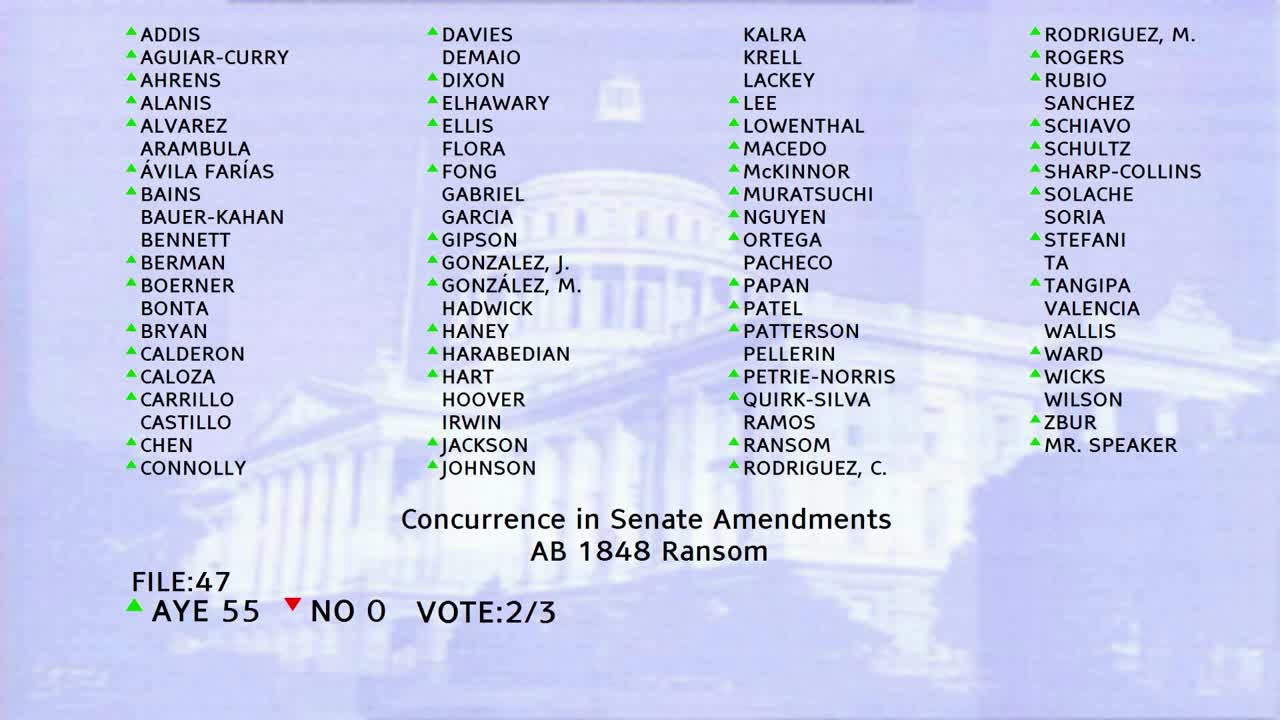 1MIN
Assembly Floor
 4MIN
Senate Standing Committee on Public Safety
 4MIN
Assembly Floor
 7MIN
Assembly Standing Committee on Public Safety
Bill Author

Bill Co-Author(s):