AB 229: Criminal procedure: Sexually transmitted disease testing.
- Session Year: 2025-2026
- House: Assembly
- Latest Version Date: 2025-02-24
Current Status:
Failed
(2026-02-02: From committee: Filed with the Chief Clerk pursuant to Joint Rule 56.)
Introduced
In Committee
Awaiting First Chamber Vote
Passed First Chamber
In Committee
Awaiting Second Chamber Vote
Passed Second Chamber
Enacted
Existing law authorizes a court to issue a search warrant, at the request of a victim and in specified circumstances, to test the accuseds blood or oral mucosal transudate saliva with an HIV test for the primary purpose of informing the victim whether the defendant is infected with the HIV virus. Existing law authorizes a victim to disclose test results received as the victim deems necessary to protect the victims health and safety or to protect the health and safety of the victims family or sexual partner. Improper disclosure of test results is a crime.
This bill would authorize a search warrant to require testing a defendant for any sexually transmitted disease. The bill would also authorize the parent or guardian of a minor victim or the legal representative of a victim to exercise any of the rights conferred by these provisions, including receiving and disclosing test results. By expanding the definition of a crime, this bill would impose a state-mandated local program.
Existing law, when the defendant has been charged with a specified sex crime, authorizes the court to issue a search warrant for testing when requested by a victim of an uncharged sex offense.
This bill would add engaging in sexual acts with a child under 10 years of age and sex with a person confined to a health facility or detention facility to the crimes to which this provision applies.
The California Constitution requires the state to reimburse local agencies and school districts for certain costs mandated by the state. Statutory provisions establish procedures for making that reimbursement.
This bill would provide that no reimbursement is required by this act for a specified reason.
(a)The primary purpose of the testing and disclosure provided in this section is to benefit the victim of a crime by informing the victim whether the defendant is infected with a sexually transmitted disease, including, but not limited to, chlamydia, gonorrhea, hepatitis, herpes, human immunodeficiency virus (HIV), human papillomavirus (HPV), trichomoniasis, and syphilis. It is also the intent of the Legislature in enacting this section to protect the health of both victims of crime and those accused of committing a crime. This section does not authorize mandatory testing or disclosure of test results for the purpose of a charging decision by a prosecutor, nor, except as specified in subdivisions (g), (i), and (l), does this section authorize breach of the confidentiality provisions contained in Chapter 7 (commencing with Section 120975) of Part 4 of Division 105 of the Health and Safety Code.
(b)(1)Notwithstanding the provisions of Chapter 7 (commencing with Section 120975) of Part 4 of Division 105 of the Health and Safety Code, when a defendant has been charged by complaint, information, or indictment with a crime, or a minor is the subject of a petition filed in juvenile court alleging the commission of a crime, the court, at the request of the victim, may issue a search warrant for the purpose of testing the accuseds blood, oral mucosal transudate saliva, urine, or rectal, urethral, or cervical discharge for a sexually transmitted disease only under the following circumstances: when the court finds, upon the conclusion of the hearing described in paragraph (3), or when a preliminary hearing is not required to be held, that there is probable cause to believe that the accused committed the offense, and that there is probable cause to believe that blood, semen, or any other bodily fluid identified by the State Department of Public Health or the State Department of Health Care Services in appropriate regulations as capable of transmitting a sexually transmitted disease has been transferred from the accused to the victim.
(2)Notwithstanding Chapter 7 (commencing with Section 120975) of Part 4 of Division 105 of the Health and Safety Code, when a defendant has been charged by complaint, information, or indictment with an offense under Section 220, 261, 261.5, 264.1, 266c, 269, 286, 287, 288, 288.5, 288.7, 289, 289.5, or 289.6, or former Section 262 or 288a, or with an attempt to commit any of the offenses, and is the subject of a police report alleging the commission of a separate, uncharged offense that could be charged under Section 220, 261, 261.5, 264.1, 266c, 269, 286, 287, 288, 288.5, 288.7, 289, 289.5, or 289.6, or former Section 262 or 288a, or of an attempt to commit any of the offenses, or a minor is the subject of a petition filed in juvenile court alleging the commission of an offense under Section 220, 261, 261.5, 264.1, 266c, 269, 286, 287, 288, 288.5, 288.7, 289, 289.5, or 289.6, or former Section 262 or 288a, or of an attempt to commit any of the offenses, and is the subject of a police report alleging the commission of a separate, uncharged offense that could be charged under Section 220, 261, 261.5, 264.1, 266c, 269, 286, 287, 288, 288.5,288.7, 289, 289.5, or 289.6, or former Section 262 or 288a, or of an attempt to commit any of the offenses, the court, at the request of the victim of the uncharged offense, may issue a search warrant for the purpose of testing the accuseds blood, oral mucosal transudate saliva, urine, or rectal, urethral, or cervical discharge for a sexually transmitted disease only under the following circumstances: when the court finds that there is probable cause to believe that the accused committed the uncharged offense, and that there is probable cause to believe that blood, semen, or any other bodily fluid identified by the State Department of Public Health or the State Department of Health Care Services in appropriate regulations as capable of transmitting a sexually transmitted disease has been transferred from the accused to the victim. As used in this paragraph, Section 289.5 refers to the statute enacted by Chapter 293 of the Statutes of 1991, penetration by an unknown object.
(3)(A)Prior to the issuance of a search warrant pursuant to paragraph (1), the court, when applicable and at the conclusion of the preliminary examination if the defendant is ordered to answer pursuant to Section 872, shall conduct a hearing at which both the victim and the defendant have the right to be present. During the hearing, only affidavits, counter affidavits, and medical reports regarding the facts that support or rebut the issuance of a search warrant under paragraph (1) shall be admissible.
(B)Prior to the issuance of a search warrant pursuant to paragraph (2), the court, when applicable, shall conduct a hearing at which both the victim and the defendant are present. During the hearing, only affidavits, counter affidavits, and medical reports regarding the facts that support or rebut the issuance of a search warrant under paragraph (2) shall be admissible.
(4)A request for a probable cause hearing made by a victim under paragraph (2) shall be made before sentencing in the superior court, or before disposition on a petition in a juvenile court, of the criminal charge or charges filed against the defendant.
(c)(1)When the person has been charged by complaint, information, or indictment, or is the subject of a petition filed in a juvenile court alleging the commission of an offense pursuant to Section 220, 261, 261.5, 264.1, 266c, 269, 286, 287, 288, 288.5, 288.7, 289, 289.5, 289.6, or former Section 262 or 288a, or with an attempt to commit any of the offenses, the prosecutor shall advise the victim of their right to make this request. To assist the victim of the crime to determine whether the victim should make this request, the prosecutor shall refer the victim to the local health officer for prerequest counseling to help that person understand the extent to which the particular circumstances of the crime may or may not have put the victim at risk of transmission of a sexually transmitted disease from the accused, to ensure that the victim understands both the benefits and limitations of the current tests, to help the victim decide whether the victim wants to request that the accused be tested, and to help the victim decide whether the victim wants to be tested.
(2)The Department of Justice, in cooperation with the California District Attorneys Association, shall prepare a form to be used in providing victims with the notice required by paragraph (1).
(d)(1)If the victim decides to request testing of the accused, the victim shall request the issuance of a search warrant, as described in subdivision (b).
(2)The failure of a prosecutor to refer or advise the victim as provided in this subdivision, or the failure or refusal by the victim to seek or obtain counseling, shall not be considered by the court in ruling on the victims request.
(e)The local health officer shall make provision for administering all tests ordered pursuant to subdivision (b).
(f)Blood, oral mucosal transudate saliva, urine, or rectal, urethral, or cervical discharge tested pursuant to subdivision (b) shall be subjected to appropriate confirmatory tests to ensure accuracy of the first test results, and test results shall not be transmitted to the victim or the accused unless any initially reactive test result has been confirmed by appropriate confirmatory tests for positive reactors.
(g)The local health officer shall have the responsibility for disclosing test results to the victim who requested the test and to the accused who was tested. However, positive test results shall not be disclosed to the victim or to the accused without also providing or offering professional counseling appropriate to the circumstances.
(h)The local health officer and victim shall comply with all laws and policies relating to medical confidentiality subject to the disclosure authorized by subdivisions (g), (i), and (l). An individual who files a false report of sexual assault in order to obtain test result information pursuant to this section shall, in addition to any other liability under law, be guilty of a misdemeanor punishable as provided in subdivision (c) of Section 120980 of the Health and Safety Code. An individual as described in the preceding sentence who discloses test result information obtained pursuant to this section shall also be guilty of an additional misdemeanor punishable as provided for in subdivision (c) of Section 120980 of the Health and Safety Code for each separate disclosure of that information.
(i)A victim, parent or guardian of a minor victim, or authorized legal representative for a victim who receives information from the health officer pursuant to subdivision (g) may disclose the test results as the victim or authorized recipient deems necessary to protect the victims health and safety or the health and safety of the victims family or sexual partner.
(j)A person transmitting test results or disclosing information pursuant to this section shall be immune from civil liability for actions taken in compliance with this section.
(k)The results of blood, oral mucosal transudate saliva, urine, or rectal, urethral, or cervical discharge tested pursuant to subdivision (b) shall not be used in a criminal proceeding as evidence of either guilt or innocence.
(l)Rights of the victim conferred by this section may also be exercised by a parent or guardian of the victim, if the victim is a minor, or by an authorized legal representative of the victim.
SEC. 2.No reimbursement is required by this act pursuant to Section 6 of Article XIIIB of the California Constitution because the only costs that may be incurred by a local agency or school district will be incurred because this act creates a new crime or infraction, eliminates a crime or infraction, or changes the penalty for a crime or infraction, within the meaning of Section 17556 of the Government Code, or changes the definition of a crime within the meaning of Section 6 of Article XIIIB of the California Constitution.
(a)The primary purpose of the testing and disclosure provided in this section is to benefit the victim of a crime by informing the victim whether the defendant is infected with HIV. a sexually transmitted disease, including, but not limited to, chlamydia, gonorrhea, hepatitis, herpes, human immunodeficiency virus (HIV), human papillomavirus (HPV), trichomoniasis, and syphilis. It is also the intent of the Legislature in enacting this section to protect the health of both victims of crime and those accused of committing a crime. This section does not authorize mandatory testing or disclosure of test results for the purpose of a charging decision by a prosecutor, and, nor, except as specified in subdivisions (g) and (i), this section does not (g), (i), and (l), does this section authorize breach of the confidentiality provisions contained in Chapter 7 (commencing with Section 120975) of Part 4 of Division 105 of the Health and Safety Code.
(b)(1)Notwithstanding the provisions of Chapter 7 (commencing with Section 120975) of Part 4 of Division 105 of the Health and Safety Code, when a defendant has been charged by complaint, information, or indictment with a crime, or a minor is the subject of a petition filed in juvenile court alleging the commission of a crime, the court, at the request of the victim, may issue a search warrant for the purpose of testing the accuseds blood or oral mucosal transudate saliva with an HIV test, as defined in Section 120775 of the Health and Safety Code blood, oral mucosal transudate saliva, urine, or rectal, urethral, or cervical discharge for a sexually transmitted disease only under the following circumstances: when the court finds, upon the conclusion of the hearing described in paragraph (3), or when a preliminary hearing is not required to be held, that there is probable cause to believe that the accused committed the offense, and that there is probable cause to believe that blood, semen, or any other bodily fluid identified by the State Department of Public Health or the State Department of Health Care Services in appropriate regulations as capable of transmitting the human immunodeficiency virus a sexually transmitted disease has been transferred from the accused to the victim.
(2)Notwithstanding Chapter 7 (commencing with Section 120975) of Part 4 of Division 105 of the Health and Safety Code, when a defendant has been charged by complaint, information, or indictment with a crime an offense under Section 220, 261, 261.5, 264.1, 266c, 269, 286, 287, 288, 288.5, 289, or 289.5, 288.7, 289, 289.5, or 289.6, or former Section 262 or 288a, or with an attempt to commit any of the offenses, and is the subject of a police report alleging the commission of a separate, uncharged offense that could be charged under Section 220, 261, 261.5, 264.1, 266c, 269, 286, 287, 288, 288.5, 289, or 289.5, 288.7, 289, 289.5, or 289.6, or former Section 262 or 288a, or of an attempt to commit any of the offenses, or a minor is the subject of a petition filed in juvenile court alleging the commission of a crime an offense under Section 220, 261, 261.5, 264.1, 266c, 269, 286, 287, 288, 288.5, 289, or 289.5, 288.7, 289, 289.5, or 289.6, or former Section 262 or 288a, or of an attempt to commit any of the offenses, and is the subject of a police report alleging the commission of a separate, uncharged offense that could be charged under Section 220, 261, 261.5, 264.1, 266c, 269, 286, 287, 288, 288.5, 289, or 289.5,288.7, 289, 289.5, or 289.6, or former Section 262 or 288a, or of an attempt to commit any of the offenses, the court, at the request of the victim of the uncharged offense, may issue a search warrant for the purpose of testing the accuseds blood or oral mucosal transudate saliva with an HIV test, as defined in Section 120775 of the Health and Safety Code blood, oral mucosal transudate saliva, urine, or rectal, urethral, or cervical discharge for a sexually transmitted disease only under the following circumstances: when the court finds that there is probable cause to believe that the accused committed the uncharged offense, and that there is probable cause to believe that blood, semen, or any other bodily fluid identified by the State Department of Public Health or the State Department of Health Care Services in appropriate regulations as capable of transmitting the human immunodeficiency virus a sexually transmitted disease has been transferred from the accused to the victim. As used in this paragraph, Section 289.5 refers to the statute enacted by Chapter 293 of the Statutes of 1991, penetration by an unknown object.
(3)(A)Prior to the issuance of a search warrant pursuant to paragraph (1), the court, where when applicable and at the conclusion of the preliminary examination if the defendant is ordered to answer pursuant to Section 872, shall conduct a hearing at which both the victim and the defendant have the right to be present. During the hearing, only affidavits, counter affidavits, and medical reports regarding the facts that support or rebut the issuance of a search warrant under paragraph (1) shall be admissible.
(B)Prior to the issuance of a search warrant pursuant to paragraph (2), the court, where when applicable, shall conduct a hearing at which both the victim and the defendant are present. During the hearing, only affidavits, counter affidavits, and medical reports regarding the facts that support or rebut the issuance of a search warrant under paragraph (2) shall be admissible.
(4)A request for a probable cause hearing made by a victim under paragraph (2) shall be made before sentencing in the superior court, or before disposition on a petition in a juvenile court, of the criminal charge or charges filed against the defendant.
(c)(1)When the person has been charged by complaint, information, or indictment with a crime, indictment, or is the subject of a petition filed in a juvenile court alleging the commission of a crime, an offense pursuant to Section 220, 261, 261.5, 264.1, 266c, 269, 286, 287, 288, 288.5, 288.7, 289, 289.5, 289.6, or former Section 262 or 288a, or with an attempt to commit any of the offenses, the prosecutor shall advise the victim of the their right to make this request. To assist the victim of the crime to determine whether the victim should make this request, the prosecutor shall refer the victim to the local health officer for prerequest counseling to help that person understand the extent to which the particular circumstances of the crime may or may not have put the victim at risk of transmission of HIV a sexually transmitted disease from the accused, to ensure that the victim understands both the benefits and limitations of the current tests for HIV, tests, to help the victim decide whether the victim wants to request that the accused be tested, and to help the victim decide whether the victim wants to be tested.
(2)The Department of Justice, in cooperation with the California District Attorneys Association, shall prepare a form to be used in providing victims with the notice required by paragraph (1).
(d)(1)If the victim decides to request HIV testing of the accused, the victim shall request the issuance of a search warrant, as described in subdivision (b).
Neither the
(2)The failure of a prosecutor to refer or advise the victim as provided in this subdivision, nor or the failure or refusal by the victim to seek or obtain counseling, shall not be considered by the court in ruling on the victims request.
(e)The local health officer shall make provision for administering all HIV tests ordered pursuant to subdivision (b).
(f)Any blood or oral mucosal transudate saliva Blood, oral mucosal transudate saliva, urine, or rectal, urethral, or cervical discharge tested pursuant to subdivision (b) shall be subjected to appropriate confirmatory tests to ensure accuracy of the first test results, and under no circumstances shall test results shall not be transmitted to the victim or the accused unless any initially reactive test result has been confirmed by appropriate confirmatory tests for positive reactors.
(g)The local health officer shall have the responsibility for disclosing test results to the victim who requested the test and to the accused who was tested. However, positive test results shall not be disclosed to the victim or to the accused without also providing or offering professional counseling appropriate to the circumstances.
(h)The local health officer and victim shall comply with all laws and policies relating to medical confidentiality subject to the disclosure authorized by subdivisions (g) and (i). (g), (i), and (l). An individual who files a false report of sexual assault in order to obtain test result information pursuant to this section shall, in addition to any other liability under law, be guilty of a misdemeanor punishable as provided in subdivision (c) of Section 120980 of the Health and Safety Code. An individual as described in the preceding sentence who discloses test result information obtained pursuant to this section shall also be guilty of an additional misdemeanor punishable as provided for in subdivision (c) of Section 120980 of the Health and Safety Code for each separate disclosure of that information.
(i)A victim victim, parent or guardian of a minor victim, or authorized legal representative for a victim who receives information from the health officer pursuant to subdivision (g) may disclose the test results as the victim or authorized recipient deems necessary to protect their the victims health and safety or the health and safety of the victims family or sexual partner.
(j)A person transmitting test results or disclosing information pursuant to this section shall be immune from civil liability for any actions taken in compliance with this section.
(k)The results of any blood or oral mucosal transudate saliva blood, oral mucosal transudate saliva, urine, or rectal, urethral, or cervical discharge tested pursuant to subdivision (b) shall not be used in any a criminal proceeding as evidence of either guilt or innocence.
(l)Rights of the victim conferred by this section may also be exercised by a parent or guardian of the victim, if the victim is a minor, or by an authorized legal representative of the victim.
SEC. 2.No reimbursement is required by this act pursuant to Section 6 of Article XIIIB of the California Constitution because the only costs that may be incurred by a local agency or school district will be incurred because this act creates a new crime or infraction, eliminates a crime or infraction, or changes the penalty for a crime or infraction, within the meaning of Section 17556 of the Government Code, or changes the definition of a crime within the meaning of Section 6 of Article XIIIB of the California Constitution.
|
Date
|
Status
|
|---|---|
| Feb 2, 2026 | From committee: Filed with the Chief Clerk pursuant to Joint Rule 56. |
| Jan 31, 2026 | Died pursuant to Art. IV, Sec. 10(c) of the Constitution. |
| May 23, 2025 | In committee: Held under submission. |
| Apr 9, 2025 | In committee: Set, first hearing. Referred to APPR. suspense file. |
| Mar 4, 2025 | From committee: Do pass and re-refer to Com. on APPR. (Ayes 8. Noes 0.) (March 4). Re-referred to Com. on APPR. |
| Feb 25, 2025 | Re-referred to Com. on PUB. S. |
| Feb 24, 2025 | From committee chair, with author's amendments: Amend, and re-refer to Com. on PUB. S. Read second time and amended. |
| Feb 3, 2025 | Referred to Com. on PUB. S. |
| Jan 14, 2025 | From printer. May be heard in committee February 13. |
| Jan 13, 2025 | Read first time. To print. |
|
Date
|
Description
|
Location
|
Votes
|
|
|---|---|---|---|---|
| Mar 4, 2025 | Do pass and be re-referred to the Committee on [Appropriations] | Assembly Standing Committee on Public Safety |
Passed |
This list shows positions taken on this bill by organizations on the date displayed, which is linked to the original source.
Positions by individuals are not included.
|
Organization
|
Position
|
Date
|
|---|---|---|
| APLA Health | ** Against | |
| California District Attorneys Association | ** Support | |
| Californians United for a Responsible Budget | ** Against | |
| California Public Defenders Association | ** Against | |
| Conference of California Bar Associations | ** Support | |
| Ella Baker Center For Human Rights | ** Against | |
| San Francisco Public Defender | ** Against |
Date of Hearing: April 9, 2025
ASSEMBLY COMMITTEE ON APPROPRIATIONS
Buffy Wicks, Chair
ABPCA Bill Id:AB 229
Author:(Davies) – As Amended Ver:February 24, 2025
Policy Committee: | Public Safety | Vote: | 8 - 0 |
|
| ||
|
|
Urgency: No State Mandated Local Program: Yes Reimbursable: Yes
SUMMARY:
This bill authorizes a search warrant that permits testing a defendant for any sexually transmitted disease (STD) if the defendant is charged with certain sexual offenses.
Specifically, this bill:
- Authorizes a search warrant to test a defendant for any STD if there is probable cause to believe the defendant has committed a specified sexual offense and the victim of the offense (or their representative, as specified) requests the warrant.
- Expands the list of sex offenses for which a victim may request a search warrant for STD testing of a defendant to include sexual acts with child 10 years of age or younger and sexual activity with a consenting adult who is incarcerated or confined in a health facility.
FISCAL EFFECT:
- Possible cost pressures (Trial Court Trust Fund, General Fund) of an unknown amount to the courts. Existing law requires a court considering a requested search warrant to hold a hearing in certain circumstances. By expanding the existing statute to include testing for additional STDs and additional crimes that may prompt a search warrant, the bill may increase the number of search warrants requested, resulting in an increase in related hearings. A violation of the bill’s privacy requirements is punishable as a misdemeanor, so the courts may also experience minor additional workload to adjudicate related misdemeanor charges. The fiscal year 2024-25 state budget provides $37.3 million ongoing General Fund to backfill declining revenue to the Trial Court Trust Fund.
- Potentially reimbursable costs (local funds, General Fund) of an unknown amount to county sheriffs’ offices and county public health departments to administer additional STD tests and disclose test results. Actual costs will depend on the number of search warrants granted and whether defendants subject to testing are in custody. County public health officials report that currently, an HIV test requested by a victim and authorized by search warrant is generally administered by county jail employees or healthcare contractors on a defendant who is in custody. Workload costs for administering tests on out-of-custody defendants would likely be higher and it is not clear who would be responsible for finding such defendants and facilitating testing. Counties report costs ranging from $180 to $730 for each full panel of STD tests. General Fund costs will depend on whether these duties constitute a reimbursable state mandate, as determined by the Commission on State Mandates.
- Minor and absorbable costs to the Department of Justice (DOJ) to update the form a victim uses to request a defendant be tested for STDs.
COMMENTS:
- Purpose. This bill is sponsored by the Conference of California Bar Associations. According to the author:
Sexual assault is one of the most heinous crimes that can be done to a person. In addition to the emotional and physical trauma done to the victim, if the perpetrator carries any sexually-transmitted diseases (STDs) that can cause serious healthcare risks as well. AB 229 is a common-sense measure to provide reassurances and protections for the victim that they are allowed to petition a court to test their assailant to determine if they carry any STDs that would need immediate or long-term treatment. Testing allows healthcare providers the ability to promptly identify and treat any infections, reducing the risk of long-term health complications such as infertility, chronic pain, or other health issues associated with untreated STDs.
- Background. If a person is the victim of a qualifying sexual crime, existing law permits them to request a search warrant that requires the defendant accused of the crime to be tested for the human immunodeficiency virus (HIV). To grant a requested search warrant, a court must determine there is probable cause to believe the crime was committed and there is evidence of a possible HIV exposure based on public health regulations. If a search warrant is granted, local public health officials are responsible for administering an HIV test on the defendant, disclosing test results to the defendant and victim, providing or offering counseling if a test is positive for HIV, and complying with relevant privacy protections. The results of such an HIV test may not be used in a criminal proceeding as evidence of guilt or innocence. The incidence of search warrants currently issued under this statute is unknown; county public health officials report they are not very common.
This bill expands the existing statute to authorize testing for any STD, not just HIV, if a search warrant is granted. The bill also adds new crimes for which a victim, the victim’s parent or guardian, or the victim’s legal representative may request a search warrant for STD testing. Of note: county public health officials reported to this committee that the public health regulations referenced in the existing statute were never promulgated. Therefore, it is not clear how courts would evaluate the likelihood of STD transmission when considering a search warrant request if this bill is enacted as currently drafted.
Analysis Prepared by: Annika Carlson / APPR. / (916) 319-2081
Date of Hearing:
Counsel: Kimberly Horiuchi
ASSEMBLY COMMITTEE ON PUBLIC SAFETY
Nick Schultz, Chair
ABPCA Bill Id:AB 229
Author:(Davies) – As Amended Ver:February 24, 2025
SUMMARY:
Authorizes a search warrant for evidence of any sexually transmitted disease where a defendant is accused or charged with a specified sex offense. Specifically, this bill:
- Authorizes a search warrant for any sexually transmitted disease – not just human immunodeficiency virus (HIV) – at the request of a victim, including blood, oral mucosal transudate saliva, urine, or rectal, urethral, or cervical discharge, where there is probable cause to believe, as specified, that a defendant has committed a specified sex offense.
- Permits the parent or guardian of a minor victim or the legal representative of a victim of a specified sex offense to request to test for any sexually transmitted disease, including blood, oral mucosal transudate saliva, urine, or rectal, urethral, or cervical discharge, where there is probable cause to believe, as specified, that a defendant committed a specified sex offense.
- Expands the list of eligible sex offenses for which a victim or the parent of a minor victim or representative of a victim may request testing and disclosure of any sexually transmitted diseases where a defendant is charged with a sex offense to include rape of a child 10 years of age or younger and sexual activity of a confined consenting adult or an attempt to commit rape of a child under the age of 10, continued sexual abuse of a child, and sexual activity with a confined consenting adult.
EXISTING LAW:
- Declares that the primary purpose of the testing and disclosure provided in this section is to benefit the victim of a crime by informing the victim whether the defendant is infected with HIV. It is also the intent of the Legislature in enacting this section to protect the health of both victims of crime and those accused of committing a crime. (Pen. Code, § 1524.1, subd. (a).)
- States that when a defendant has been charged by complaint, information, or indictment with a crime, or a minor is the subject of a petition filed in juvenile court alleging the commission of a crime, the court, at the request of the victim, may issue a search warrant for the purpose of testing the accused’s blood or oral mucosal transudate saliva with an HIV test, only under the following circumstances:
- When the court finds, upon the conclusion of a hearing, or when a preliminary hearing is not required to be held, that there is probable cause to believe that the accused committed the offense; and
- There is probable cause to believe that blood, semen, or any other bodily fluid identified by the State Department of Public Health in appropriate regulations as capable of transmitting HIV has been transferred from the accused to the victim. (Pen. Code, § 1524.1, subd. (b)(1).)
- When the court finds, upon the conclusion of a hearing, or when a preliminary hearing is not required to be held, that there is probable cause to believe that the accused committed the offense; and
- States that when a defendant or juvenile has been charged by complaint, information, or indictment with assault with intent to commit specified sex crimes, rape, statutory rape, rape with a foreign object, inducing sexual intercourse by fraud or fear, aggravated sexual assault of a child, forced sodomy, forcible oral copulation, lewd act with a child, continuous sexual abuse of a child, forcible sexual penetration, or fleeing the state to avoid punishment for a sex offense, or with an attempt to commit any of the offenses, and is the subject of a police report alleging the commission of a separate, uncharged offense that could be charged as assault with intent to commit specified sex crimes, rape, statutory rape, rape with a foreign object, inducing sexual intercourse by fraud or fear, aggravated sexual assault of a child, forced sodomy, forcible oral copulation, lewd act with a child, continuous sexual abuse of a child, forcible sexual penetration, or fleeing the state to avoid punishment for a sex offense, or of an attempt to commit any of the offenses, the court, at the request of the victim of the uncharged offense, may issue a search warrant for the purpose of testing the accused’s blood or oral mucosal transudate saliva with an HIV test under the following circumstances:
- When the court finds that there is probable cause to believe that the accused committed the uncharged offense; and
- There is probable cause to believe that blood, semen, or any other bodily fluid identified by the State Department of Public Health in appropriate regulations as capable of transmitting HIV has been transferred from the accused to the victim. (Pen. Code, § 1524.1, subd. (b)(2).)
- When the court finds that there is probable cause to believe that the accused committed the uncharged offense; and
- Provides that when the defendant has been charged by complaint, information, or indictment with a crime, the prosecutor shall advise the victim of the right to make a request for testing. To assist the victim of the crime to determine whether the victim should make this request, the prosecutor shall refer the victim to the local health officer for pre-request counseling to help that person understand the extent to which the particular circumstances of the crime may or may not have put the victim at risk of transmission of HIV from the accused, to ensure that the victim understands both the benefits and limitations of the current tests for HIV, to help the victim decide whether the victim wants to request that the accused be tested, and to help the victim decide whether the victim wants to be tested. (Pen. Code, § 1524.1, subd. (c)(1).)
FISCAL EFFECT:
Unknown
COMMENTS:
- Author's Statement: According to the author, “Existing law permits a victim of sexual assault who was exposed to the defendant’s bodily fluids to obtain a search warrant directing the local health officer to test the defendant for HIV and disclose the results to both the defendant and the victim. The purpose of this law is to protect the health of both the defendant and the victim, who may not share the defendant’s results except to protect the health or safety of a family member or sexual partner. Under circumstances that warrant a court granting a victim’s request for a defendant to be tested for HIV, there is no reason to exclude testing for other sexually transmitted diseases (STDs), which can lead to sterility, increased cancer risk, or death, if left untreated.
“Sexual assault is one of the most heinous crimes that can be done to a person. In addition to the emotional and physical trauma done to the victim, if the perpetrator carries any sexually-transmitted diseases (STDs) that can cause serious healthcare risks as well. AB 229 is a common-sense measure to provide reassurances and protections for the victim that they are allowed to petition a court to test their assailant to determine if they carry any STDs that would need immediate or long-term treatment. Testing allows healthcare providers the ability to promptly identify and treat any infections, reducing the risk of long-term health complications such as infertility, chronic pain, or other health issues associated with untreated STDs.
- Testing a Defendant for Sexually Transmitted Infections (SDI) following a Sex Crime: Penal Code section 1524.1 allows for testing for HIV in sexual assault cases to ensure that a victim has not been exposed to the virus as a result of the crime. However, when requested, the court must determine whether there is probable cause to believe the crime has been committed – usually upon a finding of probable cause at a preliminary hearing – and there is evidence of a possible exposure based on regulations issued by the California Department of Public Health. If there is no likelihood that bodily fluids have been transmitted, the court may deny the warrant request for HIV testing. This law is specific to HIV and was enacted in 1988, when HIV and AIDS had a higher rate of mortality. (1988 Cal Stats. ch. 1088.)
“Penal Code section 1524.1 is closely aligned with provisions governing the issuance of search warrants in criminal cases.” (Humphrey v. Appellate Division (2002) 29 Cal.4th 569, 571.) In Humphrey, the mother of two victims of child molestation sought to obtain a search warrant for HIV testing from the defendant. In doing so, the mother submitted an affidavit from herself and medical professionals detailing what the children recounted. The court considered what standard of review should apply to search warrants for HIV testing given its similarity to other search warrant statutes.
“Cal. Penal Code § 1525, for example, states, a search warrant cannot be issued but upon probable cause, supported by affidavit. Fourth Amendment standards govern those provisions of the penal code and, in light of its placement, the California Supreme Court concludes the same standards govern the Cal. Penal Code § 1524.1 warrant.” (Id.)
This bill proposes to expand Penal Code section 1524.1 to include testing for a variety of SDIs rather than just HIV. To some extent, other SDIs may also be significantly consequential to a person’s health and seems analogous to HIV as those infections are understood in 2025. For instance, human papillomavirus is one of the leading causes of cervical and uterine cancer in women and other SDIs may result in pelvic inflammatory disease affecting reproduction and cancer of the fallopian tubes. Additionally, this bill authorizes a parent or guardian to request a search warrant on behalf of a child or any legal representative on behalf of a victim. In accordance with the Humphrey decision, this appears authorized by current law when the court held that a parent may file an affidavit for a search warrant on behalf of a child victim. This bill just states it explicitly in the statute. Finally, this bill would expand the list of offenses for which a person may seek a search warrant to include rape of a child 10 years of age or younger and sex with a person in a custodial setting.
- Argument in Support: According to the California District Attorneys Association: “For over 25 years, California law has authorized the testing of a defendant who committed a sex crime that transmitted bodily fluids to their victim to determine whether the defendant was infected with HIV. The primary purpose of the testing and disclosure was to inform the victim and protect their health.
“However, when bodily fluids are exchanged during a sexual assault, a survivor’s health concerns are not limited solely to exposure to HIV. They are also exposed to a host of sexually transmitted diseases that cause serious health complications such as pregnancy complications, infertility, cancer, and neurological and cardiovascular disease. Some sexually transmitted diseases can also be passed on to infants. A survivor of sexual assault who is informed that they were exposed to a sexually transmitted disease, can seek the appropriate medical treatment and take the appropriate steps to avoid infecting others. AB 229 would permit defendants who commit sex crimes to be tested for sexually transmitted diseases such as chlamydia, gonorrhea, hepatitis, herpes, human immunodeficiency virus, human papillomavirus, trichomoniasis and syphilis.
“AB 229 seeks to protect the survivors of sexual assault by informing them if they have been exposed to a sexually transmitted disease during their sexual assault so they can seek the appropriate medical care. Alternatively, AB 229 provides survivors peace of mind that they were not exposed to a sexually transmitted disease if the testing results are negative.”
- Argument in Opposition: According to the California Public Defender’s Association: “The California Public Defender’s Association opposes this bill because of its invasion into the medical and physical privacy of a person who has merely been accused of a crime, not convicted. The rational for the bill, as stated in its intent, is to ‘benefit the victim of the crime by informing the victim whether the defendant’ is infected with a sexually transmitted disease. However, the bill does not limit the availability of the information to individuals who are determined by a court of law to be victims of a crime; the bill presumes anyone accused of a crime is guilty and therefore any accuser is a victim. While it is understandable that the legislature previously enacted a statute that would allow for testing for HIV, which causes a potentially deadly disease, using the blood or saliva of a person accused of a crime, this bill goes far beyond the existing statute.
“While the previous statute only allowed for the collection for HIV testing of blood or saliva of an accused, this bill allows for the collection of rectal, urethral or cervical discharge to test for any sexually transmitted disease. The bill does not explain how these samples would be taken; it seems likely that the execution of such a search warrant could involve very invasive procedures, including the insertion of medical tools into the rectum, urethra, or vagina/cervix of the accused.
“This bill will allow this invasive medical testing to determine if the accused has any sexually transmitted disease, no matter how minor, or how likely or unlikely it is to have been transmitted to the alleged victim. While it might make sense for the legislature to provide a mechanism where a person who is the victim of a crime can find out if the person who has been convicted of the crime has a disease that could have been sexually transmitted to the victim; this legislation puts the cart before the proverbial horse by assuming the accused is guilty before it has been proven in a court of law. Further, the legislature should know how potentially invasive collecting rectal, urethral or cervical samples is before deciding to allow a court to order it based only on probable cause.”
- Related Legislation: SB 608 (Menjivar), would require the State Department of Education to monitor compliance with the requirements of the California Healthy Youth Act as part of its annual compliance monitoring of state and federal programs. SB 608 is pending referral to committee.
- Prior Legislation: SB 996 (Wilk), of the 2023-2024 Legislative Session, would have required school districts to adopt a policy at a publicly noticed meeting specifying how parents and guardians of pupils may inspect the written and audiovisual educational materials used in comprehensive sexual health education and HIV prevention education. SB 996 was held on the Senate Appropriations Committee suspense file.
REGISTERED SUPPORT / OPPOSITION:
Support
California District Attorneys Association
Conference of California Bar Associations
Oppose
Apla Health
California Public Defenders Association (CPDA)
Californians United for A Responsible Budget
Ella Baker Center for Human Rights
San Francisco Public Defender
Analysis Prepared by:
Kimberly Horiuchi / PUB. S. / (916) 319-3744
Discussed in Hearing
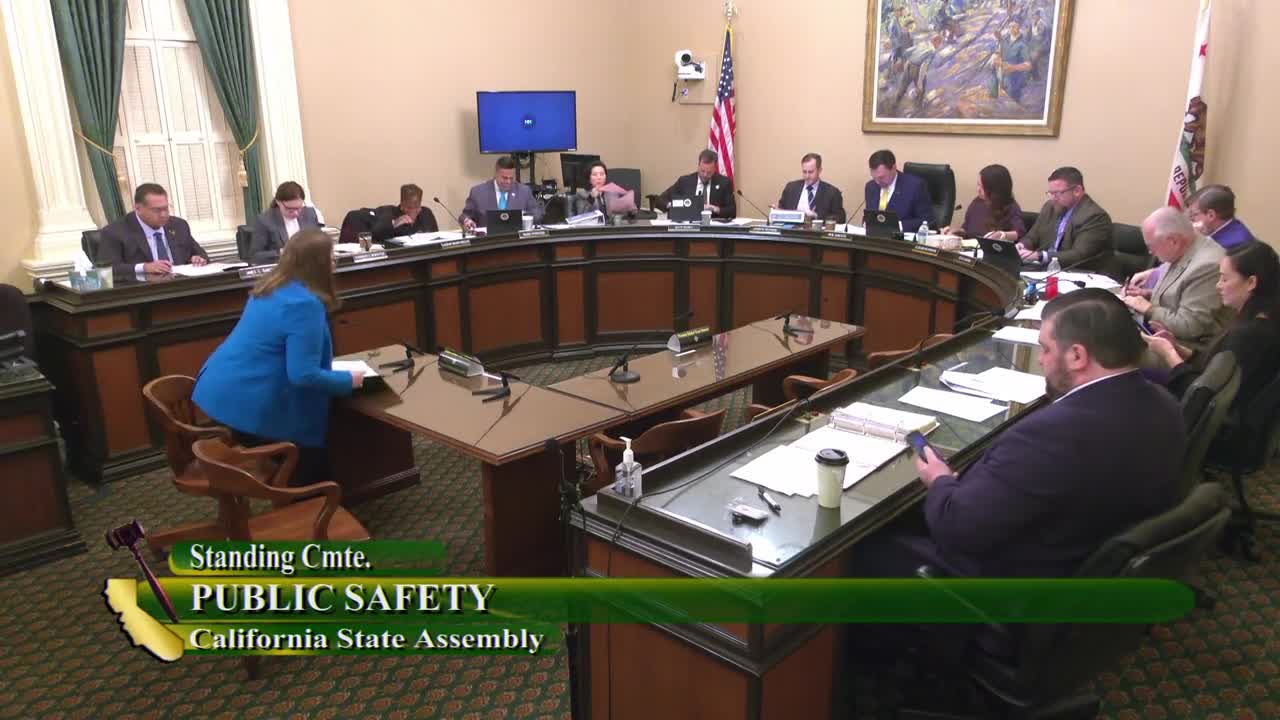 12MIN
Assembly Standing Committee on Public Safety
Bill Author

Bill Co-Author(s):