AB 2321: Occupational safety and health: investigations.
- Session Year: 2025-2026
- House: Assembly
- Latest Version Date: 2026-09-30
Current Status:
Passed
(2026-09-30: Chaptered by Secretary of State - Chapter 936, Statutes of 2026.)
Introduced
In Committee
Awaiting First Chamber Vote
Passed First Chamber
In Committee
Awaiting Second Chamber Vote
Passed Second Chamber
Enacted
(1)Existing law establishes the Department of Industrial Relations, which includes the Division of Occupational Safety and Health. Existing law requires the division to investigate the causes of any employment accident that is fatal to one or more employees or that results in a serious injury, illness, or exposure, except as specified. Existing law requires the chief of the division and all qualified inspectors and investigators authorized by the chief to have free access to any place of employment to investigate and inspect and sets forth various other duties related to investigation and inspection, as specified.
This bill would make it a misdemeanor to willfully resist, prevent, impede, or interfere with the chief or their authorized representative in the performance of the above-described duties or to willfully violate an order of the court relating to those duties. By creating a new crime, this bill would impose a state-mandated local program.
Existing law makes it a public offense for any employer or any employee having direction, management, control, or custody of any employment, place of employment, or of any other employee who willfully violates any occupational safety or health standard, order, special order, if that violation caused death or permanent or prolonged impairment to the body of an employee, as specified.
This bill would additionally make it a public offense if that violation caused serious injury, illness, or exposure. By expanding the scope of an existing crime, this bill would impose a state-mandated local program.
(2)Existing law makes the Bureau of Investigations within the Division of Occupational Safety and Health responsible for directing accident investigations involving violations of laws, standards, and orders in which there is a serious injury to 5 or more employees, death, or request for prosecution by a division representative. Existing law requires the bureau to review inspection reports involving a serious violation if there have been serious injuries to one to 4 employees or a serious exposure, and authorizes the bureau to investigate cases for the purpose of prosecution, as specified. Existing law requires the bureau to refer the results of investigations it is required to conduct to the appropriate prosecuting authority having jurisdiction for appropriate action unless it determines that there is legally insufficient evidence of a violation of the law.
This bill would revise and recast these requirements to, among other things, additionally require the bureau to investigate any accident in which there is a serious injury, illness, or exposure for which the division issues a citation for a willful violation. The bill would require the bureau to establish written policies and procedures for reviewing cases and deciding whether to investigate or refer them for prosecution. The bill would also require the division to establish a routine or automated process for transmitting information to the bureau about incidents with serious injuries, illnesses, or exposures so that the bureau can review them.
Existing law authorizes the department, upon the request of a county district attorney, to develop a protocol for the referral of cases that may involve criminal conduct to the appropriate prosecuting authority in lieu of or in cooperation with an investigation by the bureau.
This bill would require the division to immediately notify the appropriate prosecuting authority upon learning of an accident in which there is a serious injury, illness, or exposure to 5 or more employees, death, or request for prosecution by a division representative. The bill would delete the above-described provisions regarding developing a protocol and would instead authorize the bureau, upon request of an appropriate prosecuting authority, to refer cases that may involve criminal conduct to the appropriate prosecuting authority, as specified. The bill would require the bureau and the division, in cases accepted for investigation, to cooperate with the prosecuting authority.
Existing law requires the bureau to submit an annual report to the division on its activities.
This bill would additionally require the report to be submitted to the Legislature and to include information relating to certain cases involving a fatality that are referred by the bureau to the appropriate prosecuting authority, as specified. The bill would make the specifics of that information confidential.
(3)Existing law requires all information reported to or otherwise obtained by the Chief of the Division of Occupational Safety and Health or representatives of the chief in connection with any inspection or proceeding of the division that contains or that might reveal a trade secret to be considered confidential, except that this information may be disclosed to other officers or employees of the division concerned with carrying out the purposes of the division or when relevant in any proceeding of the division, as specified.
This bill would revise the above-described exception to also permit this information to be disclosed to law enforcement officers or prosecutors in any law enforcement investigation or prosecution.
Existing law requires the responding agency, whenever a state, county, or local fire or police agency is called to an accident involving an employee covered by the California Occupational Safety and Health Act of 1973 in which a serious injury or illness, or death occurs, to immediately notify the nearest division office. Existing law then requires the division to immediately notify the appropriate prosecuting authority of the accident.
This bill would expand this requirement to include an accident in which a serious exposure occurs. The bill would also require the responding agency to immediately notify the district attorneys office in the county where the accident occurred. The bill would additionally require the division to immediately notify the bureau, and the district attorneys office or other appropriate prosecuting authority, of the accident, whether the division received notification by the responding agency, the employer, or by other means. The bill would make other related and conforming changes to those provisions.
(4)Existing constitutional provisions require that a statute that limits the right of access to the meetings of public bodies or the writings of public officials and agencies be adopted with findings demonstrating the interest protected by the limitation and the need for protecting that interest.
This bill would make legislative findings to that effect.
(5)The California Constitution requires the state to reimburse local agencies and school districts for certain costs mandated by the state. Statutory provisions establish procedures for making that reimbursement.
This bill would provide that no reimbursement is required by this act for a specified reason.
(1)Existing law establishes the Department of Industrial Relations, which includes the Division of Occupational Safety and Health. Existing law makes requires the division to investigate the causes of any employment accident that is fatal to one or more employees or that results in a serious injury, illness, or exposure, except as specified. Existing law requires the chief of the division and all qualified inspectors and investigators authorized by the chief to have free access to any place of employment to investigate and inspect and sets forth various other duties related to investigation and inspection, as specified.
This bill would make it a misdemeanor to willfully resist, prevent, impede, or interfere with the chief or their authorized representative in the performance of the above-described duties or to willfully violate an order of the court relating to those duties. By creating a new crime, this bill would impose a state-mandated local program.
Existing law makes it a public offense for any employer or any employee having direction, management, control, or custody of any employment, place of employment, or of any other employee who willfully violates any occupational safety or health standard, order, special order, if that violation caused death or permanent or prolonged impairment to the body of an employee, as specified.
This bill would additionally make it a public offense if that violation caused serious injury, illness, or exposure. By expanding the scope of an existing crime, this bill would impose a state-mandated local program.
(2)Existing law makes the Bureau of Investigations within the Division of Occupational Safety and Health responsible for directing accident investigations involving violations of laws, standards, and orders in which there is a serious injury to 5 or more employees, death, or request for prosecution by a division representative. Existing law requires the bureau to review inspection reports involving a serious violation if there have been serious injuries to one to 4 employees or a serious exposure, and authorizes the bureau to investigate cases for the purpose of prosecution, as specified. Existing law requires the bureau to refer the results of investigations it is required to conduct to the appropriate prosecuting authority having jurisdiction for appropriate action unless it determines that there is legally insufficient evidence of a violation of the law.
This bill would revise and recast these requirements to, among other things, additionally require the bureau to investigate any accident in which there is a serious injury, illness, or exposure for which the division issues a citation for a willful violation. The bill would require the bureau to establish written policies and procedures for the process of reviewing cases and deciding whether to investigate or refer them for prosecution. The bill would also require the division to establish a routine or automated process for transmitting information to the bureau about incidents with nonfatal injuries serious injuries, illnesses, or exposures so that the bureau can review them.
Existing law authorizes the department, upon the request of a county district attorney, to develop a protocol for the referral of cases that may involve criminal conduct to the appropriate prosecuting authority in lieu of or in cooperation with an investigation by the bureau.
This bill would require the bureau division to immediately notify the appropriate prosecuting authority upon learning of an incident accident in which there is a serious injury injury, illness, or exposure to 5 or more employees, death, or request for prosecution by a division representative. The bill would delete the above-described provisions regarding developing a protocol and would instead authorize the department, bureau, upon request of an appropriate prosecuting authority, to refer cases that may involve criminal conduct to the appropriate prosecuting authority, as specified. The bill would require the bureau, bureau and the division, in cases accepted for investigation, to cooperate with the prosecuting authority and the division. authority.
For an incident in the County of Alameda or the County of Santa Clara resulting in a death, the bill would require the Alameda County District Attorney or the Santa Clara County District Attorney, based on the county in which the incident occurred, until January 1, 2032, to investigate and prepare cases for prosecution and submit a specified report to the Legislature, subject to an appropriation by the Legislature of sufficient funding for this purpose. The bill would also require the division to immediately notify the Alameda County District Attorney or the Santa Clara County District Attorney and provide it with certain relevant information about the incident. The bill would also authorize moneys in the Occupational Safety and Health Fund or the Labor and Workforce Development Fund to be expended by the Alameda County District Attorney or the Santa Clara County District Attorney, upon appropriation, for the support of these investigatory activities. By imposing new responsibilities on local officials, this bill would impose a state-mandated local program.Existing law requires the bureau to submit an annual report to the division on its activities.
This bill would additionally require the report to be submitted to the Legislature and to include information relating to job classifications and vacancies within the bureau. cases involving a fatality that are referred to the appropriate prosecuting authority, as specified. The bill would make the specifics of that information confidential.
Existing(3)Existing law requires all information reported to or otherwise obtained by the Chief of the Division of Occupational Safety and Health or representatives of the chief in connection with any inspection or proceeding of the division that contains or that might reveal a trade secret to be considered confidential, except that this information may be disclosed to other officers or employees of the division concerned with carrying out the purposes of the division or when relevant in any proceeding of the division, as specified.
This bill would revise the above-described exception to also permit this information to be disclosed to law enforcement officers or prosecutors in any law enforcement investigation or prosecution.
Existing law requires the responding agency, whenever a state, county, or local fire or police agency is called to an accident involving an employee covered by the California Occupational Safety and Health Act of 1973 in which a serious injury or illness, or death occurs, to immediately notify the nearest division office. Existing law then requires the division to immediately notify the appropriate prosecuting authority of the accident.
This bill would revise those provisions to instead refer to an incident rather than an accident. expand this requirement to include an accident in which a serious exposure occurs. The bill would also require the responding agency to immediately notify the district attorneys office in the county where the incident accident occurred. The bill would additionally require the division to immediately notify the bureau, and the district attorneys office or other appropriate prosecuting authority, of the incident, accident, whether the division received notification by the responding agency, the employer, or by other means. The bill would make other related and conforming changes to those provisions.
This bill would make legislative findings and declarations as to the necessity of a special statute for the County of Alameda and the County of Santa Clara.The California Constitution requires the state to reimburse local agencies and school districts for certain costs mandated by the state. Statutory provisions establish procedures for making that reimbursement.This bill would provide that, if the Commission on State Mandates determines that the bill contains costs mandated by the state, reimbursement for those costs shall be made pursuant to the statutory provisions noted above.(4)Existing constitutional provisions require that a statute that limits the right of access to the meetings of public bodies or the writings of public officials and agencies be adopted with findings demonstrating the interest protected by the limitation and the need for protecting that interest.
This bill would make legislative findings to that effect.
(5)The California Constitution requires the state to reimburse local agencies and school districts for certain costs mandated by the state. Statutory provisions establish procedures for making that reimbursement.
This bill would provide that no reimbursement is required by this act for a specified reason.
Existing law establishes the Department of Industrial Relations, which includes the Division of Occupational Safety and Health. Existing law makes the Bureau of Investigations within the Division of Occupational Safety and Health responsible for directing accident investigations involving violations of laws, standards, and orders in which there is a serious injury to 5 or more employees, death, or request for prosecution by a division representative. Existing law requires the bureau to review inspection reports involving a serious violation if there have been serious injuries to one to 4 employees or a serious exposure, and authorizes the bureau to investigate cases for the purpose of prosecution, as specified. Existing law requires the bureau to refer the results of investigations it is required to conduct to the appropriate prosecuting authority having jurisdiction for appropriate action unless it determines that there is legally insufficient evidence of a violation of the law.
This bill would require the bureau to establish written policies and procedures for the process of reviewing cases and deciding whether to investigate or refer them for prosecution. The bill would also require the division to establish a routine or automated process for transmitting information to the bureau about incidents with nonfatal injuries so that the bureau can review them.
Existing law authorizes the department, upon the request of a county district attorney, to develop a protocol for the referral of cases that may involve criminal conduct to the appropriate prosecuting authority in lieu of or in cooperation with an investigation by the bureau.
This bill would require the bureau to immediately notify the appropriate prosecuting authority upon learning of an incident in which there is a serious injury to 5 or more employees, death, or request for prosecution by a division representative. The bill would delete the above-described provisions regarding developing a protocol and would instead authorize the department, upon request of an appropriate prosecuting authority, to refer cases that may involve criminal conduct to the appropriate prosecuting authority, as specified. The bill would require the bureau, in cases accepted for investigation, to cooperate with the prosecuting authority and the division.
For an incident in the County of Alameda or the County of Santa Clara resulting in a death, the bill would require the Alameda County District Attorney or the Santa Clara County District Attorney, based on the county in which the incident occurred, until January 1, 2032, to investigate and prepare cases for prosecution and submit a specified report to the Legislature, subject to an appropriation by the Legislature of sufficient funding for this purpose. The bill would also require the division to immediately notify the Alameda County District Attorney or the Santa Clara County District Attorney and provide it with certain relevant information about the incident. The bill would make other related and conforming changes to these provisions. The bill would also authorize moneys in the Occupational Safety and Health Fund or the Labor and Workforce Development Fund to be expended by the Alameda County District Attorney or the Santa Clara County District Attorney, upon appropriation, for the support of these investigatory activities. By imposing new responsibilities on local officials, this bill would impose a state-mandated local program.
Existing law requires the bureau to submit an annual report to the division on its activities.
This bill would additionally require the report to be submitted to the Legislature and to include information relating to job classifications and vacancies within the bureau.
Existing law requires all information reported to or otherwise obtained by the Chief of the Division of Occupational Safety and Health or representatives of the chief in connection with any inspection or proceeding of the division that contains or that might reveal a trade secret to be considered confidential, except that this information may be disclosed to other officers or employees of the division concerned with carrying out the purposes of the division or when relevant in any proceeding of the division, as specified.
This bill would revise the above-described exception to also permit this information to be disclosed to law enforcement officers or prosecutors in any law enforcement investigation or prosecution.
Existing law requires the responding agency, whenever a state, county, or local fire or police agency is called to an accident involving an employee covered by the California Occupational Safety and Health Act of 1973 in which a serious injury or illness, or death occurs, to immediately notify the nearest division office. Existing law then requires the division to immediately notify the appropriate prosecuting authority of the accident.
This bill would revise those provisions to instead refer to an incident rather than an accident. The bill would also require the responding agency to immediately notify the district attorneys office in the county where the incident occurred. The bill would additionally require the division to immediately notify the bureau, and the district attorneys office or other appropriate prosecuting authority, of the incident, whether the division received notification by the responding agency, the employer, or by other means. The bill would make other related and conforming changes to those provisions.
This bill would make legislative findings and declarations as to the necessity of a special statute for the County of Alameda and the County of Santa Clara.
The California Constitution requires the state to reimburse local agencies and school districts for certain costs mandated by the state. Statutory provisions establish procedures for making that reimbursement.
This bill would provide that, if the Commission on State Mandates determines that the bill contains costs mandated by the state, reimbursement for those costs shall be made pursuant to the statutory provisions noted above.
Existing law establishes the Department of Industrial Relations, which includes the Division of Occupational Safety and Health. Existing law makes the Bureau of Investigations within the Division of Occupational Safety and Health responsible for directing accident investigations involving violations of laws, standards, and orders in which there is a serious injury to 5 or more employees, death, or request for prosecution by a division representative. Existing law requires the bureau to review inspection reports involving a serious violation if there have been serious injuries to one to 4 employees or a serious exposure, and authorizes the bureau to investigate cases for the purpose of prosecution, as specified. Existing law requires the bureau to refer the results of investigations it is required to conduct to the appropriate prosecuting authority having jurisdiction for appropriate action unless it determines that there is legally insufficient evidence of a violation of the law.
This bill would require the bureau to establish written policies and procedures for the process of reviewing cases and deciding whether to investigate or refer them for prosecution. The bill would also require the division to establish a routine or automated process for transmitting information to the bureau about incidents with nonfatal injuries so that the bureau can review them.
Existing law authorizes the department, upon the request of a county district attorney, to develop a protocol for the referral of cases that may involve criminal conduct to the appropriate prosecuting authority in lieu of or in cooperation with an investigation by the bureau.
This bill would require the bureau to immediately notify the appropriate prosecuting authority upon learning of an incident in which there is a serious injury to 5 or more employees, death, or request for prosecution by a division representative. The bill would delete the above-described provisions regarding developing a protocol and would instead authorize the department, upon request of an appropriate prosecuting authority, to refer cases that may involve criminal conduct to the appropriate prosecuting authority, as specified. The bill would require the bureau, in cases accepted for investigation, to cooperate with the prosecuting authority and the division.
For an incident in the County of Alameda or the County of Santa Clara resulting in a death, the bill would require the Alameda County District Attorney or the Santa Clara County District Attorney, based on the county in which the incident occurred, until January 1, 2032, to investigate and prepare cases for prosecution, prosecution and submit a specified report to the Legislature, subject to an appropriation by the Legislature of sufficient funding for this purpose. The bill would also require the division to immediately notify the Alameda County District Attorney or the Santa Clara County District Attorney and provide it with certain relevant information about the incident. The bill would make other related and conforming changes to these provisions. The bill would also authorize moneys in the Occupational Safety and Health Fund or the Labor and Workforce Development Fund to be expended by the Alameda County District Attorney or the Santa Clara County District Attorney, upon appropriation, for the support of these investigatory activities. By imposing new responsibilities on local officials, this bill would impose a state-mandated local program.
Existing law requires the bureau to submit an annual report to the division on its activities.
This bill would additionally require the report to be submitted to the Legislature and to include information relating to job classifications and vacancies within the bureau.
This bill would make legislative findings and declarations as to the necessity of a special statute for the County of Alameda and the County of Santa Clara.
The California Constitution requires the state to reimburse local agencies and school districts for certain costs mandated by the state. Statutory provisions establish procedures for making that reimbursement.
This bill would provide that, if the Commission on State Mandates determines that the bill contains costs mandated by the state, reimbursement for those costs shall be made pursuant to the statutory provisions noted above.
Existing law establishes the Department of Industrial Relations, which includes the Division of Occupational Safety and Health. Existing law makes the Bureau of Investigations within the Division of Occupational Safety and Health responsible for directing accident investigations involving violations of laws, standards, and orders in which there is a serious injury to 5 or more employees, death, or request for prosecution by a division representative. Existing law requires the bureau to review inspection reports involving a serious violation if there have been serious injuries to one to 4 employees or a serious exposure, and authorizes the bureau to investigate cases for the purpose of prosecution, as specified. Existing law requires the bureau to refer the results of investigations it is required to conduct to the appropriate prosecuting authority having jurisdiction for appropriate action unless it determines that there is legally insufficient evidence of a violation of the law.
This bill would require the bureau to establish written policies and procedures for the process of reviewing cases and deciding whether to investigate or refer them for prosecution. The bill would also require the division to establish a routine or automated process for transmitting information to the bureau about accidents incidents with nonfatal injuries so that the bureau can review them.
Existing law authorizes the department, upon the request of a county district attorney, to develop a protocol for the referral of cases that may involve criminal conduct to the appropriate prosecuting authority in lieu of or in cooperation with an investigation by the bureau.
This bill would require the bureau to immediately notify the appropriate prosecuting authority upon learning of an incident in which there is a serious injury to 5 or more employees, death, or request for prosecution by a division representative. The bill would delete the above-described provisions regarding developing a protocol and would instead authorize the department, upon request of an appropriate prosecuting authority, to refer cases that may involve criminal conduct to the appropriate prosecuting authority, as specified. The bill would require the bureau, in cases accepted for investigation, to cooperate with the prosecuting authority and the division.
For an accident incident in the County of Alameda or the County of Santa Clara resulting in a death or permanent total disability of one or more employees, death, the bill would make require the Alameda County District Attorney or the Santa Clara County District Attorney, based on the county in which the accident incident occurred, until January 1, 2032, responsible for directing accident investigations and preparing to investigate and prepare cases for prosecution, subject to an appropriation by the Legislature of sufficient funding for this purpose. The bill would also require the division to immediately notify the Alameda County District Attorney or the Santa Clara County District Attorney and provide it with certain relevant information about the accident. incident. The bill would make other related and conforming changes to these provisions. The bill would also authorize moneys in the Occupational Safety and Health Fund or the Labor and Workforce Development Fund to be expended by the Alameda County District Attorney or the Santa Clara County District Attorney, upon appropriation, for the support of these investigatory activities. By imposing new responsibilities on local officials, this bill would impose a state-mandated local program.
Existing law requires the bureau to submit an annual report to the division on its activities.
This bill would additionally require the report to be submitted to the Legislature and to include information relating to job classifications and vacancies within the bureau.
This bill would make legislative findings and declarations as to the necessity of a special statute for the County of Alameda and the County of Santa Clara.
The California Constitution requires the state to reimburse local agencies and school districts for certain costs mandated by the state. Statutory provisions establish procedures for making that reimbursement.
This bill would provide that, if the Commission on State Mandates determines that the bill contains costs mandated by the state, reimbursement for those costs shall be made pursuant to the statutory provisions noted above.
Existing law makes the Bureau of Investigations within the Division of Occupational Safety and Health responsible for directing accident investigations involving violations of laws, standards, and orders in which there is a serious injury, injury to 5 or more employees, death, or request for prosecution by a division representative, reviewing representative. Existing law requires the bureau to review inspection reports involving a serious violation if there have been serious injuries to one to 4 employees or a serious exposure, and preparing exposure, and authorizes the bureau to investigate cases for the purpose of prosecution, as specified. Existing law requires the bureau to refer the results of investigations it is required to conduct to the appropriate prosecuting authority having jurisdiction for appropriate action unless it determines that there is legally insufficient evidence of a violation of the law.
This bill would require the bureau to establish written policies and procedures for the process of reviewing cases and deciding whether to investigate or refer them for prosecution. The bill would, upon appropriation of sufficient funding, remove the bureaus investigation responsibility for violations in which there is a death or permanent total disability, as defined, and would instead require the appropriate prosecuting authority to be responsible for directing those investigations, as specified. The would also require the division to establish a routine or automated process for transmitting information to the bureau about accidents with nonfatal injuries so that the bureau can review them.
For an accident in the County of Alameda or the County of Santa Clara resulting in a death or permanent total disability of one or more employees, the bill would make the Alameda County District Attorney or the Santa Clara County District Attorney, based on the county in which the accident occurred, until January 1, 2032, responsible for directing accident investigations and preparing cases for prosecution, subject to an appropriation by the Legislature of sufficient funding for this purpose. The bill would also require the division to immediately notify the prosecuting authority and provide information to the authority, as specified. Alameda County District Attorney or the Santa Clara County District Attorney and provide it with certain relevant information about the accident. The bill would authorize moneys in the Occupational Safety and Health Fund or the Labor and Workforce Development Fund to be expended by the prosecuting authorities, Alameda County District Attorney or the Santa Clara County District Attorney, upon appropriation, for the support of these investigatory activities. By imposing new responsibilities on prosecuting authorities, local officials, this bill would impose a state-mandated local program.
Existing law requires the bureau to submit an annual report to the division on its activities.
This bill would additionally require the report to be submitted to the Legislature and to include information relating to job classifications and vacancies within the bureau.
This bill would make legislative findings and declarations as to the necessity of a special statute for the County of Alameda and the County of Santa Clara.
The California Constitution requires the state to reimburse local agencies and school districts for certain costs mandated by the state. Statutory provisions establish procedures for making that reimbursement.
This bill would provide that, if the Commission on State Mandates determines that the bill contains costs mandated by the state, reimbursement for those costs shall be made pursuant to the statutory provisions noted above.
This bill would require the bureau to establish written policies and procedures for the process of reviewing cases and whether to investigate or refer them for prosecution. The bill would, upon appropriation of sufficient funding, remove the bureaus investigation responsibility for violations in which there is a death or permanent total disability, as defined, and would instead require the appropriate prosecuting authority to be responsible for directing those investigations, as specified. The bill would require the division to notify the prosecuting authority and provide information to the authority, as specified. The bill would authorize the Occupational Safety and Health Fund or the Labor and Workforce Development Fund to be expended by the prosecuting authorities, upon appropriation, for the support of these investigatory activities. By imposing new responsibilities on prosecuting authorities, this bill would impose a state-mandated local program.
Existing law requires the bureau to submit an annual report to the division on its activities.
This bill would additionally require the report to be submitted to the Legislature and to include information relating to job classifications and vacancies within the bureau.
The California Constitution requires the state to reimburse local agencies and school districts for certain costs mandated by the state. Statutory provisions establish procedures for making that reimbursement.
This bill would provide that, if the Commission on State Mandates determines that the bill contains costs mandated by the state, reimbursement for those costs shall be made pursuant to the statutory provisions noted above.
Existing law makes the Bureau of Investigations within the Division of Occupational Safety and Health responsible for directing accident investigations involving violations of laws, standards, and orders in which there is a serious injury, death, or request for prosecution by a division representative, reviewing inspection reports involving a serious violation if there have been serious injuries or a serious exposure, and preparing cases for the purpose of prosecution, as specified. Existing law requires the bureau to refer the results of investigations it is required to conduct to the appropriate prosecuting authority having jurisdiction for appropriate action unless it determines that there is legally insufficient evidence of a violation of the law.
This bill would make nonsubstantive changes in the provisions described above relating to the responsibilities of the Bureau of Investigations.
(a)To make an investigation or inspection, the chief of the division and all qualified divisional inspectors and investigators authorized by the chief shall, upon presenting appropriate credentials to the employer, have free access to any place of employment to investigate and inspect during regular working hours, and at other reasonable times when necessary for the protection of safety and health, and within reasonable limits and in a reasonable manner. The chief or their authorized representative may, during the course of any investigation or inspection, obtain any statistics, information, or any physical materials in the possession of the employer that are directly related to the purpose of the investigation or inspection, conduct any tests necessary to the investigation or inspection, and take photographs. Photographs taken by the division during the course of any investigation or inspection shall be considered to be confidential information pursuant to the provisions of Section 6322, and shall not be deemed to be public records for purposes of the California Public Records Act.
(b)If permission to investigate or inspect the place of employment is refused, or the facts or circumstances reasonably justify the failure to seek permission, the chief or their authorized representative may obtain an inspection warrant pursuant to the provisions of Title 13 (commencing with Section 1822.50) of Part 3 of the Code of Civil Procedure. Cause for the issuance of a warrant shall be deemed to exist if there has been an industrial accident, injury, or illness reported, if any complaint that violations of occupational safety and health standards exist at the place of employment has been received by the division, or if the place of employment to be inspected has been chosen on the basis of specific neutral criteria contained in a general administrative plan for the enforcement of this division.
(c)The chief and their authorized representatives may issue subpoenas to compel the attendance of witnesses and the production of books, papers, records, and physical materials, administer oaths, examine witnesses under oath, take verification or proof of written materials, and take depositions and affidavits for the purpose of carrying out the duties of the division.
(d)In the course of any investigation or inspection of an employer or place of employment by an authorized representative of the division, a representative of the employer and a representative authorized by their employees shall have an opportunity to accompany the authorized representative of the division on the tour of inspection. Any employee or employer, or their authorized representatives, shall have the right to discuss safety and health violations or safety and health problems with the inspector privately during the course of an investigation or inspection. Where there is no authorized employee representative, the chief or their authorized representatives shall consult with a reasonable number of employees concerning matters of health and safety of the place of employment.
(e)During any investigation of an industrial accident or occupational illness conducted by the division pursuant to the provisions of Section 6313, the chief or their authorized representative may issue an order to preserve physical materials or the accident site as they were at the time the accident or illness occurred if, in the opinion of the division, it is necessary to do so in order to determine the cause or causes of the accident or illness, and the evidence is in potential danger of being removed, altered, or tampered with. Under these circumstances, the division shall issue that order in a manner that will avoid, to the extent possible, any interference with normal business operations.
(1)A conspicuous notice that an order has been issued shall be prepared by the division and shall be posted by the employer in the area or on the article to be preserved. The order shall be limited to the immediate area and the machines, devices, apparatus, or equipment directly associated with the accident or illness.
(2)Any person who knowingly violates an order issued by the division pursuant to this subdivision shall, upon conviction, be punished by a fine of not more than five thousand dollars ($5,000).
(f)Any person who willfully resists, prevents, impedes, or interferes with the chief or their authorized representative in the performance of their duties under subdivisions (a) to (d), inclusive, of this section, or who in any manner willfully violates an order of the court relating to those duties is guilty of a misdemeanor, punishable by imprisonment in a county jail, not exceeding six months, or by a fine not exceeding five thousand dollars ($5,000) or both.
SEC. 2.Section 6315 of the Labor Code is amended to read:6315.(a)There is within the division a Bureau of Investigations.
(1)The bureau shall promptly investigate violations of standards, orders, special orders, or Section 25910 of the Health and Safety Code, in which there is a serious injury or illness or a serious exposure to five or more employees, death, or request for prosecution by a division representative.
(2)The bureau shall investigate any accident in which there is a serious injury or illness or a serious exposure for which the division issues a citation of a willful violation.
(3)The bureau shall review inspection reports involving a serious violation if there have been serious injuries or illnesses or serious exposures to one to four employees and shall promptly investigate those cases in which the bureau finds criminal violations may have occurred.
(4)The bureau shall prepare and refer cases for the purpose of prosecution, including evidence and findings.
(b)The division shall provide the bureau with all of the following:
(1)All initial accident reports.
(2)The divisions inspection reports necessary for the bureaus review or investigation required pursuant to subdivision (a).
(3)Any other documents in the possession of the division requested by the bureau for its review or investigation of any case or that the division determines will be helpful to the bureau in its investigation of the case.
(c)The supervisor of the bureau is the administrative chief of the bureau, and shall be an attorney.
(d)The bureau shall be staffed by as many attorneys and investigators as are necessary to carry out the purposes of this chapter. To the extent possible, the attorneys and investigators shall be experienced in criminal law.
(e)The supervisor of the bureau and bureau representatives designated by the supervisor have a right of access to all places of employment necessary to the investigation, may collect any evidence or samples they deem necessary to an investigation, and have all of the powers enumerated in Section 6314.
(f)The supervisor of the bureau and bureau representatives designated by the supervisor may serve all processes and notices throughout the state.
(g)In any case in which the bureau is required to conduct an investigation pursuant to subdivision (a) and in which there is a serious injury or illness, a serious exposure, or death, the results of the investigation shall be promptly referred by the bureau to the appropriate prosecuting authority having jurisdiction for appropriate action, unless the bureau determines that there is legally insufficient evidence of a criminal violation of the law. If the bureau determines that there is legally insufficient evidence of a criminal violation of the law, the bureau shall notify the appropriate prosecuting authority if the prosecuting authority requests notice.
(h)The bureau may communicate with the appropriate prosecuting authority at any time the bureau deems appropriate.
(i)The division shall immediately notify the appropriate prosecuting authority upon learning of an accident in which there is a serious injury or illness or serious exposure to five or more employees, death, or request for prosecution by a division representative. Upon the request of an appropriate prosecuting authority, the bureau may refer cases that may involve criminal conduct to the appropriate prosecuting authority in lieu of or in cooperation with an investigation by the bureau. In cases accepted for investigation by the prosecuting authority, the bureau and division shall cooperate with the prosecuting authority. If a referral is declined by the prosecuting authority, the bureau shall comply with subdivisions (a) to (h), inclusive.
(j)The bureau shall establish written policies and procedures for reviewing cases and deciding whether to investigate or refer them for prosecution. The policies and procedures shall include a requirement that the bureau documents its rationale for not investigating or referring a case.
(k)The division shall establish a routine or automated process for transmitting information to the bureau about cases with serious injuries or illnesses or serious exposures so that the bureau can review them pursuant to subdivision (a).
SEC. 3.Section 6315.3 of the Labor Code is amended to read:6315.3.The bureau shall, not later than February 15, annually submit to the division for submission to the director, and to the Legislature pursuant to Section 9795 of the Government Code, a report on the activities of the bureau, including, but not limited to, the following:
(a)Totals of each type of report provided the bureau under each category in subdivision (b) of Section 6315.
(b)Totals of each type of case reflecting the number of investigations and court cases in progress at the start of the calendar year being reported, investigations completed in the calendar year, completed investigations referred to appropriate prosecuting authorities in the calendar year, and investigations and court cases in progress at the end of the calendar year. The types of cases shall include the following:
(1)Those that the bureau is required to investigate, divided into fatalities, serious injuries or illnesses or serious exposures to five or more employees, serious injuries or illnesses or serious exposures caused by willful violations, and requests for prosecution from a division representative.
(2)Those that were initiated by the bureau following the review required in paragraph (3) of subdivision (a) of Section 6315, divided into serious injuries or illnesses and serious exposures to fewer than five employees not caused by a willful violation.
(c)A summary of the dispositions in the calendar year of cases referred by the bureau to appropriate prosecuting authorities. The summary shall be divided into the types of cases, as described in subdivision (b), and shall show at least the violation, the statute for which the case was referred for prosecution, and the dates of referral to the bureau for investigation, referral from the bureau for prosecution, and the final court action if the case was prosecuted.
(d)If a case involving a fatality is referred by the bureau to the appropriate prosecuting authority but the prosecuting authority declines to prosecute because the bureaus referral report submitted pursuant to subdivision (g) of Section 6315 fails to include sufficient evidence of a criminal violation of the law, the bureau shall report that decision and the reason therefor to the Legislature. The specifics contained in that report shall be kept confidential and not publicly available.
(e)A summary of investigations completed in the calendar year that did not result in a referral for prosecution, divided into the types of cases as described in subdivision (b), showing the violation and the reasons for nonreferral.
(f)A summary of the use of the bureaus resources in accomplishing the bureaus mission.
SEC. 4.Section 6322 of the Labor Code is amended to read:6322.All information reported to or otherwise obtained by the chief or representatives of the chief in connection with any inspection or proceeding of the division that contains or that might reveal a trade secret referred to in Section 1905 of Title 18 of the United States Code, or other information that is confidential pursuant to Division 10 (commencing with Section 7920.000) of Title 1 of the Government Code, shall be considered confidential, except that this information may be disclosed to other officers or employees of the division concerned with carrying out the purposes of the division or when relevant in any proceeding of the division, or to law enforcement officers or prosecutors in any law enforcement investigation or prosecution. The appeals board, standards board, the courts, or the director shall in that type of proceeding issue orders as may be appropriate to protect the confidentiality of trade secrets. Violation of this section is a misdemeanor.
SEC. 5.Section 6409.2 of the Labor Code is amended to read:6409.2.(a)Whenever a state, county, or local fire or police agency is called to an accident involving an employee covered by this part in which a serious injury or illness, or serious exposure, or death occurs, the responding agency shall immediately notify the nearest office of the Division of Occupational Safety and Health by telephone, as well as the district attorneys office in the county where the incident occurred.
(b)The division shall immediately notify the bureau and the district attorneys office or other appropriate prosecuting authority, of the accident, whether the division received notification by the responding agency, the employer, or by other means.
SEC. 6.Section 6425 of the Labor Code is amended to read:6425.(a)Any employer and any employee having direction, management, control, or custody of any employment, place of employment, or of any other employee, who willfully violates any occupational safety or health standard, order, or special order, or Section 25910 of the Health and Safety Code, and that violation caused death to any employee, caused permanent or prolonged impairment of the body of any employee, or caused serious injury or illness or serious exposure, is guilty of a public offense punishable by imprisonment in a county jail for a term not exceeding one year, or by a fine not exceeding one hundred thousand dollars ($100,000), or by both that imprisonment and fine; or by imprisonment in the state prison for 16 months, or two or three years, or by a fine of not more than two hundred fifty thousand dollars ($250,000), or by both that imprisonment and fine; and in either case, if the defendant is a corporation or a limited liability company, the fine may not exceed one million five hundred thousand dollars ($1,500,000).
(b)If the conviction is for a violation committed within seven years after a conviction under subdivision (b), (c), or (d) of Section 6423 or subdivision (c) of Section 6430, punishment shall be by imprisonment in state prison for a term of 16 months, two, or three years, or by a fine not exceeding two hundred fifty thousand dollars ($250,000), or by both that fine and imprisonment, but if the defendant is a corporation or limited liability company, the fine may not be less than five hundred thousand dollars ($500,000) or more than two million five hundred thousand dollars ($2,500,000).
(c)If the conviction is for a violation committed within seven years after a first conviction of the defendant for any crime involving a violation of subdivision (a), punishment shall be by imprisonment pursuant to subdivision (h) of Section 1170 of the Penal Code for two, three, or four years, or by a fine not exceeding two hundred fifty thousand dollars ($250,000), or by both that fine and imprisonment, but if the defendant is a corporation or a limited liability company, the fine shall not be less than one million dollars ($1,000,000) but may not exceed three million five hundred thousand dollars ($3,500,000).
(d)In determining the amount of fine to be imposed under this section, the court shall consider all relevant circumstances, including, but not limited to, the nature, circumstance, extent, and gravity of the violation, any prior history of violations by the defendant, the ability of the defendant to pay, and any other matters the court determines the interests of justice require.
(e)As used in this section, willfully has the same definition as it has in Section 7 of the Penal Code. This subdivision is intended to be a codification of existing law.
(f)This section does not prohibit a prosecution under Section 192 of the Penal Code.
SEC. 7.The Legislature finds and declares that Section 3 of this act, which amends Section 6315.3 of the Labor Code, imposes a limitation on the publics right of access to the meetings of public bodies or the writings of public officials and agencies within the meaning of Section 3 of Article I of the California Constitution. Pursuant to that constitutional provision, the Legislature makes the following findings to demonstrate the interest protected by this limitation and the need for protecting that interest:
In order to not reveal prosecutorial strategy or decisionmaking due to the sensitive nature of this work, it is necessary that this information remains confidential.
SEC. 8.No reimbursement is required by this act pursuant to Section 6 of Article XIIIB of the California Constitution because the only costs that may be incurred by a local agency or school district will be incurred because this act creates a new crime or infraction, eliminates a crime or infraction, or changes the penalty for a crime or infraction, within the meaning of Section 17556 of the Government Code, or changes the definition of a crime within the meaning of Section 6 of Article XIIIB of the California Constitution.
(a)To make an investigation or inspection, the chief of the division and all qualified divisional inspectors and investigators authorized by the chief shall, upon presenting appropriate credentials to the employer, have free access to any place of employment to investigate and inspect during regular working hours, and at other reasonable times when necessary for the protection of safety and health, and within reasonable limits and in a reasonable manner. The chief or their authorized representative may, during the course of any investigation or inspection, obtain any statistics, information, or any physical materials in the possession of the employer that are directly related to the purpose of the investigation or inspection, conduct any tests necessary to the investigation or inspection, and take photographs. Photographs taken by the division during the course of any investigation or inspection shall be considered to be confidential information pursuant to the provisions of Section 6322, and shall not be deemed to be public records for purposes of the California Public Records Act.
(b)If permission to investigate or inspect the place of employment is refused, or the facts or circumstances reasonably justify the failure to seek permission, the chief or their authorized representative may obtain an inspection warrant pursuant to the provisions of Title 13 (commencing with Section 1822.50) of Part 3 of the Code of Civil Procedure. Cause for the issuance of a warrant shall be deemed to exist if there has been an industrial accident, injury, or illness reported, if any complaint that violations of occupational safety and health standards exist at the place of employment has been received by the division, or if the place of employment to be inspected has been chosen on the basis of specific neutral criteria contained in a general administrative plan for the enforcement of this division.
(c)The chief and their authorized representatives may issue subpoenas to compel the attendance of witnesses and the production of books, papers, records, and physical materials, administer oaths, examine witnesses under oath, take verification or proof of written materials, and take depositions and affidavits for the purpose of carrying out the duties of the division.
(d)In the course of any investigation or inspection of an employer or place of employment by an authorized representative of the division, a representative of the employer and a representative authorized by their employees shall have an opportunity to accompany the authorized representative of the division on the tour of inspection. Any employee or employer, or their authorized representatives, shall have the right to discuss safety and health violations or safety and health problems with the inspector privately during the course of an investigation or inspection. Where there is no authorized employee representative, the chief or their authorized representatives shall consult with a reasonable number of employees concerning matters of health and safety of the place of employment.
(e)During any investigation of an industrial accident or occupational illness conducted by the division pursuant to the provisions of Section 6313, the chief or their authorized representative may issue an order to preserve physical materials or the accident site as they were at the time the accident or illness occurred if, in the opinion of the division, it is necessary to do so in order to determine the cause or causes of the accident or illness, and the evidence is in potential danger of being removed, altered, or tampered with. Under these circumstances, the division shall issue that order in a manner that will avoid, to the extent possible, any interference with normal business operations.
(1)A conspicuous notice that an order has been issued shall be prepared by the division and shall be posted by the employer in the area or on the article to be preserved. The order shall be limited to the immediate area and the machines, devices, apparatus, or equipment directly associated with the accident or illness.
(2)Any person who knowingly violates an order issued by the division pursuant to this subdivision shall, upon conviction, be punished by a fine of not more than five thousand dollars ($5,000).
(f)Any person who willfully resists, prevents, impedes, or interferes with the chief or their authorized representative in the performance of their duties under subdivisions (a) to (d), inclusive, of this section, or who in any manner willfully violates an order of the court relating to those duties is guilty of a misdemeanor, punishable by imprisonment in a county jail, not exceeding six months, or by a fine not exceeding five thousand dollars ($5,000) or both.
SEC. 2.Section 6315 of the Labor Code is amended to read:6315.(a)There is within the division a Bureau of Investigations.
(1)The bureau shall promptly investigate violations of standards, orders, special orders, or Section 25910 of the Health and Safety Code, in which there is a serious injury or illness or a serious exposure to five or more employees, death, or request for prosecution by a division representative.
(2)The bureau shall investigate any accident in which there is a serious injury or illness or a serious exposure for which the division issues a citation of a willful violation.
(3)The bureau shall review inspection reports involving a serious violation if there have been serious injuries or illnesses or serious exposures to one to four employees and shall promptly investigate those cases in which the bureau finds criminal violations may have occurred.
(4)The bureau shall prepare and refer cases for the purpose of prosecution, including evidence and findings.
(b)The division shall provide the bureau with all of the following:
(1)All initial accident reports.
(2)The divisions inspection reports necessary for the bureaus review or investigation required pursuant to subdivision (a).
(3)Any other documents in the possession of the division requested by the bureau for its review or investigation of any case or that the division determines will be helpful to the bureau in its investigation of the case.
(c)The supervisor of the bureau is the administrative chief of the bureau, and shall be an attorney.
(d)The bureau shall be staffed by as many attorneys and investigators as are necessary to carry out the purposes of this chapter. To the extent possible, the attorneys and investigators shall be experienced in criminal law.
(e)The supervisor of the bureau and bureau representatives designated by the supervisor have a right of access to all places of employment necessary to the investigation, may collect any evidence or samples they deem necessary to an investigation, and have all of the powers enumerated in Section 6314.
(f)The supervisor of the bureau and bureau representatives designated by the supervisor may serve all processes and notices throughout the state.
(g)In any case in which the bureau is required to conduct an investigation pursuant to subdivision (a) and in which there is a serious injury or illness, a serious exposure, or death, the results of the investigation shall be promptly referred by the bureau to the appropriate prosecuting authority having jurisdiction for appropriate action, unless the bureau determines that there is legally insufficient evidence of a criminal violation of the law. If the bureau determines that there is legally insufficient evidence of a criminal violation of the law, the bureau shall notify the appropriate prosecuting authority if the prosecuting authority requests notice.
(h)The bureau may communicate with the appropriate prosecuting authority at any time the bureau deems appropriate.
(i)The division shall immediately notify the appropriate prosecuting authority upon learning of an accident in which there is a serious injury or illness or serious exposure to five or more employees, death, or request for prosecution by a division representative. Upon the request of an appropriate prosecuting authority, the bureau may refer cases that may involve criminal conduct to the appropriate prosecuting authority in lieu of or in cooperation with an investigation by the bureau. In cases accepted for investigation by the prosecuting authority, the bureau and division shall cooperate with the prosecuting authority. If a referral is declined by the prosecuting authority, the bureau shall comply with subdivisions (a) to (h), inclusive.
(j)The bureau shall establish written policies and procedures for reviewing cases and deciding whether to investigate or refer them for prosecution. The policies and procedures shall include a requirement that the bureau documents its rationale for not investigating or referring a case.
(k)The division shall establish a routine or automated process for transmitting information to the bureau about cases with serious injuries or illnesses or serious exposures so that the bureau can review them pursuant to subdivision (a).
SEC. 3.Section 6315.3 of the Labor Code is amended to read:6315.3.The bureau shall, not later than February 15, annually submit to the division for submission to the director, and to the Legislature pursuant to Section 9795 of the Government Code, a report on the activities of the bureau, including, but not limited to, the following:
(a)Totals of each type of report provided the bureau under each category in subdivision (b) of Section 6315.
(b)Totals of each type of case reflecting the number of investigations and court cases in progress at the start of the calendar year being reported, investigations completed in the calendar year, completed investigations referred to appropriate prosecuting authorities in the calendar year, and investigations and court cases in progress at the end of the calendar year. The types of cases shall include the following:
(1)Those that the bureau is required to investigate, divided into fatalities, serious injuries or illnesses or serious exposures to five or more employees, serious injuries or illnesses or serious exposures caused by willful violations, and requests for prosecution from a division representative.
(2)Those that were initiated by the bureau following the review required in paragraph (3) of subdivision (a) of Section 6315, divided into serious injuries or illnesses and serious exposures to fewer than five employees not caused by a willful violation.
(c)A summary of the dispositions in the calendar year of cases referred by the bureau to appropriate prosecuting authorities. The summary shall be divided into the types of cases, as described in subdivision (b), and shall show at least the violation, the statute for which the case was referred for prosecution, and the dates of referral to the bureau for investigation, referral from the bureau for prosecution, and the final court action if the case was prosecuted.
(d)If a case involving a fatality is referred by the bureau to the appropriate prosecuting authority but the prosecuting authority declines to prosecute due to an inadequate investigation by the bureau, because the bureaus referral report submitted pursuant to subdivision (g) of Section 6315 fails to include sufficient evidence of a criminal violation of the law, the bureau shall report that decision and the reason therefor to the Legislature. The specifics contained in that report shall be kept confidential and not publicly available.
(e)A summary of investigations completed in the calendar year that did not result in a referral for prosecution, divided into the types of cases as described in subdivision (b), showing the violation and the reasons for nonreferral.
(f)A summary of the use of the bureaus resources in accomplishing the bureaus mission.
SEC. 4.Section 6322 of the Labor Code is amended to read:6322.All information reported to or otherwise obtained by the chief or representatives of the chief in connection with any inspection or proceeding of the division that contains or that might reveal a trade secret referred to in Section 1905 of Title 18 of the United States Code, or other information that is confidential pursuant to Division 10 (commencing with Section 7920.000) of Title 1 of the Government Code, shall be considered confidential, except that this information may be disclosed to other officers or employees of the division concerned with carrying out the purposes of the division or when relevant in any proceeding of the division, or to law enforcement officers or prosecutors in any law enforcement investigation or prosecution. The appeals board, standards board, the courts, or the director shall in that type of proceeding issue orders as may be appropriate to protect the confidentiality of trade secrets. Violation of this section is a misdemeanor.
SEC. 5.Section 6409.2 of the Labor Code is amended to read:6409.2.(a)Whenever a state, county, or local fire or police agency is called to an accident involving an employee covered by this part in which a serious injury or illness, or serious exposure, or death occurs, the responding agency shall immediately notify the nearest office of the Division of Occupational Safety and Health by telephone, as well as the district attorneys office in the county where the incident occurred.
(b)The division shall immediately notify the bureau and the district attorneys office or other appropriate prosecuting authority, of the accident, whether the division received notification by the responding agency, the employer, or by other means.
SEC. 6.Section 6425 of the Labor Code is amended to read:6425.(a)Any employer and any employee having direction, management, control, or custody of any employment, place of employment, or of any other employee, who willfully violates any occupational safety or health standard, order, or special order, or Section 25910 of the Health and Safety Code, and that violation caused death to any employee, caused permanent or prolonged impairment of the body of any employee, or caused serious injury or illness or serious exposure, is guilty of a public offense punishable by imprisonment in a county jail for a term not exceeding one year, or by a fine not exceeding one hundred thousand dollars ($100,000), or by both that imprisonment and fine; or by imprisonment in the state prison for 16 months, or two or three years, or by a fine of not more than two hundred fifty thousand dollars ($250,000), or by both that imprisonment and fine; and in either case, if the defendant is a corporation or a limited liability company, the fine may not exceed one million five hundred thousand dollars ($1,500,000).
(b)If the conviction is for a violation committed within seven years after a conviction under subdivision (b), (c), or (d) of Section 6423 or subdivision (c) of Section 6430, punishment shall be by imprisonment in state prison for a term of 16 months, two, or three years, or by a fine not exceeding two hundred fifty thousand dollars ($250,000), or by both that fine and imprisonment, but if the defendant is a corporation or limited liability company, the fine may not be less than five hundred thousand dollars ($500,000) or more than two million five hundred thousand dollars ($2,500,000).
(c)If the conviction is for a violation committed within seven years after a first conviction of the defendant for any crime involving a violation of subdivision (a), punishment shall be by imprisonment pursuant to subdivision (h) of Section 1170 of the Penal Code for two, three, or four years, or by a fine not exceeding two hundred fifty thousand dollars ($250,000), or by both that fine and imprisonment, but if the defendant is a corporation or a limited liability company, the fine shall not be less than one million dollars ($1,000,000) but may not exceed three million five hundred thousand dollars ($3,500,000).
(d)In determining the amount of fine to be imposed under this section, the court shall consider all relevant circumstances, including, but not limited to, the nature, circumstance, extent, and gravity of the violation, any prior history of violations by the defendant, the ability of the defendant to pay, and any other matters the court determines the interests of justice require.
(e)As used in this section, willfully has the same definition as it has in Section 7 of the Penal Code. This subdivision is intended to be a codification of existing law.
(f)This section does not prohibit a prosecution under Section 192 of the Penal Code.
SEC. 7.The Legislature finds and declares that Section 3 of this act, which amends Section 6315.3 of the Labor Code, imposes a limitation on the publics right of access to the meetings of public bodies or the writings of public officials and agencies within the meaning of Section 3 of Article I of the California Constitution. Pursuant to that constitutional provision, the Legislature makes the following findings to demonstrate the interest protected by this limitation and the need for protecting that interest:
In order to not reveal prosecutorial strategy or decisionmaking due to the sensitive nature of this work, it is necessary that this information remains confidential.
SEC. 8.No reimbursement is required by this act pursuant to Section 6 of Article XIIIB of the California Constitution because the only costs that may be incurred by a local agency or school district will be incurred because this act creates a new crime or infraction, eliminates a crime or infraction, or changes the penalty for a crime or infraction, within the meaning of Section 17556 of the Government Code, or changes the definition of a crime within the meaning of Section 6 of Article XIIIB of the California Constitution.
(a)To make an investigation or inspection, the chief of the division and all qualified divisional inspectors and investigators authorized by him or her the chief shall, upon presenting appropriate credentials to the employer, have free access to any place of employment to investigate and inspect during regular working hours, and at other reasonable times when necessary for the protection of safety and health, and within reasonable limits and in a reasonable manner. The chief or his or her their authorized representative may, during the course of any investigation or inspection, obtain any statistics, information, or any physical materials in the possession of the employer that are directly related to the purpose of the investigation or inspection, conduct any tests necessary to the investigation or inspection, and take photographs. Photographs taken by the division during the course of any investigation or inspection shall be considered to be confidential information pursuant to the provisions of Section 6322, and shall not be deemed to be public records for purposes of the California Public Records Act.
(b)If permission to investigate or inspect the place of employment is refused, or the facts or circumstances reasonably justify the failure to seek permission, the chief or his or her their authorized representative may obtain an inspection warrant pursuant to the provisions of Title 13 (commencing with Section 1822.50) of Part 3 of the Code of Civil Procedure. Cause for the issuance of a warrant shall be deemed to exist if there has been an industrial accident, injury, or illness reported, if any complaint that violations of occupational safety and health standards exist at the place of employment has been received by the division, or if the place of employment to be inspected has been chosen on the basis of specific neutral criteria contained in a general administrative plan for the enforcement of this division.
(c)The chief and his or her their authorized representatives may issue subpoenas to compel the attendance of witnesses and the production of books, papers, records, and physical materials, administer oaths, examine witnesses under oath, take verification or proof of written materials, and take depositions and affidavits for the purpose of carrying out the duties of the division.
(d)In the course of any investigation or inspection of an employer or place of employment by an authorized representative of the division, a representative of the employer and a representative authorized by his or her their employees shall have an opportunity to accompany him or her the authorized representative of the division on the tour of inspection. Any employee or employer, or their authorized representatives, shall have the right to discuss safety and health violations or safety and health problems with the inspector privately during the course of an investigation or inspection. Where there is no authorized employee representative, the chief or his or her their authorized representatives shall consult with a reasonable number of employees concerning matters of health and safety of the place of employment.
(e)During any investigation of an industrial accident or occupational illness conducted by the division pursuant to the provisions of Section 6313, the chief or his or her their authorized representative may issue an order to preserve physical materials or the accident site as they were at the time the accident or illness occurred if, in the opinion of the division, it is necessary to do so in order to determine the cause or causes of the accident or illness, and the evidence is in potential danger of being removed, altered, or tampered with. Under these circumstances, the division shall issue that order in a manner that will avoid, to the extent possible, any interference with normal business operations.
A(1)A conspicuous notice that an order has been issued shall be prepared by the division and shall be posted by the employer in the area or on the article to be preserved. The order shall be limited to the immediate area and the machines, devices, apparatus, or equipment directly associated with the accident or illness.
Any(2)Any person who knowingly violates an order issued by the division pursuant to this subdivision shall, upon conviction, be punished by a fine of not more than five thousand dollars ($5,000).
(f)Any person who willfully resists, prevents, impedes, or interferes with the chief or their authorized representative in the performance of their duties under subdivisions (a) to (d), inclusive, of this section, or who in any manner willfully violates an order of the court relating to those duties is guilty of a misdemeanor, punishable by imprisonment in a county jail, not exceeding six months, or by a fine not exceeding five thousand dollars ($5,000) or both.
SEC. 2.Section 6315 of the Labor Code is amended to read:6315.(a)There is within the division a Bureau of Investigations. Except as provided in subdivision (j), the
(1)The bureau shall immediately promptly investigate violations of standards, orders, special orders, or Section 25910 of the Health and Safety Code, in which there is a serious injury or illness or a serious exposure to five or more employees, death, or request for prosecution by a division representative. The(2)The bureau shall investigate any accident in which there is a serious injury or illness or a serious exposure for which the division issues a citation of a willful violation.(3)The bureau shall immediately review inspection reports involving a serious violation if there have been serious injuries or illnesses or serious exposures to one to four employees or a serious exposure, and shall promptly investigate those cases in which the bureau finds criminal violations may have occurred. The(4)The bureau shall prepare and refer cases for the purpose of prosecution, including evidence and findings.(b)The division shall provide the bureau with all of the following:
(1)All initial incident accident reports.
(2)The divisions inspection reports necessary for the bureaus review or investigation required pursuant to subdivision (a).
(3)Any other documents in the possession of the division requested by the bureau for its review or investigation of any case or that the division determines will be helpful to the bureau in its investigation of the case.
(c)The supervisor of the bureau is the administrative chief of the bureau, and shall be an attorney.
(d)The bureau shall be staffed by as many attorneys and investigators as are necessary to carry out the purposes of this chapter. To the extent possible, the attorneys and investigators shall be experienced in criminal law.
(e)The supervisor of the bureau and bureau representatives designated by the supervisor have a right of access to all places of employment necessary to the investigation, may collect any evidence or samples they deem necessary to an investigation, and have all of the powers enumerated in Section 6314.
(f)The supervisor of the bureau and bureau representatives designated by the supervisor may serve all processes and notices throughout the state.
(g)In any case in which the bureau is required to conduct an investigation, investigation pursuant to subdivision (a) and in which there is a serious injury or illness, a serious exposure, or death, the results of the investigation shall be immediately promptly referred by the bureau to the appropriate prosecuting authority having jurisdiction for appropriate action, unless the bureau determines that there is legally insufficient evidence of a criminal violation of the law. If the bureau determines that there is legally insufficient evidence of a criminal violation of the law, the bureau shall immediately notify the appropriate prosecuting authority. authority if the prosecuting authority requests notice.
(h)The bureau may communicate with the appropriate prosecuting authority at any time the bureau deems appropriate.
(i)The bureau division shall immediately notify the appropriate prosecuting authority upon learning of an incident accident in which there is a serious injury or illness or serious exposure to five or more employees, death, or request for prosecution by a division representative. Upon the request of an appropriate prosecuting authority, the department bureau may refer cases that may involve criminal conduct to the appropriate prosecuting authority in lieu of or in cooperation with an investigation by the bureau. In cases accepted for investigation by the prosecuting authority, the bureau and division shall cooperate with the prosecuting authority and the division. authority. If a referral is declined by the prosecuting authority, the bureau shall comply with subdivisions (a) to (h), inclusive.
(j)(1)For any incident in the County of Alameda or the County of Santa Clara involving a violation of standards, orders, special orders, or Section 25910 of the Health and Safety Code that results in a death, the Alameda County District Attorney or the Santa Clara County District Attorney, based on the county in which the incident occurred, shall investigate and prepare cases for the purpose of prosecution. The division shall immediately notify the Alameda County District Attorney or the Santa Clara County District Attorney of that incident and shall immediately provide the Alameda County District Attorney or the Santa Clara County District Attorney with all of the following:(A)All initial incident reports.(B)Any inspection report for an inspection involving a serious violation where there is a death.(C)Any other division report necessary for the Alameda County District Attorneys or the Santa Clara County District Attorneys investigation.(D)Any other document in the possession of the division that is requested by the Alameda County District Attorney or the Santa Clara County District Attorney for its review or investigation or that the division determines will be helpful to the Alameda County District Attorney or the Santa Clara County District Attorney in its investigation of the case.(2)The Alameda County District Attorney or the Santa Clara County District Attorney, based on the county in which the incident occurred, shall report to the incident scene within a reasonable time. The bureau is authorized to report to the incident scene but, in any case fitting the criteria of paragraph (1), the Alameda County District Attorney or the Santa Clara County District Attorney shall be responsible for directing the incident investigation.(3)The Alameda County District Attorney and the Santa Clara County District Attorney shall, by January 1, 2031, separately submit to the Legislature a report that includes, at a minimum, a summary of each of the investigations conducted pursuant to their authority in this subdivision, as well as information about case outcomes, including whether those cases were ultimately prosecuted. The Alameda County District Attorney and the Santa Clara County District Attorney shall file their separate reports in compliance with Section 9795 of the Government Code.(4)This subdivision shall become operative upon appropriation by the Legislature of sufficient funding for this purpose.(5)This subdivision shall remain in effect only until January 1, 2032, and, as of that date, is inoperative.(k)(j)The bureau shall establish written policies and procedures for the process of reviewing cases and deciding whether to investigate or refer them for prosecution, including, but not limited to, prosecution. The policies and procedures shall include a requirement that the bureau documents a its rationale for why it has decided not to investigate or not to refer each case. not investigating or referring a case.(l)(k)The division shall establish a routine or automated process for transmitting information to the bureau about incident cases with nonfatal injuries serious injuries or illnesses or serious exposures so that the bureau can review them pursuant to this section. subdivision (a).SEC. 3.Section 6315.3 of the Labor Code is amended to read:6315.3.The bureau shall, not later than February 15, annually submit to the division for submission to the director, and to the Legislature pursuant to Section 9795 of the Government Code, a report on the activities of the bureau, including, but not limited to, the following:
(a)Totals of each type of report provided the bureau under each category in subdivision (b) of Section 6315.
(b)Totals of each type of case reflecting the number of investigations and court cases in progress at the start of the calendar year being reported, investigations completed in the calendar year, completed investigations referred to appropriate prosecuting authorities in the calendar year, and investigations and court cases in progress at the end of the calendar year. The types of cases shall include the following:
(1)Those that the bureau is required to investigate, divided into fatalities, serious injuries or illnesses or serious exposures to five or more employees, serious injuries or illnesses or serious exposures caused by willful violations, and requests for prosecution from a division representative.
(2)Those that were initiated by the bureau following the review required in paragraph (3) of subdivision (a) of Section 6315, divided into serious injuries or illnesses and serious exposures to fewer than five employees and serious exposures. not caused by a willful violation.
(c)A summary of the dispositions in the calendar year of cases referred by the bureau to appropriate prosecuting authorities. The summary shall be divided into the types of cases, as described in subdivision (b), and shall show at least the violation, the statute for which the case was referred for prosecution, and the dates of referral to the bureau for investigation, referral from the bureau for prosecution, and the final court action if the case was prosecuted.
(d)If a case involving a fatality is referred by the bureau to the appropriate prosecuting authority but the prosecuting authority declines to prosecute due to an inadequate investigation by the bureau, the bureau shall report that decision and the reason therefor to the Legislature. The specifics contained in that report shall be kept confidential and not publicly available.
(d)(e)A summary of investigations completed in the calendar year that did not result in a referral for prosecution, divided into the types of cases as described in subdivision (b), showing the violation and the reasons for nonreferral.
(e)(f)A summary of the use of the bureaus resources in accomplishing the bureaus mission.
(f)The total number of vacancies for bureau positions, each job classification in the prior fiscal year, and any additional positions needed to carry out the bureaus duties.SEC. 4.Section 6322 of the Labor Code is amended to read:6322.All information reported to or otherwise obtained by the chief or representatives of the chief in connection with any inspection or proceeding of the division that contains or that might reveal a trade secret referred to in Section 1905 of Title 18 of the United States Code, or other information that is confidential pursuant to Division 10 (commencing with Section 7920.000) of Title 1 of the Government Code, shall be considered confidential, except that this information may be disclosed to other officers or employees of the division concerned with carrying out the purposes of the division or when relevant in any proceeding of the division, or to law enforcement officers or prosecutors in any law enforcement investigation or prosecution. The appeals board, standards board, the courts, or the director shall in that type of proceeding issue orders as may be appropriate to protect the confidentiality of trade secrets. Violation of this section is a misdemeanor.
SEC. 5.Section 6409.2 of the Labor Code is amended to read:6409.2.(a)Whenever a state, county, or local fire or police agency is called to an incident accident involving an employee covered by this part in which a serious injury or illness, or serious exposure, or death occurs, the responding agency shall immediately notify the nearest office of the Division of Occupational Safety and Health by telephone, as well as the district attorneys office in the county where the incident occurred.
(b)The division shall immediately notify the bureau and the district attorneys office or other appropriate prosecuting authority, of the incident, accident, whether the division received notification by the responding agency, the employer, or by other means.
SEC. 6.Section 6425 of the Labor Code is amended to read:6425.(a)Any employer and any employee having direction, management, control, or custody of any employment, place of employment, or of any other employee, who willfully violates any occupational safety or health standard, order, or special order, or Section 25910 of the Health and Safety Code, and that violation caused death to any employee, or caused permanent or prolonged impairment of the body of any employee, or caused serious injury or illness or serious exposure, is guilty of a public offense punishable by imprisonment in a county jail for a term not exceeding one year, or by a fine not exceeding one hundred thousand dollars ($100,000), or by both that imprisonment and fine; or by imprisonment in the state prison for 16 months, or two or three years, or by a fine of not more than two hundred fifty thousand dollars ($250,000), or by both that imprisonment and fine; and in either case, if the defendant is a corporation or a limited liability company, the fine may not exceed one million five hundred thousand dollars ($1,500,000).
(b)If the conviction is for a violation committed within seven years after a conviction under subdivision (b), (c), or (d) of Section 6423 or subdivision (c) of Section 6430, punishment shall be by imprisonment in state prison for a term of 16 months, two, or three years, or by a fine not exceeding two hundred fifty thousand dollars ($250,000), or by both that fine and imprisonment, but if the defendant is a corporation or limited liability company, the fine may not be less than five hundred thousand dollars ($500,000) or more than two million five hundred thousand dollars ($2,500,000).
(c)If the conviction is for a violation committed within seven years after a first conviction of the defendant for any crime involving a violation of subdivision (a), punishment shall be by imprisonment pursuant to subdivision (h) of Section 1170 of the Penal Code for two, three, or four years, or by a fine not exceeding two hundred fifty thousand dollars ($250,000), or by both that fine and imprisonment, but if the defendant is a corporation or a limited liability company, the fine shall not be less than one million dollars ($1,000,000) but may not exceed three million five hundred thousand dollars ($3,500,000).
(d)In determining the amount of fine to be imposed under this section, the court shall consider all relevant circumstances, including, but not limited to, the nature, circumstance, extent, and gravity of the violation, any prior history of violations by the defendant, the ability of the defendant to pay, and any other matters the court determines the interests of justice require.
(e)As used in this section, willfully has the same definition as it has in Section 7 of the Penal Code. This subdivision is intended to be a codification of existing law.
(f)This section does not prohibit a prosecution under Section 192 of the Penal Code.
SEC. 6.The Legislature finds and declares, with respect to Sections 1 and 2 of this act, that a special statute is necessary and that a general statute cannot be made applicable within the meaning of Section 16 of Article IV of the California Constitution because of the unique circumstances facing the County of Alameda and the County of Santa Clara.SEC. 7.If the Commission on State Mandates determines that this act contains costs mandated by the state, reimbursement to local agencies and school districts for those costs shall be made pursuant to Part 7 (commencing with Section 17500) of Division 4 of Title 2 of the Government Code.SEC. 7.The Legislature finds and declares that Section 3 of this act, which amends Section 6315.3 of the Labor Code, imposes a limitation on the publics right of access to the meetings of public bodies or the writings of public officials and agencies within the meaning of Section 3 of Article I of the California Constitution. Pursuant to that constitutional provision, the Legislature makes the following findings to demonstrate the interest protected by this limitation and the need for protecting that interest:
In order to not reveal prosecutorial strategy or decisionmaking due to the sensitive nature of this work, it is necessary that this information remains confidential.
SEC. 8.No reimbursement is required by this act pursuant to Section 6 of Article XIIIB of the California Constitution because the only costs that may be incurred by a local agency or school district will be incurred because this act creates a new crime or infraction, eliminates a crime or infraction, or changes the penalty for a crime or infraction, within the meaning of Section 17556 of the Government Code, or changes the definition of a crime within the meaning of Section 6 of Article XIIIB of the California Constitution.
(a)(1)The Workers Compensation Administration Revolving Fund is hereby created as a special account in the State Treasury. Money in the fund may be expended by the department, upon appropriation by the Legislature, for all of the following purposes, and may not be used or borrowed for any other purpose:
(A)For the administration of the workers compensation program set forth in this division and Division 4 (commencing with Section 3200), other than the activities financed pursuant to paragraph (2) of subdivision (a) of Section 3702.5.
(B)For the Return-to-Work Program set forth in Section 139.48.
(C)For the enforcement of the insurance coverage program established and maintained by the Labor Commissioner pursuant to Section 90.3.
(2)The fund shall consist of surcharges made pursuant to subparagraph (A) of paragraph (1) of subdivision (f).
(b)(1)The Uninsured Employers Benefits Trust Fund is hereby created as a special trust fund account in the State Treasury, of which the director is trustee, and its sources of funds are as provided in subparagraph (A) of paragraph (1) of subdivision (f). Notwithstanding Section 13340 of the Government Code, the fund is continuously appropriated for the payment of nonadministrative expenses of the workers compensation program for workers injured while employed by uninsured employers in accordance with Article 2 (commencing with Section 3710) of Chapter 4 of Part 1 of Division 4, and shall not be used for any other purpose. All moneys collected shall be retained in the trust fund until paid as benefits to workers injured while employed by uninsured employers. Nonadministrative expenses include audits and reports of services prepared pursuant to subdivision (b) of Section 3716.1. The surcharge amount for this fund shall be stated separately.
(2)Notwithstanding any other provision of law, all references to the Uninsured Employers Fund shall mean the Uninsured Employers Benefits Trust Fund.
(3)Notwithstanding paragraph (1), in the event that budgetary restrictions or impasse prevent the timely payment of administrative expenses from the Workers Compensation Administration Revolving Fund, those expenses shall be advanced from the Uninsured Employers Benefits Trust Fund. Expense advances made pursuant to this paragraph shall be reimbursed in full to the Uninsured Employers Benefits Trust Fund upon enactment of the annual Budget Act.
(4)Any moneys from penalties collected pursuant to Section 3722 as a result of the insurance coverage program established under Section 90.3 shall be deposited in the State Treasury to the credit of the Workers Compensation Administration Revolving Fund created under this section, to cover expenses incurred by the director under the insurance coverage program. The amount of any penalties in excess of payment of administrative expenses incurred by the director for the insurance coverage program established under Section 90.3 shall be deposited in the State Treasury to the credit of the Uninsured Employers Benefits Trust Fund for nonadministrative expenses, as prescribed in paragraph (1), and notwithstanding paragraph (1), shall only be available upon appropriation by the Legislature.
(c)(1)The Subsequent Injuries Benefits Trust Fund is hereby created as a special trust fund account in the State Treasury, of which the director is trustee, and its sources of funds are as provided in subparagraph (A) of paragraph (1) of subdivision (f). Notwithstanding Section 13340 of the Government Code, the fund is continuously appropriated for the nonadministrative expenses of the workers compensation program for workers who have suffered serious injury and who are suffering from previous and serious permanent disabilities or physical impairments, in accordance with Article 5 (commencing with Section 4750) of Chapter 2 of Part 2 of Division 4, and Section 4 of Article XIV of the California Constitution, and shall not be used for any other purpose. All moneys collected shall be retained in the trust fund until paid as benefits to workers who have suffered serious injury and who are suffering from previous and serious permanent disabilities or physical impairments. Nonadministrative expenses include audits and reports of services pursuant to subdivision (c) of Section 4755. The surcharge amount for this fund shall be stated separately.
(2)Notwithstanding any other law, all references to the Subsequent Injuries Fund shall mean the Subsequent Injuries Benefits Trust Fund.
(3)Notwithstanding paragraph (1), in the event that budgetary restrictions or impasse prevent the timely payment of administrative expenses from the Workers Compensation Administration Revolving Fund, those expenses shall be advanced from the Subsequent Injuries Benefits Trust Fund. Expense advances made pursuant to this paragraph shall be reimbursed in full to the Subsequent Injuries Benefits Trust Fund upon enactment of the annual Budget Act.
(d)(1)The Occupational Safety and Health Fund is hereby created as a special account in the State Treasury. Moneys in the account may be expended by the department, upon appropriation by the Legislature, for support of the Division of Occupational Safety and Health, the Occupational Safety and Health Standards Board, and the Occupational Safety and Health Appeals Board, and the activities these entities perform as set forth in this division, and Division 5 (commencing with Section 6300). Moneys in the account or in the Labor and Workforce Development Fund may also be expended by the Alameda County District Attorney and the Santa Clara County District Attorney, upon appropriation by the Legislature, for support of the activities the Alameda County District Attorney and the Santa Clara County District Attorney perform as set forth in Section 6315.
(2)On and after the effective date of the act amending this section to add this paragraph in the 201314 Regular Session of the Legislature, any moneys in the Cal-OSHA Targeted Inspection and Consultation Fund and any assets, liabilities, revenues, expenditures, and encumbrances of that fund, less five million dollars ($5,000,000), shall be transferred to the Occupational Safety and Health Fund. On June 30, 2014, the remaining five million dollars ($5,000,000) in the Cal-OSHA Targeted Inspection and Consultation Fund, or any remaining balance in that fund, shall be transferred to, and become part of, the Occupational Safety and Health Fund.
(e)The Labor Enforcement and Compliance Fund is hereby created as a special account in the State Treasury. Moneys in the fund may be expended by the department, upon appropriation by the Legislature, for the support of the activities that the Division of Labor Standards Enforcement performs pursuant to this division and Division 2 (commencing with Section 200), Division 3 (commencing with Section 2700), and Division 4 (commencing with Section 3200).
(f)(1)(A) Separate surcharges shall be levied by the director upon all employers, as defined in Section 3300, for purposes of deposit in the Workers Compensation Administration Revolving Fund, the Uninsured Employers Benefits Trust Fund, the Subsequent Injuries Benefits Trust Fund, the Labor Enforcement and Compliance Fund, and the Occupational Safety and Health Fund. The total amount of the surcharges shall be allocated between self-insured employers and insured employers in proportion to payroll respectively paid in the most recent year for which payroll information is available. The director shall adopt reasonable regulations governing the manner of collection of the surcharges. The regulations shall require the surcharges to be paid by self-insurers to be expressed as a percentage of indemnity paid during the most recent year for which information is available, and the surcharges to be paid by insured employers to be expressed as a percentage of premium. In no event shall the surcharges paid by insured employers be considered a premium for computation of a gross premium tax or agents commission. In no event shall the total amount of the surcharges paid by insured and self-insured employers exceed the amounts reasonably necessary to carry out the purposes of this section.
(B)Assessments shall be levied by the director upon all employers, as defined in Section 3300, as necessary, to collect the aggregate amount determined by the Fraud Assessment Commission pursuant to Section 1872.83 of the Insurance Code. Revenues derived from the assessments shall be deposited in the Workers Compensation Fraud Account in the Insurance Fund and shall only be expended, upon appropriation by the Legislature, for the investigation and prosecution of workers compensation fraud and the willful failure to secure payment of workers compensation, as prescribed by Section 1872.83 of the Insurance Code. The total amount of the assessment shall be allocated between self-insured employers and insured employers in proportion to payroll respectively paid in the most recent year for which payroll information is available. The director shall promulgate reasonable rules and regulations governing the manner of collection of the assessment. The rules and regulations shall require the assessment to be paid by self-insurers to be expressed as a percentage of indemnity paid during the most recent year for which information is available, and the assessment to be paid by insured employers to be expressed as a percentage of premium. In no event shall the assessment paid by insured employers be considered a premium for computation of a gross premium tax or agents commission.
(C)Any employer or insurer on behalf of its insured employers who fails to timely or completely make payment as required by this section shall pay a penalty of 10 percent of the unpaid amount, unless it is shown that the failure to timely or completely make payment was for reasonable cause and was not the result of willful neglect, in which case the director may waive or reduce the penalty. The director may also waive or reduce the penalty if imposition of the penalty would otherwise be unjust. If the director waives or reduces the penalty, the director has the sole discretion to determine the terms and conditions under which the penalty is waived or reduced. The director shall return any penalty the director determines has been paid by mistake.
(D)(i)Any surcharges or assessments due by an employer or insurer on behalf of its insured employers under this section shall be paid by electronic funds transfer.
(ii)Any employer or insurer on behalf of its insured employers required to remit payment by electronic funds transfer pursuant to this section who makes payment by other means shall pay a penalty of 10 percent of the payment amount, unless it is shown that the failure to make payment by electronic funds transfer was for reasonable cause and was not the result of willful neglect, in which case the director may waive or reduce the penalty. The director may also waive or reduce the penalty if imposition of the penalty would otherwise be unjust. If the director waives or reduces the penalty, the director has the sole discretion to determine the terms and conditions under which the penalty is waived or reduced. The director shall return any penalty the director determines has been paid by mistake.
(iii)Any employer or insurer on behalf of its insured employers required to remit payment by electronic funds transfer pursuant to this section may request a waiver of the requirement from the director to allow for an alternate manner of payment. The director has the sole discretion to decide whether to grant a waiver and the sole discretion to determine the terms, conditions, and duration of a waiver.
(iv)For purposes of this section, electronic funds transfer has the same meaning as defined in Section 20027.5 of the Government Code, except any reference in that section to the board shall mean the director. Electronic funds transfer also includes transfers authorized under Section 11255 of the Government Code.
(E)Penalties collected under this section shall be deposited into the Workers Compensation Administration Revolving Fund, except for penalties collected from private self-insured employers, which shall be deposited into the Self-Insurance Plans Fund as provided in subdivision (b) of Section 3702.5.
(2)The surcharge levied by the director for the Occupational Safety and Health Fund, pursuant to subparagraph (A) of paragraph (1), shall not generate revenues in excess of fifty-seven million dollars ($57,000,000) on and after the 201314 fiscal year, adjusted for each fiscal year as appropriate to fund any increases in the appropriation as approved by the Legislature, and to reconcile any over/under assessments from previous fiscal years pursuant to Sections 15606 and 15609 of Title 8 of the California Code of Regulations. For the 201314 fiscal year only, the revenue cap established in this paragraph shall be reduced by an amount equivalent to the balance transferred from the Cal-OSHA Targeted Inspection and Consultation Fund established in Section 62.7, less any amount of that balance loaned to the State Public Works Enforcement Fund, to the Occupational Safety and Health Fund pursuant to subdivision (d).
(3)The surcharge levied by the director for the Labor Enforcement and Compliance Fund, pursuant to subparagraph (A) of paragraph (1), shall not exceed forty-six million dollars ($46,000,000) in the 201314 fiscal year, adjusted as appropriate to fund any increases in the appropriation as approved by the Legislature, and to reconcile any over/under assessments from previous fiscal years pursuant to Sections 15606 and 15609 of Title 8 of the California Code of Regulations.
(4)The regulations adopted pursuant to paragraph (1) to (3), inclusive, shall be exempt from the rulemaking provisions of the Administrative Procedure Act (Chapter 3.5 (commencing with Section 11340) of Part 1 of Division 3 of Title 2 of the Government Code).
SEC. 2.Section 6315 of the Labor Code is amended to read:6315.(a)There is within the division a Bureau of Investigations. Except as provided in subdivision (j), the bureau shall immediately investigate violations of standards, orders, special orders, or Section 25910 of the Health and Safety Code, in which there is a serious injury to five or more employees, death, or request for prosecution by a division representative. The bureau shall immediately review inspection reports involving a serious violation if there have been serious injuries to one to four employees or a serious exposure, and shall investigate those cases in which the bureau finds criminal violations may have occurred. The bureau shall prepare and refer cases for the purpose of prosecution, including evidence and findings.
(b)The division shall provide the bureau with all of the following:
(1)All initial incident reports.
(2)The divisions inspection reports necessary for the bureaus review or investigation required pursuant to subdivision (a).
(3)Any other documents in the possession of the division requested by the bureau for its review or investigation of any case or that the division determines will be helpful to the bureau in its investigation of the case.
(c)The supervisor of the bureau is the administrative chief of the bureau, and shall be an attorney.
(d)The bureau shall be staffed by as many attorneys and investigators as are necessary to carry out the purposes of this chapter. To the extent possible, the attorneys and investigators shall be experienced in criminal law.
(e)The supervisor of the bureau and bureau representatives designated by the supervisor have a right of access to all places of employment necessary to the investigation, may collect any evidence or samples they deem necessary to an investigation, and have all of the powers enumerated in Section 6314.
(f)The supervisor of the bureau and bureau representatives designated by the supervisor may serve all processes and notices throughout the state.
(g)In any case in which the bureau is required to conduct an investigation, and in which there is a serious injury or death, the results of the investigation shall be immediately referred by the bureau to the appropriate prosecuting authority having jurisdiction for appropriate action, unless the bureau determines that there is legally insufficient evidence of a violation of the law. If the bureau determines that there is legally insufficient evidence of a violation of the law, the bureau shall immediately notify the appropriate prosecuting authority.
(h)The bureau may communicate with the appropriate prosecuting authority at any time the bureau deems appropriate.
(i)The bureau shall immediately notify the appropriate prosecuting authority upon learning of an incident in which there is a serious injury to five or more employees, death, or request for prosecution by a division representative. Upon the request of an appropriate prosecuting authority, the department may refer cases that may involve criminal conduct to the appropriate prosecuting authority in lieu of or in cooperation with an investigation by the bureau. In cases accepted for investigation by the prosecuting authority, the bureau shall cooperate with the prosecuting authority and the division. If a referral is declined by the prosecuting authority, the bureau shall comply with subdivisions (a) to (h), inclusive.
(j)(1)For any incident in the County of Alameda or the County of Santa Clara involving a violation of standards, orders, special orders, or Section 25910 of the Health and Safety Code that results in a death, the Alameda County District Attorney or the Santa Clara County District Attorney, based on the county in which the incident occurred, shall investigate and prepare cases for the purpose of prosecution. The division shall immediately notify the Alameda County District Attorney or the Santa Clara County District Attorney of that incident and shall immediately provide the Alameda County District Attorney or the Santa Clara County District Attorney with all of the following:
(A)All initial incident reports.
(B)Any inspection report for an inspection involving a serious violation where there is a death.
(C)Any other division report necessary for the Alameda County District Attorneys or the Santa Clara County District Attorneys investigation.
(D)Any other document in the possession of the division that is requested by the Alameda County District Attorney or the Santa Clara County District Attorney for its review or investigation or that the division determines will be helpful to the Alameda County District Attorney or the Santa Clara County District Attorney in its investigation of the case.
(2)The Alameda County District Attorney or the Santa Clara County District Attorney, based on the county in which the incident occurred, shall report to the incident scene within a reasonable time. The bureau is authorized to report to the incident scene but, in any case fitting the criteria of paragraph (1), the Alameda County District Attorney or the Santa Clara County District Attorney shall be responsible for directing the incident investigation.
(3)The Alameda County District Attorney and the Santa Clara County District Attorney shall, by January 1, 2031, separately submit to the Legislature a report that includes, at a minimum, a summary of each of the investigations conducted pursuant to their authority in this subdivision, as well as information about case outcomes, including whether those cases were ultimately prosecuted. The Alameda County District Attorney and the Santa Clara County District Attorney shall file their separate reports in compliance with Section 9795 of the Government Code.
(4)This subdivision shall become operative upon appropriation by the Legislature of sufficient funding for this purpose.
(5)This subdivision shall remain in effect only until January 1, 2032, and, as of that date, is inoperative.
(k)The bureau shall establish written policies and procedures for the process of reviewing cases and deciding whether to investigate or refer them for prosecution, including, but not limited to, a requirement that the bureau documents a rationale for why it has decided not to investigate or not to refer each case.
(l)The division shall establish a routine or automated process for transmitting information to the bureau about incident cases with nonfatal injuries so that the bureau can review them pursuant to this section.
SEC. 3.Section 6315.3 of the Labor Code is amended to read:6315.3.The bureau shall, not later than February 15, annually submit to the division for submission to the director, and to the Legislature pursuant to Section 9795 of the Government Code, a report on the activities of the bureau, including, but not limited to, the following:
(a)Totals of each type of report provided the bureau under each category in subdivision (b) of Section 6315.
(b)Totals of each type of case reflecting the number of investigations and court cases in progress at the start of the calendar year being reported, investigations completed in the calendar year, cases completed investigations referred to appropriate prosecuting authorities in the calendar year, and investigations and court cases in progress at the end of the calendar year. The types of cases shall include the following:
(1)Those that the bureau is required to investigate, divided into fatalities, serious injuries to five or more employees, and requests for prosecution from a division representative.
(2)Those that were initiated by the bureau following the review required in subdivision (a) of Section 6315, divided into serious injuries to fewer than five employees and serious exposures.
(c)A summary of the dispositions in the calendar year of cases referred by the bureau to appropriate prosecuting authorities. The summary shall be divided into the types of cases, as described in subdivision (b), and shall show at least the violation, the statute for which the case was referred for prosecution, and the dates of referral to the bureau for investigation, referral from the bureau for prosecution, and the final court action if the case was prosecuted.
(d)A summary of investigations completed in the calendar year that did not result in a referral for prosecution, divided into the types of cases as described in subdivision (b), showing the violation and the reasons for nonreferral.
(e)A summary of the use of the bureaus resources in accomplishing the bureaus mission.
(f)The total number of vacancies for bureau positions, each job classification in the prior fiscal year, and any additional positions needed to carry out the bureaus duties.
SEC. 4.Section 6322 of the Labor Code is amended to read:6322.All information reported to or otherwise obtained by the chief or representatives of the chief in connection with any inspection or proceeding of the division that contains or that might reveal a trade secret referred to in Section 1905 of Title 18 of the United States Code, or other information that is confidential pursuant to Division 10 (commencing with Section 7920.000) of Title 1 of the Government Code, shall be considered confidential, except that this information may be disclosed to other officers or employees of the division concerned with carrying out the purposes of the division or when relevant in any proceeding of the division. division, or to law enforcement officers or prosecutors in any law enforcement investigation or prosecution. The appeals board, standards board, the courts, or the director shall in that type of proceeding issue orders as may be appropriate to protect the confidentiality of trade secrets. Violation of this section is a misdemeanor.
SEC. 5.Section 6409.2 of the Labor Code is amended to read:6409.2.(a)Whenever a state, county, or local fire or police agency is called to an accident incident involving an employee covered by this part in which a serious injury or illness, or death occurs, the responding agency shall immediately notify the nearest office of the Division of Occupational Safety and Health by telephone. Thereafter, the division telephone, as well as the district attorneys office in the county where the incident occurred.
(b)The division shall immediately notify the appropriate prosecuting authority of the accident. bureau and the district attorneys office or other appropriate prosecuting authority, of the incident, whether the division received notification by the responding agency, the employer, or by other means.
SEC. 4.SEC. 6.The Legislature finds and declares, with respect to Sections 1 and 2 of this act, that a special statute is necessary and that a general statute cannot be made applicable within the meaning of Section 16 of Article IV of the California Constitution because of the unique circumstances facing the County of Alameda and the County of Santa Clara.
SEC. 5.SEC. 7.If the Commission on State Mandates determines that this act contains costs mandated by the state, reimbursement to local agencies and school districts for those costs shall be made pursuant to Part 7 (commencing with Section 17500) of Division 4 of Title 2 of the Government Code.
(a)(1)The Workers Compensation Administration Revolving Fund is hereby created as a special account in the State Treasury. Money in the fund may be expended by the department, upon appropriation by the Legislature, for all of the following purposes, and may not be used or borrowed for any other purpose:
(A)For the administration of the workers compensation program set forth in this division and Division 4 (commencing with Section 3200), other than the activities financed pursuant to paragraph (2) of subdivision (a) of Section 3702.5.
(B)For the Return-to-Work Program set forth in Section 139.48.
(C)For the enforcement of the insurance coverage program established and maintained by the Labor Commissioner pursuant to Section 90.3.
(2)The fund shall consist of surcharges made pursuant to subparagraph (A) of paragraph (1) of subdivision (f).
(b)(1)The Uninsured Employers Benefits Trust Fund is hereby created as a special trust fund account in the State Treasury, of which the director is trustee, and its sources of funds are as provided in subparagraph (A) of paragraph (1) of subdivision (f). Notwithstanding Section 13340 of the Government Code, the fund is continuously appropriated for the payment of nonadministrative expenses of the workers compensation program for workers injured while employed by uninsured employers in accordance with Article 2 (commencing with Section 3710) of Chapter 4 of Part 1 of Division 4, and shall not be used for any other purpose. All moneys collected shall be retained in the trust fund until paid as benefits to workers injured while employed by uninsured employers. Nonadministrative expenses include audits and reports of services prepared pursuant to subdivision (b) of Section 3716.1. The surcharge amount for this fund shall be stated separately.
(2)Notwithstanding any other provision of law, all references to the Uninsured Employers Fund shall mean the Uninsured Employers Benefits Trust Fund.
(3)Notwithstanding paragraph (1), in the event that budgetary restrictions or impasse prevent the timely payment of administrative expenses from the Workers Compensation Administration Revolving Fund, those expenses shall be advanced from the Uninsured Employers Benefits Trust Fund. Expense advances made pursuant to this paragraph shall be reimbursed in full to the Uninsured Employers Benefits Trust Fund upon enactment of the annual Budget Act.
(4)Any moneys from penalties collected pursuant to Section 3722 as a result of the insurance coverage program established under Section 90.3 shall be deposited in the State Treasury to the credit of the Workers Compensation Administration Revolving Fund created under this section, to cover expenses incurred by the director under the insurance coverage program. The amount of any penalties in excess of payment of administrative expenses incurred by the director for the insurance coverage program established under Section 90.3 shall be deposited in the State Treasury to the credit of the Uninsured Employers Benefits Trust Fund for nonadministrative expenses, as prescribed in paragraph (1), and notwithstanding paragraph (1), shall only be available upon appropriation by the Legislature.
(c)(1)The Subsequent Injuries Benefits Trust Fund is hereby created as a special trust fund account in the State Treasury, of which the director is trustee, and its sources of funds are as provided in subparagraph (A) of paragraph (1) of subdivision (f). Notwithstanding Section 13340 of the Government Code, the fund is continuously appropriated for the nonadministrative expenses of the workers compensation program for workers who have suffered serious injury and who are suffering from previous and serious permanent disabilities or physical impairments, in accordance with Article 5 (commencing with Section 4751) of Chapter 2 of Part 2 of Division 4, and Section 4 of Article XIV of the California Constitution, and shall not be used for any other purpose. All moneys collected shall be retained in the trust fund until paid as benefits to workers who have suffered serious injury and who are suffering from previous and serious permanent disabilities or physical impairments. Nonadministrative expenses include audits and reports of services pursuant to subdivision (c) of Section 4755. The surcharge amount for this fund shall be stated separately.
(2)Notwithstanding any other law, all references to the Subsequent Injuries Fund shall mean the Subsequent Injuries Benefits Trust Fund.
(3)Notwithstanding paragraph (1), in the event that budgetary restrictions or impasse prevent the timely payment of administrative expenses from the Workers Compensation Administration Revolving Fund, those expenses shall be advanced from the Subsequent Injuries Benefits Trust Fund. Expense advances made pursuant to this paragraph shall be reimbursed in full to the Subsequent Injuries Benefits Trust Fund upon enactment of the annual Budget Act.
(d)(1)The Occupational Safety and Health Fund is hereby created as a special account in the State Treasury. Moneys in the account may be expended by the department, upon appropriation by the Legislature, for support of the Division of Occupational Safety and Health, the Occupational Safety and Health Standards Board, and the Occupational Safety and Health Appeals Board, and the activities these entities perform as set forth in this division, and Division 5 (commencing with Section 6300). Moneys in the account or in the Labor and Workforce Development Fund may also be expended by the Alameda County District Attorney and the Santa Clara County District Attorney, upon appropriation by the Legislature, for support of the activities the Alameda County District Attorney and the Santa Clara County District Attorney perform as set forth in Section 6315.
(2)On and after the effective date of the act amending this section to add this paragraph in the 201314 Regular Session of the Legislature, any moneys in the Cal-OSHA Targeted Inspection and Consultation Fund and any assets, liabilities, revenues, expenditures, and encumbrances of that fund, less five million dollars ($5,000,000), shall be transferred to the Occupational Safety and Health Fund. On June 30, 2014, the remaining five million dollars ($5,000,000) in the Cal-OSHA Targeted Inspection and Consultation Fund, or any remaining balance in that fund, shall be transferred to, and become part of, the Occupational Safety and Health Fund.
(e)The Labor Enforcement and Compliance Fund is hereby created as a special account in the State Treasury. Moneys in the fund may be expended by the department, upon appropriation by the Legislature, for the support of the activities that the Division of Labor Standards Enforcement performs pursuant to this division and Division 2 (commencing with Section 200), Division 3 (commencing with Section 2700), and Division 4 (commencing with Section 3200).
(f)(1)(A)Separate surcharges shall be levied by the director upon all employers, as defined in Section 3300, for purposes of deposit in the Workers Compensation Administration Revolving Fund, the Uninsured Employers Benefits Trust Fund, the Subsequent Injuries Benefits Trust Fund, and the Occupational Safety and Health Fund. The total amount of the surcharges shall be allocated between self-insured employers and insured employers in proportion to payroll respectively paid in the most recent year for which payroll information is available. The director shall adopt reasonable regulations governing the manner of collection of the surcharges. The regulations shall require the surcharges to be paid by self-insurers to be expressed as a percentage of indemnity paid during the most recent year for which information is available, and the surcharges to be paid by insured employers to be expressed as a percentage of premium. In no event shall the surcharges paid by insured employers be considered a premium for computation of a gross premium tax or agents commission. In no event shall the total amount of the surcharges paid by insured and self-insured employers exceed the amounts reasonably necessary to carry out the purposes of this section.
(B)Assessments shall be levied by the director upon all employers, as defined in Section 3300, as necessary, to collect the aggregate amount determined by the Fraud Assessment Commission pursuant to Section 1872.83 of the Insurance Code. Revenues derived from the assessments shall be deposited in the Workers Compensation Fraud Account in the Insurance Fund and shall only be expended, upon appropriation by the Legislature, for the investigation and prosecution of workers compensation fraud and the willful failure to secure payment of workers compensation, as prescribed by Section 1872.83 of the Insurance Code. The total amount of the assessment shall be allocated between self-insured employers and insured employers in proportion to payroll respectively paid in the most recent year for which payroll information is available. The director shall promulgate reasonable rules and regulations governing the manner of collection of the assessment. The rules and regulations shall require the assessment to be paid by self-insurers to be expressed as a percentage of indemnity paid during the most recent year for which information is available, and the assessment to be paid by insured employers to be expressed as a percentage of premium. In no event shall the assessment paid by insured employers be considered a premium for computation of a gross premium tax or agents commission.
(2)The surcharge levied by the director for the Occupational Safety and Health Fund, pursuant to subparagraph (A) of paragraph (1), shall not generate revenues in excess of fifty-seven million dollars ($57,000,000) on and after the 201314 fiscal year, adjusted for each fiscal year as appropriate to fund any increases in the appropriation as approved by the Legislature, and to reconcile any over/under assessments from previous fiscal years pursuant to Sections 15606 and 15609 of Title 8 of the California Code of Regulations. For the 201314 fiscal year only, the revenue cap established in this paragraph shall be reduced by an amount equivalent to the balance transferred from the Cal-OSHA Targeted Inspection and Consultation Fund established in Section 62.7, less any amount of that balance loaned to the State Public Works Enforcement Fund, to the Occupational Safety and Health Fund pursuant to subdivision (d).
(3)A separate surcharge shall be levied by the director upon all employers, as defined in Section 3300, for purposes of deposit in the Labor Enforcement and Compliance Fund. The total amount of the surcharges shall be allocated between employers in proportion to payroll respectively paid in the most recent year for which payroll information is available. The director shall adopt reasonable regulations governing the manner of collection of the surcharges. In no event shall the total amount of the surcharges paid by employers exceed the amounts reasonably necessary to carry out the purposes of this section.
(4)The surcharge levied by the director for the Labor Enforcement and Compliance Fund shall not exceed forty-six million dollars ($46,000,000) in the 201314 fiscal year, adjusted as appropriate to fund any increases in the appropriation as approved by the Legislature, and to reconcile any over/under assessments from previous fiscal years pursuant to Sections 15606 and 15609 of Title 8 of the California Code of Regulations.
(5)The regulations adopted pursuant to paragraph (1) to (4), inclusive, shall be exempt from the rulemaking provisions of the Administrative Procedure Act (Chapter 3.5 (commencing with Section 11340) of Part 1 of Division 3 of Title 2 of the Government Code).
SEC. 2.Section 6315 of the Labor Code is amended to read:6315.(a)There is within the division a Bureau of Investigations. Except as provided in subdivision (j), the bureau shall immediately investigate violations of standards, orders, special orders, or Section 25910 of the Health and Safety Code, in which there is a serious injury to five or more employees, death, or request for prosecution by a division representative. The bureau shall immediately review inspection reports involving a serious violation if there have been serious injuries to one to four employees or a serious exposure, and shall investigate those cases in which the bureau finds criminal violations may have occurred. The bureau shall prepare cases for the purpose of prosecution, including evidence and findings.
(b)The division shall provide the bureau with all of the following:
(1)All initial incident reports.
(2)The divisions inspection reports necessary for the bureaus review or investigation required pursuant to subdivision (a).
(3)Any other documents in the possession of the division requested by the bureau for its review or investigation of any case or that the division determines will be helpful to the bureau in its investigation of the case.
(c)The supervisor of the bureau is the administrative chief of the bureau, and shall be an attorney.
(d)The bureau shall be staffed by as many attorneys and investigators as are necessary to carry out the purposes of this chapter. To the extent possible, the attorneys and investigators shall be experienced in criminal law.
(e)The supervisor of the bureau and bureau representatives designated by the supervisor have a right of access to all places of employment necessary to the investigation, may collect any evidence or samples they deem necessary to an investigation, and have all of the powers enumerated in Section 6314.
(f)The supervisor of the bureau and bureau representatives designated by the supervisor may serve all processes and notices throughout the state.
(g)In any case in which the bureau is required to conduct an investigation, and in which there is a serious injury or death, the results of the investigation shall be immediately referred by the bureau to the appropriate prosecuting authority having jurisdiction for appropriate action, unless the bureau determines that there is legally insufficient evidence of a violation of the law. If the bureau determines that there is legally insufficient evidence of a violation of the law, the bureau shall immediately notify the appropriate prosecuting authority.
(h)The bureau may communicate with the appropriate prosecuting authority at any time the bureau deems appropriate.
(i)The bureau shall immediately notify the appropriate prosecuting authority upon learning of an incident in which there is a serious injury to five or more employees, death, or request for prosecution by a division representative. Upon the request of an appropriate prosecuting authority, the department may refer cases that may involve criminal conduct to the appropriate prosecuting authority in lieu of or in cooperation with an investigation by the bureau. In cases accepted for investigation by the prosecuting authority, the bureau shall cooperate with the prosecuting authority and the division. If a referral is declined by the prosecuting authority, the bureau shall comply with subdivisions (a) to (h), inclusive.
(j)(1)For any incident in the County of Alameda or the County of Santa Clara involving a violation of standards, orders, special orders, or Section 25910 of the Health and Safety Code that results in a death, the Alameda County District Attorney or the Santa Clara County District Attorney, based on the county in which the incident occurred, shall investigate and prepare cases for the purpose of prosecution. The division shall immediately notify the Alameda County District Attorney or the Santa Clara County District Attorney of that incident and shall immediately provide the Alameda County District Attorney or the Santa Clara County District Attorney with all of the following:
(A)All initial incident reports.
(B)Any inspection report for an inspection involving a serious violation where there is a death.
(C)Any other division report necessary for the Alameda County District Attorneys or the Santa Clara County District Attorneys investigation.
(D)Any other document in the possession of the division that is requested by the Alameda County District Attorney or the Santa Clara County District Attorney for its review or investigation or that the division determines will be helpful to the Alameda County District Attorney or the Santa Clara County District Attorney in its investigation of the case.
(2)The Alameda County District Attorney or the Santa Clara County District Attorney, based on the county in which the incident occurred, shall report to the incident scene within a reasonable time. The bureau is authorized to report to the incident scene but, in any case fitting the criteria of paragraph (1), the Alameda County District Attorney or the Santa Clara County District Attorney shall be responsible for directing the incident investigation.
(3)The Alameda County District Attorney and the Santa Clara County District Attorney shall, by January 1, 2031, separately submit to the Legislature a report that includes, at a minimum, a summary of each of the investigations conducted pursuant to their authority in this subdivision, as well as information about case outcomes, including whether those cases were ultimately prosecuted. The Alameda County District Attorney and the Santa Clara County District Attorney shall file their separate reports in compliance with Section 9795 of the Government Code.(3)(4)This subdivision shall become operative upon appropriation by the Legislature of sufficient funding for this purpose.(4)(5)This subdivision shall remain in effect only until January 1, 2032, and, as of that date, is inoperative.(k)The bureau shall establish written policies and procedures for the process of reviewing cases and deciding whether to investigate or refer them for prosecution, including, but not limited to, a requirement that the bureau documents a rationale for why it has decided not to investigate or not to refer each case.
(l)The division shall establish a routine or automated process for transmitting information to the bureau about incident cases with nonfatal injuries so that the bureau can review them pursuant to this section.
SEC. 3.Section 6315.3 of the Labor Code is amended to read:6315.3.The bureau shall, not later than February 15, annually submit to the division for submission to the director, and to the Legislature pursuant to Section 9795 of the Government Code, a report on the activities of the bureau, including, but not limited to, the following:
(a)Totals of each type of report provided the bureau under each category in subdivision (b) of Section 6315.
(b)Totals of each type of case reflecting the number of investigations and court cases in progress at the start of the calendar year being reported, investigations completed in the calendar year, cases referred to appropriate prosecuting authorities in the calendar year, and investigations and court cases in progress at the end of the calendar year. The types of cases shall include the following:
(1)Those that the bureau is required to investigate, divided into fatalities, serious injuries to five or more employees, and requests for prosecution from a division representative.
(2)Those that were initiated by the bureau following the review required in subdivision (a) of Section 6315, divided into serious injuries to fewer than five employees and serious exposures.
(c)A summary of the dispositions in the calendar year of cases referred by the bureau to appropriate prosecuting authorities. The summary shall be divided into the types of cases, as described in subdivision (b), and shall show at least the violation, the statute for which the case was referred for prosecution, and the dates of referral to the bureau for investigation, referral from the bureau for prosecution, and the final court action if the case was prosecuted.
(d)A summary of investigations completed in the calendar year that did not result in a referral for prosecution, divided into the types of cases as described in subdivision (b), showing the violation and the reasons for nonreferral.
(e)A summary of the use of the bureaus resources in accomplishing the bureaus mission.
(f)The total number of vacancies for bureau positions, each job classification in the prior fiscal year, and any additional positions needed to carry out the bureaus duties.
SEC. 4.The Legislature finds and declares, with respect to Sections 1 and 2 of this act, that a special statute is necessary and that a general statute cannot be made applicable within the meaning of Section 16 of Article IV of the California Constitution because of the unique circumstances facing the County of Alameda and the County of Santa Clara.
SEC. 5.If the Commission on State Mandates determines that this act contains costs mandated by the state, reimbursement to local agencies and school districts for those costs shall be made pursuant to Part 7 (commencing with Section 17500) of Division 4 of Title 2 of the Government Code.
(a)(1)The Workers Compensation Administration Revolving Fund is hereby created as a special account in the State Treasury. Money in the fund may be expended by the department, upon appropriation by the Legislature, for all of the following purposes, and may not be used or borrowed for any other purpose:
(A)For the administration of the workers compensation program set forth in this division and Division 4 (commencing with Section 3200), other than the activities financed pursuant to paragraph (2) of subdivision (a) of Section 3702.5.
(B)For the Return-to-Work Program set forth in Section 139.48.
(C)For the enforcement of the insurance coverage program established and maintained by the Labor Commissioner pursuant to Section 90.3.
(2)The fund shall consist of surcharges made pursuant to subparagraph (A) of paragraph (1) of subdivision (f).
(b)(1)The Uninsured Employers Benefits Trust Fund is hereby created as a special trust fund account in the State Treasury, of which the director is trustee, and its sources of funds are as provided in subparagraph (A) of paragraph (1) of subdivision (f). Notwithstanding Section 13340 of the Government Code, the fund is continuously appropriated for the payment of nonadministrative expenses of the workers compensation program for workers injured while employed by uninsured employers in accordance with Article 2 (commencing with Section 3710) of Chapter 4 of Part 1 of Division 4, and shall not be used for any other purpose. All moneys collected shall be retained in the trust fund until paid as benefits to workers injured while employed by uninsured employers. Nonadministrative expenses include audits and reports of services prepared pursuant to subdivision (b) of Section 3716.1. The surcharge amount for this fund shall be stated separately.
(2)Notwithstanding any other provision of law, all references to the Uninsured Employers Fund shall mean the Uninsured Employers Benefits Trust Fund.
(3)Notwithstanding paragraph (1), in the event that budgetary restrictions or impasse prevent the timely payment of administrative expenses from the Workers Compensation Administration Revolving Fund, those expenses shall be advanced from the Uninsured Employers Benefits Trust Fund. Expense advances made pursuant to this paragraph shall be reimbursed in full to the Uninsured Employers Benefits Trust Fund upon enactment of the annual Budget Act.
(4)Any moneys from penalties collected pursuant to Section 3722 as a result of the insurance coverage program established under Section 90.3 shall be deposited in the State Treasury to the credit of the Workers Compensation Administration Revolving Fund created under this section, to cover expenses incurred by the director under the insurance coverage program. The amount of any penalties in excess of payment of administrative expenses incurred by the director for the insurance coverage program established under Section 90.3 shall be deposited in the State Treasury to the credit of the Uninsured Employers Benefits Trust Fund for nonadministrative expenses, as prescribed in paragraph (1), and notwithstanding paragraph (1), shall only be available upon appropriation by the Legislature.
(c)(1)The Subsequent Injuries Benefits Trust Fund is hereby created as a special trust fund account in the State Treasury, of which the director is trustee, and its sources of funds are as provided in subparagraph (A) of paragraph (1) of subdivision (f). Notwithstanding Section 13340 of the Government Code, the fund is continuously appropriated for the nonadministrative expenses of the workers compensation program for workers who have suffered serious injury and who are suffering from previous and serious permanent disabilities or physical impairments, in accordance with Article 5 (commencing with Section 4751) of Chapter 2 of Part 2 of Division 4, and Section 4 of Article XIV of the California Constitution, and shall not be used for any other purpose. All moneys collected shall be retained in the trust fund until paid as benefits to workers who have suffered serious injury and who are suffering from previous and serious permanent disabilities or physical impairments. Nonadministrative expenses include audits and reports of services pursuant to subdivision (c) of Section 4755. The surcharge amount for this fund shall be stated separately.
(2)Notwithstanding any other law, all references to the Subsequent Injuries Fund shall mean the Subsequent Injuries Benefits Trust Fund.
(3)Notwithstanding paragraph (1), in the event that budgetary restrictions or impasse prevent the timely payment of administrative expenses from the Workers Compensation Administration Revolving Fund, those expenses shall be advanced from the Subsequent Injuries Benefits Trust Fund. Expense advances made pursuant to this paragraph shall be reimbursed in full to the Subsequent Injuries Benefits Trust Fund upon enactment of the annual Budget Act.
(d)(1)The Occupational Safety and Health Fund is hereby created as a special account in the State Treasury. Moneys in the account may be expended by the department, upon appropriation by the Legislature, for support of the Division of Occupational Safety and Health, the Occupational Safety and Health Standards Board, and the Occupational Safety and Health Appeals Board, and the activities these entities perform as set forth in this division, and Division 5 (commencing with Section 6300). Moneys in the account or in the Labor and Workforce Development Fund may also be expended by the Alameda County District Attorney and the Santa Clara County District Attorney, upon appropriation by the Legislature, for support of the activities the Alameda County District Attorney and the Santa Clara County District Attorney perform as set forth in Section 6315.
(2)On and after the effective date of the act amending this section to add this paragraph in the 201314 Regular Session of the Legislature, any moneys in the Cal-OSHA Targeted Inspection and Consultation Fund and any assets, liabilities, revenues, expenditures, and encumbrances of that fund, less five million dollars ($5,000,000), shall be transferred to the Occupational Safety and Health Fund. On June 30, 2014, the remaining five million dollars ($5,000,000) in the Cal-OSHA Targeted Inspection and Consultation Fund, or any remaining balance in that fund, shall be transferred to, and become part of, the Occupational Safety and Health Fund.
(e)The Labor Enforcement and Compliance Fund is hereby created as a special account in the State Treasury. Moneys in the fund may be expended by the department, upon appropriation by the Legislature, for the support of the activities that the Division of Labor Standards Enforcement performs pursuant to this division and Division 2 (commencing with Section 200), Division 3 (commencing with Section 2700), and Division 4 (commencing with Section 3200).
(f)(1)(A)Separate surcharges shall be levied by the director upon all employers, as defined in Section 3300, for purposes of deposit in the Workers Compensation Administration Revolving Fund, the Uninsured Employers Benefits Trust Fund, the Subsequent Injuries Benefits Trust Fund, and the Occupational Safety and Health Fund. The total amount of the surcharges shall be allocated between self-insured employers and insured employers in proportion to payroll respectively paid in the most recent year for which payroll information is available. The director shall adopt reasonable regulations governing the manner of collection of the surcharges. The regulations shall require the surcharges to be paid by self-insurers to be expressed as a percentage of indemnity paid during the most recent year for which information is available, and the surcharges to be paid by insured employers to be expressed as a percentage of premium. In no event shall the surcharges paid by insured employers be considered a premium for computation of a gross premium tax or agents commission. In no event shall the total amount of the surcharges paid by insured and self-insured employers exceed the amounts reasonably necessary to carry out the purposes of this section.
(B)Assessments shall be levied by the director upon all employers, as defined in Section 3300, as necessary, to collect the aggregate amount determined by the Fraud Assessment Commission pursuant to Section 1872.83 of the Insurance Code. Revenues derived from the assessments shall be deposited in the Workers Compensation Fraud Account in the Insurance Fund and shall only be expended, upon appropriation by the Legislature, for the investigation and prosecution of workers compensation fraud and the willful failure to secure payment of workers compensation, as prescribed by Section 1872.83 of the Insurance Code. The total amount of the assessment shall be allocated between self-insured employers and insured employers in proportion to payroll respectively paid in the most recent year for which payroll information is available. The director shall promulgate reasonable rules and regulations governing the manner of collection of the assessment. The rules and regulations shall require the assessment to be paid by self-insurers to be expressed as a percentage of indemnity paid during the most recent year for which information is available, and the assessment to be paid by insured employers to be expressed as a percentage of premium. In no event shall the assessment paid by insured employers be considered a premium for computation of a gross premium tax or agents commission.
(2)The surcharge levied by the director for the Occupational Safety and Health Fund, pursuant to subparagraph (A) of paragraph (1), shall not generate revenues in excess of fifty-seven million dollars ($57,000,000) on and after the 201314 fiscal year, adjusted for each fiscal year as appropriate to fund any increases in the appropriation as approved by the Legislature, and to reconcile any over/under assessments from previous fiscal years pursuant to Sections 15606 and 15609 of Title 8 of the California Code of Regulations. For the 201314 fiscal year only, the revenue cap established in this paragraph shall be reduced by an amount equivalent to the balance transferred from the Cal-OSHA Targeted Inspection and Consultation Fund established in Section 62.7, less any amount of that balance loaned to the State Public Works Enforcement Fund, to the Occupational Safety and Health Fund pursuant to subdivision (d).
(3)A separate surcharge shall be levied by the director upon all employers, as defined in Section 3300, for purposes of deposit in the Labor Enforcement and Compliance Fund. The total amount of the surcharges shall be allocated between employers in proportion to payroll respectively paid in the most recent year for which payroll information is available. The director shall adopt reasonable regulations governing the manner of collection of the surcharges. In no event shall the total amount of the surcharges paid by employers exceed the amounts reasonably necessary to carry out the purposes of this section.
(4)The surcharge levied by the director for the Labor Enforcement and Compliance Fund shall not exceed forty-six million dollars ($46,000,000) in the 201314 fiscal year, adjusted as appropriate to fund any increases in the appropriation as approved by the Legislature, and to reconcile any over/under assessments from previous fiscal years pursuant to Sections 15606 and 15609 of Title 8 of the California Code of Regulations.
(5)The regulations adopted pursuant to paragraph (1) to (4), inclusive, shall be exempt from the rulemaking provisions of the Administrative Procedure Act (Chapter 3.5 (commencing with Section 11340) of Part 1 of Division 3 of Title 2 of the Government Code).
SEC. 2.Section 6315 of the Labor Code is amended to read:6315.(a)There is within the division a Bureau of Investigations. Except as provided in subdivision (j), the bureau is responsible for directing accident investigations involving shall immediately investigate violations of standards, orders, special orders, or Section 25910 of the Health and Safety Code, in which there is a serious injury to five or more employees, death, or request for prosecution by a division representative. The bureau shall immediately review inspection reports involving a serious violation if there have been serious injuries to one to four employees or a serious exposure, and may shall investigate those cases in which the bureau finds criminal violations may have occurred. The bureau is responsible for preparing shall prepare cases for the purpose of prosecution, including evidence and findings.
(b)The division shall provide the bureau with all of the following:
(1)All initial accident incident reports.
(2)The divisions inspection reports necessary for the bureaus review or investigation required pursuant to subdivision (a).
(3)Any other documents in the possession of the division requested by the bureau for its review or investigation of any case or that the division determines will be helpful to the bureau in its investigation of the case.
(c)The supervisor of the bureau is the administrative chief of the bureau, and shall be an attorney.
(d)The bureau shall be staffed by as many attorneys and investigators as are necessary to carry out the purposes of this chapter. To the extent possible, the attorneys and investigators shall be experienced in criminal law.
(e)The supervisor of the bureau and bureau representatives designated by the supervisor have a right of access to all places of employment necessary to the investigation, may collect any evidence or samples they deem necessary to an investigation, and have all of the powers enumerated in Section 6314.
(f)The supervisor of the bureau and bureau representatives designated by the supervisor may serve all processes and notices throughout the state.
(g)In any case in which the bureau is required to conduct an investigation, and in which there is a serious injury or death, the results of the investigation shall be immediately referred by the bureau to the appropriate prosecuting authority having jurisdiction for appropriate action, unless the bureau determines that there is legally insufficient evidence of a violation of the law. If the bureau determines that there is legally insufficient evidence of a violation of the law, the bureau shall immediately notify the appropriate prosecuting authority.
(h)The bureau may communicate with the appropriate prosecuting authority at any time the bureau deems appropriate.
(i)The bureau shall immediately notify the appropriate prosecuting authority upon learning of an incident in which there is a serious injury to five or more employees, death, or request for prosecution by a division representative. Upon the request of a county district attorney, an appropriate prosecuting authority, the department may develop a protocol for the referral of refer cases that may involve criminal conduct to the appropriate prosecuting authority in lieu of or in cooperation with an investigation by the bureau. The protocol shall provide for the voluntary acceptance of referrals after a review of the case by the prosecuting authority. In cases accepted for investigation by the prosecuting authority, the protocol shall provide for cooperation between bureau shall cooperate with the prosecuting authority, the division, and the bureau. authority and the division. If a referral is declined by the prosecuting authority, the bureau shall comply with subdivisions (a) to (h), inclusive.
(j)(1)For any accident incident in the County of Alameda or the County of Santa Clara involving a violation of standards, orders, special orders, or Section 25910 of the Health and Safety Code that results in a death of or a permanent total disability to one or more employees, death, the Alameda County District Attorney or the Santa Clara County District Attorney, based on the county in which the accident incident occurred, is responsible for directing accident investigations and for preparing shall investigate and prepare cases for the purpose of prosecution. The division shall immediately notify the Alameda County District Attorney or the Santa Clara County District Attorney of that accident incident and shall immediately provide the Alameda County District Attorney or the Santa Clara County District Attorney with all of the following:
(A)All initial accident incident reports.
(B)Any inspection report for an inspection involving a serious violation where there is a fatality or that results in a permanent total disability to one or more employees. death.
(C)Any other division report necessary for the Alameda County District Attorneys or the Santa Clara County District Attorneys investigation.
(D)Any other document in the possession of the division that is requested by the Alameda County District Attorney or the Santa Clara County District Attorney for its review or investigation or that the division determines will be helpful to the Alameda County District Attorney or the Santa Clara County District Attorney in its investigation of the case.
(2)For purposes of this subdivision, permanent total disability has the same meaning as described in Section 4662.(2)The Alameda County District Attorney or the Santa Clara County District Attorney, based on the county in which the incident occurred, shall report to the incident scene within a reasonable time. The bureau is authorized to report to the incident scene but, in any case fitting the criteria of paragraph (1), the Alameda County District Attorney or the Santa Clara County District Attorney shall be responsible for directing the incident investigation.(3)This subdivision shall become operative upon appropriation by the Legislature of sufficient funding for this purpose.
(4)This subdivision shall remain in effect only until January 1, 2032, and, as of that date, is inoperative.
(k)The bureau shall establish written policies and procedures for the process of reviewing cases and deciding whether to investigate or refer them for prosecution, including, but not limited to, a requirement that the bureau documents a rationale for why it has decided not to investigate or not to refer each case.
(l)The division shall establish a routine or automated process for transmitting information to the bureau about accident incident cases with nonfatal injuries so that the bureau can review them pursuant to this section.
SEC. 3.Section 6315.3 of the Labor Code is amended to read:6315.3.The bureau shall, not later than February 15, annually submit to the division for submission to the director, and to the Legislature pursuant to Section 9795 of the Government Code, a report on the activities of the bureau, including, but not limited to, the following:
(a)Totals of each type of report provided the bureau under each category in subdivision (b) of Section 6315.
(b)Totals of each type of case reflecting the number of investigations and court cases in progress at the start of the calendar year being reported, investigations completed in the calendar year, cases referred to appropriate prosecuting authorities in the calendar year, and investigations and court cases in progress at the end of the calendar year. The types of cases shall include the following:
(1)Those that the bureau is required to investigate, divided into fatalities, serious injuries to five or more employees, and requests for prosecution from a division representative.
(2)Those that were initiated by the bureau following the review required in subdivision (a) of Section 6315, divided into serious injuries to fewer than five employees and serious exposures.
(c)A summary of the dispositions in the calendar year of cases referred by the bureau to appropriate prosecuting authorities. The summary shall be divided into the types of cases, as described in subdivision (b), and shall show at least the violation, the statute for which the case was referred for prosecution, and the dates of referral to the bureau for investigation, referral from the bureau for prosecution, and the final court action if the case was prosecuted.
(d)A summary of investigations completed in the calendar year that did not result in a referral for prosecution, divided into the types of cases as described in subdivision (b), showing the violation and the reasons for nonreferral.
(e)A summary of the use of the bureaus resources in accomplishing the bureaus mission.
(f)The total number of vacancies for bureau positions, each job classification in the prior fiscal year, and any additional positions needed to carry out the bureaus duties.
SEC. 4.The Legislature finds and declares, with respect to Sections 1 and 2 of this act, that a special statute is necessary and that a general statute cannot be made applicable within the meaning of Section 16 of Article IV of the California Constitution because of the unique circumstances facing the County of Alameda and the County of Santa Clara.
SEC. 5.If the Commission on State Mandates determines that this act contains costs mandated by the state, reimbursement to local agencies and school districts for those costs shall be made pursuant to Part 7 (commencing with Section 17500) of Division 4 of Title 2 of the Government Code.
(a)(1)The Workers Compensation Administration Revolving Fund is hereby created as a special account in the State Treasury. Money in the fund may be expended by the department, upon appropriation by the Legislature, for all of the following purposes, and may not be used or borrowed for any other purpose:
(A)For the administration of the workers compensation program set forth in this division and Division 4 (commencing with Section 3200), other than the activities financed pursuant to paragraph (2) of subdivision (a) of Section 3702.5.
(B)For the Return-to-Work Program set forth in Section 139.48.
(C)For the enforcement of the insurance coverage program established and maintained by the Labor Commissioner pursuant to Section 90.3.
(2)The fund shall consist of surcharges made pursuant to subparagraph (A) of paragraph (1) of subdivision (f).
(b)(1)The Uninsured Employers Benefits Trust Fund is hereby created as a special trust fund account in the State Treasury, of which the director is trustee, and its sources of funds are as provided in subparagraph (A) of paragraph (1) of subdivision (f). Notwithstanding Section 13340 of the Government Code, the fund is continuously appropriated for the payment of nonadministrative expenses of the workers compensation program for workers injured while employed by uninsured employers in accordance with Article 2 (commencing with Section 3710) of Chapter 4 of Part 1 of Division 4, and shall not be used for any other purpose. All moneys collected shall be retained in the trust fund until paid as benefits to workers injured while employed by uninsured employers. Nonadministrative expenses include audits and reports of services prepared pursuant to subdivision (b) of Section 3716.1. The surcharge amount for this fund shall be stated separately.
(2)Notwithstanding any other provision of law, all references to the Uninsured Employers Fund shall mean the Uninsured Employers Benefits Trust Fund.
(3)Notwithstanding paragraph (1), in the event that budgetary restrictions or impasse prevent the timely payment of administrative expenses from the Workers Compensation Administration Revolving Fund, those expenses shall be advanced from the Uninsured Employers Benefits Trust Fund. Expense advances made pursuant to this paragraph shall be reimbursed in full to the Uninsured Employers Benefits Trust Fund upon enactment of the annual Budget Act.
(4)Any moneys from penalties collected pursuant to Section 3722 as a result of the insurance coverage program established under Section 90.3 shall be deposited in the State Treasury to the credit of the Workers Compensation Administration Revolving Fund created under this section, to cover expenses incurred by the director under the insurance coverage program. The amount of any penalties in excess of payment of administrative expenses incurred by the director for the insurance coverage program established under Section 90.3 shall be deposited in the State Treasury to the credit of the Uninsured Employers Benefits Trust Fund for nonadministrative expenses, as prescribed in paragraph (1), and notwithstanding paragraph (1), shall only be available upon appropriation by the Legislature.
(c)(1)The Subsequent Injuries Benefits Trust Fund is hereby created as a special trust fund account in the State Treasury, of which the director is trustee, and its sources of funds are as provided in subparagraph (A) of paragraph (1) of subdivision (f). Notwithstanding Section 13340 of the Government Code, the fund is continuously appropriated for the nonadministrative expenses of the workers compensation program for workers who have suffered serious injury and who are suffering from previous and serious permanent disabilities or physical impairments, in accordance with Article 5 (commencing with Section 4751) of Chapter 2 of Part 2 of Division 4, and Section 4 of Article XIV of the California Constitution, and shall not be used for any other purpose. All moneys collected shall be retained in the trust fund until paid as benefits to workers who have suffered serious injury and who are suffering from previous and serious permanent disabilities or physical impairments. Nonadministrative expenses include audits and reports of services pursuant to subdivision (c) of Section 4755. The surcharge amount for this fund shall be stated separately.
(2)Notwithstanding any other law, all references to the Subsequent Injuries Fund shall mean the Subsequent Injuries Benefits Trust Fund.
(3)Notwithstanding paragraph (1), in the event that budgetary restrictions or impasse prevent the timely payment of administrative expenses from the Workers Compensation Administration Revolving Fund, those expenses shall be advanced from the Subsequent Injuries Benefits Trust Fund. Expense advances made pursuant to this paragraph shall be reimbursed in full to the Subsequent Injuries Benefits Trust Fund upon enactment of the annual Budget Act.
(d)(1)The Occupational Safety and Health Fund is hereby created as a special account in the State Treasury. Moneys in the account may be expended by the department, upon appropriation by the Legislature, for support of the Division of Occupational Safety and Health, the Occupational Safety and Health Standards Board, and the Occupational Safety and Health Appeals Board, and the activities these entities perform as set forth in this division, and Division 5 (commencing with Section 6300). Moneys in the account or in the Labor and Workforce Development Fund may also be expended by appropriate prosecuting authorities, the Alameda County District Attorney and the Santa Clara County District Attorney, upon appropriation by the Legislature, for support of the activities these entities perform the Alameda County District Attorney and the Santa Clara County District Attorney perform as set forth in Section 6315.
(2)On and after the effective date of the act amending this section to add this paragraph in the 201314 Regular Session of the Legislature, any moneys in the Cal-OSHA Targeted Inspection and Consultation Fund and any assets, liabilities, revenues, expenditures, and encumbrances of that fund, less five million dollars ($5,000,000), shall be transferred to the Occupational Safety and Health Fund. On June 30, 2014, the remaining five million dollars ($5,000,000) in the Cal-OSHA Targeted Inspection and Consultation Fund, or any remaining balance in that fund, shall be transferred to, and become part of, the Occupational Safety and Health Fund.
(e)The Labor Enforcement and Compliance Fund is hereby created as a special account in the State Treasury. Moneys in the fund may be expended by the department, upon appropriation by the Legislature, for the support of the activities that the Division of Labor Standards Enforcement performs pursuant to this division and Division 2 (commencing with Section 200), Division 3 (commencing with Section 2700), and Division 4 (commencing with Section 3200).
(f)(1)(A)Separate surcharges shall be levied by the director upon all employers, as defined in Section 3300, for purposes of deposit in the Workers Compensation Administration Revolving Fund, the Uninsured Employers Benefits Trust Fund, the Subsequent Injuries Benefits Trust Fund, and the Occupational Safety and Health Fund. The total amount of the surcharges shall be allocated between self-insured employers and insured employers in proportion to payroll respectively paid in the most recent year for which payroll information is available. The director shall adopt reasonable regulations governing the manner of collection of the surcharges. The regulations shall require the surcharges to be paid by self-insurers to be expressed as a percentage of indemnity paid during the most recent year for which information is available, and the surcharges to be paid by insured employers to be expressed as a percentage of premium. In no event shall the surcharges paid by insured employers be considered a premium for computation of a gross premium tax or agents commission. In no event shall the total amount of the surcharges paid by insured and self-insured employers exceed the amounts reasonably necessary to carry out the purposes of this section.
(B)Assessments shall be levied by the director upon all employers, as defined in Section 3300, as necessary, to collect the aggregate amount determined by the Fraud Assessment Commission pursuant to Section 1872.83 of the Insurance Code. Revenues derived from the assessments shall be deposited in the Workers Compensation Fraud Account in the Insurance Fund and shall only be expended, upon appropriation by the Legislature, for the investigation and prosecution of workers compensation fraud and the willful failure to secure payment of workers compensation, as prescribed by Section 1872.83 of the Insurance Code. The total amount of the assessment shall be allocated between self-insured employers and insured employers in proportion to payroll respectively paid in the most recent year for which payroll information is available. The director shall promulgate reasonable rules and regulations governing the manner of collection of the assessment. The rules and regulations shall require the assessment to be paid by self-insurers to be expressed as a percentage of indemnity paid during the most recent year for which information is available, and the assessment to be paid by insured employers to be expressed as a percentage of premium. In no event shall the assessment paid by insured employers be considered a premium for computation of a gross premium tax or agents commission.
(2)The surcharge levied by the director for the Occupational Safety and Health Fund, pursuant to subparagraph (A) of paragraph (1), shall not generate revenues in excess of fifty-seven million dollars ($57,000,000) on and after the 201314 fiscal year, adjusted for each fiscal year as appropriate to fund any increases in the appropriation as approved by the Legislature, and to reconcile any over/under assessments from previous fiscal years pursuant to Sections 15606 and 15609 of Title 8 of the California Code of Regulations. For the 201314 fiscal year only, the revenue cap established in this paragraph shall be reduced by an amount equivalent to the balance transferred from the Cal-OSHA Targeted Inspection and Consultation Fund established in Section 62.7, less any amount of that balance loaned to the State Public Works Enforcement Fund, to the Occupational Safety and Health Fund pursuant to subdivision (d).
(3)A separate surcharge shall be levied by the director upon all employers, as defined in Section 3300, for purposes of deposit in the Labor Enforcement and Compliance Fund. The total amount of the surcharges shall be allocated between employers in proportion to payroll respectively paid in the most recent year for which payroll information is available. The director shall adopt reasonable regulations governing the manner of collection of the surcharges. In no event shall the total amount of the surcharges paid by employers exceed the amounts reasonably necessary to carry out the purposes of this section.
(4)The surcharge levied by the director for the Labor Enforcement and Compliance Fund shall not exceed forty-six million dollars ($46,000,000) in the 201314 fiscal year, adjusted as appropriate to fund any increases in the appropriation as approved by the Legislature, and to reconcile any over/under assessments from previous fiscal years pursuant to Sections 15606 and 15609 of Title 8 of the California Code of Regulations.
(5)The regulations adopted pursuant to paragraph (1) to (4), inclusive, shall be exempt from the rulemaking provisions of the Administrative Procedure Act (Chapter 3.5 (commencing with Section 11340) of Part 1 of Division 3 of Title 2 of the Government Code).
SEC. 2.Section 6315 of the Labor Code is amended to read:6315.(a)There is within the division a Bureau of Investigations. Except as provided in subdivision (j), the bureau is responsible for directing accident investigations involving violations of standards, orders, special orders, or Section 25910 of the Health and Safety Code, in which there is a serious injury to five or more employees, death, or request for prosecution by a division representative. The bureau shall review inspection reports involving a serious violation if there have been serious injuries to one to four employees or a serious exposure, and may investigate those cases in which the bureau finds criminal violations may have occurred. The bureau is responsible for preparing cases for the purpose of prosecution, including evidence and findings.
(b)The division shall provide the bureau with all of the following:
(1)All initial accident reports.
(2)The divisions inspection reports necessary for the bureaus review or investigation required pursuant to subdivision (a).
(3)Any other documents in the possession of the division requested by the bureau for its review or investigation of any case or that the division determines will be helpful to the bureau in its investigation of the case.
(c)The supervisor of the bureau is the administrative chief of the bureau, and shall be an attorney.
(d)The bureau shall be staffed by as many attorneys and investigators as are necessary to carry out the purposes of this chapter. To the extent possible, the attorneys and investigators shall be experienced in criminal law.
(e)The supervisor of the bureau and bureau representatives designated by the supervisor have a right of access to all places of employment necessary to the investigation, may collect any evidence or samples they deem necessary to an investigation, and have all of the powers enumerated in Section 6314.
(f)The supervisor of the bureau and bureau representatives designated by the supervisor may serve all processes and notices throughout the state.
(g)In any case in which the bureau is required to conduct an investigation, and in which there is a serious injury or death, the results of the investigation shall be immediately referred in a timely manner by the bureau to the appropriate prosecuting authority having jurisdiction for appropriate action, unless the bureau determines that there is legally insufficient evidence of a violation of the law. If the bureau determines that there is legally insufficient evidence of a violation of the law, the bureau shall immediately notify the appropriate prosecuting authority, if the prosecuting authority requests notice. authority.
(h)The bureau may communicate with the appropriate prosecuting authority at any time the bureau deems appropriate.
(i)Upon the request of a county district attorney, the department may develop a protocol for the referral of cases that may involve criminal conduct to the appropriate prosecuting authority in lieu of or in cooperation with an investigation by the bureau. The protocol shall provide for the voluntary acceptance of referrals after a review of the case by the prosecuting authority. In cases accepted for investigation by the prosecuting authority, the protocol shall provide for cooperation between the prosecuting authority, the division, and the bureau. If a referral is declined by the prosecuting authority, the bureau shall comply with subdivisions (a) to (h), inclusive.
(j)(1)For any accident in the County of Alameda or the County of Santa Clara involving a violation of standards, orders, special orders, or Section 25910 of the Health and Safety Code that results in a death of or a permanent total disability to one or more employees, the appropriate prosecuting authority Alameda County District Attorney or the Santa Clara County District Attorney, based on the county in which the accident occurred, is responsible for directing accident investigations and for preparing cases for the purpose of prosecution. The division shall timely immediately notify the appropriate prosecuting authority Alameda County District Attorney or the Santa Clara County District Attorney of that accident and shall immediately provide the prosecuting authority Alameda County District Attorney or the Santa Clara County District Attorney with all of the following:
(A)All initial accident reports.
(B)Any inspection report for an inspection involving a serious violation where there is a fatality or that results in a permanent total disability to one or more employees.
(C)Any other division report necessary for the prosecuting authoritys Alameda County District Attorneys or the Santa Clara County District Attorneys investigation.
(D)Any other document in the possession of the division that is requested by the prosecuting authority Alameda County District Attorney or the Santa Clara County District Attorney for its review or investigation or that the division determines will be helpful to the prosecuting authority Alameda County District Attorney or the Santa Clara County District Attorney in its investigation of the case.
(2)For purposes of this subdivision, permanent total disability has the same meaning as described in Section 4662.
(3)This subdivision shall become operative upon appropriation by the Legislature of sufficient funding for this purpose.
(4)This subdivision shall remain in effect only until January 1, 2032, and, as of that date, is inoperative.(k)The bureau shall establish written policies and procedures for the process of reviewing cases and deciding whether to investigate or refer them for prosecution, including, but not limited to, a requirement that the bureau documents a rationale for why it has decided not to investigate or not to refer each case.
(l)The division shall establish a routine or automated process for transmitting information to the bureau about accident cases with nonfatal injuries so that the bureau can review them pursuant to this section.
SEC. 3.Section 6315.3 of the Labor Code is amended to read:6315.3.The bureau shall, not later than February 15, annually submit to the division for submission to the director, and to the Legislature pursuant to Section 9795 of the Government Code, a report on the activities of the bureau, including, but not limited to, the following:
(a)Totals of each type of report provided the bureau under each category in subdivision (b) of Section 6315.
(b)Totals of each type of case reflecting the number of investigations and court cases in progress at the start of the calendar year being reported, investigations completed in the calendar year, cases referred to appropriate prosecuting authorities in the calendar year, and investigations and court cases in progress at the end of the calendar year. The types of cases shall include the following:
(1)Those that the bureau is required to investigate, divided into fatalities, serious injuries to five or more employees, and requests for prosecution from a division representative.
(2)Those that were initiated by the bureau following the review required in subdivision (a) of Section 6315, divided into serious injuries to fewer than five employees and serious exposures.
(c)A summary of the dispositions in the calendar year of cases referred by the bureau to appropriate prosecuting authorities. The summary shall be divided into the types of cases, as described in subdivision (b), and shall show at least the violation, the statute for which the case was referred for prosecution, and the dates of referral to the bureau for investigation, referral from the bureau for prosecution, and the final court action if the case was prosecuted.
(d)A summary of investigations completed in the calendar year that did not result in a referral for prosecution, divided into the types of cases as described in subdivision (b), showing the violation and the reasons for nonreferral.
(e)A summary of the use of the bureaus resources in accomplishing the bureaus mission.
(f)The total vacancy rate number of vacancies for bureau positions, each job classification in the prior fiscal year, and any additional positions needed to carry out the bureaus duties.
SEC. 4.The Legislature finds and declares, with respect to Sections 1 and 2 of this act, that a special statute is necessary and that a general statute cannot be made applicable within the meaning of Section 16 of Article IV of the California Constitution because of the unique circumstances facing the County of Alameda and the County of Santa Clara.
SEC. 4.SEC. 5.If the Commission on State Mandates determines that this act contains costs mandated by the state, reimbursement to local agencies and school districts for those costs shall be made pursuant to Part 7 (commencing with Section 17500) of Division 4 of Title 2 of the Government Code.
(a)(1)The Workers Compensation Administration Revolving Fund is hereby created as a special account in the State Treasury. Money in the fund may be expended by the department, upon appropriation by the Legislature, for all of the following purposes, and may not be used or borrowed for any other purpose:
(A)For the administration of the workers compensation program set forth in this division and Division 4 (commencing with Section 3200), other than the activities financed pursuant to paragraph (2) of subdivision (a) of Section 3702.5.
(B)For the Return-to-Work Program set forth in Section 139.48.
(C)For the enforcement of the insurance coverage program established and maintained by the Labor Commissioner pursuant to Section 90.3.
(2)The fund shall consist of surcharges made pursuant to subparagraph (A) of paragraph (1) of subdivision (f).
(b)(1)The Uninsured Employers Benefits Trust Fund is hereby created as a special trust fund account in the State Treasury, of which the director is trustee, and its sources of funds are as provided in subparagraph (A) of paragraph (1) of subdivision (f). Notwithstanding Section 13340 of the Government Code, the fund is continuously appropriated for the payment of nonadministrative expenses of the workers compensation program for workers injured while employed by uninsured employers in accordance with Article 2 (commencing with Section 3710) of Chapter 4 of Part 1 of Division 4, and shall not be used for any other purpose. All moneys collected shall be retained in the trust fund until paid as benefits to workers injured while employed by uninsured employers. Nonadministrative expenses include audits and reports of services prepared pursuant to subdivision (b) of Section 3716.1. The surcharge amount for this fund shall be stated separately.
(2)Notwithstanding any other provision of law, all references to the Uninsured Employers Fund shall mean the Uninsured Employers Benefits Trust Fund.
(3)Notwithstanding paragraph (1), in the event that budgetary restrictions or impasse prevent the timely payment of administrative expenses from the Workers Compensation Administration Revolving Fund, those expenses shall be advanced from the Uninsured Employers Benefits Trust Fund. Expense advances made pursuant to this paragraph shall be reimbursed in full to the Uninsured Employers Benefits Trust Fund upon enactment of the annual Budget Act.
(4)Any moneys from penalties collected pursuant to Section 3722 as a result of the insurance coverage program established under Section 90.3 shall be deposited in the State Treasury to the credit of the Workers Compensation Administration Revolving Fund created under this section, to cover expenses incurred by the director under the insurance coverage program. The amount of any penalties in excess of payment of administrative expenses incurred by the director for the insurance coverage program established under Section 90.3 shall be deposited in the State Treasury to the credit of the Uninsured Employers Benefits Trust Fund for nonadministrative expenses, as prescribed in paragraph (1), and notwithstanding paragraph (1), shall only be available upon appropriation by the Legislature.
(c)(1)The Subsequent Injuries Benefits Trust Fund is hereby created as a special trust fund account in the State Treasury, of which the director is trustee, and its sources of funds are as provided in subparagraph (A) of paragraph (1) of subdivision (f). Notwithstanding Section 13340 of the Government Code, the fund is continuously appropriated for the nonadministrative expenses of the workers compensation program for workers who have suffered serious injury and who are suffering from previous and serious permanent disabilities or physical impairments, in accordance with Article 5 (commencing with Section 4751) of Chapter 2 of Part 2 of Division 4, and Section 4 of Article XIV of the California Constitution, and shall not be used for any other purpose. All moneys collected shall be retained in the trust fund until paid as benefits to workers who have suffered serious injury and who are suffering from previous and serious permanent disabilities or physical impairments. Nonadministrative expenses include audits and reports of services pursuant to subdivision (c) of Section 4755. The surcharge amount for this fund shall be stated separately.
(2)Notwithstanding any other law, all references to the Subsequent Injuries Fund shall mean the Subsequent Injuries Benefits Trust Fund.
(3)Notwithstanding paragraph (1), in the event that budgetary restrictions or impasse prevent the timely payment of administrative expenses from the Workers Compensation Administration Revolving Fund, those expenses shall be advanced from the Subsequent Injuries Benefits Trust Fund. Expense advances made pursuant to this paragraph shall be reimbursed in full to the Subsequent Injuries Benefits Trust Fund upon enactment of the annual Budget Act.
(d)(1)The Occupational Safety and Health Fund is hereby created as a special account in the State Treasury. Moneys in the account may be expended by the department, upon appropriation by the Legislature, for support of the Division of Occupational Safety and Health, the Occupational Safety and Health Standards Board, and the Occupational Safety and Health Appeals Board, and the activities these entities perform as set forth in this division, and Division 5 (commencing with Section 6300). Moneys in the account or in the Labor and Workforce Development Fund may also be expended by appropriate prosecuting authorities, upon appropriation by the Legislature, for support of the activities these entities perform as set forth in Section 6315.
(2)On and after the effective date of the act amending this section to add this paragraph in the 201314 Regular Session of the Legislature, any moneys in the Cal-OSHA Targeted Inspection and Consultation Fund and any assets, liabilities, revenues, expenditures, and encumbrances of that fund, less five million dollars ($5,000,000), shall be transferred to the Occupational Safety and Health Fund. On June 30, 2014, the remaining five million dollars ($5,000,000) in the Cal-OSHA Targeted Inspection and Consultation Fund, or any remaining balance in that fund, shall be transferred to, and become part of, the Occupational Safety and Health Fund.
(e)The Labor Enforcement and Compliance Fund is hereby created as a special account in the State Treasury. Moneys in the fund may be expended by the department, upon appropriation by the Legislature, for the support of the activities that the Division of Labor Standards Enforcement performs pursuant to this division and Division 2 (commencing with Section 200), Division 3 (commencing with Section 2700), and Division 4 (commencing with Section 3200).
(f)(1)(A)Separate surcharges shall be levied by the director upon all employers, as defined in Section 3300, for purposes of deposit in the Workers Compensation Administration Revolving Fund, the Uninsured Employers Benefits Trust Fund, the Subsequent Injuries Benefits Trust Fund, and the Occupational Safety and Health Fund. The total amount of the surcharges shall be allocated between self-insured employers and insured employers in proportion to payroll respectively paid in the most recent year for which payroll information is available. The director shall adopt reasonable regulations governing the manner of collection of the surcharges. The regulations shall require the surcharges to be paid by self-insurers to be expressed as a percentage of indemnity paid during the most recent year for which information is available, and the surcharges to be paid by insured employers to be expressed as a percentage of premium. In no event shall the surcharges paid by insured employers be considered a premium for computation of a gross premium tax or agents commission. In no event shall the total amount of the surcharges paid by insured and self-insured employers exceed the amounts reasonably necessary to carry out the purposes of this section.
(B)Assessments shall be levied by the director upon all employers, as defined in Section 3300, as necessary, to collect the aggregate amount determined by the Fraud Assessment Commission pursuant to Section 1872.83 of the Insurance Code. Revenues derived from the assessments shall be deposited in the Workers Compensation Fraud Account in the Insurance Fund and shall only be expended, upon appropriation by the Legislature, for the investigation and prosecution of workers compensation fraud and the willful failure to secure payment of workers compensation, as prescribed by Section 1872.83 of the Insurance Code. The total amount of the assessment shall be allocated between self-insured employers and insured employers in proportion to payroll respectively paid in the most recent year for which payroll information is available. The director shall promulgate reasonable rules and regulations governing the manner of collection of the assessment. The rules and regulations shall require the assessment to be paid by self-insurers to be expressed as a percentage of indemnity paid during the most recent year for which information is available, and the assessment to be paid by insured employers to be expressed as a percentage of premium. In no event shall the assessment paid by insured employers be considered a premium for computation of a gross premium tax or agents commission.
(2)The surcharge levied by the director for the Occupational Safety and Health Fund, pursuant to subparagraph (A) of paragraph (1), shall not generate revenues in excess of fifty-seven million dollars ($57,000,000) on and after the 201314 fiscal year, adjusted for each fiscal year as appropriate to fund any increases in the appropriation as approved by the Legislature, and to reconcile any over/under assessments from previous fiscal years pursuant to Sections 15606 and 15609 of Title 8 of the California Code of Regulations. For the 201314 fiscal year only, the revenue cap established in this paragraph shall be reduced by an amount equivalent to the balance transferred from the Cal-OSHA Targeted Inspection and Consultation Fund established in Section 62.7, less any amount of that balance loaned to the State Public Works Enforcement Fund, to the Occupational Safety and Health Fund pursuant to subdivision (d).
(3)A separate surcharge shall be levied by the director upon all employers, as defined in Section 3300, for purposes of deposit in the Labor Enforcement and Compliance Fund. The total amount of the surcharges shall be allocated between employers in proportion to payroll respectively paid in the most recent year for which payroll information is available. The director shall adopt reasonable regulations governing the manner of collection of the surcharges. In no event shall the total amount of the surcharges paid by employers exceed the amounts reasonably necessary to carry out the purposes of this section.
(4)The surcharge levied by the director for the Labor Enforcement and Compliance Fund shall not exceed forty-six million dollars ($46,000,000) in the 201314 fiscal year, adjusted as appropriate to fund any increases in the appropriation as approved by the Legislature, and to reconcile any over/under assessments from previous fiscal years pursuant to Sections 15606 and 15609 of Title 8 of the California Code of Regulations.
(5)The regulations adopted pursuant to paragraph (1) to (4), inclusive, shall be exempt from the rulemaking provisions of the Administrative Procedure Act (Chapter 3.5 (commencing with Section 11340) of Part 1 of Division 3 of Title 2 of the Government Code).
SECTION 1.SEC. 2.Section 6315 of the Labor Code is amended to read:6315.(a)There is within the division a Bureau of Investigations. The Except as provided in subdivision (j), the bureau is responsible for directing accident investigations involving violations of standards, orders, special orders, or Section 25910 of the Health and Safety Code, in which there is a serious injury to five or more employees, death, or request for prosecution by a division representative. The bureau shall review inspection reports involving a serious violation if there have been serious injuries to one to four employees or a serious exposure, and may investigate those cases in which the bureau finds criminal violations may have occurred. The bureau is responsible for preparing cases for the purpose of prosecution, including evidence and findings.(b)The division shall provide the bureau with all of the following:(1)All initial accident reports.(2)The divisions inspection report for any inspection involving a serious violation if there is a fatality, and the report is reports necessary for the bureaus review or investigation required pursuant to subdivision (a).(3)Any other documents in the possession of the division requested by the bureau for its review or investigation of any case or that the division determines will be helpful to the bureau in its investigation of the case.(c)The supervisor of the bureau is the administrative chief of the bureau, and shall be an attorney.(d)The bureau shall be staffed by as many attorneys and investigators as are necessary to carry out the purposes of this chapter. To the extent possible, the attorneys and investigators shall be experienced in criminal law.(e)The supervisor of the bureau and bureau representatives designated by the supervisor have a right of access to all places of employment necessary to the investigation, may collect any evidence or samples they deem necessary to an investigation, and have all of the powers enumerated in Section 6314.(f)The supervisor of the bureau and bureau representatives designated by the supervisor may serve all processes and notices throughout the state.(g)In any case in which the bureau is required to conduct an investigation, and in which there is a serious injury or death, the results of the investigation shall be referred in a timely manner by the bureau to the appropriate prosecuting authority having jurisdiction for appropriate action, unless the bureau determines that there is legally insufficient evidence of a violation of the law. If the bureau determines that there is legally insufficient evidence of a violation of the law, the bureau shall notify the appropriate prosecuting authority, if the prosecuting authority requests notice.(h)The bureau may communicate with the appropriate prosecuting authority at any time the bureau deems appropriate.(i)Upon the request of a county district attorney, the department may develop a protocol for the referral of cases that may involve criminal conduct to the appropriate prosecuting authority in lieu of or in cooperation with an investigation by the bureau. The protocol shall provide for the voluntary acceptance of referrals after a review of the case by the prosecuting authority. In cases accepted for investigation by the prosecuting authority, the protocol shall provide for cooperation between the prosecuting authority, the division, and the bureau. If a referral is declined by the prosecuting authority, the bureau shall comply with subdivisions (a) to (h), inclusive.(j)(1)For any accident involving a violation of standards, orders, special orders, or Section 25910 of the Health and Safety Code that results in a death of or a permanent total disability to one or more employees, the appropriate prosecuting authority is responsible for directing accident investigations and for preparing cases for the purpose of prosecution. The division shall timely notify the appropriate prosecuting authority of that accident and shall provide the prosecuting authority with all of the following:(A)All initial accident reports.(B)Any inspection report for an inspection involving a serious violation where there is a fatality or that results in a permanent total disability to one or more employees.(C)Any other division report necessary for the prosecuting authoritys investigation.(D)Any other document in the possession of the division that is requested by the prosecuting authority for its review or investigation or that the division determines will be helpful to the prosecuting authority in its investigation of the case.(2)For purposes of this subdivision, permanent total disability has the same meaning as described in Section 4662.(3)This subdivision shall become operative upon appropriation by the Legislature of sufficient funding for this purpose.(k)The bureau shall establish written policies and procedures for the process of reviewing cases and deciding whether to investigate or refer them for prosecution, including, but not limited to, a requirement that the bureau documents a rationale for why it has decided not to investigate or not to refer each case.(l)The division shall establish a routine or automated process for transmitting information to the bureau about accident cases with nonfatal injuries so that the bureau can review them pursuant to this section.SEC. 3.Section 6315.3 of the Labor Code is amended to read:6315.3.The bureau shall, not later than February 15, annually submit to the division for submission to the director director, and to the Legislature pursuant to Section 9795 of the Government Code, a report on the activities of the bureau, including, but not limited to, the following:
(a)Totals of each type of report provided the bureau under each category in subdivision (b) of Section 6315.
(b)Totals of each type of case reflecting the number of investigations and court cases in progress at the start of the calendar year being reported, investigations completed in the calendar year, cases referred to appropriate prosecuting authorities in the calendar year, and investigations and court cases in progress at the end of the calendar year. The types of cases shall include the following:
(1)Those that the bureau is required to investigate, divided into fatalities, serious injuries to five or more employees, and requests for prosecution from a division representative.
(2)Those that were initiated by the bureau following the review required in subdivision (a) of Section 6315, divided into serious injuries to fewer than five employees and serious exposures.
(c)A summary of the dispositions in the calendar year of cases referred by the bureau to appropriate prosecuting authorities. The summary shall be divided into the types of cases, as described in subdivision (b), and shall show at least the violation, the statute for which the case was referred for prosecution, and the dates of referral to the bureau for investigation, referral from the bureau for prosecution, and the final court action if the case was prosecuted.
(d)A summary of investigations completed in the calendar year that did not result in a referral for prosecution, divided into the types of cases as described in subdivision (b), showing the violation and the reasons for nonreferral.
(e)A summary of the use of the bureaus resources in accomplishing the bureaus mission.
(f)The total vacancy rate for bureau positions, each job classification in the prior fiscal year, and any additional positions needed to carry out the bureaus duties.
SEC. 4.If the Commission on State Mandates determines that this act contains costs mandated by the state, reimbursement to local agencies and school districts for those costs shall be made pursuant to Part 7 (commencing with Section 17500) of Division 4 of Title 2 of the Government Code.
REVISIONS: HeadingLine 2.(a)There is within the division a Bureau of Investigations. The bureau is responsible for directing accident investigations involving violations of standards, orders, special orders, or Section 25910 of the Health and Safety Code, in which there is a serious injury to five or more employees, death, or request for prosecution by a division representative. The bureau shall review inspection reports involving a serious violation where if there have been serious injuries to one to four employees or a serious exposure, and may investigate those cases in which the bureau finds criminal violations may have occurred. The bureau is responsible for preparing cases for the purpose of prosecution, including evidence and findings.
(b)The division shall provide the bureau with all of the following:
(1)All initial accident reports.
(2)The divisions inspection report for any inspection involving a serious violation where if there is a fatality, and the reports report is necessary for the bureaus review required pursuant to subdivision (a).
(3)Any other documents in the possession of the division requested by the bureau for its review or investigation of any case or which that the division determines will be helpful to the bureau in its investigation of the case.
(c)The supervisor of the bureau is the administrative chief of the bureau, and shall be an attorney.
(d)The bureau shall be staffed by as many attorneys and investigators as are necessary to carry out the purposes of this chapter. To the extent possible, the attorneys and investigators shall be experienced in criminal law.
(e)The supervisor of the bureau and bureau representatives designated by the supervisor have a right of access to all places of employment necessary to the investigation, may collect any evidence or samples they deem necessary to an investigation, and have all of the powers enumerated in Section 6314.
(f)The supervisor of the bureau and bureau representatives designated by the supervisor may serve all processes and notices throughout the state.
(g)In any case where in which the bureau is required to conduct an investigation, and in which there is a serious injury or death, the results of the investigation shall be referred in a timely manner by the bureau to the appropriate prosecuting authority having jurisdiction for appropriate action, unless the bureau determines that there is legally insufficient evidence of a violation of the law. If the bureau determines that there is legally insufficient evidence of a violation of the law, the bureau shall notify the appropriate prosecuting authority, if the prosecuting authority requests notice.
(h)The bureau may communicate with the appropriate prosecuting authority at any time the bureau deems appropriate.
(i)Upon the request of a county district attorney, the department may develop a protocol for the referral of cases that may involve criminal conduct to the appropriate prosecuting authority in lieu of or in cooperation with an investigation by the bureau. The protocol shall provide for the voluntary acceptance of referrals after a review of the case by the prosecuting authority. In cases accepted for investigation by the prosecuting authority, the protocol shall provide for cooperation between the prosecuting authority, the division, and the bureau. Where If a referral is declined by the prosecuting authority, the bureau shall comply with subdivisions (a) to (h), inclusive.
|
Date
|
Status
|
|---|---|
| Sep 30, 2026 | Chaptered by Secretary of State - Chapter 936, Statutes of 2026. |
| Sep 30, 2026 | Approved by the Governor. |
| Sep 15, 2026 | Enrolled and presented to the Governor at 3 p.m. |
| Aug 31, 2026 | Senate amendments concurred in. To Engrossing and Enrolling. (Ayes 58. Noes 17. Page 6968.). |
| Aug 31, 2026 | Senate amendments concurred in. To Engrossing and Enrolling. (Ayes 58. Noes 17.). |
| Aug 31, 2026 | Senate amendments concurred in. To Engrossing and Enrolling. |
| Aug 30, 2026 | In Assembly. Concurrence in Senate amendments pending. |
| Aug 30, 2026 | Read third time. Passed. Ordered to the Assembly. (Ayes 29. Noes 10.). |
| Aug 28, 2026 | Read second time. Ordered to third reading. |
| Aug 27, 2026 | Read third time and amended. Ordered to second reading. |
| Aug 24, 2026 | Read second time. Ordered to third reading. |
| Aug 21, 2026 | Read third time and amended. Ordered to second reading. |
| Aug 17, 2026 | Read second time. Ordered to third reading. |
| Aug 13, 2026 | Read second time and amended. Ordered returned to second reading. |
| Aug 13, 2026 | From committee: Amend, and do pass as amended. (Ayes 5. Noes 2.) (August 13). |
| Aug 3, 2026 | In committee: Referred to APPR. suspense file. |
| Jun 29, 2026 | Read second time and amended. Re-referred to Com. on APPR. |
| Jun 25, 2026 | From committee: Amend, and do pass as amended and re-refer to Com. on APPR. (Ayes 4. Noes 1.) (June 24). |
| Jun 16, 2026 | From committee chair, with author's amendments: Amend, and re-refer to committee. Read second time, amended, and re-referred to Com. on L., P.E. & R. |
| Jun 10, 2026 | Referred to Com. on L., P.E. & R. |
| May 27, 2026 | In Senate. Read first time. To Com. on RLS. for assignment. |
| May 26, 2026 | Read third time. Passed. Ordered to the Senate. (Ayes 55. Noes 17. Page 5380.) |
| May 26, 2026 | Read third time. Passed. Ordered to the Senate. (Ayes 55. Noes 17.) |
| May 26, 2026 | Read third time. Passed. Ordered to the Senate. |
| May 19, 2026 | Read second time. Ordered to third reading. |
| May 18, 2026 | Read second time and amended. Ordered returned to second reading. |
| May 14, 2026 | From committee: Amend, and do pass as amended. (Ayes 11. Noes 3.) (May 14). |
| Apr 29, 2026 | In committee: Set, first hearing. Referred to APPR. suspense file. |
| Apr 9, 2026 | From committee: Do pass and re-refer to Com. on APPR. (Ayes 5. Noes 0.) (April 8). Re-referred to Com. on APPR. |
| Apr 9, 2026 | Coauthors revised. |
| Mar 17, 2026 | Re-referred to Com. on L. & E. |
| Mar 16, 2026 | From committee chair, with author's amendments: Amend, and re-refer to Com. on L. & E. Read second time and amended. |
| Mar 16, 2026 | Referred to Com. on L. & E. |
| Feb 20, 2026 | From printer. May be heard in committee March 22. |
| Feb 19, 2026 | Read first time. To print. |
|
Date
|
Description
|
Location
|
Votes
|
|
|---|---|---|---|---|
| Aug 31, 2026 | AB 2321 Ortega Concurrence in Senate Amendments | Assembly Floor |
Passed |
|
| Aug 30, 2026 | Assembly 3rd Reading AB2321 Ortega et al. By Cortese | Senate Floor |
Passed |
|
| Aug 13, 2026 | Do pass as amended | Senate Standing Committee on Appropriations |
Passed |
|
| Aug 3, 2026 | Placed on suspense file | Senate Standing Committee on Appropriations |
Passed |
|
| Jun 24, 2026 | Do pass as amended, but first amend, and re-refer to the Committee on [Appropriations] | Senate Standing Committee on Labor, Public Employment and Retirement |
Passed |
|
| May 26, 2026 | AB 2321 Ortega Assembly Third Reading | Assembly Floor |
Passed |
|
| May 14, 2026 | Do pass as amended. | Assembly Standing Committee on Appropriations |
Passed |
|
| Apr 8, 2026 | Do pass and be re-referred to the Committee on [Appropriations] | Assembly Standing Committee on Labor and Employment |
Passed |
This list shows positions taken on this bill by organizations on the date displayed, which is linked to the original source.
Positions by individuals are not included.
|
Organization
|
Position
|
Date
|
|---|---|---|
| Alameda Labor Council | ** Support | |
| California Chamber Of Commerce | ** Against | |
| California Federation of Labor Unions, Afl-cio | ** Support | |
| California State Association Of Electrical Workers | ** Support | |
| California State Pipe Trades Council | ** Support | |
| National Union Of Healthcare Workers | ** Support | |
| Teamsters California | ** Support | |
| United Farm Workers | ** Support | |
| United Food And Commercial Workers, Western States Council | ** Support | |
| United Steelworkers District 12 | ** Support | |
| Western States Council Sheet Metal, Air, Rail And Transportation | ** Support |
CONCURRENCE IN SENATE AMENDMENTS
CSA1 Bill Id:AB 2321
Author:(Ortega)
As Amended Ver:August 27, 2026
Majority vote
SUMMARY
Revises case investigation, review and referral procedures for the Division of Occupational Safety and Health (Cal/OSHA) and its Bureau of Investigations (BOI) to follow when responding to workplace injuries, illnesses, exposures or fatalities; revises procedures for case referral to prosecuting authorities; imposes misdemeanor penalties for interfering with a Cal/OSHA investigation; and requires first responders to notify the county district attorney whenever they are called to an accident in which there is a serious injury or illness, serious exposure or death.
Senate Amendments
- Impose the penalty of a misdemeanor for willful interference with a Cal/OSHA investigation, as specified.
- Strike the five-year pilot program which would have transferred investigative responsibilities from the BOI to the district attorneys in Alameda and Santa Clara counties for workplace health and safety violations that result in death in those counties.
- Strike the provision authorizing monies in the Occupational Safety and Health Fund or the Labor and Workforce Development Fund to be expended by the Alameda County District Attorney and the Santa Clara County District Attorney, upon appropriation, for the support of the activities these entities perform related to investigating and prosecuting such violations.
- Require the BOI to promptly investigate cases in its jurisdiction.
- Require the BOI to investigate any accident where there is serious illness or serious exposure to five or more employees.
- Require the BOI to investigate any accident in which there is a serious injury or illness, or a serious exposure, for which Cal/OSHA issues a citation of a willful violation.
- Require the BOI to review Cal/OSHA inspection reports involving a serious violation if there have been serious illnesses or serious exposures to one to four employees and to promptly investigate those cases in which the BOI finds criminal violations may have occurred.
- Require the BOI to promptly, rather than immediately, refer the results of an investigation to the appropriate prosecuting authority, and remove the requirement that the BOI notify the appropriate prosecuting authority without the prosecuting authority first requesting notice if the BOI determines that there is legally insufficient evidence of a criminal violation.
- Require Cal/OSHA to immediately notify the appropriate prosecuting authority upon learning of an accident in which there is a serious injury or illness, or serious exposure, to five or more employees, death, or request for prosecution by a division representative.
- Revise the procedures for the BOI to refer cases that may involve criminal conduct to the appropriate prosecuting authority in lieu of or in cooperation with an investigation by the BOI, as specified.
- Require the BOI to report to the Legislature cases involving fatalities for which a prosecuting authority declined to prosecute, as specified.
- Authorize the chief of Cal/OSHA to share certain information obtained in connection with any inspection or proceeding with law enforcement officers or prosecutors, as specified.
- Require a state, county, or local fire or police agency, whenever they are called to an accident involving a serious injury or illness, serious exposure, or death of an employee, to immediately, in addition to notifying Cal/OSHA, notify the district attorney's office in the county where the incident occurred.
- Require Cal/OSHA to immediately notify the BOI and the appropriate prosecuting authority of the accident, regardless of the means by which Cal/OSHA received notification of the accident.
- Make clarifying, technical and conforming changes.
COMMENTS
In 2024, Assemblymember Ortega requested an audit of Cal/OSHA, which was completed in July 2025.[1] The audit found numerous operational issues at the division, stemming largely from understaffing and antiquated processes. Among the audit's findings were:
- 82% of complaints were inspected via letter, without real consequences for noncompliant employers.
- When Cal/OSHA did conduct on-site inspections, its inspectors did not consistently document effective reviews of employers' injury and illness prevention programs.
- When Cal/OSHA identified hazards and cited employers, it did not always document whether those employers had abated the hazards.
- Cal/OSHA often assessed employers less than the violations warranted, and often did not document a clear rationale for further reducing fines in post‑citation negotiations with employers.
- Key Cal/OSHA policy documents have not been revised in years, and the division relies on paper-based case files.
With regards to the BOI, the auditor found that understaffing and process deficiencies are hindering the bureau's ability to review and investigate cases that may involve criminal conduct and prepare them for prosecution.
The BOI is responsible for directing investigations for every case in which there is a fatality or a serious injury to five or more employees, or a request for prosecution from a Cal/OSHA representative. The BOI is required, in investigating these cases, to look for criminal conduct and refer to local prosecutors any cases in which such conduct is found. Local prosecutors ultimately decide whether to take cases to court and handle the prosecution. The BOI must also review Cal/OSHA inspection reports for cases in which there is a serious injury to one to four employees or a serious exposure, and is authorized to investigate and refer such cases in which it finds there may have been criminal conduct.
However, between 2019 and 2022, the BOI referred just 1.7% of cases in its jurisdiction for criminal prosecution.
According to the author, "One reason for the low referral rate is that, while the BOI has the ability to immediately investigate the cases in its jurisdiction, it often waits until the close of the Cal/OSHA inspection before doing so, wasting critical time needed to obtain evidence and witness statements. Local prosecuting authorities can request that they investigate these cases in lieu of, or in conjunction with, the BOI. However, to do so, the prosecuting authorities must receive prompt notice of such cases; currently, many do not."
The audit further found that the BOI lacks written policies and procedures for reviewing cases and deciding whether to investigate or refer them for prosecution. The auditor provided numerous examples of cases it reviewed in which BOI investigators did not adequately document their rationale for referring, or not referring, a case to prosecutors. Furthermore, the BOI does not routinely receive necessary information from Cal/OSHA inspectors about cases that the bureau is required to review for possible criminal conduct.
According to the Author
"This Legislature has worked tirelessly to pass some of the strongest worker protections in the country. However, these laws are meaningless if not enforced. AB 2321 will make important reforms to the BOI's processes, as well as facilitate meaningful collaboration with public prosecutors to ensure criminally-liable employers are held accountable and future criminal conduct is deterred."
Arguments in Support
The California Federation of Labor Unions, AFL-CIO states that "The Division of Occupational Safety and Health's (Cal/OSHA) shortcomings have been documented extensively, including in the recent state audit of the division that was requested by Assemblymember Ortega in 2024. The audit found numerous operational issues within Cal/OSHA, stemming largely from inadequate staffing and antiquated processes. Due to these deficiencies, Cal/OSHA is unable to fully meet its mandate to investigate and prevent workplace injuries, incidents, and fatalities."
Arguments in Opposition
The California Chamber of Commerce is opposed and states that "Under current law, if a willful violation of a safety standard by an employee or employer causes death or prolonged impairment, then that employee or employer is guilty of a crime. AB 2321 would broaden this criminal liability so that it occurs whenever any "serious injury" occurs – which can be as minor as a cut to a finger! This will put far more employees and employers at risk of criminal charges for what has been (and should be) a workplace safety issue with no clear justification!"
FISCAL COMMENTS
Note: the fiscal analysis may not reflect the most recent version of the bill.
According to the Senate Appropriations Committee:
- The Department of Industrial Relations (DIR) would incur one-time implementation costs of an unknown amount for Cal/OSHA and BOI to develop required case review, referral, and case transmittal procedures, and likely minor ongoing costs for the BOI to report additional staffing vacancy information (Occupational Safety and Health Fund).
- By imposing specified new duties on the District Attorneys of Santa Clara and Alameda Counties, this bill creates a state-mandated local program. To the extent the Commission on State Mandates determines that the provisions of this bill create a new program or impose a higher level of service on local agencies, local agencies could claim reimbursement of those costs. The magnitude is unknown, but could exceed $50,000 per year (General Fund).
- This bill may result potentially significant cost pressures to the courts; the magnitude is unknown (Trial Court Trust Fund (TCTF)). The specific number of new actions that could be filed under the bill also is unknown; however, it generally costs about $10,500 per day to operate a courtroom. Courts are not funded on the basis of workload, and increased pressure on TCTF may create a need for increased funding for courts from the General Fund. The enacted 2026-27 budget includes $70 million in ongoing support from the General Fund to continue to backfill TCTF for revenue declines.
VOTES:
ASM LABOR AND EMPLOYMENT: 5-0-2
YES: Ortega, Elhawary, Kalra, Lee, Ward
ABS, ABST OR NV: Lackey, Chen
ASM APPROPRIATIONS: 11-3-1
YES: Wicks, Aguiar-Curry, Calderon, Caloza, Fong, Mark González, Krell, Pacheco, Pellerin, Sharp-Collins, Solache
NO: Hoover, Dixon, Tangipa
ABS, ABST OR NV: Ta
ASSEMBLY FLOOR: 55-17-8
YES: Addis, Aguiar-Curry, Ahrens, Alvarez, Arambula, Bains, Bauer-Kahan, Bennett, Berman, Boerner, Bonta, Bryan, Calderon, Caloza, Carrillo, Connolly, Elhawary, Fong, Gabriel, Garcia, Gipson, Mark González, Haney, Harabedian, Hart, Irwin, Jackson, Kalra, Krell, Lee, Lowenthal, McKinnor, Nguyen, Ortega, Pacheco, Papan, Patel, Pellerin, Petrie-Norris, Quirk-Silva, Ramos, Ransom, Rogers, Schiavo, Schultz, Sharp-Collins, Solache, Soria, Stefani, Valencia, Ward, Wicks, Wilson, Zbur, Rivas
NO: Alanis, Ávila Farías, Castillo, Chen, Davies, DeMaio, Dixon, Ellis, Jeff Gonzalez, Hadwick, Hoover, Johnson, Macedo, Patterson, Sanchez, Tangipa, Wallis
ABS, ABST OR NV: Flora, Gallagher, Lackey, Muratsuchi, Celeste Rodriguez, Michelle Rodriguez, Blanca Rubio, Ta
UPDATED
VERSION: August 27, 2026
CONSULTANT: Erin Hickey / L. & E. / (916) 319-2091 FN: 0004219
The Division of Occupational Safety and Health: Process Deficiencies and Staffing Shortages Limit Its Ability to Protect Workers. California State Auditor. https://www.auditor.ca.gov/wp-content/uploads/2025/07/2024-115-Report.pdf ↑
SENATE RULES COMMITTEE Office of Senate Floor Analyses (916) 651-4171 | AB 2321 |
THIRD READING
Bill No: AB 2321
Author: Ortega (D), et al.
Amended: 8/27/26 in Senate
Vote: 21
SENATE LABOR, PUB. EMP. & RET. COMMITTEE: 4-1, 6/24/26
AYES: Smallwood-Cuevas, Cortese, Durazo, Laird
NOES: Strickland
SENATE APPROPRIATIONS COMMITTEE: 5-2, 8/13/26
AYES: Cervantes, Cabaldon, Grayson, Richardson, Wahab
NOES: Seyarto, Dahle
ASSEMBLY FLOOR: 55-17, 5/26/26 - See last page for vote
SUBJECT: Occupational safety and health: investigations
SOURCE: Author
DIGEST:
This bill 1) strengthens workplace safety protections by revising case investigation, review and referral procedures for the Division of Occupational Safety and Health (Cal/OSHA) and its Bureau of Investigations (BOI) to follow when responding to workplace injuries or fatalities; 2) revises procedures for case referral to prosecuting authorities; and 3) imposes misdemeanor penalties for interfering with a Cal/OSHA investigation.
Senate Floor Amendments of 8/27/26 clarify a provision of the bill requiring justification for why a prosecuting authority declines to prosecute a case referred to them by the Bureau of Investigations.
Senate Floor Amendments of 8/21/26, among other things, 1) impose the penalty of a misdemeanor for willful interference with a Cal/OSHA investigation; 2) strike the immediate response required for investigations by the BOI to instead require them to “promptly” investigate; 3) require the BOI to investigate any accident where there is serious exposure, as specified; 4) require the BOI to report to the Legislature cases involving fatalities for which a prosecuting authority declined to prosecute, as specified; 5) strike the five-year pilot program which would have transferred investigative responsibilities from the BOI to the district attorneys in Alameda and Santa Clara counties for workplace health and safety violations that result in death in those counties.
ANALYSIS:
Existing law:
- Under the California Occupational Safety and Health Act, assures safe and healthful working conditions for all California workers by authorizing the enforcement of effective standards, assisting and encouraging employers to maintain safe and healthful working conditions, and by providing for research, information, education, training, and enforcement in the field of occupational safety and health. (Labor Code §6300)
- Establishes the Division of Occupational Safety and Health (known as Cal/OSHA) within the Department of Industrial Relations (DIR) to, among other things, propose, administer, and enforce occupational safety and health standards. (Labor Code §6300 et seq.)
- Requires every employer to file a complete report with Cal/OSHA of every occupational injury or occupational illness to each employee which results in lost time beyond the date of the injury or illness, or which requires medical treatment beyond first aid. A report must be filed within five days after the employer obtains knowledge of the injury or illness. In addition to this report, in every case involving a serious injury or illness, or death, the employer is required to make an immediate report to Cal/OSHA by telephone or email. (Labor Code §6409.1)
- Establishes the Bureau of Investigations (BOI) within Cal/OSHA and makes it responsible for directing accident investigations involving violations of laws, standards, and orders in which there is a serious injury to five or more employees, death, or request for prosecution by a division representative; reviewing inspection reports involving a serious violation if there have been serious injuries to one to four employees or a serious exposure; and may investigate cases where the BOI may find criminal violations have occurred; and preparing cases for the purpose of prosecution, as specified. (Labor Code §6315)
- Requires Cal/OSHA to provide the BOI with all initial accident reports, the Cal/OSHA’s inspection report for any inspection involving a serious violation if there is a fatality, as specified, and any other documents in Cal/OSHA’s possession that are helpful to the investigation. (Labor Code § 6315)
- Requires the BOI to refer the results of investigations it is required to conduct, in which there is a serious injury or death, to the appropriate prosecuting authority having jurisdiction for appropriate action unless it determines that there is legally insufficient evidence of a violation of the law. (Labor Code §6315(g))
- Authorizes DIR, upon the request of a county district attorney, to develop a protocol for the referral of cases that may involve criminal conduct to the appropriate prosecuting authority in lieu of or in cooperation with an investigation by the BOI, as specified. (Labor Code §6315(i))
- Requires the BOI to submit an annual report to Cal/OSHA, for submission to the director of DIR, on its activities including, among other things, a summary of investigations completed, as specified. (Labor Code §6315.3)
- Establishes the Occupational Safety and Health Fund as a special account within the State Treasury and authorizes moneys in the account to be expended by the DIR, in support of Cal/OSHA, the Occupational Safety and Health Standards Board, and the Occupational Safety and Health Appeals Board, and the activities these entities perform. (Labor Code §62.5(d))
This bill:
- Makes any person who willfully resists, prevents, impedes, or interferes with the chief of Cal/OSHA or their authorized representative in the performance of their duties, as specified, or who in any manner willfully violates an order of the court relating to those duties is guilty of a misdemeanor, punishable by imprisonment in a county jail, not exceeding six months, or by a fine not exceeding five thousand dollars ($5,000) or both.
- Requires the BOI to promptly review inspection reports involving a serious violation and refer the results of an investigation to the appropriate prosecuting authority having jurisdiction for appropriate action, unless the BOI determines that there is legally insufficient evidence of a violation of the law.
- Adds “serious exposure” to various provisions of law for which an employer can be held liable for willfully violations of occupational safety or health standards or orders.
- Requires the BOI to investigate any accident in which there is a serious injury or illness or a serious exposure for which the division issues a citation of a willful violation.
- Requires Cal/OSHA to immediately notify the appropriate prosecuting authority upon learning of an accident in which there is a serious injury or illness or serious exposure to five or more employees, death, or request for prosecution by a division representative, and requires Cal/OSHA and the BOI to cooperate with the prosecuting authority in the investigation.
- Requires a state, county, or local fire or police agency, whenever they are called to an accident involving a serious injury, illness, or serious exposure, or death of an employee, to immediately, in addition to notifying Cal/OSHA, notify the district attorney’s office in the county where the incident occurred.
- Requires Cal/OSHA to immediately notify the BOI and the district attorney’s office or other appropriate prosecuting authority of the accident, whether Cal/OSHA received notification by the responding agency, the employer, or by other means.
- Authorizes Cal/OSHA to disclose information obtained in connection with any inspection or proceeding to law enforcement officers or prosecutors in any law enforcement investigation or prosecution.
- Requires the BOI to establish written policies and procedures for reviewing cases and deciding whether to investigate or refer them for prosecution. Requires the policies and procedures to include a requirement that the bureau documents its rationale for not investigating or referring a case.
- Requires Cal/OSHA to establish a routine or automated process for transmitting information to the BOI about cases with serious injuries or illnesses or serious exposures so that the BOI can review them.
- Requires the BOI's annual report to Cal/OSHA, to additionally be submitted to the Legislature and include the total number of completed investigations referred to prosecuting authorities.
- If a case involving a fatality is referred by the BOI to the appropriate prosecuting authority but the authority declines to prosecute because the bureau’s referral report fails to include sufficient evidence of a criminal violation, then the BOI is required to report that decision and the reason therefor to the Legislature. Requires the specifics contained in that report to be kept confidential and not publicly available.
Background
As part of their enforcement responsibilities, Cal/OSHA investigates complaints of workplace hazards filed by employees, employee representatives, and others, as well as investigating reports of serious injury or illness violations or deaths. After receiving a complaint or learning of a worker fatality, injury or illness, Cal/OSHA personnel must decide whether to conduct an on‑site inspection of a workplace and potentially issue citations and fines according to the results of the inspection.
In July 2025, the California State Auditor released an audit report on Cal/OSHA finding, among other things, that process deficiencies and staffing shortages have limit its ability to protect workers.[1] Among the audits key findings were that Cal/OSHA did not inspect some complaints and accidents, despite evidence that an inspection may have better protected workers. When it does conduct on‑site inspections, the audit found that Cal/OSHA’s process has critical weaknesses.
With regards to the BOI, the Cal/OSHA audit found that it lacked the policies and staffing necessary to ensure that it consistently refers cases for potential criminal prosecution. The auditor further reported that, due to understaffing, the BOI is essentially only investigating fatalities, leaving other cases of serious workplace injuries and safety issues unaddressed. According to the State Auditor, understaffing has been a key limitation on Cal/OSHA and the BOI’s work.
The State Auditor included various recommendations for improving Cal/OSHA, but specific to the BOI, the auditor recommended the following to ensure that the bureau refers cases for potential criminal prosecution when warranted:
- Establish written policies or procedures for how the bureau reviews cases, decides whether to investigate them, and decides whether to refer them for prosecution. This should include requiring the bureau to document a rationale for why it has decided not to investigate or not to refer each case.
- Establish a routine or automated process for the bureau to receive information about accident cases with non‑fatal injuries so that it can review them in accordance with requirements in state law.
Need for this bill? According to the author: “AB 2321 would implement some of the auditor’s recommendations related to internal process improvements within Cal/OSHA and its BOI.”
[NOTE: Please see the Senate Labor, Public Employment and Retirement Committee analysis on this bill for more background information and information on more prior and related legislation.]
FISCAL EFFECT: Appropriation: No Fiscal Com.: Yes Local: Yes
According to the Senate Appropriations Committee:
- The Department of Industrial Relations (DIR) would incur one-time implementation costs of an unknown amount for Cal/OSHA and BOI to develop required case review, referral, and case transmittal procedures, and likely minor ongoing costs for the BOI to report additional staffing vacancy information (Occupational Safety and Health Fund).
- By imposing specified new duties on the District Attorneys of Santa Clara and Alameda Counties, this bill creates a state-mandated local program. To the extent the Commission on State Mandates determines that the provisions of this bill create a new program or impose a higher level of service on local agencies, local agencies could claim reimbursement of those costs. The magnitude is unknown, but could exceed $50,000 per year (General Fund).
- This bill may result potentially significant cost pressures to the courts; the magnitude is unknown (Trial Court Trust Fund (TCTF)). The specific number of new actions that could be filed under the bill also is unknown; however, it generally costs about $10,500 per day to operate a courtroom. Courts are not funded on the basis of workload, and increased pressure on TCTF may create a need for increased funding for courts from the General Fund. The enacted 2026-27 budget includes $70 million in ongoing support from the General Fund to continue to backfill TCTF for revenue declines.
*Staff notes that recent amendments removing the Alameda and Santa Clara DA pilot program from the bill may impact the fiscal effect of the bill.
SUPPORT: (Verified 8/27/26)
Alameda Labor Council
California Federation of Labor Unions, AFL-CIO
California State Association of Electrical Workers
California State Pipe Trades Council
National Union of Healthcare Workers
Teamsters California
United Farm Workers
United Food and Commercial Workers, Western States Council
United Steelworkers District 12
Western States Council Sheet Metal, Air, Rail and Transportation
OPPOSITION: (Verified 8/27/26)
California Chamber of Commerce
ARGUMENTS IN SUPPORT: According to the California Federation of Labor Unions:
“This [measure] ensures that the most egregious workplace tragedies get the attention they deserve and that employers are held accountable. It also frees up BOI staff to focus on the thousands of cases that are currently going uninvestigated – helping to catch safety issues earlier and prevent more serious workplace injuries.
AB 2321 also makes important process reforms within the BOI. The Bureau currently lacks written policies and procedures for reviewing cases and deciding whether to investigate or refer them for prosecution. Indeed, in many of the cases it reviewed, the auditor found that BOI investigators did not adequately document their rationale for referring a case or not. Furthermore, the BOI does not routinely receive information from Cal/OSHA inspectors about cases it is required to review. AB 2321 will require the BOI and Cal/OSHA to implement processes to ensure that investigators are receiving such cases, as well as to have clear instructions for performing their jobs.”
ARGUMENTS IN OPPOSITION: The California Chamber of Commerce is opposed to the measure arguing:
“Recent amendments create a new problem for California employees and employers with AB 2321! August 21, 2026 amendments will make all sorts of new workplace injuries lead to criminal charges for employees or employers! This issue was not part of the bill at any point this year! Under current law, if a willful violation of a safety standard by an employee or employer causes death or prolonged impairment, then that employee or employer is guilty of a crime.
AB 2321 would broaden this criminal liability so that it occurs whenever any “serious injury” occurs – which can be as minor as a cut to a finger! This will put far more employees and employers at risk of criminal charges for what has been (and should be) a workplace safety issue with no clear justification! While we are sympathetic to AB 2321’s focus on Cal/OSHA’s failures in enforcement – we must oppose this expansion of criminal liability for employers and employees.”
ASSEMBLY FLOOR: 55-17, 5/26/26
AYES: Addis, Aguiar-Curry, Ahrens, Alvarez, Arambula, Bains, Bauer-Kahan, Bennett, Berman, Boerner, Bonta, Bryan, Calderon, Caloza, Carrillo, Connolly, Elhawary, Fong, Gabriel, Garcia, Gipson, Mark González, Haney, Harabedian, Hart, Irwin, Jackson, Kalra, Krell, Lee, Lowenthal, McKinnor, Nguyen, Ortega, Pacheco, Papan, Patel, Pellerin, Petrie-Norris, Quirk-Silva, Ramos, Ransom, Rogers, Schiavo, Schultz, Sharp-Collins, Solache, Soria, Stefani, Valencia, Ward, Wicks, Wilson, Zbur, Rivas
NOES: Alanis, Ávila Farías, Castillo, Chen, Davies, DeMaio, Dixon, Ellis, Jeff Gonzalez, Hadwick, Hoover, Johnson, Macedo, Patterson, Sanchez, Tangipa, Wallis
NO VOTE RECORDED: Flora, Gallagher, Lackey, Muratsuchi, Celeste Rodriguez, Michelle Rodriguez, Blanca Rubio, Ta
Prepared by: Alma Perez-Schwab / L., P.E. & R. / (916) 651-1556
8/28/26 11:28:51
**** END ****
The Division of Occupational Safety and Health: Process Deficiencies and Staffing Shortages Limit Its Ability to Protect Workers. California State Auditor. https://www.auditor.ca.gov/wp-content/uploads/2025/07/2024-115-Report.pdf ↑
SENATE RULES COMMITTEE Office of Senate Floor Analyses (916) 651-4171 | AB 2321 |
THIRD READING
Bill No: AB 2321
Author: Ortega (D), et al.
Amended: 8/21/26 in Senate
Vote: 21
SENATE LABOR, PUB. EMP. & RET. COMMITTEE: 4-1, 6/24/26
AYES: Smallwood-Cuevas, Cortese, Durazo, Laird
NOES: Strickland
SENATE APPROPRIATIONS COMMITTEE: 5-2, 8/13/26
AYES: Cervantes, Cabaldon, Grayson, Richardson, Wahab
NOES: Seyarto, Dahle
ASSEMBLY FLOOR: 55-17, 5/26/26 - See last page for vote
SUBJECT: Occupational safety and health: investigations
SOURCE: Author
DIGEST:
This bill 1) strengthens workplace safety protections by revising case investigation, review and referral procedures for the Division of Occupational Safety and Health (Cal/OSHA) and its Bureau of Investigations (BOI) to follow when responding to workplace injuries or fatalities; 2) revises procedures for case referral to prosecuting authorities; and 3) imposes misdemeanor penalties for interfering with a Cal/OSHA investigation.
Senate Floor Amendments of 8/21/26, among other things, 1) impose the penalty of a misdemeanor for willful interference with a Cal/OSHA investigation; 2) strike the immediate response required for investigations by the BOI to instead require them to “promptly” investigate; 3) require the BOI to investigate any accident where there is serious exposure, as specified; 4) require the BOI to report to the Legislature cases involving fatalities for which a prosecuting authority declined to prosecute, as specified; 5) strike the five-year pilot program which would have transferred investigative responsibilities from the BOI to the district attorneys in Alameda and Santa Clara counties for workplace health and safety violations that result in death in those counties.
ANALYSIS:
Existing law:
- Under the California Occupational Safety and Health Act, assures safe and healthful working conditions for all California workers by authorizing the enforcement of effective standards, assisting and encouraging employers to maintain safe and healthful working conditions, and by providing for research, information, education, training, and enforcement in the field of occupational safety and health. (Labor Code §6300)
- Establishes the Division of Occupational Safety and Health (known as Cal/OSHA) within the Department of Industrial Relations (DIR) to, among other things, propose, administer, and enforce occupational safety and health standards. (Labor Code §6300 et seq.)
- Requires every employer to file a complete report with Cal/OSHA of every occupational injury or occupational illness to each employee which results in lost time beyond the date of the injury or illness, or which requires medical treatment beyond first aid. A report must be filed within five days after the employer obtains knowledge of the injury or illness. In addition to this report, in every case involving a serious injury or illness, or death, the employer is required to make an immediate report to Cal/OSHA by telephone or email. (Labor Code §6409.1)
- Establishes the Bureau of Investigations (BOI) within Cal/OSHA and makes it responsible for directing accident investigations involving violations of laws, standards, and orders in which there is a serious injury to five or more employees, death, or request for prosecution by a division representative; reviewing inspection reports involving a serious violation if there have been serious injuries to one to four employees or a serious exposure; and may investigate cases where the BOI may find criminal violations have occurred; and preparing cases for the purpose of prosecution, as specified. (Labor Code §6315)
- Requires Cal/OSHA to provide the BOI with all initial accident reports, the Cal/OSHA’s inspection report for any inspection involving a serious violation if there is a fatality, as specified, and any other documents in Cal/OSHA’s possession that are helpful to the investigation. (Labor Code § 6315)
- Requires the BOI to refer the results of investigations it is required to conduct, in which there is a serious injury or death, to the appropriate prosecuting authority having jurisdiction for appropriate action unless it determines that there is legally insufficient evidence of a violation of the law. (Labor Code §6315(g))
- Authorizes DIR, upon the request of a county district attorney, to develop a protocol for the referral of cases that may involve criminal conduct to the appropriate prosecuting authority in lieu of or in cooperation with an investigation by the BOI, as specified. (Labor Code §6315(i))
- Requires the BOI to submit an annual report to Cal/OSHA, for submission to the director of DIR, on its activities including, among other things, a summary of investigations completed, as specified. (Labor Code §6315.3)
- Establishes the Occupational Safety and Health Fund as a special account within the State Treasury and authorizes moneys in the account to be expended by the DIR, in support of Cal/OSHA, the Occupational Safety and Health Standards Board, and the Occupational Safety and Health Appeals Board, and the activities these entities perform. (Labor Code §62.5(d))
This bill:
- Makes any person who willfully resists, prevents, impedes, or interferes with the chief of Cal/OSHA or their authorized representative in the performance of their duties, as specified, or who in any manner willfully violates an order of the court relating to those duties is guilty of a misdemeanor, punishable by imprisonment in a county jail, not exceeding six months, or by a fine not exceeding five thousand dollars ($5,000) or both.
- Requires the BOI to promptly review inspection reports involving a serious violation and refer the results of an investigation to the appropriate prosecuting authority having jurisdiction for appropriate action, unless the BOI determines that there is legally insufficient evidence of a violation of the law.
- Adds “serious exposure” to various provisions of law for which an employer can be held liable for willfully violations of occupational safety or health standards or orders.
- Requires the BOI to investigate any accident in which there is a serious injury or illness or a serious exposure for which the division issues a citation of a willful violation.
- Requires Cal/OSHA to immediately notify the appropriate prosecuting authority upon learning of an accident in which there is a serious injury or illness or serious exposure to five or more employees, death, or request for prosecution by a division representative, and requires Cal/OSHA and the BOI to cooperate with the prosecuting authority in the investigation.
- Requires a state, county, or local fire or police agency, whenever they are called to an accident involving a serious injury, illness, or serious exposure, or death of an employee, to immediately, in addition to notifying Cal/OSHA, notify the district attorney’s office in the county where the incident occurred.
- Requires Cal/OSHA to immediately notify the BOI and the district attorney’s office or other appropriate prosecuting authority of the accident, whether Cal/OSHA received notification by the responding agency, the employer, or by other means.
- Authorizes Cal/OSHA to disclose information obtained in connection with any inspection or proceeding to law enforcement officers or prosecutors in any law enforcement investigation or prosecution.
- Requires the BOI to establish written policies and procedures for reviewing cases and deciding whether to investigate or refer them for prosecution. Requires the policies and procedures to include a requirement that the bureau documents its rationale for not investigating or referring a case.
- Requires Cal/OSHA to establish a routine or automated process for transmitting information to the BOI about cases with serious injuries or illnesses or serious exposures so that the BOI can review them.
- Requires the BOI's annual report to Cal/OSHA, to additionally be submitted to the Legislature and include the total number of completed investigations referred to prosecuting authorities.
- If a case involving a fatality is referred by the BOI to the appropriate prosecuting authority but the prosecuting authority declines to prosecute due to an inadequate investigation by the BOI, requires the BOI to report that decision and the reason therefor to the Legislature. Requires the specifics contained in that report to be kept confidential and not publicly available.
Background
As part of their enforcement responsibilities, Cal/OSHA investigates complaints of workplace hazards filed by employees, employee representatives, and others, as well as investigating reports of serious injury or illness violations or deaths. After receiving a complaint or learning of a worker fatality, injury or illness, Cal/OSHA personnel must decide whether to conduct an on‑site inspection of a workplace and potentially issue citations and fines according to the results of the inspection.
In July 2025, the California State Auditor released an audit report on Cal/OSHA finding, among other things, that process deficiencies and staffing shortages have limit its ability to protect workers.[1] Among the audits key findings were that Cal/OSHA did not inspect some complaints and accidents, despite evidence that an inspection may have better protected workers. When it does conduct on‑site inspections, the audit found that Cal/OSHA’s process has critical weaknesses.
With regards to the BOI, the Cal/OSHA audit found that it lacked the policies and staffing necessary to ensure that it consistently refers cases for potential criminal prosecution. The auditor further reported that, due to understaffing, the BOI is essentially only investigating fatalities, leaving other cases of serious workplace injuries and safety issues unaddressed. According to the State Auditor, understaffing has been a key limitation on Cal/OSHA and the BOI’s work.
The State Auditor included various recommendations for improving Cal/OSHA, but specific to the BOI, the auditor recommended the following to ensure that the bureau refers cases for potential criminal prosecution when warranted:
- Establish written policies or procedures for how the bureau reviews cases, decides whether to investigate them, and decides whether to refer them for prosecution. This should include requiring the bureau to document a rationale for why it has decided not to investigate or not to refer each case.
- Establish a routine or automated process for the bureau to receive information about accident cases with non‑fatal injuries so that it can review them in accordance with requirements in state law.
Need for this bill? According to the author: “AB 2321 would implement some of the auditor’s recommendations related to internal process improvements within Cal/OSHA and its BOI.”
[NOTE: Please see the Senate Labor, Public Employment and Retirement Committee analysis on this bill for more background information and information on more prior and related legislation.]
FISCAL EFFECT: Appropriation: No Fiscal Com.: Yes Local: Yes
According to the Senate Appropriations Committee:
- The Department of Industrial Relations (DIR) would incur one-time implementation costs of an unknown amount for Cal/OSHA and BOI to develop required case review, referral, and case transmittal procedures, and likely minor ongoing costs for the BOI to report additional staffing vacancy information (Occupational Safety and Health Fund).
- By imposing specified new duties on the District Attorneys of Santa Clara and Alameda Counties, this bill creates a state-mandated local program. To the extent the Commission on State Mandates determines that the provisions of this bill create a new program or impose a higher level of service on local agencies, local agencies could claim reimbursement of those costs. The magnitude is unknown, but could exceed $50,000 per year (General Fund).
- This bill may result potentially significant cost pressures to the courts; the magnitude is unknown (Trial Court Trust Fund (TCTF)). The specific number of new actions that could be filed under the bill also is unknown; however, it generally costs about $10,500 per day to operate a courtroom. Courts are not funded on the basis of workload, and increased pressure on TCTF may create a need for increased funding for courts from the General Fund. The enacted 2026-27 budget includes $70 million in ongoing support from the General Fund to continue to backfill TCTF for revenue declines.
*Staff notes that recent amendments removing the Alameda and Santa Clara DA pilot program from the bill may impact the fiscal effect of the bill.
SUPPORT: (Verified 8/21/26)
Alameda Labor Council
California Federation of Labor Unions, AFL-CIO
California State Association of Electrical Workers
California State Pipe Trades Council
National Union of Healthcare Workers
Teamsters California
United Farm Workers
United Food and Commercial Workers, Western States Council
United Steelworkers District 12
Western States Council Sheet Metal, Air, Rail and Transportation
OPPOSITION: (Verified 8/21/26)
California Chamber of Commerce
ARGUMENTS IN SUPPORT: According to the California Federation of Labor Unions:
“This [measure] ensures that the most egregious workplace tragedies get the attention they deserve and that employers are held accountable. It also frees up BOI staff to focus on the thousands of cases that are currently going uninvestigated – helping to catch safety issues earlier and prevent more serious workplace injuries.
AB 2321 also makes important process reforms within the BOI. The Bureau currently lacks written policies and procedures for reviewing cases and deciding whether to investigate or refer them for prosecution. Indeed, in many of the cases it reviewed, the auditor found that BOI investigators did not adequately document their rationale for referring a case or not. Furthermore, the BOI does not routinely receive information from Cal/OSHA inspectors about cases it is required to review. AB 2321 will require the BOI and Cal/OSHA to implement processes to ensure that investigators are receiving such cases, as well as to have clear instructions for performing their jobs.”
ARGUMENTS IN OPPOSITION: The California Chamber of Commerce is opposed to the measure arguing:
“Recent amendments create a new problem for California employees and employers with AB 2321! August 21, 2026 amendments will make all sorts of new workplace injuries lead to criminal charges for employees or employers! This issue was not part of the bill at any point this year! Under current law, if a willful violation of a safety standard by an employee or employer causes death or prolonged impairment, then that employee or employer is guilty of a crime.
AB 2321 would broaden this criminal liability so that it occurs whenever any “serious injury” occurs – which can be as minor as a cut to a finger! This will put far more employees and employers at risk of criminal charges for what has been (and should be) a workplace safety issue with no clear justification! While we are sympathetic to AB 2321’s focus on Cal/OSHA’s failures in enforcement – we must oppose this expansion of criminal liability for employers and employees.”
ASSEMBLY FLOOR: 55-17, 5/26/26
AYES: Addis, Aguiar-Curry, Ahrens, Alvarez, Arambula, Bains, Bauer-Kahan, Bennett, Berman, Boerner, Bonta, Bryan, Calderon, Caloza, Carrillo, Connolly, Elhawary, Fong, Gabriel, Garcia, Gipson, Mark González, Haney, Harabedian, Hart, Irwin, Jackson, Kalra, Krell, Lee, Lowenthal, McKinnor, Nguyen, Ortega, Pacheco, Papan, Patel, Pellerin, Petrie-Norris, Quirk-Silva, Ramos, Ransom, Rogers, Schiavo, Schultz, Sharp-Collins, Solache, Soria, Stefani, Valencia, Ward, Wicks, Wilson, Zbur, Rivas
NOES: Alanis, Ávila Farías, Castillo, Chen, Davies, DeMaio, Dixon, Ellis, Jeff Gonzalez, Hadwick, Hoover, Johnson, Macedo, Patterson, Sanchez, Tangipa, Wallis
NO VOTE RECORDED: Flora, Gallagher, Lackey, Muratsuchi, Celeste Rodriguez, Michelle Rodriguez, Blanca Rubio, Ta
Prepared by: Alma Perez-Schwab / L., P.E. & R. / (916) 651-1556
8/24/26 12:10:30
**** END ****
The Division of Occupational Safety and Health: Process Deficiencies and Staffing Shortages Limit Its Ability to Protect Workers. California State Auditor. https://www.auditor.ca.gov/wp-content/uploads/2025/07/2024-115-Report.pdf ↑
SENATE RULES COMMITTEE Office of Senate Floor Analyses (916) 651-4171 | AB 2321 |
THIRD READING
Bill No: AB 2321
Author: Ortega (D), et al.
Amended: 8/13/26 in Senate
Vote: 21
SENATE LABOR, PUB. EMP. & RET. COMMITTEE: 4-1, 6/24/26
AYES: Smallwood-Cuevas, Cortese, Durazo, Laird
NOES: Strickland
SENATE APPROPRIATIONS COMMITTEE: 5-2, 8/13/26
AYES: Cervantes, Cabaldon, Grayson, Richardson, Wahab
NOES: Seyarto, Dahle
ASSEMBLY FLOOR: 55-17, 5/26/26 - See last page for vote
SUBJECT: Occupational safety and health: investigations
SOURCE: Author
DIGEST:
This bill 1) strengthens workplace safety protections by revising case review and referral procedures for the Division of Occupational Safety and Health (Cal/OSHA) and its Bureau of Investigations (BOI) to follow when investigating workplace injuries or fatalities; and 2) creates, upon Legislative appropriation, a five-year pilot program transferring investigative responsibilities from the BOI to the district attorneys in Alameda and Santa Clara counties for workplace health and safety violations that result in death in those counties.
ANALYSIS:
Existing law:
- Under the California Occupational Safety and Health Act, assures safe and healthful working conditions for all California workers by authorizing the enforcement of effective standards, assisting and encouraging employers to maintain safe and healthful working conditions, and by providing for research, information, education, training, and enforcement in the field of occupational safety and health. (Labor Code §6300)
- Establishes the Division of Occupational Safety and Health (known as Cal/OSHA) within the Department of Industrial Relations (DIR) to, among other things, propose, administer, and enforce occupational safety and health standards. (Labor Code §6300 et seq.)
- Requires every employer to file a complete report with Cal/OSHA of every occupational injury or occupational illness to each employee which results in lost time beyond the date of the injury or illness, or which requires medical treatment beyond first aid. A report must be filed within five days after the employer obtains knowledge of the injury or illness. In addition to this report, in every case involving a serious injury or illness, or death, the employer is required to make an immediate report to Cal/OSHA by telephone or email. (Labor Code §6409.1)
- Establishes the Bureau of Investigations (BOI) within Cal/OSHA and makes it responsible for directing accident investigations involving violations of laws, standards, and orders in which there is a serious injury to five or more employees, death, or request for prosecution by a division representative; reviewing inspection reports involving a serious violation if there have been serious injuries to one to four employees or a serious exposure; and may investigate cases where the BOI may find criminal violations have occurred; and preparing cases for the purpose of prosecution, as specified. (Labor Code §6315)
- Requires Cal/OSHA to provide the BOI with all initial accident reports, the Cal/OSHA’s inspection report for any inspection involving a serious violation if there is a fatality, as specified, and any other documents in Cal/OSHA’s possession that are helpful to the investigation. (Labor Code § 6315)
- Requires the BOI to refer the results of investigations it is required to conduct, in which there is a serious injury or death, to the appropriate prosecuting authority having jurisdiction for appropriate action unless it determines that there is legally insufficient evidence of a violation of the law. (Labor Code §6315(g))
- Authorizes DIR, upon the request of a county district attorney, to develop a protocol for the referral of cases that may involve criminal conduct to the appropriate prosecuting authority in lieu of or in cooperation with an investigation by the BOI, as specified. (Labor Code §6315(i))
- Requires the BOI to submit an annual report to Cal/OSHA, for submission to the director of DIR, on its activities including, among other things, a summary of investigations completed, as specified. (Labor Code §6315.3)
- Establishes the Occupational Safety and Health Fund as a special account within the State Treasury and authorizes moneys in the account to be expended by the DIR, in support of Cal/OSHA, the Occupational Safety and Health Standards Board, and the Occupational Safety and Health Appeals Board, and the activities these entities perform. (Labor Code §62.5(d))
This bill:
- Requires the BOI to immediately, rather than in a timely manner after Cal/OSHA sends inspection reports, review inspection reports involving a serious violation and refer the results of an investigation to the appropriate prosecuting authority having jurisdiction for appropriate action, unless the BOI determines that there is legally insufficient evidence of a violation of the law.
- Requires the BOI, if it determines there is legally insufficient evidence of a violation of the law, to immediately notify the appropriate prosecuting authority without first being requested to do so by the prosecuting authority.
- Requires the BOI to immediately notify the appropriate prosecuting authority upon learning of an incident in which there is a serious injury to five or more employees, death, or request for prosecution by a division representative, and requires the BOI to cooperate with the prosecuting authority and Cal/OSHA on the investigation.
- Requires a state, county, or local fire or police agency, whenever they are called to an incident involving a serious injury, illness, or death of an employee, to immediately, in addition to notifying Cal/OSHA, notify the district attorney’s office in the county where the incident occurred. Additionally, requires Cal/OSHA to notify the BOI and the district attorney’s office or other appropriate prosecuting authority of the incident, whether Cal/OSHA received notification by the responding agency, the employer, or by other means.
- Authorizes Cal/OSHA to disclose information obtained in connection with any inspection or proceeding to law enforcement officers or prosecutors in any law enforcement investigation or prosecution.
- Requires the BOI to establish written policies and procedures for the process of reviewing cases and deciding whether to investigate or refer them for prosecution, including, but not limited to, a requirement that the BOI documents a rationale for why it has decided not to investigate or refer cases.
- Requires Cal/OSHA to establish a routine or automated process for transmitting information to the BOI about incident cases with nonfatal injuries so that the BOI can review them.
- Requires the BOI's annual report to Cal/OSHA to additionally be submitted to the Legislature and include the total number of completed investigations referred to prosecuting authorities, the total number of BOI vacancies, each job classification in the prior fiscal year, and any additional positions needed to carry out its duties.
- Creates a five-year pilot program in Alameda and Santa Clara counties that, upon appropriation for the pilot by the Legislature, and for any incident involving a workplace safety violations that result in a death, requires the Alameda County or Santa Clara County district attorney (DA), based on where the incident occurs, to investigate and prepare cases for the purpose of prosecution (rather than Cal/OSHA and the BOI investigating).
- Requires Cal/OSHA to immediately notify the Alameda County DA or Santa Clara County DA of the incident and immediately provide them with all of the following:
- All initial incident reports.
- Any report for an inspection involving a serious violation where there is a death.
- Any other Cal/OSHA report necessary for the Alameda County or the Santa Clara County DA’s investigation.
- Any other document in the possession of Cal/OSHA that is requested by the Alameda County or Santa Clara County DA for its review or investigation or that the division determines will be helpful to the DA in its investigation of the case.
- Requires the Alameda County DA or the Santa Clara County DA, based on the county in which the incident occurs, to report to the incident scene within a reasonable time. Authorizes the BOI to report to the incident scene but, in any case fitting the criteria of the pilot, the Alameda County DA or the Santa Clara County DA shall be responsible for directing the incident investigation.
- Authorizes moneys in the Occupational Safety and Health Fund or in the Labor and Workforce Development Fund to be expended by the Alameda County DA and the Santa Clara County DA, upon appropriation by the Legislature, for the support of the activities these entities perform related to investigating and prosecuting these violations.
- Requires the Alameda and Santa Clara County DA’s to, by January 1, 2031, separately submit to the Legislature a report that includes, at a minimum, a summary of each of the investigations conducted as well as information about case outcomes, including whether those cases were ultimately prosecuted.
- Provides that the pilot program provisions shall become operative upon appropriation by the Legislature and remain in effect only until January 1, 2032, and, as of that date, are inoperative.
- Finds and declares that a special statute is necessary because of the unique circumstances facing the counties of Alameda and Santa Clara.
Background
As part of their enforcement responsibilities, Cal/OSHA investigates complaints of workplace hazards filed by employees, employee representatives, and others, as well as investigating reports of serious injury or illness violations or deaths. After receiving a complaint or learning of a worker fatality, injury or illness, Cal/OSHA personnel must decide whether to conduct an on‑site inspection of a workplace and potentially issue citations and fines according to the results of the inspection.
In July 2025, the California State Auditor released an audit report on Cal/OSHA finding, among other things, that process deficiencies and staffing shortages have limit its ability to protect workers.[1] Among the audits key findings were that Cal/OSHA did not inspect some complaints and accidents, despite evidence that an inspection may have better protected workers. When it does conduct on‑site inspections, the audit found that Cal/OSHA’s process has critical weaknesses.
With regards to the BOI, the Cal/OSHA audit found that it lacked the policies and staffing necessary to ensure that it consistently refers cases for potential criminal prosecution. The auditor further reported that, due to understaffing, the BOI is essentially only investigating fatalities, leaving other cases of serious workplace injuries and safety issues unaddressed. According to the State Auditor, understaffing has been a key limitation on Cal/OSHA and the BOI’s work.
The State Auditor included various recommendations for improving Cal/OSHA, but specific to the BOI, the auditor recommended the following to ensure that the bureau refers cases for potential criminal prosecution when warranted:
- Establish written policies or procedures for how the bureau reviews cases, decides whether to investigate them, and decides whether to refer them for prosecution. This should include requiring the bureau to document a rationale for why it has decided not to investigate or not to refer each case.
- Establish a routine or automated process for the bureau to receive information about accident cases with non‑fatal injuries so that it can review them in accordance with requirements in state law.
This bill implements some of the recommendations identified by the State Auditor with regards to the policies and procedures that Cal/OSHA and the BOI must follow when deciding to investigate or refer cases for prosecution. To address the issues of understaffing leading to a lack of investigations and enforcement activities by Cal/OSHA and the BOI, the bill proposes, through a five-year pilot program, that the Alameda and Santa Clara County DA’s investigate workplace health and safety violations that result in a death in those counties instead of Cal/OSHA and the BOI.
Need for this bill? According to the author: “This measure is intended to help the BOI by exploring a pilot program to alleviate some of its workload. Having public prosecutors in Alameda and Santa Clara counties investigate cases involving a fatality will ensure that the most egregious workplace tragedies in these counties get the attention they deserve and that employers are held accountable. It also frees up BOI staff to focus on the thousands of cases that are currently going uninvestigated – helping to catch safety issues earlier and prevent more serious workplace injuries. AB 2321 would also implement some of the auditor’s recommendations related to internal process improvements within Cal/OSHA and its BOI.”
[NOTE: Please see the Senate Labor, Public Employment and Retirement Committee analysis on this bill for more background information and information on more prior and related legislation.]
FISCAL EFFECT: Appropriation: No Fiscal Com.: Yes Local: Yes
According to the Senate Appropriations Committee:
- The Department of Industrial Relations (DIR) would incur one-time implementation costs of an unknown amount for Cal/OSHA and BOI to develop required case review, referral, and case transmittal procedures, and likely minor ongoing costs for the BOI to report additional staffing vacancy information (Occupational Safety and Health Fund).
- By imposing specified new duties on the District Attorneys of Santa Clara and Alameda Counties, this bill creates a state-mandated local program. To the extent the Commission on State Mandates determines that the provisions of this bill create a new program or impose a higher level of service on local agencies, local agencies could claim reimbursement of those costs. The magnitude is unknown, but could exceed $50,000 per year (General Fund).
- This bill may result potentially significant cost pressures to the courts; the magnitude is unknown (Trial Court Trust Fund (TCTF)). The specific number of new actions that could be filed under the bill also is unknown; however, it generally costs about $10,500 per day to operate a courtroom. Courts are not funded on the basis of workload, and increased pressure on TCTF may create a need for increased funding for courts from the General Fund. The enacted 2026-27 budget includes $70 million in ongoing support from the General Fund to continue to backfill TCTF for revenue declines.
SUPPORT: (Verified 8/13/26)
Alameda Labor Council
California Federation of Labor Unions, AFL-CIO
California State Association of Electrical Workers
California State Pipe Trades Council
National Union of Healthcare Workers
Teamsters California
United Farm Workers
United Food and Commercial Workers, Western States Council
United Steelworkers District 12
Western States Council Sheet Metal, Air, Rail and Transportation
OPPOSITION: (Verified 8/13/26)
California Chamber of Commerce
ARGUMENTS IN SUPPORT: According to the California Federation of Labor Unions:
“This [measure] ensures that the most egregious workplace tragedies get the attention they deserve and that employers are held accountable. It also frees up BOI staff to focus on the thousands of cases that are currently going uninvestigated – helping to catch safety issues earlier and prevent more serious workplace injuries.
AB 2321 also makes important process reforms within the BOI. The Bureau currently lacks written policies and procedures for reviewing cases and deciding whether to investigate or refer them for prosecution. Indeed, in many of the cases it reviewed, the auditor found that BOI investigators did not adequately document their rationale for referring a case or not. Furthermore, the BOI does not routinely receive information from Cal/OSHA inspectors about cases it is required to review. AB 2321 will require the BOI and Cal/OSHA to implement processes to ensure that investigators are receiving such cases, as well as to have clear instructions for performing their jobs.”
ARGUMENTS IN OPPOSITION: The California Chamber of Commerce is opposed to the measure arguing that it will waste state resources by compelling prosecutors (who are not workplace safety experts) to handle workplace safety cases where no crime has been committed. Among other things, they write:
“Under present law, if a workplace injury occurs and it appears the conduct rises to the level of criminality, Cal/OSHA can already refer cases of workplace violations to prosecutors, and such prosectors can already prosecute an employer under present law. In fact, Cal/OSHA has worked in recent years to staff up all of its enforcement staff, including adding staff to the unit tasked with referring criminal cases to prosecutors (the Bureau of Investigations unit)…
We do not believe that the mandatory involvement of prosecutors will improve accident analysis and believe it will increase costs and workload for all parties involved.
First and foremost: prosecutors are not workplace safety experts, so forcing them into the driver’s seat for investigations of all total disability or fatality cases will not improve the quality of that investigation or case preparation. These cases are best handled by the Division’s inspectors – who are more knowledgeable about workplace safety law – and employers’ representatives – who are also knowledgeable about workplace safety.”
ASSEMBLY FLOOR: 55-17, 5/26/26
AYES: Addis, Aguiar-Curry, Ahrens, Alvarez, Arambula, Bains, Bauer-Kahan, Bennett, Berman, Boerner, Bonta, Bryan, Calderon, Caloza, Carrillo, Connolly, Elhawary, Fong, Gabriel, Garcia, Gipson, Mark González, Haney, Harabedian, Hart, Irwin, Jackson, Kalra, Krell, Lee, Lowenthal, McKinnor, Nguyen, Ortega, Pacheco, Papan, Patel, Pellerin, Petrie-Norris, Quirk-Silva, Ramos, Ransom, Rogers, Schiavo, Schultz, Sharp-Collins, Solache, Soria, Stefani, Valencia, Ward, Wicks, Wilson, Zbur, Rivas
NOES: Alanis, Ávila Farías, Castillo, Chen, Davies, DeMaio, Dixon, Ellis, Jeff Gonzalez, Hadwick, Hoover, Johnson, Macedo, Patterson, Sanchez, Tangipa, Wallis
NO VOTE RECORDED: Flora, Gallagher, Lackey, Muratsuchi, Celeste Rodriguez, Michelle Rodriguez, Blanca Rubio, Ta
Prepared by: Alma Perez-Schwab / L., P.E. & R. / (916) 651-1556
8/17/26 11:13:24
**** END ****
The Division of Occupational Safety and Health: Process Deficiencies and Staffing Shortages Limit Its Ability to Protect Workers. California State Auditor. https://www.auditor.ca.gov/wp-content/uploads/2025/07/2024-115-Report.pdf ↑
SENATE COMMITTEE ON
Senator Sabrina Cervantes, Chair
2025 - 2026 Regular Session
AB 2321 (Ortega) - Bureau of Investigations
Version: | Policy Vote: |
Urgency: | Mandate: |
Hearing Date: | Consultant: |
Bill Summary:
AB 2321 would (1) modify case review procedures for the Division of Occupational Safety and Health (Cal/OSHA) and its Bureau of Investigations (BOI) to follow when investigating workplace injuries, and (2) create, upon Legislative appropriation, a five-year pilot program transferring investigative responsibilities from the BOI to the district attorneys in Alameda and Santa Clara counties for workplace health and safety violations that result in death in those counties.
*********** ANALYSIS ADDENDUM – SUSPENSE FILE ***********
The following information is revised to reflect amendments
adopted by the committee on August 13, 2026
Fiscal Impact:
- The Department of Industrial Relations (DIR) would incur one-time implementation costs of an unknown amount for Cal/OSHA and BOI to develop required case review, referral, and case transmittal procedures, and likely minor ongoing costs for the BOI to report additional staffing vacancy information (Occupational Safety and Health Fund).
- By imposing specified new duties on the District Attorneys of Santa Clara and Alameda Counties, this bill creates a state-mandated local program. To the extent the Commission on State Mandates determines that the provisions of this bill create a new program or impose a higher level of service on local agencies, local agencies could claim reimbursement of those costs. The magnitude is unknown, but could exceed $50,000 per year (General Fund).
- This bill may result potentially significant cost pressures to the courts; the magnitude is unknown (Trial Court Trust Fund (TCTF)). The specific number of new actions that could be filed under the bill also is unknown; however, it generally costs about $10,500 per day to operate a courtroom. Courts are not funded on the basis of workload, and increased pressure on TCTF may create a need for increased funding for courts from the General Fund. The enacted 2026-27 budget includes $70 million in ongoing support from the General Fund to continue to backfill TCTF for revenue declines.
Author Amendments:
- Authorize the chief of Cal/OSHA to share certain information obtained in connection with any inspection or proceeding with law enforcement officers or prosecutors in any law enforcement investigation or prosecution.
- Require first responders to notify the local district attorney of workplace fatalities and other serious injuries or illnesses.
- Make other clarifying changes.
-- END --
SENATE COMMITTEE ON
Senator Sabrina Cervantes, Chair
2025 - 2026 Regular Session
AB 2321 (Ortega) - Bureau of Investigations
Version: | Policy Vote: |
Urgency: | Mandate: |
Hearing Date: | Consultant: |
Bill Summary:
AB 2321 would (1) modify case review procedures for the Division of Occupational Safety and Health (Cal/OSHA) and its Bureau of Investigations (BOI) to follow when investigating workplace injuries, and (2) create, upon Legislative appropriation, a five-year pilot program transferring investigative responsibilities from the BOI to the district attorneys in Alameda and Santa Clara counties for workplace health and safety violations that result in death in those counties.
Fiscal Impact:
- The Department of Industrial Relations (DIR) would incur one-time implementation costs of an unknown amount for Cal/OSHA and BOI to develop required case review, referral, and case transmittal procedures, and likely minor ongoing costs for the BOI to report additional staffing vacancy information (Occupational Safety and Health Fund).
- By imposing specified new duties on the District Attorneys of Santa Clara and Alameda Counties, this bill creates a state-mandated local program. To the extent the Commission on State Mandates determines that the provisions of this bill create a new program or impose a higher level of service on local agencies, local agencies could claim reimbursement of those costs. The magnitude is unknown, but could exceed $50,000 per year (General Fund).
- This bill may result potentially significant cost pressures to the courts; the magnitude is unknown (Trial Court Trust Fund (TCTF)). The specific number of new actions that could be filed under the bill also is unknown; however, it generally costs about $10,500 per day to operate a courtroom. Courts are not funded on the basis of workload, and increased pressure on TCTF may create a need for increased funding for courts from the General Fund. The enacted 2026-27 budget includes $70 million in ongoing support from the General Fund to continue to backfill TCTF for revenue declines.
Background:
Within Cal/OSHA, BOI is responsible for investigating workplace fatalities, incidents involving serious injuries to five or more employees, and other cases referred by Cal/OSHA that may warrant criminal prosecution. BOI also reviews inspection reports involving serious injuries to one through four employees or serious workplace exposures and may conduct additional investigations when criminal violations are suspected. When sufficient evidence exists, BOI prepares cases for referral to the appropriate prosecuting authority.
In July 2025, the California State Auditor released an audit finding that Cal/OSHA's ability to protect workers has been significantly hindered by staffing shortages, outdated policies, and weaknesses in its enforcement processes. The audit found that Cal/OSHA often relied on correspondence rather than on-site inspections to investigate workplace complaints, delayed initiating inspections, inadequately documented inspections and penalty reductions, and did not consistently verify that employers corrected cited hazards. During 2023-24, Cal/OSHA classified 13 percent of complaints as invalid and investigated 82 percent of valid complaints through letters rather than on-site inspections. The audit also identified a 32 percent vacancy rate across Cal/OSHA in 2023-24, with even higher vacancy rates in certain district offices and inspector classifications.
The audit identified similar operational deficiencies within BOI. Between 2019 and 2022, BOI referred only 31 cases for criminal prosecution—approximately 1.7 percent of the roughly 1,800 cases it closed during that period. According to the Auditor, chronic understaffing resulted in BOI focusing almost exclusively on workplace fatalities, leaving many serious non-fatal injury cases without criminal review. Despite Labor Code Section 6315 requiring it to maintain sufficient staffing, BOI had only three field investigators statewide from 2020 through 2022.
The audit further found that the BOI lacks written policies governing how it reviews cases, determines whether to conduct investigations, and decides whether to refer matters for prosecution. Investigators often failed to document the rationale for referral decisions, and the bureau did not consistently receive required information from Cal/OSHA's enforcement division regarding cases involving serious non-fatal injuries. To address these deficiencies, the State Auditor recommended that the BOI establish formal case review and referral procedures, require documentation supporting investigative decisions, and implement a routine or automated process to ensure timely receipt of information from Cal/OSHA inspectors.
Proposed Law:
This bill, among other things, would do the following:
- Require BOI to establish written policies and procedures for the process of reviewing cases and deciding whether to investigate or refer them for prosecution.
- Require Cal/OSHA to establish a routine or automated process for transmitting information to BOI about accidents with nonfatal injuries for review.
- For an accident in Alameda or Santa Clara County resulting in a death or permanent total disability of one or more employees, the bill would make the Alameda County District Attorney or the Santa Clara County District Attorney, based on the county in which the accident occurred, until January 1, 2032, responsible for directing accident investigations and preparing cases for prosecution, subject to an appropriation by the Legislature of sufficient funding for this purpose.
- Require Cal/OSHA to immediately notify the Alameda County District Attorney or the Santa Clara County District Attorney and provide it with certain relevant information about the accident.
- Authorize moneys in the Occupational Safety and Health Fund or the Labor and Workforce Development Fund to be expended by the Alameda County District Attorney or the Santa Clara County District Attorney, upon appropriation, for the support of these investigatory activities.
- Modify an existing BOI report to the Legislature, as specified.
Related Legislation:
- AB 594 (Maienschein, Chapter 659, Statutes of 2023) authorized public prosecutors to enforce labor code violations within their jurisdiction, including minimum wage, overtime, and meal/rest break violations.
- AB 102 (Ting, Chapter 38, Statutes of 2023) appropriated $18 million to create the Workers’ Rights Enforcement Grant Program, administered by the Labor Commissioner, to provide grant funding to local public prosecutors to enforce existing laws related to wage theft.
- AB 2738 (L. Rivas, Chapter 969, Statutes of 2024), among other things, authorized public prosecutor enforcement for violations of existing workplace safety laws for entertainment events venues.
- SB 988 (Wiener, Chapter 870, Statutes of 2024) established the Freelance Worker Protection Act to impose minimum requirements relating to contracts between a hiring party and a freelance worker. Among other things, the measure authorized an aggrieved freelance worker or a public prosecutor to bring a civil action to enforce these provisions.
Staff Comments:
The enacted 2026-27 budget provides $19.3 million one-time and $17.1 million annually thereafter from the Occupational Safety and Health Fund to establish a centralized complaint intake unit, expand investigations of all workplace fatalities and serious injury cases for potential criminal violations, and enhance proactive enforcement efforts addressing workplace hazards associated with emerging technologies and equipment.
-- END --
SENATE COMMITTEE ON LABOR, PUBLIC EMPLOYMENT AND RETIREMENT
Senator Lola Smallwood-Cuevas, Chair
2025 - 2026 Regular
Bill No: AB 2321 Hearing Date: June 24, 2026
Author: | Ortega | ||
Version: | June 16, 2026 | ||
Urgency: | No | Fiscal: | Yes |
Consultant: | Alma Perez-Schwab | ||
SUBJECT: Bureau of Investigations
KEY ISSUES
This bill 1) strengthens workplace safety protections by modifying case review procedures for the Division of Occupational Safety and Health (Cal/OSHA) and its Bureau of Investigations (BOI) to follow when investigating workplace injuries and 2) creates, upon Legislative appropriation, a five-year pilot program transferring investigative responsibilities from the BOI to the district attorneys in Alameda and Santa Clara counties for workplace health and safety violations that result in death in those counties.
ANALYSIS
Existing law:
- Under the California Occupational Safety and Health Act, assures safe and healthful working conditions for all California workers by authorizing the enforcement of effective standards, assisting and encouraging employers to maintain safe and healthful working conditions, and by providing for research, information, education, training, and enforcement in the field of occupational safety and health. (Labor Code §6300)
- Establishes the Division of Occupational Safety and Health (known as Cal/OSHA) within the Department of Industrial Relations (DIR) to, among other things, propose, administer, and enforce occupational safety and health standards. (Labor Code §6300 et seq.)
- Requires every employer to file a complete report with Cal/OSHA of every occupational injury or occupational illness to each employee which results in lost time beyond the date of the injury or illness, or which requires medical treatment beyond first aid. A report must be filed within five days after the employer obtains knowledge of the injury or illness. In addition to this report, in every case involving a serious injury or illness, or death, the employer is required to make an immediate report to Cal/OSHA by telephone or email. (Labor Code §6409.1)
- Establishes the Bureau of Investigations (BOI) within Cal/OSHA and makes it responsible for directing accident investigations involving violations of laws, standards, and orders in which there is a serious injury to five or more employees, death, or request for prosecution by a division representative; reviewing inspection reports involving a serious violation if there have been serious injuries to one to four employees or a serious exposure; and may investigate cases where the BOI may find criminal violations have occurred; and preparing cases for the purpose of prosecution, as specified. (Labor Code §6315)
- Requires Cal/OSHA to provide the BOI with all initial accident reports, the Cal/OSHA’s inspection report for any inspection involving a serious violation if there is a fatality, as specified, and any other documents in Cal/OSHA’s possession that are helpful to the investigation. (Labor Code § 6315)
- Requires the BOI to refer the results of investigations it is required to conduct, in which there is a serious injury or death, to the appropriate prosecuting authority having jurisdiction for appropriate action unless it determines that there is legally insufficient evidence of a violation of the law. (Labor Code §6315(g))
- Authorizes DIR, upon the request of a county district attorney, to develop a protocol for the referral of cases that may involve criminal conduct to the appropriate prosecuting authority in lieu of or in cooperation with an investigation by the BOI, as specified. (Labor Code §6315(i))
- Requires the BOI to submit an annual report to Cal/OSHA, for submission to the director of DIR, on its activities including, among other things, a summary of investigations completed, as specified. (Labor Code §6315.3)
- Establishes the Occupational Safety and Health Fund as a special account within the State Treasury and authorizes moneys in the account to be expended by the DIR, in support of Cal/OSHA, the Occupational Safety and Health Standards Board, and the Occupational Safety and Health Appeals Board, and the activities these entities perform. (Labor Code §62.5(d))
This bill:
BOI Directives:
- Requires the BOI to immediately, rather than in a timely manner after Cal/OSHA sends inspection reports, review inspection reports involving a serious violation and refer the results of an investigation to the appropriate prosecuting authority having jurisdiction for appropriate action, unless the BOI determines that there is legally insufficient evidence of a violation of the law.
- Requires the BOI, if it determines there is legally insufficient evidence of a violation of the law, to immediately notify the appropriate prosecuting authority without first being requested to do so by the prosecuting authority.
- Requires the BOI to immediately notify the appropriate prosecuting authority upon learning of an incident in which there is a serious injury to five or more employees, death, or request for prosecution by a division representative, and requires the BOI to cooperate with the prosecuting authority and Cal/OSHA on the investigation.
- Requires the BOI to establish written policies and procedures for the process of reviewing cases and deciding whether to investigate or refer them for prosecution, including, but not limited to, a requirement that the BOI documents a rationale for why it has decided not to investigate or not to refer each case.
- Requires Cal/OSHA to establish a routine or automated process for transmitting information to the BOI about incident cases with nonfatal injuries so that the BOI can review them.
- Requires the BOI's annual report to Cal/OSHA to additionally be submitted to the Legislature and include the total number of BOI vacancies, each job classification in the prior fiscal year, and any additional positions needed to carry out its duties.
Pilot Program in Alameda and Santa Clara Counties:
- Creates a five-year pilot program in Alameda and Santa Clara counties that, upon appropriation for the pilot by the Legislature, and for any incident involving a workplace safety violations that result in a death, requires the Alameda County or Santa Clara County district attorney (DA), based on where the incident occurs, to investigate and prepare cases for the purpose of prosecution (rather than Cal/OSHA and the BOI investigating).
- Requires Cal/OSHA to immediately notify the Alameda County DA or Santa Clara County DA of the incident and immediately provide them with all of the following:
- All initial incident reports.
- Any report for an inspection involving a serious violation where there is a death.
- Any other Cal/OSHA report necessary for the Alameda County or the Santa Clara County DA’s investigation.
- Any other document in the possession of Cal/OSHA that is requested by the Alameda County or Santa Clara County DA for its review or investigation or that the division determines will be helpful to the DA in its investigation of the case.
- Requires the Alameda County DA or the Santa Clara County DA, based on the county in which the incident occurs, to report to the incident scene within a reasonable time. Authorizes the BOI to report to the incident scene but, in any case fitting the criteria of the pilot, the Alameda County DA or the Santa Clara County DA shall be responsible for directing the incident investigation.
- Authorizes moneys in the Occupational Safety and Health Fund or the Labor and Workforce Development Fund to be expended by the Alameda County DA and the Santa Clara County DA, upon appropriation by the Legislature, for the support of the activities these entities perform related to investigating and prosecuting such violations.
- Provides that the pilot program provisions shall become operative upon appropriation by the Legislature and remain in effect only until January 1, 2032, and, as of that date, are inoperative.
- Finds and declares that a special statute is necessary because of the unique circumstances facing the counties of Alameda and Santa Clara.
COMMENTS
1. Background:
Cal/OSHA Audit:
Cal/OSHA is tasked with protecting and improving the health and safety of California workers by 1) setting and enforcing labor standards; 2) providing outreach, education, and assistance to employers and employees; and 3) issuing permits, licenses, certifications, registrations and approvals. As part of their enforcement responsibilities, Cal/OSHA investigates complaints of workplace hazards filed by employees, employee representatives, and others, as well as investigating reports of serious injury or illness violations or deaths.
After receiving a complaint or learning of a worker fatality, injury or illness, Cal/OSHA personnel must decide whether to conduct an on‑site inspection of a workplace and potentially issue citations and fines according to the results of the inspection.
In July 2025, the California State Auditor released an audit report on Cal/OSHA finding, among other things, that process deficiencies and staffing shortages have limit its ability to protect workers.[1] Among the audits key findings were that:
- Cal/OSHA did not inspect some complaints and accidents, despite evidence that an inspection may have better protected workers.
- During fiscal year 2023-24, Cal/OSHA classified 13 % of the complaints it received as invalid and investigated 82% of the valid complaints it received with a letter instead of an on-site inspection.
- When it does conduct on‑site inspections, Cal/OSHA’s process has critical weaknesses. The audit found:
- Cal/OSHA took weeks or even months to initiate some complaint and accident
inspections, which can hinder its ability to gather relevant evidence and identify
violations that have put workers at risk.
- Cal/OSHA enforcement personnel did not consistently document effective reviews of employers’ injury and illness prevention programs (IIPP)—which provide key safeguards against dangerous hazards—nor did they always include detailed and legible notes from interviews they conducted with workers.
- Cal/OSHA did not always document rationales or evidence supporting its reduction of employer’s fines.
- In fiscal years 2019–20 through 2023–24, of the 23,195 inspections that included initial fines, 8,362, or 36 percent, had subsequent fine reductions.
- Cal/OSHA could better ensure that employers maintain safe workplaces.
- When Cal/OSHA identified hazards and cited employers, it did not always document whether those employers had abated the hazards.
- Key Cal/OSHA policy documents have not been revised in years and contain inconsistent directives, and the division relies on paper-based case files which has likely contributed to poor documentation and data entry errors.
- Cal/OSHA must address shortcomings in its staffing levels and oversight.
- Staffing shortages and process deficiencies—such as out‑of‑date policies— are root causes for many of the concerns identified by the audit. Cal/OSHA had a 32 percent vacancy rate in fiscal year 2023–24, and its vacancy rate was higher for certain district offices and inspector positions.
BOI Audit Findings:
As noted under existing law, the Bureau of Investigations is a unit within Cal/OSHA responsible for preparing accident cases for potential criminal prosecution where such conduct is found, and its work is separate from the inspections that the Cal/OSHA enforcement branch conducts. The BOI is responsible for directing investigations for every case in which there is a fatality or a serious injury to five or more employees, or a request for prosecution from a Cal/OSHA representative. Public prosecutors ultimately decide whether to take cases to court and handle the prosecution. The BOI must also review Cal/OSHA inspection reports for cases in which there is a serious injury to one to four employees or a serious exposure and is authorized to investigate and refer such cases in which it finds there may have been criminal conduct.
With regards to the BOI, the Cal/OSHA audit found that it lacked the policies and staffing necessary to ensure that it consistently refers cases for potential criminal prosecution. According to the audit, the BOI’s most recent publicly available report showed that it referred 31 cases for prosecution during the four‑year period from 2019 to 2022, and it closed 1,800 cases without referral during the same period. The auditor further reported that, due to understaffing, the BOI is essentially only investigating fatalities, leaving other cases of serious workplace injuries and safety issues unaddressed.
Furthermore, the audit found that the BOI lacks written policies and procedures for reviewing cases and deciding whether to investigate or refer them for prosecution. The auditor provided numerous examples of cases it reviewed in which BOI investigators did not adequately document their rationale for referring, or not referring, a case to prosecutors. Lastly, the BOI does not routinely receive necessary information from Cal/OSHA inspectors about cases that the bureau is required to review for possible criminal conduct.
As noted above, understaffing has been a key limitation on Cal/OSHA and the BOI’s work. State law, for example, requires the BOI to be staffed by as many attorneys and investigators as are necessary to carry out the purposes of the statutes (Labor Code Section 6315). However, the bureau had a total of three field investigators for the entire State from 2020 through 2022, despite processing hundreds of cases each year.
State Auditor Recommendations Specific to the BOI:
The State Auditor included various recommendations for improving Cal/OSHA, but specific to the BOI, the auditor recommended the following to ensure that the bureau refers cases for potential criminal prosecution when warranted:
- Establish written policies or procedures for how the bureau reviews cases, decides whether to investigate them, and decides whether to refer them for prosecution. This should include requiring the bureau to document a rationale for why it has decided not to investigate or not to refer each case.
- Establish a routine or automated process for the bureau to receive information about accident cases with non‑fatal injuries so that it can review them in accordance with requirements in state law.
This bill:
This bill implements some of the recommendations identified by the State Auditor with regards to the policies and procedures that Cal/OSHA and the BOI must follow when deciding to investigate or refer cases for prosecution. The bill additionally requires the BOI to immediately investigate violations as opposed to waiting until Cal/OSHA finishes its initial inspection, thereby enabling the BOI to simultaneously gather evidence and relevant information necessary for potential prosecution. To address the issues of understaffing leading to a lack of investigations and enforcement activities by Cal/OSHA and the BOI, the bill proposes, through a five-year pilot program, that the Alameda and Santa Clara County DA’s investigate workplace health and safety violations that result in a death in those counties instead of Cal/OSHA and the BOI.
In terms of public prosecutor enforcement of labor law violations, what this bill proposes is consistent with recent Legislative actions that have leaned on public prosecutors to augment the work of the Department of Industrial Relations. In 2023, AB 594 (Maienschein, Chapter 659, Statutes of 2023) strengthened labor law enforcement by authorizing, until January 1, 2029, public prosecutors (such as the Attorney General, district attorneys, or city attorneys) to independently prosecute civil or criminal violations of the Labor Code.
Also in 2023, through AB 102 (Ting, Chapter 38, Statutes of 2023), the State allocated $18 million to DIR for the creation of the Workers’ Rights Enforcement Grant Program administered by the Labor Commissioner’s Office. These grant funds enable local public prosecutors to defray costs expended on state labor law enforcement and serve the public purpose of assisting workers in combatting wage theft, prevent unfair competition, and protect state revenue. Activities may include evidence gathering, investigations, coordination with community organizations and law enforcement entities, criminal and/or civil prosecutions, resolutions, appeals, and settlements. As noted by the San Mateo County DA, a recipient of one of the grants, with the help of these grants they have “uncovered hundreds of thousands of dollars in stolen wages, filed criminal charges, launched several investigations, and built a strong network of community partners who ensure every victim’s story reaches our team.”[2]
2. Suggested Amendment:
The provisions of the bill that would authorize the Alameda County and Santa Clara County DA’s to investigate workplace health and safety violations that result in a death in those counties specify that they are operative upon appropriation by the Legislature and are only in effect until January 1, 2032. If the pilot program is successful, at the end of the five years the Legislature could either extend it, expand it or let it sunset. For the Legislature to evaluate the pilot program’s success at the end of the five years, the author may wish to add a reporting requirement with information that could be helpful in measuring its success.
3. Need for this bill?
According to the author:
“California continues to have a higher-than-average rate of workplace injuries and Cal/OSHA is ill-equipped to keep up the pace. AB 2321 will make important reforms to the BOI’s processes, as well as deputize the district attorneys in Alameda and Santa Clara counties to alleviate some of the BOI’s workload to ensure criminally-liable employers are held accountable and future criminal conduct is deterred.
This measure is intended to help the BOI by exploring a pilot program to alleviate some of its workload. Having public prosecutors in Alameda and Santa Clara counties investigate cases involving a fatality will ensure that the most egregious workplace tragedies in these counties get the attention they deserve and that employers are held accountable. It also frees up BOI staff to focus on the thousands of cases that are currently going uninvestigated – helping to catch safety issues earlier and prevent more serious workplace injuries. AB 2321 would also implement some of the auditor’s recommendations related to internal process improvements within Cal/OSHA and its BOI.”
4. Proponent Arguments:
The California Federation of Labor Unions is in support and writes:
“This [measure] ensures that the most egregious workplace tragedies get the attention they deserve and that employers are held accountable. It also frees up BOI staff to focus on the thousands of cases that are currently going uninvestigated – helping to catch safety issues earlier and prevent more serious workplace injuries.
AB 2321 also makes important process reforms within the BOI. The Bureau currently lacks written policies and procedures for reviewing cases and deciding whether to investigate or refer them for prosecution. Indeed, in many of the cases it reviewed, the auditor found that BOI investigators did not adequately document their rationale for referring a case or not. Furthermore, the BOI does not routinely receive information from Cal/OSHA inspectors about cases it is required to review. AB 2321 will require the BOI and Cal/OSHA to implement processes to ensure that investigators are receiving such cases, as well as to have clear instructions for performing their jobs.
California’s 19 million workers deserve safe and healthy workplaces, and for their government to enforce the law when employers are uncompliant. AB 2321 is a commonsense measure that will support and enhance the work of Cal/OSHA and its BOI.”
5. Opponent Arguments:
The California Chamber of Commerce is opposed to the measure arguing that it will waste state resources by compelling prosecutors (who are not workplace safety experts) to handle workplace safety cases where no crime has been committed. Among other things, they write:
“Under present law, if a workplace injury occurs and it appears the conduct rises to the level of criminality, Cal/OSHA can already refer cases of workplace violations to prosecutors, and such prosectors can already prosecute an employer under present law. In fact, Cal/OSHA has worked in recent years to staff up all of its enforcement staff, including adding staff to the unit tasked with referring criminal cases to prosecutors (the Bureau of Investigations unit)…
We do not believe that the mandatory involvement of prosecutors will improve accident analysis and believe it will increase costs and workload for all parties involved.
First and foremost: prosecutors are not workplace safety experts, so forcing them into the driver’s seat for investigations of all total disability or fatality cases will not improve the quality of that investigation or case preparation. These cases are best handled by the Division’s inspectors – who are more knowledgeable about workplace safety law – and employers’ representatives – who are also knowledgeable about workplace safety.”
6. Prior Legislation:
AB 594 (Maienschein, Chapter 659, Statutes of 2023) authorized public prosecutors to enforce labor code violations within their jurisdiction, including minimum wage, overtime, and meal/rest break violations.
AB 102 (Ting, Chapter 38, Statutes of 2023) appropriated $18 million to create the Workers’ Rights Enforcement Grant Program, administered by the Labor Commissioner, to provide grant funding to local public prosecutors to enforce existing laws related to wage theft.
AB 2738 (L. Rivas, Chapter 969, Statutes of 2024), among other things, authorized public prosecutor enforcement for violations of existing workplace safety laws for entertainment events venues.
SB 988 (Wiener, Chapter 870, Statutes of 2024) established the Freelance Worker Protection Act to impose minimum requirements relating to contracts between a hiring party and a freelance worker. Among other things, the measure authorized an aggrieved freelance worker or a public prosecutor to bring a civil action to enforce these provisions.
SUPPORT
Alameda Labor Council
California Federation of Labor Unions, AFL-CIO
California State Association of Electrical Workers
California State Pipe Trades Council
National Union of Healthcare Workers
Teamsters California
United Farm Workers
United Food and Commercial Workers, Western States Council
United Steelworkers District 12
Western States Council Sheet Metal, Air, Rail and Transportation
OPPOSITION
California Chamber of Commerce
-- END --
ASSEMBLY THIRD READING
ATR Bill Id:AB 2321
Author:(Ortega)
As Amended Ver:May 18, 2026
Majority vote
SUMMARY
Establishes certain case review procedures for the Division of Occupational Safety and Health (Cal/OSHA) and its Bureau of Investigations (BOI) and creates, upon appropriation of sufficient funding, a five-year pilot program transferring certain responsibilities from the BOI to the district attorneys in Alameda and Santa Clara counties related to workplace health and safety violations in those counties.
Major Provisions
Pilot Program in Alameda and Santa Clara counties:
- Removes, upon appropriation of sufficient funding, the BOI's investigation responsibility for workplace health and safety violations in the counties of Alameda and Santa Clara that result in a death or permanent total disability, as defined, and instead requires the Alameda County District Attorney or the Santa Clara County District Attorney, based on the county in which the accident occurred, to be responsible for directing those investigations and preparing cases for the purpose of prosecution.
- Requires Cal/OSHA to immediately notify the Alameda County District Attorney or the Santa Clara County District Attorney of an accident in which there is a death or permanent total disability, and immediately provide the Alameda County District Attorney or the Santa Clara County District Attorney with all of the following:
- All initial accident reports.
- Any inspection report for an inspection involving a serious violation where there is a fatality or that results in a permanent total disability to one or more employees.
- Any other Cal/OSHA report necessary for the Alameda County District Attorney's or the Santa Clara County District Attorney's investigation.
- Any other document in the possession of the Cal/OSHA that is requested by the Alameda County District Attorney or the Santa Clara County District Attorney for its review or investigation or that the Cal/OSHA determines will be helpful to the Alameda County District Attorney or the Santa Clara County District Attorney in its investigation of the case.
- Defines "permanent total disability" to have the same meaning as in Labor Code Section 4662.
- Provides that this provision shall remain in effect only until January 1, 2032, and, as of that date, is inoperative.
- Requires Cal/OSHA to immediately notify the Alameda County District Attorney or the Santa Clara County District Attorney of an accident in which there is a death or permanent total disability, and immediately provide the Alameda County District Attorney or the Santa Clara County District Attorney with all of the following:
- Authorizes monies in the Occupational Safety and Health Fund or the Labor and Workforce Development Fund to be expended by the Alameda County District Attorney and the Santa Clara County District Attorney, upon appropriation, for the support of the activities these entities perform related to investigating and prosecuting such violations.
- Provides that a special statute is necessary because of the unique circumstances facing the counties of Alameda and Santa Clara.
General/statewide BOI provisions:
- Requires the BOI to immediately, rather than in a timely manner, refer the results of an investigation to the appropriate prosecuting authority having jurisdiction for appropriate action, unless the BOI determines that there is legally insufficient evidence of a violation of the law.
- Requires the BOI, if it determines there is legally insufficient evidence of a violation of the law, to immediately notify the appropriate prosecuting authority without first being requested to do so by the prosecuting authority.
- Requires the BOI to establish written policies and procedures for the process of reviewing cases and deciding whether to investigate or refer them for prosecution, including, but not limited to, a requirement that the BOI document a rationale for why it has decided not to investigate or not to refer each case within its jurisdiction.
- Requires Cal/OSHA to establish a routine or automated process for transmitting information to the BOI about accident cases with nonfatal injuries that the BOI is required to review.
- Requires the BOI's annual report to additionally be submitted to the Legislature and to include information relating to job classifications and vacancies within the BOI.
COMMENTS
In 2024, Assemblymember Ortega requested an audit of Cal/OSHA, which was completed in July 2025.[1] The audit found numerous operational issues at the division, stemming largely from understaffing and antiquated processes. Among the audit's findings were:
- 82% of complaints were inspected via letter, without real consequences for noncompliant employers.
- When Cal/OSHA did conduct on-site inspections, its inspectors did not consistently document effective reviews of employers' injury and illness prevention programs.
- When Cal/OSHA identified hazards and cited employers, it did not always document whether those employers had abated the hazards.
- Cal/OSHA often assessed employers less than the violations warranted, and often did not document a clear rationale for further reducing fines in post‑citation negotiations with employers.
- Key Cal/OSHA policy documents have not been revised in years, and the division relies on paper-based case files.
With regards to the BOI, the auditor found that understaffing and process deficiencies are hindering the bureau's ability to review and investigate cases that may involve criminal conduct and prepare them for prosecution.
The BOI is responsible for directing investigations for every case in which there is a fatality or a serious injury to five or more employees, or a request for prosecution from a Cal/OSHA representative. The BOI is required, in investigating these cases, to look for criminal conduct and refer to public prosecutors any cases where such conduct is found. Public prosecutors ultimately decide whether to take cases to court and handle the prosecution. The BOI must also review Cal/OSHA inspection reports for cases in which there is a serious injury to one to four employees or a serious exposure and is authorized to investigate and refer such cases in which it finds there may have been criminal conduct.
However, between 2019 and 2022, the BOI referred just 1.7% of cases in its jurisdiction for criminal prosecution. The auditor further reported that, due to understaffing, the BOI is essentially only investigating fatalities, leaving other cases of serious workplace injuries and safety issues unaddressed.
The audit further found that the BOI lacks written policies and procedures for reviewing cases and deciding whether to investigate or refer them for prosecution. The auditor provided numerous examples of cases it reviewed in which BOI investigators did not adequately document their rationale for referring, or not referring, a case to prosecutors. Furthermore, the BOI does not routinely receive necessary information from Cal/OSHA inspectors about cases that the bureau is required to review for possible criminal conduct.
Public prosecutors as alternative enforcement
In recent years, the Legislature has leaned on public prosecutors to enhance the work of the DIR and its divisions. For example, AB 102 (Ting) Chapter 38, Statutes of 2023 provided $18 million to create the Workers' Rights Enforcement Grant Program administered by the Labor Commissioners Office (LCO). This program provides grant funding that enables local public prosecutors to enforce existing laws related to wage theft and thereby supplement the LCO's work.
Funding targeted in this bill
The audit also looked at where Cal/OSHA's vacancy-related savings go. According to the auditor, "Cal/OSHA receives its funding mainly from special funds rather than from the State's General Fund, and the vacancy‑related savings are likely split across several special funds, making them more difficult to track. Even so, we found indications that a significant portion of the vacancy‑related savings may have simply added to unspent reserves in certain funds. For example, the largest of the special funds from which Cal/OSHA derives its revenue is the Occupational Safety and Health Fund. Upon appropriation by the Legislature, Cal/OSHA can use this fund for any activities that support its work, and unspent funding adds to the fund balance. Cal/OSHA significantly underspent its budgeted appropriations for the Occupational Safety and Health Fund during our audit period, and the balance in this fund had grown to about $201 million at the end of fiscal year 2023–24."[2]
This bill would open the Occupational Safety and Health Fund, or the Labor and Workforce Development Fund, upon appropriation from the Legislature, to create a five-year pilot program in Alameda and Santa Clara counties whereby the district attorneys in those counties would investigate workplace health and safety violations that result in a death or permanent disability to one or more employees. The author indicates that she has a parallel budget request to redirect funding from these two sources to the Alameda and Santa Clara County district attorneys to perform the investigation and prosecution of such violations.
According to the Author
"This Legislature has worked tirelessly to pass some of the strongest worker protections in the country. However, these laws are meaningless if not enforced. California continues to have a higher-than-average rate of workplace injuries and Cal/OSHA is ill-equipped to keep up the pace. AB 2321 will make important reforms to the BOI's processes, as well as deputize public prosecutors to alleviate some of the BOI's workload to ensure criminally-liable employers are held accountable and future criminal conduct is deterred."
The author adds that the measure supports equity, per HR 39 (Gipson, 2021), in that "workplace injuries and fatalities in California disproportionately impact low-income, immigrant, and minority workers. According to the US Bureau of Labor Statistics, Hispanic and Latino workers make up half of workplace fatalities in the state (48-51 percent in recent years) despite not representing half of the total workforce. [3] Additionally, immigrant and other vulnerable workers are less likely to report illnesses or injuries due to fear of employer reprisal. Without effective enforcement of our health and safety laws, bad employers are essentially operating with impunity. This must end."
Arguments in Support
The California Federation of Labor Unions, AFL-CIO, state in support that "this [measure] ensures that the most egregious workplace tragedies get the attention they deserve and that employers are held accountable. It also frees up BOI staff to focus on the thousands of cases that are currently going uninvestigated – helping to catch safety issues earlier and prevent more serious workplace injuries. California's 19 million workers deserve safe and healthy workplaces, and for their government to enforce the law when employers are uncompliant. AB 2321 is a commonsense measure that will support and enhance the work of Cal/OSHA and its BOI."
Arguments in Opposition
The California Chamber of Commerce is opposed and states that "First and foremost: prosecutors are not workplace safety experts, so forcing them into the driver’s seat for investigations of all total disability or fatality cases will not improve the quality of that investigation or case preparation. These cases are best handled by the Division's inspectors – who are more knowledgeable about workplace safety law – and employers' representatives – who are also knowledgeable about workplace safety."
FISCAL COMMENTS
According to the Assembly Appropriations Committee:
- Ongoing cost pressures of an unknown amount, potentially in the millions of dollars annually, to appropriate funds to two prosecuting authorities to support their existing responsibility to prosecute cases referred by the BOI, as well as their new responsibility to investigate certain BOI cases (OSHF, LWDF, or General Fund (GF)). The author is requesting an appropriation of an unspecified amount of "unused" OSHF or LWDF funds in the 2026-27 state budget for this purpose.
Similarly, by requiring two local prosecuting authorities (Alameda and Santa Clara county district attorneys) to investigate transferred cases, this bill may create a state-mandated local program. If the Commission on State Mandates determines the provisions of this bill create a new program or impose a higher level of service for which the state must reimburse local costs, the appropriate local agency could seek reimbursement from the state (OSHF, LWDF, or GF). The magnitude of costs is unknown and depends on the volume of cases transferred for investigation and the complexity of each case.
Although this bill specifies that the transfer of investigative responsibility from the BOI to the two prosecuting authorities is contingent on the appropriation of sufficient funding, actual costs incurred by the prosecuting authority may exceed the appropriated amount.
- Ongoing cost pressures of an unknown amount to the courts in additional workload if this bill makes it more likely a case will be prosecuted (GF or Trial Court Trust Fund (TCTF)). It is unclear how many additional criminal prosecutions may occur statewide and how much court time may be needed to resolve each case, but it generally costs approximately $1,000 to operate a courtroom for one hour. Although courts are not funded on the basis of workload, increased pressure on staff and the TCTF may create a demand for increased court funding from the GF. The state budget provides annual GF backfills to the TCTF to offset revenue reductions, totaling approximately $117.3 million in fiscal year 2025-26.
Additionally, potential incarceration costs of an unknown amount to the counties and California Department of Corrections and Rehabilitation to the extent increased criminal prosecutions result in convictions (local funds, GF). Actual incarceration costs will depend on the number of convictions, the length of each sentence, and whether each sentence is served in county jail or state prison.
- One-time costs of an unknown amount to the BOI to establish written case review procedures and to Cal/OSHA to establish processes to transmit case information, as well as likely minor costs to the BOI to report additional vacancy information (OSHF).
VOTES
ASM LABOR AND EMPLOYMENT: 5-0-2
YES: Ortega, Elhawary, Kalra, Lee, Ward
ABS, ABST OR NV: Lackey, Chen
ASM APPROPRIATIONS: 11-3-1
YES: Wicks, Aguiar-Curry, Calderon, Caloza, Fong, Mark González, Krell, Pacheco, Pellerin, Sharp-Collins, Solache
NO: Hoover, Dixon, Tangipa
ABS, ABST OR NV: Ta
UPDATED
VERSION: May 18, 2026
CONSULTANT: Erin Hickey / L. & E. / (916) 319-2091 FN: 0003002
The Division of Occupational Safety and Health: Process Deficiencies and Staffing Shortages Limit Its Ability to Protect Workers. California State Auditor. https://www.auditor.ca.gov/wp-content/uploads/2025/07/2024-115-Report.pdf ↑
Cal/OSHA Audit, pp. 47-48 ↑
Fatal Work Injuries in California — 2023 : Western Information Office : U.S. Bureau of Labor Statistics. https://www.bls.gov/regions/west/news-release/2025/fatalworkinjuries_california_20250304.htm; Fatal occupational injuries in California in 2024 : U.S. Bureau of Labor Statistics. https://www.bls.gov/iif/state-data/fatal-occupational-injuries-in-california-2024.htm ↑
Date of Hearing: April 29, 2026
ASSEMBLY COMMITTEE ON APPROPRIATIONS
Buffy Wicks, Chair
ABPCA Bill Id:AB 2321
Author:(Ortega) – As Amended Ver:March 16, 2026
Policy Committee: | Labor and Employment | Vote: | 5 - 0 |
|
| ||
|
|
Urgency: No State Mandated Local Program: Yes Reimbursable: Yes
SUMMARY:
This bill establishes certain case review procedures at the Division of Occupational Safety and Health’s (Cal/OSHA’s) Bureau of Investigations (BOI) and transfers, upon appropriation of sufficient funding, certain responsibilities from the BOI to the appropriate prosecuting authority.
Specifically, this bill:
- Transfers, upon appropriation of sufficient funding, the BOI’s existing responsibility to investigate and prepare for criminal prosecution a Cal/OSHA violation resulting in a death or permanent total disability to the appropriate prosecuting authority, and requires Cal/OSHA to notify the appropriate prosecuting authority of their transferred responsibility and provide specified case information.
- Authorizes, upon appropriation, monies in the Occupational Safety and Health Fund (OSHF) and Labor Workforce Development Fund (LWDF) to be expended by an appropriate prosecuting authority to support this transferred investigative responsibility, as well as the prosecuting authority’s existing responsibility to prosecute cases referred by the BOI.
- Requires the BOI to establish written case review procedures for use in deciding whether the BOI investigates a case or refers a case for prosecution, which must include a documented rationale for why the BOI decides not to investigate or refer a case.
- Requires Cal/OSHA to establish a routine or automated process for transmitting information about non-fatal injury accident cases to the BOI for review.
- Requires the BOI to submit additional information regarding job classifications and vacancies within the BOI as part of the BOI’s existing annual report to Cal/OSHA, and requires the report additionally be submitted to the Legislature.
FISCAL EFFECT:
- Ongoing cost pressures of an unknown amount, likely in the tens of millions of dollars annually, to appropriate funds to prosecuting authorities to support their existing responsibility to prosecute cases referred by the BOI, as well as their new responsibility to investigate certain BOI cases (OSHF, LWDF, or General Fund (GF)). The author is requesting an appropriation of an unspecified amount of “unused” OSHF or LWDF funds in the 2026-27 state budget for this purpose.
- Potential costs of an unknown amount to the Department of Justice (DOJ) to investigate transferred cases (OSHF, LWDF, or GF). The magnitude of costs depends on how frequently the Attorney General is determined to be the appropriate prosecuting authority for BOI case referral and the level of additional staffing DOJ needs to handle the related workload.
Similarly, by requiring local prosecuting authorities (district attorneys and city attorneys) to investigate transferred cases, this bill may create a state-mandated local program. If the Commission on State Mandates determines the provisions of this bill create a new program or impose a higher level of service for which the state must reimburse local costs, the appropriate local agency could seek reimbursement from the state (OSHF, LWDF, or GF). The magnitude of costs is unknown and depends on the volume of cases transferred for investigation and the complexity of each case.
Although this bill specifies that the transfer of investigative responsibility from the BOI to the appropriate prosecuting authority is contingent on the appropriation of sufficient funding, actual costs incurred by the prosecuting authority may exceed the appropriated amount.
- Ongoing cost pressures of an unknown amount to the courts in additional workload if this bill makes it more likely a case will be prosecuted (GF or Trial Court Trust Fund (TCTF)). It is unclear how many additional criminal prosecutions may occur statewide and how much court time may be needed to resolve each case, but it generally costs approximately $1,000 to operate a courtroom for one hour. Although courts are not funded on the basis of workload, increased pressure on staff and the TCTF may create a demand for increased court funding from the GF. The state budget provides annual GF backfills to the TCTF to offset revenue reductions, totaling approximately $117.3 million in fiscal year 2025-26.
Additionally, potential incarceration costs of an unknown amount to the counties and California Department of Corrections and Rehabilitation to the extent increased criminal prosecutions result in convictions (local funds, GF). Actual incarceration costs will depend on the number of convictions, the length of each sentence, and whether each sentence is served in county jail or state prison.
- One-time costs of an unknown amount to the BOI to establish written case review procedures and to Cal/OSHA to establish processes to transmit case information, as well as likely minor costs to the BOI to report additional vacancy information (OSHF).
The Legislative Analyst’s Office recently warned of GF structural deficits of around $35 billion per year in the 2027-28 fiscal year and ongoing.
COMMENTS:
- Purpose. According to the author:
California continues to have a higher-than-average rate of workplace injuries and Cal/OSHA is ill-equipped to keep up the pace. AB 2321 will make important reforms to the BOI’s processes, as well as deputize public prosecutors to alleviate some of the BOI’s workload to ensure criminally-liable employers are held accountable and future criminal conduct is deterred.
- Background. BOI. Within Cal/OSHA, the BOI is responsible for investigating an accident concerning a violation that involves a serious injury to five or more employees, death, or request for prosecution by a Cal/OSHA representative. The BOI also reviews inspection reports concerning a serious violation that involves serious injuries to four or less employees or a serious exposure. Upon that review, the BOI may further investigate a case if the BOI believes a criminal violation may have occurred and is responsible for preparing such a case for criminal prosecution, including gathering evidence and findings. For a case that involves a serious injury or death, the BOI must refer the results of the investigation to the appropriate prosecuting authority having jurisdiction for appropriate action, unless the BOI determines there is insufficient evidence of a violation of law.
Cal/OSHA Audit. Cal/OSHA continues to suffer from significant understaffing and high turnover, particularly in Cal/OSHA’s enforcement division. The author of this bill requested an audit of Cal/OSHA in 2024, which was released in July 2025. The audit found numerous operational issues at Cal/OSHA, including at the BOI. According to the audit, between 2019 and 2022, the BOI referred 1.7% of cases for criminal prosecution. As a result of understaffing, the BOI is generally only investigating fatalities, leaving other cases involving serious workplace injuries unaddressed. The audit also found that the BOI lacks written policies and procedures for reviewing cases and often does not receive necessary information from Cal/OSHA inspectors.
This bill addresses audit findings by requiring the BOI to establish certain case review procedures and requiring Cal/OSHA to establish case transmittal procedures. In light of the identified staffing deficiencies at the BOI and Cal/OSHA, this bill transfers, upon appropriation of sufficient funding, the BOI’s existing responsibility to investigate and prepare for criminal prosecution cases involving a death or permanent total disability to the appropriate prosecuting authority. Separately, this bill also allows the appropriation of OSHF and LWDF monies to prosecuting authorities to support their existing responsibility to prosecute cases referred by the BOI.
- Support and Opposition. This bill is supported by the California Federation of Labor Unions, which argues this bill “will make important improvements to the investigative and prosecutorial processes for workplace fatalities and other serious injuries and exposures.”
This bill is opposed by the California Chamber of Commerce, which argues this bill “will waste state resources by compelling prosecutors (who are not workplace safety experts) to handle workplace safety cases where no crime has been committed.”
- Related Legislation. AB 2488 (Schiavo) requires the Department of Industrial Relations to contract with programs at the University of California to conduct a study to evaluate the understaffing and vacancies within Cal/OSHA. AB 2488 is pending on this committee’s suspense file.
Analysis Prepared by: Irene Ho / APPR. / (916) 319-2081
Date of Hearing: April 8, 2026
ASSEMBLY COMMITTEE ON LABOR AND EMPLOYMENT
Liz Ortega, Chair
ABPCA Bill Id:AB 2321 (
Author:Ortega) – As Amended Ver:March 16, 2026
SUBJECT: Bureau of Investigations
SUMMARY: Removes, upon appropriation, the investigation responsibility of the Bureau of Investigations (BOI) within the Division of Occupational Safety and Health (Cal/OSHA) for violations in which there is a death or permanent total disability, and instead makes the appropriate prosecuting authority responsible for directing those investigations, as specified; requires the BOI and Cal/OSHA to implement specified processes and procedures; and requires the BOI to submit its annual report to the Legislature and include specified information about staffing. Specifically, this bill:
- Removes, upon appropriation of sufficient funding, the BOI’s investigation responsibility for violations in which there is a death or permanent total disability, as defined, and instead requires the appropriate prosecuting authority to be responsible for directing those investigations and preparing cases for the purpose of prosecution.
- Requires Cal/OSHA to timely notify the appropriate prosecuting authority of an accident in which there is a death or permanent total disability, and provide the prosecuting authority with all of the following:
- All initial accident reports.
- Any inspection report for an inspection involving a serious violation where there is a fatality or that results in a permanent total disability to one or more employees.
- Any other Cal/OSHA report necessary for the prosecuting authority’s investigation.
- Any other document in the possession of the Cal/OSHA that is requested by the prosecuting authority for its review or investigation or that the Cal/OSHA determines will be helpful to the prosecuting authority in its investigation of the case.
- Requires Cal/OSHA to timely notify the appropriate prosecuting authority of an accident in which there is a death or permanent total disability, and provide the prosecuting authority with all of the following:
- Authorizes the Occupational Safety and Health Fund or the Labor and Workforce Development Fund to be expended by the prosecuting authorities, upon appropriation, for the support of these investigatory activities.
- Defines “permanent total disability” to have the same meaning as in Labor Code Section 4662. (See (8) below in existing law.)
- Requires the BOI to establish written policies and procedures for the process of reviewing cases and deciding whether to investigate or refer them for prosecution, including, but not limited to, a requirement that the BOI document a rationale for why it has decided not to investigate or not to refer each case within its jurisdiction.
- Requires Cal/OSHA to establish a routine or automated process for transmitting information to the BOI about accident cases with nonfatal injuries so that the BOI can review them as required.
- Requires the BOI’s annual report to additionally be submitted to the Legislature and to include information relating to job classifications and vacancies within the BOI.
EXISTING LAW:
- Establishes Cal/OSHA within the Department of Industrial Relations (DIR) to, among other things, propose, administer, and enforce occupational safety and health standards. Labor Code § 6300 et seq.
- Establishes the BOI within Cal/OSHA and makes it responsible for directing accident investigations involving violations of laws, standards, and orders in which there is a serious injury to five or more employees, death, or request for prosecution by a division representative; reviewing inspection reports involving a serious violation if there have been serious injuries to one to four employees or a serious exposure; and preparing cases for the purpose of prosecution, as specified. Labor Code § 6315(a).
- Requires Cal/OSHA to provide the BOI with all initial accident reports, the Cal/OSHA inspection report for any inspection involving a serious violation if there is a fatality and it is necessary for the BOI’s review, and any other documents in Cal/OSHA’s possession that are helpful to the investigation. Labor Code § 6315(b).
- Requires the BOI to refer the results of investigations it is required to conduct to the appropriate prosecuting authority having jurisdiction for appropriate action unless it determines that there is legally insufficient evidence of a violation of the law. Labor Code § 6315(g).
- Authorizes the DIR, upon the request of a county district attorney, to develop a protocol for the referral of cases that may involve criminal conduct to the appropriate prosecuting authority in lieu of or in cooperation with an investigation by the BOI, as specified. Labor Code § 6315(i).
- Requires the BOI to submit an annual report to Cal/OSHA on its activities, as specified. Labor Code § 6315.3.
- Establishes the Occupational Safety and Health Fund as a special account within the State Treasury and authorizes moneys in the account to be expended by the DIR, in support of Cal/OSHA, the Occupational Safety and Health Standards Board, and the Occupational Safety and Health Appeals Board, and the activities these entities perform. Labor Code § 62.5(d)(1).
- Provides that any of the following permanent disabilities shall be conclusively presumed to be total in character: a) loss of both eyes or the sight thereof; b) loss of both hands or the use thereof; 3) an injury resulting in a practically total paralysis; 4) an injury to the brain resulting in permanent mental incapacity. In all other cases, permanent total disability shall be determined in accordance with the fact. Labor Code § 4662.
FISCAL EFFECT: Unknown
COMMENTS: In 2024, Assemblymember Ortega requested an audit of Cal/OSHA, which was completed in July 2025.[1] The audit found numerous operational issues at the division, stemming largely from understaffing and antiquated processes. Among the audit’s findings were:
- 82 percent of complaints were inspected via letter, without real consequences for uncompliant employers.
- When Cal/OSHA did conduct on-site inspections, its inspectors did not consistently document effective reviews of employers’ injury and illness prevention programs.
- When Cal/OSHA identified hazards and cited employers, it did not always document whether those employers had abated the hazards.
- Cal/OSHA often assessed employers less than the violations warranted, and often did not document a clear rationale for further reducing fines in post‑citation negotiations with employers.
- Key Cal/OSHA policy documents have not been revised in years, and the division relies on paper-based case files.
With regards to the BOI, the auditor found that understaffing and process deficiencies are hindering the bureau’s ability to review and investigate cases that may involve criminal conduct and prepare them for prosecution. Between 2019 and 2022, the BOI referred just 1.7 percent of cases in its jurisdiction for criminal prosecution. The auditor further reported that, due to understaffing, the BOI is essentially only investigating fatalities, leaving other cases of serious workplace injuries and safety issues unaddressed.
The audit further found that the BOI lacks written policies and procedures for reviewing cases and deciding whether to investigate or refer them for prosecution. The auditor provided numerous examples of cases it reviewed in which BOI investigators did not adequately document their rationale for referring, or not referring, a case to prosecutors. Furthermore, the BOI does not routinely receive necessary information from Cal/OSHA inspectors about cases that the bureau is required to review for possible criminal conduct.
Public prosecutors as alternative enforcement
In recent years, the Legislature has leaned on public prosecutors to enhance the work of the DIR and its divisions. For example, AB 102 (Ting, 2023) provided $18 million to create the Workers’ Rights Enforcement Grant Program administered by the Labor Commissioner’s Office (LCO). This program provides grant funding that enables local public prosecutors to enforce existing laws related to wage theft and thereby supplement the LCO’s work.
Funding targeted in this bill
The audit also looked at where Cal/OSHA’s vacancy-related savings go. According to the auditor, “Cal/OSHA receives its funding mainly from special funds rather than from the State’s General Fund, and the vacancy‑related savings are likely split across several special funds, making them more difficult to track. Even so, we found indications that a significant portion of the vacancy‑related savings may have simply added to unspent reserves in certain funds. For example, the largest of the special funds from which Cal/OSHA derives its revenue is the Occupational Safety and Health Fund. Upon appropriation by the Legislature, Cal/OSHA can use this fund for any activities that support its work, and unspent funding adds to the fund balance. Cal/OSHA significantly underspent its budgeted appropriations for the Occupational Safety and Health Fund during our audit period, and the balance in this fund had grown to about $201 million at the end of fiscal year 2023–24.”[2]
This bill would open up the Occupational Safety and Health Fund, or the Labor and Workforce Development Fund, upon appropriation from the Legislature, to support public prosecutors in their investigative activities. The author indicates that she has a parallel budget request to redirect funding from these two sources to public prosecutors to do the work described in this bill.
Author’s Statements:
According to the author, “This Legislature has worked tirelessly to pass some of the strongest worker protections in the country. However, these laws are meaningless if not enforced. California continues to have a higher-than-average rate of workplace injuries and Cal/OSHA is ill-equipped to keep up the pace. AB 2321 will make important reforms to the BOI’s processes, as well as deputize public prosecutors to alleviate some of the BOI’s workload to ensure criminally-liable employers are held accountable and future criminal conduct is deterred.”
The author adds that the measure supports equity, per HR 39 (Gipson, 2021), in that “workplace injuries and fatalities in California disproportionately impact low-income, immigrant, and minority workers. According to the US Bureau of Labor Statistics, Hispanic and Latino workers make up half of workplace fatalities in the state (48-51 percent in recent years) despite not representing half of the total workforce. [3] Additionally, immigrant and other vulnerable workers are less likely to report illnesses or injuries due to fear of employer reprisal. Without effective enforcement of our health and safety laws, bad employers are essentially operating with impunity. This must end.”
Arguments in Support
None on file.
Arguments in Opposition
The California Chamber of Commerce is opposed and states that “First and foremost: prosecutors are not workplace safety experts, so forcing them into the driver’s seat for investigations of all total disability or fatality cases will not improve the quality of that investigation or case preparation. These cases are best handled by the Division’s inspectors – who are more knowledgeable about workplace safety law – and employers’ representatives – who are also knowledgeable about workplace safety.”
Prior and Related Legislation
AB 594 (Kalra), Chapter 659, Statutes of 2023, authorized public prosecutors to enforce labor code violations within their jurisdiction, including minimum wage, overtime, and meal/rest break violations.
AB 102 (Ting), Chapter 38, Statutes of 2023, appropriated $18 million to create the Workers’ Rights Enforcement Grant Program administered by the Labor Commissioner. The program provides grant funding to local public prosecutors to enforce existing laws related to wage theft.
AB 2738 (Luz Rivas), Chapter 969, Statutes of 2024, clarified that the training certification requirements of entertainment events employees may be alternatively enforced by a public prosecutor.
REGISTERED SUPPORT / OPPOSITION:
Support
None on File.
Opposition
California Chamber of Commerce
Analysis Prepared by: Erin Hickey / L. & E. /
The Division of Occupational Safety and Health: Process Deficiencies and Staffing Shortages Limit Its Ability to Protect Workers. California State Auditor. https://www.auditor.ca.gov/wp-content/uploads/2025/07/2024-115-Report.pdf ↑
Cal/OSHA Audit, pp. 47-48 ↑
Fatal Work Injuries in California — 2023 : Western Information Office : U.S. Bureau of Labor Statistics. https://www.bls.gov/regions/west/news-release/2025/fatalworkinjuries_california_20250304.htm; Fatal occupational injuries in California in 2024 : U.S. Bureau of Labor Statistics. https://www.bls.gov/iif/state-data/fatal-occupational-injuries-in-california-2024.htm ↑
Discussed in Hearing
 53SEC
Assembly Floor
 3MIN
Senate Floor
 1MIN
Senate Standing Committee on Appropriations
 9MIN
Senate Standing Committee on Labor, Public Employment and Retirement
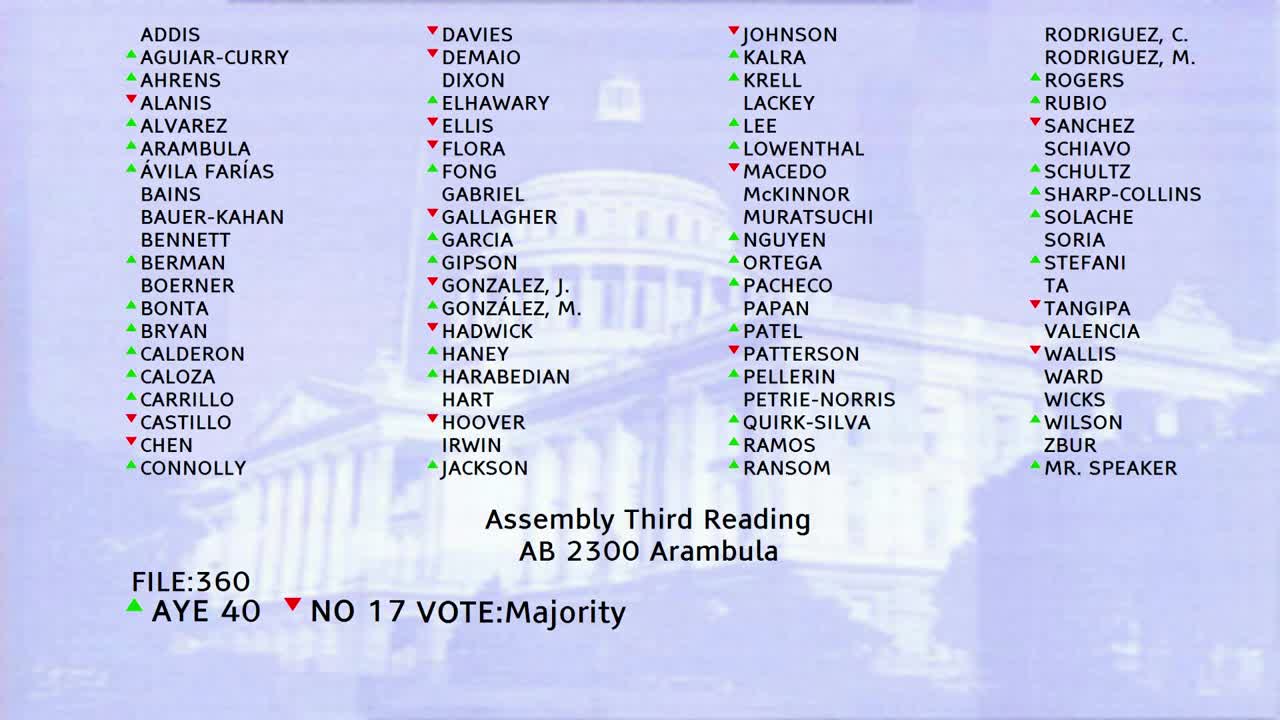 4MIN
Assembly Floor
47SEC
Assembly Floor
 10MIN
Assembly Standing Committee on Labor and Employment
Bill Author


