AB 2328: Vehicles: leaving the scene of an accident.
- Session Year: 2025-2026
- House: Assembly
- Latest Version Date: 2026-03-19
Current Status:
In Progress
(2026-05-14: In committee: Held under submission.)
Introduced
In Committee
Awaiting First Chamber Vote
Passed First Chamber
In Committee
Awaiting Second Chamber Vote
Passed Second Chamber
Enacted
Existing law requires the driver of a vehicle involved in an accident resulting in injury to a person, other than that driver, or in the death of a person, to immediately stop the vehicle at the scene of the accident and provide specified personal information to the injured person or the occupants of the other vehicle and to any traffic or police officer at the scene of the accident. Under existing law, if a vehicle accident results in injury, a person who violates the requirement to stop is subject to punishment by imprisonment in the state prison, or in a county jail for not more than one year, or by a specified fine, or both the imprisonment and fine. Under existing law, if a vehicle accident results in permanent, serious injury or death, a person who violates the requirement to stop is subject to punishment by imprisonment in the state prison for 2, 3, or 4 years, or in a county jail for not less than 90 days nor more than one year, or by a specified fine, or both the imprisonment and fine. Existing law requires a person who flees the scene of the crime after committing specified vehicle manslaughter while intoxicated or vehicle manslaughter to be punished for an additional term of imprisonment of 5 years in the state prison, upon conviction, and in addition and consecutive to the punishment prescribed.
This bill would instead require a person who violates the requirement to stop to be subject to punishment by imprisonment in the state prison for 3, 4, or 5 years, or in a county jail for not less than 90 days nor more than one year, and by a specified fine, if the vehicle accident results in death.
Existing law, subject to funding by the Legislature, establishes the School-Based Early Mental Health Intervention and Prevention Services Matching Grant Program, under which the Director of Health Care Services, in consultation with the Superintendent of Public Instruction, is authorized to award matching grants to local educational agencies to pay the state share of the costs of providing programs that provide school-based early mental health intervention and prevention services to eligible pupils at schoolsites, as specified.This bill would require the Director of Health Care Services to, on or before June 30, 2027, report to the Legislature on the effectiveness of the grant program and legislative recommendations for improving the effectiveness of the grant program.Existing law, subject to funding by the Legislature, establishes the School-Based Early Mental Health Intervention and Prevention Services Matching Grant Program, under which the Director of Health Care Services, in consultation with the Superintendent of Public Instruction, is authorized to award matching grants to local educational agencies to pay the state share of the costs of providing programs that provide school-based early mental health intervention and prevention services to eligible pupils at schoolsites, as specified.
This bill would require the Director of Health Care Services to, on or before June 30, 2027, report to the Legislature on the effectiveness of the grant program and legislative recommendations for improving the effectiveness of the grant program.
(a)The driver of a vehicle involved in an accident resulting in injury to a person, other than himself or herself, that driver, or in the death of a person shall immediately stop the vehicle at the scene of the accident and shall fulfill the requirements of Sections 20003 and 20004.
(b)(1)Except as provided in paragraph (2), If the accident described in subdivision (a) results in injury, other than a permanent, serious injury, a person who violates subdivision (a) shall be punished by imprisonment in the state prison, or in a county jail for not more than one year, or by a fine of not less than one thousand dollars ($1,000) nor more than ten thousand dollars ($10,000), or by both that imprisonment and fine.
(2)If the accident described in subdivision (a) results in death or permanent, serious injury, a person who violates subdivision (a) shall be punished by imprisonment in the state prison for two, three, or four years, or in a county jail for not less than 90 days nor more than one year, or by a fine of not less than one thousand dollars ($1,000) nor more than ten thousand dollars ($10,000), or by both that imprisonment and fine. However, the court, in the interests of justice and for reasons stated in the record, may reduce or eliminate the minimum imprisonment required by this paragraph.
(3)Except as provided in subdivision (c), if the accident described in subdivision (a) results in death, a person who violates subdivision (a) shall be punished by imprisonment in the state prison for three, four, or five years, or in a county jail for not less than 90 days nor more than one year, and by a fine of not less than one thousand dollars ($1,000) nor more than ten thousand dollars ($10,000). However, the court, in the interests of justice and for reasons stated in the record, may reduce or eliminate the minimum imprisonment required by this paragraph.
(3)(4)In imposing the minimum fine required by this subdivision, the court shall take into consideration the defendants ability to pay the fine and, in the interests of justice and for reasons stated in the record, may reduce the amount of that minimum fine to less than the amount otherwise required by this subdivision.
(c)A person who flees the scene of the crime after committing a violation of Section 191.5 of, or paragraph (1) of subdivision (c) of Section 192 of the Penal Code, upon conviction of any of those sections, in addition and consecutive to the punishment prescribed, shall be punished by an additional term of imprisonment of five years in the state prison. This additional term shall not be imposed unless the allegation is charged in the accusatory pleading and admitted by the defendant or found to be true by the trier of fact. The court shall not strike a finding that brings a person within the provisions of this subdivision or an allegation made pursuant to this subdivision.
(d)As used in this section, permanent, serious injury means the loss or permanent impairment of function of a bodily member or organ.
SECTION 1.Section 4391 is added to the Welfare and Institutions Code, to read:4391.(a)On or before June 30, 2027, the Director of Health Care Services shall report to the Legislature on the effectiveness of the grant program and legislative recommendations for improving the effectiveness of the grant program.(b)(1)A report to be submitted pursuant to subdivision (a) shall be submitted in compliance with Section 9795 of the Government Code.(2)Pursuant to Section 10231.5 of the Government Code, this section is repealed on January 1, 2031.(a)On or before June 30, 2027, the Director of Health Care Services shall report to the Legislature on the effectiveness of the grant program and legislative recommendations for improving the effectiveness of the grant program.
(b)(1)A report to be submitted pursuant to subdivision (a) shall be submitted in compliance with Section 9795 of the Government Code.
(2)Pursuant to Section 10231.5 of the Government Code, this section is repealed on January 1, 2031.
|
Date
|
Status
|
|---|---|
| May 14, 2026 | In committee: Held under submission. |
| Apr 29, 2026 | In committee: Set, first hearing. Referred to APPR. suspense file. |
| Apr 15, 2026 | From committee: Do pass and re-refer to Com. on APPR. (Ayes 8. Noes 0.) (April 14). Re-referred to Com. on APPR. |
| Mar 23, 2026 | Re-referred to Com. on PUB. S. |
| Mar 19, 2026 | From committee chair, with author's amendments: Amend, and re-refer to Com. on PUB. S. Read second time and amended. |
| Mar 19, 2026 | Referred to Com. on PUB. S. |
| Feb 20, 2026 | From printer. May be heard in committee March 22. |
| Feb 19, 2026 | Read first time. To print. |
|
Date
|
Description
|
Location
|
Votes
|
|
|---|---|---|---|---|
| Apr 14, 2026 | Do pass and be re-referred to the Committee on [Appropriations] | Assembly Standing Committee on Public Safety |
Passed |
This list shows positions taken on this bill by organizations on the date displayed, which is linked to the original source.
Positions by individuals are not included.
|
Organization
|
Position
|
Date
|
|---|---|---|
| California Association Of Highway Patrolmen | ** Support | |
| California District Attorneys Association | ** Support | |
| Ella Baker Center For Human Rights | ** Against | |
| Initiate Justice | ** Against | |
| Justice2jobs Coalition | ** Against | |
| LA Defensa | ** Against | |
| Peace Officers Research Association of California (PORAC) | ** Support | |
| Riverside County Sheriff's Office | ** Support | |
| San Francisco Public Defender | ** Against | |
| Smart Justice California, a Project of Beyond Impact | ** Against | |
| Streets for All | ** Support |
Date of Hearing: April 29, 2026
ASSEMBLY COMMITTEE ON APPROPRIATIONS
Buffy Wicks, Chair
ABPCA Bill Id:AB 2328
Author:(Alanis) – As Amended Ver:March 19, 2026
Policy Committee: | Public Safety | Vote: | 8 - 0 |
|
| ||
|
|
Urgency: No State Mandated Local Program: No Reimbursable: No
SUMMARY:
This bill increases the maximum sentence for a driver involved in an accident resulting in another person’s death who fails to stop at the scene and perform required duties from an alternate felony-misdemeanor with a maximum punishment of two, three, or four years in state prison, to an alternate felony-misdemeanor with a maximum punishment of three, four, or five years in state prison, and makes the existing $1,000 to $10,000 fine mandatory rather than permissive.
Specifically, this bill:
- Permits the court to impose the existing misdemeanor sentence of up to one year in county jail for this offense.
- Authorizes the court, in imposing the minimum fine, to take into consideration the defendant’s ability to pay and, in the interests of justice and for reasons stated in the record, to reduce the amount of the minimum fine.
FISCAL EFFECT:
Incarceration costs (General Fund) to the California Department of Corrections and Rehabilitation for longer sentences. Actual incarceration costs will depend on the number of convictions and the length of each sentence. CDCR data indicates that in 2025 there were 161 new felony admissions for hit-and-run accidents resulting in death or serious bodily injury. CDCR data does not distinguish between admissions for hit-and-runs resulting in death from seriously bodily injury. Even if only a small fraction involved accidents resulting in death, which would be the category implicated by this bill, the resulting increase in state prison commitments and sentence lengths would translate into meaningful and ongoing incarceration costs. The Legislative Analyst’s Office estimates the average annual cost to incarcerate one person in state prison is $128,000. CDCR estimates the annual cost is $135,921.
The Legislative Analyst’s Office recently warned of General Fund structural deficits of around $35 billion per year beginning in the 2027-28 fiscal year.
COMMENTS:
- Purpose. According to the author:
While California law criminalizes leaving the scene of a collision, current penalties do not always reflect the seriousness of situations where a driver causes significant injury or death. AB 2328 ensures that fleeing the scene in these cases carries consequences that match the severity of the underlying offense. By clarifying and strengthening the law, this bill enhances helps keep communities safer.
- Background. Existing law imposes a set of post-accident duties on drivers involved in any accident causing injury or death, regardless of fault — immediately stopping at the scene, providing identifying information, rendering reasonable assistance, and notifying law enforcement. The statute addresses the driver’s conduct after the accident rather than the accident itself. As the courts have construed the statute, these duties apply regardless of whether the driver was negligent or otherwise at fault for the accident itself. Existing law already creates tiered penalties: for hit-and-run resulting in injury, a felony-misdemeanor with a state prison triad of 16 months, two, or three years; for hit-and-run resulting in permanent serious injury or death, a felony-misdemeanor with a state prison triad of two, three, or four years and a minimum 90 days in county jail. Separate, higher penalties apply for vehicular manslaughter and gross vehicular manslaughter where the underlying driving conduct is negligent or grossly negligent. This bill increases the state prison triad for hit-and-run resulting in death — but not permanent serious injury — to three, four, or five years. As opponents have noted, a conviction does not require intent to cause harm or death, nor does it require fault for the underlying accident — only a post-accident failure to perform the statutory duties.
- Related Legislation. SB 907 (Archuleta) among other things, increases the punishment for hit-and-run with certain priors. This bill is pending hearing in Senate Appropriations.
AB 1281 (DeMaio), of the 2025-26 Session, increases the penalty for a hit-and-run resulting in death or serious injury to a straight felony at seven, eight, or nine years, and removes the misdemeanor pathway entirely. AB 1281 failed passage in Assembly Public Safety.
- Prior Legislation. AB 1067 (Patterson), of the 2023-24 Session, would have increased the triad to a maximum of six years for both death and permanent serious injury. The bill was held on this committee’s suspense file.
AB 582 (Patterson), of the 2021-22 Session, would have increased the penalties for fleeing the scene of an accident resulting in the death of another person to an alternate felony misdemeanor having a maximum punishment of six years in the state prison. AB 582 was held on this committee’s suspense file.
AB 195 (Patterson), of the 2019-2020 Legislative Session, was identical to AB 582 and failed passage in the Senate Committee on Public Safety.
Analysis Prepared by: Shiran Zohar / APPR. / (916) 319-2081
Date of Hearing:
Counsel: Ilan Zur
ASSEMBLY COMMITTEE ON
Nick Schultz, Chair
ABPCA Bill Id:
Author:() – As Ver:
SUMMARY:
Increases the punishment for failing to stop and perform certain duties at the scene of an accident that results in death from an alternate felony-misdemeanor with a maximum punishment of two, three, or four years in state prison, to an alternate felony-misdemeanor with a maximum punishment of three, four, or five years in state prison. Specifically, this bill:
- Increases the punishment for a driver involved in an accident that results in another person's death, who fails to stop at the scene of the accident and perform certain duties, from an alternate felony-misdemeanor punishable by up to one year in county jail or two, three, or four years in state prison, or by a fine of $1,000 to $10,000, or by both that fine and imprisonment, to an alternative felony-misdemeanor with a greater maximum punishment of three, four, or five years in state prison.
- Makes the fine of $1,000 to $10,000 for the above offense mandatory, rather than permissive, except the court, in imposing the minimum fine, shall take into consideration the defendant’s ability to pay the fine and, in the interests of justice and for reasons stated in the record, may reduce the amount of the minimum fine.
EXISTING LAW:
- Requires the driver of a vehicle involved in an accident that results in injury to another person to immediately stop the vehicle at the scene of the accident and to fulfill specified requirements, including providing identifying information and rendering reasonable assistance. (Veh. Code, §§ 20001, subd. (a); 20003.)
- Provides that, except as specified, fleeing the scene of an accident resulting in injury to another, is punishable by 16 months, two, or three years in state prison or, by imprisonment in a county jail not to exceed one year, or by a fine of not less than $1,000 nor more than $10,000, or by both a fine and imprisonment. (Veh. Code, § 20001, subd. (b)(1).)
- Provides that fleeing the scene of an accident which results in permanent, serious injury or death to another, is punishable by imprisonment in state prison for two, three, or four years, or in county jail for not less than 90 days nor more than one year, or by a fine between $1,000 and $10,000, or by both a fine and imprisonment. (Veh. Code, § 20001, subd. (b)(2).)
- Allows the court, in the interests of justice, to reduce or eliminate the minimum term of imprisonment required for a conviction of fleeing the scene of an accident that causes death or permanent, serious injury. (Veh. Code, § 20001, subd. (b)(2).)
- Requires the court to take into consideration the defendant’s ability to pay in imposing the minimum fine required, and in the interests of justice, the court may reduce the amount of the fine below the required minimum. (Veh. Code, § 20001, subd. (b)(3).)
- States that a person who flees the scene of an accident after committing gross vehicular manslaughter, gross vehicular manslaughter while intoxicated, or vehicular manslaughter while intoxicated, upon conviction for that offense, shall be punished by an additional term of five years in the state prison. This additional term runs in addition to and consecutive to the prescribed punishment. (Veh. Code, § 20001, subd. (c).)
- Defines “permanent, serious injury” as the loss or permanent impairment of the function of a bodily member or organ. (Veh. Code, § 20001, subd. (d).)
- Defines “gross vehicular manslaughter” as the unlawful killing of a human being, without malice aforethought, in driving a vehicle in the commission of an unlawful act, not amounting to a felony, and with gross negligence, or in driving a vehicle in the commission of a lawful act which might produce death, in an unlawful manner, and with gross negligence. This offense is punishable by imprisonment in a county jail for not more than one year, or in the state prison for two, four, or six years. (Pen. Code, §§ 192, subd. (c)(1); 193, subd. (c)(1).)
- Defines "gross vehicular manslaughter while intoxicated” as the unlawful killing of a human being, without malice aforethought, while driving a vehicle while intoxicated, and the killing was either a proximate result of an unlawful act, not amounting to a felony, and with gross negligence, or the proximate result of a lawful act that might produce death, in an unlawful manner, and with gross negligence. Gross vehicular manslaughter while intoxicated is punishable by four, six, or 10 years in state prison. (Pen. Code, § 191.5.)
- Provides for an additional punishment of three years when great bodily injury (GBI) is inflicted during the commission of a felony and where GBI is not an element of the offense, although this is inapplicable to murder or manslaughter. (Pen. Code, § 12022.7, subds. (a) & (g).)
- The additional punishment described above increases to five years if the victim becomes comatose due to brain injury or suffers permanent paralysis or if the victim is 70 years of age or older, and up to six years if the victim is a child under five years of age. (Pen. Code, § 12022.7, subds. (a)-(d).)
FISCAL EFFECT:
Unknown
COMMENTS:
- Author's Statement: According to the author, “While California law criminalizes leaving the scene of a collision, current penalties do not always reflect the seriousness of situations where a driver causes significant injury or death. AB 2328 ensures that fleeing the scene in these cases carries consequences that match the severity of the underlying offense. By clarifying and strengthening the law, this bill enhances helps keep communities safer.”
- Effect of this Bill: The offenses described in Vehicle Code section 20001 are commonly known as “hit and runs.” To prove a violation of a hit and run resulting in permanent, serious injury or death the prosecution must establish that: (1) the defendant was involved in a vehicle accident while driving; (2) the accident caused permanent, serious injury or death to another; (3) the defendant knew that they were involved in an accident that injured another person, or knew from the nature of the accident that it was probable that another person had been injured; and, (4) the defendant willfully failed to perform one or more duties, including immediately stopping at the scene, providing reasonable assistance to any injured person, providing specified identifying information, showing a driver’s license upon request, and notifying the applicable law enforcement entity. (CALCRIM No. 2140 (2025).)
The hit and run statute “merely addresses the duties of a driver, however otherwise innocent, once the accident and its attendant injuries have occurred.” (People v. Wood (2000) 83 Cal.App.4th 862, 866.) “The purpose of [the statute] is to prevent the driver of an automobile from leaving the scene of an accident in which he participates or is involved without proper identification and to compel necessary assistance to those who may be injured. The requirements of the statute are operative and binding on all drivers involved in an accident regardless of any question of their negligence respectively.” (People v. Scofield (1928) 203 Cal. 703, 708.) In other words, this offense does not require that a person drive impaired, recklessly, or negligently. A driver’s post-accident duties apply regardless of who was at fault for the accident. Accordingly, a hit-and-run may involve a driver who is involved in an accident in which they were not at fault, but for whatever reason, they leave the scene.
If the accident results in injury to another person, the offense is punishable by up to one year in county jail or 16 months, two, or three years in state prison, or a fine of $1,000 to $10,000, or by both that imprisonment and fine. (Veh. Code, § 20001, subd. (b)(1).) However, if the accident results in death or permanent, serious injury, it is punishable by 90 days to one year in county jail, or two, three, or four years in state prison, or by a fine of $1,000 to $10,000, or by both that fine and imprisonment. (Veh. Code, § 20001, subd. (b)(2).)
This bill punishes a hit-and-run that results in death more severely than a hit-and-run that results in permanent, serious injury. Specifically, it increases the punishment for a driver involved in an accident that results in another person's death, who fails to stop at the scene of the accident and perform certain duties, from an alternate felony-misdemeanor punishable by up to one year in county jail or two, three, or four years in state prison, to an alternative felony-misdemeanor with a greater maximum punishment of three, four, or five years in state prison. It also makes the fine of $1,000 to $10,000 for this offense mandatory, rather than permissive. Although the court, in imposing the minimum fine, may, in the interests of justice and for reasons stated in the record, reduce the amount of the minimum fine. (Veh. Code, § 20001, subd. (b)(3).)
- Increased Penalties and Lack of Deterrent Effect: According to the National Institute of Justice (NIJ), “Laws and policies designed to deter crime by focusing mainly on increasing the severity of punishment are ineffective partly because criminals know little about the sanctions for specific crimes. “More severe punishments do not ‘chasten’ individuals convicted of crimes, and prisons may exacerbate recidivism.”[1] Rather than penalty increases, the NIJ emphasizes the need for policies that “increase[] the perception that criminals will be caught and punished” because “[t]he certainty of being caught is a vastly more powerful deterrent than the punishment.” [2]
In a 2014 report, the Little Hoover Commission similarly addressed the disconnect between science and sentencing – that is, “put[ting] away offenders for increasingly longer periods of time, with no evidence that lengthy incarceration, for many, brings any additional public safety benefit.”[3] Accordingly, while this bill guarantees greater punishment for drivers who fail to stop at the scene of the accident that results in another’s death, it is unclear whether it will effectively prevent drivers from leaving the scene of an accident that results in a fatality. - Argument in Support: According to the Peace Officers Research Association of California, “AB 2328 strengthens penalties for individuals who flee the scene of a vehicle accident resulting in death by increasing the applicable state prison terms. By ensuring that individuals who commit fatal hit-and-run offenses face more serious consequences, this measure reinforces accountability and reflects the severity of abandoning victims at the scene of a fatal incident.
“Failing to stop and render aid not only delays emergency response, but can also hinder investigations and reduce the likelihood of identifying and apprehending those responsible. Strengthening these penalties helps deter this dangerous behavior and supports law enforcement’s ability to pursue justice for victims and their families.”
- Argument in Opposition: According to the Ella Baker Center for Human Rights, “AB 2328’s proposed penalty increase is disproportionate to the offense it seeks to punish. The crime of leaving the scene of an accident causing death does not require that the accused intend that death, much less intend to harm anyone. Indeed, as the common name of Vehicle Code section 20001 – leaving the scene of an accident – reflects, the act leading to the injury or death is often an unintended “accident.” Leaving the scene of the accident does not even require that the driver be at fault for the accident, only that the accident be the cause of the injury or death.
“The purpose of Vehicle Code section 20001 is to ensure that the accident is reported, and aid rendered, if possible, at the earliest possible time. The penalty for this crime should reflect only that failure to render aid, not an assumption that the person who leaves the scene was responsible for the accident or intended the death. Violating Vehicle Code section 20001 already results in a sentence of two, three, or four years in state prison for a felony, and up to one year in county jail for a misdemeanor. If there is evidence that the driver was driving a vehicle with gross negligence, the person can be charged with the crime of gross vehicular manslaughter, punishable by up to six years in state prison. (See Penal Code, § 193, subd. (c)(1).) If the person was driving while intoxicated with gross negligence and killed another person, they can be charged with gross vehicular manslaughter while intoxicated and punished by up to 10 years in state prison. (Penal Code, § 191.5, subd. (c)(1).)
“While drivers should certainly be encouraged to report accidents and render aid following an accident, we do not believe increasing sentences will result in greater adherence to the law. To the extent existing penalties already act as a deterrent to violate the law, expanding penalties will not increase their deterrent value. Research has shown that certainty of punishment has a greater deterrent effect than the severity of the punishment itself, and existing law already provides relatively significant penalties for the crime at hand.”
- Related Legislation: SB 907 (Archuleta) would add intoxicated vehicular manslaughter and gross vehicular manslaughter to the violent felonies list, subjects a person convicted of specified vehicle offenses, including a felony DUI, to a three-year sentence enhancement for each prior conviction for specified vehicle offenses, and increases the punishment for a hit and run with certain priors, as specified. SB 907 is pending a hearing in the Senate Appropriations Committee.
- Prior Legislation:
- AB 1281 (DeMaio), of the 2025-2026 Legislative Session, would have increased the punishment for failing to stop and perform certain duties at the scene of an accident resulting in death or permanent, serious injury from an alternate felony-misdemeanor to a felony punishable by seven, eight, or nine years in state prison. AB 1281 failed passage in this Committee.
- AB 1193 (Gipson), of the 2025-2026 Legislative Session, would have removed the statute of limitations for a hit and run resulting in death or permanent serious injury. The hearing on AB 1193 was canceled at the request of the author.
- AB 1067 (Patterson), of the 2023-2024 Legislative Session, would have increased the penalties for fleeing the scene of an accident resulting in the death of another person from an alternate felony-misdemeanor with a maximum punishment of four years in state prison, to an alternate felony-misdemeanor having a maximum punishment of six years in state prison. AB 1067 was held in the Assembly Appropriations Committee.
- AB 582 (Patterson), of the 2021-2022 Legislative Session, was substantially similar to AB 1067 (Patterson) of the 2023-2024 Legislative Session. AB 582 was held in the Assembly Appropriations Committee.
- AB 195 (Patterson), of the 2019-2020 Legislative Session, as amended in the Senate, was substantially similar to AB 1067 (Patterson) of the 2023-2024 Legislative Session. AB 195 failed passage in the Senate Public Safety Committee.
- AB 2014 (E. Garcia), of the 2017-2018 Legislative Session, would have increased the penalty for fleeing the scene of an accident resulting in death or serious bodily injury from two, three, or four years in state prison to two, four, or six years in state prison. The hearing on AB 2014 in this committee was canceled at the request of the author.
REGISTERED SUPPORT / OPPOSITION:
Support
California Association of Highway Patrolmen
California District Attorneys Association
Peace Officers Research Association of California (PORAC)
Riverside County Sheriff's Office
Streets for All
Opposition
Ella Baker Center for Human Rights
Initiate Justice
Justice2jobs Coalition
LA Defensa
San Francisco Public Defender
Smart Justice California, a Project of Beyond Impact
Analysis Prepared by:
National Institute of Justice, U.S. Department of Justice, Five Things about Deterrence (June 5, 2016) https://nij.ojp.gov/topics/articles/five-things-about-deterrence. ↑
Ibid. ↑
Little Hoover Commission, Sensible Sentencing for a Safer California (Feb. 2014) at p. 4, https://lhc.ca.gov/wp-content/uploads/Reports/219/Report219.pdf ↑
Discussed in Hearing
 7MIN
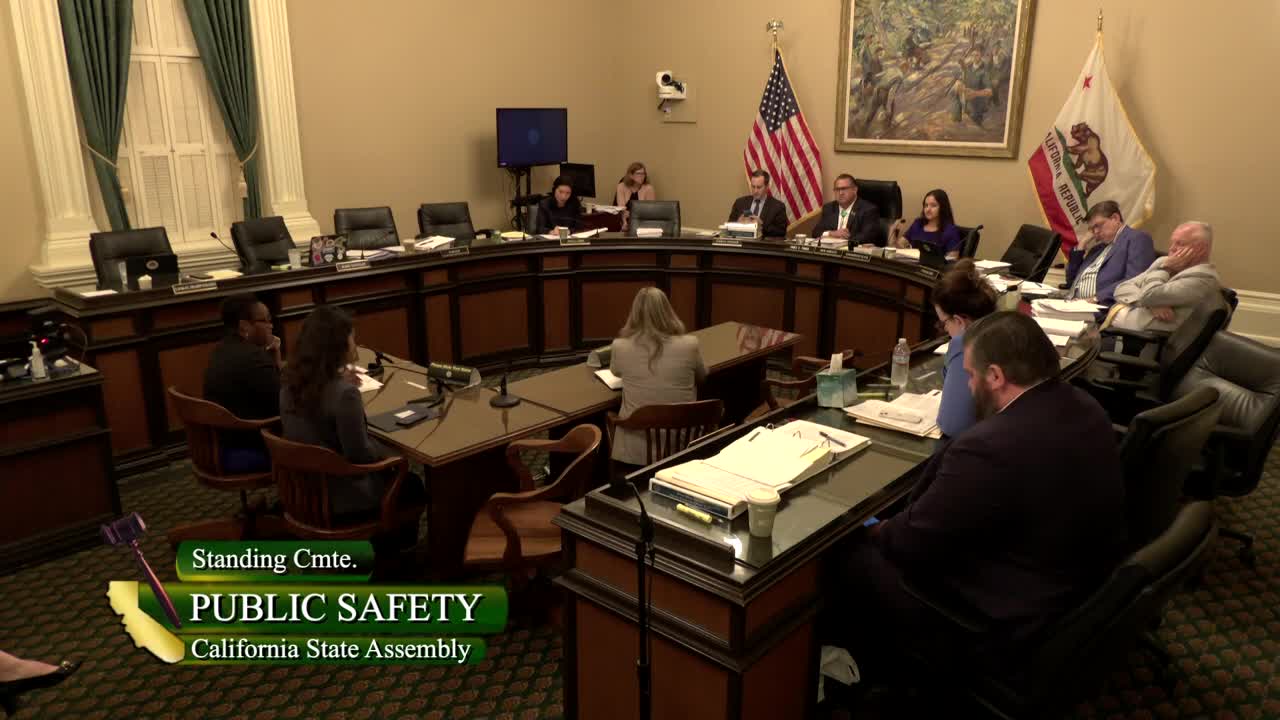
Assembly Standing Committee on Public Safety
Bill Author

Bill Co-Author(s):