AB 2329: Surplus residential property: condition-adjusted price of the fair market value: Cities of Pasadena and South Pasadena.
- Session Year: 2025-2026
- House: Assembly
- Latest Version Date: 2026-09-30
Current Status:
Passed
(2026-09-30: Chaptered by Secretary of State - Chapter 937, Statutes of 2026.)
Introduced
In Committee
Awaiting First Chamber Vote
Passed First Chamber
In Committee
Awaiting Second Chamber Vote
Passed Second Chamber
Enacted
(1)Existing law establishes priorities and procedures that any state agency disposing of surplus property is required to follow. Existing law requires the Department of Transportation to deposit proceeds from the sale of a surplus residential property from the department to a new owner into the SR-710 Rehabilitation Account. Existing law continuously appropriates the funds in the account to the department for the purpose of providing required repairs to certain surplus residential properties that are offered for sale, as provided. Existing law requires that the total funds maintained in the account not exceed a specified amount and that funds exceeding that amount, less any reimbursements due to the federal government, be transferred to the State Highway Account in the State Transportation Fund, to be used for allocation by the California Transportation Commission exclusively to fund projects located in specified cities and in the 90032 postal ZIP Code. Existing law also establishes the Affordable Housing Trust Account within the Housing Finance Fund, a continuously appropriated fund, and requires certain funds to be deposited in the account in accordance with specified provisions for the benefit of income restricted persons and families residing exclusively in the Cities of Pasadena, South Pasadena, Alhambra, La Canada Flintridge, and the 90032 postal ZIP Code.
Existing law sets forth an order of priority for the disposal of specified surplus residential property, including that a state agency disposing of single-family surplus residential property first offer the property at the appraised fair market value to former owners and present occupants, and then offer the property at an affordable price to other present occupants who have occupied the property for a specified number of years and who meet certain income levels. Existing law sets certain parameters for the calculation of an affordable price for purposes of these provisions based on, among other things, the fair market value of the property.
This bill would, instead, require the first tier priority offer to be based on the appraised condition-adjusted price of the fair market value and would define condition-adjusted price of the fair market value to mean the fair market value of the property as of October 13, 2019, as determined by an independent appraiser and adjusted, as provided. The bill would revise the above-specified parameters for calculating an affordable price. The bill would establish requirements relating to the performance and cost of the inspection of the property, and define various terms for purposes of these provisions, including, among others, guidelines. The bill would also, for surplus residential property sold at a condition-adjusted fair market value, exempt the selling agency from providing repairs to the property, as specified.
This bill, among other changes, would authorize a present occupant or tenant purchasing a residence at an affordable price or condition-adjusted price of the fair market value to receive purchase assistance in accordance with certain procedures. The bill would provide that certain amounts repaid for those purposes constitute deferred proceeds from the departments sale of the property and would be deposited into the Affordable Housing Trust Account, as prescribed.
(2)If the surplus residential property is not sold pursuant to the priorities described above, or pursuant to other specified priorities, existing law requires the property to then be sold at fair market value, with priority given first to purchasers who are present tenants in good standing, as provided, and then to former tenants who were in good standing at the time they vacated the premises, as provided.
This bill would, instead, require the property to be sold to those present or former tenants at condition-adjusted fair market value.
This bill would require the Department of Transportation, upon request, to provide certain documents related to the surplus residential property to all persons or entities offered or purchasing surplus residential property. The bill would require any surplus residential property purchased at the condition-adjusted price of the fair market value pursuant to the bill to be assessed at its condition-adjusted price of the fair market value for property tax purposes, as prescribed.
(3)Existing law contains provisions that are specific to the sale of surplus residential property located in the City of Pasadena. Those provisions, among other things, contain a priority requiring surplus residential property located in the city to be offered at fair market value to specified present tenants who are in good standing, as provided.
This bill would, instead, require the property to be offered to those present tenants at condition-adjusted price of the fair market value, as defined.
Existing law also requires the City of Pasadena to commence the construction, or complete acquisition, of affordable units in an amount at least equal to 3 times the number of unoccupied homes acquired by the city by December 31, 2026.
This bill would change the timing for this requirement to within 2 years from the date on which the proceeds from the subsequent sale of the unoccupied homes are received, as specified, and would make other related changes to these provisions.
(4)Existing law contains provisions that are specific to the sale of surplus residential property located in the City of South Pasadena. Those provisions, among other things, contain a priority requiring surplus residential property located in the city to be offered at fair market value to specified present tenants who are in good standing, as provided.
This bill would, instead, require the property to be offered to those present tenants at condition-adjusted price of the fair market value.
Existing law also requires the City of South Pasadena to commence the construction, or complete acquisition, of affordable units in an amount at least equal to three times the number of unoccupied homes acquired by the city by July 1, 2028.
This bill would, for unoccupied homes acquired by the City of South Pasadena after July 1, 2026, change the timing for this requirement to within 2 years from the date on which the proceeds from the subsequent sale of the unoccupied homes are received, as specified, and would make other related changes to these provisions.
By requiring new deposits into a continuously appropriated account, the bill would make an appropriation.
(5)This bill would make legislative findings and declarations as to the necessity of a special statute for the Cities of South Pasadena and Pasadena.
(6)By imposing new requirements on the Cities of South Pasadena and Pasadena, this bill would impose a state-mandated local program.
The California Constitution requires the state to reimburse local agencies and school districts for certain costs mandated by the state. Statutory provisions establish procedures for making that reimbursement.
This bill would provide that, if the Commission on State Mandates determines that the bill contains costs mandated by the state, reimbursement for those costs shall be made pursuant to the statutory provisions noted above.
This bill would declare that it is to take effect immediately as an urgency statute.
(1)Existing law establishes priorities and procedures that any state agency disposing of surplus property is required to follow. Existing law requires the Department of Transportation to deposit proceeds from the sale of a surplus residential property from the department to a new owner into the SR-710 Rehabilitation Account. Existing law continuously appropriates the funds in the account to the department for the purpose of providing required repairs to certain surplus residential properties that are offered for sale, as provided. Existing law requires that the total funds maintained in the account not exceed a specified amount and that funds exceeding that amount, less any reimbursements due to the federal government, be transferred to the State Highway Account in the State Transportation Fund, to be used for allocation by the California Transportation Commission exclusively to fund projects located in specified cities and in the 90032 postal ZIP Code. Existing law also establishes the Affordable Housing Trust Account within the Housing Finance Fund, a continuously appropriated fund, and requires certain funds to be deposited in the account in accordance with specified provisions for the benefit of income restricted persons and families residing exclusively in the Cities of Pasadena, South Pasadena, Alhambra, La Canada Flintridge, and the 90032 postal ZIP Code. Existing
Existing law sets forth an order of priority for the disposal of specified surplus residential property, including that a state agency disposing of single-family surplus residential property first offer the property at the appraised fair market value to former owners and present occupants, and then offer the property at an affordable price to other present occupants who have occupied the property for a specified number of years and who meet certain income levels. Existing law sets certain parameters for the calculation of an affordable price for purposes of these provisions based on, among other things, the fair market value of the property.
This bill would, instead, require the first tier priority offer to be based on the appraised condition-adjusted price of the fair market value and would define condition-adjusted price of the fair market value to mean the fair market value of the property as of October 13, 2019, and as adjusted as to reflect the existing as is condition of the property and the amount needed to make certain repairs and capital improvements, as determined by an independent appraiser and adjusted, as provided. The bill would revise the above-specified parameters for calculating an affordable price so that the price would be based on the fair market value or the condition-adjusted fair market value of the property, whichever is less. price. The bill would establish requirements relating to the performance and cost of the inspection of the property, and define various terms for purposes of these provisions, including, among others, guidelines. The bill would also, for surplus residential property sold at a condition-adjusted fair market value, exempt the selling agency from providing repairs to the property, as specified.
This bill, among other changes, would authorize a present occupant or tenant purchasing a residence at an affordable price or condition-adjusted price of the fair market value to receive purchase assistance in accordance with certain procedures. The bill would provide that certain amounts repaid for those purposes constitute deferred proceeds from the departments sale of the property and would be deposited into the Affordable Housing Trust Account, as prescribed.
(2)If the surplus residential property is not sold pursuant to the priorities described above, or pursuant to other specified priorities, existing law requires the property to then be sold at fair market value, with priority given first to purchasers who are present tenants in good standing, as provided, and then to former tenants who were in good standing at the time they vacated the premises, as provided.
This bill would, instead, require the property to be sold to those present or former tenants at condition-adjusted fair market value.
This bill would require the department Department of Transportation, upon request, to provide certain documents related to the surplus residential property to all persons or entities offered or purchasing surplus residential property. The bill would require any surplus residential property purchased at the condition-adjusted price of the fair market value price pursuant to the bill to be assessed at its condition-adjusted price of the fair market value price for property tax purposes. purposes, as prescribed.
(3)Existing law contains provisions that are specific to the sale of surplus residential property located in the City of Pasadena. Those provisions, among other things, contain a priority requiring surplus residential property located in the city to be offered at fair market value to specified present tenants who are in good standing, as provided.
This bill would, instead, require the property to be offered to those present tenants at condition-adjusted price of the fair market value. The bill would, for residential property sold at a condition-adjusted fair market value, exempt the City of Pasadena from providing repairs to the property, as specified. The bill would authorize the City of Pasadena, in a transaction between the city and the Department of Transportation, and without taking ownership of surplus residential property, to offer the residence to the present tenants, regardless of whether the tenant is in good standing, as specified, at the condition-adjusted fair market value price. The bill, among other things, would require the proceeds realized by the city from this type of sale to be placed into an affordable housing trust fund, as provided. The bill would make other related changes. value, as defined.
Existing law also requires the City of Pasadena to commence the construction, or complete acquisition, of affordable units in an amount at least equal to 3 times the number of unoccupied homes acquired by the city by December 31, 2026.
This bill would change the timing for this requirement to within 2 years from the date on which the proceeds from the subsequent sale of the unoccupied homes are received, as specified. specified, and would make other related changes to these provisions.
(4)Existing law contains provisions that are specific to the sale of surplus residential property located in the City of South Pasadena. Those provisions, among other things, contain a priority requiring surplus residential property located in the city to be offered at fair market value to specified present tenants who are in good standing, as provided.
This bill would, instead, require the property to be offered to those present tenants at condition-adjusted price of the fair market value. The bill would, for residential property sold at a condition-adjusted fair market value, exempt the City of South Pasadena providing repairs to the property, as specified. The bill would authorize the City of South Pasadena, in a transaction between the city and the Department of Transportation, and without taking ownership of surplus residential property, to offer the residence to the present tenants, regardless of whether the tenant is in good standing, as specified, at the condition-adjusted fair market value price. The bill would require the proceeds realized by the city from this type of sale to be placed into an affordable housing trust fund, as provided. The bill would make other related changes.
Existing law also requires the City of South Pasadena to commence the construction, or complete acquisition, of affordable units in an amount at least equal to three times the number of unoccupied homes acquired by the city by July 1, 2028.
This bill would, for unoccupied homes acquired by the City of South Pasadena after July 1, 2026, change the timing for this requirement to within 2 years from the date on which the proceeds from the subsequent sale of the unoccupied homes are received, as specified. specified, and would make other related changes to these provisions.
By requiring new deposits into a continuously appropriated account, the bill would make an appropriation.
(5)This bill would make legislative findings and declarations as to the necessity of a special statute for the Cities of South Pasadena and Pasadena.
(6)By imposing new requirements on the Cities of South Pasadena and Pasadena, this bill would impose a state-mandated local program.
The California Constitution requires the state to reimburse local agencies and school districts for certain costs mandated by the state. Statutory provisions establish procedures for making that reimbursement.
This bill would provide that, if the Commission on State Mandates determines that the bill contains costs mandated by the state, reimbursement for those costs shall be made pursuant to the statutory provisions noted above.
This bill would declare that it is to take effect immediately as an urgency statute.
(1)Existing law establishes priorities and procedures that any state agency disposing of surplus property is required to follow. Existing law sets forth an order of priority for the disposal of specified surplus residential property, including that a state agency disposing of single-family surplus residential property first offer the property at the appraised fair market value to former owners and present occupants, and then offer the property at an affordable price to other present occupants who have occupied the property for a specified number of years and who meet certain income levels. Existing law sets certain parameters for the calculation of an affordable price for purposes of these provisions based on, among other things, the fair market value of the property.
This bill would, instead, require the first tier priority offer to be based on the appraised condition-adjusted fair market value and would define condition-adjusted fair market value to mean the fair market value of the property as of October 13, 2019, and as adjusted as to reflect the existing as is condition of the property and the amount needed to make certain repairs and capital improvements, as provided. The bill would revise the above-specified parameters for calculating an affordable price to instead be based on the condition-adjusted fair market value. so that the price would be based on the fair market value or the condition-adjusted fair market value of the property, whichever is less. The bill would establish requirements relating to the performance and cost of the inspection of the property, and define various terms for purposes of these provisions, including, among others, guidelines. The bill would also, for surplus residential property sold at a condition-adjusted fair market value, exempt the selling agency from providing repairs to the property, as specified.
(2)If the surplus residential property is not sold pursuant to the priorities described above, or pursuant to other specified priorities, existing law requires the property to then be sold at fair market value, with priority given first to purchasers who are present tenants in good standing, as provided, and then to former tenants who were in good standing at the time they vacated the premises, as provided.
This bill would, instead, require the property to be sold to those present or former tenants at condition-adjusted fair market value.
This bill would require any dispute between the Department of Transportation and a purchaser regarding the final sales price of surplus residential property offered at the condition-adjusted fair market value sales price to be submitted to the Office of Administrative Hearings, as provided. The bill would require the department to provide certain documents related to the surplus residential property to all persons or entities offered or purchasing surplus residential property. The bill would require any surplus residential property purchased at the condition-adjusted fair market value price pursuant to the bill to be assessed at its condition-adjusted fair market value price for property tax purposes.
(3)Existing law contains provisions that are specific to the sale of surplus residential property located in the City Pasadena. Those provisions, among other things, contain a priority requiring surplus residential property located in the city to be offered at fair market value to specified present tenants who are in good standing, as provided.
This bill would, instead, require the property to be offered to those present tenants at condition-adjusted fair market value. The bill would, for residential property sold at a condition-adjusted fair market value, exempt the City of Pasadena from providing repairs to the property, as specified. The bill would authorize the City of Pasadena, in a transaction between the city and the Department of Transportation, and without taking ownership of surplus residential property, to offer the residence to the present tenants, regardless of whether the tenant is in good standing, as specified, at the condition-adjusted fair market value price. The bill, among other things, would require the proceeds realized by the city from this type of sale to be placed into an affordable housing trust fund, as provided. The bill would make other related changes.
Existing law also requires the City of Pasadena to commence the construction, or complete acquisition, of affordable units in an amount at least equal to 3 times the number of unoccupied homes acquired by the city by December 31, 2026.
This bill would change the timing for this requirement to within 2 years from the date on which the proceeds from the subsequent sale of the unoccupied homes are received, as specified.
(4)Existing law contains provisions that are specific to the sale of surplus residential property located in the City of South Pasadena. Those provisions, among other things, contain a priority requiring surplus residential property located in the city to be offered at fair market value to specified present tenants who are in good standing, as provided.
This bill would, instead, require the property to be offered to those present tenants at condition-adjusted fair market value. The bill would, for residential property sold at a condition-adjusted fair market value, exempt the City of South Pasadena providing repairs to the property, as specified. The bill would authorize the City of South Pasadena, in a transaction between the city and the Department of Transportation, and without taking ownership of surplus residential property, to offer the residence to the present tenants, regardless of whether the tenant is in good standing, as specified, at the condition-adjusted fair market value price. The bill would require the proceeds realized by the city from this type of sale to be placed into an affordable housing trust fund, as provided. The bill would make other related changes.
Existing law also requires the City of South Pasadena to commence the construction, or complete acquisition, of affordable units in an amount at least equal to three times the number of unoccupied homes acquired by the city by July 1, 2028.
This bill would, for unoccupied homes acquired by the City of South Pasadena after July 1, 2026, change the timing for this requirement to within 2 years from the date on which the proceeds from the subsequent sale of the unoccupied homes are received, as specified.
(5)This bill would make legislative findings and declarations as to the necessity of a special statute for the Cities of South Pasadena and Pasadena.
(6)By imposing new requirements on the Cities of South Pasadena and Pasadena, this bill would impose a state-mandated local program.
The California Constitution requires the state to reimburse local agencies and school districts for certain costs mandated by the state. Statutory provisions establish procedures for making that reimbursement.
This bill would provide that, if the Commission on State Mandates determines that the bill contains costs mandated by the state, reimbursement for those costs shall be made pursuant to the statutory provisions noted above.
(1)Existing law establishes priorities and procedures that any state agency disposing of surplus property is required to follow. Existing law sets forth an order of priority for the disposal of specified surplus residential property, including that a state agency disposing of single-family surplus residential property first offer the property at the appraised fair market value to former owners and present occupants, and then offer the property at an affordable price to other present occupants who have occupied the property for a specified number of years and who meet certain income levels. Existing law sets certain parameters for the calculation of an affordable price for purposes of these provisions based on, among other things, the fair market value of the property.
This bill would, instead, require the first tier priority offer to be based on the appraised condition-adjusted fair market value and would define condition-adjusted fair market value to mean the fair market value of the property as of October 13, 2019, and as adjusted as to reflect the existing as is condition of the property and the amount needed to make certain repairs and capital improvements, as provided. The bill would revise the above-specified parameters for calculating an affordable price to instead be based on the condition-adjusted fair market value. The bill would establish requirements relating to the performance and cost of the inspection of the property, and define various terms for purposes of these provisions, including, among others, guidelines.
Existing law prohibits the Department of Transportation from selling a nonresidential property to a tenant that is either a city or a nonprofit organization, as specified, at a value below a specified minimum sales price. Existing law also provides an exception to the prohibition on using inflation to adjust the original acquisition price of property acquired by the Department of Transportation in determining the minimum allowable price for the subsequent sale of that property.This bill would delete those provisions. The bill would, instead, define value in use for a nonresidential property to mean the propertys current specific use, including certain specified public uses, regardless of whether that use is the propertys highest and best use as of the appraisal date.(2)If the surplus residential property is not sold pursuant to the priorities described above, or pursuant to other specified priorities, existing law requires the property to then be sold at fair market value, with priority given first to purchasers who are present tenants in good standing, as provided, and then to former tenants who were in good standing at the time they vacated the premises, as provided.
This bill would, instead, require the property to be sold to those present or former tenants at condition-adjusted fair market value.
This bill would require any dispute between the Department of Transportation and a purchaser regarding the final sales price of surplus residential property offered at the condition-adjusted fair market value sales price to be submitted to the Office of Administrative Law, Hearings, as provided. The bill would require the department to provide certain documents related to the surplus residential property to all persons or entities offered or purchasing surplus residential property. The bill would require any surplus residential property purchased at the condition-adjusted fair market value price pursuant to the bill to be assessed at its condition-adjusted fair market value price for property tax purposes.
(3)Existing law contains provisions that are specific to the sale of surplus residential property located in the City Pasadena. Those provisions, among other things, contain a priority requiring surplus residential property located in the city to be offered at fair market value to specified present tenants who are in good standing, as provided.
This bill would, instead, require the property to be offered to those present tenants at condition-adjusted fair market value. The bill would authorize the City of Pasadena, in a transaction between the city and the Department of Transportation, and without taking ownership of surplus residential property, to offer the residence to the present tenants, regardless of whether the tenant is in good standing, as specified, at the condition-adjusted fair market value price. The bill, among other things, would require the proceeds realized by the city from this type of sale to be placed into an affordable housing trust fund, as provided. The bill would require the City of Pasadena to retain 15% of the proceeds from the sale of surplus residential property for certain specified costs. The bill would make other related changes.
Existing law also requires the City of Pasadena to commence the construction, or complete acquisition, of affordable units in an amount at least equal to 3 times the number of unoccupied homes acquired by the city by December 31, 2026.
This bill would change the timing for this requirement to within 2 years from the date on which the proceeds from the subsequent sale of the unoccupied homes are received, as specified.
(4)Existing law contains provisions that are specific to the sale of surplus residential property located in the City of South Pasadena. Those provisions, among other things, contain a priority requiring surplus residential property located in the city to be offered at fair market value to specified present tenants who are in good standing, as provided.
This bill would, instead, require the property to be offered to those present tenants at condition-adjusted fair market value. The bill would authorize the City of South Pasadena, in a transaction between the city and the Department of Transportation, and without taking ownership of surplus residential property, to offer the residence to the present tenants, regardless of whether the tenant is in good standing, as specified, at the condition-adjusted fair market value price. The bill would require the proceeds realized by the city from this type of sale to be placed into an affordable housing trust fund, as provided. The bill would require the City of South Pasadena to retain 15% of the proceeds from the sale of surplus residential property for certain specified costs. The bill would make other related changes.
Existing law also requires the City of South Pasadena to commence the construction, or complete acquisition, of affordable units in an amount at least equal to three times the number of unoccupied homes acquired by the city by July 1, 2028.
This bill would, for unoccupied homes acquired by the City of South Pasadena after July 1, 2026, change the timing for this requirement to within 2 years from the date on which the proceeds from the subsequent sale of the unoccupied homes are received, as specified.
(5) This bill would make legislative findings and declarations relating to the scarcity of certain types of land within the Cities of Pasadena and South Pasadena and the anticipated disposition of surplus nonresidential property by the Department of Transportation to the Cities of Pasadena and South Pasadena.(6)(5)This bill would make legislative findings and declarations as to the necessity of a special statute for the Cities of South Pasadena and Pasadena.
(7)(6)By imposing new requirements on the Cities of South Pasadena and Pasadena, this bill would impose a state-mandated local program.
The California Constitution requires the state to reimburse local agencies and school districts for certain costs mandated by the state. Statutory provisions establish procedures for making that reimbursement.
This bill would provide that, if the Commission on State Mandates determines that the bill contains costs mandated by the state, reimbursement for those costs shall be made pursuant to the statutory provisions noted above.
(1)Existing law establishes priorities and procedures that any state agency disposing of surplus property is required to follow. Existing law sets forth an order of priority for the disposal of specified surplus residential property, including that a state agency disposing of single-family surplus residential property first offer the property at the appraised fair market value to former owners and present occupants, and then offer the property at an affordable price to other present occupants who have occupied the property for a specified number of years and who meet certain income levels. Existing law sets certain parameters for the calculation of an affordable price for purposes of these provisions based on, among other things, the fair market value of the property.
This bill would, instead, require the first tier priority offer to be based on the appraised condition-adjusted fair market value and would define condition-adjusted fair market value to mean the fair market value of the property as of October 13, 2019, and as adjusted as to reflect the existing as is condition of the property and the amount needed to make certain repairs and capital improvements, as provided. The bill would revise the above-specified parameters for calculating an affordable price to instead be based on the condition-adjusted fair market value. The bill would establish requirements relating to the performance and cost of the inspection of the property, and define various terms for purposes of these provisions, including, among others, guidelines.
Existing law prohibits the Department of Transportation from selling a nonresidential property to a tenant that is either a city or a nonprofit organization, as specified, at a value below a specified minimum sales price. Existing law also provides an exception to the prohibition on using inflation to adjust the original acquisition price of property acquired by the Department of Transportation in determining the minimum allowable price for the subsequent sale of that property.
This bill would delete those provisions. The bill would, instead, define value in use for a nonresidential property to mean the propertys current specific use, including certain specified public uses, regardless of whether that use is the propertys highest and best use as of the appraisal date.
(2)If the surplus residential property is not sold pursuant to the priorities described above, or pursuant to other specified priorities, existing law requires the property to then be sold at fair market value, with priority given first to purchasers who are present tenants in good standing, as provided, and then to former tenants who were in good standing at the time they vacated the premises, as provided.
This bill would, instead, require the property to be sold to those present or former tenants at condition-adjusted fair market value.
This bill would require any dispute between the Department of Transportation and a purchaser regarding the final sales price of surplus residential property offered at the condition-adjusted fair market value sales price to be submitted to the Office of Administrative Law, as provided. The bill would require the department to provide certain documents related to the surplus residential property to all persons or entities offered or purchasing surplus residential property. The bill would require any surplus residential property purchased at the condition-adjusted fair market value price pursuant to the bill to be assessed at its condition-adjusted fair market value price for property tax purposes.
(3)Existing law contains provisions that are specific to the sale of surplus residential property located in the City Pasadena. Those provisions, among other things, contain a priority requiring surplus residential property located in the city to be offered at fair market value to specified present tenants who are in good standing, as provided.
This bill would, instead, require the property to be offered to those present tenants at condition-adjusted fair market value. The bill would authorize the City of Pasadena, in a transaction between the city and the Department of Transportation, and without taking ownership of surplus residential property, to offer the residence to the present tenants, regardless of whether the tenant is in good standing, as specified, at the condition-adjusted fair market value price. The bill, among other things, would require the proceeds realized by the city from this type of sale to be placed into an affordable housing trust fund, as provided. The bill would require the City of Pasadena to retain 15% of the proceeds from the sale of surplus residential property for certain specified costs. The bill would make other related changes.
Existing law also requires the City of Pasadena to commence the construction, or complete acquisition, of affordable units in an amount at least equal to 3 times the number of unoccupied homes acquired by the city by December 31, 2026.
This bill would change the timing for this requirement to within 2 years from the date on which the proceeds from the subsequent sale of the unoccupied homes are received, as specified.
(3)(4)Existing law contains provisions that are specific to the sale of surplus residential property located in the City of South Pasadena. Those provisions, among other things, contain a priority requiring surplus residential property located in the city to be offered at fair market value to specified present tenants who are in good standing, as provided.
This bill would, instead, require the property to be offered to those present tenants at condition-adjusted fair market value. The bill would authorize the City of South Pasadena, in a transaction between the city and the Department of Transportation, and without taking ownership of surplus residential property, to offer the residence to the present tenants, regardless of whether the tenant is in good standing, as specified, at the condition-adjusted fair market value price. The bill would require the proceeds realized by the city from this type of sale to be placed into an affordable housing trust fund, as provided. The bill would require the City of South Pasadena to retain 15% of the proceeds from the sale of surplus residential property for certain specified costs. The bill would make other related changes.
Existing law also requires the City of South Pasadena to commence the construction, or complete acquisition, of affordable units in an amount at least equal to three times the number of unoccupied homes acquired by the city by July 1, 2028.
This bill would, for unoccupied homes acquired by the City of South Pasadena after July 1, 2026, change the timing for this requirement to within 2 years from the date on which the proceeds from the subsequent sale of the unoccupied homes are received, as specified.
(5) This bill would make legislative findings and declarations relating to the scarcity of certain types of land within the Cities of Pasadena and South Pasadena and the anticipated disposition of surplus nonresidential property by the Department of Transportation to the Cities of Pasadena and South Pasadena.
(4)(6)This bill would make legislative findings and declarations as to the necessity of a special statute for the City of South Pasadena. Cities of South Pasadena and Pasadena.
(7)By imposing new requirements on the Cities of South Pasadena and Pasadena, this bill would impose a state-mandated local program.
The California Constitution requires the state to reimburse local agencies and school districts for certain costs mandated by the state. Statutory provisions establish procedures for making that reimbursement.
This bill would provide that, if the Commission on State Mandates determines that the bill contains costs mandated by the state, reimbursement for those costs shall be made pursuant to the statutory provisions noted above.
(1)Existing law establishes priorities and procedures that any state agency disposing of surplus residential property is required to follow. Existing law sets forth an order of priority for the disposal of specified surplus residential property in the City of South Pasadena, property, including that the a state agency disposing of the single-family surplus residential property first offer the property at the appraised fair market value to former owners and present occupants, as specified, and then at fair market value to present tenants and then offer the property at an affordable price to other present occupants who have occupied the property for 5 years or more and who are in good standing with all rent obligations, as provided. a specified number of years and who meet certain income levels. Existing law sets certain parameters for the calculation of an affordable price for purposes of these provisions based on, among other things, the fair market value of the property.
This bill would would, instead, require the fair market value offered to present tenants to be based on an appraisal of the property. first tier priority offer to be based on the appraised condition-adjusted fair market value and would define condition-adjusted fair market value to mean the fair market value of the property as of October 13, 2019, and as adjusted as to reflect the existing as is condition of the property and the amount needed to make certain repairs and capital improvements, as provided. The bill would revise the above-specified parameters for calculating an affordable price to instead be based on the condition-adjusted fair market value.
(2)If the surplus residential property is not sold pursuant to the priorities described above, or pursuant to other specified priorities, existing law requires the property to then be sold at fair market value, with priority given first to purchasers who are present tenants in good standing, as provided, and then to former tenants who were in good standing at the time they vacated the premises, as provided.
This bill would, instead, require the property to be sold to those present or former tenants at condition-adjusted fair market value.
This bill would require any dispute between the Department of Transportation and a purchaser regarding the final sales price of surplus residential property offered at the condition-adjusted fair market value sales price to be submitted to the Office of Administrative Law, as provided. The bill would require the department to provide certain documents related to the surplus residential property to all persons or entities offered or purchasing surplus residential property. The bill would require any surplus residential property purchased at the condition-adjusted fair market value price pursuant to the bill to be assessed at its condition-adjusted fair market value price for property tax purposes.
(3)Existing law contains provisions that are specific to the sale of surplus residential property located in the City of South Pasadena. Those provisions, among other things, contain a priority requiring surplus residential property located in the city to be offered at fair market value to specified present tenants who are in good standing, as provided.
This bill would, instead, require the property to be offered to those present tenants at condition-adjusted fair market value. The bill would authorize the City of South Pasadena, in a transaction between the city and the Department of Transportation, and without taking ownership of surplus residential property, to offer the residence to the present tenants, regardless of whether the tenant is in good standing, as specified, at the condition-adjusted fair market value price. The bill would require the proceeds realized by the city from this type of sale to be placed into an affordable housing trust fund, as provided. The bill would make other related changes.
This(4)This bill would make legislative findings and declarations as to the necessity of a special statute for the City of South Pasadena.
Existing law establishes priorities and procedures that any state agency disposing of surplus residential property is required to follow. Existing law sets forth an order of priority for the disposal of specified surplus residential property in the City of South Pasadena, including that the state agency disposing of the surplus residential property first offer the property to former owners and present occupants, as specified, and then at fair market value to present tenants who have occupied the property for 5 years or more and who are in good standing with all rent obligations, as provided.
This bill would require the fair market value offered to present tenants to be based on an appraisal of the property.
This bill would make legislative findings and declarations as to the necessity of a special statute for the City of South Pasadena.
The Legislature reaffirms its finding that the disposition of surplus property owned by public agencies should be utilized to further state policies.
The Legislature reaffirms its finding that there exists within the urban and rural areas of the state a serious shortage of decent, safe, and sanitary housing which persons and families of low or moderate income can afford, and consequently a pressing and urgent need for the preservation and expansion of the low- and moderate-income housing supply. The Legislature further reaffirms its finding that highway and other state activities have contributed to the severe shortage of such housing. The Legislature reaffirms that the provision of decent housing for all Californians is a state goal of the highest priority. The Legislature finds and declares that actions of state agencies including the sales of surplus residential properties which result in the loss of decent and affordable housing for persons and families of low or moderate income is contrary to state housing, urban development, and environmental policies and is a significant environmental effect, within the meaning of Article XIX of the California Constitution, which will be mitigated by the sale of surplus residential property pursuant to the provisions of this article.
The Legislature further finds and declares that the displacement of large numbers of persons as a result of the sale of surplus residential property owned by agencies of the state is a significant environmental effect, within the meaning of Article XIX of the California Constitution which will be mitigated by sale of such properties pursuant to the provisions of this article.
The Legislature further finds and declares that the sale of surplus residential property pursuant to the provisions of this article will directly serve an important public purpose. Wherefore, the Legislature intends by this article to preserve, upgrade and expand the supply of housing available to persons and families of low or moderate income, present tenants, and workers. The Legislature further intends by this article to mitigate the environmental effects, within the meaning of Article XIX, of the California Constitution, caused by highway activities.
SEC. 2.Section 54236 of the Government Code is amended to read:54236.(a)As used in this article, the term offer means to solicit proposals prior to sale in a manner calculated to achieve a sale under the conditions specified, and to hold the offer open for a reasonable period of time, which shall be no more than one year, unless the time is extended by the selling agency at its discretion, for a period to be specified by the selling agency.
(b)As used in this article, the term affordable price means, the price for residential property for which the purchasers monthly payments will not exceed that portion of the purchasing households adjusted income as determined in accordance with the regulations of the Department of Housing and Community Development pursuant to subdivision (b) of Section 50052.5 of the Health and Safety Code.
(c)As used in this article, the term single-family residence means a real property improvement used, or intended to be used, as a dwelling unit for one family.
(d)(1)As used in this article, the term surplus residential property means land and structures owned by any agency of the state that is determined to be no longer necessary for the agencys use, and that is developed as single-family or multifamily housing, except property being held by the agency for the purpose of exchange.
(2)Surplus residential properties shall only include land and structures that, at the time of purchase by the state, the state had intended to remove the residences thereon and to use the land for state purposes.
(e)As used in this article, the term displacement includes, but is not limited to, persons who will have to move from surplus residential property that they occupy when it is sold by a state agency because they are unable to afford to pay the price that the state agency is asking for the residential property.
(f)As used in this article, the term fair market value shall mean fair market value as of the date the offer of sale is made by the selling agency pursuant to the provisions of this article and shall reflect the existing as is condition of the property, taking into account any repairs required to make the property safe and habitable. This definition shall not apply to terms of sale that are described as mitigation measures in an environmental study prepared pursuant to the Public Resources Code if the study was initiated before this measure was enacted.
(g)As used in this article, the term affordable rent means, in the case of an occupant person or family, other than a person or family of low or moderate income, rent for residential property that is not more than 25 percent of the occupant households gross monthly income, and in the case of an occupant person or family of low or moderate income, rent for residential property that is not more than the percentage of the adjusted income of the occupant person or family as permitted under regulations of the United States Department of Housing and Urban Development issued pursuant to Section 8 of the United States Housing Act of 1937, but not in excess of the market rental value for comparable property.
(h)As used in this article, the term area median income means median household income, adjusted for family size as determined in accordance with the regulations of the United States Department of Housing and Urban Development issued pursuant to Section 235 of the National Housing Act, as amended (Public Law 90-448), for the standard metropolitan statistical area (SMSA), in which surplus residential property to be disposed of pursuant to this article is located, or the county in which the property is located, if it is outside an SMSA.
(i)As used in this article, the term persons and families of low or moderate income means persons and families who meet both of the following conditions:
(1)Meet the definition of persons and families of low or moderate income set forth in Section 50093 of the Health and Safety Code.
(2)Have not had an ownership interest in real property in the last three years.
(j)As used in this article, the term lower income households means lower income households as defined in Section 50079.5 of the Health and Safety Code.
(k)(1)As used in this article, the term condition-adjusted price of the fair market value means the fair market value of the property as of October 13, 2019, as determined by an independent appraiser, and as adjusted as provided in this subdivision. The condition-adjusted fair market value shall be offered for properties for which the sale has not completed.
(2)The appraiser shall adjust the fair market value of the property as of October 13, 2019, to reflect both of the following:
(A)The existing as is condition of the property. In determining the existing as is condition of the property, the appraiser shall also make adjustments to the valuation that reflect the propertys condition as of October 13, 2019, taking into account deterioration, including deterioration of major structural building components or building systems, defects, deferred or lack of maintenance and other conditions existing as of that date affected the habitability of the structure or the market value of the property. The appraiser may use as a guide an inspection report based on an inspection of the property and other reasonably available evidence concerning the propertys condition as of October 13, 2019. The department shall provide any inspection report and relevant property condition records in its possession to the appraiser.
(B)(i)Standardized depreciation to major structural components or building systems shown to have materially deteriorated since October 13, 2019, according to a standardized depreciation schedule or based on an inspection of the property for material deterioration occurring after October 13, 2019.
The adjustment shall exclude land value, ordinary or cosmetic work, tenant-caused damage, and components the department has since repaired or replaced since October 13, 2019.
(ii)Standardized depreciation shall be calculated using a standardized useful-life and depreciation schedule established by the department for major structural components and building systems. A methodology used for state or federal tax purposes shall not, by itself, establish the amount of an adjustment pursuant to this paragraph. In the development of regulations to implement this section, the department shall consult with and solicit comments from the cities of Los Angeles, Pasadena and South Pasadena and consider any written recommendations or comments submitted by those cities.
(3)The inspections performed under this article shall be performed by a state licensed general contractor or a certified home inspector, if the inspector is also a general contractor.
(4)The cost of the appraisal and the inspection, including the inspection report, shall be borne by the selling agency.
(5)The tenant may obtain their own appraisal and inspection at the tenants cost. The inspection shall be performed by a state licensed general contractor or a certified home inspector, if the inspector is also a general contractor. If the tenant submits an appraisal or inspection to the department, the departments review appraiser shall consider its findings in reviewing and approving the final valuation. If the departments final valuation materially differs from the tenants appraisal or inspection findings, the department shall provide the tenant with a written explanation identifying the material differences and the basis for the departments determination.
(6)This subdivision applies to a sale that has not completed on the operative date of the act adding this paragraph. A purchaser under an executed sales contract or in an open escrow may elect to have the purchase price recalculated pursuant to this subdivision by providing written notice to the department within 30 days after receiving notice of that right. This subdivision does not reopen a sale for which the sale has completed.
(l)As used in this article, the term workforce housing means housing for persons and families whose household income is between 121 percent and 180 percent of the area median income, and shall be rented or sold at the workforce housing price as further described in the guidelines. For-sale units shall have a regulatory agreement requiring a workforce housing sales price or workforce housing rent for a minimum of 55 years for rental and 45 years for owner-occupied workforce housing.
(m)As used in this article, the term guidelines means regulations adopted by the legislative body of the city to implement the rental or sale of workforce housing. The guidelines shall include, but not be limited to, provisions related to establishing the parameters for eligibility of persons and families to rent or purchase workforce housing, the determination of rents and sales prices, the monitoring of workforce housing, restrictions regarding the use, resale, transfers, and refinancing related to for-sale units and any other provisions to implement the workforce housing program.
SEC. 3.Section 54237 of the Government Code is amended to read:54237.(a)Notwithstanding Section 11011.1, an agency of the state disposing of surplus residential property shall do so in accordance with the following priorities and procedures:
(1)First, all single-family residences presently occupied by their former owners shall be offered to those former owners at the appraised condition-adjusted price of the fair market value.
(2)Second, all single-family residences shall be offered, pursuant to this article, to their present occupants who have occupied the property for two years or more and who are persons and families of low or moderate income.
(3)Third, all single-family residences shall be offered, pursuant to this article, to their present occupants who have occupied the property for five years or more and whose household income does not exceed 150 percent of the area median income.
(4)Fourth, a single-family residence shall not be offered, pursuant to this article, to present occupants who are not the former owners of the property if the present occupants have had an ownership interest in real property in the last three years.
(b)(1)Single-family residences offered to their present occupants pursuant to paragraphs (2) and (3) of subdivision (a) shall be offered to those present occupants at an affordable price. The price shall not be less than the price paid by the agency for original acquisition, unless the acquisition price was greater than the current fair market value, and shall not be greater than the fair market value. If the affordable price is calculated to be less than the price paid by the agency for original acquisition, the residence shall be offered at the original acquisition price to the present occupants. When a single-family residence is offered to present occupants at a price that is less than fair market pursuant to paragraph (2) or (3) of subdivision (a), the selling agency shall impose terms, conditions, and restrictions to ensure that the housing will remain available to persons and families of low or moderate income and households with incomes no greater than the incomes of the present occupants in proportion to the area median income. The Department of Housing and Community Development shall provide to the selling agency recommendations of standards and criteria for these prices, terms, conditions, and restrictions. The selling agency shall provide repairs required by lenders and government housing assistance programs, or, at the option of the agency, provide the present occupants with a replacement dwelling pursuant to Section 54237.5. If the present occupants pursuant to paragraphs (2) and (3) of subdivision (a) desire to purchase the single-family residences at fair market value or are offered the single-family residences at fair market value by the agency of the state disposing of surplus residential property, the price shall not be greater than the condition-adjusted price of the fair market value. In that case, the selling agency shall not be required to provide repairs, including repairs required by lenders and government housing assistance programs.
(2)A present occupant or present tenant purchasing a single-family residence at an affordable price or condition-adjusted price of the fair market value may receive purchase assistance pursuant to this paragraph if the purchaser is unable to obtain primary financing sufficient to complete the purchase.
(A)The purchase assistance shall consist of a deferred-payment subordinate loan secured by a deed of trust in a position junior to the purchasers primary financing.
(B)For a residence purchased at an affordable price, the principal amount of the subordinate loan shall not exceed the difference between the affordable price and the condition-adjusted price of the fair market value.
(C)For a residence purchased at the condition-adjusted price of the fair market value, the principal amount of the subordinate loan shall not exceed the lesser of the following:
(i)The amount reasonably necessary for the purchaser to qualify for and close the primary financing, as documented by the purchasers lender.
(ii)Twenty-five percent of the condition-adjusted fair market value of the property.
(D)The subordinate loan shall not require periodic payments or provide the department with any share of appreciation. On each anniversary of the close of escrow, the outstanding principal shall be adjusted by the lesser of the following:
(i)The annual percentage increase, if any, in the Consumer Price Index for All Urban Consumers for the Los Angeles-Long Beach-Anaheim metropolitan area, as published by the United States Bureau of Labor Statistics.
(ii)Three percent.
(E)The outstanding principal shall not be reduced if the index described in clause (i) of subparagraph (D) is negative.
The term of the subordinate loan shall not exceed 45 years. The outstanding principal shall be due and payable upon the earliest of any of the following:
(i)Sale or transfer of the property, other than a transfer permitted by the department.
(ii)A cash-out refinancing of the primary financing.
(iii)The property ceasing to be the purchasers principal residence, other than a temporary absence permitted by the department.
(iv)Forty-five years after the close of escrow.
(F)The department shall agree to subordinate its deed of trust to a bona fide rate-and-term refinancing that does not provide cash proceeds to the purchaser, except for customary closing costs, and does not extend beyond the maturity of the subordinate loan.
(G)The purchaser may repay all or any portion of the subordinate loan without penalty.
(H)Amounts repaid pursuant to this paragraph constitute deferred proceeds from the departments sale of the property and shall be deposited to the Affordable Housing Trust Account pursuant to subdivision (b) of Section 54237.7.
(c)If single-family residences are offered to their present occupants pursuant to paragraphs (2) and (3) of subdivision (a), the occupants shall certify their income and assets to the selling agency. When a single-family residence is offered to present occupants at a price that is less than the fair market value, the selling agency may verify the certifications, in accordance with procedures used for verification of incomes of purchasers and occupants of housing financed by the California Housing Finance Agency and with regulations adopted for the verification of assets by the United States Department of Housing and Urban Development. The income and asset limitations and term of residency requirements of paragraphs (2) and (3) of subdivision (a) shall not apply to sales that are described as mitigation measures in an environmental study prepared pursuant to the Public Resources Code, if the study was initiated before this measure was enacted, and shall not apply to present occupants, in order to avoid displacement.
(d)(1)Except as otherwise provided in paragraph (2), all other surplus residential properties and all properties described in paragraphs (1), (2), and (3) of subdivision (a) that are not purchased by the former owners or the present occupants shall be then offered as follows:
(A)Except as required by subparagraph (B), the property shall be offered to a housing-related private or public entity at a reasonable price, which is best suited to economically feasible use of the property as decent, safe, and sanitary housing at affordable rents and affordable prices for persons and families of low or moderate income, on the condition that the purchasing entity shall cause the property to be rehabilitated and used as follows:
(i)If the housing-related entity is a public entity, the entity shall dedicate profits realized from a subsequent sale, as specified in subdivision (b) of Section 54237.7, to the construction of affordable housing within the Cities of Pasadena, South Pasadena, Alhambra, La Canada Flintridge, and the 90032 postal ZIP Code.
(ii)If the entity is a private housing-related entity or a housing-related public entity, the entity shall cause the property to be developed as limited equity cooperative housing with first right of occupancy to present occupants, except that where the development of cooperative or cooperatives is not feasible, the purchasing entity shall cause the property to be used for low- and moderate-income rental or owner-occupied housing, with first right of occupancy to the present tenants. The price of the property in no case shall be less than the price paid by the entity for original acquisition unless the acquisition price was greater than current fair market value and shall not be greater than fair market value. Subject to the foregoing, it shall be set at the level necessary to provide housing at affordable rents and affordable prices for present tenants and persons and families of low or moderate income. When residential property is offered at a price that is less than fair market value, the selling agency shall impose terms, conditions, and restrictions that will ensure that the housing will remain available to persons and families of low or moderate income. The Department of Housing and Community Development shall provide to the selling agency recommendations of standards and criteria for prices, terms, conditions, and restrictions.
(B)(i)If the property is a historic home, the property shall be offered first to a housing-related public entity subject to clause (i) or (ii) of subparagraph (A) or to a nonprofit private entity dedicated to rehabilitating and maintaining the historic home for public and community access and use subject to clause (ii) of subparagraph (A).
(ii)For purposes of this subdivision, historic home means single-family surplus residential property that is listed on, or for which an application has been filed for listing on, at least one of the following by January 1, 2015:
(I)The California Register of Historical Resources, as established pursuant to Article 2 (commencing with Section 5020) of Chapter 1 of Division 5 of the Public Resources Code.
(II)The National Register of Historic Places, as established pursuant to Chapter 3021 of Title 54 of the United States Code.
(III)The National Register of Historic Places, as previously established pursuant to the federal National Historic Preservation Act (54 U.S.C. Sec. 300101 et seq.).
(2)This subdivision shall not apply to properties offered for sale pursuant to Section 54239.1, 54239.5, or 54239.6.
(e)A surplus residential property not sold pursuant to subdivisions (a) to (d), inclusive, or Section 54239.1, 54239.5, or 54239.6, as applicable, shall then be sold at condition-adjusted fair market value, with priority given first to purchasers who are present tenants in good standing with all rent obligations current and paid in full, and second to former tenants who were in good standing at the time they vacated the premises, with priority given to the most recent tenants first. Next priority shall be given to purchasers who will be owner-occupants, except that in such case, the surplus residential property shall be sold at fair market value. The selling agency shall not be required to provide repairs, including repairs required by lenders and government housing assistance programs, for surplus residential property sold at condition-adjusted fair market value.
(1)A tenant purchasing pursuant to this subdivision may receive a subordinate loan pursuant to paragraph (2) of subdivision (b).
(2)The selling agency may commence the sale of property that former tenants may possess a right to purchase as provided by this subdivision 30 days after the selling agency has done both of the following:
(A)Posted information regarding the sale under this subdivision on the selling agencys internet website.
(B)Made a good faith effort to provide written notice, by first-class mail, to the last known address of each former tenant.
(f)(1)Tenants in good standing of nonresidential properties shall be given priority to purchase, at fair market value, the property they rent, lease, or otherwise legally occupy.
(2)(A)A tenant in good standing of a nonresidential property shall be given priority to purchase, at the lesser of fair market value or value in use, if the tenant is a city or a nonprofit organization qualified as exempt under Section 501(c)(3) of the Internal Revenue Code.
(B)The Department of Transportation shall not sell a nonresidential property to a tenant described in subparagraph (A) at a value below the minimum sales price, as defined by Section 1476 of Title 21 of the California Code of Regulations as that regulation read on July 1, 2019.
(C)If a nonresidential property is offered at a price that is less than fair market value, the selling agency shall impose appropriate terms, conditions, and restrictions.
(D)As used in this paragraph, value in use means the value of a nonresidential property assuming a specific use, that may or may not be the propertys highest and best use on the effective date of the propertys appraisal.
SEC. 4.Section 54237.10 of the Government Code is amended to read:54237.10.(a)The Legislature finds and declares that the states homelessness crisis has compounded the need for affordable housing described in Section 54235. To help mitigate the need for affordable housing and to speed up sales pursuant to this article, the Legislature further finds and declares that an emergency exists for purposes of Sections 11342.545, 11346.1, and 11349.6.
(b)The Department of Transportation shall file proposed emergency regulations or permanent regulations with the Office of Administrative Law for adoption to implement this article not later than six months after this article is enacted, or six months after any amendment to this article.
(c)Notwithstanding Section 11346.1, the emergency regulations in effect on September 15, 2024, that were adopted to implement this article and that are contained in Chapter 9.5 (commencing with Section 1475) of Division 2 of Title 21 of the California Code of Regulations, including, but not limited to, the regulations adopted pursuant to subdivision (f) of Section 54239.4 as it read on January 1, 2024, and subdivision (e) of Section 54239.5 as it read on January 1, 2024, shall remain in effect until January 31, 2026, or until permanent regulations are adopted, whichever is sooner.
(d)Notwithstanding Section 11346.1, any necessary emergency regulations adopted by the Department of Transportation to implement the changes made to this article shall remain in effect for 24 months after this article was amended or until permanent regulations are adopted, whichever is sooner.
SEC. 5.Section 54238 of the Government Code is amended to read:54238.In the event a purchaser of a surplus residential property purchased at an affordable price does not comply with the applicable terms, conditions, and restrictions imposed pursuant to Section 54237 of this article, to assure that the housing will remain available to persons and families of low or moderate income, the state agencies that sold the property may require that the purchasers pay the state the difference between the actual price paid by the purchaser for the property and the fair market value of the property at the time of the agencys determination of noncompliance, plus 6 percent interest on that amount for the period of time the land has been held by the purchaser. This section does not limit the right to seek injunctive relief to enforce the provisions of this article.
SEC. 6.Section 54238.2 is added to the Government Code, to read:54238.2.(a)The Department of Transportation shall provide to all persons or entities offered surplus residential property and to purchasers of surplus residential property all documents related to the surplus residential property, upon their request. These documents shall include, but not be limited to, valuation and appraisal materials, property condition, repair, and inspection reports, tenant leases, complete rental history, rent ledgers, including late notices, solicitations sent to prospective purchasers, title reports, and any environmental reports, including reports on lead, asbestos, or geotechnical issues. The Department of Transportation will review the documents to be produced to ensure that person private information and other privileged communications have been redacted. The department shall not require the execution of a nondisclosure agreement relating to these documents.
(b)The Department of Transportation shall also provide to a purchaser or potential purchaser of surplus residential property, upon their request, all available appraisals, calculations, and documents related to the purchase price, including any adjustments or credits, purchase and sale agreement, escrow instructions, and a written explanation of how rent obligations or other balances, if owed, will be handled before the close of escrow. The Department of Transportation will review the documents to be produced to ensure that person private information and other privileged communications have been redacted. The Department of Transportation shall not require the execution of a nondisclosure agreement relating to these documents.
SEC. 7.Section 54238.8 of the Government Code is amended to read:54238.8.(a)Any surplus residential property purchased at an affordable price pursuant to this article shall be assessed at its affordable price for property tax purposes.
(b)Any surplus residential property purchased at a reasonable price pursuant to this article shall be assessed at its reasonable price for property tax purposes.
(c)Any surplus residential property purchased at the condition-adjusted price of the fair market value price pursuant to this article shall be assessed at its condition-adjusted price of the fair market value for property tax purposes.
The use of a subordinate loan pursuant to paragraph (2) of subdivision (b) of Section 54237 does not reduce the condition-adjusted price of the fair market value for purposes of this subdivision.
(d)This section shall only apply to surplus residential properties for State Route 710, in the County of Los Angeles.
SEC. 8.Section 54239.5 of the Government Code is amended to read:54239.5.Notwithstanding subdivision (d) of Section 54237, after a surplus residential property located within the City of Pasadena is offered for sale pursuant to subdivisions (a) to (c), inclusive, of Section 54237, the surplus residential property shall be offered for sale in accordance with all of the following priorities and procedures:
(a)After the surplus residential property is offered for sale pursuant to subdivisions (a) to (c), inclusive, of Section 54237, these properties shall then be offered at condition-adjusted price of the fair market value to present tenants who have occupied the property for five years or more and who are in good standing with all rent obligations current and paid in full, with first right of occupancy to the present tenants.
A tenant purchasing pursuant to this subdivision may receive a subordinate loan pursuant to paragraph (2) of subdivision (b) of Section 54237.
(b)After the surplus residential property is offered for sale pursuant to subdivisions (a) to (c), inclusive, of Section 54237 and subdivision (a) of this section, and if the property is not occupied by tenants, the property shall be offered to the City of Pasadena subject to all of the following:
(1)The sales price shall be the price paid by the Department of Transportation for original acquisition. The original acquisition price shall not be adjusted for inflation.
(2)Surplus residential property sold pursuant to this subdivision shall be sold in its existing as is condition.
(3)Except as otherwise provided in this paragraph, the City of Pasadena shall, with the proceeds generated from the subsequent sale of unoccupied homes, finance the production or acquisition of affordable housing units. Units produced must have a regulatory agreement requiring an affordable sales price or an affordable rent, as defined in Sections 50052.5 and 50053 of the Health and Safety Code, for a minimum of 55 years for rental and 45 years for owner-occupied affordable housing. Units acquired must have a regulatory agreement requiring an affordable rent, as defined in Section 50053 of the Health and Safety Code, for a minimum of 55 years for rental. Proceeds may be used to finance either or both of the following:
(A)The production of three housing units affordable to persons and families of very low, low, and moderate income, as defined in Section 50093 of the Health and Safety Code, for every unoccupied home purchased by the City of Pasadena.
(B)The acquisition of three existing units for use as rental housing affordable to persons and families of very low, low, and moderate income, as defined in Section 50093 of the Health and Safety Code, for every unoccupied home purchased by the City of Pasadena.
(4)Prior to closing escrow on the purchase of the surplus residential property from the Department of Transportation, the City of Pasadena shall demonstrate to the Department of Housing and Community Development the zoned capacity on parcels suitable for housing development to produce at least three affordable units, as defined in paragraph (3), for each housing unit on the surplus residential property being purchased and identify and analyze potential and actual governmental constraints to the maintenance, improvement, or development of housing affordable to persons and families of low income, including housing for people with disabilities, on said parcels to the satisfaction of the Department of Housing and Community Development. The analysis must also demonstrate local efforts to remove constraints that hinder development of the parcels and evaluate their impact on the speed of delivery and depth of affordability of the necessary affordable units prescribed in paragraph (3).
(5)Units may be produced or acquired on a single site, or on multiple sites.
(6)All units acquired or produced shall be within high or highest resource census tracts within the City of Pasadena, as identified by the latest edition of the California Tax Credit Allocation Committees opportunity maps. To the greatest extent possible, units acquired or produced shall be in geographic proximity to the unoccupied homes that were sold by the City of Pasadena.
(7)The City of Pasadena shall commence construction or complete acquisition of all affordable units numbering at least three times the total number of unoccupied homes acquired by the city within two years from the date on which the proceeds from the subsequent sale of the unoccupied homes as described in paragraph (3) are received.
(8)Notwithstanding any other law, funds generated through the sale of unoccupied homes by the City of Pasadena shall be held by the City of Pasadena for the sole purpose of the financing of these units.
(9)The City of Pasadena shall include as an attachment to its annual report required by paragraph (2) of subdivision (a) of Section 65400 all of the following:
(A)Current ownership status of unoccupied homes in the State Route 710 corridor purchased by the City of Pasadena, and an accounting of funds spent by the city on the purchase of these homes and generated through their sale.
(B)The City of Pasadena shall provide documents to the Department of Housing and Community Development that evidence sale. These documents shall include purchase and sale agreements, escrow instructions, and final HUD-1 form closing statements.
(C)Documentation of rezoning actions taken by the City of Pasadena to ensure the continued availability of sufficient capacity for development of sufficient affordable housing to accommodate all units prescribed in paragraph (3).
(D)Documentation of other actions taken by the City of Pasadena to support its compliance with paragraph (3), including the acquisition of homes for use as affordable housing, rehabilitation of acquired homes or apartment units, or new construction of homes or apartment units for the same purpose.
(E)Other information requested by the Department of Housing and Community Development regarding the City of Pasadenas compliance with this paragraph.
(10)At the end of the period defined in paragraph (7), the City of Pasadena shall additionally report all of the following information to the Department of Housing and Community Development:
(A)A summary of all prior reporting.
(B)Supporting documentation that evidences the acquisition or commencement of construction on a sufficient number of units of affordable housing to satisfy paragraphs (3) and (7) in a form agreeable to the Department of Housing and Community Development.
(C)An accounting of total funds spent to acquire unoccupied homes from the Department of Transportation pursuant to this paragraph.
(D)An accounting of funds generated through the sale of these homes.
(E)Aggregate data on low- and moderate-income tenants and owners residing in the newly acquired or constructed units, including, but not limited to, information relating to income eligibility, household size, and other information as required by the Department of Housing and Community Development that is not individually identifiable.
(F)Other information requested by the Department of Housing and Community Development regarding the City of Pasadenas compliance with this paragraph.
(11)Failure to comply with any of paragraphs (1) to (10), inclusive, shall require the City of Pasadena to pay a fine of an amount equal to the funds generated through the sale of unoccupied homes pursuant to this paragraph less the citys acquisition cost. Fines shall be deposited into an account held by the Department of Housing and Community Development under the stipulations of Section 50470 within 30 calendar days of notification of failure to comply, and made accessible for the development of housing for persons and families of low and moderate income residing exclusively in the City of Pasadena.
(12)Terms of paragraph (11) may be subject to up to two two-year extensions from the deadline specified in paragraph (7), provided the City of Pasadena is able to demonstrate sufficient progress on the development or acquisition of all required affordable units. Sufficient progress may include, but is not limited to, an executed option agreement or exclusive negotiation agreement for purchase of property intended for conversion to affordable units, completed project entitlements or building permits, executed purchase agreements and draft covenants for the acquisition or rehabilitation of market rate units for the purpose of conversion to affordable units, a combination thereof, or other proof of progress at the discretion of the Director of the Department of Housing and Community Development.
(13)Any surplus funds remaining after the completion of the construction of the required affordable units shall be placed into an affordable housing fund and used at the discretion of the City of Pasadena to increase, preserve, and improve the supply of affordable housing in the City of Pasadena. Uses of the fund may include, but are not limited to, the construction, production, or acquisition of rental or for-sale housing affordable to persons and families of very low, low, or moderate income, as defined in Section 50093 of the Health and Safety Code, rehabilitation or preservation of affordable housing units, assistance to first-time homebuyers, gap financing, or other financial assistance to third parties for the development of affordable housing. Funds may be used for the benefit of both rental and owner-occupied affordable housing.
(14)Compliance with any clause in paragraphs (3) to (13), inclusive, shall be determined by the Department of Housing and Community Development and is not subject to appeal.
(15)The Department of Housing and Community Development may review, adopt, amend, and repeal the standards, forms, or definitions to implement paragraph (3) to (14), inclusive. Any standards, forms, or definitions adopted to implement this article shall not be subject to Chapter 3.5 (commencing with Section 11340) of Part 1 of Division 3 of Title 2.
(16)The surplus residential property subject to this subdivision shall be subject to a covenant recorded against the property to ensure the propertys use as pursuant to this subdivision.
(17)Notwithstanding paragraphs (3) to (15), inclusive, if the City of Pasadena does not resell a surplus residential property sold to it by the Department of Transportation within two years of closure of the sale, the property shall be used as affordable housing pursuant to subdivision (a) of Section 54239.4 or for workforce housing, at the discretion of the City of Pasadena.
(18)Terms of paragraph (17) may be subject to up to one two-year extension provided the City of Pasadena is able to demonstrate sufficient progress on the sale of the surplus residential properties. Sufficient progress may include proof that the property has been listed for 180 days at a price that does not exceed fair market value based on comparable sales in the City of Pasadena with no offers, unexpected structural damage due to a natural disaster or similar occurrence, or other proof of progress at the discretion of the Director of the Department of Housing and Community Development.
(19)The City of Pasadena shall monitor compliance with the covenant required by paragraph (16). The City of Pasadena may charge the property owner a fee to recover the cost of this monitoring.
(c)(1)After the surplus residential property is offered for sale pursuant to subdivisions (a) to (c), inclusive, of Section 54237 and subdivisions (a) and (b) of this section, the property shall be offered in accordance with the priorities and procedures specified in subdivision (d) of Section 54237. When the surplus residential property is offered to the City of Pasadena pursuant to subdivision (d) of Section 54237 and then in accordance with the priorities and procedures specified in subdivision (e) of Section 54237.
(2)The Department of Transportation may designate in regulations to, or delegate by agreement to, a public agency to monitor the purchasers compliance with the terms, conditions, and restrictions required by this subdivision and subdivision (d) of Section 54237.
(A)If the monitoring is not performed by a state agency, the monitoring entity shall prepare and submit to the Legislature reports that describe how the purchasers complied with this subdivision and how they were monitored for compliance. The first report shall be submitted five years after the first property is sold pursuant to this subdivision, and subsequent reports shall be submitted every five years thereafter until the last covenant expires. A report to be submitted pursuant to this subparagraph shall be submitted in compliance with Section 9795.
(B)The monitoring entity may charge the property owner a fee to recover the cost of this monitoring and reporting.
(d)Before selling unimproved property within the State Route 710 corridor in the City of Pasadena pursuant to Section 118 of the Streets and Highways Code, the Department of Transportation shall offer to sell the property to the City of Pasadena, as a housing-related entity for affordable housing purposes or for workforce housing, at the discretion of the City of Pasadena, and then to another housing-related entity, pursuant to the terms and conditions provided in subdivision (d) of Section 54237, but at the price paid by the Department of Transportation for original acquisition.
(e)(1)(A)As a condition of the sale of property to a housing-related entity pursuant to subdivision (c), the housing-related entity shall provide an enforceable commitment to the selling agency that, if a construction project is undertaken on the property, and the entirety of the project is not a public work for which prevailing wages must be paid for purposes of Chapter 1 (commencing with Section 1720) of Part 7 of Division 2 of the Labor Code, all construction workers employed on the project will be paid at least the general prevailing rate of per diem wages for the type of work and geographic area, as determined by the Director of Industrial Relations pursuant to Sections 1773 and 1773.9 of the Labor Code, except that apprentices registered in programs approved by the Chief of the Division of Apprenticeship Standards may be paid at least the applicable apprentice prevailing rate.
(B)As a condition of the sale of property to the city pursuant to subdivision (c), the city shall provide an enforceable commitment to the selling agency that all construction workers employed on the following projects will be paid at least the general prevailing rate of per diem wages for the type of work and geographic area, as determined by the Director of Industrial Relations pursuant to Sections 1773 and 1773.9 of the Labor Code, except that apprentices registered in programs approved by the Chief of the Division of Apprenticeship Standards may be paid at least the applicable apprentice prevailing rate:
(i)Any project involving construction of units pursuant to paragraph (3) of subdivision (b), if the entirety of the project is not a public work for which prevailing wages must be paid for purposes of Chapter 1 (commencing with Section 1720) of Part 7 of Division 2 of the Labor Code.
(ii)Any project involving construction on properties subsequently sold to a housing-related entity by the city pursuant to subdivision (b), if the entirety of the project is not a public work for which prevailing wages must be paid for purposes of Chapter 1 (commencing with Section 1720) of Part 7 of Division 2 of the Labor Code.
(2)If the project is subject to paragraph (1), then for those portions of the project that are not a public work all of the following shall apply:
(A)The housing-related entity or city shall ensure that the prevailing wage requirement is included in all contracts for the performance of all construction work.
(B)All contractors and subcontractors shall pay to all construction workers employed in the execution of the work at least the general prevailing rate of per diem wages, except that apprentices registered in programs approved by the Chief of the Division of Apprenticeship Standards may be paid at least the applicable apprentice prevailing rate.
(C)Except as provided in subparagraph (E), all contractors and subcontractors shall maintain and verify payroll records pursuant to Section 1776 of the Labor Code and make those records available for inspection and copying as provided therein.
(D)Except as provided in subparagraph (E), the obligation of the contractors and subcontractors to pay prevailing wages may be enforced by the Labor Commissioner through the issuance of a civil wage and penalty assessment pursuant to Section 1741 of the Labor Code, which may be reviewed pursuant to Section 1742 of the Labor Code, within 18 months after the completion of the project, or by an underpaid worker through an administrative complaint or civil action, or by a joint labor-management committee though a civil action under Section 1771.2 of the Labor Code. If a civil wage and penalty assessment is issued, the contractor, subcontractor, and surety on a bond or bonds issued to secure the payment of wages covered by the assessment shall be liable for liquidated damages pursuant to Section 1742.1 of the Labor Code.
(E)Subparagraphs (C) and (D) shall not apply if all contractors and subcontractors performing work on the project are subject to a project labor agreement that requires the payment of prevailing wages to all construction workers employed in the execution of the project and provides for enforcement of that obligation through an arbitration procedure. For purposes of this paragraph, project labor agreement has the same meaning as set forth in paragraph (1) of subdivision (b) of Section 2500 of the Public Contract Code.
(F)Notwithstanding subdivision (c) of Section 1773.1 of the Labor Code, the requirement that employer payments not reduce the obligation to pay the hourly straight time or overtime wages found to be prevailing shall not apply if otherwise provided in a bona fide collective bargaining agreement covering the worker. The requirement to pay at least the general prevailing rate of per diem wages does not preclude use of an alternative workweek schedule adopted pursuant to Section 511 or 514 of the Labor Code.
SEC. 9.Section 54239.6 of the Government Code is amended to read:54239.6.Notwithstanding subdivision (d) of Section 54237, after a surplus residential property located within the City of South Pasadena is offered for sale pursuant to subdivisions (a) to (c), inclusive, of Section 54237, the surplus residential property shall be offered for sale in accordance with all of the following priorities and procedures:
(a)After the surplus residential property is offered for sale pursuant to subdivisions (a) to (c), inclusive, of Section 54237, these properties shall then be offered at condition-adjusted price of the fair market value to present tenants who have occupied the property for five years or more and who are in good standing with all rent obligations current and paid in full, with first right of occupancy to the present tenants.
A tenant purchasing pursuant to this subdivision may receive a subordinate loan pursuant to paragraph (2) of subdivision (b) of Section 54237.
(b)After the surplus residential property is offered for sale pursuant to subdivisions (a) to (c), inclusive, of Section 54237 and subdivision (a) of this section, and if the property is not occupied by tenants, the property shall be offered to the City of South Pasadena subject to all of the following:
(1)The sales price shall be the price paid by the Department of Transportation for original acquisition. The original acquisition price shall not be adjusted for inflation.
(2)Surplus residential property sold pursuant to this subdivision shall be sold in its existing as is condition.
(3)Except as otherwise provided in this paragraph, the City of South Pasadena shall, with the proceeds generated from the subsequent sale of unoccupied homes, finance the production or acquisition of affordable housing units. Units produced must have a regulatory agreement requiring an affordable sales price or an affordable rent, as defined in Sections 50052.5 and 50053 of the Health and Safety Code, for a minimum of 55 years for rental and 45 years for owner-occupied affordable housing. Units acquired must have a regulatory agreement requiring an affordable rent, as defined in Section 50053 of the Health and Safety Code, for a minimum of 55 years for rental. Proceeds may be used to finance either or both of the following:
(A)The production of three housing units affordable to persons and families of very low, low, and moderate income, as defined in Section 50093 of the Health and Safety Code, for every unoccupied home purchased by the City of South Pasadena.
(B)The acquisition of three existing units for use as rental housing affordable to persons and families of very low, low, and moderate income, as defined in Section 50093 of the Health and Safety Code, for every unoccupied home purchased by the City of South Pasadena.
(4)(A)Prior to closing escrow on the purchase of the surplus residential property from the Department of Transportation, the City of South Pasadena shall demonstrate to the Department of Housing and Community Development the zoned capacity on parcels suitable for housing development to produce at least three affordable units, as defined in paragraph (3), for each housing unit of the surplus residential property being purchased and identify and analyze potential and actual governmental constraints to the maintenance, improvement, or development of housing affordable to persons and families of low income, including housing for people with disabilities, on the parcels to the satisfaction of the Department of Housing and Community Development. The analysis shall also demonstrate local efforts to remove constraints that hinder development of the parcels and evaluate their impact on the speed of delivery and depth of affordability of the necessary affordable units prescribed in paragraph (3).
(B)Any parcel used for the development of these units shall be granted streamlined, ministerial approval and not be subject to a conditional use permit or other nonlegislative discretionary approval, and shall be exempt from any initiative or other measure that may preclude achieving maximum densities, including, but not limited to, any height restriction requirement. The Legislature finds and declares that, in light of the shortage of affordable housing in the state, facilitating the development of affordable housing as provided in this subparagraph is necessary to support the development and speed of delivery and the depth of affordability of the necessary affordable units prescribed in paragraph (3), as well as the sale of surplus residential properties to the City of South Pasadena by the Department of Transportation.
(5)Units may be produced or acquired on a single site, or on multiple sites.
(6)All units acquired or produced shall be within high or highest resource census tracts within the City of South Pasadena, as identified by the latest edition of the California Tax Credit Allocation Committees opportunity maps. To the greatest extent possible, units acquired or produced shall be in geographic proximity to the unoccupied homes that were sold by the City of South Pasadena.
(7)The City of South Pasadena shall commence construction or complete acquisition of all affordable units numbering at least three times the total number of unoccupied homes acquired by the city by July 1, 2028. For unoccupied homes acquired by the City of South Pasadena after July 1, 2026, the City of South Pasadena shall commence construction or complete acquisition of all affordable units numbering at least three times the total number of unoccupied homes acquired, within two years from the date on which the proceeds from the subsequent sale of the unoccupied homes as described in paragraph (3) are received.
(8)Notwithstanding any other law, funds generated through the sale of unoccupied homes by the City of South Pasadena shall be held by the City of South Pasadena for the sole purpose of the financing of these units.
(9)The City of South Pasadena shall include as an attachment to its annual report required by paragraph (2) of subdivision (a) of Section 65400 all of the following:
(A)Current ownership status of unoccupied homes in the State Route 710 corridor purchased by the City of South Pasadena, and an accounting of funds spent by the city on the purchase of these homes and generated through their sale.
(B)The City of South Pasadena shall provide documents to the Department of Housing and Community Development that evidence sale. These documents shall include purchase and sale agreements, escrow instructions, and final HUD-1 form closing statements.
(C)Documentation of rezoning actions taken by the City of South Pasadena to ensure the continued availability of sufficient capacity for development of sufficient affordable housing to accommodate all units prescribed in paragraph (3).
(D)Documentation of other actions taken by the City of South Pasadena to support its compliance with paragraph (3), including the acquisition of homes for use as affordable housing, rehabilitation of acquired homes or apartment units, or new construction of homes or apartment units for the same purpose.
(E)Other information requested by the Department of Housing and Community Development regarding the City of South Pasadenas compliance with this paragraph.
(10)At the end of the period defined in paragraph (7), the City of South Pasadena shall additionally report all of the following information to the Department of Housing and Community Development:
(A)A summary of all prior reporting.
(B)Supporting documentation that evidences the acquisition or commencement of construction on a sufficient number of units of affordable housing to satisfy paragraphs (3) and (7) in a form agreeable to the Department of Housing and Community Development.
(C)An accounting of total funds spent to acquire unoccupied homes from the Department of Transportation pursuant to this paragraph.
(D)An accounting of funds generated through the sale of these homes.
(E)Aggregate data on low- and moderate-income tenants and owners residing in the newly acquired or constructed units, including, but not limited to, information relating to income eligibility, household size, and other information as required by the Department of Housing and Community Development that is not individually identifiable.
(F)Other information requested by the Department of Housing and Community Development regarding the City of South Pasadenas compliance with this paragraph.
(11)Failure to comply with any of paragraphs (1) to (10), inclusive, shall require the City of South Pasadena to pay a fine of an amount equal to the funds generated through the sale of unoccupied homes pursuant to this paragraph less the citys acquisition cost. Fines shall be deposited into an account held by the Department of Housing and Community Development under the stipulations of Section 50470 of the Health and Safety Code within 30 calendar days of notification of failure to comply, and made accessible for the development of housing for persons and families of low and moderate income residing exclusively in the City of South Pasadena.
(12)Terms of paragraph (11) may be subject to up to two two-year extensions from the deadline specified in paragraph (7), provided the City of South Pasadena is able to demonstrate sufficient progress on the development or acquisition of all required affordable units. Sufficient progress may include, but is not limited to, an executed option agreement or exclusive negotiation agreement for purchase of property intended for conversion to affordable units, completed project entitlements or building permits, executed purchase agreements and draft covenants for the acquisition or rehabilitation of market rate units for the purpose of conversion to affordable units, a combination thereof, or other proof of progress at the discretion of the Director of the Department of Housing and Community Development.
(13)Any surplus funds remaining after the completion of the construction of the required affordable units shall be placed into an affordable housing fund and used at the discretion of the City of South Pasadena to increase, preserve, and improve the supply of affordable housing in the City of South Pasadena. Uses of the fund may include, but are not limited to, the construction, production, or acquisition of rental or for-sale housing affordable to persons and families of very low, low, or moderate income, as defined in Section 50093 of the Health and Safety Code, rehabilitation or preservation of affordable housing units, assistance to first-time homebuyers, gap financing, or other financial assistance to third parties for the development of affordable housing. Funds may be used for the benefit of both rental and owner-occupied affordable housing.
(14)Compliance with any clause in paragraphs (3) to (13), inclusive, shall be determined by the Department of Housing and Community Development and is not subject to appeal.
(15)The Department of Housing and Community Development may review, adopt, amend, and repeal the standards, forms, or definitions to implement paragraph (3) to (14), inclusive. Any standards, forms, or definitions adopted to implement this article shall not be subject to Chapter 3.5 (commencing with Section 11340) of Part 1 of Division 3 of Title 2.
(16)The surplus residential property subject to this subdivision shall be subject to a covenant recorded against the property to ensure the propertys use pursuant to this subdivision.
(17)Notwithstanding paragraphs (3) to (15), inclusive, if the City of South Pasadena does not resell a surplus residential property sold to it by the Department of Transportation within two years of closure of the sale, the property shall be used as affordable housing pursuant to subdivision (a) of Section 54239.4 or for workforce housing, at the discretion of the City of South Pasadena.
(18)Terms of paragraph (17) may be subject to up to one two-year extension provided the City of South Pasadena is able to demonstrate sufficient progress on the sale of the surplus residential properties. Sufficient progress may include proof that the property has been listed for 180 days at a price that does not exceed fair market value based on comparable sales in the City of South Pasadena with no offers, unexpected structural damage due to a natural disaster or similar occurrence, or other proof of progress at the discretion of the Director of the Department of Housing and Community Development.
(19)The City of South Pasadena shall monitor compliance with the covenant required by paragraph (16). The City of South Pasadena may charge the property owner a fee to recover the cost of this monitoring.
(c)(1)After the surplus residential property is offered for sale pursuant to subdivisions (a) to (c), inclusive, of Section 54237 and subdivisions (a) and (b) of this section, the property shall be offered in accordance with the priorities and procedures specified in subdivision (d) of Section 54237 and then the priorities and procedures specified in subdivision (e) of Section 54237.
(2)The Department of Transportation may designate in regulations to, or delegate by agreement to, a public agency to monitor the purchasers compliance with the terms, conditions, and restrictions required by this subdivision and subdivision (d) of Section 54237.
(A)If the monitoring is not performed by a state agency, the monitoring entity shall prepare and submit to the Legislature reports that describe how the purchasers complied with this subdivision and how they were monitored for compliance. The first report shall be submitted five years after the first property is sold pursuant to this subdivision, and subsequent reports shall be submitted every five years thereafter until the last covenant expires. A report to be submitted pursuant to this subparagraph shall be submitted in compliance with Section 9795.
(B)The monitoring entity may charge the property owner a fee to recover the cost of this monitoring and reporting.
(d)Before selling unimproved property within the State Route 710 corridor in the City of South Pasadena pursuant to Section 118 of the Streets and Highways Code, the Department of Transportation shall offer to sell the property to the City of South Pasadena, as a housing-related entity for affordable housing purposes or for workforce housing, at the discretion of the City of South Pasadena, and then to another housing-related entity, pursuant to the terms and conditions provided in subdivision (a) of Section 54239.4, but at the price paid by the Department of Transportation for original acquisition.
(e)(1)(A)As a condition of the sale of property to a housing-related entity pursuant to subdivision (c) or (d), the housing-related entity shall provide an enforceable commitment to the selling agency that, if a construction project is undertaken on the property, and the entirety of the project is not a public work for which prevailing wages must be paid for purposes of Chapter 1 (commencing with Section 1720) of Part 7 of Division 2 of the Labor Code, all construction workers employed on the project will be paid at least the general prevailing rate of per diem wages for the type of work and geographic area, as determined by the Director of Industrial Relations pursuant to Sections 1773 and 1773.9 of the Labor Code, except that apprentices registered in programs approved by the Chief of the Division of Apprenticeship Standards may be paid at least the applicable apprentice prevailing rate.
(B)As a condition of the sale of property to the city pursuant to subdivision (b), the city shall provide an enforceable commitment to the selling agency that all construction workers employed on the following projects will be paid at least the general prevailing rate of per diem wages for the type of work and geographic area, as determined by the Director of Industrial Relations pursuant to Sections 1773 and 1773.9 of the Labor Code, except that apprentices registered in programs approved by the Chief of the Division of Apprenticeship Standards may be paid at least the applicable apprentice prevailing rate:
(i)Any project involving construction of units pursuant to paragraph (3) of subdivision (b), if the entirety of the project is not a public work for which prevailing wages must be paid for purposes of Chapter 1 (commencing with Section 1720) of Part 7 of Division 2 of the Labor Code.
(ii)Any project involving construction on properties subsequently sold to a housing-related entity by the city pursuant to subdivision (b), if the entirety of the project is not a public work for which prevailing wages must be paid for purposes of Chapter 1 (commencing with Section 1720) of Part 7 of Division 2 of the Labor Code.
(2)If the project is subject to paragraph (1), then for those portions of the project that are not a public work all of the following shall apply:
(A)The housing-related entity or city shall ensure that the prevailing wage requirement is included in all contracts for the performance of all construction work.
(B)All contractors and subcontractors shall pay to all construction workers employed in the execution of the work at least the general prevailing rate of per diem wages, except that apprentices registered in programs approved by the Chief of the Division of Apprenticeship Standards may be paid at least the applicable apprentice prevailing rate.
(C)Except as provided in subparagraph (E), all contractors and subcontractors shall maintain and verify payroll records pursuant to Section 1776 of the Labor Code and make those records available for inspection and copying as provided therein.
(D)Except as provided in subparagraph (E), the obligation of the contractors and subcontractors to pay prevailing wages may be enforced by the Labor Commissioner through the issuance of a civil wage and penalty assessment pursuant to Section 1741 of the Labor Code, which may be reviewed pursuant to Section 1742 of the Labor Code, within 18 months after the completion of the project, or by an underpaid worker through an administrative complaint or civil action, or by a joint labor-management committee though a civil action under Section 1771.2 of the Labor Code. If a civil wage and penalty assessment is issued, the contractor, subcontractor, and surety on a bond or bonds issued to secure the payment of wages covered by the assessment shall be liable for liquidated damages pursuant to Section 1742.1 of the Labor Code.
(E)Subparagraphs (C) and (D) shall not apply if all contractors and subcontractors performing work on the project are subject to a project labor agreement that requires the payment of prevailing wages to all construction workers employed in the execution of the project and provides for enforcement of that obligation through an arbitration procedure. For purposes of this paragraph, project labor agreement has the same meaning as set forth in paragraph (1) of subdivision (b) of Section 2500 of the Public Contract Code.
(F)Notwithstanding subdivision (c) of Section 1773.1 of the Labor Code, the requirement that employer payments not reduce the obligation to pay the hourly straight time or overtime wages found to be prevailing shall not apply if otherwise provided in a bona fide collective bargaining agreement covering the worker. The requirement to pay at least the general prevailing rate of per diem wages does not preclude use of an alternative workweek schedule adopted pursuant to Section 511 or 514 of the Labor Code.
SEC. 10.The Legislature finds and declares that a special statute is necessary and that a general statute cannot be made applicable within the meaning of Section 16 of Article IV of the California Constitution because of the unique circumstances in the Cities of South Pasadena and Pasadena.
SEC. 11.It is the intent of the Legislature to allow tenants purchasing a single-family residence at an affordable price to continue the sales process while the Department of Transportation adopts regulations for the implementation of the provisions of this bill.
SEC. 12.If the Commission on State Mandates determines that this act contains costs mandated by the state, reimbursement to local agencies and school districts for those costs shall be made pursuant to Part 7 (commencing with Section 17500) of Division 4 of Title 2 of the Government Code.
SEC. 13.This act is an urgency statute necessary for the immediate preservation of the public peace, health, or safety within the meaning of Article IV of the California Constitution and shall go into immediate effect. The facts constituting the necessity are:
To address the shortage of affordable housing and ensure that surplus residential properties, including properties occupied by long-term tenants, may proceed through pending and future sales without delay under the pricing and financing provisions established by this act, it is necessary that this act take effect immediately.
The Legislature reaffirms its finding that the disposition of surplus property owned by public agencies should be utilized to further state policies.
The Legislature reaffirms its finding that there exists within the urban and rural areas of the state a serious shortage of decent, safe, and sanitary housing which persons and families of low or moderate income can afford, and consequently a pressing and urgent need for the preservation and expansion of the low- and moderate-income housing supply. The Legislature further reaffirms its finding that highway and other state activities have contributed to the severe shortage of such housing. The Legislature reaffirms that the provision of decent housing for all Californians is a state goal of the highest priority. The Legislature finds and declares that actions of state agencies including the sales of surplus residential properties which result in the loss of decent and affordable housing for persons and families of low or moderate income is contrary to state housing, urban development, and environmental policies and is a significant environmental effect, within the meaning of Article XIX of the California Constitution, which will be mitigated by the sale of surplus residential property pursuant to the provisions of this article.
The Legislature further finds and declares that the displacement of large numbers of persons as a result of the sale of surplus residential property owned by agencies of the state is a significant environmental effect, within the meaning of Article XIX of the California Constitution which will be mitigated by sale of such properties pursuant to the provisions of this article.
The Legislature further finds and declares that the sale of surplus residential property pursuant to the provisions of this article will directly serve an important public purpose. Wherefore, the Legislature intends by this article to preserve, upgrade and expand the supply of housing available to persons and families of low or moderate income. income, present tenants, and workers. The Legislature further intends by this article to mitigate the environmental effects, within the meaning of Article XIX, of the California Constitution, caused by highway activities.
SECTION 1.SEC. 2.Section 54236 of the Government Code is amended to read:54236.(a)As used in this article, the term offer means to solicit proposals prior to sale in a manner calculated to achieve a sale under the conditions specified, and to hold the offer open for a reasonable period of time, which shall be no more than one year, unless the time is extended by the selling agency at its discretion, for a period to be specified by the selling agency.
(b)As used in this article, the term affordable price means, in the case of a purchaser, other than a lower income household, the price for residential property for which the purchasers monthly payments will not exceed that portion of the purchasing households adjusted income as determined in accordance with the regulations of the United States Department of Housing and Urban Development, issued pursuant to Section 235 of the National Housing Act; and, in the case of a purchaser that is a lower income household, the price for residential property for which the purchasers monthly payments will not exceed that portion of the purchasing households adjusted income as determined in accordance with the regulations of the United States Department of Housing and Urban Development issued pursuant to Section 8 of the United States Housing Act of 1937. Department of Housing and Community Development pursuant to subdivision (b) of Section 50052.5 of the Health and Safety Code.
(c)As used in this article, the term single-family residence means a real property improvement used, or intended to be used, as a dwelling unit for one family.
(d)(1)As used in this article, the term surplus residential property means land and structures owned by any agency of the state that is determined to be no longer necessary for the agencys use, and that is developed as single-family or multifamily housing, except property being held by the agency for the purpose of exchange.
(2)Surplus residential properties shall only include land and structures that, at the time of purchase by the state, the state had intended to remove the residences thereon and to use the land for state purposes.
(e)As used in this article, the term displacement includes, but is not limited to, persons who will have to move from surplus residential property that they occupy when it is sold by a state agency because they are unable to afford to pay the price that the state agency is asking for the residential property.
(f)As used in this article, the term fair market value shall mean fair market value as of the date the offer of sale is made by the selling agency pursuant to the provisions of this article and shall reflect the existing as is condition of the property, taking into account any repairs required to make the property safe and habitable. This definition shall not apply to terms of sale that are described as mitigation measures in an environmental study prepared pursuant to the Public Resources Code if the study was initiated before this measure was enacted.
(g)As used in this article, the term affordable rent means, in the case of an occupant person or family, other than a person or family of low or moderate income, rent for residential property that is not more than 25 percent of the occupant households gross monthly income, and in the case of an occupant person or family of low or moderate income, rent for residential property that is not more than the percentage of the adjusted income of the occupant person or family as permitted under regulations of the United States Department of Housing and Urban Development issued pursuant to Section 8 of the United States Housing Act of 1937, but not in excess of the market rental value for comparable property.
(h)As used in this article, the term area median income means median household income, adjusted for family size as determined in accordance with the regulations of the United States Department of Housing and Urban Development issued pursuant to Section 235 of the National Housing Act, as amended (Public Law 90-448), for the standard metropolitan statistical area (SMSA), in which surplus residential property to be disposed of pursuant to this article is located, or the county in which the property is located, if it is outside an SMSA.
(i)As used in this article, the term persons and families of low or moderate income means persons and families who meet both of the following conditions:
(1)Meet the definition of persons and families of low or moderate income set forth in Section 50093 of the Health and Safety Code.
(2)Have not had an ownership interest in real property in the last three years.
(j)As used in this article, the term lower income households means lower income households as defined in Section 50079.5 of the Health and Safety Code.
(k)(1)As used in this article, the term condition-adjusted price of the fair market value means the fair market value of the property as of October 13, 2019, as determined by an independent appraiser, and as adjusted as provided in this subdivision. The condition-adjusted fair market value shall be offered for properties for which the sale has not completed.
(2)The appraiser shall adjust the fair market value of the property as of October 13, 2019, to reflect both of the following:
(A)The existing as is condition of the property. In determining the existing as is condition of the property, the appraiser shall also make adjustments to the valuation that reflect the propertys condition as of October 13, 2019, taking into account deterioration, including deterioration of major structural building components or building systems, defects, deferred or lack of maintenance and other conditions existing as of that date affected the habitability of the structure or the market value of the property. The appraiser may use as a guide an inspection report based on an inspection of the property and other reasonably available evidence concerning the propertys condition as of October 13, 2019. The department shall provide any inspection report and relevant property condition records in its possession to the appraiser.
(B)(i)The amount needed to make any repairs and capital improvements to make the property safe and habitable based on an independent inspection report. Standardized depreciation to major structural components or building systems shown to have materially deteriorated since October 13, 2019, according to a standardized depreciation schedule or based on an inspection of the property for material deterioration occurring after October 13, 2019.
The adjustment shall exclude land value, ordinary or cosmetic work, tenant-caused damage, and components the department has since repaired or replaced since October 13, 2019.
(ii)Standardized depreciation shall be calculated using a standardized useful-life and depreciation schedule established by the department for major structural components and building systems. A methodology used for state or federal tax purposes shall not, by itself, establish the amount of an adjustment pursuant to this paragraph. In the development of regulations to implement this section, the department shall consult with and solicit comments from the cities of Los Angeles, Pasadena and South Pasadena and consider any written recommendations or comments submitted by those cities.
(ii)The amount shall be calculated at the time of inspection and shall be arrived at based upon the condition of the property at the time of inspection.(3)The inspection inspections performed under this article shall be performed by a state licensed general contractor or a certified home inspector, if the inspector is also a general contractor.
(4)The cost of the appraiser appraisal and the inspection, including the inspection report, shall be borne by the selling agency.
(5)The tenant may obtain their own appraisal and inspection at the tenants cost. The inspection shall be performed by a state licensed general contractor or a certified home inspector, if the inspector is also a general contractor. If the tenant submits an appraisal or inspection to the department, the departments review appraiser shall consider its findings in reviewing and approving the final valuation. If the departments final valuation materially differs from the tenants appraisal or inspection findings, the department shall provide the tenant with a written explanation identifying the material differences and the basis for the departments determination.
(6)This subdivision applies to a sale that has not completed on the operative date of the act adding this paragraph. A purchaser under an executed sales contract or in an open escrow may elect to have the purchase price recalculated pursuant to this subdivision by providing written notice to the department within 30 days after receiving notice of that right. This subdivision does not reopen a sale for which the sale has completed.
(l)As used in this article, the term capital improvements means the installation, replacement, or substantial rehabilitation of an improvement related to the structure that has a useful life of five years or more and is permanently affixed so that if the improvement was removed, it would cause damage to the property or the improvement itself. Excluded from capital improvements, is ordinary maintenance and repair. Examples of capital improvements include replacement of the roof or replacement of building components, such as electrical or plumbing. Painting existing cabinets, repairing a broken step, or replacing a thermostat is not considered a capital improvement.(m)(l)As used in this article, the term workforce housing means housing for persons and families whose household income is between 121 percent and 180 percent of the area median income, and shall be rented or sold at the workforce housing price as further described in the guidelines. For-sale units shall have a regulatory agreement requiring a workforce housing sales price or workforce housing rent for a minimum of 55 years for rental and 45 years for owner-occupied workforce housing.
(n)(m)As used in this article, the term guidelines means regulations adopted by the legislative body of the city to implement the rental or sale of workforce housing. The guidelines shall include, but not be limited to, provisions related to establishing the parameters for eligibility of persons and families to rent or purchase workforce housing, the determination of rents and sales prices, the monitoring of workforce housing, restrictions regarding the use, resale, transfers, and refinancing related to for-sale units and any other provisions to implement the workforce housing program.
SEC. 2.SEC. 3.Section 54237 of the Government Code is amended to read:54237.(a)Notwithstanding Section 11011.1, an agency of the state disposing of surplus residential property shall do so in accordance with the following priorities and procedures:
(1)First, all single-family residences presently occupied by their former owners shall be offered to those former owners at the appraised condition-adjusted price of the fair market value.
(2)Second, all single-family residences shall be offered, pursuant to this article, to their present occupants who have occupied the property for two years or more and who are persons and families of low or moderate income.
(3)Third, all single-family residences shall be offered, pursuant to this article, to their present occupants who have occupied the property for five years or more and whose household income does not exceed 150 percent of the area median income.
(4)Fourth, a single-family residence shall not be offered, pursuant to this article, to present occupants who are not the former owners of the property if the present occupants have had an ownership interest in real property in the last three years.
(b)(1)Single-family residences offered to their present occupants pursuant to paragraphs (2) and (3) of subdivision (a) shall be offered to those present occupants at an affordable price. The price shall not be less than the price paid by the agency for original acquisition, unless the acquisition price was greater than the current fair market value, and shall not be greater than the fair market value. If the affordable price is calculated to be less than the price paid by the agency for original acquisition, the residence shall be offered at the original acquisition price to the present occupants. When a single-family residence is offered to present occupants at a price that is less than fair market value, pursuant to paragraph (2) or (3) of subdivision (a), the selling agency shall impose terms, conditions, and restrictions to ensure that the housing will remain available to persons and families of low or moderate income and households with incomes no greater than the incomes of the present occupants in proportion to the area median income. The Department of Housing and Community Development shall provide to the selling agency recommendations of standards and criteria for these prices, terms, conditions, and restrictions. The selling agency shall provide repairs required by lenders and government housing assistance programs, or, at the option of the agency, provide the present occupants with a replacement dwelling pursuant to Section 54237.5. If the present occupants pursuant to paragraphs (2) and (3) of subdivision (a) desire to purchase the single-family residences at fair market value or are offered the single-family residences at fair market value by the agency of the state disposing of surplus residential property, the price shall not be greater than the condition-adjusted price of the fair market value price. value. In that case, the selling agency shall not be required to provide repairs, including repairs required by lenders and government housing assistance programs.
(2)A present occupant or present tenant purchasing a single-family residence at an affordable price or condition-adjusted price of the fair market value may receive purchase assistance pursuant to this paragraph if the purchaser is unable to obtain primary financing sufficient to complete the purchase.
(A)The purchase assistance shall consist of a deferred-payment subordinate loan secured by a deed of trust in a position junior to the purchasers primary financing.
(B)For a residence purchased at an affordable price, the principal amount of the subordinate loan shall not exceed the difference between the affordable price and the condition-adjusted price of the fair market value.
(C)For a residence purchased at the condition-adjusted price of the fair market value, the principal amount of the subordinate loan shall not exceed the lesser of the following:
(i)The amount reasonably necessary for the purchaser to qualify for and close the primary financing, as documented by the purchasers lender.
(ii)Twenty-five percent of the condition-adjusted fair market value of the property.
(D)The subordinate loan shall not require periodic payments or provide the department with any share of appreciation. On each anniversary of the close of escrow, the outstanding principal shall be adjusted by the lesser of the following:
(i)The annual percentage increase, if any, in the Consumer Price Index for All Urban Consumers for the Los Angeles-Long Beach-Anaheim metropolitan area, as published by the United States Bureau of Labor Statistics.
(ii)Three percent.
(E)The outstanding principal shall not be reduced if the index described in clause (i) of subparagraph (D) is negative.
The term of the subordinate loan shall not exceed 45 years. The outstanding principal shall be due and payable upon the earliest of any of the following:
(i)Sale or transfer of the property, other than a transfer permitted by the department.
(ii)A cash-out refinancing of the primary financing.
(iii)The property ceasing to be the purchasers principal residence, other than a temporary absence permitted by the department.
(iv)Forty-five years after the close of escrow.
(F)The department shall agree to subordinate its deed of trust to a bona fide rate-and-term refinancing that does not provide cash proceeds to the purchaser, except for customary closing costs, and does not extend beyond the maturity of the subordinate loan.
(G)The purchaser may repay all or any portion of the subordinate loan without penalty.
(H)Amounts repaid pursuant to this paragraph constitute deferred proceeds from the departments sale of the property and shall be deposited to the Affordable Housing Trust Account pursuant to subdivision (b) of Section 54237.7.
(c)If single-family residences are offered to their present occupants pursuant to paragraphs (2) and (3) of subdivision (a), the occupants shall certify their income and assets to the selling agency. When a single-family residence is offered to present occupants at a price that is less than the fair market value, the selling agency may verify the certifications, in accordance with procedures used for verification of incomes of purchasers and occupants of housing financed by the California Housing Finance Agency and with regulations adopted for the verification of assets by the United States Department of Housing and Urban Development. The income and asset limitations and term of residency requirements of paragraphs (2) and (3) of subdivision (a) shall not apply to sales that are described as mitigation measures in an environmental study prepared pursuant to the Public Resources Code, if the study was initiated before this measure was enacted. enacted, and shall not apply to present occupants, in order to avoid displacement.
(d)(1)Except as otherwise provided in paragraph (2), all other surplus residential properties and all properties described in paragraphs (1), (2), and (3) of subdivision (a) that are not purchased by the former owners or the present occupants shall be then offered as follows:
(A)Except as required by subparagraph (B), the property shall be offered to a housing-related private or public entity at a reasonable price, which is best suited to economically feasible use of the property as decent, safe, and sanitary housing at affordable rents and affordable prices for persons and families of low or moderate income, on the condition that the purchasing entity shall cause the property to be rehabilitated and used as follows:
(i)If the housing-related entity is a public entity, the entity shall dedicate profits realized from a subsequent sale, as specified in subdivision (b) of Section 54237.7, to the construction of affordable housing within the Cities of Pasadena, South Pasadena, Alhambra, La Canada Flintridge, and the 90032 postal ZIP Code.
(ii)If the entity is a private housing-related entity or a housing-related public entity, the entity shall cause the property to be developed as limited equity cooperative housing with first right of occupancy to present occupants, except that where the development of cooperative or cooperatives is not feasible, the purchasing entity shall cause the property to be used for low- and moderate-income rental or owner-occupied housing, with first right of occupancy to the present tenants. The price of the property in no case shall be less than the price paid by the entity for original acquisition unless the acquisition price was greater than current fair market value and shall not be greater than fair market value. Subject to the foregoing, it shall be set at the level necessary to provide housing at affordable rents and affordable prices for present tenants and persons and families of low or moderate income. When residential property is offered at a price that is less than fair market value, the selling agency shall impose terms, conditions, and restrictions that will ensure that the housing will remain available to persons and families of low or moderate income. The Department of Housing and Community Development shall provide to the selling agency recommendations of standards and criteria for prices, terms, conditions, and restrictions.
(B)(i)If the property is a historic home, the property shall be offered first to a housing-related public entity subject to clause (i) or (ii) of subparagraph (A) or to a nonprofit private entity dedicated to rehabilitating and maintaining the historic home for public and community access and use subject to clause (ii) of subparagraph (A).
(ii)For purposes of this subdivision, historic home means single-family surplus residential property that is listed on, or for which an application has been filed for listing on, at least one of the following by January 1, 2015:
(I)The California Register of Historical Resources, as established pursuant to Article 2 (commencing with Section 5020) of Chapter 1 of Division 5 of the Public Resources Code.
(II)The National Register of Historic Places, as established pursuant to Chapter 3021 of Title 54 of the United States Code.
(III)The National Register of Historic Places, as previously established pursuant to the federal National Historic Preservation Act (54 U.S.C. Sec. 300101 et seq.).
(2)This subdivision shall not apply to properties offered for sale pursuant to Section 54239.1, 54239.5, or 54239.6.
(e)A surplus residential property not sold pursuant to subdivisions (a) to (d), inclusive, or Section 54239.1, 54239.5, or 54239.6, as applicable, shall then be sold at condition-adjusted fair market value, with priority given first to purchasers who are present tenants in good standing with all rent obligations current and paid in full, and second to former tenants who were in good standing at the time they vacated the premises, with priority given to the most recent tenants first. Next priority shall be given to purchasers who will be owner-occupants, except that in such case, the surplus residential property shall be sold at fair market value. The selling agency shall not be required to provide repairs, including repairs required by lenders and government housing assistance programs, for surplus residential property sold at condition-adjusted fair market value. The selling agency may commence the sale of property that former tenants may possess a right to purchase as provided by this subdivision 30 days after the selling agency has done both of the following:
(1)A tenant purchasing pursuant to this subdivision may receive a subordinate loan pursuant to paragraph (2) of subdivision (b).
(2)The selling agency may commence the sale of property that former tenants may possess a right to purchase as provided by this subdivision 30 days after the selling agency has done both of the following:
(1)(A)Posted information regarding the sale under this subdivision on the selling agencys internet website.
(2)(B)Made a good faith effort to provide written notice, by first-class mail, to the last known address of each former tenant.
(f)(1)Tenants in good standing of nonresidential properties shall be given priority to purchase, at fair market value, the property they rent, lease, or otherwise legally occupy.
(2)(A)A tenant in good standing of a nonresidential property shall be given priority to purchase, at the lesser of fair market value or value in use, if the tenant is a city or a nonprofit organization qualified as exempt under Section 501(c)(3) of the Internal Revenue Code.
(B)The Department of Transportation shall not sell a nonresidential property to a tenant described in subparagraph (A) at a value below the minimum sales price, as defined by Section 1476 of Title 21 of the California Code of Regulations as that regulation read on July 1, 2019.
(C)If a nonresidential property is offered at a price that is less than fair market value, the selling agency shall impose appropriate terms, conditions, and restrictions.
(D)As used in this paragraph, value in use means the value of a nonresidential property assuming a specific use, that may or may not be the propertys highest and best use on the effective date of the propertys appraisal.
SEC. 4.Section 54237.10 of the Government Code is amended to read:54237.10.(a)The Legislature finds and declares that the states homelessness crisis has compounded the need for affordable housing described in Section 54235. To help mitigate the need for affordable housing and to speed up sales pursuant to this article, the Legislature further finds and declares that an emergency exists for purposes of Sections 11342.545, 11346.1, and 11349.6.
(b)The Department of Transportation shall file proposed emergency regulations or permanent regulations with the Office of Administrative Law for adoption to implement this article not later than six months after this article is enacted, or six months after any amendment to this article.
(c)Notwithstanding Section 11346.1, the emergency regulations in effect on September 15, 2024, that were adopted to implement this article and that are contained in Chapter 9.5 (commencing with Section 1475) of Division 2 of Title 21 of the California Code of Regulations, including, but not limited to, the regulations adopted pursuant to subdivision (f) of Section 54239.4 as it read on January 1, 2024, and subdivision (e) of Section 54239.5 as it read on January 1, 2024, shall remain in effect until January 31, 2026, or until permanent regulations are adopted, whichever is sooner.
(d)Notwithstanding Section 11346.1, any necessary emergency regulations adopted by the Department of Transportation to implement the changes made to this article by the act that added this subdivision shall remain in effect until January 31, 2026, or until permanent regulations are adopted, whichever is sooner. shall remain in effect for 24 months after this article was amended or until permanent regulations are adopted, whichever is sooner.
SEC. 3.SEC. 5.Section 54238 of the Government Code is amended to read:54238.In the event a purchaser of a surplus residential property purchased at an affordable price does not comply with the applicable terms, conditions, and restrictions imposed pursuant to Section 54237 of this article, to assure that the housing will remain available to persons and families of low or moderate income, the state agencies that sold the property may require that the purchasers pay the state the difference between the actual price paid by the purchaser for the property and the fair market value of the property at the time of the agencys determination of noncompliance, plus 6 percent interest on that amount for the period of time the land has been held by the purchaser. This section does not limit the right to seek injunctive relief to enforce the provisions of this article.
SEC. 4.SEC. 6.Section 54238.2 is added to the Government Code, to read:54238.2.(a)The Department of Transportation shall provide to all persons or entities offered surplus residential property and to purchasers of surplus residential property all documents related to the surplus residential property. property, upon their request. These documents shall include, but not be limited to, valuation and appraisal materials, property condition, repair, and inspection reports, tenant leases, complete rental history, rent ledgers, including late notices, solicitations sent to prospective purchasers, title reports, and any environmental reports, including reports on lead, asbestos, or geotechnical issues. The Department of Transportation will review the documents to be produced to ensure that person private information and other privileged communications have been redacted. The department shall not require the execution of a nondisclosure agreement relating to these documents.
(b)The Department of Transportation shall also provide to a purchaser or potential purchaser of surplus residential property property, upon their request, all available appraisals, calculations, and documents related to the purchase price, including any adjustments or credits, purchase and sale agreement, escrow instructions, and a written explanation of how rent obligations or other balances, if owed, will be handled before the close of escrow. The Department of Transportation will review the documents to be produced to ensure that person private information and other privileged communications have been redacted. The department Department of Transportation shall not require the execution of a nondisclosure agreement relating to these documents.
SEC. 5.SEC. 7.Section 54238.8 of the Government Code is amended to read:54238.8.(a)Any surplus residential property purchased at an affordable price pursuant to this article shall be assessed at its affordable price for property tax purposes.
(b)Any surplus residential property purchased at a reasonable price pursuant to this article shall be assessed at its reasonable price for property tax purposes.
(c)Any surplus residential property purchased at the condition-adjusted price of the fair market value price pursuant to this article shall be assessed at its condition-adjusted price of the fair market value price for property tax purposes.
The use of a subordinate loan pursuant to paragraph (2) of subdivision (b) of Section 54237 does not reduce the condition-adjusted price of the fair market value for purposes of this subdivision.
(d)This section shall only apply to surplus residential properties for State Route 710, in the County of Los Angeles.
SEC. 6.SEC. 8.Section 54239.5 of the Government Code is amended to read:54239.5.Notwithstanding subdivision (d) of Section 54237, after a surplus residential property located within the City of Pasadena is offered for sale pursuant to subdivisions (a) to (c), inclusive, of Section 54237, the surplus residential property shall be offered for sale in accordance with all of the following priorities and procedures:
(a)After the surplus residential property is offered for sale pursuant to subdivisions (a) to (c), inclusive, of Section 54237, these properties shall then be offered at condition-adjusted price of the fair market value to present tenants who have occupied the property for five years or more and who are in good standing with all rent obligations current and paid in full, with first right of occupancy to the present tenants.
A tenant purchasing pursuant to this subdivision may receive a subordinate loan pursuant to paragraph (2) of subdivision (b) of Section 54237.
(b)After the surplus residential property is offered for sale pursuant to subdivisions (a) to (c), inclusive, of Section 54237 and subdivision (a) of this section, and if the property is not occupied by tenants, the property shall be offered to the City of Pasadena subject to all of the following:
(1)The sales price shall be the price paid by the Department of Transportation for original acquisition. The original acquisition price shall not be adjusted for inflation.
(2)Surplus residential property sold pursuant to this subdivision shall be sold in its existing as is condition.
(3)Except as otherwise provided in this paragraph, the City of Pasadena shall, with the proceeds generated from the subsequent sale of unoccupied homes, finance the production or acquisition of affordable housing units. Units produced must have a regulatory agreement requiring an affordable sales price or an affordable rent, as defined in Sections 50052.5 and 50053 of the Health and Safety Code, for a minimum of 55 years for rental and 45 years for owner-occupied affordable housing. Units acquired must have a regulatory agreement requiring an affordable rent, as defined in Section 50053 of the Health and Safety Code, for a minimum of 55 years for rental. Proceeds may be used to finance either or both of the following:
(A)The production of three housing units affordable to persons and families of very low, low, and moderate income, as defined in Section 50093 of the Health and Safety Code, for every unoccupied home purchased by the City of Pasadena.
(B)The acquisition of three existing units for use as rental housing affordable to persons and families of very low, low, and moderate income, as defined in Section 50093 of the Health and Safety Code, for every unoccupied home purchased by the City of Pasadena.
(4)Prior to closing escrow on the purchase of the surplus residential property from the Department of Transportation, the City of Pasadena shall demonstrate to the Department of Housing and Community Development the zoned capacity on parcels suitable for housing development to produce at least three affordable units, as defined in paragraph (3), for each housing unit on the surplus residential property being purchased and identify and analyze potential and actual governmental constraints to the maintenance, improvement, or development of housing affordable to persons and families of low income, including housing for people with disabilities, on said parcels to the satisfaction of the Department of Housing and Community Development. The analysis must also demonstrate local efforts to remove constraints that hinder development of the parcels and evaluate their impact on the speed of delivery and depth of affordability of the necessary affordable units prescribed in paragraph (3).
(5)Units may be produced or acquired on a single site, or on multiple sites.
(6)All units acquired or produced shall be within high or highest resource census tracts within the City of Pasadena, as identified by the latest edition of the California Tax Credit Allocation Committees opportunity maps. To the greatest extent possible, units acquired or produced shall be in geographic proximity to the unoccupied homes that were sold by the City of Pasadena.
(7)The City of Pasadena shall commence construction or complete acquisition of all affordable units numbering at least three times the total number of unoccupied homes acquired by the city within two years from the date on which the proceeds from the subsequent sale of the unoccupied homes as described in paragraph (3) are received.
(8)Notwithstanding any other law, funds generated through the sale of unoccupied homes by the City of Pasadena shall be held by the City of Pasadena for the sole purpose of the financing of these units.
(9)The City of Pasadena shall include as an attachment to its annual report required by paragraph (2) of subdivision (a) of Section 65400 all of the following:
(A)Current ownership status of unoccupied homes in the State Route 710 corridor purchased by the City of Pasadena, and an accounting of funds spent by the city on the purchase of these homes and generated through their sale.
(B)The City of Pasadena shall provide documents to the Department of Housing and Community Development that evidence sale. These documents shall include purchase and sale agreements, escrow instructions, and final HUD-1 form closing statements.
(C)Documentation of rezoning actions taken by the City of Pasadena to ensure the continued availability of sufficient capacity for development of sufficient affordable housing to accommodate all units prescribed in paragraph (3).
(D)Documentation of other actions taken by the City of Pasadena to support its compliance with paragraph (3), including the acquisition of homes for use as affordable housing, rehabilitation of acquired homes or apartment units, or new construction of homes or apartment units for the same purpose.
(E)Other information requested by the Department of Housing and Community Development regarding the City of Pasadenas compliance with this paragraph.
(10)At the end of the period defined in paragraph (7), the City of Pasadena shall additionally report all of the following information to the Department of Housing and Community Development:
(A)A summary of all prior reporting.
(B)Supporting documentation that evidences the acquisition or commencement of construction on a sufficient number of units of affordable housing to satisfy paragraphs (3) and (7) in a form agreeable to the Department of Housing and Community Development.
(C)An accounting of total funds spent to acquire unoccupied homes from the Department of Transportation pursuant to this paragraph.
(D)An accounting of funds generated through the sale of these homes.
(E)Aggregate data on low- and moderate-income tenants and owners residing in the newly acquired or constructed units, including, but not limited to, information relating to income eligibility, household size, and other information as required by the Department of Housing and Community Development that is not individually identifiable.
(F)Other information requested by the Department of Housing and Community Development regarding the City of Pasadenas compliance with this paragraph.
(11)Failure to comply with any of paragraphs (1) to (10), inclusive, shall require the City of Pasadena to pay a fine of an amount equal to the funds generated through the sale of unoccupied homes pursuant to this paragraph less the citys acquisition cost. Fines shall be deposited into an account held by the Department of Housing and Community Development under the stipulations of Section 50470 within 30 calendar days of notification of failure to comply, and made accessible for the development of housing for persons and families of low and moderate income residing exclusively in the City of Pasadena.
(12)Terms of paragraph (11) may be subject to up to two two-year extensions from the deadline specified in paragraph (7), provided the City of Pasadena is able to demonstrate sufficient progress on the development or acquisition of all required affordable units. Sufficient progress may include, but is not limited to, an executed option agreement or exclusive negotiation agreement for purchase of property intended for conversion to affordable units, completed project entitlements or building permits, executed purchase agreements and draft covenants for the acquisition or rehabilitation of market rate units for the purpose of conversion to affordable units, a combination thereof, or other proof of progress at the discretion of the Director of the Department of Housing and Community Development.
(13)Any surplus funds remaining after the completion of the construction of the required affordable units shall be placed into an affordable housing fund and used at the discretion of the City of Pasadena to increase, preserve, and improve the supply of affordable housing in the City of Pasadena. Uses of the fund may include, but are not limited to, the construction, production, or acquisition of rental or for-sale housing affordable to persons and families of very low, low, or moderate income, as defined in Section 50093 of the Health and Safety Code, rehabilitation or preservation of affordable housing units, assistance to first-time homebuyers, gap financing, or other financial assistance to third parties for the development of affordable housing. Funds may be used for the benefit of both rental and owner-occupied affordable housing.
(14)Compliance with any clause in paragraphs (3) to (13), inclusive, shall be determined by the Department of Housing and Community Development and is not subject to appeal.
(15)The Department of Housing and Community Development may review, adopt, amend, and repeal the standards, forms, or definitions to implement paragraph (3) to (14), inclusive. Any standards, forms, or definitions adopted to implement this article shall not be subject to Chapter 3.5 (commencing with Section 11340) of Part 1 of Division 3 of Title 2.
(16)The surplus residential property subject to this subdivision shall be subject to a covenant recorded against the property to ensure the propertys use as pursuant to this subdivision.
(17)Notwithstanding paragraphs (3) to (15), inclusive, if the City of Pasadena does not resell a surplus residential property sold to it by the Department of Transportation within two years of closure of the sale, the property shall be used as affordable housing pursuant to subdivision (a) of Section 54239.4 or for workforce housing, at the discretion of the City of Pasadena.
(18)Terms of paragraph (17) may be subject to up to one two-year extension provided the City of Pasadena is able to demonstrate sufficient progress on the sale of the surplus residential properties. Sufficient progress may include proof that the property has been listed for 180 days at a price that does not exceed fair market value based on comparable sales in the City of Pasadena with no offers, unexpected structural damage due to a natural disaster or similar occurrence, or other proof of progress at the discretion of the Director of the Department of Housing and Community Development.
(19)The City of Pasadena shall monitor compliance with the covenant required by paragraph (16). The City of Pasadena may charge the property owner a fee to recover the cost of this monitoring.
(c)(1)After the surplus residential property is offered for sale pursuant to subdivisions (a) to (c), inclusive, of Section 54237 and subdivisions (a) and (b) of this section, the property shall be offered in accordance with the priorities and procedures specified in subdivision (d) of Section 54237. When the surplus residential property is offered to the City of Pasadena pursuant to subdivision (d) of Section 54237, the City of Pasadena may elect to purchase the surplus residential property in accordance with and for the purposes set forth in subdivision (d) of Section 54237, or the City of Pasadena may elect to proceed with the procedures set forth in subdivision (h). 54237 and then in accordance with the priorities and procedures specified in subdivision (e) of Section 54237.
(d)After the surplus residential property is offered for sale pursuant to subdivision (c), the property shall be offered in accordance with the priorities and procedures specified in subdivision (e) of Section 54237.(e)(2)The Department of Transportation may designate in regulations to, or delegate by agreement to, a public agency to monitor the purchasers compliance with the terms, conditions, and restrictions required by subdivisions (c) and (d) and this subdivision and subdivision (d) of Section 54237.
(1)(A)If the monitoring is not performed by a state agency, the monitoring entity shall prepare and submit to the Legislature reports that describe how the purchasers complied with this subdivision and how they were monitored for compliance. The first report shall be submitted five years after the first property is sold pursuant to this subdivision, and subsequent reports shall be submitted every five years thereafter until the last covenant expires. A report to be submitted pursuant to this subparagraph shall be submitted in compliance with Section 9795.
(2)(B)The monitoring entity may charge the property owner a fee to recover the cost of this monitoring and reporting.
(f)(d)Before selling unimproved property within the State Route 710 corridor in the City of Pasadena pursuant to Section 118 of the Streets and Highways Code, the Department of Transportation shall offer to sell the property to the City of Pasadena, as a housing-related entity for affordable housing purposes or for workforce housing, at the discretion of the City of Pasadena, and then to another housing-related entity, pursuant to the terms and conditions provided in subdivision (d) of Section 54237, but at the price paid by the Department of Transportation for original acquisition.
(g)(e)(1)(A)As a condition of the sale of property to a housing-related entity pursuant to subdivision (c) or (d), (c), the housing-related entity shall provide an enforceable commitment to the selling agency that, if a construction project is undertaken on the property, and the entirety of the project is not a public work for which prevailing wages must be paid for purposes of Chapter 1 (commencing with Section 1720) of Part 7 of Division 2 of the Labor Code, all construction workers employed on the project will be paid at least the general prevailing rate of per diem wages for the type of work and geographic area, as determined by the Director of Industrial Relations pursuant to Sections 1773 and 1773.9 of the Labor Code, except that apprentices registered in programs approved by the Chief of the Division of Apprenticeship Standards may be paid at least the applicable apprentice prevailing rate.
(B)As a condition of the sale of property to the city pursuant to subdivision (b), (c), the city shall provide an enforceable commitment to the selling agency that all construction workers employed on the following projects will be paid at least the general prevailing rate of per diem wages for the type of work and geographic area, as determined by the Director of Industrial Relations pursuant to Sections 1773 and 1773.9 of the Labor Code, except that apprentices registered in programs approved by the Chief of the Division of Apprenticeship Standards may be paid at least the applicable apprentice prevailing rate:
(i)Any project involving construction of units pursuant to paragraph (3) of subdivision (b), if the entirety of the project is not a public work for which prevailing wages must be paid for purposes of Chapter 1 (commencing with Section 1720) of Part 7 of Division 2 of the Labor Code.
(ii)Any project involving construction on properties subsequently sold to a housing-related entity by the city pursuant to subdivision (b), if the entirety of the project is not a public work for which prevailing wages must be paid for purposes of Chapter 1 (commencing with Section 1720) of Part 7 of Division 2 of the Labor Code.
(2)If the project is subject to paragraph (1), then for those portions of the project that are not a public work all of the following shall apply:
(A)The housing-related entity or city shall ensure that the prevailing wage requirement is included in all contracts for the performance of all construction work.
(B)All contractors and subcontractors shall pay to all construction workers employed in the execution of the work at least the general prevailing rate of per diem wages, except that apprentices registered in programs approved by the Chief of the Division of Apprenticeship Standards may be paid at least the applicable apprentice prevailing rate.
(C)Except as provided in subparagraph (E), all contractors and subcontractors shall maintain and verify payroll records pursuant to Section 1776 of the Labor Code and make those records available for inspection and copying as provided therein.
(D)Except as provided in subparagraph (E), the obligation of the contractors and subcontractors to pay prevailing wages may be enforced by the Labor Commissioner through the issuance of a civil wage and penalty assessment pursuant to Section 1741 of the Labor Code, which may be reviewed pursuant to Section 1742 of the Labor Code, within 18 months after the completion of the project, or by an underpaid worker through an administrative complaint or civil action, or by a joint labor-management committee though a civil action under Section 1771.2 of the Labor Code. If a civil wage and penalty assessment is issued, the contractor, subcontractor, and surety on a bond or bonds issued to secure the payment of wages covered by the assessment shall be liable for liquidated damages pursuant to Section 1742.1 of the Labor Code.
(E)Subparagraphs (C) and (D) shall not apply if all contractors and subcontractors performing work on the project are subject to a project labor agreement that requires the payment of prevailing wages to all construction workers employed in the execution of the project and provides for enforcement of that obligation through an arbitration procedure. For purposes of this paragraph, project labor agreement has the same meaning as set forth in paragraph (1) of subdivision (b) of Section 2500 of the Public Contract Code.
(F)Notwithstanding subdivision (c) of Section 1773.1 of the Labor Code, the requirement that employer payments not reduce the obligation to pay the hourly straight time or overtime wages found to be prevailing shall not apply if otherwise provided in a bona fide collective bargaining agreement covering the worker. The requirement to pay at least the general prevailing rate of per diem wages does not preclude use of an alternative workweek schedule adopted pursuant to Section 511 or 514 of the Labor Code.
(h)(1)Without taking ownership of the surplus residential property, the City of Pasadena, in its discretion and without obligation to do so, may offer the residence to the present tenants, regardless of whether the tenant is in good standing with all rent obligations with the Department of Transportation, at the condition-adjusted fair market value price as determined by the City of Pasadena in accordance with subdivision (k) of Section 54236. If the tenant executes a purchase and sale agreement with the City of Pasadena and has secured financing approved by the City of Pasadena within the timeframes contained within the purchase and sale agreement, the parties shall proceed with a side-by-side escrow. The City of Pasadena shall not be required to provide repairs, including repairs required by lenders and government housing assistance programs, for residential property sold at condition-adjusted fair market value.(A)The transaction between the City of Pasadena and the Department of Transportation under this subdivision shall be expressly contingent upon the closing of the escrow between the City of Pasadena and the purchaser of the surplus residential property.(B)Except as otherwise provided in this paragraph, any proceeds realized by the City of Pasadena from the sale shall be placed into an affordable housing trust fund and shall be used at the discretion of the City of Pasadena to increase, preserve, and improve the supply of affordable housing in the City of Pasadena. Uses of the funds may include, but are not limited to, construction of new housing units, rehabilitation or preservation of affordable housing units, assistance to first-time homebuyers, gap financing, or other financial assistance to third parties for the development of affordable housing. Funds may be used for the benefit of both rental and owner-occupied affordable housing.(2)Each purchase and sale agreement entered into by the City of Pasadena with a homebuyer under this subdivision shall require the purchasing tenant or tenants to complete an in-person homebuyer education course approved by the United States Department of Housing and Urban Development prior to the close of escrow.(3)For purposes of this subdivision, side-by-side escrow means two escrow transactions, one of which is the escrow between the City of Pasadena and the Department of Transportation, and the other is the escrow between the City of Pasadena and a purchaser of the surplus residential property, as described in paragraph (1), that are opened concurrently and are contractually interdependent, such that closing of the escrow between the City of Pasadena and the Department of Transportation is contingent upon, and is intended to occur contemporaneously with, the closing of the escrow between the City of Pasadena and the purchaser of the surplus residential property.SEC. 7.SEC. 9.Section 54239.6 of the Government Code is amended to read:54239.6.Notwithstanding subdivision (d) of Section 54237, after a surplus residential property located within the City of South Pasadena is offered for sale pursuant to subdivisions (a) to (c), inclusive, of Section 54237, the surplus residential property shall be offered for sale in accordance with all of the following priorities and procedures:
(a)After the surplus residential property is offered for sale pursuant to subdivisions (a) to (c), inclusive, of Section 54237, these properties shall then be offered at condition-adjusted price of the fair market value to present tenants who have occupied the property for five years or more and who are in good standing with all rent obligations current and paid in full, with first right of occupancy to the present tenants.
A tenant purchasing pursuant to this subdivision may receive a subordinate loan pursuant to paragraph (2) of subdivision (b) of Section 54237.
(b)After the surplus residential property is offered for sale pursuant to subdivisions (a) to (c), inclusive, of Section 54237 and subdivision (a) of this section, and if the property is not occupied by tenants, the property shall be offered to the City of South Pasadena subject to all of the following:
(1)The sales price shall be the price paid by the Department of Transportation for original acquisition. The original acquisition price shall not be adjusted for inflation.
(2)Surplus residential property sold pursuant to this subdivision shall be sold in its existing as is condition.
(3)Except as otherwise provided in this paragraph, the City of South Pasadena shall, with the proceeds generated from the subsequent sale of unoccupied homes, finance the production or acquisition of affordable housing units. Units produced must have a regulatory agreement requiring an affordable sales price or an affordable rent, as defined in Sections 50052.5 and 50053 of the Health and Safety Code, for a minimum of 55 years for rental and 45 years for owner-occupied affordable housing. Units acquired must have a regulatory agreement requiring an affordable rent, as defined in Section 50053 of the Health and Safety Code, for a minimum of 55 years for rental. Proceeds may be used to finance either or both of the following:
(A)The production of three housing units affordable to persons and families of very low, low, and moderate income, as defined in Section 50093 of the Health and Safety Code, for every unoccupied home purchased by the City of South Pasadena.
(B)The acquisition of three existing units for use as rental housing affordable to persons and families of very low, low, and moderate income, as defined in Section 50093 of the Health and Safety Code, for every unoccupied home purchased by the City of South Pasadena.
(4)(A)Prior to closing escrow on the purchase of the surplus residential property from the Department of Transportation, the City of South Pasadena shall demonstrate to the Department of Housing and Community Development the zoned capacity on parcels suitable for housing development to produce at least three affordable units, as defined in paragraph (3), for each housing unit of the surplus residential property being purchased and identify and analyze potential and actual governmental constraints to the maintenance, improvement, or development of housing affordable to persons and families of low income, including housing for people with disabilities, on the parcels to the satisfaction of the Department of Housing and Community Development. The analysis shall also demonstrate local efforts to remove constraints that hinder development of the parcels and evaluate their impact on the speed of delivery and depth of affordability of the necessary affordable units prescribed in paragraph (3).
(B)Any parcel used for the development of these units shall be granted streamlined, ministerial approval and not be subject to a conditional use permit or other nonlegislative discretionary approval, and shall be exempt from any initiative or other measure that may preclude achieving maximum densities, including, but not limited to, any height restriction requirement. The Legislature finds and declares that, in light of the shortage of affordable housing in the state, facilitating the development of affordable housing as provided in this subparagraph is necessary to support the development and speed of delivery and the depth of affordability of the necessary affordable units prescribed in paragraph (3), as well as the sale of surplus residential properties to the City of South Pasadena by the Department of Transportation.
(5)Units may be produced or acquired on a single site, or on multiple sites.
(6)All units acquired or produced shall be within high or highest resource census tracts within the City of South Pasadena, as identified by the latest edition of the California Tax Credit Allocation Committees opportunity maps. To the greatest extent possible, units acquired or produced shall be in geographic proximity to the unoccupied homes that were sold by the City of South Pasadena.
(7)The City of South Pasadena shall commence construction or complete acquisition of all affordable units numbering at least three times the total number of unoccupied homes acquired by the city by July 1, 2028. For unoccupied homes acquired by the City of South Pasadena after July 1, 2026, the City of South Pasadena shall commence construction or complete acquisition of all affordable units numbering at least three times the total number of unoccupied homes acquired, within two years from the date on which the proceeds from the subsequent sale of the unoccupied homes as described in paragraph (3) are received.
(8)Notwithstanding any other law, funds generated through the sale of unoccupied homes by the City of South Pasadena shall be held by the City of South Pasadena for the sole purpose of the financing of these units.
(9)The City of South Pasadena shall include as an attachment to its annual report required by paragraph (2) of subdivision (a) of Section 65400 all of the following:
(A)Current ownership status of unoccupied homes in the State Route 710 corridor purchased by the City of South Pasadena, and an accounting of funds spent by the city on the purchase of these homes and generated through their sale.
(B)The City of South Pasadena shall provide documents to the Department of Housing and Community Development that evidence sale. These documents shall include purchase and sale agreements, escrow instructions, and final HUD-1 form closing statements.
(C)Documentation of rezoning actions taken by the City of South Pasadena to ensure the continued availability of sufficient capacity for development of sufficient affordable housing to accommodate all units prescribed in paragraph (3).
(D)Documentation of other actions taken by the City of South Pasadena to support its compliance with paragraph (3), including the acquisition of homes for use as affordable housing, rehabilitation of acquired homes or apartment units, or new construction of homes or apartment units for the same purpose.
(E)Other information requested by the Department of Housing and Community Development regarding the City of South Pasadenas compliance with this paragraph.
(10)At the end of the period defined in paragraph (7), the City of South Pasadena shall additionally report all of the following information to the Department of Housing and Community Development:
(A)A summary of all prior reporting.
(B)Supporting documentation that evidences the acquisition or commencement of construction on a sufficient number of units of affordable housing to satisfy paragraphs (3) and (7) in a form agreeable to the Department of Housing and Community Development.
(C)An accounting of total funds spent to acquire unoccupied homes from the Department of Transportation pursuant to this paragraph.
(D)An accounting of funds generated through the sale of these homes.
(E)Aggregate data on low- and moderate-income tenants and owners residing in the newly acquired or constructed units, including, but not limited to, information relating to income eligibility, household size, and other information as required by the Department of Housing and Community Development that is not individually identifiable.
(F)Other information requested by the Department of Housing and Community Development regarding the City of South Pasadenas compliance with this paragraph.
(11)Failure to comply with any of paragraphs (1) to (10), inclusive, shall require the City of South Pasadena to pay a fine of an amount equal to the funds generated through the sale of unoccupied homes pursuant to this paragraph less the citys acquisition cost. Fines shall be deposited into an account held by the Department of Housing and Community Development under the stipulations of Section 50470 of the Health and Safety Code within 30 calendar days of notification of failure to comply, and made accessible for the development of housing for persons and families of low and moderate income residing exclusively in the City of South Pasadena.
(12)Terms of paragraph (11) may be subject to up to two two-year extensions from the deadline specified in paragraph (7), provided the City of South Pasadena is able to demonstrate sufficient progress on the development or acquisition of all required affordable units. Sufficient progress may include, but is not limited to, an executed option agreement or exclusive negotiation agreement for purchase of property intended for conversion to affordable units, completed project entitlements or building permits, executed purchase agreements and draft covenants for the acquisition or rehabilitation of market rate units for the purpose of conversion to affordable units, a combination thereof, or other proof of progress at the discretion of the Director of the Department of Housing and Community Development.
(13)Any surplus funds remaining after the completion of the construction of the required affordable units shall be placed into an affordable housing fund and used at the discretion of the City of South Pasadena to increase, preserve, and improve the supply of affordable housing in the City of South Pasadena. Uses of the fund may include, but are not limited to, the construction, production, or acquisition of rental or for-sale housing affordable to persons and families of very low, low, or moderate income, as defined in Section 50093 of the Health and Safety Code, rehabilitation or preservation of affordable housing units, assistance to first-time homebuyers, gap financing, or other financial assistance to third parties for the development of affordable housing. Funds may be used for the benefit of both rental and owner-occupied affordable housing.
(14)Compliance with any clause in paragraphs (3) to (13), inclusive, shall be determined by the Department of Housing and Community Development and is not subject to appeal.
(15)The Department of Housing and Community Development may review, adopt, amend, and repeal the standards, forms, or definitions to implement paragraph (3) to (14), inclusive. Any standards, forms, or definitions adopted to implement this article shall not be subject to Chapter 3.5 (commencing with Section 11340) of Part 1 of Division 3 of Title 2.
(16)The surplus residential property subject to this subdivision shall be subject to a covenant recorded against the property to ensure the propertys use pursuant to this subdivision.
(17)Notwithstanding paragraphs (3) to (15), inclusive, if the City of South Pasadena does not resell a surplus residential property sold to it by the Department of Transportation within two years of closure of the sale, the property shall be used as affordable housing pursuant to subdivision (a) of Section 54239.4 or for workforce housing, at the discretion of the City of South Pasadena.
(18)Terms of paragraph (17) may be subject to up to one two-year extension provided the City of South Pasadena is able to demonstrate sufficient progress on the sale of the surplus residential properties. Sufficient progress may include proof that the property has been listed for 180 days at a price that does not exceed fair market value based on comparable sales in the City of South Pasadena with no offers, unexpected structural damage due to a natural disaster or similar occurrence, or other proof of progress at the discretion of the Director of the Department of Housing and Community Development.
(19)The City of South Pasadena shall monitor compliance with the covenant required by paragraph (16). The City of South Pasadena may charge the property owner a fee to recover the cost of this monitoring.
(c)(1)After the surplus residential property is offered for sale pursuant to subdivisions (a) to (c), inclusive, of Section 54237 and subdivisions (a) and (b) of this section, the property shall be offered in accordance with the priorities and procedures specified in subdivision (d) of Section 54237. When the surplus residential property is offered to the city pursuant to subdivision (d) of Section 54237, the City of South Pasadena may elect to purchase the surplus residential property in accordance with and for the purposes set forth in subdivision (d) of Section 54237, or the City of South Pasadena may elect to proceed with the procedures set forth in subdivision (h). 54237 and then the priorities and procedures specified in subdivision (e) of Section 54237.
(d)After the surplus residential property is offered for sale pursuant to subdivision (c), the property shall be offered in accordance with the priorities and procedures specified in subdivision (e) of Section 54237.(e)(2)The Department of Transportation may designate in regulations to, or delegate by agreement to, a public agency to monitor the purchasers compliance with the terms, conditions, and restrictions required by subdivisions (c) and (d) of this section and this subdivision and subdivision (d) of Section 54237.
(1)(A)If the monitoring is not performed by a state agency, the monitoring entity shall prepare and submit to the Legislature reports that describe how the purchasers complied with this subdivision and how they were monitored for compliance. The first report shall be submitted five years after the first property is sold pursuant to this subdivision, and subsequent reports shall be submitted every five years thereafter until the last covenant expires. A report to be submitted pursuant to this subparagraph shall be submitted in compliance with Section 9795.
(2)(B)The monitoring entity may charge the property owner a fee to recover the cost of this monitoring and reporting.
(f)(d)Before selling unimproved property within the State Route 710 corridor in the City of South Pasadena pursuant to Section 118 of the Streets and Highways Code, the Department of Transportation shall offer to sell the property to the City of South Pasadena, as a housing-related entity for affordable housing purposes or for workforce housing, at the discretion of the City of South Pasadena, and then to another housing-related entity, pursuant to the terms and conditions provided in subdivision (a) of Section 54239.4, but at the price paid by the Department of Transportation for original acquisition.
(g)(e)(1)(A)As a condition of the sale of property to a housing-related entity pursuant to subdivision (c), (d), or (f), (c) or (d), the housing-related entity shall provide an enforceable commitment to the selling agency that, if a construction project is undertaken on the property, and the entirety of the project is not a public work for which prevailing wages must be paid for purposes of Chapter 1 (commencing with Section 1720) of Part 7 of Division 2 of the Labor Code, all construction workers employed on the project will be paid at least the general prevailing rate of per diem wages for the type of work and geographic area, as determined by the Director of Industrial Relations pursuant to Sections 1773 and 1773.9 of the Labor Code, except that apprentices registered in programs approved by the Chief of the Division of Apprenticeship Standards may be paid at least the applicable apprentice prevailing rate.
(B)As a condition of the sale of property to the city pursuant to subdivision (b), the city shall provide an enforceable commitment to the selling agency that all construction workers employed on the following projects will be paid at least the general prevailing rate of per diem wages for the type of work and geographic area, as determined by the Director of Industrial Relations pursuant to Sections 1773 and 1773.9 of the Labor Code, except that apprentices registered in programs approved by the Chief of the Division of Apprenticeship Standards may be paid at least the applicable apprentice prevailing rate:
(i)Any project involving construction of units pursuant to paragraph (3) of subdivision (b), if the entirety of the project is not a public work for which prevailing wages must be paid for purposes of Chapter 1 (commencing with Section 1720) of Part 7 of Division 2 of the Labor Code.
(ii)Any project involving construction on properties subsequently sold to a housing-related entity by the city pursuant to subdivision (b), if the entirety of the project is not a public work for which prevailing wages must be paid for purposes of Chapter 1 (commencing with Section 1720) of Part 7 of Division 2 of the Labor Code.
(2)If the project is subject to paragraph (1), then for those portions of the project that are not a public work all of the following shall apply:
(A)The housing-related entity or city shall ensure that the prevailing wage requirement is included in all contracts for the performance of all construction work.
(B)All contractors and subcontractors shall pay to all construction workers employed in the execution of the work at least the general prevailing rate of per diem wages, except that apprentices registered in programs approved by the Chief of the Division of Apprenticeship Standards may be paid at least the applicable apprentice prevailing rate.
(C)Except as provided in subparagraph (E), all contractors and subcontractors shall maintain and verify payroll records pursuant to Section 1776 of the Labor Code and make those records available for inspection and copying as provided therein.
(D)Except as provided in subparagraph (E), the obligation of the contractors and subcontractors to pay prevailing wages may be enforced by the Labor Commissioner through the issuance of a civil wage and penalty assessment pursuant to Section 1741 of the Labor Code, which may be reviewed pursuant to Section 1742 of the Labor Code, within 18 months after the completion of the project, or by an underpaid worker through an administrative complaint or civil action, or by a joint labor-management committee though a civil action under Section 1771.2 of the Labor Code. If a civil wage and penalty assessment is issued, the contractor, subcontractor, and surety on a bond or bonds issued to secure the payment of wages covered by the assessment shall be liable for liquidated damages pursuant to Section 1742.1 of the Labor Code.
(E)Subparagraphs (C) and (D) shall not apply if all contractors and subcontractors performing work on the project are subject to a project labor agreement that requires the payment of prevailing wages to all construction workers employed in the execution of the project and provides for enforcement of that obligation through an arbitration procedure. For purposes of this paragraph, project labor agreement has the same meaning as set forth in paragraph (1) of subdivision (b) of Section 2500 of the Public Contract Code.
(F)Notwithstanding subdivision (c) of Section 1773.1 of the Labor Code, the requirement that employer payments not reduce the obligation to pay the hourly straight time or overtime wages found to be prevailing shall not apply if otherwise provided in a bona fide collective bargaining agreement covering the worker. The requirement to pay at least the general prevailing rate of per diem wages does not preclude use of an alternative workweek schedule adopted pursuant to Section 511 or 514 of the Labor Code.
(h)(1)Without taking ownership of the surplus residential property, the City of South Pasadena, in its discretion and without obligation to do so, may offer the residence to the present tenants, regardless of whether the tenant is in good standing with all rent obligations with the Department of Transportation, at the condition-adjusted fair market value price as determined by the City of South Pasadena in accordance with subdivision (k) of Section 54236. If the tenant executes a purchase and sale agreement with the City of South Pasadena and has secured financing approved by the City of South Pasadena and within the timeframes contained within the purchase and sale agreement, the parties shall proceed with a side-by-side escrow. The City of South Pasadena shall not be required to provide repairs, including repairs required by lenders and government housing assistance programs, for residential property sold at condition-adjusted fair market value.(A)The transaction between the City of South Pasadena and the Department of Transportation under this subdivision shall be expressly contingent upon the closing of the escrow between the City of South Pasadena and the purchaser of the surplus residential property.(B)Except as otherwise provided in this paragraph, any proceeds realized by the city from the sale shall be placed into an affordable housing trust fund and shall be used at the discretion of the city to increase, preserve, and improve the supply of affordable housing in the city. Uses of the funds may include, but are not limited to, construction of new housing units, rehabilitation or preservation of affordable housing units, assistance to first-time homebuyers, gap financing, or other financial assistance to third parties for the development of affordable housing. Funds may be used for the benefit of both rental and owner-occupied affordable housing.(2)For purposes of this subdivision, side-by-side escrow means two escrow transactions, one of which is the escrow between the City of South Pasadena and the Department of Transportation, and the other is the escrow between the City of South Pasadena and a purchaser of the surplus residential property, as described in paragraph (1), that are opened concurrently and are contractually interdependent, such that closing of the escrow between the City of South Pasadena and the Department of Transportation is contingent upon, and is intended to occur contemporaneously with, the closing of the escrow between the City of South Pasadena and the purchaser of the surplus residential property.(3)Each purchase and sale agreement entered into by the City of South Pasadena with a homebuyer under this subdivision shall require the purchasing tenant or tenants to complete an in-person homebuyer education course approved by the United States Department of Housing and Urban Development prior to the close of escrow.SEC. 8.SEC. 10.The Legislature finds and declares that a special statute is necessary and that a general statute cannot be made applicable within the meaning of Section 16 of Article IV of the California Constitution because of the unique circumstances in the Cities of South Pasadena and Pasadena.
SEC. 11.It is the intent of the Legislature to allow tenants purchasing a single-family residence at an affordable price to continue the sales process while the Department of Transportation adopts regulations for the implementation of the provisions of this bill.
SEC. 9.SEC. 12.If the Commission on State Mandates determines that this act contains costs mandated by the state, reimbursement to local agencies and school districts for those costs shall be made pursuant to Part 7 (commencing with Section 17500) of Division 4 of Title 2 of the Government Code.
SEC. 13.This act is an urgency statute necessary for the immediate preservation of the public peace, health, or safety within the meaning of Article IV of the California Constitution and shall go into immediate effect. The facts constituting the necessity are:
To address the shortage of affordable housing and ensure that surplus residential properties, including properties occupied by long-term tenants, may proceed through pending and future sales without delay under the pricing and financing provisions established by this act, it is necessary that this act take effect immediately.
(a)As used in this article, the term offer means to solicit proposals prior to sale in a manner calculated to achieve a sale under the conditions specified, and to hold the offer open for a reasonable period of time, which shall be no more than one year, unless the time is extended by the selling agency at its discretion, for a period to be specified by the selling agency.
(b)As used in this article, the term affordable price means, in the case of a purchaser, other than a lower income household, the price for residential property for which the purchasers monthly payments will not exceed that portion of the purchasing households adjusted income as determined in accordance with the regulations of the United States Department of Housing and Urban Development, issued pursuant to Section 235 of the National Housing Act; and, in the case of a purchaser that is a lower income household, the price for residential property for which the purchasers monthly payments will not exceed that portion of the purchasing households adjusted income as determined in accordance with the regulations of the United States Department of Housing and Urban Development issued pursuant to Section 8 of the United States Housing Act of 1937.
(c)As used in this article, the term single-family residence means a real property improvement used, or intended to be used, as a dwelling unit for one family.
(d)(1)As used in this article, the term surplus residential property means land and structures owned by any agency of the state that is determined to be no longer necessary for the agencys use, and that is developed as single-family or multifamily housing, except property being held by the agency for the purpose of exchange.
(2)Surplus residential properties shall only include land and structures that, at the time of purchase by the state, the state had intended to remove the residences thereon and to use the land for state purposes.
(e)As used in this article, the term displacement includes, but is not limited to, persons who will have to move from surplus residential property that they occupy when it is sold by a state agency because they are unable to afford to pay the price that the state agency is asking for the residential property.
(f)As used in this article, the term fair market value shall mean fair market value as of the date the offer of sale is made by the selling agency pursuant to the provisions of this article and shall reflect the existing as is condition of the property, taking into account any repairs required to make the property safe and habitable. This definition shall not apply to terms of sale that are described as mitigation measures in an environmental study prepared pursuant to the Public Resources Code if the study was initiated before this measure was enacted.
(g)As used in this article, the term affordable rent means, in the case of an occupant person or family, other than a person or family of low or moderate income, rent for residential property that is not more than 25 percent of the occupant households gross monthly income, and in the case of an occupant person or family of low or moderate income, rent for residential property that is not more than the percentage of the adjusted income of the occupant person or family as permitted under regulations of the United States Department of Housing and Urban Development issued pursuant to Section 8 of the United States Housing Act of 1937, but not in excess of the market rental value for comparable property.
(h)As used in this article, the term area median income means median household income, adjusted for family size as determined in accordance with the regulations of the United States Department of Housing and Urban Development issued pursuant to Section 235 of the National Housing Act, as amended (Public Law 90-448), for the standard metropolitan statistical area (SMSA), in which surplus residential property to be disposed of pursuant to this article is located, or the county in which the property is located, if it is outside an SMSA.
(i)As used in this article, the term persons and families of low or moderate income means persons and families who meet both of the following conditions:
(1)Meet the definition of persons and families of low or moderate income set forth in Section 50093 of the Health and Safety Code.
(2)Have not had an ownership interest in real property in the last three years.
(j)As used in this article, the term lower income households means lower income households as defined in Section 50079.5 of the Health and Safety Code.
(k)(1)As used in this article, the term condition-adjusted fair market value means the fair market value of the property as of October 13, 2019, as determined by an independent appraiser, and as adjusted as provided in this subdivision.
(2)The appraiser shall adjust the fair market value of the property as of October 13, 2019, to reflect both of the following:
(A)The existing as is condition of the property.
(B)(i)The amount needed to make any repairs and capital improvements to make the property safe and habitable based on an independent inspection report.
(ii)The amount shall be calculated at the time of inspection and shall be arrived at based upon the condition of the property at the time of inspection.
(3)The inspection shall be performed by a state licensed general contractor or a certified home inspector, if the inspector is also a general contractor.
(4)The cost of the appraiser and the inspection, including the inspection report, shall be borne by the selling agency.
(5)The tenant may obtain their own appraisal and inspection at the tenants cost. The inspection shall be performed by a state licensed general contractor or a certified home inspector, if the inspector is also a general contractor.
(l)As used in this article, the term capital improvements means the installation, replacement, or substantial rehabilitation of an improvement related to the structure that has a useful life of five years or more and is permanently affixed so that if the improvement was removed, it would cause damage to the property or the improvement itself. Excluded from capital improvements, is ordinary maintenance and repair. Examples of capital improvements include replacement of the roof or replacement of building components, such as electrical or plumbing. Painting existing cabinets, repairing a broken step, or replacing a thermostat is not considered a capital improvement.
(m)As used in this article, the term workforce housing means housing for persons and families whose household income is between 121 percent and 180 percent of the area median income, and shall be rented or sold at the workforce housing price as further described in the guidelines. For-sale units shall have a regulatory agreement requiring a workforce housing sales price or workforce housing rent for a minimum of 55 years for rental and 45 years for owner-occupied workforce housing.
(n)As used in this article, the term guidelines means regulations adopted by the legislative body of the city to implement the rental or sale of workforce housing. The guidelines shall include, but not be limited to, provisions related to establishing the parameters for eligibility of persons and families to rent or purchase workforce housing, the determination of rents and sales prices, the monitoring of workforce housing, restrictions regarding the use, resale, transfers, and refinancing related to for-sale units and any other provisions to implement the workforce housing program.
SEC. 2.Section 54237 of the Government Code is amended to read:54237.(a)Notwithstanding Section 11011.1, an agency of the state disposing of surplus residential property shall do so in accordance with the following priorities and procedures:
(1)First, all single-family residences presently occupied by their former owners shall be offered to those former owners at the appraised condition-adjusted fair market value.
(2)Second, all single-family residences shall be offered, pursuant to this article, to their present occupants who have occupied the property for two years or more and who are persons and families of low or moderate income.
(3)Third, all single-family residences shall be offered, pursuant to this article, to their present occupants who have occupied the property for five years or more and whose household income does not exceed 150 percent of the area median income.
(4)Fourth, a single-family residence shall not be offered, pursuant to this article, to present occupants who are not the former owners of the property if the present occupants have had an ownership interest in real property in the last three years.
(b)Single-family residences offered to their present occupants pursuant to paragraphs (2) and (3) of subdivision (a) shall be offered to those present occupants at an affordable price. The price shall not be less than the price paid by the agency for original acquisition, unless the acquisition price was greater than the current condition-adjusted fair market value, and shall not be greater than the condition-adjusted fair market value. When a single-family residence is offered to present occupants at a price that is less than condition-adjusted fair market value, the selling agency shall impose terms, conditions, and restrictions to ensure that the housing will remain available to persons and families of low or moderate income and households with incomes no greater than the incomes of the present occupants in proportion to the area median income. The Department of Housing and Community Development shall provide to the selling agency recommendations of standards and criteria for these prices, terms, conditions, and restrictions. The selling agency shall provide repairs required by lenders and government housing assistance programs, or, at the option of the agency, provide the present occupants with a replacement dwelling pursuant to Section 54237.5. If the present occupants pursuant to paragraphs (2) and (3) of subdivision (a) desire to purchase the single-family residences at fair market value or are offered the single-family residences at fair market value by the agency of the state disposing of surplus residential property, the price shall not be greater than the condition-adjusted fair market value price. In that case, the selling agency shall not be required to provide repairs, including repairs required by lenders and government housing assistance programs.
(c)If single-family residences are offered to their present occupants pursuant to paragraphs (2) and (3) of subdivision (a), the occupants shall certify their income and assets to the selling agency. When a single-family residence is offered to present occupants at a price that is less than the condition-adjusted fair market value, the selling agency may verify the certifications, in accordance with procedures used for verification of incomes of purchasers and occupants of housing financed by the California Housing Finance Agency and with regulations adopted for the verification of assets by the United States Department of Housing and Urban Development. The income and asset limitations and term of residency requirements of paragraphs (2) and (3) of subdivision (a) shall not apply to sales that are described as mitigation measures in an environmental study prepared pursuant to the Public Resources Code, if the study was initiated before this measure was enacted.
(d)(1)Except as otherwise provided in paragraph (2), all other surplus residential properties and all properties described in paragraphs (1), (2), and (3) of subdivision (a) that are not purchased by the former owners or the present occupants shall be then offered as follows:
(A)Except as required by subparagraph (B), the property shall be offered to a housing-related private or public entity at a reasonable price, which is best suited to economically feasible use of the property as decent, safe, and sanitary housing at affordable rents and affordable prices for persons and families of low or moderate income, on the condition that the purchasing entity shall cause the property to be rehabilitated and used as follows:
(i)If the housing-related entity is a public entity, the entity shall dedicate profits realized from a subsequent sale, as specified in subdivision (b) of Section 54237.7, to the construction of affordable housing within the Cities of Pasadena, South Pasadena, Alhambra, La Canada Flintridge, and the 90032 postal ZIP Code.
(ii)If the entity is a private housing-related entity or a housing-related public entity, the entity shall cause the property to be developed as limited equity cooperative housing with first right of occupancy to present occupants, except that where the development of cooperative or cooperatives is not feasible, the purchasing entity shall cause the property to be used for low- and moderate-income rental or owner-occupied housing, with first right of occupancy to the present tenants. The price of the property in no case shall be less than the price paid by the entity for original acquisition unless the acquisition price was greater than current fair market value and shall not be greater than fair market value. Subject to the foregoing, it shall be set at the level necessary to provide housing at affordable rents and affordable prices for present tenants and persons and families of low or moderate income. When residential property is offered at a price that is less than fair market value, the selling agency shall impose terms, conditions, and restrictions that will ensure that the housing will remain available to persons and families of low or moderate income. The Department of Housing and Community Development shall provide to the selling agency recommendations of standards and criteria for prices, terms, conditions, and restrictions.
(B)(i)If the property is a historic home, the property shall be offered first to a housing-related public entity subject to clause (i) or (ii) of subparagraph (A) or to a nonprofit private entity dedicated to rehabilitating and maintaining the historic home for public and community access and use subject to clause (ii) of subparagraph (A).
(ii)For purposes of this subdivision, historic home means single-family surplus residential property that is listed on, or for which an application has been filed for listing on, at least one of the following by January 1, 2015:
(I)The California Register of Historical Resources, as established pursuant to Article 2 (commencing with Section 5020) of Chapter 1 of Division 5 of the Public Resources Code.
(II)The National Register of Historic Places, as established pursuant to Chapter 3021 of Title 54 of the United States Code.
(III)The National Register of Historic Places, as previously established pursuant to the federal National Historic Preservation Act (54 U.S.C. Sec. 300101 et seq.).
(2)This subdivision shall not apply to properties offered for sale pursuant to Section 54239.1, 54239.5, or 54239.6.
(e)A surplus residential property not sold pursuant to subdivisions (a) to (d), inclusive, or Section 54239.1, 54239.5, or 54239.6, as applicable, shall then be sold at condition-adjusted fair market value, with priority given first to purchasers who are present tenants in good standing with all rent obligations current and paid in full, and second to former tenants who were in good standing at the time they vacated the premises, with priority given to the most recent tenants first. Next priority shall be given to purchasers who will be owner-occupants, except that in such case, the surplus residential property shall be sold at fair market value. The selling agency shall not be required to provide repairs, including repairs required by lenders and government housing assistance programs, for surplus residential property sold at condition-adjusted fair market value. The selling agency may commence the sale of property that former tenants may possess a right to purchase as provided by this subdivision 30 days after the selling agency has done both of the following:
(1)Posted information regarding the sale under this subdivision on the selling agencys internet website.
(2)Made a good faith effort to provide written notice, by first-class mail, to the last known address of each former tenant.
(f)(1)Tenants in good standing of nonresidential properties shall be given priority to purchase, at fair market value, the property they rent, lease, or otherwise legally occupy.
(2)(A)A tenant in good standing of a nonresidential property shall be given priority to purchase, at the lesser of fair market value or value in use, if the tenant is a city or a nonprofit organization qualified as exempt under Section 501(c)(3) of the Internal Revenue Code.
(B)The Department of Transportation shall not sell a nonresidential property to a tenant described in subparagraph (A) at a value below the minimum sales price, as defined by Section 1476 of Title 21 of the California Code of Regulations as that regulation read on July 1, 2019.
(C)If a nonresidential property is offered at a price that is less than fair market value, the selling agency shall impose appropriate terms, conditions, and restrictions.
(D)As used in this paragraph, value in use means the value of a nonresidential property assuming a specific use, that may or may not be the propertys highest and best use on the effective date of the propertys appraisal.
SEC. 3.Section 54238 of the Government Code is amended to read:54238.In the event a purchaser of a surplus residential property purchased at an affordable price does not comply with the applicable terms, conditions, and restrictions imposed pursuant to Section 54237 of this article, to assure that the housing will remain available to persons and families of low or moderate income, the state agencies that sold the property may require that the purchasers pay the state the difference between the actual price paid by the purchaser for the property and the fair market value of the property at the time of the agencys determination of noncompliance, plus 6 percent interest on that amount for the period of time the land has been held by the purchaser. This section does not limit the right to seek injunctive relief to enforce the provisions of this article.
SEC. 4.Section 54238.1 is added to the Government Code, to read:54238.1.Any dispute between the Department of Transportation and a purchaser regarding the final sales price of surplus residential property offered at the condition-adjusted fair market value sales price shall be submitted to the Office of Administrative Hearings within 60 days of the departments written offer to the purchaser. The Office of Administrative Hearings shall make a determination on the condition-adjusted fair market value sales price within 90 days of receiving a request for review.SEC. 5.SEC. 4.Section 54238.2 is added to the Government Code, to read:54238.2.(a)The Department of Transportation shall provide to all persons or entities offered surplus residential property and to purchasers of surplus residential property all documents related to the surplus residential property. These documents shall include, but not be limited to, valuation and appraisal materials, property condition, repair, and inspection reports, tenant leases, complete rental history, rent ledgers, including late notices, solicitations sent to prospective purchasers, title reports, and any environmental reports, including reports on lead, asbestos, or geotechnical issues. The department shall not require the execution of a nondisclosure agreement relating to these documents.
(b)The Department of Transportation shall also provide to a purchaser or potential purchaser of surplus residential property all appraisals, calculations, and documents related to the purchase price, including any adjustments or credits, purchase and sale agreement, escrow instructions, and a written explanation of how rent obligations or other balances, if owed, will be handled before the close of escrow. The department shall not require the execution of a nondisclosure agreement relating to these documents.
SEC. 6.SEC. 5.Section 54238.8 of the Government Code is amended to read:54238.8.(a)Any surplus residential property purchased at an affordable price pursuant to this article shall be assessed at its affordable price for property tax purposes.
(b)Any surplus residential property purchased at a reasonable price pursuant to this article shall be assessed at its reasonable price for property tax purposes.
(c)Any surplus residential property purchased at the condition-adjusted fair market value price pursuant to this article shall be assessed at its condition-adjusted fair market value price for property tax purposes.
(d)This section shall only apply to surplus residential properties for State Route 710, in the County of Los Angeles.
SEC. 7.SEC. 6.Section 54239.5 of the Government Code is amended to read:54239.5.Notwithstanding subdivision (d) of Section 54237, after a surplus residential property located within the City of Pasadena is offered for sale pursuant to subdivisions (a) to (c), inclusive, of Section 54237, the surplus residential property shall be offered for sale in accordance with all of the following priorities and procedures:
(a)After the surplus residential property is offered for sale pursuant to subdivisions (a) to (c), inclusive, of Section 54237, these properties shall then be offered at condition-adjusted fair market value to present tenants who have occupied the property for five years or more and who are in good standing with all rent obligations current and paid in full, with first right of occupancy to the present tenants.
(b)After the surplus residential property is offered for sale pursuant to subdivisions (a) to (c), inclusive, of Section 54237 and subdivision (a) of this section, and if the property is not occupied by tenants, the property shall be offered to the City of Pasadena subject to all of the following:
(1)The sales price shall be the price paid by the Department of Transportation for original acquisition. The original acquisition price shall not be adjusted for inflation.
(2)Surplus residential property sold pursuant to this subdivision shall be sold in its existing as is condition.
(3)Except as otherwise provided in this paragraph, the City of Pasadena shall, with the proceeds generated from the subsequent sale of unoccupied homes, finance the production or acquisition of affordable housing units. Units produced must have a regulatory agreement requiring an affordable sales price or an affordable rent, as defined in Sections 50052.5 and 50053 of the Health and Safety Code, for a minimum of 55 years for rental and 45 years for owner-occupied affordable housing. Units acquired must have a regulatory agreement requiring an affordable rent, as defined in Section 50053 of the Health and Safety Code, for a minimum of 55 years for rental. Proceeds may be used to finance either or both of the following:
(A)The production of three housing units affordable to persons and families of very low, low, and moderate income, as defined in Section 50093 of the Health and Safety Code, for every unoccupied home purchased by the City of Pasadena.
(B)The acquisition of three existing units for use as rental housing affordable to persons and families of very low, low, and moderate income, as defined in Section 50093 of the Health and Safety Code, for every unoccupied home purchased by the City of Pasadena.
(4)Prior to closing escrow on the purchase of the surplus residential property from the Department of Transportation, the City of Pasadena shall demonstrate to the Department of Housing and Community Development the zoned capacity on parcels suitable for housing development to produce at least three affordable units, as defined in paragraph (3), for each housing unit on the surplus residential property being purchased and identify and analyze potential and actual governmental constraints to the maintenance, improvement, or development of housing affordable to persons and families of low income, including housing for people with disabilities, on said parcels to the satisfaction of the Department of Housing and Community Development. The analysis must also demonstrate local efforts to remove constraints that hinder development of the parcels and evaluate their impact on the speed of delivery and depth of affordability of the necessary affordable units prescribed in paragraph (3).
(5)Units may be produced or acquired on a single site, or on multiple sites.
(6)All units acquired or produced shall be within high or highest resource census tracts within the City of Pasadena, as identified by the latest edition of the California Tax Credit Allocation Committees opportunity maps. To the greatest extent possible, units acquired or produced shall be in geographic proximity to the unoccupied homes that were sold by the City of Pasadena.
(7)The City of Pasadena shall commence construction or complete acquisition of all affordable units numbering at least three times the total number of unoccupied homes acquired by the city within two years from the date on which the proceeds from the subsequent sale of the unoccupied homes as described in paragraph (3) are received.
(8)Notwithstanding any other law, funds generated through the sale of unoccupied homes by the City of Pasadena shall be held by the City of Pasadena for the sole purpose of the financing of these units.
(9)The City of Pasadena shall include as an attachment to its annual report required by paragraph (2) of subdivision (a) of Section 65400 all of the following:
(A)Current ownership status of unoccupied homes in the State Route 710 corridor purchased by the City of Pasadena, and an accounting of funds spent by the city on the purchase of these homes and generated through their sale.
(B)The City of Pasadena shall provide documents to the Department of Housing and Community Development that evidence sale. These documents shall include purchase and sale agreements, escrow instructions, and final HUD-1 form closing statements.
(C)Documentation of rezoning actions taken by the City of Pasadena to ensure the continued availability of sufficient capacity for development of sufficient affordable housing to accommodate all units prescribed in paragraph (3).
(D)Documentation of other actions taken by the City of Pasadena to support its compliance with paragraph (3), including the acquisition of homes for use as affordable housing, rehabilitation of acquired homes or apartment units, or new construction of homes or apartment units for the same purpose.
(E)Other information requested by the Department of Housing and Community Development regarding the City of Pasadenas compliance with this paragraph.
(10)At the end of the period defined in paragraph (7), the City of Pasadena shall additionally report all of the following information to the Department of Housing and Community Development:
(A)A summary of all prior reporting.
(B)Supporting documentation that evidences the acquisition or commencement of construction on a sufficient number of units of affordable housing to satisfy paragraphs (3) and (7) in a form agreeable to the Department of Housing and Community Development.
(C)An accounting of total funds spent to acquire unoccupied homes from the Department of Transportation pursuant to this paragraph.
(D)An accounting of funds generated through the sale of these homes.
(E)Aggregate data on low- and moderate-income tenants and owners residing in the newly acquired or constructed units, including, but not limited to, information relating to income eligibility, household size, and other information as required by the Department of Housing and Community Development that is not individually identifiable.
(F)Other information requested by the Department of Housing and Community Development regarding the City of Pasadenas compliance with this paragraph.
(11)Failure to comply with any of paragraphs (1) to (10), inclusive, shall require the City of Pasadena to pay a fine of an amount equal to the funds generated through the sale of unoccupied homes pursuant to this paragraph less the citys acquisition cost. Fines shall be deposited into an account held by the Department of Housing and Community Development under the stipulations of Section 50470 within 30 calendar days of notification of failure to comply, and made accessible for the development of housing for persons and families of low and moderate income residing exclusively in the City of Pasadena.
(12)Terms of paragraph (11) may be subject to up to two two-year extensions from the deadline specified in paragraph (7), provided the City of Pasadena is able to demonstrate sufficient progress on the development or acquisition of all required affordable units. Sufficient progress may include, but is not limited to, an executed option agreement or exclusive negotiation agreement for purchase of property intended for conversion to affordable units, completed project entitlements or building permits, executed purchase agreements and draft covenants for the acquisition or rehabilitation of market rate units for the purpose of conversion to affordable units, a combination thereof, or other proof of progress at the discretion of the Director of the Department of Housing and Community Development.
(13)Any surplus funds remaining after the completion of the construction of the required affordable units shall be placed into an affordable housing fund and used at the discretion of the City of Pasadena to increase, preserve, and improve the supply of affordable housing in the City of Pasadena. Uses of the fund may include, but are not limited to, the construction, production, or acquisition of rental or for-sale housing affordable to persons and families of very low, low, or moderate income, as defined in Section 50093 of the Health and Safety Code, rehabilitation or preservation of affordable housing units, assistance to first-time homebuyers, gap financing, or other financial assistance to third parties for the development of affordable housing. Funds may be used for the benefit of both rental and owner-occupied affordable housing.
(14)Compliance with any clause in paragraphs (3) to (13), inclusive, shall be determined by the Department of Housing and Community Development and is not subject to appeal.
(15)The Department of Housing and Community Development may review, adopt, amend, and repeal the standards, forms, or definitions to implement paragraph (3) to (14), inclusive. Any standards, forms, or definitions adopted to implement this article shall not be subject to Chapter 3.5 (commencing with Section 11340) of Part 1 of Division 3 of Title 2.
(16)The surplus residential property subject to this subdivision shall be subject to a covenant recorded against the property to ensure the propertys use as pursuant to this subdivision.
(17)Notwithstanding paragraphs (3) to (15), inclusive, if the City of Pasadena does not resell a surplus residential property sold to it by the Department of Transportation within two years of closure of the sale, the property shall be used as affordable housing pursuant to subdivision (a) of Section 54239.4 or for workforce housing, at the discretion of the City of Pasadena.
(18)Terms of paragraph (17) may be subject to up to one two-year extension provided the City of Pasadena is able to demonstrate sufficient progress on the sale of the surplus residential properties. Sufficient progress may include proof that the property has been listed for 180 days at a price that does not exceed fair market value based on comparable sales in the City of Pasadena with no offers, unexpected structural damage due to a natural disaster or similar occurrence, or other proof of progress at the discretion of the Director of the Department of Housing and Community Development.
(19)The City of Pasadena shall monitor compliance with the covenant required by paragraph (16). The City of Pasadena may charge the property owner a fee to recover the cost of this monitoring.
(c)After the surplus residential property is offered for sale pursuant to subdivisions (a) to (c), inclusive, of Section 54237 and subdivisions (a) and (b) of this section, the property shall be offered in accordance with the priorities and procedures specified in subdivision (d) of Section 54237. When the surplus residential property is offered to the City of Pasadena pursuant to subdivision (d) of Section 54237, the City of Pasadena may elect to purchase the surplus residential property in accordance with and for the purposes set forth in subdivision (d) of Section 54237, or the City of Pasadena may elect to proceed with the procedures set forth in subdivision (h).
(d)After the surplus residential property is offered for sale pursuant to subdivision (c), the property shall be offered in accordance with the priorities and procedures specified in subdivision (e) of Section 54237.
(e)The Department of Transportation may designate in regulations to, or delegate by agreement to, a public agency to monitor the purchasers compliance with the terms, conditions, and restrictions required by subdivisions (c) and (d) and subdivision (d) of Section 54237.
(1)If the monitoring is not performed by a state agency, the monitoring entity shall prepare and submit to the Legislature reports that describe how the purchasers complied with this subdivision and how they were monitored for compliance. The first report shall be submitted five years after the first property is sold pursuant to this subdivision, and subsequent reports shall be submitted every five years thereafter until the last covenant expires. A report to be submitted pursuant to this subparagraph shall be submitted in compliance with Section 9795.
(2)The monitoring entity may charge the property owner a fee to recover the cost of this monitoring and reporting.
(f)Before selling unimproved property within the State Route 710 corridor in the City of Pasadena pursuant to Section 118 of the Streets and Highways Code, the Department of Transportation shall offer to sell the property to the City of Pasadena, as a housing-related entity for affordable housing purposes or for workforce housing, at the discretion of the City of Pasadena, and then to another housing-related entity, pursuant to the terms and conditions provided in subdivision (d) of Section 54237, but at the price paid by the Department of Transportation for original acquisition.
(g)(1)(A)As a condition of the sale of property to a housing-related entity pursuant to subdivision (c) or (d), the housing-related entity shall provide an enforceable commitment to the selling agency that, if a construction project is undertaken on the property, and the entirety of the project is not a public work for which prevailing wages must be paid for purposes of Chapter 1 (commencing with Section 1720) of Part 7 of Division 2 of the Labor Code, all construction workers employed on the project will be paid at least the general prevailing rate of per diem wages for the type of work and geographic area, as determined by the Director of Industrial Relations pursuant to Sections 1773 and 1773.9 of the Labor Code, except that apprentices registered in programs approved by the Chief of the Division of Apprenticeship Standards may be paid at least the applicable apprentice prevailing rate.
(B)As a condition of the sale of property to the city pursuant to subdivision (b), the city shall provide an enforceable commitment to the selling agency that all construction workers employed on the following projects will be paid at least the general prevailing rate of per diem wages for the type of work and geographic area, as determined by the Director of Industrial Relations pursuant to Sections 1773 and 1773.9 of the Labor Code, except that apprentices registered in programs approved by the Chief of the Division of Apprenticeship Standards may be paid at least the applicable apprentice prevailing rate:
(i)Any project involving construction of units pursuant to paragraph (3) of subdivision (b), if the entirety of the project is not a public work for which prevailing wages must be paid for purposes of Chapter 1 (commencing with Section 1720) of Part 7 of Division 2 of the Labor Code.
(ii)Any project involving construction on properties subsequently sold to a housing-related entity by the city pursuant to subdivision (b), if the entirety of the project is not a public work for which prevailing wages must be paid for purposes of Chapter 1 (commencing with Section 1720) of Part 7 of Division 2 of the Labor Code.
(2)If the project is subject to paragraph (1), then for those portions of the project that are not a public work all of the following shall apply:
(A)The housing-related entity or city shall ensure that the prevailing wage requirement is included in all contracts for the performance of all construction work.
(B)All contractors and subcontractors shall pay to all construction workers employed in the execution of the work at least the general prevailing rate of per diem wages, except that apprentices registered in programs approved by the Chief of the Division of Apprenticeship Standards may be paid at least the applicable apprentice prevailing rate.
(C)Except as provided in subparagraph (E), all contractors and subcontractors shall maintain and verify payroll records pursuant to Section 1776 of the Labor Code and make those records available for inspection and copying as provided therein.
(D)Except as provided in subparagraph (E), the obligation of the contractors and subcontractors to pay prevailing wages may be enforced by the Labor Commissioner through the issuance of a civil wage and penalty assessment pursuant to Section 1741 of the Labor Code, which may be reviewed pursuant to Section 1742 of the Labor Code, within 18 months after the completion of the project, or by an underpaid worker through an administrative complaint or civil action, or by a joint labor-management committee though a civil action under Section 1771.2 of the Labor Code. If a civil wage and penalty assessment is issued, the contractor, subcontractor, and surety on a bond or bonds issued to secure the payment of wages covered by the assessment shall be liable for liquidated damages pursuant to Section 1742.1 of the Labor Code.
(E)Subparagraphs (C) and (D) shall not apply if all contractors and subcontractors performing work on the project are subject to a project labor agreement that requires the payment of prevailing wages to all construction workers employed in the execution of the project and provides for enforcement of that obligation through an arbitration procedure. For purposes of this paragraph, project labor agreement has the same meaning as set forth in paragraph (1) of subdivision (b) of Section 2500 of the Public Contract Code.
(F)Notwithstanding subdivision (c) of Section 1773.1 of the Labor Code, the requirement that employer payments not reduce the obligation to pay the hourly straight time or overtime wages found to be prevailing shall not apply if otherwise provided in a bona fide collective bargaining agreement covering the worker. The requirement to pay at least the general prevailing rate of per diem wages does not preclude use of an alternative workweek schedule adopted pursuant to Section 511 or 514 of the Labor Code.
(h)(1)Without taking ownership of the surplus residential property, the City of Pasadena, in its discretion and without obligation to do so, may offer the residence to the present tenants, regardless of whether the tenant is in good standing with all rent obligations with the Department of Transportation, at the condition-adjusted fair market value price as determined by the City of Pasadena in accordance with subdivision (k) of Section 54236. If the tenant executes a purchase and sale agreement with the City of Pasadena and has secured financing approved by the City of Pasadena within the timeframes contained within the purchase and sale agreement, the parties shall proceed with a side-by-side escrow. The City of Pasadena shall not be required to provide repairs, including repairs required by lenders and government housing assistance programs, for residential property sold at condition-adjusted fair market value.
(A)The transaction between the City of Pasadena and the Department of Transportation under this subdivision shall be expressly contingent upon the closing of the escrow between the City of Pasadena and the purchaser of the surplus residential property.
(B)Except as otherwise provided in this paragraph, any proceeds realized by the City of Pasadena from the sale shall be placed into an affordable housing trust fund and shall be used at the discretion of the City of Pasadena to increase, preserve, and improve the supply of affordable housing in the City of Pasadena. Uses of the funds may include, but are not limited to, construction of new housing units, rehabilitation or preservation of affordable housing units, assistance to first-time homebuyers, gap financing, or other financial assistance to third parties for the development of affordable housing. Funds may be used for the benefit of both rental and owner-occupied affordable housing.
(2)Each purchase and sale agreement entered into by the City of Pasadena with a homebuyer under this subdivision shall require the purchasing tenant or tenants to complete an in-person homebuyer education course approved by the United States Department of Housing and Urban Development prior to the close of escrow.
(3)For purposes of this subdivision, side-by-side escrow means two escrow transactions, one of which is the escrow between the City of Pasadena and the Department of Transportation, and the other is the escrow between the City of Pasadena and a purchaser of the surplus residential property, as described in paragraph (1), that are opened concurrently and are contractually interdependent, such that closing of the escrow between the City of Pasadena and the Department of Transportation is contingent upon, and is intended to occur contemporaneously with, the closing of the escrow between the City of Pasadena and the purchaser of the surplus residential property.
SEC. 8.SEC. 7.Section 54239.6 of the Government Code is amended to read:54239.6.Notwithstanding subdivision (d) of Section 54237, after a surplus residential property located within the City of South Pasadena is offered for sale pursuant to subdivisions (a) to (c), inclusive, of Section 54237, the surplus residential property shall be offered for sale in accordance with all of the following priorities and procedures:
(a)After the surplus residential property is offered for sale pursuant to subdivisions (a) to (c), inclusive, of Section 54237, these properties shall then be offered at condition-adjusted fair market value to present tenants who have occupied the property for five years or more and who are in good standing with all rent obligations current and paid in full, with first right of occupancy to the present tenants.
(b)After the surplus residential property is offered for sale pursuant to subdivisions (a) to (c), inclusive, of Section 54237 and subdivision (a) of this section, and if the property is not occupied by tenants, the property shall be offered to the City of South Pasadena subject to all of the following:
(1)The sales price shall be the price paid by the Department of Transportation for original acquisition. The original acquisition price shall not be adjusted for inflation.
(2)Surplus residential property sold pursuant to this subdivision shall be sold in its existing as is condition.
(3)Except as otherwise provided in this paragraph, the City of South Pasadena shall, with the proceeds generated from the subsequent sale of unoccupied homes, finance the production or acquisition of affordable housing units. Units produced must have a regulatory agreement requiring an affordable sales price or an affordable rent, as defined in Sections 50052.5 and 50053 of the Health and Safety Code, for a minimum of 55 years for rental and 45 years for owner-occupied affordable housing. Units acquired must have a regulatory agreement requiring an affordable rent, as defined in Section 50053 of the Health and Safety Code, for a minimum of 55 years for rental. Proceeds may be used to finance either or both of the following:
(A)The production of three housing units affordable to persons and families of very low, low, and moderate income, as defined in Section 50093 of the Health and Safety Code, for every unoccupied home purchased by the City of South Pasadena.
(B)The acquisition of three existing units for use as rental housing affordable to persons and families of very low, low, and moderate income, as defined in Section 50093 of the Health and Safety Code, for every unoccupied home purchased by the City of South Pasadena.
(4)(A)Prior to closing escrow on the purchase of the surplus residential property from the Department of Transportation, the City of South Pasadena shall demonstrate to the Department of Housing and Community Development the zoned capacity on parcels suitable for housing development to produce at least three affordable units, as defined in paragraph (3), for each housing unit of the surplus residential property being purchased and identify and analyze potential and actual governmental constraints to the maintenance, improvement, or development of housing affordable to persons and families of low income, including housing for people with disabilities, on the parcels to the satisfaction of the Department of Housing and Community Development. The analysis shall also demonstrate local efforts to remove constraints that hinder development of the parcels and evaluate their impact on the speed of delivery and depth of affordability of the necessary affordable units prescribed in paragraph (3).
(B)Any parcel used for the development of these units shall be granted streamlined, ministerial approval and not be subject to a conditional use permit or other nonlegislative discretionary approval, and shall be exempt from any initiative or other measure that may preclude achieving maximum densities, including, but not limited to, any height restriction requirement. The Legislature finds and declares that, in light of the shortage of affordable housing in the state, facilitating the development of affordable housing as provided in this subparagraph is necessary to support the development and speed of delivery and the depth of affordability of the necessary affordable units prescribed in paragraph (3), as well as the sale of surplus residential properties to the City of South Pasadena by the Department of Transportation.
(5)Units may be produced or acquired on a single site, or on multiple sites.
(6)All units acquired or produced shall be within high or highest resource census tracts within the City of South Pasadena, as identified by the latest edition of the California Tax Credit Allocation Committees opportunity maps. To the greatest extent possible, units acquired or produced shall be in geographic proximity to the unoccupied homes that were sold by the City of South Pasadena.
(7)The City of South Pasadena shall commence construction or complete acquisition of all affordable units numbering at least three times the total number of unoccupied homes acquired by the city by July 1, 2028. For unoccupied homes acquired by the City of South Pasadena after July 1, 2026, the City of South Pasadena shall commence construction or complete acquisition of all affordable units numbering at least three times the total number of unoccupied homes acquired, within two years from the date on which the proceeds from the subsequent sale of the unoccupied homes as described in paragraph (3) are received.
(8)Notwithstanding any other law, funds generated through the sale of unoccupied homes by the City of South Pasadena shall be held by the City of South Pasadena for the sole purpose of the financing of these units.
(9)The City of South Pasadena shall include as an attachment to its annual report required by paragraph (2) of subdivision (a) of Section 65400 all of the following:
(A)Current ownership status of unoccupied homes in the State Route 710 corridor purchased by the City of South Pasadena, and an accounting of funds spent by the city on the purchase of these homes and generated through their sale.
(B)The City of South Pasadena shall provide documents to the Department of Housing and Community Development that evidence sale. These documents shall include purchase and sale agreements, escrow instructions, and final HUD-1 form closing statements.
(C)Documentation of rezoning actions taken by the City of South Pasadena to ensure the continued availability of sufficient capacity for development of sufficient affordable housing to accommodate all units prescribed in paragraph (3).
(D)Documentation of other actions taken by the City of South Pasadena to support its compliance with paragraph (3), including the acquisition of homes for use as affordable housing, rehabilitation of acquired homes or apartment units, or new construction of homes or apartment units for the same purpose.
(E)Other information requested by the Department of Housing and Community Development regarding the City of South Pasadenas compliance with this paragraph.
(10)At the end of the period defined in paragraph (7), the City of South Pasadena shall additionally report all of the following information to the Department of Housing and Community Development:
(A)A summary of all prior reporting.
(B)Supporting documentation that evidences the acquisition or commencement of construction on a sufficient number of units of affordable housing to satisfy paragraphs (3) and (7) in a form agreeable to the Department of Housing and Community Development.
(C)An accounting of total funds spent to acquire unoccupied homes from the Department of Transportation pursuant to this paragraph.
(D)An accounting of funds generated through the sale of these homes.
(E)Aggregate data on low- and moderate-income tenants and owners residing in the newly acquired or constructed units, including, but not limited to, information relating to income eligibility, household size, and other information as required by the Department of Housing and Community Development that is not individually identifiable.
(F)Other information requested by the Department of Housing and Community Development regarding the City of South Pasadenas compliance with this paragraph.
(11)Failure to comply with any of paragraphs (1) to (10), inclusive, shall require the City of South Pasadena to pay a fine of an amount equal to the funds generated through the sale of unoccupied homes pursuant to this paragraph less the citys acquisition cost. Fines shall be deposited into an account held by the Department of Housing and Community Development under the stipulations of Section 50470 of the Health and Safety Code within 30 calendar days of notification of failure to comply, and made accessible for the development of housing for persons and families of low and moderate income residing exclusively in the City of South Pasadena.
(12)Terms of paragraph (11) may be subject to up to two two-year extensions from the deadline specified in paragraph (7), provided the City of South Pasadena is able to demonstrate sufficient progress on the development or acquisition of all required affordable units. Sufficient progress may include, but is not limited to, an executed option agreement or exclusive negotiation agreement for purchase of property intended for conversion to affordable units, completed project entitlements or building permits, executed purchase agreements and draft covenants for the acquisition or rehabilitation of market rate units for the purpose of conversion to affordable units, a combination thereof, or other proof of progress at the discretion of the Director of the Department of Housing and Community Development.
(13)Any surplus funds remaining after the completion of the construction of the required affordable units shall be placed into an affordable housing fund and used at the discretion of the City of South Pasadena to increase, preserve, and improve the supply of affordable housing in the City of South Pasadena. Uses of the fund may include, but are not limited to, the construction, production, or acquisition of rental or for-sale housing affordable to persons and families of very low, low, or moderate income, as defined in Section 50093 of the Health and Safety Code, rehabilitation or preservation of affordable housing units, assistance to first-time homebuyers, gap financing, or other financial assistance to third parties for the development of affordable housing. Funds may be used for the benefit of both rental and owner-occupied affordable housing.
(14)Compliance with any clause in paragraphs (3) to (13), inclusive, shall be determined by the Department of Housing and Community Development and is not subject to appeal.
(15)The Department of Housing and Community Development may review, adopt, amend, and repeal the standards, forms, or definitions to implement paragraph (3) to (14), inclusive. Any standards, forms, or definitions adopted to implement this article shall not be subject to Chapter 3.5 (commencing with Section 11340) of Part 1 of Division 3 of Title 2.
(16)The surplus residential property subject to this subdivision shall be subject to a covenant recorded against the property to ensure the propertys use pursuant to this subdivision.
(17)Notwithstanding paragraphs (3) to (15), inclusive, if the City of South Pasadena does not resell a surplus residential property sold to it by the Department of Transportation within two years of closure of the sale, the property shall be used as affordable housing pursuant to subdivision (a) of Section 54239.4 or for workforce housing, at the discretion of the City of South Pasadena.
(18)Terms of paragraph (17) may be subject to up to one two-year extension provided the City of South Pasadena is able to demonstrate sufficient progress on the sale of the surplus residential properties. Sufficient progress may include proof that the property has been listed for 180 days at a price that does not exceed fair market value based on comparable sales in the City of South Pasadena with no offers, unexpected structural damage due to a natural disaster or similar occurrence, or other proof of progress at the discretion of the Director of the Department of Housing and Community Development.
(19)The City of South Pasadena shall monitor compliance with the covenant required by paragraph (16). The City of South Pasadena may charge the property owner a fee to recover the cost of this monitoring.
(c)After the surplus residential property is offered for sale pursuant to subdivisions (a) to (c), inclusive, of Section 54237 and subdivisions (a) and (b) of this section, the property shall be offered in accordance with the priorities and procedures specified in subdivision (d) of Section 54237. When the surplus residential property is offered to the city pursuant to subdivision (d) of Section 54237, the City of South Pasadena may elect to purchase the surplus residential property in accordance with and for the purposes set forth in subdivision (d) of Section 54237, or the City of South Pasadena may elect to proceed with the procedures set forth in subdivision (h).
(d)After the surplus residential property is offered for sale pursuant to subdivision (c), the property shall be offered in accordance with the priorities and procedures specified in subdivision (e) of Section 54237.
(e)The Department of Transportation may designate in regulations to, or delegate by agreement to, a public agency to monitor the purchasers compliance with the terms, conditions, and restrictions required by subdivisions (c) and (d) of this section and subdivision (d) of Section 54237.
(1)If the monitoring is not performed by a state agency, the monitoring entity shall prepare and submit to the Legislature reports that describe how the purchasers complied with this subdivision and how they were monitored for compliance. The first report shall be submitted five years after the first property is sold pursuant to this subdivision, and subsequent reports shall be submitted every five years thereafter until the last covenant expires. A report to be submitted pursuant to this subparagraph shall be submitted in compliance with Section 9795.
(2)The monitoring entity may charge the property owner a fee to recover the cost of this monitoring and reporting.
(f)Before selling unimproved property within the State Route 710 corridor in the City of South Pasadena pursuant to Section 118 of the Streets and Highways Code, the Department of Transportation shall offer to sell the property to the City of South Pasadena, as a housing-related entity for affordable housing purposes or for workforce housing, at the discretion of the City of South Pasadena, and then to another housing-related entity, pursuant to the terms and conditions provided in subdivision (a) of Section 54239.4, but at the price paid by the Department of Transportation for original acquisition.
(g)(1)(A)As a condition of the sale of property to a housing-related entity pursuant to subdivision (c), (d), or (f), the housing-related entity shall provide an enforceable commitment to the selling agency that, if a construction project is undertaken on the property, and the entirety of the project is not a public work for which prevailing wages must be paid for purposes of Chapter 1 (commencing with Section 1720) of Part 7 of Division 2 of the Labor Code, all construction workers employed on the project will be paid at least the general prevailing rate of per diem wages for the type of work and geographic area, as determined by the Director of Industrial Relations pursuant to Sections 1773 and 1773.9 of the Labor Code, except that apprentices registered in programs approved by the Chief of the Division of Apprenticeship Standards may be paid at least the applicable apprentice prevailing rate.
(B)As a condition of the sale of property to the city pursuant to subdivision (b), the city shall provide an enforceable commitment to the selling agency that all construction workers employed on the following projects will be paid at least the general prevailing rate of per diem wages for the type of work and geographic area, as determined by the Director of Industrial Relations pursuant to Sections 1773 and 1773.9 of the Labor Code, except that apprentices registered in programs approved by the Chief of the Division of Apprenticeship Standards may be paid at least the applicable apprentice prevailing rate:
(i)Any project involving construction of units pursuant to paragraph (3) of subdivision (b), if the entirety of the project is not a public work for which prevailing wages must be paid for purposes of Chapter 1 (commencing with Section 1720) of Part 7 of Division 2 of the Labor Code.
(ii)Any project involving construction on properties subsequently sold to a housing-related entity by the city pursuant to subdivision (b), if the entirety of the project is not a public work for which prevailing wages must be paid for purposes of Chapter 1 (commencing with Section 1720) of Part 7 of Division 2 of the Labor Code.
(2)If the project is subject to paragraph (1), then for those portions of the project that are not a public work all of the following shall apply:
(A)The housing-related entity or city shall ensure that the prevailing wage requirement is included in all contracts for the performance of all construction work.
(B)All contractors and subcontractors shall pay to all construction workers employed in the execution of the work at least the general prevailing rate of per diem wages, except that apprentices registered in programs approved by the Chief of the Division of Apprenticeship Standards may be paid at least the applicable apprentice prevailing rate.
(C)Except as provided in subparagraph (E), all contractors and subcontractors shall maintain and verify payroll records pursuant to Section 1776 of the Labor Code and make those records available for inspection and copying as provided therein.
(D)Except as provided in subparagraph (E), the obligation of the contractors and subcontractors to pay prevailing wages may be enforced by the Labor Commissioner through the issuance of a civil wage and penalty assessment pursuant to Section 1741 of the Labor Code, which may be reviewed pursuant to Section 1742 of the Labor Code, within 18 months after the completion of the project, or by an underpaid worker through an administrative complaint or civil action, or by a joint labor-management committee though a civil action under Section 1771.2 of the Labor Code. If a civil wage and penalty assessment is issued, the contractor, subcontractor, and surety on a bond or bonds issued to secure the payment of wages covered by the assessment shall be liable for liquidated damages pursuant to Section 1742.1 of the Labor Code.
(E)Subparagraphs (C) and (D) shall not apply if all contractors and subcontractors performing work on the project are subject to a project labor agreement that requires the payment of prevailing wages to all construction workers employed in the execution of the project and provides for enforcement of that obligation through an arbitration procedure. For purposes of this paragraph, project labor agreement has the same meaning as set forth in paragraph (1) of subdivision (b) of Section 2500 of the Public Contract Code.
(F)Notwithstanding subdivision (c) of Section 1773.1 of the Labor Code, the requirement that employer payments not reduce the obligation to pay the hourly straight time or overtime wages found to be prevailing shall not apply if otherwise provided in a bona fide collective bargaining agreement covering the worker. The requirement to pay at least the general prevailing rate of per diem wages does not preclude use of an alternative workweek schedule adopted pursuant to Section 511 or 514 of the Labor Code.
(h)(1)Without taking ownership of the surplus residential property, the City of South Pasadena, in its discretion and without obligation to do so, may offer the residence to the present tenants, regardless of whether the tenant is in good standing with all rent obligations with the Department of Transportation, at the condition-adjusted fair market value price as determined by the City of South Pasadena in accordance with subdivision (k) of Section 54236. If the tenant executes a purchase and sale agreement with the City of South Pasadena and has secured financing approved by the City of South Pasadena and within the timeframes contained within the purchase and sale agreement, the parties shall proceed with a side-by-side escrow. The City of South Pasadena shall not be required to provide repairs, including repairs required by lenders and government housing assistance programs, for residential property sold at condition-adjusted fair market value.
(A)The transaction between the City of South Pasadena and the Department of Transportation under this subdivision shall be expressly contingent upon the closing of the escrow between the City of South Pasadena and the purchaser of the surplus residential property.
(B)Except as otherwise provided in this paragraph, any proceeds realized by the city from the sale shall be placed into an affordable housing trust fund and shall be used at the discretion of the city to increase, preserve, and improve the supply of affordable housing in the city. Uses of the funds may include, but are not limited to, construction of new housing units, rehabilitation or preservation of affordable housing units, assistance to first-time homebuyers, gap financing, or other financial assistance to third parties for the development of affordable housing. Funds may be used for the benefit of both rental and owner-occupied affordable housing.
(2)For purposes of this subdivision, side-by-side escrow means two escrow transactions, one of which is the escrow between the City of South Pasadena and the Department of Transportation, and the other is the escrow between the City of South Pasadena and a purchaser of the surplus residential property, as described in paragraph (1), that are opened concurrently and are contractually interdependent, such that closing of the escrow between the City of South Pasadena and the Department of Transportation is contingent upon, and is intended to occur contemporaneously with, the closing of the escrow between the City of South Pasadena and the purchaser of the surplus residential property.
(3)Each purchase and sale agreement entered into by the City of South Pasadena with a homebuyer under this subdivision shall require the purchasing tenant or tenants to complete an in-person homebuyer education course approved by the United States Department of Housing and Urban Development prior to the close of escrow.
SEC. 9.SEC. 8.The Legislature finds and declares that a special statute is necessary and that a general statute cannot be made applicable within the meaning of Section 16 of Article IV of the California Constitution because of the unique circumstances in the Cities of South Pasadena and Pasadena.
SEC. 10.SEC. 9.If the Commission on State Mandates determines that this act contains costs mandated by the state, reimbursement to local agencies and school districts for those costs shall be made pursuant to Part 7 (commencing with Section 17500) of Division 4 of Title 2 of the Government Code.
(a)As used in this article, the term offer means to solicit proposals prior to sale in a manner calculated to achieve a sale under the conditions specified, and to hold the offer open for a reasonable period of time, which shall be no more than one year, unless the time is extended by the selling agency at its discretion, for a period to be specified by the selling agency.
(b)As used in this article, the term affordable price means, in the case of a purchaser, other than a lower income household, the price for residential property for which the purchasers monthly payments will not exceed that portion of the purchasing households adjusted income as determined in accordance with the regulations of the United States Department of Housing and Urban Development, issued pursuant to Section 235 of the National Housing Act; and, in the case of a purchaser that is a lower income household, the price for residential property for which the purchasers monthly payments will not exceed that portion of the purchasing households adjusted income as determined in accordance with the regulations of the United States Department of Housing and Urban Development issued pursuant to Section 8 of the United States Housing Act of 1937.
(c)As used in this article, the term single-family residence means a real property improvement used, or intended to be used, as a dwelling unit for one family.
(d)(1)As used in this article, the term surplus residential property means land and structures owned by any agency of the state that is determined to be no longer necessary for the agencys use, and that is developed as single-family or multifamily housing, except property being held by the agency for the purpose of exchange.
(2)Surplus residential properties shall only include land and structures that, at the time of purchase by the state, the state had intended to remove the residences thereon and to use the land for state purposes.
(e)As used in this article, the term displacement includes, but is not limited to, persons who will have to move from surplus residential property that they occupy when it is sold by a state agency because they are unable to afford to pay the price that the state agency is asking for the residential property.
(f)As used in this article, the term fair market value shall mean fair market value as of the date the offer of sale is made by the selling agency pursuant to the provisions of this article and shall reflect the existing as is condition of the property, taking into account any repairs required to make the property safe and habitable. This definition shall not apply to terms of sale that are described as mitigation measures in an environmental study prepared pursuant to the Public Resources Code if the study was initiated before this measure was enacted.
(g)As used in this article, the term affordable rent means, in the case of an occupant person or family, other than a person or family of low or moderate income, rent for residential property that is not more than 25 percent of the occupant households gross monthly income, and in the case of an occupant person or family of low or moderate income, rent for residential property that is not more than the percentage of the adjusted income of the occupant person or family as permitted under regulations of the United States Department of Housing and Urban Development issued pursuant to Section 8 of the United States Housing Act of 1937, but not in excess of the market rental value for comparable property.
(h)As used in this article, the term area median income means median household income, adjusted for family size as determined in accordance with the regulations of the United States Department of Housing and Urban Development issued pursuant to Section 235 of the National Housing Act, as amended (Public Law 90-448), for the standard metropolitan statistical area (SMSA), in which surplus residential property to be disposed of pursuant to this article is located, or the county in which the property is located, if it is outside an SMSA.
(i)As used in this article, the term persons and families of low or moderate income means persons and families who meet both of the following conditions:
(1)Meet the definition of persons and families of low or moderate income set forth in Section 50093 of the Health and Safety Code.
(2)Have not had an ownership interest in real property in the last three years.
(j)As used in this article, the term lower income households means lower income households as defined in Section 50079.5 of the Health and Safety Code.
(k)(1)As used in this article, the term condition-adjusted fair market value means the fair market value of the property as of October 13, 2019, as determined by an independent appraiser, and as adjusted as provided in this subdivision.
(2)The appraiser shall adjust the fair market value of the property as of October 13, 2019, to reflect both of the following:
(A)The existing as is condition of the property.
(B)(i)The amount needed to make any repairs and capital improvements to make the property safe and habitable based on an independent inspection report.
(ii)The amount shall be calculated at the time of inspection and shall be arrived at based upon the condition of the property at the time of inspection.
(3)The inspection shall be performed by a state licensed general contractor or a certified home inspector, if the inspector is also a general contractor.
(4)The cost of the appraiser and the inspection, including the inspection report, shall be borne by the selling agency.
(5)The tenant may obtain their own appraisal and inspection at the tenants cost. The inspection shall be performed by a state licensed general contractor or a certified home inspector, if the inspector is also a general contractor.
(l)As used in this article, the term capital improvements means the installation, replacement, or substantial rehabilitation of an improvement related to the structure that has a useful life of five years or more and is permanently affixed so that if the improvement was removed, it would cause damage to the property or the improvement itself. Excluded from capital improvements, is ordinary maintenance and repair. Examples of capital improvements include replacement of the roof or replacement of building components, such as electrical or plumbing. Painting existing cabinets, repairing a broken step, or replacing a thermostat is not considered a capital improvement.
(m)As used in this article, the term workforce housing means housing for persons and families whose household income is between 121 percent and 180 percent of the area median income, and shall be rented or sold at the workforce housing price as further described in the guidelines. For sale For-sale units shall have a regulatory agreement requiring a workforce housing sales price or workforce housing rent for a minimum of 55 years for rental and 45 years for owner-occupied workforce housing.
(n)As used in this article, the term guidelines means regulations adopted by the legislative body of the city to implement the rental or sale of workforce housing. The guidelines shall include, but not be limited to, provisions related to establishing the parameters for eligibility of persons and families to rent or purchase workforce housing, the determination of rents and sales prices, the monitoring of workforce housing, restrictions regarding the use, resale, transfers, and refinancing related to for sale for-sale units and any other provisions to implement the workforce housing program.
SEC. 3.SEC. 2.Section 54237 of the Government Code is amended to read:54237.(a)Notwithstanding Section 11011.1, an agency of the state disposing of surplus residential property shall do so in accordance with the following priorities and procedures:
(1)First, all single-family residences presently occupied by their former owners shall be offered to those former owners at the appraised condition-adjusted fair market value.
(2)Second, all single-family residences shall be offered, pursuant to this article, to their present occupants who have occupied the property for two years or more and who are persons and families of low or moderate income.
(3)Third, all single-family residences shall be offered, pursuant to this article, to their present occupants who have occupied the property for five years or more and whose household income does not exceed 150 percent of the area median income.
(4)Fourth, a single-family residence shall not be offered, pursuant to this article, to present occupants who are not the former owners of the property if the present occupants have had an ownership interest in real property in the last three years.
(b)Single-family residences offered to their present occupants pursuant to paragraphs (2) and (3) of subdivision (a) shall be offered to those present occupants at an affordable price. The price shall not be less than the price paid by the agency for original acquisition, unless the acquisition price was greater than the current condition-adjusted fair market value, and shall not be greater than the condition-adjusted fair market value. When a single-family residence is offered to present occupants at a price that is less than condition-adjusted fair market value, the selling agency shall impose terms, conditions, and restrictions to ensure that the housing will remain available to persons and families of low or moderate income and households with incomes no greater than the incomes of the present occupants in proportion to the area median income. The Department of Housing and Community Development shall provide to the selling agency recommendations of standards and criteria for these prices, terms, conditions, and restrictions. The selling agency shall provide repairs required by lenders and government housing assistance programs, or, at the option of the agency, provide the present occupants with a replacement dwelling pursuant to Section 54237.5.
(c)If single-family residences are offered to their present occupants pursuant to paragraphs (2) and (3) of subdivision (a), the occupants shall certify their income and assets to the selling agency. When a single-family residence is offered to present occupants at a price that is less than the condition-adjusted fair market value, the selling agency may verify the certifications, in accordance with procedures used for verification of incomes of purchasers and occupants of housing financed by the California Housing Finance Agency and with regulations adopted for the verification of assets by the United States Department of Housing and Urban Development. The income and asset limitations and term of residency requirements of paragraphs (2) and (3) of subdivision (a) shall not apply to sales that are described as mitigation measures in an environmental study prepared pursuant to the Public Resources Code, if the study was initiated before this measure was enacted.
(d)(1)Except as otherwise provided in paragraph (2), all other surplus residential properties and all properties described in paragraphs (1), (2), and (3) of subdivision (a) that are not purchased by the former owners or the present occupants shall be then offered as follows:
(A)Except as required by subparagraph (B), the property shall be offered to a housing-related private or public entity at a reasonable price, which is best suited to economically feasible use of the property as decent, safe, and sanitary housing at affordable rents and affordable prices for persons and families of low or moderate income, on the condition that the purchasing entity shall cause the property to be rehabilitated and used as follows:
(i)If the housing-related entity is a public entity, the entity shall dedicate profits realized from a subsequent sale, as specified in subdivision (b) of Section 54237.7, to the construction of affordable housing within the Cities of Pasadena, South Pasadena, Alhambra, La Canada Flintridge, and the 90032 postal ZIP Code.
(ii)If the entity is a private housing-related entity or a housing-related public entity, the entity shall cause the property to be developed as limited equity cooperative housing with first right of occupancy to present occupants, except that where the development of cooperative or cooperatives is not feasible, the purchasing entity shall cause the property to be used for low- and moderate-income rental or owner-occupied housing, with first right of occupancy to the present tenants. The price of the property in no case shall be less than the price paid by the entity for original acquisition unless the acquisition price was greater than current fair market value and shall not be greater than fair market value. Subject to the foregoing, it shall be set at the level necessary to provide housing at affordable rents and affordable prices for present tenants and persons and families of low or moderate income. When residential property is offered at a price that is less than fair market value, the selling agency shall impose terms, conditions, and restrictions that will ensure that the housing will remain available to persons and families of low or moderate income. The Department of Housing and Community Development shall provide to the selling agency recommendations of standards and criteria for prices, terms, conditions, and restrictions.
(B)(i)If the property is a historic home, the property shall be offered first to a housing-related public entity subject to clause (i) or (ii) of subparagraph (A) or to a nonprofit private entity dedicated to rehabilitating and maintaining the historic home for public and community access and use subject to clause (ii) of subparagraph (A).
(ii)For purposes of this subdivision, historic home means single-family surplus residential property that is listed on, or for which an application has been filed for listing on, at least one of the following by January 1, 2015:
(I)The California Register of Historical Resources, as established pursuant to Article 2 (commencing with Section 5020) of Chapter 1 of Division 5 of the Public Resources Code.
(II)The National Register of Historic Places, as established pursuant to Chapter 3021 of Title 54 of the United States Code.
(III)The National Register of Historic Places, as previously established pursuant to the federal National Historic Preservation Act (54 U.S.C. Sec. 300101 et seq.).
(2)This subdivision shall not apply to properties offered for sale pursuant to Section 54239.1, 54239.5, or 54239.6.
(e)A surplus residential property not sold pursuant to subdivisions (a) to (d), inclusive, or Section 54239.1, 54239.5, or 54239.6, as applicable, shall then be sold at condition-adjusted fair market value, with priority given first to purchasers who are present tenants in good standing with all rent obligations current and paid in full, and second to former tenants who were in good standing at the time they vacated the premises, with priority given to the most recent tenants first. Next priority shall be given to purchasers who will be owner-occupants, except that in such case, the surplus residential property shall be sold at fair market value. The selling agency may commence the sale of property that former tenants may possess a right to purchase as provided by this subdivision 30 days after the selling agency has done both of the following:
(1)Posted information regarding the sale under this subdivision on the selling agencys internet website.
(2)Made a good faith effort to provide written notice, by first-class mail, to the last known address of each former tenant.
(f)(1)Tenants in good standing of nonresidential properties shall be given priority to purchase, at fair market value, the property they rent, lease, or otherwise legally occupy.
(2)(A)A tenant that is either a city or a nonprofit organization qualified as exempt under Section 501(c)(3) of the Internal Revenue Code and is in good standing of a nonresidential property shall be given priority to purchase, at the lesser of fair market value or value in use. use, if the tenant is a city or a nonprofit organization qualified as exempt under Section 501(c)(3) of the Internal Revenue Code.
(B)The Department of Transportation shall not sell a nonresidential property to a tenant described in subparagraph (A) at a value below the minimum sales price, as defined by Section 1476 of Title 21 of the California Code of Regulations as that regulation read on July 1, 2019.
(B)(C)If a nonresidential property is offered at a price that is less than fair market value, the selling agency shall impose appropriate terms, conditions, and restrictions that are unrelated to the valuation of the property. restrictions.
(C)(D)As used in this paragraph, value in use means the value of a nonresidential property for its current specific use, including as a public-serving active or passive recreation area, open space, or community garden use, regardless of whether that use is the propertys highest and best use on the effective date of the propertys appraisal. assuming a specific use, that may or may not be the propertys highest and best use on the effective date of the propertys appraisal.
SEC. 4.Section 54237.9 of the Government Code is amended to read:54237.9.Notwithstanding any other provision in this article, except for subdivision (f) of Section 54237, the price of property sold pursuant to this article shall not be less than the price paid by the Department of Transportation for original acquisition of the property. The original acquisition price shall not be adjusted for inflation.SEC. 5.SEC. 3.Section 54238 of the Government Code is amended to read:54238.In the event a purchaser of a surplus residential property purchased at an affordable price does not comply with the applicable terms, conditions, and restrictions imposed pursuant to Section 54237 of this article, to assure that the housing will remain available to persons and families of low or moderate income, the state agencies that sold the property may require that the purchasers pay the state the difference between the actual price paid by the purchaser for the property and the fair market value of the property at the time of the agencys determination of noncompliance, plus 6 percent interest on that amount for the period of time the land has been held by the purchaser. This section does not limit the right to seek injunctive relief to enforce the provisions of this article.
SEC. 6.SEC. 4.Section 54238.1 is added to the Government Code, to read:54238.1.Any dispute between the Department of Transportation and a purchaser regarding the final sales price of surplus residential property offered at the condition-adjusted fair market value sales price shall be submitted to the Office of Administrative Law Hearings within 60 days of the departments written offer to the purchaser. The Office of Administrative Law Hearings shall make a determination on the condition-adjusted fair market value sales price within 90 days of receiving a request for review.
SEC. 7.SEC. 5.Section 54238.2 is added to the Government Code, to read:54238.2.(a)The Department of Transportation shall provide to all persons or entities offered surplus residential property and to purchasers of surplus residential property all documents related to the surplus residential property. These documents shall include, but not be limited to, valuation and appraisal materials, property condition, repair, and inspection reports, tenant leases, complete rental history, rent ledgers, including late notices, solicitations sent to prospective purchasers, title reports, and any environmental reports, including reports on lead, asbestos, or geotechnical issues. The department shall not require the execution of a nondisclosure agreement relating to these documents.
(b)The Department of Transportation shall also provide to a purchaser or potential purchaser of surplus residential property all appraisals, calculations, and documents related to the purchase price, including any adjustments or credits, purchase and sale agreement, escrow instructions, and a written explanation of how rent obligations or other balances, if owed, will be handled before the close of escrow. The department shall not require the execution of a nondisclosure agreement relating to these documents.
SEC. 8.SEC. 6.Section 54238.8 of the Government Code is amended to read:54238.8.(a)Any surplus residential property purchased at an affordable price pursuant to this article shall be assessed at its affordable price for property tax purposes.
(b)Any surplus residential property purchased at a reasonable price pursuant to this article shall be assessed at its reasonable price for property tax purposes.
(c)Any surplus residential property purchased at the condition-adjusted fair market value price pursuant to this article shall be assessed at its condition-adjusted fair market value price for property tax purposes.
(d)This section shall only apply to surplus residential properties for State Route 710, in the County of Los Angeles.
SEC. 9.SEC. 7.Section 54239.5 of the Government Code is amended to read:54239.5.Notwithstanding subdivision (d) of Section 54237, after a surplus residential property located within the City of Pasadena is offered for sale pursuant to subdivisions (a) to (c), inclusive, of Section 54237, the surplus residential property shall be offered for sale in accordance with all of the following priorities and procedures:
(a)After the surplus residential property is offered for sale pursuant to subdivisions (a) to (c), inclusive, of Section 54237, these properties shall then be offered at condition-adjusted fair market value to present tenants who have occupied the property for five years or more and who are in good standing with all rent obligations current and paid in full, with first right of occupancy to the present tenants.
(b)After the surplus residential property is offered for sale pursuant to subdivisions (a) to (c), inclusive, of Section 54237 and subdivision (a) of this section, and if the property is not occupied by tenants, the property shall be offered to the City of Pasadena subject to all of the following:
(1)The sales price shall be the price paid by the Department of Transportation for original acquisition. The original acquisition price shall not be adjusted for inflation.
(2)Surplus residential property sold pursuant to this subdivision shall be sold in its existing as is condition.
(3)(A)Except as otherwise provided in this paragraph, the City of Pasadena shall, with the proceeds generated from the subsequent sale of unoccupied homes, finance the production or acquisition of affordable housing units. Units produced must have a regulatory agreement requiring an affordable sales price or an affordable rent, as defined in Sections 50052.5 and 50053 of the Health and Safety Code, for a minimum of 55 years for rental and 45 years for owner-occupied affordable housing. Units acquired must have a regulatory agreement requiring an affordable rent, as defined in Section 50053 of the Health and Safety Code, for a minimum of 55 years for rental. Proceeds may be used to finance either or both of the following:
(i)(A)The production of three housing units affordable to persons and families of very low, low low, and moderate income, as defined in Section 50093 of the Health and Safety Code, for every unoccupied home purchased by the City of Pasadena.
(ii)(B)The acquisition of three existing units for use as rental housing affordable to persons and families of very low, low, and moderate income, as defined in Section 50093 of the Health and Safety Code, for every unoccupied home purchased by the City of Pasadena.
(B)Fifteen percent of the proceeds described in this paragraph shall be retained by the City of Pasadena as an administrative fee to cover staff and other costs, reasonably and necessarily incurred, such as, but not limited to, escrow administration and costs related to the resale, the provision of guidance and assistance to first-time homebuyers, activities related to the production or acquisition of the affordable units required by this paragraph, the appraisal and inspection costs incurred by the City of Pasadena related to setting of the condition-adjusted fair market value price in conjunction with the offer described in subdivision (h), and in connection with the administration of the affordable housing trust fund and the uses of the proceeds described in paragraph (13).(4)Prior to closing escrow on the purchase of the surplus residential property from the Department of Transportation, the City of Pasadena shall demonstrate to the Department of Housing and Community Development the zoned capacity on parcels suitable for housing development to produce at least three affordable units, as defined in paragraph (3), for each housing unit on the surplus residential property being purchased and identify and analyze potential and actual governmental constraints to the maintenance, improvement, or development of housing affordable to persons and families of low income, including housing for people with disabilities, on said parcels to the satisfaction of the Department of Housing and Community Development. The analysis must also demonstrate local efforts to remove constraints that hinder development of the parcels and evaluate their impact on the speed of delivery and depth of affordability of the necessary affordable units prescribed in paragraph (3).
(5)Units may be produced or acquired on a single site, or on multiple sites.
(6)All units acquired or produced shall be within high or highest resource census tracts within the City of Pasadena, as identified by the latest edition of the California Tax Credit Allocation Committees opportunity maps. To the greatest extent possible, units acquired or produced shall be in geographic proximity to the unoccupied homes that were sold by the City of Pasadena.
(7)The City of Pasadena shall commence construction or complete acquisition of all affordable units numbering at least three times the total number of unoccupied homes acquired by the city within two years from the date on which the proceeds from the subsequent sale of the unoccupied homes as described in paragraph (3) are received.
(8)Notwithstanding any other law, funds generated through the sale of unoccupied homes by the City of Pasadena shall be held by the City of Pasadena for the sole purpose of the financing of these units.
(9)The City of Pasadena shall include as an attachment to its annual report required by paragraph (2) of subdivision (a) of Section 65400 all of the following:
(A)Current ownership status of unoccupied homes in the State Route 710 corridor purchased by the City of Pasadena, and an accounting of funds spent by the city on the purchase of these homes and generated through their sale.
(B)The City of Pasadena shall provide documents to the Department of Housing and Community Development that evidence sale. These documents shall include purchase and sale agreements, escrow instructions, and final HUD-1 form closing statements.
(C)Documentation of rezoning actions taken by the City of Pasadena to ensure the continued availability of sufficient capacity for development of sufficient affordable housing to accommodate all units prescribed in paragraph (3).
(D)Documentation of other actions taken by the City of Pasadena to support its compliance with paragraph (3), including the acquisition of homes for use as affordable housing, rehabilitation of acquired homes or apartment units, or new construction of homes or apartment units for the same purpose.
(E)Other information requested by the Department of Housing and Community Development regarding the City of Pasadenas compliance with this paragraph.
(10)At the end of the period defined in paragraph (7), the City of Pasadena shall additionally report all of the following information to the Department of Housing and Community Development:
(A)A summary of all prior reporting.
(B)Supporting documentation that evidences the acquisition or commencement of construction on a sufficient number of units of affordable housing to satisfy paragraphs (3) and (7) in a form agreeable to the Department of Housing and Community Development.
(C)An accounting of total funds spent to acquire unoccupied homes from the Department of Transportation pursuant to this paragraph.
(D)An accounting of funds generated through the sale of these homes.
(E)Aggregate data on low- and moderate-income tenants and owners residing in the newly acquired or constructed units, including, but not limited to, information relating to income eligibility, household size, and other information as required by the Department of Housing and Community Development that is not individually identifiable.
(F)Other information requested by the Department of Housing and Community Development regarding the City of Pasadenas compliance with this paragraph.
(11)Failure to comply with any of paragraphs (1) to (10), inclusive, shall require the City of Pasadena to pay a fine of an amount equal to the funds generated through the sale of unoccupied homes pursuant to this paragraph less the citys acquisition cost. Fines shall be deposited into an account held by the Department of Housing and Community Development under the stipulations of Section 50470 within 30 calendar days of notification of failure to comply, and made accessible for the development of housing for persons and families of low and moderate income residing exclusively in the City of Pasadena.
(12)Terms of paragraph (11) may be subject to up to two two-year extensions from the deadline specified in paragraph (7), provided the City of Pasadena is able to demonstrate sufficient progress on the development or acquisition of all required affordable units. Sufficient progress may include, but is not limited to, an executed option agreement or exclusive negotiation agreement for purchase of property intended for conversion to affordable units, completed project entitlements or building permits, executed purchase agreements and draft covenants for the acquisition or rehabilitation of market rate units for the purpose of conversion to affordable units, a combination thereof, or other proof of progress at the discretion of the Director of the Department of Housing and Community Development.
(13)Any surplus funds remaining after the completion of the construction of the required affordable units shall be placed into an affordable housing fund and used at the discretion of the City of Pasadena to increase, preserve, and improve the supply of affordable housing in the City of Pasadena. Uses of the fund may include, but are not limited to, the construction, production, or acquisition of rental or for-sale housing affordable to persons and families of very low, low, or moderate income, as defined in Section 50093 of the Health and Safety Code, rehabilitation or preservation of affordable housing units, assistance to first-time homebuyers, gap financing, or other financial assistance to third parties for the development of affordable housing. Funds may be used for the benefit of both rental and owner-occupied affordable housing.
(14)Compliance with any clause in paragraphs (3) to (13), inclusive, shall be determined by the Department of Housing and Community Development and is not subject to appeal.
(15)The Department of Housing and Community Development may review, adopt, amend, and repeal the standards, forms, or definitions to implement paragraph (3) to (14), inclusive. Any standards, forms, or definitions adopted to implement this article shall not be subject to Chapter 3.5 (commencing with Section 11340) of Part 1 of Division 3 of Title 2.
(16)The surplus residential property subject to this subdivision shall be subject to a covenant recorded against the property to ensure the propertys use as pursuant to this subdivision.
(17)Notwithstanding paragraphs (3) to (15), inclusive, if the City of Pasadena does not resell a surplus residential property sold to it by the Department of Transportation within two years of closure of the sale, the property shall be used as affordable housing pursuant to subdivision (a) of Section 54239.4 or for workforce housing, at the discretion of the City of Pasadena.
(18)Terms of paragraph (17) may be subject to up to one two-year extension provided the City of Pasadena is able to demonstrate sufficient progress on the sale of the surplus residential properties. Sufficient progress may include proof that the property has been listed for 180 days at a price that does not exceed fair market value based on comparable sales in the City of Pasadena with no offers, unexpected structural damage due to a natural disaster or similar occurrence, or other proof of progress at the discretion of the Director of the Department of Housing and Community Development.
(19)The City of Pasadena shall monitor compliance with the covenant required by paragraph (16). The City of Pasadena may charge the property owner a fee to recover the cost of this monitoring.
(c)After the surplus residential property is offered for sale pursuant to subdivisions (a) to (c), inclusive, of Section 54237 and subdivisions (a) and (b) of this section, the property shall be offered in accordance with the priorities and procedures specified in subdivision (d) of Section 54237. When the surplus residential property is offered to the City of Pasadena pursuant to subdivision (d) of Section 54237, the City of Pasadena may elect to purchase the surplus residential property in accordance with and for the purposes set forth in subdivision (d) of Section 54237, or the City of Pasadena may elect to proceed with the procedures set forth in subdivision (h).
(d)After the surplus residential property is offered for sale pursuant to subdivision (c), the property shall be offered in accordance with the priorities and procedures specified in subdivision (e) of Section 54237.
(e)The Department of Transportation may designate in regulations to, or delegate by agreement to, a public agency to monitor the purchasers compliance with the terms, conditions, and restrictions required by subdivisions (c) and (d) and subdivision (d) of Section 54237.
(1)If the monitoring is not performed by a state agency, the monitoring entity shall prepare and submit to the Legislature reports that describe how the purchasers complied with this subdivision and how they were monitored for compliance. The first report shall be submitted five years after the first property is sold pursuant to this subdivision, and subsequent reports shall be submitted every five years thereafter until the last covenant expires. A report to be submitted pursuant to this subparagraph shall be submitted in compliance with Section 9795.
(2)The monitoring entity may charge the property owner a fee to recover the cost of this monitoring and reporting.
(f)Before selling unimproved property within the State Route 710 corridor in the City of Pasadena pursuant to Section 118 of the Streets and Highways Code, the Department of Transportation shall offer to sell the property to the City of Pasadena, as a housing-related entity for affordable housing purposes or for workforce housing, at the discretion of the City of Pasadena, and then to another housing-related entity, pursuant to the terms and conditions provided in subdivision (d) of Section 54237, but at the price paid by the Department of Transportation for original acquisition.
(g)(1)(A)As a condition of the sale of property to a housing-related entity pursuant to subdivision (c) or (d), the housing-related entity shall provide an enforceable commitment to the selling agency that, if a construction project is undertaken on the property, and the entirety of the project is not a public work for which prevailing wages must be paid for purposes of Chapter 1 (commencing with Section 1720) of Part 7 of Division 2 of the Labor Code, all construction workers employed on the project will be paid at least the general prevailing rate of per diem wages for the type of work and geographic area, as determined by the Director of Industrial Relations pursuant to Sections 1773 and 1773.9 of the Labor Code, except that apprentices registered in programs approved by the Chief of the Division of Apprenticeship Standards may be paid at least the applicable apprentice prevailing rate.
(B)As a condition of the sale of property to the city pursuant to subdivision (b), the city shall provide an enforceable commitment to the selling agency that all construction workers employed on the following projects will be paid at least the general prevailing rate of per diem wages for the type of work and geographic area, as determined by the Director of Industrial Relations pursuant to Sections 1773 and 1773.9 of the Labor Code, except that apprentices registered in programs approved by the Chief of the Division of Apprenticeship Standards may be paid at least the applicable apprentice prevailing rate:
(i)Any project involving construction of units pursuant to paragraph (3) of subdivision (b), if the entirety of the project is not a public work for which prevailing wages must be paid for purposes of Chapter 1 (commencing with Section 1720) of Part 7 of Division 2 of the Labor Code.
(ii)Any project involving construction on properties subsequently sold to a housing-related entity by the city pursuant to subdivision (b), if the entirety of the project is not a public work for which prevailing wages must be paid for purposes of Chapter 1 (commencing with Section 1720) of Part 7 of Division 2 of the Labor Code.
(2)If the project is subject to paragraph (1), then for those portions of the project that are not a public work all of the following shall apply:
(A)The housing-related entity or city shall ensure that the prevailing wage requirement is included in all contracts for the performance of all construction work.
(B)All contractors and subcontractors shall pay to all construction workers employed in the execution of the work at least the general prevailing rate of per diem wages, except that apprentices registered in programs approved by the Chief of the Division of Apprenticeship Standards may be paid at least the applicable apprentice prevailing rate.
(C)Except as provided in subparagraph (E), all contractors and subcontractors shall maintain and verify payroll records pursuant to Section 1776 of the Labor Code and make those records available for inspection and copying as provided therein.
(D)Except as provided in subparagraph (E), the obligation of the contractors and subcontractors to pay prevailing wages may be enforced by the Labor Commissioner through the issuance of a civil wage and penalty assessment pursuant to Section 1741 of the Labor Code, which may be reviewed pursuant to Section 1742 of the Labor Code, within 18 months after the completion of the project, or by an underpaid worker through an administrative complaint or civil action, or by a joint labor-management committee though a civil action under Section 1771.2 of the Labor Code. If a civil wage and penalty assessment is issued, the contractor, subcontractor, and surety on a bond or bonds issued to secure the payment of wages covered by the assessment shall be liable for liquidated damages pursuant to Section 1742.1 of the Labor Code.
(E)Subparagraphs (C) and (D) shall not apply if all contractors and subcontractors performing work on the project are subject to a project labor agreement that requires the payment of prevailing wages to all construction workers employed in the execution of the project and provides for enforcement of that obligation through an arbitration procedure. For purposes of this paragraph, project labor agreement has the same meaning as set forth in paragraph (1) of subdivision (b) of Section 2500 of the Public Contract Code.
(F)Notwithstanding subdivision (c) of Section 1773.1 of the Labor Code, the requirement that employer payments not reduce the obligation to pay the hourly straight time or overtime wages found to be prevailing shall not apply if otherwise provided in a bona fide collective bargaining agreement covering the worker. The requirement to pay at least the general prevailing rate of per diem wages does not preclude use of an alternative workweek schedule adopted pursuant to Section 511 or 514 of the Labor Code.
(h)(1)Without taking ownership of the surplus residential property, the City of Pasadena, in its discretion and without obligation to do so, may offer the residence to the present tenants, regardless of whether the tenant is in good standing with all rent obligations with the Department of Transportation, at the condition-adjusted fair market value price as determined by the City of Pasadena in accordance with subdivision (k) of Section 54236. If the tenant executes a purchase and sale agreement with the City of Pasadena and has secured financing approved by the City of Pasadena within the timeframes contained within the purchase and sale agreement, the parties shall proceed with a side-by-side escrow.
(A)The transaction between the City of Pasadena and the Department of Transportation under this subdivision shall be expressly contingent upon the closing of the escrow between the City of Pasadena and the purchaser of the surplus residential property.
(B)Except as otherwise provided in this paragraph, any proceeds realized by the City of Pasadena from the sale shall be placed into an affordable housing trust fund and shall be used at the discretion of the City of Pasadena to increase, preserve, and improve the supply of affordable housing in the City of Pasadena. Uses of the funds may include, but are not limited to, construction of new housing units, rehabilitation or preservation of affordable housing units, assistance to first-time homebuyers, gap financing, or other financial assistance to third parties for the development of affordable housing. Funds may be used for the benefit of both rental and owner-occupied affordable housing. Fifteen percent of the proceeds described herein shall be retained by the City of Pasadena as an administrative fee to cover staff and other costs, reasonably and necessarily incurred, in connection with the administration of the affordable housing trust fund and the uses of the proceeds described herein.
(2)Each purchase and sale agreement entered into by the City of Pasadena with a homebuyer under this subdivision shall require the purchasing tenant or tenants to complete an in-person homebuyer education course approved by the United States Department of Housing and Urban Development prior to the close of escrow.
(3)For purposes of this subdivision, side-by-side escrow means two escrow transactions, one of which is the escrow between the City of Pasadena and the Department of Transportation, and the other is the escrow between the City of Pasadena and a purchaser of the surplus residential property, as described in paragraph (1), that are opened concurrently and are contractually interdependent, such that closing of the escrow between the City of Pasadena and the Department of Transportation is contingent upon, and is intended to occur contemporaneously with, the closing of the escrow between the City of Pasadena and the purchaser of the surplus residential property.
SEC. 10.SEC. 8.Section 54239.6 of the Government Code is amended to read:54239.6.Notwithstanding subdivision (d) of Section 54237, after a surplus residential property located within the City of South Pasadena is offered for sale pursuant to subdivisions (a) to (c), inclusive, of Section 54237, the surplus residential property shall be offered for sale in accordance with all of the following priorities and procedures:
(a)After the surplus residential property is offered for sale pursuant to subdivisions (a) to (c), inclusive, of Section 54237, these properties shall then be offered at condition-adjusted fair market value to present tenants who have occupied the property for five years or more and who are in good standing with all rent obligations current and paid in full, with first right of occupancy to the present tenants.
(b)After the surplus residential property is offered for sale pursuant to subdivisions (a) to (c), inclusive, of Section 54237 and subdivision (a) of this section, and if the property is not occupied by tenants, the property shall be offered to the City of South Pasadena subject to all of the following:
(1)The sales price shall be the price paid by the Department of Transportation for original acquisition. The original acquisition price shall not be adjusted for inflation.
(2)Surplus residential property sold pursuant to this subdivision shall be sold in its existing as is condition.
(3)(A)Except as otherwise provided in this paragraph, the City of South Pasadena shall, with the proceeds generated from the subsequent sale of unoccupied homes, finance the production or acquisition of affordable housing units. Units produced must have a regulatory agreement requiring an affordable sales price or an affordable rent, as defined in Sections 50052.5 and 50053 of the Health and Safety Code, for a minimum of 55 years for rental and 45 years for owner-occupied affordable housing. Units acquired must have a regulatory agreement requiring an affordable rent, as defined in Section 50053 of the Health and Safety Code, for a minimum of 55 years for rental. Proceeds may be used to finance either or both of the following:
(i)(A)The production of three housing units affordable to persons and families of very low, low, and moderate income, as defined in Section 50093 of the Health and Safety Code, for every unoccupied home purchased by the City of South Pasadena.
(ii)(B)The acquisition of three existing units for use as rental housing affordable to persons and families of very low, low, and moderate income, as defined in Section 50093 of the Health and Safety Code, for every unoccupied home purchased by the City of South Pasadena.
(B)Fifteen percent of the proceeds described in this paragraph shall be retained by the City of South Pasadena as an administrative fee to cover staff and other costs, reasonably and necessarily incurred, such as, but not limited to, escrow administration and costs related to the resale, the provision of guidance and assistance to first-time homebuyers, activities related to the production or acquisition of the affordable units required by this paragraph, the appraisal and inspection costs incurred by the City of South Pasadena related to setting of the condition-adjusted fair market value price in conjunction with the offer described in subdivision (h), and in connection with the administration of the affordable housing trust fund and the uses of the proceeds described in paragraph (13).(4)(A)Prior to closing escrow on the purchase of the surplus residential property from the Department of Transportation, the City of South Pasadena shall demonstrate to the Department of Housing and Community Development the zoned capacity on parcels suitable for housing development to produce at least three affordable units, as defined in paragraph (3), for each housing unit of the surplus residential property being purchased and identify and analyze potential and actual governmental constraints to the maintenance, improvement, or development of housing affordable to persons and families of low income, including housing for people with disabilities, on the parcels to the satisfaction of the Department of Housing and Community Development. The analysis shall also demonstrate local efforts to remove constraints that hinder development of the parcels and evaluate their impact on the speed of delivery and depth of affordability of the necessary affordable units prescribed in paragraph (3).
(B)Any parcel used for the development of these units shall be granted streamlined, ministerial approval and not be subject to a conditional use permit or other nonlegislative discretionary approval, and shall be exempt from any initiative or other measure that may preclude achieving maximum densities, including, but not limited to, any height restriction requirement. The Legislature finds and declares that, in light of the shortage of affordable housing in the state, facilitating the development of affordable housing as provided in this subparagraph is necessary to support the development and speed of delivery and the depth of affordability of the necessary affordable units prescribed in paragraph (3), as well as the sale of surplus residential properties to the City of South Pasadena by the Department of Transportation.
(5)Units may be produced or acquired on a single site, or on multiple sites.
(6)All units acquired or produced shall be within high or highest resource census tracts within the City of South Pasadena, as identified by the latest edition of the California Tax Credit Allocation Committees opportunity maps. To the greatest extent possible, units acquired or produced shall be in geographic proximity to the unoccupied homes that were sold by the City of South Pasadena.
(7)The City of South Pasadena shall commence construction or complete acquisition of all affordable units numbering at least three times the total number of unoccupied homes acquired by the city by July 1, 2028. For unoccupied homes acquired by the City of South Pasadena after July 1, 2026, the City of South Pasadena shall commence construction or complete acquisition of all affordable units numbering at least three times the total number of unoccupied homes acquired, within two years from the date on which the proceeds from the subsequent sale of the unoccupied homes as described in paragraph (3) are received.
(8)Notwithstanding any other law, funds generated through the sale of unoccupied homes by the City of South Pasadena shall be held by the City of South Pasadena for the sole purpose of the financing of these units.
(9)The City of South Pasadena shall include as an attachment to its annual report required by paragraph (2) of subdivision (a) of Section 65400 all of the following:
(A)Current ownership status of unoccupied homes in the State Route 710 corridor purchased by the City of South Pasadena, and an accounting of funds spent by the city on the purchase of these homes and generated through their sale.
(B)The City of South Pasadena shall provide documents to the Department of Housing and Community Development that evidence sale. These documents shall include purchase and sale agreements, escrow instructions, and final HUD-1 form closing statements.
(C)Documentation of rezoning actions taken by the City of South Pasadena to ensure the continued availability of sufficient capacity for development of sufficient affordable housing to accommodate all units prescribed in paragraph (3).
(D)Documentation of other actions taken by the City of South Pasadena to support its compliance with paragraph (3), including the acquisition of homes for use as affordable housing, rehabilitation of acquired homes or apartment units, or new construction of homes or apartment units for the same purpose.
(E)Other information requested by the Department of Housing and Community Development regarding the City of South Pasadenas compliance with this paragraph.
(10)At the end of the period defined in paragraph (7), the City of South Pasadena shall additionally report all of the following information to the Department of Housing and Community Development:
(A)A summary of all prior reporting.
(B)Supporting documentation that evidences the acquisition or commencement of construction on a sufficient number of units of affordable housing to satisfy paragraphs (3) and (7) in a form agreeable to the Department of Housing and Community Development.
(C)An accounting of total funds spent to acquire unoccupied homes from the Department of Transportation pursuant to this paragraph.
(D)An accounting of funds generated through the sale of these homes.
(E)Aggregate data on low- and moderate-income tenants and owners residing in the newly acquired or constructed units, including, but not limited to, information relating to income eligibility, household size, and other information as required by the Department of Housing and Community Development that is not individually identifiable.
(F)Other information requested by the Department of Housing and Community Development regarding the City of South Pasadenas compliance with this paragraph.
(11)Failure to comply with any of paragraphs (1) to (10), inclusive, shall require the City of South Pasadena to pay a fine of an amount equal to the funds generated through the sale of unoccupied homes pursuant to this paragraph less the citys acquisition cost. Fines shall be deposited into an account held by the Department of Housing and Community Development under the stipulations of Section 50470 of the Health and Safety Code within 30 calendar days of notification of failure to comply, and made accessible for the development of housing for persons and families of low and moderate income residing exclusively in the City of South Pasadena.
(12)Terms of paragraph (11) may be subject to up to two two-year extensions from the deadline specified in paragraph (7), provided the City of South Pasadena is able to demonstrate sufficient progress on the development or acquisition of all required affordable units. Sufficient progress may include, but is not limited to, an executed option agreement or exclusive negotiation agreement for purchase of property intended for conversion to affordable units, completed project entitlements or building permits, executed purchase agreements and draft covenants for the acquisition or rehabilitation of market rate units for the purpose of conversion to affordable units, a combination thereof, or other proof of progress at the discretion of the Director of the Department of Housing and Community Development.
(13)Any surplus funds remaining after the completion of the construction of the required affordable units shall be placed into an affordable housing fund and used at the discretion of the City of South Pasadena to increase, preserve, and improve the supply of affordable housing in the City of South Pasadena. Uses of the fund may include, but are not limited to, the construction, production, or acquisition of rental or for-sale housing affordable to persons and families of very low, low, or moderate income, as defined in Section 50093 of the Health and Safety Code, rehabilitation or preservation of affordable housing units, assistance to first-time homebuyers, gap financing, or other financial assistance to third parties for the development of affordable housing. Funds may be used for the benefit of both rental and owner-occupied affordable housing.
(14)Compliance with any clause in paragraphs (3) to (13), inclusive, shall be determined by the Department of Housing and Community Development and is not subject to appeal.
(15)The Department of Housing and Community Development may review, adopt, amend, and repeal the standards, forms, or definitions to implement paragraph (3) to (14), inclusive. Any standards, forms, or definitions adopted to implement this article shall not be subject to Chapter 3.5 (commencing with Section 11340) of Part 1 of Division 3 of Title 2.
(16)The surplus residential property subject to this subdivision shall be subject to a covenant recorded against the property to ensure the propertys use pursuant to this subdivision.
(17)Notwithstanding paragraphs (3) to (15), inclusive, if the City of South Pasadena does not resell a surplus residential property sold to it by the Department of Transportation within two years of closure of the sale, the property shall be used as affordable housing pursuant to subdivision (a) of Section 54239.4 or for workforce housing, at the discretion of the City of South Pasadena.
(18)Terms of paragraph (17) may be subject to up to one two-year extension provided the City of South Pasadena is able to demonstrate sufficient progress on the sale of the surplus residential properties. Sufficient progress may include proof that the property has been listed for 180 days at a price that does not exceed fair market value based on comparable sales in the City of South Pasadena with no offers, unexpected structural damage due to a natural disaster or similar occurrence, or other proof of progress at the discretion of the Director of the Department of Housing and Community Development.
(19)The City of South Pasadena shall monitor compliance with the covenant required by paragraph (16). The City of South Pasadena may charge the property owner a fee to recover the cost of this monitoring.
(c)After the surplus residential property is offered for sale pursuant to subdivisions (a) to (c), inclusive, of Section 54237 and subdivisions (a) and (b) of this section, the property shall be offered in accordance with the priorities and procedures specified in subdivision (d) of Section 54237. When the surplus residential property is offered to the city pursuant to subdivision (d) of Section 54237, the City of South Pasadena may elect to purchase the surplus residential property in accordance with and for the purposes set forth in subdivision (d) of Section 54237, or the City of South Pasadena may elect to proceed with the procedures set forth in subdivision (h).
(d)After the surplus residential property is offered for sale pursuant to subdivision (c), the property shall be offered in accordance with the priorities and procedures specified in subdivision (e) of Section 54237.
(e)The Department of Transportation may designate in regulations to, or delegate by agreement to, a public agency to monitor the purchasers compliance with the terms, conditions, and restrictions required by subdivisions (c) and (d) of this section and subdivision (d) of Section 54237.
(1)If the monitoring is not performed by a state agency, the monitoring entity shall prepare and submit to the Legislature reports that describe how the purchasers complied with this subdivision and how they were monitored for compliance. The first report shall be submitted five years after the first property is sold pursuant to this subdivision, and subsequent reports shall be submitted every five years thereafter until the last covenant expires. A report to be submitted pursuant to this subparagraph shall be submitted in compliance with Section 9795.
(2)The monitoring entity may charge the property owner a fee to recover the cost of this monitoring and reporting.
(f)Before selling unimproved property within the State Route 710 corridor in the City of South Pasadena pursuant to Section 118 of the Streets and Highways Code, the Department of Transportation shall offer to sell the property to the City of South Pasadena, as a housing-related entity for affordable housing purposes or for workforce housing, at the discretion of the City of South Pasadena, and then to another housing-related entity, pursuant to the terms and conditions provided in subdivision (a) of Section 54239.4, but at the price paid by the Department of Transportation for original acquisition.
(g)(1)(A)As a condition of the sale of property to a housing-related entity pursuant to subdivision (c), (d), or (f), the housing-related entity shall provide an enforceable commitment to the selling agency that, if a construction project is undertaken on the property, and the entirety of the project is not a public work for which prevailing wages must be paid for purposes of Chapter 1 (commencing with Section 1720) of Part 7 of Division 2 of the Labor Code, all construction workers employed on the project will be paid at least the general prevailing rate of per diem wages for the type of work and geographic area, as determined by the Director of Industrial Relations pursuant to Sections 1773 and 1773.9 of the Labor Code, except that apprentices registered in programs approved by the Chief of the Division of Apprenticeship Standards may be paid at least the applicable apprentice prevailing rate.
(B)As a condition of the sale of property to the city pursuant to subdivision (b), the city shall provide an enforceable commitment to the selling agency that all construction workers employed on the following projects will be paid at least the general prevailing rate of per diem wages for the type of work and geographic area, as determined by the Director of Industrial Relations pursuant to Sections 1773 and 1773.9 of the Labor Code, except that apprentices registered in programs approved by the Chief of the Division of Apprenticeship Standards may be paid at least the applicable apprentice prevailing rate:
(i)Any project involving construction of units pursuant to paragraph (3) of subdivision (b), if the entirety of the project is not a public work for which prevailing wages must be paid for purposes of Chapter 1 (commencing with Section 1720) of Part 7 of Division 2 of the Labor Code.
(ii)Any project involving construction on properties subsequently sold to a housing-related entity by the city pursuant to subdivision (b), if the entirety of the project is not a public work for which prevailing wages must be paid for purposes of Chapter 1 (commencing with Section 1720) of Part 7 of Division 2 of the Labor Code.
(2)If the project is subject to paragraph (1), then for those portions of the project that are not a public work all of the following shall apply:
(A)The housing-related entity or city shall ensure that the prevailing wage requirement is included in all contracts for the performance of all construction work.
(B)All contractors and subcontractors shall pay to all construction workers employed in the execution of the work at least the general prevailing rate of per diem wages, except that apprentices registered in programs approved by the Chief of the Division of Apprenticeship Standards may be paid at least the applicable apprentice prevailing rate.
(C)Except as provided in subparagraph (E), all contractors and subcontractors shall maintain and verify payroll records pursuant to Section 1776 of the Labor Code and make those records available for inspection and copying as provided therein.
(D)Except as provided in subparagraph (E), the obligation of the contractors and subcontractors to pay prevailing wages may be enforced by the Labor Commissioner through the issuance of a civil wage and penalty assessment pursuant to Section 1741 of the Labor Code, which may be reviewed pursuant to Section 1742 of the Labor Code, within 18 months after the completion of the project, or by an underpaid worker through an administrative complaint or civil action, or by a joint labor-management committee though a civil action under Section 1771.2 of the Labor Code. If a civil wage and penalty assessment is issued, the contractor, subcontractor, and surety on a bond or bonds issued to secure the payment of wages covered by the assessment shall be liable for liquidated damages pursuant to Section 1742.1 of the Labor Code.
(E)Subparagraphs (C) and (D) shall not apply if all contractors and subcontractors performing work on the project are subject to a project labor agreement that requires the payment of prevailing wages to all construction workers employed in the execution of the project and provides for enforcement of that obligation through an arbitration procedure. For purposes of this paragraph, project labor agreement has the same meaning as set forth in paragraph (1) of subdivision (b) of Section 2500 of the Public Contract Code.
(F)Notwithstanding subdivision (c) of Section 1773.1 of the Labor Code, the requirement that employer payments not reduce the obligation to pay the hourly straight time or overtime wages found to be prevailing shall not apply if otherwise provided in a bona fide collective bargaining agreement covering the worker. The requirement to pay at least the general prevailing rate of per diem wages does not preclude use of an alternative workweek schedule adopted pursuant to Section 511 or 514 of the Labor Code.
(h)(1)Without taking ownership of the surplus residential property, the City of South Pasadena, in its discretion and without obligation to do so, may offer the residence to the present tenants, regardless of whether the tenant is in good standing with all rent obligations with the Department of Transportation, at the condition-adjusted fair market value price as determined by the City of South Pasadena in accordance with subdivision (k) of Section 54236. If the tenant executes a purchase and sale agreement with the City of South Pasadena and has secured financing approved by the City of South Pasadena and within the timeframes contained within the purchase and sale agreement, the parties shall proceed with a side-by-side escrow.
(A)The transaction between the City of South Pasadena and the Department of Transportation under this subdivision shall be expressly contingent upon the closing of the escrow between the City of South Pasadena and the purchaser of the surplus residential property.
(B)Except as otherwise provided in this paragraph, any proceeds realized by the city from the sale shall be placed into an affordable housing trust fund and shall be used at the discretion of the city to increase, preserve, and improve the supply of affordable housing in the city. Uses of the funds may include, but are not limited to, construction of new housing units, rehabilitation or preservation of affordable housing units, assistance to first-time homebuyers, gap financing, or other financial assistance to third parties for the development of affordable housing. Funds may be used for the benefit of both rental and owner-occupied affordable housing. Fifteen percent of the proceeds described in this subparagraph shall be retained by the City of South Pasadena as an administrative fee to cover staff and other costs, reasonably and necessarily incurred, in connection with the administration of the affordable housing trust fund and the uses of the proceeds described in this subparagraph.
(2)For purposes of this subdivision, side-by-side escrow means two escrow transactions, one of which is the escrow between the City of South Pasadena and the Department of Transportation, and the other is the escrow between the City of South Pasadena and a purchaser of the surplus residential property, as described in paragraph (1), that are opened concurrently and are contractually interdependent, such that closing of the escrow between the City of South Pasadena and the Department of Transportation is contingent upon, and is intended to occur contemporaneously with, the closing of the escrow between the City of South Pasadena and the purchaser of the surplus residential property.
(3)Each purchase and sale agreement entered into by the City of South Pasadena with a homebuyer under this subdivision shall require the purchasing tenant or tenants to complete an in-person homebuyer education course approved by the United States Department of Housing and Urban Development prior to the close of escrow.
SEC. 11.SEC. 9.The Legislature finds and declares that a special statute is necessary and that a general statute cannot be made applicable within the meaning of Section 16 of Article IV of the California Constitution because of the unique circumstances in the Cities of South Pasadena and Pasadena.
SEC. 12.SEC. 10.If the Commission on State Mandates determines that this act contains costs mandated by the state, reimbursement to local agencies and school districts for those costs shall be made pursuant to Part 7 (commencing with Section 17500) of Division 4 of Title 2 of the Government Code.
The Legislature finds and declares all of the following:
(a)Land available within the Cities of Pasadena and South Pasadena for recreation, open space, and community garden purposes is increasingly scarce, and actions of state agencies which result in the loss in the amount of land available for recreational, open space, and community garden purposes is a significant environmental effect within the meaning of Article XIX of the California Constitution, which will be mitigated by the sale of surplus nonresidential property pursuant to this act under subdivision (f) of Section 54237 of the Government Code.
(b)The disposition of surplus nonresidential property of the Department of Transportation within the State Route 710 corridor to the City of Pasadena for use as recreation, open space, and community garden purposes, including, without limitation, Arlington Garden and the Pasadena Community Gardens, serves a public purpose.
(c)The disposition of surplus nonresidential property of the Department of Transportation within the State Route 710 corridor to the City of South Pasadena for use as recreation, open space, and community garden purposes, including, without limitation, the South Pasadena Community Gardens, serves a public purpose.
(d)The amendments made by this act to subdivision (f) of Section 54237 and Section 54237.9 of the Government Code are intended to facilitate that public purpose, and are consistent with Articles XVI and XIX of the California Constitution.
SECTION 1.SEC. 2.Section 54236 of the Government Code is amended to read:54236.(a)As used in this article, the term offer means to solicit proposals prior to sale in a manner calculated to achieve a sale under the conditions specified, and to hold the offer open for a reasonable period of time, which shall be no more than one year, unless the time is extended by the selling agency at its discretion, for a period to be specified by the selling agency.
(b)As used in this article, the term affordable price means, in the case of a purchaser, other than a lower income household, the price for residential property for which the purchasers monthly payments will not exceed that portion of the purchasing households adjusted income as determined in accordance with the regulations of the United States Department of Housing and Urban Development, issued pursuant to Section 235 of the National Housing Act; and, in the case of a purchaser that is a lower income household, the price for residential property for which the purchasers monthly payments will not exceed that portion of the purchasing households adjusted income as determined in accordance with the regulations of the United States Department of Housing and Urban Development issued pursuant to Section 8 of the United States Housing Act of 1937.
(c)As used in this article, the term single-family residence means a real property improvement used, or intended to be used, as a dwelling unit for one family.
(d)(1)As used in this article, the term surplus residential property means land and structures owned by any agency of the state that is determined to be no longer necessary for the agencys use, and that is developed as single-family or multifamily housing, except property being held by the agency for the purpose of exchange.
(2)Surplus residential properties shall only include land and structures that, at the time of purchase by the state, the state had intended to remove the residences thereon and to use the land for state purposes.
(e)As used in this article, the term displacement includes, but is not limited to, persons who will have to move from surplus residential property that they occupy when it is sold by a state agency because they are unable to afford to pay the price that the state agency is asking for the residential property.
(f)As used in this article, the term fair market value shall mean fair market value as of the date the offer of sale is made by the selling agency pursuant to the provisions of this article and shall reflect the existing as is condition of the property, taking into account any repairs required to make the property safe and habitable. This definition shall not apply to terms of sale that are described as mitigation measures in an environmental study prepared pursuant to the Public Resources Code if the study was initiated before this measure was enacted.
(g)As used in this article, the term affordable rent means, in the case of an occupant person or family, other than a person or family of low or moderate income, rent for residential property that is not more than 25 percent of the occupant households gross monthly income, and in the case of an occupant person or family of low or moderate income, rent for residential property that is not more than the percentage of the adjusted income of the occupant person or family as permitted under regulations of the United States Department of Housing and Urban Development issued pursuant to Section 8 of the United States Housing Act of 1937, but not in excess of the market rental value for comparable property.
(h)As used in this article, the term area median income means median household income, adjusted for family size as determined in accordance with the regulations of the United States Department of Housing and Urban Development issued pursuant to Section 235 of the National Housing Act, as amended (Public Law 90-448), for the standard metropolitan statistical area (SMSA), in which surplus residential property to be disposed of pursuant to this article is located, or the county in which the property is located, if it is outside an SMSA.
(i)As used in this article, the term persons and families of low or moderate income means persons and families who meet both of the following conditions:
(1)Meet the definition of persons and families of low or moderate income set forth in Section 50093 of the Health and Safety Code.
(2)Have not had an ownership interest in real property in the last three years.
(j)As used in this article, the term lower income households means lower income households as defined in Section 50079.5 of the Health and Safety Code.
(k)(1)As used in this article, the term condition-adjusted fair market value means the fair market value of the property as of October 13, 2019, as determined by an independent appraiser, and as adjusted as provided in this subdivision.
(2)The appraiser shall adjust the fair market value of the property as of October 13, 2019, to reflect both of the following:
(A)The existing as is condition of the property.
(B)(i)The amount needed to make any repairs and capital improvements to make the property safe and habitable based on an independent inspection report.
(ii)The amount shall be calculated at the time of inspection and shall be arrived at based upon the condition of the property at the time of inspection.
(3)The inspection shall be performed by a state licensed general contractor or a certified home inspector, if the inspector is also a general contractor.
(4)The cost of the appraiser and the inspection, including the inspection report, shall be borne by the selling agency.
(5)The tenant may obtain their own appraisal and inspection at the tenants cost. The inspection shall be performed by a state licensed general contractor or a certified home inspector, if the inspector is also a general contractor.
(l)As used in this article, the term capital improvements means the installation, replacement, or substantial rehabilitation of an improvement related to the structure that has a useful life of five years or more and is permanently affixed so that if the improvement was removed, it would cause damage to the property or the improvement itself. Excluded from capital improvements, is ordinary maintenance and repair. Examples of capital improvements include replacement of the roof or replacement of building components, such as electrical or plumbing. Painting existing cabinets, repairing a broken step, or replacing a thermostat is not considered a capital improvement.
(m)As used in this article, the term workforce housing means housing for persons and families whose household income is between 121 percent and 180 percent of the area median income, and shall be rented or sold at the workforce housing price as further described in the guidelines. For sale units shall have a regulatory agreement requiring a workforce housing sales price or workforce housing rent for a minimum of 55 years for rental and 45 years for owner-occupied workforce housing.
(n)As used in this article, the term guidelines means regulations adopted by the legislative body of the city to implement the rental or sale of workforce housing. The guidelines shall include, but not be limited to, provisions related to establishing the parameters for eligibility of persons and families to rent or purchase workforce housing, the determination of rents and sales prices, the monitoring of workforce housing, restrictions regarding the use, resale, transfers, and refinancing related to for sale units and any other provisions to implement the workforce housing program.
SEC. 2.SEC. 3.Section 54237 of the Government Code is amended to read:54237.(a)Notwithstanding Section 11011.1, an agency of the state disposing of surplus residential property shall do so in accordance with the following priorities and procedures:
(1)First, all single-family residences presently occupied by their former owners shall be offered to those former owners at the appraised condition-adjusted fair market value.
(2)Second, all single-family residences shall be offered, pursuant to this article, to their present occupants who have occupied the property for two years or more and who are persons and families of low or moderate income.
(3)Third, all single-family residences shall be offered, pursuant to this article, to their present occupants who have occupied the property for five years or more and whose household income does not exceed 150 percent of the area median income.
(4)Fourth, a single-family residence shall not be offered, pursuant to this article, to present occupants who are not the former owners of the property if the present occupants have had an ownership interest in real property in the last three years.
(b)Single-family residences offered to their present occupants pursuant to paragraphs (2) and (3) of subdivision (a) shall be offered to those present occupants at an affordable price. The price shall not be less than the price paid by the agency for original acquisition, unless the acquisition price was greater than the current condition-adjusted fair market value, and shall not be greater than the condition-adjusted fair market value. When a single-family residence is offered to present occupants at a price that is less than condition-adjusted fair market value, the selling agency shall impose terms, conditions, and restrictions to ensure that the housing will remain available to persons and families of low or moderate income and households with incomes no greater than the incomes of the present occupants in proportion to the area median income. The Department of Housing and Community Development shall provide to the selling agency recommendations of standards and criteria for these prices, terms, conditions, and restrictions. The selling agency shall provide repairs required by lenders and government housing assistance programs, or, at the option of the agency, provide the present occupants with a replacement dwelling pursuant to Section 54237.5.
(c)If single-family residences are offered to their present occupants pursuant to paragraphs (2) and (3) of subdivision (a), the occupants shall certify their income and assets to the selling agency. When a single-family residence is offered to present occupants at a price that is less than the condition-adjusted fair market value, the selling agency may verify the certifications, in accordance with procedures used for verification of incomes of purchasers and occupants of housing financed by the California Housing Finance Agency and with regulations adopted for the verification of assets by the United States Department of Housing and Urban Development. The income and asset limitations and term of residency requirements of paragraphs (2) and (3) of subdivision (a) shall not apply to sales that are described as mitigation measures in an environmental study prepared pursuant to the Public Resources Code, if the study was initiated before this measure was enacted.
(d)(1)Except as otherwise provided in paragraph (2), all other surplus residential properties and all properties described in paragraphs (1), (2), and (3) of subdivision (a) that are not purchased by the former owners or the present occupants shall be then offered as follows:
(A)Except as required by subparagraph (B), the property shall be offered to a housing-related private or public entity at a reasonable price, which is best suited to economically feasible use of the property as decent, safe, and sanitary housing at affordable rents and affordable prices for persons and families of low or moderate income, on the condition that the purchasing entity shall cause the property to be rehabilitated and used as follows:
(i)If the housing-related entity is a public entity, the entity shall dedicate profits realized from a subsequent sale, as specified in subdivision (b) of Section 54237.7, to the construction of affordable housing within the Cities of Pasadena, South Pasadena, Alhambra, La Canada Flintridge, and the 90032 postal ZIP Code.
(ii)If the entity is a private housing-related entity or a housing-related public entity, the entity shall cause the property to be developed as limited equity cooperative housing with first right of occupancy to present occupants, except that where the development of cooperative or cooperatives is not feasible, the purchasing entity shall cause the property to be used for low- and moderate-income rental or owner-occupied housing, with first right of occupancy to the present tenants. The price of the property in no case shall be less than the price paid by the entity for original acquisition unless the acquisition price was greater than current fair market value and shall not be greater than fair market value. Subject to the foregoing, it shall be set at the level necessary to provide housing at affordable rents and affordable prices for present tenants and persons and families of low or moderate income. When residential property is offered at a price that is less than fair market value, the selling agency shall impose terms, conditions, and restrictions that will ensure that the housing will remain available to persons and families of low or moderate income. The Department of Housing and Community Development shall provide to the selling agency recommendations of standards and criteria for prices, terms, conditions, and restrictions.
(B)(i)If the property is a historic home, the property shall be offered first to a housing-related public entity subject to clause (i) or (ii) of subparagraph (A) or to a nonprofit private entity dedicated to rehabilitating and maintaining the historic home for public and community access and use subject to clause (ii) of subparagraph (A).
(ii)For purposes of this subdivision, historic home means single-family surplus residential property that is listed on, or for which an application has been filed for listing on, at least one of the following by January 1, 2015:
(I)The California Register of Historical Resources, as established pursuant to Article 2 (commencing with Section 5020) of Chapter 1 of Division 5 of the Public Resources Code.
(II)The National Register of Historic Places, as established pursuant to Chapter 3021 of Title 54 of the United States Code.
(III)The National Register of Historic Places, as previously established pursuant to the federal National Historic Preservation Act (54 U.S.C. Sec. 300101 et seq.).
(2)This subdivision shall not apply to properties offered for sale pursuant to Section 54239.1, 54239.5, or 54239.6.
(e)A surplus residential property not sold pursuant to subdivisions (a) to (d), inclusive, or Section 54239.1, 54239.5, or 54239.6, as applicable, shall then be sold at condition-adjusted fair market value, with priority given first to purchasers who are present tenants in good standing with all rent obligations current and paid in full, and second to former tenants who were in good standing at the time they vacated the premises, with priority given to the most recent tenants first. Next priority shall be given to purchasers who will be owner-occupants, except that in such case, the surplus residential property shall be sold at fair market value. The selling agency may commence the sale of property that former tenants may possess a right to purchase as provided by this subdivision 30 days after the selling agency has done both of the following:
(1)Posted information regarding the sale under this subdivision on the selling agencys internet website.
(2)Made a good faith effort to provide written notice, by first-class mail, to the last known address of each former tenant.
(f)(1)Tenants in good standing of nonresidential properties shall be given priority to purchase, at fair market value, the property they rent, lease, or otherwise legally occupy.
(2)(A)A tenant that is either a city or a nonprofit organization qualified as exempt under Section 501(c)(3) of the Internal Revenue Code and is in good standing of a nonresidential property shall be given priority to purchase, at the lesser of fair market value or value in use, if the tenant is a city or a nonprofit organization qualified as exempt under Section 501(c)(3) of the Internal Revenue Code. use.
(B)The Department of Transportation shall not sell a nonresidential property to a tenant described in subparagraph (A) at a value below the minimum sales price, as defined by Section 1476 of Title 21 of the California Code of Regulations as that regulation read on July 1, 2019.(C)(B)If a nonresidential property is offered at a price that is less than fair market value, the selling agency shall impose appropriate terms, conditions, and restrictions. restrictions that are unrelated to the valuation of the property.
(D)(C)As used in this paragraph, value in use means the value of a nonresidential property assuming a specific use, that may or may not be the propertys highest and best use on the effective date of the propertys appraisal. for its current specific use, including as a public-serving active or passive recreation area, open space, or community garden use, regardless of whether that use is the propertys highest and best use on the effective date of the propertys appraisal.
SEC. 4.Section 54237.9 of the Government Code is amended to read:54237.9.Notwithstanding any other provision in this article, except for subdivision (f) of Section 54237, the price of property sold pursuant to this article shall not be less than the price paid by the Department of Transportation for original acquisition of the property. The original acquisition price shall not be adjusted for inflation, except as provided in subdivision (f) of Section 54237. inflation.
SEC. 3.SEC. 5.Section 54238 of the Government Code is amended to read:54238.In the event a purchaser of a surplus residential property purchased at an affordable price does not comply with the applicable terms, conditions, and restrictions imposed pursuant to Section 54237 of this article, to assure that the housing will remain available to persons and families of low or moderate income, the state agencies that sold the property may require that the purchasers pay the state the difference between the actual price paid by the purchaser for the property and the fair market value of the property, or the condition-adjusted fair market value of the property, whichever is applicable, property at the time of the agencys determination of noncompliance, plus 6 percent interest on that amount for the period of time the land has been held by the purchaser. This section does not limit the right to seek injunctive relief to enforce the provisions of this article.
SEC. 4.SEC. 6.Section 54238.1 is added to the Government Code, to read:54238.1.Any dispute between the Department of Transportation and a purchaser regarding the final sales price of surplus residential property offered at the condition-adjusted fair market value sales price shall be submitted to the Office of Administrative Law within 60 days of the departments written offer to the purchaser. The Office of Administrative Law shall make a determination on the condition-adjusted fair market value sales price within 90 days of receiving a request for review.
SEC. 5.SEC. 7.Section 54238.2 is added to the Government Code, to read:54238.2.(a)The Department of Transportation shall provide to all persons or entities offered surplus residential property and to purchasers of surplus residential property all documents related to the surplus residential property. These documents shall include, but not be limited to, valuation and appraisal materials, property condition, repair, and inspection reports, tenant leases, complete rental history, rent ledgers, including late notices, solicitations sent to prospective purchasers, title reports, and any environmental reports, including reports on lead, asbestos, or geotechnical issues. The department shall not require the execution of a nondisclosure agreement relating to these documents.
(b)The Department of Transportation shall also provide to a purchaser or potential purchaser of surplus residential property all appraisals, calculations, and documents related to the purchase price, including any adjustments or credits, purchase and sale agreement, escrow instructions, and a written explanation of how rent obligations or other balances, if owed, will be handled before the close of escrow. The department shall not require the execution of a nondisclosure agreement relating to these documents.
SEC. 6.SEC. 8.Section 54238.8 of the Government Code is amended to read:54238.8.(a)Any surplus residential property purchased at an affordable price pursuant to this article shall be assessed at its affordable price for property tax purposes.
(b)Any surplus residential property purchased at a reasonable price pursuant to this article shall be assessed at its reasonable price for property tax purposes.
(c)Any surplus residential property purchased at the condition-adjusted fair market value price pursuant to this article shall be assessed at its condition-adjusted fair market value price for property tax purposes.
(d)This section shall only apply to surplus residential properties for State Route 710, in the County of Los Angeles.
SEC. 9.Section 54239.5 of the Government Code is amended to read:54239.5.Notwithstanding subdivision (d) of Section 54237, after a surplus residential property located within the City of Pasadena is offered for sale pursuant to subdivisions (a) to (c), inclusive, of Section 54237, the surplus residential property shall be offered for sale in accordance with all of the following priorities and procedures:
(a)After the surplus residential property is offered for sale pursuant to subdivisions (a) to (c), inclusive, of Section 54237, these properties shall then be offered at condition-adjusted fair market value to present tenants who have occupied the property for five years or more and who are in good standing with all rent obligations current and paid in full, with first right of occupancy to the present tenants.
(b)After the surplus residential property is offered for sale pursuant to subdivisions (a) to (c), inclusive, of Section 54237 and subdivision (a) of this section, and if the property is not occupied by tenants, the property shall be offered to the City of Pasadena subject to all of the following:
(1)The sales price shall be the price paid by the Department of Transportation for original acquisition. The original acquisition price shall not be adjusted for inflation.
(2)Surplus residential property sold pursuant to this subdivision shall be sold in its existing as is condition.
(3)The (A)Except as otherwise provided in this paragraph, the City of Pasadena shall, with the proceeds generated from the subsequent sale of unoccupied homes, finance the production or acquisition of affordable housing units. Units produced must have a regulatory agreement requiring an affordable sales price or an affordable rent, as defined in Sections 50052.5 and 50053 of the Health and Safety Code, for a minimum of 55 years for rental and 45 years for owner-occupied affordable housing. Units acquired must have a regulatory agreement requiring an affordable rent, as defined in Section 50053 of the Health and Safety Code, for a minimum of 55 years for rental. Proceeds may be used to finance either or both of the following:
(A)(i)The production of three housing units affordable to persons and families of very low, low and moderate income, as defined in Section 50093 of the Health and Safety Code, for every unoccupied home purchased by the City of Pasadena.
(B)(ii)The acquisition of three existing units for use as rental housing affordable to persons and families of very low, low, and moderate income, as defined in Section 50093 of the Health and Safety Code, for every unoccupied home purchased by the City of Pasadena.
(B)Fifteen percent of the proceeds described in this paragraph shall be retained by the City of Pasadena as an administrative fee to cover staff and other costs, reasonably and necessarily incurred, such as, but not limited to, escrow administration and costs related to the resale, the provision of guidance and assistance to first-time homebuyers, activities related to the production or acquisition of the affordable units required by this paragraph, the appraisal and inspection costs incurred by the City of Pasadena related to setting of the condition-adjusted fair market value price in conjunction with the offer described in subdivision (h), and in connection with the administration of the affordable housing trust fund and the uses of the proceeds described in paragraph (13).
(4)Prior to closing escrow on the purchase of the surplus residential property from the Department of Transportation, the City of Pasadena shall demonstrate to the Department of Housing and Community Development the zoned capacity on parcels suitable for housing development to produce at least three affordable units, as defined in paragraph (3), for each housing unit on the surplus residential property being purchased and identify and analyze potential and actual governmental constraints to the maintenance, improvement, or development of housing affordable to persons and families of low income, including housing for people with disabilities, on said parcels to the satisfaction of the Department of Housing and Community Development. The analysis must also demonstrate local efforts to remove constraints that hinder development of the parcels and evaluate their impact on the speed of delivery and depth of affordability of the necessary affordable units prescribed in paragraph (3).
(5)Units may be produced or acquired on a single site, or on multiple sites.
(6)All units acquired or produced shall be within high or highest resource census tracts within the City of Pasadena, as identified by the latest edition of the California Tax Credit Allocation Committees opportunity maps. To the greatest extent possible, units acquired or produced shall be in geographic proximity to the unoccupied homes that were sold by the City of Pasadena.
(7)The City of Pasadena shall commence construction or complete acquisition of all affordable units numbering at least three times the total number of unoccupied homes acquired by the city by December 31, 2026. within two years from the date on which the proceeds from the subsequent sale of the unoccupied homes as described in paragraph (3) are received.
(8)Notwithstanding any other law, funds generated through the sale of unoccupied homes by the City of Pasadena shall be held by the City of Pasadena for the sole purpose of the financing of these units.
(9)The City of Pasadena shall include as an attachment to its annual report required by paragraph (2) of subdivision (a) of Section 65400 all of the following:
(A)Current ownership status of unoccupied homes in the State Route 710 corridor purchased by the City of Pasadena, and an accounting of funds spent by the city on the purchase of these homes and generated through their sale.
(B)The City of Pasadena shall provide documents to the Department of Housing and Community Development that evidence sale. These documents shall include purchase and sale agreements, escrow instructions, and final HUD-1 form closing statements.
(C)Documentation of rezoning actions taken by the City of Pasadena to ensure the continued availability of sufficient capacity for development of sufficient affordable housing to accommodate all units prescribed in paragraph (3).
(D)Documentation of other actions taken by the City of Pasadena to support its compliance with paragraph (3), including the acquisition of homes for use as affordable housing, rehabilitation of acquired homes or apartment units, or new construction of homes or apartment units for the same purpose.
(E)Other information requested by the Department of Housing and Community Development regarding the City of Pasadenas compliance with this paragraph.
(10)At the end of the period defined in paragraph (7), the City of Pasadena shall additionally report all of the following information to the Department of Housing and Community Development:
(A)A summary of all prior reporting.
(B)Supporting documentation that evidences the acquisition or commencement of construction on a sufficient number of units of affordable housing to satisfy paragraphs (3) and (7) in a form agreeable to the Department of Housing and Community Development.
(C)An accounting of total funds spent to acquire unoccupied homes from the Department of Transportation pursuant to this paragraph.
(D)An accounting of funds generated through the sale of these homes.
(E)Aggregate data on low- and moderate-income tenants and owners residing in the newly acquired or constructed units, including, but not limited to, information relating to income eligibility, household size, and other information as required by the Department of Housing and Community Development that is not individually identifiable.
(F)Other information requested by the Department of Housing and Community Development regarding the City of Pasadenas compliance with this paragraph.
(11)Failure to comply with any of paragraphs (1) to (10), inclusive, shall require the City of Pasadena to pay a fine of an amount equal to the funds generated through the sale of unoccupied homes pursuant to this paragraph less the citys acquisition cost. Fines shall be deposited into an account held by the Department of Housing and Community Development under the stipulations of Section 50470 within 30 calendar days of notification of failure to comply, and made accessible for the development of housing for persons and families of low and moderate income residing exclusively in the City of Pasadena.
(12)Terms of paragraph (11) may be subject to up to two two-year extensions from the deadline specified in paragraph (7), provided the City of Pasadena is able to demonstrate sufficient progress on the development or acquisition of all required affordable units. Sufficient progress may include, but is not limited to, an executed option agreement or exclusive negotiation agreement for purchase of property intended for conversion to affordable units, completed project entitlements or building permits, executed purchase agreements and draft covenants for the acquisition or rehabilitation of market rate units for the purpose of conversion to affordable units, a combination thereof, or other proof of progress at the discretion of the Director of the Department of Housing and Community Development.
(13)Any surplus funds remaining after the completion of the construction of the required affordable units shall be placed into an affordable housing fund and used at the discretion of the City of Pasadena for to increase, preserve, and improve the supply of affordable housing in the City of Pasadena. Uses of the fund may include, but are not limited to, the production construction, production, or acquisition of rental or for-sale housing affordable to persons and families of very low, low, or moderate income, as defined in Section 50093 of the Health and Safety Code. Code, rehabilitation or preservation of affordable housing units, assistance to first-time homebuyers, gap financing, or other financial assistance to third parties for the development of affordable housing. Funds may be used for the benefit of both rental and owner-occupied affordable housing.
(14)Compliance with any clause in paragraphs (3) to (13), inclusive, shall be determined by the Department of Housing and Community Development and is not subject to appeal.
(15)The Department of Housing and Community Development may review, adopt, amend, and repeal the standards, forms, or definitions to implement paragraph (3) to (14), inclusive. Any standards, forms, or definitions adopted to implement this article shall not be subject to Chapter 3.5 (commencing with Section 11340) of Part 1 of Division 3 of Title 2.
(16)The surplus residential property subject to this subdivision shall be subject to a covenant recorded against the property to ensure the propertys use as pursuant to this subdivision.
(17)Notwithstanding paragraphs (3) to (15), inclusive, if the City of Pasadena does not resell a surplus residential property sold to it by the Department of Transportation within two years of closure of the sale, the property shall be used as affordable housing pursuant to subdivision (a) of Section 54239.4. 54239.4 or for workforce housing, at the discretion of the City of Pasadena.
(18)Terms of paragraph (17) may be subject to up to one two-year extension provided the City of Pasadena is able to demonstrate sufficient progress on the sale of the surplus residential properties. Sufficient progress may include proof that the property has been listed for 180 days at a price that does not exceed fair market value based on comparable sales in the City of Pasadena with no offers, unexpected structural damage due to a natural disaster or similar occurrence, or other proof of progress at the discretion of the Director of the Department of Housing and Community Development.
(19)The City of Pasadena shall monitor compliance with the covenant required by paragraph (16). The City of Pasadena may charge the property owner a fee to recover the cost of this monitoring.
(c)(1)After the surplus residential property is offered for sale pursuant to subdivisions (a) to (c), inclusive, of Section 54237 and subdivisions (a) and (b) of this section, the property shall be offered in accordance with the priorities and procedures specified in subdivision (d) of Section 54237 and then in accordance with the priorities and procedures specified in subdivision (e) of Section 54237. 54237. When the surplus residential property is offered to the City of Pasadena pursuant to subdivision (d) of Section 54237, the City of Pasadena may elect to purchase the surplus residential property in accordance with and for the purposes set forth in subdivision (d) of Section 54237, or the City of Pasadena may elect to proceed with the procedures set forth in subdivision (h).
(d)After the surplus residential property is offered for sale pursuant to subdivision (c), the property shall be offered in accordance with the priorities and procedures specified in subdivision (e) of Section 54237.
(2)(e)The Department of Transportation may designate in regulations to, or delegate by agreement to, a public agency to monitor the purchasers compliance with the terms, conditions, and restrictions required by this subdivision subdivisions (c) and (d) and subdivision (d) of Section 54237.
(A)(1)If the monitoring is not performed by a state agency, the monitoring entity shall prepare and submit to the Legislature reports that describe how the purchasers complied with this subdivision and how they were monitored for compliance. The first report shall be submitted five years after the first property is sold pursuant to this subdivision, and subsequent reports shall be submitted every five years thereafter until the last covenant expires. A report to be submitted pursuant to this subparagraph shall be submitted in compliance with Section 9795.
(B)(2)The monitoring entity may charge the property owner a fee to recover the cost of this monitoring and reporting.
(d)(f)Before selling unimproved property within the State Route 710 corridor in the City of Pasadena pursuant to Section 118 of the Streets and Highways Code, the Department of Transportation shall offer to sell the property to the City of Pasadena, as a housing-related entity for affordable housing purposes, purposes or for workforce housing, at the discretion of the City of Pasadena, and then to another housing-related entity, pursuant to the terms and conditions provided in subdivision (d) of Section 54237, but at the price paid by the Department of Transportation for original acquisition.
(e)(g)(1)(A)As a condition of the sale of property to a housing-related entity pursuant to subdivision (c) or (d), the housing-related entity shall provide an enforceable commitment to the selling agency that, if a construction project is undertaken on the property, and the entirety of the project is not a public work for which prevailing wages must be paid for purposes of Chapter 1 (commencing with Section 1720) of Part 7 of Division 2 of the Labor Code, all construction workers employed on the project will be paid at least the general prevailing rate of per diem wages for the type of work and geographic area, as determined by the Director of Industrial Relations pursuant to Sections 1773 and 1773.9 of the Labor Code, except that apprentices registered in programs approved by the Chief of the Division of Apprenticeship Standards may be paid at least the applicable apprentice prevailing rate.
(B)As a condition of the sale of property to the city pursuant to subdivision (b), the city shall provide an enforceable commitment to the selling agency that all construction workers employed on the following projects will be paid at least the general prevailing rate of per diem wages for the type of work and geographic area, as determined by the Director of Industrial Relations pursuant to Sections 1773 and 1773.9 of the Labor Code, except that apprentices registered in programs approved by the Chief of the Division of Apprenticeship Standards may be paid at least the applicable apprentice prevailing rate:
(i)Any project involving construction of units pursuant to paragraph (3) of subdivision (b), if the entirety of the project is not a public work for which prevailing wages must be paid for purposes of Chapter 1 (commencing with Section 1720) of Part 7 of Division 2 of the Labor Code.
(ii)Any project involving construction on properties subsequently sold to a housing-related entity by the city pursuant to subdivision (b), if the entirety of the project is not a public work for which prevailing wages must be paid for purposes of Chapter 1 (commencing with Section 1720) of Part 7 of Division 2 of the Labor Code.
(2)If the project is subject to paragraph (1), then for those portions of the project that are not a public work all of the following shall apply:
(A)The housing-related entity or city shall ensure that the prevailing wage requirement is included in all contracts for the performance of all construction work.
(B)All contractors and subcontractors shall pay to all construction workers employed in the execution of the work at least the general prevailing rate of per diem wages, except that apprentices registered in programs approved by the Chief of the Division of Apprenticeship Standards may be paid at least the applicable apprentice prevailing rate.
(C)Except as provided in subparagraph (E), all contractors and subcontractors shall maintain and verify payroll records pursuant to Section 1776 of the Labor Code and make those records available for inspection and copying as provided therein.
(D)Except as provided in subparagraph (E), the obligation of the contractors and subcontractors to pay prevailing wages may be enforced by the Labor Commissioner through the issuance of a civil wage and penalty assessment pursuant to Section 1741 of the Labor Code, which may be reviewed pursuant to Section 1742 of the Labor Code, within 18 months after the completion of the project, or by an underpaid worker through an administrative complaint or civil action, or by a joint labor-management committee though a civil action under Section 1771.2 of the Labor Code. If a civil wage and penalty assessment is issued, the contractor, subcontractor, and surety on a bond or bonds issued to secure the payment of wages covered by the assessment shall be liable for liquidated damages pursuant to Section 1742.1 of the Labor Code.
(E)Subparagraphs (C) and (D) shall not apply if all contractors and subcontractors performing work on the project are subject to a project labor agreement that requires the payment of prevailing wages to all construction workers employed in the execution of the project and provides for enforcement of that obligation through an arbitration procedure. For purposes of this paragraph, project labor agreement has the same meaning as set forth in paragraph (1) of subdivision (b) of Section 2500 of the Public Contract Code.
(F)Notwithstanding subdivision (c) of Section 1773.1 of the Labor Code, the requirement that employer payments not reduce the obligation to pay the hourly straight time or overtime wages found to be prevailing shall not apply if otherwise provided in a bona fide collective bargaining agreement covering the worker. The requirement to pay at least the general prevailing rate of per diem wages does not preclude use of an alternative workweek schedule adopted pursuant to Section 511 or 514 of the Labor Code.
(h)(1)Without taking ownership of the surplus residential property, the City of Pasadena, in its discretion and without obligation to do so, may offer the residence to the present tenants, regardless of whether the tenant is in good standing with all rent obligations with the Department of Transportation, at the condition-adjusted fair market value price as determined by the City of Pasadena in accordance with subdivision (k) of Section 54236. If the tenant executes a purchase and sale agreement with the City of Pasadena and has secured financing approved by the City of Pasadena within the timeframes contained within the purchase and sale agreement, the parties shall proceed with a side-by-side escrow.
(A)The transaction between the City of Pasadena and the Department of Transportation under this subdivision shall be expressly contingent upon the closing of the escrow between the City of Pasadena and the purchaser of the surplus residential property.
(B)Except as otherwise provided in this paragraph, any proceeds realized by the City of Pasadena from the sale shall be placed into an affordable housing trust fund and shall be used at the discretion of the City of Pasadena to increase, preserve, and improve the supply of affordable housing in the City of Pasadena. Uses of the funds may include, but are not limited to, construction of new housing units, rehabilitation or preservation of affordable housing units, assistance to first-time homebuyers, gap financing, or other financial assistance to third parties for the development of affordable housing. Funds may be used for the benefit of both rental and owner-occupied affordable housing. Fifteen percent of the proceeds described herein shall be retained by the City of Pasadena as an administrative fee to cover staff and other costs, reasonably and necessarily incurred, in connection with the administration of the affordable housing trust fund and the uses of the proceeds described herein.
(2)Each purchase and sale agreement entered into by the City of Pasadena with a homebuyer under this subdivision shall require the purchasing tenant or tenants to complete an in-person homebuyer education course approved by the United States Department of Housing and Urban Development prior to the close of escrow.
(3)For purposes of this subdivision, side-by-side escrow means two escrow transactions, one of which is the escrow between the City of Pasadena and the Department of Transportation, and the other is the escrow between the City of Pasadena and a purchaser of the surplus residential property, as described in paragraph (1), that are opened concurrently and are contractually interdependent, such that closing of the escrow between the City of Pasadena and the Department of Transportation is contingent upon, and is intended to occur contemporaneously with, the closing of the escrow between the City of Pasadena and the purchaser of the surplus residential property.
SEC. 7.SEC. 10.Section 54239.6 of the Government Code is amended to read:54239.6.Notwithstanding subdivision (d) of Section 54237, after a surplus residential property located within the City of South Pasadena is offered for sale pursuant to subdivisions (a) to (c), inclusive, of Section 54237, the surplus residential property shall be offered for sale in accordance with all of the following priorities and procedures:
(a)After the surplus residential property is offered for sale pursuant to subdivisions (a) to (c), inclusive, of Section 54237, these properties shall then be offered at condition-adjusted fair market value to present tenants who have occupied the property for five years or more and who are in good standing with all rent obligations current and paid in full, with first right of occupancy to the present tenants.
(b)After the surplus residential property is offered for sale pursuant to subdivisions (a) to (c), inclusive, of Section 54237 and subdivision (a) of this section, and if the property is not occupied by tenants, the property shall be offered to the City of South Pasadena subject to all of the following:
(1)The sales price shall be the price paid by the Department of Transportation for original acquisition. The original acquisition price shall not be adjusted for inflation.
(2)Surplus residential property sold pursuant to this subdivision shall be sold in its existing as is condition.
(3)The (A)Except as otherwise provided in this paragraph, the City of South Pasadena shall, with the proceeds generated from the subsequent sale of unoccupied homes, finance the production or acquisition of affordable housing units. Units produced must have a regulatory agreement requiring an affordable sales price or an affordable rent, as defined in Sections 50052.5 and 50053 of the Health and Safety Code, for a minimum of 55 years for rental and 45 years for owner-occupied affordable housing. Units acquired must have a regulatory agreement requiring an affordable rent, as defined in Section 50053 of the Health and Safety Code, for a minimum of 55 years for rental. Proceeds may be used to finance either or both of the following:
(A)(i)The production of three housing units affordable to persons and families of very low, low, and moderate income, as defined in Section 50093 of the Health and Safety Code, for every unoccupied home purchased by the City of South Pasadena.
(B)(ii)The acquisition of three existing units for use as rental housing affordable to persons and families of very low, low, and moderate income, as defined in Section 50093 of the Health and Safety Code, for every unoccupied home purchased by the City of South Pasadena.
(B)Fifteen percent of the proceeds described in this paragraph shall be retained by the City of South Pasadena as an administrative fee to cover staff and other costs, reasonably and necessarily incurred, such as, but not limited to, escrow administration and costs related to the resale, the provision of guidance and assistance to first-time homebuyers, activities related to the production or acquisition of the affordable units required by this paragraph, the appraisal and inspection costs incurred by the City of South Pasadena related to setting of the condition-adjusted fair market value price in conjunction with the offer described in subdivision (h), and in connection with the administration of the affordable housing trust fund and the uses of the proceeds described in paragraph (13).
(4)(A)Prior to closing escrow on the purchase of the surplus residential property from the Department of Transportation, the City of South Pasadena shall demonstrate to the Department of Housing and Community Development the zoned capacity on parcels suitable for housing development to produce at least three affordable units, as defined in paragraph (3), for each housing unit of the surplus residential property being purchased and identify and analyze potential and actual governmental constraints to the maintenance, improvement, or development of housing affordable to persons and families of low income, including housing for people with disabilities, on the parcels to the satisfaction of the Department of Housing and Community Development. The analysis shall also demonstrate local efforts to remove constraints that hinder development of the parcels and evaluate their impact on the speed of delivery and depth of affordability of the necessary affordable units prescribed in paragraph (3).
(B)Any parcel used for the development of these units shall be granted streamlined, ministerial approval and not be subject to a conditional use permit or other nonlegislative discretionary approval, and shall be exempt from any initiative or other measure that may preclude achieving maximum densities, including, but not limited to, any height restriction requirement. The Legislature finds and declares that, in light of the shortage of affordable housing in the state, facilitating the development of affordable housing as provided in this subparagraph is necessary to support the development and speed of delivery and the depth of affordability of the necessary affordable units prescribed in paragraph (3), as well as the sale of surplus residential properties to the City of South Pasadena by the Department of Transportation.
(5)Units may be produced or acquired on a single site, or on multiple sites.
(6)All units acquired or produced shall be within high or highest resource census tracts within the City of South Pasadena, as identified by the latest edition of the California Tax Credit Allocation Committees opportunity maps. To the greatest extent possible, units acquired or produced shall be in geographic proximity to the unoccupied homes that were sold by the City of South Pasadena.
(7)The City of South Pasadena shall commence construction or complete acquisition of all affordable units numbering at least three times the total number of unoccupied homes acquired by the city by July 1, 2028. For unoccupied homes acquired by the City of South Pasadena after July 1, 2026, the City of South Pasadena shall commence construction or complete acquisition of all affordable units numbering at least three times the total number of unoccupied homes acquired, within two years from the date on which the proceeds from the subsequent sale of the unoccupied homes as described in paragraph (3) are received.
(8)Notwithstanding any other law, funds generated through the sale of unoccupied homes by the City of South Pasadena shall be held by the City of South Pasadena for the sole purpose of the financing of these units.
(9)The City of South Pasadena shall include as an attachment to its annual report required by paragraph (2) of subdivision (a) of Section 65400 all of the following:
(A)Current ownership status of unoccupied homes in the State Route 710 corridor purchased by the City of South Pasadena, and an accounting of funds spent by the city on the purchase of these homes and generated through their sale.
(B)The City of South Pasadena shall provide documents to the Department of Housing and Community Development that evidence sale. These documents shall include purchase and sale agreements, escrow instructions, and final HUD-1 form closing statements.
(C)Documentation of rezoning actions taken by the City of South Pasadena to ensure the continued availability of sufficient capacity for development of sufficient affordable housing to accommodate all units prescribed in paragraph (3).
(D)Documentation of other actions taken by the City of South Pasadena to support its compliance with paragraph (3), including the acquisition of homes for use as affordable housing, rehabilitation of acquired homes or apartment units, or new construction of homes or apartment units for the same purpose.
(E)Other information requested by the Department of Housing and Community Development regarding the City of South Pasadenas compliance with this paragraph.
(10)At the end of the period defined in paragraph (7), the City of South Pasadena shall additionally report all of the following information to the Department of Housing and Community Development:
(A)A summary of all prior reporting.
(B)Supporting documentation that evidences the acquisition or commencement of construction on a sufficient number of units of affordable housing to satisfy paragraphs (3) and (7) in a form agreeable to the Department of Housing and Community Development.
(C)An accounting of total funds spent to acquire unoccupied homes from the Department of Transportation pursuant to this paragraph.
(D)An accounting of funds generated through the sale of these homes.
(E)Aggregate data on low- and moderate-income tenants and owners residing in the newly acquired or constructed units, including, but not limited to, information relating to income eligibility, household size, and other information as required by the Department of Housing and Community Development that is not individually identifiable.
(F)Other information requested by the Department of Housing and Community Development regarding the City of South Pasadenas compliance with this paragraph.
(11)Failure to comply with any of paragraphs (1) to (10), inclusive, shall require the City of South Pasadena to pay a fine of an amount equal to the funds generated through the sale of unoccupied homes pursuant to this paragraph less the citys acquisition cost. Fines shall be deposited into an account held by the Department of Housing and Community Development under the stipulations of Section 50470 of the Health and Safety Code within 30 calendar days of notification of failure to comply, and made accessible for the development of housing for persons and families of low and moderate income residing exclusively in the City of South Pasadena.
(12)Terms of paragraph (11) may be subject to up to two two-year extensions from the deadline specified in paragraph (7), provided the City of South Pasadena is able to demonstrate sufficient progress on the development or acquisition of all required affordable units. Sufficient progress may include, but is not limited to, an executed option agreement or exclusive negotiation agreement for purchase of property intended for conversion to affordable units, completed project entitlements or building permits, executed purchase agreements and draft covenants for the acquisition or rehabilitation of market rate units for the purpose of conversion to affordable units, a combination thereof, or other proof of progress at the discretion of the Director of the Department of Housing and Community Development.
(13)Any surplus funds remaining after the completion of the construction of the required affordable units shall be placed into an affordable housing fund and used at the discretion of the City of South Pasadena for the production to increase, preserve, and improve the supply of affordable housing in the City of South Pasadena. Uses of the fund may include, but are not limited to, the construction, production, or acquisition of rental or for-sale housing affordable to persons and families of very low, low, or moderate income, as defined in Section 50093 of the Health and Safety Code. Code, rehabilitation or preservation of affordable housing units, assistance to first-time homebuyers, gap financing, or other financial assistance to third parties for the development of affordable housing. Funds may be used for the benefit of both rental and owner-occupied affordable housing.
(14)Compliance with any clause in paragraphs (3) to (13), inclusive, shall be determined by the Department of Housing and Community Development and is not subject to appeal.
(15)The Department of Housing and Community Development may review, adopt, amend, and repeal the standards, forms, or definitions to implement paragraph (3) to (14), inclusive. Any standards, forms, or definitions adopted to implement this article shall not be subject to Chapter 3.5 (commencing with Section 11340) of Part 1 of Division 3 of Title 2.
(16)The surplus residential property subject to this subdivision shall be subject to a covenant recorded against the property to ensure the propertys use pursuant to this subdivision.
(17)Notwithstanding paragraphs (3) to (15), inclusive, if the City of South Pasadena does not resell a surplus residential property sold to it by the Department of Transportation within two years of closure of the sale, the property shall be used as affordable housing pursuant to subdivision (a) of Section 54239.4. 54239.4 or for workforce housing, at the discretion of the City of South Pasadena.
(18)Terms of paragraph (17) may be subject to up to one two-year extension provided the City of South Pasadena is able to demonstrate sufficient progress on the sale of the surplus residential properties. Sufficient progress may include proof that the property has been listed for 180 days at a price that does not exceed fair market value based on comparable sales in the City of South Pasadena with no offers, unexpected structural damage due to a natural disaster or similar occurrence, or other proof of progress at the discretion of the Director of the Department of Housing and Community Development.
(19)The City of South Pasadena shall monitor compliance with the covenant required by paragraph (16). The City of South Pasadena may charge the property owner a fee to recover the cost of this monitoring.
(c)After the surplus residential property is offered for sale pursuant to subdivisions (a) to (c), inclusive, of Section 54237 and subdivisions (a) and (b) of this section, the property shall be offered in accordance with the priorities and procedures specified in subdivision (d) of Section 54237. When the surplus residential property is offered to the city pursuant to subdivision (d) of Section 54237, the City of South Pasadena may elect to purchase the surplus residential property in accordance with and for the purposes set forth in subdivision (d) of Section 54237, or the City of South Pasadena may elect to proceed with the procedures set forth in subdivision (h).
(d)After the surplus residential property is offered for sale pursuant to subdivision (c), the property shall be offered in accordance with the priorities and procedures specified in subdivision (e) of Section 54237.
(e)The Department of Transportation may designate in regulations to, or delegate by agreement to, a public agency to monitor the purchasers compliance with the terms, conditions, and restrictions required by subdivisions (c) and (d) of this section and subdivision (d) of Section 54237.
(1)If the monitoring is not performed by a state agency, the monitoring entity shall prepare and submit to the Legislature reports that describe how the purchasers complied with this subdivision and how they were monitored for compliance. The first report shall be submitted five years after the first property is sold pursuant to this subdivision, and subsequent reports shall be submitted every five years thereafter until the last covenant expires. A report to be submitted pursuant to this subparagraph shall be submitted in compliance with Section 9795.
(2)The monitoring entity may charge the property owner a fee to recover the cost of this monitoring and reporting.
(f)Before selling unimproved property within the State Route 710 corridor in the City of South Pasadena pursuant to Section 118 of the Streets and Highways Code, the Department of Transportation shall offer to sell the property to the City of South Pasadena, as a housing-related entity for affordable housing purposes, purposes or for workforce housing, at the discretion of the City of South Pasadena, and then to another housing-related entity, pursuant to the terms and conditions provided in subdivision (a) of Section 54239.4, but at the price paid by the Department of Transportation for original acquisition.
(g)(1)(A)As a condition of the sale of property to a housing-related entity pursuant to subdivision (c), (d), or (f), the housing-related entity shall provide an enforceable commitment to the selling agency that, if a construction project is undertaken on the property, and the entirety of the project is not a public work for which prevailing wages must be paid for purposes of Chapter 1 (commencing with Section 1720) of Part 7 of Division 2 of the Labor Code, all construction workers employed on the project will be paid at least the general prevailing rate of per diem wages for the type of work and geographic area, as determined by the Director of Industrial Relations pursuant to Sections 1773 and 1773.9 of the Labor Code, except that apprentices registered in programs approved by the Chief of the Division of Apprenticeship Standards may be paid at least the applicable apprentice prevailing rate.
(B)As a condition of the sale of property to the city pursuant to subdivision (b), the city shall provide an enforceable commitment to the selling agency that all construction workers employed on the following projects will be paid at least the general prevailing rate of per diem wages for the type of work and geographic area, as determined by the Director of Industrial Relations pursuant to Sections 1773 and 1773.9 of the Labor Code, except that apprentices registered in programs approved by the Chief of the Division of Apprenticeship Standards may be paid at least the applicable apprentice prevailing rate:
(i)Any project involving construction of units pursuant to paragraph (3) of subdivision (b), if the entirety of the project is not a public work for which prevailing wages must be paid for purposes of Chapter 1 (commencing with Section 1720) of Part 7 of Division 2 of the Labor Code.
(ii)Any project involving construction on properties subsequently sold to a housing-related entity by the city pursuant to subdivision (b), if the entirety of the project is not a public work for which prevailing wages must be paid for purposes of Chapter 1 (commencing with Section 1720) of Part 7 of Division 2 of the Labor Code.
(2)If the project is subject to paragraph (1), then for those portions of the project that are not a public work all of the following shall apply:
(A)The housing-related entity or city shall ensure that the prevailing wage requirement is included in all contracts for the performance of all construction work.
(B)All contractors and subcontractors shall pay to all construction workers employed in the execution of the work at least the general prevailing rate of per diem wages, except that apprentices registered in programs approved by the Chief of the Division of Apprenticeship Standards may be paid at least the applicable apprentice prevailing rate.
(C)Except as provided in subparagraph (E), all contractors and subcontractors shall maintain and verify payroll records pursuant to Section 1776 of the Labor Code and make those records available for inspection and copying as provided therein.
(D)Except as provided in subparagraph (E), the obligation of the contractors and subcontractors to pay prevailing wages may be enforced by the Labor Commissioner through the issuance of a civil wage and penalty assessment pursuant to Section 1741 of the Labor Code, which may be reviewed pursuant to Section 1742 of the Labor Code, within 18 months after the completion of the project, or by an underpaid worker through an administrative complaint or civil action, or by a joint labor-management committee though a civil action under Section 1771.2 of the Labor Code. If a civil wage and penalty assessment is issued, the contractor, subcontractor, and surety on a bond or bonds issued to secure the payment of wages covered by the assessment shall be liable for liquidated damages pursuant to Section 1742.1 of the Labor Code.
(E)Subparagraphs (C) and (D) shall not apply if all contractors and subcontractors performing work on the project are subject to a project labor agreement that requires the payment of prevailing wages to all construction workers employed in the execution of the project and provides for enforcement of that obligation through an arbitration procedure. For purposes of this paragraph, project labor agreement has the same meaning as set forth in paragraph (1) of subdivision (b) of Section 2500 of the Public Contract Code.
(F)Notwithstanding subdivision (c) of Section 1773.1 of the Labor Code, the requirement that employer payments not reduce the obligation to pay the hourly straight time or overtime wages found to be prevailing shall not apply if otherwise provided in a bona fide collective bargaining agreement covering the worker. The requirement to pay at least the general prevailing rate of per diem wages does not preclude use of an alternative workweek schedule adopted pursuant to Section 511 or 514 of the Labor Code.
(h)(1)Without taking ownership of the surplus residential property, the City of South Pasadena Pasadena, in its discretion and without obligation to do so, may offer the residence to the present tenants, regardless of whether the tenant is in good standing with all rent obligations with the Department of Transportation, at the condition-adjusted fair market value price. price as determined by the City of South Pasadena in accordance with subdivision (k) of Section 54236. If the tenant executes a purchase and sale agreement with the city City of South Pasadena and has secured financing, financing approved by the City of South Pasadena and within the timeframes contained within the purchase and sale agreement, the parties shall proceed with a side-by-side escrow.
(A)The transaction between the City of South Pasadena and the Department of Transportation under this subdivision shall be expressly contingent upon the closing of the escrow between the City of South Pasadena and the purchaser of the surplus residential property.
(B)Any Except as otherwise provided in this paragraph, any proceeds realized by the city from the sale shall be placed into an affordable housing trust fund and shall be used at the discretion of the city to increase, preserve, and improve the supply of affordable housing in the city. Uses of the funds may include, but are not limited to, construction of new housing units, rehabilitation or preservation of affordable housing units, assistance to first-time homebuyers, gap financing, or other financial assistance to third parties for the development of affordable housing. Funds may be used for the benefit of both rental and owner-occupied affordable housing. Fifteen percent of the proceeds described in this subparagraph shall be retained by the City of South Pasadena as an administrative fee to cover staff and other costs, reasonably and necessarily incurred, in connection with the administration of the affordable housing trust fund and the uses of the proceeds described in this subparagraph.
(2)For purposes of this subdivision, side-by-side escrow means two escrow transactions, one of which is the escrow between the City of South Pasadena and the Department of Transportation, and the other is the escrow between the City of South Pasadena and a purchaser of the surplus residential property, as described in paragraph (1), that are opened concurrently and are contractually interdependent, such that closing of the escrow between the City of South Pasadena and the Department of Transportation is contingent upon, and is intended to occur contemporaneously with, the closing of the escrow between the City of South Pasadena and the purchaser of the surplus residential property.
(3)Each purchase and sale agreement entered into by the City of South Pasadena with a homebuyer under this subdivision shall require the purchasing tenant or tenants to complete an in-person homebuyer education course approved by the United States Department of Housing and Urban Development prior to the close of escrow.
SEC. 8.SEC. 11.The Legislature finds and declares that a special statute is necessary and that a general statute cannot be made applicable within the meaning of Section 16 of Article IV of the California Constitution because of the unique circumstances in the City of South Pasadena. Cities of South Pasadena and Pasadena.
SEC. 12.If the Commission on State Mandates determines that this act contains costs mandated by the state, reimbursement to local agencies and school districts for those costs shall be made pursuant to Part 7 (commencing with Section 17500) of Division 4 of Title 2 of the Government Code.
(a)As used in this article, the term offer means to solicit proposals prior to sale in a manner calculated to achieve a sale under the conditions specified, and to hold the offer open for a reasonable period of time, which shall be no more than one year, unless the time is extended by the selling agency at its discretion, for a period to be specified by the selling agency.
(b)As used in this article, the term affordable price means, in the case of a purchaser, other than a lower income household, the price for residential property for which the purchasers monthly payments will not exceed that portion of the purchasing households adjusted income as determined in accordance with the regulations of the United States Department of Housing and Urban Development, issued pursuant to Section 235 of the National Housing Act; and, in the case of a purchaser that is a lower income household, the price for residential property for which the purchasers monthly payments will not exceed that portion of the purchasing households adjusted income as determined in accordance with the regulations of the United States Department of Housing and Urban Development issued pursuant to Section 8 of the United States Housing Act of 1937.
(c)As used in this article, the term single-family residence means a real property improvement used, or intended to be used, as a dwelling unit for one family.
(d)(1)As used in this article, the term surplus residential property means land and structures owned by any agency of the state that is determined to be no longer necessary for the agencys use, and that is developed as single-family or multifamily housing, except property being held by the agency for the purpose of exchange.
Surplus(2)Surplus residential properties shall only include land and structures that, at the time of purchase by the state, the state had intended to remove the residences thereon and to use the land for state purposes.
(e)As used in this article, the term displacement includes, but is not limited to, persons who will have to move from surplus residential property that they occupy when it is sold by a state agency because they are unable to afford to pay the price that the state agency is asking for the residential property.
(f)As used in this article, the term fair market value shall mean fair market value as of the date the offer of sale is made by the selling agency pursuant to the provisions of this article and shall reflect the existing as is condition of the property, taking into account any repairs required to make the property safe and habitable. This definition shall not apply to terms of sale that are described as mitigation measures in an environmental study prepared pursuant to the Public Resources Code if the study was initiated before this measure was enacted.
(g)As used in this article, the term affordable rent means, in the case of an occupant person or family, other than a person or family of low or moderate income, rent for residential property that is not more than 25 percent of the occupant households gross monthly income, and in the case of an occupant person or family of low or moderate income, rent for residential property that is not more than the percentage of the adjusted income of the occupant person or family as permitted under regulations of the United States Department of Housing and Urban Development issued pursuant to Section 8 of the United States Housing Act of 1937, but not in excess of the market rental value for comparable property.
(h)As used in this article, the term area median income means median household income, adjusted for family size as determined in accordance with the regulations of the United States Department of Housing and Urban Development issued pursuant to Section 235 of the National Housing Act, as amended (Public Law 90-448), for the standard metropolitan statistical area (SMSA), in which surplus residential property to be disposed of pursuant to this article is located, or the county in which the property is located, if it is outside an SMSA.
(i)As used in this article, the term persons and families of low or moderate income means persons and families who meet both of the following conditions:
(1)Meet the definition of persons and families of low or moderate income set forth in Section 50093 of the Health and Safety Code.
(2)Have not had an ownership interest in real property in the last three years.
(j)As used in this article, the term lower income households means lower income households as defined in Section 50079.5 of the Health and Safety Code.
(k)(1)As used in this article, the term condition-adjusted fair market value means the fair market value of the property as of October 13, 2019, as determined by an independent appraiser, and as adjusted as provided in this subdivision.
(2)The appraiser shall adjust the fair market value of the property as of October 13, 2019, to reflect both of the following:
(A)The existing as is condition of the property.
(B)The amount needed to make any repairs and capital improvements to make the property safe and habitable based on an independent inspection report.
SEC. 2.Section 54237 of the Government Code is amended to read:54237.(a)Notwithstanding Section 11011.1, an agency of the state disposing of surplus residential property shall do so in accordance with the following priorities and procedures:
(1)First, all single-family residences presently occupied by their former owners shall be offered to those former owners at the appraised condition-adjusted fair market value.
(2)Second, all single-family residences shall be offered, pursuant to this article, to their present occupants who have occupied the property for two years or more and who are persons and families of low or moderate income.
(3)Third, all single-family residences shall be offered, pursuant to this article, to their present occupants who have occupied the property for five years or more and whose household income does not exceed 150 percent of the area median income.
(4)Fourth, a single-family residence shall not be offered, pursuant to this article, to present occupants who are not the former owners of the property if the present occupants have had an ownership interest in real property in the last three years.
(b)Single-family residences offered to their present occupants pursuant to paragraphs (2) and (3) of subdivision (a) shall be offered to those present occupants at an affordable price. The price shall not be less than the price paid by the agency for original acquisition, unless the acquisition price was greater than the current condition-adjusted fair market value, and shall not be greater than the condition-adjusted fair market value. When a single-family residence is offered to present occupants at a price that is less than condition-adjusted fair market value, the selling agency shall impose terms, conditions, and restrictions to ensure that the housing will remain available to persons and families of low or moderate income and households with incomes no greater than the incomes of the present occupants in proportion to the area median income. The Department of Housing and Community Development shall provide to the selling agency recommendations of standards and criteria for these prices, terms, conditions, and restrictions. The selling agency shall provide repairs required by lenders and government housing assistance programs, or, at the option of the agency, provide the present occupants with a replacement dwelling pursuant to Section 54237.5.
(c)If single-family residences are offered to their present occupants pursuant to paragraphs (2) and (3) of subdivision (a), the occupants shall certify their income and assets to the selling agency. When a single-family residence is offered to present occupants at a price that is less than the condition-adjusted fair market value, the selling agency may verify the certifications, in accordance with procedures used for verification of incomes of purchasers and occupants of housing financed by the California Housing Finance Agency and with regulations adopted for the verification of assets by the United States Department of Housing and Urban Development. The income and asset limitations and term of residency requirements of paragraphs (2) and (3) of subdivision (a) shall not apply to sales that are described as mitigation measures in an environmental study prepared pursuant to the Public Resources Code, if the study was initiated before this measure was enacted.
(d)(1)Except as otherwise provided in paragraph (2), all other surplus residential properties and all properties described in paragraphs (1), (2), and (3) of subdivision (a) that are not purchased by the former owners or the present occupants shall be then offered as follows:
(A)Except as required by subparagraph (B), the property shall be offered to a housing-related private or public entity at a reasonable price, which is best suited to economically feasible use of the property as decent, safe, and sanitary housing at affordable rents and affordable prices for persons and families of low or moderate income, on the condition that the purchasing entity shall cause the property to be rehabilitated and used as follows:
(i)If the housing-related entity is a public entity, the entity shall dedicate profits realized from a subsequent sale, as specified in subdivision (b) of Section 54237.7, to the construction of affordable housing within the Cities of Pasadena, South Pasadena, Alhambra, La Canada Flintridge, and the 90032 postal ZIP Code.
(ii)If the entity is a private housing-related entity or a housing-related public entity, the entity shall cause the property to be developed as limited equity cooperative housing with first right of occupancy to present occupants, except that where the development of cooperative or cooperatives is not feasible, the purchasing entity shall cause the property to be used for low- and moderate-income rental or owner-occupied housing, with first right of occupancy to the present tenants. The price of the property in no case shall be less than the price paid by the entity for original acquisition unless the acquisition price was greater than current fair market value and shall not be greater than fair market value. Subject to the foregoing, it shall be set at the level necessary to provide housing at affordable rents and affordable prices for present tenants and persons and families of low or moderate income. When residential property is offered at a price that is less than fair market value, the selling agency shall impose terms, conditions, and restrictions that will ensure that the housing will remain available to persons and families of low or moderate income. The Department of Housing and Community Development shall provide to the selling agency recommendations of standards and criteria for prices, terms, conditions, and restrictions.
(B)(i)If the property is a historic home, the property shall be offered first to a housing-related public entity subject to clause (i) or (ii) of subparagraph (A) or to a nonprofit private entity dedicated to rehabilitating and maintaining the historic home for public and community access and use subject to clause (ii) of subparagraph (A).
(ii)For purposes of this subdivision, historic home means single-family surplus residential property that is listed on, or for which an application has been filed for listing on, at least one of the following by January 1, 2015:
(I)The California Register of Historical Resources, as established pursuant to Article 2 (commencing with Section 5020) of Chapter 1 of Division 5 of the Public Resources Code.
(II)The National Register of Historic Places, as established pursuant to Chapter 3021 of Title 54 of the United States Code.
(III)The National Register of Historic Places, as previously established pursuant to the federal National Historic Preservation Act (54 U.S.C. Sec. 300101 et seq.).
(2)This subdivision shall not apply to properties offered for sale pursuant to Section 54239.1, 54239.5, or 54239.6.
(e)A surplus residential property not sold pursuant to subdivisions (a) to (d), inclusive, or Section 54239.1, 54239.5, or 54239.6, as applicable, shall then be sold at condition-adjusted fair market value, with priority given first to purchasers who are present tenants in good standing with all rent obligations current and paid in full, and second to former tenants who were in good standing at the time they vacated the premises, with priority given to the most recent tenants first, and then first. Next priority shall be given to purchasers who will be owner occupants. owner-occupants, except that in such case, the surplus residential property shall be sold at fair market value. The selling agency may commence the sale of property that former tenants may possess a right to purchase as provided by this subdivision 30 days after the selling agency has done both of the following:
(1)Posted information regarding the sale under this subdivision on the selling agencys internet website.
(2)Made a good faith effort to provide written notice, by first-class mail, to the last known address of each former tenant.
(f)(1)Tenants in good standing of nonresidential properties shall be given priority to purchase, at fair market value, the property they rent, lease, or otherwise legally occupy.
(2)(A)A tenant in good standing of a nonresidential property shall be given priority to purchase, at the lesser of fair market value or value in use, if the tenant is a city or a nonprofit organization qualified as exempt under Section 501(c)(3) of the Internal Revenue Code.
(B)The Department of Transportation shall not sell a nonresidential property to a tenant described in subparagraph (A) at a value below the minimum sales price, as defined by Section 1476 of Title 21 of the California Code of Regulations as that regulation read on July 1, 2019.
(C)If a nonresidential property is offered at a price that is less than fair market value, the selling agency shall impose appropriate terms, conditions, and restrictions.
(D)As used in this paragraph, value in use means the value of a nonresidential property assuming a specific use, that may or may not be the propertys highest and best use on the effective date of the propertys appraisal.
SEC. 3.Section 54238 of the Government Code is amended to read:54238.In the event a purchaser of surplus residential property does not comply with terms, conditions, and restrictions imposed pursuant to Section 54237 of this article, to assure that such the housing will remain available to persons and families of low or moderate income, the state agencies which that sold the property may require that the purchasers pay the state the difference between the actual price paid by the purchaser for the property and the fair market value of such the property, or the condition-adjusted fair market value of the property, whichever is applicable, at the time of the agencys determination of noncompliance, plus 6 percent interest on such that amount for the period of time the land has been held by the purchaser. This section does not limit the right to seek injunctive relief to enforce the provisions of this article.
SEC. 4.Section 54238.1 is added to the Government Code, to read:54238.1.Any dispute between the Department of Transportation and a purchaser regarding the final sales price of surplus residential property offered at the condition-adjusted fair market value sales price shall be submitted to the Office of Administrative Law within 60 days of the departments written offer to the purchaser. The Office of Administrative Law shall make a determination on the condition-adjusted fair market value sales price within 90 days of receiving a request for review.
SEC. 5.Section 54238.2 is added to the Government Code, to read:54238.2.(a)The Department of Transportation shall provide to all persons or entities offered surplus residential property and to purchasers of surplus residential property all documents related to the surplus residential property. These documents shall include, but not be limited to, valuation and appraisal materials, property condition, repair, and inspection reports, tenant leases, complete rental history, rent ledgers, including late notices, solicitations sent to prospective purchasers, title reports, and any environmental reports, including reports on lead, asbestos, or geotechnical issues. The department shall not require the execution of a nondisclosure agreement relating to these documents.
(b)The Department of Transportation shall also provide to a purchaser or potential purchaser of surplus residential property all appraisals, calculations, and documents related to the purchase price, including any adjustments or credits, purchase and sale agreement, escrow instructions, and a written explanation of how rent obligations or other balances, if owed, will be handled before the close of escrow. The department shall not require the execution of a nondisclosure agreement relating to these documents.
SEC. 6.Section 54238.8 of the Government Code is amended to read:54238.8.(a)Any surplus residential property purchased at an affordable price pursuant to this article shall be assessed at its affordable price for property tax purposes.
(b)Any surplus residential property purchased at a reasonable price pursuant to this article shall be assessed at its reasonable price for property tax purposes.
(c)Any surplus residential property purchased at the condition-adjusted fair market value price pursuant to this article shall be assessed at its condition-adjusted fair market value price for property tax purposes.
(c)(d)This section shall only apply to surplus residential properties for State Route 710, in the County of Los Angeles.
SECTION 1.SEC. 7.Section 54239.6 of the Government Code is amended to read:54239.6.Notwithstanding subdivision (d) of Section 54237, after a surplus residential property located within the City of South Pasadena is offered for sale pursuant to subdivisions (a) to (c), inclusive, of Section 54237, the surplus residential property shall be offered for sale in accordance with all of the following priorities and procedures:
(a)After the surplus residential property is offered for sale pursuant to subdivisions (a) to (c), inclusive, of Section 54237, these properties shall then be offered at fair market value, based on an appraisal of the property, condition-adjusted fair market value to present tenants who have occupied the property for five years or more and who are in good standing with all rent obligations current and paid in full, with first right of occupancy to the present tenants.
(b)After the surplus residential property is offered for sale pursuant to subdivisions (a) to (c), inclusive, of Section 54237 and subdivision (a) of this section, and if the property is not occupied by tenants, the property shall be offered to the City of South Pasadena subject to all of the following:
(1)The sales price shall be the price paid by the Department of Transportation for original acquisition. The original acquisition price shall not be adjusted for inflation.
(2)Surplus residential property sold pursuant to this subdivision shall be sold in its existing as is condition.
(3)The City of South Pasadena shall, with the proceeds generated from the subsequent sale of unoccupied homes, finance the production or acquisition of affordable housing units. Units produced must have a regulatory agreement requiring an affordable sales price or an affordable rent, as defined in Sections 50052.5 and 50053 of the Health and Safety Code, for a minimum of 55 years for rental and 45 years for owner-occupied affordable housing. Units acquired must have a regulatory agreement requiring an affordable rent, as defined in Section 50053 of the Health and Safety Code, for a minimum of 55 years for rental. Proceeds may be used to finance either or both of the following:
(A)The production of three housing units affordable to persons and families of very low, low low, and moderate income, as defined in Section 50093 of the Health and Safety Code, for every unoccupied home purchased by the City of South Pasadena.
(B)The acquisition of three existing units for use as rental housing affordable to persons and families of very low, low, and moderate income, as defined in Section 50093 of the Health and Safety Code, for every unoccupied home purchased by the City of South Pasadena.
(4)(A)Prior to closing escrow on the purchase of the surplus residential property from the Department of Transportation, the City of South Pasadena shall demonstrate to the Department of Housing and Community Development the zoned capacity on parcels suitable for housing development to produce at least three affordable units, as defined in paragraph (3), for each housing unit of the surplus residential property being purchased and identify and analyze potential and actual governmental constraints to the maintenance, improvement, or development of housing affordable to persons and families of low income, including housing for people with disabilities, on the parcels to the satisfaction of the Department of Housing and Community Development. The analysis shall also demonstrate local efforts to remove constraints that hinder development of the parcels and evaluate their impact on the speed of delivery and depth of affordability of the necessary affordable units prescribed in paragraph (3).
(B)Any parcel used for the development of these units shall be granted streamlined, ministerial approval and not be subject to a conditional use permit or other nonlegislative discretionary approval, and shall be exempt from any initiative or other measure that may preclude achieving maximum densities, including, but not limited to, any height restriction requirement. The Legislature finds and declares that, in light of the shortage of affordable housing in the state, facilitating the development of affordable housing as provided in this subparagraph is necessary to support the development and speed of delivery and the depth of affordability of the necessary affordable units prescribed in paragraph (3), as well as the sale of surplus residential properties to the City of South Pasadena by the Department of Transportation.
(5)Units may be produced or acquired on a single site, or on multiple sites.
(6)All units acquired or produced shall be within high or highest resource census tracts within the City of South Pasadena, as identified by the latest edition of the California Tax Credit Allocation Committees opportunity maps. To the greatest extent possible, units acquired or produced shall be in geographic proximity to the unoccupied homes that were sold by the City of South Pasadena.
(7)The City of South Pasadena shall commence construction or complete acquisition of all affordable units numbering at least three times the total number of unoccupied homes acquired by the city by July 1, 2028.
(8)Notwithstanding any other law, funds generated through the sale of unoccupied homes by the City of South Pasadena shall be held by the City of South Pasadena for the sole purpose of the financing of these units.
(9)The City of South Pasadena shall include as an attachment to its annual report required by paragraph (2) of subdivision (a) of Section 65400 all of the following:
(A)Current ownership status of unoccupied homes in the State Route 710 corridor purchased by the City of South Pasadena, and an accounting of funds spent by the city on the purchase of these homes and generated through their sale.
(B)The City of South Pasadena shall provide documents to the Department of Housing and Community Development that evidence sale. These documents shall include purchase and sale agreements, escrow instructions, and final HUD-1 form closing statements.
(C)Documentation of rezoning actions taken by the City of South Pasadena to ensure the continued availability of sufficient capacity for development of sufficient affordable housing to accommodate all units prescribed in paragraph (3).
(D)Documentation of other actions taken by the City of South Pasadena to support its compliance with paragraph (3), including the acquisition of homes for use as affordable housing, rehabilitation of acquired homes or apartment units, or new construction of homes or apartment units for the same purpose.
(E)Other information requested by the Department of Housing and Community Development regarding the City of South Pasadenas compliance with this paragraph.
(10)At the end of the period defined in paragraph (7), the City of South Pasadena shall additionally report all of the following information to the Department of Housing and Community Development:
(A)A summary of all prior reporting.
(B)Supporting documentation that evidences the acquisition or commencement of construction on a sufficient number of units of affordable housing to satisfy paragraphs (3) and (7) in a form agreeable to the Department of Housing and Community Development.
(C)An accounting of total funds spent to acquire unoccupied homes from the Department of Transportation pursuant to this paragraph.
(D)An accounting of funds generated through the sale of these homes.
(E)Aggregate data on low- and moderate-income tenants and owners residing in the newly acquired or constructed units, including, but not limited to, information relating to income eligibility, household size, and other information as required by the Department of Housing and Community Development that is not individually identifiable.
(F)Other information requested by the Department of Housing and Community Development regarding the City of South Pasadenas compliance with this paragraph.
(11)Failure to comply with any of paragraphs (1) to (10), inclusive, shall require the City of South Pasadena to pay a fine of an amount equal to the funds generated through the sale of unoccupied homes pursuant to this paragraph less the citys acquisition cost. Fines shall be deposited into an account held by the Department of Housing and Community Development under the stipulations of Section 50470 of the Health and Safety Code within 30 calendar days of notification of failure to comply, and made accessible for the development of housing for persons and families of low and moderate income residing exclusively in the City of South Pasadena.
(12)Terms of paragraph (11) may be subject to up to two two-year extensions from the deadline specified in paragraph (7), provided the City of South Pasadena is able to demonstrate sufficient progress on the development or acquisition of all required affordable units. Sufficient progress may include, but is not limited to, an executed option agreement or exclusive negotiation agreement for purchase of property intended for conversion to affordable units, completed project entitlements or building permits, executed purchase agreements and draft covenants for the acquisition or rehabilitation of market rate units for the purpose of conversion to affordable units, a combination thereof, or other proof of progress at the discretion of the Director of the Department of Housing and Community Development.
(13)Any surplus funds remaining after the completion of the construction of the required affordable units shall be used at the discretion of the City of South Pasadena for the production or acquisition of rental or for-sale housing affordable to persons and families of very low, low, or moderate income, as defined in Section 50093 of the Health and Safety Code.
(14)Compliance with any clause in paragraphs (3) to (13), inclusive, shall be determined by the Department of Housing and Community Development and is not subject to appeal.
(15)The Department of Housing and Community Development may review, adopt, amend, and repeal the standards, forms, or definitions to implement paragraph (3) to (14), inclusive. Any standards, forms, or definitions adopted to implement this article shall not be subject to Chapter 3.5 (commencing with Section 11340) of Part 1 of Division 3 of Title 2.
(16)The surplus residential property subject to this subdivision shall be subject to a covenant recorded against the property to ensure the propertys use as pursuant to this subdivision.
(17)Notwithstanding paragraphs (3) to (15), inclusive, if the City of South Pasadena does not resell a surplus residential property sold to it by the Department of Transportation within two years of closure of the sale, the property shall be used as affordable housing pursuant to subdivision (a) of Section 54239.4.
(18)Terms of paragraph (17) may be subject to up to one two-year extension provided the City of South Pasadena is able to demonstrate sufficient progress on the sale of the surplus residential properties. Sufficient progress may include proof that the property has been listed for 180 days at a price that does not exceed fair market value based on comparable sales in the City of South Pasadena with no offers, unexpected structural damage due to a natural disaster or similar occurrence, or other proof of progress at the discretion of the Director of the Department of Housing and Community Development.
(19)The City of South Pasadena shall monitor compliance with the covenant required by paragraph (16). The City of South Pasadena may charge the property owner a fee to recover the cost of this monitoring.
(c)(1)After the surplus residential property is offered for sale pursuant to subdivisions (a) to (c), inclusive, of Section 54237 and subdivisions (a) and (b) of this section, the property shall be offered in accordance with the priorities and procedures specified in subdivision (d) of Section 54237 and then 54237. When the surplus residential property is offered to the city pursuant to subdivision (d) of Section 54237, the City of South Pasadena may elect to purchase the surplus residential property in accordance with and for the purposes set forth in subdivision (d) of Section 54237, or the City of South Pasadena may elect to proceed with the procedures set forth in subdivision (h).
(d)After the surplus residential property is offered for sale pursuant to subdivision (c), the property shall be offered in accordance with the priorities and procedures specified in subdivision (e) of Section 54237.
(2)(e)The Department of Transportation may designate in regulations to, or delegate by agreement to, a public agency to monitor the purchasers compliance with the terms, conditions, and restrictions required by this subdivision subdivisions (c) and (d) of this section and subdivision (d) of Section 54237.
(A)(1)If the monitoring is not performed by a state agency, the monitoring entity shall prepare and submit to the Legislature reports that describe how the purchasers complied with this subdivision and how they were monitored for compliance. The first report shall be submitted five years after the first property is sold pursuant to this subdivision, and subsequent reports shall be submitted every five years thereafter until the last covenant expires. A report to be submitted pursuant to this subparagraph shall be submitted in compliance with Section 9795.
(B)(2)The monitoring entity may charge the property owner a fee to recover the cost of this monitoring and reporting.
(d)(f)Before selling unimproved property within the State Route 710 corridor in the City of South Pasadena pursuant to Section 118 of the Streets and Highways Code, the Department of Transportation shall offer to sell the property to the City of South Pasadena, as a housing-related entity for affordable housing purposes, and then to another housing-related entity, pursuant to the terms and conditions provided in subdivision (a) of Section 54239.4, but at the price paid by the Department of Transportation for original acquisition.
(e)(g)(1)(A)As a condition of the sale of property to a housing-related entity pursuant to subdivision (c) or (d), (c), (d), or (f), the housing-related entity shall provide an enforceable commitment to the selling agency that, if a construction project is undertaken on the property, and the entirety of the project is not a public work for which prevailing wages must be paid for purposes of Chapter 1 (commencing with Section 1720) of Part 7 of Division 2 of the Labor Code, all construction workers employed on the project will be paid at least the general prevailing rate of per diem wages for the type of work and geographic area, as determined by the Director of Industrial Relations pursuant to Sections 1773 and 1773.9 of the Labor Code, except that apprentices registered in programs approved by the Chief of the Division of Apprenticeship Standards may be paid at least the applicable apprentice prevailing rate.
(B)As a condition of the sale of property to the city pursuant to subdivision (b), the city shall provide an enforceable commitment to the selling agency that all construction workers employed on the following projects will be paid at least the general prevailing rate of per diem wages for the type of work and geographic area, as determined by the Director of Industrial Relations pursuant to Sections 1773 and 1773.9 of the Labor Code, except that apprentices registered in programs approved by the Chief of the Division of Apprenticeship Standards may be paid at least the applicable apprentice prevailing rate:
(i)Any project involving construction of units pursuant to paragraph (3) of subdivision (b), if the entirety of the project is not a public work for which prevailing wages must be paid for purposes of Chapter 1 (commencing with Section 1720) of Part 7 of Division 2 of the Labor Code.
(ii)Any project involving construction on properties subsequently sold to a housing-related entity by the city pursuant to subdivision (b), if the entirety of the project is not a public work for which prevailing wages must be paid for purposes of Chapter 1 (commencing with Section 1720) of Part 7 of Division 2 of the Labor Code.
(2)If the project is subject to paragraph (1), then for those portions of the project that are not a public work all of the following shall apply:
(A)The housing-related entity or city shall ensure that the prevailing wage requirement is included in all contracts for the performance of all construction work.
(B)All contractors and subcontractors shall pay to all construction workers employed in the execution of the work at least the general prevailing rate of per diem wages, except that apprentices registered in programs approved by the Chief of the Division of Apprenticeship Standards may be paid at least the applicable apprentice prevailing rate.
(C)Except as provided in subparagraph (E), all contractors and subcontractors shall maintain and verify payroll records pursuant to Section 1776 of the Labor Code and make those records available for inspection and copying as provided therein.
(D)Except as provided in subparagraph (E), the obligation of the contractors and subcontractors to pay prevailing wages may be enforced by the Labor Commissioner through the issuance of a civil wage and penalty assessment pursuant to Section 1741 of the Labor Code, which may be reviewed pursuant to Section 1742 of the Labor Code, within 18 months after the completion of the project, or by an underpaid worker through an administrative complaint or civil action, or by a joint labor-management committee though a civil action under Section 1771.2 of the Labor Code. If a civil wage and penalty assessment is issued, the contractor, subcontractor, and surety on a bond or bonds issued to secure the payment of wages covered by the assessment shall be liable for liquidated damages pursuant to Section 1742.1 of the Labor Code.
(E)Subparagraphs (C) and (D) shall not apply if all contractors and subcontractors performing work on the project are subject to a project labor agreement that requires the payment of prevailing wages to all construction workers employed in the execution of the project and provides for enforcement of that obligation through an arbitration procedure. For purposes of this paragraph, project labor agreement has the same meaning as set forth in paragraph (1) of subdivision (b) of Section 2500 of the Public Contract Code.
(F)Notwithstanding subdivision (c) of Section 1773.1 of the Labor Code, the requirement that employer payments not reduce the obligation to pay the hourly straight time or overtime wages found to be prevailing shall not apply if otherwise provided in a bona fide collective bargaining agreement covering the worker. The requirement to pay at least the general prevailing rate of per diem wages does not preclude use of an alternative workweek schedule adopted pursuant to Section 511 or 514 of the Labor Code.
(h)(1)Without taking ownership of the surplus residential property, the City of South Pasadena may offer the residence to the present tenants, regardless of whether the tenant is in good standing with all rent obligations with the Department of Transportation, at the condition-adjusted fair market value price. If the tenant executes a purchase and sale agreement with the city and has secured financing, the parties shall proceed with a side-by-side escrow.
(A)The transaction between the City of South Pasadena and the Department of Transportation under this subdivision shall be expressly contingent upon the closing of the escrow between the City of South Pasadena and the purchaser of the surplus residential property.
(B)Any proceeds realized by the city from the sale shall be placed into an affordable housing trust fund and shall be used at the discretion of the city to increase, preserve, and improve the supply of affordable housing in the city. Uses of the funds may include, but are not limited to, construction of new housing units, rehabilitation or preservation of affordable housing units, assistance to first-time homebuyers, gap financing, or other financial assistance to third parties for the development of affordable housing. Funds may be used for the benefit of both rental and owner-occupied affordable housing.
(2)For purposes of this subdivision, side-by-side escrow means two escrow transactions, one of which is the escrow between the City of South Pasadena and the Department of Transportation, and the other is the escrow between the City of South Pasadena and a purchaser of the surplus residential property, as described in paragraph (1), that are opened concurrently and are contractually interdependent, such that closing of the escrow between the City of South Pasadena and the Department of Transportation is contingent upon, and is intended to occur contemporaneously with, the closing of the escrow between the City of South Pasadena and the purchaser of the surplus residential property.
SEC. 2.SEC. 8.The Legislature finds and declares that a special statute is necessary and that a general statute cannot be made applicable within the meaning of Section 16 of Article IV of the California Constitution because of the unique circumstances in the City of South Pasadena.
REVISIONS: HeadingLine 2.Notwithstanding subdivision (d) of Section 54237, after a surplus residential property located within the City of South Pasadena is offered for sale pursuant to subdivisions (a) to (c), inclusive, of Section 54237, the surplus residential property shall be offered for sale in accordance with all of the following priorities and procedures:
(a)After the surplus residential property is offered for sale pursuant to subdivisions (a) to (c), inclusive, of Section 54237, these properties shall then be offered at fair market value value, based on an appraisal of the property, to present tenants who have occupied the property for five years or more and who are in good standing with all rent obligations current and paid in full, with first right of occupancy to the present tenants.
(b)After the surplus residential property is offered for sale pursuant to subdivisions (a) to (c), inclusive, of Section 54237 and subdivision (a) of this section, and if the property is not occupied by tenants, the property shall be offered to the City of South Pasadena subject to all of the following:
(1)The sales price shall be the price paid by the Department of Transportation for original acquisition. The original acquisition price shall not be adjusted for inflation.
(2)Surplus residential property sold pursuant to this subdivision shall be sold in its existing as is condition.
(3)The City of South Pasadena shall, with the proceeds generated from the subsequent sale of unoccupied homes, finance the production or acquisition of affordable housing units. Units produced must have a regulatory agreement requiring an affordable sales price or an affordable rent, as defined in Sections 50052.5 and 50053 of the Health and Safety Code, for a minimum of 55 years for rental and 45 years for owner-occupied affordable housing. Units acquired must have a regulatory agreement requiring an affordable rent, as defined in Section 50053 of the Health and Safety Code, for a minimum of 55 years for rental. Proceeds may be used to finance either or both of the following:
(A)The production of three housing units affordable to persons and families of very low, low and moderate income, as defined in Section 50093 of the Health and Safety Code, for every unoccupied home purchased by the City of South Pasadena.
(B)The acquisition of three existing units for use as rental housing affordable to persons and families of very low, low, and moderate income, as defined in Section 50093 of the Health and Safety Code, for every unoccupied home purchased by the City of South Pasadena.
(4)(A)Prior to closing escrow on the purchase of the surplus residential property from the Department of Transportation, the City of South Pasadena shall demonstrate to the Department of Housing and Community Development the zoned capacity on parcels suitable for housing development to produce at least three affordable units, as defined in paragraph (3), for each housing unit of the surplus residential property being purchased and identify and analyze potential and actual governmental constraints to the maintenance, improvement, or development of housing affordable to persons and families of low income, including housing for people with disabilities, on said the parcels to the satisfaction of the Department of Housing and Community Development. The analysis must shall also demonstrate local efforts to remove constraints that hinder development of the parcels and evaluate their impact on the speed of delivery and depth of affordability of the necessary affordable units prescribed in paragraph (3).
(B)Any parcel used for the development of these units shall be granted streamlined, ministerial approval and not be subject to a conditional use permit or other nonlegislative discretionary approval, and shall be exempt from any initiative or other measure that may preclude achieving maximum densities, including, but not limited to, any height restriction requirement. The Legislature finds and declares that, in light of the shortage of affordable housing in the state, facilitating the development of affordable housing as provided in this subparagraph is necessary to support the development and speed of delivery and the depth of affordability of the necessary affordable units prescribed in paragraph (3), as well as the sale of surplus residential properties to the City of South Pasadena by the Department of Transportation.
(5)Units may be produced or acquired on a single site, or on multiple sites.
(6)All units acquired or produced shall be within high or highest resource census tracts within the City of South Pasadena, as identified by the latest edition of the California Tax Credit Allocation Committees opportunity maps. To the greatest extent possible, units acquired or produced shall be in geographic proximity to the unoccupied homes that were sold by the City of South Pasadena.
(7)The City of South Pasadena shall commence construction or complete acquisition of all affordable units numbering at least three times the total number of unoccupied homes acquired by the city by July 1, 2028.
(8)Notwithstanding any other law, funds generated through the sale of unoccupied homes by the City of South Pasadena shall be held by the City of South Pasadena for the sole purpose of the financing of these units.
(9)The City of South Pasadena shall include as an attachment to its annual report required by paragraph (2) of subdivision (a) of Section 65400 all of the following:
(A)Current ownership status of unoccupied homes in the State Route 710 corridor purchased by the City of South Pasadena, and an accounting of funds spent by the city on the purchase of these homes and generated through their sale.
(B)The City of South Pasadena shall provide documents to the Department of Housing and Community Development that evidence sale. These documents shall include purchase and sale agreements, escrow instructions, and final HUD-1 form closing statements.
(C)Documentation of rezoning actions taken by the City of South Pasadena to ensure the continued availability of sufficient capacity for development of sufficient affordable housing to accommodate all units prescribed in paragraph (3).
(D)Documentation of other actions taken by the City of South Pasadena to support its compliance with paragraph (3), including the acquisition of homes for use as affordable housing, rehabilitation of acquired homes or apartment units, or new construction of homes or apartment units for the same purpose.
(E)Other information requested by the Department of Housing and Community Development regarding the City of South Pasadenas compliance with this paragraph.
(10)At the end of the period defined in paragraph (7), the City of South Pasadena shall additionally report all of the following information to the Department of Housing and Community Development:
(A)A summary of all prior reporting.
(B)Supporting documentation that evidences the acquisition or commencement of construction on a sufficient number of units of affordable housing to satisfy paragraphs (3) and (7) in a form agreeable to the Department of Housing and Community Development.
(C)An accounting of total funds spent to acquire unoccupied homes from the Department of Transportation pursuant to this paragraph.
(D)An accounting of funds generated through the sale of these homes.
(E)Aggregate data on low- and moderate-income tenants and owners residing in the newly acquired or constructed units, including, but not limited to, information relating to income eligibility, household size, and other information as required by the Department of Housing and Community Development that is not individually identifiable.
(F)Other information requested by the Department of Housing and Community Development regarding the City of South Pasadenas compliance with this paragraph.
(11)Failure to comply with any of paragraphs (1) to (10), inclusive, shall require the City of South Pasadena to pay a fine of an amount equal to the funds generated through the sale of unoccupied homes pursuant to this paragraph less the citys acquisition cost. Fines shall be deposited into an account held by the Department of Housing and Community Development under the stipulations of Section 50470 of the Health and Safety Code within 30 calendar days of notification of failure to comply, and made accessible for the development of housing for persons and families of low and moderate income residing exclusively in the City of South Pasadena.
(12)Terms of paragraph (11) may be subject to up to two two-year extensions from the deadline specified in paragraph (7), provided the City of South Pasadena is able to demonstrate sufficient progress on the development or acquisition of all required affordable units. Sufficient progress may include, but is not limited to, an executed option agreement or exclusive negotiation agreement for purchase of property intended for conversion to affordable units, completed project entitlements or building permits, executed purchase agreements and draft covenants for the acquisition or rehabilitation of market rate units for the purpose of conversion to affordable units, a combination thereof, or other proof of progress at the discretion of the Director of the Department of Housing and Community Development.
(13)Any surplus funds remaining after the completion of the construction of the required affordable units shall be used at the discretion of the City of South Pasadena for the production or acquisition of rental or for-sale housing affordable to persons and families of very low, low, or moderate income, as defined in Section 50093 of the Health and Safety Code.
(14)Compliance with any clause in paragraphs (3) to (13), inclusive, shall be determined by the Department of Housing and Community Development and is not subject to appeal.
(15)The Department of Housing and Community Development may review, adopt, amend, and repeal the standards, forms, or definitions to implement paragraph (3) to (14), inclusive. Any standards, forms, or definitions adopted to implement this article shall not be subject to Chapter 3.5 (commencing with Section 11340) of Part 1 of Division 3 of Title 2.
(16)The surplus residential property subject to this subdivision shall be subject to a covenant recorded against the property to ensure the propertys use as pursuant to this subdivision.
(17)Notwithstanding paragraphs (3) to (15), inclusive, if the City of South Pasadena does not resell a surplus residential property sold to it by the Department of Transportation within two years of closure of the sale, the property shall be used as affordable housing pursuant to subdivision (a) of Section 54239.4.
(18)Terms of paragraph (17) may be subject to up to one two-year extension provided the City of South Pasadena is able to demonstrate sufficient progress on the sale of the surplus residential properties. Sufficient progress may include proof that the property has been listed for 180 days at a price that does not exceed fair market value based on comparable sales in the City of South Pasadena with no offers, unexpected structural damage due to a natural disaster or similar occurrence, or other proof of progress at the discretion of the Director of the Department of Housing and Community Development.
(19)The City of South Pasadena shall monitor compliance with the covenant required by paragraph (16). The City of South Pasadena may charge the property owner a fee to recover the cost of this monitoring.
(c)(1)After the surplus residential property is offered for sale pursuant to subdivisions (a) to (c), inclusive, of Section 54237 and subdivisions (a) and (b) of this section, the property shall be offered in accordance with the priorities and procedures specified in subdivision (d) of Section 54237 and then in accordance with the priorities and procedures specified in subdivision (e) of Section 54237.
(2)The Department of Transportation may designate in regulations to, or delegate by agreement to, a public agency to monitor the purchasers compliance with the terms, conditions, and restrictions required by this subdivision and subdivision (d) of Section 54237.
(A)If the monitoring is not performed by a state agency, the monitoring entity shall prepare and submit to the Legislature reports that describe how the purchasers complied with this subdivision and how they were monitored for compliance. The first report shall be submitted five years after the first property is sold pursuant to this subdivision, and subsequent reports shall be submitted every five years thereafter until the last covenant expires. A report to be submitted pursuant to this subparagraph shall be submitted in compliance with Section 9795.
(B)The monitoring entity may charge the property owner a fee to recover the cost of this monitoring and reporting.
(d)Before selling unimproved property within the State Route 710 corridor in the City of South Pasadena pursuant to Section 118 of the Streets and Highways Code, the Department of Transportation shall offer to sell the property to the City of South Pasadena, as a housing-related entity for affordable housing purposes, and then to another housing-related entity, pursuant to the terms and conditions provided in subdivision (a) of Section 54239.4, but at the price paid by the Department of Transportation for original acquisition.
(e)(1)(A)As a condition of the sale of property to a housing-related entity pursuant to subdivision (c) or (d), the housing-related entity shall provide an enforceable commitment to the selling agency that, if a construction project is undertaken on the property, and the entirety of the project is not a public work for which prevailing wages must be paid for purposes of Chapter 1 (commencing with Section 1720) of Part 7 of Division 2 of the Labor Code, all construction workers employed on the project will be paid at least the general prevailing rate of per diem wages for the type of work and geographic area, as determined by the Director of Industrial Relations pursuant to Sections 1773 and 1773.9 of the Labor Code, except that apprentices registered in programs approved by the Chief of the Division of Apprenticeship Standards may be paid at least the applicable apprentice prevailing rate.
(B)As a condition of the sale of property to the city pursuant to subdivision (b), the city shall provide an enforceable commitment to the selling agency that all construction workers employed on the following projects will be paid at least the general prevailing rate of per diem wages for the type of work and geographic area, as determined by the Director of Industrial Relations pursuant to Sections 1773 and 1773.9 of the Labor Code, except that apprentices registered in programs approved by the Chief of the Division of Apprenticeship Standards may be paid at least the applicable apprentice prevailing rate:
(i)Any project involving construction of units pursuant to paragraph (3) of subdivision (b), if the entirety of the project is not a public work for which prevailing wages must be paid for purposes of Chapter 1 (commencing with Section 1720) of Part 7 of Division 2 of the Labor Code.
(ii)Any project involving construction on properties subsequently sold to a housing-related entity by the city pursuant to subdivision (b), if the entirety of the project is not a public work for which prevailing wages must be paid for purposes of Chapter 1 (commencing with Section 1720) of Part 7 of Division 2 of the Labor Code.
(2)If the project is subject to paragraph (1), then for those portions of the project that are not a public work all of the following shall apply:
(A)The housing-related entity or city shall ensure that the prevailing wage requirement is included in all contracts for the performance of all construction work.
(B)All contractors and subcontractors shall pay to all construction workers employed in the execution of the work at least the general prevailing rate of per diem wages, except that apprentices registered in programs approved by the Chief of the Division of Apprenticeship Standards may be paid at least the applicable apprentice prevailing rate.
(C)Except as provided in subparagraph (E), all contractors and subcontractors shall maintain and verify payroll records pursuant to Section 1776 of the Labor Code and make those records available for inspection and copying as provided therein.
(D)Except as provided in subparagraph (E), the obligation of the contractors and subcontractors to pay prevailing wages may be enforced by the Labor Commissioner through the issuance of a civil wage and penalty assessment pursuant to Section 1741 of the Labor Code, which may be reviewed pursuant to Section 1742 of the Labor Code, within 18 months after the completion of the project, or by an underpaid worker through an administrative complaint or civil action, or by a joint labor-management committee though a civil action under Section 1771.2 of the Labor Code. If a civil wage and penalty assessment is issued, the contractor, subcontractor, and surety on a bond or bonds issued to secure the payment of wages covered by the assessment shall be liable for liquidated damages pursuant to Section 1742.1 of the Labor Code.
(E)Subparagraphs (C) and (D) shall not apply if all contractors and subcontractors performing work on the project are subject to a project labor agreement that requires the payment of prevailing wages to all construction workers employed in the execution of the project and provides for enforcement of that obligation through an arbitration procedure. For purposes of this paragraph, project labor agreement has the same meaning as set forth in paragraph (1) of subdivision (b) of Section 2500 of the Public Contract Code.
(F)Notwithstanding subdivision (c) of Section 1773.1 of the Labor Code, the requirement that employer payments not reduce the obligation to pay the hourly straight time or overtime wages found to be prevailing shall not apply if otherwise provided in a bona fide collective bargaining agreement covering the worker. The requirement to pay at least the general prevailing rate of per diem wages does not preclude use of an alternative workweek schedule adopted pursuant to Section 511 or 514 of the Labor Code.
SEC. 2.The Legislature finds and declares that a special statute is necessary and that a general statute cannot be made applicable within the meaning of Section 16 of Article IV of the California Constitution because of the unique circumstances in the City of South Pasadena.
|
Date
|
Status
|
|---|---|
| Sep 30, 2026 | Chaptered by Secretary of State - Chapter 937, Statutes of 2026. |
| Sep 30, 2026 | Approved by the Governor. |
| Sep 10, 2026 | Enrolled and presented to the Governor at 3 p.m. |
| Aug 30, 2026 | Urgency clause adopted. Senate amendments concurred in. To Engrossing and Enrolling. (Page 6936.). |
| Aug 30, 2026 | Urgency clause adopted. Senate amendments concurred in. To Engrossing and Enrolling. |
| Aug 30, 2026 | In Assembly. Concurrence in Senate amendments pending. |
| Aug 30, 2026 | Read third time. Urgency clause adopted. Passed. Ordered to the Assembly. |
| Aug 30, 2026 | Ordered to special consent calendar. |
| Aug 26, 2026 | Read second time. Ordered to third reading. |
| Aug 25, 2026 | Read third time and amended. Ordered to second reading. |
| Aug 17, 2026 | Read second time. Ordered to third reading. |
| Aug 13, 2026 | Read second time and amended. Ordered returned to second reading. |
| Aug 13, 2026 | From committee: Amend, and do pass as amended. (Ayes 7. Noes 0.) (August 13). |
| Aug 3, 2026 | In committee: Referred to APPR. suspense file. |
| Jul 2, 2026 | Read second time and amended. Re-referred to Com. on APPR. |
| Jul 1, 2026 | From committee: Amend, and do pass as amended and re-refer to Com. on APPR. (Ayes 12. Noes 0.) (June 30). |
| Jun 18, 2026 | From committee chair, with author's amendments: Amend, and re-refer to committee. Read second time, amended, and re-referred to Com. on TRANS. |
| Jun 10, 2026 | Referred to Com. on TRANS. |
| May 28, 2026 | In Senate. Read first time. To Com. on RLS. for assignment. |
| May 27, 2026 | Read third time. Passed. Ordered to the Senate. (Ayes 79. Noes 0. Page 5459.) |
| May 27, 2026 | Read third time. Passed. Ordered to the Senate. (Ayes 79. Noes 0.) |
| May 27, 2026 | Read third time. Passed. Ordered to the Senate. |
| May 18, 2026 | Read second time. Ordered to third reading. |
| May 14, 2026 | From committee: Do pass. (Ayes 15. Noes 0.) (May 14). |
| May 14, 2026 | Joint Rule 62(a), file notice suspended. (Page 5030.) |
| May 14, 2026 | Joint Rule 62(a), file notice suspended. |
| May 13, 2026 | In committee: Set, first hearing. Referred to APPR. suspense file. |
| Apr 23, 2026 | From committee: Do pass and re-refer to Com. on APPR. with recommendation: To Consent Calendar. (Ayes 12. Noes 0.) (April 22). Re-referred to Com. on APPR. |
| Apr 23, 2026 | Coauthors revised. |
| Apr 14, 2026 | Re-referred to Com. on H. & C.D. |
| Apr 13, 2026 | From committee chair, with author's amendments: Amend, and re-refer to Com. on H. & C.D. Read second time and amended. |
| Mar 16, 2026 | Referred to Com. on H. & C.D. |
| Feb 20, 2026 | From printer. May be heard in committee March 22. |
| Feb 19, 2026 | Read first time. To print. |
|
Date
|
Description
|
Location
|
Votes
|
|
|---|---|---|---|---|
| Aug 30, 2026 | AB 2329 Fong Concurrence - Urgency Added | Assembly Floor |
Passed |
|
| Aug 30, 2026 | Assembly 3rd Reading AB2329 Fong et al. By Pérez Urgency Clause | Senate Floor |
Passed |
|
| Aug 13, 2026 | Do pass as amended | Senate Standing Committee on Appropriations |
Passed |
|
| Aug 3, 2026 | Placed on suspense file | Senate Standing Committee on Appropriations |
Passed |
|
| Jun 30, 2026 | Do pass as amended, but first amend, and re-refer to the Committee on [Appropriations] | Senate Standing Committee on Transportation |
Passed |
|
| May 27, 2026 | AB 2329 Fong Assembly Third Reading | Assembly Floor |
Passed |
|
| May 14, 2026 | Do pass. | Assembly Standing Committee on Appropriations |
Passed |
|
| Apr 22, 2026 | Do pass and be re-referred to the Committee on [Appropriations] with recommendation: To Consent Calendar | Assembly Standing Committee on Housing and Community Development |
Passed |
This list shows positions taken on this bill by organizations on the date displayed, which is linked to the original source.
Positions by individuals are not included.
|
Organization
|
Position
|
Date
|
|---|---|---|
| City of Pasadena | ** Support | |
| City of Pasadena (as amended) | ** Support | |
| City of South Pasadena | ** Support |
CONCURRENCE IN SENATE AMENDMENTS
CSA1 Bill Id:AB 2329
Author:(Fong)
As Amended Ver:August 25, 2026
2/3 vote
SUMMARY
Makes changes to the Roberti Act to facilitate the sale of properties owned by Caltrans along the 710 freeway.
Senate Amendments
- Add the City of Pasadena to the bill.
- Add a definition of ″condition-adjusted price of the fair market value″ to mean the fair market value of the property as of October 13, 2019, as determined by an independent appraiser, and as adjusted as provided in this subdivision.
- Requires an appraiser when establishing the condition-adjusted price of the fair market value of a property to reflect both of the following:
- The existing ″as is″ condition of the property, as specified; and,
- The standardized depreciation to major structural components or building systems shown to have materially deteriorated since October 13, 2019, according to a standardized depreciation schedule or based on an inspection of the property for material deterioration occurring after October 13, 2019, as provided.
- Allows 710 properties to be offered for ″workforce housing″ which includes rental and ownership housing for people who are between 121% and 180% of area median income (AMI).
- Add an urgency clause.
COMMENTS
History of SR 710: In the 1950′s, Caltrans planned for a freeway to connect the Port of Long Beach north to Interstate 5, Interstate 10 and the Interstate 210 freeway in Pasadena. In 1964, the southern part of SR 710 was built, starting at the Port of Long Beach and heading north. It ended 23 miles later, five miles short of the intended connection to Interstate 210, feeding into local traffic on Valley Boulevard in Alhambra, causing congestion on the neighboring freeways and streets. The gap, which was caused by challenges from the community, affects the surrounding cities of El Sereno, Alhambra, South Pasadena, Pasadena, and a portion of Los Angeles.
In 2018, the Los Angeles County Metropolitan Transportation Authority (Metro) and Caltrans identified alternatives to the freeway gap closure which did not require demolition of any homes. Subsequent legislation prohibits Caltrans from pursuing freeway gap closure. Consequently, many of these properties are no longer needed for the transportation project and are now surplus. Caltrans has begun disposing of properties pursuant to several laws enacted over the last few years.
Changes for City of South Pasadena: Caltrans owns 710 properties in both the cities of Pasadena and South Pasadena. Existing law, known as the Roberti Act, establishes priorities and procedures for the disposition of surplus residential properties in the SR 710 corridor. Under the Roberti Act, the order of priority for offering the sale of properties is as follows:
- Former owners of the properties;
- Current tenants with low or moderate incomes who have occupied a property for two plus years;
- Current tenants whose income do not exceed 150% of the area median income and who have occupied a property for five plus years;
- Present tenants who have occupied a property for five plus years;
- Unoccupied property to the city in which property is located;
- Occupied property to the city in which property is located and then private housing related entity (HRE) - for use as housing for low and moderate income households;
- Current tenants in good standing with Caltrans on rent obligations;
- Former tenants in good standing at time property vacated; and
- Public auction.
According to the author, while decades have passed since the enactment of the Roberti Act, Caltrans has been slow in selling the properties. In the City only one property has been sold to a tenant at fair market value (FMV), one to a housing related entity (HRE) and five to the City. In the meantime, the properties are deteriorating, some with safety issues, and tenants are increasingly expressing frustration with their experience working with Caltrans to purchase the homes, many of whom have lived on the properties for decades. Complaints include unclear requirements, poor or lack of communication, inconsistent application of regulations and changes to the sale price from when they started the process. The law does not specify a timeline or specific procedures for selling the properties. This bill sets out additional parameters necessary to carry out the intent of the Roberti Act, including, but not limited to the following:
- Changes properties sold at FMV to a new ″condition-adjusted″ FMV based on an appraisal of the FMV as of October 13, 2019;
- Requires Caltrans to provide specified documents to all individuals and entities offered surplus residential property, including valuation and appraisals, condition of property, rental history, title reports, and any environmental reports and specified documents to a purchaser, including appraisals, calculations and documents related to the purchase price if requested;
- Establishes a deferred payment subordinate loan program for tenants who face a gap in financing; and
- Authorizes the use of surplus properties purchased from Caltrans for housing for people between 121% and 180% AMI.
According to the Author
″The struggle with the sale of State Route (SR) 710 homes has spanned decades, despite the Legislature′s clear intent to sell the homes back to former owners and current or former tenants, many of whom have lived on the properties for decades. Constituents have increasingly expressed frustrations with the process, including lack of communication regarding requirements, inability to obtain historical information about the property, including appraisals, and inconsistent application of regulations. AB 2329 addresses the concerns by setting a date in time for determining a sale price and adjusting the price by the condition of the property and the cost for rehabilitation to make the property safe. The bill also requires Caltrans to provide documents related to the property to all offers and purchasers and sets a timeline to request the Office of Administrative Law to resolve disputes in the sale price. If a sale of surplus residential property at the fair market value is unsuccessful within the City of South Pasadena, the bill authorizes the City of South Pasadena to facilitate the sale and use the proceeds for affordable housing purposes. This bill will result in greater transparency with the process and expedite the sale of occupied surplus residential property along the SR 710 corridor.″
Arguments in Support
The City of South Pasadena writes support, ″AB 2329 makes practical adjustments to ensure tenants have a fair opportunity to purchase homes they have occupied for many years. For fair market value tenants, the bill sets the base value as the appraised value as of October 13, 2019, the date the Governor de-listed the 710 freeway route, further adjusted to reflect the current as-is condition of the property and the cost of repairs needed to make it safe and habitable. The condition-adjusted price cannot be less than Caltrans′ original acquisition price. Any disputes between Caltrans and a tenant regarding the sales price shall be submitted to the Office of Administrative Law and decided within 90 days of a tenant′s request.″
Arguments in Opposition
None on file.
FISCAL COMMENTS
According to the Senate Appropriations Committee:
- Caltrans would likely incur administrative workload costs in the high hundreds of thousands of dollars annually for up to three years to make determinations of sales prices based on a condition-adjusted fair market value. Caltrans would incur unknown, potentially significant additional costs to pay for appraisals and inspections to determine condition-adjusted fair market value that accounts for costs of repairs and capital improvements. (State Highway Account)
- Unknown revenue losses, potentially in the low tens of millions of dollars in the aggregate, as a result of lower sales prices associated with valuing properties at the condition-adjusted fair market value rather than fair market value, as well as diversion of funds to affordable housing trust funds in Pasadena and South Pasadena. These impacts would result in a reduction of funds available to rehabilitate SR 710 surplus residential properties under the Affordable Sales Program and to fund local transportation projects, as specified in the Roberti Act. Actual revenue losses would depend upon the number of properties sold at the lower condition-adjusted value, and the differences between the sales prices and traditional fair market value, which would vary from property to property. (SR 710 Rehabilitation Account, State Highway Account)
- Unknown loss of property taxes, potentially in the low hundreds of thousands of dollars in the aggregate, related to the bill′s requirement that a home sold pursuant to the Roberti Act must be assessed based on the condition-adjusted fair market value, rather than traditional fair market value. Staff notes that property tax revenues are allocated to local agencies, including cities, counties, school entities, and special districts. Any reduction in the amounts that are allocated to schools may result in a commensurate State General Fund impact to backfill school funding reductions, pursuant to Proposition 98 education funding formulas.
VOTES:
ASM HOUSING AND COMMUNITY DEVELOPMENT: 12-0-0
YES: Haney, Patterson, Ávila Farías, Caloza, Garcia, Kalra, Lee, Quirk-Silva, Ta, Tangipa, Wicks, Wilson
ASM APPROPRIATIONS: 15-0-0
YES: Wicks, Hoover, Aguiar-Curry, Calderon, Caloza, Dixon, Fong, Mark González, Krell, Pacheco, Pellerin, Sharp-Collins, Solache, Ta, Tangipa
ASSEMBLY FLOOR: 79-0-1
YES: Addis, Aguiar-Curry, Ahrens, Alanis, Alvarez, Arambula, Ávila Farías, Bains, Bauer-Kahan, Bennett, Berman, Boerner, Bonta, Bryan, Calderon, Caloza, Carrillo, Castillo, Chen, Connolly, Davies, DeMaio, Dixon, Elhawary, Ellis, Flora, Fong, Gabriel, Gallagher, Garcia, Gipson, Jeff Gonzalez, Mark González, Hadwick, Haney, Harabedian, Hart, Hoover, Irwin, Jackson, Johnson, Kalra, Krell, Lackey, Lee, Lowenthal, Macedo, McKinnor, Muratsuchi, Nguyen, Ortega, Pacheco, Papan, Patel, Patterson, Pellerin, Petrie-Norris, Quirk-Silva, Ramos, Ransom, Michelle Rodriguez, Rogers, Blanca Rubio, Sanchez, Schiavo, Schultz, Sharp-Collins, Solache, Soria, Stefani, Ta, Tangipa, Valencia, Wallis, Ward, Wicks, Wilson, Zbur, Rivas
ABS, ABST OR NV: Celeste Rodriguez
UPDATED
VERSION: August 25, 2026
CONSULTANT: Lisa Engel / H. & C.D. / (916) 319-2085 FN: 0004416
SENATE RULES COMMITTEE Office of Senate Floor Analyses (916) 651-4171 | AB 2329 |
THIRD READING
Bill No: AB 2329
Author: Fong (D), et al.
Amended: 8/25/26 in Senate
Vote: 27- Urgency
SENATE TRANSPORTATION COMMITTEE: 12-0, 6/30/26
AYES: Cortese, Strickland, Archuleta, Arreguín, Blakespear, Dahle, Grayson, Menjivar, Richardson, Seyarto, Valladares, Wiener
NO VOTE RECORDED: Gonzalez
SENATE APPROPRIATIONS COMMITTEE: 7-0, 8/13/26
AYES: Cervantes, Seyarto, Cabaldon, Dahle, Grayson, Richardson, Wahab
ASSEMBLY FLOOR: 79-0, 5/27/26 - See last page for vote
SUBJECT: Surplus residential property: condition-adjusted price of the fair market value: Cities of Pasadena and South Pasadena
SOURCE: Author
DIGEST:
This bill makes various changes to the Roberti Act to facilitate the sale of properties owned by the State Department of Transportation (Caltrans) along a specific portion of the State Route 710 (SR 710) corridor, as specified.
Senate floor amendments of 8/25/26 make various changes to the selling of SR 710 properties.
ANALYSIS:
Existing law:
- Allows Caltrans to acquire any real property that it considers necessary for state highway purposes. Whenever it determines that any real property acquired by the state for highway purposes is no longer necessary, Caltrans is allowed to sell or exchange it in the manner and upon terms, standards, and conditions established by the California Transportation Commission (CTC).
- Otherwise known as the Roberti Act, provides specific direction for the disposal of excess properties in the unconstructed portion of SR 710 corridor where excess properties in this corridor are to be sold in a certain priority order, as provided.
- Further establishes special provisions for the disposal of surplus property along the SR 710 corridor in the Cities of Pasadena and South Pasadena including allowing the cities to purchase the property at Caltrans’ acquisition cost and requiring 3 affordable housing units be produced for every housing unit acquired by the cities.
- Prohibits Caltrans from selling a nonresidential property to a tenant as described above at a value below the minimum sales price, as defined.
- Requires Caltrans to impose appropriate terms, conditions, and restrictions for nonresidential properties being sold on the SR 710 corridor if the offered price is less than fair market value.
This bill:
- Adds a definition of “condition-adjusted price of the fair market value” to mean the fair market value of the property as of October 13, 2019, as determined by an independent appraiser, and as adjusted as provided in this subdivision.
- Requires an appraiser when establishing the condition-adjusted price of the fair market value of a property to reflect both of the following:
- The existing “as is” condition of the property, as specified; and,
- The standardized depreciation to major structural components or building systems shown to have materially deteriorated since October 13, 2019, according to a standardized depreciation schedule or based on an inspection of the property for material deterioration occurring after October 13, 2019, as provided.
- Provides that for a low or moderate – income occupant, as defined, that elects to purchase a single-family residence at fair market value or is offered a single-family residence at fair market value, Caltrans is required to set the selling price at fair market value or the condition-adjusted price of the fair market value, whichever is less.
- Further provides that Caltrans is exempt from providing repairs to single-family residences if the property is sold at the condition-adjusted price of the fair market value.
- Offers a present occupant or present tenant purchasing a single-family residence at an affordable price or condition-adjusted price of the fair market value to receive purchase assistance, as specified, if the purchaser is unable to obtain primary financing sufficient to complete the purchase, as provided. Further requires that the amounts repaid by a qualified purchaser pursuant to terms established in the deferred payment assistance loan to be deposited into the Affordable Housing Trust Account, as specified.
- Requires Caltrans to provide to all persons or entities offered surplus residential property and to purchasers of surplus residential property upon their request, all documents related to the surplus residential property included, but not be limited to, valuation and appraisal materials, property condition, repair, and inspection reports, tenant leases, complete rental history, rent ledgers, including late notices, solicitations sent to prospective purchasers, title reports, and any environmental reports, including reports on lead, asbestos, or geotechnical issues. Further requires Caltrans to review the requested documentation to ensure that an individual’s private information and other privileged communications have been redacted. Prohibits Caltrans from requiring the execution of a nondisclosure agreement relating to these documents.
- Requires Caltrans to provide to a purchaser or potential purchaser of surplus residential property all appraisals, calculations, and documents related to the purchase price, including any adjustments or credits, purchase and sale agreement, escrow instructions, and a written explanation of how rent obligations or other balances, if owed, will be handled before the close of escrow. Further requires Caltrans to review the requested documentation to ensure that an individual’s private information and other privileged communications have been redacted. Prohibits Caltrans from requiring the execution of a nondisclosure agreement relating to these documents.
- Requires any surplus residential property purchased at the condition-adjusted price of the fair market value price pursuant to be assessed at its condition-adjusted price of the fair market value price for property tax purposes.
- For the Cities of Pasadena and South Pasadena, requires both cities to offer present tenants with good standing residential properties at the condition-adjusted price of the fair market value, as defined. Further makes a number of changes to requirements pertaining to the construction / completion of affordable housing units funded by SR 710 surplus property proceeds, as specified.
- Includes an urgency clause.
Comments
- History of SR 710: In the 1950’s, Caltrans planned for a freeway to connect the Port of Long Beach north to Interstate 5, Interstate 10 and the Interstate 210 freeway in Pasadena. In 1964, the southern part of SR 710 was built, starting at the Port of Long Beach and heading north. It ended 23 miles later, five miles short of the intended connection to Interstate 210, feeding into local traffic on Valley Boulevard in Alhambra, causing congestion on the neighboring freeways and streets. The gap, which was caused by challenges from the community, affects the surrounding cities of El Sereno, Alhambra, South Pasadena, Pasadena, and a portion of Los Angeles.
In 2018, the Los Angeles County Metropolitan Transportation Authority (Metro) and Caltrans identified alternatives to the freeway gap closure which did not require demolition of any homes. Subsequent legislation prohibits Caltrans from pursuing freeway gap closure. Consequently, many of these properties are no longer needed for the transportation project and are now surplus. Caltrans has begun disposing of properties pursuant to several laws enacted over the last few years.
- Challenges associated with selling SR 710 properties. Since the official termination of the SR 710 extension project in 2019, the process to sell these properties to both previous and current tenants has been riddled with challenges. Several of these challenges include regulatory and emergency rulemaking delays, tenant disputes, deferred maintenance and safety issues, and the complex phased / staggered sales process itself. In response, a variety of legislative proposals have been both introduced and enacted in attempt to resolve some of the abovementioned challenges.
- Expediting the process. However, local stakeholders, public agencies, and tenants continue to assert that challenges remain, and thus the need for subsequent legislation. The proposed provisions specified in this bill intend to expedite / improve efficiencies in Caltrans’ process of selling SR 710 properties while providing the Cities of Pasadena and South Pasadena with additional flexibility to sell SR 710 related residential properties and use the proceeds for various housing-related purposes.
FISCAL EFFECT: Appropriation: Yes Fiscal Com.: Yes Local: Yes
According to the Senate Appropriations Committee:
- Caltrans would likely incur administrative workload costs in the high hundreds of thousands of dollars annually for up to three years to make determinations of sales prices based on a condition-adjusted fair market value. Caltrans would incur unknown, potentially significant additional costs to pay for appraisals and inspections to determine condition-adjusted fair market value that accounts for costs of repairs and capital improvements. (State Highway Account)
- Unknown revenue losses, potentially in the low tens of millions of dollars in the aggregate, as a result of lower sales prices associated with valuing properties at the condition-adjusted fair market value rather than fair market value, as well as diversion of funds to affordable housing trust funds in Pasadena and South Pasadena. These impacts would result in a reduction of funds available to rehabilitate SR 710 surplus residential properties under the Affordable Sales Program and to fund local transportation projects, as specified in the Roberti Act. Actual revenue losses would depend upon the number of properties sold at the lower condition-adjusted value, and the differences between the sales prices and traditional fair market value, which would vary from property to property. (SR 710 Rehabilitation Account, State Highway Account)
- Unknown loss of property taxes, potentially in the low hundreds of thousands of dollars in the aggregate, related to the bill’s requirement that a home sold pursuant to the Roberti Act must be assessed based on the condition-adjusted fair market value, rather than traditional fair market value. Staff notes that property tax revenues are allocated to local agencies, including cities, counties, school entities, and special districts. Any reduction in the amounts that are allocated to schools may result in a commensurate State General Fund impact to backfill school funding reductions, pursuant to Proposition 98 education funding formulas.
SUPPORT: (Verified 8/21/26)
City of Pasadena (as amended)
City of South Pasadena
OPPOSITION: (Verified 8/21/26)
None received
ASSEMBLY FLOOR: 79-0, 5/27/26
AYES: Addis, Aguiar-Curry, Ahrens, Alanis, Alvarez, Arambula, Ávila Farías, Bains, Bauer-Kahan, Bennett, Berman, Boerner, Bonta, Bryan, Calderon, Caloza, Carrillo, Castillo, Chen, Connolly, Davies, DeMaio, Dixon, Elhawary, Ellis, Flora, Fong, Gabriel, Gallagher, Garcia, Gipson, Jeff Gonzalez, Mark González, Hadwick, Haney, Harabedian, Hart, Hoover, Irwin, Jackson, Johnson, Kalra, Krell, Lackey, Lee, Lowenthal, Macedo, McKinnor, Muratsuchi, Nguyen, Ortega, Pacheco, Papan, Patel, Patterson, Pellerin, Petrie-Norris, Quirk-Silva, Ramos, Ransom, Michelle Rodriguez, Rogers, Blanca Rubio, Sanchez, Schiavo, Schultz, Sharp-Collins, Solache, Soria, Stefani, Ta, Tangipa, Valencia, Wallis, Ward, Wicks, Wilson, Zbur, Rivas
NO VOTE RECORDED: Celeste Rodriguez
Prepared by: Manny Leon / TRANS. / (916) 651-4121
8/26/26 9:17:04
**** END ****
SENATE RULES COMMITTEE Office of Senate Floor Analyses (916) 651-4171 | AB 2329 |
THIRD READING
Bill No: AB 2329
Author: Fong (D), et al.
Amended: 8/13/26 in Senate
Vote: 21
SENATE TRANSPORTATION COMMITTEE: 12-0, 6/30/26
AYES: Cortese, Strickland, Archuleta, Arreguín, Blakespear, Dahle, Grayson, Menjivar, Richardson, Seyarto, Valladares, Wiener
NO VOTE RECORDED: Gonzalez
SENATE APPROPRIATIONS COMMITTEE: 7-0, 8/13/26
AYES: Cervantes, Seyarto, Cabaldon, Dahle, Grayson, Richardson, Wahab
ASSEMBLY FLOOR: 79-0, 5/27/26 - See last page for vote
SUBJECT: Surplus residential property: condition-adjusted fair market value: Cities of Pasadena and South Pasadena
SOURCE: Author
DIGEST:
This bill makes various changes to the Roberti Act to facilitate the sale of properties owned by the State Department of Transportation (Caltrans) along a specific portion of the State Route 710 (SR 710) corridor, as specified.
ANALYSIS:
Existing law:
- Allows Caltrans to acquire any real property that it considers necessary for state highway purposes. Whenever it determines that any real property acquired by the state for highway purposes is no longer necessary, Caltrans is allowed to sell or exchange it in the manner and upon terms, standards, and conditions established by the California Transportation Commission (CTC).
- Otherwise known as the Roberti Act, provides specific direction for the disposal of excess properties in the unconstructed portion of SR 710 corridor where excess properties in this corridor are to be sold in a certain priority order, as provided.
- Further establishes special provisions for the disposal of surplus property along the SR 710 corridor in the Cities of Pasadena and South Pasadena including allowing the cities to purchase the property at Caltrans’ acquisition cost and requiring 3 affordable housing units be produced for every housing unit acquired by the cities.
- Prohibits Caltrans from selling a nonresidential property to a tenant as described above at a value below the minimum sales price, as defined.
- Requires Caltrans to impose appropriate terms, conditions, and restrictions for nonresidential properties being sold on the SR 710 corridor if the offered price is less than fair market value.
This bill:
- Adds a definition of “condition-adjusted fair market value” to mean the fair market value of the property as of October 13, 2019, as determined by an independent appraiser, and as adjusted as provided in this subdivision.
- Requires an appraiser when establishing the condition-adjusted fair market rent of a property to reflect both of the following:
- The existing “as is” condition of the property; and,
- The amount needed to make any repairs and capital improvements to make the property safe and habitable based on an independent inspection report.
- Provides that for a low or moderate – income occupant, as defined, that elects to purchase a single-family residence at fair market value or is offered a single-family residence at fair market value, Caltrans is required to set the selling price at fair market value or the condition-adjusted fair market value, whichever is less.
- Further provides that Caltrans is exempt from providing repairs to single-family residences if the property is sold at the condition-adjusted price.
- Requires Caltrans to provide to all persons or entities offered surplus residential property and to purchasers of surplus residential property all documents related to the surplus residential property included, but not be limited to, valuation and appraisal materials, property condition, repair, and inspection reports, tenant leases, complete rental history, rent ledgers, including late notices, solicitations sent to prospective purchasers, title reports, and any environmental reports, including reports on lead, asbestos, or geotechnical issues. Prohibits Caltrans from requiring the execution of a nondisclosure agreement relating to these documents.
- Requires Caltrans to provide to a purchaser or potential purchaser of surplus residential property all appraisals, calculations, and documents related to the purchase price, including any adjustments or credits, purchase and sale agreement, escrow instructions, and a written explanation of how rent obligations or other balances, if owed, will be handled before the close of escrow. Prohibits Caltrans from requiring the execution of a nondisclosure agreement relating to these documents.
- Requires any surplus residential property purchased at the condition-adjusted fair market value price pursuant to be assessed at its condition-adjusted fair market value price for property tax purposes.
- Provides that after a property is offered for sale to existing and former tenants, both the City of Pasadena and South Pasadena (Cities) may elect to take the following action:
- Without taking ownership of the surplus residential property, the Cities may offer the residence to the present tenants, regardless of whether the tenant is in good standing with all rent obligations with Caltrans, at the condition-adjusted fair market value price. If the tenant executes a purchase and sale agreement with the city and has secured financing, the parties shall proceed with a side-by-side escrow, and further clarifies that the Cities are not required for any repairs if the property is sold at condition-adjusted fair market value;
- Provides that the transaction between the Cities and Caltrans shall be expressly contingent upon the closing of the escrow between the City and the purchaser of the surplus residential property; and,
- Provides that any proceeds realized by the Cities from the sale shall be placed into an affordable housing trust fund and shall be used at the discretion of the city to increase, preserve, and improve the supply of affordable housing in the city. Uses of the funds may include, but are not limited to, construction of new housing units, rehabilitation or preservation of affordable housing units, assistance to first-time homebuyers, gap financing, or other financial assistance to third parties for the development of affordable housing. Funds may be used for the benefit of both rental and owner-occupied affordable housing.
- Provides that for both cities, if surplus residential properties are not resold within two years upon purchase from Caltrans, the properties are to be used for affordable housing or workforce housing, as specified.
- Regarding unimproved property within the SR 710 corridor in the Cities of Pasadena and South Pasadena, if sold to these cities by Caltrans, each city may utilize the properties for either affordable housing or workforce housing purposes, as provided.
- Defines “side-by-side escrow” to mean two escrow transactions, one of which is the escrow between the City and Caltrans, and the other is the escrow between the City and a purchaser of the surplus residential property, as described in paragraph (1), that are opened concurrently and are contractually interdependent, such that closing of the escrow between the City and the Department of Transportation is contingent upon, and is intended to occur contemporaneously with, the closing of the escrow between the City and the purchaser of the surplus residential property.
Comments
- Purpose of the bill. According to the author, "The struggle with the sale of State Route (SR) 710 homes has spanned decades, despite the Legislature’s clear intent to sell the homes back to former owners and current or former tenants, many of whom have lived on the properties for decades. Constituents have increasingly expressed frustrations with the process, including lack of communication regarding requirements, inability to obtain historical information about the property, including appraisals, and inconsistent application of regulations. AB 2329 addresses the concerns by setting a date in time for determining a sale price and adjusting the price by the condition of the property and the cost for rehabilitation to make the property safe. The bill also requires Caltrans to provide documents related to the property to all offers and purchasers and sets a timeline to request the Office of Administrative Law to resolve disputes in the sale price. If a sale of surplus residential property at the fair market value is unsuccessful within the City of South Pasadena and the City of Pasadena, the bill authorizes the cities to facilitate the sale and use the proceeds for affordable housing purposes. This bill will result in greater transparency with the process and expedite the sale of occupied surplus residential property along the SR 710 corridor.”
- History of SR 710: In the 1950’s, Caltrans planned for a freeway to connect the Port of Long Beach north to Interstate 5, Interstate 10 and the Interstate 210 freeway in Pasadena. In 1964, the southern part of SR 710 was built, starting at the Port of Long Beach and heading north. It ended 23 miles later, five miles short of the intended connection to Interstate 210, feeding into local traffic on Valley Boulevard in Alhambra, causing congestion on the neighboring freeways and streets. The gap, which was caused by challenges from the community, affects the surrounding cities of El Sereno, Alhambra, South Pasadena, Pasadena, and a portion of Los Angeles.
In 2018, the Los Angeles County Metropolitan Transportation Authority (Metro) and Caltrans identified alternatives to the freeway gap closure which did not require demolition of any homes. Subsequent legislation prohibits Caltrans from pursuing freeway gap closure. Consequently, many of these properties are no longer needed for the transportation project and are now surplus. Caltrans has begun disposing of properties pursuant to several laws enacted over the last few years.
- Challenges associated with selling SR 710 properties. Since the official termination of the SR 710 extension project in 2019, the process to sell these properties to both previous and current tenants has been riddled with challenges. Several of these challenges include regulatory and emergency rulemaking delays, tenant disputes, deferred maintenance and safety issues, and the complex phased / staggered sales process itself. In response, a variety of legislative proposals have been both introduced and enacted in attempt to resolve some of the abovementioned challenges.
- Expediting the process. However, local stakeholders, public agencies, and tenants continue to assert that challenges remain, and thus the need for subsequent legislation. The proposed provisions specified in this bill intend to expedite / improve efficiencies in Caltrans’ process of selling SR 710 properties while providing the Cities of Pasadena and South Pasadena with additional flexibility to sell SR 710 related residential properties and use the proceeds for various housing-related purposes.
FISCAL EFFECT: Appropriation: No Fiscal Com.: Yes Local: Yes
According to the Senate Appropriations Committee:
- Caltrans would likely incur administrative workload costs in the high hundreds of thousands of dollars annually for up to three years to make determinations of sales prices based on a condition-adjusted fair market value. Caltrans would incur unknown, potentially significant additional costs to pay for appraisals and inspections to determine condition-adjusted fair market value that accounts for costs of repairs and capital improvements. (State Highway Account)
- Unknown revenue losses, potentially in the low tens of millions of dollars in the aggregate, as a result of lower sales prices associated with valuing properties at the condition-adjusted fair market value rather than fair market value, as well as diversion of funds to affordable housing trust funds in Pasadena and South Pasadena. These impacts would result in a reduction of funds available to rehabilitate SR 710 surplus residential properties under the Affordable Sales Program and to fund local transportation projects, as specified in the Roberti Act. Actual revenue losses would depend upon the number of properties sold at the lower condition-adjusted value, and the differences between the sales prices and traditional fair market value, which would vary from property to property. (SR 710 Rehabilitation Account, State Highway Account)
- Unknown loss of property taxes, potentially in the low hundreds of thousands of dollars in the aggregate, related to the bill’s requirement that a home sold pursuant to the Roberti Act must be assessed based on the condition-adjusted fair market value, rather than traditional fair market value. Staff notes that property tax revenues are allocated to local agencies, including cities, counties, school entities, and special districts. Any reduction in the amounts that are allocated to schools may result in a commensurate State General Fund impact to backfill school funding reductions, pursuant to Proposition 98 education funding formulas.
SUPPORT: (Verified 8/13/26)
City of Pasadena (as amended)
City of South Pasadena
OPPOSITION: (Verified 8/13/26)
None received
ASSEMBLY FLOOR: 79-0, 5/27/26
AYES: Addis, Aguiar-Curry, Ahrens, Alanis, Alvarez, Arambula, Ávila Farías, Bains, Bauer-Kahan, Bennett, Berman, Boerner, Bonta, Bryan, Calderon, Caloza, Carrillo, Castillo, Chen, Connolly, Davies, DeMaio, Dixon, Elhawary, Ellis, Flora, Fong, Gabriel, Gallagher, Garcia, Gipson, Jeff Gonzalez, Mark González, Hadwick, Haney, Harabedian, Hart, Hoover, Irwin, Jackson, Johnson, Kalra, Krell, Lackey, Lee, Lowenthal, Macedo, McKinnor, Muratsuchi, Nguyen, Ortega, Pacheco, Papan, Patel, Patterson, Pellerin, Petrie-Norris, Quirk-Silva, Ramos, Ransom, Michelle Rodriguez, Rogers, Blanca Rubio, Sanchez, Schiavo, Schultz, Sharp-Collins, Solache, Soria, Stefani, Ta, Tangipa, Valencia, Wallis, Ward, Wicks, Wilson, Zbur, Rivas
NO VOTE RECORDED: Celeste Rodriguez
Prepared by: Manny Leon / TRANS. / (916) 651-4121
8/17/26 10:03:12
**** END ****
SENATE COMMITTEE ON
Senator Sabrina Cervantes, Chair
2025 - 2026 Regular Session
AB 2329 (Fong) - Surplus residential property: condition-adjusted fair market value: Cities of Pasadena and South Pasadena
Version: | Policy Vote: |
Urgency: | Mandate: |
Hearing Date: | Consultant: |
Bill Summary:
AB 2329 would make numerous changes to the Roberti Act to facilitate the sale of surplus residential properties owned by the Department of Transportation (Caltrans) in the State Route (SR) 710 corridor, including basing the sales price on a lower “condition-adjusted fair market value,” as specified.
*********** ANALYSIS ADDENDUM – SUSPENSE FILE ***********
The following information is revised to reflect amendments
adopted by the committee on August 13, 2026
Fiscal Impact:
- Caltrans would likely incur administrative workload costs in the high hundreds of thousands of dollars annually for up to three years to make determinations of sales prices based on a condition-adjusted fair market value. Caltrans would incur unknown, potentially significant additional costs to pay for appraisals and inspections to determine condition-adjusted fair market value that accounts for costs of repairs and capital improvements. (State Highway Account)
- Unknown revenue losses, potentially in the low tens of millions of dollars in the aggregate, as a result of lower sales prices associated with valuing properties at the condition-adjusted fair market value rather than fair market value, as well as diversion of funds to affordable housing trust funds in Pasadena and South Pasadena. These impacts would result in a reduction of funds available to rehabilitate SR 710 surplus residential properties under the Affordable Sales Program and to fund local transportation projects, as specified in the Roberti Act. Actual revenue losses would depend upon the number of properties sold at the lower condition-adjusted value, and the differences between the sales prices and traditional fair market value, which would vary from property to property. (SR 710 Rehabilitation Account, State Highway Account)
- Unknown loss of property taxes, potentially in the low hundreds of thousands of dollars in the aggregate, related to the bill’s requirement that a home sold pursuant to the Roberti Act must be assessed based on the condition-adjusted fair market value, rather than traditional fair market value. Staff notes that property tax revenues are allocated to local agencies, including cities, counties, school entities, and special districts. Any reduction in the amounts that are allocated to schools may result in a commensurate State General Fund impact to backfill school funding reductions, pursuant to Proposition 98 education funding formulas.
Author Amendments:
- Delete Section 4 of the bill, which requires that disputes between Caltrans and a purchaser regarding the sales price for properties offered at condition-adjusted fair market value to be submitted to the Office of Administrative Hearings for a determination, as specified.
- Prohibit the sales price from exceeding the condition-adjusted fair market value for single-family residences offered for sale at fair market value to present occupants that meet specified income criteria (under the second and third order of priority, as specified in the Roberti Act). In those cases, Caltrans would not be required to provide repairs, including those required by lenders and government housing assistance programs.
- Specify that Caltrans, the City of Pasadena, and the City of South Pasadena, as applicable, would not be required to provide repairs, including those required by lenders and government housing assistance programs, for surplus residential properties sold at condition-adjusted fair market value.
-- END --
SENATE COMMITTEE ON
Senator Sabrina Cervantes, Chair
2025 - 2026 Regular Session
AB 2329 (Fong) - Surplus residential property: condition-adjusted fair market value: Cities of Pasadena and South Pasadena
Version: | Policy Vote: |
Urgency: | Mandate: |
Hearing Date: | Consultant: |
Bill Summary:
AB 2329 would make numerous changes to the Roberti Act to facilitate the sale of surplus residential properties owned by the Department of Transportation (Caltrans) in the State Route (SR) 710 corridor, including basing the sales price on a lower “condition-adjusted fair market value,” as specified.
Fiscal Impact:
- Caltrans estimates administrative workload costs of approximately $982,000 annually for up to three years to make determinations of sales prices based on a condition-adjusted fair market value and to participate in a specified dispute resolution process related to final sales prices. Caltrans would incur unknown, potentially significant additional costs to pay for appraisals and inspections to determine condition-adjusted fair market value that accounts for costs of repairs and capital improvements. (State Highway Account)
- Caltrans further estimates revenue losses, potentially in the tens of millions of dollars in the aggregate, as a result of lower sales prices associated with valuing properties at the condition-adjusted fair market value, as well as diversions of funds to affordable housing trust funds in Pasadena and South Pasadena. These impacts would result in a reduction of funds available to rehabilitate SR 710 surplus residential properties under the Affordable Sales Program and to fund local transportation projects, as specified in the Roberti Act. (SR 710 Rehabilitation Account, State Highway Account)
- Unknown loss of property taxes related to the bill’s requirement that a home sold pursuant to the Roberti Act must be assessed based on the condition-adjusted fair market value, rather than traditional fair market value. Staff notes that property tax revenues are allocated to local agencies, including cities, counties, school entities, and special districts. Any reduction in the amounts that are allocated to schools may result in a commensurate State General Fund impact to backfill school funding reductions, pursuant to Proposition 98 education funding formulas.
- Unknown costs to the Office of Administrative Hearings for workload associated with resolving disputes between Caltrans and purchasers of surplus residential properties over final sales prices. (General Fund)
Background:
Under existing law, whenever Caltrans determines that real property acquired for highway purposes is no longer necessary, that property may be sold or exchanged upon terms, standards, and conditions established by the California Transportation Commission. If a proposed state highway route location is rescinded, existing law requires Caltrans to sell any excess real property acquired for the rescinded route location and use the proceeds to fund the state highway project that is proposed as the alternative to the rescinded route. Proceeds from the sales of Caltrans surplus property are currently dedicated to transportation-related debt service, partially offsetting General Fund payments.
Caltrans currently owns numerous residential and nonresidential properties that were originally purchased in the SR 710 corridor beginning in 1953 with the intent to eventually remove the structures and construct an extension to the existing SR 710 freeway to close 4.5 mile unconstructed gap between SR 10 in Los Angeles to SR 210 in Pasadena, but the project was mired in considerable controversy over the years and was never built.
Existing law, the Roberti Act, establishes priorities and procedures for the disposition of surplus residential properties in the SR 710 corridor. Under the act, Caltrans must offer surplus single-family residences in the following priority order:
- First, at the appraised fair market value to a former owner who currently occupies the residence.
- Second, at an “affordable price” to a current low- or moderate-income occupant who has occupied the property for at least two years, as specified.
- Third, at an “affordable price” to a current occupant with household income of up to 150% of the area median income who has occupied the property for at least five years.
- Fourth, to present occupants who are not the former owners, if the present occupant has had an ownership interest in the property in the last three years.
- Next, to housing-related public and private entities that provide affordable housing at a “reasonable price” necessary to make the housing affordable to present tenants and households of low or moderate income, on the condition that the purchasing entity rehabilitate and develop the property as limited-equity cooperative housing with first right of occupancy to present tenants. If cooperative housing is not feasible, the purchasing entity must use the property for low- and moderate-income rental or owner-occupied housing, with the first right of occupancy to present tenants. The “reasonable price” must not be less than Caltrans’ original purchase price or greater than the fair market value.
- Lastly, at fair market value with priority given to occupants in good standing with rent obligations, then to previous occupants who were in good standing, and then to persons who intend to be owner-occupants.
Properties in the Cities of Pasadena and South Pasadena are subject to modifications to the general requirements of the Roberti Act. Specifically, after a single-family residential property is offered to former owners and present occupants under the first three priorities noted above, existing law requires Caltrans to offer the property at fair market value to present tenants who have occupied the property for five years and are in good standing with all rent obligations current and paid in full, with first right of occupancy to present tenants.
Since the official termination of the SR 710 extension project in 2019, the process to sell these properties to both previous and current tenants has been riddled with challenges. Several of these challenges include regulatory and emergency rulemaking delays, tenant disputes, deferred maintenance and safety issues, and the complex phased / staggered sales process itself. In response, a variety of legislative proposals have been both introduced and enacted in attempt to resolve some of these issues (see related legislation below). However, local stakeholders, public agencies, and tenants continue to assert that the challenges remain.
Proposed Law:
AB 2329 would make numerous changes to the Roberti Act that are intended to facilitate the sales of surplus residential properties in the SR 710 corridor. Specifically, this bill would:
- Define “condition-adjusted fair market value” as the fair market value of the property as of October 13, 2019, as determined by an independent appraiser, adjusted to reflect the “as is” condition of the property and the amount needed to make any repairs and capital improvements to make the property safe and habitable based on an independent inspection. The selling agency (Caltrans) would be responsible for the costs of the appraiser and inspection, including the inspection report.
- Require Caltrans, when disposing of SR 710 surplus residential properties, to use the condition-adjusted fair market value, rather than fair market value, as specified.
- Require any dispute between Caltrans and a purchaser regarding final sales prices of a surplus residential property offered at the condition-adjusted fair market value to be submitted to the Office of Administrative Hearings (OAH) within 60 days of the department’s written offer to the purchaser. The OAH must make a determination on the condition-adjusted fair market value sales price within 90 days.
- Require Caltrans to provide all persons or entities offered surplus residential property and to purchasers of surplus residential property with all documents related to the surplus residential property, as specified. Caltrans would be prohibited from requiring the execution of a nondisclosure agreement relating to these documents.
- Require any properties purchased at the condition-adjusted fair market value to be assessed at its condition-adjusted fair market value price for property tax purposes.
- Authorize the Cities of Pasadena and South Pasadena (Cities), when a property is offered for sale to existing and former tenant, to purchase the property under the following procedures:
- Without taking ownership of the property, the Cities may offer the residence to the present tenants, regardless of whether the tenant is in good standing with all rent obligations with Caltrans, at the condition-adjusted fair market value price. If the tenant executes a purchase and sale agreement with the City and has secured financing, the parties shall proceed with a side-by-side escrow, as specified.
- The transaction between a City and Caltrans must be expressly contingent upon the closing of escrow between the City and the purchaser.
- Require any proceeds realized by a City from the sale to be placed into an affordable housing trust fund and shall be used at the discretion of the city to increase, preserve, and improve the supply of affordable housing in the city, as specified.
- Require each purchase and sale agreement entered into by the City with a purchase to require the purchasing tenant to complete an in-person homebuyer education course, as specified, prior to the close of escrow.
- Define “side-by-side escrow” as two escrow transactions, one of which is the escrow between the City and Caltrans, and the other is the escrow between the City and a purchaser, as specified, that are opened concurrently and are contractually interdependent, such that closing of the escrow between the City and the Caltrans is contingent upon, and is intended to occur contemporaneously with, the closing of the escrow between the City and the purchaser of the surplus residential property.
- Require the Cities to commence construction or complete acquisition of necessary affordable units within two years from the date on which proceeds from the subsequent sale of an unoccupied home are received, as specified.
Related Legislation:
AB 1594 (Harabedian), which is currently pending in this Committee, would exempt a qualifying nonprofit organization that purchased a surplus nonresidential property in the SR 710 corridor from requirements to pay Caltrans any owed net equity or other amounts, regardless of any contractual obligations to pay those amounts, as specified
AB 1038 (Fong), Chap. 347/2024, revised the regarding the terms and conditions for acquiring surplus property from Caltrans in the City of South Pasadena, and required that the proceeds from the subsequent sale of those properties be used for affordable housing purposes, as specified.
SB 959 (Portantino), Chap. 668/2022, made specified changes to the Roberti Act, including authorizing the sale of properties to the City of Pasadena at original purchase price, without inflation adjustment, if those properties are used for low- and moderate-income housing, as specified.
SB 51 (Durazo), Chap. 130/2021, included the following changes to the Roberti Act: revised the priorities and procedures governing the sales of SR 710 properties within the City of Los Angeles; required properties sold to housing-related entities in Los Angeles to be offered in as-is condition at Caltrans original purchase price, not adjusted for inflation; and required Caltrans to adopt emergency regulations.
SB 7 (Portantino), Chap. 835/2019, among other things, required Caltrans to offer surplus nonresidential property it owns in the SR 710 corridor at fair market value based on its current use, if it is sold to a city or nonprofit organization.
SB 580 (Liu), Chap. 709/2016, made specified changes to the Roberti Act governing the sale of surplus residential properties in the SR 710 corridor to specify procedures for the sale of historic homes, and to allow for the resale of certain properties purchased by a public housing entity, under specified circumstances.
SB 416 (Liu), Chap. 468/2013, made numerous changes to the Roberti Act, including a requirement that properties sold at fair market value be offered in as-is condition, and requiring proceeds from residential property sales be deposited into the SR 710 Rehabilitation Account and State Highway Account for SR 710 property rehabilitation purposes and local transportation projects, as specified
-- END --
SENATE COMMITTEE ON TRANSPORTATION
Senator Dave Cortese, Chair
2025 - 2026 Regular
Bill No: Hearing Date: 6/30/2026
Author: | Fong | ||
Version: | 6/18/2026 Amended | ||
Urgency: | No | Fiscal: | Yes |
Consultant: | Manny Leon | ||
SUBJECT:
DIGEST: This bill makes various changes to the Roberti Act to facilitate the sale of properties owned by the State Department of Transportation (Caltrans) along a specific portion of the State Route 710 (SR 710) corridor, as specified.
ANALYSIS:
Existing law:
- Allows Caltrans to acquire any real property that it considers necessary for state highway purposes. Whenever it determines that any real property acquired by the state for highway purposes is no longer necessary, Caltrans is allowed to sell or exchange it in the manner and upon terms, standards, and conditions established by the California Transportation Commission (CTC).
- Otherwise known as the Roberti Act, provides specific direction for the disposal of excess properties in the unconstructed portion of SR 710 corridor where excess properties in this corridor are to be sold in a certain priority order, as provided.
- Further establishes special provisions for the disposal of surplus property along the SR 710 corridor in the Cities of Pasadena and South Pasadena including allowing the cities to purchase the property at Caltrans’ acquisition cost and requiring 3 affordable housing units be produced for every housing unit acquired by the cities.
- Prohibits Caltrans from selling a nonresidential property to a tenant as described above at a value below the minimum sales price, as defined.
- Requires Caltrans to impose appropriate terms, conditions, and restrictions for nonresidential properties being sold on the SR 710 corridor if the offered price is less than fair market value.
This bill:
- Makes findings and declarations pertaining to surplus nonresidential property used for public purposes along the SR 710 corridor, as specified.
- Adds a definition of “condition-adjusted fair market value” to mean the fair market value of the property as of October 13, 2019, as determined by an independent appraiser, and as adjusted as provided in this subdivision.
- Requires an appraiser when establishing the condition-adjusted fair market rent of a property to reflect both of the following:
- The existing “as is” condition of the property; and,
- The amount needed to make any repairs and capital improvements to make the property safe and habitable based on an independent inspection report.
- Requires Caltrans when disposing of property along the 710 freeway to use condition-adjusted market rate value, as specified.
- Changes the definition of “value in use” to mean the value of nonresidential property for its current specific use, including a public-serving active or passive recreation area, open space, or community garden use, regardless of whether that use is the property’s highest and best use on the effective date of the property’s appraisal.
- Requests any dispute between Caltrans and a purchaser regarding the final sales price of surplus residential property offered at the condition-adjusted fair market value sales price shall be submitted to the Office of Administrative Law (OAL) within 60 days of the department’s written offer to the purchaser. Requires OAL to make a determination on the condition-adjusted fair market value sales price within 90 days of receiving a request for review.
- Requires Caltrans to provide to all persons or entities offered surplus residential property and to purchasers of surplus residential property all documents related to the surplus residential property included, but not be limited to, valuation and appraisal materials, property condition, repair, and inspection reports, tenant leases, complete rental history, rent ledgers, including late notices, solicitations sent to prospective purchasers, title reports, and any environmental reports, including reports on lead, asbestos, or geotechnical issues. Prohibits Caltrans from requiring the execution of a nondisclosure agreement relating to these documents.
- Requires Caltrans to provide to a purchaser or potential purchaser of surplus residential property all appraisals, calculations, and documents related to the purchase price, including any adjustments or credits, purchase and sale agreement, escrow instructions, and a written explanation of how rent obligations or other balances, if owed, will be handled before the close of escrow. Prohibits Caltrans from requiring the execution of a nondisclosure agreement relating to these documents.
- Requires any surplus residential property purchased at the condition-adjusted fair market value price pursuant to be assessed at its condition-adjusted fair market value price for property tax purposes.
- Provides that after a property is offered for sale to existing and former tenants, both the City of Pasadena and South Pasadena (Cities) may elect to take the following action:
- Without taking ownership of the surplus residential property, the Cities may offer the residence to the present tenants, regardless of whether the tenant is in good standing with all rent obligations with Caltrans, at the condition-adjusted fair market value price. If the tenant executes a purchase and sale agreement with the city and has secured financing, the parties shall proceed with a side-by-side escrow;
- Provides that the transaction between the Cities and Caltrans shall be expressly contingent upon the closing of the escrow between the City and the purchaser of the surplus residential property;
- Provides that any proceeds realized by the Cities from the sale shall be placed into an affordable housing trust fund and shall be used at the discretion of the city to increase, preserve, and improve the supply of affordable housing in the city. Uses of the funds may include, but are not limited to, construction of new housing units, rehabilitation or preservation of affordable housing units, assistance to first-time homebuyers, gap financing, or other financial assistance to third parties for the development of affordable housing. Funds may be used for the benefit of both rental and owner-occupied affordable housing; and,
- Further provides that fifteen percent of the proceeds are to be retained by the Cities as an administrative fee to cover staff and various costs.
- Provides that for both cities, if surplus residential properties are not resold within two years upon purchase from Caltrans, the properties are to be used for affordable housing or workforce housing, as specified.
- Regarding unimproved property within the SR 710 corridor in the Cities of Pasadena and South Pasadena, if sold to these cities by Caltrans, each city may utilize the properties for either affordable housing or workforce housing purposes, as provided.
- Defines “side-by-side escrow” to mean two escrow transactions, one of which is the escrow between the City and Caltrans, and the other is the escrow between the City and a purchaser of the surplus residential property, as described in paragraph (1), that are opened concurrently and are contractually interdependent, such that closing of the escrow between the City and the Department of Transportation is contingent upon, and is intended to occur contemporaneously with, the closing of the escrow between the City and the purchaser of the surplus residential property.
COMMENTS:
- Purpose of the bill. According to the author, "The struggle with the sale of State Route (SR) 710 homes has spanned decades, despite the Legislature’s clear intent to sell the homes back to former owners and current or former tenants, many of whom have lived on the properties for decades. Constituents have increasingly expressed frustrations with the process, including lack of communication regarding requirements, inability to obtain historical information about the property, including appraisals, and inconsistent application of regulations. AB 2329 addresses the concerns by setting a date in time for determining a sale price and adjusting the price by the condition of the property and the cost for rehabilitation to make the property safe. The bill also requires Caltrans to provide documents related to the property to all offers and purchasers and sets a timeline to request the Office of Administrative Law to resolve disputes in the sale price. If a sale of surplus residential property at the fair market value is unsuccessful within the City of South Pasadena and the City of Pasadena, the bill authorizes the cities to facilitate the sale and use the proceeds for affordable housing purposes. This bill will result in greater transparency with the process and expedite the sale of occupied surplus residential property along the SR 710 corridor.”
- History of SR 710: In the 1950’s, Caltrans planned for a freeway to connect the Port of Long Beach north to Interstate 5, Interstate 10 and the Interstate 210 freeway in Pasadena. In 1964, the southern part of SR 710 was built, starting at the Port of Long Beach and heading north. It ended 23 miles later, five miles short of the intended connection to Interstate 210, feeding into local traffic on Valley Boulevard in Alhambra, causing congestion on the neighboring freeways and streets. The gap, which was caused by challenges from the community, affects the surrounding cities of El Sereno, Alhambra, South Pasadena, Pasadena, and a portion of Los Angeles.
In 2018, the Los Angeles County Metropolitan Transportation Authority (Metro) and Caltrans identified alternatives to the freeway gap closure which did not require demolition of any homes. Subsequent legislation prohibits Caltrans from pursuing freeway gap closure. Consequently, many of these properties are no longer needed for the transportation project and are now surplus. Caltrans has begun disposing of properties pursuant to several laws enacted over the last few years.
- Challenges associated with selling SR 710 properties. Since the official termination of the SR 710 extension project in 2019, the process to sell these properties to both previous and current tenants has been riddled with challenges. Several of these challenges include regulatory and emergency rulemaking delays, tenant disputes, deferred maintenance and safety issues, and the complex phased / staggered sales process itself. In response, a variety of legislative proposals have been both introduced and enacted in attempt to resolve some of the abovementioned challenges (see related legislation below). However, local stakeholders, public agencies, and tenants continue to assert that the challenges remain, and thus the need for subsequent legislation.
- Expediting the process? The proposed provisions provided in this bill intend to expedite / improve efficiencies in Caltrans’ process of selling SR 710 properties. While the frustrations regarding the selling of SR 710 properties from stakeholders are completely within reason, it is unclear if several of the provisions included in this measure may in fact expedite the selling process. For example, OAL’s primary responsibilities are to review regulations to ensure compliance with the California Administrative Procedure Act (APA) and provide education and trainings to state employees to ensure compliance with APA. It’s unclear whether OAL would need to create an entire new process to intake, review, and respond to SR 710 property disputes. Additionally, proposing substantial changes to the Roberti Act such as requiring properties to be assessed at condition-adjusted fair market value may trigger a regulatory update to guarantee regulatory procedures are in alignment with statutory requirements. On the other hand, it’s worth noting that these potential up-front administrative delays may result in a more expedited / streamlined process in future years.
- Article 19: restricted use of funds. The California State Constitution directly specifies the uses of motor vehicle taxes (i.e. “gas tax”). Specifically, Article 19, Section 2 and 2(a) states:
“Revenues from taxes imposed by the State on motor vehicle fuels for use in motor vehicles upon public streets and highways, over and above the costs of collection and any refunds authorized by law, shall be deposited into the Highway Users Tax Account (Section 2100 of the Streets and Highways Code) or its successor, which is hereby declared to be a trust fund, and shall be allocated monthly in accordance with Section 4, and shall be used solely for the following purposes:
“(a) The research, planning, construction, improvement, maintenance, and operation of public streets and highways (and their related public facilities for nonmotorized traffic), including the mitigation of their environmental effects, the payment for property taken or damaged for such purposes, and the administrative costs necessarily incurred in the foregoing purposes.”
SR 710 properties were purchased with gas tax revenue for the construction of the extension project and in turn, being that the extension project never commenced, the revenues generated from these property sales are subject to Article 19 restrictions, including returning to the Highway Users Tax Account and again being utilized under the direction of section 2(a).
The Roberti Act, including the specific directions for cities, under certain circumstances allows for properties to be sold for less than fair market value to certain individuals and entities contingent on their income levels or based on the services provided on the property (i.e. “value in use”). One tool used by Caltrans in order to ensure the state remains in compliance with Article 19 is including a requirement that the potential owner must pay Caltrans the “net equity” (i.e. in-use selling price - fair market value) sometime in the future (typically 30 years). Currently there are several public entities and nonprofit organizations engaging with Caltrans to purchase nonresidential properties for below fair market value where net equity is also in the process of being negotiated.
Several provisions in this bill, including authorizing up to 15% of property sales revenue to be used for City administrative purposes related to housing and waiving the net equity obligation for several properties leased by Pasadena and South Pasadena currently being used as public gardens raises Article 19 compliance questions. While both provisions are generally serving a public good, it’s unclear whether the proposed changes are in compliance / alignment with the direction provided under the State Constitution.
Related/Previous Legislation:
AB 1594 (Harabedian, 2026) – Provides a certain exemption associated with the purchase of nonresidential property on SR 710 corridor for a specific nonprofit organization, as specified. This bill is currently pending in this Committee.
AB 1038 (Fong, Chapter 347, Statutes of 2024) – Specified the terms and conditions for acquiring surplus property from Caltrans in the City of South Pasadena, and requires that the proceeds from the subsequent sale of those properties be used for affordable housing purposes.
SB 959 (Portantino, Chapter 668, Statutes of 2022) – Makes changes to the Roberti Act to encourage the sale of homes owned by Caltrans for low- and moderate-income housing in the State Route 710 corridor in the City of Pasadena.
SB 381 (Portantino, Chapter 362, Statutes of 2022) – Makes changes to the Roberti Act to encourage the sale of homes owned by Caltrans for low- and moderate-income housing in the State Route 710 corridor in South Pasadena.
SB 51 (Durazo, Chapter 130, Statutes of 2021) – Made changes to the Roberti Act to encourage the sale of homes owned by Caltrans for low- and moderate-income housing in the City of Los Angeles and makes changes to the Surplus Land Act.
SB 7 (Portantino, Chapter 835, Statutes of 2019) – Was signed into law on October 12, 2019, to officially end the SR 710 freeway project.
FISCAL EFFECT: Appropriation: Fiscal Com.: Local:
POSITIONS: (Communicated to the committee before noon on Wednesday,
June 24, 2026.)
SUPPORT:
City of Pasadena (as amended)
City of South Pasadena
OPPOSITION:
None received
-- END --
ASSEMBLY THIRD READING
ATR Bill Id:AB 2329
Author:(Fong)
As Amended Ver:April 13, 2026
Majority vote
SUMMARY
Makes changes to the Roberti Act to facilitate the sale of properties owned by Caltrans along the 710 freeway.
Major Provisions
- Adds a definition of "condition-adjusted fair market value" to mean the fair market value of the property as of October 13, 2019, as determined by an independent appraiser, and as adjusted as provided in this subdivision
- Requires an appraiser when establishing the condition-adjusted fair market rent of a property to reflect both of the following:
- The existing "as is" condition of the property; and
- The amount needed to make any repairs and capital improvements to make the property safe and habitable based on an independent inspection report.
- Requires Caltrans when disposing of property along the 710 freeway at condition-adjusted market rate value, as specified.
- Requests any dispute between Caltrans and a purchaser regarding the final sales price of surplus residential property offered at the condition-adjusted fair market value sales price shall be submitted to the Office of Administrative Law (OAL) within 60 days of the department’s written offer to the purchaser. Requires the OAL to make a determination on the condition-adjusted fair market value sales price within 90 days of receiving a request for review.
- Requires Caltrans to provide to all persons or entities offered surplus residential property and to purchasers of surplus residential property all documents related to the surplus residential property included, but not be limited to, valuation and appraisal materials, property condition, repair, and inspection reports, tenant leases, complete rental history, rent ledgers, including late notices, solicitations sent to prospective purchasers, title reports, and any environmental reports, including reports on lead, asbestos, or geotechnical issues. Prohibits Caltrans from requiring the execution of a nondisclosure agreement relating to these documents.
- Requires Caltrans to provide to a purchaser or potential purchaser of surplus residential property all appraisals, calculations, and documents related to the purchase price, including any adjustments or credits, purchase and sale agreement, escrow instructions, and a written explanation of how rent obligations or other balances, if owed, will be handled before the close of escrow. Prohibits Caltrans from requiring the execution of a nondisclosure agreement relating to these documents.
- Requires any surplus residential property purchased at the condition-adjusted fair market value price pursuant to be assessed at its condition-adjusted fair market value price for property tax purposes.
- Provides that after a property is offered for sale to existing and former tenants, the City of South Pasadena (City) may elect to take the following action:
- Without taking ownership of the surplus residential property, the City may offer the residence to the present tenants, regardless of whether the tenant is in good standing with all rent obligations with the Caltrans, at the condition-adjusted fair market value price. If the tenant executes a purchase and sale agreement with the city and has secured financing, the parties shall proceed with a side-by-side escrow;
- Provides that the transaction between the City and Caltrans shall be expressly contingent upon the closing of the escrow between the City and the purchaser of the surplus residential property;
- Provides that any proceeds realized by the City from the sale shall be placed into an affordable housing trust fund and shall be used at the discretion of the city to increase, preserve, and improve the supply of affordable housing in the city. Uses of the funds may include, but are not limited to, construction of new housing units, rehabilitation or preservation of affordable housing units, assistance to first-time homebuyers, gap financing, or other financial assistance to third parties for the development of affordable housing. Funds may be used for the benefit of both rental and owner-occupied affordable housing; and
- Defines "side-by-side escrow" to mean two escrow transactions, one of which is the escrow between the City and the Caltrans, and the other is the escrow between the City and a purchaser of the surplus residential property, as described in paragraph (1), that are opened concurrently and are contractually interdependent, such that closing of the escrow between the City and the Department of Transportation is contingent upon, and is intended to occur contemporaneously with, the closing of the escrow between the City and the purchaser of the surplus residential property.
COMMENTS
History of SR 710: In the 1950's, Caltrans planned for a freeway to connect the Port of Long Beach north to Interstate 5, Interstate 10 and the Interstate 210 freeway in Pasadena. In 1964, the southern part of SR 710 was built, starting at the Port of Long Beach and heading north. It ended 23 miles later, five miles short of the intended connection to Interstate 210, feeding into local traffic on Valley Boulevard in Alhambra, causing congestion on the neighboring freeways and streets. The gap, which was caused by challenges from the community, affects the surrounding cities of El Sereno, Alhambra, South Pasadena, Pasadena, and a portion of Los Angeles.
In 2018, the Los Angeles County Metropolitan Transportation Authority (Metro) and Caltrans identified alternatives to the freeway gap closure which did not require demolition of any homes. Subsequent legislation prohibits Caltrans from pursuing freeway gap closure. Consequently, many of these properties are no longer needed for the transportation project and are now surplus. Caltrans has begun disposing of properties pursuant to several laws enacted over the last few years.
Changes for City of South Pasadena: Caltrans owns 710 properties in both the cities of Pasadena and South Pasadena. Existing law, known as the Roberti Act, establishes priorities and procedures for the disposition of surplus residential properties in the SR 710 corridor. Under the Roberti Act, the order of priority for offering the sale of properties is as follows:
- Former owners of the properties;
- Current tenants with low or moderate incomes who have occupied a property for two plus years;
- Current tenants whose income do not exceed 150% of the area median income and who have occupied a property for five plus years;
- Present tenants who have occupied a property for five plus years;
- Unoccupied property to the city in which property is located;
- Occupied property to the city in which property is located and then private housing related entity (HRE) - for use as housing for low and moderate income households;
- Current tenants in good standing with Caltrans on rent obligations;
- Former tenants in good standing at time property vacated; and
- Public auction.
According to the author, while decades have passed since the enactment of the Roberti Act, Caltrans has been slow in selling the properties. In the City only one property has been sold to a tenant at fair market value (FMV), one to a housing related entity (HRE) and five to the City. In the meantime, the properties are deteriorating, some with safety issues, and tenants are increasingly expressing frustration with their experience working with Caltrans to purchase the homes, many of whom have lived on the properties for decades. Complaints include unclear requirements, poor or lack of communication, inconsistent application of regulations and changes to the sale price from when they started the process. The law does not specify a timeline or specific procedures for selling the properties. This bill sets out additional parameters necessary to carry out the intent of the Roberti Act, including the following:
- Changes properties sold at FMV to a new "condition-adjusted" FMV based on an appraisal of the FMV as of October 13, 2019, the day after the bill that officially ended the SR 710 freeway project SB 7 (Portantino) Chapter 835, Statutes of 2019 was signed, and adjusted based on current condition of the properties and the amount needed for repairs and improvements to make the properties safe;
- Requires Caltrans to provide specified documents to all individuals and entities offered surplus residential property, including valuation and appraisals, condition of property, rental history, title reports, and any environmental reports (e.g., lead, asbestos); and specified documents to purchasers, including appraisals, calculations and documents related to the purchase price;
- Requires any disputes between Caltrans and purchasers regarding sale price at the condition-adjusted FMV to be submitted to the OAL within 60 days of the written offer and requires the OAL to make a determination within 90 days upon a request for review by the tenant.
Under current law, when an occupied property is not sold to a tenant or a negotiation fails, the property may be offered to the City where the property is located. AB 2329 establishes another option whereby the City may offer the property to the present tenant at the condition-adjusted FMV. Proceeds from the sales will be used by the City for affordable housing purposes.
According to the Author
"The struggle with the sale of State Route (SR) 710 homes has spanned decades, despite the Legislature's clear intent to sell the homes back to former owners and current or former tenants, many of whom have lived on the properties for decades. Constituents have increasingly expressed frustrations with the process, including lack of communication regarding requirements, inability to obtain historical information about the property, including appraisals, and inconsistent application of regulations. AB 2329 addresses the concerns by setting a date in time for determining a sale price and adjusting the price by the condition of the property and the cost for rehabilitation to make the property safe. The bill also requires Caltrans to provide documents related to the property to all offers and purchasers and sets a timeline to request the Office of Administrative Law to resolve disputes in the sale price. If a sale of surplus residential property at the fair market value is unsuccessful within the City of South Pasadena, the bill authorizes the City of South Pasadena to facilitate the sale and use the proceeds for affordable housing purposes. This bill will result in greater transparency with the process and expedite the sale of occupied surplus residential property along the SR 710 corridor."
Arguments in Support
"According to the City of South Pasadena, "The Legislature established the Caltrans Affordable Sales Program to alleviate our housing crisis by helping tenants living in Caltrans surplus properties to acquire their homes. Affordable rent tenants who make up to 150% of area median income are eligible to purchase their homes at a reduced price provided the price is not lower than the price Caltrans paid to acquire the property. Tenants whose household income exceeds 150% of area median income may buy the properties at fair market value as determined by an appraiser. Many South Pasadena tenants have faced lengthy delays in the sale process and received confusing and inconsistent information about their path to homeownership. Some tenants have waited years to receive required appraisals and property disclosures and sales offers. Caltrans demanded that some tenants sign complicated Non-Disclosure Agreements before releasing required property disclosure information. Meanwhile, due to these delays, property prices have skyrocketed, putting a purchase out of reach of some tenants. AB 2329 enacts common sense changes to the program to ensure that tenants have a fair opportunity to purchase homes they have occupied for many years by protecting them from rising purchase prices due to delay in program administration."
Arguments in Opposition
None on file.
FISCAL COMMENTS
According to the Assembly Committee on Appropriations:
- The California Department of Transportation (Caltrans) anticipates costs of approximately $981,660 annually for up to three years, for additional workload associated with the new definition of "fair market value" and a new dispute resolution process (SR710 RA and State Highway Account (SHA)).
In addition, Caltrans notes that lower sales prices and the diversion of funds could reduce revenues deposited into the SR 710 Rehabilitation Account by tens of millions of dollars, resulting in a reduction of funds available to rehabilitate homes under the Affordable Sales Program and to fund local transportation projects, as specified in the Roberti Act.
- The Department of Housing and Community Development (HCD) estimates minor and absorbable costs.
The Legislative Analyst's Office recently warned of General Fund structural deficits of around $35 billion per year in the 2027-28 fiscal year and ongoing.
VOTES
ASM HOUSING AND COMMUNITY DEVELOPMENT: 12-0-0
YES: Haney, Patterson, Ávila Farías, Caloza, Garcia, Kalra, Lee, Quirk-Silva, Ta, Tangipa, Wicks, Wilson
ASM APPROPRIATIONS: 15-0-0
YES: Wicks, Hoover, Aguiar-Curry, Calderon, Caloza, Dixon, Fong, Mark González, Krell, Pacheco, Pellerin, Sharp-Collins, Solache, Ta, Tangipa
UPDATED
VERSION: April 13, 2026
CONSULTANT: Lisa Engel / H. & C.D. / (916) 319-2085 FN: 0002588
Date of Hearing: May 13, 2026
ASSEMBLY COMMITTEE ON APPROPRIATIONS
Buffy Wicks, Chair
ABPCA Bill Id:AB 2329
Author:(Fong) – As Amended Ver:April 13, 2026
Policy Committee: | Housing and Community Development | Vote: | 12 - 0 |
|
| ||
|
|
Urgency: No State Mandated Local Program: No Reimbursable: No
SUMMARY:
This bill makes changes to the Roberti Act to facilitate the sale of surplus residential property owned by the California Department of Transportation (Caltrans) along State Route 710.
Specifically, this bill:
- Defines “condition-adjusted fair market value” to mean the fair market value of the property as of October 13, 2019, as determined by an independent appraiser, and as adjusted to reflect the existing “as is” condition of the property and the amount needed to make repairs and capital improvements to make the property safe and habitable based on an independent inspection report.
- Requires Caltrans when disposing of property along the 710 freeway to use the condition-adjusted market rate value, as specified.
- Requires a dispute between Caltrans and a purchaser regarding the final sales price of surplus residential property offered at the condition-adjusted fair market value sales price be submitted to the Office of Administrative Law (OAL) within 60 days of Caltrans’ written offer to the purchaser. Requires the OAL to make a determination on the condition-adjusted fair market value sales price within 90 days of receiving a request for review.
- Requires Caltrans to provide to all persons or entities offered surplus residential property and to purchasers of surplus residential property all documents related to the surplus residential property, as specified, and prohibits Caltrans from requiring the execution of a nondisclosure agreement relating to these documents.
- Requires Caltrans to provide to a purchaser or potential purchaser of surplus residential property all appraisals, calculations, and documents related to the purchase price, as specified, and prohibits Caltrans from requiring the execution of a nondisclosure agreement relating to these documents.
- Requires surplus residential property purchased at the condition-adjusted fair market value price pursuant to this bill be assessed at its condition-adjusted fair market value price for property tax purposes.
- Allows the City of South Pasadena (City), after a property is offered for sale to existing and former tenants, and without taking ownership of the property, to offer the residence to the present tenants, regardless of whether the tenants are in good standing with all rent obligations with Caltrans, at the condition-adjusted fair market value price. If the tenant executes a purchase and sale agreement with the City and has secured financing, the parties must proceed with a side-by-side escrow, as defined.
- Requires any proceeds realized by the City from the sale be placed into an affordable housing trust fund to be used at the discretion of the City to increase, preserve, and improve the supply of affordable housing in the City.
FISCAL EFFECT:
- The California Department of Transportation (Caltrans) anticipates costs of approximately $981,660 annually for up to three years, for additional workload associated with the new definition of “fair market value” and a new dispute resolution process (SR710 RA and State Highway Account (SHA)).
In addition, Caltrans notes that lower sales prices and the diversion of funds could reduce revenues deposited into the SR 710 Rehabilitation Account by tens of millions of dollars, resulting in a reduction of funds available to rehabilitate homes under the Affordable Sales Program and to fund local transportation projects, as specified in the Roberti Act.
- The Department of Housing and Community Development (HCD) estimates minor and absorbable costs.
The Legislative Analyst’s Office recently warned of General Fund structural deficits of around $35 billion per year in the 2027-28 fiscal year and ongoing.
COMMENTS:
- Purpose. According to the author:
The struggle with the sale of State Route (SR) 710 homes has spanned decades, despite the Legislature’s clear intent to sell the homes back to former owners and current or former tenants, many of whom have lived on the properties for decades. Constituents have increasingly expressed frustrations with the process, including lack of communication regarding requirements, inability to obtain historical information about the property, including appraisals, and inconsistent application of regulations. [This bill] addresses the concerns by setting a date in time for determining a sale price and adjusting the price by the condition of the property and the cost for rehabilitation to make the property safe.
The bill also requires Caltrans to provide documents related to the property to all offers and purchasers and sets a timeline to request the Office of Administrative Law to resolve disputes in the sale price. If a sale of surplus residential property at the fair market value is unsuccessful within the City of South Pasadena, the bill authorizes the City of South Pasadena to facilitate the sale and use the proceeds for affordable housing purposes.
- Background. SR 710. In 1953, Caltrans began acquiring property by eminent domain for the purpose of extending the SR 710 freeway through Alhambra, El Sereno, South Pasadena, and Pasadena, to close a 4.5 mile unconstructed gap of the freeway. Local opposition stalled the project and Caltrans began renting the residential properties it had acquired. Caltrans currently owns approximately 460 properties in the SR 710 corridor, including 330 homes and 103 multi-family housing units.
Over the past fifty years, alternative concepts have been proposed and evaluated to build the SR 710 freeway extension. However, community members have continued to oppose the freeway project over the impact of the freeway on their communities. In November 2018, the Los Angeles County Metropolitan Transportation Authority (LA Metro) and Caltrans identified a transportation alternative that does not require demolition of the Caltrans-owned SR 710 properties. Subsequent legislation restricted Caltrans from pursuing the freeway extension. These actions alleviate the need to retain the SR 710 properties for freeway purposes. Accordingly, Caltrans begun and is currently continuing to sell excess properties.
South Pasadena. Caltrans owns properties in the area of the SR 710 corridor in both the cities of Pasadena and South Pasadena. Existing law, known as the Roberti Act, establishes priorities and procedures for the disposition of surplus residential properties in the SR 710 corridor.
According to the author, while decades have passed since the enactment of the Roberti Act, Caltrans has been slow in selling the properties. In the meantime, the properties are deteriorating, some with safety issues, and tenants, many of whom have lived on the properties for decades, are increasingly expressing frustration over working with Caltrans to purchase the homes.
The law does not specify a timeline or specific procedures for selling the properties. This bill sets out additional parameters necessary to carry out the intent of the Roberti Act, including establishing a “condition-adjusted” fair market value, requiring Caltrans to share documents with individuals and entities offered property and purchasers, and requiring price disputes be submitted to OAL.
Analysis Prepared by: Jennifer Swenson / APPR. / (916) 319-2081
Date of Hearing: April 22, 2026
ASSEMBLY COMMITTEE ON HOUSING AND COMMUNITY DEVELOPMENT
Matt Haney, Chair
ABPCA Bill Id:AB 2329 (
Author:Fong) – As Amended Ver:April 13, 2026
SUBJECT: Surplus residential property: condition-adjusted fair market value: City of South Pasadena
SUMMARY: Makes changes to the Roberti Act to facilitate the sale of properties owned by Caltrans along the 710 freeway. Specifically, this bill:
- Adds a definition of “condition-adjusted fair market value” to mean the fair market value of the property as of October 13, 2019, as determined by an independent appraiser, and as adjusted as provided in this subdivision
- Requires an appraiser when establishing the condition-adjusted fair market rent of a property to reflect both of the following:
- The existing “as is” condition of the property; and
- The amount needed to make any repairs and capital improvements to make the property safe and habitable based on an independent inspection report.
- Requires Caltrans when disposing of property along the 710 freeway at condition-adjusted market rate value, as specified.
- Requests any dispute between Caltrans and a purchaser regarding the final sales price of surplus residential property offered at the condition-adjusted fair market value sales price shall be submitted to the Office of Administrative Law (OAL) within 60 days of the department’s written offer to the purchaser. Requires the OAL to make a determination on the condition-adjusted fair market value sales price within 90 days of receiving a request for review.
- Requires Caltrans to provide to all persons or entities offered surplus residential property and to purchasers of surplus residential property all documents related to the surplus residential property included, but not be limited to, valuation and appraisal materials, property condition, repair, and inspection reports, tenant leases, complete rental history, rent ledgers, including late notices, solicitations sent to prospective purchasers, title reports, and any environmental reports, including reports on lead, asbestos, or geotechnical issues. Prohibits Caltrans from requiring the execution of a nondisclosure agreement relating to these documents.
- Requires Caltrans to provide to a purchaser or potential purchaser of surplus residential property all appraisals, calculations, and documents related to the purchase price, including any adjustments or credits, purchase and sale agreement, escrow instructions, and a written explanation of how rent obligations or other balances, if owed, will be handled before the close of escrow. Prohibits Caltrans from requiring the execution of a nondisclosure agreement relating to these documents.
- Requires any surplus residential property purchased at the condition-adjusted fair market value price pursuant to be assessed at its condition-adjusted fair market value price for property tax purposes.
- Provides that after a property is offered for sale to existing and former tenants, the City of South Pasadena (City) may elect to take the following action:
- Without taking ownership of the surplus residential property, the City may offer the residence to the present tenants, regardless of whether the tenant is in good standing with all rent obligations with the Caltrans, at the condition-adjusted fair market value price. If the tenant executes a purchase and sale agreement with the city and has secured financing, the parties shall proceed with a side-by-side escrow;
- Provides that the transaction between the City and Caltrans shall be expressly contingent upon the closing of the escrow between the City and the purchaser of the surplus residential property;
- Provides that any proceeds realized by the City from the sale shall be placed into an affordable housing trust fund and shall be used at the discretion of the city to increase, preserve, and improve the supply of affordable housing in the city. Uses of the funds may include, but are not limited to, construction of new housing units, rehabilitation or preservation of affordable housing units, assistance to first-time homebuyers, gap financing, or other financial assistance to third parties for the development of affordable housing. Funds may be used for the benefit of both rental and owner-occupied affordable housing; and
- Defines “side-by-side escrow” to mean two escrow transactions, one of which is the escrow between the City and the Caltrans, and the other is the escrow between the City and a purchaser of the surplus residential property, as described in paragraph (1), that are opened concurrently and are contractually interdependent, such that closing of the escrow between the City and the Department of Transportation is contingent upon, and is intended to occur contemporaneously with, the closing of the escrow between the City and the purchaser of the surplus residential property.
EXISTING LAW: Establishes special provisions for the disposal of surplus property along the State Route (SR) 710 corridor in the Cities of Pasadena and South Pasadena including allowing the cities to purchase the property at Caltrans’ acquisition cost and requiring three affordable housing units be produced for every housing unit acquired by the cities. (Government Code Section 54239.4 and 54239.5)
FISCAL EFFECT: Unknown.
COMMENTS:
Author’s Statement: According to the author, “The struggle with the sale of State Route (SR) 710 homes has spanned decades, despite the Legislature’s clear intent to sell the homes back to former owners and current or former tenants, many of whom have lived on the properties for decades. Constituents have increasingly expressed frustrations with the process, including lack of communication regarding requirements, inability to obtain historical information about the property, including appraisals, and inconsistent application of regulations. AB 2329 addresses the concerns by setting a date in time for determining a sale price and adjusting the price by the condition of the property and the cost for rehabilitation to make the property safe. The bill also requires Caltrans to provide documents related to the property to all offers and purchasers and sets a timeline to request the Office of Administrative Law to resolve disputes in the sale price. If a sale of surplus residential property at the fair market value is unsuccessful within the City of South Pasadena, the bill authorizes the City of South Pasadena to facilitate the sale and use the proceeds for affordable housing purposes. This bill will result in greater transparency with the process and expedite the sale of occupied surplus residential property along the SR 710 corridor.”
History of SR 710: In the 1950’s, Caltrans planned for a freeway to connect the Port of Long Beach north to Interstate 5, Interstate 10 and the Interstate 210 freeway in Pasadena. In 1964, the southern part of SR 710 was built, starting at the Port of Long Beach and heading north. It ended 23 miles later, five miles short of the intended connection to Interstate 210, feeding into local traffic on Valley Boulevard in Alhambra, causing congestion on the neighboring freeways and streets. The gap, which was caused by challenges from the community, affects the surrounding cities of El Sereno, Alhambra, South Pasadena, Pasadena, and a portion of Los Angeles.
In 2018, the Los Angeles County Metropolitan Transportation Authority (Metro) and Caltrans identified alternatives to the freeway gap closure which did not require demolition of any homes. Subsequent legislation prohibits Caltrans from pursuing freeway gap closure. Consequently, many of these properties are no longer needed for the transportation project and are now surplus. Caltrans has begun disposing of properties pursuant to several laws enacted over the last few years.
Changes for City of South Pasadena: Caltrans owns 710 properties in both the cities of Pasadena and South Pasadena. Existing law, known as the Roberti Act, establishes priorities and procedures for the disposition of surplus residential properties in the SR 710 corridor. Under the Roberti Act, the order of priority for offering the sale of properties is as follows:
- Former owners of the properties;
- Current tenants with low or moderate incomes who have occupied a property for two plus years;
- Current tenants whose income do not exceed 150% of the area median income and who have occupied a property for five plus years;
- Present tenants who have occupied a property for five plus years;
- Unoccupied property to the city in which property is located;
- Occupied property to the city in which property is located and then private housing related entity (HRE) - for use as housing for low and moderate income households;
- Current tenants in good standing with Caltrans on rent obligations;
- Former tenants in good standing at time property vacated; and
- Public auction.
According to the author, while decades have passed since the enactment of the Roberti Act, Caltrans has been slow in selling the properties. In the City only one property has been sold to a tenant at fair market value (FMV), one to a housing related entity (HRE) and five to the City. In the meantime, the properties are deteriorating, some with safety issues, and tenants are increasingly expressing frustration with their experience working with Caltrans to purchase the homes, many of whom have lived on the properties for decades. Complaints include unclear requirements, poor or lack of communication, inconsistent application of regulations and changes to the sale price from when they started the process. The law does not specify a timeline or specific procedures for selling the properties. This bill sets out additional parameters necessary to carry out the intent of the Roberti Act, including the following:
- Changes properties sold at FMV to a new “condition-adjusted” FMV based on an appraisal of the FMV as of October 13, 2019, the day after the bill that officially ended the SR 710 freeway project (SB 7, Portantino, Chapter 835, Statutes of 2019) was signed, and adjusted based on current condition of the properties and the amount needed for repairs and improvements to make the properties safe;
- Requires Caltrans to provide specified documents to all individuals and entities offered surplus residential property, including valuation and appraisals, condition of property, rental history, title reports, and any environmental reports (e.g., lead, asbestos); and specified documents to purchasers, including appraisals, calculations and documents related to the purchase price;
- Requires any disputes between Caltrans and purchasers regarding sale price at the condition-adjusted FMV to be submitted to the OAL within 60 days of the written offer and requires the OAL to make a determination within 90 days upon a request for review by the tenant.
- Under current law, when an occupied property is not sold to a tenant or a negotiation fails, the property may be offered to the City where the property is located. AB 2329 establishes another option whereby the City may offer the property to the present tenant at the condition-adjusted FMV. Proceeds from the sales will be used by the City for affordable housing purposes.
Arguments in Support: “According to the City of South Pasadena, “The Legislature established the Caltrans Affordable Sales Program to alleviate our housing crisis by helping tenants living in Caltrans surplus properties to acquire their homes. Affordable rent tenants who make up to 150% of area median income are eligible to purchase their homes at a reduced price provided the price is not lower than the price Caltrans paid to acquire the property. Tenants whose household income exceeds 150% of area median income may buy the properties at fair market value as determined by an appraiser. Many South Pasadena tenants have faced lengthy delays in the sale process and received confusing and inconsistent information about their path to homeownership. Some tenants have waited years to receive required appraisals and property disclosures and sales offers. Caltrans demanded that some tenants sign complicated Non-Disclosure Agreements before releasing required property disclosure information. Meanwhile, due to these delays, property prices have skyrocketed, putting a purchase out of reach of some tenants. AB 2329 enacts common sense changes to the program to ensure that tenants have a fair opportunity to purchase homes they have occupied for many years by protecting them from rising purchase prices due to delay in program administration.”
Arguments in Opposition: None on file.
Related Legislation:
SB 7 (Portantino), Chapter 835, Statutes of 2019, was signed into law on October 12, 2019, to officially end the SR 710 freeway project.
SB 51 (Durazo), Chapter 130, Statutes of 2021, made changes to the Roberti Act to encourage the sale of homes owned by Department of Transportation (Caltrans) for low- and moderate-income housing in the City of Los Angeles and makes changes to the Surplus Land Act.
SB 381 (Portantino), Chapter 362, Statutes of 2021, makes changes to the Roberti Act to encourage the sale of homes owned by the California Department of Transportation (Caltrans) for low- and moderate-income housing in the State Route 710 corridor in South Pasadena.
SB 959 (Portantino), Chapter 668, Statutes of 2022, makes changes to the Roberti Act to encourage the sale of homes owned by the California Department of Transportation for low- and moderate-income housing in the State Route 710 corridor in the City of Pasadena.
AB 1038 (Fong), Chapter 347, Statutes of 2024, specifies the terms and conditions for acquiring surplus property from the California Department of Transportation (Caltrans) in the City of South Pasadena, and requires that the proceeds from the subsequent sale of those properties be used for affordable housing purposes.
REGISTERED SUPPORT / OPPOSITION:
Support
City of South Pasadena
Opposition
None on file.
Analysis Prepared by: Lisa Engel / H. & C.D. / (916) 319-2085
Discussed in Hearing
 1MIN
Assembly Floor
 32SEC
Senate Standing Committee on Appropriations
 8MIN
Senate Standing Committee on Transportation
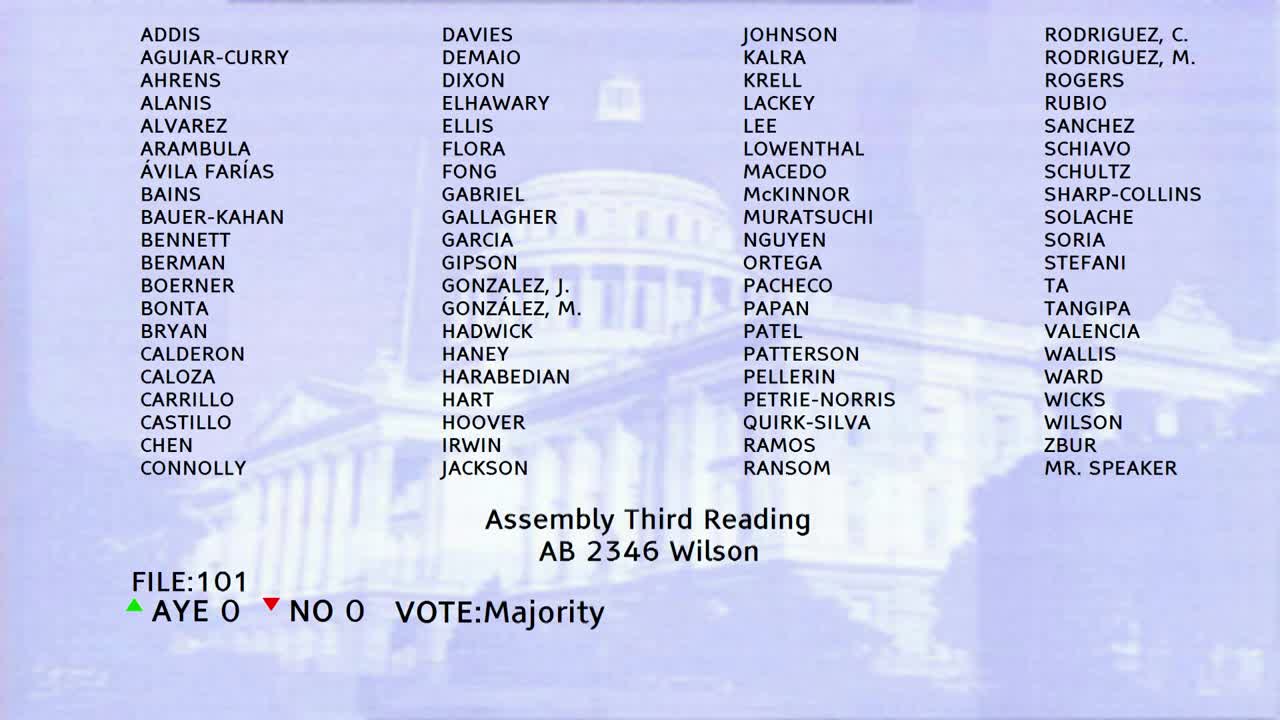 1MIN
Assembly Floor
Bill Author

Bill Co-Author(s):