AB 2337: Peace officers: theft.
- Session Year: 2025-2026
- House: Assembly
- Latest Version Date: 2026-09-03
Current Status:
Failed
(2026-09-20: Vetoed by Governor.)
Introduced
In Committee
Awaiting First Chamber Vote
Passed First Chamber
In Committee
Awaiting Second Chamber Vote
Passed Second Chamber
Enacted
Existing law establishes the Commission on Peace Officer Standards and Training (POST) to set minimum standards for the recruitment and training of peace officers and to develop training courses and curriculum. Existing law authorizes POST to suspend or revoke the certification of a peace officer if the peace officer has engaged in any serious misconduct, as specified. Existing law requires POST to adopt by regulation a definition of serious misconduct that serves as the criteria to be considered for ineligibility for, or revocation of, certification, as provided.
This bill would additionally authorize POST to suspend or revoke the certification of a peace officer who commits specified theft under color of authority, where the peace officer acted with specific intent to permanently deprive the owner of the property.
This bill would incorporate additional changes to Section 13510.8 of the Penal Code proposed by AB 1896 to be operative only if this bill and AB 1896 are enacted and this bill is enacted last.
Existing law establishes the Commission on Peace Officer Standards and Training (POST) to set minimum standards for the recruitment and training of peace officers and to develop training courses and curriculum. Existing law authorizes POST to suspend or revoke the certification of a peace officer if the peace officer has engaged in any serious misconduct, as specified. Existing law requires POST to adopt by regulation a definition of serious misconduct that serves as the criteria to be considered for ineligibility for, or revocation of, certification, as provided.
This bill would additionally authorize POST to suspend or revoke the certification of a peace officer who commits specified theft under color of authority. authority, where the peace officer acted with specific intent to permanently deprive the owner of the property.
Existing law establishes the Commission on Peace Officer Standards and Training (POST) to set minimum standards for the recruitment and training of peace officers and to develop training courses and curriculum. Existing law authorizes POST to suspend or revoke the certification of a peace officer if the peace officer has engaged in any serious misconduct, as specified. Existing law requires POST to adopt by regulation a definition of serious misconduct that serves as the criteria to be considered for ineligibility for, or revocation of, certification, as provided.
This bill would additionally authorize POST to suspend or revoke the certification of a peace officer who commits specified theft under color of authority.
Existing law, the Safe Neighborhoods and Schools Act, enacted as an initiative statute by Proposition 47, as approved by the electors at the November 4, 2014, statewide general election, makes the theft of money, labor, or property petty theft punishable as a misdemeanor, whenever the value of the property taken does not exceed $950. Existing law defines theft of a value exceeding that amount as grand theft, and defines theft of a firearm as grand theft regardless of the value of the property taken. Existing law authorizes the Legislature to amend the provisions of the act by a 2/3 vote of each house of the Legislature if it is consistent with, and furthers the purpose of, the act.This bill would make theft of property taken without lawful authority by a public officer under color of authority grand theft regardless of the value of the property taken. By increasing the punishment of a crime, this bill would impose a state-mandated local program.The California Constitution requires the state to reimburse local agencies and school districts for certain costs mandated by the state. Statutory provisions establish procedures for making that reimbursement.This bill would provide that no reimbursement is required by this act for a specified reason.Existing law, the Safe Neighborhoods and Schools Act, enacted as an initiative statute by Proposition 47, as approved by the electors at the November 4, 2014, statewide general election, makes the theft of money, labor, or property petty theft punishable as a misdemeanor, whenever the value of the property taken does not exceed $950. Existing law defines theft of a value exceeding that amount as grand theft, and defines theft of a firearm as grand theft regardless of the value of the property taken. Existing law authorizes the Legislature to amend the provisions of the act by a 2/3 vote of each house of the Legislature if it is consistent with, and furthers the purpose of, the act.
This bill would make theft of property taken without lawful authority by a public officer under color of authority grand theft regardless of the value of the property taken. By increasing the punishment of a crime, this bill would impose a state-mandated local program.
The California Constitution requires the state to reimburse local agencies and school districts for certain costs mandated by the state. Statutory provisions establish procedures for making that reimbursement.
This bill would provide that no reimbursement is required by this act for a specified reason.
(a)(1)The commission shall revoke the certification of a certified peace officer if the person is or has become ineligible to hold office as a peace officer pursuant to Section 1029 of the Government Code.
(2)The commission may suspend or revoke the certification of a peace officer if the person has been terminated for cause from employment as a peace officer for, or has, while employed as a peace officer, otherwise engaged in, any serious misconduct as described in subdivision (b).
(3)The commission may cancel the certificate or proof of eligibility of a peace officer if the commission determines that there was fraud or misrepresentation made by an applicant at any time during the application process that resulted in the issuance of the certification.
(b)By January 1, 2023, the commission shall adopt by regulation a definition of serious misconduct that shall serve as the criteria to be considered for ineligibility for, or revocation of, certification. This definition shall include all of the following:
(1)Dishonesty relating to the reporting, investigation, or prosecution of a crime, or relating to the reporting of, or investigation of misconduct by, a peace officer or custodial officer, including, but not limited to, false statements, intentionally filing false reports, tampering with, falsifying, destroying, or concealing evidence, perjury, and tampering with data recorded by a body-worn camera or other recording device for purposes of concealing misconduct.
(2)Abuse of power, including, but not limited to, intimidating witnesses, knowingly obtaining a false confession, and knowingly making a false arrest.
(3)Physical abuse, including, but not limited to, the excessive or unreasonable use of force.
(4)Sexual assault, as described in subdivision (b) of Section 832.7.
(5)Demonstrating bias on the basis of race, national origin, religion, gender identity or expression, housing status, sexual orientation, mental or physical disability, or other protected status in violation of law or department policy or inconsistent with a peace officers obligation to carry out their duties in a fair and unbiased manner. This paragraph does not limit an employees rights under the First Amendment to the United States Constitution.
(6)Acts that violate the law and are sufficiently egregious or repeated as to be inconsistent with a peace officers obligation to uphold the law or respect the rights of members of the public, as determined by the commission.
(7)Participation in a law enforcement gang. For the purpose of this paragraph, a law enforcement gang means a group of peace officers within a law enforcement agency who may identify themselves by a name and may be associated with an identifying symbol, including, but not limited to, matching tattoos, and who engage in a pattern of on-duty behavior that intentionally violates the law or fundamental principles of professional policing, including, but not limited to, excluding, harassing, or discriminating against any individual based on a protected category under federal or state antidiscrimination laws, engaging in or promoting conduct that violates the rights of other employees or members of the public, violating agency policy, the persistent practice of unlawful detention or use of excessive force in circumstances where it is known to be unjustified, falsifying police reports, fabricating or destroying evidence, targeting persons for enforcement based solely on protected characteristics of those persons, theft, unauthorized use of alcohol or drugs on duty, unlawful or unauthorized protection of other members from disciplinary actions, and retaliation against other officers who threaten or interfere with the activities of the group.
(8)Failure to cooperate with an investigation into potential police misconduct, including an investigation conducted pursuant to this chapter. For purposes of this paragraph, the lawful exercise of rights granted under the United States Constitution, the California Constitution, or any other law shall not be considered a failure to cooperate.
(9)Failure to intercede when present and observing another officer using force that is clearly beyond that which is necessary, as determined by an objectively reasonable officer under the circumstances, taking into account the possibility that other officers may have additional information regarding the threat posed by a subject.
(10)Theft, pursuant to subdivision (a) of Section 484, committed by a peace officer under color of authority, where the peace officer acted with specific intent to permanently deprive the owner of the property and the conduct was not the result of mere negligence, administrative oversight, or good-faith error in evidence handling.
(c)(1)Beginning no later than January 1, 2023, each law enforcement agency shall be responsible for the completion of investigations of allegations of serious misconduct by a peace officer, regardless of their employment status.
(2)The division shall promptly review any grounds for decertification described in subdivision (a) received from an agency. The division shall have the authority to review any agency or other investigative authority file, as well as to conduct additional investigation, if necessary. The division shall have the authority to inspect or duplicate any criminal history information, criminal offender record information, or criminal justice information, including information contained in or derived from the California Law Enforcement Telecommunications System and any other information that would otherwise be confidential, privileged, or subject to any other restriction on disclosure when that information is included as part of an investigation involving a matter within the commissions jurisdiction. The division shall only have authority to review and investigate allegations for purposes of decertification.
(3)(A)The board, in their discretion, may request that the division review an investigative file or recommend that the commission direct the division to investigate any potential grounds for decertification of a peace officer. Those requests and recommendations from the board to the division or commission must be based upon a decision by a majority vote.
(B)The commission, in its discretion, may direct the division to review an investigative file. The commission, either upon its own motion or in response to a recommendation from the board, may direct the division to investigate any potential grounds for decertification of a peace officer.
(C)The division, in its discretion, may investigate without the request of the commission or board any potential grounds for revocation of certification of a peace officer.
(4)The division, in carrying out any investigation initiated pursuant to this section or any other duty shall have all of the powers of investigation granted pursuant to Article 2 (commencing with Section 11180) of Chapter 2 of Part 1 of Division 3 of Title 2 of the Government Code.
(5)Notwithstanding any other law, the investigation shall be completed within three years after the receipt of the completed report of the disciplinary or internal affairs investigation from the employing agency pursuant to Section 13510.9, however, no time limit shall apply if a report of the conduct was not made to the commission. An investigation shall be considered completed upon a notice of intent to deny, suspend, or revoke certification issued pursuant to paragraph (1) of subdivision (a) of Section 13510.85. The time limit shall be tolled during the appeal of a termination or other disciplinary action through an administrative or judicial proceeding or during any criminal prosecution of the peace officer. The commission shall consider the peace officers prior conduct and service record, and any instances of misconduct, including any incidents occurring beyond the time limitation for investigation in evaluating whether to revoke certification for the incident under investigation.
(6)An action by an agency or decision resulting from an appeal of an agencys action does not preclude action by the commission to investigate, suspend, or revoke a peace officers certification pursuant to this section. Whether a particular factual or legal determination in a prior appeal proceeding shall have preclusive effect in proceedings under this chapter shall be governed by the existing law of collateral estoppel.
(d)Upon arrest or indictment of a peace officer for any crime described in Section 1029 of the Government Code, or discharge from any law enforcement agency for grounds set forth in subdivision (a), or separation from employment of a peace officer during a pending investigation into allegations of serious misconduct, the executive director shall order the immediate temporary suspension of any certificate or proof of eligibility held by that peace officer upon the determination by the executive director that the temporary suspension is in the best interest of the health, safety, or welfare of the public. The order of temporary suspension shall be made in writing and shall specify the basis for the executive directors determination. Following the issuance of a temporary suspension order, proceedings of the commission in the exercise of its authority to discipline any peace officer shall be promptly scheduled as provided for in this section. The temporary suspension shall continue in effect until issuance of the final decision on revocation pursuant to this section or until the order is withdrawn by the executive director.
(e)Records of an investigation of any person by the commission shall be retained for 30 years following the date that the investigation is deemed concluded by the commission. The commission may destroy records prior to the expiration of the 30-year retention period if the subject is deceased and no action upon the complaint was taken by the commission beyond the commissions initial intake of the complaint.
(f)Any peace officer may voluntarily surrender their certification permanently. Voluntary permanent surrender of certification pursuant to this subdivision shall have the same effect as revocation. Voluntary permanent surrender is not the same as placement of a valid certification into inactive status during a period in which a person is not actively employed as a peace officer. A permanently surrendered certification cannot be reactivated.
(g)(1)The commission may initiate proceedings to revoke or suspend a peace officers certification for conduct that occurred before January 1, 2022, only for either of the following:
(A)Serious misconduct pursuant to paragraph (1) or (4) of subdivision (b) or pursuant to paragraph (3) of subdivision (b) for the use of deadly force that results in death or serious bodily injury.
(B)If the employing agency makes a final determination regarding its investigation of the misconduct after January 1, 2022.
(2)Nothing in this subdivision prevents the commission from considering the peace officers prior conduct and service record in determining whether suspension or revocation is appropriate for serious misconduct.
(h)(1)A revocation of certification shall not be undertaken pursuant to this section because of a court finding made in a challenge brought pursuant to Section 745.
(2)This subdivision does not prohibit revocation based on the underlying acts or omissions which formed the basis of the action brought pursuant to Section 745, if the revocation otherwise conforms to all the rules and procedures applicable to those proceedings, and the officer is accorded all due process protections provided in those proceedings.
SEC. 1.5.Section 13510.8 of the Penal Code is amended to read:13510.8.(a)(1)The commission shall revoke the certification of a certified peace officer if the person is or has become ineligible to hold office as a peace officer pursuant to Section 1029 of the Government Code.
(2)The commission may suspend or revoke the certification of a peace officer if the person has been terminated for cause from employment as a peace officer for, or has, while employed as a peace officer, otherwise engaged in, any serious misconduct as described in subdivision (b).
(3)The commission may cancel the certificate or proof of eligibility of a peace officer if the commission determines that there was fraud or misrepresentation made by an applicant at any time during the application process that resulted in the issuance of the certification.
(4)(A)For purposes of an applicant to attend the basic course who was previously employed as a sworn law enforcement officer or individual contractor and personally engaged in immigration enforcement, the commission shall deny suitability for enrollment in the basic course, unless the commission receives notice from a hiring agency granting their suitability.
(B)No applicant described in subparagraph (A) shall enter the basic course without a hiring agency granting their suitability.
(C)Suitability shall be based off of both of the following:
(i)The standards the commission shall adopt by regulation that shall serve as the criteria for suitability that a hiring agency will consider when considering suitability of an applicant that shall include whether an applicant personally assisted in immigration enforcement and to what degree.
(ii)The standards established for peace officers under all applicable California laws and regulations, including, but not limited to, those set forth in Section 1031 of the Government Code and this section.
(D)Suitability shall be determined on a case-by-case basis based off of information contained in the applicants background check and any additional information the commission deems relevant.
(b)By January 1, 2023, the commission shall adopt by regulation a definition of serious misconduct that shall serve as the criteria to be considered for ineligibility for, or revocation of, certification. This definition shall include all of the following:
(1)Dishonesty relating to the reporting, investigation, or prosecution of a crime, or relating to the reporting of, or investigation of misconduct by, a peace officer or custodial officer, including, but not limited to, false statements, intentionally filing false reports, tampering with, falsifying, destroying, or concealing evidence, perjury, and tampering with data recorded by a body-worn camera or other recording device for purposes of concealing misconduct.
(2)Abuse of power, including, but not limited to, intimidating witnesses, knowingly obtaining a false confession, and knowingly making a false arrest.
(3)Physical abuse, including, but not limited to, the excessive or unreasonable use of force.
(4)Sexual assault, as described in subdivision (b) of Section 832.7.
(5)Demonstrating bias on the basis of race, national origin, religion, gender identity or expression, housing status, sexual orientation, mental or physical disability, or other protected status in violation of law or department policy or inconsistent with a peace officers obligation to carry out their duties in a fair and unbiased manner. This paragraph does not limit an employees rights under the First Amendment to the United States Constitution.
(6)Acts that violate the law and are sufficiently egregious or repeated as to be inconsistent with a peace officers obligation to uphold the law or respect the rights of members of the public, as determined by the commission.
(7)Participation in a law enforcement gang. For the purpose of this paragraph, a law enforcement gang means a group of peace officers within a law enforcement agency who may identify themselves by a name and may be associated with an identifying symbol, including, but not limited to, matching tattoos, and who engage in a pattern of on-duty behavior that intentionally violates the law or fundamental principles of professional policing, including, but not limited to, excluding, harassing, or discriminating against any individual based on a protected category under federal or state antidiscrimination laws, engaging in or promoting conduct that violates the rights of other employees or members of the public, violating agency policy, the persistent practice of unlawful detention or use of excessive force in circumstances where it is known to be unjustified, falsifying police reports, fabricating or destroying evidence, targeting persons for enforcement based solely on protected characteristics of those persons, theft, unauthorized use of alcohol or drugs on duty, unlawful or unauthorized protection of other members from disciplinary actions, and retaliation against other officers who threaten or interfere with the activities of the group.
(8)Failure to cooperate with an investigation into potential police misconduct, including an investigation conducted pursuant to this chapter. For purposes of this paragraph, the lawful exercise of rights granted under the United States Constitution, the California Constitution, or any other law shall not be considered a failure to cooperate.
(9)Failure to intercede when present and observing another officer using force that is clearly beyond that which is necessary, as determined by an objectively reasonable officer under the circumstances, taking into account the possibility that other officers may have additional information regarding the threat posed by a subject.
(10)Theft, pursuant to subdivision (a) of Section 484, committed by a peace officer under color of authority, where the peace officer acted with specific intent to permanently deprive the owner of the property and the conduct was not the result of mere negligence, administrative oversight, or good-faith error in evidence handling.
(c)(1)Beginning no later than January 1, 2023, each law enforcement agency shall be responsible for the completion of investigations of allegations of serious misconduct by a peace officer, regardless of their employment status.
(2)The division shall promptly review any grounds for decertification described in subdivision (a) received from an agency. The division shall have the authority to review any agency or other investigative authority file, as well as to conduct additional investigation, if necessary. The division shall have the authority to inspect or duplicate any criminal history information, criminal offender record information, or criminal justice information, including information contained in or derived from the California Law Enforcement Telecommunications System and any other information that would otherwise be confidential, privileged, or subject to any other restriction on disclosure when that information is included as part of an investigation involving a matter within the commissions jurisdiction. The division shall only have authority to review and investigate allegations for purposes of decertification.
(3)(A)The board, in their discretion, may request that the division review an investigative file or recommend that the commission direct the division to investigate any potential grounds for decertification of a peace officer. Those requests and recommendations from the board to the division or commission must be based upon a decision by a majority vote.
(B)The commission, in its discretion, may direct the division to review an investigative file. The commission, either upon its own motion or in response to a recommendation from the board, may direct the division to investigate any potential grounds for decertification of a peace officer.
(C)The division, in its discretion, may investigate without the request of the commission or board any potential grounds for revocation of certification of a peace officer.
(4)The division, in carrying out any investigation initiated pursuant to this section or any other duty shall have all of the powers of investigation granted pursuant to Article 2 (commencing with Section 11180) of Chapter 2 of Part 1 of Division 3 of Title 2 of the Government Code.
(5)Notwithstanding any other law, the investigation shall be completed within three years after the receipt of the completed report of the disciplinary or internal affairs investigation from the employing agency pursuant to Section 13510.9, however, no time limit shall apply if a report of the conduct was not made to the commission. An investigation shall be considered completed upon a notice of intent to deny, suspend, or revoke certification issued pursuant to paragraph (1) of subdivision (a) of Section 13510.85. The time limit shall be tolled during the appeal of a termination or other disciplinary action through an administrative or judicial proceeding or during any criminal prosecution of the peace officer. The commission shall consider the peace officers prior conduct and service record, and any instances of misconduct, including any incidents occurring beyond the time limitation for investigation in evaluating whether to revoke certification for the incident under investigation.
(6)An action by an agency or decision resulting from an appeal of an agencys action does not preclude action by the commission to investigate, suspend, or revoke a peace officers certification pursuant to this section. Whether a particular factual or legal determination in a prior appeal proceeding shall have preclusive effect in proceedings under this chapter shall be governed by the existing law of collateral estoppel.
(d)Upon arrest or indictment of a peace officer for any crime described in Section 1029 of the Government Code, or discharge from any law enforcement agency for grounds set forth in subdivision (a), or separation from employment of a peace officer during a pending investigation into allegations of serious misconduct, the executive director shall order the immediate temporary suspension of any certificate or proof of eligibility held by that peace officer upon the determination by the executive director that the temporary suspension is in the best interest of the health, safety, or welfare of the public. The order of temporary suspension shall be made in writing and shall specify the basis for the executive directors determination. Following the issuance of a temporary suspension order, proceedings of the commission in the exercise of its authority to discipline any peace officer shall be promptly scheduled as provided for in this section. The temporary suspension shall continue in effect until issuance of the final decision on revocation pursuant to this section or until the order is withdrawn by the executive director.
(e)Records of an investigation of any person by the commission shall be retained for 30 years following the date that the investigation is deemed concluded by the commission. The commission may destroy records prior to the expiration of the 30-year retention period if the subject is deceased and no action upon the complaint was taken by the commission beyond the commissions initial intake of the complaint.
(f)Any peace officer may voluntarily surrender their certification permanently. Voluntary permanent surrender of certification pursuant to this subdivision shall have the same effect as revocation. Voluntary permanent surrender is not the same as placement of a valid certification into inactive status during a period in which a person is not actively employed as a peace officer. A permanently surrendered certification cannot be reactivated.
(g)(1)The commission may initiate proceedings to revoke or suspend a peace officers certification for conduct that occurred before January 1, 2022, only for either of the following:
(A)Serious misconduct pursuant to paragraph (1) or (4) of subdivision (b) or pursuant to paragraph (3) of subdivision (b) for the use of deadly force that results in death or serious bodily injury.
(B)If the employing agency makes a final determination regarding its investigation of the misconduct after January 1, 2022.
(2)Nothing in this subdivision prevents the commission from considering the peace officers prior conduct and service record in determining whether suspension or revocation is appropriate for serious misconduct.
(h)(1)A revocation of certification shall not be undertaken pursuant to this section because of a court finding made in a challenge brought pursuant to Section 745.
(2)This subdivision does not prohibit revocation based on the underlying acts or omissions which formed the basis of the action brought pursuant to Section 745, if the revocation otherwise conforms to all the rules and procedures applicable to those proceedings, and the officer is accorded all due process protections provided in those proceedings.
SEC. 2.Section 1.5 of this bill incorporates amendments to Section 13510.8 of the Penal Code proposed by both this bill and Assembly Bill 1896. That section of this bill shall only become operative if (1) both bills are enacted and become effective on or before January 1, 2027, (2) each bill amends Section 13510.8 of the Penal Code, and (3) this bill is enacted after Assembly Bill 1896, in which case Section 1 of this bill shall not become operative.
(a)(1)The commission shall revoke the certification of a certified peace officer if the person is or has become ineligible to hold office as a peace officer pursuant to Section 1029 of the Government Code.
(2)The commission may suspend or revoke the certification of a peace officer if the person has been terminated for cause from employment as a peace officer for, or has, while employed as a peace officer, otherwise engaged in, any serious misconduct as described in subdivision (b).
(3)The commission may cancel the certificate or proof of eligibility of a peace officer if the commission determines that there was fraud or misrepresentation made by an applicant at any time during the application process that resulted in the issuance of the certification.
(b)By January 1, 2023, the commission shall adopt by regulation a definition of serious misconduct that shall serve as the criteria to be considered for ineligibility for, or revocation of, certification. This definition shall include all of the following:
(1)Dishonesty relating to the reporting, investigation, or prosecution of a crime, or relating to the reporting of, or investigation of misconduct by, a peace officer or custodial officer, including, but not limited to, false statements, intentionally filing false reports, tampering with, falsifying, destroying, or concealing evidence, perjury, and tampering with data recorded by a body-worn camera or other recording device for purposes of concealing misconduct.
(2)Abuse of power, including, but not limited to, intimidating witnesses, knowingly obtaining a false confession, and knowingly making a false arrest.
(3)Physical abuse, including, but not limited to, the excessive or unreasonable use of force.
(4)Sexual assault, as described in subdivision (b) of Section 832.7.
(5)Demonstrating bias on the basis of race, national origin, religion, gender identity or expression, housing status, sexual orientation, mental or physical disability, or other protected status in violation of law or department policy or inconsistent with a peace officers obligation to carry out their duties in a fair and unbiased manner. This paragraph does not limit an employees rights under the First Amendment to the United States Constitution.
(6)Acts that violate the law and are sufficiently egregious or repeated as to be inconsistent with a peace officers obligation to uphold the law or respect the rights of members of the public, as determined by the commission.
(7)Participation in a law enforcement gang. For the purpose of this paragraph, a law enforcement gang means a group of peace officers within a law enforcement agency who may identify themselves by a name and may be associated with an identifying symbol, including, but not limited to, matching tattoos, and who engage in a pattern of on-duty behavior that intentionally violates the law or fundamental principles of professional policing, including, but not limited to, excluding, harassing, or discriminating against any individual based on a protected category under federal or state antidiscrimination laws, engaging in or promoting conduct that violates the rights of other employees or members of the public, violating agency policy, the persistent practice of unlawful detention or use of excessive force in circumstances where it is known to be unjustified, falsifying police reports, fabricating or destroying evidence, targeting persons for enforcement based solely on protected characteristics of those persons, theft, unauthorized use of alcohol or drugs on duty, unlawful or unauthorized protection of other members from disciplinary actions, and retaliation against other officers who threaten or interfere with the activities of the group.
(8)Failure to cooperate with an investigation into potential police misconduct, including an investigation conducted pursuant to this chapter. For purposes of this paragraph, the lawful exercise of rights granted under the United States Constitution, the California Constitution, or any other law shall not be considered a failure to cooperate.
(9)Failure to intercede when present and observing another officer using force that is clearly beyond that which is necessary, as determined by an objectively reasonable officer under the circumstances, taking into account the possibility that other officers may have additional information regarding the threat posed by a subject.
(10)Theft, pursuant to subdivision (a) of Section 484, committed by a peace officer under color of authority. authority, where the peace officer acted with specific intent to permanently deprive the owner of the property and the conduct was not the result of mere negligence, administrative oversight, or good-faith error in evidence handling.
(c)(1)Beginning no later than January 1, 2023, each law enforcement agency shall be responsible for the completion of investigations of allegations of serious misconduct by a peace officer, regardless of their employment status.
(2)The division shall promptly review any grounds for decertification described in subdivision (a) received from an agency. The division shall have the authority to review any agency or other investigative authority file, as well as to conduct additional investigation, if necessary. The division shall have the authority to inspect or duplicate any criminal history information, criminal offender record information, or criminal justice information, including information contained in or derived from the California Law Enforcement Telecommunications System and any other information that would otherwise be confidential, privileged, or subject to any other restriction on disclosure when that information is included as part of an investigation involving a matter within the commissions jurisdiction. The division shall only have authority to review and investigate allegations for purposes of decertification.
(3)(A)The board, in their discretion, may request that the division review an investigative file or recommend that the commission direct the division to investigate any potential grounds for decertification of a peace officer. Those requests and recommendations from the board to the division or commission must be based upon a decision by a majority vote.
(B)The commission, in its discretion, may direct the division to review an investigative file. The commission, either upon its own motion or in response to a recommendation from the board, may direct the division to investigate any potential grounds for decertification of a peace officer.
(C)The division, in its discretion, may investigate without the request of the commission or board any potential grounds for revocation of certification of a peace officer.
(4)The division, in carrying out any investigation initiated pursuant to this section or any other duty shall have all of the powers of investigation granted pursuant to Article 2 (commencing with Section 11180) of Chapter 2 of Part 1 of Division 3 of Title 2 of the Government Code.
(5)Notwithstanding any other law, the investigation shall be completed within three years after the receipt of the completed report of the disciplinary or internal affairs investigation from the employing agency pursuant to Section 13510.9, however, no time limit shall apply if a report of the conduct was not made to the commission. An investigation shall be considered completed upon a notice of intent to deny, suspend, or revoke certification issued pursuant to paragraph (1) of subdivision (a) of Section 13510.85. The time limit shall be tolled during the appeal of a termination or other disciplinary action through an administrative or judicial proceeding or during any criminal prosecution of the peace officer. The commission shall consider the peace officers prior conduct and service record, and any instances of misconduct, including any incidents occurring beyond the time limitation for investigation in evaluating whether to revoke certification for the incident under investigation.
(6)An action by an agency or decision resulting from an appeal of an agencys action does not preclude action by the commission to investigate, suspend, or revoke a peace officers certification pursuant to this section. Whether a particular factual or legal determination in a prior appeal proceeding shall have preclusive effect in proceedings under this chapter shall be governed by the existing law of collateral estoppel.
(d)Upon arrest or indictment of a peace officer for any crime described in Section 1029 of the Government Code, or discharge from any law enforcement agency for grounds set forth in subdivision (a), or separation from employment of a peace officer during a pending investigation into allegations of serious misconduct, the executive director shall order the immediate temporary suspension of any certificate or proof of eligibility held by that peace officer upon the determination by the executive director that the temporary suspension is in the best interest of the health, safety, or welfare of the public. The order of temporary suspension shall be made in writing and shall specify the basis for the executive directors determination. Following the issuance of a temporary suspension order, proceedings of the commission in the exercise of its authority to discipline any peace officer shall be promptly scheduled as provided for in this section. The temporary suspension shall continue in effect until issuance of the final decision on revocation pursuant to this section or until the order is withdrawn by the executive director.
(e)Records of an investigation of any person by the commission shall be retained for 30 years following the date that the investigation is deemed concluded by the commission. The commission may destroy records prior to the expiration of the 30-year retention period if the subject is deceased and no action upon the complaint was taken by the commission beyond the commissions initial intake of the complaint.
(f)Any peace officer may voluntarily surrender their certification permanently. Voluntary permanent surrender of certification pursuant to this subdivision shall have the same effect as revocation. Voluntary permanent surrender is not the same as placement of a valid certification into inactive status during a period in which a person is not actively employed as a peace officer. A permanently surrendered certification cannot be reactivated.
(g)(1)The commission may initiate proceedings to revoke or suspend a peace officers certification for conduct that occurred before January 1, 2022, only for either of the following:
(A)Serious misconduct pursuant to paragraph (1) or (4) of subdivision (b) or pursuant to paragraph (3) of subdivision (b) for the use of deadly force that results in death or serious bodily injury.
(B)If the employing agency makes a final determination regarding its investigation of the misconduct after January 1, 2022.
(2)Nothing in this subdivision prevents the commission from considering the peace officers prior conduct and service record in determining whether suspension or revocation is appropriate for serious misconduct.
(h)(1)A revocation of certification shall not be undertaken pursuant to this section because of a court finding made in a challenge brought pursuant to Section 745.
(2)This subdivision does not prohibit revocation based on the underlying acts or omissions which formed the basis of the action brought pursuant to Section 745, if the revocation otherwise conforms to all the rules and procedures applicable to those proceedings, and the officer is accorded all due process protections provided in those proceedings.
(a)(1)The commission shall revoke the certification of a certified peace officer if the person is or has become ineligible to hold office as a peace officer pursuant to Section 1029 of the Government Code.
(2)The commission may suspend or revoke the certification of a peace officer if the person has been terminated for cause from employment as a peace officer for, or has, while employed as a peace officer, otherwise engaged in, any serious misconduct as described in subdivision (b).
(3)The commission may cancel the certificate or proof of eligibility of a peace officer if the commission determines that there was fraud or misrepresentation made by an applicant at any time during the application process that resulted in the issuance of the certification.
(b)By January 1, 2023, the commission shall adopt by regulation a definition of serious misconduct that shall serve as the criteria to be considered for ineligibility for, or revocation of, certification. This definition shall include all of the following:
(1)Dishonesty relating to the reporting, investigation, or prosecution of a crime, or relating to the reporting of, or investigation of misconduct by, a peace officer or custodial officer, including, but not limited to, false statements, intentionally filing false reports, tampering with, falsifying, destroying, or concealing evidence, perjury, and tampering with data recorded by a body-worn camera or other recording device for purposes of concealing misconduct.
(2)Abuse of power, including, but not limited to, intimidating witnesses, knowingly obtaining a false confession, and knowingly making a false arrest.
(3)Physical abuse, including, but not limited to, the excessive or unreasonable use of force.
(4)Sexual assault, as described in subdivision (b) of Section 832.7.
(5)Demonstrating bias on the basis of race, national origin, religion, gender identity or expression, housing status, sexual orientation, mental or physical disability, or other protected status in violation of law or department policy or inconsistent with a peace officers obligation to carry out their duties in a fair and unbiased manner. This paragraph does not limit an employees rights under the First Amendment to the United States Constitution.
(6)Acts that violate the law and are sufficiently egregious or repeated as to be inconsistent with a peace officers obligation to uphold the law or respect the rights of members of the public, as determined by the commission.
(7)Participation in a law enforcement gang. For the purpose of this paragraph, a law enforcement gang means a group of peace officers within a law enforcement agency who may identify themselves by a name and may be associated with an identifying symbol, including, but not limited to, matching tattoos, and who engage in a pattern of on-duty behavior that intentionally violates the law or fundamental principles of professional policing, including, but not limited to, excluding, harassing, or discriminating against any individual based on a protected category under federal or state antidiscrimination laws, engaging in or promoting conduct that violates the rights of other employees or members of the public, violating agency policy, the persistent practice of unlawful detention or use of excessive force in circumstances where it is known to be unjustified, falsifying police reports, fabricating or destroying evidence, targeting persons for enforcement based solely on protected characteristics of those persons, theft, unauthorized use of alcohol or drugs on duty, unlawful or unauthorized protection of other members from disciplinary actions, and retaliation against other officers who threaten or interfere with the activities of the group.
(8)Failure to cooperate with an investigation into potential police misconduct, including an investigation conducted pursuant to this chapter. For purposes of this paragraph, the lawful exercise of rights granted under the United States Constitution, the California Constitution, or any other law shall not be considered a failure to cooperate.
(9)Failure to intercede when present and observing another officer using force that is clearly beyond that which is necessary, as determined by an objectively reasonable officer under the circumstances, taking into account the possibility that other officers may have additional information regarding the threat posed by a subject.
(10)Theft, pursuant to subdivision (a) of Section 484, committed by a peace officer under color of authority.
(c)(1)Beginning no later than January 1, 2023, each law enforcement agency shall be responsible for the completion of investigations of allegations of serious misconduct by a peace officer, regardless of their employment status.
(2)The division shall promptly review any grounds for decertification described in subdivision (a) received from an agency. The division shall have the authority to review any agency or other investigative authority file, as well as to conduct additional investigation, if necessary. The division shall have the authority to inspect or duplicate any criminal history information, criminal offender record information, or criminal justice information, including information contained in or derived from the California Law Enforcement Telecommunications System and any other information that would otherwise be confidential, privileged, or subject to any other restriction on disclosure when that information is included as part of an investigation involving a matter within the commissions jurisdiction. The division shall only have authority to review and investigate allegations for purposes of decertification.
(3)(A)The board, in their discretion, may request that the division review an investigative file or recommend that the commission direct the division to investigate any potential grounds for decertification of a peace officer. Those requests and recommendations from the board to the division or commission must be based upon a decision by a majority vote.
(B)The commission, in its discretion, may direct the division to review an investigative file. The commission, either upon its own motion or in response to a recommendation from the board, may direct the division to investigate any potential grounds for decertification of a peace officer.
(C)The division, in its discretion, may investigate without the request of the commission or board any potential grounds for revocation of certification of a peace officer.
(4)The division, in carrying out any investigation initiated pursuant to this section or any other duty shall have all of the powers of investigation granted pursuant to Article 2 (commencing with Section 11180) of Chapter 2 of Part 1 of Division 3 of Title 2 of the Government Code.
(5)Notwithstanding any other law, the investigation shall be completed within three years after the receipt of the completed report of the disciplinary or internal affairs investigation from the employing agency pursuant to Section 13510.9, however, no time limit shall apply if a report of the conduct was not made to the commission. An investigation shall be considered completed upon a notice of intent to deny, suspend, or revoke certification issued pursuant to paragraph (1) of subdivision (a) of Section 13510.85. The time limit shall be tolled during the appeal of a termination or other disciplinary action through an administrative or judicial proceeding or during any criminal prosecution of the peace officer. The commission shall consider the peace officers prior conduct and service record, and any instances of misconduct, including any incidents occurring beyond the time limitation for investigation in evaluating whether to revoke certification for the incident under investigation.
(6)An action by an agency or decision resulting from an appeal of an agencys action does not preclude action by the commission to investigate, suspend, or revoke a peace officers certification pursuant to this section. Whether a particular factual or legal determination in a prior appeal proceeding shall have preclusive effect in proceedings under this chapter shall be governed by the existing law of collateral estoppel.
(d)Upon arrest or indictment of a peace officer for any crime described in Section 1029 of the Government Code, or discharge from any law enforcement agency for grounds set forth in subdivision (a), or separation from employment of a peace officer during a pending investigation into allegations of serious misconduct, the executive director shall order the immediate temporary suspension of any certificate or proof of eligibility held by that peace officer upon the determination by the executive director that the temporary suspension is in the best interest of the health, safety, or welfare of the public. The order of temporary suspension shall be made in writing and shall specify the basis for the executive directors determination. Following the issuance of a temporary suspension order, proceedings of the commission in the exercise of its authority to discipline any peace officer shall be promptly scheduled as provided for in this section. The temporary suspension shall continue in effect until issuance of the final decision on revocation pursuant to this section or until the order is withdrawn by the executive director.
(e)Records of an investigation of any person by the commission shall be retained for 30 years following the date that the investigation is deemed concluded by the commission. The commission may destroy records prior to the expiration of the 30-year retention period if the subject is deceased and no action upon the complaint was taken by the commission beyond the commissions initial intake of the complaint.
(f)Any peace officer may voluntarily surrender their certification permanently. Voluntary permanent surrender of certification pursuant to this subdivision shall have the same effect as revocation. Voluntary permanent surrender is not the same as placement of a valid certification into inactive status during a period in which a person is not actively employed as a peace officer. A permanently surrendered certification cannot be reactivated.
(g)(1)The commission may initiate proceedings to revoke or suspend a peace officers certification for conduct that occurred before January 1, 2022, only for either of the following:
(A)Serious misconduct pursuant to paragraph (1) or (4) of subdivision (b) or pursuant to paragraph (3) of subdivision (b) for the use of deadly force that results in death or serious bodily injury.
(B)If the employing agency makes a final determination regarding its investigation of the misconduct after January 1, 2022.
(2)Nothing in this subdivision prevents the commission from considering the peace officers prior conduct and service record in determining whether suspension or revocation is appropriate for serious misconduct.
(h)(1)A revocation of certification shall not be undertaken pursuant to this section because of a court finding made in a challenge brought pursuant to Section 745.
(2)This subdivision does not prohibit revocation based on the underlying acts or omissions which formed the basis of the action brought pursuant to Section 745, if the revocation otherwise conforms to all the rules and procedures applicable to those proceedings, and the officer is accorded all due process protections provided in those proceedings.
SECTION 1.Section 487 of the Penal Code is amended to read:487.Grand theft is theft committed in any of the following cases:(a)When the money, labor, real property, or personal property taken is of a value exceeding nine hundred fifty dollars ($950), except as provided in subdivision (b).(b)Notwithstanding subdivision (a), grand theft is committed in any of the following cases:(1)(A)When domestic fowls, avocados, olives, citrus or deciduous fruits, other fruits, vegetables, nuts, artichokes, or other farm crops are taken of a value exceeding two hundred fifty dollars ($250).(B)For the purposes of establishing that the value of domestic fowls, avocados, olives, citrus or deciduous fruits, other fruits, vegetables, nuts, artichokes, or other farm crops under this paragraph exceeds two hundred fifty dollars ($250), that value may be shown by the presentation of credible evidence which establishes that on the day of the theft domestic fowls, avocados, olives, citrus or deciduous fruits, other fruits, vegetables, nuts, artichokes, or other farm crops of the same variety and weight exceeded two hundred fifty dollars ($250) in wholesale value.(2)When fish, shellfish, mollusks, crustaceans, kelp, algae, or other aquacultural products are taken from a commercial or research operation which is producing that product, of a value exceeding two hundred fifty dollars ($250).(3)Where the money, labor, real property, or personal property is taken by a servant, agent, or employee from their principal or employer and aggregates nine hundred fifty dollars ($950) or more in any 12 consecutive month period.(4)When the property is taken without lawful authority by a public officer under color of authority.(c)When the property is taken from the person of another.(d)When the property taken is any of the following:(1)An automobile.(2)A firearm.(e)If the value of the money, labor, real property, or personal property taken exceeds nine hundred fifty dollars ($950) over the course of distinct but related acts, including acts committed against multiple victims or in counties other than the county of the current offense, the value of the money, labor, real property, or personal property taken may properly be aggregated to charge a count of grand theft, if the acts are motivated by one intention, one general impulse, and one plan. Evidence that distinct acts are motivated by one intention, one general impulse, and one plan may include, but is not limited to, evidence that the acts involve the same defendant or defendants, are substantially similar in nature, or occur within a 90-day period.SEC. 2.Section 490.2 of the Penal Code is amended to read:490.2.(a)Notwithstanding Section 487 or any other provision of law defining grand theft, obtaining any property by theft where the value of the money, labor, real or personal property taken does not exceed nine hundred fifty dollars ($950) shall be considered petty theft and shall be punished as a misdemeanor, except that such person may instead be punished pursuant to subdivision (h) of Section 1170 if that person has one or more prior convictions for an offense specified in clause (iv) of subparagraph (C) of paragraph (2) of subdivision (e) of Section 667 or for an offense requiring registration pursuant to subdivision (c) of Section 290.(b)This section shall not be applicable to any theft that may be charged as an infraction pursuant to any other provision of law.(c)This section shall not apply to any of the following:(1)Theft of a firearm.(2)When the property is taken without lawful authority by a public officer under color of authority.SEC. 3.No reimbursement is required by this act pursuant to Section 6 of Article XIIIB of the California Constitution because the only costs that may be incurred by a local agency or school district will be incurred because this act creates a new crime or infraction, eliminates a crime or infraction, or changes the penalty for a crime or infraction, within the meaning of Section 17556 of the Government Code, or changes the definition of a crime within the meaning of Section 6 of Article XIIIB of the California Constitution.Grand theft is theft committed in any of the following cases:
(a)When the money, labor, real property, or personal property taken is of a value exceeding nine hundred fifty dollars ($950), except as provided in subdivision (b).
(b)Notwithstanding subdivision (a), grand theft is committed in any of the following cases:
(1)(A)When domestic fowls, avocados, olives, citrus or deciduous fruits, other fruits, vegetables, nuts, artichokes, or other farm crops are taken of a value exceeding two hundred fifty dollars ($250).
(B)For the purposes of establishing that the value of domestic fowls, avocados, olives, citrus or deciduous fruits, other fruits, vegetables, nuts, artichokes, or other farm crops under this paragraph exceeds two hundred fifty dollars ($250), that value may be shown by the presentation of credible evidence which establishes that on the day of the theft domestic fowls, avocados, olives, citrus or deciduous fruits, other fruits, vegetables, nuts, artichokes, or other farm crops of the same variety and weight exceeded two hundred fifty dollars ($250) in wholesale value.
(2)When fish, shellfish, mollusks, crustaceans, kelp, algae, or other aquacultural products are taken from a commercial or research operation which is producing that product, of a value exceeding two hundred fifty dollars ($250).
(3)Where the money, labor, real property, or personal property is taken by a servant, agent, or employee from their principal or employer and aggregates nine hundred fifty dollars ($950) or more in any 12 consecutive month period.
(4)When the property is taken without lawful authority by a public officer under color of authority.
(c)When the property is taken from the person of another.
(d)When the property taken is any of the following:
(1)An automobile.
(2)A firearm.
(e)If the value of the money, labor, real property, or personal property taken exceeds nine hundred fifty dollars ($950) over the course of distinct but related acts, including acts committed against multiple victims or in counties other than the county of the current offense, the value of the money, labor, real property, or personal property taken may properly be aggregated to charge a count of grand theft, if the acts are motivated by one intention, one general impulse, and one plan. Evidence that distinct acts are motivated by one intention, one general impulse, and one plan may include, but is not limited to, evidence that the acts involve the same defendant or defendants, are substantially similar in nature, or occur within a 90-day period.
SEC. 2.Section 490.2 of the Penal Code is amended to read:490.2.(a)Notwithstanding Section 487 or any other provision of law defining grand theft, obtaining any property by theft where the value of the money, labor, real or personal property taken does not exceed nine hundred fifty dollars ($950) shall be considered petty theft and shall be punished as a misdemeanor, except that such person may instead be punished pursuant to subdivision (h) of Section 1170 if that person has one or more prior convictions for an offense specified in clause (iv) of subparagraph (C) of paragraph (2) of subdivision (e) of Section 667 or for an offense requiring registration pursuant to subdivision (c) of Section 290.
(b)This section shall not be applicable to any theft that may be charged as an infraction pursuant to any other provision of law.
(c)This section shall not apply to theft of a firearm.(c)This section shall not apply to any of the following:
(1)Theft of a firearm.
(2)When the property is taken without lawful authority by a public officer under color of authority.
SEC. 3.No reimbursement is required by this act pursuant to Section 6 of Article XIIIB of the California Constitution because the only costs that may be incurred by a local agency or school district will be incurred because this act creates a new crime or infraction, eliminates a crime or infraction, or changes the penalty for a crime or infraction, within the meaning of Section 17556 of the Government Code, or changes the definition of a crime within the meaning of Section 6 of Article XIIIB of the California Constitution.
|
Date
|
Status
|
|---|---|
| Sep 20, 2026 | Vetoed by Governor. |
| Sep 10, 2026 | Enrolled and presented to the Governor at 3 p.m. |
| Aug 30, 2026 | Senate amendments concurred in. To Engrossing and Enrolling. (Ayes 77. Noes 0. Page 6937.). |
| Aug 30, 2026 | Senate amendments concurred in. To Engrossing and Enrolling. (Ayes 77. Noes 0.). |
| Aug 30, 2026 | Senate amendments concurred in. To Engrossing and Enrolling. |
| Aug 30, 2026 | In Assembly. Concurrence in Senate amendments pending. |
| Aug 30, 2026 | Read third time. Passed. Ordered to the Assembly. (Ayes 40. Noes 0.). |
| Aug 30, 2026 | Ordered to special consent calendar. |
| Aug 26, 2026 | Read second time. Ordered to third reading. |
| Aug 25, 2026 | Read third time and amended. Ordered to second reading. |
| Aug 13, 2026 | Read second time. Ordered to third reading. |
| Aug 13, 2026 | From committee: Do pass. (Ayes 6. Noes 0.) (August 13). |
| Aug 3, 2026 | In committee: Referred to APPR. suspense file. |
| Jun 29, 2026 | From committee chair, with author's amendments: Amend, and re-refer to committee. Read second time, amended, and re-referred to Com. on APPR. |
| Jun 24, 2026 | From committee: Do pass and re-refer to Com. on APPR. with recommendation: To Consent Calendar. (Ayes 6. Noes 0.) (June 23). Re-referred to Com. on APPR. |
| Jun 10, 2026 | Referred to Com. on PUB. S. |
| Jun 1, 2026 | In Senate. Read first time. To Com. on RLS. for assignment. |
| May 28, 2026 | Read third time. Passed. Ordered to the Senate. (Ayes 77. Noes 0. Page 5528.) |
| May 28, 2026 | Read third time. Passed. Ordered to the Senate. (Ayes 77. Noes 0.) |
| May 18, 2026 | Read second time. Ordered to third reading. |
| May 14, 2026 | From committee: Do pass. (Ayes 15. Noes 0.) (May 14). |
| May 6, 2026 | In committee: Set, first hearing. Referred to APPR. suspense file. |
| Apr 27, 2026 | Re-referred to Com. on APPR. |
| Apr 23, 2026 | Read second time and amended. |
| Apr 22, 2026 | From committee: Amend, and do pass as amended and re-refer to Com. on APPR. with recommendation: To Consent Calendar. (Ayes 9. Noes 0.) (April 21). |
| Apr 9, 2026 | In committee: Set, first hearing. Hearing canceled at the request of author. |
| Mar 9, 2026 | Referred to Com. on PUB. S. |
| Feb 20, 2026 | From printer. May be heard in committee March 22. |
| Feb 19, 2026 | Read first time. To print. |
|
Date
|
Description
|
Location
|
Votes
|
|
|---|---|---|---|---|
| Aug 30, 2026 | AB 2337 Lackey Concurrence in Senate Amendments | Assembly Floor |
Passed |
|
| Aug 30, 2026 | Assembly 3rd Reading AB2337 Lackey By Padilla | Senate Floor |
Passed |
|
| Aug 13, 2026 | Do pass | Senate Standing Committee on Appropriations |
Passed |
|
| Aug 3, 2026 | Placed on suspense file | Senate Standing Committee on Appropriations |
Passed |
|
| Jun 23, 2026 | Do pass, but first be re-referred to the Committee on [Appropriations] with the recommendation: To Consent Calendar | Senate Standing Committee on Public Safety |
Passed |
|
| May 28, 2026 | AB 2337 Lackey Assembly Third Reading | Assembly Floor |
Passed |
|
| May 14, 2026 | Do pass. | Assembly Standing Committee on Appropriations |
Passed |
|
| Apr 21, 2026 | Do pass as amended, and be re-referred to the Committee on [Appropriations] with recommendation: To Consent Calendar | Assembly Standing Committee on Public Safety |
Passed |
This list shows positions taken on this bill by organizations on the date displayed, which is linked to the original source.
Positions by individuals are not included.
|
Organization
|
Position
|
Date
|
|---|---|---|
| Los Angeles County District Attorney'S Office | ** Support | |
| Los Angeles District Attorney’s Office | ** Support | |
| Peace Officers Research Association Of California | ** Support |
GOVERNOR'S VETO
GV Bill Id:AB 2337
Author:(Lackey)
As Enrolled Ver:September 3, 2026
2/3 vote
SUMMARY
Adds theft committed by a peace officer under color of authority, where the officer acted with specific intent to permanently deprive the owner of the property, and the conduct was not the result of negligence, administrative oversight, or good-faith error in evidence handling, to the definition of ″serious misconduct″ for purposes of ineligibility for, or revocation of, peace officer certification.
Senate Amendments
- Require, for the theft to constitute ″serious misconduct,″ that the peace officer must have acted with specific intent to permanently deprive the owner of the property and the conduct was not the result of mere negligence, administrative oversight, or good-faith error in evidence handling.
- Double-joints this bill with AB 1896 (Mark Gonzalez) of the current legislative session to avoid chaptering issues.
Governor's Veto Message
"This bill adds theft committed by a peace officer under color of authority to the definition of "serious misconduct" for purposes of ineligibility for, or revocation of, peace officer certification.
"While I support the author's goal of holding peace officers accountable for illicit actions, this bill is duplicative of existing law. Serious misconduct is already defined as inclusive of, but not limited to, "abuse of power," "dishonesty," and "acts that violate the law and are sufficiently egregious or repeated as to be inconsistent with a peace officer's obligation to uphold the law or respect the rights of members of the public." The existing definition of serious misconduct
therefore already encompasses the use of peace officer authority to commit theft. Absent reports to the contrary, further particularizing of the definition is unnecessary and may be interpreted to suggest that other unspecified violations are not actionable."
COMMENTS
As passed by the Assembly, this bill: Added theft committed by a peace officer under color of authority to the definition of ″serious misconduct″ for purposes of ineligibility for, or revocation of, peace officer certification.
According to the Author
″AB 2337 will add theft by a peace officer under color of authority to the list of activities that constitute ″serious misconduct.″ I recognize that this theft is a serious breach of public trust, and this bill will help it by increasing accountability and holding our law enforcement to a higher standard.″
Arguments in Support
According to the Los Angeles County District Attorney′s Office, the sponsor of the bill, ″Theft under color of authority, while rare, is a significant betrayal of the public′s trust and causes a loss of confidence in the criminal justice system. Because of the seriousness of the betrayal of public trust and the harm it causes to the public′s confidence in our criminal justice system, this crime should be considered an act of serious misconduct under California law…
″Officers are acting under ″color of authority″ when they are performing an act that is made possible only because they are clothed with the authority of law, or when they are acting under the pretense of law. Conversely, officers are not acting under ″color of authority″ when they commit private acts in furtherance of personal pursuits.
″Our office believes that treating thefts committed under color of authority as acts of serious misconduct not only provides greater accountability for this type of misconduct, but it can also help restore the public′s confidence in our criminal justice system.″
Arguments in Opposition
None submitted.
FISCAL COMMENTS
According to the Senate Appropriations Committee, ″Ongoing costs of approximately $500,000 annually to POST for additional law enforcement consultant positions to investigate decertification cases under the new tenth definition of serious misconduct, based on an estimated 100 to 150 cases per year. The Peace Officer Training Fund (POTF) has a structural deficit, and POST′s operations are increasingly supported by General Fund appropriations. (POTF, General Fund)″
VOTES
ASM PUBLIC SAFETY: 9-0-0
YES: Schultz, Alanis, Mark González, Haney, Harabedian, Lackey, Nguyen, Ramos, Sharp-Collins
ASM APPROPRIATIONS: 15-0-0
YES: Wicks, Hoover, Aguiar-Curry, Calderon, Caloza, Dixon, Fong, Mark González, Krell, Pacheco, Pellerin, Sharp-Collins, Solache, Ta, Tangipa
ASSEMBLY FLOOR: 77-0-3
YES: Addis, Aguiar-Curry, Ahrens, Alanis, Alvarez, Arambula, Ávila Farías, Bains, Bauer-Kahan, Bennett, Berman, Boerner, Bonta, Bryan, Calderon, Caloza, Carrillo, Castillo, Chen, Connolly, Davies, DeMaio, Dixon, Elhawary, Ellis, Flora, Fong, Gabriel, Gallagher, Garcia, Gipson, Jeff Gonzalez, Mark González, Hadwick, Haney, Harabedian, Hart, Hoover, Irwin, Jackson, Johnson, Kalra, Krell, Lackey, Lowenthal, Macedo, McKinnor, Muratsuchi, Nguyen, Ortega, Pacheco, Papan, Patel, Patterson, Pellerin, Petrie-Norris, Ramos, Ransom, Michelle Rodriguez, Rogers, Blanca Rubio, Sanchez, Schiavo, Schultz, Sharp-Collins, Solache, Soria, Stefani, Ta, Tangipa, Valencia, Wallis, Ward, Wicks, Wilson, Zbur, Rivas
ABS, ABST OR NV: Lee, Quirk-Silva, Celeste Rodriguez
SENATE FLOOR: 40-0-0
YES: Allen, Alvarado-Gil, Archuleta, Arreguín, Ashby, Becker, Blakespear, Cabaldon, Caballero, Cervantes, Choi, Cortese, Dahle, Durazo, Gonzalez, Grayson, Grove, Hurtado, Jones, Laird, Limón, McGuire, McNerney, Menjivar, Niello, Ochoa Bogh, Padilla, Pérez, Reyes, Richardson, Rubio, Seyarto, Smallwood-Cuevas, Stern, Strickland, Umberg, Valladares, Wahab, Weber Pierson, Wiener
ASSEMBLY FLOOR: 77-0-2
YES: Addis, Aguiar-Curry, Ahrens, Alanis, Alvarez, Arambula, Ávila Farías, Bains, Bauer-Kahan, Bennett, Berman, Boerner, Bonta, Bryan, Caloza, Carrillo, Castillo, Chen, Connolly, Davies, DeMaio, Dixon, Elhawary, Ellis, Flora, Fong, Gabriel, Garcia, Gipson, Jeff Gonzalez, Mark González, Hadwick, Haney, Harabedian, Hart, Hoover, Irwin, Jackson, Johnson, Kalra, Lackey, Lee, Lowenthal, Macedo, McKinnor, Muratsuchi, Nguyen, Ortega, Pacheco, Papan, Patel, Patterson, Pellerin, Petrie-Norris, Quirk-Silva, Ramos, Ransom, Celeste Rodriguez, Michelle Rodriguez, Rogers, Blanca Rubio, Sanchez, Schiavo, Schultz, Sharp-Collins, Solache, Soria, Stefani, Ta, Tangipa, Valencia, Wallis, Ward, Wicks, Wilson, Zbur, Rivas
ABS, ABST OR NV: Calderon, Krell
UPDATED
VERSION: September 3, 2026
CONSULTANT: Ilan Zur / PUB. S. / (916) 319-3744 FN: 0004586
CONCURRENCE IN SENATE AMENDMENTS
CSA1 Bill Id:AB 2337
Author:(Lackey)
As Amended Ver:August 25, 2026
Majority vote
SUMMARY
Adds theft committed by a peace officer under color of authority, where the officer acted with specific intent to permanently deprive the owner of the property, and the conduct was not the result of negligence, administrative oversight, or good-faith error in evidence handling, to the definition of ″serious misconduct″ for purposes of ineligibility for, or revocation of, peace officer certification.
Senate Amendments
- Require, for the theft to constitute ″serious misconduct,″ that the peace officer must have acted with specific intent to permanently deprive the owner of the property and the conduct was not the result of mere negligence, administrative oversight, or good-faith error in evidence handling.
- Double-joints this bill with AB 1896 (M. Gonzalez) to avoid chaptering issues.
COMMENTS
As passed by the Assembly, this bill: Added theft committed by a peace officer under color of authority to the definition of ″serious misconduct″ for purposes of ineligibility for, or revocation of, peace officer certification.
According to the Author
″AB 2337 will add theft by a peace officer under color of authority to the list of activities that constitute ″serious misconduct.″ I recognize that this theft is a serious breach of public trust, and this bill will help it by increasing accountability and holding our law enforcement to a higher standard.″
Arguments in Support
According to the Los Angeles County District Attorney′s Office, the sponsor of the bill, ″Theft under color of authority, while rare, is a significant betrayal of the public′s trust and causes a loss of confidence in the criminal justice system. Because of the seriousness of the betrayal of public trust and the harm it causes to the public′s confidence in our criminal justice system, this crime should be considered an act of serious misconduct under California law…
″Officers are acting under ″color of authority″ when they are performing an act that is made possible only because they are clothed with the authority of law, or when they are acting under the pretense of law. Conversely, officers are not acting under ″color of authority″ when they commit private acts in furtherance of personal pursuits.
″Our office believes that treating thefts committed under color of authority as acts of serious misconduct not only provides greater accountability for this type of misconduct, but it can also help restore the public′s confidence in our criminal justice system.″
Arguments in Opposition
None submitted.
FISCAL COMMENTS
According to the Senate Appropriations Committee, ″Ongoing costs of approximately $500,000 annually to POST for additional law enforcement consultant positions to investigate decertification cases under the new tenth definition of serious misconduct, based on an estimated 100 to 150 cases per year. The Peace Officer Training Fund (POTF) has a structural deficit, and POST′s operations are increasingly supported by General Fund appropriations. (POTF, General Fund)″
VOTES:
ASM PUBLIC SAFETY: 9-0-0
YES: Schultz, Alanis, Mark González, Haney, Harabedian, Lackey, Nguyen, Ramos, Sharp-Collins
ASM APPROPRIATIONS: 15-0-0
YES: Wicks, Hoover, Aguiar-Curry, Calderon, Caloza, Dixon, Fong, Mark González, Krell, Pacheco, Pellerin, Sharp-Collins, Solache, Ta, Tangipa
ASSEMBLY FLOOR: 77-0-3
YES: Addis, Aguiar-Curry, Ahrens, Alanis, Alvarez, Arambula, Ávila Farías, Bains, Bauer-Kahan, Bennett, Berman, Boerner, Bonta, Bryan, Calderon, Caloza, Carrillo, Castillo, Chen, Connolly, Davies, DeMaio, Dixon, Elhawary, Ellis, Flora, Fong, Gabriel, Gallagher, Garcia, Gipson, Jeff Gonzalez, Mark González, Hadwick, Haney, Harabedian, Hart, Hoover, Irwin, Jackson, Johnson, Kalra, Krell, Lackey, Lowenthal, Macedo, McKinnor, Muratsuchi, Nguyen, Ortega, Pacheco, Papan, Patel, Patterson, Pellerin, Petrie-Norris, Ramos, Ransom, Michelle Rodriguez, Rogers, Blanca Rubio, Sanchez, Schiavo, Schultz, Sharp-Collins, Solache, Soria, Stefani, Ta, Tangipa, Valencia, Wallis, Ward, Wicks, Wilson, Zbur, Rivas
ABS, ABST OR NV: Lee, Quirk-Silva, Celeste Rodriguez
UPDATED
VERSION: June 29, 2026
CONSULTANT: Ilan Zur / PUB. S. / (916) 319-3744 FN: 0004522
SENATE RULES COMMITTEE Office of Senate Floor Analyses (916) 651-4171 | AB 2337 |
THIRD READING
Bill No: AB 2337
Author: Lackey (R)
Amended: 8/25/26 in Senate
Vote: 21
SENATE PUBLIC SAFETY COMMITTEE: 6-0, 6/23/26
AYES: Arreguín, Seyarto, Caballero, Cortese, Pérez, Wiener
SENATE APPROPRIATIONS COMMITTEE: 6-0, 8/13/26
AYES: Cervantes, Seyarto, Cabaldon, Dahle, Grayson, Richardson
NO VOTE RECORDED: Wahab
ASSEMBLY FLOOR: 77-0, 5/28/26 - See last page for vote
SUBJECT: Peace officers: theft
SOURCE: Los Angeles District Attorney’s Office
DIGEST:
Adds the crime of theft committed by a peace officer under color of authority to the definition of “serious misconduct” for the purposes of ineligibility for, or revocation of, peace officer certification by the Commission on Peace Officer Standards and Training (POST).
Senate Floor Amendments of 8/25/26 resolve chaptering conflicts.
ANALYSIS:
Existing law:
- Establishes POST to set minimum standards for the recruitment and training of peace officers, develop training courses and curriculum, and establish a professional certificate program that awards different levels of certification based on training, education, experience, and other relevant prerequisites. (Penal [Pen.] Code, §§ 830-832.10; 13500 et seq.)
- Requires every peace officer in California to satisfactorily complete an introductory training course prescribed by POST, as specified. (Pen. Code, § 832, subd. (a).)
- Requires a law enforcement agency to conduct a background check on a peace officer or prospective officer, as provided. (Gov. Code, § 1030.)
- Provides that each class of public officers or employees declared by law to be peace officers shall meet specified minimum standards. (Gov. Code, § 1031.)
- Provides that each of the following persons is disqualified from being a peace officer in California:
- Any person who has been convicted of a felony.
- Any person who has been convicted of any offense in any other jurisdiction which would have been a felony if committed in this state.
- Any person who has been discharged from the military for committing an offense, as adjudicated by a military tribunal, which would have been a felony if committed in this state.
- Any person who has been convicted of a crime based upon a verdict or finding of guilt of a felony by the trier of fact, or upon the entry of a plea of guilty or nolo contendere to a felony.
- Any person who has been charged with a felony and adjudged by a superior court to be mentally incompetent
- Any person who has been found not guilty by reason of insanity of any felony.
- Any person who has been determined to be a mentally disordered sex offender.
- Any person adjudged addicted or in danger of becoming addicted to narcotics, convicted, and committed to a state institution.
- Any person convicted or adjudicated to have committed a crime involving moral turpitude, as specified.
- Any person that has been issued a peace officer certificate by POST and had that certification revoked or an application for certification denied.
- Any person previously employed in law enforcement in any state or United States territory or by the federal government, whose name is listed in the National Decertification Index of the International Association of Directors of Law Enforcement Standards and Training or any other database designated by the federal government whose certification as a law enforcement officer in that jurisdiction was revoked for misconduct, or who, while employed as a law enforcement officer, engaged in serious misconduct that would have resulted in their certification being revoked by the commission if employed as a peace officer in this state. (Gov. Code, § 1029.)
- Requires POST to establish a certification program for peace officers, as defined, and provides that basic, intermediate, advanced, supervisory, management, and executive certificates shall be established for the purpose of fostering professionalization, education, and experience necessary to adequately accomplish the general police service duties performed by peace officers. (Pen. Code § 13510.1, subds. (a)-(b).)
- Provides that certificates shall be awarded on the basis of a combination of training, education, experience, and other prerequisites, as determined by POST, and specifies what POST shall recognize as acceptable college education in determining whether an applicant for certification has the requisite education. (Pen. Code § 13510.1, subd. (c).)
- Provides that persons who are determined by POST to be eligible peace officers may make application for the certificates, provided they are employed by an agency which participates in the post program. Any agency appointing an individual who does not already have a basic certificate as described in subdivision (a) and who is not eligible for a certificate shall make application for proof of eligibility within 10 days of appointment. (Pen. Code § 13510.1, subd. (d).)
- Grants POST the authority to suspend, revoke, or cancel any certification, which extends to any certificate or proof of eligibility issued by the commission, including any certificate or proof of eligibility that is invalid, inactive, expired or canceled. (Pen. Code § 13510.1, subd. (f).)
- Provides that an agency that employs peace officers shall employ as a peace officer only individuals with current, valid certification, except that an agency may provisionally employ a person for up to 24 months, pending certification by POST, provided that the person has received a proof of eligibility and has not previously been certified or denied certification, or had their certification revoked. (Pen. Code § 13510.1, subd. (g)(1).)
- Authorizes POST to suspend or revoke the certification of a peace officer if the person has been terminated for cause from employment as a peace officer for, or has, while employed as a peace officer, otherwise engaged in, any serious misconduct, as described. (Pen. Code, § 13510.8, subd. (a)(2).)
- Authorizes POST to cancel the certificate or proof of eligibility of a peace officer if it determines that there was fraud or misrepresentation made by an applicant at any time during the application process that resulted in the issuance of the certification. (Pen. Code, § 13510.8, subd. (a)(2).)
- States that every person who feloniously steals, takes, carries, leads, or drives away the personal property of another, or who fraudulently appropriates property which has been entrusted to them, or who knowingly and designedly, by any false or fraudulent representation or pretense, defrauds any other person of money, labor or real or personal property, is guilty of theft. Divides theft into two degrees: petty theft and grand theft. (Pen. Code §§ 484, subd. (a), 486.)
- Requires POST to adopt by regulation a definition of “serious misconduct” that shall serve as the criteria for consideration for ineligibility for, or revocation of, certification of a peace officer. The definition shall include all of the following:
- Dishonesty relating to the reporting, investigation, or prosecution of a crime, or relating to the reporting of, or investigation of misconduct by, a peace officer or custodial officer, including, but not limited to, false statements, intentionally filing false reports, tampering with, falsifying, destroying, or concealing evidence, perjury, and tampering with data recorded by a body-worn camera or other recording device for purposes of concealing misconduct.
- Abuse of power, including, but not limited to, intimidating witnesses, knowingly obtaining a false confession, and knowingly making a false arrest.
- Physical abuse, including, but not limited to, the excessive or unreasonable use of force.
- Sexual assault.
- Demonstrating bias on the basis of race, national origin, religion, gender identity or expression, housing status, sexual orientation, mental or physical disability, or other protected status in violation of law or department policy or inconsistent with a peace officer’s obligation to carry out their duties in a fair and unbiased manner. This paragraph does not limit an employee’s rights under the First Amendment to the United States Constitution.
- Acts that violate the law and are sufficiently egregious or repeated as to be inconsistent with a peace officer’s obligation to uphold the law or respect the rights of members of the public, as determined by POST.
- Participation in a law enforcement gang.
- Failure to cooperate with an investigation into potential police misconduct.
- Failure to intercede when present and observing another officer using force that is clearly beyond what is necessary, as determined by an objectively reasonable officer under the circumstances, taking into account the possibility that other officers may have additional information regarding the threat posed by a subject. (Pen. Code, § 13510.8, subd. (b).)
This bill adds petty theft committed by a peace officer to the definition of “serious misconduct” for the purposes of peace officer decertification.
Comments
Becoming a peace officer in California is a relatively rigorous process, requiring candidates to meet a range of minimum standards. Under existing law, prospective peace officers must be legally authorized to work in the United States under federal law, be 18 years of age or older, pass a background check, and be of good moral character, as determined by a thorough background investigation. Additionally, prospective peace officers must found to be free from any physical, emotional, or mental condition, including bias against race or ethnicity, gender, nationality, religion, disability, or sexual orientation, that might adversely affect the exercise of the powers of a peace officer, as evaluated by a licensed physician for the physical fitness aspect and a specified psychiatric specialist or psychologist for the mental and emotional aspects. Regarding educational requirements, while existing law requires peace officer candidates to have at least a high school diploma, recent legislation (AB 992, Irwin, Chapter 175, Statutes of 2025) requires most classes of peace officers, commencing January 1, 2031, to obtain either an associate’s degree, a bachelor’s degree, a newly-created “modern policing degree,” or a “professional policing certificate” within 36 months of receiving their basic certificate from POST.
A newer feature of California’s process for vetting prospective and current peace officers is POST’s mandatory certification process, created by SB 2 (Bradford, Ch. 409, Stats. of 2021.) Under SB 2, POST administers an extensive certification program for peace officers, who must receive a proof of eligibility and a basic certificate in order to serve in that capacity. Additionally, SB 2 provides a mechanism by which POST may investigate and review allegations of “serious misconduct” against an officer, where “serious misconduct” is defined to include a host of behaviors unbecoming a peace officer, such as dishonesty, abuse of power, criminal behaviors, demonstration of bias, participation in a law enforcement gang, and others. After a lengthy review and investigation process, POST has the discretion to issue a certificate to a prospective officer, or to suspend or revoke an existing officer’s certification, including if an officer has been terminated for or has otherwise engaged in “serious misconduct,” as defined above. Additionally, law enforcement agencies are required to report a range of personnel actions to POST for their review, including the hiring of any officer.
A separate provision of existing law disqualifies any person from becoming a California peace officer who 1) has received a POST certification and either surrendered the certification or had it revoked, 2) has met the minimum requirements for the issuance of a certification but nonetheless was denied certification by POST, and 3) any person previously employed in law enforcement in any state or by the federal government, whose name is listed in the National Decertification Index or any other database designated by the federal government whose certification as a law enforcement officer in that jurisdiction was revoked for misconduct, or who, while employed as a law enforcement officer, engaged in serious misconduct that would have resulted in decertification by POST if employed as a peace officer in this state.
The author asserts that “theft under color of authority, while rare, is a significant betrayal of the public trust and causes a loss of trust in the criminal justice system.” Accordingly, this bill adds the commission of petty theft by a peace officer under color of authority to the definition of “serious misconduct” that authorizes POST to suspend or revoke a peace officer’s certification.
FISCAL EFFECT: Appropriation: No Fiscal Com.: Yes Local: No
According to the Senate Appropriations Committee:
Ongoing costs of approximately $500,000 annually to POST for additional law enforcement consultant positions to investigate decertification cases under the new tenth definition of serious misconduct, based on an estimated 100 to 150 cases per year. The Peace Officer Training Fund (POTF) has a structural deficit, and POST’s operations are increasingly supported by General Fund appropriations. (POTF, General Fund)
SUPPORT: (Verified 8/25/26)
Los Angeles County District Attorneys Office (source)
OPPOSITION: (Verified 8/25/26)
None received
ASSEMBLY FLOOR: 77-0, 5/28/26
AYES: Addis, Aguiar-Curry, Ahrens, Alanis, Alvarez, Arambula, Ávila Farías, Bains, Bauer-Kahan, Bennett, Berman, Boerner, Bonta, Bryan, Calderon, Caloza, Carrillo, Castillo, Chen, Connolly, Davies, DeMaio, Dixon, Elhawary, Ellis, Flora, Fong, Gabriel, Gallagher, Garcia, Gipson, Jeff Gonzalez, Mark González, Hadwick, Haney, Harabedian, Hart, Hoover, Irwin, Jackson, Johnson, Kalra, Krell, Lackey, Lowenthal, Macedo, McKinnor, Muratsuchi, Nguyen, Ortega, Pacheco, Papan, Patel, Patterson, Pellerin, Petrie-Norris, Ramos, Ransom, Michelle Rodriguez, Rogers, Blanca Rubio, Sanchez, Schiavo, Schultz, Sharp-Collins, Solache, Soria, Stefani, Ta, Tangipa, Valencia, Wallis, Ward, Wicks, Wilson, Zbur, Rivas
NO VOTE RECORDED: Lee, Quirk-Silva, Celeste Rodriguez
Prepared by: Alex Barnett / PUB. S. /
8/26/26 9:16:02
**** END ****
SENATE RULES COMMITTEE Office of Senate Floor Analyses (916) 651-4171 | AB 2337 |
THIRD READING
Bill No: AB 2337
Author: Lackey (R)
Amended: 6/29/26 in Senate
Vote: 21
SENATE PUBLIC SAFETY COMMITTEE: 6-0, 6/23/26
AYES: Arreguín, Seyarto, Caballero, Cortese, Pérez, Wiener
SENATE APPROPRIATIONS COMMITTEE: 6-0, 8/13/26
AYES: Cervantes, Seyarto, Cabaldon, Dahle, Grayson, Richardson
NO VOTE RECORDED: Wahab
ASSEMBLY FLOOR: 77-0, 5/28/26 - See last page for vote
SUBJECT: Peace officers: theft
SOURCE: Los Angeles District Attorney’s Office
DIGEST:
Adds the crime of theft committed by a peace officer under color of authority to the definition of “serious misconduct” for the purposes of ineligibility for, or revocation of, peace officer certification by the Commission on Peace Officer Standards and Training (POST).
ANALYSIS:
Existing law:
- Establishes POST to set minimum standards for the recruitment and training of peace officers, develop training courses and curriculum, and establish a professional certificate program that awards different levels of certification based on training, education, experience, and other relevant prerequisites. (Penal [Pen.] Code, §§ 830-832.10; 13500 et seq.)
- Requires every peace officer in California to satisfactorily complete an introductory training course prescribed by POST, as specified. (Pen. Code, § 832, subd. (a).)
- Requires a law enforcement agency to conduct a background check on a peace officer or prospective officer, as provided. (Gov. Code, § 1030.)
- Provides that each class of public officers or employees declared by law to be peace officers shall meet specified minimum standards. (Gov. Code, § 1031.)
- Provides that each of the following persons is disqualified from being a peace officer in California:
- Any person who has been convicted of a felony.
- Any person who has been convicted of any offense in any other jurisdiction which would have been a felony if committed in this state.
- Any person who has been discharged from the military for committing an offense, as adjudicated by a military tribunal, which would have been a felony if committed in this state.
- Any person who has been convicted of a crime based upon a verdict or finding of guilt of a felony by the trier of fact, or upon the entry of a plea of guilty or nolo contendere to a felony.
- Any person who has been charged with a felony and adjudged by a superior court to be mentally incompetent
- Any person who has been found not guilty by reason of insanity of any felony.
- Any person who has been determined to be a mentally disordered sex offender.
- Any person adjudged addicted or in danger of becoming addicted to narcotics, convicted, and committed to a state institution.
- Any person convicted or adjudicated to have committed a crime involving moral turpitude, as specified.
- Any person that has been issued a peace officer certificate by POST and had that certification revoked or an application for certification denied.
- Any person previously employed in law enforcement in any state or United States territory or by the federal government, whose name is listed in the National Decertification Index of the International Association of Directors of Law Enforcement Standards and Training or any other database designated by the federal government whose certification as a law enforcement officer in that jurisdiction was revoked for misconduct, or who, while employed as a law enforcement officer, engaged in serious misconduct that would have resulted in their certification being revoked by the commission if employed as a peace officer in this state. (Gov. Code, § 1029.)
- Requires POST to establish a certification program for peace officers, as defined, and provides that basic, intermediate, advanced, supervisory, management, and executive certificates shall be established for the purpose of fostering professionalization, education, and experience necessary to adequately accomplish the general police service duties performed by peace officers. (Pen. Code § 13510.1, subds. (a)-(b).)
- Provides that certificates shall be awarded on the basis of a combination of training, education, experience, and other prerequisites, as determined by POST, and specifies what POST shall recognize as acceptable college education in determining whether an applicant for certification has the requisite education. (Pen. Code § 13510.1, subd. (c).)
- Provides that persons who are determined by POST to be eligible peace officers may make application for the certificates, provided they are employed by an agency which participates in the post program. Any agency appointing an individual who does not already have a basic certificate as described in subdivision (a) and who is not eligible for a certificate shall make application for proof of eligibility within 10 days of appointment. (Pen. Code § 13510.1, subd. (d).)
- Grants POST the authority to suspend, revoke, or cancel any certification, which extends to any certificate or proof of eligibility issued by the commission, including any certificate or proof of eligibility that is invalid, inactive, expired or canceled. (Pen. Code § 13510.1, subd. (f).)
- Provides that an agency that employs peace officers shall employ as a peace officer only individuals with current, valid certification, except that an agency may provisionally employ a person for up to 24 months, pending certification by POST, provided that the person has received a proof of eligibility and has not previously been certified or denied certification, or had their certification revoked. (Pen. Code § 13510.1, subd. (g)(1).)
- Authorizes POST to suspend or revoke the certification of a peace officer if the person has been terminated for cause from employment as a peace officer for, or has, while employed as a peace officer, otherwise engaged in, any serious misconduct, as described. (Pen. Code, § 13510.8, subd. (a)(2).)’
- Authorizes POST to cancel the certificate or proof of eligibility of a peace officer if it determines that there was fraud or misrepresentation made by an applicant at any time during the application process that resulted in the issuance of the certification. (Pen. Code, § 13510.8, subd. (a)(2).)
- States that every person who feloniously steals, takes, carries, leads, or drives away the personal property of another, or who fraudulently appropriates property which has been entrusted to them, or who knowingly and designedly, by any false or fraudulent representation or pretense, defrauds any other person of money, labor or real or personal property, is guilty of theft. Divides theft into two degrees: petty theft and grand theft. (Pen. Code §§ 484, subd. (a), 486.)
- Requires POST to adopt by regulation a definition of “serious misconduct” that shall serve as the criteria for consideration for ineligibility for, or revocation of, certification of a peace officer. The definition shall include all of the following:
- Dishonesty relating to the reporting, investigation, or prosecution of a crime, or relating to the reporting of, or investigation of misconduct by, a peace officer or custodial officer, including, but not limited to, false statements, intentionally filing false reports, tampering with, falsifying, destroying, or concealing evidence, perjury, and tampering with data recorded by a body-worn camera or other recording device for purposes of concealing misconduct.
- Abuse of power, including, but not limited to, intimidating witnesses, knowingly obtaining a false confession, and knowingly making a false arrest.
- Physical abuse, including, but not limited to, the excessive or unreasonable use of force.
- Sexual assault.
- Demonstrating bias on the basis of race, national origin, religion, gender identity or expression, housing status, sexual orientation, mental or physical disability, or other protected status in violation of law or department policy or inconsistent with a peace officer’s obligation to carry out their duties in a fair and unbiased manner. This paragraph does not limit an employee’s rights under the First Amendment to the United States Constitution.
- Acts that violate the law and are sufficiently egregious or repeated as to be inconsistent with a peace officer’s obligation to uphold the law or respect the rights of members of the public, as determined by POST.
- Participation in a law enforcement gang.
- Failure to cooperate with an investigation into potential police misconduct.
- Failure to intercede when present and observing another officer using force that is clearly beyond what is necessary, as determined by an objectively reasonable officer under the circumstances, taking into account the possibility that other officers may have additional information regarding the threat posed by a subject. (Pen. Code, § 13510.8, subd. (b).)
This bill adds petty theft committed by a peace officer to the definition of “serious misconduct” for the purposes of peace officer decertification.
Comments
Becoming a peace officer in California is a relatively rigorous process, requiring candidates to meet a range of minimum standards. Under existing law, prospective peace officers must be legally authorized to work in the United States under federal law, be 18 years of age or older, pass a background check, and be of good moral character, as determined by a thorough background investigation. Additionally, prospective peace officers must found to be free from any physical, emotional, or mental condition, including bias against race or ethnicity, gender, nationality, religion, disability, or sexual orientation, that might adversely affect the exercise of the powers of a peace officer, as evaluated by a licensed physician for the physical fitness aspect and a specified psychiatric specialist or psychologist for the mental and emotional aspects. Regarding educational requirements, while existing law requires peace officer candidates to have at least a high school diploma, recent legislation (AB 992, Irwin, Chapter 175, Statutes of 2025) requires most classes of peace officers, commencing January 1, 2031, to obtain either an associate’s degree, a bachelor’s degree, a newly-created “modern policing degree,” or a “professional policing certificate” within 36 months of receiving their basic certificate from POST.
A newer feature of California’s process for vetting prospective and current peace officers is POST’s mandatory certification process, created by SB 2 (Bradford, Ch. 409, Stats. of 2021.) Under SB 2, POST administers an extensive certification program for peace officers, who must receive a proof of eligibility and a basic certificate in order to serve in that capacity. Additionally, SB 2 provides a mechanism by which POST may investigate and review allegations of “serious misconduct” against an officer, where “serious misconduct” is defined to include a host of behaviors unbecoming a peace officer, such as dishonesty, abuse of power, criminal behaviors, demonstration of bias, participation in a law enforcement gang, and others. After a lengthy review and investigation process, POST has the discretion to issue a certificate to a prospective officer, or to suspend or revoke an existing officer’s certification, including if an officer has been terminated for or has otherwise engaged in “serious misconduct,” as defined above. Additionally, law enforcement agencies are required to report a range of personnel actions to POST for their review, including the hiring of any officer.
A separate provision of existing law disqualifies any person from becoming a California peace officer who 1) has received a POST certification and either surrendered the certification or had it revoked, 2) has met the minimum requirements for the issuance of a certification but nonetheless was denied certification by POST, and 3) any person previously employed in law enforcement in any state or by the federal government, whose name is listed in the National Decertification Index or any other database designated by the federal government whose certification as a law enforcement officer in that jurisdiction was revoked for misconduct, or who, while employed as a law enforcement officer, engaged in serious misconduct that would have resulted in decertification by POST if employed as a peace officer in this state.
The author asserts that “theft under color of authority, while rare, is a significant betrayal of the public trust and causes a loss of trust in the criminal justice system.” Accordingly, this bill adds the commission of petty theft by a peace officer under color of authority to the definition of “serious misconduct” that authorizes POST to suspend or revoke a peace officer’s certification.
FISCAL EFFECT: Appropriation: No Fiscal Com.: Yes Local: No
According to the Senate Appropriations Committee:
Ongoing costs of approximately $500,000 annually to POST for additional law enforcement consultant positions to investigate decertification cases under the new tenth definition of serious misconduct, based on an estimated 100 to 150 cases per year. The Peace Officer Training Fund (POTF) has a structural deficit, and POST’s operations are increasingly supported by General Fund appropriations. (POTF, General Fund)
SUPPORT: (Verified 8/13/26)
Los Angeles County District Attorneys Office (source)
OPPOSITION: (Verified 8/13/26)
None received
ASSEMBLY FLOOR: 77-0, 5/28/26
AYES: Addis, Aguiar-Curry, Ahrens, Alanis, Alvarez, Arambula, Ávila Farías, Bains, Bauer-Kahan, Bennett, Berman, Boerner, Bonta, Bryan, Calderon, Caloza, Carrillo, Castillo, Chen, Connolly, Davies, DeMaio, Dixon, Elhawary, Ellis, Flora, Fong, Gabriel, Gallagher, Garcia, Gipson, Jeff Gonzalez, Mark González, Hadwick, Haney, Harabedian, Hart, Hoover, Irwin, Jackson, Johnson, Kalra, Krell, Lackey, Lowenthal, Macedo, McKinnor, Muratsuchi, Nguyen, Ortega, Pacheco, Papan, Patel, Patterson, Pellerin, Petrie-Norris, Ramos, Ransom, Michelle Rodriguez, Rogers, Blanca Rubio, Sanchez, Schiavo, Schultz, Sharp-Collins, Solache, Soria, Stefani, Ta, Tangipa, Valencia, Wallis, Ward, Wicks, Wilson, Zbur, Rivas
NO VOTE RECORDED: Lee, Quirk-Silva, Celeste Rodriguez
Prepared by: Alex Barnett / PUB. S. /
8/14/26 13:39:47
**** END ****
SENATE COMMITTEE ON
Senator Sabrina Cervantes, Chair
2025 - 2026 Regular Session
AB 2337 (Lackey) - Peace officers: theft
Version: | Policy Vote: |
Urgency: | Mandate: |
Hearing Date: | Consultant: |
Bill Summary:
AB 2337 would authorize the Commission on Peace Officer Standards and Training (POST) to suspend or revoke the certification of a peace officer who commits specified theft under color of authority where the peace officer acted with specific intent to permanently deprive the owner of the property.
Fiscal Impact:
Ongoing costs of approximately $500,000 annually to POST for additional law enforcement consultant positions to investigate decertification cases under the new tenth definition of serious misconduct, based on an estimated 100 to 150 cases per year. The Peace Officer Training Fund (POTF) has a structural deficit, and POST’s operations are increasingly supported by General Fund appropriations. (POTF, General Fund)
Background:
POST may suspend or revoke the certification of a peace officer if the person has been terminated for cause from employment as a peace officer for, or has, while employed as a peace officer, otherwise engaged in, any serious misconduct. The POST definition of serious misconduct has nine items which serve as the criteria to be considered for ineligibility for, or revocation of, certification. The first item, is as follows:
- Dishonesty relating to the reporting, investigation, or prosecution of a crime, or relating to the reporting of, or investigation of misconduct by, a peace officer or custodial officer, including, but not limited to, false statements, intentionally filing false reports, tampering with, falsifying, destroying, or concealing evidence, perjury, and tampering with data recorded by a body-worn camera or other recording device for purposes of concealing misconduct.
Proposed Law:
This bill would add a tenth item, theft, to the definition of serious misconduct. (Specifically: Theft, pursuant to subdivision (a) of Section 484, committed by a peace officer under color of authority, where the peace officer acted with specific intent to permanently deprive the owner of the property and the conduct was not the result of mere negligence, administrative oversight, or good-faith error in evidence handling.)
Staff Comments:
This cost estimate reflects POST’s assessment that the new definition would capture single-instance, non-egregious theft cases that do not meet the “sufficiently egregious or repeated” threshold and would therefore expand the universe of decertification investigations beyond what POST currently conducts. Reports received by POST may not rise to the threshold of serious misconduct but will have to be analyzed regardless. To revoke a certification POST applies a clear and convincing evidence standard.
ENATE COMMITTEE ON PUBLIC SAFETY
Senator Jesse Arreguín, Chair
2025 - 2026 Regular
Bill No: AB 2337 Hearing Date: June 23, 2026
Author: | Lackey | ||
Version: | April 23, 2026 | ||
Urgency: | No | Fiscal: | Yes |
Consultant: | AB | ||
Subject: Peace officers: theft
HISTORY
Source: Los Angeles District Attorney’s Office
Prior Legislation: SB 734 (Caballero), Ch. 784, Stats. of 2025
AB 354 (M. Rodriguez), Ch. 32, Stats. of 2025
SB 449 (Bradford), Ch. 397, Stats. of 2023
AB 75 (Hoover), failed in Assembly Public Safety, 2023
AB 2356 (Rodriguez), Ch. 22, Stats. of 2022
SB 2 (Bradford), Ch. 409, Stats. of 2021
AB 17 (Cooper), not heard in Assembly Public Safety, 2021
AB 1022 (Holden), held in Senate Appropriations Committee, 2019
SB 221 (Romero), Ch. 297, Stats. of 2003
Support: Unknown
Opposition: None known
Assembly Floor Vote: 77 - 0
PURPOSE
The purpose of this bill is to add theft committed by a peace officer under color of authority to the definition of “serious misconduct” for the purposes of ineligibility for, or revocation of, peace officer certification by the Commission on Peace Officer Standards and Training (POST)
Existing law establishes POST to set minimum standards for the recruitment and training of peace officers, develop training courses and curriculum, and establish a professional certificate program that awards different levels of certification based on training, education, experience, and other relevant prerequisites. (Pen. Code, §§ 830-832.10; 13500 et seq.)
Existing law requires every peace officer in California to satisfactorily complete an introductory training course prescribed by POST, as specified. (Pen. Code, § 832, subd. (a).)
Existing law requires a law enforcement agency to conduct a background check on a peace officer or prospective officer, as provided. (Gov. Code, § 1030.)
Existing law provides that each class of public officers or employees declared by law to be peace officers shall meet specified minimum standards, including that:
- They be legally authorized to work in the United States under federal law.
- Be 18 years of age or older.
- Be fingerprinted for purposes of search of local, state, and national fingerprint files to disclose a criminal record.
- Be of good moral character, as determined by a thorough background investigation.
- Be a high school graduate, pass the General Education Development Test or other high school equivalency test, or have attained a two-year, four-year, or advanced degree from an accredited college or university, as specified.
- Be found to be free of any physical, emotional, or mental condition including bias against race or ethnicity, gender, nationality, religion, disability, or sexual orientation, that might adversely affect the exercise of the powers of a peace officer. (Gov. Code, § 1031.)
Existing law provides that each of the following persons is disqualified from being a peace officer in California:
- Any person who has been convicted of a felony.
- Any person who has been convicted of any offense in any other jurisdiction which would have been a felony if committed in this state.
- Any person who has been discharged from the military for committing an offense, as adjudicated by a military tribunal, which would have been a felony if committed in this state.
- Any person who has been convicted of a crime based upon a verdict or finding of guilt of a felony by the trier of fact, or upon the entry of a plea of guilty or nolo contendere to a felony.
- Any person who has been charged with a felony and adjudged by a superior court to be mentally incompetent
- Any person who has been found not guilty by reason of insanity of any felony.
- Any person who has been determined to be a mentally disordered sex offender.
- Any person adjudged addicted or in danger of becoming addicted to narcotics, convicted, and committed to a state institution.
- Any person convicted or adjudicated to have committed a crime involving moral turpitude, as specified.
- Any person that has been issued a peace officer certificate by POST and had that certification revoked or an application for certification denied.
- Any person previously employed in law enforcement in any state or United States territory or by the federal government, whose name is listed in the National Decertification Index of the International Association of Directors of Law Enforcement Standards and Training or any other database designated by the federal government whose certification as a law enforcement officer in that jurisdiction was revoked for misconduct, or who, while employed as a law enforcement officer, engaged in serious misconduct that would have resulted in their certification being revoked by the commission if employed as a peace officer in this state. (Gov. Code, § 1029.)
Existing law requires POST to establish a certification program for peace officers, as defined, and provides that basic, intermediate, advanced, supervisory, management, and executive certificates shall be established for the purpose of fostering professionalization, education, and experience necessary to adequately accomplish the general police service duties performed by peace officers. (Pen. Code § 13510.1, subds. (a)-(b).)
Existing law provides that certificates shall be awarded on the basis of a combination of training, education, experience, and other prerequisites, as determined by POST, and specifies what POST shall recognize as acceptable college education in determining whether an applicant for certification has the requisite education. (Pen. Code § 13510.1, subd. (c).)
Existing law provides that persons who are determined by POST to be eligible peace officers may make application for the certificates, provided they are employed by an agency which participates in the post program. Any agency appointing an individual who does not already have a basic certificate as described in subdivision (a) and who is not eligible for a certificate shall make application for proof of eligibility within 10 days of appointment. (Pen. Code § 13510.1, subd. (d).)
Existing law gives POST the authority to suspend, revoke, or cancel any certification, which extends to any certificate or proof of eligibility issued by the commission, including any certificate or proof of eligibility that is invalid, inactive, expired or canceled. (Pen. Code § 13510.1, subd. (f).)
Existing law provides that an agency that employs peace officers shall employ as a peace officer only individuals with current, valid certification, except that an agency may provisionally employ a person for up to 24 months, pending certification by POST, provided that the person has received a proof of eligibility and has not previously been certified or denied certification, or had their certification revoked. (Pen. Code § 13510.1, subd. (g)(1).)
Existing law authorizes POST to suspend or revoke the certification of a peace officer if the person has been terminated for cause from employment as a peace officer for, or has, while employed as a peace officer, otherwise engaged in, any serious misconduct, as described. (Pen. Code, § 13510.8, subd. (a)(2).)
Existing law authorizes POST to cancel the certificate or proof of eligibility of a peace officer if it determines that there was fraud or misrepresentation made by an applicant at any time during the application process that resulted in the issuance of the certification. (Pen. Code, § 13510.8, subd. (a)(2).)
Existing law states that every person who feloniously steals, takes, carries, leads, or drives away the personal property of another, or who fraudulently appropriates property which has been entrusted to them, or who knowingly and designedly, by any false or fraudulent representation or pretense, defrauds any other person of money, labor or real or personal property, is guilty of theft. Divides theft into two degrees: petty theft and grand theft. (Pen. Code §§ 484, subd. (a), 486.)
Existing law requires POST to adopt by regulation a definition of “serious misconduct” that shall serve as the criteria for consideration for ineligibility for, or revocation of, certification of a peace officer. The definition shall include all of the following:
- Dishonesty relating to the reporting, investigation, or prosecution of a crime, or relating to the reporting of, or investigation of misconduct by, a peace officer or custodial officer, including, but not limited to, false statements, intentionally filing false reports, tampering with, falsifying, destroying, or concealing evidence, perjury, and tampering with data recorded by a body-worn camera or other recording device for purposes of concealing misconduct.
- Abuse of power, including, but not limited to, intimidating witnesses, knowingly obtaining a false confession, and knowingly making a false arrest.
- Physical abuse, including, but not limited to, the excessive or unreasonable use of force.
- Sexual assault.
- Demonstrating bias on the basis of race, national origin, religion, gender identity or expression, housing status, sexual orientation, mental or physical disability, or other protected status in violation of law or department policy or inconsistent with a peace officer’s obligation to carry out their duties in a fair and unbiased manner. This paragraph does not limit an employee’s rights under the First Amendment to the United States Constitution.
- Acts that violate the law and are sufficiently egregious or repeated as to be inconsistent with a peace officer’s obligation to uphold the law or respect the rights of members of the public, as determined by POST.
- Participation in a law enforcement gang.
- Failure to cooperate with an investigation into potential police misconduct.
- Failure to intercede when present and observing another officer using force that is clearly beyond what is necessary, as determined by an objectively reasonable officer under the circumstances, taking into account the possibility that other officers may have additional information regarding the threat posed by a subject. (Pen. Code, § 13510.8, subd. (b).)
This bill adds petty theft committed by a peace officer to the definition of “serious misconduct” for the purposes of peace officer decertification.
COMMENTS
- Need for This Bill
According to the author:
AB 2337 will add theft by a peace officer under color of authority to the list of activities that constitute “serious misconduct.” I recognize that this theft is a serious breach of public trust, and this bill will help it by increasing accountability and holding our law enforcement to a higher standard.
- Peace Officer Qualifications and POST Certification
Becoming a peace officer in California is a relatively rigorous process, requiring candidates to meet a range of minimum standards. Under existing law, prospective peace officers must be legally authorized to work in the United States under federal law, be 18 years of age or older, pass a background check, and be of good moral character, as determined by a thorough background investigation.[1] Additionally, prospective peace officers must found to be free from any physical, emotional, or mental condition, including bias against race or ethnicity, gender, nationality, religion, disability, or sexual orientation, that might adversely affect the exercise of the powers of a peace officer, as evaluated by a licensed physician for the physical fitness aspect and a specified psychiatric specialist or psychologist for the mental and emotional aspects.[2] Regarding educational requirements, while existing law requires peace officer candidates to have at least a high school diploma, recent legislation (AB 992 (Irwin), Chapter 175, Statutes of 2025) requires most classes of peace officers, commencing January 1, 2031, to obtain either an associate’s degree, a bachelor’s degree, a newly-created “modern policing degree,” or a “professional policing certificate” within 36 months of receiving their basic certificate from POST.[3]
A newer feature of California’s process for vetting prospective and current peace officers is POST’s mandatory certification process, created by SB 2 (Bradford, Ch. 409, Stats. of 2021.) Under SB 2, POST administers an extensive certification program for peace officers, who must receive a proof of eligibility and a basic certificate in order to serve in that capacity.[4] Additionally, SB 2 provides a mechanism by which POST may investigate and review allegations of “serious misconduct” against an officer, where “serious misconduct” is defined to include a host of behaviors unbecoming a peace officer, such as dishonesty, abuse of power, criminal behaviors, demonstration of bias, participation in a law enforcement gang, and others.[5] After a lengthy review and investigation process, POST has the discretion to issue a certificate to a prospective officer, or to suspend or revoke an existing officer’s certification, including if an officer has been terminated for or has otherwise engaged in “serious misconduct,” as defined above. Additionally, law enforcement agencies are required to report a range of personnel actions to POST for their review, including the hiring of any officer.[6]
A separate provision of existing law disqualifies any person from becoming a California peace officer who 1) has received a POST certification and either surrendered the certification or had it revoked, 2) has met the minimum requirements for the issuance of a certification but nonetheless was denied certification by POST, and 3) any person previously employed in law enforcement in any state or by the federal government, whose name is listed in the National Decertification Index or any other database designated by the federal government whose certification as a law enforcement officer in that jurisdiction was revoked for misconduct, or who, while employed as a law enforcement officer, engaged in serious misconduct that would have resulted in decertification by POST if employed as a peace officer in this state.[7]
The author asserts that “theft under color of authority, while rare, is a significant betrayal of the public trust and causes a loss of trust in the criminal justice system.” Accordingly, this bill adds the commission of petty theft by a peace officer under color of authority to the definition of “serious misconduct” that authorizes POST to suspend or revoke a peace officer’s certification.[8]
- Argument in Support
According to the Los Angeles District Attorney’s Office:
Theft under color of authority, while rare, is a significant betrayal of the public’s trust and causes a loss of confidence in the criminal justice system. Because of the seriousness of the betrayal of public trust and the harm it causes to the public’s confidence in our criminal justice system, this crime should be considered an act of serious misconduct under California law.
Acting under color of authority" means that a person is using the appearance of governmental power to perform an action, even if that action is illegal or exceeds their official authority. This concept typically applies to public officials like police officers but can also include private individuals who are acting with state authority. It is the basis for many civil rights claims and can include actions such as excessive force, false arrest, and deprivation of rights. […]
Officers are acting under “color of authority” when they are performing an act that is made possible only because they are clothed with the authority of law, or when they are acting under pretense of law. Conversely, officers are not acting under “color of authority” when they commit private acts in furtherance of personal pursuits. […]
AB 2337 would address this serious betrayal of the public’s trust by making a theft committed under color of authority adds “theft committed by a peace officer under color of authority” to the definition of serious misconduct for purposes of revocation of their peace officer certification. Our office believes that treating thefts committed under color of authority as an acts of serious misconduct not only provides greater accountability for this type of misconduct, but it can also help restore the public’s confidence in our criminal justice system.
-- END --
Gov. Code, §§ 1030, 1031, subds. (a)-(d). ↑
Gov. Code, § 1031, subd. (f). ↑
Gov. Code, § 1031.5; these new educational standards require prospective peace officers to complete at least 16 semester units or 24 quarter units of education beyond the current requirement of a high school diploma. ↑
Pen. Code § 13510.1; for more information on certification, see https://post.ca.gov/Certification ↑
The full list is codified at Pen. Code, § 13510.8, subd. (b)(1)-(9). ↑
Pen. Code, §§ 13510.1, 13510.7, 13510.8, 13510.85, 13510.9 ↑
Gov. Code, § 1029, subd. (a)(10)-(11). ↑
It should be noted that under California law, petty theft under Pen. Code, § 484, subd. (a), a misdemeanor, occurs when a person takes someone else’s property without consent, intending to permanently deprive the owner of that property, and moves the property, even slightly, provided the value of the property does not exceed $950. Anything above that threshold may constitute felony larceny. ↑
ASSEMBLY THIRD READING
ATR Bill Id:AB 2337
Author:(Lackey)
As Amended Ver:April 23, 2026
Majority vote
SUMMARY
Adds theft committed by a peace officer under color of authority to the definition of "serious misconduct" for purposes of ineligibility for, or revocation of, peace officer certification.
Major Provisions
COMMENTS
According to the Author
"AB 2337 will add theft by a peace officer under color of authority to the list of activities that constitute "serious misconduct." I recognize that this theft is a serious breach of public trust, and this bill will help it by increasing accountability and holding our law enforcement to a higher standard."
Arguments in Support
According to the Los Angeles County District Attorney's Office, the sponsor of the bill, "Theft under color of authority, while rare, is a significant betrayal of the public's trust and causes a loss of confidence in the criminal justice system. Because of the seriousness of the betrayal of public trust and the harm it causes to the public's confidence in our criminal justice system, this crime should be treated as grand theft regardless of the dollar value."
Arguments in Opposition
None submitted.
FISCAL COMMENTS
According to the Assembly Appropriations Committee, "Ongoing General Fund costs of approximately $500,000 annually to POST for additional law enforcement consultant positions to investigate decertification cases under the new tenth definition of serious misconduct, based on POST's projection of 100 to 150 additional cases per year. This cost estimate reflects POST's assessment that the new definition would capture single-instance, non-egregious theft cases that do not meet the "sufficiently egregious or repeated" threshold under existing paragraph (6) of Penal Code Section 13510.8(b), and would therefore expand the universe of decertification investigations beyond what POST currently conducts."
VOTES
ASM PUBLIC SAFETY: 9-0-0
YES: Schultz, Alanis, Mark González, Haney, Harabedian, Lackey, Nguyen, Ramos, Sharp-Collins
ASM APPROPRIATIONS: 15-0-0
YES: Wicks, Hoover, Aguiar-Curry, Calderon, Caloza, Dixon, Fong, Mark González, Krell, Pacheco, Pellerin, Sharp-Collins, Solache, Ta, Tangipa
UPDATED
VERSION: April 23, 2026
CONSULTANT: Ilan Zur / PUB. S. / (916) 319-3744 FN: 0003016
Date of Hearing: May 6, 2026
ASSEMBLY COMMITTEE ON APPROPRIATIONS
Buffy Wicks, Chair
ABPCA Bill Id:AB 2337
Author:(Lackey) – As Amended Ver:April 23, 2026
Policy Committee: | Public Safety | Vote: | 9 - 0 |
|
| ||
|
|
Urgency: No State Mandated Local Program: No Reimbursable: No
SUMMARY:
This bill adds theft, as defined in Penal Code Section 484(a), committed by a peace officer under color of authority, to the definition of “serious misconduct” for purposes of ineligibility for or revocation of peace officer certification by the Commission on Peace Officer Standards and Training (POST).
FISCAL EFFECT:
Ongoing General Fund costs of approximately $500,000 annually to POST for additional law enforcement consultant positions to investigate decertification cases under the new tenth definition of serious misconduct, based on POST’s projection of 100 to 150 additional cases per year. This cost estimate reflects POST’s assessment that the new definition would capture single-instance, non-egregious theft cases that do not meet the “sufficiently egregious or repeated” threshold under existing paragraph (6) of Penal Code Section 13510.8(b), and would therefore expand the universe of decertification investigations beyond what POST currently conducts.
COMMENTS:
- Purpose. According to the author:
AB 2337 will add theft by a peace officer under color of authority to the list of activities that constitute 'serious misconduct.' I recognize that this theft is a serious breach of public trust, and this bill will help it by increasing accountability and holding our law enforcement to a higher standard.
- Background. Existing law authorizes POST to suspend or revoke a peace officer’s certification for “serious misconduct,” which POST has defined by regulation to include nine categories: dishonesty in reporting/investigation, abuse of power, physical abuse, sexual assault, demonstrating bias, acts violating the law that are sufficiently egregious or repeated, participation in a law enforcement gang, failure to cooperate with misconduct investigations, and failure to intercede when observing excessive force. POST currently investigates theft-related decertification cases under existing paragraph (6) (egregious or repeated law violations). This bill adds a tenth category specifically capturing theft committed by a peace officer under color of authority. The “color of authority” element distinguishes official acts (for example, taking cash during a search warrant execution or arrest) from private acts unrelated to the officer's authority (for example, shoplifting while off-duty), and is a fact-intensive determination that POST would make as part of each investigation. Because the new definition references the substantive theft statute (section 484(a)) rather than a conviction, decertification under this bill would be triggered by POST’s investigatory determination that the underlying theft conduct occurred under color of authority — not by a criminal conviction.
- Prior Legislation. SB 2 (Bradford), Chapter 409, Statutes of 2021, granted POST new authority to investigate and decertify peace officers who engage in serious misconduct, and required POST to adopt the underlying regulatory definition of serious misconduct that this bill would amend.
Analysis Prepared by: Shiran Zohar / APPR. / (916) 319-2081
Date of Hearing:
Counsel: Ilan Zur
ASSEMBLY COMMITTEE ON
Nick Schultz, Chair
ABPCA Bill Id:
Author:() – As Ver:
As Proposed to be Amended in Committee
SUMMARY:
- Adds theft committed by a peace officer under color of authority to the definition of “serious misconduct” for purposes of ineligibility for, or revocation of, peace officer certification.
EXISTING LAW:
- Requires the Commission on Peace Officer Standards and Training (POST) to revoke the certification of a certified peace officer if the person is or has become ineligible to hold office as a peace officer, as specified. (Pen. Code, § 13510.8, subd. (a)(1).)
- Authorizes POST to suspend or revoke the certification of a peace officer if the person has been terminated for cause from employment as a peace officer, or has, while employed as a peace officer, otherwise engaged in any serious misconduct, as defined. (Pen. Code, § 13510.8, subd. (a)(2).)
- Authorizes POST to cancel the certificate or proof of eligibility of a peace officer if the commission determines that there was fraud or misrepresentation made by an applicant at any time during the application process that resulted in the issuance of the certification. (Pen. Code, § 13510.8, subd. (a)(3).)
- Requires POST, by January 1, 2023, to adopt by regulation a definition of “serious misconduct” that shall serve as the criteria to be considered for ineligibility for, or revocation of, certification. This definition shall include all of the following:
- Dishonesty relating to the reporting, investigation, or prosecution of a crime, or relating to the reporting of, or investigation of misconduct by, a peace officer or custodial officer, including, but not limited to, false statements, intentionally filing false reports, tampering with, falsifying, destroying, or concealing evidence, perjury, and tampering with data recorded by a body-worn camera or other recording device for purposes of concealing misconduct.
- Abuse of power, including, but not limited to, intimidating witnesses, knowingly obtaining a false confession, and knowingly making a false arrest.
- Physical abuse, including, but not limited to, the excessive or unreasonable use of force.
- Sexual assault, as defined.
- Demonstrating bias on the basis of race, national origin, religion, gender identity or expression, housing status, sexual orientation, mental or physical disability, or other protected status in violation of law or department policy or inconsistent with a peace officer’s obligation to carry out their duties in a fair and unbiased manner, as specified.
- Acts that violate the law and are sufficiently egregious or repeated as to be inconsistent with a peace officer’s obligation to uphold the law or respect the rights of members of the public, as determined by the commission.
- Participation in a law enforcement gang, as defined.
- Failure to cooperate with an investigation into potential police misconduct, including an investigation conducted pursuant to this chapter, as specified.
- Failure to intercede when present and observing another officer using force that is clearly beyond that which is necessary, as determined by an objectively reasonable officer under the circumstances, taking into account the possibility that other officers may have additional information regarding the threat posed by a subject. (Pen. Code, § 13510.8, subd. (b).)
- States that every person who feloniously steals, takes, carries, leads, or drives away the personal property of another, or who fraudulently appropriates property which has been entrusted to them, or who knowingly and designedly, by any false or fraudulent representation or pretense, defrauds any other person of money, labor or real or personal property, is guilty of theft. Divides theft into two degrees: petty theft and grand theft. (Pen. Code §§ 484, subd. (a) 486.)
- Punishes petty theft as a misdemeanor, punishable by fine not exceeding $1,000, or by imprisonment in the county jail not exceeding six months, or both. (Pen. Code, § 490.)
- Defines grand theft as theft of money, labor, real or personal property of a value exceeding $950, except as specified, and generally punishes grand theft as a wobbler – subject to imprisonment in county jail not exceeding one year, or by imprisonment in county jail for 16 months, two years, or three years (Pen. Code, §§ 487, 489.)
- Specifies that, notwithstanding the above provision that theft of a value exceeding $950 constitutes grand theft, grand theft is committed in any of the following circumstances:
- When domestic fowls, avocados, olives, citrus or deciduous fruits, other fruits, vegetables, nuts, artichokes, or other farm crops are taken of a value exceeding $250.
- When fish, shellfish, mollusks, crustaceans, kelp, algae, or other aquacultural products are taken from a commercial or research operation that is producing that product, of a value exceeding $250.
- Where the money, labor, real property, or personal property is taken by a servant, agent, or employee from their principal or employer and aggregates $950 or more in any 12 consecutive month period. (Pen. Code, § 487, subds. (b).)
- Specifies that the following types of theft are grand theft:
- When the property is taken from the person of another.
- When the property taken is an automobile or a firearm. (Pen. Code, § 487, subds. (c)-(d).)
- Provides that if the value of the money or property taken exceeds nine hundred fifty dollars $950 over the course of distinct but related acts, including acts committed against multiple victims or in counties other than the county of the current offense, the value of the money or property taken may properly be aggregated to charge a count of grand theft, if the acts are motivated by one intention, one general impulse, and one plan. (Pen. Code, § 487, subd. (e).)
- Specifies that evidence that distinct acts are motivated by one intention, one general impulse, and one plan may include, but is not limited to, evidence that the acts involve the same defendant or defendants, are substantially similar in nature, or occur within 90 days. (Pen. Code, § 487, subd. (e).)
- Provides that, notwithstanding provisions of law defining grand theft, obtaining any property by theft where the value of the money or property taken does not exceed $950, and shall be considered petty theft and shall be punished as a misdemeanor, except that such an offense may instead be punished as a wobbler if that person has one or more prior convictions for a specified serious or violent felony or for an offense requiring registration as a sex offender. (Pen. Code, § 490.2, subd. (a).)
- Provides that in any case involving one or more acts of theft or shoplifting, including but not limited to, shoplifting, theft, and petty theft, the value of property or merchandise stolen may be aggregated into a single count or charge, with the sum of the value of all property or merchandise being the values considered in determining the degree of theft. (Pen. Code, § 490.3.)
- Defines extortion as the obtaining of property or other consideration from another, with their consent, or the obtaining of an official act of a public officer, induced by a wrongful use of force or fear, or under color of official right. (Pen. Code, § 518.)
- Punishes the extortion of property or other consideration from another, under circumstances not amounting to robbery or carjacking, by means of force, or any threat, as a wobbler, punishable by imprisonment for up to one year in county jail, or by imprisonment for two, three, or four years. (Pen. Code, § 520.)
- Punishes extortion under color of official right, in cases for which a different punishment is not prescribed in the Penal Code, as a misdemeanor. (Pen. Code, § 521.)
- Provides that every public officer, or person pretending to be a public officer, who, under the pretense or color of any process or other legal authority, does any of the following, without a regular process or other lawful authority, is guilty of a misdemeanor:
- Arrests any person or detains that person against their will.
- Seizes or levies upon any property.
- Dispossesses any one of any lands or tenements. (Pen. Code, § 146.)
- Punishes every public officer who, under color of authority, without lawful necessity, assaults or beats any person, by a fine up to $10,000, or as a wobbler, or by both that fine and imprisonment. (Pen. Code, § 149.)
- Punishes, generally, every person guilty of embezzlement in the manner prescribed for theft of property of the value or kind embezzled, except for embezzlement of the public funds of the United States, or of this state, or of any county or municipality within this state, which is punishable as a felony and ineligibility thereafter for any office of honor, trust, or profit in this state. (Pen. Code, § 514.)
FISCAL EFFECT: Unknown
COMMENTS:
- Author's Statement: According to the author, "AB 2337 will add theft by a peace officer under color of authority to the list of activities that constitute “serious misconduct.” I recognize that this theft is a serious breach of public trust, and this bill will help it by increasing accountability and holding our law enforcement to a higher standard.”
- Effect of this Bill: The impetus of this bill is reported incidents of peace officers stealing cash found as a result of a search warrant, unlawfully taking cash from a person being arrested, and allegedly stealing hundreds of dollars in cash from an unlocked Tesla.[1] The author contends that this type of theft warrants greater punishment, irrespective of the amount taken, given the additional harm that results when a public official betrays the public trust and abuses their authority.
Existing law requires POST to adopt, by regulation, a definition of “serious misconduct” that shall serve as the criteria to be considered for ineligibility for, or revocation of, certification. (Pen. Code, § 13510.8, subd. (b)(1).) Serious misconduct includes: 1) dishonesty relating to the reporting, investigation, or prosecution of a crime, as specified; 2) abuse of power; 3) physical abuse, including, but not limited to, the excessive or unreasonable use of force; 4) sexual assault, as defined; 5) demonstrating bias based on race, national origin, religion, gender identity or expression, housing status, sexual orientation, mental or physical disability, or other protected status, as specified; 6) acts that violate the law and are sufficiently egregious or repeated as to be inconsistent with a peace officer’s obligation to uphold the law or respect the rights of members of the public, as specified; 7) participation in a law enforcement gang, as defined; 8) failure to cooperate with an investigation into potential police misconduct, as specified; and 9) failure to intercede when present and observing another officer using force that is clearly beyond that which is necessary, as specified. (Pen. Code, § 13510.8, subd. (b).) In an effort to establish greater accountability for an officer that commits theft in the performance of their duties where the amount stolen does not meet the $950 threshold to charge felony grand theft, this bill adds theft, committed by a peace officer under color of authority, to the list of conduct that constitutes “serious misconduct” for purposes of ineligibility for, or revocation of, peace officer certification.
- Committee Amendments: The previous version of the bill amended Proposition 47 (2014) to make the taking of property without lawful authority by a public officer, under color of authority, grand theft, even if the value taken does not exceed $950, punishable as an alternate-felony misdemeanor (wobbler) by imprisonment in county jail not exceeding one year, or by imprisonment in county jail for 16 months, two years, or three years. Committee amendments delete the contents of the bill and, instead, add theft, committed by a peace officer under color of authority, to the definition of “serious misconduct” for purposes of ineligibility for, or revocation of, peace officer certification.
- Argument in Support: According to the Los Angeles County District Attorney’s Office, the sponsor of the bill, “Theft under color of authority, while rare, is a significant betrayal of the public’s trust and causes a loss of confidence in the criminal justice system. Because of the seriousness of the betrayal of public trust and the harm it causes to the public’s confidence in our criminal justice system, this crime should be treated as grand theft regardless of the dollar value.
“Acting under color of authority” means that a person is urging the appearance of governmental power to perform an action, even if that action is illegal or exceeds their official authority. This concept typically applies to public officials like police officers, but can also include private individuals who are acting with state authority. It is the basis for many civil rights claims and can include actions such as excessive force, false arrest, and deprivation of rights…
“Officers are acting under “color of authority” when they are performing an act that is made possible only because they are clothed with the authority of law, or when they are acting under pretense of law. Conversely, officers are not acting under “color of authority” when they commit private acts in furtherance of personal pursuits.
‘While thefts committed under the color of authority are still a rarity, they have been occurring more frequently in Los Angeles County, unfortunately….
“Our office believes that treating thefts committed under color of authority as a grand theft not only provides greater accountability for this type of misconduct, but it can also help restore the public’s confidence in our criminal justice system.”
- Arguments in Opposition: None submitted.
- Prior Legislation:
- AB 75 (Hoover), of the 2023-2024 Legislative Session, would have reinstated the offense of petty theft with a prior as it existed before it was eliminated by Prop. 47 and makes it applicable to the offense of shoplifting created by Prop. 47, subject to approval by the voters. This bill failed passage in this Committee.
- AB 23 (Muratsuchi), of the 2023-2024 Legislative Session, would have reduced the threshold amount for petty theft and shoplifting from $950 to $400. AB 23 was never heard in this Committee.
- AB 1787 (Villapudua), of the 2023-2024 Legislative Session, would have reduced the threshold amount for petty theft and shoplifting from $950 to $450. AB 1787 was never heard in this Committee.
- AB 1708 (Muratsuchi), of the 2023-2024 Legislative Session, would have created a new offense of petty theft with a prior and made this offense a wobbler, among other changes. AB 1708 was never heard in this Committee.
- AB 2356 (Rodriguez), Chapter 22, Statutes of 2022, expanded the definition of “grand theft” where the aggregate amount taken by all participants exceeds $950.
- SB 2 (Bradford), Chapter 409, Statutes of 2021, granted new powers to POST to investigate and determine peace officer fitness and to decertify officers who engage in “serious misconduct,” and made changes to the Bane Civil Rights Act to limit immunity as specified.
- AB 1597 (Waldron), of the 2021-2022 Legislative Session, would have reinstated the offense of petty theft with a prior as it existed before it was eliminated by Prop. 47 and makes it applicable to the offense of shoplifting created by Prop. 47, subject to approval by the voters. AB 1597 failed passage in this Committee.
- AB 1603 (Salas), of the 2021-2022 Legislative Session, would have amended Proposition 47 by reducing the threshold amount for petty theft and shoplifting to be punished as a misdemeanor from $950 to $400. AB 1603 failed passage in this Committee.
- AB 2390 (Muratsuchi), of the 2021-2022 Legislative Session, would have amended Proposition 47 by authorizing the aggregation of the value of property from one or more acts of theft or shoplifting, as specified. AB 2390 failed passage in this Committee.
- AB 1869 (Melendez), of the 2015-2016 Legislative Session, would have called for a special election to amend Proposition 47 and to make the theft of a firearm grand theft in all cases, punishable by a state prison term, as specified. AB 1869 was held in the Senate Appropriations Committee.
- AB 150 (Melendez) of the 2015 Legislative session was substantially similar to AB 1869. AB 150 was held in the Assembly Appropriation Committee.
- Proposition 47 of the November 2014 general election, the Safe Neighborhoods and Schools Act, reduced the penalties for certain drug and property crimes, including reducing petty theft with a prior theft conviction to a misdemeanor, except in the case where the person has a prior super strike conviction, a conviction for a sex offense requiring registration, or a conviction for a specified theft-related offense against an elder or dependent adult.
- AB 2372 (Ammiano), Chapter 693, Statutes of 2010, raised the general value threshold for grand theft from $400, as that value was set in 1982, to $950.
REGISTERED SUPPORT / OPPOSITION:
Support
Los Angeles County District Attorney's Office (Sponsor)
Peace Officers Research Association of California (PORAC)
Opposition
None submitted.
Analysis Prepared by:
ABC EyeWitness News, LAPD officer accused of taking $700 in cash from car while responding to service call (March 10, 2026), available at: https://abc7.com/post/lapd-officer-accused-taking-700-car-responding-service-call/18699309/ ↑
Date of Hearing:
Counsel: Ilan Zur
ASSEMBLY COMMITTEE ON
Nick Schultz, Chair
ABPCA Bill Id:
Author:() – As Ver:
As Proposed to be Amended in Committee
SUMMARY:
- Adds theft committed by a peace officer under color of authority to the definition of “serious misconduct” for purposes of ineligibility for, or revocation of, peace officer certification.
EXISTING LAW:
- Requires the Commission on Peace Officer Standards and Training (POST) to revoke the certification of a certified peace officer if the person is or has become ineligible to hold office as a peace officer, as specified. (Pen. Code, § 13510.8, subd. (a)(1).)
- Authorizes POST to suspend or revoke the certification of a peace officer if the person has been terminated for cause from employment as a peace officer, or has, while employed as a peace officer, otherwise engaged in any serious misconduct, as defined. (Pen. Code, § 13510.8, subd. (a)(2).)
- Authorizes POST to cancel the certificate or proof of eligibility of a peace officer if the commission determines that there was fraud or misrepresentation made by an applicant at any time during the application process that resulted in the issuance of the certification. (Pen. Code, § 13510.8, subd. (a)(3).)
- Requires POST, by January 1, 2023, to adopt by regulation a definition of “serious misconduct” that shall serve as the criteria to be considered for ineligibility for, or revocation of, certification. This definition shall include all of the following:
- Dishonesty relating to the reporting, investigation, or prosecution of a crime, or relating to the reporting of, or investigation of misconduct by, a peace officer or custodial officer, including, but not limited to, false statements, intentionally filing false reports, tampering with, falsifying, destroying, or concealing evidence, perjury, and tampering with data recorded by a body-worn camera or other recording device for purposes of concealing misconduct.
- Abuse of power, including, but not limited to, intimidating witnesses, knowingly obtaining a false confession, and knowingly making a false arrest.
- Physical abuse, including, but not limited to, the excessive or unreasonable use of force.
- Sexual assault, as defined.
- Demonstrating bias on the basis of race, national origin, religion, gender identity or expression, housing status, sexual orientation, mental or physical disability, or other protected status in violation of law or department policy or inconsistent with a peace officer’s obligation to carry out their duties in a fair and unbiased manner, as specified.
- Acts that violate the law and are sufficiently egregious or repeated as to be inconsistent with a peace officer’s obligation to uphold the law or respect the rights of members of the public, as determined by the commission.
- Participation in a law enforcement gang, as defined.
- Failure to cooperate with an investigation into potential police misconduct, including an investigation conducted pursuant to this chapter, as specified.
- Failure to intercede when present and observing another officer using force that is clearly beyond that which is necessary, as determined by an objectively reasonable officer under the circumstances, taking into account the possibility that other officers may have additional information regarding the threat posed by a subject. (Pen. Code, § 13510.8, subd. (b).)
- States that every person who feloniously steals, takes, carries, leads, or drives away the personal property of another, or who fraudulently appropriates property which has been entrusted to them, or who knowingly and designedly, by any false or fraudulent representation or pretense, defrauds any other person of money, labor or real or personal property, is guilty of theft. Divides theft into two degrees: petty theft and grand theft. (Pen. Code §§ 484, subd. (a) 486.)
- Punishes petty theft as a misdemeanor, punishable by fine not exceeding $1,000, or by imprisonment in the county jail not exceeding six months, or both. (Pen. Code, § 490.)
- Defines grand theft as theft of money, labor, real or personal property of a value exceeding $950, except as specified, and generally punishes grand theft as a wobbler – subject to imprisonment in county jail not exceeding one year, or by imprisonment in county jail for 16 months, two years, or three years (Pen. Code, §§ 487, 489.)
- Specifies that, notwithstanding the above provision that theft of a value exceeding $950 constitutes grand theft, grand theft is committed in any of the following circumstances:
- When domestic fowls, avocados, olives, citrus or deciduous fruits, other fruits, vegetables, nuts, artichokes, or other farm crops are taken of a value exceeding $250.
- When fish, shellfish, mollusks, crustaceans, kelp, algae, or other aquacultural products are taken from a commercial or research operation that is producing that product, of a value exceeding $250.
- Where the money, labor, real property, or personal property is taken by a servant, agent, or employee from their principal or employer and aggregates $950 or more in any 12 consecutive month period. (Pen. Code, § 487, subds. (b).)
- Specifies that the following types of theft are grand theft:
- When the property is taken from the person of another.
- When the property taken is an automobile or a firearm. (Pen. Code, § 487, subds. (c)-(d).)
- Provides that if the value of the money or property taken exceeds nine hundred fifty dollars
$950 over the course of distinct but related acts, including acts committed against multiple victims or in counties other than the county of the current offense, the value of the money or property taken may properly be aggregated to charge a count of grand theft, if the acts are motivated by one intention, one general impulse, and one plan. (Pen. Code, § 487, subd. (e).) - Specifies that evidence that distinct acts are motivated by one intention, one general impulse, and one plan may include, but is not limited to, evidence that the acts involve the same defendant or defendants, are substantially similar in nature, or occur within 90 days. (Pen. Code, § 487, subd. (e).)
- Provides that, notwithstanding provisions of law defining grand theft, obtaining any property by theft where the value of the money or property taken does not exceed $950, and shall be considered petty theft and shall be punished as a misdemeanor, except that such an offense may instead be punished as a wobbler if that person has one or more prior convictions for a specified serious or violent felony or for an offense requiring registration as a sex offender. (Pen. Code, § 490.2, subd. (a).)
- Provides that in any case involving one or more acts of theft or shoplifting, including but not limited to, shoplifting, theft, and petty theft, the value of property or merchandise stolen may be aggregated into a single count or charge, with the sum of the value of all property or merchandise being the values considered in determining the degree of theft. (Pen. Code, § 490.3.)
- Defines extortion as the obtaining of property or other consideration from another, with their consent, or the obtaining of an official act of a public officer, induced by a wrongful use of force or fear, or under color of official right. (Pen. Code, § 518.)
- Punishes the extortion of property or other consideration from another, under circumstances not amounting to robbery or carjacking, by means of force, or any threat, as a wobbler, punishable by imprisonment for up to one year in county jail, or by imprisonment for two, three, or four years. (Pen. Code, § 520.)
- Punishes extortion under color of official right, in cases for which a different punishment is not prescribed in the Penal Code, as a misdemeanor. (Pen. Code, § 521.)
- Provides that every public officer, or person pretending to be a public officer, who, under the pretense or color of any process or other legal authority, does any of the following, without a regular process or other lawful authority, is guilty of a misdemeanor:
- Arrests any person or detains that person against their will.
- Seizes or levies upon any property.
- Dispossesses any one of any lands or tenements. (Pen. Code, § 146.)
- Punishes every public officer who, under color of authority, without lawful necessity, assaults or beats any person, by a fine up to $10,000, or as a wobbler, or by both that fine and imprisonment. (Pen. Code, § 149.)
- Punishes, generally, every person guilty of embezzlement in the manner prescribed for theft of property of the value or kind embezzled, except for embezzlement of the public funds of the United States, or of this state, or of any county or municipality within this state, which is punishable as a felony and ineligibility thereafter for any office of honor, trust, or profit in this state. (Pen. Code, § 514.)
FISCAL EFFECT: Unknown
COMMENTS:
- Author's Statement: According to the author, "AB 2337 will add theft by a peace officer under color of authority to the list of activities that constitute “serious misconduct.” I recognize that this theft is a serious breach of public trust, and this bill will help it by increasing accountability and holding our law enforcement to a higher standard.”
- Effect of this Bill: The impetus of this bill is reported incidents of peace officers stealing cash found as a result of a search warrant, unlawfully taking cash from a person being arrested, and allegedly stealing hundreds of dollars in cash from an unlocked Tesla.[1] The author contends that this type of theft warrants greater punishment, irrespective of the amount taken, given the additional harm that results when a public official betrays the public trust and abuses their authority.
Existing law requires POST to adopt, by regulation, a definition of “serious misconduct” that shall serve as the criteria to be considered for ineligibility for, or revocation of, certification. (Pen. Code, § 13510.8, subd. (b)(1).) Serious misconduct includes: 1) dishonesty relating to the reporting, investigation, or prosecution of a crime, as specified; 2) abuse of power; 3) physical abuse, including, but not limited to, the excessive or unreasonable use of force; 4) sexual assault, as defined; 5) demonstrating bias based on race, national origin, religion, gender identity or expression, housing status, sexual orientation, mental or physical disability, or other protected status, as specified; 6) acts that violate the law and are sufficiently egregious or repeated as to be inconsistent with a peace officer’s obligation to uphold the law or respect the rights of members of the public, as specified; 7) participation in a law enforcement gang, as defined; 8) failure to cooperate with an investigation into potential police misconduct, as specified; and 9) failure to intercede when present and observing another officer using force that is clearly beyond that which is necessary, as specified. (Pen. Code, § 13510.8, subd. (b).) In an effort to establish greater accountability for an officer that commits theft in the performance of their duties where the amount stolen does not meet the $950 threshold to charge felony grand theft, this bill adds theft, committed by a peace officer under color of authority, to the list of conduct that constitutes “serious misconduct” for purposes of ineligibility for, or revocation of, peace officer certification.
- Committee Amendments: The previous version of the bill amended Proposition 47 (2014) to make the taking of property without lawful authority by a public officer, under color of authority, grand theft, even if the value taken does not exceed $950, punishable as an alternate-felony misdemeanor (wobbler) by imprisonment in county jail not exceeding one year, or by imprisonment in county jail for 16 months, two years, or three years. Committee amendments delete the contents of the bill and, instead, add theft, committed by a peace officer under color of authority, to the definition of “serious misconduct” for purposes of ineligibility for, or revocation of, peace officer certification.
- Argument in Support: According to the Los Angeles County District Attorney’s Office, the sponsor of the bill, “Theft under color of authority, while rare, is a significant betrayal of the public’s trust and causes a loss of confidence in the criminal justice system. Because of the seriousness of the betrayal of public trust and the harm it causes to the public’s confidence in our criminal justice system, this crime should be treated as grand theft regardless of the dollar value.
“Acting under color of authority” means that a person is urging the appearance of governmental power to perform an action, even if that action is illegal or exceeds their official authority. This concept typically applies to public officials like police officers, but can also include private individuals who are acting with state authority. It is the basis for many civil rights claims and can include actions such as excessive force, false arrest, and deprivation of rights…
“Officers are acting under “color of authority” when they are performing an act that is made possible only because they are clothed with the authority of law, or when they are acting under pretense of law. Conversely, officers are not acting under “color of authority” when they commit private acts in furtherance of personal pursuits.
‘While thefts committed under the color of authority are still a rarity, they have been occurring more frequently in Los Angeles County, unfortunately….
“Our office believes that treating thefts committed under color of authority as a grand theft not only provides greater accountability for this type of misconduct, but it can also help restore the public’s confidence in our criminal justice system.”
- Arguments in Opposition: None submitted.
- Prior Legislation:
- AB 75 (Hoover), of the 2023-2024 Legislative Session, would have reinstated the offense of petty theft with a prior as it existed before it was eliminated by Prop. 47 and makes it applicable to the offense of shoplifting created by Prop. 47, subject to approval by the voters. This bill failed passage in this Committee.
- AB 23 (Muratsuchi), of the 2023-2024 Legislative Session, would have reduced the threshold amount for petty theft and shoplifting from $950 to $400. AB 23 was never heard in this Committee.
- AB 1787 (Villapudua), of the 2023-2024 Legislative Session, would have reduced the threshold amount for petty theft and shoplifting from $950 to $450. AB 1787 was never heard in this Committee.
- AB 1708 (Muratsuchi), of the 2023-2024 Legislative Session, would have created a new offense of petty theft with a prior and made this offense a wobbler, among other changes. AB 1708 was never heard in this Committee.
- AB 2356 (Rodriguez), Chapter 22, Statutes of 2022, expanded the definition of “grand theft” where the aggregate amount taken by all participants exceeds $950.
- SB 2 (Bradford), Chapter 409, Statutes of 2021, granted new powers to POST to investigate and determine peace officer fitness and to decertify officers who engage in “serious misconduct,” and made changes to the Bane Civil Rights Act to limit immunity as specified.
- AB 1597 (Waldron), of the 2021-2022 Legislative Session, would have reinstated the offense of petty theft with a prior as it existed before it was eliminated by Prop. 47 and makes it applicable to the offense of shoplifting created by Prop. 47, subject to approval by the voters. AB 1597 failed passage in this Committee.
- AB 1603 (Salas), of the 2021-2022 Legislative Session, would have amended Proposition 47 by reducing the threshold amount for petty theft and shoplifting to be punished as a misdemeanor from $950 to $400. AB 1603 failed passage in this Committee.
- AB 2390 (Muratsuchi), of the 2021-2022 Legislative Session, would have amended Proposition 47 by authorizing the aggregation of the value of property from one or more acts of theft or shoplifting, as specified. AB 2390 failed passage in this Committee.
- AB 1869 (Melendez), of the 2015-2016 Legislative Session, would have called for a special election to amend Proposition 47 and to make the theft of a firearm grand theft in all cases, punishable by a state prison term, as specified. AB 1869 was held in the Senate Appropriations Committee.
- AB 150 (Melendez) of the 2015 Legislative session was substantially similar to AB 1869. AB 150 was held in the Assembly Appropriation Committee.
- Proposition 47 of the November 2014 general election, the Safe Neighborhoods and Schools Act, reduced the penalties for certain drug and property crimes, including reducing petty theft with a prior theft conviction to a misdemeanor, except in the case where the person has a prior super strike conviction, a conviction for a sex offense requiring registration, or a conviction for a specified theft-related offense against an elder or dependent adult.
- AB 2372 (Ammiano), Chapter 693, Statutes of 2010, raised the general value threshold for grand theft from $400, as that value was set in 1982, to $950.
REGISTERED SUPPORT / OPPOSITION:
Support
Los Angeles County District Attorney's Office (Sponsor)
Peace Officers Research Association of California (PORAC)
Opposition
None submitted.
Analysis Prepared by:
ABC EyeWitness News, LAPD officer accused of taking $700 in cash from car while responding to service call (March 10, 2026), available at: https://abc7.com/post/lapd-officer-accused-taking-700-car-responding-service-call/18699309/ ↑
Discussed in Hearing
View Older Hearings
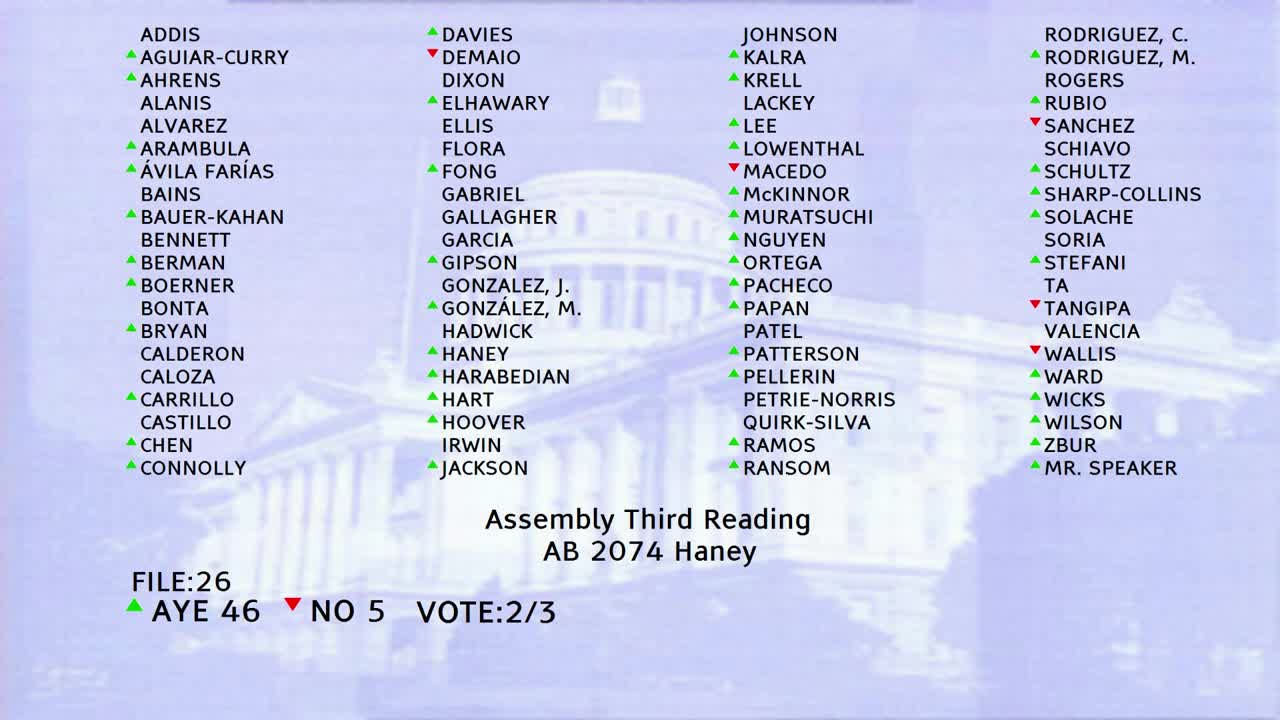
Bill Author

Bill Co-Author(s):