AB 2339: Firearms: prohibited persons.
- Session Year: 2025-2026
- House: Assembly
- Latest Version Date: 2026-09-26
Current Status:
Passed
(2026-09-26: Chaptered by Secretary of State - Chapter 462, Statutes of 2026.)
Introduced
In Committee
Awaiting First Chamber Vote
Passed First Chamber
In Committee
Awaiting Second Chamber Vote
Passed Second Chamber
Enacted
(1)Existing law prohibits a juvenile who is adjudged a ward of the juvenile court due to the commission of specified serious or violent offenses from subsequently owning or possessing a firearm until they are 30 years of age. Existing law requires the juvenile court to notify the Department of Justice of persons subject to these provisions, as specified.
This bill would require the juvenile court to notify the department if the juvenile court grants a dismissal of a juvenile petition for an offense that subjected the juvenile to the above-described firearm prohibition.
(2)Existing law authorizes certain juvenile records to be sealed upon order of the court and to subsequently be destroyed. Existing law requires a juvenile record that has been ordered to be sealed, and that contains a sustained petition making a person ineligible to own or possess a firearm, to not be destroyed until the person is 33 years of age. Existing law authorizes a record that has been sealed by a court pursuant to these provisions to be accessed, inspected, or utilized in certain circumstances, including by the Department of Justice for the purpose of determining if the person is suitable to purchase, own, or possess a firearm, as specified.
This bill would authorize the Department of Justice, if it determines based on its review of a persons sealed record pursuant to the above-described provisions that a person is or may not be suitable to purchase, own, or possess a firearm, to provide the person with a copy of the record reviewed by the department.
(3)Existing law prohibits a person who has been taken into custody, assessed, and admitted to a designated facility, or who has been certified for intensive treatment after having been admitted to a designated facility, because the person is a danger to themselves or others as a result of a mental health disorder, from owning a firearm, as specified. Existing law requires a facility to submit a report to the Department of Justice containing specified information and requires the report to be kept confidential, except for the purpose of court proceedings and determination of eligibility to own, possess, control, receive, or purchase a firearm, other deadly weapon, or ammunition.
This bill would require a designated facility that accepts the transfer for placement of a person pursuant to the above-described provisions to be responsible for submitting the report to the department.
Existing law also prohibits a person who has been adjudicated to be a danger to others as a result of a mental disorder or mental illness, or who has been adjudicated to be a mentally disordered sex offender, a person who has been found not guilty by reason of insanity of committing specified crimes, a person found by a court to be mentally incompetent to stand trial, or a person who has been placed under conservatorship by a court because the person is gravely disabled as a result of a mental disorder or impairment by chronic alcoholism from purchasing or receiving, or attempting to purchase or receive, or having possession, custody, or control of a firearm or any other deadly weapon. Existing law requires the court to notify the Department of Justice of the court order placing the person under the conservatorship and prohibiting possession of a firearm or other deadly weapon or ammunition by the person, as specified. Existing law requires all information provided to the Department of Justice regarding the conservatorship to be kept confidential and only used to determine eligibility to purchase or possesses a firearm, other deadly weapon, or ammunition, and makes a violation of this provision a misdemeanor.
This bill would require all information provided to the department pursuant to the above-described provisions to be kept confidential, separate, and apart from all other records maintained by the department, except in specified circumstances, including, among others, for use by a state law enforcement agency seeking the issuance of a gun violence restraining order, and would make a violation of these provisions a misdemeanor. The bill would require notices or reports submitted pursuant to these provisions to include a copy of documents substantiating the report or detailing the listed offense prohibiting the person from possessing firearms, ammunition, or other deadly weapons, as specified. By expanding the scope of a crime, this bill would impose a state-mandated local program.
Under existing law, a person who has been certified for intensive treatment under specified provisions is prohibited from owning, possessing, controlling, receiving, or purchasing, or attempting to own, possess, control, receive, or purchase, a firearm, other deadly weapon, or ammunition for a period of 5 years.
This bill would require that a person who was certified for intensive treatment under the specified provisions and is released from intensive treatment following a certification review or a writ of habeas corpus to remain subject to the 5-year prohibition period described above. The bill would require a facility discharging a person certified for intensive treatment to provide the person and the Department of Justice with a copy of a specified form pertaining to the firearm prohibition.
Existing law requires the Department of Justice to request specified institutions to submit information necessary to identify persons subject to the prohibitions regarding firearms, destructive devices, and explosives.
This bill would require the various reports to the department to include a copy of specified identification information for persons subject to these provisions, as specified. The bill would authorize the department to use, and to give to specified entities, the information provided to the department to determine the eligibility of a person to acquire, care, or possess ammunition. This bill would make unauthorized disclosure of the information provided pursuant to these provisions a misdemeanor.
(4)The California Constitution requires the state to reimburse local agencies and school districts for certain costs mandated by the state. Statutory provisions establish procedures for making that reimbursement.
This bill would provide that no reimbursement is required by this act for a specified reason.
(1)Existing law prohibits a juvenile who is adjudged a ward of the juvenile court due to the commission of specified serious or violent offenses from subsequently owning or possessing a firearm until they are 30 years of age. Existing law requires the juvenile court to notify the Department of Justice of persons subject to these provisions, as specified.
This bill would require the juvenile court to notify the department if the juvenile court grants a dismissal of a juvenile petition for an offense that subjected the juvenile to the above-described firearm prohibition.
(2)Existing law authorizes certain juvenile records to be sealed upon order of the court and to subsequently be destroyed. Existing law requires a juvenile record that has been ordered to be sealed, and that contains a sustained petition making a person ineligible to own or possess a firearm, to not be destroyed until the person is 33 years of age. Existing law authorizes a record that has been sealed by a court pursuant to these provisions to be accessed, inspected, or utilized in certain circumstances, including by the Department of Justice for the purpose of determining if the person is suitable to purchase, own, or possess a firearm, as specified.
This bill would authorize the Department of Justice, if it determines based on its review of a persons sealed record pursuant to the above-described provisions that a person is or may not be suitable to purchase, own, or possess a firearm, to provide the person with a copy of the record reviewed by the department.
(3)Existing law prohibits a person who has been taken into custody, assessed, and admitted to a designated facility, or who has been certified for intensive treatment after having been admitted to a designated facility, because the person is a danger to themselves or others as a result of a mental health disorder, from owning a firearm, as specified. Existing law requires a facility to submit a report to the Department of Justice containing specified information and requires the report to be kept confidential, except for the purpose of court proceedings and determination of eligibility to own, possess, control, receive, or purchase a firearm, other deadly weapon, or ammunition.
This bill would require a designated facility that accepts the transfer for placement of a person pursuant to the above-described provisions to be responsible for submitting the report to the department.
Existing law also prohibits a person who has been adjudicated to be a danger to others as a result of a mental disorder or mental illness, or who has been adjudicated to be a mentally disordered sex offender, a person who has been found not guilty by reason of insanity of committing specified crimes, a person found by a court to be mentally incompetent to stand trial, or a person who has been placed under conservatorship by a court because the person is gravely disabled as a result of a mental disorder or impairment by chronic alcoholism from purchasing or receiving, or attempting to purchase or receive, or having possession, custody, or control of a firearm or any other deadly weapon. Existing law requires the court to notify the Department of Justice of the court order placing the person under the conservatorship and prohibiting possession of a firearm or other deadly weapon or ammunition by the person, as specified. Existing law requires all information provided to the Department of Justice regarding the conservatorship to be kept confidential and only used to determine eligibility to purchase or possesses a firearm, other deadly weapon, or ammunition, and makes a violation of this provision a misdemeanor.
This bill would require all information provided to the department pursuant to the above-described provisions to be kept confidential, separate, and apart from all other records maintained by the department, except in specified circumstances, including, among others, for use by a state law enforcement agency seeking the issuance of a gun violence restraining order, and would make a violation of these provisions a misdemeanor. The bill would require notices or reports submitted pursuant to these provisions to include a copy of documents substantiating the report or detailing the listed offense prohibiting the person from possessing firearms, ammunition, or other deadly weapons, as specified. By expanding the scope of a crime, this bill would impose a state-mandated local program.
Under existing law, a person who has been certified for intensive treatment under specified provisions is prohibited from owning, possessing, controlling, receiving, or purchasing, or attempting to own, possess, control, receive, or purchase, a firearm, other deadly weapon, or ammunition for a period of 5 years.
This bill would require that a person who was certified for intensive treatment under the specified provisions and is released from intensive treatment following a certification review or a writ of habeas corpus to remain subject to the 5-year prohibition period described above. The bill would require a facility discharging a person certified for intensive treatment to provide the person and the Department of Justice with a copy of a specified form pertaining to the firearm prohibition.
Existing law requires the Department of Justice to request specified institutions to submit information necessary to identify persons subject to the prohibitions regarding firearms, destructive devices, and explosives.
This bill would require the various reports to the department to include a copy of specified identification information for persons subject to these provisions. provisions, as specified. The bill would authorize the department to use, and to give to specified entities, the information provided to the department to determine the eligibility of a person to acquire, care, or possess ammunition. This bill would make unauthorized disclosure of the information provided pursuant to these provisions a misdemeanor.
(4)The California Constitution requires the state to reimburse local agencies and school districts for certain costs mandated by the state. Statutory provisions establish procedures for making that reimbursement.
This bill would provide that no reimbursement is required by this act for a specified reason.
(1)Existing law prohibits a juvenile who is adjudged a ward of the juvenile court due to the commission of specified serious or violent offenses from subsequently owning or possessing a firearm until they are 30 years of age. Existing law requires the juvenile court to notify the Department of Justice of persons subject to these provisions, as specified.
This bill would require the juvenile court to notify the department if the juvenile court grants a dismissal of a juvenile petition for an offense that subjected the juvenile to the above-described firearm prohibition.
(2)Existing law authorizes certain juvenile records to be sealed upon order of the court and to subsequently be destroyed. Existing law requires a juvenile record that has been ordered to be sealed, and that contains a sustained petition making a person ineligible to own or possess a firearm, to not be destroyed until the person is 33 years of age. Existing law authorizes a record that has been sealed by a court pursuant to these provisions to be accessed, inspected, or utilized in certain circumstances, including by the Department of Justice for the purpose of determining if the person is suitable to purchase, own, or possess a firearm, as specified.
This bill would authorize the Department of Justice, if it determines based on its review of a persons sealed record pursuant to the above-described provisions that a person is or may not be suitable to purchase, own, or possess a firearm, to provide the person with a copy of the record reviewed by the department.
(3)Existing law prohibits a person who has been taken into custody, assessed, and admitted to a designated facility, or who has been certified for intensive treatment after having been admitted to a designated facility, because the person is a danger to themselves or others as a result of a mental health disorder, from owning a firearm, as specified. Existing law requires a facility to submit a report to the Department of Justice containing specified information and requires the report to be kept confidential, except for the purpose of court proceedings and determination of eligibility to own, possess, control, receive, or purchase a firearm, other deadly weapon, or ammunition.
This bill would require, in the event that a person is subsequently transferred from one facility to another, that the facility that admits the person require a designated facility that accepts the transfer for placement of a person pursuant to the above-described provisions to be responsible for submitting the report to the department.
Existing law also prohibits a person who has been adjudicated to be a danger to others as a result of a mental disorder or mental illness, or who has been adjudicated to be a mentally disordered sex offender, a person who has been found not guilty by reason of insanity of committing specified crimes, a person found by a court to be mentally incompetent to stand trial, or a person who has been placed under conservatorship by a court because the person is gravely disabled as a result of a mental disorder or impairment by chronic alcoholism from purchasing or receiving, or attempting to purchase or receive, or having possession, custody, or control of a firearm or any other deadly weapon. Existing law requires the court to notify the Department of Justice of the court order placing the person under the conservatorship and prohibiting possession of a firearm or other deadly weapon or ammunition by the person, as specified. Existing law requires all information provided to the Department of Justice regarding the conservatorship to be kept confidential and only used to determine eligibility to purchase or possesses a firearm, other deadly weapon, or ammunition, and makes a violation of this provision a misdemeanor.
This bill would require all information provided to the department pursuant to the above-described provisions to be kept confidential, separate, and apart from all other records maintained by the department, except in specified circumstances, including, among others, for use by a state law enforcement agency seeking the issuance of a gun violence restraining order, and would make a violation of these provisions a misdemeanor. The bill would require notices or reports submitted pursuant to these provisions to include a copy of documents substantiating the report or detailing the listed offense prohibiting the person from possessing firearms, ammunition, or other deadly weapons, as specified. By expanding the scope of a crime, this bill would impose a state-mandated local program.
Under existing law, a person who has been certified for intensive treatment under specified provisions is prohibited from owning, possessing, controlling, receiving, or purchasing, or attempting to own, possess, control, receive, or purchase, a firearm, other deadly weapon, or ammunition for a period of 5 years.
This bill would require that a person who was certified for intensive treatment under the specified provisions and is released from intensive treatment following a certification review or a writ of habeas corpus to remain subject to the 5-year prohibition period described above. The bill would require a facility discharging a person certified for intensive treatment to provide the person and the Department of Justice with a copy of a specified form pertaining to the firearm prohibition.
Existing law requires the Department of Justice to request specified institutions to submit information necessary to identify persons subject to the prohibitions regarding firearms, destructive devices, and explosives.
This bill would require the various reports to the department to include a copy of specified identification information for persons subject to these provisions. The bill would authorize the department to use, and to give to specified entities, the information provided to the department to determine the eligibility of a person to acquire, care, or possess ammunition. This bill would make unauthorized disclosure of the information provided pursuant to these provisions a misdemeanor.
(4)The California Constitution requires the state to reimburse local agencies and school districts for certain costs mandated by the state. Statutory provisions establish procedures for making that reimbursement.
This bill would provide that no reimbursement is required by this act for a specified reason.
(1)Existing law prohibits a juvenile who is adjudged a ward of the juvenile court due to the commission of specified serious or violent offenses from subsequently owning or possessing a firearm until they are 30 years of age. Existing law requires the juvenile court to notify the Department of Justice of persons subject to these provisions, as specified.
This bill would require the juvenile court to notify the department if the juvenile court grants a dismissal of a juvenile petition for an offense that subjected the juvenile to the above-described firearm prohibition.
(2)Existing law authorizes certain juvenile records to be sealed upon order of the court and to subsequently be destroyed. Existing law requires a juvenile record that has been ordered to be sealed, and that contains a sustained petition making a person ineligible to own or possess a firearm, to not be destroyed until the person is 33 years of age. Existing law authorizes a record that has been sealed by a court pursuant to these provisions to be accessed, inspected, or utilized in certain circumstances, including by the Department of Justice for the purpose of determining if the person is suitable to purchase, own, or possess a firearm, as specified.
This bill would authorize the Department of Justice, if it determines based on its review of a persons sealed record pursuant to the above-described provisions that a person is or may not be suitable to purchase, own, or possess a firearm, to provide the person with a copy of the record reviewed by the department.
(3)Existing law prohibits a person who has been taken into custody, assessed, and admitted to a designated facility, or who has been certified for intensive treatment after having been admitted to a designated facility, because the person is a danger to themselves or others as a result of a mental health disorder, from owning a firearm, as specified. Existing law requires a facility to submit a report to the Department of Justice containing specified information and requires the report to be kept confidential, except for the purpose of court proceedings and determination of eligibility to own, possess, control, receive, or purchase a firearm, other deadly weapon, or ammunition.
This bill would require, in the event that a person is subsequently transferred from one facility to another, that the facility that admits the person to be responsible for submitting the report to the department.
Existing law also prohibits a person who has been adjudicated to be a danger to others as a result of a mental disorder or mental illness, or who has been adjudicated to be a mentally disordered sex offender, a person who has been found not guilty by reason of insanity of committing specified crimes, a person found by a court to be mentally incompetent to stand trial, or a person who has been placed under conservatorship by a court because the person is gravely disabled as a result of a mental disorder or impairment by chronic alcoholism from purchasing or receiving, or attempting to purchase or receive, or having possession, custody, or control of a firearm or any other deadly weapon. Existing law requires the court to notify the Department of Justice of the court order placing the person under the conservatorship and prohibiting possession of a firearm or other deadly weapon or ammunition by the person, as specified. Existing law requires all information provided to the Department of Justice regarding the conservatorship to be kept confidential and only used to determine eligibility to purchase or possesses a firearm, other deadly weapon, or ammunition, and makes a violation of this provision a misdemeanor.
This bill would require all information provided to the department pursuant to the above-described provisions to be kept confidential, separate, and apart from all other records maintained by the department, except in specified circumstances, including, among others, for use by a state law enforcement agency seeking the issuance of a gun violence restraining order, and would make a violation of these provisions a misdemeanor. The bill would require notices or reports submitted pursuant to these provisions to include a copy of documents substantiating the report or detailing the listed offense prohibiting the person from possessing firearms, ammunition, or other deadly weapons, as specified. By expanding the scope of a crime, this bill would impose a state-mandated local program.
Under existing law, a person who has been certified for intensive treatment under specified provisions is prohibited from owning, possessing, controlling, receiving, or purchasing, or attempting to own, possess, control, receive, or purchase, a firearm, other deadly weapon, or ammunition for a period of 5 years.
This bill would require that a person who was certified for intensive treatment under the specified provisions and is released from intensive treatment following a certification review or a writ of habeas corpus to remain subject to the 5-year prohibition period described above. The bill would require a facility discharging a person certified for intensive treatment to provide the person and the Department of Justice with a copy of a specified form pertaining to the firearm prohibition.
Existing law requires the Department of Justice to request specified institutions to submit information necessary to identify persons subject to the prohibitions regarding firearms, destructive devices, and explosives.
This bill would require the various reports to the department to include a copy of specified identification information for persons subject to these provisions.
(4)The California Constitution requires the state to reimburse local agencies and school districts for certain costs mandated by the state. Statutory provisions establish procedures for making that reimbursement.
This bill would provide that no reimbursement is required by this act for a specified reason.
Existing law provides that the sovereignty of the state resides in the people of the state, and all writs and processes shall issue in their name.This bill would make a nonsubstantive change to that provision.Existing law provides that the sovereignty of the state resides in the people of the state, and all writs and processes shall issue in their name.
This bill would make a nonsubstantive change to that provision.
(a)This section applies to a person who satisfies both of the following requirements:
(1)The person meets one of the following:
(A)The person is alleged to have committed an offense listed in subdivision (b) of Section 707 of the Welfare and Institutions Code.
(B)The person was convicted of violating Section 11351 or 11351.5 of the Health and Safety Code by possessing for sale, or Section 11352 of the Health and Safety Code by selling, a substance containing 28.5 grams or more of cocaine as specified in paragraph (6) of subdivision (b) of Section 11055 of, or cocaine base as specified in paragraph (1) of subdivision (f) of Section 11054 of, the Health and Safety Code, or 57 grams or more of a substance containing at least 5 grams of cocaine as specified in paragraph (6) of subdivision (b) of Section 11055 of, or cocaine base as specified in paragraph (1) of subdivision (f) of Section 11054 of, the Health and Safety Code.
(C)The person was convicted of violating Section 11378 of the Health and Safety Code by possessing for sale, or Section 11379 of the Health and Safety Code by selling, a substance containing 28.5 grams or more of methamphetamine or 57 grams or more of a substance containing methamphetamine.
(D)The person was convicted of violating subdivision (a) of Section 11379.6 of the Health and Safety Code, except those who manufacture phencyclidine, or who is convicted of an act that is punishable under subdivision (b) of Section 11379.6 of the Health and Safety Code, except those who offer to perform an act that aids in the manufacture of phencyclidine.
(E)Except as otherwise provided in Section 1203.07, the person was convicted of violating Section 11353 or 11380 of the Health and Safety Code by using, soliciting, inducing, encouraging, or intimidating a minor to manufacture, compound, or sell heroin, cocaine base as specified in paragraph (1) of subdivision (f) of Section 11054 of the Health and Safety Code, cocaine as specified in paragraph (6) of subdivision (b) of Section 11055 of the Health and Safety Code, or methamphetamine.
(F)The person was convicted of violating Section 11379.6, 11382, or 11383 of the Health and Safety Code with respect to methamphetamine, if the person has one or more prior convictions for a violation of Section 11378, 11379, 11379.6, 11380, 11382, or 11383 of the Health and Safety Code with respect to methamphetamine.
(G)The person was alleged to have committed an offense enumerated in Section 29805 or an offense described in Section 25850, subdivision (a) of Section 25400, or subdivision (a) of Section 26100.
(2)The person is subsequently adjudged a ward of the juvenile court within the meaning of Section 602 of the Welfare and Institutions Code because the person committed an offense listed in paragraph (1).
(b)A person described in subdivision (a) shall not own, or have in possession or under custody or control, a firearm until the person is 30 years of age or older.
(c)A violation of this section shall be punishable by imprisonment in a county jail not exceeding one year or in the state prison, by a fine not exceeding one thousand dollars ($1,000), or by both that imprisonment and fine.
(d)The juvenile court, on forms prescribed by the Department of Justice, shall notify the department of persons subject to this section. Notwithstanding any other law, the forms required to be submitted to the department pursuant to this section may be used to determine eligibility to acquire a firearm.
(e)The juvenile court shall notify the Department of Justice, in a manner prescribed by the department, if an order for dismissal pursuant to Section 782 of the Welfare and Institutions Code is granted to a person previously required to be reported to the department pursuant to this section for an offense listed within paragraph (1) of subdivision (a).
SEC. 2.Section 786 of the Welfare and Institutions Code is amended to read:786.(a)If a person who has been alleged or found to be a ward of the juvenile court satisfactorily completes (1) an informal program of supervision pursuant to Section 654.2, (2) probation under Section 725, or (3) a term of probation for any offense, the court shall order the petition dismissed. The court shall order sealed all records pertaining to the dismissed petition in the custody of the juvenile court, and in the custody of law enforcement agencies, the probation department, or the Department of Justice. Defense counsel for the minor shall not be ordered to seal their records. The court shall send a copy of the order to each agency and official named in the order, direct the agency or official to seal its records, and specify a date by which the sealed records shall be destroyed. If a record contains a sustained petition rendering the person ineligible to own or possess a firearm until 30 years of age pursuant to Section 29820 of the Penal Code, then the date the sealed records shall be destroyed is the date upon which the person turns 33 years of age. Each agency and official named in the order shall seal the records in its custody as directed by the order, shall advise the court of its compliance, and, after advising the court, shall seal the copy of the courts order that was received. The court shall also provide notice to the person and the persons counsel that it has ordered the petition dismissed and the records sealed in the case. The notice shall include an advisement of the persons right to nondisclosure of the arrest and proceedings, as specified in subdivision (b).
(b)Upon the courts order of dismissal of the petition, the arrest and other proceedings in the case shall be deemed not to have occurred and the person who was the subject of the petition may reply accordingly to an inquiry by employers, educational institutions, or other persons or entities regarding the arrest and proceedings in the case.
(c)(1)For purposes of this section, satisfactory completion of an informal program of supervision or another term of probation described in subdivision (a) shall be deemed to have occurred if the person has no new findings of wardship or conviction for a felony offense or a misdemeanor involving moral turpitude during the period of supervision or probation and if the person has not failed to substantially comply with the reasonable orders of supervision or probation that are within their capacity to perform. The period of supervision or probation shall not be extended solely for the purpose of deferring or delaying eligibility for dismissal of the petition and sealing of the records under this section.
(2)An unfulfilled order or condition of restitution, including a restitution fine that can be converted to a civil judgment under Section 730.6 or an unpaid restitution fee shall not be deemed to constitute unsatisfactory completion of supervision or probation under this section.
(d)A court shall not seal a record or dismiss a petition pursuant to this section if the petition was sustained based on the commission of an offense listed in subdivision (b) of Section 707 that was committed when the individual was 14 years of age or older unless the finding on that offense was dismissed or was reduced to a misdemeanor or to a lesser offense that is not listed in subdivision (b) of Section 707.
(e)If a person who has been alleged to be a ward of the juvenile court has their petition dismissed by the court, whether on the motion of the prosecution or on the courts own motion, or if the petition is not sustained by the court after an adjudication hearing, the court shall order sealed all records pertaining to the dismissed petition in the custody of the juvenile court, and in the custody of law enforcement agencies, the probation department, or the Department of Justice. The court shall send a copy of the order to each agency and official named in the order, direct the agency or official to seal its records, and specify a date by which the sealed records shall be destroyed. Each agency and official named in the order shall seal the records in its custody as directed by the order, shall advise the court of its compliance, and, after advising the court, shall seal the copy of the courts order that was received. The court shall also provide notice to the person and the persons counsel that it has ordered the petition dismissed and the records sealed in the case. The notice shall include an advisement of the persons right to nondisclosure of the arrest and proceedings, as specified in subdivision (b).
(f)(1)The court may, in making its order to seal the record and dismiss the instant petition pursuant to this section, include an order to seal a record relating to, or to dismiss, any prior petition or petitions that have been filed or sustained against the individual and that appear to the satisfaction of the court to meet the sealing and dismissal criteria otherwise described in this section.
(2)An individual who has a record that is eligible to be sealed under this section may ask the court to order the sealing of a record pertaining to the case that is in the custody of a public agency other than a law enforcement agency, the probation department, or the Department of Justice, and the court may grant the request and order that the public agency record be sealed if the court determines that sealing the additional record will promote the successful reentry and rehabilitation of the individual.
(g)(1)A record that has been ordered sealed by the court under this section may be accessed, inspected, or utilized only under any of the following circumstances:
(A)By the prosecuting attorney, the probation department, or the court for the limited purpose of determining whether the minor is eligible and suitable for deferred entry of judgment pursuant to Section 790 or is ineligible for a program of supervision as defined in Section 654.3.
(B)By the court for the limited purpose of verifying the prior jurisdictional status of a ward who is petitioning the court to resume its jurisdiction pursuant to subdivision (e) of Section 388.
(C)If a new petition has been filed against the minor for a felony offense, by the probation department for the limited purpose of identifying the minors previous court-ordered programs or placements, and in that event solely to determine the individuals eligibility or suitability for remedial programs or services. The information obtained pursuant to this subparagraph shall not be disseminated to other agencies or individuals, except as necessary to implement a referral to a remedial program or service, and shall not be used to support the imposition of penalties, detention, or other sanctions upon the minor.
(D)Upon a subsequent adjudication of a minor whose record has been sealed under this section and a finding that the minor is a person described by Section 602 based on the commission of a felony offense, by the probation department, the prosecuting attorney, counsel for the minor, or the court for the limited purpose of determining an appropriate juvenile court disposition. Access, inspection, or use of a sealed record as provided under this subparagraph shall not be construed as a reversal or modification of the courts order dismissing the petition and sealing the record in the prior case.
(E)Upon the prosecuting attorneys motion, made in accordance with Section 707, to initiate court proceedings to determine whether the case should be transferred to a court of criminal jurisdiction, by the probation department, the prosecuting attorney, counsel for the minor, or the court for the limited purpose of evaluating and determining if such a transfer is appropriate. Access, inspection, or use of a sealed record as provided under this subparagraph shall not be construed as a reversal or modification of the courts order dismissing the petition and sealing the record in the prior case.
(F)By the person whose record has been sealed, upon their request and petition to the court to permit inspection of the records.
(G)By the probation department of any county to access the records for the limited purpose of meeting federal Title IV-B and Title IV-E compliance.
(H)The child welfare agency of a county responsible for the supervision and placement of a minor or nonminor dependent may access a record that has been ordered sealed by the court under this section for the limited purpose of determining an appropriate placement or service that has been ordered for the minor or nonminor dependent by the court. The information contained in the sealed record and accessed by the child welfare worker or agency under this subparagraph may be shared with the court but shall in all other respects remain confidential and shall not be disseminated to any other person or agency. Access to the sealed record under this subparagraph shall not be construed as a modification of the courts order dismissing the petition and sealing the record in the case.
(I)By the prosecuting attorney for the evaluation of charges and prosecution of offenses pursuant to Section 29820 of the Penal Code.
(J)By the Department of Justice for the purpose of determining if the person is suitable to purchase, own, or possess a firearm, consistent with Section 29820 of the Penal Code. The department may provide the record to the person if the department determines the person is not or may not be suitable to purchase, own, or possess a firearm based on the record.
(K)(i)A record that has been sealed pursuant to this section may be accessed, inspected, or utilized by the prosecuting attorney in order to meet a statutory or constitutional obligation to disclose favorable or exculpatory evidence to a defendant in a criminal case in which the prosecuting attorney has reason to believe that access to the record is necessary to meet the disclosure obligation. A request to access information in the sealed record for this purpose, including the prosecutors rationale for believing that access to the information in the record may be necessary to meet the disclosure obligation and the date by which the records are needed, shall be submitted by the prosecuting attorney to the juvenile court. The juvenile court shall notify the person having the sealed record, including the persons attorney of record, that the court is considering the prosecutors request to access the record, and the court shall provide that person with the opportunity to respond, in writing or by appearance, to the request prior to making its determination. The juvenile court shall review the case file and records that have been referenced by the prosecutor as necessary to meet the disclosure obligation and any response submitted by the person having the sealed record. The court shall approve the prosecutors request to the extent that the court has, upon review of the relevant records, determined that access to a specific sealed record or portion of a sealed record is necessary to enable the prosecuting attorney to comply with the disclosure obligation. If the juvenile court approves the prosecuting attorneys request, the court shall state on the record appropriate limits on the access, inspection, and utilization of the sealed record information in order to protect the confidentiality of the person whose sealed record is accessed pursuant to this subparagraph. A ruling allowing disclosure of information pursuant to this subdivision does not affect whether the information is admissible in a criminal or juvenile proceeding. This subparagraph does not impose any discovery obligations on a prosecuting attorney that do not already exist.
(ii)This subparagraph shall not apply to juvenile case files pertaining to matters within the jurisdiction of the juvenile court pursuant to Section 300.
(L)If a new petition has been filed against the minor in juvenile court and the issue of competency is raised, by the probation department, the prosecuting attorney, counsel for the minor, and the court for the purpose of assessing the minors competency in the proceedings on the new petition. Access, inspection, or utilization of the sealed records is limited to any prior competency evaluations submitted to the court, whether ordered by the court or not, all reports concerning remediation efforts and success, all court findings and orders relating to the minors competency, and any other evidence submitted to the court for consideration in determining the minors competency, including, but not limited to, school records and other test results. The information obtained pursuant to this subparagraph shall not be disseminated to any other person or agency except as necessary to evaluate the minors competency or provide remediation services, and shall not be used to support the imposition of penalties, detention, or other sanctions on the minor. Access to the sealed record under this subparagraph shall not be construed as a modification of the courts order dismissing the petition and sealing the record in the case.
(M)A record that was sealed pursuant to this section that was generated in connection with the investigation, prosecution, or adjudication of a qualifying offense as defined in subdivision (c) of Section 679.10 of the Penal Code may be accessed by a judge or prosecutor for the limited purpose of processing a request of a victim or victims family member to certify victim helpfulness on the Form I-918 Supplement B certification or Form I-914 Supplement B declaration. The information obtained pursuant to this subparagraph shall not be disseminated to other agencies or individuals, except as necessary to certify victim helpfulness on the Form I-918 Supplement B certification or Form I-914 Supplement B declaration, and under no circumstances shall it be used to support the imposition of penalties, detention, or other sanctions upon an individual.
(2)When a record has been sealed by the court based on a dismissed petition pursuant to subdivision (e), the prosecutor, within six months of the date of dismissal, may petition the court to access, inspect, or utilize the sealed record for the limited purpose of refiling the dismissed petition based on new circumstances, including, but not limited to, new evidence or witness availability. The court shall determine whether the new circumstances alleged by the prosecutor provide sufficient justification for accessing, inspecting, or utilizing the sealed record in order to refile the dismissed petition.
(3)Access to, or inspection of, a sealed record authorized by paragraphs (1) and (2) shall not be deemed an unsealing of the record and shall not require notice to any other agency.
(h)(1)This section does not prohibit a court from enforcing a civil judgment for an unfulfilled order of restitution ordered pursuant to Section 730.6. A minor is not relieved from the obligation to pay victim restitution, restitution fines, and court-ordered fines and fees because the minors records are sealed.
(2)A victim or a local collection program may continue to enforce victim restitution orders, restitution fines, and court-ordered fines and fees after a record is sealed. The juvenile court shall have access to records sealed pursuant to this section for the limited purpose of enforcing a civil judgment or restitution order.
(i)This section does not prohibit the State Department of Social Services from meeting its obligations to monitor and conduct periodic evaluations of, and provide reports on, the programs carried under federal Title IV-B and Title IV-E as required by Sections 622, 629 et seq., and 671(a)(7) and (22) of Title 42 of the United States Code, as implemented by federal regulation and state statute.
(j)The Judicial Council shall adopt rules of court, and shall make available appropriate forms, providing for the standardized implementation of this section by the juvenile courts.
SEC. 3.Section 8103 of the Welfare and Institutions Code is amended to read:8103.(a)(1)A person who after October 1, 1955, has been adjudicated by a court of any state to be a danger to others as a result of a mental disorder or mental illness, or who has been adjudicated to be a mentally disordered sex offender, shall not purchase or receive, or attempt to purchase or receive, or have possession, custody, or control of a firearm, other deadly weapon, or ammunition unless there has been issued to the person a certificate by the court of adjudication upon release from treatment or at a later date stating that the person may possess a firearm, other deadly weapon, or ammunition without endangering others, and the person has not, subsequent to the issuance of the certificate, again been adjudicated by a court to be a danger to others as a result of a mental disorder or mental illness.
(2)The court shall notify the Department of Justice of the court order finding the individual to be a person described in paragraph (1) as soon as possible, but not later than one court day after issuing the order. The court shall also notify the department of a certificate issued as described in paragraph (1) as soon as possible, but not later than one court day after issuing the certificate.
(3)A person described in paragraph (1) shall, in accordance with applicable state law and local procedure, relinquish to law enforcement a firearm, other deadly weapon, or ammunition in their custody or control within 14 days of a court order finding the person to be a person described in paragraph (1) and submit a receipt to the court to show proof of relinquishment.
(b)(1)A person who has been found, pursuant to Section 1026 of the Penal Code or the law of any other state or the United States, not guilty by reason of insanity of murder, mayhem, a violation of Section 207, 209, or 209.5 of the Penal Code in which the victim suffers intentionally inflicted great bodily injury, carjacking or robbery in which the victim suffers great bodily injury, a violation of Section 451 or 452 of the Penal Code involving a trailer coach, as defined in Section 635 of the Vehicle Code, or a dwelling house, a violation of paragraph (1) or (2) of subdivision (a) of former Section 262 of the Penal Code or paragraph (2) or (3) of subdivision (a) of Section 261 of the Penal Code, a violation of Section 459 of the Penal Code in the first degree, assault with intent to commit murder, a violation of Section 220 of the Penal Code in which the victim suffers great bodily injury, a violation of Section 18715, 18725, 18740, 18745, 18750, or 18755 of the Penal Code, or of a felony involving death, great bodily injury, or an act which poses a serious threat of bodily harm to another person, or a violation of the law of any other state or the United States that includes all the elements of any of the above felonies as defined under California law, shall not purchase or receive, or attempt to purchase or receive, or have possession, custody, or control of a firearm, other deadly weapon, or ammunition.
(2)The court shall notify the Department of Justice of the court order finding the person to be a person described in paragraph (1) as soon as possible, but not later than one court day after issuing the order.
(3)A person described in paragraph (1) shall, in accordance with applicable state law and local procedure, relinquish to law enforcement a firearm, other deadly weapon, or ammunition in their custody or control within 14 days of the court order finding the person to be a person described in paragraph (1) and submit a receipt to the court to show proof of relinquishment.
(c)(1)A person who has been found, pursuant to Section 1026 of the Penal Code or the law of any other state or the United States, not guilty by reason of insanity of a crime other than those described in subdivision (b) shall not purchase or receive, or attempt to purchase or receive, or have possession, custody, or control of a firearm, other deadly weapon, or ammunition unless the court of commitment has found the person to have recovered sanity, pursuant to Section 1026.2 of the Penal Code or the law of any other state or the United States.
(2)The court shall notify the Department of Justice of the court order finding the person to be a person described in paragraph (1) as soon as possible, but not later than one court day after issuing the order. The court shall also notify the Department of Justice when it finds that the person has recovered their sanity as soon as possible, but not later than one court day after making the finding.
(3)A person described in paragraph (1) shall, in accordance with applicable state law and local procedure, relinquish to law enforcement a firearm, other deadly weapon, or ammunition in their custody or control within 14 days of the court order finding the person to be a person described in paragraph (1) and submit a receipt to the court to show proof of relinquishment.
(d)(1)A person found by a court to be mentally incompetent to stand trial, pursuant to Section 1370, 1370.02, or 1370.1 of the Penal Code or the law of any other state or the United States, shall not purchase or receive, or attempt to purchase or receive, or have possession, custody, or control of a firearm, other deadly weapon, or ammunition unless there has been a finding with respect to the person of restoration to competence to stand trial by the committing court, pursuant to Section 1372 of the Penal Code or the law of any other state or the United States.
(2)The court shall notify the Department of Justice of any court order finding a person to be mentally incompetent to stand trial as soon as possible, but not later than one court day after issuing the order. The court shall also notify the Department of Justice when it finds that the person has recovered competence as soon as possible, but not later than one court day after making the finding.
(e)(1)A person who has been placed under conservatorship by a court, pursuant to Section 5350 or the law of any other state or the United States, because the person is gravely disabled as a result of a mental disorder or impairment by chronic alcoholism, shall not purchase or receive, or attempt to purchase or receive, or have possession, custody, or control of a firearm, other deadly weapon, or ammunition while under the conservatorship if, at the time the conservatorship was ordered or thereafter, the court that imposed the conservatorship found that possession of a firearm, other deadly weapon, or ammunition by the person would present a danger to the safety of the person or to others. Upon placing a person under conservatorship, and prohibiting firearm, other deadly weapon, or ammunition possession by the person, the court shall notify the person of this prohibition.
(2)The court shall notify the Department of Justice of the court order placing the person under conservatorship and prohibiting firearm, other deadly weapon, or ammunition possession by the person, as described in paragraph (1), as soon as possible, but not later than one court day after placing the person under conservatorship. The notice shall include the date the conservatorship was imposed and the date the conservatorship is to be terminated. If the conservatorship is subsequently terminated before the date listed in the notice to the Department of Justice or the court subsequently finds that possession of a firearm, other deadly weapon, or ammunition by the person would no longer present a danger to the safety of the person or others, the court shall notify the Department of Justice as soon as possible, but not later than one court day after terminating the conservatorship.
(3)All the information concerning a person shall be destroyed upon receipt by the Department of Justice of notice of the termination of conservatorship as to that person pursuant to paragraph (2).
(f)(1)(A)A person who has been (i) taken into custody as provided in Section 5150 because that person is a danger to themselves or to others, (ii) assessed within the meaning of Section 5151, and (iii) admitted to a designated facility within the meaning of Sections 5151 and 5152 because that person is a danger to themselves or others shall not own, possess, control, receive, or purchase, or attempt to own, possess, control, receive, or purchase, a firearm, other deadly weapon, or ammunition for a period of five years after the person is released from the facility.
(B)A person who has been taken into custody, assessed, and admitted as specified in subparagraph (A), and who was previously taken into custody, assessed, and admitted as specified in subparagraph (A) one or more times within a period of one year preceding the most recent admittance, shall not own, possess, control, receive, or purchase, or attempt to own, possess, control, receive, or purchase, any firearm for the remainder of their life.
(C)A person described in this paragraph, however, may own, possess, control, receive, or purchase, or attempt to own, possess, control, receive, or purchase a firearm, other deadly weapon, or ammunition if the superior court has, pursuant to paragraph (5), found that the people of the State of California have not met their burden pursuant to paragraph (6).
(2)(A)(i)For each person subject to this subdivision, the facility shall, within 24 hours of the time of admission, submit a report to the Department of Justice, on a form prescribed by the Department of Justice, containing information that includes, but is not limited to, the identity of the person and the legal grounds upon which the person was admitted to the facility.
(ii)A designated facility that accepts the transfer for placement of a person detained involuntarily for a 72-hour assessment, evaluation, and crisis intervention from another designated facility or other facility to which a person is involuntarily detained pursuant to Section 5150 shall be responsible for submitting the report to the department as referenced in this paragraph upon admitting the person for involuntary treatment.
(B)Facilities shall submit reports pursuant to this paragraph exclusively by electronic means, in a manner prescribed by the Department of Justice.
(3)Prior to, or concurrent with, the discharge, the facility shall inform a person subject to this subdivision that they are prohibited from owning, possessing, controlling, receiving, or purchasing a firearm, other deadly weapon, or ammunition for a period of five years or, if the person was previously taken into custody, assessed, and admitted to custody for a 72-hour hold because they were a danger to themselves or to others during the previous one-year period, for life. The facility shall inform the person that they are required to relinquish a firearm, other deadly weapon, or ammunition that the person owns, possesses, or controls within 72 hours of discharge from the facility and how to relinquish a firearm, other deadly weapon, or ammunition according to state law and local procedures. Simultaneously, the facility shall inform the person that they may request a hearing from a court, as provided in this subdivision, for an order permitting the person to own, possess, control, receive, or purchase a firearm, other deadly weapon, or ammunition. The facility shall also provide the person with a copy of the most recent Patient Notification of Firearm Prohibition and Right to Hearing Form prescribed by the Department of Justice and a copy of the completed form to the Department of Justice in a manner prescribed by the Department of Justice. The Department of Justice shall update this form in accordance with the requirements of this section and distribute the updated form to facilities by January 1, 2020. The form shall include information regarding how the person was referred to the facility. The form shall include an authorization for the release of the persons mental health records, upon request, to the appropriate court, solely for use in the hearing conducted pursuant to paragraph (5). A request for the records may be made by mail to the custodian of records at the facility, and shall not require personal service. The facility shall not submit the form on behalf of the person subject to this subdivision.
(4)The Department of Justice shall provide the form upon request to a person described in paragraph (1). The Department of Justice shall also provide the form to the superior court in each county. The Department of Justice shall also provide a copy of the form upon the request of a law enforcement agency solely for investigative purposes. A person described in paragraph (1) may make a single request for a hearing at any time during the five-year period or period of the lifetime prohibition. The request for hearing shall be made on the form prescribed by the department or in a document that includes equivalent language.
(5)A person who is subject to paragraph (1) who has requested a hearing from the superior court of the county of their residence for an order that they may own, possess, control, receive, or purchase a firearm, other deadly weapon, or ammunition shall be given a hearing. The clerk of the court shall set a hearing date and notify the person, the Department of Justice, and the district attorney. The people of the State of California shall be the plaintiff in the proceeding and shall be represented by the district attorney. Upon motion of the district attorney, or on its own motion, the superior court may transfer the hearing to the county in which the person resided at the time of their detention, the county in which the person was detained, or the county in which the person was evaluated or treated. Within seven days after the request for a hearing, the Department of Justice shall file copies of the reports described in this section with the superior court. The reports shall be disclosed upon request to the person and to the district attorney. The court shall set the hearing within 60 days of receipt of the request for a hearing. Upon showing good cause, the district attorney shall be entitled to a continuance not to exceed 30 days after the district attorney was notified of the hearing date by the clerk of the court. If additional continuances are granted, the total length of time for continuances shall not exceed 60 days. The district attorney may notify the county behavioral health director of the hearing who shall provide information about the detention of the person that may be relevant to the court and shall file that information with the superior court. That information shall be disclosed to the person and to the district attorney. The court, upon motion of the person subject to paragraph (1) establishing that confidential information is likely to be discussed during the hearing that would cause harm to the person, shall conduct the hearing in camera with only the relevant parties present, unless the court finds that the public interest would be better served by conducting the hearing in public. Notwithstanding any other law, declarations, police reports, including criminal history information, and any other material and relevant evidence that is not excluded under Section 352 of the Evidence Code shall be admissible at the hearing under this section.
(6)The people shall bear the burden of showing by a preponderance of the evidence that the person would not be likely to use a firearm, other deadly weapon, or ammunition in a safe and lawful manner.
(7)If the court finds at the hearing set forth in paragraph (5) that the people have not met their burden as set forth in paragraph (6), the court shall order that the person shall not be subject to the five-year prohibition or lifetime prohibition, as appropriate, in this section on the ownership, control, receipt, possession, or purchase of a firearm, and that person shall comply with the procedure described in Chapter 2 (commencing with Section 33850) of Division 11 of Title 4 of Part 6 of the Penal Code for the return of a firearm. A copy of the order shall be submitted to the Department of Justice. Upon receipt of the order, the Department of Justice shall delete any reference to the prohibition against firearms from the persons state mental health firearms prohibition system information.
(8)If the district attorney declines or fails to go forward in the hearing, the court shall order that the person shall not be subject to the five-year prohibition or lifetime prohibition required by this subdivision on the ownership, control, receipt, possession, or purchase of firearms. A copy of the order shall be submitted to the Department of Justice. Upon receipt of the order, the Department of Justice shall, within 15 days, delete any reference to the prohibition against firearms from the persons state mental health firearms prohibition system information, and that person shall comply with the procedure described in Chapter 2 (commencing with Section 33850) of Division 11 of Title 4 of Part 6 of the Penal Code for the return of a firearm.
(9)This subdivision does not prohibit the use of reports filed pursuant to this section to determine the eligibility of persons to own, possess, control, receive, or purchase a firearm, other deadly weapon, or ammunition if the person is the subject of a criminal investigation, a part of which involves the ownership, possession, control, receipt, or purchase of a firearm, other deadly weapon, or ammunition.
(10)If the court finds that the people have met their burden to show by a preponderance of the evidence that the person would not be likely to use a firearm, other deadly weapon, or ammunition in a safe and lawful manner and the person is subject to a lifetime firearm prohibition because the person had been admitted as specified in subparagraph (A) of paragraph (1) more than once within the previous one-year period, the court shall inform the person of their right to file a subsequent petition no sooner than five years from the date of the hearing.
(11)A person subject to a lifetime firearm prohibition is entitled to bring subsequent petitions pursuant to this subdivision. A person shall not be entitled to file a subsequent petition, and shall not be entitled to a subsequent hearing, until five years have passed since the determination on the persons last petition. A hearing on subsequent petitions shall be conducted as described in this subdivision, with the exception that the burden of proof shall be on the petitioner to establish by a preponderance of the evidence that the petitioner can use a firearm in a safe and lawful manner. Subsequent petitions shall be filed in the same court of jurisdiction as the initial petition regarding the lifetime firearm prohibition.
(12)(A)A person who is subject to paragraph (1), within 72 hours of discharge from a facility, shall relinquish a firearm, other deadly weapon, or ammunition that they own, possess, or control in a safe manner by any of the following methods:
(i)Surrender to the control of a law enforcement agency.
(ii)Sell or transfer to a licensed firearms dealer, as specified in Article 1 (commencing with Section 26700) and Article 2 (commencing with Section 26800) of Chapter 2 of Division 6 of Title 4 of Part 6 of the Penal Code.
(iii)Transfer or cause to be transferred to a licensed firearms dealer for storage during the duration of the prohibition pursuant to Section 29830 of the Penal Code.
(iv)Sell or transfer to a nonprohibited third party with whom the prohibited person does not live using a licensed firearms dealer pursuant to Section 28050 of the Penal Code.
(B)The law enforcement agency or licensed firearms dealer taking possession of a firearm, other deadly weapon, or ammunition from a person relinquishing a firearm, other deadly weapon, or ammunition pursuant to this paragraph shall issue a receipt to the person at the time of relinquishment.
(C)The Patient Notification of Firearm Prohibition and Right to Hearing Form described in paragraph (3) shall include information about how a person will relinquish their firearm, other deadly weapon, or ammunition pursuant to subparagraph (A).
(g)(1)(A)A person who has been certified for intensive treatment under Section 5250, 5260, or 5270.15 shall not own, possess, control, receive, or purchase, or attempt to own, possess, control, receive, or purchase, a firearm, other deadly weapon, or ammunition for a period of five years.
(B)A person who meets the criteria contained in subdivision (e) or (f) who is released from intensive treatment shall nevertheless, if applicable, remain subject to the prohibition contained in subdivision (e) or (f).
(C)A person who is released from intensive treatment following a certification review hearing pursuant to Section 5256.5 or hearing by writ of habeas corpus pursuant to Section 5275 shall remain subject to the prohibition in this subdivision.
(2)(A)For each person certified for intensive treatment under paragraph (1), the facility shall, within 24 hours of the certification, submit a report to the Department of Justice, on a form prescribed by the department, containing information regarding the person, including, but not limited to, the legal identity of the person and the legal grounds upon which the person was certified. A report submitted pursuant to this paragraph shall only be used for the purposes specified in paragraph (2) of subdivision (f).
(B)Facilities shall submit reports pursuant to this paragraph exclusively by electronic means, in a manner prescribed by the Department of Justice.
(3)Prior to, or concurrent with, the discharge of each person certified for intensive treatment under paragraph (1), the facility shall inform the person of that information specified in paragraph (3) of subdivision (f), and, accordingly, provide the person and the department with a copy of the most recent Patient Notification of Firearm Prohibition and Right to Hearing Form.
(4)A person who is subject to paragraph (1) may petition the superior court of the county of their residence for an order that they may own, possess, control, receive, or purchase a firearm, other deadly weapon, or ammunition. At the time the petition is filed, the clerk of the court shall set a hearing date within 60 days of receipt of the petition and notify the person, the Department of Justice, and the district attorney. The people of the State of California shall be the respondent in the proceeding and shall be represented by the district attorney. Upon motion of the district attorney, or on its own motion, the superior court may transfer the petition to the county in which the person resided at the time of their detention, the county in which the person was detained, or the county in which the person was evaluated or treated. Within seven days after receiving notice of the petition, the Department of Justice shall file copies of the reports described in this section with the superior court. The reports shall be disclosed upon request to the person and to the district attorney. The district attorney shall be entitled to a continuance of the hearing to a date of not less than 30 days after the district attorney was notified of the hearing date by the clerk of the court. If additional continuances are granted, the total length of time for continuances shall not exceed 60 days. The district attorney may notify the county behavioral health director of the petition, and the county behavioral health director shall provide information about the detention of the person that may be relevant to the court and shall file that information with the superior court. That information shall be disclosed to the person and to the district attorney. The court, upon motion of the person subject to paragraph (1) establishing that confidential information is likely to be discussed during the hearing that would cause harm to the person, shall conduct the hearing in camera with only the relevant parties present, unless the court finds that the public interest would be better served by conducting the hearing in public. Notwithstanding any other law, a declaration, police report, including criminal history information, and any other material and relevant evidence that is not excluded under Section 352 of the Evidence Code, shall be admissible at the hearing under this section. If the court finds by a preponderance of the evidence that the person would be likely to use a firearm, other deadly weapon, or ammunition in a safe and lawful manner, the court may order that the person may own, control, receive, possess, or purchase a firearm, other deadly weapon, or ammunition, and that person shall comply with the procedure described in Chapter 2 (commencing with Section 33850) of Division 11 of Title 4 of Part 6 of the Penal Code for the return of a firearm, other deadly weapon, or ammunition. A copy of the order shall be submitted to the Department of Justice. Upon receipt of the order, the Department of Justice shall delete any reference to the prohibition from the persons state mental health firearms prohibition system information.
(h)(1)A person, who has been found by a court, on or after July 1, 2024, to be prohibited from owning or controlling a firearm, other deadly weapon, or ammunition because they are a danger to themselves or others and has been granted pretrial mental health diversion pursuant to subdivision (m) of Section 1001.36 or subdivision (p) of Section 1001.80 of the Penal Code, shall not own, possess, control, receive, or purchase, or attempt to own, possess, control, receive, or purchase, a firearm, other deadly weapon, or ammunition until the person successfully completes diversion or their rights are restored pursuant to paragraph (4) of subdivision (g).
(2)The court shall notify the Department of Justice of the court order finding the person to be an individual described in paragraph (1) as soon as possible, but not later than one court day after issuing the order. The court shall also notify the Department of Justice that the person has successfully completed diversion as soon as possible, but not later than one court day after completion.
(i)Every person who owns or possesses or has custody or control of, or purchases or receives, or attempts to purchase or receive, a firearm, other deadly weapon, or ammunition in violation of this section shall be punished by imprisonment pursuant to subdivision (h) of Section 1170 of the Penal Code or in a county jail for not more than one year.
(j)Admitted, as used in this section, means when a professional person or a designee in charge of the designated facility determines that an individuals condition requires involuntary detention to ensure proper evaluation and the provision of necessary treatment services.
(k)Deadly weapon, as used in this section, has the meaning prescribed by Section 8100.
(l)(1)A notice or report required to be submitted to the Department of Justice pursuant to this section shall be submitted, along with a copy of the document substantiating the report or finding prohibiting the person from possessing firearms, ammunition, or other deadly weapons, which includes, but is not limited to, the court order, minute order, or probable cause finding for certification of intensive treatment as described in Section 5256.7, in an electronic format, in a manner prescribed by the Department of Justice.
(2)The report submitted to the Department of Justice shall include, but is not limited to, the following identification information for the person who is the subject of the report:
(A)Full name.
(B)Drivers license number or state identification card number.
(C)Date of birth.
(D)Gender.
(E)Ethnicity.
(F)If available, social security number.
(m)All notices and reports that are required to be submitted to the Department of Justice pursuant to subdivisions (f) and (g) shall include a copy of a government-issued identification card, including, but not limited to, a drivers license, state identification card, or military identification card.
(n)The facility shall make every reasonable effort to acquire and submit to the Department of Justice the identification information for the person subject to the report, as required in subdivisions (l) and (m). Reasonable effort includes, but is not limited to, the facility requesting the information from the person at admission, upon certification pursuant to subdivisions (f) and (g), and during the notifications required in paragraph (3) of subdivisions (f) and (g), and the facility examining any available patient records the facility maintains. If the facility responsible for acquiring and submitting the identification information acquires any missing or previously unknown identification information, in whole or in part, the facility shall immediately submit the information to the Department of Justice.
(o)(1)All information provided to the Department of Justice pursuant to this section shall be kept confidential, separate, and apart from all other records maintained by the department. Upon proper application, as determined by the department, the information provided to the department pursuant to this section may be provided and used only under the following circumstances:
(A)By the department to determine the eligibility of a person to acquire, carry, or possess firearms, destructive devices, explosives, or ammunition.
(B)By a court for the purposes of the proceedings described in subdivisions (f) and (g).
(C)By a California, federal, or out-of-state law enforcement agency, to determine the eligibility of a person who is the subject of a criminal investigation to acquire, carry, or possess firearms, destructive devices, explosives, or ammunition.
(D)By a California law enforcement agency seeking the issuance of a gun violence restraining order pursuant to Division 3.2 (commencing with Section 18100) of Title 2 of Part 6 of the Penal Code.
(E)By a federal or out-of-state law enforcement agency when the agency provides evidence to the department showing that the requested information would be determinative of the persons ability to acquire, carry, or possess firearms, destructive devices, explosives, or ammunition under the laws of the requesting state or under federal law.
(2)A person who knowingly furnishes that information for any other purpose is guilty of a misdemeanor.
SEC. 4.Section 8105 of the Welfare and Institutions Code is amended to read:8105.(a)The Department of Justice shall request each public and private mental hospital, sanitarium, and institution to submit to the department information the department deems necessary to identify those persons who are subject to the prohibition specified by subdivision (a) of Section 8100, in order to carry out its duties in relation to firearms, destructive devices, and explosives.
(b)Upon request of the Department of Justice pursuant to subdivision (a), each public and private mental hospital, sanitarium, and institution shall submit to the department information the department deems necessary to identify those persons who are subject to the prohibition specified by subdivision (a) of Section 8100, in order to carry out its duties in relation to firearms, destructive devices, and explosives.
(c)A licensed psychotherapist shall report to a local law enforcement agency, within 24 hours, in a manner prescribed by the Department of Justice, the identity of a person subject to the prohibition specified by subdivision (b) of Section 8100. Upon receipt of the report, the local law enforcement agency, on a form prescribed by the Department of Justice, shall notify the department electronically, within 24 hours, in a manner prescribed by the department, of the person who is subject to the prohibition specified by subdivision (b) of Section 8100.
(d)(1)All information provided to the Department of Justice pursuant to this section shall be kept confidential, separate, and apart from all other records maintained by the department. Upon proper application, as determined by the department, the information provided to the Department of Justice pursuant to this section may be provided and used only under the following circumstances:
(A)By the department to determine eligibility of a person to acquire, carry, or possess firearms, destructive devices, explosives, or ammunition.
(B)By a court for the purposes of the court proceedings described in subdivision (b) of Section 8100, to determine the eligibility of the person who is bringing the petition pursuant to paragraph (3) of subdivision (b) of Section 8100.
(C)By a California, federal, or out-of-state law enforcement agency to determine the eligibility of a person to acquire, carry, or possess firearms, destructive devices, or explosives who is the subject of a criminal investigation.
(D)By a California law enforcement agency seeking the issuance of a gun violence restraining order pursuant to Division 3.2 (commencing with Section 18100) of Title 2 of Part 6 of the Penal Code.
(E)By a federal or out-of-state law enforcement agency when the agency provides evidence to the department showing that the requested information would be determinative of the persons ability acquire, carry, or possess firearms, destructive devices, explosives, or ammunition under the law of the requesting state or under federal law.
(2)A person who knowingly furnishes that information for any other purpose is guilty of a misdemeanor.
(e)The report submitted to the Department of Justice pursuant to this section shall include, but is not limited to, the following identification information for the person who is the subject of the report:
(1)Full name.
(2)Drivers license number or state identification card number.
(3)Date of birth.
(4)Gender.
(5)Ethnicity.
(6)If available, social security number.
(f)All notices and reports that are required to be submitted to the Department of Justice pursuant to subdivision (a) shall include a copy of a government-issued identification card, including, but not limited to, a drivers license, state identification card, or military identification card.
(g)The facility shall make every reasonable effort to acquire and submit to the Department of Justice the identification information for the person subject to the report, as required in subdivision (e) and (f). Reasonable effort includes, but is not limited to, the facility requesting the information from the person at admission and during completion of the report required in subdivision (a), and examining any available patient records the facility maintains. If the facility responsible for acquiring and submitting the identification information acquires any missing or previously unknown identification information, in whole or in part, the facility shall immediately submit the information to the Department of Justice.
SEC. 5.No reimbursement is required by this act pursuant to Section 6 of Article XIIIB of the California Constitution because the only costs that may be incurred by a local agency or school district will be incurred because this act creates a new crime or infraction, eliminates a crime or infraction, or changes the penalty for a crime or infraction, within the meaning of Section 17556 of the Government Code, or changes the definition of a crime within the meaning of Section 6 of Article XIIIB of the California Constitution.
(a)This section applies to a person who satisfies both of the following requirements:
(1)The person meets one of the following:
(A)The person is alleged to have committed an offense listed in subdivision (b) of Section 707 of the Welfare and Institutions Code.
(B)The person was convicted of violating Section 11351 or 11351.5 of the Health and Safety Code by possessing for sale, or Section 11352 of the Health and Safety Code by selling, a substance containing 28.5 grams or more of cocaine as specified in paragraph (6) of subdivision (b) of Section 11055 of, or cocaine base as specified in paragraph (1) of subdivision (f) of Section 11054 of, the Health and Safety Code, or 57 grams or more of a substance containing at least 5 grams of cocaine as specified in paragraph (6) of subdivision (b) of Section 11055 of, or cocaine base as specified in paragraph (1) of subdivision (f) of Section 11054 of, the Health and Safety Code.
(C)The person was convicted of violating Section 11378 of the Health and Safety Code by possessing for sale, or Section 11379 of the Health and Safety Code by selling, a substance containing 28.5 grams or more of methamphetamine or 57 grams or more of a substance containing methamphetamine.
(D)The person was convicted of violating subdivision (a) of Section 11379.6 of the Health and Safety Code, except those who manufacture phencyclidine, or who is convicted of an act that is punishable under subdivision (b) of Section 11379.6 of the Health and Safety Code, except those who offer to perform an act that aids in the manufacture of phencyclidine.
(E)Except as otherwise provided in Section 1203.07, the person was convicted of violating Section 11353 or 11380 of the Health and Safety Code by using, soliciting, inducing, encouraging, or intimidating a minor to manufacture, compound, or sell heroin, cocaine base as specified in paragraph (1) of subdivision (f) of Section 11054 of the Health and Safety Code, cocaine as specified in paragraph (6) of subdivision (b) of Section 11055 of the Health and Safety Code, or methamphetamine.
(F)The person was convicted of violating Section 11379.6, 11382, or 11383 of the Health and Safety Code with respect to methamphetamine, if the person has one or more prior convictions for a violation of Section 11378, 11379, 11379.6, 11380, 11382, or 11383 of the Health and Safety Code with respect to methamphetamine.
(G)The person was alleged to have committed an offense enumerated in Section 29805 or an offense described in Section 25850, subdivision (a) of Section 25400, or subdivision (a) of Section 26100.
(2)The person is subsequently adjudged a ward of the juvenile court within the meaning of Section 602 of the Welfare and Institutions Code because the person committed an offense listed in paragraph (1).
(b)A person described in subdivision (a) shall not own, or have in possession or under custody or control, a firearm until the person is 30 years of age or older.
(c)A violation of this section shall be punishable by imprisonment in a county jail not exceeding one year or in the state prison, by a fine not exceeding one thousand dollars ($1,000), or by both that imprisonment and fine.
(d)The juvenile court, on forms prescribed by the Department of Justice, shall notify the department of persons subject to this section. Notwithstanding any other law, the forms required to be submitted to the department pursuant to this section may be used to determine eligibility to acquire a firearm.
(e)The juvenile court shall notify the Department of Justice, in a manner prescribed by the department, if an order for dismissal pursuant to Section 782 of the Welfare and Institutions Code is granted to a person previously required to be reported to the department pursuant to this section for an offense listed within paragraph (1) of subdivision (a).
SEC. 2.Section 786 of the Welfare and Institutions Code is amended to read:786.(a)If a person who has been alleged or found to be a ward of the juvenile court satisfactorily completes (1) an informal program of supervision pursuant to Section 654.2, (2) probation under Section 725, or (3) a term of probation for any offense, the court shall order the petition dismissed. The court shall order sealed all records pertaining to the dismissed petition in the custody of the juvenile court, and in the custody of law enforcement agencies, the probation department, or the Department of Justice. Defense counsel for the minor shall not be ordered to seal their records. The court shall send a copy of the order to each agency and official named in the order, direct the agency or official to seal its records, and specify a date by which the sealed records shall be destroyed. If a record contains a sustained petition rendering the person ineligible to own or possess a firearm until 30 years of age pursuant to Section 29820 of the Penal Code, then the date the sealed records shall be destroyed is the date upon which the person turns 33 years of age. Each agency and official named in the order shall seal the records in its custody as directed by the order, shall advise the court of its compliance, and, after advising the court, shall seal the copy of the courts order that was received. The court shall also provide notice to the person and the persons counsel that it has ordered the petition dismissed and the records sealed in the case. The notice shall include an advisement of the persons right to nondisclosure of the arrest and proceedings, as specified in subdivision (b).
(b)Upon the courts order of dismissal of the petition, the arrest and other proceedings in the case shall be deemed not to have occurred and the person who was the subject of the petition may reply accordingly to an inquiry by employers, educational institutions, or other persons or entities regarding the arrest and proceedings in the case.
(c)(1)For purposes of this section, satisfactory completion of an informal program of supervision or another term of probation described in subdivision (a) shall be deemed to have occurred if the person has no new findings of wardship or conviction for a felony offense or a misdemeanor involving moral turpitude during the period of supervision or probation and if the person has not failed to substantially comply with the reasonable orders of supervision or probation that are within their capacity to perform. The period of supervision or probation shall not be extended solely for the purpose of deferring or delaying eligibility for dismissal of the petition and sealing of the records under this section.
(2)An unfulfilled order or condition of restitution, including a restitution fine that can be converted to a civil judgment under Section 730.6 or an unpaid restitution fee shall not be deemed to constitute unsatisfactory completion of supervision or probation under this section.
(d)A court shall not seal a record or dismiss a petition pursuant to this section if the petition was sustained based on the commission of an offense listed in subdivision (b) of Section 707 that was committed when the individual was 14 years of age or older unless the finding on that offense was dismissed or was reduced to a misdemeanor or to a lesser offense that is not listed in subdivision (b) of Section 707.
(e)If a person who has been alleged to be a ward of the juvenile court has their petition dismissed by the court, whether on the motion of the prosecution or on the courts own motion, or if the petition is not sustained by the court after an adjudication hearing, the court shall order sealed all records pertaining to the dismissed petition in the custody of the juvenile court, and in the custody of law enforcement agencies, the probation department, or the Department of Justice. The court shall send a copy of the order to each agency and official named in the order, direct the agency or official to seal its records, and specify a date by which the sealed records shall be destroyed. Each agency and official named in the order shall seal the records in its custody as directed by the order, shall advise the court of its compliance, and, after advising the court, shall seal the copy of the courts order that was received. The court shall also provide notice to the person and the persons counsel that it has ordered the petition dismissed and the records sealed in the case. The notice shall include an advisement of the persons right to nondisclosure of the arrest and proceedings, as specified in subdivision (b).
(f)(1)The court may, in making its order to seal the record and dismiss the instant petition pursuant to this section, include an order to seal a record relating to, or to dismiss, any prior petition or petitions that have been filed or sustained against the individual and that appear to the satisfaction of the court to meet the sealing and dismissal criteria otherwise described in this section.
(2)An individual who has a record that is eligible to be sealed under this section may ask the court to order the sealing of a record pertaining to the case that is in the custody of a public agency other than a law enforcement agency, the probation department, or the Department of Justice, and the court may grant the request and order that the public agency record be sealed if the court determines that sealing the additional record will promote the successful reentry and rehabilitation of the individual.
(g)(1)A record that has been ordered sealed by the court under this section may be accessed, inspected, or utilized only under any of the following circumstances:
(A)By the prosecuting attorney, the probation department, or the court for the limited purpose of determining whether the minor is eligible and suitable for deferred entry of judgment pursuant to Section 790 or is ineligible for a program of supervision as defined in Section 654.3.
(B)By the court for the limited purpose of verifying the prior jurisdictional status of a ward who is petitioning the court to resume its jurisdiction pursuant to subdivision (e) of Section 388.
(C)If a new petition has been filed against the minor for a felony offense, by the probation department for the limited purpose of identifying the minors previous court-ordered programs or placements, and in that event solely to determine the individuals eligibility or suitability for remedial programs or services. The information obtained pursuant to this subparagraph shall not be disseminated to other agencies or individuals, except as necessary to implement a referral to a remedial program or service, and shall not be used to support the imposition of penalties, detention, or other sanctions upon the minor.
(D)Upon a subsequent adjudication of a minor whose record has been sealed under this section and a finding that the minor is a person described by Section 602 based on the commission of a felony offense, by the probation department, the prosecuting attorney, counsel for the minor, or the court for the limited purpose of determining an appropriate juvenile court disposition. Access, inspection, or use of a sealed record as provided under this subparagraph shall not be construed as a reversal or modification of the courts order dismissing the petition and sealing the record in the prior case.
(E)Upon the prosecuting attorneys motion, made in accordance with Section 707, to initiate court proceedings to determine whether the case should be transferred to a court of criminal jurisdiction, by the probation department, the prosecuting attorney, counsel for the minor, or the court for the limited purpose of evaluating and determining if such a transfer is appropriate. Access, inspection, or use of a sealed record as provided under this subparagraph shall not be construed as a reversal or modification of the courts order dismissing the petition and sealing the record in the prior case.
(F)By the person whose record has been sealed, upon their request and petition to the court to permit inspection of the records.
(G)By the probation department of any county to access the records for the limited purpose of meeting federal Title IV-B and Title IV-E compliance.
(H)The child welfare agency of a county responsible for the supervision and placement of a minor or nonminor dependent may access a record that has been ordered sealed by the court under this section for the limited purpose of determining an appropriate placement or service that has been ordered for the minor or nonminor dependent by the court. The information contained in the sealed record and accessed by the child welfare worker or agency under this subparagraph may be shared with the court but shall in all other respects remain confidential and shall not be disseminated to any other person or agency. Access to the sealed record under this subparagraph shall not be construed as a modification of the courts order dismissing the petition and sealing the record in the case.
(I)By the prosecuting attorney for the evaluation of charges and prosecution of offenses pursuant to Section 29820 of the Penal Code.
(J)By the Department of Justice for the purpose of determining if the person is suitable to purchase, own, or possess a firearm, consistent with Section 29820 of the Penal Code. The department may provide the record to the person if the department determines the person is not or may not be suitable to purchase, own, or possess a firearm based on the record.
(K)(i)A record that has been sealed pursuant to this section may be accessed, inspected, or utilized by the prosecuting attorney in order to meet a statutory or constitutional obligation to disclose favorable or exculpatory evidence to a defendant in a criminal case in which the prosecuting attorney has reason to believe that access to the record is necessary to meet the disclosure obligation. A request to access information in the sealed record for this purpose, including the prosecutors rationale for believing that access to the information in the record may be necessary to meet the disclosure obligation and the date by which the records are needed, shall be submitted by the prosecuting attorney to the juvenile court. The juvenile court shall notify the person having the sealed record, including the persons attorney of record, that the court is considering the prosecutors request to access the record, and the court shall provide that person with the opportunity to respond, in writing or by appearance, to the request prior to making its determination. The juvenile court shall review the case file and records that have been referenced by the prosecutor as necessary to meet the disclosure obligation and any response submitted by the person having the sealed record. The court shall approve the prosecutors request to the extent that the court has, upon review of the relevant records, determined that access to a specific sealed record or portion of a sealed record is necessary to enable the prosecuting attorney to comply with the disclosure obligation. If the juvenile court approves the prosecuting attorneys request, the court shall state on the record appropriate limits on the access, inspection, and utilization of the sealed record information in order to protect the confidentiality of the person whose sealed record is accessed pursuant to this subparagraph. A ruling allowing disclosure of information pursuant to this subdivision does not affect whether the information is admissible in a criminal or juvenile proceeding. This subparagraph does not impose any discovery obligations on a prosecuting attorney that do not already exist.
(ii)This subparagraph shall not apply to juvenile case files pertaining to matters within the jurisdiction of the juvenile court pursuant to Section 300.
(L)If a new petition has been filed against the minor in juvenile court and the issue of competency is raised, by the probation department, the prosecuting attorney, counsel for the minor, and the court for the purpose of assessing the minors competency in the proceedings on the new petition. Access, inspection, or utilization of the sealed records is limited to any prior competency evaluations submitted to the court, whether ordered by the court or not, all reports concerning remediation efforts and success, all court findings and orders relating to the minors competency, and any other evidence submitted to the court for consideration in determining the minors competency, including, but not limited to, school records and other test results. The information obtained pursuant to this subparagraph shall not be disseminated to any other person or agency except as necessary to evaluate the minors competency or provide remediation services, and shall not be used to support the imposition of penalties, detention, or other sanctions on the minor. Access to the sealed record under this subparagraph shall not be construed as a modification of the courts order dismissing the petition and sealing the record in the case.
(M)A record that was sealed pursuant to this section that was generated in connection with the investigation, prosecution, or adjudication of a qualifying offense as defined in subdivision (c) of Section 679.10 of the Penal Code may be accessed by a judge or prosecutor for the limited purpose of processing a request of a victim or victims family member to certify victim helpfulness on the Form I-918 Supplement B certification or Form I-914 Supplement B declaration. The information obtained pursuant to this subparagraph shall not be disseminated to other agencies or individuals, except as necessary to certify victim helpfulness on the Form I-918 Supplement B certification or Form I-914 Supplement B declaration, and under no circumstances shall it be used to support the imposition of penalties, detention, or other sanctions upon an individual.
(2)When a record has been sealed by the court based on a dismissed petition pursuant to subdivision (e), the prosecutor, within six months of the date of dismissal, may petition the court to access, inspect, or utilize the sealed record for the limited purpose of refiling the dismissed petition based on new circumstances, including, but not limited to, new evidence or witness availability. The court shall determine whether the new circumstances alleged by the prosecutor provide sufficient justification for accessing, inspecting, or utilizing the sealed record in order to refile the dismissed petition.
(3)Access to, or inspection of, a sealed record authorized by paragraphs (1) and (2) shall not be deemed an unsealing of the record and shall not require notice to any other agency.
(h)(1)This section does not prohibit a court from enforcing a civil judgment for an unfulfilled order of restitution ordered pursuant to Section 730.6. A minor is not relieved from the obligation to pay victim restitution, restitution fines, and court-ordered fines and fees because the minors records are sealed.
(2)A victim or a local collection program may continue to enforce victim restitution orders, restitution fines, and court-ordered fines and fees after a record is sealed. The juvenile court shall have access to records sealed pursuant to this section for the limited purpose of enforcing a civil judgment or restitution order.
(i)This section does not prohibit the State Department of Social Services from meeting its obligations to monitor and conduct periodic evaluations of, and provide reports on, the programs carried under federal Title IV-B and Title IV-E as required by Sections 622, 629 et seq., and 671(a)(7) and (22) of Title 42 of the United States Code, as implemented by federal regulation and state statute.
(j)The Judicial Council shall adopt rules of court, and shall make available appropriate forms, providing for the standardized implementation of this section by the juvenile courts.
SEC. 3.Section 8103 of the Welfare and Institutions Code is amended to read:8103.(a)(1)A person who after October 1, 1955, has been adjudicated by a court of any state to be a danger to others as a result of a mental disorder or mental illness, or who has been adjudicated to be a mentally disordered sex offender, shall not purchase or receive, or attempt to purchase or receive, or have possession, custody, or control of a firearm, other deadly weapon, or ammunition unless there has been issued to the person a certificate by the court of adjudication upon release from treatment or at a later date stating that the person may possess a firearm, other deadly weapon, or ammunition without endangering others, and the person has not, subsequent to the issuance of the certificate, again been adjudicated by a court to be a danger to others as a result of a mental disorder or mental illness.
(2)The court shall notify the Department of Justice of the court order finding the individual to be a person described in paragraph (1) as soon as possible, but not later than one court day after issuing the order. The court shall also notify the department of a certificate issued as described in paragraph (1) as soon as possible, but not later than one court day after issuing the certificate.
(3)A person described in paragraph (1) shall, in accordance with applicable state law and local procedure, relinquish to law enforcement a firearm, other deadly weapon, or ammunition in their custody or control within 14 days of a court order finding the person to be a person described in paragraph (1) and submit a receipt to the court to show proof of relinquishment.
(b)(1)A person who has been found, pursuant to Section 1026 of the Penal Code or the law of any other state or the United States, not guilty by reason of insanity of murder, mayhem, a violation of Section 207, 209, or 209.5 of the Penal Code in which the victim suffers intentionally inflicted great bodily injury, carjacking or robbery in which the victim suffers great bodily injury, a violation of Section 451 or 452 of the Penal Code involving a trailer coach, as defined in Section 635 of the Vehicle Code, or a dwelling house, a violation of paragraph (1) or (2) of subdivision (a) of former Section 262 of the Penal Code or paragraph (2) or (3) of subdivision (a) of Section 261 of the Penal Code, a violation of Section 459 of the Penal Code in the first degree, assault with intent to commit murder, a violation of Section 220 of the Penal Code in which the victim suffers great bodily injury, a violation of Section 18715, 18725, 18740, 18745, 18750, or 18755 of the Penal Code, or of a felony involving death, great bodily injury, or an act which poses a serious threat of bodily harm to another person, or a violation of the law of any other state or the United States that includes all the elements of any of the above felonies as defined under California law, shall not purchase or receive, or attempt to purchase or receive, or have possession, custody, or control of a firearm, other deadly weapon, or ammunition.
(2)The court shall notify the Department of Justice of the court order finding the person to be a person described in paragraph (1) as soon as possible, but not later than one court day after issuing the order.
(3)A person described in paragraph (1) shall, in accordance with applicable state law and local procedure, relinquish to law enforcement a firearm, other deadly weapon, or ammunition in their custody or control within 14 days of the court order finding the person to be a person described in paragraph (1) and submit a receipt to the court to show proof of relinquishment.
(c)(1)A person who has been found, pursuant to Section 1026 of the Penal Code or the law of any other state or the United States, not guilty by reason of insanity of a crime other than those described in subdivision (b) shall not purchase or receive, or attempt to purchase or receive, or have possession, custody, or control of a firearm, other deadly weapon, or ammunition unless the court of commitment has found the person to have recovered sanity, pursuant to Section 1026.2 of the Penal Code or the law of any other state or the United States.
(2)The court shall notify the Department of Justice of the court order finding the person to be a person described in paragraph (1) as soon as possible, but not later than one court day after issuing the order. The court shall also notify the Department of Justice when it finds that the person has recovered their sanity as soon as possible, but not later than one court day after making the finding.
(3)A person described in paragraph (1) shall, in accordance with applicable state law and local procedure, relinquish to law enforcement a firearm, other deadly weapon, or ammunition in their custody or control within 14 days of the court order finding the person to be a person described in paragraph (1) and submit a receipt to the court to show proof of relinquishment.
(d)(1)A person found by a court to be mentally incompetent to stand trial, pursuant to Section 1370, 1370.02, or 1370.1 of the Penal Code or the law of any other state or the United States, shall not purchase or receive, or attempt to purchase or receive, or have possession, custody, or control of a firearm, other deadly weapon, or ammunition unless there has been a finding with respect to the person of restoration to competence to stand trial by the committing court, pursuant to Section 1372 of the Penal Code or the law of any other state or the United States.
(2)The court shall notify the Department of Justice of any court order finding a person to be mentally incompetent to stand trial as soon as possible, but not later than one court day after issuing the order. The court shall also notify the Department of Justice when it finds that the person has recovered competence as soon as possible, but not later than one court day after making the finding.
(e)(1)A person who has been placed under conservatorship by a court, pursuant to Section 5350 or the law of any other state or the United States, because the person is gravely disabled as a result of a mental disorder or impairment by chronic alcoholism, shall not purchase or receive, or attempt to purchase or receive, or have possession, custody, or control of a firearm, other deadly weapon, or ammunition while under the conservatorship if, at the time the conservatorship was ordered or thereafter, the court that imposed the conservatorship found that possession of a firearm, other deadly weapon, or ammunition by the person would present a danger to the safety of the person or to others. Upon placing a person under conservatorship, and prohibiting firearm, other deadly weapon, or ammunition possession by the person, the court shall notify the person of this prohibition.
(2)The court shall notify the Department of Justice of the court order placing the person under conservatorship and prohibiting firearm, other deadly weapon, or ammunition possession by the person, as described in paragraph (1), as soon as possible, but not later than one court day after placing the person under conservatorship. The notice shall include the date the conservatorship was imposed and the date the conservatorship is to be terminated. If the conservatorship is subsequently terminated before the date listed in the notice to the Department of Justice or the court subsequently finds that possession of a firearm, other deadly weapon, or ammunition by the person would no longer present a danger to the safety of the person or others, the court shall notify the Department of Justice as soon as possible, but not later than one court day after terminating the conservatorship.
(3)All the information concerning a person shall be destroyed upon receipt by the Department of Justice of notice of the termination of conservatorship as to that person pursuant to paragraph (2).
(f)(1)(A)A person who has been (i) taken into custody as provided in Section 5150 because that person is a danger to themselves or to others, (ii) assessed within the meaning of Section 5151, and (iii) admitted to a designated facility within the meaning of Sections 5151 and 5152 because that person is a danger to themselves or others shall not own, possess, control, receive, or purchase, or attempt to own, possess, control, receive, or purchase, a firearm, other deadly weapon, or ammunition for a period of five years after the person is released from the facility.
(B)A person who has been taken into custody, assessed, and admitted as specified in subparagraph (A), and who was previously taken into custody, assessed, and admitted as specified in subparagraph (A) one or more times within a period of one year preceding the most recent admittance, shall not own, possess, control, receive, or purchase, or attempt to own, possess, control, receive, or purchase, any firearm for the remainder of their life.
(C)A person described in this paragraph, however, may own, possess, control, receive, or purchase, or attempt to own, possess, control, receive, or purchase a firearm, other deadly weapon, or ammunition if the superior court has, pursuant to paragraph (5), found that the people of the State of California have not met their burden pursuant to paragraph (6).
(2)(A)(i)For each person subject to this subdivision, the facility shall, within 24 hours of the time of admission, submit a report to the Department of Justice, on a form prescribed by the Department of Justice, containing information that includes, but is not limited to, the identity of the person and the legal grounds upon which the person was admitted to the facility.
(ii)A designated facility that accepts the transfer for placement of a person detained involuntarily for a 72-hour assessment, evaluation, and crisis intervention from another designated facility or other facility to which a person is involuntarily detained pursuant to Section 5150 shall be responsible for submitting the report to the department as referenced in this paragraph upon admitting the person for involuntary treatment.
(B)Facilities shall submit reports pursuant to this paragraph exclusively by electronic means, in a manner prescribed by the Department of Justice.
(3)Prior to, or concurrent with, the discharge, the facility shall inform a person subject to this subdivision that they are prohibited from owning, possessing, controlling, receiving, or purchasing a firearm, other deadly weapon, or ammunition for a period of five years or, if the person was previously taken into custody, assessed, and admitted to custody for a 72-hour hold because they were a danger to themselves or to others during the previous one-year period, for life. The facility shall inform the person that they are required to relinquish a firearm, other deadly weapon, or ammunition that the person owns, possesses, or controls within 72 hours of discharge from the facility and how to relinquish a firearm, other deadly weapon, or ammunition according to state law and local procedures. Simultaneously, the facility shall inform the person that they may request a hearing from a court, as provided in this subdivision, for an order permitting the person to own, possess, control, receive, or purchase a firearm, other deadly weapon, or ammunition. The facility shall also provide the person with a copy of the most recent Patient Notification of Firearm Prohibition and Right to Hearing Form prescribed by the Department of Justice and a copy of the completed form to the Department of Justice in a manner prescribed by the Department of Justice. The Department of Justice shall update this form in accordance with the requirements of this section and distribute the updated form to facilities by January 1, 2020. The form shall include information regarding how the person was referred to the facility. The form shall include an authorization for the release of the persons mental health records, upon request, to the appropriate court, solely for use in the hearing conducted pursuant to paragraph (5). A request for the records may be made by mail to the custodian of records at the facility, and shall not require personal service. The facility shall not submit the form on behalf of the person subject to this subdivision.
(4)The Department of Justice shall provide the form upon request to a person described in paragraph (1). The Department of Justice shall also provide the form to the superior court in each county. The Department of Justice shall also provide a copy of the form upon the request of a law enforcement agency solely for investigative purposes. A person described in paragraph (1) may make a single request for a hearing at any time during the five-year period or period of the lifetime prohibition. The request for hearing shall be made on the form prescribed by the department or in a document that includes equivalent language.
(5)A person who is subject to paragraph (1) who has requested a hearing from the superior court of the county of their residence for an order that they may own, possess, control, receive, or purchase a firearm, other deadly weapon, or ammunition shall be given a hearing. The clerk of the court shall set a hearing date and notify the person, the Department of Justice, and the district attorney. The people of the State of California shall be the plaintiff in the proceeding and shall be represented by the district attorney. Upon motion of the district attorney, or on its own motion, the superior court may transfer the hearing to the county in which the person resided at the time of their detention, the county in which the person was detained, or the county in which the person was evaluated or treated. Within seven days after the request for a hearing, the Department of Justice shall file copies of the reports described in this section with the superior court. The reports shall be disclosed upon request to the person and to the district attorney. The court shall set the hearing within 60 days of receipt of the request for a hearing. Upon showing good cause, the district attorney shall be entitled to a continuance not to exceed 30 days after the district attorney was notified of the hearing date by the clerk of the court. If additional continuances are granted, the total length of time for continuances shall not exceed 60 days. The district attorney may notify the county behavioral health director of the hearing who shall provide information about the detention of the person that may be relevant to the court and shall file that information with the superior court. That information shall be disclosed to the person and to the district attorney. The court, upon motion of the person subject to paragraph (1) establishing that confidential information is likely to be discussed during the hearing that would cause harm to the person, shall conduct the hearing in camera with only the relevant parties present, unless the court finds that the public interest would be better served by conducting the hearing in public. Notwithstanding any other law, declarations, police reports, including criminal history information, and any other material and relevant evidence that is not excluded under Section 352 of the Evidence Code shall be admissible at the hearing under this section.
(6)The people shall bear the burden of showing by a preponderance of the evidence that the person would not be likely to use a firearm, other deadly weapon, or ammunition in a safe and lawful manner.
(7)If the court finds at the hearing set forth in paragraph (5) that the people have not met their burden as set forth in paragraph (6), the court shall order that the person shall not be subject to the five-year prohibition or lifetime prohibition, as appropriate, in this section on the ownership, control, receipt, possession, or purchase of a firearm, and that person shall comply with the procedure described in Chapter 2 (commencing with Section 33850) of Division 11 of Title 4 of Part 6 of the Penal Code for the return of a firearm. A copy of the order shall be submitted to the Department of Justice. Upon receipt of the order, the Department of Justice shall delete any reference to the prohibition against firearms from the persons state mental health firearms prohibition system information.
(8)If the district attorney declines or fails to go forward in the hearing, the court shall order that the person shall not be subject to the five-year prohibition or lifetime prohibition required by this subdivision on the ownership, control, receipt, possession, or purchase of firearms. A copy of the order shall be submitted to the Department of Justice. Upon receipt of the order, the Department of Justice shall, within 15 days, delete any reference to the prohibition against firearms from the persons state mental health firearms prohibition system information, and that person shall comply with the procedure described in Chapter 2 (commencing with Section 33850) of Division 11 of Title 4 of Part 6 of the Penal Code for the return of a firearm.
(9)This subdivision does not prohibit the use of reports filed pursuant to this section to determine the eligibility of persons to own, possess, control, receive, or purchase a firearm, other deadly weapon, or ammunition if the person is the subject of a criminal investigation, a part of which involves the ownership, possession, control, receipt, or purchase of a firearm, other deadly weapon, or ammunition.
(10)If the court finds that the people have met their burden to show by a preponderance of the evidence that the person would not be likely to use a firearm, other deadly weapon, or ammunition in a safe and lawful manner and the person is subject to a lifetime firearm prohibition because the person had been admitted as specified in subparagraph (A) of paragraph (1) more than once within the previous one-year period, the court shall inform the person of their right to file a subsequent petition no sooner than five years from the date of the hearing.
(11)A person subject to a lifetime firearm prohibition is entitled to bring subsequent petitions pursuant to this subdivision. A person shall not be entitled to file a subsequent petition, and shall not be entitled to a subsequent hearing, until five years have passed since the determination on the persons last petition. A hearing on subsequent petitions shall be conducted as described in this subdivision, with the exception that the burden of proof shall be on the petitioner to establish by a preponderance of the evidence that the petitioner can use a firearm in a safe and lawful manner. Subsequent petitions shall be filed in the same court of jurisdiction as the initial petition regarding the lifetime firearm prohibition.
(12)(A)A person who is subject to paragraph (1), within 72 hours of discharge from a facility, shall relinquish a firearm, other deadly weapon, or ammunition that they own, possess, or control in a safe manner by any of the following methods:
(i)Surrender to the control of a law enforcement agency.
(ii)Sell or transfer to a licensed firearms dealer, as specified in Article 1 (commencing with Section 26700) and Article 2 (commencing with Section 26800) of Chapter 2 of Division 6 of Title 4 of Part 6 of the Penal Code.
(iii)Transfer or cause to be transferred to a licensed firearms dealer for storage during the duration of the prohibition pursuant to Section 29830 of the Penal Code.
(iv)Sell or transfer to a nonprohibited third party with whom the prohibited person does not live using a licensed firearms dealer pursuant to Section 28050 of the Penal Code.
(B)The law enforcement agency or licensed firearms dealer taking possession of a firearm, other deadly weapon, or ammunition from a person relinquishing a firearm, other deadly weapon, or ammunition pursuant to this paragraph shall issue a receipt to the person at the time of relinquishment.
(C)The Patient Notification of Firearm Prohibition and Right to Hearing Form described in paragraph (3) shall include information about how a person will relinquish their firearm, other deadly weapon, or ammunition pursuant to subparagraph (A).
(g)(1)(A)A person who has been certified for intensive treatment under Section 5250, 5260, or 5270.15 shall not own, possess, control, receive, or purchase, or attempt to own, possess, control, receive, or purchase, a firearm, other deadly weapon, or ammunition for a period of five years.
(B)A person who meets the criteria contained in subdivision (e) or (f) who is released from intensive treatment shall nevertheless, if applicable, remain subject to the prohibition contained in subdivision (e) or (f).
(C)A person who is released from intensive treatment following a certification review hearing pursuant to Section 5256.5 or hearing by writ of habeas corpus pursuant to Section 5275 shall remain subject to the prohibition in this subdivision.
(2)(A)For each person certified for intensive treatment under paragraph (1), the facility shall, within 24 hours of the certification, submit a report to the Department of Justice, on a form prescribed by the department, containing information regarding the person, including, but not limited to, the legal identity of the person and the legal grounds upon which the person was certified. A report submitted pursuant to this paragraph shall only be used for the purposes specified in paragraph (2) of subdivision (f).
(B)Facilities shall submit reports pursuant to this paragraph exclusively by electronic means, in a manner prescribed by the Department of Justice.
(3)Prior to, or concurrent with, the discharge of each person certified for intensive treatment under paragraph (1), the facility shall inform the person of that information specified in paragraph (3) of subdivision (f), and, accordingly, provide the person and the department with a copy of the most recent Patient Notification of Firearm Prohibition and Right to Hearing Form.
(4)A person who is subject to paragraph (1) may petition the superior court of the county of their residence for an order that they may own, possess, control, receive, or purchase a firearm, other deadly weapon, or ammunition. At the time the petition is filed, the clerk of the court shall set a hearing date within 60 days of receipt of the petition and notify the person, the Department of Justice, and the district attorney. The people of the State of California shall be the respondent in the proceeding and shall be represented by the district attorney. Upon motion of the district attorney, or on its own motion, the superior court may transfer the petition to the county in which the person resided at the time of their detention, the county in which the person was detained, or the county in which the person was evaluated or treated. Within seven days after receiving notice of the petition, the Department of Justice shall file copies of the reports described in this section with the superior court. The reports shall be disclosed upon request to the person and to the district attorney. The district attorney shall be entitled to a continuance of the hearing to a date of not less than 30 days after the district attorney was notified of the hearing date by the clerk of the court. If additional continuances are granted, the total length of time for continuances shall not exceed 60 days. The district attorney may notify the county behavioral health director of the petition, and the county behavioral health director shall provide information about the detention of the person that may be relevant to the court and shall file that information with the superior court. That information shall be disclosed to the person and to the district attorney. The court, upon motion of the person subject to paragraph (1) establishing that confidential information is likely to be discussed during the hearing that would cause harm to the person, shall conduct the hearing in camera with only the relevant parties present, unless the court finds that the public interest would be better served by conducting the hearing in public. Notwithstanding any other law, a declaration, police report, including criminal history information, and any other material and relevant evidence that is not excluded under Section 352 of the Evidence Code, shall be admissible at the hearing under this section. If the court finds by a preponderance of the evidence that the person would be likely to use a firearm, other deadly weapon, or ammunition in a safe and lawful manner, the court may order that the person may own, control, receive, possess, or purchase a firearm, other deadly weapon, or ammunition, and that person shall comply with the procedure described in Chapter 2 (commencing with Section 33850) of Division 11 of Title 4 of Part 6 of the Penal Code for the return of a firearm, other deadly weapon, or ammunition. A copy of the order shall be submitted to the Department of Justice. Upon receipt of the order, the Department of Justice shall delete any reference to the prohibition from the persons state mental health firearms prohibition system information.
(h)(1)A person, who has been found by a court, on or after July 1, 2024, to be prohibited from owning or controlling a firearm, other deadly weapon, or ammunition because they are a danger to themselves or others and has been granted pretrial mental health diversion pursuant to subdivision (m) of Section 1001.36 or subdivision (p) of Section 1001.80 of the Penal Code, shall not own, possess, control, receive, or purchase, or attempt to own, possess, control, receive, or purchase, a firearm, other deadly weapon, or ammunition until the person successfully completes diversion or their rights are restored pursuant to paragraph (4) of subdivision (g).
(2)The court shall notify the Department of Justice of the court order finding the person to be an individual described in paragraph (1) as soon as possible, but not later than one court day after issuing the order. The court shall also notify the Department of Justice that the person has successfully completed diversion as soon as possible, but not later than one court day after completion.
(i)Every person who owns or possesses or has custody or control of, or purchases or receives, or attempts to purchase or receive, a firearm, other deadly weapon, or ammunition in violation of this section shall be punished by imprisonment pursuant to subdivision (h) of Section 1170 of the Penal Code or in a county jail for not more than one year.
(j)Admitted, as used in this section, means when a professional person or a designee in charge of the designated facility determines that an individuals condition requires involuntary detention to ensure proper evaluation and the provision of necessary treatment services.
(k)Deadly weapon, as used in this section, has the meaning prescribed by Section 8100.
(l)(1)A notice or report required to be submitted to the Department of Justice pursuant to this section shall be submitted, along with a copy of the document substantiating the report or finding prohibiting the person from possessing firearms, ammunition, or other deadly weapons, which includes, but is not limited to, the court order, minute order, or probable cause finding for certification of intensive treatment as described in Section 5256.7, in an electronic format, in a manner prescribed by the Department of Justice.
(2)The report submitted to the Department of Justice shall include, but is not limited to, the following identification information for the person who is the subject of the report:
(A)Full name.
(B)Drivers license number or state identification card number.
(C)Date of birth.
(D)Gender.
(E)Ethnicity.
(F)If available, social security number.
(m)All notices and reports that are required to be submitted to the Department of Justice pursuant to subdivisions (f) and (g) shall include a copy of a government-issued identification card, including, but not limited to, a drivers license, state identification card, or military identification card.
(n)The facility shall make every reasonable effort to acquire and submit to the Department of Justice the identification information for the person subject to the report, as required in subdivisions (l) and (m). Reasonable effort includes, but is not limited to, the facility requesting the information from the person at admission, upon certification pursuant to subdivisions (f) and (g), and during the notifications required in paragraph (3) of subdivisions (f) and (g), and the facility examining any available patient records the facility maintains. If the facility responsible for acquiring and submitting the identification information acquires any missing or previously unknown identification information, in whole or in part, the facility shall immediately submit the information to the Department of Justice.
(n)(o)(1)All information provided to the Department of Justice pursuant to this section shall be kept confidential, separate, and apart from all other records maintained by the department. Upon proper application, as determined by the department, the information provided to the department pursuant to this section may be provided and used only under the following circumstances:
(A)By the department to determine the eligibility of a person to acquire, carry, or possess firearms, destructive devices, explosives, or ammunition.
(B)By a court for the purposes of the proceedings described in subdivisions (f) and (g).
(C)By a California, federal, or out-of-state law enforcement agency, to determine the eligibility of a person who is the subject of a criminal investigation to acquire, carry, or possess firearms, destructive devices, explosives, or ammunition.
(D)By a California law enforcement agency seeking the issuance of a gun violence restraining order pursuant to Division 3.2 (commencing with Section 18100) of Title 2 of Part 6 of the Penal Code.
(E)By a federal or out-of-state law enforcement agency when the agency provides evidence to the department showing that the requested information would be determinative of the persons ability to acquire, carry, or possess firearms, destructive devices, explosives, or ammunition under the laws of the requesting state or under federal law.
(2)A person who knowingly furnishes that information for any other purpose is guilty of a misdemeanor.
SEC. 4.Section 8105 of the Welfare and Institutions Code is amended to read:8105.(a)The Department of Justice shall request each public and private mental hospital, sanitarium, and institution to submit to the department information the department deems necessary to identify those persons who are subject to the prohibition specified by subdivision (a) of Section 8100, in order to carry out its duties in relation to firearms, destructive devices, and explosives.
(b)Upon request of the Department of Justice pursuant to subdivision (a), each public and private mental hospital, sanitarium, and institution shall submit to the department information the department deems necessary to identify those persons who are subject to the prohibition specified by subdivision (a) of Section 8100, in order to carry out its duties in relation to firearms, destructive devices, and explosives.
(c)A licensed psychotherapist shall report to a local law enforcement agency, within 24 hours, in a manner prescribed by the Department of Justice, the identity of a person subject to the prohibition specified by subdivision (b) of Section 8100. Upon receipt of the report, the local law enforcement agency, on a form prescribed by the Department of Justice, shall notify the department electronically, within 24 hours, in a manner prescribed by the department, of the person who is subject to the prohibition specified by subdivision (b) of Section 8100.
(d)(1)All information provided to the Department of Justice pursuant to this section shall be kept confidential, separate, and apart from all other records maintained by the department. Upon proper application, as determined by the department, the information provided to the Department of Justice pursuant to this section may be provided and used only under the following circumstances:
(A)By the department to determine eligibility of a person to acquire, carry, or possess firearms, destructive devices, explosives, or ammunition.
(B)By a court for the purposes of the court proceedings described in subdivision (b) of Section 8100, to determine the eligibility of the person who is bringing the petition pursuant to paragraph (3) of subdivision (b) of Section 8100.
(C)By a California, federal, or out-of-state law enforcement agency to determine the eligibility of a person to acquire, carry, or possess firearms, destructive devices, or explosives who is the subject of a criminal investigation.
(D)By a California law enforcement agency seeking the issuance of a gun violence restraining order pursuant to Division 3.2 (commencing with Section 18100) of Title 2 of Part 6 of the Penal Code.
(E)By a federal or out-of-state law enforcement agency when the agency provides evidence to the department showing that the requested information would be determinative of the persons ability acquire, carry, or possess firearms, destructive devices, explosives, or ammunition under the law of the requesting state or under federal law.
(2)A person who knowingly furnishes that information for any other purpose is guilty of a misdemeanor.
(e)The report submitted to the Department of Justice pursuant to this section shall include, but is not limited to, the following identification information for the person who is the subject of the report:
(1)Full name.
(2)Drivers license number or state identification card number.
(3)Date of birth.
(4)Gender.
(5)Ethnicity.
(6)If available, social security number.
(f)All notices and reports that are required to be submitted to the Department of Justice pursuant to subdivision (a) shall include a copy of a government-issued identification card, including, but not limited to, a drivers license, state identification card, or military identification card.
(g)The facility shall make every reasonable effort to acquire and submit to the Department of Justice the identification information for the person subject to the report, as required in subdivision (e) and (f). Reasonable effort includes, but is not limited to, the facility requesting the information from the person at admission and during completion of the report required in subdivision (a), and examining any available patient records the facility maintains. If the facility responsible for acquiring and submitting the identification information acquires any missing or previously unknown identification information, in whole or in part, the facility shall immediately submit the information to the Department of Justice.
SEC. 5.No reimbursement is required by this act pursuant to Section 6 of Article XIIIB of the California Constitution because the only costs that may be incurred by a local agency or school district will be incurred because this act creates a new crime or infraction, eliminates a crime or infraction, or changes the penalty for a crime or infraction, within the meaning of Section 17556 of the Government Code, or changes the definition of a crime within the meaning of Section 6 of Article XIIIB of the California Constitution.
(a)This section applies to a person who satisfies both of the following requirements:
(1)The person meets one of the following:
(A)The person is alleged to have committed an offense listed in subdivision (b) of Section 707 of the Welfare and Institutions Code.
(B)The person was convicted of violating Section 11351 or 11351.5 of the Health and Safety Code by possessing for sale, or Section 11352 of the Health and Safety Code by selling, a substance containing 28.5 grams or more of cocaine as specified in paragraph (6) of subdivision (b) of Section 11055 of, or cocaine base as specified in paragraph (1) of subdivision (f) of Section 11054 of, the Health and Safety Code, or 57 grams or more of a substance containing at least 5 grams of cocaine as specified in paragraph (6) of subdivision (b) of Section 11055 of, or cocaine base as specified in paragraph (1) of subdivision (f) of Section 11054 of, the Health and Safety Code.
(C)The person was convicted of violating Section 11378 of the Health and Safety Code by possessing for sale, or Section 11379 of the Health and Safety Code by selling, a substance containing 28.5 grams or more of methamphetamine or 57 grams or more of a substance containing methamphetamine.
(D)The person was convicted of violating subdivision (a) of Section 11379.6 of the Health and Safety Code, except those who manufacture phencyclidine, or who is convicted of an act that is punishable under subdivision (b) of Section 11379.6 of the Health and Safety Code, except those who offer to perform an act that aids in the manufacture of phencyclidine.
(E)Except as otherwise provided in Section 1203.07, the person was convicted of violating Section 11353 or 11380 of the Health and Safety Code by using, soliciting, inducing, encouraging, or intimidating a minor to manufacture, compound, or sell heroin, cocaine base as specified in paragraph (1) of subdivision (f) of Section 11054 of the Health and Safety Code, cocaine as specified in paragraph (6) of subdivision (b) of Section 11055 of the Health and Safety Code, or methamphetamine.
(F)The person was convicted of violating Section 11379.6, 11382, or 11383 of the Health and Safety Code with respect to methamphetamine, if the person has one or more prior convictions for a violation of Section 11378, 11379, 11379.6, 11380, 11382, or 11383 of the Health and Safety Code with respect to methamphetamine.
(G)The person was alleged to have committed an offense enumerated in Section 29805 or an offense described in Section 25850, subdivision (a) of Section 25400, or subdivision (a) of Section 26100.
(2)The person is subsequently adjudged a ward of the juvenile court within the meaning of Section 602 of the Welfare and Institutions Code because the person committed an offense listed in paragraph (1).
(b)A person described in subdivision (a) shall not own, or have in possession or under custody or control, a firearm until the person is 30 years of age or older.
(c)A violation of this section shall be punishable by imprisonment in a county jail not exceeding one year or in the state prison, by a fine not exceeding one thousand dollars ($1,000), or by both that imprisonment and fine.
(d)The juvenile court, on forms prescribed by the Department of Justice, shall notify the department of persons subject to this section. Notwithstanding any other law, the forms required to be submitted to the department pursuant to this section may be used to determine eligibility to acquire a firearm.
(e)The juvenile court shall notify the Department of Justice, in a manner prescribed by the department, if an order for dismissal pursuant to Section 782 of the Welfare and Institutions Code is granted to a person previously required to be reported to the department pursuant to this section for an offense listed within paragraph (1) of subdivision (a).
SEC. 2.Section 786 of the Welfare and Institutions Code is amended to read:786.(a)If a person who has been alleged or found to be a ward of the juvenile court satisfactorily completes (1) an informal program of supervision pursuant to Section 654.2, (2) probation under Section 725, or (3) a term of probation for any offense, the court shall order the petition dismissed. The court shall order sealed all records pertaining to the dismissed petition in the custody of the juvenile court, and in the custody of law enforcement agencies, the probation department, or the Department of Justice. Defense counsel for the minor shall not be ordered to seal their records. The court shall send a copy of the order to each agency and official named in the order, direct the agency or official to seal its records, and specify a date by which the sealed records shall be destroyed. If a record contains a sustained petition rendering the person ineligible to own or possess a firearm until 30 years of age pursuant to Section 29820 of the Penal Code, then the date the sealed records shall be destroyed is the date upon which the person turns 33 years of age. Each agency and official named in the order shall seal the records in its custody as directed by the order, shall advise the court of its compliance, and, after advising the court, shall seal the copy of the courts order that was received. The court shall also provide notice to the person and the persons counsel that it has ordered the petition dismissed and the records sealed in the case. The notice shall include an advisement of the persons right to nondisclosure of the arrest and proceedings, as specified in subdivision (b).
(b)Upon the courts order of dismissal of the petition, the arrest and other proceedings in the case shall be deemed not to have occurred and the person who was the subject of the petition may reply accordingly to an inquiry by employers, educational institutions, or other persons or entities regarding the arrest and proceedings in the case.
(c)(1)For purposes of this section, satisfactory completion of an informal program of supervision or another term of probation described in subdivision (a) shall be deemed to have occurred if the person has no new findings of wardship or conviction for a felony offense or a misdemeanor involving moral turpitude during the period of supervision or probation and if the person has not failed to substantially comply with the reasonable orders of supervision or probation that are within their capacity to perform. The period of supervision or probation shall not be extended solely for the purpose of deferring or delaying eligibility for dismissal of the petition and sealing of the records under this section.
(2)An unfulfilled order or condition of restitution, including a restitution fine that can be converted to a civil judgment under Section 730.6 or an unpaid restitution fee shall not be deemed to constitute unsatisfactory completion of supervision or probation under this section.
(d)A court shall not seal a record or dismiss a petition pursuant to this section if the petition was sustained based on the commission of an offense listed in subdivision (b) of Section 707 that was committed when the individual was 14 years of age or older unless the finding on that offense was dismissed or was reduced to a misdemeanor or to a lesser offense that is not listed in subdivision (b) of Section 707.
(e)If a person who has been alleged to be a ward of the juvenile court has their petition dismissed by the court, whether on the motion of the prosecution or on the courts own motion, or if the petition is not sustained by the court after an adjudication hearing, the court shall order sealed all records pertaining to the dismissed petition in the custody of the juvenile court, and in the custody of law enforcement agencies, the probation department, or the Department of Justice. The court shall send a copy of the order to each agency and official named in the order, direct the agency or official to seal its records, and specify a date by which the sealed records shall be destroyed. Each agency and official named in the order shall seal the records in its custody as directed by the order, shall advise the court of its compliance, and, after advising the court, shall seal the copy of the courts order that was received. The court shall also provide notice to the person and the persons counsel that it has ordered the petition dismissed and the records sealed in the case. The notice shall include an advisement of the persons right to nondisclosure of the arrest and proceedings, as specified in subdivision (b).
(f)(1)The court may, in making its order to seal the record and dismiss the instant petition pursuant to this section, include an order to seal a record relating to, or to dismiss, any prior petition or petitions that have been filed or sustained against the individual and that appear to the satisfaction of the court to meet the sealing and dismissal criteria otherwise described in this section.
(2)An individual who has a record that is eligible to be sealed under this section may ask the court to order the sealing of a record pertaining to the case that is in the custody of a public agency other than a law enforcement agency, the probation department, or the Department of Justice, and the court may grant the request and order that the public agency record be sealed if the court determines that sealing the additional record will promote the successful reentry and rehabilitation of the individual.
(g)(1)A record that has been ordered sealed by the court under this section may be accessed, inspected, or utilized only under any of the following circumstances:
(A)By the prosecuting attorney, the probation department, or the court for the limited purpose of determining whether the minor is eligible and suitable for deferred entry of judgment pursuant to Section 790 or is ineligible for a program of supervision as defined in Section 654.3.
(B)By the court for the limited purpose of verifying the prior jurisdictional status of a ward who is petitioning the court to resume its jurisdiction pursuant to subdivision (e) of Section 388.
(C)If a new petition has been filed against the minor for a felony offense, by the probation department for the limited purpose of identifying the minors previous court-ordered programs or placements, and in that event solely to determine the individuals eligibility or suitability for remedial programs or services. The information obtained pursuant to this subparagraph shall not be disseminated to other agencies or individuals, except as necessary to implement a referral to a remedial program or service, and shall not be used to support the imposition of penalties, detention, or other sanctions upon the minor.
(D)Upon a subsequent adjudication of a minor whose record has been sealed under this section and a finding that the minor is a person described by Section 602 based on the commission of a felony offense, by the probation department, the prosecuting attorney, counsel for the minor, or the court for the limited purpose of determining an appropriate juvenile court disposition. Access, inspection, or use of a sealed record as provided under this subparagraph shall not be construed as a reversal or modification of the courts order dismissing the petition and sealing the record in the prior case.
(E)Upon the prosecuting attorneys motion, made in accordance with Section 707, to initiate court proceedings to determine whether the case should be transferred to a court of criminal jurisdiction, by the probation department, the prosecuting attorney, counsel for the minor, or the court for the limited purpose of evaluating and determining if such a transfer is appropriate. Access, inspection, or use of a sealed record as provided under this subparagraph shall not be construed as a reversal or modification of the courts order dismissing the petition and sealing the record in the prior case.
(F)By the person whose record has been sealed, upon their request and petition to the court to permit inspection of the records.
(G)By the probation department of any county to access the records for the limited purpose of meeting federal Title IV-B and Title IV-E compliance.
(H)The child welfare agency of a county responsible for the supervision and placement of a minor or nonminor dependent may access a record that has been ordered sealed by the court under this section for the limited purpose of determining an appropriate placement or service that has been ordered for the minor or nonminor dependent by the court. The information contained in the sealed record and accessed by the child welfare worker or agency under this subparagraph may be shared with the court but shall in all other respects remain confidential and shall not be disseminated to any other person or agency. Access to the sealed record under this subparagraph shall not be construed as a modification of the courts order dismissing the petition and sealing the record in the case.
(I)By the prosecuting attorney for the evaluation of charges and prosecution of offenses pursuant to Section 29820 of the Penal Code.
(J)By the Department of Justice for the purpose of determining if the person is suitable to purchase, own, or possess a firearm, consistent with Section 29820 of the Penal Code. The department may provide the record to the person if the department determines the person is not or may not be suitable to purchase, own, or possess a firearm based on the record.
(K)(i)A record that has been sealed pursuant to this section may be accessed, inspected, or utilized by the prosecuting attorney in order to meet a statutory or constitutional obligation to disclose favorable or exculpatory evidence to a defendant in a criminal case in which the prosecuting attorney has reason to believe that access to the record is necessary to meet the disclosure obligation. A request to access information in the sealed record for this purpose, including the prosecutors rationale for believing that access to the information in the record may be necessary to meet the disclosure obligation and the date by which the records are needed, shall be submitted by the prosecuting attorney to the juvenile court. The juvenile court shall notify the person having the sealed record, including the persons attorney of record, that the court is considering the prosecutors request to access the record, and the court shall provide that person with the opportunity to respond, in writing or by appearance, to the request prior to making its determination. The juvenile court shall review the case file and records that have been referenced by the prosecutor as necessary to meet the disclosure obligation and any response submitted by the person having the sealed record. The court shall approve the prosecutors request to the extent that the court has, upon review of the relevant records, determined that access to a specific sealed record or portion of a sealed record is necessary to enable the prosecuting attorney to comply with the disclosure obligation. If the juvenile court approves the prosecuting attorneys request, the court shall state on the record appropriate limits on the access, inspection, and utilization of the sealed record information in order to protect the confidentiality of the person whose sealed record is accessed pursuant to this subparagraph. A ruling allowing disclosure of information pursuant to this subdivision does not affect whether the information is admissible in a criminal or juvenile proceeding. This subparagraph does not impose any discovery obligations on a prosecuting attorney that do not already exist.
(ii)This subparagraph shall not apply to juvenile case files pertaining to matters within the jurisdiction of the juvenile court pursuant to Section 300.
(L)If a new petition has been filed against the minor in juvenile court and the issue of competency is raised, by the probation department, the prosecuting attorney, counsel for the minor, and the court for the purpose of assessing the minors competency in the proceedings on the new petition. Access, inspection, or utilization of the sealed records is limited to any prior competency evaluations submitted to the court, whether ordered by the court or not, all reports concerning remediation efforts and success, all court findings and orders relating to the minors competency, and any other evidence submitted to the court for consideration in determining the minors competency, including, but not limited to, school records and other test results. The information obtained pursuant to this subparagraph shall not be disseminated to any other person or agency except as necessary to evaluate the minors competency or provide remediation services, and shall not be used to support the imposition of penalties, detention, or other sanctions on the minor. Access to the sealed record under this subparagraph shall not be construed as a modification of the courts order dismissing the petition and sealing the record in the case.
(M)A record that was sealed pursuant to this section that was generated in connection with the investigation, prosecution, or adjudication of a qualifying offense as defined in subdivision (c) of Section 679.10 of the Penal Code may be accessed by a judge or prosecutor for the limited purpose of processing a request of a victim or victims family member to certify victim helpfulness on the Form I-918 Supplement B certification or Form I-914 Supplement B declaration. The information obtained pursuant to this subparagraph shall not be disseminated to other agencies or individuals, except as necessary to certify victim helpfulness on the Form I-918 Supplement B certification or Form I-914 Supplement B declaration, and under no circumstances shall it be used to support the imposition of penalties, detention, or other sanctions upon an individual.
(2)When a record has been sealed by the court based on a dismissed petition pursuant to subdivision (e), the prosecutor, within six months of the date of dismissal, may petition the court to access, inspect, or utilize the sealed record for the limited purpose of refiling the dismissed petition based on new circumstances, including, but not limited to, new evidence or witness availability. The court shall determine whether the new circumstances alleged by the prosecutor provide sufficient justification for accessing, inspecting, or utilizing the sealed record in order to refile the dismissed petition.
(3)Access to, or inspection of, a sealed record authorized by paragraphs (1) and (2) shall not be deemed an unsealing of the record and shall not require notice to any other agency.
(h)(1)This section does not prohibit a court from enforcing a civil judgment for an unfulfilled order of restitution ordered pursuant to Section 730.6. A minor is not relieved from the obligation to pay victim restitution, restitution fines, and court-ordered fines and fees because the minors records are sealed.
(2)A victim or a local collection program may continue to enforce victim restitution orders, restitution fines, and court-ordered fines and fees after a record is sealed. The juvenile court shall have access to records sealed pursuant to this section for the limited purpose of enforcing a civil judgment or restitution order.
(i)This section does not prohibit the State Department of Social Services from meeting its obligations to monitor and conduct periodic evaluations of, and provide reports on, the programs carried under federal Title IV-B and Title IV-E as required by Sections 622, 629 et seq., and 671(a)(7) and (22) of Title 42 of the United States Code, as implemented by federal regulation and state statute.
(j)The Judicial Council shall adopt rules of court, and shall make available appropriate forms, providing for the standardized implementation of this section by the juvenile courts.
SEC. 3.Section 8103 of the Welfare and Institutions Code is amended to read:8103.(a)(1)A person who after October 1, 1955, has been adjudicated by a court of any state to be a danger to others as a result of a mental disorder or mental illness, or who has been adjudicated to be a mentally disordered sex offender, shall not purchase or receive, or attempt to purchase or receive, or have possession, custody, or control of a firearm, other deadly weapon, or ammunition unless there has been issued to the person a certificate by the court of adjudication upon release from treatment or at a later date stating that the person may possess a firearm, other deadly weapon, or ammunition without endangering others, and the person has not, subsequent to the issuance of the certificate, again been adjudicated by a court to be a danger to others as a result of a mental disorder or mental illness.
(2)The court shall notify the Department of Justice of the court order finding the individual to be a person described in paragraph (1) as soon as possible, but not later than one court day after issuing the order. The court shall also notify the department of a certificate issued as described in paragraph (1) as soon as possible, but not later than one court day after issuing the certificate.
(3)A person described in paragraph (1) shall, in accordance with applicable state law and local procedure, relinquish to law enforcement a firearm, other deadly weapon, or ammunition in their custody or control within 14 days of a court order finding the person to be a person described in paragraph (1) and submit a receipt to the court to show proof of relinquishment.
(b)(1)A person who has been found, pursuant to Section 1026 of the Penal Code or the law of any other state or the United States, not guilty by reason of insanity of murder, mayhem, a violation of Section 207, 209, or 209.5 of the Penal Code in which the victim suffers intentionally inflicted great bodily injury, carjacking or robbery in which the victim suffers great bodily injury, a violation of Section 451 or 452 of the Penal Code involving a trailer coach, as defined in Section 635 of the Vehicle Code, or a dwelling house, a violation of paragraph (1) or (2) of subdivision (a) of former Section 262 of the Penal Code or paragraph (2) or (3) of subdivision (a) of Section 261 of the Penal Code, a violation of Section 459 of the Penal Code in the first degree, assault with intent to commit murder, a violation of Section 220 of the Penal Code in which the victim suffers great bodily injury, a violation of Section 18715, 18725, 18740, 18745, 18750, or 18755 of the Penal Code, or of a felony involving death, great bodily injury, or an act which poses a serious threat of bodily harm to another person, or a violation of the law of any other state or the United States that includes all the elements of any of the above felonies as defined under California law, shall not purchase or receive, or attempt to purchase or receive, or have possession, custody, or control of a firearm, other deadly weapon, or ammunition.
(2)The court shall notify the Department of Justice of the court order finding the person to be a person described in paragraph (1) as soon as possible, but not later than one court day after issuing the order.
(3)A person described in paragraph (1) shall, in accordance with applicable state law and local procedure, relinquish to law enforcement a firearm, other deadly weapon, or ammunition in their custody or control within 14 days of the court order finding the person to be a person described in paragraph (1) and submit a receipt to the court to show proof of relinquishment.
(c)(1)A person who has been found, pursuant to Section 1026 of the Penal Code or the law of any other state or the United States, not guilty by reason of insanity of a crime other than those described in subdivision (b) shall not purchase or receive, or attempt to purchase or receive, or have possession, custody, or control of a firearm, other deadly weapon, or ammunition unless the court of commitment has found the person to have recovered sanity, pursuant to Section 1026.2 of the Penal Code or the law of any other state or the United States.
(2)The court shall notify the Department of Justice of the court order finding the person to be a person described in paragraph (1) as soon as possible, but not later than one court day after issuing the order. The court shall also notify the Department of Justice when it finds that the person has recovered their sanity as soon as possible, but not later than one court day after making the finding.
(3)A person described in paragraph (1) shall, in accordance with applicable state law and local procedure, relinquish to law enforcement a firearm, other deadly weapon, or ammunition in their custody or control within 14 days of the court order finding the person to be a person described in paragraph (1) and submit a receipt to the court to show proof of relinquishment.
(d)(1)A person found by a court to be mentally incompetent to stand trial, pursuant to Section 1370, 1370.02, or 1370.1 of the Penal Code or the law of any other state or the United States, shall not purchase or receive, or attempt to purchase or receive, or have possession, custody, or control of a firearm, other deadly weapon, or ammunition unless there has been a finding with respect to the person of restoration to competence to stand trial by the committing court, pursuant to Section 1372 of the Penal Code or the law of any other state or the United States.
(2)The court shall notify the Department of Justice of any court order finding a person to be mentally incompetent to stand trial as soon as possible, but not later than one court day after issuing the order. The court shall also notify the Department of Justice when it finds that the person has recovered competence as soon as possible, but not later than one court day after making the finding.
(e)(1)A person who has been placed under conservatorship by a court, pursuant to Section 5350 or the law of any other state or the United States, because the person is gravely disabled as a result of a mental disorder or impairment by chronic alcoholism, shall not purchase or receive, or attempt to purchase or receive, or have possession, custody, or control of a firearm, other deadly weapon, or ammunition while under the conservatorship if, at the time the conservatorship was ordered or thereafter, the court that imposed the conservatorship found that possession of a firearm, other deadly weapon, or ammunition by the person would present a danger to the safety of the person or to others. Upon placing a person under conservatorship, and prohibiting firearm, other deadly weapon, or ammunition possession by the person, the court shall notify the person of this prohibition.
(2)The court shall notify the Department of Justice of the court order placing the person under conservatorship and prohibiting firearm, other deadly weapon, or ammunition possession by the person, as described in paragraph (1), as soon as possible, but not later than one court day after placing the person under conservatorship. The notice shall include the date the conservatorship was imposed and the date the conservatorship is to be terminated. If the conservatorship is subsequently terminated before the date listed in the notice to the Department of Justice or the court subsequently finds that possession of a firearm, other deadly weapon, or ammunition by the person would no longer present a danger to the safety of the person or others, the court shall notify the Department of Justice as soon as possible, but not later than one court day after terminating the conservatorship.
(3)All the information concerning a person shall be destroyed upon receipt by the Department of Justice of notice of the termination of conservatorship as to that person pursuant to paragraph (2).
(f)(1)(A)A person who has been (i) taken into custody as provided in Section 5150 because that person is a danger to themselves or to others, (ii) assessed within the meaning of Section 5151, and (iii) admitted to a designated facility within the meaning of Sections 5151 and 5152 because that person is a danger to themselves or others shall not own, possess, control, receive, or purchase, or attempt to own, possess, control, receive, or purchase, a firearm, other deadly weapon, or ammunition for a period of five years after the person is released from the facility.
(B)A person who has been taken into custody, assessed, and admitted as specified in subparagraph (A), and who was previously taken into custody, assessed, and admitted as specified in subparagraph (A) one or more times within a period of one year preceding the most recent admittance, shall not own, possess, control, receive, or purchase, or attempt to own, possess, control, receive, or purchase, any firearm for the remainder of their life.
(C)A person described in this paragraph, however, may own, possess, control, receive, or purchase, or attempt to own, possess, control, receive, or purchase a firearm, other deadly weapon, or ammunition if the superior court has, pursuant to paragraph (5), found that the people of the State of California have not met their burden pursuant to paragraph (6).
(2)(A)(i)For each person subject to this subdivision, the facility shall, within 24 hours of the time of admission, submit a report to the Department of Justice, on a form prescribed by the Department of Justice, containing information that includes, but is not limited to, the identity of the person and the legal grounds upon which the person was admitted to the facility.
(ii)In the event that a person is subsequently transferred from one facility to another, the facility that admits the person shall be responsible for submitting the report to the department as referenced in this paragraph.(ii)A designated facility that accepts the transfer for placement of a person detained involuntarily for a 72-hour assessment, evaluation, and crisis intervention from another designated facility or other facility to which a person is involuntarily detained pursuant to Section 5150 shall be responsible for submitting the report to the department as referenced in this paragraph upon admitting the person for involuntary treatment.
(B)Facilities shall submit reports pursuant to this paragraph exclusively by electronic means, in a manner prescribed by the Department of Justice.
(3)Prior to, or concurrent with, the discharge, the facility shall inform a person subject to this subdivision that they are prohibited from owning, possessing, controlling, receiving, or purchasing a firearm, other deadly weapon, or ammunition for a period of five years or, if the person was previously taken into custody, assessed, and admitted to custody for a 72-hour hold because they were a danger to themselves or to others during the previous one-year period, for life. The facility shall inform the person that they are required to relinquish a firearm, other deadly weapon, or ammunition that the person owns, possesses, or controls within 72 hours of discharge from the facility and how to relinquish a firearm, other deadly weapon, or ammunition according to state law and local procedures. Simultaneously, the facility shall inform the person that they may request a hearing from a court, as provided in this subdivision, for an order permitting the person to own, possess, control, receive, or purchase a firearm, other deadly weapon, or ammunition. The facility shall also provide the person with a copy of the most recent Patient Notification of Firearm Prohibition and Right to Hearing Form prescribed by the Department of Justice and a copy of the completed form to the Department of Justice in a manner prescribed by the Department of Justice. The Department of Justice shall update this form in accordance with the requirements of this section and distribute the updated form to facilities by January 1, 2020. The form shall include information regarding how the person was referred to the facility. The form shall include an authorization for the release of the persons mental health records, upon request, to the appropriate court, solely for use in the hearing conducted pursuant to paragraph (5). A request for the records may be made by mail to the custodian of records at the facility, and shall not require personal service. The facility shall not submit the form on behalf of the person subject to this subdivision.
(4)The Department of Justice shall provide the form upon request to a person described in paragraph (1). The Department of Justice shall also provide the form to the superior court in each county. The Department of Justice shall also provide a copy of the form upon the request of a law enforcement agency solely for investigative purposes. A person described in paragraph (1) may make a single request for a hearing at any time during the five-year period or period of the lifetime prohibition. The request for hearing shall be made on the form prescribed by the department or in a document that includes equivalent language.
(5)A person who is subject to paragraph (1) who has requested a hearing from the superior court of the county of their residence for an order that they may own, possess, control, receive, or purchase a firearm, other deadly weapon, or ammunition shall be given a hearing. The clerk of the court shall set a hearing date and notify the person, the Department of Justice, and the district attorney. The people of the State of California shall be the plaintiff in the proceeding and shall be represented by the district attorney. Upon motion of the district attorney, or on its own motion, the superior court may transfer the hearing to the county in which the person resided at the time of their detention, the county in which the person was detained, or the county in which the person was evaluated or treated. Within seven days after the request for a hearing, the Department of Justice shall file copies of the reports described in this section with the superior court. The reports shall be disclosed upon request to the person and to the district attorney. The court shall set the hearing within 60 days of receipt of the request for a hearing. Upon showing good cause, the district attorney shall be entitled to a continuance not to exceed 30 days after the district attorney was notified of the hearing date by the clerk of the court. If additional continuances are granted, the total length of time for continuances shall not exceed 60 days. The district attorney may notify the county behavioral health director of the hearing who shall provide information about the detention of the person that may be relevant to the court and shall file that information with the superior court. That information shall be disclosed to the person and to the district attorney. The court, upon motion of the person subject to paragraph (1) establishing that confidential information is likely to be discussed during the hearing that would cause harm to the person, shall conduct the hearing in camera with only the relevant parties present, unless the court finds that the public interest would be better served by conducting the hearing in public. Notwithstanding any other law, declarations, police reports, including criminal history information, and any other material and relevant evidence that is not excluded under Section 352 of the Evidence Code shall be admissible at the hearing under this section.
(6)The people shall bear the burden of showing by a preponderance of the evidence that the person would not be likely to use a firearm, other deadly weapon, or ammunition in a safe and lawful manner.
(7)If the court finds at the hearing set forth in paragraph (5) that the people have not met their burden as set forth in paragraph (6), the court shall order that the person shall not be subject to the five-year prohibition or lifetime prohibition, as appropriate, in this section on the ownership, control, receipt, possession, or purchase of a firearm, and that person shall comply with the procedure described in Chapter 2 (commencing with Section 33850) of Division 11 of Title 4 of Part 6 of the Penal Code for the return of a firearm. A copy of the order shall be submitted to the Department of Justice. Upon receipt of the order, the Department of Justice shall delete any reference to the prohibition against firearms from the persons state mental health firearms prohibition system information.
(8)If the district attorney declines or fails to go forward in the hearing, the court shall order that the person shall not be subject to the five-year prohibition or lifetime prohibition required by this subdivision on the ownership, control, receipt, possession, or purchase of firearms. A copy of the order shall be submitted to the Department of Justice. Upon receipt of the order, the Department of Justice shall, within 15 days, delete any reference to the prohibition against firearms from the persons state mental health firearms prohibition system information, and that person shall comply with the procedure described in Chapter 2 (commencing with Section 33850) of Division 11 of Title 4 of Part 6 of the Penal Code for the return of a firearm.
(9)This subdivision does not prohibit the use of reports filed pursuant to this section to determine the eligibility of persons to own, possess, control, receive, or purchase a firearm, other deadly weapon, or ammunition if the person is the subject of a criminal investigation, a part of which involves the ownership, possession, control, receipt, or purchase of a firearm, other deadly weapon, or ammunition.
(10)If the court finds that the people have met their burden to show by a preponderance of the evidence that the person would not be likely to use a firearm, other deadly weapon, or ammunition in a safe and lawful manner and the person is subject to a lifetime firearm prohibition because the person had been admitted as specified in subparagraph (A) of paragraph (1) more than once within the previous one-year period, the court shall inform the person of their right to file a subsequent petition no sooner than five years from the date of the hearing.
(11)A person subject to a lifetime firearm prohibition is entitled to bring subsequent petitions pursuant to this subdivision. A person shall not be entitled to file a subsequent petition, and shall not be entitled to a subsequent hearing, until five years have passed since the determination on the persons last petition. A hearing on subsequent petitions shall be conducted as described in this subdivision, with the exception that the burden of proof shall be on the petitioner to establish by a preponderance of the evidence that the petitioner can use a firearm in a safe and lawful manner. Subsequent petitions shall be filed in the same court of jurisdiction as the initial petition regarding the lifetime firearm prohibition.
(12)(A)A person who is subject to paragraph (1), within 72 hours of discharge from a facility, shall relinquish a firearm, other deadly weapon, or ammunition that they own, possess, or control in a safe manner by any of the following methods:
(i)Surrender to the control of a law enforcement agency.
(ii)Sell or transfer to a licensed firearms dealer, as specified in Article 1 (commencing with Section 26700) and Article 2 (commencing with Section 26800) of Chapter 2 of Division 6 of Title 4 of Part 6 of the Penal Code.
(iii)Transfer or cause to be transferred to a licensed firearms dealer for storage during the duration of the prohibition pursuant to Section 29830 of the Penal Code.
(iv)Sell or transfer to a nonprohibited third party with whom the prohibited person does not live using a licensed firearms dealer pursuant to Section 28050 of the Penal Code.
(B)The law enforcement agency or licensed firearms dealer taking possession of a firearm, other deadly weapon, or ammunition from a person relinquishing a firearm, other deadly weapon, or ammunition pursuant to this paragraph shall issue a receipt to the person at the time of relinquishment.
(C)The Patient Notification of Firearm Prohibition and Right to Hearing Form described in paragraph (3) shall include information about how a person will relinquish their firearm, other deadly weapon, or ammunition pursuant to subparagraph (A).
(g)(1)(A)A person who has been certified for intensive treatment under Section 5250, 5260, or 5270.15 shall not own, possess, control, receive, or purchase, or attempt to own, possess, control, receive, or purchase, a firearm, other deadly weapon, or ammunition for a period of five years.
(B)A person who meets the criteria contained in subdivision (e) or (f) who is released from intensive treatment shall nevertheless, if applicable, remain subject to the prohibition contained in subdivision (e) or (f).
(C)A person who is released from intensive treatment following a certification review hearing pursuant to Section 5256.5 or hearing by writ of habeas corpus pursuant to Section 5275 shall remain subject to the prohibition in this subdivision.
(2)(A)For each person certified for intensive treatment under paragraph (1), the facility shall, within 24 hours of the certification, submit a report to the Department of Justice, on a form prescribed by the department, containing information regarding the person, including, but not limited to, the legal identity of the person and the legal grounds upon which the person was certified. A report submitted pursuant to this paragraph shall only be used for the purposes specified in paragraph (2) of subdivision (f), and, accordingly, provide the person and the department with a copy of the most recent Patient Notification of Firearm Prohibition and Right to Hearing Form. (f).
(B)Facilities shall submit reports pursuant to this paragraph exclusively by electronic means, in a manner prescribed by the Department of Justice.
(3)Prior to, or concurrent with, the discharge of each person certified for intensive treatment under paragraph (1), the facility shall inform the person of that information specified in paragraph (3) of subdivision (f). (f), and, accordingly, provide the person and the department with a copy of the most recent Patient Notification of Firearm Prohibition and Right to Hearing Form.
(4)A person who is subject to paragraph (1) may petition the superior court of the county of their residence for an order that they may own, possess, control, receive, or purchase a firearm, other deadly weapon, or ammunition. At the time the petition is filed, the clerk of the court shall set a hearing date within 60 days of receipt of the petition and notify the person, the Department of Justice, and the district attorney. The people of the State of California shall be the respondent in the proceeding and shall be represented by the district attorney. Upon motion of the district attorney, or on its own motion, the superior court may transfer the petition to the county in which the person resided at the time of their detention, the county in which the person was detained, or the county in which the person was evaluated or treated. Within seven days after receiving notice of the petition, the Department of Justice shall file copies of the reports described in this section with the superior court. The reports shall be disclosed upon request to the person and to the district attorney. The district attorney shall be entitled to a continuance of the hearing to a date of not less than 30 days after the district attorney was notified of the hearing date by the clerk of the court. If additional continuances are granted, the total length of time for continuances shall not exceed 60 days. The district attorney may notify the county behavioral health director of the petition, and the county behavioral health director shall provide information about the detention of the person that may be relevant to the court and shall file that information with the superior court. That information shall be disclosed to the person and to the district attorney. The court, upon motion of the person subject to paragraph (1) establishing that confidential information is likely to be discussed during the hearing that would cause harm to the person, shall conduct the hearing in camera with only the relevant parties present, unless the court finds that the public interest would be better served by conducting the hearing in public. Notwithstanding any other law, a declaration, police report, including criminal history information, and any other material and relevant evidence that is not excluded under Section 352 of the Evidence Code, shall be admissible at the hearing under this section. If the court finds by a preponderance of the evidence that the person would be likely to use a firearm, other deadly weapon, or ammunition in a safe and lawful manner, the court may order that the person may own, control, receive, possess, or purchase a firearm, other deadly weapon, or ammunition, and that person shall comply with the procedure described in Chapter 2 (commencing with Section 33850) of Division 11 of Title 4 of Part 6 of the Penal Code for the return of a firearm, other deadly weapon, or ammunition. A copy of the order shall be submitted to the Department of Justice. Upon receipt of the order, the Department of Justice shall delete any reference to the prohibition from the persons state mental health firearms prohibition system information.
(h)(1)A person, who has been found by a court, on or after July 1, 2024, to be prohibited from owning or controlling a firearm, other deadly weapon, or ammunition because they are a danger to themselves or others and has been granted pretrial mental health diversion pursuant to subdivision (m) of Section 1001.36 or subdivision (p) of Section 1001.80 of the Penal Code, shall not own, possess, control, receive, or purchase, or attempt to own, possess, control, receive, or purchase, a firearm, other deadly weapon, or ammunition until the person successfully completes diversion or their rights are restored pursuant to paragraph (4) of subdivision (g).
(2)The court shall notify the Department of Justice of the court order finding the person to be an individual described in paragraph (1) as soon as possible, but not later than one court day after issuing the order. The court shall also notify the Department of Justice that the person has successfully completed diversion as soon as possible, but not later than one court day after completion.
(i)Every person who owns or possesses or has custody or control of, or purchases or receives, or attempts to purchase or receive, a firearm, other deadly weapon, or ammunition in violation of this section shall be punished by imprisonment pursuant to subdivision (h) of Section 1170 of the Penal Code or in a county jail for not more than one year.
(j)Admitted, as used in this section, means when a professional person or a designee in charge of the designated facility determines that an individuals condition requires involuntary detention to ensure proper evaluation and the provision of necessary treatment services.
(k)Deadly weapon, as used in this section, has the meaning prescribed by Section 8100.
(l)(1)A notice or report required to be submitted to the Department of Justice pursuant to this section shall be submitted, along with a copy of the document substantiating the report or detailing the listed offense finding prohibiting the person from possessing firearms, ammunition, or other deadly weapons, which includes, but is not limited to, the court order, minute order, or probable cause finding for certification of intensive treatment as described in Section 5256.7, in an electronic format, in a manner prescribed by the Department of Justice.
(2)The report submitted to the Department of Justice shall include, but is not limited to, the following identification information for the person who is the subject of the report:
(A)Full name.
(B)Drivers license number or state identification card number.
(C)Date of birth.
(D)Gender.
(E)Ethnicity.
(F)If available, social security number.
(m)All notices and reports that are required to be submitted to the Department of Justice pursuant to subdivisions (f) and (g) shall include a copy of a government-issued identification card, including, but not limited to, a drivers license, state identification card, or military identification card.
(n)(1)All information provided to the Department of Justice pursuant to this section shall be kept confidential, separate, and apart from all other records maintained by the department. Upon proper application, as determined by the department, the information provided to the department pursuant to this section may be provided and used only under the following circumstances:
(A)By the department to determine the eligibility of a person to acquire, carry, or possess firearms, destructive devices, explosives, or ammunition.
(B)By a court for the purposes of the proceedings described in subdivisions (e) and (f). (f) and (g).
(C)By a California, federal, or out-of-state law enforcement agency, to determine the eligibility of a person who is the subject of a criminal investigation to acquire, carry, or possess firearms, destructive devices, explosives, or ammunition.
(D)By a California law enforcement agency seeking the issuance of a gun violence restraining order pursuant to Division 3.2 (commencing with Section 18100) of Title 2 of Part 6 of the Penal Code.
(E)By a federal or out-of-state law enforcement agency when the agency provides evidence to the department showing that the requested information would be determinative of the persons ability to acquire, carry, or possess firearms, destructive devices, explosives, or ammunition under the laws of the requesting state or under federal law.
(2)A person who knowingly furnishes that information for any other purpose is guilty of a misdemeanor.
SEC. 4.Section 8105 of the Welfare and Institutions Code is amended to read:8105.(a)The Department of Justice shall request each public and private mental hospital, sanitarium, and institution to submit to the department information the department deems necessary to identify those persons who are subject to the prohibition specified by subdivision (a) of Section 8100, in order to carry out its duties in relation to firearms, destructive devices, and explosives.
(b)Upon request of the Department of Justice pursuant to subdivision (a), each public and private mental hospital, sanitarium, and institution shall submit to the department information the department deems necessary to identify those persons who are subject to the prohibition specified by subdivision (a) of Section 8100, in order to carry out its duties in relation to firearms, destructive devices, and explosives.
(c)A licensed psychotherapist shall report to a local law enforcement agency, within 24 hours, in a manner prescribed by the Department of Justice, the identity of a person subject to the prohibition specified by subdivision (b) of Section 8100. Upon receipt of the report, the local law enforcement agency, on a form prescribed by the Department of Justice, shall notify the department electronically, within 24 hours, in a manner prescribed by the department, of the person who is subject to the prohibition specified by subdivision (b) of Section 8100.
(d)(1)All information provided to the Department of Justice pursuant to this section shall be kept confidential, separate, and apart from all other records maintained by the department. The Upon proper application, as determined by the department, the information provided to the Department of Justice pursuant to this section shall be may be provided and used only for any of the following purposes: under the following circumstances:
(1)(A)By the department to determine eligibility of a person to acquire, carry, or possess firearms, destructive devices, or explosives. explosives, or ammunition.
(2)For(B)By a court for the purposes of the court proceedings described in subdivision (b) of Section 8100, to determine the eligibility of the person who is bringing the petition pursuant to paragraph (3) of subdivision (b) of Section 8100.
(3)To(C)By a California, federal, or out-of-state law enforcement agency to determine the eligibility of a person to acquire, carry, or possess firearms, destructive devices, or explosives who is the subject of a criminal investigation, or who is the subject of a petition for the issuance of a gun violence restraining order issued pursuant to Division 3.2 (commencing with Section 18100) of Title 2 of Part 6 of the Penal Code, if a part of the investigation involves the acquisition, carrying, or possession of firearms, explosives, or destructive devices by that person. investigation.
(D)By a California law enforcement agency seeking the issuance of a gun violence restraining order pursuant to Division 3.2 (commencing with Section 18100) of Title 2 of Part 6 of the Penal Code.
(E)By a federal or out-of-state law enforcement agency when the agency provides evidence to the department showing that the requested information would be determinative of the persons ability acquire, carry, or possess firearms, destructive devices, explosives, or ammunition under the law of the requesting state or under federal law.
(2)A person who knowingly furnishes that information for any other purpose is guilty of a misdemeanor.
(e)The report submitted to the Department of Justice pursuant to this section shall include, but is not limited to, the following identification information for the person who is the subject of the report:
(1)Full name.
(2)Drivers license number or state identification card number.
(3)Date of birth.
(4)Gender.
(5)Ethnicity.
(6)If available, social security number.
SEC. 5.No reimbursement is required by this act pursuant to Section 6 of Article XIIIB of the California Constitution because the only costs that may be incurred by a local agency or school district will be incurred because this act creates a new crime or infraction, eliminates a crime or infraction, or changes the penalty for a crime or infraction, within the meaning of Section 17556 of the Government Code, or changes the definition of a crime within the meaning of Section 6 of Article XIIIB of the California Constitution.
(a)This section applies to a person who satisfies both of the following requirements:
(1)The person meets one of the following:
(A)The person is alleged to have committed an offense listed in subdivision (b) of Section 707 of the Welfare and Institutions Code.
(B)The person was convicted of violating Section 11351 or 11351.5 of the Health and Safety Code by possessing for sale, or Section 11352 of the Health and Safety Code by selling, a substance containing 28.5 grams or more of cocaine as specified in paragraph (6) of subdivision (b) of Section 11055 of, or cocaine base as specified in paragraph (1) of subdivision (f) of Section 11054 of, the Health and Safety Code, or 57 grams or more of a substance containing at least 5 grams of cocaine as specified in paragraph (6) of subdivision (b) of Section 11055 of, or cocaine base as specified in paragraph (1) of subdivision (f) of Section 11054 of, the Health and Safety Code.
(C)The person was convicted of violating Section 11378 of the Health and Safety Code by possessing for sale, or Section 11379 of the Health and Safety Code by selling, a substance containing 28.5 grams or more of methamphetamine or 57 grams or more of a substance containing methamphetamine.
(D)The person was convicted of violating subdivision (a) of Section 11379.6 of the Health and Safety Code, except those who manufacture phencyclidine, or who is convicted of an act that is punishable under subdivision (b) of Section 11379.6 of the Health and Safety Code, except those who offer to perform an act that aids in the manufacture of phencyclidine.
(E)Except as otherwise provided in Section 1203.07, the person was convicted of violating Section 11353 or 11380 of the Health and Safety Code by using, soliciting, inducing, encouraging, or intimidating a minor to manufacture, compound, or sell heroin, cocaine base as specified in paragraph (1) of subdivision (f) of Section 11054 of the Health and Safety Code, cocaine as specified in paragraph (6) of subdivision (b) of Section 11055 of the Health and Safety Code, or methamphetamine.
(F)The person was convicted of violating Section 11379.6, 11382, or 11383 of the Health and Safety Code with respect to methamphetamine, if the person has one or more prior convictions for a violation of Section 11378, 11379, 11379.6, 11380, 11382, or 11383 of the Health and Safety Code with respect to methamphetamine.
(G)The person was alleged to have committed an offense enumerated in Section 29805 or an offense described in Section 25850, subdivision (a) of Section 25400, or subdivision (a) of Section 26100.
(2)The person is subsequently adjudged a ward of the juvenile court within the meaning of Section 602 of the Welfare and Institutions Code because the person committed an offense listed in paragraph (1).
(b)A person described in subdivision (a) shall not own, or have in possession or under custody or control, a firearm until the person is 30 years of age or older.
(c)A violation of this section shall be punishable by imprisonment in a county jail not exceeding one year or in the state prison, by a fine not exceeding one thousand dollars ($1,000), or by both that imprisonment and fine.
(d)The juvenile court, on forms prescribed by the Department of Justice, shall notify the department of persons subject to this section. Notwithstanding any other law, the forms required to be submitted to the department pursuant to this section may be used to determine eligibility to acquire a firearm.
(e)The juvenile court shall notify the Department of Justice, in a manner prescribed by the department, if an order for dismissal pursuant to Section 782 of the Welfare and Institutions Code is granted to a person previously required to be reported to the department pursuant to this section for an offense listed within paragraph (1) of subdivision (a).
SEC. 2.Section 786 of the Welfare and Institutions Code is amended to read:786.(a)If a person who has been alleged or found to be a ward of the juvenile court satisfactorily completes (1) an informal program of supervision pursuant to Section 654.2, (2) probation under Section 725, or (3) a term of probation for any offense, the court shall order the petition dismissed. The court shall order sealed all records pertaining to the dismissed petition in the custody of the juvenile court, and in the custody of law enforcement agencies, the probation department, or the Department of Justice. Defense counsel for the minor shall not be ordered to seal their records. The court shall send a copy of the order to each agency and official named in the order, direct the agency or official to seal its records, and specify a date by which the sealed records shall be destroyed. If a record contains a sustained petition rendering the person ineligible to own or possess a firearm until 30 years of age pursuant to Section 29820 of the Penal Code, then the date the sealed records shall be destroyed is the date upon which the person turns 33 years of age. Each agency and official named in the order shall seal the records in its custody as directed by the order, shall advise the court of its compliance, and, after advising the court, shall seal the copy of the courts order that was received. The court shall also provide notice to the person and the persons counsel that it has ordered the petition dismissed and the records sealed in the case. The notice shall include an advisement of the persons right to nondisclosure of the arrest and proceedings, as specified in subdivision (b).
(b)Upon the courts order of dismissal of the petition, the arrest and other proceedings in the case shall be deemed not to have occurred and the person who was the subject of the petition may reply accordingly to an inquiry by employers, educational institutions, or other persons or entities regarding the arrest and proceedings in the case.
(c)(1)For purposes of this section, satisfactory completion of an informal program of supervision or another term of probation described in subdivision (a) shall be deemed to have occurred if the person has no new findings of wardship or conviction for a felony offense or a misdemeanor involving moral turpitude during the period of supervision or probation and if the person has not failed to substantially comply with the reasonable orders of supervision or probation that are within their capacity to perform. The period of supervision or probation shall not be extended solely for the purpose of deferring or delaying eligibility for dismissal of the petition and sealing of the records under this section.
(2)An unfulfilled order or condition of restitution, including a restitution fine that can be converted to a civil judgment under Section 730.6 or an unpaid restitution fee shall not be deemed to constitute unsatisfactory completion of supervision or probation under this section.
(d)A court shall not seal a record or dismiss a petition pursuant to this section if the petition was sustained based on the commission of an offense listed in subdivision (b) of Section 707 that was committed when the individual was 14 years of age or older unless the finding on that offense was dismissed or was reduced to a misdemeanor or to a lesser offense that is not listed in subdivision (b) of Section 707.
(e)If a person who has been alleged to be a ward of the juvenile court has their petition dismissed by the court, whether on the motion of the prosecution or on the courts own motion, or if the petition is not sustained by the court after an adjudication hearing, the court shall order sealed all records pertaining to the dismissed petition in the custody of the juvenile court, and in the custody of law enforcement agencies, the probation department, or the Department of Justice. The court shall send a copy of the order to each agency and official named in the order, direct the agency or official to seal its records, and specify a date by which the sealed records shall be destroyed. Each agency and official named in the order shall seal the records in its custody as directed by the order, shall advise the court of its compliance, and, after advising the court, shall seal the copy of the courts order that was received. The court shall also provide notice to the person and the persons counsel that it has ordered the petition dismissed and the records sealed in the case. The notice shall include an advisement of the persons right to nondisclosure of the arrest and proceedings, as specified in subdivision (b).
(f)(1)The court may, in making its order to seal the record and dismiss the instant petition pursuant to this section, include an order to seal a record relating to, or to dismiss, any prior petition or petitions that have been filed or sustained against the individual and that appear to the satisfaction of the court to meet the sealing and dismissal criteria otherwise described in this section.
(2)An individual who has a record that is eligible to be sealed under this section may ask the court to order the sealing of a record pertaining to the case that is in the custody of a public agency other than a law enforcement agency, the probation department, or the Department of Justice, and the court may grant the request and order that the public agency record be sealed if the court determines that sealing the additional record will promote the successful reentry and rehabilitation of the individual.
(g)(1)A record that has been ordered sealed by the court under this section may be accessed, inspected, or utilized only under any of the following circumstances:
(A)By the prosecuting attorney, the probation department, or the court for the limited purpose of determining whether the minor is eligible and suitable for deferred entry of judgment pursuant to Section 790 or is ineligible for a program of supervision as defined in Section 654.3.
(B)By the court for the limited purpose of verifying the prior jurisdictional status of a ward who is petitioning the court to resume its jurisdiction pursuant to subdivision (e) of Section 388.
(C)If a new petition has been filed against the minor for a felony offense, by the probation department for the limited purpose of identifying the minors previous court-ordered programs or placements, and in that event solely to determine the individuals eligibility or suitability for remedial programs or services. The information obtained pursuant to this subparagraph shall not be disseminated to other agencies or individuals, except as necessary to implement a referral to a remedial program or service, and shall not be used to support the imposition of penalties, detention, or other sanctions upon the minor.
(D)Upon a subsequent adjudication of a minor whose record has been sealed under this section and a finding that the minor is a person described by Section 602 based on the commission of a felony offense, by the probation department, the prosecuting attorney, counsel for the minor, or the court for the limited purpose of determining an appropriate juvenile court disposition. Access, inspection, or use of a sealed record as provided under this subparagraph shall not be construed as a reversal or modification of the courts order dismissing the petition and sealing the record in the prior case.
(E)Upon the prosecuting attorneys motion, made in accordance with Section 707, to initiate court proceedings to determine whether the case should be transferred to a court of criminal jurisdiction, by the probation department, the prosecuting attorney, counsel for the minor, or the court for the limited purpose of evaluating and determining if such a transfer is appropriate. Access, inspection, or use of a sealed record as provided under this subparagraph shall not be construed as a reversal or modification of the courts order dismissing the petition and sealing the record in the prior case.
(F)By the person whose record has been sealed, upon their request and petition to the court to permit inspection of the records.
(G)By the probation department of any county to access the records for the limited purpose of meeting federal Title IV-B and Title IV-E compliance.
(H)The child welfare agency of a county responsible for the supervision and placement of a minor or nonminor dependent may access a record that has been ordered sealed by the court under this section for the limited purpose of determining an appropriate placement or service that has been ordered for the minor or nonminor dependent by the court. The information contained in the sealed record and accessed by the child welfare worker or agency under this subparagraph may be shared with the court but shall in all other respects remain confidential and shall not be disseminated to any other person or agency. Access to the sealed record under this subparagraph shall not be construed as a modification of the courts order dismissing the petition and sealing the record in the case.
(I)By the prosecuting attorney for the evaluation of charges and prosecution of offenses pursuant to Section 29820 of the Penal Code.
(J)By the Department of Justice for the purpose of determining if the person is suitable to purchase, own, or possess a firearm, consistent with Section 29820 of the Penal Code. The department may provide the record to the person if the department determines the person is not or may not be suitable to purchase, own, or possess a firearm based on the record.
(K)(i)A record that has been sealed pursuant to this section may be accessed, inspected, or utilized by the prosecuting attorney in order to meet a statutory or constitutional obligation to disclose favorable or exculpatory evidence to a defendant in a criminal case in which the prosecuting attorney has reason to believe that access to the record is necessary to meet the disclosure obligation. A request to access information in the sealed record for this purpose, including the prosecutors rationale for believing that access to the information in the record may be necessary to meet the disclosure obligation and the date by which the records are needed, shall be submitted by the prosecuting attorney to the juvenile court. The juvenile court shall notify the person having the sealed record, including the persons attorney of record, that the court is considering the prosecutors request to access the record, and the court shall provide that person with the opportunity to respond, in writing or by appearance, to the request prior to making its determination. The juvenile court shall review the case file and records that have been referenced by the prosecutor as necessary to meet the disclosure obligation and any response submitted by the person having the sealed record. The court shall approve the prosecutors request to the extent that the court has, upon review of the relevant records, determined that access to a specific sealed record or portion of a sealed record is necessary to enable the prosecuting attorney to comply with the disclosure obligation. If the juvenile court approves the prosecuting attorneys request, the court shall state on the record appropriate limits on the access, inspection, and utilization of the sealed record information in order to protect the confidentiality of the person whose sealed record is accessed pursuant to this subparagraph. A ruling allowing disclosure of information pursuant to this subdivision does not affect whether the information is admissible in a criminal or juvenile proceeding. This subparagraph does not impose any discovery obligations on a prosecuting attorney that do not already exist.
(ii)This subparagraph shall not apply to juvenile case files pertaining to matters within the jurisdiction of the juvenile court pursuant to Section 300.
(L)If a new petition has been filed against the minor in juvenile court and the issue of competency is raised, by the probation department, the prosecuting attorney, counsel for the minor, and the court for the purpose of assessing the minors competency in the proceedings on the new petition. Access, inspection, or utilization of the sealed records is limited to any prior competency evaluations submitted to the court, whether ordered by the court or not, all reports concerning remediation efforts and success, all court findings and orders relating to the minors competency, and any other evidence submitted to the court for consideration in determining the minors competency, including, but not limited to, school records and other test results. The information obtained pursuant to this subparagraph shall not be disseminated to any other person or agency except as necessary to evaluate the minors competency or provide remediation services, and shall not be used to support the imposition of penalties, detention, or other sanctions on the minor. Access to the sealed record under this subparagraph shall not be construed as a modification of the courts order dismissing the petition and sealing the record in the case.
(M)A record that was sealed pursuant to this section that was generated in connection with the investigation, prosecution, or adjudication of a qualifying offense as defined in subdivision (c) of Section 679.10 of the Penal Code may be accessed by a judge or prosecutor for the limited purpose of processing a request of a victim or victims family member to certify victim helpfulness on the Form I-918 Supplement B certification or Form I-914 Supplement B declaration. The information obtained pursuant to this subparagraph shall not be disseminated to other agencies or individuals, except as necessary to certify victim helpfulness on the Form I-918 Supplement B certification or Form I-914 Supplement B declaration, and under no circumstances shall it be used to support the imposition of penalties, detention, or other sanctions upon an individual.
(2)When a record has been sealed by the court based on a dismissed petition pursuant to subdivision (e), the prosecutor, within six months of the date of dismissal, may petition the court to access, inspect, or utilize the sealed record for the limited purpose of refiling the dismissed petition based on new circumstances, including, but not limited to, new evidence or witness availability. The court shall determine whether the new circumstances alleged by the prosecutor provide sufficient justification for accessing, inspecting, or utilizing the sealed record in order to refile the dismissed petition.
(3)Access to, or inspection of, a sealed record authorized by paragraphs (1) and (2) shall not be deemed an unsealing of the record and shall not require notice to any other agency.
(h)(1)This section does not prohibit a court from enforcing a civil judgment for an unfulfilled order of restitution ordered pursuant to Section 730.6. A minor is not relieved from the obligation to pay victim restitution, restitution fines, and court-ordered fines and fees because the minors records are sealed.
(2)A victim or a local collection program may continue to enforce victim restitution orders, restitution fines, and court-ordered fines and fees after a record is sealed. The juvenile court shall have access to records sealed pursuant to this section for the limited purpose of enforcing a civil judgment or restitution order.
(i)This section does not prohibit the State Department of Social Services from meeting its obligations to monitor and conduct periodic evaluations of, and provide reports on, the programs carried under federal Title IV-B and Title IV-E as required by Sections 622, 629 et seq., and 671(a)(7) and (22) of Title 42 of the United States Code, as implemented by federal regulation and state statute.
(j)The Judicial Council shall adopt rules of court, and shall make available appropriate forms, providing for the standardized implementation of this section by the juvenile courts.
SEC. 3.Section 8103 of the Welfare and Institutions Code is amended to read:8103.(a)(1)A person who after October 1, 1955, has been adjudicated by a court of any state to be a danger to others as a result of a mental disorder or mental illness, or who has been adjudicated to be a mentally disordered sex offender, shall not purchase or receive, or attempt to purchase or receive, or have possession, custody, or control of a firearm, other deadly weapon, or ammunition unless there has been issued to the person a certificate by the court of adjudication upon release from treatment or at a later date stating that the person may possess a firearm, other deadly weapon, or ammunition without endangering others, and the person has not, subsequent to the issuance of the certificate, again been adjudicated by a court to be a danger to others as a result of a mental disorder or mental illness.
(2)The court shall notify the Department of Justice of the court order finding the individual to be a person described in paragraph (1) as soon as possible, but not later than one court day after issuing the order. The court shall also notify the department of a certificate issued as described in paragraph (1) as soon as possible, but not later than one court day after issuing the certificate.
(3)A person described in paragraph (1) shall, in accordance with applicable state law and local procedure, relinquish to law enforcement a firearm, other deadly weapon, or ammunition in their custody or control within 14 days of a court order finding the person to be a person described in paragraph (1) and submit a receipt to the court to show proof of relinquishment.
(b)(1)A person who has been found, pursuant to Section 1026 of the Penal Code or the law of any other state or the United States, not guilty by reason of insanity of murder, mayhem, a violation of Section 207, 209, or 209.5 of the Penal Code in which the victim suffers intentionally inflicted great bodily injury, carjacking or robbery in which the victim suffers great bodily injury, a violation of Section 451 or 452 of the Penal Code involving a trailer coach, as defined in Section 635 of the Vehicle Code, or a dwelling house, a violation of paragraph (1) or (2) of subdivision (a) of former Section 262 of the Penal Code or paragraph (2) or (3) of subdivision (a) of Section 261 of the Penal Code, a violation of Section 459 of the Penal Code in the first degree, assault with intent to commit murder, a violation of Section 220 of the Penal Code in which the victim suffers great bodily injury, a violation of Section 18715, 18725, 18740, 18745, 18750, or 18755 of the Penal Code, or of a felony involving death, great bodily injury, or an act which poses a serious threat of bodily harm to another person, or a violation of the law of any other state or the United States that includes all the elements of any of the above felonies as defined under California law, shall not purchase or receive, or attempt to purchase or receive, or have possession, custody, or control of a firearm, other deadly weapon, or ammunition.
(2)The court shall notify the Department of Justice of the court order finding the person to be a person described in paragraph (1) as soon as possible, but not later than one court day after issuing the order.
(3)A person described in paragraph (1) shall, in accordance with applicable state law and local procedure, relinquish to law enforcement a firearm, other deadly weapon, or ammunition in their custody or control within 14 days of the court order finding the person to be a person described in paragraph (1) and submit a receipt to the court to show proof of relinquishment.
(c)(1)A person who has been found, pursuant to Section 1026 of the Penal Code or the law of any other state or the United States, not guilty by reason of insanity of a crime other than those described in subdivision (b) shall not purchase or receive, or attempt to purchase or receive, or have possession, custody, or control of a firearm, other deadly weapon, or ammunition unless the court of commitment has found the person to have recovered sanity, pursuant to Section 1026.2 of the Penal Code or the law of any other state or the United States.
(2)The court shall notify the Department of Justice of the court order finding the person to be a person described in paragraph (1) as soon as possible, but not later than one court day after issuing the order. The court shall also notify the Department of Justice when it finds that the person has recovered their sanity as soon as possible, but not later than one court day after making the finding.
(3)A person described in paragraph (1) shall, in accordance with applicable state law and local procedure, relinquish to law enforcement a firearm, other deadly weapon, or ammunition in their custody or control within 14 days of the court order finding the person to be a person described in paragraph (1) and submit a receipt to the court to show proof of relinquishment.
(d)(1)A person found by a court to be mentally incompetent to stand trial, pursuant to Section 1370, 1370.02, or 1370.1 of the Penal Code or the law of any other state or the United States, shall not purchase or receive, or attempt to purchase or receive, or have possession, custody, or control of a firearm, other deadly weapon, or ammunition unless there has been a finding with respect to the person of restoration to competence to stand trial by the committing court, pursuant to Section 1372 of the Penal Code or the law of any other state or the United States.
(2)The court shall notify the Department of Justice of any court order finding a person to be mentally incompetent to stand trial as soon as possible, but not later than one court day after issuing the order. The court shall also notify the Department of Justice when it finds that the person has recovered competence as soon as possible, but not later than one court day after making the finding.
(e)(1)A person who has been placed under conservatorship by a court, pursuant to Section 5350 or the law of any other state or the United States, because the person is gravely disabled as a result of a mental disorder or impairment by chronic alcoholism, shall not purchase or receive, or attempt to purchase or receive, or have possession, custody, or control of a firearm, other deadly weapon, or ammunition while under the conservatorship if, at the time the conservatorship was ordered or thereafter, the court that imposed the conservatorship found that possession of a firearm, other deadly weapon, or ammunition by the person would present a danger to the safety of the person or to others. Upon placing a person under conservatorship, and prohibiting firearm, other deadly weapon, or ammunition possession by the person, the court shall notify the person of this prohibition.
(2)The court shall notify the Department of Justice of the court order placing the person under conservatorship and prohibiting firearm, other deadly weapon, or ammunition possession by the person, as described in paragraph (1), as soon as possible, but not later than one court day after placing the person under conservatorship. The notice shall include the date the conservatorship was imposed and the date the conservatorship is to be terminated. If the conservatorship is subsequently terminated before the date listed in the notice to the Department of Justice or the court subsequently finds that possession of a firearm, other deadly weapon, or ammunition by the person would no longer present a danger to the safety of the person or others, the court shall notify the Department of Justice as soon as possible, but not later than one court day after terminating the conservatorship.
(3)All information provided to the Department of Justice pursuant to paragraph (2) shall be kept confidential, separate, and apart from all other records maintained by the Department of Justice, and shall be used only to determine eligibility to purchase or possess a firearm, other deadly weapon, or ammunition. A person who knowingly furnishes that information for any other purpose is guilty of a misdemeanor. All the information concerning a person shall be destroyed upon receipt by the Department of Justice of notice of the termination of conservatorship as to that person pursuant to paragraph (2).
(f)(1)(A)A person who has been (i) taken into custody as provided in Section 5150 because that person is a danger to themselves or to others, (ii) assessed within the meaning of Section 5151, and (iii) admitted to a designated facility within the meaning of Sections 5151 and 5152 because that person is a danger to themselves or others shall not own, possess, control, receive, or purchase, or attempt to own, possess, control, receive, or purchase, a firearm, other deadly weapon, or ammunition for a period of five years after the person is released from the facility.
(B)A person who has been taken into custody, assessed, and admitted as specified in subparagraph (A), and who was previously taken into custody, assessed, and admitted as specified in subparagraph (A) one or more times within a period of one year preceding the most recent admittance, shall not own, possess, control, receive, or purchase, or attempt to own, possess, control, receive, or purchase, any firearm for the remainder of their life.
(C)A person described in this paragraph, however, may own, possess, control, receive, or purchase, or attempt to own, possess, control, receive, or purchase a firearm, other deadly weapon, or ammunition if the superior court has, pursuant to paragraph (5), found that the people of the State of California have not met their burden pursuant to paragraph (6).
(2)(A)(i)For each person subject to this subdivision, the facility shall, within 24 hours of the time of admission, submit a report to the Department of Justice, on a form prescribed by the Department of Justice, containing information that includes, but is not limited to, the identity of the person and the legal grounds upon which the person was admitted to the facility.
(ii)A report submitted pursuant to this paragraph shall be confidential, except for purposes of the court proceedings described in this subdivision and for determining the eligibility of the person to own, possess, control, receive, or purchase a firearm, other deadly weapon, or ammunition.(ii)In the event that a person is subsequently transferred from one facility to another, the facility that admits the person shall be responsible for submitting the report to the department as referenced in this paragraph.
(B)Facilities shall submit reports pursuant to this paragraph exclusively by electronic means, in a manner prescribed by the Department of Justice.
(3)Prior to, or concurrent with, the discharge, the facility shall inform a person subject to this subdivision that they are prohibited from owning, possessing, controlling, receiving, or purchasing a firearm, other deadly weapon, or ammunition for a period of five years or, if the person was previously taken into custody, assessed, and admitted to custody for a 72-hour hold because they were a danger to themselves or to others during the previous one-year period, for life. The facility shall inform the person that they are required to relinquish a firearm, other deadly weapon, or ammunition that the person owns, possesses, or controls within 72 hours of discharge from the facility and how to relinquish a firearm, other deadly weapon, or ammunition according to state law and local procedures. Simultaneously, the facility shall inform the person that they may request a hearing from a court, as provided in this subdivision, for an order permitting the person to own, possess, control, receive, or purchase a firearm, other deadly weapon, or ammunition. The facility shall also provide the person with a copy of the most recent Patient Notification of Firearm Prohibition and Right to Hearing Form prescribed by the Department of Justice and a copy of the completed form to the Department of Justice in a manner prescribed by the Department of Justice. The Department of Justice shall update this form in accordance with the requirements of this section and distribute the updated form to facilities by January 1, 2020. The form shall include information regarding how the person was referred to the facility. The form shall include an authorization for the release of the persons mental health records, upon request, to the appropriate court, solely for use in the hearing conducted pursuant to paragraph (5). A request for the records may be made by mail to the custodian of records at the facility, and shall not require personal service. The facility shall not submit the form on behalf of the person subject to this subdivision.
(4)The Department of Justice shall provide the form upon request to a person described in paragraph (1). The Department of Justice shall also provide the form to the superior court in each county. The Department of Justice shall also provide a copy of the form upon the request of a law enforcement agency solely for investigative purposes. A person described in paragraph (1) may make a single request for a hearing at any time during the five-year period or period of the lifetime prohibition. The request for hearing shall be made on the form prescribed by the department or in a document that includes equivalent language.
(5)A person who is subject to paragraph (1) who has requested a hearing from the superior court of the county of their residence for an order that they may own, possess, control, receive, or purchase a firearm, other deadly weapon, or ammunition shall be given a hearing. The clerk of the court shall set a hearing date and notify the person, the Department of Justice, and the district attorney. The people of the State of California shall be the plaintiff in the proceeding and shall be represented by the district attorney. Upon motion of the district attorney, or on its own motion, the superior court may transfer the hearing to the county in which the person resided at the time of their detention, the county in which the person was detained, or the county in which the person was evaluated or treated. Within seven days after the request for a hearing, the Department of Justice shall file copies of the reports described in this section with the superior court. The reports shall be disclosed upon request to the person and to the district attorney. The court shall set the hearing within 60 days of receipt of the request for a hearing. Upon showing good cause, the district attorney shall be entitled to a continuance not to exceed 30 days after the district attorney was notified of the hearing date by the clerk of the court. If additional continuances are granted, the total length of time for continuances shall not exceed 60 days. The district attorney may notify the county behavioral health director of the hearing who shall provide information about the detention of the person that may be relevant to the court and shall file that information with the superior court. That information shall be disclosed to the person and to the district attorney. The court, upon motion of the person subject to paragraph (1) establishing that confidential information is likely to be discussed during the hearing that would cause harm to the person, shall conduct the hearing in camera with only the relevant parties present, unless the court finds that the public interest would be better served by conducting the hearing in public. Notwithstanding any other law, declarations, police reports, including criminal history information, and any other material and relevant evidence that is not excluded under Section 352 of the Evidence Code shall be admissible at the hearing under this section.
(6)The people shall bear the burden of showing by a preponderance of the evidence that the person would not be likely to use a firearm, other deadly weapon, or ammunition in a safe and lawful manner.
(7)If the court finds at the hearing set forth in paragraph (5) that the people have not met their burden as set forth in paragraph (6), the court shall order that the person shall not be subject to the five-year prohibition or lifetime prohibition, as appropriate, in this section on the ownership, control, receipt, possession, or purchase of a firearm, and that person shall comply with the procedure described in Chapter 2 (commencing with Section 33850) of Division 11 of Title 4 of Part 6 of the Penal Code for the return of a firearm. A copy of the order shall be submitted to the Department of Justice. Upon receipt of the order, the Department of Justice shall delete any reference to the prohibition against firearms from the persons state mental health firearms prohibition system information.
(8)If the district attorney declines or fails to go forward in the hearing, the court shall order that the person shall not be subject to the five-year prohibition or lifetime prohibition required by this subdivision on the ownership, control, receipt, possession, or purchase of firearms. A copy of the order shall be submitted to the Department of Justice. Upon receipt of the order, the Department of Justice shall, within 15 days, delete any reference to the prohibition against firearms from the persons state mental health firearms prohibition system information, and that person shall comply with the procedure described in Chapter 2 (commencing with Section 33850) of Division 11 of Title 4 of Part 6 of the Penal Code for the return of a firearm.
(9)This subdivision does not prohibit the use of reports filed pursuant to this section to determine the eligibility of persons to own, possess, control, receive, or purchase a firearm, other deadly weapon, or ammunition if the person is the subject of a criminal investigation, a part of which involves the ownership, possession, control, receipt, or purchase of a firearm, other deadly weapon, or ammunition.
(10)If the court finds that the people have met their burden to show by a preponderance of the evidence that the person would not be likely to use a firearm, other deadly weapon, or ammunition in a safe and lawful manner and the person is subject to a lifetime firearm prohibition because the person had been admitted as specified in subparagraph (A) of paragraph (1) more than once within the previous one-year period, the court shall inform the person of their right to file a subsequent petition no sooner than five years from the date of the hearing.
(11)A person subject to a lifetime firearm prohibition is entitled to bring subsequent petitions pursuant to this subdivision. A person shall not be entitled to file a subsequent petition, and shall not be entitled to a subsequent hearing, until five years have passed since the determination on the persons last petition. A hearing on subsequent petitions shall be conducted as described in this subdivision, with the exception that the burden of proof shall be on the petitioner to establish by a preponderance of the evidence that the petitioner can use a firearm in a safe and lawful manner. Subsequent petitions shall be filed in the same court of jurisdiction as the initial petition regarding the lifetime firearm prohibition.
(12)(A)A person who is subject to paragraph (1), within 72 hours of discharge from a facility, shall relinquish a firearm, other deadly weapon, or ammunition that they own, possess, or control in a safe manner by any of the following methods:
(i)Surrender to the control of a law enforcement agency.
(ii)Sell or transfer to a licensed firearms dealer, as specified in Article 1 (commencing with Section 26700) and Article 2 (commencing with Section 26800) of Chapter 2 of Division 6 of Title 4 of Part 6 of the Penal Code.
(iii)Transfer or cause to be transferred to a licensed firearms dealer for storage during the duration of the prohibition pursuant to Section 29830 of the Penal Code.
(iv)Sell or transfer to a nonprohibited third party with whom the prohibited person does not live using a licensed firearms dealer pursuant to Section 28050 of the Penal Code.
(B)The law enforcement agency or licensed firearms dealer taking possession of a firearm, other deadly weapon, or ammunition from a person relinquishing a firearm, other deadly weapon, or ammunition pursuant to this paragraph shall issue a receipt to the person at the time of relinquishment.
(C)The Patient Notification of Firearm Prohibition and Right to Hearing Form described in paragraph (3) shall include information about how a person will relinquish their firearm, other deadly weapon, or ammunition pursuant to subparagraph (A).
(g)(1)(A)A person who has been certified for intensive treatment under Section 5250, 5260, or 5270.15 shall not own, possess, control, receive, or purchase, or attempt to own, possess, control, receive, or purchase, a firearm, other deadly weapon, or ammunition for a period of five years.
(B)A person who meets the criteria contained in subdivision (e) or (f) who is released from intensive treatment shall nevertheless, if applicable, remain subject to the prohibition contained in subdivision (e) or (f).
(C)A person who is released from intensive treatment following a certification review hearing pursuant to Section 5256.5 or hearing by writ of habeas corpus pursuant to Section 5275 shall remain subject to the prohibition in this subdivision.
(2)(A)For each person certified for intensive treatment under paragraph (1), the facility shall, within 24 hours of the certification, submit a report to the Department of Justice, on a form prescribed by the department, containing information regarding the person, including, but not limited to, the legal identity of the person and the legal grounds upon which the person was certified. A report submitted pursuant to this paragraph shall only be used for the purposes specified in paragraph (2) of subdivision (f). (f), and, accordingly, provide the person and the department with a copy of the most recent Patient Notification of Firearm Prohibition and Right to Hearing Form.
(B)Facilities shall submit reports pursuant to this paragraph exclusively by electronic means, in a manner prescribed by the Department of Justice.
(3)Prior to, or concurrent with, the discharge of each person certified for intensive treatment under paragraph (1), the facility shall inform the person of that information specified in paragraph (3) of subdivision (f).
(4)A person who is subject to paragraph (1) may petition the superior court of the county of their residence for an order that they may own, possess, control, receive, or purchase a firearm, other deadly weapon, or ammunition. At the time the petition is filed, the clerk of the court shall set a hearing date within 60 days of receipt of the petition and notify the person, the Department of Justice, and the district attorney. The people of the State of California shall be the respondent in the proceeding and shall be represented by the district attorney. Upon motion of the district attorney, or on its own motion, the superior court may transfer the petition to the county in which the person resided at the time of their detention, the county in which the person was detained, or the county in which the person was evaluated or treated. Within seven days after receiving notice of the petition, the Department of Justice shall file copies of the reports described in this section with the superior court. The reports shall be disclosed upon request to the person and to the district attorney. The district attorney shall be entitled to a continuance of the hearing to a date of not less than 30 days after the district attorney was notified of the hearing date by the clerk of the court. If additional continuances are granted, the total length of time for continuances shall not exceed 60 days. The district attorney may notify the county behavioral health director of the petition, and the county behavioral health director shall provide information about the detention of the person that may be relevant to the court and shall file that information with the superior court. That information shall be disclosed to the person and to the district attorney. The court, upon motion of the person subject to paragraph (1) establishing that confidential information is likely to be discussed during the hearing that would cause harm to the person, shall conduct the hearing in camera with only the relevant parties present, unless the court finds that the public interest would be better served by conducting the hearing in public. Notwithstanding any other law, a declaration, police report, including criminal history information, and any other material and relevant evidence that is not excluded under Section 352 of the Evidence Code, shall be admissible at the hearing under this section. If the court finds by a preponderance of the evidence that the person would be likely to use a firearm, other deadly weapon, or ammunition in a safe and lawful manner, the court may order that the person may own, control, receive, possess, or purchase a firearm, other deadly weapon, or ammunition, and that person shall comply with the procedure described in Chapter 2 (commencing with Section 33850) of Division 11 of Title 4 of Part 6 of the Penal Code for the return of a firearm, other deadly weapon, or ammunition. A copy of the order shall be submitted to the Department of Justice. Upon receipt of the order, the Department of Justice shall delete any reference to the prohibition from the persons state mental health firearms prohibition system information.
(h)(1)For all persons identified in subdivisions (f) and (g), a facility shall report to the Department of Justice, as specified in those subdivisions, except facilities shall not report a person under subdivision (g) if the same person was previously reported under subdivision (f).(2)Additionally, a facility shall report to the Department of Justice upon the discharge of persons from whom reports have been submitted pursuant to subdivision (f) or (g). However, a report shall not be filed for persons who are discharged within 31 days after the date of admission. (i)(h)(1)A person, who has been found by a court, on or after July 1, 2024, to be prohibited from owning or controlling a firearm, other deadly weapon, or ammunition because they are a danger to themselves or others and has been granted pretrial mental health diversion pursuant to subdivision (m) of Section 1001.36 or subdivision (p) of Section 1001.80 of the Penal Code, shall not own, possess, control, receive, or purchase, or attempt to own, possess, control, receive, or purchase, a firearm, other deadly weapon, or ammunition until the person successfully completes diversion or their rights are restored pursuant to paragraph (4) of subdivision (g).
(2)The court shall notify the Department of Justice of the court order finding the person to be an individual described in paragraph (1) as soon as possible, but not later than one court day after issuing the order. The court shall also notify the Department of Justice that the person has successfully completed diversion as soon as possible, but not later than one court day after completion.
(j)(i)Every person who owns or possesses or has custody or control of, or purchases or receives, or attempts to purchase or receive, a firearm, other deadly weapon, or ammunition in violation of this section shall be punished by imprisonment pursuant to subdivision (h) of Section 1170 of the Penal Code or in a county jail for not more than one year.
(j)Admitted, as used in this section, means when a professional person or a designee in charge of the designated facility determines that an individuals condition requires involuntary detention to ensure proper evaluation and the provision of necessary treatment services.
(k)Deadly weapon, as used in this section, has the meaning prescribed by Section 8100.
(l)(1)A notice or report required to be submitted to the Department of Justice pursuant to this section shall be submitted submitted, along with a copy of the document substantiating the report or detailing the listed offense prohibiting the person from possessing firearms, ammunition, or other deadly weapons, which includes, but is not limited to, the court order, minute order, or probable cause finding for certification of intensive treatment as described in Section 5256.7, in an electronic format, in a manner prescribed by the Department of Justice.
(2)The report submitted to the Department of Justice shall include, but is not limited to, the following identification information for the person who is the subject of the report:
(A)Full name.
(B)Drivers license number or state identification card number.
(C)Date of birth.
(D)Gender.
(E)Ethnicity.
(F)If available, social security number.
(m)This section shall become operative on September 1, 2025.(m)All notices and reports that are required to be submitted to the Department of Justice pursuant to subdivisions (f) and (g) shall include a copy of a government-issued identification card, including, but not limited to, a drivers license, state identification card, or military identification card.
(n)(1)All information provided to the Department of Justice pursuant to this section shall be kept confidential, separate, and apart from all other records maintained by the department. Upon proper application, as determined by the department, the information provided to the department pursuant to this section may be provided and used only under the following circumstances:
(A)By the department to determine the eligibility of a person to acquire, carry, or possess firearms, destructive devices, explosives, or ammunition.
(B)By a court for the purposes of the proceedings described in subdivisions (e) and (f).
(C)By a California, federal, or out-of-state law enforcement agency, to determine the eligibility of a person who is the subject of a criminal investigation to acquire, carry, or possess firearms, destructive devices, explosives, or ammunition.
(D)By a California law enforcement agency seeking the issuance of a gun violence restraining order pursuant to Division 3.2 (commencing with Section 18100) of Title 2 of Part 6 of the Penal Code.
(E)By a federal or out-of-state law enforcement agency when the agency provides evidence to the department showing that the requested information would be determinative of the persons ability to acquire, carry, or possess firearms, destructive devices, explosives, or ammunition under the laws of the requesting state or under federal law.
(2)A person who knowingly furnishes that information for any other purpose is guilty of a misdemeanor.
SEC. 4.Section 8105 of the Welfare and Institutions Code is amended to read:8105.(a)The Department of Justice shall request each public and private mental hospital, sanitarium, and institution to submit to the department information the department deems necessary to identify those persons who are subject to the prohibition specified by subdivision (a) of Section 8100, in order to carry out its duties in relation to firearms, destructive devices, and explosives.
(b)Upon request of the Department of Justice pursuant to subdivision (a), each public and private mental hospital, sanitarium, and institution shall submit to the department information the department deems necessary to identify those persons who are subject to the prohibition specified by subdivision (a) of Section 8100, in order to carry out its duties in relation to firearms, destructive devices, and explosives.
(c)A licensed psychotherapist shall report to a local law enforcement agency, within 24 hours, in a manner prescribed by the Department of Justice, the identity of a person subject to the prohibition specified by subdivision (b) of Section 8100. Upon receipt of the report, the local law enforcement agency, on a form prescribed by the Department of Justice, shall notify the department electronically, within 24 hours, in a manner prescribed by the department, of the person who is subject to the prohibition specified by subdivision (b) of Section 8100.
(d)All information provided to the Department of Justice pursuant to this section shall be kept confidential, separate, and apart from all other records maintained by the department. The information provided to the Department of Justice pursuant to this section shall be used only for any of the following purposes:
(1)By the department to determine eligibility of a person to acquire, carry, or possess firearms, destructive devices, or explosives.
(2)For the purposes of the court proceedings described in subdivision (b) of Section 8100, to determine the eligibility of the person who is bringing the petition pursuant to paragraph (3) of subdivision (b) of Section 8100.
(3)To determine the eligibility of a person to acquire, carry, or possess firearms, destructive devices, or explosives who is the subject of a criminal investigation, or who is the subject of a petition for the issuance of a gun violence restraining order issued pursuant to Division 3.2 (commencing with Section 18100) of Title 2 of Part 6 of the Penal Code, if a part of the investigation involves the acquisition, carrying, or possession of firearms, explosives, or destructive devices by that person.
(e)Reports shall not be required or requested under this section if the same person has been previously reported pursuant to Section 8103 or 8104.(f)This section shall become operative on January 1, 2016.(e)The report submitted to the Department of Justice pursuant to this section shall include, but is not limited to, the following identification information for the person who is the subject of the report:
(1)Full name.
(2)Drivers license number or state identification card number.
(3)Date of birth.
(4)Gender.
(5)Ethnicity.
(6)If available, social security number.
SEC. 5.No reimbursement is required by this act pursuant to Section 6 of Article XIIIB of the California Constitution because the only costs that may be incurred by a local agency or school district will be incurred because this act creates a new crime or infraction, eliminates a crime or infraction, or changes the penalty for a crime or infraction, within the meaning of Section 17556 of the Government Code, or changes the definition of a crime within the meaning of Section 6 of Article XIIIB of the California Constitution.
SECTION 1.Section 100 of the Government Code is amended to read:100.(a)The sovereignty of the state resides in the people of the state, and all writs and processes shall issue in their name.(b)The style of all process shall be The People of the State of California, and all prosecutions shall be conducted in their name and by their authority.(a)The sovereignty of the state resides in the people thereof, of the state, and all writs and processes shall issue in their name.
(b)The style of all process shall be The People of the State of California, and all prosecutions shall be conducted in their name and by their authority.
|
Date
|
Status
|
|---|---|
| Sep 26, 2026 | Chaptered by Secretary of State - Chapter 462, Statutes of 2026. |
| Sep 26, 2026 | Approved by the Governor. |
| Aug 27, 2026 | Enrolled and presented to the Governor at 4 p.m. |
| Aug 20, 2026 | In Assembly. Ordered to Engrossing and Enrolling. |
| Aug 20, 2026 | Read third time. Passed. Ordered to the Assembly. (Ayes 39. Noes 0. Page 5592.). |
| Aug 20, 2026 | Read third time. Passed. Ordered to the Assembly. (Ayes 39. Noes 0.). |
| Aug 18, 2026 | Ordered to special consent calendar. |
| Aug 13, 2026 | Read second time. Ordered to third reading. |
| Aug 13, 2026 | From committee: Do pass. (Ayes 7. Noes 0.) (August 13). |
| Jun 29, 2026 | In committee: Referred to APPR. suspense file. |
| Jun 16, 2026 | From committee: Do pass and re-refer to Com. on APPR. (Ayes 6. Noes 0.) (June 16). Re-referred to Com. on APPR. |
| Jun 3, 2026 | Referred to Com. on PUB. S. |
| May 27, 2026 | In Senate. Read first time. To Com. on RLS. for assignment. |
| May 26, 2026 | Read third time. Passed. Ordered to the Senate. (Ayes 76. Noes 1. Page 5314.) |
| May 26, 2026 | Read third time. Passed. Ordered to the Senate. (Ayes 76. Noes 1.) |
| May 26, 2026 | Read third time. Passed. Ordered to the Senate. |
| May 18, 2026 | Read second time. Ordered to third reading. |
| May 14, 2026 | From committee: Do pass. (Ayes 15. Noes 0.) (May 14). |
| May 14, 2026 | Joint Rule 62(a), file notice suspended. (Page 5030.) |
| May 14, 2026 | Joint Rule 62(a), file notice suspended. |
| May 13, 2026 | In committee: Set, first hearing. Referred to APPR. suspense file. |
| Apr 27, 2026 | Re-referred to Com. on APPR. |
| Apr 23, 2026 | Read second time and amended. |
| Apr 22, 2026 | From committee: Amend, and do pass as amended and re-refer to Com. on APPR. with recommendation: To Consent Calendar. (Ayes 9. Noes 0.) (April 21). |
| Apr 14, 2026 | Re-referred to Com. on PUB. S. |
| Apr 13, 2026 | From committee chair, with author's amendments: Amend, and re-refer to Com. on PUB. S. Read second time and amended. |
| Apr 9, 2026 | In committee: Hearing postponed by committee. |
| Mar 17, 2026 | Re-referred to Com. on PUB. S. |
| Mar 16, 2026 | From committee chair, with author's amendments: Amend, and re-refer to Com. on PUB. S. Read second time and amended. |
| Mar 16, 2026 | Referred to Com. on PUB. S. |
| Feb 20, 2026 | From printer. May be heard in committee March 22. |
| Feb 19, 2026 | Read first time. To print. |
|
Date
|
Description
|
Location
|
Votes
|
|
|---|---|---|---|---|
| Aug 20, 2026 | Special Consent AB2339 Gipson | Senate Floor |
Passed |
|
| Aug 13, 2026 | Do pass | Senate Standing Committee on Appropriations |
Passed |
|
| Jun 29, 2026 | Placed on suspense file | Senate Standing Committee on Appropriations |
Passed |
|
| Jun 16, 2026 | Do pass, but first be re-referred to the Committee on [Appropriations] | Senate Standing Committee on Public Safety |
Passed |
|
| May 26, 2026 | AB 2339 Gipson Assembly Third Reading | Assembly Floor |
Passed |
|
| May 14, 2026 | Do pass. | Assembly Standing Committee on Appropriations |
Passed |
|
| Apr 21, 2026 | Do pass as amended, and be re-referred to the Committee on [Appropriations] with recommendation: To Consent Calendar | Assembly Standing Committee on Public Safety |
Passed |
This list shows positions taken on this bill by organizations on the date displayed, which is linked to the original source.
Positions by individuals are not included.
|
Organization
|
Position
|
Date
|
|---|---|---|
| Attorney General | ** Support | |
| California Department of Justice | ** Support | |
| City of Alameda | ** Support | |
| Department of Justice | ** Support |
SENATE RULES COMMITTEE Office of Senate Floor Analyses (916) 651-4171 | AB 2339 |
THIRD READING
Bill No: AB 2339
Author: Gipson (D)
Amended: 4/23/26 in Assembly
Vote: 21
SENATE PUBLIC SAFETY COMMITTEE: 6-0, 6/16/26
AYES: Arreguín, Seyarto, Caballero, Cortese, Pérez, Wiener
SENATE APPROPRIATIONS COMMITTEE: 7-0, 8/13/26
AYES: Cervantes, Seyarto, Cabaldon, Dahle, Grayson, Richardson, Wahab
ASSEMBLY FLOOR: 76-1, 5/26/26 - See last page for vote
SUBJECT: Firearms: prohibited persons
SOURCE: Department of Justice
DIGEST:
This bill requires designated treatment facilities to collect and report specified identifying information to the Department of Justice (DOJ) regarding persons admitted to the facility on an involuntary psychiatric hold; imposes restrictions on the sharing of that information; requires juvenile courts to notify the DOJ when specified cases are dismissed; provides that a person released from intensive treatment for specified reasons shall remain subject to a pre-existing firearm prohibition; requires specified institutions to furnish the DOJ with identifying information regarding individuals subject to firearm, explosive, and destructive device prohibitions, and makes unauthorized disclosure of this information a misdemeanor.
ANALYSIS:
Existing law:
- Provides that a juvenile court judge may dismiss a petition to adjudge a minor a ward of the court if the court finds that the interests of justice and the welfare of the person who is the subject of the petition require that dismissal, or if it finds that they are not in need of treatment or rehabilitation. (Welfare and Institutions Code [Welf. & Inst. Code], § 782, subd. (a)(1).)
- Provides that a juvenile who was convicted of or alleged to have committed specified offenses and is subsequently adjudged a ward of the juvenile court shall not own, or have in possession or under custody or control, a firearm until the person is 30 years of age or older, a violation of which is punishable as a misdemeanor. (Penal [Pen.] Code, § 29820, subds. (a), (b).)
- Requires the juvenile court, on forms prescribed by the DOJ, to notify the DOJ of persons subject to the above prohibition, as specified. (Pen. Code, § 29820, subd. (c).)
- Provides that if a person who has been alleged or found to be a ward of the juvenile court satisfactorily completes one of several specified probation terms, the court shall order the juvenile wardship petition dismissed, and shall order sealed all records pertaining to the dismissed petition, as specified. (Welf. & Inst. Code, §786, subd. (a).)
- Provides that in the situation above, the court shall direct the appropriate agency or official to seal its records and specify a date by which the sealed records shall be destroyed. If a record contains a sustained petition rendering the person ineligible to own or possess a firearm until 30 years of age, then the date the sealed records shall be destroyed is the date upon which the person turns 33 years of age. (Ibid.)
- Provides that a record that has been ordered sealed by the court pursuant to the above provision may be accessed, inspected, or utilized only under specified circumstances, including by the DOJ for the purpose of determining if the person is suitable to purchase, own, or possess a firearm, consistent with the provision prohibiting an adjudged ward of the court from possessing firearms until age 30. (Welf. & Inst. Code, § 786, subd. (g)(1)(J).)
- Establishes the Lanterman-Petris-Short Act, which provides for the involuntary detention for treatment and evaluation of people who are gravely disabled, as defined, or are a danger to self or others. (Welf. & Inst. Code, §§ 5000 et seq.)
- Provides that if a person is gravely disabled, as defined, as a result of mental illness, or a danger to self or others, then a peace officer, staff of a designated treatment facility or crisis team, or other professional person designated by the county, may, upon probable cause, take that person into custody for a period of up to 72 hours for assessment, evaluation, crisis intervention, or placement in a designated treatment facility (known as a “5150 hold”). (Welf. & Inst. Code, § 5150.)
- Provides that a person who has been detained for 72 hours may be further detained for up to 14 days of intensive treatment if the person continues to pose a danger to self or others, or to be gravely disabled, and the person has been unwilling or unable to accept voluntary treatment. (Welf. & Inst. Code, § 5250.)
- States that specified persons who have been adjudicated by a court of any state to be a danger to others as a result of a mental disorder or mental illness, or who has been adjudicated to be a mentally disordered sex offender, or subject to other defined prohibitions, shall not purchase or receive, or attempt to purchase or receive, or have possession, custody, or control of a firearm, other deadly weapon, or ammunition unless there has been issued to the person a certificate by the court of adjudication upon release from treatment or at a later date stating that the person may possess a firearm, other deadly weapon, or ammunition. (Welf. & Inst. Code, § 8103, subd. (a)(1).)
- Requires that the court notify DOJ of the court order finding the individual to be a firearms prohibited person as soon as possible, but not later than one court day after issuing the order. The court shall also notify the department of a certificate issued as soon as possible, but not later than one court day after issuing the certificate. (Welf. & Inst. Code, § 8103, subd. (a)(2).)
- Specifies that a person shall, in accordance with applicable state law and local procedure, relinquish to law enforcement a firearm, other deadly weapon, or ammunition in their custody or control within 14 days of a court order finding the person to be a prohibited person and submit a receipt to the court to show proof of relinquishment. (Welf. & Inst. Code, § 8103, subd. (a)(3).)
- Establishes that a person who has been taken into custody on a 5150 hold because that person is a danger to themselves or to others and admitted to a designated facility because of that danger shall not own, possess, control, receive, or purchase, or attempt to own, possess, control, receive, or purchase, a firearm, other deadly weapon, or ammunition for a period of five years after the person is released from the facility. (Welf. & Inst. Code, § 8103, subd. (f)(1)(A).)
- States that a person who has been taken into custody, assessed, and admitted, as specified, and who was previously taken into custody, assessed, and admitted, as specified, one or more times within a period of one year preceding the most recent admittance, shall not own, possess, control, receive, or purchase, or attempt to own, possess, control, receive, or purchase, any firearm for the remainder of their life. (Welf. & Inst. Code, § 8103, subd. (f)(1)(B).)
- States that a person may own, possess, control, receive, or purchase, or attempt to own, possess, control, receive, or purchase a firearm, other deadly weapon, or ammunition if the superior court has found that the people of the State of California have not met their burden. (Welf. & Inst. Code, § 8103, subd. (f)(1)(C).)
- Specifies that for each person subject to involuntary commitment, as specified, the facility shall, within 24 hours of the time of admission, submit a report to DOJ containing information that includes, but is not limited to, the identity of the person and the legal grounds upon which the person was admitted to the facility. (Welf. & Inst. Code, § 8103, subd. (f)(2)(A)(i).)
- Provides that a report submitted pursuant to the above provision shall be confidential, except for purposes of the court proceedings described in this subdivision and for determining the eligibility of the person to own, possess, control, receive, or purchase a firearm, other deadly weapon, or ammunition. (Welf. & Inst. Code, § 8103, subd. (f)(2)(A)(ii).)
- Provides that a person who has been certified for intensive treatment, as defined, shall not own, possess, control, receive, or purchase, or attempt to own, possess, control, receive, or purchase, a firearm, other deadly weapon, or ammunition for a period of five years. (Welf. & Inst. Code, § 8103, subd. (g)(1)(A).)
- Establishes that for each person certified for intensive treatment, the facility shall, within 24 hours of the certification, submit a report to DOJ containing information regarding the person, including, but not limited to, the legal identity of the person and the legal grounds upon which the person was certified. (Welf. & Inst. Code, § 8103, subd. (g)(2)(A).)
- Specifies that a person certified for intensive treatment may petition the superior court of the county of their residence for an order that they may own, possess, control, receive, or purchase a firearm, other deadly weapon, or ammunition. (Welf. & Inst. Code, § 8103, subd. (g)(4).)
- Provides that a notice or report required to be submitted to the DOJ pursuant to any of the above provisions regarding mental illness-related firearm restrictions shall be submitted in an electronic format, as specified. (Welf. & Inst. Code, § 8103, subd. (l).)
- Requires specified facilities and mental health service providers to submit a report to the DOJ including information it deems necessary to identify persons who are subject to firearm prohibitions, and prescribes the purposes for which the information may be used. (Welf. & Inst. Code, § 8105, subds. (a)-(d).)
This bill:
- Requires a juvenile court to notify the DOJ, in a manner prescribed by the DOJ, if the court orders the dismissal of a petition to adjudge a minor a ward of the court if the person was previously required to be reported to the DOJ, as specified.
- Provides that the DOJ may provide a juvenile record related to firearm prohibitions that has been ordered sealed to the subject of the record if the department determines the person is not or may not be suitable to purchase, own, or possess a firearm based on the record.
- Provides that a designated facility that accepts the transfer for placement of a person detained on a 5150 hold from another designated facility or other facility to which a person is involuntarily detained shall be responsible for submitting the required report to the DOJ upon admitting that person for involuntary treatment.
- Provides that a person who is released from intensive treatment following a certification review hearing or hearing by writ of habeas corpus, as specified, shall remain subject to the 5-year prohibition against owning, possessing, purchasing, controlling or receiving a firearm for persons who have been certified for intensive treatment.
- Requires an intensive treatment facility to provide a person certified for intensive treatment and the DOJ a copy of the most recent “Patient Notification of Firearm Prohibition and Right to Hearing Form.”
- Requires the facility to submit to the DOJ, in conjunction with the report containing information regarding the admitted person, a copy of the document substantiating the report or finding prohibiting the person from possessing firearms, ammunition, or other deadly weapons, which includes, but is not limited to, the court order, minute order, or probable cause finding for certification of intensive treatment, as provided.
- Provides that the report submitted to the DOJ under the provisions described above related to persons subject to 5150 holds, intensive treatment and firearm prohibitions shall include the following identification information for the person who is the subject of the report:
- Full name.
- Driver’s license number or state identification card number.
- Date of birth.
- Gender.
- Ethnicity.
- If available, social security number.
- Specifies that all notices and reports that are required to be submitted to DOJ shall include a copy of a government-issued identification card, including, but not limited to, a driver’s license, state identification card, or military identification card.
- Requires facilities to make every reasonable effort to acquire and submit to the Department of Justice the identification information for persons subject to firearm prohibitions, 5150 holds or who have been certified for intensive treatment. Reasonable effort includes, but is not limited to, the facility requesting the information from the person at admission and during completion of the form, as required, and examining any available patient records the facility maintains. If the facility responsible for acquiring and submitting the identification information acquires any missing or previously unknown identification information, in whole or in part, the facility shall immediately submit the information to the Department of Justice.
- Requires all information reported to DOJ under the provisions described above to be kept confidential, separate, and apart from all other records maintained by DOJ. Upon proper application, as determined by DOJ, the information provided to DOJ may be provided and used only under the following circumstances:
- By the department to determine the eligibility of a person to acquire, carry, or possess explosives, or ammunition.
- By a court for the purposes of the specified proceedings.
- By a California, federal, or out-of-state law enforcement agency to determine the eligibility of a person to acquire, carry, or possess firearms, destructive devices, or explosives who is the subject of a criminal investigation.
- By a California law enforcement agency seeking the issuance of a gun violence restraining order.
- By a federal or out-of-state law enforcement agency when the agency provides evidence to DOJ showing that the requested information would be determinative of the person’s ability acquire, carry, or possess firearms, destructive devices, explosives, or ammunition under the law of the requesting state or under federal law.
- Makes it a misdemeanor for a person to knowingly furnish the reported information for any unspecified purpose.
- Defines “admitted,” for the purposes of all provisions within Welfare and Institutions Code section 8103, as the time when a professional person or a designee in charge of the designated facility determines that an individual’s condition requires involuntary detention to ensure proper evaluation and the provision of necessary treatment services.
Comments
According to the author, “Under current law, when an individual is placed on a 5150 involuntary hold, mental health facilities must report that information to the California Department of Justice so firearm prohibitions can be enforced. However, the law fails to clearly define reporting requirements or standards for completeness, resulting in inconsistent and often inaccurate records. This is not just an administrative issue—it is a public safety risk. When critical identifying information is missing or incorrect, individuals who are legally prohibited from possessing firearms may not be flagged during a background check.
Mental health facilities are operating without clear, consistent guidance. Providers are left to interpret unclear requirements around when a person is considered admitted, who is responsible for reporting during transfers, and whether updates should be submitted when new information becomes available. This lack of clarity leads to uneven compliance and places an unfair burden on facilities that are trying to follow the law. AB 2339 provides a needed solution to close the gaps. It establishes clear, uniform reporting standards so facilities know exactly what is required, including key identifying information and supporting documentation. Ultimately, this bill is about making sure our existing laws work as intended. By improving the quality and reliability of reporting, AB 2339 strengthens public safety, supports providers with clearer guidance, and maintains appropriate safeguards for privacy and confidentiality.”
See analysis prepared by the Senate Committee on Public Safety for a more detailed discussion of the bill’s provisions.
FISCAL EFFECT: Appropriation: No Fiscal Com.: Yes Local: Yes
According to the Senate Appropriations Committee:
Potentially significant costs to the Department of Justice (DOJ), to update its Armed and Prohibited Persons System (APPS) to process new information to be reported for prohibited persons and for related enforcement (General Fund).
SUPPORT: (Verified 8/13/26)
Department of Justice (source)
City of Alameda
OPPOSITION: (Verified 8/13/26)
None received
ASSEMBLY FLOOR: 76-1, 5/26/26
AYES: Addis, Aguiar-Curry, Ahrens, Alanis, Alvarez, Arambula, Ávila Farías, Bains, Bauer-Kahan, Bennett, Berman, Boerner, Bonta, Bryan, Calderon, Caloza, Carrillo, Castillo, Chen, Connolly, Davies, DeMaio, Dixon, Elhawary, Ellis, Flora, Fong, Gabriel, Garcia, Gipson, Jeff Gonzalez, Mark González, Haney, Harabedian, Hart, Hoover, Irwin, Jackson, Johnson, Kalra, Krell, Lackey, Lee, Lowenthal, Macedo, McKinnor, Nguyen, Ortega, Pacheco, Papan, Patel, Patterson, Pellerin, Petrie-Norris, Quirk-Silva, Ramos, Ransom, Michelle Rodriguez, Rogers, Blanca Rubio, Sanchez, Schiavo, Schultz, Sharp-Collins, Solache, Soria, Stefani, Ta, Tangipa, Valencia, Wallis, Ward, Wicks, Wilson, Zbur, Rivas
NOES: Hadwick
NO VOTE RECORDED: Gallagher, Muratsuchi, Celeste Rodriguez
Prepared by: Alex Barnett / PUB. S. /
8/14/26 12:14:10
**** END ****
SENATE COMMITTEE ON
Senator Sabrina Cervantes, Chair
2025 - 2026 Regular Session
AB 2339 (Gipson) - Firearms: prohibited persons
Version: | Policy Vote: |
Urgency: | Mandate: |
Hearing Date: | Consultant: |
Bill Summary:
AB 2339 would expand the reporting provisions governing the possession of firearms by prohibited persons.
Fiscal Impact:
Potentially significant costs to the Department of Justice (DOJ), to update its Armed and Prohibited Persons System (APPS) to process new information to be reported for prohibited persons and for related enforcement (General Fund).
Background:
Current law allows a person to be held for evaluation, and stabilization and treatment if the person is deemed a danger to themselves or others due to a mental health crisis. This type of involuntary mental health hold results in the suspension of the person’s right to possess firearms and ammunition, if upon evaluation by mental health professionals, the person is involuntarily admitted to a designated mental heath facility. Upon admission, mental health facilities are required to report the hold to DOJ. This bill proposes specific reporting and documentation changes to improve the quality and utility of the information reported.
Proposed Law:
This bill proposes to improve APPS relating information with new reporting requirements, including:
- That a designated facility that accepts the transfer for placement of a person detained on a mental health hold from another designated facility shall be responsible for the required reports.
- That a person who is released from intensive treatment shall remain subject to the five year prohibition on firearm possession.
- Requiring the facility to submit to the DOJ, in conjunction with the report containing information regarding the admitted person, a copy of the document substantiating the report or finding prohibiting the person from possessing firearms, ammunition, or other deadly weapons, which includes the court order, minute order, or probable cause finding for certification of intensive treatment.
- Requiring the report submitted to the DOJ under the provisions described above related to persons subject to a mental health hold, intensive treatment and firearm prohibitions shall include specified identification information.
- Requiring all reports submitted to DOJ shall include a copy of a government-issued identification card, including a driver’s license, state identification card, or military identification card.
- Requiring facilities to make every reasonable effort to acquire and submit to DOJ the identification information for persons subject to firearm prohibitions, mental health holds or who have been certified for intensive treatment. Reasonable effort includes the facility requesting the information from the person at admission and during completion of the form and examining any available patient records the facility maintains. If the facility responsible for acquiring and submitting the identification information acquires any missing or previously unknown identification information, the facility shall immediately submit the information.
- Requiring all information reported to DOJ under the provisions described above to be kept confidential, separate, and apart from all other records maintained by DOJ. Upon proper application, as determined by DOJ, the information provided to DOJ may be provided and used only under specified circumstances.
A violation of the privacy of the information reported would be a misdemeanor. By expanding the scope of a crime, this bill would impose a state mandated local program.
SENATE COMMITTEE ON PUBLIC SAFETY
Senator Jesse Arreguín, Chair
2025 - 2026 Regular
Bill No: AB 2339 Hearing Date: June 16, 2026
Author: | Gipson | ||
Version: | April 23, 2026 | ||
Urgency: | No | Fiscal: | Yes |
Consultant: | AB | ||
Subject: Firearms: prohibited persons
HISTORY
Source: Department of Justice
Prior Legislation: AB 383 (Davies), Ch. 362, Stats. of 2025
SB 1025 (Eggman), Ch. 924, Stats of 2024
SB 1002 (Blakespear), Ch. 526, Stats. of 2024
AB 2629 (Haney), Ch. 527, Stats. of 2024
AB 455 (Quirk-Silva), Ch. 236, Stats. of 2023
AB 997 (Low), failed in Assembly Public Safety, 2019
AB 1968 (Low), Ch. 861, Stats. of 2018
AB 1014 (Skinner), Ch. 872, Stats. of 2014
AB 1591 (Achadjian), Ch. 141, Stats. of 2014
SB 755 (Wolk), vetoed, 2014
AB 1131 (Skinner), Ch. 747, Stats. of 2013
AB 302 (Beall), Ch. 344, Stats. of 2010
Support: Unknown
Opposition: None known
Assembly Floor Vote: 76 - 1
PURPOSE
The purpose of this bill is to require designated treatment facilities to collect and report specified identifying information to the Department of Justice (DOJ) regarding persons admitted to the facility on an involuntary psychiatric hold; to impose restrictions on the sharing of that information; to require juvenile courts to notify the DOJ when specified cases are dismissed; to provide that a person released from intensive treatment for specified reasons shall remain subject to a pre-existing firearm prohibition; and to require specified institutions to furnish the DOJ with identifying information regarding individuals subject to firearm, explosive, and destructive device prohibitions, and make unauthorized disclosure of this information a misdemeanor.
Existing law provides that a juvenile court judge may dismiss a petition to adjudge a minor a ward of the court if the court finds that the interests of justice and the welfare of the person who is the subject of the petition require that dismissal, or if it finds that they are not in need of treatment or rehabilitation. (Welf. & Inst. Code, § 782, subd. (a)(1).)
Existing law provides that a juvenile who was convicted of or alleged to have committed specified offenses and is subsequently adjudged a ward of the juvenile court shall not own, or have in possession or under custody or control, a firearm until the person is 30 years of age or older, a violation of which is punishable as a misdemeanor. (Pen. Code, § 29820, subds. (a), (b).)
Existing law requires the juvenile court, on forms prescribed by the DOJ, to notify the DOJ of persons subject to the above prohibition, as specified. (Pen. Code, § 29820, subd. (c).)
This bill requires the juvenile court to notify the DOJ, in a manner prescribed by the DOJ, if the court orders the dismissal of a petition to adjudge a minor a ward of the court if the person was previously required to be reported to the DOJ under the prohibition above.
Existing law provides that if a person who has been alleged or found to be a ward of the juvenile court satisfactorily completes one of several specified probation terms, the court shall order the juvenile wardship petition dismissed, and shall order sealed all records pertaining to the dismissed petition, as specified. (Welf. & Inst. Code, §786, subd. (a).)
Existing law provides that in the situation above, the court shall direct the appropriate agency or official to seal its records and specify a date by which the sealed records shall be destroyed. If a record contains a sustained petition rendering the person ineligible to own or possess a firearm until 30 years of age, then the date the sealed records shall be destroyed is the date upon which the person turns 33 years of age. (Ibid.)
Existing law provides that a record that has been ordered sealed by the court pursuant to the above provision may be accessed, inspected, or utilized only under specified circumstances, including by the DOJ for the purpose of determining if the person is suitable to purchase, own, or possess a firearm, consistent with the provision prohibiting an adjudged ward of the court from possessing firearms until age 30. (Welf. & Inst. Code, § 786, subd. (g)(1)(J).)
This bill provides that the DOJ may provide the record to the person if the department determines the person is not or may not be suitable to purchase, own, or possess a firearm based on the record.
Existing law establishes the Lanterman-Petris-Short Act, which provides for the involuntary detention for treatment and evaluation of people who are gravely disabled, as defined, or are a danger to self or others. (Welf. & Inst. Code, §§ 5000 et seq.)
Existing law provides that if a person is gravely disabled, as defined, as a result of mental illness, or a danger to self or others, then a peace officer, staff of a designated treatment facility or crisis team, or other professional person designated by the county, may, upon probable cause, take that person into custody for a period of up to 72 hours for assessment, evaluation, crisis intervention, or placement in a designated treatment facility (known as a “5150 hold”). (Welf. & Inst. Code, § 5150.)
Existing law provides that a person who has been detained for 72 hours may be further detained for up to 14 days of intensive treatment if the person continues to pose a danger to self or others, or to be gravely disabled, and the person has been unwilling or unable to accept voluntary treatment. (Welf. & Inst. Code, § 5250.)
Existing law states that specified persons who have been adjudicated by a court of any state to be a danger to others as a result of a mental disorder or mental illness, or who has been adjudicated to be a mentally disordered sex offender, or subject to other defined prohibitions, shall not purchase or receive, or attempt to purchase or receive, or have possession, custody, or control of a firearm, other deadly weapon, or ammunition unless there has been issued to the person a certificate by the court of adjudication upon release from treatment or at a later date stating that the person may possess a firearm, other deadly weapon, or ammunition. (Welf. & Inst. Code, § 8103, subd. (a)(1).)
Existing law requires that the court notify DOJ of the court order finding the individual to be a firearms prohibited person as soon as possible, but not later than one court day after issuing the order. The court shall also notify the department of a certificate issued as soon as possible, but not later than one court day after issuing the certificate. (Welf. & Inst. Code, § 8103, subd. (a)(2).)
Existing law specifies that a person shall, in accordance with applicable state law and local procedure, relinquish to law enforcement a firearm, other deadly weapon, or ammunition in their custody or control within 14 days of a court order finding the person to be a prohibited person and submit a receipt to the court to show proof of relinquishment. (Welf. & Inst. Code, § 8103, subd. (a)(3).)
Existing law provides that a person who has been placed under conservatorship by a court, as specified, because the person is gravely disabled as a result of a mental disorder or impairment by chronic alcoholism, shall not purchase or receive, or attempt to purchase or receive, or have possession, custody, or control of a firearm, other deadly weapon, or ammunition while under the conservatorship if, at the time the conservatorship was ordered or thereafter, the court that imposed the conservatorship found that possession of a firearm, other deadly weapon, or ammunition by the person would present a danger to the safety of the person or to others. (Welf. & Inst. Code, § 8103, subd. (e)(1).)
Existing law provides that the court shall notify the DOJ of the court order placing the person under conservatorship and prohibiting firearm, other deadly weapon, or ammunition possession by the person as soon as possible but not later than one court day after placing the person under conservatorship, as specified, but if the conservatorship is subsequently terminated before the date listed in the notice to the DOJ or the court subsequently finds that possession of a firearm, other deadly weapon, or ammunition by the person would no longer present a danger to the safety of the person or others, the court shall notify the DOJ as soon as possible, but not later than one court day after terminating the conservatorship. (Welf. & Inst. Code, § 8103, subd. (e)(2).)
Existing law provides that all information provided to the Department of Justice pursuant to the above provision shall be kept confidential, separate, and apart from all other records maintained by the Department of Justice, and shall be used only to determine eligibility to purchase or
possess a firearm, other deadly weapon, or ammunition, and that a person who knowingly furnishes that information for any other purpose is guilty of a misdemeanor. (Welf. & Inst. Code, § 8103, subd. (e)(3).)
Existing law establishes that a person who has been taken into custody on a 5150 hold because that person is a danger to themselves or to others and admitted to a designated facility because of that danger shall not own, possess, control, receive, or purchase, or attempt to own, possess, control, receive, or purchase, a firearm, other deadly weapon, or ammunition for a period of five years after the person is released from the facility. (Welf. & Inst. Code, § 8103, subd. (f)(1)(A).)
Existing law states that a person who has been taken into custody, assessed, and admitted, as specified, and who was previously taken into custody, assessed, and admitted, as specified, one or more times within a period of one year preceding the most recent admittance, shall not own, possess, control, receive, or purchase, or attempt to own, possess, control, receive, or purchase, any firearm for the remainder of their life. (Welf. & Inst. Code, § 8103, subd. (f)(1)(B).)
Existing law states that a person may own, possess, control, receive, or purchase, or attempt to own, possess, control, receive, or purchase a firearm, other deadly weapon, or ammunition if the superior court has found that the people of the State of California have not met their burden. (Welf. & Inst. Code, § 8103, subd. (f)(1)(C).)
Existing law specifies that for each person subject to involuntary commitment, as specified, the facility shall, within 24 hours of the time of admission, submit a report to DOJ containing information that includes, but is not limited to, the identity of the person and the legal grounds upon which the person was admitted to the facility. (Welf. & Inst. Code, § 8103, subd. (f)(2)(A)(i).)
Existing law provides that a report submitted pursuant to the above provision shall be confidential, except for purposes of the court proceedings described in this subdivision and for determining the eligibility of the person to own, possess, control, receive, or purchase a firearm, other deadly weapon, or ammunition. (Welf. & Inst. Code, § 8103, subd. (f)(2)(A)(ii).)
Existing law establishes that prior to, or concurrent with, the discharge, the facility shall inform a person that they are prohibited from owning, possessing, controlling, receiving, or purchasing a firearm, other deadly weapon, or ammunition for a period of five years or, if the person was previously taken into custody, assessed, and admitted to custody for a 72-hour hold because they were a danger to themselves or to others during the previous one-year period, for life. (Welf. & Inst. Code, § 8103, subd. (f)(3).)
Existing law states that a person who has requested a hearing from the superior court of the county of their residence for an order that they may own, possess, control, receive, or purchase a firearm, other deadly weapon, or ammunition shall be given a hearing. The people shall bear the burden of showing by a preponderance of the evidence that the person would not be likely to use a firearm, other deadly weapon, or ammunition in a safe and lawful manner. (Welf. & Inst. Code, § 8103, subds. (f)(5)-(6).)
Existing law states that a person subject to a lifetime firearm prohibition is entitled to bring subsequent petitions, but shall not be entitled to file a subsequent petition until five years have passed since the determination on the person’s last petition. (Welf. & Inst. Code, § 8103, subd. (f)(11).)
Existing law provides that a person who has been certified for intensive treatment, as defined, shall not own, possess, control, receive, or purchase, or attempt to own, possess, control, receive, or purchase, a firearm, other deadly weapon, or ammunition for a period of five years. (Welf. & Inst. Code, § 8103, subd. (g)(1)(A).)
Existing law establishes that for each person certified for intensive treatment, the facility shall, within 24 hours of the certification, submit a report to DOJ containing information regarding the person, including, but not limited to, the legal identity of the person and the legal grounds upon which the person was certified. (Welf. & Inst. Code, § 8103, subd. (g)(2)(A).)
Existing law states that prior to, or concurrent with, the discharge of each person certified for intensive treatment, the facility shall inform the person of specified information. (Welf. & Inst. Code, § 8103, subd. (g)(3).)
Existing law specifies that a person certified for intensive treatment may petition the superior court of the county of their residence for an order that they may own, possess, control, receive, or purchase a firearm, other deadly weapon, or ammunition. (Welf. & Inst. Code, § 8103, subd. (g)(4).)
Existing law provides that a notice or report required to be submitted to the DOJ pursuant to any of the above provisions regarding mental illness-related firearm restrictions shall be submitted in an electronic format, as specified. (Welf. & Inst. Code, § 8103, subd. (l).)
Existing law requires specified facilities and mental health service providers to submit a report to the DOJ including information it deems necessary to identify persons who are subject to firearm prohibitions, and prescribes the purposes for which the information may be used. (Welf. & Inst. Code, § 8105, subds. (a)-(d).)
This bill provides that a designated facility that accepts the transfer for placement of a person detained on a 5150 hold from another designated facility or other facility to which a person is involuntarily detained shall be responsible for submitting the required report to the DOJ upon admitting that person for involuntary treatment.
This bill provides that a person who is released from intensive treatment following a certification review hearing or hearing by writ of habeas corpus, as specified, shall remain subject to the 5-year prohibition against owning, possessing, purchasing, controlling or receiving a firearm for persons who have been certified for intensive treatment.
This bill requires an intensive treatment facility to provide a person certified for intensive treatment and the DOJ a copy of the most recent “Patient Notification of Firearm Prohibition and Right to Hearing Form.”
This bill requires the facility to submit to the DOJ, in conjunction with the report containing information regarding the admitted person, a copy of the document substantiating the report or finding prohibiting the person from possessing firearms, ammunition, or other deadly weapons, which includes, but is not limited to, the court order, minute order, or probable cause finding for certification of intensive treatment, as provided.
This bill provides that the report submitted to the DOJ under the provisions described above related to persons subject to 5150 holds, intensive treatment and firearm prohibitions shall include the following identification information for the person who is the subject of the report:
- Full name.
- Driver’s license number or state identification card number.
- Date of birth.
- Gender.
- Ethnicity.
- If available, social security number.
This bill specifies that all notices and reports that are required to be submitted to DOJ shall include a copy of a government-issued identification card, including, but not limited to, a driver’s license, state identification card, or military identification card.
This bill requires facilities to make every reasonable effort to acquire and submit to the Department of Justice the identification information for persons subject to firearm prohibitions, 5150 holds or who have been certified for intensive treatment. Reasonable effort includes, but is not limited to, the facility requesting the information from the person at admission and during completion of the form, as required, and examining any available patient records the facility maintains. If the facility responsible for acquiring and submitting the identification information acquires any missing or previously unknown identification information, in whole or in part, the facility shall immediately submit the information to the Department of Justice.
This bill requires all information reported to DOJ under the provisions described above to be kept confidential, separate, and apart from all other records maintained by DOJ. Upon proper application, as determined by DOJ, the information provided to DOJ may be provided and used only under the following circumstances:
- By the department to determine the eligibility of a person to acquire, carry, or possess explosives, or ammunition.
- By a court for the purposes of the specified proceedings.
- By a California, federal, or out-of-state law enforcement agency to determine the eligibility of a person to acquire, carry, or possess firearms, destructive devices, or explosives who is the subject of a criminal investigation.
- By a California law enforcement agency seeking the issuance of a gun violence restraining order.
- By a federal or out-of-state law enforcement agency when the agency provides evidence to DOJ showing that the requested information would be determinative of the person’s ability acquire, carry, or possess firearms, destructive devices, explosives, or ammunition under the law of the requesting state or under federal law.
This bill makes it a misdemeanor for a person to knowingly furnish the reported information for any unspecified purpose.
This bill defines “admitted,” for the purposes of all provisions within Welfare and Institutions Code section 8103, as the time when a professional person or a designee in charge of the designated facility determines that an individual’s condition requires involuntary detention to ensure proper evaluation and the provision of necessary treatment services.
COMMENTS
- Need For This Bill
According to the author:
Under current law, when a individual is placed on a 5150 involuntary hold, mental health facilities must report that information to the California Department of Justice so firearm prohibitions can be enforced. However, the law fails to clearly define reporting requirements or standards for completeness, resulting in inconsistent and often inaccurate records. This is not just an administrative issue—it is a public safety risk. When critical identifying information is missing or incorrect, individuals who are legally prohibited from possessing firearms may not be flagged during a background check.
Mental health facilities are operating without clear, consistent guidance. Providers are left to interpret unclear requirements around when a person is considered admitted, who is responsible for reporting during transfers, and whether updates should be submitted when new information becomes available. This lack of clarity leads to uneven compliance and places an unfair burden on facilities that are trying to follow the law. AB 2339 provides a needed solution to close the gaps. It establishes clear, uniform reporting standards so facilities know exactly what is required, including key identifying information and supporting documentation. Ultimately, this bill is about making sure our existing laws work as intended. By improving the quality and reliability of reporting, AB 2339 strengthens public safety, supports providers with clearer guidance, and maintains appropriate safeguards for privacy and confidentiality.
- Notification Provisions Related to Juveniles
In California, if a juvenile court finds that a minor has violated any law or ordinance, or engaged in other specified conduct, it may adjudge the minor to be a ward of the court, which means that the court assumes primary responsibility for the control and treatment of a minor, and may limit control of the minor by their parents. In 2018, the Legislature enacted SB 439 (Mitchell, Chapter 1006, Statutes of 2018) which established 12 years of age as the minimum age for which the juvenile court has jurisdiction and may adjudge a person a ward of the court. However, existing law provides an exception to this general minimum age of jurisdiction for a minor under 12 years of age who is alleged to have committed certain serious criminal offenses is within the jurisdiction of the juvenile court.[1] The purpose of SB 439 was to keep young children out of the juvenile justice system and to employ developmentally appropriate, non-criminal responses to their behavior. In addition, existing law permits any parent or other person having an interest in a child who is a ward of the court (or the child themselves) to petition the court for a hearing to change, modify or set aside the order of the court previously made to adjudge the child a ward, or to terminate the jurisdiction of the court entirely.[2]
As is the case with most other provisions of California criminal law, firearm possession prohibitions imposed due to the commission or alleged commission of a crime apply differently to juvenile offenders than to adult offenders. Preliminarily, it is important to note that unlike adult offenders, who are “convicted” of crimes, juveniles are “adjudicated” to have committed crimes, and documents either accusing juveniles of crimes or requesting that the court adjudicate them a ward are called “ delinquency petitions.”[3] Under Penal Code section 29820, a juvenile who has been adjudicated to have committed of one of several drug-related offenses or has been alleged to have committed one of several enumerated serious, violent and firearm-related offenses, and is subsequently adjudged a ward of the court is prohibited from owning or possessing a firearm until they are 30 years old.[4] The firearm-related offenses that trigger this prohibition include carrying a loaded firearm in public or in a vehicle, carrying a concealed firearm, and all of the crimes on the 10-year list.[5] A violation of this prohibition is punishable as a wobbler.
As with many firearm prohibition provisions in California law, Penal Code section 29820 requires a court to notify the DOJ of persons subject to that section. Specifically, the juvenile court responsible for adjudicating a violation must notify the DOJ on forms prescribed by the department, which may also be used to determine eligibility to acquire a firearm.[6] This bill requires the juvenile court to also notify the DOJ when a delinquency petition is dismissed by the court for a minor that was previously required to be reported to the department under Penal Code section 29820.
A separate provision of existing law provides that when a petition is dismissed after the juvenile has satisfactorily completed informal supervision or probation, the court – and any law enforcement agency with related records – must seal all records pertaining to the dismissed petition, and for juveniles who had been subject to Penal Code section 29820, the records must be destroyed on their 33rd birthday.[7] However, this provision also allows sealed records to be accessed, inspected or utilized under several specified circumstances, including by the DOJ for the purpose of determining whether the subject of the records is suitable to purchase, own or possess a firearm. This bill authorizes the DOJ to provide such record to the subject of the record if the department determines that they are not suitable to purchase, own or possess a firearm.
- Mental Illness-Related Firearm Restrictions and Effect of This Bill
The Lanterman-Petris-Short (LPS) Act governs the involuntary detention for evaluation and treatment of mentally ill individuals in California who are gravely disabled or a danger to self or others. A key feature of the LPS Act is what is known as a “5150 hold,” whereby, if a person is gravely disabled as a result of mental illness, or a danger to self or others, then a peace officer, staff of a designated treatment facility or crisis team, or other professional person designated by the county, may, upon probable cause, take that person into custody for a period of up to 72 hours for assessment, evaluation, crisis intervention, or placement in a designated treatment facility.[8] A person who has been detained for 72 hours may be further detained for up to 14 days of intensive treatment if the person continues to pose a danger to self or others, or to be gravely disabled, and the person has been unwilling or unable to accept voluntary treatment. After the 14 days, a person may be detained for an additional 30 days of intensive treatment if the person remains gravely disabled and is unwilling or unable to voluntarily accept treatment. A 180-day commitment requires a superior court order.[9]
Existing California law prohibits certain persons from owning or possessing firearms, ammunition, other deadly weapons and related devices, including, among other categories, persons subject to a domestic violence restraining order or gun violence restraining order, persons convicted of a felony and certain misdemeanors, and other categories of persons found to be a danger to themselves or others, including specified individuals found to be suffering from mental illness.[10] California Welfare and Institutions Code § 8103 contains several mental illness-related firearms prohibitions for individuals that fall within different categories, most of which are lifetime bans on the ownership, possession or purchase of firearms, ammunition, and other. Individuals who have been admitted to a designated treatment facility consequent to a 5150 hold, as well as those who have been certified for a longer period of intensive treatment, are subject to such a prohibition for 5 years.[11]
California has a relatively robust set of reporting requirements regarding mental health circumstances triggering a firearm prohibition. Courts must submit an electronic report to DOJ within 1 court day when they adjudicate someone to be a danger to others as a result of a mental disorder or mental illness, a mentally disordered sex offender, not guilty of a crime by reason of insanity, mentally incompetent to stand trial, or placed under conservatorship.[12] Similarly, mental health facilities must report to DOJ within 24 hours whenever an individual is taken into custody and determined either to be a danger to self or others or gravely disabled due to mental disorder or chronic alcoholism, including pursuant to 5150 holds. This report to DOJ generally must include, but is not necessarily limited to, the identity of the person and the legal grounds upon which the person was admitted to the facility.[13]
This bill makes various changes and additions to these reporting requirements. First, when a person is detained at one facility for an initial 5150 hold but transferred to a second facility for the subsequent 72-hour assessment, the bill requires this second facility to submit the mandated report to DOJ. Second, the bill requires any report sent to DOJ under Welfare and Institutions Code section 8103 to be accompanied by a copy of the document substantiating the report or finding prohibiting the person from possessing firearms, such as the court order, probable cause finding, or certification of intensive treatment. Third, the bill requires all reports to the DOJ to include certain identifying information about the report’s subject, including a copy of a government-issued ID. Fourth, the bill requires the facility to make “every reasonable effort” to acquire and submit this identification information to DOJ, including forwarded any information acquired after the initial submission of the report. Finally, the bill recasts a provision in existing law requiring all information provided to DOJ in these reports to be kept confidential, specifying that such information may be disseminated and used under limited circumstances, and only upon proper application to the department. These permissible uses include a court’s determination of a firearm prohibition under the section 8103 provisions related to 5150 holds and intensive treatment, use by a law enforcement agency in seeking the issuance of a gun violence restraining order, and use by a federal or out-of-state law enforcement agency in determining eligibility to acquire or possess firearms, among others.[14]
Another subset of provisions of this bill relate to the operation of the firearm prohibitions attached to 5150 holds and intensive treatment. The first of these defines the term “admitted,” ostensibly to clarify when the firearm prohibition is triggered in the context of 5150 holds.[15] The second specifies that an individual who is released from intensive treatment following a review hearing or hearing by writ of habeas corpus is still subject to the 5-year firearm prohibition imposed at the time intensive treatment is certified.[16] It is worth noting that under existing law, if at the end of a certification review hearing the reviewing party finds that there is not probable cause to believe that the person certified is a danger to others, or to himself or herself, or gravely disabled, then the person certified may no longer be involuntarily detained.[17] This raises a question as to why, if the person has been deemed to no longer be a danger to themselves or others in a judicial or at least semi-judicial proceeding, a continued firearm prohibition is appropriate, unless perhaps the individual elects to remain at the facility on a voluntary basis.
-- END --
Welf. & Inst. Code, § 602. ↑
Welf. & Inst. Code § 778. ↑
The terms “convicted” and “adjudicated” are functionally equivalent, except that juvenile adjudication does not have the same direct and collateral consequences as a criminal conviction. Delinquency petitions generally function in a manner similar to criminal complaints for adults. See Welf. & Inst. Code, §§ 601 et.seq. ↑
For the full list of offenses for which a juvenile is subject to this prohibition, see Welfare and Institutions Code § 707, subd. (b), and Pen. Code § 29820, subd. (a). ↑
Pen. Code, § 29820, subd. (a)(1)(G). ↑
Pen. Code, § 29820, subd. (d). ↑
Welf. & Inst. Code, § 786, subd. (a). ↑
Welf. & Inst. Code, § 5150. ↑
Welf. & Inst. Code, §§ 5150, 5250, 5260, 5301. ↑
Family Code § 6389; Penal Code §§ 18100, 29800, 29805; Welf. & Inst. Code § 8103. Federal law also prohibits persons from possessing firearms who have been “adjudicated as a mental defective or who has been committed to a mental institution.” See 18 USC §922(g)(4). ↑
Welf. & Inst. Code § 8103, subds. (f), (g). For those committed after 5150 holds, the 5-year clock starts when the person is released from the facility, but for individuals certified for intensive treatment, it appears that the clock starts when the individual is certified. ↑
See paragraph (2) of subds. (a)-(d) of Welf & Inst. Code § 8103. ↑
See paragraph (2) of subds. (e)-(g) of Welf & Inst. Code § 8103. ↑
Under Welf. & Inst. Code, § 8105, DOJ must request each public and private mental hospital, sanitarium, and institution to submit information necessary to identify persons in those facilities subject to firearm, destructive device, and explosives prohibitions. This bill extends the confidentiality and identifying information provisions described above modifying section 8103 to this section as well. ↑
“Admitted” is defined as “when a professional person or a designee in charge of the designated facility determines that an individual’s condition requires involuntary detention to ensure proper evaluation and the provision of necessary treatment services.” ↑
Certification review hearings are covered by Welf. & Inst. Code, § 5256.5, and habeas petitions in this context are covered by section 5275. ↑
Welf. & Inst. Code, § 5256.5 ↑
ASSEMBLY THIRD READING
ATR Bill Id:AB 2339
Author:(Gipson)
As Amended Ver:April 23, 2026
Majority vote
SUMMARY
Requires facilities to capture and submit specified identifying information to the Department of Justice (DOJ) in a report when intaking patients who are brought to the facility involuntarily for the purpose of adding the person to the firearms prohibition list.
Major Provisions
- States that the juvenile court shall notify DOJ if dismissal is granted to a person previously required to be reported to DOJ and prohibited from owning or possessing a firearm until 30 years of age.
- Authorizes DOJ to use sealed juvenile court records to make a firearms suitability determination and provide sealed court records to the juvenile person regarding their suitability determination to own a firearm.
- Requires information regarding notice of termination of conservatorships to be destruction of information by DOJ upon receipt.
- States that a designated facility that accepts the transfer for placement of a person detained involuntarily for a 72-hour assessment, evaluation, and crisis intervention from another designated facility or other facility to which a person is involuntarily detained shall be responsible for submitting the identifying information report to DOJ, as specified, upon admitting the person for involuntary treatment.
- Requires the identifying information reports to include the following information:
- Full name.
- Driver's license number or state identification card number.
- Date of birth.
- Gender.
- Ethnicity.
- If available, social security number.
- States that facilities shall make every reasonable effort to acquire and submit to the Department of Justice the identification information for the person, as required. Reasonable effort includes, but is not limited to, the facility requesting the information from the person at admission and during completion of the form, as required, and examining any available patient records the facility maintains. If the facility responsible for acquiring and submitting the identification information acquires any missing or previously unknown identification information, in whole or in part, the facility shall immediately submit the information to the Department of Justice.
- Establishes that the existing law requirement that prohibits a person from possessing a firearm for five years who has been certified for intensive treatment, as defined, shall remain subject to the five-year firearms prohibition following a certification hearing or writ of habeas corpus hearing, regardless of the outcome.
- Specifies that a report submitted to DOJ with identifying information, prior to or concurrent with discharge following certification for intensive treatment, must provide the person and DOJ with a copy of the most recent ″Patient Notification of Firearm Prohibition and Right to Hearing Form.″
- States that a person prohibiting from owning a firearm, ammunition, or other deadly weapon because they are a danger to themselves or others and who has been granted mental health diversion shall not engage in prohibited acts with firearms, ammunition, or other deadly weapons until they have completed diversion or had their firearms rights restored.
- Provides that the identifying information report submitted to DOJ must be submitted, along with a copy of the document substantiating the report or detailing the listed offense prohibiting the person from possessing firearms, ammunition, or other deadly weapons, which includes, but is not limited to, the court order, minute order, or probable cause finding for certification of intensive treatment, as described.
- States that all notices and reports that are required to be submitted to DOJ shall include a copy of a government-issued identification card, including, but not limited to, a driver’s license, state identification card, or military identification card.
- Requires all information provided to DOJ to be kept confidential, separate, and apart from all other records maintained by DOJ. Upon proper application, as determined by DOJ, the information provided to DOJ may be provided and used only under the following circumstances:
- By the department to determine the eligibility of a person to acquire, carry, or possess explosives, or ammunition.
- By a court for the purposes of the specified proceedings.
- By a California, federal, or out-of-state law enforcement agency to determine the eligibility of a person to acquire, carry, or possess firearms, destructive devices, or explosives who is the subject of a criminal investigation.
- By a California law enforcement agency seeking the issuance of a gun violence restraining order.
- By a federal or out-of-state law enforcement agency when the agency provides evidence to DOJ showing that the requested information would be determinative of the person's ability acquire, carry, or possess firearms, destructive devices, explosives, or ammunition under the law of the requesting state or under federal law.
- Punishes with a misdemeanor a person who knowingly furnishes the reported information for any unspecified purpose.
- Defines ″admitted″ to mean when a professional person or a designee in charge of the designated facility determines that an individual’s condition requires involuntary detention to ensure proper evaluation and the provision of necessary treatment services.
- Makes conforming changes.
COMMENTS
According to the Author
According to the author, ″Under current law, when a individual is placed on a 5150 involuntary hold, mental health facilities must report that information to the California Department of Justice so firearm prohibitions can be enforced. However, the law fails to clearly define reporting requirements or standards for completeness, resulting in inconsistent and often inaccurate records. This is not just an administrative issue—it is a public safety risk. When critical identifying information is missing or incorrect, individuals who are legally prohibited from possessing firearms may not be flagged during a background check.
″Mental health facilities are operating without clear, consistent guidance. Providers are left to interpret unclear requirements around when a person is considered admitted, who is responsible for reporting during transfers, and whether updates should be submitted when new information becomes available. This lack of clarity leads to uneven compliance and places an unfair burden on facilities that are trying to follow the law. AB 2339 provides a needed solution to close the gaps. It establishes clear, uniform reporting standards so facilities know exactly what is required, including key identifying information and supporting documentation. Ultimately, this bill is about making sure our existing laws work as intended. By improving the quality and reliability of reporting, AB 2339 strengthens public safety, supports providers with clearer guidance, and maintains appropriate safeguards for privacy and confidentiality.″
Arguments in Support
According to the bill's sponsor, the California Department of Justice, ″California law allows authorities to hold a person for evaluation, stabilization, and treatment if they are deemed a danger to themselves or others due to a mental health crisis. This type of involuntary mental health hold results in the suspension of the individual's right to possess firearms and ammunition, if upon evaluation by mental health professionals, the person is involuntarily admitted to a designated mental health facility. Accordingly, within 24 hours of admission, mental health facilities are required to report an involuntary hold to the California Department of Justice (DOJ). However, many mental health records reported to the DOJ are incomplete or inaccurate. For example, facilities sometimes report individuals' initials instead of full names, or report names with misspellings, or names entered in incorrect order (e.g. middle name entered as last name). Compounding the issue, facilities are not required to correct entries reported to DOJ when they obtain additional identity information, nor are they required to provide any substantiating documents to verify the information. Insufficient or inaccurate information can have significant public safety consequences by making it impossible for DOJ to flag the prohibiting mental health admission record during a background check if the individual attempts to purchase a firearm or ammunition.
″AB 2339 will improve the accuracy of the information reported into the mental health reporting system by specifying that facilities must report an individual's full name, date of birth, gender, ethnicity, driver's license or identification car number, and, if available, Social Security number. Copies of the person's ID as well as any documents substantiating the hold would be required to be sent as part of the report. The bill specifies that the information provided will be kept confidential and separate from other records maintained by DOJ and provides clear guardrails as to whom and for what purpose this information can be shared. In addition, the bill makes technical and clarifying changes to the law, including clarifying the definition of the term ″admitted″ for purposes of when it triggers the reporting requirement.
″It is vital for public health and safety that firearm background check records accurately identify individuals who have been involuntarily admitted to a mental health facility for dangerousness to themselves or others, including for suicide prevention purposes. Unfortunately, access to firearms and mental health issues can be a lethal combination. The DOJ's Office of Gun Violence Prevention reports that firearm suicide rates in the U.S. increased by 41% from 2006-2022. Data shows that access to firearms triples the risk of death by suicide. Firearms were used in less than 5% of intentional self-harm incidents in California that resulted in death or required urgent medical attention, but 91% of those incidents that involved a gun resulted in death. The vast majority of people who survive suicide attempts do not go on to die by suicide. But unfortunately, people who reach for a firearm during a suicidal crisis rarely get a second chance.
″Preventing access to firearms by people suffering from a mental health crisis protects both the community and the individual, which is why it is critical that the data shared between mental health facilities and DOJ is accurate and timely. California has one of the lowest rates of firearms deaths in the nation and that is due in large part to our strong gun safety laws. The Attorney General is proud to partner with you to add another vital tool to protect the safety of all Californians.″
Arguments in Opposition
None submitted.
FISCAL COMMENTS
According to the Assembly Appropriations Committee:
- Costs (General Fund (General Fund) of an unknown but potentially significant amount to the Department of Justice (DOJ), to update its Armed and Prohibited Persons System to reflect this bill’s firearms prohibitions and to enforce the prohibitions. DOJ was unable to provide a cost estimate at the time this analysis was written. Based on costs reported by DOJ for prior bills pertaining to firearms prohibitions, costs may be in the low hundreds of thousands of dollars.
- Cost pressure (Trial Court Trust Fund, General Fund) to the courts to adjudicate violations of the firearms prohibitions expanded by this bill. A violation of a firearm prohibition may be charged as a misdemeanor or felony. A person charged with a misdemeanor or felony is entitled to legal representation provided by the government and a jury trial. Actual court costs will depend on the number of violations, prosecutorial discretion, and the amount of court time needed to adjudicate each case. Although courts are not funded on the basis of workload, increased pressure on the Trial Court Trust Fund may create a demand for increased funding for courts from the General Fund. The state budget provides annual General Fund backfills to the Trial Court Trust Fund to offset revenue reductions, totaling approximately $117.3 million in 2025-26.
- Costs (local funds, General Fund) of an unknown but potentially significant amount to the counties and the Department of Corrections and Rehabilitation to incarcerate people convicted of a violation of this bill’s firearms prohibitions. A misdemeanor violation is punishable by incarceration in county jail, and a felony violation is punishable by incarceration in state prison. Actual incarceration costs will depend on the number of convictions, the length of each sentence, and whether each sentence must be served in county jail or state prison. The Legislative Analyst's Office estimates the average annual cost to incarcerate one person in state prison at $128,000; CDCR estimates $135,921. The average annual cost to incarcerate one person in county jail is approximately $29,000, though costs are higher in larger counties. County incarceration costs are not subject to reimbursement by the state. However, overcrowding in county jails creates cost pressure on the General Fund because the state has historically granted new funding to counties to offset overcrowding resulting from public safety realignment.
The Legislative Analyst’s Office recently warned of General Fund structural deficits of around $35 billion per year beginning in the 2027-28 fiscal year.
VOTES
ASM PUBLIC SAFETY: 9-0-0
YES: Schultz, Alanis, Mark González, Haney, Harabedian, Lackey, Nguyen, Ramos, Sharp-Collins
ASM APPROPRIATIONS: 15-0-0
YES: Wicks, Hoover, Aguiar-Curry, Calderon, Caloza, Dixon, Fong, Mark González, Krell, Pacheco, Pellerin, Sharp-Collins, Solache, Ta, Tangipa
UPDATED
VERSION: April 23, 2026
CONSULTANT: Dustin Weber / PUB. S. / (916) 319-3744 FN: 0002866
Date of Hearing: May 13, 2026
ASSEMBLY COMMITTEE ON APPROPRIATIONS
Buffy Wicks, Chair
ABPCA Bill Id:AB 2339
Author:(Gipson) – As Amended Ver:April 23, 2026
Policy Committee: | Public Safety | Vote: | 9 - 0 |
|
| ||
|
|
Urgency: No State Mandated Local Program: Yes Reimbursable: No
SUMMARY:
This bill modifies the laws on conduct that subjects a person to firearms dispossession.
Specifically, this bill:
- Requires a juvenile court to notify the Department of Justice (DOJ) if dismissal is granted to a person previously required to be reported to DOJ and prohibited from owning or possessing a firearm until 30 years of age.
- Authorizes DOJ to use sealed juvenile court records to make a firearms suitability determination and provide sealed court records to the juvenile person regarding their suitability determination to own a firearm.
- Requires a designated facility that accepts the transfer for placement of a person detained involuntarily for a 72-hour assessment, evaluation, and crisis intervention to submit a report identifying certain information, including full name, date of birth, and driver’s license number to the DOJ, as specified, upon admitting the person for involuntary treatment.
- Provides that the existing requirement that prohibits a person who has been certified for intensive treatment from possessing a firearm for five years remains subject to the five-year firearms prohibition following a certification hearing or writ of habeas corpus hearing, regardless of the outcome.
- Requires all information provided to DOJ be kept confidential, separate, and apart from all other records maintained by DOJ, and permits its use under limited circumstances, as provided.
- Punishes with a misdemeanor a person who knowingly furnishes the reported information for any unspecified purpose.
- Defines “admitted” to mean when a professional person or a designee in charge of the designated facility determines that an individual’s condition requires involuntary detention to ensure proper evaluation and the provision of necessary treatment services.
FISCAL EFFECT:
- Costs (General Fund (General Fund) of an unknown but potentially significant amount to the Department of Justice (DOJ), to update its Armed and Prohibited Persons System to reflect this bill’s firearms prohibitions and to enforce the prohibitions. DOJ was unable to provide a cost estimate at the time this analysis was written. Based on costs reported by DOJ for prior bills pertaining to firearms prohibitions, costs may be in the low hundreds of thousands of dollars.
- Cost pressure (Trial Court Trust Fund, General Fund) to the courts to adjudicate violations of the firearms prohibitions expanded by this bill. A violation of a firearm prohibition may be charged as a misdemeanor or felony. A person charged with a misdemeanor or felony is entitled to legal representation provided by the government and a jury trial. Actual court costs will depend on the number of violations, prosecutorial discretion, and the amount of court time needed to adjudicate each case. Although courts are not funded on the basis of workload, increased pressure on the Trial Court Trust Fund may create a demand for increased funding for courts from the General Fund. The state budget provides annual General Fund backfills to the Trial Court Trust Fund to offset revenue reductions, totaling approximately $117.3 million in 2025-26.
- Costs (local funds, General Fund) of an unknown but potentially significant amount to the counties and the Department of Corrections and Rehabilitation to incarcerate people convicted of a violation of this bill’s firearms prohibitions. A misdemeanor violation is punishable by incarceration in county jail, and a felony violation is punishable by incarceration in state prison. Actual incarceration costs will depend on the number of convictions, the length of each sentence, and whether each sentence must be served in county jail or state prison. The Legislative Analyst’s Office estimates the average annual cost to incarcerate one person in state prison at $128,000; CDCR estimates $135,921. The average annual cost to incarcerate one person in county jail is approximately $29,000, though costs are higher in larger counties. County incarceration costs are not subject to reimbursement by the state. However, overcrowding in county jails creates cost pressure on the General Fund because the state has historically granted new funding to counties to offset overcrowding resulting from public safety realignment.
The Legislative Analyst’s Office recently warned of General Fund structural deficits of around $35 billion per year beginning in the 2027-28 fiscal year.
COMMENTS:
- Purpose. According to the author:
Under current law, when a individual is placed on a 5150 involuntary hold, mental health facilities must report that information to the California Department of Justice so firearm prohibitions can be enforced. However, the law fails to clearly define reporting requirements or standards for completeness, resulting in inconsistent and often inaccurate records. This is not just an administrative issue—it is a public safety risk. When critical identifying information is missing or incorrect, individuals who are legally prohibited from possessing firearms may not be flagged during a background check…AB 2339 provides a needed solution to close the gaps. It establishes clear, uniform reporting standards so facilities know exactly what is required, including key identifying information and supporting documentation.
- Background. Existing law prohibits a person who has been involuntarily committed for psychiatric treatment from owning, possessing, or controlling a firearm or ammunition for five years (or for life, if the person was committed multiple times within a one-year period), and requires designated facilities to report admissions to the Department of Justice (DOJ) within 24 hours. DOJ, the bill’s sponsor, reports that its match queue for flagging potentially prohibited persons contains approximately 300,000 records with missing or incomplete identifying information, and that current reporting practices — for example, initials in place of full names, misspellings, or names entered in incorrect order — limit DOJ’s ability to flag prohibiting mental health admissions during firearm background checks. This bill standardizes the identifying information that facilities must report, clarifies reporting responsibility in transfer situations, and authorizes DOJ to use sealed juvenile court records for firearm suitability determinations.
The Public Safety analysis notes that the bill's application of the existing five-year firearms prohibition to persons released from intensive treatment following a certification review hearing or writ of habeas corpus may raise Second Amendment concerns under New York State Rifle & Pistol Association v. Bruen (2022) 597 U.S. 1. To the extent the bill is challenged on constitutional grounds, defense costs would be borne by DOJ.
Analysis Prepared by: Shiran Zohar / APPR. / (916) 319-2081
Date of Hearing:
Counsel: Dustin Weber
ASSEMBLY COMMITTEE ON
Nick Schultz, Chair
ABPCA Bill Id:
Author:() – As Ver:
As Proposed to be Amended in Committee
SUMMARY:
Requires facilities to capture and submit specified identifying information to the Department of Justice (DOJ) in a report when intaking patients who are brought to the facility involuntarily for the purpose of adding the person to the firearms prohibition list. Specifically, this bill:
- States that the juvenile court shall notify DOJ if dismissal is granted to a person previously required to be reported to DOJ and prohibited from owning or possessing a firearm until 30 years of age.
- Authorizes DOJ to use sealed juvenile court records to make a firearms suitability determination and provide sealed court records to the juvenile person regarding their suitability determination to own a firearm.
- Requires information regarding notice of termination of conservatorships to be destruction of information by DOJ upon receipt.
- States that a designated facility that accepts the transfer for placement of a person detained involuntarily for a 72-hour assessment, evaluation, and crisis intervention from another designated facility or other facility to which a person is involuntarily detained shall be responsible for submitting the identifying information report to DOJ, as specified, upon admitting the person for involuntary treatment.
- Requires the identifying information reports to include the following information:
- Full name.
- Driver’s license number or state identification card number.
- Date of birth.
- Gender.
- Ethnicity.
- If available, social security number.
- States that facilities shall make every reasonable effort to acquire and submit to the Department of Justice the identification information for the person, as required. Reasonable effort includes, but is not limited to, the facility requesting the information from the person at admission and during completion of the form, as required, and examining any available patient records the facility maintains. If the facility responsible for acquiring and submitting the identification information acquires any missing or previously unknown identification information, in whole or in part, the facility shall immediately submit the information to the Department of Justice.
- Establishes that the existing law requirement that prohibits a person from possessing a firearm for five years who has been certified for intensive treatment, as defined, shall remain subject to the five-year firearms prohibition following a certification hearing or writ of habeas corpus hearing, regardless of the outcome.
- Specifies that a report submitted to DOJ with identifying information, prior to or concurrent with discharge following certification for intensive treatment, must provide the person and DOJ with a copy of the most recent “Patient Notification of Firearm Prohibition and Right to Hearing Form.”
- States that a person prohibiting from owning a firearm, ammunition, or other deadly weapon because they are a danger to themselves or others and who has been granted mental health diversion shall not engage in prohibited acts with firearms, ammunition, or other deadly weapons until they have completed diversion or had their firearms rights restored.
- Provides that the identifying information report submitted to DOJ must be submitted, along with a copy of the document substantiating the report or detailing the listed offense prohibiting the person from possessing firearms, ammunition, or other deadly weapons, which includes, but is not limited to, the court order, minute order, or probable cause finding for certification of intensive treatment, as described.
- States that all notices and reports that are required to be submitted to DOJ shall include a copy of a government-issued identification card, including, but not limited to, a driver’s license, state identification card, or military identification card.
- Requires all information provided to DOJ to be kept confidential, separate, and apart from all other records maintained by DOJ. Upon proper application, as determined by DOJ, the information provided to DOJ may be provided and used only under the following circumstances:
- By the department to determine the eligibility of a person to acquire, carry, or possess explosives, or ammunition.
- By a court for the purposes of the specified proceedings.
- By a California, federal, or out-of-state law enforcement agency to determine the eligibility of a person to acquire, carry, or possess firearms, destructive devices, or explosives who is the subject of a criminal investigation.
- By a California law enforcement agency seeking the issuance of a gun violence restraining order.
- By a federal or out-of-state law enforcement agency when the agency provides evidence to DOJ showing that the requested information would be determinative of the person’s ability acquire, carry, or possess firearms, destructive devices, explosives, or ammunition under the law of the requesting state or under federal law.
- Punishes with a misdemeanor a person who knowingly furnishes the reported information for any unspecified purpose.
- Defines “admitted” to mean when a professional person or a designee in charge of the designated facility determines that an individual’s condition requires involuntary detention to ensure proper evaluation and the provision of necessary treatment services.
- Makes conforming changes.
EXISTING LAW:
- Defines those persons who shall not own, or have in possession or under custody or control, a firearm until the person is 30 years of age or older. (Pen. Code, § 29820, subds. (a)-(b).)
- Makes a violation of the ban from possessing firearms until age-30 punishable by imprisonment in a county jail not exceeding one year or in the state prison, by a fine not exceeding $1,000, or by both that imprisonment and fine. (Pen. Code, § 29820, subd. (c).)
- States that the juvenile court shall notify DOJ of persons subject to the age-30 firearms prohibition. (Pen. Code, § 29820, subd. (d).)
- States that the juvenile court shall notify DOJ if a defined order for dismissal is granted to a person previously subject to the age-30 firearms prohibition. (Pen. Code, § 29820, subd. (e).)
- Lists the circumstances under which a sealed juvenile record may be accessed, inspected, or utilized. (Welf. & Inst. Code, § 786, subd. (g)(1).)
- Provides that when a record has been sealed by the court based on a dismissed petition, the prosecutor, within six months of the date of dismissal, may petition the court to access, inspect, or utilize the sealed record for the limited purpose of refiling the dismissed petition based on new circumstances, including, but not limited to, new evidence or witness availability. The court shall determine whether the new circumstances alleged by the prosecutor provide sufficient justification for accessing, inspecting, or utilizing the sealed record in order to refile the dismissed petition. (Welf. & Inst. Code, § 786, subd. (g)(2).)
- States that authorized access to, or inspection of, a sealed record shall not be deemed an unsealing of the record and shall not require notice to any other agency. (Welf. & Inst. Code, § 786, subd. (g)(3).)
- States that specified persons who have been adjudicated by a court of any state to be a danger to others as a result of a mental disorder or mental illness, or who has been adjudicated to be a mentally disordered sex offender, or subject to other defined prohibitions, shall not purchase or receive, or attempt to purchase or receive, or have possession, custody, or control of a firearm, other deadly weapon, or ammunition unless there has been issued to the person a certificate by the court of adjudication upon release from treatment or at a later date stating that the person may possess a firearm, other deadly weapon, or ammunition. (Welf. & Inst. Code, § 8103, subd. (a)(1).)
- Establishes that the court shall notify DOJ of the court order finding the individual to be a firearms prohibited person as soon as possible, but not later than one court day after issuing the order. The court shall also notify the department of a certificate issued as soon as possible, but not later than one court day after issuing the certificate. (Welf. & Inst. Code, § 8103, subd. (a)(2).)
- Specifies that a person shall, in accordance with applicable state law and local procedure, relinquish to law enforcement a firearm, other deadly weapon, or ammunition in their custody or control within 14 days of a court order finding the person to be a prohibited person and submit a receipt to the court to show proof of relinquishment. (Welf. & Inst. Code, § 8103, subd. (a)(3).)
- Establishes that a person who has been taken into custody, as provided, because that person is a danger to themselves or to others, as defined, and admitted to a designated facility because that person is a danger to themselves or others shall not own, possess, control, receive, or purchase, or attempt to own, possess, control, receive, or purchase, a firearm, other deadly weapon, or ammunition for a period of five years after the person is released from the facility. (Welf. & Inst. Code, § 8103, subd. (f)(1)(A).)
- States that a person who has been taken into custody, assessed, and admitted, as specified, and who was previously taken into custody, assessed, and admitted, as specified, one or more times within a period of one year preceding the most recent admittance, shall not own, possess, control, receive, or purchase, or attempt to own, possess, control, receive, or purchase, any firearm for the remainder of their life. (Welf. & Inst. Code, § 8103, subd. (f)(1)(B).)
- States that a person may own, possess, control, receive, or purchase, or attempt to own, possess, control, receive, or purchase a firearm, other deadly weapon, or ammunition if the superior court has found that the people of the State of California have not met their burden. (Welf. & Inst. Code, § 8103, subd. (f)(1)(C).)
- Provides that for each person subject to involuntary commitment, as specified, the facility shall, within 24 hours of the time of admission, submit a report to DOJ containing information that includes, but is not limited to, the identity of the person and the legal grounds upon which the person was admitted to the facility. (Welf. & Inst. Code, § 8103, subd. (f)(2)(A)(i).)
- Establishes that prior to, or concurrent with, the discharge, the facility shall inform a person that they are prohibited from owning, possessing, controlling, receiving, or purchasing a firearm, other deadly weapon, or ammunition for a period of five years or, if the person was previously taken into custody, assessed, and admitted to custody for a 72-hour hold because they were a danger to themselves or to others during the previous one-year period, for life. (Welf. & Inst. Code, § 8103, subd. (f)(3).)
- States that a person who has requested a hearing from the superior court of the county of their residence for an order that they may own, possess, control, receive, or purchase a firearm, other deadly weapon, or ammunition shall be given a hearing. The people shall bear the burden of showing by a preponderance of the evidence that the person would not be likely to use a firearm, other deadly weapon, or ammunition in a safe and lawful manner. (Welf. & Inst. Code, § 8103, subds. (f)(5)-(6).)
- States that a person subject to a lifetime firearm prohibition is entitled to bring subsequent petitions, but shall not be entitled to file a subsequent petition until five years have passed since the determination on the person’s last petition. (Welf. & Inst. Code, § 8103, subd. (f)(11).)
- Provides that an involuntarily committed person, within 72 hours of discharge from a facility, shall relinquish a firearm, other deadly weapon, or ammunition that they own, possess, or control in a safe manner. (Welf. & Inst. Code, § 8103, subd. (f)(12)(A).)
- States that a person who has been certified for intensive treatment, as defined, shall not own, possess, control, receive, or purchase, or attempt to own, possess, control, receive, or purchase, a firearm, other deadly weapon, or ammunition for a period of five years. (Welf. & Inst. Code, § 8103, subd. (g)(1)(A).)
- Establishes that for each person certified for intensive treatment, the facility shall, within 24 hours of the certification, submit a report to DOJ containing information regarding the person, including, but not limited to, the legal identity of the person and the legal grounds upon which the person was certified. (Welf. & Inst. Code, § 8103, subd. (g)(2)(A).)
- States that prior to, or concurrent with, the discharge of each person certified for intensive treatment, the facility shall inform the person of specified information. (Welf. & Inst. Code, § 8103, subd. (g)(3)(A).)
- States that a person certified for intensive treatment may petition the superior court of the county of their residence for an order that they may own, possess, control, receive, or purchase a firearm, other deadly weapon, or ammunition. (Welf. & Inst. Code, § 8103, subd. (g)(4).)
- Provides that DOJ shall request each public and private mental hospital, sanitarium, and institution to submit to DOJ information DOJ deems necessary to identify those persons who are subject to specified prohibitions, in order to carry out its duties in relation to firearms, destructive devices, and explosives. (Welf. & Inst. Code, § 8105, subd. (a).)
- Requires a licensed psychotherapist to report to a local law enforcement agency, within 24 hours, the identity of a person subject to the defined firearms prohibitions. Upon receipt of the report, the local law enforcement agency shall notify DOJ electronically, within 24 hours, of the person who is subject to the prohibition. (Welf. & Inst. Code, § 8105, subd. (c).)
FISCAL EFFECT:
Unknown
COMMENTS:
- Author's Statement: According to the author, “Under current law, when a individual is placed on a 5150 involuntary hold, mental health facilities must report that information to the California Department of Justice so firearm prohibitions can be enforced. However, the law fails to clearly define reporting requirements or standards for completeness, resulting in inconsistent and often inaccurate records. This is not just an administrative issue—it is a public safety risk. When critical identifying information is missing or incorrect, individuals who are legally prohibited from possessing firearms may not be flagged during a background check.
“Mental health facilities are operating without clear, consistent guidance. Providers are left to interpret unclear requirements around when a person is considered admitted, who is responsible for reporting during transfers, and whether updates should be submitted when new information becomes available. This lack of clarity leads to uneven compliance and places an unfair burden on facilities that are trying to follow the law. AB 2339 provides a needed solution to close the gaps. It establishes clear, uniform reporting standards so facilities know exactly what is required, including key identifying information and supporting documentation. Ultimately, this bill is about making sure our existing laws work as intended. By improving the quality and reliability of reporting, AB 2339 strengthens public safety, supports providers with clearer guidance, and maintains appropriate safeguards for privacy and confidentiality.”
- Effect of the Bill: AB 2339, among other things, modifies the laws focused on conduct that subject a person to firearms dispossession. Specifically, this bill would require 1) juvenile courts to notify DOJ if the court grants a dismissal of a juvenile petition for an offense that subjected the person to firearm prohibitions; 2) DOJ to provide a copy of the sealed record reviewed by the DOJ to the person it reviewed if it determines that a person is not suitable to purchase, own, or possess a firearm; 3) certain facilities that see involuntarily committed patients to be responsible for submitting the report with the person’s identifying information to DOJ to place them on the firearms prohibition list; 4) facilities discharging a person certified for intensive treatment to provide the person and DOJ with a copy of a specified form pertaining to the firearm prohibition; 5) a person certified for intensive treatment and released from intensive treatment following a certification review or a writ of habeas corpus to remain subject to the 5-year prohibition period; and 6) all information provided to DOJ from these records to be kept confidential, except in specified circumstances.
The bill’s sponsor, DOJ, emphasizes the need for this legislation to accurately capture the identifying information of people who are statutorily subject to various firearms prohibitions. While ensuring that people who are disallowed from possessing firearms do not get firearms is a public safety concern, there are a few concerns with this bill. There does not appear to be any clear data indicating how common a problem not getting accurate information is in these contexts. DOJ shared that the match queue they use for flagging these potentially prohibited persons already note missing information and that the queue contains approximately 300,000 records. What percentage of the people in this queue are demonstrably prohibited from possessing firearms for any length of time is not clear.
The facilities treating these individuals, as shared by the California Hospitals Association (CHA), often receive patients when they have no sense of reality or even who they are, could be off essential medication, may be unhoused, and might not have any identifying information on them for the facilities to convey to DOJ. These individuals are some of the most acute, challenging patients to treat and are commonly sent from one facility to another to continue treatment, depending on the circumstances. Suicidality and schizophrenia are not uncommon among these patients. Furthermore, emergency departments who receive these patients must immediately assess these patients for imminent health risks. A full evaluation may not take place until a person gets to a second facility, following location of a bed and a Section 5150 evaluation. Placing an additional, immediate administrative burden on these facilities could interfere with this process or the treatment of imminent physical ailments. With a provision authorizing not reporting information when that information is impossible to collect after all reasonable efforts, however, should help ease that burden.
There additionally may be concern with further treating mentally unwell individuals who are involuntarily confined in a medical facility more like the criminals, rather than individuals in need of immediate health care. Certainly, a person who is so unwell they may not be in touch with reality should not be in custody of firearms. Yet, focusing simultaneously on ensuring folks experiencing a significant level of acute distress are sufficiently identified for the purpose of placing them on a firearms prohibition list while ensuring their imminent health needs are met may not always be appropriate. Moreover, a statutory requirement to gather greater amounts of personally identifying information from certain individuals for the purpose of dispossessing them of firearms may give pause to some as DOJs accidental release of personally identifying information of hundreds of thousands of concealed carry firearms applicants is not that far in the past.
AB 2339 also does not appear to clearly establish that a person who is wrongly submitted for assessment does not wind up on the five-year firearms prohibition list. Instead, this bill appears to require adding the person to the five-year prohibition list even if the person demonstrates they should not be held by winning their hearing. It is not difficult to imagine a situation where law enforcement may interpret a person’s behavior as requiring immediate medical care but ends up being mistaken. For example, an officer may innocently mistake someone as needing imminent care when they are instead in the midst of diabetic hypoglycemia, hyperglycemia, or simply extremely agitated for reasons having nothing to do with mental or physical wellness in that moment. The requirement that “a person who is released from intensive treatment following a certification review hearing . . . or hearing by writ of habeas corpus . . . shall remain subject to the [the five-year firearms prohibition]” not only suggests that a person who is mistakenly held for treatment against their will can be put on the five-year prohibition list, but is also inconsistent with personal autonomy and objective notions of fairness. This provision may well run afoul of the United States Constitution, too.
- The Bruen Analysis: AB 2339 may interfere with some protected Second Amendment conduct.
To be subject to Second Amendment scrutiny, a law must first infringe on plain text Second Amendment conduct. (New York State Rifle & Pistol Association, Inc. v. Bruen, (2022) 597 U.S. 1, 17.) AB 2339 clearly interferes with plain text Second Amendment conduct by establishing additional circumstances under which a person could be prohibited from possessing a firearm. Justifying a law or regulation that purports to place restrictions on protected Second Amendment conduct requires the government to demonstrate the law is “consistent with the nation’s historical tradition of firearms regulation.” (Bruen, supra, at p. 24.) A firearms regulation is constitutional if the government establishes the proposed law is “relevantly similar” to historical laws, regulations, and traditions. (Id. at p. 29.) Because the Court has found possession of a firearm a constitutional right under the Second Amendment, this bill impacts protected conduct and thus, must be justified by a historical tradition supporting such regulation. Whether a sufficient historical tradition exists to justify the regulation in AB 2339 is unclear. When analogizing laws to establish a historical tradition, legislative dead ringers are not required. (Bruen, supra, at p. 30.) Rather, we look at the principles underlying the historical regulations to support existence of a tradition. (United States v. Rahimi (2024) 602 U.S. 680, 692.) Relevantly similar historical regulations also must share similar ways of regulating and the reasons for the regulation. (Bruen, supra, at p. 30.)
In the context of AB 2339, therefore, a sufficient historical tradition must include relevantly similar historical laws, that at least in principle regulate in similar ways and for similar reasons. Here, it is difficult to identify whether such a tradition exists and, thus, would survive constitutional scrutiny. As an initial matter, the Court in Heller noted that their opinion should not be understood as invalidating prohibitions on mentally ill persons, among others, from owning firearms. (District of Columbia v. Heller (2008) 554 U.S. 570, 626 [“nothing in our opinion should be taken to cast doubt on longstanding prohibitions on the possession of firearms by felons and the mentally ill”].)
There is some federal appellate case law evaluating a person’s Second Amendment rights against the federal law’s requirement for dispossessing the mentally ill, which is similar to certain parts of AB 2339. As part of the federal Gun Control Act (GCA), it is unlawful for any person who has been “adjudicated as a mental defective” or who has been “committed to a mental institution” to ship or transport in interstate or foreign commerce, or possess in or affecting commerce, any firearm or ammunition. (18 U.S.C. § 922, subd. (g)(4).) The Code of Federal Regulations (CFR) defines “adjudicated as a mental defective” to include, among other definitions, “[a] determination by a court, board, commission, or other lawful authority that a person, as a result of . . . mental illness . . . [i]s a danger to himself or to others . . . .” (27 C.F.R. § 478.11.) The CFR defines “committed to a mental institution” as a “[f]ormal commitment of a person to a mental institution by a court, board, commission, or other lawful authority,” including “commitment to a mental institution involuntarily” and “commitment for mental defectiveness or mental illness.” (Ibid.) This is not a perfect analogue for this bill because existing law, and certain provisions of AB 2339, permit dispossession of a person under less intense health or medical situations. Nevertheless, because constitutional rights arising from the U.S. Constitution provide a floor for the scope of individual rights, including those affiliated with the Second Amendment, it can be useful to look at federal court interpretations of analogous firearms prohibitions.
In one case, a federal appellate court found dispossessing the mentally ill under the GCA constitutional as applied to a person who was mentally ill and committed to a mental hospital, but later rehabilitated. (Beers v. Attorney General (3rd Cir. 2019) 927 F.3d 150.) The Third Circuit found historical evidence that judicial officials were authorized to lock up “lunatics” or other individuals with dangerous mental impairments important for demonstrating a historical tradition that supports disarming the mentally ill. (Id. at p. 158.) The court additionally looked to evidence established in another case, from the “Address and Reasons of Dissent of the Minority of the Convention of the State of Pennsylvania to Their Constituents,” published during the ratification debates, that stated, “citizens have a personal right to bear arms ‘unless for crimes committed, or real danger of public injury.’” (Ibid; quoting Binderup v. Attorney General (3rd Cir. 2016) 836 F.3d 336, 349.) The court in Beers concluded that this evidence justified disarmament because it fits within the traditional historical justification for disarming mentally ill individuals because they are dangerous to themselves and the public. (Beers, supra, at p. 158.) The court here seems to give validation to a pattern some courts have used in evaluating the historical tradition that suggests because a law took away a person’s liberty by locking them up or took away their life, the “lesser intrusion” of taking away a person’s firearm must be permissible. (Ibid.) While this analytical approach has been used by other courts, it is not clear that this approach is valid under existing Supreme Court precedent.
Our Ninth Circuit found Section 922(g)(4) constitutionally sound as applied to a person who affirmatively demonstrated that he was no longer mentally ill, but who remained disarmed under the GCA. (Mai v. United States (9th Cir. 2020) 220 F.3d 1106.) The Fourth Circuit came to a similar conclusion, but largely avoided the constitutional question, instead opting to decide the case on largely statutory grounds. (United States v. Collins (4th Cir. 2020) 982 F.3d 236.) The Sixth Circuit, however, found a lifetime firearms prohibition could not be constitutionally justified as applied to a person who experienced a single, intense depressive episode that got him committed for inpatient psychological treatment, but who otherwise remained rehabilitated for nearly two decades. (Tyler v. Hillsdale Cnty. Sheriff's Department (6th Cir. 2016) 837 F.3d 678.) Importantly, the cases here were all decided before Bruen when the current historical tradition test was established, but some of the reasoning at least remains persuasive post-Bruen. In the Sixth and Ninth Circuit cases, however, the courts use a tier of scrutiny, intermediate scrutiny, to evaluate the law’s constitutionality, which Bruen later barred for analyzing Second Amendment cases.
As the Third Circuit opined in its Section 922(g)(4) cases, the element of dangerousness is an important consideration for prohibiting mentally ill persons from owning or possessing a firearm. (Beers, supra, at p. 158.) While these cases also occurred before the Court’s decision in Rahimi, we can also look to the element of dangerousness under Rahimi as an identified principle underpinning the historical tradition of dispossessing the mentally ill. (Rahimi, supra, at p. 692.) While there is not much authoritative post-Bruen case law in this area, a leading Second Amendment scholar has addressed the element of dangerousness in connection with constitutionally valid disarmament laws. This scholar found that in 17th- and 18th-century America, dangerousness was consistently the touchstone of disarmament laws.[1] These laws fall within the preferred historical era mentioned in Bruen. Similarly, in England, both Charles I and Charles II were compelled to advance danger as a justification for disarmament rather than the divine right of kings.[2] In both colonial- and founding-era America, every restriction was designed to disarm people who were perceived as posing a danger to the community, though most of these laws were discriminatory and arguably part of the history Justice Kavanaugh has suggested should be left behind for the purposes of Second Amendment analysis.[3] This was also reflected during the debates over the ratification of the U.S. Constitution, where the Framers indicated that only dangerous persons could be disarmed.[4] Peaceful persons, however, historically were always permitted, and often required, to keep and bear arms.[5]
Given the available data on the constitutionality of disarming the mentally ill, it is unclear whether AB 2339 will encounter fatal constitutional scrutiny. Including a provision in the law that permits even temporary disarmament where the person was improperly committed involuntarily has a higher likelihood of courts deciding against that provision’s constitutionality. This provision may be problematic under more than just the Second Amendment as dispossessing a person of property, where that person’s rights were vindicated against the government following process being given, creates real concerns regarding notions of fairness and the limits of government authority to seize property. While it is ultimately unclear whether AB 2339 is constitutionally suspect, there are elements of the bill that warrant concern.
- Committee Amendments: The amendments proposed by the committee for AB 2339 include almost identical provisions, in applicable sections, that authorize the facility treating the person from whom information needs to be collected to not be required to submit the identifying information where collection of that information is impossible after all reasonable efforts. The treating facilities would have an ongoing obligation to report the information, however, should they collect it at a later date.
- Argument in Support: According to the bill’s sponsor, the California Department of Justice, “California law allows authorities to hold a person for evaluation, stabilization, and treatment if they are deemed a danger to themselves or others due to a mental health crisis. This type of involuntary mental health hold results in the suspension of the individual’s right to possess firearms and ammunition, if upon evaluation by mental health professionals, the person is involuntarily admitted to a designated mental health facility. Accordingly, within 24 hours of admission, mental health facilities are required to report an involuntary hold to the California Department of Justice (DOJ). However, many mental health records reported to the DOJ are incomplete or inaccurate. For example, facilities sometimes report individuals’ initials instead of full names, or report names with misspellings, or names entered in incorrect order (e.g. middle name entered as last name). Compounding the issue, facilities are not required to correct entries reported to DOJ when they obtain additional identity information, nor are they required to provide any substantiating documents to verify the information. Insufficient or inaccurate information can have significant public safety consequences by making it impossible for DOJ to flag the prohibiting mental health admission record during a background check if the individual attempts to purchase a firearm or ammunition.
“AB 2339 will improve the accuracy of the information reported into the mental health reporting system by specifying that facilities must report an individual’s full name, date of birth, gender, ethnicity, driver’s license or identification car number, and, if available, Social Security number. Copies of the person’s ID as well as any documents substantiating the hold would be required to be sent as part of the report. The bill specifies that the information provided will be kept confidential and separate from other records maintained by DOJ and provides clear guardrails as to whom and for what purpose this information can be shared. In addition, the bill makes technical and clarifying changes to the law, including clarifying the definition of the term “admitted” for purposes of when it triggers the reporting requirement.
“It is vital for public health and safety that firearm background check records accurately identify individuals who have been involuntarily admitted to a mental health facility for dangerousness to themselves or others, including for suicide prevention purposes. Unfortunately, access to firearms and mental health issues can be a lethal combination. The DOJ’s Office of Gun Violence Prevention reports that firearm suicide rates in the U.S. increased by 41% from 2006-2022. Data shows that access to firearms triples the risk of death by suicide. Firearms were used in less than 5% of intentional self-harm incidents in California that resulted in death or required urgent medical attention, but 91% of those incidents that involved a gun resulted in death. The vast majority of people who survive suicide attempts do not go on to die by suicide. But unfortunately, people who reach for a firearm during a suicidal crisis rarely get a second chance.
“Preventing access to firearms by people suffering from a mental health crisis protects both the community and the individual, which is why it is critical that the data shared between mental health facilities and DOJ is accurate and timely. California has one of the lowest rates of firearms deaths in the nation and that is due in large part to our strong gun safety laws. The Attorney General is proud to partner with you to add another vital tool to protect the safety of all Californians.”
- Argument in Opposition: None submitted.
- Related Legislation: SB 1220 (Hurtado) would subject a person to the 10-year firearms prohibition list who alters, removes, or obliterates, or who buys, receives, disposes of, sells, offers for sale, or has in possession any pistol, revolver, or other firearm that has had the name of the maker or model or the manufacturer’s number or other mark of identification changed, altered, removed, or obliterated. SB 1220 is pending hearing in the Senate Appropriations Committee.
- Prior Legislation:
- AB 383 (Davies), Chapter 362, Statutes of 2025, made procedures for relinquishing firearms or ammunition applicable to a juvenile who is prohibited from owning, possessing, or having under their custody or control a firearm until they are 30 years of age.
- AB 1078 (Berman), Chapter 545, Statutes of 2025, required the review of the California Restraining and Protective Order System to include information concerning whether the applicant for a concealed carry license is reasonably likely to be a danger to self, others, or the community at large, as specified.
- SB 1002 (Blakespear), Chapter 526, Statutes of 2024, expanded prohibitions for the ownership, possession, custody, or control of ammunition. Requires a person subject to the prohibition, because they are a danger to themselves or others as a result of a mental health disorder, to relinquish a firearm, other deadly weapon, or ammunition they own, possess, or control within 72 hours of discharge from a facility. Additionally, this law requires a person subject to the prohibition, because they are a person who has been adjudicated to be a danger to others as a result of a mental disorder or mental illness, or who has been adjudicated to be a mentally disordered sex offender, or a person who has been found not guilty by reason of insanity of committing specified crimes, to relinquish to law enforcement a firearm, other deadly weapon, or ammunition in their custody or control within 14 days of the court order finding the person to be a person as described.
- SB 899 (Skinner), Chapter 544, Statutes of 2024, required the court, when issuing protective orders, to provide the person with information about how any firearms or ammunition still in their possession to be relinquished.
- AB 2518 (Davies), of the 2023-2024 Legislative Session, would have any minor adjudicated or convicted of murder, attempted murder or manslaughter lose all firearm privileges for life. AB 2518 was held in the Senate Appropriations Committee.
- AB 2239 (Mainschein), Chapter 143, Statutes of 2022, added to the 10-year firearms prohibition list any person who gets a misdemeanor conviction for child abuse or elder abuse, as specified.
REGISTERED SUPPORT / OPPOSITION:
Support
California Department of Justice (Sponsor)
Opposition
None submitted
Analysis Prepared by:
Greenlee, J. Disarming the Dangerous: The American Tradition of Firearms Prohibitions (2024) 16 Drex. L. Rev. 1, 81. ↑
Ibid. ↑
Ibid.; Rahimi, supra, at p. 723 (“But in using pre-ratification history, courts must exercise care to rely only on the history that the Constitution actually incorporated and not on the history that the Constitution left behind.” [Kavanaugh, J., concurring].) ↑
Ibid. ↑
Ibid. ↑
Discussed in Hearing
View Older Hearings
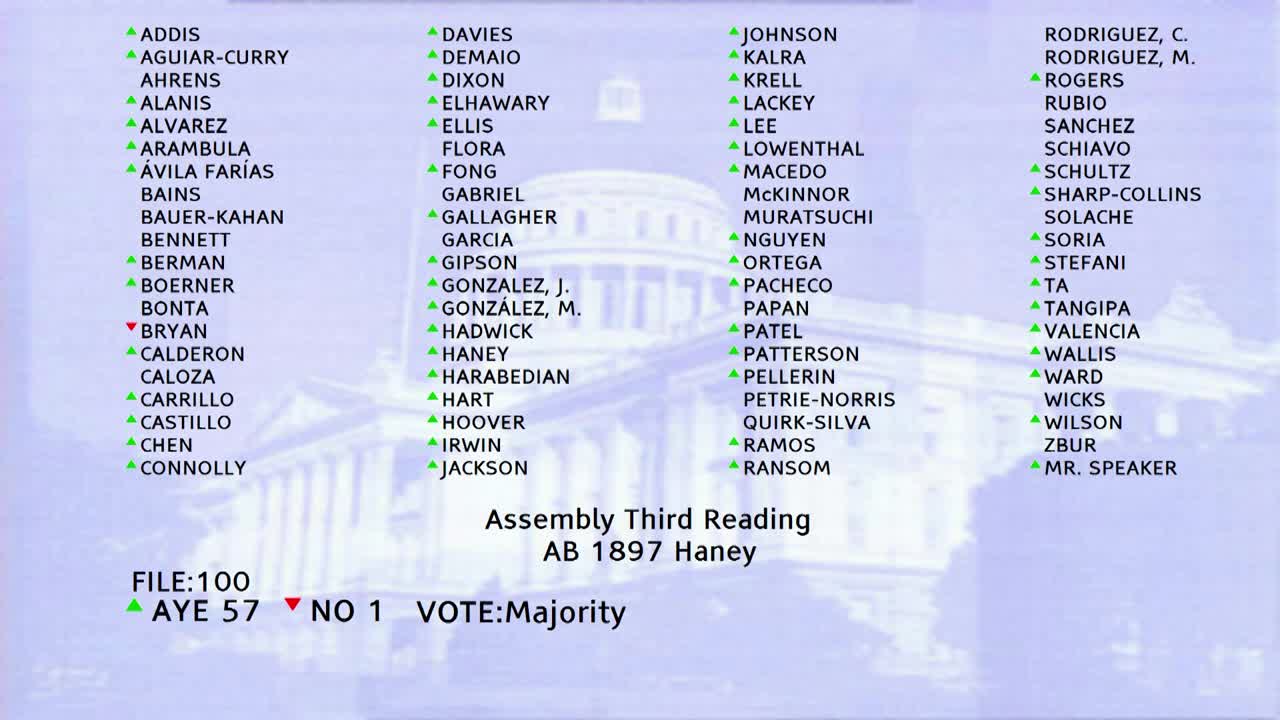
Bill Author

Bill Co-Author(s):