AB 2383: Electricity: data centers.
- Session Year: 2025-2026
- House: Assembly
- Latest Version Date: 2026-09-21
Current Status:
Passed
(2026-09-21: Chaptered by Secretary of State - Chapter 435, Statutes of 2026.)
Introduced
In Committee
Awaiting First Chamber Vote
Passed First Chamber
In Committee
Awaiting Second Chamber Vote
Passed Second Chamber
Enacted
Existing law vests the Public Utilities Commission with regulatory authority over public utilities, including electrical corporations. Existing law authorizes the commission to fix the rates and charges for every public utility and requires that those rates and charges be just and reasonable. Existing law authorizes the commission to investigate a single rate, classification, rule, contract, practice, or the entire schedule of rates, classifications, rules, contracts, and practices, of any public utility, and to establish new rates, classifications, rules, contracts, practices, or schedules.
This bill would require, as part of a new or existing proceeding, the commission to require each electrical corporation to file a transmission and distribution service tariff and a generation service tariff for participating customers, as defined, that meet certain requirements, as specified. The bill would also require, on or before January 1, 2028, each community choice aggregator or electric service provider to adopt a tariff for generation service for data centers, as defined, consistent with certain requirements, as specified. By imposing new duties on community choice aggregators, the bill would impose a state-mandated local program.
Under existing law, a violation of the Public Utilities Act or any order, decision, rule, direction, demand, or requirement of the commission is a crime.
Because the above provisions would be a part of the act, and because a violation of a commission action implementing the above provisions would be a crime, the bill would impose a state-mandated local program.
The California Constitution requires the state to reimburse local agencies and school districts for certain costs mandated by the state. Statutory provisions establish procedures for making that reimbursement.
This bill would provide that no reimbursement is required by this act for specified reasons.
Existing law vests the Public Utilities Commission with regulatory authority over public utilities, including electrical corporations. Existing law authorizes the commission to fix the rates and charges for every public utility and requires that those rates and charges be just and reasonable. Existing law authorizes the commission to investigate a single rate, classification, rule, contract, practice, or the entire schedule of rates, classifications, rules, contracts, and practices, of any public utility, and to establish new rates, classifications, rules, contracts, practices, or schedules.
This bill would require the commission, on or before January 1, 2028, in a new or existing proceeding, to provide for a classification of retail electricity consumers that are data centers that is separate and distinct from classifications of service for other commercial or industrial retail electricity consumers and has its own tariff, as specified. The bill would specify that an electrical corporation and a data center are not required to use the above-described classification of service if the commission has not approved the electrical corporations tariff for that classification of service.This bill would require require, as part of a new or existing proceeding, the commission to require each electrical corporation to file a transmission and distribution service tariff and a generation service tariff for participating customers, as defined, that meet certain requirements, as specified. The bill would also require require, on or before January 1, 2028, each community choice aggregator or electric service provider to adopt a tariff for generation service for data centers, as defined, consistent with certain requirements, as specified. By imposing new duties on community choice aggregators, the bill would impose a state-mandated local program. The bill would specify that these provisions only apply to a data center that enters into a new interconnection agreement to receive retail electrical service at the transmission level on or after January 1, 2027.
Under existing law, a violation of the Public Utilities Act or any order, decision, rule, direction, demand, or requirement of the commission is a crime.
Because the above provisions would be a part of the act, and because a violation of a commission action implementing the above provisions would be a crime, the bill would impose a state-mandated local program.
The California Constitution requires the state to reimburse local agencies and school districts for certain costs mandated by the state. Statutory provisions establish procedures for making that reimbursement.
This bill would provide that no reimbursement is required by this act for specified reasons.
This bill would make the operation of its provisions contingent upon the enactment of SB 886 of the 202526 Regular Session.Existing law vests the Public Utilities Commission with regulatory authority over public utilities, including electrical corporations. Existing law authorizes the commission to fix the rates and charges for every public utility and requires that those rates and charges be just and reasonable. Existing law authorizes the commission to investigate a single rate, classification, rule, contract, practice, or the entire schedule of rates, classifications, rules, contracts, and practices, of any public utility, and to establish new rates, classifications, rules, contracts, practices, or schedules.
This bill would require the commission, on or before January 1, 2028, in a new or existing proceeding, to provide for a classification of retail electricity consumers that are data centers that is separate and distinct from classifications of service for other commercial or industrial retail electricity consumers and has its own tariff, as specified. The bill would specify that an electrical corporation and a data center are not required to use the above-described classification of service if the commission has not approved the electrical corporations tariff for that classification of service.
This bill would require each electrical corporation to file a transmission and distribution tariff and a generation service tariff that meet certain requirements, as specified. The bill would also require each community choice aggregator or electric service provider to adopt a tariff for generation service consistent with certain requirements, as specified. By imposing new duties on community choice aggregators, the bill would impose a state-mandated local program. The bill would specify that these provisions only apply to a data center that enters into a new interconnection agreement to receive retail electrical service at the transmission level on or after January 1, 2027.
Under existing law, a violation of the Public Utilities Act or any order, decision, rule, direction, demand, or requirement of the commission is a crime.
Because the above provisions would be a part of the act, and because a violation of a commission action implementing the above provisions would be a crime, the bill would impose a state-mandated local program.
The California Constitution requires the state to reimburse local agencies and school districts for certain costs mandated by the state. Statutory provisions establish procedures for making that reimbursement.
This bill would provide that no reimbursement is required by this act for specified reasons.
This bill would make the operation of its provisions contingent upon the enactment of SB 886 of the 202526 Regular Session.
Existing law vests the Public Utilities Commission with regulatory authority over public utilities, including electrical corporations. Existing law authorizes the commission to fix the rates and charges for every public utility and requires that those rates and charges be just and reasonable. Existing law authorizes the commission to investigate a single rate, classification, rule, contract, practice, or the entire schedule of rates, classifications, rules, contracts, and practices, of any public utility, and to establish new rates, classifications, rules, contracts, practices, or schedules.
This bill would require the commission, on or before January 1, 2028, in a new or existing proceeding, to provide for a classification of retail electricity consumers that are large energy use facilities data centers that is separate and distinct from classifications of service for other commercial or industrial retail electricity consumers and has its own tariff, as specified. The bill would specify that an electrical corporation and a large energy use facility data center are not required to use the above-described classification of service if the commission has not approved the electrical corporations tariff for that classification of service.
This bill would require each electrical corporation that receives a request for to file a transmission and distribution service from a large energy use facility, and each load-serving entity, as defined, that receives a request for retail electrical tariff and a generation service from a large energy use facility, to ensure that the tariff meets that meet certain requirements, as specified. The bill would also require the commission to require each electrical corporation to submit a proposed transmission and distribution or generation service tariff that meets these requirements to the commission for approval, as specified. each community choice aggregator or electric service provider to adopt a tariff for generation service consistent with certain requirements, as specified. By imposing new duties on community choice aggregators, the bill would impose a state-mandated local program. The bill would specify that these provisions only apply to a large energy use facility that commences receiving electricity service from an electrical corporation, or generation service from a load-serving entity, data center that enters into a new interconnection agreement to receive retail electrical service at the transmission level on or after January 1, 2027.
Under existing law, a violation of the Public Utilities Act or any order, decision, rule, direction, demand, or requirement of the commission is a crime.
Because the above provisions would be a part of the act, and because a violation of a commission action implementing the above provisions would be a crime, the bill would impose a state-mandated local program.
The California Constitution requires the state to reimburse local agencies and school districts for certain costs mandated by the state. Statutory provisions establish procedures for making that reimbursement.This bill would provide that no reimbursement is required by this act for a specified reason.The California Constitution requires the state to reimburse local agencies and school districts for certain costs mandated by the state. Statutory provisions establish procedures for making that reimbursement.
This bill would provide that no reimbursement is required by this act for specified reasons.
Existing law vests the Public Utilities Commission with regulatory authority over public utilities, including electrical corporations. Existing law authorizes the commission to fix the rates and charges for every public utility and requires that those rates and charges be just and reasonable. Existing law authorizes the commission to investigate a single rate, classification, rule, contract, practice, or the entire schedule of rates, classifications, rules, contracts, and practices, of any public utility, and to establish new rates, classifications, rules, contracts, practices, or schedules.
This bill would require the commission, on or before January 1, 2028, in a new or existing proceeding, to provide for a classification of retail electricity consumers that are large energy use facilities that is separate and distinct from classifications of service for other commercial or industrial retail electricity consumers and has its own rate schedule, tariff, as specified. The bill would require any rate schedule adopted by the commission for large energy use facilities to meet specified requirements, and would require the commission, in deciding whether to approve an electrical corporations proposed rate schedule, to ensure the rates meet certain requirements, as provided. The bill would specify that an electrical corporation and a large energy use facility are not required to use the above-described classification of service if the commission has not approved the electrical corporations rate schedule tariff for that classification of service.
This bill would require the commission to require an electrical corporation that is providing electricity service to a large energy use facility to enter into a contract with the large energy use facility that covers the cost of service and the cost of energizing the facility, as applicable, and would require any contract entered into between an electrical corporation and a large energy use facility pursuant to these provisions to meet certain requirements. The bill would require, if an electric service provider or community choice aggregator provides electricity service to a large energy use facility, that the rate schedule meet certain criteria, as specified, and that the electric service provider or community choice aggregator enters into a contract with the large energy use facility, as provided. each electrical corporation that receives a request for transmission and distribution service from a large energy use facility, and each load-serving entity, as defined, that receives a request for retail electrical generation service from a large energy use facility, to ensure that the tariff meets certain requirements, as specified. The bill would require the commission to require each electrical corporation to submit a proposed transmission and distribution or generation service tariff that meets these requirements to the commission for approval, as specified. The bill would specify that these provisions apply to a large energy use facility that receives commences receiving electricity service from an electrical corporation, electric service provider, or community choice aggregator corporation, or generation service from a load-serving entity, on or after January 1, 2027.
Under existing law, a violation of the Public Utilities Act or any order, decision, rule, direction, demand, or requirement of the commission is a crime.
Because the above provisions would be a part of the act, and because a violation of a commission action implementing the above provisions would be a crime, the bill would impose a state-mandated local program.
The California Constitution requires the state to reimburse local agencies and school districts for certain costs mandated by the state. Statutory provisions establish procedures for making that reimbursement.
This bill would provide that no reimbursement is required by this act for a specified reason.
Existing law vests the Public Utilities Commission with regulatory authority over public utilities, including electrical corporations. Existing law authorizes the commission to fix the rates and charges for every public utility and requires that those rates and charges be just and reasonable. Existing law authorizes the commission to investigate a single rate, classification, rule, contract, practice, or the entire schedule of rates, classifications, rules, contracts, and practices, of any public utility, and to establish new rates, classifications, rules, contracts, practices, or schedules.
This bill would require the commission, on or before January 1, 2028, in a new or existing proceeding, to provide for a classification of retail electricity consumers that are large energy use facilities that is separate and distinct from classifications of service for other commercial or industrial retail electricity consumers and has its own rate schedule, as specified. The bill would require any rate schedule adopted by the commission for large energy use facilities to meet specified requirements, and would require the commission, in deciding whether to approve an electrical corporations proposed rate schedule, to ensure the rates meet certain requirements, as provided. The bill would specify that an electrical corporation and a large energy use facility are not required to use the above-described classification of service if the commission has not approved the electrical corporations rate schedule for that classification of service.
This bill would require the commission to require a load-serving entity an electrical corporation that is providing electricity service to a large energy use facility to enter into a contract with the large energy use facility that covers the cost of service and the cost of energizing the facility, as applicable, and would require any contract entered into between an electrical corporation and a large energy use facility pursuant to these provisions to meet certain requirements. The bill would require, if an electric service provider or community choice aggregator provides electricity service to a large energy use facility, that the rate schedule meet certain criteria, as specified, and that the electric service provider or community choice aggregator enters into a contract with the large energy use facility, as provided. The bill would specify that these provisions apply to a large energy use facility that receives electricity service from a load-serving entity an electrical corporation, electric service provider, or community choice aggregator on or after January 1, 2027.
Under existing law, a violation of the Public Utilities Act or any order, decision, rule, direction, demand, or requirement of the commission is a crime.
Because the above provisions would be a part of the act, and because a violation of a commission action implementing the above provisions would be a crime, the bill would impose a state-mandated local program.
The California Constitution requires the state to reimburse local agencies and school districts for certain costs mandated by the state. Statutory provisions establish procedures for making that reimbursement.
This bill would provide that no reimbursement is required by this act for a specified reason.
Existing law vests the Public Utilities Commission with regulatory authority over public utilities, including electrical corporations. Existing law authorizes the commission to fix the rates and charges for every public utility and requires that those rates and charges be just and reasonable. Existing law authorizes the commission to investigate a single rate, classification, rule, contract, practice, or the entire schedule of rates, classifications, rules, contracts, and practices, of any public utility, and to establish new rates, classifications, rules, contracts, practices, or schedules.
This bill would require the commission, on or before January 1, 2028, in a new or existing proceeding, to provide for a classification of retail electricity consumers that are large energy use facilities, as defined, facilities that is separate and distinct from classifications of service for other commercial or industrial retail electricity consumers and has its own rate schedule. schedule, as specified. The bill would require any rate schedule adopted by the commission for large energy use facilities to meet specified requirements, and would require the commission, in deciding whether to approve an electrical corporations proposed rate schedule, to ensure the rates meet certain requirements, as provided. The bill would specify that, until January 1, 2028, that an electrical corporation and a large energy use facility are not required to use the above-described classification of service if the commission has not approved the electrical corporations rate schedule for that classification of service.
This bill would require the commission to require an electrical corporation a load-serving entity that is providing electricity service to a large energy use facility to enter into a contract with the large energy use facility that covers the provision of transmission, generation, or distribution of electricity service, cost of service and the cost of energizing the facility, as applicable, and would require any contract entered into between an electrical corporation and a large energy use facility pursuant to these provisions to meet certain requirements. The bill would specify that these provisions apply to a large energy use facility that receives electricity service from an electrical corporation a load-serving entity on or after January 1, 2027.
Under existing law, a violation of the Public Utilities Act or any order, decision, rule, direction, demand, or requirement of the commission is a crime.
Because the above provisions would be a part of the act, and because a violation of a commission action implementing the above provisions would be a crime, the bill would impose a state-mandated local program.
The California Constitution requires the state to reimburse local agencies and school districts for certain costs mandated by the state. Statutory provisions establish procedures for making that reimbursement.
This bill would provide that no reimbursement is required by this act for a specified reason.
Existing law vests the Public Utilities Commission with regulatory authority over public utilities, including electrical corporations. Existing law authorizes the commission to fix the rates and charges for every public utility and requires that those rates and charges be just and reasonable. Existing law authorizes the commission to investigate a single rate, classification, rule, contract, practice, or the entire schedule of rates, classifications, rules, contracts, and practices, of any public utility, and to establish new rates, classifications, rules, contracts, practices, or schedules.
This bill would require the commission, on or before January 1, 2028, in a new or existing proceeding, to provide for a classification of retail electricity consumers that are large energy use facilities, as defined, that is separate and distinct from classifications of service for other commercial or industrial retail electricity consumers and has its own rate schedule. The bill would require any rate schedule adopted by the commission for large energy use facilities to meet specified requirements, and would require the commission, in deciding whether to approve an electrical corporations proposed rate schedule, to ensure the rates meet certain requirements, as provided. The bill would specify that, until January 1, 2028, an electrical corporation and a large energy use facility are not required to use the above-described classification of service if the commission has not approved the electrical corporations rate schedule for that classification of service.
This bill would require the commission to require an electrical corporation that is providing electricity service to a large energy use facility to enter into a contract with the large energy use facility that covers the provision of transmission, generation, or distribution of electricity service, as applicable, and would require any contract entered into between an electrical corporation and a large energy use facility pursuant to these provisions to meet certain requirements. The bill would specify that these provisions apply to a large energy use facility that receives electricity service from an electrical corporation on or after January 1, 2027.
Under existing law, a violation of the Public Utilities Act or any order, decision, rule, direction, demand, or requirement of the commission is a crime.
Because the above provisions would be a part of the act, and because a violation of a commission action implementing the above provisions would be a crime, the bill would impose a state-mandated local program.
The California Constitution requires the state to reimburse local agencies and school districts for certain costs mandated by the state. Statutory provisions establish procedures for making that reimbursement.
This bill would provide that no reimbursement is required by this act for a specified reason.
For purposes of this article, all of the following definitions apply:
(a)Data center means a facility, or a part of a facility, that houses computing infrastructure, including graphics and central processing units, servers, storage devices, networking equipment, and associated power and cooling systems, for the primary purpose of processing, storing, or distributing electronic data, except as otherwise specified in this article.
(b)Electrical corporation has the same meaning as defined in Section 218, but does not include an electrical cooperative, as defined in Section 2776.
(c)Facility means a physical property, a plant, a building, a structure, or stationary equipment, located on one or more contiguous or adjacent properties in actual physical contact or separated solely by a public roadway or public right-of-way and under common ownership or common control.
(d)Nonparticipating customer means a customer who does not receive electrical service pursuant to a tariff established pursuant to subdivision (a) of Section 945.2.
(e)Participating customer means a data center tariffed pursuant to this article.
(f)Unbundled customer means a customer receiving the generation component of their electrical service from an entity that is different from the entity providing the transmission and distribution components of the customers electrical service.
SEC. 2.Section 945.4 is added to the Public Utilities Code, to read:945.4.As part of a new or existing proceeding, the commission shall require each electrical corporation to file a transmission and distribution service tariff that does at least both of the following, to the extent permitted by federal law:
(a)Ensures that all participating customers pay a reasonable share of the costs relating to wildfire mitigation, wildfire liability, electrification and environmental programs, and other societal cost obligations typically collected from distribution-level ratepayers.
(b)Ensures that a tariff adopted by the commission pursuant to this section shall be consistent with Section 945.2.
SEC. 3.Section 945.5 is added to the Public Utilities Code, to read:945.5.(a)As part of a new or existing proceeding the commission shall require each electrical corporation to file a generation service tariff that does at least all of the following:
(1)Ensures the procurement of generation resources that support an electrical corporations ability to meet procurement requirements set forth by the commission, the clean energy targets set forth in Sections 399.15 and 454.52, and other state clean energy policies.
(2)Ensures that participating customers provide equitable contributions to reliability and other programs funded through charges generally collected through the generation component of a customers bill.
(3)Establishes a mechanism approved by the commission to ensure that a participating customer pays for those incremental generation cost increases resulting from the participating customers load to prevent nonparticipating customers of the electrical corporation from incurring stranded generation costs due to incremental procurement for participating customers. The minimum duration of the payment mechanism established pursuant to this section shall be at least 10 years and shall include all of the following:
(A)Fees for participating customers that do not complete interconnection and early termination fees sufficient to ensure that other ratepayers are held harmless for costs incurred to serve the participating customer.
(B)A requirement for a participating customer to provide upfront collateral or prepayment for incremental generation cost increases resulting from the participating customers load.
(C)A cost recovery mechanism that ensures a participating customer pays a minimum amount or percentage, based on the participating customers projected load indicated in its interconnection application. This cost recovery mechanism shall be sufficient to ensure that other ratepayers are held harmless for costs incurred to serve the participating customer if the participating customer consumes less than its anticipated load.
(D)Authorization for a participating customer to reduce the generation funding requirements pursuant to this paragraph by installing zero-emissions resources behind its meter, as determined by the commission. Any reductions to incremental generation funding requirements shall be relative to the amount of zero-emissions resources installed behind the customers meter.
(E)A requirement that any resource procurement to serve the participating customer shall be consistent with paragraph (1) of this subdivision.
(4)Requires the participating customer to report to the electrical corporation the expected investments in onsite generation throughout the duration of service.
(5)Ensures that a participating customer does not receive compensation for onsite generation in a manner that would result in cost shifts to other retail electricity consumers.
(b)A tariff adopted by the commission pursuant to this section shall be consistent with Section 945.2.
(c)In adopting a generation tariff pursuant to this section, the commission shall set a minimum peak electricity demand threshold at which the generation tariff shall apply to any participating customer at or above that threshold. The commission may not set a minimum peak electricity demand threshold that exceeds 25 megawatts.
(d)A generation tariff adopted pursuant to this section shall not apply to the following types of facilities that otherwise meet the definition of a data center pursuant to this article:
(1)A publicly funded research facility.
(2)Public safety facility.
(3)A publicly funded national security facility, as identified by the commission.
(4)Publicly owned facility.
(5)A utility facility, including, but not limited to, a facility operated for the purpose of providing telecommunications services to the public by a terrestrial facilities-based telecommunications provider.
SEC. 4.Section 945.6 is added to the Public Utilities Code, to read:945.6.(a)(1)On or before January 1, 2028, each community choice aggregator, consistent with Section 366.2, or electric service provider, consistent with Section 394, shall adopt a tariff for generation service for data centers.
(2)In adopting a generation tariff pursuant to this section, the community choice aggregator or electric service provider shall set a minimum peak electricity demand threshold at which the generation tariff shall apply to any data center customer at or above that threshold. The community choice aggregator or electric service provider may not set a minimum peak electricity demand threshold that exceeds 25 megawatts.
(b)The generation tariff established pursuant to subdivision (a) shall, at a minimum, meet all of the following requirements:
(1)Allocates the costs of serving data centers in a manner that ensures that incremental costs for serving this class are not borne by other electrical rate classes.
(2)Ensures the procurement of generation resources that support a community choice aggregators or electric service providers ability to meet procurement requirements set forth by the commission, the clean energy targets set forth in Sections 399.15 and 454.52, and other state clean energy policies.
(3)Ensures that tariffed data centers provide equitable contributions to reliability and other programs funded through charges generally collected through the generation component of a customers bill.
(4)Does not result in, or have the potential to result in, increased costs to other retail electricity consumers.
(5)(A)Establishes a mechanism approved by the commission to ensure that a data center tariffed pursuant to this section pays for those incremental generation cost increases resulting from the data centers load to prevent nonparticipating customers from incurring stranded generation costs due to incremental procurement for the data center. The minimum duration of the payment mechanism established pursuant to this section shall be at least 10 years and shall include all of the following:
(B)Fees for data centers that do not complete interconnection and early termination fees sufficient to ensure that other ratepayers are held harmless for costs incurred to serve the data center.
(C)A requirement for a data center to provide upfront collateral or prepayment for incremental generation cost increases resulting from the data centers load.
(D)A cost recovery mechanism that ensures a data center pays a minimum amount or percentage, based on the data centers projected load indicated in its interconnection application. This cost recovery mechanism shall be sufficient to ensure that other ratepayers are held harmless for costs incurred to serve the data center if the data center consumes less than its anticipated load.
(E)Authorization for a data center to reduce the generation funding requirements pursuant to this paragraph by installing zero-emissions resources behind its meter, as determined by the commission. Any reductions to incremental generation funding requirements shall be relative to the amount of zero-emissions resources installed behind the customers meter.
(F)A requirement that any resource procurement to serve the data center shall be consistent with paragraph (2).
(6)Requires the data center to report its expected investments in onsite generation throughout the duration of service.
(7)Ensures that a data center tariffed pursuant to this section does not receive compensation for onsite generation in a manner that would result in cost shifts to other retail electricity consumers.
(c)This section does not authorize the commission to regulate the rates or terms and conditions of service offered by a community choice aggregator, consistent with Section 366.2, or an electric service provider, consistent with Section 394.
SEC. 5.Section 945.8 is added to the Public Utilities Code, to read:945.8.(a)This article does not expand the amount of retail load eligible to participate in direct access transactions pursuant to Section 365.1.
SEC. 6.No reimbursement is required by this act pursuant to Section 6 of Article XIIIB of the California Constitution because a local agency or school district has the authority to levy service charges, fees, or assessments sufficient to pay for the program or level of service mandated by this act or because costs that may be incurred by a local agency or school district will be incurred because this act creates a new crime or infraction, eliminates a crime or infraction, or changes the penalty for a crime or infraction, within the meaning of Section 17556 of the Government Code, or changes the definition of a crime within the meaning of Section 6 of Article XIIIB of the California Constitution.
For purposes of this article, all of the following definitions apply:
(a)Costs of serving includes, as applicable, the costs incurred by a load-serving entity in providing generation, transmission, distribution, energy, capacity, or ancillary electricity services, and any related costs or associated risks with serving a retail electricity consumer or a class of retail electricity consumers. Costs of serving does not include upgrades to the electrical transmission system or electrical distribution system necessary to energize a data center.
(b)(1)
(a)Data center means a facility that primarily contains electronic equipment used to process, store, and transmit digital information, which may be a freestanding structure or a facility within a larger structure, that uses environmental control equipment to maintain the proper conditions for the operation of electronic equipment, except as specified in paragraph (2). facility, or a part of a facility, that houses computing infrastructure, including graphics and central processing units, servers, storage devices, networking equipment, and associated power and cooling systems, for the primary purpose of processing, storing, or distributing electronic data, except as otherwise specified in this article.
(2)Data center does not include a publicly funded research facility, public safety facility, publicly funded national security facility, publicly owned facility, or utility facility.(c)Retail electricity consumer means the end user of electricity.(b)Electrical corporation has the same meaning as defined in Section 218, but does not include an electrical cooperative, as defined in Section 2776.
(c)Facility means a physical property, a plant, a building, a structure, or stationary equipment, located on one or more contiguous or adjacent properties in actual physical contact or separated solely by a public roadway or public right-of-way and under common ownership or common control.
(d)Nonparticipating customer means a customer who does not receive electrical service pursuant to a tariff established pursuant to subdivision (a) of Section 945.2.
(e)Participating customer means a data center tariffed pursuant to this article.
(f)Unbundled customer means a customer receiving the generation component of their electrical service from an entity that is different from the entity providing the transmission and distribution components of the customers electrical service.
945.1.On or before January 1, 2028, the commission shall, in a new or existing proceeding, provide for a classification of retail electricity consumers that are data centers. The classification of service shall be separate and distinct from classifications of service for other commercial or industrial retail electricity consumers and shall have its own tariff.945.2.An electrical corporation and a data center are not required to use a classification of service provided for under Section 945.1 if the commission has not approved the electrical corporations tariff for that classification of service.945.3.(a)TheSEC. 2.Section 945.4 is added to the Public Utilities Code, to read:945.4.As part of a new or existing proceeding, the commission shall require each electrical corporation to file a transmission and distribution service tariff that does at least all both of the following: following, to the extent permitted by federal law:
(1)Allocates the costs of serving the class of data centers in a manner that ensures that incremental costs for serving the class are not borne by other electrical rate classes.(2)Does not result in, or have the potential to result in, increased costs to other retail electricity consumers.(3)(a)Ensures that a data center interconnected at the transmission level pays all participating customers pay a reasonable share of the costs relating to wildfire mitigation, wildfire liability, electrification and environmental programs, and other societal cost obligations typically collected from distribution-level ratepayers.
(4)Encourages the development of data centers that bring high-wage and high-skilled jobs to California.(5)Requires a data center seeking a new transmission interconnection to enter into a contract with the electrical corporation to prepay those interconnection costs and any distribution costs necessitated by the transmission interconnection of the data center. The minimum duration of the contract shall be at least 10 years and shall include early termination fees sufficient to ensure investment costs are covered. (6)Requires the data center to certify to the commission that its facility meets the requirements of Sections 25545.3.3 and 25545.3.5 of the Public Resources Code.(b)An electrical corporation may submit an exceptional case filing to approve a contract between the electrical corporation and a data center seeking interconnection at the transmission level for those facilities that seek to obtain retail electric service after January 1, 2027, but before the commission has approved a tariff filed pursuant to subdivision (a). A contract entered into pursuant to this subdivision shall be consistent with the requirements of this section.(b)Ensures that a tariff adopted by the commission pursuant to this section shall be consistent with Section 945.2.
945.4.(a)TheSEC. 3.Section 945.5 is added to the Public Utilities Code, to read:945.5.(a)As part of a new or existing proceeding the commission shall require each electrical corporation to file a generation service tariff that does at least all of the following:
(1)Allocates the costs of serving the class of data centers in a manner that ensures that incremental costs for serving the class are not borne by other electrical rate classes.(2)Supports clean energy targets set forth in Sections 399.15 and 454.52 and other applicable state clean energy policies by facilitating the procurement of, or contracts for, generation necessary to serve data centers pursuant to this article using resources meeting the requirements of Sections 399.15 and 454.52, as determined by the commission.(3)Allows for procurement of, or contracts for, generation resources that support the load-serving entitys ability to meet the clean energy targets described in paragraph (2).(1)Ensures the procurement of generation resources that support an electrical corporations ability to meet procurement requirements set forth by the commission, the clean energy targets set forth in Sections 399.15 and 454.52, and other state clean energy policies.
(4)(2)Ensures that tariffed data centers participating customers provide equitable contributions to reliability and other programs funded through charges generally collected through the generation component of a customers bill.
(5)Does not result in, or have the potential to result in, increased costs to other retail electricity consumers.(6)Requires a data center to enter into a contract with the electrical corporation to prepay those incremental generation cost increases resulting from the data centers load. The minimum duration of the contract shall be at least 10 years and shall include early termination fees sufficient to ensure the costs of serving the data center are covered.(7)Requires the data center to pay a minimum amount or percentage, based on the data centers projected electricity usage for the duration of a contract established pursuant to this section.(3)Establishes a mechanism approved by the commission to ensure that a participating customer pays for those incremental generation cost increases resulting from the participating customers load to prevent nonparticipating customers of the electrical corporation from incurring stranded generation costs due to incremental procurement for participating customers. The minimum duration of the payment mechanism established pursuant to this section shall be at least 10 years and shall include all of the following:
(A)Fees for participating customers that do not complete interconnection and early termination fees sufficient to ensure that other ratepayers are held harmless for costs incurred to serve the participating customer.
(B)A requirement for a participating customer to provide upfront collateral or prepayment for incremental generation cost increases resulting from the participating customers load.
(C)A cost recovery mechanism that ensures a participating customer pays a minimum amount or percentage, based on the participating customers projected load indicated in its interconnection application. This cost recovery mechanism shall be sufficient to ensure that other ratepayers are held harmless for costs incurred to serve the participating customer if the participating customer consumes less than its anticipated load.
(D)Authorization for a participating customer to reduce the generation funding requirements pursuant to this paragraph by installing zero-emissions resources behind its meter, as determined by the commission. Any reductions to incremental generation funding requirements shall be relative to the amount of zero-emissions resources installed behind the customers meter.
(E)A requirement that any resource procurement to serve the participating customer shall be consistent with paragraph (1) of this subdivision.
(8)(4)Requires the data center participating customer to report to the electrical corporation the expected investments in onsite generation throughout the duration of service before entering into an interconnection agreement. service.
(9)(5)Ensures that a data center tariffed pursuant to this section participating customer does not receive compensation for onsite generation in a manner that would result in cost shifts to other retail electricity consumers.
(b)The electrical corporation may submit an exceptional case filing to approve a contract between the electrical corporation and a data center seeking retail electrical service at the transmission level for those facilities that seek to start retail electrical service after January 1, 2027, but before the commission has approved a tariff filed pursuant to subdivision (a). A contract entered into pursuant to this subdivision shall be consistent with the requirements of this section.(b)A tariff adopted by the commission pursuant to this section shall be consistent with Section 945.2.
(c)In adopting a generation tariff pursuant to this section, the commission shall set a minimum peak electricity demand threshold at which the generation tariff shall apply to any participating customer at or above that threshold. The commission may not set a minimum peak electricity demand threshold that exceeds 25 megawatts.
(d)A generation tariff adopted pursuant to this section shall not apply to the following types of facilities that otherwise meet the definition of a data center pursuant to this article:
(1)A publicly funded research facility.
(2)Public safety facility.
(3)A publicly funded national security facility, as identified by the commission.
(4)Publicly owned facility.
(5)A utility facility, including, but not limited to, a facility operated for the purpose of providing telecommunications services to the public by a terrestrial facilities-based telecommunications provider.
945.5.(a)EachSEC. 4.Section 945.6 is added to the Public Utilities Code, to read:945.6.(a)(1)On or before January 1, 2028, each community choice aggregator, consistent with Section 366.2, or electric service provider, consistent with Section 394, shall adopt a tariff for generation service that is consistent with the following requirements: for data centers.
(2)In adopting a generation tariff pursuant to this section, the community choice aggregator or electric service provider shall set a minimum peak electricity demand threshold at which the generation tariff shall apply to any data center customer at or above that threshold. The community choice aggregator or electric service provider may not set a minimum peak electricity demand threshold that exceeds 25 megawatts.
(b)The generation tariff established pursuant to subdivision (a) shall, at a minimum, meet all of the following requirements:
(1)Allocates the costs of serving the class of data centers in a manner that ensures that incremental costs for serving this class are not borne by other electrical rate classes.
(2)Supports the community choice aggregators or electric service providers ability to meet the clean energy targets set forth in Sections 399.15 and 454.52 and other applicable state clean energy policies by facilitating the procurement of, or contracts for, generation necessary to serve data centers pursuant to this article using resources meeting the requirements of Sections 399.15 and 454.52, as determined by the commission.(2)Ensures the procurement of generation resources that support a community choice aggregators or electric service providers ability to meet procurement requirements set forth by the commission, the clean energy targets set forth in Sections 399.15 and 454.52, and other state clean energy policies.
(3)Ensures that tariffed data centers provide equitable contributions to reliability and other programs funded through charges generally collected through the generation component of a customers bill.
(4)Does not result in, or have the potential to result in, increased costs to other retail electricity consumers.
(5)Requires a data center to enter into a contract with the community choice aggregator or electric service provider. The minimum duration of this contract shall be 10 years, and the contract shall include early termination fees sufficient to ensure investment costs are covered.(6)Requires the data center to pay a minimum amount or percentage, based on the data centers projected electricity usage for the duration of a contract, established pursuant to this section.(5)(A)Establishes a mechanism approved by the commission to ensure that a data center tariffed pursuant to this section pays for those incremental generation cost increases resulting from the data centers load to prevent nonparticipating customers from incurring stranded generation costs due to incremental procurement for the data center. The minimum duration of the payment mechanism established pursuant to this section shall be at least 10 years and shall include all of the following:
(B)Fees for data centers that do not complete interconnection and early termination fees sufficient to ensure that other ratepayers are held harmless for costs incurred to serve the data center.
(C)A requirement for a data center to provide upfront collateral or prepayment for incremental generation cost increases resulting from the data centers load.
(D)A cost recovery mechanism that ensures a data center pays a minimum amount or percentage, based on the data centers projected load indicated in its interconnection application. This cost recovery mechanism shall be sufficient to ensure that other ratepayers are held harmless for costs incurred to serve the data center if the data center consumes less than its anticipated load.
(E)Authorization for a data center to reduce the generation funding requirements pursuant to this paragraph by installing zero-emissions resources behind its meter, as determined by the commission. Any reductions to incremental generation funding requirements shall be relative to the amount of zero-emissions resources installed behind the customers meter.
(F)A requirement that any resource procurement to serve the data center shall be consistent with paragraph (2).
(7)(6)Requires the data center to report its expected investments in onsite generation throughout the duration of service.
(8)(7)Ensures that a data center tariffed pursuant to this section does not receive compensation for onsite generation in a manner that would result in cost shifts to other retail electricity consumers.
(b)(c)This section does not authorize the commission to regulate the rates or terms and conditions of service offered by a community choice aggregator, consistent with Section 366.2, or an electric service provider, consistent with Section 394.
945.6.(a)SEC. 5.Section 945.8 is added to the Public Utilities Code, to read:945.8.(a)This article does not expand the amount of retail load eligible to participate in direct access transactions pursuant to Section 365.1.
(b)This article shall only apply to a data center that enters into a new interconnection agreement to receive retail electrical service at the transmission level on or after January 1, 2027.SEC. 2.SEC. 6.No reimbursement is required by this act pursuant to Section 6 of Article XIIIB of the California Constitution because a local agency or school district has the authority to levy service charges, fees, or assessments sufficient to pay for the program or level of service mandated by this act or because costs that may be incurred by a local agency or school district will be incurred because this act creates a new crime or infraction, eliminates a crime or infraction, or changes the penalty for a crime or infraction, within the meaning of Section 17556 of the Government Code, or changes the definition of a crime within the meaning of Section 6 of Article XIIIB of the California Constitution.
SEC. 3.This act shall become operative only if Senate Bill 886 of the 202526 Regular Session is enacted and becomes effective on or before January 1, 2027.For purposes of this article, all of the following definitions apply:
(a)Costs of serving includes, as applicable, the costs incurred by a load-serving entity in providing generation, transmission, distribution, energy, capacity, or ancillary electricity services, and any related costs or associated risks with serving a retail electricity consumer or a class of retail electricity consumers. Costs of serving does not include upgrades to the electrical transmission system or electrical distribution system necessary to energize a data center.
(b)(1)Data center means a facility that primarily contains electronic equipment used to process, store, and transmit digital information, which may be a freestanding structure or a facility within a larger structure, that uses environmental control equipment to maintain the proper conditions for the operation of electronic equipment, except as specified in paragraph (2).
(2)Data center does not include a publicly funded research facility, public safety facility, publicly funded national security facility, publicly owned facility, or utility facility.
(c)Retail electricity consumer means the end user of electricity.
945.1.On or before January 1, 2028, the commission shall, in a new or existing proceeding, provide for a classification of retail electricity consumers that are data centers. The classification of service shall be separate and distinct from classifications of service for other commercial or industrial retail electricity consumers and shall have its own tariff.
945.2.An electrical corporation and a data center are not required to use a classification of service provided for under Section 945.1 if the commission has not approved the electrical corporations tariff for that classification of service.
945.3.(a)The commission shall require each electrical corporation to file a transmission and distribution tariff that does at least all of the following:
(1)Allocates the costs of serving the class of data centers in a manner that ensures that incremental costs for serving the class are not borne by other electrical rate classes.
(2)Does not result in, or have the potential to result in, increased costs to other retail electricity consumers.
(3)Ensures that a data center interconnected at the transmission level pays a reasonable share of the costs relating to wildfire mitigation, wildfire liability, electrification and environmental programs, and other societal cost obligations typically collected from distribution-level ratepayers.
(4)Encourages the development of data centers that bring high-wage and high-skilled jobs to California.
(5)Requires a data center seeking a new transmission interconnection to enter into a contract with the electrical corporation to prepay those interconnection costs and any distribution costs necessitated by the transmission interconnection of the data center. The minimum duration of the contract shall be at least 10 years, years and shall include early termination fees sufficient to ensure investment costs are covered.
(6)Requires the data center to certify to the commission that its facility meets the requirements of Sections 25545.3.3 and 25545.3.5 of the Public Resources Code.
(b)An electrical corporation may submit an exceptional case filing to approve a contract between the electrical corporation and a data center seeking interconnection at the transmission level for those facilities that seek to obtain retail electric service after January 1, 2027, but before the commission has approved a tariff filed pursuant to subdivision (a). A contract entered into pursuant to this subdivision shall be consistent with the requirements of this section.
945.4.(a)The commission shall require each electrical corporation to file a generation service tariff that does at least all of the following:
(1)Allocates the costs of serving the class of data centers in a manner that ensures that incremental costs for serving the class are not borne by other electrical rate classes.
(2)Supports clean energy targets set forth in Sections 399.15 and 454.52 and other applicable state clean energy policies by facilitating the procurement of, or contracts for, generation necessary to serve data centers pursuant to this article using resources meeting the requirements of Sections 399.15 and 454.52, as determined by the commission.
(3)Allows for procurement of, or contracts for, generation resources that support the load-serving entitys ability to meet the clean energy targets described in paragraph (4). (2).
(4)Ensures that tariffed data centers provide equitable contributions to reliability and other programs funded through charges generally collected through the generation component of a customers bill.
(5)Does not result in, or have the potential to result in, increased costs to other retail electricity consumers.
(6)Requires a data center to enter into a contract with the electrical corporation to prepay those incremental generation cost increases resulting from the data centers load. The minimum duration of the contract shall be at least 10 years, years and shall include early termination fees sufficient to ensure the costs of serving the data center are covered.
(7)Requires the data center to pay a minimum amount or percentage, based on the data centers projected electricity usage for the duration of a contract established pursuant to this section.
(8)Requires the data center to report to the electrical corporation the expected investments in onsite generation throughout the duration of service before entering into an interconnection agreement.
(9)Ensures that a data center tariffed pursuant to this section does not receive compensation for onsite generation in a manner that would result in cost shifts to other retail electricity consumers.
(b)The electrical corporation may submit an exceptional case filing to approve a contract between the electrical corporation and a data center seeking retail electrical service at the transmission level for those facilities that seek to start retail electrical service after January 1, 2027, but before the commission has approved a tariff filed pursuant to subdivision (a). A contract entered into pursuant to this subdivision shall be consistent with the requirements of this section.
945.5.(a)Each community choice aggregator, consistent with Section 366.2, or electric service provider, consistent with Section 394, shall adopt a tariff for generation service that is consistent with the following requirements:
(1)Allocates the costs of serving the class of data centers in a manner that ensures that incremental costs for serving this class are not borne by other electrical rate classes.
(2)Supports the community choice aggregators or electric service providers ability to meet the clean energy targets set forth in Sections 399.15 and 454.52 and other applicable state clean energy policies by facilitating the procurement of, or contracts for, generation necessary to serve data centers pursuant to this article using resources meeting the requirements of Sections 399.15 and 454.52, as determined by the commission.
(3)Ensures that tariffed data centers provide equitable contributions to reliability and other programs funded through charges generally collected through the generation component of a customers bill.
(4)Does not result in, or have the potential to result in, increased costs to other retail electricity consumers.
(5)Requires a data center to enter into a contract with the community choice aggregator or electric service provider. The minimum duration of this contract shall be 10 years, and the contract shall include early termination fees sufficient to ensure investment costs are covered.
(6)Requires the data center to pay a minimum amount or percentage, based on the data centers projected electricity usage for the duration of a contract, established pursuant to this section.
(7)Requires the data center to report its expected investments in onsite generation throughout the duration of service.
(8)Ensures that a data center tariffed pursuant to this section does not receive compensation for onsite generation in a manner that would result in cost shifts to other retail electricity consumers.
(b)This section does not authorize the commission to regulate the rates or terms and conditions of service offered by a community choice aggregator, consistent with Section 366.2, or an electric service provider, consistent with Section 394.
945.6.(a)This article does not expand the amount of retail load eligible to participate in direct access transactions pursuant to Section 365.1.
(b)This article shall only apply to a data center that enters into a new interconnection agreement to receive retail electrical service at the transmission level on or after January 1, 2027.
SEC. 2.No reimbursement is required by this act pursuant to Section 6 of Article XIIIB of the California Constitution because a local agency or school district has the authority to levy service charges, fees, or assessments sufficient to pay for the program or level of service mandated by this act or because costs that may be incurred by a local agency or school district will be incurred because this act creates a new crime or infraction, eliminates a crime or infraction, or changes the penalty for a crime or infraction, within the meaning of Section 17556 of the Government Code, or changes the definition of a crime within the meaning of Section 6 of Article XIIIB of the California Constitution.
SEC. 3.This act shall become operative only if Senate Bill 886 of the 202526 Regular Session is enacted and becomes effective on or before January 1, 2027.
For purposes of this article, all of the following definitions apply:
(a)Costs of serving includes, as applicable, the costs incurred by a load-serving entity in providing generation, transmission, distribution, energy, capacity, or ancillary electricity services, and any related costs or associated risks with serving a retail electricity consumer or a class of retail electricity consumers. Costs of serving does not include upgrades to the electrical transmission system or electrical distribution system necessary to energize a large energy use facility. data center.
(b)Facility means all buildings, equipment, structures, and other stationary items that are located on a single site, or on contiguous or adjacent sites, and that are owned or operated by the same person or by any person who controls, is controlled by, or is under common control with that person.(c)Load-serving entity has the same meaning as defined in Section 380.(b)(1)Data center means a facility that primarily contains electronic equipment used to process, store, and transmit digital information, which may be a freestanding structure or a facility within a larger structure, that uses environmental control equipment to maintain the proper conditions for the operation of electronic equipment, except as specified in paragraph (2).
(2)Data center does not include a publicly funded research facility, public safety facility, publicly funded national security facility, publicly owned facility, or utility facility.
(d)(c)Retail electricity consumer means the end user of electricity.
945.1.(a)On or before January 1, 2028, the commission shall, in a new or existing proceeding, provide for a classification of retail electricity consumers that are large energy use facilities. data centers. The classification of service shall be separate and distinct from classifications of service for other commercial or industrial retail electricity consumers and shall have its own tariff.
(b)The commission shall include all of the following facilities, and any additional entities deemed appropriate, in classifying new facilities that did not exist before January 1, 2027, as large energy use facilities for eligibility under this tariff:(1)Facilities interconnected under a retail transmission tariff operating over a minimum peak load value, as determined by the commission.(2)Facilities that meet the criteria in paragraph (1) and that house computing infrastructure, including graphics and central processing units, servers, storage devices, networking equipment, and associated power and cooling systems, for the primary purpose of processing, storing, or distributing electronic data.(c)The commission shall consider how providing the classification pursuant to subdivision (a) will impact the electrification of emissions-intensive, trade-exposed facilities, or entities that provide a public benefit.945.2.An electrical corporation and a large energy use facility data center are not required to use a classification of service provided for under Section 945.1 if the commission has not approved the electrical corporations tariff for that classification of service.
945.3.(a)Each The commission shall require each electrical corporation that receives a request for to file a transmission and distribution service from a large energy use facility shall ensure that the tariff for any service offered that does at least all of the following:
(1)Allocates the costs of serving the class of large energy use facilities data centers in a manner that, at a minimum, is equal or proportional to the cost of serving the class. that ensures that incremental costs for serving the class are not borne by other electrical rate classes.
(2)Avoids both of the following:(A)Other classes of retail electricity consumers paying unwarranted costs.(B)Shifting the costs of serving a large energy use facility to another class of retail electricity consumers, including the cost of an electrical corporation meeting load requirements resulting from the provision of electrical service to a large energy use facility.(3)(2)Does not result in, or have the potential to result in, increased costs or unreasonable risk to other retail electricity consumers.
(4)Provides for equitable contributions to electrical grid efficiency, reliability, resiliency benefits, and state programs.(5)Includes an equitable portion of costs associated with wildfire mitigation, wildfire liability, climate mandates, and other programs that advance public and social equity that are typically collected from distribution-level ratepayers.(3)Ensures that a data center interconnected at the transmission level pays a reasonable share of the costs relating to wildfire mitigation, wildfire liability, electrification and environmental programs, and other societal cost obligations typically collected from distribution-level ratepayers.
(6)(4)Encourages the development of large energy use facilities data centers that bring high-wage and high-skilled jobs to California.
(7)Specifies the duration of the contract, the minimum duration of which shall be at least 10 years, and details fees for early termination of the contract to ensure investment costs are covered.(8)Requires the large energy use facility to pay a minimum amount or percentage based on the large energy use facilitys projected electricity usage for the electricity services the electrical corporation is contracted to provide for the duration of the contract.(5)Requires a data center seeking a new transmission interconnection to enter into a contract with the electrical corporation to prepay those interconnection costs and any distribution costs necessitated by the transmission interconnection of the data center. The minimum duration of the contract shall be at least 10 years, and shall include early termination fees sufficient to ensure investment costs are covered.
(9)(6)Requires the large energy use facility data center to certify to the commission that its facility meets the requirements of Sections 25545.3.3 and 25545.3.5 of the Public Resources Code.
(b)The commission shall require each electrical corporation to submit a proposed transmission and distribution tariff that meets the requirements of this section to the commission for approval. Before approval of the tariff, an electrical corporation may enter into a contract with a large energy use facility if the contract meets all the requirements of this section.(c)This section shall apply to a large energy use facility that commences receiving electricity service from an electrical corporation on or after January 1, 2027.(b)An electrical corporation may submit an exceptional case filing to approve a contract between the electrical corporation and a data center seeking interconnection at the transmission level for those facilities that seek to obtain retail electric service after January 1, 2027, but before the commission has approved a tariff filed pursuant to subdivision (a). A contract entered into pursuant to this subdivision shall be consistent with the requirements of this section.
945.4.(a)Each load-serving entity that receives a request for retail electrical The commission shall require each electrical corporation to file a generation service from a large energy use facility shall ensure that the tariff that does at least all of the following:
(1)Allocates the costs of serving the class of large energy use facilities data centers in a manner that, at a minimum, is equal or proportional to the cost of serving the class. that ensures that incremental costs for serving the class are not borne by other electrical rate classes.
(2)Prohibits participation in a net billing tariff or net energy metering arrangement.(3)Avoids both of the following:(A)Other classes of retail electricity consumers paying unwarranted costs.(B)Shifting the costs of serving a large energy use facility to another class of retail electricity consumers, including the cost of the load-serving entity meeting load requirements resulting from the provision of electricity service to a large energy use facility.(4)Does not impede the load-serving entitys ability to meet the(2)Supports clean energy targets set forth in Sections 399.15 and 454.52 and other applicable state clean energy policies. policies by facilitating the procurement of, or contracts for, generation necessary to serve data centers pursuant to this article using resources meeting the requirements of Sections 399.15 and 454.52, as determined by the commission.
(5)(3)Allows for procurement of, or contracts for, generation resources that support the load-serving entitys ability to meet the clean energy targets described in paragraph (4).
(6)As applicable, provides for(4)Ensures that tariffed data centers provide equitable contributions to reliability and state other programs associated with funded through charges generally collected through the generation component of the tariff. a customers bill.
(7)(5)Does not result in, or have the potential to result in, increased costs or unreasonable risk to other retail electricity consumers.
(8)Specifies the duration of the contract, the minimum duration of which shall be at least 10 years, and details fees for early termination of the contract to ensure costs of serving are covered.(6)Requires a data center to enter into a contract with the electrical corporation to prepay those incremental generation cost increases resulting from the data centers load. The minimum duration of the contract shall be at least 10 years, and shall include early termination fees sufficient to ensure the costs of serving the data center are covered.
(9)(7)Requires the large energy use facility data center to pay a minimum amount or percentage, based on the large energy use facilitys data centers projected electricity usage for the duration of the contract. a contract established pursuant to this section.
(10)(8)Requires the large energy use facility data center to report to the load-serving entity electrical corporation the expected investments in onsite generation throughout the duration of service, before the initial point of service. service before entering into an interconnection agreement.
(b)The commission shall require each electrical corporation to submit a proposed generation service tariff that meets the requirements of this section to the commission for approval. Before approval of the tariff, an electrical corporation may enter into a contract with a large energy use facility provided that the contract meets all the requirements of this section.(c)This section shall apply to a new large energy use facility that commences receiving generation service from a load-serving entity on or after January 1, 2027.(d)This section does not authorize the commission to regulate the rates or terms and conditions of service offered by a community choice aggregator, consistent with Section 366.2, or an electric service provider, consistent with Section 394.(9)Ensures that a data center tariffed pursuant to this section does not receive compensation for onsite generation in a manner that would result in cost shifts to other retail electricity consumers.
(b)The electrical corporation may submit an exceptional case filing to approve a contract between the electrical corporation and a data center seeking retail electrical service at the transmission level for those facilities that seek to start retail electrical service after January 1, 2027, but before the commission has approved a tariff filed pursuant to subdivision (a). A contract entered into pursuant to this subdivision shall be consistent with the requirements of this section.
945.5.(a)Each community choice aggregator, consistent with Section 366.2, or electric service provider, consistent with Section 394, shall adopt a tariff for generation service that is consistent with the following requirements:
(1)Allocates the costs of serving the class of data centers in a manner that ensures that incremental costs for serving this class are not borne by other electrical rate classes.
(2)Supports the community choice aggregators or electric service providers ability to meet the clean energy targets set forth in Sections 399.15 and 454.52 and other applicable state clean energy policies by facilitating the procurement of, or contracts for, generation necessary to serve data centers pursuant to this article using resources meeting the requirements of Sections 399.15 and 454.52, as determined by the commission.
(3)Ensures that tariffed data centers provide equitable contributions to reliability and other programs funded through charges generally collected through the generation component of a customers bill.
(4)Does not result in, or have the potential to result in, increased costs to other retail electricity consumers.
(5)Requires a data center to enter into a contract with the community choice aggregator or electric service provider. The minimum duration of this contract shall be 10 years, and the contract shall include early termination fees sufficient to ensure investment costs are covered.
(6)Requires the data center to pay a minimum amount or percentage, based on the data centers projected electricity usage for the duration of a contract, established pursuant to this section.
(7)Requires the data center to report its expected investments in onsite generation throughout the duration of service.
(8)Ensures that a data center tariffed pursuant to this section does not receive compensation for onsite generation in a manner that would result in cost shifts to other retail electricity consumers.
(b)This section does not authorize the commission to regulate the rates or terms and conditions of service offered by a community choice aggregator, consistent with Section 366.2, or an electric service provider, consistent with Section 394.
945.5.945.6.(a)This article does not expand the amount of retail load eligible to participate in direct access transactions pursuant to Section 365.1.
(b)This article shall only apply to a data center that enters into a new interconnection agreement to receive retail electrical service at the transmission level on or after January 1, 2027.
SEC. 2.No reimbursement is required by this act pursuant to Section 6 of Article XIIIB of the California Constitution because the only costs that may be incurred by a local agency or school district will be incurred because this act creates a new crime or infraction, eliminates a crime or infraction, or changes the penalty for a crime or infraction, within the meaning of Section 17556 of the Government Code, or changes the definition of a crime within the meaning of Section 6 of Article XIIIB of the California Constitution.SEC. 2.No reimbursement is required by this act pursuant to Section 6 of Article XIIIB of the California Constitution because a local agency or school district has the authority to levy service charges, fees, or assessments sufficient to pay for the program or level of service mandated by this act or because costs that may be incurred by a local agency or school district will be incurred because this act creates a new crime or infraction, eliminates a crime or infraction, or changes the penalty for a crime or infraction, within the meaning of Section 17556 of the Government Code, or changes the definition of a crime within the meaning of Section 6 of Article XIIIB of the California Constitution.
For purposes of this article, all of the following definitions apply:
(a)Costs of serving includes, as applicable, the costs incurred by an electrical corporation a load-serving entity in providing generation, transmission, distribution, energy, capacity, or ancillary electricity services, and any related costs or associated risks with serving a retail electricity consumer or a class of retail electricity consumers. Costs of serving does not include upgrades to the electrical transmission system or electrical distribution system necessary to energize the a large energy use facility.
(b)Facility means all buildings, equipment, structures, and other stationary items that are located on a single site, or on contiguous or adjacent sites, and that are owned or operated by the same person or by any person who controls, is controlled by, or is under common control with that person.
(c)Load-serving entity has the same meaning as defined in Section 380.
(c)(d)Retail electricity consumer means the end user of electricity.
945.1.(a)(1)On or before January 1, 2028, the commission shall, in a new or existing proceeding, provide for a classification of retail electricity consumers that are large energy use facilities. The classification of service shall be separate and distinct from classifications of service for other commercial or industrial retail electricity consumers and shall have its own rate schedule. tariff.
(2)(b)The commission shall include all of the following facilities, and any additional entities deemed appropriate, in classifying new facilities that did not exist before January 1, 2027, as large energy use facilities for eligibility under this rate schedule: tariff:
(A)(1)Facilities interconnected under a retail transmission tariff operating over a minimum peak load value, as determined by the commission.
(B)(2)Facilities that meet the criteria in subparagraph (A) paragraph (1) and that house computing infrastructure, including graphics and central processing units, servers, storage devices, networking equipment, and associated power and cooling systems, for the primary purpose of processing, storing, or distributing electronic data.
(3)(c)The commission shall consider how providing the classification pursuant to paragraph (1) subdivision (a) will impact the electrification of emissions-intensive, trade-exposed facilities, or entities that provide a public benefit.
(b)Any rate schedule adopted by the commission for large energy use facilities shall do at least all of the following:(1)Allocate the costs of serving the class of large energy use facilities in a manner that is equal or proportional to the cost of serving the class.(2)Meet the same conditions the commission requires for a contract under Section 945.3.(3)Prohibit participation in a net billing tariff or net energy metering arrangement.(4)Avoid both of the following:(A)Other classes of retail electricity consumers paying unwarranted costs.(B)Shifting the costs of serving a large energy use facility to another class of retail electricity consumers, including the cost of an electrical corporation meeting load requirements resulting from the provision of electricity service to a large energy use facility.(c)In deciding whether to approve an electrical corporations proposed rate schedule for a classification of service described under subdivision (a), the commission shall ensure that the rates do all of the following, as applicable:(1)Not result in, or have the potential to result in, increased costs or unreasonable risk to other retail electricity consumers.(2)Provide for equitable contributions to electrical grid efficiency, reliability, resiliency benefits, and state programs.(3)Include an equitable portion of costs associated with wildfire mitigation, wildfire liability, climate mandates, and other programs that advance public and social equity that are typically collected from distribution-level ratepayers.(4)Not impede the electrical corporations ability to meet the clean energy targets set forth in Sections 399.15 and 454.52 and other applicable state clean energy policies.(5)Allow for procurement of, or contracts for, generation resources that support the electrical corporations ability to meet the clean energy targets described in paragraph (4), if the large energy use facility elects to receive generation service from the electrical corporation and not from a community choice aggregator or electric service provider.(6)Encourage the development of large energy use facilities that bring high-wage and high-skilled jobs to California.945.2.An electrical corporation and a large energy use facility are not required to use a classification of service provided for under Section 945.1 if the commission has not approved the electrical corporations rate schedule tariff for that classification of service.
945.3.(a)The commission shall require an Each electrical corporation that is providing electricity service to a large energy use facility to enter into a contract with the large energy use facility that covers the cost of service and the cost of energizing the facility, as applicable. receives a request for transmission and distribution service from a large energy use facility shall ensure that the tariff for any service offered does at least all of the following:
(1)Allocates the costs of serving the class of large energy use facilities in a manner that, at a minimum, is equal or proportional to the cost of serving the class.
(2)Avoids both of the following:
(A)Other classes of retail electricity consumers paying unwarranted costs.
(B)Shifting the costs of serving a large energy use facility to another class of retail electricity consumers, including the cost of an electrical corporation meeting load requirements resulting from the provision of electrical service to a large energy use facility.
(3)Does not result in, or have the potential to result in, increased costs or unreasonable risk to other retail electricity consumers.
(4)Provides for equitable contributions to electrical grid efficiency, reliability, resiliency benefits, and state programs.
(5)Includes an equitable portion of costs associated with wildfire mitigation, wildfire liability, climate mandates, and other programs that advance public and social equity that are typically collected from distribution-level ratepayers.
(6)Encourages the development of large energy use facilities that bring high-wage and high-skilled jobs to California.
(b)A contract entered into between an electrical corporation and a large energy use facility pursuant to subdivision (a) shall do at least all of the following:(1)Be consistent with the criteria listed under subdivision (c) of Section 945.1, as applicable.(2)Specify the(7)Specifies the duration of the contract, the minimum duration of which shall be at least 15 10 years, and detail details fees for early termination of the contract to ensure investment costs are covered.
(3)Require the(8)Requires the large energy use facility to pay a minimum amount or percentage based on the large energy use facilitys projected electricity usage for the electricity services the electrical corporation is contracted to provide for the duration of the contract.
(4)Require the(9)Requires the large energy use facility to certify to the commission that its facility meets the requirements of Sections 25545.3.3 and 25545.3.5 of the Public Resources Code.
(c)The terms of a contract described under subdivision (a) shall include a requirement on the large energy use facility to report to the electrical corporation the expected investments in onsite generation throughout the duration of the contracted service, before the initial point of service under the contract.(d)This article does not limit or restrict the ability of a large energy use facility to receive generation services from an electric service provider or community choice aggregator.(b)The commission shall require each electrical corporation to submit a proposed transmission and distribution tariff that meets the requirements of this section to the commission for approval. Before approval of the tariff, an electrical corporation may enter into a contract with a large energy use facility if the contract meets all the requirements of this section.
(e)(c)This section shall apply to a large energy use facility that commences receiving electricity service from an electrical corporation on or after January 1, 2027.
945.4.If an electric service provider or community choice aggregator provides electricity service to a large energy use facility, (a)Each load-serving entity that receives a request for retail electrical generation service from a large energy use facility shall ensure that the rate schedule shall meet tariff does at least all of the following criteria: following:
(a)Allocate the(1)Allocates the costs of serving the class of large energy use facilities in a manner that that, at a minimum, is equal or proportional to the cost of serving the class.
(b)Meet the same conditions required for a contract under Section 945.5.(c)Prohibit participation(2)Prohibits participation in a net billing tariff or net energy metering arrangement.
(d)Avoid both(3)Avoids both of the following:
(1)(A)Other classes of retail electricity consumers paying unwarranted costs.
(2)(B)Shifting the costs of serving a large energy use facility to another class of retail electricity consumers, including the cost of the electric service provider or community choice aggregator load-serving entity meeting load requirements resulting from the provision of electricity service to a large energy use facility.
(4)Does not impede the load-serving entitys ability to meet the clean energy targets set forth in Sections 399.15 and 454.52 and other applicable state clean energy policies.
(5)Allows for procurement of, or contracts for, generation resources that support the load-serving entitys ability to meet the clean energy targets described in paragraph (4).
(6)As applicable, provides for equitable contributions to reliability and state programs associated with the generation component of the tariff.
(e)Not result(7)Does not result in, or have the potential to result in, increased costs or unreasonable risk to other retail electricity consumers.
(f)Provide for equitable contributions to electrical grid efficiency, reliability, resiliency benefits, and state programs.(g)Include an equitable portion of costs associated with wildfire mitigation, wildfire liability, climate mandates, and other programs that advance public and social equity that are typically collected from distribution-level ratepayers.(h)Not impede an electric service providers or community choice aggregators ability to meet the clean energy targets set forth in Sections 399.15 and 454.52 and other applicable state clean energy policies.(i)Allow for procurement of, or contracts for, generation resources that support an electric service providers or community choice aggregators ability to meet the clean energy targets described in subdivision (h).(j)Encourage the development of large energy use facilities that bring high-wage and high-skilled jobs to California.(8)Specifies the duration of the contract, the minimum duration of which shall be at least 10 years, and details fees for early termination of the contract to ensure costs of serving are covered.
(9)Requires the large energy use facility to pay a minimum amount or percentage, based on the large energy use facilitys projected electricity usage for the duration of the contract.
(10)Requires the large energy use facility to report to the load-serving entity the expected investments in onsite generation throughout the duration of service, before the initial point of service.
(b)The commission shall require each electrical corporation to submit a proposed generation service tariff that meets the requirements of this section to the commission for approval. Before approval of the tariff, an electrical corporation may enter into a contract with a large energy use facility provided that the contract meets all the requirements of this section.
(c)This section shall apply to a new large energy use facility that commences receiving generation service from a load-serving entity on or after January 1, 2027.
(d)This section does not authorize the commission to regulate the rates or terms and conditions of service offered by a community choice aggregator, consistent with Section 366.2, or an electric service provider, consistent with Section 394.
945.5.(a)If an electric service provider or community choice aggregator provides electricity service to a large energy use facility, the electric service provider or community choice aggregator shall enter into a contract with the large energy use facility that shall do at least all of the following:(1)Be consistent with the criteria listed in Section 945.4, as applicable.(2)Specify the duration of the contract, the minimum duration of which shall be at least 15 years, and detail fees for early termination of the contract to ensure investment costs are covered.(3)Require the large energy use facility to pay a minimum amount or percentage based on the large energy use facilitys projected electricity usage for the electricity services the electric service provider or community choice aggregator is contracted to provide for the duration of the contract.(4)Require that the large energy use facility certify to the commission that its facility meets the requirements of Sections 25545.3.3 and 25545.3.5 of the Public Resources Code.(b)The terms of a contract described under subdivision (a) shall include a requirement on the large energy use facility to report to the electric service provider or community choice aggregator the expected investments in onsite generation throughout the duration of the contracted service, before the initial point of service under the contract.(c)This section shall apply to a large energy use facility that commences receiving electricity service from an electric service provider or community choice aggregator on or after January 1, 2027.(d)Nothing in this section or Section 954.4 authorizes the commission to regulate the rates or terms and conditions of service offered by a community choice aggregator, consistent with Section 366.2.945.6.945.5.This article does not expand the amount of retail load eligible to participate in direct access transactions pursuant to Section 365.1.
SEC. 2.No reimbursement is required by this act pursuant to Section 6 of Article XIIIB of the California Constitution because the only costs that may be incurred by a local agency or school district will be incurred because this act creates a new crime or infraction, eliminates a crime or infraction, or changes the penalty for a crime or infraction, within the meaning of Section 17556 of the Government Code, or changes the definition of a crime within the meaning of Section 6 of Article XIIIB of the California Constitution.
For purposes of this article, all of the following definitions apply:
(a)Costs of serving includes, as applicable, the costs incurred by an electrical corporation in providing transmission, distribution, energy, capacity, or ancillary electricity services, and any related costs or associated risks with serving a retail electricity consumer or a class of retail electricity consumers. Costs of serving does not include upgrades to the electrical transmission system or electrical distribution system necessary to energize the large energy use facility.
(b)Facility means all buildings, equipment, structures, and other stationary items that are located on a single site, or on contiguous or adjacent sites, and that are owned or operated by the same person or by any person who controls, is controlled by, or is under common control with that person.
(c)Load-serving entity means the same as defined in Section 380.(d)(c)Retail electricity consumer means the end user of electricity.
945.1.(a)(1)On or before January 1, 2028, the commission shall, in a new or existing proceeding, provide for a classification of retail electricity consumers that are large energy use facilities. The classification of service shall be separate and distinct from classifications of service for other commercial or industrial retail electricity consumers and shall have its own rate schedule.
(2)The commission shall include all of the following facilities, and any additional entities deemed appropriate, in classifying customers new facilities that did not exist before January 1, 2027, as large energy use facilities for eligibility under this rate schedule:
(A)Facilities interconnected under a retail transmission tariff operating over a minimum peak load value, as determined by the commission.
(B)Facilities that meet the criteria in subparagraph (A) and that house computing infrastructure, including graphics and central processing units, servers, storage devices, networking equipment, and associated power and cooling systems, for the primary purpose of processing, storing, or distributing electronic data.
(3)The commission shall consider how providing the classification pursuant to paragraph (1) will impact the electrification of emissions-intensive, trade-exposed facilities, or entities that provide a public benefit.
(b)Any rate schedule adopted by the commission for large energy use facilities shall do at least all of the following:
(1)Allocate the costs of serving the class of large energy use facilities in a manner that is equal or proportional to the cost of serving the class.
(2)Meet the same conditions the commission requires for a contract under Section 945.3.
(3)Prohibit participation in a net billing tariff or net energy metering arrangement.
(3)(4)Avoid both of the following:
(A)Other classes of retail electricity consumers paying unwarranted costs.
(B)Shifting the costs of serving a large energy use facility to another class of retail electricity consumers, including the cost of an electrical corporation meeting load requirements resulting from the provision of electricity service to a large energy use facility.
(c)In deciding whether to approve an electrical corporations proposed rate schedule for a classification of service described under subdivision (a), the commission shall ensure that the rates do all of the following: following, as applicable:
(1)Not result in, or have the potential to result in, increased costs or unreasonable risk to other retail electricity consumers.
(2)Provide for equitable contributions to electrical grid efficiency, reliability, resiliency benefits, and state programs.
(3)Include an equitable portion of costs associated with wildfire mitigation, wildfire liability, climate mandates, and other programs that advance public and social equity. equity that are typically collected from distribution-level ratepayers.
(4)Not impede the electrical corporations ability to meet the clean energy targets set forth in Sections 399.15 and 454.52 and other applicable state clean energy policies.
(5)Allow for procurement of, or contracts for, generation resources that support the electrical corporations ability to meet the clean energy targets described in paragraph (4), if the large energy use facility elects to receive generation service from the electrical corporation and not from a community choice aggregator or electric service provider.
(6)Encourage the development of large energy use facilities that bring high-wage and high-skilled jobs to California.945.2.An electrical corporation and a large energy use facility are not required to use a classification of service provided for under Section 945.1 if the commission has not approved the electrical corporations rate schedule for that classification of service.
945.3.(a)The commission shall require a load-serving entity an electrical corporation that is providing electricity service to a large energy use facility to enter into a contract with the large energy use facility that covers the cost of service and the cost of energizing the facility, as applicable.
(b)A contract entered into between a load-serving entity an electrical corporation and a large energy use facility pursuant to this section subdivision (a) shall do at least all of the following:
(1)Be consistent with the criteria listed under subdivision (c) of Section 945.1, as applicable.
(2)Specify the duration of the contract contract, the minimum duration of which shall be at least 15 years, and detail fees for early termination of the contract to ensure investment costs are covered.
(3)Require the large energy use facility to pay a minimum amount or percentage based on the large energy use facilitys projected electricity usage for the electricity services the load-serving entity electrical corporation is contracted to provide for the duration of the contract.
(4)Require the large energy use facility to certify to the commission that its facility meets the requirements of Sections 25545.3.3 and 25545.3.5 of the Public Resources Code.
(c)The terms of a contract described under subdivision (a) shall include a requirement on the large energy use facility to report to the load-serving entity electrical corporation the expected investments in onsite generation throughout the duration of the contracted service, before the initial point of service under the contract.
(d)A contract described under subdivision (a) shall not prevent the commission from carrying out the commissions duties under this article.(e)The terms of the contract shall be consistent across load-serving entities.(d)This article does not limit or restrict the ability of a large energy use facility to receive generation services from an electric service provider or community choice aggregator.
(f)(e)This section shall apply to a large energy use facility that receives commences receiving electricity service from a load-serving entity an electrical corporation on or after January 1, 2027.
945.4.If an electric service provider or community choice aggregator provides electricity service to a large energy use facility, the rate schedule shall meet at least all of the following criteria:
(a)Allocate the costs of serving the class of large energy use facilities in a manner that is equal or proportional to the cost of serving the class.
(b)Meet the same conditions required for a contract under Section 945.5.
(c)Prohibit participation in a net billing tariff or net energy metering arrangement.
(d)Avoid both of the following:
(1)Other classes of retail electricity consumers paying unwarranted costs.
(2)Shifting the costs of serving a large energy use facility to another class of retail electricity consumers, including the cost of the electric service provider or community choice aggregator meeting load requirements resulting from the provision of electricity service to a large energy use facility.
(e)Not result in, or have the potential to result in, increased costs or unreasonable risk to other retail electricity consumers.
(f)Provide for equitable contributions to electrical grid efficiency, reliability, resiliency benefits, and state programs.
(g)Include an equitable portion of costs associated with wildfire mitigation, wildfire liability, climate mandates, and other programs that advance public and social equity that are typically collected from distribution-level ratepayers.
(h)Not impede an electric service providers or community choice aggregators ability to meet the clean energy targets set forth in Sections 399.15 and 454.52 and other applicable state clean energy policies.
(i)Allow for procurement of, or contracts for, generation resources that support an electric service providers or community choice aggregators ability to meet the clean energy targets described in subdivision (h).
(j)Encourage the development of large energy use facilities that bring high-wage and high-skilled jobs to California.
945.5.(a)If an electric service provider or community choice aggregator provides electricity service to a large energy use facility, the electric service provider or community choice aggregator shall enter into a contract with the large energy use facility that shall do at least all of the following:
(1)Be consistent with the criteria listed in Section 945.4, as applicable.
(2)Specify the duration of the contract, the minimum duration of which shall be at least 15 years, and detail fees for early termination of the contract to ensure investment costs are covered.
(3)Require the large energy use facility to pay a minimum amount or percentage based on the large energy use facilitys projected electricity usage for the electricity services the electric service provider or community choice aggregator is contracted to provide for the duration of the contract.
(4)Require that the large energy use facility certify to the commission that its facility meets the requirements of Sections 25545.3.3 and 25545.3.5 of the Public Resources Code.
(b)The terms of a contract described under subdivision (a) shall include a requirement on the large energy use facility to report to the electric service provider or community choice aggregator the expected investments in onsite generation throughout the duration of the contracted service, before the initial point of service under the contract.
(c)This section shall apply to a large energy use facility that commences receiving electricity service from an electric service provider or community choice aggregator on or after January 1, 2027.
(d)Nothing in this section or Section 954.4 authorizes the commission to regulate the rates or terms and conditions of service offered by a community choice aggregator, consistent with Section 366.2.
945.6.This article does not expand the amount of retail load eligible to participate in direct access transactions pursuant to Section 365.1.
SEC. 2.No reimbursement is required by this act pursuant to Section 6 of Article XIIIB of the California Constitution because the only costs that may be incurred by a local agency or school district will be incurred because this act creates a new crime or infraction, eliminates a crime or infraction, or changes the penalty for a crime or infraction, within the meaning of Section 17556 of the Government Code, or changes the definition of a crime within the meaning of Section 6 of Article XIIIB of the California Constitution.
For purposes of this article, all of the following definitions apply:
(a)Costs of serving includes, as applicable, the costs incurred by an electrical corporation in providing transmission, distribution, energy, capacity, or ancillary electricity services, and any related costs or associated risks with serving a retail electricity consumer or a class of retail electricity consumers. Costs of serving does not include upgrades to the electrical transmission system or electrical distribution system. system necessary to energize the large energy use facility.
(b)Facility means all buildings, equipment, structures, and other stationary items that are located on a single site, or on contiguous or adjacent sites, and that are owned or operated by the same person or by any person who controls, is controlled by, or is under common control with that person.
(c)Large energy use facility means a facility that has a peak load of 20 megawatts or more and is interconnected under a retail transmission tariff.(c)Load-serving entity means the same as defined in Section 380.
(d)Retail electricity consumer means the end user of electricity.
945.1.(a)(1)On or before January 1, 2028, the commission shall, in a new or existing proceeding, provide for a classification of retail electricity consumers that are large energy use facilities. The classification of service shall be separate and distinct from classifications of service for other commercial or industrial retail electricity consumers and shall have its own rate schedule.
(2)The commission shall include all of the following facilities, and any additional entities deemed appropriate, in classifying customers as large energy use facilities for eligibility under this rate schedule:
(A)Facilities interconnected under a retail transmission tariff operating over a minimum peak load value, as determined by the commission.
(B)Facilities that house computing infrastructure, including graphics and central processing units, servers, storage devices, networking equipment, and associated power and cooling systems, for the primary purpose of processing, storing, or distributing electronic data.
(b)Any rate schedule adopted by the commission for large energy use facilities shall do at least all of the following:
(1)Allocate the costs of serving the class of large energy use facilities in a manner that is equal or proportional to the cost of serving the class.
(2)Meet the same conditions the commission requires for a contract under Section 945.3.
(3)Avoid both of the following:
(A)Other classes of retail electricity consumers paying unwarranted costs.
(B)Unreasonably shifting Shifting the costs of serving a large energy use facility to another class of retail electricity consumers, including the cost of an electrical corporation meeting load requirements resulting from the provision of electricity service to a large energy use facility.
(c)In deciding whether to approve an electrical corporations proposed rate schedule for a classification of service described under subdivision (a), the commission shall ensure that the rates do all of the following:
(1)Not result in, or have the potential to result in, increased costs or unreasonable risk to other retail electricity consumers.
(2)Provide for equitable contributions to electrical grid efficiency, reliability, resiliency benefits, and state programs.
(3)Include an equitable portion of costs associated with wildfire mitigation, wildfire liability, climate mandates, and other programs that advance public and social equity.
(4)Not impede the electrical corporations ability to meet the clean energy targets set forth in Senate Bill 1020 (Chapter 361 of the Statutes of 2022) consistent with state policy. Sections 399.15 and 454.52 and other applicable state clean energy policies.
(5)Allow for procurement of, or contracts for, generation resources that support the electrical corporations ability to meet the clean energy targets described in paragraph (4). (4), if the large energy use facility elects to receive generation service from the electrical corporation and not from a community choice aggregator or electric service provider.
(6)Encourage the development of large energy use facilities that bring high-wage and high-skilled jobs to California.
(7)Consider the impact that a portion of onsite generation will have on system reliability and cost allocation to nonparticipating customers.(d)To the extent permitted by the Federal Energy Regulatory Commission, the commission shall require large energy use facilities to be responsible for electrical infrastructure upgrades required for interconnection, including the proportion of shared network upgrades and related upgrades to support the efficient flow of electricity throughout the electrical grid.945.2.(a)An electrical corporation and a large energy use facility are not required to use a classification of service provided for under Section 945.1 if the commission has not approved the electrical corporations rate schedule for that classification of service.
(b)This section shall remain in effect only until January 1, 2028, and as of that date is repealed.945.3.(a)The commission shall require an electrical corporation a load-serving entity that is providing electricity service to a large energy use facility to enter into a contract with the large energy use facility that covers the provision of transmission, generation, or distribution of electrical service, cost of service and the cost of energizing the facility, as applicable.
(b)A contract entered into between an electrical corporation a load-serving entity and a large energy use facility pursuant to this section shall do at least all of the following:
(1)Be consistent with the criteria listed under subdivision (c) of Section 945.1. 945.1, as applicable.
(2)Specify the duration of the contract and, for transmission or distribution interconnection contracts, be for a minimum duration of 15 years. and detail fees for early termination of the contract to ensure investment costs are covered.
(3)Require the large energy use facility to pay a minimum amount or percentage, as determined by the commission, percentage based on the large energy use facilitys projected electricity usage for the electricity services the electrical corporation load-serving entity is contracted to provide for the duration of the contract.
(4)Meet any other conditions the commission may require that are in the public interest.(c)The terms of a contract described under subdivision (a) shall include a requirement on the large energy use facility to report to the electrical corporation load-serving entity the expected investments in onsite generation throughout the duration of the contracted service, before the initial point of service under the contract.
(d)A contract described under subdivision (a) shall not prevent the commission from carrying out the commissions duties under this article.
(e)This article does not limit or restrict the ability of a large energy use facility to use direct access or receive generation services from a community choice aggregator, a voluntary renewable energy tariff, or a special contract as approved by the commission, except that the contract shall meet the requirements and be consistent with this section.(e)The terms of the contract shall be consistent across load-serving entities.
(f)This section shall apply to a large energy use facility that receives electricity service from an electrical corporation a load-serving entity on or after January 1, 2027.
SEC. 2.No reimbursement is required by this act pursuant to Section 6 of Article XIIIB of the California Constitution because the only costs that may be incurred by a local agency or school district will be incurred because this act creates a new crime or infraction, eliminates a crime or infraction, or changes the penalty for a crime or infraction, within the meaning of Section 17556 of the Government Code, or changes the definition of a crime within the meaning of Section 6 of Article XIIIB of the California Constitution.
For purposes of this article, all of the following definitions apply:
(a)Costs of serving includes, as applicable, the costs incurred by an electrical corporation in providing transmission, distribution, energy, capacity, or ancillary electricity services, and any related costs or associated risks with serving a retail electricity consumer or a class of retail electricity consumers. Costs of serving does not include upgrades to the electrical transmission system or electrical distribution system.
(b)Facility means all buildings, equipment, structures, and other stationary items that are located on a single site, or on contiguous or adjacent sites, and that are owned or operated by the same person or by any person who controls, is controlled by, or is under common control with that person.
(c)Large energy use facility means a facility that has a peak load of 20 megawatts or more and is interconnected under a retail transmission tariff.
(d)Retail electricity consumer means the end user of electricity.
945.1.(a)On or before January 1, 2028, the commission shall, in a new or existing proceeding, provide for a classification of retail electricity consumers that are large energy use facilities. The classification of service shall be separate and distinct from classifications of service for other commercial or industrial retail electricity consumers and shall have its own rate schedule.
(b)Any rate schedule adopted by the commission for large energy use facilities shall do all of the following:
(1)Allocate the costs of serving the class of large energy use facilities in a manner that is equal or proportional to the cost of serving the class.
(2)Meet the same conditions the commission requires for a contract under Section 945.3.
(3)Avoid both of the following:
(A)Other classes of retail electricity consumers paying unwarranted costs.
(B)Unreasonably shifting the costs of serving a large energy use facility to another class of retail electricity consumers, including the cost of an electrical corporation meeting load requirements resulting from the provision of electricity service to a large energy use facility.
(c)In deciding whether to approve an electrical corporations proposed rate schedule for a classification of service described under subdivision (a), the commission shall ensure that the rates do all of the following:
(1)Not result in, or have the potential to result in, increased costs or unreasonable risk to other retail electricity consumers.
(2)Provide for equitable contributions to electrical grid efficiency, reliability, resiliency benefits, and state programs.
(3)Include an equitable portion of costs associated with wildfire mitigation, wildfire liability, climate mandates, and other programs that advance public and social equity.
(4)Not impede the electrical corporations ability to meet the clean energy targets set forth in Senate Bill 1020 (Chapter 361 of the Statutes of 2022) consistent with state policy.
(5)Allow for procurement of, or contracts for, generation resources that support the electrical corporations ability to meet the clean energy targets described in paragraph (4).
(6)Encourage the development of large energy use facilities that bring high-wage and high-skilled jobs to California.
(7)Consider the impact that a portion of onsite generation will have on system reliability and cost allocation to nonparticipating customers.
(d)To the extent permitted by the Federal Energy Regulatory Commission, the commission shall require large energy use facilities to be responsible for electrical infrastructure upgrades required for interconnection, including the proportion of shared network upgrades and related upgrades to support the efficient flow of electricity throughout the electrical grid.
945.2.(a)An electrical corporation and a large energy use facility are not required to use a classification of service provided for under Section 945.1 if the commission has not approved the electrical corporations rate schedule for that classification of service.
(b)This section shall remain in effect only until January 1, 2028, and as of that date is repealed.
945.3.(a)The commission shall require an electrical corporation that is providing electricity service to a large energy use facility to enter into a contract with the large energy use facility that covers the provision of transmission, generation, or distribution of electrical service, as applicable.
(b)A contract entered into between an electrical corporation and a large energy use facility pursuant to this section shall do all of the following:
(1)Be consistent with the criteria listed under subdivision (c) of Section 945.1.
(2)Specify the duration of the contract and, for transmission or distribution interconnection contracts, be for a minimum duration of 15 years.
(3)Require the large energy use facility to pay a minimum amount or percentage, as determined by the commission, based on the large energy use facilitys projected electricity usage for the electricity services the electrical corporation is contracted to provide for the duration of the contract.
(4)Meet any other conditions the commission may require that are in the public interest.
(c)The terms of a contract described under subdivision (a) shall include a requirement on the large energy use facility to report to the electrical corporation the expected investments in onsite generation throughout the duration of the contracted service, before the initial point of service under the contract.
(d)A contract described under subdivision (a) shall not prevent the commission from carrying out the commissions duties under this article.
(e)This article does not limit or restrict the ability of a large energy use facility to use direct access or receive generation services from a community choice aggregator, a voluntary renewable energy tariff, or a special contract as approved by the commission, except that the contract shall meet the requirements and be consistent with this section.
(f)This section shall apply to a large energy use facility that receives electricity service from an electrical corporation on or after January 1, 2027.
SEC. 2.No reimbursement is required by this act pursuant to Section 6 of Article XIIIB of the California Constitution because the only costs that may be incurred by a local agency or school district will be incurred because this act creates a new crime or infraction, eliminates a crime or infraction, or changes the penalty for a crime or infraction, within the meaning of Section 17556 of the Government Code, or changes the definition of a crime within the meaning of Section 6 of Article XIIIB of the California Constitution.
|
Date
|
Status
|
|---|---|
| Sep 21, 2026 | Chaptered by Secretary of State - Chapter 435, Statutes of 2026. |
| Sep 21, 2026 | Approved by the Governor. |
| Sep 15, 2026 | Enrolled and presented to the Governor at 3 p.m. |
| Aug 31, 2026 | Senate amendments concurred in. To Engrossing and Enrolling. (Ayes 67. Noes 2. Page 7066.). |
| Aug 31, 2026 | Assembly Rule 63 suspended. (Page 7066.) |
| Aug 31, 2026 | Senate amendments concurred in. To Engrossing and Enrolling. (Ayes 67. Noes 2.). |
| Aug 31, 2026 | Senate amendments concurred in. To Engrossing and Enrolling. |
| Aug 31, 2026 | Assembly Rule 63 suspended. |
| Aug 31, 2026 | In Assembly. Concurrence in Senate amendments pending. |
| Aug 31, 2026 | Read third time. Passed. Ordered to the Assembly. (Ayes 28. Noes 9.). |
| Aug 30, 2026 | Read second time. Ordered to third reading. |
| Aug 28, 2026 | Read third time and amended. Ordered to second reading. |
| Aug 17, 2026 | Read second time. Ordered to third reading. |
| Aug 13, 2026 | Read second time and amended. Ordered returned to second reading. |
| Aug 13, 2026 | From committee: Amend, and do pass as amended. (Ayes 5. Noes 2.) (August 13). |
| Aug 3, 2026 | In committee: Referred to APPR. suspense file. |
| Jul 2, 2026 | Read second time and amended. Re-referred to Com. on APPR. |
| Jul 1, 2026 | From committee: Amend, and do pass as amended and re-refer to Com. on APPR. (Ayes 13. Noes 4.) (June 30). |
| Jun 15, 2026 | From committee chair, with author's amendments: Amend, and re-refer to committee. Read second time, amended, and re-referred to Com. on E., U & C. |
| Jun 10, 2026 | Referred to Com. on E., U & C. |
| May 28, 2026 | In Senate. Read first time. To Com. on RLS. for assignment. |
| May 27, 2026 | Read third time. Passed. Ordered to the Senate. (Ayes 69. Noes 3. Page 5462.) |
| May 27, 2026 | Read third time. Passed. Ordered to the Senate. (Ayes 69. Noes 3.) |
| May 27, 2026 | Read third time. Passed. Ordered to the Senate. |
| May 22, 2026 | Read third time and amended. Ordered to third reading. (Page 5274.) |
| May 22, 2026 | Read third time and amended. Ordered to third reading. |
| May 18, 2026 | Read second time. Ordered to third reading. |
| May 14, 2026 | From committee: Do pass. (Ayes 12. Noes 1.) (May 14). |
| May 14, 2026 | Joint Rule 62(a), file notice suspended. (Page 5030.) |
| May 14, 2026 | Joint Rule 62(a), file notice suspended. |
| May 13, 2026 | In committee: Set, first hearing. Referred to APPR. suspense file. |
| Apr 14, 2026 | Re-referred to Com. on APPR. |
| Apr 13, 2026 | Read second time and amended. |
| Apr 9, 2026 | From committee: Amend, and do pass as amended and re-refer to Com. on APPR. (Ayes 16. Noes 1.) (April 8). |
| Mar 9, 2026 | Referred to Com. on U. & E. |
| Feb 21, 2026 | From printer. May be heard in committee March 23. |
| Feb 20, 2026 | Read first time. To print. |
|
Date
|
Description
|
Location
|
Votes
|
|
|---|---|---|---|---|
| Aug 31, 2026 | Assembly 3rd Reading AB2383 Zbur et al. By Allen | Senate Floor |
Passed |
|
| Aug 31, 2026 | AB 2383 ZBUR Concurrence in Senate Amendments | Assembly Floor |
Passed |
|
| Aug 13, 2026 | Do pass as amended | Senate Standing Committee on Appropriations |
Passed |
|
| Aug 3, 2026 | Placed on suspense file | Senate Standing Committee on Appropriations |
Passed |
|
| Jun 30, 2026 | Do pass as amended, but first amend, and re-refer to the Committee on [Appropriations] | Senate Standing Committee on Energy, Utilities and Communications |
Passed |
|
| May 27, 2026 | AB 2383 Zbur Assembly Third Reading | Assembly Floor |
Passed |
|
| May 14, 2026 | Do pass. | Assembly Standing Committee on Appropriations |
Passed |
|
| Apr 8, 2026 | Do pass as amended and be re-referred to the Committee on [Appropriations] | Assembly Standing Committee on Utilities and Energy |
Passed |
This list shows positions taken on this bill by organizations on the date displayed, which is linked to the original source.
Positions by individuals are not included.
|
Organization
|
Position
|
Date
|
|---|---|---|
| AARP | ** Support | |
| Bay Area Council | ** Support | |
| Building Owners and Managers Association of California | ** Against | |
| CalAsian Chamber of Commerce | ** Against | |
| California African American Chamber Of Commerce | ** Against | |
| California Business Properties Association | ** Against | |
| California Chamber Of Commerce | ** Against | |
| California Community Choice Association | ** Against | |
| California Environmental Voters | ** Support | |
| California Hispanic Chamber Of Commerce | ** Against | |
| California Large Energy Consumers Association | ** Against | |
| California Manufacturers And Technology Association | ** Against | |
| California State Association Of Electrical Workers | ** Support | |
| California State Pipe Trades Council | ** Support | |
| Climate Action California | ** Support | |
| Climate Action Campaign | ** Support | |
| Coalition of California Utility Employees | ** Support | |
| Data Center Coalition | ** Against | |
| E2 | ** Support | |
| Engineers And Scientists Of California, Local 20 | ** Support | |
| Forefront Power, LLC | ** Against | |
| International Brotherhood Of Electrical Workers | ** Support | |
| League Of Women Voters Of California | ** Support | |
| Little Hoover Commission | ** Support | |
| Marin Clean Energy (MCE) | ** Against | |
| NAACP California-Hawaii State Conference | ** Support | |
| Naiop California | ** Against | |
| National Diversity Coalition | ** Support | |
| Natural Resources Defense Council | ** Support | |
| NET-ZERO CALIFORNIA | ** Support | |
| Pacific Gas And Electric Company And Its Affiliated Entities | ** Support | |
| SEIU California | ** Support | |
| Techca | ** Against | |
| Technet | ** Against | |
| Technet | ** Against | |
| the bay area council | ** Support | |
| The California Chamber Of Commerce | ** Against | |
| The Climate Center | ** Support | |
| the Coalition of California Utility Employees | ** Support | |
| The Data Center Coalition | ** Against | |
| The Little Hoover Commission | ** Support | |
| The Natural Resources Defense Council | ** Support | |
| The Utility Reform Network | ** Support | |
| The Utility Reform Network | ** Support | |
| Union Of Concerned Scientists | ** Support | |
| Valley Clean Energy Alliance | ** Against | |
| Western States Council Sheet Metal, Air, Rail And Transportation | ** Support | |
| Western States Petroleum Association | ** Against |
SENATE RULES COMMITTEE Office of Senate Floor Analyses (916) 651-4171 | AB 2383 |
THIRD READING
Bill No: AB 2383
Author: Zbur (D), et al.
Amended: 8/28/26 in Senate
Vote: 21
SENATE ENERGY, U. & C. COMMITTEE: 13-4, 6/30/26
AYES: Allen, Archuleta, Arreguín, Ashby, Becker, Caballero, Gonzalez, Hurtado, McNerney, Reyes, Richardson, Stern, Wahab
NOES: Ochoa Bogh, Dahle, Grove, Strickland
SENATE APPROPRIATIONS COMMITTEE: 5-2, 8/13/26
AYES: Cervantes, Cabaldon, Grayson, Richardson, Wahab
NOES: Seyarto, Dahle
ASSEMBLY FLOOR: 69-3, 5/27/26 - See last page for vote
SUBJECT: Electricity: data centers
SOURCE: Author
DIGEST:
This bill requires the California Public Utilities Commission (CPUC) to establish electrical corporation tariffs by January 1, 2028, for transmission and distribution and generation services for certain data centers. This bill specifies requirements these tariffs must meet, including, but not limited to, establishing requirements for data centers to pay for certain utility costs resulting from their interconnection in a manner that prevents an electrical corporation from assessing these costs on other ratepayers. This bill also requires Community Choice Aggregators (CCAs) to adopt generation tariffs for data centers that provide protections similar to those required in this bill for electrical corporation tariffs.
Senate Floor Amendments of 8/28/26 remove provisions of this bill related to transmission interconnection, make various clarifications, and modify this bill’s prepayment requirements to instead require a payment mechanism that meets specified cost-recovery requirements, including the provision of pre-payment or collateral sufficient to cover an electrical corporation’s long-term generation contracting costs incurred to serve a tariffed data center.
ANALYSIS:
Existing law:
- Authorizes the CPUC to supervise and regulate every public utility in the state and permits the CPUC to do anything that is necessary and convenient to exercise its power and jurisdiction. (Public Utilities Code §701)
- Authorizes the CPUC to set rates for public utilities and specifies that every cost charged by utilities to customers must be just and reasonable. (Public Utilities Code §451)
- Defines an electrical corporation as every corporation or person owning, controlling, operating, or managing any electric plant for compensation within this state, except where electricity is generated on or distributed by the producer through private property solely for its own use or the use of its tenants and not for sale or transmission to others. (Public Utilities Code §218)
- Defines a load-serving entity (LSE) as an electrical corporation, Energy Service Provider (ESP), or CCA. Existing law specifies that a LSE does not include a local publicly owned electric utility (POU) or the State Water Project. (Public Utilities Code §380)
- Creates the Renewables Portfolio Standard (RPS) by establishing a state goal of procuring at least 60% of total retail sales of electricity from renewable energy resources by December 31, 2030, with specified benchmarks up to that date. Existing law requires the CPUC to oversee electrical corporations’ compliance with renewable energy procurement mandates and requires the California Energy Commission (CEC) to oversee POU renewable energy procurement compliance. (Public Utilities Code §399.11 et. seq.)
- Establishes a policy to source 100% of all in-state retail electricity sales from zero-carbon resources by December 31, 2045. Existing law requires the CPUC, CEC and the California Air Resources Board (CARB) to incorporate this policy into all relevant plans. (Public Utilities Code §454.53)
- Authorizes the CPUC to assess the extent to which electrical corporation costs for new loads from data centers result in cost shifts to other electrical corporation customers. Existing law specifies that this assessment must be published by January 1, 2027, and it must include the following:
- An analysis of potential electrical corporation costs associated with utility procurement for data center electricity consumption.
- An analysis of potential electrical corporation costs associated with new transmission and distribution assets to serve new data centers or expansions of existing data centers, as specified.
- Identification of opportunities to address any substantial cost shifts. (Public Utilities Code §913.22)
- Establishes an opt-in permitting process at the CEC for certain non-fossil fueled power generation facilities. Existing law specifies certain criteria a facility must meet in order to qualify for this opt-in certification. These criteria include, but are not limited to, meeting certain labor standards for the construction of the facility seeking certification. Existing law specifies requirements regarding the use of a prevailing wage and skilled and trained workforce for opt-in permitting eligibility. (Public Resource Code §25545 et. seq.)
This bill:
- Establishes various definitions for the purposes of this bill, including defining a data center as a facility, or a part of a facility, housing computing infrastructure, including graphics and central processing units, servers, storage devices, networking equipment, and associated power and cooling systems, primarily for the purpose of storing, or distributing electronic data. This bill also defines a “participating customer” as a data center subject to a tariff established by this bill.
- Requires the CPUC, to the extent permissible under federal law, to direct each electrical corporation to file a transmission and distribution service tariff that does all the following:
- Ensures that all data centers pay a reasonable share of costs relating to wildfire mitigation, wildfire liability, electrification and environmental programs, and other costs typically collected from distribution-level ratepayers.
- Prevents stranded costs for, or cost shifts to electrical corporation customers that are not subject to the tariff.
- Ensures that charges generally included in the generation component of a customer’s bill can be assessed as a separate line item for unbundled customers that do not receive transmission, distribution, and generation services from the same utility.
- Requires the CPUC to direct each electrical corporation to file a generation service tariff that does all the following:
- Ensures the procurement of generation resources supporting utilities’ ability to meet RPS and zero-carbon procurement goals.
- Ensures that data centers provide equitable contributions to reliability and other programs funded through charges generally collected through the generation component of a customer’s bill.
- Requires the tariffed customer to report expected on-site generation located in front of the customer’s meter.
- Ensures that a tariffed data center does not receive compensation for onsite generation in a manner that would result in cost shifts to other retail electricity consumers.
- Establishes a payment mechanism to ensure that a tariffed data center pays for utility costs resulting from utility procurements necessary to serve the data center’s incremental new load. This mechanism must prevent non-tariffed customers from incurring stranded asset costs resulting from procurement for tariffed data centers. This bill specifies that the payment mechanism established to ensure that tariffed data centers pay for incremental generation costs must be 10 years in duration, include early termination fees, facilitate pre-payment or upfront collateral to pay for generation costs, and ensure that the data center pays a minimum percentage of its expected load, as specified. This bill requires procurements to comply with state climate goals and authorizes a tariffed data center to offset the obligation to pay for utility incremental generation costs by installing zero-emissions resources behind-the-meter. Any reduction in generation payment obligations must be relative to the amount of zero-emissions resources installed behind the customer’s meter.
- Specifies that the generation tariff established by this bill shall not apply to the following types of data centers:
- A publicly funded research facility.
- A public safety facility.
- A publicly funded national security facility, as identified by the commission.
- A publicly owned facility.
- A utility facility, including, but not limited to, a facility operated for the purpose of providing telecommunications services to the public by a terrestrial facilities-based telecommunications provider.
- Requires the CPUC to establish a minimum load threshold for the purpose of applying this bill’s generation tariff to a data center with a load above that threshold. This bill specifies that the CPUC may not set this minimum threshold above 25 megawatts (MW).
- Requires CCAs and ESPs to establish data center generation tariffs that are consistent with this bill’s requirements for IOU data center generation tariffs.
- Specifies that this bill’s generation tariff requirements to not authorize the CPUC to regulate the rates, terms, or condition of electrical service provided by a CCA or ESP.
- Clarifies that this bill does not expand the Direct Access program.
Background
Data center growth has triggered electric rate concerns and new utility procurement needs. Data centers in California vary in purpose and size, and many facilities meeting the definition of a data center do not primarily support generative artificial intelligence (AI). Even those data centers that do support generative AI can provide services for a wide variety of clients, including national defense installations, research universities and labs, government agencies, and telecommunications systems. While this bill broadly applies to all large energy consumers, data centers have been the primary focus of recent ratepayer concerns regarding cost shifts from the commercial and industrial sectors. According to a May 2024 report from the CEC, data centers comprise approximately two percent of the state’s total annual electricity demand. The CEC anticipates that data centers’ electricity consumption may double in the next 10 years without implementation of any additional energy efficiency measures. Load growth from data centers has been substantially higher in other states. Pennsylvania – New Jersey – Maryland Interconnection (PJM) operates the largest regional grid in the United States. In January 2026, data from PJM indicated that 40% of its expected increased electricity demand will come from data centers. With this increase in electricity demands, PJM has seen record high costs for electricity to meet future reliability needs in addition to new transmission costs. Consumers in four states within PJM territory paid over $4 billion in 2024 alone for transmission projects serving data centers. California has not experienced the level of data center growth seen in some other states; however, a number of California’s utilities are projecting substantial data center load growth in the next four years.
Data centers are not the only source of projected significant load growth. In forecasts focusing on near term demand, the CEC has shown that the California Independent System Operator may experience a 1.8 gigawatt (GW) load growth from data centers by 2030. However, the CEC’s energy demand forecast covering 2025 through 2045 indicates that vehicle electrification will be the largest driver of peak electricity demand in the state by 2045. While data centers are expected to increase peak electricity demand by 4.7 GW by 2045, electric vehicles and associated charging infrastructure may contribute approximately 8.2 GW to peak demand. Regardless of the sector contributing to the largest share of future energy costs, serving these future loads will necessarily require additional resources. To address these needs, the CPUC has ordered utilities under its jurisdiction to collectively procure six GW of new zero emissions energy resources by 2032. This six GW procurement is intended to cover near-term load growth and account for delays in delivering previously planned renewable resources, including offshore wind resources.
The CPUC is in the process of modifying rate structures to address potential cost shifts from new large loads, including data centers. In addition to ordering new procurements to serve future load growth, the CPUC is also considering new tariffs and rate structures to prevent large loads from unduly burdening other ratepayers. In November 2024, Pacific Gas & Electric (PG&E) filed an application at the CPUC to establish a new electric rule for retail electricity customers seeking interconnection at the transmission level (Application 24-11-007). According to PG&E’s filings, data centers were 67% of the 34 transmission interconnection applications that PG&E received between 2023 and November 2024. In July 2025, the CPUC issued an initial decision (D. 25-07-039) that approved an interim PG&E electric rule for data centers that pre-pay the cost of interconnection. On April 9, 2026, the CPUC started the process to open a rulemaking on the California Advanced Electric Rate Design (R. 26-04-009). As part of this proceeding the CPUC intends to explore opportunities to address affordability challenges associated with wildfire costs and rapid load growth, including load from data centers. The CPUC’s order opening this rulemaking indicates that the CPUC intends to publish a staff proposal on rate reforms as part of this proceeding in the 3rd Quarter of 2026. Since this bill would establish requirements for rate classes and tariffs that impact issues the CPUC intends to explore in its ongoing rate reform proceeding, this bill may require the CPUC to modify its ongoing rulemaking.
Bill may prevent other ratepayers from incurring costs associated with stranded generation costs. As data center loads increase, utilities must procure electricity to meet these new loads. In order to ensure sufficient generation resources and meet existing long-term procurement obligations, IOUs may enter into long-term contracts to develop new incremental generation resources to serve growing data center demands. Increasingly, consumer groups have expressed concern that a financial bubble in data center and AI investment may ultimately collapse, leading to the sale of a large number of data centers and potentially, the liquidation of other facilities. To the extent that IOUs have entered into long-term contracts to serve facilities that cease operations in their service territories before the IOUs can fully recoup the costs for those contracts, other ratepayers may be left paying any costs that remain when a data center ceases electricity service. This bill’s generation tariff requires the CPUC to establish cost recovery mechanisms to ensure that IOUs can continue to enter into long-term contracts (10 years in duration) without facing the risk that unpaid generation costs would be shifted to other ratepayers when a data center ceases operations before those contracts are fully paid.
Bill’s transmission service tariff requirements may depend on federal rules. Existing law’s boundaries between federal and state jurisdiction over transmission rates generally reflect an electricity landscape in which transmission-interconnected facilities are primarily electricity generators receiving wholesale transmission service. Recently, large load electrical customers have been requesting transmission level interconnection to receive retail electric service at transmission-level voltages. This bill requires the CPUC to establish a transmission and distribution service tariff that ensures that transmission and distribution service costs are not shifted to other ratepayers. Since transmission is generally considered an interstate service, transmission rates largely fall under federal jurisdiction. Under the Federal Power Act, the Federal Energy Regulatory Commission (FERC) sets formulas for utilities to calculate their transmission costs of service, which are used to calculate transmission rates. The CPUC represents California electricity customers in FERC transmission rate proceedings; however, the CPUC does not directly regulate the transmission rate formulas administered by FERC. Since FERC retains authority over transmission rates, the CPUC may be limited in its ability to regulate transmission service rates under this bill; however, the CPUC retains the authority to regulate utility costs associated with the electric distribution system. Consequently, this bill requirements for transmission and distribution service tariffs may largely impact the CPUC’s obligations when ratemaking on distribution services.
Bill is linked SB 886 (Padilla) of the current legislative session. Both this bill and SB 886 require the CPUC to establish tariffs to address utility costs associated with data centers. This bill requires the CPUC to establish a transmission and distribution service tariff as well as a generation tariff for data centers. This bill also sets requirements for CCA and ESP generation tariffs. SB 886 requires the CPUC to establish a transmission interconnection tariff and authorizes the establishment of a demand response program for data centers. SB 886 also sets CPUC duties when establishing all of these data center tariffs, including those tariffs contained in this bill. While these bills are not expressly contingent upon each other, the bills’ requirements do not conflict with each other. Together, SB 886 and AB 2383 establish the California Technology Innovation and Ratepayer Protection Act as a single article in the Public Utilities Code.
Related/Prior Legislation
SB 886 (Padilla, 2026) requires the CPUC to ensure that electric corporation costs to serve data centers are not shifted to other ratepayers when adopting tariffs for data centers. The bill requires the CPUC to adopt a transmission interconnection tariff transmission-interconnected data centers that ensures that utility costs associated with interconnecting those data centers are paid for by the data centers and are not shifted to other ratepayers. The bill also authorizes tariffed data centers to participate in a demand response program established by the CPUC and specifies that this demand response program may not result in any net costs for other ratepayers. The bill is pending in the Assembly.
SB 887 (Padilla, 2026) establishes certain permitting permissions for data centers that meet specified criteria. These criteria include provisions similar to the requirements for the tariff specified in this bill. The bill is pending concurrence in the Senate.
SB 978 (Pérez, 2026) would have required the CPUC to create a special rate structure for large data centers to prevent cost shifts to other customers. The bill would have established labor requirements for the construction of facilities subject to the bill. The bill would have expanded existing CPUC reporting requirements to include a specified assessment about data center impacts to renewable procurement goals. The bill was held by the Senate Appropriations Committee.
AB 1577 (Bauer-Kahan, 2026) requires the owner of a data center to submit specified information regarding the data center’s energy consumption to the CEC and local agencies permitting the construction of the data center. The bill also sets limitations on the ability of the CEC and local agencies to disclose information submitted by data centers and requires the CEC report on load impacts of data centers in the Integrated Energy Policy Report. The bill is headed to the Governor.
SB 57 (Padilla, Chapter 647, Statutes of 2025) authorized the CPUC to assess the extent to which electrical corporation costs for new loads from data centers result in cost shifts to other electrical corporation customers. The bill also required the CPUC to publish and submit a report regarding its assessment to the relevant legislative policy committees by January 1, 2027.
AB 222 (Bauer-Kahan, 2025) would have required the CPUC to assess the extent to which electrical corporation costs for serving data centers result in cost shifts to other customers. The bill also would have required the CEC to establish a process for data centers to submit specified energy efficiency data to the CEC, and it required the CEC to assess data centers’ energy consumption. Certain provisions of the bill were substantially similar to provisions in this bill. The bill was held by the Senate Appropriations Committee.
SB 1298 (Cortese, 2024) would have increased the amount of thermal generation a data center could use as backup power from 100 MW to 150 MW without triggering the CEC’s power plant siting process. The bill would have also created conditions for data centers to use this exemption. The bill died in the Assembly.
FISCAL EFFECT: Appropriation: No Fiscal Com.: Yes Local: Yes
According to the Senate Appropriations Committee:
- Ongoing costs, likely in the high hundreds of thousands of dollars annually (ratepayer funds), for the CPUC to open or expand a proceeding creating a new classification and rate schedule for data centers, evaluate cost allocation, stranded-cost, and cost-shift issues associated with those customers, develop minimum contract requirements between data centers and load-serving entities including contract duration, early termination fees, minimum payment requirements, and onsite-generation reporting, ensure consistency of those requirements across LSEs, and provide associated legal, policy, administrative, and Administrative Law Judge support — among other things.
- To the extent that this bill impacts electricity rates, it could result in costs or savings to the state as an electric utility ratepayer. The State of California is an electricity customer, purchasing roughly one percent of the state’s electricity. As such, the state incurs costs when rates increase, and realizes cost savings if rates go down (various funds).
SUPPORT: (Verified 8/31/26)
AARP
Bay Area Council
California Environmental Voters
California State Association of Electrical Workers
California State Pipe Trades Council
Climate Action California
Climate Action Campaign
Coalition of California Utility Employees
E2
Engineers and Scientists of California, Local 20
International Brotherhood of Electrical Workers
League of Women Voters of California
Little Hoover Commission
NAACP California-Hawaii State Conference
National Diversity Coalition
Natural Resources Defense Council
Net-Zero California
SEIU California
The Utility Reform Network
Union of Concerned Scientists
Western States Council Sheet Metal, Air, Rail and Transportation
OPPOSITION: (Verified 8/31/26)
Building Owners and Managers Association of California
CalAsian Chamber of Commerce
California African American Chamber of Commerce
California Business Properties Association
California Chamber of Commerce
California Hispanic Chamber of Commerce
California Manufacturers and Technology Association
Data Center Coalition
NAIOP California
TechCA
TechNet
ARGUMENTS IN SUPPORT: According to the author:
California is recognized globally as a premier hub for the innovation economy, and specifically, with a leading footprint in advanced technologies such as artificial intelligence. With the rapid growth of these technologies, the state must grapple with the associated development of large load data centers. AB 2383 advances affordability for electricity ratepayers by ensuring that data centers pay their fair share and that costs of providing service to these facilities are not borne by other ratepayers. This bill will ensure timely and efficient planning as the state prepares for the emergence of unprecedented demand on the electrical grid, and will be critical in protecting ratepayers and advancing system-wide reliability.
ARGUMENTS IN OPPOSITION: Opponents argue that this bill is unnecessary and could limit the growth of technology infrastructure. In opposition, the California Chamber of Commerce states:
Unfortunately, the bill’s structure provides a rigid statutory framework that could complicate project development, discourage investment in digital infrastructure, and constrain the CPUC’s ability to tailor ratepayer protections to actual costs and system conditions. AB 2383 seeks to ensure that the costs of serving new data center loads are not shifted onto other ratepayers. That objective is appropriate, but it is already being addressed through existing utility tariffs, interconnection agreements, and ongoing CPUC proceedings. Rather than letting the CPUC develop a record, the bill dictates terms for transmission and distribution service, generation service, and tariffs offered by community choice aggregators and electric service providers.
ASSEMBLY FLOOR: 69-3, 5/27/26
AYES: Addis, Aguiar-Curry, Ahrens, Alanis, Alvarez, Arambula, Ávila Farías, Bains, Bauer-Kahan, Bennett, Berman, Boerner, Bonta, Bryan, Calderon, Caloza, Carrillo, Connolly, Davies, Elhawary, Flora, Fong, Gabriel, Gallagher, Garcia, Gipson, Jeff Gonzalez, Mark González, Haney, Harabedian, Hart, Hoover, Irwin, Jackson, Kalra, Krell, Lee, Lowenthal, McKinnor, Muratsuchi, Nguyen, Ortega, Pacheco, Papan, Patel, Patterson, Pellerin, Petrie-Norris, Quirk-Silva, Ramos, Ransom, Michelle Rodriguez, Rogers, Blanca Rubio, Sanchez, Schiavo, Schultz, Sharp-Collins, Solache, Soria, Stefani, Tangipa, Valencia, Wallis, Ward, Wicks, Wilson, Zbur, Rivas
NOES: DeMaio, Ellis, Hadwick
NO VOTE RECORDED: Castillo, Chen, Dixon, Johnson, Lackey, Macedo, Celeste Rodriguez, Ta
Prepared by: Sarah Smith / E., U. & C. / (916) 651-4107
8/31/26 10:31:01
**** END ****
CONCURRENCE IN SENATE AMENDMENTS
CSA1 Bill Id:AB 2383
Author:(Zbur)
As Amended Ver:August 28, 2026
Majority vote
SUMMARY
This bill requires the California Public Utilities Commission (CPUC) to ensure an electrical corporation files a transmission and distribution service tariff and generation service tariff, in a new or existing proceeding, for data center customers, as defined. This bill also requires electric service providers (ESPs) and community choice aggregators (CCAs) to adopt generation tariffs that meet this bill's requirements.
Senate Amendments
- Refined the scope of the bill from large loads to applicable only to data centers, as defined.
- Add the requirement for the CPUC to require electrical corporations to file a transmission and distribution service tariff that ensures all participating customers pay a reasonable share of costs related to wildfire mitigation and liability, among other costs typically collected from distribution-level ratepayers and meet additional specified requirements.
- In the generation tariff requirements, change the contract language to be a mechanism approved by the commission and clarify the following ratepayer protections:
- Ensure a data center pays for incremental generations costs and protects nonparticipating customers from stranded generation costs.
- Require fees for data centers that do not complete interconnection and early termination fees to ensure other ratepayers are not responsible for costs to serve a data center.
- Ensure a cost recovery mechanism to ensure data centers pay a minimum amount or percentage based on the customer's projected load.
- Authorize a data center to reduce generation funding requirements through installation zero-emission resources behind its meter, as determined by the CPUC.
- Ensure any procurement to serve a data center is consistent with requirements set forth by the CPUC and the state's clean energy targets.
- For the generation tariff, direct the CPUC to set a minimum peak electricity demand threshold, no greater than 25 megawatts, at which the generation tariff shall apply to any data center at or above that threshold.
- Specifies that the generation tariff does not apply to certain public and utility facilities.
- Ensures consistency between the requirements of an electrical corporation and community choice aggregator or electric service provider as it pertains to the generation tariff for data centers.
COMMENTS
The rapid expansion of data centers – driven by cloud computing, artificial intelligence, and digital services – has introduced a fast-growing and geographically concentrated source of electricity demand in California. Data centers are characterized by high, sometimes continuous (24/7) loads with often relatively limited demand flexibility, placing sustained pressure on transmission and distribution infrastructure. Recent analyses by the CEC indicate that data center electricity consumption is increasing, with projections suggesting significant growth in demand over the next decade. This growth may require large-scale infrastructure upgrades. In the 2024-2025 Draft Transmission Plan, the California Independent System Operator (CAISO) identified billions of dollars in transmission upgrades needed over the next decade to serve anticipated load growth, in part driven by new data centers. Particularly, the clustering of data centers in specific regions (like the Bay Area) can strain local transmission capacity and necessitate costly upgrades for new service lines, raising broader questions of who pays for these upgrades and how to properly plan for these incoming loads. And once energized, questions remain about how these entities adequately cover their cost of service, especially to protect against rising costs for other ratepayers.
In California, action is underway by the CPUC to address costs of new electrical loads, including data centers. On April 9, 2026, the CPUC opened a rulemaking on the California Advanced Electric Rate Design. As part of this proceeding, the CPUC intends to explore opportunities to address affordability challenges associated with wildfire costs and rapid load growth, including load from data centers. Specifically, this proceeding, in coordination with the assessment required by SB 57 (Padilla, Chapter 647, Statutes of 2025), will consider issues such as stranded costs and cost shifts for new and emerging large loads with a focus on data centers. The order instituting rulemaking indicates that the CPUC intends to publish a staff proposal on residential rate reform as part of this proceeding in the 3rd Quarter of 2026. Additionally, the CPUC recently approved interim implementation of PG&E's Electric Rule 30, which establishes a new tariff for large load interconnecting on the transmission grid. The decision requires new transmission-level customers to be responsible for the initial costs of all transmission facilities, rather than those costs being borne by ratepayers and was sought by PG&E to address an influx of customers requesting this type of service. In June 2026, the Federal Energy Regulatory Commission ordered all six regional grid operators to justify or reform tariffs for data centers and other large energy users as they relate to interconnection and transmission costs. Under the orders, each operator and its transmission owners have 60 days to either justify why their current tariffs remain just and reasonable, or to file tariff changes.
Therefore, many actions are underway to try to ensure those with a greater burden on the electrical grid pay their "fair share" of service needs. The goal of this bill is to build upon this ongoing work, requiring the CPUC to establish a new tariffs for data centers that more appropriately allocates the costs of providing energization and serving these large load customers.
According to the Author
According to the author, "California is recognized globally as a premier hub for the innovation economy, and specifically, with a leading footprint in advanced technologies such as artificial intelligence. With the rapid growth of these technologies, the state must grapple with the associated development of large load data centers. AB 2383 advances affordability for electricity ratepayers by ensuring that data centers pay their fair share and that costs of providing service to these facilities are not borne by other ratepayers. This bill will ensure timely and efficient planning as the state prepares for the emergence of unprecedented demand on the electrical grid, and will be critical in protecting ratepayers and advancing system-wide reliability."
Arguments in Support
The Utility Reform Network, the Natural Resources Defense Council, the Coalition of California Utility Employees, and others, write in support that this protects ratepayers against stranded asset risks and the bills "supports economic development while also protecting ratepayers by ensuring that data centers pay their fair share."
The Bay Area Council also writes in support that this bill, "focuses on the fiscal and contractual relationship between the facility and the grid, allowing users the flexibility to innovate…while ensuring they meet their financial obligations to the state's electrical system."
Arguments in Opposition
The Data Center Coalition, along with others like the TechNet and the California Chamber of Commerce, write in opposition to this bill that "the CPUC, in its regulatory role, is most appropriately suited to ensure appropriate cost allocation through public proceedings that are evidence-based, transparent, carefully considered, and open to stakeholder participation. California's position as a global technology leader depends on the vital infrastructure provided by data centers and underscores the need for careful consideration of proposed legislation that could impact this critical industry."
FISCAL COMMENTS
According to the Senate Committee on Appropriations, the CPCU estimates ongoing costs in the high hundreds of thousands of dollars annually to implement the bill.
VOTES:
ASM UTILITIES AND ENERGY: 16-1-1
YES: Petrie-Norris, Patterson, Boerner, Calderon, Davies, Mark González, Harabedian, Hart, Irwin, Kalra, Papan, Rogers, Schiavo, Schultz, Wallis, Zbur
NO: Ta
ABS, ABST OR NV: Chen
ASM APPROPRIATIONS: 12-1-2
YES: Wicks, Aguiar-Curry, Calderon, Caloza, Fong, Mark González, Krell, Pacheco, Pellerin, Sharp-Collins, Solache, Tangipa
NO: Ta
ABS, ABST OR NV: Hoover, Dixon
ASSEMBLY FLOOR: 69-3-8
YES: Addis, Aguiar-Curry, Ahrens, Alanis, Alvarez, Arambula, Ávila Farías, Bains, Bauer-Kahan, Bennett, Berman, Boerner, Bonta, Bryan, Calderon, Caloza, Carrillo, Connolly, Davies, Elhawary, Flora, Fong, Gabriel, Gallagher, Garcia, Gipson, Jeff Gonzalez, Mark González, Haney, Harabedian, Hart, Hoover, Irwin, Jackson, Kalra, Krell, Lee, Lowenthal, McKinnor, Muratsuchi, Nguyen, Ortega, Pacheco, Papan, Patel, Patterson, Pellerin, Petrie-Norris, Quirk-Silva, Ramos, Ransom, Michelle Rodriguez, Rogers, Blanca Rubio, Sanchez, Schiavo, Schultz, Sharp-Collins, Solache, Soria, Stefani, Tangipa, Valencia, Wallis, Ward, Wicks, Wilson, Zbur, Rivas
NO: DeMaio, Ellis, Hadwick
ABS, ABST OR NV: Castillo, Chen, Dixon, Johnson, Lackey, Macedo, Celeste Rodriguez, Ta
UPDATED
VERSION: August 28, 2026
CONSULTANT: Alexa Cohill-Milanick / U. & E. / (916) 319-2083 FN: 0004558
SENATE RULES COMMITTEE Office of Senate Floor Analyses (916) 651-4171 | AB 2383 |
THIRD READING
Bill No: AB 2383
Author: Zbur (D), et al.
Amended: 8/28/26 in Senate
Vote: 21
SENATE ENERGY, U. & C. COMMITTEE: 13-4, 6/30/26
AYES: Allen, Archuleta, Arreguín, Ashby, Becker, Caballero, Gonzalez, Hurtado, McNerney, Reyes, Richardson, Stern, Wahab
NOES: Ochoa Bogh, Dahle, Grove, Strickland
SENATE APPROPRIATIONS COMMITTEE: 5-2, 8/13/26
AYES: Cervantes, Cabaldon, Grayson, Richardson, Wahab
NOES: Seyarto, Dahle
ASSEMBLY FLOOR: 69-3, 5/27/26 - See last page for vote
SUBJECT: Electricity: data centers
SOURCE: Author
DIGEST:
This bill requires the California Public Utilities Commission (CPUC) to establish electrical corporation tariffs by January 1, 2028, for transmission and distribution and generation services for certain data centers. This bill specifies requirements these tariffs must meet, including, but not limited to, establishing requirements for data centers to pay for certain utility costs resulting from their interconnection in a manner that prevents an electrical corporation from assessing these costs on other ratepayers. This bill also requires Community Choice Aggregators (CCAs) to adopt generation tariffs for data centers that provide protections similar to those required in this bill for electrical corporation tariffs.
Senate Floor Amendments of 8/28/26 remove provisions of this bill related to transmission interconnection, make various clarifications, and modify this bill’s prepayment requirements to instead require a payment mechanism that meets specified cost-recovery requirements, including the provision of pre-payment or collateral sufficient to cover an electrical corporation’s long-term generation contracting costs incurred to serve a tariffed data center.
ANALYSIS:
Existing law:
- Authorizes the CPUC to supervise and regulate every public utility in the state and permits the CPUC to do anything that is necessary and convenient to exercise its power and jurisdiction. (Public Utilities Code §701)
- Authorizes the CPUC to set rates for public utilities and specifies that every cost charged by utilities to customers must be just and reasonable. (Public Utilities Code §451)
- Defines an electrical corporation as every corporation or person owning, controlling, operating, or managing any electric plant for compensation within this state, except where electricity is generated on or distributed by the producer through private property solely for its own use or the use of its tenants and not for sale or transmission to others. (Public Utilities Code §218)
- Defines a load-serving entity (LSE) as an electrical corporation, Energy Service Provider (ESP), or CCA. Existing law specifies that a LSE does not include a local publicly owned electric utility (POU) or the State Water Project. (Public Utilities Code §380)
- Creates the Renewables Portfolio Standard (RPS) by establishing a state goal of procuring at least 60% of total retail sales of electricity from renewable energy resources by December 31, 2030, with specified benchmarks up to that date. Existing law requires the CPUC to oversee electrical corporations’ compliance with renewable energy procurement mandates and requires the California Energy Commission (CEC) to oversee POU renewable energy procurement compliance. (Public Utilities Code §399.11 et. seq.)
- Establishes a policy to source 100% of all in-state retail electricity sales from zero-carbon resources by December 31, 2045. Existing law requires the CPUC, CEC and the California Air Resources Board (CARB) to incorporate this policy into all relevant plans. (Public Utilities Code §454.53)
- Authorizes the CPUC to assess the extent to which electrical corporation costs for new loads from data centers result in cost shifts to other electrical corporation customers. Existing law specifies that this assessment must be published by January 1, 2027, and it must include the following:
- An analysis of potential electrical corporation costs associated with utility procurement for data center electricity consumption.
- An analysis of potential electrical corporation costs associated with new transmission and distribution assets to serve new data centers or expansions of existing data centers, as specified.
- Identification of opportunities to address any substantial cost shifts. (Public Utilities Code §913.22)
- Establishes an opt-in permitting process at the CEC for certain non-fossil fueled power generation facilities. Existing law specifies certain criteria a facility must meet in order to qualify for this opt-in certification. These criteria include, but are not limited to, meeting certain labor standards for the construction of the facility seeking certification. Existing law specifies requirements regarding the use of a prevailing wage and skilled and trained workforce for opt-in permitting eligibility. (Public Resource Code §25545 et. seq.)
This bill:
- Establishes various definitions for the purposes of this bill, including defining a data center as a facility, or a part of a facility, housing computing infrastructure, including graphics and central processing units, servers, storage devices, networking equipment, and associated power and cooling systems, primarily for the purpose of storing, or distributing electronic data. This bill also defines a “participating customer” as a data center subject to a tariff established by this bill.
- Requires the CPUC, to the extent permissible under federal law, to direct each electrical corporation to file a transmission and distribution service tariff that does all the following:
- Ensures that all data centers pay a reasonable share of costs relating to wildfire mitigation, wildfire liability, electrification and environmental programs, and other costs typically collected from distribution-level ratepayers.
- Prevents stranded costs for, or cost shifts to electrical corporation customers that are not subject to the tariff.
- Ensures that charges generally included in the generation component of a customer’s bill can be assessed as a separate line item for unbundled customers that do not receive transmission, distribution, and generation services from the same utility.
- Requires the CPUC to direct each electrical corporation to file a generation service tariff that does all the following:
- Ensures the procurement of generation resources supporting utilities’ ability to meet RPS and zero-carbon procurement goals.
- Ensures that data centers provide equitable contributions to reliability and other programs funded through charges generally collected through the generation component of a customer’s bill.
- Requires the tariffed customer to report expected on-site generation located in front of the customer’s meter.
- Ensures that a tariffed data center does not receive compensation for onsite generation in a manner that would result in cost shifts to other retail electricity consumers.
- Establishes a payment mechanism to ensure that a tariffed data center pays for utility costs resulting from utility procurements necessary to serve the data center’s incremental new load. This mechanism must prevent non-tariffed customers from incurring stranded asset costs resulting from procurement for tariffed data centers. This bill specifies that the payment mechanism established to ensure that tariffed data centers pay for incremental generation costs must be 10 years in duration, include early termination fees, facilitate pre-payment or upfront collateral to pay for generation costs, and ensure that the data center pays a minimum percentage of its expected load, as specified. This bill requires procurements to comply with state climate goals and authorizes a tariffed data center to offset the obligation to pay for utility incremental generation costs by installing zero-emissions resources behind-the-meter. Any reduction in generation payment obligations must be relative to the amount of zero-emissions resources installed behind the customer’s meter.
- Specifies that the generation tariff established by this bill shall not apply to the following types of data centers:
- A publicly funded research facility.
- A public safety facility.
- A publicly funded national security facility, as identified by the commission.
- A publicly owned facility.
- A utility facility, including, but not limited to, a facility operated for the purpose of providing telecommunications services to the public by a terrestrial facilities-based telecommunications provider.
- Requires the CPUC to establish a minimum load threshold for the purpose of applying this bill’s generation tariff to a data center with a load above that threshold. This bill specifies that the CPUC may not set this minimum threshold above 25 megawatts (MW).
- Requires CCAs and ESPs to establish data center generation tariffs that are consistent with this bill’s requirements for IOU data center generation tariffs.
- Specifies that this bill’s generation tariff requirements to not authorize the CPUC to regulate the rates, terms, or condition of electrical service provided by a CCA or ESP.
- Clarifies that this bill does not expand the Direct Access program.
Background
Data center growth has triggered electric rate concerns and new utility procurement needs. Data centers in California vary in purpose and size, and many facilities meeting the definition of a data center do not primarily support generative artificial intelligence (AI). Even those data centers that do support generative AI can provide services for a wide variety of clients, including national defense installations, research universities and labs, government agencies, and telecommunications systems. While this bill broadly applies to all large energy consumers, data centers have been the primary focus of recent ratepayer concerns regarding cost shifts from the commercial and industrial sectors. According to a May 2024 report from the CEC, data centers comprise approximately two percent of the state’s total annual electricity demand. The CEC anticipates that data centers’ electricity consumption may double in the next 10 years without implementation of any additional energy efficiency measures. Load growth from data centers has been substantially higher in other states. Pennsylvania – New Jersey – Maryland Interconnection (PJM) operates the largest regional grid in the United States. In January 2026, data from PJM indicated that 40% of its expected increased electricity demand will come from data centers. With this increase in electricity demands, PJM has seen record high costs for electricity to meet future reliability needs in addition to new transmission costs. Consumers in four states within PJM territory paid over $4 billion in 2024 alone for transmission projects serving data centers. California has not experienced the level of data center growth seen in some other states; however, a number of California’s utilities are projecting substantial data center load growth in the next four years.
Data centers are not the only source of projected significant load growth. In forecasts focusing on near term demand, the CEC has shown that the California Independent System Operator may experience a 1.8 gigawatt (GW) load growth from data centers by 2030. However, the CEC’s energy demand forecast covering 2025 through 2045 indicates that vehicle electrification will be the largest driver of peak electricity demand in the state by 2045. While data centers are expected to increase peak electricity demand by 4.7 GW by 2045, electric vehicles and associated charging infrastructure may contribute approximately 8.2 GW to peak demand. Regardless of the sector contributing to the largest share of future energy costs, serving these future loads will necessarily require additional resources. To address these needs, the CPUC has ordered utilities under its jurisdiction to collectively procure six GW of new zero emissions energy resources by 2032. This six GW procurement is intended to cover near-term load growth and account for delays in delivering previously planned renewable resources, including offshore wind resources.
The CPUC is in the process of modifying rate structures to address potential cost shifts from new large loads, including data centers. In addition to ordering new procurements to serve future load growth, the CPUC is also considering new tariffs and rate structures to prevent large loads from unduly burdening other ratepayers. In November 2024, Pacific Gas & Electric (PG&E) filed an application at the CPUC to establish a new electric rule for retail electricity customers seeking interconnection at the transmission level (Application 24-11-007). According to PG&E’s filings, data centers were 67% of the 34 transmission interconnection applications that PG&E received between 2023 and November 2024. In July 2025, the CPUC issued an initial decision (D. 25-07-039) that approved an interim PG&E electric rule for data centers that pre-pay the cost of interconnection. On April 9, 2026, the CPUC started the process to open a rulemaking on the California Advanced Electric Rate Design (R. 26-04-009). As part of this proceeding the CPUC intends to explore opportunities to address affordability challenges associated with wildfire costs and rapid load growth, including load from data centers. The CPUC’s order opening this rulemaking indicates that the CPUC intends to publish a staff proposal on rate reforms as part of this proceeding in the 3rd Quarter of 2026. Since this bill would establish requirements for rate classes and tariffs that impact issues the CPUC intends to explore in its ongoing rate reform proceeding, this bill may require the CPUC to modify its ongoing rulemaking.
Bill may prevent other ratepayers from incurring costs associated with stranded generation costs. As data center loads increase, utilities must procure electricity to meet these new loads. In order to ensure sufficient generation resources and meet existing long-term procurement obligations, IOUs may enter into long-term contracts to develop new incremental generation resources to serve growing data center demands. Increasingly, consumer groups have expressed concern that a financial bubble in data center and AI investment may ultimately collapse, leading to the sale of a large number of data centers and potentially, the liquidation of other facilities. To the extent that IOUs have entered into long-term contracts to serve facilities that cease operations in their service territories before the IOUs can fully recoup the costs for those contracts, other ratepayers may be left paying any costs that remain when a data center ceases electricity service. This bill’s generation tariff requires the CPUC to establish cost recovery mechanisms to ensure that IOUs can continue to enter into long-term contracts (10 years in duration) without facing the risk that unpaid generation costs would be shifted to other ratepayers when a data center ceases operations before those contracts are fully paid.
Bill’s transmission service tariff requirements may depend on federal rules. Existing law’s boundaries between federal and state jurisdiction over transmission rates generally reflect an electricity landscape in which transmission-interconnected facilities are primarily electricity generators receiving wholesale transmission service. Recently, large load electrical customers have been requesting transmission level interconnection to receive retail electric service at transmission-level voltages. This bill requires the CPUC to establish a transmission and distribution service tariff that ensures that transmission and distribution service costs are not shifted to other ratepayers. Since transmission is generally considered an interstate service, transmission rates largely fall under federal jurisdiction. Under the Federal Power Act, the Federal Energy Regulatory Commission (FERC) sets formulas for utilities to calculate their transmission costs of service, which are used to calculate transmission rates. The CPUC represents California electricity customers in FERC transmission rate proceedings; however, the CPUC does not directly regulate the transmission rate formulas administered by FERC. Since FERC retains authority over transmission rates, the CPUC may be limited in its ability to regulate transmission service rates under this bill; however, the CPUC retains the authority to regulate utility costs associated with the electric distribution system. Consequently, this bill requirements for transmission and distribution service tariffs may largely impact the CPUC’s obligations when ratemaking on distribution services.
Bill is linked SB 886 (Padilla) of the current legislative session. Both this bill and SB 886 require the CPUC to establish tariffs to address utility costs associated with data centers. This bill requires the CPUC to establish a transmission and distribution service tariff as well as a generation tariff for data centers. This bill also sets requirements for CCA and ESP generation tariffs. SB 886 requires the CPUC to establish a transmission interconnection tariff and authorizes the establishment of a demand response program for data centers. SB 886 also sets CPUC duties when establishing all of these data center tariffs, including those tariffs contained in this bill. While these bills are not expressly contingent upon each other, the bills’ requirements do not conflict with each other. Together, SB 886 and AB 2383 establish the California Technology Innovation and Ratepayer Protection Act as a single article in the Public Utilities Code.
Related/Prior Legislation
SB 886 (Padilla, 2026) requires the CPUC to ensure that electric corporation costs to serve data centers are not shifted to other ratepayers when adopting tariffs for data centers. The bill requires the CPUC to adopt a transmission interconnection tariff transmission-interconnected data centers that ensures that utility costs associated with interconnecting those data centers are paid for by the data centers and are not shifted to other ratepayers. The bill also authorizes tariffed data centers to participate in a demand response program established by the CPUC and specifies that this demand response program may not result in any net costs for other ratepayers. The bill is pending in the Assembly.
SB 887 (Padilla, 2026) establishes certain permitting permissions for data centers that meet specified criteria. These criteria include provisions similar to the requirements for the tariff specified in this bill. The bill is pending concurrence in the Senate.
SB 978 (Pérez, 2026) would have required the CPUC to create a special rate structure for large data centers to prevent cost shifts to other customers. The bill would have established labor requirements for the construction of facilities subject to the bill. The bill would have expanded existing CPUC reporting requirements to include a specified assessment about data center impacts to renewable procurement goals. The bill was held by the Senate Appropriations Committee.
AB 1577 (Bauer-Kahan, 2026) requires the owner of a data center to submit specified information regarding the data center’s energy consumption to the CEC and local agencies permitting the construction of the data center. The bill also sets limitations on the ability of the CEC and local agencies to disclose information submitted by data centers and requires the CEC report on load impacts of data centers in the Integrated Energy Policy Report. The bill is headed to the Governor.
SB 57 (Padilla, Chapter 647, Statutes of 2025) authorized the CPUC to assess the extent to which electrical corporation costs for new loads from data centers result in cost shifts to other electrical corporation customers. The bill also required the CPUC to publish and submit a report regarding its assessment to the relevant legislative policy committees by January 1, 2027.
AB 222 (Bauer-Kahan, 2025) would have required the CPUC to assess the extent to which electrical corporation costs for serving data centers result in cost shifts to other customers. The bill also would have required the CEC to establish a process for data centers to submit specified energy efficiency data to the CEC, and it required the CEC to assess data centers’ energy consumption. Certain provisions of the bill were substantially similar to provisions in this bill. The bill was held by the Senate Appropriations Committee.
SB 1298 (Cortese, 2024) would have increased the amount of thermal generation a data center could use as backup power from 100 MW to 150 MW without triggering the CEC’s power plant siting process. The bill would have also created conditions for data centers to use this exemption. The bill died in the Assembly.
FISCAL EFFECT: Appropriation: No Fiscal Com.: Yes Local: Yes
According to the Senate Appropriations Committee:
- Ongoing costs, likely in the high hundreds of thousands of dollars annually (ratepayer funds), for the CPUC to open or expand a proceeding creating a new classification and rate schedule for data centers, evaluate cost allocation, stranded-cost, and cost-shift issues associated with those customers, develop minimum contract requirements between data centers and load-serving entities including contract duration, early termination fees, minimum payment requirements, and onsite-generation reporting, ensure consistency of those requirements across LSEs, and provide associated legal, policy, administrative, and Administrative Law Judge support — among other things.
- To the extent that this bill impacts electricity rates, it could result in costs or savings to the state as an electric utility ratepayer. The State of California is an electricity customer, purchasing roughly one percent of the state’s electricity. As such, the state incurs costs when rates increase, and realizes cost savings if rates go down (various funds).
SUPPORT: (Verified 8/30/26)
Bay Area Council
California State Association of Electrical Workers
California State Pipe Trades Council
E2
Engineers and Scientists of California, Local 20
Little Hoover Commission
NAACP California-Hawaii State Conference
National Diversity Coalition
Natural Resources Defense Council
SEIU California
Western States Council Sheet Metal, Air, Rail and Transportation
OPPOSITION: (Verified 8/30/26)
Building Owners and Managers Association of California
CalAsian Chamber of Commerce
California African American Chamber of Commerce
California Business Properties Association
California Chamber of Commerce
California Hispanic Chamber of Commerce
California Large Energy Consumers Association
California Manufacturers and Technology Association
Climate Action Campaign
Data Center Coalition
NAIOP California
Net-Zero California
TechCA
TechNet
The Utility Reform Network
Western States Petroleum Association
ARGUMENTS IN SUPPORT: According to the author:
California is recognized globally as a premier hub for the innovation economy, and specifically, with a leading footprint in advanced technologies such as artificial intelligence. With the rapid growth of these technologies, the state must grapple with the associated development of large load data centers. AB 2383 advances affordability for electricity ratepayers by ensuring that data centers pay their fair share and that costs of providing service to these facilities are not borne by other ratepayers. This bill will ensure timely and efficient planning as the state prepares for the emergence of unprecedented demand on the electrical grid, and will be critical in protecting ratepayers and advancing system-wide reliability.
ARGUMENTS IN OPPOSITION: Opponents argue that this bill is unnecessary and could limit the growth of technology infrastructure. In opposition, the California Chamber of Commerce states:
Unfortunately, the bill’s structure provides a rigid statutory framework that could complicate project development, discourage investment in digital infrastructure, and constrain the CPUC’s ability to tailor ratepayer protections to actual costs and system conditions. AB 2383 seeks to ensure that the costs of serving new data center loads are not shifted onto other ratepayers. That objective is appropriate, but it is already being addressed through existing utility tariffs, interconnection agreements, and ongoing CPUC proceedings. Rather than letting the CPUC develop a record, the bill dictates terms for transmission and distribution service, generation service, and tariffs offered by community choice aggregators and electric service providers.
ASSEMBLY FLOOR: 69-3, 5/27/26
AYES: Addis, Aguiar-Curry, Ahrens, Alanis, Alvarez, Arambula, Ávila Farías, Bains, Bauer-Kahan, Bennett, Berman, Boerner, Bonta, Bryan, Calderon, Caloza, Carrillo, Connolly, Davies, Elhawary, Flora, Fong, Gabriel, Gallagher, Garcia, Gipson, Jeff Gonzalez, Mark González, Haney, Harabedian, Hart, Hoover, Irwin, Jackson, Kalra, Krell, Lee, Lowenthal, McKinnor, Muratsuchi, Nguyen, Ortega, Pacheco, Papan, Patel, Patterson, Pellerin, Petrie-Norris, Quirk-Silva, Ramos, Ransom, Michelle Rodriguez, Rogers, Blanca Rubio, Sanchez, Schiavo, Schultz, Sharp-Collins, Solache, Soria, Stefani, Tangipa, Valencia, Wallis, Ward, Wicks, Wilson, Zbur, Rivas
NOES: DeMaio, Ellis, Hadwick
NO VOTE RECORDED: Castillo, Chen, Dixon, Johnson, Lackey, Macedo, Celeste Rodriguez, Ta
Prepared by: Sarah Smith / E., U. & C. / (916) 651-4107
8/30/26 17:20:19
**** END ****
SENATE RULES COMMITTEE Office of Senate Floor Analyses (916) 651-4171 | AB 2383 |
THIRD READING
Bill No: AB 2383
Author: Zbur (D), et al.
Amended: 8/13/26 in Senate
Vote: 21
SENATE ENERGY, U. & C. COMMITTEE: 13-4, 6/30/26
AYES: Allen, Archuleta, Arreguín, Ashby, Becker, Caballero, Gonzalez, Hurtado, McNerney, Reyes, Richardson, Stern, Wahab
NOES: Ochoa Bogh, Dahle, Grove, Strickland
SENATE APPROPRIATIONS COMMITTEE: 5-2, 8/13/26
AYES: Cervantes, Cabaldon, Grayson, Richardson, Wahab
NOES: Seyarto, Dahle
ASSEMBLY FLOOR: 69-3, 5/27/26 - See last page for vote
SUBJECT: Electricity: data centers
SOURCE: Author
DIGEST:
This bill requires the California Public Utilities Commission (CPUC) to establish a new rate class for data centers by January 1, 2028, and requires the CPUC to direct electrical corporations to file separate tariffs for transmission and distribution and generation services for data centers in the new rate class. This bill prohibits cost-shifts between the data center rate class and other electrical rate classes. This bill specifies requirements these tariffs must meet, including, but not limited to, establishing requirements for data centers to pre-pay for certain utility costs resulting from their interconnection. This bill also requires Community Choice Aggregators (CCAs) to adopt generation tariffs for data centers that provide certain protections similar to those required in this bill for electrical corporation tariffs.
ANALYSIS:
Existing law:
- Authorizes the CPUC to supervise and regulate every public utility in the state and permits the CPUC to do anything that is necessary and convenient to exercise its power and jurisdiction. (Public Utilities Code §701)
- Authorizes the CPUC to set rates for public utilities and specifies that every cost charged by utilities to customers must be just and reasonable. (Public Utilities Code §451)
- Defines an electrical corporation as every corporation or person owning, controlling, operating, or managing any electric plant for compensation within this state, except where electricity is generated on or distributed by the producer through private property solely for its own use or the use of its tenants and not for sale or transmission to others. (Public Utilities Code §218)
- Defines a load-serving entity (LSE) as an electrical corporation, Energy Service Provider (ESP), or CCA. Existing law specifies that a LSE does not include a local publicly owned electric utility (POU) or the State Water Project. (Public Utilities Code §380)
- Creates the Renewables Portfolio Standard (RPS) by establishing a state goal of procuring at least 60% of total retail sales of electricity from renewable energy resources by December 31, 2030, with specified benchmarks up to that date. Existing law requires the CPUC to oversee electrical corporations’ compliance with renewable energy procurement mandates and requires the California Energy Commission (CEC) to oversee POU renewable energy procurement compliance. (Public Utilities Code §399.11 et. seq.)
- Establishes a policy to source 100% of all in-state retail electricity sales from zero-carbon resources by December 31, 2045. Existing law requires the CPUC, CEC and the California Air Resources Board (CARB) to incorporate this policy into all relevant plans. (Public Utilities Code §454.53)
- Authorizes the CPUC to assess the extent to which electrical corporation costs for new loads from data centers result in cost shifts to other electrical corporation customers. Existing law specifies that this assessment must be published by January 1, 2027, and it must include the following:
- An analysis of potential electrical corporation costs associated with utility procurement for data center electricity consumption.
- An analysis of potential electrical corporation costs associated with new transmission and distribution assets to serve new data centers or expansions of existing data centers, as specified.
- Identification of opportunities to address any substantial cost shifts. (Public Utilities Code §913.22)
- Establishes an opt-in permitting process at the CEC for certain non-fossil fueled power generation facilities. Existing law specifies certain criteria a facility must meet in order to qualify for this opt-in certification. These criteria include, but are not limited to, meeting certain labor standards for the construction of the facility seeking certification. Existing law specifies requirements regarding the use of a prevailing wage and skilled and trained workforce for opt-in permitting eligibility. (Public Resource Code §25545 et. seq.)
This bill:
- Defines a “data center” as a structure that primarily contains electronic equipment used to process, store, and transmit digital information, using environmental control equipment to maintain the proper conditions for the operation of electronic equipment. The bill specifies that this definition does not include the following: a publicly funded research facility, public safety facility, publicly funded national security facility, publicly owned facility, or utility facility.
- Requires the CPUC to establish a separate electric rate class for data centers by January 1, 2028. This bill specifies that this rate class must have its own tariff.
- Requires the CPUC to direct each electrical corporation to file a transmission and distribution tariff does all the following:
- Allocates the cost for serving the data center rate class in a manner that ensures that incremental utility costs for serving the class are not borne by other electrical rate classes.
- Does not increase costs for other retail electricity consumers.
- Ensures that transmission-interconnected data centers pay a reasonable share of costs relating to wildfire mitigation, wildfire liability, electrification and environmental programs, and other costs typically collected from distribution-level ratepayers.
- Encourages the development of data centers that bring high-wage and high-skilled jobs to California.
- Requires a data center to enter into a contract with a minimum duration of 10 years to pre-pay interconnection costs and associated distribution costs. This bill requires these contracts to include early termination fees at levels sufficient to ensure that costs are covered.
- Requires a data center to certify to the CPUC that the electric customer meets labor requirements generally applied to non-fossil power generation facilities seeking opt-in permitting from the CEC.
- Requires the CPUC to direct each electrical corporation to file a generation service tariff that does all the following:
- Allocates the costs of serving the class of data centers in a manner that ensures that incremental costs for serving the class are not borne by other electrical rate classes.
- Enables contracts for generation resources supporting utilities’ ability to meet RPS and zero-carbon procurement goals.
- Ensures that data centers provide equitable contributions to reliability and other programs funded through charges generally collected through the generation component of a customer’s bill.
- Does not increase costs for other retail electricity consumers.
- Requires a data center to enter into a contract with the electrical corporation to prepay those incremental generation cost increases resulting from the data center’s load. These contracts must be at least 10 years in duration and must include early termination fees sufficient to ensure the costs of serving the data center are covered.
- Requires the data center to pay a minimum amount or percentage based on the data center’s projected electricity usage for the duration of a generation service contract.
- Requires the tariffed customer to report expected on-site generation located in front of the customer’s meter.
- Ensures that a tariffed data center does not receive compensation for onsite generation in a manner that would result in cost shifts to other retail electricity consumers.
- Authorizes an electrical corporation to submit an exceptional case filing to obtain CPUC approval for a transmission interconnection agreement or generation contract with a data center if the CPUC has not yet adopted a tariff for these services pursuant to this bill. Any transmission interconnection agreement or generation contract with a data center established on or after January 1, 2027, must comply with this bill’s requirements.
- Requires a CCA to adopt a generation service tariff for data centers and establishes requirements for a CCA tariff that are similar to those required for electrical corporation tariffs.
- Specifies that this bill’s generation tariff requirements to not authorize the CPUC to regulate the rates, terms, or condition of electrical service provided by a CCA or ESP.
- Clarifies that this bill does not expand the Direct Access program and specifies that this bill applies only to a data center that enters into a new transmission interconnection agreement on or after January 1, 2027.
- Specifies that this bill will only become effective if Senate Bill 886 (Padilla) of the current legislative session is also enacted and becomes effective on January 1, 2026.
Background
Data center growth has triggered electric rate concerns and new utility procurement needs. Data centers in California vary in purpose and size, and many facilities meeting the definition of a data center do not primarily support generative artificial intelligence (AI). Even those data centers that do support generative AI can provide services for a wide variety of clients, including national defense installations, research universities and labs, government agencies, and telecommunications systems. While this bill broadly applies to all large energy consumers, data centers have been the primary focus of recent ratepayer concerns regarding cost shifts from the commercial and industrial sectors. According to a May 2024 report from the CEC, data centers comprise approximately 2% of the state’s total annual electricity demand. The CEC anticipates that data centers’ electricity consumption may double in the next 10 years without implementation of any additional energy efficiency measures. Load growth from data centers has been substantially higher in other states. Pennsylvania – New Jersey – Maryland Interconnection (PJM) operates the largest regional grid in the United States. In January 2026, data from PJM indicated that 40% of its expected increased electricity demand will come from data centers. With this increase in electricity demands, PJM has seen record high costs for electricity to meet future reliability needs in addition to new transmission costs. Consumers in four states within PJM territory paid over $4 billion in 2024 alone for transmission projects serving data centers. California has not experienced the level of data center growth seen in some other states; however, a number of California’s utilities are projecting substantial data center load growth in the next four years.
Data centers are not the only source of projected significant load growth. In forecasts focusing on near term demand, the CEC has shown that the California Independent System Operator may experience a 1.8 gigawatt (GW) load growth from data centers by 2030. However, the CEC’s energy demand forecast covering 2025 through 2045 indicates that vehicle electrification will be the largest driver of peak electricity demand in the state by 2045. While data centers are expected to increase peak electricity demand by 4.7 GW by 2045, electric vehicles and associated charging infrastructure may contribute approximately 8.2 GW to peak demand. Regardless of the sector contributing to the largest share of future energy costs, serving these future loads will necessarily require additional resources. To address these needs, the CPUC has ordered utilities under its jurisdiction to collectively procure six GW of new zero emissions energy resources by 2032. This six GW procurement is intended to cover near-term load growth and account for delays in delivering previously planned renewable resources, including offshore wind resources.
Bill requires procurements for data centers to support clean energy goals, but emissions guarantees are not explicit. This bill requires data centers to enter into 10-year contracts to fund their incremental contribution to a utility’s electricity demand. While this bill requires an electrical corporation to establish a tariff that enables procurement of resources that support the utility’s ability to meet clean energy procurement goals, this bill does not expressly require data centers and electrical corporations to enter into contracts for non-emitting resources. The absence of explicit requirements regarding the types of resources that must be procured to meet data center load provides the CPUC with wide discretion about what types of resources are eligible for these 10-year contracts when approving electrical corporations’ tariff filings.
Bill overlaps with ongoing CPUC proceedings. In addition to ordering new procurements to serve future load growth, the CPUC is also considering new tariffs and rate structures to prevent large loads from unduly burdening other ratepayers. In November 2024, Pacific Gas & Electric (PG&E) filed an application at the CPUC to establish a new electric rule for retail electricity customers seeking interconnection at the transmission level (Application 24-11-007). According to PG&E’s filings, data centers were 67% of the 34 transmission interconnection applications that PG&E received between 2023 and November 2024. In July 2025, the CPUC issued an initial decision (D. 25-07-039) that approved an interim PG&E electric rule for data centers that pre-pay the cost of interconnection. On April 9, 2026, the CPUC started the process to open a rulemaking on the California Advanced Electric Rate Design (R. 26-04-009). As part of this proceeding the CPUC intends to explore opportunities to address affordability challenges associated with wildfire costs and rapid load growth, including load from data centers. The CPUC’s order opening this rulemaking indicates that the CPUC intends to publish a staff proposal on rate reforms as part of this proceeding in the 3rd Quarter of 2026. Since this bill would establish requirements for rate classes and tariffs that impact issues the CPUC intends to explore in its ongoing rate reform proceeding, this bill may require the CPUC to modify its ongoing rulemaking.
Getting the most from large megawatts (MW). A number of stakeholders, including utilities and research institutions, are identifying and developing mechanisms to support more demand responsive large loads that can respond to grid conditions and lower procurement costs. On June 22, 2026, the CEC approved grants for more than $21 million from the Electric Program Investment Charge to fund projects – including a project to develop of a flexible data center load capacity tool – to support beneficial electrification while increasing grid capacity and flexibility. Beneficial electrification can occur with large loads interconnecting in locations where excess capacity exists on the grid. Increasingly policymakers are seeking mechanisms to use large MW procurements for these beneficial electrification projects to lower overall electricity rates. The CPUC’s Public Advocate’s Office states the following regarding beneficial electrification’s potential for ratepayer benefits:
Expanding electrification can lower the average cost of electricity, provided it does not strain the system in ways that compromise reliability or require expensive upgrades. Policies should promote “beneficial electrification,” by considering when and where energy is used to maintain safety, system reliability, control costs, and prevent inequities.
Beneficial electrification necessarily requires a large load to interconnect and take service at a specific location in coordination with the electric utility. Large loads that interconnect in locations that do not have excess capacity can exacerbate rate impacts by straining already limited resources. Data centers’ need for a continuous electricity supply poses unique challenges to creating tariffs that encourage large load flexibility. To the extent that data centers locate in areas without excess capacity, this continuous demand can increase net peak load when electricity costs are highest, a larger mix of the supply is generated from fossil fuels, and where shortages are most likely to occur. Other large loads may be able to more readily adopt demand response technologies to the extent that they do not need a similar continuous supply of electricity from the grid.
FISCAL EFFECT: Appropriation: No Fiscal Com.: Yes Local: Yes
According to the Senate Appropriations Committee:
- Ongoing costs, likely in the high hundreds of thousands of dollars annually (ratepayer funds), for the CPUC to open or expand a proceeding creating a new classification and rate schedule for data centers, evaluate cost allocation, stranded-cost, and cost-shift issues associated with those customers, develop minimum contract requirements between data centers and load-serving entities including contract duration, early termination fees, minimum payment requirements, and onsite-generation reporting, ensure consistency of those requirements across LSEs, and provide associated legal, policy, administrative, and Administrative Law Judge support — among other things.
- To the extent that this bill impacts electricity rates, it could result in costs or savings to the state as an electric utility ratepayer. The State of California is an electricity customer, purchasing roughly one percent of the state’s electricity. As such, the state incurs costs when rates increase, and realizes cost savings if rates go down (various funds).
SUPPORT: (Verified 8/13/26)
Bay Area Council
California State Association of Electrical Workers
California State Pipe Trades Council
E2
Engineers and Scientists of California, Local 20
Little Hoover Commission
NAACP California-Hawaii State Conference
National Diversity Coalition
Natural Resources Defense Council
SEIU California
Western States Council Sheet Metal, Air, Rail and Transportation
OPPOSITION: (Verified 8/13/26)
Building Owners and Managers Association of California
CalAsian Chamber of Commerce
California African American Chamber of Commerce
California Business Properties Association
California Chamber of Commerce
California Hispanic Chamber of Commerce
California Large Energy Consumers Association
California Manufacturers and Technology Association
Climate Action Campaign
Data Center Coalition
Forefront Power, LLC
NAIOP California
Net-Zero California
TechCA
TechNet
The Utility Reform Network
Western States Petroleum Association
ARGUMENTS IN SUPPORT: According to the author:
California is recognized globally as a premier hub for the innovation economy, and specifically, with a leading footprint in advanced technologies such as artificial intelligence. With the rapid growth of these technologies, the state must grapple with the associated development of large load data centers. AB 2383 advances affordability for electricity ratepayers by ensuring that data centers pay their fair share and that costs of providing service to these facilities are not borne by other ratepayers. This bill will ensure timely and efficient planning as the state prepares for the emergence of unprecedented demand on the electrical grid, and will be critical in protecting ratepayers and advancing system-wide reliability.
ARGUMENTS IN OPPOSITION: Opponents argue that this bill is unnecessary and could limit the growth of technology infrastructure. In opposition, the California Chamber of Commerce states:
Unfortunately, the bill’s structure provides a rigid statutory framework that could complicate project development, discourage investment in digital infrastructure, and constrain the CPUC’s ability to tailor ratepayer protections to actual costs and system conditions. AB 2383 seeks to ensure that the costs of serving new data center loads are not shifted onto other ratepayers. That objective is appropriate, but it is already being addressed through existing utility tariffs, interconnection agreements, and ongoing CPUC proceedings. Rather than letting the CPUC develop a record, the bill dictates terms for transmission and distribution service, generation service, and tariffs offered by community choice aggregators and electric service providers.
ASSEMBLY FLOOR: 69-3, 5/27/26
AYES: Addis, Aguiar-Curry, Ahrens, Alanis, Alvarez, Arambula, Ávila Farías, Bains, Bauer-Kahan, Bennett, Berman, Boerner, Bonta, Bryan, Calderon, Caloza, Carrillo, Connolly, Davies, Elhawary, Flora, Fong, Gabriel, Gallagher, Garcia, Gipson, Jeff Gonzalez, Mark González, Haney, Harabedian, Hart, Hoover, Irwin, Jackson, Kalra, Krell, Lee, Lowenthal, McKinnor, Muratsuchi, Nguyen, Ortega, Pacheco, Papan, Patel, Patterson, Pellerin, Petrie-Norris, Quirk-Silva, Ramos, Ransom, Michelle Rodriguez, Rogers, Blanca Rubio, Sanchez, Schiavo, Schultz, Sharp-Collins, Solache, Soria, Stefani, Tangipa, Valencia, Wallis, Ward, Wicks, Wilson, Zbur, Rivas
NOES: DeMaio, Ellis, Hadwick
NO VOTE RECORDED: Castillo, Chen, Dixon, Johnson, Lackey, Macedo, Celeste Rodriguez, Ta
Prepared by: Sarah Smith / E., U. & C. / (916) 651-4107
8/17/26 10:03:14
**** END ****
SENATE COMMITTEE ON
Senator Sabrina Cervantes, Chair
2025 - 2026 Regular Session
AB 2383 (Zbur) - Electricity: data centers
Version: | Policy Vote: |
Urgency: | Mandate: |
Hearing Date: | Consultant: |
Bill Summary:
This bill would require the California Public Utilities Commission (CPUC) to establish a new electricity rate class for data centers by January 1, 2028. This bill would require electrical corporations to file separate tariffs for transmission and distribution services and for generation services provided to data centers that enter into a new interconnection agreement to receive retail electrical service at the transmission level on or after January 1, 2027. This bill would also require electric service providers (ESPs) and community choice aggregators (CCAs) to adopt generation tariffs that meet this bill's requirements.
*********** ANALYSIS ADDENDUM – SUSPENSE FILE ***********
The following information is revised to reflect amendments
adopted by the committee on August 13, 2026
Fiscal Impact:
- Ongoing costs, likely in the high hundreds of thousands of dollars annually (ratepayer funds), for the CPUC to open or expand a proceeding creating a new classification and rate schedule for data centers, evaluate cost allocation, stranded-cost, and cost-shift issues associated with those customers, develop minimum contract requirements between data centers and load-serving entities including contract duration, early termination fees, minimum payment requirements, and onsite-generation reporting, ensure consistency of those requirements across LSEs, and provide associated legal, policy, administrative, and Administrative Law Judge support — among other things.
- To the extent that this bill impacts electricity rates, it could result in costs or savings to the state as an electric utility ratepayer. The State of California is an electricity customer, purchasing roughly one percent of the state’s electricity. As such, the state incurs costs when rates increase, and realizes cost savings if rates go down (various funds).
Committee Amendments:
Committee amendments would make this provisions of this bill operative only if SB 886 (Padilla) is enacted and becomes effective by January 1, 2027.
-- END --
SENATE COMMITTEE ON
Senator Sabrina Cervantes, Chair
2025 - 2026 Regular Session
AB 2383 (Zbur) - Electricity: data centers
Version: | Policy Vote: |
Urgency: | Mandate: |
Hearing Date: | Consultant: |
Bill Summary:
This bill would require the California Public Utilities Commission (CPUC) to establish a new electricity rate class for data centers by January 1, 2028. This bill would require electrical corporations to file separate tariffs for transmission and distribution services and for generation services provided to data centers that enter into a new interconnection agreement to receive retail electrical service at the transmission level on or after January 1, 2027. This bill would also require electric service providers (ESPs) and community choice aggregators (CCAs) to adopt generation tariffs that meet this bill's requirements.
Fiscal Impact:
- Ongoing costs, likely in the high hundreds of thousands of dollars annually (ratepayer funds), for the CPUC to open or expand a proceeding creating a new classification and rate schedule for data centers, evaluate cost allocation, stranded-cost, and cost-shift issues associated with those customers, develop minimum contract requirements between data centers and load-serving entities including contract duration, early termination fees, minimum payment requirements, and onsite-generation reporting, ensure consistency of those requirements across LSEs, and provide associated legal, policy, administrative, and Administrative Law Judge support — among other things.
- To the extent that this bill impacts electricity rates, it could result in costs or savings to the state as an electric utility ratepayer. The State of California is an electricity customer, purchasing roughly one percent of the state’s electricity. As such, the state incurs costs when rates increase, and realizes cost savings if rates go down (various funds).
Background:
Data center growth has triggered electric rate concerns and new utility procurement needs. Data centers in California vary in purpose and size, and many facilities meeting the definition of a data center do not primarily support generative artificial intelligence (AI). Even those data centers that do support generative AI can provide services for a wide variety of clients, including national defense installations, research universities and labs, government agencies, and telecommunications systems. While this bill broadly applies to all large energy consumers, data centers have been the primary focus of recent ratepayer concerns regarding cost shifts from the commercial and industrial sectors. According to a May 2024 report from the CEC, data centers comprise approximately two percent of the state’s total annual electricity demand. The CEC anticipates that data centers’ electricity consumption may double in the next 10 years without implementation of any additional energy efficiency measures. Load growth from data centers has been substantially higher in other states. Pennsylvania – New Jersey – Maryland Interconnection (PJM) operates the largest regional grid in the United States. In January 2026, data from PJM indicated that 40% of its expected increased electricity demand will come from data centers. With this increase in electricity demands, PJM has seen record high costs for electricity to meet future reliability needs in addition to new transmission costs. Consumers in four states within PJM territory paid over $4 billion in 2024 alone for transmission projects serving data centers. California has not experienced the level of data center growth seen in some other states; however, a number of California’s utilities are projecting substantial data center load growth in the next four years.
In forecasts focusing on near term demand, the CEC has shown that the California Independent System Operator may experience a 1.8 gigawatt (GW) load growth from data centers by 2030. However, the CEC’s energy demand forecast covering 2025 through 2045 indicates that vehicle electrification will be the largest driver of peak electricity demand in the state by 2045. While data centers are expected to increase peak electricity demand by 4.7 GW by 2045, electric vehicles may contribute approximately 8.2 GW to peak demand. Regardless of the sector contributing to the largest share of future energy costs, serving these future loads will necessarily require additional resources. To address these needs, the CPUC has ordered utilities under its jurisdiction to collectively procure six GW of new zero emissions energy resources by 2032. This six GW procurement is intended to cover near-term load growth and account for delays in delivering previously planned renewable resources, including offshore wind resources.
Bill overlaps with ongoing CPUC proceedings. In addition to ordering new procurements to serve future load growth, the CPUC is also considering new tariffs and rate structures to prevent large loads from unduly burdening other ratepayers. In November 2024, Pacific Gas & Electric (PG&E) filed an application at the CPUC to establish a new electric rule for retail electricity customers seeking interconnection at the transmission level (Application 24-11-007). According to PG&E’s filings, data centers were 67% of the 34 transmission interconnection applications that PG&E received between 2023 and November 2024. In July 2025, the CPUC issued an initial decision (D. 25-07-039) that approved an interim PG&E electric rule for data centers that pre-pay the cost of interconnection. On April 9, 2026, the CPUC started the process to open a rulemaking on the California Advanced Electric Rate Design (R. 26-04-009). As part of this proceeding the CPUC intends to explore opportunities to address affordability challenges associated with wildfire costs and rapid load growth, including load from data centers. The CPUC’s order opening this rulemaking indicates that the CPUC intends to publish a staff proposal on rate reforms as part of this proceeding in the 3rd Quarter of 2026. Since this bill would establish requirements for rate classes and tariffs that impact issues the CPUC intends to explore in its ongoing rate reform proceeding, this bill may require the CPUC to modify its ongoing rulemaking.
Proposed Law:
This bill would:
- Define terms, including "costs of serving," "data center," and "retail electricity consumer."
a. Specify that "data center" does not include a publicly funded research facility, public safety facility, publicly funded national security facility, publicly owned facility, or utility facility.
b. Specify that "costs of serving" does not include upgrades to the electrical transmission system or electrical distribution system necessary to energize a data center.
- Require the CPUC, on or before January 1, 2028, in a new or existing proceeding, to provide for a classification of retail electricity consumers that are data centers, separate and distinct from classifications for other commercial or industrial consumers and with its own tariff.
- Clarify that an electrical corporation and a data center would not be required to use the classification if the CPUC has not approved the electrical corporation's tariff for that classification.
- Require the CPUC to direct each electrical corporation to file a transmission and distribution tariff that does at least all of the following:
a. Allocates the costs of serving the class of data centers in a manner that ensures incremental costs for serving the class are not borne by other electrical rate classes.
b. Does not result in, or have the potential to result in, increased costs to other retail electricity consumers.
c. Ensures that a data center interconnected at the transmission level pays a reasonable share of the costs relating to wildfire mitigation, wildfire liability, electrification and environmental programs, and other societal cost obligations typically collected from distribution-level ratepayers.
d. Encourages the development of data centers that bring high-wage and high-skilled jobs to California.
e. Requires a data center seeking a new transmission interconnection to enter into a contract with the electrical corporation to prepay those interconnection costs and any distribution costs necessitated by the transmission interconnection, with a minimum contract duration of 10 years and early termination fees sufficient to ensure investment costs are covered.
f. Requires the data center to certify to the CPUC that its facility meets the requirements of Public Resources Code §§25545.3.3 and 25545.3.5.
- Require the CPUC to direct each electrical corporation to file a generation service tariff that does at least all of the following:
a. Allocates the costs of serving the class of data centers in a manner that ensures incremental costs are not borne by other electrical rate classes.
b. Supports the clean energy targets in §§399.15 and 454.52 and other applicable state clean energy policies by facilitating procurement of, or contracts for, generation necessary to serve data centers using resources meeting those requirements, as determined by the CPUC.
c. Allows for procurement of, or contracts for, generation resources that support the load-serving entity's ability to meet those clean energy targets.
d. Ensures that tariffed data centers provide equitable contributions to reliability and other programs funded through charges generally collected through the generation component of a customer's bill.
e. Does not result in, or have the potential to result in, increased costs to other retail electricity consumers.
f. Requires a data center to enter into a contract with the electrical corporation to prepay incremental generation cost increases resulting from the data center's load, with a minimum duration of 10 years and early termination fees sufficient to ensure the costs of serving are covered.
g. Requires the data center to pay a minimum amount or percentage based on its projected electricity usage for the duration of a contract.
h. Requires the data center to report to the electrical corporation the expected investments in onsite generation throughout the duration of service before entering into an interconnection agreement.
i. Ensures that a data center does not receive compensation for onsite generation in a manner that would result in cost shifts to other retail electricity consumers.
- Authorize an electrical corporation to submit an exceptional case filing to approve a contract with a data center seeking service at the transmission level after January 1, 2027 but before the CPUC has approved a tariff, provided the contract is consistent with the article's requirements.
- Require each CCA and ESP to adopt a generation service tariff meeting requirements substantially parallel to those for electrical corporations, including cost allocation, clean energy support, equitable program contributions, a 10-year minimum contract with early termination fees, minimum payment based on projected usage, onsite generation reporting, and no compensation for onsite generation that would shift costs.
- Specify that the article does not authorize the CPUC to regulate the rates or terms and conditions of service offered by a CCA or an ESP.
- Specify that the article does not expand the amount of retail load eligible to participate in direct access transactions, and would apply only to a data center that enters into a new interconnection agreement to receive retail electrical service at the transmission level on or after January 1, 2027.
Related Legislation:
SB 886 (Padilla, 2026) would establish requirements for a special rate structure for large data centers. The bill would require the CPUC to adopt a tariff for these data centers that prevents other customers from paying for certain electrical infrastructure and load costs for large, transmission-interconnected data centers.
SB 887 (Padilla, 2026) would establish certain permitting permissions for data centers that meet specified criteria. These criteria include provisions similar to the requirements for the tariff specified in this bill.
SB 978 (Pérez, 2026) would have required the CPUC to create a special rate structure for large data centers to prevent cost shifts to other customers. The bill would have established labor requirements for the construction of facilities subject to the bill. The bill would have expanded existing CPUC reporting requirements to include a specified assessment about data center impacts to renewable procurement goals. The bill died in this committee.
AB 1577 (Bauer-Kahan, 2026) would require the owner of a data center to submit specified information regarding the data center's energy consumption to the CEC and local agencies permitting the construction of the data center. The bill would also set limitations on the ability of the CEC and local agencies to disclose information submitted by data centers and would require the CEC to report on load impacts of data centers in the Integrated Energy Policy Report.
SB 57 (Padilla, 2025) authorized the CPUC to assess the extent to which electrical corporation costs for new loads from data centers result in cost shifts to other electrical corporation customers. The bill also required the CPUC to publish and submit a report regarding its assessment to the relevant legislative policy committees by January 1, 2027.
AB 222 (Bauer-Kahan, 2025) would have required the CPUC to assess the extent to which electrical corporation costs for serving data centers result in cost shifts to other customers. The bill also would have required the CEC to establish a process for data centers to submit specified energy efficiency data to the CEC, and to assess data centers' energy consumption. Certain provisions of the bill were substantially similar to provisions in this bill. The bill died in this committee.
SB 1298 (Cortese, 2024) would have increased the amount of thermal generation a data center could use as backup power from 100 MW to 150 MW without triggering the CEC's power plant siting process. The bill would have also created conditions for data centers to use this exemption. The bill died in the Assembly.
Staff Comments: To the extent that this bill prevents cost shifts to other rate classes, it could result in cost savings to the state as a ratepayer. Because the bill's definition of "data center" excludes publicly owned facilities, the state would not be in the new rate class and would be among the customers the bill's cost-shift protections are intended to benefit.
Alternatively, should this bill impose costs on electric utilities that are recoverable from ratepayers, the state could incur costs.
-- END --
SENATE COMMITTEE ON ENERGY, UTILITIES AND COMMUNICATIONS
Senator Benjamin Allen, Chair
2025 - 2026 Regular
Bill No: Hearing Date: 6/30/2026
Author: | |||
Version: | Amended | ||
Urgency: | Fiscal: | ||
Consultant: | |||
SUBJECT:
DIGEST: This bill requires the California Public Utilities Commission (CPUC) to establish a new electricity rate class for large energy consumers by January 1, 2028. This bill requires electrical corporations to file separate tariffs for transmission and distribution services and for generation services provided to large energy consumers that start receiving electrical service on or after January 1, 2027. This bill also requires electric service providers (ESPs) and community choice aggregators (CCAs) to adopt generation tariffs that meet this bill’s requirements for large energy consumer generation tariffs.
ANALYSIS:
Existing law:
- Authorizes the CPUC to supervise and regulate every public utility in the state and permits the CPUC to do anything that is necessary and convenient to exercise its power and jurisdiction. (Public Utilities Code §701)
- Authorizes the CPUC to set rates for public utilities and specifies that every cost charged by utilities to customers must be just and reasonable. (Public Utilities Code §451)
- Defines an electrical corporation as every corporation or person owning, controlling, operating, or managing any electric plant for compensation within this state, except where electricity is generated on or distributed by the producer through private property solely for its own use or the use of its tenants and not for sale or transmission to others. (Public Utilities Code §218)
- Defines a load-serving entity (LSE) as an electrical corporation, ESP, or CCA. Existing law specifies that a LSE does not include a local publicly owned electric utility (POU) or the State Water Project. (Public Utilities Code §380)
- Creates the Renewables Portfolio Standard (RPS) by establishing a state goal of procuring at least 60% of total retail sales of electricity from renewable energy resources by December 31, 2030, with specified benchmarks up to that date. Existing law requires the CPUC to oversee electrical corporations’ compliance with renewable energy procurement mandates and requires the California Energy Commission (CEC) to oversee POU renewable energy procurement compliance. (Public Utilities Code §399.11 et. seq.)
- Establishes a policy to source 100% of all in-state retail electricity sales from zero-carbon resources by December 31, 2045. Existing law requires the CPUC, CEC and the California Air Resources Board (CARB) to incorporate this policy into all relevant plans. (Public Utilities Code §454.53)
- Authorizes the CPUC to assess the extent to which electrical corporation costs for new loads from data centers result in cost shifts to other electrical corporation customers. Existing law specifies that this assessment must be published by January 1, 2027, and it must include the following:
- An analysis of potential electrical corporation costs associated with utility procurement for data center electricity consumption.
- An analysis of potential electrical corporation costs associated with new transmission and distribution assets to serve new data centers or expansions of existing data centers, as specified.
- Identification of opportunities to address any substantial cost shifts. (Public Utilities Code §913.22)
- Establishes an opt-in permitting process at the CEC for certain non-fossil fueled power generation facilities. Existing law specifies certain criteria a facility must meet in order to qualify for this opt-in certification. These criteria include, but are not limited to, meeting certain labor standards for the construction of the facility seeking certification. Existing law specifies requirements regarding the use of a prevailing wage and skilled and trained workforce for opt-in permitting eligibility. (Public Resource Code §25545 et. seq.)
This bill:
- Requires the CPUC to establish a separate electric rate class for large energy use facilities by January 1, 2028. This bill specifies that this rate class must have its own tariff.
- Requires the CPUC to include the following types of facilities constructed on or after January 1, 2027, in the large energy consumer rate class created pursuant to this bill:
- Any electric retail customer meeting a peak load threshold specified by the CPUC.
- Any data center with a peak load threshold specified by the CPUC.
- Requires the CPUC to consider how establishing the rate class required by this bill will impact electrification of emissions-intensive, trade-exposed facilities, or entities that provide a public benefit.
- Clarifies that rate class requirements in this bill do not apply to an electrical corporation or a large energy use facility until the CPUC approves an electrical corporation’s tariff for that rate class.
- Requires the CPUC to direct each electrical corporation to file a transmission and distribution tariff that meets the following requirements:
- Allocates utility costs for serving the large energy consumer rate class in a manner that is proportional to the costs associated with serving those facilities.
- Avoids rate shifting between rate classes and avoids unwarranted costs for other rate classes.
- Prohibits increased costs or unreasonable risk to other electricity customers.
- Ensures equitable contributions to electrical grid efficiency, reliability, resiliency benefits, and state programs.
- Includes an equitable portion of costs associated with wildfire mitigation, wildfire liability, climate mandates, and other programs that advance public and social equity that are typically collected from distribution-level ratepayers.
- Encourages the development of large energy use facilities that bring high-wage and high-skilled jobs to California.
- Requires contracts with a minimum duration of 10 years to ensure that transmission and distribution costs are covered. This bill requires these contracts to include details regarding early termination fees.
- Requires a large energy use facility to pay a minimum percentage based on the facility’s projected energy demand to cover electricity services that an electrical corporation must obtain for the large energy consumer.
- Requires the large energy use facility to certify to the CPUC that the electric customer meets labor requirements generally applied to non-fossil power generation facilities seeking opt-in permitting from the CEC.
- Specifies that this tariff applies to facilities that start receiving electric service from an electrical corporation on or after January 1, 2027.
- Requires each LSE to establish a tariff for generation service for large energy consumers that start receiving electric service from the LSE on or after January 1, 2027. This bill specifies that this generation tariff must include ratepayer protections similar to those required for the transmission tariff filed by electrical corporations. In addition to those protections, this bill requires the generation tariff to also do all the following:
- Prohibits the tariffed customer from participating in a net billing tariff or net energy metering (NEM) arrangement.
- Does not limit the LSE’s ability to meet its RPS targets, zero-carbon procurement goals, or other state clean energy policies.
- Enables contracts for generation resources supporting the LSE’s ability to meet RPS and zero-carbon procurement goals.
- Ensures equitable contributions to reliability programs and other programs associated with the generation component of rates.
- Requires the tariffed customer to report expected on-site generation located in front of the customer’s meter.
- Authorizes an electrical corporation to enter into a contract with a large energy use facility before a tariff is approved by the CPUC under this bill if the contract meets this bill’s tariff requirements.
- Specifies that this bill’s generation tariff requirements to not authorize the CPUC to regulate the rates, terms, or condition of electrical service provided by a CCA or ESP.
Background
Data center growth has triggered electric rate concerns and new utility procurement needs. Data centers in California vary in purpose and size, and many facilities meeting the definition of a data center do not primarily support generative artificial intelligence (AI). Even those data centers that do support generative AI can provide services for a wide variety of clients, including national defense installations, research universities and labs, government agencies, and telecommunications systems. While this bill broadly applies to all large energy consumers, data centers have been the primary focus of recent ratepayer concerns regarding cost shifts from the commercial and industrial sectors. According to a May 2024 report from the CEC, data centers comprise approximately two percent of the state’s total annual electricity demand. The CEC anticipates that data centers’ electricity consumption may double in the next 10 years without implementation of any additional energy efficiency measures. Load growth from data centers has been substantially higher in other states. Pennsylvania – New Jersey – Maryland Interconnection (PJM) operates the largest regional grid in the United States. In January 2026, data from PJM indicated that 40% of its expected increased electricity demand will come from data centers. With this increase in electricity demands, PJM has seen record high costs for electricity to meet future reliability needs in addition to new transmission costs. Consumers in four states within PJM territory paid over $4 billion in 2024 alone for transmission projects serving data centers. California has not experienced the level of data center growth seen in some other states; however, a number of California’s utilities are projecting substantial data center load growth in the next four years.
In forecasts focusing on near term demand, the CEC has shown that the California Independent System Operator may experience a 1.8 gigawatt (GW) load growth from data centers by 2030. However, the CEC’s energy demand forecast covering 2025 through 2045 indicates that vehicle electrification will be the largest driver of peak electricity demand in the state by 2045. While data centers are expected to increase peak electricity demand by 4.7 GW by 2045, electric vehicles may contribute approximately 8.2 GW to peak demand. Regardless of the sector contributing to the largest share of future energy costs, serving these future loads will necessarily require additional resources. To address these needs, the CPUC has ordered utilities under its jurisdiction to collectively procure six GW of new zero emissions energy resources by 2032. This six GW procurement is intended to cover near-term load growth and account for delays in delivering previously planned renewable resources, including offshore wind resources.
Bill overlaps with ongoing CPUC proceedings. In addition to ordering new procurements to serve future load growth, the CPUC is also considering new tariffs and rate structures to prevent large loads from unduly burdening other ratepayers. In November 2024, Pacific Gas & Electric (PG&E) filed an application at the CPUC to establish a new electric rule for retail electricity customers seeking interconnection at the transmission level (Application 24-11-007). According to PG&E’s filings, data centers were 67% of the 34 transmission interconnection applications that PG&E received between 2023 and November 2024. In July 2025, the CPUC issued an initial decision (D. 25-07-039) that approved an interim PG&E electric rule for data centers that pre-pay the cost of interconnection. On April 9, 2026, the CPUC started the process to open a rulemaking on the California Advanced Electric Rate Design (R. 26-04-009). As part of this proceeding the CPUC intends to explore opportunities to address affordability challenges associated with wildfire costs and rapid load growth, including load from data centers. The CPUC’s order opening this rulemaking indicates that the CPUC intends to publish a staff proposal on rate reforms as part of this proceeding in the 3rd Quarter of 2026. Since this bill would establish requirements for rate classes and tariffs that impact issues the CPUC intends to explore in its ongoing rate reform proceeding, this bill may require the CPUC to modify its ongoing rulemaking.
The scope of electric customers impacted by this bill is potentially broad. This bill requires the CPUC to establish a new rate class for all large energy consumers and approve tariffs that set certain cost requirements on that rate class. While this bill does not limit the CPUC’s ability to characterize this rate class in a way that would only apply to certain types of facilities or facilities with certain peak load demands, this bill does not specify the load threshold at which an electric customer would be considered a large energy consumer. This bill also does not limit the rate class to only those facilities interconnecting to transmission. This bill is also not limited to solely commercial or industrial facilities. As a result, this bill would provide the CPUC with broad authority to create an electric rate class for large energy consumers that may include a wide variety of electricity customers across multiple sectors and with vastly different energy demands and load profiles.
Bill provides the CPUC with broad discretion to determine how to balance ratepayer needs with load and interconnection demands. This bill specifies various requirements that must be included in tariffs for a large energy consumer rate class; however, many of these requirements leave much of the specifics of the tariff rules to the CPUC. For example, this bill requires tariffs for the large energy consumer rate class to avoid cost shifts between rate classes and avoid unwarranted costs for other rate classes. However, it is unclear what transmission and distribution costs would be considered “unwarranted.” Additionally, this bill prohibits increased costs or unreasonable risk for other electricity customers, but this bill does not clarify what would constitute an unreasonable risk and does not clarify whether this unreasonable risk is related to the safety of transmission and distribution infrastructure or risks associated with rate increases. While the absence of specificity may provide the CPUC with broad authority to define these terms and craft tariffs that meet more specific needs of each electrical corporation, the lack of detail in these requirements may also leave open the possibility that this bill could authorize cost allocations for transmission and distribution expenses triggered by large energy consumers that would be more generous than pre-payment requirements already adopted by the CPUC in the Rule 30 proceeding. While generation costs can fluctuate depending on the availability, characteristics and location of resources, transmission and distribution costs are generally fixed and apply broadly to all ratepayers.
Bill’s requirements for CCA and ESP generation tariffs are unclear. Under existing law, CCAs and ESPs are considered LSEs. While certain policies governing CCAs and ESPs are regulated by the CPUC, the rates charged by these utilities for generation services are not regulated by the CPUC. Tariffs filed at the CPUC establish rules for regulated utility services, including the rates, terms and conditions of services provided by regulated utilities. Each electrical corporation establishes rules for electric retail service through tariffs filed and approved by the CPUC. This bill requires CCAs and ESPs to establish tariffs similar to those required for electrical corporations; however, this bill also specifies that these requirements do not authorize the CPUC to regulate the rates, terms and conditions of electric service provided by a CCA or ESP. It is not clear that requiring CCAs and ESPs to establish tariffs similar to those required for electrical corporations will be beneficial if the rates, terms, and conditions of those tariffs cannot be regulated in a similar manner.
Getting the most from large megawatts (MW). Several provisions of this bill attempt to limit the extent to which large energy consumers can shift costs for electricity service to other customers and other rate classes. This bill specifically prohibits new large load facilities from participating in a net billing tariff or NEM program. It is not clear which large load facilities are participating in NEM or the successor net billing tariff program. Generally, these programs have provided rate-based incentives for residential and small commercial behind-the-meter generation. Generally, distributed generation loads larger than one MW have not been included in NEM or net billing tariff programs.
A number of stakeholders, including utilities and research institutions, are identifying and developing mechanisms to support more demand responsive large loads that can respond to grid conditions and lower procurement costs. On June 22, 2026, the CEC approved grants for more than $21 million from the Electric Program Investment Charge to fund projects – including a project to develop of a flexible data center load capacity tool – to support beneficial electrification while increasing grid capacity and flexibility. Beneficial electrification can occur with large loads interconnecting in locations where excess capacity exists on the grid. Increasingly policymakers are seeking mechanisms to use large MW procurements for these beneficial electrification projects to lower overall electricity rates. The CPUC’s Public Advocate’s Office states the following regarding beneficial electrification’s potential for ratepayer benefits:
Expanding electrification can lower the average cost of electricity, provided it does not strain the system in ways that compromise reliability or require expensive upgrades. Policies should promote “beneficial electrification,” by considering when and where energy is used to maintain safety, system reliability, control costs, and prevent inequities.
Beneficial electrification necessarily requires a large load to interconnect and take service at a specific location in coordination with the electric utility. Large loads that interconnect in locations that do not have excess capacity can exacerbate rate impacts by straining already limited resources. Data centers’ need for a continuous electricity supply poses unique challenges to creating tariffs that encourage large load flexibility. To the extent that data centers locate in areas without excess capacity, this continuous demand can increase net peak load when electricity costs are highest, a larger mix of the supply is generated from fossil fuels, and where shortages are most likely to occur. Other large loads may be able to more readily adopt demand response technologies to the extent that they do not need a similar continuous supply of electricity from the grid.
Need for Amendments. As currently written, the scope of facilities that would be subject to a tariff under this bill is unclear and potentially broad. Establishing a single rate class that fulfills all of this bill’s tariff requirements for such a wide variety of different types of electricity consumers and load needs may be infeasible. Additionally, utility filings at the CPUC indicate that the majority of large energy consumers necessitating extraordinary case filings for interconnection are data centers. Transmission interconnected facilities are likely some of the largest energy consumers in the state since they are taking electricity service at much higher voltages than distribution customers. While this bill seeks to establish ratepayer protections, many of its provisions leave requirements that provide more concrete limitations on cost allocation to the discretion of the CPUC. For these reasons and those discussed above, the author and committee may wish to amend this bill to do the following:
- Narrow the bill to apply to only new transmission-interconnected data centers.
- Specify that the bill does not apply to a publicly funded research facility, public safety facility, publicly funded national security facility, publicly owned facility, or a utility facility, including, but not limited to, a data center operated for the purpose of providing telecommunications services to the public by a terrestrial facilities-based telecommunications provider.
- Remove undefined terms and make the bill’s tariff requirements explicit.
- Clarify CPUC tariff filing requirements apply to electrical corporations, but not ESPs and CCAs.
- Require ESPs and CCAs to adopt generation tariff requirements consistent with this bill.
- Make other technical and conforming changes.
Prior/Related Legislation
SB 886 (Padilla, 2026) establishes requirements for a special rate structure for large data centers. The bill requires the CPUC to adopt a tariff for these data centers that prevents other customers from paying for certain electrical infrastructure and load costs for large, transmission-interconnected data centers. The bill is pending in the Assembly Appropriations Committee.
SB 887 (Padilla, 2026) establishes certain permitting permissions for data centers that meet specified criteria. These criteria include provisions similar to the requirements for the tariff specified in this bill. The bill is pending in the Assembly Appropriations Committee.
SB 978 (Pérez, 2026) would have required the CPUC to create a special rate structure for large data centers to prevent cost shifts to other customers. The bill would have established labor requirements for the construction of facilities subject to the bill. The bill would have expanded existing CPUC reporting requirements to include a specified assessment about data center impacts to renewable procurement goals. The bill was held by the Senate Appropriations Committee.
AB 1577 (Bauer-Kahan, 2026) requires the owner of a data center to submit specified information regarding the data center’s energy consumption to the CEC and local agencies permitting the construction of the data center. The bill also sets limitations on the ability of the CEC and local agencies to disclose information submitted by data centers and requires the CEC report on load impacts of data centers in the Integrated Energy Policy Report. The bill is pending in the Senate Appropriations Committee.
SB 57 (Padilla, Chapter 647, Statutes of 2025) authorized the CPUC to assess the extent to which electrical corporation costs for new loads from data centers result in cost shifts to other electrical corporation customers. The bill also required the CPUC to publish and submit a report regarding its assessment to the relevant legislative policy committees by January 1, 2027.
AB 222 (Bauer-Kahan, 2025) would have required the CPUC to assess the extent to which electrical corporation costs for serving data centers result in cost shifts to other customers. The bill also would have required the CEC to establish a process for data centers to submit specified energy efficiency data to the CEC, and it required the CEC to assess data centers’ energy consumption. Certain provisions of the bill were substantially similar to provisions in this bill. The bill was held by the Senate Appropriations Committee.
SB 1298 (Cortese, 2024) would have increased the amount of thermal generation a data center could use as backup power from 100 MW to 150 MW without triggering the CEC’s power plant siting process. The bill would have also created conditions for data centers to use this exemption. The bill died in the Assembly.
FISCAL EFFECT: Appropriation: Fiscal Com.: Local:
SUPPORT:
Bay Area Council
California State Association of Electrical Workers
California State Pipe Trades Council
E2
Little Hoover Commission
NAACP California-Hawaii State Conference
National Diversity Coalition
Natural Resources Defense Council
SEIU California
Western States Council Sheet Metal, Air, Rail and Transportation
OPPOSITION:
California Chamber of Commerce
California Large Energy Consumers Association
California Manufacturers and Technology Association
Forefront Power, LLC
The Utility Reform Network
Western States Petroleum Association
ARGUMENTS IN SUPPORT: According to the author:
California is recognized globally as a premier hub for the innovation economy, and specifically, with a leading footprint in advanced technologies such as artificial intelligence. With the rapid growth of these technologies, the state must grapple with the associated development of large load data centers. AB 2383 advances affordability for electricity ratepayers by ensuring that data centers pay their fair share and that costs of providing service to these facilities are not borne by other ratepayers. This bill will ensure timely and efficient planning as the state prepares for the emergence of unprecedented demand on the electrical grid, and will be critical in protecting ratepayers and advancing system-wide reliability.
ARGUMENTS IN OPPOSITION: In opposition, the California Manufacturers and Technology Association (CMTA) states:
While CMTA appreciates the author's efforts to address the significant electricity demands associated with emerging large energy users, particularly data centers, the bill continues to establish a regulatory framework that departs from longstanding ratemaking principles, imposes disproportionate costs on large industrial customers, discourages private investment in onsite energy resources, and duplicates issues already under active consideration before the California Public Utilities Commission (CPUC).
In opposition, The Utility Reform Network (TURN) states:
The bill’s directives largely restate the CPUC’s existing authority without adding meaningful new requirements to ensure the rapid growth of data centers does not adversely affect the grid and other customers. As a result, AB 2383 effectively endorses the status quo.
-- END --
ASSEMBLY THIRD READING
ATR Bill Id:AB 2383
Author:(Zbur)
As Amended Ver:May 22, 2026
Majority vote
SUMMARY
This bill requires the California Public Utilities Commission (CPUC) to establish a retail electricity classification and rate schedule for large energy use facilities. Additionally, the CPUC must require electrical corporations and large energy use facilities to enter into a contract that covers the cost of service and cost of energizing the facility, as applicable. Electric service providers (ESPs) and community choice aggregators (CCAs) providing service to large energy use facilities must also meet the same rate schedule criteria and contract terms, as applicable.
Major Provisions
- Defines the "cost of serving" as the costs incurred by an electrical corporation in providing transmission, distribution, energy, capacity, or ancillary electricity services, and any related costs or associated risks with serving a retail electricity consumer or a class of retail electricity consumers. Clarifies "cost of serving" does not include upgrades to the electrical transmission system or electrical distribution system.
- Requires the CPUC to include the following facilities and any additional entities deemed appropriate in classifying customers as large energy use facilities for eligibility under the rate schedule:
- Facilities interconnected under a retail transmission tariff operating over a minimum peak load value, as determined by the commission.
- Facilities that meet the criteria listed under (a) and that house computing infrastructure, including graphics and central processing units, servers, storage devices, networking equipment, and associated power and cooling systems, for the primary purpose of processing, storing, or distributing electronic data.
- Requires the CPUC to establish the following minimum contract requirements:
- Be consistent with the rate schedule criteria, as applicable.
- Specify the duration of a contract but be for a minimum duration of 15 years and detail fees for early termination of the contract to ensure investment costs are covered.
- Require the large energy use facility to pay a minimum amount or percentage based on the large energy use facility's projected electricity usage for the electricity services the electrical corporation is contracted to provide for the duration of the contract.
- Require the large energy use facility to certify to the commission it meets labor requirements outlined in Sections 25545.3.3 and 25545.3.5 of the Public Resources Code.
- Requires ESPs and CCAs that provide electricity to large energy use facilities to meet the same rate schedule and contract requirements, as applicable.
- Clarifies that rate schedule and contract requirements apply to large energy use facilities that commence receiving service on or after January 1, 2027.
COMMENTS
California is experiencing a structural shift in electricity demand driven by the emergence of large energy loads associated with digital infrastructure, transportation electrification, and industrial decarbonization. These large loads can materially affect grid planning by increasing peak demand, accelerating the need for new transmission and distribution infrastructure, and complicate planning for adequate procurement. All these factors can have a direct effect on costs borne by ratepayers. At the same time, certain large loads may provide opportunities for demand flexibility, load shifting, or co-location with clean generation resources, suggesting that there is potential for the net impact on the grid to be neutral, and possibly even positive. This will depend on how these loads are integrated into state planning and regulatory frameworks.
This bill seeks to address some of these concerns by requiring the CPUC to establish a new classification and rate structure for large energy use facilities. Furthermore, the bill requires that contracts be established between load serving entities and large energy use facilities, in part to protect against stranded assets.
Ensuring that large energy use facilities adequately cover the cost of service and meet specific contractual requirements, as is the goal of this bill, will potentially help to ensure these entities are paying for an equitable portion of their energy impact.
According to the Author
According to the author, "California is recognized globally as a premier hub for the innovation economy, and specifically, with a leading footprint in advanced technologies such as artificial intelligence. With the rapid growth of these technologies, the state must grapple with the associated development of large load data centers. AB 2383 advances affordability for electricity ratepayers by ensuring that data centers pay their fair share and that costs of providing service to these facilities are not borne by other ratepayers. This bill will ensure timely and efficient planning as the state prepares for the emergence of unprecedented demand on the electrical grid, and will be critical in protecting ratepayers and advancing system-wide reliability."
Arguments in Support
The Little Hoover Commission (LHC) emphasizes that this bill is in line with its recently released 2026 report, Data Centers and California Electricity Policy, by creating a distinct rate classification for large energy use facilities and protecting against stranded assets with minimum contract requirements. Specifically, to the rate classification, the LHC writes that this bill "helps ensure that the costs of serving these customers [large energy use facilities] are appropriately allocated. Its prohibition on cost shifting to other customer classes…must be the state's foremost priority in addressing large-load growth." As for the contract requirements, LHC states that these "help ensure that utilities can plan and invest with greater certainty while protecting the public from bearing the cost of unused or underutilized assets."
Arguments in Opposition
The California Chamber of Commerce (CalChamber) writes in opposition that "a rigid statutory framework on large energy users…risks undermining California's competitiveness, complicating project development, and discouraging investment in energy-intensive industries critical to the state's economic and electrification goals." Addressing specifically the minimum contract requirements, CalChamber states that, "Locking projects into long-term commitments based on forecasted usage increases financial risk, complicates underwriting, and limits the flexibility needed to adapt to changing conditions."
Related to contract requirements, the California Community Choice Association (CalCCA) opposes the bill unless amended. CalCCA states that by requiring all load serving entities to meet minimum contract requirements, this "limits the ability of a CCA to be creative and shape the agreements to best serve the needs of all of their ratepayers" and "could have the unintended consequence of removing competition from the marketplace."
FISCAL COMMENTS
According to the Assembly Committee on Appropriations, the CPUC estimates costs to be $718,000 annually for three permanent positions.
VOTES
ASM UTILITIES AND ENERGY: 16-1-1
YES: Petrie-Norris, Patterson, Boerner, Calderon, Davies, Mark González, Harabedian, Hart, Irwin, Kalra, Papan, Rogers, Schiavo, Schultz, Wallis, Zbur
NO: Ta
ABS, ABST OR NV: Chen
ASM APPROPRIATIONS: 12-1-2
YES: Wicks, Aguiar-Curry, Calderon, Caloza, Fong, Mark González, Krell, Pacheco, Pellerin, Sharp-Collins, Solache, Tangipa
NO: Ta
ABS, ABST OR NV: Hoover, Dixon
UPDATED
VERSION: May 22, 2026
CONSULTANT: Alexa Cohill-Milanick / U. & E. / (916) 319-2083 FN: 0003135
ASSEMBLY THIRD READING
ATR Bill Id:AB 2383
Author:(Zbur)
As Amended Ver:April 13, 2026
Majority vote
SUMMARY
This bill requires the California Public Utilities Commission (CPUC) to establish a retail electricity classification and rate schedule for large energy use facilities. Additionally, the CPUC must require load serving entities and large energy use facilities to enter into a contract that covers the cost of service and cost of energizing the facility, as applicable.
Major Provisions
- Defines the "cost of serving" as the costs incurred by an electrical corporation in providing transmission, distribution, energy, capacity, or ancillary electricity services, and any related costs or associated risks with serving a retail electricity consumer or a class of retail electricity consumers. Clarifies "cost of serving" does not include upgrades to the electrical transmission system or electrical distribution system.
- Requires the CPUC to include the following facilities and any additional entities deemed appropriate in classifying customers as large energy use facilities for eligibility under the rate schedule:
- Facilities interconnected under a retail transmission tariff operating over a minimum peak load value, as determined by the commission.
- Facilities that house computing infrastructure, including graphics and central processing units, servers, storage devices, networking equipment, and associated power and cooling systems, for the primary purpose of processing, storing, or distributing electronic data.
- Requires the CPUC to establish the following minimum contract requirements:
- Be consistent with the rate schedule criteria, as applicable.
- Specify the duration of a contract and detail fees for early termination of the contract to ensure investment costs are covered.
- Require the large energy use facility to pay a minimum amount or percentage based on the large energy use facility’s projected electricity usage for the electricity services the load-serving entity is contracted to provide for the duration of the contract.
- Requires the terms of the contract to be consistent across load-serving entities.
COMMENTS
California is experiencing a structural shift in electricity demand driven by the emergence of large energy loads associated with digital infrastructure, transportation electrification, and industrial decarbonization. These large loads can materially affect grid planning by increasing peak demand, accelerating the need for new transmission and distribution infrastructure, and complicate planning for adequate procurement. All these factors can have a direct effect on costs borne by ratepayers. At the same time, certain large loads may provide opportunities for demand flexibility, load shifting, or co-location with clean generation resources, suggesting that there is potential for the net impact on the grid to be neutral, and possibly even positive. This will depend on how these loads are integrated into state planning and regulatory frameworks.
This bill seeks to address some of these concerns by requiring the CPUC to establish a new classification and rate structure for large energy use facilities. Furthermore, the bill requires that contracts be established between load serving entities and large energy use facilities, in part to protect against stranded assets.
Ensuring that large energy use facilities adequately cover the cost of service and meet specific contractual requirements, as is the goal of this bill, will potentially help to ensure these entities are paying for an equitable portion of their energy impact.
According to the Author
According to the author, "California is recognized globally as a premier hub for the innovation economy, and specifically, with a leading footprint in advanced technologies such as artificial intelligence. With the rapid growth of these technologies, the state must grapple with the associated development of large load data centers. AB 2383 advances affordability for electricity ratepayers by ensuring that data centers pay their fair share and that costs of providing service to these facilities are not borne by other ratepayers. This bill will ensure timely and efficient planning as the state prepares for the emergence of unprecedented demand on the electrical grid, and will be critical in protecting ratepayers and advancing system-wide reliability."
Arguments in Support
The Little Hoover Commission (LHC) emphasizes that this bill is in line with its recently released 2026 report, Data Centers and California Electricity Policy, by creating a distinct rate classification for large energy use facilities and protecting against stranded assets with minimum contract requirements. Specifically, to the rate classification, the LHC writes that this bill "helps ensure that the costs of serving these customers [large energy use facilities] are appropriately allocated. Its prohibition on cost shifting to other customer classes…must be the state's foremost priority in addressing large-load growth." As for the contract requirements, LHC states that these "help ensure that utilities can plan and invest with greater certainty while protecting the public from bearing the cost of unused or underutilized assets."
Arguments in Opposition
The California Chamber of Commerce (CalChamber) writes in opposition that "a rigid statutory framework on large energy users…risks undermining California's competitiveness, complicating project development, and discouraging investment in energy-intensive industries critical to the state's economic and electrification goals." Addressing specifically the minimum contract requirements, CalChamber states that, "Locking projects into long-term commitments based on forecasted usage increases financial risk, complicates underwriting, and limits the flexibility needed to adapt to changing conditions."
Related to contract requirements, the California Community Choice Association (CalCCA) opposes the bill unless amended. CalCCA states that by requiring all load serving entities to meet minimum contract requirements, this "limits the ability of a CCA to be creative and shape the agreements to best serve the needs of all of their ratepayers" and "could have the unintended consequence of removing competition from the marketplace."
FISCAL COMMENTS
According to the Assembly Committee on Appropriations, the CPUC estimates costs to be $718,000 annually for three permanent positions.
VOTES
ASM UTILITIES AND ENERGY: 16-1-1
YES: Petrie-Norris, Patterson, Boerner, Calderon, Davies, Mark González, Harabedian, Hart, Irwin, Kalra, Papan, Rogers, Schiavo, Schultz, Wallis, Zbur
NO: Ta
ABS, ABST OR NV: Chen
ASM APPROPRIATIONS: 12-1-2
YES: Wicks, Aguiar-Curry, Calderon, Caloza, Fong, Mark González, Krell, Pacheco, Pellerin, Sharp-Collins, Solache, Tangipa
NO: Ta
ABS, ABST OR NV: Hoover, Dixon
UPDATED
VERSION: April 13, 2026
CONSULTANT: Alexa Cohill-Milanick / U. & E. / (916) 319-2083 FN: 0002725
Date of Hearing: May 13, 2026
ASSEMBLY COMMITTEE ON APPROPRIATIONS
Buffy Wicks, Chair
ABPCA Bill Id:AB 2383
Author:(Zbur) – As Amended Ver:April 13, 2026
Policy Committee: | Utilities and Energy | Vote: | 16 - 1 |
|
| ||
|
|
Urgency: No State Mandated Local Program: Yes Reimbursable: No
SUMMARY:
This bill requires the creation of a retail electricity rate structure for customers classified as large energy use facilities to ensure such facilities pay the cost of serving them.
Specifically, this bill, among other things:
- Directs the CPUC to require a load-serving entity (LSE), such as an electrical investor-owned utility (IOU) or a community choice aggregator (CCA), that provides electricity services to a large energy use facility to enter into a contract with the facility that covers the cost of service and cost of energizing the facility, as specified.
- Directs the CPUC, in deciding whether to approve an LSE’s proposed rate schedule for large energy use facilities, to ensure the rates (a) not result in, or not have the potential to result in, increased costs or unreasonable risk to other retail electricity consumers; (b) provide for equitable contributions to electrical grid efficiency, reliability, resiliency benefits and state programs; (c) include an equitable portion of costs associated with wildfire mitigation, wildfire liability, climate mandates and other programs that advance public and social equity; (d) not impede the IOU’s ability to meet clean energy targets set forth in existing law other applicable state clean energy policies; (e) allow for procurement of, or contracts for, generation resources that support the IOU’s ability to meet the clean energy targets, as specified; and (f) encourage the development of large energy use facilities that bring high-wage and high-skilled jobs to California.
- By January 1, 2028, requires the CPUC to create the classification of service and rate structure for large energy use facilities, which includes, at least, facilities interconnected under a retail transmission tariff operating over a minimum peak load value, as determined by the CPUC, and facilities that house computing infrastructure for the primary purpose of processing, storing or distributing electronic data.
- Requires any large energy use facility rate structure the CPUC adopts to, at least, (a) allocate the costs of serving the class of large energy use facilities in a manner that is equal or proportional to the cost of serving the class; (b) avoid (i) other classes of retail electricity consumers paying unwarranted costs and (ii) shifting the costs of serving a large energy use facility to another class of retail electricity consumers; and (c) generally meet the same conditions the CPUC requires of a contract between an LSE and a large energy use facility.
FISCAL EFFECT:
The CPUC will need to undertake substantive analytical and regulatory work to establish the new rate and service classification, and review LSE proposed rate schedules. The CPUC estimates resulting costs to be $718,000 (Public Utilities Commission Utilities Reimbursement Account (PUCURA)) for three permanent positions, as follows: two regulatory analysts ($218,000 each annually) and one senior attorney ($278,000 annually), as well as $45,000 per year in travel costs.
COMMENTS:
- Purpose. This bill is about data centers. The author describes California as “a premier hub for the innovation economy” with “a leading footprint in advanced technologies such as artificial intelligence.” The author intends this bill to ensure data centers “pay their fair share and that costs of providing service to these facilities are not borne by other ratepayers” while also ensuring “timely and efficient planning as the state prepares for the emergence of unprecedented demand on the electrical grid.”
- Background. Data centers—facilities that house servers, storage devices and other computer-related infrastructure—are, by their nature, energy intensive: it takes a great deal of electricity to power such large concentrations of electronic equipment. California is home to many data centers, especially in the Silicon Valley region of Santa Clara County. Many expect data center development, and the associated demand for electricity, to continue and accelerate as the AI industry grows.
This bill directs the CPUC to require the creation of a retail electricity rate structure for the class of customers classified as large energy use facilities to ensure such facilities pay the cost of serving them. In most every case, such a large energy use facility is a data center.
Under existing practice, the CPUC generally considers costs for serving new large loads (such as factories, office buildings and housing developments) under tariffs, specifically “Electric Rule 15” and “Electric Rule 16,” where the requesting customer typically pays the incremental costs of interconnection. As part of consideration, the CPUC generally seeks to minimize the shifting of costs from the requesting customer to other customers or customer classes, though the law does not currently require that the CPUC do so.
According to Pacific Gas and Electric (PG&E), Electric Rules 15 and 16 are designed to govern service interconnections at the distribution service level, that is, below 50 kiloVoltz (kV) of service. PG&E reports that whenever a customer applies for a new service at transmission-level voltage (50 kV or greater), PG&E must negotiate “unique interconnection terms,” which PG&E describes as time consuming and resource intensive, and then make an “exceptional case filing” with the CPUC for consideration of the unique case. PG&E reports a “significant increase” in requests for new service from customers (mainly data centers) seeking to receive service at transmission-level voltage. For this reason, PG&E proposed to the CPUC a new transmission-level service request rule, “Electric Rule 30.” (See PG&E’s prepared testimony, “Application for Approval of Electric Rule No. 30 for Transmission-Level Retail Electric Service,” filed with the CPUC on November 21, 2024.)
Last year, the CPUC approved an interim electric rule to streamline and accelerate electric grid connections at the transmission level for high-energy users, such as artificial intelligence (AI) data centers and electric vehicle (EV) charging stations within the PG&E service territory. The CPUC describes its action on the interim electric rule as a partial approval of PG&E’s proposed Electric Rule 30 that offers an “accelerated pathway” for customers seeking transmission-level services, provided the customer agrees to pay for necessary transmission infrastructure work upfront. The CPUC further reports it will determine terms and cost allocation in a future decision.
- Support and Opposition. This bill is supported by the Natural Resources Defense Council, among others, which notes data centers and the like are “driving billions of dollars of new energy infrastructure investments” and “come with large risks” and that this bill helps “protect Californians from bearing the costs and financial risks.” The bill is also supported by the Little Hoover Commission, which recently undertook a study of data centers and describes the bill as “closely aligned with the Commission’s findings and recommendations.”
This bill is opposed by the California Chamber of Commerce, which writes:
Large-scale electricity demand can provide meaningful benefits to the electric system when integrated appropriately. Increased load can improve utilization of existing infrastructure, spread fixed costs across a broader customer base, and support more efficient system operations.
California should be encouraging this type of load growth—particularly as the state seeks to electrify transportation, buildings, and industry—while ensuring that cost responsibility is appropriately assigned...We are concerned that AB 2383’s requirements risk discouraging investment and limiting the state’s ability to attract the types of projects that support long-term economic growth and grid utilization.
The bill is also opposed by a number of community choice aggregators (CCAs), such as Marin Clean Energy (MCE), which writes:
MCE supports the bill’s goal of prioritizing affordability by ensuring that data centers pay their fair share of electrical system costs and that the cost of serving data centers are not shifted to other customers…AB 2383 would strip this authority from MCE’s governing board and give the CPUC authority over the rates, terms, and conditions of MCE’s data center customer contracts.
The CCAs have asked the author to amend Section 1 of the bill to address their concerns.
Analysis Prepared by: Jay Dickenson / APPR. / (916) 319-2081
Date of Hearing: April 8, 2026
ASSEMBLY COMMITTEE ON UTILITIES AND ENERGY
Cottie Petrie-Norris, Chair
ABPCA Bill Id:AB 2383 (
Author:Zbur) – As Introduced Ver:February 20, 2026
SUBJECT: Electricity: large energy use facilities.
SUMMARY: Requires the California Public Utilities Commission (CPUC) to establish a retail electricity classification and rate schedule for large energy use facilities. Additionally, the CPUC must require electrical corporations and large energy use facilities to enter into a contract that covers the provisions of transmission, generation, or distribution of electrical service, as applicable. Specifically, this bill:
- Defines “cost of serving” as the costs incurred by an electrical corporation in providing transmission, distribution, energy, capacity, or ancillary electricity services, and any related costs or associated risks with serving a retail electricity consumer or a class of retail electricity consumers. Clarifies “cost of serving” does not include upgrades to the electrical transmission system or electrical distribution system.
- Defines “facility” as all buildings, equipment, structures, and other stationary items that are located on a single site, or on contiguous or adjacent sites, and that are owned or operated by the same person or by any person who controls, is controlled by, or is under common control with that person.
- Defines “large energy use facility” as a facility that has a peak load of 20 MW or more and is interconnected under a retail transmission tariff.
- Defines “retail electricity consumer” as the end user of elect ricity.
- Requires that the CPUC adopt a classification and develop a rate schedule on or before January 1, 2028, that does all of the following:
- Allocates the cost of serving in a manner that is equal or proportional to the cost of serving the class.
- Meets the same conditions outlined in (6) for a contract of service.
- Limits other retail electricity consumer classes from paying unwarranted costs and unreasonable cost shifts resulting from the cost of serving a large energy use facility.
- Requires the CPUC to consider the following before approving an electrical corporation’s proposed rate schedule:
- Ensure the proposed rate does not result in, or have the potential to result in, increased costs or unreasonable risks to other retail electricity customers.
- Provides equitable contributions to electrical grid efficiency, reliability, resiliency benefits, and state programs.
- Includes an equitable portion of costs associated with wildfire mitigation, wildfire liability, climate mandates, and other programs that advance public and social equity.
- Not impede on the electrical corporation’s ability to meet the clean energy targets set forth in Senate Bill 1020 (Chapter 361 of the Statutes of 2022).
- Allows for procurement of, or contracts for, generation resources that support the electrical corporation’s ability to meet the clean energy targets described in (d).
- Encourages the development of large energy use facilities that bring high-wage and high-skilled jobs to California.
- Considers the impact that a portion of onsite generation will have on system reliability and cost allocation to nonparticipating customers.
- Requires the CPUC, to the extent permitted by the Federal Energy Regulatory Commission (FERC), to require large energy use facilities to be responsible for electrical infrastructure upgrades required for interconnection.
- Allows electrical corporations and large use energy facilities to proceed without a new classification of service if the CPUC has not approved the electrical corporation’s rate schedule for that classification of service, only until January 1, 2028.
- Requires the CPUC to ensure that an electrical corporation and large energy use facility enter into a contract that does all of the following, if entered into on or after January 1, 2027.
- Covers the provision of transmission, generation, or distribution of electrical service, as applicable.
- Follows the rate structure criteria outlined in the CPUC’s classification.
- Sets the minimum contract length for 15 years.
- Requires the large energy use facility to pay a minimum amount based on the projected electricity usage for the services the electrical corporation is contracted to provide.
- Requires the large energy use facility to report to the electrical corporation, before initial point of service, the expected investments in onsite generation for the duration of the contracted service.
- Other conditions determined by the CPUC to be in the public interest.
- Requires that even if the large energy use facility uses direct access, community choice aggregator, voluntary renewable energy tariff, or special contract approved by the commission, the contract meets all of the criteria outlined above.
EXISTING LAW:
- Requires that all rates for any service or product charged by an electrical corporation be just and reasonable. (Public Utilities Code § 451)
- Requires the CPUC to ensure that rates are sufficient to enable IOUs to recover a just and reasonable amount of revenue from residential customers as a class, while observing the principle that electricity and gas services are necessities, for which a low, affordable rate is desirable and while observing the principle that conservation is desirable in order to maintain an affordable bill. (Public Utilities Code § 739)
- Requires the CPUC to establish rates using cost allocation principles that fairly and reasonably assign to different customer classes the costs of providing service to those customer classes, consistent with the policies of affordability and conservation. (Public Utilities Code § 739.6)
- Authorizes the CPUC to require a public utility to correct any rates, practices, equipment, or behavior that is unjust, unreasonable, unsafe, improper, inadequate, or insufficient. (Public Utilities Code § 761)
- Defines an electrical corporation as every corporation or person owning, controlling, operating, or managing any electric plant for compensation within this state, except where electricity is generated on or distributed by the producer through private property solely for its own use or the use of its tenants and not for sale or transmission to others. (Public Utilities Code § 218)
- Establishes a policy to source 100% of all in-state retail electricity sales from zero-carbon and renewable resources by December 31, 2045. Existing law requires the CPUC, CEC, and the California Air Resources Board (CARB) to incorporate this policy into all relevant plans. (Public Utilities Code § 454.53)
- Authorizes the CPUC to assess the extent to which electrical corporation costs for new loads from data centers result in cost shifts to other electrical corporation customers. (Public Utilities Code § 913.22)
FISCAL EFFECT: Unknown. This bill is keyed fiscal and will be referred to the Assembly Committee on Appropriations for its review.
BACKGROUND:
Large Energy Loads – California is experiencing a structural shift in electricity demand driven by the emergence of large energy loads associated with digital infrastructure, transportation electrification, and industrial decarbonization,[1] as highlighted by Figure 1.[2] These large loads can materially affect grid planning by increasing peak demand, accelerating the need for new transmission and distribution infrastructure, and complicate planning for adequate procurement. [3] All these factors can have a direct effect on costs borne by ratepayers.[4] At the same time, certain large loads may provide opportunities for demand flexibility, load shifting, or co-location with clean generation resources, suggesting that there is potential for the net impact on the grid to be neutral, and possibly even positive.[5] This will depend on how these loads are integrated into state planning and regulatory frameworks. The following paragraphs describe emerging large loads – data centers, electric vehicle charging infrastructure, high-speed rail, and energy intensive industries – and their respective implications for grid reliability, infrastructure investment, cost allocation, and resource planning in California.

Figure 1: CEC 2025 Demand Planning – CAISO load growth from 2025-2045 on September Peak Day from 6-7p.2
Data Centers – The rapid expansion of data centers – driven by cloud computing, artificial intelligence, and digital services – has introduced a fast-growing and geographically concentrated source of electricity demand in California.[6] Data centers are characterized by high, sometimes continuous (24/7) loads with often relatively limited demand flexibility, placing sustained pressure on transmission and distribution infrastructure. Recent analyses by the CEC indicate that data center electricity consumption is increasing, with projections suggesting significant growth of demand over the next decade.[7] This growth may require large-scale infrastructure upgrades. In the 2024-2025 Draft Transmission Plan, the California Independent System Operator (CAISO) identified billions of dollars in transmission upgrades needed over the next decade to serve anticipated load growth,[8] in part, driven by new data centers. Particularly, the clustering of data centers in specific regions (like the Bay Area [9]) can strain local transmission capacity and necessitate costly upgrades for new service lines, raising broader questions of who pays for these upgrades and how to properly plan for these incoming loads. And once energized, questions remain about how these entities adequately cover their cost of service, especially to protect against rising costs for other ratepayers.
Transportation electrification – The electrification of transportation is expected to substantially increase electricity demand through widespread deployment of EV charging stations (Figure 1). While EV load growth is generally considered manageable in aggregate, unmanaged charging behavior (e.g., coincident evening charging) could significantly increase peak demand and stress distribution systems.[10] The CPUC has noted that high concentrations of fast-charging infrastructure, particularly along transportation corridors and in urban areas, may require distribution upgrades and careful rate design to incentivize off-peak charging.[11] At the same time, EVs present an opportunity as flexible load resources; with appropriate incentives and managed charging programs, EV demand could be shifted to periods of high renewable generation.[12] Electrification of other forms of transportation, such as the Bay Area Rapid Transit (BART) system or the California High-Speed Rail Authority project (CHSRA), also contributes to large, concentrated load on the grid. BART, for example, uses approximately 368,000 MWh annually to power its system.[13] It is estimated that the CHRSA will require 44 MW of electricity and an additional 62 MWh of battery storage.[14] While rail systems may require dedicated substations and transmission upgrades,[15] particularly in regions with limited existing infrastructure, they also offer opportunities for load management through scheduling and energy storage integration, which could mitigate peak impacts if properly coordinated with grid operators.
Industrial Decarb – The decarbonization of energy-intensive industries, such as fuel refineries, hydrogen, and cement, represents another source of large, often inflexible, electrical load. As state policies encourage the decarbonization of industrial processes,[16] this energy consumption will likely switch to electricity demand. Programs like Industrial Decarbonization and Improvement of Grid Operations (INDIGO), [17] established by AB 209 (Chapter 251, Statutes of 2021), [18] fund financial incentives for industry projects that reduce greenhouse gas emissions, and demonstrate significant benefits to the electrical grid. This program and related legislation (such as AB 1280, Hill, Chapter 395, Statutes of 2025) highlight the desire to decarbonize industries and move towards electrification. However, such industrial loads can be highly concentrated and may operate continuously, which will increase peak demand and potentially require new generation and transmission capacity.[19] Like with data centers, how these costs will be fairly allocated remains unknown.
Utility Approaches to Classifying Large Loads – Electric providers in California employ different frameworks to classify and charge large load customers, reflecting their distinct regulatory structures, ownership models, and policy objectives. Investor-owned utilities (IOUs), regulated by the CPUC, generally categorize customers based on demand thresholds, voltage level, and usage patterns, with rates designed to recover system costs and support statewide policy goals. In contrast, publicly owned utilities (POUs) and municipal utilities retain local control over rate design and may adopt more flexible or economically targeted classifications to attract or retain high-load customers. Community choice aggregators (CCAs), meanwhile, do not directly classify delivery-level load but instead overlay generation service onto existing IOU rate structures, resulting in a hybrid framework for customers.[20] As a result, similarly situated large load customers – such as data centers or industrial facilities – may face materially different rate structures, cost components, and incentives depending on their service provider, with implications for siting decisions, grid impacts, and cost allocation.[21] However, across entities, customers are broadly grouped by their electrical demand needs and how they will take service. As a broad example, a data center customer with a peak demand of 20 MW seeking energization at the transmission level would likely receive a different classification and rate schedule at each type of provider, but at each entity, this classification would likely be based, at least in part, on the demand size (20 MW) and type of service needed (transmission level).
Distinctions Between Interconnection, Energization, and Cost of Service – In utility regulation, “interconnection,” “energization,” and “cost of service” address distinct, though related, aspects of how large load customers are integrated into the grid. “Interconnection” refers to the set of rules that a new electricity generator must follow to connect to the electrical grid and deliver energy to customers.[22] It is the process of connecting generators (i.e., supply) to the grid. In California, this process is overseen and regulated by the Federal Energy Regulatory Commission (FERC), CAISO, and the CPUC, in partnership with the utilities, energy generators, and stakeholders.
“Energization” is the process by which new customer loads get connected to the grid, including necessary upgrades to transmission or distribution infrastructure to ensure safe and reliable service. It is the process of connecting load (i.e., demand) to the grid. In California, energization policies for IOUs are governed by utility tariffs (e.g., Rule 15 and Rule 16).[23] Recently, the CPUC approved interim implementation of PG&E’s Electric Rule 30.[24] The decision requires new transmission-level customers seeking retail service to be responsible for the initial costs of all transmission facilities, rather than those costs being borne by ratepayers and was sought by PG&E to address an influx of customers requesting this type of service. In 2024, the CPUC set new statewide energization timelines and targets for timely grid connections.[25] And recently, the proceeding entered its Phase 2 Scoping Memo and Ruling as energization timelines continue to delay customer service.
Finally, “cost of service” pertains to how the ongoing costs of providing electric service, including generation, transmission, distribution, and public purpose programs, are allocated among different classes of customers through rates. Cost-of-service considerations are typically addressed through general rate cases and rate design proceedings at the CPUC. In a very recent and topical example, the CPUC opened a new rulemaking on rate design (OIR 26-04-XXX) that, among other things, will consider “rate design options for data centers and other large load customers.”[26] This proceeding, in coordination with the SB 57 (Padilla, Chapter 647, Statues of 2025) assessment, will consider issues such as stranded costs and cost shifts for new and emerging large loads. If approved, this proceeding will examine the extent to which electrical corporation costs associated with new loads from data centers result in stranded costs and cost shifts to other customers. The proceeding has not yet been voted on (set for a vote on April 9th),[27] but will be increasingly relevant to the present bill under consideration in the Legislature.
Overall, while energization determines the upfront and infrastructure-related costs required to connect new large loads, cost-of-service frameworks govern how those customers contribute to the long-term costs of maintaining and operating the grid. This distinction can create policy tension: even if energization costs are appropriately assigned to new large load customers, broader questions remain about whether existing rate structures accurately reflect the ongoing system impacts of such loads, particularly at their scale of growth and demand.
COMMENTS:
- Author’s Statement. According to the author, “California is recognized globally as a premier hub for the innovation economy, and specifically, with a leading footprint in advanced technologies such as artificial intelligence. With the rapid growth of these technologies, the state must grapple with the associated development of large load data centers. AB 2383 advances affordability for electricity ratepayers by ensuring that data centers pay their fair share and that costs of providing service to these facilities are not borne by other ratepayers. This bill will ensure timely and efficient planning as the state prepares for the emergence of unprecedented demand on the electrical grid, and will be critical in protecting ratepayers and advancing system-wide reliability.”
- Purpose of Bill. California has ambitious climate goals, chief among them is to be 100% carbon-free by 2045. This is going to require everyone, from individuals to corporations, to move towards electrification. However, it currently remains unclear how this transition will be managed in a way that is affordable and reliable for all ratepayers. How will those with a greater burden on the electrical grid pay for their service needs? How will the State ensure that resources built to meet growing needs are used and paid for? Will increased electricity sales from large energy use facilities result in downward pressure on rates?
AB 2383 seeks to address some of these questions by requiring the CPUC to establish a new classification and rate structure for large energy use facilities. Furthermore, the bill requires that contracts be established between electrical corporations and large energy use facilities, in part to protect against stranded assets. Rate design is an essential mitigation tool to ensure costs are fairly allocated and not shifted to other ratepayers. The treatment of large loads under retail ratemaking presents a challenge, as the pace of retail design has traditionally been aligned with smaller, incremental load growth. Transmission-level customers, such as large data centers, typically pay rates about 14-17¢ less than distribution-level customers.[28] Distribution rates also contain statewide policy costs, such as wildfire mitigation, net energy metering, and public purpose program costs. Customers connecting at the transmission level do pay certain distribution costs, including a portion of wildfire-related costs,[29] but not nearly as significantly as distribution-level customers. The primary way large loads reduce bills for other ratepayers is by (a) minimizing or avoiding infrastructure upgrades that would otherwise be socialized – either by limiting the need for new infrastructure or requiring large load customer to pay those costs upfront – and/or (b) ensuring that large-load customers provide stable, long-term revenue over the life of any required upgrades, sufficient to cover not only fixed capital costs but also ongoing operations, maintenance, depreciation, and associated generation procurement costs. Ensuring that large energy use facilities adequately cover the cost of service and meet specific contractual requirements, as is the goal of AB 2383, will potentially help to ensure these entities are paying for an equitable portion of their energy impact.
- What is a large energy use facility? In a recent white paper,[30] the North American Electric Reliability Corporation (NERC) surveyed entities across North America on their definition of “large loads.” There was no consistent term amongst the entities, as is shown in Table 1.[31] As noted in the report, “size alone would be too limited a way to examine what is a materially impactful large load” and suggests that additional factors such as the relative size of the load to the local system and how it connects to and impacts the overall system should also be considered. Additionally, as detailed above, each entity has a different set of classifications for customers, including large loads.
AB 2383 currently defines large energy use facilities (large loads) as facilities that have a peak load of 20 MW and are interconnected under a retail transmission tariff. However, setting a MW threshold in statute would restrict the ability of the CPUC to make a different determination of large energy facilities that may more accurately capture this group, regardless of a specific MW load. Therefore, the committee recommends requiring the CPUC to determine the types of facilities appropriate for this new classification, while also providing guidance that is consistent with the author’s intent. This includes explicit inclusion in the large load category of facilities that are interconnected under a retail transmission tariff, and include, at least, facilities that broadly meet the definition of a data center.

Table 1: Appendix A from NERC’s Large Load Task Force White Paper. Survey results of Large Load Constructs.14
- Cost of service. As defined in the bill, the cost of service does not include upgrades to the electrical transmission or distribution system. These types of upgrades are typically associated with energization of a load and relevant proceedings regarding energization are already underway at the CPUC, such as PG&E’s Rule 30 application.[32] However, the bill likewise includes in the definition of “cost of service” as the costs incurred in providing transmission, distribution services, seemingly conflicting with their exclusion from the definition. For clarity and to better align with the author’s intent, the committee recommends adding that the cost of service definition does not apply to upgrades specifically associated with energizing the large energy use facility. Additionally, the committee recommends removing Section 945.1(d), as the bill’s focus is specific to the cost of service, not interconnection or energization protocols.
- Ratemaking authority. Outlined in the bill are a number of considerations for the CPUC in establishing a new classification and rate schedule for large energy use facilities. These considerations match many of the same recommendations recently outlined in a report from the Little Hoover Commission on data centers,[33] and in a recently filed proposed decision from the CPUC, related to SB 57 implementation and other large load considerations.[34] The scope of the recent CPUC proposed proceeding is broad, but will likely cover many of the aspects directed in the present bill. There will likely be issues and considerations raised during these proceedings, through engagement of stakeholders and the public, that grant additional scrutiny or consideration. Therefore, to ensure that the full ratemaking process can play out at the CPUC in a manner that will result in the outcomes desired from the present bill, the committee recommends adding language that establishes the rate schedule and contract requirements as a minimum but allows the CPUC to add and adjust requirements as deemed appropriate. Additionally, the committee recommends leaving specifics of the contract requirements, such as contract length, to be determined at the CPUC.
- Preventing cost shifts. Part of the direction to the CPUC in the present bill is to ensure a new rate schedule does not “unreasonably” shift the cost to other ratepayers. This language does not fully protect ratepayers from the possibility of cost shifts. Therefore, the committee recommends striking “Unreasonably” from Section 945.1(b)(3)(B) to ensure that there are no cost shifts that occur from establishing a new rate schedule for large energy use facilities.
- Onsite generation. Insight into the planned usage of onsite site generation from large energy use facilities could yield more accurate resource and infrastructure planning. As outlined in Section 945.3(d) of this bill, large energy use facilities will need to report investments in onsite generation for the duration of the contracted service. This will hopefully yield greater transparency to the energy needs of these facilities. However, it is unclear, in Section 945.1(c)(7), how the considerations of onsite generation for system reliability and cost allocation to nonparticipating customers would be applicable to the new classification or approval of a new rate schedule. Additionally, since the rate schedule is specific to the cost of service, not the energization of the facility, onsite generation is not relevant to this section. Therefore, the committee recommends removing the rate schedule requirement regarding onsite generation.
- Contract requirements. As detailed above, demand from large energy use facilities is rapidly growing across the State. Often these entities have the resources to seek out favorable agreements with an energy provider for service and can have inquiries out across different service providers. While there is nothing inherently wrong with competition in the market, the ability for these facilities to “shop around” inserts uncertainty into planning frameworks. For example, recent forecasting from the CEC highlights the range uncertainty from incoming data center demand, ranging from most certain (with agreements) to largely unknown (from inquiries).[35]

Figure 2. Capacity Requests, as reported to the CEC from each utility as of August 2025.20 (Key: PG&E = Pacific Gas & Electric; SVP = Silicon Valley Power; SCE = Southern California Edison; SDG&E = San Diego Gas & Electric).
Furthermore, energy providers are required to enter long-term procurement contracts to address the State’s resource adequacy and reliability requirements. Therefore, the risk for stranded assets, and ultimately increased costs to ratepayers, is high, especially if large load customers can shop around without consequence. Contract requirements provide a way to ensure that ratepayers are protected against the risk of stranded assets by placing responsibility with the large energy use facilities for the resources and upgrades necessary to serve their needs. In the present bill, this is in the form of minimum duration contracts, upfront costs for projected electricity usage, and greater transparency of onsite energy generation (in addition to other conditions deemed appropriate by the CPUC).
One argument against the contract terms applying equally across load-serving entities is that it diminishes competition from entities interested in attracting large loads. However, the contract terms as outlined are specific to protections against stranded assets and do not limit, for example, CCAs from continuing to provide these large energy use facilities generation services at prices deemed appropriate by their governing boards. For clarity, the committee recommends changing “electrical corporation” to “load serving entity” throughout Section 945.3, ensuring that the contract requirements protect ratepayers across entities. Additionally, to ensure ratepayers are fully protected against the risk of stranded assets, the committee recommends adding early termination fees to the contract requirements.
- Timing clarification. As currently written, the bill does not require an electrical corporation and large energy use facility to use the classification of service determined by the CPUC, if the CPUC has not approved the rate schedule for that classification of service. This provision remains in effect until January 1, 2028, the date set for when the CPUC is required to determine the new rate schedule and classification of service. Given that proceedings at the CPUC often take years to complete, this timeline runs the risk of sunsetting the requirements of the bill before the CPUC may have completed its work. As a result, the committee recommends removing Section 945.2 (b) and, therefore, only requiring a new rate schedule after the commission establishes a new classification of service.
- Related Legislation.
AB 1577 (Bauer-Kahan) mandates data centers report monthly energy usage and efficiency information to the CEC. The CEC must integrate this data into IEPRs and annually publish the data in an anonymized and aggregated format for the public. Additionally, data centers must submit specified information to local agencies when requesting authorization for the construction or operation of a data center. Status: set for hearing in this committee on April 8th.
AB 2469 (Papan) requires commercial, industrial, institutional, and large landscape water users – including data centers – to submit water use assessments and a water scarcity plan to the Department of Water Resources. Status: set for hearing in the Assembly Committee on Water, Parks, and Wildlife on April 14th.
AB 2619 (Papan) requires the owner of a data center to submit expected water use, anticipated source of water, and the data center’s projected water use volume when applying to a city for license or permitting. Status: set for hearing in the Assembly Committee on Water, Parks, and Wildlife on April 14th.
AB 2505 (Carillo) requires the CPUC to establish a new tariff or rule for electrical corporations to establish separately metered electrical service to heavy-duty hydrogen refueling stations. Status: set for hearing in this committee on April 8th.
SB 886 (Padilla) requires the CPUC to establish an electrical corporation tariff that addresses costs associated with transmission, distribution, and generation services for data center customers that interconnect at the transmission level and have peak electricity demands of at least 25 MW. Status: set for hearing in the Senate Committee on Appropriations on April 13th.
SB 887 (Padilla) specifies that development and operation of a data center is not eligible for a California Environmental Quality Act (CEQA) categorical exemption. Unless the data center meets specified criteria, such as using onsite zero-carbon energy storage. Then, the data center would be eligible for the “environmental leadership development” program, which would provide CEQA judicial streamlining, among other changes. Status: pending hearing in Senate Committee on Energy, Utilities, and Communications.
SB 978 (Pérez) requires the CPUC to create a special rate structure for data centers with an estimated capacity of at least 75 MW. This bill also expands existing CPUC reporting requirements about large loads to include a specified assessment for increased load impacts on renewable procurement goals. Status: set for hearing in the Senate Committee on Labor, Public Employment and Retirement on April 8th.
SB 1168 (McNerney) sets a surcharge for natural gas and electricity consumed or purchased for a data center in California. These charges would be used to establish the Data Center Excess Energy Usage Surcharge Fund and used to fund rate assistance programs for low-income customers. Status: set for hearing in the Senate Committee on Energy, Utilities, and Communications Committee on April 13th.
- Prior Legislation.
AB 222 (Bauer-Kahan, 2025) required the CEC to collect and analyze data center energy consumption trends and include those findings in the 2027 IEPR. This bill also required the CPUC to determine if data center loads resulted in cost shifts to other customers and to submit an assessment to the Legislature detailing the assessment. Status: Held in the Senate Committee on Appropriations.
AB 93 (Papan, 2025) required a data center operator to provide its estimated or actual water use to its water supplier as a condition of obtaining or renewing a business license issued by a city or county. Status: Vetoed
SB 57 (Padilla, 2025) authorizes the CPUC to conduct a specified assessment of electrical corporations’ potential costs and rate impacts associated with serving new electrical loads from data centers. Status: Chapter 647, Statutes of 2025.
REGISTERED SUPPORT / OPPOSITION:
Support
Bay Area Council
California-Hawaii State Conference of the NAACP
The Climate Center
E2
Natural Resources Defense Council (NRDC)
Pacific Gas and Electric Company and its Affiliated Entities
Opposition
California Chamber of Commerce
California Manufacturers and Technology Association
Oppose unless amended
California Community Choice Association
California Large Energy Consumers Association
Valley Clean Energy Alliance
Western States Petroleum Association
Other
The Utility Reform Network (TURN)
Analysis Prepared by: Alexa. Cohill-Milanick / U. & E. / (916) 319-2083
NERC, 2024 Long-Term Reliability Assessment, Demand Trends and Implications https://www.nerc.com/globalassets/our-work/assessments/2024-ltra_corrected_july_2025.pdf ↑
Slide 10: Main Drivers of Peak Load Growth, Item 6: Resolution Adopting the California
Energy Demand Forecast, 2025-2045, https://www.energy.ca.gov/filebrowser/download/9328?fid=9328 ↑
Shehabi, A., et al., 2024 United States Data Center Energy Usage Report. Lawrence Berkeley National Laboratory. Report #: LBNL-2001637. http://dx.doi.org/10.71468/P1WC7Q ↑
Hieta, K and Rodriguez, E., 2025. “How Will Data Center Growth Impact California Ratepayers?,” The Public Advocates Office, https://www.publicadvocates.cpuc.ca.gov/press-room/commentary/251027-how-will-data-center-growth-impact-california-ratepayers ↑
Norris, T.H., et al., 2025. Rethinking Load Growth: Assessing the Potential for Integration of Large Flexible Loads in US Power Systems. NI R 25-01. Durham, NC: Nicholas Institute for Energy, Environment & Sustainability, Duke University. https://nicholasinstitute.duke.edu/publications/rethinking-load-growth ↑
Shehabi, et al. Ibid ↑
Slide 8-9: Data Center Demand Growth, from CEC 2025 IEPR Forecast, https://www.energy.ca.gov/sites/default/files/2026-01/2026-01-05_DAWG_Mtg_Slides-Combined_ada.pdf ↑
2024-2025 Transmission Plan, CAISO ↑
Slide 20: Data Center Projection Pipeline, from PG&E 2024 Investor Update, https://s21.q4cdn.com/673114418/files/doc_events/2024/06/1/2024-Investor-Update-Presentation_Final.pdf ↑
Yanning and Alan, Balancing Electric Vehicle Adoption with Grid Stability in California: A Time-sensitive Challenge, UC Office of the President: University of California Institute of Transportation Studies. http://dx.doi.org/10.7922/G23R0R72 Retrieved from https://escholarship.org/uc/item/7j7026p8 ↑
R.23-12-008 ↑
Borlaug, Integrating Electric Vehicles into the Grid, December 2024, https://docs.nrel.gov/docs/fy25osti/92396.pdf ↑
BART Energy Procurement, https://www.bart.gov/sustainability/energy-procurement ↑
https://www.renewableinstitute.org/us-high-speed-train-to-be-worlds-first-powered-by-solar/ ↑
BART, Traction Power Substations, https://www.bart.gov/about/projects/substations ↑
Wilkinson, M.G., Ratner, N, and Reback, M., 2025., Mapping the Path to Industrial Decarbonization: An assessment of US industrial decarbonization progress reveals leaders in California and Texas., RMI, https://rmi.org/mapping-the-path-to-industrial-decarbonization/ ↑
INDIGO, CEC, https://www.energy.ca.gov/programs-and-topics/programs/industrial-decarbonization-and-improvement-grid-operations-indigo ↑
PRC § 25662 ↑
Large Load Considerations, Issue Paper, 2026, CAISO, https://www.caiso.com/documents/issue-paper-large-load-consideration-jan-20-2026.pdf ↑
Community Choice Aggregation, CPUC, https://www.cpuc.ca.gov/consumer-support/consumer-programs-and-services/electrical-energy-and-energy-efficiency/community-choice-aggregation-and-direct-access-/cca-regulatory-information ↑
Satchwell et al., Electricity Rate Designs for Large Loads: Evolving Practices and Opportunities, Lawrence Berkely National Laboratory, https://emp.lbl.gov/publications/electricity-rate-designs-large-loads ↑
Interconnection 101, American Clean Power Association , https://cleanpower.org/wp-content/uploads/gateway/2023/06/ACP_Interconnection_FactSheet_0623.pdf ↑
https://www.cpuc.ca.gov/industries-and-topics/electrical-energy/infrastructure/electric-reliability/undergrounding-program-description/rule-20/cpuc-rule-20-undergrounding-programs-current-proceeding-r1705010/electric-tariff-rules-15-and-16-distribution-line-and-service-extensions ↑
A.24-11-007 ↑
R.24-01-018 ↑
Agenda ID #24097, 2. Purpose of Proceeding, https://docs.cpuc.ca.gov/PublishedDocs/Published/G000/M601/K776/601776967.PDF ↑
CPUC Voting Meeting 4-9-26, https://docs.cpuc.ca.gov/PublishedDocs/Published/G000/M604/K029/604029933.pdf ↑
Pg. 26, “Little Hoover Commission Study to Review Data Centers and California Energy Policy, Pt. II,” December 11, 2025. https://lhc.ca.gov/wp-content/uploads/Revised-Commissioner-Information-12-11-25.pd ↑
Michael Medieros, “PG&E Written Testimony;” Letter to the Little Hoover Commission; December 8, 2025.
https://lhc.ca.gov/wp-content/uploads/PGE-LHC-Written-Testimony.pdf ↑
Characteristics and Risks of Emerging Large Loads: Large Loads Task Force White Paper, NERC, July 2025 ↑
Appendix A: Large Load Construct Data, from NERC Large Load Task Force White Paper ↑
A.24-11-007 ↑
Data Centers and California Electricity Policy Report, Little Hoover Commission, March 2026, https://lhc.ca.gov/wp-content/uploads/LHC-Report-292-Data-Centers-California-Electricity-Policy-FINAL-PUBLIC-3.3.26.pdf ↑
Proposed Decision on Advanced Electric Rate Design, Agenda ID #24097, CPUC, https://docs.cpuc.ca.gov/PublishedDocs/Published/G000/M601/K776/601776967.PDF ↑
Slide 5, presentation by CEC Manager of Demand Analysis Heidi Javanbakht to the Little Hoover Commission, December 11, 2025; https://lhc.ca.gov/wp-content/uploads/5-Heidi-Javanbakht-CEC.pdf ↑
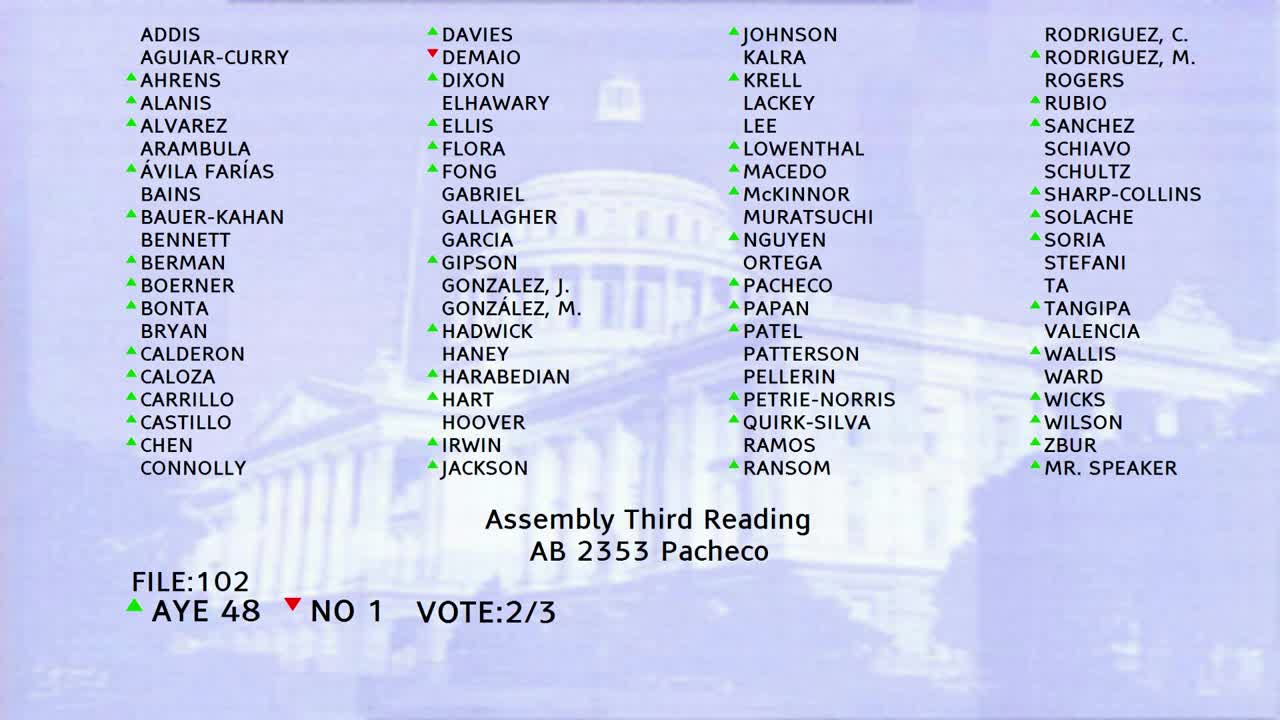
Bill Author