AB 2394: Personal Income Tax Law: exclusions: real property.
- Session Year: 2025-2026
- House: Assembly
- Latest Version Date: 2026-04-20
Current Status:
In Progress
(2026-04-27: In committee: Set, second hearing. Held under submission.)
Introduced
In Committee
Awaiting First Chamber Vote
Passed First Chamber
In Committee
Awaiting Second Chamber Vote
Passed Second Chamber
Enacted
The Personal Income Tax Law, in conformity with federal income tax law, generally defines gross income as income from whatever source derived, except as specifically excluded, and provides various exclusions from gross income.
This bill, for taxable years beginning on or after January 1, 2027, and before January 1, 2032, would exclude from gross income amounts gain received by a qualified taxpayer as a result of the sale or exchange of certain real property. qualified real property, as defined. The bill would define qualified taxpayer to mean an individual who is 65 55 years of age or older and who has owned the real property for 20 years or more. on the date of the sale. The bill would define qualified real property to mean real property satisfying certain conditions, including the requirement that the property was used by the qualified taxpayer as their primary residence, as specified, and that the property is sold to a natural person.
Existing law requires any bill authorizing a new tax expenditure to contain, among other things, specific goals that the tax expenditure will achieve, detailed performance indicators, and data collection requirements.
This bill also would include additional information required for any bill authorizing a new tax expenditure.
This bill would take effect immediately as a tax levy.
The Personal Income Tax Law, in conformity with federal income tax law, generally defines gross income as income from whatever source derived, except as specifically excluded, and provides various exclusions from gross income.
This bill, for taxable years beginning on or after January 1, 2027, and before January 1, 2032, would exclude from gross income amounts received by a qualified taxpayer as a result of the sale or exchange of certain real property. The bill would define qualified taxpayer to mean an individual who is 65 years of age or older and who has owned the real property for 20 years or more.
This bill would take effect immediately as a tax levy.
(a)For taxable years beginning on or after January 1, 2027, and before January 1, 2032, gross income does not include any income gain received by a qualified taxpayer as a result of the sale or exchange of qualified real property. property made during the taxable year.
(b)For purposes of this section, the following definitions shall apply:
(1)Qualified real property means real property for which both all of the following are true:
(A)The qualified taxpayer has, or the qualified taxpayer or their spouse in the case of spouses filing joint returns have, owned the real property for 20 consecutive years or longer. longer as of the date of the sale of the real property.
(B)The real property is owned entirely by the taxpayer or, in the case of spouses filing joint returns, entirely by the taxpayer and their spouse.
(C)The real property was the primary residence of the qualified taxpayer for at least two of the five years immediately prior to the date of the sale of the real property.
(D)The property is sold to a natural person.
(2)Qualified taxpayer means an individual who is 65 55 years of age or older. older on the date of the sale of the qualified real property.
(c)This section shall remain operative only until December 1, 2032, and as of that date is repealed.
SEC. 2.For purposes of complying with Section 41 of the Revenue and Taxation Code, as it relates to Section 17152.5 of the Revenue and Taxation Code as added by this act, the Legislature finds and declares the following:
(a)The specific goal of the exclusion allowed by Section 17152.5 of the Revenue and Taxation Code is to encourage more homes that have been off the market for decades to be sold to new owners, unlocking inventory for the market and for younger home buyers.
(b)There is no available data to collect or report with respect to the exclusion.
SEC. 2.SEC. 3.This act provides for a tax levy within the meaning of Article IV of the California Constitution and shall go into immediate effect.
(a)For taxable years beginning on or after January 1, 2027, and before January 1, 2032, gross income does not include any income received by a qualified taxpayer as a result of the sale or exchange of qualified real property.
(b)For purposes of this section, the following definitions shall apply:
(1)Qualified real property means real property for which both of the following are true:
(A)The qualified taxpayer has, or the qualified taxpayer or their spouse in the case of spouses filing joint returns have, owned the real property for 20 consecutive years or longer.
(B)The real property is owned entirely by the taxpayer or, in the case of spouses filing joint returns, entirely by the taxpayer and their spouse.
(2)Qualified taxpayer means an individual who is 65 years of age or older.
SEC. 2.This act provides for a tax levy within the meaning of Article IV of the California Constitution and shall go into immediate effect.
|
Date
|
Status
|
|---|---|
| Apr 27, 2026 | In committee: Set, second hearing. Held under submission. |
| Apr 21, 2026 | Re-referred to Com. on REV. & TAX. |
| Apr 20, 2026 | From committee chair, with author's amendments: Amend, and re-refer to Com. on REV. & TAX. Read second time and amended. |
| Apr 6, 2026 | In committee: Set, first hearing. Referred to REV. & TAX. suspense file. |
| Mar 9, 2026 | Referred to Com. on REV. & TAX. |
| Feb 21, 2026 | From printer. May be heard in committee March 23. |
| Feb 20, 2026 | Read first time. To print. |
This list shows positions taken on this bill by organizations on the date displayed, which is linked to the original source.
Positions by individuals are not included.
Date of Hearing: April 27, 2026
ASSEMBLY COMMITTEE ON REVENUE AND TAXATION
Mike Gipson, Chair
ABPCA Bill Id:AB 2394 (
Author:Lee) – As Amended Ver:April 20, 2026
SUSPENSE
Majority vote. Tax levy. Fiscal committee.
SUBJECT: Personal Income Tax Law: exclusions: real property
SUMMARY: Excludes from gross income, under the Personal Income Tax (PIT) Law for five taxable years, any income received by a "qualified taxpayer" resulting from the sale or exchange of "qualified real property." Specifically, this bill:
- Excludes from gross income under the PIT Law, for taxable years beginning on or after January 1, 2027, and before January 1, 2032, any income received by a "qualified taxpayer" resulting from the sale or exchange of "qualified real property."
- Defines a "qualified taxpayer" as an individual who is 55 years of age or older on the date of the sale of the "qualified real property."
- Defines "qualified real property" as real property meeting the following conditions:
- The qualified taxpayer has, or the qualified taxpayer or their spouse in the case of spouses filing joint returns have, owned the real property for 20 consecutive years or longer as of the date of the sale of the real property;
- The real property is owned entirely by the taxpayer or, in the case of spouses filing joint returns, entirely by the taxpayer and their spouse;
- The real property was the primary residence of the qualified taxpayer for at least two of the five years immediately prior to the date of the sale of the real property; and,
- The property is sold to a natural person.
- Provide that, for the purpose of complying with Revenue and Taxation Code (R&TC) Section 41 the Legislature finds and declares that the specific goal of this bill's exclusions is to encourage more homes that have been off the market for decades to be sold to new owners, unlocking inventory for the market and for younger home buyers.
- Find and declares that there is no available data to collect or report with respect to this bill's exclusion.
- Takes immediate effect as a tax levy.
- Repeals and makes inoperative this bill's provisions as of December 1, 2032.
EXISTING LAW:
- Excludes from gross income the sale or exchange of property if, during the 5-year period ending on the date of the sale or exchange, that property has been owned and used by the taxpayer as the taxpayer's principal residence for a period aggregating 2 years or more. The exclusion is limited to $250,000, or $500,000 for joint returns. (Internal Revenue Code (IRC) Section 121 and R&TC Section 17042.5(b).)
- Allows a deduction on the depreciation of qualifying business property, as specified. Any amount of deduction taken on the depreciation of a qualified business property must be offset by a reduction in the basis of that property. (IRC Section 167 and R&TC Section 17042.5(b).)
- Requires that any proposed tax expenditure under the PIT Law stipulate:
- Specific goals, purposes, and objectives that the tax expenditure must meet;
- Detailed performance indicators for the Legislature to determine whether the tax expenditure meets its stated goal, purpose, and objective; and,
- Data collection requirements to enable the Legislature to receive the detailed performance indicators in order to determine the efficacy of the tax expenditure. (R&TC Section 41.)
FISCAL EFFECT: The Franchise Tax Board estimates that a previous but substantively similar version of this bill would result in a revenue loss of $65 million in the 2026-27 fiscal year (FY), and $120 million in FYs 2027-28 and 2028-29.
COMMENTS:
- The author has submitted the following statement in support of this bill:
Homeownership is out of reach for too many people, and building generational wealth is increasingly unattainable for working families. AB 2394 will expand much-needed homeownership opportunities for first-time buyers, while allowing long-time homeowners to access the equity they've built over a lifetime and retire with greater financial security. By creating real pathways to ownership, this bill gives more families a fair shot at finding a place to call home.
- Committee Staff Comments:
- Redfin article: The author has referenced an article published by RedfinNews. This article underscores the increase in homeowner tenure, which is the amount of time that a homeowner resides at a given property. The article notes that homeowner tenure is, on average, 12 years nationwide. In California metropolitan areas, homeowner tenure is even higher, reaching 20 years in Los Angeles at the longest duration. Today, the national homeownership tenure is almost twice that of 2005, when average tenure was 6.5 years[1].
- Pass-through entities: Certain business entities do not pay income tax at the entity level. Rather, the tax attributes of these businesses pass, or flow, through to the owner of the pass-through entity, and those tax attributes may generally be applied to the income tax return of the owner. Thus, credits, deductions, gains, losses, etc. may be applied to the income tax return of the owner of the pass-through entity.
- Don't tax me, bro: Existing tax law excludes from gross income the gain resulting from the sale of an owner’s personal primary residence. The exclusion is capped at $250,000 for single filers, and $500,000 for joint filers.
- Tax treatment of capital assets: Generally, assets that the owner anticipates will have a useful life of longer than one year are called capital assets. Capital assets have particular tax treatment that differs from normal income tax treatment. Capital assets are taxed on the gain from their disposition. In other words, the owner of a capital asset is taxed on the difference between the price for which the owner sold the asset and the price for which an owner initially bought the asset, also known as the basis. The difference between the final sale price and the basis is referred to as a gain or loss if the sales price is lower than the basis. Any gains or losses are reconciled, and the reconciled amount of gain or loss is applied to the owner's calculation of adjusted gross income.
- Depreciable business property: Similar to a capital asset, but excluded from its definition, is depreciable business property. Depreciable business property is subject to similar determinations on gains or losses as capital assets. Depreciable business property, however, benefits from a depreciation deduction. Once a property is bought and begins its use for the business's income producing purpose, that property slowly degrades in value or depreciates. Federal and state tax law allow an owner of depreciable business property to deduct the prorated loss in value to the property each taxable year for the duration of the property's useful life. Existing law stipulates a schedule for varying types of property based on their useful life that stipulates the proportion of the property's value that the taxpayer may deduct annually. A taxpayer must, however, reduce their basis in that property by the amount of depreciation the taxpayer deducts. This ensures that the taxpayer does not receive a double benefit.
- This bill: As currently drafted, this bill would exclude from gross income under the PIT Law any gain resulting from the sale of property that is owned by an individual aged 55 or older if that individual or their spouse has owned the property for 20 consecutive years, own the property outright, have lived in the property for two of the last five years, and sell the property to a natural person.
- What gains? As noted previously, existing law excludes from gross income a certain amount of gain from the sale of a personal primary residence. According to the Public Policy Institute of California (PPIC), the 2006 median value of a California home was $533,000[2]. Today, the median value is $905,000. Thus, under existing law, a qualifying homeowner with a median home value would pay no gain on the increased value of their primary personal residence since 2006 if they sold the home in 2026[3].
- Through the looking glass: While this bill's provisions are contained within the PIT Law, residential business properties would be eligible for this bill's exclusion. Business properties may not necessarily be owned by a corporate entity. Owners may construct their business in a variety of manners. One such construction is the use of pass-through entities. As noted previously, these business entities pass their tax attributes onto the owner of the entity. While this bill restricts qualification based on the owner having resided at the property as a primary residence, residential rental property is still a form of business property. Thus, enterprising property owners could take what had been used as a residential rental property, reside in it for a period of two years, and benefit from this bill's exclusion. The author may wish to consider amending this bill if this is not the intent.
- Double-dipping: As currently drafted, this bill authorizes a gross income exclusion from the sale of any real property if the owner of that property meets certain ownership conditions. As noted previously, this allows business properties to qualify for the proposed exclusion. Existing law authorizes a deduction for the depreciation of qualifying business property, but a taxpayer must reduce the basis of the property by the amount of deduction taken. This basis adjustment ensures that a taxpayer is not provided two tax benefits on the same amount of value. Therefore, any basis adjustment to a real property qualifying for this bill's exclusion resulting from a depreciation deduction would be made null by virtue of excluding any gain from the sale of qualifying real property, resulting in a potentially significant double benefit.
- Opaque consequences: The author states their intent is to cycle the housing inventory of elderly homeowners to increase the number of homes for sale on the market. It is unclear, however, if this would materialize. Homeowners choose to sell their homes for any number of reasons. Some may choose not to move given a potential sizable gain on their home's value. As noted above, however, gains on the median home value over the last 20 years would already be excluded under existing law, if the owners were filing jointly. Thus, it appears that this bill would largely reward wealthier taxpayers for activity they will already take.
In fact, this bill would reward sellers for selling their homes, but it is not readily apparent that the decline in transaction volume since the buying frenzy of the pandemic is a result of sellers not choosing to list their properties. Rather, it appears that the decrease in transaction volume is due to a lack of buyer demand. According to a California Housing Market Analysis published by Redfin, the state had a year-over-year (YOY) increase in the number of homes with price drops and a YOY decrease in the number of homes sold above list price[4]. This would suggest that sellers are reducing prices to attract demand from buyers. Thus, it is questionable whether incentivizing sellers to list their homes would meaningfully increase the cycling of housing inventory if a current demand deficiency exists. Indeed, providing an exclusion from the gain resulting from a home sale would incentivize a homeowner to maximize their sale price to reap the maximum, tax-exempt gain.
- What is a "tax expenditure"? Existing law provides various credits, deductions, exclusions, and exemptions for particular taxpayer groups. In the late 1960s, United States Treasury officials began arguing that these features of the tax law should be referred to as "expenditures" since they are generally enacted to accomplish some governmental purpose and there is a determinable cost associated with each of them (in the form of forgone revenues). This bill would exclude certain gains from gross income under the PIT Law, thereby constituting a tax expenditure.
- Committee's tax expenditure policy: SB 1335 (Leno), Chapter 845, Statutes of 2014, added R&TC Section 41, which recognized that the Legislature should apply the same level of review used for government spending programs to tax credits introduced on or after January 1, 2015. AB 263 (Burke), Chapter 743, Statutes of 2019, extended the requirements in R&TC Section 41 to all tax expenditure measures under the PIT Law, the Corporation Tax Law, and the Sales and Use Tax Law introduced on or after January 1, 2020.
A tax expenditure proposal must outline specific goals, purposes, and objectives that the tax expenditure will achieve, along with detailed performance indicators for the Legislature to use when measuring whether the tax expenditure meets those stated goals, purposes, and objectives. In addition to the R&TC Section 41 requirements, this Committee's policy also requires that all tax expenditure proposals contain an appropriate sunset provision to be eligible for a vote[5]. Sunsets are required because eliminating a tax expenditure generally requires a 2/3rd vote. These requirements must be satisfied before a bill can receive a vote in this Committee. This bill contains an appropriate five-year sunset and complies with the requirements of R&TC Section 41.
- Prior legislation:
- SB 384 (Morrell), of the 2019-20 Legislative Session, would have increased the maximum gain a taxpayer may exclude on the sale of a principal residence to a first-time homebuyer, among other provisions. SB 384 failed passage by the Senate Committee on Environmental Quality.
- SB 1416 (Walters), of the 2009-10 Legislative Session, would have excluded from gross income the gain resulting from the sale or exchange of a principal residence of a taxpayer aged 65 years or older. SB 1416 was held on the Senate Committee on Revenue and Taxation's Suspense File.
- Prior legislation:
REGISTERED SUPPORT / OPPOSITION:
Support
None on file
Opposition
None on file
Analysis Prepared by: Harrison Bowlby / REV. & TAX. / (916) 319-2098
Anderson, “The Typical US Homeowner Hangs onto Their House for 12 Years. In Los Angeles, It's 20 Years," RedfinNews, accessed March, 2026. ↑
Johnson, Just the Facts: California Housing Market, PPIC (March 2012). https://www.ppic.org/wp-content/uploads/content/pubs/jtf/JTF_CAHousingMarketJTF.pdf, accessed March 2026. ↑
California Association of Realtors, CAR Releases Its 2026 California Housing Market Forceast (September 17, 2025). https://www.car.org/aboutus/mediacenter/newsreleases/2025releases/2026forecast, accessed March 2026. ↑
Redfin, California Housing Market. https://www.redfin.com/state/California/housing-market, accessed
March 2026. ↑An "appropriate sunset provision" shall mean five years, except in the case of a tax expenditure measure providing relief to California veterans, in which case "appropriate sunset provision" shall mean 10 years. ↑
Date of Hearing: April 6, 2026
ASSEMBLY COMMITTEE ON REVENUE AND TAXATION
Mike Gipson, Chair
ABPCA Bill Id:AB 2394 (
Author:Lee) – As Introduced Ver:February 20, 2026
Majority vote. Tax levy. Fiscal committee.
SUBJECT: Personal Income Tax Law: exclusions: real property
SUMMARY: Excludes from gross income, under the Personal Income Tax (PIT) Law for five taxable years, any income received by a "qualified taxpayer" resulting from the sale or exchange of "qualified real property." Specifically, this bill:
- Excludes from gross income under the PIT Law, for taxable years beginning on or after January 1, 2027, and before January 1, 2032, any income received by a "qualified taxpayer" as a result of the sale or exchange of "qualified real property."
- Defines a "qualified taxpayer" as an individual who is 65 years of age or older.
- Defines "qualified real property" as real property that has been owned by the qualified taxpayer, or their spouse in the case of spouses filing joint returns, for 20 consecutive years or longer, and that is entirely owned by the qualified taxpayer, or their spouse in the case of spouses filing joint returns.
- Takes immediate effect as a tax levy.
EXISTING LAW:
- Excludes from gross income the sale or exchange of property if, during the 5-year period ending on the date of the sale or exchange, that property has been owned and used by the taxpayer as the taxpayer's principal residence for a period aggregating 2 years or more. The exclusion is limited to $250,000, or $500,000 for joint returns. (Internal Revenue Code (IRC) Section 121 and Revenue and Taxation Code (R&TC) Section 17042.5(b).)
- Allows a deduction on the depreciation of qualifying business property, as specified. Any amount of deduction taken on the depreciation of a qualified business property must be offset by a reduction in the basis of that property. (IRC Section 167 and R&TC Section 17042.5(b).)
- Requires that any proposed tax expenditure under the PIT Law stipulate:
- Specific goals, purposes, and objectives that the tax expenditure must meet;
- Detailed performance indicators for the Legislature to determine whether the tax expenditure meets its stated goal, purpose, and objective; and,
- Data collection requirements to enable the Legislature to receive the detailed performance indicators in order to determine the efficacy of the tax expenditure. (R&TC Section 41.)
FISCAL EFFECT: The Franchise Tax Board (FTB) estimates that this bill would result in a revenue loss of $65 million in the 2026-27 fiscal year (FY), and $120 million in FYs 2027-28 and 2028-29.
COMMENTS:
- The author has submitted the following statement in support of this bill:
Homeownership is out of reach for too many people, and building generational wealth is increasingly unattainable for working families. AB 2394 will expand much-needed homeownership opportunities for first-time buyers, while allowing long-time homeowners to access the equity they've built over a lifetime and retire with greater financial security. By creating real pathways to ownership, this bill gives more families a fair shot at finding a place to call home.
- Committee Staff Comments:
- Redfin article: The author has referenced an article published by RedfinNews. This article underscores the increase in homeowner tenure, which is the amount of time that a homeowner resides at a given property. The article notes that homeowner tenure is, on average, 12 years nationwide. In California metropolitan areas, homeowner tenure is even higher, reaching 20 years in Los Angeles at the longest duration. Today, the national homeownership tenure is almost twice that of 2005, when average tenure was 6.5 years[1].
- Pass-through entities: Certain business entities do not pay income tax at the entity level. Rather, the tax attributes of these businesses pass, or flow, through to the owner of the pass-through entity, and those tax attributes may generally be applied to the income tax return of the owner. Thus, credits, deductions, gains, losses, etc. may be applied to the income tax return of the owner of the pass-through entity.
- Don't tax me, bro: Existing tax law excludes from gross income the gain resulting from the sale of an owner’s personal primary residence. The exclusion is capped at $250,000 for single filers, and $500,000 for joint filers.
- Tax treatment of capital assets: Generally, assets that the owner anticipates will have a useful life of longer than one year are called capital assets. Capital assets have particular tax treatment that differs from normal income tax treatment. Capital assets are taxed on the gain from their disposition. In other words, the owner of a capital asset is taxed on the difference between the price for which the owner sold the asset and the price for which an owner initially bought the asset, also known as the basis. The difference between the final sale price and the basis is referred to as a gain or loss if the sales price is lower than the basis. Any gains or losses are reconciled, and reconciled amount of gain or loss is applied to the owner's calculation of adjusted gross income.
- Depreciable business property: Similar to a capital asset, but excluded from its definition, is depreciable business property. Depreciable business property is subject to similar determinations on gains or losses as capital assets. Depreciable business property, however, benefits from a depreciation deduction. Once a property is bought and begins its use for the business's income producing purpose, that property slowly degrades in value or depreciates. Federal and state tax law allow an owner of depreciable business property to deduct the prorated loss in value to the property each taxable year for the duration of the property's useful life. Existing law stipulates a schedule for varying types of property based on their useful life that stipulates the proportion of the property's value that the taxpayer may deduct annually. A taxpayer must, however, reduce their basis in that property by the amount of depreciation the taxpayer deducts. This ensures that the taxpayer does not receive a double benefit.
- This bill: As currently drafted, this bill would exclude from gross income under the PIT Law any gain resulting from the sale of property that is owned by an individual aged 65 or older if that individual or their spouse has owned the property for 20 consecutive years or more and own the property outright.
- What gains? As noted previously, existing law excludes from gross income a certain amount of gain from the sale of a personal primary residence. According to the Public Policy Institute of California (PPIC), the 2006 median value of a California home was $533,000[2]. Today, the median value is $905,000. Thus, under existing law, a qualifying homeowner with a median home value would pay no gain on the increased value of their primary personal residence since 2006 if they sold the home in 2026[3].
- Through the looking glass: While this bill's provisions are contained within the PIT Law, residential business properties would be eligible for this bill's exclusion. Business properties may not necessarily be owned by a corporate entity. Owners may construct their business in a variety of manners. One such construction is the use of pass-through entities. As noted previously, these business entities pass their tax attributes onto the owner of the entity. Thus, a property owner who owned one or more business properties could benefit from this bill's exclusion as this bill does not restrict the exclusion to certain types of property. Indeed, property could be zoned and used for any purpose and would qualify for the proposed exclusion if the qualified taxpayer meets the ownership requirements. The author may wish to consider amending this bill if this is not the intent.
- Double-dipping: As currently drafted, this bill authorizes a gross income exclusion from the sale of any real property if the owner of that property meets certain ownership conditions. As noted previously, this allows business properties to qualify for the proposed exclusion. Existing law authorizes a deduction for the depreciation of qualifying business property, but a taxpayer must reduce the basis of the property by the amount of deduction taken. This basis adjustment ensures that a taxpayer is not provided two tax benefits on the same amount of value. Thus, any depreciation deduction and basis adjustment to a real property qualifying for this bill's exclusion would be made null by virtue of excluding any gain from the sale of qualifying real property, resulting in a potentially significant double benefit.
- Opaque consequences: The author states their intent is to cycle the housing inventory of elderly homeowners to increase the number of homes for sale on the market. It is unclear, however, if this would materialize. Homeowners choose to sell their homes for any number of reasons. Some may choose not to move given a potential sizable gain on their home's value. As noted above, however, gains on the median home value over the last 20 years would already be excluded if the owners were filing jointly. Thus, it appears that this bill would largely reward activity that is already going to be taken by wealthier taxpayers.
In fact, this bill would reward sellers for selling their homes, but it is not readily apparent that the decline in transaction volume since the buying frenzy of the pandemic is a result of sellers not choosing to list their properties. Rather, it appears that the decrease in transaction volume is due to a lack of buyer demand. According to a California Housing Market Analysis published by Redfin, the state had a year-over-year (YOY) increase in the number of homes with price drops and a YOY decrease in the number of homes sold above list price[4]. This would suggest that sellers are reducing prices to attract demand from buyers. Thus, it is questionable whether incentivizing sellers to list their homes would meaningfully increase the cycling of housing inventory if a current demand deficiency exists. Indeed, providing an exclusion from the gain resulting from a home sale would incentivize a homeowner to maximize their sale price to reap the maximum, tax-exempt gain.
- FTB analysis: The FTB, in an unpublished, draft analysis of this bill, notes additional policy, implementation, and technical considerations not listed in this analysis. The author may wish to amend this bill to address those considerations.
- What is a "tax expenditure"? Existing law provides various credits, deductions, exclusions, and exemptions for particular taxpayer groups. In the late 1960s, United States Treasury officials began arguing that these features of the tax law should be referred to as "expenditures" since they are generally enacted to accomplish some governmental purpose and there is a determinable cost associated with each of them (in the form of forgone revenues). This bill would exclude certain gains from gross income under the PIT Law, thereby constituting a tax expenditure.
- Committee's tax expenditure policy: SB 1335 (Leno), Chapter 845, Statutes of 2014, added R&TC Section 41, which recognized that the Legislature should apply the same level of review used for government spending programs to tax credits introduced on or after January 1, 2015. AB 263 (Burke), Chapter 743, Statutes of 2019, extended the requirements in R&TC Section 41 to all tax expenditure measures under the PIT Law, the Corporation Tax Law, and the Sales and Use Tax Law introduced on or after January 1, 2020.
A tax expenditure proposal must outline specific goals, purposes, and objectives that the tax expenditure will achieve, along with detailed performance indicators for the Legislature to use when measuring whether the tax expenditure meets those stated goals, purposes, and objectives. In addition to the R&TC Section 41 requirements, this Committee's policy also requires that all tax expenditure proposals contain an appropriate sunset provision to be eligible for a vote[5]. Sunsets are required because eliminating a tax expenditure generally requires a 2/3rd vote. These requirements must be satisfied before a bill can receive a vote in this Committee. This bill contains an appropriate five-year sunset, but does not comply with the requirements of R&TC Section 41.
- Prior legislation:
- SB 384 (Morrell), of the 2019-20 Legislative Session, would have increased the maximum gain a taxpayer may exclude on the sale of a principal residence to a first-time homebuyer, among other provisions. SB 384 failed passage by the Senate Committee on Environmental Quality.
- SB 1416 (Walters), of the 2009-10 Legislative Session, would have excluded from gross income the gain resulting from the sale or exchange of a principal residence of a taxpayer aged 65 years or older. SB 1416 was held on the Senate Committee on Revenue and Taxation's Suspense File.
- Prior legislation:
REGISTERED SUPPORT / OPPOSITION:
Support
None on file
Opposition
None on file
Analysis Prepared by: Harrison Bowlby / REV. & TAX. / (916) 319-2098
Anderson, “The Typical US Homeowner Hangs Onto Their House for 12 Years. In Los Angeles, It's 20 Years," RedfinNews, accessed March, 2026. ↑
Johnson, Just the Facts: California Housing Market, PPIC (March 2012). https://www.ppic.org/wp-content/uploads/content/pubs/jtf/JTF_CAHousingMarketJTF.pdf, accessed March 2026. ↑
California Association of Realtors, CAR Releases Its 2026 California Housing Market Forceast (September 17, 2025). https://www.car.org/aboutus/mediacenter/newsreleases/2025releases/2026forecast, accessed March 2026. ↑
Redfin, California Housing Market. https://www.redfin.com/state/California/housing-market, accessed
March 2026. ↑An "appropriate sunset provision" shall mean five years, except in the case of a tax expenditure measure providing relief to California veterans, in which case "appropriate sunset provision" shall mean 10 years. ↑
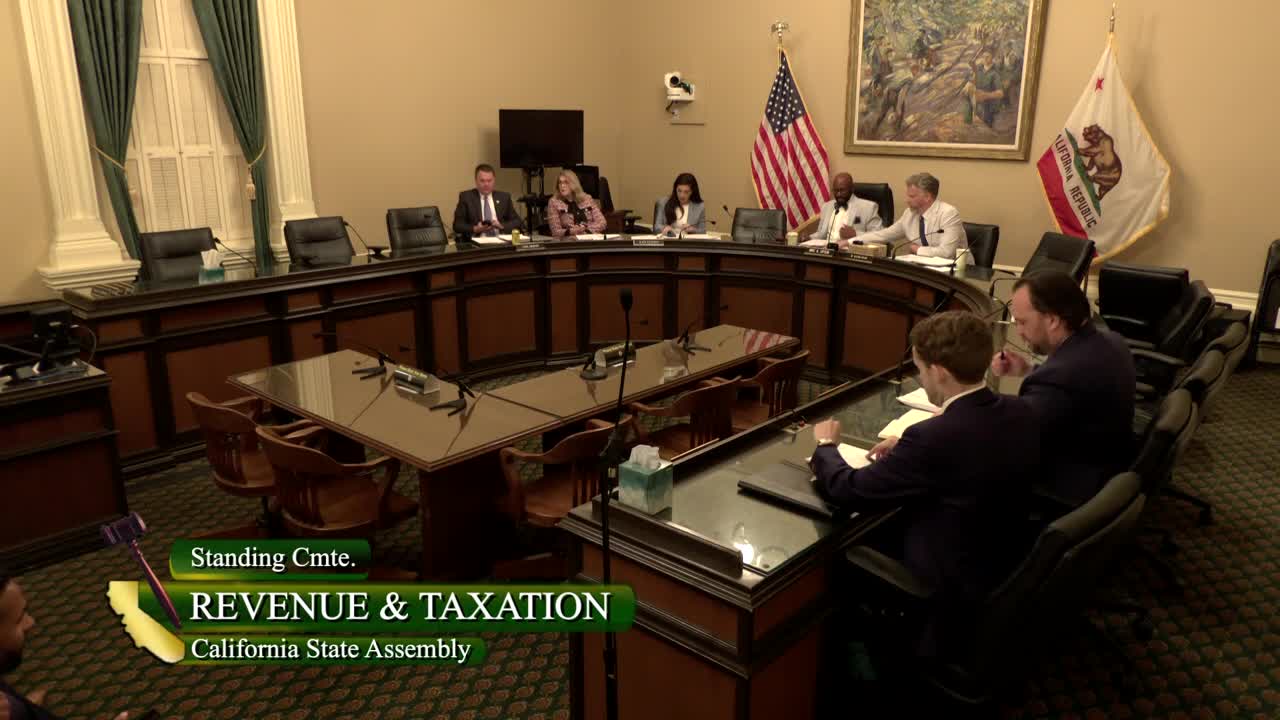
Discussed in Hearing
 4MIN
Assembly Standing Committee on Revenue and Taxation
Bill Author

Bill Co-Author(s):