AB 2403: Income tax: credits: commercial production.
- Session Year: 2025-2026
- House: Assembly
- Latest Version Date: 2026-07-02
Current Status:
In Progress
(2026-08-13: In committee: Held under submission.)
Introduced
In Committee
Awaiting First Chamber Vote
Passed First Chamber
In Committee
Awaiting Second Chamber Vote
Passed Second Chamber
Enacted
The Personal Income Tax Law and the Corporation Tax Law allow various credits against the taxes imposed by those laws, including numerous motion picture credits.
This bill, for taxable years beginning on or after January 1, 2027, and before January 1, 2032, would allow a credit against the taxes imposed by those laws to a qualified taxpayer that produces qualified commercials, as defined, in the state in an amount equal to 20% or 30% of the qualified production costs in excess of $500,000 that are attributable to the production of a qualified commercial, as specified. The bill would exclude any commercial that is created entirely by generative artificial intelligence, as specified, or that utilizes generative artificial intelligence, automated technologies, intelligence or autonomous vehicles in a manner that replaces or diminishes the job functions customarily performed by a human worker in the production. The bill would require the qualified commercial to adhere to specified labor standards. The bill would require the California Film Commission to establish an application process and allocate the credits on or after July 1 each year, in accordance with certain requirements. The bill would limit the aggregate amount of credits that may be allocated for a fiscal year under these provisions to $15,000,000. The bill would require specified certifications under penalty of perjury. By expanding the scope of a crime, this bill would impose a state-mandated local program.
Existing law requires any bill authorizing a new tax expenditure to contain, among other things, specific goals, purposes, and objectives that the tax expenditure will achieve, detailed performance indicators, and data collection requirements.
This bill would include additional information required for any bill authorizing a new tax expenditure.
The California Constitution requires the state to reimburse local agencies and school districts for certain costs mandated by the state. Statutory provisions establish procedures for making that reimbursement.
This bill would provide that no reimbursement is required by this act for a specified reason.
This bill would take effect immediately as a tax levy.
The Personal Income Tax Law and the Corporation Tax Law allow various credits against the taxes imposed by those laws, including numerous motion picture credits.
This bill, for taxable years beginning on or after January 1, 2027, and before January 1, 2032, would allow a credit against the taxes imposed by those laws to a qualified taxpayer that produces qualified commercials, as defined, in the state in an amount equal to 20% or 30% of the qualified production costs in excess of $500,000 that are attributable to the production of a qualified commercial, as specified. The bill would exclude any commercial that is created entirely by generative artificial intelligence, as specified, and or that utilizes generative artificial intelligence, automated technologies, or autonomous vehicles in a manner that replaces or diminishes the job functions customarily performed by a human worker in the production. The bill would require the qualified commercial to adhere to specified labor standards. The bill would require the California Film Commission to establish an application process and allocate the credits on or after July 1 each year, in accordance with certain requirements. The bill would limit the aggregate amount of credits that may be allocated for a fiscal year under these provisions to $15,000,000. The bill would require specified certifications under penalty of perjury. By expanding the scope of a crime, this bill would impose a state-mandated local program.
Existing law requires any bill authorizing a new tax expenditure to contain, among other things, specific goals, purposes, and objectives that the tax expenditure will achieve, detailed performance indicators, and data collection requirements.
This bill would include additional information required for any bill authorizing a new tax expenditure.
The California Constitution requires the state to reimburse local agencies and school districts for certain costs mandated by the state. Statutory provisions establish procedures for making that reimbursement.
This bill would provide that no reimbursement is required by this act for a specified reason.
This bill would take effect immediately as a tax levy.
The Personal Income Tax Law and the Corporation Tax Law allow various credits against the taxes imposed by those laws, including numerous motion picture credits.
This bill, for taxable years beginning on or after January 1, 2027, would allow a credit against the taxes imposed by those laws to a qualified taxpayer that produces qualified commercials, as defined, in the state in an amount equal to 20% or 30% of the qualified production costs attributable to the production of a qualified commercial, as specified. The bill would exclude any commercial that is created entirely by generative artificial intelligence, as specified, and would require the qualified commercial to adhere to specified labor standards. The bill would require the California Film Commission to establish an application process and allocate the credits on or after July 1 each year, in accordance with certain requirements. The bill would limit the aggregate amount of credits that may be allocated for a fiscal year under these provisions to $15,000,000. The bill would require specified certifications under penalty of perjury. By expanding the scope of a crime, this bill would impose a state-mandated local program.
The California Constitution requires the state to reimburse local agencies and school districts for certain costs mandated by the state. Statutory provisions establish procedures for making that reimbursement.
This bill would provide that no reimbursement is required by this act for a specified reason.
This bill would take effect immediately as a tax levy.
The Personal Income Tax Law and the Corporation Tax Law allow various credits against the taxes imposed by those laws, including numerous motion picture credits. This bill would state the intent of the Legislature to enact legislation establishing income tax credits relating to the production of commercials in the state.The Personal Income Tax Law and the Corporation Tax Law allow various credits against the taxes imposed by those laws, including numerous motion picture credits.
This bill would state the intent of the Legislature to enact legislation establishing income tax credits relating to the production of commercials in the state.
(a)For taxable years beginning on or after January 1, 2027, and before January 1, 2032, there shall be allowed to a qualified taxpayer a credit against the net tax, as defined in Section 17039, subject to the requirements of this section, in an amount equal to the following, as applicable:
(1)Twenty percent of the qualified production costs in excess of five hundred thousand dollars ($500,000) that are attributable to the production of a qualified commercial, if the qualified commercial is filmed inside the Los Angeles zone, as defined in Section 17053.98.1.
(2)Thirty percent of the qualified production costs in excess of five hundred thousand dollars ($500,000) that are attributable to the production of a qualified commercial, if the qualified commercial is filmed outside the Los Angeles zone, but within the state, as defined in Section 17053.98.1.
(3)For purposes of this subdivision, if qualified production costs attributable to a single qualified commercial are incurred both inside and outside the Los Angeles zone, the qualified commercial shall be treated as filmed inside the Los Angeles zone if 50 percent or more of the qualified production costs incurred in the state are attributable to costs incurred inside the Los Angeles zone, and shall otherwise be treated as filmed outside the Los Angeles zone. A single qualified commercial shall be eligible for only one credit percentage under this subdivision.
(b)For purposes of this section, the following definitions apply:
(1)Advertisement means an openly and identifiably sponsored public promotion or announcement of goods, services, companies, or ideas. For the purposes of this definition, advertisement shall not include music videos or infomercials.
(2)Generative artificial intelligence means a computational system or model capable of generating text, images, audio, video, performances, or other expressive content based on training data, algorithms, or machine learning techniques, without direct contemporaneous creative control by a natural person over the expressive output. an artificial intelligence system that can generate derived synthetic content, including text, images, video, and audio that emulate the structure and characteristics of the systems training data.
(3)(A)Qualified commercial means an advertisement that satisfies the requirements of subdivisions (c), (d), and (e) and is recorded on film, audiotape, videotape, or digital medium in the state for multimarket distribution by way of radio, television networks, cable, satellite, motion picture theaters, or internet. produced in whole or in substantial part within the state for public distribution through any audiovisual media, communications platform, or technology, whether now existing or hereafter developed.
(B)Qualified commercial shall include a package of commercials which includes two or more commercials that are bid and produced under a single agency or client contract in which a specified number of deliverables are produced together within a defined timeframe by a qualified commercial production company.
(C)Qualified commercial shall not include any of the following:
(i)A news or current affairs program, interview or talk program, network promotional, such as a commercial promoting a television series or movie, how-to or instructional commercial or program, commercial or program consisting entirely of stock footage, trailer promoting a theatrical film, sporting event or sporting program, game show, award ceremony, or daytime drama, including a daytime soap opera or reality program.
(ii)A production involving sexually explicit conduct subject to the recordkeeping requirements of Section 2257 of Title 18 of the United States Code.
(iii)A commercial of more than three minutes in length, unless specifically exempted by the California Film Commission or a valid collective bargaining agreement governing the employees whose work may be affected. This clause shall not exclude a package of commercials if each commercial is not more than three minutes in length.
(4)Qualified commercial production company means a person that meets both of the following requirements:
(A)Is responsible for the direct payment of production expenses and is a signatory to the qualified commercials contracts with its payroll company and facility operators.
(B)Is neither the distributor or the contracting entity for production of the qualified commercial described in subparagraph (A), nor a variable interest entity of the distributor or contracting entity.
(5)(A)Qualified production costs means all expenditures made in the state directly attributable to the production of a qualified commercial.
(B)Qualified production costs shall not include either of the following:
(i)Costs for a story, script, or scenario to be used for a qualified commercial.
(ii)Wages, salaries, or other compensation for writers, directors, including music directors, producers, and performers other than musicians and background actors with no scripted lines who are employed by a qualified company.
(6)Qualified taxpayer means a qualified commercial production company that produces qualified commercials in the state and is allocated a credit by the California Film Commission pursuant to this section.
(c)(1)A production shall not be deemed a qualified commercial and shall not be eligible for the credit if either of the following are true:
(A)The commercial is created entirely by means of generative artificial intelligence. For purposes of this subparagraph, a commercial is deemed to be created entirely by means of generative artificial intelligence if both of the following are satisfied:
(i)All principal expressive elements, including, but not limited to, script, dialogue, visual imagery, animation, performances, voices, music, and sound design, are generated by generative artificial intelligence.
(ii)No natural person performs a principal creative role in the origination, performance, or fixation of those expressive elements, other than de minimis technical prompting, selection, or compilation.
(B)The commercial utilizes generative artificial intelligence, automated technologies, intelligence or autonomous vehicles vehicles, as defined in Section 38750 of the Vehicle Code, in a manner that replaces or diminishes the job functions customarily performed by a human worker in the production.
(2)This subdivision shall not exclude a production from eligibility for any of the following:
(A)Use of generative artificial intelligence as a tool in support of human creative decisionmaking.
(B)Use of artificial intelligence-assisted processes in preproduction, production, or postproduction, provided that natural persons exercise principal creative control.
(C)Incorporation of artificial intelligence for technical, logistical, or efficiency purposes that do not replace principal creative roles performed by natural persons.
(D)Use of generative artificial intelligence, automated technologies, or autonomous vehicles, to the extent such use is authorized by, and carried out in accordance with, a valid collective bargaining agreement governing the employees whose work may be affected.
(d)(1)The production of a qualified commercial shall do all of the following:
(A)Demonstrate as part of the application process established pursuant to subdivision (f) that the production is in compliance with applicable federal, state, and local laws and regulations.
(B)Provide wages for employees in California that are equal to or more than the average weekly wage rate for similar workers in the same occupation.
(C)Provide health insurance benefits for all employees.
(D)Provide a defined-benefit pension for all employees.
(2)Notwithstanding paragraph (1), a production that is a party to, and in compliance with, a valid collective bargaining agreement covering the employees of the production shall be deemed to satisfy the requirements of this subdivision.
(e)The production of a qualified commercial shall comply with the following requirements:
(1)At least 75 percent of the production costs paid or incurred directly and predominantly in the actual filming or recording of the qualified commercial are costs incurred in California.
(2)The total qualified production costs of a qualified production company are greater than five hundred thousand dollars ($500,000) in the aggregate during the calendar year.
(f)For purposes of this section, the California Film Commission shall do all of the following:
(1)Establish an application process and allocate tax credits to applicants in accordance with the following:
(A)A qualified production company may submit a credit application to the California Film Commission between January 1 and April 1 of the calendar year succeeding the year in which the production of the qualified commercial occurred.
(B)The application shall be submitted in a form and manner determined by the California Film Commission.
(C)The California Film Commission shall approve applications and, on and after July 1, 2027, and before July 1, 2032, in four or more allocation periods per fiscal year, allocate credit amounts to applicants.
(2)(A)Require, as part of the application process, a certification under penalty of perjury that the production is not created entirely by means of generative artificial intelligence intelligence, as described in subparagraph (A) of paragraph (1) of subdivision (c), and that the labor standards described in subdivision subdivisions (c) and (d) are satisfied.
(B)For purposes of verifying compliance with the requirements of subdivision (d), this section, the California Film Commission may require the following documentation: applicant to provide all of the following:
(i)Payroll records.
(ii)Benefit contribution reports.
(iii)Copies of applicable collective bargaining agreements.
(iv)Attestations from payroll service providers.
(v)Other documentation that the California Film Commission may deem necessary to verify compliance with the requirements of this section.
(3)Adopt regulations to implement this section. The adoption, amendment, repeal, or readoption of a regulation authorized by this section is deemed to address an emergency, for purposes of Sections 11346.1 and 11349.6 of the Government Code, and the California Film Commission is hereby exempted for this purpose from the requirements of subdivision (b) of Section 11346.1 of the Government Code. For purposes of subdivision (e) of Section 11346.1 of the Government Code, the 180-day period, as applicable to the effective period of an emergency regulatory action and submission of specified materials to the Office of Administrative Law, is hereby extended to 240 days.
(g)(1)(A)A deduction otherwise allowed under this part for any amount paid or incurred by the qualified taxpayer that is the basis for the credit allowed by this section shall be reduced by the amount of the credit allowed.
(B)The credit allowed by this section shall be in lieu of any other credit that the taxpayer may otherwise claim pursuant to this part with respect to qualified production costs.
(2)If the amount of the credit allowed by this section exceeds the tax for the taxable year, the excess may be carried over to reduce the tax in the following taxable year, and succeeding five taxable years if necessary, until the credit has been exhausted.
(3)Notwithstanding any other provision of this section, the California Film Commission shall not allocate to any one qualified taxpayer, in any fiscal year, credit amounts under this section that, in the aggregate, exceed 20 percent of the aggregate amount available for allocation for that fiscal year under subdivision (g).
(h)The California Film Commission shall adopt regulations to implement this section. The regulations shall, at a minimum, establish all of the following:
(1)The form, manner, and content of the application and the certification required under paragraph (2) of subdivision (f), and the documentation an applicant shall submit or retain to demonstrate compliance with subdivisions (c), (d), and (e).
(2)Standards and procedures for verifying that qualified production costs were paid or incurred in this state, which may include rental agreements, purchase orders, invoices, payroll records, call sheets, location agreements, and production reports.
(3)Standards and procedures for determining whether a natural person performed a principal creative role within the meaning of subdivision (c), and the documentation sufficient to establish that role.
(4)Standards and procedures for verifying compliance with the labor standards in subdivision (d), which may include payroll records, benefit contribution reports, applicable collective bargaining agreements, and attestations from payroll service providers. The California Film Commission may consult with the Labor Commissioner in adopting regulations under this paragraph.
(5)Procedures for the denial, reduction, or recapture of a credit upon a determination of material noncompliance, and the circumstances under which noncompliance is not material, including where it is inadvertent, promptly cured, and does not result in underpayment of wages or benefits to covered workers. The California Film Commission may consult with the Labor Commissioner in adopting regulations under this paragraph.
(6)A process for the California Film Commission to notify the Franchise Tax Board of the credit amounts allocated and the taxpayers receiving each allocation.
(g)(i)The aggregate amount of credits that may be allocated for a fiscal year pursuant to this section and Section 23698.5 23698.2 is fifteen million dollars ($15,000,000), plus any amount unallocated in any prior fiscal years.
(h)(j)The information provided to the California Film Commission pursuant to this section shall constitute confidential tax information subject to Section 19542.
(k)This section shall remain operative only until December 1, 2032, and as of that date is repealed.
SEC. 2.Section 23698.5 is added to the Revenue and Taxation Code, to read:23698.5.SEC. 2.Section 23698.2 is added to the Revenue and Taxation Code, to read:23698.2.(a)For taxable years beginning on or after January 1, 2027, and before January 1, 2032, there shall be allowed to a qualified taxpayer a credit against the tax, as defined in Section 23036, subject to the requirements of this section, in an amount equal to the following, as applicable:
(1)Twenty percent of the qualified production costs in excess of five hundred thousand dollars ($500,000) that are attributable to the production of a qualified commercial, if the qualified commercial is filmed inside the Los Angeles zone, as defined in Section 23698.1.
(2)Thirty percent of the qualified production costs in excess of five hundred thousand dollars ($500,000) that are attributable to the production of a qualified commercial, if the qualified commercial is filmed outside the Los Angeles zone, but inside the state, as defined in Section 23698.1.
(3)For purposes of this subdivision, if qualified production costs attributable to a single qualified commercial are incurred both inside and outside the Los Angeles zone, the qualified commercial shall be treated as filmed inside the Los Angeles zone if 50 percent or more of the qualified production costs incurred in the state are attributable to costs incurred inside the Los Angeles zone, and shall otherwise be treated as filmed outside the Los Angeles zone. A single qualified commercial shall be eligible for only one credit percentage under this subdivision.
(b)For purposes of this section, the following definitions apply:
(1)Advertisement means an openly and identifiably sponsored public promotion or announcement of goods, services, companies, or ideas. For the purposes of this definition, advertisement shall not include music videos or infomercials.
(2)Generative artificial intelligence means a computational system or model capable of generating text, images, audio, video, performances, or other expressive content based on training data, algorithms, or machine learning techniques, without direct contemporaneous creative control by a natural person over the expressive output. an artificial intelligence system that can generate derived synthetic content, including text, images, video, and audio that emulate the structure and characteristics of the systems training data.
(3)(A)Qualified commercial means an advertisement that satisfies the requirements of subdivisions (c), (d), and (e) and is recorded on film, audiotape, videotape, or digital medium in the state for multimarket distribution by way of radio, television networks, cable, satellite, motion picture theaters, or internet. produced in whole or in substantial part within the state for public distribution through any audiovisual media, communications platform, or technology, whether now existing or hereafter developed.
(B)Qualified commercial shall include a package of commercials which includes two or more commercials that are bid and produced under a single agency or client contract in which a specified number of deliverables are produced together within a defined timeframe by a qualified commercial production company.
(C)Qualified commercial shall not include any of the following:
(i)A news or current affairs program, interview or talk program, network promotional, such as a commercial promoting a television series or movie, how-to or instructional commercial or program, commercial or program consisting entirely of stock footage, trailer promoting a theatrical film, sporting event or sporting program, game show, award ceremony, or daytime drama, including a daytime soap opera or reality program.
(ii)A production involving sexually explicit conduct subject to the recordkeeping requirements of Section 2257 of Title 18 of the United States Code.
(iii)A commercial of more than three minutes in length, unless specifically exempted by the California Film Commission or a valid collective bargaining agreement governing the employees whose work may be affected. This clause shall not exclude a package of commercials if each commercial is not more than three minutes in length.
(4)Qualified commercial production company means a corporation that meets both of the following requirements:
(A)Is responsible for the direct payment of production expenses and is a signatory to the qualified commercials contracts with its payroll company and facility operators.
(B)Is neither the distributor or the contracting entity for production of the qualified commercial described in subparagraph (A), nor a variable interest entity of the distributor or contracting entity.
(5)(A)Qualified production costs means all expenditures made in the state directly attributable to the production of a qualified commercial.
(B)Qualified production costs shall not include either of the following:
(i)Costs for a story, script, or scenario to be used for a qualified commercial.
(ii)Wages, salaries, or other compensation for writers, directors, including music directors, producers, and performers other than musicians and background actors with no scripted lines who are employed by a qualified company.
(6)Qualified taxpayer means a qualified commercial production company that produces qualified commercials in the state and is allocated a credit by the California Film Commission pursuant to this section.
(c)(1)A production shall not be deemed a qualified commercial and shall not be eligible for the credit if either of the following are true:
(A)The commercial is created entirely by means of generative artificial intelligence. For purposes of this subparagraph, a commercial is deemed to be created entirely by means of generative artificial intelligence if both of the following are satisfied:
(i)All principal expressive elements, including, but not limited to, script, dialogue, visual imagery, animation, performances, voices, music, and sound design, are generated by generative artificial intelligence.
(ii)No natural person performs a principal creative role in the origination, performance, or fixation of those expressive elements, other than de minimis technical prompting, selection, or compilation.
(B)The commercial utilizes generative artificial intelligence, automated technologies, intelligence or autonomous vehicles vehicles, as defined in Section 38750 of the Vehicle Code, in a manner that replaces or diminishes the job functions customarily performed by a human worker in the production.
(2)This subdivision shall not exclude a production from eligibility for any of the following:
(A)Use of generative artificial intelligence as a tool in support of human creative decisionmaking.
(B)Use of artificial intelligence-assisted processes in preproduction, production, or postproduction, provided that natural persons exercise principal creative control.
(C)Incorporation of artificial intelligence for technical, logistical, or efficiency purposes that do not replace principal creative roles performed by natural persons.
(D)Use of generative artificial intelligence, automated technologies, or autonomous vehicles, to the extent such use is authorized by, and carried out in accordance with, a valid collective bargaining agreement governing the employees whose work may be affected.
(d)(1)The production of a qualified commercial shall do all of the following:
(A)Demonstrate as part of the application process established pursuant to subdivision (f) that the production is in compliance with applicable federal, state, and local laws and regulations.
(B)Provide wages for employees in California that are equal to or more than the average weekly wage rate for similar workers in the same occupation.
(C)Provide health insurance benefits for all employees.
(D)Provide a defined-benefit pension for all employees.
(2)Notwithstanding paragraph (1), a production that is a party to, and in compliance with, a valid collective bargaining agreement covering the employees of the production shall be deemed to satisfy the requirements of this subdivision.
(e)The production of a qualified commercial shall comply with the following requirements:
(1)At least 75 percent of the production costs paid or incurred directly and predominantly in the actual filming or recording of the qualified commercial are costs incurred in California.
(2)The total qualified production costs of a qualified production company are greater than five hundred thousand dollars ($500,000) in the aggregate during the calendar year.
(f)For purposes of this section, the California Film Commission shall do all of the following:
(1)Establish an application process and allocate tax credits to applicants in accordance with the following:
(A)A qualified production company may submit a credit application to the California Film Commission between January 1 and April 1 of the calendar year succeeding the year in which the production of the qualified commercial occurred.
(B)The application shall be submitted in a form and manner determined by the California Film Commission.
(C)The California Film Commission shall approve applications and, on and after July 1, 2027, and before July 1, 2032, in four or more allocation periods per fiscal year, allocate credit amounts to applicants.
(2)(A)Require, as part of the application process, a certification under penalty of perjury that the production is not created entirely by means of generative artificial intelligence intelligence, as described in subparagraph (A) of paragraph (1) of subdivision (c), and that the labor standards described in subdivision subdivisions (c) and (d) are satisfied.
(B)For purposes of verifying compliance with the requirements of subdivision (d), this section, the California Film Commission may require the following documentation: applicant to provide all of the following:
(i)Payroll records.
(ii)Benefit contribution reports.
(iii)Copies of applicable collective bargaining agreements.
(iv)Attestations from payroll service providers.
(v)Other documentation that the California Film Commission may deem necessary to verify compliance with the requirements of this section.
(3)Adopt regulations to implement this section. The adoption, amendment, repeal, or readoption of a regulation authorized by this section is deemed to address an emergency, for purposes of Sections 11346.1 and 11349.6 of the Government Code, and the California Film Commission is hereby exempted for this purpose from the requirements of subdivision (b) of Section 11346.1 of the Government Code. For purposes of subdivision (e) of Section 11346.1 of the Government Code, the 180-day period, as applicable to the effective period of an emergency regulatory action and submission of specified materials to the Office of Administrative Law, is hereby extended to 240 days.
(g)(1)(A)A deduction otherwise allowed under this part for any amount paid or incurred by the qualified taxpayer that is the basis for the credit allowed by this section shall be reduced by the amount of the credit allowed.
(B)The credit allowed by this section shall be in lieu of any other credit that the taxpayer may otherwise claim pursuant to this part with respect to qualified production costs.
(2)If the amount of the credit allowed by this section exceeds the tax for the taxable year, the excess may be carried over to reduce the tax in the following taxable year, and succeeding five taxable years if necessary, until the credit has been exhausted.
(3)Notwithstanding any other provision of this section, the California Film Commission shall not allocate to any one qualified taxpayer, in any fiscal year, credit amounts under this section that, in the aggregate, exceed 20 percent of the aggregate amount available for allocation for that fiscal year under subdivision (g).
(h)The California Film Commission shall adopt regulations to implement this section. The regulations shall, at a minimum, establish all of the following:
(1)The form, manner, and content of the application and the certification required under paragraph (2) of subdivision (f), and the documentation an applicant shall submit or retain to demonstrate compliance with subdivisions (c), (d), and (e).
(2)Standards and procedures for verifying that qualified production costs were paid or incurred in this state, which may include rental agreements, purchase orders, invoices, payroll records, call sheets, location agreements, and production reports.
(3)Standards and procedures for determining whether a natural person performed a principal creative role within the meaning of subdivision (c), and the documentation sufficient to establish that role.
(4)Standards and procedures for verifying compliance with the labor standards in subdivision (d), which may include payroll records, benefit contribution reports, applicable collective bargaining agreements, and attestations from payroll service providers. The California Film Commission may consult with the Labor Commissioner in adopting regulations under this paragraph.
(5)Procedures for the denial, reduction, or recapture of a credit upon a determination of material noncompliance, and the circumstances under which noncompliance is not material, including where it is inadvertent, promptly cured, and does not result in underpayment of wages or benefits to covered workers. The California Film Commission may consult with the Labor Commissioner in adopting regulations under this paragraph.
(6)A process for the California Film Commission to notify the Franchise Tax Board of the credit amounts allocated and the taxpayers receiving each allocation.
(g)(i)The aggregate amount of credits that may be allocated for a fiscal year pursuant to this section and Section 17053.98.5 17053.98.2 is fifteen million dollars ($15,000,000), plus any amount unallocated in any prior fiscal years.
(h)(j)The information provided to the California Film Commission pursuant to this section shall constitute confidential tax information subject to Section 19542.
(k)This section shall remain operative only until December 1, 2032, and as of that date is repealed.
SEC. 3.It is the intent of the Legislature to apply the requirements of Section 41 of the Revenue and Taxation Code to this act. Therefore, the Legislature finds and declares the following with respect to the tax exemptions provided by Section 17053.98.5 of the Revenue and Taxation Code, as added by Section 1 of this act, and by Section 23698.5 of the Revenue and Taxation Code, as added by Section 2 of this act: For purposes of complying with Section 41 of the Revenue and Taxation Code, as it relates to the credits allowed pursuant to Sections 17053.98.2 and 23698.2 of the Revenue and Taxation Code, as added by Sections 1 and 2 of this act, respectively, the Legislature finds and declares as follows:
(a)The specific goals, purposes, and objectives goals of these exemptions are to do all of the following:
(1)Maintain and expand motion picture and television commercial productions, and the quality of the jobs they provide, in California.
(2)Keep Californias Film Tax Credit competitive with production incentives offered by other states and other countries.
(3)Increase the competitiveness of the tax credits allowed by this section and Section 23698.1 the Revenue and Taxation Code for various film, television, and commercial productions relative to previous California motion picture tax credit programs authorized by Sections 17053.85, 17053.95, 17053.98, 17053.98.1, of the Revenue and Taxation Code 23685, 23695, and 23698 23698, and 23698.1 by allowing the tax credit to be refundable. a similar credit for the production of commercials.
(b)Detailed performance indicators for the Legislature to use in determining whether the exemptions provided by credits allowed under Sections 1 and 2 of this act meet the goals, purposes, and objectives goals described in subdivision (a) shall be all of the following:
(1)The qualified taxpayers and taxpayer identification numbers, including taxpayer identification numbers of each partner or shareholder, as applicable, of the qualified taxpayer.
(2)The tax credit amounts allocated to each qualified taxpayer by the California Film Commission.
(3)The number of production days in California that the qualified taxpayer represented in its application would occur. occur in California.
(4)The number of California jobs that the qualified taxpayer represented in its application would be directly created by the production.
(5)The total amount of qualified expenditures expected to be spent by the production.
(c)(1)The data collection requirements for determining whether the exemptions provided by credits allowed by Sections 1 and 2 of this act are meeting the specific goals, purposes, and objectives goals described in subdivision (a) are that the California Film Commission shall annually provide the Legislative Analysts Office, the Franchise Tax Board, and the board Office and the Franchise Tax Board with a list of qualified taxpayers and the tax credit amounts allocated to each qualified taxpayer by the California Film Commission.
(2)Notwithstanding subdivision (h) of Section 17053.98.5 of the Revenue and Taxation Code, as added by Section 1 of this act, and subdivision (h) of Section 23698.5 of the Revenue and Taxation Code, as added by Section 2 of this act, Sections 17053.98.2 and 23698.2 of the Revenue and Taxation Code, the California Film Commission shall annually post on its internet web site website, and make available for public release release, the following:
(A)A table which includes all of the following information: a list of qualified taxpayers and the tax credit amounts allocated to each qualified taxpayer by the California Film Commission, the number of production days in California the qualified taxpayer represented in its application would occur, the number of California jobs that the qualified taxpayer represented in its application would be directly created by the production, and the total amount of qualified expenditures expected to be spent by the production.
(i)A list of qualified taxpayers and the tax credit amounts allocated to each qualified taxpayer by the California Film Commission.
(ii)The number of production days that the qualified taxpayer represented in its application would occur in California.
(iii)The number of California jobs that the qualified taxpayer represented in its application would be directly created by the production.
(iv)The total amount of qualified expenditures expected to be spent by the production.
(B)A narrative staff summary describing the production of the qualified taxpayer as well as background information regarding the qualified taxpayer contained in the qualified taxpayers application for the credit.
(d)Nothing in this section shall be construed to make the information submitted by an applicant for a tax credit under Section 17053.98.5 of the Revenue and Taxation Code, as added by Section 1 of this act, or Section 23698.5 of the Revenue and Taxation Code, as added by Section 2 of this act, 17053.98.2 or 23698.2 of the Revenue and Taxation Code a public record.
SEC. 4.No reimbursement is required by this act pursuant to Section 6 of Article XIIIB of the California Constitution because the only costs that may be incurred by a local agency or school district will be incurred because this act creates a new crime or infraction, eliminates a crime or infraction, or changes the penalty for a crime or infraction, within the meaning of Section 17556 of the Government Code, or changes the definition of a crime within the meaning of Section 6 of Article XIIIB of the California Constitution.
SEC. 5.This act provides for a tax levy within the meaning of Article IV of the California Constitution and shall go into immediate effect.
(a)For taxable years beginning on or after January 1, 2027, and before January 1, 2032, there shall be allowed to a qualified taxpayer a credit against the net tax, as defined in Section 17039, subject to the requirements of this section, in an amount equal to the following, as applicable:
(1)Twenty percent of the qualified production costs in excess of five hundred thousand dollars ($500,000) that are attributable to the production of a qualified commercial, if the qualified commercial is filmed inside the Los Angeles zone, as defined in Section 17053.98.1.
(2)Thirty percent of the qualified production costs in excess of five hundred thousand dollars ($500,000) that are attributable to the production of a qualified commercial, if the qualified commercial is filmed outside the Los Angeles zone, as defined in Section 17053.98.1.
(b)For purposes of this section, the following definitions apply:
(1)Advertisement means an openly and identifiably sponsored public promotion or announcement of goods, services, companies, or ideas. For the purposes of this definition, advertisement shall not include music videos or infomercials.
(2)Covered worker means all individuals employed or engaged in the state by a qualified commercial production company in connection with the production of a qualified commercial, including, but not limited to, all of the following:(A)Cast and background performers.(B)Production and postproduction crew.(C)Production assistants.(D)Technical, creative, and craft classifications.(E)Any individual whose services constitute employment.(3)(2)Generative artificial intelligence means a computational system or model capable of generating text, images, audio, video, performances, or other expressive content based on training data, algorithms, or machine learning techniques, without direct contemporaneous creative control by a natural person over the expressive output.
(4)(3)(A)Qualified commercial means an advertisement of any length that satisfies the requirements of subdivisions (c) (c), (d), and (d) (e) and is recorded on film, audiotape, videotape, or digital medium in the state for multimarket distribution by way of radio, television networks, cable, satellite, motion picture theaters, or internet.
(B)Qualified commercial shall include a package of commercials which includes two or more commercials that are bid and produced under a single agency or client contract in which a specified number of deliverables are produced together within a defined timeframe by a qualified commercial production company.
(C)Qualified commercial shall not include either any of the following:
(i)A news or current affairs program, interview or talk program, network promotional, such as a commercial promoting a television series or movie, how-to or instructional commercial or program, commercial or program consisting entirely of stock footage, trailer promoting a theatrical film, sporting event or sporting program, game show, award ceremony, or daytime drama, including a daytime soap opera or reality program.
(ii)A production involving sexually explicit conduct subject to the recordkeeping requirements of Section 2257 of Title 18 of the United States Code.
(iii)A commercial of more than three minutes in length, unless specifically exempted by the California Film Commission or a valid collective bargaining agreement governing the employees whose work may be affected. This clause shall not exclude a package of commercials if each commercial is not more than three minutes in length.
(5)(4)Qualified commercial production company means a person that meets both of the following requirements:
(A)Is responsible for the direct payment of production expenses and is a signatory to the qualified commercials contracts with its payroll company and facility operators.
(B)Is neither the distributor or the contracting entity for production of the qualified commercial described in subparagraph (A), nor a variable interest entity of the distributor or contracting entity.
(6)(5)(A)Qualified production costs means all expenditures made in the state directly attributable to the production of a qualified commercial.
(B)Qualified production costs shall not include either of the following:
(i)Costs for a story, script, or scenario to be used for a qualified commercial.
(ii)Wages, salaries, or other compensation for writers, directors, including music directors, producers, and performers other than musicians and background actors with no scripted lines who are employed by a qualified company.
(7)(6)Qualified taxpayer means a qualified commercial production company that produces qualified commercials in the state and is allocated a credit by the California Film Commission pursuant to this section.
(c)(1)A production shall not be deemed a qualified commercial and shall not be eligible for the credit if the either of the following are true:
(A)The commercial is created entirely by means of generative artificial intelligence.
(2) intelligence. For purposes of this subdivision, subparagraph, a commercial is deemed to be created entirely by means of generative artificial intelligence if both of the following are satisfied:
(A)(i)All principal expressive elements, including, but not limited to, script, dialogue, visual imagery, animation, performances, voices, music, and sound design, are generated by generative artificial intelligence.
(B)(ii)No natural person performs a principal creative role in the origination, performance, or fixation of those expressive elements, other than de minimis technical prompting, selection, or compilation.
(B)The commercial utilizes generative artificial intelligence, automated technologies, or autonomous vehicles in a manner that replaces or diminishes the job functions customarily performed by a human worker in the production.
(3)(2)This subdivision shall not exclude a production from eligibility for any of the following:
(A)Use of generative artificial intelligence as a tool in support of human creative decisionmaking.
(B)Use of artificial intelligence-assisted processes in preproduction, production, or postproduction, provided that natural persons exercise principal creative control.
(C)Incorporation of artificial intelligence for technical, logistical, or efficiency purposes that do not replace principal creative roles performed by natural persons.
(D)Use of generative artificial intelligence, automated technologies, or autonomous vehicles, to the extent such use is authorized by, and carried out in accordance with, a valid collective bargaining agreement governing the employees whose work may be affected.
(d)(1)The production of a qualified commercial shall satisfy one do all of the following for covered workers: following:
(1)The covered workers are employed pursuant to a valid and applicable collective bargaining agreement with a labor organization recognized under state or federal law.(2)The covered workers are employed under terms and conditions that, taken as a whole, are no less favorable than those provided under the most comparable collective bargaining agreement applicable to similar motion picture production work in the state, including all of the following:(A)Minimum wage rates.(B)Overtime premiums.(C)Meal and rest period protections.(D)Health and welfare contributions.(E)Pension or retirement contributions, where applicable.(A)Demonstrate as part of the application process established pursuant to subdivision (f) that the production is in compliance with applicable federal, state, and local laws and regulations.
(B)Provide wages for employees in California that are equal to or more than the average weekly wage rate for similar workers in the same occupation.
(C)Provide health insurance benefits for all employees.
(D)Provide a defined-benefit pension for all employees.
(2)Notwithstanding paragraph (1), a production that is a party to, and in compliance with, a valid collective bargaining agreement covering the employees of the production shall be deemed to satisfy the requirements of this subdivision.
(e)The production of a qualified commercial shall comply with the following requirements:
(1)At least 75 percent of the production costs paid or incurred directly and predominantly in the actual filming or recording of the qualified commercial are costs incurred in California.
(2)The total qualified production costs of a qualified production company are greater than five hundred thousand dollars ($500,000) in the aggregate during the calendar year.
(e)(f)For purposes of this section, the California Film Commission shall do all of the following:
(1)Establish an application process and allocate tax credits to applicants in accordance with the following:
(A)A qualified production company may submit a credit application to the California Film Commission between January 1 and April 1 of the calendar year succeeding the year in which the production of the qualified commercial occurred.
(B)The application shall be submitted in a form and manner determined by the California Film Commission.
(C)The California Film Commission shall approve applications and and, on and after July 1, 2027, and before July 1, 2032, in four or more allocation periods per fiscal year, allocate credit amounts beginning July 1 of each year. to applicants.
(2)(A)Require, as part of the application process, a certification under penalty of perjury that the production is not created entirely by means of generative artificial intelligence and that the labor standards described in subdivision (d) are satisfied.
(B)For purposes of verifying compliance with the requirements of subdivision (d), the California Film Commission may require the following documentation:
(i)Payroll records.
(ii)Benefit contribution reports.
(iii)Copies of applicable collective bargaining agreements.
(iv)Attestations from payroll service providers.
(3)Adopt regulations to implement this section. The adoption, amendment, repeal, or readoption of a regulation authorized by this section is deemed to address an emergency, for purposes of Sections 11346.1 and 11349.6 of the Government Code, and the California Film Commission is hereby exempted for this purpose from the requirements of subdivision (b) of Section 11346.1 of the Government Code. For purposes of subdivision (e) of Section 11346.1 of the Government Code, the 180-day period, as applicable to the effective period of an emergency regulatory action and submission of specified materials to the Office of Administrative Law, is hereby extended to 240 days.
(f)(g)The aggregate amount of credits that may be allocated for a fiscal year pursuant to this section and Section 23698.5 is fifteen million dollars ($15,000,000), plus any amount unallocated in any prior fiscal years.
(g)(h)The information provided to the California Film Commission pursuant to this section shall constitute confidential tax information subject to Section 19542.
(h)Section 41 shall not apply to the credits allowed by this section or Section 23698.5.SEC. 2.Section 23698.5 is added to the Revenue and Taxation Code, to read:23698.5.(a)For taxable years beginning on or after January 1, 2027, and before January 1, 2032, there shall be allowed to a qualified taxpayer a credit against the tax, as defined in Section 23036, subject to the requirements of this section, in an amount equal to the following, as applicable:
(1)Twenty percent of the qualified production costs in excess of five hundred thousand dollars ($500,000) that are attributable to the production of a qualified commercial, if the qualified commercial is filmed inside the Los Angeles zone, as defined in Section 23698.1.
(2)Thirty percent of the qualified production costs in excess of five hundred thousand dollars ($500,000) that are attributable to the production of a qualified commercial, if the qualified commercial is filmed outside the Los Angeles zone, as defined in Section 23698.1.
(b)For purposes of this section, the following definitions apply:
(1)Advertisement means an openly and identifiably sponsored public promotion or announcement of goods, services, companies, or ideas. For the purposes of this definition, advertisement shall not include music videos or infomercials.
(2)Covered worker means all individuals employed or engaged in the state by a qualified commercial production company in connection with the production of a qualified commercial, including, but not limited to, all of the following:(A)Cast and background performers.(B)Production and postproduction crew.(C)Production assistants.(D)Technical, creative, and craft classifications.(E)Any individual whose services constitute employment.(3)(2)Generative artificial intelligence means a computational system or model capable of generating text, images, audio, video, performances, or other expressive content based on training data, algorithms, or machine learning techniques, without direct contemporaneous creative control by a natural person over the expressive output.
(4)(3)(A)Qualified commercial means an advertisement of any length that satisfies the requirements of subdivisions (c) (c), (d), and (d) (e) and is recorded on film, audiotape, videotape, or digital medium in the state for multimarket distribution by way of radio, television networks, cable, satellite, motion picture theaters, or internet.
(B)Qualified commercial shall include a package of commercials which includes two or more commercials that are bid and produced under a single agency or client contract in which a specified number of deliverables are produced together within a defined timeframe by a qualified commercial production company.
(C)Qualified commercial shall not include either any of the following:
(i)A news or current affairs program, interview or talk program, network promotional, such as a commercial promoting a television series or movie, how-to or instructional commercial or program, commercial or program consisting entirely of stock footage, trailer promoting a theatrical film, sporting event or sporting program, game show, award ceremony, or daytime drama, including a daytime soap opera or reality program.
(ii)A production involving sexually explicit conduct subject to the recordkeeping requirements of Section 2257 of Title 18 of the United States Code.
(iii)A commercial of more than three minutes in length, unless specifically exempted by the California Film Commission or a valid collective bargaining agreement governing the employees whose work may be affected. This clause shall not exclude a package of commercials if each commercial is not more than three minutes in length.
(5)(4)Qualified commercial production company means a corporation that meets both of the following requirements:
(A)Is responsible for the direct payment of production expenses and is a signatory to the qualified commercials contracts with its payroll company and facility operators.
(B)Is neither the distributor or the contracting entity for production of the qualified commercial described in subparagraph (A), nor a variable interest entity of the distributor or contracting entity.
(6)(5)(A)Qualified production costs means all expenditures made in the state directly attributable to the production of a qualified commercial.
(B)Qualified production costs shall not include either of the following:
(i)Costs for a story, script, or scenario to be used for a qualified commercial.
(ii)Wages, salaries, or other compensation for writers, directors, including music directors, producers, and performers other than musicians and background actors with no scripted lines who are employed by a qualified company.
(7)(6)Qualified taxpayer means a qualified commercial production company that produces qualified commercials in the state and is allocated a credit by the California Film Commission pursuant to this section.
(c)(1)A production shall not be deemed a qualified commercial and shall not be eligible for the credit if the either of the following are true:
(A)The commercial is created entirely by means of generative artificial intelligence.
(2) intelligence. For purposes of this subdivision, subparagraph, a commercial is deemed to be created entirely by means of generative artificial intelligence if both of the following are satisfied:
(A)(i)All principal expressive elements, including, but not limited to, script, dialogue, visual imagery, animation, performances, voices, music, and sound design, are generated by generative artificial intelligence.
(B)(ii)No natural person performs a principal creative role in the origination, performance, or fixation of those expressive elements, other than de minimis technical prompting, selection, or compilation.
(B)The commercial utilizes generative artificial intelligence, automated technologies, or autonomous vehicles in a manner that replaces or diminishes the job functions customarily performed by a human worker in the production.
(3)(2)This subdivision shall not exclude a production from eligibility for any of the following:
(A)Use of generative artificial intelligence as a tool in support of human creative decisionmaking.
(B)Use of artificial intelligence-assisted processes in preproduction, production, or postproduction, provided that natural persons exercise principal creative control.
(C)Incorporation of artificial intelligence for technical, logistical, or efficiency purposes that do not replace principal creative roles performed by natural persons.
(D)Use of generative artificial intelligence, automated technologies, or autonomous vehicles, to the extent such use is authorized by, and carried out in accordance with, a valid collective bargaining agreement governing the employees whose work may be affected.
(d)(1)The production of a qualified commercial shall satisfy one do all of the following for covered workers: following:
(1)The covered workers are employed pursuant to a valid and applicable collective bargaining agreement with a labor organization recognized under state or federal law.(2)The covered workers are employed under terms and conditions that, taken as a whole, are no less favorable than those provided under the most comparable collective bargaining agreement applicable to similar motion picture production work in the state, including all of the following:(A)Minimum wage rates.(B)Overtime premiums.(C)Meal and rest period protections.(D)Health and welfare contributions.(E)Pension or retirement contributions, where applicable.(A)Demonstrate as part of the application process established pursuant to subdivision (f) that the production is in compliance with applicable federal, state, and local laws and regulations.
(B)Provide wages for employees in California that are equal to or more than the average weekly wage rate for similar workers in the same occupation.
(C)Provide health insurance benefits for all employees.
(D)Provide a defined-benefit pension for all employees.
(2)Notwithstanding paragraph (1), a production that is a party to, and in compliance with, a valid collective bargaining agreement covering the employees of the production shall be deemed to satisfy the requirements of this subdivision.
(e)The production of a qualified commercial shall comply with the following requirements:
(1)At least 75 percent of the production costs paid or incurred directly and predominantly in the actual filming or recording of the qualified commercial are costs incurred in California.
(2)The total qualified production costs of a qualified production company are greater than five hundred thousand dollars ($500,000) in the aggregate during the calendar year.
(e)(f)For purposes of this section, the California Film Commission shall do all of the following:
(1)Establish an application process and allocate tax credits to applicants in accordance with the following:
(A)A qualified production company may submit a credit application to the California Film Commission between January 1 and April 1 of the calendar year succeeding the year in which the production of the qualified commercial occurred.
(B)The application shall be submitted in a form and manner determined by the California Film Commission.
(C)The California Film Commission shall approve applications and and, on and after July 1, 2027, and before July 1, 2032, in four or more allocation periods per fiscal year, allocate credit amounts beginning July 1 of each year. to applicants.
(2)(A)Require, as part of the application process, a certification under penalty of perjury that the production is not created entirely by means of generative artificial intelligence and that the labor standards described in subdivision (d) are satisfied.
(B)For purposes of verifying compliance with the requirements of subdivision (d), the California Film Commission may require the following documentation:
(i)Payroll records.
(ii)Benefit contribution reports.
(iii)Copies of applicable collective bargaining agreements.
(iv)Attestations from payroll service providers.
(3)Adopt regulations to implement this section. The adoption, amendment, repeal, or readoption of a regulation authorized by this section is deemed to address an emergency, for purposes of Sections 11346.1 and 11349.6 of the Government Code, and the California Film Commission is hereby exempted for this purpose from the requirements of subdivision (b) of Section 11346.1 of the Government Code. For purposes of subdivision (e) of Section 11346.1 of the Government Code, the 180-day period, as applicable to the effective period of an emergency regulatory action and submission of specified materials to the Office of Administrative Law, is hereby extended to 240 days.
(f)(g)The aggregate amount of credits that may be allocated for a fiscal year pursuant to this section and Section 17053.98.5 is fifteen million dollars ($15,000,000), plus any amount unallocated in any prior fiscal years.
(g)(h)The information provided to the California Film Commission pursuant to this section shall constitute confidential tax information subject to Section 19542.
SEC. 3.It is the intent of the Legislature to apply the requirements of Section 41 of the Revenue and Taxation Code to this act. Therefore, the Legislature finds and declares the following with respect to the tax exemptions provided by Section 17053.98.5 of the Revenue and Taxation Code, as added by Section 1 of this act, and by Section 23698.5 of the Revenue and Taxation Code, as added by Section 2 of this act:
(a)The specific goals, purposes, and objectives of these exemptions are to do all of the following:
(1)Maintain and expand motion picture and television productions, and the quality of the jobs they provide, in California.
(2)Keep Californias Film Tax Credit competitive with production incentives offered by other states and other countries.
(3)Increase the competitiveness of the tax credits allowed by this section and Section 23698.1 relative to previous California motion picture tax credit programs authorized by Sections 17053.85, 17053.95, 17053.98, 23685, 23695, and 23698 by allowing the tax credit to be refundable.
(b)Detailed performance indicators for the Legislature to use in determining whether the exemptions provided by Sections 1 and 2 of this act meet the goals, purposes, and objectives described in subdivision (a) shall be all of the following:
(1)The qualified taxpayers and taxpayer identification numbers, including taxpayer identification numbers of each partner or shareholder, as applicable, of the qualified taxpayer.
(2)The tax credit amounts allocated to each qualified taxpayer by the California Film Commission.
(3)The number of production days in California the qualified taxpayer represented in its application would occur.
(4)The number of California jobs that the qualified taxpayer represented in its application would be directly created by the production.
(5)The total amount of qualified expenditures expected to be spent by the production.
(c)(1)The data collection requirements for determining whether the exemptions provided by Sections 1 and 2 of this act are meeting the specific goals, purposes, and objectives described in subdivision (a) are that the California Film Commission shall annually provide the Legislative Analysts Office, the Franchise Tax Board, and the board with a list of qualified taxpayers and the tax credit amounts allocated to each qualified taxpayer by the California Film Commission.
(2)Notwithstanding subdivision (h) of Section 17053.98.5 of the Revenue and Taxation Code, as added by Section 1 of this act, and subdivision (h) of Section 23698.5 of the Revenue and Taxation Code, as added by Section 2 of this act, the California Film Commission shall annually post on its internet web site and make available for public release the following:
(A)A table which includes all of the following information: a list of qualified taxpayers and the tax credit amounts allocated to each qualified taxpayer by the California Film Commission, the number of production days in California the qualified taxpayer represented in its application would occur, the number of California jobs that the qualified taxpayer represented in its application would be directly created by the production, and the total amount of qualified expenditures expected to be spent by the production.
(B)A narrative staff summary describing the production of the qualified taxpayer as well as background information regarding the qualified taxpayer contained in the qualified taxpayers application for the credit.
(d)Nothing in this section shall be construed to make the information submitted by an applicant for a tax credit under Section 17053.98.5 of the Revenue and Taxation Code, as added by Section 1 of this act, or Section 23698.5 of the Revenue and Taxation Code, as added by Section 2 of this act, a public record.
SEC. 3.SEC. 4.No reimbursement is required by this act pursuant to Section 6 of Article XIIIB of the California Constitution because the only costs that may be incurred by a local agency or school district will be incurred because this act creates a new crime or infraction, eliminates a crime or infraction, or changes the penalty for a crime or infraction, within the meaning of Section 17556 of the Government Code, or changes the definition of a crime within the meaning of Section 6 of Article XIIIB of the California Constitution.
SEC. 4.SEC. 5.This act provides for a tax levy within the meaning of Article IV of the California Constitution and shall go into immediate effect.
REVISIONS: HeadingLine 2.(a)For taxable years beginning on or after January 1, 2027, there shall be allowed to a qualified taxpayer a credit against the net tax, as defined in Section 17039, subject to the requirements of this section, in an amount equal to the following, as applicable:
(1)Twenty percent of the qualified production costs attributable to the production of a qualified commercial, if the qualified commercial is filmed inside the Los Angeles zone, as defined in Section 17053.98.1.
(2)Thirty percent of the qualified production costs attributable to the production of a qualified commercial, if the qualified commercial is filmed outside the Los Angeles zone, as defined in Section 17053.98.1.
(b)For purposes of this section, the following definitions apply:
(1)Advertisement means an openly and identifiably sponsored public promotion or announcement of goods, services, companies, or ideas. For the purposes of this definition, advertisement shall not include music videos or infomercials.
(2)Covered worker means all individuals employed or engaged in the state by a qualified commercial production company in connection with the production of a qualified commercial, including, but not limited to, all of the following:
(A)Cast and background performers.
(B)Production and postproduction crew.
(C)Production assistants.
(D)Technical, creative, and craft classifications.
(E)Any individual whose services constitute employment.
(3)Generative artificial intelligence means a computational system or model capable of generating text, images, audio, video, performances, or other expressive content based on training data, algorithms, or machine learning techniques, without direct contemporaneous creative control by a natural person over the expressive output.
(4)(A)Qualified commercial means an advertisement of any length that satisfies the requirements of subdivisions (c) and (d) and is recorded on film, audiotape, videotape, or digital medium in the state for multimarket distribution by way of radio, television networks, cable, satellite, motion picture theaters, or internet.
(B)Qualified commercial shall include a package of commercials which includes two or more commercials that are bid and produced under a single agency or client contract in which a specified number of deliverables are produced together within a defined timeframe by a qualified commercial production company.
(C)Qualified commercial shall not include either of the following:
(i)A news or current affairs program, interview or talk program, network promotional, such as a commercial promoting a television series or movie, how-to or instructional commercial or program, commercial or program consisting entirely of stock footage, trailer promoting a theatrical film, sporting event or sporting program, game show, award ceremony, or daytime drama, including a daytime soap opera or reality program.
(ii)A production involving sexually explicit conduct subject to the recordkeeping requirements of Section 2257 of Title 18 of the United States Code.
(5)Qualified commercial production company means a person that meets both of the following requirements:
(A)Is responsible for the direct payment of production expenses and is a signatory to the qualified commercials contracts with its payroll company and facility operators.
(B)Is neither the distributor or the contracting entity for production of the qualified commercial described in subparagraph (A), nor a variable interest entity of the distributor or contracting entity.
(6)(A)Qualified production costs means all expenditures made in the state directly attributable to the production of a qualified commercial.
(B)Qualified production costs shall not include either of the following:
(i)Costs for a story, script, or scenario to be used for a qualified commercial.
(ii)Wages, salaries, or other compensation for writers, directors, including music directors, producers, and performers other than musicians and background actors with no scripted lines who are employed by a qualified company.
(7)Qualified taxpayer means a qualified commercial production company that produces qualified commercials in the state and is allocated a credit by the California Film Commission pursuant to this section.
(c)(1)A production shall not be deemed a qualified commercial and shall not be eligible for the credit if the commercial is created entirely by means of generative artificial intelligence.
(2)For purposes of this subdivision, a commercial is deemed to be created entirely by means of generative artificial intelligence if both of the following are satisfied:
(A)All principal expressive elements, including, but not limited to, script, dialogue, visual imagery, animation, performances, voices, music, and sound design, are generated by generative artificial intelligence.
(B)No natural person performs a principal creative role in the origination, performance, or fixation of those expressive elements, other than de minimis technical prompting, selection, or compilation.
(3)This subdivision shall not exclude a production from eligibility for any of the following:
(A)Use of generative artificial intelligence as a tool in support of human creative decisionmaking.
(B)Use of artificial intelligence-assisted processes in preproduction, production, or postproduction, provided that natural persons exercise principal creative control.
(C)Incorporation of artificial intelligence for technical, logistical, or efficiency purposes that do not replace principal creative roles performed by natural persons.
(d)The production of a qualified commercial shall satisfy one of the following for covered workers:
(1)The covered workers are employed pursuant to a valid and applicable collective bargaining agreement with a labor organization recognized under state or federal law.
(2)The covered workers are employed under terms and conditions that, taken as a whole, are no less favorable than those provided under the most comparable collective bargaining agreement applicable to similar motion picture production work in the state, including all of the following:
(A)Minimum wage rates.
(B)Overtime premiums.
(C)Meal and rest period protections.
(D)Health and welfare contributions.
(E)Pension or retirement contributions, where applicable.
(e)For purposes of this section, the California Film Commission shall do all of the following:
(1)Establish an application process and allocate tax credits to applicants in accordance with the following:
(A)A qualified production company may submit a credit application to the California Film Commission between January 1 and April 1 of the calendar year succeeding the year in which the production of the qualified commercial occurred.
(B)The application shall be submitted in a form and manner determined by the California Film Commission.
(C)The California Film Commission shall approve applications and allocate credit amounts beginning July 1 of each year.
(2)(A)Require, as part of the application process, a certification under penalty of perjury that the production is not created entirely by means of generative artificial intelligence and that the labor standards described in subdivision (d) are satisfied.
(B)For purposes of verifying compliance with the requirements of subdivision (d), the California Film Commission may require the following documentation:
(i)Payroll records.
(ii)Benefit contribution reports.
(iii)Copies of applicable collective bargaining agreements.
(iv)Attestations from payroll service providers.
(3)Adopt regulations to implement this section. The adoption, amendment, repeal, or readoption of a regulation authorized by this section is deemed to address an emergency, for purposes of Sections 11346.1 and 11349.6 of the Government Code, and the California Film Commission is hereby exempted for this purpose from the requirements of subdivision (b) of Section 11346.1 of the Government Code. For purposes of subdivision (e) of Section 11346.1 of the Government Code, the 180-day period, as applicable to the effective period of an emergency regulatory action and submission of specified materials to the Office of Administrative Law, is hereby extended to 240 days.
(f)The aggregate amount of credits that may be allocated for a fiscal year pursuant to this section and Section 23698.5 is fifteen million dollars ($15,000,000), plus any amount unallocated in any prior fiscal years.
(g)The information provided to the California Film Commission pursuant to this section shall constitute confidential tax information subject to Section 19542.
(h)Section 41 shall not apply to the credits allowed by this section or Section 23698.5.
SEC. 2.Section 23698.5 is added to the Revenue and Taxation Code, to read:23698.5.(a)For taxable years beginning on or after January 1, 2027, there shall be allowed to a qualified taxpayer a credit against the tax, as defined in Section 23036, subject to the requirements of this section, in an amount equal to the following, as applicable:
(1)Twenty percent of the qualified production costs attributable to the production of a qualified commercial, if the qualified commercial is filmed inside the Los Angeles zone, as defined in Section 23698.1.
(2)Thirty percent of the qualified production costs attributable to the production of a qualified commercial, if the qualified commercial is filmed outside the Los Angeles zone, as defined in Section 23698.1.
(b)For purposes of this section, the following definitions apply:
(1)Advertisement means an openly and identifiably sponsored public promotion or announcement of goods, services, companies, or ideas. For the purposes of this definition, advertisement shall not include music videos or infomercials.
(2)Covered worker means all individuals employed or engaged in the state by a qualified commercial production company in connection with the production of a qualified commercial, including, but not limited to, all of the following:
(A)Cast and background performers.
(B)Production and postproduction crew.
(C)Production assistants.
(D)Technical, creative, and craft classifications.
(E)Any individual whose services constitute employment.
(3)Generative artificial intelligence means a computational system or model capable of generating text, images, audio, video, performances, or other expressive content based on training data, algorithms, or machine learning techniques, without direct contemporaneous creative control by a natural person over the expressive output.
(4)(A)Qualified commercial means an advertisement of any length that satisfies the requirements of subdivisions (c) and (d) and is recorded on film, audiotape, videotape, or digital medium in the state for multimarket distribution by way of radio, television networks, cable, satellite, motion picture theaters, or internet.
(B)Qualified commercial shall include a package of commercials which includes two or more commercials that are bid and produced under a single agency or client contract in which a specified number of deliverables are produced together within a defined timeframe by a qualified commercial production company.
(C)Qualified commercial shall not include either of the following:
(i)A news or current affairs program, interview or talk program, network promotional, such as a commercial promoting a television series or movie, how-to or instructional commercial or program, commercial or program consisting entirely of stock footage, trailer promoting a theatrical film, sporting event or sporting program, game show, award ceremony, or daytime drama, including a daytime soap opera or reality program.
(ii)A production involving sexually explicit conduct subject to the recordkeeping requirements of Section 2257 of Title 18 of the United States Code.
(5)Qualified commercial production company means a corporation that meets both of the following requirements:
(A)Is responsible for the direct payment of production expenses and is a signatory to the qualified commercials contracts with its payroll company and facility operators.
(B)Is neither the distributor or the contracting entity for production of the qualified commercial described in subparagraph (A), nor a variable interest entity of the distributor or contracting entity.
(6)(A)Qualified production costs means all expenditures made in the state directly attributable to the production of a qualified commercial.
(B)Qualified production costs shall not include either of the following:
(i)Costs for a story, script, or scenario to be used for a qualified commercial.
(ii)Wages, salaries, or other compensation for writers, directors, including music directors, producers, and performers other than musicians and background actors with no scripted lines who are employed by a qualified company.
(7)Qualified taxpayer means a qualified commercial production company that produces qualified commercials in the state and is allocated a credit by the California Film Commission pursuant to this section.
(c)(1)A production shall not be deemed a qualified commercial and shall not be eligible for the credit if the commercial is created entirely by means of generative artificial intelligence.
(2)For purposes of this subdivision, a commercial is deemed to be created entirely by means of generative artificial intelligence if both of the following are satisfied:
(A)All principal expressive elements, including, but not limited to, script, dialogue, visual imagery, animation, performances, voices, music, and sound design, are generated by generative artificial intelligence.
(B)No natural person performs a principal creative role in the origination, performance, or fixation of those expressive elements, other than de minimis technical prompting, selection, or compilation.
(3)This subdivision shall not exclude a production from eligibility for any of the following:
(A)Use of generative artificial intelligence as a tool in support of human creative decisionmaking.
(B)Use of artificial intelligence-assisted processes in preproduction, production, or postproduction, provided that natural persons exercise principal creative control.
(C)Incorporation of artificial intelligence for technical, logistical, or efficiency purposes that do not replace principal creative roles performed by natural persons.
(d)The production of a qualified commercial shall satisfy one of the following for covered workers:
(1)The covered workers are employed pursuant to a valid and applicable collective bargaining agreement with a labor organization recognized under state or federal law.
(2)The covered workers are employed under terms and conditions that, taken as a whole, are no less favorable than those provided under the most comparable collective bargaining agreement applicable to similar motion picture production work in the state, including all of the following:
(A)Minimum wage rates.
(B)Overtime premiums.
(C)Meal and rest period protections.
(D)Health and welfare contributions.
(E)Pension or retirement contributions, where applicable.
(e)For purposes of this section, the California Film Commission shall do all of the following:
(1)Establish an application process and allocate tax credits to applicants in accordance with the following:
(A)A qualified production company may submit a credit application to the California Film Commission between January 1 and April 1 of the calendar year succeeding the year in which the production of the qualified commercial occurred.
(B)The application shall be submitted in a form and manner determined by the California Film Commission.
(C)The California Film Commission shall approve applications and allocate credit amounts beginning July 1 of each year.
(2)(A)Require, as part of the application process, a certification under penalty of perjury that the production is not created entirely by means of generative artificial intelligence and that the labor standards described in subdivision (d) are satisfied.
(B)For purposes of verifying compliance with the requirements of subdivision (d), the California Film Commission may require the following documentation:
(i)Payroll records.
(ii)Benefit contribution reports.
(iii)Copies of applicable collective bargaining agreements.
(iv)Attestations from payroll service providers.
(3)Adopt regulations to implement this section. The adoption, amendment, repeal, or readoption of a regulation authorized by this section is deemed to address an emergency, for purposes of Sections 11346.1 and 11349.6 of the Government Code, and the California Film Commission is hereby exempted for this purpose from the requirements of subdivision (b) of Section 11346.1 of the Government Code. For purposes of subdivision (e) of Section 11346.1 of the Government Code, the 180-day period, as applicable to the effective period of an emergency regulatory action and submission of specified materials to the Office of Administrative Law, is hereby extended to 240 days.
(f)The aggregate amount of credits that may be allocated for a fiscal year pursuant to this section and Section 17053.98.5 is fifteen million dollars ($15,000,000), plus any amount unallocated in any prior fiscal years.
(g)The information provided to the California Film Commission pursuant to this section shall constitute confidential tax information subject to Section 19542.
SEC. 3.No reimbursement is required by this act pursuant to Section 6 of Article XIIIB of the California Constitution because the only costs that may be incurred by a local agency or school district will be incurred because this act creates a new crime or infraction, eliminates a crime or infraction, or changes the penalty for a crime or infraction, within the meaning of Section 17556 of the Government Code, or changes the definition of a crime within the meaning of Section 6 of Article XIIIB of the California Constitution.
SEC. 4.This act provides for a tax levy within the meaning of Article IV of the California Constitution and shall go into immediate effect.
SECTION 1.It is the intent of the Legislature to enact legislation establishing income tax credits relating to the production of commercials in the state.It is the intent of the Legislature to enact legislation establishing income tax credits relating to the production of commercials in the state.
|
Date
|
Status
|
|---|---|
| Aug 13, 2026 | In committee: Held under submission. |
| Aug 3, 2026 | In committee: Referred to APPR. suspense file. |
| Jul 2, 2026 | Read second time and amended. Re-referred to Com. on APPR. |
| Jul 1, 2026 | From committee: Amend, and do pass as amended and re-refer to Com. on APPR. (Ayes 5. Noes 0.) (June 30). |
| Jun 24, 2026 | From committee: Do pass and re-refer to Com. on PUB. S. (Ayes 4. Noes 0.) (June 24). Re-referred to Com. on PUB. S. |
| Jun 10, 2026 | Referred to Coms. on REV. & TAX. and PUB. S. |
| May 27, 2026 | In Senate. Read first time. To Com. on RLS. for assignment. |
| May 26, 2026 | Read third time. Passed. Ordered to the Senate. (Ayes 70. Noes 3. Page 5321.) |
| May 26, 2026 | Read third time. Passed. Ordered to the Senate. (Ayes 70. Noes 3.) |
| May 26, 2026 | Read third time. Passed. Ordered to the Senate. |
| May 18, 2026 | Read second time. Ordered to third reading. |
| May 14, 2026 | Coauthors revised. |
| May 14, 2026 | From committee: Do pass. (Ayes 14. Noes 0.) (May 14). |
| May 6, 2026 | In committee: Set, first hearing. Referred to APPR. suspense file. |
| Apr 28, 2026 | From committee: Do pass and re-refer to Com. on APPR. (Ayes 6. Noes 1.) (April 27). Re-referred to Com. on APPR. |
| Apr 28, 2026 | Coauthors revised. |
| Apr 20, 2026 | In committee: Set, first hearing. Referred to REV. & TAX. suspense file. |
| Apr 14, 2026 | Re-referred to Com. on REV. & TAX. |
| Apr 13, 2026 | In committee: Hearing postponed by committee. |
| Apr 13, 2026 | From committee chair, with author's amendments: Amend, and re-refer to Com. on REV. & TAX. Read second time and amended. |
| Mar 23, 2026 | Re-referred to Com. on REV. & TAX. |
| Mar 19, 2026 | From committee chair, with author's amendments: Amend, and re-refer to Com. on REV. & TAX. Read second time and amended. |
| Mar 19, 2026 | Referred to Com. on REV. & TAX. |
| Feb 21, 2026 | From printer. May be heard in committee March 23. |
| Feb 20, 2026 | Read first time. To print. |
|
Date
|
Description
|
Location
|
Votes
|
|
|---|---|---|---|---|
| Aug 3, 2026 | Placed on suspense file | Senate Standing Committee on Appropriations |
Passed |
|
| Jun 30, 2026 | Do pass as amended, but first amend, and re-refer to the Committee on [Appropriations] | Senate Standing Committee on Public Safety |
Passed |
|
| Jun 24, 2026 | Do pass, but first be re-referred to the Committee on [Public Safety] | Senate Standing Committee on Revenue and Taxation |
Passed |
|
| May 26, 2026 | AB 2403 Elhawary Assembly Third Reading | Assembly Floor |
Passed |
|
| May 14, 2026 | Do pass. | Assembly Standing Committee on Appropriations |
Passed |
|
| Apr 27, 2026 | Do pass and be re-referred to the Committee on [Appropriations] | Assembly Standing Committee on Revenue and Taxation |
Passed |
This list shows positions taken on this bill by organizations on the date displayed, which is linked to the original source.
Positions by individuals are not included.
|
Organization
|
Position
|
Date
|
|---|---|---|
| Academy Films | ** Support | |
| Anonymous Content | ** Support | |
| Arts and Sciences Department LLC | ** Support | |
| Arts and Sciences Department, LLC | ** Support | |
| Assembly Required | ** Support | |
| Association Of Independent Commercial Producers | ** Support | |
| Believe Media | ** Support | |
| Believe Media, Inc. | ** Support | |
| Believe Media INC | ** Support | |
| BISCUIT FILMWORKS | ** Support | |
| Biscuit Filmworks, LLC | ** Support | |
| Bob Industries | ** Support | |
| Bob Industries, LLC | ** Support | |
| Bodega Studios | ** Support | |
| California League of United Latin American Citizens | ** Support | |
| California League of United Latin American Citizens (ca Lulac) | ** Support | |
| Canada Los Angeles | ** Support | |
| Canada Los Angeles, Inc. | ** Support | |
| Cast & Crew | ** Support | |
| Cast & Crew LLC | ** Support | |
| Caviar La | ** Support | |
| Caviar LA, LLC | ** Support | |
| Chelsea Pictures | ** Support | |
| Division7 | ** Support | |
| Division7, LLC | ** Support | |
| Entertainment Union Coalition | ** Support | |
| Epoch Media Group | ** Support | |
| Epoch Media Group, LLC | ** Support | |
| Furlined | ** Support | |
| Furlined, LLC | ** Support | |
| Gravy Films, Inc. | ** Support | |
| GreaterGood Content | ** Support | |
| Huffman Creative | ** Support | |
| Hungry Man | ** Support | |
| Hungry Man, Inc. | ** Support | |
| Hungry Man INC | ** Support | |
| Iconoclast Content, INC. | ** Support | |
| Independent Media | ** Support | |
| Independent Media, Inc. | ** Support | |
| Independent Media INC. | ** Support | |
| Invisible Collective LLC | ** Support | |
| Invisible Collective, LLC | ** Support | |
| Lord Danger, LLC | ** Support | |
| Lovesong | ** Support | |
| Lovesong LLC | ** Support | |
| Lovesong, LLC | ** Support | |
| Magna Studios, INC. | ** Support | |
| Magna Studios, INC. | ** Support | |
| Minted Content, Inc. | ** Support | |
| Minted Content INC | ** Support | |
| National Action Network Sacramento | ** Support | |
| Nightcall Productions | ** Support | |
| Nightcall Productions, LLC | ** Support | |
| Object & Animal USA | ** Support | |
| Object & Animal USA LLC | ** Support | |
| Object & Animal USA, LLC | ** Support | |
| Park Pictures, LLC | ** Support | |
| Partizan Entertainment | ** Support | |
| PDSI, Dba Payday | ** Support | |
| PDSI, Inc., dba Payday | ** Support | |
| PDSI, INC. Dba Payday | ** Support | |
| Prettybird | ** Support | |
| Prettybird, LLC | ** Support | |
| Raleigh Film and Television Studios | ** Support | |
| Raucous Content, INC. | ** Support | |
| Reset Content | ** Support | |
| RESET Content, LLC | ** Support | |
| Ridley Scott Associates Films | ** Support | |
| RSA Films | ** Support | |
| Serial Pictures | ** Support | |
| Serial Pictures, LLC | ** Support | |
| Sibling Rivalry Films | ** Support | |
| Skunk Partners | ** Support | |
| Skunk Partners LLC | ** Support | |
| Skunk Partners, LLC | ** Support | |
| Slim Pictures, Inc. | ** Support | |
| Smuggler | ** Support | |
| Somesuch | ** Support | |
| Somesuch, Inc. | ** Support | |
| Something Ideal | ** Support | |
| Something Ideal, LLC, dba m ss ng p eces | ** Support | |
| Something Ideal, LLC Dba m ss ng p eces | ** Support | |
| Space Cadet, Inc. | ** Support | |
| Space Cadet INC | ** Support | |
| Stink Films | ** Support | |
| Streetlights | ** Support | |
| Superprime | ** Support | |
| Supply & Demand | ** Support | |
| Supply & Demand, INC. | ** Support | |
| The Directors Bureau | ** Support | |
| The Ebell of Los Angeles | ** Support | |
| The MR Casting, LLC | ** Support | |
| The Sweet Shop Films | ** Support | |
| The Team Companies | ** Support | |
| Thinking Machine | ** Support | |
| Thinking Machine Films | ** Support | |
| Tool of North America | ** Support | |
| Two52, Inc. | ** Support | |
| Untitled | ** Support | |
| Untitled, Inc. | ** Support | |
| Versatile Studios | ** Support | |
| Vs Rentals Opco Dba Versatile Studios | ** Support | |
| Ways & Means | ** Support | |
| World War Seven Studios | ** Support | |
| World War Seven Studios LLC | ** Support | |
| World War Seven Studios, LLC | ** Support |
SENATE COMMITTEE ON
Senator Sabrina Cervantes, Chair
2025 - 2026 Regular Session
AB 2403 (Elhawary) - Income tax: credits: commercial production
Version: | Policy Vote: |
Urgency: | Mandate: |
Hearing Date: | Consultant: |
Bill Summary:
AB 2403 would authorize a tax credit under the Personal Income Tax Law and the Corporation Tax Law for commercial production companies that produce commercials in California.
Fiscal Impact:
- The Franchise Tax Board (FTB) estimates that this bill would result in General Fund revenue losses of $2.9 million in 2026-27, $6.9 million in 2027-28, and $8.3 million in 2028-29. FTB’s administrative costs would be minor and absorbable.
- The California Film Commission (CFC) indicates that it would incur annual costs of $672,000 to implement the provisions of the bill (General Fund).
Background:
Tax expenditure programs (TEPs) are special tax provisions that reduce the amount of revenues the “basic” tax system would otherwise generate in order to provide (1) benefits to certain groups of taxpayers, and/or (2) incentives to encourage certain types of behavior and activities, such as charitable giving. Specifically, current law provides for, among other things, various income and corporation tax credits and deductions, as well as exemptions from the sales and use tax. The Department of Finance is required to publish a list of TEPs (currently totaling several hundred), which currently exceed $94 billion annually.
California generally allows tax credits to reduce a taxpayer's liability on a dollar-for-dollar basis. With limited exceptions, including the Motion Picture and Television Production Tax Credit, business tax credits are nonrefundable. Current law also limits the use of most business tax credits to $5 million annually through the 2030 taxable year, after which credits generally are limited to the greater of $5 million or 75% of tax liability. Taxpayers whose credits are limited may irrevocably elect to receive refundable credits in future years for the disallowed amounts.
California first established the Motion Picture and Television Tax Credit Program in 2009 to discourage film and television productions from relocating to other states offering financial incentives. Since then, the Legislature has extended and expanded the program through four iterations. Most recently, SB 132 (Committee on Budget and Fiscal Review, Chapter 56, Statutes of 2023) established the Film and Television Tax Credit 4.0 Program, authorizing the California Film Commission (CFC) to allocate $330 million in refundable tax credits annually from 2025-26 through 2029-30. In 2025, AB 1138 (Zbur) expanded eligibility and increased the annual allocation to $750 million. Separately, SB 144 (Portantino, Chapter 114, Statutes of 2021) created a tax credit for productions filmed at newly constructed or renovated certified soundstages through the 2031 taxable year.
Commercial advertising productions are not eligible for the Film and Television Tax Credit Program. According to the Assembly Committee on Arts, Entertainment, Sports, and Tourism, California's post-production sector employs more than 12,000 workers at over 1,800 firms but has lost nearly 1,900 direct jobs since 2005 while national employment in the sector has grown. FilmLA also reports that commercial production activity has remained well below historical levels, making tax incentives offered by other states increasingly attractive. Unlike California, states including New York, Georgia, Illinois, and Texas provide tax incentives for commercial productions, either through standalone commercial production credits or broader film incentive programs.
Proposed Law:
This bill, for taxable years 2027 through 2031 among other things, would do the following:
- Allow a credit against the personal income tax and corporation tax to a qualified taxpayer that produces qualified commercials, as defined, in the state in an amount equal to 20 percent or 30 percent of the qualified production costs in excess of $500,000 that are attributable to the production of a qualified commercial, as specified.
- Exclude any commercial that is created entirely by generative artificial intelligence, as specified, or that utilizes generative artificial intelligence, automated technologies, intelligence or autonomous vehicles in a manner that replaces or diminishes the job functions customarily performed by a human worker in the production.
- Require the qualified commercial to adhere to specified labor standards.
- Require CFC to establish an application process and allocate the credits on or after July 1 each year, in accordance with certain requirements.
- Limit the aggregate amount of credits that may be allocated for a fiscal year under these provisions to $15 million, and require specified certifications under penalty of perjury.
Related Legislation:
AB 2319 (Schultz) would enact the California Postproduction Tax Credit program, authorizing a credit under the Personal Income Tax Law and the Corporation Tax Law, for qualified expenses relating to the postproduction of a qualified motion picture in California. The bill is currently pending in this Committee.
Staff Comments:
CFC estimates it would require five additional positions to administer the increased application workload, review and certify eligible productions, and oversee credit allocations. CFC estimates ongoing General Fund costs of $672,000 annually for eight fiscal years (2026-27 through 2033-34). Although the program would sunset on January 1, 2032, administrative workload would continue for several years thereafter as productions complete postproduction activities and CFC verifies eligibility before awarding previously allocated credits.
Any local government costs resulting from the mandate in this measure are not state-reimbursable because the mandate only involves the definition of a crime or the penalty for conviction of a crime.
-- END --
SENATE COMMITTEE ON PUBLIC SAFETY
Senator Jesse Arreguín, Chair
2025 - 2026 Regular
Bill No: AB 2403 Hearing Date: June 30, 2026
Author: | Elhawary | ||
Version: | April 13, 2026 | ||
Urgency: | No | Fiscal: | Yes |
Consultant: | NDT | ||
Subject: Income tax: credits: commercial production
HISTORY
Source: Association of Independent Commercial Producers
Prior Legislation: AB 1138 (Zbur), Ch. 27, Stats. of 2025
SB 132 (Com. on Budget & Fiscal Review), Ch. 56, Stats. of 2023
SB 144 (Portantino), Ch. 114, Stats. of 2021
SB 871 (Com. on Budget & Fiscal Review), Ch. 54, Stats. of 2018
AB 1839 (Gatto), Ch. 413, Stats. of 2014
Support: Academy Films; Anonymous Content; Association of Independent Commercial Producers; Believe Media; Biscuit Filmworks;
Bob Industries; Bodega Studios; California League of United Latin American Citizens; Canada Los Angeles; Cast & Crew; Caviar La; Division7; Epoch Media Group; Furlined; Hungry Man; Independent Media; Lovesong; National Action Network Sacramento; Nightcall Productions; Object & Animal USA; Partizan Entertainment; PDSI, Dba Payday; Prettybird; Reset Content; RSA Films; Serial Pictures; Skunk Partners; Smuggler; Somesuch; Something Ideal; Stink Films; Supply & Demand; The Directors Bureau; The Team Companies; Thinking Machine; Tool of North America; Untitled; Vs Rentals Opco Dba Versatile Studios; Ways & Means; World War Seven Studios
Opposition: None known
Assembly Floor Vote: 70 - 3
PURPOSE
The purpose of this bill is to allow a tax credit to a qualified commercial production company that produces a qualified commercial in the state.
Existing law allows a credit to a “qualified taxpayer"” equal to 35% or 40%, as applicable, of “qualified expenditures” for the production of a “qualified motion picture” in California. (Rev. & Tax Code, §§ 17053.98.1, subd. (a)(1), 23698.1, subd. (a)(1).)
Existing law defines a “qualified taxpayer” as a taxpayer who has:
- Paid or incurred “qualified expenditures”;
- Participated in the Career Readiness requirement; and,
- Been issued a credit certificate by the California Film Commission (CFC).
(Rev. & Tax Code, §§ 17053.98.1, subd. (b)(20), 23698.1, subd. (b)(20).)
Existing law defines “qualified expenditures” as amounts paid or incurred for tangible personal property purchased or leased, and used, within this state in the production of a “qualified motion picture” and payments, including “qualified wages,” for services performed within this state in the production of a “qualified motion picture.” (Rev. & Tax Code, §§ 17053.98.1, subd. (b)(17), 23698.1, subd. (b)(17).)
Existing law defines a “qualified motion picture” as a motion picture that is produced for distribution to the general public, regardless of medium, that is one of the following:
- A feature with a minimum production budget of $1 million;
- A miniseries or limited series consisting of two or more episodes, each longer than 40 minutes of running time, exclusive of commercials, that is produced in California, with a minimum production budget of $1 million per episode;
- A new television series of episodes longer than 40 minutes each of running time, exclusive of commercials, that is produced in California, with a minimum production budget of $1 million per episode;
- An independent film;
- A television series that relocated to California;
- A pilot for a new television series that is longer than 20 minutes of running time, exclusive of commercials, that is produced in California, and with a minimum production budget of $1 million;
- A live action or animated series, averaging across a season at least 20 minutes of running time per episode, exclusive of commercials, that is produced in California with a minimum production budget of $1 million;
- An animated film that is produced in California, with a minimum production budget of $1 million; or,
- A large-scale competition show, not including traditional reality, game shows, talk shows, or docufollow television programming, that is produced in California with a minimum production budget of $1 million per episode. (Rev. & Tax Code, §§ 17053.98.1, subd. (b)(19)(A), 23698.1, subd. (b)(19)(A).)
Existing law species that, to qualify as a “qualified motion picture,” all of the following conditions must be satisfied:
- At least 75% of the principal photography days occur wholly in California or 75% of the production budget is incurred for payment for services performed within the state and the purchase or rental of property used within the state;
- Production of the qualified motion picture is completed within 30 months of the date on which the qualified taxpayer’s application is approved by the CFC;
- The copyright for the motion picture is registered with the United States Copyright Office pursuant to Title 17 of the United States Code;
- Principal photography of the qualified motion picture begins after the date on which the application is approved by the CFC, as specified;
- If applicable, at least 75% of production costs for picture editing and postproduction sound labor and services are incurred in California; and,
- Provides a diversity workplan checklist. (Rev. & Tax Code, §§ 17053.98.1, subd. (b)(19)(B), 23698.1, subd. (b)(19)(B).)
Existing law excludes certain expenses from the definition of “qualified wages,” including expenses paid per person per qualified motion picture for writers, directors, music directors, music composers, music supervisors, producers, and performers, other than background actors with no scripted lines. (Rev. & Tax Code, §§ 17053.98.1, subd. (b)(22)(B), 23698.1, subd. (b)(22)(B).)
Existing law defines a “qualified individual” as any individual, except as specified, who performs services during the production period in an activity related to the production of a qualified motion picture. (Rev. & Tax Code, §§ 17053.98.1, subd. (b)(18), 23698.1, subd. (d).)
Existing law defines the “Los Angeles Zone” as the area within a 30 mile radius from Beverly Boulevard and La Cienega Boulevard, Los Angeles, California, and includes Agua Dulce, Castaic, including Castaic Lake, Leo Carrillo State Beach, Ontario International Airport, Piru, and Pomona, including the Los Angeles County Fairgrounds. The Metro-Goldwyn-Mayer, Inc.’s Conejo Ranch property is within the Los Angeles zone. (Rev. & Tax Code, §§ 17053.98.1, subd. (a)(4)(A)(i)(ib), 23698.1, subd. (a)(4)(A)(i)(ib).)
Existing law requires any taxpayer claiming the credits to provide information to the CFC including, but not limited to, the names of each qualified individual; the specific start and end dates of production; the total wages paid; the total amount of qualified wages paid to qualified individuals; aggregate data for individuals whose wages are excluded from qualified wages, including their gender, ethnic, and racial makeup; the copyright registration number, as reflected on the certificate of registration issued under the authority of Section 410 of Title 17 of the United States Code, relating to registration of claim and issuance of certificate; the total amounts paid or incurred to purchase or lease tangible personal property used in the production of a qualified motion picture; information to substantiate its qualified expenditures; and information required by the CFC necessary to verify the amount of credit claimed, completion of the Career Readiness requirement, and payment of the Career Pathways Program fee. (Rev. & Tax Code, §§ 17053.98.1, subd. (d), 23698.1, subd. (d).)
Existing law requires the CFC to do the following:
- On or after July 1, 2025, and before July 1, 2030, in four or more allocation periods per fiscal year (FY), allocate tax credits to applicants;
- Establish a procedure for applicants to file with the CFC a written application for the allocation of the tax credit. The application must include numerous items of information including the budget for the motion picture production, the number of production days, a financing plan, the diversity of the workforce employed by the applicant, the amount of qualified wages the applicant expects to pay to qualified individuals, and a statement establishing that the tax credit is a significant factor in the applicant's choice of location;
- For each allocation date and for each category, list each applicant from highest to lowest according to a jobs ratio computed by the CFC;
- Subject to the applicable credit percentage, allocate the credit to each applicant according to the highest jobs ratio, working down the list, until the credit amount is exhausted; and,
- Certify tax credits allocated to qualified taxpayers. (Rev. & Tax Code, §§ 17053.98.1, subd. (g), 23698.1, subd. (g).)
Existing law caps the aggregate amount of credits that may be allocated per FY, except as provided, to $750 million for FY 2025-26 and each FY thereafter, through and including FY 2029-30, as specified. (Rev. & Tax Code, §§ 17053.98.1, subd. (h)(3), 23698.1, subd. (h)(3).)
Existing law requires the CFC to allocate the credit amounts according to the following categories:
- Independent films with qualified expenditures of $10 million or less shall be allocated 4.8% of the total. Independent films with qualified expenditures in excess of $10 million shall be allocated 3.2% of the total. These amounts shall be in addition to any unused allocation credit amount, if any, for the preceding FY, as specified;
- Features shall be allocated 35% of the total;
- Relocating television series shall be allocated 17% of the total; and,
- A new television series, pilots for a new television series, miniseries, and recurring television series shall be allocated 40% of the total, plus any unused allocation credit amount, if any, for the preceding FY, as specified. (Rev. & Tax Code, §§ 17053.98.1, 23698.1.)
Existing law allows a credit for taxable years beginning on or after January 1, 2022, and before January 1, 2025, in an amount equal to 20% or 25% of qualified expenditures for the production of a qualified motion picture produced in the state at a certified studio construction project. These credit amounts are increased to 35% and 40% for credits allocated on or after July 1, 2025. (Rev. & Tax Code, § 17053.98, subd. (k).)
Existing law requires any bill authorizing a new credit to contain all of the following:
- Specific goals, purposes, and objectives that the tax credit will achieve;
- Detailed performance indicators for the Legislature to use when measuring whether the tax credit meets the goals, purposes, and objectives stated in the bill; and,
- Data collection requirements to enable the Legislature to determine whether the tax credit is meeting, failing to meet, or exceeding those specific goals, purposes, and objectives. The requirements shall include the specific data and baseline measurements to be collected and remitted in each year the credit is in effect, for the Legislature to measure the change in performance indicators, and the specific taxpayers, state agencies, or other entities required to collect and remit data. (Rev. & Tax Code, § 41.)
Existing law requires the California Francise Tax Board (FTB) to assess civil penalties for various tax offenses. (Rev. & Tax Code, §§ 19701 et. seq.)
Existing law makes violation of franchise and income tax laws a felony, as specified. (Rev. & Tax Code, § 19705.)
Existing law provides that every person who, having taken an oath that he or she will testify, declare, depose, or certify truly before any competent tribunal, officer, or person, in any of the cases in which the oath may by law of the State of California be administered, willfully and contrary to the oath, states as true any material matter which he or she knows to be false, and every person who testifies, declares, deposes, or certifies under penalty of perjury in any of the cases in which the testimony, declarations, depositions, or certification is permitted by law of the State of California under penalty of perjury and willfully states as true any material matter which he or she knows to be false, is guilty of perjury. (Pen. Code, § 118, subd. (a).)
Existing law provides that any person who, in any affidavit taken before any person authorized to administer oaths, swears, affirms, declares, deposes, or certifies that they will testify, declare, depose, or certify before any competent tribunal, officer, or person, in any case then pending or thereafter to be instituted, in any particular manner, or to any particular fact, and in such affidavit willfully and contrary to such oath states as true any material matter which they know to be false, is guilty of perjury. In any prosecution, the subsequent testimony of such person, in any action involving the matters in such affidavit contained, which is contrary to any of the matters in such affidavit contained, shall be prima facie evidence that the matters in such affidavit were false. (Pen. Code, § 118a.)
Existing law makes perjury a felony, punishable by imprisonment for two, three, or four years. (Pen. Code, § 126.)
This bill allows, for taxable years beginning on or after January 1, 2027, and before January 1, 2032, a credit to a “qualified taxpayer” in an amount equal to the following:
- 20% of “qualified production costs” in excess of $500,000 for the production of a “qualified commercial” if the “qualified commercial” is filmed inside the Los Angeles zone, as defined; and,
- 30% of “qualified production costs” in excess of $500,000 for the production of a “qualified commercial” if the “qualified commercial” is filmed outside the Los Angeles Zone, as defined.
This bill defines all of the following:
- “Qualified commercial production company” means a production company that:
- Is responsible for the direct payment of production expenses and is a signatory to the qualified commercial's contracts with its payroll company and facility operators; and,
- Is neither the distributor or the contracting entity for production of the qualified commercial, nor a variable interest entity of the distributor or contracting entity.
- “Qualified commercial” is an advertisement recorded on film, audiotape, videotape, or digital medium in California for multimarket distribution by way of radio, television networks, cable, satellite, motion picture theaters, or internet and meets other specified requirements, and includes a package of commercials consisting of two or more commercials that are bid and produced under a single agency or client contract in which a specified number of deliverables are produced together within a defined timeframe by a qualified commercial production company, and does not include any of the following:
- A news or current affairs program, interview or talk program, network promotional, such as a commercial promoting a television series or movie, “how-to” or instructional commercial or program, commercial or program consisting entirely of stock footage, trailer promoting a theatrical film, sporting event or sporting program, game show, award ceremony, or daytime drama, including a daytime soap opera or reality program;
- A production involving sexually explicit conduct subject to the recordkeeping requirements of Section 2257 of Title 18 of the United States Code; and,
- A commercial of more than three minutes in length, unless specifically exempted by the CFC or a valid collective bargaining agreement governing the employees whose work may be affected. This does not exclude a package of commercials if each commercial is not more than three minutes in length.
- “Qualified taxpayer” is a “qualified commercial production company” that produces “qualified commercials” in California and is allocated a credit by the CFC.
- “Qualified production costs” are all expenditures made in California directly attributable to the production of a qualified commercial, but do not include either of the following:
- Costs for a story, script, or scenario to be used for a qualified commercial; or,
- Wages, salaries, or other compensation for writers, directors, including music directors, producers, and performers other than musicians and background actors with no scripted lines who are employed by a qualified company.
- “Generative artificial intelligence” means a computational system or model capable of generating text, images, audio, video, performances, or other expressive content based on training data, algorithms, or machine learning techniques, without direct contemporaneous creative control by a natural person over the expressive output.
This bill requires that at least 75% of the production costs paid or incurred directly and predominantly in the actual filming or recording of the qualified commercial are costs incurred in California.
This bill requires the production of a qualified commercial, if not party to and in compliance with a valid collective bargaining agreement covering the employees of the production, to do all of the following:
- Demonstrate as part of the CFC application process that the production is in compliance with applicable federal, state, and local laws and regulations;
- Provide wages for employees in California that are equal to or more than the average weekly wage rate for similar workers in the same occupation;
- Provide health insurance benefits for all employees; and,
- Provide a defined-benefit pension for all employees.
This bill makes ineligible for the credits any commercial that either:
- Is created entirely by means of generative artificial intelligence; or,
- Utilizes generative artificial intelligence, automated technologies, or autonomous vehicles in a manner that replaces or diminishes the job functions customarily performed by a human worker in the production.
This bill provides that a commercial is deemed to be created entirely by means of generative artificial intelligence if both of the following are satisfied:
- All principal expressive elements, including, but not limited to, script, dialogue, visual imagery, animation, performances, voices, music, and sound design, are generated by generative artificial intelligence; and,
- No natural person performs a principal creative role in the origination, performance, or fixation of those expressive elements, other than de minimis technical prompting, selection, or compilation.
This bill provides that the restrictions described above shall not exclude a production from eligibility for any of the following:
- Use of generative artificial intelligence as a tool in support of human creative decision-making;
- Use of artificial intelligence-assisted processes in preproduction, production, or postproduction, provided that natural persons exercise principal creative control;
- Incorporation of artificial intelligence for technical, logistical, or efficiency purposes that do not replace principal creative roles performed by natural persons; and,
- Use of generative artificial intelligence, automated technologies, or autonomous vehicles, to the extent such use is authorized by, and carried out in accordance with, a valid collective bargaining agreement governing the employees whose work may be affected.
This bill requires the CFC to do all of the following:
- Establish an application process that accepts submissions between January 1 and April 1 of the calendar year succeeding the year in which the production of the qualified commercial occurred;
- Allocate tax credits to applicants in four or more allocation periods per fiscal year between July 1, 2027, and before July 1, 2032; and,
- Require, as part of the application process, a certification under penalty of perjury that the production is not created entirely by means of generative artificial intelligence and that the labor standards described above are satisfied. The CFC may require the submission of payroll records, benefit contribution reports, copies of applicable collective bargaining agreements, and attestations from payroll service providers to verify compliance with the provisions of this bill.
This bill limits the aggregate amount of credits that may be allocated per FY to $15 million, plus any amount unallocated in any prior FY.
This bill requires an applicant to certify under penalty of perjury that the production is not created entirely by means of generative artificial intelligence and that the labor standards are satisfied.
COMMENTS
- Need for This Bill
According to the author:
AB 2403 creates a commercial production tax credit to bring this work back to California and reinvest in the workers, union jobs, and small businesses who have been left out of existing incentives. Commercial production is often an entry point into the entertainment industry, especially for individuals who have been formerly incarcerated and are working to rebuild their lives and careers. By revitalizing this sector, we are not only strengthening our economy and keeping California competitive, but also expanding access to opportunity and advancing a more equitable and inclusive industry.
- Perjury
Perjury occurs when a person, having taken an oath that they will speak honestly before a tribunal, officer, or person, states as true any material matter which they know to be false. (Pen. Code, § 118, subd. (a).) Perjury applies not only to the described testimony but also to written sworn affidavits. (Pen. Code, § 118a.) It is a jail felony punishable by two, three, or four years of imprisonment. (Pen. Code, § 126.)
It is not a defense to perjury that the person accused was not competent to give the testimony of which the falsehood is alleged. (Pen. Code, § 122.) It is also not a defense to perjury that the person accused did not know the materiality of the false statement or did not know the effect that the false statement could have. (Pen. Code, § 123.) A person cannot be convicted of perjury if the proof of their perjury rests solely upon the testimony of one other person. (Pen. Code, § 118, subd. (b).)
- Enhanced Sentencing and Deterrence
Research shows that increasing the severity of punishment does little to deter crime. According to the National Institute of Justice, an agency of the U.S. Department of Justice, “[l]aws and policies designed to deter crime by focusing mainly on increasing the severity of punishment are ineffective partly because criminals know little about the sanctions for specific crimes. More severe punishments do not ‘chasten’ individuals convicted of crimes, and prisons may exacerbate recidivism… Studies show that for most individuals convicted of a crime, short to moderate prison sentences may be a deterrent but longer prison terms produce only a limited deterrent effect. In addition, the crime prevention benefit falls far short of the social and economic costs.”[1]
- Effect of This Bill
This bill provides a tax cut which could encourage film industry business to stay in California.
This bill creates two new perjury offenses, one in the Personal Income Tax Law and one in the Corporation Tax Law. Because perjury is a jail felony, this bill could lead to an increase in incarceration. Increasing criminal penalties does not create deterrence. Furthermore, these offenses may be alternatively punishable using current tax fraud provisions.
- Argument in Support
According to the sponsor of this bill, the Association of Independent Commercial Producers:
The bill provides a 20 percent credit for qualified production costs incurred within the Los Angeles studio zone and a 30 percent credit for qualified production costs incurred outside the zone, thereby encouraging regional economic development across California. Importantly, the program focuses on qualified in-state expenditures, including below-the-line labor, ensuring that the benefits flow directly to working Californians and local businesses.
Commercial production has long been a cornerstone of California’s creative workforce. Television commercials provide steady, high-wage employment for union crews, independent production companies, and a broad network of local vendors. Commercial shoots frequently sustain workers between longer film and television projects and deliver immediate economic benefits to communities throughout the state.
While California maintains the most experienced production workforce and infrastructure in the world, we are one of the few major production centers without a dedicated commercial production tax credit. Over the past decade, California has experienced a significant decline in commercial production. This erosion reflects the increasing mobility of commercial production and the competitive incentives offered by other states, such as New York, Georgia, Illinois, and Texas. As a result, jobs, payroll, and local spending continue to migrate elsewhere.
AB 2403 would help reverse the decline in commercial production, stabilize employment for skilled crews, and restore California’s competitiveness in a highly mobile production market.
-- END --
National Institute of Justice (May 2016). Five Things about Deterrence https://www.ojp.gov/pdffiles1/nij/247350.pdf ↑
SENATE COMMITTEE ON REVENUE AND TAXATION
Senator Jerry McNerney, Chair
2025 - 2026 Regular
Bill No: | AB 2403 | Hearing Date: | 6/24/26 |
Author: | Elhawary | Tax Levy: | Yes |
Version: | 4/13/26 Amended | Fiscal: | Yes |
Consultant: | Summers | ||
Income tax: credits: commercial production
Authorizes a credit under the Personal Income Tax Law and the Corporation Tax Law for commercial production companies that produce commercials in California.
Background
Tax expenditures. California law allows various income tax credits, deductions, exemptions, and exclusions. The Legislature enacts tax incentives to compensate taxpayers for incurring certain expenses, such as child adoption, or to influence certain behavior, such as charitable giving. The Legislature uses tax incentives to encourage taxpayers to do something they would otherwise not do, but for the tax benefit. The Department of Finance is required to publish annually a list of tax expenditures, which currently totals around $94.2 billion in forgone general fund revenue.
Credits. Tax credits reduce the amount of tax owed by a taxpayer on a dollar-for-dollar basis. Credit amounts that exceed the taxpayer’s current tax year liability can either be refunded to the taxpayer or carried forward to reduce tax in future years. However, except for the Earned Income Tax Credit, the Young Child Tax Credit, the Foster Youth Tax Credit, and the Motion Picture and TV Production Credit, all credits against California Personal Income and Corporation Tax are nonrefundable.
Credit Limitation. In 2024, the Legislature limited the total of all business credits, with some exceptions, including credit carry forwards, to $5,000,000 in the 2024, 2025, and 2026 taxable years, unless the Director of Finance determines that General Fund money over the multiyear forecast is sufficient without the revenue impact of the net operating loss suspension and credit limitation (SB 167 and SB 175, Committee on Budget & Fiscal Review). Taxpayers can make an irrevocable election to receive an annual refundable credit claimed in future tax years for business credits equal to credit amounts not claimed due to the limitation.
In his 2026-27 May Revision to the Governor’s Budget, Governor Newsom proposed to permanently limit tax credit use to $5 million or 50% of liability, whichever is greater, effective in the 2027 taxable year and thereafter. This week, the Legislature approved SB 122 (Committee on Budget & Fiscal Review), which extends the current temporary limitation while maintaining the refundable credit election until the 2030 taxable year, with some modifications, after which time credits are limited to 75% of liability or $5 million, whichever is greater.
Motion picture and television production tax credit. The Legislature enacted the Motion Picture, Television, and Commercial Industries Act of 1984, creating the California Film Commission (CFC) to coordinate state and local government efforts to cultivate a successful environment for the film industry. Today, the Governor, the Senate Pro Tempore, and the Speaker of the Assembly appoint CFC’s 26 members from the film industry, private sector, and state and local governments.
The Legislature enacted a tax credit for qualified motion picture production in California, commonly known as “Film and TV Tax Credit 1.0,” directing CFC to annually allocate $100 million in credits until the 2012-13 fiscal year (SBx3 15, Calderon and ABx3 15, Krekorian, 2009). In 2011, the Legislature extended the program until 2014-15 (AB 1069, Fuentes), and again until 2016-17 (AB 2026, Fuentes, 2012; and SB 1197, Calderon, 2012).
In 2014, the Legislature enacted “Film and TV Tax Credit 2.0,” increasing the amount of credit CFC allocates to $330 million in credits each fiscal year through 2019-20 (AB 1839, Gatto). The Legislature designed Film and TV Tax Credit 1.0 and 2.0 in very similar ways, but 2.0 contained several key differences in credit mechanics, including higher credit percentages – known as “uplifts” – for certain categories of expenditures, among other changes. In 2018, the Legislature enacted “Film and TV Credit 3.0,” authorizing CFC to allocate $330 million in tax credits each fiscal year from 2020-21 to 2024-25 (SB 878, Committee on Budget & Fiscal Review).
In 2021, the Legislature enacted SB 144 (Portantino, 2021), allocating an additional $150 million in film tax credits for productions filmed at new or renovated soundstages. When a taxpayer constructs or renovates a soundstage, they automatically qualify for production credits, notwithstanding the allocation process for the general credit. Taxpayers can claim credits beginning in the 2022 taxable year and until the 2031 taxable year. SB 144 directs CFC to identify and certify qualified soundstage construction projects, thereby making taxpayers eligible for the credit. According to its 2023 progress report, CFC has certified thirteen soundstages – eight newly constructed and five renovated – with a combined size of over 200,000 sq. ft.
In 2023, the Legislature enacted “Film and TV Credit 4.0,” which authorizes CFC to allocate $330 million annually for an additional five years, starting in 2025-26 and ending in 2029-30 (SB 132, Committee on Budget & Fiscal Review). SB 132 also makes the credit California’s first refundable business entity tax credit, which allows firms with no income or sales tax liability to receive a cash refund from the state.
In 2025, Governor Newsom proposed to increase the total annual California Film and Television Tax Credit 4.0 award cap from $330 million to $750 million for fiscal years 2025-26 through 2029-30. The Senate Committee on Revenue & Taxation and Budget and Fiscal Review Subcommittee #4 held a joint oversight hearing to assess the Governor’s proposal on March 26, 2025. In June, the Legislature enacted SB 132 (Committee on Budget & Fiscal Review, 2025), which, among other provisions, increases the cap on 4.0 credits from $330 million to $750 million for fiscal years 2025-26 through 2029-30.[1]
2026 State Executive Orders on AI. On May 21, 2026, Governor Gavin Newsom signed Executive Order N-6-26, directing California to prepare workers, small businesses, and communities for the economic disruption that artificial intelligence will bring to the workforce.[2] The order directs the various state agencies to:
- Empower workers and help them share in the gains made from AI adoptions.
- Track and understand the impact of AI on the workforce, filling the gaps of knowledge and providing clear and concrete data.
- Respond to possible employment and workforce disruption by reviewing state policies and updating guidance.
- Develop stronger public policy and support programs for using AI to advance the public good.
The order supplements the Governor’s March 2026 executive order, N-5-26, which strengthened civil rights and privacy in California’s procurement of AI technology and expanded California’s adoption of AI to improve government services.[3] The order also commits to expanding California’s use of GenAI to help deliver improved state services, including a new AI-directed tool to help Californians navigate available programs and benefits by life event, such as starting a business or finding a job.
Film and commercial production in California. According to the Assembly Committee on Arts, Entertainment, Sports, and Tourism, based on data provided by CVL Economics, California’s post-production sector, which includes editing, visual effects (VFX), sound design, music scoring, color grading, and finishing, employs over 12,000 workers at more than 1,800 firms statewide. However, between 2005 and 2025, the state lost approximately 1,874 direct jobs in the sector. This decline occurred while overall U.S. post-production employment grew by approximately 10%.
Like their film and TV counterparts, Los Angeles based commercial producers are seeing fewer work opportunities. FilmLA’s Q1 2026 Los Angeles Production Report shows that commercial production recorded 794 shoot days in the first quarter of 2026, a 35.5% increase from Q4 2025 but essentially flat year over year compared to 796 shoot days in Q1 2025.[4] FilmLA cautioned, however, that the commercial production sector has been hard hit over the past five years, and that long-term weakness makes out-of-state incentives particularly attractive for commercial filming.
Other states use different approaches to attract commercial production: New York operates a standalone commercial production credit, allocating up to $7 million annually with a 20% credit for Downstate production and a 30% credit for Upstate production. In contrast, states such as Georgia and Texas include commercials within broader film or moving-image incentive programs rather than creating a separate commercial-only credit.[5]
Under the Film and TV Tax Credit 4.0, commercial advertising is excluded from eligibility for the credit. As a result, commercial production companies have an incentive to take their productions out of state to reduce costs and utilize other state tax credits, thereby reducing production activity in California that provides jobs and boosts the state’s economy.
The Association of Independent Commercial Producers wants to authorize a standalone commercial production credit to provide more targeted financial support for California commercial production businesses due to the gap left by the Film and TV Tax Credit 4.0 for this sector.
Proposed Law
AB 2403 authorizes, under the Personal Income Tax Law and Corporation Tax Law, a credit for commercial production companies that produce commercials in California, to be allocated by the CFC to applicants on or after July 1, 2027, and before July 1, 2032, in four or more allocation periods per fiscal year (FY), in an amount equal to the following:
- 20% of “qualified production costs” in excess of $500,000 for the production of a “qualified commercial” filmed inside the Los Angeles zone; and,
- 30% of “qualified production costs” in excess of $500,000 for the production of a “qualified commercial” filmed outside the Los Angeles Zone.
The measure specifies that the aggregate amount of credits that may be allocated by CFC per FY to $15 million, plus any amount unallocated in any prior FY.
Regarding production costs, the bill:
- Requires that at least 75% of the production costs incurred in the filming or recording of the qualified commercial be costs incurred in California.
- Defines “qualified production costs” as all expenditures made in California directly attributable to the production of a qualified commercial, but does not include either of the following:
- Costs for a story, script, or scenario to be used for a qualified commercial; or,
- Wages, salaries, or other compensation for writers, directors, including music directors, producers, and performers other than musicians and background actors with no scripted lines who are employed by a qualified company.
Regarding the application process, the bill:
- Requires the CFC to establish an application process that accepts submissions between January 1 and April 1 of the calendar year succeeding the year in which the production of the qualified commercial occurred;
- Requires, as part of the application process, a certification under penalty of perjury that the production is not created entirely by means of GenAI and that the labor standards described above are satisfied.
- Permits CFC to require the submission of payroll records, benefit contribution reports, copies of applicable collective bargaining agreements, and attestations from payroll service providers to verify compliance with the provisions of this bill.
Regarding labor standards, the bill requires the production of a qualified commercial, if not party to and in compliance with a valid collective bargaining agreement covering the employees of the production, to do all of the following:
- Demonstrate as part of the CFC application process that the production is in compliance with applicable federal, state, and local laws and regulations;
- Provide wages for employees in California that are equal to or more than the average weekly wage rate for similar workers in the same occupation;
- Provide health insurance benefits for all employees; and,
- Provide a defined-benefit pension for all employees.
Regarding the use of GenAI, the bill:
- Specifies that the credit shall not be allowed for a commercial that either: 1) is created entirely by means of generative artificial intelligence; or, 2) utilizes generative artificial intelligence (GenAI), automated technologies, or autonomous vehicles in a manner that replaces or diminishes the job functions customarily performed by a human worker.
- Defines “Generative artificial intelligence” as a computational system or model capable of generating text, images, audio, video, performances, or other expressive content based on training data, algorithms, or machine learning techniques, without direct contemporaneous creative control by a natural person over the expressive output.
- Provides that a commercial is deemed to be created entirely by means of GenAI if both of the following are satisfied:
- All principal expressive elements, including, but not limited to, script, dialogue, visual imagery, animation, performances, voices, music, and sound design, are generated by GenAI; and,
- No natural person performs a principal creative role in the origination, performance, or fixation of those expressive elements, other than de minimis technical prompting, selection, or compilation.
- Provides that a commercial is not deemed to be created entirely by means of GenAI if:
Use of GenAI as a tool in support of human creative decision-making:- Use of AI-assisted processes in preproduction, production, or postproduction, provided that natural persons exercise principal creative control;
- Incorporation of artificial intelligence for technical, logistical, or efficiency purposes that do not replace principal creative roles performed by natural persons; and,
- Use of GenAI, automated technologies, or autonomous vehicles, to the extent such use is authorized by, and carried out in accordance with, a valid collective bargaining agreement governing the employees whose work may be affected.
The bill also defines several terms, makes other technical and conforming changes, and contains legislative findings and declarations to comply with Section 41 of the Revenue and Taxation Code.
State Revenue Impact
No estimate.
Comments
1. Purpose of the bill. According to the author, “AB 2403 creates a commercial production tax credit to bring this work back to California and reinvest in the workers, union jobs, and small businesses who have been left out of existing incentives. Commercial production is often an entry point into the entertainment industry, especially for individuals who have been formerly incarcerated and are working to rebuild their lives and careers. By revitalizing this sector, we are not only strengthening our economy and keeping California competitive but also expanding access to opportunity and advancing a more equitable and inclusive industry.”
2. “Windfall” or “but for” tax benefit? Tax expenditures produce two different outcomes. The first outcome is a “windfall,” in which the tax expenditure rewards behavior that would have occurred even without the tax benefit. The second outcome is a “but for tax benefit,” where a particular activity would not have occurred without the incentive created by the tax expenditure. Here, the credit is intended to influence where commercials are produced by making California more competitive with jurisdictions that provide a commercial production incentive. Additionally, unlike an upfront reservation model, AB 2403 requires applicants to apply after the qualified commercial has already been produced. Because credit allocation is not guaranteed, the credit may encourage “but for” behavior to the extent producers are willing to assume the risk that no credit will ultimately be awarded. This structure reduces the likelihood that the credit alone will drive production decisions, since a taxpayer must commit to producing the commercial without certainty that the tax benefit will be available. However, the credit may operate as a windfall to the extent it is claimed for commercials that would have been filmed in California regardless of the incentive, due to client needs, talent availability, locations, agency relationships, or existing production infrastructure. On balance, this credit may serve as a “but for” tax benefit for some productions while serving as a “windfall” for others.
3. Revenue loss. Existing tax law provides various credits, deductions, exclusions, and exemptions for certain taxpayers. By authorizing a credit against personal income tax, AB 2403 will result in the State General Fund receiving less revenue. As a result, the state will have to reduce spending or increase taxes to offset the loss. Additionally, because Proposition 98 establishes a minimum funding guarantee for K-14 education in California, which generally represents roughly 40% of the state’s General Fund revenues, every dollar of General Fund loss results in approximately 40 cents less of funding for K-14 education.
4. Do positive economic effects of the credit offset lost revenue? Experts disagree on this question. At the 2025 Joint Oversight Hearing of the Senate Committee on Revenue & Taxation and Budget & Fiscal Review Subcommittee #4: “Assessing the Governor’s Proposal to Further Expand the Motion Picture and TV Production Tax Credit,” the Legislative Analyst’s Office (LAO), the California Budget and Policy Center, and the Los Angeles County Economic Development Commission (LAEDC) spoke to the economic and fiscal effects of the Governor’s proposal to increase the credit authorization amount.
LAEDC estimated the total economic impact from the 169 productions that were allocated 2.0 tax credits is $7.4 billion in production in exchange for a total of $915 million in tax credits.4 LAEDC stated that at least $24.40 in output, $16.14 in gross domestic product, $8.60 in wages, and $1.07 in initial state and local tax revenue resulted from every dollar of tax credit allocated.
Among other findings, LAO stated that there is good evidence that the credit increases production activity and the size of the industry, but the credit does not pay for itself:[6]
Film tax credits generally have a negative overall effect on state revenues. Evidence from academic research and state evaluations in places such as Georgia and New York find that every $1 of credit allocated returns significantly less than $1 in state revenue. One notable outlier to this pattern is a report from the Los Angeles County Economic Development Corporation, who claim to find a small fiscal benefit associated with the film tax credit. The Los Angeles County Economic Development Corporation estimates, however, very likely are overstated. These estimates ignore some of the important offsetting factors discussed above, specifically that some productions receiving the credit would have filmed here anyway and revenues lost to the film tax credit could have been used to fund other economically beneficial programs.
The economic effects of commercial production credit may differ from those of a general film production credit because commercial production work is typically shorter in duration and more mobile, meaning the credit may affect a larger number of smaller projects, crew calls, and vendor transactions, but may also generate less sustained employment per project than a feature film or TV series.
5. Equity. AB 2403 may advance social equity by supporting commercial production work, which can provide more frequent entry-level and short-duration employment opportunities compared to longer-form film and TV projects. Commercial production can serve as an entry point into the entertainment industry, including for individuals who have been formerly incarcerated and are rebuilding their lives and careers. However, the equity benefits are indirect because the credit is claimed by commercial production companies, not workers, and the bill contains no explicit diversity requirements, such as a diversity workplan as utilized in the Film 4.0 tax credits. The Committee may wish to consider whether including diversity requirements in hiring would improve the bill’s equitable outcomes.
6. Defining AI and GenAI. California statutes define “artificial intelligence” in several code sections using substantially the same formulation: “an engineered or machine-based system that varies in its level of autonomy and that can, for explicit or implicit objectives, infer from the input it receives how to generate outputs that can influence physical or virtual environments.”[7] The definition is substantively similar to definitions used by other jurisdictions and international organizations, including the OECD-style definition of an AI system as a machine-based system that infers from inputs how to generate outputs that can influence physical or virtual environments.[8] California statutes also define “generative artificial intelligence” or “GenAI” in multiple statutes, using a substantially identical definition: “artificial intelligence system that can generate derived synthetic content, including text, images, video, and audio, that emulates the structure and characteristics of the system’s training data.”[9] AB 2403 does not contain a definition for artificial intelligence and uses a definition for GenAI that departs from existing state law definitions in several meaningful ways. The Committee may wish to consider whether using consistent definitions for AI and GenAI would provide greater clarity for taxpayers and agency enforcement.
7. Section 41. Section 41 of the Revenue and Taxation Code requires any bill enacting a new tax expenditure to contain, among other things, specific goals, purposes, and objectives that the tax expenditure will achieve and detailed performance indicators, along with data collection and reporting requirements (SB 1335, Leno, 2014). A bill that would authorize a new gross income exclusion is exempt from the requirement that the bill contain detailed performance indicators and data collection reporting if the Legislature determines there is no available data to collect and report (AB 3289, Committee on Revenue and Taxation, 2024). To satisfy these requirements, AB 2403 states that the specific goal of this credit is to:
- Maintain and expand motion picture and TV productions, and the quality of the jobs they provide, in California.
- Keep California’s Film Tax Credit competitive with production incentives offered by other states and other countries.
- Increase the competitiveness of the tax credits allowed by this bill, relative to previous California motion picture tax credit programs.
The detailed performance indicators for these goals are:
- The qualified taxpayers and taxpayer identification numbers, including taxpayer identification numbers of each partner or shareholder, as applicable, of the qualified taxpayer.
- The tax credit amounts allocated to each qualified taxpayer by the CFC.
- The number of production days in California the qualified taxpayer represented in its application would occur.
- The number of California jobs that the qualified taxpayer represented in its application would be directly created by the production.
- The total amount of qualified expenditures expected to be spent by the production.
To aid the Legislature in determining whether this act meets the goals, purposes, and objectives, AB 2403 directs CFC to annually provide the LAO and the FTB with a list of qualified taxpayers and the tax credit amounts allocated to each qualified taxpayer. The measure further directs CFC to annually post on its website the following:
- A table which includes all of the following information:
- A list of qualified taxpayers and the tax credit amounts allocated to each qualified taxpayer by the CFC.
- The number of production days in California the qualified taxpayer represented in its application would occur.
- The number of California jobs that the qualified taxpayer represented in its application would be directly created by the production.
- The total amount of qualified expenditures expected to be spent by the production.
- A narrative staff summary describing the production of the qualified taxpayer, as well as background information regarding the qualified taxpayer.
8. Related legislation. Also set to be heard at the Committee’s June 24th hearing is AB 2319, which would enact the California Postproduction Tax Credit program, authorizing a credit under the Personal Income Tax Law and the Corporation Tax Law, for qualified expenses relating to the postproduction of a qualified motion picture in California.
9. Double-referred. The Senate Rules Committee ordered a double referral for AB 2403: first to the Committee on Revenue and Taxation and second to the Committee on Public Safety.
10. Committee amendments. The Committee could amend AB 2403 in the following ways:
- Provide that CFC shall not allocate to any one qualified taxpayer, a credit amount that in the aggregate exceeds 20% percent of the aggregate amount available for allocation for that fiscal year.
- Clarify that qualified production costs outside the Los Angeles zone must be within the State of California.
- Specify that if qualified production costs attributable to a single qualified commercial are incurred both inside and outside the Los Angeles zone, the qualified commercial shall be treated as filmed inside the Los Angeles zone if 50% or more of the qualified production costs incurred in the state are attributable to costs incurred inside the Los Angeles zone.
- Allow excess credit exceeding the taxpayer’s tax liability to be carried forward seven years.
- Specify that a deduction otherwise allowed under this part for any amount paid or incurred by the qualified taxpayer that is the basis for the credit allowed by this bill shall be reduced by the amount of the credit allowed.
- Specify that an expenditure that is the basis for the credit allowed by this section shall not be the basis for any other credit allowed under this part.
- Revise the definition of GenAI to utilize the existing definition used in state law, which is “an artificial intelligence system that can generate derived synthetic content, including text, images, video, and audio that emulates the structure and characteristics of the system’s training data.”
- Revise the definition of “Qualified commercial” means an advertisement that satisfies the requirements of subdivisions (c), (d), and (e) and is produced in whole or in substantial part within the state for public distribution through any audiovisual media, communications platform, network, or technology, whether now existing or hereafter developed.
- Define “production costs” to mean any costs for tangible property used and services performed directly and predominantly in the production (including pre-production and post-production) of a qualified commercial.
- Remove references to “autonomous technologies” throughout.
- Define “autonomous vehicles” to have the same meaning as defined in Vehicle Code 38750.
- Make other technical and conforming changes.
Assembly Actions
Assembly Revenue & Taxation Committee: 6-1
Assembly Appropriations Committee: 14-0
Assembly Floor: 73-3
Support and Opposition
(6/18/2026)
Support: Association of Independent Commercial Producers (Sponsor)
Academy Films
Anonymous Content
Arts and Sciences Department, LLC
Assembly Required
Believe Media, Inc.
Biscuit Filmworks, LLC
Bob Industries, LLC
Bodega Studios
California League of United Latin American Citizens
Canada Los Angeles, Inc.
Cast & Crew LLC
Caviar LA, LLC
Chelsea Pictures
Division7, LLC
Entertainment Union Coalition
Epoch Media Group, LLC
Furlined, LLC
Gravy Films, Inc.
GreaterGood Content
Huffman Creative
Hungry Man, Inc.
Iconoclast Content, Inc.
Independent Media, Inc.
Invisible Collective, LLC
Lord Danger, LLC
Lovesong, LLC
Magna Studios, Inc.
Minted Content, Inc.
National Action Network Sacramento
Nightcall Productions, LLC
Object & Animal USA, LLC
Park Pictures, LLC
Partizan Entertainment
PDSI, Inc., dba Payday
Prettybird, LLC
Raleigh Film and Television Studios
Raucous Content, Inc.
RESET Content, LLC
Ridley Scott Associates Films
Serial Pictures, LLC
Sibling Rivalry Films
Skunk Partners, LLC
Slim Pictures, Inc.
Smuggler
Somesuch, Inc.
Something Ideal, LLC, dba m ss ng p eces
Space Cadet, Inc.
Stink Films
Streetlights
Superprime
Supply & Demand, Inc.
The Directors Bureau
The Ebell of Los Angeles
The MR Casting, LLC
The Sweet Shop Films
The Team Companies
Thinking Machine Films
Tool of North America
Two52, Inc.
Untitled, Inc.
Versatile Studios
Ways & Means
World War Seven Studios, LLC
Four Individuals
Opposition: None received.
-- END --
For a description of the aspects of the credit not related to Career Pathways and diversity requirements, as well as the changes made by AB 1138, please see the Committee and Senate Floor Analysis of AB 1138 here: https://leginfo.legislature.ca.gov/faces/billAnalysisClient.xhtml?bill_id=202520260AB1138 ↑
https://www.gov.ca.gov/2026/05/21/governor-newsom-signs-first-of-its-kind-executive-order-to-prepare-workers-and-businesses-for-potential-ai-disruption/ ↑
https://www.gov.ca.gov/2026/03/30/as-trump-rolls-back-protections-governor-newsom-signs-first-of-its-kind-executive-order-to-strengthen-ai-protections-and-responsible-use/ ↑
https://filmla.com/encouraging-signs-for-la-area-filming-as-select-production-categories-begin-trending-upward/ ↑
https://esd.ny.gov/commercial-tax-credit-program; https://dor.georgia.gov/film-tax-credits; https://gov.texas.gov/film/page/tmiiip. ↑
https://srev.senate.ca.gov/system/files/2025-03/film-tax-credit-022825-lao.pdf ↑
GOV 11549.64; GOV 84514; GOV 11546.45.5; CIV 3110, PUC 2874; HSC 1339.75; PEN 311; EDC 33328.5; INS 10123.135; HSC 1367.01 ↑
https://www.lexology.com/library/detail.aspx?g=c8036129-62d4-4098-bd25-1e6af3c0face ↑
CIV 3110; HSC 1339.75; GOV 11549.64 ↑
ASSEMBLY THIRD READING
ATR Bill Id:AB 2403
Author:(Elhawary)
As Amended Ver:April 13, 2026
Majority vote. Tax Levy
SUMMARY
Creates the commercial production tax credit, administered by the California Film Commission (CFC), for qualified commercial production costs exceeding $500,000, up to $15 million total in aggregate credits provided in a given fiscal year.
Major Provisions
- Allows, for taxable years beginning on or after January 1, 2027, and before January 1, 2032, a credit to a "qualified taxpayer" in an amount equal to the following:
- 20% of "qualified production costs" in excess of $500,000 for the production of a "qualified commercial" if the "qualified commercial" is filmed inside the Los Angeles zone as defined in Revenue and Taxation Code (R&TC) Section 17053.98.1 or 23698.1; and,
- 30% of "qualified production costs" in excess of $500,000 for the production of a "qualified commercial" if the "qualified commercial" is filmed outside the Los Angeles Zone, as defined in R&TC Section 17053.98.1 or 23698.1.
- Requires that at least 75% of the production costs paid or incurred directly and predominantly in the actual filming or recording of the qualified commercial are costs incurred in California.
- Requires the production of a qualified commercial, if not party to and in compliance with a valid collective bargaining agreement covering the employees of the production, to do all of the following:
- Demonstrate as part of the CFC application process that the production is in compliance with applicable federal, state, and local laws and regulations;
- Provide wages for employees in California that are equal to or more than the average weekly wage rate for similar workers in the same occupation;
- Provide health insurance benefits for all employees; and,
- Provide a defined-benefit pension for all employees.
- Makes ineligible for the credits any commercial that either:
- Is created entirely by means of generative artificial intelligence; or,
- Utilizes generative artificial intelligence, automated technologies, or autonomous vehicles in a manner that replaces or diminishes the job functions customarily performed by a human worker in the production.
- Provides that a commercial is deemed to be created entirely by means of generative artificial intelligence if both of the following are satisfied:
- All principal expressive elements, including, but not limited to, script, dialogue, visual imagery, animation, performances, voices, music, and sound design, are generated by generative artificial intelligence; and,
- No natural person performs a principal creative role in the origination, performance, or fixation of those expressive elements, other than de minimis technical prompting, selection, or compilation.
COMMENTS
- California's iconic film industry: California's film and television industry is a key part of the state’s cultural identity, as well a key source of tourism revenue. Concentrated in the Los Angeles region, the industry provides work for actors and entertainers and generates production and on-set jobs for union laborers. Despite the industry’s importance in the state, the Legislative Analyst’s Office (LAO) notes that from 2010 to 2023, California's share of domestic film industry employment decreased from over 54% to 46%, and also underscores that recent disruptions, including the COVID-19 pandemic, the 2023 labor strikes, and the 2025 Los Angeles wildfires, have depressed production activity.
A 2023 report by the CFC found that runaway projects to other locations accounted for $1.5 billion in production spending loss. Reports on contributions to the Motion Picture Pension Plan suggest that the decline in production has led to a sharp drop in union jobs, particularly in 2022 and 2024, during which reported hours to the Motion Picture Pension Plan dropped by over 34 million. This represents a loss of over 17,000 full-time equivalent jobs.
- Motion Picture Tax Credits 1.0 through 4.0: California first established the Motion Picture Tax Credit program in 2009 to compete with similar programs in other states and countries using tax credits to incentivize production relocation. Since then, California has enacted several iterations of the program. SB 132 (Committee on Budget and Fiscal Review), Chapter 56, Statutes of 2023, enacted the Motion Picture Tax Credit 4.0 that reauthorized the Motion Picture Tax Credit program for $330 million in tax credits to be allocated by the CFC on or after July 1, 2025 and before July 1, 2030, and authorized the state's first refundable credit for business taxpayers. SB 144 (Portantino), Chapter 114, Statutes of 2021, created the similar Soundstage Program, which allows, for taxable years beginning on or after January 1, 2022 and before January 1, 2032, a tax credit for a qualified motion picture produced at a certified studio construction project.
Most recently, AB 1138 (Zbur), Chapter 27, Statutes of 2025, modified the Motion Picture Tax Credit 4.0 and Soundstage Program by expanding the definition of a qualified motion picture and increasing the total amount of credits awarded to further incentivize film and television projects to remain in or relocate to California.
- Qualified Commercial Production: Qualified commercial production and eligible expenses, for purposes of the tax credit created by this bill, prohibits the primary use of generative artificial intelligence (GenAI) in the creation of a commercial, especially if it results in the diminishment or replacement of the job function performed by a human worker, and requires 75% of the production costs paid or incurred be costs incurred in California, subject to verification by CFC. The bill also requires eligible productions to provide wages to employers equal or more than the average weekly rate for similar workers in the same occupation, health insurance benefits for all employees, and provide a defined-benefit pension for all employees.
- Is this good public policy? Some critics question the wisdom of enacting industry-specific tax benefits, which tend to pit state against state and encourage a proverbial "race to the bottom". For this reason, the LAO has generally argued that such industry-specific inducements represent poor tax policy. That said, the LAO has also acknowledged that California's adoption of a film tax credit was understandable in light of the actions taken by other states to lure productions away from Hollywood.
In addition, both the film tax credit and the credit proposed by this bill contain many provisions to guard against some of the pitfalls that attend other tax expenditure programs. Unlike most other credits, this credit would be capped annually, allowing the Legislature to weigh the program against other budgetary priorities and determine the state's maximum financial exposure. The credit is also allocated by the CFC which, by most accounts, has done a very good job administering the existing film incentive. In the end, the question is whether this bill's proposed credit will prove sufficient to shore up California's commercial production industry for the medium to long term or whether the state will, in short order, be called upon to provide even more generous incentives in response to the actions of other competing states and nations over which California has no control.
According to the Author
The author has provided the following statement in support of this bill:
AB 2403 creates a commercial production tax credit to bring this work back to California and reinvest in the workers, union jobs, and small businesses who have been left out of existing incentives. Commercial production is often an entry point into the entertainment industry, especially for individuals who have been formerly incarcerated and are working to rebuild their lives and careers. By revitalizing this sector, we are not only strengthening our economy and keeping California competitive but also expanding access to opportunity and advancing a more equitable and inclusive industry.
Arguments in Support
- This bill is supported by the Entertainment Union Coalition, which notes, in part:
Commercial production has long been a cornerstone of California's creative workforce. Television commercials provide steady high-wage employment for many of our members, as well as a broad network of local vendors.
While California maintains the most experienced production workforce and infrastructure in the world, we are one of the few major production centers without a dedicated commercial production tax credit. Over the past decade, California has experienced a significant decline in commercial production. This erosion reflects the increasing mobility of commercial production and the competitive incentives offered in other places. As a result, jobs and local spending continue to migrate elsewhere.
[…]
The Entertainment Union Coalition's support was predicated on AB 2403 containing the following requirements: 75% of the production is to shoot in California, AI protections for workers, limits on what can be called a "commercial," and importantly strong labor standards. Working with the AICP we secured all of these provisions in the legislation. We have some remaining open issues that are important to EUC members, and we look forward to continued efforts to address them with AICP.
Arguments in Opposition
None on file.
FISCAL COMMENTS
According to the Assembly Committee on Appropriations:
- Ongoing General Fund costs of an unknown but potentially significant amount, possibly in the hundreds of thousands of dollars, for the CFC to hire additional staff to oversee administration of the commercial production tax credit.
- Ongoing annual General Fund revenue loss of approximately $3.5 million to $7 million resulting from the tax credit provided to taxpayers according to the California Franchise Tax Board (FTB).
VOTES
ASM REVENUE AND TAXATION: 6-1-0
YES: Gipson, Sanchez, Carrillo, McKinnor, Quirk-Silva, Michelle Rodriguez
NO: DeMaio
ASM APPROPRIATIONS: 14-0-1
YES: Wicks, Hoover, Aguiar-Curry, Calderon, Caloza, Fong, Mark González, Krell, Pacheco, Pellerin, Sharp-Collins, Solache, Ta, Tangipa
ABS, ABST OR NV: Dixon
UPDATED
VERSION: April 13, 2026
CONSULTANT: Wesley Whitaker / REV. & TAX. / (916) 319-2098 FN: 0002825
Date of Hearing: May 6, 2026
ASSEMBLY COMMITTEE ON APPROPRIATIONS
Buffy Wicks, Chair
ABPCA Bill Id:AB 2403
Author:(Elhawary) – As Amended Ver:April 13, 2026
Policy Committee: | Revenue and Taxation | Vote: | 6 - 1 |
|
| ||
|
|
Urgency: No State Mandated Local Program: Yes Reimbursable: Yes
SUMMARY:
This bill creates the commercial production tax credit, administered by the California Film Commission (CFC), for qualified commercial production costs exceeding $500,000, 20% if incurred within Los Angeles studio zone and 30% elsewhere, up to $15 million total in aggregate credits provided in a given fiscal year.
FISCAL EFFECT:
- Ongoing General Fund costs of an unknown but potentially significant amount, possibly in the hundreds of thousands of dollars, for the CFC to hire additional staff to oversee administration of the commercial production tax credit.
- Ongoing annual General Fund revenue loss of approximately $3.5 million to $7 million resulting from the tax credit provided to taxpayers according to the California Franchise Tax Board (FTB).
COMMENTS:
- Purpose. According to the author:
AB 2403 creates a commercial production tax credit to bring this work back to California and reinvest in the workers, union jobs, and small businesses who have been left out of existing incentives. Commercial production is often an entry point into the entertainment industry, especially for individuals who have been formerly incarcerated and are working to rebuild their lives and careers. By revitalizing this sector, we are not only strengthening our economy and keeping California competitive but also expanding access to opportunity and advancing a more equitable and inclusive industry.
- Background. California’s Iconic Film Industry. California’s film and television industry is a key part of the state’s cultural identity, as well a key source of tourism revenue. Concentrated in the Los Angeles region, the industry provides work for actors and entertainers and generates production and on-set jobs for union laborers. Despite the industry’s importance in the state, the Legislative Analyst’s Office (LAO) notes that from 2010 to 2023, California's share of domestic film industry employment decreased from over 54% to 46%, and also underscores that recent disruptions, including the COVID-19 pandemic, the 2023 labor strikes, and the 2025 Los Angeles wildfires, have depressed production activity.
A 2023 report by the CFC found that runaway projects to other locations accounted for $1.5 billion in production spending loss. Reports on contributions to the Motion Picture Pension Plan suggest that the decline in production has led to a sharp drop in union jobs, particularly in 2022 and 2024, during which reported hours to the Motion Picture Pension Plan dropped by over 34 million. This represents a loss of over 17,000 full-time equivalent jobs.
Motion Picture Tax Credits 1.0 through 4.0. California first established the Motion Picture Tax Credit program in 2009 to compete with similar programs in other states and countries using tax credits to incentivize production relocation. Since then, California has enacted several iterations of the program. SB 132 (Committee on Budget and Fiscal Review), Chapter 56, Statutes of 2023, enacted the Motion Picture Tax Credit 4.0 that reauthorized the Motion Picture Tax Credit program for $330 million in tax credits to be allocated by the CFC on or after July 1, 2025 and before July 1, 2030, and authorized the state's first refundable credit for business taxpayers. SB 144 (Portantino), Chapter 114, Statutes of 2021, created the similar Soundstage Program, which allows, for taxable years beginning on or after January 1, 2022 and before January 1, 2032, a tax credit for a qualified motion picture produced at a certified studio construction project.
Most recently, AB 1138 (Zbur), Chapter 27, Statutes of 2025, modified the Motion Picture Tax Credit 4.0 and Soundstage Program by expanding the definition of a qualified motion picture and increasing the total amount of credits awarded to further incentivize film and television projects to remain in or relocate to California.
Qualified Commercial Production. Qualified commercial production and eligible expenses, for purposes of the tax credit created by this bill, prohibits the primary use of generative artificial intelligence (GenAI) in the creation of a commercial, especially if it results in the diminishment or replacement of the job function performed by a human worker, and requires 75% of the production costs paid or incurred be costs incurred in California, subject to verification by CFC. The bill also requires eligible productions to provide wages to employers equal or more than the average weekly rate for similar workers in the same occupation, health insurance benefits for all employees, and provide a defined-benefit pension for all employees.
California does not currently have a commercial production tax credit while other states, such as New York, Georgia, Illinois, and Texas do offer one. Proponents of this bill, such as the Association of Independent Commercial Producers (AICP), argue California has experienced a marked decline in commercial production in recent years and this bill “would help reverse the decline in commercial production, stabilize employment for skilled crews, and restore California’s competitiveness in a highly mobile production market.”
- Related Legislation. AB 2319 (Schultz), of the current legislative session, creates the California Postproduction tax credit. AB 2319 is pending hearing in this committee.
Analysis Prepared by: Aaron Heredia / APPR. / (916) 319-2081
Date of Hearing: April 27, 2026
ASSEMBLY COMMITTEE ON REVENUE AND TAXATION
Mike Gipson, Chair
ABPCA Bill Id:AB 2403 (
Author:Elhawary) – As Amended Ver:April 13, 2026
SUSPENSE
Majority vote. Tax levy. Fiscal committee.
SUBJECT: Income tax: credits: commercial production
SUMMARY: Allows, under the Personal Income Tax (PIT) Law and Corporation Tax (CT) Law, a credit to a "qualified commercial production company" that produces a "qualified commercial" in the state, is allocated a credit by the California Film Commission (CFC), and meets minimum labor standards, as specified. Specifically, this bill:
- Allows, for taxable years beginning on or after January 1, 2027, and before January 1, 2032, a credit to a "qualified taxpayer" in an amount equal to the following:
- 20% of "qualified production costs" in excess of $500,000 for the production of a "qualified commercial" if the "qualified commercial" is filmed inside the Los Angeles zone as defined in Revenue and Taxation Code (R&TC) Section 17053.98.1 or 23698.1; and,
- 30% of "qualified production costs" in excess of $500,000 for the production of a "qualified commercial" if the "qualified commercial" is filmed outside the Los Angeles Zone, as defined in R&TC Section 17053.98.1 or 23698.1.
- Defines all of the following:
- "Qualified commercial production company" is a person that both:
- Is responsible for the direct payment of production expenses and is a signatory to the qualified commercial's contracts with its payroll company and facility operators; and,
- Is neither the distributor or the contracting entity for production of the qualified commercial, nor a variable interest entity of the distributor or contracting entity.
- "Qualified commercial" is an advertisement recorded on film, audiotape, videotape, or digital medium in California for multimarket distribution by way of radio, television networks, cable, satellite, motion picture theaters, or internet and meets other specified requirements, and includes a package of commercials consisting of two or more commercials that are bid and produced under a single agency or client contract in which a specified number of deliverables are produced together within a defined timeframe by a qualified commercial production company.
- "Qualified commercial" does not include any of the following:
- A news or current affairs program, interview or talk program, network promotional, such as a commercial promoting a television series or movie, "how-to" or instructional commercial or program, commercial or program consisting entirely of stock footage, trailer promoting a theatrical film, sporting event or sporting program, game show, award ceremony, or daytime drama, including a daytime soap opera or reality program;
- A production involving sexually explicit conduct subject to the recordkeeping requirements of Section 2257 of Title 18 of the United States Code; and,
- A commercial of more than three minutes in length, unless specifically exempted by the CFC or a valid collective bargaining agreement governing the employees whose work may be affected. This does not exclude a package of commercials if each commercial is not more than three minutes in length.
- "Qualified taxpayer" is a "qualified commercial production company" that produces "qualified commercials" in California and is allocated a credit by the CFC.
- "Qualified production costs" are all expenditures made in California directly attributable to the production of a qualified commercial, but do not include either of the following:
- Costs for a story, script, or scenario to be used for a qualified commercial; or,
- Wages, salaries, or other compensation for writers, directors, including music directors, producers, and performers other than musicians and background actors with no scripted lines who are employed by a qualified company.
- "Generative artificial intelligence" means a computational system or model capable of generating text, images, audio, video, performances, or other expressive content based on training data, algorithms, or machine learning techniques, without direct contemporaneous creative control by a natural person over the expressive output.
- "Qualified commercial production company" is a person that both:
- Requires that at least 75% of the production costs paid or incurred directly and predominantly in the actual filming or recording of the qualified commercial are costs incurred in California.
- Requires the production of a qualified commercial, if not party to and in compliance with a valid collective bargaining agreement covering the employees of the production, to do all of the following:
- Demonstrate as part of the CFC application process that the production is in compliance with applicable federal, state, and local laws and regulations;
- Provide wages for employees in California that are equal to or more than the average weekly wage rate for similar workers in the same occupation;
- Provide health insurance benefits for all employees; and,
- Provide a defined-benefit pension for all employees.
- Makes ineligible for the credits any commercial that either:
- Is created entirely by means of generative artificial intelligence; or,
- Utilizes generative artificial intelligence, automated technologies, or autonomous vehicles in a manner that replaces or diminishes the job functions customarily performed by a human worker in the production.
- Provides that a commercial is deemed to be created entirely by means of generative artificial intelligence if both of the following are satisfied:
- All principal expressive elements, including, but not limited to, script, dialogue, visual imagery, animation, performances, voices, music, and sound design, are generated by generative artificial intelligence; and,
- No natural person performs a principal creative role in the origination, performance, or fixation of those expressive elements, other than de minimis technical prompting, selection, or compilation.
- Provides that the restrictions described above shall not exclude a production from eligibility for any of the following:
- Use of generative artificial intelligence as a tool in support of human creative decisionmaking;
- Use of artificial intelligence-assisted processes in preproduction, production, or postproduction, provided that natural persons exercise principal creative control;
- Incorporation of artificial intelligence for technical, logistical, or efficiency purposes that do not replace principal creative roles performed by natural persons; and,
- Use of generative artificial intelligence, automated technologies, or autonomous vehicles, to the extent such use is authorized by, and carried out in accordance with, a valid collective bargaining agreement governing the employees whose work may be affected.
- Requires the CFC to do all of the following:
- Establish an application process that accepts submissions between January 1 and April 1 of the calendar year succeeding the year in which the production of the qualified commercial occurred;
- Allocate tax credits to applicants in four or more allocation periods per fiscal year between July 1, 2027, and before July 1, 2032; and,
- Require, as part of the application process, a certification under penalty of perjury that the production is not created entirely by means of generative artificial intelligence and that the labor standards described above are satisfied. The CFC may require the submission of payroll records, benefit contribution reports, copies of applicable collective bargaining agreements, and attestations from payroll service providers to verify compliance with the provisions of this bill.
- Limits the aggregate amount of credits that may be allocated per FY to $15 million, plus any amount unallocated in any prior FY.
- Takes immediate effect as a tax levy.
EXISTING LAW:
- Allows a credit to a "qualified taxpayer" equal to 35% or 40%, as applicable, of "qualified expenditures" for the production of a "qualified motion picture" in California. (R&TC Sections 17053.98.1(a)(1) and 23698.1(a)(1).)
- Defines a "qualified taxpayer" as a taxpayer who has:
- Paid or incurred "qualified expenditures";
- Participated in the Career Readiness requirement; and,
- Been issued a credit certificate by the CFC. (R&TC Sections 17053.98.1(b)(20) and 23698.1(b)(20).)
- Defines "qualified expenditures" as amounts paid or incurred for tangible personal property purchased or leased, and used, within this state in the production of a "qualified motion picture" and payments, including "qualified wages", for services performed within this state in the production of a "qualified motion picture". (R&TC Sections 17053.98.1(b)(17) and 23698.1(b)(17).)
- Defines a "qualified motion picture" as a motion picture that is produced for distribution to the general public, regardless of medium, that is one of the following:
- A feature with a minimum production budget of $1 million;
- A miniseries or limited series consisting of two or more episodes, each longer than 40 minutes of running time, exclusive of commercials, that is produced in California, with a minimum production budget of $1 million per episode;
- A new television series of episodes longer than 40 minutes each of running time, exclusive of commercials, that is produced in California, with a minimum production budget of $1 million per episode;
- An independent film;
- A television series that relocated to California;
- A pilot for a new television series that is longer than 20 minutes of running time, exclusive of commercials, that is produced in California, and with a minimum production budget of $1 million;
- A live action or animated series, averaging across a season at least 20 minutes of running time per episode, exclusive of commercials, that is produced in California with a minimum production budget of $1 million;
- An animated film that is produced in California, with a minimum production budget of $1 million; or,
- A large-scale competition show, not including traditional reality, game shows, talk shows, or docufollow television programming, that is produced in California with a minimum production budget of $1 million per episode. (R&TC Sections 17053.98.1(b)(19)(A) and 23698.1(b)(19)(A).)
- Specifies that, to qualify as a "qualified motion picture" all of the following conditions must be satisfied:
- At least 75% of the principal photography days occur wholly in California or 75% of the production budget is incurred for payment for services performed within the state and the purchase or rental of property used within the state;
- Production of the qualified motion picture is completed within 30 months of the date on which the qualified taxpayer's application is approved by the CFC;
- The copyright for the motion picture is registered with the United States Copyright Office pursuant to Title 17 of the United States Code;
- Principal photography of the qualified motion picture begins after the date on which the application is approved by the CFC, as specified;
- If applicable, at least 75% of production costs for picture editing and postproduction sound labor and services are incurred in California; and,
- Provides a diversity workplan checklist. (R&TC Sections 17053.98.1(b)(19)(B) and 23698.1(b)(19)(B).)
- Excludes certain expenses from the definition of "qualified wages", including expenses paid per person per qualified motion picture for writers, directors, music directors, music composers, music supervisors, producers, and performers, other than background actors with no scripted lines. (R&TC Sections 17053.98.1(b)(22)(B) and 23698.1(b)(22)(B).)
- Defines a "qualified individual" as any individual, except as specified, who performs services during the production period in an activity related to the production of a qualified motion picture. (R&TC Sections 17053.98.1(b)(18) and 23698.1(d).)
- Defines the "Los Angeles Zone" as the area within a 30 mile radius from Beverly Boulevard and La Cienega Boulevard, Los Angeles, California, and includes Agua Dulce, Castaic, including Castaic Lake, Leo Carrillo State Beach, Ontario International Airport, Piru, and Pomona, including the Los Angeles County Fairgrounds. The Metro-Goldwyn-Mayer, Inc. Conejo Ranch property is within the Los Angeles zone. (R&TC Sections 17053.98.1(a)(4)(A)(i)(ib) and 23698.1(a)(4)(A)(i)(ib).)
- Requires any taxpayer claiming the credits to provide information to the CFC including, but not limited to, the names of each qualified individual; the specific start and end dates of production; the total wages paid; the total amount of qualified wages paid to qualified individuals; aggregate data for individuals whose wages are excluded from qualified wages, including their gender, ethnic, and racial makeup; the copyright registration number, as reflected on the certificate of registration issued under the authority of Section 410 of Title 17 of the United States Code, relating to registration of claim and issuance of certificate; the total amounts paid or incurred to purchase or lease tangible personal property used in the production of a qualified motion picture; information to substantiate its qualified expenditures; and information required by the CFC necessary to verify the amount of credit claimed, completion of the Career Readiness requirement, and payment of the Career Pathways Program fee. (R&TC Sections 17053.98.1(d) and 23698.1(d).)
- Requires the CFC to do the following:
- On or after July 1, 2025, and before July 1, 2030, in four or more allocation periods per FY, allocate tax credits to applicants;
- Establish a procedure for applicants to file with the CFC a written application for the allocation of the tax credit. The application must include numerous items of information including the budget for the motion picture production, the number of production days, a financing plan, the diversity of the workforce employed by the applicant, the amount of qualified wages the applicant expects to pay to qualified individuals, and a statement establishing that the tax credit is a significant factor in the applicant's choice of location;
- For each allocation date and for each category, list each applicant from highest to lowest according to a jobs ratio computed by the CFC;
- Subject to the applicable credit percentage, allocate the credit to each applicant according to the highest jobs ratio, working down the list, until the credit amount is exhausted; and,
- Certify tax credits allocated to qualified taxpayers. (R&TC Sections 17053.98.1(g) and 23698.1(g).)
- Caps the aggregate amount of credits that may be allocated per FY, except as provided, to $750 million for FY 2025-26 and each FY thereafter, through and including FY 2029-30, as specified. (R&TC Sections 17053.98.1(h)(3) and 23698.1(h)(3).)
- Requires the CFC to allocate the credit amounts according to the following categories:
- Independent films with qualified expenditures of $10 million or less shall be allocated 4.8% of the total. Independent films with qualified expenditures in excess of $10 million shall be allocated 3.2% of the total. These amounts shall be in addition to any unused allocation credit amount, if any, for the preceding FY, as specified;
- Features shall be allocated 35% of the total;
- Relocating television series shall be allocated 17% of the total; and,
- A new television series, pilots for a new television series, miniseries, and recurring television series shall be allocated 40% of the total, plus any unused allocation credit amount, if any, for the preceding FY, as specified. (R&TC Sections 17053.98.1 and 23698.1.)
- Allows a credit for taxable years beginning on or after January 1, 2022, and before January 1, 2025, in an amount equal to 20% or 25% of qualified expenditures for the production of a qualified motion picture produced in the state at a certified studio construction project. These credit amounts are increased to 35% and 40% for credits allocated on or after July 1, 2025. (R&TC Section 17053.98(k).)
- Requires any bill authorizing a new credit to contain all of the following:
- Specific goals, purposes, and objectives that the tax credit will achieve;
- Detailed performance indicators for the Legislature to use when measuring whether the tax credit meets the goals, purposes, and objectives stated in the bill; and,
- Data collection requirements to enable the Legislature to determine whether the tax credit is meeting, failing to meet, or exceeding those specific goals, purposes, and objectives. The requirements shall include the specific data and baseline measurements to be collected and remitted in each year the credit is in effect, for the Legislature to measure the change in performance indicators, and the specific taxpayers, state agencies, or other entities required to collect and remit data. (R&TC Section 41.)
FISCAL EFFECT: The FTB's estimate of this bill as recently amended is pending, however, the resulting revenue loss to the General Fund exceeds this Committee's Suspense File threshold.
COMMENTS:
- The author has provided the following statement in support of this bill:
AB 2403 creates a commercial production tax credit to bring this work back to California and reinvest in the workers, union jobs, and small businesses who have been left out of existing incentives. Commercial production is often an entry point into the entertainment industry, especially for individuals who have been formerly incarcerated and are working to rebuild their lives and careers. By revitalizing this sector, we are not only strengthening our economy and keeping California competitive but also expanding access to opportunity and advancing a more equitable and inclusive industry.
- This bill is supported by the Entertainment Union Coalition, which notes, in part:
Commercial production has long been a cornerstone of California's creative workforce. Television commercials provide steady high-wage employment for many of our members, as well as a broad network of local vendors.
While California maintains the most experienced production workforce and infrastructure in the world, we are one of the few major production centers without a dedicated commercial production tax credit. Over the past decade, California has experienced a significant decline in commercial production. This erosion reflects the increasing mobility of commercial production and the competitive incentives offered in other places. As a result, jobs and local spending continue to migrate elsewhere.
[…]
The Entertainment Union Coalition's support was predicated on AB 2403 containing the following requirements: 75% of the production is to shoot in California, AI protections for workers, limits on what can be called a "commercial," and importantly strong labor standards. Working with the AICP we secured all of these provisions in the legislation. We have some remaining open issues that are important to EUC members, and we look forward to continued efforts to address them with AICP.
- Committee Staff Comments:
- What is a "tax expenditure"? Existing law provides various credits, deductions, exclusions, and exemptions for particular taxpayer groups. In the late 1960s, U.S. Treasury officials began arguing that these features of the tax law should be referred to as "expenditures" since they are generally enacted to accomplish some governmental purpose and there is a determinable cost associated with each (in the form of foregone revenues).
As the Department of Finance notes in its annual Tax Expenditure Report, there are several key differences between tax expenditures and direct expenditures. First, tax expenditures are typically reviewed less frequently than direct expenditures. Second, there is generally no control over the amount of revenue losses associated with any given tax expenditure. Finally, it should also be noted that, once enacted, it takes a two-thirds vote to rescind an existing tax expenditure absent a sunset date. This effectively results in a "one-way ratchet" whereby tax expenditures can be conferred by majority vote, but cannot be rescinded, irrespective of their efficacy or cost, without a supermajority vote.
- The motion picture industry in California: The motion picture business is, in many respects, a quintessential California industry. The state's film production workforce is by far the largest in the United States, and over 2.5 times the size of its nearest competitor (New York). The industry, however, is heavily concentrated in Southern California, with the vast majority of these California jobs located in Los Angeles County alone.
Despite its historical ties to California, the motion picture industry is inherently mobile, and has become increasingly so with the advent of advanced technology. As such, a number of other states (and foreign governments) have established public subsidies to attract film productions. States have done so in the hopes of developing a regional industry and stimulating film-related tourism. Louisiana was the first state to adopt tax incentives for film and television production in 1992. (National Conference of State Legislatures, State Film Production Incentives and Programs, February 5, 2018.) Ten years later, Louisiana expanded its program and the state's film industry began to experience significant growth. (Id.) By 2009, 44 states, along with Puerto Rico and Washington D.C., offered incentives for film and television productions.[1] (Id.) While filmmakers obviously consider a host of factors in deciding where to shoot, it would appear that the availability of financial incentives plays a role in many site selection decisions.
- California's first film tax credit program: Responding to the proliferation of financial incentives offered by other states, California adopted its first film and television production tax credit program in 2009. [SBx3 15 (Calderon), Chapter 17, Statutes of 2009, Third Extraordinary Session, and ABx3 15 (Krekorian), Chapter 10, Statutes of 2009, Third Extraordinary Session.] Originally, the program was scheduled to sunset after FY 2013-14, but was extended by the Legislature in 2011 for one additional year – through FY 2014-15. [AB 1069 (Fuentes), Chapter 731, Statutes of 2011.] In 2012, the program was further extended for two additional years – through FY 2016-17. [AB 2026 (Fuentes), Chapter 841, Statutes of 2012.]
Between FYs 2009-10 and 2016-17, this program provided $100 million per year, for a total of up to $800 million in tax credits. For most projects, the individual credit amount was equal to 20% of qualified expenditures. Television series relocating to California from other jurisdictions and independent film productions qualified for a more generous 25% credit.
Demand for the original tax credit exceeded the $100 million available in every year of the program's existence. The CFC, which was charged with administering the program, accepted applications on a first-come, first-served basis. After the program's first year, however, most applications were submitted on the first day of each application period. As a result, the CFC used a random selection process – often referred to as a "lottery" – to determine the order in which applications received on the same day would be processed.
- The Film Tax Credit 2.0: AB 1839 (Gatto), Chapter 413, Statutes of 2014, replaced the original film tax credit with an expanded credit program, referred to by many as the "Film Tax Credit 2.0". The new program allocated up to $330 million annually through FY 2019-20, and authorized a wider range of film and television projects to apply for the program.
The Film Tax Credit 2.0 was designed, in part, to improve some of the perceived issues with the first program. As noted above, under the first tax credit program, most credits were allocated randomly rather than on the basis of objective criteria. Instead of allocating credits on a first-come, first-served basis, the Film Tax Credit 2.0 program used a "jobs ratio" score and allocated credits to the highest scoring applications.
- The Film Tax Credit 3.0: In 2018, the Legislature and Governor extended the film tax credit program as part of the 2018 Budget Package. Specifically, SB 871 (Committee on Budget and Fiscal Review), Chapter 54, Statutes of 2018, established similar credits for the CFC to allocate on or after July 1, 2020, and before July 1, 2025. Among other things, SB 871 required credit applicants to include in the application the applicant's written policy against unlawful harassment and a summary of the applicant's voluntary programs to increase the representation of minorities and women in certain job classifications, as specified.
- SB 144 (Portantino): In 2021, the Legislature and Governor enacted additional modifications to the film tax credit program. Among other things, SB 144 (Portantino), Chapter 114, Statutes of 2021, did the following:
- Required a qualified taxpayer to provide additional information, including data regarding the diversity of the applicant's workforce, to be eligible for the credit;
- Required an applicant with a production that is an independent film to include, in its application, a summary of the applicant's voluntary programs to increase the representation of minorities and women in specified job classifications;
- Increased the aggregate amount of credits that may be allocated for FYs 2021-22 and 2022-23 by $15 million, making these amounts exclusively available to television series that relocate to California, as defined;
- Increased the aggregate amount of credits that may be allocated for FYs 2021-22 and 2022-23 by $75 million, making these amounts exclusively available to recurring television series, as defined; and,
- Allowed, for taxable years beginning on or after January 1, 2022, and before January 1, 2032, a credit for the production of a qualified motion picture in this state at a certified studio construction project.
- The Film Tax Credit 4.0: In 2023, the Legislature and Governor enacted SB 132 (Committee on Budget and Fiscal Review), Chapter 56, Statutes of 2023, which enacted the Film Tax Credit 4.0. Specifically, SB 132 authorized a new film tax credit program for taxable years beginning on or after January 1, 2025, to be allocated by the CFC on or after July 1, 2025 and before July 1, 2030. Importantly, SB 132 also authorized the state's first refundable credit for business taxpayers. As such, the bill allowed taxpayers without tax liability to make a one-time election to be paid a refund, spread out over a five-year period, of the "total refundable amount", defined as 90% of the credit amount exceeding the taxpayer's tax liability in the first taxable year of the refundable period. Put simply, this budget agreement authorized the very first refundable business credit but conditioned the credit on the taxpayer accepting a 10% "haircut" of the credit amount.
- AB 1138 (Zbur): Last year, the Legislature and Governor enacted AB 1138 (Zbur), Chapter 27, Statutes of 2025, which revised the expanded the Film Tax Credit 4.0 in numerous respects. Specifically, AB 1138:
- Increased the aggregate amount of credits that may be allocated in a FY to $750 million, and revised the allocation limitations for specified qualified motion pictures within that aggregate amount;
- Increased the credit amount allowed for a qualified motion picture to 35% or 40%, as specified;
- Increased the amount of qualified expenditures the CFC is allowed to consider when determining the credit amount allocated to a qualified motion picture;
- Included veteran status and ZIP Code in the diversity workplan and final diversity assessment;
- Revised the definition of a qualified motion picture to include live action and animated series with episodes averaging 20 minutes or more, animated films, and large-scale competition shows, as specified; and,
- Specified that a television series that completed principal photography on the previous season more than 48 months prior to applying for an allocation of this credit is considered a new television series for purposes of the definition of a qualified motion picture, unless certain conditions are met.
- Is this good public policy? Some critics question the wisdom of enacting industry-specific tax benefits, which tend to pit state against state and encourage a proverbial "race to the bottom". For this reason, the LAO has generally argued that such industry-specific inducements represent poor tax policy. That said, the LAO has also acknowledged that California's adoption of a film tax credit was understandable in light of the actions taken by other states to lure productions away from Hollywood.
In addition, both the film tax credit and the credit proposed by this bill contain many provisions to guard against some of the pitfalls that attend other tax expenditure programs. Unlike most other credits, this credit would be capped annually, allowing the Legislature to weigh the program against other budgetary priorities and determine the state's maximum financial exposure. The credit is also allocated by the CFC which, by most accounts, has done a very good job administering the existing film incentive. In the end, the question is whether this bill's proposed credit will prove sufficient to shore up California's commercial production industry for the medium to long term or whether the state will, in short order, be called upon to provide even more generous incentives in response to the actions of other competing states and nations over which California has no control.
- Committee's tax expenditure policy: Both R&TC Section 41 and Committee policy require any tax expenditure bill to outline specific goals, purposes, and objectives that the tax expenditure will achieve, along with detailed performance indicators for the Legislature to use when measuring whether the tax expenditure meets those stated goals, purposes, and objectives. A tax expenditure bill will not be eligible for a Committee vote unless it has complied with these requirements.
In addition to the R&TC Section 41 requirements, this Committee's policy also requires that all tax expenditure proposals contain an appropriate sunset provision to be eligible for a vote. According to this policy, an "appropriate sunset provision" means five years, except in the case of a tax expenditure measure providing relief to California veterans, in which case "appropriate sunset provision" means ten years. This bill complies with both R&TC Section 41, and the Committee's policy on sunsets.
- Committee's tax expenditure policy: Both R&TC Section 41 and Committee policy require any tax expenditure bill to outline specific goals, purposes, and objectives that the tax expenditure will achieve, along with detailed performance indicators for the Legislature to use when measuring whether the tax expenditure meets those stated goals, purposes, and objectives. A tax expenditure bill will not be eligible for a Committee vote unless it has complied with these requirements.
REGISTERED SUPPORT / OPPOSITION:
Support
Arts and Sciences Department LLC
Association of Independent Commercial Producers
Believe Media INC
Biscuit Filmworks, LLC
Bob Industries
California League of United Latin American Citizens (CA LULAC)
Caviar LA, LLC
Entertainment Union Coalition
Epoch Media Group, LLC
Hungry Man INC
Iconoclast Content, INC.
Independent Media INC.
Invisible Collective LLC
Lovesong LLC
Magna Studios, INC.
Minted Content INC
Object & Animal USA LLC
PDSI, INC. Dba Payday
Raucous Content, INC.
Reset Content
RSA Films
Serial Pictures, LLC
Skunk Partners LLC
Smuggler
Something Ideal, LLC Dba m ss ng p eces
Space Cadet INC
Stink Films
Superprime
Supply & Demand, INC.
The Directors Bureau
The Ebell of Los Angeles
The Sweet Shop Films
Thinking Machine Films
Tool of North America
World War Seven Studios LLC
Opposition
None on file
Analysis Prepared by: Wesley Whitaker / REV. & TAX. / (916) 319-2098
The popularity of these programs has decreased in recent years. In 2018, only 31 states, Washington D.C., Puerto Rico, and the U.S. Virgin Islands continued to maintain film incentive programs. ↑
Date of Hearing: April 20, 2026
ASSEMBLY COMMITTEE ON REVENUE AND TAXATION
Mike Gipson, Chair
ABPCA Bill Id:AB 2403 (
Author:Elhawary) – As Amended Ver:April 13, 2026
Majority vote. Tax levy. Fiscal committee.
SUBJECT: Income tax: credits: commercial production
SUMMARY: Allows, under the Personal Income Tax (PIT) Law and Corporation Tax (CT) Law, a credit to a "qualified commercial production company" that produces a "qualified commercial" in the state, is allocated a credit by the California Film Commission (CFC), and meets minimum labor standards, as specified. Specifically, this bill:
- Allows, for taxable years beginning on or after January 1, 2027, and before January 1, 2032, a credit to a "qualified taxpayer" in an amount equal to the following:
- 20% of "qualified production costs" in excess of $500,000 for the production of a "qualified commercial" if the "qualified commercial" is filmed inside the Los Angeles zone as defined in Revenue and Taxation Code (R&TC) Section 17053.98.1 or 23698.1; and,
- 30% of "qualified production costs" in excess of $500,000 for the production of a "qualified commercial" if the "qualified commercial" is filmed outside the Los Angeles Zone, as defined in R&TC Section 17053.98.1 or 23698.1.
- Defines all of the following:
- "Qualified commercial production company" is a person that both:
- Is responsible for the direct payment of production expenses and is a signatory to the qualified commercial's contracts with its payroll company and facility operators; and,
- Is neither the distributor or the contracting entity for production of the qualified commercial, nor a variable interest entity of the distributor or contracting entity.
- "Qualified commercial" is an advertisement recorded on film, audiotape, videotape, or digital medium in California for multimarket distribution by way of radio, television networks, cable, satellite, motion picture theaters, or internet and meets other specified requirements, and includes a package of commercials consisting of two or more commercials that are bid and produced under a single agency or client contract in which a specified number of deliverables are produced together within a defined timeframe by a qualified commercial production company.
- "Qualified commercial" does not include any of the following:
- A news or current affairs program, interview or talk program, network promotional, such as a commercial promoting a television series or movie, "how-to" or instructional commercial or program, commercial or program consisting entirely of stock footage, trailer promoting a theatrical film, sporting event or sporting program, game show, award ceremony, or daytime drama, including a daytime soap opera or reality program;
- A production involving sexually explicit conduct subject to the recordkeeping requirements of Section 2257 of Title 18 of the United States Code; and,
- A commercial of more than three minutes in length, unless specifically exempted by the CFC or a valid collective bargaining agreement governing the employees whose work may be affected. This does not exclude a package of commercials if each commercial is not more than three minutes in length.
- "Qualified taxpayer" is a "qualified commercial production company" that produces "qualified commercials" in California and is allocated a credit by the CFC.
- "Qualified production costs" are all expenditures made in California directly attributable to the production of a qualified commercial, but do not include either of the following:
- Costs for a story, script, or scenario to be used for a qualified commercial; or,
- Wages, salaries, or other compensation for writers, directors, including music directors, producers, and performers other than musicians and background actors with no scripted lines who are employed by a qualified company.
- "Generative artificial intelligence" means a computational system or model capable of generating text, images, audio, video, performances, or other expressive content based on training data, algorithms, or machine learning techniques, without direct contemporaneous creative control by a natural person over the expressive output.
- "Qualified commercial production company" is a person that both:
- Requires that at least 75% of the production costs paid or incurred directly and predominantly in the actual filming or recording of the qualified commercial are costs incurred in California.
- Requires the production of a qualified commercial, if not party to and in compliance with a valid collective bargaining agreement covering the employees of the production, to do all of the following:
- Demonstrate as part of the CFC application process that the production is in compliance with applicable federal, state, and local laws and regulations;
- Provide wages for employees in California that are equal to or more than the average weekly wage rate for similar workers in the same occupation;
- Provide health insurance benefits for all employees; and,
- Provide a defined-benefit pension for all employees.
- Makes ineligible for the credits any commercial that either:
- Is created entirely by means of generative artificial intelligence; or,
- Utilizes generative artificial intelligence, automated technologies, or autonomous vehicles in a manner that replaces or diminishes the job functions customarily performed by a human worker in the production.
- Provides that a commercial is deemed to be created entirely by means of generative artificial intelligence if both of the following are satisfied:
- All principal expressive elements, including, but not limited to, script, dialogue, visual imagery, animation, performances, voices, music, and sound design, are generated by generative artificial intelligence; and,
- No natural person performs a principal creative role in the origination, performance, or fixation of those expressive elements, other than de minimis technical prompting, selection, or compilation.
- Provides that the restrictions described above shall not exclude a production from eligibility for any of the following:
- Use of generative artificial intelligence as a tool in support of human creative decisionmaking;
- Use of artificial intelligence-assisted processes in preproduction, production, or postproduction, provided that natural persons exercise principal creative control;
- Incorporation of artificial intelligence for technical, logistical, or efficiency purposes that do not replace principal creative roles performed by natural persons; and,
- Use of generative artificial intelligence, automated technologies, or autonomous vehicles, to the extent such use is authorized by, and carried out in accordance with, a valid collective bargaining agreement governing the employees whose work may be affected.
- Requires the CFC to do all of the following:
- Establish an application process that accepts submissions between January 1 and April 1 of the calendar year succeeding the year in which the production of the qualified commercial occurred;
- Allocate tax credits to applicants in four or more allocation periods per fiscal year between July 1, 2027, and before July 1, 2032; and,
- Require, as part of the application process, a certification under penalty of perjury that the production is not created entirely by means of generative artificial intelligence and that the labor standards described above are satisfied. The CFC may require the submission of payroll records, benefit contribution reports, copies of applicable collective bargaining agreements, and attestations from payroll service providers to verify compliance with the provisions of this bill.
- Limits the aggregate amount of credits that may be allocated per FY to $15 million, plus any amount unallocated in any prior FY.
- Takes immediate effect as a tax levy.
EXISTING LAW:
- Allows a credit to a "qualified taxpayer" equal to 35% or 40%, as applicable, of "qualified expenditures" for the production of a "qualified motion picture" in California. (R&TC Sections 17053.98.1(a)(1) and 23698.1(a)(1).)
- Defines a "qualified taxpayer" as a taxpayer who has:
- Paid or incurred "qualified expenditures";
- Participated in the Career Readiness requirement; and,
- Been issued a credit certificate by the CFC. (R&TC Sections 17053.98.1(b)(20) and 23698.1(b)(20).)
- Defines "qualified expenditures" as amounts paid or incurred for tangible personal property purchased or leased, and used, within this state in the production of a "qualified motion picture" and payments, including "qualified wages", for services performed within this state in the production of a "qualified motion picture". (R&TC Sections 17053.98.1(b)(17) and 23698.1(b)(17).)
- Defines a "qualified motion picture" as a motion picture that is produced for distribution to the general public, regardless of medium, that is one of the following:
- A feature with a minimum production budget of $1 million;
- A miniseries or limited series consisting of two or more episodes, each longer than 40 minutes of running time, exclusive of commercials, that is produced in California, with a minimum production budget of $1 million per episode;
- A new television series of episodes longer than 40 minutes each of running time, exclusive of commercials, that is produced in California, with a minimum production budget of $1 million per episode;
- An independent film;
- A television series that relocated to California;
- A pilot for a new television series that is longer than 20 minutes of running time, exclusive of commercials, that is produced in California, and with a minimum production budget of $1 million;
- A live action or animated series, averaging across a season at least 20 minutes of running time per episode, exclusive of commercials, that is produced in California with a minimum production budget of $1 million;
- An animated film that is produced in California, with a minimum production budget of $1 million; or,
- A large-scale competition show, not including traditional reality, game shows, talk shows, or docufollow television programming, that is produced in California with a minimum production budget of $1 million per episode. (R&TC Sections 17053.98.1(b)(19)(A) and 23698.1(b)(19)(A).)
- Specifies that, to qualify as a "qualified motion picture" all of the following conditions must be satisfied:
- At least 75% of the principal photography days occur wholly in California or 75% of the production budget is incurred for payment for services performed within the state and the purchase or rental of property used within the state;
- Production of the qualified motion picture is completed within 30 months of the date on which the qualified taxpayer's application is approved by the CFC;
- The copyright for the motion picture is registered with the United States Copyright Office pursuant to Title 17 of the United States Code;
- Principal photography of the qualified motion picture begins after the date on which the application is approved by the CFC, as specified;
- If applicable, at least 75% of production costs for picture editing and postproduction sound labor and services are incurred in California; and,
- Provides a diversity workplan checklist. (R&TC Sections 17053.98.1(b)(19)(B) and 23698.1(b)(19)(B).)
- Excludes certain expenses from the definition of "qualified wages", including expenses paid per person per qualified motion picture for writers, directors, music directors, music composers, music supervisors, producers, and performers, other than background actors with no scripted lines. (R&TC Sections 17053.98.1(b)(22)(B) and 23698.1(b)(22)(B).)
- Defines a "qualified individual" as any individual, except as specified, who performs services during the production period in an activity related to the production of a qualified motion picture. (R&TC Sections 17053.98.1(b)(18) and 23698.1(d).)
- Defines the "Los Angeles Zone" as the area within a 30 mile radius from Beverly Boulevard and La Cienega Boulevard, Los Angeles, California, and includes Agua Dulce, Castaic, including Castaic Lake, Leo Carrillo State Beach, Ontario International Airport, Piru, and Pomona, including the Los Angeles County Fairgrounds. The Metro-Goldwyn-Mayer, Inc. Conejo Ranch property is within the Los Angeles zone. (R&TC Sections 17053.98.1(a)(4)(A)(i)(ib) and 23698.1(a)(4)(A)(i)(ib).)
- Requires any taxpayer claiming the credits to provide information to the CFC including, but not limited to, the names of each qualified individual; the specific start and end dates of production; the total wages paid; the total amount of qualified wages paid to qualified individuals; aggregate data for individuals whose wages are excluded from qualified wages, including their gender, ethnic, and racial makeup; the copyright registration number, as reflected on the certificate of registration issued under the authority of Section 410 of Title 17 of the United States Code, relating to registration of claim and issuance of certificate; the total amounts paid or incurred to purchase or lease tangible personal property used in the production of a qualified motion picture; information to substantiate its qualified expenditures; and information required by the CFC necessary to verify the amount of credit claimed, completion of the Career Readiness requirement, and payment of the Career Pathways Program fee. (R&TC Sections 17053.98.1(d) and 23698.1(d).)
- Requires the CFC to do the following:
- On or after July 1, 2025, and before July 1, 2030, in four or more allocation periods per FY, allocate tax credits to applicants;
- Establish a procedure for applicants to file with the CFC a written application for the allocation of the tax credit. The application must include numerous items of information including the budget for the motion picture production, the number of production days, a financing plan, the diversity of the workforce employed by the applicant, the amount of qualified wages the applicant expects to pay to qualified individuals, and a statement establishing that the tax credit is a significant factor in the applicant's choice of location;
- For each allocation date and for each category, list each applicant from highest to lowest according to a jobs ratio computed by the CFC;
- Subject to the applicable credit percentage, allocate the credit to each applicant according to the highest jobs ratio, working down the list, until the credit amount is exhausted; and,
- Certify tax credits allocated to qualified taxpayers. (R&TC Sections 17053.98.1(g) and 23698.1(g).)
- Caps the aggregate amount of credits that may be allocated per FY, except as provided, to $750 million for FY 2025-26 and each FY thereafter, through and including FY 2029-30, as specified. (R&TC Sections 17053.98.1(h)(3) and 23698.1(h)(3).)
- Requires the CFC to allocate the credit amounts according to the following categories:
- Independent films with qualified expenditures of $10 million or less shall be allocated 4.8% of the total. Independent films with qualified expenditures in excess of $10 million shall be allocated 3.2% of the total. These amounts shall be in addition to any unused allocation credit amount, if any, for the preceding FY, as specified;
- Features shall be allocated 35% of the total;
- Relocating television series shall be allocated 17% of the total; and,
- A new television series, pilots for a new television series, miniseries, and recurring television series shall be allocated 40% of the total, plus any unused allocation credit amount, if any, for the preceding FY, as specified. (R&TC Sections 17053.98.1 and 23698.1.)
- Allows a credit for taxable years beginning on or after January 1, 2022, and before January 1, 2025, in an amount equal to 20% or 25% of qualified expenditures for the production of a qualified motion picture produced in the state at a certified studio construction project. These credit amounts are increased to 35% and 40% for credits allocated on or after July 1, 2025. (R&TC Section 17053.98(k).)
- Requires any bill authorizing a new credit to contain all of the following:
- Specific goals, purposes, and objectives that the tax credit will achieve;
- Detailed performance indicators for the Legislature to use when measuring whether the tax credit meets the goals, purposes, and objectives stated in the bill; and,
- Data collection requirements to enable the Legislature to determine whether the tax credit is meeting, failing to meet, or exceeding those specific goals, purposes, and objectives. The requirements shall include the specific data and baseline measurements to be collected and remitted in each year the credit is in effect, for the Legislature to measure the change in performance indicators, and the specific taxpayers, state agencies, or other entities required to collect and remit data. (R&TC Section 41.)
FISCAL EFFECT: The FTB's estimate of this bill as recently amended is pending, however, the resulting revenue loss to the General Fund exceeds this Committee's Suspense File threshold.
COMMENTS:
- The author has provided the following statement in support of this bill:
AB 2403 creates a commercial production tax credit to bring this work back to California and reinvest in the workers, union jobs, and small businesses who have been left out of existing incentives. Commercial production is often an entry point into the entertainment industry, especially for individuals who have been formerly incarcerated and are working to rebuild their lives and careers. By revitalizing this sector, we are not only strengthening our economy and keeping California competitive but also expanding access to opportunity and advancing a more equitable and inclusive industry.
- This bill is supported by the Entertainment Union Coalition, which notes, in part:
Commercial production has long been a cornerstone of California's creative workforce. Television commercials provide steady high-wage employment for many of our members, as well as a broad network of local vendors.
While California maintains the most experienced production workforce and infrastructure in the world, we are one of the few major production centers without a dedicated commercial production tax credit. Over the past decade, California has experienced a significant decline in commercial production. This erosion reflects the increasing mobility of commercial production and the competitive incentives offered in other places. As a result, jobs and local spending continue to migrate elsewhere.
[…]
The Entertainment Union Coalition's support was predicated on AB 2403 containing the following requirements: 75% of the production is to shoot in California, AI protections for workers, limits on what can be called a "commercial," and importantly strong labor standards. Working with the AICP we secured all of these provisions in the legislation. We have some remaining open issues that are important to EUC members, and we look forward to continued efforts to address them with AICP.
- Committee Staff Comments:
- What is a "tax expenditure"? Existing law provides various credits, deductions, exclusions, and exemptions for particular taxpayer groups. In the late 1960s, U.S. Treasury officials began arguing that these features of the tax law should be referred to as "expenditures" since they are generally enacted to accomplish some governmental purpose and there is a determinable cost associated with each (in the form of foregone revenues).
As the Department of Finance notes in its annual Tax Expenditure Report, there are several key differences between tax expenditures and direct expenditures. First, tax expenditures are typically reviewed less frequently than direct expenditures. Second, there is generally no control over the amount of revenue losses associated with any given tax expenditure. Finally, it should also be noted that, once enacted, it takes a two-thirds vote to rescind an existing tax expenditure absent a sunset date. This effectively results in a "one-way ratchet" whereby tax expenditures can be conferred by majority vote, but cannot be rescinded, irrespective of their efficacy or cost, without a supermajority vote.
- The motion picture industry in California: The motion picture business is, in many respects, a quintessential California industry. The state's film production workforce is by far the largest in the United States, and over 2.5 times the size of its nearest competitor (New York). The industry, however, is heavily concentrated in Southern California, with the vast majority of these California jobs located in Los Angeles County alone.
Despite its historical ties to California, the motion picture industry is inherently mobile, and has become increasingly so with the advent of advanced technology. As such, a number of other states (and foreign governments) have established public subsidies to attract film productions. States have done so in the hopes of developing a regional industry and stimulating film-related tourism. Louisiana was the first state to adopt tax incentives for film and television production in 1992. (National Conference of State Legislatures, State Film Production Incentives and Programs, February 5, 2018.) Ten years later, Louisiana expanded its program and the state's film industry began to experience significant growth. (Id.) By 2009, 44 states, along with Puerto Rico and Washington D.C., offered incentives for film and television productions.[1] (Id.) While filmmakers obviously consider a host of factors in deciding where to shoot, it would appear that the availability of financial incentives plays a role in many site selection decisions.
- California's first film tax credit program: Responding to the proliferation of financial incentives offered by other states, California adopted its first film and television production tax credit program in 2009. [SBx3 15 (Calderon), Chapter 17, Statutes of 2009, Third Extraordinary Session, and ABx3 15 (Krekorian), Chapter 10, Statutes of 2009, Third Extraordinary Session.] Originally, the program was scheduled to sunset after FY 2013-14, but was extended by the Legislature in 2011 for one additional year – through FY 2014-15. [AB 1069 (Fuentes), Chapter 731, Statutes of 2011.] In 2012, the program was further extended for two additional years – through FY 2016-17. [AB 2026 (Fuentes), Chapter 841, Statutes of 2012.]
Between FYs 2009-10 and 2016-17, this program provided $100 million per year, for a total of up to $800 million in tax credits. For most projects, the individual credit amount was equal to 20% of qualified expenditures. Television series relocating to California from other jurisdictions and independent film productions qualified for a more generous 25% credit.
Demand for the original tax credit exceeded the $100 million available in every year of the program's existence. The CFC, which was charged with administering the program, accepted applications on a first-come, first-served basis. After the program's first year, however, most applications were submitted on the first day of each application period. As a result, the CFC used a random selection process – often referred to as a "lottery" – to determine the order in which applications received on the same day would be processed.
- The Film Tax Credit 2.0: AB 1839 (Gatto), Chapter 413, Statutes of 2014, replaced the original film tax credit with an expanded credit program, referred to by many as the "Film Tax Credit 2.0". The new program allocated up to $330 million annually through FY 2019-20, and authorized a wider range of film and television projects to apply for the program.
The Film Tax Credit 2.0 was designed, in part, to improve some of the perceived issues with the first program. As noted above, under the first tax credit program, most credits were allocated randomly rather than on the basis of objective criteria. Instead of allocating credits on a first-come, first-served basis, the Film Tax Credit 2.0 program used a "jobs ratio" score and allocated credits to the highest scoring applications.
- The Film Tax Credit 3.0: In 2018, the Legislature and Governor extended the film tax credit program as part of the 2018 Budget Package. Specifically, SB 871 (Committee on Budget and Fiscal Review), Chapter 54, Statutes of 2018, established similar credits for the CFC to allocate on or after July 1, 2020, and before July 1, 2025. Among other things, SB 871 required credit applicants to include in the application the applicant's written policy against unlawful harassment and a summary of the applicant's voluntary programs to increase the representation of minorities and women in certain job classifications, as specified.
- SB 144 (Portantino): In 2021, the Legislature and Governor enacted additional modifications to the film tax credit program. Among other things, SB 144 (Portantino), Chapter 114, Statutes of 2021, did the following:
- Required a qualified taxpayer to provide additional information, including data regarding the diversity of the applicant's workforce, to be eligible for the credit;
- Required an applicant with a production that is an independent film to include, in its application, a summary of the applicant's voluntary programs to increase the representation of minorities and women in specified job classifications;
- Increased the aggregate amount of credits that may be allocated for FYs 2021-22 and 2022-23 by $15 million, making these amounts exclusively available to television series that relocate to California, as defined;
- Increased the aggregate amount of credits that may be allocated for FYs 2021-22 and 2022-23 by $75 million, making these amounts exclusively available to recurring television series, as defined; and,
- Allowed, for taxable years beginning on or after January 1, 2022, and before January 1, 2032, a credit for the production of a qualified motion picture in this state at a certified studio construction project.
- The Film Tax Credit 4.0: In 2023, the Legislature and Governor enacted SB 132 (Committee on Budget and Fiscal Review), Chapter 56, Statutes of 2023, which enacted the Film Tax Credit 4.0. Specifically, SB 132 authorized a new film tax credit program for taxable years beginning on or after January 1, 2025, to be allocated by the CFC on or after July 1, 2025 and before July 1, 2030. Importantly, SB 132 also authorized the state's first refundable credit for business taxpayers. As such, the bill allowed taxpayers without tax liability to make a one-time election to be paid a refund, spread out over a five-year period, of the "total refundable amount", defined as 90% of the credit amount exceeding the taxpayer's tax liability in the first taxable year of the refundable period. Put simply, this budget agreement authorized the very first refundable business credit but conditioned the credit on the taxpayer accepting a 10% "haircut" of the credit amount.
- AB 1138 (Zbur): Last year, the Legislature and Governor enacted AB 1138 (Zbur), Chapter 27, Statutes of 2025, which revised the expanded the Film Tax Credit 4.0 in numerous respects. Specifically, AB 1138:
- Increased the aggregate amount of credits that may be allocated in a FY to $750 million, and revised the allocation limitations for specified qualified motion pictures within that aggregate amount;
- Increased the credit amount allowed for a qualified motion picture to 35% or 40%, as specified;
- Increased the amount of qualified expenditures the CFC is allowed to consider when determining the credit amount allocated to a qualified motion picture;
- Included veteran status and ZIP Code in the diversity workplan and final diversity assessment;
- Revised the definition of a qualified motion picture to include live action and animated series with episodes averaging 20 minutes or more, animated films, and large-scale competition shows, as specified; and,
- Specified that a television series that completed principal photography on the previous season more than 48 months prior to applying for an allocation of this credit is considered a new television series for purposes of the definition of a qualified motion picture, unless certain conditions are met.
- Is this good public policy? Some critics question the wisdom of enacting industry-specific tax benefits, which tend to pit state against state and encourage a proverbial "race to the bottom". For this reason, the LAO has generally argued that such industry-specific inducements represent poor tax policy. That said, the LAO has also acknowledged that California's adoption of a film tax credit was understandable in light of the actions taken by other states to lure productions away from Hollywood.
In addition, both the film tax credit and the credit proposed by this bill contain many provisions to guard against some of the pitfalls that attend other tax expenditure programs. Unlike most other credits, this credit would be capped annually, allowing the Legislature to weigh the program against other budgetary priorities and determine the state's maximum financial exposure. The credit is also allocated by the CFC which, by most accounts, has done a very good job administering the existing film incentive. In the end, the question is whether this bill's proposed credit will prove sufficient to shore up California's commercial production industry for the medium to long term or whether the state will, in short order, be called upon to provide even more generous incentives in response to the actions of other competing states and nations over which California has no control.
- Committee's tax expenditure policy: Both R&TC Section 41 and Committee policy require any tax expenditure bill to outline specific goals, purposes, and objectives that the tax expenditure will achieve, along with detailed performance indicators for the Legislature to use when measuring whether the tax expenditure meets those stated goals, purposes, and objectives. A tax expenditure bill will not be eligible for a Committee vote unless it has complied with these requirements.
In addition to the R&TC Section 41 requirements, this Committee's policy also requires that all tax expenditure proposals contain an appropriate sunset provision to be eligible for a vote. According to this policy, an "appropriate sunset provision" means five years, except in the case of a tax expenditure measure providing relief to California veterans, in which case "appropriate sunset provision" means ten years. This bill complies with both R&TC Section 41, and the Committee's policy on sunsets.
- Committee's tax expenditure policy: Both R&TC Section 41 and Committee policy require any tax expenditure bill to outline specific goals, purposes, and objectives that the tax expenditure will achieve, along with detailed performance indicators for the Legislature to use when measuring whether the tax expenditure meets those stated goals, purposes, and objectives. A tax expenditure bill will not be eligible for a Committee vote unless it has complied with these requirements.
REGISTERED SUPPORT / OPPOSITION:
Support
Arts and Sciences Department LLC
Association of Independent Commercial Producers
Believe Media INC
Biscuit Filmworks, LLC
Bob Industries
California League of United Latin American Citizens (CA LULAC)
Caviar LA, LLC
Entertainment Union Coalition
Epoch Media Group, LLC
Hungry Man INC
Iconoclast Content, INC.
Independent Media INC.
Invisible Collective LLC
Lovesong LLC
Magna Studios, INC.
Minted Content INC
Object & Animal USA LLC
PDSI, INC. Dba Payday
Raucous Content, INC.
Reset Content
RSA Films
Skunk Partners LLC
Smuggler
Something Ideal, LLC Dba m ss ng p eces
Space Cadet INC
Stink Films
Superprime
Supply & Demand, INC.
The Directors Bureau
The Ebell of Los Angeles
The Sweet Shop Films
Thinking Machine Films
Tool of North America
World War Seven Studios LLC
Opposition
None on file
Analysis Prepared by: Wesley Whitaker / REV. & TAX. / (916) 319-2098
The popularity of these programs has decreased in recent years. In 2018, only 31 states, Washington D.C., Puerto Rico, and the U.S. Virgin Islands continued to maintain film incentive programs. ↑
Discussed in Hearing
 56SEC
Senate Standing Committee on Appropriations
 7MIN
Senate Standing Committee on Public Safety
 7MIN
Senate Standing Committee on Revenue and Taxation
 1MIN
Assembly Floor
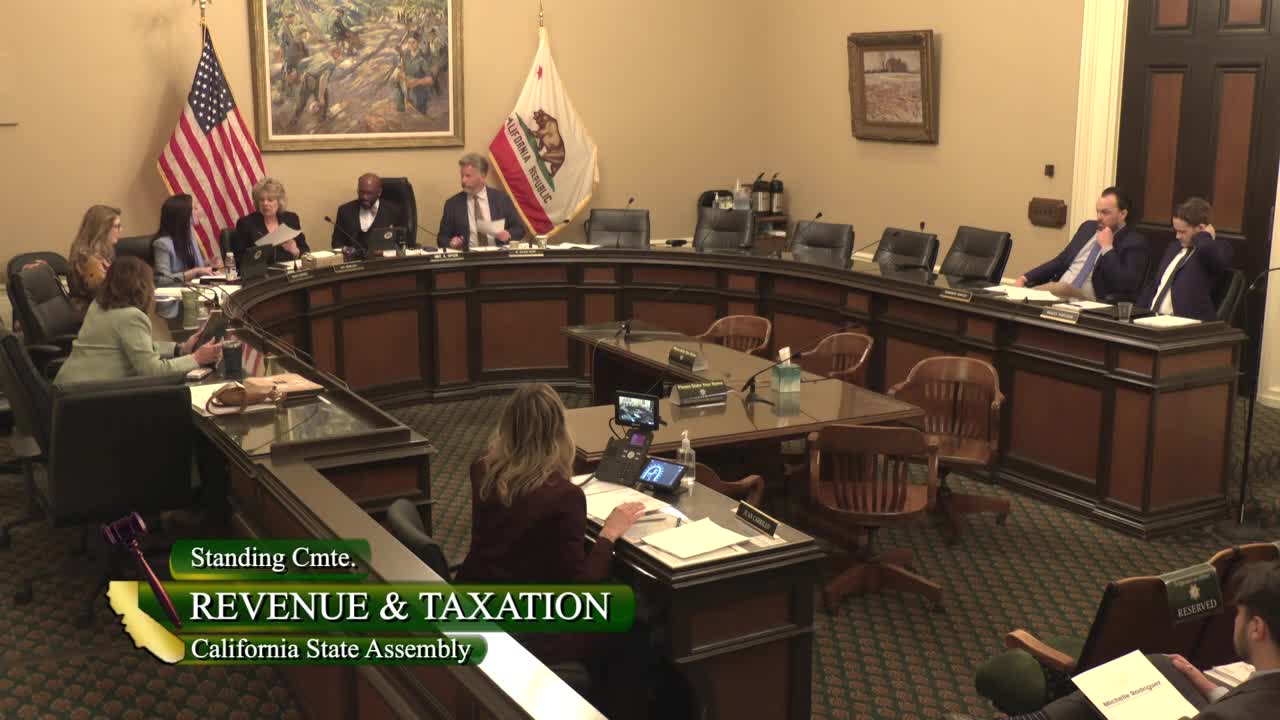 11MIN
Assembly Standing Committee on Revenue and Taxation
Bill Author