AB 2404: State advisory groups, boards, and committees: San Joaquin Valley.
- Session Year: 2025-2026
- House: Assembly
- Latest Version Date: 2026-02-20
Current Status:
Failed
(2026-05-12: From committee: Without further action pursuant to Joint Rule 62(a).)
Introduced
In Committee
Awaiting First Chamber Vote
Passed First Chamber
In Committee
Awaiting Second Chamber Vote
Passed Second Chamber
Enacted
(1)Existing law establishes the State Board of Education consisting of 10 members appointed by the Governor with the advice and consent of 2/3 of the Senate, as provided.
This bill would require at least one member of the State Board of Education to be from the San Joaquin Valley.
(2)Existing law requires the Superintendent of Public Instruction to coordinate the development, on a cyclical basis, of model curriculum standards for required courses of study, including a career technical education course of study for pupils in grades 7 to 12, inclusive, as specified. Existing law requires the Superintendent, upon adoption of those model curriculum standards, to develop a curriculum framework for career technical education, working in consultation and coordination with an advisory group consisting of classroom teachers, school administrators, parents, postsecondary educators, and representatives of business and industry. Existing law encourages the Superintendent, in convening the membership of the advisory group, to seek representation that is broadly reflective of the state population.
This bill would require the Superintendent, in convening the membership of the advisory group, to ensure at least one member is from the San Joaquin Valley.
(3)Existing law establishes the Department of Managed Health Care, which, among other duties, ensures the financial stability of managed care plans. Existing law establishes within the department the Financial Solvency Standards Board for the purpose of, among other things, developing and recommending to the director of the department financial solvency requirements and standards relating to health care service plan operations. Existing law requires the board to be composed of the director, or their designee, and 10 members appointed by the director, and authorizes the director to appoint individuals with training and experience in specified subject areas or fields.
This bill would require at least one member of the Financial Solvency Standards Board to be from the San Joaquin Valley.
(4)The California Stem Cell Research and Cures Act, an initiative measure approved by the voters at the November 2, 2004, statewide general election as Proposition 71, establishes the California Institute for Regenerative Medicine (CIRM), the purposes of which include making grants and loans for stem cell research, for research facilities, and for other vital research opportunities to realize therapies, protocols, and medical procedures that will result in the cure for, or substantial mitigation of, diseases and injuries. Existing law establishes the Citizens Financial Accountability Oversight Committee that is required to review, among other things, the annual financial audit of CIRM. Existing law requires the Controller, the Treasurer, the President pro Tempore of the Senate, the Speaker of the Assembly, and the Chairperson of the Independent Citizens Oversight Committee to each appoint a public member of the committee.
This bill would require at least one member of the Citizens Financial Accountability Oversight Committee to be from the San Joaquin Valley.
(5)Existing law establishes the California Veterans Board, comprising 7 members appointed by the Governor, subject to Senate confirmation, whose duties include determining the policies for all operations of the Department of Veterans Affairs. Existing law requires all members of the board to be veterans and requires one of the members to be a resident of a California veterans home.
This bill would require at least one member of the California Veterans Board to be from the San Joaquin Valley.
(a)At least one member of the State Board of Education shall be from the San Joaquin Valley.
(b)For purposes of this section, San Joaquin Valley means the geographical area consisting of all of the following:
(1)The County of Fresno.
(2)The County of Kern.
(3)The County of Kings.
(4)The County of Madera.
(5)The County of Merced.
(6)The County of San Joaquin.
(7)The County of Stanislaus.
(8)The County of Tulare.
(c)This section does not prohibit a member of the board who does not meet the requirement described in subdivision (a) from serving the remainder of the members term.
SEC. 2.Section 51226.1 of the Education Code is amended to read:51226.1.(a)Upon adoption of the model curriculum standards developed pursuant to Section 51226, the Superintendent shall develop a curriculum framework consistent with criteria set forth in subdivision (a) of Section 60005 that offers a blueprint for implementation of career and technical education. The framework shall be adopted no later than November 1, 2006.
(b)In developing the framework, the Superintendent shall work in consultation and coordination with an advisory group, including, but not limited to, representatives from all of the following:
(1)Business and industry.
(2)Labor.
(3)The California Community Colleges.
(4)The University of California.
(5)The California State University.
(6)Classroom teachers.
(7)School administrators.
(8)Pupils.
(9)Parents and guardians.
(10)Representatives of the Legislature.
(11)The department.
(12)The Labor and Workforce Development Agency.
(c)(1)In convening the membership of the advisory group set forth in subdivision (b), the Superintendent is encouraged to seek representation broadly reflective of the state population.
(2)(A)In convening the membership of the advisory group set forth in subdivision (b), the Superintendent shall ensure at least one member is from the San Joaquin Valley.
(B)For purposes of this paragraph, San Joaquin Valley means the geographical area consisting of all of the following:
(i)The County of Fresno.
(ii)The County of Kern.
(iii)The County of Kings.
(iv)The County of Madera.
(v)The County of Merced.
(vi)The County of San Joaquin.
(vii)The County of Stanislaus.
(viii)The County of Tulare.
(d)Costs incurred by the superintendent in complying with this section shall be covered, to the extent permitted by federal law, by the state administrative and leadership funds available pursuant to the Carl D. Perkins Vocational and Technical Education Act of 1998 (20 U.S.C. Sec. 2301 et seq.).
(e)In developing the framework, the Superintendent shall consider developing frameworks for various career pathways that will prepare pupils for both career entry and matriculation into postsecondary education.
(f)Upon completion of the framework, the advisory group is encouraged to identify career technical education courses that meet state-adopted academic content standards and that satisfy high school graduation requirements and admissions requirements of the University of California and the California State University, and to determine the extent to which local educational agencies accept credit earned for the completion of those courses, in lieu of other courses of study.
(g)The adoption of the framework developed and adopted pursuant to this section by a local educational agency shall be voluntary.
SEC. 3.Section 1347.16 is added to the Health and Safety Code, immediately following Section 1347.15, to read:1347.16.(a)At least one member of the Financial Solvency Standards Board shall be from the San Joaquin Valley.
(b)For purposes of this section, San Joaquin Valley means the geographical area consisting of all of the following:
(1)The County of Fresno.
(2)The County of Kern.
(3)The County of Kings.
(4)The County of Madera.
(5)The County of Merced.
(6)The County of San Joaquin.
(7)The County of Stanislaus.
(8)The County of Tulare.
(c)This section does not prohibit a member of the board who does not meet the requirement described in subdivision (a) from serving the remainder of the members term.
SEC. 4.Section 125290.31 is added to the Health and Safety Code, to read:125290.31.(a)At least one member of the Citizens Financial Accountability Oversight Committee shall be from the San Joaquin Valley.
(b)For purposes of this section, San Joaquin Valley means the geographical area consisting of all of the following:
(1)The County of Fresno.
(2)The County of Kern.
(3)The County of Kings.
(4)The County of Madera.
(5)The County of Merced.
(6)The County of San Joaquin.
(7)The County of Stanislaus.
(8)The County of Tulare.
(c)This section does not prohibit a member of the board who does not meet the requirement described in subdivision (a) from serving the remainder of the members term.
SEC. 5.Section 66.3 is added to the Military and Veterans Code, to read:66.3.(a)At least one member of the California Veterans Board shall be from the San Joaquin Valley.
(b)For purposes of this section, San Joaquin Valley means the geographical area consisting of all of the following:
(1)The County of Fresno.
(2)The County of Kern.
(3)The County of Kings.
(4)The County of Madera.
(5)The County of Merced.
(6)The County of San Joaquin.
(7)The County of Stanislaus.
(8)The County of Tulare.
(c)This section does not prohibit a member of the board who does not meet the requirement described in subdivision (a) from serving the remainder of the members term.
|
Date
|
Status
|
|---|---|
| May 12, 2026 | From committee: Without further action pursuant to Joint Rule 62(a). |
| Apr 15, 2026 | In committee: Set, second hearing. Failed passage. |
| Apr 6, 2026 | In committee: Set, first hearing. Hearing canceled at the request of author. |
| Mar 16, 2026 | Referred to Coms. on ED. and HEALTH. |
| Feb 21, 2026 | From printer. May be heard in committee March 23. |
| Feb 20, 2026 | Read first time. To print. |
|
Date
|
Description
|
Location
|
Votes
|
|
|---|---|---|---|---|
| Apr 15, 2026 | Do pass and be re-referred to the Committee on [Health] | Assembly Standing Committee on Education |
Failed |
This list shows positions taken on this bill by organizations on the date displayed, which is linked to the original source.
Positions by individuals are not included.
|
Organization
|
Position
|
Date
|
|---|---|---|
| Fresno County Board of Supervisors | ** Support | |
| Fresno County Superintendent of Schools | ** Support | |
| Kaweah Delta Water Conservation District | ** Support | |
| Madera County Superintendent Of Schools | ** Support | |
| San Joaquin County Office Of Education | ** Support |
Date of Hearing: April 15, 2026
ASSEMBLY COMMITTEE ON EDUCATION
Darshana R. Patel, Chair
ABPCA Bill Id:AB 2404 (
Author:Tangipa) – As Introduced Ver:February 20, 2026
[Note: This bill is double referred to the Assembly Health Committee and will be heard by that Committee as it relates to issues under its jurisdiction.]
SUBJECT: State advisory groups, boards, and committees: San Joaquin Valley
SUMMARY: Requires several groups, boards, and committees, including the State Board of Education (SBE), to include at least one member from the San Joaquin Valley. Specifically, this bill:
- Requires at least one member of the SBE to be from the San Joaquin Valley. Specifies that this provision does not prohibit a member of the SBE who is not from the San Joaquin from serving the remainder of the member’s term.
- Requires the Superintendent of Public Instruction (SPI) to include in the advisory group for the curriculum framework for the model curriculum standards for the requirements for high school graduation and career technical education (CTE) at least one member from the San Joaquin Valley.
- Requires at least one member of the Financial Solvency Standards Board to be from the San Joaquin Valley.
- Requires at least one member of the Citizen’s Financial Accountability Oversight Committee to be from the San Joaquin Valley.
- Requires at least one member of the California Veterans Board to be from the San Joaquin Valley.
- Defines the “San Joaquin Valley” to mean the geographical area consisting of all of the following counties: Fresno, Kern, Kings, Madera, Merced, San Joaquin, Stanislaus and Tulare.
EXISTING LAW:
- Establishes that there is in the state government a SBE, consisting of 10 members, who are appointed by the Governor with the advice and consent of two-thirds of the Senate. (Education Code (EC) 33000)
- Requires the SBE to determine all questions of policy within its powers. (Education Code (EC) 33030)
- Requires the SBE to adopt rules and regulations not inconsistent with the laws of the state for its own government, for the government of its appointees and employees, for the government of the day and evening elementary schools, the day and evening secondary schools, and the technical and vocational schools of the state, and for the government of other schools, excepting the University of California, the California State University, and the California Community Colleges, and may receive in whole or in part financial support from the state. (EC 33031)
- Requires the SPI to coordinate the development, on a cyclical basis, of model curriculum standards for the course of study and for a CTE course of study. Requires the SPI to set forth these standards in terms of a wide range of specific competencies, including higher level skills, in each academic subject area. Requires the SPI to review currently available textbooks in conjunction with the curriculum standards. Requires the SPI to seek the advice of classroom teachers, school administrators, parents, postsecondary educators, and representatives of business and industry in developing these curriculum standards. Requires the SPI to recommend policies to the SBE for consideration and adoption. Requires the SBE to adopt these policies no later than January 1, 1985. Specifies that neither the SPI nor the SBE adopt rules or regulations for course content or methods of instruction. (EC 51226)
- Requires the SPI, to the extent applicable, incorporate the integration of career technical and academic education into the development of curriculum standards for CTE courses. Requires the standards for a CTE course of study to be adopted no later than June 1, 2005. Requires, upon adoption of the model curriculum standards, the SPI to develop a curriculum framework that offers a blueprint for implementation of CTE. Requires the framework to be adopted no later than November 1, 2006. (EC 51226-51227)
- Requires, in developing the framework, no later than November 1, 2026, the SPI to work in consultation and coordination with an advisory group. Encourages the SPI to seek representation broadly reflective of the state population. Requires the advisory group to include, but not be limited to, representatives from all of the following:
- Business and industry;
- Labor;
- The California Community Colleges;
- The University of California;
- The California State University;
- Classroom teachers;
- School administrators;
- Pupils;
- Parents and guardians;
- Representatives of the Legislature;
- The California Department of Education (CDE); and
- The Labor and Workforce Development Agency. (EC 51226.1)
FISCAL EFFECT: Unknown
COMMENTS:
Need for the bill. According to the author, “The San Joaquin Valley is home to more than four million Californians and plays a critical role in our state’s economy, workforce, and education system. Yet too often, statewide decisions are made without direct input from the communities most affected. AB 2404 ensures that the Valley has a voice at the table by requiring representation on key boards that shape education and workforce policy. This bill takes a simple, practical step toward more balanced and inclusive decision-making by making sure every region of the state is heard.”
Key provisions of the bill. As it relates to K-12 education, this bill would require at least one member from the San Joaquin Valley to sit on 1) the SBE and 2) the advisory group for the curriculum framework for the model curriculum standards for the requirements for high school graduation and career technical education.
The Committee may wish to consider that by requiring a specific geographic region to be represented on state boards, task forces, working groups, etc. may lead to further legislative proposals requiring other geographic regions to be represented in the same way. The potential impact of this bill could be that the makeup of these groups could be required to disproportionately represent some parts of the state more than others.
San Joaquin Valley. For the purposes of this bill, the San Joaquin Valley is defined as the geographical area consisting of all of the following counties: Fresno, Kern, Kings, Madera, Merced, San Joaquin, Stanislaus and Tulare. According to the U.S. Geological Survey, the Central Valley of California includes the San Joaquin Valley. More than 250 different crops are grown in the Central Valley with an estimated value of $17 billion per year. Using fewer than 1% of U.S. farmland, the Central Valley supplies 8% of U.S. agricultural output (by value) and produces one quarter of the nation's food, including 40% of the nation's fruits, nuts, and other table foods. The predominant crop types are cereal grains, hay, cotton, tomatoes, vegetables, citrus, tree fruits, nuts, table grapes, and wine grapes. According to the U.S. Geological Survey:
The Central Valley can be divided into two large parts: the northern one-third is known as the Sacramento Valley and the southern two-thirds is known as the San Joaquin Valley. The San Joaquin Valley can be split further into the San Joaquin Basin and the Tulare Basin. The San Joaquin and Sacramento Valleys meet in the Delta area where the combined discharge of the Sacramento and San Joaquin Rivers flows through the Central Valley's one natural outlet, the Carquinez Strait, on its way to San Francisco Bay and the Pacific Ocean. Just east of the Delta, several streams issue from the Sierra Nevada into the valley and flow to the Delta in an area referred to as the Eastside Streams.
California’s San Joaquin Valley is one of the world’s most productive agricultural regions. With 4.3 million people, it is the fourth-most populous region in California after Los Angeles County (10 million), the San Francisco Bay Area (7.8 million), and the Inland Empire (4.6 million, Figure 1). According to a 2024 Public Policy of California (PPIC) report, Pathways to College Completion in the San Joaquin Valley, the San Joaquin Valley has relatively low wages, high poverty rates, and low levels of educational attainment. According to the 2024 American Community Survey (1-year estimates), the following table displays recent total population and median age for the specified counties of the San Joaquin Valley.
County | Total Population (estimate) | Median age |
Fresno | 1,024,125 | 34.0 |
Kern | 922,529 | 33.3 |
Kings | 154,913 | 33.0 |
Madera | 165,432 | 34.8 |
Merced | 296,774 | 32.2 |
San Joaquin | 816,108 | 36.2 |
Stanislaus | 556,972 | 35.2 |
Tulare | 483,546 | 32.4 |
State | 39,431,263 | 38.4 |
Source: 2024 American Community Survey (1-year estimates)
The San Joaquin Valley has one of the lowest rates of baccalaureate completion. According to a 2024 PPIC report, Pathways to College Completion in the San Joaquin Valley, high school students in the San Joaquin Valley are substantially less likely to attend and graduate from college than their counterparts in the rest of the state. Students from the San Joaquin Valley are underrepresented at the state’s public four-year institutions, and college-going and completion are low among low-income, Black, and Latino students. The PPIC suggests that improving student pathways to and through college is critical to improving economic outcomes and should leverage the diversity of students, organizations, and opportunities in the region.
The SBE. The SBE was first established by statute in 1852, and later by amendment to the California Constitution in 1884. Both the Constitution and statutes set forth the SBE’s duties. Constitutional duties of the SBE include the appointment of one deputy and three associate superintendents upon nomination of the SPI and the adoption of textbooks for use in grades one through eight. By statute, the SBE is the governing and policy-making body of the State. The Constitution and statute also assign the SBE a variety of other responsibilities: regulations, standards, waivers, assessment, district reorganization, charter schools, the federal Every Student Succeeds Act (ESSA), funding allocations, and study and planning. This bill would require at least one member of the SBE to be from the San Joaquin Valley, as defined.
California Career Technical Education (CTE) Model Curriculum Standards. According to the CDE’s website, the CTE standards and framework bolster California's standards-based education system by incorporating cutting-edge knowledge about career options, technology, and skills required for success in adult life. This initiative is critical if California is to meet the challenges inherent in its diverse, rapidly changing education, economic, policy, and workforce environment.
Current law requires the development of the CTE standards and curriculum framework. The California Model Curriculum Standards were most recently adopted by the SBE in 2013. The standards, written for grades seven through twelve, specify learning goals in 58 career pathways organized around 15 industry sectors. The CDE recently initiated the process of updating the CTE Model Standards and Curriculum Framework with a projected SBE approval timeline of November 2027.
Required CDE stakeholder consultation for the development of the CTE Model Standards and Curriculum Framework. In 2005, both the CTE standards and model curriculum framework were developed in consultation and coordination with an advisory group appointed by the SPI, as required by current law. As the CDE updates the next CTE Model Standards and Curriculum Framework, selected individuals were selected based on their subject matter expertise, engagement with education and workforce systems, and participation in aligned state initiatives. The Standards Development Committees (SDCs) include the following interest holders:
- CTE Educators from K-12 and postsecondary institutions across California;
- Business and Industry professionals who serve on local workforce boards, are members of their Chamber of Commerce, or serve on regional and statewide CTE advisories;
- Union leaders and training providers who support California’s apprenticeship ecosystem;
- Representation from California Workforce Development Board;
- Representation from the Division of Apprenticeship Standards; and
- Representation from other statewide agencies including the California State Transportation Agency, California Energy Commission, California Department of Water Resources, CalHR, California Department of Social Services, Go Biz, and others.
This bill would require one member of the advisory committee to be from the San Joaquin Valley, as defined. The Committee may wish to consider that the advisory committee required for the initial adoption of the CTE Model Standards and Curriculum Framework is no longer active, and the addition of a required member of the advisory council from the San Joaquin Valley may have no practical impact.
Arguments in support. The Fresno County Superintendent of Schools writes, “Despite its significant population, agricultural production, workforce contribution, and economic importance, the San Joaquin Valley is frequently underrepresented in statewide decision-making. Policies adopted by state boards directly impact Valley residents and their livelihoods. The region faces unique challenges, including higher poverty rates, persistent air quality concerns, workforce development gaps, and limited rural access to essential services. When statewide bodies lack representation from this region, policies may unintentionally overlook or inadequately address the needs of millions of Californians who call the Valley home. This balanced and practical approach ensures that the San Joaquin Valley has a voice in shaping decisions that directly affect its residents.”
Recommended Committee Amendments. Staff recommends that the bill be amended as follows:
- Encourage the Governor, when appointing members to the SBE, to consider the geographic and demographic diversity of public schools the state. Remove the requirement for a member of the SBE to be from the San Joaquin Valley.
- Remove provisions of the bill related to the appointees of the advisory group for the CTE model curriculum standards curriculum framework both because the work of the advisory group was completed in 2006, and current law related to the membership of the advisory group already encourages the SPI to seek representation broadly reflective of the state population.
Related legislation. AB 715 (Megan Dahle) would have established the Rural Education Task Force within the CDE to provide assistance and advice to the State Superintendent of Public Instruction (SPI) on the needs and challenges of very rural schools that serve pupils in kindergarten and grades 1 to 12. This bill was held in the Senate Appropriations Committee.
SB 1934 (McPherson), Chapter 989, Statutes of 2002, requires the SPI, in consultation with an advisory group, to develop, and the SBE to adopt, a curriculum framework for CTE.
REGISTERED SUPPORT / OPPOSITION:
Support
Fresno County Board of Supervisors
Fresno County Superintendent of Schools
Kaweah Delta Water Conservation District
Madera County Superintendent of Schools
San Joaquin County Office of Education
Opposition
None on file
Analysis Prepared by: Marguerite Ries / ED. / (916) 319-2087
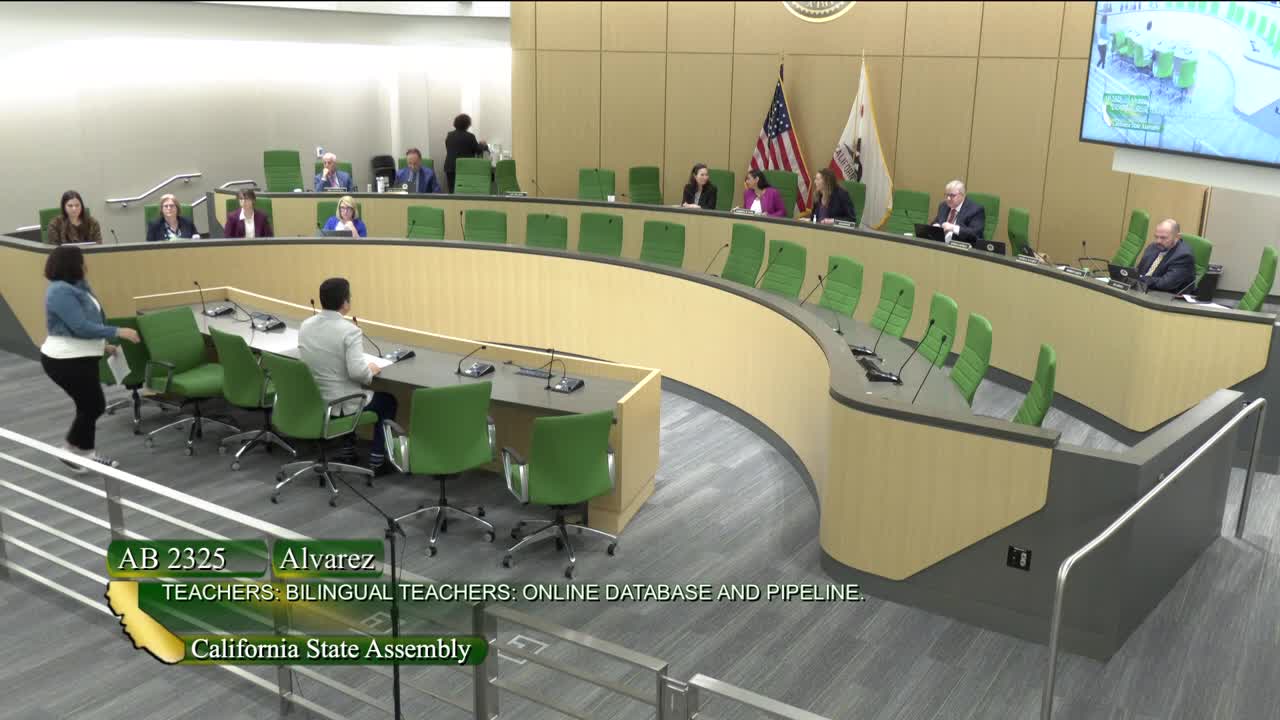
Discussed in Hearing
 16MIN
Assembly Standing Committee on Education
Bill Author
Bill Co-Author(s):