AB 2424: Public Utilities Commission: communications: low-income customers.
- Session Year: 2025-2026
- House: Assembly
- Latest Version Date: 2026-04-16
Current Status:
In Progress
(2026-05-14: In committee: Held under submission.)
Introduced
In Committee
Awaiting First Chamber Vote
Passed First Chamber
In Committee
Awaiting Second Chamber Vote
Passed Second Chamber
Enacted
Existing law establishes the Low-Income Oversight Board with 11 specified members, including 5 members selected by the Public Utilities Commission who have expertise in the low-income community and who are not affiliated with any state agency or utility group and one member selected by the commission who is a representative of an electrical or gas corporation. Existing law and requires the board Low-Income Oversight Board to advise the commission Public Utilities Commission on low-income electricity, gas, and water customer issues, and to, among other things, monitor and evaluate implementation of all programs provided to low-income electricity, gas, and water customers.
This bill would increase the membership of the board to 13 members by adding an additional member selected by the commission who has expertise in the low-income community and who is not affiliated with any state agency or utility group and an additional member selected by the commission who is a representative of wireless lifeline providers and is affiliated with a provider with headquarters in the state. establish the Low-Income Telecommunications Advisory Board with specified membership. The bill would require the board to also Low-Income Telecommunications Advisory Board to, among other things, advise the commission on low-income telecommunications customer issues issues, serve as a liaison for the commission to low-income customers and stakeholders, provide certain reports to the Legislature, and to monitor and evaluate implementation of all programs provided to low-income telecommunications customers. customers, as provided. The bill would require the commission, in conjunction with the Low-Income Telecommunications Advisory Board, to increase participation in programs for low-income telecommunications customers and ensure that the cost burden of low-income telecommunications customers is reduced, as specified.
Existing law vests the commission with regulatory authority over public utilities, including telephone corporations. Existing law, the Moore Universal Telephone Service Act, establishes the Universal Lifeline Telephone Service program to provide low-income households with access to affordable basic residential telephone service.
This bill would prohibit the commission, in administering the lifeline program, from favoring or disfavoring one technology over another technology and from unfairly advantaging or disadvantaging one provider over another provider. require the commission to administer the lifeline program in a technologically inclusive manner and would prohibit the commission from discriminating against lifeline providers by adopting rules that favor or disfavor certain providers.
Under existing law, a violation of the Public Utilities Act or of an order, decision, rule, direction, demand, or requirement of the commission is a crime.
Because the provisions of this bill would be part of the act, and a violation of a commission action implementing its provisions would be a crime, the bill would impose a state-mandated local program.
The California Constitution requires the state to reimburse local agencies and school districts for certain costs mandated by the state. Statutory provisions establish procedures for making that reimbursement.
This bill would provide that no reimbursement is required by this act for a specified reason.
Existing law establishes the Low-Income Oversight Board with 11 specified members, including 5 members selected by the Public Utilities Commission who have expertise in the low-income community and who are not affiliated with any state agency or utility group and one member selected by the commission who is a representative of an electrical or gas corporation. Existing law requires the board to advise the commission on low-income electricity, gas, and water customer issues, and to, among other things, monitor and evaluate implementation of all programs provided to low-income electricity, gas, and water customers.
This bill would increase the membership of the board to 13 members by adding an additional member selected by the commission who has expertise in the low-income community and who is not affiliated with any state agency or utility group and an additional member selected by the commission who is a representative of wireless lifeline providers and is affiliated with a provider with headquarters in the state. The bill would require the board to also advise the commission on low-income telecommunications customer issues and to monitor and evaluate implementation of all programs provided to low-income telecommunications customers.
Existing law vests the Public Utilities Commission commission with regulatory authority over public utilities, including telephone corporations. Existing law, the Moore Universal Telephone Service Act, establishes the Universal Lifeline Telephone Service program to provide low-income households with access to affordable basic residential telephone service. Existing law requires the commission, by January 15, 2017, to adopt a portability freeze rule for the lifeline program, as specified. Existing law requires that a lifeline telephone service subscriber be provided with one lifeline subscription at the subscribers principal place of residence, and provides that no other member of that subscribers family or household, as defined, who maintains residence at that place is eligible for lifeline telephone service.
This bill would prohibit the commission, in administering the lifeline program, from favoring or disfavoring one technology over another technology and from unfairly advantaging or disadvantaging one provider over another provider. The bill would establish a freeze on portability between eligible telecommunications carriers, as defined, and for the transfer of any lifeline benefits for the first 120 days after the date of enrollment of any lifeline telephone service subscriber. The bill would authorize up to three members of the same family or household to be lifeline telephone service subscribers.
Under existing law, a violation of the Public Utilities Act or any order, decision, rule, direction, demand, or requirement of the commission is a crime.Because the provisions of this bill would be a part of the act and a violation of a commission action implementing its requirements would be a crime, the bill would impose a state-mandated local program.The California Constitution requires the state to reimburse local agencies and school districts for certain costs mandated by the state. Statutory provisions establish procedures for making that reimbursement.This bill would provide that no reimbursement is required by this act for a specified reason.Existing law vests the Public Utilities Commission with regulatory authority over public utilities, including telephone corporations. Existing law, the Moore Universal Telephone Service Act, establishes the Universal Lifeline Telephone Service program to provide low-income households with access to affordable basic residential telephone service. Existing law requires the commission, by January 15, 2017, to adopt a portability freeze rule for the lifeline program, as specified. Existing law requires that a lifeline telephone service subscriber be provided with one lifeline subscription at the subscribers principal place of residence, and provides that no other member of that subscribers family or household, as defined, who maintains residence at that place is eligible for lifeline telephone service.
This bill would prohibit the commission, in administering the lifeline program, from favoring or disfavoring one technology over another technology and from unfairly advantaging or disadvantaging one provider over another provider. The bill would establish a freeze on portability between eligible telecommunications carriers, as defined, and for the transfer of any lifeline benefits for the first 120 days after the date of enrollment of any lifeline telephone service subscriber. The bill would authorize up to three members of the same family or household to be lifeline telephone service subscribers.
Under existing law, a violation of the Public Utilities Act or any order, decision, rule, direction, demand, or requirement of the commission is a crime.
Because the provisions of this bill would be a part of the act and a violation of a commission action implementing its requirements would be a crime, the bill would impose a state-mandated local program.
The California Constitution requires the state to reimburse local agencies and school districts for certain costs mandated by the state. Statutory provisions establish procedures for making that reimbursement.
This bill would provide that no reimbursement is required by this act for a specified reason.
It is the intent of the Legislature that, if a successor agency to the Public Utilities Commission is created, the successor agency include low-income telecommunications oversight within its scope and purview.
SEC. 2.Section 382.1 of the Public Utilities Code is amended to read:382.1.(a)There is hereby established a Low-Income Oversight Board that shall advise the commission on low-income electricity, gas, telecommunications, and water customer issues and shall serve as a liaison for the commission to low-income ratepayers and representatives. The Low-Income Oversight Board shall replace the Low-Income Advisory Board in existence on January 1, 2000. The Low-Income Oversight Board shall do all of the following to advise the commission regarding the commissions duties:(1)Monitor and evaluate implementation of all programs provided to low-income electricity, gas, telecommunications, and water customers.(2)Assist in the development and analysis of any assessments of low-income customer need.(3)Encourage collaboration between state and utility programs for low-income electricity and gas customers to maximize the leverage of state and federal energy efficiency funds to both lower the bills and increase the comfort of low-income customers.(4)Provide reports to the Legislature, as requested, summarizing the assessment of need, audits, and analysis of program implementation.(5)Assist in streamlining the application and enrollment process of programs for low-income electricity and gas customers with general low-income programs, including, but not limited to, the Universal Lifeline Telephone Service (ULTS) program and compliance with Section 739.1.(6)Encourage the usage of the network of community service providers in accordance with Section 381.5.(b)The Low-Income Oversight Board shall comprise 13 members to be selected as follows:(1)Six members selected by the commission who have expertise in the low-income community and who are not affiliated with any state agency or utility group. These members shall be selected in a manner to ensure an equitable geographic distribution.(2)One member selected by the Governor.(3)One member selected by the commission who is a commissioner or commissioner designee.(4)One member selected by the Department of Community Services and Development.(5)One member selected by the commission who is a representative of private weatherization contractors.(6)One member selected by the commission who is a representative of an electrical or gas corporation.(7)One member selected by the commission who is a representative of a water corporation.(8)One member selected by the commission who is a representative of wireless lifeline providers and is affiliated with a provider with headquarters in the state.(c)The Low-Income Oversight Board shall alternate meeting locations between northern, central, and southern California.(d)The Low-Income Oversight Board may establish a technical advisory committee consisting of low-income service providers, utility representatives, consumer organizations, and commission staff, to assist the board and may request utility representatives and commission staff to assist the technical advisory committee.(e)The commission shall do all of the following in conjunction with the board:(1)Work with the board, interested parties, and community-based organizations to increase participation in programs for low-income customers.(2)Provide technical support to the board.(3)Ensure that the energy burden of low-income electricity and gas customers is reduced.(4)Provide formal notice of board meetings in the commissions daily calendar.(f)(1)Members of the board and members of the technical advisory committee shall be eligible for compensation in accordance with state guidelines for necessary travel.(2)Members of the board and members of the technical advisory committee who are not salaried state service employees shall be eligible for reasonable compensation for attendance at board meetings.(3)All reasonable costs incurred by the board in carrying out its duties pursuant to subdivision (a), including staffing, travel, and administrative costs, shall be reimbursed through the public utilities reimbursement account and shall be part of the budget of the commission and the commission shall consult with the board in the preparation of that portion of the commissions annual proposed budget.SEC. 3.SEC. 2.Section 871.6 is added to the Public Utilities Code, to read:871.6.In administering (a)The commission shall administer the lifeline program in a manner that is equitable, nondiscriminatory, and without competitive consequences, the commission shall not favor or disfavor one technology over another technology. To ensure competitive neutrality, the commission shall not unfairly advantage or disadvantage one provider over another provider. technologically inclusive manner that does not exclude any technologies or unreasonably favor one technology over another technology.
(b)The commission shall not discriminate against lifeline providers by adopting rules that favor or disfavor certain providers.
(c)This section does not affect or impede the authority of the commission to take enforcement action against any lifeline providers.
SEC. 3.Section 872 is added to the Public Utilities Code, to read:872.(a)There is hereby established a Low-Income Telecommunications Advisory Board, which shall advise the commission on low-income telecommunications customer issues and shall serve as a liaison for the commission to low-income customers and stakeholders. The Low-Income Telecommunications Advisory Board shall do all of the following to advise the commission regarding the commissions duties:
(1)Monitor and evaluate implementation of all programs provided to low-income telecommunications customers.
(2)Assist in the development and analysis of any assessments of low-income telecommunications customer need.
(3)Provide reports to the Legislature, as requested, summarizing the assessment of need, audits, and analysis of program implementation.
(4)Assist in streamlining the application and enrollment process of programs for low-income telecommunications customers with general low-income programs, including, but not limited to, the Universal Lifeline Telephone Service (ULTS) program and the program described in, and compliance with, Section 739.1.
(b)The Low-Income Telecommunications Advisory Board shall be composed of five members, to be selected as follows:
(1)Two members selected by the commission who have expertise in the low-income telecommunications community and who are not affiliated with any state agency or industry group.
(2)One member selected by the commission who is a representative of a wireline lifeline provider offering service in California.
(3)One member selected by the commission who is a representative of a wireless lifeline provider offering service in California.
(4)One member selected by the commission from an organization with demonstrated experience advocating before the commission.
(c)The Low-Income Telecommunications Advisory Board may establish a technical advisory committee consisting of low-income telecommunications service providers, provider representatives, consumer organizations, and commission staff, to assist the board, and may request utility representatives and commission staff to assist the technical advisory committee.
(d)The commission shall do all of the following in conjunction with the Low-Income Telecommunications Advisory Board:
(1)Work with the Low-Income Telecommunications Advisory Board, interested parties, and community-based organizations to increase participation in programs for low-income telecommunications customers.
(2)Provide technical support to the Low-Income Telecommunications Advisory Board.
(3)Ensure that the cost burden of low-income telecommunications customers is reduced.
(4)Provide formal notice of Low-Income Telecommunications Advisory Board meetings in the commissions daily calendar.
(e)(1)Members of the Low-Income Telecommunications Advisory Board, and members of the technical advisory committee, shall be eligible for compensation in accordance with state guidelines for necessary travel.
(2)Members of the Low-Income Telecommunications Advisory Board, and members of the technical advisory committee, who are not salaried state service employees shall be eligible for reasonable compensation for attendance at board meetings.
(3)All reasonable costs incurred by the Low-Income Telecommunications Advisory Board in carrying out its duties pursuant to subdivision (a), including staffing, travel, and administrative costs, shall be reimbursed through the Public Utilities Commission Utilities Reimbursement Account established under Section 402, and shall be part of the budget of the commission, and the commission shall consult with the board in the preparation of that portion of the commissions annual proposed budget.
SEC. 4.No reimbursement is required by this act pursuant to Section 6 of Article XIIIB of the California Constitution because the only costs that may be incurred by a local agency or school district will be incurred because this act creates a new crime or infraction, eliminates a crime or infraction, or changes the penalty for a crime or infraction, within the meaning of Section 17556 of the Government Code, or changes the definition of a crime within the meaning of Section 6 of Article XIIIB of the California Constitution.
It is the intent of the Legislature that, if a successor agency to the Public Utilities Commission is created, the successor agency include low-income telecommunications oversight within its scope and purview.
SEC. 2.Section 382.1 of the Public Utilities Code is amended to read:382.1.(a)There is hereby established a Low-Income Oversight Board that shall advise the commission on low-income electric, electricity, gas, telecommunications, and water customer issues and shall serve as a liaison for the commission to low-income ratepayers and representatives. The Low-Income Oversight Board shall replace the Low-Income Advisory Board in existence on January 1, 2000. The Low-Income Oversight Board shall do all of the following to advise the commission regarding the commissions duties:
(1)Monitor and evaluate implementation of all programs provided to low-income electricity, gas, telecommunications, and water customers.
(2)Assist in the development and analysis of any assessments of low-income customer need.
(3)Encourage collaboration between state and utility programs for low-income electricity and gas customers to maximize the leverage of state and federal energy efficiency funds to both lower the bills and increase the comfort of low-income customers.
(4)Provide reports to the Legislature, as requested, summarizing the assessment of need, audits, and analysis of program implementation.
(5)Assist in streamlining the application and enrollment process of programs for low-income electricity and gas customers with general low-income programs, including, but not limited to, the Universal Lifeline Telephone Service (ULTS) program and, including and compliance with Section 739.1.
(6)Encourage the usage of the network of community service providers in accordance with Section 381.5.
(b)The Low-Income Oversight Board shall be comprised of 11 comprise 13 members to be selected as follows:
(1)Five Six members selected by the commission who have expertise in the low-income community and who are not affiliated with any state agency or utility group. These members shall be selected in a manner to ensure an equitable geographic distribution.
(2)One member selected by the Governor.
(3)One member selected by the commission who is a commissioner or commissioner designee.
(4)One member selected by the Department of Community Services and Development.
(5)One member selected by the commission who is a representative of private weatherization contractors.
(6)One member selected by the commission who is a representative of an electrical or gas corporation.
(7)One member selected by the commission who is a representative of a water corporation.
(8)One member selected by the commission who is a representative of wireless lifeline providers and is affiliated with a provider with headquarters in the state.
(c)The Low-Income Oversight Board shall alternate meeting locations between northern, central, and southern California.
(d)The Low-Income Oversight Board may establish a technical advisory committee consisting of low-income service providers, utility representatives, consumer organizations, and commission staff, to assist the board and may request utility representatives and commission staff to assist the technical advisory committee.
(e)The commission shall do all of the following in conjunction with the board:
(1)Work with the board, interested parties, and community-based organizations to increase participation in programs for low-income customers.
(2)Provide technical support to the board.
(3)Ensure that the energy burden of low-income electricity and gas customers is reduced.
(4)Provide formal notice of board meetings in the commissions daily calendar.
(f)(1)Members of the board and members of the technical advisory committee shall be eligible for compensation in accordance with state guidelines for necessary travel.
(2)Members of the board and members of the technical advisory committee who are not salaried state service employees shall be eligible for reasonable compensation for attendance at board meetings.
(3)All reasonable costs incurred by the board in carrying out its duties pursuant to subdivision (a), including staffing, travel, and administrative costs, shall be reimbursed through the public utilities reimbursement account and shall be part of the budget of the commission and the commission shall consult with the board in the preparation of that portion of the commissions annual proposed budget.
SECTION 1.SEC. 3.Section 871.6 is added to the Public Utilities Code, to read:871.6.In administering the lifeline program in a manner that is equitable, nondiscriminatory, and without competitive consequences, the commission shall not favor or disfavor one technology over another technology. To ensure competitive neutrality, the commission shall not unfairly advantage or disadvantage one provider over another provider.
SEC. 2.Section 873.5 is added to the Public Utilities Code, to read:873.5.(a)For purposes of this section, eligible telecommunications carrier has the same meaning as described in Section 214 of Title 47 of the United States Code.(b)To combat fraud and service disruptions, and to provide stability for eligible telecommunications carriers that invest resources into lifeline program awareness and subscriber acquisition, there shall be a freeze on portability between eligible telecommunications carriers and for the transfer of any lifeline benefits for the first 120 days after the date of enrollment of a lifeline telephone service subscriber.SEC. 3.Section 878 of the Public Utilities Code is amended to read:878.(a)A lifeline telephone service subscriber shall be provided with one lifeline subscription, as defined by the commission, at the subscribers principal place of residence, and two or fewer members of that subscribers family or household who maintain residence at that place may also be lifeline telephone service subscribers if they are eligible for lifeline telephone service.(b)An applicant for lifeline telephone service may report only one address in this state as the principal place of residence.(c)Multiple lifeline telephone service subscribers may maintain the same address if they are not members of the same household, except that three or fewer lifeline telephone service subscribers may maintain the same address if they are members of the same family or household.(d)For purposes of this section, the following definitions apply:(1)Adult means any person 18 years of age or older.(2)Economic unit means all adult individuals contributing to and sharing in the income and expenses of a household.(3)Household means any group of individuals, including the subscriber, who are living together at the same address and as one economic unit. A household may include related and unrelated persons. If an adult has no, or minimal, income and lives with someone who provides financial support to that adult, both persons shall be part of the same household. A child under 18 years of age and living with a parent or guardian shall be part of the same household as the parent or guardian.SEC. 4.No reimbursement is required by this act pursuant to Section 6 of Article XIIIB of the California Constitution because the only costs that may be incurred by a local agency or school district will be incurred because this act creates a new crime or infraction, eliminates a crime or infraction, or changes the penalty for a crime or infraction, within the meaning of Section 17556 of the Government Code, or changes the definition of a crime within the meaning of Section 6 of Article XIIIB of the California Constitution.In administering the lifeline program in a manner that is equitable, nondiscriminatory, and without competitive consequences, the commission shall not favor or disfavor one technology over another technology. To ensure competitive neutrality, the commission shall not unfairly advantage or disadvantage one provider over another provider.
SEC. 2.Section 873.5 is added to the Public Utilities Code, to read:873.5.(a)For purposes of this section, eligible telecommunications carrier has the same meaning as described in Section 214 of Title 47 of the United States Code.
(b)To combat fraud and service disruptions, and to provide stability for eligible telecommunications carriers that invest resources into lifeline program awareness and subscriber acquisition, there shall be a freeze on portability between eligible telecommunications carriers and for the transfer of any lifeline benefits for the first 120 days after the date of enrollment of a lifeline telephone service subscriber.
SEC. 3.Section 878 of the Public Utilities Code is amended to read:878.(a)A lifeline telephone service subscriber shall be provided with one lifeline subscription, as defined by the commission, at the subscribers principal place of residence, and no other member two or fewer members of that subscribers family or household who maintains maintain residence at that place is may also be lifeline telephone service subscribers if they are eligible for lifeline telephone service.
(b)An applicant for lifeline telephone service may report only one address in this state as the principal place of residence.
(c)Multiple lifeline telephone service subscribers may maintain the same address if they are not members of the same household. household, except that three or fewer lifeline telephone service subscribers may maintain the same address if they are members of the same family or household.
(d)For purposes of this section, the following definitions apply:
(1)Adult means any person 18 years of age or older.
(2)Economic unit means all adult individuals contributing to and sharing in the income and expenses of a household.
(3)Household means any group of individuals, including the subscriber, who are living together at the same address and as one economic unit. A household may include related and unrelated persons. If an adult has no, or minimal, income and lives with someone who provides financial support to that adult, both persons shall be part of the same household. A child under 18 years of age and living with a parent or guardian shall be part of the same household as the parent or guardian.
SEC. 4.No reimbursement is required by this act pursuant to Section 6 of Article XIIIB of the California Constitution because the only costs that may be incurred by a local agency or school district will be incurred because this act creates a new crime or infraction, eliminates a crime or infraction, or changes the penalty for a crime or infraction, within the meaning of Section 17556 of the Government Code, or changes the definition of a crime within the meaning of Section 6 of Article XIIIB of the California Constitution.
|
Date
|
Status
|
|---|---|
| May 14, 2026 | In committee: Held under submission. |
| May 6, 2026 | In committee: Set, first hearing. Referred to APPR. suspense file. |
| Apr 20, 2026 | Re-referred to Com. on APPR. |
| Apr 16, 2026 | Read second time and amended. |
| Apr 15, 2026 | From committee: Amend, and do pass as amended and re-refer to Com. on APPR. (Ayes 7. Noes 2.) (April 15). |
| Apr 8, 2026 | Re-referred to Com. on C. & C. |
| Apr 7, 2026 | From committee chair, with author's amendments: Amend, and re-refer to Com. on C. & C. Read second time and amended. |
| Mar 9, 2026 | Referred to Com. on C. & C. |
| Feb 21, 2026 | From printer. May be heard in committee March 23. |
| Feb 20, 2026 | Read first time. To print. |
|
Date
|
Description
|
Location
|
Votes
|
|
|---|---|---|---|---|
| Apr 15, 2026 | Do pass as amended and be re-referred to the Committee on [Appropriations] | Assembly Standing Committee on Communications and Conveyance |
Passed |
This list shows positions taken on this bill by organizations on the date displayed, which is linked to the original source.
Positions by individuals are not included.
|
Organization
|
Position
|
Date
|
|---|---|---|
| CalBroadband | ** Against | |
| California Public Utilities Commission | ** Against | |
| Energy Transition Collective | ** Support |
Date of Hearing: May 6, 2026
ASSEMBLY COMMITTEE ON APPROPRIATIONS
Buffy Wicks, Chair
ABPCA Bill Id:AB 2424
Author:(Carrillo) – As Amended Ver:April 16, 2026
Policy Committee: | Communications and Conveyance | Vote: | 7 - 2 |
|
| ||
|
|
Urgency: No State Mandated Local Program: Yes Reimbursable: No
SUMMARY:
This bill establishes the Low-Income Telecommunications Advisory Board (LITA Board) to advise the California Public Utilities Commission (CPUC) on issues faced by low-income telecommunications customers and serve as a liaison for the CPUC to low-income customers and stakeholders.
The bill, among other things, assigns specified duties to the LITA Board and defines it as comprising five members, all selected by the CPUC, as follows: two members with expertise in the low-income telecommunications community and who are not affiliated with any state agency or industry group; one member who is a representative of a wireline lifeline provider offering service in California; one member who is a representative of a wireless lifeline provider offering service in California; and one member from an organization with demonstrated experience advocating before the CPUC.
The bill directs the CPUC, in conjunction with the LITA Board, to (1) work with the LITA Board, interested parties and community-based organizations to increase participation in programs for low-income telecommunications customers; (2) provide technical support to the LITA Board; (3) ensure that the cost burden of low-income telecommunications customers is reduced; and (4) provide formal notice of LITA Board meetings in the CPUC’s daily calendar.
The bill specifies that members of the LITA Board, and members of the technical advisory committee this bill authorizes the LITA Board to create, are eligible for compensation in accordance with state guidelines for necessary travel, and that all reasonable costs incurred by the LITA Board are to be reimbursed through the Public Utilities Commission Utilities Reimbursement Account (PUCURA) and shall be part of the budget of the CPUC. The bill further provides that the CPUC is to consult with the LITA Board in preparing the relevant portion of the CPUC’s annual proposed budget.
FISCAL EFFECT:
This bill creates substantial new administrative work of the CPUC, as described above, for which it is reasonable to expect the CPUC to need additional resources.
For its part, the CPUC expects this bill to result in annual costs of approximately $270,000 (Universal Lifeline Telephone Services Trust Fund) to develop a board charter, recruit board members, schedule and staff board meetings, and orient new board members. The CPUC warns its estimate does not include costs associated with a technical advisory committee, if the LITA Board should form one.
COMMENTS:
The CPUC regulates the rates and terms of service charged by the state’s privately owned utilities that provide any of the following services: electrical, gas, telephone and water. To assist the CPUC, statute establishes the 11-member Low-Income Oversight Board to advise the CPUC on low-income electric, gas, and water customer issues and to serve as a liaison for the CPUC to low-income ratepayers and representatives. Notably, statute does not explicitly include issues faced by low-income telephone customers among the topics on which the Low-Income Advisory Board is to advise the CPUC.
State law directs the CPUC to establish and set rates for the California Lifeline Program, through which qualified low-income households may receive discounted home phone and cell phone services. The author introduced this measure to “strengthen” the California Lifeline Program
The CPUC asserts there is no need to create a separate advisory board specific to low-income telecommunications customers because the existing Low-Income Oversight Board already advises the CPUC on programs that help low-income Californians access affordable energy, water, and telecommunications services. The CPUC also maintains various administrative committees that function as advisory boards regarding the development, implementation and administration of their respective programs.
The author, while acknowledging the existence of the Low-Income Oversight Board, nonetheless asserts “telecommunications consumer-issues have been excluded from the scope of the Low-Income Oversight Board’s purview” and that the LITA Board will provide “necessary oversight for telecommunications issues…improve systemic accountability, reduce fraud and administrative costs to the program, and seek to increase its participation rates among eligible individuals.”
Analysis Prepared by: Jay Dickenson / APPR. / (916) 319-2081
Date of Hearing: April 15, 2026
ASSEMBLY COMMITTEE ON COMMUNICATIONS AND CONVEYANCE
Tasha Boerner, Chair
ABPCA Bill Id:AB 2424 (
Author:Carrillo) – As Amended Ver:April 7, 2026
SUBJECT: Public Utilities Commission: communications: low-income customers
SUMMARY: This bill increases the size and scope of the Low-Income Oversight Board (LIOB) of the California Public Utilities Commission (CPUC) from 11 to 13 members, as provided, and to include telecommunications. Additionally, the bill imposes additional requirements for the CPUC in administering the Lifeline program.
Specifically, this bill:
- Expands the scope of the LIOB to also include telecommunications.
- Specifies that one of the two additional members has expertise in the low-income community and is not affiliated with any state agency or utility group.
- Specifies that one of the two additional members is a representative of wireless lifeline providers and is affiliated with a provider with headquarters in the state.
- Prohibits the CPUC from favoring or disfavoring one technology over another technology in administering the Lifeline program.
- Prohibits the CPUC from unfairly advantaging or disadvantaging one provider over another provider in administering the Lifeline program.
- States the intent of the Legislature that, if a successor agency to the Public Utilities Commission is created, the successor agency shall include low-income telecommunications oversight within its scope and purview.
EXISTING LAW:
- Establishes the LIOB to advise the CPUC on low-income electric, electricity, gas, and water customer issues and to serve as a liaison for the CPUC to low-income ratepayers and representatives.
- Specifies that the LIOB shall be comprised of 11 members, to be selected and apportioned based on specified qualifications.
- Defines “telecommunications service” to mean voice communication provided by a telephone corporation as defined in Section 234, voice communication provided by a provider of satellite telephone services, voice communication provided by a provider of mobile telephony service, as defined in Section 224.4, and voice communication provided by a commercially available facilities-based provider of voice communication services utilizing Voice over Internet Protocol or any successor protocol.
- Establishes the Moore Universal Telephone Service Act, or the California lifeline program. (Public Utilities Code § 871 et. seq.)
- Authorizes the CPUC to annually designate a class of lifeline service necessary to meet minimum communications needs, and to develop eligibility criteria for that service. (Public Utilities Code § 873).
- States the findings and declarations of the Legislature, which include that the furnishing of lifeline telephone service is in the public interest and should be supported fairly and equitably by every telephone corporation, and the commission, in administering the lifeline telephone service program, should implement the program in a way that is equitable, nondiscriminatory, and without competitive consequences for the telecommunications industry in California.
FISCAL EFFECT: Unknown. This bill is keyed fiscal by the Legislative Counsel.
COMMENTS:
- Purpose the bill. According to the author “AB 2424 seeks to strengthen the California Lifeline Program to include telecommunications issues under the scope of the Low-Income Oversight Board. By adding a seat for a telecommunications expert to the California Public Utilities Commission’s Low Income Oversight Board, the CPUC will have the ability to evaluate complex issues like broadband infrastructure, fraud, service reliability, and pricing. A specialist in telecoms can provide technical insight regarding network deployment and regulatory constraints to present challenges to the program. This expertise is crucial when addressing the digital divide and ensuring that low-income communities receive fair and consistent access to essential communication services. With informed guidance, the board can make more effective recommendations on affordability programs and service quality standards. Adding this expertise will improve accountability and help ensure that California’s most vulnerable residents are not left behind in an increasingly connected society.
- Low-Income Oversight Board. The Legislature initially established the LIOB in 2001 to advise the Commission on low-income electric and gas customer issues and to serve as a liaison for the Commission to low-income ratepayers and representatives. The enacting legislation required specific activities for the LIOB to advise the Commission on affordability matters for low-income ratepayers, and described the selection process and types of members allowed to serve on the LIOB. Additionally, the enacting legislation listed the Commission’s duties in conjunction with the LIOB. A few years later in 2005 the LIOB’s duties were expanded by including low-income water customer issues of which the LIOB can advise the Commission.
Under current law, the LIOB consists of 11 members. The plurality of those board positions are required to be reserved for individuals with expertise in the low-income community and who are not affiliated with any state agency or utility group. A number of the spots are also reserved for utility or industry representatives. This bill would add two additional spots, one of which would be specifically for a wireless lifeline provider with a headquarters in the state of California. Based on that criteria, there is likely only one provider that would qualify. However, the Lifeline program has various providers utilizing different technologies to provide service. Reserving one spot for a wireless provider would seem to be inconsistent with another provision of this bill, that would require the commission to administer the program in a technology neutral manner and that does not advantage certain providers over others. However, the requirements of this bill as currently drafted would seem to both favor one technology and guarantee the appointment of a particular provider to the LIOB. Given inconsistency, the committee may wish to amend this bill to revise the appointment criteria.
- The CPUC and Telecommunications. The California Constitution and the Public Utilities Code provides broad powers to the CPUC to supervise and regulate every public utility in the State and do all things which are necessary and convenient in the exercise of such power and jurisdiction[1]. Under existing law, telephone corporations, electric corporations, gas corporations, and water corporations are public utilities subject to the jurisdiction of the CPUC. However, the term “telecommunications” is used more loosely in the Public Utilities Code, and whether providers of telecommunications service are public utilities is a subject of debate. Whereas in some segments of the code it is defined narrowly to mean voice communication, in other programs it has been interpreted more broadly by the CPUC to include non-voice communications services like texting and broadband. Notably for the Lifeline program, telecommunications service has been interpreted to include both voice and data services.
This bill proposes to expand the scope of the LIOB to include telecommunications. Based on precedent and practice, it is likely the CPUC would interpret the term to include broadband service. Such an interpretation would be consistent with a recent CPUC decision that authorized a broadband pilot as part of the Lifeline program. Notably, this committee in recent years has had robust discussions about the jurisdiction of the CPUC as it relates to broadband service and has considered bills that would transfer oversight of broadband programs to an entity outside of the CPUC. This bill, by expanding the scope of the LIOB to include telecommunications, may further formalize a role for the CPUC related to broadband services. However, in consideration of the possibility that another agency may be established, this bill includes findings and declarations that reflect the intent of the Legislature that if a successor agency to the Public Utilities Commission is created, the successor agency include low-income telecommunications oversight within its scope and purview.
In the event that the Legislature does establish a new agency to regulate broadband and telecommunications related programs, such as under AB 2289, it is not clear how an expanded LIOB could be transferred without impacting the existing scope of work. Further, the LIOB has historically focused on affordability concerns related to public utilities provided by monopoly providers. The telecommunications marketplace is broadly significantly different, with a broad range of providers utilizing different technologies and operating sometimes under different sets of laws and regulations. While adding two new seats to the LIOB, one of which focuses on telecommunications, may appear to expand the focus of the LIOB it would still primarily consist of representatives with experience and expertise outside of the telecommunications industry. Given these issues and understanding the author’s intent, the committee may wish to amend this bill to instead create a separate board outside of the LIOB. In that case, such a board could be transferred to a successor agency, and that board could focus specifically on telecommunications issues. Such a board would also benefit from a more specialized focus and membership with a relevant set of experience.
- Similar/related legislation.
- AB 2289 (Boerner) of this session would establish the Office of Broadband and Digital Equity. That bill is pending in this committee.
- SB 1480 (Allen) of 2024 would have expanded the scope and membership of the LIOB to include telecommunications. The bill was held in Senate Appropriations.
- SBX 2 (Alacron, Statutes of 2001) established the LIOB.
- SB 580 (Escutia, Statutes of 2005) expanded the scope of the LIOB to include water.
- Committee amendments.
- Strike provisions of this bill relating to the LIOB, and instead establish a separate Low-Income Telecommunications Advisory Board with duties similar to the LIOB and consisting of 5 members.
- Of the 5 members, the positions shall be apportioned as follows: two for general members that are not affiliated with the industry, one wireless provider offering service in California, one wireline provider offering service in California, and one spot for an individual representing organization with experience advocating before the CPUC.
- Revise Section 3 of this bill pertaining to discrimination and technology neutrality, to specify the commission shall administer the Lifeline program in a technologically inclusive manner, that does not exclude any technologies or unreasonably favor one technology over another. Specify that the commission shall not discriminate against providers by adopting rules that favor or disfavor certain providers, while qualifying that the CPUC retains enforcement authority over providers.
- Strike provisions of this bill relating to the LIOB, and instead establish a separate Low-Income Telecommunications Advisory Board with duties similar to the LIOB and consisting of 5 members.
REGISTERED SUPPORT / OPPOSITION:
Support
Energy Transition Collective
Opposition
Calbroadband
Analysis Prepared by: Emilio Perez / C. & C. / (916) 319-2637
Public Utilities Code § 701 ↑
Discussed in Hearing
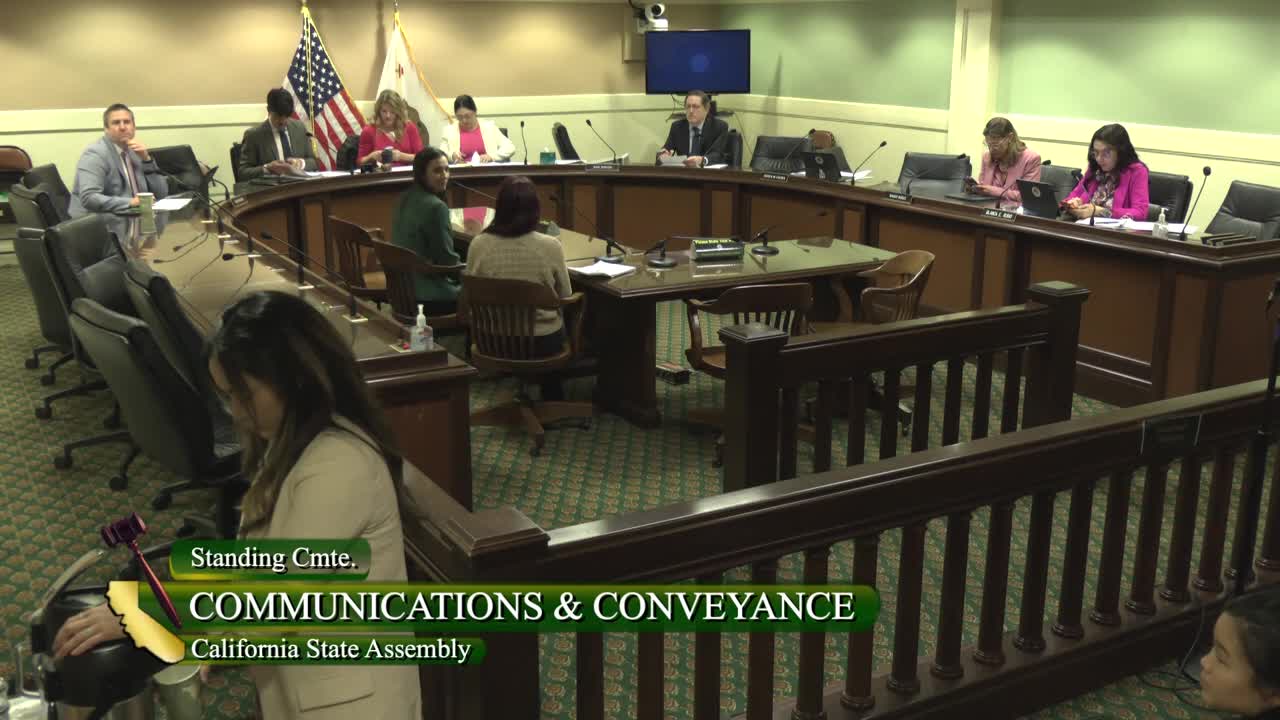 11MIN
Assembly Standing Committee on Communications and Conveyance
Bill Author

Bill Co-Author(s):