AB 2427: Personal Income Tax Law: Corporation Tax Law: tax credits: farming.
- Session Year: 2025-2026
- House: Assembly
- Latest Version Date: 2026-03-11
Current Status:
In Progress
(2026-04-27: In committee: Set, second hearing. Held under submission.)
Introduced
In Committee
Awaiting First Chamber Vote
Passed First Chamber
In Committee
Awaiting Second Chamber Vote
Passed Second Chamber
Enacted
The Personal Income Tax Law and the Corporation Tax Law allow various credits against the taxes imposed by those laws.
This bill, for taxable years beginning on or after January 1, 2027, and before January 1, 2032, would allow a credit against the taxes imposed by those laws for specified agricultural businesses that operate on at least 50 acres of land, as provided, equal to 25% of the businesss qualified expenditures, as defined. The bill would increase the credit by 5% to 30% of qualified expenditures if the taxpayer purchases specified low-emission equipment or the qualified taxpayer has qualified expenditures are related to the taxpayers related to operations in a high or very high fire hazard severity zone, as specified. The bill would limit the credit to no more than $1,000,000. The bill would cap the aggregate amount of the credit allowed at $250,000,000 for each taxable year, and would require a taxpayer to request a credit reservation from the Department of Food and Agriculture, as provided. The bill would require the Department of Food and Agriculture to coordinate with the Franchise Tax Board for the administration of the credit. The bill would require the Franchise Tax Board and the Department of Food and Agriculture to share specified information, and would make the unauthorized disclosure of that information a misdemeanor. By expanding the scope of a crime, this bill would impose a state-mandated local program.
Existing law requires any bill authorizing a new tax expenditure to contain, among other things, specific goals, purposes, and objectives that the tax expenditure will achieve, detailed performance indicators, and data collection requirements.
This bill would also include additional information required for any bill authorizing a new tax expenditure.
The California Constitution requires the state to reimburse local agencies and school districts for certain costs mandated by the state. Statutory provisions establish procedures for making that reimbursement.
This bill would provide that no reimbursement is required by this act for a specified reason.
This bill would take effect immediately as a tax levy.
The Personal Income Tax Law and the Corporation Tax Law allow various credits against the taxes imposed by those laws.
This bill, for taxable years beginning on or after January 1, 2027, and before January 1, 2032, would allow a credit against the taxes imposed by those laws for specified agricultural businesses that operate on at least 50 acres of land, as provided, equal to 25% of the businesss qualified expenditures, as defined. The bill would increase the credit by 5% of qualified expenditures if the taxpayer purchases specified low-emission equipment or the qualified expenditures are related to the taxpayers operations in a high or very high fire hazard severity zone, as specified. The bill would cap the aggregate amount of the credit allowed at $250,000,000 for each taxable year, and would require a taxpayer to request a credit reservation from the Department of Food and Agriculture, as provided. The bill would require the Department of Food and Agriculture to coordinate with the Franchise Tax Board for the administration of the credit. The bill would require the Franchise Tax Board and the Department of Food and Agriculture to share specified information, and would make the unauthorized disclosure of that information a misdemeanor. By expanding the scope of a crime, this bill would impose a state-mandated local program.
Existing law requires any bill authorizing a new tax expenditure to contain, among other things, specific goals, purposes, and objectives that the tax expenditure will achieve, detailed performance indicators, and data collection requirements.
This bill would also include additional information required for any bill authorizing a new tax expenditure.
The California Constitution requires the state to reimburse local agencies and school districts for certain costs mandated by the state. Statutory provisions establish procedures for making that reimbursement.
This bill would provide that no reimbursement is required by this act for a specified reason.
This bill would take effect immediately as a tax levy.
(a)(1)For each taxable year taxable years beginning on or after January 1, 2027, and before January 1, 2032, there shall be allowed a credit against the net tax, as defined in Section 17039, to a qualified taxpayer equal to 25 percent of the total amount of the qualified taxpayers qualified expenditures during the taxable year, except as provided in paragraph (2). paragraphs (2) and (3).
(2)For any taxable year, the credit allowed under paragraph (1) shall be increased by an additional 5 to 30 percent of qualified expenditures if either of the following conditions are met:
(A)The qualified taxpayer purchases low-emission equipment, as defined in paragraph (1) of subdivision (b), during the taxable year.
(B)The qualified taxpayer has qualified expenditures are related to the qualified taxpayers related to operations in a high or very high fire hazard severity zone as identified by the State Fire Marshal pursuant to Section 51178 of the Government Code.
(3)A credit allowed under this section shall not exceed one million dollars ($1,000,000).
(b)For purposes of this section, the following definitions shall apply:
(1)Agricultural production means the production of agricultural commodities, including, but not limited to, crops, specialty crops, livestock, dairy, poultry, aquaculture, and mixed agricultural operations.
(2)Low-emission equipment means off-road equipment with a motor that satisfies the requirements of Section 2423 of Title 13 of the California Code of Regulations.
(3)Qualified expenditure means costs related to all of the following:
(A)Wages and labor, including wages paid to seasonal and temporary employees.
(B)Infrastructure and equipment.
(C)Agricultural production.
(4)Qualified taxpayer means a taxpayer that operates on at least 50 acres of land, regardless of whether the taxpayer owns or leases the land, and is primarily involved in one or more business described in codes 111110 to 112519, inclusive, of the 2022 edition of the North American Industry Classification System, published by the United States Office of Management and Budget.
(c)The total aggregate amount of the credit that may be allocated by credit reservations to all qualified taxpayers pursuant to this section and Section 23668 shall not exceed two hundred fifty million dollars ($250,000,000) for each taxable year, cumulatively.
(d)(1)To be eligible for the credit allowed by this section, a qualified taxpayer shall request a credit reservation from the Department of Food and Agriculture during the month of July for each taxable year, or within 30 days of the start of their taxable year if the qualified taxpayers taxable year begins after July, in the form and manner prescribed by the Department of Food and Agriculture in coordination with the Franchise Tax Board.
(2)To obtain a credit reservation with respect to a qualified expenditure, the qualified taxpayer shall provide all necessary information, as determined by Department of Food and Agriculture in coordination with the Franchise Tax Board.
(3)The Department of Food and Agriculture, in coordination with the Franchise Tax Board, shall approve tentative credit reservations with respect to qualified expenditures incurred during a taxable year by qualified taxpayers, subject to the cap established under this section and Section 23668, and provide a credit certificate to the taxpayer upon approval, which is to be filed with the qualified taxpayers return for the taxable year in which the credit is claimed.
(4)(A)Notwithstanding any other law, the Franchise Tax Board and the Department of Food and Agriculture shall provide additional information, as requested by the Franchise Tax Board or Department of Food and Agriculture, as necessary to administer the credit allowed by this section.
(B)The information received by the Department of Food and Agriculture pursuant to this paragraph shall be considered confidential taxpayer information, and shall be subject to the provisions of Section 19542.
(e)(1)In the event the credit allowed by this section exceeds the net tax, the excess may be carried over to reduce the net tax in the following year, and succeeding five four years if necessary, until the credit is exhausted.
(2)No deduction shall be allowed under this part for amounts taken into account under this section in calculating the credit allowed by this section.
(f)(1)For purposes of complying with Section 41, the Legislature finds and declares both of the following:
(A)The goal of the credit allowed pursuant to this section and Section 23668 is to ____.
(B)The performance indicators for the Legislature to use in determining whether the credit achieves the stated goal shall be the number of taxpayers allowed a credit pursuant to this section and Section 23668 and the total dollar value of credits allowed.
(2)(A)The Franchise Tax Board shall, no later than April 1, 2029, and annually thereafter, submit a report to the Legislature, in compliance with Section 9795 of the Government Code, detailing the number of taxpayers allowed a credit pursuant to this section and Section 23668 and the total dollar value of credits allowed.
(B)The disclosure provisions of this paragraph shall be treated as an exception to Section 19542.
(g)This section shall remain in effect only until December 1, 2032, and as of that date is repealed.
SEC. 2.Section 23668 is added to the Revenue and Taxation Code, to read:23668.(a)(1)For each taxable year taxable years beginning on or after January 1, 2027, and before January 1, 2032, there shall be allowed a credit against the tax, as defined in Section 23036, to a qualified taxpayer equal to 25 percent of the total amount of the qualified taxpayers qualified expenditures during the taxable year, except as provided in paragraph (2). paragraphs (2) and (3).
(2)For any taxable year, the credit allowed under paragraph (1) shall be increased by an additional 5 to 30 percent of qualified expenditures if either of the following conditions are met:
(A)The qualified taxpayer purchases low-emission equipment, as defined in paragraph (1) of subdivision (b), during the taxable year.
(B)The qualified taxpayer has qualified expenditures are related to the qualified taxpayers related to operations in a high or very high fire hazard severity zone as identified by the State Fire Marshal pursuant to Section 51178 of the Government Code.
(3)A credit allowed under this section shall not exceed one million dollars ($1,000,000).
(b)For purposes of this section, the following definitions shall apply:
(1)Agricultural production means the production of agricultural commodities, including, but not limited to, crops, specialty crops, livestock, dairy, poultry, aquaculture, and mixed agricultural operations.
(2)Low-emission equipment means off-road equipment with a motor that satisfies the requirements of Section 2423 of Title 13 of the California Code of Regulations.
(3)Qualified expenditure means costs related to all of the following:
(A)Wages and labor, including wages paid to seasonal and temporary employees.
(B)Infrastructure and equipment.
(C)Agricultural production.
(4)Qualified taxpayer means a taxpayer that operates on at least 50 acres of land, regardless of whether the taxpayer owns or leases the land, and is primarily involved in one or more business described in codes 111110 to 112519, inclusive, of the 2022 edition of the North American Industry Classification System, published by the United States Office of Management and Budget.
(c)The total aggregate amount of the credit that may be allocated by credit reservations to all qualified taxpayers pursuant to this section and Section 17053.66 shall not exceed two hundred fifty million dollars ($250,000,000) for each taxable year, cumulatively.
(d)(1)To be eligible for the credit allowed by this section, a qualified taxpayer shall request a credit reservation from the Department of Food and Agriculture during the month of July for each taxable year, or within 30 days of the start of their taxable year if the qualified taxpayers taxable year begins after July, in the form and manner prescribed by the Department of Food and Agriculture in coordination with the Franchise Tax Board.
(2)To obtain a credit reservation with respect to a qualified expenditure, the qualified taxpayer shall provide all necessary information, as determined by Department of Food and Agriculture in coordination with the Franchise Tax Board.
(3)The Department of Food and Agriculture, in coordination with the Franchise Tax Board, shall approve tentative credit reservations with respect to qualified expenditures incurred during a taxable year by qualified taxpayers, subject to the cap established under this section and Section 17053.66, and provide a credit certificate to the taxpayer upon approval, which is to be filed with the qualified taxpayers return for the taxable year in which the credit is claimed.
(4)(A)Notwithstanding any other law, the Franchise Tax Board and the Department of Food and Agriculture shall provide additional information, as requested by the Franchise Tax Board or Department of Food and Agriculture, as necessary to administer the credit allowed by this section.
(B)The information received by the Department of Food and Agriculture pursuant to this paragraph shall be considered confidential taxpayer information, and shall be subject to the provisions of Section 19542.
(e)(1)In the event the credit allowed by this section exceeds the tax, the excess may be carried over to reduce the tax in the following year, and succeeding five four years if necessary, until the credit is exhausted.
(2)No deduction shall be allowed under this part for amounts taken into account under this section in calculating the credit allowed by this section.
(f)This section shall remain in effect only until December 1, 2032, and as of that date is repealed.
SEC. 3.No reimbursement is required by this act pursuant to Section 6 of Article XIIIB of the California Constitution because the only costs that may be incurred by a local agency or school district will be incurred because this act creates a new crime or infraction, eliminates a crime or infraction, or changes the penalty for a crime or infraction, within the meaning of Section 17556 of the Government Code, or changes the definition of a crime within the meaning of Section 6 of Article XIIIB of the California Constitution.
SEC. 4.This act provides for a tax levy within the meaning of Article IV of the California Constitution and shall go into immediate effect.
(a)(1)For each taxable year beginning on or after January 1, 2027, and before January 1, 2032, there shall be allowed a credit against the net tax, as defined in Section 17039, to a qualified taxpayer equal to 25 percent of the total amount of the qualified taxpayers qualified expenditures during the taxable year, except as provided in paragraph (2).
(2)For any taxable year, the credit allowed under paragraph (1) shall be increased by an additional 5 percent of qualified expenditures if either of the following conditions are met:
(A)The qualified taxpayer purchases low-emission equipment, as defined in paragraph (1) of subdivision (b), during the taxable year.
(B)The qualified expenditures are related to the qualified taxpayers operations in a high or very high fire hazard severity zone as identified by the State Fire Marshal pursuant to Section 51178 of the Government Code.
(b)For purposes of this section, the following definitions shall apply:
(1)Agricultural production means the production of agricultural commodities, including, but not limited to, crops, specialty crops, livestock, dairy, poultry, aquaculture, and mixed agricultural operations.
(2)Low-emission equipment means off-road equipment with a motor that satisfies the requirements of Section 2423 of Title 13 of the California Code of Regulations.
(3)Qualified expenditure means costs related to all of the following:
(A)Wages and labor, including wages paid to seasonal and temporary employees.
(B)Infrastructure and equipment.
(C)Agricultural production.
(4)Qualified taxpayer means a taxpayer that operates on at least 50 acres of land, regardless of whether the taxpayer owns or leases the land, and is primarily involved in one or more business described in codes 111110 to 112519, inclusive, of the 2022 edition of the North American Industry Classification System, published by the United States Office of Management and Budget.
(c)The total aggregate amount of the credit that may be allocated by credit reservations to all qualified taxpayers pursuant to this section and Section 23668 shall not exceed two hundred fifty million dollars ($250,000,000) for each taxable year, cumulatively.
(d)(1)To be eligible for the credit allowed by this section, a qualified taxpayer shall request a credit reservation from the Department of Food and Agriculture during the month of July for each taxable year, or within 30 days of the start of their taxable year if the qualified taxpayers taxable year begins after July, in the form and manner prescribed by the Department of Food and Agriculture in coordination with the Franchise Tax Board.
(2)To obtain a credit reservation with respect to a qualified expenditure, the qualified taxpayer shall provide all necessary information, as determined by Department of Food and Agriculture in coordination with the Franchise Tax Board.
(3)The Department of Food and Agriculture, in coordination with the Franchise Tax Board, shall approve tentative credit reservations with respect to qualified expenditures incurred during a taxable year by qualified taxpayers, subject to the cap established under this section and Section 23668, and provide a credit certificate to the taxpayer upon approval, which is to be filed with the qualified taxpayers return for the taxable year in which the credit is claimed.
(4)(A)Notwithstanding any other law, the Franchise Tax Board and the Department of Food and Agriculture shall provide additional information, as requested by the Franchise Tax Board or Department of Food and Agriculture, as necessary to administer the credit allowed by this section.
(B)The information received by the Department of Food and Agriculture pursuant to this paragraph shall be considered confidential taxpayer information, and shall be subject to the provisions of Section 19542.
(e)(1)In the event the credit allowed by this section exceeds the net tax, the excess may be carried over to reduce the net tax in the following year, and succeeding five years if necessary, until the credit is exhausted.
(2)No deduction shall be allowed under this part for amounts taken into account under this section in calculating the credit allowed by this section.
(f)(1)For purposes of complying with Section 41, the Legislature finds and declares both of the following:
(A)The goal of the credit allowed pursuant to this section and Section 23668 is to ____.
(B)The performance indicators for the Legislature to use in determining whether the credit achieves the stated goal shall be the number of taxpayers allowed a credit pursuant to this section and Section 23668 and the total dollar value of credits allowed.
(2)(A)The Franchise Tax Board shall, no later than April 1, 2029, and annually thereafter, submit a report to the Legislature, in compliance with Section 9795 of the Government Code, detailing the number of taxpayers allowed a credit pursuant to this section and Section 23668 and the total dollar value of credits allowed.
(B)The disclosure provisions of this paragraph shall be treated as an exception to Section 19542.
(g)This section shall remain in effect only until December 1, 2032, and as of that date is repealed.
SEC. 2.Section 23668 is added to the Revenue and Taxation Code, to read:23668.(a)(1)For each taxable year beginning on or after January 1, 2027, and before January 1, 2032, there shall be allowed a credit against the tax, as defined in Section 23036, to a qualified taxpayer equal to 25 percent of the total amount of the qualified taxpayers qualified expenditures during the taxable year, except as provided in paragraph (2).
(2)For any taxable year, the credit allowed under paragraph (1) shall be increased by an additional 5 percent of qualified expenditures if either of the following conditions are met:
(A)The qualified taxpayer purchases low-emission equipment, as defined in paragraph (1) of subdivision (b), during the taxable year.
(B)The qualified expenditures are related to the qualified taxpayers operations in a high or very high fire hazard severity zone as identified by the State Fire Marshal pursuant to Section 51178 of the Government Code.
(b)For purposes of this section, the following definitions shall apply:
(1)Agricultural production means the production of agricultural commodities, including, but not limited to, crops, specialty crops, livestock, dairy, poultry, aquaculture, and mixed agricultural operations.
(2)Low-emission equipment means off-road equipment with a motor that satisfies the requirements of Section 2423 of Title 13 of the California Code of Regulations.
(3)Qualified expenditure means costs related to all of the following:
(A)Wages and labor, including wages paid to seasonal and temporary employees.
(B)Infrastructure and equipment.
(C)Agricultural production.
(4)Qualified taxpayer means a taxpayer that operates on at least 50 acres of land, regardless of whether the taxpayer owns or leases the land, and is primarily involved in one or more business described in codes 111110 to 112519, inclusive, of the 2022 edition of the North American Industry Classification System, published by the United States Office of Management and Budget.
(c)The total aggregate amount of the credit that may be allocated by credit reservations to all qualified taxpayers pursuant to this section and Section 17053.66 shall not exceed two hundred fifty million dollars ($250,000,000) for each taxable year, cumulatively.
(d)(1)To be eligible for the credit allowed by this section, a qualified taxpayer shall request a credit reservation from the Department of Food and Agriculture during the month of July for each taxable year, or within 30 days of the start of their taxable year if the qualified taxpayers taxable year begins after July, in the form and manner prescribed by the Department of Food and Agriculture in coordination with the Franchise Tax Board.
(2)To obtain a credit reservation with respect to a qualified expenditure, the qualified taxpayer shall provide all necessary information, as determined by Department of Food and Agriculture in coordination with the Franchise Tax Board.
(3)The Department of Food and Agriculture, in coordination with the Franchise Tax Board, shall approve tentative credit reservations with respect to qualified expenditures incurred during a taxable year by qualified taxpayers, subject to the cap established under this section and Section 17053.66, and provide a credit certificate to the taxpayer upon approval, which is to be filed with the qualified taxpayers return for the taxable year in which the credit is claimed.
(4)(A)Notwithstanding any other law, the Franchise Tax Board and the Department of Food and Agriculture shall provide additional information, as requested by the Franchise Tax Board or Department of Food and Agriculture, as necessary to administer the credit allowed by this section.
(B)The information received by the Department of Food and Agriculture pursuant to this paragraph shall be considered confidential taxpayer information, and shall be subject to the provisions of Section 19542.
(e)(1)In the event the credit allowed by this section exceeds the tax, the excess may be carried over to reduce the tax in the following year, and succeeding five years if necessary, until the credit is exhausted.
(2)No deduction shall be allowed under this part for amounts taken into account under this section in calculating the credit allowed by this section.
(f)This section shall remain in effect only until December 1, 2032, and as of that date is repealed.
SEC. 3.No reimbursement is required by this act pursuant to Section 6 of Article XIIIB of the California Constitution because the only costs that may be incurred by a local agency or school district will be incurred because this act creates a new crime or infraction, eliminates a crime or infraction, or changes the penalty for a crime or infraction, within the meaning of Section 17556 of the Government Code, or changes the definition of a crime within the meaning of Section 6 of Article XIIIB of the California Constitution.
SEC. 4.This act provides for a tax levy within the meaning of Article IV of the California Constitution and shall go into immediate effect.
|
Date
|
Status
|
|---|---|
| Apr 27, 2026 | In committee: Set, second hearing. Held under submission. |
| Apr 6, 2026 | In committee: Set, first hearing. Referred to REV. & TAX. suspense file. |
| Mar 12, 2026 | Re-referred to Com. on REV. & TAX. |
| Mar 11, 2026 | From committee chair, with author's amendments: Amend, and re-refer to Com. on REV. & TAX. Read second time and amended. |
| Mar 9, 2026 | Referred to Com. on REV. & TAX. |
| Feb 21, 2026 | From printer. May be heard in committee March 23. |
| Feb 20, 2026 | Read first time. To print. |
This list shows positions taken on this bill by organizations on the date displayed, which is linked to the original source.
Positions by individuals are not included.
|
Organization
|
Position
|
Date
|
|---|---|---|
| Alexandre Family Farm | ** Support | |
| Association Of California Egg Farmers | ** Support | |
| California Association Of Wheat Growers | ** Support | |
| California Bean Shippers Association | ** Support | |
| California Farm Bureau | ** Support | |
| California Fresh Fruit Association | ** Support | |
| California Grain & Feed Association | ** Support | |
| California Pear Growers Association | ** Support | |
| California Seed Association | ** Support | |
| California State Floral Association | ** Support | |
| California Tax Reform Association | ** Against | |
| California Teachers Association | ** Against | |
| California Warehouse Association | ** Support | |
| Central California Irrigation District | ** Support | |
| Colusa County Farm Bureau | ** Support | |
| Del Norte Farm Bureau | ** Support | |
| Imperial County Farm Bureau | ** Support | |
| Mendocino County Farm Bureau Federation | ** Support | |
| Monterey County Farm Bureau | ** Support | |
| Pacific Egg & Poultry Association | ** Support | |
| Sacramento County Farm Bureau | ** Support | |
| Stanislaus County Farm Bureau | ** Support |
Date of Hearing: April 27, 2026
ASSEMBLY COMMITTEE ON REVENUE AND TAXATION
Mike Gipson, Chair
ABPCA Bill Id:AB 2427 (
Author:Tangipa) – As Amended Ver:March 11, 2026
SUSPENSE
Majority vote. Tax levy. Fiscal committee.
SUBJECT: Personal Income Tax Law: Corporation Tax Law: tax credits: farming
SUMMARY: Allows, under both the Personal Income Tax (PIT) Law and the Corporation Tax (CT) Law, a credit to a "qualified taxpayer" equal to 25% of the total amount of the "qualified taxpayer's" "qualified expenditures" during the taxable year, except as provided. Specifically, this bill:
- Allows the credit for taxable years beginning on or after January 1, 2027, and before January 1, 2032.
- Provides that the credit amount specified above shall be increased to 30% of "qualified expenditures" if either of the following conditions are met:
- The "qualified taxpayer" purchases "low-emission equipment" during the taxable year; or,
- The "qualified taxpayer" has "qualified expenditures" related to operations in a high or very high fire hazard severity zone as identified by the State Fire Marshal pursuant to Government Code Section 51178.
- Provides that a credit shall not exceed $1 million.
- Defines a "qualified taxpayer" as a taxpayer that operates on at least 50 acres of land, regardless of whether the taxpayer owns or leases the land, and is primarily involved in one or more business[es] described in codes 111110 to 112519, inclusive, of the 2022 edition of the North American Industry Classification System, published by the United States Office of Management and Budget.
- Defines a "qualified expenditure" to mean costs related to all of the following:
- Wages and labor, including wages paid to seasonal and temporary employees;
- Infrasturcture and equipment; and,
- "Agricultural production".
- Defines "low-emission equipment" as off-road equipment with a motor that satisfies the requirements of Section 2423 of Title 13 of the California Code of Regulations.
- Defines "agricultural production" to mean the production of agricultural commodities, including, but not limited to, crops, specialty crops, livestock, dairy, poultry, aquaculture, and mixed agricultural operations.
- Provides that to be eligible for the credit, a qualified taxpayer must request a credit reservation from the Department of Food and Agriculture (CDFA) during the month of July for each taxable year, or within 30 days of the start of their taxable year if the qualified taxpayer's taxable year begins after July, in the form and manner prescribed by the CDFA in coordination with the Franchise Tax Board (FTB).
- Specifies that the total aggregate amount of the credit that may be allocated by credit reservations to all qualified taxpayers shall not exceed $250 million for each taxable year, cumulatively.
- Provides that, to obtain a credit reservation with respect to a qualified expenditure, the qualified taxpayer must provide all necessary information, as determined by the CDFA in coordination with the FTB.
- Requires the CDFA, in coordination with the FTB, to approve tentative credit reservations with respect to qualified expenditures incurred during a taxable year by qualified taxpayers, and to provide a credit certificate to the taxpayer upon approval, which is to be filed with the qualified taxpayer's return for the taxable year in which the credit is claimed.
- Provides that, notwithstanding any other law, the FTB and the CDFA shall provide [sic] additional information, as requested by the FTB or CDFA, as necessary to administer the credit.
- Provides that the information received by the CDFA pursuant to this bill shall be considered confidential taxpayer information and shall be subject to the provisions of Revenue and Taxation Code (R&TC) Section 19542.
- Provides that in cases where the credit amount exceeds the taxpayer's tax liability, the excess credit amount may be carried forward five years, until the credit is exhausted.
- Provides that no deduction shall be allowed for amounts taken into account in calculating the credit.
- Provides that, for purposes of complying with R&TC Section 41, the Legislature finds and declares both of the following:
- The goal of the credit allowed by this bill is to ________; and,
- The performance indicators for the Legislature to use in determining whether the credit achieves the stated goal shall be the number of taxpayers allowed a credit and the total dollar value of credits allowed.
- Requires the FTB, no later than April 1, 2029, and annually thereafter, to submit a report to the Legislature, in compliance with Government Code Section 9795, detailing the number of taxpayers allowed a credit pursuant to this bill and the total dollar value of credits allowed.
- Provides that no reimbursement is required by this bill pursuant to Section 6 of Article XIIIB of the California Constitution for specified reasons.
- Takes immediate effect as a tax levy.
- Sunsets the credits' statutory provisions on December 1, 2032.
EXISTING LAW:
- Allows various tax credits under the PIT Law and CT Law. These credits are generally designed to encourage socially beneficial behavior or to provide relief to taxpayers that incur specified expenses. (R&TC Section 17041 et seq. and R&TC Section 23608 et seq.)
- Requires any bill that authorizes a tax expenditure to contain all of the following:
- Specific goals, purposes, and objectives that the tax expenditure will achieve;
- Detailed performance indicators for the Legislature to use when measuring whether the tax expenditure meets the goals, purposes, and objectives stated in the bill; and,
- Specified data collection requirements to enable the Legislature to determine whether the tax expenditure is meeting, failing to meet, or exceeding those specific goals, purposes, and objectives. (R&TC Section 41.)
FISCAL EFFECT: The FTB estimates that this bill would reduce General Fund revenues by $49 million in fiscal year (FY) 2026-27, by $110 million in FY 2027-28, and by $130 million in FY 2028-29.
COMMENTS:
- The author has provided the following statement in support of this bill:
California's iconic agricultural industry — especially in the Central Valley — is not just a regional asset; it is a cornerstone of our state and national economy. Yet farmers and agricultural workers are facing unprecedented pressure from rising input costs, water uncertainty, regulatory burdens, labor shortages, and inflation. These challenges are placing extreme hardship on the families, workers, and small businesses that sustain one of the most productive agricultural regions in the world.
California agriculture generates more than $59 billion in annual direct farm production and supports well over $100 billion in total economic activity when processing, transportation, equipment, and related industries are included. The sector supports over 400,000 jobs statewide, with the Central Valley serving as the backbone of this productivity. The region alone produces a substantial share of the nation's fruits, nuts, and vegetables — including almonds, pistachios, grapes, tomatoes, citrus, and dairy — helping feed not just California, but the entire country and much of the world.
Every dollar generated by California agriculture ripples across our economy. Beyond farmgate value, agriculture sustains food processing plants, trucking companies, cold storage facilities, equipment suppliers, fertilizer distributors, irrigation specialists, and countless small businesses in rural communities. In many Central Valley counties, agriculture remains the single largest private-sector employer.
The loss of farmland or reduction in production harms hardworking farm families, seasonal laborers, truck drivers, processors, and small-town businesses that depend on a stable agricultural economy. Water shortages alone have forced hundreds of thousands of acres out of production in recent years, resulting in billions of dollars in lost economic output and thousands of lost jobs. When farms fallow land or shut down, rural communities feel it immediately — from reduced payrolls to declining local tax revenues that fund schools, public safety, and infrastructure.
Agriculture is not simply another industry. It is a strategic national asset tied directly to food security, supply chain stability, and inflation control. When domestic production declines, we import more food from countries with weaker environmental and labor standards, raising costs for consumers and increasing vulnerability in our food system.
Strengthening and modernizing policies that support agriculture — through water reliability, tax relief, regulatory reform, infrastructure investment, and wildfire resilience — is essential to retaining and expanding agricultural jobs, stabilizing rural economies, and reinforcing California's position as the most productive agricultural state in the nation.
If California wants to remain the breadbasket of America, we must ensure that our farmers can compete, survive, and thrive. Protecting agriculture means protecting jobs, food security, and the economic foundation of the Central Valley — and by extension, the entire state and nation.
- This bill is supported by the Sacramento County Farm Bureau, which notes:
California's agricultural producers are major employers and one of the state's largest industries, providing jobs and essential food to millions of Californians and the nation. Supporting agricultural producers is essential to maintaining the state's economic stability, food security, and all communities across the state. By reducing operational costs and incentivizing this bill helps ensure that California's agricultural sector remains strong, competitive, and able to continue providing critical jobs and products for the state and nation. California's farmers and ranchers are facing unprecedented costs driven by labor mandates, regulatory compliance, implementing climate-smart practices, and energy costs. Unfortunately, market prices that farmers receive have remained relatively the same for the last few decades. This bill would allow eligible producers to receive up to 25% of qualified expenditures, including labor and wages, infrastructure and equipment, and crop production costs, with an additional 5% credit for operating in high wildfire-risk areas or investing in green or low-emission equipment.
- This bill is opposed by the California Tax Reform Association, which notes:
It is unclear why the state would provide $250 million in tax reductions for the normal operations of agriculture. If a farm is losing money, it pays no tax and can roll over its losses into future profits. Also, all of its costs and expenditures are deductible. We acknowledge that farming is all too often a low-margin activity and far too many farmers are forced to take losses. But the tax credit provided by this bill is only usable by profitable farms, so the yearly tax expenditure of $250 million will most likely benefit the largest and most profitable farms. If the reason for this bill is to benefit struggling farmers, a tax credit against income taxes will not help.
- The FTB has identified a number of implementation and technical considerations in its analysis of this bill, including the following:
- "The bill uses undefined terms, 'wages and labor' and 'infrastructure and equipment' to define qualified expenditures. The absence of definitions could lead to taxpayer confusion. For clarity, the author may wish to amend the bill to define these terms and also clarify if it is only those activities that are related to the specified NAICS code business activities, rather than all of the taxpayer's business activities."
- "Other undefined terms are 'operations,' 'specialty crops,' and 'mixed agricultural operations' that the author may want to define for clarity."
- "This bill includes an aggregate limit for total credits allocated in a taxable year. However, the bill is silent on how the credits would be allocated (first come first serve or split pro rata among all qualified applicants). For clarity, it is recommended the bill be amended to indicate how the credits should be allocated, and to allow FTB mathematical error authority for credits claimed that exceed the credit limitation."
- "This bill would require the CDFA to implement a reservation system 'in coordination with the FTB.' It is unclear what 'in coordination with the FTB' would mean. In addition, the meaning of subdivision (d)(4)(A), 'Notwithstanding any other law, the FTB and the CDFA shall provide additional information, as requested by the FTB or CDFA, as necessary to administer the credit allowed by this section.' is also unclear."
- "The bill may require the FTB to provide confidential taxpayer information to the CDFA for purposes of approving a tentative credit reservation. However, the bill does not include a specific exception for this disclosure. The author may wish to amend the bill to provide an exception to specifically allow for any data exchange that is ultimately required and to prohibit the CDFA from disclosing any confidential taxpayer information received by the CDFA from the FTB."
- "The bill specifies that the allowed credit is not to exceed $1,000,000. However, it is unclear whether the limitation is a lifetime cap or per taxable year. For clarity, the author may wish to amend the bill."
- Committee Staff Comments:
- What is a "tax expenditure"? Existing law provides various credits, deductions, exclusions, and exemptions for particular taxpayer groups. In the late 1960s, U.S. Treasury officials began arguing that these features of the tax law should be referred to as "expenditures" since they are generally enacted to accomplish some governmental purpose and there is a determinable cost associated with each (in the form of foregone revenues).
As the Department of Finance notes in its annual Tax Expenditure Report, there are several key differences between tax expenditures and direct expenditures. First, tax expenditures are typically reviewed less frequently than direct expenditures. Second, there is generally no control over the amount of revenue losses associated with any given tax expenditure. Finally, it should also be noted that, once enacted, it takes a two-thirds vote to rescind an existing tax expenditure absent a sunset date. This effectively results in a "one-way ratchet" whereby tax expenditures can be conferred by majority vote, but cannot be rescinded, irrespective of their efficacy or cost, without a supermajority vote.
- What would this bill do? This bill would allow a credit under both the PIT Law and the CT Law for specified agricultural businesses that operate on at least 50 acres of land. The credit would equal 25% of the taxpayer's qualified expenditures, as defined. Moreover, this bill would increase the credit to 30% of qualified expenditures if the taxpayer purchases specified low-emission equipment or if the taxpayer has qualified expenditures related to operations in a high or very high fire hazard severity zone. Finally, this bill would limit the credit to no more than $1 million, and would cap the aggregate amount of credit allowed under the program at $250 million for each taxable year. In support of this measure, the author's office notes:
Despite its deep historical roots in California, agriculture is increasingly subject to competitive pressures and structural challenges. While farmland itself is immobile, agricultural production and processing decisions are highly responsive to cost structures, water reliability, regulatory environments, labor availability, and tax policy. As production costs rise in California, growers face mounting pressure from both domestic competitors and foreign producers operating under lower regulatory and environmental standards.
- The right tool for the job? Typically, tax credits are offered as a matter of legislative grace to encourage taxpayers to engage in socially beneficial behavior they may not otherwise undertake absent a financial incentive. While there can be no doubt concerning the pivotal role played by California's agricultural sector, it is not entirely clear to Committee staff what this credit is attempting to achieve beyond providing financial relief to otherwise profitable agricultural producers. As noted by the opposition to this bill, a non-refundable tax credit only benefits taxpayers already making a profit. As such, this credit would be of little use to taxpayers in a loss position. Moreover, while the author contends that decisions regarding where to site agricultural processing are sensitive to cost pressures, agriculture is, by and large, a fixed and immobile industry. Other industry-specific tax incentives, such as the state's film production credit, were enacted in recognition of the inherently mobile nature of the industry in question. As such, the tax credits were designed to encourage in-state production and to stem the flow of production to other states offering financial incentives. In the case of farming, however, the main activity is generally tied to the land. While a farmer may choose to move ancillary processing activity out of state, a farm itself cannot be moved. Moreover, as noted above, if a farmer is facing the difficult decision of whether to shutter operations due to tight margins, it is not clear how that farmer would be assisted by a non-refundable credit only benefiting profitable businesses. Finally, it should be noted that this bill places no restrictions on the annual gross receipts of a qualifying taxpayer. As such, much of the benefit of this bill may flow to large, profitable agribusiness concerns, rather than the family farmer highlighted by proponents.
- Open question: As noted above, this bill would increase the available credit percentage to 30% of qualifying expenditures if a taxpayer purchases specified low-emission equipment or operates in a high or very high fire hazard severity zone. It is not readily apparent, however, how this augmentation would work in practice. For example, if a farmer purchases a single piece of low-emission equipment, would the augmented credit percentage apply to all of their qualifying expenditures for the year? Or instead, would the augmented percentage only apply to those expenses incurred in purchasing the low-emission equipment? The author may wish to amend this bill to provide greater clarity on this question.
- Committee's tax expenditure policy: Both R&TC Section 41 and Committee policy require any tax expenditure bill to outline specific goals, purposes, and objectives that the tax expenditure will achieve, along with detailed performance indicators for the Legislature to use when measuring whether the tax expenditure meets those stated goals, purposes, and objectives. A tax expenditure bill will not be eligible for a Committee vote unless it has complied with these requirements. This bill, in its current form, does not specify the goals the credit is designed to achieve. The author may wish to clarify the tax expenditure's goals to bring the bill into compliance with Committee policy so that it may be eligible for a vote.
In addition to the R&TC Section 41 requirements, this Committee's policy also requires that all tax expenditure proposals contain an appropriate sunset provision to be eligible for a vote. According to this policy, an "appropriate sunset provision" means five years, except in the case of a tax expenditure measure providing relief to California veterans, in which case "appropriate sunset provision" means ten years. This bill includes a five-year sunset date in compliance with Committee policy.
- Suggested technical amendments: Committee staff recommends adoption of the following technical amendments:
- On page 2, in line 14, strike "(1)" and insert "(2)";
- On page 3, in line 16, after "costs" insert "paid or incurred";
- On page 4, in line 3, insert "the" before "Department";
- On page 4, in line 11, strike "return" and insert "return, upon request,";
- On page 4, in line 19, after "Agriculture" insert "and the Franchise Tax Board";
- On page 5, in line 19, strike "(1)" and insert "(2)";
- On page 5, in line 36, after "costs" insert "paid or incurred";
- On page 6, in line 22, insert "the" before "Department";
- On page 6, in line 30, strike "return" and insert "return, upon request,"; and,
- On page 6, in line 38, after "Agriculture" insert "and the Franchise Tax Board".
- Suggested technical amendments: Committee staff recommends adoption of the following technical amendments:
REGISTERED SUPPORT / OPPOSITION:
Support
Alexandre Family Farm
Association of California Egg Farmers
California Association of Wheat Growers
California Bean Shippers Association
California Farm Bureau
California Fresh Fruit Association
California Grain & Feed Association
California Pear Growers Association
California Seed Association
California State Floral Association
California Warehouse Association
Central California Irrigation District
Colusa County Farm Bureau
Del Norte Farm Bureau
Imperial County Farm Bureau
Mendocino County Farm Bureau Federation
Monterey County Farm Bureau
Pacific Egg & Poultry Association
Sacramento County Farm Bureau
Stanislaus County Farm Bureau
Opposition
California Tax Reform Association
California Teachers Association
Analysis Prepared by: M. David Ruff / REV. & TAX. / (916) 319-2098
Date of Hearing: April 6, 2026
ASSEMBLY COMMITTEE ON REVENUE AND TAXATION
Mike Gipson, Chair
ABPCA Bill Id:AB 2427 (
Author:Tangipa) – As Amended Ver:March 11, 2026
Majority vote. Tax levy. Fiscal committee.
SUBJECT: Personal Income Tax Law: Corporation Tax Law: tax credits: farming
SUMMARY: Allows, under both the Personal Income Tax (PIT) Law and the Corporation Tax (CT) Law, a credit to a "qualified taxpayer" equal to 25% of the total amount of the "qualified taxpayer's" "qualified expenditures" during the taxable year, except as provided. Specifically, this bill:
- Allows the credit for taxable years beginning on or after January 1, 2027, and before January 1, 2032.
- Provides that the credit amount specified above shall be increased to 30% of "qualified expenditures" if either of the following conditions are met:
- The "qualified taxpayer" purchases "low-emission equipment" during the taxable year; or,
- The "qualified taxpayer" has "qualified expenditures" related to operations in a high or very high fire hazard severity zone as identified by the State Fire Marshal pursuant to Government Code Section 51178.
- Provides that a credit shall not exceed $1 million.
- Defines a "qualified taxpayer" as a taxpayer that operates on at least 50 acres of land, regardless of whether the taxpayer owns or leases the land, and is primarily involved in one or more business[es] described in codes 111110 to 112519, inclusive, of the 2022 edition of the North American Industry Classification System, published by the United States Office of Management and Budget.
- Defines a "qualified expenditure" to mean costs related to all of the following:
- Wages and labor, including wages paid to seasonal and temporary employees;
- Infrasturcture and equipment; and,
- "Agricultural production".
- Defines "low-emission equipment" as off-road equipment with a motor that satisfies the requirements of Section 2423 of Title 13 of the California Code of Regulations.
- Defines "agricultural production" to mean the production of agricultural commodities, including, but not limited to, crops, specialty crops, livestock, dairy, poultry, aquaculture, and mixed agricultural operations.
- Provides that to be eligible for the credit, a qualified taxpayer must request a credit reservation from the Department of Food and Agriculture (CDFA) during the month of July for each taxable year, or within 30 days of the start of their taxable year if the qualified taxpayer's taxable year begins after July, in the form and manner prescribed by the CDFA in coordination with the Franchise Tax Board (FTB).
- Specifies that the total aggregate amount of the credit that may be allocated by credit reservations to all qualified taxpayers shall not exceed $250 million for each taxable year, cumulatively.
- Provides that, to obtain a credit reservation with respect to a qualified expenditure, the qualified taxpayer must provide all necessary information, as determined by the CDFA in coordination with the FTB.
- Requires the CDFA, in coordination with the FTB, to approve tentative credit reservations with respect to qualified expenditures incurred during a taxable year by qualified taxpayers, and to provide a credit certificate to the taxpayer upon approval, which is to be filed with the qualified taxpayer's return for the taxable year in which the credit is claimed.
- Provides that, notwithstanding any other law, the FTB and the CDFA shall provide [sic] additional information, as requested by the FTB or CDFA, as necessary to administer the credit.
- Provides that the information received by the CDFA pursuant to this bill shall be considered confidential taxpayer information and shall be subject to the provisions of Revenue and Taxation Code (R&TC) Section 19542.
- Provides that in cases where the credit amount exceeds the taxpayer's tax liability, the excess credit amount may be carried forward five years, until the credit is exhausted.
- Provides that no deduction shall be allowed for amounts taken into account in calculating the credit.
- Provides that, for purposes of complying with R&TC Section 41, the Legislature finds and declares both of the following:
- The goal of the credit allowed by this bill is to ________; and,
- The performance indicators for the Legislature to use in determining whether the credit achieves the stated goal shall be the number of taxpayers allowed a credit and the total dollar value of credits allowed.
- Requires the FTB, no later than April 1, 2029, and annually thereafter, to submit a report to the Legislature, in compliance with Government Code Section 9795, detailing the number of taxpayers allowed a credit pursuant to this bill and the total dollar value of credits allowed.
- Provides that no reimbursement is required by this bill pursuant to Section 6 of Article XIIIB of the California Constitution for specified reasons.
- Takes immediate effect as a tax levy.
- Sunsets the credits' statutory provisions on December 1, 2032.
EXISTING LAW:
- Allows various tax credits under the PIT Law and CT Law. These credits are generally designed to encourage socially beneficial behavior or to provide relief to taxpayers that incur specified expenses. (R&TC Section 17041 et seq. and R&TC Section 23608 et seq.)
- Requires any bill that authorizes a tax expenditure to contain all of the following:
- Specific goals, purposes, and objectives that the tax expenditure will achieve;
- Detailed performance indicators for the Legislature to use when measuring whether the tax expenditure meets the goals, purposes, and objectives stated in the bill; and,
- Specified data collection requirements to enable the Legislature to determine whether the tax expenditure is meeting, failing to meet, or exceeding those specific goals, purposes, and objectives. (R&TC Section 41.)
FISCAL EFFECT: The FTB estimates that this bill would reduce General Fund revenues by $49 million in fiscal year (FY) 2026-27, by $110 million in FY 2027-28, and by $130 million in FY 2028-29.
COMMENTS:
- The author has provided the following statement in support of this bill:
California's iconic agricultural industry — especially in the Central Valley — is not just a regional asset; it is a cornerstone of our state and national economy. Yet farmers and agricultural workers are facing unprecedented pressure from rising input costs, water uncertainty, regulatory burdens, labor shortages, and inflation. These challenges are placing extreme hardship on the families, workers, and small businesses that sustain one of the most productive agricultural regions in the world.
California agriculture generates more than $59 billion in annual direct farm production and supports well over $100 billion in total economic activity when processing, transportation, equipment, and related industries are included. The sector supports over 400,000 jobs statewide, with the Central Valley serving as the backbone of this productivity. The region alone produces a substantial share of the nation's fruits, nuts, and vegetables — including almonds, pistachios, grapes, tomatoes, citrus, and dairy — helping feed not just California, but the entire country and much of the world.
Every dollar generated by California agriculture ripples across our economy. Beyond farmgate value, agriculture sustains food processing plants, trucking companies, cold storage facilities, equipment suppliers, fertilizer distributors, irrigation specialists, and countless small businesses in rural communities. In many Central Valley counties, agriculture remains the single largest private-sector employer.
The loss of farmland or reduction in production harms hardworking farm families, seasonal laborers, truck drivers, processors, and small-town businesses that depend on a stable agricultural economy. Water shortages alone have forced hundreds of thousands of acres out of production in recent years, resulting in billions of dollars in lost economic output and thousands of lost jobs. When farms fallow land or shut down, rural communities feel it immediately — from reduced payrolls to declining local tax revenues that fund schools, public safety, and infrastructure.
Agriculture is not simply another industry. It is a strategic national asset tied directly to food security, supply chain stability, and inflation control. When domestic production declines, we import more food from countries with weaker environmental and labor standards, raising costs for consumers and increasing vulnerability in our food system.
Strengthening and modernizing policies that support agriculture — through water reliability, tax relief, regulatory reform, infrastructure investment, and wildfire resilience — is essential to retaining and expanding agricultural jobs, stabilizing rural economies, and reinforcing California's position as the most productive agricultural state in the nation.
If California wants to remain the breadbasket of America, we must ensure that our farmers can compete, survive, and thrive. Protecting agriculture means protecting jobs, food security, and the economic foundation of the Central Valley — and by extension, the entire state and nation.
- This bill is supported by the Sacramento County Farm Bureau, which notes:
California's agricultural producers are major employers and one of the state's largest industries, providing jobs and essential food to millions of Californians and the nation. Supporting agricultural producers is essential to maintaining the state's economic stability, food security, and all communities across the state. By reducing operational costs and incentivizing this bill helps ensure that California's agricultural sector remains strong, competitive, and able to continue providing critical jobs and products for the state and nation. California's farmers and ranchers are facing unprecedented costs driven by labor mandates, regulatory compliance, implementing climate-smart practices, and energy costs. Unfortunately, market prices that farmers receive have remained relatively the same for the last few decades. This bill would allow eligible producers to receive up to 25% of qualified expenditures, including labor and wages, infrastructure and equipment, and crop production costs, with an additional 5% credit for operating in high wildfire-risk areas or investing in green or low-emission equipment.
- This bill is opposed by the California Tax Reform Association, which notes:
It is unclear why the state would provide $250 million in tax reductions for the normal operations of agriculture. If a farm is losing money, it pays no tax and can roll over its losses into future profits. Also, all of its costs and expenditures are deductible. We acknowledge that farming is all too often a low-margin activity and far too many farmers are forced to take losses. But the tax credit provided by this bill is only usable by profitable farms, so the yearly tax expenditure of $250 million will most likely benefit the largest and most profitable farms. If the reason for this bill is to benefit struggling farmers, a tax credit against income taxes will not help.
- The FTB has identified a number of implementation and technical considerations in its analysis of this bill, including the following:
- "The bill uses undefined terms, 'wages and labor' and 'infrastructure and equipment' to define qualified expenditures. The absence of definitions could lead to taxpayer confusion. For clarity, the author may wish to amend the bill to define these terms and also clarify if it is only those activities that are related to the specified NAICS code business activities, rather than all of the taxpayer's business activities."
- "Other undefined terms are 'operations,' 'specialty crops,' and 'mixed agricultural operations' that the author may want to define for clarity."
- "This bill includes an aggregate limit for total credits allocated in a taxable year. However, the bill is silent on how the credits would be allocated (first come first serve or split pro rata among all qualified applicants). For clarity, it is recommended the bill be amended to indicate how the credits should be allocated, and to allow FTB mathematical error authority for credits claimed that exceed the credit limitation."
- "This bill would require the CDFA to implement a reservation system 'in coordination with the FTB.' It is unclear what 'in coordination with the FTB' would mean. In addition, the meaning of subdivision (d)(4)(A), 'Notwithstanding any other law, the FTB and the CDFA shall provide additional information, as requested by the FTB or CDFA, as necessary to administer the credit allowed by this section.' is also unclear."
- "The bill may require the FTB to provide confidential taxpayer information to the CDFA for purposes of approving a tentative credit reservation. However, the bill does not include a specific exception for this disclosure. The author may wish to amend the bill to provide an exception to specifically allow for any data exchange that is ultimately required and to prohibit the CDFA from disclosing any confidential taxpayer information received by the CDFA from the FTB."
- "The bill specifies that the allowed credit is not to exceed $1,000,000. However, it is unclear whether the limitation is a lifetime cap or per taxable year. For clarity, the author may wish to amend the bill."
- Committee Staff Comments:
- What is a "tax expenditure"? Existing law provides various credits, deductions, exclusions, and exemptions for particular taxpayer groups. In the late 1960s, U.S. Treasury officials began arguing that these features of the tax law should be referred to as "expenditures" since they are generally enacted to accomplish some governmental purpose and there is a determinable cost associated with each (in the form of foregone revenues).
As the Department of Finance notes in its annual Tax Expenditure Report, there are several key differences between tax expenditures and direct expenditures. First, tax expenditures are typically reviewed less frequently than direct expenditures. Second, there is generally no control over the amount of revenue losses associated with any given tax expenditure. Finally, it should also be noted that, once enacted, it takes a two-thirds vote to rescind an existing tax expenditure absent a sunset date. This effectively results in a "one-way ratchet" whereby tax expenditures can be conferred by majority vote, but cannot be rescinded, irrespective of their efficacy or cost, without a supermajority vote.
- What would this bill do? This bill would allow a credit under both the PIT Law and the CT Law for specified agricultural businesses that operate on at least 50 acres of land. The credit would equal 25% of the taxpayer's qualified expenditures, as defined. Moreover, this bill would increase the credit to 30% of qualified expenditures if the taxpayer purchases specified low-emission equipment or if the taxpayer has qualified expenditures related to operations in a high or very high fire hazard severity zone. Finally, this bill would limit the credit to no more than $1 million, and would cap the aggregate amount of credit allowed under the program at $250 million for each taxable year. In support of this measure, the author's office notes:
Despite its deep historical roots in California, agriculture is increasingly subject to competitive pressures and structural challenges. While farmland itself is immobile, agricultural production and processing decisions are highly responsive to cost structures, water reliability, regulatory environments, labor availability, and tax policy. As production costs rise in California, growers face mounting pressure from both domestic competitors and foreign producers operating under lower regulatory and environmental standards.
- The right tool for the job? Typically, tax credits are offered as a matter of legislative grace to encourage taxpayers to engage in socially beneficial behavior they may not otherwise undertake absent a financial incentive. While there can be no doubt concerning the pivotal role played by California's agricultural sector, it is not entirely clear to Committee staff what this credit is attempting to achieve beyond providing financial relief to otherwise profitable agricultural producers. As noted by the opposition to this bill, a non-refundable tax credit only benefits taxpayers already making a profit. As such, this credit would be of little use to taxpayers in a loss position. Moreover, while the author contends that decisions regarding where to site agricultural processing are sensitive to cost pressures, agriculture is, by and large, a fixed and immobile industry. Other industry-specific tax incentives, such as the state's film production credit, were enacted in recognition of the inherently mobile nature of the industry in question. As such, the tax credits were designed to encourage in-state production and to stem the flow of production to other states offering financial incentives. In the case of farming, however, the main activity is generally tied to the land. While a farmer may choose to move ancillary processing activity out of state, a farm itself cannot be moved. Moreover, as noted above, if a farmer is facing the difficult decision of whether to shutter operations due to tight margins, it is not clear how that farmer would be assisted by a non-refundable credit only benefiting profitable businesses. Finally, it should be noted that this bill places no restrictions on the annual gross receipts of a qualifying taxpayer. As such, much of the benefit of this bill may flow to large, profitable agribusiness concerns, rather than the family farmer highlighted by proponents.
- Open question: As noted above, this bill would increase the available credit percentage to 30% of qualifying expenditures if a taxpayer purchases specified low-emission equipment or operates in a high or very high fire hazard severity zone. It is not readily apparent, however, how this augmentation would work in practice. For example, if a farmer purchases a single piece of low-emission equipment, would the augmented credit percentage apply to all of their qualifying expenditures for the year? Or instead, would the augmented percentage only apply to those expenses incurred in purchasing the low-emission equipment? The author may wish to amend this bill to provide greater clarity on this question.
- Committee's tax expenditure policy: Both R&TC Section 41 and Committee policy require any tax expenditure bill to outline specific goals, purposes, and objectives that the tax expenditure will achieve, along with detailed performance indicators for the Legislature to use when measuring whether the tax expenditure meets those stated goals, purposes, and objectives. A tax expenditure bill will not be eligible for a Committee vote unless it has complied with these requirements. This bill, in its current form, does not specify the goals the credit is designed to achieve. The author may wish to clarify the tax expenditure's goals to bring the bill into compliance with Committee policy so that it may be eligible for a vote.
In addition to the R&TC Section 41 requirements, this Committee's policy also requires that all tax expenditure proposals contain an appropriate sunset provision to be eligible for a vote. According to this policy, an "appropriate sunset provision" means five years, except in the case of a tax expenditure measure providing relief to California veterans, in which case "appropriate sunset provision" means ten years. This bill includes a five-year sunset date in compliance with Committee policy.
- Suggested technical amendments: Committee staff recommends adoption of the following technical amendments:
- On page 2, in line 14, strike "(1)" and insert "(2)";
- On page 3, in line 16, after "costs" insert "paid or incurred";
- On page 4, in line 3, insert "the" before "Department";
- On page 4, in line 11, strike "return" and insert "return, upon request,";
- On page 4, in line 19, after "Agriculture" insert "and the Franchise Tax Board";
- On page 5, in line 19, strike "(1)" and insert "(2)";
- On page 5, in line 36, after "costs" insert "paid or incurred";
- On page 6, in line 22, insert "the" before "Department";
- On page 6, in line 30, strike "return" and insert "return, upon request,"; and,
- On page 6, in line 38, after "Agriculture" insert "and the Franchise Tax Board".
- Suggested technical amendments: Committee staff recommends adoption of the following technical amendments:
REGISTERED SUPPORT / OPPOSITION:
Support
Alexandre Family Farm
Association of California Egg Farmers
California Association of Wheat Growers
California Bean Shippers Association
California Farm Bureau
California Grain & Feed Association
California Pear Growers Association
California Seed Association
California State Floral Association
California Warehouse Association
Central California Irrigation District
Colusa County Farm Bureau
Del Norte Farm Bureau
Imperial County Farm Bureau
Pacific Egg & Poultry Association
Sacramento County Farm Bureau
Stanislaus County Farm Bureau
Opposition
California Tax Reform Association
Analysis Prepared by: M. David Ruff / REV. & TAX. / (916) 319-2098
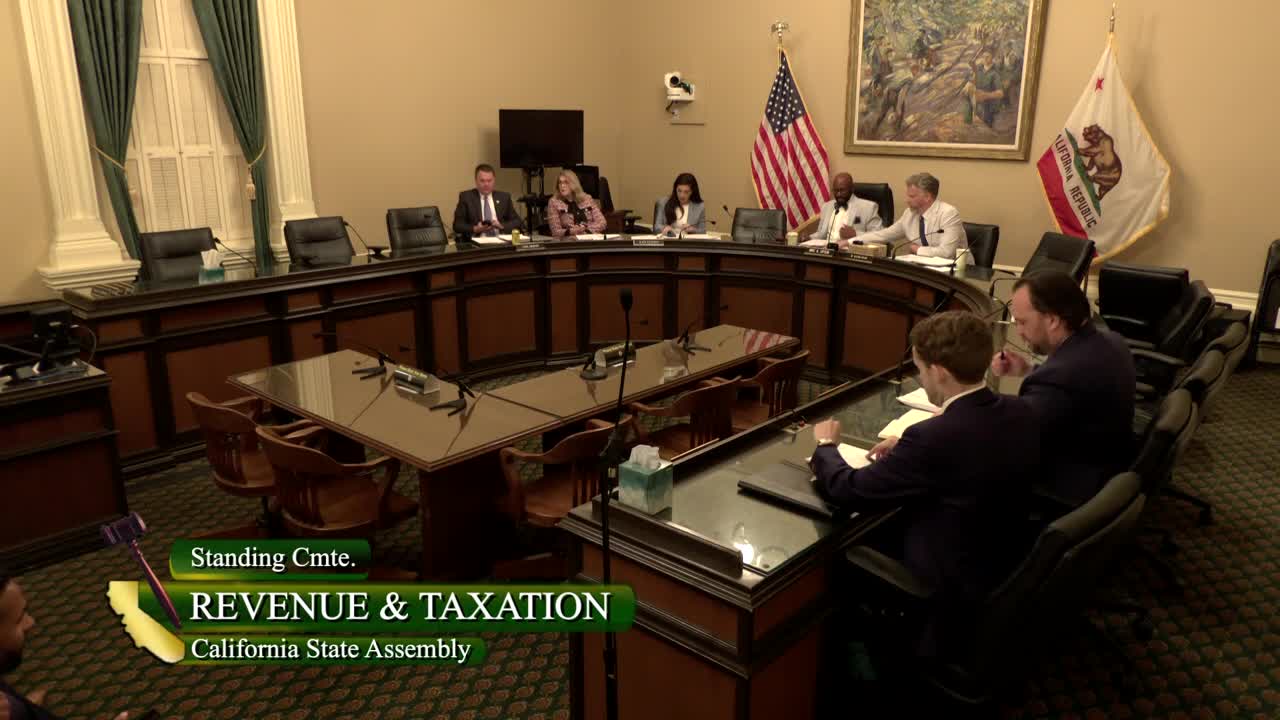
Discussed in Hearing
 12MIN