AB 2428: Criminal fees.
- Session Year: 2025-2026
- House: Assembly
- Latest Version Date: 2026-09-20
Current Status:
Passed
(2026-09-20: Chaptered by Secretary of State - Chapter 398, Statutes of 2026.)
Introduced
In Committee
Awaiting First Chamber Vote
Passed First Chamber
In Committee
Awaiting Second Chamber Vote
Passed Second Chamber
Enacted
Existing law imposes various fees, contingent upon a criminal arrest, prosecution, or conviction, for the cost of administering the criminal justice system, including traffic violator school fees, costs for when a minor is adjudged a ward of the court, as specified, or costs incurred by a state or local agency for the disposal of various substances if the person is convicted of the sale, possession, or transportation of a controlled substance, as specified.
This bill would repeal the authority to collect many of those fees, among others. The bill would make the unpaid balance of most court-imposed costs unenforceable and uncollectible and would require any portion of a judgment imposed by those costs to be vacated. The bill would relieve a person who is sentenced to state prison or confined in a county jail from being required to pay any trial court filing fees or costs related to the persons underlying criminal conviction.
The bill would make related findings and declarations.
The bill would also make various conforming changes.
Existing law imposes various fees, contingent upon a criminal arrest, prosecution, or conviction, for the cost of administering the criminal justice system, including traffic violator school fees, costs for when a minor is adjudged a ward of the court, as specified, or costs incurred by a state or local agency for the disposal of various substances if the person is convicted of the sale, possession, or transportation of a controlled substance, as specified.
This bill would repeal the authority to collect many of those fees, among others. The bill would make the unpaid balance of most court-imposed costs unenforceable and uncollectible and would require any portion of a judgment imposed by those costs to be vacated. The bill would relieve a person who is sentenced to state prison or confined in a county jail from being required to pay any trial court filing fees or costs related to the persons underlying criminal conviction.
Existing law requires, among others, the state and certain cities, to accept personal checks in addition to any other authorized form of payment drawn, as specified, for the payment of certain obligations if the person issuing the check meets specified conditions.This bill would authorize those entities to accept personal checks, in addition to any other authorized form of payment, as payment for court-ordered debt relating to a criminal proceeding without regard to those conditions. The bill would prohibit a public entity from imposing a charge to recover processing and collection costs for returned checks for court-ordered debt relating to a criminal proceeding.The bill would make related findings and declarations.
The bill would also make various conforming changes.
Existing law imposes various fees, contingent upon a criminal arrest, prosecution, or conviction, for the cost of administering the criminal justice system, including traffic violator school fees, costs for when a minor is adjudged a ward of the court, as specified, or costs incurred by a state or local agency for the disposal of various substances if the person is a manufacturer convicted of the sale, possession, or transportation of a controlled substance, as specified.
This bill would repeal the authority to collect many of those fees, among others. The bill would make the unpaid balance of most court-imposed costs unenforceable and uncollectible and would require any portion of a judgment imposed by those costs to be vacated. The bill would relieve a person who is sentenced to state prison or confined in a county jail from being required to pay any trial court filing fees or costs related to the persons underlying criminal conviction.
Existing law requires, among others, the state and certain cities, to accept personal checks in addition to any other authorized form of payment drawn, as specified, for the payment of certain obligations if the person issuing the check meets specified conditions.
This bill would authorize those entities to accept personal checks, in addition to any other authorized form of payment, as payment for court-ordered debt relating to a criminal proceeding without regard to those conditions. The bill would prohibit a public entity from imposing a charge to recover processing and collection costs for returned checks for court-ordered debt relating to a criminal proceeding.
The bill would make related findings and declarations.
The bill would also make various conforming changes.
Existing law imposes various fees, contingent upon a criminal arrest, prosecution, or conviction, for the cost of administering the criminal justice system, including traffic violator school fees, costs for when a minor is adjudged a ward of the court, as specified, or costs incurred by a state or local agency for the disposal of various substances if the person is a manufacturer of a controlled substance, as specified.
This bill would repeal the authority to collect many of those fees, among others. The bill would make the unpaid balance of most court-imposed costs unenforceable and uncollectible and would require any portion of a judgment imposed by those costs to be vacated. The bill would relieve a person who is sentenced to state prison or confined in a county jail from being required to pay any trial court filing fees or costs related to the persons underlying criminal conviction.
Existing law requires, among others, the state and certain cities, to accept personal checks in addition to any other authorized form of payment drawn, as specified, for the payment of certain obligations if the person issuing the check meets specified conditions.
This bill would authorize those entities to accept personal checks, in addition to any other authorized form of payment, as payment for court-ordered debt relating to a criminal proceeding without regard to those conditions. The bill would prohibit a public entity from imposing a charge to recover processing and collection costs for returned checks for court-ordered debt relating to a criminal proceeding.
The bill would make related findings and declarations.
The bill would also make various conforming changes.
The Legislature finds and declares all of the following:
(a)Approximately 80 percent of criminal defendants in California are indigent and too many enter the criminal legal system due to the criminalization of their poverty.
(b)State law authorizes or requires courts to impose criminal administrative fees on these disproportionately low-income Californians. These fees are used to fund government, including counties, courts, programs, state and local agencies, and law enforcement.
(c)Because Black and brown Californians are subjected to targeted policing and are overrepresented at every state of the criminal legal system, they are disproportionately sanctioned with criminal fees and burdened with the associated debt.
(d)The assessment of criminal fees creates a two-tiered legal system based on wealth. Those who can afford to pay avoid further consequences, while those who cannot are burdened by court-ordered debt and subject to additional penalties, including incarceration.
(e)Many of these fees are assessed simply because Californians cannot immediately pay debt in full or are struggling to pay court-ordered debt.
(f)Because these fees are often assigned to people who simply cannot afford to pay them, they make poor people, their families, and their communities poorer.
(g)According to a report by the Ella Baker Center for Human Rights, the average debt incurred for court-ordered fines and fees was roughly equal to the annual income for survey respondents.
(h)A national survey of formerly incarcerated people found that families often bear the burden of fees, and that 83 percent of the people responsible for paying these costs are women.
(i)Criminal administrative fees have no formal punitive or public safety function. Instead, they undermine public safety because the debt they cause can limit access to employment, housing, education, and public benefits. Court-ordered debt can also affect credit scores, result in wage or bank account garnishment, or tax return interception.
(j)Research also shows that criminal administrative fees can push individuals into underground economies and undermine reentry by causing individuals to turn to criminal activity or predatory lending to pay their debts.
(k)Since the fees are imposed on people who are unable to pay them, criminal administrative fees are difficult to collect and typically cost counties almost as much or more than they end up collecting in revenue.
(l)Funding government on the backs of racially marginalized and poor communities is cruel and ineffective policy. Charging these fees traps families in cyclical poverty where families have to choose between paying off court-ordered debt and paying rent, or buying food and other necessities.
SEC. 2.It is the intent of the Legislature to eliminate the assessment of certain fees on low-income Californians who cannot afford to pay court-ordered debt.
SEC. 3.Section 68635 of the Government Code is repealed.SEC. 4.Section 68635 is added to the Government Code, to read:68635.(a)This section applies only to waivers of trial court fees.
(b)Notwithstanding any other law, a person who is sentenced to state prison or confined in a county jail shall not be required to pay trial court filing fees or costs related to the persons incarceration for the underlying criminal conviction.
(c)Beginning January 1, 2027, the unpaid balance of any court-imposed costs pursuant to this section as it read on December 31, 2026, is unenforceable and uncollectible and any portion of a judgment imposing those costs shall be vacated.
SEC. 5.Section 11374.5 of the Health and Safety Code is amended to read:11374.5.(a)Any manufacturer of a controlled substance who disposes of any hazardous substance that is a controlled substance or a chemical used in, or is a byproduct of, the manufacture of a controlled substance in violation of any law regulating the disposal of hazardous substances or hazardous waste is guilty of a public offense punishable by imprisonment pursuant to subdivision (h) of Section 1170 of the Penal Code for two, three, or four years or in the county jail not exceeding one year.
(b)(1)In addition to any other penalty or liability imposed by law, a person who is convicted of violating subdivision (a), or any person who is convicted of the manufacture or disposal of any hazardous substance that is a controlled substance or a chemical used in, or is a byproduct of, the manufacture of a controlled substance in violation of any law, shall pay a penalty equal to the amount of the actual cost incurred by the state or local agency to remove and dispose of the hazardous substance that is a controlled substance or a chemical used in, or is a byproduct of, the manufacture of a controlled substance and to take removal action with respect to any release of the hazardous substance or any items or materials contaminated by that release, if the state or local agency requests the prosecuting authority to seek recovery of that cost. The court shall transmit all penalties collected pursuant to this subdivision to the county treasurer of the county in which the court is located for deposit in a special account in the county treasury. The county treasurer shall pay that money at least once a month to the agency that requested recovery of the cost for the removal action. The county may retain up to 5 percent of any assessed penalty for appropriate and reasonable administrative costs attributable to the collection and disbursement of the penalty.
(2)If the Department of Toxic Substances Control has requested recovery of the cost of removing the hazardous substance that is a controlled substance or a chemical used in, or is a byproduct of, the manufacture of a controlled substance or taking removal action with respect to any release of the hazardous substance, the county treasurer shall transfer funds in the amount of the penalty collected to the Treasurer, who shall deposit the money in the Illegal Drug Lab Cleanup Account. The Department of Toxic Substances Control may expend the money in the Illegal Drug Lab Cleanup Account, upon appropriation by the Legislature, to cover the cost of taking removal actions pursuant to Article 16 (commencing with Section 79350) of Chapter 5 of Part 2 of Division 45.
(c)As used in this section the following terms have the following meanings:
(1)Dispose means to abandon, deposit, intern, or otherwise discard as a final action after use has been achieved or a use is no longer intended.
(2)Hazardous substance has the same meaning as defined in subdivision (a) of Section 78075.
(3)Hazardous waste has the same meaning as defined in Section 25117.
(4)Remove or removal has the same meaning as set forth in Section 78135.
SEC. 6.Section 11470.5 is added to the Health and Safety Code, to read:11470.5.Beginning January 1, 2027, the unpaid balance of any court-imposed costs pursuant to Section 11374.5 as that section read on December 31, 2026, is unenforceable and uncollectible and any portion of a judgment imposing those costs shall be vacated.
SEC. 7.Section 597.3 of the Penal Code is amended to read:597.3.(a)Every person who operates a live animal market shall do all of the following:
(1)Provide that no animal will be dismembered, flayed, cut open, or have its skin, scales, feathers, or shell removed while the animal is still alive.
(2)Provide that no live animals will be confined, held, or displayed in a manner that results, or is likely to result, in injury, starvation, dehydration, or suffocation.
(b)As used in this section:
(1)Animal means frogs, turtles, and birds sold for the purpose of human consumption, with the exception of poultry.
(2)Live animal market means a retail food market where, in the regular course of business, animals are stored alive and sold to consumers for the purpose of human consumption.
(c)Any person who fails to comply with any requirement of subdivision (a) shall for the first violation, be given a written warning in a written language that is understood by the person receiving the warning. A second or subsequent violation of subdivision (a) shall be an infraction, punishable by a fine of not less than two hundred fifty dollars ($250), nor more than one thousand dollars ($1,000). However, a fine paid for a second violation of subdivision (a) shall be deferred for six months if a course is available that is administered by a state or local agency on state law and local ordinances relating to live animal markets. If the person convicted successfully completes that course within six months of entry of judgment, the fine shall be waived.
(d)Beginning January 1, 2027, any outstanding fees issued pursuant to this section are unenforceable and uncollectible and any portion of a judgment imposing those costs shall be vacated.
SEC. 8.Section 1203.1a of the Penal Code is amended to read:1203.1a.(a)The probation officer of the county may authorize the temporary removal under custody or temporary release without custody of any person confined in a county jail, honor farm, or other detention facility, who is confined or committed as a condition of probation, after suspension of imposition of sentence or suspension of execution of sentence, for purposes preparatory to their return to the community, within 30 days prior to their release date, if the probation officer concludes that the person confined or committed is a fit subject for return.
(b)Beginning January 1, 2027, any outstanding fees issued pursuant to this section are unenforceable and uncollectible and any portion of a judgment imposing those costs shall be vacated.
SEC. 9.Section 1203.1i of the Penal Code is amended to read:1203.1i.(a)When a person is convicted of a violation of any building standards adopted by a local entity by ordinance or resolution, including, but not limited to, local health, fire, building, or safety ordinances or resolutions, or any other ordinance or resolution relating to the health and safety of occupants of buildings, by maintaining a substandard building, as specified in Section 17920.3 of the Health and Safety Code, the court, or judge thereof, in making an order granting probation, in addition to any other orders, may order the person placed under house confinement, or may order the person convicted to serve both a term of imprisonment in the county jail and to be placed under house confinement.
(b)This section only applies to violations involving a dwelling unit occupied by persons specified in subdivision (a) of Section 1940 of the Civil Code who are not excluded by subdivision (b) of that section.
(c)As used in this section, house confinement means confinement to a residence or location designated by the court and specified in the probation order.
(d)Beginning January 1, 2027, any outstanding fees issued pursuant to this section are unenforceable and uncollectible and any portion of a judgment imposing those costs shall be vacated.
SEC. 10.Section 1205.3 of the Penal Code is amended to read:1205.3.(a)When a defendant is convicted of an offense and granted probation, and the court orders the defendant either to pay a fine or to perform specified community service work as a condition of probation, the court shall specify that if community service work is performed, it shall be performed in place of the payment of all fines and restitution fines on a proportional basis, and the court shall specify in its order the amount of the fine and restitution fine and the number of hours of community service work that shall be performed as an alternative to payment of the fine.
(b)Beginning January 1, 2027, a county, municipality, or contracted entity shall not charge a fee to participate in a community service program or to otherwise fulfill court-ordered community service requirements pursuant to this section. A court shall not deny participation in community service programs based on an inability to charge fees or otherwise recoup costs.
SEC. 11.Section 1209.5 of the Penal Code is amended to read:1209.5.(a)Notwithstanding any other law, the court shall permit a person convicted of an infraction, upon a showing that payment of the total fine would pose a hardship on the defendant or the defendants family, to elect to perform community service in lieu of the total fine that would otherwise be imposed.
(b)For purposes of this section, the term total fine means the total bail, including the base fine and all assessments, penalties, and additional moneys to be paid by the defendant.
(c)(1)For purposes of this section, the hourly rate applicable to community service performed pursuant to this section shall be double the minimum wage set for the applicable calendar year, based on the schedule for an employer who employs 25 or fewer employees, as established in paragraph (2) of subdivision (b) of Section 1182.12 of the Labor Code.
(2)Notwithstanding paragraph (1), a court may by local rule increase the amount that is credited for each hour of community service performed pursuant to this section, to exceed the hourly rate described in paragraph (1).
(d)(1)If the court determines that a person who has been convicted of an infraction has shown that payment of the total fine would pose a hardship pursuant to subdivision (a) and the person has elected to perform community service in lieu of paying the total fine, the person may elect to perform that community service in the county in which the infraction violation occurred, the county of the persons residence, or any other county to which the person has substantial ties, including, but not limited to, employment, family, or education ties.
(2)Regardless of the county in which the person elects to perform community service pursuant to paragraph (1), the court shall retain jurisdiction until the community service has been verified as complete.
(e)(1)If the court determines that a person who has been convicted of an infraction has shown that payment of the total fine would pose a hardship pursuant to subdivision (a) and the person has elected to perform community service in lieu of paying the total fine pursuant to subdivision (d), the court may, in its discretion, permit a person to participate in an educational program to satisfy community service hours.
(2)As used in this subdivision, an educational program includes, but is not limited to, high school or General Education Development classes, college courses, adult literacy or English as a second language programs, and vocational education programs.
(f)Beginning January 1, 2027, a county, municipality, or contracted entity shall not charge a fee to participate in a community service program, educational program, or to otherwise fulfill court-ordered community service requirements pursuant to this section. A court shall not deny participation in community service programs based on an inability to charge fees or otherwise recoup costs.
SEC. 12.Section 1210.2 is added to the Penal Code, to read:1210.2.A county, municipality, or contracted entity shall not charge an administrative fee for participation in community service work for either of the following circumstances:
(a)Punishment for a crime.
(b)As a financial hardship alternative for a fine or monetary penalty.
SEC. 13.Section 4011.1 of the Penal Code is amended to read:4011.1.(a)Notwithstanding Section 29602 of the Government Code and any other provisions of this chapter, a county, city or the Department of Corrections and Rehabilitation, Division of Juvenile Justice, is authorized to make claim for and recovery of the costs of necessary hospital, medical, surgical, dental, or optometric care rendered to any prisoner confined in a county or city jail or any juvenile confined in a detention facility, who would otherwise be entitled to that care under the Medi-Cal Act (Chapter 7 (commencing with Section 14000) Part 3, Division 9, of the Welfare and Institutions Code), and who is eligible for that care on the first day of confinement or detention, to the extent that federal financial participation is available, or under the provisions of any private program or policy for that care, and the county, city or the Department of Corrections and Rehabilitation, Division of Juvenile Justice, shall be liable only for the costs of that care as cannot be recovered pursuant to this section. A person who is eligible for Medi-Cal shall not be eligible for benefits under the provisions of this section, and a county or city or the Department of Corrections and Rehabilitation, Division of Juvenile Justice, is not authorized to make a claim for any recovery of costs for services for that person, unless federal financial participation is available for all or part of the costs of providing services to that person under the Medi-Cal Act.
(b)Notwithstanding any other law, any county or city making a claim pursuant to this section and under the Medi-Cal Act shall reimburse the Health Care Deposit Fund for the state costs of paying those medical claims. Funds allocated to the county from the County Health Services Fund pursuant to Part 4.5 (commencing with Section 16700) of Division 9 of the Welfare and Institutions Code may be utilized by the county or city to make that reimbursement.
(c)Beginning January 1, 2027, any outstanding fees issued pursuant to this section are unenforceable and uncollectible and any portion of a judgment imposing those costs shall be vacated.
SEC. 14.Section 4018.6 of the Penal Code is amended to read:4018.6.(a)The sheriff of the county may authorize the temporary removal under custody or temporary release without custody of any person confined to the county jail, honor farm, or other detention facility for family emergencies or for purposes preparatory to their return to the community, if the sheriff concludes that the person confined is a fit subject therefor. Temporary removal shall not be for a period of more than three days. When a person confined is released for purposes preparatory to their return to the community, the sheriff shall not require the person detained to reimburse the county, in whole or in part, for expenses incurred by the county in connection with the release.
(b)Beginning January 1, 2027, any outstanding fees issued pursuant to this section are unenforceable and uncollectible and any portion of a judgment imposing those costs shall be vacated.
SEC. 15.Section 42007 of the Vehicle Code is amended to read:42007.(a)(1)The clerk of the court shall collect a fee from every person who is ordered or permitted to attend a traffic violator school pursuant to Section 41501 or 42005 in an amount equal to the total bail set forth for the eligible offense on the uniform countywide bail schedule. As used in this subdivision, total bail means the amount established pursuant to Section 1269b of the Penal Code in accordance with the Uniform Bail and Penalty Schedule adopted by the Judicial Council, including all assessments, surcharges, and penalty amounts. Where multiple offenses are charged in a single notice to appear, the total bail is the amount applicable for the greater of the qualifying offenses. However, the court may determine a lesser fee under this subdivision upon a showing that the defendant is unable to pay the full amount. The fee shall not include the cost, or any part thereof, of traffic safety instruction offered by a traffic violator school.
(2)The clerk may accept from a defendant who is ordered or permitted to attend traffic violator school a payment of at least 10 percent of the fee required by paragraph (1) upon filing a written agreement by the defendant to pay the remainder of the fee according to an installment payment schedule of no more than 90 days as agreed upon with the court. The Judicial Council shall prescribe the form of the agreement for payment of the fee in installments. When the defendant signs the Judicial Council form for payment of the fee in installments, the court shall continue the case to the date in the agreement to complete payment of the fee and submit the certificate of completion of traffic violator school to the court. A court shall not charge a participant for enrolling in a payment installment plan pursuant to this section.
(3)If a defendant fails to make an installment payment of the fee according to an installment agreement, the court may convert the fee to bail, declare it forfeited, and report the forfeiture as a conviction under Section 1803. The court may also charge a failure to pay under Section 40508 and impose a civil assessment as provided in Section 1214.1 of the Penal Code or issue an arrest warrant for a failure to pay. For the purposes of reporting a conviction under this subdivision to the department under Section 1803, the date that the court declares the bail forfeited shall be reported as the date of conviction.
(b)Revenues derived from the fee collected under this section shall be deposited in accordance with Section 68084 of the Government Code in the general fund of the county and, as may be applicable, distributed as follows:
(1)In any county in which a fund is established pursuant to Section 76100 or 76101 of the Government Code, the sum of one dollar ($1) for each fund so established shall be deposited with the county treasurer and placed in that fund.
(2)In any county that has established a Maddy Emergency Medical Services Fund pursuant to Section 1797.98a of the Health and Safety Code, an amount equal to the sum of each two dollars ($2) for every seven dollars ($7) that would have been collected pursuant to Section 76000 of the Government Code and, commencing January 1, 2009, an amount equal to the sum of each two dollars ($2) for every ten dollars ($10) that would have been collected pursuant to Section 76000.5 of the Government Code with respect to those counties to which that section is applicable shall be deposited in that fund. Nothing in the act that added this paragraph shall be interpreted in a manner that would result in either of the following:
(A)The utilization of penalty assessment funds that had been set aside, on or before January 1, 2000, to finance debt service on a capital facility that existed before January 1, 2000.
(B)The reduction of the availability of penalty assessment revenues that had been pledged, on or before January 1, 2000, as a means of financing a facility which was approved by a county board of supervisors, but on January 1, 2000, is not under construction.
(3)The amount of the fee that is attributable to Section 70372 of the Government Code shall be transferred pursuant to subdivision (f) of that section.
(c)For fees resulting from city arrests, an amount equal to the amount of base fines that would have been deposited in the treasury of the appropriate city pursuant to paragraph (3) of subdivision (b) of Section 1463.001 of the Penal Code shall be deposited in the treasury of the appropriate city.
(d)The clerk of the court, in a county that offers traffic school shall include in any courtesy notice mailed to a defendant for an offense that qualifies for traffic school attendance the following statement:
NOTICE: If you are eligible and decide not to attend traffic school your automobile insurance may be adversely affected. For drivers with a noncommercial drivers license, one conviction in any 18-month period will be held confidential and not show on your driving record if you complete a traffic violator school program. For drivers with a commercial drivers license, one conviction in any 18-month period will show on your driving record without a violation point if you complete a traffic violator school program.
(e)Notwithstanding any other provision of law, a county that has established a Maddy Emergency Medical Services Fund pursuant to Section 1797.98a of the Health and Safety Code shall not be held liable for having deposited into the fund, prior to January 1, 2009, an amount equal to two dollars ($2) for every ten dollars ($10) that would have been collected pursuant to Section 76000.5 of the Government Code from revenues derived from traffic violator school fees collected pursuant to this section.
(f)Beginning January 1, 2027, payment plan installment fees are unenforceable and uncollectible and any portion of a judgment imposing those costs shall be vacated.
SEC. 16.Section 42008.8 of the Vehicle Code is amended to read:42008.8.(a)The Legislature finds and declares that a one-time infraction amnesty program would do all of the following:
(1)Provide relief to individuals who have found themselves in violation of a court-ordered obligation because they have unpaid traffic bail or fines.
(2)Provide relief to individuals who have found themselves in violation of a court-ordered obligation or who have had their driving privileges suspended pursuant to Section 13365.
(3)Provide increased revenue at a time when revenue is scarce by encouraging payment of old fines that have remained unpaid.
(4)Allow courts and counties to resolve older delinquent cases and focus limited resources on collections for more recent cases.
(b)A one-time amnesty program for unpaid fines and bail meeting the eligibility requirements set forth in subdivision (g) shall be established in each county. Unless agreed otherwise by the court and the county in writing, the government entities that are responsible for the collection of delinquent court-ordered debt shall be responsible for implementation of the amnesty program as to that debt, maintaining the same division of responsibility in place with respect to the collection of court-ordered debt under subdivision (b) of Section 1463.010 of the Penal Code.
(c)As used in this section, the term fine or bail refers to the total amounts due in connection with a specific violation, including, but not limited to, all of the following:
(1)Base fine or bail, as established by court order, by statute, or by the courts bail schedule.
(2)Penalty assessments imposed pursuant to Section 1464 of the Penal Code, and Sections 70372, 76000, 76000.5, 76104.6, and 76104.7 of, and paragraph (1) of subdivision (c) of Section 76000.10 of, the Government Code, and Section 42006 of this code.
(3)State surcharges imposed pursuant to Section 1465.7 of the Penal Code.
(4)Court operations assessments imposed pursuant to Section 1465.8 of the Penal Code.
(5)Criminal conviction assessments pursuant to Section 70373 of the Government Code.
(d)Notwithstanding subdivision (c), any civil assessment imposed pursuant to Section 1214.1 of the Penal Code shall not be collected, nor shall the payment of that assessment be a requirement of participation in the amnesty program.
(e)Concurrent with the amnesty program established pursuant to subdivision (b), between October 1, 2015, to March 31, 2017, inclusive, the following shall apply:
(1)The court shall, within 90 days, issue and file the appropriate certificate pursuant to subdivisions (a) and (b) of Section 40509 for any participant of the one-time amnesty program established pursuant to subdivision (b) demonstrating that the participant has appeared in court, paid the fine, or otherwise satisfied the court, if the driving privilege of that participant was suspended pursuant to Section 13365 in connection with a specific violation described in paragraph (1), (2), or (3) of subdivision (g). For applications submitted prior to January 1, 2017, that remain outstanding as of that date, the court shall issue and file the certificate no later than March 31, 2017. For applications submitted on or before March 31, 2017, all terms and procedures related to the participants payment plans shall remain in effect after March 31, 2017.
(2)The court shall, within 90 days, issue and file with the department the appropriate certificate pursuant to subdivisions (a) and (b) of Section 40509 for any person in good standing in a comprehensive collection program pursuant to subdivision (c) of Section 1463.007 of the Penal Code demonstrating that the person has appeared in court, paid the fine, or otherwise satisfied the court, if the driving privilege was suspended pursuant to Section 13365 in connection with a specific violation described in paragraph (1), (2), or (3) of subdivision (g). For applications submitted prior to January 1, 2017, that remain outstanding as of that date, the court shall issue and file the certificate no later than March 31, 2017. For applications submitted on or before March 31, 2017, all terms and procedures related to the participants payment plans shall remain in effect after March 31, 2017.
(3)Any person who is eligible for a drivers license pursuant to Section 12801, 12801.5, or 12801.9 shall be eligible for the amnesty program established pursuant to subdivision (b) for any specific violation described in subdivision (g). The department shall issue a drivers license to any person who is eligible pursuant to Section 12801, 12801.5, or 12801.9 if the person is participating in the amnesty program and is otherwise eligible for the drivers license but for the fines or bail to be collected through the program.
(4)The Department of Motor Vehicles shall not deny reinstating the driving privilege of any person who participates in the amnesty program established pursuant to subdivision (b) for any fines or bail in connection with the specific violation that is the basis for participation in the amnesty program.
(f)In addition to, and at the same time as, the mandatory one-time amnesty program is established pursuant to subdivision (b), the court and the county may jointly agree to extend that amnesty program to fines and bail imposed for a misdemeanor violation of this code and a violation of Section 853.7 of the Penal Code that was added to the misdemeanor case otherwise subject to the amnesty. The amnesty program authorized pursuant to this subdivision shall not apply to parking violations and violations of Sections 23103, 23104, 23105, 23152, and 23153.
(g)A violation is only eligible for amnesty if paragraph (1), (2), or (3) applies, and the requirements of paragraphs (4) to (8), inclusive, are met:
(1)The violation is an infraction violation filed with the court.
(2)It is a violation of subdivision (a) or (b) of Section 40508, or a violation of Section 853.7 of the Penal Code that was added to the case subject to paragraph (1).
(3)The violation is a misdemeanor violation filed with the court to which subdivision (f) applies.
(4)The initial due date for payment of the fine or bail was on or before January 1, 2013.
(5)There are no outstanding misdemeanor or felony warrants for the defendant within the county, except for misdemeanor warrants for misdemeanor violations subject to this section.
(6)The person does not owe victim restitution on any case within the county.
(7)The person has not made any payments for the violation after September 30, 2015, to a comprehensive collection program in the county pursuant to subdivision (c) of Section 1463.007 of the Penal Code.
(8)The person filed a request with the court on or before March 31, 2017.
(h)(1)Except as provided in paragraph (2), each amnesty program shall accept, in full satisfaction of any eligible fine or bail, 50 percent of the fine or bail amount, as defined in subdivision (c).
(2)If the participant certifies under penalty of perjury that they receive any of the public benefits listed in subdivision (a) of Section 68632 of the Government Code or is within the conditions described in subdivision (b) of Section 68632 of the Government Code, the amnesty program shall accept, in full satisfaction of any eligible fine or bail, 20 percent of the fine or bail amount, as defined in subdivision (c).
(i)The Judicial Council, in consultation with the California State Association of Counties, shall adopt guidelines for the amnesty program no later than October 1, 2015, and each program shall be conducted in accordance with the Judicial Councils guidelines. As part of its guidelines, the Judicial Council shall include all of the following:
(1)A payment plan option created pursuant to Judicial Council guidelines in which a monthly payment is equal to the amount that an eligible participant can afford to pay per month consistent with Sections 68633 and 68634 of the Government Code. If a participant chooses the payment plan option, the county or court shall collect all relevant information to allow for collection by the Franchise Tax Board pursuant to existing protocols prescribed by the Franchise Tax Board to collect delinquent debts of any amount in which a participant is delinquent or otherwise in default under their amnesty payment plan.
(2)If a participant does not comply with the terms of their payment plan under the amnesty program, including failing to make one or more payments, the appropriate agency shall send a notice to the participant that they have failed to make one or more payments and that the participant has 30 days to either resume making payments or to request that the agency change the payment amount. If the participant fails to respond to the notice within 30 days, the appropriate agency may refer the participant to the Franchise Tax Board for collection of any remaining balance owed, including an amount equal to the reasonable administrative costs incurred by the Franchise Tax Board to collect the delinquent amount owed. The Franchise Tax Board shall collect any delinquent amounts owed pursuant to existing protocols prescribed by the Franchise Tax Board. The comprehensive collection program may also utilize additional collection efforts pursuant to Section 1463.007 of the Penal Code, except for subparagraph (C) of paragraph (4) of subdivision (c) of that section.
(3)A plan for outreach that will, at a minimum, make available via an internet website relevant information regarding the amnesty program, including how an individual may participate in the amnesty program.
(4)The Judicial Council shall reimburse costs incurred by the Department of Motor Vehicles up to an amount not to exceed two hundred fifty thousand dollars ($250,000), including all of the following:
(A)Providing on a separate insert with each motor vehicle registration renewal notice a summary of the amnesty program established pursuant to this section that is compliant with Section 7292 of the Government Code.
(B)Posting on the departments internet website information regarding the amnesty program.
(C)Personnel costs associated with the amnesty program.
(j)The Judicial Council, in consultation with the department, may, within its existing resources, consider, adopt, or develop recommendations for an appropriate mechanism or mechanisms to allow reinstatement of the driving privilege of any person who otherwise meets the criteria for amnesty but who has violations in more than one county.
(k)A criminal action shall not be brought against a person for a delinquent fine or bail paid under the amnesty program.
(l)(1)The total amount of funds collected under the amnesty program shall, as soon as practical after receipt thereof, be deposited in the county treasury or the account established under Section 77009 of the Government Code. After acceptance of the amount specified in subdivision (h), notwithstanding Section 1203.1d of the Penal Code, the remaining revenues collected under the amnesty program shall be distributed on a pro rata basis in the same manner as a partial payment distributed pursuant to Section 1462.5 of the Penal Code.
(2)Notwithstanding Section 1464 of the Penal Code, the amount of funds collected pursuant to this section that would be available for distribution pursuant to subdivision (f) of Section 1464 of the Penal Code shall instead be distributed as follows:
(A)The first two hundred fifty thousand dollars ($250,000) received shall be transferred to the Judicial Council.
(B)Following the transfer of the funds described in subparagraph (A), once a month, both of the following transfers shall occur:
(i)An amount equal to 82.20 percent of the amount of funds collected pursuant to this section during the preceding month shall be transferred into the Peace Officers Training Fund.
(ii)An amount equal to 17.80 percent of the amount of funds collected pursuant to this section during the preceding month shall be transferred into the Corrections Training Fund.
(m)Each court or county implementing an amnesty program shall file, not later than May 31, 2017, a written report with the Judicial Council, on a form approved by the Judicial Council. The report shall include information about the number of cases resolved, the amount of money collected, and the operating costs of the amnesty program. Notwithstanding Section 10231.5 of the Government Code, on or before August 31, 2017, the Judicial Council shall submit a report to the Legislature summarizing the information provided by each court or county.
(n)Beginning January 1, 2027, amnesty program administrative fees are unenforceable and uncollectible and any portion of a judgment imposing those costs shall be vacated.
SEC. 17.Section 730.5 of the Welfare and Institutions Code is repealed.The Legislature finds and declares all of the following:
(a)Approximately 80 percent of criminal defendants in California are indigent and too many enter the criminal legal system due to the criminalization of their poverty.
(b)State law authorizes or requires courts to impose criminal administrative fees on these disproportionately low-income Californians. These fees are used to fund government, including counties, courts, programs, state and local agencies, and law enforcement.
(c)Because Black and brown Californians are subjected to targeted policing and are overrepresented at every state of the criminal legal system, they are disproportionately sanctioned with criminal fees and burdened with the associated debt.
(d)The assessment of criminal fees creates a two-tiered legal system based on wealth. Those who can afford to pay avoid further consequences, while those who cannot are burdened by court-ordered debt and subject to additional penalties, including incarceration.
(e)Many of these fees are assessed simply because Californians cannot immediately pay debt in full or are struggling to pay court-ordered debt.
(f)Because these fees are often assigned to people who simply cannot afford to pay them, they make poor people, their families, and their communities poorer.
(g)According to a report by the Ella Baker Center for Human Rights, the average debt incurred for court-ordered fines and fees was roughly equal to the annual income for survey respondents.
(h)A national survey of formerly incarcerated people found that families often bear the burden of fees, and that 83 percent of the people responsible for paying these costs are women.
(i)Criminal administrative fees have no formal punitive or public safety function. Instead, they undermine public safety because the debt they cause can limit access to employment, housing, education, and public benefits. Court-ordered debt can also affect credit scores, result in wage or bank account garnishment, or tax return interception.
(j)Research also shows that criminal administrative fees can push individuals into underground economies and undermine reentry by causing individuals to turn to criminal activity or predatory lending to pay their debts.
(k)Since the fees are imposed on people who are unable to pay them, criminal administrative fees are difficult to collect and typically cost counties almost as much or more than they end up collecting in revenue.
(l)Funding government on the backs of racially marginalized and poor communities is cruel and ineffective policy. Charging these fees traps families in cyclical poverty where families have to choose between paying off court-ordered debt and paying rent, or buying food and other necessities.
SEC. 2.It is the intent of the Legislature to eliminate the assessment of certain fees on low-income Californians who cannot afford to pay court-ordered debt.
SEC. 3.Section 6157 of the Government Code is amended to read:6157.(a)Except as provided in subdivision (e), the state, and each city, whether general law or chartered, county, and district, each subdivision, department, board, commission, body, or agency of the foregoing, shall accept personal checks, in addition to any other authorized form of payment, drawn in its favor or in favor of a designated official thereof, in payment for any license, permit, or fee, or in payment of any obligation owing to the public agency or trust deposit, if the person issuing the check furnishes to the person authorized to receive payment satisfactory proof of residence in this state and if the personal check is drawn on a banking institution located in this state.(b)If any personal check, corporate check, cashiers check, money order, or other draft method offered in payment pursuant to this section is returned without payment, for any reason, a reasonable charge for the returned check, not to exceed the actual costs incurred by the public agency, may be imposed to recover the public agencys processing and collection costs, except that a charge shall not be imposed in regard to a payment for court-ordered debt relating to a criminal proceeding. This charge may be added to, and become part of, any underlying obligation other than an obligation which constitutes a lien on real property, and a different method of payment for that payment and future payments by this person may be prescribed.(c)The acceptance of a personal check, corporate check, cashiers check, money order, or other draft method pursuant to this section constitutes payment of the obligation owed to the payee public agency to the extent of the amount of the check as of the date of acceptance when, but not before, the check is duly paid.(d)The provisions in subdivision (b) prohibiting a returned check charge being added to, and becoming a part of, an obligation which constitutes a lien on real property do not apply to obligations under the Veterans Farm and Home Purchase Act of 1974 (Article 3.1 (commencing with Section 987.50) of Chapter 6 of Division 4 of the Military and Veterans Code).(e)The state, and each city, whether general law or chartered, county, and district, each subdivision, department, board, commission, body, or agency of the foregoing, may accept personal checks in addition to any other authorized form of payment drawn in its favor or in favor of a designated official thereof, in payment for court-ordered debt relating to a criminal proceeding.(f)An entity or jurisdiction that chooses to accept checks in payment for court-ordered debt relating to a criminal proceeding does so at their own risk and is prohibited from charging a fee for returned checks or insufficient funds.(g)Beginning January 1, 2027, returned check fees for payments for court-ordered debt relating to a criminal proceeding are unenforceable and uncollectible and any portion of a judgment imposing those costs, shall be vacated.SEC. 4.SEC. 3.Section 68635 of the Government Code is repealed.SEC. 5.SEC. 4.Section 68635 is added to the Government Code, to read:68635.(a)This section applies only to waivers of trial court fees.
(b)Notwithstanding any other law, a person who is sentenced to state prison or confined in a county jail shall not be required to pay trial court filing fees or costs related to the persons incarceration for the underlying criminal conviction.
(c)Beginning January 1, 2027, the unpaid balance of any court-imposed costs pursuant to this section as it read on December 31, 2026, is unenforceable and uncollectible and any portion of a judgment imposing those costs shall be vacated.
SEC. 6.Section 71386 of the Government Code is amended to read:71386.(a)Each superior court shall adopt a written policy, consistent with rules adopted by, or trial court financial policies and procedures authorized by, the Judicial Council under subdivision (a) of Section 77206, governing the acceptance of checks and money orders in payment of any fees, fines, or bail deposits. The policy shall permit clerks to accept checks and money orders under conditions that tend to assure their validity.(b)A court shall accept a personal check, bank cashiers check, or money order for payment of any fee or fine, or for a deposit of bail for any offense that is not declared to be a felony, provided the check or money order meets the criteria established in subdivision (a). However, no court shall be required to accept a check in excess of three hundred dollars ($300) from a defendant in custody as a deposit of bail for any alleged violation of the Penal Code.(c)The acceptance of a check pursuant to this section constitutes payment of the obligation owed to the payee public agency to the extent of the amount of the check as of the date of acceptance.(d)An entity or jurisdiction that chooses to accept a check accepts it at their own risk and is prohibited from charging a fee for returned checks or insufficient funds.(e)Beginning January 1, 2027, returned check fees are unenforceable and uncollectible and any portion of a judgment imposing those costs shall be vacated.SEC. 7.SEC. 5.Section 11374.5 of the Health and Safety Code is amended to read:11374.5.(a)Any manufacturer of a controlled substance who disposes of any hazardous substance that is a controlled substance or a chemical used in, or is a byproduct of, the manufacture of a controlled substance in violation of any law regulating the disposal of hazardous substances or hazardous waste is guilty of a public offense punishable by imprisonment pursuant to subdivision (h) of Section 1170 of the Penal Code for two, three, or four years or in the county jail not exceeding one year.
(b)(1)In addition to any other penalty or liability imposed by law, a person who is convicted of violating subdivision (a), or any person who is convicted of the manufacture or disposal of any hazardous substance that is a controlled substance or a chemical used in, or is a byproduct of, the manufacture of a controlled substance in violation of any law, shall pay a penalty equal to the amount of the actual cost incurred by the state or local agency to remove and dispose of the hazardous substance that is a controlled substance or a chemical used in, or is a byproduct of, the manufacture of a controlled substance and to take removal action with respect to any release of the hazardous substance or any items or materials contaminated by that release, if the state or local agency requests the prosecuting authority to seek recovery of that cost. The court shall transmit all penalties collected pursuant to this subdivision to the county treasurer of the county in which the court is located for deposit in a special account in the county treasury. The county treasurer shall pay that money at least once a month to the agency that requested recovery of the cost for the removal action. The county may retain up to 5 percent of any assessed penalty for appropriate and reasonable administrative costs attributable to the collection and disbursement of the penalty.
(2)If the Department of Toxic Substances Control has requested recovery of the cost of removing the hazardous substance that is a controlled substance or a chemical used in, or is a byproduct of, the manufacture of a controlled substance or taking removal action with respect to any release of the hazardous substance, the county treasurer shall transfer funds in the amount of the penalty collected to the Treasurer, who shall deposit the money in the Illegal Drug Lab Cleanup Account. The Department of Toxic Substances Control may expend the money in the Illegal Drug Lab Cleanup Account, upon appropriation by the Legislature, to cover the cost of taking removal actions pursuant to Article 16 (commencing with Section 79350) of Chapter 5 of Part 2 of Division 45.
(c)As used in this section the following terms have the following meanings:
(1)Dispose means to abandon, deposit, intern, or otherwise discard as a final action after use has been achieved or a use is no longer intended.
(2)Hazardous substance has the same meaning as defined in subdivision (a) of Section 78075.
(3)Hazardous waste has the same meaning as defined in Section 25117.
(4)Remove or removal has the same meaning as set forth in Section 78135.
SEC. 8.SEC. 6.Section 11470.5 is added to the Health and Safety Code, to read:11470.5.Beginning January 1, 2027, the unpaid balance of any court-imposed costs pursuant to Section 11374.5 as that section read on December 31, 2026, is unenforceable and uncollectible and any portion of a judgment imposing those costs shall be vacated.
SEC. 9.SEC. 7.Section 597.3 of the Penal Code is amended to read:597.3.(a)Every person who operates a live animal market shall do all of the following:
(1)Provide that no animal will be dismembered, flayed, cut open, or have its skin, scales, feathers, or shell removed while the animal is still alive.
(2)Provide that no live animals will be confined, held, or displayed in a manner that results, or is likely to result, in injury, starvation, dehydration, or suffocation.
(b)As used in this section:
(1)Animal means frogs, turtles, and birds sold for the purpose of human consumption, with the exception of poultry.
(2)Live animal market means a retail food market where, in the regular course of business, animals are stored alive and sold to consumers for the purpose of human consumption.
(c)Any person who fails to comply with any requirement of subdivision (a) shall for the first violation, be given a written warning in a written language that is understood by the person receiving the warning. A second or subsequent violation of subdivision (a) shall be an infraction, punishable by a fine of not less than two hundred fifty dollars ($250), nor more than one thousand dollars ($1,000). However, a fine paid for a second violation of subdivision (a) shall be deferred for six months if a course is available that is administered by a state or local agency on state law and local ordinances relating to live animal markets. If the person convicted successfully completes that course within six months of entry of judgment, the fine shall be waived.
(d)Beginning January 1, 2027, any outstanding fees issued pursuant to this section are unenforceable and uncollectible and any portion of a judgment imposing those costs shall be vacated.
SEC. 10.SEC. 8.Section 1203.1a of the Penal Code is amended to read:1203.1a.(a)The probation officer of the county may authorize the temporary removal under custody or temporary release without custody of any person confined in a county jail, honor farm, or other detention facility, who is confined or committed as a condition of probation, after suspension of imposition of sentence or suspension of execution of sentence, for purposes preparatory to their return to the community, within 30 days prior to their release date, if the probation officer concludes that the person confined or committed is a fit subject for return.
(b)Beginning January 1, 2027, any outstanding fees issued pursuant to this section are unenforceable and uncollectible and any portion of a judgment imposing those costs shall be vacated.
SEC. 11.SEC. 9.Section 1203.1i of the Penal Code is amended to read:1203.1i.(a)When a person is convicted of a violation of any building standards adopted by a local entity by ordinance or resolution, including, but not limited to, local health, fire, building, or safety ordinances or resolutions, or any other ordinance or resolution relating to the health and safety of occupants of buildings, by maintaining a substandard building, as specified in Section 17920.3 of the Health and Safety Code, the court, or judge thereof, in making an order granting probation, in addition to any other orders, may order the person placed under house confinement, or may order the person convicted to serve both a term of imprisonment in the county jail and to be placed under house confinement.
(b)This section only applies to violations involving a dwelling unit occupied by persons specified in subdivision (a) of Section 1940 of the Civil Code who are not excluded by subdivision (b) of that section.
(c)As used in this section, house confinement means confinement to a residence or location designated by the court and specified in the probation order.
(d)Beginning January 1, 2027, any outstanding fees issued pursuant to this section are unenforceable and uncollectible and any portion of a judgment imposing those costs shall be vacated.
SEC. 12.SEC. 10.Section 1205.3 of the Penal Code is amended to read:1205.3.(a)When a defendant is convicted of an offense and granted probation, and the court orders the defendant either to pay a fine or to perform specified community service work as a condition of probation, the court shall specify that if community service work is performed, it shall be performed in place of the payment of all fines and restitution fines on a proportional basis, and the court shall specify in its order the amount of the fine and restitution fine and the number of hours of community service work that shall be performed as an alternative to payment of the fine.
(b)Beginning January 1, 2027, a county, municipality, or contracted entity shall not charge a fee to participate in a community service program or to otherwise fulfill court-ordered community service requirements pursuant to this section. A court shall not deny participation in community service programs based on an inability to charge fees or otherwise recoup costs.
SEC. 13.SEC. 11.Section 1209.5 of the Penal Code is amended to read:1209.5.(a)Notwithstanding any other law, the court shall permit a person convicted of an infraction, upon a showing that payment of the total fine would pose a hardship on the defendant or the defendants family, to elect to perform community service in lieu of the total fine that would otherwise be imposed.
(b)For purposes of this section, the term total fine means the total bail, including the base fine and all assessments, penalties, and additional moneys to be paid by the defendant.
(c)(1)For purposes of this section, the hourly rate applicable to community service performed pursuant to this section shall be double the minimum wage set for the applicable calendar year, based on the schedule for an employer who employs 25 or fewer employees, as established in paragraph (2) of subdivision (b) of Section 1182.12 of the Labor Code.
(2)Notwithstanding paragraph (1), a court may by local rule increase the amount that is credited for each hour of community service performed pursuant to this section, to exceed the hourly rate described in paragraph (1).
(d)(1)If the court determines that a person who has been convicted of an infraction has shown that payment of the total fine would pose a hardship pursuant to subdivision (a) and the person has elected to perform community service in lieu of paying the total fine, the person may elect to perform that community service in the county in which the infraction violation occurred, the county of the persons residence, or any other county to which the person has substantial ties, including, but not limited to, employment, family, or education ties.
(2)Regardless of the county in which the person elects to perform community service pursuant to paragraph (1), the court shall retain jurisdiction until the community service has been verified as complete.
(e)(1)If the court determines that a person who has been convicted of an infraction has shown that payment of the total fine would pose a hardship pursuant to subdivision (a) and the person has elected to perform community service in lieu of paying the total fine pursuant to subdivision (d), the court may, in its discretion, permit a person to participate in an educational program to satisfy community service hours.
(2)As used in this subdivision, an educational program includes, but is not limited to, high school or General Education Development classes, college courses, adult literacy or English as a second language programs, and vocational education programs.
(f)Beginning January 1, 2027, a county, municipality, or contracted entity shall not charge a fee to participate in a community service program, educational program, or to otherwise fulfill court-ordered community service requirements pursuant to this section. A court shall not deny participation in community service programs based on an inability to charge fees or otherwise recoup costs.
SEC. 14.SEC. 12.Section 1210.2 is added to the Penal Code, to read:1210.2.A county, municipality, or contracted entity shall not charge an administrative fee for participation in community service work for either of the following circumstances:
(a)Punishment for a crime.
(b)As a financial hardship alternative for a fine or monetary penalty.
SEC. 15.SEC. 13.Section 4011.1 of the Penal Code is amended to read:4011.1.(a)Notwithstanding Section 29602 of the Government Code and any other provisions of this chapter, a county, city or the Department of Corrections and Rehabilitation, Division of Juvenile Justice, is authorized to make claim for and recovery of the costs of necessary hospital, medical, surgical, dental, or optometric care rendered to any prisoner confined in a county or city jail or any juvenile confined in a detention facility, who would otherwise be entitled to that care under the Medi-Cal Act (Chapter 7 (commencing with Section 14000) Part 3, Division 9, of the Welfare and Institutions Code), and who is eligible for that care on the first day of confinement or detention, to the extent that federal financial participation is available, or under the provisions of any private program or policy for that care, and the county, city or the Department of Corrections and Rehabilitation, Division of Juvenile Justice, shall be liable only for the costs of that care as cannot be recovered pursuant to this section. A person who is eligible for Medi-Cal shall not be eligible for benefits under the provisions of this section, and a county or city or the Department of Corrections and Rehabilitation, Division of Juvenile Justice, is not authorized to make a claim for any recovery of costs for services for that person, unless federal financial participation is available for all or part of the costs of providing services to that person under the Medi-Cal Act.
(b)Notwithstanding any other law, any county or city making a claim pursuant to this section and under the Medi-Cal Act shall reimburse the Health Care Deposit Fund for the state costs of paying those medical claims. Funds allocated to the county from the County Health Services Fund pursuant to Part 4.5 (commencing with Section 16700) of Division 9 of the Welfare and Institutions Code may be utilized by the county or city to make that reimbursement.
(c)Beginning January 1, 2027, any outstanding fees issued pursuant to this section are unenforceable and uncollectible and any portion of a judgment imposing those costs shall be vacated.
SEC. 16.SEC. 14.Section 4018.6 of the Penal Code is amended to read:4018.6.(a)The sheriff of the county may authorize the temporary removal under custody or temporary release without custody of any person confined to the county jail, honor farm, or other detention facility for family emergencies or for purposes preparatory to their return to the community, if the sheriff concludes that the person confined is a fit subject therefor. Temporary removal shall not be for a period of more than three days. When a person confined is released for purposes preparatory to their return to the community, the sheriff shall not require the person detained to reimburse the county, in whole or in part, for expenses incurred by the county in connection with the release.
(b)Beginning January 1, 2027, any outstanding fees issued pursuant to this section are unenforceable and uncollectible and any portion of a judgment imposing those costs shall be vacated.
SEC. 17.SEC. 15.Section 42007 of the Vehicle Code is amended to read:42007.(a)(1)The clerk of the court shall collect a fee from every person who is ordered or permitted to attend a traffic violator school pursuant to Section 41501 or 42005 in an amount equal to the total bail set forth for the eligible offense on the uniform countywide bail schedule. As used in this subdivision, total bail means the amount established pursuant to Section 1269b of the Penal Code in accordance with the Uniform Bail and Penalty Schedule adopted by the Judicial Council, including all assessments, surcharges, and penalty amounts. Where multiple offenses are charged in a single notice to appear, the total bail is the amount applicable for the greater of the qualifying offenses. However, the court may determine a lesser fee under this subdivision upon a showing that the defendant is unable to pay the full amount. The fee shall not include the cost, or any part thereof, of traffic safety instruction offered by a traffic violator school.
(2)The clerk may accept from a defendant who is ordered or permitted to attend traffic violator school a payment of at least 10 percent of the fee required by paragraph (1) upon filing a written agreement by the defendant to pay the remainder of the fee according to an installment payment schedule of no more than 90 days as agreed upon with the court. The Judicial Council shall prescribe the form of the agreement for payment of the fee in installments. When the defendant signs the Judicial Council form for payment of the fee in installments, the court shall continue the case to the date in the agreement to complete payment of the fee and submit the certificate of completion of traffic violator school to the court. A court shall not charge a participant for enrolling in a payment installment plan pursuant to this section.
(3)If a defendant fails to make an installment payment of the fee according to an installment agreement, the court may convert the fee to bail, declare it forfeited, and report the forfeiture as a conviction under Section 1803. The court may also charge a failure to pay under Section 40508 and impose a civil assessment as provided in Section 1214.1 of the Penal Code or issue an arrest warrant for a failure to pay. For the purposes of reporting a conviction under this subdivision to the department under Section 1803, the date that the court declares the bail forfeited shall be reported as the date of conviction.
(b)Revenues derived from the fee collected under this section shall be deposited in accordance with Section 68084 of the Government Code in the general fund of the county and, as may be applicable, distributed as follows:
(1)In any county in which a fund is established pursuant to Section 76100 or 76101 of the Government Code, the sum of one dollar ($1) for each fund so established shall be deposited with the county treasurer and placed in that fund.
(2)In any county that has established a Maddy Emergency Medical Services Fund pursuant to Section 1797.98a of the Health and Safety Code, an amount equal to the sum of each two dollars ($2) for every seven dollars ($7) that would have been collected pursuant to Section 76000 of the Government Code and, commencing January 1, 2009, an amount equal to the sum of each two dollars ($2) for every ten dollars ($10) that would have been collected pursuant to Section 76000.5 of the Government Code with respect to those counties to which that section is applicable shall be deposited in that fund. Nothing in the act that added this paragraph shall be interpreted in a manner that would result in either of the following:
(A)The utilization of penalty assessment funds that had been set aside, on or before January 1, 2000, to finance debt service on a capital facility that existed before January 1, 2000.
(B)The reduction of the availability of penalty assessment revenues that had been pledged, on or before January 1, 2000, as a means of financing a facility which was approved by a county board of supervisors, but on January 1, 2000, is not under construction.
(3)The amount of the fee that is attributable to Section 70372 of the Government Code shall be transferred pursuant to subdivision (f) of that section.
(c)For fees resulting from city arrests, an amount equal to the amount of base fines that would have been deposited in the treasury of the appropriate city pursuant to paragraph (3) of subdivision (b) of Section 1463.001 of the Penal Code shall be deposited in the treasury of the appropriate city.
(d)The clerk of the court, in a county that offers traffic school shall include in any courtesy notice mailed to a defendant for an offense that qualifies for traffic school attendance the following statement:
NOTICE: If you are eligible and decide not to attend traffic school your automobile insurance may be adversely affected. For drivers with a noncommercial drivers license, one conviction in any 18-month period will be held confidential and not show on your driving record if you complete a traffic violator school program. For drivers with a commercial drivers license, one conviction in any 18-month period will show on your driving record without a violation point if you complete a traffic violator school program.
(e)Notwithstanding any other provision of law, a county that has established a Maddy Emergency Medical Services Fund pursuant to Section 1797.98a of the Health and Safety Code shall not be held liable for having deposited into the fund, prior to January 1, 2009, an amount equal to two dollars ($2) for every ten dollars ($10) that would have been collected pursuant to Section 76000.5 of the Government Code from revenues derived from traffic violator school fees collected pursuant to this section.
(f)Beginning January 1, 2027, payment plan installment fees are unenforceable and uncollectible and any portion of a judgment imposing those costs shall be vacated.
SEC. 18.SEC. 16.Section 42008.8 of the Vehicle Code is amended to read:42008.8.(a)The Legislature finds and declares that a one-time infraction amnesty program would do all of the following:
(1)Provide relief to individuals who have found themselves in violation of a court-ordered obligation because they have unpaid traffic bail or fines.
(2)Provide relief to individuals who have found themselves in violation of a court-ordered obligation or who have had their driving privileges suspended pursuant to Section 13365.
(3)Provide increased revenue at a time when revenue is scarce by encouraging payment of old fines that have remained unpaid.
(4)Allow courts and counties to resolve older delinquent cases and focus limited resources on collections for more recent cases.
(b)A one-time amnesty program for unpaid fines and bail meeting the eligibility requirements set forth in subdivision (g) shall be established in each county. Unless agreed otherwise by the court and the county in writing, the government entities that are responsible for the collection of delinquent court-ordered debt shall be responsible for implementation of the amnesty program as to that debt, maintaining the same division of responsibility in place with respect to the collection of court-ordered debt under subdivision (b) of Section 1463.010 of the Penal Code.
(c)As used in this section, the term fine or bail refers to the total amounts due in connection with a specific violation, including, but not limited to, all of the following:
(1)Base fine or bail, as established by court order, by statute, or by the courts bail schedule.
(2)Penalty assessments imposed pursuant to Section 1464 of the Penal Code, and Sections 70372, 76000, 76000.5, 76104.6, and 76104.7 of, and paragraph (1) of subdivision (c) of Section 76000.10 of, the Government Code, and Section 42006 of this code.
(3)State surcharges imposed pursuant to Section 1465.7 of the Penal Code.
(4)Court operations assessments imposed pursuant to Section 1465.8 of the Penal Code.
(5)Criminal conviction assessments pursuant to Section 70373 of the Government Code.
(d)Notwithstanding subdivision (c), any civil assessment imposed pursuant to Section 1214.1 of the Penal Code shall not be collected, nor shall the payment of that assessment be a requirement of participation in the amnesty program.
(e)Concurrent with the amnesty program established pursuant to subdivision (b), between October 1, 2015, to March 31, 2017, inclusive, the following shall apply:
(1)The court shall, within 90 days, issue and file the appropriate certificate pursuant to subdivisions (a) and (b) of Section 40509 for any participant of the one-time amnesty program established pursuant to subdivision (b) demonstrating that the participant has appeared in court, paid the fine, or otherwise satisfied the court, if the driving privilege of that participant was suspended pursuant to Section 13365 in connection with a specific violation described in paragraph (1), (2), or (3) of subdivision (g). For applications submitted prior to January 1, 2017, that remain outstanding as of that date, the court shall issue and file the certificate no later than March 31, 2017. For applications submitted on or before March 31, 2017, all terms and procedures related to the participants payment plans shall remain in effect after March 31, 2017.
(2)The court shall, within 90 days, issue and file with the department the appropriate certificate pursuant to subdivisions (a) and (b) of Section 40509 for any person in good standing in a comprehensive collection program pursuant to subdivision (c) of Section 1463.007 of the Penal Code demonstrating that the person has appeared in court, paid the fine, or otherwise satisfied the court, if the driving privilege was suspended pursuant to Section 13365 in connection with a specific violation described in paragraph (1), (2), or (3) of subdivision (g). For applications submitted prior to January 1, 2017, that remain outstanding as of that date, the court shall issue and file the certificate no later than March 31, 2017. For applications submitted on or before March 31, 2017, all terms and procedures related to the participants payment plans shall remain in effect after March 31, 2017.
(3)Any person who is eligible for a drivers license pursuant to Section 12801, 12801.5, or 12801.9 shall be eligible for the amnesty program established pursuant to subdivision (b) for any specific violation described in subdivision (g). The department shall issue a drivers license to any person who is eligible pursuant to Section 12801, 12801.5, or 12801.9 if the person is participating in the amnesty program and is otherwise eligible for the drivers license but for the fines or bail to be collected through the program.
(4)The Department of Motor Vehicles shall not deny reinstating the driving privilege of any person who participates in the amnesty program established pursuant to subdivision (b) for any fines or bail in connection with the specific violation that is the basis for participation in the amnesty program.
(f)In addition to, and at the same time as, the mandatory one-time amnesty program is established pursuant to subdivision (b), the court and the county may jointly agree to extend that amnesty program to fines and bail imposed for a misdemeanor violation of this code and a violation of Section 853.7 of the Penal Code that was added to the misdemeanor case otherwise subject to the amnesty. The amnesty program authorized pursuant to this subdivision shall not apply to parking violations and violations of Sections 23103, 23104, 23105, 23152, and 23153.
(g)A violation is only eligible for amnesty if paragraph (1), (2), or (3) applies, and the requirements of paragraphs (4) to (8), inclusive, are met:
(1)The violation is an infraction violation filed with the court.
(2)It is a violation of subdivision (a) or (b) of Section 40508, or a violation of Section 853.7 of the Penal Code that was added to the case subject to paragraph (1).
(3)The violation is a misdemeanor violation filed with the court to which subdivision (f) applies.
(4)The initial due date for payment of the fine or bail was on or before January 1, 2013.
(5)There are no outstanding misdemeanor or felony warrants for the defendant within the county, except for misdemeanor warrants for misdemeanor violations subject to this section.
(6)The person does not owe victim restitution on any case within the county.
(7)The person has not made any payments for the violation after September 30, 2015, to a comprehensive collection program in the county pursuant to subdivision (c) of Section 1463.007 of the Penal Code.
(8)The person filed a request with the court on or before March 31, 2017.
(h)(1)Except as provided in paragraph (2), each amnesty program shall accept, in full satisfaction of any eligible fine or bail, 50 percent of the fine or bail amount, as defined in subdivision (c).
(2)If the participant certifies under penalty of perjury that they receive any of the public benefits listed in subdivision (a) of Section 68632 of the Government Code or is within the conditions described in subdivision (b) of Section 68632 of the Government Code, the amnesty program shall accept, in full satisfaction of any eligible fine or bail, 20 percent of the fine or bail amount, as defined in subdivision (c).
(i)The Judicial Council, in consultation with the California State Association of Counties, shall adopt guidelines for the amnesty program no later than October 1, 2015, and each program shall be conducted in accordance with the Judicial Councils guidelines. As part of its guidelines, the Judicial Council shall include all of the following:
(1)A payment plan option created pursuant to Judicial Council guidelines in which a monthly payment is equal to the amount that an eligible participant can afford to pay per month consistent with Sections 68633 and 68634 of the Government Code. If a participant chooses the payment plan option, the county or court shall collect all relevant information to allow for collection by the Franchise Tax Board pursuant to existing protocols prescribed by the Franchise Tax Board to collect delinquent debts of any amount in which a participant is delinquent or otherwise in default under their amnesty payment plan.
(2)If a participant does not comply with the terms of their payment plan under the amnesty program, including failing to make one or more payments, the appropriate agency shall send a notice to the participant that they have failed to make one or more payments and that the participant has 30 days to either resume making payments or to request that the agency change the payment amount. If the participant fails to respond to the notice within 30 days, the appropriate agency may refer the participant to the Franchise Tax Board for collection of any remaining balance owed, including an amount equal to the reasonable administrative costs incurred by the Franchise Tax Board to collect the delinquent amount owed. The Franchise Tax Board shall collect any delinquent amounts owed pursuant to existing protocols prescribed by the Franchise Tax Board. The comprehensive collection program may also utilize additional collection efforts pursuant to Section 1463.007 of the Penal Code, except for subparagraph (C) of paragraph (4) of subdivision (c) of that section.
(3)A plan for outreach that will, at a minimum, make available via an internet website relevant information regarding the amnesty program, including how an individual may participate in the amnesty program.
(4)The Judicial Council shall reimburse costs incurred by the Department of Motor Vehicles up to an amount not to exceed two hundred fifty thousand dollars ($250,000), including all of the following:
(A)Providing on a separate insert with each motor vehicle registration renewal notice a summary of the amnesty program established pursuant to this section that is compliant with Section 7292 of the Government Code.
(B)Posting on the departments internet website information regarding the amnesty program.
(C)Personnel costs associated with the amnesty program.
(j)The Judicial Council, in consultation with the department, may, within its existing resources, consider, adopt, or develop recommendations for an appropriate mechanism or mechanisms to allow reinstatement of the driving privilege of any person who otherwise meets the criteria for amnesty but who has violations in more than one county.
(k)A criminal action shall not be brought against a person for a delinquent fine or bail paid under the amnesty program.
(l)(1)The total amount of funds collected under the amnesty program shall, as soon as practical after receipt thereof, be deposited in the county treasury or the account established under Section 77009 of the Government Code. After acceptance of the amount specified in subdivision (h), notwithstanding Section 1203.1d of the Penal Code, the remaining revenues collected under the amnesty program shall be distributed on a pro rata basis in the same manner as a partial payment distributed pursuant to Section 1462.5 of the Penal Code.
(2)Notwithstanding Section 1464 of the Penal Code, the amount of funds collected pursuant to this section that would be available for distribution pursuant to subdivision (f) of Section 1464 of the Penal Code shall instead be distributed as follows:
(A)The first two hundred fifty thousand dollars ($250,000) received shall be transferred to the Judicial Council.
(B)Following the transfer of the funds described in subparagraph (A), once a month, both of the following transfers shall occur:
(i)An amount equal to 82.20 percent of the amount of funds collected pursuant to this section during the preceding month shall be transferred into the Peace Officers Training Fund.
(ii)An amount equal to 17.80 percent of the amount of funds collected pursuant to this section during the preceding month shall be transferred into the Corrections Training Fund.
(m)Each court or county implementing an amnesty program shall file, not later than May 31, 2017, a written report with the Judicial Council, on a form approved by the Judicial Council. The report shall include information about the number of cases resolved, the amount of money collected, and the operating costs of the amnesty program. Notwithstanding Section 10231.5 of the Government Code, on or before August 31, 2017, the Judicial Council shall submit a report to the Legislature summarizing the information provided by each court or county.
(n)Beginning January 1, 2027, amnesty program administrative fees are unenforceable and uncollectible and any portion of a judgment imposing those costs shall be vacated.
SEC. 19.SEC. 17.Section 730.5 of the Welfare and Institutions Code is repealed.The Legislature finds and declares all of the following:
(a)Approximately 80 percent of criminal defendants in California are indigent and too many enter the criminal legal system due to the criminalization of their poverty.
(b)State law authorizes or requires courts to impose criminal administrative fees on these disproportionately low-income Californians. These fees are used to fund government, including counties, courts, programs, state and local agencies, and law enforcement.
(c)Because Black and brown Californians are subjected to targeted policing and are overrepresented at every state of the criminal legal system, they are disproportionately sanctioned with criminal fees and burdened with the associated debt.
(d)The assessment of criminal fees creates a two-tiered legal system based on wealth. Those who can afford to pay avoid further consequences, while those who cannot are burdened by court-ordered debt and subject to additional penalties, including incarceration.
(e)Many of these fees are assessed simply because Californians cannot immediately pay debt in full or are struggling to pay court-ordered debt.
(f)Because these fees are often assigned to people who simply cannot afford to pay them, they make poor people, their families, and their communities poorer.
(g)According to a report by the Ella Baker Center for Human Rights, the average debt incurred for court-ordered fines and fees was roughly equal to the annual income for survey respondents.
(h)A national survey of formerly incarcerated people found that families often bear the burden of fees, and that 83 percent of the people responsible for paying these costs are women.
(i)Criminal administrative fees have no formal punitive or public safety function. Instead, they undermine public safety because the debt they cause can limit access to employment, housing, education, and public benefits. Court-ordered debt can also affect credit scores, result in wage or bank account garnishment, or tax return interception.
(j)Research also shows that criminal administrative fees can push individuals into underground economies and undermine reentry by causing individuals to turn to criminal activity or predatory lending to pay their debts.
(k)Since the fees are imposed on people who are unable to pay them, criminal administrative fees are difficult to collect and typically cost counties almost as much or more than they end up collecting in revenue.
(l)Funding government on the backs of racially marginalized and poor communities is cruel and ineffective policy. Charging these fees traps families in cyclical poverty where families have to choose between paying off court-ordered debt and paying rent, or buying food and other necessities.
SEC. 2.It is the intent of the Legislature to eliminate the assessment of certain fees on low-income Californians who cannot afford to pay court-ordered debt.
SEC. 3.Section 6157 of the Government Code is amended to read:6157.(a)Except as provided in subdivision (e), the state, and each city, whether general law or chartered, county, and district, each subdivision, department, board, commission, body, or agency of the foregoing, shall accept personal checks, in addition to any other authorized form of payment, drawn in its favor or in favor of a designated official thereof, in payment for any license, permit, or fee, or in payment of any obligation owing to the public agency or trust deposit, if the person issuing the check furnishes to the person authorized to receive payment satisfactory proof of residence in this state and if the personal check is drawn on a banking institution located in this state.
(b)If any personal check, corporate check, cashiers check, money order, or other draft method offered in payment pursuant to this section is returned without payment, for any reason, a reasonable charge for the returned check, not to exceed the actual costs incurred by the public agency, may be imposed to recover the public agencys processing and collection costs, except that a charge shall not be imposed in regard to a payment for court-ordered debt relating to a criminal proceeding. This charge may be added to, and become part of, any underlying obligation other than an obligation which constitutes a lien on real property, and a different method of payment for that payment and future payments by this person may be prescribed.
(c)The acceptance of a personal check, corporate check, cashiers check, money order, or other draft method pursuant to this section constitutes payment of the obligation owed to the payee public agency to the extent of the amount of the check as of the date of acceptance when, but not before, the check is duly paid.
(d)The provisions in subdivision (b) prohibiting a returned check charge being added to, and becoming a part of, an obligation which constitutes a lien on real property do not apply to obligations under the Veterans Farm and Home Purchase Act of 1974 (Article 3.1 (commencing with Section 987.50) of Chapter 6 of Division 4 of the Military and Veterans Code).
(e)The state, and each city, whether general law or chartered, county, and district, each subdivision, department, board, commission, body, or agency of the foregoing, may accept personal checks in addition to any other authorized form of payment drawn in its favor or in favor of a designated official thereof, in payment for court-ordered debt relating to a criminal proceeding.
(f)An entity or jurisdiction that chooses to accept checks in payment for court-ordered debt relating to a criminal proceeding does so at their own risk and is prohibited from charging a fee for returned checks or insufficient funds.
(g)Beginning January 1, 2027, returned check fees for payments for court-ordered debt relating to a criminal proceeding are unenforceable and uncollectible and any portion of a judgment imposing those costs, shall be vacated.
SEC. 4.Section 68635 of the Government Code is repealed.SEC. 5.Section 68635 is added to the Government Code, to read:68635.(a)This section applies only to waivers of trial court fees.
(b)Notwithstanding any other law, a person who is sentenced to state prison or confined in a county jail shall not be required to pay trial court filing fees or costs related to the persons incarceration for the underlying criminal conviction.
(c)Beginning January 1, 2027, the unpaid balance of any court-imposed costs pursuant to this section as it read on December 31, 2026, is unenforceable and uncollectible and any portion of a judgment imposing those costs shall be vacated.
SEC. 6.Section 71386 of the Government Code is amended to read:71386.(a)Each superior court shall adopt a written policy, consistent with rules adopted by, or trial court financial policies and procedures authorized by, the Judicial Council under subdivision (a) of Section 77206, governing the acceptance of checks and money orders in payment of any fees, fines, or bail deposits. The policy shall permit clerks to accept checks and money orders under conditions that tend to assure their validity.
(b)A court shall accept a personal check, bank cashiers check, or money order for payment of any fee or fine, or for a deposit of bail for any offense that is not declared to be a felony, provided the check or money order meets the criteria established in subdivision (a). However, no court shall be required to accept a check in excess of three hundred dollars ($300) from a defendant in custody as a deposit of bail for any alleged violation of the Penal Code.
(c)The acceptance of a check pursuant to this section constitutes payment of the obligation owed to the payee public agency to the extent of the amount of the check as of the date of acceptance.
(d)An entity or jurisdiction that chooses to accept a check accepts it at their own risk and is prohibited from charging a fee for returned checks or insufficient funds.
(e)Beginning January 1, 2027, returned check fees are unenforceable and uncollectible and any portion of a judgment imposing those costs shall be vacated.
SEC. 7.Section 11374.5 of the Health and Safety Code is amended to read:11374.5.(a)Any manufacturer of a controlled substance who disposes of any hazardous substance that is a controlled substance or a chemical used in, or is a byproduct of, the manufacture of a controlled substance in violation of any law regulating the disposal of hazardous substances or hazardous waste is guilty of a public offense punishable by imprisonment pursuant to subdivision (h) of Section 1170 of the Penal Code for two, three, or four years or in the county jail not exceeding one year.
(b)(1)In addition to any other penalty or liability imposed by law, a person who is convicted of violating subdivision (a), or any person who is convicted of the manufacture or disposal of any hazardous substance that is a controlled substance or a chemical used in, or is a byproduct of, the manufacture of a controlled substance in violation of any law, shall pay a penalty equal to the amount of the actual cost incurred by the state or local agency to remove and dispose of the hazardous substance that is a controlled substance or a chemical used in, or is a byproduct of, the manufacture of a controlled substance and to take removal action with respect to any release of the hazardous substance or any items or materials contaminated by that release, if the state or local agency requests the prosecuting authority to seek recovery of that cost. The court shall transmit all penalties collected pursuant to this subdivision to the county treasurer of the county in which the court is located for deposit in a special account in the county treasury. The county treasurer shall pay that money at least once a month to the agency that requested recovery of the cost for the removal action. The county may retain up to 5 percent of any assessed penalty for appropriate and reasonable administrative costs attributable to the collection and disbursement of the penalty.
(2)If the Department of Toxic Substances Control has requested recovery of the cost of removing the hazardous substance that is a controlled substance or a chemical used in, or is a byproduct of, the manufacture of a controlled substance or taking removal action with respect to any release of the hazardous substance, the county treasurer shall transfer funds in the amount of the penalty collected to the Treasurer, who shall deposit the money in the Illegal Drug Lab Cleanup Account. The Department of Toxic Substances Control may expend the money in the Illegal Drug Lab Cleanup Account, upon appropriation by the Legislature, to cover the cost of taking removal actions pursuant to Article 16 (commencing with Section 79350) of Chapter 5 of Part 2 of Division 45.
(b)(c)As used in this section the following terms have the following meaning: meanings:
(1)Dispose means to abandon, deposit, intern, or otherwise discard as a final action after use has been achieved or a use is no longer intended.
(2)Hazardous substance has the same meaning as defined in subdivision (a) of Section 78075.
(3)Hazardous waste has the same meaning as defined in Section 25117.
(4)Remove or removal has the same meaning as set forth in Section 78135.
SEC. 8.Section 11470.2 of the Health and Safety Code is repealed.SEC. 9.SEC. 8.Section 11470.5 is added to the Health and Safety Code, to read:11470.5.Beginning January 1, 2027, the unpaid balance of any court-imposed costs pursuant to Section 11374.5 or 11470.2, as those sections that section read on December 31, 2026, is unenforceable and uncollectible and any portion of a judgment imposing those costs shall be vacated.
SEC. 10.SEC. 9.Section 597.3 of the Penal Code is amended to read:597.3.(a)Every person who operates a live animal market shall do all of the following:
(1)Provide that no animal will be dismembered, flayed, cut open, or have its skin, scales, feathers, or shell removed while the animal is still alive.
(2)Provide that no live animals will be confined, held, or displayed in a manner that results, or is likely to result, in injury, starvation, dehydration, or suffocation.
(b)As used in this section:
(1)Animal means frogs, turtles, and birds sold for the purpose of human consumption, with the exception of poultry.
(2)Live animal market means a retail food market where, in the regular course of business, animals are stored alive and sold to consumers for the purpose of human consumption.
(c)Any person who fails to comply with any requirement of subdivision (a) shall for the first violation, be given a written warning in a written language that is understood by the person receiving the warning. A second or subsequent violation of subdivision (a) shall be an infraction, punishable by a fine of not less than two hundred fifty dollars ($250), nor more than one thousand dollars ($1,000). However, a fine paid for a second violation of subdivision (a) shall be deferred for six months if a course is available that is administered by a state or local agency on state law and local ordinances relating to live animal markets. If the person convicted successfully completes that course within six months of entry of judgment, the fine shall be waived.
(d)Beginning January 1, 2027, any outstanding fees issued pursuant to this section are unenforceable and uncollectible and any portion of a judgment imposing those costs shall be vacated.
SEC. 11.SEC. 10.Section 1203.1a of the Penal Code is amended to read:1203.1a.(a)The probation officer of the county may authorize the temporary removal under custody or temporary release without custody of any person confined in a county jail, honor farm, or other detention facility, who is confined or committed as a condition of probation, after suspension of imposition of sentence or suspension of execution of sentence, for purposes preparatory to their return to the community, within 30 days prior to their release date, if the probation officer concludes that the person confined or committed is a fit subject for return.
(b)Beginning January 1, 2027, any outstanding fees issued pursuant to this section are unenforceable and uncollectible and any portion of a judgment imposing those costs shall be vacated.
SEC. 12.SEC. 11.Section 1203.1i of the Penal Code is amended to read:1203.1i.(a)When a person is convicted of a violation of any building standards adopted by a local entity by ordinance or resolution, including, but not limited to, local health, fire, building, or safety ordinances or resolutions, or any other ordinance or resolution relating to the health and safety of occupants of buildings, by maintaining a substandard building, as specified in Section 17920.3 of the Health and Safety Code, the court, or judge thereof, in making an order granting probation, in addition to any other orders, may order the person placed under house confinement, or may order the person convicted to serve both a term of imprisonment in the county jail and to be placed under house confinement.
(b)This section only applies to violations involving a dwelling unit occupied by persons specified in subdivision (a) of Section 1940 of the Civil Code who are not excluded by subdivision (b) of that section.
(c)As used in this section, house confinement means confinement to a residence or location designated by the court and specified in the probation order.
(d)Beginning January 1, 2027, any outstanding fees issued pursuant to this section are unenforceable and uncollectible and any portion of a judgment imposing those costs shall be vacated.
SEC. 13.SEC. 12.Section 1205.3 of the Penal Code is amended to read:1205.3.(a)When a defendant is convicted of an offense and granted probation, and the court orders the defendant either to pay a fine or to perform specified community service work as a condition of probation, the court shall specify that if community service work is performed, it shall be performed in place of the payment of all fines and restitution fines on a proportional basis, and the court shall specify in its order the amount of the fine and restitution fine and the number of hours of community service work that shall be performed as an alternative to payment of the fine.
(b)Beginning January 1, 2027, a county, municipality, or contracted entity shall not charge a fee to participate in a community service program or to otherwise fulfill court-ordered community service requirements pursuant to this section. A court shall not deny participation in community service programs based on an inability to charge fees or otherwise recoup costs.
SEC. 14.SEC. 13.Section 1209.5 of the Penal Code is amended to read:1209.5.(a)Notwithstanding any other law, the court shall permit a person convicted of an infraction, upon a showing that payment of the total fine would pose a hardship on the defendant or the defendants family, to elect to perform community service in lieu of the total fine that would otherwise be imposed.
(b)For purposes of this section, the term total fine means the total bail, including the base fine and all assessments, penalties, and additional moneys to be paid by the defendant.
(c)(1)For purposes of this section, the hourly rate applicable to community service performed pursuant to this section shall be double the minimum wage set for the applicable calendar year, based on the schedule for an employer who employs 25 or fewer employees, as established in paragraph (2) of subdivision (b) of Section 1182.12 of the Labor Code.
(2)Notwithstanding paragraph (1), a court may by local rule increase the amount that is credited for each hour of community service performed pursuant to this section, to exceed the hourly rate described in paragraph (1).
(d)(1)If the court determines that a person who has been convicted of an infraction has shown that payment of the total fine would pose a hardship pursuant to subdivision (a) and the person has elected to perform community service in lieu of paying the total fine, the person may elect to perform that community service in the county in which the infraction violation occurred, the county of the persons residence, or any other county to which the person has substantial ties, including, but not limited to, employment, family, or education ties.
(2)Regardless of the county in which the person elects to perform community service pursuant to paragraph (1), the court shall retain jurisdiction until the community service has been verified as complete.
(e)(1)If the court determines that a person who has been convicted of an infraction has shown that payment of the total fine would pose a hardship pursuant to subdivision (a) and the person has elected to perform community service in lieu of paying the total fine pursuant to subdivision (d), the court may, in its discretion, permit a person to participate in an educational program to satisfy community service hours.
(2)As used in this subdivision, an educational program includes, but is not limited to, high school or General Education Development classes, college courses, adult literacy or English as a second language programs, and vocational education programs.
(f)Beginning January 1, 2027, a county, municipality, or contracted entity shall not charge a fee to participate in a community service program, educational program, or to otherwise fulfill court-ordered community service requirements pursuant to this section. A court shall not deny participation in community service programs based on an inability to charge fees or otherwise recoup costs.
SEC. 15.SEC. 14.Section 1210.2 is added to the Penal Code, to read:1210.2.A county, municipality, or contracted entity shall not charge an administrative fee for participation in community service work for either of the following circumstances:
(a)Punishment for a crime.
(b)As a financial hardship alternative for a fine or monetary penalty.
SEC. 16.SEC. 15.Section 4011.1 of the Penal Code is amended to read:4011.1.(a)Notwithstanding Section 29602 of the Government Code and any other provisions of this chapter, a county, city or the Department of Corrections and Rehabilitation, Division of Juvenile Justice, is authorized to make claim for and recovery of the costs of necessary hospital, medical, surgical, dental, or optometric care rendered to any prisoner confined in a county or city jail or any juvenile confined in a detention facility, who would otherwise be entitled to that care under the Medi-Cal Act (Chapter 7 (commencing with Section 14000) Part 3, Division 9, of the Welfare and Institutions Code), and who is eligible for that care on the first day of confinement or detention, to the extent that federal financial participation is available, or under the provisions of any private program or policy for that care, and the county, city or the Department of Corrections and Rehabilitation, Division of Juvenile Justice, shall be liable only for the costs of that care as cannot be recovered pursuant to this section. A person who is eligible for Medi-Cal shall not be eligible for benefits under the provisions of this section, and a county or city or the Department of Corrections and Rehabilitation, Division of Juvenile Justice, is not authorized to make a claim for any recovery of costs for services for that person, unless federal financial participation is available for all or part of the costs of providing services to that person under the Medi-Cal Act.
(b)Notwithstanding any other law, any county or city making a claim pursuant to this section and under the Medi-Cal Act shall reimburse the Health Care Deposit Fund for the state costs of paying those medical claims. Funds allocated to the county from the County Health Services Fund pursuant to Part 4.5 (commencing with Section 16700) of Division 9 of the Welfare and Institutions Code may be utilized by the county or city to make that reimbursement.
(c)Beginning January 1, 2027, any outstanding fees issued pursuant to this section are unenforceable and uncollectible and any portion of a judgment imposing those costs shall be vacated.
SEC. 17.SEC. 16.Section 4018.6 of the Penal Code is amended to read:4018.6.(a)The sheriff of the county may authorize the temporary removal under custody or temporary release without custody of any person confined to the county jail, honor farm, or other detention facility for family emergencies or for purposes preparatory to their return to the community, if the sheriff concludes that the person confined is a fit subject therefor. Temporary removal shall not be for a period of more than three days. When a person confined is released for purposes preparatory to their return to the community, the sheriff shall not require the person detained to reimburse the county, in whole or in part, for expenses incurred by the county in connection with the release.
(b)Beginning January 1, 2027, any outstanding fees issued pursuant to this section are unenforceable and uncollectible and any portion of a judgment imposing those costs shall be vacated.
SEC. 18.SEC. 17.Section 42007 of the Vehicle Code is amended to read:42007.(a)(1)The clerk of the court shall collect a fee from every person who is ordered or permitted to attend a traffic violator school pursuant to Section 41501 or 42005 in an amount equal to the total bail set forth for the eligible offense on the uniform countywide bail schedule. As used in this subdivision, total bail means the amount established pursuant to Section 1269b of the Penal Code in accordance with the Uniform Bail and Penalty Schedule adopted by the Judicial Council, including all assessments, surcharges, and penalty amounts. Where multiple offenses are charged in a single notice to appear, the total bail is the amount applicable for the greater of the qualifying offenses. However, the court may determine a lesser fee under this subdivision upon a showing that the defendant is unable to pay the full amount. The fee shall not include the cost, or any part thereof, of traffic safety instruction offered by a traffic violator school.
(2)The clerk may accept from a defendant who is ordered or permitted to attend traffic violator school a payment of at least 10 percent of the fee required by paragraph (1) upon filing a written agreement by the defendant to pay the remainder of the fee according to an installment payment schedule of no more than 90 days as agreed upon with the court. The Judicial Council shall prescribe the form of the agreement for payment of the fee in installments. When the defendant signs the Judicial Council form for payment of the fee in installments, the court shall continue the case to the date in the agreement to complete payment of the fee and submit the certificate of completion of traffic violator school to the court. A court shall not charge a participant for enrolling in a payment installment plan pursuant to this section.
(3)If a defendant fails to make an installment payment of the fee according to an installment agreement, the court may convert the fee to bail, declare it forfeited, and report the forfeiture as a conviction under Section 1803. The court may also charge a failure to pay under Section 40508 and impose a civil assessment as provided in Section 1214.1 of the Penal Code or issue an arrest warrant for a failure to pay. For the purposes of reporting a conviction under this subdivision to the department under Section 1803, the date that the court declares the bail forfeited shall be reported as the date of conviction.
(b)Revenues derived from the fee collected under this section shall be deposited in accordance with Section 68084 of the Government Code in the general fund of the county and, as may be applicable, distributed as follows:
(1)In any county in which a fund is established pursuant to Section 76100 or 76101 of the Government Code, the sum of one dollar ($1) for each fund so established shall be deposited with the county treasurer and placed in that fund.
(2)In any county that has established a Maddy Emergency Medical Services Fund pursuant to Section 1797.98a of the Health and Safety Code, an amount equal to the sum of each two dollars ($2) for every seven dollars ($7) that would have been collected pursuant to Section 76000 of the Government Code and, commencing January 1, 2009, an amount equal to the sum of each two dollars ($2) for every ten dollars ($10) that would have been collected pursuant to Section 76000.5 of the Government Code with respect to those counties to which that section is applicable shall be deposited in that fund. Nothing in the act that added this paragraph shall be interpreted in a manner that would result in either of the following:
(A)The utilization of penalty assessment funds that had been set aside, on or before January 1, 2000, to finance debt service on a capital facility that existed before January 1, 2000.
(B)The reduction of the availability of penalty assessment revenues that had been pledged, on or before January 1, 2000, as a means of financing a facility which was approved by a county board of supervisors, but on January 1, 2000, is not under construction.
(3)The amount of the fee that is attributable to Section 70372 of the Government Code shall be transferred pursuant to subdivision (f) of that section.
(c)For fees resulting from city arrests, an amount equal to the amount of base fines that would have been deposited in the treasury of the appropriate city pursuant to paragraph (3) of subdivision (b) of Section 1463.001 of the Penal Code shall be deposited in the treasury of the appropriate city.
(d)The clerk of the court, in a county that offers traffic school shall include in any courtesy notice mailed to a defendant for an offense that qualifies for traffic school attendance the following statement:
NOTICE: If you are eligible and decide not to attend traffic school your automobile insurance may be adversely affected. For drivers with a noncommercial drivers license, one conviction in any 18-month period will be held confidential and not show on your driving record if you complete a traffic violator school program. For drivers with a commercial drivers license, one conviction in any 18-month period will show on your driving record without a violation point if you complete a traffic violator school program.
(e)Notwithstanding any other provision of law, a county that has established a Maddy Emergency Medical Services Fund pursuant to Section 1797.98a of the Health and Safety Code shall not be held liable for having deposited into the fund, prior to January 1, 2009, an amount equal to two dollars ($2) for every ten dollars ($10) that would have been collected pursuant to Section 76000.5 of the Government Code from revenues derived from traffic violator school fees collected pursuant to this section.
(f)Beginning January 1, 2027, payment plan installment fees are unenforceable and uncollectible and any portion of a judgment imposing those costs shall be vacated.
SEC. 19.SEC. 18.Section 42008.8 of the Vehicle Code is amended to read:42008.8.(a)The Legislature finds and declares that a one-time infraction amnesty program would do all of the following:
(1)Provide relief to individuals who have found themselves in violation of a court-ordered obligation because they have unpaid traffic bail or fines.
(2)Provide relief to individuals who have found themselves in violation of a court-ordered obligation or who have had their driving privileges suspended pursuant to Section 13365.
(3)Provide increased revenue at a time when revenue is scarce by encouraging payment of old fines that have remained unpaid.
(4)Allow courts and counties to resolve older delinquent cases and focus limited resources on collections for more recent cases.
(b)A one-time amnesty program for unpaid fines and bail meeting the eligibility requirements set forth in subdivision (g) shall be established in each county. Unless agreed otherwise by the court and the county in writing, the government entities that are responsible for the collection of delinquent court-ordered debt shall be responsible for implementation of the amnesty program as to that debt, maintaining the same division of responsibility in place with respect to the collection of court-ordered debt under subdivision (b) of Section 1463.010 of the Penal Code.
(c)As used in this section, the term fine or bail refers to the total amounts due in connection with a specific violation, including, but not limited to, all of the following:
(1)Base fine or bail, as established by court order, by statute, or by the courts bail schedule.
(2)Penalty assessments imposed pursuant to Section 1464 of the Penal Code, and Sections 70372, 76000, 76000.5, 76104.6, and 76104.7 of, and paragraph (1) of subdivision (c) of Section 76000.10 of, the Government Code, and Section 42006 of this code.
(3)State surcharges imposed pursuant to Section 1465.7 of the Penal Code.
(4)Court operations assessments imposed pursuant to Section 1465.8 of the Penal Code.
(5)Criminal conviction assessments pursuant to Section 70373 of the Government Code.
(d)Notwithstanding subdivision (c), any civil assessment imposed pursuant to Section 1214.1 of the Penal Code shall not be collected, nor shall the payment of that assessment be a requirement of participation in the amnesty program.
(e)Concurrent with the amnesty program established pursuant to subdivision (b), between October 1, 2015, to March 31, 2017, inclusive, the following shall apply:
(1)The court shall, within 90 days, issue and file the appropriate certificate pursuant to subdivisions (a) and (b) of Section 40509 for any participant of the one-time amnesty program established pursuant to subdivision (b) demonstrating that the participant has appeared in court, paid the fine, or otherwise satisfied the court, if the driving privilege of that participant was suspended pursuant to Section 13365 in connection with a specific violation described in paragraph (1), (2), or (3) of subdivision (g). For applications submitted prior to January 1, 2017, that remain outstanding as of that date, the court shall issue and file the certificate no later than March 31, 2017. For applications submitted on or before March 31, 2017, all terms and procedures related to the participants payment plans shall remain in effect after March 31, 2017.
(2)The court shall, within 90 days, issue and file with the department the appropriate certificate pursuant to subdivisions (a) and (b) of Section 40509 for any person in good standing in a comprehensive collection program pursuant to subdivision (c) of Section 1463.007 of the Penal Code demonstrating that the person has appeared in court, paid the fine, or otherwise satisfied the court, if the driving privilege was suspended pursuant to Section 13365 in connection with a specific violation described in paragraph (1), (2), or (3) of subdivision (g). For applications submitted prior to January 1, 2017, that remain outstanding as of that date, the court shall issue and file the certificate no later than March 31, 2017. For applications submitted on or before March 31, 2017, all terms and procedures related to the participants payment plans shall remain in effect after March 31, 2017.
(3)Any person who is eligible for a drivers license pursuant to Section 12801, 12801.5, or 12801.9 shall be eligible for the amnesty program established pursuant to subdivision (b) for any specific violation described in subdivision (g). The department shall issue a drivers license to any person who is eligible pursuant to Section 12801, 12801.5, or 12801.9 if the person is participating in the amnesty program and is otherwise eligible for the drivers license but for the fines or bail to be collected through the program.
(4)The Department of Motor Vehicles shall not deny reinstating the driving privilege of any person who participates in the amnesty program established pursuant to subdivision (b) for any fines or bail in connection with the specific violation that is the basis for participation in the amnesty program.
(f)In addition to, and at the same time as, the mandatory one-time amnesty program is established pursuant to subdivision (b), the court and the county may jointly agree to extend that amnesty program to fines and bail imposed for a misdemeanor violation of this code and a violation of Section 853.7 of the Penal Code that was added to the misdemeanor case otherwise subject to the amnesty. The amnesty program authorized pursuant to this subdivision shall not apply to parking violations and violations of Sections 23103, 23104, 23105, 23152, and 23153.
(g)A violation is only eligible for amnesty if paragraph (1), (2), or (3) applies, and the requirements of paragraphs (4) to (8), inclusive, are met:
(1)The violation is an infraction violation filed with the court.
(2)It is a violation of subdivision (a) or (b) of Section 40508, or a violation of Section 853.7 of the Penal Code that was added to the case subject to paragraph (1).
(3)The violation is a misdemeanor violation filed with the court to which subdivision (f) applies.
(4)The initial due date for payment of the fine or bail was on or before January 1, 2013.
(5)There are no outstanding misdemeanor or felony warrants for the defendant within the county, except for misdemeanor warrants for misdemeanor violations subject to this section.
(6)The person does not owe victim restitution on any case within the county.
(7)The person has not made any payments for the violation after September 30, 2015, to a comprehensive collection program in the county pursuant to subdivision (c) of Section 1463.007 of the Penal Code.
(8)The person filed a request with the court on or before March 31, 2017.
(h)(1)Except as provided in paragraph (2), each amnesty program shall accept, in full satisfaction of any eligible fine or bail, 50 percent of the fine or bail amount, as defined in subdivision (c).
(2)If the participant certifies under penalty of perjury that they receive any of the public benefits listed in subdivision (a) of Section 68632 of the Government Code or is within the conditions described in subdivision (b) of Section 68632 of the Government Code, the amnesty program shall accept, in full satisfaction of any eligible fine or bail, 20 percent of the fine or bail amount, as defined in subdivision (c).
(i)The Judicial Council, in consultation with the California State Association of Counties, shall adopt guidelines for the amnesty program no later than October 1, 2015, and each program shall be conducted in accordance with the Judicial Councils guidelines. As part of its guidelines, the Judicial Council shall include all of the following:
(1)A payment plan option created pursuant to Judicial Council guidelines in which a monthly payment is equal to the amount that an eligible participant can afford to pay per month consistent with Sections 68633 and 68634 of the Government Code. If a participant chooses the payment plan option, the county or court shall collect all relevant information to allow for collection by the Franchise Tax Board pursuant to existing protocols prescribed by the Franchise Tax Board to collect delinquent debts of any amount in which a participant is delinquent or otherwise in default under their amnesty payment plan.
(2)If a participant does not comply with the terms of their payment plan under the amnesty program, including failing to make one or more payments, the appropriate agency shall send a notice to the participant that they have failed to make one or more payments and that the participant has 30 days to either resume making payments or to request that the agency change the payment amount. If the participant fails to respond to the notice within 30 days, the appropriate agency may refer the participant to the Franchise Tax Board for collection of any remaining balance owed, including an amount equal to the reasonable administrative costs incurred by the Franchise Tax Board to collect the delinquent amount owed. The Franchise Tax Board shall collect any delinquent amounts owed pursuant to existing protocols prescribed by the Franchise Tax Board. The comprehensive collection program may also utilize additional collection efforts pursuant to Section 1463.007 of the Penal Code, except for subparagraph (C) of paragraph (4) of subdivision (c) of that section.
(3)A plan for outreach that will, at a minimum, make available via an internet website relevant information regarding the amnesty program, including how an individual may participate in the amnesty program.
(4)The Judicial Council shall reimburse costs incurred by the Department of Motor Vehicles up to an amount not to exceed two hundred fifty thousand dollars ($250,000), including all of the following:
(A)Providing on a separate insert with each motor vehicle registration renewal notice a summary of the amnesty program established pursuant to this section that is compliant with Section 7292 of the Government Code.
(B)Posting on the departments internet website information regarding the amnesty program.
(C)Personnel costs associated with the amnesty program.
(j)The Judicial Council, in consultation with the department, may, within its existing resources, consider, adopt, or develop recommendations for an appropriate mechanism or mechanisms to allow reinstatement of the driving privilege of any person who otherwise meets the criteria for amnesty but who has violations in more than one county.
(k)A criminal action shall not be brought against a person for a delinquent fine or bail paid under the amnesty program.
(l)(1)The total amount of funds collected under the amnesty program shall, as soon as practical after receipt thereof, be deposited in the county treasury or the account established under Section 77009 of the Government Code. After acceptance of the amount specified in subdivision (h), notwithstanding Section 1203.1d of the Penal Code, the remaining revenues collected under the amnesty program shall be distributed on a pro rata basis in the same manner as a partial payment distributed pursuant to Section 1462.5 of the Penal Code.
(2)Notwithstanding Section 1464 of the Penal Code, the amount of funds collected pursuant to this section that would be available for distribution pursuant to subdivision (f) of Section 1464 of the Penal Code shall instead be distributed as follows:
(A)The first two hundred fifty thousand dollars ($250,000) received shall be transferred to the Judicial Council.
(B)Following the transfer of the funds described in subparagraph (A), once a month, both of the following transfers shall occur:
(i)An amount equal to 82.20 percent of the amount of funds collected pursuant to this section during the preceding month shall be transferred into the Peace Officers Training Fund.
(ii)An amount equal to 17.80 percent of the amount of funds collected pursuant to this section during the preceding month shall be transferred into the Corrections Training Fund.
(m)Each court or county implementing an amnesty program shall file, not later than May 31, 2017, a written report with the Judicial Council, on a form approved by the Judicial Council. The report shall include information about the number of cases resolved, the amount of money collected, and the operating costs of the amnesty program. Notwithstanding Section 10231.5 of the Government Code, on or before August 31, 2017, the Judicial Council shall submit a report to the Legislature summarizing the information provided by each court or county.
(n)Beginning January 1, 2027, amnesty program administrative fees are unenforceable and uncollectible and any portion of a judgment imposing those costs shall be vacated.
SEC. 20.SEC. 19.Section 730.5 of the Welfare and Institutions Code is repealed.The Legislature finds and declares all of the following:
(a)Approximately 80 percent of criminal defendants in California are indigent and too many enter the criminal legal system due to the criminalization of their poverty.
(b)State law authorizes or requires courts to impose criminal administrative fees on these disproportionately low-income Californians. These fees are used to fund government, including counties, courts, programs, state and local agencies, and law enforcement.
(c)Because Black and brown Californians are subjected to targeted policing and are overrepresented at every state of the criminal legal system, they are disproportionately sanctioned with criminal fees and burdened with the associated debt.
(d)The assessment of criminal fees creates a two-tiered legal system based on wealth. Those who can afford to pay avoid further consequences, while those who cannot are burdened by court-ordered debt and subject to additional penalties, including incarceration.
(e)Many of these fees are assessed simply because Californians cannot immediately pay debt in full or are struggling to pay court-ordered debt.
(f)Because these fees are often assigned to people who simply cannot afford to pay them, they make poor people, their families, and their communities poorer.
(g)According to a report by the Ella Baker Center for Human Rights, the average debt incurred for court-ordered fines and fees was roughly equal to the annual income for survey respondents.
(h)A national survey of formerly incarcerated people found that families often bear the burden of fees, and that 83 percent of the people responsible for paying these costs are women.
(i)Criminal administrative fees have no formal punitive or public safety function. Instead, they undermine public safety because the debt they cause can limit access to employment, housing, education, and public benefits. Court-ordered debt can also affect credit scores, result in wage or bank account garnishment, or tax return interception.
(j)Research also shows that criminal administrative fees can push individuals into underground economies and undermine reentry by causing individuals to turn to criminal activity or predatory lending to pay their debts.
(k)Since the fees are imposed on people who are unable to pay them, criminal administrative fees are difficult to collect and typically cost counties almost as much or more than they end up collecting in revenue.
(l)Funding government on the backs of racially marginalized and poor communities is cruel and ineffective policy. Charging these fees traps families in cyclical poverty where families have to choose between paying off court-ordered debt and paying rent, or buying food and other necessities.
SEC. 2.It is the intent of the Legislature to eliminate the assessment of certain fees on low-income Californians who cannot afford to pay court-ordered debt.
SEC. 3.Section 6157 of the Government Code is amended to read:6157.(a)The Except as provided in subdivision (e), the state, and each city, whether general law or chartered, county, and district, each subdivision, department, board, commission, body, or agency of the foregoing, shall accept personal checks, in addition to any other authorized form of payment, drawn in its favor or in favor of a designated official thereof, in payment for any license, permit, or fee, or in payment of any obligation owing to the public agency or trust deposit, if the person issuing the check furnishes to the person authorized to receive payment satisfactory proof of residence in this state and if the personal check is drawn on a banking institution located in this state.
(b)If any personal check, corporate check, cashiers check, money order, or other draft method offered in payment pursuant to this section is returned without payment, for any reason, a reasonable charge for the returned check, not to exceed the actual costs incurred by the public agency, may be imposed to recover the public agencys processing and collection costs. costs, except that a charge shall not be imposed in regard to a payment for court-ordered debt relating to a criminal proceeding. This charge may be added to, and become part of, any underlying obligation other than an obligation which constitutes a lien on real property, and a different method of payment for that payment and future payments by this person may be prescribed.
(c)The acceptance of a personal check, corporate check, cashiers check, money order, or other draft method pursuant to this section constitutes payment of the obligation owed to the payee public agency to the extent of the amount of the check as of the date of acceptance when, but not before, the check is duly paid.
(d)The provisions in subdivision (b) prohibiting a returned check charge being added to, and becoming a part of, an obligation which constitutes a lien on real property do not apply to obligations under the Veterans Farm and Home Purchase Act of 1974 (Article 3.1 (commencing with Section 987.50) of Chapter 6 of Division 4 of the Military and Veterans Code).
(e)The state, and each city, whether general law or chartered, county, and district, each subdivision, department, board, commission, body, or agency of the foregoing, may accept personal checks in addition to any other authorized form of payment drawn in its favor or in favor of a designated official thereof, in payment for court-ordered debt relating to a criminal proceeding.
(f)An entity or jurisdiction that chooses to accept checks in payment for court-ordered debt relating to a criminal proceeding does so at their own risk and is prohibited from charging a fee for returned checks or insufficient funds.
(g)Beginning January 1, 2027, returned check fees for payments for court-ordered debt relating to a criminal proceeding are unenforceable and uncollectible and any portion of a judgment imposing those costs, shall be vacated.
SEC. 4.Section 68635 of the Government Code is repealed.68635.(a)This section applies only to waivers of trial court fees.(b)Notwithstanding any other provision of this article, a person who is sentenced to the state prison or confined in a county jail shall pay the full amount of the trial court filing fees and costs to the extent provided in this section.(c)To apply for an initial fee waiver, a person who is sentenced to the state prison or confined in a county jail shall complete, under penalty of perjury, a Judicial Council application form giving the current address of the inmate and a statement that he or she is incarcerated, together with a statement of account for any moneys due to the inmate for the six-month period immediately preceding the application. The form shall be certified by the appropriate official of the Department of Corrections and Rehabilitation or a county jail.(d)When the pleadings or other papers are filed, the court shall assess and, if funds exist, collect as partial payment, a partial filing fee of 20 percent of the greater of either of the following:(1)The average monthly deposits to the inmates account.(2)The average monthly balance in the inmates account for the six-month period immediately preceding the application.(e)After the initial filing fee is partially paid, the inmate shall make monthly payments of 20 percent of the preceding months income credited to the inmates account. The Department of Corrections and Rehabilitation, or a county jail, shall forward payments from this account to the clerk of the court each time the amount in the account exceeds ten dollars ($10) until the filing fees are paid in full.(f)The fees collected by the court under this section shall not exceed the amount of the fees that would be charged to a person who is not incarcerated.(g)The court may delegate to a clerk the authority to process requests for fee waivers from inmates under this section.(h)An inmate shall not be prohibited from filing pleadings or other papers solely because the inmate has no assets and no means to partially pay the initial filing fee.SEC. 5.Section 68635 is added to the Government Code, to read:68635.(a)This section applies only to waivers of trial court fees.
(b)Notwithstanding any other law, a person who is sentenced to state prison or confined in a county jail shall not be required to pay trial court filing fees or costs related to the persons incarceration for the underlying criminal conviction.
(c)Beginning January 1, 2027, the unpaid balance of any court-imposed costs pursuant to this section as it read on December 31, 2026, is unenforceable and uncollectible and any portion of a judgment imposing those costs shall be vacated.
SEC. 6.Section 71386 of the Government Code is amended to read:71386.(a)Each superior court shall adopt a written policy, consistent with rules adopted by, or trial court financial policies and procedures authorized by, the Judicial Council under subdivision (a) of Section 77206, governing the acceptance of checks and money orders in payment of any fees, fines, or bail deposits. The policy shall permit clerks to accept checks and money orders under conditions that tend to assure their validity.
(b)A court shall accept a personal check, bank cashiers check, or money order for payment of any fee or fine, or for a deposit of bail for any offense that is not declared to be a felony, provided the check or money order meets the criteria established in subdivision (a). However, no court shall be required to accept a check in excess of three hundred dollars ($300) from a defendant in custody as a deposit of bail for any alleged violation of the Penal Code.
(c)The acceptance of a check pursuant to this section constitutes payment of the obligation owed to the payee public agency to the extent of the amount of the check as of the date of acceptance.
(d)If any check offered in payment pursuant to this section is returned to the payee without payment, a reasonable charge for the returned check not to exceed the actual costs incurred may be imposed to recover the processing and collection costs. This charge may be added to, and become part of, any underlying obligation other than an obligation that constitutes a lien on real property, or a different method of payment for that payment and future payments by that person may be prescribed. If the costs are incurred by the county, the charges imposed for a returned check shall be retained by the treasurer of the county and be deposited in the county general fund. If the costs are incurred by the court, the charges imposed for a returned check shall be distributed to the court under Section 68085.1.(d)An entity or jurisdiction that chooses to accept a check accepts it at their own risk and is prohibited from charging a fee for returned checks or insufficient funds.
(e)Beginning January 1, 2027, returned check fees are unenforceable and uncollectible and any portion of a judgment imposing those costs shall be vacated.
SEC. 7.Section 11374.5 of the Health and Safety Code is amended to read:11374.5.(a)Any manufacturer of a controlled substance who disposes of any hazardous substance that is a controlled substance or a chemical used in, or is a byproduct of, the manufacture of a controlled substance in violation of any law regulating the disposal of hazardous substances or hazardous waste is guilty of a public offense punishable by imprisonment pursuant to subdivision (h) of Section 1170 of the Penal Code for two, three, or four years or in the county jail not exceeding one year.
(b) (1) In addition to any other penalty or liability imposed by law, a person who is convicted of violating subdivision (a), or any person who is convicted of the manufacture, sale, possession for sale, possession, transportation, or disposal of any hazardous substance that is a controlled substance or a chemical used in, or is a byproduct of, the manufacture of a controlled substance in violation of any law, shall pay a penalty equal to the amount of the actual cost incurred by the state or local agency to remove and dispose of the hazardous substance that is a controlled substance or a chemical used in, or is a byproduct of, the manufacture of a controlled substance and to take removal action with respect to any release of the hazardous substance or any items or materials contaminated by that release, if the state or local agency requests the prosecuting authority to seek recovery of that cost. The court shall transmit all penalties collected pursuant to this subdivision to the county treasurer of the county in which the court is located for deposit in a special account in the county treasury. The county treasurer shall pay that money at least once a month to the agency that requested recovery of the cost for the removal action. The county may retain up to 5 percent of any assessed penalty for appropriate and reasonable administrative costs attributable to the collection and disbursement of the penalty.(2) If the Department of Toxic Substances Control has requested recovery of the cost of removing the hazardous substance that is a controlled substance or a chemical used in, or is a byproduct of, the manufacture of a controlled substance or taking removal action with respect to any release of the hazardous substance, the county treasurer shall transfer funds in the amount of the penalty collected to the Treasurer, who shall deposit the money in the Illegal Drug Lab Cleanup Account, which is hereby created in the General Fund in the State Treasury. The Department of Toxic Substances Control may expend the money in the Illegal Drug Lab Cleanup Account, upon appropriation by the Legislature, to cover the cost of taking removal actions pursuant to Article 16 (commencing with Section 79350) of Chapter 5 of Part 2 of Division 45.(3) If a local agency and the Department of Toxic Substances Control have both requested recovery of removal costs with respect to a hazardous substance that is a controlled substance or a chemical used in, or is a byproduct of, the manufacture of a controlled substance, the county treasurer shall apportion any penalty collected among the agencies involved in proportion to the costs incurred.(c)(b)As used in this section the following terms have the following meaning:
(1)Dispose means to abandon, deposit, intern, or otherwise discard as a final action after use has been achieved or a use is no longer intended.
(2)Hazardous substance has the same meaning as defined in subdivision (a) of Section 78075.
(3)Hazardous waste has the same meaning as defined in Section 25117.
(4) For purposes of this section, remove or removal has the same meaning as set forth in Section 78135.SEC. 8.Section 11470.2 of the Health and Safety Code is repealed.11470.2.(a) In lieu of a civil action for the recovery of expenses as provided in Section 11470.1, the prosecuting attorney in a criminal proceeding may, upon conviction of the underlying offense, seek the recovery of all expenses recoverable under Section 11470.1 from:(1) Any person who manufacturers or cultivates a controlled substance or its precursors in violation of this division.(2) Any person who aids and abets or who knowingly profits in any manner from the manufacture or cultivation of a controlled substance or its precursors on property owned, leased, or possessed by the defendant, in violation of this division. The trier of fact shall make an award of expenses, if proven, which shall be enforceable as any civil judgment. If probation is granted, the court may order payment of the expenses as a condition of probation. All expenses recovered pursuant to this section shall be remitted to the law enforcement agency which incurred them.(b) The prosecuting attorney may, in conjunction with the criminal proceeding, file a petition for recovery of expenses with the superior court of the county in which the defendant has been charged with the underlying offense. The petition shall allege that the defendant had manufactured or cultivated a controlled substance in violation of Division 10 (commencing with Section 11000) of the Health and Safety Code and that expenses were incurred in seizing, eradicating, or destroying the controlled substance or its precursors. The petition shall also state the amount to be assessed. The prosecuting attorney shall make service of process of a notice of that petition to the defendant.(c) The defendant may admit to or deny the petition for recovery of expenses. If the defendant admits the allegations of the petition, the court shall rule for the prosecuting attorney and enter a judgment for recovery of the expenses incurred.(d) If the defendant denies the petition or declines to admit to it, the petition shall be heard in the superior court in which the underlying criminal offense will be tried and shall be promptly heard following the defendants conviction on the underlying offense. The hearing shall be held either before the same jury or before a new jury in the discretion of the court, unless waived by the consent of all parties.(e) At the hearing, the burden of proof as to the amount of expenses recoverable shall be on the prosecuting attorney and shall be by a preponderance of the evidence.(f) For the purpose of discharge in bankruptcy, a judgment for recovery of expenses under this section shall be deemed to be a debt for willful and malicious injury by the defendant to another entity or to the property of another entity.SEC. 9.Section 11470.5 is added to the Health and Safety Code, to read:11470.5.Beginning January 1, 2027, the unpaid balance of any court-imposed costs pursuant to Section 11374.5 or 11470.2, as those sections read on December 31, 2026, is unenforceable and uncollectible and any portion of a judgment imposing those costs shall be vacated.
SEC. 10.Section 597.3 of the Penal Code is amended to read:597.3.(a)Every person who operates a live animal market shall do all of the following:
(1)Provide that no animal will be dismembered, flayed, cut open, or have its skin, scales, feathers, or shell removed while the animal is still alive.
(2)Provide that no live animals will be confined, held, or displayed in a manner that results, or is likely to result, in injury, starvation, dehydration, or suffocation.
(b)As used in this section:
(1)Animal means frogs, turtles, and birds sold for the purpose of human consumption, with the exception of poultry.
(2)Live animal market means a retail food market where, in the regular course of business, animals are stored alive and sold to consumers for the purpose of human consumption.
(c)Any person who fails to comply with any requirement of subdivision (a) shall for the first violation, be given a written warning in a written language that is understood by the person receiving the warning. A second or subsequent violation of subdivision (a) shall be an infraction, punishable by a fine of not less than two hundred fifty dollars ($250), nor more than one thousand dollars ($1,000). However, a fine paid for a second violation of subdivision (a) shall be deferred for six months if a course is available that is administered by a state or local agency on state law and local ordinances relating to live animal markets. If the defendant person convicted successfully completes that course within six months of entry of judgment, the fine shall be waived. The state or local agency may charge the participant a fee to take the course, not to exceed one hundred dollars ($100).
(d)Beginning January 1, 2027, any outstanding fees issued pursuant to this section are unenforceable and uncollectible and any portion of a judgment imposing those costs shall be vacated.
SEC. 11.Section 1203.1a of the Penal Code is amended to read:1203.1a.(a)The probation officer of the county may authorize the temporary removal under custody or temporary release without custody of any inmate of the person confined in a county jail, honor farm, or other detention facility, who is confined or committed as a condition of probation, after suspension of imposition of sentence or suspension of execution of sentence, for purposes preparatory to his their return to the community, within 30 days prior to his their release date, if he the probation officer concludes that such an inmate the person confined or committed is a fit subject therefor. Any such temporary removal shall not be for a period of more than three days. When an inmate is released for purposes preparatory to his return to the community, the probation officer may require the inmate to reimburse the county, in whole or in part, for expenses incurred by the county in connection therewith. for return.
(b)Beginning January 1, 2027, any outstanding fees issued pursuant to this section are unenforceable and uncollectible and any portion of a judgment imposing those costs shall be vacated.
SEC. 12.Section 1203.1i of the Penal Code is amended to read:1203.1i.(a)In any case in which a defendant When a person is convicted of a violation of any building standards adopted by a local entity by ordinance or resolution, including, but not limited to, local health, fire, building, or safety ordinances or resolutions, or any other ordinance or resolution relating to the health and safety of occupants of buildings, by maintaining a substandard building, as specified in Section 17920.3 of the Health and Safety Code, the court, or judge thereof, in making an order granting probation, in addition to any other orders, may order the defendant person placed under house confinement, or may order the defendant person convicted to serve both a term of imprisonment in the county jail and to be placed under house confinement.
This(b)This section only applies to violations involving a dwelling unit occupied by persons specified in subdivision (a) of Section 1940 of the Civil Code who are not excluded by subdivision (b) of that section.
(b)If the court orders a defendant to serve all or part of his or her sentence under house confinement, pursuant to subdivision (a), he or she may also be ordered to pay the cost of having a police officer or guard stand guard outside the area in which the defendant has been confined under house confinement if it has been determined that the defendant is able to pay these costs.(c)As used in this section, house confinement means confinement to a residence or location designated by the court and specified in the probation order.
(d)Beginning January 1, 2027, any outstanding fees issued pursuant to this section are unenforceable and uncollectible and any portion of a judgment imposing those costs shall be vacated.
SEC. 13.Section 1205.3 of the Penal Code is amended to read:1205.3.In any case in which (a)When a defendant is convicted of an offense and granted probation, and the court orders the defendant either to pay a fine or to perform specified community service work as a condition of probation, the court shall specify that if community service work is performed, it shall be performed in place of the payment of all fines and restitution fines on a proportional basis, and the court shall specify in its order the amount of the fine and restitution fine and the number of hours of community service work that shall be performed as an alternative to payment of the fine.
(b)Beginning January 1, 2027, a county, municipality, or contracted entity shall not charge a fee to participate in a community service program or to otherwise fulfill court-ordered community service requirements pursuant to this section. A court shall not deny participation in community service programs based on an inability to charge fees or otherwise recoup costs.
SEC. 14.Section 1209.5 of the Penal Code is amended to read:1209.5.(a)Notwithstanding any other law, the court shall permit a person convicted of an infraction, upon a showing that payment of the total fine would pose a hardship on the defendant or the defendants family, to elect to perform community service in lieu of the total fine that would otherwise be imposed.
(b)For purposes of this section, the term total fine means the total bail, including the base fine and all assessments, penalties, and additional moneys to be paid by the defendant.
(c)(1)For purposes of this section, the hourly rate applicable to community service performed pursuant to this section shall be double the minimum wage set for the applicable calendar year, based on the schedule for an employer who employs 25 or fewer employees, as established in paragraph (2) of subdivision (b) of Section 1182.12 of the Labor Code.
(2)Notwithstanding paragraph (1), a court may by local rule increase the amount that is credited for each hour of community service performed pursuant to this section, to exceed the hourly rate described in paragraph (1).
(d)(1)If the court determines that a person who has been convicted of an infraction has shown that payment of the total fine would pose a hardship pursuant to subdivision (a) and the person has elected to perform community service in lieu of paying the total fine, the person may elect to perform that community service in the county in which the infraction violation occurred, the county of the persons residence, or any other county to which the person has substantial ties, including, but not limited to, employment, family, or education ties.
(2)Regardless of the county in which the person elects to perform community service pursuant to paragraph (1), the court shall retain jurisdiction until the community service has been verified as complete.
(e)(1)If the court determines that a person who has been convicted of an infraction has shown that payment of the total fine would pose a hardship pursuant to subdivision (a) and the person has elected to perform community service in lieu of paying the total fine pursuant to subdivision (d), the court may, in its discretion, permit a person to participate in an educational program to satisfy community service hours.
(2)As used in this subdivision, an educational program includes, but is not limited to, high school or General Education Development classes, college courses, adult literacy or English as a second language programs, and vocational education programs.
(f)Beginning January 1, 2027, a county, municipality, or contracted entity shall not charge a fee to participate in a community service program, educational program, or to otherwise fulfill court-ordered community service requirements pursuant to this section. A court shall not deny participation in community service programs based on an inability to charge fees or otherwise recoup costs.
SEC. 15.Section 1210.2 is added to the Penal Code, to read:1210.2.A county, municipality, or contracted entity shall not charge an administrative fee for participation in community service work for either of the following circumstances:
(a)Punishment for a crime.
(b)As a financial hardship alternative for a fine or monetary penalty.
SEC. 16.Section 4011.1 of the Penal Code is amended to read:4011.1.(a)Notwithstanding Section 29602 of the Government Code and any other provisions of this chapter, a county, city or the Department of the Youth Authority Department of Corrections and Rehabilitation, Division of Juvenile Justice, is authorized to make claim for and recovery of the costs of necessary hospital, medical, surgical, dental, or optometric care rendered to any prisoner confined in a county or city jail or any juvenile confined in a detention facility, who would otherwise be entitled to that care under the Medi-Cal Act (Chapter 7 (commencing with Section 14000) Part 3, Division 9, of the Welfare and Institutions Code), and who is eligible for that care on the first day of confinement or detention, to the extent that federal financial participation is available, or under the provisions of any private program or policy for that care, and the county, city or the Department of the Youth Authority Department of Corrections and Rehabilitation, Division of Juvenile Justice, shall be liable only for the costs of that care as cannot be recovered pursuant to this section. No A person who is eligible for Medi-Cal shall not be eligible for benefits under the provisions of this section, and no a county or city or the Department of the Youth Authority Department of Corrections and Rehabilitation, Division of Juvenile Justice, is not authorized to make a claim for any recovery of costs for services for that person, unless federal financial participation is available for all or part of the costs of providing services to that person under the Medi-Cal Act.
Notwithstanding(b)Notwithstanding any other provision of law, any county or city making a claim pursuant to this section and under the Medi-Cal Act shall reimburse the Health Care Deposit Fund for the state costs of paying those medical claims. Funds allocated to the county from the County Health Services Fund pursuant to Part 4.5 (commencing with Section 16700) of Division 9 of the Welfare and Institutions Code may be utilized by the county or city to make that reimbursement.
(b)Notwithstanding Section 29602 of the Government Code and any other provisions of this chapter, to the extent that recovery of costs of necessary hospital, medical, surgical, dental, or optometric care are not accomplished under subdivision (a), a county, city, or the Department of the Youth Authority is authorized to make claim for and recover from a prisoner or a person legally responsible for a prisoners care and maintenance the costs of necessary hospital, medical, surgical, dental, or optometric care rendered to any prisoner confined in a county or city jail, or any juvenile confined in a detention facility, where the prisoner or the person legally responsible for the prisoners care and maintenance is financially able to pay for the prisoners care, support, and maintenance. Nothing in this subdivision shall be construed to authorize a city, a county, or the Department of the Youth Authority to make a claim against a spouse of a prisoner.(c)Necessary hospital, medical, dental, or optometric care, as used in this section, does not include care rendered with respect to an injury occurring during confinement in a county or city jail or juvenile detention facility, nor does it include any care or testing mandated by law.(d)Subdivisions (b) and (c) shall apply only where there has been a determination of the present ability of the prisoner or responsible third party to pay all or a portion of the cost of necessary hospital, medical, surgical, dental, or optometric care. The person legally responsible for the prisoners care shall provide a financial disclosure statement, executed under penalty of perjury, based on his or her past years income tax return, to the Department of the Youth Authority. The city, county, or Department of the Youth Authority may request that the prisoner appear before a designated hearing officer for an inquiry into the ability of the prisoner or responsible third party to pay all or part of the cost of the care provided.(e)Notice of this request shall be provided to the prisoner or responsible third party, which shall contain the following:(1)A statement of the cost of the care provided to the prisoner.(2)The prisoners or responsible third partys procedural rights under this section.(3)The time limit within which the prisoner or responsible third party may respond.(4)A warning that if the prisoner or responsible third party fails to appear before, or respond to, the designated officer, the officer may petition the court for an order requiring him or her to make payment of the full cost of the care provided to the prisoner.(f)At the hearing, the prisoner or responsible third party shall be entitled to, but shall not be limited to, all of the following rights:(1)The right to be heard in person.(2)The right to present witnesses and documentary evidence.(3)The right to confront and cross-examine adverse witnesses.(4)The right to have adverse evidence disclosed to him or her.(5)The right to a written statement of the findings of the designated hearing officer.(g)If the hearing officer determines that the prisoner or responsible third party has the present ability to pay all or a part of the cost, the officer shall set the amount to be reimbursed, and shall petition the court to order the prisoner or responsible third party to pay the sum to the city, county, or state, in the manner in which it finds reasonable and compatible to the prisoners or responsible third partys financial ability. The courts order shall be enforceable in the manner provided for money judgments in a civil action under the Code of Civil Procedure.(h)At any time prior to satisfaction of the judgment rendered according to the terms of this section, a prisoner or responsible third party against whom a judgment has been rendered, may petition the rendering court for a modification of the previous judgment on the grounds of a change of circumstance with regard to his or her ability to pay the judgment. The prisoner or responsible third party shall be advised of this right at the time the original judgment is rendered.(i)As used in this section, ability to pay means the overall capacity of the prisoner or responsible third party to reimburse the costs, or a portion of the costs, of the care provided to the prisoner, and shall include, but not be limited to, all of the following:(1)The prisoners or responsible third partys present financial position.(2)The prisoners or responsible third partys discernible future financial position.(3)The likelihood that the prisoner or responsible third party will be able to obtain employment in the future.(4)Any other factor or factors which may bear upon the prisoners or responsible third partys financial position.(c)Beginning January 1, 2027, any outstanding fees issued pursuant to this section are unenforceable and uncollectible and any portion of a judgment imposing those costs shall be vacated.
SEC. 17.Section 4018.6 of the Penal Code is amended to read:4018.6.(a)The sheriff of the county may authorize the temporary removal under custody or temporary release without custody of any inmate of person confined to the county jail, honor farm, or other detention facility for family emergencies or for purposes preparatory to his their return to the community, if the sheriff concludes that such inmate the person confined is a fit subject therefor. Any such temporary Temporary removal shall not be for a period of more than three days. When an inmate a person confined is released for purposes preparatory to his their return to the community, the sheriff may shall not require the inmate person detained to reimburse the county, in whole or in part, for expenses incurred by the county in connection therewith. with the release.
(b)Beginning January 1, 2027, any outstanding fees issued pursuant to this section are unenforceable and uncollectible and any portion of a judgment imposing those costs shall be vacated.
SEC. 18.Section 42007 of the Vehicle Code is amended to read:42007.(a)(1)The clerk of the court shall collect a fee from every person who is ordered or permitted to attend a traffic violator school pursuant to Section 41501 or 42005 in an amount equal to the total bail set forth for the eligible offense on the uniform countywide bail schedule. As used in this subdivision, total bail means the amount established pursuant to Section 1269b of the Penal Code in accordance with the Uniform Bail and Penalty Schedule adopted by the Judicial Council, including all assessments, surcharges, and penalty amounts. Where multiple offenses are charged in a single notice to appear, the total bail is the amount applicable for the greater of the qualifying offenses. However, the court may determine a lesser fee under this subdivision upon a showing that the defendant is unable to pay the full amount. The fee shall not include the cost, or any part thereof, of traffic safety instruction offered by a traffic violator school.
The fee shall not include the cost, or any part thereof, of traffic safety instruction offered by a traffic violator school.(2)The clerk may accept from a defendant who is ordered or permitted to attend traffic violator school a payment of at least 10 percent of the fee required by paragraph (1) upon filing a written agreement by the defendant to pay the remainder of the fee according to an installment payment schedule of no more than 90 days as agreed upon with the court. The Judicial Council shall prescribe the form of the agreement for payment of the fee in installments. When the defendant signs the Judicial Council form for payment of the fee in installments, the court shall continue the case to the date in the agreement to complete payment of the fee and submit the certificate of completion of traffic violator school to the court. The clerk shall collect a fee of up to thirty-five dollars ($35) to cover administrative and clerical costs for processing an installment payment of the traffic violator school fee under this paragraph. A court shall not charge a participant for enrolling in a payment installment plan pursuant to this section.
(3)If a defendant fails to make an installment payment of the fee according to an installment agreement, the court may convert the fee to bail, declare it forfeited, and report the forfeiture as a conviction under Section 1803. The court may also charge a failure to pay under Section 40508 and impose a civil assessment as provided in Section 1214.1 of the Penal Code or issue an arrest warrant for a failure to pay. For the purposes of reporting a conviction under this subdivision to the department under Section 1803, the date that the court declares the bail forfeited shall be reported as the date of conviction.
(b)Revenues derived from the fee collected under this section shall be deposited in accordance with Section 68084 of the Government Code in the general fund of the county and, as may be applicable, distributed as follows:
(1)In any county in which a fund is established pursuant to Section 76100 or 76101 of the Government Code, the sum of one dollar ($1) for each fund so established shall be deposited with the county treasurer and placed in that fund.
(2)In any county that has established a Maddy Emergency Medical Services Fund pursuant to Section 1797.98a of the Health and Safety Code, an amount equal to the sum of each two dollars ($2) for every seven dollars ($7) that would have been collected pursuant to Section 76000 of the Government Code and, commencing January 1, 2009, an amount equal to the sum of each two dollars ($2) for every ten dollars ($10) that would have been collected pursuant to Section 76000.5 of the Government Code with respect to those counties to which that section is applicable shall be deposited in that fund. Nothing in the act that added this paragraph shall be interpreted in a manner that would result in either of the following:
(A)The utilization of penalty assessment funds that had been set aside, on or before January 1, 2000, to finance debt service on a capital facility that existed before January 1, 2000.
(B)The reduction of the availability of penalty assessment revenues that had been pledged, on or before January 1, 2000, as a means of financing a facility which was approved by a county board of supervisors, but on January 1, 2000, is not under construction.
(3)The amount of the fee that is attributable to Section 70372 of the Government Code shall be transferred pursuant to subdivision (f) of that section.
(c)For fees resulting from city arrests, an amount equal to the amount of base fines that would have been deposited in the treasury of the appropriate city pursuant to paragraph (3) of subdivision (b) of Section 1463.001 of the Penal Code shall be deposited in the treasury of the appropriate city.
(d)The clerk of the court, in a county that offers traffic school shall include in any courtesy notice mailed to a defendant for an offense that qualifies for traffic school attendance the following statement:
NOTICE: If you are eligible and decide not to attend
traffic school your automobile insurance may be adversely affected. For drivers with a noncommercial drivers license, one conviction in any 18-month period will be held confidential and not show on your driving record if you complete a traffic violator school program. For drivers with a commercial drivers license, one conviction in any 18-month period will show on your driving record without a violation point if you complete a traffic violator school program.
(e)Notwithstanding any other provision of law, a county that has established a Maddy Emergency Medical Services Fund pursuant to Section 1797.98a of the Health and Safety Code shall not be held liable for having deposited into the fund, prior to January 1, 2009, an amount equal to two dollars ($2) for every ten dollars ($10) that would have been collected pursuant to Section 76000.5 of the Government Code from revenues derived from traffic violator school fees collected pursuant to this section.
(f)Beginning January 1, 2027, payment plan installment fees are unenforceable and uncollectible and any portion of a judgment imposing those costs shall be vacated.
SEC. 19.Section 42008.8 of the Vehicle Code is amended to read:42008.8.(a)The Legislature finds and declares that a one-time infraction amnesty program would do all of the following:
(1)Provide relief to individuals who have found themselves in violation of a court-ordered obligation because they have unpaid traffic bail or fines.
(2)Provide relief to individuals who have found themselves in violation of a court-ordered obligation or who have had their driving privileges suspended pursuant to Section 13365.
(3)Provide increased revenue at a time when revenue is scarce by encouraging payment of old fines that have remained unpaid.
(4)Allow courts and counties to resolve older delinquent cases and focus limited resources on collections for more recent cases.
(b)A one-time amnesty program for unpaid fines and bail meeting the eligibility requirements set forth in subdivision (g) shall be established in each county. Unless agreed otherwise by the court and the county in writing, the government entities that are responsible for the collection of delinquent court-ordered debt shall be responsible for implementation of the amnesty program as to that debt, maintaining the same division of responsibility in place with respect to the collection of court-ordered debt under subdivision (b) of Section 1463.010 of the Penal Code.
(c)As used in this section, the term fine or bail refers to the total amounts due in connection with a specific violation, including, but not limited to, all of the following:
(1)Base fine or bail, as established by court order, by statute, or by the courts bail schedule.
(2)Penalty assessments imposed pursuant to Section 1464 of the Penal Code, and Sections 70372, 76000, 76000.5, 76104.6, and 76104.7 of, and paragraph (1) of subdivision (c) of Section 76000.10 of, the Government Code, and Section 42006 of this code.
(3)State surcharges imposed pursuant to Section 1465.7 of the Penal Code.
(4)Court operations assessments imposed pursuant to Section 1465.8 of the Penal Code.
(5)Criminal conviction assessments pursuant to Section 70373 of the Government Code.
(d)Notwithstanding subdivision (c), any civil assessment imposed pursuant to Section 1214.1 of the Penal Code shall not be collected, nor shall the payment of that assessment be a requirement of participation in the amnesty program.
(e)Concurrent with the amnesty program established pursuant to subdivision (b), between October 1, 2015, to March 31, 2017, inclusive, the following shall apply:
(1)The court shall, within 90 days, issue and file the appropriate certificate pursuant to subdivisions (a) and (b) of Section 40509 for any participant of the one-time amnesty program established pursuant to subdivision (b) demonstrating that the participant has appeared in court, paid the fine, or otherwise satisfied the court, if the driving privilege of that participant was suspended pursuant to Section 13365 in connection with a specific violation described in paragraph (1), (2), or (3) of subdivision (g). For applications submitted prior to January 1, 2017, that remain outstanding as of that date, the court shall issue and file the certificate no later than March 31, 2017. For applications submitted on or before March 31, 2017, all terms and procedures related to the participants payment plans shall remain in effect after March 31, 2017.
(2)The court shall, within 90 days, issue and file with the department the appropriate certificate pursuant to subdivisions (a) and (b) of Section 40509 for any person in good standing in a comprehensive collection program pursuant to subdivision (c) of Section 1463.007 of the Penal Code demonstrating that the person has appeared in court, paid the fine, or otherwise satisfied the court, if the driving privilege was suspended pursuant to Section 13365 in connection with a specific violation described in paragraph (1), (2), or (3) of subdivision (g). For applications submitted prior to January 1, 2017, that remain outstanding as of that date, the court shall issue and file the certificate no later than March 31, 2017. For applications submitted on or before March 31, 2017, all terms and procedures related to the participants payment plans shall remain in effect after March 31, 2017.
(3)Any person who is eligible for a drivers license pursuant to Section 12801, 12801.5, or 12801.9 shall be eligible for the amnesty program established pursuant to subdivision (b) for any specific violation described in subdivision (g). The department shall issue a drivers license to any person who is eligible pursuant to Section 12801, 12801.5, or 12801.9 if the person is participating in the amnesty program and is otherwise eligible for the drivers license but for the fines or bail to be collected through the program.
(4)The Department of Motor Vehicles shall not deny reinstating the driving privilege of any person who participates in the amnesty program established pursuant to subdivision (b) for any fines or bail in connection with the specific violation that is the basis for participation in the amnesty program.
(f)In addition to, and at the same time as, the mandatory one-time amnesty program is established pursuant to subdivision (b), the court and the county may jointly agree to extend that amnesty program to fines and bail imposed for a misdemeanor violation of this code and a violation of Section 853.7 of the Penal Code that was added to the misdemeanor case otherwise subject to the amnesty. The amnesty program authorized pursuant to this subdivision shall not apply to parking violations and violations of Sections 23103, 23104, 23105, 23152, and 23153.
(g)A violation is only eligible for amnesty if paragraph (1), (2), or (3) applies, and the requirements of paragraphs (4) to (8), inclusive, are met:
(1)The violation is an infraction violation filed with the court.
(2)It is a violation of subdivision (a) or (b) of Section 40508, or a violation of Section 853.7 of the Penal Code that was added to the case subject to paragraph (1).
(3)The violation is a misdemeanor violation filed with the court to which subdivision (f) applies.
(4)The initial due date for payment of the fine or bail was on or before January 1, 2013.
(5)There are no outstanding misdemeanor or felony warrants for the defendant within the county, except for misdemeanor warrants for misdemeanor violations subject to this section.
(6)The person does not owe victim restitution on any case within the county.
(7)The person has not made any payments for the violation after September 30, 2015, to a comprehensive collection program in the county pursuant to subdivision (c) of Section 1463.007 of the Penal Code.
(8)The person filed a request with the court on or before March 31, 2017.
(h)(1)Except as provided in paragraph (2), each amnesty program shall accept, in full satisfaction of any eligible fine or bail, 50 percent of the fine or bail amount, as defined in subdivision (c).
(2)If the participant certifies under penalty of perjury that he or she receives they receive any of the public benefits listed in subdivision (a) of Section 68632 of the Government Code or is within the conditions described in subdivision (b) of Section 68632 of the Government Code, the amnesty program shall accept, in full satisfaction of any eligible fine or bail, 20 percent of the fine or bail amount, as defined in subdivision (c).
(i)The Judicial Council, in consultation with the California State Association of Counties, shall adopt guidelines for the amnesty program no later than October 1, 2015, and each program shall be conducted in accordance with the Judicial Councils guidelines. As part of its guidelines, the Judicial Council shall include all of the following:
(1)Each court or county responsible for implementation of the amnesty program pursuant to subdivision (b) shall recover costs pursuant to subdivision (a) of Section 1463.007 of the Penal Code and may charge an amnesty program fee of fifty dollars ($50) that may be collected with the receipt of the first payment of a participant.(2)(1)A payment plan option created pursuant to Judicial Council guidelines in which a monthly payment is equal to the amount that an eligible participant can afford to pay per month consistent with Sections 68633 and 68634 of the Government Code. If a participant chooses the payment plan option, the county or court shall collect all relevant information to allow for collection by the Franchise Tax Board pursuant to existing protocols prescribed by the Franchise Tax Board to collect delinquent debts of any amount in which a participant is delinquent or otherwise in default under his or her their amnesty payment plan.
(3)(2)If a participant does not comply with the terms of his or her their payment plan under the amnesty program, including failing to make one or more payments, the appropriate agency shall send a notice to the participant that he or she has they have failed to make one or more payments and that the participant has 30 days to either resume making payments or to request that the agency change the payment amount. If the participant fails to respond to the notice within 30 days, the appropriate agency may refer the participant to the Franchise Tax Board for collection of any remaining balance owed, including an amount equal to the reasonable administrative costs incurred by the Franchise Tax Board to collect the delinquent amount owed. The Franchise Tax Board shall collect any delinquent amounts owed pursuant to existing protocols prescribed by the Franchise Tax Board. The comprehensive collection program may also utilize additional collection efforts pursuant to Section 1463.007 of the Penal Code, except for subparagraph (C) of paragraph (4) of subdivision (c) of that section.
(4)(3)A plan for outreach that will, at a minimum, make available via an Internet Web site internet website relevant information regarding the amnesty program, including how an individual may participate in the amnesty program.
(5)(4)The Judicial Council shall reimburse costs incurred by the Department of Motor Vehicles up to an amount not to exceed two hundred fifty thousand dollars ($250,000), including all of the following:
(A)Providing on a separate insert with each motor vehicle registration renewal notice a summary of the amnesty program established pursuant to this section that is compliant with Section 7292 of the Government Code.
(B)Posting on the departments Internet Web site internet website information regarding the amnesty program.
(C)Personnel costs associated with the amnesty program.
(j)The Judicial Council, in consultation with the department, may, within its existing resources, consider, adopt, or develop recommendations for an appropriate mechanism or mechanisms to allow reinstatement of the driving privilege of any person who otherwise meets the criteria for amnesty but who has violations in more than one county.
(k)A criminal action shall not be brought against a person for a delinquent fine or bail paid under the amnesty program.
(l)(1)The total amount of funds collected under the amnesty program shall, as soon as practical after receipt thereof, be deposited in the county treasury or the account established under Section 77009 of the Government Code. After acceptance of the amount specified in subdivision (h), notwithstanding Section 1203.1d of the Penal Code, the remaining revenues collected under the amnesty program shall be distributed on a pro rata basis in the same manner as a partial payment distributed pursuant to Section 1462.5 of the Penal Code.
(2)Notwithstanding Section 1464 of the Penal Code, the amount of funds collected pursuant to this section that would be available for distribution pursuant to subdivision (f) of Section 1464 of the Penal Code shall instead be distributed as follows:
(A)The first two hundred fifty thousand dollars ($250,000) received shall be transferred to the Judicial Council.
(B)Following the transfer of the funds described in subparagraph (A), once a month, both of the following transfers shall occur:
(i)An amount equal to 82.20 percent of the amount of funds collected pursuant to this section during the preceding month shall be transferred into the Peace Officers Training Fund.
(ii)An amount equal to 17.80 percent of the amount of funds collected pursuant to this section during the preceding month shall be transferred into the Corrections Training Fund.
(m)Each court or county implementing an amnesty program shall file, not later than May 31, 2017, a written report with the Judicial Council, on a form approved by the Judicial Council. The report shall include information about the number of cases resolved, the amount of money collected, and the operating costs of the amnesty program. Notwithstanding Section 10231.5 of the Government Code, on or before August 31, 2017, the Judicial Council shall submit a report to the Legislature summarizing the information provided by each court or county.
(n)Beginning January 1, 2027, amnesty program administrative fees are unenforceable and uncollectible and any portion of a judgment imposing those costs shall be vacated.
SEC. 20.Section 730.5 of the Welfare and Institutions Code is repealed.730.5.When a minor is adjudged a ward of the court on the ground that he or she is a person described in Section 602, in addition to any of the orders authorized by Section 726, 727, 730, or 731, the court may levy a fine against the minor up to the amount that could be imposed on an adult for the same offense, if the court finds that the minor has the financial ability to pay the fine. Section 1464 of the Penal Code applies to fines levied pursuant to this section.|
Date
|
Status
|
|---|---|
| Sep 20, 2026 | Chaptered by Secretary of State - Chapter 398, Statutes of 2026. |
| Sep 20, 2026 | Approved by the Governor. |
| Sep 3, 2026 | Enrolled and presented to the Governor at 4 p.m. |
| Aug 27, 2026 | In Assembly. Ordered to Engrossing and Enrolling. |
| Aug 26, 2026 | Read third time. Passed. Ordered to the Assembly. (Ayes 29. Noes 11. Page 5891.). |
| Aug 26, 2026 | Read third time. Passed. Ordered to the Assembly. (Ayes 28. Noes 11.). |
| Aug 13, 2026 | Read second time. Ordered to third reading. |
| Aug 13, 2026 | From committee: Do pass. (Ayes 5. Noes 1.) (August 13). |
| Aug 3, 2026 | In committee: Referred to APPR. suspense file. |
| Jun 24, 2026 | From committee: Do pass and re-refer to Com. on APPR. (Ayes 5. Noes 0.) (June 23). Re-referred to Com. on APPR. |
| Jun 10, 2026 | Referred to Com. on PUB. S. |
| May 27, 2026 | In Senate. Read first time. To Com. on RLS. for assignment. |
| May 26, 2026 | Read third time. Passed. Ordered to the Senate. (Ayes 56. Noes 18. Page 5383.) |
| May 26, 2026 | Read third time. Passed. Ordered to the Senate. (Ayes 56. Noes 18.) |
| May 26, 2026 | Read third time. Passed. Ordered to the Senate. |
| May 19, 2026 | Read second time. Ordered to third reading. |
| May 18, 2026 | Read second time and amended. Ordered returned to second reading. |
| May 14, 2026 | From committee: Amend, and do pass as amended. (Ayes 11. Noes 4.) (May 14). |
| May 6, 2026 | In committee: Set, first hearing. Referred to APPR. suspense file. |
| Apr 21, 2026 | Re-referred to Com. on APPR. |
| Apr 20, 2026 | Read second time and amended. |
| Apr 16, 2026 | From committee: Amend, and do pass as amended and re-refer to Com. on APPR. (Ayes 8. Noes 0.) (April 14). |
| Mar 9, 2026 | Referred to Com. on PUB. S. |
| Feb 21, 2026 | From printer. May be heard in committee March 23. |
| Feb 20, 2026 | Read first time. To print. |
|
Date
|
Description
|
Location
|
Votes
|
|
|---|---|---|---|---|
| Aug 26, 2026 | Assembly 3rd Reading AB2428 Celeste Rodriguez By Cortese | Senate Floor |
Passed |
|
| Aug 13, 2026 | Do pass | Senate Standing Committee on Appropriations |
Passed |
|
| Aug 3, 2026 | Placed on suspense file | Senate Standing Committee on Appropriations |
Passed |
|
| Jun 23, 2026 | Do pass, but first be re-referred to the Committee on [Appropriations] | Senate Standing Committee on Public Safety |
Passed |
|
| May 26, 2026 | AB 2428 Celeste Rodriguez Assembly Third Reading By ROGERS | Assembly Floor |
Passed |
|
| May 14, 2026 | Do pass as amended. | Assembly Standing Committee on Appropriations |
Passed |
|
| Apr 14, 2026 | Do pass as amended and be re-referred to the Committee on [Appropriations] | Assembly Standing Committee on Public Safety |
Passed |
This list shows positions taken on this bill by organizations on the date displayed, which is linked to the original source.
Positions by individuals are not included.
|
Organization
|
Position
|
Date
|
|---|---|---|
| Aclu California Action | ** Support | |
| Alliance for Boys and Men of Color | ** Support | |
| All of Us or None | ** Support | |
| A New PATH | ** Support | |
| A New Way of Life Re-Entry Project | ** Support | |
| California Community Foundation | ** Support | |
| Californians for Safety and Justice | ** Support | |
| California Public Defenders Association | ** Support | |
| Care First California | ** Support | |
| Center on Juvenile and Criminal Justice | ** Support | |
| Coalition on Homelessness, San Francisco | ** Support | |
| Communities United for Restorative Youth Justice | ** Support | |
| Community Legal Services in East Palo Alto | ** Support | |
| Corporation For Supportive Housing | ** Support | |
| Courage California | ** Support | |
| Debt Free Justice California | ** Support | |
| Democrats of Rossmoor | ** Support | |
| Dignity and Power Now | ** Support | |
| Drug Policy Alliance | ** Support | |
| Ella Baker Center For Human Rights | ** Support | |
| Felony Murder Elimination Project | ** Support | |
| Friends Committee On Legislation Of California | ** Support | |
| Glide | ** Support | |
| Grace Institute - End Child Poverty in Ca | ** Support | |
| Initiate Justice | ** Support | |
| Jesse's Place Org | ** Support | |
| Justice2jobs Coalition | ** Support | |
| LA Defensa | ** Support | |
| Legal Services for Prisoners with Children | ** Support | |
| Local 148 Los Angeles County Public Defender's Union | ** Support | |
| Los Angeles Regional Reentry Partnership (LARRP) | ** Support | |
| Multi-faith Action Coalition | ** Support | |
| Peace and Justice Law Center | ** Support | |
| Policy Advocacy Clinic at UC Berkeley Law | ** Support | |
| Restoring Hope California | ** Support | |
| Rubicon Programs | ** Support | |
| San Francisco Public Defender | ** Support | |
| San Quentin Skunkworks | ** Support | |
| Smart Justice California | ** Support | |
| Starting Over Inc. | ** Support | |
| The Maven Collaborative | ** Support | |
| The San Francisco Public Defender’s Office | ** Support | |
| The Social Impact Center | ** Support | |
| The W. Haywood Burns Institute | ** Support | |
| Uncommon Law | ** Support | |
| Universidad Popular | ** Support | |
| Urban Institute | ** Support | |
| Vera Institute Of Justice | ** Support | |
| Viet Voices | ** Support | |
| western center on law and poverty | ** Support |
SENATE RULES COMMITTEE Office of Senate Floor Analyses (916) 651-4171 | AB 2428 |
THIRD READING
Bill No: AB 2428
Author: Celeste Rodriguez (D), et al.
Amended: 5/18/26 in Assembly
Vote: 21
SENATE PUBLIC SAFETY COMMITTEE: 5-0, 6/23/26
AYES: Arreguín, Caballero, Cortese, Pérez, Wiener
NO VOTE RECORDED: Seyarto
SENATE APPROPRIATIONS COMMITTEE: 5-1, 8/13/26
AYES: Cervantes, Cabaldon, Grayson, Richardson, Wahab
NOES: Dahle
NO VOTE RECORDED: Seyarto
ASSEMBLY FLOOR: 56-18, 5/26/26 - See last page for vote
SUBJECT: Criminal fees
SOURCE: All of Us or None; Communities United for Restorative Youth Justice; Corporation for Supportive Housing; Debt Free Justice California; Legal Services for Prisoners with Children; The Maven Collaborative; The San Francisco Public Defender’s Office; Western Center on Law and Poverty
DIGEST:
This bill repeals authority to collect certain court fees contingent upon a criminal arrest, prosecution, or conviction, for the cost of administering the criminal justice system, including traffic court fees, costs for when a minor is adjudged a ward of the court, or costs incurred by a state or local agency for the disposal of various substances if the person is convicted of the sale, possession, or transportation of a controlled substance, among others. This bill makes the unpaid balance of certain court-imposed costs unenforceable and uncollectible and requires any portion of a judgment imposed by those costs to be vacated. This bill relieves a person who is sentenced to state prison or confined in a county jail from being required to pay any trial court filing fees or costs related to the person’s underlying criminal conviction.
ANALYSIS:
Existing law:
- Requires that a person sentenced to state prison or county jail pay the full amount of the trial court fees as specified. (Government (Gov.) Code, § 65835, subd. (b).)
- Allows an incarcerated individual to apply for a fee waiver. (Gov. Code, § 68635, subd. (c).)
- Requires that an incarcerated individual not be prohibited from filing pleadings or other papers solely because the inmate has no assets and no means to partially pay the initial filing fee. (Gov. Code, § 68635, subd. (h).)
- Provides that anyone convicted of manufacture, sale, possession for sale, possession, transportation or disposal of any hazardous controlled substance, in addition to any other penalty shall pay an amount equal to the cost incurred by the local or state entity to clean up the hazardous materials. (Health and Safety Code, § 11374.5.)
- Provides that a person who has a second conviction of failing to comply with regulations regarding a live animal market shall be subject to a fine between $250-$1,000 or, if available, the person can take an education course and pay up to $100 to take the course but then have the $250-$1,000 waived upon completion of the course. (Penal (Pen.) Code, § 597.3.)
- Provides that under specified circumstances the probation officer or sheriff may authorize a temporary removal of custody by an inmate and that inmate shall be required to reimburse the county in whole or in part the expenses that incurred. (Pen. Code, §§ 1203.1a and 4018.6.)
- Provides that when a court orders a defendant to serve all or part of his or her sentence under house confinement, he or she may be ordered to pay the cost of having a police officer or guard stand guard outside the area in which the defendant has been confined if it has been determined that the defendant is able to pay these costs. (Pen. Code, § 1203.1i.)
- Provides that when a defendant is convicted of an offense and granted probation, and the court orders the defendant either to pay a fine or to perform specified community service work, that the court shall specify that if community service work is performed, it shall be performed in place of the payment of all fines and restitution fines on a proportional basis, as specified. (Pen. Code, § 1205.3.)
- Allows that when a defendant is convicted of an infraction and makes a showing that paying the total fine would pose a hardship on the defendant, the defendant may elect to perform community service in lieu of the total fine that would be otherwise imposed. (Pen. Code, § 1209.5.)
- Allows the costs related to hospital, medical, surgical dental, or optometric care of an incarcerated person, that is not covered by Medi-Cal, to be collected from the prisoner or the person legally responsible for the prisoner or confined juvenile’s care if that person is financially able to pay for the care. (Pen. Code, § 4011.1.)
- Allows the court clerk to charge a fee up to $35 to cover the administrative and clerical costs for processing an installment payment of the traffic violator school fee. (Vehicle (Veh.) Code, § 42007.)
- Allows each court or county responsible for implementation of the amnesty hall recover costs and may charge an amnesty program fee of $50. (Veh. Code, § 42008.8.)
This bill:
- Declares the intent of the Legislature to eliminate the assessment of certain fees on low-income Californians who cannot afford to pay court-ordered debt.
- Repeals the provision requiring a person sentenced to state prison or confined in county to pay the full amount of the trial court filing fees and costs and provides for an initial fee waiver and a payment schedule for the fee.
- Provides that a person who is sentenced to state prison or confined in a county jail shall not be required to pay trial court filing fees or costs related to the person’s incarceration for the underlying criminal conviction.
- Provides that, beginning January 1, 2027, the unpaid balance of any court-imposed cost for court filing fees is unenforceable and uncollectable and any portion of a judgment imposing those costs shall be vacated.
- Deletes the provision providing that in addition to other penalties a person convicted of the sale, possession for sale, possession, or transportation of any hazardous substance that is a controlled substance or a chemical used in, or is a byproduct of, the manufacture of a controlled substance in violation law shall pay a penalty equal into the amount occurred by the local or state agency to remove the hazardous substance.
- Provides that beginning January 1, 2027, any unpaid balance related to fees imposed based on a conviction for the manufacture of a controlled substance is unenforceable and uncollectible and any portion of a judgment imposing those costs shall be vacated.
- Deletes the ability to charge a fee not to exceed $100 for a course that may be taken in lieu of a fine for a person who has a second violation relating to live animal markets, and provides that beginning January 1, 2027, any outstanding fees are unenforceable and uncollectible.
- Deletes the ability of a probation department or sheriff to charge an inmate expenses relating to their temporary removal from custody in preparation for their return to the community and provides that beginning January 1, 2027, any outstanding fees are unenforceable and uncollectible.
- Deletes the provision stating that a person ordered to serve all or part of his or her sentence under house confinement may be ordered to pay the cost of housing a police officer or guard stand guard outside their house, if it is determined the person has the ability to pay and provides that beginning January 1, 2027, any outstanding fees are unenforceable and uncollectible.
- Provides that beginning January 1, 2027, a county, municipality, or contracted entity shall not charge a fee to participate in a community service program, educational program, or otherwise fulfill court-ordered community service requirements pursuant to this section, as specified.
- Provides that a court shall not deny participation in community service programs based on an inability to charge fees or otherwise recoup costs.
- Provides that a county, municipality, or contracted entity shall not charge an administrative fee for participation in community service work for either of the following circumstances: punishment for a crime or as a financial hardship alternative for a fine or monetary penalty.
- Deletes the provision allowing the recovery from the responsible party for the costs of hospital, medical, surgical, dental, or optometric care for an injury that occurred while incarcerated or confined and provides that beginning January 1, 2027, any outstanding fees are unenforceable and uncollectible.
- Requires that when a person confined is temporarily released from the community, as specified, the sheriff shall not require the person detained to reimburse the county for expenses incurred in connection with their release and provides that beginning January 1, 2027, any outstanding fees are unenforceable and uncollectible.
- Provides that a court shall not charge a participant ordered or permitted to attend traffic violator school from enrolling in a payment installment plan and provides that beginning January 1, 2027, any outstanding fees are unenforceable and uncollectible.
- Deletes the requirement that each court or county for implementation of an amnesty program shall recover costs and may charge a program fee of $50, and provides that beginning January 1, 2027, any outstanding fees are unenforceable and uncollectible.
Background
The Debtors’ Prison Act of 1833, outlawed debtors’ prisons in the United States under federal law. (H.R. 279 – 22nd Congress, January 17, 1832.) Between 1829 and 1849, twelve states outlawed debtors’ prisons. (The Marshall Project (Feb. 2015). Debtors’ Prisons, Then and Now: FAQ https://www.themarshallproject.org/2015/02/24/debtors-prisons-then-and-now-faq.) Both the U.S. Constitution and the California Constitution prohibit the imposition of excessive fines. (U.S. Const., 8th Amend.; Cal. Const., Art. I § 17.) However, vestiges of unequal financial impact remain in current law, requiring low-income individuals to pay fees for the administration of payment plans and community service alternatives to fines. Because of this, billions of dollars in delinquent court-ordered debt remain outstanding, illustrating the limited collectability of court debt and the need to address uncollectible debt burdens. (Judicial Counsel for California (Dec. 2023). Report on Statewide Collection of Court-Ordered Debt for 2022–23 https://courts.ca.gov/sites/default/files/courts/default/2024-12/lr-2023-jc-statewide-court-ordered-debt-2022-23-pc1463_010c-68514a.pdf.) Criminal justice administrative fees are difficult to collect, create barriers to reentry, and generate little reliable revenue, as they have an average collection rate of only 17% for locally authorized fees. (San Francisco Financial Justice Project (April 2019). Criminal Justice Administrative Fees: High Pain for People, Low Gain for Government https://sftreasurer.org/high-pain-low-gain.)
Changes have been made to help people pay fines or reduce or forgive them based on economic circumstances. For example, California has enacted several related criminal and juvenile administrative fee reforms in recent years. (AB 134 (Committee on Budget, Chapter 47, Statutes. of 2023); AB 1119 (Wicks, Chapter [Ch.] 562, Statutes of [Stats.] 2023); AB 199 (Committee on Budget, Ch. 57, Stats. of 2022; AB 177 (Committee on Budget, Ch. 257, Stats. of 2021); AB 1869 (Committee on Budget, Ch. 92, Stats. of 2020); SB 1290 (Durazo, Ch. 340, Stats of 2020); SB 190 (Mitchell, Ch. 678, Stats. of 2017). Since 2020, California has discharged more than $6.9 billion in criminal fee debt, much of it from criminal administrative fees burdening low-income individuals, women, and communities of color. (UC Berkeley Law Policy Advocacy Clinic (Dec. 2024), Ending Unjust and Ineffective Criminal Fees in California https://www.law.berkeley.edu/experiential/clinics/policy-advocacy-clinic/adult-fees/ending-criminal-adult-fees-in-california/; Ella Baker Center for Human Rights, Forward Together, and Research Action Design (Sept. 2015). Who Pays? The True Cost of Incarceration on Families https://ellabakercenter.org/wp-content/uploads/2022/09/Who-Pays-exec-summary.pdf.)
In December 2025, the California Supreme Court decided People v. Kopp. (People v. Kopp (2025) 19 Cal. 5th 1.) The Court held that ability to pay must be considered for certain fees, extending jurisprudence in a long line of ability-to-pay cases. (Other related ability-to-pay cases include: People v. Dueñas (2019) 30 Cal.App.5th 1157, Williams v. Illinois (1970) 399 U.S. 235, Tate v. Short (1971) 401 U.S. 395, and Bearden v. Georgia (1983) 461 U.S. 660.) Kopp may directly address the fees affected by this bill, particularly Government Code section 70373 and Penal Code section 1465.8; regardless, the Court urged the Legislature to revisit court-ordered ancillary payments in criminal cases comprehensively.
FISCAL EFFECT: Appropriation: No Fiscal Com.: Yes Local: No
According to the Senate Appropriations Committee:
- Estimated minor revenue reductions related to the repeal of fees. The Judicial Council reports that the affected fee streams are largely minor and that no individual section is expected to produce notable trial court revenue impact, but indicates it would seek backfill through the established trial court funding process if notable losses materialize. Unlike AB 1869 (Committee on Budget), Chapter 92/2020 which included a $65 million General Fund appropriation through 2025-26 to backfill county revenues lost from the repeal of fees, this bill does not include a backfill appropriation. While the courts are not funded on a workload basis, a reduction in revenue could result in delayed court services and would put pressure on the General Fund to fund additional staff and resources. The FY 2026-27 Budget appropriated $70 million General Fund for this purpose.
- One-time workload costs and revenue losses, likely spread across two fiscal years, to cancel fees previously assessed under affected provisions, terminate ongoing collection activities, vacate affected portions of judgments as required by the bill’s January 1, 2027 effective date, judgment-vacating provisions, and provide updated notices to affected individuals.
- Ongoing minor workload costs to the trial courts, for processing returned checks tendered for court-ordered debt without the ability to recover bank charges or clerk processing time. California Rules of Court, Rule 10.821, generally requires courts to accept checks; the bill leaves that obligation in place while removing the ability to recoup returned-check costs under Government Code Section 71386, which applies to court payments generally. For court-ordered debt relating to criminal proceedings specifically, Government Code Section 6157 also makes acceptance of checks discretionary, though courts remain bound by Rule 10.821. Whether courts will respond by limiting the practical availability of check payment is uncertain.
- Costs of an unknown amount to the trial courts from a potential increase in civil filings by incarcerated persons under Government Code 68635. (Trial Court Trust Fund, General Fund)
SUPPORT: (Verified 8/13/26)
All of Us or None (co-source)
Communities United for Restorative Youth Justice (co-source)
Corporation for Supportive Housing (co-source)
Debt Free Justice California (co-source)
Legal Services for Prisoners with Children (co-source)
The Maven Collaborative (co-source)
The San Francisco Public Defender’s Office (co-source)
Western Center on Law & Poverty (co-source)
ACLU California Action
Alliance for Boys and Men of Color
California Community Foundation
California Public Defenders Association
Californians for Safety and Justice
Care First California
Courage California
Democrats of Rossmoor
Dignity and Power Now
Drug Policy Alliance
Ella Baker Center for Human Rights
Friends Committee on Legislation of California
GLIDE
Initiate Justice
Jesse's Place Org
Justice2Jobs Coalition
La Defensa
Local 148 Los Angeles County Public Defender's Union
Multi-Faith Action Coalition
Peace and Justice Law Center
Restoring Hope California
Rubicon Programs
San Quentin Skunkworks
Smart Justice California
UnCommon Law
Universidad Popular
Vera Institute of Justice
OPPOSITION: (Verified 8/13/26)
None received
ARGUMENT IN SUPPORT:
According to Debt Free Justice California:
Assembly Bill AB 2428 would eliminate criminal administrative fees that are nearly exclusively assessed on people who cannot afford to pay them. These include administrative fees to enter into an installment payment plan, fees for release from incarceration, court filing fees for incarcerated individuals, and administrative fees to participate in court-ordered community service. By their very nature, these fees disproportionately impact the lowest-income Californians.
Low-Income Californians Face Higher Fee Burdens
Low-income people of color are overrepresented at every stage in the criminal legal system, even when controlling for alleged criminal behavior. Additionally, due to over-policing and targeted surveillance in Black and brown communities, Black and brown Californians are punished more frequently and harshly at many discretion points. As a result, these communities are more likely to face higher fee burdens and the collateral consequences of an inability to pay off related debt. Research also shows that fees and fines are disproportionately imposed on women, and that these debts have an inordinate impact on women who, on average, have lower incomes and more caregiving responsibilities than men. Eliminating these unjust criminal administrative fees is a critical next step at the intersection of racial justice and budget equity in California.
While California has repealed over half of its criminal administrative fees and relieved $6.9 billion in debt since 2021, California continues to fund its criminal legal system on the backs of the poorest community members. The Policy Advocacy Clinic at UC Berkeley Law found that people are often forced to choose between paying for court-ordered debts or necessities like food and rent, and the Urban Institute concluded that those with court or incarceration-related debts had a much higher likelihood of experiencing food insecurity and being unable to afford housing and health care, therefore deepening financial hardship.”
Fees Waste Administrative Resources and Fail to Recoup Revenue
While some fees intend to help local jurisdictions recoup costs, actual revenue from fees comes at a substantial and counterproductive cost. Studies by both the Center on Budget and Policy Priorities and the Urban Institute found that these collections are unstable and ineffective sources of revenue. In fact, collecting fees costs counties almost as much or more than they end up collecting in revenue. Further, In December, 2025, the People v. Kopp decision ruled that California courts must now determine an individual’s ability to pay a fee, before imposing criminal administrative fees against them. Prior to the decision, records showed that fees were collected infrequently and at extremely low rates. However, the Kopp decision will cause any revenue previously recouped by the fees addressed in this bill to plummet further for state, county, and court collection entities.
AB 2428 Codifies People V. Kopp and Aligns Current Law and Practice
As a result of the People v. Kopp decision by the California Supreme Court, jurisdictions may no longer assess criminal administrative fees unless courts have determined that an individual is able to pay. As AB 2428 addresses only criminal fees assessed to people experiencing poverty, the bill aligns California statute and the protections for poor Californians established by the Court. Further, the bill aligns statute and current practices for filing fee ability-to-pay determinations for incarcerated individuals, which are not currently charged, and removes a costly and unnecessary waiver protocol. Because AB 2428 comports with current practices and laws regarding filing fees, there are no anticipated impacts on trial courts beyond those mandated by the People v. Kopp decision.
Imposing fees on Californians experiencing poverty traps people and families in a cycle of debt and prolonged criminal-legal involvement, while failing to raise revenue for the state. Because AB 2428 ameliorates the harm placed on low-income Californians–in particular Black and Brown women–while strengthening California’s fiscal state, we are proud supporters of this bill.
[citations omitted]
ARGUMENT IN OPPOSITION:
None received
ASSEMBLY FLOOR: 56-18, 5/26/26
AYES: Addis, Aguiar-Curry, Ahrens, Alvarez, Arambula, Ávila Farías, Bauer-Kahan, Bennett, Berman, Boerner, Bonta, Bryan, Calderon, Caloza, Carrillo, Connolly, Elhawary, Fong, Garcia, Gipson, Mark González, Haney, Harabedian, Hart, Irwin, Jackson, Kalra, Krell, Lee, Lowenthal, McKinnor, Nguyen, Ortega, Pacheco, Papan, Patel, Pellerin, Petrie-Norris, Quirk-Silva, Ramos, Ransom, Michelle Rodriguez, Rogers, Blanca Rubio, Schiavo, Schultz, Sharp-Collins, Solache, Soria, Stefani, Valencia, Ward, Wicks, Wilson, Zbur, Rivas
NOES: Alanis, Castillo, Davies, DeMaio, Dixon, Ellis, Flora, Gallagher, Jeff Gonzalez, Hadwick, Hoover, Johnson, Macedo, Patterson, Sanchez, Ta, Tangipa, Wallis
NO VOTE RECORDED: Bains, Chen, Gabriel, Lackey, Muratsuchi, Celeste Rodriguez
Prepared by: Natalia DaSilva Telles / PUB. S. /
8/14/26 11:09:06
**** END ****
SENATE COMMITTEE ON
Senator Sabrina Cervantes, Chair
2025 - 2026 Regular Session
AB 2428 (Celeste Rodriguez) - Criminal fees
Version: | Policy Vote: |
Urgency: | Mandate: |
Hearing Date: | Consultant: |
Bill Summary:
AB 2428 would repeal the authority to collect administrative fees related to criminal, arrest, prosecution or conviction. The bill would make the unpaid balance of most court-imposed debt unenforceable and uncollectable and require any portion of a judgment imposed by those costs to be vacated. Additionally, persons who are sentenced to jail or prison would be relived of the requirement to pay court filing fees or costs related to criminal convictions.
Fiscal Impact:
Estimated minor revenue reductions related to the repeal of fees. The Judicial Council reports that the affected fee streams are largely minor and that no individual section is expected to produce notable trial court revenue impact, but indicates it would seek backfill through the established trial court funding process if notable losses materialize. Unlike AB 1869 (Committee on Budget), Chapter 92/2020 which included a $65 million General Fund appropriation through 2025-26 to backfill county revenues lost from the repeal of fees, this bill does not include a backfill appropriation. While the courts are not funded on a workload basis, a reduction in revenue could result in delayed court services and would put pressure on the General Fund to fund additional staff and resources. The FY 2026-27 Budget appropriated $70 million General Fund for this purpose.
One-time workload costs and revenue losses, likely spread across two fiscal years, to cancel fees previously assessed under affected provisions, terminate ongoing collection activities, vacate affected portions of judgments as required by the bill’s January 1, 2027 effective date, judgment-vacating provisions, and provide updated notices to affected individuals.
Costs of an unknown amount to the trial courts from a potential increase in civil filings by incarcerated persons under Government Code 68635. (Trial Court Trust Fund, General Fund)
Proposed Law:
This bill, as it relates to fees, would do the following:
Repeals provision requiring a person sentenced to state prison or confined in county jail to pay the full amount of the trial court filing fees and costs and provides for an initial fee waiver and a payment schedule for the fee.
Provides that a person who is sentenced to state prison or confined in a county jail shall not be required to pay trial court filing fees or costs related to the person’s incarceration for the underlying criminal conviction.
Provides that, beginning January 1, 2027, the unpaid balance of any court-imposed cost for court filing fees is unenforceable and uncollectable and any portion of a judgment imposing those costs shall be vacated.
Deletes the provision providing that in addition to other penalties a person convicted of the sale, possession for sale, possession, or transportation of any hazardous substance that is a controlled substance or a chemical used in, or is a byproduct of, the manufacture of a controlled substance in violation of the law shall pay a penalty equal into the amount occurred by the local or state agency to remove the hazardous substance.
Provides beginning January 1, 2027, any unpaid balance related to fees imposed based on a conviction for the manufacture of a controlled substance is unenforceable and uncollectible and any portion of a judgment imposing those costs shall be vacated.
Deletes the ability to charge a fee not to exceed $100 for a course a that may be taken in lieu of a fine for a person who has a second violation relating to live animal markets, and provides beginning Januay1, 2027, any outstanding fees are unenforceable and uncollectible.
Deletes the ability of a probation department or sheriff to charge an inmate expenses relating to their temporary removal from custody in preparation for their return to the community and provides that beginning Januay1, 2027, any outstanding fees are unenforceable and uncollectible.
Deletes the provision stating that a person ordered to serve all or part of his or her sentence under house confinement may be ordered to pay the cost of housing a police officer or guard stand guard outside their house, if it is determined the person has the ability to pay and provides that beginning Januay1, 2027, any outstanding fees are unenforceable and uncollectible.
Provides that beginning January 1, 2027, a local governmental entity shall not charge a fee to participate in a community service program, educational program, or otherwise fulfill court-ordered community service requirements.
Provides that a local governmental entity shall not charge an administrative fee for participation in community service work as punishment for a crime or as a financial hardship alternative for a fine or monetary penalty.
Deletes the provision allowing the recovery from the responsible party for the costs of hospital, medical, surgical, dental, or optometric care for an injury that occurred while incarcerated or confined and provides that beginning Januay1, 2027, any outstanding fees are unenforceable and uncollectible.
Requires when a person confined is temporarily released from the community, the sheriff shall not require the person detained to reimburse the county for expenses incurred in connection with their release and provides that beginning in January 1, 2027, any outstanding fees are unenforceable and uncollectible.
Deletes that existing ability to collect a fee and provides that a court shall not charge a participant ordered or permitted to attend traffic violator school from enrolling in a payment installment plan and provides that beginning Januay1, 2027, any outstanding fees are unenforceable and uncollectible.
Deletes the requirement that each court or county for implementation of an amnesty program shall recover costs and may charge a program fee of $50, and provides that beginning Januay1, 2027, any outstanding fees are unenforceable and uncollectible.
Staff Notes some of these provisions are antiquated and the fees have not been assessed or collected.
Staff Comments:
Existing law requires incarcerated persons to pay trial court filing fees on a partial payment schedule. This bill would prohibit those fees for filings related to the person’s incarceration for the underlying criminal conviction. While filing fee revenue from this population is not a meaningful revenue source, the existing fee structure, coupled with the inability of incarcerated persons to apply for fee waivers in these matters, may be functioning as a de facto barrier to filing. Removal of the fee could result in a significant increase in civil filings, including filings against the California Department of Corrections and Rehabilitation (CDCR), with corresponding workload pressure on trial court calendaring. The magnitude of the increase is unknown and depends on filing behavior post-implementation.
Recommended Amendments:
Delete Sections 3 and 4 of the bill, which repeals and adds Government Code 68635, relating to the waiver of trial court fees in order to limit frivolous lawsuits against CDCR and reduce workload pressure on trial court calendaring.
SENATE COMMITTEE ON
Senator Sabrina Cervantes, Chair
2025 - 2026 Regular Session
AB 2428 (Celeste Rodriguez) - Criminal fees
Version: | Policy Vote: |
Urgency: | Mandate: |
Hearing Date: | Consultant: |
Bill Summary:
AB 2428 would repeal the authority to collect administrative fees related to criminal, arrest, prosecution or conviction. The bill would make the unpaid balance of most court-imposed debt unenforceable and uncollectable and require any portion of a judgment imposed by those costs to be vacated. Additionally, persons who are sentenced to jail or prison would be relived of the requirement to pay court filing fees or costs related to criminal convictions.
Fiscal Impact:
Estimated minor revenue reductions related to the repeal of fees. The Judicial Council reports that the affected fee streams are largely minor and that no individual section is expected to produce notable trial court revenue impact, but indicates it would seek backfill through the established trial court funding process if notable losses materialize. Unlike AB 1869 (Committee on Budget), Chapter 92/2020 which included a $65 million General Fund appropriation through 2025-26 to backfill county revenues lost from the repeal of fees, this bill does not include a backfill appropriation. While the courts are not funded on a workload basis, a reduction in revenue could result in delayed court services and would put pressure on the General Fund to fund additional staff and resources. The FY 2026-27 Budget appropriated $70 million General Fund for this purpose.
One-time workload costs and revenue losses, likely spread across two fiscal years, to cancel fees previously assessed under affected provisions, terminate ongoing collection activities, vacate affected portions of judgments as required by the bill’s January 1, 2027 effective date, judgment-vacating provisions, and provide updated notices to affected individuals.
Ongoing minor workload costs to the trial courts, for processing returned checks tendered for court-ordered debt without the ability to recover bank charges or clerk processing time. California Rules of Court, Rule 10.821, generally requires courts to accept checks; the bill leaves that obligation in place while removing the ability to recoup returned-check costs under Government Code Section 71386, which applies to court payments generally. For court-ordered debt relating to criminal proceedings specifically, Government Code Section 6157 also makes acceptance of checks discretionary, though courts remain bound by Rule 10.821. Whether courts will respond by limiting the practical availability of check payment is uncertain.
Costs of an unknown amount to the trial courts from a potential increase in civil filings by incarcerated persons under Government Code 68635. (Trial Court Trust Fund, General Fund)
Proposed Law:
This bill, as it relates to fees, would do the following:
Repeals provision requiring a person sentenced to state prison or confined in county jail to pay the full amount of the trial court filing fees and costs and provides for an initial fee waiver and a payment schedule for the fee.
Provides that a person who is sentenced to state prison or confined in a county jail shall not be required to pay trial court filing fees or costs related to the person’s incarceration for the underlying criminal conviction.
Provides that, beginning January 1, 2027, the unpaid balance of any court-imposed cost for court filing fees is unenforceable and uncollectable and any portion of a judgment imposing those costs shall be vacated.
Deletes the provision providing that in addition to other penalties a person convicted of the sale, possession for sale, possession, or transportation of any hazardous substance that is a controlled substance or a chemical used in, or is a byproduct of, the manufacture of a controlled substance in violation of the law shall pay a penalty equal into the amount occurred by the local or state agency to remove the hazardous substance.
Provides beginning January 1, 2027, any unpaid balance related to fees imposed based on a conviction for the manufacture of a controlled substance is unenforceable and uncollectible and any portion of a judgment imposing those costs shall be vacated.
Deletes the ability to charge a fee not to exceed $100 for a course a that may be taken in lieu of a fine for a person who has a second violation relating to live animal markets, and provides beginning Januay1, 2027, any outstanding fees are unenforceable and uncollectible.
Deletes the ability of a probation department or sheriff to charge an inmate expenses relating to their temporary removal from custody in preparation for their return to the community and provides that beginning Januay1, 2027, any outstanding fees are unenforceable and uncollectible.
Deletes the provision stating that a person ordered to serve all or part of his or her sentence under house confinement may be ordered to pay the cost of housing a police officer or guard stand guard outside their house, if it is determined the person has the ability to pay and provides that beginning Januay1, 2027, any outstanding fees are unenforceable and uncollectible.
Provides that beginning January 1, 2027, a local governmental entity shall not charge a fee to participate in a community service program, educational program, or otherwise fulfill court-ordered community service requirements.
Provides that a local governmental entity shall not charge an administrative fee for participation in community service work as punishment for a crime or as a financial hardship alternative for a fine or monetary penalty.
Deletes the provision allowing the recovery from the responsible party for the costs of hospital, medical, surgical, dental, or optometric care for an injury that occurred while incarcerated or confined and provides that beginning Januay1, 2027, any outstanding fees are unenforceable and uncollectible.
Requires when a person confined is temporarily released from the community, the sheriff shall not require the person detained to reimburse the county for expenses incurred in connection with their release and provides that beginning in January 1, 2027, any outstanding fees are unenforceable and uncollectible.
Deletes that existing ability to collect a fee and provides that a court shall not charge a participant ordered or permitted to attend traffic violator school from enrolling in a payment installment plan and provides that beginning Januay1, 2027, any outstanding fees are unenforceable and uncollectible.
Deletes the requirement that each court or county for implementation of an amnesty program shall recover costs and may charge a program fee of $50, and provides that beginning Januay1, 2027, any outstanding fees are unenforceable and uncollectible.
Staff Notes some of these provisions are antiquated and the fees have not been assessed or collected.
Staff Comments:
Existing law requires incarcerated persons to pay trial court filing fees on a partial payment schedule. This bill would prohibit those fees for filings related to the person’s incarceration for the underlying criminal conviction. While filing fee revenue from this population is not a meaningful revenue source, the existing fee structure, coupled with the inability of incarcerated persons to apply for fee waivers in these matters, may be functioning as a de facto barrier to filing. Removal of the fee could result in a significant increase in civil filings, including filings against the California Department of Corrections and Rehabilitation (CDCR), with corresponding workload pressure on trial court calendaring. The magnitude of the increase is unknown and depends on filing behavior post-implementation.
Recommended Amendments:
Delete Sections 3 and 4 of the bill, which repeals and adds Government Code 68635, relating to the waiver of trial court fees in order to limit frivolous lawsuits against CDCR and reduce workload pressure on trial court calendaring.
SENATE COMMITTEE ON PUBLIC SAFETY
Senator Jesse Arreguín, Chair
2025 - 2026 Regular
Bill No: AB 2428 Hearing Date: June 23, 2026
Author: | Celeste Rodriguez | ||
Version: | May 18, 2026 | ||
Urgency: | No | Fiscal: | Yes |
Consultant: | NDT | ||
Subject: Criminal fees
HISTORY
Source: All of Us or None; Communities United for Restorative Youth Justice; Corporation for Supportive Housing; Debt Free Justice California; Legal Services for Prisoners with Children; The Maven Collaborative; The San Francisco Public Defender’s Office; Western Center on Law and Poverty
Prior Legislation: AB 134 (Committee on Budget), Ch. 47, Stats. of 2023
AB 1119 (Wicks), Ch. 562, Stats. of 2023
AB 199 (Committee on Budget), Ch. 57, Stats. of 2022
AB 177 (Committee on Budget), Ch. 257, Stats. of 2021
AB 1869 (Committee on Budget), Ch. 92, Stats. of 2020
SB 144 (Mitchell), held in Assembly Public Safety, 2020
SB 1290 (Durazo), Ch. 340, Stats of 2020
AB 927 (Jones-Sawyer), vetoed, 2019
SB 190 (Mitchell), Ch. 678, Stats. of 2017
Support: ACLU California Action; Alliance for Boys and Men of Color; California Community Foundation; California Public Defenders Association; Californians for Safety and Justice; Courage California; Democrats of Rossmoor; Drug Policy Alliance; Ella Baker Center for Human Rights; Friends Committee on Legislation of California; Glide; Jesse’s Place Org; Justice2Jobs Coalition; La Defensa; Local 148 Los Angeles County Public Defender’s Union; Multi-Faith Action Coalition; Rubicon Programs; San Quentin Skunkworks; Smart Justice California; Uncommon Law; Vera Institute of Justice
Opposition: None known
Assembly Floor Vote: 56 - 18
PURPOSE
The purpose of this bill is to repeal authority to collect administrative fees related to criminal arrest, prosecution, or conviction.
Existing law requires that a person sentenced to state prison or county jail pay the full amount of the trial court fees as specified. (Gov. Code, § 65835.)
Existing law provides that anyone convicted of manufacture, sale, possession for sale, possession, transportation or disposal of any hazardous controlled substance, in addition to any other penalty shall pay an amount equal to the cost incurred by the local or state entity to clean up the hazardous materials. (Health and Saf. Code, § 11374.5.)
Existing law provides that a person who has a second conviction of failing to comply with regulations regarding a live animal market shall be subject to a fine between $250-$1,000 or, if available, the person can take an education course and pay up to $100 to take the course but then have the $250-$1,000 waived upon completion of the course. (Pen. Code, § 597.3.)
Existing law provides that under specified circumstances the probation officer or sheriff may authorize a temporary removal of custody by an inmate and that inmate shall be required to reimburse the county in whole or in part the expenses that incurred. (Pen. Code, §§ 1203.1a and 4018.6.)
Existing law provides that when a court orders a defendant to serve all or part of his or her sentence under house confinement, he or she may be ordered to pay the cost of having a police officer or guard stand guard outside the area in which the defendant has been confined if it has been determined that the defendant is able to pay these costs. (Pen. Code, § 1203.1i.)
Existing law provides that when a defendant is convicted of an offense and granted probation, and the court orders the defendant either to pay a fine or to perform specified community service work, that the court shall specify that if community service work is performed, it shall be performed in place of the payment of all fines and restitution fines on a proportional basis, as specified. (Pen. Code, § 1205.3.)
Existing law allows that when a defendant is convicted of an infraction and makes a showing that paying the total fine would pose a hardship on the defendant, the defendant may elect to perform community service in lieu of the total fine that would be otherwise imposed. (Pen. Code, § 1209.5.)
Existing law allows the costs related to hospital, medical, surgical dental, or optometric care of an incarcerated person, that is not covered by Medi-Cal, to be collected from the prisoner or the person legally responsible for the prisoner or confined juvenile’s care if that person is financially able to pay for the care. (Pen. Code, § 4011.1.)
Existing law allows the court clerk to charge a fee up to $35 to cover the administrative and clerical costs for processing an installment payment of the traffic violator school fee. (Veh. Code, § 42007.)
Existing law allows each court or county responsible for implementation of the amnesty hall recover costs and may charge an amnesty program fee of $50. (Veh. Code, § 42008.8.)
This bill repeals the provision requiring a person sentenced to state prison or confined in county to pay the full amount of the trial court filing fees and costs and provides for an initial fee waiver and a payment schedule for the fee.
This bill provides that a person who is sentenced to state prison or confined in a county jail shall not be required to pay trial court filing fees or costs related to the person’s incarceration for the underlying criminal conviction.
This bill provides that, beginning January 1, 2027, the unpaid balance of any court-imposed cost for court filing fees is unenforceable and uncollectable and any portion of a judgment imposing those costs shall be vacated.
This bill deletes the provision providing that in addition to other penalties a person convicted of the sale, possession for sale, possession, or transportation of any hazardous substance that is a controlled substance or a chemical used in, or is a byproduct of, the manufacture of a controlled substance in violation law shall pay a penalty equal into the amount occurred by the local or state agency to remove the hazardous substance.
This bill provides that beginning January 1, 2027, any unpaid balance related to fees imposed based on a conviction for the manufacture of a controlled substance is unenforceable and uncollectible and any portion of a judgment imposing those costs shall be vacated.
This bill deletes the ability to charge a fee not to exceed $100 for a course a that may be taken in lieu of a fine for a person who has a second violation relating to live animal markets, and provides that beginning Januay1, 2027, any outstanding fees are unenforceable and uncollectible.
This bill deletes the ability of a probation department or sheriff to charge an inmate expenses relating to their temporary removal from custody in preparation for their return to the community and provides that beginning Januay1, 2027, any outstanding fees are unenforceable and uncollectible.
This bill deletes the provision stating that a person ordered to serve all or part of his or her sentence under house confinement may be ordered to pay the cost of housing a police officer or guard stand guard outside their house, if it is determined the person has the ability to pay and provides that beginning Januay1, 2027, any outstanding fees are unenforceable and uncollectible.
This bill provides that beginning January 1, 2027, a county, municipality, or contracted entity shall not charge a fee to participate in a community service program, educational program, or otherwise fulfill court-ordered community service requirements pursuant to this section, as specified.
This bill provides that a court shall not deny participation in community service programs based on an inability to charge fees or otherwise recoup costs.
This bill provides that a county, municipality, or contracted entity shall not charge an administrative fee for participation in community service work for either of the following circumstances: punishment for a crime or as a financial hardship alternative for a fine or monetary penalty.
This bill deletes the provision allowing the recovery from the responsible party for the costs of hospital, medical, surgical, dental, or optometric care for an injury that occurred while incarcerated or confined and provides that beginning Januay1, 2027, any outstanding fees are unenforceable and uncollectible.
This bill requires that when a person confined is temporarily released from the community, as specified, the sheriff shall not require the person detained to reimburse the county for expenses incurred in connection with their release and provides that beginning in January 1, 2027, any outstanding fees are unenforceable and uncollectible.
This bill deletes that existing ability to collect a fee and provides that a court shall not charge a participant ordered or permitted to attend traffic violator school from enrolling in a payment installment plan and provides that beginning Januay1, 2027, any outstanding fees are unenforceable and uncollectible.
This bill deletes the requirement that each court or county for implementation of an amnesty program shall recover costs and may charge a program fee of $50, and provides that beginning Januay1, 2027, any outstanding fees are unenforceable and uncollectible.
This bill makes legislative findings and declarations.
COMMENTS
- Need for This Bill
According to the author:
Low-income Californians continue to be burdened by criminal administrative fees that do not improve public safety and often deepen poverty. These fees are imposed on people who are already struggling to pay court-ordered debt, and they can create additional barriers to successful reentry, compliance, employment, housing, and family stability. Further, in People v. Kopp (2025), the California Supreme Court determined that criminal administrative fees must be subject to an ability to pay assessment—rendering fees that are assessed only to indigent people moot under this ruling.
California has already taken important steps to repeal harmful criminal fees, but several poverty fees remain in statute. AB 2428 continues this work by eliminating fees connected to installment payment plans, community service participation, traffic school access, court-ordered programs, and other administrative costs that fall hardest on people who cannot afford to pay upfront. Beginning January 1, 2027, unpaid balances from affected fees would be unenforceable and uncollectible, and related portions of judgments would be vacated.
These fees are poor public policy and poor fiscal policy. They are often assessed against people who lack the ability to pay, making them difficult and costly to collect. AB 2428 promotes a fairer and more effective justice system by removing unnecessary financial penalties that trap low-income Californians in cycles of debt. This bill advances public safety by supporting stability, compliance, and successful reentry rather than forcing families to choose between court debt and basic necessities.
- Criminalization of Poverty
The Debtors’ Prison Act of 1833, outlawed debtors’ prisons in the United States under federal law.[1] Between 1829 and 1849, twelve states outlawed debtors’ prisons.[2] Both the U.S. Constitution and the California Constitution prohibit the imposition of excessive fines.[3] However, vestiges of unequal financial impact remain in current law, requiring low income individuals to pay fees for the administration of payment plans and community service alternatives to fines. Because of this, billions of dollars in delinquent court-ordered debt remain outstanding, illustrating the limited collectability of court debt and the need to address uncollectible debt burdens.[4] Criminal justice administrative fees are difficult to collect, create barriers to reentry, and generate little reliable revenue, as they have an average collection rate of only 17% for locally authorized fees.[5]
- Recent Legal Developments
Changes have been made to help people pay fines or reduce or forgive them based on economic circumstances. For example, California has enacted several related criminal and juvenile administrative fee reforms in recent years.[6] Since 2020, California has discharged more than $6.9 billion in criminal fee debt, much of it from criminal administrative fees burdening low-income individuals, women, and communities of color.[7]
In December 2025, the California Supreme Court decided People v. Kopp.[8] The Court held that ability to pay must be considered for certain fees, extending jurisprudence in a long line of ability-to-pay cases.[9] Kopp may directly address the fees affected by this bill, particularly Government Code section 70373 and Penal Code section 1465.8; regardless, the Court urged the Legislature to revisit court-ordered ancillary payments in criminal cases comprehensively.
- Effect of This Bill
This bill repeals certain criminal fees relating to incarceration.
Under existing law, a person who is sentenced to state prison must pay the full amount of court filing fees unless they file for a fee waiver. This bill eliminates the ability of the court to collect these fees and explicitly says a person shall not be required to pay court filing fees or costs related to the person’s incarceration.
Existing law allows a person who is convicted of the manufacture, sale, possession for sale, possession, transportation or disposal of hazardous substance to upon conviction be required to pay for the clean-up and removal of the hazardous substance. This bill eliminates the ability to collect for clean-up costs when a person is convicted of sale, possession for sale, possession, transportation or disposal.
A person charged with a second violation of a section pertaining to a live animal market is subject to an infraction with a fine of $250 to $1,000. In lieu of the fine they have the option of taking an education course, which if completed results in the fine being waived. The course may cost up to $100. This bill eliminates the ability to charge for the course.
An incarcerated person who is not on Medi-Cal and receives medical treatment may be charged, or in the case of a juvenile their responsible person may be charged, the cost of the medical services if the person or the financially responsible party is able to pay. This bill eliminates the ability to collect these costs.
This bill also removes the ability to charge a fee for participating in community service, fees or enrolling in traffic violator school, fees for home detention, when there is the ability to pay, and costs incurred by probation or the sheriff when an inmate is temporarily removed from custody prior to release.
- Argument in Support
According to the Debt Free Justice California:
Assembly Bill AB 2428 would eliminate criminal administrative fees that are nearly exclusively assessed on people who cannot afford to pay them. These include administrative fees to enter into an installment payment plan, fees for release from incarceration, and administrative fees to participate in court-ordered community service. By their very nature, these fees disproportionately impact the lowest-income Californians.
Low-income people of color are overrepresented at every stage in the criminal legal system, even when controlling for alleged criminal behavior. Additionally, due to over-policing and targeted surveillance in Black and brown communities, Black and brown Californians are punished more frequently and harshly at many discretion points. As a result, these communities are more likely to face higher fee burdens and the collateral consequences of an inability to pay off related debt.1 Research also shows that fees and fines are disproportionately imposed on women, and that these debts have an inordinate impact on women who, on average, have lower incomes and more caregiving responsibilities than men. Eliminating these unjust criminal administrative fees is a critical next step at the intersection of racial justice and budget equity in California.
While California has repealed over half of its criminal administrative fees and relieved $6.9 billion in debt since 2021, California continues to fund its criminal legal system on the backs of the poorest community members. The Policy Advocacy Clinic at UC Berkeley Law found that people are often forced to choose between paying for court-ordered debts or necessities like food and rent, and the Urban Institute concluded that those with court or incarceration-related debts had a much higher likelihood of experiencing food insecurity and being unable to afford housing and health care, therefore deepening financial hardship.”
While some fees intend to help local jurisdictions recoup costs, actual revenue from fees comes at a substantial and counterproductive cost. The Financial Justice Project San Francisco determined that the collection rates on these fees are, on average, just 17% because of people’s inability to pay. In fact, collecting fees costs counties almost as much or more than they end up collecting in revenue, and studies by both the Center on Budget and Policy Priorities and the Urban Institute found that these collections are unstable and ineffective sources of revenue.
Further, the recent California Supreme Court decision in People v. Kopp (2025) now requires ability-to-pay determinations for all these fees; meaning that collections will be even lower moving forward. Because these fees are disproportionately imposed on low-income Californians, most legal system debt will be rendered uncollectable and further deplete court funding. Given that the Kopp decision will further reduce the revenue received from fines and fees, this bill would implement best fiscal policy practices, by eliminating wasteful fee collection schemes on people who cannot afford payment, and redirecting resources directly to essential court services.
Imposing fines and fees on those unable to pay traps people in a cycle of poverty while failing to raise revenue for the state.
-- END --
H.R. 279 – 22nd Congress, January 17, 1832. ↑
The Marshall Project (Feb. 2015). Debtors’ Prisons, Then and Now: FAQ https://www.themarshallproject.org/2015/02/24/debtors-prisons-then-and-now-faq ↑
USCS Const. Amend. 8; Cal. Const., Art. I § 17 ↑
Judicial Counsel for California (Dec. 2023). Report on Statewide Collection of Court-Ordered Debt for 2022–23 https://courts.ca.gov/sites/default/files/courts/default/2024-12/lr-2023-jc-statewide-court-ordered-debt-2022-23-pc1463_010c-68514a.pdf ↑
San Francisco Financial Justice Project (April 2019). Criminal Justice Administrative Fees: High Pain for People, Low Gain for Government https://sftreasurer.org/high-pain-low-gain ↑
AB 134 (Committee on Budget), Ch. 47, Stats. of 2023; AB 1119 (Wicks), Ch. 562, Stats. of 2023; AB 199 (Committee on Budget), Ch. 57, Stats. of 2022; AB 177 (Committee on Budget), Ch. 257, Stats. of 2021; AB 1869 (Committee on Budget), Ch. 92, Stats. of 2020; SB 1290 (Durazo), Ch. 340, Stats of 2020; SB 190 (Mitchell), Ch. 678, Stats. of 2017. ↑
UC Berkeley Law Policy Advocacy Clinic (Dec. 2024), Ending Unjust and Ineffective Criminal Fees in California https://www.law.berkeley.edu/experiential/clinics/policy-advocacy-clinic/adult-fees/ending-criminal-adult-fees-in-california/; Ella Baker Center for Human Rights, Forward Together, and Research Action Design (Sept. 2015). Who Pays? The True Cost of Incarceration on Families https://ellabakercenter.org/wp-content/uploads/2022/09/Who-Pays-exec-summary.pdf ↑
People v. Kopp (2025) 19 Cal. 5th 1. ↑
Other related ability-to-pay cases include: People v. Dueñas (2019) 30 Cal.App.5th 1157, Williams v. Illinois (1970) 399 U.S. 235, Tate v. Short (1971) 401 U.S. 395, and Bearden v. Georgia (1983) 461 U.S. 660. ↑
ASSEMBLY THIRD READING
ATR Bill Id:AB 2428
Author:(Celeste Rodriguez)
As Amended Ver:May 18, 2026
Majority vote
SUMMARY
Repeals the authority to collect administrative fees related to criminal, arrest, prosecution, or conviction.
Major Provisions
- Repeals the provision requiring a person sentenced to state prison or confined in county to pay the full amount of the trial court filing fees and costs and provides for an initial fee waiver and a payment schedule for the fee.
- Provides that a person who is sentenced to state prison or confined in a county jail shall not be required to pay trial court filing fees or costs related to the person's incarceration for the underlying criminal conviction.
- Provides that, beginning January 1, 2027, the unpaid balance of any court-imposed cost for court filing fees is unenforceable and uncollectable and any portion of a judgment imposing those costs shall be vacated.
- Deletes the provision providing that in addition to other penalties a person convicted of the sale, possession for sale, possession, transportation or disposal of any hazardous substance that is a controlled substance or a chemical used in, the manufacture of a controlled substance in violation law shall pay a penalty equal into the amount occurred by the local or state agency to remove the hazardous substance.
- Provides that beginning January 1, 2027, any unpaid balance related to fees imposed based on a conviction for the manufacture or cultivation of a controlled substance is unenforceable and uncollectible and any portion of a judgment imposing those costs shall be vacated.
- Deletes the ability to charge a fee not to exceed $100 for a course a that may be taken in lieu of a fine for a person who has a second violation relating to live animal markets, and provides that beginning Januay1, 2027 any outstanding fees are unenforceable and uncollectible.
- Deletes the ability of a probation department or sheriff to charge an inmate expenses relating to their temporary removal from custody in preparation for their return to the community and provides that beginning Januay1, 2027 any outstanding fees are unenforceable and uncollectible.
- Deletes the provision stating that a person ordered to serve all or part of his or her sentence under house confinement may be ordered to pay the cost of housing a police officer or guard stand guard outside their house, if it is determined the person has the ability to pay and provides that beginning Januay1, 2027 any outstanding fees are unenforceable and uncollectible.
- Provides that beginning January 1, 2027, a county, municipality, or contracted entity shall not charge a fee to participate in a community service program, educational program, or otherwise fulfill court-ordered community service requirements pursuant to this section.
- Provides that a court shall not deny participation in community service programs based on an inability to charge fees or otherwise recoup costs.
- Provides that a county, municipality, or contracted entity shall not charge an administrative fee for participation in community service work for either of the following circumstances: punishment for a crime or as a financial hardship alternative for a fine or monetary penalty.
- Deletes the provision allowing the recovery from the responsible party for the costs of hospital, medical, surgical, dental, or optometric care for an injury that occurred while incarcerated or confined and provides that beginning Januay1, 2027 any outstanding fees are unenforceable and uncollectible.
- Deletes that existing ability to collect a fee and provides that a court shall not charge a participant ordered or permitted to attend traffic violator school from enrolling in a payment installment plan and provides that beginning Januay1, 2027 any outstanding fees are unenforceable and uncollectible.
- Deletes the requirement that each court or county for implementation of an amnesty program shall recover costs and may charge a program fee of $50 and provides that beginning Januay1, 2027 any outstanding fees are unenforceable and uncollectible.
- Makes legislative findings and declarations.
COMMENTS
According to the Author
"Despite leading efforts to eliminate harmful monetary sanctions, California continues to attempt to fund its court system by assessing burdensome criminal administrative fees on California's most vulnerable communities, trapping them in cycles of debt. Since these fees are assessed almost exclusively to low-income communities of color who are unable to afford payments, criminal administrative fees are difficult to collect and typically cost counties almost as much or more than they end up collecting in revenue. AB 2428 provides the solution of eliminating 16 fees that disproportionately affect low-income Californians. This bill will provide relief to low-income Californians and their families."
Arguments in Support
According to California for Safety and Justice, "Assembly Bill AB 2428 would eliminate criminal administrative fees that are nearly exclusively assessed on people who cannot afford to pay them. These include returned check fees, administrative fees to enter into an installment payment plan, and administrative fees to participate in community service. By their very nature, these fees disproportionately impact the lowest-income Californians.
"Low-income people of color are overrepresented at every stage in the criminal legal system, even when controlling for alleged criminal behavior. Additionally, due to over-policing and targeted surveillance in Black and brown communities, Black and brown Californians are punished more frequently and harshly at many discretion points. As a result, these communities are more likely to face higher fee burdens and the collateral consequences of an inability to payoff related debt.1 Research also shows that fees and fines are disproportionately imposed on women, and that these debts have an inordinate impact on women who on average have lower incomes and more caregiving responsibilities than men. Eliminating these unjust criminal administrative fees is a critical next step at the intersection of racial justice and budget equity in California.
"While California has repealed over half of its criminal administrative fees and relieved $6.9 billion in debt since 2021, California continues to fund its criminal legal system on the backs of the poorest community members. The Policy Advocacy Clinic at UC Berkeley Law found that people are often forced to choose between paying for court-ordered debts or necessities like food and rent, and the Urban Institute concluded that those with court or incarceration-related debts had a much higher likelihood of experiencing food insecurity and being unable to afford housing and health care, therefore deepening financial hardship."
"While some fees intend to help local jurisdictions recoup costs, actual revenue from fees
comes at a substantial cost. The Financial Justice Project San Francisco determined that the collection rates on these fees are on average just 17% because of people's inability to pay. In fact, collecting fees cost counties almost as much or more than they end up collecting in revenue, and studies by both the Center on Budget and Policy Priorities and the Urban institute found that these collections are unstable and ineffective sources of revenue
"With the recent California Supreme Court decision in People v. Kopp (2025) now requiring ability to pay determinations for all these fees, collections will likely be even lower moving forward. Because these fees are disproportionately imposed on low-income Californians, most legal system debt will be rendered uncollectable and further deplete court funding. Given that the Kopp decision will further reduce the revenue received from fines and fees, this bill would improve California's fiscal policy by having the state directly pay for court services rather than relying on collections from people unable to afford payments.
"Imposing fines and fees on those unable to pay traps people in a cycle of poverty while failing to raise revenue for the state. Because AB 2428 ameliorates the harm placed on low-income Californians–in particular Black and Brown women–while strengthening California's fiscal state, Californians for Safety and Justice proudly co-sponsor this bill."
Arguments in Opposition
None submitted.
FISCAL COMMENTS
According to the Assembly Appropriations Committee:
- Likely minor revenue reductions to the Trial Court Trust Fund (TCTF), with potential General Fund backfill depending on aggregate impact. The Judicial Council reports that the affected fee streams are largely minor and that no individual section is expected to produce notable trial court revenue impact, but indicates it would seek backfill through the established trial court funding process if notable losses materialize. Unlike AB 1869 (Committee on Budget), Chapter 92, Statutes of 2020, which included an annual $65 million General Fund appropriation through 2025-26 to backfill county revenues lost from the repeal of fees, the current version of this bill does not include a backfill appropriation. To the extent the Legislature determines that backfill is appropriate to address county or trial court revenue losses identified through implementation, an appropriation in subsequent budget action would be required.
- One-time workload costs to the trial courts (TCTF, General Fund), likely spread across two fiscal years, to cancel fees previously assessed under affected provisions, terminate ongoing collection activities, vacate affected portions of judgments as required by the bill's January 1, 2027, judgment-vacating provisions, and provide updated notices to affected individuals. The Judicial Council has not provided a magnitude estimate for this workload. The judgment-vacating structure mirrors the approach taken in AB 1869 and AB 177 (Committee on Budget), Chapter 257, Statutes of 2021.
- Costs (TCTF, General Fund) of an unknown amount to the trial courts from a potential increase in civil filings by incarcerated persons under amended Government Code Section 68635. Existing law requires incarcerated persons to pay trial court filing fees on a partial-payment schedule; this bill would prohibit those fees for filings related to the person's incarceration for the underlying criminal conviction. Current filing fee revenue from this population is not a meaningful revenue source for the courts. However, the Judicial Council reports that the existing fee structure — coupled with the inability of incarcerated persons to apply for fee waivers in these matters — may be functioning as a de facto barrier to filing. Removal of the fee could result in a meaningful increase in civil filings, including filings against the California Department of Corrections and Rehabilitation, with corresponding workload pressure on trial court calendaring. The magnitude of the increase is unknown and depends on filing behavior post-implementation. It generally costs approximately $1,000 to operate a courtroom for one hour. Although courts are not funded on the basis of workload, increased pressure on the Trial Court Trust Fund may create a demand for increased funding for courts from the General Fund.
The state budget provides annual General Fund backfills to the Trial Court Trust Fund to offset revenue reductions, totaling approximately $117.3 million in 2025-26. The Legislative Analyst's Office recently warned of General Fund structural deficits of around $35 billion per year beginning in the 2027-28 fiscal year.
VOTES
ASM PUBLIC SAFETY: 8-0-1
YES: Schultz, Alanis, Mark González, Haney, Harabedian, Nguyen, Ramos, Sharp-Collins
ABS, ABST OR NV: Lackey
ASM APPROPRIATIONS: 11-4-0
YES: Wicks, Aguiar-Curry, Calderon, Caloza, Fong, Mark González, Krell, Pacheco, Pellerin, Sharp-Collins, Solache
NO: Hoover, Dixon, Ta, Tangipa
UPDATED
VERSION: May 18, 2026
CONSULTANT: Mary Kennedy / PUB. S. / (916) 319-3744 FN: 0002922
Date of Hearing: May 6, 2026
ASSEMBLY COMMITTEE ON APPROPRIATIONS
Buffy Wicks, Chair
ABPCA Bill Id:AB 2428
Author:(Celeste Rodriguez) – As Amended Ver:April 20, 2026
Policy Committee: | Public Safety | Vote: | 8 - 0 |
|
| ||
|
|
Urgency: No State Mandated Local Program: No Reimbursable: No
SUMMARY:
This bill repeals or limits the authority to assess specified administrative fees imposed in connection with criminal arrests, prosecutions, or convictions, including trial court filing fees for incarcerated persons, returned-check fees on criminal court-ordered debt, charges for inmate temporary removal and house-confinement guard services, fees to participate in court-ordered community service, traffic violator school payment plan and amnesty program administrative fees, and county recovery of jail medical care costs. The bill also repeals juvenile court wardship fine authority. Beginning January 1, 2027, the unpaid balance of court-imposed costs under the affected provisions is unenforceable and uncollectible, and any portion of a judgment imposing those costs is vacated.
FISCAL EFFECT:
- Likely minor revenue reductions to the Trial Court Trust Fund (TCTF), with potential General Fund backfill depending on aggregate impact. The Judicial Council reports that the affected fee streams are largely minor and that no individual section is expected to produce notable trial court revenue impact, but indicates it would seek backfill through the established trial court funding process if notable losses materialize. Unlike AB 1869 (Committee on Budget), Chapter 92, Statutes of 2020, which included an annual $65 million General Fund appropriation through 2025-26 to backfill county revenues lost from the repeal of fees, the current version of this bill does not include a backfill appropriation. To the extent the Legislature determines that backfill is appropriate to address county or trial court revenue losses identified through implementation, an appropriation in subsequent budget action would be required.
- One-time workload costs to the trial courts (TCTF, General Fund), likely spread across two fiscal years, to cancel fees previously assessed under affected provisions, terminate ongoing collection activities, vacate affected portions of judgments as required by the bill’s January 1, 2027, judgment-vacating provisions, and provide updated notices to affected individuals. The Judicial Council has not provided a magnitude estimate for this workload. The judgment-vacating structure mirrors the approach taken in AB 1869 and AB 177 (Committee on Budget), Chapter 257, Statutes of 2021.
- Ongoing minor workload costs to the trial courts (TCTF, General Fund), for processing returned checks tendered for court-ordered debt without the ability to recover bank charges or clerk processing time. California Rules of Court, Rule 10.821, generally requires courts to accept checks; the bill leaves that obligation in place while removing the ability to recoup returned-check costs under Government Code Section 71386, which applies to court payments generally. For court-ordered debt relating to criminal proceedings specifically, Government Code Section 6157 also makes acceptance of checks discretionary, though courts remain bound by Rule 10.821. Whether courts will respond by limiting the practical availability of check payment is uncertain.
- Costs (TCTF, General Fund) of an unknown amount to the trial courts from a potential increase in civil filings by incarcerated persons under amended Government Code Section 68635. Existing law requires incarcerated persons to pay trial court filing fees on a partial-payment schedule; this bill would prohibit those fees for filings related to the person’s incarceration for the underlying criminal conviction. Current filing fee revenue from this population is not a meaningful revenue source for the courts. However, the Judicial Council reports that the existing fee structure — coupled with the inability of incarcerated persons to apply for fee waivers in these matters — may be functioning as a de facto barrier to filing. Removal of the fee could result in a meaningful increase in civil filings, including filings against the California Department of Corrections and Rehabilitation, with corresponding workload pressure on trial court calendaring. The magnitude of the increase is unknown and depends on filing behavior post-implementation. It generally costs approximately $1,000 to operate a courtroom for one hour. Although courts are not funded on the basis of workload, increased pressure on the Trial Court Trust Fund may create a demand for increased funding for courts from the General Fund.
The state budget provides annual General Fund backfills to the Trial Court Trust Fund to offset revenue reductions, totaling approximately $117.3 million in 2025-26. The Legislative Analyst’s Office recently warned of General Fund structural deficits of around $35 billion per year beginning in the 2027-28 fiscal year.
COMMENTS:
- Purpose. According to the author:
Despite leading efforts to eliminate harmful monetary sanctions, California continues to attempt to fund its court system by assessing burdensome criminal administrative fees on California's most vulnerable communities, trapping them in cycles of debt. […] AB 2428 provides the solution of eliminating 16 fees that disproportionately affect low-income Californians.
- Background. Beginning with AB 1869, the Legislature has repealed a broad range of criminal administrative fees and provided that prior unpaid balances of those fees are unenforceable and uncollectible. AB 1869 repealed 23 fees and appropriated $65 million annually from the General Fund through 2025-26 to backfill county revenue losses. AB 177 (Committee on Budget), Chapter 257, Statutes of 2021, repealed an additional 19 fees, and AB 199 (Committee on Budget), Chapter 57, Statutes of 2022, reduced civil assessments from up to $300 to up to $100, made unpaid pre-July 2022 civil assessments unenforceable and uncollectible, and redirected civil assessment revenue from the Trial Court Trust Fund to the General Fund. The Policy Advocacy Clinic at UC Berkeley Law has reported that approximately $6.9 billion in fee debt has been discharged statewide pursuant to AB 1869, AB 177, and AB 199. This bill continues that line of legislation, repealing or limiting an additional set of administrative fees and applying the same judgment-vacating structure to pre-2027 unpaid balances. The sponsor argues that the California Supreme Court’s December 2025 decision in People v. Kopp requires ability-to-pay determinations for all of the fees affected by this bill and will further reduce collections. Kopp does not directly address the fees affected by this bill, though the Court urged the Legislature to revisit court-ordered ancillary payments in criminal cases comprehensively.
Analysis Prepared by: Shiran Zohar / APPR. / (916) 319-2081
Date of Hearing:
Counsel: Mary Kennedy
ASSEMBLY COMMITTEE ON PUBLIC SAFETY
Nick Schultz, Chair
ABPCA Bill Id:AB 2428
Author:(Celeste Rodriguez) – As Introduced Ver:February 20, 2026
As Proposed to be Amended in Committee
SUMMARY: Repeals the authority to collect administrative fees related to criminal, arrest, prosecution, or conviction and authorizes payment of court-ordered debt by check but prohibits an entity from charging a fee for a returned check. Specifically, this bill:
- Provides that if a state, city, whether general law or chartered, county, and district, each subdivision, department, board, commission, body, or agency of the foregoing, may accept personal checks in addition to other forms of payment for court-ordered debt relating to a criminal proceeding, however an entity or jurisdiction that choses to accept checks, does so at their own risk and is prohibited from charging a fee for returned checks or insufficient funds.
- Provides that beginning January 1, 2027, returned check fees for payments for court-ordered debt relating to a criminal proceeding are unenforceable and uncollectible any portion of a judgment imposing those costs, shall be vacated.
- Repeals the provision requiring a person sentenced to state prison or confined in county to pay the full amount of the trial court filing fees and costs and provides for an initial fee waiver and a payment schedule for the fee.
- Provides that a person who is sentenced to state prison or confined in a county jail shall not be required to pay trial court filing fees or costs related to the person’s incarceration for the underlying criminal conviction.
- Provides that, beginning January 1, 2027, the unpaid balance of any court-imposed cost for court filing fees is unenforceable and uncollectable and any portion of a judgment imposing those costs shall be vacated.
- Deletes the provision that allows a superior court to charge a fee for a returned check and states that accepting a check is at the court’s own risk and they are prohibited from charging a fee for returned check or insufficient funds.
- Deletes the provision providing that in addition to other penalties a person convicted of the manufacture, sale, possession for sale, possession, transportation or disposal of any hazardous substance that is a controlled substance or a chemical used in, the manufacture of a controlled substance in violation law shall pay a penalty equal into the amount occurred by the local or state agency to remove the hazardous substance.
- Deletes the provision that in lieu of a civil action, a prosecuting attorney in a criminal proceeding may, upon conviction seek recovery of all expenses recoverable from a person convicted of manufacturing or cultivating a controlled substance or its precursors or any person who aid, abets, or knowingly profits from the manufacture or cultivation of a controlled substance.
- Provides that beginning January 1, 2027, any unpaid balance related to fees imposed based on a conviction for the manufacture or cultivation of a controlled substance is unenforceable and uncollectible and any portion of a judgment imposing those costs shall be vacated.
- Deletes the ability to charge a fee not to exceed $100 for a course a that may be taken in lieu of a fine for a person who has a second violation relating to live animal markets, and provides that beginning Januay1, 2027 any outstanding fees are unenforceable and uncollectible.
- Deletes the ability of a probation department or sheriff to charge an inmate expenses relating to their temporary removal from custody in preparation for their return to the community and provides that beginning Januay1, 2027 any outstanding fees are unenforceable and uncollectible.
- Deletes the provision stating that a person ordered to serve all or part of his or her sentence under house confinement may be ordered to pay the cost of housing a police officer or guard stand guard outside their house, if it is determined the person has the ability to pay and provides that beginning Januay1, 2027 any outstanding fees are unenforceable and uncollectible.
- Provides that beginning January 1, 2027, a county, municipality, or contracted entity shall not charge a fee to participate in a community service program, educational program, or otherwise fulfill court-ordered community service requirements pursuant to this section.
- Provides that a court shall not deny participation in community service programs based on an inability to charge fees or otherwise recoup costs.
- Provides that a county, municipality, or contracted entity shall not charge an administrative fee for participation in community service work for either of the following circumstances: punishment for a crime or as a financial hardship alternative for a fine or monetary penalty.
- Deletes the provision allowing the recovery from the responsible party for the costs of hospital, medical, surgical, dental, or optometric care for an injury that occurred while incarcerated or confined and provides that beginning Januay1, 2027 any outstanding fees are unenforceable and uncollectible.
- Deletes that existing ability to collect a fee and provides that a court shall not charge a participant ordered or permitted to attend traffic violator school from enrolling in a payment installment plan and provides that beginning Januay1, 2027 any outstanding fees are unenforceable and uncollectible.
- Deletes the requirement that each court or county for implementation of an amnesty program shall recover costs and may charge a program fee of $50 and provides that beginning Januay1, 2027 any outstanding fees are unenforceable and uncollectible.
- Makes legislative findings and declarations.
EXISTING LAW:
- Provides that the state, and each city, county, district, shall take personal checks in addition to any other authorized form of payment in payment of any license, permit and may impose a fee to cover costs if the check is returned without payment. (Gov. Code, § 6157)
- Provides that a person sentenced to state prison or county jail shall pay the full amount of the trial court fees as specified. (Gov. Code, § 65835)
- Provides that each superior court shall adopt a written policy regarding the acceptance of checks and money orders in the payment of any fees, fines, or bail deposits and provides that if any check is returned without payment a reasonable charge for the returned check may be imposed. (Gov. Code, § 71386)
- Provides that anyone convicted of manufacture, sale, possession for sale, possession, transportation or disposal of any hazardous controlled substance, in addition to any other penalty shall pay an amount equal to the cost incurred by the local or state entity to clean up the hazardous materials. (Health and Saf. Code, § 11374.5)
- Provides that in lieu of a civil action for forfeiture, the prosecutor in a criminal action may upon conviction for manufacturing or cultivating a controlled substance or who aids, abets, or profits from such manufacture or cultivation, seek recovery of all expenses. (Health and Saf. Code, §11470.2)
- Provides that a person who has a second conviction of failing to comply with regulations regarding a live animal market shall be subject to a fine between $250-$1,000 or, if available, the person can take an education course and pay up to $100 to take the course but then have the $250-$1,000 waived upon completion of the course. (Pen. Code, § 597.3)
- Provides that under specified circumstances the probation officer or sheriff may authorize a temporary removal of custody by an inmate and that inmate shall be required to reimburse the county in whole or in part the expenses that incurred. (Pen. Code, §§ 1203.1a and 401.86)
- Provides that when a court orders a defendant to serve all or part of his or her sentence under house confinement, he or she may be ordered to pay the cost of having a police officer or guard stand guard outside the area in which the defendant has been confined if it has been determined that the defendant is able to pay these costs. (Pen. Code, § 1203.1i)
- Allows the costs related to hospital, medical, surgical dental, or optometric care of an incarcerated person, that is not covered by Medi-Cal, to be collected from the prisoner or the person legally responsible for the prisoner or confined juvenile’s care if that person is financially able to pay for the care. (Pen. Code, § 4011.1)
- Allows the court clerk to charge a fee up to $35 to cover the administrative and clerical costs for processing an installment payment of the traffic violator school fee. (Veh. Code, § 42007)
- Allows each court or county responsible for implementation of the amnesty hall recover costs and may charge an amnesty program fee of $50. (Veh. Code, § 42008.8)
FISCAL EFFECT:
Unknown
COMMENTS:
- Author's Statement: According to the author, "Despite leading efforts to eliminate harmful monetary sanctions, California continues to attempt to fund its court system by assessing burdensome criminal administrative fees on California’s most vulnerable communities, trapping them in cycles of debt. Since these fees are assessed almost exclusively to low-income communities of color who are unable to afford payments, criminal administrative fees are difficult to collect and typically cost counties almost as much or more than they end up collecting in revenue. AB 2428 provides the solution of eliminating 16 fees that disproportionately affect low-income Californians. This bill will provide relief to low-income Californians and their families.”
- Deletes or prohibits administrative fees: Over the last decade or so there has been an awareness of the burden high fines and fees can have on a person when they are involved in the criminal justice system. A number of changes have been made to help people pay fines or reduce or forgive them based on economic circumstances. This bill goes a step further and deletes or prohibits a number of criminal justice related fees.
- Eliminating fees for bounced checks: Under existing law a governmental entity or the courts that accept checks for payment of fees related to criminal proceedings can charge a minimal fee if the check is returned unpaid. This bill would eliminate their ability to charge such a fee and provides expressly that the risk is on the entity for accepting a check in payment.
What will be the consequences for not allowing a fee for a returned check? Will the courts and governmental entities still willingly take checks? - Court filing fees: Under existing law a person who is sentenced to state prison shall pay the full amount of court filing fees unless they file for a fee waiver. This bill eliminates the ability of the court to collect these fees an explicitly says a person shall not be required to pay court filing fees or costs related to the person’s incarceration.
- Clean-up costs for controlled substances: Existing law allows a person who is convicted of the manufacture, sale, possession for sale, possession, transportation or disposal of hazardous substance to upon conviction be required to pay for the clean-up and removal of the hazardous substance. This bill eliminates the ability to collect for clean-up costs.
Should a manufacturer of one of these substances be required to pay for the clean-up of the hazards that are left behind?
- Live animal market education class: A person charged with a second violation of a section pertaining to a live animal market is subject to an infraction with a fine of $250 to $1,000. In lieu of the fine they have the option of taking an education course, which if completed results in the fine being waived. The course may cost up to $100. This bill eliminates the ability to charge for the course.
If payment for the course is eliminated, will the organizations that create the course have an incentive to continue to do so?
- Hospital and other medical costs: An incarcerated person who is not on Medi-Cal and receives medical treatment may be charged, or in the case of a juvenile their responsible person may be charged, the cost of the medical services if the person or the financially responsible party is able to pay. This bill eliminates the ability to collect these costs.
- Elimination of other fees: This bill also removes the ability to charge a fee for participating in community service, fees or enrolling in traffic violator school, fees for home detention, when there is the ability to pay, and costs incurred by probation or the sheriff when an inmate is temporarily removed from custody prior to release.
- Argument in Support: According to California for Safety and Justice, “Assembly Bill AB 2428 would eliminate criminal administrative fees that are nearly exclusively assessed on people who cannot afford to pay them. These include returned check fees, administrative fees to enter into an installment payment plan, and administrative fees to participate in community service. By their very nature, these fees disproportionately impact the lowest-income Californians.
“Low-income people of color are overrepresented at every stage in the criminal legal system, even when controlling for alleged criminal behavior. Additionally, due to over-policing and targeted surveillance in Black and brown communities, Black and brown Californians are punished more frequently and harshly at many discretion points. As a result, these communities are more likely to face higher fee burdens and the collateral consequences of an inability to payoff related debt.1 Research also shows that fees and fines are disproportionately imposed on women, and that these debts have an inordinate impact on women who on average have lower incomes and more caregiving responsibilities than men. Eliminating these unjust criminal administrative fees is a critical next step at the intersection of racial justice and budget equity in California.
“While California has repealed over half of its criminal administrative fees and relieved $6.9 billion in debt since 2021, California continues to fund its criminal legal system on the backs of the poorest community members. The Policy Advocacy Clinic at UC Berkeley Law found that people are often forced to choose between paying for court-ordered debts or necessities like food and rent, and the Urban Institute concluded that those with court or incarceration-related debts had a much higher likelihood of experiencing food insecurity and being unable to afford housing and health care, therefore deepening financial hardship.”
“While some fees intend to help local jurisdictions recoup costs, actual revenue from fees
comes at a substantial cost. The Financial Justice Project San Francisco determined that the collection rates on these fees are on average just 17% because of people’s inability to pay. In fact, collecting fees cost counties almost as much or more than they end up collecting in revenue, and studies by both the Center on Budget and Policy Priorities and the Urban institute found that these collections are unstable and ineffective sources of revenue
“With the recent California Supreme Court decision in People v. Kopp (2025) now requiring ability to pay determinations for all these fees, collections will likely be even lower moving forward. Because these fees are disproportionately imposed on low-income Californians, most legal system debt will be rendered uncollectable and further deplete court funding. Given that the Kopp decision will further reduce the revenue received from fines and fees, this bill would improve California’s fiscal policy by having the state directly pay for court services rather than relying on collections from people unable to afford payments.
“Imposing fines and fees on those unable to pay traps people in a cycle of poverty while failing to raise revenue for the state. Because AB 2428 ameliorates the harm placed on low-income Californians–in particular Black and Brown women–while strengthening California’s fiscal state, Californians for Safety and Justice proudly co-sponsor this bill.”
- Argument in Opposition: None submitted
- Related Legislation: None
- Prior Legislation:
- AB 134 (Committee on Budget), Chapter 47, Statutes of 2023, extended the prohibition on denying an expungement petition because of unpaid restitution.
- AB 177 (Committee on Budget), Chapter 257, Statutes of 2021, deleted various fees contingent upon a criminal arrest, prosecution, or conviction for the cost of administering the criminal justice system.
- SB 586 (Bradford), of the 2021-2022 Legislative Session, deleted various fees contingent upon arrest. SB 586 was amended in the Assembly to an unrelated subject.
- AB 1869 (Budget), Chapter 92, Statutes of 2020, repealed the authority to collect various fees related to criminal prosecution.
- SB 1290 (Durazo), Chapter 340, Statutes of 2020, vacated certain county-assessed court ordered costs imposed on parents or guardians of minors who were ordered to participate in drug testing or adults under 21 years of age who were sentenced to home detention.
- SB 144 (Mitchell & Herzberg), of the 2019-2020 Legislative Session, not heard in Assembly Public Safety deleted various criminal fees.
- SB 190 (Mitchell), Chapter 678, Statutes of 2017, deleted or narrowed fees related to juveniles involved in the criminal justice system.
- AB 134 (Committee on Budget), Chapter 47, Statutes of 2023, extended the prohibition on denying an expungement petition because of unpaid restitution.
REGISTERED SUPPORT / OPPOSITION:
Support
All of US or None (HQ) (Co-Sponsor)
Legal Services for Prisoners With Children (Co-Sponsor)
A New Path
A New Way of Life Re-entry Project
Alliance for Boys and Men of Color
California for Safety and Justice
California Public Defenders Association
Center on Juvenile and Criminal Justice
Coalition on Homelessness, San Francisco
Communities United for Restorative Youth Justice (CURYJ)
Community Legal Services in East Palo Alto
Debt Free Justice California
Ella Baker Center for Human Rights
Felony Murder Elimination Project
Glide
Grace Institute - End Child Poverty in CA
Initiate Justice
Jesse's Place Org
Jesse's Place Organization
Justice2jobs Coalition
LA Defensa
Los Angeles Regional Reentry Partnership (LARRP)
Multi-faith Action Coalition
San Francisco Public Defender
San Quentin Skunkworks
Smart Justice California, a Project of Beyond Impact
Starting Over INC.
The Social Impact Center
The W. Haywood Burns Institute
Viet Voices
Western Center on Law & Poverty, INC.
1 Private Individual
Opposition
None submitted
Analysis Prepared by:
Mary Kennedy / PUB. S. / (916) 319-3744
Discussed in Hearing
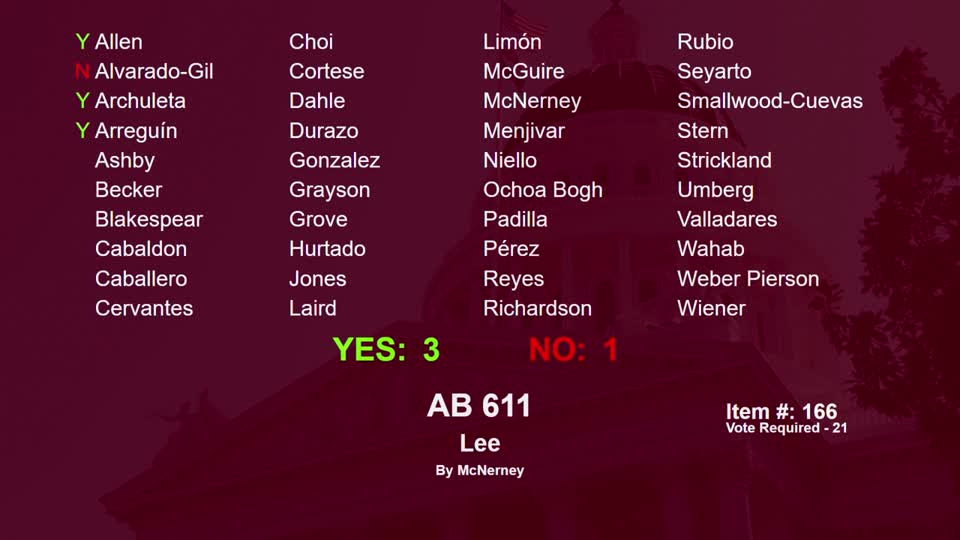 2MIN
Senate Floor
 7MIN
Senate Standing Committee on Public Safety
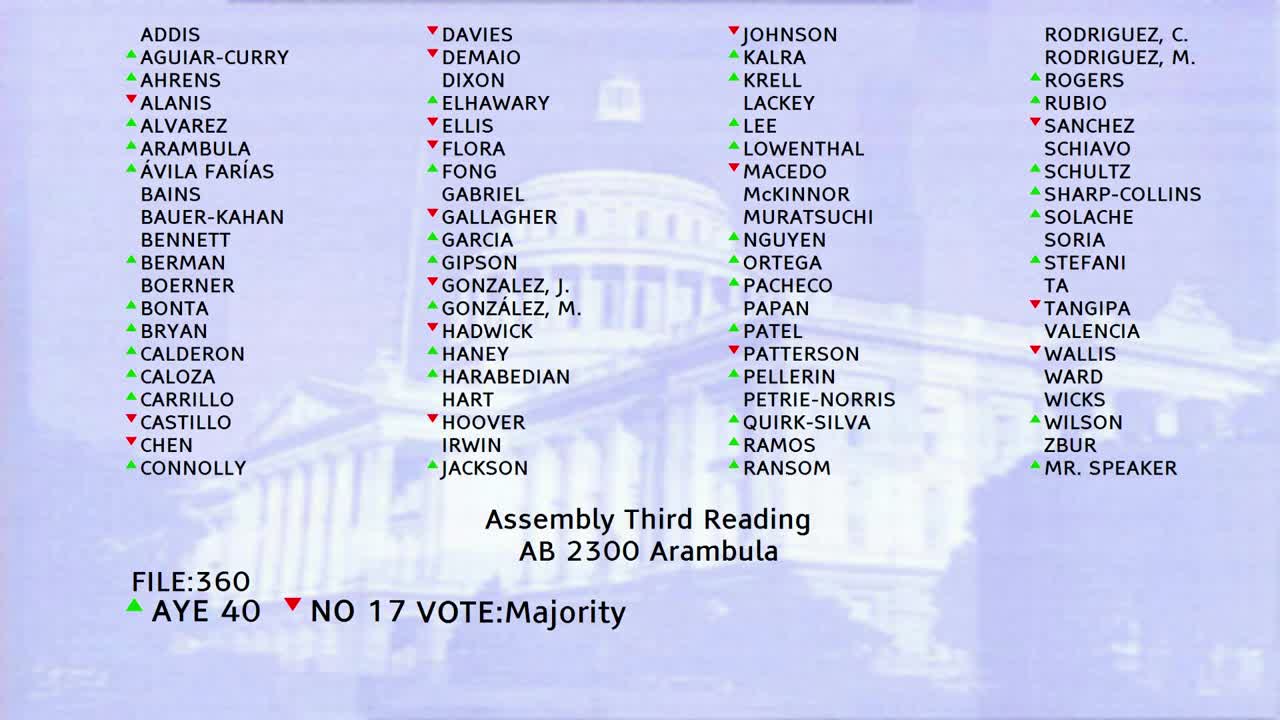 52SEC
Assembly Floor
 6MIN
Assembly Standing Committee on Public Safety
Bill Author