AB 243: Postsecondary education: student financial aid dependency status: juveniles.
- Session Year: 2025-2026
- House: Assembly
- Latest Version Date: 2025-10-11
Current Status:
Passed
(2025-10-11: Chaptered by Secretary of State - Chapter 610, Statutes of 2025.)
Introduced
In Committee
Awaiting First Chamber Vote
Passed First Chamber
In Committee
Awaiting Second Chamber Vote
Passed Second Chamber
Enacted
(1)The Donahoe Higher Education Act establishes the California Community Colleges, under the administration of the Board of Governors of the California Community Colleges, the California State University, under the administration of the Trustees of the California State University, and the University of California, under the administration of the Regents of the University of California, as the 3 segments of public postsecondary education in the state. A provision of the act requires the California State University, and requests the University of California, to annually report, on or before March 31, to the Legislature on their respective institutional financial aid programs. The act applies to the University of California only to the extent that the regents, by appropriate resolution, make it applicable.
Existing law establishes the Student Aid Commission as the primary state agency for the administration of state-authorized student financial aid programs available to students attending all segments of postsecondary education.
For purposes of making an unusual circumstances adjustment regarding the dependency status of student financial aid and institutional financial aid applicants attending, or applying to attend, a California State University, California Community College, or University of California campus, this bill would require a financial aid administrator of the segment or the commission, as applicable, to accept a sworn statement containing information signed under penalty of perjury by an authorized representative of a local educational agency, county child welfare department, or probation department as sufficient documentation, as specified. By expanding the crime of perjury, the bill would impose a state-mandated local program. By imposing new duties on community college districts, the bill would impose a state-mandated local program.
(2)Existing law generally provides for the confidentiality of information regarding a minor in proceedings in the juvenile court and related court proceedings and limits access to juvenile case files, as defined. Existing law authorizes only certain individuals to inspect a juvenile case file, including, among others, a local child support agency for the purpose of establishing paternity and establishing and enforcing child support orders and members of childrens multidisciplinary teams, persons, or agencies providing treatment or supervision of the minor.
This bill would, in order to support a person who is or was previously adjudged a dependent or ward of the juvenile court, placed in foster care or on probation, or taken into the custody of the county probation department, in attending an institution of higher education, as specified, authorize personnel at a county child welfare department, county probation department, or local educational agency to provide, upon request of the person, the institution of higher education, as defined, with specified information, including the sworn statement described in paragraph (1) above. The bill would require all information received by the institution of higher education under these provisions to be confidential and used for certain limited purposes, and would make an intentional violation of this confidentiality provision a misdemeanor. By creating a crime, the bill would impose a state-mandated local program.
(3)The California Constitution requires the state to reimburse local agencies and school districts for certain costs mandated by the state. Statutory provisions establish procedures for making that reimbursement.
This bill would provide that with regard to certain mandates no reimbursement is required by this act for a specified reason.
With regard to any other mandates, this bill would provide that, if the Commission on State Mandates determines that the bill contains costs so mandated by the state, reimbursement for those costs shall be made pursuant to the statutory provisions noted above.
(1)The Donahoe Higher Education Act establishes the California Community Colleges, under the administration of the Board of Governors of the California Community Colleges, the California State University, under the administration of the Trustees of the California State University, and the University of California, under the administration of the Regents of the University of California, as the 3 segments of public postsecondary education in the state. A provision of the act requires the California State University, and requests the University of California, to annually report, on or before March 31, to the Legislature on their respective institutional financial aid programs. The act applies to the University of California only to the extent that the regents, by appropriate resolution, make it applicable.
Existing law establishes the Student Aid Commission as the primary state agency for the administration of state-authorized student financial aid programs available to students attending all segments of postsecondary education.
For purposes of making an unusual circumstances adjustment regarding the dependency status of student financial aid and institutional financial aid applicants attending, or applying to attend, a California State University, California Community College, or University of California campus, this bill would require a financial aid administrator of the segment or the commission, as applicable, to accept a sworn statement containing information signed under penalty of perjury by an authorized representative of a local educational agency, county child welfare department, or probation department as sufficient documentation, as specified. By expanding the crime of perjury, the bill would impose a state-mandated local program. By imposing new duties on community college districts, the bill would impose a state-mandated local program.
(2)Existing law generally provides for the confidentiality of information regarding a minor in proceedings in the juvenile court and related court proceedings and limits access to juvenile case files, as defined. Existing law authorizes only certain individuals to inspect a juvenile case file, including, among others, a local child support agency for the purpose of establishing paternity and establishing and enforcing child support orders and members of childrens multidisciplinary teams, persons, or agencies providing treatment or supervision of the minor.
This bill would, in order to support a person who is or was previously adjudged a dependent or ward of the juvenile court, placed in foster care or on probation, or taken into the custody of the county probation department, in attending an institution of higher education, as specified, authorize personnel at a county child welfare department, county probation department, or local educational agency to provide, upon request of the person, the institution of higher education education, as defined, with specified information, including the sworn statement described in paragraph (1) above. The bill would require all information received by the institution of higher education under these provisions to be confidential and used for certain limited purposes, and would make an intentional violation of this confidentiality provision a misdemeanor. By creating a crime, the bill would impose a state-mandated local program.
(3)The California Constitution requires the state to reimburse local agencies and school districts for certain costs mandated by the state. Statutory provisions establish procedures for making that reimbursement.
This bill would provide that with regard to certain mandates no reimbursement is required by this act for a specified reason.
With regard to any other mandates, this bill would provide that, if the Commission on State Mandates determines that the bill contains costs so mandated by the state, reimbursement for those costs shall be made pursuant to the statutory provisions noted above.
(1)The Donahoe Higher Education Act establishes the California Community Colleges, under the administration of the Board of Governors of the California Community Colleges, the California State University, under the administration of the Trustees of the California State University, and the University of California, under the administration of the Regents of the University of California, as the 3 segments of public postsecondary education in the state. A provision of the act requires the California State University, and requests the University of California, to annually report, on or before March 31, to the Legislature on their respective institutional financial aid programs. The act applies to the University of California only to the extent that the regents, by appropriate resolution, make it applicable.
Existing law establishes the Student Aid Commission as the primary state agency for the administration of state-authorized student financial aid programs available to students attending all segments of postsecondary education.
For purposes of making an unusual circumstances adjustment regarding the dependency status of student financial aid and institutional financial aid applicants attending, or applying to attend, a California State University, California Community College, or University of California campus, this bill would require a financial aid administrator of the segment or the commission, as applicable, to accept a sworn statement containing information signed under penalty of perjury by an authorized representative of a local educational agency, county child welfare department, or probation department as sufficient documentation, as specified. By expanding the crime of perjury, the bill would impose a state-mandated local program. By imposing new duties on community college districts, the bill would impose a state-mandated local program.
(2)Existing law generally provides for the confidentiality of information regarding a minor in proceedings in the juvenile court and related court proceedings and limits access to juvenile case files, as defined. Existing law authorizes only certain individuals to inspect a juvenile case file, including, among others, a local child support agency for the purpose of establishing paternity and establishing and enforcing child support orders and members of childrens multidisciplinary teams, persons, or agencies providing treatment or supervision of the minor.
This bill would, in order to support a person who is or was previously adjudged a dependent or ward of the juvenile court, placed in foster care or on probation, or taken into the custody of the county probation department, in attending an institution of higher education, as specified, authorize personnel at a county child welfare department, county probation department, or local educational agency to provide, upon request of the person, the institution of higher education with specified information, including the sworn statement described in paragraph (1) above. The bill would require all information received by the institution of higher education under these provisions to be confidential and used for certain limited purposes, and would make an intentional violation of this confidentiality provision a misdemeanor. By creating a crime, the bill would impose a state-mandated local program.
(3)The California Constitution requires the state to reimburse local agencies and school districts for certain costs mandated by the state. Statutory provisions establish procedures for making that reimbursement.
This bill would provide that with regard to certain mandates no reimbursement is required by this act for a specified reason.
With regard to any other mandates, this bill would provide that, if the Commission on State Mandates determines that the bill contains costs so mandated by the state, reimbursement for those costs shall be made pursuant to the statutory provisions noted above.
(1)The Donahoe Higher Education Act establishes the California Community Colleges, under the administration of the Board of Governors of the California Community Colleges, the California State University, under the administration of the Trustees of the California State University, and the University of California, under the administration of the Regents of the University of California, as the 3 segments of public postsecondary education in the state. A provision of the act requires the California State University, and requests the University of California, to annually report, on or before March 31, to the Legislature on their respective institutional financial aid programs. The act applies to the University of California only to the extent that the regents, by appropriate resolution, make it applicable.
Existing law establishes the Student Aid Commission as the primary state agency for the administration of state-authorized student financial aid programs available to students attending all segments of postsecondary education.
For purposes of making an unusual circumstances adjustment regarding the dependency status of student financial aid and institutional financial aid applicants attending attending, or applying to attend, a California State University, California Community College, or University of California campus, this bill would require a financial aid administrator of the segment or the commission, as applicable, to accept a sworn statement containing information signed under penalty of perjury by an authorized representative of a local educational agency, county child welfare department, or probation department as sufficient documentation if other documentation is unavailable, documentation, as specified. By expanding the crime of perjury, the bill would impose a state-mandated local program. By imposing new duties on community college districts, the bill would impose a state-mandated local program.
Existing(2)Existing law generally provides for the confidentiality of information regarding a minor in proceedings in the juvenile court and related court proceedings and limits access to juvenile case files, as defined. Existing law authorizes only certain individuals to inspect a juvenile case file, including, among others, a local child support agency for the purpose of establishing paternity and establishing and enforcing child support orders and members of childrens multidisciplinary teams, persons, or agencies providing treatment or supervision of the minor.
This bill would additionally authorize inspection of a juvenile case file by personnel at institutions of higher education to facilitate the minors attendance at the institution and personnel of organizations providing higher education funding to facilitate the funding of the minors attendance at the institution of higher education, as specified. would, in order to support a person who is or was previously adjudged a dependent or ward of the juvenile court, placed in foster care or on probation, or taken into the custody of the county probation department, in attending an institution of higher education, as specified, authorize personnel at a county child welfare department, county probation department, or local educational agency to provide, upon request of the person, the institution of higher education with specified information, including the sworn statement described in paragraph (1) above. The bill would require all information received by the personnel institution of higher education under these provisions to be confidential and used for certain limited purposes, and would make an intentional violation of this confidentiality provision a misdemeanor. By creating a crime, the bill would impose a state-mandated local program.
The(3)The California Constitution requires the state to reimburse local agencies and school districts for certain costs mandated by the state. Statutory provisions establish procedures for making that reimbursement.
This bill would provide that with regard to certain mandates no reimbursement is required by this act for a specified reason.
With regard to any other mandates, this bill would provide that, if the Commission on State Mandates determines that the bill contains costs so mandated by the state, reimbursement for those costs shall be made pursuant to the statutory provisions noted above.
The Donahoe Higher Education Act establishes the California Community Colleges, under the administration of the Board of Governors of the California Community Colleges, the California State University, under the administration of the Trustees of the California State University, and the University of California, under the administration of the Regents of the University of California, as the 3 segments of public postsecondary education in the state. A provision of the act requires the California State University, and requests the University of California, to annually report, on or before March 31, to the Legislature on their respective institutional financial aid programs. The act applies to the University of California only to the extent that the regents, by appropriate resolution, make it applicable.
Existing law establishes the Student Aid Commission as the primary state agency for the administration of state-authorized student financial aid programs available to students attending all segments of postsecondary education.
For purposes of making an unusual circumstances adjustment regarding the dependency status of student financial aid and institutional financial aid applicants attending a California State University, California Community College, or University of California campus, this bill would require a financial aid administrator of the segment or the commission, as applicable, to accept a sworn statement containing information signed under penalty of perjury by an authorized representative of a local educational agency, county welfare department, or probation department as sufficient documentation if other documentation is unavailable, as specified. By expanding the crime of perjury, the bill would impose a state-mandated local program. By imposing new duties on community college districts, the bill would impose a state-mandated local program.
Existing law generally provides for the confidentiality of information regarding a minor in proceedings in the juvenile court and related court proceedings and limits access to juvenile case files, as defined. Existing law authorizes only certain individuals to inspect a juvenile case file, including, among others, a local child support agency for the purpose of establishing paternity and establishing and enforcing child support orders and members of childrens multidisciplinary teams, persons, or agencies providing treatment or supervision of the minor.
This bill would additionally authorize inspection of a juvenile case file by personnel at institutions of higher education to facilitate the minors attendance at the institution and personnel of organizations providing higher education funding to facilitate the funding of the minors attendance at the institution of higher education, as specified. The bill would require all information received by the personnel under these provisions to be confidential and used for certain limited purposes, and would make an intentional violation of this confidentiality provision a misdemeanor. By creating a crime, the bill would impose a state-mandated local program.
The California Constitution requires the state to reimburse local agencies and school districts for certain costs mandated by the state. Statutory provisions establish procedures for making that reimbursement.
This bill would provide that with regard to certain mandates no reimbursement is required by this act for a specified reason.
With regard to any other mandates, this bill would provide that, if the Commission on State Mandates determines that the bill contains costs so mandated by the state, reimbursement for those costs shall be made pursuant to the statutory provisions noted above.
(a)For purposes of this section, the following definitions apply:
(1)Adjustment for unusual circumstances means an unusual circumstances adjustment, as described in 20 U.S.C. Sec. 1087tt(c) and 20 U.S.C. Sec. 1087vv(d)(9), regarding the dependency status of a financial aid applicant.
(2)Applicant means a financial aid applicant attending, or applying to attend, the California State University, California Community Colleges, or University of California.
(3)Financial aid means any form of student financial aid or institutional financial aid.
(4)Financial aid administrator means a financial aid administrator of the California State University, California Community Colleges, or University of California for purposes of determining institutional financial aid of the applicant, or the Student Aid Commission for purposes of determining student financial aid of the applicant, as applicable.
(5)Institutional financial aid means all institutional grant aid, including institutional student need-based and merit-based aid.
(6)Local educational agency means a school district, charter school, or county office of education.
(7)Sworn attestation means a statement signed under penalty of perjury by an authorized representative of a local educational agency, county child welfare department, or probation department. The attestation shall include all of the following:
(A)The name, organization, and title of the attester.
(B)A declaration that the attester has provided services, instruction, or assistance to the student.
(C)A declaration that the attester is familiar with the students relationship with their parent or parents, as defined in Section 668.2(b) of Title 34 of the Code of Federal Regulations.
(D)A declaration that, to the best of the attesters personal knowledge, the student is either unable to contact their parent or parents, or contacting their parent or parents would pose a risk to the student.
(b)For purposes of making an adjustment for unusual circumstances of an applicant, a financial aid administrator shall accept a sworn attestation as sufficient documentation for purposes of 20 U.S.C. Sec. 1087tt(a)(3)(B).
(c)This section does not prohibit a financial aid administrator from accepting other types of adequate documentation to substantiate a students unusual circumstances in accordance with 20 U.S.C. Sec. 1087tt(a)(3).
(d)The Regents of the University of California are requested to adopt a policy to implement this section.
SEC. 2.Section 826.9 is added to the Welfare and Institutions Code, to read:826.9.(a)Notwithstanding Section 827 and in order to support a person who is or was previously adjudged a dependent or ward of the juvenile court, placed in foster care or on probation, or taken into the custody of the county probation department, in attending an institution of higher education by assisting the person with tasks, such as applying, registering, enrolling, or obtaining financial aid or support, personnel at a county child welfare department, county probation department, or local educational agency may provide, upon request of the person, the institution of higher education with either or both of the following:
(1)A sworn attestation, as defined in paragraph (7) of subdivision (a) Section 66020.8 of the Education Code, to be used for the purposes described in subdivision (b) of Section 66020.8 of the Education Code.
(2)Information verifying that the person is or was previously adjudged a dependent or ward of the juvenile court, placed in foster care or on probation, or taken into the custody of the county probation department that may only include the following information:
(A)The applicants name and date of birth.
(B)The dates during which the applicant was within the jurisdiction of the juvenile court, placed in foster care or on probation, or taken into the custody of the county probation department, or, if the applicant was not within the jurisdiction of the juvenile court, a statement to that effect.
(C)A statement that the applicant is or was a foster youth or juvenile court ward.
(b)(1)All information received by the institution of higher education pursuant to subdivision (a) is confidential, shall only be used for the purposes specified in subdivision (a), shall only be shared among the institution of higher educations staff who directly facilitate services for the person such as applying, registering, enrolling, or obtaining financial aid or support to the extent that the person is notified or sharing is necessary to facilitate the persons request and, notwithstanding any other law, shall not be further disclosed or disseminated by the institution of higher education.
(2)The institution of higher education shall retain the information received pursuant to subdivision (a) in a confidential file for three years after the persons last term of enrollment, after which the confidential file shall be destroyed.
(3)An intentional violation of the confidentiality provisions of this subdivision is a misdemeanor punishable by a fine not to exceed five hundred dollars ($500).
(4)Information obtained pursuant to this section does not in and of itself constitute eligibility for persons who would not otherwise be eligible for any service or support intended solely for persons who are or were dependents or placed in foster care.
(c)For the purposes of this section, institution of higher education means either of the following:
(1)A public postsecondary educational institution.
(2)A private postsecondary educational institution, including a trade or vocational school or similar program, that has been licensed or authorized to operate by the state in which it operates.
SEC. 3.No reimbursement is required by this act pursuant to Section 6 of Article XIIIB of the California Constitution for certain costs that may be incurred by a local agency or school district because, in that regard, this act creates a new crime or infraction, eliminates a crime or infraction, or changes the penalty for a crime or infraction, within the meaning of Section 17556 of the Government Code, or changes the definition of a crime within the meaning of Section 6 of Article XIIIB of the California Constitution.
However, if the Commission on State Mandates determines that this act contains other costs mandated by the state, reimbursement to local agencies and school districts for those costs shall be made pursuant to Part 7 (commencing with Section 17500) of Division 4 of Title 2 of the Government Code.
(a)For purposes of this section, the following definitions apply:
(1)Adjustment for unusual circumstances means an unusual circumstances adjustment, as described in 20 U.S.C. Sec. 1087tt(c) and 20 U.S.C. Sec. 1087vv(d)(9), regarding the dependency status of a financial aid applicant.
(2)Applicant means a financial aid applicant attending, or applying to attend, the California State University, California Community Colleges, or University of California.
(3)Financial aid means any form of student financial aid or institutional financial aid.
(4)Financial aid administrator means a financial aid administrator of the California State University, California Community Colleges, or University of California for purposes of determining institutional financial aid of the applicant, or the Student Aid Commission for purposes of determining student financial aid of the applicant, as applicable.
(5)Institutional financial aid means all institutional grant aid, including institutional student need-based and merit-based aid.
(6)Local educational agency means a school district, charter school, or county office of education.
(7)Sworn attestation means a statement signed under penalty of perjury by an authorized representative of a local educational agency, county child welfare department, or probation department. The attestation shall include all of the following:
(A)The name, organization, and title of the attester.
(B)A declaration that the attester has provided services, instruction, or assistance to the student.
(C)A declaration that the attester is familiar with the students relationship with their parent or parents, as defined in Section 668.2(b) of Title 34 of the Code of Federal Regulations.
(D)A declaration that, to the best of the attesters personal knowledge, the student is either unable to contact their parent or parents, or contacting their parent or parents would pose a risk to the student.
(b)For purposes of making an adjustment for unusual circumstances of an applicant, a financial aid administrator shall accept a sworn attestation as sufficient documentation for purposes of 20 U.S.C. Sec. 1087tt(a)(3)(B).
(c)Nothing in this section prohibits This section does not prohibit a financial aid administrator from accepting other types of adequate documentation to substantiate a students unusual circumstances in accordance with 20 U.S.C. Sec. 1087tt(a)(3).
(d)The Regents of the University of California are requested to adopt a policy to implement this section.
SEC. 2.Section 826.9 is added to the Welfare and Institutions Code, to read:826.9.(a)Notwithstanding Section 827 and in order to support a person who is or was previously adjudged a dependent or ward of the juvenile court, placed in foster care or on probation, or taken into the custody of the county probation department, in attending an institution of higher education by assisting the person with tasks, such as applying, registering, enrolling, and or obtaining financial aid or support, personnel at a county child welfare department, county probation department, or local educational agency may provide, upon request of the person, the institution of higher education with either or both of the following:
(1)A sworn attestation, as defined in paragraph (7) of subdivision (a) Section 66020.8 of the Education Code, to be used for the purposes described in subdivision (b) of Section 66020.8 of the Education Code.
(2)The information necessary to verify that the Information verifying that the person is or was previously adjudged a dependent or ward of the juvenile court, placed in foster care or on probation, or taken into the custody of the county probation department. department that may only include the following information:
(A)The applicants name and date of birth.
(B)The dates during which the applicant was within the jurisdiction of the juvenile court, placed in foster care or on probation, or taken into the custody of the county probation department, or, if the applicant was not within the jurisdiction of the juvenile court, a statement to that effect.
(C)A statement that the applicant is or was a foster youth or juvenile court ward.
(b)(1)All information received by the institution of higher education pursuant to subdivision (a) is confidential, shall only be used for the purposes specified in subdivision (a), shall only be shared among the institution of higher educations personnel when necessary, staff who directly facilitate services for the person such as applying, registering, enrolling, or obtaining financial aid or support to the extent that the person is notified or sharing is necessary to facilitate the persons request and, notwithstanding any other law, shall not be further disclosed or disseminated by the institution of higher education or the institution of higher educations personnel. education.
(2)The institution of higher education shall retain the information received pursuant to subdivision (a) in a confidential file for three years after the persons last term of enrollment, after which the confidential file shall be destroyed.
(3)An intentional violation of the confidentiality provisions of this subdivision is a misdemeanor punishable by a fine not to exceed five hundred dollars ($500).
(4)Information obtained pursuant to this section does not in and of itself constitute eligibility for persons who would not otherwise be eligible for any service or support intended solely for persons who are or were dependents or placed in foster care.
(c)For the purposes of this section, institution of higher education means either of the following:
(1)A public postsecondary educational institution.
(2)A private postsecondary educational institution, including a trade or vocational school or similar program, that has been licensed or authorized to operate by the state in which it operates.
SEC. 3.No reimbursement is required by this act pursuant to Section 6 of Article XIIIB of the California Constitution for certain costs that may be incurred by a local agency or school district because, in that regard, this act creates a new crime or infraction, eliminates a crime or infraction, or changes the penalty for a crime or infraction, within the meaning of Section 17556 of the Government Code, or changes the definition of a crime within the meaning of Section 6 of Article XIIIB of the California Constitution.
However, if the Commission on State Mandates determines that this act contains other costs mandated by the state, reimbursement to local agencies and school districts for those costs shall be made pursuant to Part 7 (commencing with Section 17500) of Division 4 of Title 2 of the Government Code.
(a)For purposes of this section, the following definitions apply:
(1)Adjustment for unusual circumstances means an unusual circumstances adjustment, as described in 20 U.S.C. Sec. 1087tt(c) and 20 U.S.C. Sec. 1087vv(d)(9), regarding the dependency status of a financial aid applicant.
(2)Applicant means a financial aid applicant attending, or applying to attend, the California State University, California Community Colleges, or University of California.
(3)Financial aid means any form of student financial aid or institutional financial aid.
(4)Financial aid administrator means a financial aid administrator of the California State University, California Community Colleges, or University of California for purposes of determining institutional financial aid of the applicant, or the Student Aid Commission for purposes of determining student financial aid of the applicant, as applicable.
(5)Institutional financial aid means all institutional grant aid, including institutional student need-based and merit-based aid.
(6)Local educational agency means a school district, charter school, or county office of education.
(7)Sworn attestation means a statement signed under penalty of perjury by an authorized representative of a local educational agency, county child welfare department, or probation department. The attestation shall include all of the following:
(A)The name, organization, and title of the attester.
(B)A declaration that the attester has provided services, instruction, or assistance to the student.
(C)A declaration that the attester is familiar with the students relationship with their parent or parents, as defined in Section 668.2(b) of Title 34 of the Code of Federal Regulations.
(D)A declaration that, to the best of the attesters personal knowledge, the student is either unable to contact their parent or parents, or contacting their parent or parents would pose a risk to the student.
(b)For purposes of making an adjustment for unusual circumstances of an applicant, a financial aid administrator shall accept a sworn attestation as sufficient documentation for purposes of 20 U.S.C. Sec. 1087tt(a)(3)(B).
(c)Nothing in this section prohibits a financial aid administrator from accepting other types of adequate documentation to substantiate a students unusual circumstances in accordance with 20 U.S.C. Sec. 1087tt(a)(3).
(c)(d)The Regents of the University of California are requested to adopt a policy to implement this section.
SEC. 2.Section 826.9 is added to the Welfare and Institutions Code, to read:826.9.(a)Notwithstanding Section 827 and in order to support a person who is or was previously adjudged a dependent or ward of the juvenile court, placed in foster care or on probation, or taken into the custody of the county probation department, in attending an institution of higher education by assisting the person with tasks, such as applying, registering, enrolling, and obtaining financial aid or support, personnel at a county child welfare department, county probation department, or local educational agency may provide, upon request of the person, the institution of higher education with either or both of the following:
(1)A sworn attestation, as defined in paragraph (7) of subdivision (a) Section 66020.8 of the Education Code, to be used for the purposes described in subdivision (b) of Section 66020.8 of the Education Code.
(2)The information necessary to verify that the person is or was previously adjudged a dependent or ward of the juvenile court, placed in foster care or on probation, or taken into the custody of the county probation department.
(b)(1)All information received by the institution of higher education pursuant to subdivision (a) is confidential, shall only be used for the purposes specified in subdivision (a), shall only be shared among the institution of higher educations personnel when necessary, and, notwithstanding any other law, shall not be further disclosed or disseminated by the institution of higher education or the institution of higher educations personnel.
(2)The institution of higher education shall retain the information received pursuant to subdivision (a) in a confidential file for three years after the persons last term of enrollment, after which the confidential file shall be destroyed.
(3)An intentional violation of the confidentiality provisions of this subdivision is a misdemeanor punishable by a fine not to exceed five hundred dollars ($500).
SEC. 3.No reimbursement is required by this act pursuant to Section 6 of Article XIIIB of the California Constitution for certain costs that may be incurred by a local agency or school district because, in that regard, this act creates a new crime or infraction, eliminates a crime or infraction, or changes the penalty for a crime or infraction, within the meaning of Section 17556 of the Government Code, or changes the definition of a crime within the meaning of Section 6 of Article XIIIB of the California Constitution.
However, if the Commission on State Mandates determines that this act contains other costs mandated by the state, reimbursement to local agencies and school districts for those costs shall be made pursuant to Part 7 (commencing with Section 17500) of Division 4 of Title 2 of the Government Code.
(a)For purposes of this section, the following definitions apply:
(1)Adjustment for unusual circumstances means an unusual circumstances adjustment, as described in 20 U.S.C. Sec. 1087tt(c) and 20 U.S.C. Sec. 1087vv(d)(9), regarding the dependency status of a financial aid applicant.
(2)Applicant means a financial aid applicant attending attending, or applying to attend, the California State University, California Community Colleges, or University of California.
(3)Financial aid means any form of student financial aid or institutional financial aid.
(4)Financial aid administrator means a financial aid administrator of the California State University, California Community Colleges, or University of California for purposes of determining institutional financial aid of the applicant, or the Student Aid Commission for purposes of determining student financial aid of the applicant, as applicable.
(5)Institutional financial aid means all institutional grant aid, including institutional student need-based and merit-based aid.
(6)Local educational agency means a school district, charter school, or county office of education.
(7)Sworn attestation means a statement signed under penalty of perjury by an authorized representative of a local educational agency, county child welfare department, or probation department. The attestation shall include all of the following:
(A)The name, organization, and title of the attester.
(B)A declaration that the attester has provided services, instruction, or assistance to the student.
(C)A declaration that the attester is familiar with the students relationship with their parent or parents, as defined in Section 668.2(b) of Title 34 of the Code of Federal Regulations.
(D)A declaration that, to the best of the attesters personal knowledge, the student does not receive financial aid from their parent or parents, as defined in Section 668.2(b) of Title 34 of the Code of Federal Regulations. is either unable to contact their parent or parents, or contacting their parent or parents would pose a risk to the student.
(b)For purposes of making an adjustment for unusual circumstances of an applicant, a financial aid administrator shall accept a sworn attestation as sufficient documentation if other documentation, as described in for purposes of 20 U.S.C. Sec. 1087tt(a)(3)(B), is unavailable. 1087tt(a)(3)(B).
(c)The Regents of the University of California are requested to adopt a policy to implement this section.
SEC. 2.Section 827 of the Welfare and Institutions Code is amended to read:827.(a)(1)Except as provided in Section 828, a case file may be inspected only by the following:(A)Court personnel.(B)The district attorney, a city attorney, or city prosecutor authorized to prosecute criminal or juvenile cases under state law.(C)The minor who is the subject of the proceeding.(D)The minors parent or guardian.(E)The attorneys for the parties, judges, referees, other hearing officers, probation officers, and law enforcement officers who are actively participating in criminal or juvenile proceedings involving the minor.(F)The county counsel, city attorney, or any other attorney representing the petitioning agency in a dependency action.(G)The superintendent or designee of the school district where the minor is enrolled or attending school.(H)Members of the child protective agencies as described in Section 11165.9 of the Penal Code.(I)The State Department of Social Services, to carry out its duties pursuant to Division 9 (commencing with Section 10000) of this code and Part 5 (commencing with Section 7900) of Division 12 of the Family Code to oversee and monitor county child welfare agencies, children in foster care or receiving foster care assistance, and out-of-state placements, Section 10850.4, and paragraph (2).(J)(i)Authorized staff who are employed by, or authorized staff of entities who are licensed by, the State Department of Social Services, as necessary to the performance of their duties related to resource family approval, and authorized staff who are employed by the State Department of Social Services as necessary to inspect, approve, or license, and monitor or investigate community care facilities or resource families, and to ensure that the standards of care and services provided in those facilities are adequate and appropriate, and to ascertain compliance with the rules and regulations to which the facilities are subject.(ii)The confidential information shall remain confidential except for purposes of inspection, approval or licensing, or monitoring or investigation pursuant to Chapter 3 (commencing with Section 1500) and Chapter 3.4 (commencing with Section 1596.70) of Division 2 of the Health and Safety Code and Article 2 (commencing with Section 16519.3) of Chapter 5 of Part 4 of Division 9. The confidential information may also be used by the State Department of Social Services in a criminal, civil, or administrative proceeding. The confidential information shall be available only to the judge or hearing officer and to the parties to the case. Names that are confidential shall be listed in attachments separate to the general pleadings. The confidential information shall be sealed after the conclusion of the criminal, civil, or administrative hearings, and shall not subsequently be released except in accordance with this subdivision. If the confidential information does not result in a criminal, civil, or administrative proceeding, it shall be sealed after the State Department of Social Services determines that no further action will be taken in the matter. Except as otherwise provided in this subdivision, confidential information shall not contain the name of the minor.(K)Members of childrens multidisciplinary teams, persons, or agencies providing treatment or supervision of the minor.(L)A judge, commissioner, or other hearing officer assigned to a family law case with issues concerning custody or visitation, or both, involving the minor, and the following persons, if actively participating in the family law case: a family court mediator assigned to a case involving the minor pursuant to Article 1 (commencing with Section 3160) of Chapter 11 of Part 2 of Division 8 of the Family Code, a court-appointed evaluator or a person conducting a court-connected child custody evaluation, investigation, or assessment pursuant to Section 3111 or 3118 of the Family Code, and counsel appointed for the minor in the family law case pursuant to Section 3150 of the Family Code. Prior to allowing counsel appointed for the minor in the family law case to inspect the file, the court clerk may require counsel to provide a certified copy of the court order appointing the minors counsel.(M)When acting within the scope of investigative duties of an active case, a statutorily authorized or court-appointed investigator who is conducting an investigation pursuant to Section 7663, 7851, or 9001 of the Family Code, or who is actively participating in a guardianship case involving a minor pursuant to Part 2 (commencing with Section 1500) of Division 4 of the Probate Code and acting within the scope of the investigators duties in that case.(N)A local child support agency for the purpose of establishing paternity and establishing and enforcing child support orders.(O)Juvenile justice commissions as established under Section 225. The confidentiality provisions of Section 10850 shall apply to a juvenile justice commission and its members.(P)The Department of Justice, to carry out its duties pursuant to Sections 290.008 and 290.08 of the Penal Code as the repository for sex offender registration and notification in California.(Q)Any other person who may be designated by court order of the judge of the juvenile court upon filing a petition.(R)A probation officer who is preparing a report pursuant to Section 1178 on behalf of a person who was in the custody of the Department of Corrections and Rehabilitation, Division of Juvenile Justice and who has petitioned the Board of Juvenile Hearings for an honorable discharge.(S)(i)The attorneys in an administrative hearing involving the minor or nonminor only as necessary to meet the requirements of Sections 10952 and 10952.5.(ii)The confidential information shall remain confidential for purposes of the administrative proceeding. The confidential information shall be available only to the judge or hearing officer and to the parties to the case. The confidential information shall be sealed after the conclusion of the administrative hearing, and shall not subsequently be released except in accordance with this subdivision.(T)Personnel of the State Department of Social Services, to carry out the duties of the department pursuant to paragraph (1) of subdivision (c) of Section 9100 of the Family Code or paragraph (3) of subdivision (e) of Section 366.26.(U)Personnel of the Office of Youth and Community Restoration, to carry out the duties of the office pursuant to Sections 2200, 2200.2, 2200.5, and 2200.7.(V)The attorney representing a person who is, or was, subject to juvenile proceedings under Section 601 or 602.(W)(i)Personnel at institutions of higher education to facilitate the minors attendance at the institution, including, but not limited to, application, registration, enrollment, financial aid or other application for financial support, disability or medical accommodations, and housing, and personnel of organizations providing higher education funding, including, but not limited to, grants and scholarships, to facilitate the funding of the minors attendance at an institution of higher education.(ii)Personnel under this subparagraph shall only have access to case file information when other information, including information provided pursuant to Section 66020.8 of the Education Code, is insufficient to facilitate the minors attendance at the institution of higher education or access to higher education funding.(iii)Personnel under this subparagraph shall not have access to the entire case file, but only to the information from the case file that is necessary to facilitate the minors attendance at the institution or access to higher education funding, as determined by staff at a county welfare or probation department.(iv)All information received by the personnel under this subparagraph shall be confidential and used for the limited purposes specified in this subparagraph, and shall not be further disseminated by the personnel, other than a person or agency authorized to access juvenile case file information pursuant to this section.(v)The personnel shall maintain the information in a confidential file until it is no longer needed for the limited purposes specified in this subparagraph or until the minor is no longer enrolled at the institution of higher education, at which time, the confidential information shall be destroyed.(vi)An intentional violation of the confidentiality provisions of this subparagraph is a misdemeanor punishable by a fine not to exceed five hundred dollars ($500).(2)(A)Notwithstanding any other law, and subject to subparagraph (A) of paragraph (3), juvenile case files, except those relating to matters within the jurisdiction of the court pursuant to Section 601 or 602, that pertain to a deceased child who was within the jurisdiction of the juvenile court pursuant to Section 300, shall be released to the public pursuant to an order by the juvenile court after a petition has been filed and interested parties have been afforded an opportunity to file an objection. Any information relating to another child or that could identify another child, except for information about the deceased, shall be redacted from the juvenile case file prior to release, unless a specific order is made by the juvenile court to the contrary. Except as provided in this paragraph, the presiding judge of the juvenile court may issue an order prohibiting or limiting access to the juvenile case file, or any portion thereof, of a deceased child only upon a showing by a preponderance of evidence that release of the juvenile case file or any portion thereof is detrimental to the safety, protection, or physical or emotional well-being of another child who is directly or indirectly connected to the juvenile case that is the subject of the petition.(B)This paragraph represents a presumption in favor of the release of documents when a child is deceased unless the statutory reasons for confidentiality are shown to exist.(C)If a child whose records are sought has died, and documents are sought pursuant to this paragraph, no weighing or balancing of the interests of those other than a child is permitted.(D)A petition filed under this paragraph shall be served on interested parties by the petitioner, if the petitioner is in possession of their identity and address, and on the custodian of records. Upon receiving a petition, the custodian of records shall serve a copy of the request upon all interested parties that have not been served by the petitioner or on the interested parties served by the petitioner if the custodian of records possesses information, such as a more recent address, indicating that the service by the petitioner may have been ineffective.(E)The custodian of records shall serve the petition within 10 calendar days of receipt. If an interested party, including the custodian of records, objects to the petition, the party shall file and serve the objection on the petitioning party no later than 15 calendar days after service of the petition.(F)The petitioning party shall have 10 calendar days to file a reply. The juvenile court shall set the matter for hearing no more than 60 calendar days from the date the petition is served on the custodian of records. The court shall render its decision within 30 days of the hearing. The matter shall be decided solely upon the basis of the petition and supporting exhibits and declarations, if any, the objection and any supporting exhibits or declarations, if any, and the reply and any supporting declarations or exhibits thereto, and argument at hearing. The court may, solely upon its own motion, order the appearance of witnesses. If an objection is not filed to the petition, the court shall review the petition and issue its decision within 10 calendar days of the final day for filing the objection. An order of the court shall be immediately reviewable by petition to the appellate court for the issuance of an extraordinary writ.(3)Access to juvenile case files pertaining to matters within the jurisdiction of the juvenile court pursuant to Section 300 or Section 601 or 602 shall be limited as follows:(A)If a juvenile case file, or any portion thereof, is privileged or confidential pursuant to any other state law or federal law or regulation, the requirements of that state law or federal law or regulation prohibiting or limiting release of the juvenile case file or any portions thereof shall prevail. Unless a person is listed in subparagraphs (A) to (P), inclusive, of paragraph (1) and is entitled to access under the other state law or federal law or regulation without a court order, all those seeking access, pursuant to other authorization, to portions of, or information relating to the contents of, juvenile case files protected under another state law or federal law or regulation, shall petition the juvenile court. The juvenile court may only release the portion of, or information relating to the contents of, juvenile case files protected by another state law or federal law or regulation if disclosure is not detrimental to the safety, protection, or physical or emotional well-being of a child, minor, or person who is directly or indirectly connected to the juvenile case that is the subject of the petition. This paragraph does not limit the ability of the juvenile court to carry out its duties in conducting juvenile court proceedings.(B)Prior to the release of the juvenile case file or any portion thereof, the court shall afford due process, including a notice of, and an opportunity to file an objection to, the release of the record or report to all interested parties.(C)This paragraph does not limit or repeal any other applicable legal standard or protections designed to safeguard private, confidential, or privileged information.(4)A juvenile case file, any portion thereof, and information relating to the content of the juvenile case file, may not be disseminated by the receiving agencies to a person or agency, other than a person or agency authorized to receive documents pursuant to this section. Further, a juvenile case file, any portion thereof, and information relating to the content of the juvenile case file, may not be made as an attachment to any other documents without the prior approval of the presiding judge of the juvenile court, unless it is used in connection with, and in the course of, a criminal investigation or a proceeding brought to declare a person a dependent child or ward of the juvenile court.(5)Individuals listed in subparagraphs (A), (B), (C), (D), (E), (F), (H), (I), (J), (P), (S), (T), (U), and (W) of paragraph (1) may also receive copies of the case file. For authorized staff of entities who are licensed by the State Department of Social Services, the confidential information shall be obtained through a child protective agency, as defined in subparagraph (H) of paragraph (1). In these circumstances, the requirements of paragraph (4) shall continue to apply to the information received.(6)An individual other than a person described in subparagraphs (A) to (P), inclusive, of paragraph (1) who files a notice of appeal or petition for writ challenging a juvenile court order, or who is a respondent in that appeal or real party in interest in that writ proceeding, may, for purposes of that appeal or writ proceeding, inspect and copy any records in a juvenile case file to which the individual was previously granted access by the juvenile court pursuant to subparagraph (Q) of paragraph (1), including any records or portions thereof that are made a part of the appellate record. The requirements of paragraph (3) shall continue to apply to any other record, or a portion thereof, in the juvenile case file or made a part of the appellate record. The requirements of paragraph (4) shall continue to apply to files received pursuant to this paragraph. The Judicial Council shall adopt rules to implement this paragraph.(b)(1)While the Legislature reaffirms its belief that juvenile court records, in general, should be confidential, it is the intent of the Legislature in enacting this subdivision to provide for a limited exception to juvenile court record confidentiality to promote more effective communication among juvenile courts, family courts, law enforcement agencies, and schools to ensure the rehabilitation of juvenile criminal offenders as well as to lessen the potential for drug use, violence, other forms of delinquency, and child abuse.(2)(A)Notwithstanding subdivision (a), written notice that a minor enrolled in a public school, kindergarten to grade 12, inclusive, has been found by a court of competent jurisdiction to have committed a felony or misdemeanor involving curfew, gambling, alcohol, drugs, tobacco products, carrying of weapons, a sex offense listed in Section 290 of the Penal Code, assault or battery, larceny, vandalism, or graffiti shall be provided by the court, within seven days, to the superintendent of the school district of attendance. Written notice shall include only the offense found to have been committed by the minor and the disposition of the minors case. This notice shall be expeditiously transmitted by the district superintendent to the principal at the school of attendance. The principal shall expeditiously disseminate the information to those counselors directly supervising or reporting on the behavior or progress of the minor. In addition, the principal shall disseminate the information to any teacher or administrator directly supervising or reporting on the behavior or progress of the minor whom the principal believes needs the information to work with the pupil in an appropriate fashion to avoid being needlessly vulnerable or to protect other persons from needless vulnerability.(B)Any information received by a teacher, counselor, or administrator under this subdivision shall be received in confidence for the limited purpose of rehabilitating the minor and protecting students and staff, and shall not be further disseminated by the teacher, counselor, or administrator, except insofar as communication with the juvenile, the juveniles parents or guardians, law enforcement personnel, and the juveniles probation officer is necessary to effectuate the juveniles rehabilitation or to protect students and staff.(C)An intentional violation of the confidentiality provisions of this paragraph is a misdemeanor punishable by a fine not to exceed five hundred dollars ($500).(3)If a minor is removed from public school as a result of the courts finding described in subdivision (b), the superintendent shall maintain the information in a confidential file and shall defer transmittal of the information received from the court until the minor is returned to public school. If the minor is returned to a school district other than the one from which the minor came, the parole or probation officer having jurisdiction over the minor shall so notify the superintendent of the last district of attendance, who shall transmit the notice received from the court to the superintendent of the new district of attendance.(c)Each probation report filed with the court concerning a minor whose record is subject to dissemination pursuant to subdivision (b) shall include on the face sheet the school at which the minor is currently enrolled. The county superintendent shall provide the court with a listing of all of the schools within each school district, within the county, along with the name and mailing address of each district superintendent.(d)(1)Each notice sent by the court pursuant to subdivision (b) shall be stamped with the instruction: Unlawful Dissemination Of This Information Is A Misdemeanor. Any information received from the court shall be kept in a separate confidential file at the school of attendance and shall be transferred to the minors subsequent schools of attendance and maintained until the minor graduates from high school, is released from juvenile court jurisdiction, or reaches 18 years of age, whichever occurs first. After that time, the confidential record shall be destroyed. At any time after the date by which a record required to be destroyed by this section should have been destroyed, the minor or the minors parent or guardian shall have the right to make a written request to the principal of the school that the minors school records be reviewed to ensure that the record has been destroyed. Upon completion of the requested review and no later than 30 days after the request for the review was received, the principal or a designee shall respond in writing to the written request and either shall confirm that the record has been destroyed or, if the record has not been destroyed, shall explain why destruction has not yet occurred.(2)Except as provided in paragraph (2) of subdivision (b), liability shall not attach to a person who transmits or fails to transmit notice or information required under subdivision (b).(e)For purposes of this section, a juvenile case file means a petition filed in a juvenile court proceeding, reports of the probation officer, and all other records, including any writing as defined in Section 250 of the Evidence Code, or electronically stored information relating to the minor, that is filed in that case or made available to the probation officer in making the probation officers report, or to the judge, referee, or other hearing officer, and thereafter retained by the probation officer, judge, referee, or other hearing officer.(f)The persons described in subparagraphs (A), (E), (F), (H), (K), (L), (M), and (N) of paragraph (1) of subdivision (a) include persons serving in a similar capacity for an Indian tribe, reservation, or tribal court when the case file involves a child who is a member of, or who is eligible for membership in, that tribe.(g)Any portion of a case file that is covered by, or included in, an order of the court sealing a record pursuant to Section 781 or 786, or that is covered by a record sealing requirement pursuant to Section 786.5 or 827.95, may not be inspected, except as specified by those sections.SEC. 2.Section 826.9 is added to the Welfare and Institutions Code, to read:826.9.(a)Notwithstanding Section 827 and in order to support a person who is or was previously adjudged a dependent or ward of the juvenile court, placed in foster care or on probation, or taken into the custody of the county probation department, in attending an institution of higher education by assisting the person with tasks, such as applying, registering, enrolling, and obtaining financial aid or support, personnel at a county child welfare department, county probation department, or local educational agency may provide, upon request of the person, the institution of higher education with either or both of the following:
(1)A sworn attestation, as defined in paragraph (7) of subdivision (a) Section 66020.8 of the Education Code, to be used for the purposes described in subdivision (b) of Section 66020.8 of the Education Code.
(2)The information necessary to verify that the person is or was previously adjudged a dependent or ward of the juvenile court, placed in foster care or on probation, or taken into the custody of the county probation department.
(b)(1)All information received by the institution of higher education pursuant to subdivision (a) is confidential, shall only be used for the purposes specified in subdivision (a), shall only be shared among the institution of higher educations personnel when necessary, and, notwithstanding any other law, shall not be further disclosed or disseminated by the institution of higher education or the institution of higher educations personnel.
(2)The institution of higher education shall retain the information received pursuant to subdivision (a) in a confidential file for three years after the persons last term of enrollment, after which the confidential file shall be destroyed.
(3)An intentional violation of the confidentiality provisions of this subdivision is a misdemeanor punishable by a fine not to exceed five hundred dollars ($500).
SEC. 3.No reimbursement is required by this act pursuant to Section 6 of Article XIIIB of the California Constitution for certain costs that may be incurred by a local agency or school district because, in that regard, this act creates a new crime or infraction, eliminates a crime or infraction, or changes the penalty for a crime or infraction, within the meaning of Section 17556 of the Government Code, or changes the definition of a crime within the meaning of Section 6 of Article XIIIB of the California Constitution.
However, if the Commission on State Mandates determines that this act contains other costs mandated by the state, reimbursement to local agencies and school districts for those costs shall be made pursuant to Part 7 (commencing with Section 17500) of Division 4 of Title 2 of the Government Code.
(a)For purposes of this section, the following definitions apply:
(1)Adjustment for unusual circumstances means an unusual circumstances adjustment, as described in 20 U.S.C. Sec. 1087tt(c) and 20 U.S.C. Sec. 1087vv(d)(9), regarding the dependency status of a financial aid applicant.
(2)Applicant means a financial aid applicant attending the California State University, California Community Colleges, or University of California.
(3)Financial aid means any student financial aid or institutional financial aid.
(4)Financial aid administrator means a financial aid administrator of the California State University, California Community Colleges, or University of California for purposes of determining institutional financial aid of the applicant, or the Student Aid Commission for purposes of determining student financial aid of the applicant, as applicable.
(5)Institutional financial aid means all institutional grant aid, including institutional student need-based and merit-based aid.
(6)Local educational agency means a school district, charter school, or county office of education.
(7)Sworn attestation means a statement signed under penalty of perjury by an authorized representative of a local educational agency, county welfare department, or probation department. The attestation shall include all of the following:
(A)The name, organization, and title of the attester.
(B)A declaration that the attester has provided services, instruction, or assistance to the student.
(C)A declaration that the attester is familiar with the students relationship with their parent or parents, as defined in Section 668.2(b) of Title 34 of the Code of Federal Regulations.
(D)A declaration that, to the best of the attesters personal knowledge, the student does not receive financial aid from their parent or parents, as defined in Section 668.2(b) of Title 34 of the Code of Federal Regulations.
(b)For purposes of making an adjustment for unusual circumstances of an applicant, a financial aid administrator shall accept a sworn attestation as sufficient documentation if other documentation, as described in 20 U.S.C. Sec. 1087tt(a)(3)(B), is unavailable.
(c)The Regents of the University of California are requested to adopt a policy to implement this section.
SEC. 2.Section 827 of the Welfare and Institutions Code is amended to read:827.(a)(1)Except as provided in Section 828, a case file may be inspected only by the following:
(A)Court personnel.
(B)The district attorney, a city attorney, or city prosecutor authorized to prosecute criminal or juvenile cases under state law.
(C)The minor who is the subject of the proceeding.
(D)The minors parent or guardian.
(E)The attorneys for the parties, judges, referees, other hearing officers, probation officers, and law enforcement officers who are actively participating in criminal or juvenile proceedings involving the minor.
(F)The county counsel, city attorney, or any other attorney representing the petitioning agency in a dependency action.
(G)The superintendent or designee of the school district where the minor is enrolled or attending school.
(H)Members of the child protective agencies as described in Section 11165.9 of the Penal Code.
(I)The State Department of Social Services, to carry out its duties pursuant to Division 9 (commencing with Section 10000) of this code and Part 5 (commencing with Section 7900) of Division 12 of the Family Code to oversee and monitor county child welfare agencies, children in foster care or receiving foster care assistance, and out-of-state placements, Section 10850.4, and paragraph (2).
(J)(i)Authorized staff who are employed by, or authorized staff of entities who are licensed by, the State Department of Social Services, as necessary to the performance of their duties related to resource family approval, and authorized staff who are employed by the State Department of Social Services as necessary to inspect, approve, or license, and monitor or investigate community care facilities or resource families, and to ensure that the standards of care and services provided in those facilities are adequate and appropriate, and to ascertain compliance with the rules and regulations to which the facilities are subject.
(ii)The confidential information shall remain confidential except for purposes of inspection, approval or licensing, or monitoring or investigation pursuant to Chapter 3 (commencing with Section 1500) and Chapter 3.4 (commencing with Section 1596.70) of Division 2 of the Health and Safety Code and Article 2 (commencing with Section 16519.5) 16519.3) of Chapter 5 of Part 4 of Division 9. The confidential information may also be used by the State Department of Social Services in a criminal, civil, or administrative proceeding. The confidential information shall be available only to the judge or hearing officer and to the parties to the case. Names that are confidential shall be listed in attachments separate to the general pleadings. The confidential information shall be sealed after the conclusion of the criminal, civil, or administrative hearings, and may shall not subsequently be released except in accordance with this subdivision. If the confidential information does not result in a criminal, civil, or administrative proceeding, it shall be sealed after the State Department of Social Services determines that no further action will be taken in the matter. Except as otherwise provided in this subdivision, confidential information shall not contain the name of the minor.
(K)Members of childrens multidisciplinary teams, persons, or agencies providing treatment or supervision of the minor.
(L)A judge, commissioner, or other hearing officer assigned to a family law case with issues concerning custody or visitation, or both, involving the minor, and the following persons, if actively participating in the family law case: a family court mediator assigned to a case involving the minor pursuant to Article 1 (commencing with Section 3160) of Chapter 11 of Part 2 of Division 8 of the Family Code, a court-appointed evaluator or a person conducting a court-connected child custody evaluation, investigation, or assessment pursuant to Section 3111 or 3118 of the Family Code, and counsel appointed for the minor in the family law case pursuant to Section 3150 of the Family Code. Prior to allowing counsel appointed for the minor in the family law case to inspect the file, the court clerk may require counsel to provide a certified copy of the court order appointing the minors counsel.
(M)When acting within the scope of investigative duties of an active case, a statutorily authorized or court-appointed investigator who is conducting an investigation pursuant to Section 7663, 7851, or 9001 of the Family Code, or who is actively participating in a guardianship case involving a minor pursuant to Part 2 (commencing with Section 1500) of Division 4 of the Probate Code and acting within the scope of the investigators duties in that case.
(N)A local child support agency for the purpose of establishing paternity and establishing and enforcing child support orders.
(O)Juvenile justice commissions as established under Section 225. The confidentiality provisions of Section 10850 shall apply to a juvenile justice commission and its members.
(P)The Department of Justice, to carry out its duties pursuant to Sections 290.008 and 290.08 of the Penal Code as the repository for sex offender registration and notification in California.
(Q)Any other person who may be designated by court order of the judge of the juvenile court upon filing a petition.
(R)A probation officer who is preparing a report pursuant to Section 1178 on behalf of a person who was in the custody of the Department of Corrections and Rehabilitation, Division of Juvenile Justice and who has petitioned the Board of Juvenile Hearings for an honorable discharge.
(S)(i)The attorneys in an administrative hearing involving the minor or nonminor only as necessary to meet the requirements of Sections 10952 and 10952.5.
(ii)The confidential information shall remain confidential for purposes of the administrative proceeding. The confidential information shall be available only to the judge or hearing officer and to the parties to the case. The confidential information shall be sealed after the conclusion of the administrative hearing, and shall not subsequently be released except in accordance with this subdivision.
(T)Personnel of the State Department of Social Services, to carry out the duties of the department pursuant to paragraph (1) of subdivision (c) of Section 9100 of the Family Code or paragraph (3) of subdivision (e) of Section 366.26.
(U)Personnel of the Office of Youth and Community Restoration, to carry out the duties of the office pursuant to Sections 2200, 2200.2, 2200.5, and 2200.7.
(V)The attorney representing a person who is, or was, subject to juvenile proceedings under Section 601 or 602.
(W)(i)Personnel at institutions of higher education to facilitate the minors attendance at the institution, including, but not limited to, application, registration, enrollment, financial aid or other application for financial support, disability or medical accommodations, and housing, and personnel of organizations providing higher education funding, including, but not limited to, grants and scholarships, to facilitate the funding of the minors attendance at an institution of higher education.
(ii)Personnel under this subparagraph shall only have access to case file information when other information, including information provided pursuant to Section 66020.8 of the Education Code, is insufficient to facilitate the minors attendance at the institution of higher education or access to higher education funding.
(iii)Personnel under this subparagraph shall not have access to the entire case file, but only to the information from the case file that is necessary to facilitate the minors attendance at the institution or access to higher education funding, as determined by staff at a county welfare or probation department.
(iv)All information received by the personnel under this subparagraph shall be confidential and used for the limited purposes specified in this subparagraph, and shall not be further disseminated by the personnel, other than a person or agency authorized to access juvenile case file information pursuant to this section.
(v)The personnel shall maintain the information in a confidential file until it is no longer needed for the limited purposes specified in this subparagraph or until the minor is no longer enrolled at the institution of higher education, at which time, the confidential information shall be destroyed.
(vi)An intentional violation of the confidentiality provisions of this subparagraph is a misdemeanor punishable by a fine not to exceed five hundred dollars ($500).
(2)(A)Notwithstanding any other law, and subject to subparagraph (A) of paragraph (3), juvenile case files, except those relating to matters within the jurisdiction of the court pursuant to Section 601 or 602, that pertain to a deceased child who was within the jurisdiction of the juvenile court pursuant to Section 300, shall be released to the public pursuant to an order by the juvenile court after a petition has been filed and interested parties have been afforded an opportunity to file an objection. Any information relating to another child or that could identify another child, except for information about the deceased, shall be redacted from the juvenile case file prior to release, unless a specific order is made by the juvenile court to the contrary. Except as provided in this paragraph, the presiding judge of the juvenile court may issue an order prohibiting or limiting access to the juvenile case file, or any portion thereof, of a deceased child only upon a showing by a preponderance of evidence that release of the juvenile case file or any portion thereof is detrimental to the safety, protection, or physical or emotional well-being of another child who is directly or indirectly connected to the juvenile case that is the subject of the petition.
(B)This paragraph represents a presumption in favor of the release of documents when a child is deceased unless the statutory reasons for confidentiality are shown to exist.
(C)If a child whose records are sought has died, and documents are sought pursuant to this paragraph, no weighing or balancing of the interests of those other than a child is permitted.
(D)A petition filed under this paragraph shall be served on interested parties by the petitioner, if the petitioner is in possession of their identity and address, and on the custodian of records. Upon receiving a petition, the custodian of records shall serve a copy of the request upon all interested parties that have not been served by the petitioner or on the interested parties served by the petitioner if the custodian of records possesses information, such as a more recent address, indicating that the service by the petitioner may have been ineffective.
(E)The custodian of records shall serve the petition within 10 calendar days of receipt. If an interested party, including the custodian of records, objects to the petition, the party shall file and serve the objection on the petitioning party no later than 15 calendar days after service of the petition.
(F)The petitioning party shall have 10 calendar days to file a reply. The juvenile court shall set the matter for hearing no more than 60 calendar days from the date the petition is served on the custodian of records. The court shall render its decision within 30 days of the hearing. The matter shall be decided solely upon the basis of the petition and supporting exhibits and declarations, if any, the objection and any supporting exhibits or declarations, if any, and the reply and any supporting declarations or exhibits thereto, and argument at hearing. The court may, solely upon its own motion, order the appearance of witnesses. If an objection is not filed to the petition, the court shall review the petition and issue its decision within 10 calendar days of the final day for filing the objection. An order of the court shall be immediately reviewable by petition to the appellate court for the issuance of an extraordinary writ.
(3)Access to juvenile case files pertaining to matters within the jurisdiction of the juvenile court pursuant to Section 300 or Section 601 or 602 shall be limited as follows:
(A)If a juvenile case file, or any portion thereof, is privileged or confidential pursuant to any other state law or federal law or regulation, the requirements of that state law or federal law or regulation prohibiting or limiting release of the juvenile case file or any portions thereof shall prevail. Unless a person is listed in subparagraphs (A) to (P), inclusive, of paragraph (1) and is entitled to access under the other state law or federal law or regulation without a court order, all those seeking access, pursuant to other authorization, to portions of, or information relating to the contents of, juvenile case files protected under another state law or federal law or regulation, shall petition the juvenile court. The juvenile court may only release the portion of, or information relating to the contents of, juvenile case files protected by another state law or federal law or regulation if disclosure is not detrimental to the safety, protection, or physical or emotional well-being of a child, minor, or person who is directly or indirectly connected to the juvenile case that is the subject of the petition. This paragraph does not limit the ability of the juvenile court to carry out its duties in conducting juvenile court proceedings.
(B)Prior to the release of the juvenile case file or any portion thereof, the court shall afford due process, including a notice of, and an opportunity to file an objection to, the release of the record or report to all interested parties.
(C)This paragraph does not limit or repeal any other applicable legal standard or protections designed to safeguard private, confidential, or privileged information.
(4)A juvenile case file, any portion thereof, and information relating to the content of the juvenile case file, may not be disseminated by the receiving agencies to a person or agency, other than a person or agency authorized to receive documents pursuant to this section. Further, a juvenile case file, any portion thereof, and information relating to the content of the juvenile case file, may not be made as an attachment to any other documents without the prior approval of the presiding judge of the juvenile court, unless it is used in connection with, and in the course of, a criminal investigation or a proceeding brought to declare a person a dependent child or ward of the juvenile court.
(5)Individuals listed in subparagraphs (A), (B), (C), (D), (E), (F), (H), (I), (J), (P), (S), (T), and (U) (U), and (W) of paragraph (1) may also receive copies of the case file. For authorized staff of entities who are licensed by the State Department of Social Services, the confidential information shall be obtained through a child protective agency, as defined in subparagraph (H) of paragraph (1). In these circumstances, the requirements of paragraph (4) shall continue to apply to the information received.
(6)An individual other than a person described in subparagraphs (A) to (P), inclusive, of paragraph (1) who files a notice of appeal or petition for writ challenging a juvenile court order, or who is a respondent in that appeal or real party in interest in that writ proceeding, may, for purposes of that appeal or writ proceeding, inspect and copy any records in a juvenile case file to which the individual was previously granted access by the juvenile court pursuant to subparagraph (Q) of paragraph (1), including any records or portions thereof that are made a part of the appellate record. The requirements of paragraph (3) shall continue to apply to any other record, or a portion thereof, in the juvenile case file or made a part of the appellate record. The requirements of paragraph (4) shall continue to apply to files received pursuant to this paragraph. The Judicial Council shall adopt rules to implement this paragraph.
(b)(1)While the Legislature reaffirms its belief that juvenile court records, in general, should be confidential, it is the intent of the Legislature in enacting this subdivision to provide for a limited exception to juvenile court record confidentiality to promote more effective communication among juvenile courts, family courts, law enforcement agencies, and schools to ensure the rehabilitation of juvenile criminal offenders as well as to lessen the potential for drug use, violence, other forms of delinquency, and child abuse.
(2)(A)Notwithstanding subdivision (a), written notice that a minor enrolled in a public school, kindergarten to grade 12, inclusive, has been found by a court of competent jurisdiction to have committed a felony or misdemeanor involving curfew, gambling, alcohol, drugs, tobacco products, carrying of weapons, a sex offense listed in Section 290 of the Penal Code, assault or battery, larceny, vandalism, or graffiti shall be provided by the court, within seven days, to the superintendent of the school district of attendance. Written notice shall include only the offense found to have been committed by the minor and the disposition of the minors case. This notice shall be expeditiously transmitted by the district superintendent to the principal at the school of attendance. The principal shall expeditiously disseminate the information to those counselors directly supervising or reporting on the behavior or progress of the minor. In addition, the principal shall disseminate the information to any teacher or administrator directly supervising or reporting on the behavior or progress of the minor whom the principal believes needs the information to work with the pupil in an appropriate fashion to avoid being needlessly vulnerable or to protect other persons from needless vulnerability.
(B)Any information received by a teacher, counselor, or administrator under this subdivision shall be received in confidence for the limited purpose of rehabilitating the minor and protecting students and staff, and shall not be further disseminated by the teacher, counselor, or administrator, except insofar as communication with the juvenile, the juveniles parents or guardians, law enforcement personnel, and the juveniles probation officer is necessary to effectuate the juveniles rehabilitation or to protect students and staff.
(C)An intentional violation of the confidentiality provisions of this paragraph is a misdemeanor punishable by a fine not to exceed five hundred dollars ($500).
(3)If a minor is removed from public school as a result of the courts finding described in subdivision (b), the superintendent shall maintain the information in a confidential file and shall defer transmittal of the information received from the court until the minor is returned to public school. If the minor is returned to a school district other than the one from which the minor came, the parole or probation officer having jurisdiction over the minor shall so notify the superintendent of the last district of attendance, who shall transmit the notice received from the court to the superintendent of the new district of attendance.
(c)Each probation report filed with the court concerning a minor whose record is subject to dissemination pursuant to subdivision (b) shall include on the face sheet the school at which the minor is currently enrolled. The county superintendent shall provide the court with a listing of all of the schools within each school district, within the county, along with the name and mailing address of each district superintendent.
(d)(1)Each notice sent by the court pursuant to subdivision (b) shall be stamped with the instruction: Unlawful Dissemination Of This Information Is A Misdemeanor. Any information received from the court shall be kept in a separate confidential file at the school of attendance and shall be transferred to the minors subsequent schools of attendance and maintained until the minor graduates from high school, is released from juvenile court jurisdiction, or reaches 18 years of age, whichever occurs first. After that time, the confidential record shall be destroyed. At any time after the date by which a record required to be destroyed by this section should have been destroyed, the minor or the minors parent or guardian shall have the right to make a written request to the principal of the school that the minors school records be reviewed to ensure that the record has been destroyed. Upon completion of the requested review and no later than 30 days after the request for the review was received, the principal or a designee shall respond in writing to the written request and either shall confirm that the record has been destroyed or, if the record has not been destroyed, shall explain why destruction has not yet occurred.
(2)Except as provided in paragraph (2) of subdivision (b), liability shall not attach to a person who transmits or fails to transmit notice or information required under subdivision (b).
(e)For purposes of this section, a juvenile case file means a petition filed in a juvenile court proceeding, reports of the probation officer, and all other records, including any writing as defined in Section 250 of the Evidence Code, or electronically stored information relating to the minor, that is filed in that case or made available to the probation officer in making the probation officers report, or to the judge, referee, or other hearing officer, and thereafter retained by the probation officer, judge, referee, or other hearing officer.
(f)The persons described in subparagraphs (A), (E), (F), (H), (K), (L), (M), and (N) of paragraph (1) of subdivision (a) include persons serving in a similar capacity for an Indian tribe, reservation, or tribal court when the case file involves a child who is a member of, or who is eligible for membership in, that tribe.
(g)Any portion of a case file that is covered by, or included in, an order of the court sealing a record pursuant to Section 781 or 786, or that is covered by a record sealing requirement pursuant to Section 786.5 or 827.95, may not be inspected, except as specified by those sections.
SEC. 3.No reimbursement is required by this act pursuant to Section 6 of Article XIIIB of the California Constitution for certain costs that may be incurred by a local agency or school district because, in that regard, this act creates a new crime or infraction, eliminates a crime or infraction, or changes the penalty for a crime or infraction, within the meaning of Section 17556 of the Government Code, or changes the definition of a crime within the meaning of Section 6 of Article XIIIB of the California Constitution.
However, if the Commission on State Mandates determines that this act contains other costs mandated by the state, reimbursement to local agencies and school districts for those costs shall be made pursuant to Part 7 (commencing with Section 17500) of Division 4 of Title 2 of the Government Code.
|
Date
|
Status
|
|---|---|
| Oct 11, 2025 | Chaptered by Secretary of State - Chapter 610, Statutes of 2025. |
| Oct 11, 2025 | Approved by the Governor. |
| Sep 23, 2025 | Enrolled and presented to the Governor at 4 p.m. |
| Sep 11, 2025 | Senate amendments concurred in. To Engrossing and Enrolling. (Ayes 80. Noes 0. Page 3289.). |
| Sep 10, 2025 | In Assembly. Concurrence in Senate amendments pending. |
| Sep 10, 2025 | Read third time. Passed. Ordered to the Assembly. (Ayes 40. Noes 0. Page 2797.). |
| Sep 8, 2025 | Read second time. Ordered to third reading. |
| Sep 4, 2025 | Read third time and amended. Ordered to second reading. |
| Jul 10, 2025 | Ordered to third reading. |
| Jul 10, 2025 | From Consent Calendar. |
| Jul 8, 2025 | Read second time. Ordered to Consent Calendar. |
| Jul 7, 2025 | From committee: Be ordered to second reading file pursuant to Senate Rule 28.8 and ordered to Consent Calendar. |
| Jun 25, 2025 | From committee: Do pass and re-refer to Com. on APPR. with recommendation: To Consent Calendar. (Ayes 12. Noes 0.) (June 24). Re-referred to Com. on APPR. |
| Jun 12, 2025 | Read second time and amended. Re-referred to Com. on JUD. |
| Jun 11, 2025 | From committee: Amend, and do pass as amended and re-refer to Com. on JUD. (Ayes 6. Noes 0.) (June 11). |
| May 14, 2025 | Referred to Coms. on ED. and JUD. |
| May 1, 2025 | In Senate. Read first time. To Com. on RLS. for assignment. |
| May 1, 2025 | Read third time. Passed. Ordered to the Senate. (Ayes 76. Noes 0. Page 1385.) |
| Apr 24, 2025 | Read second time. Ordered to Consent Calendar. |
| Apr 23, 2025 | From committee: Do pass. To Consent Calendar. (Ayes 15. Noes 0.) (April 23). |
| Apr 8, 2025 | From committee: Do pass and re-refer to Com. on APPR. with recommendation: To Consent Calendar. (Ayes 12. Noes 0.) (April 8). Re-referred to Com. on APPR. |
| Apr 1, 2025 | Re-referred to Com. on JUD. |
| Mar 28, 2025 | From committee chair, with author's amendments: Amend, and re-refer to Com. on JUD. Read second time and amended. |
| Mar 19, 2025 | From committee: Do pass and re-refer to Com. on JUD. (Ayes 8. Noes 0.) (March 18). Re-referred to Com. on JUD. |
| Feb 18, 2025 | Referred to Coms. on HIGHER ED. and JUD. |
| Jan 15, 2025 | From printer. May be heard in committee February 14. |
| Jan 14, 2025 | Read first time. To print. |
|
Date
|
Description
|
Location
|
Votes
|
|
|---|---|---|---|---|
| Sep 11, 2025 | AB 243 Ahrens Concurrence in Senate Amendments | Assembly Floor |
Passed |
|
| Sep 10, 2025 | Assembly 3rd Reading AB243 Ahrens By Wahab | Senate Floor |
Passed |
|
| Jun 24, 2025 | Do pass, but first be re-referred to the Committee on [Appropriations] with the recommendation: To Consent Calendar | Senate Standing Committee on Judiciary |
Passed |
|
| Jun 11, 2025 | Do pass as amended, but first amend, and re-refer to the Committee on [Judiciary] | Senate Standing Committee on Education |
Passed |
|
| May 1, 2025 | AB 243 Ahrens Consent Calendar Second Day Regular Session | Assembly Floor |
Passed |
|
| Apr 23, 2025 | Do pass. To Consent Calendar. | Assembly Standing Committee on Appropriations |
Passed |
|
| Apr 8, 2025 | Do pass and be re-referred to the Committee on [Appropriations] with recommendation: To Consent Calendar | Assembly Standing Committee on Judiciary |
Passed |
|
| Mar 18, 2025 | Do pass and be re-referred to the Committee on [Judiciary] | Assembly Standing Committee on Higher Education |
Passed |
This list shows positions taken on this bill by organizations on the date displayed, which is linked to the original source.
Positions by individuals are not included.
|
Organization
|
Position
|
Date
|
|---|---|---|
| Alameda County Office Of Education | ** Support | |
| ASPIRANET | ** Support | |
| California Association For Bilingual Education | ** Support | |
| California Coalition For Youth | ** Support | |
| California County Superintendents | ** Support | |
| CFT- a Union of Educators & Classified Professionals, Aft, Afl-cio | ** Support | |
| Long Beach Area Chamber of Commerce | ** Support | |
| Office of the Riverside County Superintendent of Schools | ** Support | |
| Santa Clara County Office Of Education | ** Support | |
| The California Chamber Of Commerce | ** Support | |
| The County Of Santa Clara | ** Support | |
| The Youth Law Center (YLC) | ** Against | |
| Transformative Programming Works | ** Support | |
| Underground Scholars Initiative At the University of California, Irvine | ** Support | |
| Youth Law Center | ** Support |
CONCURRENCE IN SENATE AMENDMENTS
CSA1 Bill Id:AB 243
Author:(Ahrens)
As Amended Ver:September 04, 2025
Majority vote
SUMMARY
Authorizes inspection of a juvenile case file by personnel at institutions of higher education to facilitate the minor's attendance at the institution and personnel of organizations providing higher education funding to facilitate the funding of the minor's attendance at the institution of higher education, as specified. Requires all information received by the personnel to be confidential and used for certain limited purposes, and would make an intentional violation of this confidentiality provision a misdemeanor.
Senate Amendments
Amendments taken in the Senate:
- Specifies that information verifying that the person is or was previously adjudged a dependent or ward of the juvenile court, placed in foster care or on probation, or taken into the custody of the county probation
- The applicant's name and date of birth;
- The dates during which the applicant was within the jurisdiction of the juvenile court, placed in foster care or on probation, or taken into the custody of the county probation department, or, if the applicant was not within the jurisdiction of the juvenile court, a statement to that effect; and,
- A statement that the applicant is or was a foster youth or juvenile court ward.
- Specifies that all information received by an institution of higher education regarding juvenile case files is confidential and will only be shared among the institution of higher education's
- Specifies that information obtained through a juvenile case file does not, in and of itself constitute eligibility for individuals who would not otherwise be eligible for any service or support intended solely for persons who are or were dependents or placed in foster care.
- Defines "institution of higher education," as specified, to mean:
- A public postsecondary educational institution; or,
- A private postsecondary educational institution, including a trade or vocational school or similar program, that has been licensed or authorized to operate by the state in which it operates.
COMMENTS
Free Application for Federal Student Aid (FAFSA). All major federal and state financial aid programs, such as Cal Grant, Pell Grant, institutional aid, work- study awards, scholarships, and federal student loans, use the FAFSA as their core document to determine eligibility. In most cases, to maximize their financial aid options, students should complete the FAFSA by March 2 (traditionally) of their senior year in high school. Missing this window may reduce the amount of aid available for that student. Because financial aid for college considers the cost of attendance and a family's ability to pay in determining eligibility, the FAFSA asks for personal information such as income, tax information, and a social security number.
There are currently three kinds of Cal Grants, A, B and C, of which eligibility is determined by the FAFSA or California Dream Act Application, a student's verified Cal Grant GPA, the type of California colleges a student listed on their FAFSA, and whether they are a recent high school graduate. Students are considered for a Cal Grant A, B, or C after they either establish eligibility for an Entitlement award (if they graduated from high school less than one year ago or transfer from a community college before age 28) or secure one of a limited number of Competitive awards (for any students that do not qualify for an Entitlement).
Federal changes. As part of federal COVID-19 related legislation signed into law in late December 2020, the process for applying for and receiving federal aid was simplified. The federal changes, initially were to commence with the 2023-24 academic year. However, the changes were delayed in June 2021, and are just going into effect commencing with the 2024-25 academic year. In part, the changes do the following:
- Simplify the FAFSA form. The FAFSA is the form students need to complete in order to receive any financial aid from the federal government to help pay for college.
Each year, over 13 million students who file the FAFSA get more than $120 billion in grants, work-study, and low-interest loans from the U.S. Department of Education. Additionally, many states, including California, and colleges use the FAFSA to determine which students will receive state and institutional financial aid—and how much they will receive.
Simplifying the FAFSA will not only make the form easier to fill out by eliminating two-thirds of the questions, but it will also affect the determination of financial need for low, middle, and high-income students.
- Change the Expected Family Contribution (EFC) to the Student Aid Index (SAI). While the SAI is similar in nature to the EFC, according to the Institute for College Access and Success, the name change will more accurately reflect the meaning of the calculation when determining student aid eligibility rather than an expectation of what a family can afford to pay for college. Under the new model, a student applicant's SAI can be as low as -$1,500; however, the lowest EFC under the existing model is $0.
Unusual circumstances. As part of the changes made to simplify the FAFSA form, institutions of higher education have additional flexibility to assist students with unusual circumstances by adjusting their federal student aid eligibility to reflect their unique situation more accurately. These adjustments may include updating the student's dependency status (commonly known as a dependency override) and the information the student must provide on their FAFSA form. Students with unusual circumstances are defined as:
- A student for whom a financial aid administrator makes a documented determination of independence by reason of unusual circumstances and in which the student is unable to contact a parent or where contact with parents poses a risk to such student, which includes circumstances of:
- Human trafficking, as described in the Trafficking Victims Protection Act of 2000;
- Legally granted refugee or asylum status;
- Parental abandonment or estrangement; or,
- Student or parental incarceration.
In providing guidance to college financial aid administrators and counselors, the Federal Student Aid Handbook emphasizes that documentation of the unusual circumstances is "critical" and that "schools must ensure that any supporting documentation they collect is adequate to document the student's circumstances." According to information provided by the author and sponsor, higher education institutions frequently ask for documentation in the form of written letters from the county department or LEA that provides services to the youth. Because each institution is responsible for documenting the unusual circumstance, county departments and LEAs may receive multiple requests for letters for each youth. In addition, each institution has different expectations around the content required to document unusual circumstances.
Responding to these letters has the potential to impose a burden on both the youth, who may need to coordinate with several institutions, and on staff who need to respond to several potentially distinct requests for each youth. The Santa Clara County Office of Education reports that college liaisons at the two court schools in Santa Clara write a total of 40 to 50 letters each year for students who qualify for special circumstances on the FAFSA each year. They've written around 200-250 letters total since the 2022-23 academic year.
Continued challenges with the rollout of the new FAFSA application. As noted in the Federal changes section of this analysis, the U.S. Department of Education (USDE) made myriad changes to the federal FAFSA. While the changes seek to simplify the application form by reducing the number of questions students and families need to answer and transfer data directly from their previous tax filings, after over a year delay in implementing or launching the form, the USDE still did not release the new form for the 2024-25 award year until three months later than all prior years (released on December 30, 2023, instead of October 1, 2023).
The USDE, on March 12, 2024, announced that it had made long-awaited technical updates that would enable mixed-status families to submit the FAFSA. However, the USDE also indicated that it had, "uncovered separate issues that still need to be resolved."
The 2025-26 cycle was also delayed. The USDE announced on August 7, 2024, that the upcoming FAFSA form would not be open to all students until December 1, 2024 – about two months later than the typical release date. There was also a phased rollout, including a testing period in which a limited number of students and institutions had access to the form beginning October 1, 2024, as a way to preventively address potential problems before it officially went live.
According to the Author
According to the author, "AB 243 will reduce barriers to accessing higher education for students who are involved in the child welfare and juvenile justice systems. These systems-involved youth need our help. Enrolling in higher education, seeking financial aid, or asking for an accommodation can be challenging for anyone and could be prohibitive for these youth."
"Current law rightly prevents local agencies from disclosing information about a youth's involvement in child welfare or juvenile justice systems, but this can also get in the way of giving necessary information for higher education. This often comes up if a student needs to show financial independence from parents for financial aid. While there have been significant efforts to streamline the financial aid application process, the lack of uniformity of what documentation colleges and universities request to confirm financial independence has led to a burdensome process of individualized letters from county office of education staff or county juvenile probation staff sent to each institution."
"This bill would streamline this process for the youth, the school, and the county employees, while also maintaining confidentiality. AB 243 would simply let a county employee send a form or letter attesting to the financial independence of the student, without releasing detailed personal information. If that isn't enough—for example if the problem is not financial aid—then a narrow exemption to the confidentiality rules would kick in to allow very limited case file information to be released to address the situation. This bill does not interfere with or modify the existing processes for confirming a current or former foster youth's status for purposes of financial aid such as the California Chaffee Grant for Foster Youth program."
Arguments in Support
The County of Santa Clara, the sponsor of AB 243 (Ahrens), wrote that "under existing law, information related to a minor in juvenile court proceedings and child welfare systems is highly confidential, and access to case files is restricted to authorized individuals. Due to this, youth involved in the juvenile justice or child welfare systems often encounter challenges when required to obtain proof of their financial independence, medical, disability, or other accommodations as part of their application or enrollment in higher education. These barriers disproportionately impact Latino and Black communities, which are overrepresented among system-involved youth. Currently, institutions of higher education in California are requesting a variety of different types of documentation from youth of financial independence."
"AB 243 addresses the challenges these youth face in providing necessary information during admissions, financial aid, enrollment, and accommodation processes. By requiring financial aid administrators at public higher education institutions in California to accept an attestation from local educational agencies, county probation departments, or welfare departments as sufficient documentation of financial independence, the bill streamlines access to affordable education for these students. This attestation approach also promotes consistent treatment of required information from students. For the rare instances in which the attestation is not sufficient, or where other information is needed to support the youth's successful enrollment and education, the bill allows higher education institutions to access limited casefile information provided by county probation or welfare staff to verify information provided to the institution by the youth."
The California Chamber of Commerce also wrote in support, noting that AB 243 (Ahrens) "will facilitate some of California's most vulnerable—those in the juvenile justice system—having the same access to postsecondary education and good careers as their peers. California's economy needs every worker available to maintain our world-renowned economic leadership. And that need is particularly great for skilled workers – but those the education underlying those skills usually requires financial aid. Here, we see AB 243 as ensuring that an unintentionally excluded population can access that necessary financial aid, despite the protected nature of their records."
"In other words: AB 243 is a targeted fix that is essentially no-cost, but potentially high-value for both the individuals who will now have a chance at higher education, and for the employers who may one day hire them."
Arguments in Opposition
The Youth Law Center (YLC) sent a letter opposing AB 243 unless it is amended, stating that the legislation "unnecessarily intrudes on the confidentiality of youth by allowing access to their juvenile case file and there are less intrusive measures that can be taken to help facilitate access."
The YLC adds that existing law "allows for limited access to juvenile case files to protect the privacy rights of the child. Only a limited set of individuals are authorized to inspect the case file, such as a youth' dependency or delinquency attorney, social worker, probation officer, or multidisciplinary team. Others may only inspect a juvenile case file by petitioning the court. Juvenile case files are rightfully protected as they can include sensitive information including investigations of abuse and neglect, private health and mental health information of the youth and/or their parents, and protected education records. Confidentiality is necessary to protect foster and juvenile justice youth from being denied various opportunities, to further their rehabilitative efforts, and to prevent the lifelong stigma that results from having a child welfare case and/or juvenile police record. The negative collateral consequences–many unintended–of failing to protect juvenile records and case files unfortunately has been well-documented."
"The FAFSA Simplification Act, which took effect in 2023, aims to simplify the [FAFSA] process and make it easier for students to access federal financial aid. It also includes new provisions to support access for students who may face unusual circumstances that prevent them from providing parental information including an interview between the youth and the financial aid administrator, a phone call or written statement from an attorney, or a phone call or written statement from a person serving in a similar capacity. All youth in the juvenile justice system are represented by an attorney and thus already have multiple pathways for applying for unusual circumstances."
FISCAL COMMENTS
According to the Senate Appropriations Committee, pursuant to Senate Rule 28.8, negligible state costs.
VOTES:
ASM HIGHER EDUCATION: 8-0-2
YES: Fong, Boerner, Essayli, Jeff Gonzalez, Jackson, Muratsuchi, Patel, Celeste Rodriguez
ABS, ABST OR NV: DeMaio, Sharp-Collins
ASM JUDICIARY: 12-0-0
YES: Kalra, Dixon, Wicks, Bryan, Connolly, Harabedian, Pacheco, Papan, Sanchez, Stefani, Zbur, Tangipa
ASM APPROPRIATIONS: 15-0-0
YES: Wicks, Sanchez, Arambula, Calderon, Caloza, Dixon, Elhawary, Fong, Mark González, Hart, Pacheco, Pellerin, Solache, Ta, Tangipa
ASSEMBLY FLOOR: 76-0-3
YES: Addis, Aguiar-Curry, Ahrens, Alanis, Alvarez, Arambula, Ávila Farías, Bains, Bauer-Kahan, Bennett, Berman, Boerner, Bonta, Bryan, Calderon, Caloza, Carrillo, Castillo, Connolly, Davies, DeMaio, Dixon, Elhawary, Ellis, Flora, Fong, Gabriel, Gallagher, Garcia, Gipson, Jeff Gonzalez, Mark González, Hadwick, Haney, Harabedian, Hart, Hoover, Irwin, Jackson, Kalra, Krell, Lackey, Lee, Lowenthal, Macedo, Muratsuchi, Nguyen, Ortega, Pacheco, Patel, Patterson, Pellerin, Petrie-Norris, Quirk-Silva, Ramos, Ransom, Celeste Rodriguez, Michelle Rodriguez, Rogers, Blanca Rubio, Sanchez, Schiavo, Schultz, Sharp-Collins, Solache, Soria, Stefani, Ta, Tangipa, Valencia, Wallis, Ward, Wicks, Wilson, Zbur, Rivas
ABS, ABST OR NV: Chen, McKinnor, Papan
UPDATED
VERSION: September 04, 2025
CONSULTANT: Kevin J. Powers / HIGHER ED. / (916) 319-3960 FN: 0001863
SENATE RULES COMMITTEE Office of Senate Floor Analyses (916) 651-1520 Fax: (916) 327-4478 | AB 243 |
THIRD READING
Bill No: AB 243
Author: Ahrens (D)
Amended: 9/4/25 in Senate
Vote: 21
SENATE EDUCATION COMMITTEE: 6-0, 6/11/25
AYES: Pérez, Ochoa Bogh, Cabaldon, Choi, Cortese, Laird
NO VOTE RECORDED: Gonzalez
SENATE JUDICIARY COMMITTEE: 12-0, 6/24/25
AYES: Umberg, Niello, Allen, Arreguín, Ashby, Caballero, Durazo, Laird, Stern, Wahab, Weber Pierson, Wiener
NO VOTE RECORDED: Valladares
SENATE APPROPRIATIONS COMMITTEE: Senate Rule 28.8
ASSEMBLY FLOOR: 76-0, 5/1/25 (Consent) - See last page for vote
SUBJECT: Postsecondary education: student financial aid dependency status: juveniles
SOURCE: County of Santa Clara
DIGEST:
This bill (1) authorizes personnel at a county child welfare department, county probation department, or local educational agency (LEA), upon the request of a youth formerly in the foster care or probation system, to provide certain personal information to an institution of higher education (IHE) to assist the youth’s attendance at that IHE. It further (2) requires a financial aid administrator to accept a sworn attestation as sufficient documentation for adjusting a financial aid applicant’s dependency status who is attending or applying to a California State University (CSU), California Community College (CCC), or University of California (UC) campus. Lastly, it (3) makes any information received by an IHE confidential, and a violation of the confidentiality provisions subject to a misdemeanor of up to a $500 fine.
Senate Floor Amendments of 9/4/25 define institutions of higher education to include public and private institutions including out-of-state trade schools and narrows the type of information that can be shared with those institutions.
ANALYSIS:
Existing law:
1) Establishes the California Student Aid Commission (CSAC) for the purpose of administering specified student financial aid programs. (Education Code (EC) § 69510, et seq.)
2) Establishes the Cal Grant program, administered by the CSAC, to provide grants to financially needy students to attend a college or university. The Cal Grant programs include both the entitlement and the competitive Cal Grant awards. The program consists of the Cal Grant A, Cal Grant B, and Cal Grant C programs, and eligibility is based upon financial need, grade point average (GPA), California residency, and other criteria. Maximum award amounts for the CSU and the UC are established in the annual Budget Act and have traditionally covered all system wide tuition and fees. Supplemental Cal Grant awards programs are available to students with dependents and former and current foster youth attending CSU, UC, or a CCC to assist with non-tuition costs, such as living expenses. (EC § 69430–69433 and § 69465-69470)
3) Establishes, the Cal Grant Reform Act commencing in the 2024-2025 fiscal year, if General Fund moneys over the multiyear forecasts are available to support ongoing augmentations and actions, and if funding is provided in the annual Budget Act (Act). Under the Act, the Cal Grant 2 and Cal Grant 4 programs are created. The Cal Grant 2 is for CCC students, and provides non-tuition support that grows annually with inflation. The Cal Grant 4 program is for students at the UC, CSU, and other institutions. The Act also states legislative intent that UC and CSU use institutional aid to cover non-tuition costs for their students. (EC § 69424, 69425, and 69428).
4) Requires the CSAC, through an interagency agreement with the Department of Social Services (DSS), to operate a federally-funded scholarship program that provides grant aid to California’s current and former foster youth. Existing law requires funds to be used to assist students who are current and former foster youth, for career and technical training or traditional college courses. (EC § 69519)
5) Establishes the Middle Class Scholarship (MCS) Program to offset a portion of tuition costs for students attending the UC and the CSU. Starting in the 2022-23 academic year, MCS awards may be used to cover the total cost of attendance at UC and CSU. The maximum annual household income to qualify for an award is $234,000 for dependent students in 2025-26. (EC § 70020, et seq.)
6) Specifies the categories of individuals who are authorized to inspect a juvenile case file, and authorizes only certain individuals to inspect a juvenile case file, including, among others, a local child support agency for the purpose of establishing paternity and establishing and enforcing child support orders and members of children’s multidisciplinary teams, persons, or agencies providing treatment or supervision of the minor. (Welfare & Institutions Code § 827)
7) Prohibits, in federal law, funds from being made available under any applicable program to any educational agency or institution that permits the release of a student’s education records, or the personally identifiable information contained therein, other than directory information, without the written consent of their parents. (20 United States Code (U.S.C.) § 1232(b))
8) Specifies that a financial aid administrator has the authority to, on the basis of adequate documentation, make adjustments to the data used to determine a student’s financial aid eligibility, based on “special circumstances or unusual circumstances.” Further specifies that, in instances when the student or the student’s parents or legal guardians are incarcerated, this documentation can be obtained with a documented phone call or a written statement from various officials, as specified. (20 U.S.C. § 1087tt et seq.)
This bill:
- Requires a financial aid administrator to accept a sworn attestation as sufficient documentation for determining eligibility under federal regulations, specifically for making adjustments for unusual circumstances to the dependency status of an applicant for student financial aid, who is attending, or applying to, a CSU, CCC, or UC campus.
- Requests the UC Regents to adopt a policy to implement this bill’s provisions.
- Clarifies that nothing in this bill prohibits a financial aid administrator from accepting other types of adequate documentation to substantiate a student’s unusual circumstances in accordance with federal financial aid law.
- Defines various terms, for purposes of the education code section of this bill, including:
- “Adjustment for unusual circumstances” to mean an unusual circumstances adjustment, as described in federal law as specified, regarding the dependency status of a financial aid applicant.
- “Financial aid administrator” to mean a financial aid administrator of the CSU, CCC, or UC for purposes of determining institutional financial aid of the applicant, or the CSAC for purposes of determining student financial aid of the applicant, as applicable.
- “Local educational agency” to mean a school district, charter school, or county office of education.
- “Sworn attestation” to mean a statement signed under penalty of perjury by an authorized representative of a LEA, county child welfare department, or probation department. The attestation shall include all of the following:
- The name, organization, and title of the attester.
- A declaration that the attester has provided services, instruction, or assistance to the student.
- A declaration that the attester is familiar with the student’s relationship with their parent or parents, as defined in federal law.
- A declaration that, to the best of the attester’s personal knowledge, the student is either unable to contact their parent or parents, or contacting their parent or parents would pose a risk to the student.
- Authorizes, in order to support a person who is or was previously adjudged a dependent or ward of the juvenile court, placed in foster care or on probation, or taken into the custody of the county probation department, in attending a public or private IHE by assisting the person with tasks, such as applying, registering, enrolling, and obtaining financial aid or support, personnel at a county probation department or LEA to provide, upon request of the person, the IHE with either or both of the following:
- A sworn attestation as defined to be used for the purpose of making an adjustment to a financial aid applicant’s dependency status, as specified.
- Information to verify that the person is or was previously adjudged a dependent or ward of the juvenile court, placed in foster care or on probation, or taken into the custody of the county probation department that may only include the following information:
- The applicant’s name and date of birth.
- The dates during which the applicant was within the jurisdiction
of the juvenile court, placed in foster care or on probation, or taken into custody of the county probation department, or, if the applicant was not within the jurisdiction of the juvenile court, a statement to that effect.
- A statement that the applicant is or was a foster youth or
juvenile court ward.
- Makes any information received by a public or private IHE confidential, only to be shared among staff who directly facilitate services for the person such as applying, registering, enrolling, or obtaining financial aid or support to the extent that the person is notified or sharing is necessary to facilitate their request, and prohibits further sharing of that information.
- Requires a public or private IHE to retain the information received in a confidential file for three years after the person’s last term of enrollment and thereafter destroy it.
- Makes an intentional violation of the confidentiality provisions of this bill subject to a misdemeanor of up to a $500 fine.
- States that the information obtained does not in and of itself constitute eligibility for persons who would not otherwise be eligible for any service or support intended solely for persons who are or were dependents or placed in foster care.
- Defines, for purposes of the Welfare and Institutions code section, of this bill institutions of higher education to mean either of the following:
- A public postsecondary educational institution.
- A private postsecondary educational institution, including a trade or
vocational school or similar program, state has been licensed or authorized to operate by the stat in which it operates.
Comments
- Need for this bill. According to the letter of support submitted by the County of Santa Clara to this Committee, “Under existing law, information related to a minor in juvenile court proceedings and child welfare systems is highly confidential, and access to case files is restricted to authorized individuals. Due to this youth involved in the juvenile justice or child welfare systems often encounter challenges when required to obtain proof of their financial independence, medical, disability, or other accommodations as part of their application or enrollment in higher education. These barriers disproportionately impact Latino and Black communities, which are overrepresented among system-involved youth. Currently, institutions of higher education in California are requesting a variety of different types of documentation from youth of financial independence.
“AB 243 addresses the challenges these youth face in providing necessary information during admissions, financial aid, enrollment, and accommodation processes. By requiring financial aid administrators at public higher education institutions in California to accept an attestation from local educational agencies, county probation departments, or welfare departments as sufficient documentation of financial independence, the bill streamlines access to affordable education for these students. This attestation approach also promotes consistent treatment of required information from students. For the rare instances in which the attestation is not sufficient, or where other information is needed to support the youth’s successful enrollment and education, the bill allows county or county office of education staff to disclose to higher education institutions limited information about the youth’s circumstances while maintaining confidentiality safeguards.”
- Why dependency status matters? Establishing an applicant’s financial dependency status through the Free Application for Federal Student Aid (FAFSA) is necessary to determine their eligibility for student aid. Dependent students are considered to have parental support and must submit financial information for both themselves and their parents. In contrast, independent students are deemed financially responsible for themselves and only need to provide their own financial information or, if applicable, that of their spouse. This distinction is important as it affects their Student Aid Index calculation, which in turn impacts the amount and type of financial aid for which the student may qualify.
- At the discretion of student financial aid administrators. FAFSA uses specific criteria (age, marital status, military service, etc.) to determine financial dependency status, and not all students who live independently or support themselves qualify as independent under FAFSA rules. As noted within the Federal Student Aid Handbook there are some unique situations where financial aid administrators need to exercise their professional judgment in determining dependency. This includes when to perform dependency overrides to account for a student’s unusual circumstances that warrant making a dependent student an independent student. Specifically, federal law distinguishes between different categories of professional judgment that may be exercised for special circumstances or unusual circumstances. As it pertains to this bill, unusual circumstances refers to the conditions that justify an adjustment to a student’s dependency status based on a unique situation including human trafficking, refugee or asylee status, parental abuse or abandonment, parental or student incarceration. Financial aid administrators may use their professional judgement to make adjustments that are appropriate to each student’s situation with appropriate documentation. New FAFSA rules require institutions to develop policies for reviewing professional judgment requests and must make students aware of their ability to request an adjustment for special or unusual circumstances.
This bill explicitly requires that a financial aid administrator at a California public higher education institution accept a sworn statement from the specified local agencies as sufficient proof for adjusting an applicant’s dependency status thereby streamlining, in part, professional judgement determinations for foster youth or juvenile justice involved students.
It further authorizes a LEA, county child welfare, or probation department to support these students in their pursuit of higher education by sharing limited information with public or private institutions, including trade schools authorized to operate by any state, to verify their circumstances when requested by the student. Any information shared must be kept confidential—it is unclear how this provision would be enforced for out-of-state institutions.
FISCAL EFFECT: Appropriation: No Fiscal Com.: Yes Local: Yes
SUPPORT: (Verified 9/4/25)
County of Santa Clara (source)
Alameda County Office of Education
Aspiranet
California Association for Bilingual Education
California Chamber of Commerce
California Coalition for Youth
California County Superintendents
CFT- A Union of Educators & Classified Professionals, AFT, AFL-CIO
Long Beach Area Chamber of Commerce
Office of the Riverside County Superintendent of Schools
Youth Law Center
OPPOSITION: (Verified 9/4/25)
None received
ASSEMBLY FLOOR: 76-0, 5/1/25
AYES: Addis, Aguiar-Curry, Ahrens, Alanis, Alvarez, Arambula, Ávila Farías, Bains, Bauer-Kahan, Bennett, Berman, Boerner, Bonta, Bryan, Calderon, Caloza, Carrillo, Castillo, Connolly, Davies, DeMaio, Dixon, Elhawary, Ellis, Flora, Fong, Gabriel, Gallagher, Garcia, Gipson, Jeff Gonzalez, Mark González, Hadwick, Haney, Harabedian, Hart, Hoover, Irwin, Jackson, Kalra, Krell, Lackey, Lee, Lowenthal, Macedo, Muratsuchi, Nguyen, Ortega, Pacheco, Patel, Patterson, Pellerin, Petrie-Norris, Quirk-Silva, Ramos, Ransom, Celeste Rodriguez, Michelle Rodriguez, Rogers, Blanca Rubio, Sanchez, Schiavo, Schultz, Sharp-Collins, Solache, Soria, Stefani, Ta, Tangipa, Valencia, Wallis, Ward, Wicks, Wilson, Zbur, Rivas
NO VOTE RECORDED: Chen, McKinnor, Papan
Prepared by: Olgalilia Ramirez / ED. / (916) 651-4105
9/8/25 21:05:59
**** END ****
SENATE RULES COMMITTEE Office of Senate Floor Analyses (916) 651-1520 Fax: (916) 327-4478 | AB 243 |
THIRD READING
Bill No: AB 243
Author: Ahrens (D)
Amended: 6/12/25 in Senate
Vote: 21
SENATE EDUCATION COMMITTEE: 6-0, 6/11/25
AYES: Pérez, Ochoa Bogh, Cabaldon, Choi, Cortese, Laird
NO VOTE RECORDED: Gonzalez
SENATE JUDICIARY COMMITTEE: 12-0, 6/24/25
AYES: Umberg, Niello, Allen, Arreguín, Ashby, Caballero, Durazo, Laird, Stern, Wahab, Weber Pierson, Wiener
NO VOTE RECORDED: Valladares
SENATE APPROPRIATIONS COMMITTEE: Senate Rule 28.8
ASSEMBLY FLOOR: 76-0, 5/1/25 (Consent) - See last page for vote
SUBJECT: Postsecondary education: student financial aid dependency status: juveniles
SOURCE: County of Santa Clara
DIGEST:
This bill (1) authorizes personnel at a county child welfare department, county probation department, or local educational agency (LEA), upon the request of a youth formerly in the foster care or probation system, to provide certain personal information to an institution of higher education (IHE) to assist the youth’s attendance at that IHE. It further (2) requires a financial aid administrator to accept a sworn attestation as sufficient documentation for adjusting a financial aid applicant’s dependency status who is attending or applying to a California State University (CSU), California Community College (CCC), or University of California (UC) campus. Lastly, it (3) makes any information received by an IHE confidential, and a violation of the confidentiality provisions subject to a misdemeanor of up to a $500 fine.
ANALYSIS:
Existing law:
1) Establishes the California Student Aid Commission (CSAC) for the purpose of administering specified student financial aid programs. (Education Code (EC) § 69510, et seq.)
2) Establishes the Cal Grant program, administered by the CSAC, to provide grants to financially needy students to attend a college or university. The Cal Grant programs include both the entitlement and the competitive Cal Grant awards. The program consists of the Cal Grant A, Cal Grant B, and Cal Grant C programs, and eligibility is based upon financial need, grade point average (GPA), California residency, and other criteria. Maximum award amounts for the CSU and the UC are established in the annual Budget Act and have traditionally covered all system wide tuition and fees. Supplemental Cal Grant awards programs are available to students with dependents and former and current foster youth attending CSU, UC, or a CCC to assist with non-tuition costs, such as living expenses. (EC § 69430–69433 and § 69465-69470)
3) Establishes, the Cal Grant Reform Act commencing in the 2024-2025 fiscal year, if General Fund moneys over the multiyear forecasts are available to support ongoing augmentations and actions, and if funding is provided in the annual Budget Act (Act). Under the Act, the Cal Grant 2 and Cal Grant 4 programs are created. The Cal Grant 2 is for CCC students, and provides non-tuition support that grows annually with inflation. The Cal Grant 4 program is for students at the UC, CSU, and other institutions. The Act also states legislative intent that UC and CSU use institutional aid to cover non-tuition costs for their students. (EC § 69424, 69425, and 69428).
4) Requires the CSAC, through an interagency agreement with the Department of Social Services (DSS), to operate a federally-funded scholarship program that provides grant aid to California’s current and former foster youth. Existing law requires funds to be used to assist students who are current and former foster youth, for career and technical training or traditional college courses. (EC § 69519)
5) Establishes the Middle Class Scholarship (MCS) Program to offset a portion of tuition costs for students attending the UC and the CSU. Starting in the 2022-23 academic year, MCS awards may be used to cover the total cost of attendance at UC and CSU. The maximum annual household income to qualify for an award is $234,000 for dependent students in 2025-26. (EC § 70020, et seq.)
6) Specifies the categories of individuals who are authorized to inspect a juvenile case file, and authorizes only certain individuals to inspect a juvenile case file, including, among others, a local child support agency for the purpose of establishing paternity and establishing and enforcing child support orders and members of children’s multidisciplinary teams, persons, or agencies providing treatment or supervision of the minor. (Welfare & Institutions Code § 827)
7) Prohibits, in federal law, funds from being made available under any applicable program to any educational agency or institution that permits the release of a student’s education records, or the personally identifiable information contained therein, other than directory information, without the written consent of their parents. (20 United States Code (U.S.C.) § 1232(b))
8) Specifies that a financial aid administrator has the authority to, on the basis of adequate documentation, make adjustments to the data used to determine a student’s financial aid eligibility, based on “special circumstances or unusual circumstances.” Further specifies that, in instances when the student or the student’s parents or legal guardians are incarcerated, this documentation can be obtained with a documented phone call or a written statement from various officials, as specified. (20 U.S.C. § 1087tt et seq.)
This bill:
- Requires a financial aid administrator to accept a sworn attestation as sufficient documentation for determining eligibility under federal regulations, specifically for making adjustments for unusual circumstances to the dependency status of an applicant for student financial aid, who is attending, or applying to, a CSU, CCC, or UC campus.
- Requests the UC Regents to adopt a policy to implement this bill’s provisions.
- Authorizes, to support a person who is or was previously adjudged a dependent or ward of the juvenile court, placed in foster care or on probation, or taken into the custody of the county probation department, in attending an IHE by assisting the person with tasks, such as applying, registering, enrolling, and obtaining financial aid or support, personnel at a county probation department or LEA to provide, upon request of the person, the IHE with either or both of the following:
- A sworn attestation as defined to be used for the purpose of making an adjustment to a financial aid applicant’s dependency status, as specified.
- The information necessary to verify that the person is or was previously adjudged a dependent or ward of the juvenile court, placed in foster care or on probation, or taken into the custody of the county probation department.
- Makes any information received by the IHE outlined in 3) above confidential, only to be shared among the IHE’s personnel when necessary, and prohibits further disclosure or dissemination of that information by the IHE or its personnel.
- Requires the IHE to retain the information received in a confidential file for three years after the person’s last term of enrollment and thereafter destroy it.
- Clarifies that nothing in this bill prohibits a financial aid administrator from accepting other types of adequate documentation to substantiate a student’s unusual circumstances in accordance with federal financial aid law.
- Makes an intentional violation of the confidentiality provisions of this bill subject to a misdemeanor of up to a $500 fine.
- Defines, for the purpose of this bill, the following terms:
- “Adjustment for unusual circumstances” to mean an unusual circumstances adjustment, as described in federal law as specified, regarding the dependency status of a financial aid applicant.
- “Applicant” to mean a financial aid applicant attending, or applying to attend, the CSU, CCC, or UC.
- “Financial aid” to mean any form of student financial aid or institutional financial aid.
- “Financial aid administrator” to mean a financial aid administrator of the CSU, CCC, or UC for purposes of determining institutional financial aid of the applicant, or the CSAC for purposes of determining student financial aid of the applicant, as applicable.
- “Institutional financial aid” to mean all institutional grant aid, including institutional student need-based and merit-based aid.
- “Local educational agency” to mean a school district, charter school, or county office of education.
- “Sworn attestation” to mean a statement signed under penalty of perjury by an authorized representative of a LEA, county child welfare department, or probation department. The attestation shall include all of the following:
- The name, organization, and title of the attester.
- A declaration that the attester has provided services, instruction, or assistance to the student.
- A declaration that the attester is familiar with the student’s relationship with their parent or parents, as defined in federal law.
- A declaration that, to the best of the attester’s personal knowledge, the student is either unable to contact their parent or parents, or contacting their parent or parents would pose a risk to the student.
Comments
Need for this bill. According to the letter of support submitted by the County of Santa Clara to this Committee, “Under existing law, information related to a minor in juvenile court proceedings and child welfare systems is highly confidential, and access to case files is restricted to authorized individuals. Due to this youth involved in the juvenile justice or child welfare systems often encounter challenges when required to obtain proof of their financial independence, medical, disability, or other accommodations as part of their application or enrollment in higher education. These barriers disproportionately impact Latino and Black communities, which are overrepresented among system-involved youth. Currently, institutions of higher education in California are requesting a variety of different types of documentation from youth of financial independence.
“AB 243 addresses the challenges these youth face in providing necessary information during admissions, financial aid, enrollment, and accommodation processes. By requiring financial aid administrators at public higher education institutions in California to accept an attestation from local educational agencies, county probation departments, or welfare departments as sufficient documentation of financial independence, the bill streamlines access to affordable education for these students. This attestation approach also promotes consistent treatment of required information from students. For the rare instances in which the attestation is not sufficient, or where other information is needed to support the youth’s successful enrollment and education, the bill allows county or county office of education staff to disclose to higher education institutions limited information about the youth’s circumstances while maintaining confidentiality safeguards.”
Why dependency status matters? Establishing an applicant’s financial dependency status through the Free Application for Federal Student Aid (FAFSA) is necessary to determine their eligibility for student aid. Dependent students are considered to have parental support and must submit financial information for both themselves and their parents. In contrast, independent students are deemed financially responsible for themselves and only need to provide their own financial information or, if applicable, that of their spouse. This distinction is important as it affects their Student Aid Index calculation, which in turn impacts the amount and type of financial aid for which the student may qualify.
At the discretion of student financial aid administrators. FAFSA uses specific criteria (age, marital status, military service, etc.) to determine financial dependency status, and not all students who live independently or support themselves qualify as independent under FAFSA rules. As noted within the Federal Student Aid Handbook there are some unique situations where financial aid administrators need to exercise their professional judgment in determining dependency. This includes when to perform dependency overrides to account for a student’s unusual circumstances that warrant making a dependent student an independent student. Specifically, federal law distinguishes between different categories of professional judgment that may be exercised for special circumstances or unusual circumstances. As it pertains to this bill, unusual circumstances refers to the conditions that justify an adjustment to a student’s dependency status based on a unique situation including human trafficking, refugee or asylee status, parental abuse or abandonment, parental or student incarceration. Financial aid administrators may use their professional judgement to make adjustments that are appropriate to each student’s situation with appropriate documentation. New FAFSA rules require institutions to develop policies for reviewing professional judgment requests and must make students aware of their ability to request an adjustment for special or unusual circumstances.
This bill explicitly requires that a financial aid administrator at a California public higher education institution accept a sworn statement from the specified local agencies as sufficient proof for adjusting an applicant’s dependency status thereby streamlining, in part, professional judgement determinations for foster youth or juvenile justice involved students. It further authorizes a LEA, county child welfare, or probation department to support these students in their pursuit of higher education by sharing limited information with financial aid administrators to verify their circumstances when requested by the student. Any information shared with the college must be kept confidential.
FISCAL EFFECT: Appropriation: No Fiscal Com.: Yes Local: Yes
SUPPORT: (Verified 7/8/25)
County of Santa Clara (Source)
Alameda County Office of Education
Aspiranet
California Association for Bilingual Education
California Chamber of Commerce
California Coalition for Youth
California County Superintendents
CFT- A Union of Educators & Classified Professionals, AFT, AFL-CIO
Office of the Riverside County Superintendent of Schools
Youth Law Center
OPPOSITION: (Verified 7/8/25)
None received
ASSEMBLY FLOOR: 76-0, 5/1/25
AYES: Addis, Aguiar-Curry, Ahrens, Alanis, Alvarez, Arambula, Ávila Farías, Bains, Bauer-Kahan, Bennett, Berman, Boerner, Bonta, Bryan, Calderon, Caloza, Carrillo, Castillo, Connolly, Davies, DeMaio, Dixon, Elhawary, Ellis, Flora, Fong, Gabriel, Gallagher, Garcia, Gipson, Jeff Gonzalez, Mark González, Hadwick, Haney, Harabedian, Hart, Hoover, Irwin, Jackson, Kalra, Krell, Lackey, Lee, Lowenthal, Macedo, Muratsuchi, Nguyen, Ortega, Pacheco, Patel, Patterson, Pellerin, Petrie-Norris, Quirk-Silva, Ramos, Ransom, Celeste Rodriguez, Michelle Rodriguez, Rogers, Blanca Rubio, Sanchez, Schiavo, Schultz, Sharp-Collins, Solache, Soria, Stefani, Ta, Tangipa, Valencia, Wallis, Ward, Wicks, Wilson, Zbur, Rivas
NO VOTE RECORDED: Chen, McKinnor, Papan
Prepared by: Olgalilia Ramirez / ED. / (916) 651-4105
7/10/25 9:43:01
**** END ****
Senator Thomas Umberg, Chair
2025-2026 Regular Session
Bill No: AB 243 (Author:Ahrens)
Version: June 12, 2025
Hearing Date: June 24, 2025
Fiscal: Yes
Urgency: No
Consultant: AWM
SUBJECT
Postsecondary education: student financial aid dependency status: juveniles
DIGEST
This bill establishes a streamlined procedure by which a financial aid administrator at a California State University (CSU), California Community College (CCC), or University of California (UC) campus can accept an attestation from specified individuals, at the request of a youth who was involved with the juvenile court, to establish the youth’s entitlement or eligibility for financial aid, as applicable, and establishes a limited right for the institution to obtain information contained in the youth’s juvenile file without a court order, subject to specified confidentiality provisions.
EXECUTIVE SUMMARY
Youths who were involved in the dependency or juvenile justice system (or both) face numerous challenges when they reach adulthood. For many, one such challenge is navigating the college application and financial aid process. While the state has put in place measures to assist these youths in paying for college—such as providing that former foster children should be able to attend a CSU, CCC, or UC free of charge—the financial aid process is often daunting and can require documentary support that cannot be easily shared with the school. In some cases, the difficulties of the financial aid process are enough to prevent youths from pursuing a college degree at all.
This bill is intended to ease the burden on youths who have been involved with the dependency or juvenile justice systems by establishing streamlined avenues for an institution of higher education to receive information relevant to the youth’s attendance, or eligibility for financial aid, at the institution. Specifically, the bill authorizes personnel at a county child welfare department, county probation department, or local educational agency (LEA), upon request of the youth, to provide information from the youth’s juvenile case file to an institution of higher education (IHE) to assist the youth’s attendance or eligibility for financial aid. The bill also requires a financial aid administrator to accept a sworn attestation as sufficient documentation for the financial aid status of an applicant who is attending or applying to a CSU, CCC, or UC campus. Finally, the bill makes any information received by an IHE confidential and provides that a violation of the confidentiality provisions is subject to a misdemeanor punishable by a fine of up to $500.
This bill is sponsored by the County of Santa Clara and is supported by the Alameda County Office of Education, Aspiranet, CalChamber, the California Association for Bilingual Education, the California Coalition for Youth, California County Superintendents, California Federation of Teachers , the Riverside County Superintendent of Schools, and Youth Law Center. The Committee has not received timely opposition to this bill. The Senate Education Committee passed this bill with a vote of 6-0.
PROPOSED CHANGES TO THE LAW
Existing law:
- Defines “juvenile case file” as a petition filed in a juvenile court proceeding, reports of the probation officer, and all other physical records and electronically stored information relating to the minor that is filed in the case or made available to the probation officer in making the probation officer’s report, or to the judge, referee, or other hearing officer and thereafter retained by the probation officer, judge, referee, or other hearing officer. (Welf. & Inst. Code, § 827(e).)
- Establishes the general rule that a juvenile case file may be inspected only with a court order. (Welf. & Inst. Code, § 827.)
- Establishes a number of categories of persons who, notwithstanding the general rule in 2), who may inspect, or receive a copy of, a juvenile case file without a court order, including:
- Court personnel;
- The district attorney, a city attorney, or city prosecutor authorized to prosecute criminal or juvenile justice cases under state law;
- The minor who is the subject of the proceeding;
- The minor’s parent or guardian;
- The city counsel, city attorney, or any other attorney representing the petitioning agency in a dependency action;
- The superintendent or designee of the school district where the minor is enrolled or attending school;
- Authorized state and county staff, including members of children’s multidisciplinary teams, persons, or agencies providing treatment or supervision of the minor; and
- Persons serving in a similar capacity as the persons listed above for an Indian tribe, reservation, or tribal court, when the case file involves a member of, or person who is eligible for membership in, that tribe. (Welf. & Inst. Code, § 827(a)(1) & (f).)
This bill:
- Defines the following terms:
- “Adjustment for unusual circumstances” means an unusual circumstance adjustment, as described in specified federal law, regarding the dependency status of a financial aid applicant.
- “Applicant” means a financial aid applicant attending, or applying to attend, a campus of the CSU, CCC, or UC.
- “Financial aid” means any form of student financial aid or institutional financial aid.
- “Financial aid administrator” means a financial aid administrator of the CSU, CCC, or UC for purposes of determining institutional financial aid of the applicant, or the Student Aid Commission for purposes of determining student financial aid for the applicant, as applicable.
- “Institutional financial aid” means all institutional grant aid, including institutional student need-based and merit-based aid.
- “Local educational agency” means a school district, charter school, or county office of education.
- “Sworn attestation” means a statement signed under penalty of perjury by an authorized representative of a local educational agency, county child welfare department, or probation department, which includes all of the following: (1) the name, organization, and title of the attester; (2) a declaration that the attester has provided services, instruction, or assistance to the student; (3) a declaration that the attester is familiar with the student’s relationship with their parent or parents, as defined; and (4) a declaration that, to the attester’s personal knowledge, the student is either unable to contact their parent or parents, or contacting their parent or parents would pose a risk to the student.
- Provides that, for purposes of making an adjustment for unusual circumstances of an applicant, a financial aid administrator of the CSU or CCC shall accept a sworn attestation as sufficient documentation for purposes of satisfying specified federal law.
- Requests that the Regents of the University of California adopt a policy to implement 2).
- Permits personnel at a county child welfare department, county probation department, or LEA, notwithstanding Section 827, in order to support a person who is or was previously adjudged a dependent or ward of the juvenile court, placed in foster care or on probation, or taken into the custody of the county probation department, in attending an institution of higher education by assisting with tasks, such as applying, registering, enrolling, and obtaining financial aid or support, to provide, upon request of the person, to the institution of higher education:
- A sworn attestation, as defined above in 1)(g).
- The information necessary to verify that the person is or was previously adjudged a dependent or ward of the juvenile court, placed in foster care or on probation, or taken into the custody of the county probation department.
- Provides that all information received by an institution of higher education pursuant to 4) is confidential, shall be shared among the institution of higher education’s personnel only when necessary, and, notwithstanding any other law, shall not be further disclosed or disseminated by the institution of higher education or the institution of higher education’s personnel.
- Provides that an institution of higher education shall retain information received pursuant to 4) in a confidential file for three years after the person’s last term of enrollment, after which the confidential file shall be destroyed.
- Provides that an intentional violation of the confidentiality provisions in 5) and 6) is a misdemeanor punishable by a fine not to exceed $500.
COMMENTS
- Author’s comment
According to the author:
These young individuals require our dedicated support, as enrolling in higher education, applying for financial aid, and requesting necessary accommodations can be incredibly challenging and often create substantial barriers for them. Assembly Bill 243 is a pivotal legislative measure to enhance access to higher education for child welfare and juvenile justice system students. This bill addresses the unique challenges these students face, such as instability in their living situations, a lack of guidance or support networks, and potential gaps in their educational backgrounds. By increasing financial aid opportunities, streamlining the enrollment process, and ensuring that accommodations are readily available, AB 243 creates a more inclusive educational environment, empowering these young individuals to achieve their academic and career aspirations.
2. Youth involved with the foster system face numerous challenges and barriers as they transition to adulthood
Although the juvenile court’s overarching obligation is to safeguard the welfare of California’s children,[1] children and youth who are or were involved in the dependency system struggle at significantly higher rates than their non-dependency-involved peers. Foster youth and former foster youth are less likely to graduate high school on time than non-foster youth;[2] experience disproportionately high rates of homelessness than the general population;[3] and are significantly more likely to face criminal charges and incarceration.[4]
California has attempted to lessen these disparities and help foster youth and former foster youth in a number of ways. In 2010, California extended foster care to youth aged 18, 19, and 20 years, to give these youth additional supports as they transition into adulthood.[5] Public colleges and universities are required to provide priority access to on-campus housing to former foster youth and homeless youth,[6] and many institutions offer campus support programs specifically for current and former foster youth.[7] And beginning in the 2023-2024 academic year, current and former foster youth can attend a California public college or university free of charge, with the state awarding a scholarship to cover any amounts not otherwise covered by specified federal scholarships, grants, or fee waivers.[8] Nevertheless, many current and former foster youth still struggle.
3. Juvenile case files are presumptively confidential and their contents cannot be viewed by an institution of higher education without a court order
A juvenile case file is the collection of records filed or created in connection with a minor’s juvenile dependency case, including the petition, probation officer reports, and reports filed by the county welfare agency.[9] The law recognizes the importance of maintaining the confidentiality of juvenile case files in order to protect the privacy rights of the child. Section 827 sets forth the categories of persons the Legislature has determined should automatically have access to juvenile case records.[10] All other persons who wish to view a juvenile case record must petition the court for permission to do so.[11] Section 827 grants the juvenile court “exclusive authority to determine whether and to what extent to grant access to confidential juvenile records” to persons not automatically granted access by the statute.[12]
For a person not pre-authorized by section 827 to view a juvenile case record as a matter of course, the procedure for petitioning the court to obtain an order is extensive. At least ten days before submitting the petition, the person must serve forms developed by the Judicial Council of California setting forth the petition, the notice of the petition, and a blank form for objections to the petition on specified persons, including the child’s attorney; the probation department, child welfare agency, or both, if applicable; and the child and the child’s parents or guardians, as specified.[13] The court may deny the petition summarily if the petitioner did not show good cause to view the court file.[14] If the petitioner did show good cause, the court must conduct an in camera hearing of the records sought by the petitioner and must assume that all legal claims of privilege are asserted.[15] The court may grant the petition only if the petitioner shows, by a preponderance of the evidence, that the records are necessary and have substantial relevance to the petitioner’s legitimate need for access, and if the court finds that the need outweighs the policy considerations favoring confidentiality of juvenile case files.[16]
These restrictions, though aimed at protecting the child or youth’s privacy, can impede a youth when they are applying for financial aid. As explained by the Senate Education Committee, information contained within the juvenile file may be necessary for the institution to determine whether the youth is eligible for aid or entitled to an adjustment:
FAFSA uses specific criteria (age, marital status, military service, etc.) to determine financial dependency status, and not all students who live independently or support themselves qualify as independent under FAFSA rules. As noted within the Federal Student Aid Handbook there are some unique situations where financial aid administrators need to exercise their professional judgment in determining dependency. This includes when to perform dependency overrides to account for a student’s unusual circumstances that warrant making a dependent student an independent student. Specifically, federal law distinguishes between different categories of professional judgment that may be exercised for special circumstances or unusual circumstances. As it pertains to this bill, unusual circumstances refers to the conditions that justify an adjustment to a student’s dependency status based on a unique situation including human trafficking, refugee or asylee status, parental abuse or abandonment, parental or student incarceration. Financial aid administrators may use their professional judgement to make adjustments that are appropriate to each student’s situation with appropriate documentation.
Because personnel at an institution of higher education are not on the list of individuals who can view a juvenile case file without a court order, the institution or the youth’s social worker may not be able to obtain a court order and verify the information in a timely manner.
4. This bill implements a streamlined procedure through which persons who are or were dependents or wards of the juvenile court can verify information relating to a college application or financial aid
This bill is intended to eliminate bureaucratic hurdles that current and former dependents and wards may face when applying to a CSU, CCC, or UC, by implementing a streamlined procedure through which the institution can confirm the youth’s status or their financial position for purposes of applying for admission or financial aid.
First, the bill permits personnel at a county welfare department, county probation department, or LEA, to support a youth who is or was previously adjudged a dependent or ward of the juvenile court, placed in foster care or on probation, or taken into custody of the county probation in their application to attend, or for financial aid from, a CSU, CCC, or UC, by submitting a sworn attestation to the financial aid office setting forth their knowledge of the youth’s relationship with their parent(s) or guardian(s) for purposes of establishing the youth’s entitlement for an adjustment to their financial aid eligibility. The sworn attestation must be made under penalty of perjury, and can be submitted only upon the request of the youth in question. The bill requires financial aid administrators at the CSU and CCC to accept, and requests the UC to require its financial aid administrators to accept, the sworn attestation as sufficient documentation for purposes of making an unusual circumstances adjustment for the youth.
Second, the bill permits the same personnel, upon request of the youth, to provide to the institution of higher education information necessary to verify that the youth is or was previously adjudged a dependent or ward of the juvenile court, placed in foster care or on probation, or taken into custody of the county probation.
Third, at the request of the Senate Education Committee, the bill clarifies that the bill does not prevent a financial aid administrator from accepting other types of documentation to substantiate a youth’s unusual circumstances for purposes of their entitlement to financial aid.
The bill specifies that any information received by an institution of higher education pursuant to these provisions is confidential, and to that end shall be used only for the purposes specified in the bill, shall be shared among the institution of higher education’s personnel only when necessary, and shall not be further disclosed or disseminated by the institution of higher education or its personnel. The bill also requires the institution of higher education to retain the information received for three years after the youth’s last term of enrollment and to thereafter destroy the information. The bill provides that an intentional violation of any of these confidentially provisions is a misdemeanor punishable by a $500 fine.
The Senate Education Committee, which passed this bill with a vote of 6-0, considered this bill from an educational standpoint. This Committee has jurisdiction over the bill to the extent it affects the youth’s privacy, specifically, the bill’s narrow exception to Section 827’s court order requirement allowing the county welfare, probation department, or LEA personnel to share with the institution of higher education information from the youth’s juvenile case file necessary to verify that the youth is or was previously adjudged a dependent or ward of the juvenile court, placed in foster care or on probation, or taken into custody of the county probation. It appears that the bill’s safeguards—including permitting the information to be shared only at the request of the youth, and requiring the institution of higher learning to keep the information confidential—are adequate to protect the youth’s privacy interests. Additionally, the bill requires the institution of higher education to destroy any information obtained under the bill three years after the youth’s last term at the school, which will prevent a school from accumulating an unnecessary trove of confidential information.
5. Arguments in support
According to the County of Santa Clara:
Under existing law, information related to a minor in juvenile court proceedings and child welfare systems is highly confidential, and access to case files is restricted to authorized individuals. Due to this, youth involved in the juvenile justice or child welfare systems often encounter challenges when required to obtain proof of their financial independence, medical, disability, or other accommodations as part of their application or enrollment in higher education. These barriers disproportionately impact Latino and Black communities, which are overrepresented among system-involved youth. Currently, institutions of higher education in California are requesting a variety of different types of documentation from youth of financial independence.
AB 243 addresses the challenges these youth face in providing necessary information during admissions, financial aid, enrollment, and accommodation processes. By requiring financial aid administrators at public higher education institutions in California to accept an attestation from local educational agencies, county probation departments, or welfare departments as sufficient documentation of financial independence, the bill streamlines access to affordable education for these students. This attestation approach also promotes consistent treatment of required information from students. For the rare instances in which the attestation is not sufficient, or where other information is needed to support the youth’s successful enrollment and education, the bill allows county or county office of education staff to disclose to higher education institutions limited information about the youth’s circumstances while maintaining confidentiality safeguards.
SUPPORT
County of Santa Clara (sponsor)
Alameda County Office of Education
Aspiranet
CalChamber
California Association for Bilingual Education
California Coalition for Youth
California County Superintendents
California Federation of Teachers
Riverside County Superintendent of Schools
Youth Law Center
OPPOSITION
None received
RELATED LEGISLATION
Pending legislation:
SB 794 (Ochoa Bogh, 2025) expands the categories of persons who may view a juvenile case file without a court order, to include members of a minor’s parent’s treatment team and the minor’s counsel in specified circumstances. SB 794 is pending before this Committee.
SB 413 (Allen, 2025) clarifies and adds to the list of persons who may view a juvenile case file without a court order, to ensure that counsel for parties in a case filed by a minor or former minor can expeditiously view the file. SB 413 is pending before the Assembly Judiciary Committee.
Prior legislation:
SB 1161 (Becker, Ch. 782, Stats. 2024) among other things, clarified what material is included in, and who may view, a juvenile case file.
SB 1071 (Umberg, Ch. 613, Stats. 2022) authorized the attorneys in an administrative appeal pertaining to a foster child or caregiver’s receipt of certain state-administered public assistance programs to access the portions of the confidential juvenile case file that the agency relied on in reaching the appealed decision, without a court order.
AB 2711 (Calderon, Ch. 870, Stats. 2022) allowed staff of the California Department of Social Services (CDSS) to view a juvenile case file without a court order for the purpose of completing CDSS’s duties relating to the adoption of minors.
AB 2659 (Cooley, 2018) would have authorized an individual seeking access to juvenile case files in child dependency proceedings to petition the criminal court for the release of information to a criminal prosecutor or defense attorney of record if the court determined that the file contained information that is material to a current criminal prosecution, as specified. AB 2659 died in the Assembly Appropriations Committee.
PRIOR VOTES:
Senate Education Committee (Ayes 6, Noes 0)
Assembly Floor (Ayes 76, Noes 0)
Assembly Appropriations Committee (Ayes 15, Noes 0)
Assembly Judiciary Committee (Ayes 12, Noes 0)
Assembly Higher Education Committee (Ayes 8, Noes 0)
**************
In re Josiah Z. (2005) 36 Cal.4th 664, 673. ↑
Compare Kids Count Data Center, California: Twelfth Graders Who Graduated High School on Time by Race/Ethnicity in California, available at https://datacenter.aecf.org/data/tables/8672-twelfth-graders-who-graduated-high-school-on-time-by-race-ethnicity?loc=6&loct=2#detailed/2/any/false/1095,2048,574,1729,37,871,870,869,36,868/217,757,107,133,172,4/17433 with Youth in Foster Care Who Graduated High School on Time by Race/Ethnicity in California, available at https://datacenter.aecf.org/data/tables/10439-youth-in-foster-care-who-graduated-high-school-on-time-by-race-ethnicity?loc=6&loct=2#detailed/2/any/false/1095,2048,574,1729,37,871/217,757,107,133,172,4/20134. All links in this analysis are current as of June 19, 2025. ↑
Feng, et al., Memo from CalYOUTH, Predictors of Homelessness at Age 21 (May 2020) p. 1, available at https://www.chapinhall.org/wp-content/uploads/CY_PH_IB0520.pdf. ↑
Park & Courtney, Mitigating Risks of Incarceration Among Transition-Age Foster Youth: Considering Domains of Social Bonds (Oct. 2022) Child Adolesc. Social Work J. 14:1-14, at p. 1. ↑
AB 12 (Beall, Ch. 559, Stats. 2010). ↑
See Ed. Code, §§ 76010, 90001.5, 92660. ↑
See, e.g., The California State University: Resources for Foster Youth, https://www.calstate.edu/attend/student-services/foster-youth. ↑
Ed. Code, § 70022(a)(4)(D). ↑
Welf. & Inst. Code, § 827(e). ↑
Id., § 827(a)(1)(A)-(V). ↑
Id., § 827(a)(2). ↑
In re Elijah S. (2005) 125 Cal.App.4th 1532, 1541. ↑
Cal. Rules of Court, r. 5.552(c). ↑
Id., r. 5.552(d)(1). ↑
Id., r. 5.552(d)(3). ↑
Id., r. 5.552(d)(5), (6). ↑
SENATE COMMITTEE ON EDUCATION
Senator Sasha Renée Pérez, Chair
2025 - 2026 Regular
Bill No: AB 243 Hearing Date: June 11, 2025
Author: | |||
Version: | March 28, 2025 | ||
Urgency: | No | Fiscal: | Yes |
Consultant: | Olgalilia Ramirez | ||
Subject: Postsecondary education: student financial aid dependency status: juveniles.
NOTE: This bill has been referred to the Committees on Education and Judiciary. A “do pass” motion should include referral to the Committee on Judiciary.
SUMMARY
This bill authorizes personnel at a county child welfare department, county probation department, or local educational agency (LEA), upon request of a youth formerly in the foster care or probation system, to provide information from the youth’s juvenile case file to an institution of higher education (IHE) to assist the youth’s attendance at that institution. It further requires a financial aid administrator to accept a sworn attestation as sufficient documentation for adjusting a financial aid applicant’s dependency status who is attending or applying to a California State University (CSU), California Community College (CCC), or University of California (UC) campus. Lastly, it makes any information received by an IHE confidential, and a violation of the confidentiality provisions subject to a misdemeanor of up to a $500 fine.
BACKGROUND
Existing law:
1) Establishes the California Student Aid Commission (CSAC) for the purpose of administering specified student financial aid programs. (Education Code (EC) § 69510, et seq.)
2) Establishes the Cal Grant program, administered by the CSAC, to provide grants
to financially needy students to attend a college or university. The Cal Grant programs include both the entitlement and the competitive Cal Grant awards. The program consists of the Cal Grant A, Cal Grant B, and Cal Grant C programs, and eligibility is based upon financial need, grade point average (GPA), California residency, and other criteria. Maximum award amounts for the CSU and the UC are established in the annual Budget Act and have traditionally covered all systemwide tuition and fees. Supplemental Cal Grant awards programs are available to students with dependents and former and current foster youth attending CSU, UC, or a CCC to assist with non-tuition costs, such as living expenses. (EC § 69430–69433 and § 69465-69470)
3) Establishes, the Cal Grant Reform Act commencing in the 2024-2025 fiscal year, if General Fund moneys over the multiyear forecasts are available to support ongoing augmentations and actions, and if funding is provided in the annual Budget Act. Under the Act, the Cal Grant 2 and Cal Grant 4 programs are created. The Cal Grant 2 is for CCC students, and provides non-tuition support that grows annually with inflation. The Cal Grant 4 program is for students at the UC, CSU, and other institutions. The Act also states legislative intent that UC and CSU use institutional aid to cover non-tuition costs for their students. (EC § 69424, 69425, and 69428).
4) Requires the CSAC, through an interagency agreement with the Department of Social Services (DSS), to operate a federally-funded scholarship program that provides grant aid to California’s current and former foster youth. Existing law requires funds to be used to assist students who are current and former foster youth, for career and technical training or traditional college courses. (EC § 69519)
5) Establishes the Middle Class Scholarship (MCS) Program to offset a portion of tuition costs for students attending the UC and the CSU. Starting in the 2022-23 academic year, MCS awards may be used to cover the total cost of attendance at UC and CSU. The maximum annual household income to qualify for an award is $234,000 for dependent students in 2025-26. (EC § 70020, et seq.)
6) Specifies the categories of individuals who are authorized to inspect a juvenile
case file, and authorizes only certain individuals to inspect a juvenile case file, including, among others, a local child support agency for the purpose of establishing paternity and establishing and enforcing child support orders and members of children’s multidisciplinary teams, persons, or agencies providing treatment or supervision of the minor. (Welfare & Institutions Code § 827)
7) Prohibits, in federal law, funds from being made available under any applicable
program to any educational agency or institution that permits the release of a student’s education records, or the personally identifiable information contained therein, other than directory information, without the written consent of their parents. (20 U.S.C. 1232(b))
8) Specifies that a financial aid administrator has the authority to, on the basis of adequate documentation, make adjustments to the data used to determine a student’s financial aid eligibility, based on “special circumstances or unusual circumstances.” Further specifies that, in instances when the student or the student’s parents or legal guardians are incarcerated, this documentation can be obtained with a documented phone call or a written statement from various officials, as specified. (20 U.S.C. 1087tt et seq.)
ANALYSIS
This bill:
- Requires a financial aid administrator to accept a sworn attestation as sufficient documentation for determining eligibility under federal regulations, specifically for making adjustments for unusual circumstances to the dependency status of an applicant for student financial aid, who is attending, or applying to, a CSU, CCC, or UC campus.
- Requests the UC Regents to adopt a policy to implement the bill’s provisions.
- Authorizes, to support a person who is or was previously adjudged a dependent or ward of the juvenile court, placed in foster care or on probation, or taken into the custody of the county probation department, in attending an IHE by assisting the person with tasks, such as applying, registering, enrolling, and obtaining financial aid or support, personnel at a county probation department or LEA to provide, upon request of the person, the IHE with either or both of the following:
- A sworn attestation as defined to be used for the purpose of making an
adjustment to a financial aid applicant’s dependency status, as specified.
- The information necessary to verify that the person is or was previously
adjudged a dependent or ward of the juvenile court, placed in foster care or on probation, or taken into the custody of the county probation department.
- Makes any information received by the IHE outlined in 3) above confidential, only to be shared among the IHE’s personnel when necessary, and prohibits further disclosure or dissemination of that information by the IHE or its personnel.
- Requires the IHE to retain the information received in a confidential file for three years after the person’s last term of enrollment and thereafter destroy it.
- Makes an intentional violation of the confidentiality provisions of the bill subject to a misdemeanor of up to a $500 fine.
- Defines, for the purpose of the bill, the following terms:
- “Adjustment for unusual circumstances” to mean an unusual
circumstances adjustment, as described in federal law as specified, regarding the dependency status of a financial aid applicant.
- “Applicant” to mean a financial aid applicant attending, or applying to
attend, the CSU, CCC, or UC.
- “Financial aid” to mean any form of student financial aid or institutional
financial aid.
- “Financial aid administrator” to mean a financial aid administrator of the
CSU, CCC, or UC for purposes of determining institutional financial aid of the applicant, or the CSAC for purposes of determining student financial aid of the applicant, as applicable.
- “Institutional financial aid” to mean all institutional grant aid, including
institutional student need-based and merit-based aid.
- “Local educational agency” to mean a school district, charter school, or
county office of education.
- “Sworn attestation” to mean a statement signed under penalty of perjury
by an authorized representative of a LEA, county child welfare department, or probation department. The attestation shall include all of the following:
- The name, organization, and title of the attester.
- A declaration that the attester has provided services, instruction, or
assistance to the student.
- A declaration that the attester is familiar with the student’s
relationship with their parent or parents, as defined in federal law.
- A declaration that, to the best of the attester’s personal knowledge,
the student is either unable to contact their parent or parents, or contacting their parent or parents would pose a risk to the student.
STAFF COMMENTS
- Need for the bill. According to the letter of support submitted by the County of Santa Clara to this Committee, “Under existing law, information related to a minor in juvenile court proceedings and child welfare systems is highly confidential, and access to case files is restricted to authorized individuals. Due to this youth involved in the juvenile justice or child welfare systems often encounter challenges when required to obtain proof of their financial independence, medical, disability, or other accommodations as part of their application or enrollment in higher education. These barriers disproportionately impact Latino and Black communities, which are overrepresented among system-involved youth. Currently, institutions of higher education in California are requesting a variety of different types of documentation from youth of financial independence.
“AB 243 addresses the challenges these youth face in providing necessary information during admissions, financial aid, enrollment, and accommodation processes. By requiring financial aid administrators at public higher education institutions in California to accept an attestation from local educational agencies, county probation departments, or welfare departments as sufficient documentation of financial independence, the bill streamlines access to affordable education for these students. This attestation approach also promotes consistent treatment of required information from students. For the rare instances in which the attestation is not sufficient, or where other information is needed to support the youth’s successful enrollment and education, the bill allows county or county office of education staff to disclose to higher education institutions limited information about the youth’s circumstances while maintaining confidentiality safeguards.”
- Why dependency status matters? Establishing an applicant’s financial dependency status through the Free Application for Federal Student Aid (FAFSA) is necessary to determine their eligibility for student aid. Dependent students are considered to have parental support and must submit financial information for both themselves and their parents. In contrast, independent students are deemed financially responsible for themselves and only need to provide their own financial information or, if applicable, that of their spouse. This distinction is important as it affects their Student Aid Index calculation, which in turn impacts the amount and type of financial aid for which the student may qualify.
- At the discretion of student financial aid administrators. FAFSA uses specific criteria (age, marital status, military service, etc.) to determine financial dependency status, and not all students who live independently or support themselves qualify as independent under FAFSA rules. As noted within the Federal Student Aid Handbook there are some unique situations where financial aid administrators need to exercise their professional judgment in determining dependency. This includes when to perform dependency overrides to account for a student’s unusual circumstances that warrant making a dependent student an independent student. Specifically, federal law distinguishes between different categories of professional judgment that may be exercised for special circumstances or unusual circumstances. As it pertains to this bill, unusual circumstances refers to the conditions that justify an adjustment to a student’s dependency status based on a unique situation including human trafficking, refugee or asylee status, parental abuse or abandonment, parental or student incarceration. Financial aid administrators may use their professional judgement to make adjustments that are appropriate to each student’s situation with appropriate documentation. New FAFSA rules require institutions to develop policies for reviewing professional judgment requests and must make students aware of their ability to request an adjustment for special or unusual circumstances.
This bill explicitly requires that a financial aid administrator at a California public higher education institution accept a sworn statement from the specified local agencies as sufficient proof for adjusting an applicant’s dependency status thereby streamlining, in part, professional judgement determinations for foster youth or juvenile justice involved students. It further authorizes a LEA, county child welfare, or probation department to support these students in their pursuit of higher education by sharing limited information with financial aid administrators to verify their circumstances when requested by the student. Any information shared with the college must be kept confidential.
- Amendment. Federal law allows for the documentation of a student’s unusual circumstances to come from a variety of sources, including federal, state, county, and Tribal agencies, as well as from certain types of caseworkers and programs. For purposes of clarifying that financial aid administrators are not limited by the provisions of this bill, and that they can make adjustments using documentation from other sources as permitted by federal law, staff recommends that the bill be amended to add in the education code:
Nothing in this section prohibits a financial aid administrator from accepting other types of adequate documentation to substantiate a student’s unusual circumstances in accordance with federal law 20 U.S.C. Sec.1087tt(a)(3).
SUPPORT
County of Santa Clara (Sponsor)
Alameda County Office of Education
California Chamber of Commerce
California County Superintendents
CFT- A Union of Educators & Classified Professionals, AFT, AFL-CIO
Office of the Riverside County Superintendent of Schools
Youth Law Center
OPPOSITION
None received
-- END --
Date of Hearing: April 23, 2025
ASSEMBLY COMMITTEE ON APPROPRIATIONS
Buffy Wicks, Chair
ABPCA Bill Id:AB 243
Author:(Ahrens) – As Amended Ver:March 28, 2025
Policy Committee: | Higher Education | Vote: | 8 - 0 |
Judiciary | 12 - 0 | ||
|
|
Urgency: No State Mandated Local Program: Yes Reimbursable: Yes
SUMMARY:
This bill authorizes personnel at a county child welfare department, county probation department, or local educational agency (LEA), upon request of a youth formerly in the foster care or probation system, to provide specified information from the youth’s juvenile case file to the personnel at an institution of higher education (IHE) to assist the youth’s attendance at the institution.
Specifically, this bill requires that, for purposes of making an adjustment for unusual circumstances of an applicant (regarding a financial aid applicant’s dependency status), a financial aid administrator must accept a sworn attestation as sufficient documentation for purposes of federal financial aid regulations. The bill also requires that any information received by an IHE is confidential (violation is subject to a misdemeanor of up to $500) and prohibits maintaining application information beyond three years after the student’s last term of enrollment.
FISCAL EFFECT:
Ongoing General Fund and Proposition 98 General Fund savings likely ranging in the tens of thousands to hundreds of thousands of dollars statewide to county child welfare and probation departments and LEAs resulting from reduced staff time spent providing documentation of unusual circumstances for youth formerly in the foster care or probation system attempting to determine eligibility for financial aid. If each of California’s county offices of education currently writes an average of 15 letters per year to verify a student’s unusual circumstances at a cost of $50 per letter, cost savings would total $43,500. Santa Clara County Office of Education reports staff writing 40 to 50 of these letters per year.
COMMENTS:
Interference with Attendance at IHEs. The restrictions on access to a juvenile case file can interfere with the youth being able to access higher education, including by applying for and qualifying to receive federal and state financial aid. Existing law does not authorize personnel at an IHE to examine the juvenile case records and, therefore, IHE personnel must undertake an extensive and time-consuming process to get court permission to do so. As a result, they may not be able to verify in a timely manner that the youth was in either the child welfare system, or the probation-involved system, which can lead to frustrating delays in benefit eligibility for the student.
Unusual Circumstances. According to the Santa Clara County Office of Education, sponsors of the bill:
Starting in 2022, California began requiring all students to complete a FAFSA application. While well intended, this requirement has created complications for incarcerated students who are often estranged from parents or guardians, which is categorized as a ‘special circumstance’ by the federal government. Once a student is accepted for enrollment, colleges are required to verify their financial status which generally entails requesting letters from school counselors or court school staff that pressure them to share sensitive information about students’ incarceration status and private family matters. These requests put students in the uncomfortable position of choosing between financial aid or maintaining privacy.
IHEs have flexibility to assist students with unusual circumstances by adjusting their federal student aid eligibility to reflect their unique situation more accurately. These adjustments may include updating the student’s dependency status (commonly known as a dependency override) and the information the student must provide on their Free Application for Federal Student Aid (FAFSA) form. A financial aid administrator may make a documented determination of independence by reason of unusual circumstances in which the student is unable to contact a parent or where contact with parents poses a risk to the student. The definition of unusual circumstances includes student or parental incarceration.
The Federal Student Aid Handbook emphasizes that documentation of the unusual circumstances is “critical” and that “schools must ensure that any supporting documentation they collect is adequate to document the student’s circumstances.” IHEs frequently ask for documentation in the form of written letters from the county child welfare or probation department or LEA that provides services to the youth. Because each IHE is responsible for documenting the unusual circumstance, county departments and LEAs may receive multiple requests for letters for each youth. In addition, each IHE has different expectations around the content required to document unusual circumstances.
Responding to these letters might impose a burden on both the youth, who may need to coordinate with several institutions, and on staff who may need to respond to several distinct requests for each youth. Santa Clara County Office of Education reports that college liaisons at the two court schools in Santa Clara County write a total of 40 to 50 letters each year for students who qualify for special circumstances on the FAFSA each year. This bill authorizes, upon request of the student, individuals already legally authorized to access youth records – specifically personnel at a county child welfare department, county probation department, or local educational agency – to share information with the personnel at an IHE to assist the youth’s attendance at that institution.
Confidentiality of Juvenile Court Case Files. Existing law recognizes the importance of maintaining the confidentiality of juvenile case files about a youth’s involvement in the foster youth or probation system in order to protect the privacy rights of the youth, including after the youth ages out of one or both of those systems. Existing law authorizes only certain categories of persons to automatically have access to juvenile case records. All other persons who wish to view a juvenile case record must petition the court for permission to do so, an arduous and extensive process wherein the petitioner must notice several involved parties and the court must determine the petitioner has good cause to view the court file on the grounds that the records are necessary.
Analysis Prepared by: Aaron Heredia / APPR. / (916) 319-2081
Date of Hearing: April 8, 2025
ASSEMBLY COMMITTEE ON JUDICIARY
Ash Kalra, Chair
ABPCA Bill Id:AB 243
Author:(Ahrens) – As Amended Ver:March 28, 2025
PROPOSED CONSENT
SUBJECT: Postsecondary education: student financial aid dependency status: juvenile case file inspection
KEY ISSUE: SHOULD PERSONNEL AT A COUNTY CHILD WELFARE DEPARTMENT, COUNTY PROBATION DEPARTMENT, OR LOCAL EDUCATIONAL AGENCY BE AUTHORIZED, UPON REQUEST OF A YOUTH CURRENTLY OR FORMERLY IN THE FOSTER CARE OR PROBATION SYSTEM, TO PROVIDE SPECIFIED INFORMATION FROM A YOUTH’S JUVENILE CASE FILE TO AN INSTITUTION OF HIGHER EDUCATION IN ORDER TO ASSIST THE YOUTH’S ATTENDANCE AT THE INSTITUTION?
SYNOPSIS
Existing law recognizes the importance of maintaining the confidentiality of juvenile case files in order to protect the privacy rights of the child. The Legislature has determined that certain categories of persons should automatically have access to juvenile case records. All other persons who wish to view a juvenile case record must petition the court for permission to do so. The importance of maintaining the confidentiality of juvenile records usually justifies the extensive procedure for access to the records. But while the legal protections and complex process is appropriate in most cases, it can delay resolution of other important proceedings, and potentially harm the youth in others. For example, the restrictions on access to a juvenile case file can interfere with the youth being able to access higher education, including by applying for and qualifying to receive federal and state financial aid.
Personnel at an institution of higher education are not currently included in the list of parties who can petition a court to examine the juvenile case records and therefore must undertake an extensive and time-consuming process to get court permission to do so. As a result, they may not be able to verify in a timely manner that the youth was in either the child welfare system, or the probation-involved system. In the meantime, the youth may be completely without benefits to which they are entitled, frustrating or possibly even ending their quest for a college degree.
This bill, sponsored by the County of Santa Clara, seeks to address this problem. Unlike the bill as introduced, the bill as recently amended does not add educational personnel to the list of persons who are authorized to inspect a juvenile case file. Instead, it authorizes personnel at a county child welfare department, county probation department, or local educational agency to, upon request of a youth formerly in the foster care or probation system, to provide specified information from the youth’s juvenile case file to the personnel at an institution of higher education in order for the personnel to assist the youth’s attendance at that institution. The bill is supported by numerous organizations that advocate for the rights of foster youth. As a result of recent amendments, the bill no longer has any official opposition on file.
SUMMARY: Authorizes personnel at a county child welfare department, county probation department, or local educational agency, upon request of a youth formerly in the foster care or probation system, to provide specified information from the youth’s juvenile case file to the personnel at an institution of higher education in order to assist the youth’s attendance at that institution. Specifically, this bill:
- Defines the following:
- “Adjustment for unusual circumstances” means an unusual circumstances adjustment, as specified, regarding the dependency status of a financial aid applicant;
- “Applicant” means a financial aid applicant attending or applying to attend the California State University (CSU), California Community Colleges (CCC), or University of California (UC);
- “Financial aid” means any form of student financial aid or institutional financial aid;
- “Financial aid administrator” means a financial aid administrator of the CSU, CCC, or UC for purposes of determining institutional financial aid of the applicant, or the Student Aid Commission (CSAC) for purposes of determining student financial aid of the applicant, as applicable;
- “Institutional financial aid” means all institutional grant aid, including institutional student need-based and merit-based aid;
- “Local educational agency” means a school district, charter school, or county office of education; and,
- “Sworn attestation” means a statement signed under penalty of perjury by an authorized representative of a local educational agency, county child welfare department, or probation department. The attestation must include all of the following:
- The name, organization, and title of the attester;
- A declaration that the attester has provided services, instruction, or assistance to the student;
- A declaration that the attester is familiar with the student’s relationship with their parent or parents, as specified; and,
- A declaration that, to the best of the attester’s personal knowledge, the student is unable to contact a parent or that contact with a parent poses a risk to the student.
- Requires that, for purposes of making an adjustment for unusual circumstances of an applicant, a financial aid administrator must accept a sworn attestation as sufficient documentation for purposes of federal financial aid regulations.
- Requests that the Regents of the UC adopt a policy to implement the provisions of this policy.
- Provides that notwithstanding the confidentiality provisions of Section 827 of the Welfare and Institutions Code and in order to support a person who is or previously was adjudged a dependent or ward of the juvenile court in attending an institution of higher education by assisting the person with tasks, such as applying, registering, enrolling, obtaining financial aid or support, personnel at a county child welfare department, county probation department, or local educational agency may, upon request of the person, provide the institution of higher education with either or both of the following:
- The sworn attestation information described in paragraph (7) of subdivision (a) of Section 66020.8 of the Education Code;
- The information necessary to verify that the person is or previously was adjudged a dependent or ward of the juvenile court, placed in foster care or on probation, or taken into the custody of the county probation department.
- Specifies that all information received by the personnel of the institution of higher education pursuant to this bill shall be confidential and used for the limited purposes specified in the bill, shall be shared among the personnel of the institution of higher education only when necessary and, notwithstanding any other law, shall not be further disclosed or disseminated by the institution of higher education.
- Requires that the personnel of the institution of higher education shall only maintain the information in a confidential file for three years after the person’s last term of enrollment, at which time all contents of the confidential file shall be destroyed.
- Makes an intentional violation of the confidentiality provisions of this subdivision a misdemeanor punishable by a fine not to exceed five hundred dollars ($500).
EXISTING LAW:
- Requires that the juvenile court’s findings in a juvenile case be entered in the form of a written record known as the “juvenile court record.” (Welfare & Institutions Code Section 825. All further statutory references are to this code, unless otherwise indicated.)
- Defines the “juvenile case file” as a petition filed in a juvenile court proceeding, reports of the probation officer, and all other documents filed in that case or made available to the probation officer, judge, referee, or other hearing officer and thereafter retained. (Section 827 (e).)
- Provides that, unless a person is authorized to inspect a juvenile case file without a court order, the person seeking access to a juvenile case file must petition the juvenile court for the information. The court must afford due process to all interested parties before releasing a juvenile case file, including notice and an opportunity to file an objection. (Section 827 (a)(3).)
- Provides that the following persons and agencies are authorized to inspect a juvenile case file without a court order:
- Court personnel.
- The district attorney, city attorney, or city prosecutor authorized to prosecute criminal or juvenile cases.
- The minor who is the subject of the proceeding.
- The minor’s parent or guardian.
- The attorneys for the parties, judges, referees, other hearing officers, probation officers, and law enforcement officers who are actively participating in juvenile proceedings involving the minor.
- The county counsel, city attorney, or any other attorney representing the petitioning agency in a dependency action.
- The superintendent or designee of the school district where the minor is enrolled or attending school.
- Members of specified child protective agencies.
- The CDSS, to carry out its duties relating to CDSS-administered programs, overseeing and monitoring county child welfare agencies, foster children, and out-of-state placements.
- Authorized CDSS staff and staff of other entities licensed by CDSS as necessary to perform their duties related to resource family approval, or as necessary to inspect, approve, or license, and monitor and investigate community care facilities or resource families.
- Members of children’s multidisciplinary teams, persons, or agencies providing treatment or supervision of the minor.
- Specified persons actively involved in a family law case concerning custody and/or visitation of the minor, including the judge, commissioner, or hearing officer; a family court mediator; a court-appointed evaluator or other person conducting a court-appointed custody evaluation or investigation; and counsel appointed for the minor in the case.
- A statutorily authorized or court-appointed investigator conducting an investigation relating to, or participating in, a guardianship case involving a minor, while acting in the scope of the investigator’s duties in the case.
- A local child support agency for the purpose of establishing paternity and establishing and enforcing child support orders.
- Juvenile justice commissions and their members.
- The Department of Justice, to carry out its duties relating to the repository for sex offender registration and notification.
- Any other person who may be designated by court order of the judge of the juvenile court upon filing a petition.
- A probation officer who is preparing a report relating to a hearing for an honorable discharge before the Board of Juvenile Hearings.
- The attorneys in an administrative hearing involving the minor or nonminor only as necessary to meet specified requirements.
- Personnel of the State Department of Social Services, to carry out the duties of the department.
- Personnel of the Office of Youth and Community Restoration, to carry out the duties of the office.
- The attorney representing a person who is, or was, subject to juvenile proceedings under Section 601 or 602. (Section 827 (a)(1).)
- Prohibits an agency or a person authorized to receive a juvenile case file from disseminating the file or information relating to its content to persons not authorized to receive the information without prior approval of the presiding judge of the juvenile court, unless it is used in connection with and in the course of a criminal investigation or a proceeding brought to declare a person a dependent child or ward of the juvenile court. (Section 827 (a)(4).)
- Pursuant to federal law, prohibits funds from being made available under any applicable program to any educational agency or institution that permits the release of a student’s education records, or the personally identifiable information contained therein, other than directory information, without the written consent of their parents. (20 U.S.C. 1232(b).)
- Specifies that a financial aid administrator has the authority to, on the basis of adequate documentation, make adjustments to the data used to determine a student's financial aid eligibility, based on "special circumstances or unusual circumstances.” Further specifies that, in instances when the student or the student’s parents or legal guardians are incarcerated, this documentation can be obtained with a documented phone call or a written statement from various officials, as specified. (20 U.S.C. 1087tt et seq.)
FISCAL EFFECT: As currently in print this bill is keyed fiscal.
COMMENTS: This bill authorizes personnel at a county child welfare department, county probation department, or local educational agency, upon request of a youth formerly in the foster care or probation system, to provide specified information from the youth’s juvenile case file to the personnel at an institution of higher education in order for the personnel to assist the youth’s attendance at that institution. According to the author:
These young individuals require our dedicated support, as enrolling in higher education, applying for financial aid, and requesting necessary accommodations can be incredibly challenging and often create substantial barriers for them. Assembly Bill 243 is a pivotal legislative measure to enhance access to higher education for child welfare and juvenile justice system students. This bill addresses the unique challenges these students face, such as instability in their living situations, a lack of guidance or support networks, and potential gaps in their educational backgrounds. By increasing financial aid opportunities, streamlining the enrollment process, and ensuring that accommodations are readily available, AB 243 creates a more inclusive educational environment, empowering these young individuals to achieve their academic and career aspirations.
Background: foster care and probation-involved youth. Children who are at risk of abuse, neglect, or abandonment may be deemed dependents of the juvenile court and provided with services, supports and interventions aimed at protecting them and their health and safety. The system aims to preserve and strengthen families by maintaining or reuniting children with their parents whenever appropriate. The dependency process begins when child abuse, neglect, or abandonment is reported to the local child welfare agency. A social worker with the child welfare agency investigates the allegation to determine if the child requires protection in order to ensure their safety. If so, the child welfare agency files a petition with the juvenile court to make the child a dependent of the court. If necessary, the social worker will remove the child from their home and take the child into protective custody. Throughout this system, there are multiple court hearings – including the detention hearing, the jurisdictional hearing and the dispositional hearing, followed by ongoing review hearings and the permanency hearing – where the custody of a child or their placement is evaluated, reviewed, and determined by the court, in consultation with the child’s social worker appointed by the county and the child's attorney, to help provide the best possible support and services to the child.
Like children in the child welfare system, children in the probation-involved system (a.k.a. “delinquent” youth) are subject to an extensive system of supervision and oversight but generally provided by the county probation department, rather than the county welfare department. A probation officer may refer the minor to services, as specified, in any case in which the probation officer, after investigation of an application for a petition or any other investigation the probation officer is authorized to make, concludes that a minor is within the jurisdiction of the juvenile court, or would come within the jurisdiction of the court if a petition were filed, and with consent of the minor and the minor’s parent or guardian, in lieu of filing a petition to declare a minor a ward of the court or requesting that a petition be filed by the prosecuting attorney to declare a minor a ward of the court. (Section 654 (a).) The probation officer may recommend informal supervision if the minor is eligible for informal supervision, and the probation officer believes the minor would benefit. (Section 654.2 (b).)
Background – Confidential Nature of Juvenile Court Case Files. Existing law recognizes the importance of maintaining the confidentiality of juvenile case files about a youth’s involvement in the foster youth and/or probation system in order to protect the privacy rights of the youth, including after the youth ages out of one or both of those systems. The Legislature has determined that only certain categories of persons should automatically have access to juvenile case records. All other persons who wish to view a juvenile case record must petition the court for permission to do so.
For a person not authorized by Section 827 to view a juvenile case record, the procedure for petitioning the court to obtain an order is extensive. At least ten days before submitting the petition, the person must serve forms developed by the Judicial Council of California setting forth the petition, the notice of the petition, and a blank form for objections to the petition on all of the following persons:
- The county counsel, city attorney, district attorney, or other attorney representing the child, depending on whether the child is a ward or dependent of the court;
- The child if the child is ten years of age or older;
- The attorney of record for the child who remains a ward or dependent of the court;
- The parents or guardians of the child, if the child is under 18 or the child is subject to the juvenile court’s jurisdiction through a dependency petition;
- The probation department, child welfare agency, or both, if applicable;
- The child’s Indian tribe; and
- The child’s CASA volunteer. (Cal. Rules of Court, Rule 5.552 (c).)
Once the petition is filed, the court may deny it summarily if the petitioner did not show good cause to view the court file. If the petitioner did show good cause, the court must conduct an in camera hearing of the records sought by the petitioner and must assume that all legal claims of privilege are asserted. The court may hold a hearing to assist in determination of the issue. The court may grant the petition only if the petitioner shows, by a preponderance of the evidence, that the records are necessary and have substantial relevance to the petitioner’s legitimate need for access. If the court finds that the need outweighs the policy considerations favoring confidentiality of juvenile case files, the court must include in its order specific information about what material may be accessed and the procedure for obtaining access, and may issue protective orders to accompany the access. (See Cal. Rules of Court, Rule 5.552 (d)(1) – (d)(8).)
Special challenges for youth who seek to enroll in colleges and universities to verify their current or prior status as a foster or probation-involved youth. The importance of maintaining the confidentiality of juvenile records justifies the extensive procedure for access to the records that is outlined above. While the legal protections and complex process is appropriate in most cases, it can delay resolution of other important proceedings, and potentially harm the youth, even when the youth needs or wants information from their juvenile case file to be disclosed.
For example, the restrictions on access to a juvenile case file can interfere with the youth being able to access higher education, including by applying for and qualifying to receive federal and state financial aid. Personnel at an institution of higher education are not currently included in the list of parties who can petition a court to examine the juvenile case records and therefore must undertake an extensive and time-consuming process to get court permission to do so. As a result, they may not be able to verify in a timely manner that the youth was in either the child welfare system, or the probation-involved system. In the meantime, the youth may be completely without benefits to which they are entitled, frustrating or possibly even ending their quest for a college degree.
According to the analysis of this bill by the Assembly Committee on Higher Education, current and former foster and probation system-involved youth face special hurdles in applying for state, federal, and institutional financial aid. According to the analysis:
Free Application for Federal Student Aid (FAFSA). All major federal and state financial aid programs, such as Cal Grant, Pell Grant, institutional aid, work- study awards, scholarships, and federal student loans, use the FAFSA as their core document to determine eligibility. In most cases, to maximize their financial aid options, students should complete the FAFSA by March 2 (traditionally) of their senior year in high school. Missing this window may reduce the amount of aid available for that student. Because financial aid for college considers the cost of attendance and a family’s ability to pay in determining eligibility, the FAFSA asks for personal information such as income, tax information, and a social security number.
There are currently three kinds of Cal Grants, A, B and C, of which eligibility is determined by the FAFSA or California Dream Act Application, a student’s verified Cal Grant GPA, the type of California colleges a student listed on their FAFSA, and whether they are a recent high school graduate. Students are considered for a Cal Grant A, B, or C after they either establish eligibility for an Entitlement award (if they graduated from high school less than one year ago or transfer from a community college before age 28) or secure one of a limited number of Competitive awards (for any students that do not qualify for an Entitlement).
Federal changes. As part of federal COVID-19 related legislation signed into law in late December 2020, the process for applying for and receiving federal aid was simplified. The federal changes, initially were to commence with the 2023-24 academic year. However, the changes were delayed in June 2021, and are just going into effect commencing with the 2024-25 academic year. . . .
. . .
Unusual circumstances. As part of the changes made to simplify the FAFSA form, institutions of higher education have additional flexibility to assist students with unusual circumstances by adjusting their federal student aid eligibility to reflect their unique situation more accurately. These adjustments may include updating the student’s dependency status (commonly known as a dependency override) and the information the student must provide on their FAFSA form. Students with unusual circumstances are defined as:
- A student for whom a financial aid administrator makes a documented determination of independence by reason of unusual circumstances and in which the student is unable to contact a parent or where contact with parents poses a risk to such student, which includes circumstances of:
- Human trafficking, as described in the Trafficking Victims Protection Act of 2000;
- Legally granted refugee or asylum status;
- Parental abandonment or estrangement; or,
- Student or parental incarceration.
In providing guidance to college financial aid administrators and counselors, the Federal Student Aid Handbook emphasizes that documentation of the unusual circumstances is “critical” and that “schools must ensure that any supporting documentation they collect is adequate to document the student’s circumstances.” According to information provided by the author and sponsor, higher education institutions frequently ask for documentation in the form of written letters from the county department or LEA that provides services to the youth. Because each institution is responsible for documenting the unusual circumstance, county departments and LEAs may receive multiple requests for letters for each youth. In addition, each institution has different expectations around the content required to document unusual circumstances.
Responding to these letters has the potential to impose a burden on both the youth, who may need to coordinate with several institutions, and on staff who need to respond to several potentially distinct requests for each youth. The Santa Clara County Office of Education reports that college liaisons at the two court schools in Santa Clara write a total of 40 to 50 letters each year for students who qualify for special circumstances on the FAFSA each year. They’ve written around 200-250 letters total since the 2022-23 academic year.
The bill, sponsored by the County of Santa Clara, is intended to eliminate these long delays in order to facilitate a current or former foster or probation-involved youth to attend an institution of higher education. Unlike the bill in its originally introduced form, the bill in print does not seek to accomplish this goal by adding personnel at colleges and universities to the list of persons who should automatically have access to juvenile case records. Instead, as recently amended, the bill authorizes individuals who are authorized under existing law to access to those records – specifically personnel at a county child welfare department, county probation department, or local educational agency – to share information with the personnel at an institution of higher education in order for the personnel to assist the youth’s attendance at that institution. This sharing must be upon request of the youth formerly in the foster care or probation system.
The bill provides additional safeguards for the further sharing and dissemination of the case file information in terms of how the information is stored, retained, and destroyed. It specifies that all information received by the personnel of the institution of higher education pursuant to this bill shall be confidential and used for the limited purposes specified in the bill, shall be shared among the personnel of the institution of higher education only when necessary and, notwithstanding any other law, and shall not be further disclosed or disseminated by the institution of higher education. Furthermore, the bill requires that the personnel of the institution of higher education shall only maintain the information in a confidential file for three years after the person’s last term of enrollment, at which time all contents of the confidential file shall be destroyed. This provision is consistent with the federal retention requirements for documentation of unusual circumstances. According to the 2024-2025 FAFSA Handbook, financial aid administrators are required to “[r]etain all documentation, including documented interviews, related to the adjustment for at least three years after the student’s last term of enrollment.” (https://fsapartners.ed.gov/knowledge-center/fsa-handbook/2024-2025/application-and-verification-guide/ch5-special-cases.)
ARGUMENTS IN SUPPORT: The County of Santa Clara, sponsor of the bill, writes the following:
AB 243 addresses the challenges these youth face in providing necessary information during admissions, financial aid, enrollment, and accommodation processes. By requiring financial aid administrators at public higher education institutions in California to accept an attestation from local educational agencies, county probation departments, or welfare departments as sufficient documentation of financial independence, the bill streamlines access to affordable education for these students. This attestation approach also promotes consistent treatment of required information from students.
. . .
By reducing barriers to higher education, AB 243 empowers young individuals to achieve their academic and career goals as well as the opportunity to tap their full potential. This bill is a vital step to ensuring that some of our most vulnerable youth have equitable access to higher education opportunities.
REGISTERED SUPPORT / OPPOSITION:
Support
County of Santa Clara (sponsor)
Alameda County Office of Education
California Association for Bilingual Education (CABE)
California Chamber of Commerce
California County Superintendents (if amended)
Santa Clara County Office of Education
Transformative Programming Works
Underground Scholars Initiative at the University of California, Irvine
Youth Law Center
Opposition
None on file
Analysis Prepared by: Alison Merrilees / JUD. / (916) 319-2334
Date of Hearing: March 18, 2025
ASSEMBLY COMMITTEE ON HIGHER EDUCATION
Mike Fong, Chair
ABPCA Bill Id:AB 243 (
Author:Ahrens) – As Introduced Ver:January 14, 2025
[This bill is doubled referred to the Assembly Committee on Judiciary and will be heard by that Committee as it relates to issues under its jurisdiction.]
SUBJECT: Postsecondary education: student financial aid dependency status: juvenile case file inspection
SUMMARY: Authorizes inspection of a juvenile case file by personnel at institutions of higher education to facilitate the minor’s attendance at the institution and personnel of organizations providing higher education funding to facilitate the funding of the minor’s attendance at the institution of higher education, as specified. Requires all information received by the personnel to be confidential and used for certain limited purposes, and would make an intentional violation of this confidentiality provision a misdemeanor. Specifically, this bill:
- Defines the following:
- “Adjustment for unusual circumstances” means an unusual circumstances adjustment, as specified, regarding the dependency status of a financial aid applicant;
- “Applicant” means a financial aid applicant attending the California State University (CSU), California Community Colleges (CCC), or University of California (UC);
- “Financial aid” means any student financial aid or institutional financial aid;
- “Financial aid administrator” means a financial aid administrator of the CSU, CCC, or UC for purposes of determining institutional financial aid of the applicant, or the Student Aid Commission (CSAC) for purposes of determining student financial aid of the applicant, as applicable;
- “Institutional financial aid” means all institutional grant aid, including institutional student need-based and merit-based aid;
- “Local educational agency” means a school district, charter school, or county office of education; and,
- “Sworn attestation” means a statement signed under penalty of perjury by an authorized representative of a local educational agency, county welfare department, or probation department. The attestation must include all of the following:
- The name, organization, and title of the attester;
- A declaration that the attester has provided services, instruction, or assistance to the student;
- A declaration that the attester is familiar with the student’s relationship with their parent or parents, as specified; and,
- A declaration that, to the best of the attester’s personal knowledge, the student does not receive financial aid from their parent or parents, as specified.
- Requires that, for purposes of making an adjustment for unusual circumstances of an applicant, a financial aid administrator must accept a sworn attestation as sufficient documentation if other documentation, as specified.
- Requests that the Regents of the UC adopt a policy to implement the provisions of this policy.
- Authorizes the inspection of a juvenile case file by personnel at institutions of higher education to facilitate the minor’s attendance at the institution, including, but not limited to, application, registration, enrollment, financial aid or other application for financial support, disability or medical accommodations, and housing, and personnel of organizations providing higher education funding, including, but not limited to, grants and scholarships, to facilitate the funding of the minor’s attendance at an institution of higher education.
- Specifies that these personnel will only have access to case file information when other information, as specified, is insufficient to facilitate the minor’s attendance at the institution of higher education or access to higher education funding;
- Specifies that these personnel will not have access to the entire case file, but only to the information from the case file that is necessary to facilitate the minor’s attendance at the institution or access to higher education funding, as determined by staff at a county welfare or probation department;
- Requires that all information received by these personnel will be confidential and used for the limited purposes as specified, and will not be further disseminated by the personnel, other than a person or agency authorized to access juvenile case file information pursuant to this section;
- Requires that these personnel must maintain the information in a confidential file until it is no longer needed for the limited purposes specified, or until the minor is no longer enrolled at the institution of higher education, at which time, the confidential information shall be destroyed; and,
- Specifies that an intentional violation of the confidentiality provisions of this subparagraph is a misdemeanor punishable by a fine not to exceed $500 dollars.
EXISTING LAW:
- Establishes the CSAC for the purpose of administering specified student financial aid programs (Education Code (EDC) Section 69510, et seq.).
- Establishes the Cal Grant program, administered by the CSAC, to provide grants to financially needy students to attend a college or university. The Cal Grant programs include both the entitlement and the competitive Cal Grant awards. The program consists of the Cal Grant A, Cal Grant B, and Cal Grant C programs, and eligibility is based upon financial need, grade point average (GPA), California residency, and other criteria. Maximum award amounts for the California State University (CSU) and the University of California (UC) are established in the annual Budget Act and have traditionally covered all systemwide tuition and fees. Supplemental Cal Grant awards programs are available to students with dependents and former and current foster youth attending CSU, UC, or a California Community College (CCC) to assist with non-tuition costs, such as living expenses (EDC Sections 69430–69433 and Sections 69465-69470).
- Establishes, the Cal Grant Reform Act commencing in the 2024-2025 fiscal year, if General Fund moneys over the multiyear forecasts are available to support ongoing augmentations and actions, and if funding is provided in the annual Budget Act. Under the Act, the Cal Grant 2 and Cal Grant 4 programs are created. The Cal Grant 2 is for CCC students, and provides non-tuition support that grows annually with inflation. The Cal Grant 4 program is for students at the UC, CSU, and other institutions. The Act also states legislative intent that UC and CSU use institutional aid to cover non-tuition costs for their students (EDC Sections 69424, 69425, and 69428).
- Requires the CSAC, through an interagency agreement with the Department of Social Services (DSS), to operate a federally-funded scholarship program that provides grant aid to California’s current and former foster youth. Existing law requires funds to be used to assist students who are current and former foster youth, for career and technical training or traditional college courses. (EDC Section 69519)
- Establishes the Middle Class Scholarship (MCS) Program to offset a portion of tuition costs for students attending the UC and the CSU. Starting in the 2022-23 academic year, MCS awards may be used to cover the total cost of attendance at UC and CSU (EDC Section 70020, et seq.).
The maximum annual household income to qualify for an award is $234,000 for dependent students in 2025-26.
- Specifies the categories of individuals who are authorized to inspect a juvenile case
file, and authorizes only certain individuals to inspect a juvenile case file, including, among others, a local child support agency for the purpose of establishing paternity and establishing and enforcing child support orders and members of children’s multidisciplinary teams, persons, or agencies providing treatment or supervision of the minor. (Welfare & Institutions Code Section 827)
- Prohibits, in federal law, funds from being made available under any applicable program to any educational agency or institution that permits the release of a student’s education records, or the personally identifiable information contained therein, other than directory information, without the written consent of their parents (20 U.S.C. 1232(b)).
- Specifies that a financial aid administrator has the authority to, on the basis of adequate documentation, make adjustments to the data used to determine a student's financial aid eligibility, based on "special circumstances or unusual circumstances.” Further specifies that, in instances when the student or the student’s parents or legal guardians are incarcerated, this documentation can be obtained with a documented phone call or a written statement from various officials, as specified, (20 U.S.C. 1087tt et seq.)
FISCAL EFFECT: Unknown
COMMENTS: Purpose. According to the author, “AB 243 will reduce barriers to accessing higher education for students who are involved in the child welfare and juvenile justice systems. These systems-involved youth need our help. Enrolling in higher education, seeking financial aid, or asking for an accommodation can be challenging for anyone and could be prohibitive for these youth.”
“Current law rightly prevents local agencies from disclosing information about a youth’s involvement in child welfare or juvenile justice systems, but this can also get in the way of giving necessary information for higher education. This often comes up if a student needs to show financial independence from parents for financial aid. While there have been significant efforts to streamline the financial aid application process, the lack of uniformity of what documentation colleges and universities request to confirm financial independence has led to a burdensome process of individualized letters from county office of education staff or county juvenile probation staff sent to each institution.”
“This bill would streamline this process for the youth, the school, and the county employees, while also maintaining confidentiality. AB 243 would simply let a county employee send a form or letter attesting to the financial independence of the student, without releasing detailed personal information. If that isn’t enough—for example if the problem is not financial aid—then a narrow exemption to the confidentiality rules would kick in to allow very limited case file information to be released to address the situation. This bill does not interfere with or modify the existing processes for confirming a current or former foster youth’s status for purposes of financial aid such as the California Chaffee Grant for Foster Youth program.”
Free Application for Federal Student Aid (FAFSA). All major federal and state financial aid programs, such as Cal Grant, Pell Grant, institutional aid, work- study awards, scholarships, and federal student loans, use the FAFSA as their core document to determine eligibility. In most cases, to maximize their financial aid options, students should complete the FAFSA by March 2 (traditionally) of their senior year in high school. Missing this window may reduce the amount of aid available for that student. Because financial aid for college considers the cost of attendance and a family’s ability to pay in determining eligibility, the FAFSA asks for personal information such as income, tax information, and a social security number.
There are currently three kinds of Cal Grants, A, B and C, of which eligibility is determined by the FAFSA or California Dream Act Application, a student’s verified Cal Grant GPA, the type of California colleges a student listed on their FAFSA, and whether they are a recent high school graduate. Students are considered for a Cal Grant A, B, or C after they either establish eligibility for an Entitlement award (if they graduated from high school less than one year ago or transfer from a community college before age 28) or secure one of a limited number of Competitive awards (for any students that do not qualify for an Entitlement).
Federal changes. As part of federal COVID-19 related legislation signed into law in late December 2020, the process for applying for and receiving federal aid was simplified. The federal changes, initially were to commence with the 2023-24 academic year. However, the changes were delayed in June 2021, and are just going into effect commencing with the 2024-25 academic year. In part, the changes do the following:
- Simplify the FAFSA form. The FAFSA is the form students need to complete in order to receive any financial aid from the federal government to help pay for college.
Each year, over 13 million students who file the FAFSA get more than $120 billion in grants, work-study, and low-interest loans from the U.S. Department of Education. Additionally, many states, including California, and colleges use the FAFSA to determine which students will receive state and institutional financial aid—and how much they will receive.
Simplifying the FAFSA will not only make the form easier to fill out by eliminating two-thirds of the questions, but it will also affect the determination of financial need for low, middle, and high-income students.
- Change the Expected Family Contribution (EFC) to the Student Aid Index (SAI). While the SAI is similar in nature to the EFC, according to the Institute for College Access and Success, the name change will more accurately reflect the meaning of the calculation when determining student aid eligibility rather than an expectation of what a family can afford to pay for college. Under the new model, a student applicant’s SAI can be as low as -$1,500; however, the lowest EFC under the existing model is $0.
Unusual circumstances. As part of the changes made to simplify the FAFSA form, institutions of higher education have additional flexibility to assist students with unusual circumstances by adjusting their federal student aid eligibility to reflect their unique situation more accurately. These adjustments may include updating the student’s dependency status (commonly known as a dependency override) and the information the student must provide on their FAFSA form. Students with unusual circumstances are defined as:
- A student for whom a financial aid administrator makes a documented determination of independence by reason of unusual circumstances and in which the student is unable to contact a parent or where contact with parents poses a risk to such student, which includes circumstances of:
- Human trafficking, as described in the Trafficking Victims Protection Act of 2000;
- Legally granted refugee or asylum status;
- Parental abandonment or estrangement; or,
- Student or parental incarceration.
In providing guidance to college financial aid administrators and counselors, the Federal Student Aid Handbook emphasizes that documentation of the unusual circumstances is “critical” and that “schools must ensure that any supporting documentation they collect is adequate to document the student’s circumstances.” According to information provided by the author and sponsor, higher education institutions frequently ask for documentation in the form of written letters from the county department or LEA that provides services to the youth. Because each institution is responsible for documenting the unusual circumstance, county departments and LEAs may receive multiple requests for letters for each youth. In addition, each institution has different expectations around the content required to document unusual circumstances.
Responding to these letters has the potential to impose a burden on both the youth, who may need to coordinate with several institutions, and on staff who need to respond to several potentially distinct requests for each youth. The Santa Clara County Office of Education reports that college liaisons at the two court schools in Santa Clara write a total of 40 to 50 letters each year for students who qualify for special circumstances on the FAFSA each year. They’ve written around 200-250 letters total since the 2022-23 academic year.
Continued challenges with the rollout of the new FAFSA application. As noted in the Federal changes section of this analysis, the U.S. Department of Education (USDE) made myriad changes to the federal FAFSA. While the changes seek to simplify the application form by reducing the number of questions students and families need to answer and transfer data directly from their previous tax filings, after over a year delay in implementing or launching the form, the USDE still did not release the new form for the 2024-25 award year until three months later than all prior years (released on December 30, 2023, instead of October 1, 2023).
The USDE, on March 12, 2024, announced that it had made long-awaited technical updates that would enable mixed-status families to submit the FAFSA. However, the USDE also indicated that it had, “uncovered separate issues that still need to be resolved.”
The 2025-26 cycle was also delayed. The USDE announced on August 7, 2024, that the upcoming FAFSA form would not be open to all students until December 1, 2024 – about two months later than the typical release date. There was also a phased rollout, including a testing period in which a limited number of students and institutions had access to the form beginning October 1, 2024, as a way to preventively address potential problems before it officially went live.
Arguments in support. The County of Santa Clara, the sponsor of AB 243 (Ahrens), wrote that “under existing law, information related to a minor in juvenile court proceedings and child welfare systems is highly confidential, and access to case files is restricted to authorized individuals. Due to this, youth involved in the juvenile justice or child welfare systems often encounter challenges when required to obtain proof of their financial independence, medical, disability, or other accommodations as part of their application or enrollment in higher education. These barriers disproportionately impact Latino and Black communities, which are overrepresented among system-involved youth. Currently, institutions of higher education in California are requesting a variety of different types of documentation from youth of financial independence.”
“AB 243 addresses the challenges these youth face in providing necessary information during admissions, financial aid, enrollment, and accommodation processes. By requiring financial aid administrators at public higher education institutions in California to accept an attestation from local educational agencies, county probation departments, or welfare departments as sufficient documentation of financial independence, the bill streamlines access to affordable education for these students. This attestation approach also promotes consistent treatment of required information from students. For the rare instances in which the attestation is not sufficient, or where other information is needed to support the youth’s successful enrollment and education, the bill allows higher education institutions to access limited casefile information provided by county probation or welfare staff to verify information provided to the institution by the youth.”
The California Chamber of Commerce also wrote in support, noting that AB 243 (Ahrens) “will facilitate some of California’s most vulnerable—those in the juvenile justice system—having the same access to postsecondary education and good careers as their peers. California’s economy needs every worker available to maintain our world-renowned economic leadership. And that need is particularly great for skilled workers – but those the education underlying those skills usually requires financial aid. Here, we see AB 243 as ensuring that an unintentionally excluded population can access that necessary financial aid, despite the protected nature of their records.”
“In other words: AB 243 is a targeted fix that is essentially no-cost, but potentially high-value for both the individuals who will now have a chance at higher education, and for the employers who may one day hire them.”
Arguments in opposition. The Youth Law Center (YLC) sent a letter opposing AB 243 unless it is amended, stating that the legislation “unnecessarily intrudes on the confidentiality of youth by allowing access to their juvenile case file and there are less intrusive measures that can be taken to help facilitate access.”
The YLC adds that existing law “allows for limited access to juvenile case files to protect the privacy rights of the child. Only a limited set of individuals are authorized to inspect the case file, such as a youth’ dependency or delinquency attorney, social worker, probation officer, or multidisciplinary team. Others may only inspect a juvenile case file by petitioning the court. Juvenile case files are rightfully protected as they can include sensitive information including investigations of abuse and neglect, private health and mental health information of the youth and/or their parents, and protected education records. Confidentiality is necessary to protect foster and juvenile justice youth from being denied various opportunities, to further their rehabilitative efforts, and to prevent the lifelong stigma that results from having a child welfare case and/or juvenile police record. The negative collateral consequences–many unintended–of failing to protect juvenile records and case files unfortunately has been well-documented.”
“The FAFSA Simplification Act, which took effect in 2023, aims to simplify the [FAFSA] process and make it easier for students to access federal financial aid. It also includes new provisions to support access for students who may face unusual circumstances that prevent them from providing parental information including an interview between the youth and the financial aid administrator, a phone call or written statement from an attorney, or a phone call or written statement from a person serving in a similar capacity. All youth in the juvenile justice system are represented by an attorney and thus already have multiple pathways for applying for unusual circumstances.”
REGISTERED SUPPORT / OPPOSITION:
Support
California Association for Bilingual Education (CABE)
California Chamber of Commerce
County of Santa Clara
Santa Clara County Office of Education
Opposition
None on file.
Analysis Prepared by: Kevin J. Powers / HIGHER ED. / (916) 319-3960
Discussed in Hearing
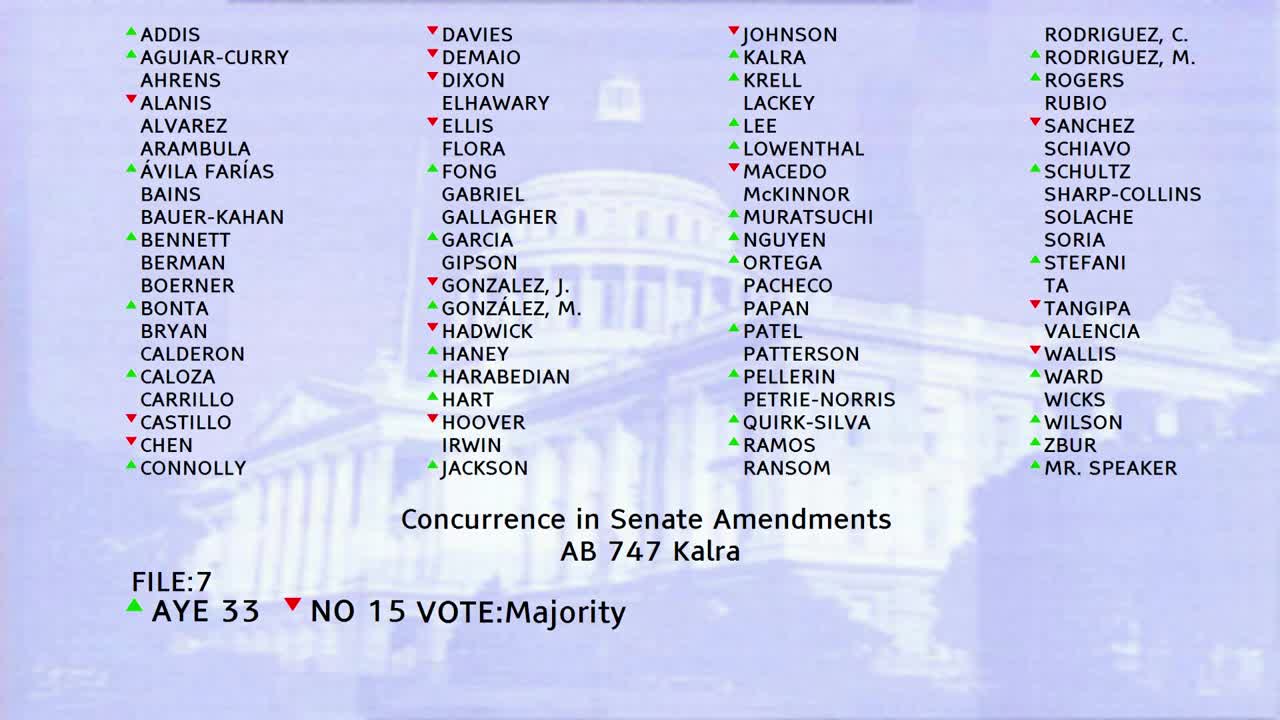 1MIN
Assembly Floor
 1MIN
Senate Floor
 14MIN
Senate Standing Committee on Education
 16MIN
Assembly Standing Committee on Higher Education
Bill Author

Bill Co-Author(s):