AB 2463: Public Utilities Commission: rates: cost of capital proceeding: authorized return on equity.
- Session Year: 2025-2026
- House: Assembly
- Latest Version Date: 2026-09-30
Current Status:
Passed
(2026-09-30: Chaptered by Secretary of State - Chapter 943, Statutes of 2026.)
Introduced
In Committee
Awaiting First Chamber Vote
Passed First Chamber
In Committee
Awaiting Second Chamber Vote
Passed Second Chamber
Enacted
Existing law vests the Public Utilities Commission with regulatory authority over public utilities, including electrical corporations and gas corporations. Existing law authorizes the commission to fix the rates and charges for every public utility and requires that those rates and charges be just and reasonable.
This bill would require the commission, in any proceeding in which the commission considers and determines the authorized return on equity for an electrical corporation or gas corporation, to be known as a cost of capital proceeding, that results in a decision issued on or after December 31, 2030, to include its own assessment of the proposals submitted by the parties and specified information, including, among other things, an identification of each financial model the commission relied upon in determining the authorized return on equity and an analysis of the relationship between the credit quality of the electrical corporation or gas corporation and the authorized return on equity. If, in any cost of capital proceeding, the commission adopts a methodology for determining the authorized return on equity that differs in any material respect from the methodology disclosed in the most recent prior decision in which the commission determined an authorized return on equity for the same electrical corporation or gas corporation, the bill would require the commission to identify each material departure from the prior methodology and provide a reasoned explanation for each material departure.
Existing law requires the commission to develop, publish, and annually update a report containing specified information, including the commissions annual work plan and a summary of deenergization event trends, as specified. Existing law requires the commission to post the report in a conspicuous area of its internet website.
This bill would require the commission to include the analysis of the trends in the California corporation credit ratings described above in that annual report to the Legislature, as provided.
Under existing law, a violation of an order, decision, rule, direction, demand, or requirement of the commission is a crime.
Because a violation of a commission action implementing this bills requirements would be a crime, the bill would impose a state-mandated local program.
The California Constitution requires the state to reimburse local agencies and school districts for certain costs mandated by the state. Statutory provisions establish procedures for making that reimbursement.
This bill would provide that no reimbursement is required by this act for a specified reason.
Existing law vests the Public Utilities Commission with regulatory authority over public utilities, including electrical corporations and gas corporations. Existing law authorizes the commission to fix the rates and charges for every public utility and requires that those rates and charges be just and reasonable.
This bill would require the commission, in any decision issued on or after January 1, 2028, determining an authorized return on equity, as defined, for an electrical corporation or gas corporation, proceeding in which the commission considers and determines the authorized return on equity for an electrical corporation or gas corporation, to be known as a cost of capital proceeding, that results in a decision issued on or after December 31, 2030, to include its own assessment of the proposals submitted by the parties and specified information reflecting the commissions analytical basis for making that determination, information, including, among other things, an identification of each financial model the commission relied upon in determining the authorized return on equity and an analysis of the relationship between the credit quality of the electrical corporation or gas corporation and the authorized return on equity. If, in any cost of capital proceeding, as defined, proceeding, the commission adopts a methodology for determining the authorized return on equity that differs in any material respect from the methodology disclosed in the most recent prior decision in which the commission determined an authorized return on equity for the same electrical corporation or gas corporation, the bill would require the commission to identify each material departure from the prior methodology and provide a reasoned explanation for each material departure.
The bill would also require the commission to initiate a rulemaking proceeding to update its determinations of the cost of capital to conform with the requirements of the bill. The bill would require the proceeding to consider a long-term plan related to these requirements, as specified.Existing law requires the commission to develop, publish, and annually update a report containing specified information, including the commissions annual work plan and a summary of deenergization event trends, as specified. Existing law requires the commission to post the report in a conspicuous area of its internet website.
This bill would require the commission to include the analysis of the trends in the California corporation credit ratings described above in that annual report to the Legislature, as provided.
Under existing law, a violation of an order, decision, rule, direction, demand, or requirement of the commission is a crime.
Because a violation of a commission action implementing this bills requirements would be a crime, the bill would impose a state-mandated local program.
The California Constitution requires the state to reimburse local agencies and school districts for certain costs mandated by the state. Statutory provisions establish procedures for making that reimbursement.
This bill would provide that no reimbursement is required by this act for a specified reason.
Existing law vests the Public Utilities Commission with regulatory authority over public utilities, including electrical corporations and gas corporations. Existing law authorizes the commission to fix the rates and charges for every public utility and requires that those rates and charges be just and reasonable.
This bill would require the commission, in any decision issued on or after January 1, 2028, determining an authorized return on equity, as defined, for an electrical corporation or gas corporation, to include specified information reflecting the commissions independent analytical basis for making that determination, including, among other things, an identification of each financial model the commission relied upon in determining the authorized return on equity and an analysis of the relationship between the credit quality of the electrical corporation or gas corporation and the authorized return on equity. If, in any cost of capital proceeding, as defined, the commission adopts a methodology for determining the authorized return on equity that differs in any material respect from the methodology disclosed in the most recent prior decision in which the commission determined an authorized return on equity for the same electrical corporation or gas corporation, the bill would require the commission to identify each material departure from the prior methodology and provide a reasoned explanation for each material departure.
The bill would also require the commission to initiate a rulemaking proceeding to update its determinations of the cost of capital to conform with the requirements of the bill. The bill would require the proceeding to consider a long-term plan related to these requirements, as specified.
Existing law requires the commission to develop, publish, and annually update a report containing specified information, including the commissions annual work plan and a summary of deenergization event trends, as specified. Existing law requires the commission to post the report in a conspicuous area of its internet website.
This bill would require the commission to include the analysis of the trends in the California corporation credit ratings described above in that annual report to the Legislature. Legislature, as provided.
Under existing law, a violation of an order, decision, rule, direction, demand, or requirement of the commission is a crime.
Because a violation of a commission action implementing this bills requirements would be a crime, the bill would impose a state-mandated local program.
The California Constitution requires the state to reimburse local agencies and school districts for certain costs mandated by the state. Statutory provisions establish procedures for making that reimbursement.
This bill would provide that no reimbursement is required by this act for a specified reason.
Existing law vests the Public Utilities Commission with regulatory authority over public utilities, including electrical corporations and gas corporations. Existing law authorizes the commission to fix the rates and charges for every public utility and requires that those rates and charges be just and reasonable.
This bill would require the commission, in any decision issued on or after January 1, 2028, determining an authorized return on equity, as defined, for an electrical corporation or gas corporation, to include specified information reflecting the commissions independent analytical basis for making that determination, including, among other things, an identification of each financial model the commission relied upon in determining the authorized return on equity and an analysis of the relationship between the credit quality of the electrical corporation or gas corporation and the authorized return on equity. If, in any cost of capital proceeding, as defined, the commission adopts a methodology for determining the authorized return on equity that differs in any material respect from the methodology disclosed in the most recent prior decision in which the commission determined an authorized return on equity for the same electrical corporation or gas corporation, the bill would require the commission to identify each material departure from the prior methodology and provide a reasoned explanation for each material departure.
The bill would also require the commission to initiate a rulemaking proceeding to update its determinations of the cost of capital to conform with the requirements of the bill. The bill would require the proceeding to consider a long-term plan related to these requirements, as specified.
Existing law requires the commission to develop, publish, and annually update a report containing specified information, including the commissions annual work plan and a summary of deenergization event trends, as specified. Existing law requires the commission to post the report in a conspicuous area of its internet website.
This bill would require the commission to include the analysis of the trends in the California corporation credit ratings described above in that annual report to the Legislature.
Under existing law, a violation of an order, decision, rule, direction, demand, or requirement of the commission is a crime.
Because a violation of a commission action implementing this bills requirements would be a crime, the bill would impose a state-mandated local program.
The California Constitution requires the state to reimburse local agencies and school districts for certain costs mandated by the state. Statutory provisions establish procedures for making that reimbursement.
This bill would provide that no reimbursement is required by this act for a specified reason.
Existing law vests the Public Utilities Commission with regulatory authority over public utilities, including electrical corporations and gas corporations. Existing law authorizes the commission to fix the rates and charges for every public utility and requires that those rates and charges be just and reasonable.This bill would require the commission, on or before April 1, 2027, to open a rulemaking to conduct a systemwide review of the methodologies used to determine the cost of capital and authorized return on equity for each electrical corporation and gas corporation. The bill would require the commission to establish and apply a baseline capital-market risk framework to serve as the analytical foundation for determining authorized returns on equity for electrical corporations and gas corporations, as provided. The bill would require the commission to develop and adopt a strategy for adjusting authorized returns on equity for each electrical corporation and gas corporation based on specified load growth or sales volume thresholds. The bill would require the commission to conduct a comprehensive review of the cost of capital adjustment mechanism applicable to each electrical corporation and gas corporation, evaluate the authorized return on equity applicable to each electrical corporations infrastructure that serves transmission-level customers, and to evaluate alternative incentive-based return models that link a portion of shareholder earnings to performance outcomes, as provided.Under existing law, a violation of an order, decision, rule, direction, demand, or requirement of the commission is a crime.Because a violation of a commission action implementing this bills requirements would be a crime, the bill would impose a state-mandated local program.The California Constitution requires the state to reimburse local agencies and school districts for certain costs mandated by the state. Statutory provisions establish procedures for making that reimbursement.This bill would provide that no reimbursement is required by this act for a specified reason.Existing law vests the Public Utilities Commission with regulatory authority over public utilities, including electrical corporations and gas corporations. Existing law authorizes the commission to fix the rates and charges for every public utility and requires that those rates and charges be just and reasonable.
This bill would require the commission, on or before April 1, 2027, to open a rulemaking to conduct a systemwide review of the methodologies used to determine the cost of capital and authorized return on equity for each electrical corporation and gas corporation. The bill would require the commission to establish and apply a baseline capital-market risk framework to serve as the analytical foundation for determining authorized returns on equity for electrical corporations and gas corporations, as provided. The bill would require the commission to develop and adopt a strategy for adjusting authorized returns on equity for each electrical corporation and gas corporation based on specified load growth or sales volume thresholds. The bill would require the commission to conduct a comprehensive review of the cost of capital adjustment mechanism applicable to each electrical corporation and gas corporation, evaluate the authorized return on equity applicable to each electrical corporations infrastructure that serves transmission-level customers, and to evaluate alternative incentive-based return models that link a portion of shareholder earnings to performance outcomes, as provided.
Under existing law, a violation of an order, decision, rule, direction, demand, or requirement of the commission is a crime.
Because a violation of a commission action implementing this bills requirements would be a crime, the bill would impose a state-mandated local program.
The California Constitution requires the state to reimburse local agencies and school districts for certain costs mandated by the state. Statutory provisions establish procedures for making that reimbursement.
This bill would provide that no reimbursement is required by this act for a specified reason.
The Legislature finds and declares all of the following:
(a)The Public Utilities Commission determines the authorized rate of return for investor-owned utilities by weighing competing financial models and analyses of investment risk submitted by the utilities and other parties. This determination is known as the cost of capital or return on equity, represents billions of dollars, and applies to the utilities capital investments.
(b)Commission decisions in cost of capital proceedings typically summarize the parties positions and state a conclusion. Those decisions do not consistently disclose the specific financial models, inputs, assumptions, or weighting on which the commission relied. This limits the ability of ratepayers, the Legislature, and other stakeholders to evaluate the analytical basis for the commissions determinations.
(c)The commissions determination of a fair rate of return, including the authorized return on equity, is governed by the constitutional standards established by the United States Supreme Court in Federal Power Commission v. Hope Natural Gas Co. (1944) 320 U.S. 591 and Bluefield Waterworks & Imp. Co. v. Public Service Commission of W. Va. (1923) 262 U.S. 679.
(d)The Federal Energy Regulatory Commission has adopted a more structured and reproducible analytical framework for determining the authorized return on equity for the utilities it regulates. That framework includes defined financial model weighting and enhanced disclosure of its analytical methods.
(e)As California electrifies transportation, buildings, and industrial processes, a growing share of the states economy will depend on the cost of electricity. The authorized return on equity will therefore represent an increasing share of the rates paid by residential, commercial, and industrial customers.
(f)Requiring the commission to disclose its analytical methodology, to maintain consistency across proceedings or explain any departures from prior methodology, will promote accountability, predictability, and public confidence in the ratemaking process.
SEC. 2.Section 753 is added to the Public Utilities Code, to read:753.(a)For purposes of this section, all of the following definitions apply:
(1)Authorized return on equity means the return on common equity authorized by the commission for an electrical corporation or gas corporation in a cost of capital proceeding or through an automatic adjustment mechanism adopted in connection with a cost of capital proceeding.
(2)Cost of capital proceeding means a proceeding in which the commission considers and determines the authorized return on equity for an electrical corporation or gas corporation.
(3)Financial model means a quantitative method used to estimate the cost of equity capital, including, but not limited to, a discounted cash flow model, capital asset pricing model, risk premium analysis, and comparable earnings analysis.
(b)In a cost of capital proceeding, the commission shall include its own assessment of the proposals submitted by the parties. This assessment shall include all of the following:
(1)An identification of each financial model the commission relied upon in determining the authorized return on equity.
(2)The commissions analysis, based on the record and separate and apart from the positions or analyses submitted by the parties.
(3)For each financial model identified pursuant to paragraph (1), a specification of the key inputs and assumptions used, including, but not limited to, the proxy group of companies, growth rate estimates, risk-free rate benchmarks, equity risk premiums, beta estimates, and any other material analytical inputs.
(4)The data sources for each material input to each financial model relied upon by the commission.
(5)The relative weight assigned to each financial model in arriving at the authorized return on equity, expressed in quantitative terms.
(6)A mathematical derivation demonstrating how the authorized return on equity follows from the models, inputs, and weights specified pursuant to paragraphs (1) to (5), inclusive, so that a person with expertise in utility finance could independently reproduce the result from the information contained in the decision.
(7)A description of any qualitative adjustments made to the result produced by the financial models, including the direction and magnitude of each adjustment and the specific basis for each adjustment.
(8)The complete calculations underlying the authorized return on equity, presented in a structured format that permits independent verification.
(9)(A)If the commission relied upon a range of results from a financial model, the full range and the basis for selecting a point estimate within that range.
(B)If the commission relied upon a settlement from the parties to adopt an authorized rate of return, the settling parties shall furnish sufficient information to enable the commission to make a finding in subparagraph (A) that the amount agreed upon in the settlement is just and reasonable.
(10)A comparison of the authorized return on equity to the results produced by each individual financial model before weighting or qualitative adjustment.
(11)An identification of the peer group of similarly situated electrical corporations or gas corporations used in the commissions analysis, the most recently authorized return on equity for each member of the peer group, and an explanation of where the authorized return on equity for the subject electrical corporation or gas corporation falls relative to the range of authorized returns on equity for the peer group, including the basis for any material deviation from the central tendency of the peer group if it is understood and knowable by the commission.
(12)An analysis of the relationship between the credit quality of the electrical corporation or gas corporation and the authorized return on equity, including a discussion of how changes in the corporations credit ratings or other credit market indicators informed the commissions determination.
(c)If, in any cost of capital proceeding, the commission adopts a methodology for determining the authorized return on equity that differs in any material respect from the methodology disclosed in the most recent prior decision in which the commission determined an authorized return on equity for the same electrical corporation or gas corporation, the commission shall, in addition to the requirements of subdivision (b), do both of the following:
(1)Identify each material departure from the prior methodology, including any change in the financial models used, the weighting of models, the categories of inputs relied upon, or the approach to qualitative adjustments.
(2)Provide a reasoned explanation for each material departure, including an explanation of why the prior methodology was inadequate or why changed circumstances warranted adoption of a different methodology.
(d)This section does not prescribe or limit the financial models, inputs, or methods that the commission may use in determining the authorized return on equity. The commission retains full discretion to select and apply the analytical methods it determines to be appropriate, subject to the disclosure and consistency requirements of this section.
(e)(1)This section applies to any cost of capital proceeding that results in a decision issued on or after December 31, 2030.
(2)This section applies regardless of whether the decision described in paragraph (1) results in a decrease or increase in rates or in a change to a rate schedule.
SEC. 3.Section 910.10 is added to the Public Utilities Code, immediately following Section 910.8, to read:910.10.The commission shall annually provide to the Legislature an analysis of the trends in the California corporation credit ratings based on the analysis required by paragraph (12) of subdivision (b) of Section 753, updated as necessary to reflect current credit rating information in years when no decision determining an authorized return on equity is issued. The commission shall provide this analysis as part of its annual report published pursuant to Section 910.
SEC. 4.No reimbursement is required by this act pursuant to Section 6 of Article XIIIB of the California Constitution because the only costs that may be incurred by a local agency or school district will be incurred because this act creates a new crime or infraction, eliminates a crime or infraction, or changes the penalty for a crime or infraction, within the meaning of Section 17556 of the Government Code, or changes the definition of a crime within the meaning of Section 6 of Article XIIIB of the California Constitution.
The Legislature finds and declares all of the following:
(a)The Public Utilities Commission determines the authorized rate of return for investor-owned utilities by weighing competing financial models and analyses of investment risk submitted by the utilities and other parties. This determination is known as the cost of capital or return on equity, represents billions of dollars, and applies to the utilities capital investments.
(b)Commission decisions in cost of capital proceedings typically summarize the parties positions and state a conclusion. Those decisions do not consistently disclose the specific financial models, inputs, assumptions, or weighting on which the commission relied. This limits the ability of ratepayers, the Legislature, and other stakeholders to evaluate the analytical basis for the commissions determinations.
(c)The commissions determination of a fair rate of return, including the authorized return on equity, is governed by the constitutional standards established by the United States Supreme Court in Federal Power Commission v. Hope Natural Gas Co. (1944) 320 U.S. 591 and Bluefield Waterworks & Imp. Co. v. Public Service Commission of W. Va. (1923) 262 U.S. 679.
(d)The Federal Energy Regulatory Commission has adopted a more structured and reproducible analytical framework for determining the authorized return on equity for the utilities it regulates. That framework includes defined financial model weighting and enhanced disclosure of its analytical methods.
(e)As California electrifies transportation, buildings, and industrial processes, a growing share of the states economy will depend on the cost of electricity. The authorized return on equity will therefore represent an increasing share of the rates paid by residential, commercial, and industrial customers.
(f)Requiring the commission to disclose its analytical methodology, to maintain consistency across proceedings or explain any departures from prior methodology, will promote accountability, predictability, and public confidence in the ratemaking process.
SEC. 2.Section 753 is added to the Public Utilities Code, to read:753.(a)For purposes of this section, all of the following definitions apply:
(1)Authorized return on equity means the return on common equity authorized by the commission for an electrical corporation or gas corporation in a cost of capital proceeding or through an automatic adjustment mechanism adopted in connection with a cost of capital proceeding.
(2)Cost of capital proceeding means a proceeding in which the commission considers and determines the authorized cost of capital for an electrical corporation or gas corporation, including the authorized return on equity, the cost of long-term debt, and the capital structure, and including a proceeding to establish or modify an automatic adjustment mechanism applicable to any component of the authorized cost of capital. return on equity for an electrical corporation or gas corporation.
(3)Financial model means a quantitative method used to estimate the cost of equity capital, including, but not limited to, a discounted cash flow model, capital asset pricing model, risk premium analysis, and comparable earnings analysis.
(b)In a decision determining an authorized return on equity, cost of capital proceeding, the commission shall include its own assessment of the proposals submitted by the parties. This assessment shall include all of the following, which shall reflect the commissions analytical basis for its determination: following:
(1)An identification of each financial model the commission relied upon in determining the authorized return on equity.
(2)The commissions independent analysis, based on the record and separate and apart from the positions or analyses submitted by the parties.
(3)For each financial model identified pursuant to paragraph (1), a specification of the key inputs and assumptions used, including, but not limited to, the proxy group of companies, growth rate estimates, risk-free rate benchmarks, equity risk premiums, beta estimates, and any other material analytical inputs.
(4)The data sources for each material input to each financial model relied upon by the commission.
(5)The relative weight assigned to each financial model in arriving at the authorized return on equity, expressed in quantitative terms.
(6)A mathematical derivation demonstrating how the authorized return on equity follows from the models, inputs, and weights specified pursuant to paragraphs (1) to (5), inclusive, so that a person with expertise in utility finance could independently reproduce the result from the information contained in the decision.
(7)A description of any qualitative adjustments made to the result produced by the financial models, including the direction and magnitude of each adjustment and the specific basis for each adjustment.
(8)The complete calculations underlying the authorized return on equity, presented in a structured format that permits independent verification.
(9)(A)If the commission relied upon a range of results from a financial model, the full range and the basis for selecting a point estimate within that range.
(B)If the commission relied upon a settlement from the parties to adopt an authorized rate of return, the settling parties shall furnish sufficient information to enable the commission to make a finding in subparagraph (A) that the amount agreed upon in the settlement is just and reasonable.
(10)A comparison of the authorized return on equity to the results produced by each individual financial model before weighting or qualitative adjustment.
(11)An identification of the peer group of similarly situated electrical corporations or gas corporations used in the commissions analysis, the most recently authorized return on equity for each member of the peer group, and an explanation of where the authorized return on equity for the subject electrical corporation or gas corporation falls relative to the range of authorized returns on equity for the peer group, including the basis for any material deviation from the central tendency of the peer group if it is understood and knowable by the commission.
(12)An analysis of the relationship between the credit quality of the electrical corporation or gas corporation and the authorized return on equity, including a discussion of how changes in the corporations credit ratings or other credit market indicators informed the commissions determination.
(c)If, in any cost of capital proceeding, the commission adopts a methodology for determining the authorized return on equity that differs in any material respect from the methodology disclosed in the most recent prior decision in which the commission determined an authorized return on equity for the same electrical corporation or gas corporation, the commission shall, in addition to the requirements of subdivision (b), do both of the following:
(1)Identify each material departure from the prior methodology, including any change in the financial models used, the weighting of models, the categories of inputs relied upon, or the approach to qualitative adjustments.
(2)Provide a reasoned explanation for each material departure, including an explanation of why the prior methodology was inadequate or why changed circumstances warranted adoption of a different methodology.
(d)This section does not prescribe or limit the financial models, inputs, or methods that the commission may use in determining the authorized return on equity. The commission retains full discretion to select and apply the analytical methods it determines to be appropriate, subject to the disclosure and consistency requirements of this section.
(e)(1)This section applies to any decision determining an authorized return on equity cost of capital proceeding that results in a decision issued on or after January 1, 2028. December 31, 2030.
(2)This section applies regardless of whether the decision described in paragraph (1) results in a decrease or increase in rates or in a change to a rate schedule.
(f)The commission shall initiate a rulemaking proceeding to update its determinations of the cost of capital to conform with the requirements of this section. This proceeding shall consider a long-term plan that does both of the following:(1)Revises financial models for electrical corporations to accommodate large demand growth between the years 2030 and 2045 in order to meet the states climate goals, while enabling sufficient investment and ensuring that rates remain just and reasonable.(2)Analyzes whether the selection of financial models aligns with new investments made by gas corporations and with changes to customer demand for natural gas.SEC. 3.Section 910.10 is added to the Public Utilities Code, to immediately follow following Section 910.8, to read:910.10.The commission shall annually provide to the Legislature an analysis of the trends in the California corporation credit ratings based on the analysis required by paragraph (12) of subdivision (b) of Section 753, updated as necessary to reflect current credit rating information in years when no decision determining an authorized return on equity is issued. The commission shall provide this analysis as part of its annual report published pursuant to Section 910.
SEC. 4.No reimbursement is required by this act pursuant to Section 6 of Article XIIIB of the California Constitution because the only costs that may be incurred by a local agency or school district will be incurred because this act creates a new crime or infraction, eliminates a crime or infraction, or changes the penalty for a crime or infraction, within the meaning of Section 17556 of the Government Code, or changes the definition of a crime within the meaning of Section 6 of Article XIIIB of the California Constitution.
The Legislature finds and declares all of the following:
(a)The authorized rate of return, including the authorized return on equity and capital structure, as determined by the Public Utilities Commission for electrical corporations and gas corporations is a central determinant of the revenue requirement and underlying rates charged to California ratepayers and represents billions of dollars in annual revenue requirements. These requests are known as cost of capital. The authorized rate of return, including the return on equity, applies to all capital investments made by the utilities, but does not include other aspects of their revenue requirements, such as operational expenditures.
(b)The process by which the commission determines the authorized return on equity relies on competing financial models and analyses of investment risk as adjudicated by parties and the utilities. Under current practice, commission decisions in cost of capital proceedings typically summarize the positions of the parties and state a conclusion, but do not consistently disclose the specific financial models, inputs, assumptions, or weighting that the commission relied upon in arriving at the authorized capital structure, including the return on equity. This limits the ability of ratepayers, the Legislature, and other stakeholders to evaluate the analytical basis for these determinations.
(c)The Federal Energy Regulatory Commission has, through a series of adjudicatory and policy proceedings, moved toward a more structured and reproducible analytical framework for determining the authorized return on equity for jurisdictional utilities, including the adoption of defined financial model weighting and enhanced disclosure of analytical methods.
(d)As California advances policies to electrify transportation, buildings, and industrial processes, an increasing share of the states economy will depend on electricity rates established by the commission. This will require significant investments in new capital infrastructure that will be subject to the cost of capital determinations.
(e)The rate base of electrical corporations, which is a segment of how much the portion of physical infrastructure the electrical corporations can earn a rate of return upon, will grow substantially to support the clean energy transition. The authorized return on equity, applied to that expanding rate base, will represent an increasingly significant a growing component of the rates paid by residential, commercial, and industrial customers.
(f)The expanding scope and financial magnitude of commission determinations regarding the cost of capital heighten the need for analytical transparency and public accountability in the process by which those determinations are made.
(g)Requiring the commission to disclose its analytical methodology and to maintain consistency in its approach across proceedings, or to explain departures from prior methodology, will promote accountability, predictability, and public confidence in the ratemaking process without dictating any particular substantive outcome.
SEC. 2.Section 753 is added to the Public Utilities Code, to read:753.(a)For purposes of this section, all of the following definitions apply:
(1)Authorized return on equity means the return on common equity authorized by the commission for an electrical corporation or gas corporation in a cost of capital proceeding or through an automatic adjustment mechanism adopted in connection with a cost of capital proceeding.
(2)Cost of capital proceeding means a proceeding in which the commission considers and determines the authorized return on equity cost of capital for an electrical corporation or gas corporation, including the authorized return on equity, the cost of long-term debt, and the capital structure, and including a proceeding to establish or modify an automatic adjustment mechanism for the return on equity. applicable to any component of the authorized cost of capital.
(3)Financial model means a quantitative method used to estimate the cost of equity capital, including, but not limited to, a discounted cash flow model, capital asset pricing model, risk premium analysis, and comparable earnings analysis.
(b)In a decision determining an authorized return on equity, the commission shall include all of the following, which shall reflect the commissions independent analytical basis for its determination and shall not consist solely of a selection from the positions or analyses submitted by the parties: determination:
(1)An identification of each financial model the commission relied upon in determining the authorized return on equity.
(2)The commissions independent analysis, separate and apart from the positions or analyses submitted by the parties.
(2)(3)For each financial model identified pursuant to paragraph (1), a specification of the key inputs and assumptions used, including, but not limited to, the proxy group of companies, growth rate estimates, risk-free rate benchmarks, equity risk premiums, beta estimates, and any other material analytical inputs.
(3)(4)The data sources for each material input to each financial model relied upon by the commission.
(4)(5)The relative weight assigned to each financial model in arriving at the authorized return on equity, expressed in quantitative terms.
(5)(6)A mathematical derivation demonstrating how the authorized return on equity follows from the models, inputs, and weights specified pursuant to paragraphs (1) to (4), (5), inclusive, so that a person with expertise in utility finance could independently reproduce the result from the information contained in the decision.
(6)(7)A description of any qualitative adjustments made to the result produced by the financial models, including the direction and magnitude of each adjustment and the specific basis for each adjustment.
(7)(8)The complete calculations underlying the authorized return on equity, presented in a structured format that permits independent verification.
(8)(9)(A)If the commission relied upon a range of results from a financial model, the full range and the basis for selecting a point estimate within that range.
(B)If the commission relied upon a settlement from the parties to adopt an authorized rate of return, the settling parties shall furnish sufficient information to enable the commission to make a finding in subparagraph (A) that the amount agreed upon in the settlement is just and reasonable.
(9)(10)A comparison of the authorized return on equity to the results produced by each individual financial model before weighting or qualitative adjustment.
(10)(11)An identification of the peer group of similarly situated electrical corporations or gas corporations used in the commissions analysis, the most recently authorized return on equity for each member of the peer group, and an explanation of where the authorized return on equity for the subject electrical corporation or gas corporation falls relative to the range of authorized returns on equity for the peer group, including the basis for any material deviation from the central tendency of the peer group. group if it is understood and knowable by the commission.
(11)(12)An analysis of the relationship between the credit quality of the electrical corporation or gas corporation and the authorized return on equity, including a discussion of how changes in the corporations credit ratings or other credit market indicators informed the commissions determination.
(c)If, in any cost of capital proceeding, the commission adopts a methodology for determining the authorized return on equity that differs in any material respect from the methodology disclosed in the most recent prior decision in which the commission determined an authorized return on equity for the same electrical corporation or gas corporation, the commission shall, in addition to the requirements of subdivision (b), do both of the following:
(1)Identify each material departure from the prior methodology, including any change in the financial models used, the weighting of models, the categories of inputs relied upon, or the approach to qualitative adjustments.
(2)Provide a reasoned explanation for each material departure, including an explanation of why the prior methodology was inadequate or why changed circumstances warranted adoption of a different methodology.
(d)This section does not prescribe or limit the financial models, inputs, or methods that the commission may use in determining the authorized return on equity. The commission retains full discretion to select and apply the analytical methods it determines to be appropriate, subject to the disclosure and consistency requirements of this section.
(e)(1)This section applies to any decision determining an authorized return on equity issued on or after January 1, 2028.
(2)This section applies regardless of whether the decision results in a decrease or increase in rates or in a change to a rate schedule.
(f)The commission shall initiate a rulemaking proceeding to update its determinations of the cost of capital to conform with the requirements of this section. This proceeding shall consider a long-term plan that does both of the following:
(1)Revises financial models for electrical corporations to accommodate large demand growth between the years 2030 and 2045 in order to meet the states climate goals, while enabling sufficient investment and ensuring that rates remain just and reasonable.
(2)Analyzes whether the selection of financial models aligns with new investments made by gas corporations and with changes to customer demand for natural gas.
SEC. 3.Section 910.10 is added to the Public Utilities Code, to immediately follow Section 910.8, to read:910.10.The commission shall annually provide to the Legislature an analysis of the trends in the California corporation credit ratings based on an analysis of the relationship between the credit quality of the electrical corporations and gas corporations, as required by Section 753. the analysis required by paragraph (12) of subdivision (b) of Section 753, updated as necessary to reflect current credit rating information in years when no decision determining an authorized return on equity is issued. The commission shall provide this analysis as part of its annual report published pursuant to Section 910.
SEC. 4.No reimbursement is required by this act pursuant to Section 6 of Article XIIIB of the California Constitution because the only costs that may be incurred by a local agency or school district will be incurred because this act creates a new crime or infraction, eliminates a crime or infraction, or changes the penalty for a crime or infraction, within the meaning of Section 17556 of the Government Code, or changes the definition of a crime within the meaning of Section 6 of Article XIIIB of the California Constitution.
The Legislature finds and declares all of the following:
(a)The authorized rate of return, including the authorized return on equity and capital structure, as determined by the Public Utilities Commission for electrical corporations and gas corporations is a central determinant of the revenue requirement and underlying rates charged to California ratepayers and represents billions of dollars in annual revenue requirements. These requests are known as cost of capital. The authorized rate of return, including the return on equity, applies to all capital investments made by the utilities, but does not include other aspects of their revenue requirements, such as operational expenditures.
(b)The process by which the commission determines the authorized return on equity relies on competing financial models and analyses of investment risk as adjudicated by parties and the utilities. Under current practice, commission decisions in cost of capital proceedings typically summarize the positions of the parties and state a conclusion, but do not consistently disclose the specific financial models, inputs, assumptions, or weighting that the commission relied upon in arriving at the authorized capital structure, including the return on equity. This limits the ability of ratepayers, the Legislature, and other stakeholders to evaluate the analytical basis for these determinations.
(c)The Federal Energy Regulatory Commission has, through a series of adjudicatory and policy proceedings, moved toward a more structured and reproducible analytical framework for determining the authorized return on equity for jurisdictional utilities, including the adoption of defined financial model weighting and enhanced disclosure of analytical methods.
(d)As California advances policies to electrify transportation, buildings, and industrial processes, an increasing share of the states economy will depend on electricity rates established by the commission. This will require significant investments in new capital infrastructure that will be subject to the cost of capital determinations.
(e)The rate base of electrical corporations, which is a segment of how much physical infrastructure the electrical corporations can earn a rate of return upon, will grow substantially to support the clean energy transition. The authorized return on equity, applied to that expanding rate base, will represent an increasingly significant component of the rates paid by residential, commercial, and industrial customers.
(f)The expanding scope and financial magnitude of commission determinations regarding the cost of capital heighten the need for analytical transparency and public accountability in the process by which those determinations are made.
(g)Requiring the commission to disclose its analytical methodology and to maintain consistency in its approach across proceedings, or to explain departures from prior methodology, will promote accountability, predictability, and public confidence in the ratemaking process without dictating any particular substantive outcome.
SEC. 2.Section 753 is added to the Public Utilities Code, to read:753.(a)For purposes of this section, all of the following definitions apply:
(1)Authorized return on equity means the return on common equity authorized by the commission for an electrical corporation or gas corporation in a cost of capital proceeding or through an automatic adjustment mechanism adopted in connection with a cost of capital proceeding.
(2)Cost of capital proceeding means a proceeding in which the commission considers and determines the authorized return on equity for an electrical corporation or gas corporation, including a proceeding to establish or modify an automatic adjustment mechanism for the return on equity.
(3)Financial model means a quantitative method used to estimate the cost of equity capital, including, but not limited to, a discounted cash flow model, capital asset pricing model, risk premium analysis, and comparable earnings analysis.
(b)In a decision determining an authorized return on equity, the commission shall include all of the following, which shall reflect the commissions independent analytical basis for its determination and shall not consist solely of a selection from the positions or analyses submitted by the parties:
(1)An identification of each financial model the commission relied upon in determining the authorized return on equity.
(2)For each financial model identified pursuant to paragraph (1), a specification of the key inputs and assumptions used, including, but not limited to, the proxy group of companies, growth rate estimates, risk-free rate benchmarks, equity risk premiums, beta estimates, and any other material analytical inputs.
(3)The data sources for each material input to each financial model relied upon by the commission.
(4)The relative weight assigned to each financial model in arriving at the authorized return on equity, expressed in quantitative terms.
(5)A mathematical derivation demonstrating how the authorized return on equity follows from the models, inputs, and weights specified pursuant to paragraphs (1) to (4), inclusive, so that a person with expertise in utility finance could independently reproduce the result from the information contained in the decision.
(6)A description of any qualitative adjustments made to the result produced by the financial models, including the direction and magnitude of each adjustment and the specific basis for each adjustment.
(7)The complete calculations underlying the authorized return on equity, presented in a structured format that permits independent verification.
(8)(A)If the commission relied upon a range of results from a financial model, the full range and the basis for selecting a point estimate within that range.
(B)If the commission relied upon a settlement from the parties to adopt an authorized rate of return, the settling parties shall furnish sufficient information to enable the commission to make a finding in subparagraph (A) that the amount agreed upon in the settlement is just and reasonable.
(9)A comparison of the authorized return on equity to the results produced by each individual financial model before weighting or qualitative adjustment.
(10)An identification of the peer group of similarly situated electrical corporations or gas corporations used in the commissions analysis, the most recently authorized return on equity for each member of the peer group, and an explanation of where the authorized return on equity for the subject electrical corporation or gas corporation falls relative to the range of authorized returns on equity for the peer group, including the basis for any material deviation from the central tendency of the peer group.
(11)An analysis of the relationship between the credit quality of the electrical corporation or gas corporation and the authorized return on equity, including a discussion of how changes in the corporations credit ratings or other credit market indicators informed the commissions determination.
(c)If, in any cost of capital proceeding, the commission adopts a methodology for determining the authorized return on equity that differs in any material respect from the methodology disclosed in the most recent prior decision in which the commission determined an authorized return on equity for the same electrical corporation or gas corporation, the commission shall, in addition to the requirements of subdivision (b), do both of the following:
(1)Identify each material departure from the prior methodology, including any change in the financial models used, the weighting of models, the categories of inputs relied upon, or the approach to qualitative adjustments.
(2)Provide a reasoned explanation for each material departure, including an explanation of why the prior methodology was inadequate or why changed circumstances warranted adoption of a different methodology.
(d)This section does not prescribe or limit the financial models, inputs, or methods that the commission may use in determining the authorized return on equity. The commission retains full discretion to select and apply the analytical methods it determines to be appropriate, subject to the disclosure and consistency requirements of this section.
(e)(1)This section applies to any decision determining an authorized return on equity issued on or after January 1, 2028.
(2)This section applies regardless of whether the decision results in a decrease or increase in rates or in a change to a rate schedule.
(f)The commission shall initiate a rulemaking proceeding to update its determinations of the cost of capital to conform with the requirements of this section. This proceeding shall consider a long-term plan that does both of the following:
(1)Revises financial models for electrical corporations to accommodate large demand growth between the years 2030 and 2045 in order to meet the states climate goals, while enabling sufficient investment and ensuring that rates remain just and reasonable.
(2)Analyzes whether the selection of financial models aligns with new investments made by gas corporations and with changes to customer demand for natural gas.
SEC. 3.Section 910.10 is added to the Public Utilities Code, to immediately follow Section 910.8, to read:910.10.The commission shall annually provide to the Legislature an analysis of the trends in the California corporation credit ratings based on an analysis of the relationship between the credit quality of the electrical corporations and gas corporations, as required by Section 753. The commission shall provide this analysis as part of its annual report published pursuant to Section 910.
SEC. 4.No reimbursement is required by this act pursuant to Section 6 of Article XIIIB of the California Constitution because the only costs that may be incurred by a local agency or school district will be incurred because this act creates a new crime or infraction, eliminates a crime or infraction, or changes the penalty for a crime or infraction, within the meaning of Section 17556 of the Government Code, or changes the definition of a crime within the meaning of Section 6 of Article XIIIB of the California Constitution.
SECTION 1.The Legislature finds and declares all of the following:(a)Electrical corporations and gas corporations are entitled to a reasonable opportunity to earn a fair return on their invested capital, but ratepayers should not bear costs that exceed the level necessary to attract capital under prevailing market conditions.(b)Rapid load growth, including from electrification and large transmission-level customers, can materially increase utility sale volumes, reduce per-unit revenue risk, and change the risk profile associated with authorized returns on equity.(c)Gas and electrical utility operations are subject to materially different long-term demand trajectories, regulatory risks, and asset lives, and therefore should not be compensated using a uniform equity return.(d)The cost of capital adjustment mechanism was designed to reflect changing capital market conditions but has not consistently produced downward adjustments when market conditions would support those reductions.(e)Ratepayers should not pay full equity returns on infrastructure investments for which their utility did not provide initial capital or bear comparable financial risk.(f)Aligning shareholder earnings with performance outcomes can better protect ratepayers while preserving safe and reliable utility service and can improve delivery of outcomes such as timely interconnections, cost containment, and risk mitigation. SEC. 2.Section 759.5 is added to the Public Utilities Code, to read:759.5.(a)On or before April 1, 2027, the commission shall open rulemaking to conduct a systemwide review of the methodologies used to determine the cost of capital and authorized return on equity for each electrical corporation and gas corporation.(b)The rulemaking shall be a quasi-legislative proceeding and shall be scoped to consider broader structural reforms to cost of capital calculations, anchored by the establishment and application of a baseline capital-market risk framework, including all matters described in Sections 759.6 to 759.10, inclusive.SEC. 3.Section 759.6 is added to the Public Utilities Code, to read:759.6.(a)In the rulemaking opened pursuant to Section 759.5, the commission shall establish and apply a baseline capital-market risk framework to serve as the analytical foundation for determining authorized returns on equity for each electrical corporation and gas corporation.(b)The framework shall identify the baseline business, financial, and regulatory risks faced by each electrical corporation and gas corporation, considering risk-mitigating features of cost-of-service regulation, including authorized cost recovery mechanisms, revenue stabilization tools, and regulatory oversight.(c)The baseline capital-market risk framework shall be rebuttable only upon a showing by an electrical corporation or gas corporation that the electrical corporation or gas corporation faces materially greater risk than that reflected in the framework.(d)A showing shall not be required for the commission to authorize a return on equity at or below the level indicated by the baseline capital-market risk framework based on evidence on the record.(e)The commission shall use the baseline capital-market risk framework as the required analytical reference point for implementing Sections 759.5 and 759.7.(f)Any upward departure from the baseline capital-market risk framework shall be supported by express findings, based on substantial evidence, demonstrating that the electrical corporation or gas corporation faces materially greater risk than that reflected in the framework.SEC. 4.Section 759.7 is added to the Public Utilities Code, to read:759.7.(a)Applying the baseline capital-market risk framework established pursuant to Section 759.6, the commission shall develop and adopt a strategy for adjusting the authorized return on equity for each electrical corporation and gas corporation based on specified load growth or sales volume thresholds.(b)The strategy shall recognize that sustained load growth may reduce per-unit revenue risk and shall include clear, prospective triggers that result in downward adjustments to an authorized return on equity when those thresholds are met.(c)A strategy adopted pursuant to this section shall be transparent, predictable, and designed to balance ratepayer interests with the continued ability of an electrical corporation or gas corporation to attract capital.SEC. 5.Section 759.8 is added to the Public Utilities Code, to read:759.8.(a)Applying the baseline capital-market risk framework established pursuant to Section 759.6, the commission shall conduct a comprehensive review of the cost of capital adjustment mechanism applicable to each electrical corporation and gas corporation.(b)The review shall evaluate whether the mechanism has operated symmetrically to reflect changes in capital market conditions in both upward and downward directions.(c)The commission shall evaluate the ratepayer and shareholder impacts associated with the mechanism.(d)The commission shall evaluate past instances in which the mechanism was not triggered or was suspended despite market conditions that would have supported a reduction in the authorized return on equity.(e)The commission shall adopt any modifications necessary to improve the objectivity and credibility of the mechanism.SEC. 6.Section 759.9 is added to the Public Utilities Code, to read:759.9.(a)Applying the baseline capital-market risk framework established pursuant to Section 759.6, the commission shall evaluate the authorized return on equity applicable to each electrical corporations infrastructure that serves transmission-level customers.(b)The evaluation shall apply to infrastructure projects in which the initial capital is provided, in whole or in part, by a transmission-level customer or other entity, other than an electrical corporation, including through advances, prepayments, or similar financing arrangements.(c)For infrastructure projects described in subdivision (b), the commission shall ensure that the authorized return on equity reflects the electrical corporations actual capital at risk and financial exposure.(d)The commission shall not authorize the same return on equity for infrastructure projects described in subdivision (b) as for the electrical corporation-financed infrastructure unless it makes express findings that the electrical corporation has borne comparable financial risk.(e)In implementing this section, the commission shall consider mechanisms to remove disincentives for timely interconnection or project delivery.SEC. 7.Section 759.10 is added to the Public Utilities Code, to read:759.10.(a)Applying the baseline capital-market risk framework established pursuant to Section 759.6, the commission shall evaluate alternative incentive-based return models that link a portion of shareholder earnings to performance outcomes.(b)The commission may implement pilot programs, phased approaches, or incorporate incentive-based return models into its ratemaking determinations.(c)For purposes of this section, the term performance outcomes includes, but is not limited to, cost control, timely interconnection, reliability, safety, and risk reduction.SEC. 8.The provisions of this act are severable. If any provision of this act or its application is held invalid, that invalidity shall not affect other provisions or applications that can be given effect without the invalid provision or application.SEC. 9.No reimbursement is required by this act pursuant to Section 6 of Article XIIIB of the California Constitution because the only costs that may be incurred by a local agency or school district will be incurred because this act creates a new crime or infraction, eliminates a crime or infraction, or changes the penalty for a crime or infraction, within the meaning of Section 17556 of the Government Code, or changes the definition of a crime within the meaning of Section 6 of Article XIIIB of the California Constitution.The Legislature finds and declares all of the following:
(a)Electrical corporations and gas corporations are entitled to a reasonable opportunity to earn a fair return on their invested capital, but ratepayers should not bear costs that exceed the level necessary to attract capital under prevailing market conditions.
(b)Rapid load growth, including from electrification and large transmission-level customers, can materially increase utility sale volumes, reduce per-unit revenue risk, and change the risk profile associated with authorized returns on equity.
(c)Gas and electrical utility operations are subject to materially different long-term demand trajectories, regulatory risks, and asset lives, and therefore should not be compensated using a uniform equity return.
(d)The cost of capital adjustment mechanism was designed to reflect changing capital market conditions but has not consistently produced downward adjustments when market conditions would support those reductions.
(e)Ratepayers should not pay full equity returns on infrastructure investments for which their utility did not provide initial capital or bear comparable financial risk.
(f)Aligning shareholder earnings with performance outcomes can better protect ratepayers while preserving safe and reliable utility service and can improve delivery of outcomes such as timely interconnections, cost containment, and risk mitigation.
SEC. 2.Section 759.5 is added to the Public Utilities Code, to read:759.5.(a)On or before April 1, 2027, the commission shall open rulemaking to conduct a systemwide review of the methodologies used to determine the cost of capital and authorized return on equity for each electrical corporation and gas corporation.
(b)The rulemaking shall be a quasi-legislative proceeding and shall be scoped to consider broader structural reforms to cost of capital calculations, anchored by the establishment and application of a baseline capital-market risk framework, including all matters described in Sections 759.6 to 759.10, inclusive.
SEC. 3.Section 759.6 is added to the Public Utilities Code, to read:759.6.(a)In the rulemaking opened pursuant to Section 759.5, the commission shall establish and apply a baseline capital-market risk framework to serve as the analytical foundation for determining authorized returns on equity for each electrical corporation and gas corporation.
(b)The framework shall identify the baseline business, financial, and regulatory risks faced by each electrical corporation and gas corporation, considering risk-mitigating features of cost-of-service regulation, including authorized cost recovery mechanisms, revenue stabilization tools, and regulatory oversight.
(c)The baseline capital-market risk framework shall be rebuttable only upon a showing by an electrical corporation or gas corporation that the electrical corporation or gas corporation faces materially greater risk than that reflected in the framework.
(d)A showing shall not be required for the commission to authorize a return on equity at or below the level indicated by the baseline capital-market risk framework based on evidence on the record.
(e)The commission shall use the baseline capital-market risk framework as the required analytical reference point for implementing Sections 759.5 and 759.7.
(f)Any upward departure from the baseline capital-market risk framework shall be supported by express findings, based on substantial evidence, demonstrating that the electrical corporation or gas corporation faces materially greater risk than that reflected in the framework.
SEC. 4.Section 759.7 is added to the Public Utilities Code, to read:759.7.(a)Applying the baseline capital-market risk framework established pursuant to Section 759.6, the commission shall develop and adopt a strategy for adjusting the authorized return on equity for each electrical corporation and gas corporation based on specified load growth or sales volume thresholds.
(b)The strategy shall recognize that sustained load growth may reduce per-unit revenue risk and shall include clear, prospective triggers that result in downward adjustments to an authorized return on equity when those thresholds are met.
(c)A strategy adopted pursuant to this section shall be transparent, predictable, and designed to balance ratepayer interests with the continued ability of an electrical corporation or gas corporation to attract capital.
SEC. 5.Section 759.8 is added to the Public Utilities Code, to read:759.8.(a)Applying the baseline capital-market risk framework established pursuant to Section 759.6, the commission shall conduct a comprehensive review of the cost of capital adjustment mechanism applicable to each electrical corporation and gas corporation.
(b)The review shall evaluate whether the mechanism has operated symmetrically to reflect changes in capital market conditions in both upward and downward directions.
(c)The commission shall evaluate the ratepayer and shareholder impacts associated with the mechanism.
(d)The commission shall evaluate past instances in which the mechanism was not triggered or was suspended despite market conditions that would have supported a reduction in the authorized return on equity.
(e)The commission shall adopt any modifications necessary to improve the objectivity and credibility of the mechanism.
SEC. 6.Section 759.9 is added to the Public Utilities Code, to read:759.9.(a)Applying the baseline capital-market risk framework established pursuant to Section 759.6, the commission shall evaluate the authorized return on equity applicable to each electrical corporations infrastructure that serves transmission-level customers.
(b)The evaluation shall apply to infrastructure projects in which the initial capital is provided, in whole or in part, by a transmission-level customer or other entity, other than an electrical corporation, including through advances, prepayments, or similar financing arrangements.
(c)For infrastructure projects described in subdivision (b), the commission shall ensure that the authorized return on equity reflects the electrical corporations actual capital at risk and financial exposure.
(d)The commission shall not authorize the same return on equity for infrastructure projects described in subdivision (b) as for the electrical corporation-financed infrastructure unless it makes express findings that the electrical corporation has borne comparable financial risk.
(e)In implementing this section, the commission shall consider mechanisms to remove disincentives for timely interconnection or project delivery.
SEC. 7.Section 759.10 is added to the Public Utilities Code, to read:759.10.(a)Applying the baseline capital-market risk framework established pursuant to Section 759.6, the commission shall evaluate alternative incentive-based return models that link a portion of shareholder earnings to performance outcomes.
(b)The commission may implement pilot programs, phased approaches, or incorporate incentive-based return models into its ratemaking determinations.
(c)For purposes of this section, the term performance outcomes includes, but is not limited to, cost control, timely interconnection, reliability, safety, and risk reduction.
SEC. 8.The provisions of this act are severable. If any provision of this act or its application is held invalid, that invalidity shall not affect other provisions or applications that can be given effect without the invalid provision or application.
SEC. 9.No reimbursement is required by this act pursuant to Section 6 of Article XIIIB of the California Constitution because the only costs that may be incurred by a local agency or school district will be incurred because this act creates a new crime or infraction, eliminates a crime or infraction, or changes the penalty for a crime or infraction, within the meaning of Section 17556 of the Government Code, or changes the definition of a crime within the meaning of Section 6 of Article XIIIB of the California Constitution.
|
Date
|
Status
|
|---|---|
| Sep 30, 2026 | Chaptered by Secretary of State - Chapter 943, Statutes of 2026. |
| Sep 30, 2026 | Approved by the Governor. |
| Sep 3, 2026 | Enrolled and presented to the Governor at 4 p.m. |
| Aug 26, 2026 | Senate amendments concurred in. To Engrossing and Enrolling. (Ayes 79. Noes 0. Page 6583.). |
| Aug 26, 2026 | Senate amendments concurred in. To Engrossing and Enrolling. (Ayes 79. Noes 0.). |
| Aug 25, 2026 | In Assembly. Concurrence in Senate amendments pending. |
| Aug 25, 2026 | Read third time. Passed. Ordered to the Assembly. (Ayes 39. Noes 0. Page 5767.). |
| Aug 25, 2026 | Read third time. Passed. Ordered to the Assembly. (Ayes 38. Noes 0.). |
| Aug 17, 2026 | Read second time. Ordered to third reading. |
| Aug 13, 2026 | From committee: Amend, and do pass as amended. (Ayes 7. Noes 0.) (August 13). |
| Aug 13, 2026 | Read second time and amended. Ordered returned to second reading. |
| Aug 3, 2026 | In committee: Referred to APPR. suspense file. |
| Jun 24, 2026 | In committee: Set, first hearing. Hearing canceled at the request of author. |
| Jun 16, 2026 | From committee: Do pass and re-refer to Com. on APPR. (Ayes 17. Noes 0.) (June 16). Re-referred to Com. on APPR. |
| Jun 3, 2026 | Referred to Com. on E., U & C. |
| May 27, 2026 | In Senate. Read first time. To Com. on RLS. for assignment. |
| May 26, 2026 | Read third time. Passed. Ordered to the Senate. (Ayes 78. Noes 0. Page 5323.) |
| May 26, 2026 | Read third time. Passed. Ordered to the Senate. (Ayes 78. Noes 0.) |
| May 26, 2026 | Read third time. Passed. Ordered to the Senate. |
| May 18, 2026 | Read second time. Ordered to third reading. |
| May 14, 2026 | From committee: Do pass. (Ayes 15. Noes 0.) (May 14). |
| May 6, 2026 | In committee: Set, first hearing. Referred to APPR. suspense file. |
| Apr 14, 2026 | Re-referred to Com. on APPR. |
| Apr 13, 2026 | Read second time and amended. |
| Apr 9, 2026 | From committee: Amend, and do pass as amended and re-refer to Com. on APPR. with recommendation: To Consent Calendar. (Ayes 17. Noes 0.) (April 8). |
| Apr 6, 2026 | Re-referred to Com. on U. & E. |
| Mar 26, 2026 | From committee chair, with author's amendments: Amend, and re-refer to Com. on U. & E. Read second time and amended. |
| Mar 9, 2026 | Referred to Com. on U. & E. |
| Feb 21, 2026 | From printer. May be heard in committee March 23. |
| Feb 20, 2026 | Read first time. To print. |
|
Date
|
Description
|
Location
|
Votes
|
|
|---|---|---|---|---|
| Aug 26, 2026 | AB 2463 Petrie-Norris Concurrence in Senate Amendments | Assembly Floor |
Passed |
|
| Aug 25, 2026 | Assembly 3rd Reading AB2463 Petrie-Norris By Allen | Senate Floor |
Passed |
|
| Aug 13, 2026 | Do pass as amended | Senate Standing Committee on Appropriations |
Passed |
|
| Aug 3, 2026 | Placed on suspense file | Senate Standing Committee on Appropriations |
Passed |
|
| Jun 16, 2026 | Do pass, but first be re-referred to the Committee on [Appropriations] | Senate Standing Committee on Energy, Utilities and Communications |
Passed |
|
| May 26, 2026 | AB 2463 Petrie-Norris Assembly Third Reading | Assembly Floor |
Passed |
|
| May 14, 2026 | Do pass. | Assembly Standing Committee on Appropriations |
Passed |
|
| Apr 8, 2026 | Do pass as amended, and be re-referred to the Committee on [Appropriations] with recommendation: To Consent Calendar | Assembly Standing Committee on Utilities and Energy |
Passed |
This list shows positions taken on this bill by organizations on the date displayed, which is linked to the original source.
Positions by individuals are not included.
|
Organization
|
Position
|
Date
|
|---|---|---|
| California Large Energy Consumers Association | ** Support | |
| CALPIRG, California Public Interest Research Group | ** Support | |
| City Of Berkley | ** Support | |
| City Of San Diego | ** Support | |
| County of San Deigo | ** Support | |
| Environmental Defense Fund | ** Support | |
| Environmental Defense Fund, Incorporated | ** Support | |
| Local Government Climate Alliance | ** Support | |
| The Utility Wildfire Survivor Coalition | ** Support | |
| Utility Wildfire Survivor Coalition | ** Support |
CONCURRENCE IN SENATE AMENDMENTS
CSA1 Bill Id:AB 2463
Author:(Petrie-Norris)
As Amended Ver:August 13, 2026
Majority vote
SUMMARY
This bill requires the California Public Utilities Commission (CPUC) to include its own assessment of proposals submitted by parties during proceedings in which the CPUC considers and determines the authorized return on equity for an electrical or gas corporation, starting with any decision issued on or after December 31, 2030.
Senate Amendments
- Clarify the definition of "cost of capital proceeding" to be a proceeding in which the commission considers and determines the authorized return on equity for an electrical or gas corporation.
- Clarify that the CPUC should include its own assessment of the proposal submitted by parties during the cost of capital proceeding.
- Delay the start of the assessment requirements from January 1, 2028 to December 31, 2030.
- Remove the requirement for the CPUC to initiate a rulemaking proceeding to updates its determinations for the cost of capital to conform with the bill.
COMMENTS
This bill seeks to increase transparency and accountability in the CPUC′s process for setting the authorized return on equity (ROE) for IOUs. The bill would require the CPUC to undertake and document its own independent analytical basis for any ROE determination, with enough detail to allow an independent expert to reproduce the result. It would also require the CPUC to explain any material departures from the methodology used in prior proceedings for the same utility.
D.25-12-043 (Dec. 18, 2025) is the CPUC′s most recent Cost of Capital decision, establishing the 2026-2028 authorized ROE and capital structure for Pacific Gas and Electric (PG&E), Southern California Edison (SCE), San Diego Gas and Electric (SDG&E), and Southern California Gas Company (SoCalGas). The decision reduced authorized ROEs by 30 basis points from 2025 levels, resulting in authorized ROEs of just under 10 % for PG&E, SoCalGas, and SDG&E, and slightly above 10 % for SCE. This decision is illustrative of the transparency gap this bill seeks to address: multiple intervenors, including the Sierra Club and the Protect Our Communities Foundation, publicly criticized the CPUC for failing to explain its analytical rationale or engage with the financial modeling evidence presented by intervenors, with the Sierra Club stating that ″the Commission declined to engage or explain how it determines the final rates of return.″ Further, the CPUC′s own decision acknowledged it would not ″litigate the specific mechanics″ of the financial models submitted by the parties. While existing law requires that rates be just and reasonable and authorizes the CPUC to fix those rates after a hearing, current law does not require the CPUC to disclose the specific analytical methodology, financial models, model weighting, or mathematical derivation underlying its determination of the authorized ROE.
According to the Author
According to the author, "As California undertakes historic investments to modernize its electric grid, the decisions that set utility shareholder returns will have an increasingly significant impact on customer bills. AB 2463 ensures that the CPUC’s determinations of the authorized return on equity are transparent, analytically grounded, and subject to meaningful public scrutiny – so that ratepayers and policymakers can have confidence that these consequential financial decisions are evidence-based and fair."
Arguments in Support
The Environmental Defense Fund (EDF) writes that, "Transparency is the first step to aligning a more stable investment platform for the clean energy transition. AB 2463 lays the groundwork for a more stable foundation suited to financing the long-term infrastructure needs of California's energy future."
Arguments in Opposition
None on file
FISCAL COMMENTS
According to the Senate Appropriations Committee, the fiscal impacts of this bill are unknown but will likely result in significant ongoing costs for the CPUC to implement this bill.
VOTES:
ASM UTILITIES AND ENERGY: 17-0-1
YES: Petrie-Norris, Patterson, Boerner, Calderon, Davies, Mark González, Harabedian, Hart, Irwin, Kalra, Papan, Rogers, Schiavo, Schultz, Ta, Wallis, Zbur
ABS, ABST OR NV: Chen
ASM APPROPRIATIONS: 15-0-0
YES: Wicks, Hoover, Aguiar-Curry, Calderon, Caloza, Dixon, Fong, Mark González, Krell, Pacheco, Pellerin, Sharp-Collins, Solache, Ta, Tangipa
ASSEMBLY FLOOR: 78-0-2
YES: Addis, Aguiar-Curry, Ahrens, Alanis, Alvarez, Arambula, Ávila Farías, Bains, Bauer-Kahan, Bennett, Berman, Boerner, Bonta, Bryan, Calderon, Caloza, Carrillo, Castillo, Chen, Connolly, Davies, DeMaio, Dixon, Elhawary, Ellis, Flora, Fong, Gabriel, Gallagher, Garcia, Gipson, Jeff Gonzalez, Mark González, Hadwick, Haney, Harabedian, Hart, Hoover, Irwin, Jackson, Johnson, Kalra, Krell, Lackey, Lee, Lowenthal, Macedo, McKinnor, Nguyen, Ortega, Pacheco, Papan, Patel, Patterson, Pellerin, Petrie-Norris, Quirk-Silva, Ramos, Ransom, Michelle Rodriguez, Rogers, Blanca Rubio, Sanchez, Schiavo, Schultz, Sharp-Collins, Solache, Soria, Stefani, Ta, Tangipa, Valencia, Wallis, Ward, Wicks, Wilson, Zbur, Rivas
ABS, ABST OR NV: Muratsuchi, Celeste Rodriguez
UPDATED
VERSION: August 13, 2026
CONSULTANT: Alexa Cohill-Milanick/ U. & E. / (916) 319-2083 FN: 0004159
SENATE RULES COMMITTEE Office of Senate Floor Analyses (916) 651-4171 | AB 2463 |
THIRD READING
Bill No: AB 2463
Author: Petrie-Norris (D)
Amended: 8/13/26 in Senate
Vote: 21
SENATE ENERGY, U. & C. COMMITTEE: 17-0, 6/16/26
AYES: Allen, Ochoa Bogh, Archuleta, Arreguín, Becker, Caballero, Gonzalez, Grove, Hurtado, McNerney, Niello, Reyes, Richardson, Rubio, Stern, Strickland, Wahab
SENATE APPROPRIATIONS COMMITTEE: 7-0, 8/13/26
AYES: Cervantes, Seyarto, Cabaldon, Dahle, Grayson, Richardson, Wahab
ASSEMBLY FLOOR: 78-0, 5/26/26 - See last page for vote
SUBJECT: Public Utilities Commission: rates: cost of capital proceeding: authorized return on equity
SOURCE: Author
DIGEST:
This bill requires the California Public Utilities Commission (CPUC), in any proceeding in which the CPUC considers and determines an authorized return on equity (ROE) for an electrical corporation or gas corporation, to be known as the cost of capital proceeding, that results in a decision issued on or after December 31, 2030, to include its own assessment of the proposals submitted by the parties and specified information, including the financial model the CPUC relied upon in determining the authorized ROE.
ANALYSIS:
Existing law:
- Establishes and vests the CPUC with regulatory authority over public utilities, including electrical corporations and gas corporations. (Article XII of the California Constitution)
- Authorizes the CPUC to fix the rates and charges for every public utility and requires that those rates and charges be just and reasonable. (Public Utilities Code §451)
- Prohibits a public utility from changing a rate or altering a classification, contract, practice, or rule that would result in a new rate, except upon a showing before the CPUC and a finding by the CPUC that the new rate is justified and the public utility notifying its customers of the rate change. (Public Utilities §454)
- Requires the CPUC to develop, publish, and annually update a report containing specified information, including the CPUC’s annual work plan. Requires the CPUC to post the report in a conspicuous area of its internet website. (Public Utilities Code §910)
This bill:
- Makes several findings and declarations concerning the significance of the cost of capital on utility rates and the need to require the CPUC to disclose its analytical methodology for calculating cost of capital.
- Defines “authorized return on equity” to mean the return on common equity authorized by the CPUC for an electrical corporation or gas corporation in a costs of capital proceeding or through an automatic adjustment mechanism adopted in connection with the cost of capital proceeding.
- Defines “cost of capital proceeding” to mean a proceeding in which the CPUC considers and determines the authorized ROE for an electrical or gas corporation.
- Defines “financial model” to mean a quantitative method used to estimate the cost of equity capital, including, but not limited to, a discounted cash flow model, capital asset pricing model, risk premium analysis, and comparable earnings analysis.
- Requires the CPUC, in any cost of capital proceeding for an electrical corporation or gas corporation that results in a decision issued on or after December 31, 2030 to include:
- An identification of each financial model the CPUC relied upon in determining the authorized ROE.
- The CPUC’s analysis, based on the record and separate and apart from the positions or analyses submitted by the parties.
- An analysis of the relationship between the credit quality of the electrical corporation or gas corporation and the authorized ROE.
- Requires the CPUC to identify and provide a reasoned explanation for each material departure from the prior methodology, if, in any cost of capital proceeding the CPUC adopts a methodology for determining the authorized ROE that differs in any material respect from the methodology disclosed in the most recent prior decision in which the CPUC determined an authorized ROE for the same electrical corporation or gas corporation.
- Requires the CPUC to include in the annual report to the Legislature an analysis of the trends in the California corporation credit ratings based on the analysis required by this bill, updated as necessary to reflect current credit rating information.
Background
Cost-of-Service Rate Regulation. Under cost-of-service regulation, the CPUC, as the economic regulator determines the total amount of revenue that can be collected in rates (revenue requirement) for the utility to recover its costs and earn a reasonable return. The cost-of-service regulatory model is a standard model utilized across the country by utilities, including by the federal government in regulating transmission. At its core, the investor-owned utility (IOU) submits an application to the regulator to recover costs from their customers, plus an opportunity for a reasonable return (profit), which if approved are then recovered in rates. The regulator can disallow costs for which the IOU requests recovery.
The General Rate Case (GRC). The CPUC reviews and approves IOU costs and revenues through various applications submitted by the IOUs – most notably the GRC. GRCs are forward-looking, as IOUs forecast and estimate their anticipated costs to operate their respective utility and conducted on four-year cycles (previously three-year cycles). The GRC proceedings at the CPUC can last 18 months to two years, or more, whereby all aspects of the IOUs’ costs of operating and maintaining the utility system are reviewed. More recently, per statutory requirements adopted following the 2010 San Bruno pipeline explosion, IOUs must also ensure their forecasted expenses associated with investments on their systems are informed by safety and other risks to the system. The GRC has two main components: Phase I determines the total amount the IOU is authorized to collect, known as the “revenue requirement” (the size of the pie), and Phase II determines the share of the costs attributed to each customer class (e.g. residential, small commercial, industrial, etc.) and the corresponding rate schedules (the slicing of the pie). Importantly, the CPUC provides economic regulation of distribution services, whereas the federal government serves as the economic regulator for interstate transmission. Stakeholders often complain about delayed CPUC decisions, including IOU GRCs. This regulatory lag is considered by some an important feature of the regulatory model to best reward IOU efficiency and performance by placing the risk on the IOU. However, the regulatory lag can also limit the ability of the IOU to deliver the many demanded services and contribute to utility bill shocks when the new GRC is approved if those rates result in increases.
Cost of Capital proceeding. Separate from the GRC, but informing the GRC, is the cost of capital proceeding at the CPUC. An IOUs rate of return, or cost of capital, is the weighted average cost of debt, preferred equity, and common stock the IOU has issued to finance its capital investments. Cost of debt is determined by weighted average interest rates on long-term debt issuances. The cost of common stock, expressed as the ROE, represents the financial return to shareholders that invest in common stock and is expressed as a percentage. The CPUC says it “attempts to set the authorized ROE at a level that is adequate to enable the IOU to attract investors to finance the replacement and expansion of its facilities so it can fulfill it public utility service obligation.” The CPUC determines the ROE through the cost of capital proceeding which they undergo every three years to examine various financial models and estimate market returns on investments for other companies with similar levels of risk.
Cost of capital proceeding methodologies. Since the 1987 CPUC proceeding, R.87-11-012, the CPUC established an annual Cost of Capital proceeding separate from GRCs for the major California utilities beginning January 1, 1990. In a 2008 CPUC Decision (D. 08-05-035) a Cost of Capital Mechanism (CCM) was established for the large energy utilities which enabled applications to be filed triennially in a single consolidated proceeding instead of annually. The CCM provides for an automatic adjustment to a utility’s Cost of Capital in between the triennial filings if a certain threshold based on utility bond index rate changes is met.
Comments
Need for this bill. According to the author:
As California undertakes historic investments to modernize its electric grid, the decisions that set utility shareholder returns will have an increasingly significant impact on customer bills. AB 2463 ensures that the CPUC’s determinations of the authorized ROE are transparent, analytically grounded, and subject to meaningful public scrutiny, so that ratepayers and policymakers can have confidence that these consequential financial decisions are evidence-based and fair.
Bill attempts to provide greater transparency of CPUC decision-making inputs. This bill requires the CPUC to provide specific information when it determines the cost of capital, including the ROE, for electrical and gas corporations. In general, this bill proposes to require the CPUC to “show its math” in how it determines the cost of capital, including providing explanations for any material departures from the methodologies used in the most recent prior decision. Additionally, this bill requires the CPUC to initiate a rulemaking proceeding to update its determinations of the cost of capital to conform with the requirements of this bill.
The authorized ROE for utilities is one of the most consequential financial determinations the CPUC makes. Together with the authorized capital structure, it sets the profit that IOUs may earn, and it is applied to the utilities’ rate base, so even small changes can significantly affect residential, commercial, and industrial utility rates. The author and proponents note that small adjustments to the rate of return have meaningful effects as the rate base grows. Proponents for this bill express frustrations with the recent CPUC decision (D.25-12-043, Dec. 18, 2025) adopting the authorized ROE for the 2026–2028 period. The CPUC authorized ROE ranging from 9.78% to 10.03% for PG&E, SCE, SDG&E, and SoCalGas. In that decision, intervenors expressed frustrations with the ability to gain greater transparency of the CPUC’s methodologies and criticized the CPUC for not disclosing its analytical reasoning or engaging with the financial modeling evidence presented. By requiring greater analytical transparency, this bill aims to ensure that these cost determinations are rigorous and subject to meaningful public scrutiny.
Related/Prior Legislation
SB 905 (Becker, 2026) among other changes, removes certain expenditures from the authorized ROE. The bill is pending in the Assembly.
SB 1098 (Perez, 2026) requires the CPUC to consider reducing the rate of return for capital expenses in balancing and memorandum accounts. The bill is pending in the Assembly.
SB 1233 (Allen, 2026) would have required specific actions related to cost of capital for electrical and gas corporation rate changes. The bill was held by the Assembly Appropriations Committee.
AB 1677 (Boerner, 2026) contains financial disclosures and also included a cap for ROE. The bill is pending in the Assembly Utilities and Energy Committee.
AB 2463 (Petrie-Norris, 2026) requires the CPUC to identify the models used when determining ROE. The bill is before the full Senate.
AB 2710 (Bauer Kahan, 2026) creates limits on ROE in certain circumstances. The bill was held by the Assembly Appropriations Committee.
AB 1017 (Boerner, Chapter 177, Statutes of 2025) required disclosure of the authorized and actual ROE during GRC proceedings.
FISCAL EFFECT: Appropriation: No Fiscal Com.: Yes Local: Yes
According to the Senate Appropriations Committee, unknown but likely significant ongoing costs (ratepayer funds) for the CPUC to publish information used to make decisions, build and maintain financial models and capital-market risk framework, and manage complex document production, among other things.
SUPPORT: (Verified 8/21/26)
California Large Energy Consumers Association
City of Berkley
City of San Diego
County of San Deigo
Environmental Defense Fund
Local Government Climate Alliance
Utility Wildfire Survivor Coalition
OPPOSITION: (Verified 8/21/26)
None received
ARGUMENTS IN SUPPORT: According to the Environmental Defense Fund (EDF):
EDF has been a longstanding participant in the CPUC Cost of Capital (COC) Proceedings. Over the past several cycles, it has become increasingly evident that environmental risks, including wildfires and the capital demands of the clean energy transition, are materially influencing the requests that the investor structures and their respective requested rates of return. EDF has observed in multiple cycles that the energy utilities tell the CPUC one set of facts about their risk profiles and asking for more money and then a different spin on those same facts to federal regulators indicating why they are a good investment. These dynamics have elevated California’s utilities at trading above-market book-value ratios, reflecting a California risk premium that ultimately falls on ratepayers. …Transparency is the first step to aligning a more stable investment platform for the clean energy transition. AB 2463 lays the groundwork for a more stable foundation suited to financing the long-term infrastructure needs of California’s energy future. These metrics will help the utilities, intervenors and the market make more accurate and timely decisions about the utility’s risk profile and a capital structure that will result in just reasonable rates.
ASSEMBLY FLOOR: 78-0, 5/26/26
AYES: Addis, Aguiar-Curry, Ahrens, Alanis, Alvarez, Arambula, Ávila Farías, Bains, Bauer-Kahan, Bennett, Berman, Boerner, Bonta, Bryan, Calderon, Caloza, Carrillo, Castillo, Chen, Connolly, Davies, DeMaio, Dixon, Elhawary, Ellis, Flora, Fong, Gabriel, Gallagher, Garcia, Gipson, Jeff Gonzalez, Mark González, Hadwick, Haney, Harabedian, Hart, Hoover, Irwin, Jackson, Johnson, Kalra, Krell, Lackey, Lee, Lowenthal, Macedo, McKinnor, Nguyen, Ortega, Pacheco, Papan, Patel, Patterson, Pellerin, Petrie-Norris, Quirk-Silva, Ramos, Ransom, Michelle Rodriguez, Rogers, Blanca Rubio, Sanchez, Schiavo, Schultz, Sharp-Collins, Solache, Soria, Stefani, Ta, Tangipa, Valencia, Wallis, Ward, Wicks, Wilson, Zbur, Rivas
NO VOTE RECORDED: Muratsuchi, Celeste Rodriguez
Prepared by: Nidia Bautista / E., U. & C. / (916) 651-4107
8/23/26 12:12:57
SENATE RULES COMMITTEE Office of Senate Floor Analyses (916) 651-4171 | AB 2463 |
THIRD READING
Bill No: AB 2463
Author: Petrie-Norris (D)
Amended: 8/13/26 in Senate
Vote: 21
SENATE ENERGY, U. & C. COMMITTEE: 17-0, 6/16/26
AYES: Allen, Ochoa Bogh, Archuleta, Arreguín, Becker, Caballero, Gonzalez, Grove, Hurtado, McNerney, Niello, Reyes, Richardson, Rubio, Stern, Strickland, Wahab
SENATE APPROPRIATIONS COMMITTEE: 7-0, 8/13/26
AYES: Cervantes, Seyarto, Cabaldon, Dahle, Grayson, Richardson, Wahab
ASSEMBLY FLOOR: 78-0, 5/26/26 - See last page for vote
SUBJECT: Public Utilities Commission: rates: cost of capital proceeding: authorized return on equity
SOURCE: Author
DIGEST:
This bill requires the California Public Utilities Commission (CPUC), in any proceeding in which the CPUC considers and determines an authorized return on equity (ROE) for an electrical corporation or gas corporation, to be known as the cost of capital proceeding, that results in a decision issued on or after December 31, 2030, to include its own assessment of the proposals submitted by the parties and specified information, including the financial model the CPUC relied upon in determining the authorized ROE.
ANALYSIS:
Existing law:
- Establishes and vests the CPUC with regulatory authority over public utilities, including electrical corporations and gas corporations. (Article XII of the California Constitution)
- Authorizes the CPUC to fix the rates and charges for every public utility and requires that those rates and charges be just and reasonable. (Public Utilities Code §451)
- Prohibits a public utility from changing a rate or altering a classification, contract, practice, or rule that would result in a new rate, except upon a showing before the CPUC and a finding by the CPUC that the new rate is justified and the public utility notifying its customers of the rate change. (Public Utilities §454)
- Requires the CPUC to develop, publish, and annually update a report containing specified information, including the CPUC’s annual work plan. Requires the CPUC to post the report in a conspicuous area of its internet website. (Public Utilities Code §910)
This bill:
- Makes several findings and declarations concerning the significance of the cost of capital on utility rates and the need to require the CPUC to disclose its analytical methodology for calculating cost of capital.
- Defines “authorized return on equity” to mean the return on common equity authorized by the CPUC for an electrical corporation or gas corporation in a costs of capital proceeding or through an automatic adjustment mechanism adopted in connection with the cost of capital proceeding.
- Defines “cost of capital proceeding” to mean a proceeding in which the CPUC considers and determines the authorized ROE for an electrical or gas corporation.
- Defines “financial model” to mean a quantitative method used to estimate the cost of equity capital, including, but not limited to, a discounted cash flow model, capital asset pricing model, risk premium analysis, and comparable earnings analysis.
- Requires the CPUC, in any cost of capital proceeding for an electrical corporation or gas corporation that results in a decision issued on or after December 31, 2030 to include:
- An identification of each financial model the CPUC relied upon in determining the authorized ROE.
- The CPUC’s analysis, based on the record and separate and apart from the positions or analyses submitted by the parties.
- An analysis of the relationship between the credit quality of the electrical corporation or gas corporation and the authorized ROE.
- Requires the CPUC to identify and provide a reasoned explanation for each material departure from the prior methodology, if, in any cost of capital proceeding the CPUC adopts a methodology for determining the authorized ROE that differs in any material respect from the methodology disclosed in the most recent prior decision in which the CPUC determined an authorized ROE for the same electrical corporation or gas corporation.
- Requires the CPUC to include in the annual report to the Legislature an analysis of the trends in the California corporation credit ratings based on the analysis required by this bill, updated as necessary to reflect current credit rating information.
Background
Cost-of-Service Rate Regulation. Under cost-of-service regulation, the CPUC, as the economic regulator determines the total amount of revenue that can be collected in rates (revenue requirement) for the utility to recover its costs and earn a reasonable return. The cost-of-service regulatory model is a standard model utilized across the country by utilities, including by the federal government in regulating transmission. At its core, the investor-owned utility (IOU) submits an application to the regulator to recover costs from their customers, plus an opportunity for a reasonable return (profit), which if approved are then recovered in rates. The regulator can disallow costs for which the IOU requests recovery.
The General Rate Case (GRC). The CPUC reviews and approves IOU costs and revenues through various applications submitted by the IOUs – most notably the GRC. GRCs are forward-looking, as IOUs forecast and estimate their anticipated costs to operate their respective utility and conducted on four-year cycles (previously three-year cycles). The GRC proceedings at the CPUC can last 18 months to two years, or more, whereby all aspects of the IOUs’ costs of operating and maintaining the utility system are reviewed. More recently, per statutory requirements adopted following the 2010 San Bruno pipeline explosion, IOUs must also ensure their forecasted expenses associated with investments on their systems are informed by safety and other risks to the system. The GRC has two main components: Phase I determines the total amount the IOU is authorized to collect, known as the “revenue requirement” (the size of the pie), and Phase II determines the share of the costs attributed to each customer class (e.g. residential, small commercial, industrial, etc.) and the corresponding rate schedules (the slicing of the pie). Importantly, the CPUC provides economic regulation of distribution services, whereas the federal government serves as the economic regulator for interstate transmission. Stakeholders often complain about delayed CPUC decisions, including IOU GRCs. This regulatory lag is considered by some an important feature of the regulatory model to best reward IOU efficiency and performance by placing the risk on the IOU. However, the regulatory lag can also limit the ability of the IOU to deliver the many demanded services and contribute to utility bill shocks when the new GRC is approved if those rates result in increases.
Cost of Capital proceeding. Separate from the GRC, but informing the GRC, is the cost of capital proceeding at the CPUC. An IOUs rate of return, or cost of capital, is the weighted average cost of debt, preferred equity, and common stock the IOU has issued to finance its capital investments. Cost of debt is determined by weighted average interest rates on long-term debt issuances. The cost of common stock, expressed as the ROE, represents the financial return to shareholders that invest in common stock and is expressed as a percentage. The CPUC says it “attempts to set the authorized ROE at a level that is adequate to enable the IOU to attract investors to finance the replacement and expansion of its facilities so it can fulfill it public utility service obligation.” The CPUC determines the ROE through the cost of capital proceeding which they undergo every three years to examine various financial models and estimate market returns on investments for other companies with similar levels of risk.
Cost of capital proceeding methodologies. Since the 1987 CPUC proceeding, R.87-11-012, the CPUC established an annual Cost of Capital proceeding separate from GRCs for the major California utilities beginning January 1, 1990. In a 2008 CPUC Decision (D. 08-05-035) a Cost of Capital Mechanism (CCM) was established for the large energy utilities which enabled applications to be filed triennially in a single consolidated proceeding instead of annually. The CCM provides for an automatic adjustment to a utility’s Cost of Capital in between the triennial filings if a certain threshold based on utility bond index rate changes is met.
Comments
Need for this bill. According to the author:
As California undertakes historic investments to modernize its electric grid, the decisions that set utility shareholder returns will have an increasingly significant impact on customer bills. AB 2463 ensures that the CPUC’s determinations of the authorized ROE are transparent, analytically grounded, and subject to meaningful public scrutiny, so that ratepayers and policymakers can have confidence that these consequential financial decisions are evidence-based and fair.
Bill attempts to provide greater transparency of CPUC decision-making inputs. This bill requires the CPUC to provide specific information when it determines the cost of capital, including the ROE, for electrical and gas corporations. In general, this bill proposes to require the CPUC to “show its math” in how it determines the cost of capital, including providing explanations for any material departures from the methodologies used in the most recent prior decision. Additionally, this bill requires the CPUC to initiate a rulemaking proceeding to update its determinations of the cost of capital to conform with the requirements of this bill.
The authorized ROE for utilities is one of the most consequential financial determinations the CPUC makes. Together with the authorized capital structure, it sets the profit that IOUs may earn, and it is applied to the utilities’ rate base, so even small changes can significantly affect residential, commercial, and industrial utility rates. The author and proponents note that small adjustments to the rate of return have meaningful effects as the rate base grows. Proponents for this bill express frustrations with the recent CPUC decision (D.25-12-043, Dec. 18, 2025) adopting the authorized ROE for the 2026–2028 period. The CPUC authorized ROE ranging from 9.78% to 10.03% for PG&E, SCE, SDG&E, and SoCalGas. In that decision, intervenors expressed frustrations with the ability to gain greater transparency of the CPUC’s methodologies and criticized the CPUC for not disclosing its analytical reasoning or engaging with the financial modeling evidence presented. By requiring greater analytical transparency, this bill aims to ensure that these cost determinations are rigorous and subject to meaningful public scrutiny.
Related/Prior Legislation
SB 905 (Becker, 2026) among other changes, removes certain expenditures from the authorized ROE. The bill is pending in the Assembly.
SB 1098 (Perez, 2026) requires the CPUC to consider reducing the rate of return for capital expenses in balancing and memorandum accounts. The bill is pending in the Assembly.
SB 1233 (Allen, 2026) would have required specific actions related to cost of capital for electrical and gas corporation rate changes. The bill was held by the Assembly Appropriations Committee.
AB 1677 (Boerner, 2026) contains financial disclosures and also included a cap for ROE. The bill is pending in the Assembly Utilities and Energy Committee.
AB 2463 (Petrie-Norris, 2026) requires the CPUC to identify the models used when determining ROE. The bill is before the full Senate.
AB 2710 (Bauer Kahan, 2026) creates limits on ROE in certain circumstances. The bill was held by the Assembly Appropriations Committee.
AB 1017 (Boerner, Chapter 177, Statutes of 2025) required disclosure of the authorized and actual ROE during GRC proceedings.
FISCAL EFFECT: Appropriation: No Fiscal Com.: Yes Local: Yes
According to the Senate Appropriations Committee, unknown but likely significant ongoing costs (ratepayer funds) for the CPUC to publish information used to make decisions, build and maintain financial models and capital-market risk framework, and manage complex document production, among other things.
SUPPORT: (Verified 8/13/26)
California Large Energy Consumers Association
Environmental Defense Fund
Local Government Climate Alliance
Utility Wildfire Survivor Coalition
OPPOSITION: (Verified 8/13/26)
None received
ARGUMENTS IN SUPPORT: According to the Environmental Defense Fund (EDF):
EDF has been a longstanding participant in the CPUC Cost of Capital (COC) Proceedings. Over the past several cycles, it has become increasingly evident that environmental risks, including wildfires and the capital demands of the clean energy transition, are materially influencing the requests that the investor structures and their respective requested rates of return. EDF has observed in multiple cycles that the energy utilities tell the CPUC one set of facts about their risk profiles and asking for more money and then a different spin on those same facts to federal regulators indicating why they are a good investment. These dynamics have elevated California’s utilities at trading above-market book-value ratios, reflecting a California risk premium that ultimately falls on ratepayers. …Transparency is the first step to aligning a more stable investment platform for the clean energy transition. AB 2463 lays the groundwork for a more stable foundation suited to financing the long-term infrastructure needs of California’s energy future. These metrics will help the utilities, intervenors and the market make more accurate and timely decisions about the utility’s risk profile and a capital structure that will result in just reasonable rates.
ASSEMBLY FLOOR: 78-0, 5/26/26
AYES: Addis, Aguiar-Curry, Ahrens, Alanis, Alvarez, Arambula, Ávila Farías, Bains, Bauer-Kahan, Bennett, Berman, Boerner, Bonta, Bryan, Calderon, Caloza, Carrillo, Castillo, Chen, Connolly, Davies, DeMaio, Dixon, Elhawary, Ellis, Flora, Fong, Gabriel, Gallagher, Garcia, Gipson, Jeff Gonzalez, Mark González, Hadwick, Haney, Harabedian, Hart, Hoover, Irwin, Jackson, Johnson, Kalra, Krell, Lackey, Lee, Lowenthal, Macedo, McKinnor, Nguyen, Ortega, Pacheco, Papan, Patel, Patterson, Pellerin, Petrie-Norris, Quirk-Silva, Ramos, Ransom, Michelle Rodriguez, Rogers, Blanca Rubio, Sanchez, Schiavo, Schultz, Sharp-Collins, Solache, Soria, Stefani, Ta, Tangipa, Valencia, Wallis, Ward, Wicks, Wilson, Zbur, Rivas
NO VOTE RECORDED: Muratsuchi, Celeste Rodriguez
Prepared by: Nidia Bautista / E., U. & C. / (916) 651-4107
8/17/26 10:03:08
SENATE COMMITTEE ON
Senator Sabrina Cervantes, Chair
2025 - 2026 Regular Session
AB 2463 (Petrie-Norris) - Public Utilities Commission: rates: returns on equity
Version: | Policy Vote: |
Urgency: | Mandate: |
Hearing Date: | Consultant: |
Bill Summary:
This bill would require the California Public Utilities Commission (CPUC), in any decision issued on or after January 1, 2028, determining an authorized return on equity (ROE) for an electrical corporation or gas corporation, to include specified information reflecting the CPUC's analytical basis for making that determination.
*********** ANALYSIS ADDENDUM – SUSPENSE FILE ***********
The following information is revised to reflect amendments
adopted by the committee on August 13, 2026
Fiscal Impact:
- Unknown but likely significant ongoing costs (ratepayer funds) for the CPUC to publish information used to make decisions, build and maintain financial models and capital-market risk framework, and manage complex document production, among other things.
Author Amendments:
Author amendments would narrow scope, delay implementation, delete requirement that the CPUC initiate a rulemaking, and make other changes. Specifically, they would require the CPUC, in any proceeding in which the commission considers and determines the authorized return on equity for an electrical corporation or gas corporation, to be known as a cost of capital proceeding, that results in a decision issued on or after December 31, 2030, to include its own assessment of the proposals submitted by the parties and specified information.
-- END --
SENATE COMMITTEE ON
Senator Sabrina Cervantes, Chair
2025 - 2026 Regular Session
AB 2463 (Petrie-Norris) - Public Utilities Commission: rates: returns on equity
Version: | Policy Vote: |
Urgency: | Mandate: |
Hearing Date: | Consultant: |
Bill Summary:
This bill would require the California Public Utilities Commission (CPUC), in any decision issued on or after January 1, 2028, determining an authorized return on equity (ROE) for an electrical corporation or gas corporation, to include specified information reflecting the CPUC's analytical basis for making that determination.
Fiscal Impact:
- Unknown but likely significant ongoing costs (ratepayer funds) for the CPUC to publish information used to make decisions, build and maintain financial models and capital-market risk framework, preside over the expanded rulemaking and ensure an adequate public record, and manage complex document production, among other things.
Background:
Cost-of-Service Rate Regulation. Under cost-of-service regulation, the CPUC, as the economic regulator determines the total amount of revenue that can be collected in rates (revenue requirement) for the utility to recover its costs and earn a reasonable return. The cost-of-service regulatory model is a standard model utilized across the country by utilities, including by the federal government in regulating transmission. At its core, the investor-owned utility (IOU) submits an application to the regulator to recover costs from their customers, plus an opportunity for a reasonable return (profit), which if approved are then recovered in rates. The regulator can disallow costs for which the IOU requests recovery.
The General Rate Case (GRC). The CPUC reviews and approves IOU costs and revenues through various applications submitted by the IOUs – most notably the GRC. GRCs are forward-looking, as IOUs forecast and estimate their anticipated costs to operate their respective utility and conducted on four-year cycles (previously three-year cycles). The GRC proceedings at the CPUC can last 18 months to two years, or more, whereby all aspects of the IOUs’ costs of operating and maintaining the utility system are reviewed. More recently, per statutory requirements adopted following the 2010 San Bruno pipeline explosion, IOUs must also ensure their forecasted expenses associated with investments on their systems are informed by safety and other risks to the system. The GRC has two main components: Phase I determines the total amount the IOU is authorized to collect, known as the “revenue requirement” (the size of the pie), and Phase II determines the share of the costs attributed to each customer class (e.g. residential, small commercial, industrial, etc.) and the corresponding rate schedules (the slicing of the pie). Importantly, the CPUC provides economic regulation of distribution services, whereas the federal government serves as the economic regulator for interstate transmission. Stakeholders often complain about delayed CPUC decisions, including IOU GRCs. This regulatory lag is considered by some an important feature of the regulatory model to best reward IOU efficiency and performance by placing the risk on the IOU. However, the regulatory lag can also limit the ability of the IOU to deliver the many demanded services and contribute to utility bill shocks when the new GRC is approved if those rates result in increases.
Cost of Capital proceeding. Separate from the GRC, but informing the GRC, is the cost of capital proceeding at the CPUC. An IOUs rate of return, or cost of capital, is the weighted average cost of debt, preferred equity, and common stock the IOU has issued to finance its capital investments. Cost of debt is determined by weighted average interest rates on long-term debt issuances. The cost of common stock, expressed as the ROE, represents the financial return to shareholders that invest in common stock and is expressed as a percentage. The CPUC says it “attempts to set the authorized ROE at a level that is adequate to enable the IOU to attract investors to finance the replacement and expansion of its facilities so it can fulfill it public utility service obligation.” The CPUC determines the ROE through the cost of capital proceeding which they undergo every three years to examine various financial models and estimate market returns on investments for other companies with similar levels of risk.
Cost of capital proceeding methodologies. Since the 1987 CPUC proceeding, R.87-11-012, the CPUC established an annual Cost of Capital proceeding separate from GRCs for the major California utilities beginning January 1, 1990. In a 2008 CPUC Decision (D. 08-05-035) a Cost of Capital Mechanism (CCM) was established for the large energy utilities which enabled applications to be filed triennially in a single consolidated proceeding instead of annually. The CCM provides for an automatic adjustment to a utility’s Cost of Capital in between the triennial filings if a certain threshold based on utility bond index rate changes is met.
Proposed Law:
This bill would:
- Make several findings and declarations concerning the significance of the cost of capital on utility rates and the need to require the CPUC to disclose its analytical methodology for calculating cost of capital.
- Define "authorized return on equity" to mean the return on common equity authorized by the CPUC for an electrical corporation or gas corporation in a cost of capital proceeding or through an automatic adjustment mechanism adopted in connection with the cost of capital proceeding.
- Define "cost of capital proceeding" to mean a proceeding in which the CPUC considers and determines the authorized cost of capital for an electrical or gas corporation, including the authorized ROE, the cost of long-term debt, and the capital structure, and including a proceeding to establish or modify an automatic adjustment mechanism applicable to any component of the authorized cost of capital.
- Define "financial model" to mean a quantitative method used to estimate the cost of equity capital, including, but not limited to, a discounted cash flow model, capital asset pricing model, risk premium analysis, and comparable earnings analysis.
- Require the CPUC, in any decision issued on or after January 1, 2028, determining an authorized ROE for an electrical corporation or gas corporation, to include specified information reflecting the CPUC's analytical basis for making that determination, including:
- An identification of each financial model the CPUC relied upon in determining the authorized ROE.
- The CPUC's independent analysis, separate and apart from the positions or analyses submitted by the parties.
- An analysis of the relationship between the credit quality of the electrical corporation or gas corporation and the authorized ROE.
- Require the CPUC to identify and provide a reasoned explanation for each material departure from the prior methodology, if, in any cost of capital proceeding, the CPUC adopts a methodology for determining the authorized ROE that differs in any material respect from the methodology disclosed in the most recent prior decision in which the CPUC determined an authorized ROE for the same electrical corporation or gas corporation.
- Require the CPUC to initiate a rulemaking proceeding to update its determinations of the cost of capital to conform with the requirements of this bill.
- Require the proceeding to consider a long-term plan related to these requirements that: (1) revises financial models for electrical corporations to accommodate large demand growth between the years 2030 and 2045 in order to meet the state's climate goals, and (2) analyzes whether the selection of financial models aligns with new investments made by gas corporations and with changes to customer demand for natural gas.
- Require the CPUC to include in the annual report to the Legislature an analysis of the trends in California corporation credit ratings based on the analysis required by this bill, updated as necessary to reflect current credit rating information.
Related Legislation:
SB 905 (Becker, 2026) among other changes, would remove certain expenditures from the authorized ROE.
SB 1098 (Perez, 2026) would require the CPUC to reduce the rate of return for capital expenses in balancing and memorandum accounts.
SB 1233 (Allen, 2026) would require specific actions related to cost of capital for electrical and gas corporation rate changes, and adds new reporting related to electrical and gas corporation expenditures to an existing annual CPUC report to the Governor and Legislature.
AB 1677 (Boerner, 2026) would enact financial disclosures and also include a cap for ROE.
AB 2463 (Petrie-Norris, 2026) would require the CPUC to identify the models used when determining ROE.
AB 2710 (Bauer Kahan, 2026) would have created limits on ROE in certain circumstances. The bill was held in the Assembly Appropriations Committee.
AB 1017 (Boerner, Chapter 177, Statutes of 2025) required disclosure of the authorized and actual ROE during GRC proceedings
-- END --
SENATE COMMITTEE ON ENERGY, UTILITIES AND COMMUNICATIONS
Senator Benjamin Allen, Chair
2025 - 2026 Regular
Bill No: Hearing Date: 6/16/2026
Author: | |||
Version: | Amended | ||
Urgency: | Fiscal: | ||
Consultant: | |||
SUBJECT:
DIGEST: This bill requires the California Public Utilities Commission (CPUC), in any decision issued on or after January 1, 2028, determining an authorized return on equity (ROE) for an electrical corporation or gas corporation, to include specified information reflecting the CPUC’s analytical basis for making that determination.
ANALYSIS:
Existing law:
- Establishes and vests the CPUC with regulatory authority over public utilities, including electrical corporations and gas corporations. (Article XII of the California Constitution)
- Authorizes the CPUC to fix the rates and charges for every public utility and requires that those rates and charges be just and reasonable. (Public Utilities Code §451)
- Prohibits a public utility from changing a rate or altering a classification, contract, practice, or rule that would result in a new rate, except upon a showing before the CPUC and a finding by the CPUC that the new rate is justified and the public utility notifying its customers of the rate change. (Public Utilities §454)
- Requires the CPUC to develop, publish, and annually update a report containing specified information, including the CPUC’s annual work plan and a summary of deenergization event trends, as specified. Requires the CPUC to post the report in a conspicuous area of its internet website. (Public Utilities Code §910)
This bill:
- Makes several findings and declarations concerning the significance of the cost of capital on utility rates and the need to require the CPUC to disclose its analytical methodology for calculating cost of capital.
- Defines “authorized return on equity” to mean the return on common equity authorized by the CPUC for an electrical corporation or gas corporation in a costs of capital proceeding or through an automatic adjustment mechanism adopted in connection with the cost of capital proceeding.
- Defines “cost of capital proceeding” to mean a proceeding in which the CPUC considers and determines the authorized cost of capital for an electrical or gas corporation, including the authorized ROE, the cost of long-term debt, and the capital structure, and including a proceeding to establish or modify an automatic adjustment mechanism applicable to any component of the authorized cost of capital.
- Defines “financial model” to mean a quantitative method used to estimate the cost of equity capital, including, but not limited to, a discounted cash flow model, capital asset pricing model, risk premium analysis, and comparable earnings analysis.
- Requires the CPUC, in any decision issued on or after January 1, 2028, determining an authorized ROE for an electrical corporation or gas corporation, to include specified information reflecting the CPUC’s analytical basis for making that determination, including:
- An identification of each financial model the CPUC relied upon in determining the authorized ROE.
- The CPUC’s independent analysis, separate and apart from the positions or analyses submitted by the parties.
- An analysis of the relationship between the credit quality of the electrical corporation or gas corporation and the authorized ROE.
- Requires the CPUC to identify and provide a reasoned explanation for each material departure from the prior methodology, if, in any cost of capital proceeding the CPUC adopts a methodology for determining the authorized ROE that differs in any material respect from the methodology disclosed in the most recent prior decision in which the CPUC determined an authorized ROE for the same electrical corporation or gas corporation.
- Requires the CPUC to initiate a rulemaking proceeding to update its determinations of the cost of capital to conform with the requirements of this bill.
- Requires the proceeding to consider a long-term plan related to these requirements that: (1) revises financial models for electrical corporations to accommodate large demand growth between the years 2030 and 2045 in order to meet the state’s climate goals and (2) analyzes whether the selection of financial models aligns with new investments made by gas corporations and with changes to customer demand for natural gas.
- Requires the CPUC to include in the annual report to the Legislature an analysis of the trends in the California corporation credit ratings based on the analysis required by this bill, updated as necessary to reflect current credit rating information.
Background
Cost-of-Service Rate Regulation. Under cost-of-service regulation, the CPUC, as the economic regulator determines the total amount of revenue that can be collected in rates (revenue requirement) for the utility to recover its costs and earn a reasonable return. The cost-of-service regulatory model is a standard model utilized across the country by utilities, including by the federal government in regulating transmission. At its core, the investor-owned utility (IOU) submits an application to the regulator to recover costs from their customers, plus an opportunity for a reasonable return (profit), which if approved are then recovered in rates. The regulator can disallow costs for which the IOU requests recovery.
The General Rate Case (GRC). The CPUC reviews and approves IOU costs and revenues through various applications submitted by the IOUs – most notably the GRC. GRCs are forward-looking, as IOUs forecast and estimate their anticipated costs to operate their respective utility and conducted on four-year cycles (previously three-year cycles). The GRC proceedings at the CPUC can last 18 months to two years, or more, whereby all aspects of the IOUs’ costs of operating and maintaining the utility system are reviewed. More recently, per statutory requirements adopted following the 2010 San Bruno pipeline explosion, IOUs must also ensure their forecasted expenses associated with investments on their systems are informed by safety and other risks to the system. The GRC has two main components: Phase I determines the total amount the IOU is authorized to collect, known as the “revenue requirement” (the size of the pie), and Phase II determines the share of the costs attributed to each customer class (e.g. residential, small commercial, industrial, etc.) and the corresponding rate schedules (the slicing of the pie). Importantly, the CPUC provides economic regulation of distribution services, whereas the federal government serves as the economic regulator for interstate transmission. Stakeholders often complain about delayed CPUC decisions, including IOU GRCs. This regulatory lag is considered by some an important feature of the regulatory model to best reward IOU efficiency and performance by placing the risk on the IOU. However, the regulatory lag can also limit the ability of the IOU to deliver the many demanded services and contribute to utility bill shocks when the new GRC is approved if those rates result in increases.
Cost of Capital proceeding. Separate from the GRC, but informing the GRC, is the cost of capital proceeding at the CPUC. An IOUs rate of return, or cost of capital, is the weighted average cost of debt, preferred equity, and common stock the IOU has issued to finance its capital investments. Cost of debt is determined by weighted average interest rates on long-term debt issuances. The cost of common stock, expressed as the ROE, represents the financial return to shareholders that invest in common stock and is expressed as a percentage. The CPUC says it “attempts to set the authorized ROE at a level that is adequate to enable the IOU to attract investors to finance the replacement and expansion of its facilities so it can fulfill it public utility service obligation.” The CPUC determines the ROE through the cost of capital proceeding which they undergo every three years to examine various financial models and estimate market returns on investments for other companies with similar levels of risk.
Cost of capital proceeding methodologies. Since the 1987 CPUC proceeding, R.87-11-012, the CPUC established an annual Cost of Capital proceeding separate from GRCs for the major California utilities beginning January 1, 1990. In a 2008 CPUC Decision (D. 08-05-035) a Cost of Capital Mechanism (CCM) was established for the large energy utilities which enabled applications to be filed triennially in a single consolidated proceeding instead of annually. The CCM provides for an automatic adjustment to a utility’s Cost of Capital in between the triennial filings if a certain threshold based on utility bond index rate changes is met.
Comments
Need for this bill. According to the author:
As California undertakes historic investments to modernize its electric grid, the decisions that set utility shareholder returns will have an increasingly significant impact on customer bills. AB 2463 ensures that the CPUC’s determinations of the authorized ROE are transparent, analytically grounded, and subject to meaningful public scrutiny, so that ratepayers and policymakers can have confidence that these consequential financial decisions are evidence-based and fair.
Bill attempts to provide greater transparency of CPUC decision-making inputs. This bill requires the CPUC to provide specific information when it determines the cost of capital, including the ROE, for electrical and gas corporations. In general, this bill proposes to require the CPUC to “show its math” in how it determines the cost of capital, including providing explanations for any material departures from the methodologies used in the most recent prior decision. Additionally, this bill requires the CPUC to initiate a rulemaking proceeding to update its determinations of the cost of capital to conform with the requirements of this bill.
The authorized ROE for utilities is one of the most consequential financial determinations the CPUC makes. Together with the authorized capital structure, it sets the profit that IOUs may earn, and it is applied to the utilities’ rate base, so even small changes can significantly affect residential, commercial, and industrial utility rates. The author and proponents note that small adjustments to the rate of return have meaningful effects as the rate base grows. Proponents for this bill express frustrations with the recent CPUC decision (D.25-12-043, Dec. 18, 2025) adopting the authorized ROE for the 2026–2028 period. The CPUC authorized ROE ranging from 9.78% to 10.03% for PG&E, SCE, SDG&E, and SoCalGas. In that decision, intervenors expressed frustrations with the ability to gain greater transparency of the CPUC’s methodologies and criticized the CPUC for not disclosing its analytical reasoning or engaging with the financial modeling evidence presented. By requiring greater analytical transparency, this bill aims to ensure that these cost determinations are rigorous and subject to meaningful public scrutiny.
Prior/Related Legislation
SB 905 (Becker, 2026) among other changes, removes certain expenditures from the authorized ROE. The bill is pending in the Assembly Utilities and Energy Committee.
SB 1098 (Perez, 2026) requires the CPUC to reduce the rate of return for capital expenses in balancing and memorandum accounts. The bill is pending in the Assembly Utilities and Energy Committee.
SB 1233 (Allen, 2026) requires specific actions related to cost of capital for electrical and gas corporation rate changes, and adds new reporting related to electrical and gas corporation expenditures to an existing annual CPUC report to the Governor and Legislature. The bill is pending in the Assembly Appropriations Committee.
AB 1677 (Boerner, 2026) contains financial disclosures and also included a cap for ROE. The bill is pending in the Assembly Utilities and Energy Committee.
AB 2463 (Petrie-Norris, 2026) requires the CPUC to identify the models used when determining ROE. The bill is pending before this committee.
AB 2710 (Bauer Kahan, 2026) creates limits on ROE in certain circumstances. The bill was held in the Assembly Appropriations Committee.
AB 1017 (Boerner, Chapter 177, Statutes of 2025) required disclosure of the authorized and actual ROE during GRC proceedings
FISCAL EFFECT: Appropriation: No Fiscal Com.: Yes Local: Yes
SUPPORT:
Environmental Defense Fund
OPPOSITION:
None received
ARGUMENTS IN SUPPORT: According to the Environmental Defense Fund (EDF):
EDF has been a longstanding participant in the CPUC Cost of Capital (COC) Proceedings. Over the past several cycles, it has become increasingly evident that environmental risks, including wildfires and the capital demands of the clean energy transition, are materially influencing the requests that the investor structures and their respective requested rates of return. EDF has observed in multiple cycles that the energy utilities tell the CPUC one set of facts about their risk profiles and asking for more money and then a different spin on those same facts to federal regulators indicating why they are a good investment. These dynamics have elevated California’s utilities at trading above-market book-value ratios, reflecting a California risk premium that ultimately falls on ratepayers. …Transparency is the first step to aligning a more stable investment platform for the clean energy transition. AB 2463 lays the groundwork for a more stable foundation suited to financing the long-term infrastructure needs of California’s energy future. These metrics will help the utilities, intervenors and the market make more accurate and timely decisions about the utility’s risk profile and a capital structure that will result in just reasonable rates.
-- END --
ASSEMBLY THIRD READING
ATR Bill Id:AB 2463
Author:(Petrie-Norris)
As Amended Ver:April 13, 2026
Majority vote
SUMMARY
Beginning on January 1, 2028, requires the California Public Utilities Commission (CPUC) to disclose the specific financial models, inputs, assumptions, weights, and calculations underlying its determinations of the authorized return on equity for electrical corporations and gas corporations (IOUs) in cost of capital proceedings and to maintain methodological consistency across proceedings or explain material departures from prior methodology, regardless of whether the decision results in a decrease or increase in rates or a change to a rate schedule.
Major Provisions
Specifically, this bill:
- Requires the CPUC to initiate a rulemaking proceeding to update its cost of capital determinations to conform with this new section′s requirements. The rulemaking must consider a long-term plan that revises financial models for electrical corporations to accommodate projected large demand growth between 2030 and 2045 in furtherance of the state′s climate goals, while enabling sufficient investment and ensuring that rates remain just and reasonable, and that analyzes whether the selection of financial models aligns with new investments made by gas corporations and with changes to customer demand for natural gas.
- Defines the terms ″authorized return on equity,″ ″cost of capital proceeding,″ and ″financial model.″
- Requires that any CPUC decision determining an authorized return on equity reflects the CPUC′s independent analytical basis and not consist solely of a selection from positions or analyses submitted by the parties to the proceeding. The decision must include all of the following:
- An identification of each financial model relied upon in determining the authorized return on equity.
- A specification of the key inputs and assumptions used for each identified financial model.
- The data source for each material input to each financial model relied upon by the CPUC.
- The relative weight assigned to each financial model in arriving at the authorized return on equity.
- A mathematical derivation demonstrating how the authorized return on equity follows from the models, inputs, and weights so that a person with expertise in utility finance could independently reproduce the results.
- A description of any qualitative adjustments made to the result produced by the financial models.
- The complete calculations underlying the authorized return on equity, presented to allow for independent verification.
- If the CPUC relied on a range of results from a financial model, the full range and the basis for selecting a point estimate within that range. If the CPUC relied on a settlement from the parties to adopt an authorized rate of return, the settling parties must furnish sufficient information to enable the CPUC to find that the settled amount is just and reasonable.
- A comparison of the authorized return on equity to the results produced by each individual financial model before weighting or qualitative adjustment.
- An identification of the peer group of similarly situated utilities used in the CPUC′s analysis, the most recently authorized return on equity for each member of the peer group, and an explanation of where the authorized return on equity for the subject utility falls relative to the range of authorized returns on equity for the peer group.
- An analysis of the relationship between the credit quality of the utility and the authorized return on equity.
- Provides that where the CPUC adopts a methodology for determining the authorized return on equity that differs in any material respect from the methodology used in the most recent prior decision for the same utility, the CPUC must, in addition to the requirements above, identify each material departure from the prior methodology and provide a reasoned explanation for each departure.
- Clarifies that nothing in this new section prescribes or limits the financial models, inputs, or methods the CPUC may use in determining the authorized return on equity, and that the CPUC retains full discretion to select and apply the analytical methods it determines to be appropriate.
- Requires the CPUC to annually provide to the Legislature an analysis of trends in California utility credit ratings, based on the credit quality analysis required by this new section, as part of the CPUC′s existing annual report published pursuant to Section 910 of the Public Utilities Code.
COMMENTS
This bill seeks to increase transparency and accountability in the CPUC′s process for setting the authorized return on equity (ROE) for IOUs. The bill would require the CPUC to undertake and document its own independent analytical basis for any ROE determination, with enough detail to allow an independent expert to reproduce the result. It would also require the CPUC to explain any material departures from the methodology used in prior proceedings for the same utility.
D.25-12-043 (Dec. 18, 2025) is the CPUC′s most recent Cost of Capital decision, establishing the 2026-2028 authorized ROE and capital structure for PG&E, SCE, SDG&E, and SoCalGas. The decision reduced authorized ROEs by 30 basis points from 2025 levels, resulting in authorized ROEs of just under 10 % for PG&E, SoCalGas, and SDG&E, and slightly above 10 % for SCE. This decision is illustrative of the transparency gap this bill seeks to address: multiple intervenors, including the Sierra Club and the Protect Our Communities Foundation, publicly criticized the CPUC for failing to explain its analytical rationale or engage with the financial modeling evidence presented by intervenors, with the Sierra Club stating that ″the Commission declined to engage or explain how it determines the final rates of return.″ Further, the CPUC′s own decision acknowledged it would not ″litigate the specific mechanics″ of the financial models submitted by the parties. While existing law requires that rates be just and reasonable and authorizes the CPUC to fix those rates after a hearing, current law does not require the CPUC to disclose the specific analytical methodology, financial models, model weighting, or mathematical derivation underlying its determination of the authorized ROE.
According to the Author
″As California undertakes historic investments to modernize its electric grid, the decisions that set utility shareholder returns will have an increasingly significant impact on customer bills. AB 2463 ensures that the CPUC′s determinations of the authorized return on equity are transparent, analytically grounded, and subject to meaningful public scrutiny – so that ratepayers and policymakers can have confidence that these consequential financial decisions are evidence-based and fair.″
Arguments in Support
The Environmental Defense Fund, writing in support of the bill, asserts ″Transparency is the first step to aligning a more stable investment platform for the clean energy transition.″
Arguments in Opposition
There is no opposition registered against this bill. However, the Utility Wildfire Survivor Group urges the author to amend the bill to tie authorized ROE with wildfire safety performance, affordable energy rates and full, fair and timely restitution for victims of utility-caused fires.
FISCAL COMMENTS
According to the Assembly Appropriations Committee: On its face, this bill seems to create new work of the CPUC, but of an amount that is moderately substantial. Afterall, the bill requires only that the CPUC publish information it uses to make its decisions. The CPUC might need additional resources to complete this ongoing work, in the range of one to a few new positions and, possibly, related contracting work.
However, the CPUC contends this bill asks of it something much more expansive and anticipates costs that reflect this view. The CPUC estimates costs of $1.9 million (Public Utilities Commission Utilities Reimbursement Account) annually, most of which covers the cost of four permanent positions: two regulatory analysts ($436,000, total) to build and maintain financial models and capital-market risk framework; an administrative law judge ($257,000) to preside over the expanded rulemaking and ensure an adequate public record; and one legal secretary ($115,000) to manage complex document production.
The CPUC justifies this cost estimate by contending that the bill requires the CPUC to develop its own capital-market risk framework, build and maintain its own financial models, and explain its analytical basis comprehensively in every ROE decision. This differs from the work of the CPUC in its current proceedings, in which the CPUC examines financial models and estimates market returns based on the record of information submitted to the CPUC by other parties, and not on independent CPUC financial modeling. According to the CPUC, this bill shifts the CPUC from adjudicator of competing expert testimony to an active financial modeler, which is a significant institutional change requiring new expertise and staff capacity.
VOTES
ASM UTILITIES AND ENERGY: 17-0-1
YES: Petrie-Norris, Patterson, Boerner, Calderon, Davies, Mark González, Harabedian, Hart, Irwin, Kalra, Papan, Rogers, Schiavo, Schultz, Ta, Wallis, Zbur
ABS, ABST OR NV: Chen
ASM APPROPRIATIONS: 15-0-0
YES: Wicks, Hoover, Aguiar-Curry, Calderon, Caloza, Dixon, Fong, Mark González, Krell, Pacheco, Pellerin, Sharp-Collins, Solache, Ta, Tangipa
UPDATED
VERSION: April 13, 2026
CONSULTANT: Suman Tatapudy / U. & E. / (916) 319-2083 FN: 0002709
Date of Hearing: May 6, 2026
ASSEMBLY COMMITTEE ON APPROPRIATIONS
Buffy Wicks, Chair
ABPCA Bill Id:AB 2463
Author:(Petrie-Norris) – As Amended Ver:April 13, 2026
Policy Committee: | Utilities and Energy | Vote: | 17 - 0 |
|
| ||
|
|
Urgency: No State Mandated Local Program: Yes Reimbursable: No
SUMMARY:
This bill requires the California Public Utilities Commission (CPUC), in any decision issued on or after January 1, 2028, that determines an authorized return on equity (ROE) to include comprehensive, specified information that reflects the CPUC’s analytical basis for its determination.
Similarly, this bill requires the CPUC, whenever, in any cost of capital proceeding, the CPUC adopts a methodology for determining the authorized ROE that differs in any material respect from the methodology disclosed in the most recent prior decision in which the CPUC determined an authorized ROE for the same electrical gas investor-owned utility (IOU), to (1) identify each material departure from the prior methodology, as specified, and (2) provide a reasoned explanation for each material departure, including an explanation of why the prior methodology was inadequate or why changed circumstances warranted adoption of a different methodology.
Finally, this bill directs the CPUC, as part of its annual report to the Legislature required by existing law, to provide an analysis of the trends in the California corporation credit ratings, updated as necessary to reflect current credit rating information in years when no decision determining an authorized ROE is issued.
FISCAL EFFECT:
On its face, this bill seems to create new work of the CPUC, but of an amount that is moderately substantial. Afterall, the bill requires only that the CPUC publish information it uses to make its decisions. The CPUC might need additional resources to complete this ongoing work, in the range of one to a few new positions and, possibly, related contracting work.
However, the CPUC contends this bill asks of it something much more expansive and anticipates costs that reflect this view. The CPUC estimates costs of $1.9 million (Public Utilities Commission Utilities Reimbursement Account) annually, most of which covers the cost of four permanent positions: two regulatory analysts ($436,000, total) to build and maintain financial models and capital-market risk framework; an administrative law judge ($257,000) to preside over the expanded rulemaking and ensure an adequate public record; and one legal secretary ($115,000) to manage complex document production.
The CPUC justifies this cost estimate by contending that the bill requires the CPUC to develop its own capital-market risk framework, build and maintain its own financial models, and explain its analytical basis comprehensively in every ROE decision. This differs from the work of the CPUC in its current proceedings, in which the CPUC examines financial models and estimates market returns based on the record of information submitted to the CPUC by other parties, and not on independent CPUC financial modeling. According to the CPUC, this bill shifts the CPUC from adjudicator of competing expert testimony to an active financial modeler, which is a significant institutional change requiring new expertise and staff capacity.
COMMENTS:
The California Constitution establishes the CPUC to, among other things, fix the rates for all public utilities subject to its jurisdiction. Such public utilities are commonly referred to as IOUs.
Existing state law—section 451 of the Public Utilities Code—specifies the requirements of charges, such as rates, imposed by an IOU. It is the CPUC’s job to authorize an IOU to collect only those rates for service that are just and reasonable.
Among the rates proposed by an IOU and considered by the CPUC is a ROE, that is, profit on projects, such as new infrastructure, funded by the IOU’s shareholders. According to the CPUC, it sets an IOU’s ROE to (a) enable utilities to attract the investment needed to maintain a safe and reliable system and (b) protect customers from paying more than necessary for infrastructure. (See “CPUC Fact Sheet, CPUC Cost of Capital Decision,” dated December 18, 2025.)
The author describes this bill as a transparency measure, though, presumably, the author hopes this transparency might lead to lower electricity rates and lower utility bills. According to the author:
the decisions that set utility shareholder returns will have an increasingly significant impact on customer bills. AB 2463 ensures that the CPUC’s determinations of the authorized ROE are transparent, analytically grounded, and subject to meaningful public scrutiny.
The CPUC describes itself as being actively engaged on questions concerning IOU ROE, noting CPUC action last year that set ROE for the state’s three biggest IOU’s at just above or below 10%, depending on the IOU. The CPUC describes these returns levels as below levels the CPUC had previously authorized and consistent with national trends. The CPUC also points to its cost of capital mechanism, which allows the CPUC to automatically adjust IOU ROE between full CPUC proceedings if bond markets shift substantially.
The CPUC’s efforts notwithstanding, bill proponents contend this bill is needed. For example, the Environmental Defense Fund, writing in support of the bill, asserts “Transparency is the first step to aligning a more stable investment platform for the clean energy transition.”
There is no opposition registered against this bill. However, the Utility Wildfire Survivor Group urges the author to amend the bill to tie authorized ROE with wildfire safety performance, affordable energy rates and full, fair and timely restitution for victims of utility-caused fires.
Analysis Prepared by: Jay Dickenson / APPR. / (916) 319-2081
Date of Hearing: April 8, 2026
ASSEMBLY COMMITTEE ON UTILITIES AND ENERGY
Cottie Petrie-Norris, Chair
ABPCA Bill Id:AB 2463 (
Author:Petrie-Norris) – As Amended Ver:March 26, 2026
SUBJECT: Public Utilities Commission: rates: returns on equity
SUMMARY: Beginning on January 1, 2028, requires the California Public Utilities Commission (CPUC) to disclose the specific financial models, inputs, assumptions, weights, and calculations underlying its determinations of the authorized return on equity for electrical corporations and gas corporations (utilities) in cost of capital proceedings and to maintain methodological consistency across proceedings or explain material departures from prior methodology, regardless of whether the decision results in a decrease or increase in rates or a change to a rate schedule. Specifically, this bill:
- Requires the CPUC to initiate a rulemaking proceeding to update its cost of capital determinations to conform with this new section’s requirements. The rulemaking must consider a long-term plan that revises financial models for electrical corporations to accommodate projected large demand growth between 2030 and 2045 in furtherance of the state’s climate goals, while enabling sufficient investment and ensuring that rates remain just and reasonable, and that analyzes whether the selection of financial models aligns with new investments made by gas corporations and with changes to customer demand for natural gas.
- Defines the terms “authorized return on equity,” “cost of capital proceeding,” and “financial model.”
- Requires that any CPUC decision determining an authorized return on equity reflects the CPUC’s independent analytical basis and not consist solely of a selection from positions or analyses submitted by the parties to the proceeding. The decision must include all of the following:
- An identification of each financial model relied upon in determining the authorized return on equity.
- A specification of the key inputs and assumptions used for each identified financial model.
- The data source for each material input to each financial model relied upon by the CPUC.
- The relative weight assigned to each financial model in arriving at the authorized return on equity.
- A mathematical derivation demonstrating how the authorized return on equity follows from the models, inputs, and weights so that a person with expertise in utility finance could independently reproduce the results.
- A description of any qualitative adjustments made to the result produced by the financial models.
- The complete calculations underlying the authorized return on equity, presented to allow for independent verification.
- If the CPUC relied on a range of results from a financial model, the full range and the basis for selecting a point estimate within that range. If the CPUC relied on a settlement from the parties to adopt an authorized rate of return, the settling parties must furnish sufficient information to enable the CPUC to find that the settled amount is just and reasonable.
- A comparison of the authorized return on equity to the results produced by each individual financial model before weighting or qualitative adjustment.
- An identification of the peer group of similarly situated utilities used in the CPUC’s analysis, the most recently authorized return on equity for each member of the peer group, and an explanation of where the authorized return on equity for the subject utility falls relative to the range of authorized returns on equity for the peer group.
- An analysis of the relationship between the credit quality of the utility and the authorized return on equity.
- Provides that where the CPUC adopts a methodology for determining the authorized return on equity that differs in any material respect from the methodology used in the most recent prior decision for the same utility, the CPUC must, in addition to the requirements above, identify each material departure from the prior methodology and provide a reasoned explanation for each departure.
- Clarifies that nothing in this new section prescribes or limits the financial models, inputs, or methods the CPUC may use in determining the authorized return on equity, and that the CPUC retains full discretion to select and apply the analytical methods it determines to be appropriate.
- Requires the CPUC to annually provide to the Legislature an analysis of trends in California utility credit ratings, based on the credit quality analysis required by this new section, as part of the CPUC’s existing annual report published pursuant to Section 910 of the Public Utilities Code.
EXISTING LAW:
- Establishes and vests the CPUC with regulatory authority over public utilities, including electrical and natural gas corporations. (California Constitution, Article XII)
- Requires that any charge from a public utility must be just and reasonable. (Public Utilities Code § 451)
- Requires the CPUC develop, publish and annually update a report containing specified information, including a workplan of scheduled proceedings, an evaluation of the executive director’s performance, an accounting of the CPUC’s prior-year transactions and proceedings, and descriptions of public participation efforts, deenergization event trends, and telecommunications backup electricity compliance, and to submit that report to the Governor and Legislature no later than February 1 of each year. (Public Utilities Code § 910)
FISCAL EFFECT: Unknown. This bill is keyed fiscal, and will be referred to the Assembly Committee on Appropriations for its review.
BACKGROUND:
Cost-of-Service Rate Regulation – Under cost-of-service regulation, the CPUC, as the economic regulator, determines the total amount of revenue that must be collected in rates (revenue requirement) for the utility to recover its costs and earn a reasonable return. The cost-of-service regulatory model is a standard model that is utilized across the country, including by the federal government. At its core, the utility submits an application to the regulator to recover costs from its customers, plus an opportunity for a reasonable return (profit), which, if approved, is then recovered in rates. The regulator can disallow costs. The venue for determining the revenue requirement and the cost functions and customer allocations of cost-of-service ratemaking is the General Rate Case (GRC). Each large electric utility files a GRC application every four years. The CPUC approves a budget for the utility based on detailed cost data (test year), and the resulting GRC decision prescribes how that budget is adjusted in subsequent years to account for inflation and other cost factors.
Cost of Capital (CoC) Proceedings – Separate from a GRC proceeding, but informing the GRC, is the CoC proceeding at the CPUC, which occurs every three years. The CoC does not directly set customer bills, but it guides utility financial planning and influences future rate-setting proceedings. Through the CoC proceeding, the CPUC sets the parameters that determine how utilities balance the funding sources they use to raise money to invest in California’s energy system (authorized capital structure). Typically, utilities raise money through: (1) borrowing funds through long-term loans; (2) receiving money from shareholders who invest in the utility; and (3) issuing preferred stock, a special type of investment that functions somewhat like a long-term loan.[1]
Through a CoC proceeding, the CPUC also establishes authorized CoC for each utility. One component of a utility’s overall rate of return (ROR) is the cost of common equity (or return on equity, ROE). When utilities invest in long-term equipment, such as poles, wires, substations, and wildfire safety upgrades, they fund part of this work through shareholder investment. In return, they are allowed to earn a percentage of profit on that investor-funded portion – this is the ROE. According to the CPUC it sets this value to balance two goals: “1. Enable utilities to attract the investment needed to maintain a safe and reliable system[; and] 2. Protect customers from paying more than necessary for infrastructure.”[2] Because the approved rate of return, of which the ROE is one component, is applied to the utility’s rate base – the value of long-term infrastructure approved by the CPUC – small adjustments to this percentage can have meaningful effects. As utilities expand or upgrade equipment to meet safety and reliability needs, the size of the rate base grows. As a result, even a fraction of a percentage change in the rate of return can influence overall costs through future rate-setting proceedings.
Lowering the ROE reduces the percentage of profit utilities are allowed to earn on shareholder-funded infrastructure. By lowering the ROE, the overall cost of financing long-term infrastructure can decrease, potentially helping to ease cost pressure on ratepayers over time. However, a lower ROE does not automatically reduce customer bills. The real impact depends on separate CPUC decisions, including which utility projects are approved, which investments are added to the rate base (the portion that earns ROE), and how much infrastructure spending utilities propose in future rate-setting cases. A lower ROE can help reduce upward pressure on costs, but actual bill impacts depend on what investments utilities make and what future infrastructure projects the CPUC approves in separate proceedings.[3]
The CPUC established the 2026-2028 authorized CoC for PG&E, SCE, and SDG&E as follows:

Source: CPUC Fact Sheet, CPUC Cost of Capital Decision Dec. 18, 2025, available at https://www.cpuc.ca.gov/-/media/cpuc-website/industries-and-topics/documents/energy/electric-energy/electric-costs/cost-of-capital-fact-sheet.pdf.
CoC Proceeding Process – At a high level, a CoC proceeding begins when a utility files an application with the CPUC for an authorized ROE. In its application, the utility identifies the issues to be considered and submits a proposed schedule. The CPUC then preliminarily determines the proceeding’s category and whether a hearing is needed. Parties wishing to oppose or participate file protests or responses. If the proceeding is likely to go to a hearing, the assigned CPUC Commissioner sets a prehearing conference. Following that conference, the assigned CPUC Commissioner issues a scoping memo that determines the issues to be addressed, the schedule, and designates the principal hearing officer. During the proceeding, parties submit evidence and file briefs. After the close of evidence and filing of briefs, the proceeding is submitted for decision. The presiding officer prepares a proposed decision with findings, conclusions, and recommendations. Parties may then file comments on the proposed decision. The CPUC may adopt, modify, or set aside the proposed decision based on the evidentiary record. In CoC decisions, the CPUC has historically indicated that it will not litigate the specific mechanics of each proposed financial model, inputs, and assumptions.[4]
COMMENTS:
- Author’s Statement. According to the author, “As California undertakes historic investments to modernize its electric grid, the decisions that set utility shareholder returns will have an increasingly significant impact on customer bills. AB 2463 ensures that the CPUC’s determinations of the authorized return on equity are transparent, analytically grounded, and subject to meaningful public scrutiny – so that ratepayers and policymakers can have confidence that these consequential financial decisions are evidence-based and fair.”
- Purpose of the Bill. This bill seeks to increase transparency and accountability in the CPUC’s process for setting the authorized return on equity (ROE) for electrical and gas corporations. The bill would require the CPUC to undertake and document its own independent analytical basis for any ROE determination, with enough detail to allow an independent expert to reproduce the result. It would also require the CPUC to explain any material departures from the methodology used in prior proceedings for the same utility.
- Current CPUC Practice. D.25-12-043 (Dec. 18, 2025) is the most recent CoC decision, establishing the 2026-2028 authorized ROE and capital structure for PG&E, SCE, SDG&E, and SoCalGas.[5] The decision reduced authorized ROEs by 30 basis points from 2025 levels, resulting in authorized ROEs of just under 10 percent for PG&E, SoCalGas, and SDG&E, and slightly above 10 percent for SCE.[6] This decision is illustrative of the transparency gap this bill seeks to address: multiple intervenors, including the Sierra Club and the Protect Our Communities Foundation, publicly criticized the CPUC for failing to explain its analytical rationale or engage with the financial modeling evidence presented by intervenors, with the Sierra Club stating that “the Commission declined to engage or explain how it determines the final rates of return.”[7] Further, as noted above, the CPUC’s own decision acknowledged it would not “litigate the specific mechanics” of the financial models submitted by the parties. While existing law requires that rates be just and reasonable and authorizes the CPUC to fix those rates after a hearing, current law does not require the CPUC to disclose the specific analytical methodology, financial models, model weighting, or mathematical derivation underlying its determination of the authorized ROE.
- Minor clarifications. The Committee recommends minor clarifications for accuracy and clarity, including revising the definition of “cost of capital proceeding” and making other technical changes.
- Related Legislation.
AB 1677 (Boerner) would, among other things, require an electrical corporation or gas corporation proposing a rate change based on its request for return on invested capital to submit to the CPUC studies, as specified, and would cap the authorized ROE at no more than 400 basis points above the federal long-term debt rate. Status: Pending in Committee – Assembly Utilities and Energy.
SB 905 (Becker) is a broad utility reform bill that, among other provisions, requires the CPUC to assign a reduced ROE for specified types of capital costs in each electrical corporation’s rate base, establishes the Policy-Oriented and Wildfire Electric Reimbursement (POWER) Program to reimburse utilities for public-policy-driven expenditures – with reimbursed costs excluded from rate base and earning no ROE – directs the CPUC to develop performance-based metrics for large electrical corporations, and requires a rulemaking on alternative financing methods to reduce ratepayer costs. Status: Pending in Committee – Senate Energy, Utilities and Communications
REGISTERED SUPPORT / OPPOSITION:
Support
California Large Energy Consumers Association
Calpirg, California Public Interest Research Group
Environmental Defense Fund, Incorporated
Numerous Individuals (4)
Support if Amended
The Utility Wildfire Survivor Coalition
Opposition
None on file.
Analysis Prepared by: Suman Tatapudy / U. & E. / (916) 319-2083
CPUC Fact Sheet, CPUC Cost of Capital Decision Dec. 18, 2025, available at https://www.cpuc.ca.gov/-/media/cpuc-website/industries-and-topics/documents/energy/electric-energy/electric-costs/cost-of-capital-fact-sheet.pdf ↑
Id. ↑
Id. ↑
California Public Utilities Commission, Decision on 2026-2028 Cost of Capital for Pacific Gas and Electric Company, Southern California Edison Company, San Diego Gas & Electric Company, and Southern California Gas Company, Decision (D.) 25-12-043, Application (A.) 25-03-010 et al., at 26 (Dec. 18, 2025), available at https://docs.cpuc.ca.gov/PublishedDocs/Published/G000/M591/K833/591833054.PDF. ↑
Cal. Pub. Utilities Comm'n, Decision (D.) 25-12-043, Application (A.) 25-03-010 et al. (Dec. 18, 2025); see also CPUC Press Release, CPUC Sets Cost of Capital for State's Largest Energy Utilities (Dec. 18, 2025), available at https://www.cpuc.ca.gov/news-and-updates/all-news/news-detail-page. ↑
CPUC Fact Sheet, CPUC Cost of Capital Decision Dec. 18, 2025, available at https://www.cpuc.ca.gov/-/media/cpuc-website/industries-and-topics/documents/energy/electric-energy/electric-costs/cost-of-capital-fact-sheet.pdf; California PUC Lowers Utilities' Return on Equity by 0.3 Percentage Points, Utility Dive (Dec. 19, 2025), available at https://www.utilitydive.com/news/california-public-utilities-commission-return-equity-wildfires/808346/. ↑
Sierra Club Press Release, Missed Opportunity: California Regulators Slightly Reduce Utility Profits Instead of Prioritizing Ratepayers (Dec. 18, 2025), available at https://www.sierraclub.org/press-releases/2025/12/missed-opportunity-california-regulators-slightly-reduce-utility-profits. ↑
Discussed in Hearing
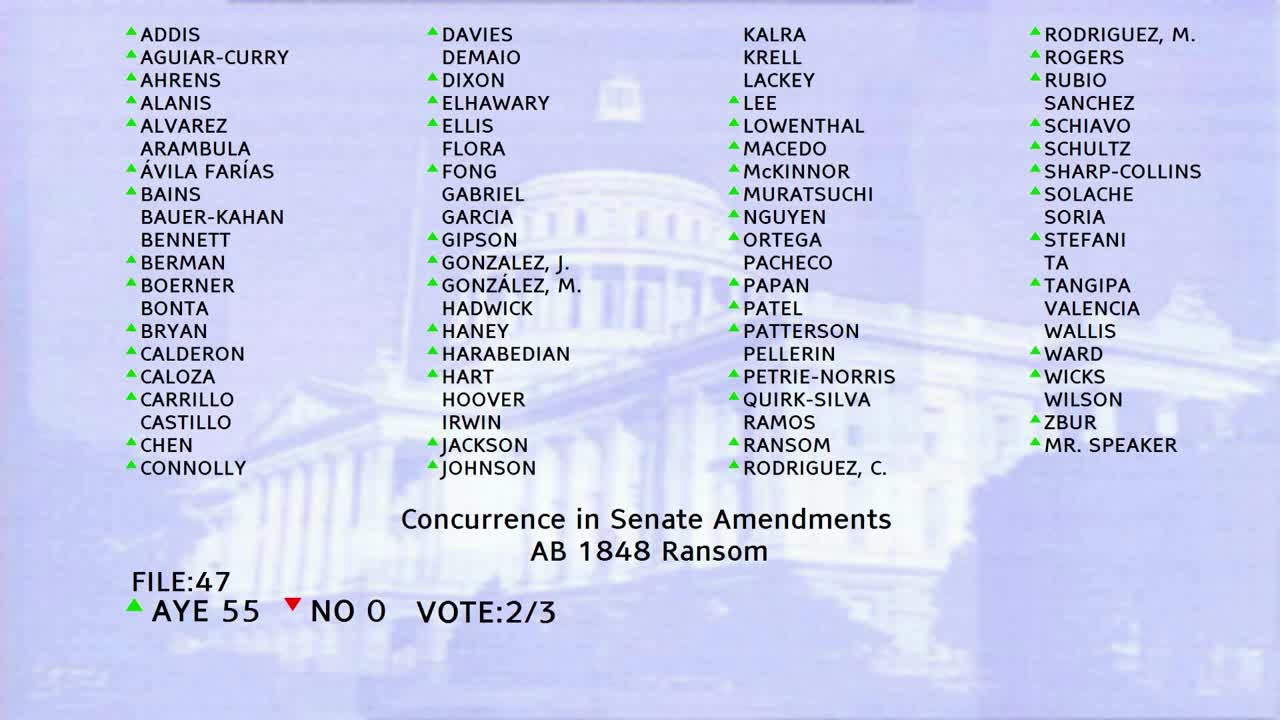 1MIN
Assembly Floor
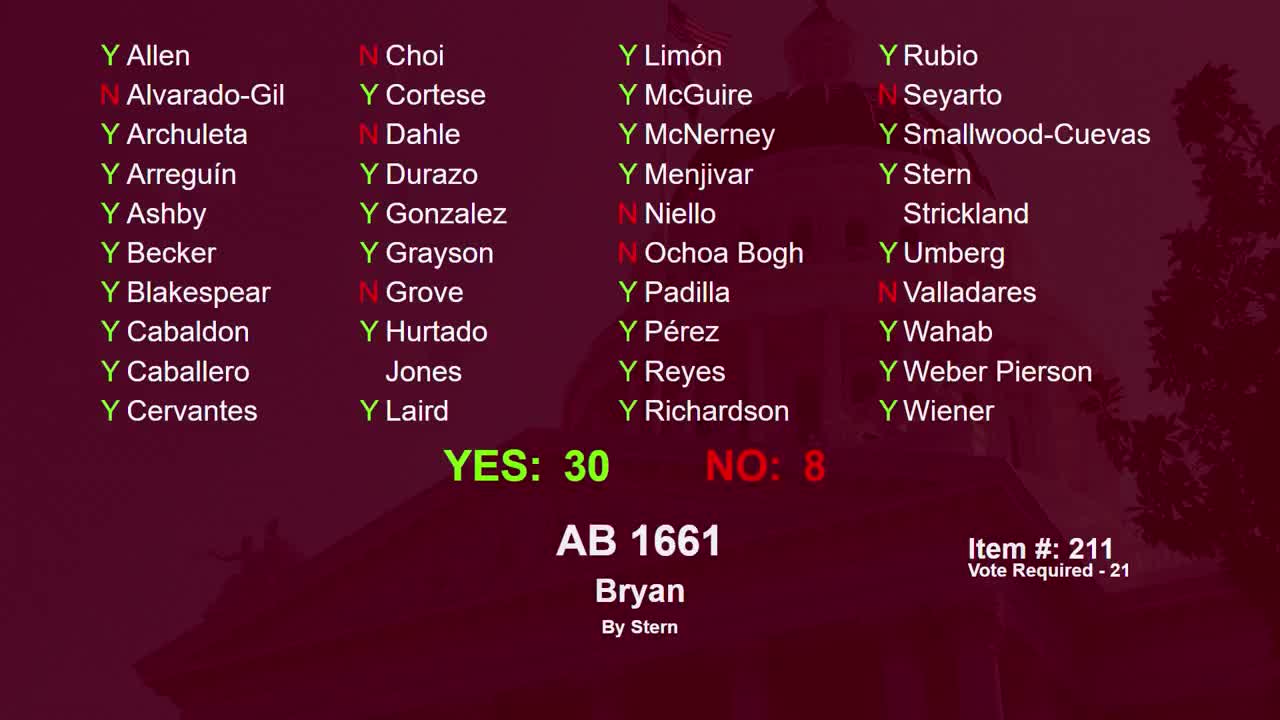 2MIN
Senate Floor
 6MIN
Senate Standing Committee on Energy, Utilities and Communications
 1MIN
Assembly Floor
Bill Author

Bill Co-Author(s):