AB 2495: Unlawful immigration-related practices.
- Session Year: 2025-2026
- House: Assembly
- Latest Version Date: 2026-09-29
Current Status:
Passed
(2026-09-29: Chaptered by Secretary of State - Chapter 748, Statutes of 2026.)
Introduced
In Committee
Awaiting First Chamber Vote
Passed First Chamber
In Committee
Awaiting Second Chamber Vote
Passed Second Chamber
Enacted
Existing law prohibits an employer or any other person from engaging in, or directing another person to engage in, an unfair immigration-related practice against a person for the purpose of, or with the intent of, retaliating against any person for exercising a right protected under state labor and employment laws or under a local ordinance applicable to employees, as specified.
Existing law authorizes a civil action for equitable relief and damages or penalties, as specified, by an employee or other person who is the subject of an unfair immigration-related practice.
This bill would expand the above-described prohibition to include retaliating against any person for exercising any right under any local, state, or federal statute or regulation applicable to employees, as defined, and would prohibit preventing a person from exercising such a right. The bill would also prohibit an employer or any other person from engaging in any other conduct, related to any persons perceived immigration status, that would reasonably tend to dissuade a person from engaging in conduct that the person has a legal right to engage in under any local, state, or federal statute or regulation applicable to employees, or to induce a person to engage in conduct that the person has a legal right to abstain from under any local, state, or federal statute or regulation applicable to employees. The bill would make an employer or other person who violates these provisions liable for a civil penalty not exceeding $10,000 per employee or person for each violation, as specified. The bill would also make related and conforming changes to these provisions.
Existing law prohibits an employer or any other person from engaging in, or directing another person to engage in, an unfair immigration-related practice against a person for the purpose of, or with the intent of, retaliating against any person for exercising a right protected under state labor and employment laws or under a local ordinance applicable to employees, as specified.
Existing law authorizes a civil action for equitable relief and damages or penalties, as specified, by an employee or other person who is the subject of an unfair immigration-related practice.
This bill would expand the above-described prohibition to include retaliating against any person for exercising any right under any local, state, or federal statute or regulation applicable to employees employees, as defined, and would prohibit preventing a person from exercising such a right. The bill would also prohibit an employer or any other person from engaging in any other conduct, related to any persons perceived immigration status, that would reasonably tend to dissuade an employee a person from engaging in conduct that the employee person has a legal right to engage in under any local, state, or federal statute or regulation applicable to employees, or to induce an employee a person to engage in conduct that the employee person has a legal right to abstain from under any local, state, or federal statute or regulation applicable to employees. The bill would make an employer or other person who violates these provisions liable for a civil penalty not exceeding $10,000 per employee or person for each violation, as specified. The bill would also make related and conforming changes to these provisions.
Existing law prohibits an employer or any other person from engaging in, or directing another person to engage in, an unfair immigration-related practice against a person for the purpose of, or with the intent of, retaliating against any person for exercising a right protected under state labor and employment laws or under a local ordinance applicable to employees, as specified.
Existing law authorizes a civil action for equitable relief and damages or penalties, as specified, by an employee or other person who is the subject of an unfair immigration-related practice.
This bill would expand the above-described prohibition to include retaliating against any person for exercising any right under any local, state, or federal statute or regulation applicable to employees and would prohibit preventing a person from exercising such a right. The bill would also prohibit an employer or any other person from engaging in any other conduct, related to any persons actual or perceived immigration status, that would reasonably tend to dissuade a reasonable person an employee from engaging in conduct that the person employee has a legal right to engage in under any local, state, or federal statute or regulation applicable to employees, or to induce a reasonable person an employee to engage in conduct that the person employee has a legal right to abstain from under any local, state, or federal statute or regulation applicable to employees. The bill would make an employer or other person who violates these provisions liable for a civil penalty not exceeding $10,000 per employee or person for each violation, as specified. The bill would also make related and conforming changes to these provisions.
Existing law prohibits an employer or any other person from engaging in, or directing another person to engage in, an unfair immigration-related practice against a person for the purpose of, or with the intent of, retaliating against any person for exercising a right protected under state labor and employment laws or under a local ordinance applicable to employees, as specified.
This bill would expand the above-described provision to include preventing a person from exercising any right protected under those laws or ordinances.Existing law defines unfair immigration-related practice for these purposes to include, among other things, threatening to file or filing a false police report. Existing law authorizes a civil action for equitable relief and damages or penalties, as specified, by an employee or other person who is the subject of an unfair immigration-related practice.
This bill would define unfair immigration-related practice expand the above-described prohibition to also include retaliating against any person for exercising any right under any local, state, or federal statute or regulation applicable to employees and would prohibit preventing a person from exercising such a right. The bill would also prohibit an employer or any other person from engaging in any other conduct, related to any persons real actual or perceived immigration status, that would dissuade a reasonable person from engaging in conduct that the person has a legal right to engage in under any local, state, or federal statute or regulation, regulation applicable to employees, or to induce a reasonable person to engage in conduct that the person has a legal right to abstain from under any local, state, or federal statute or regulation. regulation applicable to employees. The bill would make an employer or other person who violates these provisions liable for a civil penalty not exceeding $10,000 per employee or person for each violation, as specified. The bill would also make related and conforming changes to these provisions.
Existing law prohibits an employer or any other person from engaging in, or directing another person to engage in, an unfair immigration-related practice against a person for the purpose of, or with the intent of, retaliating against any person for exercising a right protected under state labor and employment laws or under a local ordinance applicable to employees, as specified. Existing
This bill would expand the above-described provision to include preventing a person from exercising any right protected under those laws or ordinances.
Existing law defines unfair immigration-related practice unfair immigration-related practice for these purposes to include, among other things, threatening to file or filing a false police report. Existing law authorizes a civil action for equitable relief and damages or penalties, as specified, by an employee or other person who is the subject of an unfair immigration-related practice.
This bill would also prohibit an employer or other person or entity from engaging in or directing another person or entity to engage in coercion against any person by engaging in unfair immigration-related practices. define unfair immigration-related practice to also include engaging in any other conduct, related to any persons real or perceived immigration status, that would dissuade a reasonable person from engaging in conduct that the person has a legal right to engage in under local, state, or federal statute or regulation, or to induce a reasonable person to engage in conduct that the person has a legal right to abstain from under any local, state, or federal statute or regulation. The bill would make an employer who violates these provisions liable for a civil penalty not exceeding $10,000 per employee for each violation, as specified. The bill would also make related and conforming changes to these provisions.
Existing law prohibits an employer or any other person from engaging in, or directing another person to engage in, an unfair immigration-related practice against a person for the purpose of, or with the intent of, retaliating against any person for exercising a right protected under state labor and employment laws or under a local ordinance applicable to employees, as specified. Existing law defines unfair immigration-related practice to include, among other things, threatening to file or filing a false police report. Existing law authorizes a civil action for equitable relief and damages or penalties, as specified, by an employee or other person who is the subject of an unfair immigration-related practice.
This bill would also prohibit an employer or other person or entity from engaging in or directing another person or entity to engage in coercion against any person by engaging in unfair immigration-related practices. The bill would make an employer who violates these provisions liable for a civil penalty not exceeding $10,000 per employee for each violation, as specified. The bill would also make related and conforming changes to these provisions.
(a)The Legislature finds and declares all of the following:
(1)It has been the longstanding public policy of the State of California that workers must be able to report violations, seek information about their rights, and participate in enforcement efforts without threat or fear of adverse consequences.
(2)This strong public policy is embodied in the Labor Codes prohibitions against retaliation undertaken by employers against workers who have sought to exercise the rights guaranteed to them under the Labor Code.
(3)The Legislature recognizes that unscrupulous employers statements or actions designed to dissuade workers from exercising their rights in the first place likewise prevent workers from reporting workplace violations and, similarly, undermine effective enforcement of labor standards.
(4)Immigrant workers are uniquely vulnerable to exploitation and intimidation in the workplace. Employers exploit distinct vulnerabilities, including fear of immigration enforcement, to deter immigrant workers from reporting workplace violations.
(5)Unscrupulous employers utilize unfair immigration-related practices to preemptively silence immigrant workers and compel them to accept substandard working conditions, thereby undercutting law-abiding employers and eroding workplace standards for all California workers.
(6)Intimidating conduct, including veiled or overt immigration-related threats, to prevent workers from asserting their rights in the future is contrary to the public policy of this state.
(b)Therefore, it is the intent of the Legislature to do both of the following:
(1)Ensure immigrant workers can safely report violations and participate in the enforcement of their workplace protections by providing that employer behavior that has the effect of deterring the assertion of protected workplace rights is unlawful under the existing legal framework when done to deter workers from exercising protected rights.
(2)Reinforce Californias longstanding public policy that workers must be able to assert workplace rights free from employer intimidation, threats, or retaliation, including the fear of reporting to immigration authorities or other unfair immigration-related employment practices as defined herein.
SEC. 2.Section 1019 of the Labor Code is amended to read:1019.(a)It is unlawful for an employer or any other person or entity to engage in, or to direct another person or entity to engage in, unfair immigration-related practices against any person for the purpose of, or with the intent of, retaliating against any person for exercising, or attempting to exercise, any right protected under any local, state, or federal statute or regulation applicable to employees. Exercising such a right includes the following:
(1)Filing a complaint or informing any person of an employers or other partys alleged violation of any local, state, or federal statute or regulation applicable to employees, so long as the complaint or disclosure is made in good faith.
(2)Seeking information regarding whether an employer or other party is in compliance with any local, state, or federal statute or regulation applicable to employees.
(3)Informing a person of their potential rights and remedies under any local, state, or federal statute or regulation applicable to employees, and assisting them in asserting those rights.
(b)It is unlawful for an employer or any other person to engage in any other conduct, related to any persons perceived immigration status, that would reasonably tend to dissuade a person from engaging in conduct that the person has a legal right to engage in under any local, state, or federal statute or regulation applicable to employees, or to induce a person to engage in conduct that the person has a legal right to abstain from under any local, state, or federal statute or regulation applicable to employees.
(c)(1)As used in this chapter, unfair immigration-related practice means any of the following practices, when undertaken for the retaliatory purposes prohibited by subdivision (a):
(A)Requesting more or different documents than are required under Section 1324a(b) of Title 8 of the United States Code, or a refusal to honor documents tendered pursuant to that section that on their face reasonably appear to be genuine.
(B)Using the federal E-Verify system to check the employment authorization status of a person at a time or in a manner not required under Section 1324a(b) of Title 8 of the United States Code, or not authorized under any memorandum of understanding governing the use of the federal E-Verify system.
(C)Threatening to file or the filing of a false police report, or a false report or complaint with any state or federal agency.
(D)Threatening to contact or contacting immigration authorities.
(2)Unfair immigration-related practice does not include conduct undertaken at the express and specific direction or request of the federal government.
(d)Engaging in a violation of this section against a person within 90 days of the persons exercise of rights protected under any local, state, or federal statute or regulation applicable to employees shall raise a rebuttable presumption of having done so in retaliation for the exercise of those rights.
(e)Actual immigration status is irrelevant to the determination of liability under this section, consistent with Section 1171.5.
(f)(1)An employee or other person who is subjected to conduct prohibited by this section, or a representative of that employee or person, may bring a civil action for equitable relief, any applicable damages, or penalties.
(2)Upon a finding by a court of applicable jurisdiction of a violation of this section, upon application by a party or on its own motion, a court may do the following:
(A)For a first violation, order the appropriate government agencies to suspend all licenses that are held by the violating party for a period of up to 14 days. On receipt of the courts order and notwithstanding any other law, the appropriate agencies shall suspend the licenses according to the courts order.
(B)For a second violation, order the appropriate government agencies to suspend all licenses that are held by the violating party for a period of up to 30 days. On receipt of the courts order and notwithstanding any other law, the appropriate agencies shall immediately suspend the licenses.
(C)For a third or subsequent violation, order the appropriate government agencies to suspend for a period of up to 90 days all licenses that are held by the violating party. On receipt of the courts order and notwithstanding any other law, the appropriate agencies shall immediately suspend the licenses.
(3)In determining whether a suspension of all licenses is appropriate under this subdivision, the court shall consider whether the employer or other person knowingly committed a violation, the good faith efforts of the employer or other person to resolve any alleged violations of this section after receiving notice of the violations, as well as the harm other employees, including, but not limited to, employees of other employers on a multiemployer job site, will suffer as a result of the suspension of all licenses.
(4)An employee or other person who is the subject of conduct prohibited by this section, and who prevails in an action authorized by this section, shall recover reasonable attorneys fees and costs, including any expert witness costs.
(5)In addition to other remedies available, an employer or other person who violates this section is liable for a civil penalty not exceeding ten thousand dollars ($10,000) per employee or person for each violation of this section, to be awarded to the employee or person who suffered the violation.
(g)The protections, prohibitions, and remedies provided by this section are in addition to, and do not diminish, any other protections, prohibitions, or remedies provided under any other local, state, or federal law.
(h)As used in this chapter:
(1)License means any agency permit, certificate, approval, registration, or charter that is required by law and that is issued by any agency for the purposes of operating a business in this state and that is specific to the business location or locations where the unfair immigration-related practice occurred. License does not include a professional license.
(2)Violation means each incident when an unfair immigration-related practice was committed, without reference to the number of employees involved in the incident.
(i)As used in this section, employee includes an applicant, employee, or former employee.
(a)The Legislature finds and declares all of the following:
(1)It has been the longstanding public policy of the State of California that workers must be able to report violations, seek information about their rights, and participate in enforcement efforts without threat or fear of adverse consequences.
(2)This strong public policy is embodied in the Labor Codes prohibitions against retaliation undertaken by employers against workers who have sought to exercise the rights guaranteed to them under the Labor Code.
(3)The Legislature recognizes that unscrupulous employers statements or actions designed to dissuade workers from exercising their rights in the first place likewise prevent workers from reporting workplace violations and, similarly, undermine effective enforcement of labor standards.
(4)Immigrant workers are uniquely vulnerable to exploitation and intimidation in the workplace. Employers exploit distinct vulnerabilities, including fear of immigration enforcement, to deter immigrant workers from reporting workplace violations.
(5)Unscrupulous employers utilize unfair immigration-related practices to preemptively silence immigrant workers and compel them to accept substandard working conditions, thereby undercutting law-abiding employers and eroding workplace standards for all California workers.
(6)Intimidating conduct, including veiled or overt immigration-related threats, to prevent workers from asserting their rights in the future is contrary to the public policy of this state.
(b)Therefore, it is the intent of the Legislature to do both of the following:
(1)Ensure immigrant workers can safely report violations and participate in the enforcement of their workplace protections by providing that employer behavior that has the effect of deterring the assertion of protected workplace rights is unlawful under the existing legal framework when done to deter workers from exercising protected rights.
(2)Reinforce Californias longstanding public policy that workers must be able to assert workplace rights free from employer intimidation, threats, or retaliation, including the fear of reporting to immigration authorities or other unfair immigration-related employment practices as defined herein.
SEC. 2.Section 1019 of the Labor Code is amended to read:1019.(a)It is unlawful for an employer or any other person or entity to engage in, or to direct another person or entity to engage in, unfair immigration-related practices against any person for the purpose of, or with the intent of, retaliating against any person for exercising, or attempting to exercise, any right protected under any local, state, or federal statute or regulation applicable to employees. Exercising such a right includes the following:
(1)Filing a complaint or informing any person of an employers or other partys alleged violation of any local, state, or federal statute or regulation applicable to employees, so long as the complaint or disclosure is made in good faith.
(2)Seeking information regarding whether an employer or other party is in compliance with any local, state, or federal statute or regulation applicable to employees.
(3)Informing a person of their potential rights and remedies under any local, state, or federal statute or regulation applicable to employees, and assisting them in asserting those rights.
(b)It is unlawful for an employer or any other person to engage in any other conduct, related to any persons perceived immigration status, that would reasonably tend to dissuade an employee a person from engaging in conduct that the employee person has a legal right to engage in under any local, state, or federal statute or regulation applicable to employees, or to induce an employee a person to engage in conduct that the employee person has a legal right to abstain from under any local, state, or federal statute or regulation applicable to employees.
(c)(1)As used in this chapter, unfair immigration-related practice means any of the following practices, when undertaken for the retaliatory purposes prohibited by subdivision (a):
(A)Requesting more or different documents than are required under Section 1324a(b) of Title 8 of the United States Code, or a refusal to honor documents tendered pursuant to that section that on their face reasonably appear to be genuine.
(B)Using the federal E-Verify system to check the employment authorization status of a person at a time or in a manner not required under Section 1324a(b) of Title 8 of the United States Code, or not authorized under any memorandum of understanding governing the use of the federal E-Verify system.
(C)Threatening to file or the filing of a false police report, or a false report or complaint with any state or federal agency.
(D)Threatening to contact or contacting immigration authorities.
(2)Unfair immigration-related practice does not include conduct undertaken at the express and specific direction or request of the federal government.
(d)Engaging in a violation of this section against a person within 90 days of the persons exercise of rights protected under any local, state, or federal statute or regulation applicable to employees shall raise a rebuttable presumption of having done so in retaliation for the exercise of those rights.
(e)Actual immigration status is irrelevant to the determination of liability under this section, consistent with Section 1171.5.
(f)(1)An employee or other person who is subjected to conduct prohibited by this section, or a representative of that employee or person, may bring a civil action for equitable relief, any applicable damages, or penalties.
(2)Upon a finding by a court of applicable jurisdiction of a violation of this section, upon application by a party or on its own motion, a court may do the following:
(A)For a first violation, order the appropriate government agencies to suspend all licenses that are held by the violating party for a period of up to 14 days. On receipt of the courts order and notwithstanding any other law, the appropriate agencies shall suspend the licenses according to the courts order.
(B)For a second violation, order the appropriate government agencies to suspend all licenses that are held by the violating party for a period of up to 30 days. On receipt of the courts order and notwithstanding any other law, the appropriate agencies shall immediately suspend the licenses.
(C)For a third or subsequent violation, order the appropriate government agencies to suspend for a period of up to 90 days all licenses that are held by the violating party. On receipt of the courts order and notwithstanding any other law, the appropriate agencies shall immediately suspend the licenses.
(3)In determining whether a suspension of all licenses is appropriate under this subdivision, the court shall consider whether the employer or other person knowingly committed a violation, the good faith efforts of the employer or other person to resolve any alleged violations of this section after receiving notice of the violations, as well as the harm other employees, including, but not limited to, employees of other employers on a multiemployer job site, will suffer as a result of the suspension of all licenses.
(4)An employee or other person who is the subject of conduct prohibited by this section, and who prevails in an action authorized by this section, shall recover reasonable attorneys fees and costs, including any expert witness costs.
(5)In addition to other remedies available, an employer or other person who violates this section is liable for a civil penalty not exceeding ten thousand dollars ($10,000) per employee or person for each violation of this section, to be awarded to the employee or person who suffered the violation.
(g)The protections, prohibitions, and remedies provided by this section are in addition to, and do not diminish, any other protections, prohibitions, or remedies provided under any other local, state, or federal law.
(h)As used in this chapter:
(1)License means any agency permit, certificate, approval, registration, or charter that is required by law and that is issued by any agency for the purposes of operating a business in this state and that is specific to the business location or locations where the unfair immigration-related practice occurred. License does not include a professional license.
(2)Violation means each incident when an unfair immigration-related practice was committed, without reference to the number of employees involved in the incident.
(i)As used in this section, employee includes an applicant, employee, or former employee.
(a)The Legislature finds and declares all of the following:
(1)It has been the longstanding public policy of the State of California that workers must be able to report violations, seek information about their rights, and participate in enforcement efforts without threat or fear of adverse consequences.
(2)This strong public policy is embodied in the Labor Codes prohibitions against retaliation undertaken by employers against workers who have sought to exercise the rights guaranteed to them under the Labor Code.
(3)The Legislature recognizes that unscrupulous employers statements or actions designed to dissuade workers from exercising their rights in the first place likewise prevent workers from reporting workplace violations and, similarly, undermine effective enforcement of labor standards.
(4)Immigrant workers are uniquely vulnerable to exploitation and intimidation in the workplace. Employers exploit distinct vulnerabilities, including fear of immigration enforcement, to deter immigrant workers from reporting workplace violations.
(5)Unscrupulous employers utilize unfair immigration-related practices to preemptively silence immigrant workers and compel them to accept substandard working conditions, thereby undercutting law-abiding employers and eroding workplace standards for all California workers.
(6)Intimidating conduct, including veiled or overt immigration-related threats, to prevent workers from asserting their rights in the future is contrary to the public policy of this state.
(b)Therefore, it is the intent of the Legislature to do both of the following:
(1)Ensure immigrant workers can safely report violations and participate in the enforcement of their workplace protections by providing that employer behavior that has the effect of deterring the assertion of protected workplace rights is unlawful under the existing legal framework when done to deter workers from exercising protected rights.
(2)Reinforce Californias longstanding public policy that workers must be able to assert workplace rights free from employer intimidation, threats, or retaliation, including the fear of reporting to immigration authorities or other unfair immigration-related employment practices as defined herein.
SEC. 2.Section 1019 of the Labor Code is amended to read:1019.(a)It is unlawful for an employer or any other person or entity to engage in, or to direct another person or entity to engage in, unfair immigration-related practices against any person for the purpose of, or with the intent of, retaliating against any person for exercising, or attempting to exercise, any right protected under any local, state, or federal statute or regulation applicable to employees. Exercising such a right includes the following:
(1)Filing a complaint or informing any person of an employers or other partys alleged violation of any local, state, or federal statute or regulation applicable to employees, so long as the complaint or disclosure is made in good faith.
(2)Seeking information regarding whether an employer or other party is in compliance with any local, state, or federal statute or regulation applicable to employees.
(3)Informing a person of their potential rights and remedies under any local, state, or federal statute or regulation applicable to employees, and assisting them in asserting those rights.
(b)It is unlawful for an employer or any other person to engage in any other conduct, related to any persons actual or perceived immigration status, that would reasonably tend to dissuade a reasonable person an employee from engaging in conduct that the person employee has a legal right to engage in under any local, state, or federal statute or regulation applicable to employees, or to induce a reasonable person an employee to engage in conduct that the person employee has a legal right to abstain from under any local, state, or federal statute or regulation applicable to employees.
(c)(1)As used in this chapter, unfair immigration-related practice means any of the following practices, when undertaken for the retaliatory purposes prohibited by subdivision (a):
(A)Requesting more or different documents than are required under Section 1324a(b) of Title 8 of the United States Code, or a refusal to honor documents tendered pursuant to that section that on their face reasonably appear to be genuine.
(B)Using the federal E-Verify system to check the employment authorization status of a person at a time or in a manner not required under Section 1324a(b) of Title 8 of the United States Code, or not authorized under any memorandum of understanding governing the use of the federal E-Verify system.
(C)Threatening to file or the filing of a false police report, or a false report or complaint with any state or federal agency.
(D)Threatening to contact or contacting immigration authorities.
(2)Unfair immigration-related practice does not include conduct undertaken at the express and specific direction or request of the federal government.
(d)Engaging in a violation of this section against a person within 90 days of the persons exercise of rights protected under any local, state, or federal statute or regulation applicable to employees shall raise a rebuttable presumption of having done so in retaliation for the exercise of those rights.
(e)Actual immigration status is irrelevant to the determination of liability under this section, consistent with Section 1171.5.
(e)(f)(1)An employee or other person who is subjected to conduct prohibited by this section, or a representative of that employee or person, may bring a civil action for equitable relief, any applicable damages, or penalties.
(2)Upon a finding by a court of applicable jurisdiction of a violation of this section, upon application by a party or on its own motion, a court may do the following:
(A)For a first violation, order the appropriate government agencies to suspend all licenses that are held by the violating party for a period of up to 14 days. On receipt of the courts order and notwithstanding any other law, the appropriate agencies shall suspend the licenses according to the courts order.
(B)For a second violation, order the appropriate government agencies to suspend all licenses that are held by the violating party for a period of up to 30 days. On receipt of the courts order and notwithstanding any other law, the appropriate agencies shall immediately suspend the licenses.
(C)For a third or subsequent violation, order the appropriate government agencies to suspend for a period of up to 90 days all licenses that are held by the violating party. On receipt of the courts order and notwithstanding any other law, the appropriate agencies shall immediately suspend the licenses.
(3)In determining whether a suspension of all licenses is appropriate under this subdivision, the court shall consider whether the employer or other person knowingly committed a violation, the good faith efforts of the employer or other person to resolve any alleged violations of this section after receiving notice of the violations, as well as the harm other employees, including, but not limited to, employees of other employers on a multiemployer job site, will suffer as a result of the suspension of all licenses.
(4)An employee or other person who is the subject of conduct prohibited by this section, and who prevails in an action authorized by this section, shall recover reasonable attorneys fees and costs, including any expert witness costs.
(5)In addition to other remedies available, an employer or other person who violates this section is liable for a civil penalty not exceeding ten thousand dollars ($10,000) per employee or person for each violation of this section, to be awarded to the employee or person who suffered the violation.
(f)(g)The protections, prohibitions, and remedies provided by this section are in addition to, and do not diminish, any other protections, prohibitions, or remedies provided under any other local, state, or federal law.
(g)(h)As used in this chapter:
(1)License means any agency permit, certificate, approval, registration, or charter that is required by law and that is issued by any agency for the purposes of operating a business in this state and that is specific to the business location or locations where the unfair immigration-related practice occurred. License does not include a professional license.
(2)Violation means each incident when an unfair immigration-related practice was committed, without reference to the number of employees involved in the incident.
(a)The Legislature finds and declares all of the following:
(1)It has been the longstanding public policy of the State of California that workers must be able to report violations, seek information about their rights, and participate in enforcement efforts without threat or fear of adverse consequences.
(2)This strong public policy is embodied in the Labor Codes prohibitions against retaliation undertaken by employers against workers who have sought to exercise the rights guaranteed to them under the Labor Code.
(3)The Legislature recognizes that employer unscrupulous employers statements or actions designed to dissuade workers from exercising their rights in the first place likewise prevent workers from reporting workplace violations and, similarly, undermine effective enforcement of labor standards.
(4)Immigrant workers are uniquely vulnerable to exploitation and intimidation in the workplace. Employers exploit distinct vulnerabilities, including fear of immigration enforcement, to deter immigrant workers from reporting workplace violations.
(5)Unscrupulous employers utilize unfair immigration-related practices to preemptively silence immigrant workers and compel them to accept substandard working conditions, thereby undercutting law-abiding employers and eroding workplace standards for all California workers.
(6)Intimidating conduct, including veiled or overt immigration-related threats, to prevent workers from asserting their rights in the future is contrary to the public policy of this state.
(b)Therefore, it is the intent of the Legislature to do both of the following:
(1)Ensure immigrant workers can safely report violations and participate in the enforcement of their workplace protections by providing that employer behavior that has the effect of deterring the assertion of protected workplace are rights is unlawful under the existing legal framework when used done to deter workers from exercising protected rights.
(2)Reinforce Californias longstanding public policy that workers must be able to assert workplace rights free from employer intimidation, threats, or retaliation, including the fear of reporting to immigration authorities or other unfair immigration-related employment practices as defined herein.
SEC. 2.Section 1019 of the Labor Code is amended to read:1019.(a)It is unlawful for an employer or any other person or entity to engage in, or to direct another person or entity to engage in, unfair immigration-related practices against any person for the purpose of, or with the intent of, retaliating against any person for, or preventing any person from, exercising for exercising, or attempting to exercise, any right protected under this code or by any local ordinance local, state, or federal statute or regulation applicable to employees. Exercising such a right protected by this code or local ordinance includes the following:
(1)Filing a complaint or informing any person of an employers or other partys alleged violation of this code or local ordinance, any local, state, or federal statute or regulation applicable to employees, so long as the complaint or disclosure is made in good faith.
(2)Seeking information regarding whether an employer or other party is in compliance with this code or local ordinance. any local, state, or federal statute or regulation applicable to employees.
(3)Informing a person of their potential rights and remedies under this code or local ordinance, any local, state, or federal statute or regulation applicable to employees, and assisting them in asserting those rights.
(b)It is unlawful for an employer or any other person to engage in any other conduct, related to any persons actual or perceived immigration status, that would dissuade a reasonable person from engaging in conduct that the person has a legal right to engage in under any local, state, or federal statute or regulation applicable to employees, or to induce a reasonable person to engage in conduct that the person has a legal right to abstain from under any local, state, or federal statute or regulation applicable to employees.
(b)(c)(1)As used in this chapter, unfair immigration-related practice means any of the following practices, when undertaken for the retaliatory purposes prohibited by subdivision (a):
(A)Requesting more or different documents than are required under Section 1324a(b) of Title 8 of the United States Code, or a refusal to honor documents tendered pursuant to that section that on their face reasonably appear to be genuine.
(B)Using the federal E-Verify system to check the employment authorization status of a person at a time or in a manner not required under Section 1324a(b) of Title 8 of the United States Code, or not authorized under any memorandum of understanding governing the use of the federal E-Verify system.
(C)Threatening to file or the filing of a false police report, or a false report or complaint with any state or federal agency.
(D)Threatening to contact or contacting immigration authorities.
(E)Engaging in any other conduct, related to any persons real or perceived immigration status, that would dissuade a reasonable person from engaging in conduct that the person has a legal right to engage in under any local, state, or federal statute or regulation, or to induce a reasonable person to engage in conduct that the person has a legal right to abstain from under any local, state, or federal statute or regulation.(2)Unfair immigration-related practice does not include conduct undertaken at the express and specific direction or request of the federal government.
(c)(d)Engaging in an unfair immigration-related practice a violation of this section against a person within 90 days of the persons exercise of rights protected under this code or local ordinance any local, state, or federal statute or regulation applicable to employees shall raise a rebuttable presumption of having done so in retaliation for the exercise of those rights.
(d)(e)(1)An employee or other person who is the subject of an unfair immigration-related practice subjected to conduct prohibited by this section, or a representative of that employee or person, may bring a civil action for equitable relief, any applicable damages, or penalties. (5).
(2)Upon a finding by a court of applicable jurisdiction of a violation of this section, upon application by a party or on its own motion, a court may do the following:
(A)For a first violation, order the appropriate government agencies to suspend all licenses that are held by the violating party for a period of up to 14 days. On receipt of the courts order and notwithstanding any other law, the appropriate agencies shall suspend the licenses according to the courts order.
(B)For a second violation, order the appropriate government agencies to suspend all licenses that are held by the violating party for a period of up to 30 days. On receipt of the courts order and notwithstanding any other law, the appropriate agencies shall immediately suspend the licenses.
(C)For a third or subsequent violation, order the appropriate government agencies to suspend for a period of up to 90 days all licenses that are held by the violating party. On receipt of the courts order and notwithstanding any other law, the appropriate agencies shall immediately suspend the licenses.
(3)In determining whether a suspension of all licenses is appropriate under this subdivision, the court shall consider whether the employer or other person knowingly committed an unfair immigration-related practice, a violation, the good faith efforts of the employer or other person to resolve any alleged unfair immigration-related practice violations of this section after receiving notice of the violations, as well as the harm other employees of the employer, or employees, including, but not limited to, employees of other employers on a multiemployer job site, will suffer as a result of the suspension of all licenses.
(4)An employee or other person who is the subject of an unfair immigration-related practice conduct prohibited by this section, and who prevails in an action authorized by this section, shall recover reasonable attorneys fees and costs, including any expert witness costs.
(5)In addition to other remedies available, an employer or other person who violates this section is liable for a civil penalty not exceeding ten thousand dollars ($10,000) per employee or person for each violation of this section, to be awarded to the employee or employees person who suffered the violation.
(f)The protections, prohibitions, and remedies provided by this section are in addition to, and do not diminish, any other protections, prohibitions, or remedies provided under any other local, state, or federal law.
(e)(g)As used in this chapter:
(1)License means any agency permit, certificate, approval, registration, or charter that is required by law and that is issued by any agency for the purposes of operating a business in this state and that is specific to the business location or locations where the unfair immigration-related practice occurred. License does not include a professional license.
(2)Violation means each incident when an unfair immigration-related practice was committed, without reference to the number of employees involved in the incident.
(a)The Legislature finds and declares all of the following:
(1)It has been the longstanding public policy of the State of California that workers must be able to report violations, seek information about their rights, and participate in enforcement efforts without threat or fear of adverse consequences.
(2)This strong public policy is embodied in the Labor Codes prohibitions against retaliation undertaken by employers against workers who have sought to exercise the rights guaranteed to them under the Labor Code.
(3)The Legislature recognizes that employer statements or actions designed to dissuade workers from exercising their rights in the first place likewise prevent workers from reporting workplace violations and, similarly, undermine effective enforcement of labor standards.
(4)Immigrant workers are uniquely vulnerable to exploitation and intimidation in the workplace. Employers exploit distinct vulnerabilities, including fear of immigration enforcement, to deter immigrant workers from reporting workplace violations.
(5)Unscrupulous employers utilize unfair immigration-related practices to preemptively silence immigrant workers and compel them to accept substandard working conditions, thereby undercutting law-abiding employers and eroding workplace standards for all California workers.
(6)Intimidating conduct, including veiled or overt immigration-related threats, to prevent workers from asserting their rights in the future is contrary to the public policy of this state.
(b)Therefore, it is the intent of the Legislature to do both of the following:
(1)Ensure immigrant workers can safely report violations and participate in the enforcement of their workplace protections by providing that employer behavior that has the effect of deterring the assertion of workplace are unlawful under the existing legal framework when used to deter workers from exercising protected rights.
(2)Reinforce Californias longstanding public policy that workers must be able to assert workplace rights free from employer intimidation, threats, or retaliation, including the fear of reporting to immigration authorities or other unfair immigration-related employment practices as defined herein.
SECTION 1.SEC. 2.Section 1019 of the Labor Code is amended to read:1019.(a)It is unlawful for an employer or any other person or entity to engage in, or to direct another person or entity to engage in, unfair immigration-related practices against any person for the purpose of, or with the intent of, retaliating against any person for for, or preventing any person from, exercising any right protected under this code or by any local ordinance applicable to employees. Exercising a right protected by this code or local ordinance includes the following:
(1)Filing a complaint or informing any person of an employers or other partys alleged violation of this code or local ordinance, so long as the complaint or disclosure is made in good faith.
(2)Seeking information regarding whether an employer or other party is in compliance with this code or local ordinance.
(3)Informing a person of their potential rights and remedies under this code or local ordinance, and assisting them in asserting those rights.
(b)It is unlawful for an employer or any other person or entity to engage in or to direct another person or entity to engage in coercion against any person by engaging in unfair immigration-related practices.(c)(b)(1)As used in this chapter, unfair immigration-related practice means any of the following practices, when undertaken for the retaliatory or coercive purposes prohibited by subdivisions (a) or (b): subdivision (a):
(A)Requesting more or different documents than are required under Section 1324a(b) of Title 8 of the United States Code, or a refusal to honor documents tendered pursuant to that section that on their face reasonably appear to be genuine.
(B)Using the federal E-Verify system to check the employment authorization status of a person at a time or in a manner not required under Section 1324a(b) of Title 8 of the United States Code, or not authorized under any memorandum of understanding governing the use of the federal E-Verify system.
(C)Implicitly or explicitly threatening Threatening to file or the filing of a false police report, or a false report or complaint with any state or federal agency.
(D)Implicitly or explicitly threatening Threatening to contact or contacting immigration authorities.
(E)Engaging in any other conduct, related to any persons real or perceived immigration status, that would dissuade a reasonable person from engaging in conduct that the person has a legal right to engage in under any local, state, or federal statute or regulation, or to induce a reasonable person to engage in conduct that the person has a legal right to abstain from under any local, state, or federal statute or regulation.
(2)Unfair immigration-related practice does not include conduct undertaken at the express and specific direction or request of the federal government.
(d)(c)Engaging in an unfair immigration-related practice against a person within 90 days of the persons exercise of rights protected under this code or local ordinance applicable to employees shall raise a rebuttable presumption of having done so in retaliation for the exercise of those rights.
(e)(d)(1)An employee or other person who is the subject of an unfair immigration-related practice prohibited by this section, or a representative of that employee or person, may bring a civil action for equitable relief, any applicable damages, and penalties as provided under paragraph or penalties. (5).
(2)Upon a finding by a court of applicable jurisdiction of a violation of this section, upon application by a party or on its own motion, a court may do the following:
(A)For a first violation, order the appropriate government agencies to suspend all licenses that are held by the violating party for a period of up to 14 days. On receipt of the courts order and notwithstanding any other law, the appropriate agencies shall suspend the licenses according to the courts order.
(B)For a second violation, order the appropriate government agencies to suspend all licenses that are held by the violating party for a period of up to 30 days. On receipt of the courts order and notwithstanding any other law, the appropriate agencies shall immediately suspend the licenses.
(C)For a third or subsequent violation, order the appropriate government agencies to suspend for a period of up to 90 days all licenses that are held by the violating party. On receipt of the courts order and notwithstanding any other law, the appropriate agencies shall immediately suspend the licenses.
(3)In determining whether a suspension of all licenses is appropriate under this subdivision, the court shall consider whether the employer knowingly committed an unfair immigration-related practice, the good faith efforts of the employer to resolve any alleged unfair immigration-related practice after receiving notice of the violations, as well as the harm other employees of the employer, or employees of other employers on a multiemployer job site, will suffer as a result of the suspension of all licenses.
(4)An employee or other person who is the subject of an unfair immigration-related practice prohibited by this section, and who prevails in an action authorized by this section, shall recover reasonable attorneys fees and costs, including any expert witness costs.
(5)In addition to other remedies available, an employer who violates this section is liable for a civil penalty not exceeding ten thousand dollars ($10,000) per employee for each violation of this section, to be awarded to the employee or employees who suffered the violation.
(f)(e)As used in this chapter:
(1)License means any agency permit, certificate, approval, registration, or charter that is required by law and that is issued by any agency for the purposes of operating a business in this state and that is specific to the business location or locations where the unfair immigration-related practice occurred. License does not include a professional license.
(2)To coerce means to engage in conduct that would dissuade a reasonable person in that persons position from engaging in conduct which the person has a legal right to engage in under this code, the Government Code, or the Civil Code, or to induce a reasonable person in that persons position to engage in conduct which the person has a legal right to abstain from under this code, the Government Code, or the Civil Code. (3)(2)Violation means each incident when an unfair immigration-related practice was committed, without reference to the number of employees involved in the incident.
(a)It is unlawful for an employer or any other person or entity to engage in, or to direct another person or entity to engage in, unfair immigration-related practices against any person for the purpose of, or with the intent of, retaliating against any person for exercising any right protected under this code or by any local ordinance applicable to employees. Exercising a right protected by this code or local ordinance includes the following:
(1)Filing a complaint or informing any person of an employers or other partys alleged violation of this code or local ordinance, so long as the complaint or disclosure is made in good faith.
(2)Seeking information regarding whether an employer or other party is in compliance with this code or local ordinance.
(3)Informing a person of his or her their potential rights and remedies under this code or local ordinance, and assisting him or her them in asserting those rights.
(b)It is unlawful for an employer or any other person or entity to engage in or to direct another person or entity to engage in coercion against any person by engaging in unfair immigration-related practices.
(b)(c)(1)As used in this chapter, unfair immigration-related practice means any of the following practices, when undertaken for the retaliatory or coercive purposes prohibited by subdivision (a): subdivisions (a) or (b):
(A)Requesting more or different documents than are required under Section 1324a(b) of Title 8 of the United States Code, or a refusal to honor documents tendered pursuant to that section that on their face reasonably appear to be genuine.
(B)Using the federal E-Verify system to check the employment authorization status of a person at a time or in a manner not required under Section 1324a(b) of Title 8 of the United States Code, or not authorized under any memorandum of understanding governing the use of the federal E-Verify system.
(C)Threatening Implicitly or explicitly threatening to file or the filing of a false police report, or a false report or complaint with any state or federal agency.
(D)Threatening Implicitly or explicitly threatening to contact or contacting immigration authorities.
(2)Unfair immigration-related practice does not include conduct undertaken at the express and specific direction or request of the federal government.
(c)(d)Engaging in an unfair immigration-related practice against a person within 90 days of the persons exercise of rights protected under this code or local ordinance applicable to employees shall raise a rebuttable presumption of having done so in retaliation for the exercise of those rights.
(d)(e)(1)An employee or other person who is the subject of an unfair immigration-related practice prohibited by this section, or a representative of that employee or person, may bring a civil action for equitable relief and relief, any applicable damages or penalties. damages, and penalties as provided under paragraph (5).
(2)Upon a finding by a court of applicable jurisdiction of a violation of this section, upon application by a party or on its own motion, a court may do the following:
(A)For a first violation, order the appropriate government agencies to suspend all licenses that are held by the violating party for a period of up to 14 days. On receipt of the courts order and notwithstanding any other law, the appropriate agencies shall suspend the licenses according to the courts order.
(B)For a second violation, order the appropriate government agencies to suspend all licenses that are held by the violating party for a period of up to 30 days. On receipt of the courts order and notwithstanding any other law, the appropriate agencies shall immediately suspend the licenses.
(C)For a third or subsequent violation, order the appropriate government agencies to suspend for a period of up to 90 days all licenses that are held by the violating party. On receipt of the courts order and notwithstanding any other law, the appropriate agencies shall immediately suspend the licenses.
(3)In determining whether a suspension of all licenses is appropriate under this subdivision, the court shall consider whether the employer knowingly committed an unfair immigration-related practice, the good faith efforts of the employer to resolve any alleged unfair immigration-related practice after receiving notice of the violations, as well as the harm other employees of the employer, or employees of other employers on a multiemployer job site, will suffer as a result of the suspension of all licenses.
(4)An employee or other person who is the subject of an unfair immigration-related practice prohibited by this section, and who prevails in an action authorized by this section, shall recover his or her reasonable attorneys fees and costs, including any expert witness costs.
(5)In addition to other remedies available, an employer who violates this section is liable for a civil penalty not exceeding ten thousand dollars ($10,000) per employee for each violation of this section, to be awarded to the employee or employees who suffered the violation.
(e)(f)As used in this chapter:
(1)License means any agency permit, certificate, approval, registration, or charter that is required by law and that is issued by any agency for the purposes of operating a business in this state and that is specific to the business location or locations where the unfair immigration-related practice occurred. License does not include a professional license.
(2)To coerce means to engage in conduct that would dissuade a reasonable person in that persons position from engaging in conduct which the person has a legal right to engage in under this code, the Government Code, or the Civil Code, or to induce a reasonable person in that persons position to engage in conduct which the person has a legal right to abstain from under this code, the Government Code, or the Civil Code.
(2)(3)Violation means each incident when an unfair immigration-related practice was committed, without reference to the number of employees involved in the incident.
|
Date
|
Status
|
|---|---|
| Sep 29, 2026 | Chaptered by Secretary of State - Chapter 748, Statutes of 2026. |
| Sep 29, 2026 | Approved by the Governor. |
| Sep 3, 2026 | Enrolled and presented to the Governor at 4 p.m. |
| Aug 26, 2026 | Senate amendments concurred in. To Engrossing and Enrolling. (Ayes 60. Noes 13. Page 6604.). |
| Aug 26, 2026 | Senate amendments concurred in. To Engrossing and Enrolling. (Ayes 60. Noes 13.). |
| Aug 26, 2026 | In Assembly. Concurrence in Senate amendments pending. |
| Aug 25, 2026 | Read third time. Passed. Ordered to the Assembly. (Ayes 30. Noes 8. Page 5812.). |
| Aug 25, 2026 | Read third time. Passed. Ordered to the Assembly. (Ayes 29. Noes 8.). |
| Aug 17, 2026 | Read second time. Ordered to third reading. |
| Aug 13, 2026 | Read second time and amended. Ordered returned to second reading. |
| Aug 13, 2026 | From committee: Amend, and do pass as amended. (Ayes 4. Noes 2.) (August 13). |
| Aug 13, 2026 | In committee: Reconsideration of a favorable vote granted. |
| Aug 3, 2026 | In committee: Referred to APPR. suspense file. |
| Jul 1, 2026 | From committee: Do pass and re-refer to Com. on APPR. (Ayes 11. Noes 2.) (June 30). Re-referred to Com. on APPR. |
| Jun 24, 2026 | From committee: Do pass and re-refer to Com. on JUD. (Ayes 4. Noes 1.) (June 24). Re-referred to Com. on JUD. |
| Jun 16, 2026 | From committee chair, with author's amendments: Amend, and re-refer to committee. Read second time, amended, and re-referred to Com. on L., P.E. & R. |
| Jun 10, 2026 | Referred to Coms. on L., P.E. & R., JUD. and APPR. |
| May 28, 2026 | In Senate. Read first time. To Com. on RLS. for assignment. |
| May 27, 2026 | Read third time. Passed. Ordered to the Senate. (Ayes 59. Noes 18. Page 5433.) |
| May 27, 2026 | Read third time. Passed. Ordered to the Senate. (Ayes 59. Noes 18.) |
| May 27, 2026 | Read third time. Passed. Ordered to the Senate. |
| May 18, 2026 | Read second time. Ordered to third reading. |
| May 14, 2026 | From committee: Do pass. (Ayes 11. Noes 4.) (May 14). |
| May 6, 2026 | In committee: Set, first hearing. Referred to APPR. suspense file. |
| Apr 28, 2026 | From committee: Do pass and re-refer to Com. on APPR. (Ayes 9. Noes 3.) (April 28). Re-referred to Com. on APPR. |
| Apr 21, 2026 | Re-referred to Com. on JUD. |
| Apr 20, 2026 | From committee chair, with author's amendments: Amend, and re-refer to Com. on JUD. Read second time and amended. |
| Apr 9, 2026 | From committee: Do pass and re-refer to Com. on JUD. (Ayes 5. Noes 1.) (April 8). Re-referred to Com. on JUD. |
| Apr 7, 2026 | Re-referred to Com. on L. & E. |
| Apr 6, 2026 | From committee chair, with author's amendments: Amend, and re-refer to Com. on L. & E. Read second time and amended. |
| Mar 23, 2026 | Referred to Coms. on L. & E. and JUD. |
| Feb 21, 2026 | From printer. May be heard in committee March 23. |
| Feb 20, 2026 | Read first time. To print. |
|
Date
|
Description
|
Location
|
Votes
|
|
|---|---|---|---|---|
| Aug 26, 2026 | AB 2495 Kalra Concurrence in Senate Amendments | Assembly Floor |
Passed |
|
| Aug 25, 2026 | Assembly 3rd Reading AB2495 Kalra et al. By Durazo | Senate Floor |
Passed |
|
| Aug 13, 2026 | Do pass as amended | Senate Standing Committee on Appropriations |
Passed |
|
| Aug 13, 2026 | [08-13-2026] set for [First] hearing: Reconsideration of favorable vote granted | Senate Standing Committee on Appropriations |
Passed |
|
| Aug 13, 2026 | Do pass as amended | Senate Standing Committee on Appropriations |
Passed |
|
| Aug 3, 2026 | Placed on suspense file | Senate Standing Committee on Appropriations |
Passed |
|
| Jun 30, 2026 | Do pass, but first be re-referred to the Committee on [Appropriations] | Senate Standing Committee on Judiciary |
Passed |
|
| Jun 24, 2026 | Do pass, but first be re-referred to the Committee on [Judiciary] | Senate Standing Committee on Labor, Public Employment and Retirement |
Passed |
|
| May 27, 2026 | AB 2495 Kalra Assembly Third Reading | Assembly Floor |
Passed |
|
| May 14, 2026 | Do pass. | Assembly Standing Committee on Appropriations |
Passed |
|
| Apr 28, 2026 | Do pass and be re-referred to the Committee on [Appropriations] | Assembly Standing Committee on Judiciary |
Passed |
|
| Apr 8, 2026 | Do pass and be re-referred to the Committee on [Judiciary] | Assembly Standing Committee on Labor and Employment |
Passed |
This list shows positions taken on this bill by organizations on the date displayed, which is linked to the original source.
Positions by individuals are not included.
|
Organization
|
Position
|
Date
|
|---|---|---|
| AAPIs for Civic Empowerment | ** Support | |
| Asian Law Caucus | ** Support | |
| California Asian Pacific American Bar Association | ** Support | |
| California Coalition For Worker Power | ** Support | |
| California Community Foundation | ** Support | |
| California Domestic Workers Coalition | ** Support | |
| California Employment Lawyers Association | ** Support | |
| California Faculty Association | ** Support | |
| California Federation of Labor Unions | ** Support | |
| California Food and Farming Network | ** Support | |
| California for Safety and Justice | ** Support | |
| California Immigrant Policy Center | ** Support | |
| California Latinas for Reproductive Justice | ** Support | |
| California National Organization For Women | ** Support | |
| California Network for Immigrant and Worker Justice | ** Support | |
| Californians for Safety and Justice | ** Support | |
| California Partnership To End Domestic Violence | ** Support | |
| California Primary Care Association | ** Support | |
| California Rural Legal Assistance Foundation | ** Support | |
| California Teachers Association | ** Support | |
| California Work & Family Coalition | ** Support | |
| California Working Families Party | ** Support | |
| CFT - A Union of Educators & Classified Professionals | ** Support | |
| Child Care Law Center | ** Support | |
| Chinese for Affirmative Action | ** Support | |
| Church State Council | ** Support | |
| City of Soledad | ** Support | |
| Coalition for Humane Immigrant Rights | ** Support | |
| Community Legal Services in East Palo Alto | ** Support | |
| Consumer Attorneys Of California | ** Support | |
| County of Santa Clara | ** Support | |
| Courage California | ** Support | |
| End Child Poverty CA | ** Support | |
| Equal Rights Advocates | ** Support | |
| Friends Committee On Legislation Of California | ** Support | |
| Immigrants Rising | ** Support | |
| Legal Aid Association Of California | ** Support | |
| Legal Aid At Work | ** Support | |
| Loyola Law School, Sunita Jain Anti-Trafficking Initiative | ** Support | |
| Mujeres Unidas Y Activas | ** Support | |
| National Council of Jewish Women | ** Support | |
| National Council of Jewish Women CA | ** Support | |
| Parent Voices California | ** Support | |
| Pilipino Workers Center of Southern California | ** Support | |
| Santa Clara County Wage Theft Coalition | ** Support | |
| Street Level Health Project | ** Support | |
| Sunita Jain Anti-Trafficking Initiative | ** Support | |
| The Wage Justice Center | ** Support | |
| United Nations Association of California | ** Support | |
| Wage Justice Center | ** Support | |
| western center on law & poverty | ** Support | |
| Women'S Foundation California | ** Support |
CONCURRENCE IN SENATE AMENDMENTS
CSA1 Bill Id:AB 2495
Author:(Kalra)
As Amended Ver:August 13, 2026
Majority vote
SUMMARY
Expands the prohibition of an employer retaliating against a person for exercising their rights by engaging in, or directing another to engage in, an unfair immigration-related practice.
Senate Amendments
- Make clarifying and technical changes.
- Provide that, consistent with existing law, actual immigration status is irrelevant to the determination of liability under the unfair immigration-related practices anti-retaliation protections.
- Provide that, for purposes of the unfair immigration-related practices anti-retaliation protections, ″employee″ includes an applicant, employee, or former employee.
COMMENTS
Studies have repeatedly shown that immigrant workers are far less likely than other workers to report workplace issues, due to fear of deportation and retaliation, language barriers, and lack of awareness regarding their rights. In many cases, immigrant workers do not report abuses because their employers actively threaten to report them to the authorities. This results in the loss of essential rights, including minimum wage, overtime pay, meal and rest breaks, workplace safety, and more. Amidst the Trump Administration′s focus on immigration enforcement, there is concern that this problem has only been exacerbated.
California labor laws protect workers regardless of immigration status. Workers who file claims or complaints, or exercise other rights under California labor laws are not required to disclose their immigration status to the Department of Industrial Relations or its entities, nor do those entities inquire about immigration status. The only limits to this are those established under federal law.
Furthermore, California law prohibits employers from retaliating against employees by using unfair immigration-related practices, including threatening to report a person to immigration authorities. However, current law offers explicit retaliation protections only after a worker engages in protected activities, leaving a gap that allows employers to use threats to deter workers from acting.
Given that retaliation laws are intended to protect workers′ ability to assert their workplace rights, the author argues that the prohibition on retaliation using unfair immigration-related practices should also extend to behavior that prevents workers from exercising their rights in the first place.
According to the Author
″AB 2495 amends existing labor protections to make it explicit that all immigration-related threats are unlawful. California must make it clear — employers cannot create a climate of fear with immigration-related threats to prevent workers from reporting violations of workplace rights.″
The author adds that the bill promotes equity solutions, per H.R. 39 (Gipson, 2021), in that ″protecting vulnerable workers from coercion can make all workplaces safer as workers can feel empowered to come forward when facing the loss of essential rights, including minimum wage, overtime pay, rest breaks, workplace safety, and protection from harassment.″
Arguments in Support
A coalition of worker and labor organizations, including the California Federation of Labor Unions, state in support that ″immigrant workers are uniquely vulnerable to workplace exploitation given employers can weaponize workers′ immigration status to violate their rights. The current national climate has emboldened bad-faith employers to increasingly coerce immigrant workers into never asserting their rights by making veiled threats, chilling statements, or implicit warnings about immigration consequences. When coercion succeeds, unlawful conduct goes unreported, workplace standards erode, and law-abiding employers are undercut.″
Arguments in Opposition
None on file.
FISCAL COMMENTS
According to the Senate Appropriations Committee:
- The Labor Commissioner′s Office (LCO), within the Department of Industrial Relations (DIR), indicates that it would incur first-year costs of $900,000 to $1.4 million, and $800,000 to $1.3 million annually thereafter, to implement the provisions of the bill (Labor Enforcement and Compliance Fund).
- By expanding an existing prohibition for which a civil action may be filed to recover equitable relief, damages, or penalties, and enacting a new employer penalty for a violation of the existing and new prohibitions, this bill may result in an increased number of civil actions. Consequently, the bill could result in potentially significant cost pressures to the courts; the magnitude is unknown (Trial Court Trust Fund (TCTF)). The specific number of new actions that could be filed under the bill also is unknown; however, it generally costs about $10,500 per day to operate a courtroom. Courts are not funded on the basis of workload, and increased pressure on TCTF may create a need for increased funding for courts from the General Fund. The enacted 2026-27 budget includes $70 million in ongoing support from the General Fund to continue to backfill TCTF for revenue declines.
- The bill could result in increased penalty revenue. The magnitude is unknown, but probably minor.
VOTES:
ASM LABOR AND EMPLOYMENT: 5-1-1
YES: Ortega, Elhawary, Kalra, Lee, Ward
NO: Lackey
ABS, ABST OR NV: Chen
ASM JUDICIARY: 9-3-0
YES: Kalra, Bauer-Kahan, Bryan, Connolly, Harabedian, Pacheco, Papan, Lee, Zbur
NO: Dixon, Johnson, Sanchez
ASM APPROPRIATIONS: 11-4-0
YES: Wicks, Aguiar-Curry, Calderon, Caloza, Fong, Mark González, Krell, Pacheco, Pellerin, Sharp-Collins, Solache
NO: Hoover, Dixon, Ta, Tangipa
ASSEMBLY FLOOR: 59-18-3
YES: Addis, Aguiar-Curry, Ahrens, Alvarez, Arambula, Ávila Farías, Bains, Bauer-Kahan, Bennett, Berman, Boerner, Bonta, Bryan, Calderon, Caloza, Carrillo, Connolly, Elhawary, Fong, Gabriel, Garcia, Gipson, Mark González, Haney, Harabedian, Hart, Irwin, Jackson, Kalra, Krell, Lee, Lowenthal, McKinnor, Muratsuchi, Nguyen, Ortega, Pacheco, Papan, Patel, Pellerin, Petrie-Norris, Quirk-Silva, Ramos, Ransom, Michelle Rodriguez, Rogers, Blanca Rubio, Schiavo, Schultz, Sharp-Collins, Solache, Soria, Stefani, Valencia, Ward, Wicks, Wilson, Zbur, Rivas
NO: Castillo, Chen, Davies, DeMaio, Dixon, Ellis, Flora, Gallagher, Jeff Gonzalez, Hadwick, Hoover, Johnson, Lackey, Macedo, Patterson, Sanchez, Ta, Tangipa
ABS, ABST OR NV: Alanis, Celeste Rodriguez, Wallis
SENATE FLOOR: 30-8-2
YES: Allen, Archuleta, Arreguín, Ashby, Becker, Blakespear, Cabaldon, Caballero, Cervantes, Cortese, Durazo, Gonzalez, Grayson, Hurtado, Laird, Limón, McGuire, McNerney, Menjivar, Padilla, Pérez, Reyes, Richardson, Rubio, Smallwood-Cuevas, Stern, Umberg, Wahab, Weber Pierson, Wiener
NO: Alvarado-Gil, Choi, Dahle, Jones, Niello, Ochoa Bogh, Seyarto, Strickland
ABS, ABST OR NV: Grove, Valladares
UPDATED
VERSION: August 13, 2026
CONSULTANT: Erin Hickey / L. & E. / (916) 319-2091 FN: 0004065
SENATE RULES COMMITTEE Office of Senate Floor Analyses (916) 651-4171 | AB 2495 |
THIRD READING
Bill No: AB 2495
Author: Kalra (D), et al.
Amended: 8/13/26 in Senate
Vote: 21
SENATE LABOR, PUB. EMP. & RET. COMMITTEE: 4-1, 6/24/26
AYES: Smallwood-Cuevas, Cortese, Durazo, Laird
NOES: Strickland
SENATE JUDICIARY COMMITTEE: 11-2, 6/30/26
AYES: Umberg, Allen, Ashby, Caballero, Durazo, Laird, Reyes, Stern, Wahab, Weber Pierson, Wiener
NOES: Niello, Valladares
SENATE APPROPRIATIONS COMMITTEE: 4-2, 8/13/26
AYES: Cervantes, Cabaldon, Grayson, Richardson
NOES: Seyarto, Dahle
NO VOTE RECORDED: Wahab
ASSEMBLY FLOOR: 59-18, 5/27/26 - See last page for vote
SUBJECT: Unlawful immigration-related practices
SOURCE: AAPIs for Civic Engagement
California Employment Lawyers Association
Coalition for Humane Immigrant Rights
Equal Rights Advocates
Legal Aid at Work
DIGEST:
This bill expands existing unfair immigration-related practices anti-retaliation protections to: 1) additionally prohibit an employer from preventing a person from exercising any right protected under existing laws; 2) prohibit an employer from dissuading an employee from engaging in conduct that the employee has a legal right to engage in or abstain from, as specified; and 3) makes an employer or other person who violates these provisions liable for a civil penalty of up to $10,000 per employee or person for each violation.
ANALYSIS:
Existing federal law:
- Requires an employer to verify, through examination of specified documents, whether or not an individual is authorized to work in the United States and attest thereto under penalty of perjury by completing Form I-9 Employment Eligibility Verification; specifies that if the document is presented and reasonably appears on its face to be genuine, then the employer has complied with this requirement and is not required to solicit or demand any other document. The worker must also attest, under penalty of perjury, that they are legally authorized to work in the United States. (Title 8 United States Code (U.S.C.) §1324a(b))
- Makes it an unfair immigration-related employment practice for any person or entity to do any of the following: 1) Discriminate against any individual, except as provided, with respect to the hiring, recruitment, or referral of the individual for employment or the discharging of the individual from employment because of the individual’s origin or citizenship; or 2) Request, with the intent of discriminating against an individual, more or different documents than are required under law or refuse to honor documents tendered which, on their face, reasonably appear to be genuine. (8 U.S.C. §1324b(a)(1)-(6))
Existing state law:
- Establishes within the Department of Industrial Relations (DIR) and under the direction of the Labor Commissioner (LC), the Division of Labor Standards Enforcement (DLSE) tasked with administering and enforcing labor code provisions concerning wages, hours and working conditions. (Labor Code §79 et seq.)
- Prohibits an employer or any other person or entity from engaging in, or directing another person or entity to engage in, an unfair immigration-related practice, as defined, against any person for the purpose of retaliating against that person for exercising his or her rights under state or local labor law. (Labor Code §1019)
- Defines "unfair immigration-related practice," for purposes of state law, to mean any of the following practices when undertaken for retaliatory purposes, and not at the direction or request of the federal government:
- Requesting more or different documents than are required by federal law or refusing to honor required documents that on their face appear to be genuine.
- Using the federal E-Verify system to check the employment authorization status of a person at a time or in a manner not required or authorized by federal law.
- Threatening to file or filing of a false police report, or threatening to file or filing a false report or complaint with any state or federal agency.
- Threatening to contact or contacting immigration authorities.
(Labor Code §1019)
- Authorizes an employee or any other person who is subject to an unfair immigration-related practice, where the unfair practice is retaliatory in nature, to bring a civil action for equitable relief and any applicable damages or penalties, and specifies that an employee or other person who prevails shall recover his or her reasonable attorney's fees. (Labor Code §1019)
- Prohibits an employer, in the course of satisfying federal immigration law, from requesting more or different documents than are required under federal immigration law; refusing to honor valid documents, as specified; or attempting to reinvestigate or reverify an incumbent employee's authorization to work using an unfair immigration-related practice. Provides for a penalty imposed by the LC and liability for equitable relief. (Labor Code §1019.1 & §1019.2)
- Provides that all protections, rights, and remedies available under state law, except any reinstatement remedy prohibited by federal law, are available to all individuals regardless of immigration status who have applied for employment, or who are or who have been employed, in this state. For purposes of enforcing state labor and employment laws, existing law provides that a person’s immigration status is irrelevant to the issue of liability, and in proceedings or discovery undertaken to enforce those state laws, no inquiry shall be permitted into a person’s immigration status except where the person seeking to make this inquiry has shown by clear and convincing evidence that the inquiry is necessary in order to comply with federal immigration law. (Labor Code §1171.5; Civil Code §3339; Government Code §7285; Health & Safety Code §24000)
This bill:
- Finds and declares, among other things, the following:
- Immigrant workers are uniquely vulnerable to exploitation and intimidation in the workplace. Employers exploit distinct vulnerabilities, including fear of immigration enforcement, to deter immigrant workers from reporting workplace violations.
- Unscrupulous employers utilize unfair immigration-related practices to preemptively silence immigrant workers and compel them to accept substandard working conditions, thereby undercutting law-abiding employers and eroding workplace standards.
- Therefore, it is the intent of the Legislature to:
- ensure that immigrant workers can safely report violations and participate in the enforcement of their workplace protections by providing that employer behavior that has the effect of deterring the assertion of protected workplace rights is unlawful under the existing legal framework when done to deter workers from exercising protected rights; and
- reinforce California’s longstanding public policy that workers must be able to assert workplace rights free from employer intimidation, threats, or retaliation, including the fear of reporting to immigration authorities or other unfair immigration-related employment practices as defined herein.
- Expands the prohibition on an employer or any other person engaging in, or directing another person to engage in, an unfair immigration-related practice against a person for the purpose of, or with the intent of, retaliating against any person for exercising a right protected under state and local laws, as specified, to additionally prohibit doing so:
- For the purpose of, or intent of, preventing a person from attempting to exercise any right protected under any local, state, or federal statute or regulation applicable to employees.
- Makes it unlawful for an employer or any other person to engage in any other conduct, related to any person’s perceived immigration status, that would reasonably tend to dissuade an employee from engaging in conduct that the employee has a legal right to engage in, or a legal right to abstain from, under any local, state, or federal statute or regulation applicable to employees.
- Specifies that for purposes of these provisions, “employee” includes an applicant, employee, or former employee.
- Provides that, consistent with existing Labor Code Section 1171.5, actual immigration status is irrelevant to the determination of liability under these provisions.
- Provides that, in addition to other remedies available, an employer or other person who violates the unfair immigration-related practices provisions is liable for a civil penalty not exceeding $10,000 per employee or person for each violation, to be awarded to the employee or person who suffered the violation.
Background
Existing labor laws protect all workers regardless of immigration status. Further, California’s labor laws provide anti-retaliation protection for employees who make claims against their employers for violations of labor laws. Specific to a workers immigration status, existing law makes it illegal for an employer to take adverse actions against a worker by making immigration-related threats in retaliation for a worker exercising their rights or by engaging in unfair immigration related practices. Unfair immigration-related practices can include:
- Refusing to honor identity and employment documents that appear genuine.
- Misuse E-Verify in a way not required by law.
- Threatening to call/calling immigration authorities to report a worker or their family’s suspected immigration status.
Even though these protections exist in law, research shows that immigrant workers are significantly less likely than other workers to report workplace hazards and injuries due to fears of deportation and retaliation, language barriers, and lack of awareness regarding their rights. This in turn can lead to potential abuse from unscrupulous employers and the loss of essential rights to which they are entitled to. Given the current federal administrations’ views on and actions towards immigrants, this legislation is both timely and necessary.
Need for this bill? According to the author: “Anti-immigrant national rhetoric has emboldened bad-faith employers to increasingly deter immigrant workers from complaining about violations of their workplace rights by making veiled threats, chilling statements, or implicit warnings about immigration consequences. When such employer deterrence succeeds, unlawful conduct goes unreported, workplace standards erode, and law-abiding employers are undercut.
Current law offers protections against immigration-related threats after a worker engages in protected activities but does not explicitly prohibit employers from using threats to deter workers from exercising their rights in the first place. Additionally, there are no worker protections comparable to Penal Code § 519, which criminalizes extortion based on coercive threats, such as threats to deport or “call ICE”. Assembly Bill 2495 expands the scope of prohibited unfair immigration-related practices that employers use to intimidate and dissuade workers from asserting their workplace rights.”
[NOTE: Please see the Senate Labor, Public Employment and Retirement Committee analysis on this bill for more background information and information on prior and related legislation.]
FISCAL EFFECT: Appropriation: No Fiscal Com.: No Local: No
According to the Senate Appropriations Committee:
- The Labor Commissioner’s Office (LCO), within the Department of Industrial Relations (DIR), indicates that it would incur first-year costs of $900,000 to $1.4 million, and $800,000 to $1.3 million annually thereafter, to implement the provisions of the bill (Labor Enforcement and Compliance Fund).
- By expanding an existing prohibition for which a civil action may be filed to recover equitable relief, damages, or penalties, and enacting a new employer penalty for a violation of the existing and new prohibitions, this bill may result in an increased number of civil actions. Consequently, the bill could result in potentially significant cost pressures to the courts; the magnitude is unknown (Trial Court Trust Fund (TCTF)). The specific number of new actions that could be filed under the bill also is unknown; however, it generally costs about $10,500 per day to operate a courtroom. Courts are not funded on the basis of workload, and increased pressure on TCTF may create a need for increased funding for courts from the General Fund. The enacted 2026-27 budget includes $70 million in ongoing support from the General Fund to continue to backfill TCTF for revenue declines.
- The bill could result in increased penalty revenue. The magnitude is unknown, but probably minor.
SUPPORT: (Verified 8/13/26)
AAPIs for Civic Empowerment (co-source)
California Employment Lawyers Association (co-source)
Coalition for Humane Immigrant Rights (co-source)
Equal Rights Advocates (co-source)
Legal Aid at Work (co-source)
Asian Law Caucus
California Asian Pacific American Bar Association
California Coalition for Worker Power
California Community Foundation
California Domestic Workers Coalition
California Faculty Association
California Federation of Labor Unions
California Food and Farming Network
California for Safety and Justice
California Immigrant Policy Center
California Latinas for Reproductive Justice
California National Organization for Women
California Network for Immigrant and Worker Justice
California Partnership to End Domestic Violence
California Primary Care Association
California Rural Legal Assistance Foundation
California Teachers Association
California Work & Family Coalition
California Working Families Party
Californians for Safety and Justice
CFT - A Union of Educators & Classified Professionals
Child Care Law Center
Chinese for Affirmative Action
Church State Council
City of Soledad
Community Legal Services in East Palo Alto
Consumer Attorneys of California
County of Santa Clara
Courage California
End Child Poverty CA
Friends Committee on Legislation of California
Immigrants Rising
Legal Aid Association of California
Loyola Law School, Sunita Jain Anti-Trafficking Initiative
Mujeres Unidas Y Activas
National Council of Jewish Women CA
Parent Voices California
Pilipino Workers Center of Southern California
Santa Clara County Wage Theft Coalition
Street Level Health Project
Sunita Jain Anti-trafficking Initiative
The Wage Justice Center
United Nations Association of California
Wage Justice Center
Western Center on Law & Poverty
Women's Foundation California
OPPOSITION: (Verified 8/13/26)
None received
ARGUMENTS IN SUPPORT: The sponsors of the measure, the California Employment Lawyers Association, Legal Aid at Work, Coalition for Humane Immigrant Rights (CHIRLA), AAPIs for Civic Empowerment, and Equal Rights Advocates write:
“Current law prohibits employers from retaliating against workers who have asserted their workplace rights. However, the existing definition of “unfair immigration related practices” does not fully capture the range of employer conduct that interferes with workers’ ability to assert their workplace rights or that undermines effective enforcement of labor standards. Notably, current law does not adequately address employer conduct that exploits workers’ precarious immigration status to dissuade them from making complaints about their employment conditions in the first place. Any employer actions that chill or deter the future exercise of workplace rights weaken enforcement of those rights and should fall squarely within the scope of “unfair immigration related practices.”
AB 2495 will address employer actions that chill workers’ exercise of their rights by ensuring that such conduct falls within legal protections against unfair immigration related practices. The bill does so by expressly including within the definition of “unfair immigration related practices” conduct that would dissuade a reasonable worker from exercising workplace rights, or induce that worker to engage in conduct the worker has a legal right to decline. In this way, AB 2495 makes clear that creating a coercive work environment based on a worker’s immigration status—designed to silence or intimidate workers—is prohibited under California law.”
ASSEMBLY FLOOR: 59-18, 5/27/26
AYES: Addis, Aguiar-Curry, Ahrens, Alvarez, Arambula, Ávila Farías, Bains, Bauer-Kahan, Bennett, Berman, Boerner, Bonta, Bryan, Calderon, Caloza, Carrillo, Connolly, Elhawary, Fong, Gabriel, Garcia, Gipson, Mark González, Haney, Harabedian, Hart, Irwin, Jackson, Kalra, Krell, Lee, Lowenthal, McKinnor, Muratsuchi, Nguyen, Ortega, Pacheco, Papan, Patel, Pellerin, Petrie-Norris, Quirk-Silva, Ramos, Ransom, Michelle Rodriguez, Rogers, Blanca Rubio, Schiavo, Schultz, Sharp-Collins, Solache, Soria, Stefani, Valencia, Ward, Wicks, Wilson, Zbur, Rivas
NOES: Castillo, Chen, Davies, DeMaio, Dixon, Ellis, Flora, Gallagher, Jeff Gonzalez, Hadwick, Hoover, Johnson, Lackey, Macedo, Patterson, Sanchez, Ta, Tangipa
NO VOTE RECORDED: Alanis, Celeste Rodriguez, Wallis
Prepared by: Alma Perez-Schwab / L., P.E. & R. / (916) 651-1556
8/17/26 9:58:44
**** END ****
SENATE COMMITTEE ON
Senator Sabrina Cervantes, Chair
2025 - 2026 Regular Session
AB 2495 (Kalra) - Unlawful immigration-related practices
Version: | Policy Vote: |
Urgency: | Mandate: |
Hearing Date: | Consultant: |
Bill Summary:
AB 2495 would expand the prohibition on an employer retaliating against an employee by engaging in, or directing another to engage in, an unfair immigration-related practice by (1) additionally prohibiting an employer from preventing a person from exercising any right protected under existing laws, (2) prohibiting an employer from dissuading an employee from engaging in conduct that the employee has a legal right to engage in or abstain from, as specified, and (3) making an employer or other person who violates these provisions liable for a civil penalty of up to $10,000 per employee or person for each violation.
*********** ANALYSIS ADDENDUM – SUSPENSE FILE ***********
The following information is revised to reflect amendments
adopted by the committee on August 13, 2026
Fiscal Impact:
- The Labor Commissioner’s Office (LCO), within the Department of Industrial Relations (DIR), indicates that it would incur first-year costs of $900,000 to $1.4 million, and $800,000 to $1.3 million annually thereafter, to implement the provisions of the bill (Labor Enforcement and Compliance Fund).
- By expanding an existing prohibition for which a civil action may be filed to recover equitable relief, damages, or penalties, and enacting a new employer penalty for a violation of the existing and new prohibitions, this bill may result in an increased number of civil actions. Consequently, the bill could result in potentially significant cost pressures to the courts; the magnitude is unknown (Trial Court Trust Fund (TCTF)). The specific number of new actions that could be filed under the bill also is unknown; however, it generally costs about $10,500 per day to operate a courtroom. Courts are not funded on the basis of workload, and increased pressure on TCTF may create a need for increased funding for courts from the General Fund. The enacted 2026-27 budget includes $70 million in ongoing support from the General Fund to continue to backfill TCTF for revenue declines.
- The bill could result in increased penalty revenue. The magnitude is unknown, but probably minor.
Author Amendments:
Change references of “employee” to include an applicant, employee, or former employee.
-- END --
SENATE COMMITTEE ON
Senator Sabrina Cervantes, Chair
2025 - 2026 Regular Session
AB 2495 (Kalra) - Unlawful immigration-related practices
Version: | Policy Vote: |
Urgency: | Mandate: |
Hearing Date: | Consultant: |
Bill Summary:
AB 2495 would expand the prohibition on an employer retaliating against an employee by engaging in, or directing another to engage in, an unfair immigration-related practice by (1) additionally prohibiting an employer from preventing a person from exercising any right protected under existing laws, (2) prohibiting an employer from dissuading an employee from engaging in conduct that the employee has a legal right to engage in or abstain from, as specified, and (3) making an employer or other person who violates these provisions liable for a civil penalty of up to $10,000 per employee or person for each violation.
Fiscal Impact:
- The Labor Commissioner’s Office (LCO), within the Department of Industrial Relations (DIR), indicates that it would incur first-year costs of $900,000 to $1.4 million, and $800,000 to $1.3 million annually thereafter, to implement the provisions of the bill (Labor Enforcement and Compliance Fund).
- By expanding an existing prohibition for which a civil action may be filed to recover equitable relief, damages, or penalties, and enacting a new employer penalty for a violation of the existing and new prohibitions, this bill may result in an increased number of civil actions. Consequently, the bill could result in potentially significant cost pressures to the courts; the magnitude is unknown (Trial Court Trust Fund (TCTF)). The specific number of new actions that could be filed under the bill also is unknown; however, it generally costs about $10,500 per day to operate a courtroom. Courts are not funded on the basis of workload, and increased pressure on TCTF may create a need for increased funding for courts from the General Fund. The enacted 2026-27 budget includes $70 million in ongoing support from the General Fund to continue to backfill TCTF for revenue declines.
- The bill could result in increased penalty revenue. The magnitude is unknown, but probably minor.
Background:
According to the Public Policy Institute of California, California is home to approximately 10.9 million immigrants, more than any other state. In 2024, the most recent year for which data is available, foreign-born residents comprised 28 percent of the State’s population. Although immigration flows to California have slowed in recent decades, immigrants continue to play a significant role in the state’s economy and remain an important source of economic growth.
Existing labor laws protect all workers, regardless of immigration status. California law also prohibits employers from retaliating against employees who report workplace violations or exercise rights protected under state labor laws. Specifically, employers are prohibited from engaging in unfair immigration-related practices, such as taking adverse employment actions or making immigration-related threats, in retaliation for an employee exercising those rights.
Despite these protections, immigrant workers remain less likely than other workers to report workplace hazards, injuries, wage theft, or other labor law violations due to fear of deportation or retaliation, language barriers, and limited awareness of their rights. These barriers can enable unscrupulous employers to exploit vulnerable workers and undermine workplace protections intended to benefit all employees.
While existing law prohibits immigration-related retaliation, those protections generally apply only after an employee has exercised a protected right and an employer responds with a retaliatory immigration-related action. As a result, existing law provides limited protection against immigration-related threats or coercive conduct intended to discourage workers from reporting violations or exercising their rights in the first instance.
Proposed Law:
This bill, among other things, would do the following:
- Expand the prohibition on an employer or any other person engaging in, or directing another person to engage in, an unfair immigration-related practice against a person for the purpose of, or with the intent of, retaliating against any person for exercising a right protected under state and local laws, as specified, to additionally prohibit doing so:
- For the purpose of, or intent of, preventing a person from attempting to exercise any right protected under any local, state, or federal statute or regulation applicable to employees.
- Make it unlawful for an employer or any other person to engage in any other conduct, related to any person’s perceived immigration status, that would reasonably tend to dissuade an employee from engaging in conduct that the employee has a legal right to engage in, or a legal right to abstain from, under any local, state, or federal statute or regulation applicable to employees.
- Provide that, consistent with existing Labor Code Section 1171.5, actual immigration status is irrelevant to the determination of liability under these provisions.
- Provide that, in addition to other remedies available, an employer or other person who violates the unfair immigration-related practices provisions is liable for a civil penalty not exceeding $10,000 per employee or person for each violation, to be awarded to the employee or person who suffered the violation.
Related Legislation:
- SB 294 (Reyes, Chapter 667, Statutes of 2025) (1) requires employers to provide a stand-alone written notice annually to each employee informing them of their rights under state and federal law, as specified; (2) directs the LC to develop a template notice, as well as videos for employers and employees informing them of their responsibilities and rights, as specified; (3) requires employers, if authorized by an employee, to contact an employee's designated emergency contact if the employee is arrested or detained, as specified; and (4) authorizes various penalties for noncompliant employers.
- AB 1136 (Ortega) would have provided, until July 1, 2029, job protections to workers who are detained or need to take time off from work to resolve immigration-related matters including requiring employers to reinstate the employee to their former job classification without loss of seniority upon their return, as specified. The bill was vetoed by Governor Newsom.
- SB 54 (De Leon, Chapter 495, Statutes of 2017) limited the involvement of state and local law enforcement agencies in federal immigration enforcement.
- AB 450 (Chiu, Chapter 492, Statutes of 2017) prohibited an employer from providing access to a federal government immigration enforcement agent to any non-public areas of a place of labor if the agent does not have a warrant.
Staff Comments:
The Office of the Legislative Counsel has keyed this bill “non-fiscal.” However, the purview of this Committee, pursuant to Joint Rule 10.5, is to review and analyze bills that would, among other things, result in a substantial expenditure of state money. Thus, even though the bill was keyed “non-fiscal,” the Committee requested the bill to examine the extent to which it might potentially increase costs to the State.
This bill would expand existing protections by prohibiting an employer from using conduct related to a person’s perceived immigration status to prevent or dissuade a worker from exercising rights protected under labor laws.
-- END --
Senator Thomas Umberg, Chair
2025-2026 Regular Session
Bill No: AB 2495 (Author:Kalra)
Version: June 16, 2026
Hearing Date: June 30, 2026
Fiscal: No
Urgency: No
Consultant: ID
SUBJECT
Unlawful immigration-related practices
DIGEST
This bill makes it unlawful for an employer or any other person to engage in any conduct, related to any person’s perceived immigration status, that would reasonably tend to dissuade an employee from engaging in conduct that the employee has a legal right to engage in, or induce an employee to engage in conduct that they have a legal right to abstain from, as specified.
EXECUTIVE SUMMARY
Immigrants are essential to California’s workforce. However, because of their immigration status, immigrant workers are often particularly vulnerable to mistreatment by their employers. Moreover, fears of immigration enforcement or retaliation have increased considerably for immigrant workers in the past year and a half with the dramatic increase in immigration enforcement by the federal government. While state law provides immigrant workers protections from retaliation for exercising their rights, these protections do not cover all of the ways in which employers intimidate or coerce immigrant workers into not exercising their rights. AB 2495 aims to provide such workers greater protections from this intimidation or coercion by expanding existing protections and making it unlawful to engage in conduct related to a person’s perceived immigration status that would reasonably tend to dissuade an employee from engaging in conduct that they have a legal right to engage in, or induce an employee to engage in conduct that they have a legal right to abstain from.
AB 2495 is sponsored by AAPIs for Civic Empowerment, California Employment Lawyers Association, Equal Rights Advocates, the Coalition for Humane Immigrant Rights, and Legal Aid at Work, and is supported by numerous other organizations. The Committee has received no timely letters of opposition. AB 2495 previously passed the Senate Labor, Public Employment and Retirement Committee by a vote of 4 to 1.
PROPOSED CHANGES TO THE LAW
Existing federal law:
- Requires an employer to verify, through examination of specified documents, whether or not an individual is authorized to work in the United States and attest thereto under penalty of perjury. Specifies that if the documents are presented and reasonably appear to be genuine, then the employer has complied with this requirement and is not required to solicit or demand any other document, and prohibits discrimination and retaliation against a worker regarding hiring, recruitment, or referral for a fee because of the individual’s national origin or, for certain immigrants, their immigration status. (8 U.S.C. Section 1324a(b).)
Existing state law:
- Prohibits an employer from discharging or in any manner discriminating, retaliating, or taking any adverse action against an employee because the employee engaged in lawful conduct during nonworking hours away from the employer’s premises, or because the employee has filed a bona fide complaint or claim, instituted any proceeding authorized under the Labor Code, or has testified or is about to testify in a legal proceeding. Makes an employer who violates these provisions liable for a civil penalty of not more than $10,000 per employee for each violation, to be awarded to the employee or employees who suffered the violation. (Lab. Code § 98.6.)
- Permits, pursuant to the Private Attorneys General Act (PAGA), an employee to bring a civil action alleging a workplace violation on behalf of the employee and all other employees aggrieved by the violation, and specifies that the employee shall be permitted to bring such action free of the threat of retaliation. (Lab. Code § 2699.)
- Prohibits an employer from adopting any rule or policy that prevents an employee from disclosing information to a government or law enforcement agency, among others, if the employee has reasonable cause to believe that the information discloses a violation of a law or regulation, regardless of whether disclosing the information is part of the employee’s job duties, and prohibits an employer from retaliating against an employee for disclosing such information. (Lab. Code § 1102.5.)
- Makes it unlawful for an employer or any other person to engage in, or direct another to engage in, an unfair immigration-related practice, as defined, for the purpose or intent of retaliating against the person for exercising a right protected under state labor and employment laws or under a local ordinance applicable to employees, including by reporting a workplace violation. (Lab. Code § 1019 (a).)
- Defines “unfair immigration-related practice” for purposes of (4), above, to mean any of the following practices when undertaken for retaliatory purposes:
- requesting more or different documents than are required under federal law, or refusing to honor documents that on their face reasonably appear to be genuine;
- using the federal E-Verify system to check the employment authorization status of a person at a time or in a manner not required under federal law or otherwise authorized under federal law;
- threatening to file, or filing, a false police report, or a false report or complaint with any state or federal agency; and
- threatening to contact or contacting immigration authorities. (Lab. Code § 1019 (b).)
- Provides that engaging in an unfair immigration-related practice against a person within 90 days of that person exercising a protected right creates a rebuttable presumption of having done so for the purposes of retaliation for the exercise of those rights. (Lab. Code § 1019 (c).)
- Authorizes an employee or any other person who is subject to a retaliatory immigration-related practice to bring a civil action for equitable relief, damages or penalties, and attorney’s fees and costs. (Lab. Code § 1019 (d).)
- Provides that all protections, rights, and remedies available under state law, except any reinstatement remedy prohibited by federal law, are available to all individuals regardless of immigration status who have applied for employment, or who are or who have been employed, in this state. (Lab. Code § 1171.5 (a).)
This bill:
- Makes various findings and declarations regarding employees’ rights to report labor law and other violations, the state’s longstanding policy of permitting workers to report labor law violations and protecting their right to do so, and retaliation and intimidation by employers.
- Specifies that the prohibition against engaging in unfair immigration-related practices described in (4), above, includes such acts for the purpose, or with the intent of, retaliating against a person for attempting to exercise a specified right.
- Expands the prohibition against engaging in unfair immigration-related practices against any person for the purpose of, or with the intent of, retaliating against any person, as described in (4), above, to include retaliation for any person exercising or attempting to exercise any right protected under any local, state, or federal statute or regulation applicable to employees.
- Makes it unlawful for an employer or any other person to engage in any other conduct, related to any person’s perceived immigration status, that would reasonably tend to dissuade an employee from engaging in conduct that the employee has a legal right to engage in under any local, state, or federal statute or regulation applicable to employees, or to induce an employee to engage in conduct that the employee has a legal right to abstain from engaging in under any local, state, or federal statute or regulation applicable to employees.
- Specifies that actual immigration status is irrelevant to the determination of liability under Labor Code section 1019, consistent with Labor Code section 1171.5.
- Specifies that, in addition to other remedies available, an employer or other person who violates Labor Code section 1019 is liable for a civil penalty of no more than $10,000 per employee or person for each violation, to be awarded to the employee or person who suffered the violation.
- Specifies that the protections, prohibitions, and remedies provided in Labor Code section 1019 are in addition to, and do not diminish, any other protections, prohibitions, or remedies provided under any other local, state, or federal law.
COMMENTS
- Author’s statement
In support of this measure, the author states:
AB 2495 amends existing labor protections to make it explicit that all immigration-related threats are unlawful. California must make it clear — employers cannot create a climate of fear with immigration-related threats to prevent workers from reporting violations of workplace rights.
- Immigrant workers in California are particularly vulnerable to coercion by their employer
California is home to about 10.9 million immigrants, accounting for 22% of the foreign-born population nationwide.[1] In 2023, 27% of the state’s population was foreign born, the highest of any state. Immigrants are essential to California’s workforce, and make up a third of the state’s workers.[2]
However, because of their immigration status, immigrant workers are often particularly vulnerable to mistreatment and abuse by their employers. Immigrant employees often fear reporting wage or other labor violations, because such a report may subject them to immigration-related consequences or may result in their employer reporting them to immigration authorities. Because any noncitizen and undocumented worker is at risk of deportation, being reported to immigration authorities risks significant consequences for the worker.
Fears of immigration enforcement or retaliation for immigrant workers has increased considerably in the past year and a half under the current presidential administration, which has pursued a “mass deportation” agenda that has seen immigration enforcement officers raiding entire communities and workplaces and arresting and detaining immigrants for little to no reason at all. Reports have found that discrimination and retaliation or threats of retaliation against immigrant workers have skyrocketed under the new administration.[3]
- Current law prohibits discrimination and retaliation against an employee
A number of laws protect a worker’s right to not be discriminated or retaliated against because of their immigration status or national origin. Under the Immigration and Nationality Act, discrimination and retaliation against a worker regarding hiring, recruitment, or referral for a fee because of the individual’s national origin or, for certain immigrants, immigration status. (8 U.S.C. § 1324b.) In addition, the Fair Employment and Housing Act prohibits discrimination against an employee on the basis of their national origin, which includes discrimination on the basis of immigration status. (Gov. Code § 12940, 2 C.C.R. § 11028(f)(3).)
With regards to retaliation, a number of other state laws provide some protections. Labor Code section 1102.5 prevents an employer from adopting any policy that prevents an employee from disclosing a violation of the law, or from taking any retaliatory action against an employee who makes a disclosure. (Lab. Code §§ 1102.5 et seq.) Under the Private Attorneys General Act (PAGA), the law that permits employees to file suits against their employers for labor code violations on behalf of themselves and their coworkers, employees are protected to bring labor violation suits free from the threat of retaliation, and the Labor Code further prohibits an employer from taking an adverse action against an employee who files a bona fide complaint or brings a lawsuit. (Lab. Code §§ 2699, 98.6.)
In 2018, the Legislature passed AB 263 (Roger Hernández, Ch. 732, Stats. 2013) to make it unlawful for an employer to engage in an “unfair immigration-related practice” against a person as retaliation for exercising their rights as employees. An “unfair immigration-related practice” includes: requesting more or different documents than are required by law, or refusing to honor documents that on their face seem authentic; using the federal E-Verify system to check the employment authorization status of a person at a time or in a manner not required or authorized by federal law; threatening to file or filing a false police report; and threatening to contact or contacting immigration authorities. (Lab. Code § 1019(b).) AB 2751 (Roger Hernández, Ch. 79, Stats. 2014) was passed in 2014 to add a $10,000 statutory penalty for any such violations.
- AB 2495 would strengthen protections against intimidation for immigrant workers
While these statutes provide employees protections from retaliation by an employer for exercising their rights as employees, and protect against threats of retaliation, they do not protect employees from more insidious or veiled acts by employers that are nonetheless meant to chill an employee from exercising their rights or coerce them to do or not do a particular act. Such acts of intimidation may still instill within a worker substantial fear about the immigration-related consequences that they must suffer for speaking out, and thus also substantially deprive an employee of the exercise of their rights.
AB 2495 aims to combat this intimidating conduct by strengthening the state’s laws regarding retaliation. It expands current protections to include retaliation for exercising or attempting to exercise an employee’s rights under any local, state, or federal statute or regulation relating to employees. It also makes it unlawful for an employer or other person to engage in any conduct related to a person’s perceived immigration status that would reasonably tend to dissuade an employee from engaging in conduct that the employee has a legal right to engage in, or to induce an employee to engage in conduct that they have a right not to engage in. AB 2495 specifies that actual immigration status is irrelevant to a determination of liability for such acts, thus helping to ensure that an employee’s actual immigration status does not have to become a relevant factual matter in order to succeed with any such claim.
Many employers can manage to avoid liability under the current law while still managing to intimidate their employees through a variety of actions into not speaking up or asserting their rights; the current federal government’s focus on mass deportation makes this more of a risk than ever. AB 2495 aims to provide workers greater protections against this more insidious type of worker intimidation.
- Arguments in support
According to Legal Aid at Work, the sponsor of this bill:
Immigrant workers are uniquely vulnerable to workplace exploitation, given employers can weaponize workers’ immigration status to violate their rights. The current national climate has emboldened bad-faith employers to increasingly coerce immigrant workers into never asserting their rights by making veiled threats, chilling statements, or implicit warnings about immigration consequences. When coercion succeeds, unlawful conduct goes unreported, workplace standards erode, and law-abiding employers are undercut.
In one case, a caregiver, who was trafficked into the country, worked in egregious conditions in a care home making as little as $130 a day for 15 hours a day of work. His employer knew of his tenuous immigration status and repeatedly discussed the consequences of revealing his status to anyone, including to licensing authorities. The worker continued to endure these conditions without asserting his rights until he was eventually replaced by his employer’s relative.
In another example, an employer made general comments about ICE. The worker was vulnerable due to his immigration status. The employer was not paying the worker, but the worker was too afraid to file a wage claim. In another case, the employer in a fast food restaurant said that he would let ICE in if ICE showed up and that he is not going to protect the workers, and they should run. The workers were afraid to file claims for wage violations.
Current law prohibits employers from retaliating against workers who have asserted their workplace rights. However, the existing definition of “unfair immigration related practices” does not fully capture the range of employer conduct that interferes with workers’ ability to assert their workplace rights or that undermines effective enforcement of labor standards. Notably, current law does not adequately address employer conduct that exploits workers’ precarious immigration status to dissuade them from making complaints about their employment conditions in the first place. Any employer actions that chill or deter the future exercise of workplace rights weaken enforcement of those rights and should fall squarely within the scope of “unfair immigration related practices.”
AB 2495 will address employer actions that chill workers’ exercise of their rights by ensuring that such conduct falls within legal protections against unfair immigration related practices. The bill does so by protecting workers from employer conduct that would reasonably tend to dissuade a worker from exercising workplace rights, or induce that worker to engage in conduct the worker has a legal right to decline. In this way, AB 2495 makes clear that creating a coercive work environment based on a worker’s immigration status—designed to silence or intimidate workers—is prohibited under California law.
Recent amendments address a potential issue in the previous version of the language that may inadvertently cause a workers’ immigration status to be exposed to discovery. The amendments resolve this issue by clarifying that a prima facie claim under this bill could be made out if an employer’s conduct “reasonably tends to” dissuade an employee from exercising or abstaining based on their legal right. This language borrows the protections against employer interference in the exercise of labor rights under the National Labor Relations Act. The Ninth Circuit and California courts have applied an objective test to analyze this type of claim, ruling that liability does not turn on the employer’s motive, but rather whether under all circumstances, the conduct reasonably tends to restrain or interfere with employees in exercise of their protected rights. “Reasonable tend to chill" also appears in other NRLB decisions analyzing whether workplace rules or policies are unlawful.
SUPPORT
AAPIs for Civic Empowerment (co-sponsor)
California Employment Lawyers Association (co-sponsor)
Coalition for Humane Immigrant Rights (CHIRLA) (co-sponsor)
Equal Rights Advocates (co-sponsor)
Legal Aid At Work (co-sponsor)
California Community Foundation
California Faculty Association
California Rural Legal Assistance Foundation
California Teachers Association
County of Santa Clara
OPPOSITION
None received
RELATED LEGISLATION
Pending Legislation: None known.
Prior Legislation:
SB 294 (Reyes, Ch. 667, Stats. 2025) established the Workplace Know Your Rights Act to require an employer, on or before February 1, 2026, and annually thereafter, to provide a stand-alone written notice to each employee of specified workers’ rights and constitutional rights when interacting with law enforcement, including their rights to be protected against unfair immigration-related practices, and required an employer to notify an employee’s designated emergency contract if the employee is arrested or detained on their worksite.
AB 1136 (Ortega, 2025) would have required an employee, upon their request, to be released by their employer for up to five unpaid working days within a 12-month period in order to attend appointments and other meetings concerning their immigration status or an immigration-related matter, would have required an employer to reinstate a post-introductory employee who was terminated due to an inability to provide documentation of proper work authorization upon producing proper work authorization, and would have required an employer to place an employee on unpaid leave of absence upon notification that the employee had been detained or incarcerated as a result of pending immigration or deportation proceedings, as specified. AB 1136 was vetoed by the Governor, who stated that “this measure could cause significant confusion for both employees and employers, exacerbated by the shifting tactics of federal law enforcement. The bill duplicates existing discrimination protections and is inconsistent with other leave frameworks in state law, which will lead to compliance challenges and inefficiencies with enforcement.”
AB 450 (Chiu, Ch. 492, Stats. 2017) required an employer to provide a current employee notice of an inspection of I-9 e-Verify forms or other employment records conducted by an immigration agency within 72 hours of receiving the federal notice of inspection, prohibited an employer or other person acting on the employer’s behalf from providing voluntary consent to an immigration enforcement agent to access, review, or obtain the employer’s employee records without a subpoena or court order, and prohibited an employer from re-verifying an employee’s employment authorization in a manner not required by law. This provision of AB 450 was enjoined in U.S. v. California (2019) 921 F.3d 865.
AB 2751 (Roger Hernández, Ch. 79, Stats. 2014) provided that a $10,000 penalty be awarded to the employee or employees who suffered the violation of the prohibition against an employer from discharging an employee or discrimination, retaliating, or taking adverse action against an employee or applicant for engaging in protected conduct, and included in the definition of “immigration-related practice” the threatening to file or filing of a false report with any state or federal agency.
AB 263 (Roger Hernández, Ch. 732, Stats. 2013) made it unlawful for an employer to engage in an “unfair immigration-related practice” against a person for the purposes of retaliating against them for exercising their rights as an employee, as specified.
PRIOR VOTES:
Senate Labor, Public Employment and Retirement Committee (Ayes 4, Noes 1)
Assembly Floor (Ayes 59, Noes 18)
Assembly Appropriations Committee (Ayes 11, Noes 4)
Assembly Judiciary Committee (Ayes 9, Noes 3)
Assembly Labor and Employment Committee (Ayes 5, Noes 1)
**************
Marisol Cuellar Mejia et al., Fact Sheet: Immigrants in California, Public Policy Institute of California (Jan. 2026), available at https://www.ppic.org/publication/immigrants-in-california/. ↑
Monica Davalos, “Over half of all California workers are immigrants or children of immigrants,” (Apr. 2024) https://calbudgetcenter.org/resources/over-half-of-all-california-workers-are-immigrants-or-children-of-immigrants/. ↑
Amir Khafagy, “Immigration discrimination complaints surge in New York during Trump’s second term” (May 20, 2026) https://documentedny.com/2026/05/20/fear-deportation-immigrant-rights/; Angeline McCall, “Advocates sound the alarm on wage theft and workplace retaliation with deportation threats,” (Sept. 8, 2025) https://www.9news.com/article/news/local/local-politics/immigrant-wage-theft-workplace-retaliation-deportation-threats-ice/73-c9093016-26bd-4284-b849-e8e079909d58. ↑
SENATE COMMITTEE ON LABOR, PUBLIC EMPLOYMENT AND RETIREMENT
Senator Lola Smallwood-Cuevas, Chair
2025 - 2026 Regular
Bill No: AB 2495 Hearing Date: June 24, 2026
Author: | Kalra | ||
Version: | June 16, 2026 | ||
Urgency: | No | Fiscal: | No |
Consultant: | Alma Perez-Schwab | ||
SUBJECT: Unlawful immigration-related practices
KEY ISSUES
This bill expands the prohibition on an employer retaliating against an employee by engaging in, or directing another to engage in, an unfair immigration-related practice by 1) additionally prohibiting an employer from preventing a person from exercising any right protected under existing laws; 2) prohibiting an employer from dissuading an employee from engaging in conduct that the employee has a legal right to engage in or abstain from, as specified; and 3) makes an employer or other person who violates these provisions liable for a civil penalty of up to $10,000 per employee or person for each violation.
ANALYSIS
Existing federal law:
- Requires an employer to verify, through examination of specified documents, whether or not an individual is authorized to work in the United States and attest thereto under penalty of perjury by completing Form I-9 Employment Eligibility Verification; specifies that if the document is presented and reasonably appears on its face to be genuine, then the employer has complied with this requirement and is not required to solicit or demand any other document. The worker must also attest, under penalty of perjury, that they are legally authorized to work in the United States. (8 U.S.C. §1324a(b))
- Makes it an unfair immigration-related employment practice for any person or entity to do any of the following: 1) Discriminate against any individual, except as provided, with respect to the hiring, recruitment, or referral of the individual for employment or the discharging of the individual from employment because of the individual’s origin or citizenship; or 2) Request, with the intent of discriminating against an individual, more or different documents than are required under law or refuse to honor documents tendered which, on their face, reasonably appear to be genuine. (8 U.S.C. §1324b(a)(1)-(6))
Existing state law:
- Establishes within the Department of Industrial Relations (DIR) and under the direction of the Labor Commissioner (LC), the Division of Labor Standards Enforcement (DLSE) tasked with administering and enforcing labor code provisions concerning wages, hours and working conditions. (Labor Code §79 et seq.)
- Prohibits an employer or any other person or entity from engaging in, or directing another person or entity to engage in, an unfair immigration-related practice, as defined, against any person for the purpose of retaliating against that person for exercising his or her rights under state or local labor law. (Labor Code §1019)
- Defines "unfair immigration-related practice," for purposes of state law, to mean any of the following practices when undertaken for retaliatory purposes, and not at the direction or request of the federal government:
- Requesting more or different documents than are required by federal law or refusing to honor required documents that on their face appear to be genuine.
- Using the federal E-Verify system to check the employment authorization status of a person at a time or in a manner not required or authorized by federal law.
- Threatening to file or filing of a false police report, or threatening to file or filing a false report or complaint with any state or federal agency.
- Threatening to contact or contacting immigration authorities.
(Labor Code §1019)
- Authorizes an employee or any other person who is subject to an unfair immigration-related practice, where the unfair practice is retaliatory in nature, to bring a civil action for equitable relief and any applicable damages or penalties, and specifies that an employee or other person who prevails shall recover his or her reasonable attorney's fees. (Labor Code §1019)
- Prohibits an employer, in the course of satisfying federal immigration law, from requesting more or different documents than are required under federal immigration law; refusing to honor valid documents, as specified; or attempting to reinvestigate or reverify an incumbent employee's authorization to work using an unfair immigration-related practice. Provides for a penalty imposed by the LC and liability for equitable relief. (Labor Code §1019.1 & §1019.2)
- Provides that all protections, rights, and remedies available under state law, except any reinstatement remedy prohibited by federal law, are available to all individuals regardless of immigration status who have applied for employment, or who are or who have been employed, in this state. For purposes of enforcing state labor and employment laws, existing law provides that a person’s immigration status is irrelevant to the issue of liability, and in proceedings or discovery undertaken to enforce those state laws, no inquiry shall be permitted into a person’s immigration status except where the person seeking to make this inquiry has shown by clear and convincing evidence that the inquiry is necessary in order to comply with federal immigration law. (Labor Code §1171.5; Civil Code §3339; Government Code §7285; Health & Safety Code §24000)
This bill:
- Finds and declares, among other things, the following:
- Immigrant workers are uniquely vulnerable to exploitation and intimidation in the workplace. Employers exploit distinct vulnerabilities, including fear of immigration enforcement, to deter immigrant workers from reporting workplace violations.
- Unscrupulous employers utilize unfair immigration-related practices to preemptively silence immigrant workers and compel them to accept substandard working conditions, thereby undercutting law-abiding employers and eroding workplace standards.
- Therefore, it is the intent of the Legislature to:
- 1) ensure that immigrant workers can safely report violations and participate in the enforcement of their workplace protections by providing that employer behavior that has the effect of deterring the assertion of protected workplace rights is unlawful under the existing legal framework when done to deter workers from exercising protected rights; and
- 2) reinforce California’s longstanding public policy that workers must be able to assert workplace rights free from employer intimidation, threats, or retaliation, including the fear of reporting to immigration authorities or other unfair immigration-related employment practices as defined herein.
- Expands the prohibition on an employer or any other person engaging in, or directing another person to engage in, an unfair immigration-related practice against a person for the purpose of, or with the intent of, retaliating against any person for exercising a right protected under state and local laws, as specified, to additionally prohibit doing so:
- For the purpose of, or intent of, preventing a person from attempting to exercise any right protected under any local, state, or federal statute or regulation applicable to employees.
- Makes it unlawful for an employer or any other person to engage in any other conduct, related to any person’s perceived immigration status, that would reasonably tend to dissuade an employee from engaging in conduct that the employee has a legal right to engage in, or a legal right to abstain from, under any local, state, or federal statute or regulation applicable to employees.
- Provides that, consistent with existing Labor Code Section 1171.5, actual immigration status is irrelevant to the determination of liability under these provisions.
- Provides that, in addition to other remedies available, an employer or other person who violates the unfair immigration-related practices provisions is liable for a civil penalty not exceeding $10,000 per employee or person for each violation, to be awarded to the employee or person who suffered the violation.
COMMENTS
1. Background:
California’s Immigrant Workforce and Unfair Immigration-Related Practices:
According to the Public Policy Institute of California, California is home to 10.9 million immigrants, more than any other state.[1] In 2024, the most current year of data, 28% of California’s population was foreign-born. Immigrants have played a pivotal role in shaping California’s economy and although flows of immigrants to California have slowed in recent decades, immigrants remain a key source of economic growth.
Existing labor laws protect all workers regardless of immigration status. Further, California’s labor laws provide anti-retaliation protection for employees who make claims against their employers for violations of labor laws. Specific to a workers immigration status, existing law makes it illegal for an employer to take adverse actions against a worker by making immigration-related threats in retaliation for a worker exercising their rights or by engaging in unfair immigration related practices. Unfair immigration-related practices can include:
- Refusing to honor identity and employment documents that appear genuine.
- Misuse E-Verify in a way not required by law.
- Threatening to call/calling immigration authorities to report a worker or their family’s suspected immigration status.
Even though these protections exist in law, research shows that immigrant workers are significantly less likely than other workers to report workplace hazards and injuries due to fears of deportation and retaliation, language barriers, and lack of awareness regarding their rights. This in turn can lead to potential abuse from unscrupulous employers and the loss of essential rights to which they are entitled to. Given the current federal administrations’ views on and actions towards immigrants, this legislation is both timely and necessary.
As noted by the Assembly Judiciary Analysis of this bill:
“Protection of immigrant workers is more vital now than it was in 2013 when the Legislature first prohibited unfair immigration-related practices, and also more vital than it was when the Legislature enacted AB 450, which imposed penalties on employers who required re-verification of current employees. AB 450 was enacted in large part in response to the 2016 election of Donald Trump, to his first term as President. Since the start of President Trump’s second term in 2025, the position of immigrant workers has become even more vulnerable and precarious. According to the Baker Institute of Public Policy at Rice University, in the first six months of Trump’s second term, 1.2 million immigrants left the U.S. workforce. This not only disrupted the lives of immigrant families, the Baker Institute found that Trump’s harsh rhetoric and policies also negatively affected the U.S. labor market, creating labor shortages in key sectors of the economy. (See “The Long-Term Impact of Trump’s Immigration Policies,” available at https://www.bakerinstitute.org.) In addition, the Trump administration has drastically cut federal funds for immigrant legal services, which makes employer threats to report an employee to immigration authorities all the more intimidating and impactful. As such, this will likely make many workers – even if they are documented, or even if they are citizens with the wrong last name – more likely to endure rather than report dangerous or exploitive working conditions, thus posing a threat to all workers, regardless of their immigration status.”
This bill:
This bill strengthens worker protections by expanding existing prohibitions on retaliating against any person for exercising any rights under existing laws by 1) prohibiting an employer from preventing a worker from exercising such rights or engaging in conduct, related to any person’s perceived immigration status, that would dissuade an employee from engaging in conduct that the employee has a legal right to engage in; and 2) imposing civil penalties for violations of these provisions. This bill would ensure that unfair immigration-related practices are not used to dissuade or prevent a worker from exercising their labor rights in the first place, thereby protecting them before or after any unfair immigration-related practice.
2. Need for this bill?
According to the author:
“Anti-immigrant national rhetoric has emboldened bad-faith employers to increasingly deter immigrant workers from complaining about violations of their workplace rights by making veiled threats, chilling statements, or implicit warnings about immigration consequences. When such employer deterrence succeeds, unlawful conduct goes unreported, workplace standards erode, and law-abiding employers are undercut.
Current law offers protections against immigration-related threats after a worker engages in protected activities but does not explicitly prohibit employers from using threats to deter workers from exercising their rights in the first place. Additionally, there are no worker protections comparable to Penal Code § 519, which criminalizes extortion based on coercive threats, such as threats to deport or “call ICE”. Assembly Bill 2495 expands the scope of prohibited unfair immigration-related practices that employers use to intimidate and dissuade workers from asserting their workplace rights.”
3. Proponent Arguments:
The sponsors of the measure, the California Employment Lawyers Association, Legal Aid at Work, Coalition for Humane Immigrant Rights (CHIRLA), AAPIs for Civic Empowerment, and Equal Rights Advocates write:
“Current law prohibits employers from retaliating against workers who have asserted their workplace rights. However, the existing definition of “unfair immigration related practices” does not fully capture the range of employer conduct that interferes with workers’ ability to assert their workplace rights or that undermines effective enforcement of labor standards. Notably, current law does not adequately address employer conduct that exploits workers’ precarious immigration status to dissuade them from making complaints about their employment conditions in the first place. Any employer actions that chill or deter the future exercise of workplace rights weaken enforcement of those rights and should fall squarely within the scope of “unfair immigration related practices.”
AB 2495 will address employer actions that chill workers’ exercise of their rights by ensuring that such conduct falls within legal protections against unfair immigration related practices. The bill does so by expressly including within the definition of “unfair immigration related practices” conduct that would dissuade a reasonable worker from exercising workplace rights, or induce that worker to engage in conduct the worker has a legal right to decline. In this way, AB 2495 makes clear that creating a coercive work environment based on a worker’s immigration status—designed to silence or intimidate workers—is prohibited under California law.
California must make it clear: employers cannot create a climate of fear with immigration-related coercion to prevent workers from reporting violations of workplace rights. Existing laws requiring minimum wage, overtime pay, rest breaks, worksite safety, and workplaces free from harassment and discrimination are meaningless if employers can use coercion to ensure workers never come forward.”
4. Opponent Arguments:
None received.
5. Double Referral:
This bill has been double referred and if approved by this Committee today, will be sent to Senate Judiciary Committee for a hearing.
6. Prior/Related Legislation:
SB 294 (Reyes, Chapter 667, Statutes of 2025), (1) requires employers to provide a stand-alone written notice annually to each employee informing them of their rights under state and federal law, as specified; (2) directs the LC to develop a template notice, as well as videos for employers and employees informing them of their responsibilities and rights, as specified; (3) requires employers, if authorized by an employee, to contact an employee's designated emergency contact if the employee is arrested or detained, as specified; and (4) authorizes various penalties for noncompliant employers.
AB 1136 (Ortega, 2025) would have provided, until July 1, 2029, job protections to workers who are detained or need to take time off from work to resolve immigration-related matters including requiring employers to reinstate the employee to their former job classification without loss of seniority upon their return, as specified. AB 1136 was vetoed by the Governor.
SB 54 (De Leon, Chapter 495, Statutes of 2017) limited the involvement of state and local law enforcement agencies in federal immigration enforcement.
AB 450 (Chiu, Chapter 492, Statutes of 2017) prohibited an employer from providing access to a federal government immigration enforcement agent to any non-public areas of a place of labor if the agent does not have a warrant.
SUPPORT
AAPIs for Civic Empowerment (Co-Sponsor)
California Employment Lawyers Association (Co-Sponsor)
Coalition for Humane Immigrant Rights (Co-Sponsor)
Equal Rights Advocates (Co-Sponsor)
Legal Aid at Work (Co-Sponsor)
Asian Law Caucus
California Coalition for Worker Power
California Community Foundation
California Domestic Workers Coalition
California Federation of Labor Unions
California Food and Farming Network
California for Safety and Justice
California Immigrant Policy Center
California Latinas for Reproductive Justice
California National Organization for Women
California Partnership to End Domestic Violence
California Primary Care Association
California Rural Legal Assistance Foundation
California Teachers Association
California Work & Family Coalition
California Working Families Party
Californians for Safety and Justice
CFT - A Union of Educators & Classified Professionals
Child Care Law Center
Chinese for Affirmative Action
Church State Council
City of Soledad
Community Legal Services in East Palo Alto
Consumer Attorneys of California
County of Santa Clara
Courage California
End Child Poverty CA
Friends Committee on Legislation of California
Immigrants Rising
Legal Aid Association of California
Loyola Law School, Sunita Jain Anti-Trafficking Initiative
Mujeres Unidas Y Activas
National Council of Jewish Women CA
Parent Voices California
Pilipino Workers Center of Southern California
Santa Clara County Wage Theft Coalition
Street Level Health Project
Sunita Jain Anti-trafficking Initiative
The Wage Justice Center
Wage Justice Center
Western Center on Law & Poverty
Women's Foundation California
OPPOSITION
None received
-- END --
Cuellar Mejia, Marisol and Johnson, Hans. “Immigrants in California Fact Sheet,” January 2026, Public Policy Institute of California. https://www.ppic.org/wp-content/uploads/jtf-immigrants-in-california.pdf ↑
ASSEMBLY THIRD READING
ATR Bill Id:AB 2495
Author:(Kalra)
As Amended Ver:April 20, 2026
Majority vote
SUMMARY
Expands the prohibition of an employer retaliating against a person for exercising their rights by engaging in, or directing another to engage in, an unfair immigration-related practice.
Major Provisions
- Expands the prohibition on an employer or any other person engaging in, or directing another person to engage in, an unfair immigration-related practice against a person for the purpose of, or with the intent of, retaliating against any person for exercising a right protected under the Labor Code or by any local ordinance applicable to employees, by:
- Additionally prohibiting retaliating against any person for exercising a right protected under any local, state, or federal statute or regulation applicable to employees.
- Additionally prohibiting retaliating against a person for attempting to exercise such a right.
- Makes it unlawful for an employer or any other person to engage in any other conduct, related to any person's real or perceived immigration status, that would dissuade a reasonable person from engaging in conduct that the person has a legal right to engage in under any local, state, or federal statute or regulation applicable to employees, or to induce a reasonable person to engage in conduct that the person has a legal right to abstain from under any local, state, or federal statute or regulation applicable to employees.
- Provides that an employer or any other person in violation is liable for a civil penalty not exceeding $10,000 per employee or person for each violation to be awarded to the employee or person who suffered the violation.
- Provides that the protections, prohibitions and remedies provided in this bill are in addition to, and do not diminish, any other protections, prohibitions, or remedies provided under any other local, state or federal law.
- Make related findings and declarations.
- Makes technical and conforming changes.
COMMENTS
Studies have repeatedly shown that immigrant workers are far less likely than other workers to report workplace issues, due to fear of deportation and retaliation, language barriers, and lack of awareness regarding their rights. In many cases, immigrant workers do not report abuses because their employers actively threaten to report them to the authorities. This results in the loss of essential rights, including minimum wage, overtime pay, meal and rest breaks, workplace safety, and more. Amidst the Trump Administration's focus on immigration enforcement, there is concern that this problem has only been exacerbated.
California labor laws protect workers regardless of immigration status. Workers who file claims or complaints, or exercise other rights under California labor laws are not required to disclose their immigration status to the Department of Industrial Relations or its entities, nor do those entities inquire about immigration status. The only limits to this are those established under federal law.
Furthermore, California law prohibits employers from retaliating against employees by using unfair immigration-related practices, including threatening to report a person to immigration authorities. However, current law offers explicit retaliation protections only after a worker engages in protected activities, leaving a gap that allows employers to use threats to deter workers from acting.
Given that retaliation laws are intended to protect workers' ability to assert their workplace rights, the author argues that the prohibition on retaliation using unfair immigration-related practices should also extend to behavior that prevents workers from exercising their rights in the first place.
According to the Author
"AB 2495 amends existing labor protections to make it explicit that all immigration-related threats are unlawful. California must make it clear — employers cannot create a climate of fear with immigration-related threats to prevent workers from reporting violations of workplace rights."
The author adds that the bill promotes equity solutions, per H.R. 39 (Gipson, 2021), in that "protecting vulnerable workers from coercion can make all workplaces safer as workers can feel empowered to come forward when facing the loss of essential rights, including minimum wage, overtime pay, rest breaks, workplace safety, and protection from harassment."
Arguments in Support
A coalition of worker and labor organizations, including the California Federation of Labor Unions, state in support that "immigrant workers are uniquely vulnerable to workplace exploitation given employers can weaponize workers' immigration status to violate their rights. The current national climate has emboldened bad-faith employers to increasingly coerce immigrant workers into never asserting their rights by making veiled threats, chilling statements, or implicit warnings about immigration consequences. When coercion succeeds, unlawful conduct goes unreported, workplace standards erode, and law-abiding employers are undercut."
Arguments in Opposition
None on file.
FISCAL COMMENTS
According to the Assembly Appropriations Committee: Ongoing cost pressures of an unknown amount to the courts in additional workload by expanding an existing prohibition for which a civil action may be filed to recover equitable relief, damages, or penalties, and enacting a new employer penalty for a violation of the existing and new prohibitions (General Fund (GF) or Trial Court Trust Fund (TCTF)). It is unclear how many civil actions may be filed statewide and how much court time may be needed to resolve each case, but it generally costs approximately $1,000 to operate a courtroom for one hour. Although courts are not funded on the basis of workload, increased pressure on staff and the TCTF may create a demand for increased court funding from the GF. The state budget provides annual GF backfills to the TCTF to offset revenue reductions, totaling approximately $117.3 million in fiscal year 2025-26.
The Legislative Analyst's Office recently warned of GF structural deficits of around $35 billion per year in the 2027-28 fiscal year and ongoing.
VOTES
ASM LABOR AND EMPLOYMENT: 5-1-1
YES: Ortega, Elhawary, Kalra, Lee, Ward
NO: Lackey
ABS, ABST OR NV: Chen
ASM JUDICIARY: 9-3-0
YES: Kalra, Bauer-Kahan, Bryan, Connolly, Harabedian, Pacheco, Papan, Lee, Zbur
NO: Dixon, Johnson, Sanchez
ASM APPROPRIATIONS: 11-4-0
YES: Wicks, Aguiar-Curry, Calderon, Caloza, Fong, Mark González, Krell, Pacheco, Pellerin, Sharp-Collins, Solache
NO: Hoover, Dixon, Ta, Tangipa
UPDATED
VERSION: April 20, 2026
CONSULTANT: Erin Hickey / L. & E. / (916) 319-2091 FN: 0002779
Date of Hearing: May 6, 2026
ASSEMBLY COMMITTEE ON APPROPRIATIONS
Buffy Wicks, Chair
ABPCA Bill Id:AB 2495
Author:(Kalra) – As Amended Ver:April 20, 2026
Policy Committee: | Labor and Employment | Vote: | 5 - 1 |
Judiciary | 9 - 3 | ||
|
|
Urgency: No State Mandated Local Program: No Reimbursable: No
SUMMARY:
This bill expands an existing law that prohibits an employer from making an immigration-related threat against a worker.
Specifically, this bill:
- Expands the existing prohibition against an employer engaging in unfair-immigration related practices against a person in retaliation for the person exercising a right protected under state or local labor laws to include such retaliation against a person for exercising a right under any local, state, or federal statute or regulation applicable to an employee, and additionally prohibits an employer from preventing a person from exercising this expanded right.
- Prohibits an employer from engaging in conduct related to a person’s actual or perceived immigration status that would dissuade a reasonable person from engaging in conduct in which the person has a legal right to engage, or from inducing a reasonable person to engage in conduct from which the person has a legal right to abstain.
- Makes an employer who violates these provisions and existing provisions liable for a civil penalty, which may not exceed $10,000 per person for each violation.
FISCAL EFFECT:
Ongoing cost pressures of an unknown amount to the courts in additional workload by expanding an existing prohibition for which a civil action may be filed to recover equitable relief, damages, or penalties, and enacting a new employer penalty for a violation of the existing and new prohibitions (General Fund (GF) or Trial Court Trust Fund (TCTF)). It is unclear how many civil actions may be filed statewide and how much court time may be needed to resolve each case, but it generally costs approximately $1,000 to operate a courtroom for one hour. Although courts are not funded on the basis of workload, increased pressure on staff and the TCTF may create a demand for increased court funding from the GF. The state budget provides annual GF backfills to the TCTF to offset revenue reductions, totaling approximately $117.3 million in fiscal year 2025-26.
The Legislative Analyst’s Office recently warned of GF structural deficits of around $35 billion per year in the 2027-28 fiscal year and ongoing.
COMMENTS:
- Purpose. According to the author:
Current law offers protections against immigration-related threats after a worker engages in protected activities but does not explicitly prohibit employers from using threats to deter workers from exercising their rights in the first place. Additionally, there are no worker protections comparable to Penal Code § 519, which criminalizes extortion based on coercive threats, such as threats to deport or “call ICE.”
AB 2495 amends existing labor protections to make it explicit that all immigration-related threats are unlawful. California must make it clear – employers cannot create a climate of fear with immigration-related threats to prevent workers from reporting violations of workplace rights.
This bill is sponsored by the California Employment Lawyers Association, Legal Aid at Work, Coalition for Humane Immigrant Rights, AAPIs for Civic Empowerment, and Equal Rights Advocates and supported by other labor, civil rights, and social justice groups.
- Unfair Immigration-related Practices. Existing law prohibits an employer from engaging in unfair immigration-related practices to retaliate against an employee for reporting workplace violations or exercising any other right guaranteed under the Labor Code or local ordinance. Existing law defines such an unfair practice to include threatening to report someone to immigration authorities, demanding more documents than are required by federal law, or making a false police report. However, existing law is triggered only after the employee has exercised the right and the employer engages in the unfair practice as a form of retaliation. This bill extends the prohibition to apply to an employer threat designed to prevent or dissuade an employe from ever reporting a violation or existing a labor-related right in the first place. As noted in the Assembly Judiciary Committee’s analysis of this bill, “Indeed, an unscrupulous employer has more interest in using threats to prevent an employee from reporting a workplace violation before it occurs, rather than in retaliating against someone after it has been disclosed.”
Analysis Prepared by: Irene Ho / APPR. / (916) 319-2081
Date of Hearing: April 28, 2026
ASSEMBLY COMMITTEE ON JUDICIARY
Ash Kalra, Chair
ABPCA Bill Id:AB 2495
Author:Kalra – As Amended Ver:April 20, 2026
SUBJECT: Unlawful immigration-related practices
KEY ISSUE: should the existing law that prohibits an employer from making immigration-related threats for the purpose of retaliating against an employee who has exercised statutory rights be extended, to prohibit an employer from making such threats to prevent or dissuade the employee from exercising those rights?
SYNOPSIS
Existing law prohibits an employer from engaging in “unfair immigration-related practices” as a means of retaliating against an employee for reporting working place violations or exercising any other right guaranteed by the Labor Code or local ordinance, including to report workplace violations. Current law defines “unfair immigration-related practices” to include such things as threatening to report someone to immigration authorities, demanding more documents than are required by federal law, or making a false police report. However, existing law only operates after the employee has exercised the right and the employer engages in the unfair immigration-related practice as a form of retaliation.
This bill would logically extend the prohibition, so it applies to employer threats designed to prevent or dissuade an employee from ever reporting a violation or exercising any other right. If it is state policy that an employer should not threaten a worker after they have made a report or exercised a right, it follows that the employer should not make the threat in advance in order to prevent the worker from making a report or exercising a right. Indeed, an unscrupulous employer has more interest in using threats to prevent an employee from reporting a workplace violation before it occurs, rather than in retaliating against someone after it has been disclosed.
This bill is co-sponsored by AAPI for Civic Empowerment, California Employment Lawyers Association, Equal Right Advocate, the Coalition of Human Immigrant Rights, and Legal Aid at Work. It is supported by several other labor, immigrant rights, and social justice groups. There is no registered opposition to this bill as a logical extension of existing law. The bill recently passed out of the Assembly Labor and Employment Committee on a 5-1 vote, with one member not voting.
SUMMARY: Expands the prohibition on an employer engaging in an unfair immigration related practice for the purpose of retaliating against an employee for exercising certain statutory rights to additionally prohibit an employer from engaging in an unfair immigration related practice for the purpose of preventing a person from exercising those rights. Specifically, this bill:
- Makes findings and declarations relating to California’s long-standing policy of permitting workers to report Labor Code violations and protecting them from retaliation when they do so. Further finds and declares that some unscrupulous employers have used immigration-related threats to dissuade employees from making reports, and that the intent of this bill is to affirm and strengthen the policy of protecting workers’ rights to assert workplace rights free from intimidation, threats, or retaliation.
- Expands the prohibition on an employer retaliating against an employee by engaging in, or directing another to engage in, an unfair immigration-related practice so that it also prohibits an employer from engaging in an unfair immigration related practice for the purpose of preventing or dissuading a person from exercising any right protected under certain laws.
- Provides that an employer is liable for a civil penalty not exceeding $10,000 per employee for each violation, to be awarded to the employee or employees who suffered the violation.
EXISTING LAW:
- Requires an employer to verify, through examination of specified documents, whether or not an individual is authorized to work in the United States and attest thereto under penalty of perjury. Specifies that if the documents are presented and reasonably appear to be genuine, then the employer has complied with this requirement and is not required to solicit or demand any other document. The worker must also attest, under penalty of perjury, that they are legally authorized to work in the United States. (8 U.S.C. Section 1324a(b).)
- Prohibits an employer from discharging or in any manner discriminating, retaliating, or taking any adverse action against an employee because the employee engaged lawful conduct during nonworking hours away from the employer’s premises, or because the employee has filed a bona fide complaint or claim, or instituted any proceeding authorized under the Labor Code, or has testified or is about to testify in a legal proceeding. (Labor Code Section 98.6.)
- Permits, pursuant to the Private Attorneys General Act (PAGA), an employee to bring an action alleging a workplace violation on behalf of the employee and all other employees aggrieved by the violation. (Labor Code Section 2699.)
- Prohibits an employer from adopting any rule or policy that prevents an employee from disclosing information to a government or law enforcement agency, among others, if the employee has reasonable cause to believe that the information discloses a violation of a law or regulation, regardless of whether disclosing the information is part of the employee’s job duties, and it prohibits an employer from retaliating against an employee for disclosing such information. (Labor Code Section 1102.5.)
- Makes it unlawful for an employer or any other person to engage in, or direct another to engage in, an unfair immigration-related practice, as defined, for the purpose or intent of retaliating against any person for exercising a right protected under state labor and employment laws or under a local ordinance applicable to employees, including by reporting a workplace violation. (Labor Code Section 1019 (a).)
- Defines “unfair immigration-related practice” for purposes of 5) above to mean any of the following practices when undertaken for retaliatory purposes:
- Requesting more or different documents than are required under federal law, or a refusal to honor documents that on their face reasonably appear to be genuine.
- Using the federal E-Verify system to check the employment authorization status of a person at a time or in a manner not required under federal law or otherwise authorized.
- Threatening to file, or filing, a false police report, or a false report or complaint with any state or federal agency.
- Threatening to contact or contacting immigration authorities. (Labor Code Section 1019 (b), 1019.1.)
- Provides that engaging in an unfair immigration-related practice against a person within 90 days of that person exercising a protected right creates a rebuttable presumption of having done so for the purposes of retaliation for the exercise of those rights. (Labor Code Section 1019 (c).)
- Authorizes an employee or any other person who is subject to a retaliatory immigration-related practice to bring a civil action for equitable relief, damages or penalties, and attorney’s fees and cost. (Labor Code Section 1019 (d).)
- Prohibits, except as otherwise required by federal law, a public or private employer, or a person acting on behalf of a public or private employer, from reverifying the employment eligibility of a current employee at a time or in a manner not required by federal law. Specifies that an employer who violates this provision is subject to a civil penalty up to $10,000, as specified. (Labor Code Section 1019.2. Enjoined by a federal court.)
- Provides that all protections, rights, and remedies available under state law, except any reinstatement remedy prohibited by federal law, are available to all individuals regardless of immigration status who have applied for employment, or who are or who have been employed, in this state. (Labor Code Section 1171.5 (a).)
FISCAL EFFECT: As currently in print this bill is keyed non-fiscal.
COMMENTS: According to the author:
Current law offers protections against immigration-related threats after a worker engages in protected activities but does not explicitly prohibit employers from using threats to deter workers from exercising their rights in the first place. Additionally, there are no worker protections comparable to Penal Code § 519, which criminalizes extortion based on coercive threats, such as threats to deport or “call ICE”.
AB 2495 amends existing labor protections to make it explicit that all immigration-related threats are unlawful. California must make it clear — employers cannot create a climate of fear with immigration-related threats to prevent workers from reporting violations of workplace rights.
Protecting employees who disclose workplace violations and other unlawful acts. Because the California Labor Commissioner has limited resources to monitor all workplaces in the state for compliance with state labor laws, existing laws contain multiple provisions that allow employees to report workplace violations, or other unlawful practices, without fear of retaliation. Labor Code Section 1102.5 et seq. – known as the employee “whistleblower” statute – prevents an employer from adopting any policy that prevents an employee from disclosing a violation of the law, or from taking any retaliatory action against an employee who makes a disclosure. Labor Code Section 2699 – the Private Attorneys General Act (PAGA) – permits an employee, free from the threat of retaliation, to bring an action alleging a workplace violation, on behalf of all aggrieved employees. Labor Code Section 98.6 prohibits an employer from taking an adverse action against an employee because the employee filed a bona fide complaint or instituted any action authorized under the Labor Code. As noted in the findings and declarations of this bill, it is long-standing policy in California to permit workers to report violations of the law and protect those workers from retaliation when they do so.
AB 263 (Chap. 732, Stats. 2013) extended this anti-retaliation principle by making it unlawful for an employer to engage in an “unfair immigration-related practice” against a person for the purpose of retaliating against that person for exercising any right protected under state or local labor codes, including the right to disclose information about workplace violations or other unlawful activity to the appropriate authority. AB 263 defined “unfair immigration-related practice” to include (1) requesting more or different documents than are required by law, or refusing to honor documents that on their face seem authentic; (2) using the federal E-Verify system to check the employment authorization status of a person at a time or in a manner not required or authorized by federal law; (3) threatening to file or filing a false police report; and (4) threatening to contact or contacting immigration authorities. AB 2751 (Chap. 79, Stats. 2014) added a $10,000 penalty to be awarded to the employee or employees who suffered the violation. AB 450 (Chap. 492, Stats. 2017) amended this provision to prohibit an employer, except as required by federal law, to re-verify a current employee in a manner not required by federal law. (This specific part of AB 450 was enjoined by a federal district court, and the order was affirmed by the U.S. 9th Circuit Court of Appeal in U.S. v California (2019) 921 F.3d 865.)
This bill logically extends the prohibition on using unfair immigration-related practices to retaliate against an employee after the employee has exercised a right to disclose wrongdoing so that it will also apply to immigration-related threats designed to prevent or dissuade an employee from ever reporting a violation or exercising a right in the first place. If it is state policy that an employer should not report, or threaten to report, an employee to immigration authorities after the employee has exercised that right, it follows that the employer should not threaten to report if the purpose is to prevent the worker from reporting workplace violations or other wrongdoing.
The increasing vulnerability of immigrant workers. Protection of immigrant workers is more vital now than it was in 2013 when the Legislature first prohibited unfair immigration-related practices, and also more vital than it was when the Legislature enacted AB 450, which imposed penalties on employers who required re-verification of current employees. AB 450 was enacted in large part in response to the 2016 election of Donald Trump, to his first term as President. Since the start of President Trump’s second term in 2025, the position of immigrant workers has become even more vulnerable and precarious. According to the Baker Institute of Public Policy at Rice University, in the first six months of Trump’s second term, 1.2 million immigrants left the U.S. workforce. This not only disrupted the lives of immigrant families, the Baker Institute found that Trump’s harsh rhetoric and policies also negatively affected the U.S. labor market, creating labor shortages in key sectors of the economy. (See “The Long-Term Impact of Trump’s Immigration Policies,” available at https://www.bakerinstitute.org.) In addition, the Trump administration has drastically cut federal funds for immigrant legal services, which makes employer threats to report an employee to immigration authorities all the more intimidating and impactful. As such, this will likely make many workers – even if they are documented, or even if they are citizens with the wrong last name – more likely to endure rather than report dangerous or exploitive working conditions, thus posing a threat to all workers, regardless of their immigration status.
ARGUMENTS IN SUPPORT: The co-sponsors of this bill – Californias Employment Lawyers Association, Legal Aid at Work, Coalition for Humane Immigrant Rights, AAPIs for Civic Empowerment, and Equal Rights Advocates – write in support:
AB 2495 prohibits employers from threatening workers through unfair immigration-related practices and makes clear that our existing immigrant worker protection laws protect workers from coercive conduct that induces silence, inaction, or compliance around workplace violations.
Immigrant workers are uniquely vulnerable to workplace exploitation, given employers can weaponize workers’ immigration status to violate their rights. The current national climate has emboldened bad-faith employers to increasingly coerce immigrant workers into never asserting their rights by making veiled threats, chilling statements, or implicit warnings about immigration consequences. When coercion succeeds, unlawful conduct goes unreported, workplace standards erode, and law-abiding employers are undercut.
Current law prohibits employers from retaliating against workers who have asserted their workplace rights. However, the existing definition of “unfair immigration related practices” does not fully capture the range of employer conduct that interferes with workers’ ability to assert their workplace rights or that undermines effective enforcement of labor standards. Notably, current law does not adequately address employer conduct that exploits workers’ precarious immigration status to dissuade them from making complaints about their employment conditions in the first place. Any employer actions that chill or deter the future exercise of workplace rights weaken enforcement of those rights and should fall squarely within the scope of “unfair immigration related practices.”
AB 2495 will address employer actions that chill workers’ exercise of their rights by ensuring that such conduct falls within legal protections against unfair immigration related practices. The bill does so by expressly including within the definition of “unfair immigration related practices” conduct that would dissuade a reasonable worker from exercising workplace rights or induce that worker to engage in conduct the worker has a legal right to decline. In this way, AB 2495 makes clear that creating a coercive work environment based on a worker’s immigration status—designed to silence or intimidate workers—is prohibited under California law.
California must make it clear: employers cannot create a climate of fear with immigration-related coercion to prevent workers from reporting violations of workplace rights. Existing laws requiring minimum wage, overtime pay, rest breaks, worksite safety, and workplaces free from harassment and discrimination are meaningless if employers can use coercion to ensure workers never come forward.
REGISTERED SUPPORT / OPPOSITION:
Support
AAPIs for Civic Empowerment (co-sponsor)
California Employment Lawyers Association (co-sponsor)
Equal Rights Advocates (co-sponsor)
The Coalition for Humane Immigrant Rights (co-sponsor)
Legal Aid at Work (co-sponsor)
AAPI Force
Asian Law Caucus
California Coalition for Worker Power
California Domestic Workers Coalition
California Federation of Labor Unions
California Immigrant Policy Center
California Latinas for Reproductive Justice
California National Organization for Women
California Partnership to End Domestic Violence
California Rural Legal Assistance Foundation
California Teachers Association
California Work & Family Coalition
Californians for Safety and Justice
CFT – a Union of Educators & Classified Professionals
Child Care Law Center
Chinese for Affirmative Action
Community Legal Services in East Palo Alto
Consumer Attorneys of California
Courage California
End Child Poverty CA
Friends Committee on Legislation of California
Loyola Law School, the Sunita Jain Anti-trafficking Initiative
National Council of Jewish Women
National Council of Jewish Women CA
Parent Voices California
Pilipino Workers Center of Southern California
Santa Clara County Wage Theft Coalition
Street Level Health Project
Sunita Jain Anti-trafficking Initiative
Wage Justice Center
Western Center on Law & Poverty
Women's Foundation California
Opposition
None on file
Analysis Prepared by: Tom Clark / JUD. / (916) 319-2334
Date of Hearing: April 8, 2026
ASSEMBLY COMMITTEE ON LABOR AND EMPLOYMENT
Liz Ortega, Chair
ABPCA Bill Id:AB 2495 (
Author:Kalra) – As Introduced Ver:February 20, 2026
SUBJECT: Unlawful immigration-related practices
SUMMARY: Expands the prohibition on an employer retaliating against an employee by engaging in or directing another to engage in an unfair immigration-related practice by 1) additionally prohibiting an employer from engaging in an unfair immigration related practice for the purpose of preventing a person from exercising any right protected under certain laws; and 2) broadening the definition of “unfair immigration-related practice.” Specifically, this bill:
- Expands the prohibition on an employer or any other person engaging in, or directing another person to engage in, an unfair immigration-related practice against a person for the purpose of, or with the intent of, retaliating against any person for exercising a right protected under state and local laws, as specified, to additionally prohibit doing so for the purpose of, or with the intent of, preventing a person from exercising any right protected under those laws or ordinances.
- Expands the definition of “unfair immigration-related practice” to additionally include engaging in any other conduct, related to any person’s real or perceived immigration status, that would dissuade a reasonable person from engaging in conduct that the person has a legal right to engage in under any local, state, or federal statute or regulation, or to induce a reasonable person to engage in conduct that the person has a legal right to abstain from under any local, state, or federal statute or regulation.
- Provides that an employer is liable for a civil penalty not exceeding $10,000 per employee for each violation to be awarded to the employee or employees who suffered the violation.
- Make related findings and declarations.
EXISTING FEDERAL LAW:
- Requires an employer to verify, through examination of specified documents, whether or not an individual is authorized to work in the United States and attest thereto under penalty of perjury by completing Form I-9 Employment Eligibility Verification; specifies that if the document is presented and reasonably appears on its face to be genuine, then the employer has complied with this requirement and is not required to solicit or demand any other document. The worker must also attest, under penalty of perjury, that they are legally authorized to work in the United States. 8 U.S.C. § 1324a(b).
- Makes it an unfair immigration-related employment practice for any person or entity to do any of the following: (a) discriminate against any individual, except as provided, with respect to the hiring, recruitment, or referral of the individual for employment or the discharging of the individual from employment; or (b) request, with the intent of discriminating against an individual, more or different documents than are required under law or refuse to honor documents tendered which, on their face, reasonably appear to be genuine. 8 U.S.C. § 1324b(a)(1)-(6).
EXISTING STATE LAW:
- Establishes the Division of Labor Standards Enforcement, under the direction of the Labor Commissioner (LC), within the Department of Industrial Relations, and authorizes the LC to investigate employee complaints and enforce labor laws, as specified. Labor Code § 79 et seq.
- Prohibits an employer or any other person from engaging in, or directing another person to engage in, an unfair immigration-related practice against a person for the purpose of, or with the intent of, retaliating against any person for exercising a right protected under state labor and employment laws or under a local ordinance applicable to employees, as specified. Labor Code § 1019(a).
- Defines unfair immigration-related practice to include:
- Requesting more or different documents than are required under federal law, or a refusal to honor documents tendered pursuant to that section that on their face reasonably appear to be genuine.
- Using the federal E-Verify system to check the employment authorization status of a person at a time or in a manner not required under federal law, or not authorized under any memorandum of understanding governing the use of the federal E-Verify system.
- Threatening to file or the filing of a false police report, or a false report or complaint with any state or federal agency.
- Threatening to contact or contacting immigration authorities. Labor Code § 1019(b).
- Authorizes an employee or any other person who is subject to an unfair immigration-related practice, where the unfair practice is retaliatory in nature, to bring a civil action for equitable relief and any applicable damages or penalties and specifies that an employee or other person who prevails shall recover his or her reasonable attorney’s fees. Labor Code § 1019(d)(1).
- Prohibits an employer, in the course of satisfying federal immigration law, from requesting more or different documents than are required under federal immigration law; refusing to honor valid documents, as specified; or attempting to reinvestigate or re-verify an incumbent employee’s authorization to work using an unfair immigration-related practice. Provides for a penalty imposed by the LC and liability for equitable relief. Labor Code § 1019.1.
- Prohibits, except as otherwise required by federal law, a public or private employer, or a person acting on behalf of a public or private employer, from reverifying the employment eligibility of a current employee at a time or in a manner not required by federal law (see (1) above in existing federal law). An employer who violates this provision is subject to a civil penalty up to $10,000, recoverable by the LC, except as specified. Labor Code § 1019.2.
- Provides that all protections, rights, and remedies available under state law, except any reinstatement remedy prohibited by federal law, are available to all individuals regardless of immigration status who have applied for employment, or who are or who have been employed, in this state. Labor Code § 1171.5(a).
- Defines extortion as the obtaining of property or other consideration from another, with his or her consent, or the obtaining of an official act of a public officer, induced by a wrongful use of force or fear, or under color of official right. Provides that fear, such as will constitute extortion, may be induced by, among other things, threatening to report a person's immigration status or suspected immigration status. Penal Code § 518-519.
FISCAL EFFECT: None
COMMENTS: Note: this bill is double referred to the Assembly Judiciary Committee upon passage out of this Committee.
Studies have repeatedly shown that immigrant workers are far less likely than other workers to report workplace issues, due to fear of deportation and retaliation, language barriers, and lack of awareness regarding their rights. In many cases, immigrant workers do not report abuses because their employers actively threaten to report them to the authorities. This results in the loss of essential rights, including minimum wage, overtime pay, meal and rest breaks, workplace safety, and more. Amidst the Trump Administration’s focus on immigration enforcement, there is concern that this problem has only been exacerbated.
California labor laws protect workers regardless of immigration status. Workers who file claims or complaints, or exercise other rights under California labor laws are not required to disclose their immigration status to the Department of Industrial Relations or its entities, nor do those entities inquire about immigration status. The only limits to this are those established under federal law.
Furthermore, California law prohibits employers from retaliating against employees by using unfair immigration-related practices, including threatening to report a person to immigration authorities. However, current law offers explicit retaliation protections only after a worker engages in protected activities, leaving a gap that allows employers to use threats to deter workers from acting.
Given that retaliation laws are intended to protect workers’ ability to assert their workplace rights, the author argues that the prohibition on retaliation using unfair immigration-related practices should also extend to behavior that prevents workers from exercising their rights in the first place.
According to the author, “AB 2495 amends existing labor protections to make it explicit that all immigration-related threats are unlawful. California must make it clear — employers cannot create a climate of fear with immigration-related threats to prevent workers from reporting violations of workplace rights.”
The author adds that the bill promotes equity solutions, per H.R. 39 (Gipson, 2021), in that “protecting vulnerable workers from coercion can make all workplaces safer as workers can feel empowered to come forward when facing the loss of essential rights, including minimum wage, overtime pay, rest breaks, workplace safety, and protection from harassment.”
Arguments in Support
A coalition of worker and labor organizations, including the California Federation of Labor Unions, state in support that “immigrant workers are uniquely vulnerable to workplace exploitation given employers can weaponize workers’ immigration status to violate their rights. The current national climate has emboldened bad-faith employers to increasingly coerce immigrant workers into never asserting their rights by making veiled threats, chilling statements, or implicit warnings about immigration consequences. When coercion succeeds, unlawful conduct goes unreported, workplace standards erode, and law-abiding employers are undercut.”
Arguments in Opposition
None on file.
Prior and Related Legislation
SB 294 (Reyes), Chapter 667, Statutes of 2025, (1) requires employers to provide a stand-alone written notice annually to each employee informing them of their rights under state and federal law, as specified; (2) directs the LC to develop a template notice, as well as videos for employers and employees informing them of their responsibilities and rights, as specified; (3) requires employers, if authorized by an employee, to contact an employee's designated emergency contact if the employee is arrested or detained, as specified; and (4) authorizes various penalties for noncompliant employers.
AB 1136 (Ortega) of 2025 would have provided, until July 1, 2029, job protections to workers who are detained or need to take time off from work to resolve immigration-related matters, including requiring employers to reinstate the employee to their former job classification without loss of seniority upon their return, as specified. Vetoed by Governor Newsom.
REGISTERED SUPPORT / OPPOSITION:
Support
Asian Law Caucus
California Coalition for Worker Power
California Domestic Workers Coalition
California Federation of Labor Unions
California Federation of Teachers
California Immigrant Policy Center
California Latinas for Reproductive Justice
California Partnership to End Domestic Violence
California Rural Legal Assistance Foundation
California Teachers Association
California Work & Family Coalition
Californians for Safety and Justice
Church State Council
Community Legal Services in East Palo Alto
Consumer Attorneys of California
Courage California
End Child Poverty CA
Friends Committee on Legislation of California
Loyola Law School, the Sunita Jain Anti-trafficking Initiative
National Council of Jewish Women
National Council of Jewish Women-California
Pilipino Workers Center of Southern California
Santa Clara County Wage Theft Coalition
Street Level Health Project
Wage Justice Center
Western Center on Law & Poverty
Women's Foundation California
Opposition
None on File.
Analysis Prepared by: Erin Hickey / L. & E. /
Discussed in Hearing
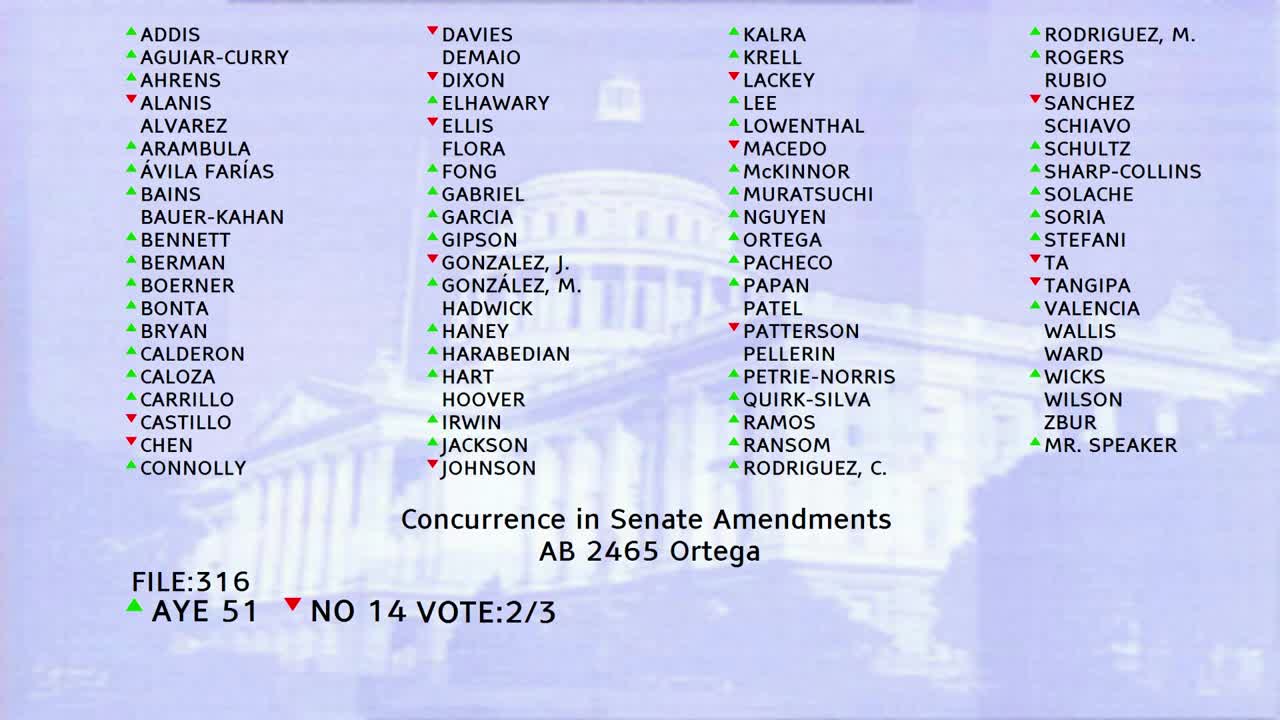 2MIN
Assembly Floor
 2MIN
Senate Floor
 2MIN
Senate Standing Committee on Appropriations
 6MIN
Senate Standing Committee on Judiciary
 5MIN
Senate Standing Committee on Labor, Public Employment and Retirement
 1MIN
Assembly Floor
 7MIN
Assembly Standing Committee on Judiciary
 10MIN
Assembly Standing Committee on Labor and Employment
Bill Author

Bill Co-Author(s):