AB 2512: Surplus Land Act: exemption: Angel Stadium.
- Session Year: 2025-2026
- House: Assembly
- Latest Version Date: 2026-08-27
Current Status:
Passed
(2026-08-27: Chaptered by Secretary of State - Chapter 142, Statutes of 2026.)
Introduced
In Committee
Awaiting First Chamber Vote
Passed First Chamber
In Committee
Awaiting Second Chamber Vote
Passed Second Chamber
Enacted
Existing law requires land to be declared either surplus land or exempt surplus land, as supported by written findings, before a local agency may take any action to dispose of it consistent with an agencys policies or procedures. Existing law establishes procedures for the disposal of surplus land, as provided. These procedures do not apply to the disposal of exempt surplus land. Existing law establishes various categories of exempt surplus land, as provided.
This bill would require, if an exemption is granted to the City of Anaheim for the disposition of surplus land involving the sale or lease of Angel Stadium to the Los Angeles Angels, that any materials refer to that team as the Anaheim Angels. The bill would express the intent of the Legislature not to apply this requirement if the City of Anaheim is able to come to an agreement with the Major League Baseball team known as the Los Angeles Angels about their affiliation.
This bill would make legislative findings and declarations as to the necessity of a special statute for the City of Anaheim.
Existing law, the Cortese-Knox-Hertzberg Local Government Reorganization Act of 2000, provides the exclusive authority and procedure for the initiation, conduct, and completion of changes of organization and reorganization for cities and districts, except as specified.This bill would make a nonsubstantive change to the provision naming the act.Existing law, the Cortese-Knox-Hertzberg Local Government Reorganization Act of 2000, provides the exclusive authority and procedure for the initiation, conduct, and completion of changes of organization and reorganization for cities and districts, except as specified.
This bill would make a nonsubstantive change to the provision naming the act.
(a)If an exemption to this article is granted to the City of Anaheim for the disposition of surplus land involving the sale or lease of Angel Stadium to the Major League Baseball team known as the Los Angeles Angels, then any materials, including, but not limited to, a lease, deed of sale, and promotional or marketing materials, shall refer to that team as the Anaheim Angels.
(b)It is the intent of the Legislature that the requirement in subdivision (a) would not apply if the City of Anaheim is able to come to an agreement with the Major League Baseball team known as the Los Angeles Angels about their affiliation.
SEC. 2.The Legislature finds and declares that a special statute is necessary and that a general statute cannot be made applicable within the meaning of Section 16 of Article IV of the California Constitution because of the corruption scandal related to the almost sale of Angel Stadium in 2020, and the current lease agreement with the City of Anaheim.
SECTION 1.Section 56000 of the Government Code is amended to read:56000.This division shall be known, and may be cited, as the Cortese-Knox-Hertzberg Local Government Reorganization Act of 2000. REVISIONS: HeadingLine 2.This division shall be known and may be cited known, and may be cited, as the Cortese-Knox-Hertzberg Local Government Reorganization Act of 2000.
|
Date
|
Status
|
|---|---|
| Aug 27, 2026 | Chaptered by Secretary of State - Chapter 142, Statutes of 2026. |
| Aug 27, 2026 | Approved by the Governor. |
| Aug 18, 2026 | Enrolled and presented to the Governor at 3:30 p.m. |
| Aug 11, 2026 | In Assembly. Ordered to Engrossing and Enrolling. |
| Aug 10, 2026 | Read third time. Passed. Ordered to the Assembly. (Ayes 39. Noes 0. Page 5320.). |
| Aug 10, 2026 | Read third time. Passed. Ordered to the Assembly. (Ayes 39. Noes 0.). |
| Aug 3, 2026 | Read second time. Ordered to Consent Calendar. |
| Jul 2, 2026 | From committee: Do pass. To Consent Calendar. (Ayes 7. Noes 0.) (July 1). |
| May 27, 2026 | Referred to Com. on L. GOV. |
| May 18, 2026 | In Senate. Read first time. To Com. on RLS. for assignment. |
| May 18, 2026 | Read third time. Passed. Ordered to the Senate. (Ayes 72. Noes 0. Page 5129.) |
| May 18, 2026 | Read third time. Passed. Ordered to the Senate. (Ayes 72. Noes 0.) |
| May 7, 2026 | Ordered to third reading. |
| May 7, 2026 | From Consent Calendar. |
| Apr 30, 2026 | Read second time. Ordered to Consent Calendar. |
| Apr 29, 2026 | From committee: Do pass. To Consent Calendar. (Ayes 12. Noes 0.) (April 29). |
| Apr 16, 2026 | From committee: Do pass and re-refer to Com. on H. & C.D. (Ayes 10. Noes 0.) (April 15). Re-referred to Com. on H. & C.D. |
| Apr 16, 2026 | Coauthors revised. |
| Mar 23, 2026 | Re-referred to Com. on L. GOV. |
| Mar 19, 2026 | From committee chair, with author's amendments: Amend, and re-refer to Com. on L. GOV. Read second time and amended. |
| Mar 19, 2026 | Referred to Coms. on L. GOV. and H. & C.D. |
| Feb 21, 2026 | From printer. May be heard in committee March 23. |
| Feb 20, 2026 | Read first time. To print. |
|
Date
|
Description
|
Location
|
Votes
|
|
|---|---|---|---|---|
| Aug 10, 2026 | Consent Calendar 2nd AB2512 Valencia et al. | Senate Floor |
Passed |
|
| Jul 1, 2026 | Do pass and be ordered to the Consent Calendar | Senate Standing Committee on Local Government |
Passed |
|
| May 18, 2026 | AB 2512 Valencia Assembly Third Reading | Assembly Floor |
Passed |
|
| Apr 29, 2026 | Do pass. To Consent Calendar. | Assembly Standing Committee on Housing and Community Development |
Passed |
|
| Apr 15, 2026 | Do pass and be re-referred to the Committee on [Housing and Community Development] | Assembly Standing Committee on Local Government |
Passed |
This list shows positions taken on this bill by organizations on the date displayed, which is linked to the original source.
Positions by individuals are not included.
|
Organization
|
Position
|
Date
|
|---|---|---|
| Orange County Employees Association | ** Support |
SENATE RULES COMMITTEE Office of Senate Floor Analyses (916) 651-4171 | AB 2512 |
CONSENT
Bill No: AB 2512
Author: Valencia (D), et al.
Amended: 3/19/26 in Assembly
Vote: 21
SENATE LOCAL GOVERNMENT COMMITTEE: 7-0, 7/1/26
AYES: Durazo, Choi, Arreguín, Ashby, Cervantes, Laird, Seyarto
ASSEMBLY FLOOR: 72-0, 5/18/26 - See last page for vote
SUBJECT: Surplus Land Act: exemption: Angel Stadium
SOURCE: Author
DIGEST:
This bill requires materials related to an exemption from the Surplus Land Act (SLA) for Angels Stadium to refer to the Anaheim Angels.
ANALYSIS:
Existing law:
- Establishes procedures for the disposal of publicly-owned land that is surplus to the needs of local agencies, under the SLA.
- Requires local officials that want to dispose of public property to declare that the land is no longer needed for the agency’s use in a public meeting and declare the land either “surplus land” or “exempt surplus land.”
- Provides that “agency’s use” includes land that is being used, or is planned to be used pursuant to a written plan adopted by the local agency or will be disposed of to support agency work or operations, and excludes land for agency’s use from the SLA.
- Requires local agencies to follow the procedures laid out in the SLA before surplus land can be sold, including:
- Send a written notice of availability to various public agencies and nonprofit groups, referred to as “housing sponsors,” notifying them that land is available for specified purposes.
- Negotiate in good faith for 90 days with housing sponsors that respond.
- Allows the local agency to dispose of the property on the private market if agreement is not reached with a housing sponsor.
- Requires that, if a property sold as surplus is not sold to a housing sponsor, but housing is developed on it later, 15% of the units must be sold or rented at an affordable cost to lower income households.
- Requires local agencies to notify the Department of Housing and Community Development (HCD) prior to agreeing to terms for the disposition of surplus land.
- Imposes penalties of 30% of the disposition value of the land for a first violation and 50% of the disposition value for any subsequent violation for selling land in violation of the SLA.
- Designates certain types of land as “exempt surplus land” and provides that the entirety of the SLA does not apply to exempt surplus land.
This bill:
- Requires that if an exemption to the SLA is granted to the City of Anaheim for the disposition of surplus land involving the sale or lease of Angel Stadium to the Angels, then any materials, including, but not limited to, a lease, deed of sale, and promotional or marketing materials, must refer to that team as the Anaheim Angels.
- Provides that it is the intent of the Legislature that those requirements do not apply if the City is able to come to an agreement with the Angels about their affiliation.
Background
Surplus Land Act. Public agencies are major landlords in some communities, owning significant pieces of real estate. When properties become surplus to an agency’s needs, public officials want to sell the land to recoup their investments. The SLA spells out the steps local agencies must follow when they want to dispose of land. It requires local governments to give a “first right of refusal” to other governments and nonprofit housing developers, and to negotiate in good faith with them to try to come to agreement. This means that local agencies must open their properties up to affordable housing developers first, even if they have a different purpose in mind for the property.
Before local officials can dispose of property, they must declare that the land is no longer needed for the agency’s use in a public meeting and declare the land either “surplus land” or “exempt surplus land.” Land that is being used for an agency’s use is not subject to the SLA. “Agency’s use” includes land that is being used, or is planned to be used pursuant to a written plan adopted by the local agency or will be disposed of to support agency work or operations.
The SLA designates a lengthy list of types of land that are “exempt surplus land,” such as land that is being transferred to another public entity or an Indian Tribe, or land that is subject to a valid legal restriction that prohibits residential uses on the property. Statute provides that the entirety of the SLA does not apply to disposals of exempt surplus land. All other surplus land must follow the procedures laid out in the SLA before a local agency can sell it.
Angel Stadium. The City of Anaheim owns Angel Stadium, a Major League Baseball (MLB) stadium that is the home stadium of the MLB team the Los Angeles Angels. Anaheim leases the stadium and the land around it to the team’s ownership. The Angels ownership has leased the stadium since 1996 under an agreement that requires Angels ownership to maintain the stadium at its own expense subject to certain conditions. However, both the city and Angels ownership annually contribute to a capital reserve fund based on a formula, which Angels ownership may use for improvements. Under certain conditions, the lease also requires Angels ownership to provide Anaheim with a share of the revenue from ticket sales for baseball games, parking, and other events using specified formulas. The lease agreement ends on December 31, 2032, but contains an option for Angels ownership to extend it by up to six more years.
In September 2020, Anaheim approved the sale of Angel Stadium and 150 acres of surrounding land to Angels ownership. At the time, the sale was criticized because the initial offering price for the land was $320 million, which was below the value of $500 million identified in a city-commissioned appraisal of the site, and which was further lowered to the price of $150 million in exchange for the funding of 466 affordable housing units and a seven-acre park on the property. In December 2021, HCD notified the City of Anaheim that the sale violated the SLA, and on April 25, 2022, the City and the Attorney General agreed to a settlement that required the City to pay $123 million for the development of affordable housing on the site, which includes a $96 million fine equivalent to 30 percent of the $320 million final sales price of the land. Anaheim denied wrongdoing. However, in May 2022, allegations of corruption associated with the deal surfaced.
Specifically, reports became public that the Federal Bureau of Investigation (FBI) was investigating the mayor of the City of Anaheim and alleged that he “shared privileged and confidential information with the Angels during stadium sale negotiations, actively concealed same from a grand jury inquiry, and expects to receive campaign contributions as a result.” The mayor subsequently resigned, and on May 24, 2022, the city council voided the deal. Because the transaction did not occur, the settlement agreement between the Attorney General and the City is no longer operative.
In 2023, SB 34 (Umberg, Chapter 772, Statutes of 2023) and SB 229 (Umberg, Chapter 774, Statutes of 2023) responded to the “almost disposition” of the Angels Stadium. SB 34 prohibited the County of Orange or any city within the County of Orange from disposing of surplus land if the local agency had received a notice of violation from HCD. SB 34 also prohibited the disposition of surplus land from being completed until HCD determines that the proposed disposition complies with the SLA. SB 229 required a local agency to hold an open and public meeting if it has been notified by HCD that the local agency’s planned disposal of surplus land is in violation of the SLA.
The author wants to ensure that Angel Stadium is known for its connection to the City of Anaheim.
Comments
- Purpose of the bill. According to the author, “The City of Anaheim has been home to this franchise for nearly 60 years. Yet the team’s name does not reflect that history or our community. The Home Run for Anaheim Act will restore the name of the Angels Major League Baseball team to Anaheim Angels if the City of Anaheim is granted an exemption to the surplus land act. Restoring the team’s name will present new marketing opportunities for the City and will recognize the residents who grew up attending Angels’ games.”
- Sure, but will it work? Numerous exemptions to the SLA exist for certain uses of local agency properties, but they are typically reserved for circumstances where local governments are transferring properties to affordable housing developers or other governmental entities, or are subject to strict restrictions on the property’s use. This bill provides that if one of these exemptions, or potential future exemptions, apply to the sale or lease of Angel Stadium to the Angels, then the materials must call them the Anaheim Angels. This bill does not enact an exemption, and it is unclear whether any existing exemptions would apply. Furthermore, the Legislature may be reluctant to grant any future exemptions for Angel Stadium, given the significant concerns that arose around the prior disposition. As such, this bill may have limited effect.
FISCAL EFFECT: Appropriation: No Fiscal Com.: No Local: No
SUPPORT: (Verified 7/27/26)
Orange County Employees Association
OPPOSITION: (Verified 7/27/26)
None received
ASSEMBLY FLOOR: 72-0, 5/18/26
AYES: Addis, Aguiar-Curry, Ahrens, Alanis, Alvarez, Arambula, Ávila Farías, Bains, Bauer-Kahan, Bennett, Berman, Boerner, Bonta, Bryan, Caloza, Carrillo, Castillo, Connolly, Davies, DeMaio, Elhawary, Ellis, Flora, Fong, Gabriel, Gallagher, Garcia, Gipson, Jeff Gonzalez, Mark González, Hadwick, Haney, Harabedian, Hart, Hoover, Irwin, Jackson, Johnson, Kalra, Krell, Lackey, Lowenthal, Macedo, McKinnor, Muratsuchi, Nguyen, Ortega, Pacheco, Papan, Patel, Patterson, Pellerin, Petrie-Norris, Ramos, Ransom, Michelle Rodriguez, Rogers, Blanca Rubio, Sanchez, Schiavo, Schultz, Sharp-Collins, Solache, Soria, Ta, Tangipa, Valencia, Wallis, Ward, Wilson, Zbur, Rivas
NO VOTE RECORDED: Calderon, Chen, Dixon, Lee, Quirk-Silva, Celeste Rodriguez, Stefani, Wicks
Prepared by: Anton Favorini-Csorba / L. GOV. / (916) 651-4119
8/3/26 17:24:38
**** END ****
SENATE COMMITTEE ON LOCAL GOVERNMENT
Senator María Elena Durazo, Chair
2025 - 2026 Regular
Bill No: | AB 2512 | Hearing Date: | 7/1/26 |
Author: | Valencia | Fiscal: | No |
Version: | 3/19/26 | Consultant: | Favorini-Csorba |
Surplus Land Act: exemption: Angel Stadium
Requires materials related to an exemption for Angels Stadium to refer to the Anaheim Angels.
Background
Surplus Land Act. Public agencies are major landlords in some communities, owning significant pieces of real estate. When properties become surplus to an agency’s needs, public officials want to sell the land to recoup their investments. The Surplus Land Act (SLA) spells out the steps local agencies must follow when they want to dispose of land. It requires local governments to give a “first right of refusal” to other governments and nonprofit housing developers, and to negotiate in good faith with them to try to come to agreement. This means that local agencies must open their properties up to affordable housing developers first, even if they have a different purpose in mind for the property.
Before local officials can dispose of property, they must declare that the land is no longer needed for the agency’s use in a public meeting and declare the land either “surplus land” or “exempt surplus land.” Land that is being used for an agency’s use is not subject to the SLA. “Agency’s use” includes land that is being used, or is planned to be used pursuant to a written plan adopted by the local agency or will be disposed of to support agency work or operations.
The SLA designates a lengthy list of types of land that are “exempt surplus land,” such as land that is being transferred to another public entity or an Indian Tribe, or land that is subject to a valid legal restriction that prohibits residential uses on the property. Statute provides that the entirety of the SLA does not apply to disposals of exempt surplus land. All other surplus land must follow the procedures laid out in the SLA before a local agency can sell it.
SLA process. Before agencies can enter into negotiations to dispose of surplus land, they must send a written notice of availability to various public agencies and nonprofit groups, referred to as “housing sponsors,” notifying them that land is available for the following purposes:
- Low- and moderate-income housing;
- Park and recreation, and open space;
- School facilities; or
- Infill opportunity zones or transit village plans.
Housing sponsors can notify the Department of Housing and Community Development (HCD) if they are interested in acquiring surplus land to develop affordable housing. HCD maintains a list of notices of availability on its website.
If another agency or housing sponsor wants to buy or lease the surplus land for one of these purposes, it must tell the disposing agency within 60 days. The agency and the housing sponsor then have an additional 90 days to negotiate a mutually satisfactory price and terms in good faith. If they cannot agree, the agency that owns the surplus land can sell the land on the private market. If surplus land is not sold to an affordable housing developer, but housing is developed on it later, 15 percent of the units must be sold or rented at an affordable cost to lower income households.
Local agencies that dispose of surplus land in violation of the SLA face penalties totaling 30 percent of the sales price, or fair market value of the sale or lease, of land disposed of in violation of the SLA for a first violation, and 50 percent for subsequent violations. These penalty revenues must be deposited in a local housing trust fund.
Recent SLA revisions. Two bills chaptered in 2023, SB 747 (Caballero) and AB 480 (Ting), made significant changes to the SLA. Collectively, the bills balanced ensuring comprehensive coverage of dispositions, while enacting exemptions and other changes that would streamline the process for local governments. Specifically, SB 747 and AB 480:
- Define “dispose” in the law to include leases of longer than 15 years that are entered into on or after January 1, 2024, but exclude leases of shorter than 15 years and leases where no development or demolition will occur;
- Apply penalties to leases that violate the SLA, but provide that penalties don’t apply to non-substantive violations of the SLA;
- Add numerous categories of exempt surplus land, such as properties of smaller than one-half acre, specified mixed-use developments and developments on larger sites that include affordability requirements, airport land, and others;
- Authorize disposal of certain categories of exempt surplus land without a public hearing, as long as specified notice is provided;
- Establish additional types of activities that explicitly qualify as “agency’s use”; and
- Extend provisions that allow projects with an exclusive negotiating agreement in place to follow a previous version of the SLA.
HCD’s guidelines for the SLA adopted after the chaptering of these bills require agencies proposing to use an exemption to file a notice of exemption with HCD that HCD reviews within 30 days of receipt.
Angel Stadium. The City of Anaheim owns Angel Stadium, a Major League Baseball (MLB) stadium that is the home stadium of the MLB team the Los Angeles Angels. Anaheim leases the stadium and the land around it to the team’s ownership. The Angels ownership has leased the stadium since 1996 under an agreement that requires Angels ownership to maintain the stadium at its own expense subject to certain conditions. However, both the city and Angels ownership annually contribute to a capital reserve fund based on a formula, which Angels ownership may use for improvements. Under certain conditions, the lease also requires Angels ownership to provide Anaheim with a share of the revenue from ticket sales for baseball games, parking, and other events using specified formulas. The lease agreement ends on December 31, 2032, but contains an option for Angels ownership to extend it by up to six more years.
In September 2020, Anaheim approved the sale of Angel Stadium and 150 acres of surrounding land to Angels ownership. At the time, the sale was criticized because the initial offering price for the land was $320 million, which was below the value of $500 million identified in a city-commissioned appraisal of the site, and which was further lowered to the price of $150 million in exchange for the funding of 466 affordable housing units and a seven-acre park on the property. In December 2021, HCD notified the City of Anaheim that the sale violated the SLA, and on April 25, 2022, the City and the Attorney General agreed to a settlement that required the City to pay $123 million for the development of affordable housing on the site, which includes a $96 million fine equivalent to 30 percent of the $320 million final sales price of the land. Anaheim denied wrongdoing. However, in May 2022, allegations of corruption associated with the deal surfaced.
Specifically, reports became public that the Federal Bureau of Investigation (FBI) was investigating the mayor of the City of Anaheim and alleged that he “shared privileged and confidential information with the Angels during stadium sale negotiations, actively concealed same from a grand jury inquiry, and expects to receive campaign contributions as a result.” The mayor subsequently resigned, and on May 24, 2022, the city council voided the deal. Because the transaction did not occur, the settlement agreement between the Attorney General and the City is no longer operative.
In 2023, SB 34 (Umberg) and SB 229 (Umberg) responded to the “almost disposition” of the Angels Stadium. SB 34 prohibited the County of Orange or any city within the County of Orange from disposing of surplus land if the local agency had received a notice of violation from HCD. SB 34 also prohibited the disposition of surplus land from being completed until HCD determines that the proposed disposition complies with the SLA. SB 229 required a local agency to hold an open and public meeting if it has been notified by HCD that the local agency’s planned disposal of surplus land is in violation of the SLA.
The author wants to ensure that Angel Stadium is known for its connection to the City of Anaheim.
Proposed Law
Assembly Bill 2512 requires that if an exemption to the SLA is granted to the City of Anaheim for the disposition of surplus land involving the sale or lease of Angel Stadium to the Angels, then any materials, including, but not limited to, a lease, deed of sale, and promotional or marketing materials, must refer to that team as the Anaheim Angels. The bill provides that it is the intent of the Legislature that those requirements do not apply if the City is able to come to an agreement with the Angels about their affiliation.
Comments
1. Purpose of the bill. According to the author, “The City of Anaheim has been home to this franchise for nearly 60 years. Yet the team’s name does not reflect that history or our community. The Home Run for Anaheim Act will restore the name of the Angels Major League Baseball team to Anaheim Angels if the City of Anaheim is granted an exemption to the surplus land act. Restoring the team’s name will present new marketing opportunities for the City and will recognize the residents who grew up attending Angels’ games.”
2. Sure, but will it work? Numerous exemptions to the SLA exist for certain uses of local agency properties, but they are typically reserved for circumstances where local governments are transferring properties to affordable housing developers or other governmental entities, or are subject to strict restrictions on the property’s use. AB 2512 provides that if one of these exemptions, or potential future exemptions, apply to the sale or lease of Angel Stadium to the Angels, then the materials must call them the Anaheim Angels. AB 2512 does not enact an exemption, and it is unclear whether any existing exemptions would apply. Furthermore, the Legislature may be reluctant to grant any future exemptions for Angel Stadium, given the significant concerns that arose around the prior disposition. As such, AB 2512 may have limited effect.
3. Special legislation. Section 16 of Article IV of the California Constitution prohibits special legislation when a general law can apply. AB 2512 contains findings and declarations explaining the need for legislation that applies only to the City of Anaheim because of corruption scandal related to the almost sale of Angel Stadium in 2020, and the current lease agreement with the City of Anaheim.
Assembly Actions
Assembly Local Government Committee: 10-0
Assembly Housing and Community Development Committee: 12-0
Assembly Floor: 72-0
Support and Opposition
(6/26/26)
Support: Orange County Employees Association
Opposition: None Submitted
-- END --
ASSEMBLY THIRD READING
ATR Bill Id:AB 2512
Author:(Valencia)
As Amended Ver:March 19, 2026
Majority vote
SUMMARY
Provides that, if an exemption under the Surplus Land Act (SLA) is applied to the disposition of Angel Stadium by the City of Anaheim to the Los Angeles Angels, any disposition documents and promotional or marketing materials shall refer to the team as the Anaheim Angels, except under certain conditions.
Major Provisions
- Provides that, if an exemption to the SLA is granted to the City of Anaheim for the disposition of surplus land involving the sale or lease of Angel Stadium to the Major League Baseball (MLB) team known as the Los Angeles Angels, then any materials, including, but not limited to, a lease, deed of sale, and promotional or marketing materials, shall refer to that team as the Anaheim Angels.
- Provides that it is the intent of the Legislature that the requirements in 1), above, would not apply if the City of Anaheim is able to come to an agreement with the MLB team known as the Los Angeles Angels about their affiliation.
- Finds and declares a special statute is necessary and that a general statute cannot be made applicable within the meaning of Section 16 of Article IV of the California Constitution because of the corruption scandal related to the almost sale of Angel Stadium in 2020, and the current lease agreement with the City of Anaheim.
COMMENTS
Surplus Land Act. Public agencies are major landlords in some communities, owning significant pieces of real estate. When properties become surplus to an agency′s needs, public officials sometimes want to dispose of the land, which means to sell or lease it for more than fifteen years, to recoup their investments. The SLA spells out the steps local agencies must follow when they want to dispose of land. It requires local governments to give a ″first right of refusal″ to other public agencies, nonprofit housing developers, schools, and parks and recreation departments. After notifying these groups that the land is available, the disposing agency must negotiate in good faith with these interested parties for 90 days to try to come to agreement before the local agency can dispose of the surplus land.
SLA Reform. In 2023, AB 480 (Ting), Chapter 788 and SB 747 (Caballero), Chapter 786 made significant changes to the SLA. Together the bills attempted to strike a balance between ensuring comprehensive coverage of dispositions, while enacting exemptions and other changes that would streamline the process for local governments. Specifically, AB 480 and SB 747:
- Defined ″dispose″ to include leases of longer than 15 years that are entered into on or after January 1, 2024, but excluded leases of terms 15 years or less and leases where no development or demolition will occur.
- Applied penalties to leases that violate the SLA, but provided that penalties don′t apply to non-substantive violations of the SLA.
- Added numerous categories of exempt surplus land, such as properties smaller than one-half acre, specified mixed-use developments and developments on larger sites that include affordability requirements, airport land, and others.
- Authorized disposal of certain categories of exempt surplus land without a public hearing, as long as specified notice is provided.
- Established additional types of activities that explicitly qualify as ″agency′s use.″
- Extended provisions that allow projects with an exclusive negotiating agreement in place to follow a previous version of the SLA.
Anaheim Stadium Transaction. In September 2020, the Anaheim City Council approved the sale of Angel Stadium and 150 acres of surrounding land to the owner of the Los Angeles Angels. At the time, the sale was criticized because the initial offering price for the land was $320 million, which was below the value of $500 million identified in a city-commissioned appraisal of the site, and which was further lowered to the price of $150 million in exchange for the funding of 466 affordable housing units and a seven-acre park on the property. In December 2021, HCD notified the City of Anaheim that the sale violated the SLA, and on April 25, 2022, the City and the Attorney General agreed to a settlement that required the City to pay $123 million for the development of affordable housing on the site, which includes a $96 million fine equivalent to 30 percent of the $320 million final sales price of the land. However, in May 2022, allegations of corruption associated with the deal surfaced. Specifically, reports became public that the Federal Bureau of Investigation (FBI) was investigating the mayor of the City of Anaheim and alleged that he ″shared privileged and confidential information with the Angels during stadium sale negotiations, actively concealed same from a grand jury inquiry, and expects to receive campaign contributions as a result.″ The mayor subsequently resigned, and on May 24, 2022, the city council voided the deal. In 2023, SB 34 (Umberg), Chapter 772, and SB 229 (Umberg), Chapter 774, responded to the ″almost disposition″ of the Angels Stadium. SB 34 prohibited the County of Orange or any city within the County or Orange from disposing of surplus land if the local agency had received a notice of violation from HCD. SB 34 also prohibited the disposition of surplus land from being completed until HCD determines that the proposed disposition complies with the SLA. SB 229 required a local agency to hold an open and public meeting if it has been notified by HCD that the local agency′s planned disposal of surplus land is in violation of the SLA.
According to the Author
According to the author, ″The City of Anaheim has been home to this franchise for nearly 60 years. Yet the team′s name does not reflect that history or our community. The Home Run for Anaheim Act will restore the name of the Angels Major League Baseball team to Anaheim Angels.″
Arguments in Support
None on file.
Arguments in Opposition
None on file.
FISCAL COMMENTS
None.
VOTES
ASM LOCAL GOVERNMENT: 10-0-0
YES: Carrillo, Ta, Johnson, Pacheco, Ramos, Ransom, Blanca Rubio, Stefani, Ward, Wilson
ASM HOUSING AND COMMUNITY DEVELOPMENT: 12-0-0
YES: Haney, Patterson, Ávila Farías, Caloza, Garcia, Kalra, Lee, Quirk-Silva, Ta, Tangipa, Wicks, Wilson
UPDATED
VERSION: March 19, 2026
CONSULTANT: Linda Rios / L. GOV. / (916) 319-3958 FN: 0002531
Date of Hearing: April 29, 2026
ASSEMBLY COMMITTEE ON HOUSING AND COMMUNITY DEVELOPMENT
Matt Haney, Chair
ABPCA Bill Id:AB 2512 (
Author:Valencia) – As Amended Ver:March 19, 2026
SUBJECT: Surplus Land Act: exemption: Angel Stadium
SUMMARY: Provides that, if an exemption under the Surplus Land Act (SLA) is applied to the disposition of Angel Stadium by the City of Anaheim to the Los Angeles Angels, any disposition documents and promotional or marketing materials shall refer to the team as the Anaheim Angels, except under certain conditions. Specifically, this bill:
- Provides that, if an exemption to the SLA is granted to the City of Anaheim for the disposition of surplus land involving the sale or lease of Angel Stadium to the Major League Baseball (MLB) team known as the Los Angeles Angels, then any materials, including, but not limited to, a lease, deed of sale, and promotional or marketing materials, shall refer to that team as the Anaheim Angels.
- Provides that it is the intent of the Legislature that the requirements in 1), above, would not apply if the City of Anaheim is able to come to an agreement with the MLB team known as the Los Angeles Angels about their affiliation.
- Finds and declares a special statute is necessary and that a general statute cannot be made applicable within the meaning of Section 16 of Article IV of the California Constitution because of the corruption scandal related to the almost sale of Angel Stadium in 2020, and the current lease agreement with the City of Anaheim.
EXISTING LAW:
- Establishes procedures for the disposal of publicly-owned land that is surplus to the needs of local agencies, under the SLA. (Government Code (GOV) Sections 54220 - 54262)
- Defines “disposition” to mean the sale of surplus land or the entering of a lease for surplus land for a term longer than 15 years, inclusive of any extension or renewal option included in the terms of the initial lease, entered into on or after January 1, 2024. (GOV 54221)
- Provides that “disposition” does not mean the entering of a lease for surplus land for a term of 15 years or less, inclusive of any extensions or renewal options, or the entering of a lease in which no development or demolition occurs, regardless of the term of the lease. (GOV 54221)
- Provides that a local agency that disposes of surplus in violation of the SLA is liable for a 30% penalty of the applicable disposition value for a first violation, and 50% for any subsequent violation. Defines “disposition value” to mean either of the following:
- The final sale price of the land or the fair market value of the surplus land at the time of sale as determined by an independent appraisal of the land, whichever is greater; or
- The discounted net present value of the fair market value of the lease as of the date the lease was entered into, as determined by an independent appraisal of the lease. (GOV § 54230.5)
- Requires, if a local agency is disposing of surplus land and has received notification from the Department of Housing and Community Development (HCD) that the disposition violates the SLA, the local agency to hold an open and public meeting to review and consider the substance of the notice of violation. A local agency shall not take final action to ratify or approve the proposed disposal of surplus land until this public meeting is held. This public meeting is no longer required if the local agency ceases to dispose of the surplus land after receiving a notice of violation from HCD. (GOV 54230.7)
- Provides, until January 1, 2030, that if HCD notifies the County of Orange or a city within the County of Orange that its planned disposition of surplus land is in violation of the SLA, the jurisdiction shall have 60 days from the date of receipt of the notification of the violation to cure or correct an alleged violation, unless HCD decides that the alleged violation is not a violation within the 60 days. If the jurisdiction has not cured or corrected any alleged violation within 60 days, it shall not dispose of the land until HCD determines that the jurisdiction has complied with the SLA or deems the alleged violation not to be a violation. (GOV54230.8)
- Requires, until January 1, 2030, a jurisdiction that receives a notice of violation from HCD pursuant to e), above, to respond to HCD with a statement describing the actions taken to cure or correct the alleged violation within 60 days of receipt of the notice. HCD shall determine if the local agency’s actions have cured or corrected the alleged violation and whether the planned disposal of surplus land would constitute a violation, and notify the jurisdiction of its determination within 30 days. (GOV § 54230.8)
FISCAL EFFECT: Unknown. This bill has been keyed non-fiscal by the Legislative Counsel.
COMMENTS:
Surplus Land Act: Local public agencies are major landlords in some communities, owning significant pieces of real estate. When properties become surplus to a local agency’s needs, public officials may want to dispose of the property. They can do so under the SLA to recoup their investment by selling or leasing that land for fifteen years or longer, assuming they follow the process specified in the SLA. The SLA spells out the steps local agencies must follow when they want to dispose of land.
Generally, before local officials can dispose of property under the SLA, they must declare that the land is no longer needed for the agency’s use in a public meeting and declare the land either “surplus land” or “exempt surplus land.” Before agencies can broadly negotiate to dispose of surplus land on the private market, they must give a “first right of refusal” to other public agencies, nonprofit housing developers, schools, and parks and recreation departments. Public agencies and nonprofit housing developers interested in developing surplus property are referred to as “housing sponsors.”
When a local agency wants to dispose of surplus land, it must send a written NOA to let interested parties, including local public entities with jurisdiction where the surplus land is located and all interested housing sponsors, know that land is available for the following purposes:
- Low- and moderate-income housing;
- Park and recreation, and open space;
- School facilities; or
- Infill opportunity zones or transit village plans.
If any interested parties respond to the NOA within 60 days, the disposing agency must negotiate in good faith for 90 days with any interested parties who respond to the NOA to try to come to a mutually satisfactory sale or long-term lease agreement. If multiple entities respond to the NOA, the housing sponsor that proposes to provide the greatest number of units, and the highest level of affordable housing, gets priority. If the disposing agency and interested parties cannot agree to mutually satisfactory terms after negotiating in good faith, the agency that owns the surplus land can sell the land on the private market. Before disposing of the land through the private market, the disposing local agency must record a restriction or covenant against the property, maintaining that housing is developed on the property in the future, 15% of the units must be sold or rented at an affordable cost to lower-income households.
The SLA says that nothing in its provisions:
- Limits the power of any local agency to sell or lease surplus land at fair market value or less than fair market value;
- Prevents a local agency from obtaining fair market value for the land;
- Limits a local agency’s authority or discretion to approve land use, zoning, or other entitlement decisions in connection with surplus land; or
- Requires a local agency to dispose of land just because it is surplus.
HCD has enforcement authority over the SLA. Furthermore, the SLA may be enforced by affordable housing developers, housing organizations, individuals who would have been eligible to apply for residency in affordable housing, or a beneficially interested person or entity. Local agencies that improperly dispose of surplus land face penalties of 30% of the sale price or market value for the first violation, and 50% for subsequent violations, with penalty revenues going to a local housing trust fund. Before finalizing land dispositions, agencies must notify HCD and provide HCD with documentation of their compliance with the SLA disposition process. HCD has 30 days to review the submitted materials and respond. If HCD finds violations and notifies the disposing local agency within 30 days, the agency has 60 days to address them. If the violations are not addressed, the disposing agency may incur penalties including referral to the Attorney General. However, penalties are void if HCD fails to notify the local agency of a violation within 30 days.
SLA as a Tool for Affordable Housing Production: The SLA is a powerful tool for the production of affordable housing in California. The SLA requires an entity proposing to use surplus land for developing low- and moderate-income housing to deed restrict at least 25% of the units as affordable. In the event that multiple entities respond to an SLA NOA with an interest to purchase or lease the land, the local agency is required to give priority to housing projects that meet the aforementioned affordability requirements. The disposing entity must also prioritize the number of units proposed, and the affordability levels of those units, while reviewing responses to the NOA and proceeding with negotiations.
Since January 2021, surplus and exempt surplus land dispositions tracked by HCD have resulted in 37,129 housing units, including over 23,686 units of housing affordable to lower-income households, entering the development pipeline.[1]
Anaheim Stadium Transaction: In September 2020, the Anaheim City Council approved the sale of Angel Stadium and 150 acres of surrounding land to the owner of the Los Angeles Angels. At the time, the sale was criticized because the initial offering price for the land was $320 million, which was below the value of $500 million identified in a city-commissioned appraisal of the site, and which was further lowered to the price of $150 million in exchange for the funding of 466 affordable housing units and a seven-acre park on the property. In December 2021, HCD notified the City of Anaheim that the sale violated the SLA, and on April 25, 2022, the City and the Attorney General agreed to a settlement that required the City to pay $123 million for the development of affordable housing on the site, which includes a $96 million fine equivalent to 30% of the $320 million final sales price of the land. However, in May 2022, allegations of corruption associated with the deal surfaced.
Specifically, reports became public that the Federal Bureau of Investigation (FBI) was investigating the mayor of the City of Anaheim and alleged that he “shared privileged and confidential information with the Angels during stadium sale negotiations, actively concealed same from a grand jury inquiry, and expects to receive campaign contributions as a result.” The mayor subsequently resigned, and on May 24, 2022, the city council voided the deal.
In 2023, SB 34 (Umberg), Chapter 772, and SB 229 (Umberg), Chapter 774, responded to the “almost disposition” of the Angels Stadium. SB 34 prohibited the County of Orange or any city within the County of Orange from disposing of surplus land if the local agency had received a notice of violation from HCD. SB 34 also prohibited the disposition of surplus land from being completed until HCD determines that the proposed disposition complies with the SLA. SB 229 required a local agency to hold an open and public meeting if it has been notified by HCD that the local agency’s planned disposal of surplus land is in violation of the SLA.
This Bill: This bill requires that any documents relating to the disposition (sale or lease of a term of more than 15 years of Angels Stadium by the City of Anaheim to the MLB team known as the Los Angeles Angels reflect the name “Anaheim Angels” if the disposition uses an exemption under the SLA. The requirement to use the name “Anaheim Angels” extends to any promotional or marketing materials for the team.
Arguments in Support: None on file.
Arguments in Opposition: None on file.
Related Legislation:
SB 229 (Umberg), Chapter 774, Statutes of 2023, required a local agency to hold an open and public meeting if it has been notified by HCD that its planned disposal of surplus land is in violation of the SLA.
SB 34 (Umberg), Chapter 772, Statutes of 2023, prohibits Orange County, or any city located therein, from proceeding with a planned disposal of surplus land if it receives a notice of violation from HCD and the violation is not corrected within 60 days.
Double-Referred: This bill is double referred. It was heard in the Assembly Committee on Local Government and passed on a vote of 10-0 on April 15, 2026.
REGISTERED SUPPORT / OPPOSITION:
Support
None on file.
Opposition
None on file.
Analysis Prepared by: Dori Ganetsos / H. & C.D. / (916) 319-2085
https://www.hcd.ca.gov/housing-open-data-tools/sla-dashboard ↑
Date of Hearing: April 15, 2026
ASSEMBLY COMMITTEE ON LOCAL GOVERNMENT
Juan Carrillo, Chair
ABPCA Bill Id:AB 2512 (
Author:Valencia) – As Amended Ver:March 19, 2026
SUBJECT: Surplus Land Act: exemption: Angel Stadium
SUMMARY: Provides that, if an exemption under the Surplus Land Act (SLA) is applied to the disposition of Angel Stadium by the City of Anaheim to the Los Angeles Angels, any disposition documents and promotional or marketing materials shall refer to the team as the Anaheim Angels, except under certain conditions. Specifically, this bill:
- Provides that, if an exemption to the SLA is granted to the City of Anaheim for the disposition of surplus land involving the sale or lease of Angel Stadium to the Major League Baseball (MLB) team known as the Los Angeles Angels, then any materials, including, but not limited to, a lease, deed of sale, and promotional or marketing materials, shall refer to that team as the Anaheim Angels.
- Provides that it is the intent of the Legislature that the requirements in 1), above, would not apply if the City of Anaheim is able to come to an agreement with the MLB team known as the Los Angeles Angels about their affiliation.
- Finds and declares a special statute is necessary and that a general statute cannot be made applicable within the meaning of Section 16 of Article IV of the California Constitution because of the corruption scandal related to the almost sale of Angel Stadium in 2020, and the current lease agreement with the City of Anaheim.
EXISTING LAW:
- Establishes the SLA. [Government Code (GOV) § 54220-54234]
- Provides the following pursuant to the SLA:
- Defines “disposition” to mean the sale of surplus land or the entering of a lease for surplus land for a term longer than 15 years, inclusive of any extension or renewal option included in the terms of the initial lease, entered into on or after January 1, 2024. (GOV § 54221)
- Provides that “disposition” does not mean the entering of a lease for surplus land for a term of 15 years or less, inclusive of any extensions or renewal options, or the entering of a lease in which no development or demolition occurs, regardless of the term of the lease. (GOV § 54221)
- Provides that a local agency that disposes of surplus and in violation of the SLA is liable for a 30% penalty of the applicable disposition value for a first violation, and 50% for any subsequent violation. Defines “disposition value” to mean either of the following:
- The final sale price of the land or the fair market value of the surplus land at the time of sale as determined by an independent appraisal of the land, whichever is greater.
- The discounted net present value of the fair market value of the lease as of the date the lease was entered into, as determined by an independent appraisal of the lease. (GOV § 54230.5)
- Requires, if a local agency is disposing of surplus land and has received notification from the Department of Housing and Community Development (HCD) that the disposition violates the SLA, the local agency to hold an open and public meeting to review and consider the substance of the notice of violation. A local agency shall not take final action to ratify or approve the proposed disposal of surplus land until this public meeting is held. This public meeting is no longer required if the local agency ceases to dispose of the surplus land after receiving a notice of violation from HCD. (GOV § 54230.7)
- Provides, until January 1, 2030, that if HCD notifies the County of Orange or a city within the County of Orange that its planned disposition of surplus land is in violation of the SLA, the jurisdiction shall have 60 days from the date of receipt of the notification of the violation to cure or correct an alleged violation, unless HCD decides that the alleged violation is not a violation within the 60 days. If the jurisdiction has not cured or corrected any alleged violation within 60 days, it shall not dispose of the land until HCD determines that the jurisdiction has complied with the SLA or deems the alleged violation not to be a violation. (GOV §54230.8)
- Requires, until January 1, 2030, a jurisdiction that receives a notice of violation from HCD pursuant to e), above, to respond to HCD with a statement describing the actions taken to cure or correct the alleged violation within 60 days of receipt of the notice. HCD shall determine if the local agency’s actions have cured or corrected the alleged violation and whether the planned disposal of surplus land would constitute a violation, and notify the jurisdiction of its determination within 30 days. (GOV § 54230.8)
FISCAL EFFECT: None.
COMMENTS:
- Bill Summary. This bill requires that any documents relating to the disposition (sale or lease of a term of more than 15 years of Angels Stadium by the City of Anaheim to the MLB team known as the Los Angeles Angels reflect the name “Anaheim Angels” if the disposition uses an exemption under the SLA. The requirement to use the name “Anaheim Angels” extends to any promotional or marketing materials for the team.
This bill is author sponsored. - Author’s Statement. According to the author, “The City of Anaheim has been home to this franchise for nearly 60 years. Yet the team’s name does not reflect that history or our community. The Home Run for Anaheim Act will restore the name of the Angels Major League Baseball team to Anaheim Angels.”
Surplus Land Act. Public agencies are major landlords in some communities, owning significant pieces of real estate. When properties become surplus to an agency’s needs, public officials sometimes want to dispose of the land, which means to sell or lease it for more than fifteen years, to recoup their investments. The SLA spells out the steps local agencies must follow when they want to dispose of land. It requires local governments to give a “first right of refusal” to other public agencies, nonprofit housing developers, schools, and parks and recreation departments. After notifying these groups that the land is available, the disposing agency must negotiate in good faith with these interested parties for 90 days to try to come to agreement before the local agency can dispose of the surplus land.
- Process of the SLA. Before agencies can enter into negotiations to dispose of surplus land, they must send a written notice of availability to various public agencies and nonprofit affordable housing developers, commonly referred to as “housing sponsors,” notifying them that land is available for the following purposes:
- Low- and moderate-income housing;
- Park and recreation, and open space;
- School facilities; or
- Infill opportunity zones or transit village plans.
Housing sponsors can notify HCD if they are interested in acquiring surplus land to develop affordable housing. HCD maintains a list of notices of availability on its website.
If another agency or housing sponsor wants to buy or lease the surplus land for one of these purposes, it must tell the disposing agency within 60 days. If multiple entities want to purchase the land, the housing sponsor that proposes to provide the greatest level of affordable housing gets priority. The agency and the housing sponsor then have an additional 90 days to negotiate a mutually satisfactory price and terms in good faith. If they cannot agree, the agency that owns the surplus land can sell the land on the private market. If surplus land is not sold to an affordable housing developer, but housing is developed on it later, 15 percent of the units must be sold or rented at an affordable cost to lower income households.
The SLA says that nothing in its provisions:
- Limits the power of any local agency to sell or lease surplus land at fair market value or less than fair market value;
- Prevents a local agency from obtaining fair market value;
- Limits a local agency’s authority or discretion to approve land use, zoning, or other entitlement decisions in connection with surplus land; or
- Requires a local agency to dispose of land just because it is surplus.
Local agencies that dispose of surplus land in violation of the SLA face penalties totaling 30 percent of the sales price or the appraised fair market value at the time of disposition for the first violation, and 50 percent for subsequent violations. For leases, these penalties are calculated at the discounted net present value of the fair market value of the lease as of the date the lease was entered into, as determined by an independent appraisal of the lease. These penalty revenues must be deposited in a local housing trust fund.
The enforcement process in the SLA requires that: Prior to agreeing to terms for the disposition of surplus land, a local agency must provide HCD a description of the notices of availability sent, and negotiations conducted with any responding entities, as specified. HCD must submit written findings to the local agency within 30 days of receipt of the description of the disposal if the proposed disposal of the land will violate the SLA.
A local agency has at least 60 days to respond to the findings before HCD may take further action. The local agency must consider findings made by HCD and then either correct any violations found by HCD or respond in writing explaining why the disposal complied with the SLA. If the local agency does not respond or does not address the violations, HCD must notify the local government and may notify the Attorney General that the disposal violates the SLA. A local agency cannot be held liable for the penalties under the SLA if HCD does not notify the agency that the agency is in violation within 30 days of receiving the notice of disposition.
- SLA Reform. In 2023, AB 480 (Ting), Chapter 788 and SB 747 (Caballero), Chapter 786 made significant changes to the SLA. Together the bills attempted to strike a balance between ensuring comprehensive coverage of dispositions, while enacting exemptions and other changes that would streamline the process for local governments. Specifically, AB 480 and SB 747:
- Defined “dispose” to include leases of longer than 15 years that are entered into on or after January 1, 2024, but excluded leases of terms 15 years or less and leases where no development or demolition will occur.
- Applied penalties to leases that violate the SLA, but provided that penalties don’t apply to non-substantive violations of the SLA.
- Added numerous categories of exempt surplus land, such as properties smaller than one-half acre, specified mixed-use developments and developments on larger sites that include affordability requirements, airport land, and others.
- Authorized disposal of certain categories of exempt surplus land without a public hearing, as long as specified notice is provided.
- Established additional types of activities that explicitly qualify as “agency’s use.”
- Extended provisions that allow projects with an exclusive negotiating agreement in place to follow a previous version of the SLA.
- Anaheim Stadium Transaction. In September 2020, the Anaheim City Council approved the sale of Angel Stadium and 150 acres of surrounding land to the owner of the Los Angeles Angels. At the time, the sale was criticized because the initial offering price for the land was $320 million, which was below the value of $500 million identified in a city-commissioned appraisal of the site, and which was further lowered to the price of $150 million in exchange for the funding of 466 affordable housing units and a seven-acre park on the property. In December 2021, HCD notified the City of Anaheim that the sale violated the SLA, and on April 25, 2022, the City and the Attorney General agreed to a settlement that required the City to pay $123 million for the development of affordable housing on the site, which includes a $96 million fine equivalent to 30 percent of the $320 million final sales price of the land. However, in May 2022, allegations of corruption associated with the deal surfaced.
Specifically, reports became public that the Federal Bureau of Investigation (FBI) was investigating the mayor of the City of Anaheim and alleged that he “shared privileged and confidential information with the Angels during stadium sale negotiations, actively concealed same from a grand jury inquiry, and expects to receive campaign contributions as a result.” The mayor subsequently resigned, and on May 24, 2022, the city council voided the deal.
In 2023, SB 34 (Umberg), Chapter 772, and SB 229 (Umberg), Chapter 774, responded to the “almost disposition” of the Angels Stadium. SB 34 prohibited the County of Orange or any city within the County or Orange from disposing of surplus land if the local agency had received a notice of violation from HCD. SB 34 also prohibited the disposition of surplus land from being completed until HCD determines that the proposed disposition complies with the SLA. SB 229 required a local agency to hold an open and public meeting if it has been notified by HCD that the local agency’s planned disposal of surplus land is in violation of the SLA. - Related Legislation. AB 2139 (Garcia) exempts the Ontario Sports Empire from the SLA. AB 2139 is pending in this Committee.
AB 2525 (Ward) exempts Mission Bay Park in San Diego from the SLA. AB 2525 is pending in this Committee. - Previous Legislation. SB 229 (Umberg), Chapter 774, Statutes of 2023, required a local agency to hold an open and public meeting if it has been notified by HCD that its planned disposal of surplus land is in violation of the SLA.
SB 34 (Umberg), Chapter 772, Statutes of 2023, prohibits Orange County, or any city located therein, from proceeding with a planned disposal of surplus land if it receives a notice of violation from HCD and the violation is not corrected within 60 days. - Arguments in Support. None on file.
- Arguments in Opposition. None on file.
- Double-Referral. This bill is double-referred to the Assembly Housing and Community Development Committee.
REGISTERED SUPPORT / OPPOSITION:
Support
None
Opposition
None
Analysis Prepared by: Linda Rios / L. GOV. / (916) 319-3958
Discussed in Hearing
View Older Hearings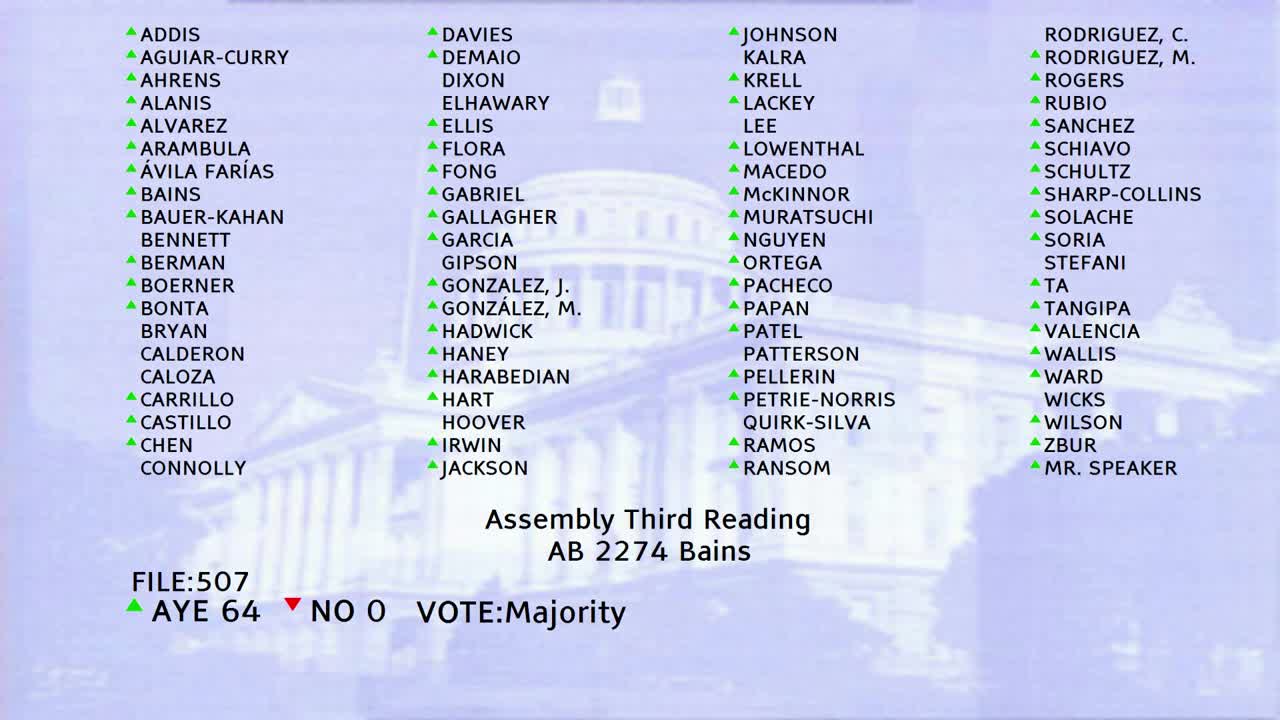
Bill Author

Bill Co-Author(s):