AB 2531: Public health: abortion services.
- Session Year: 2025-2026
- House: Assembly
- Latest Version Date: 2026-09-27
Current Status:
Passed
(2026-09-27: Chaptered by Secretary of State - Chapter 489, Statutes of 2026.)
Introduced
In Committee
Awaiting First Chamber Vote
Passed First Chamber
In Committee
Awaiting Second Chamber Vote
Passed Second Chamber
Enacted
Existing law establishes the California Reproductive and TGI Health Equity Program within the Department of Health Care Access and Information for the purpose of ensuring abortion, contraception, and gender-affirming care are affordable for and accessible to all patients, regardless of their ability to pay, and to provide financial support for safety net providers of these services to offset the costs of providing uncompensated care to patients with low incomes who would otherwise lack access to care. Existing law authorizes a Medi-Cal enrolled provider to apply for a grant, and a continuation award after the initial grant, if they agree to provide abortion, contraception, and gender-affirming care services in accordance with specified requirements, including that the services are provided at no cost or a reduced cost to individuals with a household income at or below 400% of the federal poverty level who are uninsured or have health care coverage that does not include both abortion and contraception or does not include gender-affirming care and are not otherwise eligible to receive both abortion and contraception care at no cost through the Medi-Cal and Family PACT programs or receive gender-affirming care at no cost through the Medi-Cal program.
This bill would additionally authorize a Medi-Cal enrolled provider to apply for a grant or a continuation of a grant if they provide the above-described services to patients who are veterans, as defined, who are uninsured or have health care coverage that does not include both abortion and contraception and are not otherwise eligible to receive both abortion and contraception care at no cost through the Medi-Cal and Family PACT programs. The bill would make other conforming changes and would make related findings and declarations.
Existing law establishes the Department of Veterans Affairs and vests the department with specified duties related to veterans in the state, including the development of a transition program to assist veterans in successfully transitioning from military to civilian life by providing information related to, among other things, health care programs and services.
This bill would require the Department of Veterans Affairs to publish a link to the State Department of Public Healths abortion information internet website on the women veterans resources page of its internet website.
Existing law establishes the California Reproductive and TGI Health Equity Program within the Department of Health Care Access and Information for the purpose of ensuring abortion and contraception abortion, contraception, and gender-affirming care are affordable for and accessible to all patients, regardless of their ability to pay, and to provide financial support for safety net providers of these services to offset the costs of providing uncompensated care to patients with low incomes who would otherwise lack access to care. Existing law authorizes a Medi-Cal enrolled provider to apply for a grant, and a continuation award after the initial grant, if they agree to provide abortion and contraception abortion, contraception, and gender-affirming care services in accordance with specified requirements, including that the services are provided at no cost or a reduced cost to individuals with a household income at or below 400% of the federal poverty level who are uninsured or have health care coverage that does not include both abortion and contraception or does not include gender-affirming care and are not otherwise eligible to receive both abortion and contraception care at no cost through the Medi-Cal and Family PACT programs. programs or receive gender-affirming care at no cost through the Medi-Cal program.
This bill would additionally authorize a Medi-Cal enrolled provider to apply for a grant or a continuation of a grant if they provide the above-described services to patients who are veterans, as defined, who are uninsured or have health care coverage that does not include both abortion and contraception and are not otherwise eligible to receive both abortion and contraception care at no cost through the Medi-Cal and Family PACT programs. The bill would make other conforming changes and would make related findings and declarations.
Existing law establishes the Department of Veterans Affairs and vests the department with specified duties related to veterans in the state, including the development of a transition program to assist veterans in successfully transitioning from military to civilian life by providing information related to, among other things, health care programs and services.
This bill would require the Department of Veterans Affairs to publish a link to the State Department of Public Healths abortion information internet website on the women veterans resources page of its internet website.
Existing law establishes the California Reproductive Health Equity Program within the Department of Health Care Access and Information for the purpose of ensuring abortion and contraception are affordable for and accessible to all patients, regardless of their ability to pay, and to provide financial support for safety net providers of these services to offset the costs of providing uncompensated care to patients with low incomes who would otherwise lack access to care. Existing law authorizes a Medi-Cal enrolled provider to apply for a grant, and a continuation award after the initial grant, if they agree to provide abortion and contraception services in accordance with specified requirements, including that the services are provided at no cost or a reduced cost to individuals with a household income at or below 400% of the federal poverty level who are uninsured or have health care coverage that does not include both abortion and contraception and are not otherwise eligible to receive both abortion and contraception care at no cost through the Medi-Cal and Family PACT programs.
This bill would additionally authorize a Medi-Cal enrolled provider to apply for a grant or a continuation of a grant if they provide the above-described services to patients who are veterans, as defined, who are uninsured or have health care coverage that does not include both abortion and contraception and are not otherwise eligible to receive both abortion and contraception care at no cost through the Medi-Cal and Family PACT programs. The bill would make other conforming changes and would make related findings and declarations.
Existing law establishes the Department of Veterans Affairs and vests the department with specified duties related to veterans in the state, including the development of a transition program to assist veterans in successfully transitioning from military to civilian life by providing information related to, among other things, health care programs and services.
This bill would require the Department of Veterans Affairs to publish a link to the State Department of Public Healths abortion information internet website on the women veterans resources page of its internet website.
Existing law requires the California Health and Human Services Agency, or an entity designated by the agency, to establish an internet website where the public can find information on abortion services in the state.This bill would make technical, nonsubstantive changes to these provisions.Existing law requires the California Health and Human Services Agency, or an entity designated by the agency, to establish an internet website where the public can find information on abortion services in the state.
This bill would make technical, nonsubstantive changes to these provisions.
The Legislature finds and declares all of the following:
(a)Both the California Constitution and the Health and Safety Code guarantee the right to abortion and contraception.
(b)California is home to around 150,000 women veterans, representing nearly 11 percent of the states veteran population. Approximately one-third of Californias women veterans are of reproductive age. Women veterans are the fastest growing segment of the veteran community.
(c)In 2022, the United States Department of Veterans Affairs promulgated a final rule that allowed the department to offer abortion counseling and abortions at department health care centers to pregnant veterans and Civilian Health and Medical Program of the Department of Veterans Affairs (CHAMPVA) beneficiaries when the patients life or health is threatened and in cases of rape or incest.
(d)In December 2025, the department issued a memo and promulgated a final rule reversing the 2022 rule to exclude abortion and abortion counseling from the departments medical benefits package and CHAMPVA coverage even in cases of rape and incest unless a physician certifies that the life of the mother would be endangered if the fetus were carried to term.
(e)The departments 2025 policy applies to all department health care facilities, including in California, where access to abortion is legal and protected by the states constitution.
(f)It is the intent of the Legislature that Californias veteran population has access to receiving abortion care in this state at no cost or reduced cost.
SEC. 2.Section 127632 of the Health and Safety Code is amended to read:127632.(a)The California Reproductive and TGI Health Equity Program is hereby established within the department.
(b)The purpose of the program is to ensure abortion, contraception, and gender-affirming care are affordable for and accessible to all patients, regardless of their ability to pay, and to provide financial support for safety net providers of these services to offset the costs of providing uncompensated care to patients with low incomes and patients who are veterans who would otherwise lack access to care.
(c)The department may carry out the program described in this chapter through grants and contracts, including exclusive or nonexclusive contracts, or amending existing contracts, on a bid or negotiated basis. Contracts and grants entered into or amended pursuant to this chapter shall be exempt from Chapter 6 (commencing with Section 14825) of Part 5.5 of Division 3 of Title 2 of the Government Code, Section 19130 of the Government Code, Part 2 (commencing with Section 10100) of Division 2 of the Public Contract Code, and the State Administrative Manual.
(d)Contracts, grants, and related information created pursuant to this chapter shall not be made public and are exempt from disclosure under the California Public Records Act (Division 10 (commencing with Section 7920.000) of Title 1 of the Government Code).
(e)In administering this chapter, the department shall be exempt from the requirements of Chapter 3.5 (commencing with Section 11340) of Part 1 of Division 3 of Title 2 of the Government Code.
SEC. 3.Section 127633 of the Health and Safety Code is amended to read:127633.(a)A Medi-Cal enrolled provider, as determined by the State Department of Health Care Services, may apply for a grant, and a continuation award after the initial grant, under this chapter if they agree to provide either, both abortion and contraception services, or gender-affirming care services in accordance with all of the following:
(1)The abortion, contraception, or gender-affirming care services provided are within the providers scope of practice and licensure.
(2)The provider agrees to be identified, in a manner determined by the department, as a participating provider in the program. An institutional provider shall not be required to identify any individual who is an abortion or gender-affirming care provider as a condition of a grant awarded pursuant to this chapter.
(3)To the extent services provided are covered pursuant to Section 14132 of the Welfare and Institutions Code, the services shall be provided at no cost or a reduced cost to an individual with a household income at or below 400 percent of the federal poverty level who meets both of the following criteria:
(A)Is uninsured or has health care coverage that does not include both abortion and contraception or does not include coverage for gender-affirming care.
(B)Is not otherwise eligible to receive both abortion and contraception care at no cost through the Medi-Cal and Family PACT programs or receive gender-affirming care at no cost through the Medi-Cal program.
(4)To the extent services provided are covered pursuant to Section 14132 of the Welfare and Institutions Code, the services shall be provided at no cost or a reduced cost to an individual who is a veteran who meets both of the following criteria:
(A)Has health care coverage that does not include abortion or is unable to access abortion or contraception care through the Department of Veterans Affairs health system.
(B)Is not otherwise eligible to receive both abortion and contraception care at no cost through the Medi-Cal and Family PACT programs.
(b)For purposes of this chapter, an individuals self-declaration of income and source of health care coverage, or veteran status, made to the provider at the time of service shall be all that is required to determine whether the individual may be able to access no-cost or reduced-cost services pursuant to this chapter.
(c)This chapter does not require a provider to accept additional patients if, in the reasonable professional judgment of the provider, accepting additional patients would endanger access to, or continuity of, care for existing patients.
(d)The department shall work with the State Department of Health Care Services to notify Medi-Cal enrolled providers of the availability of funding under this chapter, including any pertinent deadlines and other requirements.
(e)For the purposes of this chapter, veteran means a person who served in the active military, naval, air, or space service of the United States or as a member of the National Guard who was called to, and released from, active duty or active service that was for a period of not less than 90 consecutive days and who was discharged or released therefrom under conditions other than dishonorable, was discharged due to a service-connected disability within that 90-day period, or was discharged solely as a result of Executive Order No. 14183 issued on January 27, 2025.
SEC. 4.Section 127634 of the Health and Safety Code is amended to read:127634.(a)An application for a grant under this chapter shall be made on a form to be developed by the department.
(b)An application shall include both of the following:
(1)A justification of the amount of grant funds requested, including both of the following:
(A)The cost of uncompensated abortion, contraception, and gender-affirming care services the applicant provided to patients with household incomes at or below 400 percent of the federal poverty level and to patients who are veterans in the previous 12 months.
(B)The anticipated cost of uncompensated abortion, contraception, and gender-affirming care services to be provided to patients with household incomes at or below 400 percent of the federal poverty level and to patients who are veterans in the upcoming 12 months.
(2)Other pertinent information that the department requires.
(c)The department shall develop an application form and shall begin accepting applications for grants pursuant to this chapter on or before January 1, 2027.
(d)For purposes of subdivision (b), the cost of uncompensated abortion, contraception, and gender-affirming care services shall:
(1)Be calculated based on the amount the provider would expect to receive for providing these services to a patient enrolled in the Medi-Cal program.
(2)Include those services provided through prescription, including laboratory and pharmaceutical, as well as services that are the result of complications related to services provided pursuant to this chapter, to the extent they would be covered pursuant to Section 14132 of the Welfare and Institutions Code.
(e)For purposes of this section, the department shall not require the submission of personal information about individuals receiving uncompensated abortion, contraception, and gender-affirming care services as part of an application. Information required by the department shall only include information in summary, statistical, or other forms that do not identify particular individuals.
(f)Contracts, grants, and related information created pursuant to this chapter shall not be made public and are exempt from disclosure under the California Public Records Act (Division 10 (commencing with Section 7920.000) of Title 1 of the Government Code).
SEC. 5.Section 92 is added to the Military and Veterans Code, to read:92.The department shall publish a link to the abortion.ca.gov internet website on the women veterans resources page of the departments internet website.
The Legislature finds and declares all of the following:
(a)Both the California Constitution and the Health and Safety Code guarantee the right to abortion and contraception.
(b)California is home to around 150,000 women veterans, representing nearly 11 percent of the states veteran population. Approximately one-third of Californias women veterans are of reproductive age. Women veterans are the fastest growing segment of the veteran community.
(c)In 2022, the United States Department of Veterans Affairs promulgated a final rule that allowed the department to offer abortion counseling and abortions at department health care centers to pregnant veterans and Civilian Health and Medical Program of the Department of Veterans Affairs (CHAMPVA) beneficiaries when the patients life or health is threatened and in cases of rape or incest.
(d)In December 2025, the department issued a memo and promulgated a final rule reversing the 2022 rule to exclude abortion and abortion counseling from the departments medical benefits package and CHAMPVA coverage even in cases of rape and incest unless a physician certifies that the life of the mother would be endangered if the fetus were carried to term.
(e)The departments 2025 policy applies to all department health care facilities, including in California, where access to abortion is legal and protected by the states constitution.
(f)It is the intent of the Legislature that Californias veteran population has access to receiving abortion care in this state at no cost or reduced cost.
SEC. 2.Section 127632 of the Health and Safety Code is amended to read:127632.(a)The California Reproductive Health Equity Program is hereby established within the department.(b)The purpose of the program is to ensure abortion and contraception are affordable for and accessible to all patients, regardless of their ability to pay, and to provide financial support for safety net providers of these services to offset the costs of providing uncompensated care to patients with low incomes and patients who are veterans who would otherwise lack access to care.SEC. 3.Section 127633 of the Health and Safety Code is amended to read:127633.(a)A Medi-Cal enrolled provider, as determined by the State Department of Health Care Services, may apply for a grant, and a continuation award after the initial grant, under this chapter if they agree to provide abortion and contraception services in accordance with all of the following:(1)The abortion and contraception services provided are within the providers scope of practice and licensure.(2)The provider agrees to be identified, in a manner determined by the department, as a participating provider in the program. An institutional provider shall not be required to identify any individual who is an abortion provider as a condition of a grant awarded pursuant to this chapter.(3)To the extent services provided are covered pursuant to Section 14132 of the Welfare and Institutions Code, the services shall be provided at no cost or a reduced cost to an individual with a household income at or below 400 percent of the federal poverty level who meets both of the following criteria:(A)Is uninsured or has health care coverage that does not include both abortion and contraception.(B)Is not otherwise eligible to receive both abortion and contraception care at no cost through the Medi-Cal and Family PACT programs.(4)To the extent services provided are covered pursuant to Section 14132 of the Welfare and Institutions Code, the services shall be provided at no cost or a reduced cost to an individual who is a veteran who meets both of the following criteria:(A)Has health care coverage that does not include abortion or is unable to access abortion or contraception care through the Department of Veterans Affairs health system.(B)Is not otherwise eligible to receive both abortion and contraception care at no cost through the Medi-Cal and Family PACT programs.(b)For purposes of this chapter, an individuals self-declaration of income and source of health care coverage, or veteran status, made to the provider at the time of service shall be all that is required to determine whether the individual may be able to access no-cost or reduced-cost services pursuant to this chapter.(c)This chapter does not require a provider to accept additional patients if, in the reasonable professional judgment of the provider, accepting additional patients would endanger access to, or continuity of, care for existing patients.(d)The department shall work with the State Department of Health Care Services to notify Medi-Cal enrolled providers of the availability of funding under this chapter, including any pertinent deadlines and other requirements.(e)For the purposes of this chapter, veteran means a person who served in the active military, naval, air, or space service of the United States or as a member of the National Guard who was called to, and released from, active duty or active service that was for a period of not less than 90 consecutive days and who was discharged or released therefrom under conditions other than dishonorable, was discharged due to a service-connected disability within that 90-day period, or was discharged solely as a result of Executive Order No. 14183 issued on January 27, 2025.SEC. 4.Section 127634 of the Health and Safety Code is amended to read:127634.(a)An application for a grant under this chapter shall be made on a form to be developed by the department.(b)An application shall include both of the following:(1)A justification of the amount of grant funds requested, including both of the following:(A)The cost of uncompensated abortion and contraceptive services the applicant provided to patients with household incomes at or below 400 percent of the federal poverty level and to patients who are veterans in the previous 12 months.(B)The anticipated cost of uncompensated abortion and contraception services to be provided to patients with household incomes at or below 400 percent of the federal poverty level and to patients who are veterans in the upcoming 12 months.(2)Other pertinent information that the department requires.(c)The department shall develop an application form and shall begin accepting applications for grants pursuant to this chapter on or before January 1, 2023.(d)For purposes of subdivision (b), the cost of uncompensated abortion and contraception services shall:(1)Be calculated based on the amount the provider would expect to receive for providing these services to a patient enrolled in the Medi-Cal program.(2)Include those services provided through prescription, including laboratory and pharmaceutical, as well as services that are the result of complications related to services provided pursuant to this chapter, to the extent they would be covered pursuant to Section 14132 of the Welfare and Institutions Code.(e)For purposes of this section, the department shall not require the submission of personal information about individuals receiving uncompensated abortion and contraception services as part of an application. Information required by the department shall only include information in summary, statistical, or other forms that do not identify particular individuals.(f)An application for a grant under this chapter shall be exempt from disclosure under the California Public Records Act (Division 10 (commencing with Section 7920.000) of Title 1 of the Government Code).SEC. 5.Section 92 is added to the Military and Veterans Code, to read:92.The department shall publish a link to the abortion.ca.gov internet website on the women veterans resources page of the departments internet website.SEC. 2.Section 127632 of the Health and Safety Code is amended to read:127632.(a)The California Reproductive and TGI Health Equity Program is hereby established within the department.
(b)The purpose of the program is to ensure abortion, contraception, and gender-affirming care are affordable for and accessible to all patients, regardless of their ability to pay, and to provide financial support for safety net providers of these services to offset the costs of providing uncompensated care to patients with low incomes and patients who are veterans who would otherwise lack access to care.
(c)The department may carry out the program described in this chapter through grants and contracts, including exclusive or nonexclusive contracts, or amending existing contracts, on a bid or negotiated basis. Contracts and grants entered into or amended pursuant to this chapter shall be exempt from Chapter 6 (commencing with Section 14825) of Part 5.5 of Division 3 of Title 2 of the Government Code, Section 19130 of the Government Code, Part 2 (commencing with Section 10100) of Division 2 of the Public Contract Code, and the State Administrative Manual.
(d)Contracts, grants, and related information created pursuant to this chapter shall not be made public and are exempt from disclosure under the California Public Records Act (Division 10 (commencing with Section 7920.000) of Title 1 of the Government Code).
(e)In administering this chapter, the department shall be exempt from the requirements of Chapter 3.5 (commencing with Section 11340) of Part 1 of Division 3 of Title 2 of the Government Code.
SEC. 3.Section 127633 of the Health and Safety Code is amended to read:127633.(a)A Medi-Cal enrolled provider, as determined by the State Department of Health Care Services, may apply for a grant, and a continuation award after the initial grant, under this chapter if they agree to provide either, both abortion and contraception services, or gender-affirming care services in accordance with all of the following:
(1)The abortion, contraception, or gender-affirming care services provided are within the providers scope of practice and licensure.
(2)The provider agrees to be identified, in a manner determined by the department, as a participating provider in the program. An institutional provider shall not be required to identify any individual who is an abortion or gender-affirming care provider as a condition of a grant awarded pursuant to this chapter.
(3)To the extent services provided are covered pursuant to Section 14132 of the Welfare and Institutions Code, the services shall be provided at no cost or a reduced cost to an individual with a household income at or below 400 percent of the federal poverty level who meets both of the following criteria:
(A)Is uninsured or has health care coverage that does not include both abortion and contraception or does not include coverage for gender-affirming care.
(B)Is not otherwise eligible to receive both abortion and contraception care at no cost through the Medi-Cal and Family PACT programs or receive gender-affirming care at no cost through the Medi-Cal program.
(4)To the extent services provided are covered pursuant to Section 14132 of the Welfare and Institutions Code, the services shall be provided at no cost or a reduced cost to an individual who is a veteran who meets both of the following criteria:
(A)Has health care coverage that does not include abortion or is unable to access abortion or contraception care through the Department of Veterans Affairs health system.
(B)Is not otherwise eligible to receive both abortion and contraception care at no cost through the Medi-Cal and Family PACT programs.
(b)For purposes of this chapter, an individuals self-declaration of income and source of health care coverage coverage, or veteran status, made to the provider at the time of service shall be all that is required to determine whether the individual may be able to access no-cost or reduced-cost services pursuant to this chapter.
(c)This chapter does not require a provider to accept additional patients if, in the reasonable professional judgment of the provider, accepting additional patients would endanger access to, or continuity of, care for existing patients.
(d)The department shall work with the State Department of Health Care Services to notify Medi-Cal enrolled providers of the availability of funding under this chapter, including any pertinent deadlines and other requirements.
(e)For the purposes of this chapter, veteran means a person who served in the active military, naval, air, or space service of the United States or as a member of the National Guard who was called to, and released from, active duty or active service that was for a period of not less than 90 consecutive days and who was discharged or released therefrom under conditions other than dishonorable, was discharged due to a service-connected disability within that 90-day period, or was discharged solely as a result of Executive Order No. 14183 issued on January 27, 2025.
SEC. 4.Section 127634 of the Health and Safety Code is amended to read:127634.(a)An application for a grant under this chapter shall be made on a form to be developed by the department.
(b)An application shall include both of the following:
(1)A justification of the amount of grant funds requested, including both of the following:
(A)The cost of uncompensated abortion, contraception, and gender-affirming care services the applicant provided to patients with household incomes at or below 400 percent of the federal poverty level and to patients who are veterans in the previous 12 months.
(B)The anticipated cost of uncompensated abortion, contraception, and gender-affirming care services to be provided to patients with household incomes at or below 400 percent of the federal poverty level and to patients who are veterans in the upcoming 12 months.
(2)Other pertinent information that the department requires.
(c)The department shall develop an application form and shall begin accepting applications for grants pursuant to this chapter on or before January 1, 2027.
(d)For purposes of subdivision (b), the cost of uncompensated abortion, contraception, and gender-affirming care services shall:
(1)Be calculated based on the amount the provider would expect to receive for providing these services to a patient enrolled in the Medi-Cal program.
(2)Include those services provided through prescription, including laboratory and pharmaceutical, as well as services that are the result of complications related to services provided pursuant to this chapter, to the extent they would be covered pursuant to Section 14132 of the Welfare and Institutions Code.
(e)For purposes of this section, the department shall not require the submission of personal information about individuals receiving uncompensated abortion, contraception, and gender-affirming care services as part of an application. Information required by the department shall only include information in summary, statistical, or other forms that do not identify particular individuals.
(f)Contracts, grants, and related information created pursuant to this chapter shall not be made public and are exempt from disclosure under the California Public Records Act (Division 10 (commencing with Section 7920.000) of Title 1 of the Government Code).
SEC. 5.Section 92 is added to the Military and Veterans Code, to read:92.The department shall publish a link to the abortion.ca.gov internet website on the women veterans resources page of the departments internet website.
The Legislature finds and declares all of the following:
(a)Both the California Constitution and the Health and Safety Code guarantee the right to abortion and contraception.
(b)California is home to around 150,000 women veterans, representing nearly 11 percent of the states veteran population. Approximately one-third of Californias women veterans are of reproductive age. Women veterans are the fastest growing segment of the veteran community.
(c)In 2022, the United States Department of Veterans Affairs promulgated a final rule that allowed the department to offer abortion counseling and abortions at department health care centers to pregnant veterans and Civilian Health and Medical Program of the Department of Veterans Affairs (CHAMPVA) beneficiaries when the patients life or health is threatened and in cases of rape or incest.
(d)In December 2025, the department issued a memo and promulgated a final rule reversing the 2022 rule to exclude abortion and abortion counseling from the departments medical benefits package and CHAMPVA coverage even in cases of rape and incest unless a physician certifies that the life of the mother would be endangered if the fetus were carried to term.
(e)The departments 2025 policy applies to all department health care facilities, including in California, where access to abortion is legal and protected by the states constitution.
(f)It is the intent of the Legislature that Californias veteran population has access to receiving abortion care in this state at no cost or reduced cost.
SEC. 2.Section 127632 of the Health and Safety Code is amended to read:127632.(a)The California Reproductive Health Equity Program is hereby established within the department.
(b)The purpose of the program is to ensure abortion and contraception are affordable for and accessible to all patients, regardless of their ability to pay, and to provide financial support for safety net providers of these services to offset the costs of providing uncompensated care to patients with low incomes and patients who are veterans who would otherwise lack access to care.
SEC. 3.Section 127633 of the Health and Safety Code is amended to read:127633.(a)A Medi-Cal enrolled provider, as determined by the State Department of Health Care Services, may apply for a grant, and a continuation award after the initial grant, under this chapter if they agree to provide abortion and contraception services in accordance with all of the following:
(1)The abortion and contraception services provided are within the providers scope of practice and licensure.
(2)The provider agrees to be identified, in a manner determined by the department, as a participating provider in the program. An institutional provider shall not be required to identify any individual who is an abortion provider as a condition of a grant awarded pursuant to this chapter.
(3)To the extent services provided are covered pursuant to Section 14132 of the Welfare and Institutions Code, the services shall be provided at no cost or a reduced cost to an individual with a household income at or below 400 percent of the federal poverty level who meets both of the following criteria:
(A)Is uninsured or has health care coverage that does not include both abortion and contraception.
(B)Is not otherwise eligible to receive both abortion and contraception care at no cost through the Medi-Cal and Family PACT programs.
(4)To the extent services provided are covered pursuant to Section 14132 of the Welfare and Institutions Code, the services shall be provided at no cost or a reduced cost to an individual who is a veteran who meets both of the following criteria:
(A)Has health care coverage that does not include abortion or is unable to access abortion or contraception care through the Department of Veterans Affairs health system.
(B)Is not otherwise eligible to receive both abortion and contraception care at no cost through the Medi-Cal and Family PACT programs.
(b)For purposes of this chapter, an individuals self-declaration of income and source of health care coverage coverage, or veteran status, made to the provider at the time of service shall be all that is required to determine whether the individual may be able to access no-cost or reduced-cost services pursuant to this chapter.
(c)This chapter does not require a provider to accept additional patients if, in the reasonable professional judgment of the provider, accepting additional patients would endanger access to, or continuity of, care for existing patients.
(d)The department shall work with the State Department of Health Care Services to notify Medi-Cal enrolled providers of the availability of funding under this chapter, including any pertinent deadlines and other requirements.
(e)For the purposes of this chapter, veteran means a person who served in the active military, naval, air, or space service of the United States or as a member of the National Guard who was called to, and released from, active duty or active service that was for a period of not less than 90 consecutive days and who was discharged or released therefrom under conditions other than dishonorable, was discharged due to a service-connected disability within that 90-day period, or was discharged solely as a result of Executive Order No. 14183 issued on January 27, 2025.
SEC. 4.Section 127634 of the Health and Safety Code is amended to read:127634.(a)An application for a grant under this chapter shall be made on a form to be developed by the department.
(b)An application shall include both of the following:
(1)A justification of the amount of grant funds requested, including both of the following:
(A)The cost of uncompensated abortion and contraceptive services the applicant provided to patients with household incomes at or below 400 percent of the federal poverty level and to patients who are veterans in the previous 12 months.
(B)The anticipated cost of uncompensated abortion and contraception services to be provided to patients with household incomes at or below 400 percent of the federal poverty level and to patients who are veterans in the upcoming 12 months.
(2)Other pertinent information that the department requires.
(c)The department shall develop an application form and shall begin accepting applications for grants pursuant to this chapter on or before January 1, 2023.
(d)For purposes of subdivision (b), the cost of uncompensated abortion and contraception services shall:
(1)Be calculated based on the amount the provider would expect to receive for providing these services to a patient enrolled in the Medi-Cal program.
(2)Include those services provided through prescription, including laboratory and pharmaceutical, as well as services that are the result of complications related to services provided pursuant to this chapter, to the extent they would be covered pursuant to Section 14132 of the Welfare and Institutions Code.
(e)For purposes of this section, the department shall not require the submission of personal information about individuals receiving uncompensated abortion and contraception services as part of an application. Information required by the department shall only include information in summary, statistical, or other forms that do not identify particular individuals.
(f)An application for a grant under this chapter shall be exempt from disclosure under the California Public Records Act (Division 10 (commencing with Section 7920.000) of Title 1 of the Government Code).
SEC. 5.Section 92 is added to the Military and Veterans Code, to read:92.The department shall publish a link to the abortion.ca.gov internet website on the women veterans resources page of the departments internet website.
SECTION 1.Section 123430 of the Health and Safety Code is amended to read:123430.(a)(1)To ensure people have accurate and comprehensive information when accessing abortion services in California, on or before July 1, 2023, the California Health and Human Services Agency, or an entity designated by the agency, shall establish an internet website where the public can access information on abortion services in the state.(2)The internet website established pursuant to paragraph (1) shall include all of the following information and resources:(A)A persons legally protected rights to an abortion under state law.(B)The location of abortion providers or links to the information in the state. Location information shall be posted and updated in a manner that allows people to easily identify the health care providers that provide abortion in the state.(C)Practical support services, such as airfare, lodging, ground transportation, gas money, meals, dependent childcare, doula support, and translation services, to help a person access and obtain an abortion.(D)Payment support resources, including coverage options, state programs, and other assistance that is available to help people with the cost of the abortion procedure.(E)General description of the available types of abortion.(F)Information to combat misinformation and disinformation, and ensure that people have comprehensive and medically accurate counseling and support services.(G)Any other information or resources that will assist an individual seeking comprehensive and accurate information about exercising their legal right to abortion and accessing abortion services in the state.(3)The agency shall consult with subject matter experts when determining the information and resources posted on the internet website. Subject matter experts includes, but is not limited to, the Commission on the Status of Women and Girls, the Department of Justice, the State Department of Health Care Services, the Department of Managed Health Care, and organizations that represent patients, providers, and assistants that obtain, provide, or assist a pregnant person to access an abortion.(4)The internet website shall have mobile capabilities.(5)The internet website shall comply with Section 508 of the federal Rehabilitation Act of 1973 (29 U.S.C. Sec. 794d), regulations implementing that act as set forth in Part 1194 of Title 36 of the Federal Code of Regulations, and any laws or regulations governing the accessibility of state internet websites.(6)The agency, in consultation with the subject matter experts, shall review the information and resources on the internet website to ensure that it is current and updated at reasonable intervals, but no less than once every six months. The internet website shall contain a feature to allow users to report erroneous or outdated information.(b)The internet website and informational materials created and distributed pursuant to this section shall be made available in a manner to ensure that they are accessible by all state residents. The internet website and informational materials shall be translated into Spanish, Chinese, Tagalog, Vietnamese, and Korean and in compliance with the Dymally-Alatorre Bilingual Services Act (Chapter 17.5 (commencing with Section 7290) of Division 7 of Title 1 of the Government Code).(c)Notwithstanding subdivision (a), the internet website established pursuant to this section shall not include the name or location of any individual who is an abortion provider. REVISIONS: HeadingLine 2.(a)(1)To ensure people have accurate and comprehensive information when accessing abortion services in California, on or before July 1, 2023, the California Health and Human Services Agency, or an entity designated by the agency, shall establish an internet website where the public can access information on abortion services in the state.
(2)The internet website established pursuant to paragraph (1) shall include all of the following information and resources:
(A)A persons legally protected rights to an abortion under state law.
(B)The location of abortion providers or links to the information in the state. Location information shall be posted and updated in a manner that allows people to easily identify the health care providers that provide abortion in the state.
(C)Practical support services, such as airfare, lodging, ground transportation, gas money, meals, dependent childcare, doula support, and translation services, to help a person access and obtain an abortion.
(D)Payment support resources, including coverage options, state programs, and other assistance that is available to help people with the cost of the abortion procedure.
(E)General description of the available types of abortion.
(F)Information to combat misinformation and disinformation, and ensure that people have comprehensive and medically accurate counseling and support services.
(G)Any other information or resources that will assist an individual seeking comprehensive and accurate information about exercising their legal right to abortion and accessing abortion services in the state.
(3)The agency shall consult with subject matter experts when determining the information and resources posted on the internet website. Subject matter experts include, includes, but is not limited to, the Commission on the Status of Women and Girls, the Department of Justice, the State Department of Health Care Services, the Department of Managed Health Care, and organizations that represent patients, providers, and assistants that obtain, provide, or assist a pregnant person to access an abortion.
(4)The internet website shall have mobile capabilities.
(5)The internet website shall comply with Section 508 of the federal Rehabilitation Act of 1973 (29 U.S.C. Sec. 794d), regulations implementing that act as set forth in Part 1194 of Title 36 of the Federal Code of Regulations, and any laws or regulations governing the accessibility of state internet websites.
(6)The agency, in consultation with the subject matter experts, shall review the information and resources on the internet website to ensure that it is current and updated at reasonable intervals, but no less than once every six months. The internet website shall contain a feature to allow users to report erroneous or outdated information.
(b)The internet website and informational materials created and distributed pursuant to this section shall be made available in a manner to ensure that they are accessible by all state residents. The internet website and informational materials shall be translated into Spanish, Chinese, Tagalog, Vietnamese, and Korean and in compliance with the Dymally-Alatorre Bilingual Services Act (Chapter 17.5 (commencing with Section 7290) of Division 7 of Title 1 of the Government Code).
(c)Notwithstanding subdivision (a), the internet website established pursuant to this section shall not include the name or location of any individual who is an abortion provider.
|
Date
|
Status
|
|---|---|
| Sep 27, 2026 | Chaptered by Secretary of State - Chapter 489, Statutes of 2026. |
| Sep 27, 2026 | Approved by the Governor. |
| Sep 3, 2026 | Enrolled and presented to the Governor at 4 p.m. |
| Aug 26, 2026 | Senate amendments concurred in. To Engrossing and Enrolling. (Ayes 60. Noes 18. Page 6587.). |
| Aug 26, 2026 | Senate amendments concurred in. To Engrossing and Enrolling. (Ayes 60. Noes 18.). |
| Aug 25, 2026 | In Assembly. Concurrence in Senate amendments pending. |
| Aug 25, 2026 | Read third time. Passed. Ordered to the Assembly. (Ayes 30. Noes 10. Page 5768.). |
| Aug 25, 2026 | Read third time. Passed. Ordered to the Assembly. (Ayes 30. Noes 9.). |
| Aug 17, 2026 | Read second time. Ordered to third reading. |
| Aug 13, 2026 | Read second time and amended. Ordered returned to second reading. |
| Aug 13, 2026 | From committee: Amend, and do pass as amended. (Ayes 5. Noes 2.) (August 13). |
| Aug 3, 2026 | In committee: Referred to APPR. suspense file. |
| Jun 23, 2026 | From committee: Do pass and re-refer to Com. on APPR. (Ayes 4. Noes 0.) (June 22). Re-referred to Com. on APPR. |
| Jun 18, 2026 | From committee: Do pass and re-refer to Com. on M. & V.A. (Ayes 9. Noes 1.) (June 17). Re-referred to Com. on M. & V.A. |
| Jun 10, 2026 | Referred to Coms. on HEALTH and M. & V.A. |
| May 27, 2026 | In Senate. Read first time. To Com. on RLS. for assignment. |
| May 26, 2026 | Read third time. Passed. Ordered to the Senate. (Ayes 59. Noes 19. Page 5330.) |
| May 26, 2026 | Read third time. Passed. Ordered to the Senate. (Ayes 59. Noes 19.) |
| May 26, 2026 | Read third time. Passed. Ordered to the Senate. |
| May 18, 2026 | Read second time. Ordered to third reading. |
| May 14, 2026 | From committee: Do pass. (Ayes 11. Noes 4.) (May 14). |
| May 6, 2026 | In committee: Set, first hearing. Referred to APPR. suspense file. |
| Apr 15, 2026 | From committee: Do pass and re-refer to Com. on APPR. (Ayes 6. Noes 2.) (April 14). Re-referred to Com. on APPR. |
| Apr 8, 2026 | Coauthors revised. |
| Apr 8, 2026 | From committee: Do pass and re-refer to Com. on M. & V.A. (Ayes 12. Noes 3.) (April 7). Re-referred to Com. on M. & V.A. |
| Mar 17, 2026 | Re-referred to Com. on HEALTH. |
| Mar 16, 2026 | From committee chair, with author's amendments: Amend, and re-refer to Com. on HEALTH. Read second time and amended. |
| Mar 16, 2026 | Referred to Coms. on HEALTH and M. & V.A. |
| Feb 21, 2026 | From printer. May be heard in committee March 23. |
| Feb 20, 2026 | Read first time. To print. |
|
Date
|
Description
|
Location
|
Votes
|
|
|---|---|---|---|---|
| Aug 26, 2026 | AB 2531 Irwin Concurrence in Senate Amendments | Assembly Floor |
Passed |
|
| Aug 25, 2026 | Assembly 3rd Reading AB2531 Irwin et al. By Menjivar | Senate Floor |
Passed |
|
| Aug 13, 2026 | Do pass as amended | Senate Standing Committee on Appropriations |
Passed |
|
| Aug 3, 2026 | Placed on suspense file | Senate Standing Committee on Appropriations |
Passed |
|
| Jun 22, 2026 | Do pass, but first be re-referred to the Committee on [Appropriations] | Senate Standing Committee on Military and Veterans Affairs |
Passed |
|
| Jun 17, 2026 | Do pass, but first be re-referred to the Committee on [Military and Veterans Affairs] | Senate Standing Committee on Health |
Passed |
|
| May 26, 2026 | AB 2531 Irwin Assembly Third Reading | Assembly Floor |
Passed |
|
| May 14, 2026 | Do pass. | Assembly Standing Committee on Appropriations |
Passed |
|
| Apr 14, 2026 | Do pass and be re-referred to the Committee on [Appropriations] | Assembly Standing Committee on Military and Veterans Affairs |
Passed |
|
| Apr 7, 2026 | Do pass and be re-referred to the Committee on [Military and Veterans Affairs] | Assembly Standing Committee on Health |
Passed |
This list shows positions taken on this bill by organizations on the date displayed, which is linked to the original source.
Positions by individuals are not included.
|
Organization
|
Position
|
Date
|
|---|---|---|
| Access Reproductive Justice | ** Support | |
| American Civil Liberties Union California Action | ** Support | |
| California Association of Veteran Service Agencies | ** Support | |
| California Catholic Conference | ** Against | |
| California Family Council | ** Against | |
| California Medical Association | ** Support | |
| California Primary Care Association | ** Support | |
| California Women's Law Center | ** Support | |
| City and County of San Francisco | ** Support | |
| Concerned Women for America Legislative Action Committee | ** Against | |
| Equality California | ** Support | |
| Fieldstead And Company, Inc. | ** Against | |
| Lieutenant Governor Eleni Kounalakis | ** Support | |
| Planned Parenthood Affiliates Of California | ** Support | |
| Reproductive Freedom for All California | ** Support |
CONCURRENCE IN SENATE AMENDMENTS
CSA1 Bill Id:AB 2531
Author:(Irwin)
As Amended Ver:August 13, 2026
Majority vote
SUMMARY
Authorizes a Medi-Cal enrolled provider to apply for a grant or a continuation of a grant from the California Reproductive Health Equity Program within the Department of Health Care Access and Information (HCAI) if they provide services to patients who are veterans who are uninsured or have health care coverage that does not include both abortion and contraception and are not otherwise eligible to receive both abortion and contraception care at no cost through the Medi-Cal and Family PACT programs. Requires the Department of Veterans Affairs (VA) to publish a link to the Department of Public Health (DPH) abortion information website on the women veterans' resources page of its internet website.
Senate Amendments
Ensure that this bill and SB 164 (Committee on Budget) Chapter 27, Statutes of 2026, a health-related Budget Bill which amends the same code sections, do not chapter one another out, should both bills be enacted.
COMMENTS
Comprehensive abortion care is included in the list of essential health care services published by the World Health Organization (WHO) in 2020. Abortion is a simple health care intervention that can be safely and effectively managed by a wide range of health workers using medication or a surgical procedure. In the first 12 weeks of pregnancy, a medical abortion can also be safely self-managed by the pregnant person outside of a health care facility (e.g. at home), in whole or in part. This requires that the person has access to accurate information, quality medicines and support from a trained health worker (if they need or want it during the process). Comprehensive abortion care includes the provision of information, abortion management and post-abortion care. Abortion management includes induced abortion (the deliberate interruption of an ongoing pregnancy by medical or surgical means), care related to pregnancy loss (e.g., miscarriage/spontaneous abortion, missed abortion and intrauterine fetal demise), and management of complications after an abortion.
Coverage for abortion care. In California, the Knox-Keene Act requires the provision of basic health care services, and the California Constitution prohibits health plans from discriminating against women who choose to terminate a pregnancy. Thus, all health plans must treat maternity services and legal abortion neutrally. Exclusions and limitations are also incompatible with both the California Reproductive Privacy Act and multiple California judicial decisions that have unambiguously established under the California Constitution that every pregnant person has the fundamental right to choose to either bear a child or to have a legal abortion. A health plan is not required to cover abortions that would be unlawful under existing law. The Medi-Cal program is one of 16 state Medicaid programs that use their own funds to cover abortion services and follow-up services for beneficiaries. The Medi-Cal program covers abortions as a physician service without cost sharing for all enrollees.
Currently, people at or below 400% of the federal poverty level (FPL) who are uninsured or have health care coverage that does not include abortion and contraception are eligible for care from the Uncompensated Care grant program. This bill's expansion of that eligibility to include veterans will ensure that veterans who are underserved and marginalized outside of that eligibility have better health care options and coverage.
Thousands of abortion restrictions have been enacted nationally since Roe v. Wade was decided in 1973, and this is layered on top of failures of health care and economic systems to provide Black, Indigenous and Latino communities and low-income communities access to high-quality, affordable health care. Thus, while abortion bans and other legal restrictions harm all people who are or may become pregnant, they cause greater harm to those already subject to systemic racism and economic injustice.
Effects of being denied an abortion. According to the 2020 book, "The Turnaway Study: Ten Years, a Thousand Women, and the Consequences of Having—or Being Denied—an Abortion," by Diana Greene Foster, when compared with people who were able to obtain a wanted abortion, those denied a wanted abortion who went on to give birth were more likely to experience gestational hypertension, joint pain and headaches or migraines, fair or poor health, and death. Two people in the study died of maternal causes. Those denied abortions also had large and significant differences in their economic trajectories, facing more hardships than individuals receiving wanted abortions. Those denied abortions were more likely to raise children alone, not with family or a partner. Live in households that drop below the poverty level, with 72% of households where a person was denied an abortion living below the federal poverty level, compared with 55% of those who received the abortion. Lack enough money to pay for food, housing and transportation, with 87% of those who were denied abortions reporting that problem, compared with 70% of those who received an abortion.
Federal Department of VA final rule on reproductive health services. On December 31, 2025 the VA published its final rule in the Federal Register to reinstate exclusions on abortions and abortion counseling from the medical benefits package, which were removed in 2022. Before 2022, these exclusions had been firmly in place since the medical benefits package was first established in 1999. The VA noted that it was also reinstating exclusions on abortion and abortion counseling for the Civilian Health and Medical Program of the Department of Veterans Affairs (CHAMPVA) that were also removed in 2022, and that the VA was taking this action to, "…ensure that VA provides only needed and medically necessary and appropriate care to our nation's heroes." Since publication of the proposed rule, the Department of Justice's (DOJ) Office of Legal Counsel (OLC) issued a formal opinion concluding that the VA does not have statutory authority to provide abortion or abortion counseling under federal law. The DOJ opinion further clarifies that procedures necessary to save the life of the pregnant veteran (such as treatment for ectopic pregnancies or miscarriages) are not considered "abortions" and therefore remain permissible.
California's Uncompensated CARE Act. AB 2134 (Weber) Chapter 562, Statutes of 2022 establishes the California Abortion and Reproductive Equity (CARE Act), and the California Reproductive Health Equity Program (Program) within HCAI, to ensure abortion and contraception services are affordable for and accessible to all patients and to provide financial support for safety net providers of these services. The CARE Act authorizes a Medi-Cal enrolled provider to apply for a grant, and a continuation award after the initial grant, to provide abortion and contraception at no cost or reduced cost to an individual with a household income at or below 400% of the FPL who is uninsured or has health care coverage that does not include both abortion and contraception, and who is not eligible to receive both abortion and contraception at no cost through the Medi-Cal and Family PACT programs. This bill expands eligibility in this program to veterans who are being denied this essential health care by the VA, however, according to a recent budget briefing by HCAI, all funds previously appropriated in 2022-23 State Budget (which provided $40 million to establish and administer an uncompensated care fund for abortion services for individuals below 400% FPL) have been spent.
According to the Author
California voters established a constitutional right to abortion, and veterans deserve full access to essential health care through their VA benefits, including abortion. However, a recent rule implemented by the Trump administration has imposed upon the entire VA system one of the most severe abortion bans in the country, and California's VA providers are beholden to this federal ban despite California's state constitutional protections. The author notes that this bill would expand access to the Uncompensated Care grant program for veterans whose health care coverage does not include abortion. By expanding this eligibility, California ensures that that the people who have served our country are not left without healthcare due to the backwards and inequitable policies of the Trump Administration.
Arguments in Support
Planned Parenthood Affiliates of California (PPAC), is the sponsor of this bill and notes that this bill responds to federal action in December 2025 that eliminated access to abortion care for veterans in the VA system by creating a pathway for California veterans or active military to obtain abortion care in this state. PPAC states that in 2022, California voters overwhelmingly approved Proposition 1 to enshrine the right to reproductive freedom in our State's Constitution. However, access to abortion care remains out of reach and, in fact, has become more restrictive for California's veterans that rely on the federally-regulated VA system for care. PPAC contends that despite California's constitutional protections, our state's veterans and VA providers are beholden to this federal abortion ban and that today, these veterans can only access abortion care through another provider outside of their health care coverage necessitating out-of-pocket costs. PPAC points to the fact that women are the fastest growing group of veterans, and concludes that, through this bill, California is stepping up to show those who have served our country that they are not left without health care due to the backwards and inequitable policies of the Trump administration.
Arguments in Opposition
The California Family Council (CFC) is opposed to this bill and notes that state health websites carry an implicit authority. When the government curates information about medical procedures, citizens reasonably expect that information to be comprehensive, accurate, and unbiased. CFC argues that this bill directs the state website to promote abortion services without equally presenting alternatives — including adoption, pregnancy resource centers, and community support programs — it fails that standard. CFC contends that research consistently shows that women facing unintended pregnancies benefit from full information about all available options, and that many who choose alternatives to abortion report greater long-term psychological well-being.
FISCAL COMMENTS
According to the Senate Appropriations Committee, unknown ongoing General Fund costs, potentially hundreds of thousands, to provide services to eligible veterans. HCAI indicates minor and absorbable costs for state administration. The VA anticipates minor and absorbable costs to add and maintain the website link.
VOTES:
ASM HEALTH: 12-3-1
YES: Bonta, Addis, Aguiar-Curry, Ahrens, Caloza, Carrillo, Mark González, Patel, Rogers, Schiavo, Sharp-Collins, Stefani
NO: Johnson, Patterson, Sanchez
ABS, ABST OR NV: Chen
ASM MILITARY AND VETERANS AFFAIRS: 6-2-0
YES: Schiavo, Ávila Farías, Carrillo, Irwin, Quirk-Silva, Valencia
NO: Jeff Gonzalez, Davies
ASM APPROPRIATIONS: 11-4-0
YES: Wicks, Aguiar-Curry, Calderon, Caloza, Fong, Mark González, Krell, Pacheco, Pellerin, Sharp-Collins, Solache
NO: Hoover, Dixon, Ta, Tangipa
ASSEMBLY FLOOR: 59-19-2
YES: Addis, Aguiar-Curry, Ahrens, Alvarez, Arambula, Ávila Farías, Bains, Bauer-Kahan, Bennett, Berman, Boerner, Bonta, Bryan, Calderon, Caloza, Carrillo, Connolly, Elhawary, Fong, Gabriel, Garcia, Gipson, Mark González, Haney, Harabedian, Hart, Irwin, Jackson, Kalra, Krell, Lee, Lowenthal, McKinnor, Nguyen, Ortega, Pacheco, Papan, Patel, Pellerin, Petrie-Norris, Quirk-Silva, Ramos, Ransom, Michelle Rodriguez, Rogers, Blanca Rubio, Schiavo, Schultz, Sharp-Collins, Solache, Soria, Stefani, Valencia, Wallis, Ward, Wicks, Wilson, Zbur, Rivas
NO: Alanis, Castillo, Chen, Davies, DeMaio, Dixon, Ellis, Flora, Gallagher, Jeff Gonzalez, Hadwick, Hoover, Johnson, Lackey, Macedo, Patterson, Sanchez, Ta, Tangipa
ABS, ABST OR NV: Muratsuchi, Celeste Rodriguez
UPDATED
VERSION: August 13, 2026
CONSULTANT: Lara Flynn / HEALTH / (916) 319-2097 FN: 0004105
SENATE RULES COMMITTEE Office of Senate Floor Analyses (916) 651-4171 | AB 2531 |
THIRD READING
Bill No: AB 2531
Author: Irwin (D), et al.
Amended: 8/13/26 in Senate
Vote: 21
SENATE HEALTH COMMITTEE: 9-1, 6/17/26
AYES: Weber Pierson, Caballero, Durazo, Gonzalez, Menjivar, Padilla, Pérez, Rubio, Smallwood-Cuevas
NOES: Grove
NO VOTE RECORDED: Valladares
SENATE MILITARY & VETERANS COMMITTEE: 4-0, 6/22/26
AYES: Archuleta, McNerney, Menjivar, Umberg
NO VOTE RECORDED: Grove
SENATE APPROPRIATIONS COMMITTEE: 5-2, 8/13/26
AYES: Cervantes, Cabaldon, Grayson, Richardson, Wahab
NOES: Seyarto, Dahle
ASSEMBLY FLOOR: 59-19, 5/26/26 - See last page for vote
SUBJECT: Public health: abortion services
SOURCE: Planned Parenthood Affiliates of California
DIGEST:
This bill requires grant recipients of the Reproductive and TGI Health Equity Program to provide services to veterans who have health coverage through the Veterans Affairs health system, but cannot access abortion or contraception care through that system, and those who are not otherwise eligible to receive those services at no cost through the Medi-Cal and Family PACT programs.
ANALYSIS:
Existing law:
- Establishes the Reproductive and TGI Health Equity Program (referred to as the Uncompensated Care grant program) within the Department of Health Care Access and Information (HCAI), with the purpose of ensuring abortion, contraception, and gender-affirming care are affordable for and accessible to all patients, regardless of their ability to pay, and to provide financial support for safety net providers of these services to offset the costs of providing uncompensated care to patients with low incomes who would otherwise lack access to care. [Health and Safety Code (HSC) §127632]
- Establishes the Department of Health Care Services (DHCS) to administer the Medi-Cal program, which provides comprehensive medical coverage to low-income persons, and the Family PACT program, which provides comprehensive clinical family planning services and sexually transmitted disease screening and treatment to low-income persons. [Welfare and Institutions Code (WIC) §14000, et seq. and §14132, et seq.]
- Establishes the State-Only Family Planning Program to provide family planning services for men and women, including emergency and complication services directly related to the contraceptive method and follow-up, and consultation and referral services. [WIC § 24007]
- Permits an enrolled Medi-Cal provider to apply for a grant through Uncompensated Care grant program if they agree to provide abortion, contraception, and gender-affirming care services in accordance with the following:
- The services provided are within the provider’s scope of practice and licensure;
- The provider agrees to be identified, in a manner determined by HCAI, as a participating provider, but prohibits an institutional provider from being required to identify any individual provider as a condition of a grant; and,
- The services are provided, to the extent they are covered by Medi-Cal, at no cost or a reduced cost to an individual with a household income at or below 400% of the federal poverty level (FPL) who: is uninsured or has health coverage that does not include abortion, contraception, or gender-affirming care; and, is not otherwise eligible to receive abortion, contraception, or gender-affirming care at no cost through the Medi-Cal or Family PACT programs. [HSC § 127633]
This bill:
- Requires Uncompensated Care grant program recipients to also provide services to veterans who have health coverage through the federal Veterans Affairs (VA) system, but cannot access abortion or contraception care through that system, and those who are not otherwise eligible to receive those services at no cost through the Medi-Cal and Family PACT programs. Defines “veteran” as a person who served in the active military, naval, air, or space service of the U.S. or as a member of the National Guard who was called to, and released from, active duty or active service that was for a period of not less than 90 consecutive days and who was discharged or released therefrom under conditions other than dishonorable, was discharged due to a service-connected disability within that 90-day period, or was discharged solely as a result of Executive Order No. 14183 issued on January 27, 2025 (which banned transgender individuals from military service).
- Requires the California Department of Veterans Affairs (CalVet) to publish a link to abortion.ca.gov on the women veterans resources page of its website.
- Makes other technical, conforming changes.
Background
According to the author of this bill:
California voters established a constitutional right to abortion, and our veterans deserve full access to essential health care through their VA benefits, including abortion. However, a recent rule implemented by the Trump administration has imposed upon the entire VA system one of the most severe abortion bans in the country, and California’s VA providers are beholden to this federal ban despite California’s state constitutional protections. To address this issue, this bill would expand access to the Uncompensated Care grant program for veterans whose health care coverage does not include abortion. By expanding this eligibility, California ensures that that the people who have served our country are not left without healthcare due to the backwards and inequitable policies of the Trump Administration. This bill also ensures that CalVet posts the link to Abortion.ca.gov on their women veterans resources webpage, so that our women veterans know this critical resource will be available to them.
Abortion. Sexual and reproductive health care services, including abortion care, is included in the World Health Organization’s (WHO) 2020 list of essential health care services. According to the WHO, abortion is a simple health care intervention that can be safely and effectively managed by a wide range of health workers using medication or a surgical procedure. In the first 12 weeks of pregnancy, a medical abortion can also be safely self-managed by a pregnant person outside of a health care facility (e.g. at home), in whole or in part. This requires that the person has access to accurate information, quality medicines, and support from a trained health worker (if they need or want it during the process).
Coverage for abortion care. In California, the Knox-Keene Act requires the provision of basic health care services, and the California Constitution prohibits health plans from discriminating against women who choose to terminate a pregnancy. Thus, all health plans must treat maternity services and legal abortion neutrally. Exclusions and limitations are also incompatible with both the California Reproductive Privacy Act and multiple California judicial decisions that have unambiguously established under the California Constitution that every pregnant person has the fundamental right to choose to either bear a child or to have a legal abortion. A health plan is not required to cover abortions that would be unlawful under existing law. The Medi-Cal program is one of 16 state Medicaid programs that use their own funds to cover abortion services and follow-up services for beneficiaries. The Medi-Cal program covers abortions as a physician service without cost sharing for all enrollees. People at or below 400% of FPL who are uninsured or have health care coverage that does not include abortion and contraception are eligible for care from the Uncompensated Care grant program.
Federal Department of VA final rule on reproductive health services. On December 31, 2025, the VA published its final rule in the Federal Register to reinstate exclusions on abortions and abortion counseling from the medical benefits package, which were removed in 2022. Before 2022, these exclusions had been in place since the medical benefits package was first established in 1999. The VA noted that it was also reinstating exclusions on abortion and abortion counseling for the Civilian Health and Medical Program of the Department of Veterans Affairs (CHAMPVA) that were also removed in 2022, and that the VA was taking this action to, “…ensure that VA provides only needed and medically necessary and appropriate care to our nation's heroes.” Since publication of the proposed rule, the Department of Justice's (DOJ) Office of Legal Counsel issued a formal opinion concluding that the VA does not have statutory authority to provide abortion or abortion counseling under federal law. The DOJ opinion further clarifies that procedures necessary to save the life of the pregnant veteran (such as treatment for ectopic pregnancies or miscarriages) are not considered “abortions” and therefore remain permissible.
California’s Uncompensated CARE Act. AB 2134 (Weber, Chapter 562, Statutes of 2022) establishes the California Abortion and Reproductive Equity (CARE Act), and the Uncompensated Care grant program within HCAI, to ensure abortion and contraception services are affordable for and accessible to all patients and to provide financial support for safety net providers of these services. The CARE Act authorizes a Medi-Cal provider to apply for a grant, and a continuation award after the initial grant, to provide abortion and contraception at no cost or reduced cost to an individual with a household income at or below 400% of FPL who is uninsured or has health care coverage that does not include both abortion and contraception, and who is not eligible to receive both abortion and contraception at no cost through the Medi-Cal and Family PACT programs. In the 2022-23 Budget, the Legislature and the Governor allocated $40 million for the program. HCAI selected Essential Access Health, a California-based non-profit organization with extensive experience distributing public funding to support the delivery of sexual and reproductive health services and a mission to advance reproductive equity, to administer the program. The first Request for Proposals was released on April 19, 2023, and applicants could apply for funding for retroactive and/or projected costs associated with providing uncompensated abortion and contraceptive care. Retroactive funds were to cover costs from July 1, 2022 through June 30, 2023; projected funds were released to cover an agency’s projected costs from July 1, 2023 through June 30, 2024. In June 2023, more than $20 million in grant funds were awarded to 12 health care organizations across the state to provide low and no-cost abortion and contraceptive care to all income eligible patients who are unable to use health insurance for care, regardless of where they live. For Year Two, $8.61 million was disbursed to 12 grantees covering costs starting July 1, 2024; and for Year Three, $9.3 million was disbursed to 15 grantees covering costs starting July 1, 2025. Grant program funding covered the costs of uncompensated care provided to 199,160 eligible patients through October 31, 2025. In the 2024-2025 grant year, there was a $2.97 million deficit among University of California (UC) grantees (services for eligible patients were not covered because of limited funds). The current (2025-2026) grantee cohort serves all 58 California counties through telehealth and in-person care: 58 counties served via telehealth by at least one grantee (most counties supported by multiple grantees); and 45 counties served with in-person services by at least one grantee. Approximately 90% of grant-supported patients report they are Californians, and the majority of patients receiving grant-funded services are 25 years or older, speak English, and identify as White or Hispanic/Latino.
The Budget Act of 2026 includes an augmentation of $30 million General Fund for the Uncompensated Care grant program. SB 164 (Committee on Budget and Fiscal Review, Chapter 27, Statutes of 2026), the health budget trailer bill, expands the program to also support gender-affirming care services.
FISCAL EFFECT: Appropriation: No Fiscal Com.: Yes Local: No
According to the Senate Appropriations Committee, unknown ongoing General Fund costs, potentially hundreds of thousands, to provide services to eligible veterans. HCAI indicates minor and absorbable costs for state administration. CalVet anticipates minor and absorbable costs to add and maintain the website link.
SUPPORT: (Verified 8/13/26)
Planned Parenthood Affiliates of California (source)
Access Reproductive Justice
American Civil Liberties Union California Action
California Association of Veteran Service Agencies
California Medical Association
California Primary Care Association
California Women's Law Center
City and County of San Francisco
Equality California
Lieutenant Governor Eleni Kounalakis
Reproductive Freedom for All California
OPPOSITION: (Verified 8/13/26)
California Catholic Conference
California Family Council
Concerned Women for America
Fieldstead and Company, Inc.
ARGUMENTS IN SUPPORT: Planned Parenthood Affiliates of California (PPAC) is the source of this bill and notes that this bill responds to federal action in December 2025 that eliminated access to abortion care for veterans in the VA system by creating a pathway for California veterans or active military to obtain abortion care in this state. PPAC states that in 2022, California voters overwhelmingly approved Proposition 1 to enshrine the right to reproductive freedom in our State Constitution. However, access to abortion care remains out of reach and, in fact, has become more restrictive for California’s veterans that rely on the federally-regulated VA system for care. PPAC contends that despite California’s constitutional protections, our state’s veterans and VA providers are beholden to this federal abortion ban and that today, these veterans can only access abortion care through another provider outside of their health care coverage necessitating out-of-pocket costs. PPAC argues this bill would address this injustice in California by narrowly expanding eligibility in the existing Uncompensated Care grant program to include veterans who are seeking abortion care but do not have coverage to pay for it. This program was created in 2022 following the Dobbs decision for this exact reason – to help ensure that one’s ability to pay is not a barrier to accessing abortion or contraceptive care. PPAC points to the fact that women are the fastest growing group of veterans, and concludes that, through this bill, California is stepping up to show those who have served our country that they are not left without health care due to the backwards and inequitable policies of the Trump administration.
ARGUMENTS IN OPPOSITION: Concerned Women for America Legislative Action Committee writes that this bill is particularly troubling in its implications for veterans and individuals facing significant mental and emotional stress, including conditions such as Post-Traumatic Stress Disorder. These individuals deserve care that prioritizes healing, counseling, and long-term support, not policies that may add to emotional distress or present abortion as a primary solution during times of crisis. California Family Council states that this bill proposes modifications to California's state-operated abortion services website, yet the specific content changes have not been made available for public review. Legislation that directs the content of a state government health platform — one that reaches vulnerable Californians —should be subject to full transparency before any vote is taken. California Catholic Conference states that abortion is already free and ubiquitous in California - performed by doctors, nurse practitioners, midwives, and physician assistants, at 400 facilities, on college campuses, and via telehealth and a dozen sources by mail. Pushing unwanted abortion on our veteran communities is exploitative and is reproductive coercion.
ASSEMBLY FLOOR: 59-19, 5/26/26
AYES: Addis, Aguiar-Curry, Ahrens, Alvarez, Arambula, Ávila Farías, Bains, Bauer-Kahan, Bennett, Berman, Boerner, Bonta, Bryan, Calderon, Caloza, Carrillo, Connolly, Elhawary, Fong, Gabriel, Garcia, Gipson, Mark González, Haney, Harabedian, Hart, Irwin, Jackson, Kalra, Krell, Lee, Lowenthal, McKinnor, Nguyen, Ortega, Pacheco, Papan, Patel, Pellerin, Petrie-Norris, Quirk-Silva, Ramos, Ransom, Michelle Rodriguez, Rogers, Blanca Rubio, Schiavo, Schultz, Sharp-Collins, Solache, Soria, Stefani, Valencia, Wallis, Ward, Wicks, Wilson, Zbur, Rivas
NOES: Alanis, Castillo, Chen, Davies, DeMaio, Dixon, Ellis, Flora, Gallagher, Jeff Gonzalez, Hadwick, Hoover, Johnson, Lackey, Macedo, Patterson, Sanchez, Ta, Tangipa
NO VOTE RECORDED: Muratsuchi, Celeste Rodriguez
Prepared by: Melanie Moreno / HEALTH / (916) 651-4111
8/17/26 9:58:43
SENATE COMMITTEE ON
Senator Sabrina Cervantes, Chair
2025 - 2026 Regular Session
AB 2531 (Irwin) - Public health: abortion services
Version: | Policy Vote: |
Urgency: | Mandate: |
Hearing Date: | Consultant: |
Bill Summary:
AB 2531 would expand the Uncompensated Care Program to provide services to veterans, as specified.
*********** ANALYSIS ADDENDUM – SUSPENSE FILE ***********
The following information is revised to reflect amendments
adopted by the committee on August 13, 2026
Fiscal Impact:
- Unknown ongoing General Fund costs, potentially hundreds of thousands, to provide services to eligible veterans.
- The Department of Health Care Access and Information (HCAI) indicates minor and absorbable costs for state administration.
- The California Department of Veterans Affairs anticipates minor and absorbable costs to add and maintain the website link.
Author Amendments:
Address legislation chaptering issues.
SENATE COMMITTEE ON
Senator Sabrina Cervantes, Chair
2025 - 2026 Regular Session
AB 2531 (Irwin) - Public health: abortion services
Version: | Policy Vote: |
Urgency: | Mandate: |
Hearing Date: | Consultant: |
Bill Summary:
AB 2531 would expand the Uncompensated Care Program to provide services to veterans, as specified.
Fiscal Impact:
- Unknown ongoing General Fund costs, potentially hundreds of thousands, to provide services to eligible veterans.
- The Department of Health Care Access and Information (HCAI) indicates minor and absorbable costs for state administration.
- The California Department of Veterans Affairs anticipates minor and absorbable costs to add and maintain the website link.
Background:
The HCAI administers the Uncompensated Care Program. As originally established, the purpose of the program is to ensure abortion and contraception are affordable for and accessible to all patients, regardless of their ability to pay, and to provide financial support for safety net providers of these services to offset the costs of providing uncompensated care to patients with low incomes who would otherwise lack access to care.
State law authorizes a Medi-Cal enrolled provider, as determined by the Department of Health Care Services, to apply for a grant, and a continuation award after the initial grant, under the Uncompensated Care Program if they agree to provide abortion and contraception services in accordance with certain requirements. The Medi-Cal enrolled provider may use a grant to provide services at no cost or a reduced cost to an individual with a household income at or below 400 percent of the federal poverty level who meets both of the following criteria:
- Is uninsured or has health care coverage that does not include both abortion and contraception.
- Is not otherwise eligible to receive both abortion and contraception at no cost through the Medi-Cal and Family PACT programs.
Proposed Law:
Specific provisions of the bill would:
- Expand the Uncompensated Care Program to cover the costs of providing services at no cost or a reduced cost to an individual who is a veteran, as defined, who meets both of the following criteria:
- Has health care coverage that does not include abortion or is unable to access abortion or contraception care through the Department of Veterans Affairs health system.
- Is not otherwise eligible to receive both abortion and contraception care at no cost through the Medi-Cal and Family PACT programs.
- Require the California Department of Veterans Affairs to publish a link to the abortion.ca.gov internet website on the women veterans resources page of the department’s internet website.
Related Legislation:
The Budget Act of 2026 includes an augmentation of $30 million General Fund for the Uncompensated Care Program. SB 164 (Committee on Budget and Fiscal Review, Chapter 27, Statutes of 2026), the health budget trailer bill, expands the Uncompensated Care Program to also support gender-affirming care services.
-- END --
SENATE COMMITTEE ON MILITARY AND VETERANS AFFAIRS
Senator Bob Archuleta, Chair
2025 - 2026 Regular
Bill No: AB 2531 Hearing Date: 6/22/26
Author: | Irwin | ||
Version: | 3/16/26 | ||
Urgency: | No | Fiscal: | Yes |
Consultant: | Diego Nelson | ||
Subject: Public health: abortion services
DESCRIPTION
Summary:
AB 2531 expands the California Reproductive Health Equity Program to provide no-cost or reduced-cost abortion and contraception services to eligible veterans who cannot access those services through their health coverage, the VA health system, Medi-Cal, or Family PACT. The bill also requires CalVet to post a link to abortion.ca.gov on its women veterans resources webpage.
Existing law:
- Establishes the California Reproductive Health Equity Program within the Department of Health Care Access and Information to ensure abortion and contraception are affordable and accessible to all patients, regardless of ability to pay, and to provide financial support to safety net providers for uncompensated care provided to low-income patients who would otherwise lack access to care. (Health and Safety Code § 127632.)
- Allows a Medi-Cal enrolled provider to apply for a grant, and a continuation award after the initial grant, if the provider agrees to provide abortion and contraception services within the provider’s scope of practice and licensure. (Health and Safety Code § 127633.)
- Requires services under the program to be provided at no cost or reduced cost to individuals with household income at or below 400% of the federal poverty level who are uninsured or whose health coverage does not include both abortion and contraception, and who are not otherwise eligible to receive both abortion and contraception care at no cost through Medi-Cal and Family PACT. (Health and Safety Code §§ 127633 and 127634.)
- Establishes the Department of Health Care Services to administer the Medi-Cal program, which provides comprehensive medical coverage to low-income individuals, and the Family PACT program, which provides comprehensive clinical family planning services and sexually transmitted disease screening and treatment to low-income individuals. (Welfare and Institutions Code §§ 14000 et seq. and 14132(aa).)
- Establishes the Reproductive Privacy Act, which prohibits the state from denying or interfering with an individual’s right to choose or obtain an abortion prior to viability of the fetus, or when necessary to protect the life or health of the pregnant person. (Cal. Const., art. I, § 1.1; Health and Safety Code §§ 123462 and 123466.)
- Requires health plans and health insurers, except specified specialized plans or policies, to provide coverage for specified contraceptive services and methods. (Health and Safety Code § 1367.25; Insurance Code § 10123.196.)
- Establishes the Department of Veterans Affairs and requires the department to perform specified duties related to veterans in the state, including providing information related to health care programs and services. (Military and Veterans Code §§ 63, 70, and 90.)
- Requires the California Health and Human Services Agency, or an entity designated by the agency, to establish an internet website where the public can find information on abortion services in the state. (Health and Safety Code § 123430.)
This bill:
- Adds eligible veterans to the population served by the California Reproductive Health Equity Program.
- Requires participating providers, to the extent services are covered under Medi-Cal, to provide abortion and contraception services at no cost or reduced cost to a veteran who meets both of the following criteria:
- Has health coverage that does not include abortion, or is unable to access abortion or contraception care through the Department of Veterans Affairs health system; and,
- Is not otherwise eligible to receive both abortion and contraception care at no cost through Medi-Cal and Family PACT.
- Provides that a patient’s self-declaration of income, source of health coverage, or veteran status at the time of service is sufficient to determine whether the patient may qualify for no-cost or reduced-cost services under the program.
- Specifies that the bill does not require a provider to accept additional patients if, in the reasonable professional judgment of the provider, accepting additional patients would endanger access to, or continuity of, care for existing patients.
- Requires grant applications to include the cost of uncompensated abortion and contraception services provided to patients with household incomes at or below 400% of the federal poverty level and to patients who are veterans during the previous 12 months, as well as the anticipated cost of those services during the upcoming 12 months.
- Defines “veteran” to mean a person who served in the active military, naval, air, or space service of the United States, or as a member of the National Guard who was called to and released from active duty or active service for at least 90 consecutive days, and who was discharged or released under conditions other than dishonorable, was discharged due to a service-connected disability within that 90-day period, or was discharged solely as a result of Executive Order No. 14183 issued on January 27, 2025.
- Requires the California Department of Veterans Affairs to publish a link to abortion.ca.gov on the women veterans resources page of its website.
- Makes technical and conforming changes.
BACKGROUND
California law protects access to abortion and contraception. The California Constitution and the Health and Safety Code guarantee the right to abortion and contraception, and California’s health coverage laws generally require abortion and maternity services to be treated neutrally. Medi-Cal covers abortion services as a physician service without cost sharing for enrollees.
The California Reproductive Health Equity Program was created through the California Abortion and Reproductive Equity Act in 2022 to ensure that abortion and contraception services remain affordable and accessible for patients who lack coverage or the ability to pay. The program provides grants to safety net providers to offset the cost of uncompensated abortion and contraception care. Under current law, the program focuses on patients with household incomes at or below 400% of the federal poverty level who are uninsured or whose coverage does not include both abortion and contraception, and who cannot already receive those services at no cost through Medi-Cal and Family PACT.
Recent federal actions have affected both military service policies and veterans’ access to reproductive health care. Executive Order No. 14183, issued on January 27, 2025, titled “Prioritizing Military Excellence and Readiness,” revoked prior federal policy allowing all qualified Americans to serve in the Armed Forces regardless of gender identity and directed the Department of Defense to revise related medical, accession, and retention standards, as well as policies concerning pronoun usage and access to sex-specific facilities. Separately, federal VA reproductive health policy has also changed. In 2022, the Department of Veterans Affairs adopted a rule allowing abortion counseling and abortions at VA health care centers for pregnant veterans and CHAMPVA beneficiaries when the patient’s life or health was threatened or in cases of rape or incest. In December 2025, the VA reversed that policy by excluding abortion and abortion counseling from the VA medical benefits package and CHAMPVA coverage, except when a physician certifies that carrying the pregnancy to term would endanger the life of the mother. As a result, federal military and veterans policies may affect Californians who serve or have served in the Armed Forces, even where state law protects abortion access.
California is home to approximately 150,000 women veterans, representing nearly 11% of the state’s veteran population. Approximately one-third of California’s women veterans are of reproductive age, and women veterans are the fastest-growing segment of the veteran community. Because many veterans rely on federal VA health care or CHAMPVA coverage, changes to federal VA reproductive health policy can directly affect whether those veterans can access abortion or contraception care through their existing health coverage.
COMMENT
According to the author: “California voters established a constitutional right to abortion, and our veterans deserve full access to essential health care through their VA benefits, including abortion. However, a recent rule implemented by the Trump administration has imposed upon the entire VA system one of the most severe abortion bans in the country, and California’s VA providers are beholden to this federal ban despite California’s state constitutional protections.
To address this issue, AB 2531 would expand access to the Uncompensated Care grant program for veterans whose health care coverage does not include abortion. By expanding this eligibility, California ensures that that the people who have served our country are not left without healthcare due to the backwards and inequitable policies of the Trump Administration. AB 2531 also ensures that the California Department of Veterans Affairs posts to the link to Abortion.ca.gov on their women veterans resources webpage, so that our women veterans know this critical resource will be available to them.”
Veterans who depend on the VA health system or other limited coverage may face practical barriers to abortion and contraception care, even when those services are lawful and protected under California law. AB 2531 responds by allowing eligible veterans to receive no-cost or reduced-cost care through the state’s existing Uncompensated Care grant program when the care is not available through the VA or their health coverage. The bill also includes within its definition of “veteran” a person discharged solely as a result of Executive Order No. 14183, issued on January 27, 2025.
Rather than creating a new standalone program, this bill builds on the California Reproductive Health Equity Program, which already supports Medi-Cal enrolled providers that deliver abortion and contraception care to patients who lack coverage or cannot otherwise pay. This bill adds eligible veterans to that framework and requires grant applications to account for uncompensated care provided to veterans.
The bill allows a patient’s self-declaration of income, health coverage, or veteran status to be sufficient at the time of service. This standard is intended to avoid front-end documentation requirements that could delay access to time-sensitive reproductive health care. This bill also preserves provider discretion by making clear that a provider is not required to accept additional patients if doing so would endanger access to, or continuity of, care for existing patients. AB 2531 additionally requires CalVet to link to abortion.ca.gov on its women veterans resources webpage, giving veterans a direct path to state information about abortion services through a veterans-focused resource.
Prior Legislation
AB 2134 (Weber), Chapter 562, Statutes of 2022, established the California Abortion and Reproductive Equity Act and the California Reproductive Health Equity Program within HCAI.
SB 1301 (Kuehl), Chapter 385, Statutes of 2002, enacted the Reproductive Privacy Act, which provides that every individual has a fundamental right of privacy with respect to reproductive decisions, including the right to choose or refuse birth control and the right to choose to bear a child or obtain an abortion.
Arguments in support:
According to Planned Parenthood Affiliates of California: “In 2022, California voters overwhelmingly approved Proposition 1 to enshrine the right to reproductive freedom in our State’s Constitution. However, access to abortion care remains out of reach and, in fact, has become more restrictive for California’s veterans that rely on the federally-regulated VA system for care. In December 2025, the Trump administration implemented a new policy that effectively bans veterans from being able to get abortion care through VA health system, even in cases of rape or incest. The policy goes farther, by also banning VA providers from counseling veterans and their families about abortion. Despite California’s constitutional protections, our state’s veterans and VA providers are beholden to this federal abortion ban. Today, these veterans can only access abortion care through another provider outside of their health care coverage necessitating out-of-pocket costs. AB 2531 would address this injustice in California by narrowly expanding eligibility in the existing Uncompensated Care Grant Program to include veterans who are seeking abortion care but don’t have coverage to pay for it. This Program was created in 2022 following the Dobbs decision for this exact reason – to help ensure that one’s ability to pay is not a barrier to accessing abortion or contraceptive care. Women are the fastest growing group of veterans. Through this bill, California is stepping up to show those who have served our country that they are not left without health care due to the backwards and inequitable policies of the Trump administration. It is for these reasons that PPAC is proud to sponsor AB 2531 (Irwin) and asks for your AYE vote.”
Arguments in opposition:
According to California Catholic Conference: “We are always opposed to the violence of abortion. However, reducing the healthcare needs of women veterans to abortion at the expense of every other kind of reproductive healthcare will only worsen gender biases and the outcomes for women’s and maternal health. Comprehensive reproductive and sexual health understands the totality of the person, including the physiological, nutritional, endocrine, cardiovascular, and psychological needs of women across the lifespan. Use these funds to address the healthcare shortage by incentivizing solutions to OBGYN training, lowering c-section rates, maternal mortality, increasing prenatal care options, or addressing social determinants of health. Abortion is already free and ubiquitous in California - performed by doctors, nurse practitioners, midwives, and physician assistants, at 400 facilities, on college campuses, and via telehealth and a dozen sources by mail. Pushing unwanted abortion on our veteran communities is exploitative and is reproductive coercion.”
POSITIONS
Sponsor: Planned Parenthood Affiliates of California
Support: Access Reproductive Justice
American Civil Liberties Union California Action
California Association of Veteran Service Agencies
California Medical Association
California Women’s Law Center
Equality California
Lieutenant Governor Eleni Kounalakis
Reproductive Freedom for All California
Oppose: California Catholic Conference
California Family Council
Concerned Women for America
-- END --
SENATE COMMITTEE ON HEALTH
Senator Akilah Weber Pierson, Chair
BILL NO: AB 2531
AUTHOR: | Irwin | ||
VERSION: | March 16, 2026 | ||
HEARING DATE: | June 17, 2026 | ||
CONSULTANT: | Melanie Moreno | ||
SUBJECT: Public health: abortion services
SUMMARY:
Requires grant recipients of the Reproductive Health Equity Program to provide services to veterans who have health coverage through the Veterans Affairs health system, but cannot access abortion or contraception care through that system, and those who are not otherwise eligible to receive those services at no cost through the Medi-Cal and Family PACT programs.
Existing law:
- Establishes the Reproductive Health Equity Program (referred to as the Uncompensated Care grant program) within the Department of Health Care Access and Information (HCAI), with the purpose of ensuring abortion and contraception are affordable for and accessible to all patients, regardless of their ability to pay, and to provide financial support for safety net providers of these services to offset the costs of providing uncompensated care to patients with low incomes who would otherwise lack access to care. [HSC §127632]
- Establishes the Department of Health Care Services (DHCS) to administer the Medi-Cal program, which provides comprehensive medical coverage to low-income persons, and the Family PACT program, which provides comprehensive clinical family planning services and sexually transmitted disease screening and treatment to low-income persons. [WIC §14000, et seq. and §14132, et seq.]
- Establishes the State-Only Family Planning Program to provide family planning services for men and women, including emergency and complication services directly related to the contraceptive method and follow-up, and consultation and referral services. [WIC § 24007]
- Permits an enrolled Medi-Cal provider to apply for a grant through Uncompensated Care grant program if they agree to provide abortion and contraception services in accordance with the following:
- The services provided are within the provider’s scope of practice and licensure;
- The provider agrees to be identified, in a manner determined by HCAI, as a Uncompensated Care participating provider, but prohibits an institutional provider from being required to identify any individual abortion provider as a condition of a grant; and,
- The services are provided, to the extent they are covered by Medi-Cal, at no cost or a reduced cost to an individual with a household income at or below 400% of the federal poverty level (FPL) who: is uninsured or has health coverage that does not include both abortion and contraception; and, is not otherwise eligible to receive both abortion and contraception care at no cost through the Medi-Cal and Family PACT programs. [HSC § 127633]
This bill:
- Requires Uncompensated Care grant program recipients to also provide services to veterans who have health coverage through the federal Veterans Affairs (VA) system, but cannot access abortion or contraception care through that system, and those who are not otherwise eligible to receive those services at no cost through the Medi-Cal and Family PACT programs. Defines “veteran” as a person who served in the active military, naval, air, or space service of the U.S. or as a member of the National Guard who was called to, and released from, active duty or active service that was for a period of not less than 90 consecutive days and who was discharged or released therefrom under conditions other than dishonorable, was discharged due to a service-connected disability within that 90-day period, or was discharged solely as a result of Executive Order No. 14183 issued on January 27, 2025 (which banned transgender individuals from military service).
- Requires the California Department of Veterans Affairs (CalVet) to publish a link to abortion.ca.gov on the women veterans resources page of its website.
- Makes other technical, conforming changes.
FISCAL EFFECT:
According to the Assembly Appropriations Committee, cost pressures of an unknown amount, possibly high hundreds of thousands of dollars per year, to provide funding to providers serving eligible veterans through the Uncompensated Care Fund, because all funds for the Uncompensated Care Fund have been expended or awarded. HCAI anticipates administrative costs to implement this bill would be minor and absorbable. CalVet anticipates absorbable costs to add a link to the abortion.ca.gov website.
PRIOR VOTES:
Assembly Floor: | 59 - 19 |
Assembly Appropriations Committee: | 11 - 4 |
Assembly Military and Veterans Affairs Committee | 6 - 2 |
Assembly Health Committee: | 12 - 3 |
COMMENTS:
- Author’s statement. According to the author, California voters established a constitutional right to abortion, and our veterans deserve full access to essential health care through their VA benefits, including abortion. However, a recent rule implemented by the Trump administration has imposed upon the entire VA system one of the most severe abortion bans in the country, and California’s VA providers are beholden to this federal ban despite California’s state constitutional protections. To address this issue, this bill would expand access to the Uncompensated Care grant program for veterans whose health care coverage does not include abortion. By expanding this eligibility, California ensures that that the people who have served our country are not left without healthcare due to the backwards and inequitable policies of the Trump Administration. This bill also ensures that CalVet posts the link to Abortion.ca.gov on their women veterans resources webpage, so that our women veterans know this critical resource will be available to them.
- Background. Sexual and reproductive health care services, including abortion care, is included in the World Health Organization’s (WHO) 2020 list of essential health care services. According to the WHO, abortion is a simple health care intervention that can be safely and effectively managed by a wide range of health workers using medication or a surgical procedure. In the first 12 weeks of pregnancy, a medical abortion can also be safely self-managed by a pregnant person outside of a health care facility (e.g. at home), in whole or in part. This requires that the person has access to accurate information, quality medicines, and support from a trained health worker (if they need or want it during the process). Comprehensive abortion care includes the provision of information, abortion management, and post-abortion care. Abortion management includes induced abortion (the deliberate interruption of an ongoing pregnancy by medical or surgical means), care related to pregnancy loss (e.g., miscarriage/spontaneous abortion, missed abortion, and intrauterine fetal demise), and management of complications after an abortion.
- Coverage for abortion care. In California, the Knox-Keene Act requires the provision of basic health care services, and the California Constitution prohibits health plans from discriminating against women who choose to terminate a pregnancy. Thus, all health plans must treat maternity services and legal abortion neutrally. Exclusions and limitations are also incompatible with both the California Reproductive Privacy Act and multiple California judicial decisions that have unambiguously established under the California Constitution that every pregnant person has the fundamental right to choose to either bear a child or to have a legal abortion. A health plan is not required to cover abortions that would be unlawful under existing law. The Medi-Cal program is one of 16 state Medicaid programs that use their own funds to cover abortion services and follow-up services for beneficiaries. The Medi-Cal program covers abortions as a physician service without cost sharing for all enrollees. Currently, people at or below 400% of FPL who are uninsured or have health care coverage that does not include abortion and contraception are eligible for care from the Uncompensated Care grant program.
- Federal Department of VA final rule on reproductive health services. On December 31, 2025, the VA published its final rule in the Federal Register to reinstate exclusions on abortions and abortion counseling from the medical benefits package, which were removed in 2022. Before 2022, these exclusions had been firmly in place since the medical benefits package was first established in 1999. The VA noted that it was also reinstating exclusions on abortion and abortion counseling for the Civilian Health and Medical Program of the Department of Veterans Affairs (CHAMPVA) that were also removed in 2022, and that the VA was taking this action to, “…ensure that VA provides only needed and medically necessary and appropriate care to our nation's heroes.” Since publication of the proposed rule, the Department of Justice's (DOJ) Office of Legal Counsel issued a formal opinion concluding that the VA does not have statutory authority to provide abortion or abortion counseling under federal law. The DOJ opinion further clarifies that procedures necessary to save the life of the pregnant veteran (such as treatment for ectopic pregnancies or miscarriages) are not considered “abortions” and therefore remain permissible.
- California’s Uncompensated CARE Act. AB 2134 (Weber, Chapter 562, Statutes of 2022) establishes the California Abortion and Reproductive Equity (CARE Act), and the Uncompensated Care grant program within HCAI, to ensure abortion and contraception services are affordable for and accessible to all patients and to provide financial support for safety net providers of these services. The CARE Act authorizes a Medi-Cal provider to apply for a grant, and a continuation award after the initial grant, to provide abortion and contraception at no cost or reduced cost to an individual with a household income at or below 400% of FPL who is uninsured or has health care coverage that does not include both abortion and contraception, and who is not eligible to receive both abortion and contraception at no cost through the Medi-Cal and Family PACT programs. In the 2022-23 Budget, the Legislature and the Governor allocated $40 million for the program. HCAI selected Essential Access Health, a California-based non-profit organization with extensive experience distributing public funding to support the delivery of sexual and reproductive health services and a mission to advance reproductive equity, to administer the program. The first Request for Proposals was released on April 19, 2023, and applicants were invited to apply for funding for retroactive and/or projected costs associated with providing uncompensated abortion and contraceptive care. Retroactive funds were to cover costs from July 1, 2022 through June 30, 2023; projected funds were released to cover an agency’s projected costs from July 1, 2023 through June 30, 2024. In June 2023, more than $20 million in grant funds were awarded to 12 health care organizations across the state to provide low and no-cost abortion and contraceptive care to all income eligible patients who are unable to use health insurance for care, regardless of where they live. For Year Two, $8.61 million was disbursed to 12 grantees covering costs starting July 1, 2024; and for Year Three, $9.3 million was disbursed to 15 grantees covering costs starting July 1, 2025. Grant program funding covered the costs of uncompensated care provided to 199,160 eligible patients through October 31, 2025. In the 2024-2025 grant year, there was a $2.97 million deficit among University of California (UC) grantees (services for eligible patients were not covered because of limited funds). The current (2025-2026) grantee cohort serves all 58 California counties through telehealth and in-person care: 58 counties served via telehealth by at least one grantee (most counties supported by multiple grantees); and 45 counties served with in-person services by at least one grantee. Approximately 90% of grant-supported patients report they are Californians, and the majority of patients receiving grant-funded services are 25 years or older, speak English, and identify as White or Hispanic/Latino.
Essential Access Health awarded the last of the program’s funding in the current grant cycle. The Legislature’s version of the 2026-27 Budget appropriates $30 million General Fund in 2026-27 for the Uncompensated Care program and an additional $10 million for the Abortion Practical Support program.
- Double referral. This bill is double referred. Should it pass out of this committee, it will be referred to the Senate Committee on Military and Veterans Affairs.
- Related legislation. AB 2540 (Stefani) requires a California State University or UC student health center, by January 1, 2028, to promote awareness of the services for medication abortion that it offers, provide information on those services to students, and post the availability of those services on its website. AB 2540 requires a community college that has a student health center, upon appropriation by the Legislature, to offer medication abortion, promote awareness of those services, provide information on those services to students, and post the availability of those services on its website. AB 2540 is set to be heard in this Committee on June 24, 2026.
- Prior legislation. AB 2134 (Weber, Chapter 562, Statutes of 2022) establishes the CARE Act and the Uncompensated Care program within HCAI, to ensure abortion and contraception services are affordable for and accessible to all patients and to provide financial support for safety net providers of these services.
- Support. Planned Parenthood Affiliates of California (PPAC) is the sponsor of this bill and notes that this bill responds to federal action in December 2025 that eliminated access to abortion care for veterans in the VA system by creating a pathway for California veterans or active military to obtain abortion care in this state. PPAC states that in 2022, California voters overwhelmingly approved Proposition 1 to enshrine the right to reproductive freedom in our State’s Constitution. However, access to abortion care remains out of reach and, in fact, has become more restrictive for California’s veterans that rely on the federally-regulated VA system for care. PPAC contends that despite California’s constitutional protections, our state’s veterans and VA providers are beholden to this federal abortion ban and that today, these veterans can only access abortion care through another provider outside of their health care coverage necessitating out-of-pocket costs. PPAC argues this bill would address this injustice in California by narrowly expanding eligibility in the existing Uncompensated Care Grant Program to include veterans who are seeking abortion care but do not have coverage to pay for it. This Program was created in 2022 following the Dobbs decision for this exact reason – to help ensure that one’s ability to pay is not a barrier to accessing abortion or contraceptive care. PPAC points to the fact that women are the fastest growing group of veterans, and concludes that, through this bill, California is stepping up to show those who have served our country that they are not left without health care due to the backwards and inequitable policies of the Trump administration.
- Opposition. Concerned Women for America Legislative Action Committee writes that this bill is particularly troubling in its implications for veterans and individuals facing significant mental and emotional stress, including conditions such as Post-Traumatic Stress Disorder. These individuals deserve care that prioritizes healing, counseling, and long-term support, not policies that may add to emotional distress or present abortion as a primary solution during times of crisis. California Family Council states that this bill proposes modifications to California's state-operated abortion services website, yet the specific content changes have not been made available for public review. Legislation that directs the content of a state government health platform — one that reaches vulnerable Californians —should be subject to full transparency before any vote is taken. California Catholic Conference states that abortion is already free and ubiquitous in California - performed by doctors, nurse practitioners, midwives, and physician assistants, at 400 facilities, on college campuses, and via telehealth and a dozen sources by mail. Pushing unwanted abortion on our veteran communities is exploitative and is reproductive coercion.
SUPPORT AND OPPOSITION:
Support: Planned Parenthood Affiliates of California (sponsor)
Access Reproductive Justice
American Civil Liberties Union California Action
California Association of Veteran Service Agencies
California Medical Association
California Women's Law Center
Equality California
Lieutenant Governor Eleni Kounalakis
Reproductive Freedom for All California
Oppose: California Catholic Conference
California Family Council
Concerned Women for America
-- END --
ASSEMBLY THIRD READING
ATR Bill Id:AB 2531
Author:(Irwin)
As Amended Ver:March 16, 2026
Majority vote
SUMMARY
Authorizes a Medi-Cal enrolled provider to apply for a grant or a continuation of a grant from the California Reproductive Health Equity Program within the Department of Health Care Access and Information (HCAI) if they provide services to patients who are veterans who are uninsured or have health care coverage that does not include both abortion and contraception and are not otherwise eligible to receive both abortion and contraception care at no cost through the Medi-Cal and Family PACT programs. Requires the Department of Veterans Affairs (VA) to publish a link to the Department of Public Health (DPH) abortion information website on the women veterans′ resources page of its internet website.
Major Provisions
COMMENTS
Comprehensive abortion care is included in the list of essential health care services published by the World Health Organization (WHO) in 2020. Abortion is a simple health care intervention that can be safely and effectively managed by a wide range of health workers using medication or a surgical procedure. In the first 12 weeks of pregnancy, a medical abortion can also be safely self-managed by the pregnant person outside of a health care facility (e.g. at home), in whole or in part. This requires that the person has access to accurate information, quality medicines and support from a trained health worker (if they need or want it during the process). Comprehensive abortion care includes the provision of information, abortion management and post-abortion care. Abortion management includes induced abortion (the deliberate interruption of an ongoing pregnancy by medical or surgical means), care related to pregnancy loss (e.g., miscarriage/spontaneous abortion, missed abortion and intrauterine fetal demise), and management of complications after an abortion.
Coverage for abortion care. In California, the Knox-Keene Act requires the provision of basic health care services, and the California Constitution prohibits health plans from discriminating against women who choose to terminate a pregnancy. Thus, all health plans must treat maternity services and legal abortion neutrally. Exclusions and limitations are also incompatible with both the California Reproductive Privacy Act and multiple California judicial decisions that have unambiguously established under the California Constitution that every pregnant person has the fundamental right to choose to either bear a child or to have a legal abortion. A health plan is not required to cover abortions that would be unlawful under existing law. The Medi-Cal program is one of 16 state Medicaid programs that use their own funds to cover abortion services and follow-up services for beneficiaries. The Medi-Cal program covers abortions as a physician service without cost sharing for all enrollees.
Currently, people at or below 400% of the federal poverty level who are uninsured or have health care coverage that does not include abortion and contraception are eligible for care from the Uncompensated Care grant program. This bill′s expansion of that eligibility to include veterans will ensure that veterans who are underserved and marginalized outside of that eligibility have better health care options and coverage.
Thousands of abortion restrictions have been enacted nationally since Roe v. Wade was decided in 1973, and this is layered on top of failures of health care and economic systems to provide Black, Indigenous and Latino communities and low-income communities access to high-quality, affordable health care. Thus, while abortion bans and other legal restrictions harm all people who are or may become pregnant, they cause greater harm to those already subject to systemic racism and economic injustice.
Effects of being denied an abortion. According to the 2020 book, ″The Turnaway Study: Ten Years, a Thousand Women, and the Consequences of Having—or Being Denied—an Abortion,″ by Diana Greene Foster, when compared with people who were able to obtain a wanted abortion, those denied a wanted abortion who went on to give birth were more likely to experience gestational hypertension, joint pain and headaches or migraines, fair or poor health, and death. Two people in the study died of maternal causes. Those denied abortions also had large and significant differences in their economic trajectories, facing more hardships than individuals receiving wanted abortions. Those denied abortions were more likely to raise children alone, not with family or a partner. Live in households that drop below the poverty level, with 72% of households where a person was denied an abortion living below the federal poverty level, compared with 55% of those who received the abortion. Lack enough money to pay for food, housing and transportation, with 87% of those who were denied abortions reporting that problem, compared with 70% of those who received an abortion.
Federal Department of VA final rule on reproductive health services. On December 31, 2025 the VA published its final rule in the Federal Register to reinstate exclusions on abortions and abortion counseling from the medical benefits package, which were removed in 2022. Before 2022, these exclusions had been firmly in place since the medical benefits package was first established in 1999. The VA noted that it was also reinstating exclusions on abortion and abortion counseling for the Civilian Health and Medical Program of the Department of Veterans Affairs (CHAMPVA) that were also removed in 2022, and that the VA was taking this action to, ″…ensure that VA provides only needed and medically necessary and appropriate care to our nation′s heroes.″ Since publication of the proposed rule, the Department of Justice′s (DOJ) Office of Legal Counsel (OLC) issued a formal opinion concluding that the VA does not have statutory authority to provide abortion or abortion counseling under federal law. The DOJ opinion further clarifies that procedures necessary to save the life of the pregnant veteran (such as treatment for ectopic pregnancies or miscarriages) are not considered ″abortions″ and therefore remain permissible.
California′s Uncompensated CARE Act. AB 2134 (Weber) Chapter 562, Statutes of 2022 establishes the California Abortion and Reproductive Equity (CARE Act), and the California Reproductive Health Equity Program (Program) within HCAI, to ensure abortion and contraception services are affordable for and accessible to all patients and to provide financial support for safety net providers of these services. The CARE Act authorizes a Medi-Cal enrolled provider to apply for a grant, and a continuation award after the initial grant, to provide abortion and contraception at no cost or reduced cost to an individual with a household income at or below 400% of the federal poverty level (FPL) who is uninsured or has health care coverage that does not include both abortion and contraception, and who is not eligible to receive both abortion and contraception at no cost through the Medi-Cal and Family PACT programs. This bill expands eligibility in this program to veterans who are being denied this essential health care by the VA, however, according to a recent budget briefing by HCAI, all funds previously appropriated in 2022-23 State Budget (which provided $40 million to establish and administer an uncompensated care fund for abortion services for individuals below 400% FPL) have been spent.
According to the Author
California voters established a constitutional right to abortion, and veterans deserve full access to essential health care through their VA benefits, including abortion. However, a recent rule implemented by the Trump administration has imposed upon the entire VA system one of the most severe abortion bans in the country, and California′s VA providers are beholden to this federal ban despite California′s state constitutional protections. The author notes that this bill would expand access to the Uncompensated Care grant program for veterans whose health care coverage does not include abortion. By expanding this eligibility, California ensures that that the people who have served our country are not left without healthcare due to the backwards and inequitable policies of the Trump Administration.
Arguments in Support
Planned Parenthood Affiliates of California (PPAC), is the sponsor of this bill and notes that this bill responds to federal action in December 2025 that eliminated access to abortion care for veterans in the VA system by creating a pathway for California veterans or active military to obtain abortion care in this state. PPAC states that in 2022, California voters overwhelmingly approved Proposition 1 to enshrine the right to reproductive freedom in our State′s Constitution. However, access to abortion care remains out of reach and, in fact, has become more restrictive for California′s veterans that rely on the federally-regulated VA system for care. PPAC contends that despite California′s constitutional protections, our state′s veterans and VA providers are beholden to this federal abortion ban and that today, these veterans can only access abortion care through another provider outside of their health care coverage necessitating out-of-pocket costs. PPAC argues this bill would address this injustice in California by narrowly expanding eligibility in the existing Uncompensated Care Grant Program to include veterans who are seeking abortion care but don′t have coverage to pay for it. This Program was created in 2022 following the Dobbs decision for this exact reason – to help ensure that one′s ability to pay is not a barrier to accessing abortion or contraceptive care. PPAC points to the fact that women are the fastest growing group of veterans, and concludes that, through this bill, California is stepping up to show those who have served our country that they are not left without health care due to the backwards and inequitable policies of the Trump administration.
Arguments in Opposition
The California Family Council (CFC) is opposed to this bill and notes that state health websites carry an implicit authority. When the government curates information about medical procedures, citizens reasonably expect that information to be comprehensive, accurate, and unbiased. CFC argues that this bill directs the state website to promote abortion services without equally presenting alternatives — including adoption, pregnancy resource centers, and community support programs — it fails that standard. CFC contends that research consistently shows that women facing unintended pregnancies benefit from full information about all available options, and that many who choose alternatives to abortion report greater long-term psychological well-being. CFC explains that California is home to one of the nation′s largest veteran populations and that veterans — particularly women veterans — face elevated rates of trauma, mental health challenges, and crisis pregnancies.
FISCAL COMMENTS
According to the Assembly Appropriations Committee, cost pressures of an unknown amount, possibly high hundreds of thousands of dollars per year, to provide funding to providers serving eligible veterans through the Uncompensated Care Fund, because all funds for the Uncompensated Care Fund have been expended or awarded. HCAI anticipates administrative costs to implement this bill would be minor and absorbable.
California Department of Veterans Affairs (CalVet) anticipates absorbable costs to add a link to the abortion.ca.gov website.
VOTES
ASM HEALTH: 12-3-1
YES: Bonta, Addis, Aguiar-Curry, Ahrens, Caloza, Carrillo, Mark González, Patel, Rogers, Schiavo, Sharp-Collins, Stefani
NO: Johnson, Patterson, Sanchez
ABS, ABST OR NV: Chen
ASM MILITARY AND VETERANS AFFAIRS: 6-2-0
YES: Schiavo, Ávila Farías, Carrillo, Irwin, Quirk-Silva, Valencia
NO: Jeff Gonzalez, Davies
ASM APPROPRIATIONS: 11-4-0
YES: Wicks, Aguiar-Curry, Calderon, Caloza, Fong, Mark González, Krell, Pacheco, Pellerin, Sharp-Collins, Solache
NO: Hoover, Dixon, Ta, Tangipa
UPDATED
VERSION: March 16, 2026
CONSULTANT: Lara Flynn / HEALTH / (916) 319-2097 FN: 0002976
Date of Hearing: May 6, 2026
ASSEMBLY COMMITTEE ON APPROPRIATIONS
Buffy Wicks, Chair
ABPCA Bill Id:AB 2531
Author:(Irwin) – As Amended Ver:March 16, 2026
Policy Committee: | Health | Vote: | 12 - 3 |
Military and Veterans Affairs | 6 - 2 | ||
|
|
Urgency: No State Mandated Local Program: No Reimbursable: No
SUMMARY:
This bill authorizes a Medi-Cal enrolled provider to apply for grant funding from the California Reproductive Health Equity Program within the Department of Health Care Access and Information (HCAI) if they provide services to patients who are veterans who do not have access to health care coverage that includes abortion and contraception, as specified.
Specifically, this bill:
- Adds patients who are veterans, as defined, to those served by the California Reproductive Health Equity Program (also known as the Uncompensated Care Fund).
- Requires the services, to the extent services provided are covered in the Medi-Cal or Family Planning and Planning, Access, Care, and Treatment (PACT) program, to be provided at no cost or a reduced cost to a veteran who meets both of the following criteria:
- Has health care coverage that does not include abortion or is unable to access abortion or contraception care through the U.S. department of Veterans Affairs (VA) health system.
- Is not otherwise eligible to receive both abortion and contraception care at no cost through the Medi-Cal and Family PACT programs.
- Defines “veteran” to mean a person who served in the active military, naval, air, or space service of the U.S. or as a member of the National Guard who was called to, and released from, active duty or active service for at least 90 consecutive days and who was discharged or released: (a) under conditions other than dishonorable, (b) due to a service-connected disability within that 90-day period, or (c) solely as a result of Executive Order No. 14183, issued on January 27, 2025, and which bans transgender individuals from military service.
- Requires CalVet to publish a link to the abortion.ca.gov website on the women veterans’ page of CalVet’s internet website.
- Makes finding and declarations regarding women veterans of reproductive age in California.
FISCAL EFFECT:
Cost pressures of an unknown amount, possibly high hundreds of thousands of dollars per year, to provide funding to providers serving eligible veterans through the Uncompensated Care Fund. HCAI notes that, because all funds for the Uncompensated Care Fund have been expended or awarded. HCAI anticipates administrative costs to implement this bill would be minor and absorbable.
CalVet anticipates absorbable costs to add a link to the abortion.ca.gov website.
The Legislative Analyst’s Office recently warned of General Fund structural deficits of around $35 billion per year in the 2027-28 fiscal year and ongoing.
COMMENTS:
- Purpose. This bill is sponsored by Planned Parenthood Affiliates of California. According to the author:
A recent rule implemented by the Trump administration has imposed upon the entire VA system one of the most severe abortion bans in the country, and California’s VA providers are beholden to this federal ban despite California’s state constitutional protections. To address this issue, [this bill] would expand access to the Uncompensated Care grant program for veterans whose health care coverage does not include abortion. By expanding this eligibility, California ensures that that the people who have served our country are not left without healthcare due to the backwards and inequitable policies of the Trump Administration.
- Background. Uncompensated Care Fund. AB 2134 (Weber) Chapter 562, Statutes of 2022 established the California Uncompensated Care Fund within HCAI to ensure abortion and contraception services are affordable for and accessible to all patients and to provide financial support for safety net providers of these services. People at or below 400% of the federal poverty level who are uninsured or have health care coverage that does not include abortion and contraception are eligible for care from the Uncompensated Care Fund. This bill expands that eligibility to include veterans. The 2022-23 state budget provided $40 million to establish and administer the Uncompensated Care Fund. Because those funds have been expended or awarded, HCAI states additional funding would be necessary to support a future grant cycle in which providers serving eligible veterans could receive funding. Assemblymember Bonta has requested $30 million over three years ($10 million per year) in the state budget to sustain the Uncompensated Care Fund.
VA Final Rule on Reproductive Health Services. On December 31, 2025, the VA published its final rule reinstating exclusions on abortions and abortion counseling from the VA medical benefits package. The abortion exclusions had been removed in 2022. The VA also reinstated exclusions on abortion and abortion counseling for the Civilian Health and Medical Program of the VA (CHAMPVA) to “ensure that VA provides only needed and medically necessary and appropriate care to our nation's heroes.” - Opposition. The California Family Council (CFC) argues this bill directs the state website to promote abortion services without equally presenting alternatives. CFC contends that research consistently shows that women facing unintended pregnancies benefit from full information about all available options, and that many who choose alternatives to abortion report greater long-term psychological well-being. CFC states women veterans face elevated rates of trauma, mental health challenges, and crisis pregnancies, and concludes that directing this demographic toward abortion services through a state-run platform, without ensuring robust referrals to comprehensive support services, risks compounding harm rather than alleviating it.
- Related Legislation. AB 2540 (Stefani) requires a student health center on a campus of the California State University, University of California, or community college to promote awareness of the services for abortion by medication techniques that the student health center offers. AB 2540 is pending in this committee.
Analysis Prepared by: Allegra Kim / APPR. / (916) 319-2081
Date of Hearing: April 14, 2026
ASSEMBLY COMMITTEE ON MILITARY AND VETERANS AFFAIRS
Pilar Schiavo, Chair
ABPCA Bill Id:AB 2531 (
Author:Irwin) – As Amended Ver:March 16, 2026
SUBJECT: Public health: abortion services.
SUMMARY: Authorizes a Medi-Cal enrolled provider to apply for a grant or a continuation of a grant from the California Reproductive Health Equity Program within the Department of Health Care Access and Information (HCAI) if they provide services to patients who are veterans who are uninsured or have health care coverage that does not include both abortion and contraception and are not otherwise eligible to receive both abortion and contraception care at no cost through the Medi-Cal and Family PACT programs. Requires the Department of Veterans Affairs (VA) to publish a link to the Department of Public Health (DPH) abortion information website on the women veterans’ resources page of its internet website. Specifically, this bill:
- Adds patients who are veterans to those being served by the California Reproductive Health Equity Program.
- Requires, to the extent services provided are covered pursuant to 5) of existing law below, the services to be provided at no cost or a reduced cost to an individual who is a veteran who meets both of the following criteria:
- Has health care coverage that does not include abortion or is unable to access abortion or contraception care through the VA health system; and,
- Is not otherwise eligible to receive both abortion and contraception care at no cost through the Medi-Cal and Family PACT programs.
- Defines, for purposes of this bill, “veteran” to mean a person who served in the active military, naval, air, or space service of the United States or as a member of the National Guard who was called to, and released from, active duty or active service that was for a period of not less than 90 consecutive days and who was discharged or released therefrom under conditions other than dishonorable, was discharged due to a service-connected disability within that 90-day period, or was discharged solely as a result of Executive Order No. 14183 issued on January 27, 2025 (which banned transgender individuals from military service).
- Requires the California VA to publish a link to the abortion.ca.gov internet website on the women veterans’ resources page of the VA’s internet website.
- Finds and declares that California is home to around 150,000 women veterans, representing nearly 11% of the state’s veteran population, approximately one-third of California’s women veterans are of reproductive age, and that women veterans are the fastest growing segment of the veteran community.
EXISTING LAW:
- Establishes HCAI in the California Health and Human Services Agency to expand equitable access to quality, affordable health care for all Californians through resilient facilities, actionable information, and the health workforce each community needs. [Health and Safety Code (HSC) § 127000, et seq.]
- Establishes the California Reproductive Health Equity Program within HCAI to ensure abortion and contraception are affordable for and accessible to all patients, regardless of their ability to pay, and to provide financial support for safety net providers of these services to offset the costs of providing uncompensated care to patients with low incomes who would otherwise lack access to care. [HSC § 127632]
- Establishes the Reproductive Privacy Act, which prohibits the state from denying or interfering with an individuals right to choose or obtain an abortion prior to viability of the fetus, or when the abortion is necessary to protect the life or health of the pregnant person. [HSC § 123460, et seq.]
- Establishes DPH, directed by a state Public Health Officer (PHO), to be vested with all the duties, powers, purposes, functions, responsibilities, and jurisdiction as they relate to public health and licensing of health facilities, as specified. Gives the PHO, broad authority to detect, monitor, and prevent the spread of communicable disease in the state. Establishes the Maternal, Child and Adolescent Health program within DPH to improve the health and well-being of women, infants, children and adolescents throughout the state. [HSC §§ 123225-12360]
- Establishes the Department of Health Care Services (DHCS) to administer the Medi-Cal program, which provides comprehensive medical coverage to low-income persons, and the Family PACT program, which provides comprehensive clinical family planning services and sexually transmitted disease screening and treatment to low-income persons. [Welfare and Institutions Code (WIC) § 14000, et seq., WIC §14132, et seq.]
- Establishes the State-Only Family Planning Program to provide family planning services for men and women, including emergency and complication services directly related to the contraceptive method and follow-up, and consultation and referral services. [WIC § 24007]
- Establishes the Department of Managed Health Care (DMHC) to regulate health plans under the Knox-Keene Health Care Service Plan Act of 1975 (Knox-Keene Act) and the California Department of Insurance (CDI) to regulate health and other insurance. [HSC § 1340, et seq. and Insurance Code (INS) § 106, et seq.]
- Requires health plans and health insurers, except for a specialized health plan contract or a specialized health insurance policy, to provide coverage for all of the following services and contraceptive methods for women:
- All Food and Drug Administration (FDA) approved contraceptive drugs, devices, and other products for women, including all FDA-approved contraceptive drugs, devices, and products available over the counter, as prescribed by the enrollee’s or insured’s provider;
- Voluntary sterilization procedures;
- Patient education and counseling on contraception; and,
- Follow-up services related to the drugs, devices, products, and procedures, including, but not limited to, management of side effects, counseling for continued adherence, and device insertion and removal. [HSC § 1367.25 and INS § 10123.196]
FISCAL EFFECT: This bill has not been analyzed by a fiscal committee.
COMMENTS:
- PURPOSE OF THIS BILL. According to the author, California voters established a constitutional right to abortion, and veterans deserve full access to essential health care through their VA benefits, including abortion. However, a recent rule implemented by the Trump administration has imposed upon the entire VA system one of the most severe abortion bans in the country, and California’s VA providers are beholden to this federal ban despite California’s state constitutional protections. The author notes that this bill would expand access to the Uncompensated Care grant program for veterans whose health care coverage does not include abortion. By expanding this eligibility, California ensures that that the people who have served our country are not left without healthcare due to the backwards and inequitable policies of the Trump Administration.
- BACKGROUND. Comprehensive abortion care is included in the list of essential health care services published by the World Health Organization (WHO) in 2020. Abortion is a simple health care intervention that can be safely and effectively managed by a wide range of health workers using medication or a surgical procedure. In the first 12 weeks of pregnancy, a medical abortion can also be safely self-managed by the pregnant person outside of a health care facility (e.g. at home), in whole or in part. This requires that the person has access to accurate information, quality medicines and support from a trained health worker (if they need or want it during the process). Comprehensive abortion care includes the provision of information, abortion management and post-abortion care. Abortion management includes induced abortion (the deliberate interruption of an ongoing pregnancy by medical or surgical means), care related to pregnancy loss (e.g., miscarriage/spontaneous abortion, missed abortion and intrauterine fetal demise), and management of complications after an abortion.
- Coverage for abortion care. In California, the Knox-Keene Act requires the provision of basic health care services, and the California Constitution prohibits health plans from discriminating against women who choose to terminate a pregnancy. Thus, all health plans must treat maternity services and legal abortion neutrally. Exclusions and limitations are also incompatible with both the California Reproductive Privacy Act and multiple California judicial decisions that have unambiguously established under the California Constitution that every pregnant person has the fundamental right to choose to either bear a child or to have a legal abortion. A health plan is not required to cover abortions that would be unlawful under existing law. The Medi-Cal program is one of 16 state Medicaid programs that use their own funds to cover abortion services and follow-up services for beneficiaries. The Medi-Cal program covers abortions as a physician service without cost sharing for all enrollees.
Currently, people at or below 400% of the federal poverty level who are uninsured or have health care coverage that does not include abortion and contraception are eligible for care from the Uncompensated Care grant program. This bill’s expansion of that eligibility to include veterans will ensure that veterans who are underserved and marginalized outside of that eligibility have better health care options and coverage.
Thousands of abortion restrictions have been enacted nationally since Roe v. Wade was decided in 1973, and this is layered on top of failures of health care and economic systems to provide Black, Indigenous and Latino communities and low-income communities access to high-quality, affordable health care. Thus, while abortion bans and other legal restrictions harm all people who are or may become pregnant, they cause greater harm to those already subject to systemic racism and economic injustice.
- Effects of being denied an abortion. According to the 2020 book, “The Turnaway Study: Ten Years, a Thousand Women, and the Consequences of Having—or Being Denied—an Abortion,” by Diana Greene Foster, when compared with people who were able to obtain a wanted abortion, those denied a wanted abortion who went on to give birth were more likely to experience gestational hypertension, joint pain and headaches or migraines, fair or poor health, and death. Two people in the study died of maternal causes. Those denied abortions also had large and significant differences in their economic trajectories, facing more hardships than individuals receiving wanted abortions.
Those denied abortions were more likely to raise children alone, not with family or a partner. Live in households that drop below the poverty level, with 72% of households where a person was denied an abortion living below the federal poverty level, compared with 55% of those who received the abortion. Lack enough money to pay for food, housing and transportation, with 87% of those who were denied abortions reporting that problem, compared with 70% of those who received an abortion.
Researchers also discovered that among those who already had children, the existing children to individuals denied an abortion had 4% lower scores across all six domains of child development when compared to existing children among those who were able to have the abortion they sought. This includes the areas of expressive language, fine motor, gross motor, receptive language, self-help and social emotional. Access to abortion enables individuals to have children at a time when they have more resources – financial and emotional—to devote to their children.
- Federal Department of VA final rule on reproductive health services. On December 31, 2025, the VA published its final rule in the Federal Register to reinstate exclusions on abortions and abortion counseling from the medical benefits package, which were removed in 2022. Before 2022, these exclusions had been firmly in place since the medical benefits package was first established in 1999. The VA noted that it was also reinstating exclusions on abortion and abortion counseling for the Civilian Health and Medical Program of the Department of Veterans Affairs (CHAMPVA) that were also removed in 2022, and that the VA was taking this action to, “…ensure that VA provides only needed and medically necessary and appropriate care to our nation's heroes.” Since publication of the proposed rule, the Department of Justice's (DOJ) Office of Legal Counsel (OLC) issued a formal opinion concluding that the VA does not have statutory authority to provide abortion or abortion counseling under federal law. The DOJ opinion further clarifies that procedures necessary to save the life of the pregnant veteran (such as treatment for ectopic pregnancies or miscarriages) are not considered “abortions” and therefore remain permissible.
- California’s Uncompensated CARE Act. AB 2134 (Weber) Chapter 562, Statutes of 2022 establishes the California Abortion and Reproductive Equity (CARE Act), and the California Reproductive Health Equity Program (Program) within HCAI, to ensure abortion and contraception services are affordable for and accessible to all patients and to provide financial support for safety net providers of these services. The CARE Act authorizes a Medi-Cal enrolled provider to apply for a grant, and a continuation award after the initial grant, to provide abortion and contraception at no cost or reduced cost to an individual with a household income at or below 400% of the federal poverty level who is uninsured or has health care coverage that does not include both abortion and contraception, and who is not eligible to receive both abortion and contraception at no cost through the Medi-Cal and Family PACT programs. This bill expands eligibility in this program to veterans who are being denied this essential health care by the VA, however, according to a recent budget briefing by HCAI, all funds previously appropriated in 2022-23 State Budget (which provided $40 million to establish and administer an uncompensated care fund for abortion services for individuals below 400% FPL) have been spent.
- SUPPORT. Planned Parenthood Affiliates of California (PPAC) is the sponsor of this bill and notes that this bill responds to federal action in December 2025 that eliminated access to abortion care for veterans in the VA system by creating a pathway for California veterans or active military to obtain abortion care in this state. PPAC states that in 2022, California voters overwhelmingly approved Proposition 1 to enshrine the right to reproductive freedom in our State’s Constitution. However, access to abortion care remains out of reach and, in fact, has become more restrictive for California’s veterans that rely on the federally regulated VA system for care. PPAC contends that despite California’s constitutional protections, our state’s veterans and VA providers are beholden to this federal abortion ban and that today, these veterans can only access abortion care through another provider outside of their health care coverage necessitating out-of-pocket costs. PPAC argues this bill would address this injustice in California by narrowly expanding eligibility in the existing Uncompensated Care Grant Program to include veterans who are seeking abortion care but don’t have coverage to pay for it. This Program was created in 2022 following the Dobbs decision for this exact reason – to help ensure that one’s ability to pay is not a barrier to accessing abortion or contraceptive care. PPAC points to the fact that women are the fastest growing group of veterans, and concludes that, through this bill, California is stepping up to show those who have served our country that they are not left without health care due to the backwards and inequitable policies of the Trump administration.
- OPPOSITION. The California Family Council (CFC) is opposed to this bill and states that state health websites carry an implicit authority. When the government curates information
about medical procedures, citizens reasonably expect that information to be comprehensive,
accurate, and unbiased. CFC argues that this bill directs the state website to promote abortion services without equally presenting alternatives — including adoption, pregnancy resource centers, and community support programs — it fails that standard. CFC contends that research consistently shows that women facing unintended pregnancies benefit from full information about all available options, and that many who choose alternatives to abortion report greater long-term psychological well-being. CFC explains that California is home to one of the nation's largest veteran populations and that veterans — particularly women veterans — face elevated rates of trauma, mental health challenges, and crisis pregnancies. CFC concludes that directing this demographic toward abortion services through a state-run platform, without ensuring robust referrals to comprehensive support services, risks compounding harm rather than alleviating it.
- DOUBLE REFERRAL. This bill is double referred, it passed the Assembly Health Committee by a vote of 12-0 on April 7, 2026.
- RELATED LEGISLATION. SB 2540 (Stephanie) requires a student health center on a California State University (CSU) or University of California (UC) campus, on or before January 1, 2028, to promote awareness of the services for abortion by medication techniques that the student health center offers, provide information on those services to students, and post the availability of those services on its internet website. Requires a community college (CCC) that has a student health center, upon appropriation by the Legislature, to, on and after January 1, 2028, offer the same abortion by medication techniques as described above, promote awareness of those services, provide information on those services to students, and post the availability of those services on its internet website. SB 2540 is pending in the Assembly Health Committee.
- PREVIOUS LEGISLATION.
- AB 2134 establishes the CARE Act, and the California Reproductive Health Equity Program within HCAI, to ensure abortion and contraception services are affordable for and accessible to all patients and to provide financial support for safety net providers of these services.
- SB 1301 (Kuehl) Chapter 385, Statutes of 2002, enacts the Reproductive Privacy Act which provides that every individual possesses a fundamental right of privacy with respect to reproductive decisions, including the fundamental right to choose or refuse birth control, and the fundamental right to choose to bear a child or obtain an abortion.
- DOUBLE REFERRAL. This bill is double-referred, it passed by a vote of 12-3 on April 7, 2026, in the Assembly Committee on Health.
REGISTERED SUPPORT / OPPOSITION:
Support
Planned Parenthood Affiliates of California (sponsor)
Access Reproductive Justice
ACLU California Action
California Women's Law Center
Equality California
Reproductive Freedom for All California
Opposition
California Catholic Conference
California Family Council
Analysis Prepared by: Patty Patten / M. & V.A. / (916) 319-3550
Date of Hearing: April 7, 2026
ASSEMBLY COMMITTEE ON HEALTH
Mia Bonta, Chair
ABPCA Bill Id:AB 2531
Author:(Irwin) – As Amended Ver:March 16, 2026
SUBJECT: Public health: abortion services.
SUMMARY: Authorizes a Medi-Cal enrolled provider to apply for a grant or a continuation of a grant from the California Reproductive Health Equity Program within the Department of Health Care Access and Information (HCAI) if they provide services to patients who are veterans who are uninsured or have health care coverage that does not include both abortion and contraception and are not otherwise eligible to receive both abortion and contraception care at no cost through the Medi-Cal and Family PACT programs. Requires the Department of Veterans Affairs (VA) to publish a link to the Department of Public Health (DPH) abortion information website on the women veterans’ resources page of its internet website. Specifically, this bill:
- Adds patients who are veterans to those being served by the California Reproductive Health Equity Program.
- Requires, to the extent services provided are covered pursuant to 5) of existing law below, the services to be provided at no cost or a reduced cost to an individual who is a veteran who meets both of the following criteria:
- Has health care coverage that does not include abortion or is unable to access abortion or contraception care through the VA health system; and,
- Is not otherwise eligible to receive both abortion and contraception care at no cost through the Medi-Cal and Family PACT programs.
- Defines, for purposes of this bill, “veteran” to mean a person who served in the active military, naval, air, or space service of the United States or as a member of the National Guard who was called to, and released from, active duty or active service that was for a period of not less than 90 consecutive days and who was discharged or released therefrom under conditions other than dishonorable, was discharged due to a service-connected disability within that 90-day period, or was discharged solely as a result of Executive Order No. 14183 issued on January 27, 2025 (which banned transgender individuals from military service).
- Requires the California VA to publish a link to the abortion.ca.gov internet website on the women veterans’ resources page of the VA’s internet website.
- Finds and declares that California is home to around 150,000 women veterans, representing nearly 11% of the state’s veteran population, approximately one-third of California’s women veterans are of reproductive age, and that women veterans are the fastest growing segment of the veteran community.
EXISTING LAW:
- Establishes HCAI in the California Health and Human Services Agency to expand equitable access to quality, affordable health care for all Californians through resilient facilities, actionable information, and the health workforce each community needs. [Health and Safety Code (HSC) § 127000, et seq.]
- Establishes the California Reproductive Health Equity Program within HCAI to ensure abortion and contraception are affordable for and accessible to all patients, regardless of their ability to pay, and to provide financial support for safety net providers of these services to offset the costs of providing uncompensated care to patients with low incomes who would otherwise lack access to care. [HSC § 127632]
- Establishes the Reproductive Privacy Act, which prohibits the state from denying or interfering with an individuals right to choose or obtain an abortion prior to viability of the fetus, or when the abortion is necessary to protect the life or health of the pregnant person. [HSC § 123460, et seq.]
- Establishes DPH, directed by a state Public Health Officer (PHO), to be vested with all the duties, powers, purposes, functions, responsibilities, and jurisdiction as they relate to public health and licensing of health facilities, as specified. Gives the PHO, broad authority to detect, monitor, and prevent the spread of communicable disease in the state. Establishes the Maternal, Child and Adolescent Health program within DPH to improve the health and well-being of women, infants, children and adolescents throughout the state. [HSC §§ 123225-12360]
- Establishes the Department of Health Care Services (DHCS) to administer the Medi-Cal program, which provides comprehensive medical coverage to low-income persons, and the Family PACT program, which provides comprehensive clinical family planning services and sexually transmitted disease screening and treatment to low-income persons. [Welfare and Institutions Code (WIC) § 14000, et seq., WIC §14132, et seq.]
- Establishes the State-Only Family Planning Program to provide family planning services for men and women, including emergency and complication services directly related to the contraceptive method and follow-up, and consultation and referral services. [WIC § 24007]
- Establishes the Department of Managed Health Care (DMHC) to regulate health plans under the Knox-Keene Health Care Service Plan Act of 1975 (Knox-Keene Act) and the California Department of Insurance (CDI) to regulate health and other insurance. [HSC § 1340, et seq. and Insurance Code (INS) § 106, et seq.]
- Requires health plans and health insurers, except for a specialized health plan contract or a specialized health insurance policy, to provide coverage for all of the following services and contraceptive methods for women:
- All Food and Drug Administration (FDA) approved contraceptive drugs, devices, and other products for women, including all FDA-approved contraceptive drugs, devices, and products available over the counter, as prescribed by the enrollee’s or insured’s provider;
- Voluntary sterilization procedures;
- Patient education and counseling on contraception; and,
- Follow-up services related to the drugs, devices, products, and procedures, including, but not limited to, management of side effects, counseling for continued adherence, and device insertion and removal. [HSC § 1367.25 and INS § 10123.196]
FISCAL EFFECT: Unknown. This bill has not been analyzed by a fiscal committee.
COMMENTS:
- PURPOSE OF THIS BILL. According to the author, California voters established a constitutional right to abortion, and veterans deserve full access to essential health care through their VA benefits, including abortion. However, a recent rule implemented by the Trump administration has imposed upon the entire VA system one of the most severe abortion bans in the country, and California’s VA providers are beholden to this federal ban despite California’s state constitutional protections. The author notes that this bill would expand access to the Uncompensated Care grant program for veterans whose health care coverage does not include abortion. By expanding this eligibility, California ensures that that the people who have served our country are not left without healthcare due to the backwards and inequitable policies of the Trump Administration.
- BACKGROUND. Comprehensive abortion care is included in the list of essential health care services published by the World Health Organization (WHO) in 2020. Abortion is a simple health care intervention that can be safely and effectively managed by a wide range of health workers using medication or a surgical procedure. In the first 12 weeks of pregnancy, a medical abortion can also be safely self-managed by the pregnant person outside of a health care facility (e.g. at home), in whole or in part. This requires that the person has access to accurate information, quality medicines and support from a trained health worker (if they need or want it during the process). Comprehensive abortion care includes the provision of information, abortion management and post-abortion care. Abortion management includes induced abortion (the deliberate interruption of an ongoing pregnancy by medical or surgical means), care related to pregnancy loss (e.g., miscarriage/spontaneous abortion, missed abortion and intrauterine fetal demise), and management of complications after an abortion.
- Coverage for abortion care. In California, the Knox-Keene Act requires the provision of basic health care services, and the California Constitution prohibits health plans from discriminating against women who choose to terminate a pregnancy. Thus, all health plans must treat maternity services and legal abortion neutrally. Exclusions and limitations are also incompatible with both the California Reproductive Privacy Act and multiple California judicial decisions that have unambiguously established under the California Constitution that every pregnant person has the fundamental right to choose to either bear a child or to have a legal abortion. A health plan is not required to cover abortions that would be unlawful under existing law. The Medi-Cal program is one of 16 state Medicaid programs that use their own funds to cover abortion services and follow-up services for beneficiaries. The Medi-Cal program covers abortions as a physician service without cost sharing for all enrollees.
Currently, people at or below 400% of the federal poverty level who are uninsured or have health care coverage that does not include abortion and contraception are eligible for care from the Uncompensated Care grant program. This bill’s expansion of that eligibility to include veterans will ensure that veterans who are underserved and marginalized outside of that eligibility have better health care options and coverage.
Thousands of abortion restrictions have been enacted nationally since Roe v. Wade was decided in 1973, and this is layered on top of failures of health care and economic systems to provide Black, Indigenous and Latino communities and low-income communities access to high-quality, affordable health care. Thus, while abortion bans and other legal restrictions harm all people who are or may become pregnant, they cause greater harm to those already subject to systemic racism and economic injustice.
- Effects of being denied an abortion. According to the 2020 book, “The Turnaway Study: Ten Years, a Thousand Women, and the Consequences of Having—or Being Denied—an Abortion,” by Diana Greene Foster, when compared with people who were able to obtain a wanted abortion, those denied a wanted abortion who went on to give birth were more likely to experience gestational hypertension, joint pain and headaches or migraines, fair or poor health, and death. Two people in the study died of maternal causes. Those denied abortions also had large and significant differences in their economic trajectories, facing more hardships than individuals receiving wanted abortions.
Those denied abortions were more likely to raise children alone, not with family or a partner. Live in households that drop below the poverty level, with 72% of households where a person was denied an abortion living below the federal poverty level, compared with 55% of those who received the abortion. Lack enough money to pay for food, housing and transportation, with 87% of those who were denied abortions reporting that problem, compared with 70% of those who received an abortion.
Researchers also discovered that among those who already had children, the existing children to individuals denied an abortion had 4% lower scores across all six domains of child development when compared to existing children among those who were able to have the abortion they sought. This includes the areas of expressive language, fine motor, gross motor, receptive language, self-help and social emotional. Access to abortion enables individuals to have children at a time when they have more resources – financial and emotional—to devote to their children.
- Federal Department of VA final rule on reproductive health services. On December 31, 2025 the VA published its final rule in the Federal Register to reinstate exclusions on abortions and abortion counseling from the medical benefits package, which were removed in 2022. Before 2022, these exclusions had been firmly in place since the medical benefits package was first established in 1999. The VA noted that it was also reinstating exclusions on abortion and abortion counseling for the Civilian Health and Medical Program of the Department of Veterans Affairs (CHAMPVA) that were also removed in 2022, and that the VA was taking this action to, “…ensure that VA provides only needed and medically necessary and appropriate care to our nation's heroes.” Since publication of the proposed rule, the Department of Justice's (DOJ) Office of Legal Counsel (OLC) issued a formal opinion concluding that the VA does not have statutory authority to provide abortion or abortion counseling under federal law. The DOJ opinion further clarifies that procedures necessary to save the life of the pregnant veteran (such as treatment for ectopic pregnancies or miscarriages) are not considered “abortions” and therefore remain permissible.
- California’s Uncompensated CARE Act. AB 2134 (Weber) Chapter 562, Statutes of 2022 establishes the California Abortion and Reproductive Equity (CARE Act), and the California Reproductive Health Equity Program (Program) within HCAI, to ensure abortion and contraception services are affordable for and accessible to all patients and to provide financial support for safety net providers of these services. The CARE Act authorizes a Medi-Cal enrolled provider to apply for a grant, and a continuation award after the initial grant, to provide abortion and contraception at no cost or reduced cost to an individual with a household income at or below 400% of the federal poverty level who is uninsured or has health care coverage that does not include both abortion and contraception, and who is not eligible to receive both abortion and contraception at no cost through the Medi-Cal and Family PACT programs. This bill expands eligibility in this program to veterans who are being denied this essential health care by the VA, however, according to a recent budget briefing by HCAI, all funds previously appropriated in 2022-23 State Budget (which provided $40 million to establish and administer an uncompensated care fund for abortion services for individuals below 400% FPL) have been spent.
- SUPPORT. Planned Parenthood Affiliates of California (PPAC), is the sponsor of this bill and notes that this bill responds to federal action in December 2025 that eliminated access to abortion care for veterans in the VA system by creating a pathway for California veterans or active military to obtain abortion care in this state. PPAC states that in 2022, California voters overwhelmingly approved Proposition 1 to enshrine the right to reproductive freedom in our State’s Constitution. However, access to abortion care remains out of reach and, in fact, has become more restrictive for California’s veterans that rely on the federally-regulated VA system for care. PPAC contends that despite California’s constitutional protections, our state’s veterans and VA providers are beholden to this federal abortion ban and that today, these veterans can only access abortion care through another provider outside of their health care coverage necessitating out-of-pocket costs. PPAC argues this bill would address this injustice in California by narrowly expanding eligibility in the existing Uncompensated Care Grant Program to include veterans who are seeking abortion care but don’t have coverage to pay for it. This Program was created in 2022 following the Dobbs decision for this exact reason – to help ensure that one’s ability to pay is not a barrier to accessing abortion or contraceptive care. PPAC points to the fact that women are the fastest growing group of veterans, and concludes that, through this bill, California is stepping up to show those who have served our country that they are not left without health care due to the backwards and inequitable policies of the Trump administration.
- OPPOSITION. The California Family Council (CFC) is opposed to this bill and notes that state health websites carry an implicit authority. When the government curates information about medical procedures, citizens reasonably expect that information to be comprehensive, accurate, and unbiased. CFC argues that this bill directs the state website to promote abortion services without equally presenting alternatives — including adoption, pregnancy resource centers, and community support programs — it fails that standard. CFC contends that research consistently shows that women facing unintended pregnancies benefit from full information about all available options, and that many who choose alternatives to abortion report greater long-term psychological well-being. CFC explains that California is home to one of the nation's largest veteran populations and that veterans — particularly women veterans — face elevated rates of trauma, mental health challenges, and crisis pregnancies. CFC concludes that directing this demographic toward abortion services through a state-run platform, without ensuring robust referrals to comprehensive support services, risks compounding harm rather than alleviating it.
- RELATED LEGISLATION. SB 2540 (Stephanie) requires a student health center on a California State University (CSU) or University of California (UC) campus, on or before January 1, 2028, to promote awareness of the services for abortion by medication techniques that the student health center offers, provide information on those services to students, and post the availability of those services on its internet website. Requires a community college (CCC) that has a student health center, upon appropriation by the Legislature, to, on and after January 1, 2028, offer the same abortion by medication techniques as described above, promote awareness of those services, provide information on those services to students, and post the availability of those services on its internet website. SB 2540 is pending in the Assembly Health Committee.
- PREVIOUS LEGISLATION.
- AB 2134 (Weber) establishes the CARE Act, and the California Reproductive Health Equity Program within HCAI, to ensure abortion and contraception services are affordable for and accessible to all patients and to provide financial support for safety net providers of these services.
- SB 1301 (Kuehl) Chapter 385, Statutes of 2002 enacts the Reproductive Privacy Act which provides that every individual possesses a fundamental right of privacy with respect to reproductive decisions, including the fundamental right to choose or refuse birth control, and the fundamental right to choose to bear a child or obtain an abortion.
- DOUBLE REFERRAL. This bill is double-referred, upon passage of this committee, it will be referred to the Assembly Committee on Military and Veterans Affairs.
REGISTERED SUPPORT / OPPOSITION:
Support
Planned Parenthood Affiliates of California (sponsor)
Access Reproductive Justice
Equality California
Reproductive Freedom for All California
Opposition
California Family Council
Analysis Prepared by: Lara Flynn / HEALTH / (916) 319-2097
Discussed in Hearing
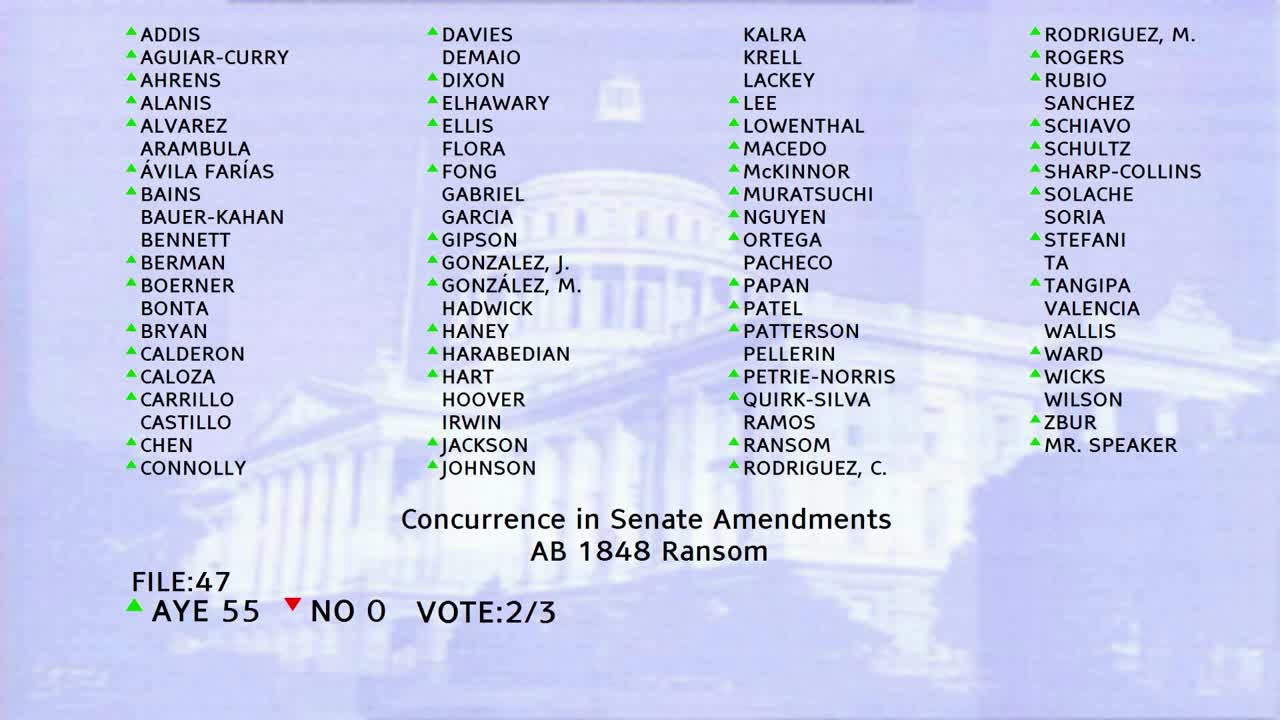 1MIN
Assembly Floor
 2MIN
Senate Floor
 6MIN
Senate Standing Committee on Military and Veterans Affairs
 10MIN
Senate Standing Committee on Health
 3MIN
Assembly Floor
 24MIN
Assembly Standing Committee on Military and Veterans Affairs
 9MIN
Assembly Standing Committee on Health
Bill Author