AB 2539: Tribal-state gaming: compact ratification.
- Session Year: 2025-2026
- House: Assembly
- Latest Version Date: 2026-09-14
Current Status:
Passed
(2026-09-15: Chaptered by Secretary of State - Chapter 213, Statutes of 2026.)
Introduced
In Committee
Awaiting First Chamber Vote
Passed First Chamber
In Committee
Awaiting Second Chamber Vote
Passed Second Chamber
Enacted
Existing federal law, the Indian Gaming Regulatory Act of 1988, provides for the negotiation and execution of tribal-state gaming compacts for the purpose of authorizing certain types of gaming on Indian lands within a state. The California Constitution authorizes the Governor to negotiate and conclude those compacts, subject to ratification by the Legislature. Existing law expressly ratifies a number of tribal-state gaming compacts, and amendments to tribal-state gaming compacts, between the State of California and specified Indian tribes.
The California Environmental Quality Act (CEQA) requires a lead agency to prepare, or cause to be prepared, and certify the completion of, an environmental impact report on a project, as defined, that it proposes to carry out or approve that may have a significant effect on the environment, as defined, or to adopt a negative declaration if it finds that the project will not have that effect.
This bill would ratify the tribal-state gaming compact entered into between the State of California and the Yurok Tribe of the Yurok Reservation, California, executed on August 4, 2026. The bill would provide that, in deference to tribal sovereignty, certain actions related to this compact are not projects for the purposes of CEQA.
This bill would declare that it is to take effect immediately as an urgency statute.
Existing federal law, the Indian Gaming Regulatory Act of 1988, provides for the negotiation and execution of tribal-state gaming compacts for the purpose of authorizing certain types of gaming on Indian lands within a state. The California Constitution authorizes the Governor to negotiate and conclude compacts, subject to ratification by the Legislature. Existing law ratifies a number of tribal-state gaming compacts between the State of California and specified Indian tribes that were executed in 1999. Existing law provides that any other tribal-state gaming compact entered into between the state and a federally recognized Indian tribe that is executed after September 10, 1999, is ratified if it is identical in all material respects to any of the compacts expressly ratified by these provisions and if the compact is not rejected by each house of the Legislature within 30 days of the date of the submission of the compact to the Legislature by the Governor. If the 30-day period ends during a joint recess of the Legislature, existing law extends the period to reject the compact until the 15th day following the day that the Legislature reconvenes. This bill would instead, if a 30-day period to reject a compact ends during a joint recess, extend the period until the 20th day following the day that the Legislature reconvenes.Existing federal law, the Indian Gaming Regulatory Act of 1988, provides for the negotiation and execution of tribal-state gaming compacts for the purpose of authorizing certain types of gaming on Indian lands within a state. The California Constitution authorizes the Governor to negotiate and conclude compacts, subject to ratification by the Legislature.
Existing law ratifies a number of tribal-state gaming compacts between the State of California and specified Indian tribes that were executed in 1999. Existing law provides that any other tribal-state gaming compact entered into between the state and a federally recognized Indian tribe that is executed after September 10, 1999, is ratified if it is identical in all material respects to any of the compacts expressly ratified by these provisions and if the compact is not rejected by each house of the Legislature within 30 days of the date of the submission of the compact to the Legislature by the Governor. If the 30-day period ends during a joint recess of the Legislature, existing law extends the period to reject the compact until the 15th day following the day that the Legislature reconvenes.
This bill would instead, if a 30-day period to reject a compact ends during a joint recess, extend the period until the 20th day following the day that the Legislature reconvenes.
(a)The tribal-state gaming compact entered into in accordance with the federal Indian Gaming Regulatory Act of 1988 (18 U.S.C. Secs. 1166 to 1168, inclusive, and 25 U.S.C. Sec. 2701 et seq.) between the State of California and the Yurok Tribe of the Yurok Reservation, California, executed on August 4, 2026, is hereby ratified.
(b)(1)In deference to tribal sovereignty, none of the following shall be deemed a project for purposes of the California Environmental Quality Act (Division 13 (commencing with Section 21000) of the Public Resources Code):
(A)The execution of the tribal-state gaming compact ratified by this section.
(B)The execution of an amendment to the tribal-state gaming compact ratified by this section.
(C)The execution of an intergovernmental agreement between the tribe and a county or city government negotiated pursuant to the express authority of, or as expressly referenced in, the tribal-state gaming compact ratified by this section.
(D)The execution of an intergovernmental agreement between the tribe and the Department of Transportation, or other state agency, negotiated pursuant to the express authority of, or as expressly referenced in, the tribal-state gaming compact ratified by this section.
(E)The on-reservation impacts of compliance with the terms of the tribal-state gaming compact ratified by this section.
(2)Except as expressly provided in this section, this subdivision does not exempt a city, county, or city and county, or the Department of Transportation, or any state agency or local jurisdiction, from the requirements of the California Environmental Quality Act.
SEC. 2.This act is an urgency statute necessary for the immediate preservation of the public peace, health, or safety within the meaning of Article IV of the California Constitution and shall go into immediate effect. The facts constituting the necessity are:
In order to enhance the economic development, stability, and self-sufficiency of the Yurok Tribe of the Yurok Reservation, California, and to protect the interests of the tribe and its members, the surrounding communities, and the California public at the earliest possible time, it is necessary that this act take effect immediately.
SECTION 1.Section 12012.25 of the Government Code is amended to read:12012.25.(a)The following tribal-state gaming compacts entered into in accordance with the Indian Gaming Regulatory Act of 1988 (18 U.S.C. Sec. 1166 to 1168, incl., and 25 U.S.C. Sec. 2701 et seq.) are hereby ratified:(1)The compact between the State of California and the Alturas Rancheria, executed on September 10, 1999.(2)The compact between the State of California and the Barona Band of Mission Indians, executed on September 10, 1999.(3)The compact between the State of California and the Big Sandy Rancheria Band of Mono Indians, executed on September 10, 1999.(4)The compact between the State of California and the Big Valley Rancheria, executed on September 10, 1999.(5)The compact between the State of California and the Bishop Paiute Tribe, executed on September 10, 1999.(6)The compact between the State of California and the Blue Lake Rancheria, executed on September 10, 1999.(7)The compact between the State of California and the Buena Vista Band of Me-wuk Indians, executed on September 10, 1999.(8)The compact between the State of California and the Cabazon Band of Mission Indians, executed on September 10, 1999.(9)The compact between the State of California and the Cahto Tribe of Laytonville, executed on September 10, 1999.(10)The compact between the State of California and the Cahuilla Band of Mission Indians, executed on September 10, 1999.(11)The compact between the State of California and the Campo Band of Mission Indians, executed on September 10, 1999.(12)The compact between the State of California and the Chemehuevi Indian Tribe, executed on September 10, 1999.(13)The compact between the State of California and the Chicken Ranch Rancheria, executed on September 10, 1999.(14)The compact between the State of California and the Coast Indian Community of the Resighini Rancheria, executed on September 10, 1999.(15)The compact between the State of California and the Colusa Indian Community, executed on September 10, 1999.(16)The compact between the State of California and the Dry Creek Rancheria Band of Pomo Indians, executed on September 10, 1999.(17)The compact between the State of California and the Elk Valley Rancheria, executed on September 10, 1999.(18)The compact between the State of California and the Ewiiaapaayp Band of Kumeyaay, executed on September 10, 1999.(19)The compact between the State of California and the Hoopa Valley Tribe, executed on September 10, 1999.(20)The compact between the State of California and the Hopland Band of Pomo Indians, executed on September 10, 1999.(21)The compact between the State of California and the Jackson Band of Mi-Wuk Indians, executed on September 10, 1999.(22)The compact between the State of California and the Jamul Indian Reservation, executed on September 10, 1999.(23)The compact between the State of California and the La Jolla Indian Reservation, executed on September 10, 1999.(24)The compact between the State of California and the Manzanita Tribe of Kumeyaay Indians, executed on September 10, 1999.(25)The compact between the State of California and the Mesa Grande Band of Mission Indians, executed on September 10, 1999.(26)The compact between the State of California and the Middletown Rancheria Band of Pomo Indians, executed on September 10, 1999.(27)The compact between the State of California and the Morongo Band of Mission Indians, executed on September 10, 1999.(28)The compact between the State of California and the Mooretown Rancheria Concow Maidu Tribe, executed on September 10, 1999.(29)The compact between the State of California and the Pala Band of Mission Indians, executed on September 10, 1999.(30)The compact between the State of California and the Paskenta Band of Nomlaki Indians, executed on September 10, 1999.(31)The compact between the State of California and the Pechanga Band of Luiseno Indians, executed on September 10, 1999.(32)The compact between the State of California and the Picayune Rancheria of Chukchansi Indians, executed on September 10, 1999.(33)The compact between the State of California and the Quechan Nation, executed on September 10, 1999.(34)The compact between the State of California and the Redding Rancheria, executed on September 10, 1999.(35)The compact between the State of California and the Rincon, San Luiseno Band of Mission Indians, executed on September 10, 1999.(36)The compact between the State of California and the Rumsey Band of Wintun Indians, executed on September 10, 1999.(37)The compact between the State of California and the Robinson Rancheria Band of Pomo Indians, executed on September 10, 1999.(38)The compact between the State of California and the Rohnerville Rancheria, executed on September 10, 1999.(39)The compact between the State of California and the San Manuel Band of Mission Indians, executed on September 10, 1999.(40)The compact between the State of California and the San Pasqual Band of Mission Indians, executed on September 10, 1999.(41)The compact between the State of California and the Santa Rosa Rancheria Tachi Tribe, executed on September 10, 1999.(42)The compact between the State of California and the Santa Ynez Band of Chumash Indians, executed on September 10, 1999.(43)The compact between the State of California and the Sherwood Valley Rancheria Band of Pomo Indians, executed on September 10, 1999.(44)The compact between the State of California and the Shingle Springs Band of Miwok Indians, executed on September 10, 1999.(45)The compact between the State of California and the Smith River Rancheria, executed on September 10, 1999.(46)The compact between the State of California and the Soboba Band of Mission Indians, executed on September 10, 1999.(47)The compact between the State of California and the Susanville Indian Rancheria, executed on September 10, 1999.(48)The compact between the State of California and the Sycuan Band of Kumeyaay Indians, executed on September 10, 1999.(49)The compact between the State of California and the Table Mountain Rancheria, executed on September 10, 1999.(50)The compact between the State of California and the Trinidad Rancheria, executed on September 10, 1999.(51)The compact between the State of California and the Tule River Indian Tribe, executed on September 10, 1999.(52)The compact between the State of California and the Tuolumne Band of Me-wuk Indians, executed on September 10, 1999.(53)The compact between the State of California and the Twenty-Nine Palms Band of Mission Indians, executed on September 10, 1999.(54)The compact between the State of California and the Tyme Maidu Tribe, Berry Creek Rancheria, executed on September 10, 1999.(55)The compact between the State of California and the United Auburn Indian Community, executed on September 10, 1999.(56)The compact between the State of California and the Viejas Band of Kumeyaay Indians, executed on September 10, 1999.(57)The compact between the State of California and the Coyote Valley Band of Pomo Indians, executed on September 10, 1999.(b)Any other tribal-state gaming compact entered into between the State of California and a federally recognized Indian tribe that is executed after September 10, 1999, is hereby ratified if both of the following are true:(1)The compact is identical in all material respects to any of the compacts expressly ratified pursuant to subdivision (a). A compact shall be deemed to be materially identical to a compact ratified pursuant to subdivision (a) if the Governor certifies it is materially identical at the time the Governor submits it to the Legislature.(2)The compact is not rejected by each house of the Legislature, two-thirds of the membership thereof concurring, within 30 days of the date of the submission of the compact to the Legislature by the Governor. However, if the 30-day period ends during a joint recess of the Legislature, the period shall be extended until the 20th day following the day that the Legislature reconvenes.(c)The Legislature acknowledges the right of federally recognized Indian tribes to exercise their sovereignty to negotiate and enter into tribal-state gaming compacts that are materially different from the compacts ratified pursuant to subdivision (a). These compacts shall be ratified by a statute approved by each house of the Legislature, a majority of the members thereof concurring, and signed by the Governor, unless the statute contains implementing or other provisions requiring a supermajority vote, in which case the statute shall be approved in the manner required by the Constitution.(d)The Governor is the designated state officer responsible for negotiating and executing, on behalf of the state, tribal-state gaming compacts with federally recognized Indian tribes located within the State of California pursuant to the federal Indian Gaming Regulatory Act of 1988 (18 U.S.C. Sec. 1166 to 1168, incl., and 25 U.S.C. Sec. 2701 et seq.) for the purpose of authorizing class III gaming, as defined in that act, on Indian lands within this state. This section shall not be construed to deny the existence of the Governors authority to have negotiated and executed tribal-state gaming compacts before the effective date of this section.(e)Following completion of negotiations conducted pursuant to subdivision (b) or (c), the Governor shall submit a copy of an executed tribal-state compact to both houses of the Legislature for ratification, and shall submit a copy of the executed compact to the Secretary of State for purposes of subdivision (f).(f)Upon receipt of a statute ratifying a tribal-state compact negotiated and executed pursuant to subdivision (c), or upon the expiration of the review period described in subdivision (b), the Secretary of State shall forward a copy of the executed compact and the ratifying statute, if applicable, to the Secretary of the Interior for the Secretarys review and approval, in accordance with paragraph (8) of subsection (d) of Section 2710 of Title 25 of the United States Code.(g)In deference to tribal sovereignty, neither the execution of a tribal-state gaming compact nor the on-reservation impacts of compliance with the terms of a tribal-state gaming compact shall be deemed to constitute a project for purposes of the California Environmental Quality Act (Division 13 (commencing with Section 21000) of the Public Resources Code).(a)The following tribal-state gaming compacts entered into in accordance with the Indian Gaming Regulatory Act of 1988 (18 U.S.C. Sec. 1166 to 1168, incl., and 25 U.S.C. Sec. 2701 et seq.) are hereby ratified:
(1)The compact between the State of California and the Alturas Rancheria, executed on September 10, 1999.
(2)The compact between the State of California and the Barona Band of Mission Indians, executed on September 10, 1999.
(3)The compact between the State of California and the Big Sandy Rancheria Band of Mono Indians, executed on September 10, 1999.
(4)The compact between the State of California and the Big Valley Rancheria, executed on September 10, 1999.
(5)The compact between the State of California and the Bishop Paiute Tribe, executed on September 10, 1999.
(6)The compact between the State of California and the Blue Lake Rancheria, executed on September 10, 1999.
(7)The compact between the State of California and the Buena Vista Band of Me-wuk Indians, executed on September 10, 1999.
(8)The compact between the State of California and the Cabazon Band of Mission Indians, executed on September 10, 1999.
(9)The compact between the State of California and the Cahto Tribe of Laytonville, executed on September 10, 1999.
(10)The compact between the State of California and the Cahuilla Band of Mission Indians, executed on September 10, 1999.
(11)The compact between the State of California and the Campo Band of Mission Indians, executed on September 10, 1999.
(12)The compact between the State of California and the Chemehuevi Indian Tribe, executed on September 10, 1999.
(13)The compact between the State of California and the Chicken Ranch Rancheria, executed on September 10, 1999.
(14)The compact between the State of California and the Coast Indian Community of the Resighini Rancheria, executed on September 10, 1999.
(15)The compact between the State of California and the Colusa Indian Community, executed on September 10, 1999.
(16)The compact between the State of California and the Dry Creek Rancheria Band of Pomo Indians, executed on September 10, 1999.
(17)The compact between the State of California and the Elk Valley Rancheria, executed on September 10, 1999.
(18)The compact between the State of California and the Ewiiaapaayp Band of Kumeyaay, executed on September 10, 1999.
(19)The compact between the State of California and the Hoopa Valley Tribe, executed on September 10, 1999.
(20)The compact between the State of California and the Hopland Band of Pomo Indians, executed on September 10, 1999.
(21)The compact between the State of California and the Jackson Band of Mi-Wuk Indians, executed on September 10, 1999.
(22)The compact between the State of California and the Jamul Indian Reservation, executed on September 10, 1999.
(23)The compact between the State of California and the La Jolla Indian Reservation, executed on September 10, 1999.
(24)The compact between the State of California and the Manzanita Tribe of Kumeyaay Indians, executed on September 10, 1999.
(25)The compact between the State of California and the Mesa Grande Band of Mission Indians, executed on September 10, 1999.
(26)The compact between the State of California and the Middletown Rancheria Band of Pomo Indians, executed on September 10, 1999.
(27)The compact between the State of California and the Morongo Band of Mission Indians, executed on September 10, 1999.
(28)The compact between the State of California and the Mooretown Rancheria Concow Maidu Tribe, executed on September 10, 1999.
(29)The compact between the State of California and the Pala Band of Mission Indians, executed on September 10, 1999.
(30)The compact between the State of California and the Paskenta Band of Nomlaki Indians, executed on September 10, 1999.
(31)The compact between the State of California and the Pechanga Band of Luiseno Indians, executed on September 10, 1999.
(32)The compact between the State of California and the Picayune Rancheria of Chukchansi Indians, executed on September 10, 1999.
(33)The compact between the State of California and the Quechan Nation, executed on September 10, 1999.
(34)The compact between the State of California and the Redding Rancheria, executed on September 10, 1999.
(35)The compact between the State of California and the Rincon, San Luiseno Band of Mission Indians, executed on September 10, 1999.
(36)The compact between the State of California and the Rumsey Band of Wintun Indians, executed on September 10, 1999.
(37)The compact between the State of California and the Robinson Rancheria Band of Pomo Indians, executed on September 10, 1999.
(38)The compact between the State of California and the Rohnerville Rancheria, executed on September 10, 1999.
(39)The compact between the State of California and the San Manuel Band of Mission Indians, executed on September 10, 1999.
(40)The compact between the State of California and the San Pasqual Band of Mission Indians, executed on September 10, 1999.
(41)The compact between the State of California and the Santa Rosa Rancheria Tachi Tribe, executed on September 10, 1999.
(42)The compact between the State of California and the Santa Ynez Band of Chumash Indians, executed on September 10, 1999.
(43)The compact between the State of California and the Sherwood Valley Rancheria Band of Pomo Indians, executed on September 10, 1999.
(44)The compact between the State of California and the Shingle Springs Band of Miwok Indians, executed on September 10, 1999.
(45)The compact between the State of California and the Smith River Rancheria, executed on September 10, 1999.
(46)The compact between the State of California and the Soboba Band of Mission Indians, executed on September 10, 1999.
(47)The compact between the State of California and the Susanville Indian Rancheria, executed on September 10, 1999.
(48)The compact between the State of California and the Sycuan Band of Kumeyaay Indians, executed on September 10, 1999.
(49)The compact between the State of California and the Table Mountain Rancheria, executed on September 10, 1999.
(50)The compact between the State of California and the Trinidad Rancheria, executed on September 10, 1999.
(51)The compact between the State of California and the Tule River Indian Tribe, executed on September 10, 1999.
(52)The compact between the State of California and the Tuolumne Band of Me-wuk Indians, executed on September 10, 1999.
(53)The compact between the State of California and the Twenty-Nine Palms Band of Mission Indians, executed on September 10, 1999.
(54)The compact between the State of California and the Tyme Maidu Tribe, Berry Creek Rancheria, executed on September 10, 1999.
(55)The compact between the State of California and the United Auburn Indian Community, executed on September 10, 1999.
(56)The compact between the State of California and the Viejas Band of Kumeyaay Indians, executed on September 10, 1999.
(57)The compact between the State of California and the Coyote Valley Band of Pomo Indians, executed on September 10, 1999.
(b)Any other tribal-state gaming compact entered into between the State of California and a federally recognized Indian tribe which that is executed after September 10, 1999, is hereby ratified if both of the following are true:
(1)The compact is identical in all material respects to any of the compacts expressly ratified pursuant to subdivision (a). A compact shall be deemed to be materially identified identical to a compact ratified pursuant to subdivision (a) if the Governor certifies it is materially identical at the time the Governor submits it to the Legislature.
(2)The compact is not rejected by each house of the Legislature, two-thirds of the membership thereof concurring, within 30 days of the date of the submission of the compact to the Legislature by the Governor. However, if the 30-day period ends during a joint recess of the Legislature, the period shall be extended until the fifteenth 20th day following the day on which that the Legislature reconvenes.
(c)The Legislature acknowledges the right of federally recognized Indian tribes to exercise their sovereignty to negotiate and enter into tribal-state gaming compacts that are materially different from the compacts ratified pursuant to subdivision (a). These compacts shall be ratified by a statute approved by each house of the Legislature, a majority of the members thereof concurring, and signed by the Governor, unless the statute contains implementing or other provisions requiring a supermajority vote, in which case the statute shall be approved in the manner required by the Constitution.
(d)The Governor is the designated state officer responsible for negotiating and executing, on behalf of the state, tribal-state gaming compacts with federally recognized Indian tribes located within the State of California pursuant to the federal Indian Gaming Regulatory Act of 1988 (18 U.S.C. Sec. 1166 to 1168, incl., and 25 U.S.C. Sec. 2701 et seq.) for the purpose of authorizing class III gaming, as defined in that act, on Indian lands within this state. Nothing in this section shall This section shall not be construed to deny the existence of the Governors authority to have negotiated and executed tribal-state gaming compacts prior to before the effective date of this section.
(e)Following completion of negotiations conducted pursuant to subdivision (b) or (c), the Governor shall submit a copy of an executed tribal-state compact to both houses of the Legislature for ratification, and shall submit a copy of the executed compact to the Secretary of State for purposes of subdivision (f).
(f)Upon receipt of a statute ratifying a tribal-state compact negotiated and executed pursuant to subdivision (c), or upon the expiration of the review period described in subdivision (b), the Secretary of State shall forward a copy of the executed compact and the ratifying statute, if applicable, to the Secretary of the Interior for the Secretarys review and approval, in accordance with paragraph (8) of subsection (d) of Section 2710 of Title 25 of the United States Code.
(g)In deference to tribal sovereignty, neither the execution of a tribal-state gaming compact nor the on-reservation impacts of compliance with the terms of a tribal-state gaming compact shall be deemed to constitute a project for purposes of the California Environmental Quality Act (Division 13 (commencing with Section 21000) of the Public Resources Code).
|
Date
|
Status
|
|---|---|
| Sep 15, 2026 | Chaptered by Secretary of State - Chapter 213, Statutes of 2026. |
| Sep 15, 2026 | Approved by the Governor. |
| Sep 14, 2026 | Chaptered by Secretary of State - Chapter 213, Statutes of 2026. |
| Sep 14, 2026 | Approved by the Governor. |
| Sep 4, 2026 | Enrolled and presented to the Governor at 4 p.m. |
| Aug 27, 2026 | Urgency clause adopted. Senate amendments concurred in. To Engrossing and Enrolling. (Ayes 77. Noes 0. Page 6739.). |
| Aug 27, 2026 | Urgency clause adopted. Senate amendments concurred in. To Engrossing and Enrolling. (Ayes 77. Noes 0.). |
| Aug 27, 2026 | In Assembly. Concurrence in Senate amendments pending. |
| Aug 27, 2026 | Read third time. Urgency clause adopted. Passed. Ordered to the Assembly. (Ayes 40. Noes 0. Page 5956.). |
| Aug 27, 2026 | Read third time. Urgency clause adopted. Passed. Ordered to the Assembly. (Ayes 40. Noes 0.). |
| Aug 24, 2026 | Read second time. Ordered to third reading. |
| Aug 20, 2026 | Read second time and amended. Ordered returned to second reading. |
| Aug 20, 2026 | Ordered to second reading. |
| Aug 20, 2026 | From inactive file. |
| Jun 11, 2026 | Ordered to inactive file at the request of Senator Rubio. |
| Jun 11, 2026 | From Consent Calendar. |
| Jun 10, 2026 | Read second time. Ordered to Consent Calendar. |
| Jun 9, 2026 | From committee: Do pass. To Consent Calendar. (Ayes 13. Noes 0.) (June 9). |
| May 6, 2026 | Referred to Com. on G.O. |
| Apr 16, 2026 | In Senate. Read first time. To Com. on RLS. for assignment. |
| Apr 16, 2026 | Read third time. Passed. Ordered to the Senate. (Ayes 68. Noes 0. Page 4683.) |
| Apr 16, 2026 | Read third time. Passed. Ordered to the Senate. (Ayes 68. Noes 0.) |
| Apr 13, 2026 | Read second time. Ordered to Consent Calendar. |
| Apr 9, 2026 | From committee: Do pass. To Consent Calendar. (Ayes 22. Noes 0.) (April 8). |
| Mar 9, 2026 | Referred to Com. on G.O. |
| Feb 21, 2026 | From printer. May be heard in committee March 23. |
| Feb 20, 2026 | Read first time. To print. |
|
Date
|
Description
|
Location
|
Votes
|
|
|---|---|---|---|---|
| Aug 27, 2026 | AB 2539 Ramos Concurrence - Urgency Added | Assembly Floor |
Passed |
|
| Aug 27, 2026 | Assembly 3rd Reading AB2539 Ramos By McGuire Urgency Clause | Senate Floor |
Passed |
|
| Jun 9, 2026 | Do pass and be ordered to the Consent Calendar | Senate Standing Committee on Governmental Organization |
Passed |
|
| Apr 16, 2026 | AB 2539 Ramos Consent Calendar Second Day Regular Session | Assembly Floor |
Passed |
|
| Apr 8, 2026 | Do pass. To Consent Calendar. | Assembly Standing Committee on Governmental Organization |
Passed |
This list shows positions taken on this bill by organizations on the date displayed, which is linked to the original source.
Positions by individuals are not included.
|
Organization
|
Position
|
Date
|
|---|---|---|
| Governor's Office | ** Support |
CONCURRENCE IN SENATE AMENDMENTS
CSA1 Bill Id:AB 2539
Author:(Ramos)
As Amended Ver:August 20, 2026
2/3 vote. Urgency
SUMMARY
This bill would ratify the tribal-state gaming compact (Compact) entered into between the State of California (State) and the Yurok Tribe of the Yurok Reservation, California (Tribe), executed on August 4, 2026.
Senate Amendments
- Ratify the tribal-state gaming compact entered into between the State of California and the Yurok Tribe of the Yurok Reservation, California, executed on August 4, 2026.
- Provides that, in deference to tribal sovereignty, certain actions are not deemed projects for purposes of the California Environmental Quality Act (CEQA); and, stipulate, except as expressly provided, that none of the provisions shall be construed to exempt a city, county, or city and county, or the Department of Transportation from CEQA requirements.
- Add an urgency clause.
Existing law:
- Provides, under the Indian Gaming Regulatory Act (IGRA), for the negotiation and conclusion of compacts between federally recognized Indian tribes and the State for the purpose of conducting Class III gaming activities on Indian lands within a State as a means of promoting tribal economic development, self-sufficiency, and strong tribal governments.
- Authorizes expressly a number of tribal-state gaming compacts between the State of California and specified Indian tribes.
- Authorizes the conduct of Class III gaming activities to the extent such activities are permitted by state law, a gaming compact has been concluded by a federally recognized tribe and the State, and the compact has been approved by the Secretary of the Interior.
- Limits the operation of Class III gaming activities to Indian lands acquired on or before October 17, 1988. Provides, for certain exceptions to conduct gaming activities on Indian lands acquired after October 17, 1988.
- Defines "Indian lands" to mean all lands within the limits of any Indian reservation, and any lands title to which is either held in trust by the United States for the benefit of any Indian tribe, or individual, or held by any Indian tribe or individual subject to restriction by the U.S. against alienation and over which an Indian tribe exercises governmental power.
- Requires the State to negotiate to conclude a compact in good faith with an Indian tribe having jurisdiction over the Indian lands upon which the Class III gaming activity is to be conducted. Provides the U.S. district courts with jurisdiction over any cause of action initiated by a tribal government alleging that the State failed to negotiate in good faith to conclude a compact. Prescribes the remedy, mediation supervised by the courts, if it is found that the State failed to negotiate in good faith to conclude a compact.
- Authorizes the Governor, under the California Constitution, to negotiate and conclude compacts, subject to ratification by the Legislature.
COMMENTS
Note. On August 11, 2026, the Assembly Committee on Governmental Organization held an informational hearing regarding the content of the tribal-state compact between the State and the Yurok Tribe of the Yurok Reservation, California.
Background on Compact and Tribe.
The Tribe is the largest federally recognized Native American tribe in California, with more than 5,000 members. Their ancestral homelands and the Yurok Indian Reservation span a 44-mile corridor along the lower Klamath River and Pacific coast in Del Norte and Humboldt counties.
The Tribe currently operates the Redwood Hotel Casino, which consists of two separate entities, the Redwood Holiday Inn Express and the Redwood Casino. The Redwood Holiday Inn Express is a 60-room hotel complete with an exercise room and pool. The Redwood Casino, located in Klamath, CA, currently hosts 99 Class III gaming devices and includes the Abalone Bar and Grill. The development of the Redwood Hotel Casino is only a portion of a broader master plan for the Tribe, community, which also includes the Yurok Construction Corporation, Yurok Indian Housing Authority, Yurok Language Department, Yurok Office of Emergency Services, Yurok Telecommunications Corp, and the Yurok Tribal Court.
This Compact authorizes the Tribe to operate a maximum of 349 slot machines at no more than three gaming facilities located on eligible Indian lands held in trust for the Tribe.
The Tribe has agreed to pay the State its pro rata share of costs the State incurs for the performance of its duties under the Compact. The Compact does not require the Tribe to pay into the Revenue Sharing Trust Fund (RSTF) or the Tribal Nation Grant Fund (TNGF).
Pursuant to the Compact, operating within the authorized threshold of gaming devices preserves the Tribe's classification as a Limited-Gaming Tribe. Accordingly, the Tribe bears no obligation hereunder to remit funds for the mitigation of potential local government impacts, if any.
Certain terms of the Compact related to licensing, regulatory, patron protection, and public health provisions are substantially the same as recent compacts. Specifically, the Compact includes a Tribal Labor Relations Ordinance (TLRO), which provides that gaming may commence only after the Tribe has adopted a TLRO that allows for a secret ballot election and union neutrality.
The Compact's preamble states that, "Gaming Activities conducted by the Tribe on the Yurok Reservation are intended to promote the Tribe's economic development and self-sufficiency."
Once effective (legislative ratification and federal approval required), this Compact will be in full force and effect for 25 years following the effective date.
Key Provisions of the Compact:
Scope of Class III Gaming Authorized. The Tribe is authorized to operate up to 349 slot machines, banking or percentage card games, and any devices or games that are authorized under state law to the California State Lottery, provided that the Tribe will not offer such games through use of the Internet unless others in the state not affiliated with or licensed by the California State Lottery are permitted to do so under state and federal law. The Tribe can operate off-track wagering on horse races at a satellite wagering facility pursuant to the requirements outlined in the Compact (Appendix C). The Tribe shall not engage in Class III gaming that is not expressly authorized in the Compact.
Authorized Gaming Facility. The Tribe may establish and operate no more than three gaming facilities and engage in Class III gaming only on eligible Indian lands held in trust for the Tribe, located within the boundaries of the Tribe's reservation.
Payments to the Special Distribution Fund (SDF). The Tribe shall pay to the State, on a pro rata basis, the costs the State incurs for the performance of all its duties under this Compact, as established by the monies appropriated in the annual Budget Act for the performance of their duties under Class III gaming Compacts.
Payments to the RSTF or the TNGF. The Compact does not require the Tribe to pay into either the RSTF or the TNGF.
Distribution by Tribe to Local Governments. Under the terms of this Compact, the Tribe will remain a Limited-Gaming Tribe when operating Gaming Activities based on the authorized number of Gaming Devices. Accordingly, the Tribe has no obligation under this Compact to distribute funds to mitigate impacts of gaming, if any, on local governments.
Exclusivity. Provides that in the event the exclusive right of Indian tribes to operate Class III gaming in California pursuant to the California Constitution is abrogated by the enactment, amendment, or repeal of a state statute or constitutional provision or the conclusive and dispositive judicial construction of a statute or the State Constitution by a California appellate court after the effective date of this Compact, that gaming devices may lawfully be operated by non-Indian entities, the Tribe shall have the right to terminate this Compact, as specified.
Labor Provisions. Provides that the gaming activities authorized by this Compact may only commence after the Tribe has adopted an ordinance identical to the TRLO, referenced as Appendix D of the Compact, and the gaming activities may only continue as long as the Tribe maintains the ordinance. If the Tribe employs 250 or more persons in a tribal casino facility, then the provisions of the TLRO become effective. The TLRO makes it clear that employees shall have the right to self-organization, to form, to join, or assist employee organizations, to bargain collectively through representatives of their own choosing. The TLRO provides for a secret ballot election and union neutrality. After the certification that 30% of the eligible employees in a bargaining unit have expressed an interest in the union, a notice of election shall be issued, and the election shall be concluded within 30 calendar days thereafter. Employees may mail in ballots provided they are received by election day. Union representation requires an affirmative vote of 50% plus one of all votes cast.
Additional Compact Components:
Gaming Ordinance and Regulations. All gaming activities conducted under this Compact shall, at a minimum, comply with a gaming ordinance duly adopted by the Tribe and approved in accordance with IGRA and all applicable rules, regulations, procedures, specifications, and standards duly adopted by the National Indian Gaming Commission (NIGC), the Tribal Gaming Agency, and the State Gaming Agency, and with the provisions of this Compact, as specified.
Prohibitions Regarding Minors. The Tribe shall prohibit persons under the age of 21 years from being present in any room or area in which gaming activities are being conducted unless the person is en route to a non-gaming area of the Gaming Facility, or is employed at the Gaming Facility in a capacity other than as a gaming employee. If the Tribe permits the consumption of alcoholic beverages in the Gaming Facility, the Tribe shall prohibit persons under the age of 21 from purchasing, consuming, or possessing alcoholic beverages. The Tribe shall also prohibit persons under the age of 21 from being present in any room or area, in which alcoholic beverages may be consumed, except to the extent permitted by the gaming facility's California Department of Alcoholic Beverage Control license.
Licensing Requirements and Procedures. All persons in any way connected with the gaming operation or gaming facility who are required to be licensed or to submit to a background investigation under IGRA, and any others required to be licensed under this Compact, including, without limitation, all gaming employees, gaming resource suppliers, financial sources, and any other person having a significant influence over the gaming operation, must be licensed by the Tribal Gaming Agency. Also, every gaming employee must obtain, and thereafter maintain current, a valid tribal gaming license, as specified.
Inspection and Testing of Gaming Devices. Gaming devices will have to be tested, approved and certified by an independent gaming test laboratory or state governmental gaming test laboratory to ensure they are being operated according to specified technical standards. Also, it requires the Tribal Gaming Agency to maintain adequate records that demonstrate compliance with software and hardware specifications. The State Gaming Agency is authorized to inspect gaming devices in operating at the gaming facility.
Minimum Internal Control Standards (MICS). The Tribe must conduct its gaming activities pursuant to an internal control system that implements MICS that are no less stringent than those contained in the MICS of the federal NIGC standards, as specified. It requires gaming to operate pursuant to a written internal control system that reasonably assures that assets are safeguarded and accountability over assets is maintained; liabilities are properly recorded and contingent liabilities are properly disclosed; financial records are accurate and reliable; transactions are performed in accordance with the Tribal Gaming Agency's authorization; access to assets is permitted only in accordance with the Tribal Gaming Agency's approved procedures; recorded accountability for assets is compared with actual assets; and, functions, duties and responsibilities are appropriately segregated and performed by qualified personnel.
Problem Gambling. The gaming operation must establish a program, approved by the Tribal Gaming Agency, to mitigate pathological and problem gaming by implementing specified measures.
Patron Disputes. The Tribal Gaming Agency must promulgate regulations governing patron disputes over the play or operation of any game, including any refusal to pay to a patron any alleged winnings from any gaming activities that include specified minimum standards.
Compliance Enforcement. It is the responsibility of the Tribal Gaming Agency to conduct on-site gaming regulation and control in order to enforce the terms of this Compact, IGRA, NIGC gaming regulations, state gaming agency regulations, and the gaming ordinance, to protect the integrity of gaming activities and the gaming operation for honesty and fairness, and to maintain the confidence of patrons that tribal governmental gaming in California meets the highest standards of fairness and internal controls. To meet those responsibilities, the Tribal Gaming Agency shall promulgate rules and regulations for these purposes.
Tobacco Provisions. The Tribe is required to provide a non-smoking area in the gaming facility. The Tribe shall utilize a ventilation system throughout the gaming facility that exhausts tobacco smoke.
Alcohol Provisions. Makes it explicit that the purchase, sale, and service of alcoholic beverages shall be subject to state law (Alcoholic Beverage Control Act).
Workers' Compensation. The Tribe agrees to participate in the State's workers' compensation program with respect to employees at the casino. In lieu of participation in the State's system, a Tribe may create and maintain a system through self-insurance, which includes specified provisions, including hearings before an independent tribunal. All disputes arising from the workers' compensation laws shall be heard by the State Workers' Compensation Appeals Board (Board) pursuant to the California Labor Code. The Tribe acknowledges the jurisdiction of the Board in such manners. In lieu of participation in the State's system, the Tribe may create and maintain a system through self-insurance, which includes specified provisions, including hearings before an independent tribunal. Furthermore, the Tribe agrees that it will participate in the State's unemployment compensation program for providing benefits and unemployment compensation disability benefits to employees at the casino. The Tribe shall withhold all taxes due to the State, except for Tribal members living on the Tribe's reservation, and forward such amounts to the State.
Health and Safety Standards. The Tribe must establish procedures for addressing harassment, discrimination, and retaliation for all classifications protected under federal and state law. Furthermore, the Tribe must maintain a $2 million insurance policy for these purposes and adopt an ordinance that includes a dispute resolution process.
Building Codes and Fire Safety. In order to assure the protection of the health and safety of all gaming facility patrons, guests, and employees, the Tribe shall adopt and shall maintain throughout the term of this Compact, an ordinance that requires any covered gaming facility construction to meet or exceed the applicable codes. Gaming facility construction, expansion, improvement, modification or renovation must also comply with the federal Americans with Disabilities Act.
Emergency Services Accessibility and Possession of Firearms. The Tribe must make reasonable provisions for adequate emergency fire, medical, and related relief and disaster services for patrons and employees. Also, the Compact prohibits the possession of firearms by any person in the gaming facility at all times except for federal, state, or local law enforcement personnel, or tribal law enforcement or security personnel, as authorized.
Force Majeure Clause. The Compact states that in the event of a force majeure beyond the Tribe's control that cause the Tribe's gaming facility to be inoperable or operate at significantly less capacity, the Tribe and the State agree to meet and confer for the purposes of discussing the event and appropriate actions. In the instance that a force majeure event impacts more than 50% of tribal gaming operations located in California, the State and the Tribe agree to allow the State to elect to meet and confer with several or all tribes that have been impacted by the force majeure event for the purpose of discussing the event and appropriate actions, given the circumstances.
Changes in Market Conditions. The Compact requires the State, within 45 days of the Tribe's written request, to participate in good faith negotiations with the Tribe to amend its compact where the state basis for the Tribe's request is changed conditions that adversely affects the Tribe's gaming operation and the Tribe's obligations under this Compact therefore becomes unduly onerous or creates new opportunities to expand its gaming operation beyond the limitations on gaming devices or gaming facilities of this compact. The State has no obligation to enter into negotiations unless the Tribe provides information adequate to prove that its request meets required basis for negotiations.
Entitlement to Renegotiate. If the State authorizes any person to conduct a new form of Class III gaming not expressly authorized in this Compact, the parties, at the Tribe's request, shall enter into good-faith negotiations pursuant to IGRA to amend this Compact for the purpose of adding the newly authorized Class III gaming activity and make other appropriate related amendments.
Effective Date. This Compact shall not be effective unless and until all of the following have occurred: the Compact is ratified by statute in accordance with state law and notice of approval or constructive approval is published in the Federal Register. Once effective, this Compact shall be in full force and effect for 25 years following the effective date.
Amendment by Agreement. The terms and conditions of this Compact may be amended at any time by the mutual and written agreement of both parties, provided that each party voluntarily consents to such negotiations in writing. Any amendments to this Compact shall be deemed to supersede, supplant and extinguish all previous understandings and agreements on the subject.
Additional Background Information:
Compact Ratification. The State Constitution, as amended by Proposition 1A of March 2000, permits Indian tribes to conduct and operate slot machines, lottery games, and banked and percentage card games on Indian land.
The Governor is the designated State officer responsible for negotiating and executing, on behalf of the State, tribal-state gaming compacts with federally recognized Indian tribes located within the State of California. Following completion of negotiations, the Governor shall submit a copy of any executed tribal-state compact to both houses of the Legislature for ratification and shall submit a copy of the executed compact to the Secretary of State. Tribal-state compacts cannot be presented to the Legislature for ratification until the tribe provides the Governor with written proof of the signatory's authority and formal ratification by the tribal governing body. The federal government must approve the compact. Pursuant to IGRA, the Secretary may disapprove a proposed compact only if it violates IGRA, any other provision of federal law that does not relate to jurisdiction over gaming on Indian lands, or the trust obligation of the United States to Indians. 25 U.S.C. Section 2710(d)(8)(B).
Indian Gaming Regulatory Act. In 1988, Congress enacted the Indian Gaming Regulatory Act (IGRA) to establish a statutory framework for the operation and regulation of gaming on Indian lands. Under IGRA, an Indian tribe may conduct gaming activities on its lands if the activity "is not specifically prohibited by federal law and is conducted within a State that does not prohibit such gaming activity.
IGRA distinguishes between three classes of gaming (Class I, Class II, and Class III) and provides for different forms of regulation for each class. Class I gaming includes "social games" for minor prizes or "traditional forms of Indian gaming." Class II gaming is defined to include bingo and card games that are explicitly authorized by the laws of the state, or that are not explicitly prohibited by the laws of the state and are played at any location in the State, so long as the card games are played in conformity with those laws and regulations. Class III gaming includes such things as slot machines, casino games, and banked card games such as blackjack and baccarat. Class III gaming may only be conducted under terms of a compact negotiated between an Indian tribe and a State.
IGRA was enacted against a legal background in which Indian tribes and individuals generally are exempt from state taxation within their own territory. IGRA provides that with the exception of assessments permitted under the statute, to defray the State's costs of regulating gaming activity, IGRA shall not be interpreted as conferring upon a State authority to impose any tax, fee, charge, or other assessment upon an Indian tribe to engage in Class III activity. Nor may a State refuse to enter into negotiations based on the lack of authority to impose such a tax, fee, charge, or other assessment.
When a tribe requests negotiations for a Class III compact, IGRA requires the State to negotiate with the Indian tribe in good faith. IGRA provides a comprehensive process to prevent an impasse in compact negotiations, which is triggered when a tribe files suit alleging that the State has refused to negotiate or has failed to negotiate in good faith.
Before 2000, the California Constitution prohibited Class III gaming. In 2000, California voters approved Proposition 1A, which had been proposed by the Governor and passed by the Legislature. Proposition 1A amended the California Constitution to permit the State to negotiate compacts with federally recognized Indian tribes for certain Class III gaming activities. Because non-Indian parties were still forbidden from operating gaming facilities, Proposition 1A granted Indian tribes a "constitutionally protected monopoly on most types of Class III games in California."
Rincon Decision. In 2004, the Rincon Band of Mission Indians sued the State of California in federal court after negotiations for a new gambling agreement with then-Governor Schwarzenegger fell apart. The Tribe believed the Governor was violating federal law by insisting that tribes pay money into the state's General Fund in exchange for more slot machines.
In July 2011, the U.S. Supreme Court declined to review a Ninth Circuit Court's decision that ruled the state could not require the Rincon Band tribe to pay a percentage of slot machine revenue into California's General Fund for more gaming devices. The Ninth Circuit had affirmed a lower court decision that the new financial concessions were nothing more than a state tax on tribal casino revenues, which is prohibited by IGRA. The court concluded that a "non-negotiable, mandatory payment of 10% of net win into the State treasury for unrestricted use yields public revenue and is [therefore] a tax and that the court was therefore required to consider the State's demand as evidence of bad faith under IGRA's statutes."
The Rincon decision has changed the dynamics of tribal-state compact negotiations in California.
Chicken Ranch Rancheria Decision. In 2021, the Chicken Ranch Rancheria of Me-Wuk Indians, along with four other tribes—the Blue Lake Rancheria, Chemehuevi Indian Tribe, Hopland Band of Pomo Indians, and Robinson Rancheria—filed suit against the State of California and Governor Gavin Newsom. The tribes alleged that the state violated IGRA by failing to negotiate new Class III gaming compacts in good faith.
According to the complaint, California insisted on compact terms covering family law, environmental regulation, and tort liability—subjects that the tribes argued were outside IGRA's limited scope, which allows negotiation only on matters directly related to the operation of gaming activities. In July 2022, the Ninth Circuit Court of Appeals upheld the district court's finding that California's demands exceeded IGRA's bounds and therefore constituted bad-faith negotiation. The court ordered the parties to move forward under IGRA's remedial process. Under that process, if the parties are ultimately not able to agree on a compact, a mediator reviews each side's "last best offer" and selects the proposal that best aligns with federal law, and the U.S. Department of the Interior (through the Assistant Secretary for Indian Affairs) issues Secretarial Procedures regulating the tribe's gaming operation without state involvement.
This outcome was viewed by Indian tribes as a significant affirmation of tribal sovereignty and a rejection of state overreach in tribal gaming regulation. The Governor's office believes the terms of this Compact are consistent with this court decision.
According to the Author
According to the author, the Compact's preamble declares that "the Tribe and the State have concluded that this Compact protects the interests of the Tribe and its members, the surrounding community, and the California public, and will promote and secure long-term stability, mutual respect, and mutual benefit."
Arguments in Support
None on file.
Arguments in Opposition
None on file.
FISCAL COMMENTS
Unknown.
VOTES:
ASM GOVERNMENTAL ORGANIZATION: 22-0-0
YES: Blanca Rubio, Davies, Alvarez, Berman, Bryan, Carrillo, Dixon, Fong, Gabriel, Gallagher, Gipson, Macedo, McKinnor, Nguyen, Pacheco, Ramos, Michelle Rodriguez, Solache, Soria, Ta, Valencia, Wallis
ASSEMBLY FLOOR: 68-0-12
YES: Addis, Aguiar-Curry, Ahrens, Alanis, Alvarez, Ávila Farías, Bains, Bauer-Kahan, Bennett, Boerner, Bryan, Calderon, Caloza, Carrillo, Castillo, Chen, Connolly, Davies, DeMaio, Elhawary, Ellis, Fong, Gabriel, Gallagher, Garcia, Gipson, Jeff Gonzalez, Mark González, Hadwick, Haney, Jackson, Johnson, Kalra, Krell, Lackey, Lee, Lowenthal, Macedo, McKinnor, Muratsuchi, Nguyen, Ortega, Pacheco, Patel, Patterson, Pellerin, Petrie-Norris, Quirk-Silva, Ramos, Ransom, Michelle Rodriguez, Rogers, Blanca Rubio, Sanchez, Schultz, Sharp-Collins, Solache, Soria, Stefani, Ta, Tangipa, Valencia, Wallis, Ward, Wicks, Wilson, Zbur, Rivas
ABS, ABST OR NV: Arambula, Berman, Bonta, Dixon, Flora, Harabedian, Hart, Hoover, Irwin, Papan, Celeste Rodriguez, Schiavo
UPDATED
VERSION: August 20, 2026
CONSULTANT: Eric Johnson / G.O. / (916) 319-2531 FN: 0004039
SENATE RULES COMMITTEE Office of Senate Floor Analyses (916) 651-4171 | AB 2539 |
THIRD READING
Bill No: AB 2539
Author: Ramos (D)
Amended: 8/20/26 in Senate
Vote: 21
PRIOR VOTES NOT RELEVANT
NOTE: On August 11, 2026, the Senate Governmental Organization Committee held an informational hearing on the tribal-state gaming compact between the State of California and the Yurok Tribe of the Yurok Reservation, California
SUBJECT: Tribal-state gaming compacts: ratification
SOURCE: Author
DIGEST:
This bill ratifies the Tribal-State Gaming Compact between the State of California and the Yurok Tribe of the Yurok Reservation, California, executed on August 4, 2026.
Senate Floor amendments of 8/20/26, delete the previous bill and instead ratify the Tribal-State Gaming Compact between the State of California and the Yurok Tribe of the Yurok Reservation, California, executed on August 4, 2026.
ANALYSIS:
Existing law:
- Provides, under the Indian Gaming Regulatory Act (IGRA), for the negotiation and conclusion of compacts between federally recognized Indian tribes and the State for the purpose of conducting Class III gaming activities on Indian lands within a State as a means of promoting tribal economic development, self-sufficiency, and strong tribal governments.
- Authorizes expressly a number of tribal-state gaming compacts between the State of California and specified Indian tribes.
- Authorizes the conduct of Class III gaming activities to the extent such activities are permitted by state law, a gaming compact has been concluded by a federally recognized tribe and the State, and the compact has been approved by the Secretary of the Interior.
- Limits the operation of Class III gaming activities to Indian lands acquired on or before October 17, 1988. Provides, for certain exceptions to conduct gaming activities on Indian lands acquired after October 17, 1988.
- Defines “Indian lands” to mean all lands within the limits of any Indian reservation, and any lands title to which is either held in trust by the United States for the benefit of any Indian tribe, or individual, or held by any Indian tribe or individual subject to restriction by the U.S. against alienation and over which an Indian tribe exercises governmental power.
- Requires the State to negotiate to conclude a compact in good faith with an Indian tribe having jurisdiction over the Indian lands upon which the Class III gaming activity is to be conducted. Provides the U.S. district courts with jurisdiction over any cause of action initiated by a tribal government alleging that the State failed to negotiate in good faith to conclude a compact. Prescribes the remedy, mediation supervised by the courts, if it is found that the State failed to negotiate in good faith to conclude a compact.
- Authorizes the Governor, under the California Constitution, to negotiate and conclude compacts, subject to ratification by the Legislature.
This bill:
- Ratifies the Tribal-State Gaming Compact between the State of California and the Yurok Tribe of the Yurok Reservation, California, executed on August 04, 2026.
- Contains an urgency clause.
Background
Tribal-State Gaming Compact. The Tribal-State Gaming Compact (hereafter “Compact”) between the Yurok Tribe of the Yurok Reservation, California (hereafter “Tribe”) was executed on August 04, 2026. The Compact authorizes the Tribe to operate a maximum of 349 slot machines at no more than three gaming facilities located on eligible Indian lands held in trust for the Tribe.
The Tribe has agreed to pay the State its pro rata share of costs the State incurs for the performance of its duties under the Compact. The Compact does not require the Tribe to pay into the Revenue Sharing Trust Fund (RSTF) or the Tribal Nation Grant Fund (TNGF).
Certain terms of the Compact related to licensing, regulatory, patron protection, and public health provisions are substantially the same as recent compacts. Specifically, the Compact includes a Tribal Labor Relations Ordinance (TLRO), which provides that gaming may commence only after the Tribe has adopted a TLRO that allows for a secret ballot election and union neutrality.
The Compact’s preamble notes that the Tribe and the State have concluded that this compact protects the interests of the Tribe and its members, the surrounding community, and the California public, and will promote and secure long-term stability, mutual respect, and mutual benefit.
The Tribe currently operates the Redwood Hotel Casino which consists of two separate entities, the Redwood Holiday Inn Express and the Redwood Casino. The Redwood Holiday Inn Express is a 60-room hotel complete with exercise room and pool. The Redwood Casino, located in Klamath, CA, currently hosts 99 Class III machines and includes the Abalone Bar and Grill. The development of the Redwood Hotel Casino is only a portion of a broader master plan for the Tribe, community, which also includes the Yurok Construction Corporation, Yurok Indian Housing Authority, Yurok Language Department, Yurok Office of Emergency Services, Yurok Telecommunications Corp, and the Yurok Tribal Court.
Once effective (legislative ratification and federal approval required), this Compact will be in full force and effect for 25 years following the effective date.
Indian Gaming Regulatory Act. In 1988, Congress enacted IGRA to provide a statutory basis for the operation and regulation of gaming on Indian lands. IGRA provides that an Indian tribe may conduct gaming activity on Indian lands if the activity “is not specifically prohibited by federal law and is conducted within a State which does not prohibit such gaming activity.”
IGRA distinguishes between three classes of gaming (Class I, Class II, and Class III) and provides for different forms of regulation for each class. Class I gaming includes “social games” for minor prizes or “traditional forms of Indian gaming.” Class II gaming is defined to include bingo and card games that are explicitly authorized by the laws of the state, or that are not explicitly prohibited by the laws of the state and are played at any location in the State, so long as the card games are played in conformity with those laws and regulations. Class III gaming includes such things as slot machines, casino games, and banked card games such as blackjack and baccarat. Class III gaming may only be conducted under terms of a compact negotiated between an Indian tribe and a State.
IGRA was enacted against a legal background in which Indian tribes and individuals generally are exempt from state taxation within their own territory. IGRA provides that with the exception of assessments permitted under the statute, to defray the State’s costs of regulating gaming activity, IGRA shall not be interpreted as conferring upon a State authority to impose any tax, fee, charge, or other assessment upon an Indian tribe to engage in Class III activity. Nor may a State refuse to enter into negotiations based on the lack of authority to impose such a tax, fee, charge, or other assessment.
When a tribe requests negotiations for a Class III compact, IGRA requires the State to negotiate with the Indian tribe in good faith. IGRA provides a comprehensive process to prevent an impasse in compact negotiations, which is triggered when a tribe files suit alleging that the State has refused to negotiate or has failed to negotiate in good faith.
Before 2000, the California Constitution prohibited Class III gaming. In 2000, California voters approved Proposition 1A, which had been proposed by the Governor and passed by the Legislature. Proposition 1A amended the California Constitution to permit the State to negotiate compacts with federally recognized Indian tribes for certain Class III gaming activities. Because non-Indian parties were still forbidden from operating gaming facilities, Proposition 1A granted Indian tribes a “constitutionally protected monopoly on most types of Class III games in California.”
Chicken Ranch Decision. In 2021, the Chicken Ranch Rancheria of Me-Wuk Indians, along with four other tribes—the Blue Lake Rancheria, Chemehuevi Indian Tribe, Hopland Band of Pomo Indians, and Robinson Rancheria—filed suit against the State of California and Governor Gavin Newsom. The tribes alleged that the state violated IGRA by failing to negotiate new Class III gaming compacts in good faith.
According to the complaint, California insisted on compact terms covering family law, environmental regulation, and tort liability—subjects that the tribes argued were outside IGRA’s limited scope, which allows negotiation only on matters directly related to the operation of gaming activities. In July 2022, the Ninth Circuit Court of Appeals upheld the district court’s finding that California’s demands exceeded IGRA’s bounds and therefore constituted bad-faith negotiation. The court ordered the parties to move forward under IGRA’s remedial process. Under that process, if the parties are ultimately not able to agree on a compact, a mediator reviews each side’s “last best offer” and selects the proposal that best aligns with federal law, and the U.S. Department of the Interior (through the Assistant Secretary for Indian Affairs) issues Secretarial Procedures regulating the tribe’s gaming operation without state involvement. This outcome was viewed by Indian tribes as a significant affirmation of tribal sovereignty and a rejection of state overreach in tribal gaming regulation. The Governor’s office believes the terms of this Compact are consistent with this court decision.
Revenue Sharing Trust Fund. Existing law creates in the State Treasury the RSTF for the receipt and deposit of monies derived from gaming device license fees that are paid into the RSTF pursuant to the terms of specified tribal-state gaming compacts for the purpose of making distributions to non-compacted California tribes (e.g., federally-recognized non-gaming tribes and tribes that operate casinos with fewer than 350 slot machines). Revenue in the RSTF is available to CGCC, upon appropriation by the Legislature, for making distributions of $1.1 million annually to non-compact tribes. The RSTF was created as part of the 1999 compacts, which, in conjunction with the passage of Proposition 1A, created gaming compacts with approximately 60 California tribes. Non-compact tribes are considered third-party beneficiaries of the 1999 compacts.
Tribal Nation Grant Fund. This particular fund (referenced in recent compacts) was created to complement the RSTF and provides for the distribution of funds to non-gaming tribes, upon application of such tribes for purposes related to effective self-governance, self-determined community, and economic development. Payments from this fund are intended to be made to non-gaming tribes on a “need” basis, upon application.
FISCAL EFFECT: Appropriation: No Fiscal Com.: No Local: No
SUPPORT: (Verified 8/18/26)
None received
OPPOSITION: (Verified 8/28/26)
None received
ASSEMBLY FLOOR: 68-0, 4/16/26
AYES: Addis, Aguiar-Curry, Ahrens, Alanis, Alvarez, Ávila Farías, Bains, Bauer-Kahan, Bennett, Boerner, Bryan, Calderon, Caloza, Carrillo, Castillo, Chen, Connolly, Davies, DeMaio, Elhawary, Ellis, Fong, Gabriel, Gallagher, Garcia, Gipson, Jeff Gonzalez, Mark González, Hadwick, Haney, Jackson, Johnson, Kalra, Krell, Lackey, Lee, Lowenthal, Macedo, McKinnor, Muratsuchi, Nguyen, Ortega, Pacheco, Patel, Patterson, Pellerin, Petrie-Norris, Quirk-Silva, Ramos, Ransom, Michelle Rodriguez, Rogers, Blanca Rubio, Sanchez, Schultz, Sharp-Collins, Solache, Soria, Stefani, Ta, Tangipa, Valencia, Wallis, Ward, Wicks, Wilson, Zbur, Rivas
NO VOTE RECORDED: Arambula, Berman, Bonta, Dixon, Flora, Harabedian, Hart, Hoover, Irwin, Papan, Celeste Rodriguez, Schiavo
Prepared by: Felipe Lopez / G.O. / (916) 651-1530
8/24/26 14:11:52
**** END ****
SENATE RULES COMMITTEE Office of Senate Floor Analyses (916) 651-4171 | AB 2539 |
CONSENT
Bill No: AB 2539
Author: Ramos (D)
Introduced: 2/20/26
Vote: 21
SENATE GOVERNMENTAL ORG. COMMITTEE: 13-0, 6/9/26
AYES: Rubio, Valladares, Archuleta, Ashby, Blakespear, Cervantes, Dahle, Ochoa Bogh, Padilla, Richardson, Smallwood-Cuevas, Wahab, Weber Pierson
NO VOTE RECORDED: Alvarado-Gil, Hurtado
ASSEMBLY FLOOR: 68-0, 4/16/26 (Consent) - See last page for vote
SUBJECT: Tribal-state gaming compacts: ratification
SOURCE: Author
DIGEST: This bill extends the review period for tribal-state gaming compacts submitted during a joint recess from the 15th day to the 20th day after the Legislature reconvenes. Current law provides that any tribal-state gaming compact, executed after the 1999 compacts, is deemed ratified if the compact is substantially similar to a previously approved compact, unless either house of the Legislature rejects the compact within 30 days of its submission. If the 30-day review period expires during a joint recess of the Legislature, current law extends the review period until the 15th day following the Legislature’s reconvening.
ANALYSIS:
Existing law:
- Provides, under the federal Indian Gaming Regulatory Act of 1988 (IGRA), for the negotiation and execution of tribal-state gaming compacts for the purpose of authorizing certain types of gaming on Indian lands with the state.
- Authorizes the Governor to negotiate and conclude tribal-state gaming compacts, subject to ratification by the Legislature.
- Provides that any other tribal-state gaming compact entered into between the state and a federally recognized Indian tribe that is executed after September 10, 1999, is ratified if it is identical in all material respects to any of the compacts expressly ratified by these provisions and if the compact is not rejected by each house of the Legislature within 30 days of the date of the submission of the compact to the Legislature by the Governor. If the 30-day period ends during a joint recess of the Legislature, existing law extends the period to reject the compact until the 15th day following the day that the Legislature reconvenes.
This bill extends the review period for tribal-state gaming compacts submitted during a joint recess from the 15th day to the 20th day after the Legislature reconvenes.
Background
Author Statement. According to the author’s office, “this bill makes a technical change allowing for additional time if a compact is before the legislature and the exclusive period ends during recess. This would provide an additional five days of the current 15 following when the legislature reconvenes.”
Indian Gaming Regulatory Act. In 1988, Congress enacted the Indian Gaming Regulatory Act (IGRA) to provide a statutory basis for the operation and regulation of gaming on Indian lands. IGRA provides that an Indian tribe may conduct gaming activity on Indian lands if the activity “is not specifically prohibited by federal law and is conducted within a State which does not prohibit such gaming activity.”
IGRA distinguishes between three classes of gaming (Class I, Class II, and Class III) and provides for different forms of regulation for each class. Class I gaming includes “social games” for minor prizes or “traditional forms of Indian gaming.” Class II gaming is defined as including bingo and card games that are explicitly authorized by the laws of the state, or that are not explicitly prohibited by the laws of the state and are played at any location in the State, so long as the card games are played in conformity with those laws and regulations. Class III gaming includes such things as slot machines, casino games, and banked card games such as blackjack and baccarat. Class III gaming may only be conducted under terms of a compact negotiated between an Indian tribe and a State.
IGRA was enacted against a legal background in which Indian tribes and individuals generally are exempt from state taxation within their own territory. IGRA provides that with the exception of assessments permitted under the statute, to defray the State’s costs of regulating gaming activity, IGRA shall not be interpreted as conferring upon a State authority to impose any tax, fee, charge, or other assessment upon an Indian tribe to engage in Class III activity. Nor may a State refuse to enter into negotiations based on the lack of authority to impose such a tax, fee, charge, or other assessment.
When a tribe requests negotiations for a Class III compact, IGRA requires the State to negotiate with the Indian tribe in good faith. IGRA provides a comprehensive process to prevent an impasse in compact negotiations, which is triggered when a tribe files suit alleging that the State has refused to negotiate or has failed to negotiate in good faith.
Before 2000, the California Constitution prohibited Class III gaming. In 2000, California voters approved Proposition 1A, which had been proposed by the Governor and passed by the Legislature. Proposition 1A amended the California Constitution to permit the Governor to negotiate compacts with federally recognized Indian tribes for certain Class III gaming activities. Because non-Indian parties were still forbidden from operating gaming facilities, Proposition 1A granted Indian tribes a “constitutionally protected monopoly on most types of Class III games in California.”
Compact Ratification Process in California. The California Constitution, as amended by Proposition 1A in 2000, authorizes federally recognized Indian tribes to conduct and operate slot machines, lottery games, and banked and percentage cards games on Indian lands, provided that all of the following conditions are met:
- The Governor and an Indian tribe enter into a tribal-state compact;
- The Legislature approves the compact; and
- The federal government approves the compact.
The State of California in 1999 and 2000 entered into over 60 tribal-state gaming compacts with tribes in California pursuant to IGRA. These compacts are collectively referred to as the 1999 Compacts. Existing law provides that any other tribal-state gaming compact, executed after the 1999 Compacts, is deemed ratified if the compact is identical in all material respects to a compact previously ratified by statute, unless either house of the Legislature rejects the compact within 30 days of its submission. If the 30-day review period expires during a joint recess of the Legislature, existing law extends the review period until the 15th day following the Legislature’s reconvening.
This bill extends the review period for tribal-state gaming compacts submitted during a joint recess from the 15th day to the 20th day after the Legislature reconvenes.
Prior/Related Legislation
AB 2695 (G.O. 2012) would have repealed and renumbered sections of the Government Code relating to Indian gaming into one stand-alone Title in the Government Code. (Held in the Senate Inactive File)
FISCAL EFFECT: Appropriation: No Fiscal Com.: No Local: No
SUPPORT: (Verified 6/9/26)
None received
OPPOSITION: (Verified 6/9/26)
None received
ASSEMBLY FLOOR: 68-0, 4/16/26
AYES: Addis, Aguiar-Curry, Ahrens, Alanis, Alvarez, Ávila Farías, Bains, Bauer-Kahan, Bennett, Boerner, Bryan, Calderon, Caloza, Carrillo, Castillo, Chen, Connolly, Davies, DeMaio, Elhawary, Ellis, Fong, Gabriel, Gallagher, Garcia, Gipson, Jeff Gonzalez, Mark González, Hadwick, Haney, Jackson, Johnson, Kalra, Krell, Lackey, Lee, Lowenthal, Macedo, McKinnor, Muratsuchi, Nguyen, Ortega, Pacheco, Patel, Patterson, Pellerin, Petrie-Norris, Quirk-Silva, Ramos, Ransom, Michelle Rodriguez, Rogers, Blanca Rubio, Sanchez, Schultz, Sharp-Collins, Solache, Soria, Stefani, Ta, Tangipa, Valencia, Wallis, Ward, Wicks, Wilson, Zbur, Rivas
NO VOTE RECORDED: Arambula, Berman, Bonta, Dixon, Flora, Harabedian, Hart, Hoover, Irwin, Papan, Celeste Rodriguez, Schiavo
Prepared by: Felipe Lopez / G.O. / (916) 651-1530
6/10/26 16:58:21
**** END ****
SENATE COMMITTEE ON GOVERNMENTAL ORGANIZATION
Senator Susan Rubio
Chair
2025 - 2026 Regular
Bill No: Hearing Date: 6/9/2026
Author: | |||
Version: | Introduced | ||
Urgency: | Fiscal: | ||
Consultant: | |||
SUBJECT:
DIGEST: This bill extends the review period for tribal-state gaming compacts submitted during a joint recess from the 15th day to the 20th day after the Legislature reconvenes. Current law provides that any tribal-state gaming compact, executed after the 1999 compacts, is deemed ratified if the compact is substantially similar to a previously approved compact, unless either house of the Legislature rejects the compact within 30 days of its submission. If the 30-day review period expires during a joint recess of the Legislature, current law extends the review period until the 15th day following the Legislature’s reconvening.
ANALYSIS:
Existing law:
- Provides, under the federal Indian Gaming Regulatory Act of 1988 (IGRA), for the negotiation and execution of tribal-state gaming compacts for the purpose of authorizing certain types of gaming on Indian lands with the state.
- Authorizes the Governor to negotiate and conclude tribal-state gaming compacts, subject to ratification by the Legislature.
- Provides that any other tribal-state gaming compact entered into between the state and a federally recognized Indian tribe that is executed after September 10, 1999, is ratified if it is identical in all material respects to any of the compacts expressly ratified by these provisions and if the compact is not rejected by each house of the Legislature within 30 days of the date of the submission of the compact to the Legislature by the Governor. If the 30-day period ends during a joint recess of the Legislature, existing law extends the period to reject the compact until the 15th day following the day that the Legislature reconvenes.
This bill extends the review period for tribal-state gaming compacts submitted during a joint recess from the 15th day to the 20th day after the Legislature reconvenes.
Background
Author Statement. According to the author’s office, “this bill makes a technical change allowing for additional time if a compact is before the legislature and the exclusive period ends during recess. This would provide an additional five days of the current 15 following when the legislature reconvenes.”
Indian Gaming Regulatory Act. In 1988, Congress enacted the Indian Gaming Regulatory Act (IGRA) to provide a statutory basis for the operation and regulation of gaming on Indian lands. IGRA provides that an Indian tribe may conduct gaming activity on Indian lands if the activity “is not specifically prohibited by federal law and is conducted within a State which does not prohibit such gaming activity.”
IGRA distinguishes between three classes of gaming (Class I, Class II, and Class III) and provides for different forms of regulation for each class. Class I gaming includes “social games” for minor prizes or “traditional forms of Indian gaming.” Class II gaming is defined as including bingo and card games that are explicitly authorized by the laws of the state, or that are not explicitly prohibited by the laws of the state and are played at any location in the State, so long as the card games are played in conformity with those laws and regulations. Class III gaming includes such things as slot machines, casino games, and banked card games such as blackjack and baccarat. Class III gaming may only be conducted under terms of a compact negotiated between an Indian tribe and a State.
IGRA was enacted against a legal background in which Indian tribes and individuals generally are exempt from state taxation within their own territory. IGRA provides that with the exception of assessments permitted under the statute, to defray the State’s costs of regulating gaming activity, IGRA shall not be interpreted as conferring upon a State authority to impose any tax, fee, charge, or other assessment upon an Indian tribe to engage in Class III activity. Nor may a State refuse to enter into negotiations based on the lack of authority to impose such a tax, fee, charge, or other assessment.
When a tribe requests negotiations for a Class III compact, IGRA requires the State to negotiate with the Indian tribe in good faith. IGRA provides a comprehensive process to prevent an impasse in compact negotiations, which is triggered when a tribe files suit alleging that the State has refused to negotiate or has failed to negotiate in good faith.
Before 2000, the California Constitution prohibited Class III gaming. In 2000, California voters approved Proposition 1A, which had been proposed by the Governor and passed by the Legislature. Proposition 1A amended the California Constitution to permit the Governor to negotiate compacts with federally recognized Indian tribes for certain Class III gaming activities. Because non-Indian parties were still forbidden from operating gaming facilities, Proposition 1A granted Indian tribes a “constitutionally protected monopoly on most types of Class III games in California.”
Compact Ratification Process in California. The California Constitution, as amended by Proposition 1A in 2000, authorizes federally recognized Indian tribes to conduct and operate slot machines, lottery games, and banked and percentage cards games on Indian lands, provided that all of the following conditions are met:
- The Governor and an Indian tribe enter into a tribal-state compact;
- The Legislature approves the compact; and
- The federal government approves the compact.
The State of California in 1999 and 2000 entered into over 60 tribal-state gaming compacts with tribes in California pursuant to IGRA. These compacts are collectively referred to as the 1999 Compacts. Existing law provides that any other tribal-state gaming compact, executed after the 1999 Compacts, is deemed ratified if the compact is identical in all material respects to a compact previously ratified by statute, unless either house of the Legislature rejects the compact within 30 days of its submission. If the 30-day review period expires during a joint recess of the Legislature, existing law extends the review period until the 15th day following the Legislature’s reconvening.
This bill extends the review period for tribal-state gaming compacts submitted during a joint recess from the 15th day to the 20th day after the Legislature reconvenes.
Prior/Related Legislation
AB 2695 (G.O. 2012) would have repealed and renumbered sections of the Government Code relating to Indian gaming into one stand-alone Title in the Government Code. (Held in the Senate Inactive File)
FISCAL EFFECT: Appropriation: Fiscal Com.: Local:
SUPPORT:
None received
OPPOSITION:
None received
Date of Hearing: April 8, 2026
ASSEMBLY COMMITTEE ON GOVERNMENTAL ORGANIZATION
Blanca Rubio, Chair
ABPCA Bill Id:AB 2539 (
Author:Ramos) – As Introduced Ver:February 20, 2026
SUBJECT: Tribal-state gaming compacts: ratification.
SUMMARY: This bill increases the amount of time that the legislature has to approve a tribal-state gaming compact between a federally recognized Indian tribe and the State of California (State) during a joint recess from 15 to 20 days. Specifically, this bill:
1) Extends the time for the Legislature to ratify a tribal-state gaming compact submitted during a joint recess between a federally recognized Indian tribe and the State.
2) Provides if the 30-day period ends during a joint recess of the Legislature, the period shall be
extended until the 20th day (currently 15 days) following the day on which the Legislature
reconvenes.
3) Makes technical and clarifying changes.
EXISTING LAW:
1) Through federal law, provides for the negotiation and execution of tribal-state gaming
compacts for the purpose of authorizing certain types of gaming on Indian lands within the state
Indian Gaming Regulatory Act of 1988 (IGRA), 18 U.S.C. Sections 1166 to 1168, inclusive and
25 U.S.C. Section 2701, et. seq.
2) Authorizes the Governor to negotiate and conclude gaming compacts, subject to ratification
by the Legislature, with specified Indian tribes.
3) Provides that any other tribal-state gaming compact entered into between the state and a federally recognized Indian tribe that is executed after September 10, 1999, is ratified if it is identical in all material respects to any of the compacts expressly ratified by these provisions and if the compact is not rejected by each house of the Legislature within 30 days of the date of the submission of the compact to the Legislature by the Governor. If the 30-day period ends during a joint recess of the Legislature, existing law extends the period to reject the compact until the 15th day following the day that the Legislature reconvenes.
4) Establishes the Indian Gaming Revenue Sharing Trust Fund (RSTF) and the Indian Gaming
Special Distribution Fund (SDF) in the State Treasury for the receipt and deposit of moneys received by the state from Indian tribes pursuant to the terms of the gaming compacts entered
into with the State of California and authorizes moneys in those funds to be used for certain
purposes.
5) Authorizes the backfill of the shortfall to the RSTF from the SDF to occur on a quarterly basis rather than at the end of each fiscal year.
FISCAL EFFECT: This bill is keyed non-fiscal by Legislative Counsel.
COMMENTS:
Purpose of the bill. According to the author’s office, “According to the author’s office, this bill makes a technical change allowing for additional time if a tribal-state compact is before the California Legislature for ratification and the exclusive period ends during a recess. This provides an additional five days beyond the current 15-day period following the legislature's reconvening.”
Background.
In 1988, Congress enacted the IGRA to provide a statutory basis for the operation and regulation of gaming on Indian lands. IGRA provides that an Indian tribe may conduct gaming activity on Indian lands if the activity "is not specifically prohibited by federal law and is conducted within a state which does not prohibit such gaming activity." IGRA further provided for general regulatory oversight at the federal level and created the National Indian Gaming Commission.
IGRA outlines three classes of gaming: (1) Class I gaming (social gaming with minimal prizes and traditional Indian gaming); (2) Class II gaming (bingo and "non-banking card games"); and (3) Class III gaming (all other games, including casino games). IGRA created the National Indian Gaming Commission (NIGC) within the Department of the Interior (DOI) to regulate Class II gaming and some aspects of Class III gaming. IGRA requires Class III gaming to be regulated through compacts between tribes and states with DOI approval.
When a tribe requests negotiations for a Class III compact, IGRA requires the state to negotiate with the Indian tribe in good faith. A compact establishes the terms for conducting, regulating, and enforcing Class III gaming on tribal lands. Furthermore, a compact often outlines requirements for revenue contributions to the state, local governments, and designated funds that benefit non-gaming or limited-gaming tribes.
IGRA provides a comprehensive process to prevent an impasse in compact negotiations, which is triggered when a tribe files suit alleging that the State has refused to negotiate or has failed to negotiate in good faith.
Compact Ratification. The State Constitution, as amended by Proposition 1A of March 2000, permits Indian tribes to conduct and operate slot machines, lottery games, and banked and percentage card games on Indian land. These gambling activities shall only occur if:
1) The Governor and an Indian tribe reach agreement on a compact;
2) The Legislature approves the compact, and
3) The federal government approves the compact.
Upon completion of negotiations, the Governor shall submit a copy of the executed tribal-state compact to the Secretary of State and to both houses of the Legislature for ratification. However, the compact shall not be presented to the Legislature for a ratification vote until the tribe provides written proof of ratification by its governing body.
Existing law provides that any other tribal-state gaming compact entered into between the state and a federally recognized Indian tribe that is executed after September 10, 1999, is ratified if it is identical in all material respects to any of the compacts expressly ratified by these provisions and if the compact is not rejected by each house of the Legislature within 30 days of its submission. If the 30-day period ends during a joint recess, existing law provides that the period is extended until the 15th day following the day on which the Legislature reconvenes.
This bill extends the time for the Legislature to ratify a tribal-state gaming compact submitted during a joint recess between a federally recognized Indian tribe and the State, from the 15th day to the 20th day following the day on which the Legislature reconvenes.
The State has signed and ratified tribal-state Class III gaming compacts that are currently in effect with 66 tribes. There are currently 65 casinos operated by 62 tribes. Of the 62 tribes, 50 have tribal-state compacts and 12 have Secretarial Procedures. These casinos are regulated by individual tribal gaming agencies, the CGCC, and the DOJ.
Related legislation. AB 1389 (B. Rubio) of 2025. This bill would ratify the second amendment to the tribal-state gaming compact entered into between the State of California and the Yurok Tribe of the Yurok Reservation, California, executed on December 18, 2025, to extend the terms of the tribal-state gaming compact. (Pending on the Senate Floor)
Prior legislation. SB 49 (Grove), Chapter 3, Statutes of 2025. Ratified the tribal-state gaming compact between the State of California and the Big Sandy Rancheria of Western Mono Indians of California, executed on December 12, 2024. This bill also ratified the third and fourth amendment to the 1999 tribal-state gaming compact between the State of California and the Tribe.
SB 864 (Padilla), Chapter 244, Statutes of 2025. Ratified separate tribal-state compacts entered into between the State of California and the Cher-Ae Heights Indian Community of the Trinidad Rancheria, the first amendment to the tribal-state compact between the State of California and the Pinoleville Pomo Nation, California, and the first amendment to the tribal-state compact between the State of California and the Sycuan Band of the Kumeyaay Nation, executed on July 30, 2025.
AB 1527 (Soria), Chapter 202, Statutes of 2025. Ratified the Fourth Amendment to the Tribal-State Gaming Compact entered into between the State of California and the Picayune Rancheria of Chukchansi Indians of California, executed on June 4, 2025, which would further extend its expiration date to December 31, 2026.
AB 2032 (Jim Patterson), Chapter 304, Statutes 2024. Ratified the tribal-state gaming compact between the State of California and the Big Sandy Rancheria of Western Mono Indians, executed on January 16, 2024.
AB 2656 (Ramos), Chapter 313, Statutes of 2024. Ratified the tribal-state gaming compact between the State of California and the Table Mountain Rancheria, executed on November 1, 2023.
AB 3276 (Ramos), Chapter 319, Statutes of 2024. Ratified the tribal-state gaming compact between the State of California and the Tule River Tribe, executed on June 25, 2024.
REGISTERED SUPPORT / OPPOSITION:
Support
None on file
Opposition
None on file
Analysis Prepared by: Eric Johnson / G.O. / (916) 319-2531
Discussed in Hearing
View Older Hearings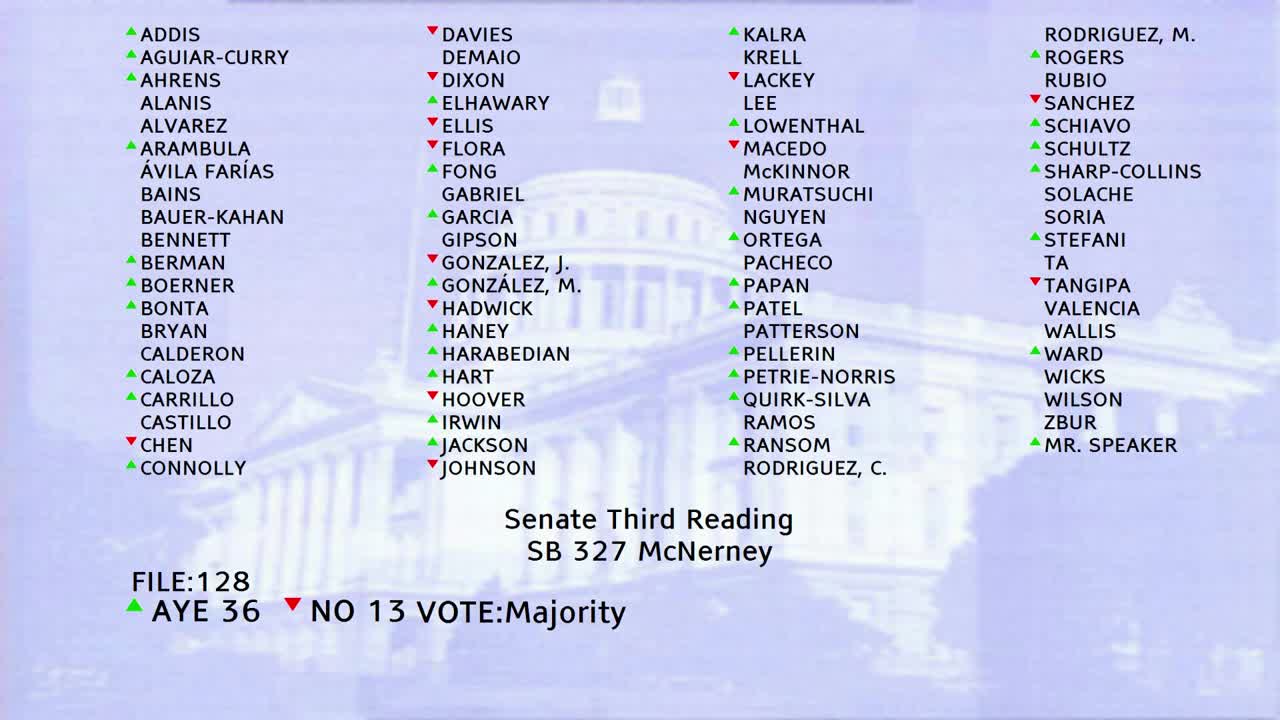
Bill Author

Bill Co-Author(s):