AB 2540: Public health: public postsecondary education: student health centers: abortion by medication techniques.
- Session Year: 2025-2026
- House: Assembly
- Latest Version Date: 2026-09-27
Current Status:
Passed
(2026-09-27: Chaptered by Secretary of State - Chapter 490, Statutes of 2026.)
Introduced
In Committee
Awaiting First Chamber Vote
Passed First Chamber
In Committee
Awaiting Second Chamber Vote
Passed Second Chamber
Enacted
Existing law establishes the California Community Colleges, under the administration of the Board of Governors of the California Community Colleges, the California State University, under the administration of the Trustees of the California State University, and the University of California, under the administration of the Regents of the University of California, as the 3 segments of public postsecondary education in the state.
Existing law requires, on and after January 1, 2023, a student health center on a California State University or University of California campus to offer abortion by medication techniques, as specified. Existing law establishes the College Student Health Center Sexual and Reproductive Health Preparation Fund to be administered by the Commission on the Status of Women and Girls and continuously appropriates the moneys in that fund to the commission for specified activities related to providing abortion by medication techniques at student health centers.
This bill would require a student health center on a California State University or University of California campus, on or before January 1, 2028, to promote awareness of the services for abortion by medication techniques that the student health center offers, provide information on those services to students, and post the availability of those services on its internet website.
This bill would require a community college that has a student health center, upon appropriation by the Legislature, to, on and after January 1, 2029, offer access to abortion by medication techniques, promote awareness of those services, provide information on those services to students, and post the availability of those services on its internet website. The bill would require the commission to submit a report to the Legislature, on or before January 1, 2030, that includes, but is not limited to, specified information relating to abortion by medication techniques at or through community college student health centers. The bill would require the commission, in consultation with the office of the Chancellor of the California Community Colleges, to develop a standardized reporting framework that minimizes administrative burden and protects student privacy. The bill would authorize funds appropriated for these provisions to be used for implementation readiness activities and ongoing operational costs, as specified.
Existing law establishes the California Community Colleges, under the administration of the Board of Governors of the California Community Colleges, the California State University, under the administration of the Trustees of the California State University, and the University of California, under the administration of the Regents of the University of California, as the 3 segments of public postsecondary education in the state.
Existing law requires, on and after January 1, 2023, a student health center on a California State University or University of California campus to offer abortion by medication techniques, as specified. Existing law establishes the College Student Health Center Sexual and Reproductive Health Preparation Fund to be administered by the Commission on the Status of Women and Girls and continuously appropriates the moneys in that fund to the commission for specified activities related to providing abortion by medication techniques at student health centers.
This bill would require a student health center on a California State University or University of California campus, on or before January 1, 2028, to promote awareness of the services for abortion by medication techniques that the student health center offers, provide information on those services to students, and post the availability of those services on its internet website.
This bill would require a community college that has a student health center, upon appropriation by the Legislature, to, on and after January 1, 2029, offer access to abortion by medication techniques, promote awareness of those services, provide information on those services to students, and post the availability of those services on its internet website. The bill would require the office of the Chancellor of the California Community Colleges commission to submit a report to the Legislature, on or before January 1, 2030, that includes, but is not limited to, specified information relating to abortion by medication techniques at or through community college student health centers.
Existing law establishes the California Community Colleges, under the administration of the Board of Governors of the California Community Colleges, the California State University, under the administration of the Trustees of the California State University, and the University of California, under the administration of the Regents of the University of California, as the 3 segments of public postsecondary education in the state.
Existing law requires, on and after January 1, 2023, a student health center on a California State University or University of California campus to offer abortion by medication techniques, as specified. Existing law establishes the College Student Health Center Sexual and Reproductive Health Preparation Fund to be administered by the Commission on the Status of Women and Girls and continuously appropriates the moneys in that fund to the commission for specified activities related to providing abortion by medication techniques at student health centers.
This bill would require a student health center on a California State University or University of California campus, on or before January 1, 2028, to promote awareness of the services for abortion by medication techniques that the student health center offers, provide information on those services to students, and post the availability of those services on its internet website.
This bill would require a community college that has a student health center, upon appropriation by the Legislature, to, on and after January 1, 2028, 2029, offer the same access to abortion by medication techniques as described above, techniques, promote awareness of those services, provide information on those services to students, and post the availability of those services on its internet website. The bill would require the commission office of the Chancellor of the California Community Colleges to submit a report to the Legislature, on or before January 1, 2029, 2030, that includes, but is not limited to, specified information relating to abortion by medication techniques at or through community college student health centers.
Existing law establishes the California Community Colleges, under the administration of the Board of Governors of the California Community Colleges, the California State University, under the administration of the Trustees of the California State University, and the University of California, under the administration of the Regents of the University of California, as the 3 segments of public postsecondary education in the state.
Existing law requires, on and after January 1, 2023, a student health center on a California State University or University of California campus to offer abortion by medication techniques, as specified. Existing law establishes the College Student Health Center Sexual and Reproductive Health Preparation Fund to be administered by the Commission on the Status of Women and Girls and continuously appropriates the moneys in that fund to the commission for specified activities related to providing abortion by medication techniques at student health centers.
This bill would require a student health center on a California State University or University of California campus, on or before January 1, 2028, to promote awareness of the services for abortion by medication techniques that the student health center offers, provide information on those services to students, and post the availability of those services on its internet website. The bill would require the commission to assess if the moneys remaining in the fund after meeting the above-described requirements are sufficient to allocate funding to community colleges to pay for the cost, both direct and indirect, of medication abortion readiness at each community college student health center.
This bill would require a community college that has a student health center, upon appropriation by the Legislature, to, on and after January 1, 2028, offer the same abortion by medication techniques as described above, promote awareness of those services, provide information on those services to students, and post the availability of those services on its internet website. The bill would require the commission to submit a report to the Legislature, on or before January 1, 2029, that includes, but is not limited to, specified information relating to abortion by medication techniques at community college student health centers.
Existing law, the Reproductive Privacy Act, provides that every individual possesses a fundamental right of privacy with respect to their personal reproductive decisions, which entails the right to make and effectuate decisions about all matters relating to pregnancy, including prenatal care, childbirth, postpartum care, contraception, sterilization, abortion care, miscarriage management, and infertility care.This bill would state the intent of the Legislature to enact legislation to affirm and protect the fundamental right of individuals to make personal decisions regarding reproductive health care.Existing law, the Reproductive Privacy Act, provides that every individual possesses a fundamental right of privacy with respect to their personal reproductive decisions, which entails the right to make and effectuate decisions about all matters relating to pregnancy, including prenatal care, childbirth, postpartum care, contraception, sterilization, abortion care, miscarriage management, and infertility care.
This bill would state the intent of the Legislature to enact legislation to affirm and protect the fundamental right of individuals to make personal decisions regarding reproductive health care.
For purposes of this chapter, the following definitions apply:
(a)Commission means the Commission on the Status of Women and Girls established by Section 8241 of the Government Code.
(b)Community college means a college of the California Community Colleges system or a community college district that maintains the college.
(c)Fund means the College Student Health Center Sexual and Reproductive Health Preparation Fund established by Section 99251.
(d)Grantee means any qualifying student health center at a public college or university.
(e)Medication abortion readiness includes, but is not limited to, assessment of each individual clinic to determine facility and training needs before beginning to provide abortion by medication techniques, purchasing equipment, making facility improvements, establishing clinical protocols, creating patient educational materials, and training staff. Medication abortion readiness does not include the provision of abortion by medication techniques.
(f)Public university student health center means a clinic providing primary health care services to students that is located on the campus of a university within the University of California or California State University systems.
(g)Public university system means the University of California or the California State University.
SEC. 2.Section 99251 of the Education Code is amended to read:99251.(a)On and after January 1, 2023, each public university student health center shall offer abortion by medication techniques onsite. This service may be performed by providers on staff at the student health center, through telehealth services, or by providers associated with a contracted external agency.
(b)(1)The commission shall administer the College Student Health Center Sexual and Reproductive Health Preparation Fund, which is established by this chapter for the purposes of providing private moneys in the form of direct allocations to the University of California and the California State University to support medication abortion readiness at each public university student health center. Notwithstanding any other law, the commission may receive moneys from nonstate entities, including, but not limited to, private sector entities and local and federal government agencies, specifically to support the fund, and deposit these moneys into the fund.
(2)Notwithstanding Section 13340 of the Government Code, the moneys in the fund are continuously appropriated to the commission for allocation for purposes of this subdivision.
(3)The commission shall use fund moneys to do all of the following:
(A)Allocate two hundred thousand dollars ($200,000) per campus to the University of California and the California State University. Of these funds, each university system shall provide two hundred thousand dollars ($200,000) to each public university student health center to pay for the cost, both direct and indirect, of medication abortion readiness. Allowable expenses payable from these allocations may include, but are not limited to, any of the following:
(i)Purchase of equipment used in the provision of abortion by medication techniques.
(ii)Facility and security upgrades.
(iii)Costs associated with enabling the campus health center to deliver telehealth services.
(iv)Costs associated with training staff in the provision of abortion by medication techniques.
(v)Staff cost reimbursement and clinical revenue offset while staff are in trainings.
(B)Allocate two hundred thousand dollars ($200,000) to both the University of California and the California State University, to pay for the cost, both direct and indirect, of medication abortion readiness for each university system. Allowable expenses payable from these allocations may include, but are not limited to, any of the following:
(i)Providing 24-hour, backup medical support by telephone to patients who have obtained abortion by medication techniques at a public university student health center.
(ii)One-time fees associated with establishing a corporate account to provide telehealth services.
(iii)Billing specialist consultation.
(C)Maintain a system of financial reporting on all aspects of the fund. The financial reports shall include, but not be limited to, information from public university student health centers on their expenditures and activities associated with this chapter.
(D)Support implementation of medication abortion readiness by public university student health centers by measures that may include, but are not limited to, any of the following:
(i)Assisting student health centers with planning and budgeting.
(ii)Coordinating with student health centers to identify training and other resources.
(iii)Serving as a liaison between each public university system, public university student health centers, and the Legislature.
(iv)Collecting, compiling, and analyzing information from public university student health centers to meet the commissions reporting requirements under subdivision (e).
(E)Pay direct and indirect costs of the commission to administer this chapter, including costs of the hiring of staff.
(4)The requirements of this chapter shall be implemented only if, and to the extent that, a total of at least ten million two hundred ninety thousand dollars ($10,290,000) in private funds is made available to the fund in a timely manner on or after January 1, 2020. It is the intent of the Legislature that both of the following occur:
(A)No General Fund moneys shall be appropriated, or otherwise provided, to support the fund or the commissions costs to administer this chapter.
(B)The commission shall assist public university student health centers in identifying other resources to pay for the costs of medication abortion readiness, and for the costs of providing for abortion by medication techniques.
(5)Nothing in this chapter shall be interpreted as requiring either of the following:
(A)A public university to use General Fund moneys or student fees for medication abortion readiness.
(B)A public university student health center to bill public programs or health insurance providers to support the costs of providing abortion by medication techniques onsite.
(c)Upon request from a public university student health center, the commission shall assist and advise on potential pathways for the student health center to bill public programs and health insurance providers to help pay for the costs of providing abortion by medication techniques.
(d)On or before January 1, 2028, public university student health centers shall promote awareness of the services for abortion by medication techniques that the student health center offers, provide information on those services to students, and post the availability of those services on its internet website.
(e)(1)On or before December 31, 2021, and on or before December 31 of each year thereafter until December 31, 2026, the commission shall submit a report to the Legislature that includes, but is not limited to, all of the following information for each reporting period, separately for each public university system:
(A)The number of student health centers that provide abortion by medication techniques.
(B)The number of abortions by medication techniques performed at student health centers, disaggregated, to the extent possible, by student health center.
(C)The total amount of funds received by each system and provided to the systems student health centers that is expended on medication abortion readiness, and, separately, the total amount of any other funds expended on medication abortion readiness and the source of those funds, disaggregated by function and, to the extent possible, disaggregated by student health center.
(2)The report required in paragraph (1), and any associated data collection, shall be conducted in accordance with state and federal privacy law, including, but not limited to, the Confidentiality of Medical Information Act (Part 2.6 (commencing with Section 56) of Division 1 of the Civil Code), the federal Family Educational Rights and Privacy Act of 1974 (20 U.S.C. Sec. 1232g), and the federal Health Insurance Portability and Accountability Act of 1996 (Public Law 104-191).
(3)The requirement for submitting reports under paragraph (1) shall become inoperative on January 1, 2027, pursuant to Section 10231.5 of the Government Code.
SEC. 3.Section 99252 is added to the Education Code, immediately following Section 99251, to read:99252.(a)On and after January 1, 2029, a community college that has a student health center shall do both of the following:
(1)(A)Offer access to abortion by medication techniques. This service may be performed by providers on staff at the student health center, through telehealth services, by providers associated with a contracted external agency, or through partnerships with other community health providers, as appropriate.
(B)For purposes of subparagraph (A), a community college shall be deemed to provide access through a partnership with a community health provider if the community college student health center has established a written referral relationship, memorandum of understanding, or contract with one or more licensed providers capable of providing abortion by medication techniques.
(C)A community college may satisfy the requirement in subparagraph (A) by facilitating referrals or warm handoffs, assisting students in identifying support resources, and maintaining current referral information for participating providers.
(2)Promote awareness of the services for abortion by medication techniques that the student health center offers access to, provide that information to students, and post the availability of those services on its internet website.
(b)(1)Upon request from a community college student health center, the office of the Chancellor of the California Community Colleges shall assist and advise on potential pathways for the student health center to bill public programs and health insurance providers to help pay for the costs of providing access to abortion by medication techniques.
(2)The Chancellor of the California Community Colleges may enter into a statewide agreement with a health provider to provide community college student health centers with the services and resources needed to meet the requirements of this section.
(c)(1)On or before January 1, 2030, the commission shall submit a report to the Legislature, in compliance with Section 9795 of the Government Code, that includes, but is not limited to, the following information separately for each community college:
(A)The number of student health centers that provide abortion by medication techniques, provide access to medication abortion techniques through other providers, or both.
(B)The number of abortions by medication techniques performed at student health centers or assisted through student health centers, disaggregated, to the extent possible, by student health center.
(2)Pursuant to Section 10231.5 of the Government Code, this subdivision is inoperative on January 1, 2032.
(d)(1)The commission, in consultation with the office of the Chancellor of the California Community Colleges, shall develop a standardized reporting framework that minimizes administrative burden and protects student privacy.
(2)(A)A community college student health center shall only be required to report information that is reasonably available through its existing operations and records.
(B)This section does not require a community college district or student health center to collect protected health information from an external provider, track services delivered by an external provider beyond information voluntarily provided by a student or the provider, or establish new clinical data systems for the sole purpose of meeting the reporting requirements of this section.
(e)The implementation of this section is contingent upon an appropriation for its purposes in the annual Budget Act or another statute to support the cost, both direct and indirect, of meeting the requirements of this section. Funds appropriated for purposes of this section may be used for implementation readiness activities and ongoing operational costs, including, but not limited to, all of the following:
(1)Telehealth infrastructure and technology.
(2)Contracts with external providers and community partners.
(3)Clinical staffing, prescribing services, and medical oversight.
(4)Staff training and professional development.
(5)Administrative and legal support.
(6)Insurance billing consultation and infrastructure.
(7)Student outreach and educational materials.
(8)Data collection and reporting.
(9)Other direct and indirect costs reasonably necessary to implement this section.
For purposes of this chapter, the following definitions apply:
(a)Commission means the Commission on the Status of Women and Girls established by Section 8241 of the Government Code.
(b)Community college means a college of the California Community Colleges system or a community college district that maintains the college.
(c)Fund means the College Student Health Center Sexual and Reproductive Health Preparation Fund established by Section 99251.
(d)Grantee means any qualifying student health center at a public college or university.
(e)Medication abortion readiness includes, but is not limited to, assessment of each individual clinic to determine facility and training needs before beginning to provide abortion by medication techniques, purchasing equipment, making facility improvements, establishing clinical protocols, creating patient educational materials, and training staff. Medication abortion readiness does not include the provision of abortion by medication techniques.
(f)Public university student health center means a clinic providing primary health care services to students that is located on the campus of a university within the University of California or California State University systems.
(g)Public university system means the University of California or the California State University.
SEC. 2.Section 99251 of the Education Code is amended to read:99251.(a)On and after January 1, 2023, each public university student health center shall offer abortion by medication techniques onsite. This service may be performed by providers on staff at the student health center, through telehealth services, or by providers associated with a contracted external agency.
(b)(1)The commission shall administer the College Student Health Center Sexual and Reproductive Health Preparation Fund, which is established by this chapter for the purposes of providing private moneys in the form of direct allocations to the University of California and the California State University to support medication abortion readiness at each public university student health center. Notwithstanding any other law, the commission may receive moneys from nonstate entities, including, but not limited to, private sector entities and local and federal government agencies, specifically to support the fund, and deposit these moneys into the fund.
(2)Notwithstanding Section 13340 of the Government Code, the moneys in the fund are continuously appropriated to the commission for allocation for purposes of this subdivision.
(3)The commission shall use fund moneys to do all of the following:
(A)Allocate two hundred thousand dollars ($200,000) per campus to the University of California and the California State University. Of these funds, each university system shall provide two hundred thousand dollars ($200,000) to each public university student health center to pay for the cost, both direct and indirect, of medication abortion readiness. Allowable expenses payable from these allocations may include, but are not limited to, any of the following:
(i)Purchase of equipment used in the provision of abortion by medication techniques.
(ii)Facility and security upgrades.
(iii)Costs associated with enabling the campus health center to deliver telehealth services.
(iv)Costs associated with training staff in the provision of abortion by medication techniques.
(v)Staff cost reimbursement and clinical revenue offset while staff are in trainings.
(B)Allocate two hundred thousand dollars ($200,000) to both the University of California and the California State University, to pay for the cost, both direct and indirect, of medication abortion readiness for each university system. Allowable expenses payable from these allocations may include, but are not limited to, any of the following:
(i)Providing 24-hour, backup medical support by telephone to patients who have obtained abortion by medication techniques at a public university student health center.
(ii)One-time fees associated with establishing a corporate account to provide telehealth services.
(iii)Billing specialist consultation.
(C)Maintain a system of financial reporting on all aspects of the fund. The financial reports shall include, but not be limited to, information from public university student health centers on their expenditures and activities associated with this chapter.
(D)Support implementation of medication abortion readiness by public university student health centers by measures that may include, but are not limited to, any of the following:
(i)Assisting student health centers with planning and budgeting.
(ii)Coordinating with student health centers to identify training and other resources.
(iii)Serving as a liaison between each public university system, public university student health centers, and the Legislature.
(iv)Collecting, compiling, and analyzing information from public university student health centers to meet the commissions reporting requirements under subdivision (e).
(E)Pay direct and indirect costs of the commission to administer this chapter, including costs of the hiring of staff.
(4)The requirements of this chapter shall be implemented only if, and to the extent that, a total of at least ten million two hundred ninety thousand dollars ($10,290,000) in private funds is made available to the fund in a timely manner on or after January 1, 2020. It is the intent of the Legislature that both of the following occur:
(A)No General Fund moneys shall be appropriated, or otherwise provided, to support the fund or the commissions costs to administer this chapter.
(B)The commission shall assist public university student health centers in identifying other resources to pay for the costs of medication abortion readiness, and for the costs of providing for abortion by medication techniques.
(5)Nothing in this chapter shall be interpreted as requiring either of the following:
(A)A public university to use General Fund moneys or student fees for medication abortion readiness.
(B)A public university student health center to bill public programs or health insurance providers to support the costs of providing abortion by medication techniques onsite.
(c)Upon request from a public university student health center, the commission shall assist and advise on potential pathways for the student health center to bill public programs and health insurance providers to help pay for the costs of providing abortion by medication techniques.
(d)On or before January 1, 2028, public university student health centers shall promote awareness of the services for abortion by medication techniques that the student health center offers, provide information on those services to students, and post the availability of those services on its internet website.
(e)(1)On or before December 31, 2021, and on or before December 31 of each year thereafter until December 31, 2026, the commission shall submit a report to the Legislature that includes, but is not limited to, all of the following information for each reporting period, separately for each public university system:
(A)The number of student health centers that provide abortion by medication techniques.
(B)The number of abortions by medication techniques performed at student health centers, disaggregated, to the extent possible, by student health center.
(C)The total amount of funds received by each system and provided to the systems student health centers that is expended on medication abortion readiness, and, separately, the total amount of any other funds expended on medication abortion readiness and the source of those funds, disaggregated by function and, to the extent possible, disaggregated by student health center.
(2)The report required in paragraph (1), and any associated data collection, shall be conducted in accordance with state and federal privacy law, including, but not limited to, the Confidentiality of Medical Information Act (Part 2.6 (commencing with Section 56) of Division 1 of the Civil Code), the federal Family Educational Rights and Privacy Act of 1974 (20 U.S.C. Sec. 1232g), and the federal Health Insurance Portability and Accountability Act of 1996 (Public Law 104-191).
(3)The requirement for submitting reports under paragraph (1) shall become inoperative on January 1, 2027, pursuant to Section 10231.5 of the Government Code.
SEC. 3.Section 99252 is added to the Education Code, immediately following Section 99251, to read:99252.(a)On and after January 1, 2029, a community college that has a student health center shall do both of the following:
(1)(A)Offer access to abortion by medication techniques. This service may be performed by providers on staff at the student health center, through telehealth services, by providers associated with a contracted external agency, or through partnerships with other community health providers, as appropriate.
(B)For purposes of subparagraph (A), a community college shall be deemed to provide access through a partnership with a community health provider if the community college student health center has established a written referral relationship, memorandum of understanding, or contract with one or more licensed providers capable of providing abortion by medication techniques.
(C)A community college may satisfy the requirement in subparagraph (A) by providing information, facilitating referrals or warm handoffs, assisting students in identifying support resources, or and maintaining current referral information for participating providers.
(2)Promote awareness of the services for abortion by medication techniques that the student health center offers access to, provide that information to students, and post the availability of those services on its internet website.
(b)(1)Upon request from a community college student health center, the office of the Chancellor of the California Community Colleges shall assist and advise on potential pathways for the student health center to bill public programs and health insurance providers to help pay for the costs of providing access to abortion by medication techniques.
(2)The Chancellor of the California Community Colleges may enter into a statewide agreement with a health provider to provide community college student health centers with the services and resources needed to meet the requirements of this section.
(c)(1)On or before January 1, 2030, the commission shall submit a report to the Legislature, in compliance with Section 9795 of the Government Code, that includes, but is not limited to, the following information separately for each community college:
(A)The number of student health centers that provide abortion by medication techniques, provide access to medication abortion techniques through other providers, or both.
(B)The number of abortions by medication techniques performed at student health centers or assisted through student health centers, disaggregated, to the extent possible, by student health center.
(2)Pursuant to Section 10231.5 of the Government Code, this subdivision is inoperative on January 1, 2032.
(d)(1)The commission, in consultation with the office of the Chancellor of the California Community Colleges, shall develop a standardized reporting framework that minimizes administrative burden and protects student privacy.
(2)(A)A community college student health center shall only be required to report information that is reasonably available through its existing operations and records.
(B)This section does not require a community college district or student health center to collect protected health information from an external provider, track services delivered by an external provider beyond information voluntarily provided by a student or the provider, or establish new clinical data systems for the sole purpose of meeting the reporting requirements of this section.
(e)The implementation of this section is contingent upon an appropriation for its purposes in the annual Budget Act or another statute to support the cost, both direct and indirect, of meeting the requirements of this section. Funds appropriated for purposes of this section may be used for implementation readiness activities and ongoing operational costs, including, but not limited to, all of the following:
(1)Telehealth infrastructure and technology.
(2)Contracts with external providers and community partners.
(3)Clinical staffing, prescribing services, and medical oversight.
(4)Staff training and professional development.
(5)Administrative and legal support.
(6)Insurance billing consultation and infrastructure.
(7)Student outreach and educational materials.
(8)Data collection and reporting.
(9)Other direct and indirect costs reasonably necessary to implement this section.
For purposes of this chapter, the following definitions apply:
(a)Commission means the Commission on the Status of Women and Girls established by Section 8241 of the Government Code.
(b)Community college means a college of the California Community Colleges system or a community college district that maintains the college.
(c)Fund means the College Student Health Center Sexual and Reproductive Health Preparation Fund established by Section 99251.
(d)Grantee means any qualifying student health center at a public college or university.
(e)Medication abortion readiness includes, but is not limited to, assessment of each individual clinic to determine facility and training needs before beginning to provide abortion by medication techniques, purchasing equipment, making facility improvements, establishing clinical protocols, creating patient educational materials, and training staff. Medication abortion readiness does not include the provision of abortion by medication techniques.
(f)Public university student health center means a clinic providing primary health care services to students that is located on the campus of a university within the University of California or California State University systems.
(g)Public university system means the University of California or the California State University.
SEC. 2.Section 99251 of the Education Code is amended to read:99251.(a)On and after January 1, 2023, each public university student health center shall offer abortion by medication techniques onsite. This service may be performed by providers on staff at the student health center, through telehealth services, or by providers associated with a contracted external agency.
(b)(1)The commission shall administer the College Student Health Center Sexual and Reproductive Health Preparation Fund, which is established by this chapter for the purposes of providing private moneys in the form of direct allocations to the University of California and the California State University to support medication abortion readiness at each public university student health center. Notwithstanding any other law, the commission may receive moneys from nonstate entities, including, but not limited to, private sector entities and local and federal government agencies, specifically to support the fund, and deposit these moneys into the fund.
(2)Notwithstanding Section 13340 of the Government Code, the moneys in the fund are continuously appropriated to the commission for allocation for purposes of this subdivision.
(3)The commission shall use fund moneys to do all of the following:
(A)Allocate two hundred thousand dollars ($200,000) per campus to the University of California and the California State University. Of these funds, each university system shall provide two hundred thousand dollars ($200,000) to each public university student health center to pay for the cost, both direct and indirect, of medication abortion readiness. Allowable expenses payable from these allocations may include, but are not limited to, any of the following:
(i)Purchase of equipment used in the provision of abortion by medication techniques.
(ii)Facility and security upgrades.
(iii)Costs associated with enabling the campus health center to deliver telehealth services.
(iv)Costs associated with training staff in the provision of abortion by medication techniques.
(v)Staff cost reimbursement and clinical revenue offset while staff are in trainings.
(B)Allocate two hundred thousand dollars ($200,000) to both the University of California and the California State University, to pay for the cost, both direct and indirect, of medication abortion readiness for each university system. Allowable expenses payable from these allocations may include, but are not limited to, any of the following:
(i)Providing 24-hour, backup medical support by telephone to patients who have obtained abortion by medication techniques at a public university student health center.
(ii)One-time fees associated with establishing a corporate account to provide telehealth services.
(iii)Billing specialist consultation.
(C)Maintain a system of financial reporting on all aspects of the fund. The financial reports shall include, but not be limited to, information from public university student health centers on their expenditures and activities associated with this chapter.
(D)Support implementation of medication abortion readiness by public university student health centers by measures that may include, but are not limited to, any of the following:
(i)Assisting student health centers with planning and budgeting.
(ii)Coordinating with student health centers to identify training and other resources.
(iii)Serving as a liaison between each public university system, public university student health centers, and the Legislature.
(iv)Collecting, compiling, and analyzing information from public university student health centers to meet the commissions reporting requirements under subdivision (e).
(E)Pay direct and indirect costs of the commission to administer this chapter, including costs of the hiring of staff.
(4)The requirements of this chapter shall be implemented only if, and to the extent that, a total of at least ten million two hundred ninety thousand dollars ($10,290,000) in private funds is made available to the fund in a timely manner on or after January 1, 2020. It is the intent of the Legislature that both of the following occur:
(A)No General Fund moneys shall be appropriated, or otherwise provided, to support the fund or the commissions costs to administer this chapter.
(B)The commission shall assist public university student health centers in identifying other resources to pay for the costs of medication abortion readiness, and for the costs of providing for abortion by medication techniques.
(5)Nothing in this chapter shall be interpreted as requiring either of the following:
(A)A public university to use General Fund moneys or student fees for medication abortion readiness.
(B)A public university student health center to bill public programs or health insurance providers to support the costs of providing abortion by medication techniques onsite.
(c)Upon request from a public university student health center, the commission shall assist and advise on potential pathways for the student health center to bill public programs and health insurance providers to help pay for the costs of providing abortion by medication techniques.
(d)On or before January 1, 2028, public university student health centers shall promote awareness of the services for abortion by medication techniques that the student health center offers, provide information on those services to students, and post the availability of those services on its internet website.
(e)(1)On or before December 31, 2021, and on or before December 31 of each year thereafter until December 31, 2026, the commission shall submit a report to the Legislature that includes, but is not limited to, all of the following information for each reporting period, separately for each public university system:
(A)The number of student health centers that provide abortion by medication techniques.
(B)The number of abortions by medication techniques performed at student health centers, disaggregated, to the extent possible, by student health center.
(C)The total amount of funds received by each system and provided to the systems student health centers that is expended on medication abortion readiness, and, separately, the total amount of any other funds expended on medication abortion readiness and the source of those funds, disaggregated by function and, to the extent possible, disaggregated by student health center.
(2)The report required in paragraph (1), and any associated data collection, shall be conducted in accordance with state and federal privacy law, including, but not limited to, the Confidentiality of Medical Information Act (Part 2.6 (commencing with Section 56) of Division 1 of the Civil Code), the federal Family Educational Rights and Privacy Act of 1974 (20 U.S.C. Sec. 1232g), and the federal Health Insurance Portability and Accountability Act of 1996 (Public Law 104-191).
(3)The requirement for submitting reports under paragraph (1) shall become inoperative on January 1, 2027, pursuant to Section 10231.5 of the Government Code.
SEC. 3.Section 99252 is added to the Education Code, immediately following Section 99251, to read:99252.(a)On and after January 1, 2029, a community college that has a student health center shall do both of the following:
(1)(A)Offer access to abortion by medication techniques. This service may be performed by providers on staff at the student health center, through telehealth services, by providers associated with a contracted external agency, or through partnerships with other community health providers, as appropriate.
(B)For purposes of subparagraph (A), a community college shall be deemed to provide access through a partnership with a community health provider if the community college student health center has established a written referral relationship, memorandum of understanding, or contract with one or more licensed providers capable of providing abortion by medication techniques.
(C)A community college may satisfy the requirement in subparagraph (A) by providing information, facilitating referrals or warm handoffs, assisting students in identifying support resources, or maintaining current referral information for participating providers.
(2)Promote awareness of the services for abortion by medication techniques that the student health center offers access to, provide that information to students, and post the availability of those services on its internet website.
(b)(1)Upon request from a community college student health center, the office of the Chancellor of the California Community Colleges shall assist and advise on potential pathways for the student health center to bill public programs and health insurance providers to help pay for the costs of providing access to abortion by medication techniques.
(2)The Chancellor of the California Community Colleges may enter into a statewide agreement with a health provider to provide community college student health centers with the services and resources needed to meet the requirements of this section.
(c)(1)On or before January 1, 2030, the commission shall submit a report to the Legislature, in compliance with Section 9795 of the Government Code, that includes, but is not limited to, the following information separately for each community college:
(A)The number of student health centers that provide abortion by medication techniques, provide access to medication abortion techniques through other providers, or both.
(B)The number of abortions by medication techniques performed at student health centers or assisted through student health centers, disaggregated, to the extent possible, by student health center.
(2)Pursuant to Section 10231.5 of the Government Code, this subdivision is inoperative on January 1, 2032.
(d)(1)The commission, in consultation with the office of the Chancellor of the California Community Colleges, shall develop a standardized reporting framework that minimizes administrative burden and protects student privacy.
(2)(A)A community college student health center shall only be required to report information that is reasonably available through its existing operations and records.
(B)This section does not require a community college district or student health center to collect protected health information from an external provider, track services delivered by an external provider beyond information voluntarily provided by a student or the provider, or establish new clinical data systems for the sole purpose of meeting the reporting requirements of this section.
(d)(e)The implementation of this section is contingent upon an appropriation for its purposes in the annual Budget Act or another statute. statute to support the cost, both direct and indirect, of meeting the requirements of this section. Funds appropriated for purposes of this section may be used for implementation readiness activities and ongoing operational costs, including, but not limited to, all of the following:
(1)Telehealth infrastructure and technology.
(2)Contracts with external providers and community partners.
(3)Clinical staffing, prescribing services, and medical oversight.
(4)Staff training and professional development.
(5)Administrative and legal support.
(6)Insurance billing consultation and infrastructure.
(7)Student outreach and educational materials.
(8)Data collection and reporting.
(9)Other direct and indirect costs reasonably necessary to implement this section.
For purposes of this chapter, the following definitions apply:
(a)Commission means the Commission on the Status of Women and Girls established by Section 8241 of the Government Code.
(b)Community college means a college of the California Community Colleges system or a community college district that maintains the college.
(c)Fund means the College Student Health Center Sexual and Reproductive Health Preparation Fund established by Section 99251.
(d)Grantee means any qualifying student health center at a public college or university.
(e)Medication abortion readiness includes, but is not limited to, assessment of each individual clinic to determine facility and training needs before beginning to provide abortion by medication techniques, purchasing equipment, making facility improvements, establishing clinical protocols, creating patient educational materials, and training staff. Medication abortion readiness does not include the provision of abortion by medication techniques.
(f)Public university student health center means a clinic providing primary health care services to students that is located on the campus of a university within the University of California or California State University systems.
(g)Public university system means the University of California or the California State University.
SEC. 2.Section 99251 of the Education Code is amended to read:99251.(a)On and after January 1, 2023, each public university student health center shall offer abortion by medication techniques onsite. This service may be performed by providers on staff at the student health center, through telehealth services, or by providers associated with a contracted external agency.
(b)(1)The commission shall administer the College Student Health Center Sexual and Reproductive Health Preparation Fund, which is established by this chapter for the purposes of providing private moneys in the form of direct allocations to the University of California and the California State University to support medication abortion readiness at each public university student health center. Notwithstanding any other law, the commission may receive moneys from nonstate entities, including, but not limited to, private sector entities and local and federal government agencies, specifically to support the fund, and deposit these moneys into the fund.
(2)Notwithstanding Section 13340 of the Government Code, the moneys in the fund are continuously appropriated to the commission for allocation for purposes of this subdivision.
(3)The commission shall use fund moneys to do all of the following:
(A)Allocate two hundred thousand dollars ($200,000) per campus to the University of California and the California State University. Of these funds, each university system shall provide two hundred thousand dollars ($200,000) to each public university student health center to pay for the cost, both direct and indirect, of medication abortion readiness. Allowable expenses payable from these allocations may include, but are not limited to, any of the following:
(i)Purchase of equipment used in the provision of abortion by medication techniques.
(ii)Facility and security upgrades.
(iii)Costs associated with enabling the campus health center to deliver telehealth services.
(iv)Costs associated with training staff in the provision of abortion by medication techniques.
(v)Staff cost reimbursement and clinical revenue offset while staff are in trainings.
(B)Allocate two hundred thousand dollars ($200,000) to both the University of California and the California State University, to pay for the cost, both direct and indirect, of medication abortion readiness for each university system. Allowable expenses payable from these allocations may include, but are not limited to, any of the following:
(i)Providing 24-hour, backup medical support by telephone to patients who have obtained abortion by medication techniques at a public university student health center.
(ii)One-time fees associated with establishing a corporate account to provide telehealth services.
(iii)Billing specialist consultation.
(C)Maintain a system of financial reporting on all aspects of the fund. The financial reports shall include, but not be limited to, information from public university student health centers on their expenditures and activities associated with this chapter.
(D)Support implementation of medication abortion readiness by public university student health centers by measures that may include, but are not limited to, any of the following:
(i)Assisting student health centers with planning and budgeting.
(ii)Coordinating with student health centers to identify training and other resources.
(iii)Serving as a liaison between each public university system, public university student health centers, and the Legislature.
(iv)Collecting, compiling, and analyzing information from public university student health centers to meet the commissions reporting requirements under subdivision (e).
(E)Pay direct and indirect costs of the commission to administer this chapter, including costs of the hiring of staff.
(4)The requirements of this chapter shall be implemented only if, and to the extent that, a total of at least ten million two hundred ninety thousand dollars ($10,290,000) in private funds is made available to the fund in a timely manner on or after January 1, 2020. It is the intent of the Legislature that both of the following occur:
(A)No General Fund moneys shall be appropriated, or otherwise provided, to support the fund or the commissions costs to administer this chapter.
(B)The commission shall assist public university student health centers in identifying other resources to pay for the costs of medication abortion readiness, and for the costs of providing for abortion by medication techniques.
(5)Nothing in this chapter shall be interpreted as requiring either of the following:
(A)A public university to use General Fund moneys or student fees for medication abortion readiness.
(B)A public university student health center to bill public programs or health insurance providers to support the costs of providing abortion by medication techniques onsite.
(c)Upon request from a public university student health center, the commission shall assist and advise on potential pathways for the student health center to bill public programs and health insurance providers to help pay for the costs of providing abortion by medication techniques.
(d)On or before January 1, 2028, public university student health centers shall promote awareness of the services for abortion by medication techniques that the student health center offers, provide information on those services to students, and post the availability of those services on its internet website.
(e)(1)On or before December 31, 2021, and on or before December 31 of each year thereafter until December 31, 2026, the commission shall submit a report to the Legislature that includes, but is not limited to, all of the following information for each reporting period, separately for each public university system:
(A)The number of student health centers that provide abortion by medication techniques.
(B)The number of abortions by medication techniques performed at student health centers, disaggregated, to the extent possible, by student health center.
(C)The total amount of funds received by each system and provided to the systems student health centers that is expended on medication abortion readiness, and, separately, the total amount of any other funds expended on medication abortion readiness and the source of those funds, disaggregated by function and, to the extent possible, disaggregated by student health center.
(2)The report required in paragraph (1), and any associated data collection, shall be conducted in accordance with state and federal privacy law, including, but not limited to, the Confidentiality of Medical Information Act (Part 2.6 (commencing with Section 56) of Division 1 of the Civil Code), the federal Family Educational Rights and Privacy Act of 1974 (20 U.S.C. Sec. 1232g), and the federal Health Insurance Portability and Accountability Act of 1996 (Public Law 104-191).
(3)The requirement for submitting reports under paragraph (1) shall become inoperative on January 1, 2027, pursuant to Section 10231.5 of the Government Code.
SEC. 3.Section 99252 is added to the Education Code, immediately following Section 99251, to read:99252.(a)On and after January 1, 2029, a community college that has a student health center shall do both of the following:
(1)Offer access to abortion by medication techniques. This service may be performed by providers on staff at the student health center, through telehealth services, by providers associated with a contracted external agency, or through partnerships with other community health providers, as appropriate.
(2)Promote awareness of the services for abortion by medication techniques that the student health center offers access to, provide that information to students, and post the availability of those services on its internet website.
(b)Upon request from a community college student health center, the office of the Chancellor of the California Community Colleges shall assist and advise on potential pathways for the student health center to bill public programs and health insurance providers to help pay for the costs of providing access to abortion by medication techniques.
(c)(1)On or before January 1, 2030, the office of the Chancellor of the California Community Colleges commission shall submit a report to the Legislature, in compliance with Section 9795 of the Government Code, that includes, but is not limited to, the following information separately for each community college:
(A)The number of student health centers that provide abortion by medication techniques, provide access to medication abortion techniques through other providers, or both.
(B)The number of abortions by medication techniques performed at student health centers or assisted through student health centers, disaggregated, to the extent possible, by student health center.
(2)Pursuant to Section 10231.5 of the Government Code, this subdivision is inoperative on January 1, 2032.
(d)The implementation of this section is contingent upon an appropriation for its purposes in the annual Budget Act or another statute.
For purposes of this chapter, the following definitions apply:
(a)Commission means the Commission on the Status of Women and Girls established by Section 8241 of the Government Code.
(b)Community college means a college of the California Community Colleges system or a community college district that maintains the college.
(c)Fund means the College Student Health Center Sexual and Reproductive Health Preparation Fund established by Section 99251.
(d)Grantee means any qualifying student health center at a public college or university.
(e)Medication abortion readiness includes, but is not limited to, assessment of each individual clinic to determine facility and training needs before beginning to provide abortion by medication techniques, purchasing equipment, making facility improvements, establishing clinical protocols, creating patient educational materials, and training staff. Medication abortion readiness does not include the provision of abortion by medication techniques.
(f)Public university student health center means a clinic providing primary health care services to students that is located on the campus of a university within the University of California or California State University systems.
(g)Public university system means the University of California or the California State University.
SEC. 2.Section 99251 of the Education Code is amended to read:99251.(a)On and after January 1, 2023, each public university student health center shall offer abortion by medication techniques onsite. This service may be performed by providers on staff at the student health center, through telehealth services, or by providers associated with a contracted external agency.
(b)(1)The commission shall administer the College Student Health Center Sexual and Reproductive Health Preparation Fund, which is established by this chapter for the purposes of providing private moneys in the form of direct allocations to the University of California and the California State University to support medication abortion readiness at each public university student health center. Notwithstanding any other law, the commission may receive moneys from nonstate entities, including, but not limited to, private sector entities and local and federal government agencies, specifically to support the fund, and deposit these moneys into the fund.
(2)Notwithstanding Section 13340 of the Government Code, the moneys in the fund are continuously appropriated to the commission for allocation for purposes of this subdivision.
(3)The commission shall use fund moneys to do all of the following:
(A)Allocate two hundred thousand dollars ($200,000) per campus to the University of California and the California State University. Of these funds, each university system shall provide two hundred thousand dollars ($200,000) to each public university student health center to pay for the cost, both direct and indirect, of medication abortion readiness. Allowable expenses payable from these allocations may include, but are not limited to, any of the following:
(i)Purchase of equipment used in the provision of abortion by medication techniques.
(ii)Facility and security upgrades.
(iii)Costs associated with enabling the campus health center to deliver telehealth services.
(iv)Costs associated with training staff in the provision of abortion by medication techniques.
(v)Staff cost reimbursement and clinical revenue offset while staff are in trainings.
(B)Allocate two hundred thousand dollars ($200,000) to both the University of California and the California State University, to pay for the cost, both direct and indirect, of medication abortion readiness for each university system. Allowable expenses payable from these allocations may include, but are not limited to, any of the following:
(i)Providing 24-hour, backup medical support by telephone to patients who have obtained abortion by medication techniques at a public university student health center.
(ii)One-time fees associated with establishing a corporate account to provide telehealth services.
(iii)Billing specialist consultation.
(C)Maintain a system of financial reporting on all aspects of the fund. The financial reports shall include, but not be limited to, information from public university student health centers on their expenditures and activities associated with this chapter.
(D)Support implementation of medication abortion readiness by public university student health centers by measures that may include, but are not limited to, any of the following:
(i)Assisting student health centers with planning and budgeting.
(ii)Coordinating with student health centers to identify training and other resources.
(iii)Serving as a liaison between each public university system, public university student health centers, and the Legislature.
(iv)Collecting, compiling, and analyzing information from public university student health centers to meet the commissions reporting requirements under subdivision (e).
(E)Pay direct and indirect costs of the commission to administer this chapter, including costs of the hiring of staff.
(4)The requirements of this chapter shall be implemented only if, and to the extent that, a total of at least ten million two hundred ninety thousand dollars ($10,290,000) in private funds is made available to the fund in a timely manner on or after January 1, 2020. It is the intent of the Legislature that both of the following occur:
(A)No General Fund moneys shall be appropriated, or otherwise provided, to support the fund or the commissions costs to administer this chapter.
(B)The commission shall assist public university student health centers in identifying other resources to pay for the costs of medication abortion readiness, and for the costs of providing for abortion by medication techniques.
(5)Nothing in this chapter shall be interpreted as requiring either of the following:
(A)A public university to use General Fund moneys or student fees for medication abortion readiness.
(B)A public university student health center to bill public programs or health insurance providers to support the costs of providing abortion by medication techniques onsite.
(c)Upon request from a public university student health center, the commission shall assist and advise on potential pathways for the student health center to bill public programs and health insurance providers to help pay for the costs of providing abortion by medication techniques.
(d)On or before January 1, 2028, public university student health centers shall promote awareness of the services for abortion by medication techniques that the student health center offers, provide information on those services to students, and post the availability of those services on its internet website.
(e)(1)On or before December 31, 2021, and on or before December 31 of each year thereafter until December 31, 2026, the commission shall submit a report to the Legislature that includes, but is not limited to, all of the following information for each reporting period, separately for each public university system:
(A)The number of student health centers that provide abortion by medication techniques.
(B)The number of abortions by medication techniques performed at student health centers, disaggregated, to the extent possible, by student health center.
(C)The total amount of funds received by each system and provided to the systems student health centers that is expended on medication abortion readiness, and, separately, the total amount of any other funds expended on medication abortion readiness and the source of those funds, disaggregated by function and, to the extent possible, disaggregated by student health center.
(2)The report required in paragraph (1), and any associated data collection, shall be conducted in accordance with state and federal privacy law, including, but not limited to, the Confidentiality of Medical Information Act (Part 2.6 (commencing with Section 56) of Division 1 of the Civil Code), the federal Family Educational Rights and Privacy Act of 1974 (20 U.S.C. Sec. 1232g), and the federal Health Insurance Portability and Accountability Act of 1996 (Public Law 104-191).
(3)The requirement for submitting reports under paragraph (1) shall become inoperative on January 1, 2027, pursuant to Section 10231.5 of the Government Code.
SEC. 3.Section 99252 is added to the Education Code, immediately following Section 99251, to read:99252.(a)On and after January 1, 2028, 2029, a community college that has a student health center shall do both of the following:
(1)Offer access to abortion by medication techniques onsite. techniques. This service may be performed by providers on staff at the student health center, through telehealth services, or by providers associated with a contracted external agency. agency, or through partnerships with other community health providers, as appropriate.
(2)Promote awareness of the services for abortion by medication techniques that the student health center offers, offers access to, provide that information to students, and post the availability of those services on its internet website.
(b)Upon request from a community college student health center, the commission office of the Chancellor of the California Community Colleges shall assist and advise on potential pathways for the student health center to bill public programs and health insurance providers to help pay for the costs of providing access to abortion by medication techniques.
(c)(1)On or before January 1, 2029, the commission 2030, the office of the Chancellor of the California Community Colleges shall submit a report to the Legislature, in compliance with Section 9795 of the Government Code, that includes, but is not limited to, all of the following information separately for each community college:
(A)The number of student health centers that provide abortion by medication techniques. techniques, provide access to medication abortion techniques through other providers, or both.
(B)The number of abortions by medication techniques performed at student health centers, centers or assisted through student health centers, disaggregated, to the extent possible, by student health center.
(C)The total amount of funds received by the community college and provided to the community colleges student health centers that is expended on medication abortion readiness, and, separately, the total amount of any other funds expended on medication abortion readiness and the source of those funds, disaggregated by function and, to the extent possible, disaggregated by student health center.(2)Pursuant to Section 10231.5 of the Government Code, this subdivision is inoperative on January 1, 2032.
(d)The implementation of this section is contingent upon an appropriation for its purposes in the annual Budget Act or another statute.
For purposes of this chapter, the following definitions apply:
(a)Commission means the Commission on the Status of Women and Girls established by Section 8241 of the Government Code.
(b)Community college means a college of the California Community Colleges system or a community college district that maintains the college.
(c)Fund means the College Student Health Center Sexual and Reproductive Health Preparation Fund established by Section 99251.
(d)Grantee means any qualifying student health center at a public college or university.
(e)Medication abortion readiness includes, but is not limited to, assessment of each individual clinic to determine facility and training needs before beginning to provide abortion by medication techniques, purchasing equipment, making facility improvements, establishing clinical protocols, creating patient educational materials, and training staff. Medication abortion readiness does not include the provision of abortion by medication techniques.
(f)Public university student health center means a clinic providing primary health care services to students that is located on the campus of a university within the University of California or California State University systems.
(g)Public university system means the University of California or the California State University.
SEC. 2.Section 99251 of the Education Code is amended to read:99251.(a)On and after January 1, 2023, each public university student health center shall offer abortion by medication techniques onsite. This service may be performed by providers on staff at the student health center, through telehealth services, or by providers associated with a contracted external agency.
(b)(1)The commission shall administer the College Student Health Center Sexual and Reproductive Health Preparation Fund, which is established by this chapter for the purposes of providing private moneys in the form of direct allocations to the University of California and the California State University to support medication abortion readiness at each public university student health center. Notwithstanding any other law, the commission may receive moneys from nonstate entities, including, but not limited to, private sector entities and local and federal government agencies, specifically to support the fund, and deposit these moneys into the fund.
(2)Notwithstanding Section 13340 of the Government Code, the moneys in the fund are continuously appropriated to the commission for allocation for purposes of this subdivision.
(3)The commission shall use fund moneys to do all of the following:
(A)Allocate two hundred thousand dollars ($200,000) per campus to the University of California and the California State University. Of these funds, each university system shall provide two hundred thousand dollars ($200,000) to each public university student health center to pay for the cost, both direct and indirect, of medication abortion readiness. Allowable expenses payable from these allocations may include, but are not limited to, any of the following:
(i)Purchase of equipment used in the provision of abortion by medication techniques.
(ii)Facility and security upgrades.
(iii)Costs associated with enabling the campus health center to deliver telehealth services.
(iv)Costs associated with training staff in the provision of abortion by medication techniques.
(v)Staff cost reimbursement and clinical revenue offset while staff are in trainings.
(B)Allocate two hundred thousand dollars ($200,000) to both the University of California and the California State University, to pay for the cost, both direct and indirect, of medication abortion readiness for each university system. Allowable expenses payable from these allocations may include, but are not limited to, any of the following:
(i)Providing 24-hour, backup medical support by telephone to patients who have obtained abortion by medication techniques at a public university student health center.
(ii)One-time fees associated with establishing a corporate account to provide telehealth services.
(iii)Billing specialist consultation.
(C)Maintain a system of financial reporting on all aspects of the fund. The financial reports shall include, but not be limited to, information from public university student health centers on their expenditures and activities associated with this chapter.
(D)Support implementation of medication abortion readiness by public university student health centers by measures that may include, but are not limited to, any of the following:
(i)Assisting student health centers with planning and budgeting.
(ii)Coordinating with student health centers to identify training and other resources.
(iii)Serving as a liaison between each public university system, public university student health centers, and the Legislature.
(iv)Collecting, compiling, and analyzing information from public university student health centers to meet the commissions reporting requirements under subdivision (f). (e).
(E)Pay direct and indirect costs of the commission to administer this chapter, including costs of the hiring of staff.
(4)The requirements of this chapter shall be implemented only if, and to the extent that, a total of at least ten million two hundred ninety thousand dollars ($10,290,000) in private funds is made available to the fund in a timely manner on or after January 1, 2020. It is the intent of the Legislature that both of the following occur:
(A)No General Fund moneys shall be appropriated, or otherwise provided, to support the fund or the commissions costs to administer this chapter.
(B)The commission shall assist public university student health centers in identifying other resources to pay for the costs of medication abortion readiness, and for the costs of providing for abortion by medication techniques.
(5)Nothing in this chapter shall be interpreted as requiring either of the following:
(A)A public university to use General Fund moneys or student fees for medication abortion readiness.
(B)A public university student health center to bill public programs or health insurance providers to support the costs of providing abortion by medication techniques onsite.
(c)Upon request from a public university student health center, the commission shall assist and advise on potential pathways for the student health center to bill public programs and health insurance providers to help pay for the costs of providing abortion by medication techniques.
(d)The commission shall assess if the moneys remaining in the College Student Health Center Sexual and Reproductive Health Preparation Fund after meeting the requirements of this section are sufficient to allocate funding to community colleges to pay for the cost, both direct and indirect, of medication abortion readiness at community college student health centers.(e)(d)On or before January 1, 2028, public university student health centers shall promote awareness of the services for abortion by medication techniques that the student health center offers, provide information on those services to students, and post the availability of those services on its internet website.
(f)(e)(1)On or before December 31, 2021, and on or before December 31 of each year thereafter until December 31, 2026, the commission shall submit a report to the Legislature that includes, but is not limited to, all of the following information for each reporting period, separately for each public university system:
(A)The number of student health centers that provide abortion by medication techniques.
(B)The number of abortions by medication techniques performed at student health centers, disaggregated, to the extent possible, by student health center.
(C)The total amount of funds received by each system and provided to the systems student health centers that is expended on medication abortion readiness, and, separately, the total amount of any other funds expended on medication abortion readiness and the source of those funds, disaggregated by function and, to the extent possible, disaggregated by student health center.
(2)The report required in paragraph (1), and any associated data collection, shall be conducted in accordance with state and federal privacy law, including, but not limited to, the Confidentiality of Medical Information Act (Part 2.6 (commencing with Section 56) of Division 1 of the Civil Code), the federal Family Educational Rights and Privacy Act of 1974 (20 U.S.C. Sec. 1232g), and the federal Health Insurance Portability and Accountability Act of 1996 (Public Law 104-191).
(3)The requirement for submitting reports under paragraph (1) shall become inoperative on January 1, 2027, pursuant to Section 10231.5 of the Government Code.
SEC. 3.Section 99252 is added to the Education Code, immediately following Section 99251, to read:99252.(a)On and after January 1, 2028, a community college that has a student health center shall do both of the following:
(1)Offer abortion by medication techniques onsite. This service may be performed by providers on staff at the student health center, through telehealth services, or by providers associated with a contracted external agency.
(2)Promote awareness of the services for abortion by medication techniques that the student health center offers, provide that information to students, and post the availability of those services on its internet website.
(b)Upon request from a community college student health center, the commission shall assist and advise on potential pathways for the student health center to bill public programs and health insurance providers to help pay for the costs of providing abortion by medication techniques.
(c)(1)On or before January 1, 2029, the commission shall submit a report to the Legislature, in compliance with Section 9795 of the Government Code, that includes, but is not limited to, all of the following information separately for each community college:
(A)The number of student health centers that provide abortion by medication techniques.
(B)The number of abortions by medication techniques performed at student health centers, disaggregated, to the extent possible, by student health center.
(C)The total amount of funds received by the community college and provided to the community colleges student health centers that is expended on medication abortion readiness, and, separately, the total amount of any other funds expended on medication abortion readiness and the source of those funds, disaggregated by function and, to the extent possible, disaggregated by student health center.
(2)Pursuant to Section 10231.5 of the Government Code, this subdivision is inoperative on January 1, 2032.
(d)The implementation of this section is contingent upon an appropriation for its purposes in the annual Budget Act or another statute.
REVISIONS: HeadingLine 2.For the purposes of this chapter, the following definitions apply:
(a)Commission means the Commission on the Status of Women and Girls established by Section 8241 of the Government Code.
(b)Community college means a college of the California Community Colleges system or a community college district that maintains the college.
(b)(c)Fund means the College Student Health Center Sexual and Reproductive Health Preparation Fund established by Section 99251.
(c)(d)Grantee means any qualifying student health center at a public college or university.
(d)(e)Medication abortion readiness includes, but is not limited to, assessment of each individual clinic to determine facility and training needs before beginning to provide abortion by medication techniques, purchasing equipment, making facility improvements, establishing clinical protocols, creating patient educational materials, and training staff. Medication abortion readiness does not include the provision of abortion by medication techniques.
(e)(f)Public university student health center means a clinic providing primary health care services to students that is located on the campus of a university within the University of California or California State University systems.
(f)(g)Public university system means the University of California or the California State University.
SEC. 2.Section 99251 of the Education Code is amended to read:99251.(a)On and after January 1, 2023, each public university student health center shall offer abortion by medication techniques onsite. This service may be performed by providers on staff at the student health center, through telehealth services, or by providers associated with a contracted external agency.
(b)(1)The commission shall administer the College Student Health Center Sexual and Reproductive Health Preparation Fund, which is established by this chapter for the purposes of providing private moneys in the form of direct allocations to the University of California and the California State University to support medication abortion readiness at each public university student health center. Notwithstanding any other law, the commission is authorized to may receive moneys from nonstate entities, including, but not necessarily limited to, private sector entities and local and federal government agencies, specifically to support the fund, and deposit these moneys into the fund.
(2)Notwithstanding Section 13340 of the Government Code, the moneys in the fund are continuously appropriated to the commission for allocation for purposes of this subdivision.
(3)The commission shall use fund moneys to do all of the following:
(A)Allocate two hundred thousand dollars ($200,000) per campus to the University of California and the California State University. Of these funds, each university system shall provide two hundred thousand dollars ($200,000) to each public university student health center to pay for the cost, both direct and indirect, of medication abortion readiness. Allowable expenses payable from these allocations may include, but are not limited to, any of the following:
(i)Purchase of equipment used in the provision of abortion by medication techniques.
(ii)Facility and security upgrades.
(iii)Costs associated with enabling the campus health center to deliver telehealth services.
(iv)Costs associated with training staff in the provision of abortion by medication techniques.
(v)Staff cost reimbursement and clinical revenue offset while staff are in trainings.
(B)Allocate two hundred thousand dollars ($200,000) to both the University of California and the California State University, to pay for the cost, both direct and indirect, of medication abortion readiness for each university system. Allowable expenses payable from these allocations may include, but are not limited to, any of the following:
(i)Providing 24-hour, backup medical support by telephone to patients who have obtained abortion by medication techniques at a public university student health center.
(ii)One-time fees associated with establishing a corporate account to provide telehealth services.
(iii)Billing specialist consultation.
(C)Maintain a system of financial reporting on all aspects of the fund. The financial reports shall include, but not be limited to, information from public university student health centers on their expenditures and activities associated with this chapter.
(D)Support implementation of medication abortion readiness by public university student health centers by measures that may include, but are not limited to, any of the following:
(i)Assisting student health centers with planning and budgeting.
(ii)Coordinating with student health centers to identify training and other resources.
(iii)Serving as a liaison between each public university system, public university student health centers, and the Legislature.
(iv)Collecting, compiling, and analyzing information from public university student health centers to meet the commissions reporting requirements under subdivision (d). (f).
(E)Pay direct and indirect costs of the commission to administer this chapter, including costs of the hiring of staff.
(4)The requirements of this chapter shall be implemented only if, and to the extent that, a total of at least ten million two hundred ninety thousand dollars ($10,290,000) in private funds is made available to the fund in a timely manner on or after January 1, 2020. It is the intent of the Legislature that both of the following occur:
(A)No General Fund moneys shall be appropriated, or otherwise provided, to support the fund or the commissions costs to administer this chapter.
(B)The commission shall assist public university student health centers in identifying other resources to pay for the costs of medication abortion readiness, and for the costs of providing for abortion by medication techniques.
(5)Nothing in this chapter shall be interpreted as requiring either of the following:
(A)A public university to use General Fund moneys or student fees for medication abortion readiness.
(B)A public university student health center to bill public programs or health insurance providers to support the costs of providing abortion by medication techniques onsite.
(c)Upon request from a public university student health center, the commission shall assist and advise on potential pathways for the student health center to bill public programs and health insurance providers to help pay for the costs of providing abortion by medication techniques.
(d)The commission shall assess if the moneys remaining in the College Student Health Center Sexual and Reproductive Health Preparation Fund after meeting the requirements of this section are sufficient to allocate funding to community colleges to pay for the cost, both direct and indirect, of medication abortion readiness at community college student health centers.
(e)On or before January 1, 2028, public university student health centers shall promote awareness of the services for abortion by medication techniques that the student health center offers, provide information on those services to students, and post the availability of those services on its internet website.
(d)(f)(1)On or before December 31, 2021, and on or before December 31 of each year thereafter until December 31, 2026, the commission shall submit a report to the Legislature that includes, but is not necessarily limited to, all of the following information for each reporting period, separately for each public university system:
(A)The number of student health centers that provide abortion by medication techniques.
(B)The number of abortions by medication techniques performed at student health centers, disaggregated, to the extent possible, by student health center.
(C)The total amount of funds received by each system and provided to the systems student health centers that is expended on medication abortion readiness, and, separately, the total amount of any other funds expended on medication abortion readiness and the source of those funds, disaggregated by function and, to the extent possible, disaggregated by student health center.
(2)The report required in paragraph (1), and any associated data collection, shall be conducted in accordance with state and federal privacy law, including, but not necessarily limited to, the state Confidentiality of Medical Information Act (Part 2.6 (commencing with Section 56) of Division 1 of the Civil Code), the federal Family Educational Rights and Privacy Act of 1974 (20 U.S.C. Sec. 1232g), and the federal Health Insurance Portability and Accountability Act of 1996 (Public Law 104-191).
(3)The requirement for submitting reports under paragraph (1) shall become inoperative on January 1, 2027, pursuant to Section 10231.5 of the Government Code.
SEC. 3.Section 99252 is added to the Education Code, immediately following Section 99251, to read:99252.(a)On and after January 1, 2028, a community college that has a student health center shall do both of the following:
(1)Offer abortion by medication techniques onsite. This service may be performed by providers on staff at the student health center, through telehealth services, or by providers associated with a contracted external agency.
(2)Promote awareness of the services for abortion by medication techniques that the student health center offers, provide that information to students, and post the availability of those services on its internet website.
(b)Upon request from a community college student health center, the commission shall assist and advise on potential pathways for the student health center to bill public programs and health insurance providers to help pay for the costs of providing abortion by medication techniques.
(c)(1)On or before January 1, 2029, the commission shall submit a report to the Legislature, in compliance with Section 9795 of the Government Code, that includes, but is not limited to, all of the following information separately for each community college:
(A)The number of student health centers that provide abortion by medication techniques.
(B)The number of abortions by medication techniques performed at student health centers, disaggregated, to the extent possible, by student health center.
(C)The total amount of funds received by the community college and provided to the community colleges student health centers that is expended on medication abortion readiness, and, separately, the total amount of any other funds expended on medication abortion readiness and the source of those funds, disaggregated by function and, to the extent possible, disaggregated by student health center.
(2)Pursuant to Section 10231.5 of the Government Code, this subdivision is inoperative on January 1, 2032.
(d)The implementation of this section is contingent upon an appropriation for its purposes in the annual Budget Act or another statute.
SECTION 1.It is the intent of the Legislature to enact legislation to affirm and protect the fundamental right of individuals to make personal decisions regarding reproductive health care.It is the intent of the Legislature to enact legislation to affirm and protect the fundamental right of individuals to make personal decisions regarding reproductive health care.
|
Date
|
Status
|
|---|---|
| Sep 27, 2026 | Chaptered by Secretary of State - Chapter 490, Statutes of 2026. |
| Sep 27, 2026 | Approved by the Governor. |
| Sep 10, 2026 | Enrolled and presented to the Governor at 3 p.m. |
| Aug 30, 2026 | Senate amendments concurred in. To Engrossing and Enrolling. (Ayes 61. Noes 17. Page 6879.). |
| Aug 30, 2026 | Senate amendments concurred in. To Engrossing and Enrolling. (Ayes 61. Noes 17.). |
| Aug 30, 2026 | Senate amendments concurred in. To Engrossing and Enrolling. |
| Aug 28, 2026 | In Assembly. Concurrence in Senate amendments pending. |
| Aug 27, 2026 | Read third time. Passed. Ordered to the Assembly. (Ayes 30. Noes 9. Page 5954.). |
| Aug 27, 2026 | Read third time. Passed. Ordered to the Assembly. (Ayes 30. Noes 9.). |
| Aug 24, 2026 | Read second time. Ordered to third reading. |
| Aug 20, 2026 | Read third time and amended. Ordered to second reading. |
| Aug 13, 2026 | Read second time. Ordered to third reading. |
| Aug 13, 2026 | From committee: Do pass. (Ayes 5. Noes 2.) (August 13). |
| Aug 3, 2026 | In committee: Referred to APPR. suspense file. |
| Jul 2, 2026 | Read second time and amended. Re-referred to Com. on APPR. |
| Jul 2, 2026 | From committee: Amend, and do pass as amended and re-refer to Com. on APPR. (Ayes 5. Noes 2.) (July 1). |
| Jun 25, 2026 | From committee: Do pass and re-refer to Com. on ED. (Ayes 9. Noes 1.) (June 24). Re-referred to Com. on ED. |
| Jun 10, 2026 | Referred to Coms. on HEALTH and ED. |
| May 27, 2026 | In Senate. Read first time. To Com. on RLS. for assignment. |
| May 26, 2026 | Read third time. Passed. Ordered to the Senate. (Ayes 60. Noes 18. Page 5385.) |
| May 26, 2026 | Read third time. Passed. Ordered to the Senate. (Ayes 60. Noes 18.) |
| May 26, 2026 | Read third time. Passed. Ordered to the Senate. |
| May 19, 2026 | Read second time. Ordered to third reading. |
| May 18, 2026 | Read second time and amended. Ordered returned to second reading. |
| May 14, 2026 | From committee: Amend, and do pass as amended. (Ayes 11. Noes 4.) (May 14). |
| May 6, 2026 | In committee: Set, first hearing. Referred to APPR. suspense file. |
| Apr 27, 2026 | Re-referred to Com. on APPR. |
| Apr 23, 2026 | Read second time and amended. |
| Apr 22, 2026 | From committee: Amend, and do pass as amended and re-refer to Com. on APPR. (Ayes 7. Noes 3.) (April 21). |
| Apr 8, 2026 | From committee: Do pass and re-refer to Com. on HIGHER ED. (Ayes 12. Noes 3.) (April 7). Re-referred to Com. on HIGHER ED. |
| Apr 8, 2026 | Coauthors revised. |
| Apr 6, 2026 | Re-referred to Com. on HEALTH. |
| Mar 27, 2026 | From committee chair, with author's amendments: Amend, and re-refer to Com. on HEALTH. Read second time and amended. |
| Mar 17, 2026 | Re-referred to Com. on HEALTH. |
| Mar 16, 2026 | From committee chair, with author's amendments: Amend, and re-refer to Com. on HEALTH. Read second time and amended. |
| Mar 16, 2026 | Referred to Coms. on HEALTH and HIGHER ED. |
| Feb 21, 2026 | From printer. May be heard in committee March 23. |
| Feb 20, 2026 | Read first time. To print. |
|
Date
|
Description
|
Location
|
Votes
|
|
|---|---|---|---|---|
| Aug 30, 2026 | AB 2540 Stefani Concurrence in Senate Amendments | Assembly Floor |
Passed |
|
| Aug 27, 2026 | Assembly 3rd Reading AB2540 Stefani et al. By Menjivar | Senate Floor |
Passed |
|
| Aug 13, 2026 | Do pass | Senate Standing Committee on Appropriations |
Passed |
|
| Aug 3, 2026 | Placed on suspense file | Senate Standing Committee on Appropriations |
Passed |
|
| Jul 1, 2026 | Do pass as amended, but first amend, and re-refer to the Committee on [Appropriations] | Senate Standing Committee on Education |
Passed |
|
| Jun 24, 2026 | Do pass, but first be re-referred to the Committee on [Education] | Senate Standing Committee on Health |
Passed |
|
| May 26, 2026 | AB 2540 Stefani Assembly Third Reading | Assembly Floor |
Passed |
|
| May 14, 2026 | Do pass as amended. | Assembly Standing Committee on Appropriations |
Passed |
|
| Apr 21, 2026 | Do pass as amended and be re-referred to the Committee on [Appropriations] | Assembly Standing Committee on Higher Education |
Passed |
|
| Apr 7, 2026 | Do pass and be re-referred to the Committee on [Higher Education] | Assembly Standing Committee on Health |
Passed |
This list shows positions taken on this bill by organizations on the date displayed, which is linked to the original source.
Positions by individuals are not included.
|
Organization
|
Position
|
Date
|
|---|---|---|
| Access Reproductive Justice | ** Support | |
| Aclu California Action | ** Support | |
| Alianza | ** Support | |
| American Association of University Women – California | ** Support | |
| American Association of University Women of California | ** Support | |
| American College of Obstetricians & Gynecologists – District IX | ** Support | |
| American College of Obstetricians & Gynecologists, District IX | ** Support | |
| American Nurses Association/California | ** Support | |
| Asian Americans Advancing Justice-southern California | ** Support | |
| Black Women For Wellness Action Project | ** Support | |
| Buen Vecino | ** Support | |
| California Catholic Conference | ** Against | |
| California Commission on the Status of Women and Girls | ** Support | |
| California Family Council | ** Against | |
| California Latinas for Reproductive Justice | ** Support | |
| California LGBTQ Health and Human Services Network | ** Support | |
| California Medical Association | ** Support | |
| California Nurse-Midwives Association | ** Support | |
| California Pan-Ethnic Health Network | ** Support | |
| California Teachers Association | ** Support | |
| California Women's Law Center | ** Support | |
| Chief Executive Officers of the California Community Colleges (CEOs) | ** Against | |
| Concerned Women for America | ** Against | |
| Faculty Association Of California Community Colleges | ** Support | |
| Fieldstead And Company, Inc. | ** Against | |
| Health Access California | ** Support | |
| Health Services Association California Community Colleges | ** Support | |
| Health Services Association of California Community Colleges | ** Against | |
| HSACCC | ** Against | |
| Indivisible Ca Statestrong | ** Support | |
| Lieutenant Governor Eleni Kounalakis | ** Support | |
| LivingWell Medical Clinic | ** Against | |
| Maternal and Child Health Access | ** Support | |
| National Health Law Program | ** Support | |
| One individual | ** Against | |
| Plan C | ** Support | |
| Planned Parenthood Affiliates Of California | ** Support | |
| Reproductive Freedom for All | ** Support | |
| Reproductive Freedom for All (formerly NARAL Pro-Choice America) | ** Support | |
| san francisco marin medical society | ** Support | |
| Student Senate for California Community Colleges | ** Support | |
| TEACH | ** Support | |
| the Student Senate for California Community Colleges | ** Support | |
| The Women's Foundation California | ** Support | |
| Training In Early Abortion For Comprehensive Healthcare | ** Support | |
| Unite for Reproductive and Gender Equity California | ** Support | |
| Unite for Reproductive & Gender Equity | ** Support | |
| University Of California Student Association | ** Support | |
| Urge | ** Support | |
| UrgeCA | ** Support | |
| URGE – Unite for Reproductive and Gender Equity | ** Support |
CONCURRENCE IN SENATE AMENDMENTS
CSA1 Bill Id:AB 2540
Author:(Stefani)
As Amended Ver:August 20, 2026
Majority vote
SUMMARY
Requires a student health center on a California State University (CSU) or University of California (UC) campus, on or before January 1, 2028, to promote awareness of the services for abortion by medication techniques that the student health center offers, provide information on those services to students, and post the availability of those services on its internet website. Requires a community college (CCC) that has a student health center, upon appropriation by the Legislature, to, on and after January 1, 2029, offer the same abortion by medication techniques as described above, promote awareness of those services, provide information on those services to students, and post the availability of those services on its internet website. Requires the Commission on the Status of Women and Girls (the commission) to submit a report to the Legislature, on or before January 1, 2030, that includes, but is not limited to, specified information relating to abortion by medication techniques at community college student health centers.
Senate Amendments
Require the commission, in consultation with the office of the Chancellor of the CCC, to develop a standardized reporting framework that minimizes administrative burden and protects student privacy and clarify provisions relating to how a CCC may satisfy the of this bill requirements through a partnership with a community health provider.
COMMENTS
Comprehensive abortion care is included in the list of essential health care services published by the World Health Organization (WHO) in 2020. Abortion is a simple health care intervention that can be safely and effectively managed by a wide range of health workers using medication or a surgical procedure. In the first 12 weeks of pregnancy, a medical abortion can also be safely self-managed by the pregnant person outside of a health care facility (e.g. at home), in whole or in part. This requires that the person has access to accurate information, quality medicines and support from a trained health worker (if they need or want it during the process). Comprehensive abortion care includes the provision of information, abortion management and post-abortion care. Abortion management includes induced abortion (the deliberate interruption of an ongoing pregnancy by medical or surgical means), care related to pregnancy loss (e.g., miscarriage/spontaneous abortion, missed abortion and intrauterine fetal demise), and management of complications after an abortion.
Medication Abortion. Medication abortion is a non-surgical procedure that involves taking prescription pills to end a pregnancy, typically within the first 10 weeks of gestation. The process usually consists of two medications: 1) Mifepristone: this medication blocks the hormone progesterone, which is necessary for the pregnancy to continue. It is taken first, either in a healthcare setting or at home; and, 2) Misoprostol: taken 24 to 48 hours after mifepristone, this medication induces uterine contractions to expel the pregnancy tissue. After taking mifepristone, most individuals will not feel any immediate effects. Following the administration of misoprostol, cramping and bleeding typically begin within a few hours, resembling a heavy menstrual period. This process may take several hours to a few days to complete. Medication abortion is highly effective, with a success rate of over 95% when used within the first 10 weeks of pregnancy. It is considered safe, with few serious complications. Common side effects include cramping, bleeding, nausea, and fatigue.
SB 24. SB 24 (Leyva) Chapter 740, Statutes of 2019 requires each student health care services clinic on a CSU or UC campus to offer abortion by medication techniques. The bill also requires the California Commission on the Status of Women & Girls to produce annual reports of how each UC and CSU are expending funds for abortion medication services. The reports include the amount of state grant funds, expenditure details, and the number of abortions provided by medication for each campus.
CCC Health Centers. There are 115 community colleges in California that are part of the California Community Colleges system. According to the Health Services Association California Community Colleges (HSACCC) 2021–2022 survey data, 92 colleges have health centers. Services vary by campus and may include clinical care and mental health support, though not all colleges provide the same scope of services. Based on 2023–2024 survey data from HSACCC, 64% of visits were for clinical nursing and medical services and 36% were for mental health services, with 26,865 unique clinical visits and 15,376 unique mental health visits reported. Individual therapy was the most frequently provided mental health service, and 67% of colleges reported having a structured peer health support and education program. While up to 97% of colleges reported that clinical and mental health services are co-located or in close proximity, the level of integration varies. Health centers may be partially supported by student health fees; however, not all colleges charge this fee. For the 2025–2026 fiscal year, the maximum allowable health fee is 26 dollars per semester, with an average of 23 dollars. Health insurance is not required for most students, and CCCs do not generally provide health insurance through their campuses.
According to the Author
Reproductive healthcare is an essential part of student health. All students deserve the same, equitable access to critical services – no matter what type of college they choose to attend. While CSU and UC students already have access to medication abortion, CCC students, who are more likely to be low-income, working, and students of color, do not get to reap the benefits of this important service. The author states that this bill closes a gap by ensuring that 2.2 million students can access medication abortion services at their student health centers, through telehealth, or through a contracted entity. The author concludes that this bill will also require campuses to provide information about medication abortion services, so students can access care without stigma, confusion or delay.
Arguments in Support
This bill is sponsored by ACCESS Reproductive Justice, Black Women for Wellness Action Project, California Latinas for Reproductive Justice, the Student Senate for California Community Colleges, Reproductive Freedom for All, and URGE – Unite for Reproductive and Gender Equity. The sponsors note that The College Student Right to Access Act (SB 24) was signed and passed into law in 2019, which requires all UC and CSU campuses to provide access to medication abortion services. These college campuses were mandated to implement services by January 1, 2023, to reduce barriers to abortion care for college students. Although the bill has been able to support students on these campuses, it left a huge gap for community college students. The sponsors state that this bill closes that gap by allowing California community colleges that have existing student health centers to provide students with medication abortion services. Community colleges are the largest educational system within the state of California with 116 campuses that serve over 2 million students every year. The sponsors argue that the pathway that community colleges offer for students is the largest starting point for college students across the state, and while all 116 CCCs are required to have basic needs services, the presence of comprehensive, fully operational on-campus student health centers varies. Multiple sources show that about 93 out of the 116 (nearly 80%) CCCs have a student health center with others relying on partnerships, referrals, or telehealth to offer services. The sponsors conclude that California college students, no matter CCC, CSU or UC, need and deserve equitable access to abortion care and that to achieve true reproductive freedom for all Californians, we must ensure that communities have equitable access to medication abortion care.
Arguments in Opposition
The Livingwell Medical Clinic is opposed to this bill and notes that the Ethics and Public Policy Center recently released an analysis of insurance claims data that reported complications following chemical abortions at rates higher than commonly cited in public discussions. Regardless of one's position on abortion, these findings underscore the importance of ensuring that women receive comprehensive information regarding potential risks and have access to appropriate medical care should complications arise. When complications occur, women may require emergency medical treatment, including care that is not readily available on a college campus. Livingwell Medical Clinic states that they are concerned that expanding access to abortion-inducing drugs without ensuring adequate medical oversight and emergency support may place vulnerable students at greater risk.
FISCAL COMMENTS
According to the Senate Appropriations Committee:
- The California Community Colleges Chancellor's Office indicates unknown, but likely minor to moderate Proposition 98 General Fund (GF) costs, if districts satisfy the bill through referral-based partnerships with qualified healthcare providers. Based on a recent statewide survey conducted by the Health Services Association of California Community Colleges, more than 95 percent of community college health centers currently rely on referrals to external providers, while fewer than 5 percent provide medication abortion onsite. Under this referral model, costs would be primarily associated with updating protocols, training staff, providing patient education and care coordination, and conducting outreach regarding available services.
- To the extent districts instead choose to provide medication abortion onsite or through telehealth partnerships, ongoing Proposition 98 GF costs could increase to the millions of dollars statewide. These models would require colleges to hire or contract with prescribing clinicians, establish new protocols, purchase equipment and supplies, train staff, modify facilities and information systems, and provide ongoing clinical oversight and compliance. Because community college health centers vary considerably in staffing, clinical capacity, and available resources, implementation costs would ultimately depend on the model each district adopts.
- Minor one-time GF state operations costs for the Chancellor's Office to consult with the Commission on the Status of Women and Girls on collecting data for the report.
- UC and CSU anticipate minor and absorbable costs.
- The Commission on the Status of Women and Girls anticipates minor and absorbable costs.
VOTES:
ASM HEALTH: 12-3-1
YES: Bonta, Addis, Aguiar-Curry, Ahrens, Caloza, Carrillo, Mark González, Patel, Rogers, Schiavo, Sharp-Collins, Stefani
NO: Johnson, Patterson, Sanchez
ABS, ABST OR NV: Chen
ASM HIGHER EDUCATION: 7-3-0
YES: Fong, Boerner, Jackson, Muratsuchi, Patel, Ramos, Sharp-Collins
NO: DeMaio, Macedo, Tangipa
ASM APPROPRIATIONS: 11-4-0
YES: Wicks, Aguiar-Curry, Calderon, Caloza, Fong, Mark González, Krell, Pacheco, Pellerin, Sharp-Collins, Solache
NO: Hoover, Dixon, Ta, Tangipa
ASSEMBLY FLOOR: 60-18-2
YES: Addis, Aguiar-Curry, Ahrens, Alanis, Alvarez, Arambula, Ávila Farías, Bains, Bauer-Kahan, Bennett, Berman, Boerner, Bonta, Bryan, Calderon, Caloza, Carrillo, Connolly, Elhawary, Fong, Gabriel, Garcia, Gipson, Mark González, Haney, Harabedian, Hart, Irwin, Jackson, Kalra, Krell, Lee, Lowenthal, McKinnor, Nguyen, Ortega, Pacheco, Papan, Patel, Pellerin, Petrie-Norris, Quirk-Silva, Ramos, Ransom, Michelle Rodriguez, Rogers, Blanca Rubio, Schiavo, Schultz, Sharp-Collins, Solache, Soria, Stefani, Valencia, Wallis, Ward, Wicks, Wilson, Zbur, Rivas
NO: Castillo, Chen, Davies, DeMaio, Dixon, Ellis, Flora, Gallagher, Jeff Gonzalez, Hadwick, Hoover, Johnson, Lackey, Macedo, Patterson, Sanchez, Ta, Tangipa
ABS, ABST OR NV: Muratsuchi, Celeste Rodriguez
UPDATED
VERSION: August 20, 2026
CONSULTANT: Lara Flynn / HEALTH / (916) 319-2097 FN: 0004148
SENATE RULES COMMITTEE Office of Senate Floor Analyses (916) 651-4171 | AB 2540 |
THIRD READING
Bill No: AB 2540
Author: Stefani (D), et al.
Amended: 8/20/26 in Senate
Vote: 21
SENATE HEALTH COMMITTEE: 9-1, 6/24/26
AYES: Weber Pierson, Caballero, Durazo, Gonzalez, Menjivar, Padilla, Pérez, Rubio, Smallwood-Cuevas
NOES: Grove
NO VOTE RECORDED: Valladares
SENATE EDUCATION COMMITTEE: 5-2, 7/1/26
AYES: Pérez, Cabaldon, Cortese, Gonzalez, Reyes
NOES: Ochoa Bogh, Choi
SENATE APPROPRIATIONS COMMITTEE: 5-2, 8/13/26
AYES: Cervantes, Cabaldon, Grayson, Richardson, Wahab
NOES: Seyarto, Dahle
ASSEMBLY FLOOR: 60-18, 5/26/26 - See last page for vote
SUBJECT: Public health: public postsecondary education: student health centers: abortion by medication techniques
SOURCE: ACCESS Reproductive Justice
Black Women for Wellness Action Project
California Latinas for Reproductive Justice
Plan C
Reproductive Freedom for All California
Student Senate for California Community Colleges
TEACH
Unite for Reproductive and Gender Equity California
DIGEST:
This bill requires a community college that has a student health center, upon appropriation by the Legislature, to offer medication abortion, promote awareness of those services, provide information on those services to students, and post their availability its website.
Senate Floor Amendments of 8/20/2026 are technical and clarifying in nature.
ANALYSIS:
Existing law:
- Requires University of California (UC) and California State University (CSU) student health centers to offer medication abortion onsite. Permits this service to be performed by providers on staff at the student health center, through telehealth services, or by providers associated with a contracted external agency. [Education Code (EDC) §99251(a)]
- Requires the Commission on the Status of Women and Girls to administer the College Student Health Center Sexual and Reproductive Health Preparation Fund, for the purposes of providing private moneys in the form of direct allocations to UC and CSU to support medication abortion readiness at each student health center. [EDC §99251(b)(1)]
- Requires the Commission, upon request from a UC or CSU student health center, to assist and advise on potential pathways for the student health center to bill public programs and health insurance to help pay for the costs of providing medication abortion. Requires the Commission, each year until December 31, 2026, to submit a report to the Legislature that includes information about the number of health centers that provide medication abortion, the numbers of medication abortions provided, and funding used for medication abortion at student health centers. [EDC §99251(b)(4)(B) and §99251(e)]
This bill:
- Requires community colleges that have a student health center, beginning January 1, 2029, to offer access to medication abortion. Permits this service to be performed by providers on staff at the student health center, through telehealth services, by providers associated with a contracted external agency, or through partnerships with other community health providers, as appropriate. Requires a community college to be deemed to provide access through a partnership with a community health provider if the health center has established a written referral relationship, memorandum of understanding, or contract with one or more licensed providers capable of providing abortion by medication techniques.
- Permits community colleges to satisfy this requirement by facilitating referrals or warm handoffs, assisting students in identifying support resources, and maintaining current referral information for participating providers.
- Requires a community college that has a student health center to promote awareness of the availability of medication abortion services, provide that information to students, and post their availability on its website.
- Requires the Chancellor of the California Community Colleges, upon request from a community college student health center, to assist and advise on potential pathways for the student health center to bill public programs and health insurance providers to help pay for the costs of providing access to medication abortion.
- Permits the Chancellor of the California Community Colleges to enter into a statewide agreement with a health provider to provide community college student health centers with the services and resources needed to meet the requirements of this bill.
- Requires the Commission on the Status of Women and Girls, by January 1, 2030, to submit a report to the Legislature, that includes, but is not limited to, the following information separately for each community college:
- The number of student health centers that provide medication abortion, provide access to medication abortion through other providers, or both; and,
- The number of medication abortions performed at student health centers or assisted through student health centers, disaggregated, to the extent possible, by student health center.
- Requires the Commission on the Status of Women and Girls, in consultation with the Chancellor of the California Community Colleges, to develop a standardized reporting framework that minimizes administrative burden and protects student privacy. Requires a community college student health center to only be required to report information that is reasonably available through its existing operations and records. Prohibits this bill from requiring a community college district or student health center to collect protected health information from an external provider, track services delivered by an external provider beyond information voluntarily provided by a student or the provider, or establish new clinical data systems for the sole purpose of meeting the reporting requirements.
- Makes the implementation of the requirements related to community colleges contingent upon an appropriation for its purposes in the annual Budget Act or another statute to support the cost, both direct and indirect, of meeting the requirements of this section. Permits any appropriated funds to be used for implementation readiness activities and ongoing operational costs, including, but not limited to:
- Telehealth infrastructure and technology;
- Contracts with external providers and community partners;
- Clinical staffing, prescribing services, and medical oversight;
- Staff training and professional development;
- Administrative and legal support;
- Insurance billing consultation and infrastructure;
- Student outreach and educational materials;
- Data collection and reporting; and,
- Other direct and indirect costs reasonably necessary.
- Requires UC and CSU student health centers to promote awareness of medication abortion services they offer, provide information on those services to students, and post their availability on their websites.
Background
According to the author of this bill:
Reproductive healthcare is an essential part of student health. All students deserve the same, equitable access to critical services – no matter what type of college they choose to attend. While CSU and UC students already have access to medication abortion, community college students, who are more likely to be low-income, working, and students of color, do not get to reap the benefits of this important service. This bill closes a gap by ensuring that 2.2 million students can access medication abortion services at their student health centers, through telehealth, or through contracted external entities. This bill will also require campuses to provide information about medication abortion services, so students can access care without stigma, confusion or delay.
Abortion. Sexual and reproductive health care services, including abortion care, are included in the World Health Organization’s (WHO) 2020 list of essential health care services. According to the WHO, abortion is a simple health care intervention that can be safely and effectively managed by a wide range of health workers using medication or a surgical procedure. In the first 12 weeks of pregnancy, a medical abortion can also be safely managed by a pregnant person at home. This requires that the person has access to accurate information, quality medicines, and support from a trained health worker (if they need or want it during the process).
According to a May 2026 KFF factsheet on medication abortion, there are two medication abortion regimens that have a long safety and efficacy record: mifepristone with misoprostol (the most common regimen in the U.S.) and misoprostol alone. Mifepristone, also known as RU-486, is sold under the brand name Mifeprex and through a generic manufactured by GenBioPro. Mifepristone works by blocking progesterone, a hormone essential to the development of a pregnancy, and preventing a pregnancy from progressing. Misoprostol, taken 24 to 48 hours after mifepristone, works to empty the uterus by causing cramping and bleeding, similar to an early miscarriage. The U.S. Food and Drug Administration (FDA) has found that medication abortion is a safe and highly effective method of pregnancy termination, and approves use of medical abortions for up to ten weeks of pregnancy. In 2023, the FDA announced the in-person dispensing requirement for medication abortion was formally removed. When taken, medication abortion successfully terminates pregnancy 91.9% to 99.7% of the time, with a 0.4% risk of major complications, and an associated mortality rate of 0.0005%. While the combined regimen of mifepristone and misoprostol for medication abortion is recommended, there is a second medication abortion protocol using misoprostol only that is more commonly used internationally. The regimen is also recommended for up to ten weeks of pregnancy. Research has shown the misoprostol-only regimen to be a safe and highly effective method of pregnancy termination; however, it may result in a higher incidence of side effects, particularly diarrhea, fever, and chills. The misoprostol-only regimen successfully terminates pregnancy approximately 80% to 100% of the time, with a complication rate of less than 1%.
Coverage for abortion care. The national median self-pay price for abortion medication in 2023 was $563, although medications provided by telehealth clinics were much lower in price ($150). Although Danco Laboratories does not make the cost of Mifeprex public, providers report that Mifeprex pills alone cost them around $90 a pill. GenBioPro, the manufacturer of the generic mifepristone drug also does not report the cost of their pill. Federal Medicaid funding only pays for abortions when the pregnancy is a result of rape or incest or a threat to the pregnant person’s life. In California, the Knox-Keene Act requires the provision of basic health care services, and the California Constitution prohibits health plans from discriminating against women who choose to terminate a pregnancy. Thus, all health plans must treat maternity services and legal abortion neutrally. Exclusions and limitations are also incompatible with both the California Reproductive Privacy Act and multiple California judicial decisions that have unambiguously established under the California Constitution that every pregnant person has the fundamental right to choose to either bear a child or to have a legal abortion. A health plan is not required to cover abortions that would be unlawful under existing law. The Medi-Cal program is one of 20 state Medicaid programs that use state funds to cover abortion and follow-up services. The Medi-Cal program covers abortions as a physician service without cost sharing for all enrollees.
Commission annual report. SB 24 (Leyva, Chapter 740, Statutes of 2019) requires CSU and UC student health centers to offer medication abortion services, and requires the Commission on the Status of Women and Girls to produce annual reports of how each UC and CSU are expending funds for medication abortion services. According to the 2025 report, all ten UC campuses have implemented the provision of medication abortion in their student health centers on January 1, 2024. All 23 CSU campuses implemented the provision of medication abortion in their student health centers on January 1, 2023. Below is a table summarizing data for UC and CSU campuses.

FISCAL EFFECT: Appropriation: No Fiscal Com.: Yes Local: No
According to the Senate Appropriations Committee:
- The California Community Colleges Chancellor’s Office indicates unknown, but likely minor to moderate Proposition 98 General Fund costs, if districts satisfy the bill through referral-based partnerships with qualified healthcare providers. Based on a recent statewide survey conducted by the Health Services Association of California Community Colleges, more than 95% of community college health centers currently rely on referrals to external providers, while fewer than 5% provide medication abortion onsite. Under this referral model, costs would be primarily associated with updating protocols, training staff, providing patient education and care coordination, and conducting outreach regarding available services.
To the extent districts instead choose to provide medication abortion onsite or through telehealth partnerships, ongoing Proposition 98 General Fund costs could increase to the millions of dollars statewide. These models would require colleges to hire or contract with prescribing clinicians, establish new protocols, purchase equipment and supplies, train staff, modify facilities and information systems, and provide ongoing clinical oversight and compliance. Because community college health centers vary considerably in staffing, clinical capacity, and available resources, implementation costs would ultimately depend on the model each district adopts.
Minor one-time General Fund state operations costs for the Chancellor’s Office to consult with the Commission on Status of Woman and Girls on collecting data for the report.
- UC and CSU anticipate minor and absorbable costs.
- The Commission on the Status of Women and Girls anticipates minor and absorbable costs.
SUPPORT: (Verified 8/20/26)
ACCESS Reproductive Justice (co-source)
Black Women for Wellness Action Project (co-source)
California Latinas for Reproductive Justice (co-source)
Plan C (co-source)
Reproductive Freedom for All California (co-source)
Student Senate for California Community Colleges (co-source)
TEACH (co-source)
Unite for Reproductive and Gender Equity California (co-source)
Alianza
American Association of University Women – California
American College of Obstetricians & Gynecologists – District IX
American Nurses Association/California
Asian Americans Advancing Justice-Southern California
Buen Vecino
California Commission on the Status of Women and Girls
California LGBTQ Health and Human Services Network
California Medical Association
California Nurse-Midwives Association
California Pan-Ethnic Health Network
California Teachers Association
California Women's Law Center
Faculty Association of California Community Colleges
Health Access California
Health Services Association California Community Colleges
Indivisible CA Statestrong
Lieutenant Governor Eleni Kounalakis
Maternal and Child Health Access
National Health Law Program
Planned Parenthood Affiliates of California
Reproductive Freedom for All California
San Francisco Marin Medical Society
The Women's Foundation California
University of California Student Association
OPPOSITION: (Verified 8/20/26)
California Catholic Conference
California Family Council
Concerned Women for America
Fieldstead and Company, Inc.
Livingwell Medical Clinic
One individual
ARGUMENTS IN SUPPORT: This bill is sponsored by ACCESS Reproductive Justice, Black Women for Wellness Action Project, California Latinas for Reproductive Justice, the Student Senate for California Community Colleges, Reproductive Freedom for All, and Unite for Reproductive and Gender Equity. The sponsors note that The College Student Right to Access Act (SB 24) was signed and passed into law in 2019 to reduce barriers to abortion care for college students. Although SB 24 has been able to support students on these campuses, it left a huge gap for community college students. The sponsors state that this bill closes that gap by allowing California community colleges that have existing student health centers to provide students with medication abortion services. Community colleges are the largest educational system within the state of California with 116 campuses that serve over two million students every year. The sponsors argue that the pathway that community colleges offer for students is the largest starting point for college students across the state, and while all 116 community colleges are required to have basic needs services, the presence of comprehensive, fully operational on-campus student health centers varies. Multiple sources show that about 93 out of the 116 (nearly 80%) community colleges have a student health center with others relying on partnerships, referrals, or telehealth to offer services. The sponsors conclude that California college students, no matter community college, CSU or UC, need and deserve equitable access to abortion care and that to achieve true reproductive freedom for all Californians, we must ensure that communities have equitable access to medication abortion care.
ARGUMENTS IN OPPOSITION: California Catholic Conference states that abortion is already free and ubiquitous in California – available on college campuses, performed by doctors, nurse practitioners, midwives, and physician assistants, as well as at 400 facilities across the state, and via telehealth and a dozen sources by mail. At the same time, student parents face a lack of affordable and accessible childcare with waitlists of a year or more on campus, high family housing costs, and fewer and fewer options for medical care. Pushing unwanted abortion on our communities is exploitative and is reproductive coercion. California Family Council writes that if the California Legislature is genuinely concerned about the health and well-being of pregnant students, it should ensure that the full range of support options receives equal or greater visibility and promotion on campus. Pregnancy resource centers across California offer no-cost medical services, material support, counseling, and ongoing care to women facing unplanned pregnancies, without the documented physical risks associated with chemical abortion. Additionally, adoption is a great option that should be promoted. Concerned Women for America Legislative Action Committee states that positioning abortion as essential healthcare shapes societal attitudes toward life, implicitly suggesting that some lives are expendable. A society that affirms the value of life at all stages builds support systems for families and pregnant individuals, rather than normalizing the deliberate ending of life as a routine medical service.
ASSEMBLY FLOOR: 60-18, 5/26/26
AYES: Addis, Aguiar-Curry, Ahrens, Alanis, Alvarez, Arambula, Ávila Farías, Bains, Bauer-Kahan, Bennett, Berman, Boerner, Bonta, Bryan, Calderon, Caloza, Carrillo, Connolly, Elhawary, Fong, Gabriel, Garcia, Gipson, Mark González, Haney, Harabedian, Hart, Irwin, Jackson, Kalra, Krell, Lee, Lowenthal, McKinnor, Nguyen, Ortega, Pacheco, Papan, Patel, Pellerin, Petrie-Norris, Quirk-Silva, Ramos, Ransom, Michelle Rodriguez, Rogers, Blanca Rubio, Schiavo, Schultz, Sharp-Collins, Solache, Soria, Stefani, Valencia, Wallis, Ward, Wicks, Wilson, Zbur, Rivas
NOES: Castillo, Chen, Davies, DeMaio, Dixon, Ellis, Flora, Gallagher, Jeff Gonzalez, Hadwick, Hoover, Johnson, Lackey, Macedo, Patterson, Sanchez, Ta, Tangipa
NO VOTE RECORDED: Muratsuchi, Celeste Rodriguez
Prepared by: Melanie Moreno / HEALTH / (916) 651-4111
8/24/26 13:52:45
**** END ****
SENATE RULES COMMITTEE Office of Senate Floor Analyses (916) 651-4171 | AB 2540 |
THIRD READING
Bill No: AB 2540
Author: Stefani (D), et al.
Amended: 7/2/26 in Senate
Vote: 21
SENATE HEALTH COMMITTEE: 9-1, 6/24/26
AYES: Weber Pierson, Caballero, Durazo, Gonzalez, Menjivar, Padilla, Pérez, Rubio, Smallwood-Cuevas
NOES: Grove
NO VOTE RECORDED: Valladares
SENATE EDUCATION COMMITTEE: 5-2, 7/1/26
AYES: Pérez, Cabaldon, Cortese, Gonzalez, Reyes
NOES: Ochoa Bogh, Choi
SENATE APPROPRIATIONS COMMITTEE: 5-2, 8/13/26
AYES: Cervantes, Cabaldon, Grayson, Richardson, Wahab
NOES: Seyarto, Dahle
ASSEMBLY FLOOR: 60-18, 5/26/26 - See last page for vote
SUBJECT: Public health: public postsecondary education: student health centers: abortion by medication techniques
SOURCE: ACCESS Reproductive Justice
Black Women for Wellness Action Project
California Latinas for Reproductive Justice
Plan C
Reproductive Freedom for All California
Student Senate for California Community Colleges
TEACH
Unite for Reproductive and Gender Equity California
DIGEST:
This bill requires a community college that has a student health center, upon appropriation by the Legislature, to offer medication abortion, promote awareness of those services, provide information on those services to students, and post their availability its website.
ANALYSIS:
Existing law:
- Requires University of California (UC) and California State University (CSU) student health centers to offer medication abortion onsite. Permits this service to be performed by providers on staff at the student health center, through telehealth services, or by providers associated with a contracted external agency. [Education Code (EDC) §99251(a)]
- Requires the Commission on the Status of Women and Girls to administer the College Student Health Center Sexual and Reproductive Health Preparation Fund, for the purposes of providing private moneys in the form of direct allocations to UC and CSU to support medication abortion readiness at each student health center. [EDC §99251(b)(1)]
- Requires the Commission, upon request from a UC or CSU student health center, to assist and advise on potential pathways for the student health center to bill public programs and health insurance to help pay for the costs of providing medication abortion. Requires the Commission, each year until December 31, 2026, to submit a report to the Legislature that includes information about the number of health centers that provide medication abortion, the numbers of medication abortions provided, and funding used for medication abortion at student health centers. [EDC §99251(b)(4)(B) and §99251(e)]
This bill:
- Requires community colleges that have a student health center, beginning January 1, 2029, to offer access to medication abortion. Permits this service to be performed by providers on staff at the student health center, through telehealth services, by providers associated with a contracted external agency, or through partnerships with other community health providers, as appropriate. Requires a community college to be deemed to provide access through a partnership with a community health provider if the health center has established a written referral relationship, memorandum of understanding, or contract with one or more licensed providers capable of providing abortion by medication techniques.
- Permits community colleges to satisfy this requirement by providing information, facilitating referrals or warm handoffs, assisting students in identifying support resources, or maintaining current referral information for participating providers.
- Requires a community college that has a student health center to promote awareness of the availability of medication abortion services, provide that information to students, and post their availability on its website.
- Requires the Chancellor of the California Community Colleges, upon request from a community college student health center, to assist and advise on potential pathways for the student health center to bill public programs and health insurance providers to help pay for the costs of providing access to medication abortion.
- Permits the Chancellor of the California Community Colleges to enter into a statewide agreement with a health provider to provide community college student health centers with the services and resources needed to meet the requirements of this bill.
- Requires the Commission on the Status of Women and Girls, by January 1, 2030, to submit a report to the Legislature, that includes, but is not limited to, the following information separately for each community college:
- The number of student health centers that provide medication abortion, provide access to medication abortion through other providers, or both; and,
- The number of medication abortions performed at student health centers or assisted through student health centers, disaggregated, to the extent possible, by student health center.
- Requires the Commission on the Status of Women and Girls, in consultation with the Chancellor of the California Community Colleges, to develop a standardized reporting framework that minimizes administrative burden and protects student privacy. Requires a community college student health center to only be required to report information that is reasonably available through its existing operations and records. Prohibits this bill from requiring a community college district or student health center to collect protected health information from an external provider, track services delivered by an external provider beyond information voluntarily provided by a student or the provider, or establish new clinical data systems for the sole purpose of meeting the reporting requirements.
- Makes the implementation of the requirements related to community colleges contingent upon an appropriation for its purposes in the annual Budget Act or another statute to support the cost, both direct and indirect, of meeting the requirements of this section. Permits any appropriated funds to be used for implementation readiness activities and ongoing operational costs, including, but not limited to:
- Telehealth infrastructure and technology;
- Contracts with external providers and community partners;
- Clinical staffing, prescribing services, and medical oversight;
- Staff training and professional development;
- Administrative and legal support;
- Insurance billing consultation and infrastructure;
- Student outreach and educational materials;
- Data collection and reporting; and,
- Other direct and indirect costs reasonably necessary.
- Requires UC and CSU student health centers to promote awareness of medication abortion services they offer, provide information on those services to students, and post their availability on their websites.
Background
According to the author of this bill:
Reproductive healthcare is an essential part of student health. All students deserve the same, equitable access to critical services – no matter what type of college they choose to attend. While CSU and UC students already have access to medication abortion, community college students, who are more likely to be low-income, working, and students of color, do not get to reap the benefits of this important service. This bill closes a gap by ensuring that 2.2 million students can access medication abortion services at their student health centers, through telehealth, or through contracted external entities. This bill will also require campuses to provide information about medication abortion services, so students can access care without stigma, confusion or delay.
Abortion. Sexual and reproductive health care services, including abortion care, are included in the World Health Organization’s (WHO) 2020 list of essential health care services. According to the WHO, abortion is a simple health care intervention that can be safely and effectively managed by a wide range of health workers using medication or a surgical procedure. In the first 12 weeks of pregnancy, a medical abortion can also be safely managed by a pregnant person at home. This requires that the person has access to accurate information, quality medicines, and support from a trained health worker (if they need or want it during the process).
According to a May 2026 KFF factsheet on medication abortion, there are two medication abortion regimens that have a long safety and efficacy record: mifepristone with misoprostol (the most common regimen in the U.S.) and misoprostol alone. Mifepristone, also known as RU-486, is sold under the brand name Mifeprex and through a generic manufactured by GenBioPro. Mifepristone works by blocking progesterone, a hormone essential to the development of a pregnancy, and preventing a pregnancy from progressing. Misoprostol, taken 24 to 48 hours after mifepristone, works to empty the uterus by causing cramping and bleeding, similar to an early miscarriage. The U.S. Food and Drug Administration (FDA) has found that medication abortion is a safe and highly effective method of pregnancy termination, and approves use of medical abortions for up to ten weeks of pregnancy. In 2023, the FDA announced the in-person dispensing requirement for medication abortion was formally removed. When taken, medication abortion successfully terminates pregnancy 91.9% to 99.7% of the time, with a 0.4% risk of major complications, and an associated mortality rate of 0.0005%. While the combined regimen of mifepristone and misoprostol for medication abortion is recommended, there is a second medication abortion protocol using misoprostol only that is more commonly used internationally. The regimen is also recommended for up to ten weeks of pregnancy. Research has shown the misoprostol-only regimen to be a safe and highly effective method of pregnancy termination; however, it may result in a higher incidence of side effects, particularly diarrhea, fever, and chills. The misoprostol-only regimen successfully terminates pregnancy approximately 80% to 100% of the time, with a complication rate of less than 1%.
Coverage for abortion care. The national median self-pay price for abortion medication in 2023 was $563, although medications provided by telehealth clinics were much lower in price ($150). Although Danco Laboratories does not make the cost of Mifeprex public, providers report that Mifeprex pills alone cost them around $90 a pill. GenBioPro, the manufacturer of the generic mifepristone drug also does not report the cost of their pill. Federal Medicaid funding only pays for abortions when the pregnancy is a result of rape or incest or a threat to the pregnant person’s life. In California, the Knox-Keene Act requires the provision of basic health care services, and the California Constitution prohibits health plans from discriminating against women who choose to terminate a pregnancy. Thus, all health plans must treat maternity services and legal abortion neutrally. Exclusions and limitations are also incompatible with both the California Reproductive Privacy Act and multiple California judicial decisions that have unambiguously established under the California Constitution that every pregnant person has the fundamental right to choose to either bear a child or to have a legal abortion. A health plan is not required to cover abortions that would be unlawful under existing law. The Medi-Cal program is one of 20 state Medicaid programs that use state funds to cover abortion and follow-up services. The Medi-Cal program covers abortions as a physician service without cost sharing for all enrollees.
Commission annual report. SB 24 (Leyva, Chapter 740, Statutes of 2019) requires CSU and UC student health centers to offer medication abortion services, and requires the Commission on the Status of Women and Girls to produce annual reports of how each UC and CSU are expending funds for medication abortion services. According to the 2025 report, all ten UC campuses have implemented the provision of medication abortion in their student health centers on January 1, 2024. All 23 CSU campuses implemented the provision of medication abortion in their student health centers on January 1, 2023. Below is a table summarizing data for UC and CSU campuses.
FISCAL EFFECT: Appropriation: No Fiscal Com.: Yes Local: No
According to the Senate Appropriations Committee:
- The California Community Colleges Chancellor’s Office indicates unknown, but likely minor to moderate Proposition 98 General Fund costs, if districts satisfy the bill through referral-based partnerships with qualified healthcare providers. Based on a recent statewide survey conducted by the Health Services Association of California Community Colleges, more than 95% of community college health centers currently rely on referrals to external providers, while fewer than 5% provide medication abortion onsite. Under this referral model, costs would be primarily associated with updating protocols, training staff, providing patient education and care coordination, and conducting outreach regarding available services.
To the extent districts instead choose to provide medication abortion onsite or through telehealth partnerships, ongoing Proposition 98 General Fund costs could increase to the millions of dollars statewide. These models would require colleges to hire or contract with prescribing clinicians, establish new protocols, purchase equipment and supplies, train staff, modify facilities and information systems, and provide ongoing clinical oversight and compliance. Because community college health centers vary considerably in staffing, clinical capacity, and available resources, implementation costs would ultimately depend on the model each district adopts.
Minor one-time General Fund state operations costs for the Chancellor’s Office to consult with the Commission on Status of Woman and Girls on collecting data for the report.
- UC and CSU anticipate minor and absorbable costs.
- The Commission on the Status of Women and Girls anticipates minor and absorbable costs.
SUPPORT: (Verified 8/13/2026)
ACCESS Reproductive Justice (co-source)
Black Women for Wellness Action Project (co-source)
California Latinas for Reproductive Justice (co-source)
Plan C (co-source)
Reproductive Freedom for All California (co-source)
Student Senate for California Community Colleges (co-source)
TEACH (co-source)
Unite for Reproductive and Gender Equity California (co-source)
Alianza
American Association of University Women – California
American College of Obstetricians & Gynecologists – District IX
American Nurses Association/California
Asian Americans Advancing Justice-Southern California
Buen Vecino
California Commission on the Status of Women and Girls
California LGBTQ Health and Human Services Network
California Medical Association
California Nurse-Midwives Association
California Pan-Ethnic Health Network
California Teachers Association
California Women's Law Center
Faculty Association of California Community Colleges
Health Access California
Indivisible CA Statestrong
Lieutenant Governor Eleni Kounalakis
Maternal and Child Health Access
National Health Law Program
Planned Parenthood Affiliates of California
Reproductive Freedom for All California
San Francisco Marin Medical Society
The Women's Foundation California
University of California Student Association
OPPOSITION: (Verified 8/15/2026)
California Catholic Conference
California Family Council
Concerned Women for America
Fieldstead and Company, Inc.
Livingwell Medical Clinic
One individual
ARGUMENTS IN SUPPORT: This bill is sponsored by ACCESS Reproductive Justice, Black Women for Wellness Action Project, California Latinas for Reproductive Justice, the Student Senate for California Community Colleges, Reproductive Freedom for All, and Unite for Reproductive and Gender Equity. The sponsors note that The College Student Right to Access Act (SB 24) was signed and passed into law in 2019 to reduce barriers to abortion care for college students. Although SB 24 has been able to support students on these campuses, it left a huge gap for community college students. The sponsors state that this bill closes that gap by allowing California community colleges that have existing student health centers to provide students with medication abortion services. Community colleges are the largest educational system within the state of California with 116 campuses that serve over two million students every year. The sponsors argue that the pathway that community colleges offer for students is the largest starting point for college students across the state, and while all 116 community colleges are required to have basic needs services, the presence of comprehensive, fully operational on-campus student health centers varies. Multiple sources show that about 93 out of the 116 (nearly 80%) community colleges have a student health center with others relying on partnerships, referrals, or telehealth to offer services. The sponsors conclude that California college students, no matter community college, CSU or UC, need and deserve equitable access to abortion care and that to achieve true reproductive freedom for all Californians, we must ensure that communities have equitable access to medication abortion care.
ARGUMENTS IN OPPOSITION: California Catholic Conference states that abortion is already free and ubiquitous in California – available on college campuses, performed by doctors, nurse practitioners, midwives, and physician assistants, as well as at 400 facilities across the state, and via telehealth and a dozen sources by mail. At the same time, student parents face a lack of affordable and accessible childcare with waitlists of a year or more on campus, high family housing costs, and fewer and fewer options for medical care. Pushing unwanted abortion on our communities is exploitative and is reproductive coercion. California Family Council writes that if the California Legislature is genuinely concerned about the health and well-being of pregnant students, it should ensure that the full range of support options receives equal or greater visibility and promotion on campus. Pregnancy resource centers across California offer no-cost medical services, material support, counseling, and ongoing care to women facing unplanned pregnancies, without the documented physical risks associated with chemical abortion. Additionally, adoption is a great option that should be promoted. Concerned Women for America Legislative Action Committee states that positioning abortion as essential healthcare shapes societal attitudes toward life, implicitly suggesting that some lives are expendable. A society that affirms the value of life at all stages builds support systems for families and pregnant individuals, rather than normalizing the deliberate ending of life as a routine medical service.
ASSEMBLY FLOOR: 60-18, 5/26/26
AYES: Addis, Aguiar-Curry, Ahrens, Alanis, Alvarez, Arambula, Ávila Farías, Bains, Bauer-Kahan, Bennett, Berman, Boerner, Bonta, Bryan, Calderon, Caloza, Carrillo, Connolly, Elhawary, Fong, Gabriel, Garcia, Gipson, Mark González, Haney, Harabedian, Hart, Irwin, Jackson, Kalra, Krell, Lee, Lowenthal, McKinnor, Nguyen, Ortega, Pacheco, Papan, Patel, Pellerin, Petrie-Norris, Quirk-Silva, Ramos, Ransom, Michelle Rodriguez, Rogers, Blanca Rubio, Schiavo, Schultz, Sharp-Collins, Solache, Soria, Stefani, Valencia, Wallis, Ward, Wicks, Wilson, Zbur, Rivas
NOES: Castillo, Chen, Davies, DeMaio, Dixon, Ellis, Flora, Gallagher, Jeff Gonzalez, Hadwick, Hoover, Johnson, Lackey, Macedo, Patterson, Sanchez, Ta, Tangipa
NO VOTE RECORDED: Muratsuchi, Celeste Rodriguez
Prepared by: Melanie Moreno / HEALTH / (916) 651-4111
8/15/26 10:50:32
**** END ****
SENATE COMMITTEE ON
Senator Sabrina Cervantes, Chair
2025 - 2026 Regular Session
AB 2540 (Stefani) - Public health: public postsecondary education: student health centers: abortion by medication techniques
Version: | Policy Vote: |
Urgency: | Mandate: |
Hearing Date: | Consultant: |
Bill Summary:
AB 2540 would require a community college that has a student health center to offer access to abortion by medication techniques, as specified.
Fiscal Impact:
- The California Community Colleges Chancellor’s Office indicates the following:
- Unknown, but likely minor to moderate Proposition 98 General Fund costs, if districts satisfy the bill through referral-based partnerships with qualified healthcare providers. Based on a recent statewide survey conducted by the Health Services Association of California Community Colleges, more than 95 percent of community college health centers currently rely on referrals to external providers, while fewer than 5 percent provide medication abortion onsite. Under this referral model, costs would be primarily associated with updating protocols, training staff, providing patient education and care coordination, and conducting outreach regarding available services.
- To the extent districts instead choose to provide medication abortion onsite or through telehealth partnerships, ongoing Proposition 98 General Fund costs could increase to the millions of dollars statewide. These models would require colleges to hire or contract with prescribing clinicians, establish new protocols, purchase equipment and supplies, train staff, modify facilities and information systems, and provide ongoing clinical oversight and compliance. Because community college health centers vary considerably in staffing, clinical capacity, and available resources, implementation costs would ultimately depend on the model each district adopts.
- Minor one-time General Fund state operations costs for the Chancellor’s Office to consult with the Commission on Status of Woman and Girls on collecting data for the report.
- The University of California (UC) and California State University (CSU) anticipate minor and absorbable costs.
- The Commission on the Status of Women and Girls anticipates minor and absorbable costs.
Background:
Current state law requires the UC and CSU student health centers to offer medication abortion onsite. This service may be performed by providers on staff at the student health center, through telehealth services, or by providers associated with a contracted external agency.
Current law requires the Commission on the Status of Women and Girls to administer the College Student Health Center Sexual and Reproductive Health Preparation Fund, for the purposes of providing private moneys in the form of direct allocations to UC and CSU to support medication abortion readiness at each student health center. Current law requires the commission, upon request from a UC or CSU student health center, to assist and advise on potential pathways for the student health center to bill public programs and health insurance to help pay for the costs of providing medication abortion. The commission, each year until December 31, 2026, must submit a report to the Legislature that includes information about the number of health centers that provide medication abortion, the numbers of medication abortions provided, and funding used for medication abortion readiness at student health centers.
Proposed Law:
Specific provisions of the bill would:
- Require UC and CSU student health centers, on or before January 1, 2028, to promote awareness of the services for abortion by medication techniques that the student health center offers, provide information on those services to students, and post the availability of those services on its internet website.
- Require, on and after January 1, 2029, a community college that has a student health center to do both of the following:
- Offer access to abortion by medication techniques. This service may be performed by providers on staff at the student health center, through telehealth services, by providers associated with a contracted external agency, or through partnerships with other community health providers, as appropriate. A community college may satisfy this requirement by providing information, facilitating referrals or warm handoffs, assisting students in identifying support resources, or maintaining current referral information for participating providers.
- Promote awareness of the services for abortion by medication techniques that the student health center offers access to, provide that information to students, and post the availability of those services on its internet website.
- Require, upon request from a community college student health center, the office of the Chancellor of the California Community Colleges to assist and advise on potential pathways for the student health center to bill public programs and health insurance providers to help pay for the costs of providing access to abortion by medication techniques.
- Authorize the Chancellor of the California Community Colleges to enter into a statewide agreement with a health provider to provide community college student health centers with the services and resources needed to meet these requirements.
- Require the Commission on the Status of Women and Girls, on or before January 1, 2030, to submit a report to the Legislature that includes, but is not limited to, the following information separately for each community college:
- The number of student health centers that provide abortion by medication techniques, provide access to medication abortion techniques through other providers, or both.
- The number of abortions by medication techniques performed at student health centers or assisted through student health centers, disaggregated, to the extent possible, by student health center.
- Require the Commission on the Status of Women and Girls, in consultation with the office of the Chancellor of the California Community Colleges, to develop a standardized reporting framework that minimizes administrative burden and protects student privacy.
- Make implementation of the provisions related to community colleges contingent upon an appropriation for its purposes in the annual Budget Act or another statute to support the cost, both direct and indirect, of meeting the requirements.
-- END --
SENATE COMMITTEE ON EDUCATION
Senator Sasha Renée Pérez, Chair
2025 - 2026 Regular
Bill No: Hearing Date: July 1, 2026
Author: | |||
Version: |
| ||
Urgency: | Fiscal: | ||
Consultant: | |||
Subject: .
SUMMARY
This bill, upon appropriation, requires a community college with a student health center, by January 1, 2029, to offer access to abortion by medication techniques. This bill allows that this service may be performed by providers on staff at a student health center, through telehealth services, by providers associated with a contracted external agency, or through partnerships with other community health providers, as appropriate.
BACKGROUND
Existing law:
- Establishes the mission and function of the California Community Colleges (CCC), which, in part, is to:
- Offer academic and vocational instruction at the lower division level for both younger and older students.
- Authorizes the CCC to grant the associate in arts degree and the associate in science degree.
- Requires the CCC to offer English as a Second Language instruction, adult noncredit instruction, and support services which help students succeed at the postsecondary level.
- Advance California’s economic growth and global competitiveness through education, training, and services that contribute to continuous workforce improvement. (Education Code (EC) § 66010.4)
- Requires, by January 1, 2023, each public university student health center on a California State University (CSU) or University of California (UC) campus to offer abortion by medication techniques onsite; establishes the College Student Health Center Sexual and Reproductive Health Preparation Fund to support medication abortion readiness at CSU and UC student health centers; and defines “medication abortion readiness” to include assessment of clinic needs, purchasing equipment, making facility improvements, establishing protocols, creating patient educational materials, and training staff, but not the provision of abortion by medication techniques. (EC § 99250, et seq.)
- Allows the governing board of a community college district (CCD) to require CCC students to pay a fee in the total amount of not more than ten dollars ($10) for each semester for health supervision and services, including for the operation of a student health center or centers. Allows the governing board to increase this fee by the same percentage increase as the Implicit Price Deflator for State and Local Government Purchase of Goods and Services. (EC § 76355)
ANALYSIS
This bill:
- Requires a CCC with a student health center, by January 1, 2029, to do both of the following:
- Offer access to abortion by medication techniques, and allows that this service may be performed by providers on staff at the student health center, through telehealth services, by providers associated with a contracted external agency, or through partnerships with other community health providers, as appropriate.
- Promote awareness of the services for abortion by medication techniques that the student health center offers access to, provide that information to students, and post the availability of those services on its internet website.
- Provides that the implementation of #1 above is contingent upon an appropriation for its purposes in the annual Budget Act or another statute.
- Requires that the California Community Colleges Chancellor’s Office (CCCCO), upon request from a CCC student health center, assist and advise on potential pathways for the student health center to bill public programs and health insurance providers to help pay for the costs of providing access to abortion by medication techniques.
- Requires the Commission on the Status of Women and Girls, by January 1, 2030, to submit a report to the Legislature, in compliance with Section 9795 of the Government Code, that includes, but is not limited to, the following information separately for each CCC:
- The number of student health centers that provide abortion by medication techniques, provide access to medication abortion techniques through other providers, or both.
- The number of abortions by medication techniques performed at student health centers or assisted through student health centers, disaggregated, to the extent possible, by student health center.
- Provides that the reporting requirement described above is inoperative on January 1, 2031, pursuant to Section 10231.5 of the Government Code.
- Requires UC or CSU clinics providing primary health care services to students, by January 1, 2028, to: a) promote awareness of the services for abortion by medication techniques that are offered at the clinics, b) provide information on those services to students, and c) post the availability of those services on its internet website.
STAFF COMMENTS
- Need for the bill. According to the author, “Reproductive healthcare is an essential part of student health. All students deserve the same, equitable access to critical services – no matter what type of college they choose to attend. While CSU and UC students already have access to medication abortion, community college students, who are more likely to be low-income, working, and students of color, do not get to reap the benefits of this important service. This bill closes a gap by ensuring that 2.2 million students can access medication abortion services at their student health centers, through telehealth, or through contracted external entities. AB 2540 will also require campuses to provide information about medication abortion services, so students can access care without stigma, confusion or delay.”
- CCC health centers. Out of 116 CCCs, there are 92 CCCs that have health care centers in the state. Though some university health care centers are full service, community colleges with health care centers generally have a more limited role in their students’ medical care, in that they are designed to provide episodic and short-term acute care and are referral-based models connecting students to community providers. These centers are not generally designed to offer preventive care or to treat chronic pain, and some are led by registered nurses and do not have a prescriber in their health center.
CCC student health fees reflect this limited model of care, with a maximum fee of $28 per semester in 2026-27. In contrast, the UC requires students to be charged a fee for the UC Student Health Insurance Plan. This fee varies by campus and is estimated to cost $2,533 per semester at UC Berkeley, for example.
- Prior legislation required UC and CSU health centers to offer abortion by medication, but explicitly excluded CCCs from the bill. SB 24 (Leyva, Chapter 740, Statutes of 2019) required UC and CSU to offer abortion by medication techniques onsite, and allows for the service to be performed by providers on staff at the student health center, through telehealth services, or by providers associated with a contracted external agency. SB 320 (Leyva, 2017), a bill that was substantially similar to SB 24, included the CCCs in an earlier version of this bill, which was later excluded by committee amendments taken by the Senate Health Committee.
A difference between this bill and SB 24 is that this bill includes the CCCs with health centers but currently requires offering access to abortion by mediation techniques and does not require that it happens onsite. Though this bill allows for the service to be performed by providers on staff at the student health center, CCC health centers would very likely have to comply with the requirements of this bill by providing referrals to community centers or through telehealth services.
- Uncertainty with pending Supreme Court decision. On May 14, 2026, the Supreme Court preserved access to a drug used in the most common method of abortion and rejected lower-court restrictions while a lawsuit continues. The Supreme Court’s order allows women seeking abortions to continue obtaining the drug, mifepristone, at pharmacies or through the mail, without an in-person visit to a doctor. The current dispute is similar to one that reached the Supreme Court several years ago, when the justices blocked a 5th Circuit ruling and kept Mifepristone widely available, before ultimately unanimously dismissing the original lawsuit in 2024. While the Supreme Court’s recent ruling keeps the status quo in place for now, some warn that the case is far from settled.
This bill requires CCC health centers to offer access to abortion by medication techniques, specifying that this service may be performed by providers on staff at the student health center, through telehealth services, by providers associated with a contracted external agency, or through partnerships with other community health providers, as appropriate. CCC health centers continue to be concerned about a scenario where telehealth services, which may be the only viable option for certain colleges (given a lack of available providers and community health partners), may be taken away as an option, leaving some CCC health centers with less capacity and fewer resources to serve students on their campuses.
- Committee amendments. This bill is double-referred, with the Senate Health Committee being the first committee of referral. The Senate Health Committee passed AB 2540 out of its committee during their hearing on June 24, 2026, with a commitment from the author to take amendments in the Senate Education Committee. Committee staff recommends, and the author agrees to, the following amendments:
- Clarify the ways that a CCC is deemed to have provided access to abortion by medication techniques.
- Authorize the CCCCO to enter into a statewide agreement with a health provider to provide CCC health centers with services and resources to meet the requirements of this bill.
- Require the Commission on the Status of Women and Girls to consult the CCCCO to develop a standardized reporting framework that minimizes administrative burden and protects student privacy.
- Specify that a CCC student health center is not required to collect protected health information from an external provider.
- Specify that the implementation of this bill is contingent upon appropriation in the budget act to support both direct and indirect costs of CCC health centers, and specifies eligible uses of funds.
- Related and Prior Legislation.
SB 24 (Leyva, Chapter 740, Statutes of 2019) requires student health centers located on a campus within the UC or CSU that provide primary health care services to students, after January 1, 2023, to offer abortion by medication techniques onsite.
SB 320 (Leyva, 2018) was substantially similar to SB 24. SB 320 was vetoed by Governor Brown, who stated, in part:
“Access to reproductive health services, including abortion, is a long-protected right in California. According to a study sponsored by supporters of this legislation, the average distance to abortion providers in campus communities varies from five to seven miles, not an unreasonable distance. Because the services required by this bill are widely available off-campus, this bill is not necessary.”
SUPPORT
ACCESS Reproductive Justice (co-sponsor)
Black Women for Wellness Action Project (co-sponsor)
California Latinas for Reproductive Justice (co-sponsor)
Reproductive Freedom for All California (co-sponsor)
Student Senate for California Community Colleges (co-sponsor)
Training in Early Abortion for Comprehensive Healthcare (co-sponsor)
Unite for Reproductive & Gender Equity (co-sponsor)
Lieutenant Governor Eleni Kounalakis
ACLU California Action
American Association of University Women of California
American College of Obstetricians & Gynecologists, District IX
California Commission on the Status of Women and Girls
California Medical Association
California Nurse-Midwives Association
California Pan-Ethnic Health Network
Planned Parenthood Affiliates of California
San Francisco Marin Medical Society
Women’s Foundation California
OPPOSITION
California Family Council
Fieldstead and Company
LivingWell Medical Clinic
-- END --
SENATE COMMITTEE ON HEALTH
Senator Akilah Weber Pierson, Chair
BILL NO: AB 2540
AUTHOR: | Stefani | ||
VERSION: | May 18, 2026 | ||
HEARING DATE: | June 24, 2026 | ||
CONSULTANT: | Melanie Moreno | ||
SUBJECT: Public health: public postsecondary education: student health centers: abortion by medication techniques
SUMMARY:
Requires a community college that has a student health center, upon appropriation by the Legislature, to offer medication abortion, promote awareness of those services, provide information on those services to students, and post their availability its website.
Existing law:
- Requires University of California (UC) and California State University (CSU) student health centers to offer medication abortion onsite. Permits this service to be performed by providers on staff at the student health center, through telehealth services, or by providers associated with a contracted external agency. [EDC §99251(a)]
- Requires the Commission on the Status of Women and Girls to administer the College Student Health Center Sexual and Reproductive Health Preparation Fund, for the purposes of providing private moneys in the form of direct allocations to UC and CSU to support medication abortion readiness at each student health center. [EDC §99251(b)(1)]
- Requires the Commission, upon request from a UC or CSU student health center, to assist and advise on potential pathways for the student health center to bill public programs and health insurance to help pay for the costs of providing medication abortion. Requires the Commission, each year until December 31, 2026, to submit a report to the Legislature that includes information about the number of health centers that provide medication abortion, the numbers of medication abortions provided, and funding used for medication abortion at student health centers. [EDC §99251(b)(4)(B) and §99251(e)]
This bill:
- Requires community colleges that have a student health center, beginning January 1, 2029, to:
- Offer access to medication abortion. Permits this service to be performed by providers on staff at the student health center, through telehealth services, by providers associated with a contracted external agency, or through partnerships with other community health providers, as appropriate; and,
- Promote awareness of the services, provide that information to students, and post their availability on its website.
- Requires the Chancellor of the California Community Colleges, upon request from a community college student health center, to assist and advise on potential pathways for the student health center to bill public programs and health insurance providers to help pay for the costs of providing access to medication abortion.
- Requires the Commission on the Status of Women and Girls, by January 1, 2030, to submit a report to the Legislature, that includes, but is not limited to, the following information separately for each community college:
- The number of student health centers that provide medication abortion, provide access to medication abortion through other providers, or both; and,
- The number of medication abortions performed at student health centers or assisted through student health centers, disaggregated, to the extent possible, by student health center.
- Makes the implementation of the requirements related to community colleges contingent upon an appropriation for its purposes in the annual Budget Act or another statute.
- Requires UC and CSU student health centers to promote awareness of medication abortion services they offer, provide information on those services to students, and post their availability on their websites.
FISCAL EFFECT:
According to the Assembly Appropriations Committee, cost pressures to community colleges in the millions of dollars. The California Community Colleges Chancellor's Office (CCCCO) estimates one-time Proposition 98 General Fund costs between $75,000 and $300,000 per health center, or between $7 million and $27.9 million in start-up costs across all 93 health centers in the CCC system to provide abortion medication on site. CCCCO also estimates ongoing Proposition 98 General Fund costs between $60,000 and $100,000 per health center, or between $5.6 million and $9.3 million to maintain services across all 93 health centers. CCCCO notes that community college health centers operate with various levels of service, which are reflected in the ranges. However, this bill allows community colleges to work with partners to provide the abortion medication services. Community colleges that decide to work with partners, rather than adding services within their health centers, would likely result in much lower start-up costs across the system, potentially reducing one-time startup costs of this bill by millions of dollars. CSU and UC report minor and absorbable costs. The Commission on the Status of Women and Girls estimates minor and absorbable costs to add reporting on to its existing reporting for the UC and CSU colleges.
PRIOR VOTES:
Assembly Floor: | 60 - 18 |
Assembly Appropriations Committee: | 11 - 4 |
Assembly Higher Education Committee: | 7 - 3 |
Assembly Health Committee: | 12 - 3 |
COMMENTS:
- Author’s statement. According to the author, reproductive healthcare is an essential part of student health. All students deserve the same, equitable access to critical services – no matter what type of college they choose to attend. While CSU and UC students already have access to medication abortion, community college students, who are more likely to be low-income, working, and students of color, do not get to reap the benefits of this important service. This bill closes a gap by ensuring that 2.2 million students can access medication abortion services at their student health centers, through telehealth, or through contracted external entities. This bill will also require campuses to provide information about medication abortion services, so students can access care without stigma, confusion or delay.
- Background. Sexual and reproductive health care services, including abortion care, are included in the World Health Organization’s (WHO) 2020 list of essential health care services. According to the WHO, abortion is a simple health care intervention that can be safely and effectively managed by a wide range of health workers using medication or a surgical procedure. In the first 12 weeks of pregnancy, a medical abortion can also be safely managed by a pregnant person outside of a health care facility (e.g. at home), in whole or in part. This requires that the person has access to accurate information, quality medicines, and support from a trained health worker (if they need or want it during the process). Comprehensive abortion care includes the provision of information, abortion management, and post-abortion care. Abortion management includes induced abortion, care related to pregnancy loss, and management of complications after an abortion.
According to a May 2026 KFF factsheet on medication abortion, there are two medication abortion regimens that have a long safety and efficacy record: mifepristone with misoprostol (the most common regimen in the U.S.) and misoprostol alone. Mifepristone, also known as RU-486, is sold under the brand name Mifeprex and through a generic manufactured by GenBioPro. Mifepristone works by blocking progesterone, a hormone essential to the development of a pregnancy, and preventing a pregnancy from progressing. Misoprostol, taken 24 to 48 hours after mifepristone, works to empty the uterus by causing cramping and bleeding, similar to an early miscarriage. The U.S. Food and Drug Association (FDA) has found that medication abortion is a safe and highly effective method of pregnancy termination, and approves use of medical abortions for up to ten weeks of pregnancy. In 2023, the FDA announced the in-person dispensing requirement for medication abortion was formally removed. When taken, medication abortion successfully terminates the pregnancy 91.9% to 99.7% of the time, with a 0.4% risk of major complications, and an associated mortality rate of 0.0005%. While the combined regimen of mifepristone and misoprostol for medication abortion is recommended, there is a second medication abortion protocol using misoprostol only that is more commonly used internationally. The regimen is also recommended for up to ten weeks of pregnancy. Research has shown the misoprostol-only regimen to be a safe and highly effective method of pregnancy termination; however, it may result in a higher incidence of side effects, particularly diarrhea, fever and chills. When taken, the misoprostol-only regimen successfully terminates the pregnancy approximately 80% to 100% of the time, with a complication rate of less than 1%.
- Coverage for abortion care. The national median self-pay price for abortion medication in 2023 was $563, although medications provided by telehealth clinics were much lower in price ($150). Although Danco Laboratories does not make the cost of Mifeprex public, providers report that Mifeprex pills alone cost them around $90 a pill. GenBioPro, the manufacturer of the generic mifepristone drug also does not report the cost of their pill. Federal Medicaid funding only pays for abortions when the pregnancy is a result of rape or incest or a threat to the pregnant person’s life. In California, the Knox-Keene Act requires the provision of basic health care services, and the California Constitution prohibits health plans from discriminating against women who choose to terminate a pregnancy. Thus, all health plans must treat maternity services and legal abortion neutrally. Exclusions and limitations are also incompatible with both the California Reproductive Privacy Act and multiple California judicial decisions that have unambiguously established under the California Constitution that every pregnant person has the fundamental right to choose to either bear a child or to have a legal abortion. A health plan is not required to cover abortions that would be unlawful under existing law. The Medi-Cal program is one of 20 state Medicaid programs that use state funds to cover abortion and follow-up services. The Medi-Cal program covers abortions as a physician service without cost sharing for all enrollees.
- Commission annual report. SB 24 (Leyva, Chapter 740, Statutes of 2019) requires CSU and UC student health centers to offer medication abortion services, and requires the Commission on the Status of Women and Girls to produce annual reports of how each UC and CSU are expending funds for medication abortion services. According to the 2025 report, all ten UC campuses have implemented the provision of medication abortion in their student health centers on January 1, 2024. All 23 CSU campuses implemented the provision of medication abortion in their student health centers on January 1, 2023. Below is a table summarizing data for UC and CSU campuses.
- Double referral. This bill is double referred. Should it pass out of this committee, it will be referred to the Senate Committee on Education.
- Related legislation. AB 2531 (Irwin) requires grant recipients of the Reproductive Health Equity Program to provide services to veterans who have health coverage through the Veterans Affairs health system, but cannot access abortion or contraception care through that system, and those who are not otherwise eligible to receive those services at no cost through the Medi-Cal and Family PACT programs. AB 2531 passed by a vote of 9-1 when it was heard in this Committee on June 17, 2026.
- Prior legislation. SB 24 (Leyva, Chapter 740, Statutes of 2019) requires UC and CSU student health centers to offer medication abortion services.
SB 320 (Leyva of 2018) was substantially similar to SB 24. SB 320 was vetoed by Governor Brown, who stated, in part: “Access to reproductive health services, including abortion, is a long-protected right in California. According to a study sponsored by supporters of this legislation, the average distance to abortion providers in campus communities varies from five to seven miles, not an unreasonable distance. Because the services required by this bill are widely available off-campus, this bill is not necessary.”
- Support. This bill is sponsored by ACCESS Reproductive Justice, Black Women for Wellness Action Project, California Latinas for Reproductive Justice, the Student Senate for California Community Colleges, Reproductive Freedom for All, and Unite for Reproductive and Gender Equity. The sponsors note that The College Student Right to Access Act (SB 24) was signed and passed into law in 2019 to reduce barriers to abortion care for college students. Although SB 24 has been able to support students on these campuses, it left a huge gap for community college students. The sponsors state that this bill closes that gap by allowing California community colleges that have existing student health centers to provide students with medication abortion services. Community colleges are the largest educational system within the state of California with 116 campuses that serve over two million students every year. The sponsors argue that the pathway that community colleges offer for students is the largest starting point for college students across the state, and while all 116 community colleges are required to have basic needs services, the presence of comprehensive, fully operational on-campus student health centers varies. Multiple sources show that about 93 out of the 116 (nearly 80%) community colleges have a student health center with others relying on partnerships, referrals, or telehealth to offer services. The sponsors conclude that California college students, no matter community college, CSU or UC, need and deserve equitable access to abortion care and that to achieve true reproductive freedom for all Californians, we must ensure that communities have equitable access to medication abortion care.
- Oppose unless amended. Health Services Association of California Community Colleges (HSACCC) states they support student access to safe, legal reproductive health care, including medication abortion. However, HSACCC contends that the proposed mandate is not operationally or financially feasible within the community college system. HSACCC argues that community college health centers vary widely in structure and capacity, with many operating under limited staffing models. A recent statewide HSACCC survey found that only 4.76% of responding colleges currently provide medication abortion onsite, while 95.24% rely on referrals to external providers. Additionally, 80.95% of respondents reported that providing these services is not feasible under current conditions. HSACCC contends that medication abortion provision requires access to prescribing clinicians, clinical protocols, follow-up care, and diagnostic capabilities that are not standard in most community college clinics. Survey respondents identified significant barriers, including legal and liability concerns (85.71%), funding constraints (71.43%), lack of prescribing providers (61.90%), and limited staffing capacity (61.90%). HSACCC recommends the following amendments:
- Prioritize referral-based models connecting students to qualified community providers;
- Require health centers to provide pregnancy options counseling, including medication abortion, and offer direct referrals and care coordination support;
- Invest in regional partnerships and transportation assistance where needed;
- Provide dedicated, ongoing state funding that does not rely on student fees; and,
- Allow local flexibility through an opt-in model based on staffing, infrastructure, and institutional capacity.
- Concerns. The Chief Executive Officers of the California Community Colleges (CEOs) note that they align with the concerns raised by HSACCC that this bill is a mandate that fails to account for the wide variation in capacity across community college health centers. Notably, when the Legislature advanced SB 320 (Leyva, 2017) out of the Senate Health Committee, community colleges were intentionally excluded from the scope of the measure in recognition of these limitations. The CEOs argue that many centers operate with limited staffing models and lack prescribing providers, clinical infrastructure, and resources necessary to safely deliver medication abortion services. The CEOs also raise concerns that their health centers, which are primarily supported by student fees, would be at risk of diverting limited resources away from core services such as mental health, primary care, and basic needs support.
- Opposition. California Catholic Conference states that abortion is already free and ubiquitous in California – available on college campuses, performed by doctors, nurse practitioners, midwives, and physician assistants, as well as at 400 facilities across the state, and via telehealth and a dozen sources by mail. At the same time, student parents face a lack of affordable and accessible childcare with waitlists of a year or more on campus, high family housing costs, and fewer and fewer options for medical care. Pushing unwanted abortion on our communities is exploitative and is reproductive coercion. California Family Council writes that if the California Legislature is genuinely concerned about the health and well-being of pregnant students, it should ensure that the full range of support options receives equal or greater visibility and promotion on campus. Pregnancy resource centers across California offer no-cost medical services, material support, counseling, and ongoing care to women facing unplanned pregnancies, without the documented physical risks associated with chemical abortion. Additionally, adoption is a great option that should be promoted. Concerned Women for America Legislative Action Committee states that positioning abortion as essential healthcare shapes societal attitudes toward life, implicitly suggesting that some lives are expendable. A society that affirms the value of life at all stages builds support systems for families and pregnant individuals, rather than normalizing the deliberate ending of life as a routine medical service.
SUPPORT AND OPPOSITION:
Support: ACCESS Reproductive Justice (co-sponsor)
Black Women for Wellness Action Project (co-sponsor)
California Latinas for Reproductive Justice (co-sponsor)
Student Senate for California Community Colleges (co-sponsor)
Reproductive Freedom for All California (co-sponsor)
Unite for Reproductive and Gender Equity California (co-sponsor)
Alianza
American Association of University Women – California
American College of Obstetricians & Gynecologists – District IX
American Nurses Association/California
Asian Americans Advancing Justice-Southern California
Buen Vecino
California Commission on the Status of Women and Girls
California LGBTQ Health and Human Services Network
California Medical Association
California Nurse-Midwives Association
California Pan-Ethnic Health Network
California Teachers Association
California Women's Law Center
Faculty Association of California Community Colleges
Health Access California
Indivisible CA Statestrong
Lieutenant Governor Eleni Kounalakis
Maternal and Child Health Access
National Health Law Program
Planned Parenthood Affiliates of California
San Francisco Marin Medical Society
TEACH
The Women's Foundation California
University of California Student Association
Oppose: California Catholic Conference
California Family Council
Concerned Women for America
Fieldstead and Company, Inc.
Health Services Association of California Community Colleges
One individual
-- END --
ASSEMBLY THIRD READING
ATR Bill Id:AB 2540
Author:(Stefani)
As Amended Ver:May 18, 2026
Majority vote
SUMMARY
Requires a student health center on a California State University (CSU) or University of California (UC) campus, on or before January 1, 2028, to promote awareness of the services for abortion by medication techniques that the student health center offers, provide information on those services to students, and post the availability of those services on its internet website. Requires a community college (CCC) that has a student health center, upon appropriation by the Legislature, to, on and after January 1, 2028, offer the same abortion by medication techniques as described above, promote awareness of those services, provide information on those services to students, and post the availability of those services on its internet website. Requires the Commission on the Status of Women and Girls (the commission) to submit a report to the Legislature, on or before January 1, 2029, that includes, but is not limited to, specified information relating to abortion by medication techniques at community college student health centers.
Major Provisions
COMMENTS
Comprehensive abortion care is included in the list of essential health care services published by the World Health Organization (WHO) in 2020. Abortion is a simple health care intervention that can be safely and effectively managed by a wide range of health workers using medication or a surgical procedure. In the first 12 weeks of pregnancy, a medical abortion can also be safely self-managed by the pregnant person outside of a health care facility (e.g. at home), in whole or in part. This requires that the person has access to accurate information, quality medicines and support from a trained health worker (if they need or want it during the process). Comprehensive abortion care includes the provision of information, abortion management and post-abortion care. Abortion management includes induced abortion (the deliberate interruption of an ongoing pregnancy by medical or surgical means), care related to pregnancy loss (e.g., miscarriage/spontaneous abortion, missed abortion and intrauterine fetal demise), and management of complications after an abortion.
Medication Abortion. Medication abortion is a non-surgical procedure that involves taking prescription pills to end a pregnancy, typically within the first 10 weeks of gestation. The process usually consists of two medications: 1) Mifepristone: this medication blocks the hormone progesterone, which is necessary for the pregnancy to continue. It is taken first, either in a healthcare setting or at home; and, 2) Misoprostol: taken 24 to 48 hours after mifepristone, this medication induces uterine contractions to expel the pregnancy tissue. After taking mifepristone, most individuals will not feel any immediate effects. Following the administration of misoprostol, cramping and bleeding typically begin within a few hours, resembling a heavy menstrual period. This process may take several hours to a few days to complete. Medication abortion is highly effective, with a success rate of over 95% when used within the first 10 weeks of pregnancy. It is considered safe, with few serious complications. Common side effects include cramping, bleeding, nausea, and fatigue.
SB 24. (Leyva) Chapter 740, Statutes of 2019 requires each student health care services clinic on a CSU or UC campus to offer abortion by medication techniques. The bill also requires the California Commission on the Status of Women & Girls to produce annual reports of how each UC and CSU are expending funds for abortion medication services. The reports include the amount of state grant funds, expenditure details, and the number of abortions provided by medication for each campus.
CCC Health Centers. There are 115 community colleges in California that are part of the California Community Colleges system. According to the Health Services Association California Community Colleges (HSACCC) 2021–2022 survey data, 92 colleges have health centers. Services vary by campus and may include clinical care and mental health support, though not all colleges provide the same scope of services. Based on 2023–2024 survey data from HSACCC, 64% of visits were for clinical nursing and medical services and 36% were for mental health services, with 26,865 unique clinical visits and 15,376 unique mental health visits reported. Individual therapy was the most frequently provided mental health service, and 67% of colleges reported having a structured peer health support and education program. While up to 97% of colleges reported that clinical and mental health services are co-located or in close proximity, the level of integration varies. Health centers may be partially supported by student health fees; however, not all colleges charge this fee. For the 2025–2026 fiscal year, the maximum allowable health fee is 26 dollars per semester, with an average of 23 dollars. Health insurance is not required for most students, and CCCs do not generally provide health insurance through their campuses.
According to the Author
Reproductive healthcare is an essential part of student health. All students deserve the same, equitable access to critical services – no matter what type of college they choose to attend. While CSU and UC students already have access to medication abortion, CCC students, who are more likely to be low-income, working, and students of color, do not get to reap the benefits of this important service. The author states that this bill closes a gap by ensuring that 2.2 million students can access medication abortion services at their student health centers, through telehealth, or through a contracted entity. The author concludes that this bill will also require campuses to provide information about medication abortion services, so students can access care without stigma, confusion or delay.
Arguments in Support
This bill is sponsored by ACCESS Reproductive Justice, Black Women for Wellness Action Project, California Latinas for Reproductive Justice, the Student Senate for California Community Colleges, Reproductive Freedom for All, and URGE – Unite for Reproductive and Gender Equity. The sponsors note that The College Student Right to Access Act (SB 24) was signed and passed into law in 2019, which requires all UC and CSU campuses to provide access to medication abortion services. These college campuses were mandated to implement services by January 1, 2023, to reduce barriers to abortion care for college students. Although the bill has been able to support students on these campuses, it left a huge gap for community college students. The sponsors state that this bill closes that gap by allowing California community colleges that have existing student health centers to provide students with medication abortion services. Community colleges are the largest educational system within the state of California with 116 campuses that serve over 2 million students every year. The sponsors argue that the pathway that community colleges offer for students is the largest starting point for college students across the state, and while all 116 CCCs are required to have basic needs services, the presence of comprehensive, fully operational on-campus student health centers varies. Multiple sources show that about 93 out of the 116 (nearly 80%) CCCs have a student health center with others relying on partnerships, referrals, or telehealth to offer services. The sponsors conclude that California college students, no matter CCC, CSU or UC, need and deserve equitable access to abortion care and that to achieve true reproductive freedom for all Californians, we must ensure that communities have equitable access to medication abortion care.
Arguments in Opposition
The California Catholic Conference (Catholic Conference) states that the Catholic Conference is always opposed to the violence of abortion. However, reducing the needs of students to abortion at the expense of every other kind of assistance and medical care is exploitative and reproductive coercion. Abortion is already free and ubiquitous in California – available on college campuses, performed by doctors, nurse practitioners, midwives, and physician assistants, as well as at 400 facilities across the state, and via telehealth and a dozen sources by mail. The Catholic Conference notes that at the same time, student parents face a lack of affordable and accessible childcare with waitlists of a year or more on campus, high family housing costs, and fewer and fewer options for medical care. Pushing unwanted abortion on our communities is exploitative and is reproductive coercion. The Catholic Conference concludes that California is failing at reproductive healthcare that women need, and lawmakers need to ensure parity for the choices of pregnant and parenting women as they pursue motherhood. These pregnancy needs ought not be ignored.
FISCAL COMMENTS
According to the Assembly Appropriations Committee, cost pressures to the CCC in the millions of dollars. The California Community Colleges Chancellor's Office (CCCCO) estimates one-time Proposition 98 General Fund costs between $75,000 and $300,000 per health center, or between $7 million and $27.9 million in start-up costs across all 93 health centers in the CCC system to provide abortion medication on site. CCCCO also estimates ongoing Proposition 98 General Fund costs between $60,000 and $100,000 per health center, or between $5.6 million and $9.3 million to maintain services across all 93 health centers. CCCCO notes that CCC health centers operate with various levels of service, which are reflected in the ranges. However, this bill allows CCCs to work with partners to provide the abortion medication services. CCCs that decide to work with partners, rather than adding services within their health centers, would likely result in much lower start-up costs across the system, potentially reducing one-time startup costs of this bill by millions of dollars. CSU and UC report minor and absorbable costs. The Commission on the Status of Women and Girls estimates minor and absorbable costs to add reporting on the CCCs to its existing reporting for the UC and CSU colleges.
VOTES
ASM HEALTH: 12-3-1
YES: Bonta, Addis, Aguiar-Curry, Ahrens, Caloza, Carrillo, Mark González, Patel, Rogers, Schiavo, Sharp-Collins, Stefani
NO: Johnson, Patterson, Sanchez
ABS, ABST OR NV: Chen
ASM HIGHER EDUCATION: 7-3-0
YES: Fong, Boerner, Jackson, Muratsuchi, Patel, Ramos, Sharp-Collins
NO: DeMaio, Macedo, Tangipa
ASM APPROPRIATIONS: 11-4-0
YES: Wicks, Aguiar-Curry, Calderon, Caloza, Fong, Mark González, Krell, Pacheco, Pellerin, Sharp-Collins, Solache
NO: Hoover, Dixon, Ta, Tangipa
UPDATED
VERSION: May 18, 2026
CONSULTANT: Lara Flynn / HEALTH / (916) 319-2097 FN: 0003004
ASSEMBLY COMMITTEE ON APPROPRIATIONS
Buffy Wicks, Chair
ABPCA Bill Id:AB 2540
Author:(Stefani) – As Amended Ver:April 23, 2026
Policy Committee: | Health | Vote: | 12 - 3 |
Higher Education | 7 - 3 | ||
|
|
Urgency: No State Mandated Local Program: No Reimbursable: No
SUMMARY:
This bill requires a student health center on a California State University (CSU) or University of California (UC) campus promote awareness of the services for abortion by medication techniques that the student health center offers, provide information on those services to students, and post the availability of those services on its website. Requires a community college (CCC) that has a student health center, upon appropriation, offer abortion by medication techniques as described above, promote awareness of those services, provide information on those services to students, and post the availability of those services on its website. Requires the California Community Colleges Chancellor’s Office (CCCCO) to submit to the Legislature a report on abortion by medication techniques at CCC student health centers.
Specifically, this bill:
- Requires, on or before January 1, 2028, each CSU and UC student health center to promote awareness of abortion by medication techniques offered by the center, provide students with information on those services, and post the availability of those services on its website.
- Requires, on and after January 1, 2029, and upon appropriation by the Legislature, each CCC that has a student health center to offer abortion by medication techniques and authorizes the required service to be performed by providers on staff, through telehealth services, or by providers associated with a contracted external agency.
- Requires CCC student health centers, on and after January 1, 2029, to promote awareness of those services, provide information on those services to students, and post the availability of those services on the student health center’s website.
- Requires, upon request from a CCC student health center, CCCCO to assist and advise on potential pathways for the center to bill public programs and health insurance providers to help pay for the costs of providing abortion by medication techniques.
- Requires CCCCO to submit a report to the Legislature, on or before January 1, 2030, with specified information for each CCC relating to abortion by medication techniques, including availability, number of services performed, and expenditures on medication abortion readiness.
- Sunsets on January 1, 2032.
FISCAL EFFECT:
Cost pressures to the CCC in the millions of dollars. The CCCCO estimates one-time Proposition 98 General Fund costs between $75,000 and $300,000 per health center, or between $7 million and $27.9 million in start-up costs across all 93 health centers in the CCC system to provide abortion medication on site. CCCCO also estimates ongoing Proposition 98 General Fund costs between $60,000 and $100,000 per health center, or between $5.6 million and $9.3 million to maintain services across all 93 health centers. CCCCO notes that CCC health centers operate with various levels of service, which are reflected in the ranges. CCCCO reports additional General Fund workload costs up to $54,000 to produce the required report.
CSU and UC report minor and absorbable costs.
The Legislative Analyst’s Office recently warned of General Fund structural deficits of around $35 billion per year in the 2027-28 fiscal year (FY) and ongoing.
COMMENTS:
- Purpose. This bill is sponsored by California Latinas for Reproductive Justice (CLRJ), Student Senate for California Community Colleges, URGE – Unite for Reproductive and Gender Equity, ACCESS Reproductive Justice, Black Women for Wellness Action Project, and Reproductive Freedom for All (formerly NARAL Pro-Choice America). According to the author:
Reproductive healthcare is an essential part of student health. All students deserve the same, equitable access to critical services – no matter what type of college they choose to attend. While CSU and UC students already have access to medication abortion, community college students, who are more likely to be low-income, working, and students of color, do not get to reap the benefits of this important service. This bill closes a gap by ensuring that 2.2 million students can access medication abortion services at their student health centers, through telehealth, or through a contracted entity. AB 2540 will also require campuses to provide information about medication abortion services, so students can access care without stigma, confusion or delay.
- Background. SB 24 (Leyva), Chapter 740, Statutes of 2019, which went into effect in 2023, requires each student health care services clinic on a CSU or UC campus to offer abortion by medication techniques and requires the Commission on the Status of Women and Girls (CSWG) to produce annual reports of how each campus of the CSU and UC are expending funds for abortion by medication services. The reports include the amount of state grant funds, expenditure details, and the number of abortions provided by medication for each campus.
This bill expands the framework established by SB 24 beyond CSU and UC by extending onsite abortion by medication techniques to community college student health centers and adding awareness requirements to ensure students know those services are available.
CCC Health Services. There are 116 CCC campuses, of which 115 are brick-and-mortar campuses, and 93 have health centers. CCC health centers may be partially supported by student health fees; however, not all colleges charge this fee. For FY 2025–26, the maximum allowable health fee is $26 per academic term, with most CCC campuses charging an average of $23 per academic term. Health insurance is not required for most students, and CCCs do not generally provide health insurance through their campuses. The health centers at CCCs vary widely in structure and capacity, with many operating under limited staffing models or contracting services out to community providers and hospitals.
The author questions the cost estimate provided by the CCCCO, contending that medication abortion is financially sustainable for CCC health centers through Medi-Cal, including through Presumptive Eligibility for Pregnant Women, and that Medi-Cal provides reliable reimbursement, generally $500 to $600 per case. The author further argues that because abortion is a time-sensitive service, providers are not required to be contracted with a Med-Cal managed care plan to be reimbursed. The author states third-party billing support through vendors is available, and other options include private insurance and telehealth options such as Plan C.
Analysis Prepared by: Allegra Kim / APPR. / (916) 319-2081
Date of Hearing: April 21, 2026
ASSEMBLY COMMITTEE ON HIGHER EDUCATION
Mike Fong, Chair
ABPCA Bill Id:AB 2540 (
Author:Stefani) – As Amended Ver:March 27, 2026
SUBJECT: Public health: public postsecondary education: student health centers: abortion by medication techniques.
SUMMARY: Expands existing law governing abortion by medication techniques at public university student health centers by adding student awareness requirements; and, upon an appropriation, requires California Community Colleges (CCC) with student health centers to offer abortion by medication techniques beginning January 1, 2028. Specifically, this bill:
- Requires, on or before January 1, 2028, each California State University (CSU) and University of California (UC) student health center to promote awareness of abortion by medication techniques offered by the center, provide students with information on those services, and post the availability of those services on its internet website.
- Requires, on and after January 1, 2028, and upon appropriation by the Legislature, each CCC that has a student health center to offer abortion by medication techniques onsite.
- Authorizes the required service at CCC student health centers to be performed by providers on staff, through telehealth services, or by providers associated with a contracted external agency.
- Requires CCC student health centers, on and after January 1, 2028, to promote awareness of those services, provide information on those services to students, and post the availability of those services on the student health center’s internet website.
- Requires Commission on the Status of Women and Girls (CSWG), upon request from a CCC student health center, to assist and advise on potential pathways for the center to bill public programs and health insurance providers to help pay for the costs of providing abortion by medication techniques.
- Requires CSWG to submit a report to the Legislature, on or before January 1, 2029, with specified information for each CCC relating to abortion by medication techniques, including availability, number of services performed, and expenditures on medication abortion readiness.
EXISTING LAW:
- Establishes the mission and function of the CCC, which, in part is to: 1) offer academic and vocational instruction at the lower division level for both younger and older students, including those persons returning to school; 2) authorizes the CCC to grant the associate in arts and the associate in science degrees; 3) requires the CCC to offer English as a Second Language instruction, adult noncredit instruction, and support services which help students succeed at the postsecondary level; and, 4) advance California’s economic growth and global competitiveness through education, training, and services that contribute to continuous work force improvement (Education Code (EC) Section 66010.4).
- Requires, on and after January 1, 2023, each public university student health center on a California State University (CSU) or University of California (UC) campus to offer abortion by medication techniques onsite; establishes the College Student Health Center Sexual and Reproductive Health Preparation Fund, administered by the CSWG, to support medication abortion readiness at CSU and UC student health centers; defines “medication abortion readiness” to include assessment of clinic needs, purchasing equipment, making facility improvements, establishing protocols, creating patient educational materials, and training staff, but not the provision of abortion by medication techniques; and, requires annual reporting by the CSWG through December 31, 2026, regarding implementation at CSU and UC student health centers (EC Section 99250, et seq.).
FISCAL EFFECT: Unknown
COMMENTS: Double referral. This measure was heard by the Assembly Committee on Health on April 7, 2026, where it passed with a vote of 12 – 3. A review of the issues germane to the health policy implications of this measure are addressed in that Committee’s analysis.
Purpose. According to the author, “the health infrastructure of the CCC system is a patchwork of on-campus clinics, third-party virtual partnerships, and community-based referrals. While there is no state mandate requiring every campus to operate a physical health center, the CCC Chancellor’s Office Vision 2030 initiative has significantly expanded access through telehealth and insurance enrollment pilots in recent years.[1] In terms of sexual health and reproductive health services, there are some schools that already provide STI/STD and pregnancy testing, contraceptives, and sexual health education.”
The author states that, “according to annual reports on SB 24 implementation, medication abortion access has been fully implemented throughout the UC and CSU systems. Reporting indicated the institutions utilized grant expenditures for facility upgrades, training, staff salaries, medical equipment, and other implementation costs. Reporting from the CCSWG also show that nearly $400,000 remain leftover in the Fund[2]– creating an opportunity for the CCSWG to utilize any remaining funds to expand access to a wider population of college students.”
Further, according to the author, “reproductive healthcare is an essential part of student health. All students deserve the same, equitable access to critical services – no matter what type of college they choose to attend. While CSU and UC students already have access to medication abortion, community college students, who are more likely to be low-income, working, and students of color, do not get to reap the benefits of this important service. This bill closes a gap by ensuring that 2.2 million students can access medication abortion services at their student health centers, through telehealth, or through a contracted entity. AB 2540 will also require campuses to provide information about medication abortion services, so students can access care without stigma, confusion or delay.”
Lastly, the author contends that, “due to community college students’ limited schedules, they may encounter additional barriers to accessing off-campus reproductive healthcare – including the costs to travel, higher costs of medication abortion without insurance, and/or limited time constraints. By not requiring existing health centers at community colleges to provide medication abortion services to their students, this creates a gap of critical reproductive healthcare services to our most vulnerable student population. AB 2540 would serve a greater population of students who come from low-income, first-generation communities of color.”
Current access to abortion by medication to postsecondary students. SB 24 (Leyva), Chapter 740, Statutes of 2019, requires each student health care services clinic on a CSU or UC campus to offer abortion by medication techniques. This measure also requires CSWG to produce annual reports of how each campus of the CSU and UC are expending funds for abortion by medication services. The reports include the amount of State grant funds, expenditure details, and the number of abortions provided by medication for each campus. Below is a table, provided by the author, summarizing this data for all CSU and UC campuses:
 This measure expands the framework established by SB 24 (Leyva), Chapter 740, Statutes of 2019 (which went into effect in 2023), beyond CSU and UC student health centers by, upon appropriation, extending onsite abortion by medication techniques to community college student health centers and adding awareness requirements to ensure students know those services are available.
Health centers at CCCs. Of the 116 campuses of the CCC, 115 are brick and mortar campuses.
Health centers may be partially supported by student health fees; however, not all colleges charge this fee. For the 2025–2026 fiscal year, the maximum allowable health fee is $26/per academic term, with most CCC campuses charging an average of $23/per academic term. Health insurance is not required for most students, and CCCs do not generally provide health insurance through their campuses.
Pursuant to their letter concern, the Chief Executive Officers of the California Community Colleges, “many centers operate with limited staffing models and lack prescribing providers, clinical infrastructure, and resources necessary to safely deliver medication abortion services. We worry that our health centers, which are primarily supported by student fees, would be at risk of diverting limited resources away from core services such as mental health, primary care, and basic needs support.”
According to the Health Services Association of California Community Colleges (HSACCC), the health centers at CCCs vary widely in structure and capacity, with many operating under limited staffing models or contracting services out to community providers and hospitals. Further, according to a recent HSACCC survey, of the CCC health centers that responded, “4% currently provide medication abortion onsite, while 95% rely on referrals to external providers.”
According to HSACCC, “many centers are staffed primarily by nurses without prescribing providers, and medication abortion is outside of a registered nurse’s legal scope of practice.”
Arguments in support. According to the Student Senate for California Community Colleges (SSCCC), co-sponsors of this measure, “reproductive health services are an essential part of student health. All students, no matter what type of college they choose to attend, deserve the same, equitable access to critical services. AB 2540 will require CCCs with existing student health centers to provide students with access to medication abortion services, which may be performed by staff at the student health center, through telehealth services, or by providers associated with a contracted external entity.”
The SSCCC states that, “this bill would provide flexibility to the CSWG to assess if any remaining monies left over from the Fund could be considered to assist community colleges, and the CSWG would be required to submit a report to the Legislature regarding the landscape of student health centers and their ability to provide reproductive services. Additionally, AB 2540 would require UC, CSU, and CCCs to increase awareness about the availability of medication abortion services available to students by publishing the information on their public website.”
Arguments in opposition. According to HSACCC, “CCC health centers operate within a public health model focused on providing accessible, short-term acute care, early intervention, and health education to support student success. Unlike UC and CSU systems, which are well resourced to offer comprehensive on-campus services, community colleges are designed to connect students to community-based systems of care rather than replicate them. Based on our direct clinical experience, we are not seeing evidence of widespread unmet need among our student populations.”
Further, HSACCC states that, “the requirements outlined in this bill exceed the current operational capacity of most CCC health centers and rely on funding that is not clearly defined or sustainable. Our centers operate within a public health model – providing referrals to trusted community providers – aligned with the broader CCC mission of delivering low-cost, high-access education that supports student success and social mobility. Any expansion of services must be grounded in this model and ensure long-term feasibility within the structure of our system.”
Committee comments and amendments. Unlike the CSU and UC mandate, which was supported by private funding deposited into the College Student Health Center Sexual and Reproductive Health Preparation Fund, the requirement for the CCC is conditioned upon appropriation by the Legislature. The reliance on a future legislative appropriation for the CCC creates uncertainty. Without guaranteed funding, many CCC health centers may be unable to meet the January 1, 2028, deadline. This could potentially render the mandate unenforceable or lead to legal challenges.
This measure raises several implementation considerations, including the readiness of CCC student health centers to provide these services, the adequacy of available funds for startup and operational support, and the degree to which CCC campuses vary in health center capacity.
Currently, CSWG continues to play a central implementation role, including fund administration, assistance to student health centers regarding reimbursement pathways, and reporting to the Legislature. While prior iterations of this measure required CSWG to assess if moneys remining in the fund after meeting the requirements for CSU and UC could be sufficient to allocate funding to CCC to pay for the cost, both direct and indirect, this requirement is no longer included in the provisions of this measure. It appears that CSWG no longer needs to fulfill a direct role in the implementation of the provisions in this measure.
Keeping the aforementioned in mind, the Committee has suggested, and the author accepted, the following amendments:
99252. (a) On and after January 1, 2028 2029, a community college that has a student health center shall do both of the following:
(1) Offer access to abortion by medication techniques onsite. This service may be performed by providers on staff at the student health center, through telehealth services, or by providers associated with a contracted external agency, or through partnerships with other community health providers as appropriate.
(b) Upon request from a community college student health center, the commission California Community College Chancellor’s Office shall assist and advise on potential pathways for the student health center to bill public programs and health insurance providers to help pay for the costs of providing abortion by medication techniques.
(c) (1) On or before January 1, 2029 2030, the commission California Community College Chancellor’s Office shall submit a report to the Legislature, in compliance with Section 9795 of the Government Code, that includes, but is not limited to, all of the following information separately for each community college:
(A) The number of student health centers that provide abortion by medication techniques. and/or provide access to medication abortion techniques through other providers.
(B) The number of abortions by medication techniques performed at student health centers, or assisted through the student health center, disaggregated, to the extent possible, by student health center.
(C) The total amount of funds received by the community college and provided to the community college’s student health centers that is expended on medication abortion readiness, and, separately, the total amount of any other funds expended on medication abortion readiness and the source of those funds, disaggregated by function and, to the extent possible, disaggregated by student health center.
Prior legislation. SB 24 (Leyva) Chapter 740, Statutes of 2019, requires each student health care services clinic on a CSU or UC campus to offer abortion by medication techniques.
SB 320 (Leyva) of 2018 was substantially similar to SB 24. SB 320 was vetoed by Governor Brown, who stated, in part: “Access to reproductive health services, including abortion, is a long-protected right in California. According to a study sponsored by supporters of this legislation, the average distance to abortion providers in campus communities varies from five to seven miles, not an unreasonable distance. Because the services required by this bill are widely available off-campus, this bill is not necessary.”
REGISTERED SUPPORT / OPPOSITION:
Support
California Latinas for Reproductive Justice (Co-Sponsor)
Student Senate for California Community Colleges (Co-Sponsor)
Access Reproductive Justice
Alianza
American Nurses Association/California
Asian Americans Advancing Justice-southern California
Black Women for Wellness Action Project
Buen Vecino
California LGBTQ Health and Human Services Network
California Nurse Midwives Association
California Teachers Association
California Women's Law Center
Faculty Association of California Community Colleges
Indivisible CA Statestrong
Maternal and Child Health Access
National Health Law Program
Planned Parenthood Affiliates of California
Reproductive Freedom for All California
The Women's Foundation California
University of California Student Association
Urge
UrgeCA
Women's Foundation California
Opposition
California Catholic Conference
California Family Council
Concerned Women for America
Health Services Association of California Community Colleges
Analysis Prepared by: Jeanice Warden / HIGHER ED. / (916) 319-3960
Date of Hearing: April 7, 2026
ASSEMBLY COMMITTEE ON HEALTH
Mia Bonta, Chair
ABPCA Bill Id:AB 2540
Author:(Stefani) – As Amended Ver:March 27, 2026
SUBJECT: Public health: public postsecondary education: student health centers: abortion by medication techniques.
SUMMARY: Requires a student health center on a California State University (CSU) or University of California (UC) campus, on or before January 1, 2028, to promote awareness of the services for abortion by medication techniques that the student health center offers, provide information on those services to students, and post the availability of those services on its internet website. Requires a community college (CCC) that has a student health center, upon appropriation by the Legislature, to, on and after January 1, 2028, offer the same abortion by medication techniques as described above, promote awareness of those services, provide information on those services to students, and post the availability of those services on its internet website. Requires the Commission on the Status of Women and Girls (the commission) to submit a report to the Legislature, on or before January 1, 2029, that includes, but is not limited to, specified information relating to abortion by medication techniques at community college student health centers.
EXISTING LAW:
- Establishes the Reproductive Privacy Act, which prohibits the state from denying or interfering with an individual’s right to choose or obtain an abortion prior to viability of the fetus, or when the abortion is necessary to protect the life or health of the pregnant person. [Health and Safety Code (HSC) § 123460, et seq.]
- Requires, on and after January 1, 2023, each public university student health center to offer abortion by medication techniques onsite. Authorizes this service to be performed by providers on staff at the student health center, through telehealth services, or by providers associated with a contracted external agency. [Education Code (EDC) § 99250]
- Requires the commission to administer the College Student Health Center Sexual and Reproductive Health Preparation Fund, for the purposes of providing private moneys’ in the form of direct allocations to the UC and CSU to support medication abortion readiness at each public university student health center. Authorizes the commission to receive moneys’ from nonstate entities, including, but not necessarily limited to, private sector entities and local and federal government agencies, specifically to support the fund, and deposit these moneys into the fund. [EDC § 99251]
- Requires, upon request from a public university student health center, the commission to assist and advise on potential pathways for the student health center to bill public programs and health insurance providers to help pay for the costs of providing abortion by medication techniques. Requires, on or before December 31, 2021, and on or before December 31 of each year thereafter until December 31, 2026, the commission to submit a report to the Legislature that includes, but is not necessarily limited to, all of the following information for each reporting period, separately for each public university system:
- The number of student health centers that provide abortion by medication techniques;
- The number of abortions by medication techniques performed at student health centers, disaggregated, to the extent possible, by student health center; and,
- The total amount of funds received by each system and provided to the system’s student health centers that is expended on medication abortion readiness, and, separately, the total amount of any other funds expended on medication abortion readiness and the source of those funds, disaggregated by function and, to the extent possible, disaggregated by student health center. [Ibid.]
- Establishes the Department of Health Care Services (DHCS) to administer the Medi-Cal program, which provides comprehensive medical coverage to low-income persons, and the Family PACT program, which provides comprehensive clinical family planning services and sexually transmitted disease screening and treatment to low-income persons. [Welfare and Institutions Code (WIC) § 14000, et seq., WIC §14132, et seq.]
FISCAL EFFECT: Unknown. This bill has not been analyzed by a fiscal committee.
COMMENTS:
- PURPOSE OF THIS BILL. According to the author, reproductive healthcare is an essential part of student health. All students deserve the same, equitable access to critical services – no matter what type of college they choose to attend. While CSU and UC students already have access to medication abortion, CCC students, who are more likely to be low-income, working, and students of color, do not get to reap the benefits of this important service. The author states that this bill closes a gap by ensuring that 2.2 million students can access medication abortion services at their student health centers, through telehealth, or through a contracted entity. The author concludes that this bill will also require campuses to provide information about medication abortion services, so students can access care without stigma, confusion or delay.
- BACKGROUND. Comprehensive abortion care is included in the list of essential health care services published by the World Health Organization (WHO) in 2020. Abortion is a simple health care intervention that can be safely and effectively managed by a wide range of health workers using medication or a surgical procedure. In the first 12 weeks of pregnancy, a medical abortion can also be safely self-managed by the pregnant person outside of a health care facility (e.g. at home), in whole or in part. This requires that the person has access to accurate information, quality medicines and support from a trained health worker (if they need or want it during the process). Comprehensive abortion care includes the provision of information, abortion management and post-abortion care. Abortion management includes induced abortion (the deliberate interruption of an ongoing pregnancy by medical or surgical means), care related to pregnancy loss (e.g., miscarriage/spontaneous abortion, missed abortion and intrauterine fetal demise), and management of complications after an abortion.
- Medication Abortion. Medication abortion is a non-surgical procedure that involves taking prescription pills to end a pregnancy, typically within the first 10 weeks of gestation. The process usually consists of two medications: 1) Mifepristone: this medication blocks the hormone progesterone, which is necessary for the pregnancy to continue. It is taken first, either in a healthcare setting or at home; and, 2) Misoprostol: taken 24 to 48 hours after mifepristone, this medication induces uterine contractions to expel the pregnancy tissue. After taking mifepristone, most individuals will not feel any immediate effects. Following the administration of misoprostol, cramping and bleeding typically begin within a few hours, resembling a heavy menstrual period. This process may take several hours to a few days to complete. Medication abortion is highly effective, with a success rate of over 95% when used within the first 10 weeks of pregnancy. It is considered safe, with few serious complications. Common side effects include cramping, bleeding, nausea, and fatigue.
- SB 24. SB 24 (Leyva) Chapter 740, Statutes of 2019 requires each student health care services clinic on a CSU or UC campus to offer abortion by medication techniques. The bill also requires the California Commission on the Status of Women & Girls to produce annual reports of how each UC and CSU are expending funds for abortion medication services. The reports include the amount of state grant funds, expenditure details, and the number of abortions provided by medication for each campus. Below is a table summarizing this data for all UC and CSU campuses.
|
- CCC Health Centers. There are 115 community colleges in California that are part of the California Community Colleges system. According to the Health Services Association California Community Colleges (HSACCC) 2021–2022 survey data, 92 colleges have health centers. Services vary by campus and may include clinical care and mental health support, though not all colleges provide the same scope of services. Based on 2023–2024 survey data from HSACCC, 64% of visits were for clinical nursing and medical services and 36% were for mental health services, with 26,865 unique clinical visits and 15,376 unique mental health visits reported. Individual therapy was the most frequently provided mental health service, and 67% of colleges reported having a structured peer health support and education program. While up to 97% of colleges reported that clinical and mental health services are co-located or in close proximity, the level of integration varies. Health centers may be partially supported by student health fees; however, not all colleges charge this fee. For the 2025–2026 fiscal year, the maximum allowable health fee is 26 dollars per semester, with an average of 23 dollars. Health insurance is not required for most students, and CCCs do not generally provide health insurance through their campuses.
- SUPPORT. This bill is sponsored by ACCESS Reproductive Justice, Black Women for Wellness Action Project, California Latinas for Reproductive Justice, the Student Senate for California Community Colleges, Reproductive Freedom for All, and URGE – Unite for Reproductive and Gender Equity. The sponsors note that The College Student Right to Access Act (SB 24) was signed and passed into law in 2019, which requires all UC and CSU campuses to provide access to medication abortion services. These college campuses were mandated to implement services by January 1, 2023, to reduce barriers to abortion care for college students. Although the bill has been able to support students on these campuses, it left a huge gap for community college students. The sponsors state that this bill closes that gap by allowing California community colleges that have existing student health centers to provide students with medication abortion services. Community colleges are the largest educational system within the state of California with 116 campuses that serve over 2 million students every year. The sponsors argue that the pathway that community colleges offer for students is the largest starting point for college students across the state, and while all 116 CCCs are required to have basic needs services, the presence of comprehensive, fully operational on-campus student health centers varies. Multiple sources show that about 93 out of the 116 (nearly 80%) CCCs have a student health center with others relying on partnerships, referrals, or telehealth to offer services. The sponsors conclude that California college students, no matter CCC, CSU or UC, need and deserve equitable access to abortion care and that to achieve true reproductive freedom for all Californians, we must ensure that communities have equitable access to medication abortion care.
- OPPOSITION. The California Catholic Conference (Catholic Conference) states that the Catholic Conference is always opposed to the violence of abortion. However, reducing the needs of students to abortion at the expense of every other kind of assistance and medical care is exploitative and reproductive coercion. Abortion is already free and ubiquitous in California – available on college campuses, performed by doctors, nurse practitioners, midwives, and physician assistants, as well as at 400 facilities across the state, and via telehealth and a dozen sources by mail. The Catholic Conference notes that at the same time, student parents face a lack of affordable and accessible childcare with waitlists of a year or more on campus, high family housing costs, and fewer and fewer options for medical care. Pushing unwanted abortion on our communities is exploitative and is reproductive coercion. The Catholic Conference concludes that California is failing at reproductive healthcare that women need, and lawmakers need to ensure parity for the choices of pregnant and parenting women as they pursue motherhood. These pregnancy needs ought not be ignored.
- OPPOSE UNLESS AMENDED/CONCERNS. HSACCC states they support student access to safe, legal reproductive health care, including medication abortion, and are committed to ensuring students receive accurate information and timely referrals. However, HSACCC notes that they are opposed unless amended to this bill, as the proposed mandate is not operationally or financially feasible within the CCC system. HSACCC argues that CCC health centers vary widely in structure and capacity, with many operating under limited staffing models. A recent statewide HSACCC survey found that only 4.76% of responding colleges currently provide medication abortion onsite, while 95.24% rely on referrals to external providers. Additionally, 80.95% of respondents reported that providing these services is not feasible under current conditions. Many centers are staffed primarily by nurses without prescribing providers, limiting their ability to safely deliver this level of care. HSACCC contends that the requirements necessary to safely provide medication abortion services exceed the current capacity of most CCC health centers. Survey respondents identified significant barriers, including legal and liability concerns (85.71%), funding constraints (71.43%), lack of prescribing providers (61.90%), and limited staffing capacity (61.90%). Medication abortion provision requires access to prescribing clinicians, clinical protocols, follow-up care, and diagnostic capabilities that are not standard in most CCC clinics.
The Chief Executive Officers of the California Community Colleges (CEOs) have concerns with this bill and state that this bill expands existing law applicable to the UC and CSU systems by extending medication abortion requirements to community colleges beginning January 1, 2028, contingent upon an appropriation. The CEO note that they align with the concerns raised by HSACCC that this bill is a mandate that fails to account for the wide variation in capacity across community college health centers. Notably, when the Legislature advanced SB 320 (Leyva, 2017) out of the Senate Health Committee, community colleges were intentionally excluded from the scope of the measure in recognition of these limitations. The CEOs argue that many centers operate with limited staffing models and lack prescribing providers, clinical infrastructure, and resources necessary to safely deliver medication abortion services. The CEOs also raise concerns that their health centers, which are primarily supported by student fees, would be at risk of diverting limited resources away from core services such as mental health, primary care, and basic needs support.
- RELATED LEGISLATION. AB 2531 (Irwin) authorizes a Medi-Cal enrolled provider to apply for a grant or a continuation of a grant from the California Reproductive Health Equity Program within the Department of Health Care Access and Information (HCAI) if they provide services to patients who are veterans, who are uninsured or have health care coverage that does not include both abortion and contraception, and are not otherwise eligible to receive both abortion and contraception care at no cost through the Medi-Cal and Family PACT programs. Requires the Department of Veterans Affairs (VA) to publish a link to the Department of Public Health abortion information website on the women veterans’ resources page of its internet website. AB 2531 is pending in the Assembly Health Committee.
- PREVIOUS LEGISLATION.
- SB 24 requires each student health care services clinic on a CSU or UC campus to offer abortion by medication techniques.
- SB 320 (Leyva) of 2018 was substantially similar to SB 24. SB 320 was vetoed by Governor Brown, who stated, in part: “Access to reproductive health services, including abortion, is a long-protected right in California. According to a study sponsored by supporters of this legislation, the average distance to abortion providers in campus communities varies from five to seven miles, not an unreasonable distance. Because the services required by this bill are widely available off-campus, this bill is not necessary.”
- SB 1301 (Kuehl) Chapter 385, Statutes of 2002 enacts the Reproductive Privacy Act which provides that every individual possesses a fundamental right of privacy with respect to reproductive decisions, including the fundamental right to choose or refuse birth control, and the fundamental right to choose to bear a child or obtain an abortion.
- DOUBLE REFERRAL. This bill is double referred, upon passage in this Committee, this bill will be referred to the Assembly Committee on Higher Education.
REGISTERED SUPPORT / OPPOSITION:
Support
ACCESS Reproductive Justice (cosponsor)
Black Women for Wellness Action Project (cosponsor)
California Latinas for Reproductive Justice (cosponsor)
Student Senate for California Community Colleges (cosponsor)
Reproductive Freedom for All (cosponsor)
URGE – Unite for Reproductive and Gender Equity (cosponsor)
Alianza
American Nurses Association/California
Buen Vecino
California LGBTQ Health and Human Services Network
California Nurse Midwives Association (CNMA)
Maternal and Child Health Access
National Health Law Program
The Women's Foundation California
Opposition
California Catholic Conference
Analysis Prepared by: Lara Flynn / HEALTH / (916) 319-2097
Discussed in Hearing
 51SEC
Assembly Floor
 2MIN
Senate Floor
 14MIN
Senate Standing Committee on Education
 18MIN
Senate Standing Committee on Health
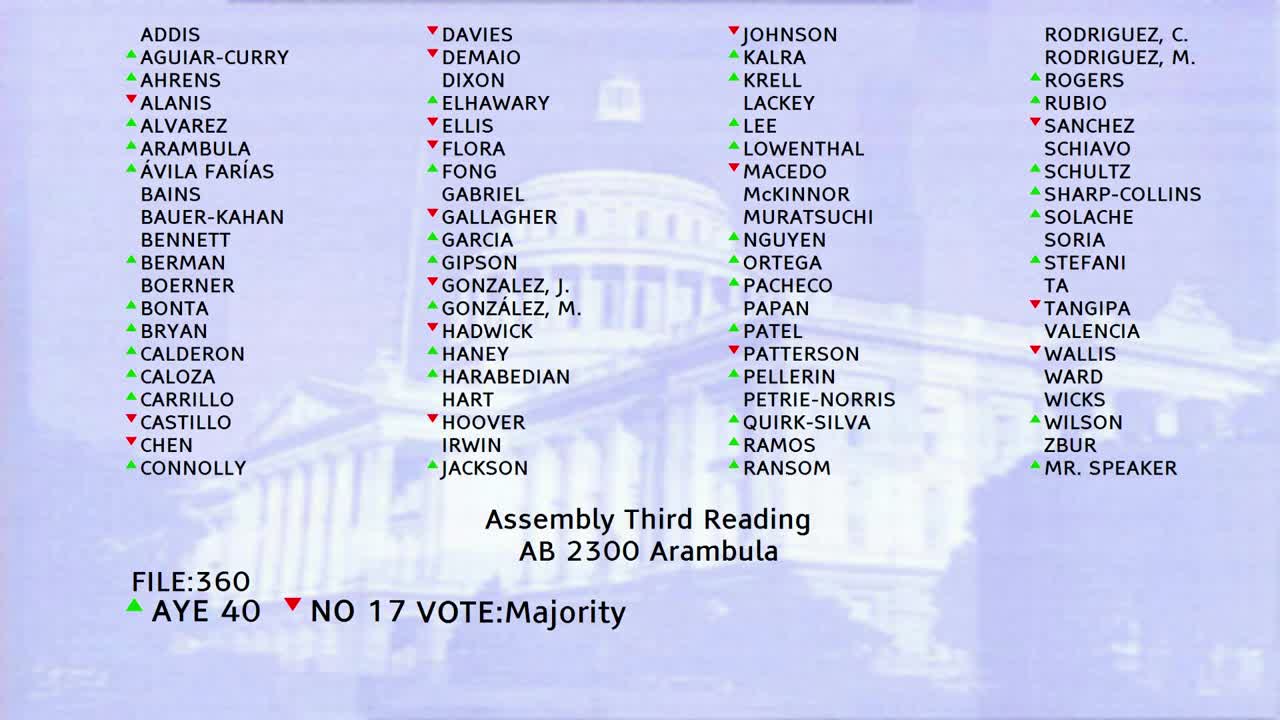 1MIN
Assembly Floor
 27MIN
Assembly Standing Committee on Higher Education
 34MIN